
Toyota dealers in Australia will soon be at the forefront of electric vehicle travel.
Snapshot
- Toyota dealer network to invest $20 million in electric vehicle infrastructure
- First investment of $5 million underway to support bZ4X electric SUV due later this year
- PHEVs not ruled out, but still unclear for Australia
The company has announced a vast majority of its almost 300-strong dealer network in Australia – the largest in the nation – will invest in electric vehicle infrastructure.
This will include charging facilities for the sale and service of electric vehicles, with an initial $5 million investment for 232 dealer sites currently underway, as it prepares to launch the bZ4X electric SUV later this year.
Toyota Australia vice president, sales and marketing, Sean Hanley, said the investment would grow to $20 million for additional chargers and locations as the demand for electric vehicles accelerates.
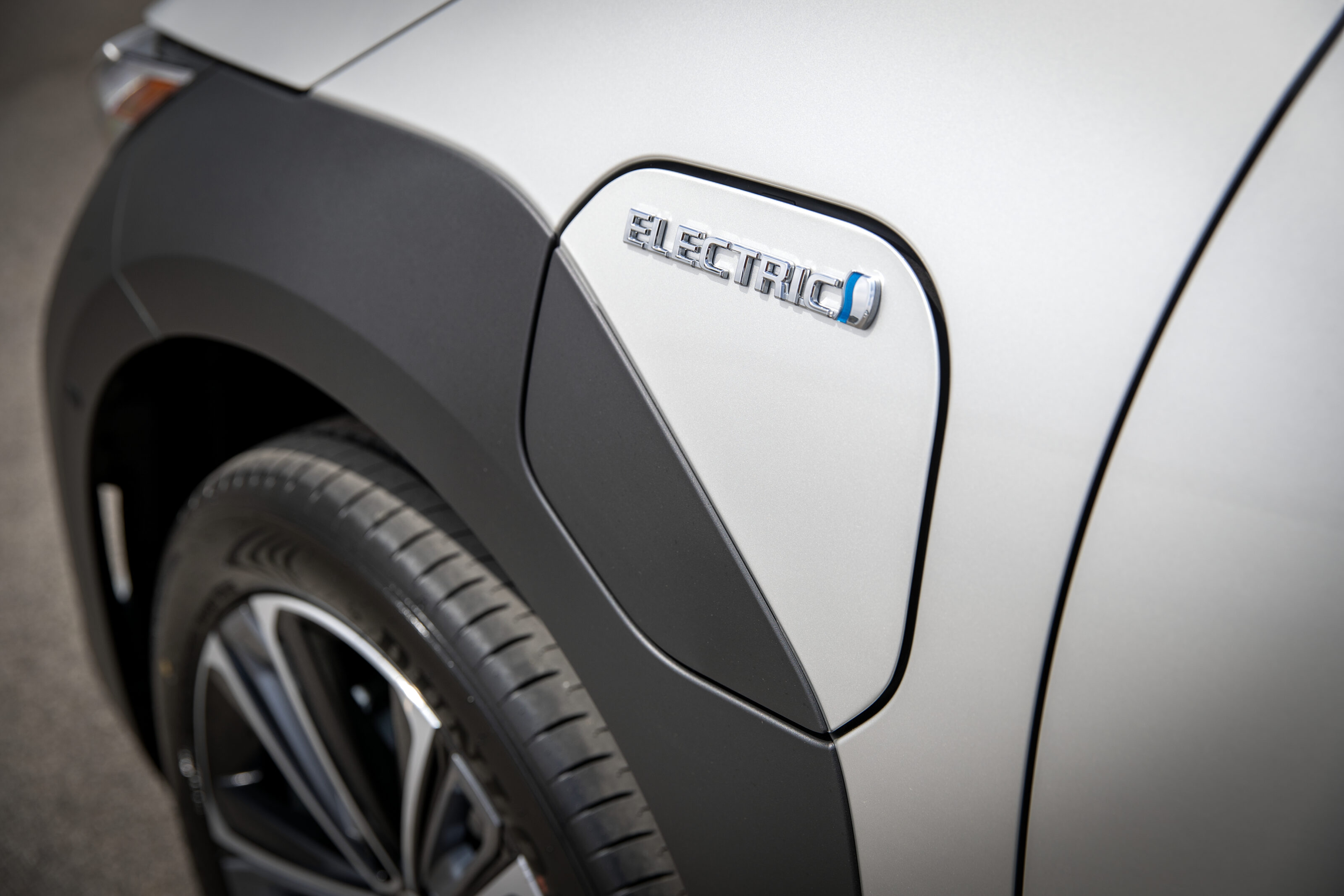
“We have the country’s best and most extensive dealer network, and they’re already investing in charging infrastructure to support the sale and service of Toyota EVs.”
Hanley said the chargers would be available “everywhere, from our capital cities to places as far as Cairns, Alice Springs and Broome.”
“Combined with the [three electric vehicles due in the next three years] announced today, this investment is further evidence that Toyota and our dealers are serious about electric vehicles,” added Hanley.
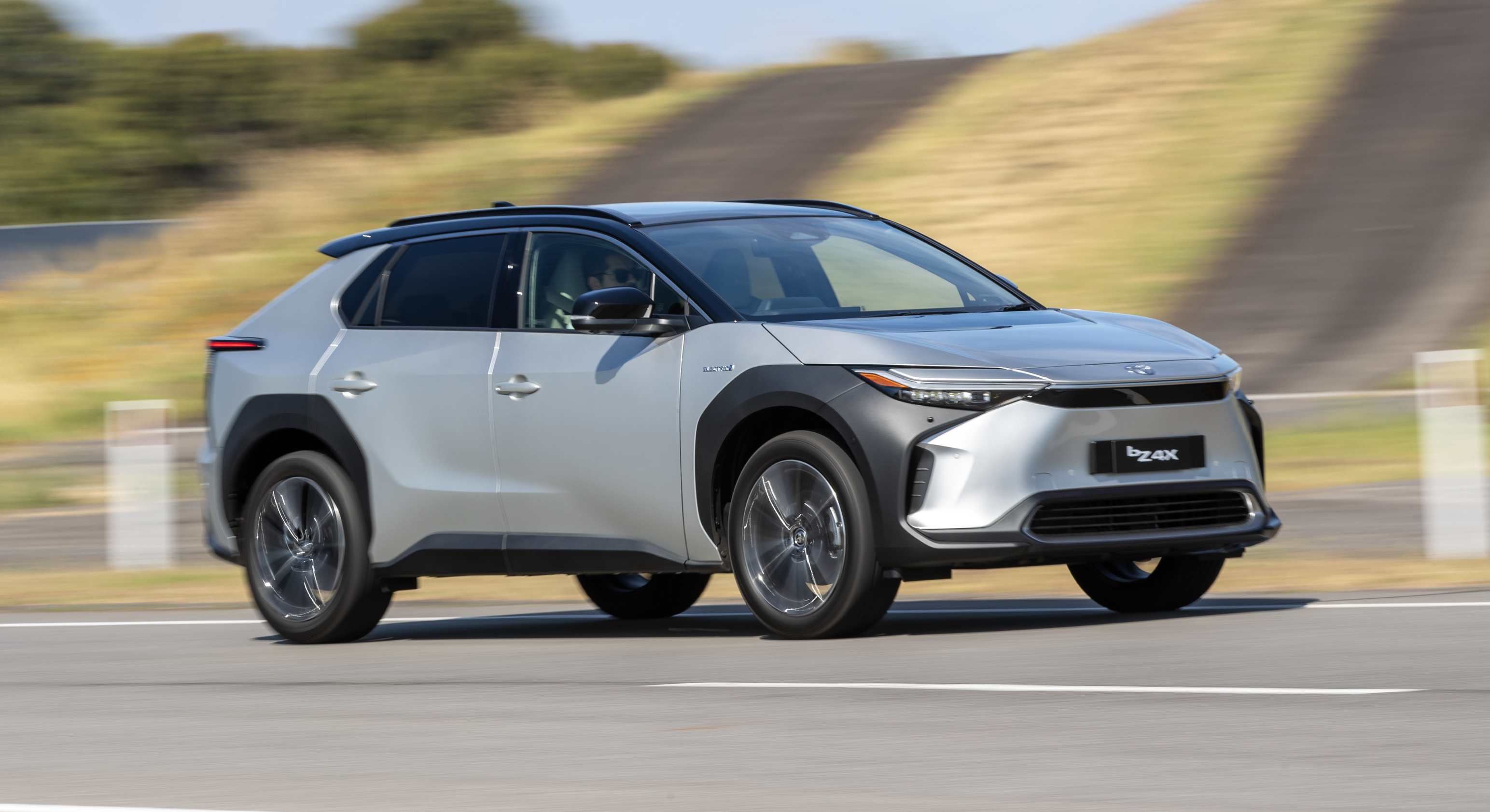
While some electric vehicle chargers will be internally placed for dealer use only, others will be external for “24-hour, seven-day charging”, which would be exclusive to Toyota owners, at this stage.
And the number of chargers available at each Toyota dealer will differ depending on the area’s volume of electric vehicle sales.
Despite the investment, Toyota Australia will continued with its slow and gradual roll-out of electric vehicles, with a retained focus on hybrid options.
Toyota Australia forecasts more than half of its sales will be electrified by 2025, but – although no breakdown was offered with that forecast – this is expected to be made up mostly of hybrid options for popular vehicles, such as the RAV4, Corolla, Corolla Cross, Kluger, Camry and Yaris Cross.
In 2022, hybrid vehicles accounted for 31.5 per cent of Toyota Australia’s sales – 72,815 of 231,050 registrations – with that number expected to rise this year, despite lengthy wait times.
What about plug-in hybrids?
While Toyota Australia has yet to offer plug-in hybrids – including the RAV4 Prime – it hasn’t ruled the technology out.
“Quite potential. I mean, plug-in hybrids offer other benefits, you know, it’d be a part of the portfolio going forward,” said Hanley.
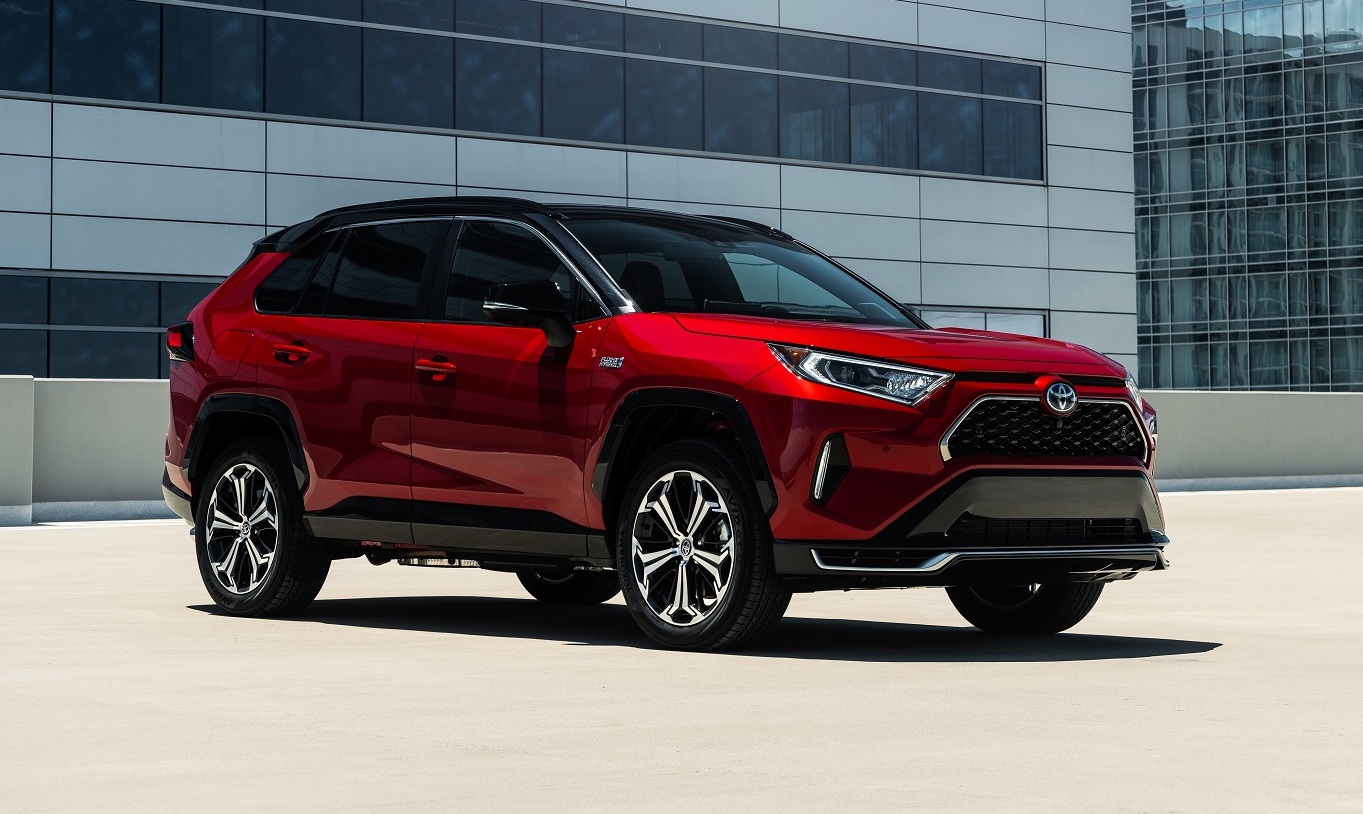
“I’ve often thought how practical is plug-in, but… there will be a market for it, and it does serve a purpose in terms of emissions and range and reducing fuel consumption in a far more economical way, so we won’t rule out plug-in hybrids at all as an option for Toyota in the line-up.”
Of course, plug-in hybrid vehicles can also access electric vehicle chargers, potentially assisting with user take-up at Toyota’s dealerships, should a business case for the brand’s PHEVs prove successful.
The next-generation C-HR small SUV will offer a plug-in hybrid option in Europe, while the plug-in RAV4, Prius and Harrier/Venza models are currently ruled out for Australia.
Toyota Australia has announced it will launch at least three electric vehicles by 2027.
Snapshot
- 2024 Toyota BZ4x electric SUV due later this year
- Three battery-electric vehicles confirmed for Australia by 2027
- More than 50 per cent of sales to be electrified in 2025; hybrid as important as ever
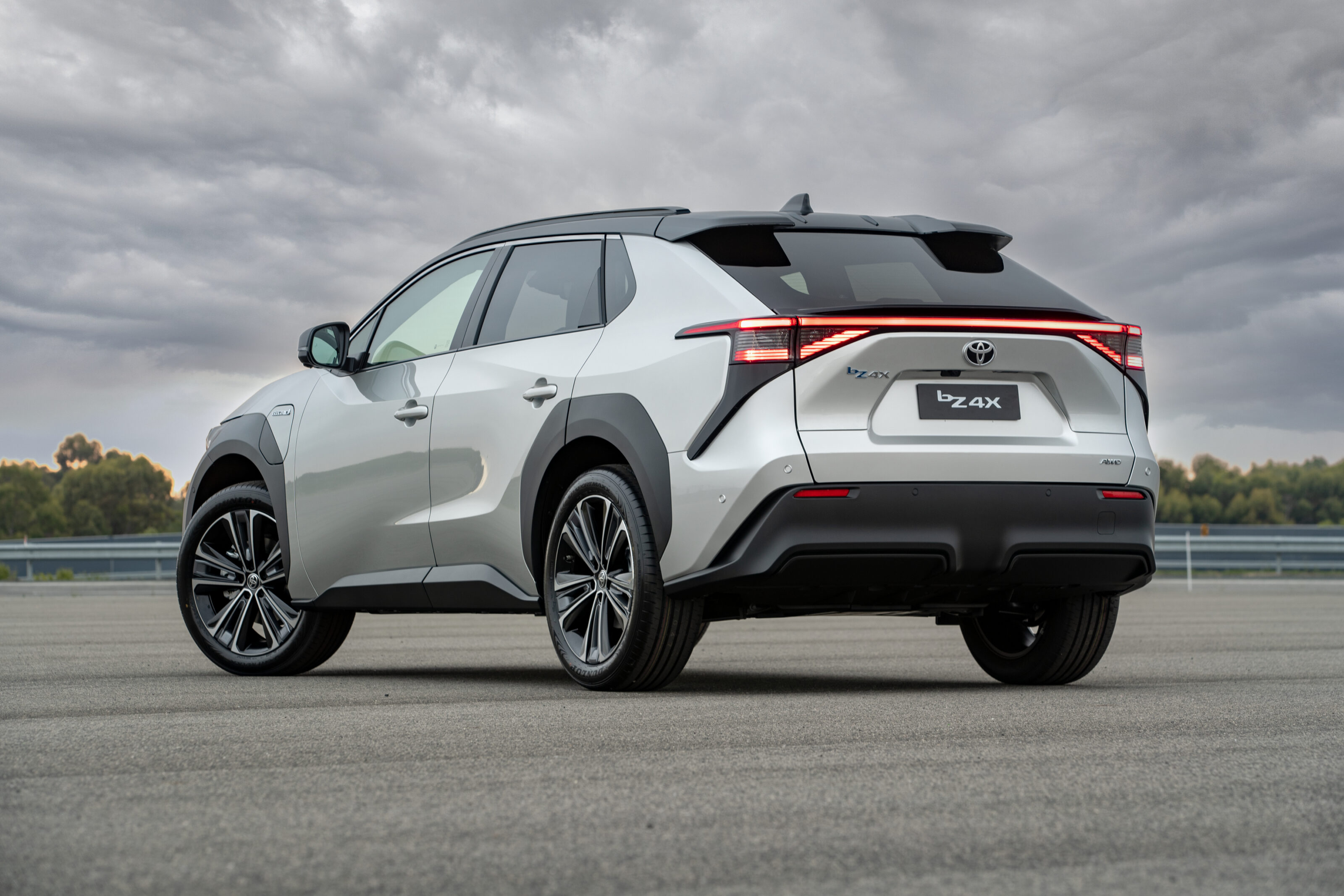
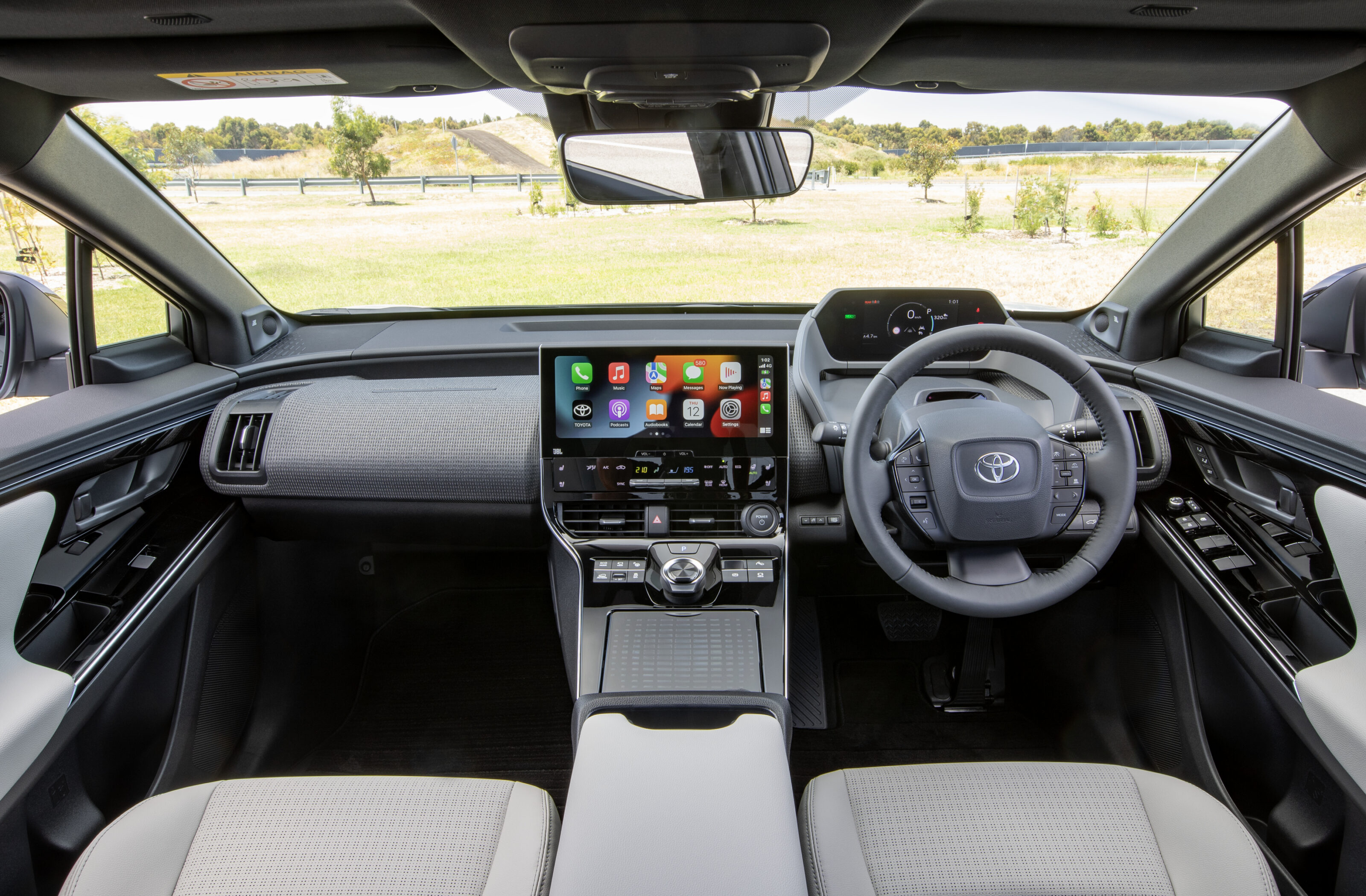
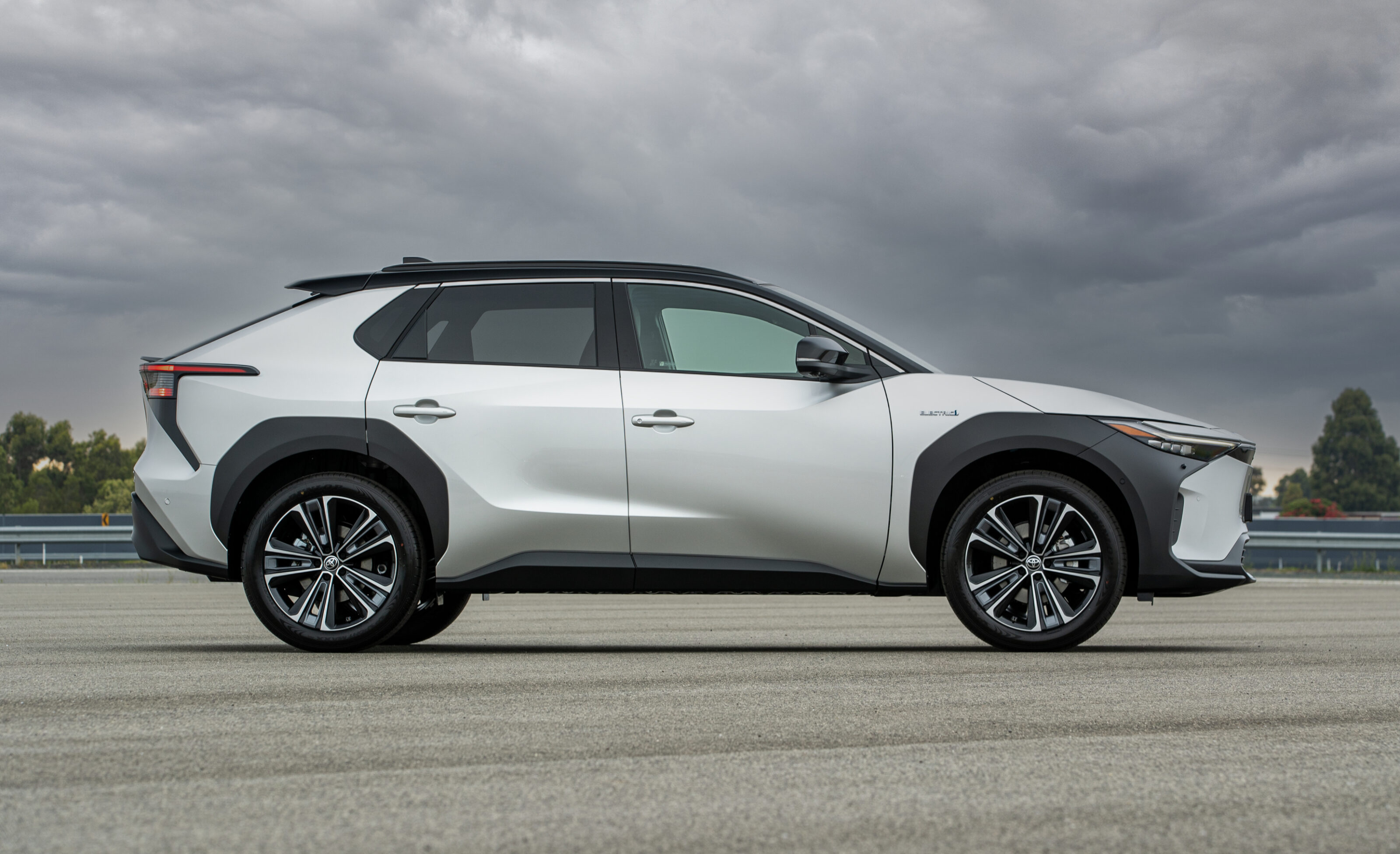
It will be kickstarted by the 2024 Toyota bZ4X electric SUV set to arrive before the end of the year, following delays.
The mid-size SUV – similar in length to a RAV4, but with a Kluger-sized wheelbase – is expected to command a significant premium over Australia’s best-selling SUV, the RAV4.
Pricing is still to be confirmed, but in conversations with media today including Wheels Media, Toyota Australia’s vice president for sales and marketing, Sean Hanley, was abundantly clear on what buyers should expect: Expensive.
“Battery electric cars are expensive. Don’t kid yourself. They are expensive to build. If you want the quality, safety, performance [and] range, they are expensive… lithium prices have gone through the roof,” he said.
“I’ve always said that this car will not be a cheap car, but as we go forward, as hybrids did over the 22 years, and as [we] scale up, EVs will come down in price.”
The bZ4x will compete against the Tesla Model Y and Volkswagen ID.4, with an expected price tag between $60,000 and $80,000.
When asked by Wheels if the unique selling point for the bZ4X will be driven more by the tried and trusted Toyota badge than any specific feature of the car, Hanley agreed.
“Trust and reliability, that’s all that counts here.”
While the bZ4X was expected to launch in mid-2023 – around the same time as its Subaru Solterra identical twin – it has been pushed back to the end of the year to “secure supply and the latest [specification].”
What’s next?
Following the bZ4X, Toyota Australia is tipped to confirm the production version of the BZ Compact SUV concept for our market, and another electric vehicle due within the next three years.
“What these futuristic cars demonstrate is that Toyota is not just developing EVs; we’re focused on offering cars with stylish design, leading technology and dynamic performance,” added Hanley.
However, the transition to battery-electric vehicles for Toyota Australia will be slow and gradual, with a continued focus on all electrified options.
This includes petrol-electric hybrid models – and likely diesel-powered hybrid commercial vehicles by 2030.
Toyota Australia forecasts more than half of its sales will be electrified by 2025, but – although no breakdown was offered with that forecast – this is expected to be made up mostly of hybrid options for popular vehicles, such as the RAV4, Corolla, Corolla Cross, Kluger, Camry and Yaris Cross.
In 2022, hybrid vehicles accounted for 31.5 per cent of Toyota Australia’s sales – 72,815 of 231,050 registrations – with that number expected to rise this year, despite lengthy wait times.
“I mean, any statistician would look at that and go, well, why would you stop that right now? Why would you do that when the alternative, even in your own line-up, is going to [potentially] double the price?” said Hanley.
As previously announced, Toyota Australia plans to offer an electrified version of every model in its range by 2030 – including HiLux, LandCruiser and HiAce – but not GR performance cars.
The first electrified commercial vehicle to be offered by Toyota in Australia will be the Tundra full-size ute, which is expected next year if the right-hand drive conversion project proves successful.
Having turned 50 last May, the BMW M division is still in celebration mode. This year, the Garching power brokers are going to spoil their fan base with the new M2, M3 CS, M4 CSL and M3 Touring to be followed by the XM flagship, i7 M60 and X1 M35i.
Ever since the first E30-based 3 Series Touring popped up in 1986, the brand community hoped for an M version of the compact five-door holdall. But although the go-faster branch had in fact built an M3 Touring prototype derived from the E46 platform that spawned the very first M3 CSL, management took fright at their own courage and black-flagged the project at the eleventh hour.
Disillusioned by the slow-selling M5 Touring (1992-1995/E34 and 2007-2010/E61), the M3 wagon was laid to rest for good until the CEO Frank van Meel picked up the red thread his predecessor Markus Flasch had started to spin during his 2018-2021 tenure as head of the M skunkworks.
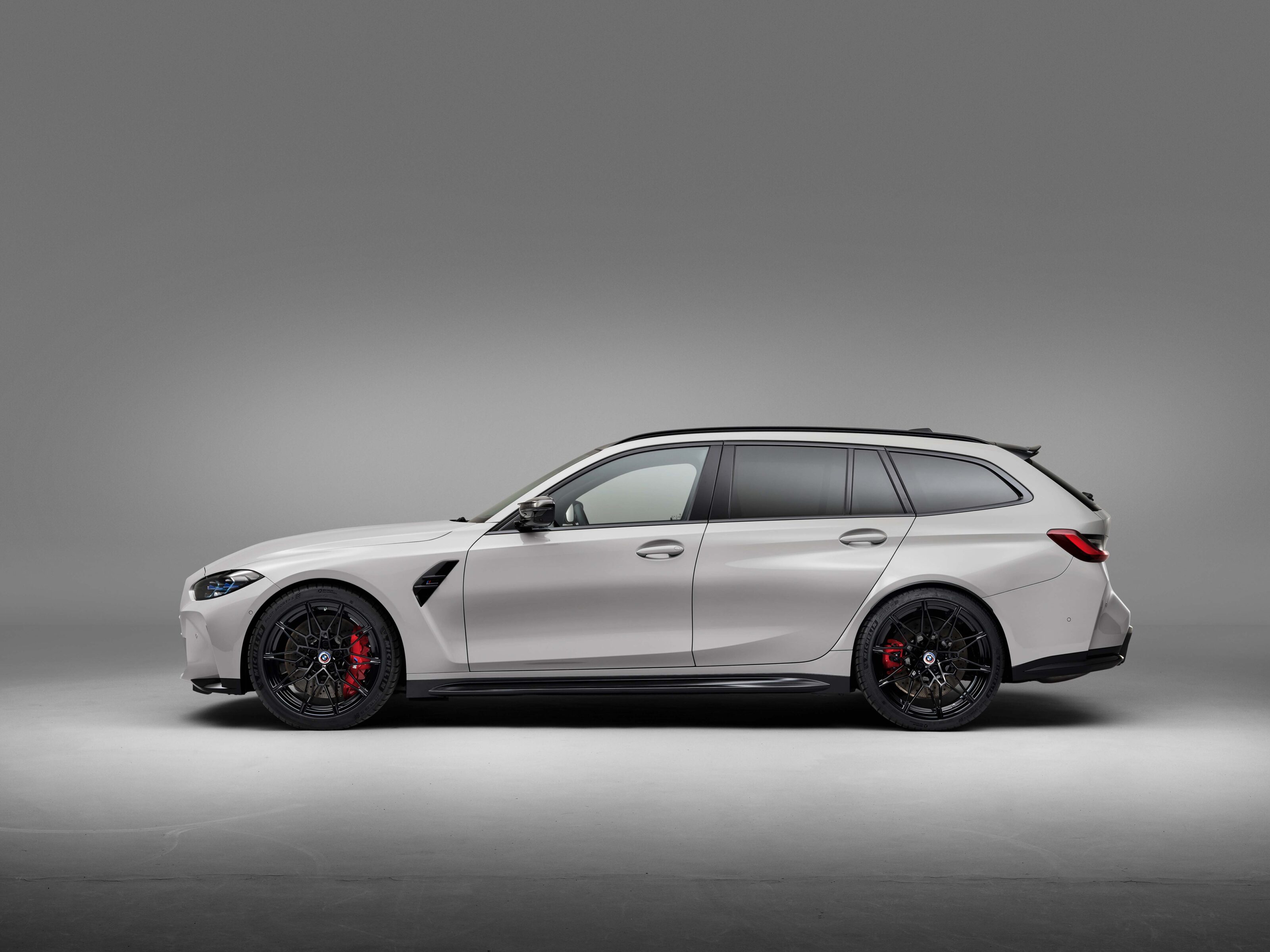
First shown at last year’s Goodwood Festival of Speed, production of the 380kW estate car began in December. Fresh from the Munich assembly line with under 1000 clicks on the clock, our Sao Paulo yellow tester promptly drew a crowd at its first fuel stop.
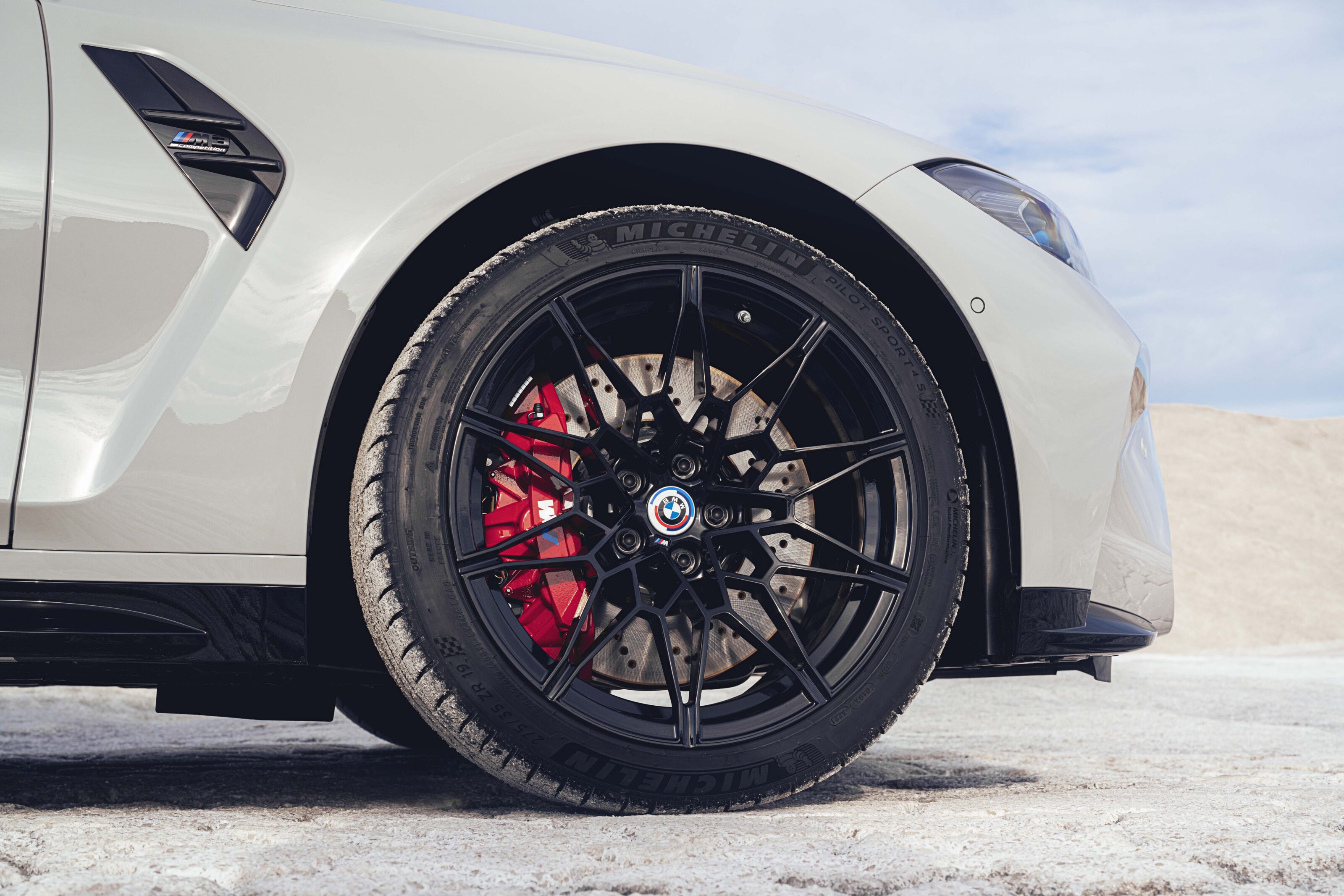
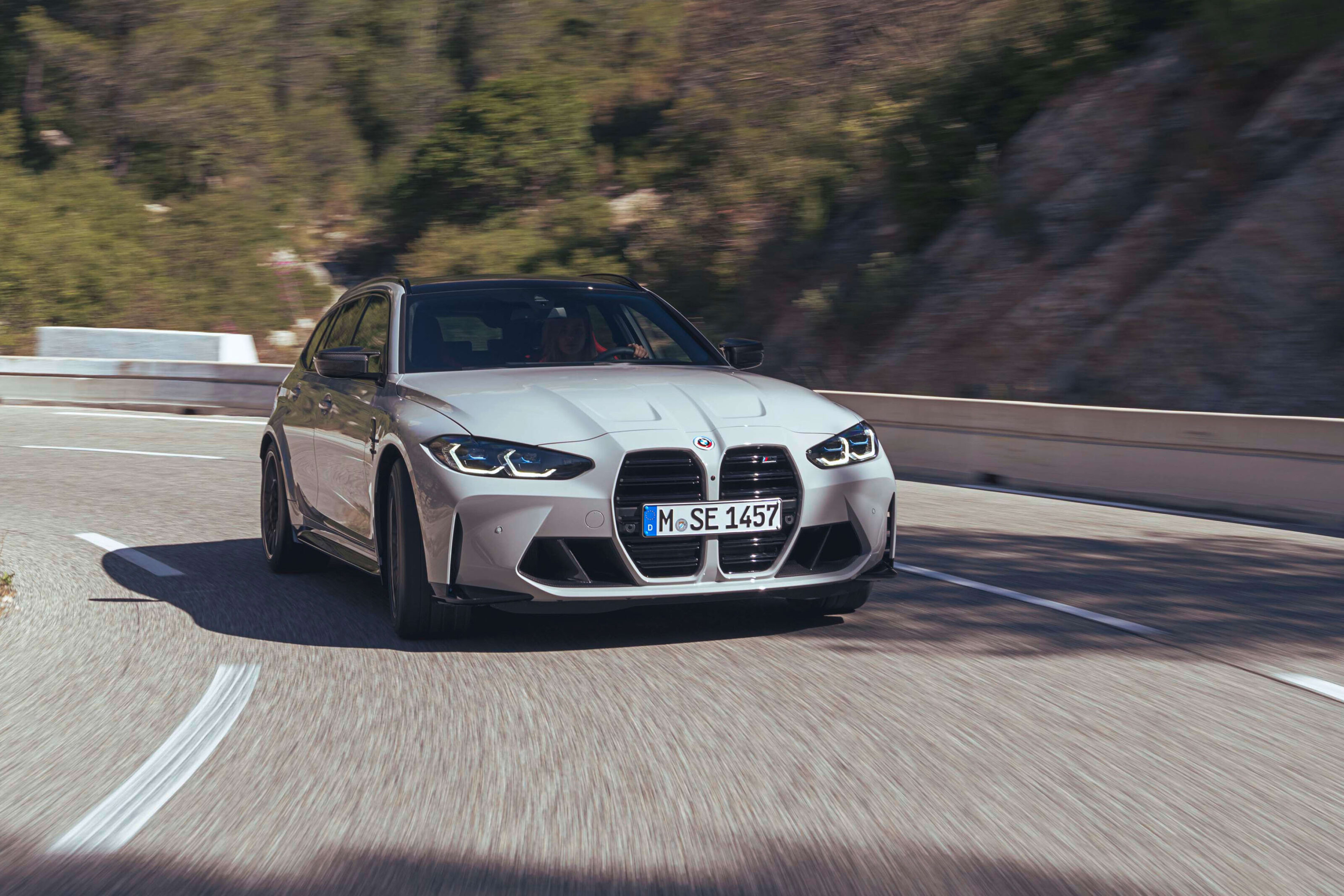
In addition to the eye-catching paint job, the most practical M offering this side of the X models also turns heads thanks to its wider, lower and longer stance further accentuated by the pricey optional carbon-fibre body kit.
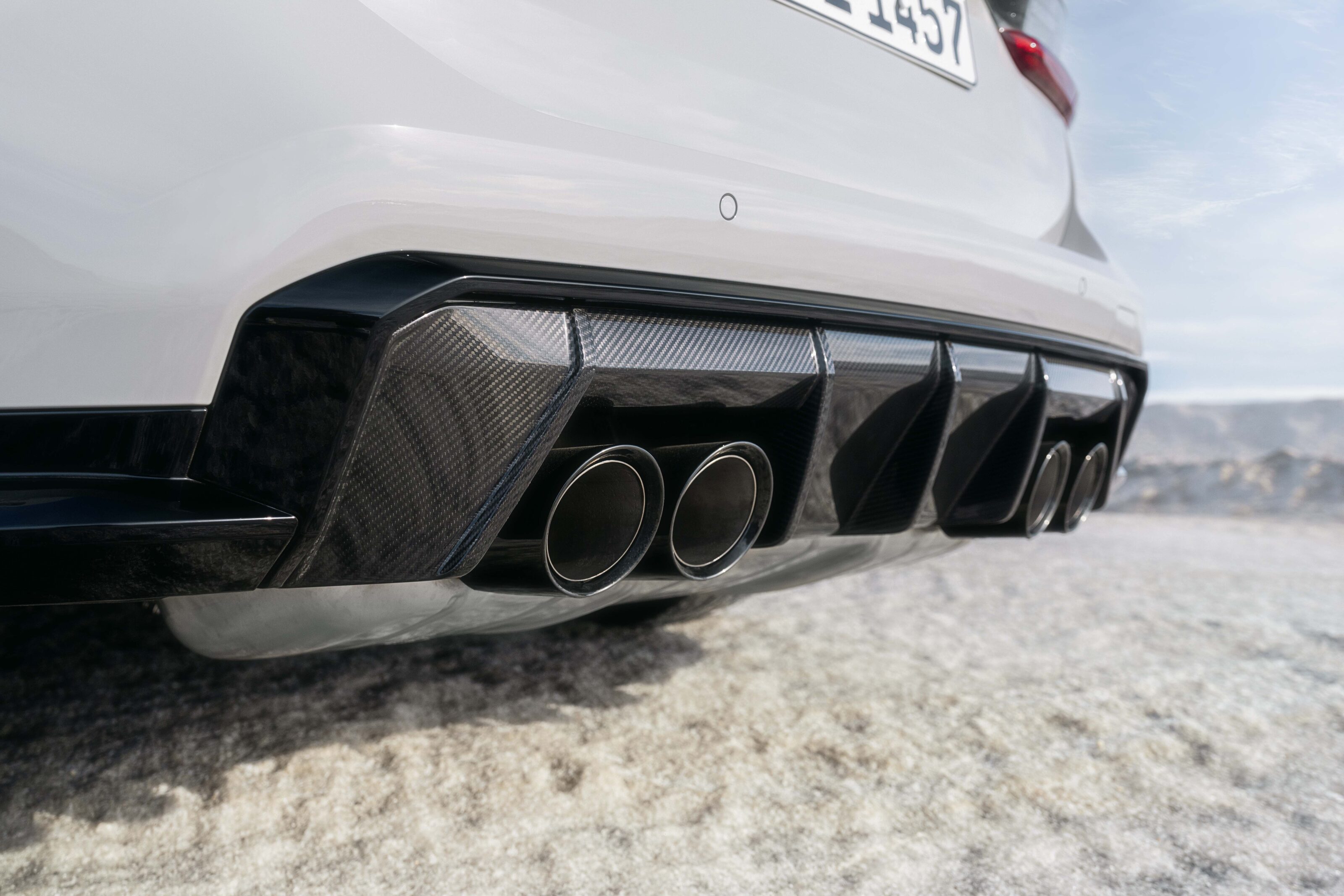
The upright rodent fangs grille remains a polarising design element, but the piercing laser headlights, contrasting black roof and tail spoiler, dark alloy wheels and the vocal quad-tailpipe exhaust surely tick all the right boxes.
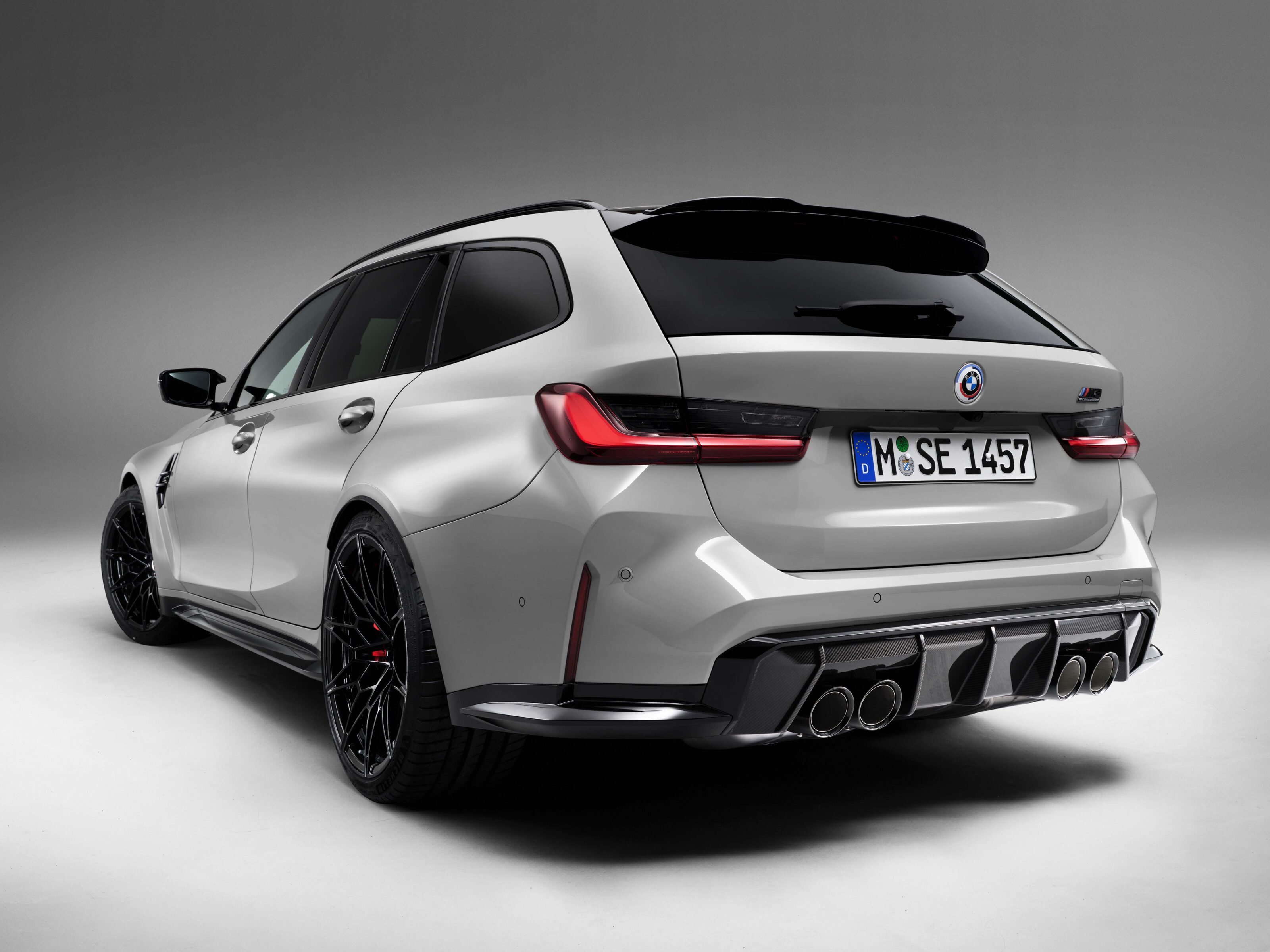
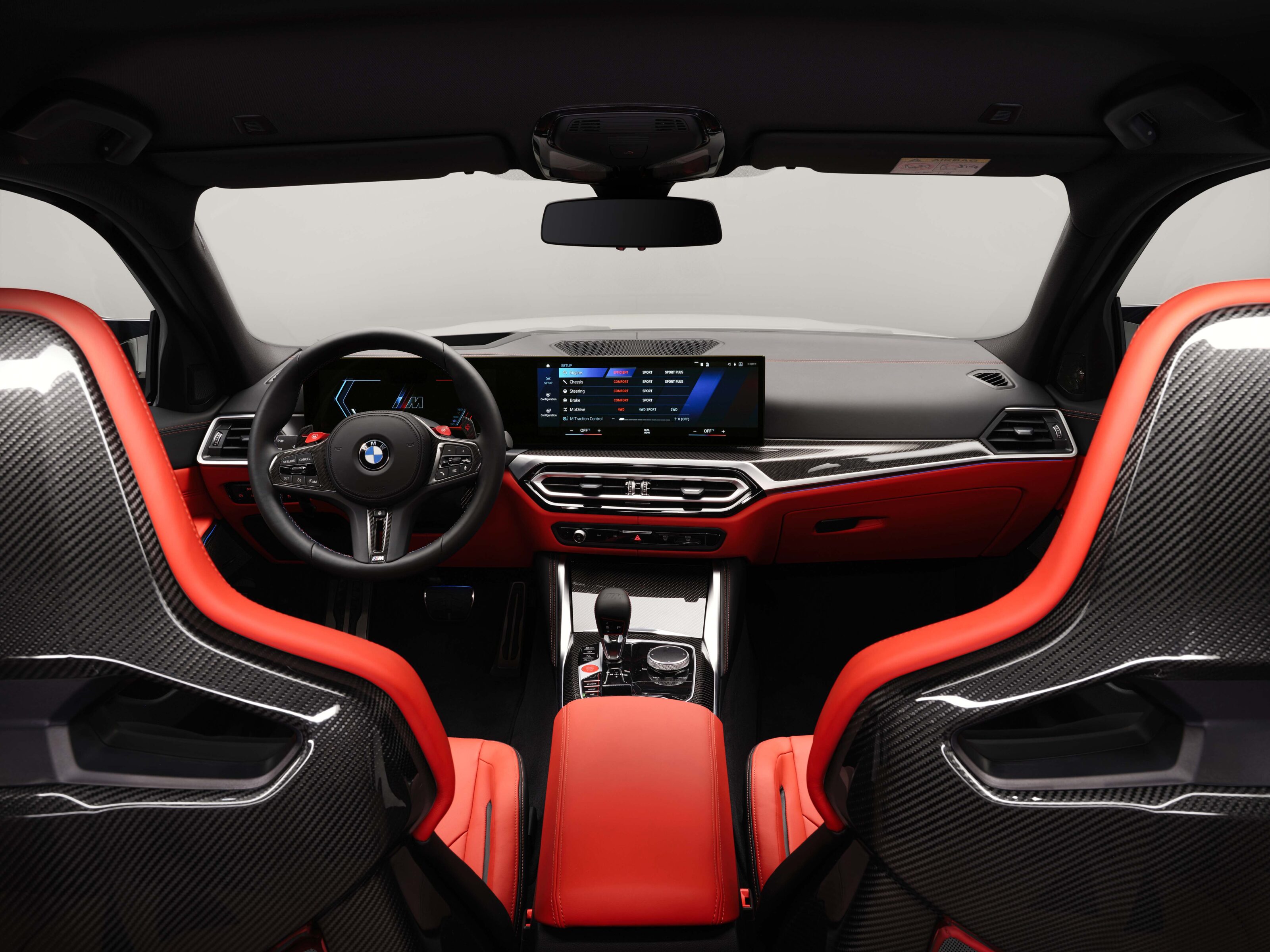
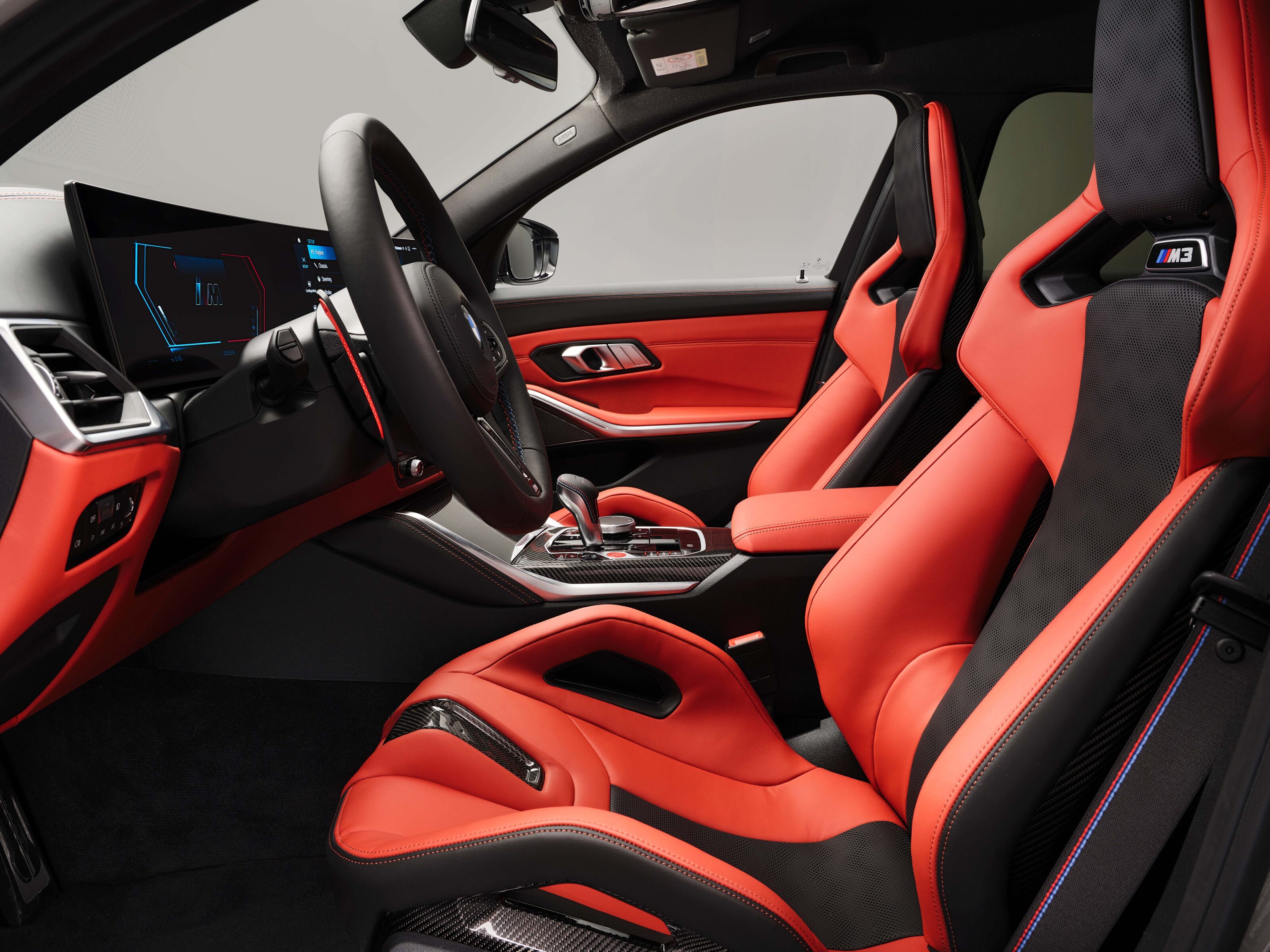
Further boosting street cred is the optional M Race Track Pack featuring carbon-ceramic brakes, a higher 280km/h top speed and a pair of striking carbon fibre bucket seats which are only marginally more comfortable than they look.
Aimed squarely at the ageing 335kW Audi RS4 Avant and the new 507kW Mercedes AMG C63S wagon, the M3 Touring strikes a compelling balance between folly and functionality, long-distance Autobahn missile and part-time racer, hardcore daily driver and family-fit weekend cruiser with thinly veiled dark alter ego.
The drivetrain is pure M3 Competition. The twin-turbo 3.0-litre straight-six develops 380kW at 6250rpm and 650Nm of torque between 2750 and 5500rpm. Standard equipment includes all-wheel drive, eight-speed M Steptronic transmission, bespoke suspension set-up and a bunch of bodywork reinforcements that result in an 85kg weight penalty over the sedan.
On the credit side, the beefed-up M3 Touring feels as though hewn from solid.
Added torsional rigidity enhances the dynamic precision to the same extent it impairs the ride. What this car could really do with is the Comfort Plus damper setting Alpina long ago introduced across its entire model range.
Hit the starter button next to the gear selector, prick your ears, allow enough time for the goose pimples to blossom, and blip the throttle before sliding the lever into Drive. A quarter-century ago, the latter move was all it took to unleash the devil inside and bring emotions to the boil, but the age of digitalisation swamps us with countless alternatives and choices.
Do you prefer AWD normal or AWD Sport? Which of the three shift speeds works best? Should engine, transmission and chassis be locked in Comfort, Sport or Sport Plus? Is there perhaps an even more compelling mix-and-match set-up? Does M Traction Control in M Dynamic Mode (MDM) permit the right measure of tail happiness?
Why must even brakes and steering offer a choice of two different calibrations, and how does the response generated in Sport compare to Comfort? Is mid-winter a good omen for RWD, and if so, which of the ten drift stages is best for maximum drama and minimum tragedy? Questions over questions, and only one answer: let’s hit the road and find out.
In essence, the M3 Touring is three cars in one: Sunday morning B-road hooligan, cross-country fast lane season ticket holder and hugely practical 911 Carrera 4S alternative at a 40 per cent discount.
But it is also worth remembering what this swift and super-cool 380kW load carrier is not, namely a relaxed and hush-quiet long-legged intercity express, a cushy high-speed cruiser for mum, dads and two kids, and a totally forgiving premium transportation appliance that never puts a foot wrong.
It’s between these extremes that the majority-appeal, minority-interest Touring unfolds its unique character, which is worlds apart from the oddly uninvolving RS4 and tangibly superior to the oddly artificial C63.
After all, this BMW is an always-active and occasionally aggressive tarmac peeler, a concise carver masterminded by algorithms that never sleep, a challenge to the driver, the elements and, ultimately, its own limitations.
Whereas Scandinavian roads are covered with solid snow between November and April, winter in Bavaria tends to produce an inhomogeneous mix of sludge, black ice, snow drifts and puddles of standing water.
M&S tyres are a must, but the Michelins fitted to our test car operated with large slip angles that slowed down the turn-in response, took a heart-stopping moment to build up enough grip and indulged in rather abrupt breakaway characteristics.
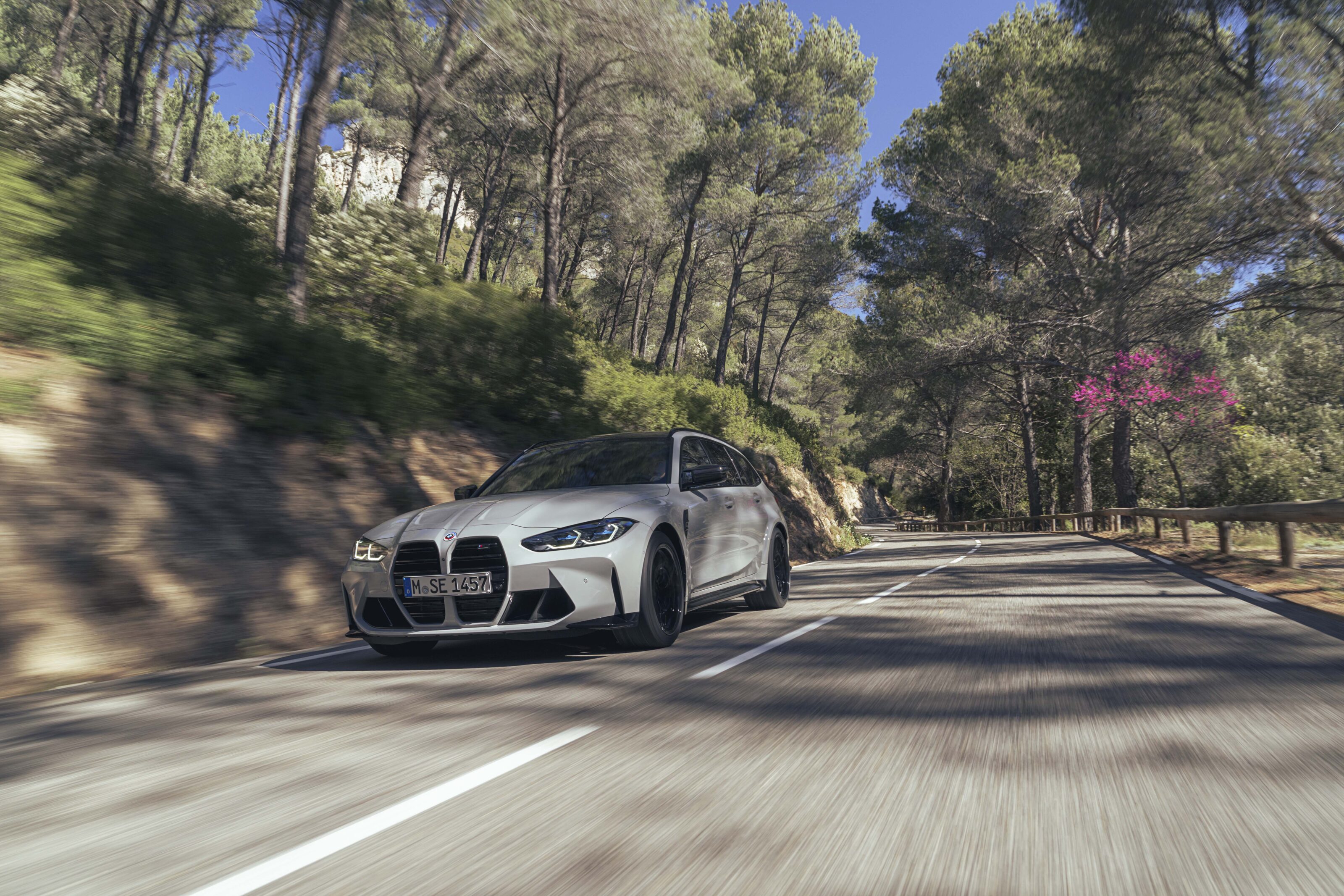
As a result, the handling was sometimes coarse through the twisties, the inherently tenacious roadholding had its electric eel moments, and the token snap-oversteer at the exit was probably enhanced by the Touring’s quantifiably higher centre of gravity caused by its taller, longer roofline.
Nuances only, for sure, and yet subjectively at least, some of that commendable coveted creaminess at the limit was lost in the translation from one body style to the other. These minor idiosyncrasies may of course be irrelevant on summer tyres and dry blacktop.
Valid at all times irrespective of season and weather are the engine’s awesome urge and responsiveness, the multi-faceted adaptability of the quick and slick transmission, and the tactile professionalism of the torque vectoring hardware and software.
Good for 410kW in the M3 CS and M4 CSL, the iconic 380kW in-line six fitted to the M3 Touring is less than 90kW short of the brand’s beefiest 4.4-litre V8 as fitted to the M5 and M8.
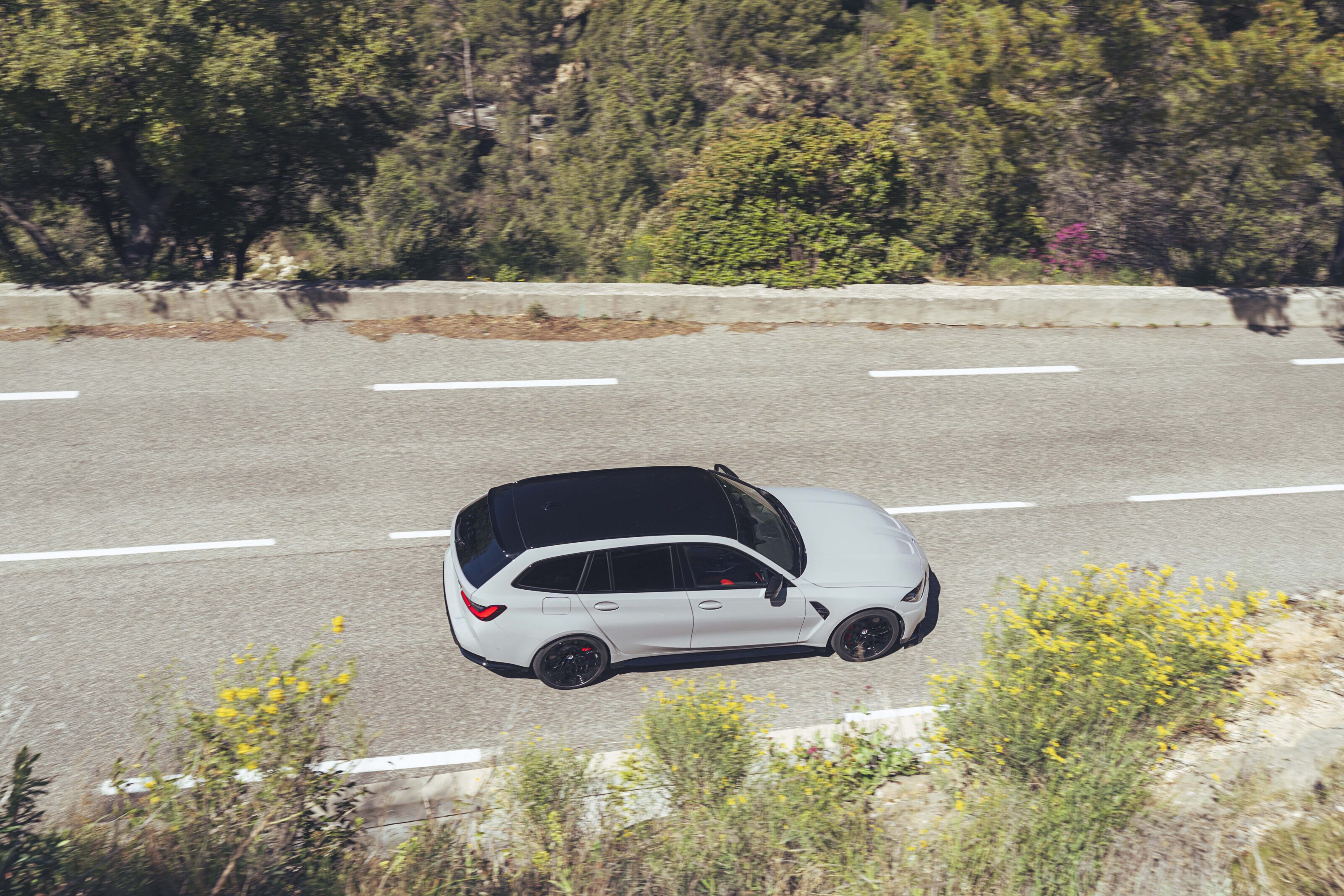
Despite its substantial kerb weight of 1865kg and in view of the ho-hum drag coefficient of 0.36Cd, the awesome mid-range punch and spot-on gearing beam this five-seater with 500-litre cargo bay from zero to 100km/h in a launch-controlled 3.6 seconds and an equally remarkable 12.9 seconds from 0-200km/h.
Perhaps even more impressive is the explosive time-warp 2.7-second in-gear sprint from 80-120km/h. That’s 911 Carrera 4S territory, give or take a couple of tenths.
While befriending the engine is like meeting the perfect match on Tinder, falling in love with the transmission takes a little bit longer. How come? Because this is not your run-of-the-mill eight-speeder with a pre-loaded torque converter, nor is it a racy dual-clutch arrangement with rarely wrong pre-select brain power.
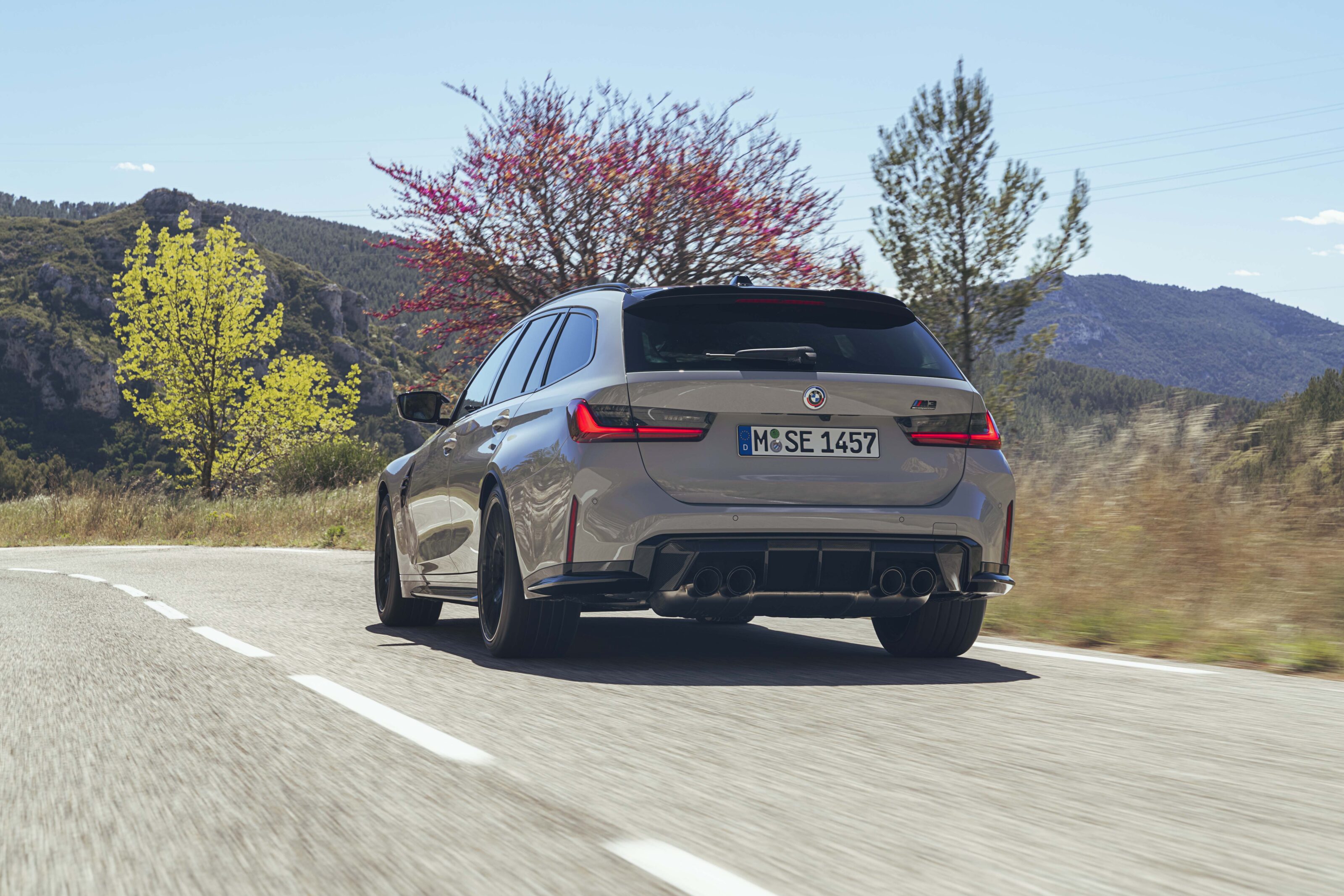
Unique to the BMW box is a variable shift speed feature, the effect of which ranges from a pat-on-the-shoulder jovial to a brutal whiplash kick in the butt. Rev the 2993cc Kraftwerk close to its 7200rpm redline and full-throttle upshifts will trigger this effect in first, second and even third gear.
All it takes to orchestrate a series of sequential downshifts is to keep the left-hand paddle pulled until road and engine speed match. Random paddle shifts are possible at any time; after 20 seconds the system will return to the original setting. Do not, however, expect any automated upshifts in manual transmission mode.
The overtaking prestige of our in-your-face yellow test car easily matched an on-call ambulance with lights flashing and horns blaring. Exhibiting the same authoritative ease, the M3 weaved speedily through traffic, closed gaps in fast-forward manner, reeled in vans and trucks at an unreal pace and devoured the open road like an emergency organ courier.
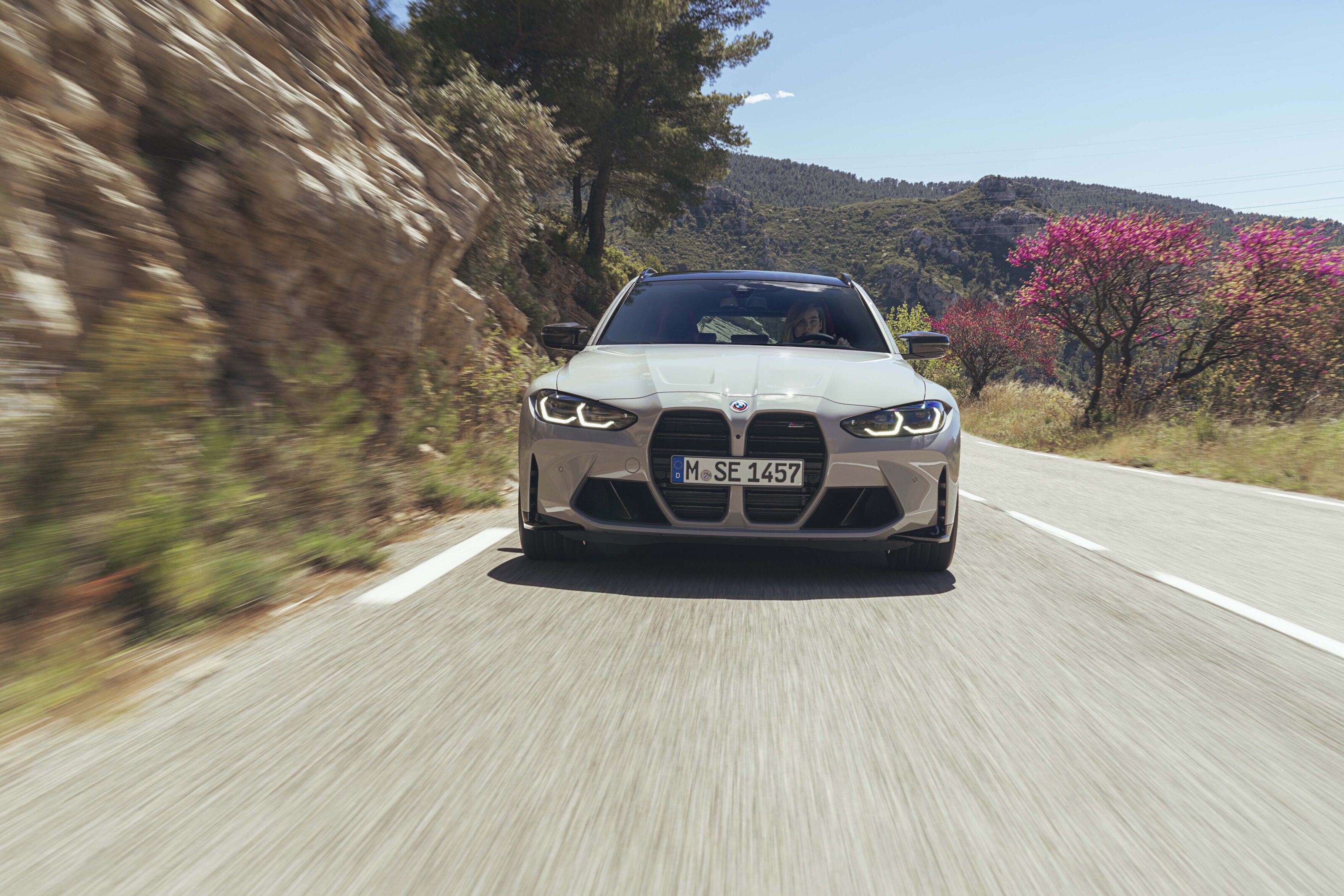
Changing gears manually is always an option but with the chips operating in Sport mode, there is really not a lot that old-fashioned grey matter can improve on.
Last but not least, you should compile two different basic dynamic settings and store them under the bright red M1 and M2 buttons that are within easy reach of both thumbs. One is perhaps keyed for the routine run to or from work in rush-hour traffic, the other one may prime the DNA for back road excursions with sleeves rolled up and a heavy right foot.
Like its stablemates, the M3 Touring is track-rated and accordingly compromised on uneven turf, around town and on older freeways replete with expansion joints and aquaplaning grooves. Even in Comfort, the suspension keeps snapping at potholes, fights speed bumps, responds angrily to drain covers and rattles with disdain over railway crossings.
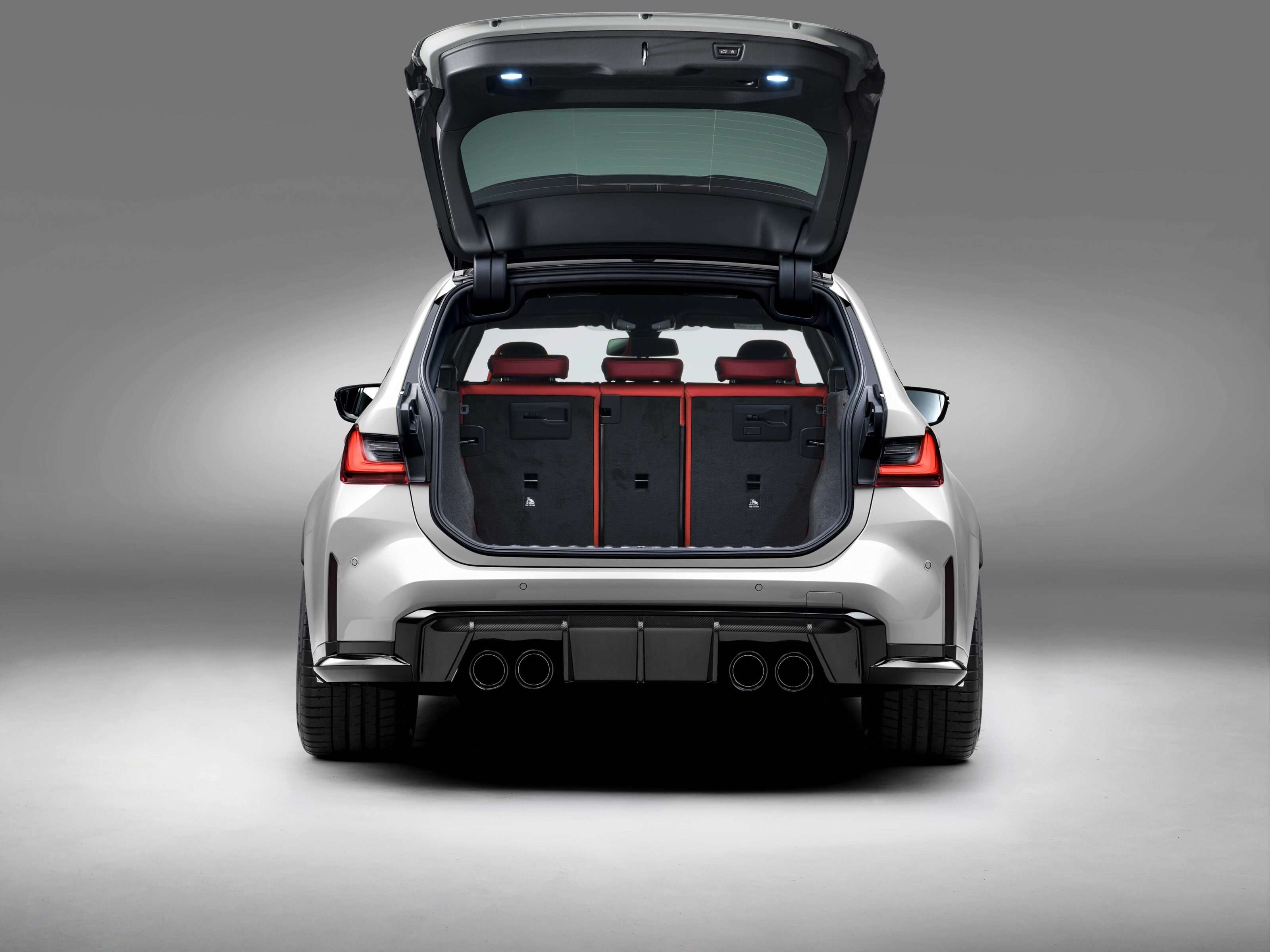
The M5 does a better job in this urban habitat, and so do RS4 and C63 which are, however, less competent as soon as you start pulling out all the stops. The optional space-age bucket seats save almost ten kilos in weight, and they do offer plenty of lateral support, but they are definitely not a one-size-fits-all proposition.
Climbing over the tall thigh bracket is a physical effort, the effects of the sparse padding can be felt for days to come, and the adjustment opportunities are limited. While there is nothing to be done about the brittle ride and that underlying harshness, the self-conscious exhaust note can be toned down by hitting the appropriate button in the centre console.
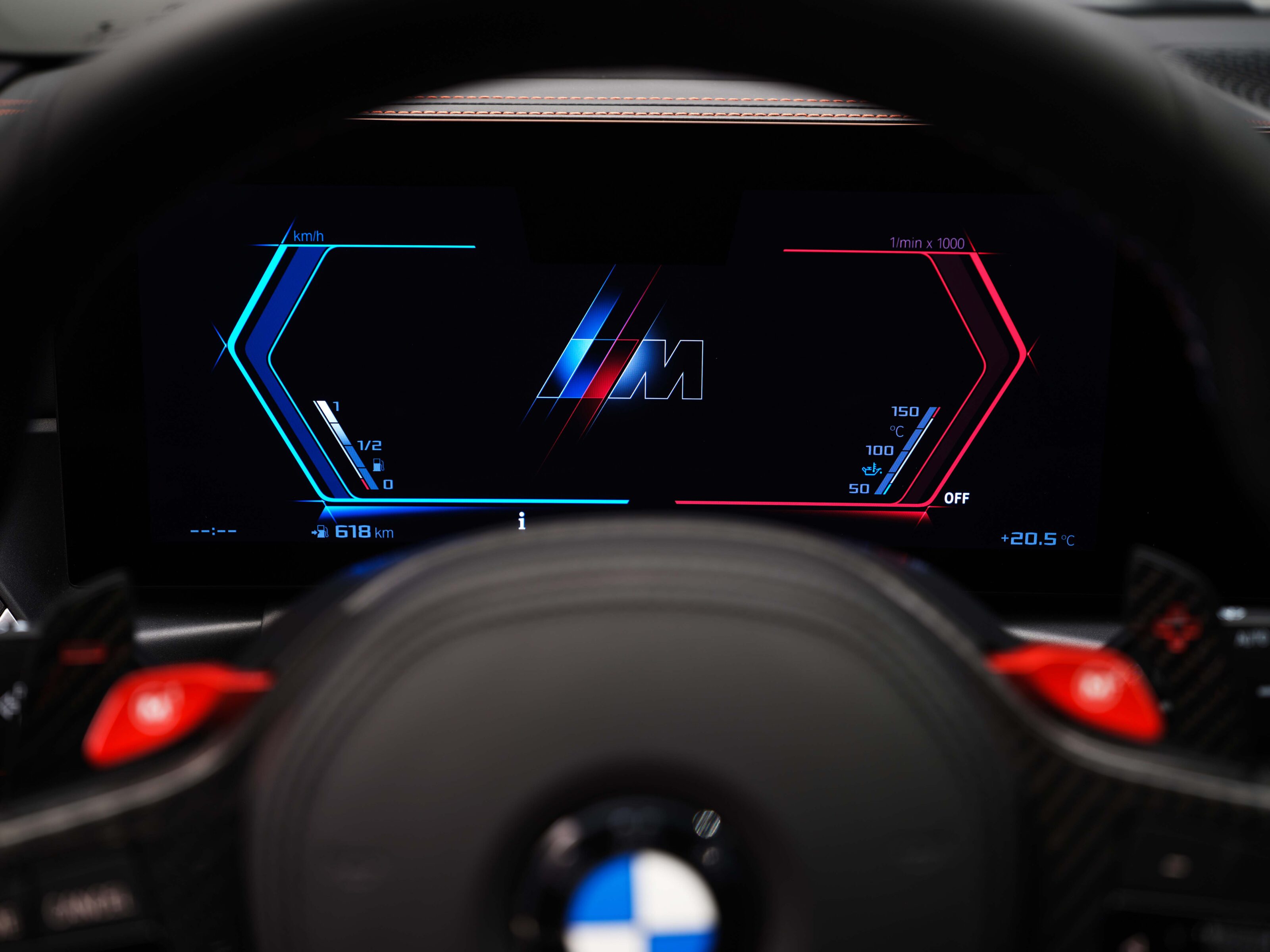
The M3 Touring is the first M model equipped with the latest eighth-generation operating system and the new Curved Display that spans two-thirds of the distance between both A-pillars. Although the fully digital cockpit results in fewer buttons and switches, ergonomic progress is debatable and the funky graphics mark a sad departure from the once clearly legible round instruments.
While most functions must be accessed by the touchscreen, others can be summoned via voice control – which even operates the power windows.
Tall drivers need to bend forward to reach the distant display, simple items like seat heaters and temperature controls require multiple stabs at the monitor, and although most vibrating and blinking assistance systems can be deactivated step by step, they are back in full force after every engine restart.
New additions to the equipment list include the ‘Drift Analyser’, lap timer, tyre pressure and temperature readout as well as two graphs depicting longitudinal and lateral acceleration.
What’s missing is a purist black panel showing nothing but speed, revs and gear, plus perhaps a pair of low fluid level warning lights. After all, the M3 Touring is not a car for poseurs, gamers and wannabe racers. First and foremost, it addresses purists and dedicated drivers who are not interested in the brimborium that fascinates social media stars and marketing wizards.
Rather, this BMW is an expert tool for expert users, not a blat-blatting embarrassment chasing Instagram rankings and Facebook likes. Although dicing with high-performance rivals can be fun for a short while, true satisfaction stems from the kind of nitty-gritty ten-tenths human-machine interaction that needs no audience and no video evidence.
It is a car that speaks for itself, is pragmatic in concept, beyond doubt in content, solid in execution, emphatically emotional and super competent with the exception of some excess body fat and a few flaps and flippers too many.
Our best driving day out of four was a Monday, when the snow finally began to melt, the roads dried up and the weekend dawdlers had long returned home. The regular 58-mile test loop was still wet in places and a strong wind had started blowing from the east but traffic was light, one could see for miles, and the mighty under-bonnet momentum wasted no time in establishing a pushing and precise fast-forward rhythm.
True, the steering action is a little too light in Comfort mode and a little too stiff in Sport, just as the brakes are either somewhat grabby or a tad heavy. But adjusting is easy because the weight and the gearing of key controls interact with aplomb irrespective of the chosen setting, and the flow maintained by the drivetrain is intuitively complemented by the changes of direction and pace.
Even though turn-in understeer and power oversteer define the handling and roadholding spectrum, the demarcation zones are pliant and control is rarely more than a flick at the wheel or a token lift-off gesture away.
This is a playful car, benign up to a point and a challenge beyond it, but the dialogue never escalates, the respect is mutual, and the reward is worth the stiff tariff – even though a 280kW M340i xDrive Touring would probably cover the needs of nine out of ten prospective customers.
VERDICT
This is the best compact high-performance wagon a lot of money will buy, by a relatively long shot.
But beware: the quota is limited and extras (like bespoke paint) are expensive. And don’t expect a thank you note from your neighbour.
UPDATE: Solar-powered car maker Lightyear files for bankruptcy
The operating company for solar-powered electric car maker Lightyear has been declared insolvent in the Netherlands.
It has placed doubt over the Lightyear solar car concept, which commenced production in late 2022, before it was paused just a few weeks later.
The subsidiary, Atlas Technologies, was responsible for the development and manufacturing of Lightyear’s solar-powered EVs.
“Lightyear regrets having to make this announcement for all employees, customers, investors and suppliers and will work closely with the curator and all the people who are involved and hope for their understanding and support,” said the brand.
A few days ago, the brand announced it was suspending production of the Lightyear 0 – contracted to Valmet Automotive in Finland – to focus on the smaller and cheaper Lightyear 2.
NL Times said it is expected to result in around 600 job losses, with bankruptcy curator Reinoud van Oeijen stating the business could be restarted to focus on the Lightyear 2. It was expected to begin production in 2025.
The story to here
June 16, 2022: Lightyear 0 solar car revealed
Snapshot
- Solar-powered Lightyear 0 revealed
- Production-ready EV brings up to 70km of extra range per day
- Priced from u20ac250,000 (AU$372,450); more-affordable version coming
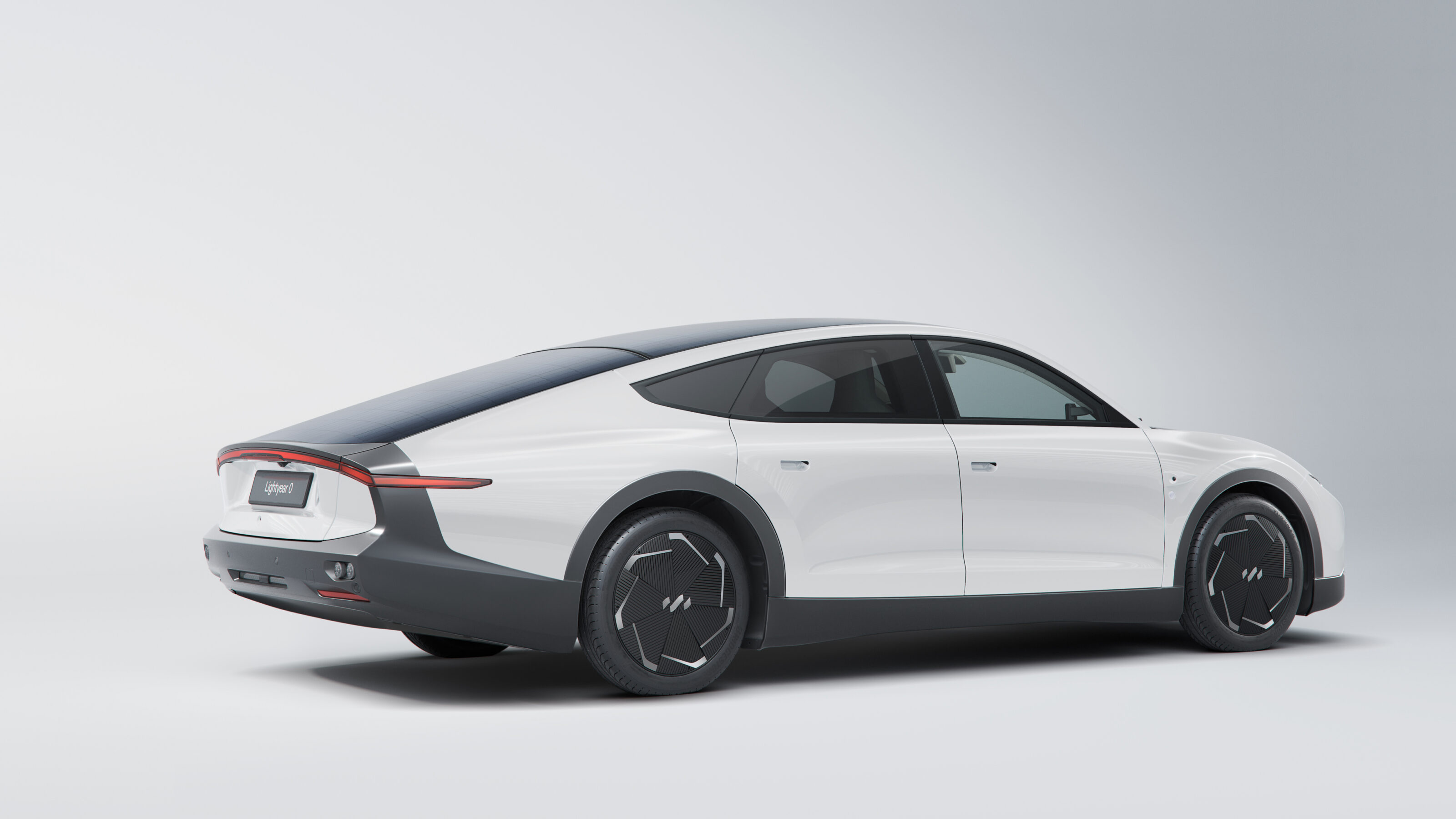
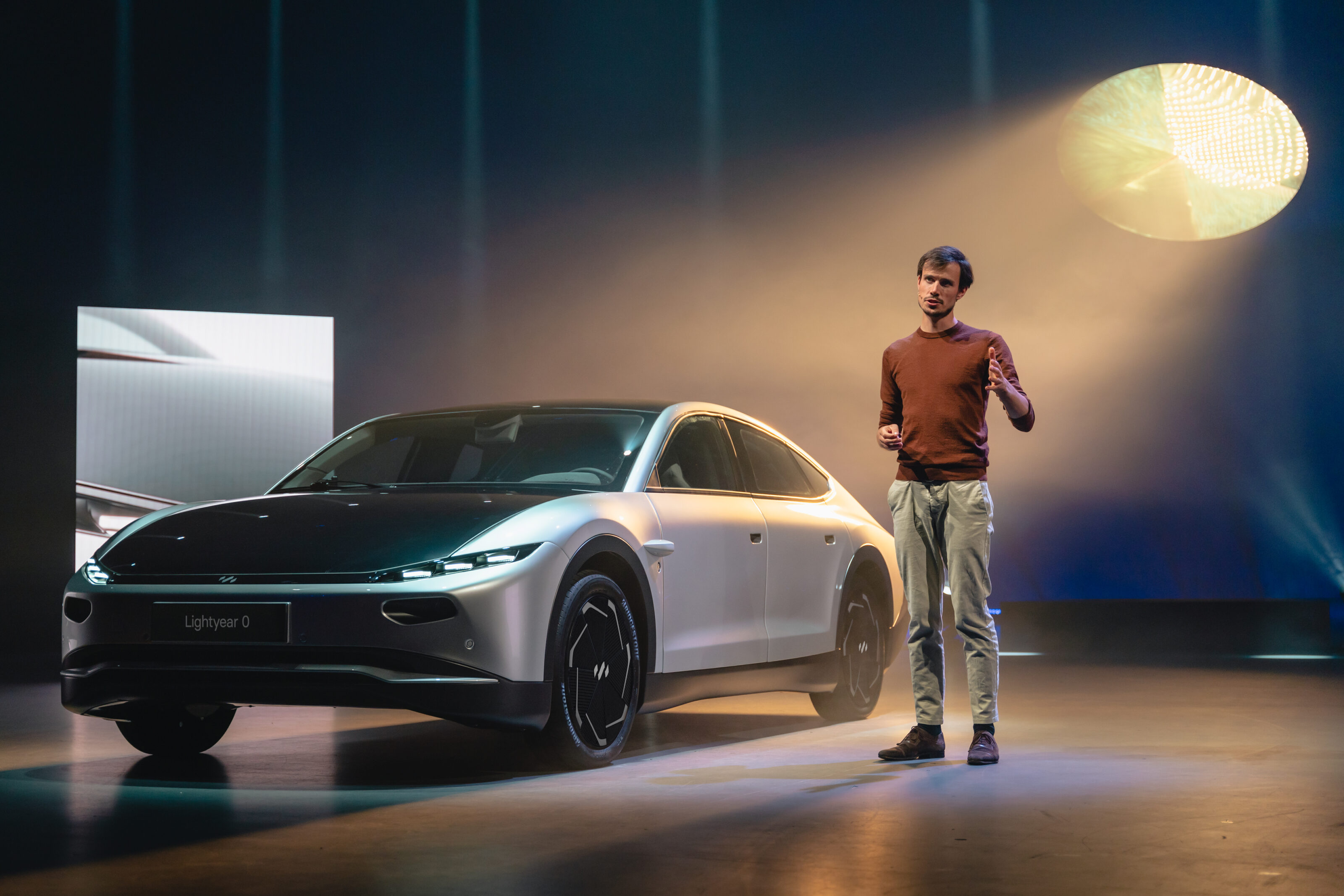
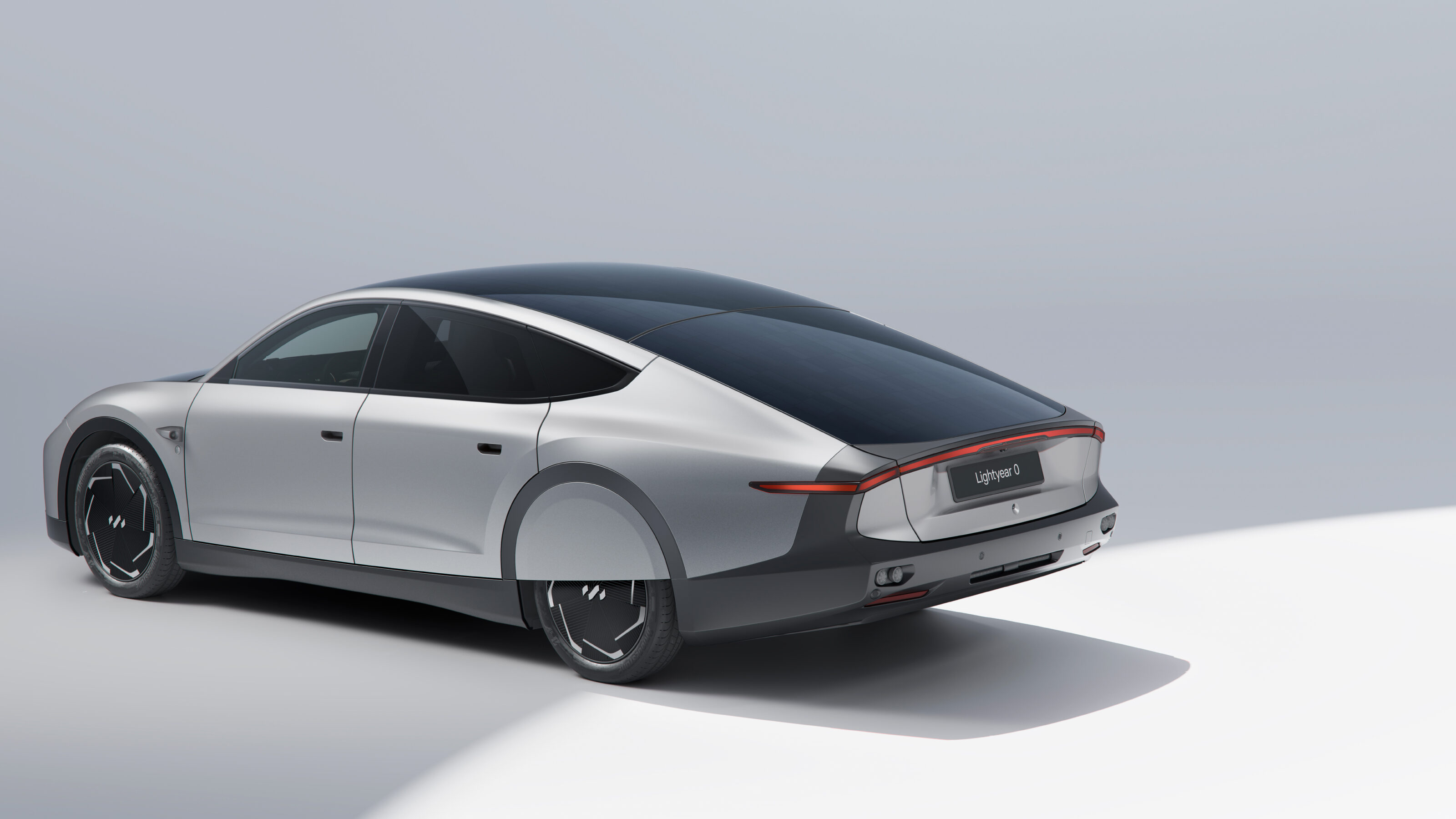
Lightyear has unveiled the 0, a new electric vehicle that harnesses the sun’s power.
Sharing no connection with Pixar or Buzz Lightyear, the solar-powered Lightyear 0 (zero) can be recharged with the sun.
The vehicle is an evolution of the Lightyear One prototype revealed in 2021, with changes to the lights and side profile.
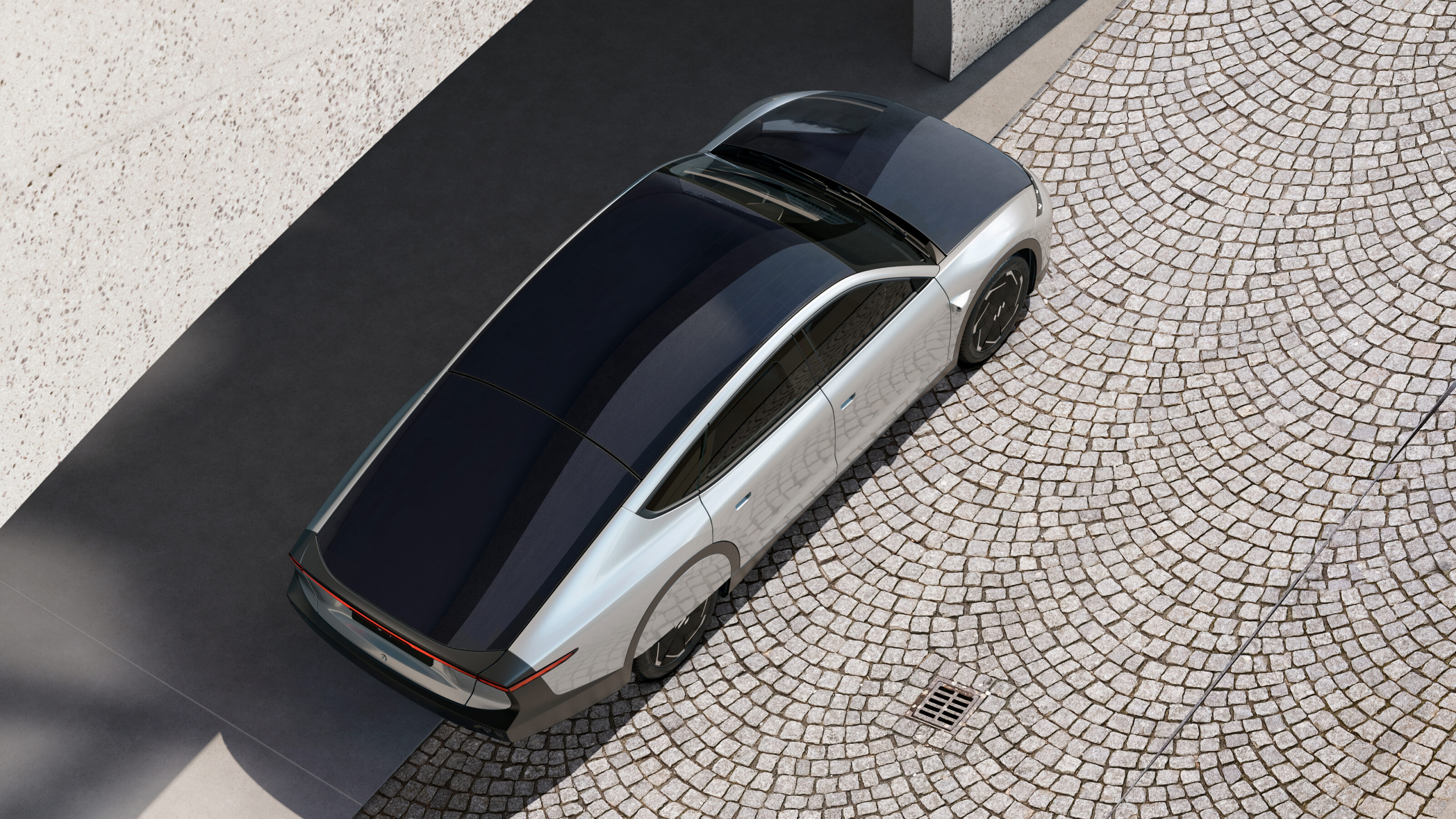
With five square metres of solar panels across its bonnet, roof and where the rear windscreen would generally sit, the Lightyear 0 can generate power while stationary and driving.
The Dutch-based company claims this can add up to 70 kilometres of driving range per day or 11,000km per year, in optimal weather conditions where the sky is clear.
Cloudier regions, such as the Netherlands, see this drop to around 20 kilometres of additional driving range per day.
Tipping the scales at 1575 kilograms, the Lightyear 0 utilises recycled carbon fibre body panels and a relatively small 60kWh battery pack.
It has a WLTP-rated driving range of 625 kilometres before using solar power.
The car has a <0.19 drag coefficient (Cd) and aerodynamic covers over its 19-inch alloy wheels, along with partial rear-wheel spats.
For reference, the most-economical Mercedes-Benz EQS has a 0.20 drag coefficient.
The Lightyear 0 can gain 300km of driving range overnight using a standard household outlet.
Meanwhile, a rapid fast charger brings 520km of driving range in one hour.
Despite featuring an independent electric motor on each wheel, the all-wheel-drive Lightyear 0 has a maximum power output of 130kW, allowing for a 10-second run to 100km/h. Its top speed is listed at 160km/h.
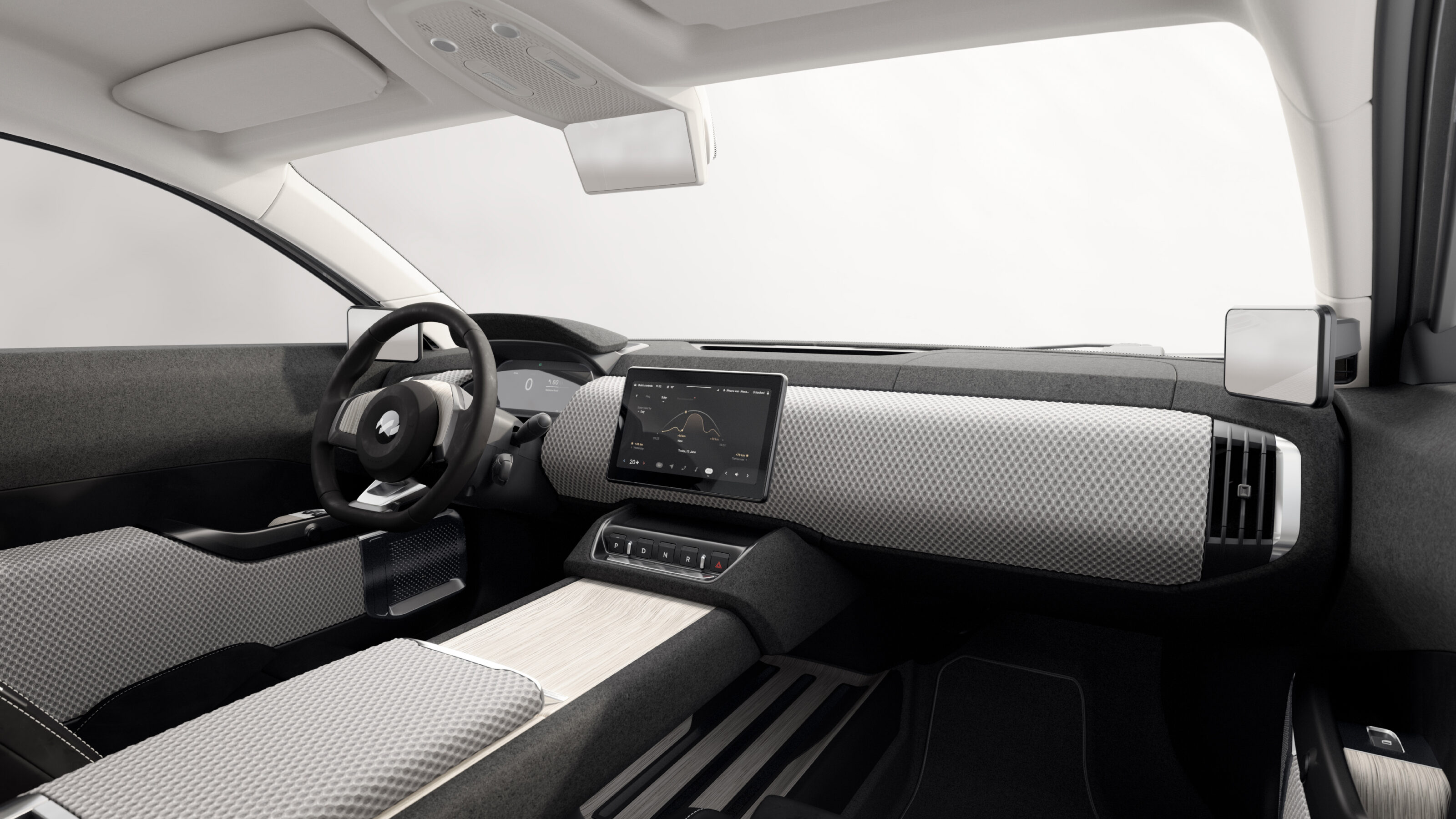
Inside, the vehicle features vegan-friendly upholstery and a 10.1-inch infotainment system running the Android Automotive operating system.
There is room for five passengers with a 610-litre boot capacity. It is currently unknown if the Lightyear 0 includes a front boot.
Lightyear co-founder and CEO Lex Hoefsloot said the vehicle achieves the brand’s “dream of building the most sustainable car on the planet.”
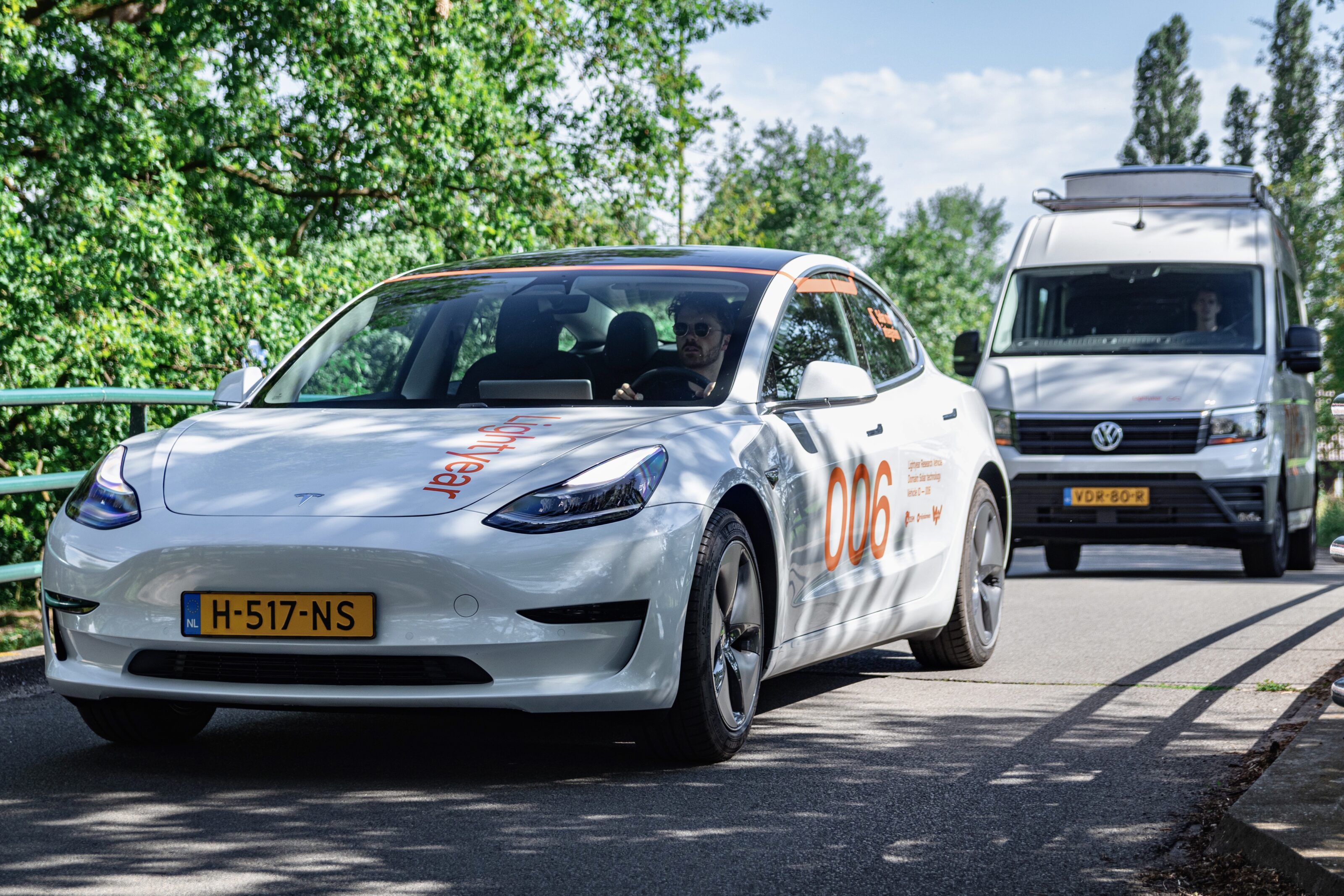
Research and development commenced in 2016, with prototypes hitting the road three years later.
Production is set to commence in November, with a maximum of 946 units.
It is priced from €250,000 (AU$372,450), with the brand claiming a more-affordable, mass-produced version – around €30,000 ($45,000) – will be assembled by 2025.
If you’ve seen Toyota’s most recent ad campaign for the Corolla, it’s an all-singing, all-dancing musical production with lots of high kicks and riotous colours. It’ll make you smile.
That says two things to me – the first is that Toyota knows the car is regarded, historically, as a little dull. Despite years of campaigns trying to inject some passion into dependability, it’s still not seen the way the company seems to feel it should be.
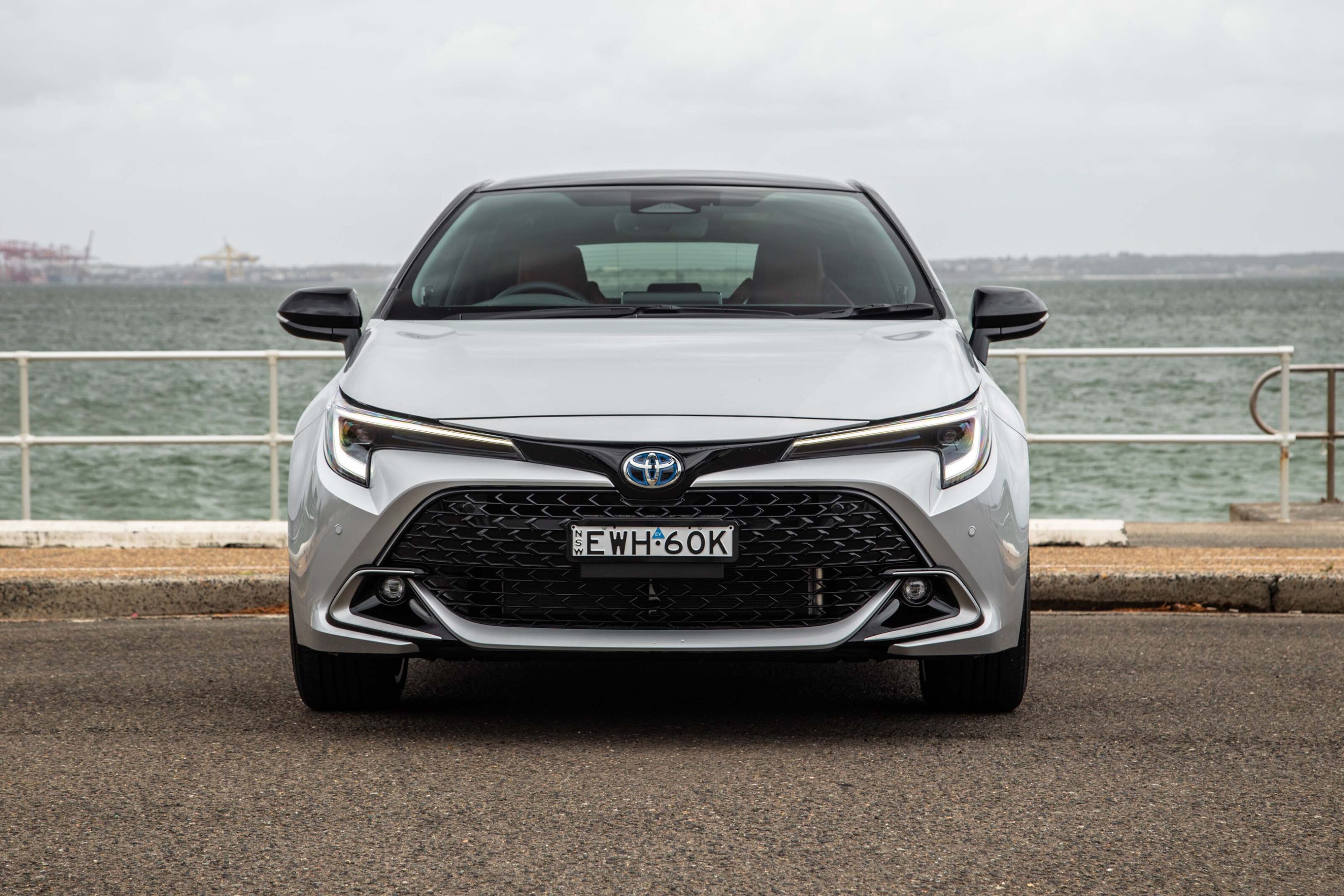
Second is that the Japanese giant still has a lot of faith in its cornerstone product. The Corolla has been around forever and is synonymous with the Toyota brand. And despite the arrival of the SUV-shaped Corolla Cross, there’s clearly some life left in the hatchback yet because the range has been expanded to add the top-spec ZR with a hybrid drivetrain, as tested here.
It doesn’t hurt, either, that the Corolla is now more stylish than it’s ever been, even showing up a few volume-selling and premium rivals when it comes to sheer visual appeal.
RELATED READING
Looking for more details on the wider Corolla range? Our full range review has everything you need to know.
JUMP AHEAD
- How much is it, and what do you get?
- How do rivals compare on value?
- Interior comfort, space and storage
- What is it like to drive?
- How is it on fuel?
- How safe is it?
- Warranty and running costs
- VERDICT
- Specifications
How much is it, and what do you get?
The most expensive Corolla hatch you can buy is $39,120 before on-road costs. That seems like a lot and it’s going to have to work hard to justify that price tag because a hot hatch it isn’t.
Just a few months ago you couldn’t get a hybrid ZR and now it exists, Corolla prices are up by about $2000 across the range.
When you’re looking at mid-40s on the road, you want lots of standard equipment and you want it to be good stuff, something the Corolla has not always delivered.
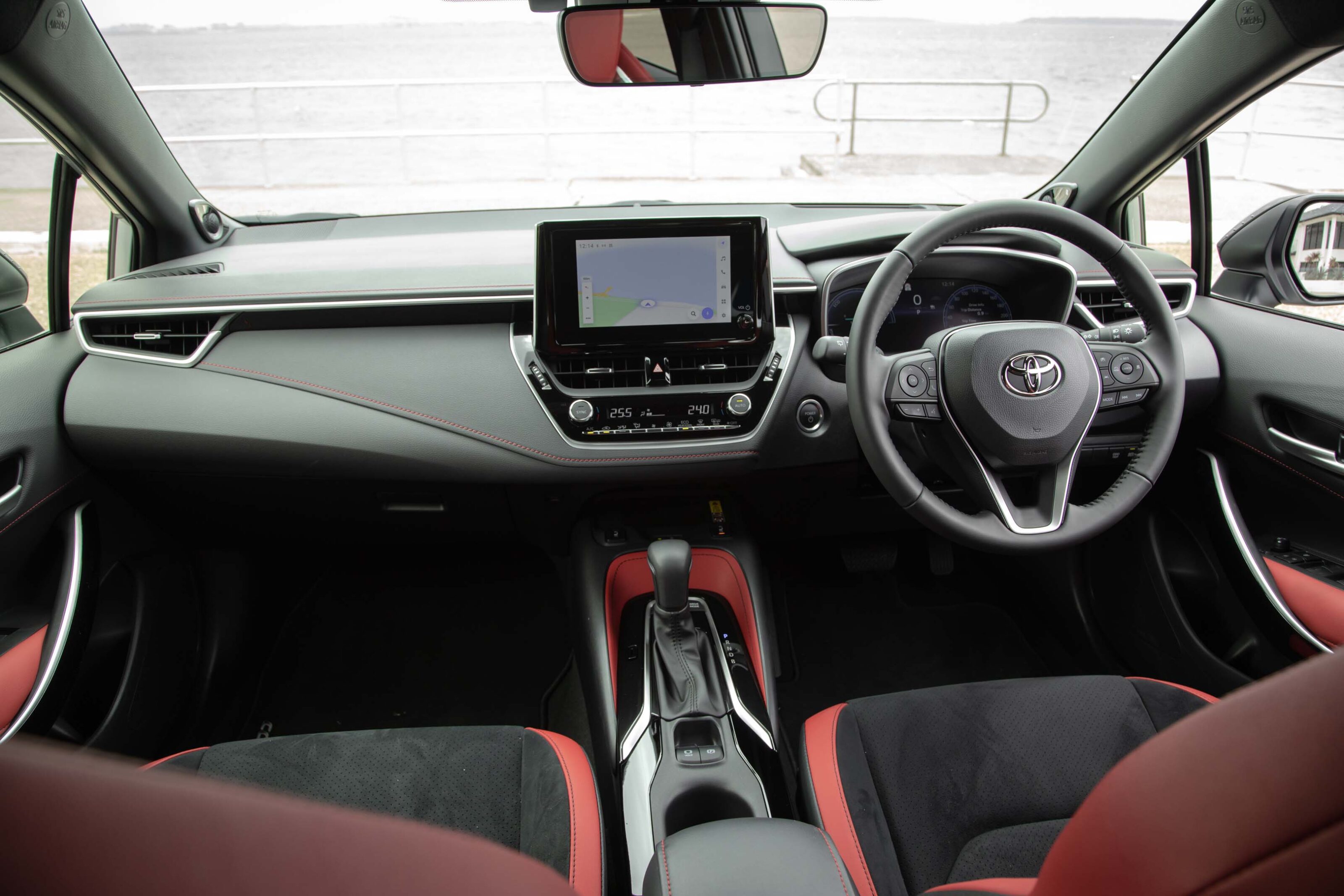
| 2023 Toyota Corolla Hybrid ZR hatch – equipment highlights | |
|---|---|
| 12.3-inch digital dashboard | Head-up display |
| 18-inch alloy wheels | Heated and powered front seats |
| 8-speaker stereo | Heated auto-folding mirrors |
| Adaptive cruise control | Keyless entry and start |
| Auto LED headlights with auto high beam | Partial leather interior |
| Auto wipers | Reversing camera |
| DAB+ digital radio | Satellite navigation |
| Dual-zone climate control | Tyre repair kit |
| Front and rear parking sensors | Apple CarPlay (wireless) and Android Auto (wired) |
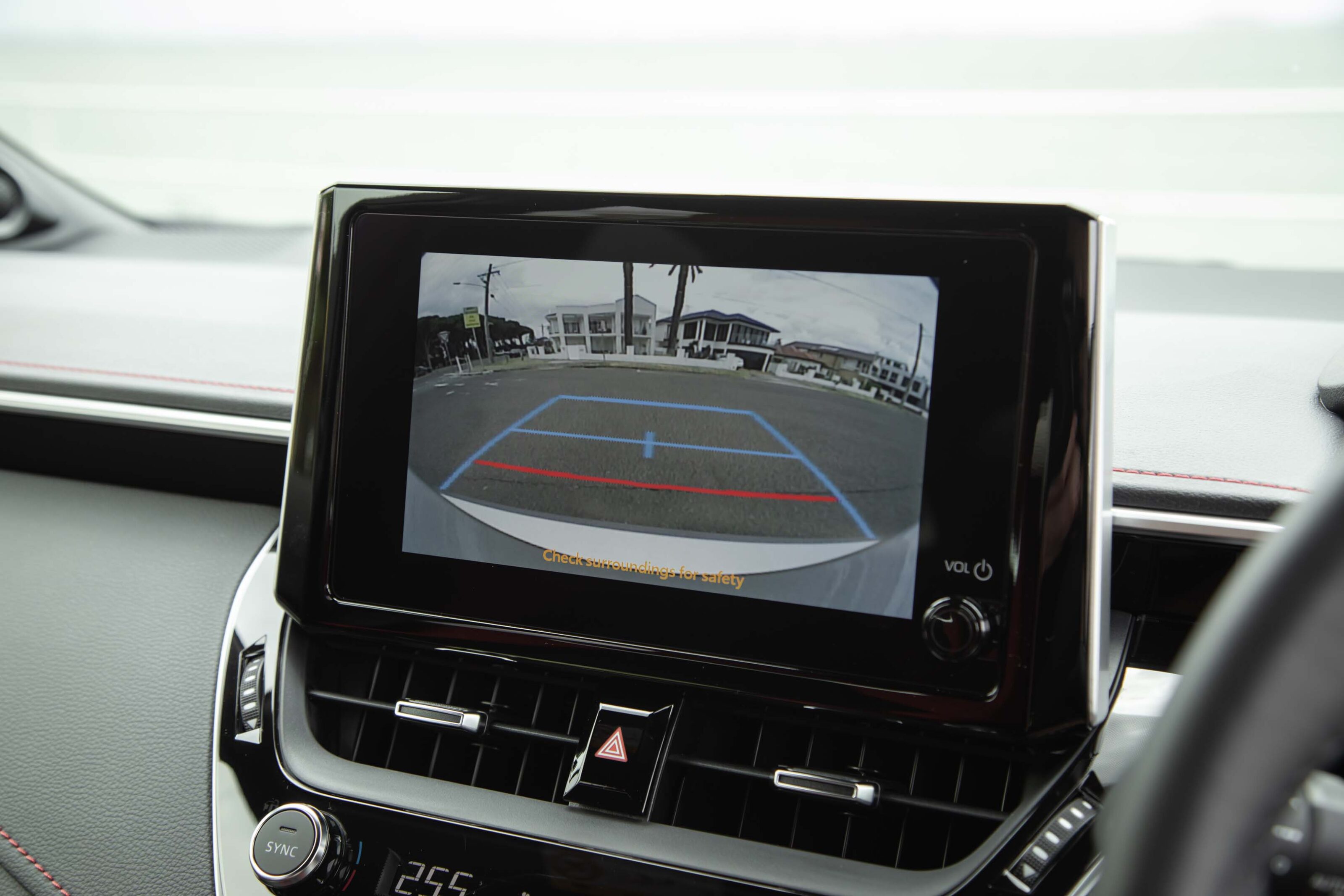
To partially justify the price increases, Toyota has finally flung that disgraceful head unit that was old when it made its debut. While its replacement has closed off an avenue of creativity and comedy in my reviews, the new one is vastly better although the lack of a home button troubles me. Interesting how we’ve been coached by our phones all these years.
Its screen size is still 8.0 inches, now backed by decent hardware and the display loses its predecessor’s washed-out appearance.
All told, it’s a vastly better system and matches the one in the homely-looking Corolla Cross, with the handy addition of wireless Apple CarPlay that I found to be quite reliable, unlike a Volkswagen Golf’s.
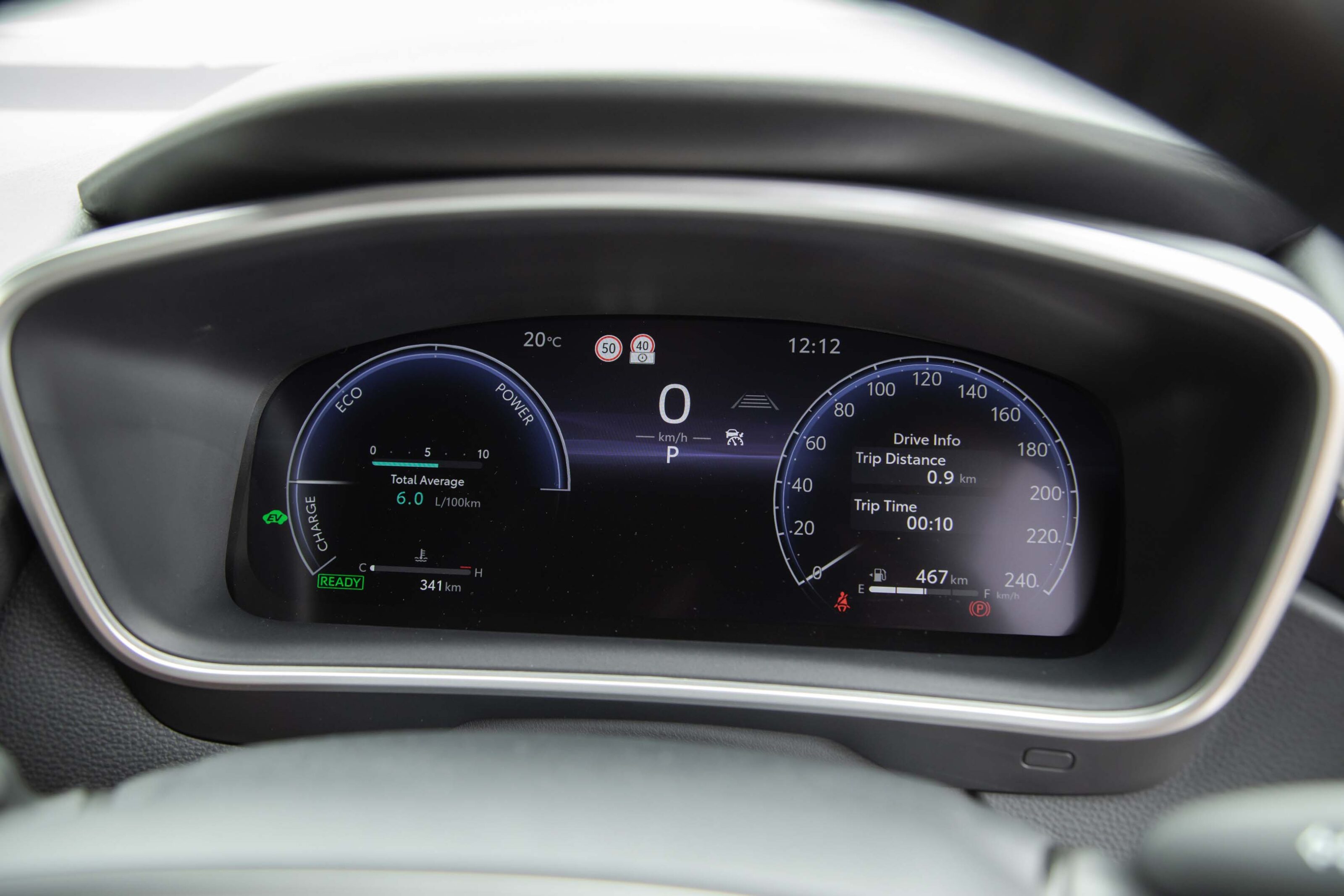
The eight speakers are JBL-branded if you’re that way inclined.
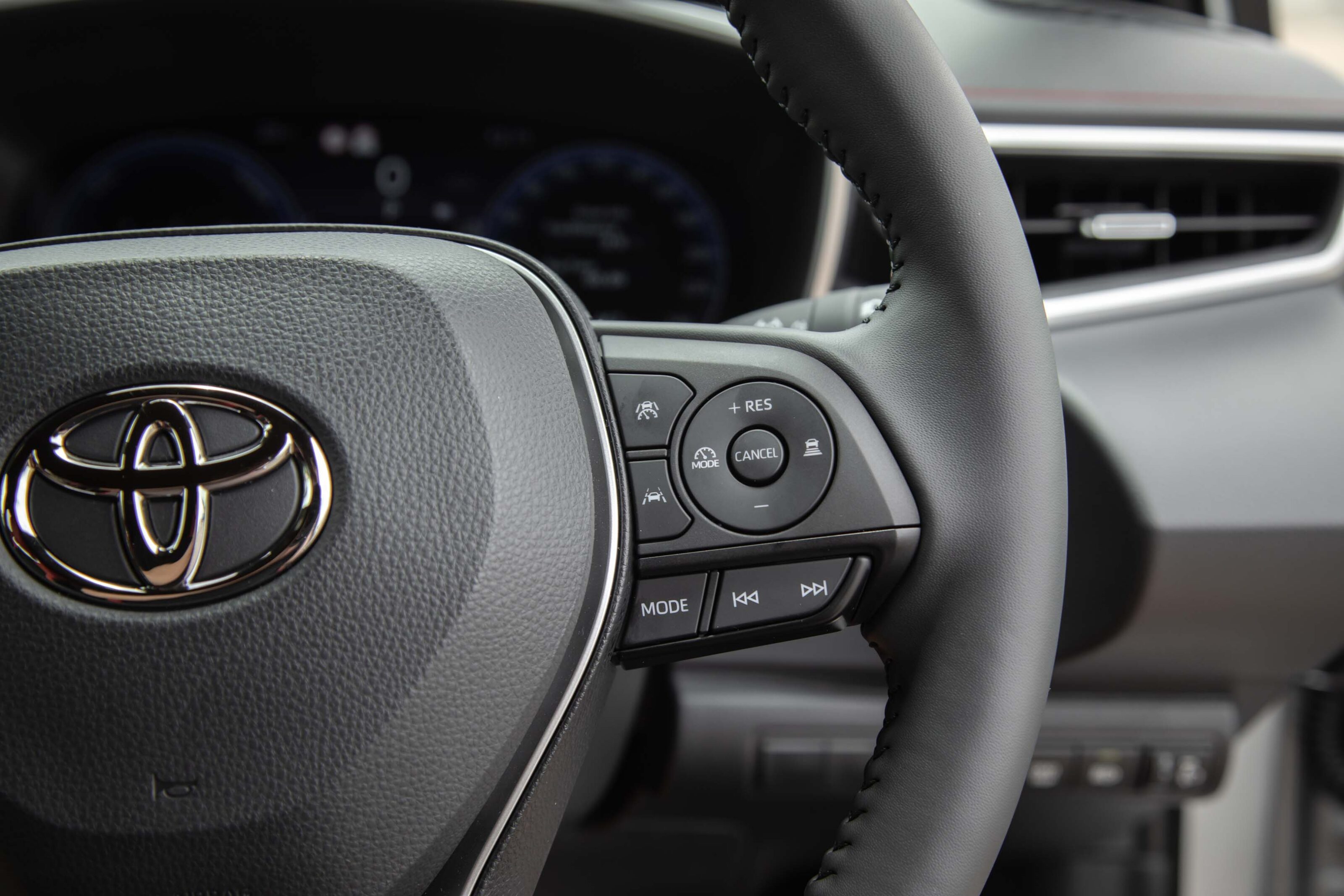
Along with the new screen, you get a year’s subscription to Toyota Connect, a phone app that offers remote control features as well as telematics when things go awry and you need to call an ambulance after a crash.
You lose remote connectivity to locking, engine start and climate control after the first year unless you pony up $9.95 per month for the Essentials package and another $12.50 per month to add a bunch of connected services to the navigation and user profiles.
How do rivals compare on value?
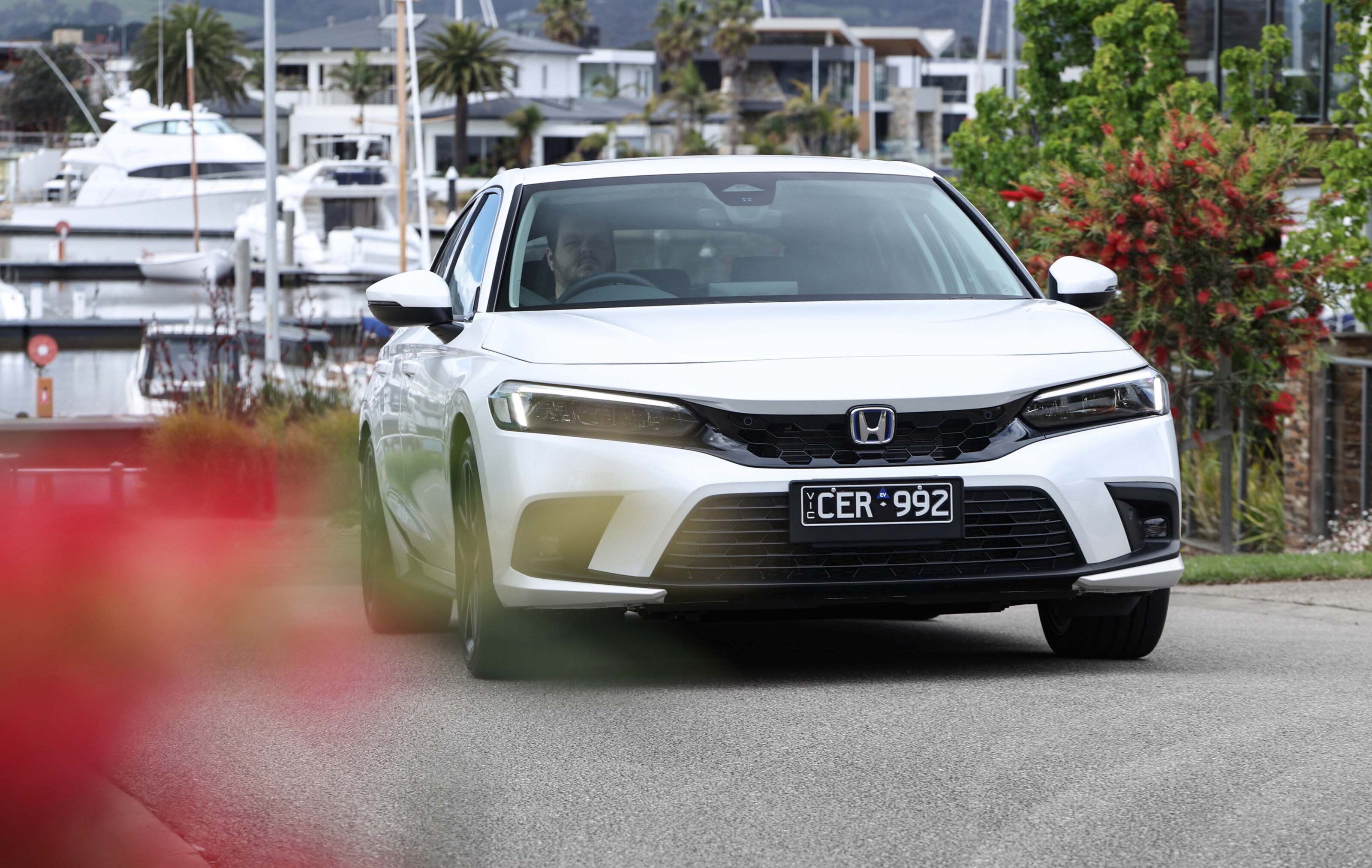
Until recently, the Corolla’s most obvious rival was a Honda Civic.
But, with price rises and the mildly insane decision to go to a business model that leaves us with two expensive Civics – one petrol and one hybrid, with the former starting at $47,200 drive-away – the Corolla looks pretty good. Although the Honda has a lot more interior space.
Step across the Sea of Japan, however, and two Korean rivals – the Hyundai i30 N-Line Premium ($37,020 before on-road costs) and Kia Cerato GT ($35,790 before on-road costs) – throw pretty good punches with a sportier chassis and turbocharged 1.6-litre.
Neither are hybrids, though. And the Cerato has a lot more space in the back seat than either.
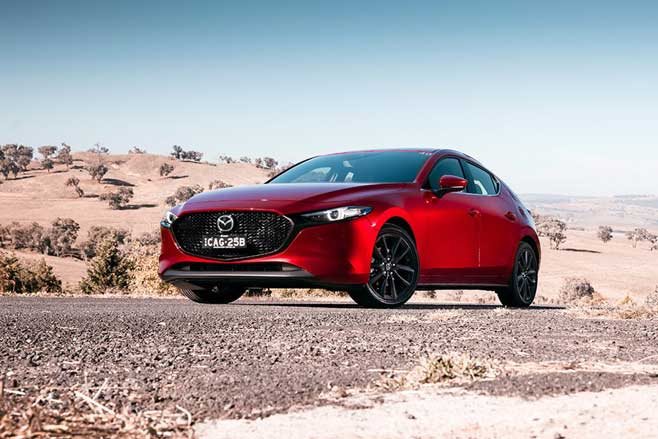
Also not a hybrid is the Mazda3 G25 GT hatch a hybrid at $36,690. It looks fantastic and drives very nicely indeed. Mazda does have what it calls a hybrid, the supercharged mild-hybrid X20 for $43,190 (both before on-road costs).
It doesn’t deliver the fuel economy you might want from a car with a hybrid badge but it does go faster than the Toyota.
Interior comfort, space and storage
A few years ago, Toyota discovered the joys of really nice front seats.
I feel like someone bought a Peugeot and someone else a Citroen (the three companies do work together in Europe on the Aygo/108/C1 tiddlers) and said, “Hey, these are nice. We should do better front seats.”
And they did. In my head, anyway. A good number of Toyotas now sport these both attractive and very comfortable front seats that in the ZR feature some slightly lairy red inserts, as does the cabin as a whole. They are so comfortable, though, and that’s the main thing.
The convenience that goes with your comfort extends to door pockets, a pair of cup holders, a wireless phone charging pad that fits large format phones and a small bin under the armrest. And just the one USB port, sadly, although one might argue the wireless charging somewhat softens that blow.
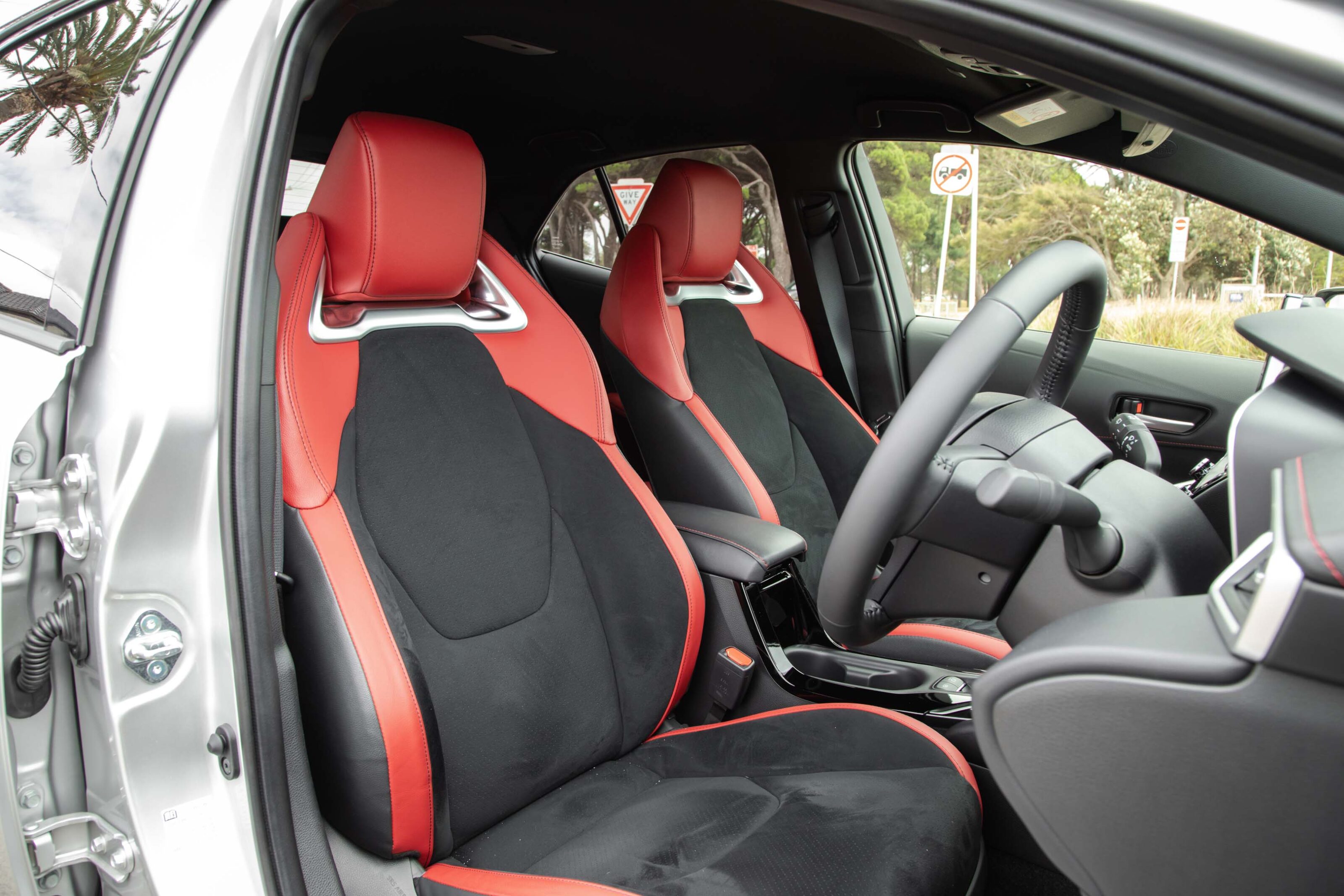
It’s quite a nice-looking interior even though it’s starting to feel its age a little. Somehow the Corolla Cross interior is largely the same forward of the B-pillar but looks and feels old and a bit tacky. It’s amazing the difference a slightly different grade of plastic can make.
Moving to the rear and, like most cars in the segment, it’s a little grim for passengers. There isn’t a lot of knee or leg room and even headroom is best described as passable. Amusingly, there are cup holders are in the doors, which is novel and slightly curious given there’s a centre armrest.
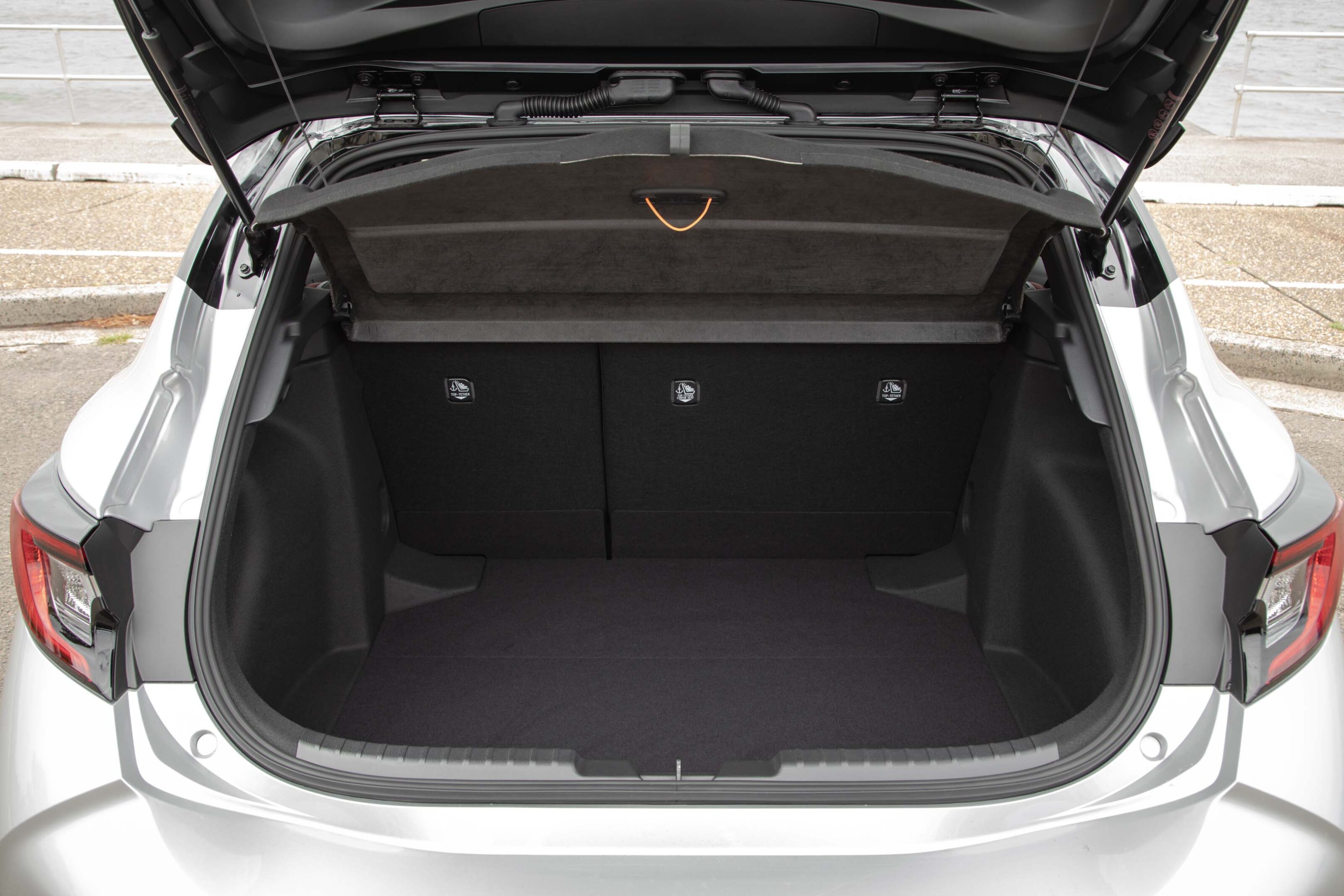
The boot is a surprising 333 litres. Surprising because while there’s a battery in here somewhere, it’s a good 116 litres more than the petrol versions. The trick is that those cars have a space-saver or even full-size spare depending on spec whereas you’ll be stuck, sometimes literally, with a can of goo in the ZR hybrid.
What is it like to drive?
The basics
| 2023 Toyota Corolla Hybrid ZR hatch | |
|---|---|
| Drive | front-wheel |
| Engine | 1.8-litre four-cylinder petrol-electric hybrid |
| Transmission | continuously variable |
| Power (petrol) | 72kW @ 5200rpm |
| Torque (petrol) | 142Nm @ 3600rpm |
| Power (electric) | 70kW |
| Torque (electric) | 185Nm |
| Combined power | 103kW |
| Combined torque | not stated |
This generation of Corolla was a step-change for Toyota, when it first landed on dealer forecourts.
Like so many other classic Toyota names, this Corolla is now built around Toyota’s NGA platform.
While a platform doesn’t magically make a car good, it seems that this one inspired its maker to ensure the Corolla drives well rather than the understeery mess that was the old car.
The ZR has a set of double wishbones underneath the rear end, which helps the ride no end but pairs very nicely with the MacPherson struts up front to put the Corolla on a firm footing. It’s really, really nice to drive.
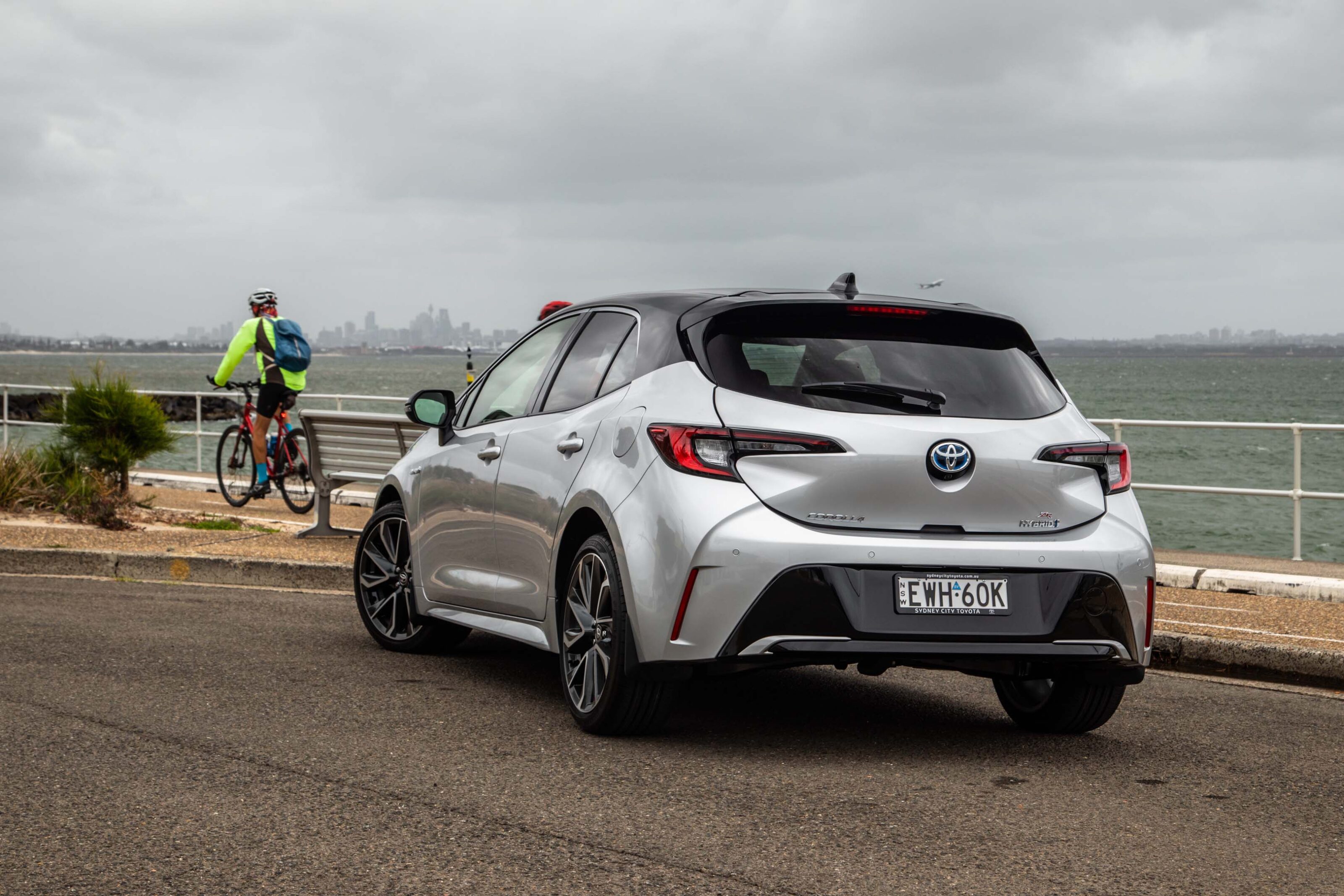
And it remains competitively so, with a good set of well-calibrated brakes and suspension that doesn’t want to tip the car up on its door handles. It’s not a hot hatch, but handles with the security and sense of fun that its Korean rivals do, just without the harsh ride.
As ever, the driveline needs a little explanation and the marketing a little debunking. While we call the Toyota hybrid drivetrain a series hybrid, the local operation has developed a mildly naughty habit of calling it a self-charging hybrid. Not as naughty as some companies calling mild hybrids a hybrid, but that’s for another day.
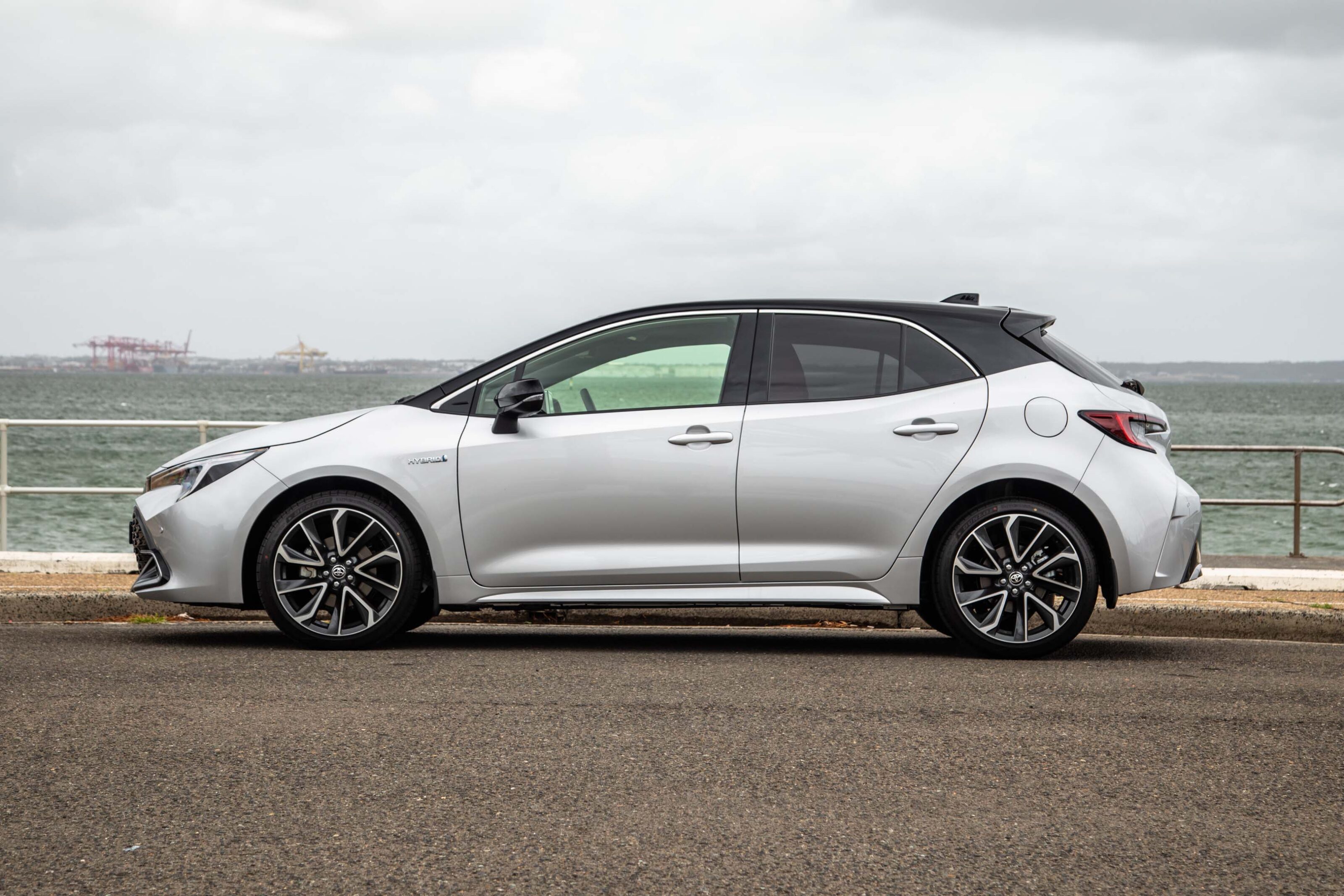
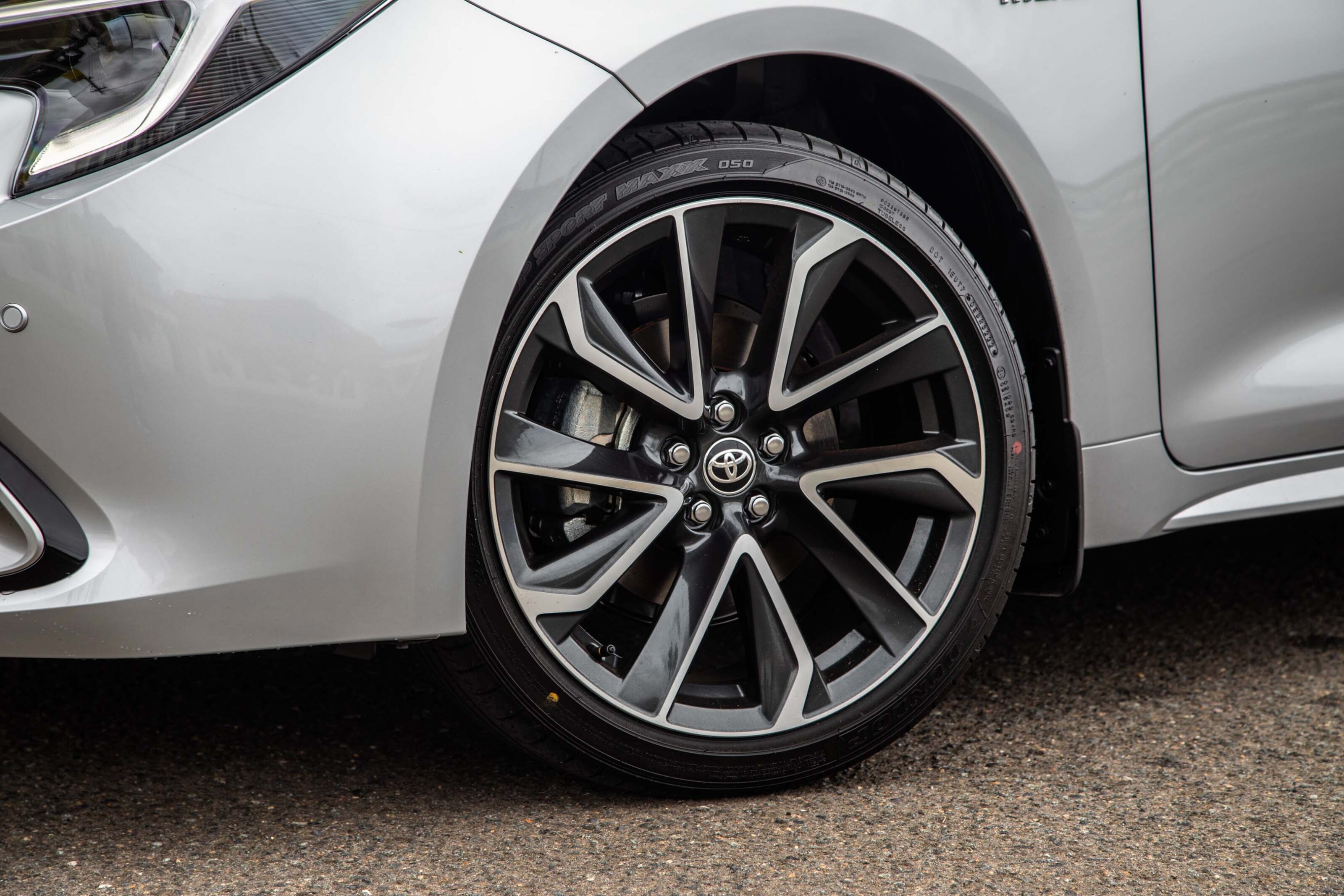
Toyota’s 1.8-litre 2ZR-FXE petrol engine is under the bonnet, serving up 72kW and 142Nm via the Atkinson cycle. That’s not a lot and on its own would render the 1400+kg ZR unpleasantly slow.
Crammed into the continuously variable transmission (CVT) is a 70kW electric motor with 185Nm of torque. Toyota says that once you put them together, you have a combined output of 103kW and we-don’t-want-to-tell-you newton metres of torque.
Probably safe to say it’s more than the weedy 142Nm of the combustion engine alone, but not the 327Nm you get when adding the electric motor figure on top.
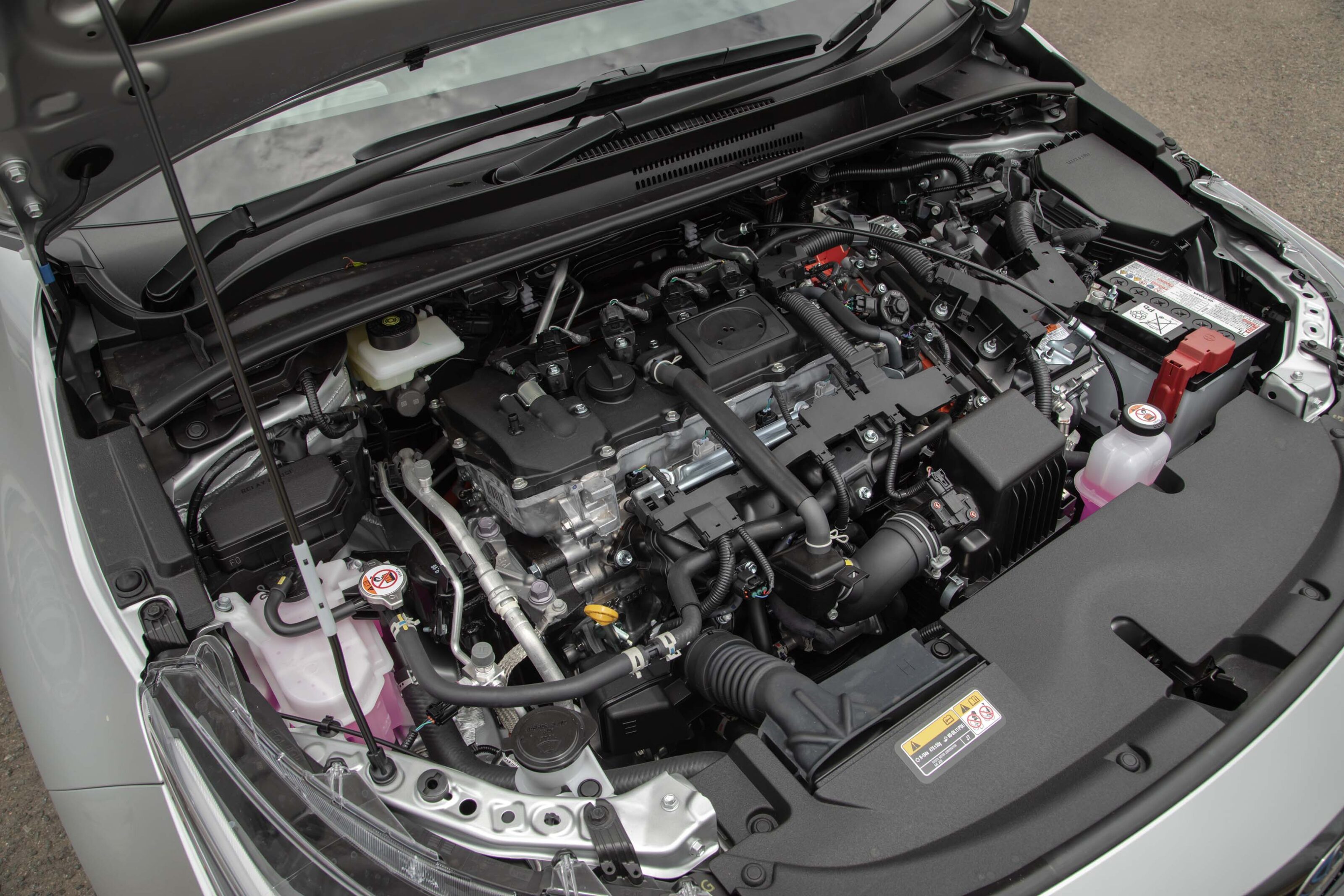
The 2023 Corolla’s hybrid drivetrain includes an updated electric motor, smaller hybrid componentry and the switch from Ni-Mh to Li-ion for the battery, all of which reduce the weight of the system, which is always handy. Power is up by 13kW, too, which makes the new car a little snappier than the old one.
It drives like a normal car except you move off silently under normal acceleration and will likely reverse out of parking spaces under electric drive. You might also have trouble finding reverse because, like me, you put it B mode for maximum energy recovery when coasting and braking.
That’s the self-charging bit and, not coincidentally, the bit that saves you all the money on fuel. When you lift off the throttle or brake gently, instead of that energy being lost in heat or mechanical drag, the electric motor in the transmission becomes a generator and feeds the small battery with electrons for redeployment. Formula One types call it a Kinetic Energy Recovery System or KERS.
A great thing about the Toyota hybrid system is that it’s seamless and utterly effective. You get very used to the silence on start-up and step-off and it’s a great game to see how long you can eke out electric-only travel. You can even hit the EV mode button to force it to use electricity for the few hundred (slow-ish) metres you can get without striking up the petrol engine.
The extra torque of the electric motor covers up the fact it has a CVT, my least favourite kind of transmission. You still get that lawnmower sound effect but you don’t get the rubber band effect, which makes the car far more relaxing.
It’s not particularly quick off the line but rolling acceleration is quite good and it’s better than the 2022 model. It feels like there’s quite a bit more torque available and it’s very smooth.
How is it on fuel?
A hybrid is obviously all about fuel economy, although thankfully there’s a bit of power to go with it these days.
The 4.0L/100km claimed figure seems a little optimistic, though.
| 2023 Toyota Corolla Hybrid ZR hatch – fuel consumption | |
|---|---|
| Fuel Economy (claimed) | 4.0L/100km |
| Fuel Economy (trip computer) | 5.8L/100km |
| Fuel capacity | 43 litres |
| Fuel type | 91 RON / E10 |
My time with the Corolla was untempered by my wife’s more relaxed driving style, so to come in under the notoriously inaccurate ADR fuel consumption figure was a bonus, especially considering the car was box-fresh.
One wonders if, with a couple of tanks under its belt, whether it will dip into the high-fours per 100km. That seems entirely reasonable to me.
How safe is it?
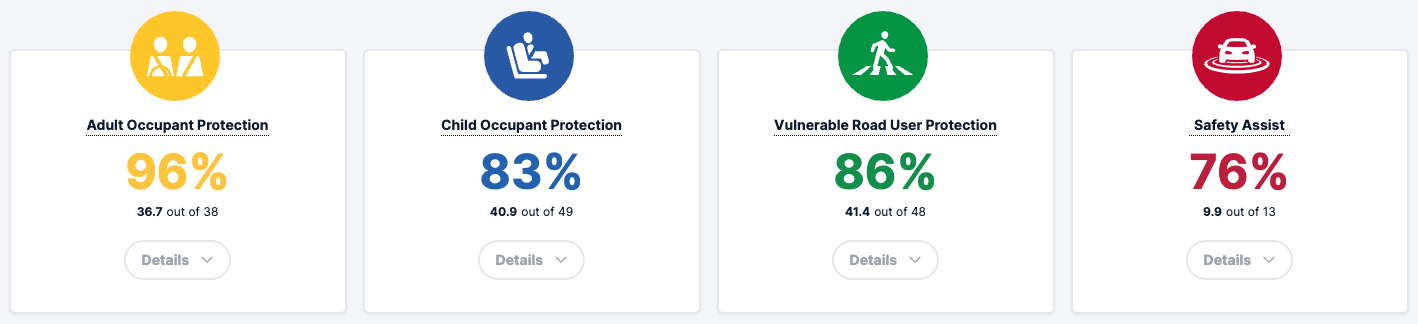
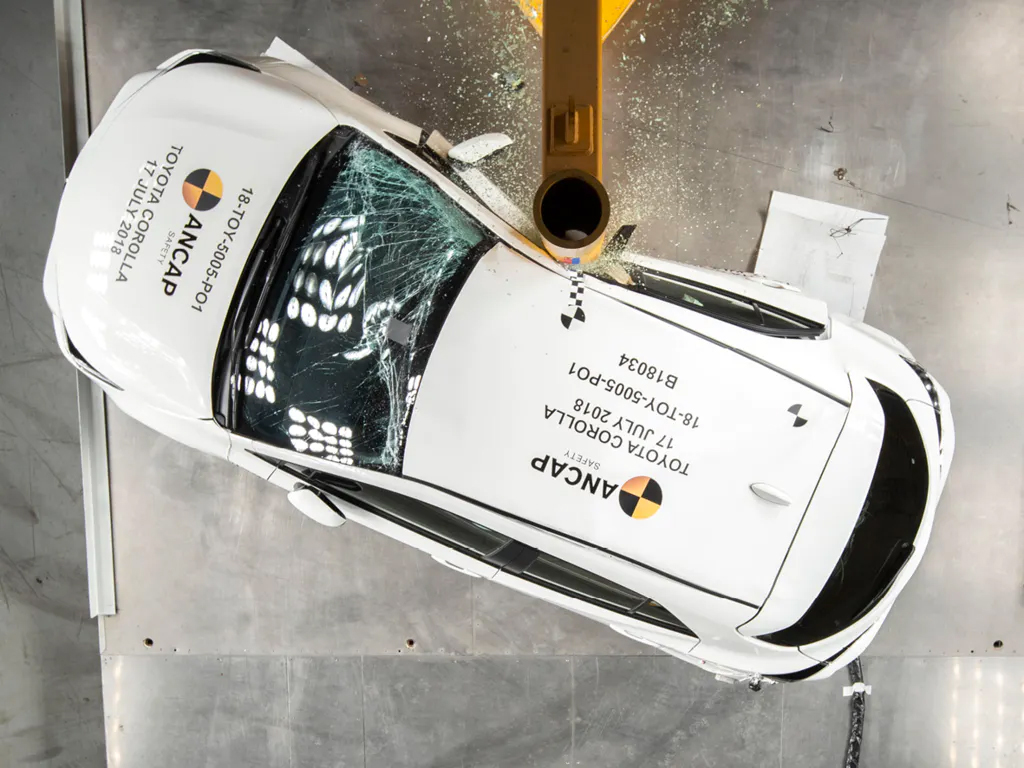
This generation of Corolla was tested by ANCAP in 2018 and scored five stars, the maximum available.
| 2023 Toyota Corolla Hybrid ZR hatch – safety features | |
|---|---|
| 7 airbags (including driveru2019s knee) | Lane-keep assist |
| Anti-lock brakes | Reverse cross-traffic alert |
| Blind-spot monitoring | Reversing camera |
| Forward auto emergency braking with pedestrian, motorcyclist and cyclist detection | Road sign recognition |
| Junction assist | Safe exit warning |
| Lane departure warning | Traction and stability controls |
| Lane trace assist | |
The updated safety package includes more features in the auto emergency braking system, looking out for motorcyclists and helping stop you from launching out across a junction if someone is coming your way.
For the kids, there are two sets of ISOFIX points and three top-tether anchors.
Warranty and running costs
Toyota’s five-year, unlimited-kilometre warranty applies to all Corollas.
Each of the first five services will cost $205 each for a total of $1025 over the five 12-month/15,000km intervals.
It’s entirely likely most if not all of these will be done in under 90 minutes so you can mooch around and play with your phone while they do it.
VERDICT
The 2023 Corolla hatch range doesn’t look a lot different. On the upside, at least it still exists, and it’s still a good thing.
Once I’d got over the rarity of driving a hatchback in this SUV-soaked era, it was nice to be reacquainted with a car that has evolved subtly yet usefully for the 2023 model year.
More power and torque, more gear inside and the zeitgeisty connected services – with attendant subscription charges – mean the updated Corolla carries enough improvements to earn a spot on your small-car shortlist.
Top of the range is rarely the best value, but hey, if you want it, I can assure you the ZR Hybrid is really quite good.
RELATED READING
Looking for more details on the wider Corolla range? Our full range review has everything you need to know.
Specifications
| 2023 Toyota Corolla Hybrid ZR hatch | |
|---|---|
| Body | 5-door, 5-seat small hatcback |
| Drive | front-wheel |
| Engine | 1.8-litre four-cylinder petrol-electric hybrid |
| Transmission | continuously variable |
| Power (petrol) | 72kW @ 5200rpm |
| Torque (petrol) | 142Nm @ 3600rpm |
| Power (electric) | 70kW |
| Torque (electric) | 185Nm |
| Combined power | 103kW |
| Combined torque | not stated |
| Bore stroke (mm) | 80.5 x 88.3 |
| Compression ratio | 13.0 : 1.0 |
| 0-100km/h | 10 sec (estimate) |
| Fuel consumption (claimed) | 4.0L/100km |
| Fuel consumption (tested) | 5.8L/100km |
| Weight | 1430kg |
| Suspension | MacPherson struts front/double wishbone rear |
| L/W/H | 4630mm/1780mm/1435mm |
| Wheelbase | 2700mm |
| Brakes | 274mm ventilated disc front / 231mm solid disc rear |
| Tyres | 225/40 R18 |
| Wheels | 18-inch alloy (tyre repair kit, no spare) |
| Price | $39,120 + on-road costs |
Related video: Corolla Cross comes in! Time to cross out the Corolla hatch?
Snapshot
- Andreas Mindt becomes new VW brand design boss
- Replaces Jozef Kabau0148 after two years on the job
- Rumoured disagreements with VW CEO over retro and sedan EV designs
Former Bentley designer Andreas Mindt has been promoted to head of design for the Volkswagen brand – replacing Jozef Kabaň, who had only been in the role for two years.
Inside sources have told Automobilwoche that Thomas Schäfer, who took over as Volkswagen cars CEO in July 2022, had significant disagreements with Kabaň over the group’s design direction.
Reports suggest Schäfer asked Kabaň’s team to ‘rework’ the retro-styled design of the 2021 Volkswagen ID. Life concept – which previews the production ID.2 electric city hatchback – and change the now-delayed flagship Trinity electric sedan to serve the more popular SUV market.
The report also follows an earlier story with the UK’s Car magazine that Schäfer had tasked the company’s engineers and designers with improving the interior quality and infotainment of upcoming new models, starting with an update to the existing ID.3 electric hatch.
(It’s worth nothing, though, that shortcomings in quality and user experience are often the result of cost-focused pressure from above – Ed.)

Not reported is whether overall VW Group design chief Michael Mauer played a part in any disagreements or decisions on replacing Kabaň.
Whether these reports prove true, Kabaň is not short on achievements: He oversaw the styling of Volkswagen’s ID electric car line-up, including the ID.3 hatchback, ID.4 SUV and ID.Buzz van, as well as being credited for the current Skoda Superb, Kodiaq and Karoq designs from previous roles.
Kabaň has not left the company, however – and indeed his ongoing role may be evidence that no conflict occurred at all. He is now tasked with a creative art director role, responsible for “forward-looking mobility solutions” for the German automaker.
Likewise, Mindt is a proven design lead. He was formerly the head of design for Bentley, where he led the brand’s new design direction, showcased with the ultra-exclusive Mulliner Batur coupe.
As a longtime VW Group worker, Mindt previously worked on the first-generation Volkswagen Tiguan SUV design, the exterior of the seventh-generation Golf small car, and models in the Audi line-up.
The once-popular Mazda 6 sedan and wagon will be discontinued in the United Kingdom, with no direct replacement planned.
It marks the end of the line for the third-generation model, which first debuted in 2012 – but it’ll remain available in Australia, at least for now.
“Mazda6 remains an important model in the Mazda Australia mix,” said a spokesperson for the brand’s local arm.
“We’re looking forward to the launch of the upcoming 20th Anniversary model this year, along with an update to the Mazda6 line up.”
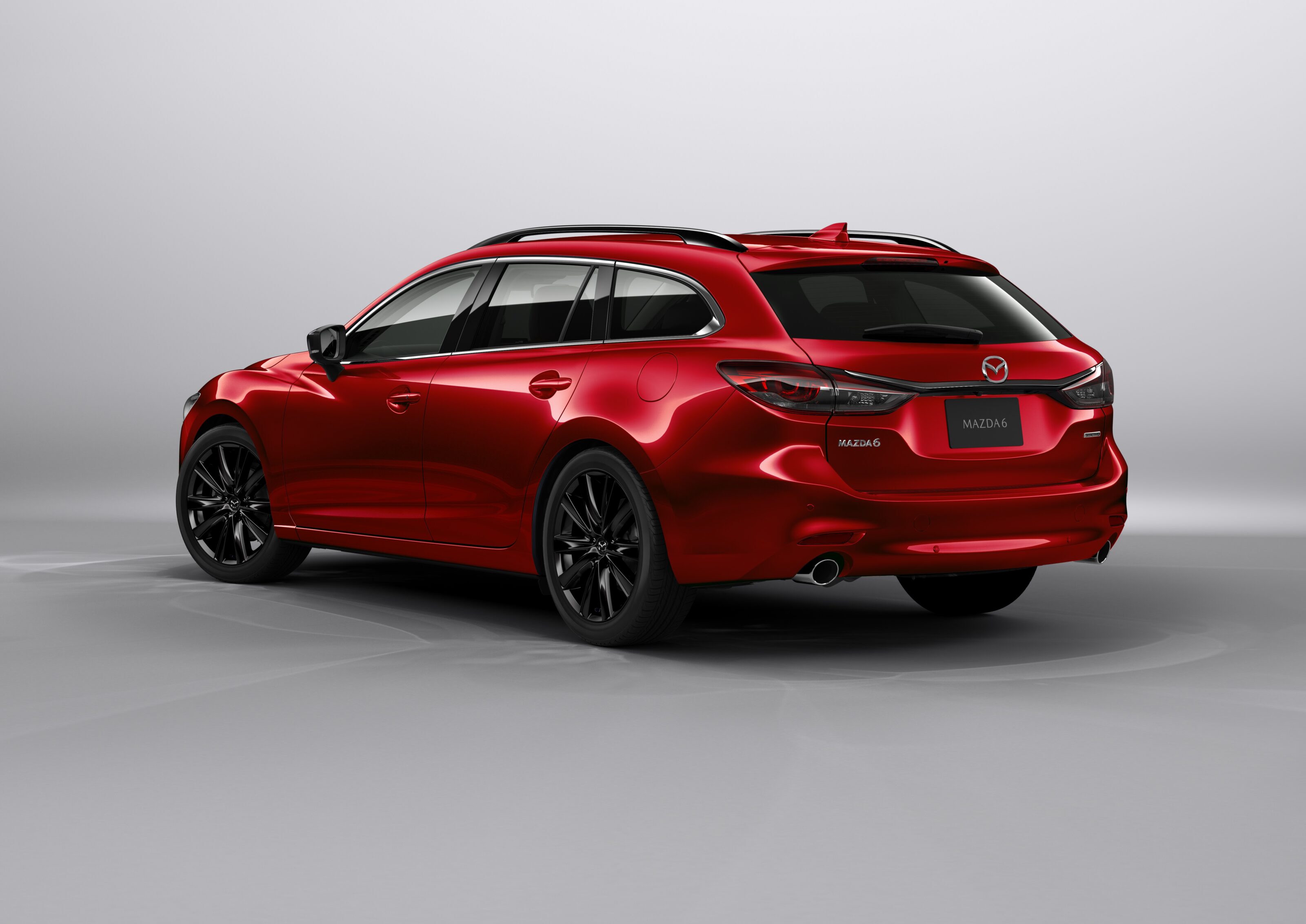
The Mazda 6 will also continue to be offered in other European markets.
It follows the deletion of the Mazda 6 from the brand’s North American range in 2021 – alongside the CX-3 – to focus on better-selling vehicles, including the CX-30, CX-5 and CX-50 SUVs.
The CX-3 was also discontinued in Europe at the end of 2021, but it remains Australia’s best-selling light SUV, despite its age.
A spokesperson for Mazda UK told Top Gear: “With the launch of the Mazda CX-60 PHEV and the upcoming CX-60 diesel, as well as the well-established Mazda CX-5 – SUV consumer demand continues to grow and this is where the focus is for dealers and in the UK market.”
“This, combined with declining UK sales in the saloon and estate car sector, mean we have ended sales of the Mazda 6 in the UK.
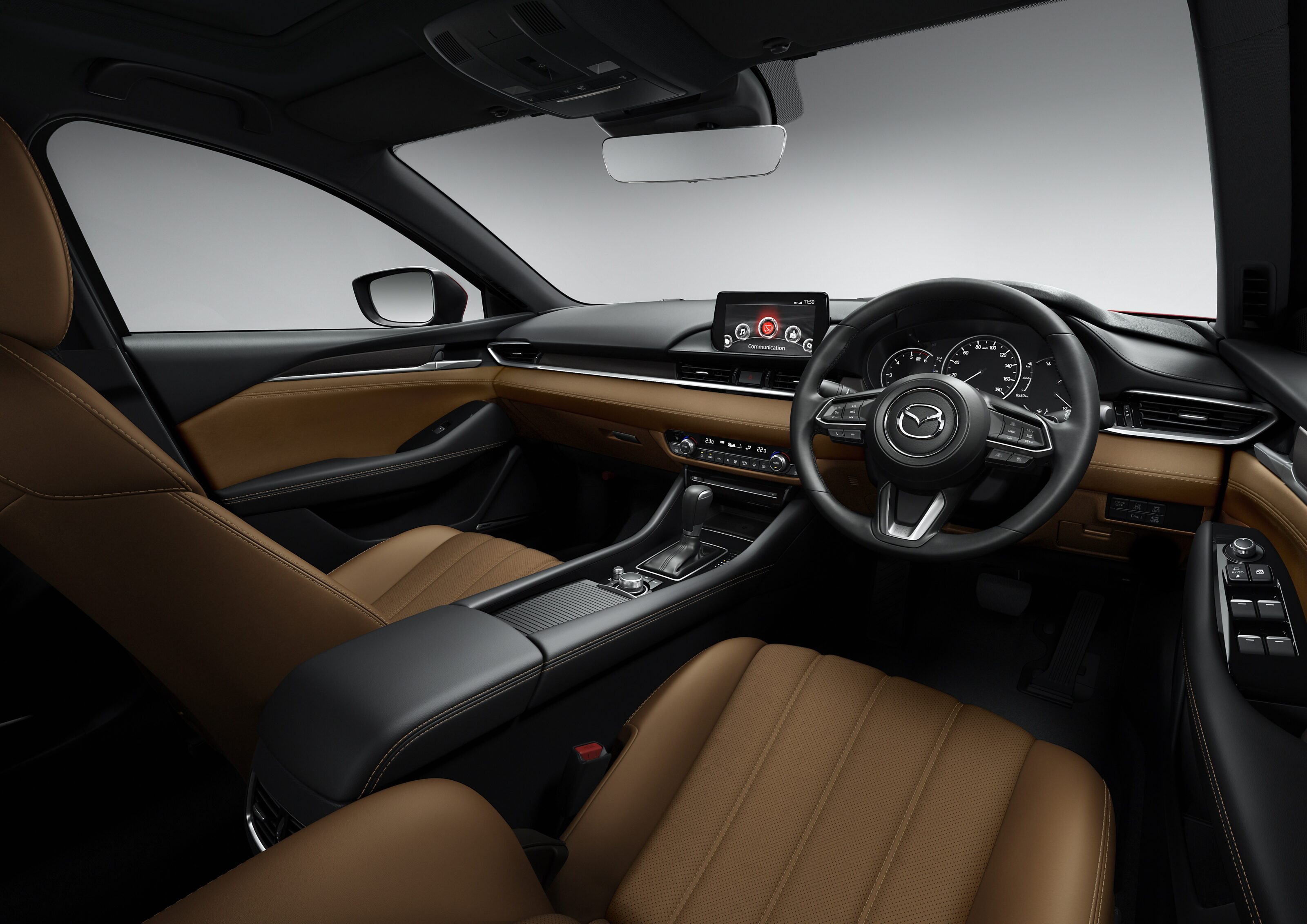
While the Mazda 6 is slowly vanishing from several markets, it remains available in Japan and Australia, with an updated model imminent.
To commemorate two decades since the arrival of the first-generation 6, Mazda will launch a new 20th Anniversary grade based on the flagship Atenza, with unique badging, an updated interior colour palette, and the brand’s new ‘artisan red’ and ‘rhodium white’ finishes.
The existing range has also received minor updates for model-year 2023, with traffic jam assist for the GT SP and Atenza, and wireless Apple CarPlay and a wireless phone charger on the Touring and above.
As before, the Mazda 6 includes an ageing 8-inch infotainment unit, rather than the larger 8.8-, 10.25 or 12.3-inch screens available in the 3, CX-30, CX-5, CX-60, CX-8 and CX-9 with its latest infotainment system.

Under the bonnet, the flagship 2.5-litre turbo remains – despite its deletion in Japan – but with a slight power bump to 173kW (at 4250rpm), up 3kW.
Turbo models also receive a retuned six-speed automatic transmission, and the characteristics of the electric power-assisted steering are revised to “enhance response and provide more tactile feedback at medium and high speeds.”
VFACTS new-car sales figures reveal 1511 examples of the Mazda 6 were sold in Australia in 2022, placing it behind the hugely popular Toyota Camry (9538), but ahead of the Skoda Octavia (963) and Volkswagen Passat (759).
The best shoe for any task is a fairly subjective topic. Any piece of footwear that successfully separates your feet from ground will get the job done, so typically the main determining factors are: what’s most appropriate for your job, what’s most comfortable, or what you think looks best.
When it comes to driving, the requirements are a little different. And pragmatism rules. Cute heels, comfy thongs, fluffy slippers or steel-toe boots might not be as appropriate as you think.
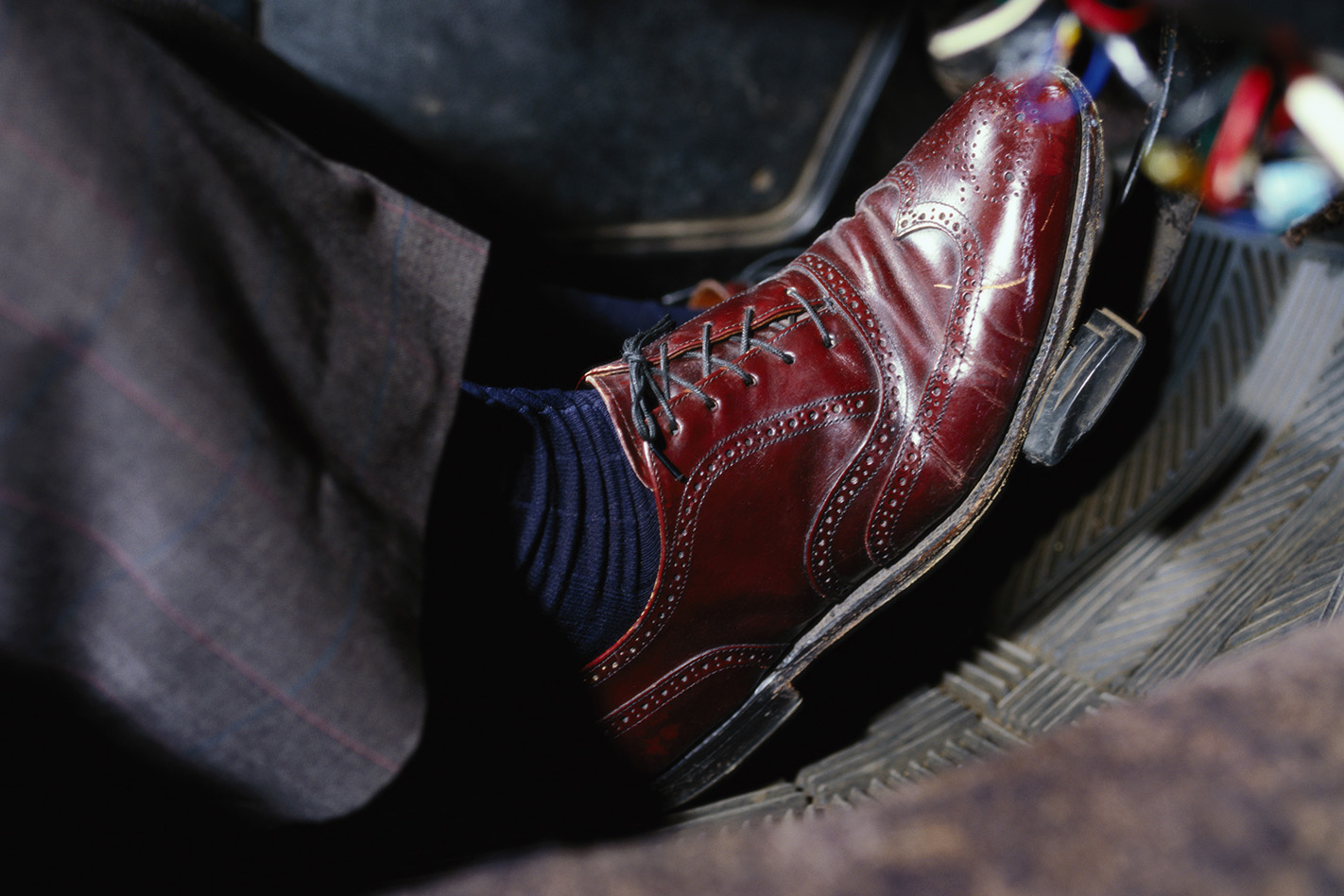
Three pillars of a great driving shoe
There are three things that you want to ensure regarding the footwear you use while driving.
Firstly, they must not get in the way of your ability to operate the car.
Secondly, they need to give your feet good support (especially if you spend long stints behind the wheel).
Finally, they should protect your feet from injury.
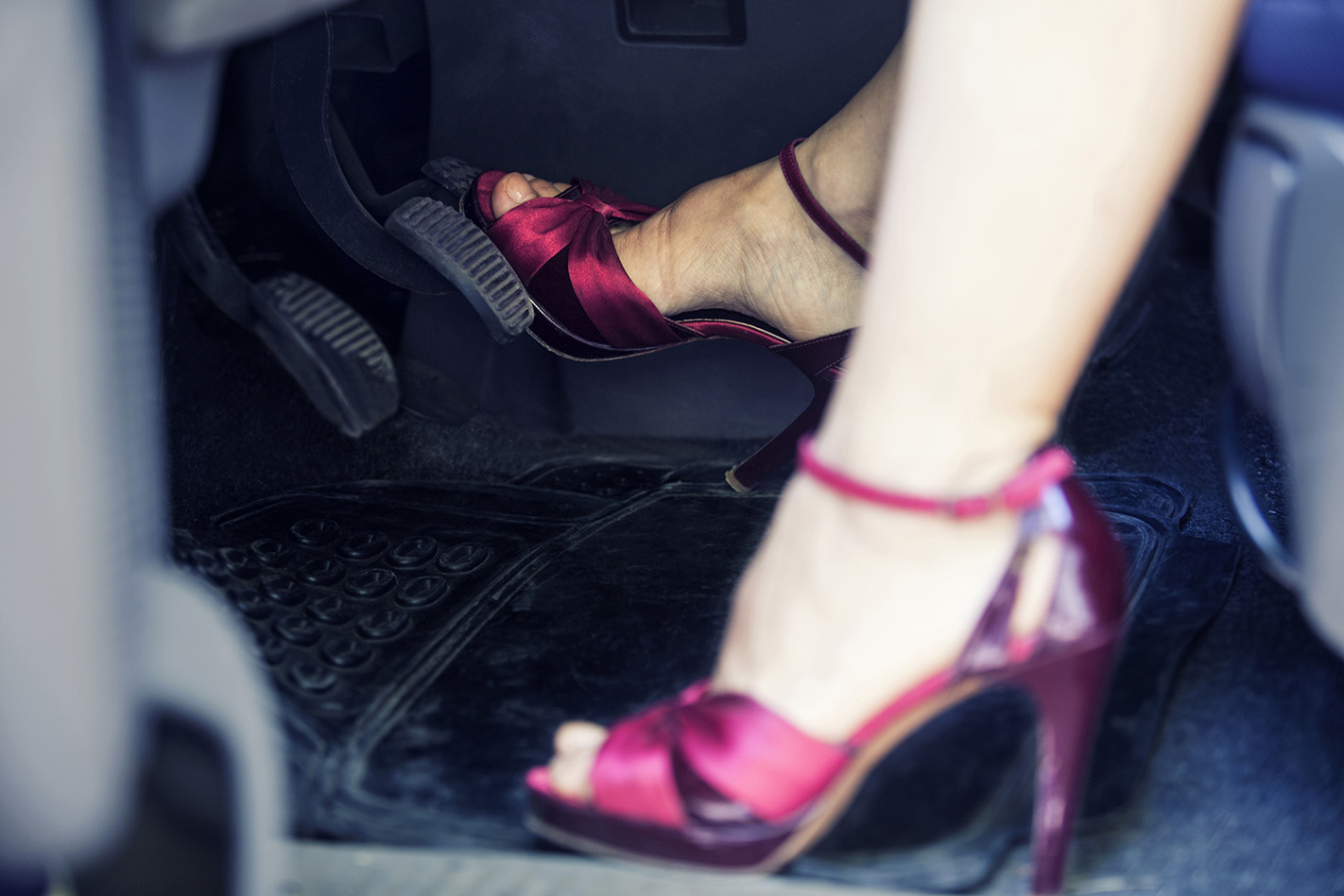
Functionality is king
The first criteria is fundamental. The most important thing is to ensure that your foot is able to articulate fully while your heels stay on the floor – meaning you can point your toes down as easily as you can point them up, as well as pivot them left or right.
Preserving that range of motion means that your right foot can quickly and easily switch from accelerator to brake, and also apply maximum pressure to the brake pedal in an emergency.
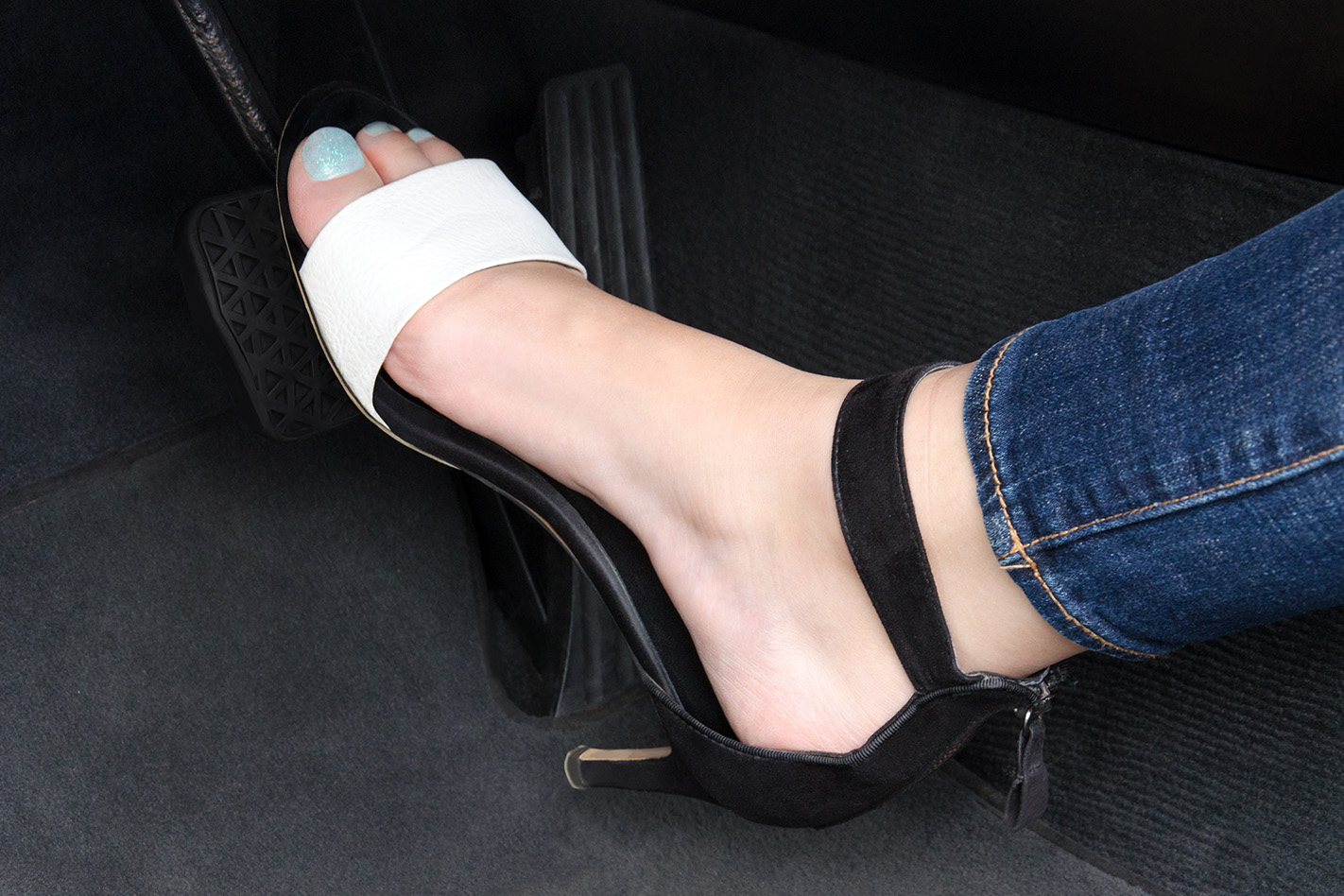
It’s why very high heels are often not recommended for driving, as they put the foot in a toes-down position by default, while your actual heel is kept far away from the pivot point formed by the shoe’s heel and the car’s floor. It changes the geometry of your joints in a way that isn’t conducive to safe driving.
Chunky shoes are another bad idea. While many might think stilettos are the worst choice for a driver, gumboots are even worse – not only are they big, clunky and liable to press two pedals at once (or get stuck behind a pedal) they offer basically no heel articulation at all. The only thing less suitable would probably be a ski boot.
Thick-soled, steel-toed workboots aren’t as bad, but their bulk can get in the way if pedals aren’t spaced far apart, or the driver’s footwell is cramped. If you wear any of the above for work reasons, maybe consider leaving a pair of sneakers in your car.
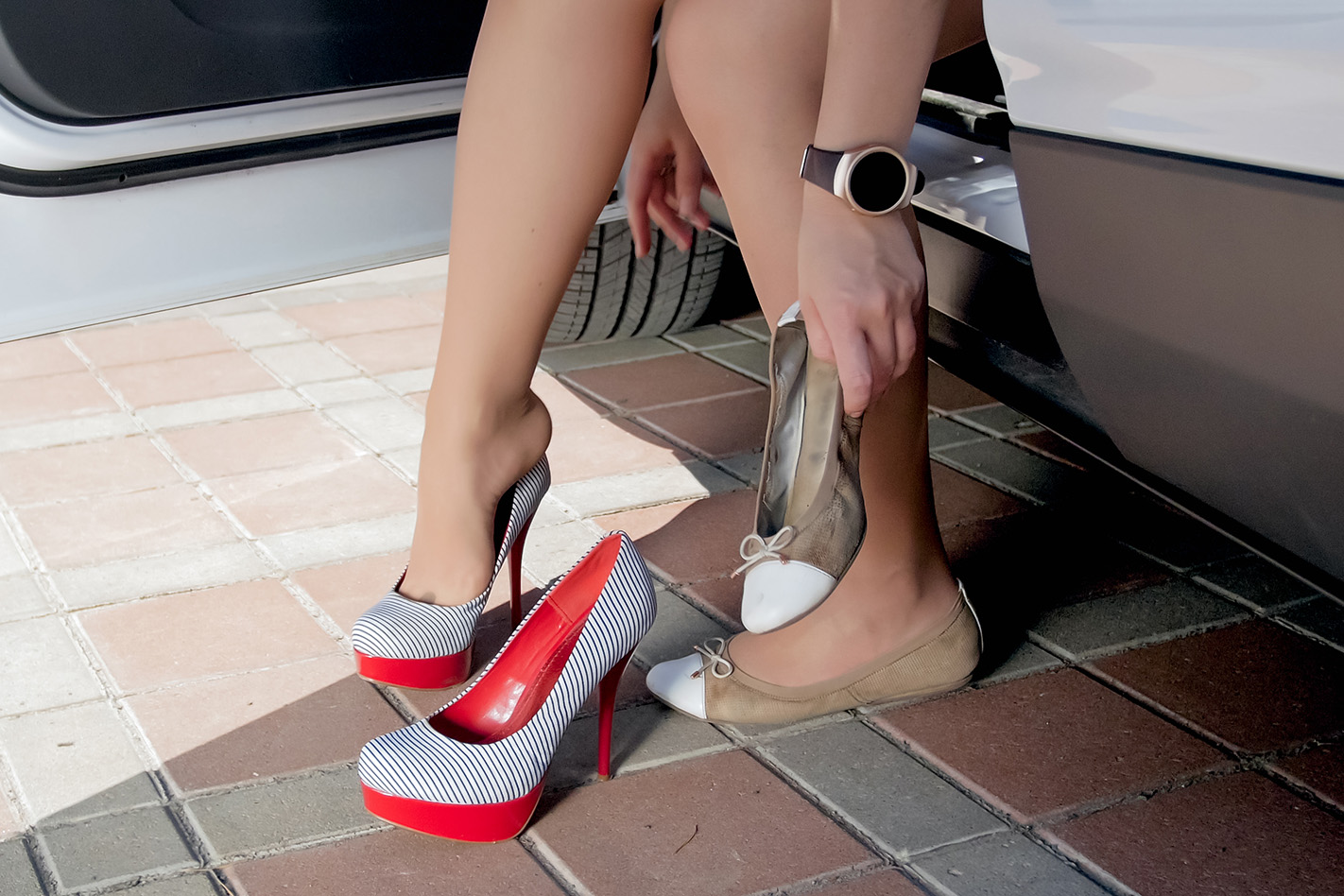
Comfort is crucial
If you’re a regular driver or do plenty of miles behind the wheel for work or recreation (like we do), supportive shoes are critical. Footwear that’s comfortable to walk or run it doesn’t necessarily make good driving shoes, mainly because heel support may be lacking.
Given you’ll spend most of your time with only the rear part of your heels in contact with the car’s floor (and thus, supporting all of the weight of your foot and half of your legs), shoes that ‘cup’ the heel closely and have decent insole padding around that area are the best.
A sole that is rounded at the rear helps a lot too, allowing your foot to roll forward and back rather than teeter on the edge of the shoe’s sole.
Backless shoes – be they hotel slippers, thongs, sandals or Crocs (even in sports mode) – are terrible for this. They’ll want to fall off your feet straight away, and once you inevitably kick them off and resort to driving barefoot they then become an unsecured object in the footwell.
Brake pedals don’t work especially well when there’s a urethane sandal wedged behind them. Just saying.
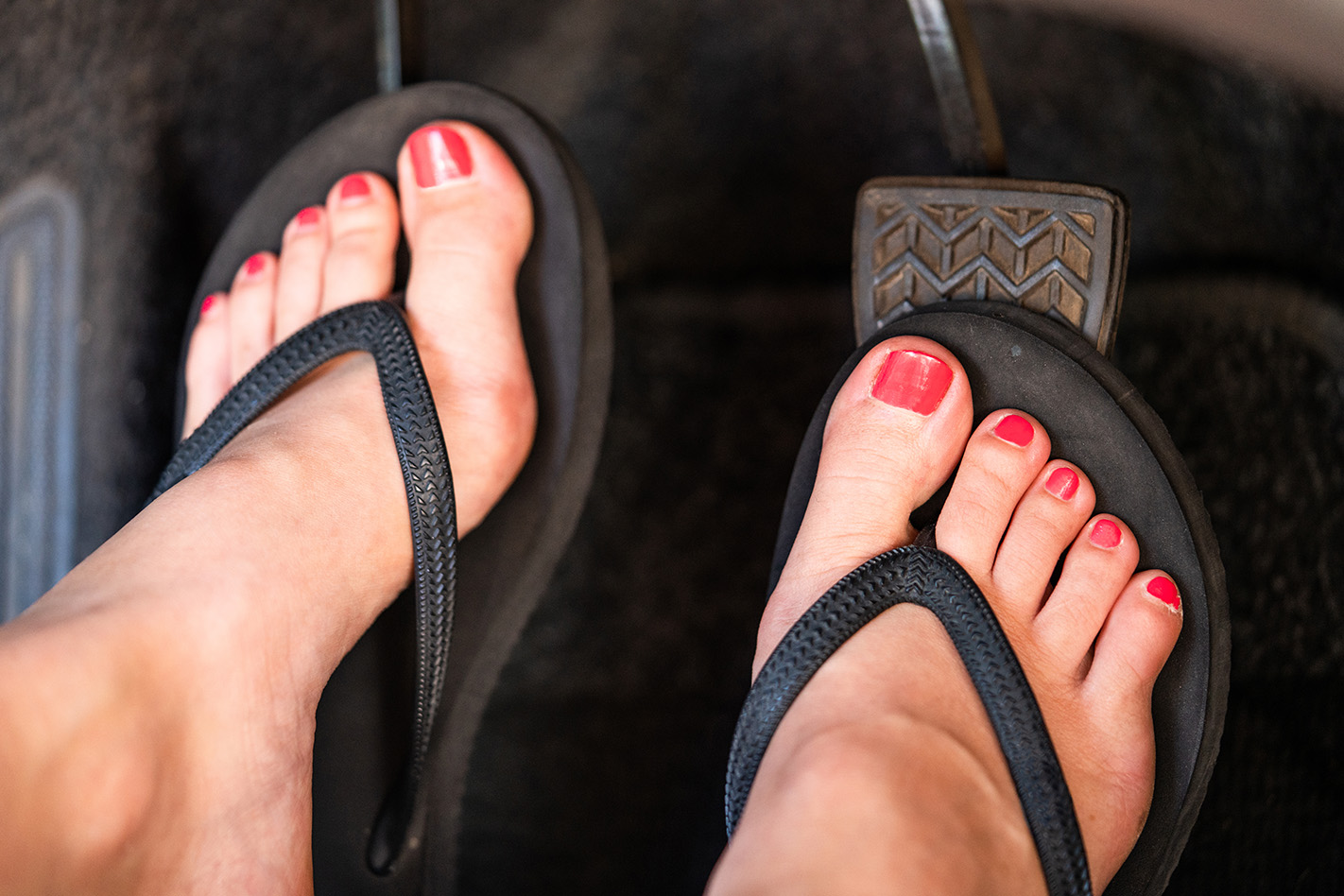
Safety is paramount
Contrary to popular belief, driving barefoot or in socks isn’t actually illegal in Australia – but it sure isn’t a great idea.
Not only is there nothing to spread the weight of your legs away from your heel, but there’s also the possibility that you can cut your foot on the sharp edges often found on the back and sides of a brake, clutch or accelerator pedal.
The same applies for open-toed shoes, thongs and strappy sandals.
Plus, if you’re in a reasonably big frontal collision, you also risk doing more damage to your feet by electing to drive barefoot. Many modern cars still struggle with protecting the feet and legs of front-seat occupants, especially the driver due to the added bulk of the pedal assembly.
Feet and legs often get trapped or pinched by parts of the car in an accident, and something that may only bruise your foot if you were wearing a shoe may cause a far more serious injury if you were without footwear.
The best shoes for driving
Outside of proper purpose-made driving shoes (which, coincidentally, are rubbish for actually walking around in), there’s no one specific kind of normal shoe that’s perfectly suited to driving.
Some may swear that driving in heels works better for them, while others aren’t fussed by wearing chunky-soled shoes.
Sneakers, tennis shoes or sand shoes are generally considered the best option. A thin-soled shoes has the added benefit of giving you more feel, too.
But the most important thing is that the above criteria are covered: no restrictions on your foot’s natural range of movement; good support; and adequate protection all around your foot. If your shoes tick those boxes, they’re likely fine.
UPDATE, January 2023: Sodium-Ion (Na-Ion) batteries explained
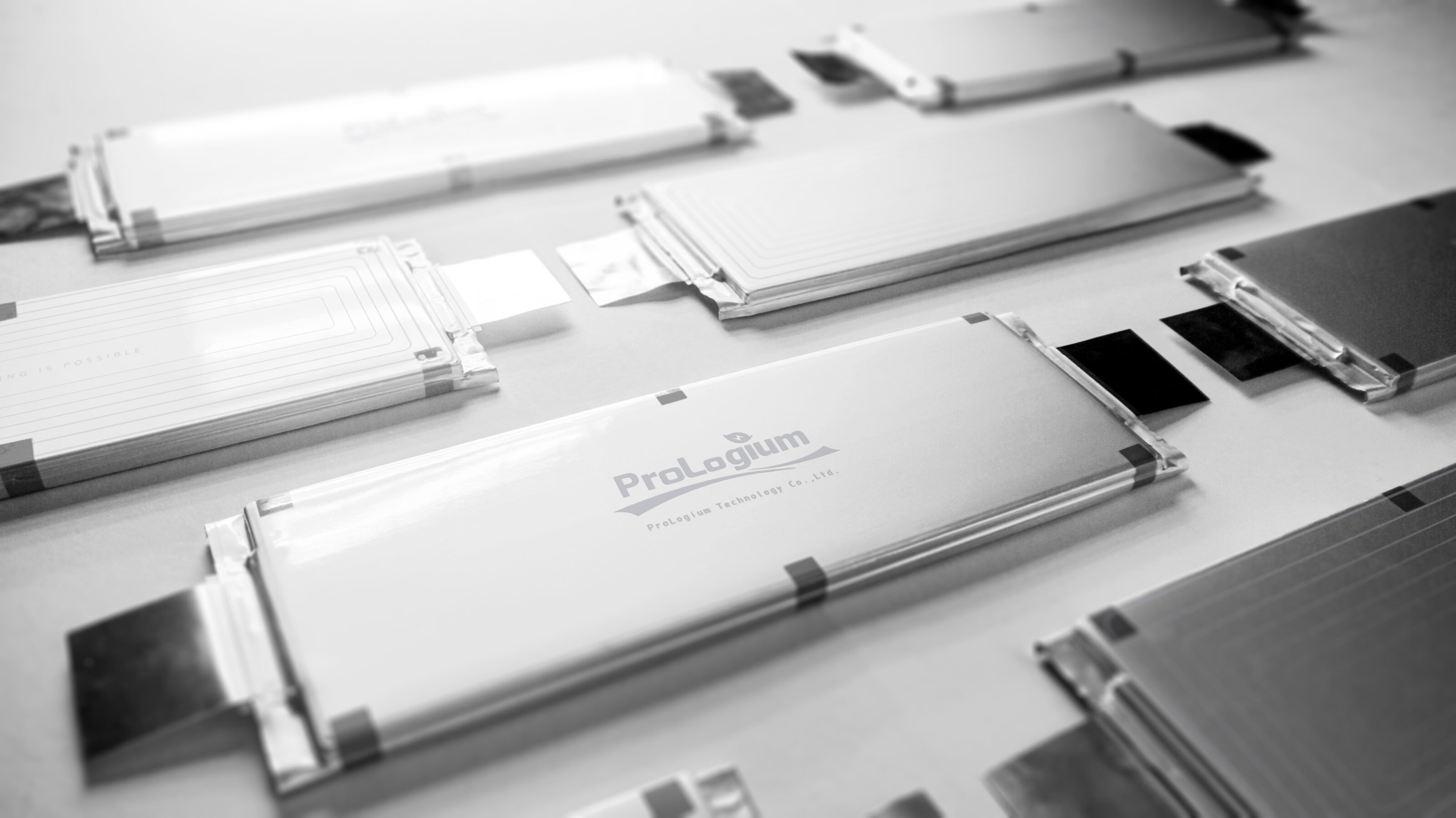
As news of Na-Ion battery tech becomes a hotter topic, we’ve put together a guide on what the technology is, how it works, and when we can expect to see it in new EVs. Will you be prioritising EVs with Na-Ion battery packs?
The story to here
December 2022: BYD may launch first sodium-ion battery electric car in 2023
Snapshot
- BYD Seagull electric city hatch to reportedly feature sodium-ion battery
- Sodium-ion cheaper and more sustainable than lithium-ion
- Lithium ion Blade battery will remain on top trim
Shenzhen automaker BYD (Build Your Dreams) will reportedly launch a sodium-ion battery next year with its entry-level hatchback.
According to local media outlets, the BYD Seagull may be the first production electric vehicle to feature the sodium-ion chemistry – which is more sustainable, cheaper to produce and safer than conventional lithium-based packs it replaces.
Sodium-ion batteries are mooted to substitute lithium-iron-phosphate (LFP) packs for lower range entry-level EVs. They house significantly less raw materials with no lithium, cobalt, copper or graphite making the cheaper to produce, while being recyclable like a lithium-ion battery.
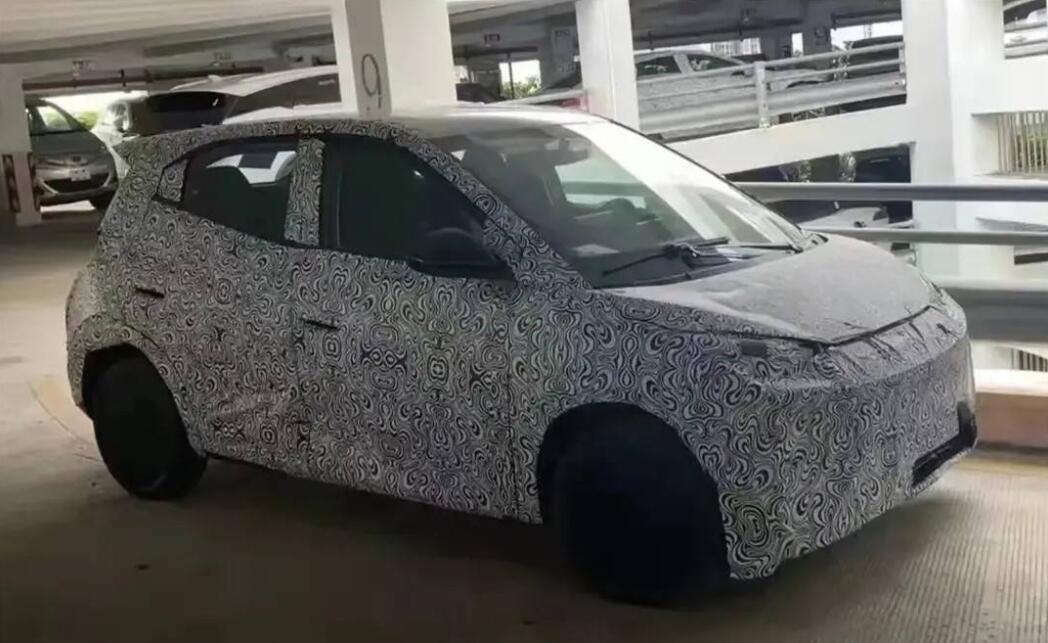
The Seagull hatch is reported to launch in China in the second quarter (April to June inclusive) of 2023, starting from ¥60,000 yuan (A$12,500) with the sodium-ion battery providing up to 300km of range. This is likely on the generous China Light-Duty Vehicle Test Cycle (CLTC).
However, BYD is also expected to offer a ¥80,000 yuan LFP battery version with 400km of driving range. Like all BYD electric cars, it’s based on the Chinese carmaker’s proprietary Blade Battery technology, which is said to be more space efficient, safer and durable than standard LFP packs.
While sodium-ion batteries cost the same as lithium units currently, the report states BYD aims to bring the cost down over time as mass production ramps up. The cheaper batteries may even expand to the BYD Dolphin small electric car, which was spotted testing in Sydney streets this week.
The Seagull is smaller than the Seal and has not been rumoured for Australian sale.
Best Electric Cars Under $65k: Affordable EVs Rated
Welcome to part one of three price-based EV buying guides, this one focused on the most affordable electric cars available in Australia today
BYD models are imported by EVDirect, with the Atto 3 small SUV the only model currently on sale priced from $44,381 before on-road costs and incentives.
It’s set to be joined by the MG 4-rivalling BYD Dolphin small hatch in the first half of next year, while the Tesla Model 3-rivalling BYD Seal sedan will lob in the second half Down Under.
The two new models were initially promised for pre-order at the end of this year, but EVDirect CEO Luke Todd told Wheels this week
that the delay was because the imports wants “to move towards being a brand that can release models closer to the actual delivery date”.
A yet-to-be revealed BYD electric ute has also been previously mooted as a potential model to land in Australia.
? More reading on EV battery news
Not finished learning about electric car battery tech? Here are some more stories for you.
⚡ More EV stories to help you choose the best car for your needs
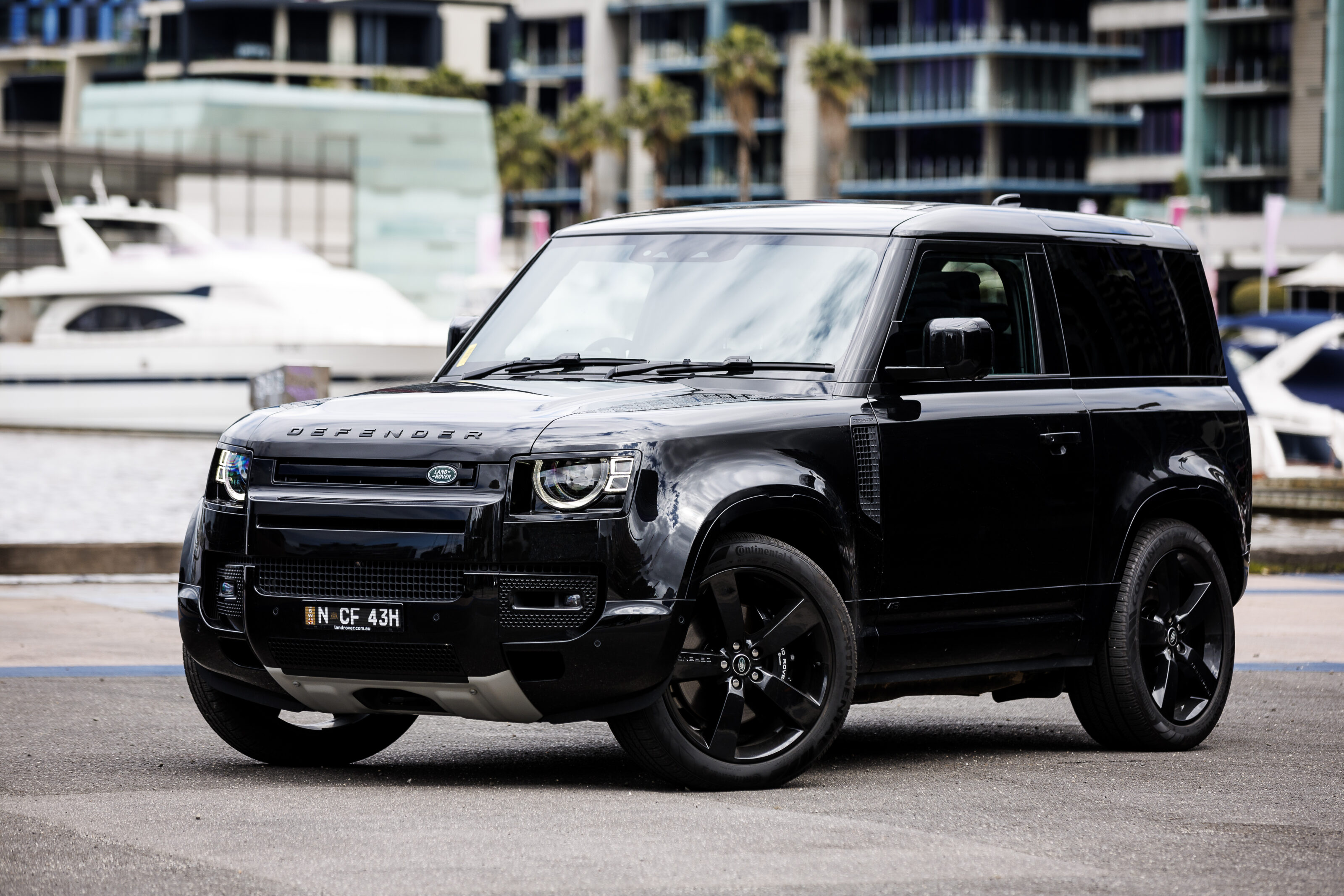
Given its enduring legacy, the Defender nameplate carries a certain amount of weight behind it. Such weight brings a measure of expectation, and when Land Rover announced the return of its V8-powered icon, in quirky short-wheelbase form to boot, there were many with their own ideas on what the reborn Defender should be.
The 2023 Land Rover P525 Defender 90 is just one of the plain coolest cars on the market, resolutely distinct with confident roadholding and an impossibly charismatic drivetrain.
But does the lustre begin to fade once the practical realities of its downsized dimensions come to the fore?
We spend a week with the V8 ‘shorty’ to find out.
JUMP AHEAD
- How much is it, and what do you get?
- How do rivals compare on paper?
- Interior comfort, space and storage
- What’s it like to drive?
- How is it on fuel?
- How safe is it?
- Warranty and running costs
- VERDICT
- Specifications
How much is it, and what do you get?
The Defender 90 V8 P525 is priced from $221,300 before on-road costs, representing the flagship position in a short-wheelbase Defender range that opens at a comparatively modest $81,950 for the entry-level 2.0-litre turbo-four P300.
Building one of these on Land Rover’s Australian online configurator quotes drive-away pricing of $250,961 for delivery in the state of Victoria.
Land Rover’s most recent MY23.5 updates feature slight packaging revisions offering more choice in the face of lingering semiconductor shortages.
A slimmer 10.0-inch Pivi Pro touchscreen is now standard equipment on lower entry-level, S and SE grades, though the impressive 11.4-inch unit, fitted here as standard, remains available as a no-cost option.
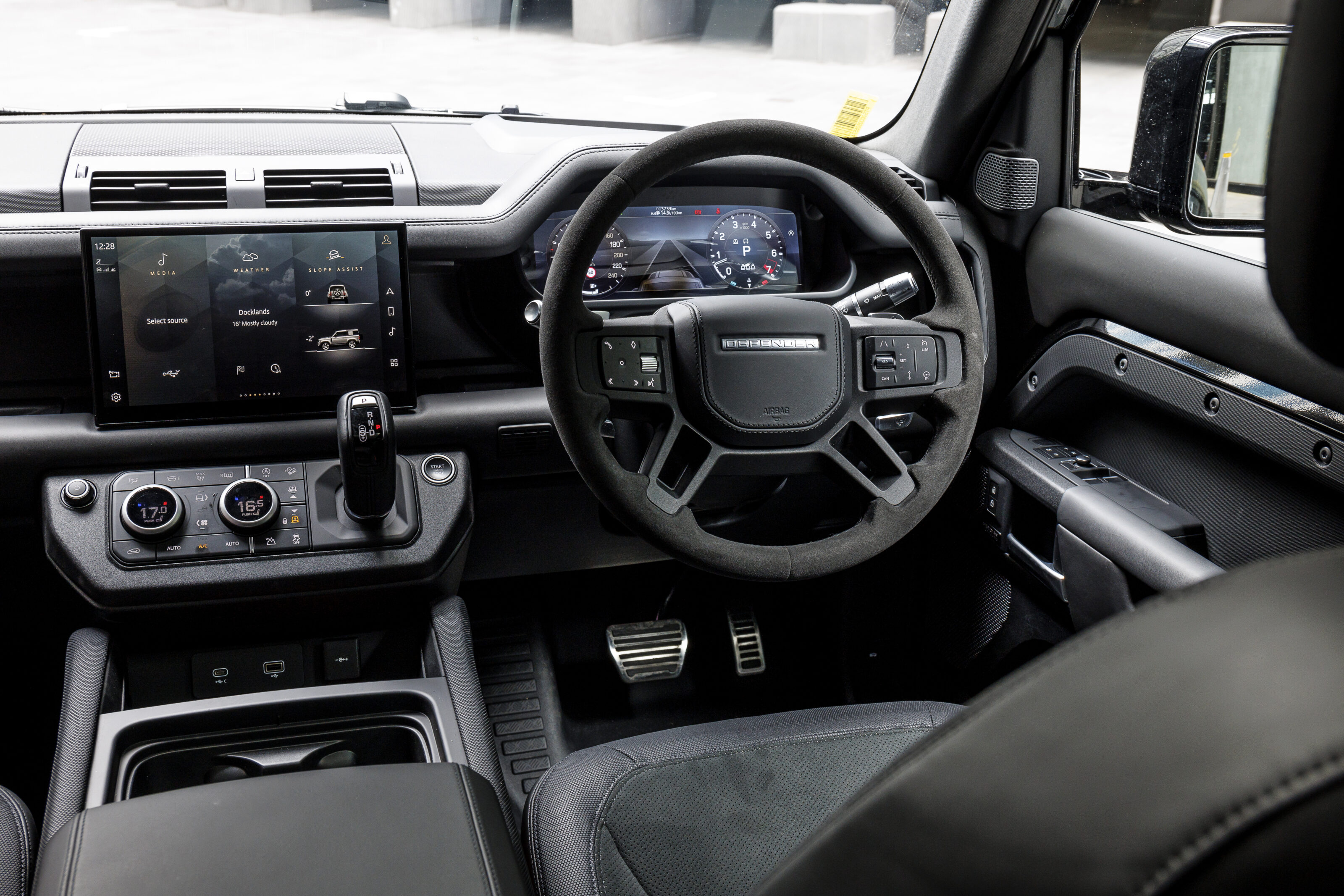
Being a halo model, a V8 Defender comes fully loaded with the best bells and whistles from across the range, including Matrix LED headlights, adaptive air suspension, 15-speaker 700W Meridian surround sound system, 12.0-inch digital instrument cluster, wireless Apple CarPlay and Android Auto, satellite navigation, rain-sensing wipers, adaptive cruise control and more.
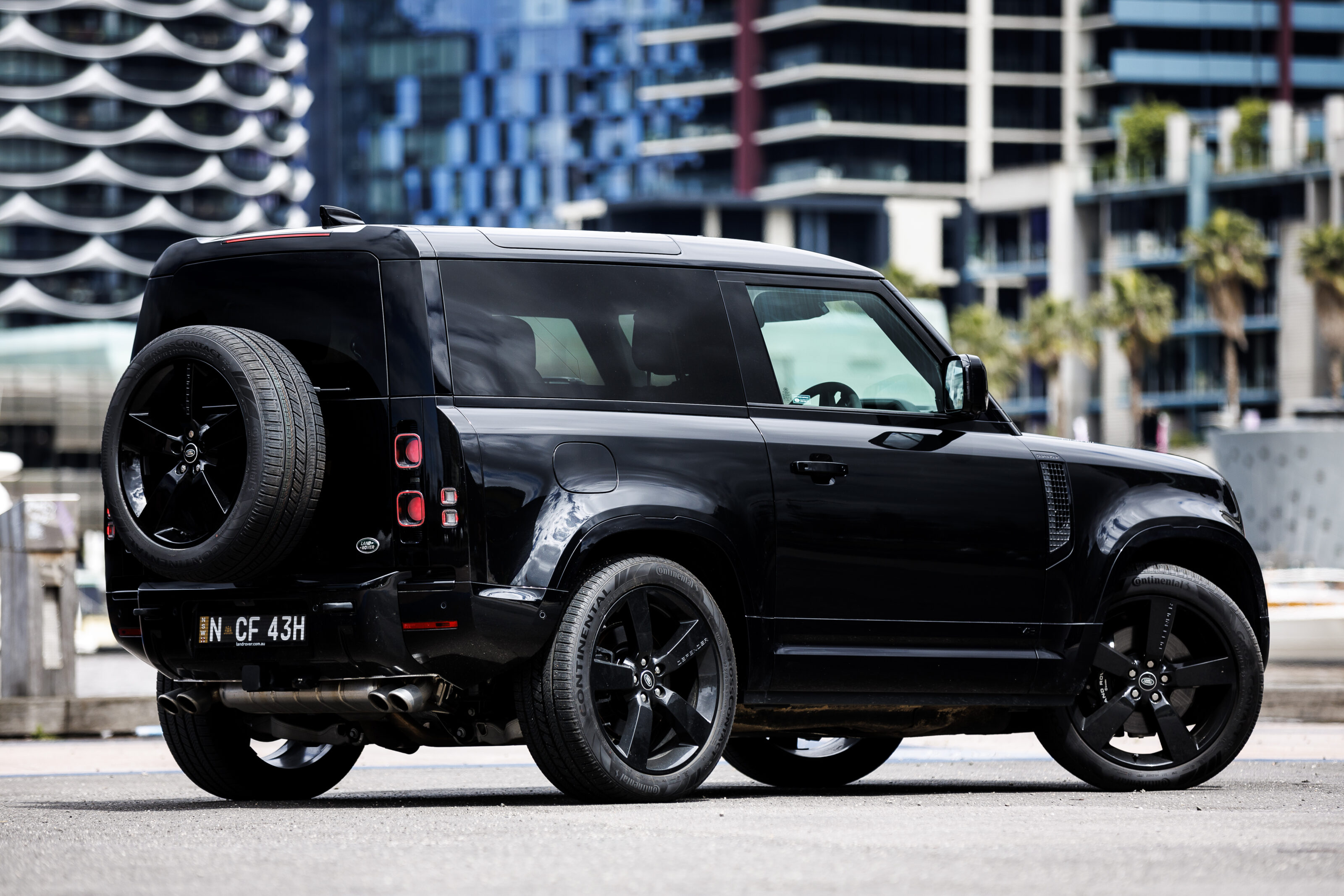
V8-specific features include 22-inch five-spoke wheels with full-size spare, quad exhaust tips, suede heated steering wheel, illuminated sill plates with V8 branding, three-zone climate control, refrigerated centre console, heated windscreen and more.
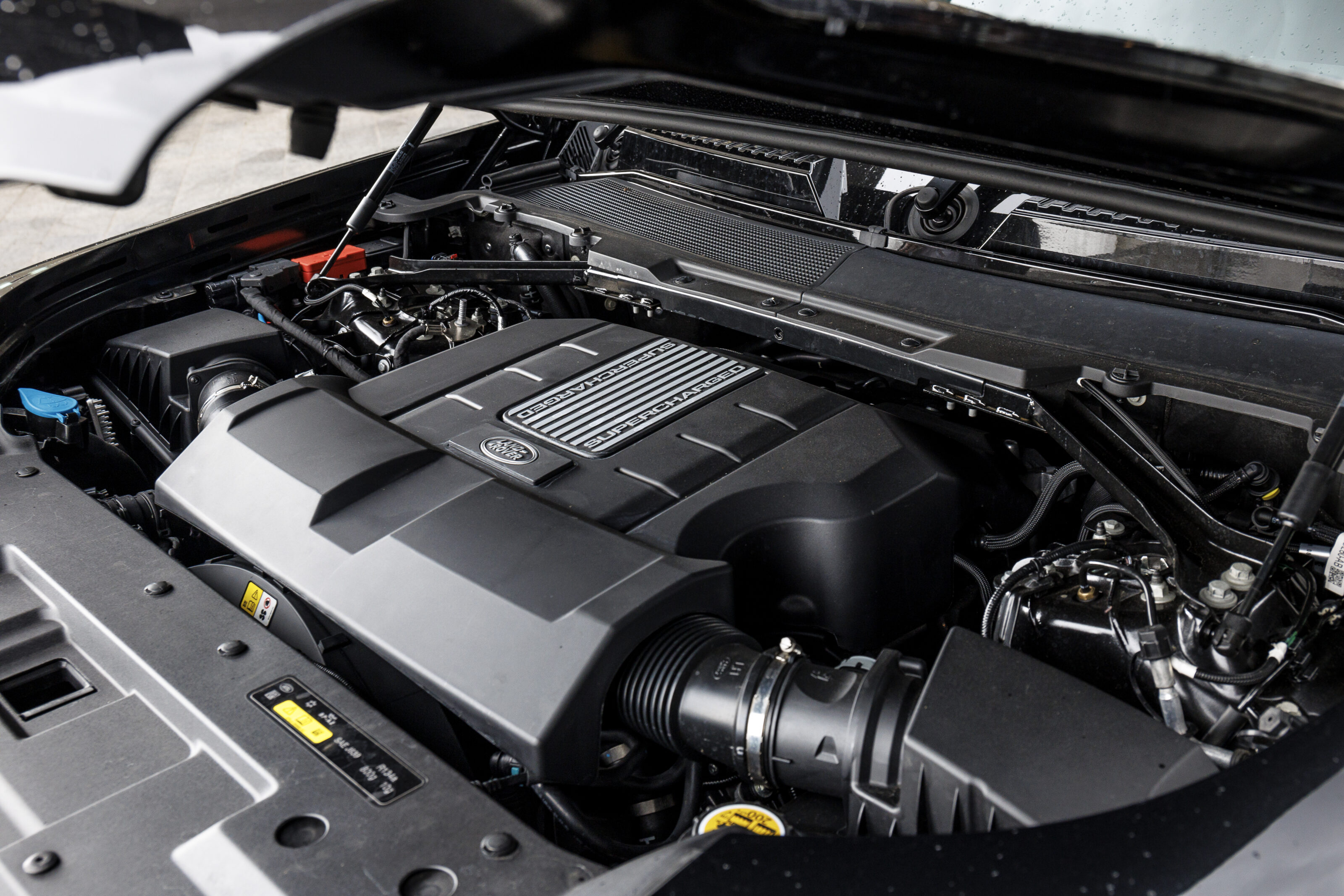
The real party piece, however, is that supercharged 5.0-litre V8.
It can be found around the JLR range in various states of tune, including the non-SVR Range Rover Sport as well as Jaguar F-Type and F-Pace SVR.
In the case of the Defender, the TVS-style supercharged AJ133 5.0-litre V8 produces 386kW and 625Nm, matched with the same ZF eight-speed automatic used by all Land Rover Defenders. V8 models, however, gain a slightly crispier transmission calibration and also gain wheel-mounted paddle shifters.
Elsewhere, the eight-cylinder Defender gains an electronic active rear differential and adds a ‘Dynamic’ mode to its Terrain Response system that enables increased performance and dynamism on loose surfaces.
Land Rover also fits the V8 Defender with larger diameter anti-roll bars, stiffer suspension bushes and revised spring and damper rates to cater for the large step up in power and torque.
How do rivals compare on paper?
The Defender V8, especially in its shortened ‘90’ guise, is a bit of a niche vehicle with no direct rivals blending its three-door status, small footprint, off-road chops and V8 power.
Audi’s RS Q8 swings in at a comparable $220,491 (before on-road costs), targeting a similarly premium buyer, and is a significantly more dynamic road car but with less off-road capability.
Porsche’s Cayenne GTS Coupe ($210,400 before on-road costs) is also worth consideration as a holistic five-seat package with a much sharper on-road driving experience but is around 50kW down on power.
Of course, there are also the other requisite German powerhouses, the Mercedes-AMG GLE63 and BMW X5 M, both asking around $230K, and filling the fast family brief.
The much more expensive Mercedes-Benz G63, at $314,897 before on-road costs, frequently draws comparisons for its V8 powerplant, famously rugged design and genuine off-road ability.
Interior comfort, space and storage
The practical price of opting for the funky three-door Defender 90 is that space and packaging take an unavoidable hit over the more conventionally sized Defender 110, and even larger incoming eight-seat Defender 130.
In fact, the Defender ‘shorty’ is exactly that, measuring just 4.3 metres in length (about the same length as a Hyundai i30) despite its wide stance and high-riding seat position giving the illusion of a very large car. That’s approximately 50cm shorter than the larger Defender 110, the brunt of which is felt in the vehicle’s boot space rather than first or second-row comfort.
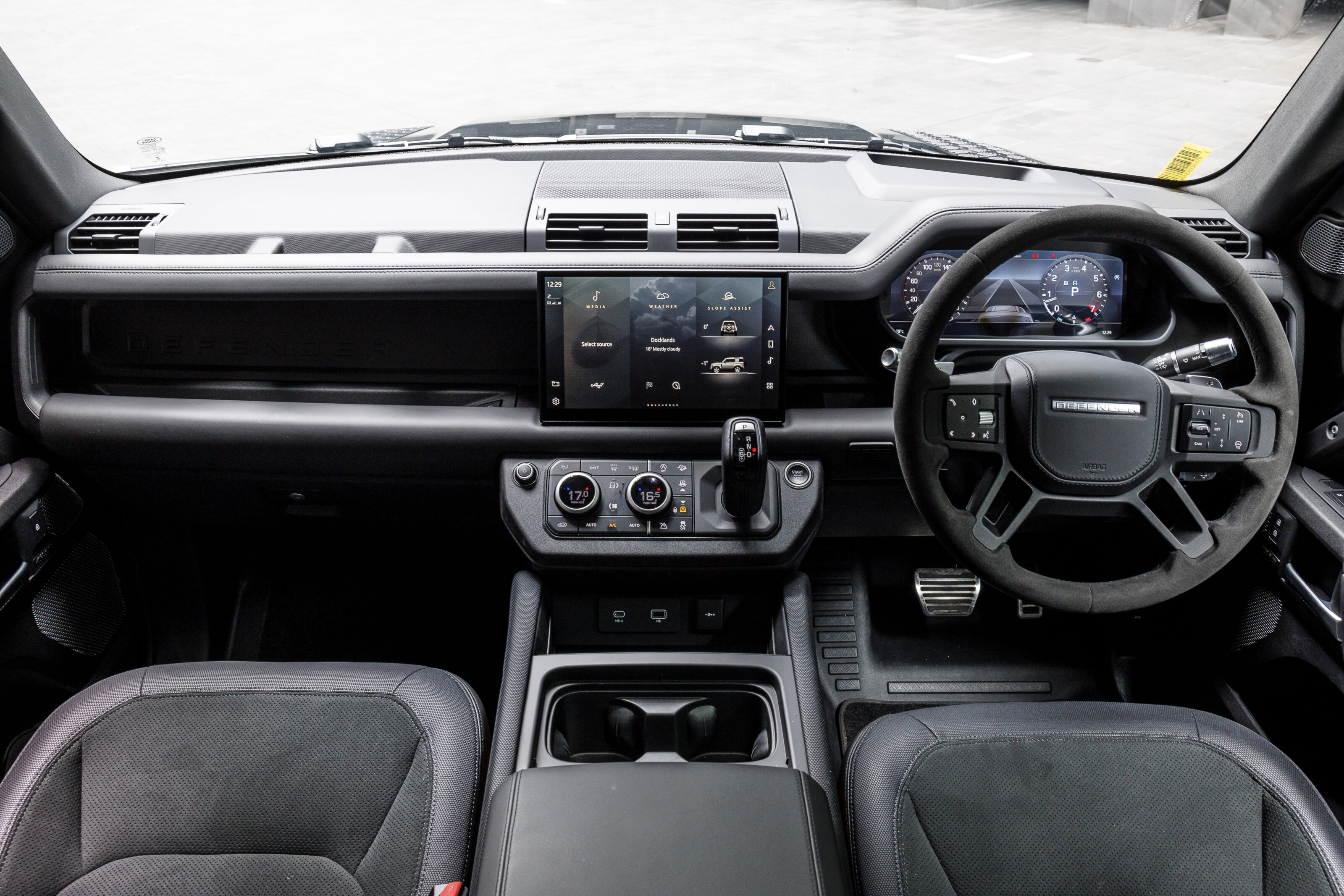
Front occupants are greeted by a cabin that looks and feels rugged and durable, but also one that feels solidly built with quality materials.
Wide, flat and supportive power-adjustable seats are covered in black leather, suedecloth and a durable synthetic material that Land Rover calls ‘Robustec’.
The cabin is very monochrome but maintains an open and airy feel thanks to a panoramic glass roof and the extended surface area of the Defender 90’s big rear-quarter glass.
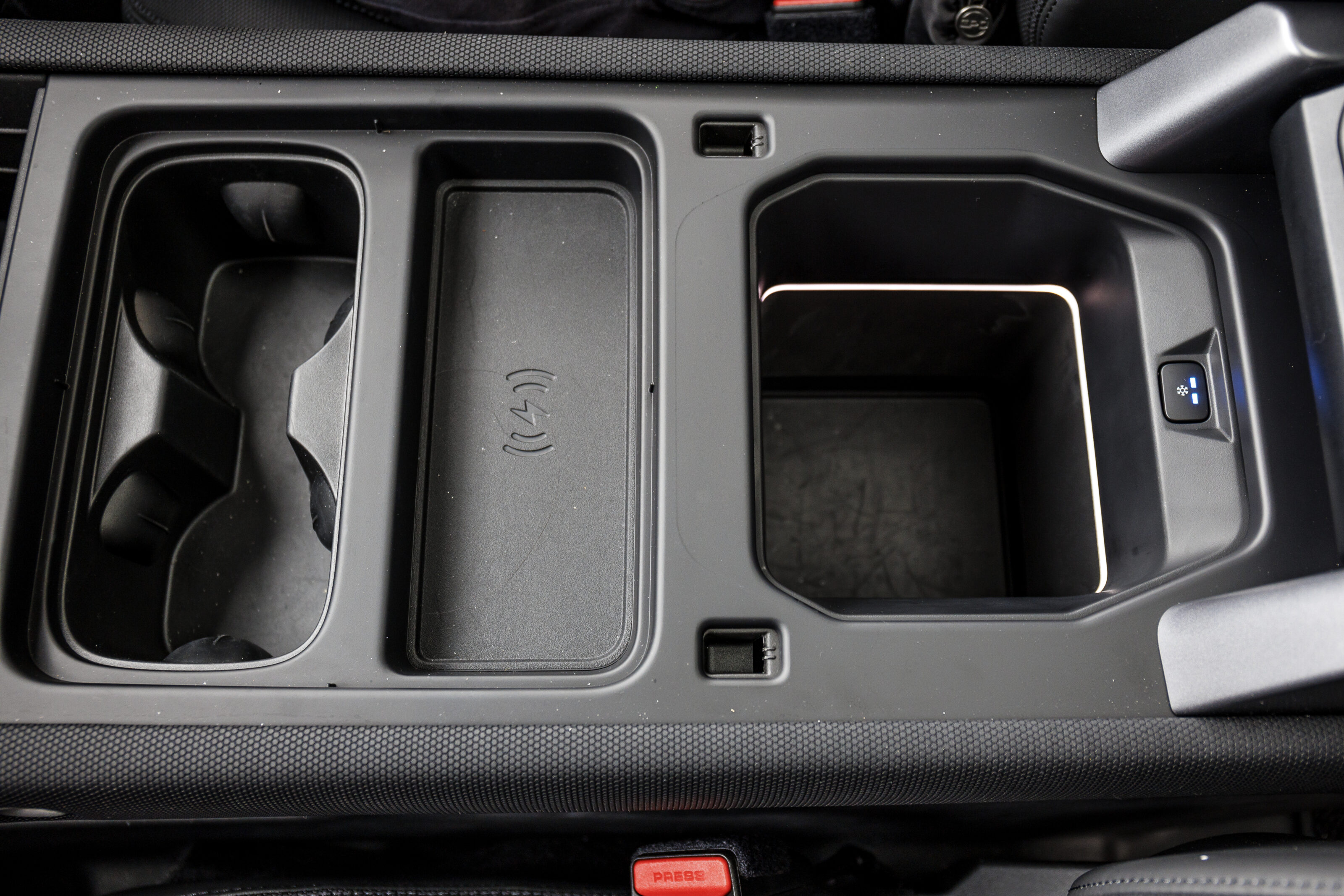
There are many nooks and crannies for day-to-day storage up front. The dashboard fascia itself acts almost as a full-width storage tray with an easily accessible USB-C port for the front passenger.
The versatile dashboard design renders the glovebox quite shallow compared to most vehicles of this size, but there are further stowage trays hidden below the dash-mounted shifter and HVAC controls. There is a further USB-C port and a USB-A socket down there, as well as a 12-volt outlet to cover all of your charging needs.
Atop the floating-style console sit two central cup holders, with a wireless phone charger slotted between them the central armrest. Lifting the armrest reveals a deep refrigerated bin that looks like it will easily accommodate a few cans of soft drink.
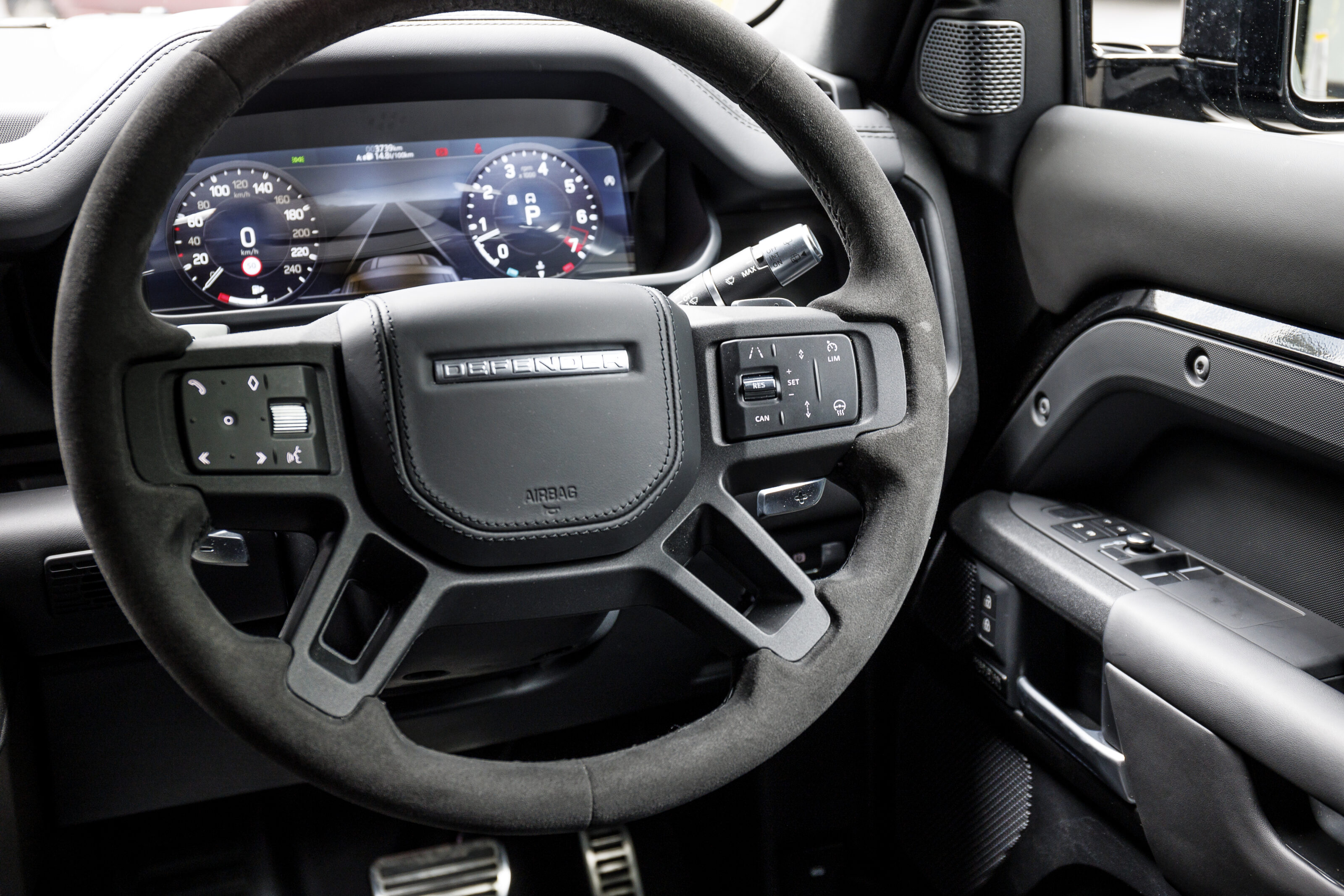
V8 Defenders uniquely gain a suede-wrapped steering wheel, which fits its sporty positioning but does stick out as an otherwise strange packaging choice for such a rough-and-ready outdoor lifestyle vehicle.
Accessing the rear seats is done through the only pair of side doors, by manually tilting the front seats which can then slide forward electrically to create more room to climb in. The aperture for entry remains small and, combined with the Defender’s high ground clearance, does require a bit of a lunge to access the second row.
Once you’re back there, however, it’s surprisingly roomy, with impressive levels of head, leg and foot room.
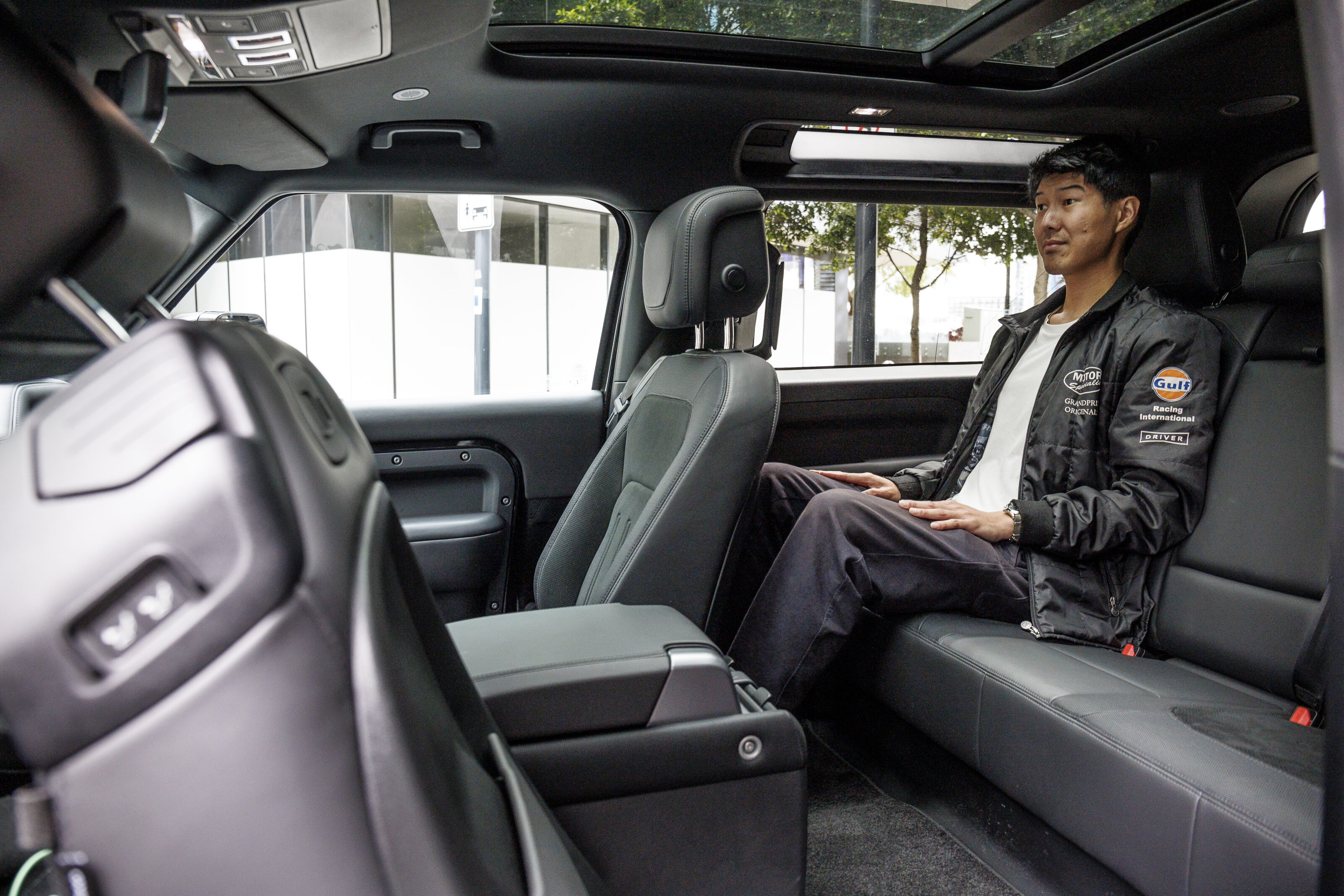
Standard three-zone climate control treats rear occupants to a pair of air vents with their own HVAC controls. There are also two further central USB-C ports and two 12v sockets back here, with outboard rear seats each equipped with a cup holder and small storage bin.
As mentioned, boot space beyond the second row is where the Defender 90’s shortened dimensions are felt most sharply.
Despite a quoted 397L capacity with all five seats in place, the useable boot floor surface area is tremendously shallow and you’ll be packing things to the rafters like a game of Tetris to get anywhere near Land Rover’s boot space claim.
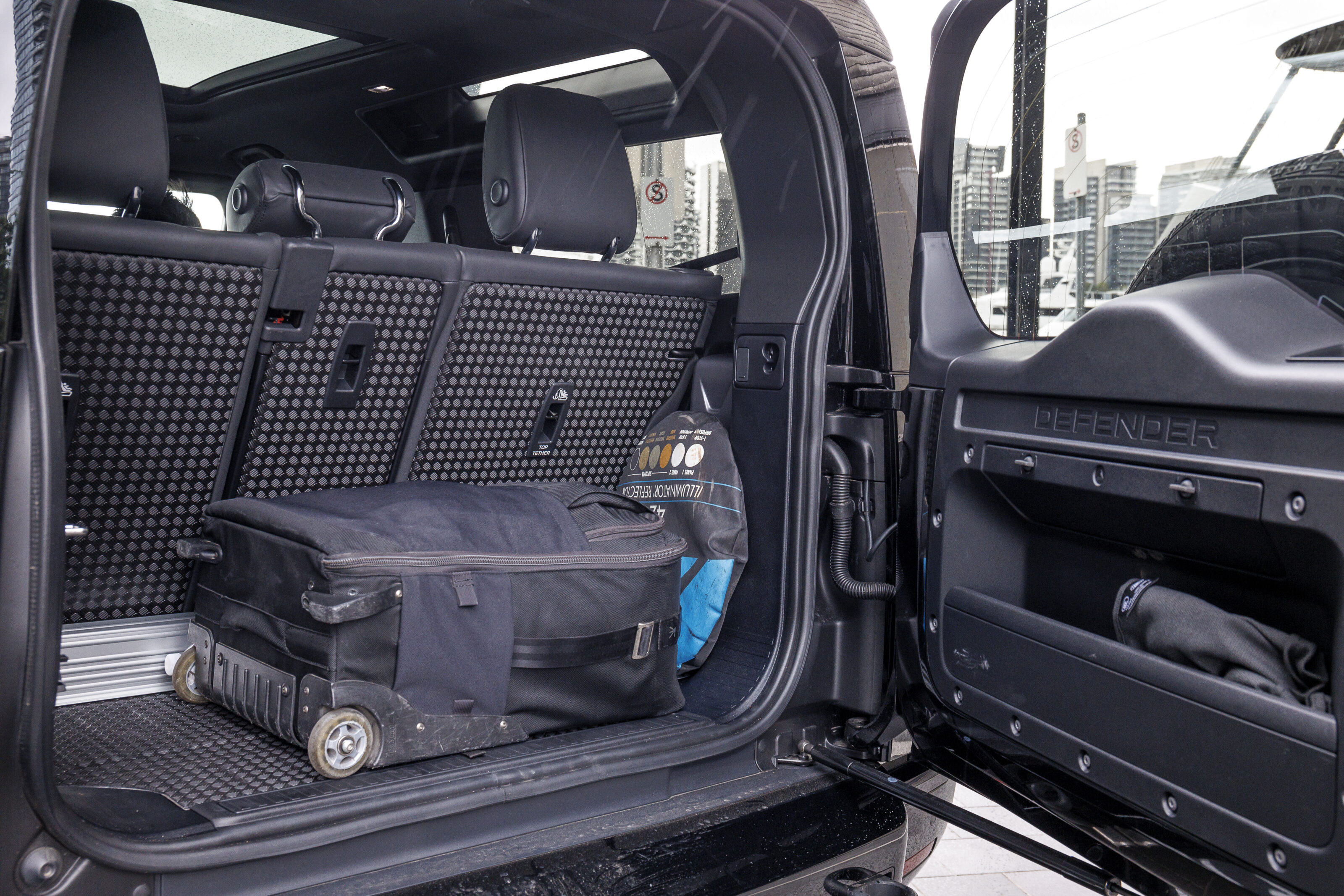
Folding the 40:20:40 rear seats opens the cargo area up to 1563L, but sadly the rear seats don’t fold flat in the Defender 90 like they do in the larger 110, with a large aluminium brace that impedes easy slide-through loading.
What’s it like to drive?
The basics
| Body | 3-door, 5-seat large SUV |
|---|---|
| Drive | permanent four-wheel |
| Engine | 5.0-litre V8 petrol, DOHC, supercharged |
| Power & Torque | 384kW/625Nm |
| Transmission | 8-speed automatic |
| Fuel consumption | 12.7L/100km (tested) |
| Boot min / max | 397L / 1563L |
| Price | $221,300 + on-road costs |
In a word? It’s a riot!
Upon the first squirt of the throttle, it’s hard not to chuckle to yourself at the sound of that supercharged 5.0-litre V8, the dramatic pitch and squat of the short body’s 384kW/625Nm delivery, and the rapidly receding rear view of traffic.
Standing acceleration is startling, delivering peak torque from just 2500rpm before full power deploys at 6000rpm. Its 0-100km/h claim of 5.2 seconds feels achievable, with some North American outlets even dipping into the 4s with their 0-60mph times.
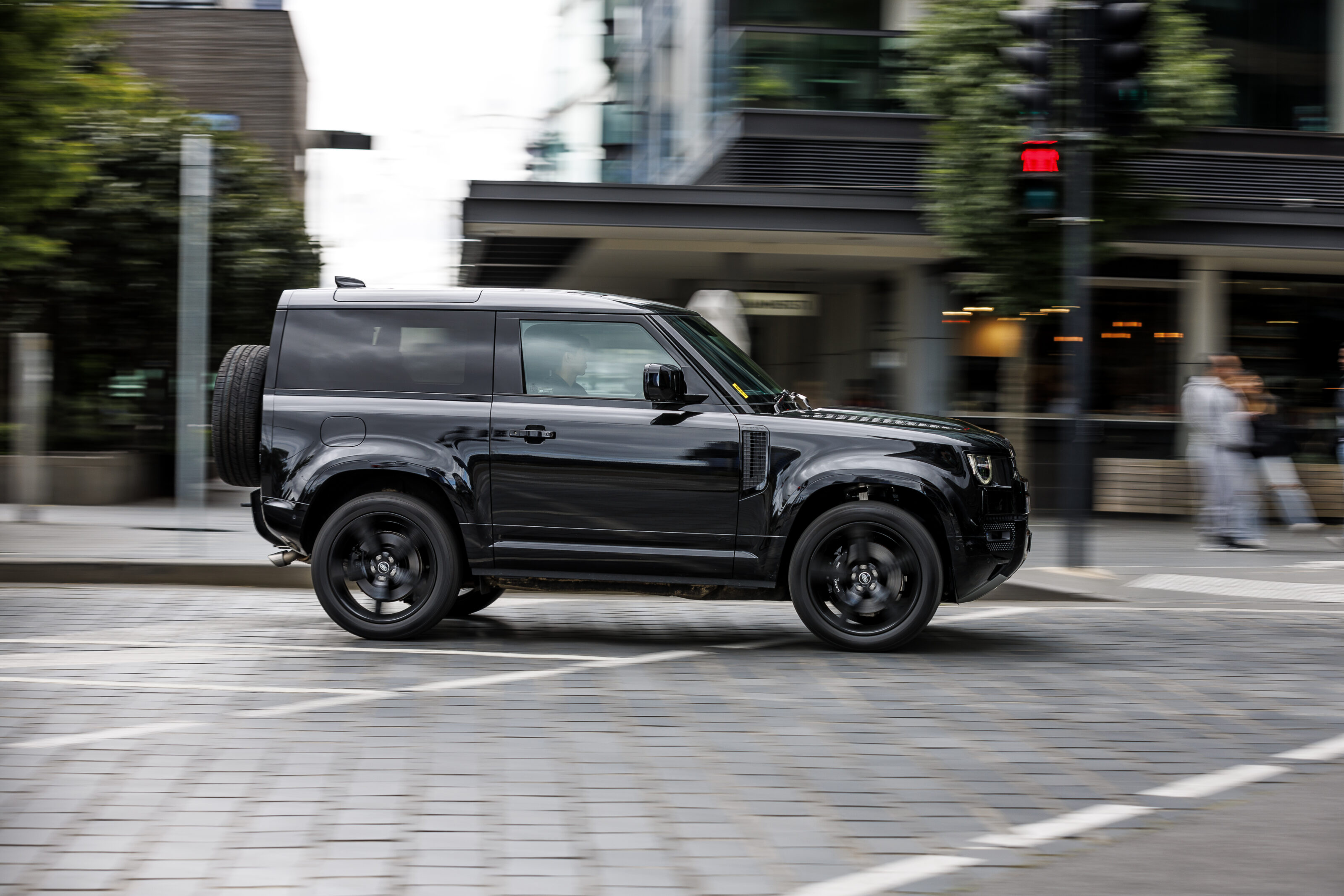
Standing acceleration is startling, delivering peak torque from just 2500rpm before full power deploys at 6000rpm.
Compared to other JLR products fitted with this same supercharged 5.0-litre unit, the eight-cylinder Defender’s exhaust note is delivered with measured grace, and none of the raw metallic snarls of, say, a Jaguar F-Type P450 R-Dynamic. Some subtle in-cabin sound enhancement fits its subtle hot-rod Q-car status, but there were times when we wished for an easily accessible exhaust mode switch for when we wanted to fully channel our inner Bond villain.
Nevertheless, there’s a thread of lunacy and fun throughout the P525 Defender 90, and that’s exactly its charm.
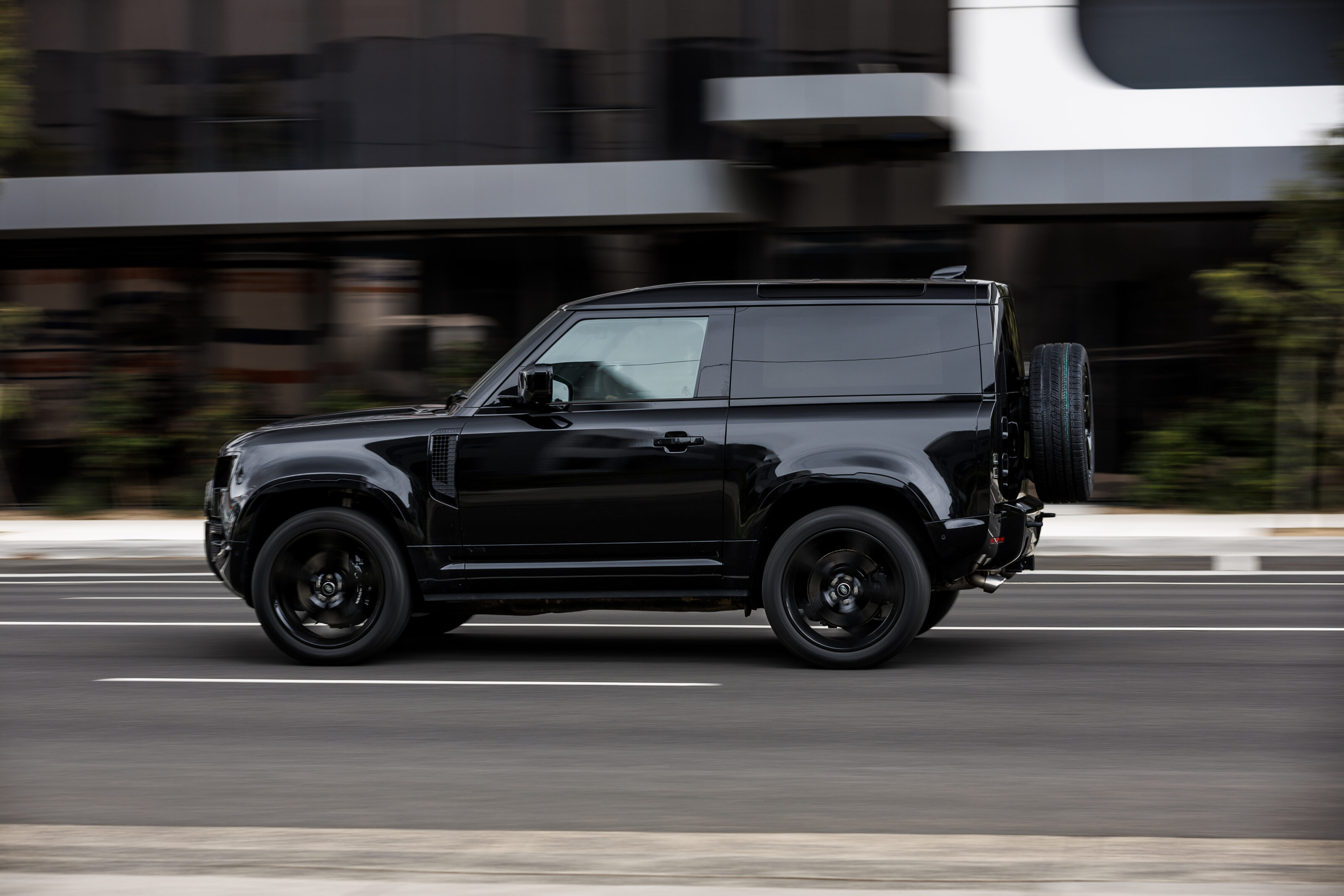
Aside from the mechanical centrepiece under the bonnet, it’s a consummate urban road car with revised adaptive air suspension delivering deft body control throughout the speed envelope.
Like the non-V8 variants, the most athletic Defender 90 retains the short wheelbase characteristics of pitch, dive and roll but subtle dynamic developments such as chunkier anti-roll bars and spring/damper revisions make a noticeable improvement to lateral body control.
No, it won’t corner flat in sports-car-like fashion, but it feels markedly more tied down than mainstream Defender 90 variants, and you can distinctly feel the car’s mass settle confidently over its outside rear tyre in mid-corner power down.
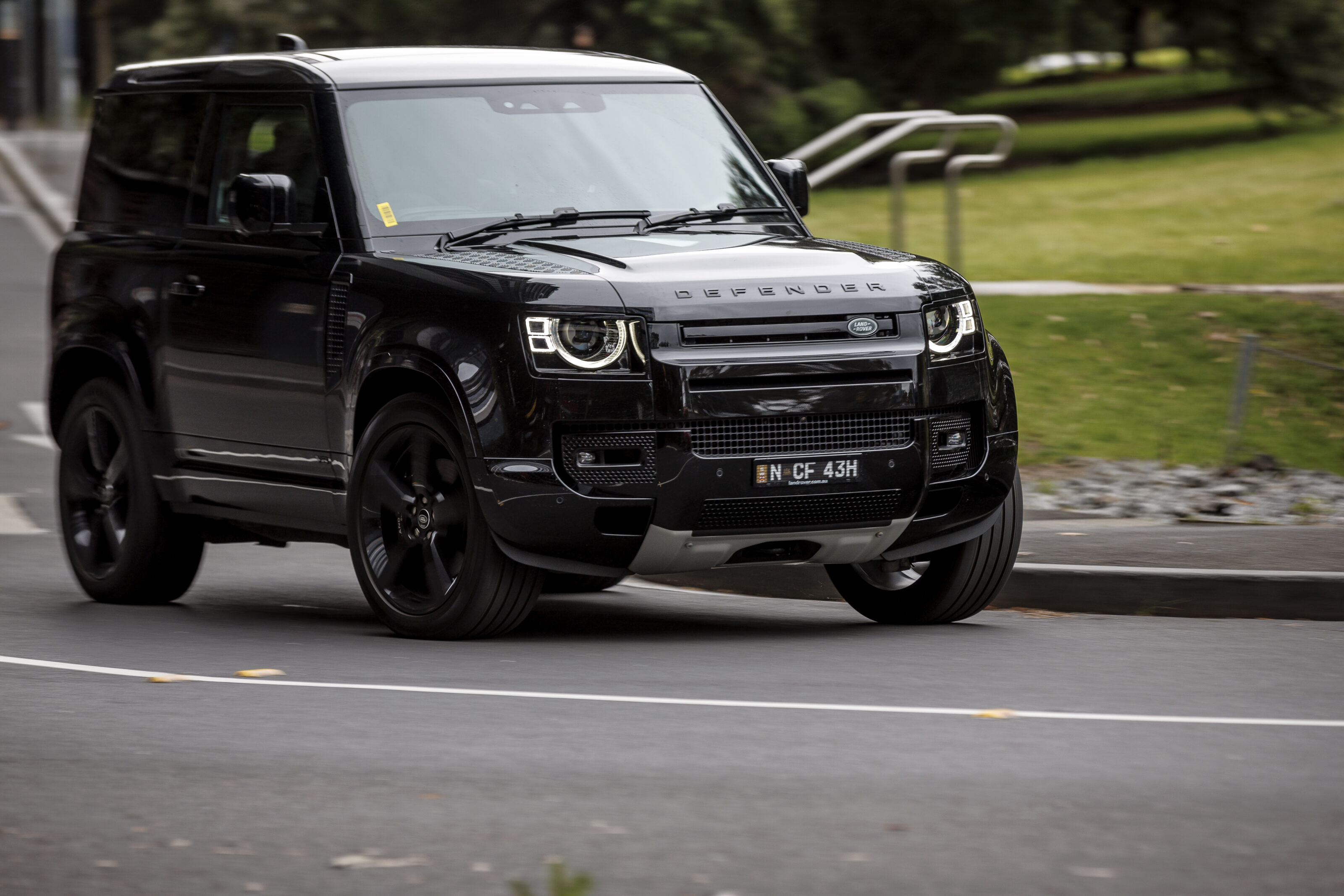
Its steering still possesses a slower off-road-biased ratio with an on-centre feeling that can feel a little unmatched by the car’s increased pace, but it’s accurate nevertheless and does a good job of transmitting the front wheels’ position to the driver and feels well-weighted in the hands.
Sizeable 350mm front brake rotors, clamped by six-piston Brembo calipers do an agreeable job of arresting the Defender’s 2470kg of mass from speed but the stopping distance feels long and the pedal doesn’t offer the feel and feedback for fine modulation and transient braking inputs.
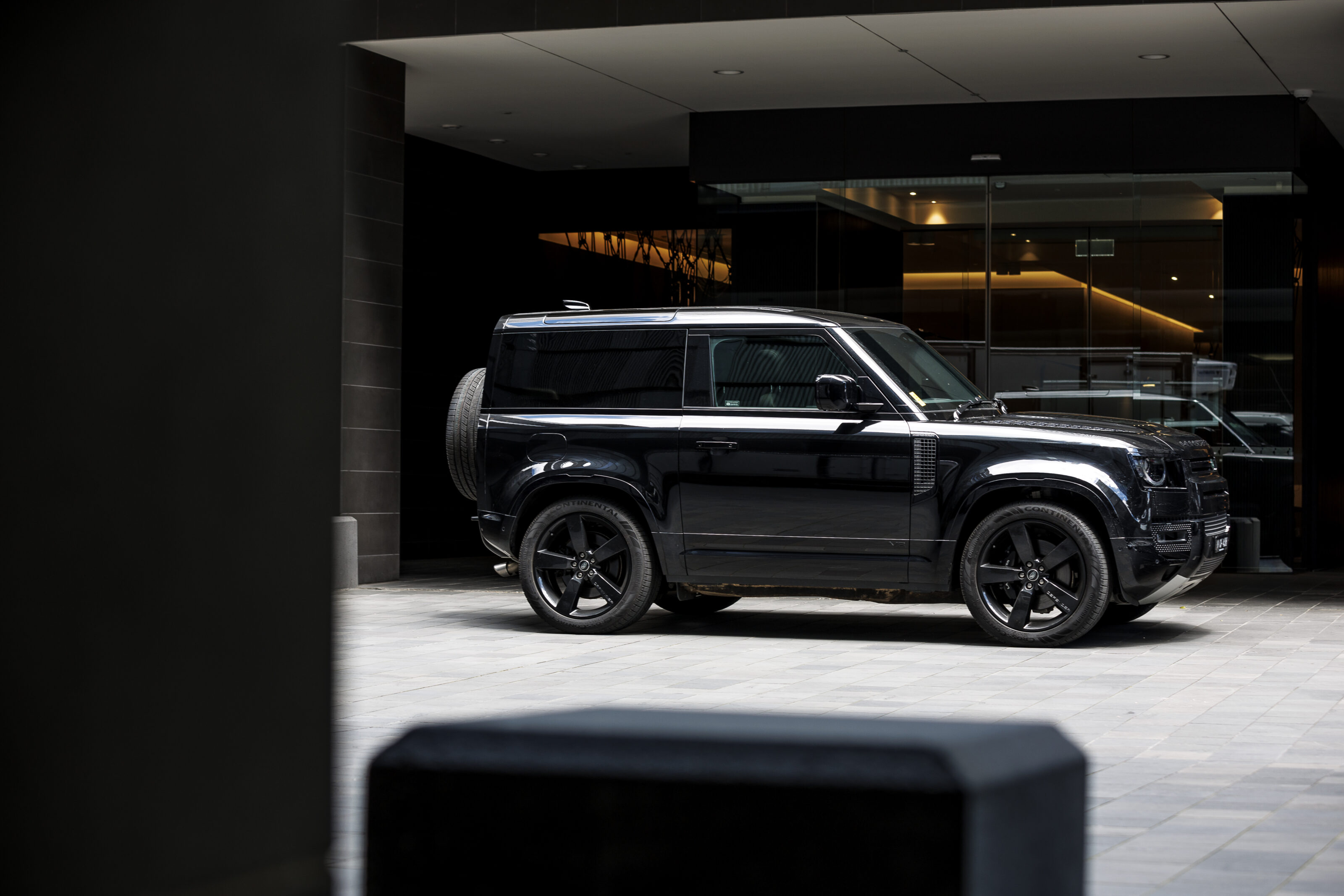
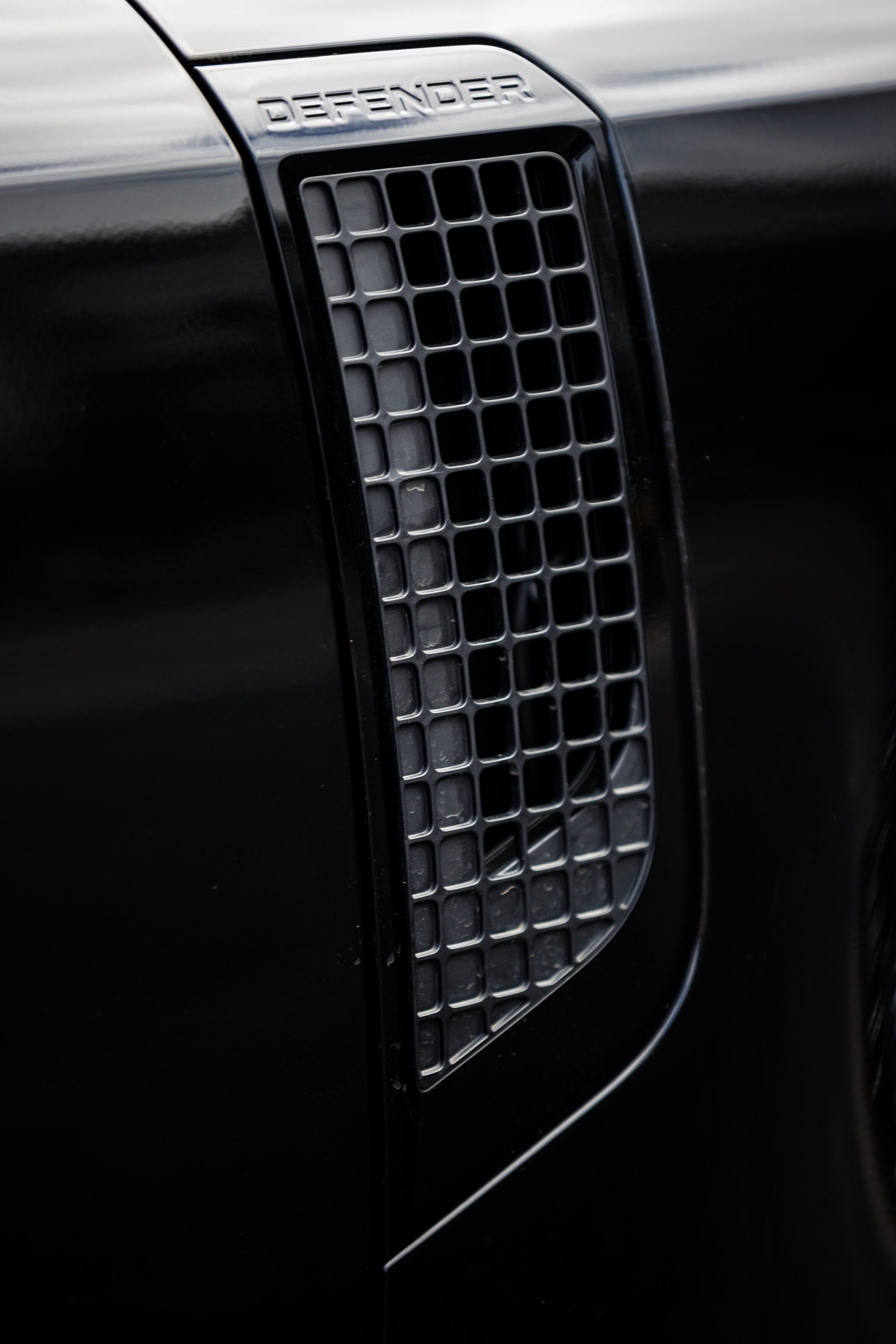
The large performance rotors also hinder inner barrel clearance and limit wheel choices to a minimum of 20 inches, which may further hinder tyre choice for those seeking more focused all-terrain tyre options, while ultimate road-going dynamics are ultimately hampered by the standard-fit all-season 275/45R22 Continental CrossContact rubber.
Regardless, the V8 ‘shorty’ is entertaining and more than confident enough to guide, if not outright push, through twisting bits of tarmac.
How is it on fuel?
Land Rover’s combined-cycle fuel usage claim for the V8 Defender 90 is 12.8L/100km, while our week-long test returned a figure of 14.7L/100km.
Of course, with this powerplant in a vehicle of this shape and weight, fuel usage is heavily right-foot dependent and we’d imagine JLR’s claim is attainable on a sympathetic long-distance cruise.
The Defender packs a 90-litre fuel tank and demands a minimum of 95 RON fuel.
How safe is it?
The Land Rover P525 Defender 90 bears a five-star rating from ANCAP, shared by all current Defender variants except for the 110 Hard Top commercial vehicle, which is currently unrated.
Land Rover equips the Defender 90 with dual front, side and curtain airbags.
It features autonomous emergency braking with junction assist as well as pedestrian and cyclist detection.
Other safety suite features include lane-keep assist, blind-spot monitoring, rear cross-traffic alert, traffic sign recognition, door exit warning, driver fatigue monitoring and a 360-degree camera system.
Warranty and running costs
Land Rover’s vehicle warranty spans five years and unlimited kilometres.
Unlike vehicles with conventionally fixed service intervals, Land Rover Defenders internally monitor distance covered, conditions endured and driver behaviour, also noting any faults or error codes, and will display a message signalling an upcoming visit to the service centre, whenever required.
A pre-paid five-year service plan, valid up to 130,000km, is available for $3750.
VERDICT
The V8-powered Land Rover Defender 90 is a characterful and charming unit that feels dense, always surefooted and positively bulletproof.
Opting for this particular package, with its stylish short-wheelbase body and thunderous supercharged V8, demands a series of pragmatic compromises.
The price of entry is high, the rear seats are hard to access and the boot is small. It’s not as plush as the four- or six-cylinder Defenders, and it’s not as dynamic or poised as similarly priced performance and premium SUVs from rival marques.
However, the P525 Defender 90 isn’t a car steeped in pragmatism, it’s one steeped in the experience. And if you’ve settled on a supercharged V8 Defender ‘shorty’ that nudges a quarter-million dollars on the road, it’s fair to surmise that pragmatism isn’t at the forefront of your purchasing decision.
Even when faced with the most cynical of observers, the V8 Defender 90’s charming toy-like design, matched with a powerplant to be cherished in this age of efficiency, delivers an indubitable charisma and feels undeniably cool.
It really is a big loveable beast, and while there’s no shortage of premium rivals in this space and price point, there’s no rival that makes you feel quite so Bond-villainous as you do in the V8-powered Land Rover Defender 90.
For some, that’ll be worth every penny.
Specifications
| 2023 Land Rover Defender 90 P525 V8 | |
|---|---|
| Body | 3-door, 5-seat large SUV |
| Boot min / max | 397L / 1563L |
| Drive | permanent four-wheel |
| Engine | 5.0-litre V8 petrol, DOHC, supercharged |
| Max power | 384kW @ 6000rpm |
| Max torque | 625Nm @ 2500-5500 |
| Transmission | 8-speed automatic |
| Fuel consumption (claimed) | 12.8L/100km |
| Fuel consumption (tested) | 14.7L/100km |
| Weight | 2195kg |
| L/W/H/W-B (mm) | 4323/2105/1969/2587 |
| 0-100km/h | 5.2sec (claimed) |
| Price | $221,300 + on-road costs |
| On sale | now |
