
The fifth-generation 2023 Toyota Prius has been welcomed by many for its improved looks and more powerful engines.
However, it is limited by its five-door liftback body, which is likely to limit sales in today’s SUV-dominated automotive market – and indeed, it’s already been written off for Australia.
So, what if Toyota produced a small SUV version of the Prius, badged Prius Cross, as a hybrid-only alternative to the Yaris Cross?
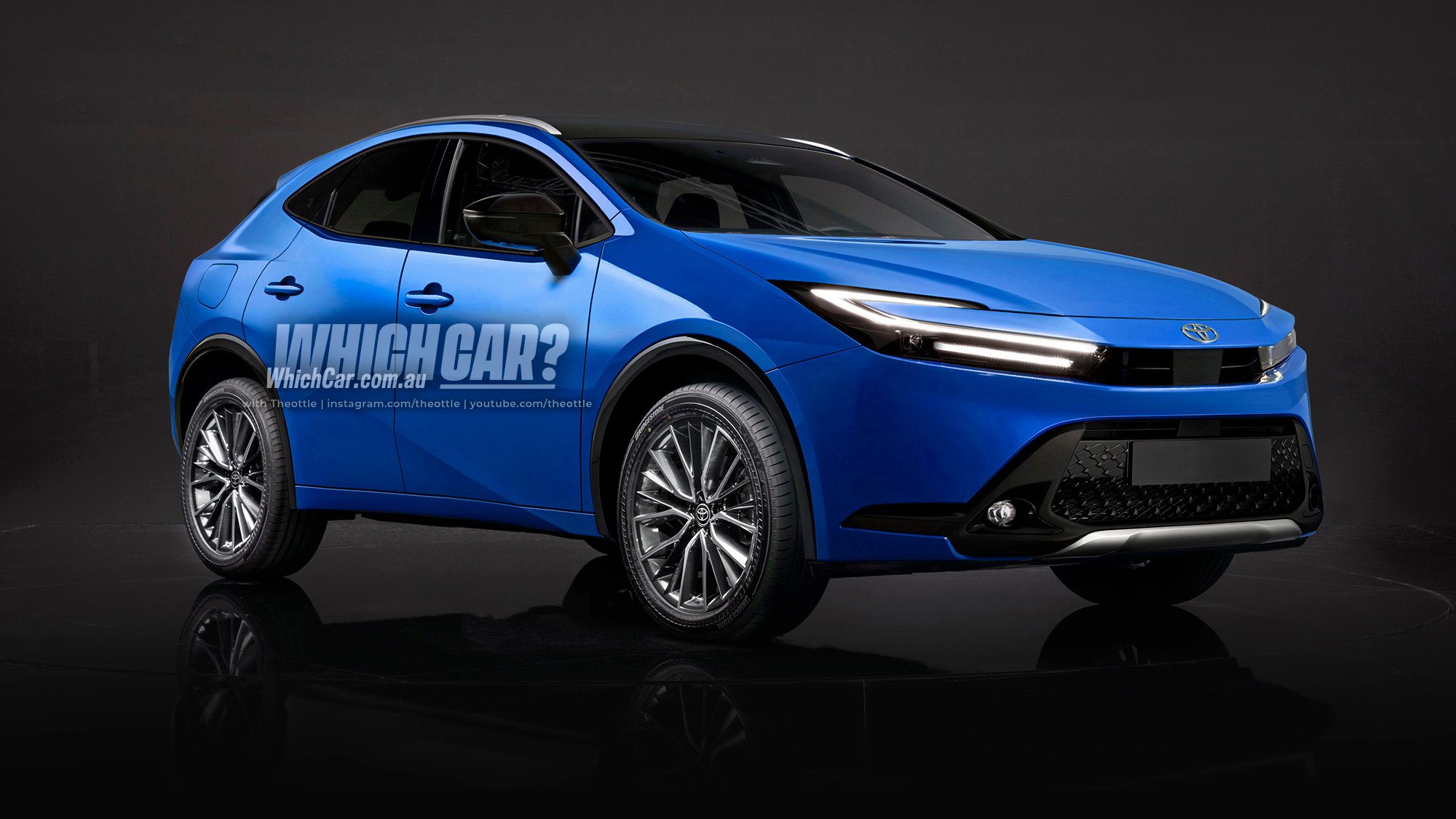
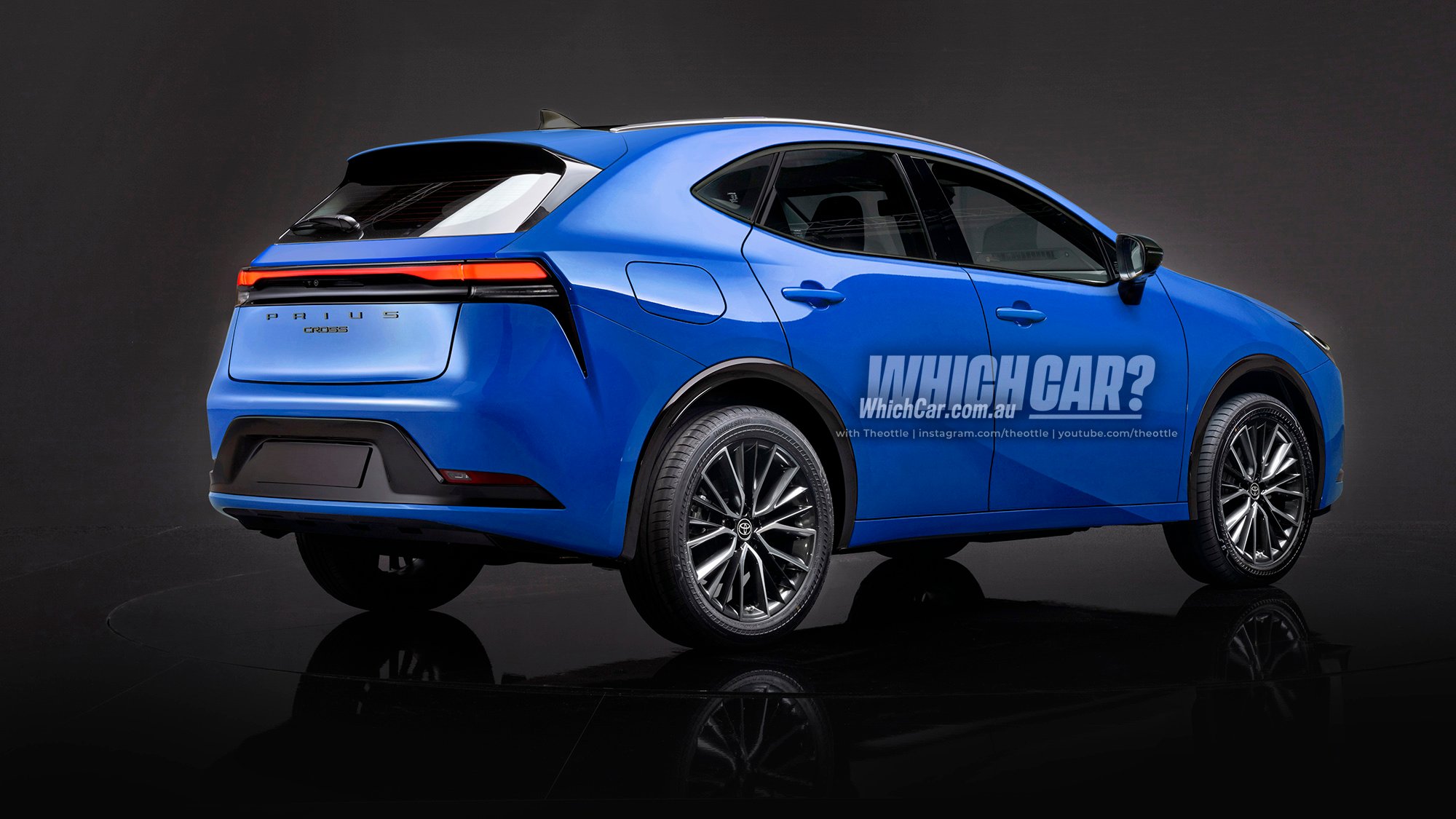
These rendered images, created by digital artist Theottle, imagine how such a vehicle might look – potentially allowing local access to the Prius nameplate, with the liftback ruled out.
Taking its curvey cues from the Lexus NX, the renderings see elements added from the next-generation Prius, including its front end, tail-lights, and similar character lines at the side.
Under the bonnet, the new Prius is powered by an improved 1.8-litre hybrid system, as found on the facelifted Corolla, or two new powertrains: a 2.0-litre hybrid and a 2.0-litre plug-in hybrid (PHEV).
The plug-in hybrid Prius features a 13.6kWh lithium-ion battery, allowing for an all-electric driving range of approximately 90 kilometres.
Is a jacked-up Prius likely?
No, the Prius Cross is unlikely to see the light of day, but we do know the second-generation TNGA underpinnings of the Prius will underpin the second-generation C-HR small SUV.
Previewed last week by the C-HR Prologue concept (below), the next C-HR will offer hybrid and plug-in hybrid powertrains, and an evolved design inspired by the Prius, BZ4x and Crown.
The concept is believed to be as close to production as the Aygo X Prologue concept revealed in 2021, which preceded the Aygo X city car – slotting below the Yaris Cross in Europe – unveiled eight months later. This suggests a similar timeframe, with the production C-HR likely to debut in mid-2023 ahead of a 2024 market launch.
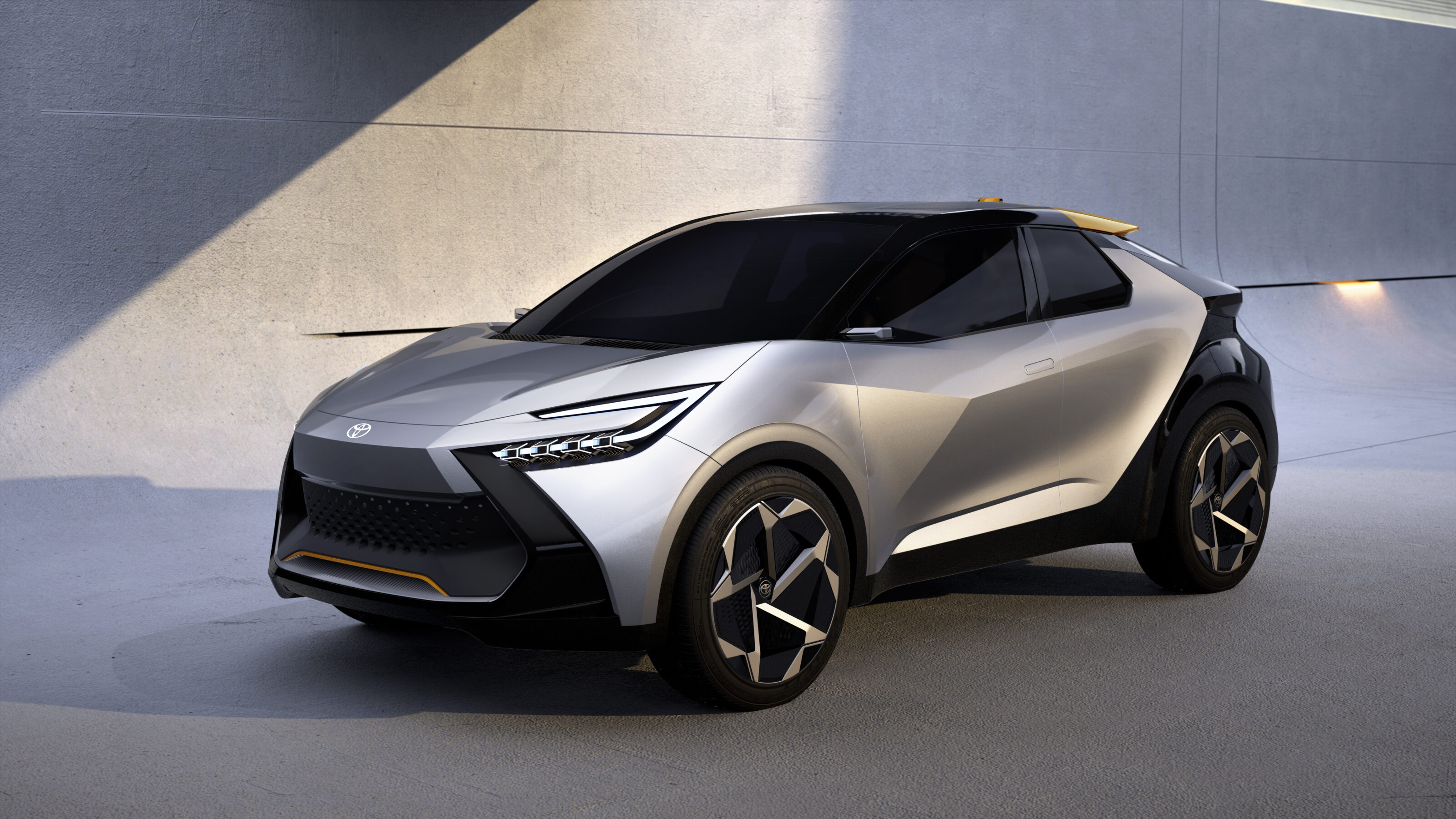
Up front, there’s a sharper design with a pair of slim headlights and a slimmer grille, while a more sloped roof flows into a light strip at the rear.
It appears the hidden rear door handles will continue into the next generation, while the oversized alloy wheels and pop-out front door handles are likely to be replaced by more conventional units.
Below: The 2023 Toyota Yaris Cross

There are some cars where the ‘USP’ leaps straight out at you.
The Honda Civic e:HEV LX is not one of them.
But where more overt vehicles can result in that initial novelty dulling fairly quickly, a grower like this hybrid Civic rewards those who are in it for the longer haul.
Of course, Honda is no newbie when it comes to selling hybrids in Australia. It was first to market here back in 2001 with the original Insight – and it even brought us a hybrid supercar, the 2017 NSX NA2.
In between, it sold hybrid versions of the Civic, with the Integrated Motor Assist tech from 2003, before evolving in 2006 to an electrical system 50 per cent more powerful that could run the car in pure EV mode under light demand.
Twenty years of hybrid experience in the Civic has taught Honda a great deal about what customers actually want, and that answer appears to be invisibility.
People want the benefits of hybrid drive such as cleanliness, torque fill and quietness without making a big song and dance about the fact. In short, they want the mainstreaming of hybrid tech.
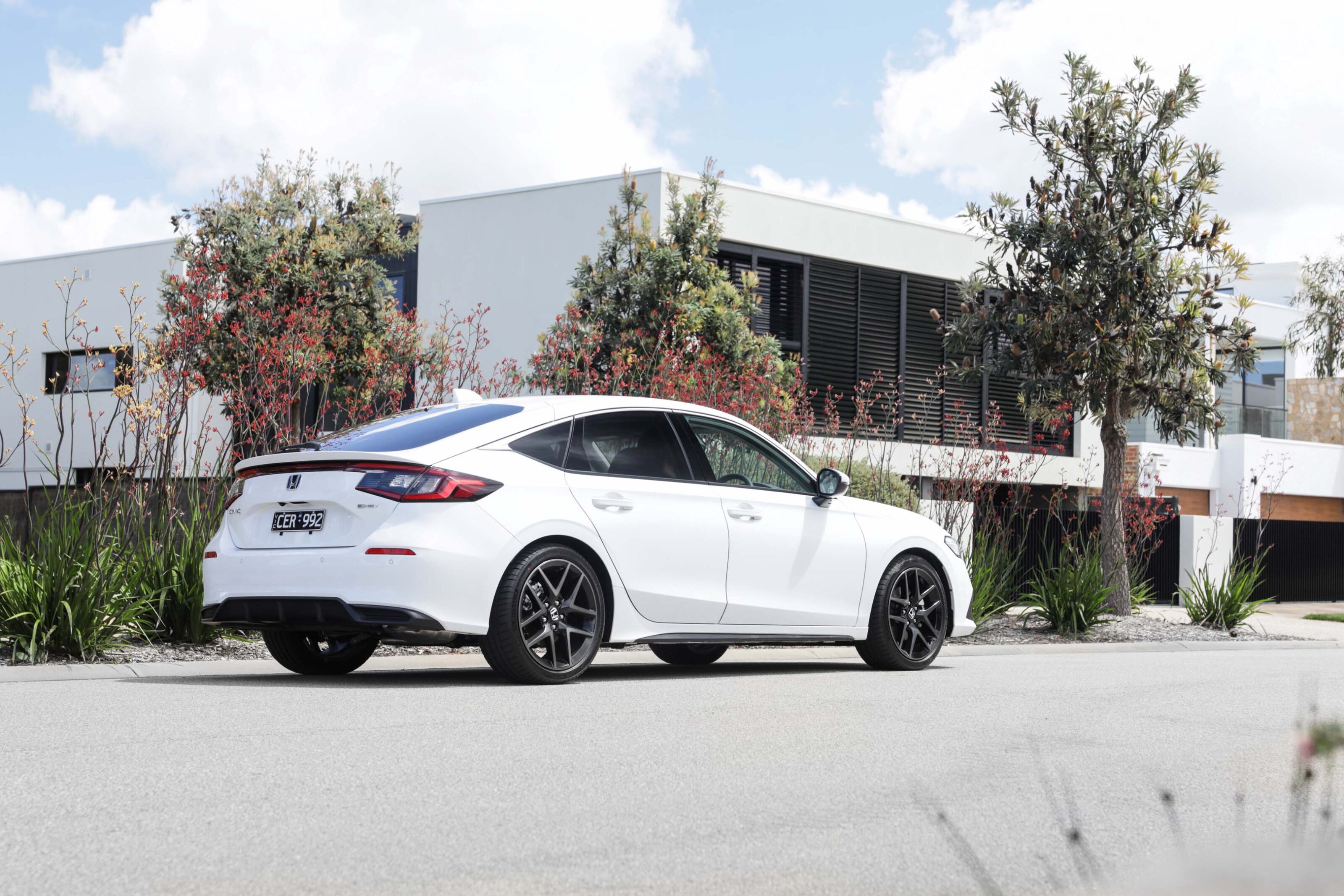
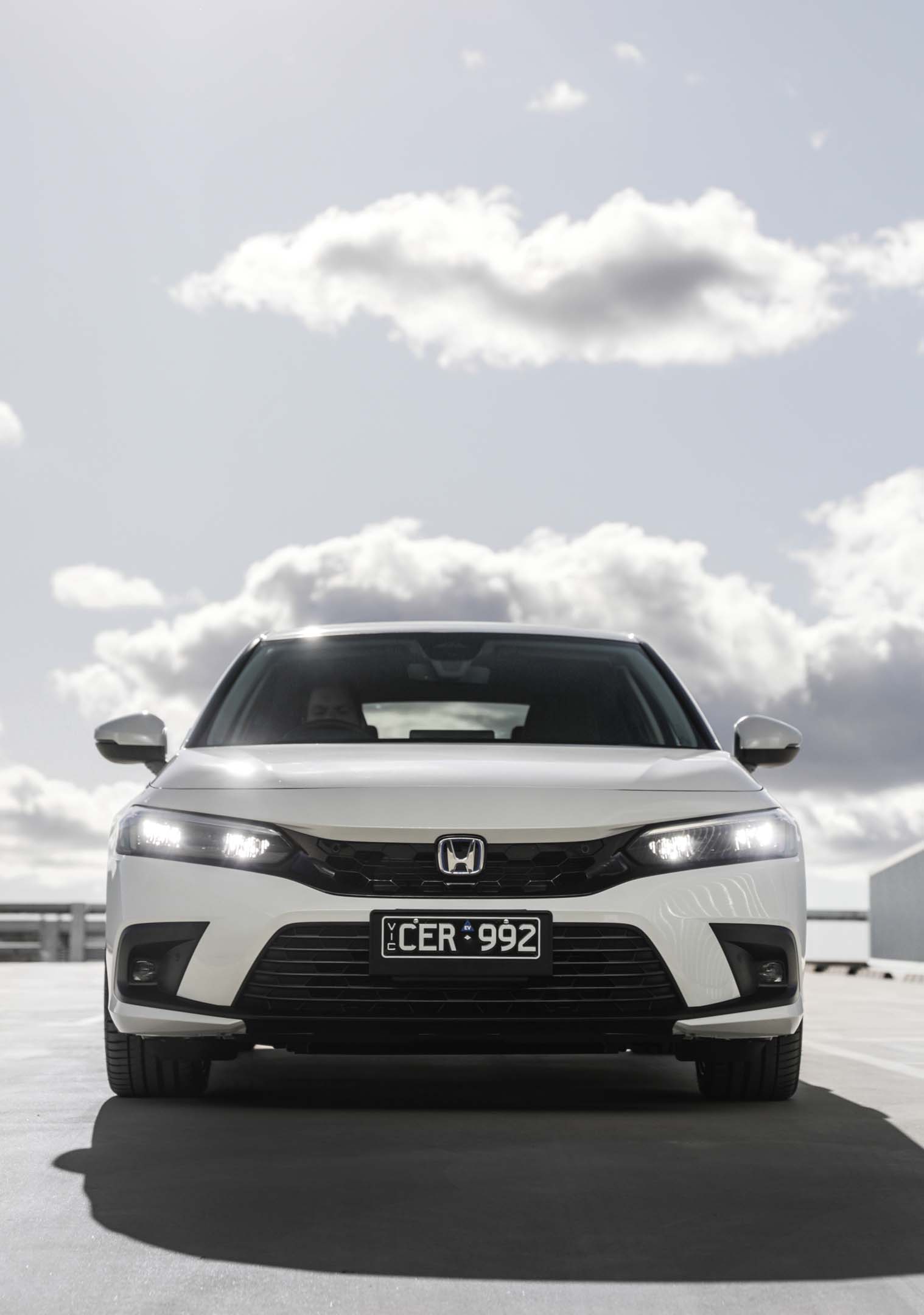
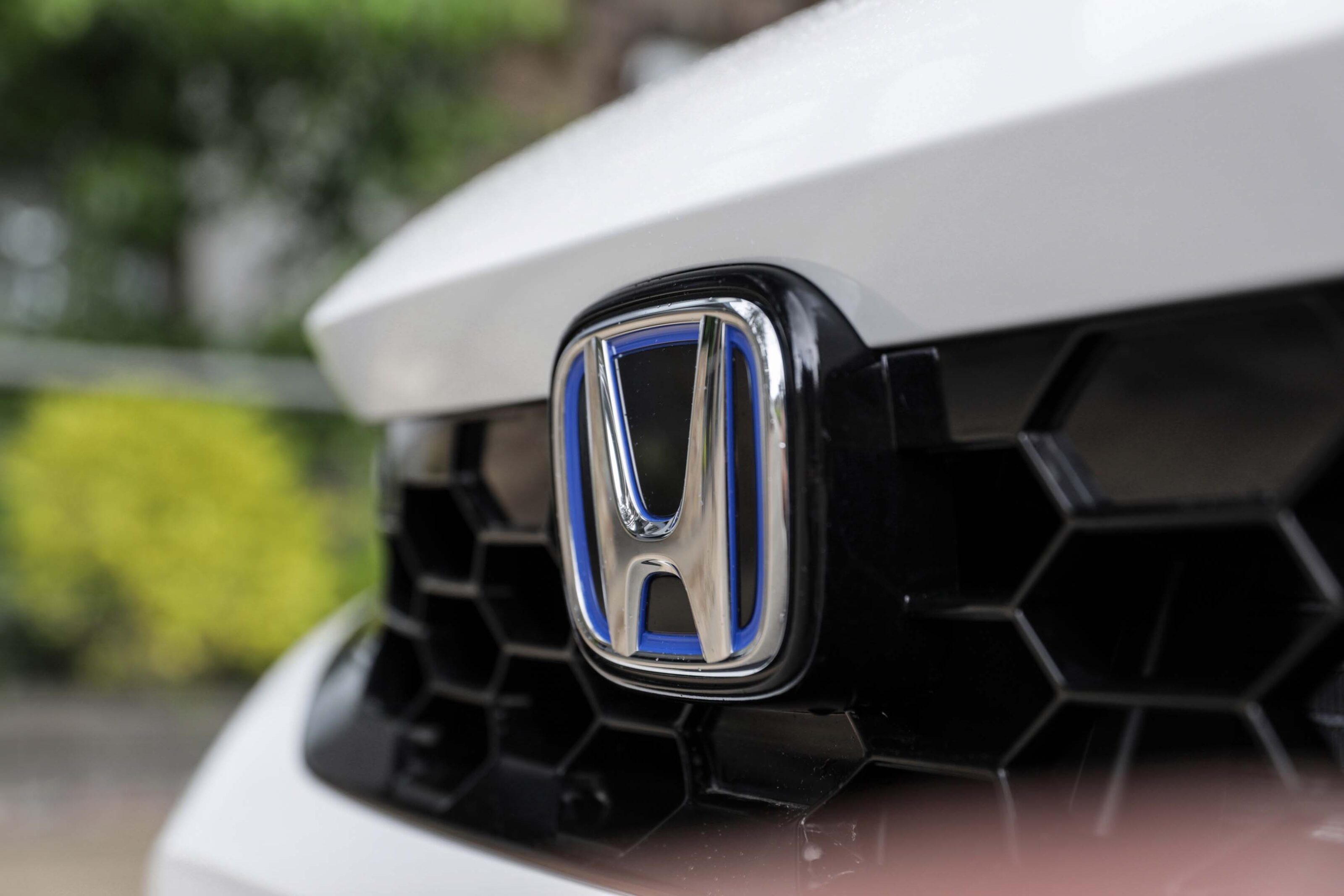
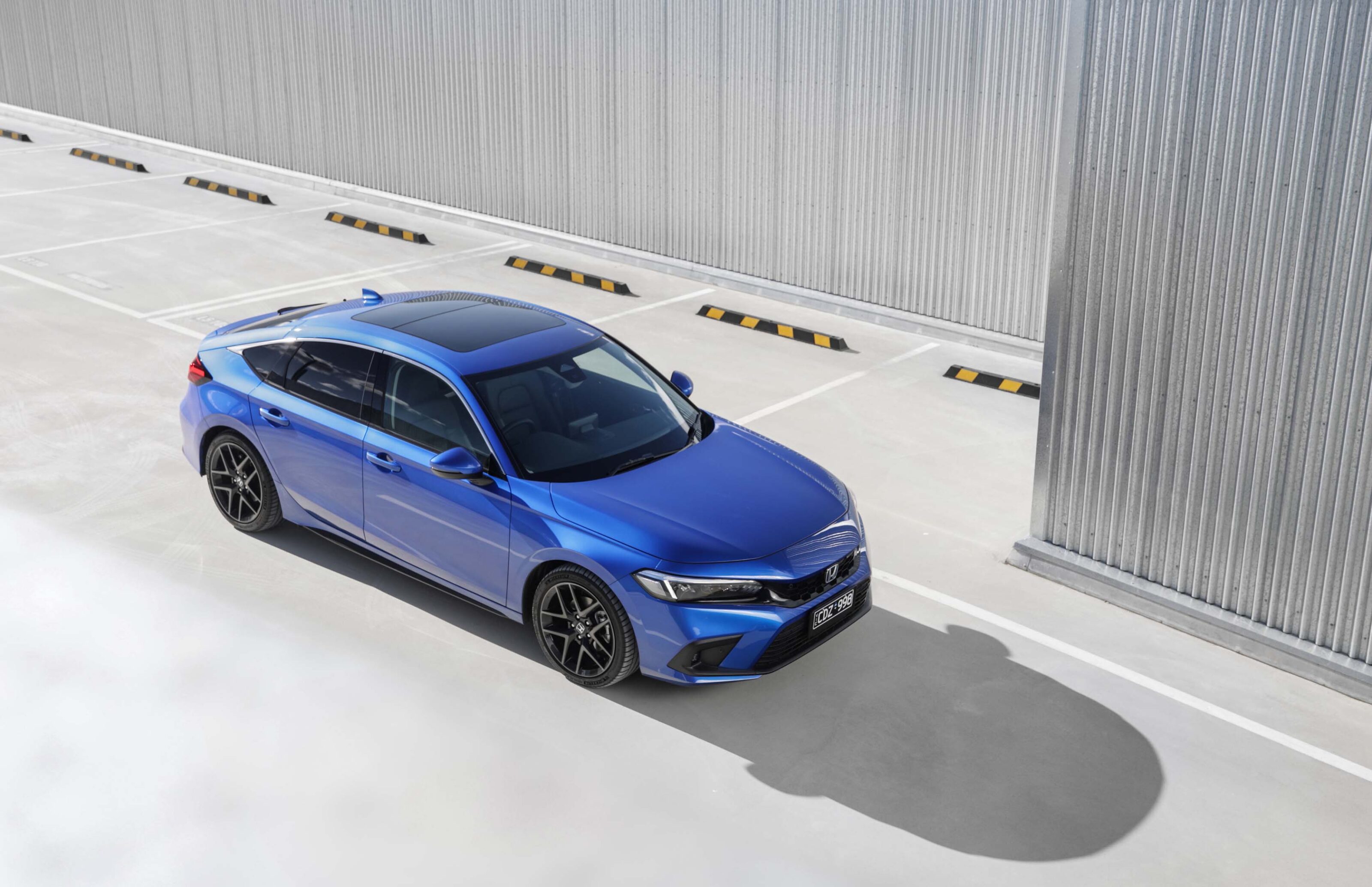
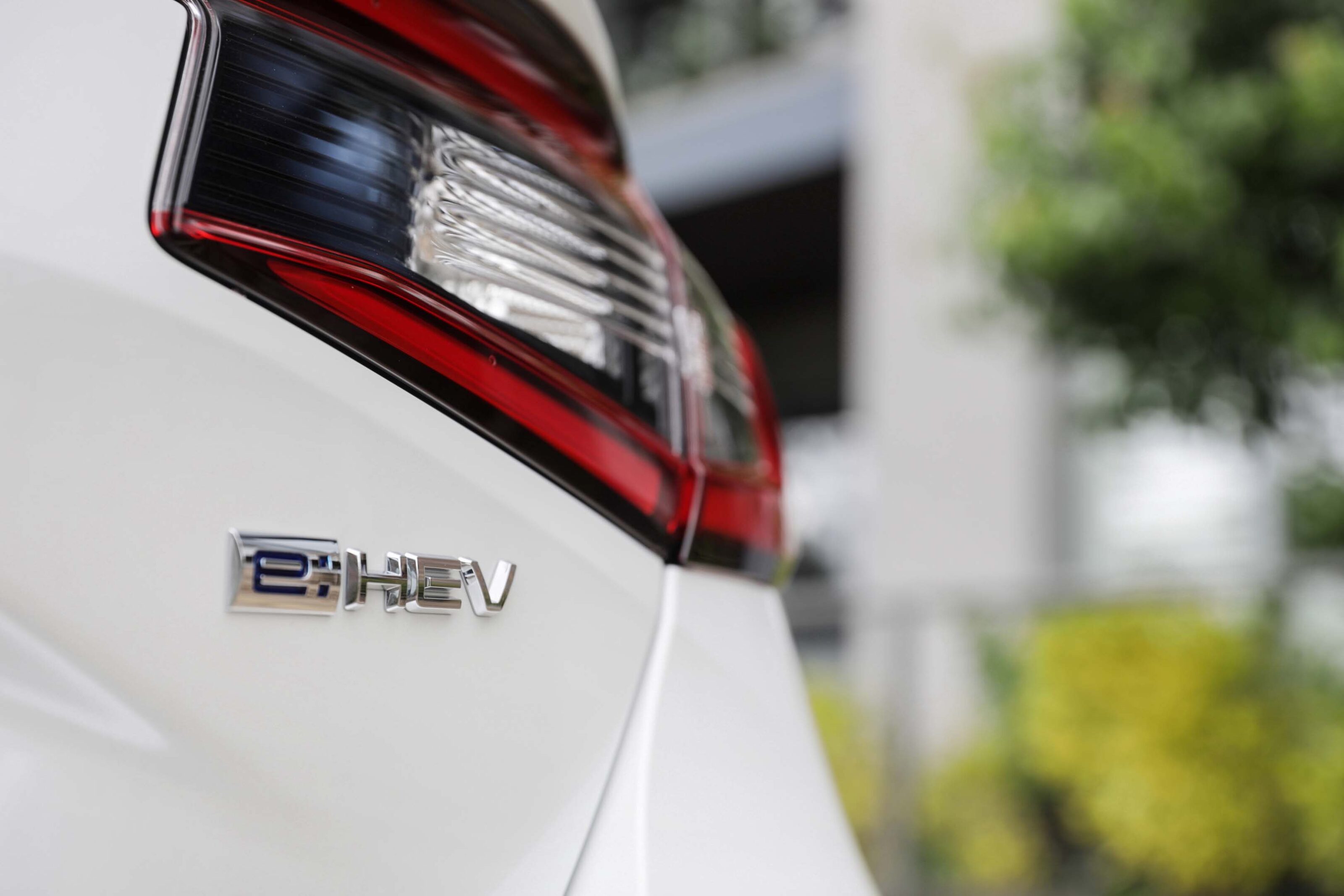
That’s exactly what this 11th-generation Civic delivers. It’s not immediately apparent that it’s a hybrid at all. The subtle blue ring around the Honda logo on its bonnet and boot will be lost on most observers. Likewise, the hidden single tailpipe and the brake discs that are an inch bigger in diameter will only be apparent to the most ardent marque tragics.
So jump right in. For what looks like a straightforward car, there’s a heck of a lot to cover.
JUMP AHEAD
- How much is it, and what do you get?
- How do rivals compare on value?
- Interior comfort, space and storage
- What is it like to drive?
- How is it on fuel?
- How safe is it?
- Warranty and running costs
- VERDICT
- Specifications
How much is it and what do you get?
The ‘TL:DR’ version? $55k, and a lot.
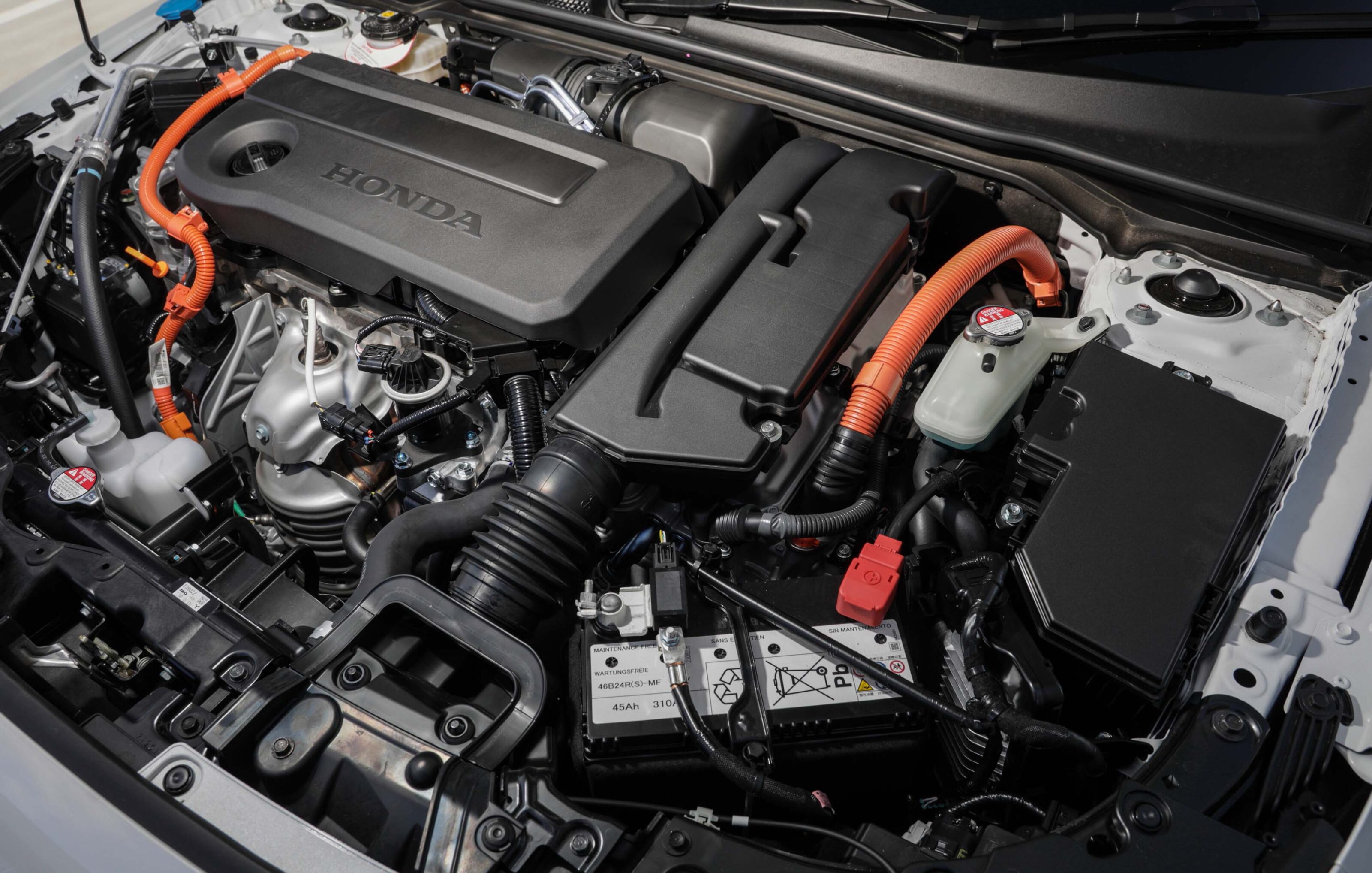
Firstly, that’s a drive-away price which is, in case you’re wondering, about seven grand more than the standard non-hybrid Civic VTi LX. But where that car’s powered by a 1.5-litre engine good for 131kW and 240Nm, the hybrid gets a more relaxed 2.0-litre unit that generates 135kW and 315Nm. And it has a few tricks up its sleeve beyond the headline stats.
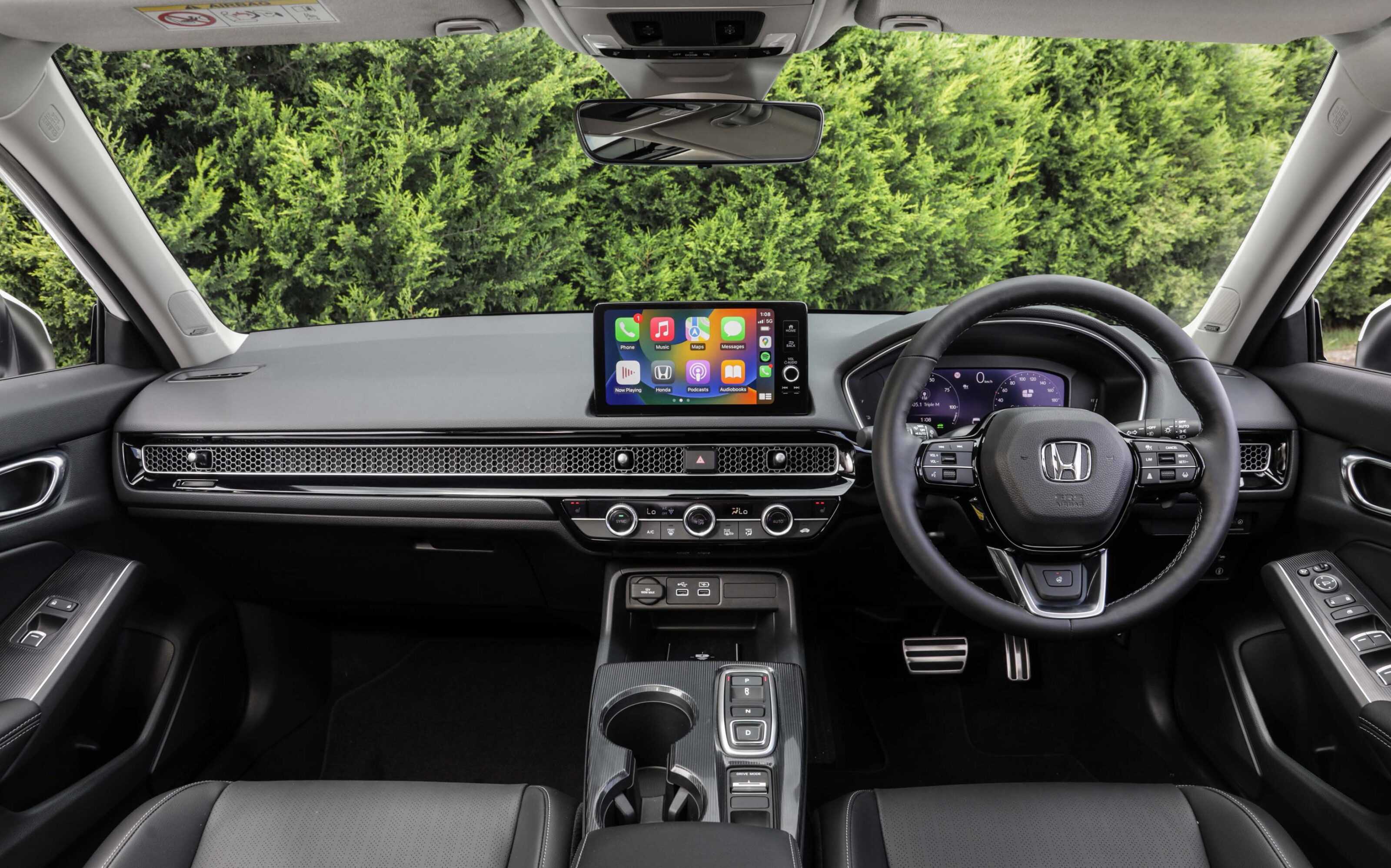
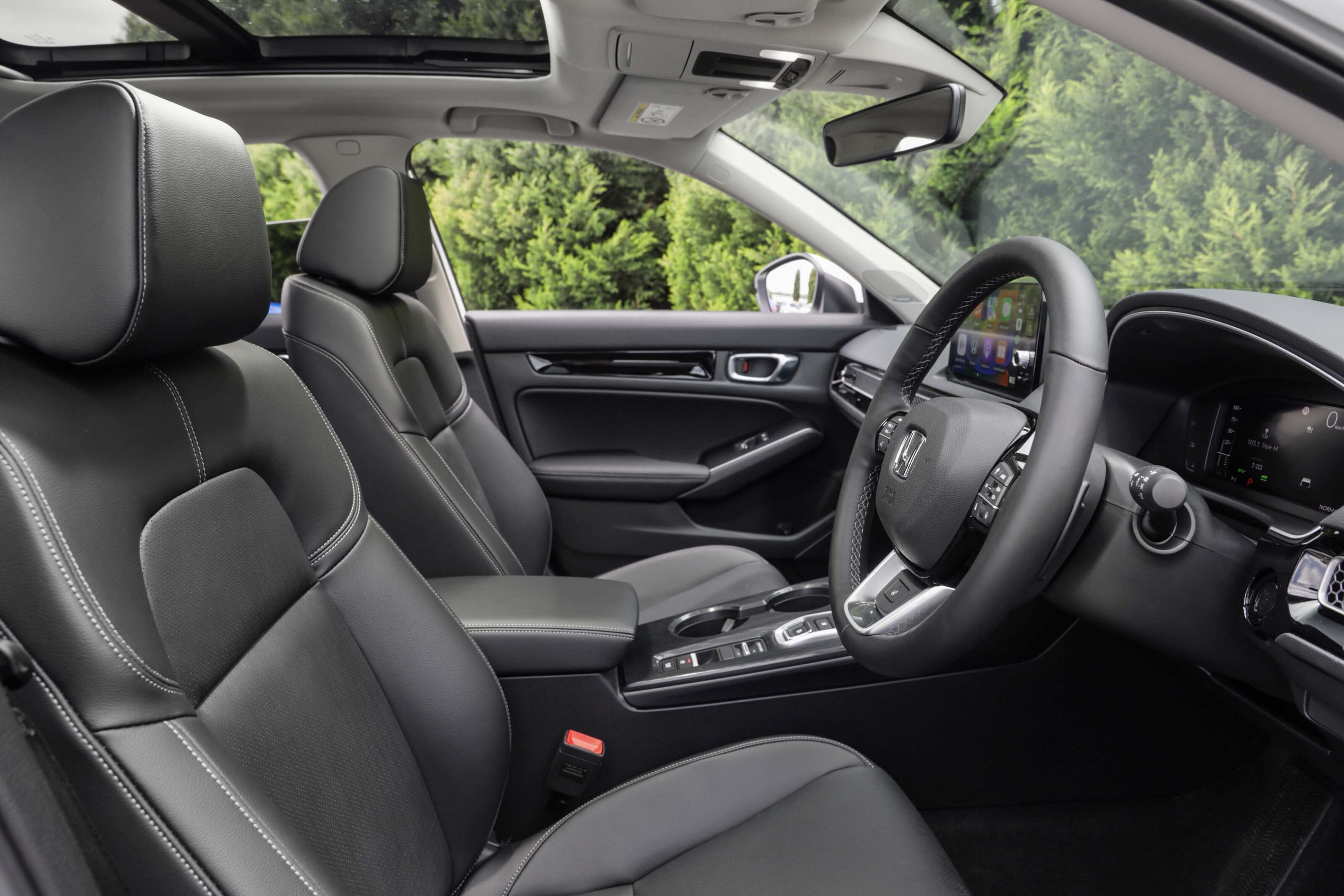
Jump inside and despite the two cars both wearing LX badges, the hybrid just gets more kit. It’s subtle stuff, but cast your eye around the cabin and you’ll notice a panoramic glass sunroof, heated steering wheel, two rear USB slots versus the petrol car’s one, eight-way power adjustment for the front seats, black leather-appointed upholstery, extra coat hooks, white contrast stitching, mood lighting and a smart keycard.
Possibly the most intriguing feature is buried in the guts of the e:HEV’s wiring. The Telematics Control Unit doesn’t sound immediately thrilling, but this box of gadgetry allows the integration of the Honda Connect platform.
This enables Civic e:HEV owners to download an app to their phones which allows all kinds of Tesla-style remote functionality. Aside from the usual functionality like remote starting the vehicle, climate pre-conditioning and headlight flashing to show where your car is in an airport car park, Honda Connect is capable of a bunch of really advanced features.
Let’s say you’re lending the car to your kids when you’re on holiday. You can geo-fence an area and the app will let you know if the car strays outside it. Or if it exceeds a selected speed for a selected amount of time.
You can track the car if it’s been stolen. If it’s been involved in an accident, it can automatically let the emergency services know how many people were in the car, and the severity and type of the incident.
The car can send a log file to your local Honda service centre if a warning light appears on the dash, so they’ll know what’s happening with the car before it even arrives with them, potentially saving you time and money. If you’re heading out on a journey, you can check the vehicle’s fuel level before you go and budget time for a trip to the servo accordingly.
Left the dome light on when you were in the car? It’ll even alert you if the battery level is dropping to save you the hassle of a flat battery in the morning. There’s a stack of other functionality like trip logging, driver behaviour reporting and so on.
The best part is that Honda offers a complimentary five-year subscription to the service. In other words, it’s good for as long as your warranty and roadside assist packages.
Elsewhere, the Japanese-built Civic e:HEV LX gets a 10.2-inch driver information display to back up the 9.0-inch centre screen. The Apple CarPlay installation is wireless but the Android Auto installation requires some sort of umbilical connection. The screen is slick and relatively easy to use and marshals a punchy 12-speaker Bose audio system.
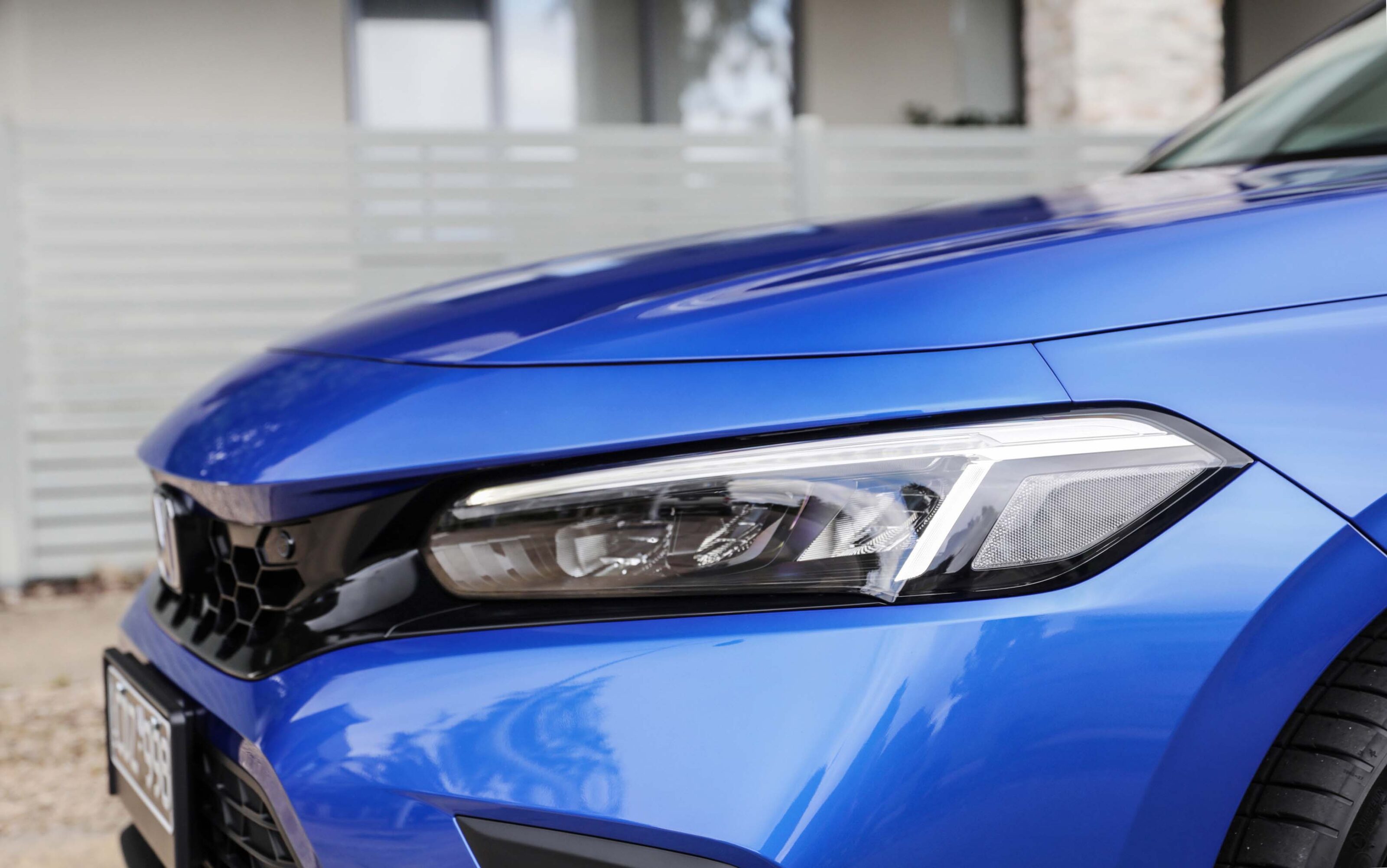
Just three paint colours are offered. Platinum White pearlescent is standard and there are two premium paint finishes: Crystal Red metallic and Crystal Blue metallic.
How do rivals compare on value?
Before we answer that question, we have to get settled on quite what we’re dealing with here.
Mentally position the car as a Honda Civic and all of your neural heuristics are cueing you into a smallish hatch that sits near the top of its mainstream bracket. Then you’re told that it’s $55K drive-away and you start talking about how cheap compact hatches were back in the day before segueing effortlessly into how policemen now look so young and how wonderful trains used to be.
Thing is, the Civic isn’t that sort of car anymore. Its footprint on the road is bigger than an E39 BMW 5 Series. And the finish inside is as good or better than the opening models in BMW, Audi or Mercedes-Benz’s range. And you can bet that the complexity of this car, the sheer amount of intellectual property hardwired into it, trumps any of those brands’ entry-level offerings.

Direct rivals are few, but a 131kW/205Nm Lexus UX250h Luxury retails at $52K-odd plus on-road costs, so lineball with the price of the Civic for something smaller inside and less powerful.
The Lexus is an SUV though, and Honda already offers the $47K HRV e:HEV L if you want to sit a little higher.
Given the outgoing Toyota Prius i-Tech is nearly $46K before on-road costs and fronts up with just 90kW/142Nm and a cabin that offers nothing like the space and richness of finish, the Civic doesn’t look bad value.
Probably the most intriguing rival is the somewhat sportier Cupra Leon VZe, a 180kW/400Nm plug-in hybrid with 51km of electric range that retails at just over $60K before on-road costs. There’s certainly a strong argument to be made for the Spanish car, but Civic owners will choose the e:HEV exactly because you don’t need to plug it in.
They don’t want their involvement in energy management to be that intensive. In that regard, there’s not a lot quite like it anywhere in the Aussie marketplace.
Interior Comfort, Space and Storage
As you’d expect for a car of its size, the Civic’s cabin feels generously cut.
The big glass sunroof robs a bit of headroom, so taller drivers may find themselves canted back a little further than expected in their seats, but it helps contribute to an airy feels inside, helped by the relatively low scuttle and lack of a shift lever or much in the way of dashboard clutter.
There are a couple of big cup holders on the centre console and a deep bin immediately aft, with slimmish door pockets and a big glove box available for oddments storage.
The central screen juts up from the dash top, leaving a slot of visibility below the rear-view mirror, which could be a bit of an issue for shorter drivers. Likewise, the control to engage reverse gear isn’t a push button like drive or park. Instead, it’s a sprung tab that you have to claw at with a fingertip, which may not prove ideal for ladies with immaculate manicures.
Mini match-up: Size and boot space
| Civic hatch | Golf hatch | Corolla hatch | Audi A3 hatch | |
|---|---|---|---|---|
| wheelbase (mm) | 2733 | 2636 | 2640 | 2630 |
| total length (mm) | 4560 | 4284 | 4375 | 4350 |
| total width (mm) | 1802 | 1789 | 1790 | 1816 |
| boot space min/max (litres) | 409 | 374 | 217 | 380 |
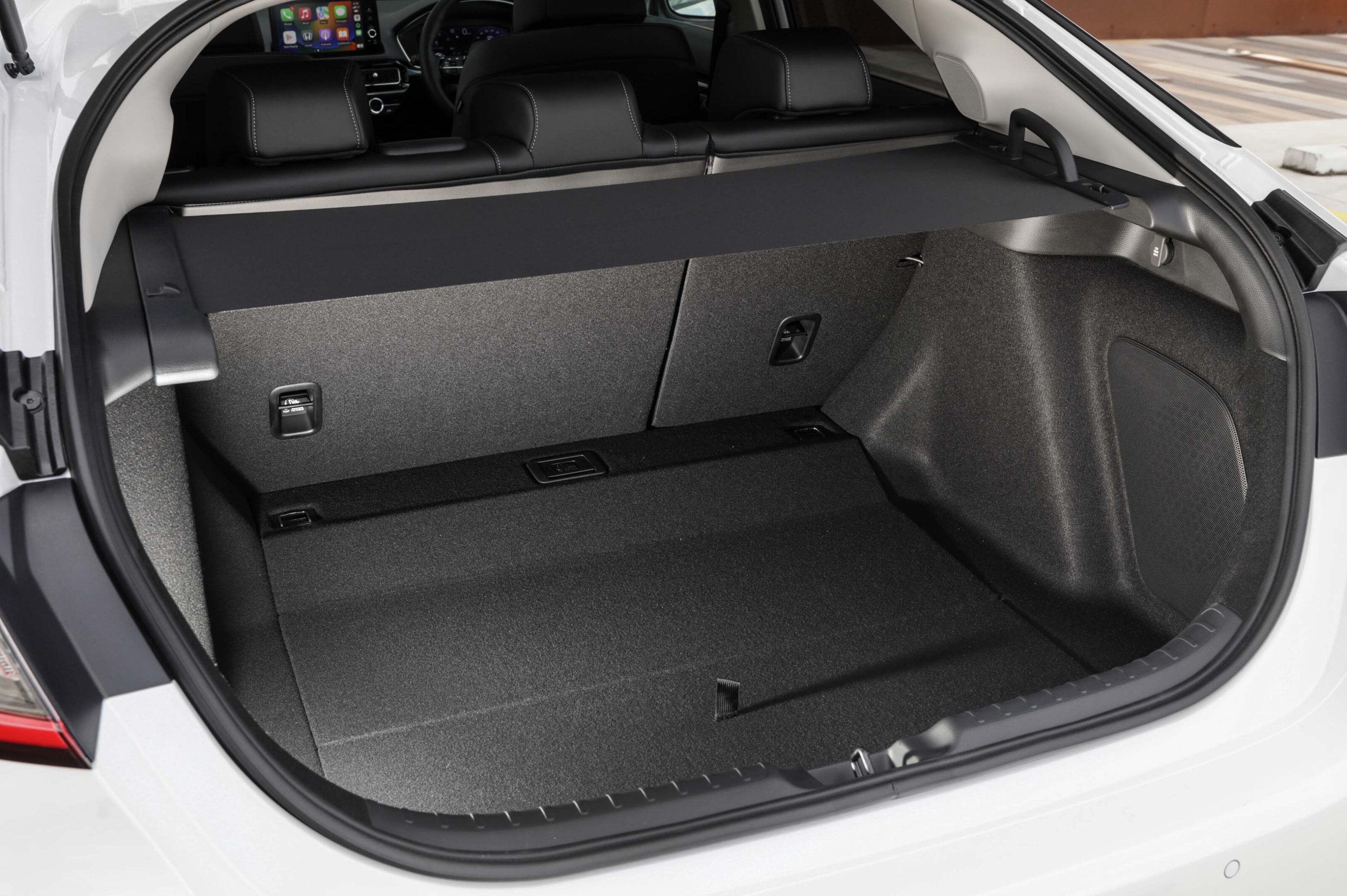
Moving round to the back, the higher floor houses the battery pack, so whereas the petrol Civic VTi LX features a 404-litre boot with 45 litres under the floor, the e:HEV LX makes do with 404 litres and a mere five litres underfloor.
That’s still hardly catastrophic given a Golf delivers 374L of space and a Corolla hybrid a mere 333L. I’m not going to totally spoil the surprise here, but wait until you get to play with the clever parcel shelf and you’ll wonder why nobody else hadn’t hit upon Honda’s novel solution earlier.
Overall finish is very good with decent soft-touch plastics plus an ornate hexagon pattern running across the dash which might be a bit of a nightmare to keep free of dust.
While it doesn’t look as glitzy as a Mazda, functionality is excellent and the seats, both front and rear, are supportive and comfortable. Kids are catered for with three rear tethering points and two ISOFIX seat mounts on the outer positions.
What’s it like to drive?
The Civic e:HEV LX isn’t an enthusiast’s car. All it really needs to do is feel acceptably sprightly and reassuringly comfortable, and it’ll have fulfilled virtually all of the dynamic benchmarks it needs.
| Model | Honda Civic e:HEV LX |
|---|---|
| Engine | 1993cc 4-cyl, dohc, 16v, dual-motor hybrid |
| Power & torque | 135kW / 315Nm |
| Transmission | continuously variable |
| Weight | 1497kg |
| Economy | 14.2L/100km |
| 0-100km/h | 8.1 sec (claimed) |
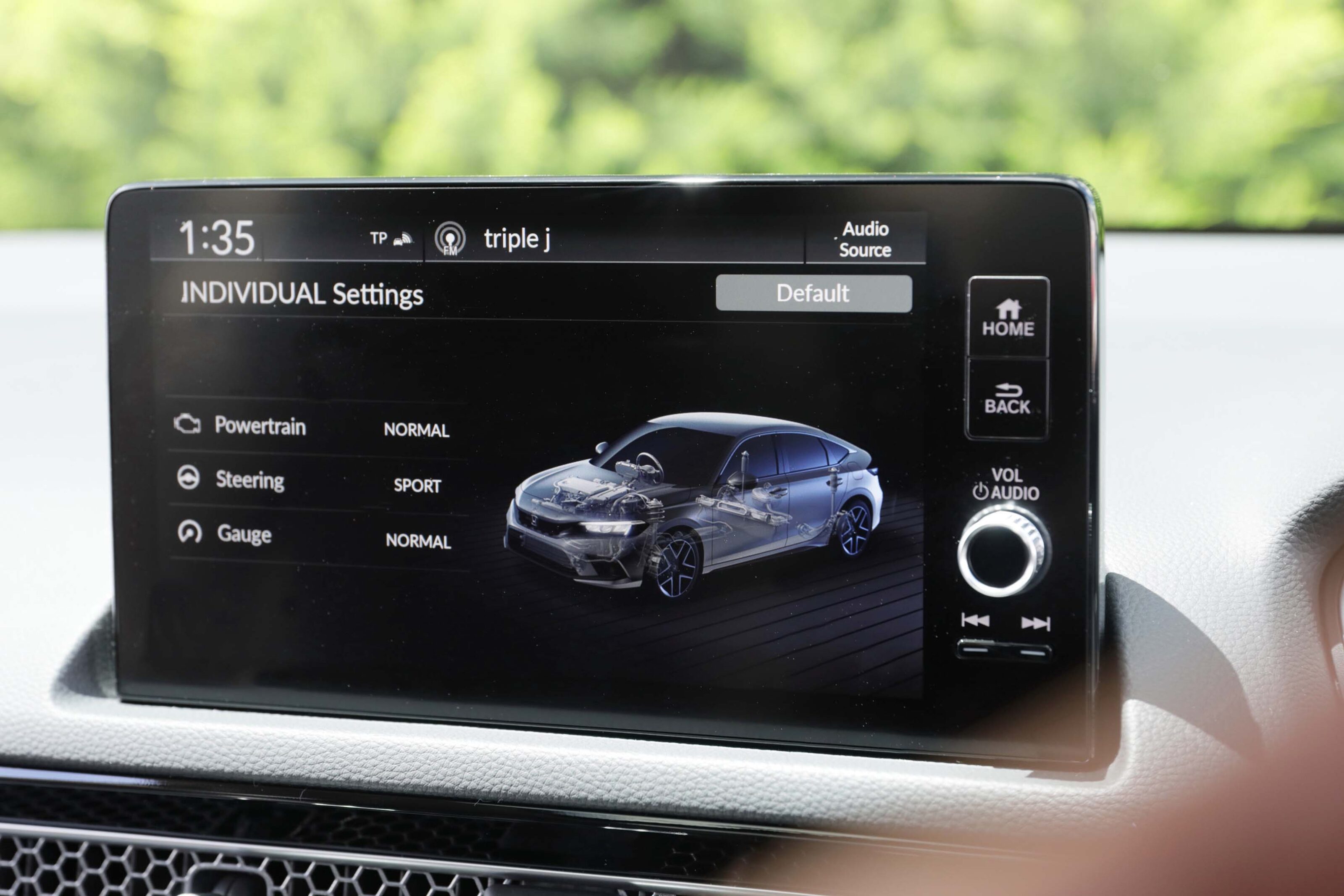
Its hybrid drive system is pleasantly fire-and-forget. There are drive modes, which cycle through Eco, Normal, Sport and Individual, but no dedicated EV-only mode. The 2.0-litre petrol engine spends much of its time powering the electricity generator, but drives the wheels directly at freeway speeds, largely because that’s the most efficient method.
That’s key. The Civic e:HEV ruthlessly focuses on efficiency, eschewing Toyota’s complex planetary gearbox architecture in favour of a fixed-gear electronically controlled CVT, yes those three magic letters that make most drivers’ hearts sink to their boots.
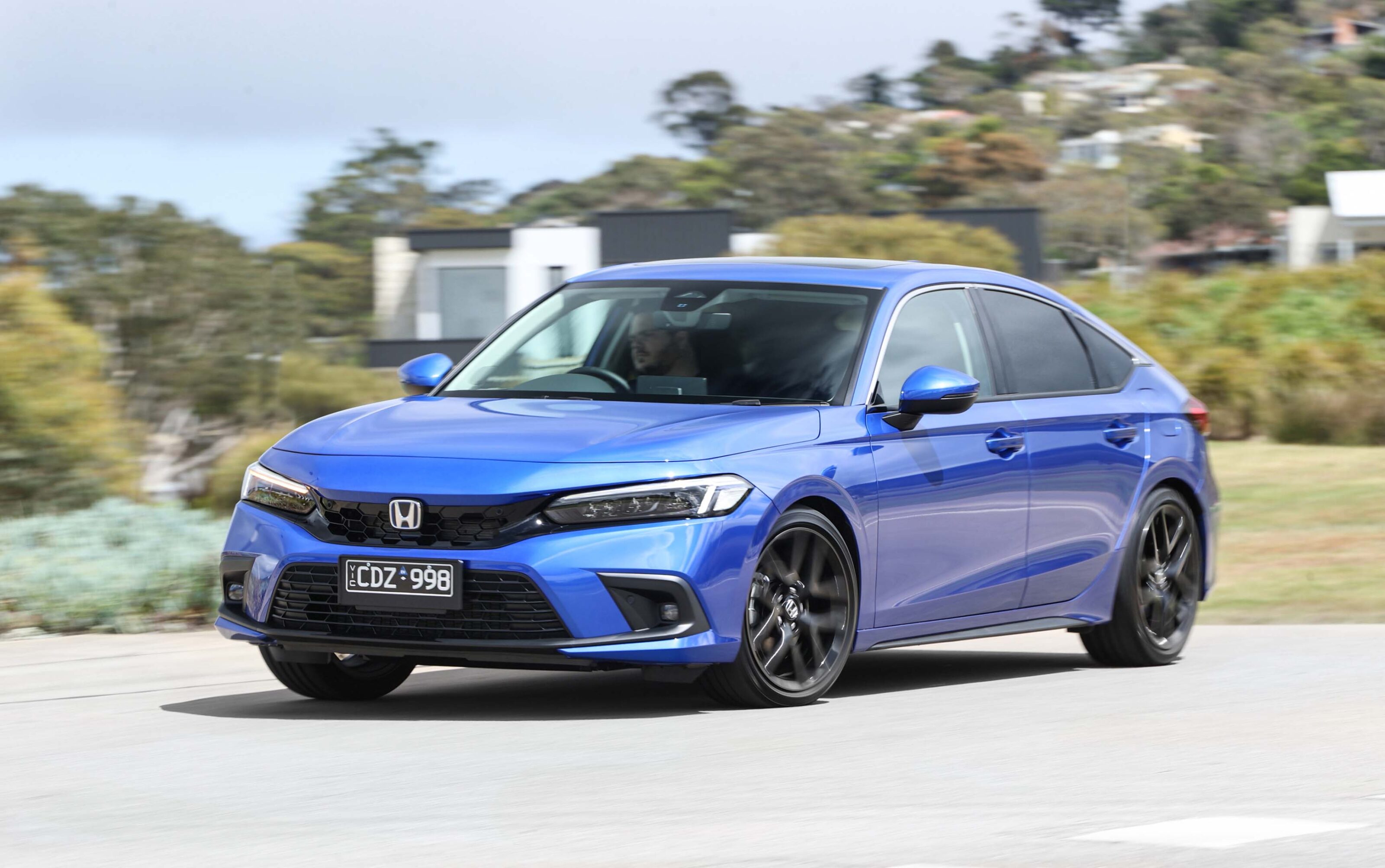
While this continuously variable transmission is a better example of its ilk, there are still a few occasions when you’re pressing on that the powertrain starts mooing like a Wookiee being euthanised but for the most part it’s a cultured, refined and pragmatic set-up.
The 2.0-litre direct-injection Atkinson cycle engine is an inoffensive unit and partners with the lithium-ion battery seamlessly. Against the clock, it nets a 0-100km/h time of 8.1 seconds, making it a good deal brisker than the 1.5-litre petrol.
A set of wheel-mounted paddles sit unobtrusively like little plastic ears. Instead of being used to change gear, they’re pressed into duty to adjust the amount of regenerative braking used to replenish the battery.
Unfortunately, the system doesn’t seem to wholly trust its operator, as after a short while, the regen will quietly snick back to its middle setting. As far as I could establish, the only way to stop it from reverting was to keep it in Sport mode, which makes the steering and throttle mapping a bit too exuberant for the character of the car.
While this CVT is a better example of its ilk, there are still a few occasions when it starts mooing like a Wookiee being euthanised
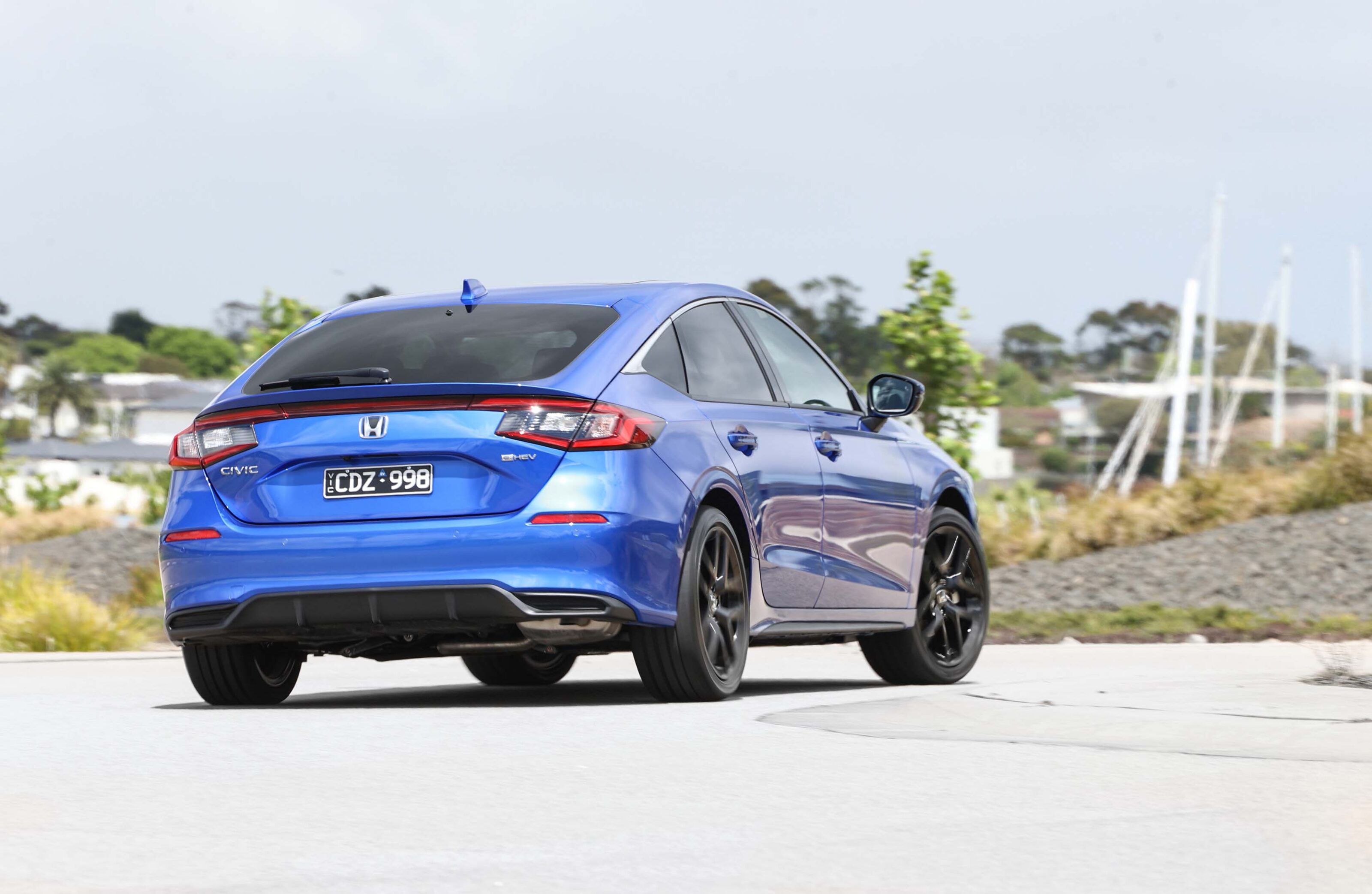
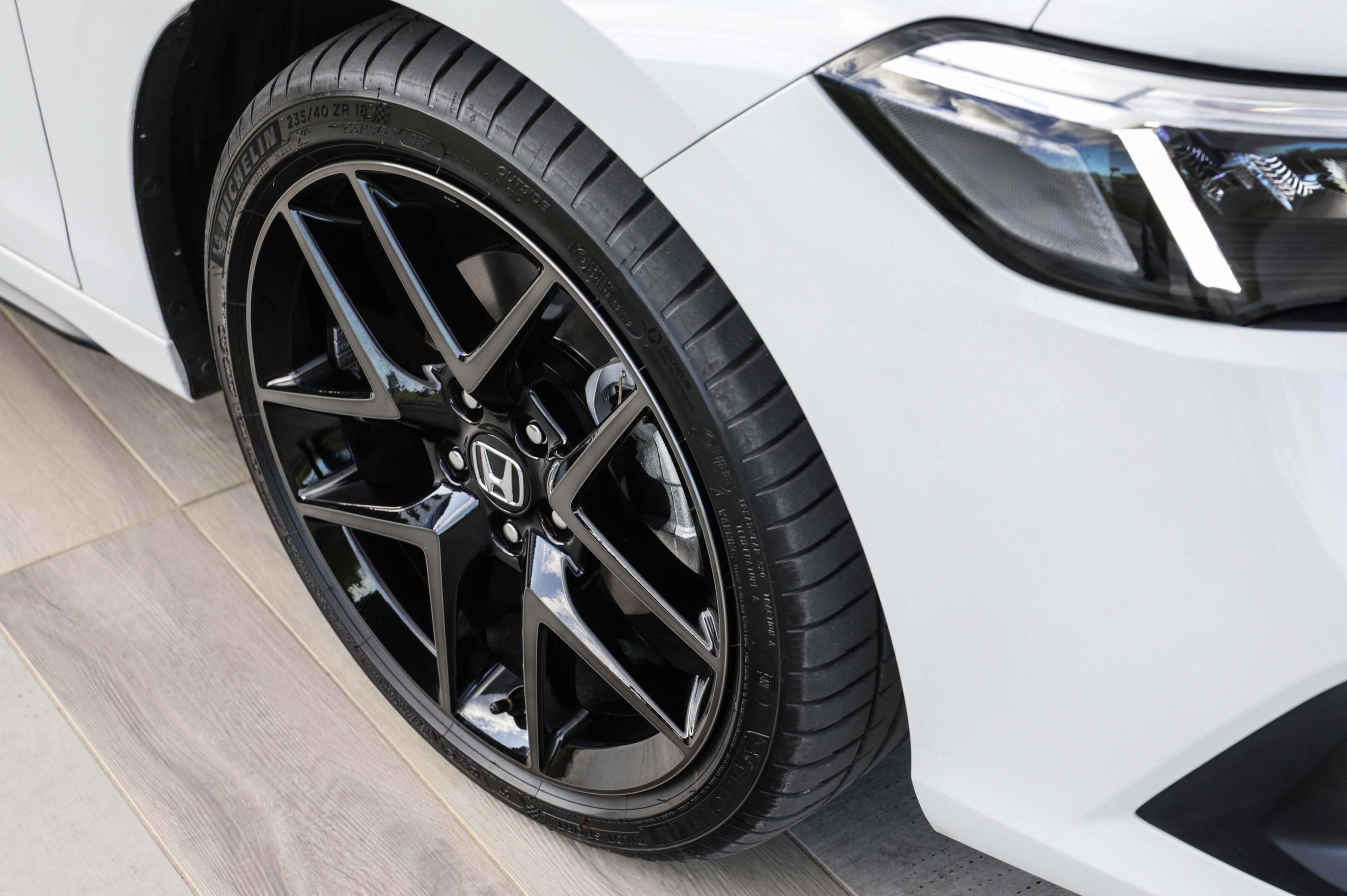
Really get after the Civic down a challenging country road and you’ll discover a fundamentally excellent chassis balance. Front-end grip is good, and Honda has sensibly fitted brake discs that are an inch bigger front and rear to cater for the additional 128kg of heft that the 1497kg e:HEV wields. Honda’s fitment of extremely good 235/40 R18 Michelin Pilot Sport 4 tyres is a very welcome surprise.
Body control in both pitch and roll is better than you’d expect, although there is a little bit of vertical heave. The ride quality is just the comfortable side of busy and only bigger ruts upset its composure.
The steering’s not the most communicative, but it is accurate. Honda has worked at improving overall refinement in the cabin, but there’s still a bit of bump and thump that enters the passenger cell from the rear suspension.
Really get after the Civic down a challenging country road and you’ll discover a fundamentally excellent chassis balance
Related video
2022 Honda Civic hatch petrol
How is it on fuel?
Honda wheeled out an original Insight for the launch of the Civic e:HEV and it was illuminating that this two-seat exotic lightweight was a mere litre per 100km more economical than the Civic – which, when parked next to the sylph-like 860kg Insight, looked like a behemoth.
The 2023 Civic hybrid’s combined fuel economy figure is quoted at 4.2 litres per 100km, which feels about right based on our usage on mixed roads.
A petrol-engined VTi LX, by way of comparison, sups 6.3L/100km, which means that over a typical 15,000km year, the hybrid owner will consume 630 litres of fuel, whereby the petrol model will drink 945 litres.
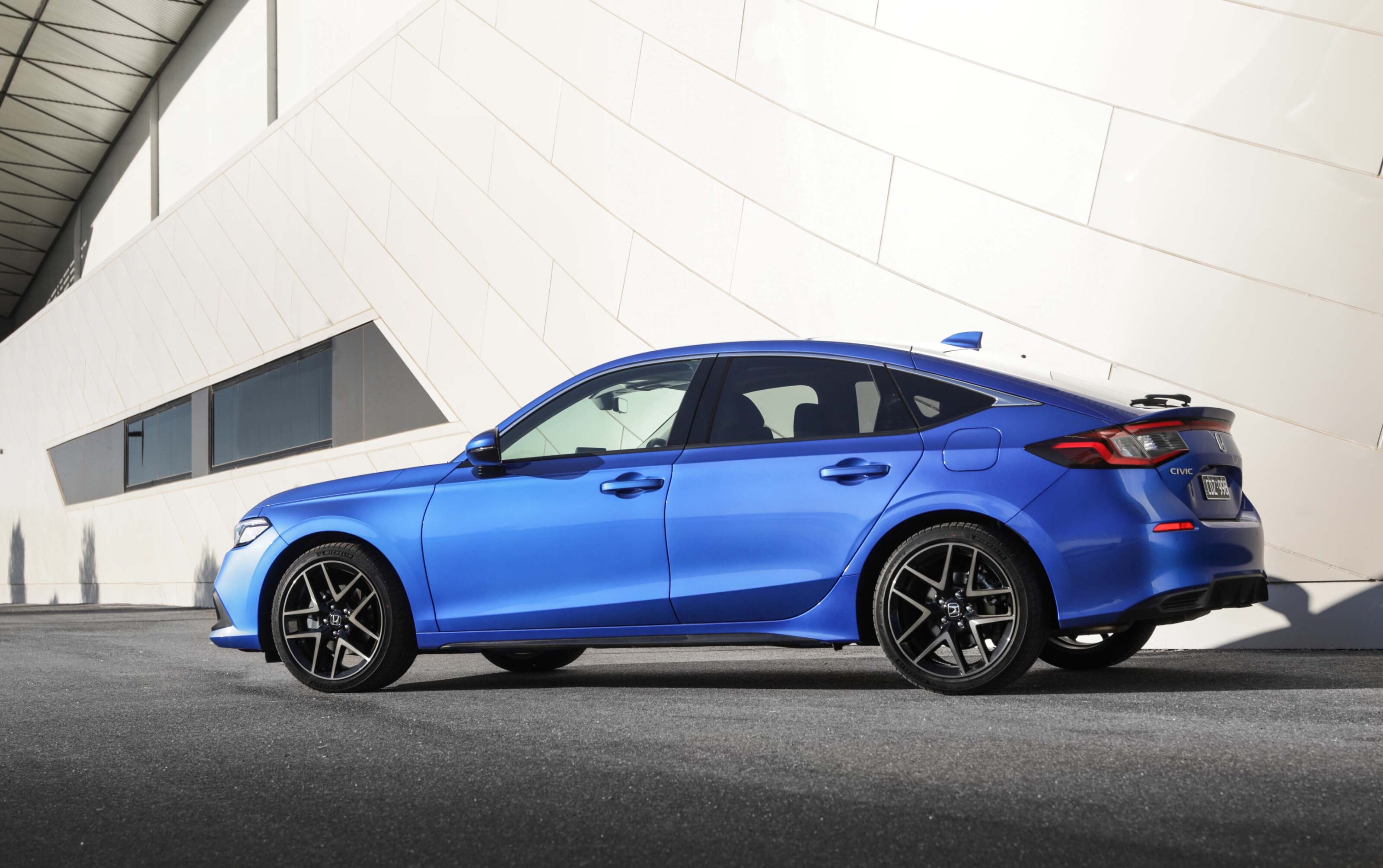
Extend that over a five-year ownership period and, for the sake of argument, pitch petrol prices at $2 per litre and the hybrid nets a $3150 saving in fuel alone.
You then need to figure out whether the additional power, equipment and utility of Honda Connect functionality is then worth the residual $4K premium over the base car. For my money, it probably is.
The fuel tank is a compact 40 litres, but given the economy of the e:HEV, it still offers a very respectable touring range on each fill.
How safe is it?
Because its safety gear is different to that of the Civic VTi hatch, the e:HEV can’t just piggyback on that car’s safety rating.
Discussions are ongoing with ANCAP at present to have the car rated, but rest assured, it’s certainly not short on safety gear.
The hybrid even includes some kit not fitted to the entry-level car including a centre front airbag, rear airbags that pop up from the outboard seat cushion bolsters, traffic sign recognition, an intelligent speed limiter and an acoustic vehicle alerting system.
Here’s a more exhaustive rundown of the safety kit provided.
| ABS with electronic brakeforce distribution | Intelligent speed limiter |
| Acoustic vehicle alerting system | Lane keep assist |
| Adaptive cruise control with low-speed follow | Lane-departure warning |
| Auto emergency braking | Multi-angle reversing camera |
| Blind spot information system | Parking sensors front and rear |
| Brake assist system | Rear cross-traffic alert |
| Child-proof rear door locks | Road departure mitigation system |
| Driver attention monitoring | Seatbelt reminder on all seats |
| Emergency stop signals | Traction and stability control systems |
| Forward collision warning | Traffic jam assist |
| High beam support system | Traffic sign recognition |
| Hill-start assist | Front, centre front, rear side, side front, full length curtain and front knee airbags |
Warranty and running costs
Honda supplies the Civic e:HEV with a five-year, unlimited-kilometre warranty.
That also includes a five-year subscription to Honda Connect, five-year roadside assist cover and five years of what Honda calls Low Price Servicing. Sceptical?
This covers most routine service items for an asking price of $125, which doesn’t seem bad. What’s more, the deal is transferrable if you sell the car with any subsequent services up to 66 months or 55,000km passing on to a new owner.
VERDICT
$55K seems a steep ask, but cast around for what else offers so much for this price and the results are pretty thin.
The Honda Civic e:HEV LX is a likeable and well-engineered family hatchback. The hybrid tech is unobtrusively integrated, it drives well, is comfortable, well-equipped and well-finished. Although $55K seems a steep ask, cast around for what else offers so much for this price and the results are pretty thin.
This isn’t a Corolla hybrid rival. The Civic is a far bigger car and is fully 50 percent more powerful. Once you get comfortable with that, the rival set shrinks quite markedly.
Its biggest problem is grabbing the attention of buyers in a marketplace that’s congested not with direct rivals but with vehicles that offer different but nonethless convincing claims on your attention.
That’s why the sales targets for this car are modest and its buyers will be those who have taken the time to understand that here is a car with very few weak points and a certain cerebral appeal that isn’t always immediate.
We have no doubt that the Civic e:HEV LX would be a delightful car to live with. It does virtually nothing that’s annoying or gauche. There’s a knowing restraint to its ingenuity and a polish to its engineering that’s a trademark Honda flex, albeit a subtle one.
The family hatch market is currently on its knees and entrants are falling with depressing regularity. This 11th-generation Civic is a gem, but we’d love to see a twelfth.
However, that’ll only happen if buyers recognise a product that works, and works well, without requiring a megaphone to advertise its qualities.
Perhaps it’s time to recognise intrinsic merit once again.
2023 Honda Civic Hybrid: FAQ
| Model | Honda Civic e:HEV LX |
|---|---|
| Engine | 1993cc 4-cyl, dohc, 16v, dual-motor hybrid |
| Max power | 135kW @ 5000-6000rpm |
| Max torque | 315Nm @ 0-2000rpm |
| Transmission | continuously variable |
| Weight | 1497kg |
| Economy | 14.2L/100km |
| 0-100km/h | 8.1 sec (claimed) |
| Price | $55,000 (drive-away) |
| On sale | Now |
Snapshot
- European-made EV batteries must be recyclable by 2030
- Lithium must be at least 50 per cent recoverable and reusable by 2027
- Aims to reduce EUu2019s dependence on global supply chains and achieve net-zero
European Commission (EU) lawmakers have agreed to regulate new rules that will make electric vehicle batteries more sustainable across a car’s lifecycle.
From 2024, battery producers in Europe will need to declare the pack’s total circular carbon footprint – including responsible mining and sourcing, recycled content, performance and durability – to regulators and consumers.
All EV batteries must also be recyclable by 2030 to recover and repurpose expensive and supply-constrained materials – such as lithium, cobalt and nickel.
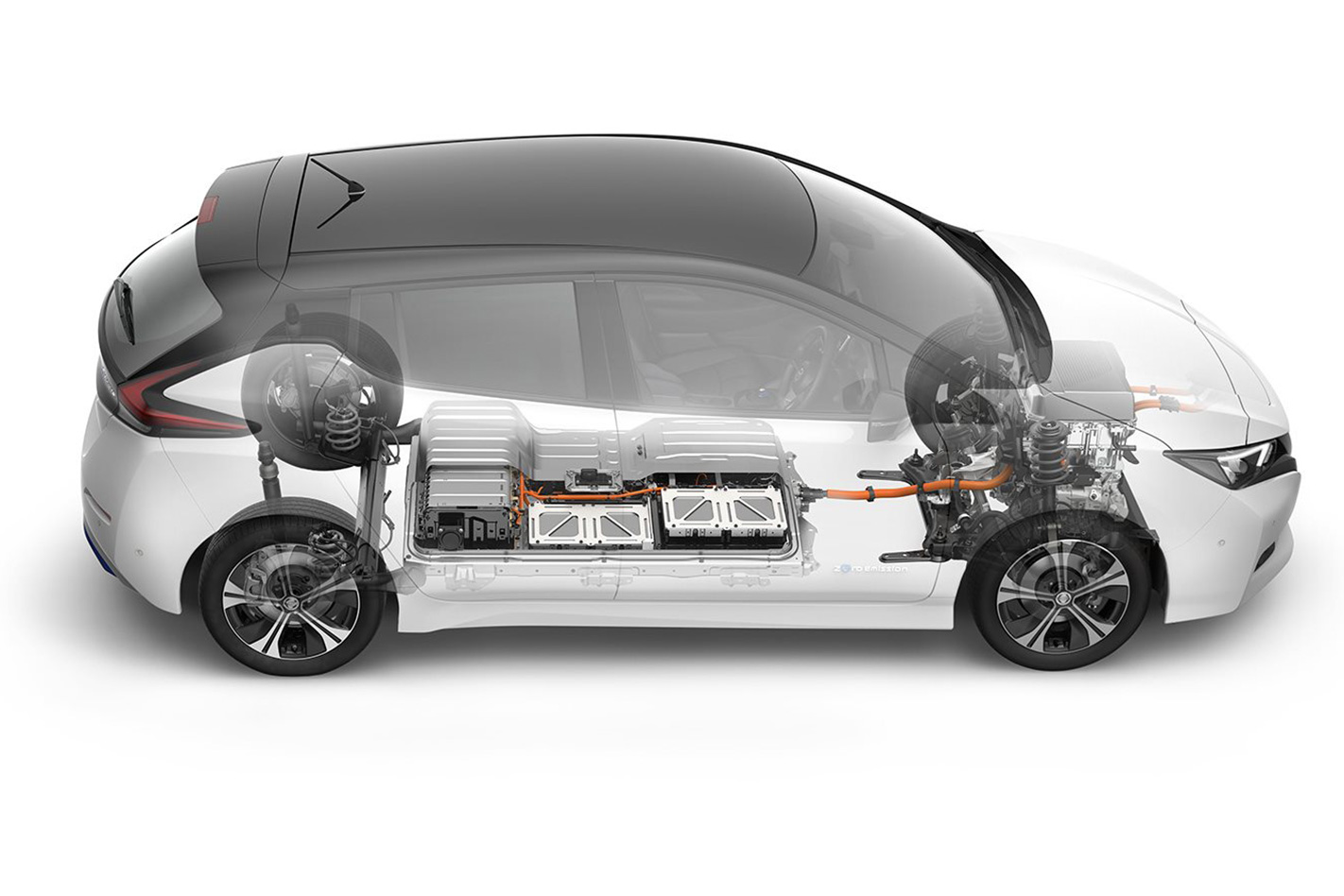
The recycling efficiency rate for lithium in particular is set at 50 per cent by 2027 and 80 per cent by 2031.
The new Batteries Regulation rules aim to promote developing a more competitive sustainable battery industry across the circular economy – collection, recycling and repurposing – as part of the EU’s push to reduce its supply chain dependence on other countries, expand EV battery production, and achieve carbon neutrality by 2050.
According to the Commission, global demand for batteries is increasing rapidly and is set to increase 14 times by 2030. While the largest EV battery makers currently hail from Asia, the EU could account for 17 per cent of the demand by the end of the decade.
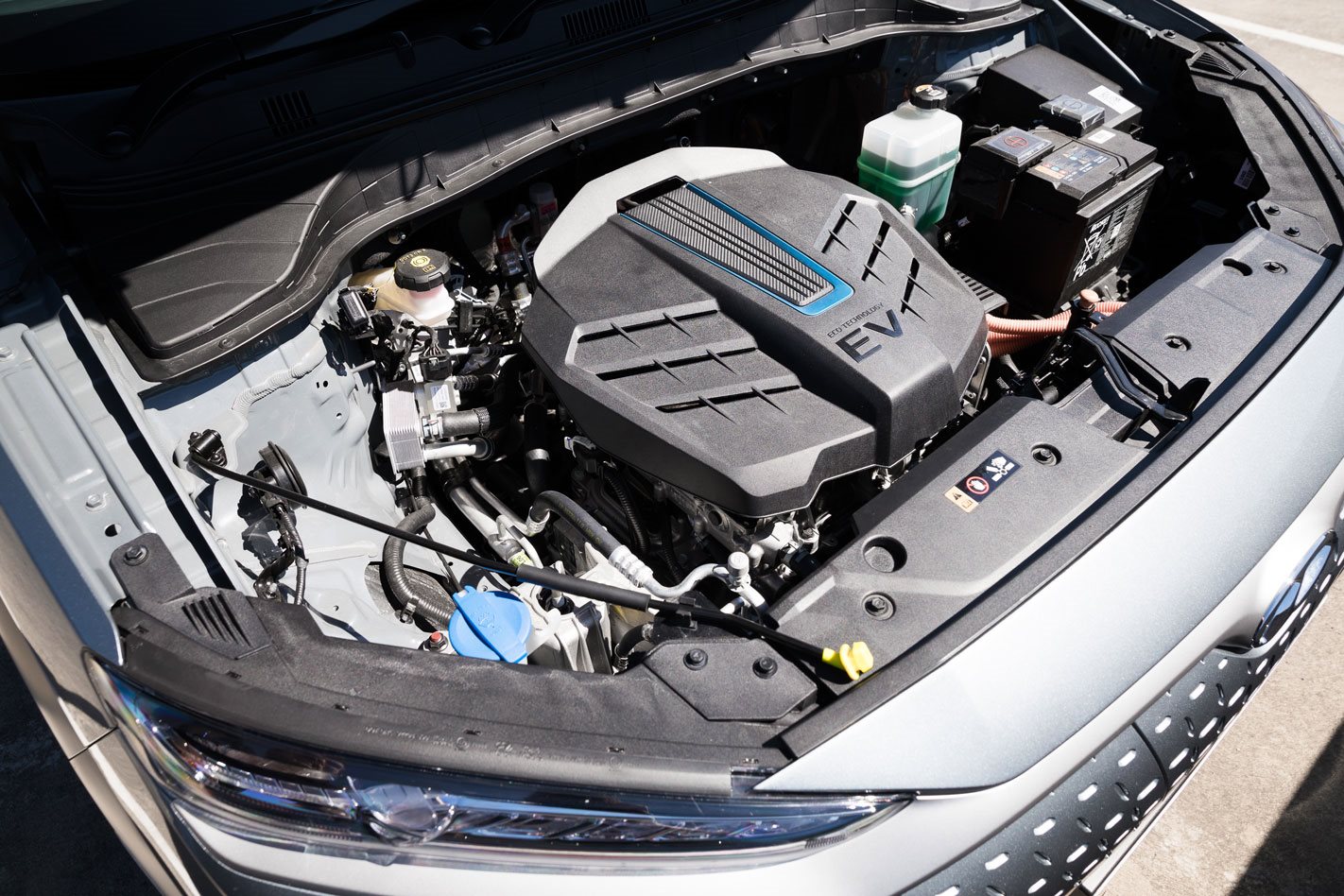
Mining rare and expensive materials essential for EV battery packs have been a key ethical concern, as it often is attributed to exploiting child labour in developing countries that have higher amounts of minerals available – such as the Democratic Republic of Congo.
“The batteries market is rapidly expanding, and with the new EU rules on batteries we will be better prepared for the huge changes ahead for the green and digital transitions our economy and society are undergoing,” Commissioner for Environment, Oceans and Fisheries, Virginijus Sinkevičius said.
“These rules will make us less dependent on imported oil and reduce the carbon footprint of our economy. This is very important in the context of Russia’s brutal war on Ukraine and the economic and geopolitical instability that it causes.
“We will increase the sourcing of precious raw materials such as lithium and cobalt from waste batteries, contributing to the security of supply of resources needed for the production of new batteries in a more circular economy.”
Batteries Regulation was proposed in 2020 as a stricter evolution of the 2006 Batteries Directive that applies to all sold in the EU, including portable ones in smartphones to those used in electric cars, e-scooters and e-bikes.
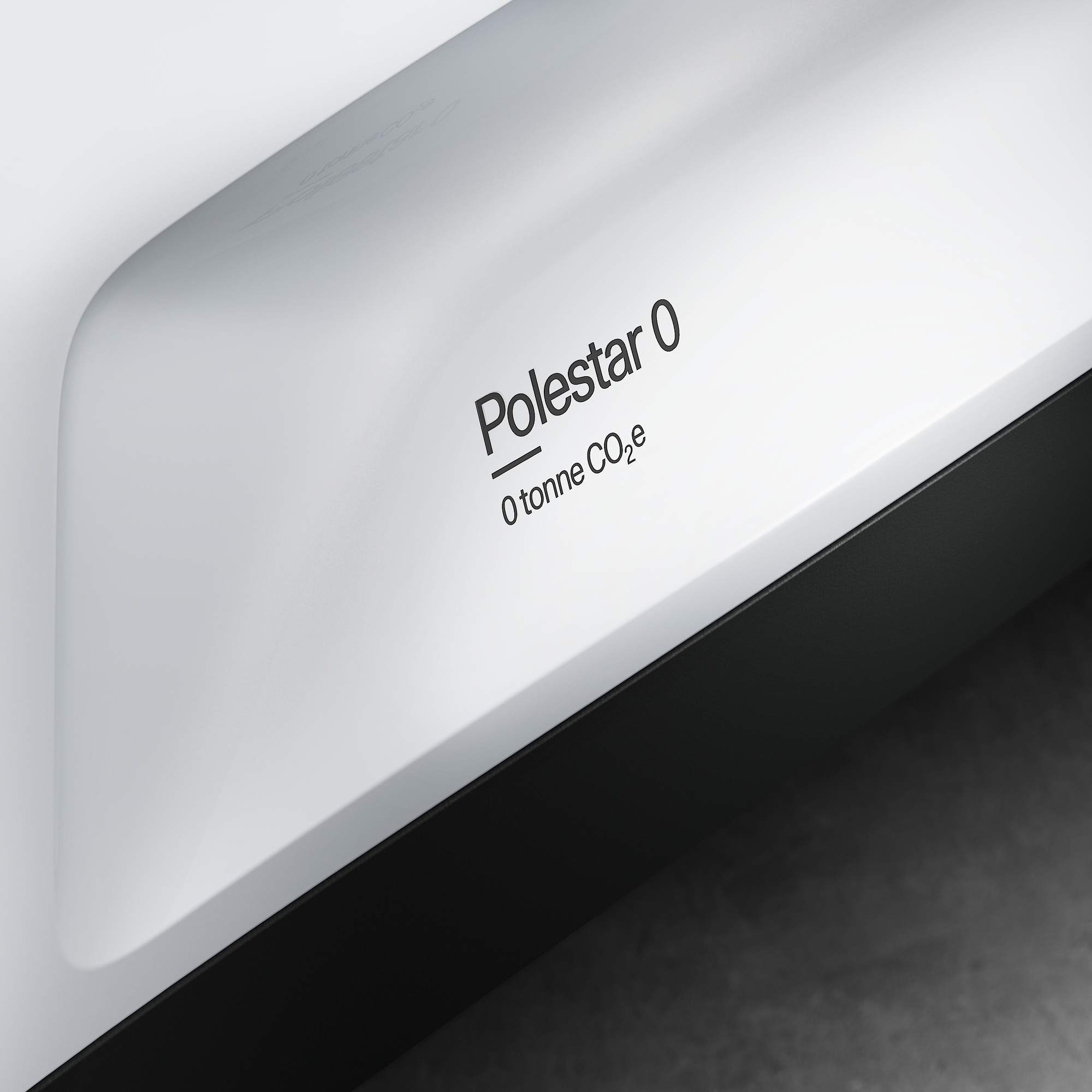
Notably, Swedish automaker Polestar is aiming to release its first carbon-neutral electric car, dubbed the Polestar 0, across its circular lifecycle by 2030.
Snapshot
- Next-gen GR86 reported to be a hybrid in order to meet emissions and fuel economy standards
- Current two-door coupe already needs 98RON fuel and drinks up to 9.5-litres per 100km
- Likely to adopt Toyotau2019s new design face
The Toyota GR86 and Subaru BRZ two-door sports coupe twins will reportedly be electrified to curb emissions regulations and boost power.
According to the Japanese publication Best Car, Toyota has started working on the third-generation GR86 using a modified underpinning from the Lexus IS sports sedan (now axed in Australia) and a hybridised three-cylinder turbo engine from the GR Yaris hot hatch or the hybrid system from the Toyota Crown flagship.
The GR86 Hybrid will help the company meet increasingly strict emissions standards globally, with Japan requiring a 32.4 per cent fuel economy improvement by 2030. The current Subaru-sourced 2.4-litre naturally-aspirated Boxer engine is rumoured to not meet that regulation.
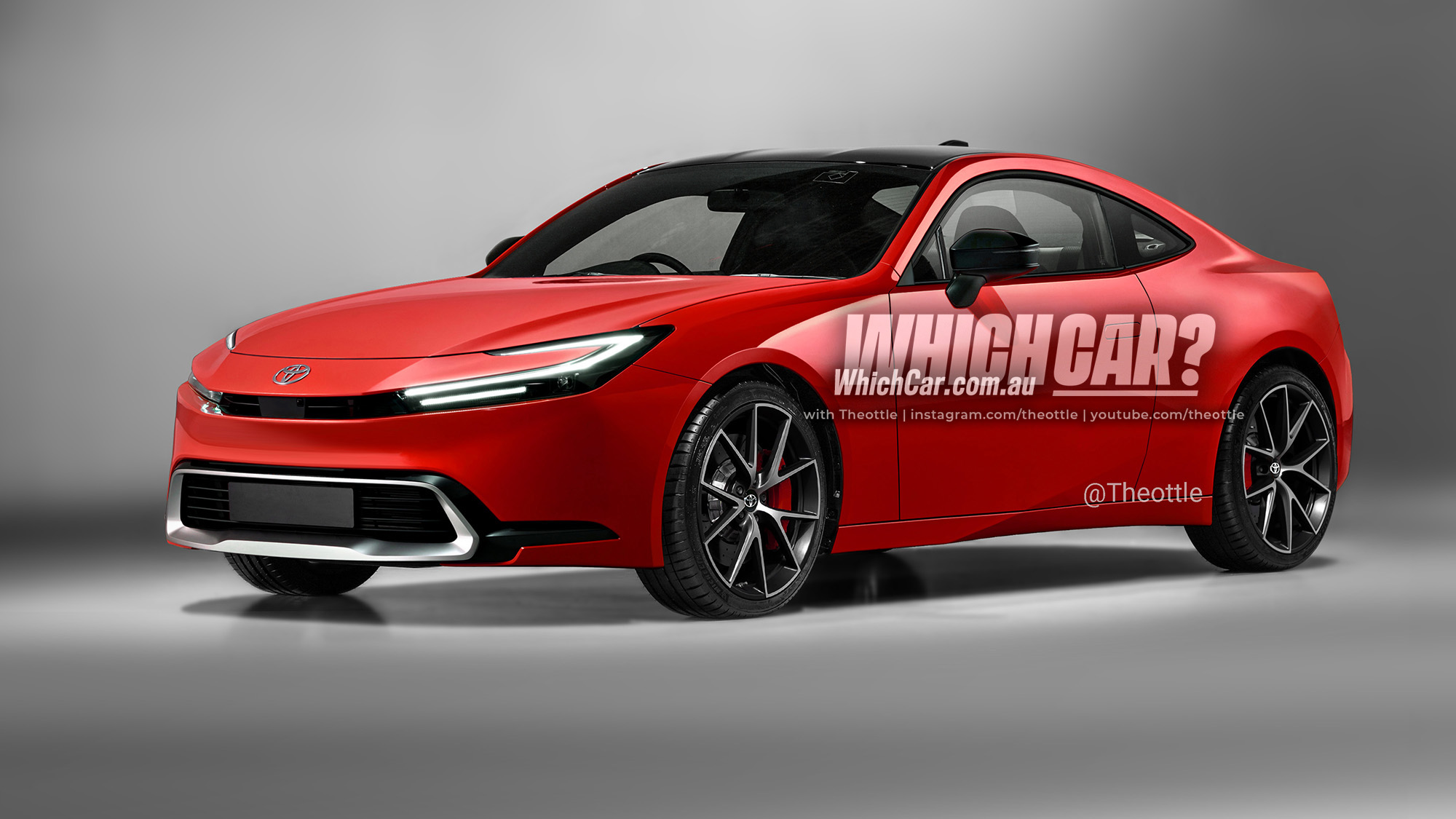
With Toyota adopting a new design language, we’ve added the face of the sleek all-new Prius to see what a GR86 Hybrid may look like.
The sharp C-shape claw-like LED daytime running lights run into the bonnet line and connected splitter across the front, with chrome and gloss black surrounds on the lower bumper.
A similar face is also seen in the upcoming new-gen Toyota C-HR city crossover and Beyond Zero (BZ) Compact SUV concept.
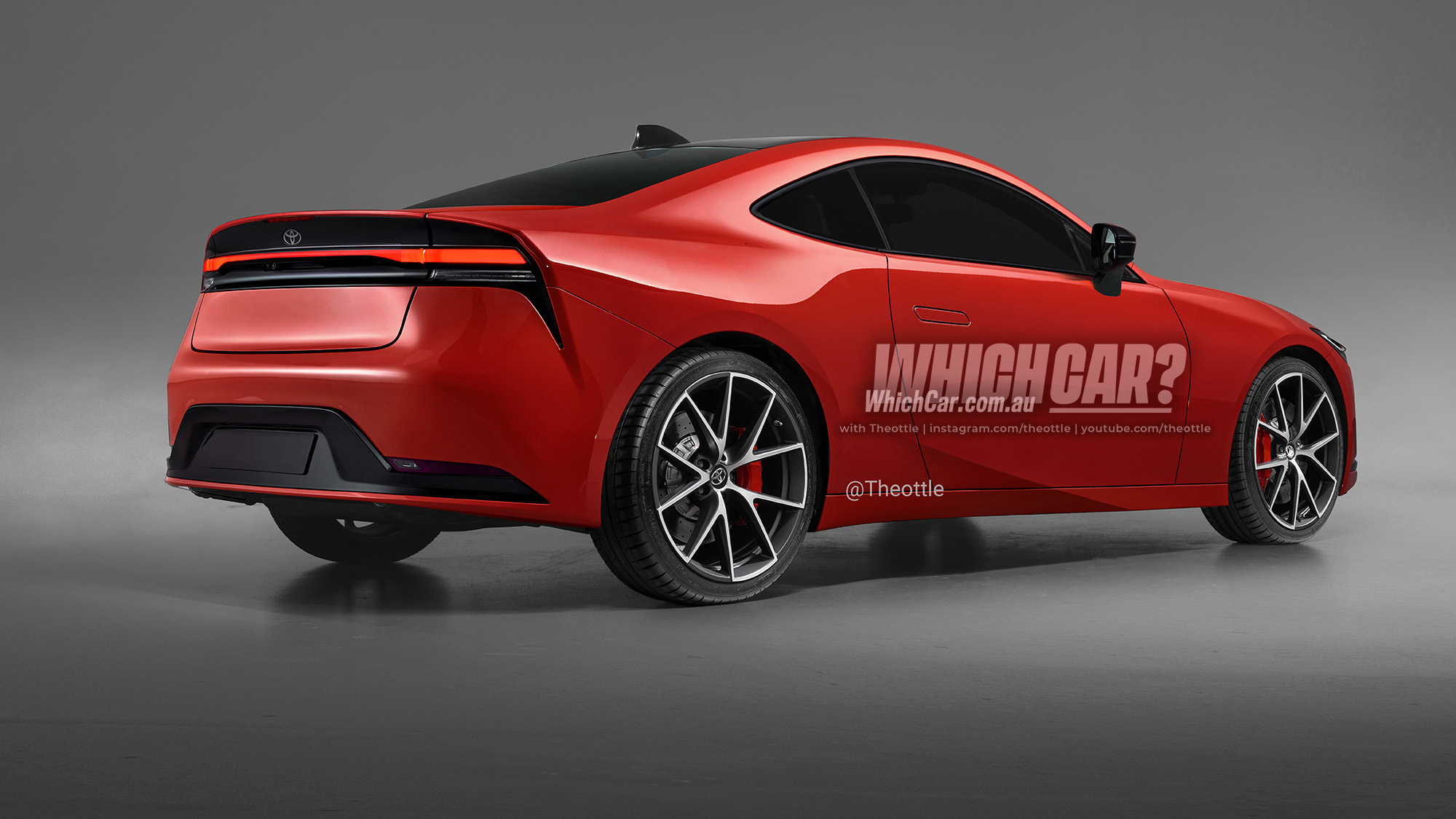
The added electric assistance should theoretically help with increasing torque, though it’s unclear whether performance outputs would change due to a potentially downsized engine displacement (but with a turbocharger added).
The current Toyota GR86 is based on a modified version of the first-gen model and produces 174kW of power and 250Nm of torque driven to the rear wheels only. It can accelerate from 0-100km/h in a claimed 6.3 seconds in the manual or 6.8 seconds in the torque converter automatic transmission.
However, it demands higher quality 98RON premium unleaded fuel and consumes between a claimed 8.8 to 9.5-litres per 100km depending on the variant.
BELOW: The current GR86, next to its iconic AE86 ancestor

The new C63 package is devilishly complex
For a car that can claim to be 2022’s most controversial performance sedan, the W206 Mercedes-AMG C63 S sure does make a low-key first impression.
It’s hunkered down in the concrete bowels of our hotel in Spain and, if this were any other C63 from the last 20 years, pressing the starter button would deliver a moment of giddy, child-like glee as its booming V8 thundered into life and bounced off the car park’s walls. Fire up this all new fifth-generation C63, however, and all you get is… silence.
Yep, AMG’s brutish M3 rival is now a plug-in hybrid, but really, the fact that this is the first C63 in two decades to not have a V8 is just part of what makes this car so intriguing.
What you see here, folks, is a complete and total rethink of the C63 formula.
AMG’s fast C-Class is now four-wheel drive, has two gearboxes, four-wheel steering, eight drives modes, a boost map similar to Lewis Hamilton’s F1 car and a small, high-tech battery that’s designed to dump and recoup its energy super quickly.
It’s all fiendishly complex, and a huge departure from the winningly simply recipe of C63s of old, but the result is a car that’s quicker, more comfortable, easier to drive fast and kinder to the environment (and your wallet). But is it better? And does it still feel like a proper C63? Those questions are arguably more significant. And also much trickier to answer…Stay with us here, there’s a lot to unpack.
JUMP AHEAD
- How much is it & what do you get?
- How do rivals compare on value?
- Interior comfort & space
- What’s it like to drive?
- How much fuel does it use?
- Warranty & running costs
- VERDICT
- Specifications
How much is it & what do you get?
Just as every other significant number on the new C63 has gotten bigger (power, torque, weight), so too will the price.
We won’t know exactly how much the W206 C63 will cost until closer to its Aussie launch in July 2023, but a sticker price of around $200,000 before on-road costs is likely.
That’s a jump of around $20,000 versus the current W205 C63 Coupe, which retails for $180,000, although it is an increase that reflects the rises seen across the rest of the Aussie W206 line-up.
As for body styles, Aussie buyers will only have the choice of one: the sedan. A svelte-looking wagon is available globally but it wont’ be coming to Australia (boo!) and significantly there won’t be a C63 Coupe either. For this generation, Merc is tipped to combine the C-Class and E-Class coupes into a single new model likely to be called the CLE. And unlike previous generations of the C63, there also won’t be a regular ‘non-S’ version of the W206 C63. This time around it’s ‘full fat’ C63 S or nothing.
For the new C63, an Australian sticker price of around $200,000 before on-road costs is likely
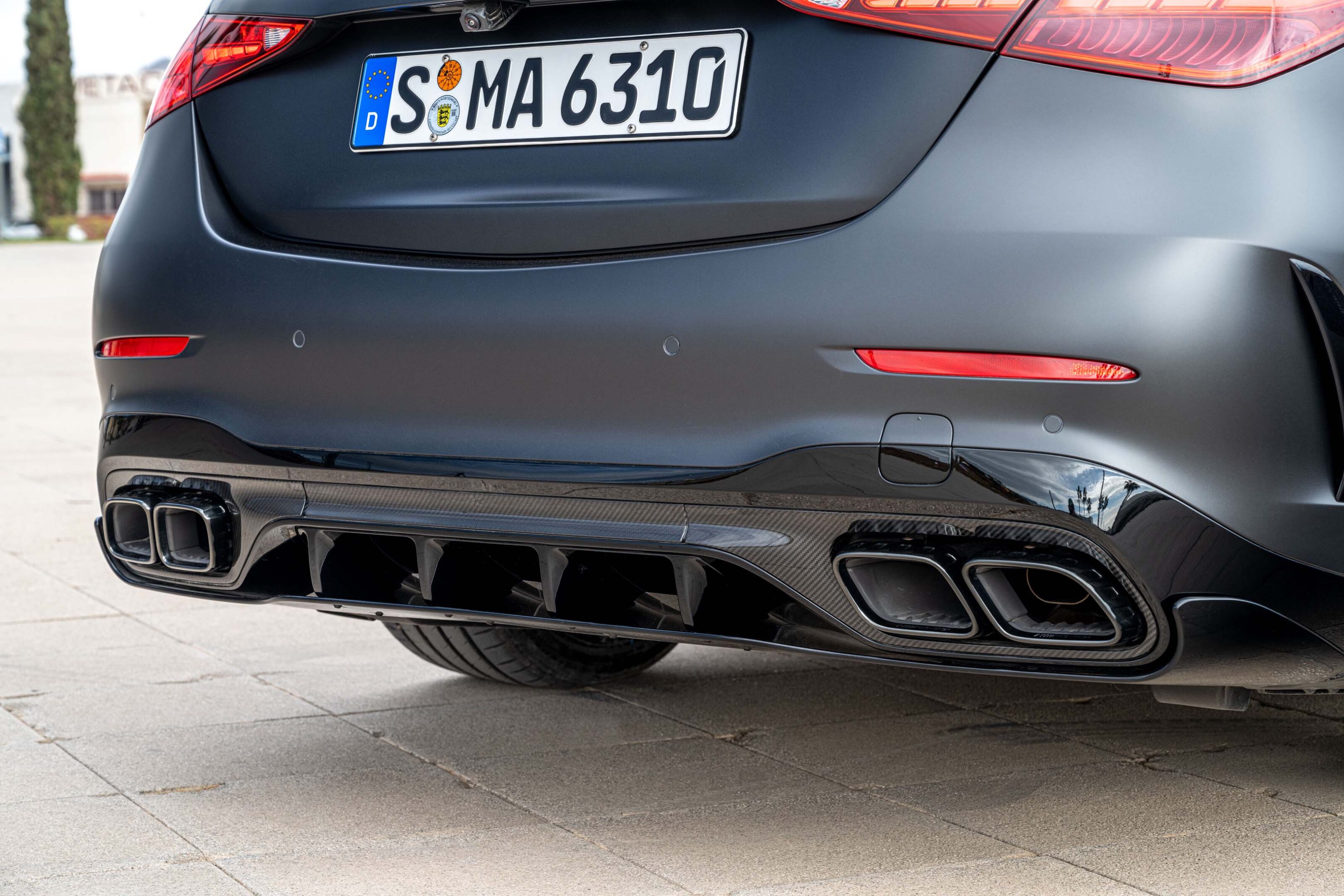
The upshot to all this is that buying a new C63 should be incredibly straightforward. As is the norm, Aussie cars will have nearly every equipment box ticked as standard and, aside from deciding whether you want a sunroof and carbon brakes, the toughest decision you’ll likely need to make is the colour.
The rest of the C63 package is devilishly complex. Like all of its predecessors, the W206 C63 is based on the regular C-Class but this time around AMG has made some significant structural changes.
Width is up by a considerable 76mm thanks to wider tracks and pumped up guards but it’s an extra 83mm in overall length that’s more significant.
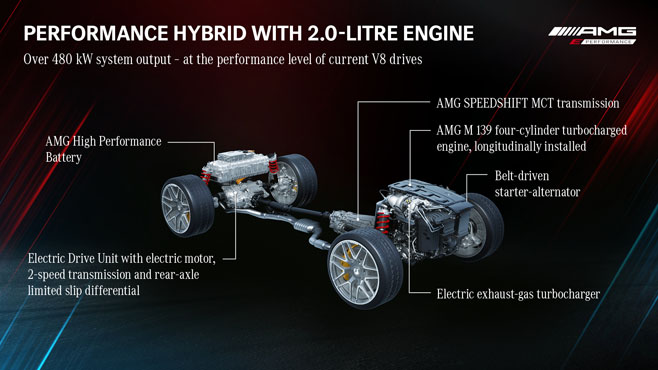
The wheelbase has grown by 10mm but most of the C63’s extra length has been grafted ahead of the front axle to better help the new 2.0-litre four pot and its supporting electrical gubbins work from a packaging and cooling perspective.
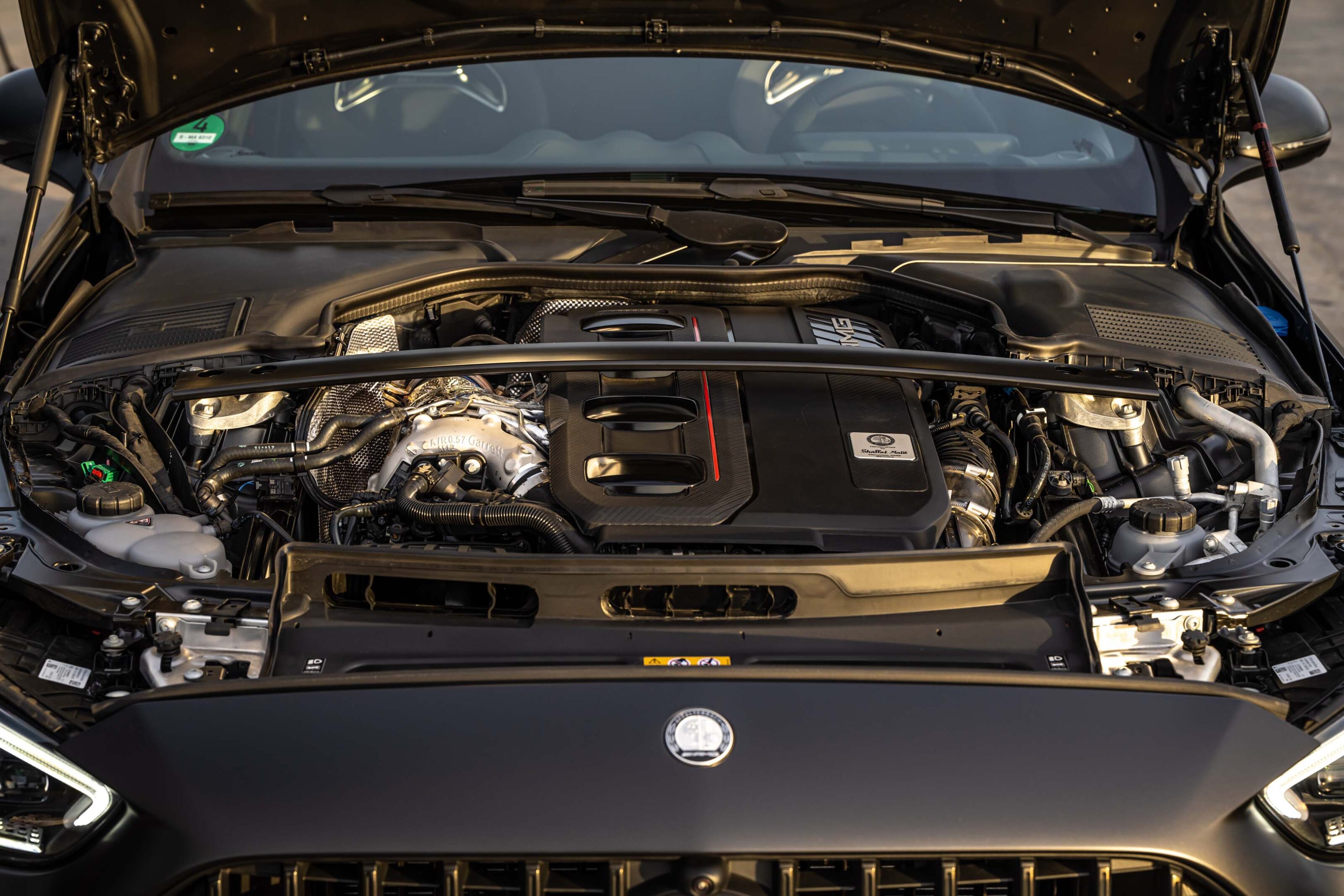
The powertrain itself is an outstanding piece of engineering.
The core block is same 2.0-litre M139 unit that powers the A45 but in the C63 it’s fitted longitudinally and the size of the turbo has been increased.
Just like the new C43, the turbine in the C63’s turbo is spun by electricity as well as exhaust gas to help reduce lag and improve response but the compressor wheel itself has grown from 63mm to 71mm.
Right, time to hit you with the outputs
| 2023 Mercedes-AMG C63 E Performance outputs | |
|---|---|
| Engine | 2.0-litre 4cyl, DOHC, 16v, turbo + electric motor |
| Compression | 9.0:1 |
| Power & torque | 500kW / 1020Nm (combined) |
| Battery | 6.1kWh |
On its own, the combustion powertrain produces 350kW/545Nm. According to AMG’s engineers, that’s right on the limit for how much grunt the 2.0-litre can produce.
Where the numbers start to get colossal, is when you factor in the hybrid system.
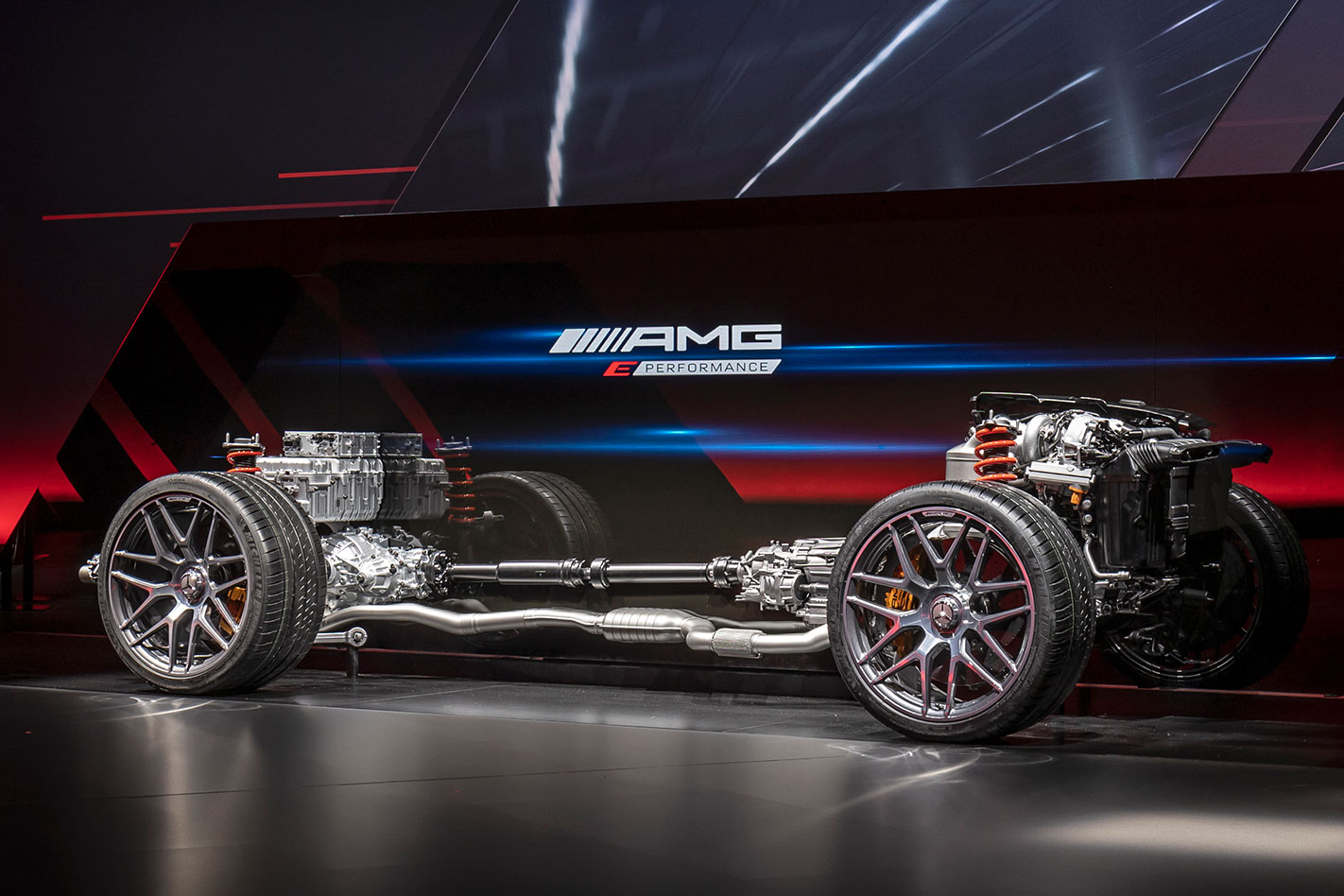
AMG calls the C63’s setup a P3 hybrid and it compliments the petrol engine with a 6.1kWh battery and an electronic drive unit that combines an e-motor with its own two-speed gearbox and an electronically controlled limited-slip differential mounted above the rear axle and.
Both the battery and drive unit are designed and built in-house by AMG and the way they deploy their performance is quite clever. The battery itself weighs just 89kg and the real genius is in how it’s cooled. A new non-conductive cooling liquid flows around each of the 560 cells individually which ensures the battery remains at a constant temperature and allows it to deploy its energy and then recharge super quickly.
Struggling to wrap your head around all that? Here’s a number to focus on.
With the hybrid system wound up to its angriest setting, the C63 S has combined total outputs of 500kW and 1020Nm.
That’s 125kW/320Nm more than the current V8 C63 and a healthy margin more than you get from an Audi RS4 (331kW/600Nm) or a BMW M3 Competition (375kW/650Nm).
Plus the new C63 has a feather in its cap that none of its rivals can match: the ability to cruise around in total silence.
With ‘Electric’ mode engaged, AMG says you’ll be able to travel 13km on electric power alone at speeds up to 125km/h, which should earn you some brownie points with your neighbours on those early winter mornings…
How do rivals compare on value?
If this new C63 does carry a price of circa-$200,000 that means it’ll be the most expensive offering in its direct competitor set.
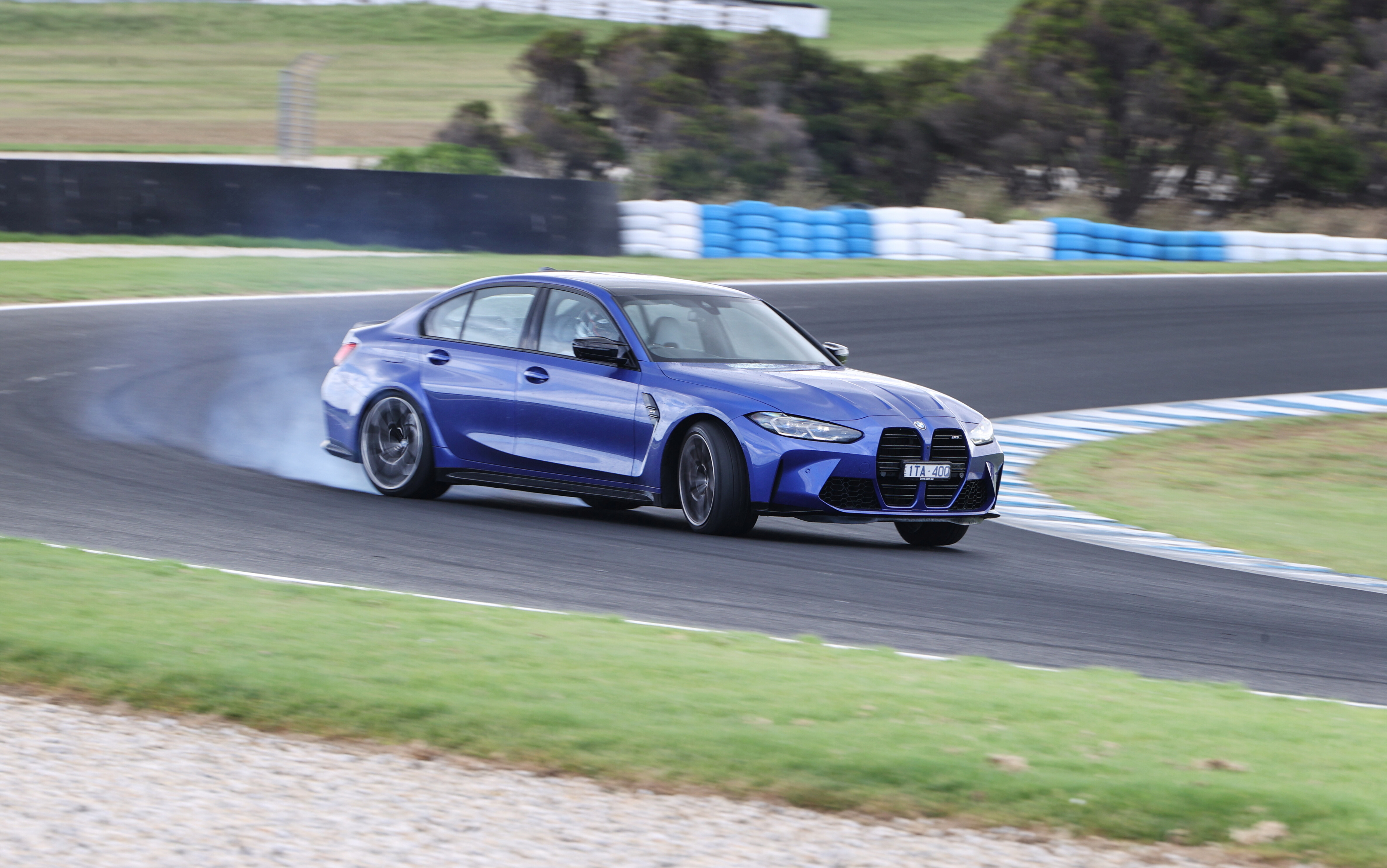
Nearly all of its key rivals have price tags that start in the $150K bracket: the Audi RS4 Avant is $155,400, an Alfa Romeo Giulia Quadrifoglio will set you back $148,000 and the G80 BMW M3 starts at $153,500.
But despite their lesser outlays, none of these rivals can get close to the AMG for power, torque, efficiency or straight line performance.
To achieve that you’ll need to look at a BMW M3 Competition, which costs $169,500. Like the AMG, the M3 Comp is all-wheel drive and while it’s gazumped by the C63 for outputs, the Bimmer is only 0.1sec slower in the race to 100km/h at 3.5 seconds. The Merc’s official claim is 3.4sec.
Another thing to consider is that aside from the BMW, all of the AMG’s key rivals are now well into their respective model cycles. So while they might seem cheaper on paper, they’re also older, slower and thirstier.
In numbers: 2023 AMG C63 v Audi RS4 v BMW M3 Comp
| W206 C63 S E Performance | W205 C63 S sedan | Audi RS4 Avant | BMW M3 Competition xDrive | |
|---|---|---|---|---|
| Engine | 2.0-litre 4cyl turbo + electric motor | 4.0-litre V8 twin-turbo | 2.9-litre V6 twin-turbo | 3.0-litre inline-6 twin-turbo |
| Power | 500kW (combined) | 375kW @ 5500-6250rpm | 331kW @ 5700-6700rpm | 375kW @ 6250rpm |
| Torque | 1020Nm (combined) | 700Nm @ 2000-4500rpm | 600Nm @ 1900-5000rpm | 650Nm @ 2750-5500rpm |
| Weight | 2165kg | 1745kg | 1715kg | 1855kg |
| 0-100km/h | 3.4sec | 4.0sec | 4.1sec | 3.5sec |
| Fuel consumption | 6.9L/100km | 9.9L | 8.9L/100km | 10.2L/100km |
Interior comfort & space
So how does this radically different C63 look and feel when you approach it with key in hand? Initially it’s actually reassuringly familiar.
Appearance wise, the C63 delivers exactly what you expect. It’s broad, angry and muscular. In the bright silver paintwork of our particular tester, it’s a striking thing to look at.
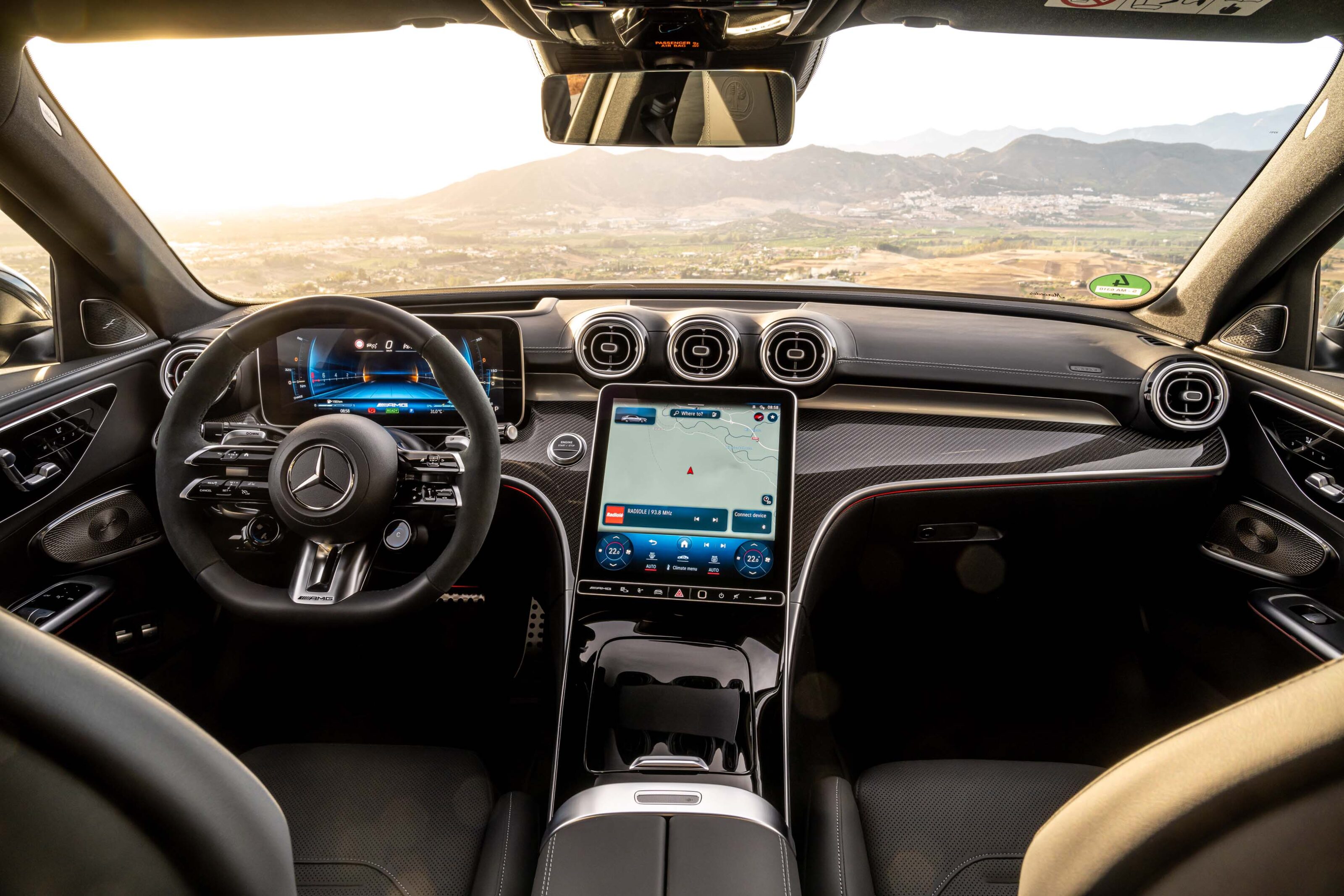
Slip inside and your expectations continue to be met. The cabin is cosy and richly trimmed and, thanks to its digital instruments and large 11.9-inch portrait-oriented central screen, it also majors on tech and glamour.
There are loads of C63-specific touches, too. The design for the Alcantara trimmed steering wheel design is unique and it’s festooned with so many buttons, dials and touch pads that it feels like a mini command centre.
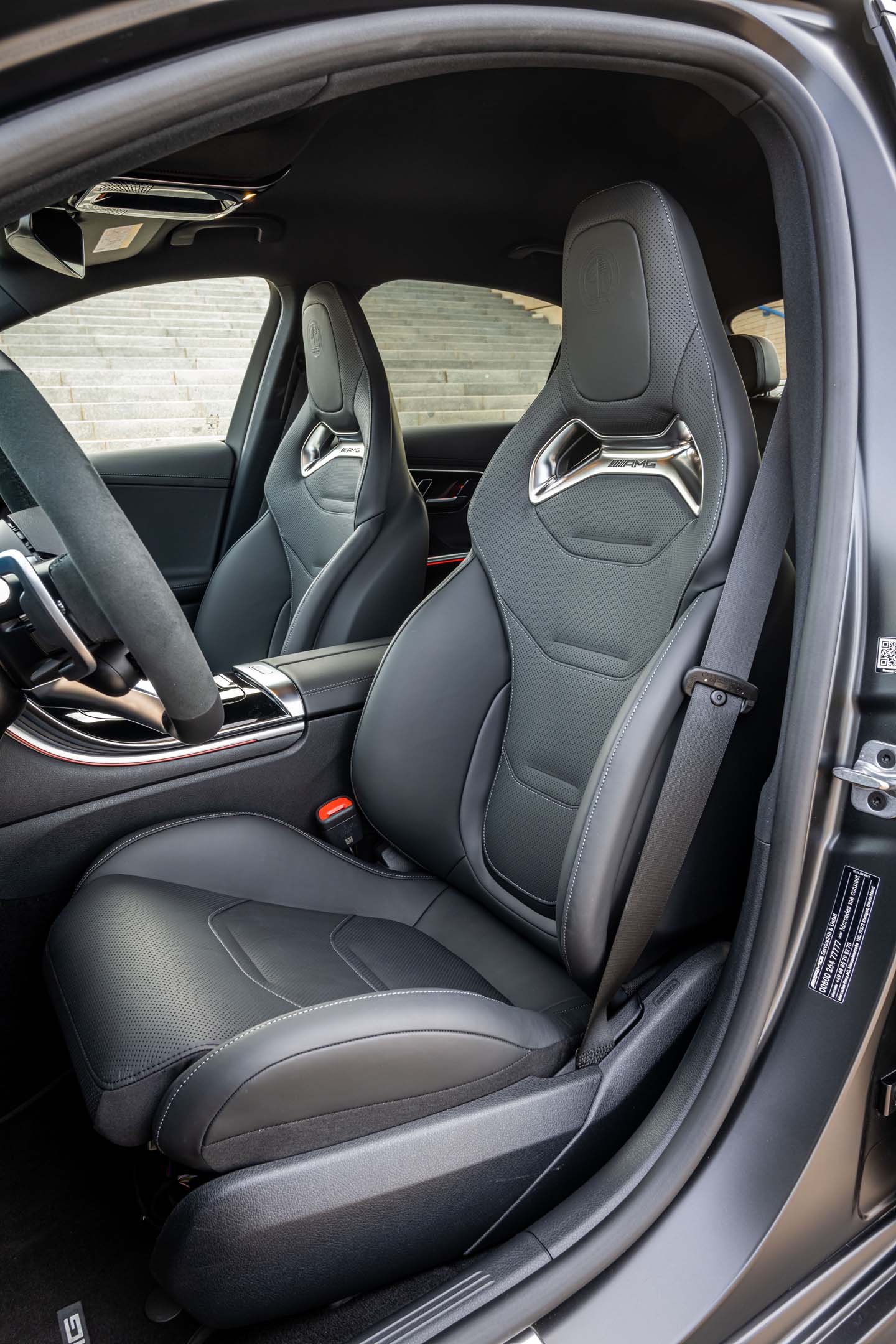
The heavily-bolstered front bucket seats are also a new design that features hollowed out sections behind your kidneys. Great seating position, too.
Overall the cabin feels overtly sporty and luxurious and, given it’s based on a regular W206 C-Class, it doesn’t drop the ball when it comes to the basics either.
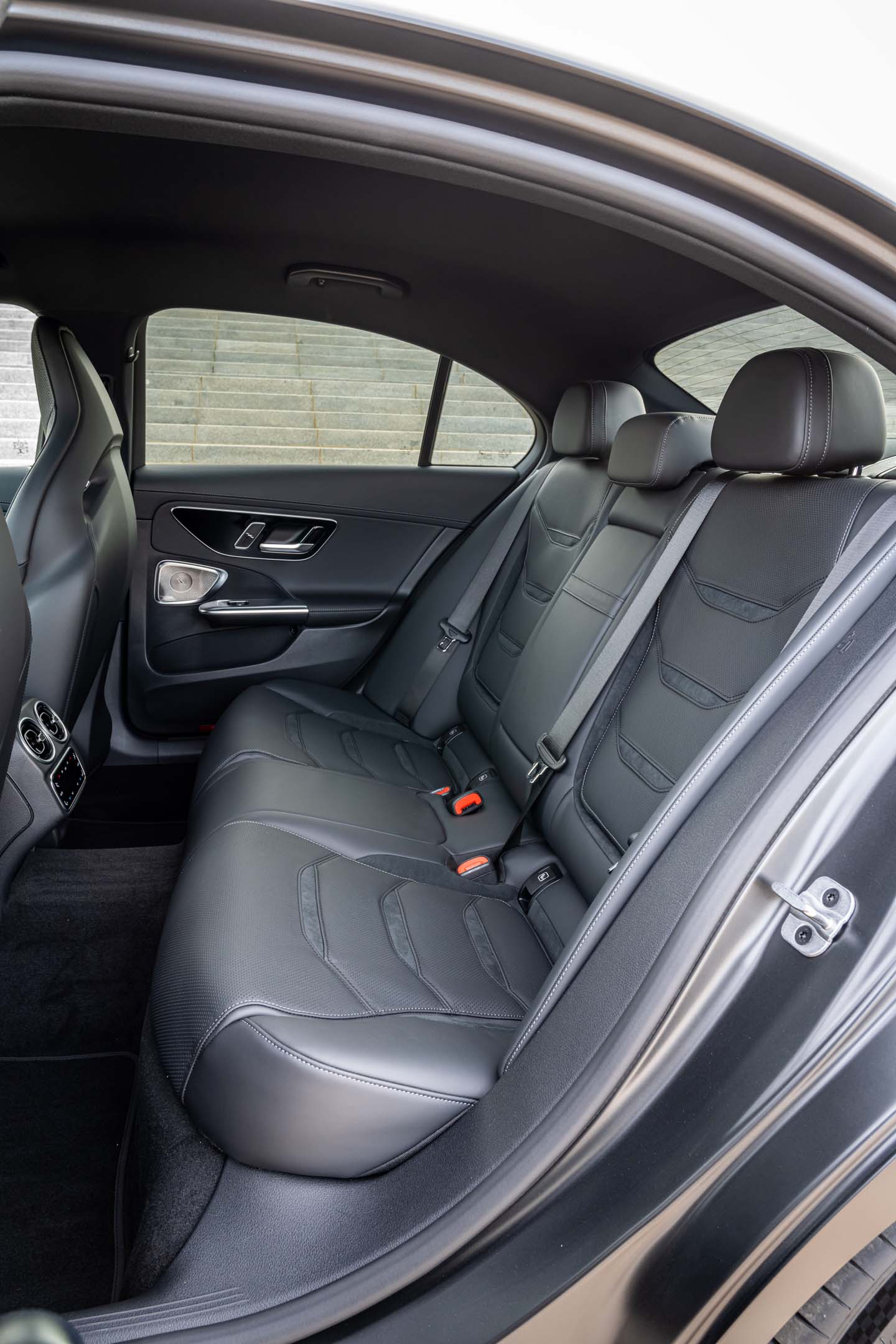
The central storage cubby is usefully large, the door pockets are generous, there are four USB-C charging points and the rear-seat is roomy and comfortable enough for adults on long journeys.
Only some sub-par plastics on sections of the dash and cheap-feeling indicator stalks let down the the general ambience a touch.
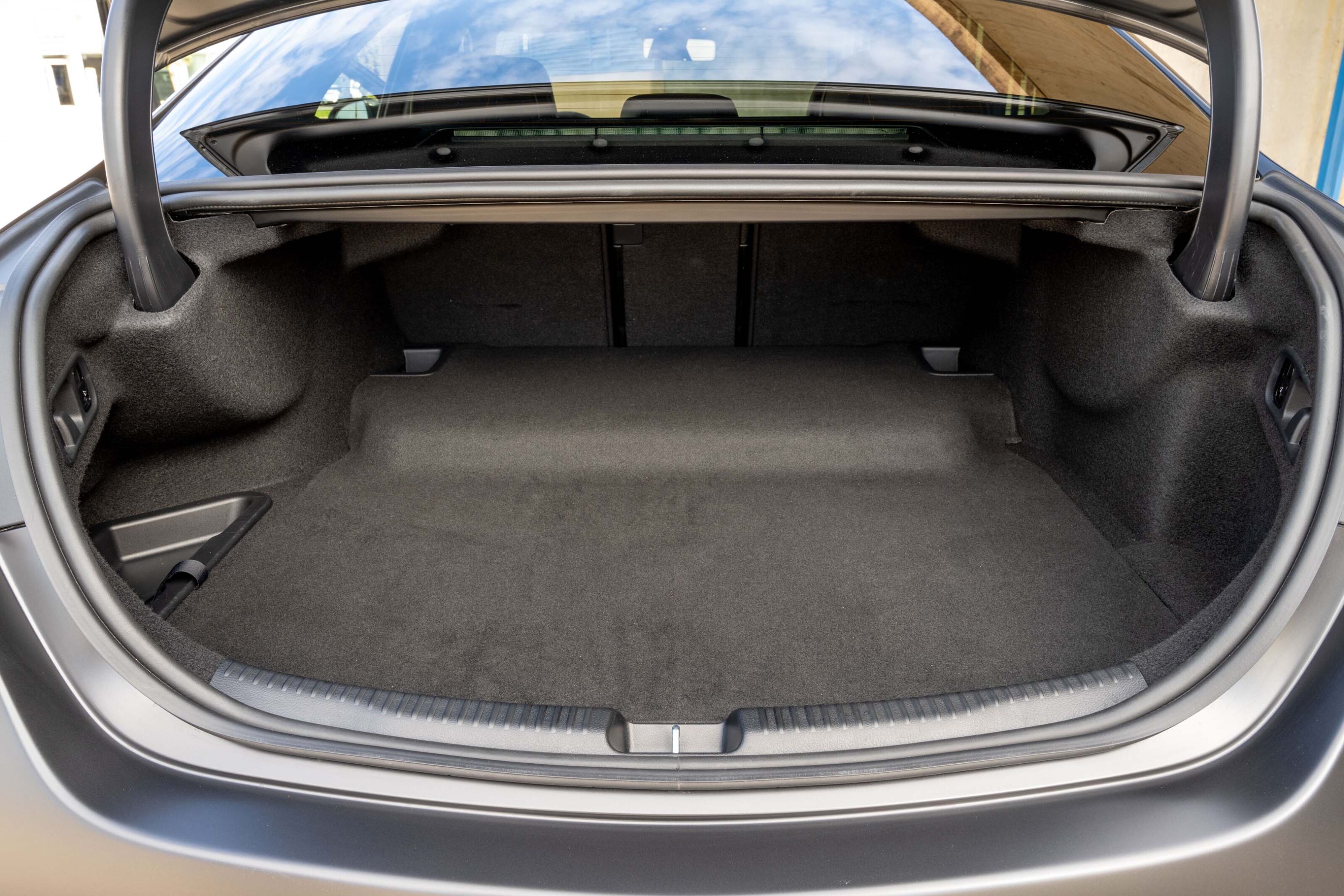
2023 AMG C63 boot space
Fitting the electronic drive unit above the rear axle has eaten into boot space, which has dropped down to just 279L.
That’s about the same as the boot in a Toyota Yaris…
Starting it up…
So far, so normal. It’s not until you start to drive the W206 C63 that it begins to feel a touch alien.
Lean on the accelerator and you don’t lunge forward with the usual V8 burble. Instead, you glide forward silently and effortlessly. In such a weighty car – the kerb weight has crept up by 420kg to more than 2.1 tonnes – you might think the C63 could feel a touch lethargic in ‘Electric’ mode given its max output is 150kW, but in the cut-and-thrust of city traffic acceleration is swift and immediate.
It’s not until we twist the drive-mode dial into Comfort and step further into the throttle that the combustion engine wakes up. It does so with an audible cough, but the handover from electric to hybrid propulsion is remarkably smooth.
Right, time to see what 500kW/1020Nm actually feels like.
With the traffic starting to thin as we head to Ascari, I wait for a straight stretch, deploy Sport + mode and nail it.
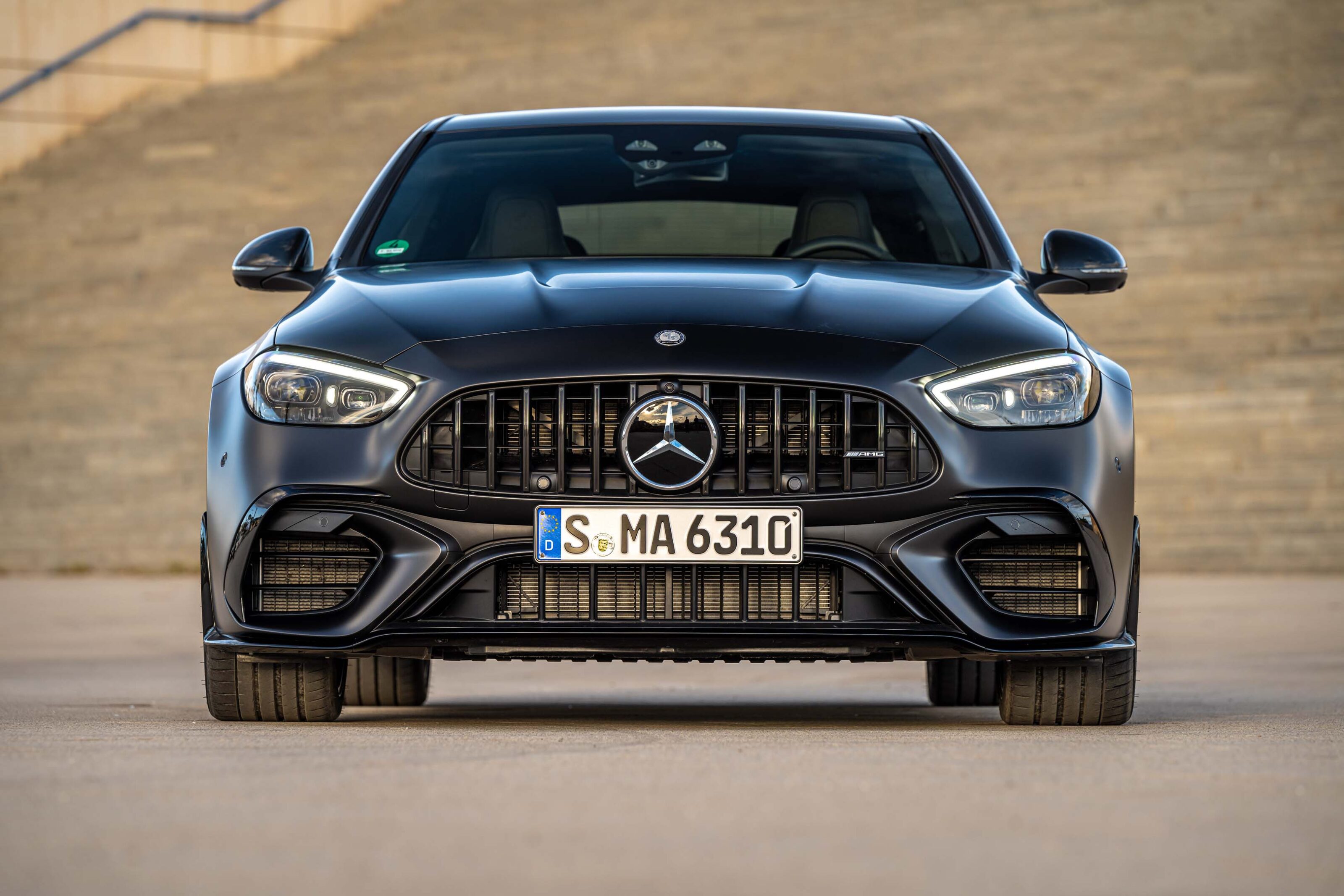
The C63 lurches forward eagerly, but it’s not quite as savage as I was expecting. With so much grunt on tap I thought the C63 would feel like a snarly, wriggling animal at full throttle – but weirdly, the first few hits at full noise don’t actually feel outrageously fast.
One thing you do notice and appreciate instantly is the improved ride comfort. AMG has fitted the new C63 with the same sophisticated dual-tube damping system as the flagship AMG GT Black Series and there’s a finesse, control and suppleness to this new car that the steely-eyed and brittle W205 never offered.
There are three settings for the dampers – Comfort, Sport and Sport+ – and it’s immediately obvious that Comfort is the best for road driving. Sport and Sport+ certainly aren’t bone jarring, but on bumpy Spanish freeways there’s noticeably more vertical movement and bounciness to contend with.
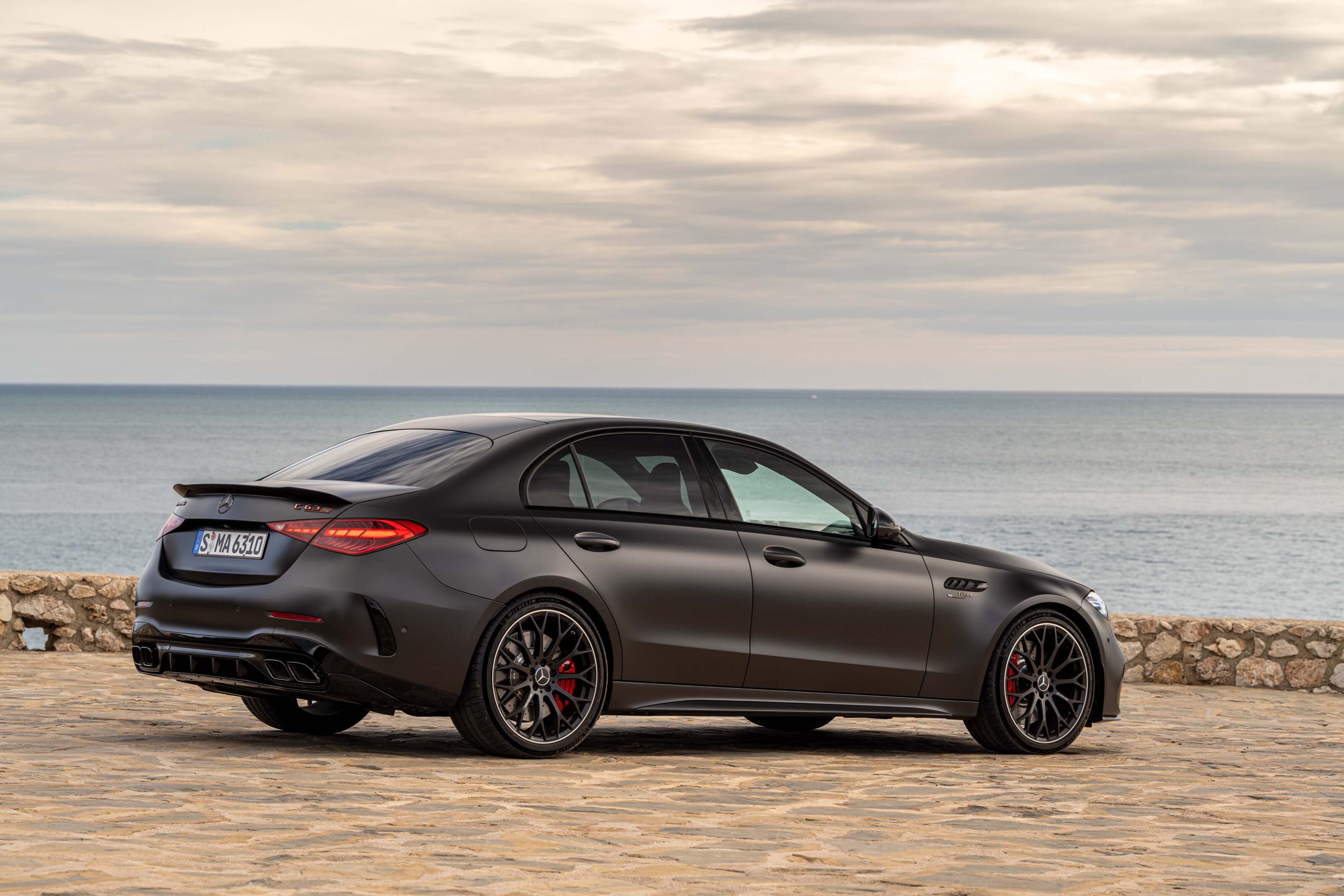
As for the thing that most people are worried about? The noise.
The wet, burbly idle and barrel chested soundtrack of the old 4.0-litre has been so central to the C63’s appeal and identity that it’s crucial AMG extracts an exciting soundtrack from the new four pot. And first impressions are a touch underwhelming.
Given the C63 shares its block with the A45 S, I had expected it to sound like an even angrier version of AMG’s hyperhatch – but the C63 is quieter and more cultured. AMG says that’s very deliberate. Switching the engine’s orientation and fitting a larger turbo has resulted in some mechanical differences to the C63’s noise compared with the A45, but the exhaust tuning itself is meant to be more premium and refined.
All of this means that as we roll into the Ascari circuit, I’m a touch puzzled.
C63s have always been instantly likeable and easy to warm to. It’s clear this new car is more complicated…
https://www.instagram.com/p/CmICrgfg1LB/
What’s it like to drive?
On the circuit, the new C63 steadily and relentlessly wins me over. It just nails the basics. The driving position is spot on, vision out is excellent and the steering in Race mode is meaty, direct and accurate.
The brake pedal is encouragingly natural, too, with no inconsistencies in its travel or any of the fuzziness or interference that can plague some plug-in hybrids as you start to apply brake pressure. Given the degree of recuperation at play here (there are four stage of regen to play with), achieving a natural feeling brake pedal is an achievement in its own right.
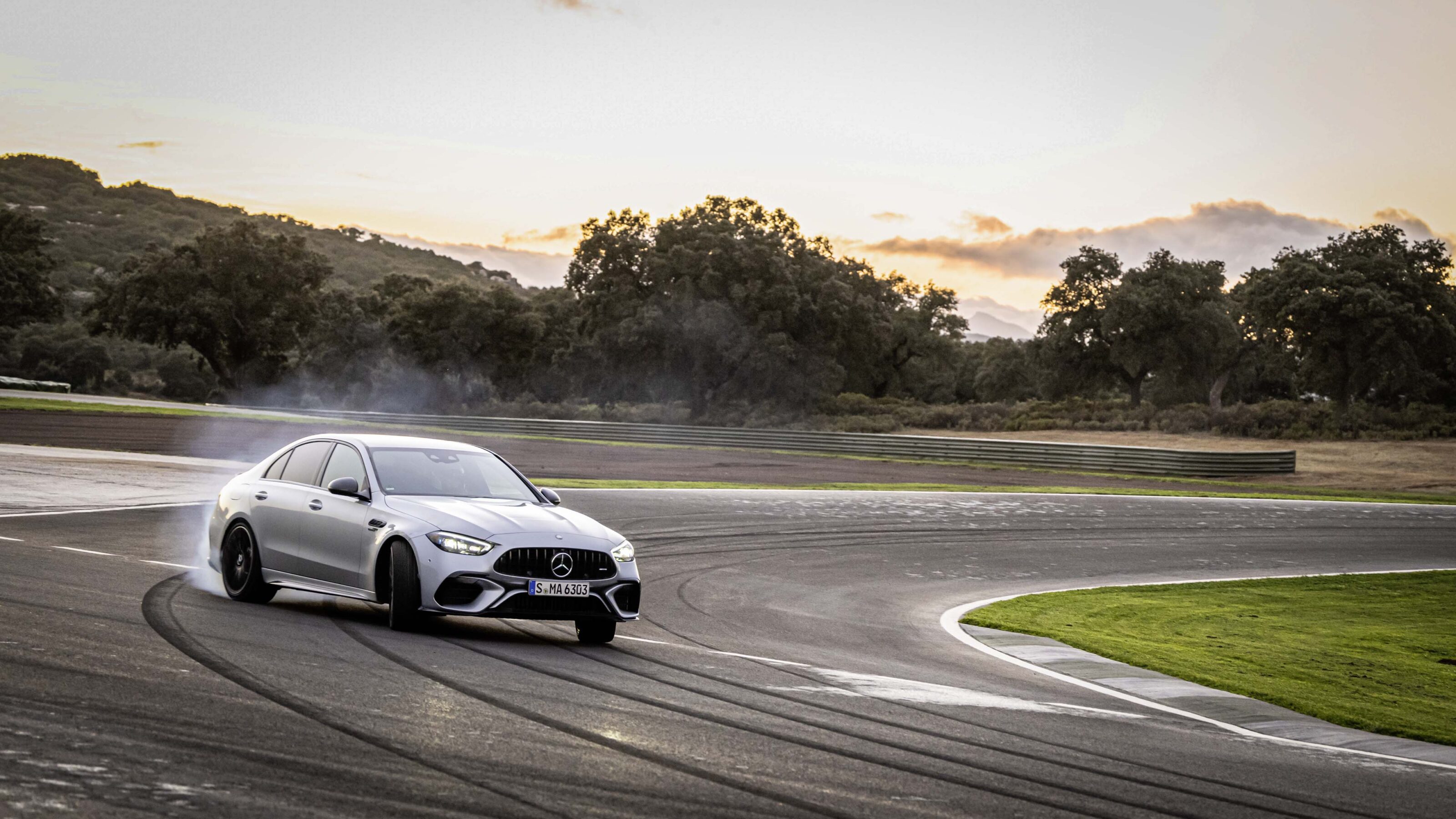
And around Ascari, the C63 does feel properly fast. Acceleration and traction are especially savage, particularly out of slower corners where the torque filling benefits of the hybrid system can really earn their keep. The handling balance is noticeably different, too.
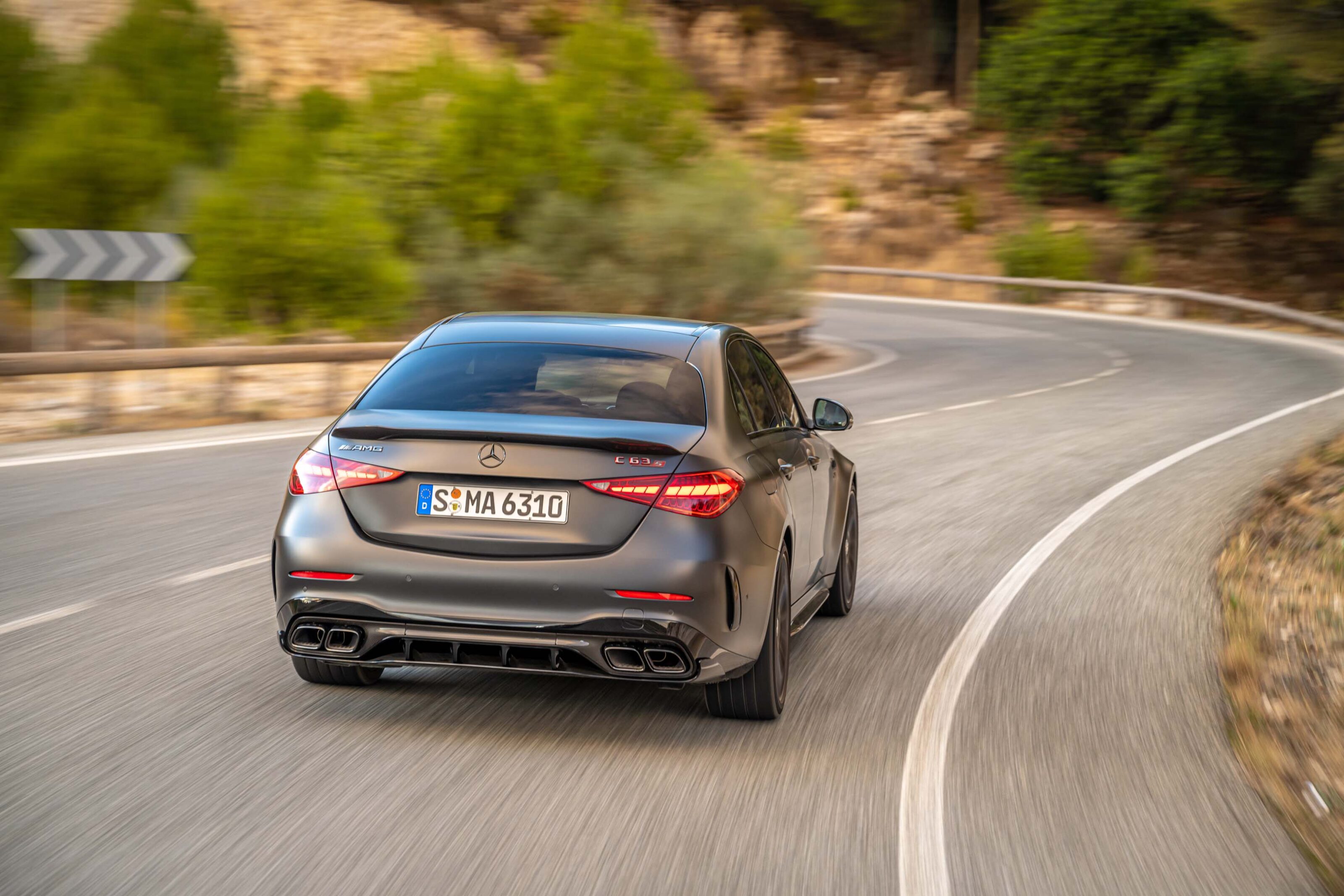
Where the current car is all about managing traction at the rear axle (especially in the wet!) this new C63 is remarkably neutral at the limit.
It even verges on friendly. Our cars were shod with Michelin Pilot Sport 4S tyres and while it was easy to find the edge of adhesion both understeer and oversteer were clearly telegraphed. And with ESP Sport activated, the C63 is so malleable and approachable that you quickly have the confidence to provoke small slides with the throttle and under brakes.
Does it feel like 2.1 tonnes? Not really. During our track stint, the C63 felt impressively agile, a fact no doubt aided by the standard and natural-feeling four-wheel steering, and it was only through one of Ascari’s flip-flop chicanes that you had a sense of how much heft you were hurling about.
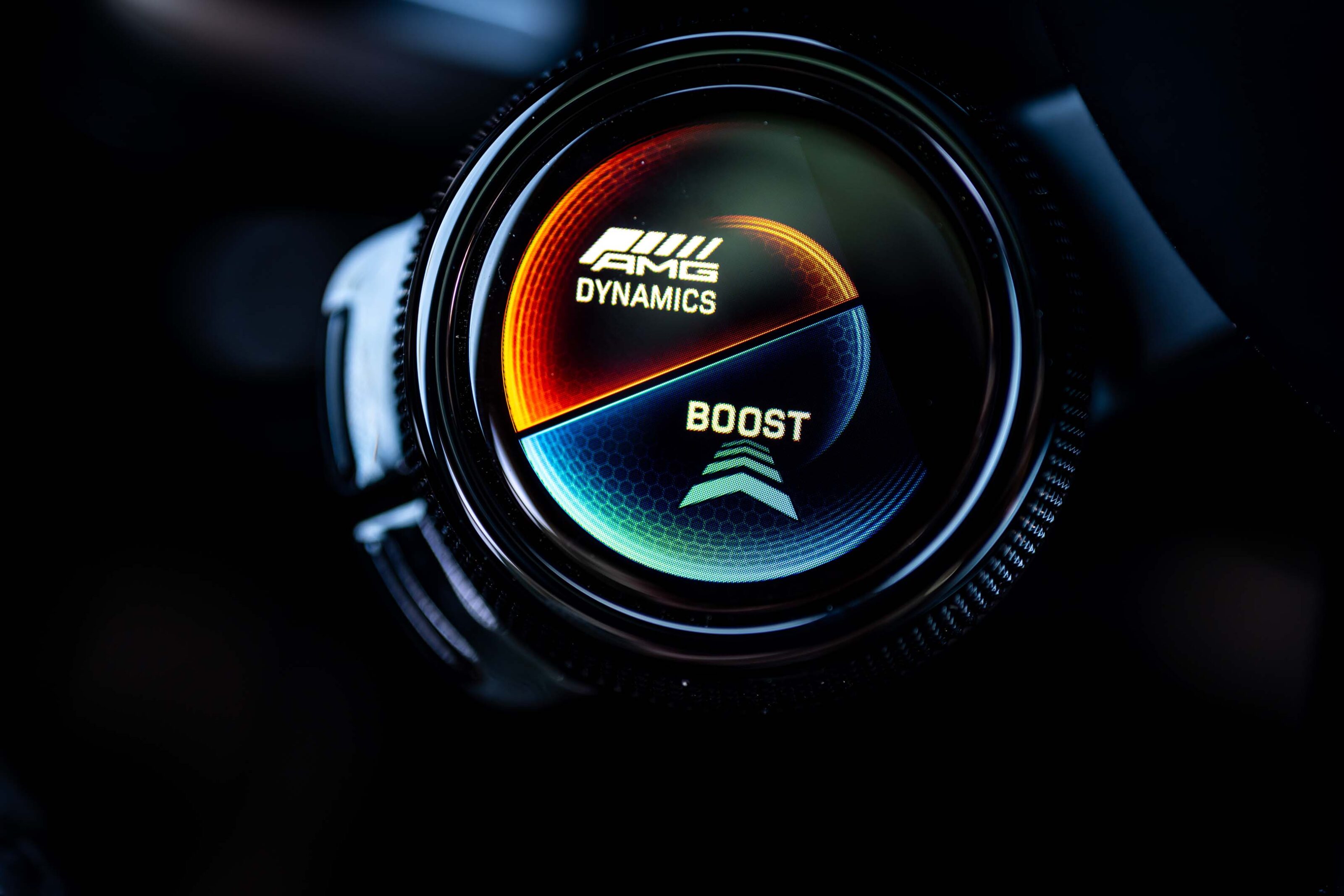
It’s remarkably intuitive to drive fast, too.
Given the powertrain’s complexity, I had feared this new C63 might feel synthetic or out of kilter as it juggled electrons and petrol power, but the software that manages the distribution of drive is remarkably seamless.
Speaking of software, there are some new functions for the onboard Track Pace app worth mentioning. Track Pace is AMG’s track data tool that allows you to split circuits into sectors and record your lap times at 30 preloaded circuits around the world – but in the C63, it also gives you a guide on where best to deploy the car’s electric energy to improve your lap time.
Because the C63’s 6.1kWh battery is quite small, it can only deliver its maximum 150kW for short 10 second bursts, so rather than using up all your energy early in the lap, the boost strategy tells you the ideal place to deploy max boost via a message on the dash.
It’s similar to how Lewis Hamilton uses the energy in his F1 car, and drivers can choose between a ‘hot lap’ setting to extract the maximum performance over one lap or an ‘endurance’ mode which will eke out the available energy over a multi-lap stint.
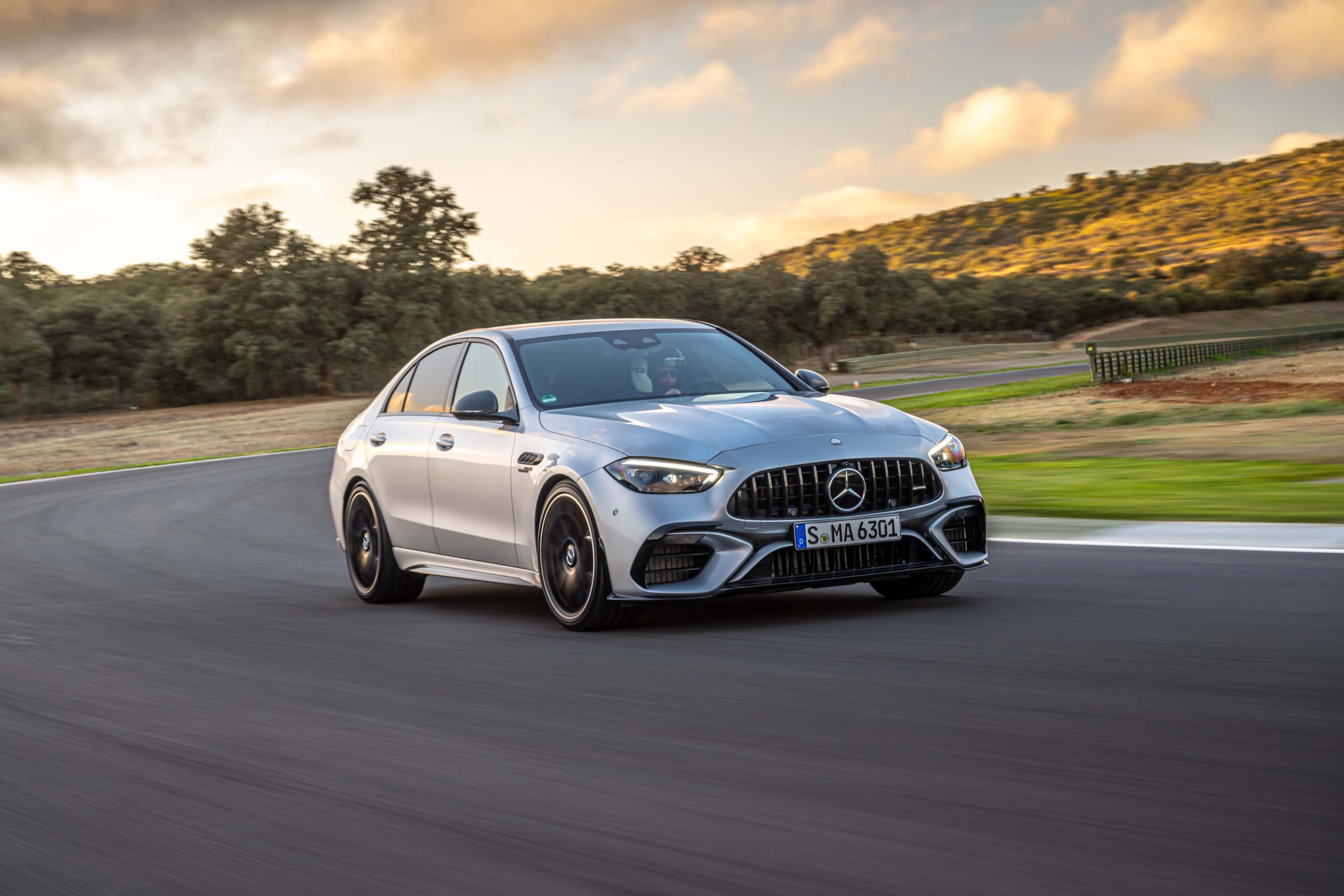
So it’s fast and fun around a circuit, but, if anything, the new C63 is even more impressive as a road car.
On the serpentine mountain roads around Ascari, it’s phenomenally quick. Grip levels are high, the front axle feels eager and responsive and now that the C63 is all-wheel drive, the traction of out of slower corners verges on gobsmacking.
Flatten the throttle at the apex and you can almost feel the tarmac rippling up behind you as it tears at the surface for purchase. It’s savagely fast. Like a Subaru WRX or Mitsubishi EVO wound up to 11.
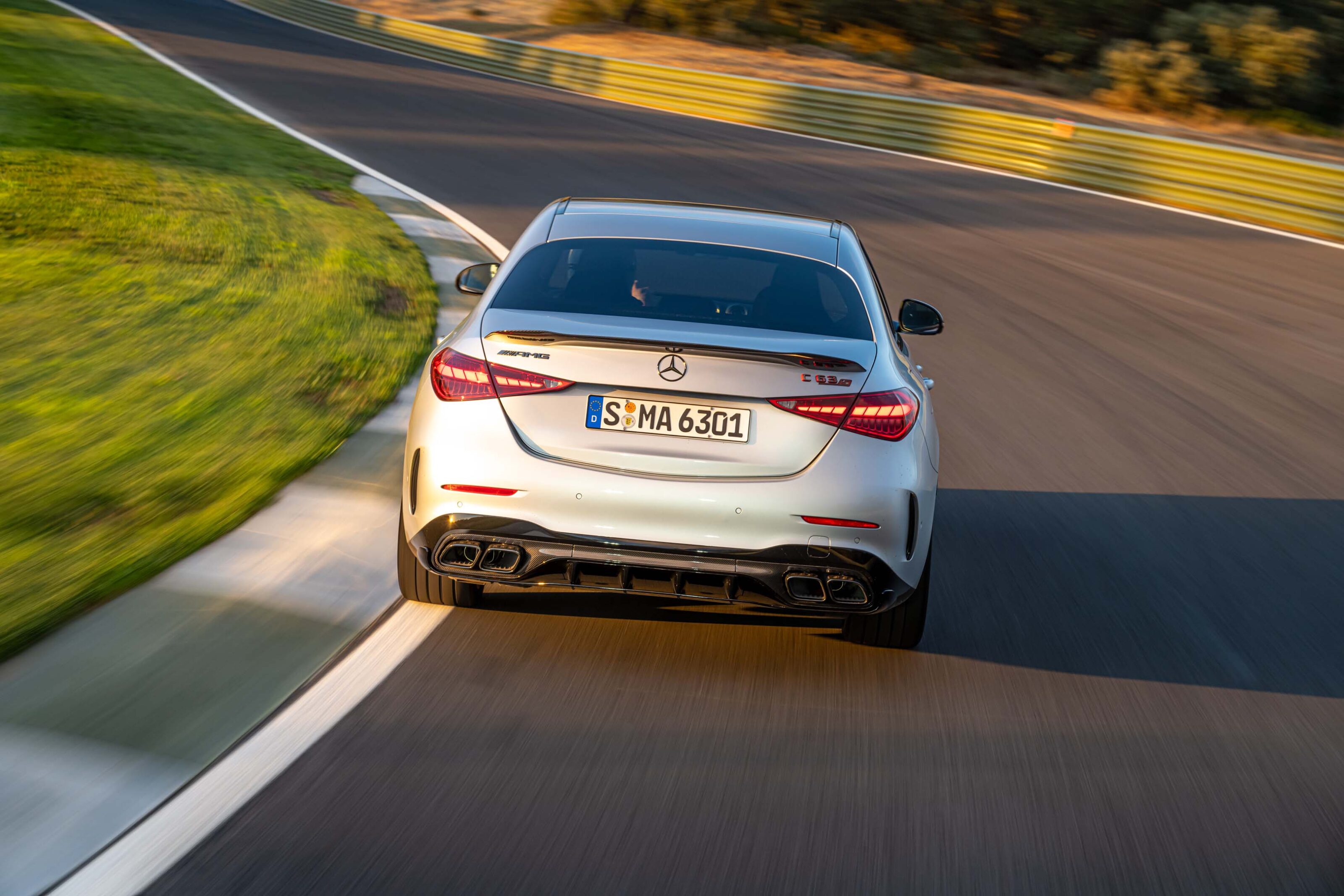
It’s savagely fast. Like a Subaru WRX or Mitsubishi EVO wound up to 11
And it just gives you so many options. Come into a corner too hot and it always feels like you have more braking performance and steering lock to exploit. I’ve long thought there’s not much that could outrun a well-driven A45 on a twisty section of road, but this car would leave it in its dust.
The real secret to the new C63’s formidable real-world pace is its suspension. The roads around Ascari are gnarly and littered with evil bumps that would turn the old C63 into a snarly, bucking beast as it skipped and struggled to get its grunt to the road.
The new C63 isn’t only more forgiving, but it breathes with the surface (keeping the dampers in Comfort while everything else is in Race mode yields the best results) and while that means you can feel the body moving instead of being held in a vice-like grip, it’s always predictable and controlled. For that reason alone, it’s in a different league for real-world pace compared with the current car. And in the wet, that gap will only grow.
So what about weaknesses?
Well, aside from the higher price and smaller boot, the most obvious weakness is the sound. It’s just not loud, angry or soulful enough – to my ears, at least.
But perhaps the thing that will polarise fans and buyers most is that the C63 no longer feels like a muscle car.
For decades now, AMG’s fast C-Class has traded on being a brooding and bombastic performance sedan that majors on drama, theatre and personality. That old school charm has diminished with this version and the C63 is now more like a high-tech hot hatch than a charismatic hot rod. Your mileage may vary on whether that’s a good thing or a bad thing…
How much fuel does it use?
Fuel efficiency mightn’t be the number-one reason people buy a C63, but it’s nice to know this new model will be lighter on the wallet.
Switching to a hybrid powertrain has given the W206 C63 an official combined fuel consumption figure of 6.9L/100km, which is a substantial improvement over the old car’s claim of 9.9L.
It’s also far more efficient than its key competitors like the Audi RS4 (8.9L) and BMW M3 Comp (10.2L). And of course, being a plug-in hybrid means the C63 has the potential to use significantly less fuel if your commute is less than 13km and you plug it in at either end with the included 3.7kW AC charging cable.
Warranty & running costs
Like all Mercedes models in Australia, the C63 will be covered by a five year/unlimited km warranty.
Service intervals and costs are yet to be confirmed but Mercedes is tipping you’ll need to visit a dealer every 12 months or 20,000km.
We’ll update this section with more information once it becomes available closer to the car’s Aussie arrival.
VERDICT
Judge it in isolation and the new C63 is a mighty and wickedly fast performance sedan.
It’s also a spectacular piece of engineering that outperforms the car it’s replacing in virtually every objective measure. It’s quicker, thriftier, quieter, comfier and is so fiendishly complex that it makes the W205 C63 feel a touch quaint and old-school.
But for all its superiority, it’s also clear the new C63 is a harder car to understand and to love. It needs time to get under your skin so a definitive verdict will have to wait until we score some more seat time in Australia and conduct the inevitable comparison tests with the BMW M3 and Audi RS4, but for now, one thing is obvious: AMG has altered the C63 recipe to such a degree that it’s sure to alienate some of its existing customer base.
The gamble that AMG is banking on is that this thoroughly modern interpretation of what a C63 should be will see it gain more fans that it loses.
2023 Mercedes-AMG C63 specifications
| 2023 Mercedes-AMG C63 E Performance specs | |
|---|---|
| Body | Four door, five seat sedan |
| Drive | All-wheel drive |
| Engine | 2.0-litre 4cyl, DOHC, 16v, turbo + electric motor |
| Compression | 9.0:1 |
| Power | 500kW (combined) |
| Torque | 1020Nm (combined) |
| 0-100km/h | 3.4sec |
| Transmission | 9-speed automatic |
| Weight | 2165kg (EU includes 75kg driver) |
| Fuel consumption | 6.9L/100km |
| Front suspension | Double A-arms, coil springs, adaptive dampers, anti-roll bar |
| Rear suspension | Double A-arms, coil springs, adaptive dampers, anti-roll bar |
| L/W/H | 4842/1900/1458mm |
| Wheelbase | 2875mm |
| Brakes | 390mm ventilated/perforated front discs with 6-piston calliper; 370mm ventilated/perforated rear disc with single-piston calliper |
| Tyres | 265/35 R20 (f) 275/35 ZR20 (r) |
| Wheels | 9.5J x 20 front and rear |
| Price | $200,000 (estimate) |
Following years of speculation, it appears General Motors will spin off the Corvette nameplate into a dedicated sub-brand.
Car and Driver reports the current C8 Corvette sports car will be joined by a four-door coupe and a performance SUV – both all-electric – in 2025.
It has already confirmed plans to launch electrified versions of the C8, with an all-wheel drive hybrid set to be revealed next year.
While it’s too early to know just how the new models will be styled, we’ve applied the C8’s styling themes to an electric SUV and sedan to see how they look.
What do you think? Tell us in the comments below!
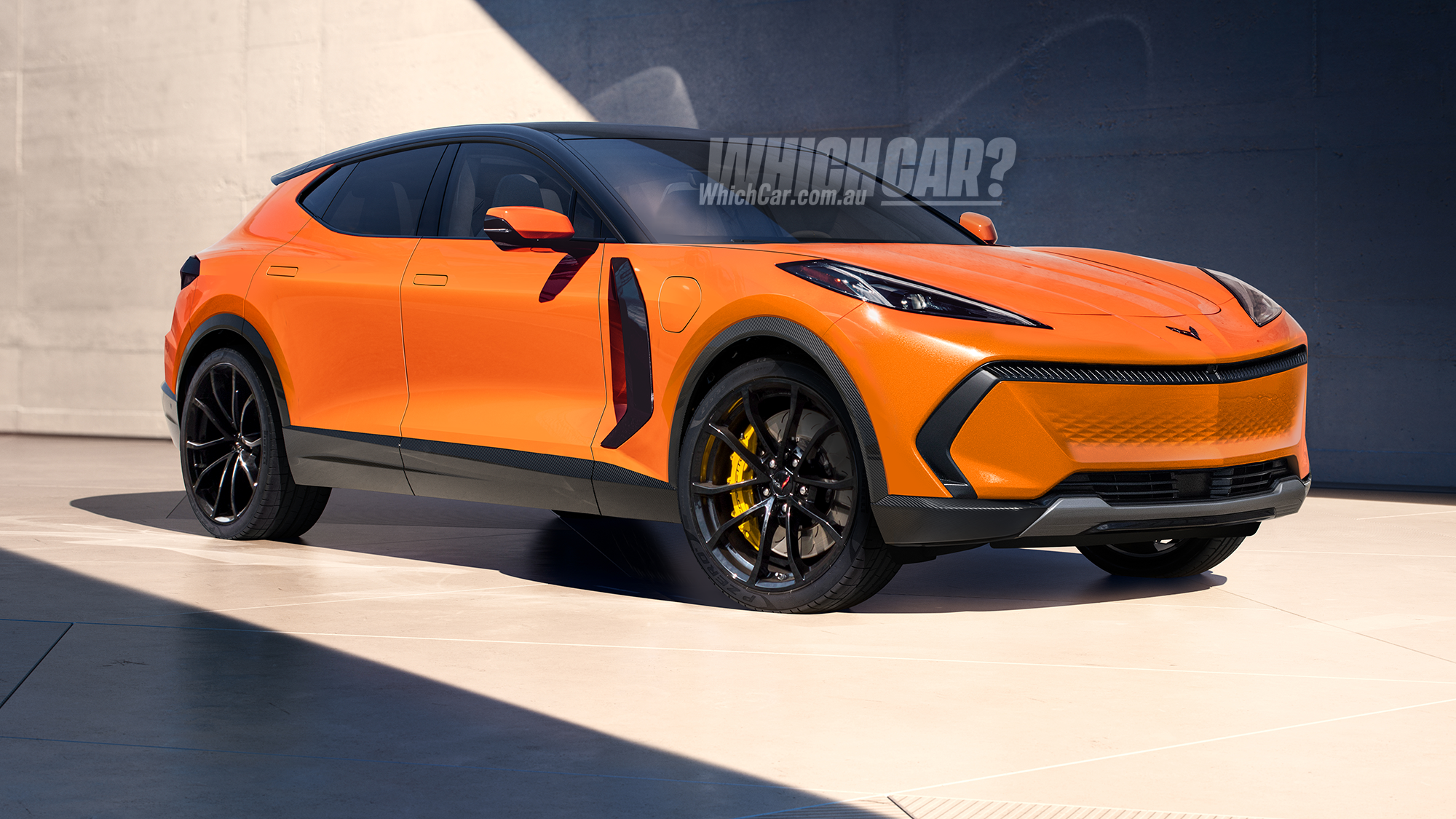
Electric Corvette SUV and sedan will likely rival Porsche’s Macan EV and Taycan sedan
The spinoff move will see General Motors compete with Porsche, providing models to take on the likes of the Taycan and upcoming Macan EV in a bid to improve the profitability of the world-famous Corvette nameplate.
An electric SUV with a well-known sports car nameplate is also the formula for the Ford Mustang Mach-E; however, the Corvette SUV is expected to be a more premium vehicle with a higher price tag.
Both vehicles are expected to be underpinned by GM’s latest Ultium electric vehicle architecture, as found underneath the GMC Hummer, Chevrolet Silverado EV and Cadillac Lyriq. (Along with Honda’s new overseas Prologue, as part of a partnership project.)
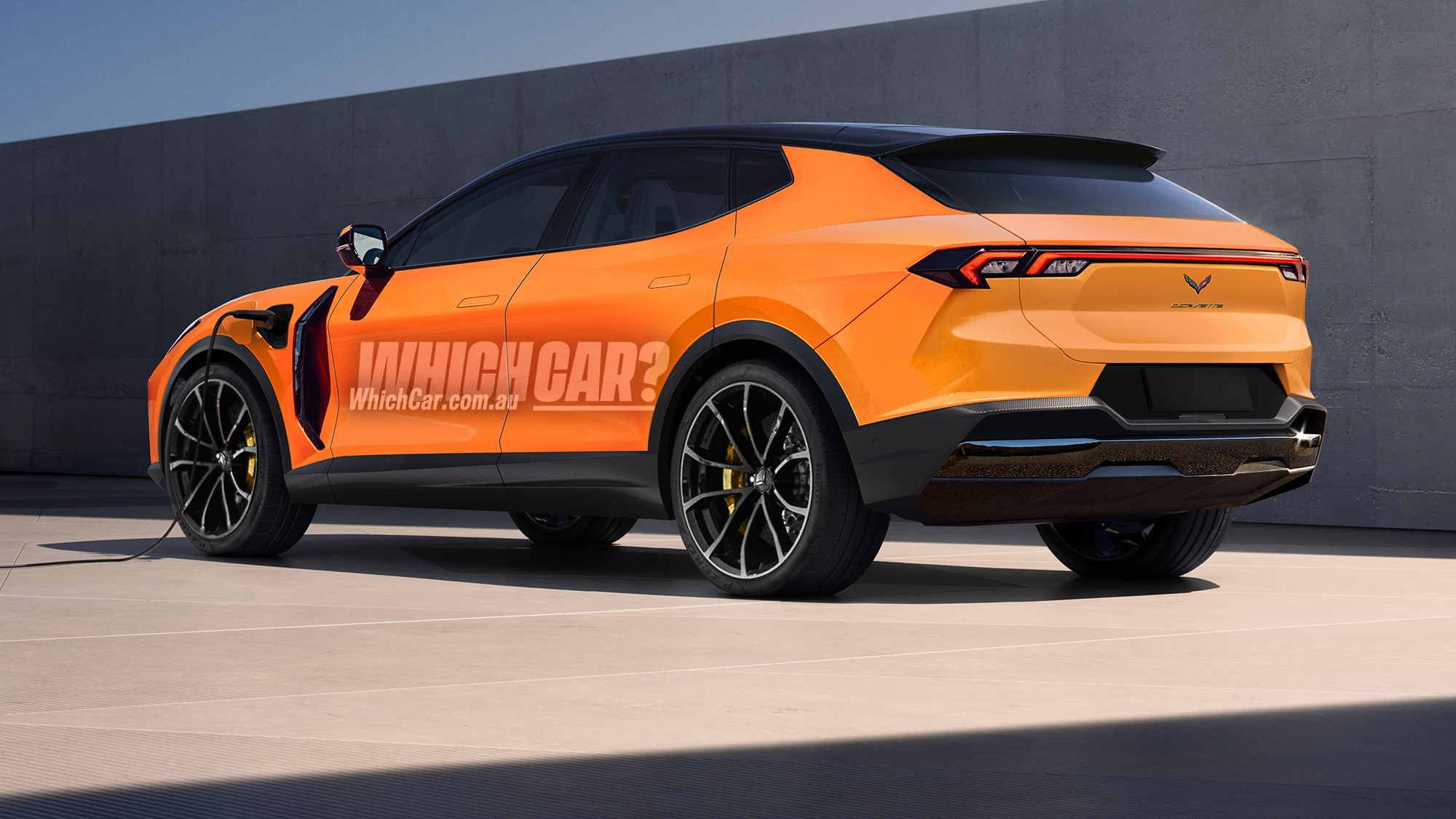
Unique styling and high-end EV tech
The report claims the four-door coupe and the SUV are “copies of nothing”, with high-density batteries, faster software, a “patented cooling concept” and an 800-volt electrical system providing 350kW of charging power.
In addition, it claims the Corvette-branded vehicles will feature “staggered Lego-like topographic packaging, miniaturised componentry, ultra-efficient inverters, [and] high-revving electric motors.”
A two-speed transmission, brake-by-wire, four-wheel steering and torque vectoring are also expected.
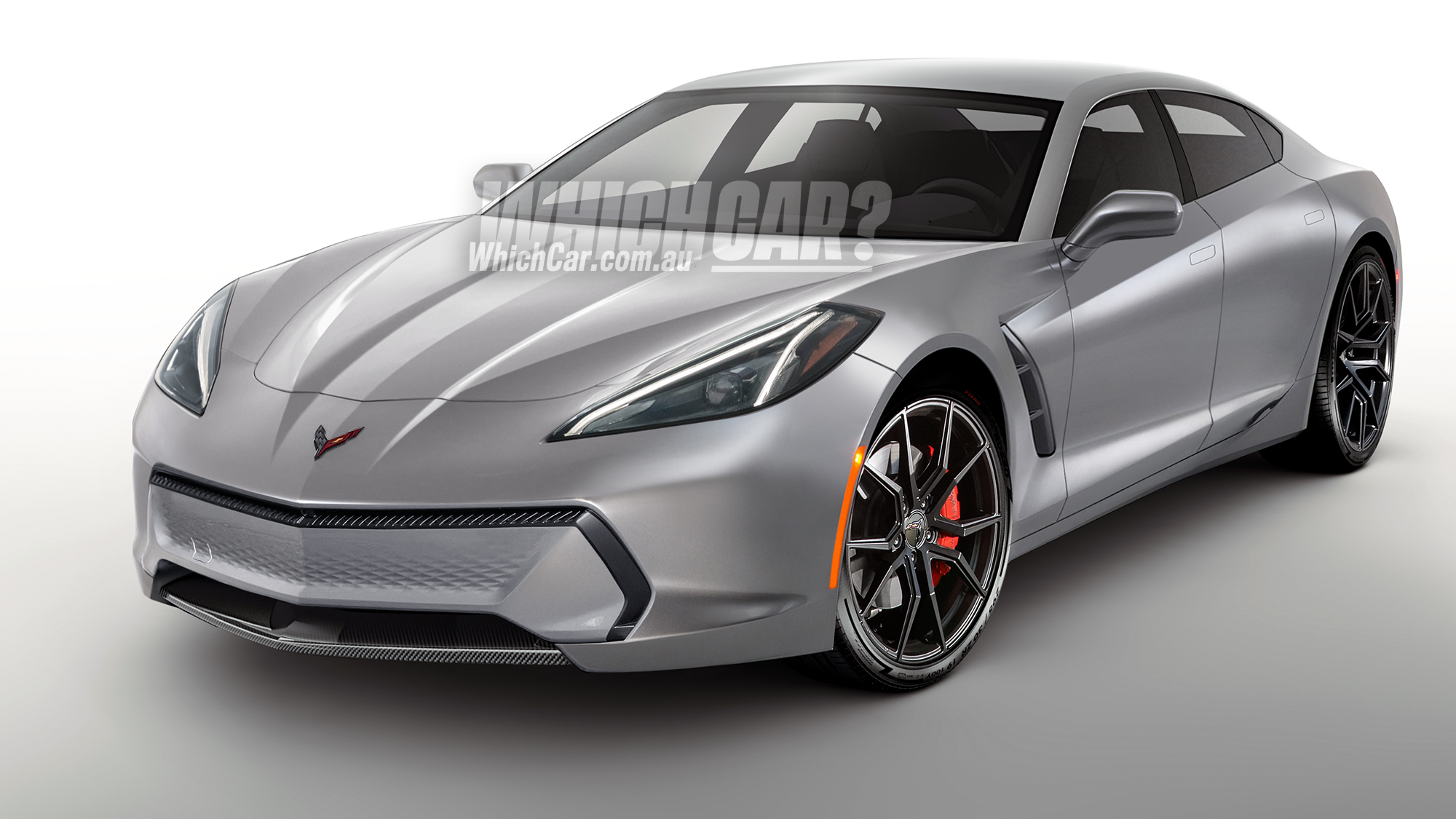
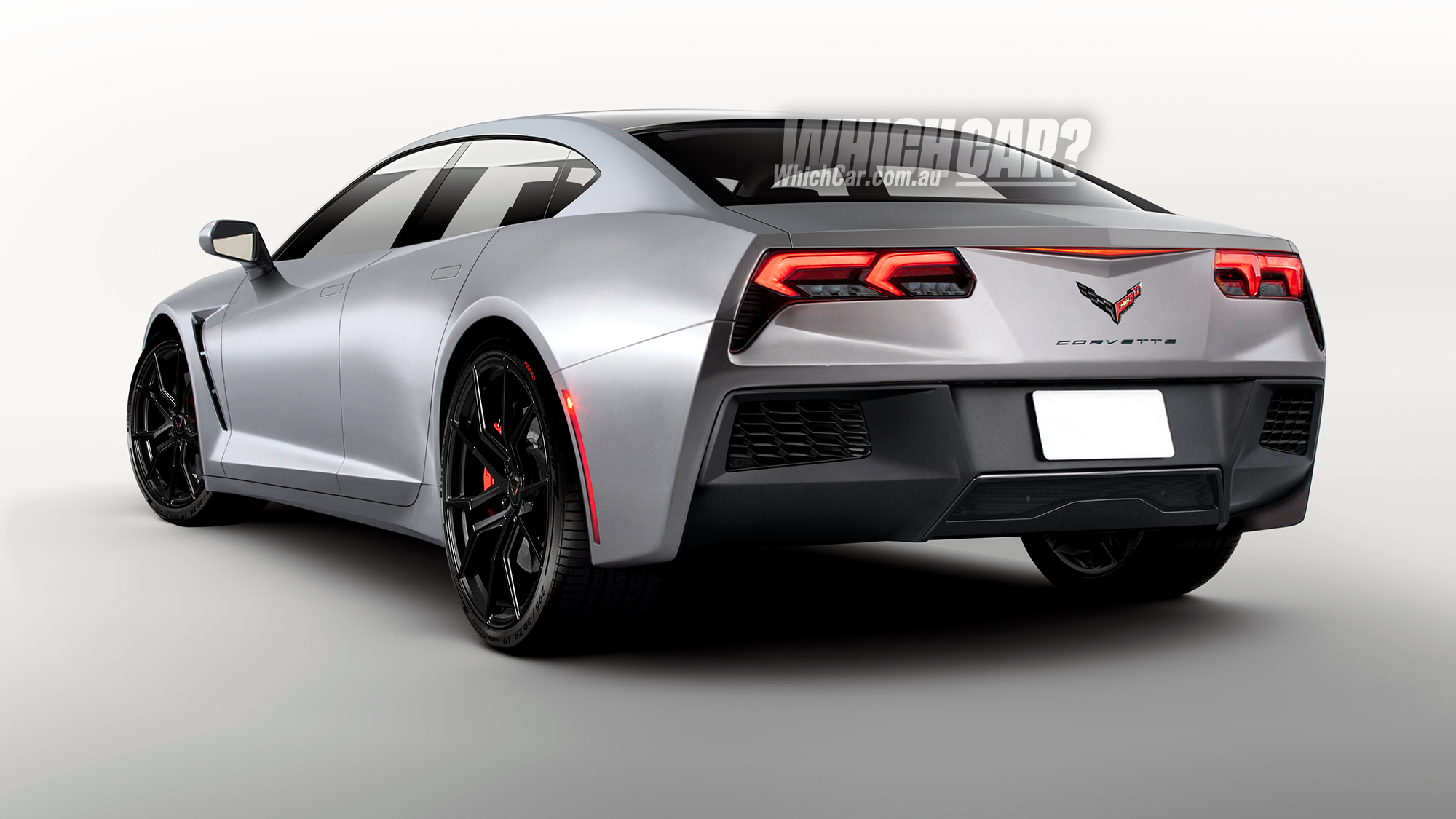
While exact technical specifications are unclear, the upcoming Cadillac Celestiq – which is GM’s flagship electric vehicle with a price tag similar to the Bentley Flying Spur – produces 447kW and 868Nm.
It features a dual-motor, all-wheel-drive setup and a 111kWh lithium-ion battery pack, with a 483-kilometre driving range and a claimed 0-60mph (0-97km/h) time of 3.8 seconds.
Earlier this year, General Motors’ design team showcased a swoopy electric SUV sketch on social media, providing a hint at the high-riding Corvette.
https://www.instagram.com/p/Cb0HxD4ukIH
If the electric vehicles reach production, it will headline a new era for some of America’s most-iconic vehicle nameplates.
Stellantis – the parent company for Dodge, Jeep, Chrysler and Ram – is also preparing to launch an electric four-door Dodge Charger, following the unveiling of the two-door Charger Daytona SRT concept in August.
As for an all-electric version of the C8 Corvette, it is unknown if it will utilise Ultium batteries within the current vehicle’s mid-engine architecture, or switch to the brand’s dedicated EV platform.
It is expected to launch in 2024, with several electric motors and all-wheel drive as standard.
“This one’s for you, concrete yearner, tamer of curves, master of speed. Wear your finest suit, dirt is made for it…”
Lamborghini’s Huracan Sterrato is the stuff of future legends, the kind of thing that just doesn’t get built often enough in this era – but wow, this video.
Look, I missed this video when it first appeared online a couple of weeks ago – I’m not on Twitter and who can keep up with the flood of press releases these days? – but boy am I glad it finally landed in my tray.
“Dust is gold, dirt’s for the bold” goes the almost chanted slogan between AI-generated lines of machismo, growled by a 16-year-old boy with the “I’m a man now” moustache and affected deep voice that might suit a Batman satire if Will Arnett didn’t already have it locked down.
Speaking of satire, it’s a video ripe for parody, and none other than Richard Porter of Sniff Petrol fame has delivered on its potential. See below.
Alright, I’m done beating up Lamborghini’s marketing team. And, to be fair, they know their audience.
The Sterrato itself looks likely to be an absolute beast, rivalling the new Porsche 911 Dakar with its 455kW/610Nm V10 powering the 44mm-taller SUV to 100km/h in 3.4 seconds – on probably any surface, but ideally gold dust? Remember, dirt is for the bold.
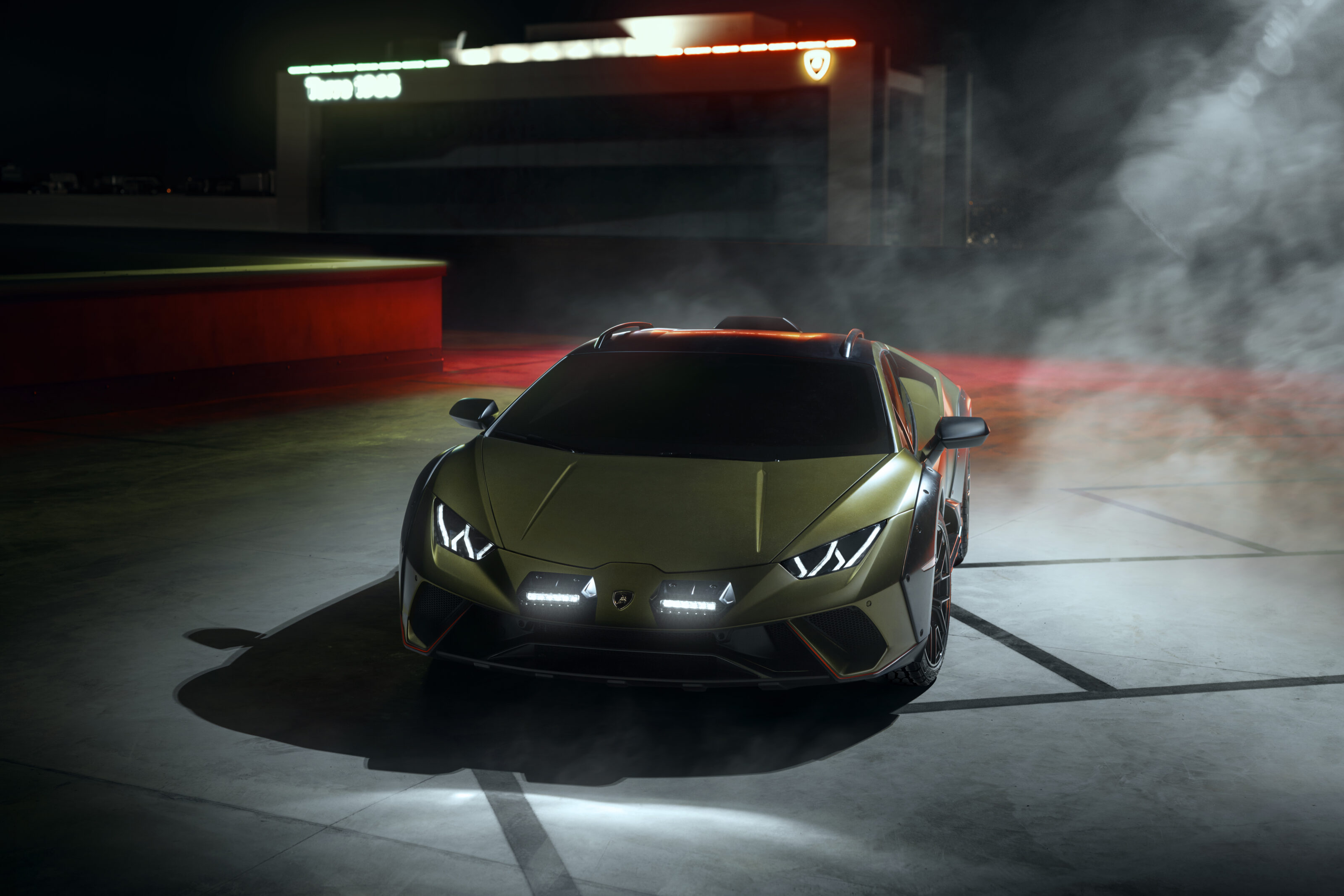
This special edition marks the last hurrah for the Huracan following the Tecnica’s release, with only 1499 Sterratos being produced globally. The Sterrato is likely to hit Australia in limited numbers, with pricing still to be confirmed.
Learn more about the Huracan Sterrato in our reveal story below, and make sure you read Georg Kacher’s review of the 2019 concept, too.
The average retail petrol price in Australia’s five largest cities fell by 10.3 cents per litre, according to the Australian Competition and Consumer Commission (ACCC).
It says this is the first time the price of petrol has fallen during the third quarter of the year in almost two years, with the second quarter average of 177.7 cents per litre dropping to 167.4 cents per litre.
According to the ACCC, this reflects a 34 per cent drop in international petrol prices, weaker global demand, and concerns about a global recession.
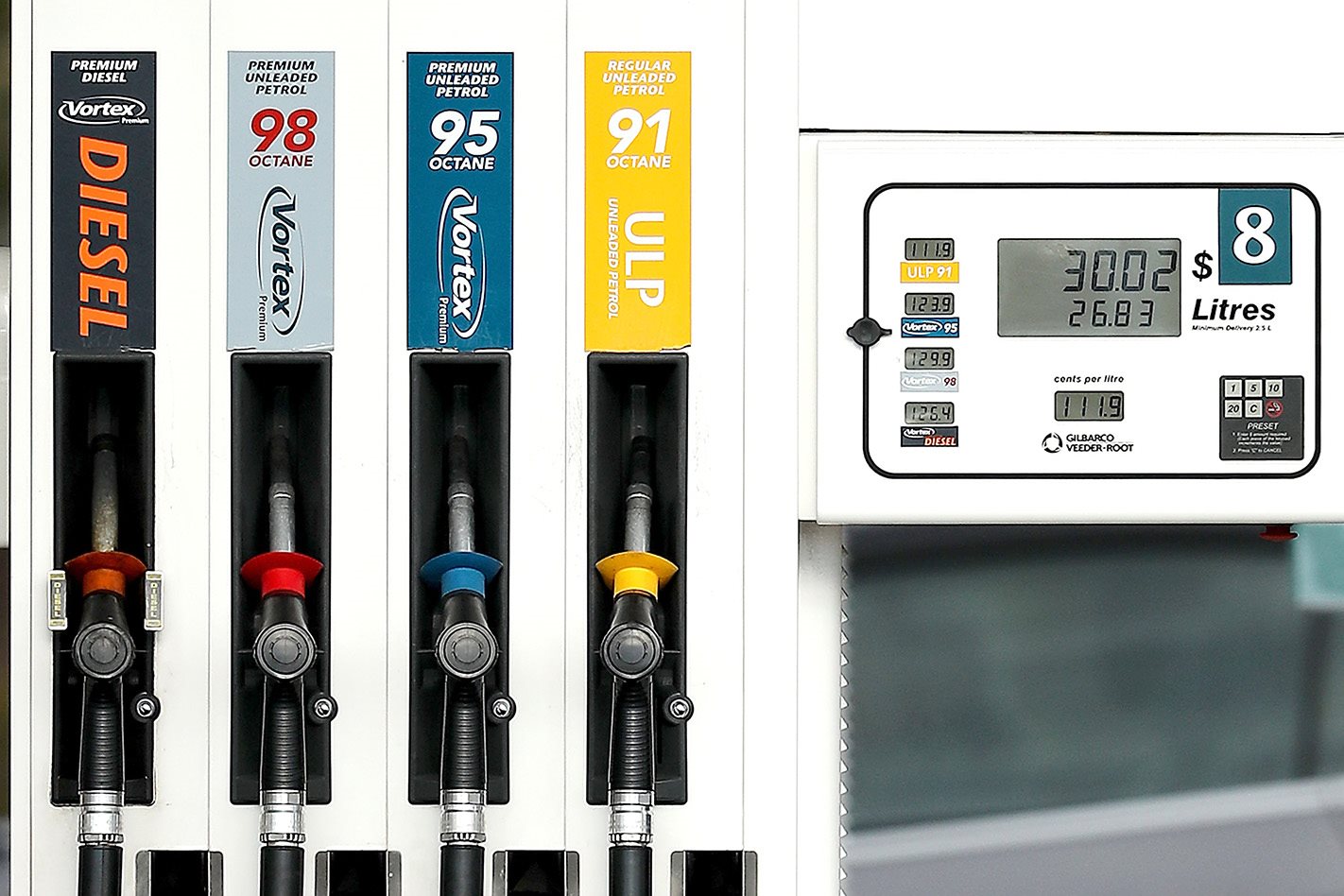
This is despite the return of the full fuel excise amount on September 29, 2022 – although this is likely to be reflected in the fourth quarter report, as the excise is applied to wholesale fuel, which feeds through to retail prices after a lag period.
This week, the Australian Institute of Petroleum reports the average national metropolitan average for unleaded petrol is 171.9 cents, up from 161.1 cents in the week before the fuel excise cut was removed.
The cut was caused by the Russian invasion of Ukraine in early 2022, with high fuel prices throughout March leading to a 21.1-cent reduction for six months.
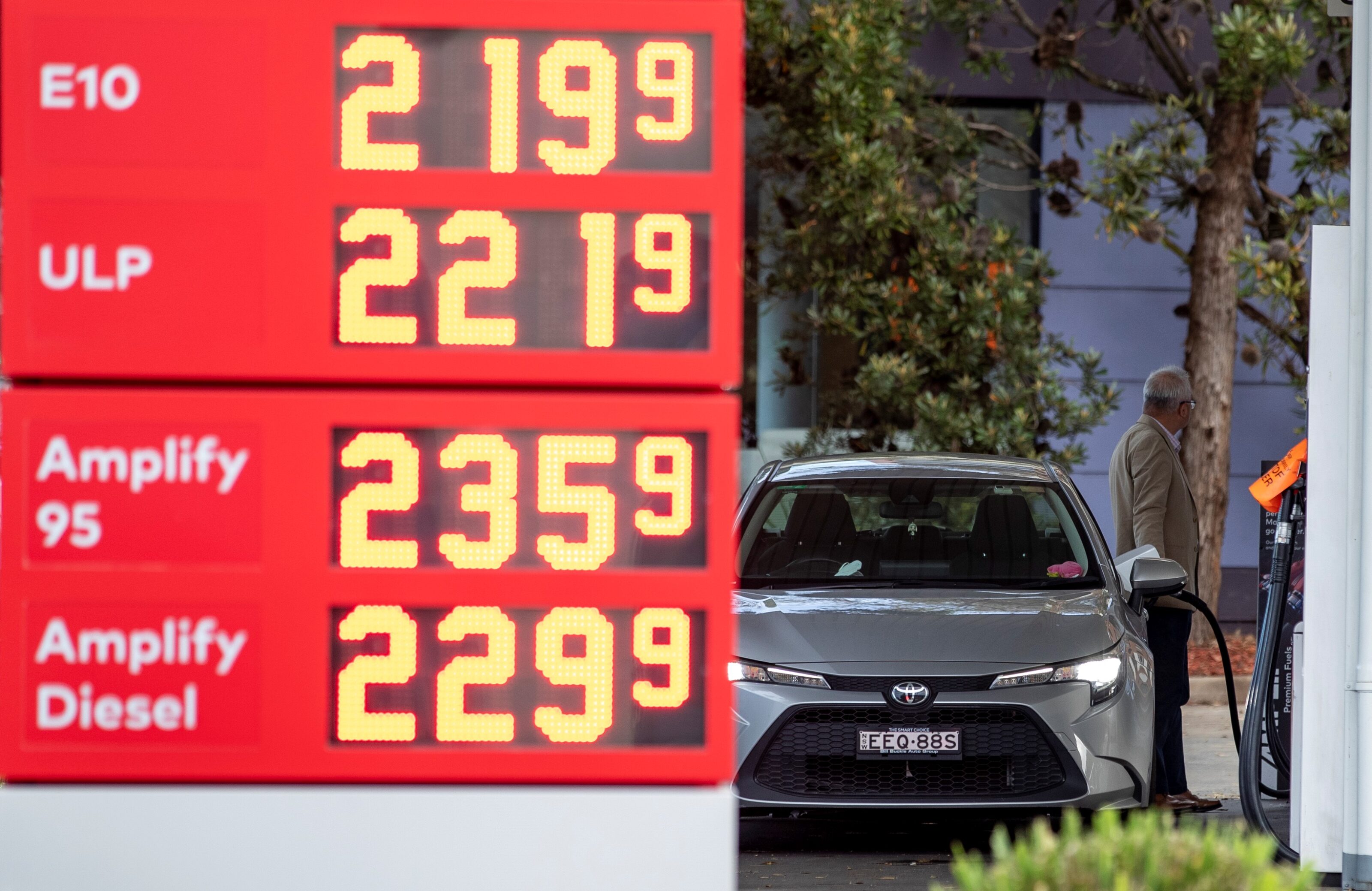
It isn’t good news for diesel, though. While petrol has fallen, average diesel prices at the bowser remain significantly higher than the average petrol prices in Australia’s five largest cities.
This is due to the full restoration of the fuel excise, an increase in wholesale diesel prices, its broader use in industrial activity and electricity generation, and stockpiling for the higher demand for heating in the Northern Hemisphere’s winter.
In the six weeks following the excise restoration, average diesel prices in the capital cities increased by between 29.0 cpl (in Hobart) and 37.6 cpl (in Perth), while the average increase regionally was approximately 32 cpl.

Following the restoration of the full fuel excise, the ACCC says it communicated with the industry, state and territory governments, and consumers to outlay its expectations about price increases, which it monitored for six weeks.
This monitoring has shown that petrol prices have increased, but “by less than the expected 25.3 cpl from the excise restoration” in metropolitan areas.
However, the ACCC said 18 regional locations saw price increases above 25.3 cpl, with further examination underway in these areas.

“We have looked at the impact of the excise being restored, and, allowing for movements in international prices and the price cycles in the major cities, we found only a small number of unexpected increases in average retail petrol prices,” said the ACCC Commissioner, Mick Keogh.
It has also called on the Victorian Government to implement a fuel price transparency scheme, following the ACT’s move in early November to implement the NSW fuel price transparency scheme.
“This is welcome news for motorists in the ACT, who can now access real-time and comprehensive fuel price information through the NSW FuelCheck app and website,” added Keogh.
Popular ride-sharing service Uber has launched a new child seat trial in Melbourne.
From today, parents and guardians in the Melbourne metropolitan area can reserve a trip with an installed baby or child seat.
According to Uber, Melbourne was selected due to its “high density of family households”, with plans – all going well – to expand the service nationally in 2023.

To access the feature, users can schedule an Uber ride between 30 minutes and 30 days in advance, using its existing reserve function, and select a Child Seats trip.
Each ride can fit up to five passengers, including a maximum of two children, with a $9.99 surcharge above a regular UberXL trip.
It says most vehicles in the UberXL category – typically a larger seven-seat SUV or people-mover, such as a Toyota Kluger or Kia Carnival – can comfortably fit two child seats.
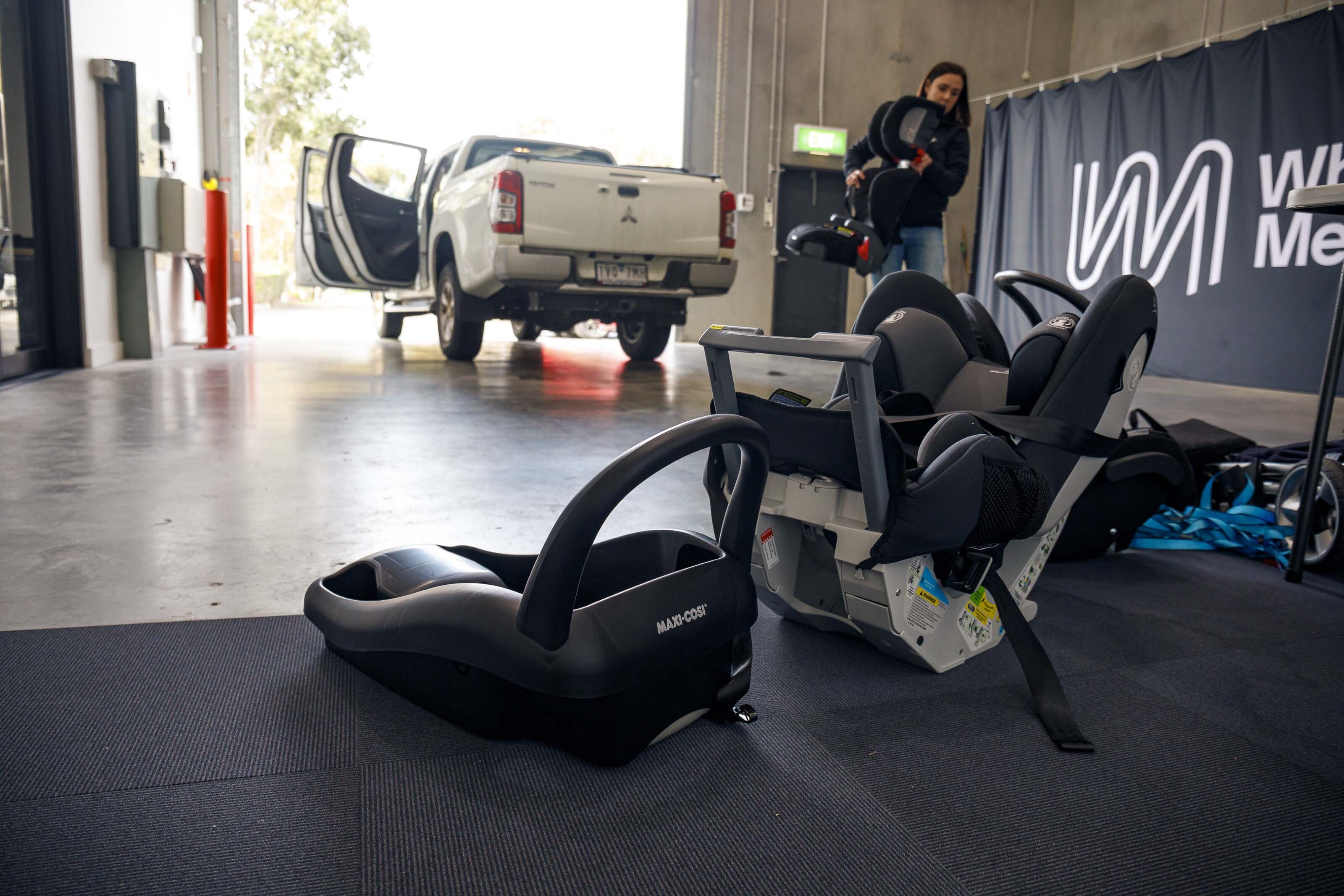
To ensure the correct seat is available, users must let the driver know which is required, and set the pick-up spot to allow for safe installation.
The child seats will be provided by Baby Bunting, with eligible drivers required to complete education modules, including an in-person workshop with a specialised instructor.
Drivers will be required to purchase the child seats – a pre-approved child seat for 0-4-year-olds and a pre-approved booster seat for 4-8-year-olds – but Uber says its drivers will receive a discounted price through Baby Bunting.
“We know there’s huge demand for family-friendly rides, and at Uber we want to support Aussie families to move around as easily and safely as possible,” said Uber Australia general manager, Dom Taylor.

“Uber Child Seats has huge potential to make transport more convenient for many Aussie parents and guardians, while supporting driver-partners with more earning opportunities during the daytime, when most families travel.
“Along with the driver-partners involved in the pilot, we’re excited to be bringing this safe and convenient transport option to Melbourne families, just in time for the summer holidays.”
All children must be accompanied by an adult during the trip.
Snapshot
- Jeep stops Cherokee production indefinitely
- Medium SUV produced at Belvidere, Illinois plant
- 1350 workers laid-off for six months at least
American off-road specialist Jeep is putting production of its Cherokee medium SUV at the Belvidere, Illinois plant on indefinite hold from February 28, 2023.
The resulting lay-offs are significant in the US, with Jeep issuing a statement to North American outlet Jalopnik suggesting partial unemployment will last at least six months for the 1350 affected employees. The brand says it will attempt to redistribute employees within the Stellantis family.
Jeep and Stellantis’s decision to pause production of the Cherokee SUV comes partly due to supply chain issues, but mainly to free up resources as the brand pushes for greater electrification in its range.
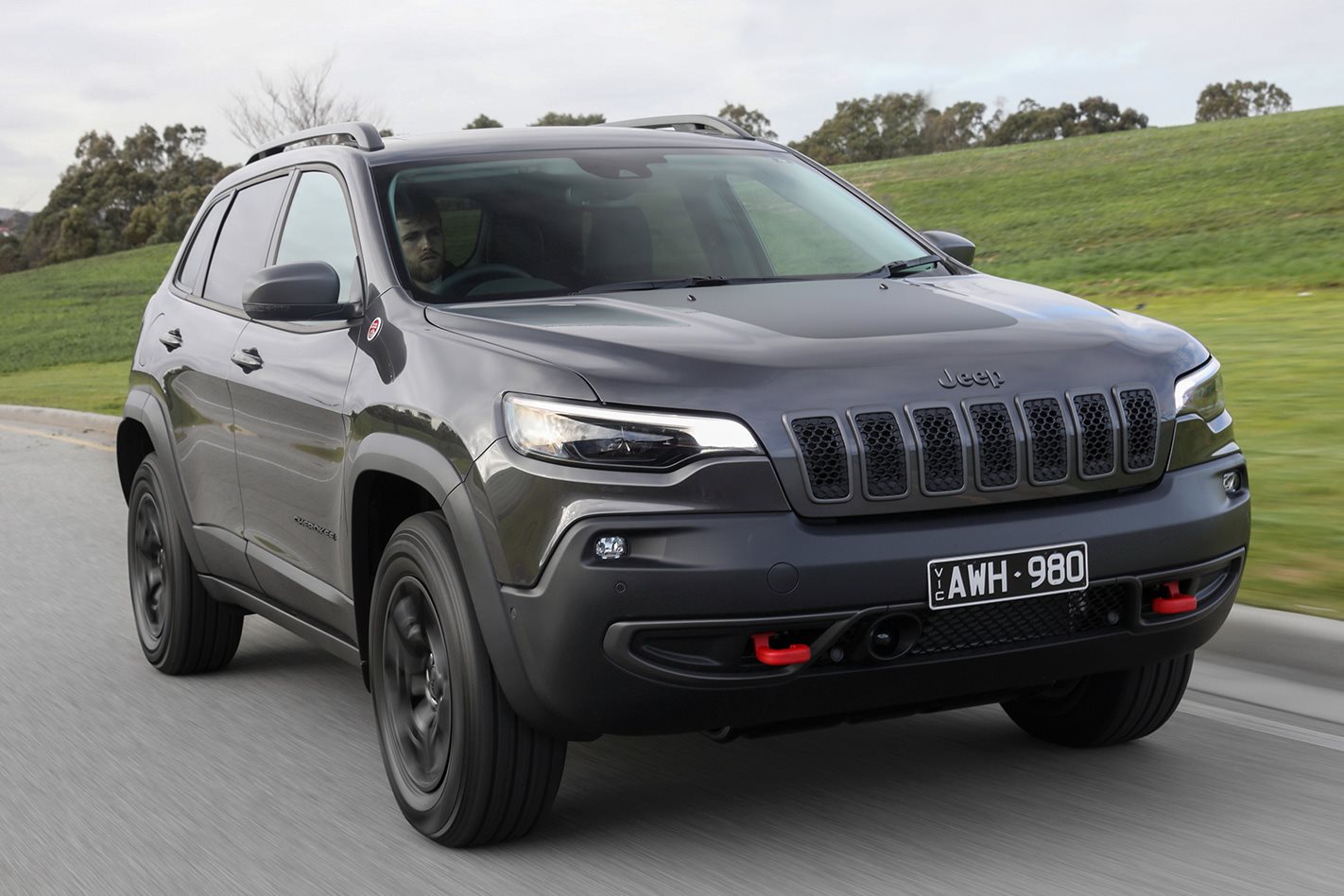
Falling in line with Stellantis’s global push for EVs, Jeep is ramping up towards three new EVs by 2025, including the small Avenger that was revealed in October, a large prestige SUV and a Wrangler-style off roader.
The Cherokee’s future is therefore a little uncertain, with no production in Europe for Jeep’s competitor in what is Australia’s largest market segment.
Having been on sale since 2014 in Australia, the Cherokee is getting on in years. Jeep has sold just 303 Cherokees in Australia so far in 2022, 17.7 per cent down on 2021’s numbers and with only 0.2 per cent of the medium SUV market.
Best Electric Cars Under $65k: Affordable EVs Rated
Welcome to part one of three price-based EV buying guides, this one focused on the most affordable electric cars available in Australia today
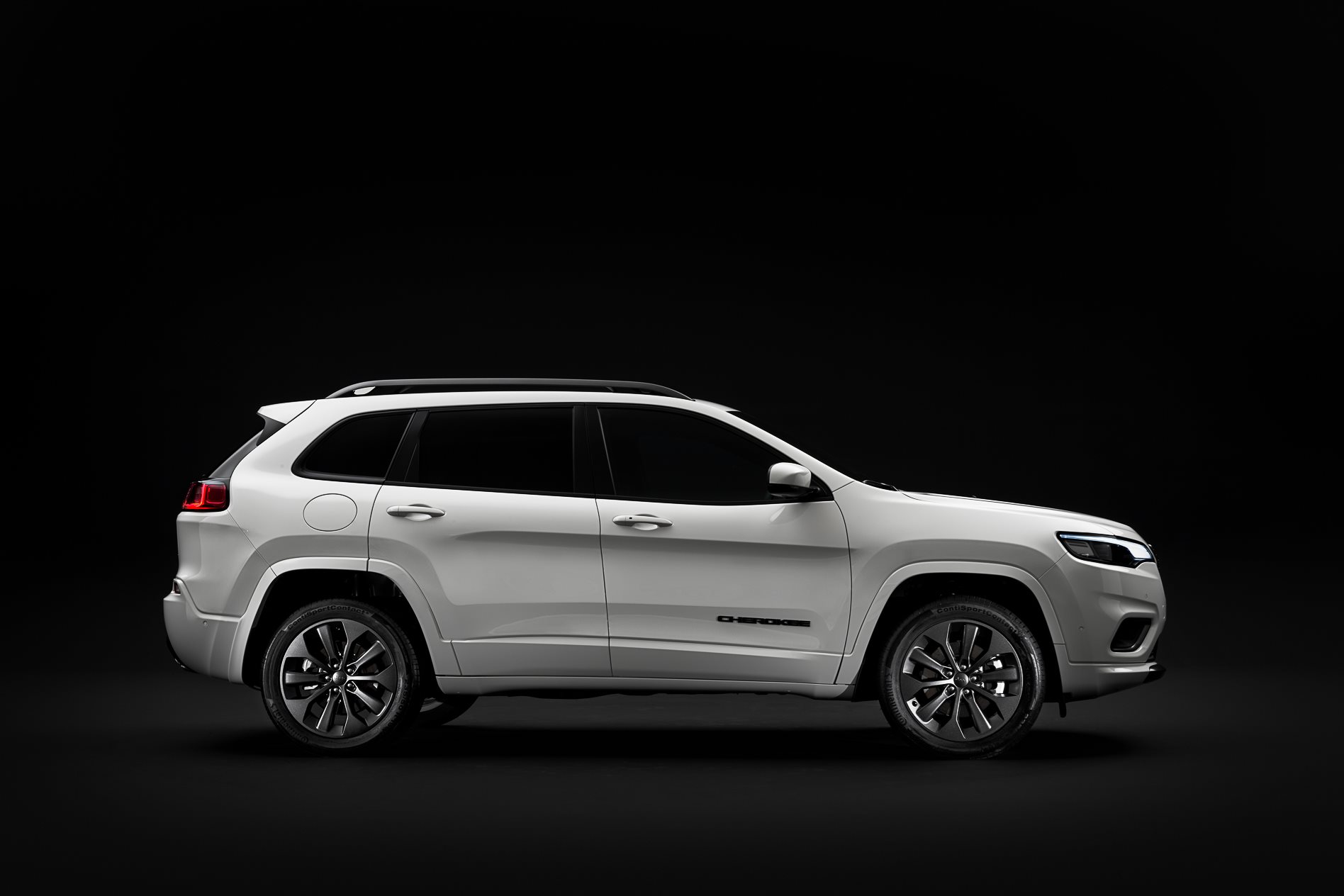
With the popularity of medium SUVs across the world, the next-gen Cherokee – due in 2025 – is tipped to be all-electric. Though if the current car ceases production early, that vehicle’s development may be yanked forward.
There are some rumblings that Cherokee production could move south of the border to the Stellantis plant in Toluca, Mexico – though Jeep or Stellantis is yet to confirm these plans.
Stellantis also has production facilities elsewhere in the world, but its smaller Compass that’s produced in Italy, Brazil, China, India and Mexico, and was updated earlier this year, has far greater global appeal.
