
Nissan Australia has added a more-affordable hybrid variant to its X-Trail line-up with the mid-spec ST-L E-Power. For more information, click on the links below:
Snapshot
- 2023 Renault Koleos pricing and features
- New all-wheel-drive option for mid-spec Zen
- Updated equipment for Life and Zen, but Intens loses its Bose audio system
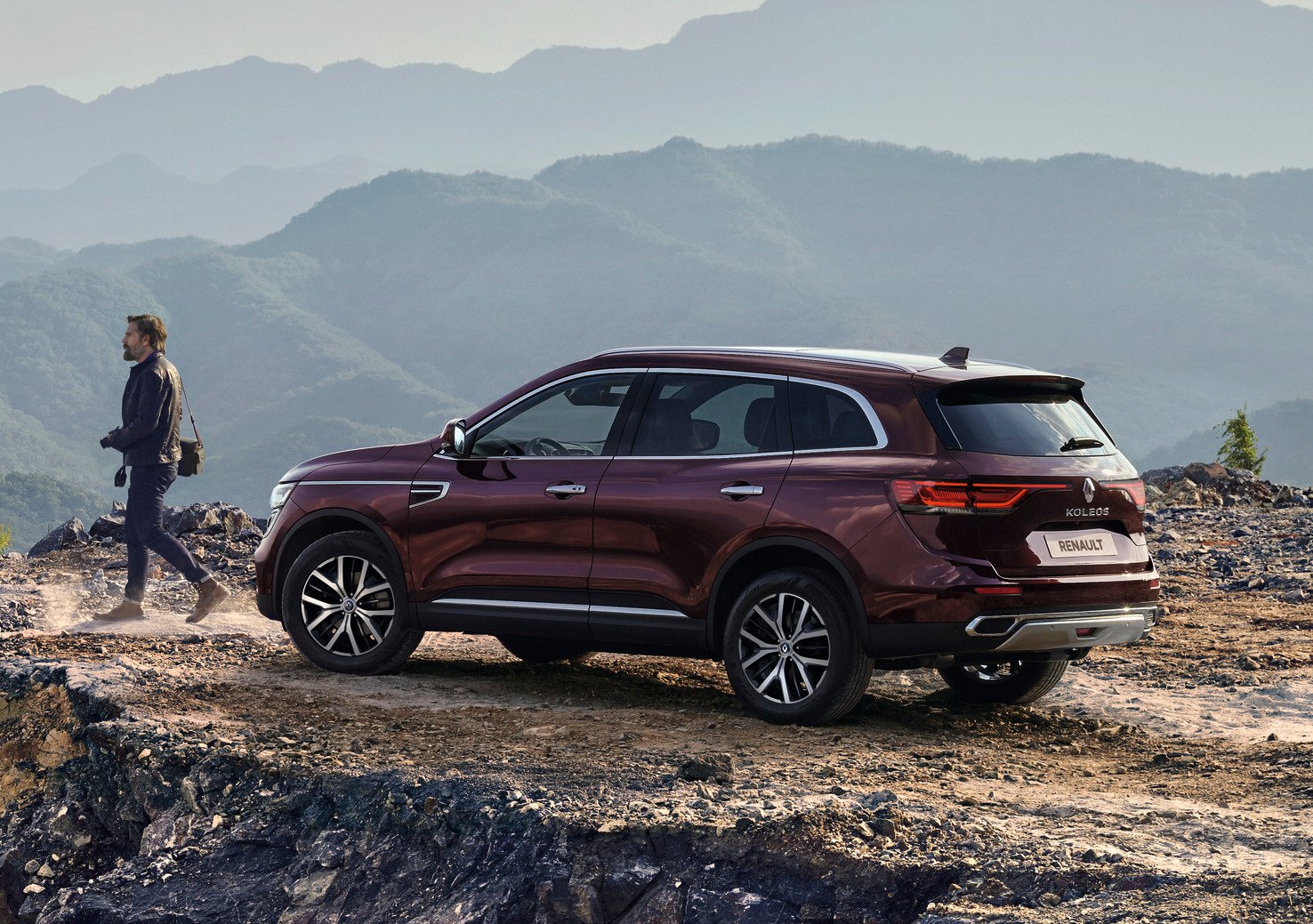
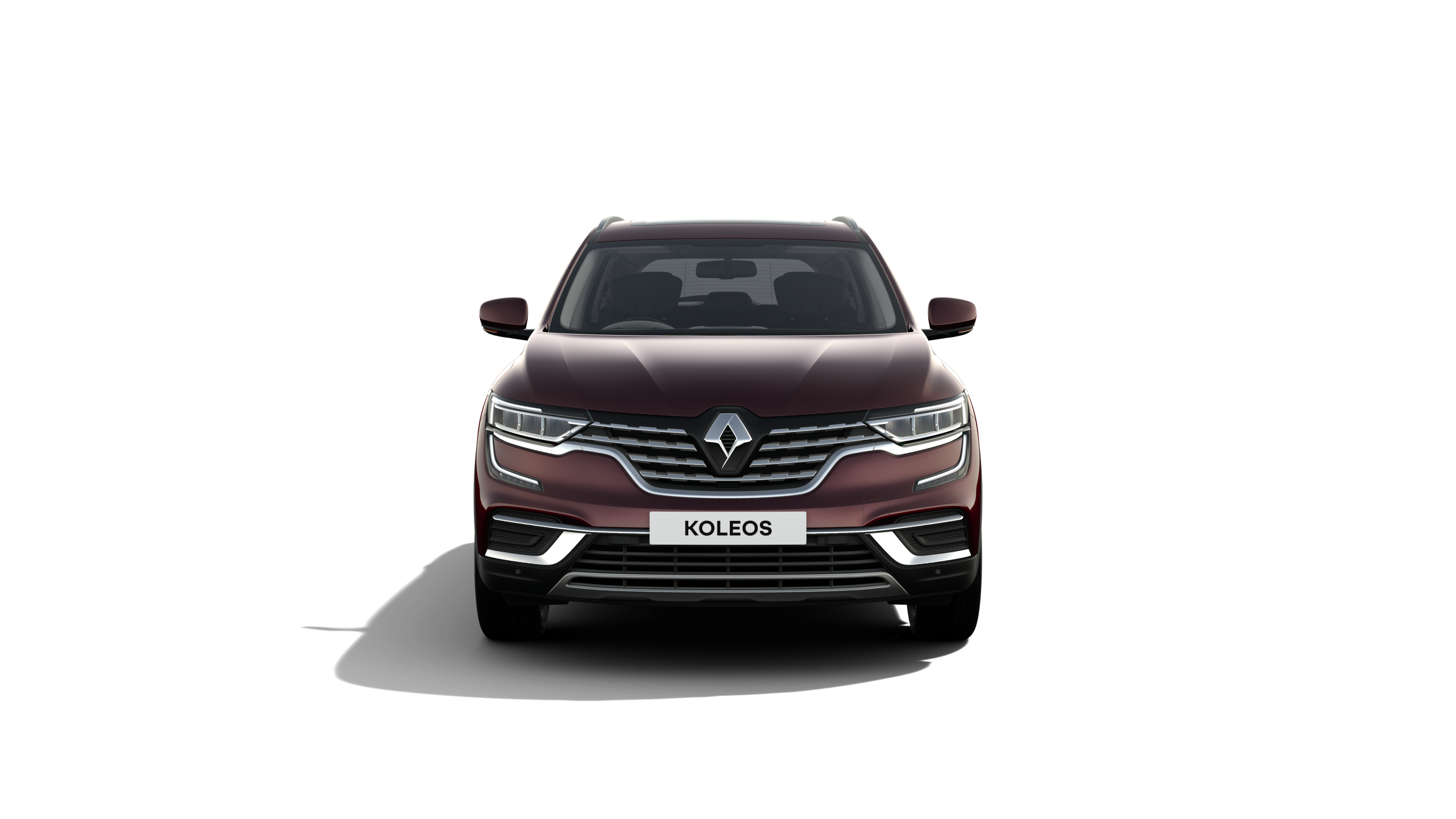
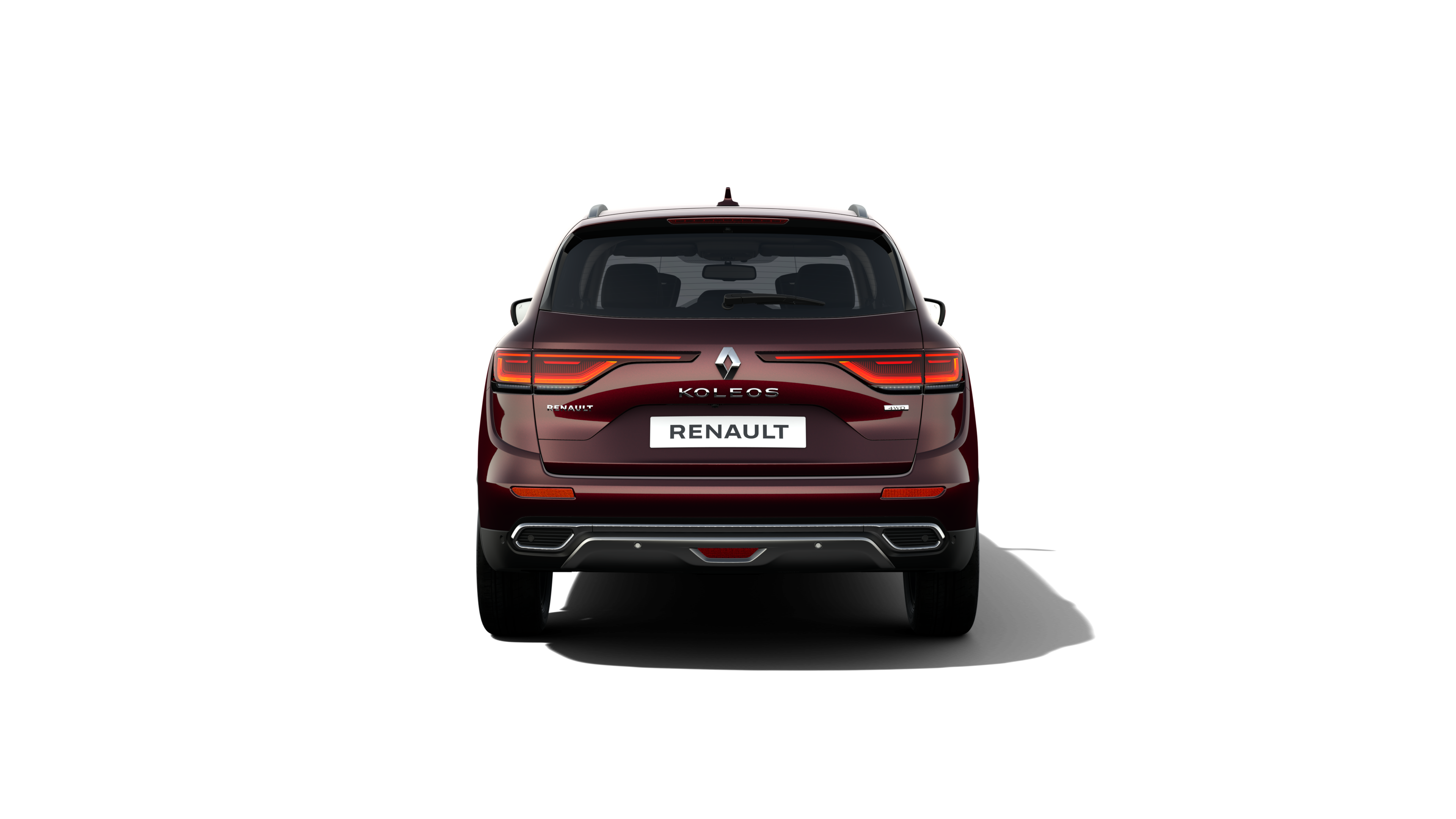
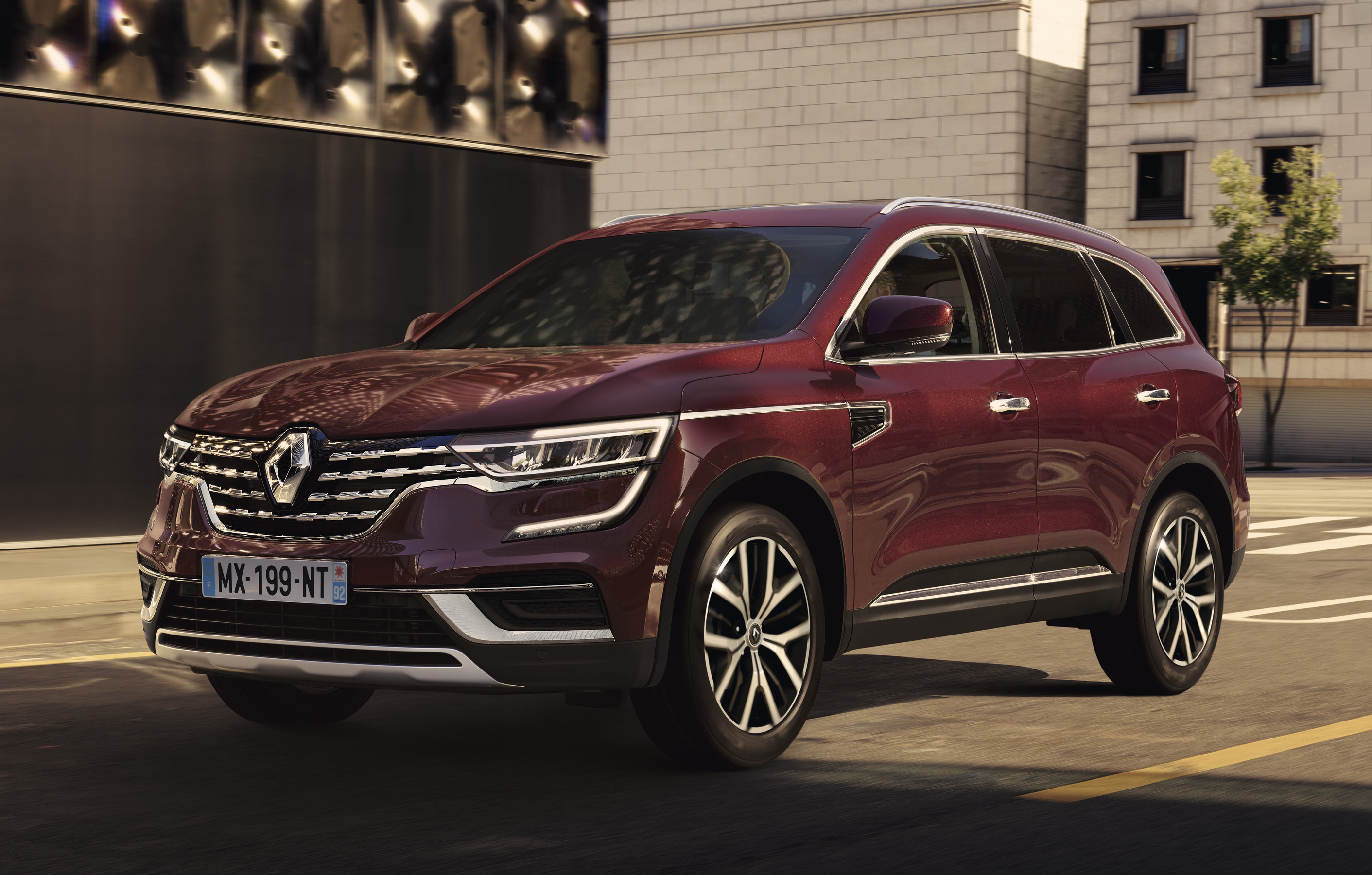
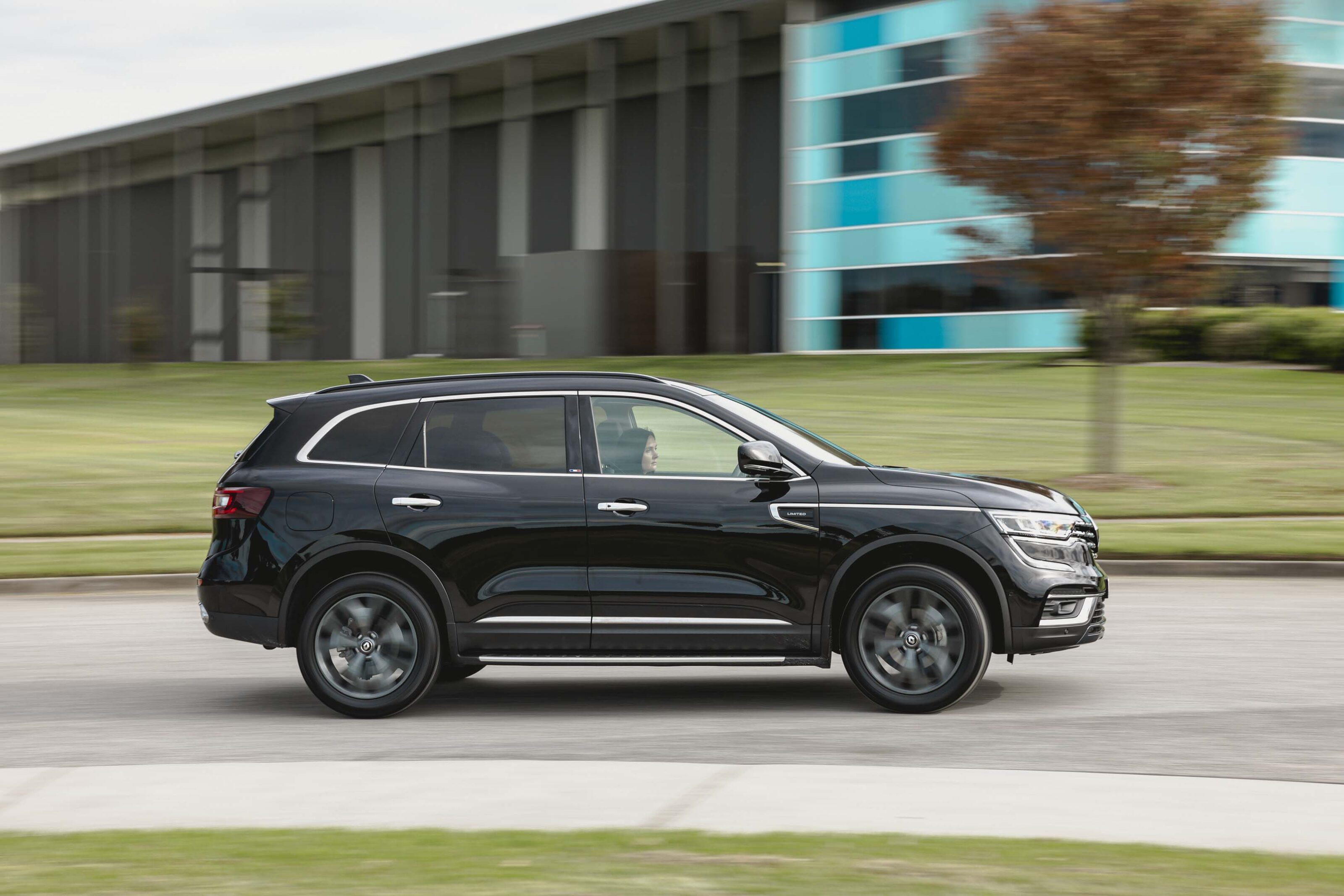
The updated 2023 Renault Koleos medium SUV has arrived in Australia.
It is priced from $37,000 before on-road costs, representing a $2000 price increase over the pre-update Koleos.
The mid-spec Zen has increased by $2900, while the flagship Intens is up $250, now topping out at $47,700 plus on-roads.
1
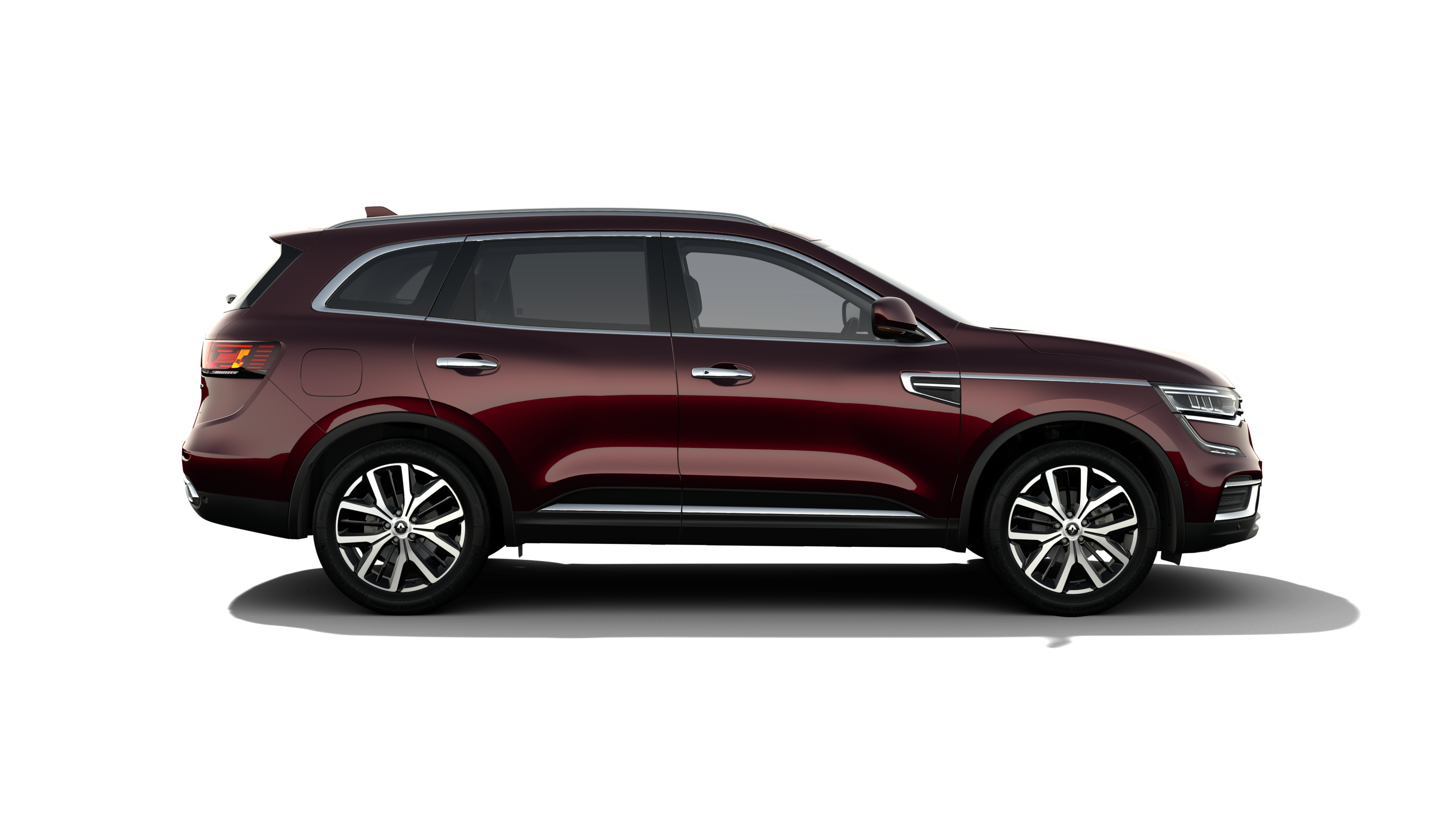
An all-wheel-drive option is now available for the Zen, while the entry-level Life has gained several new features, including blind-spot alert, front and side parking sensors, cloth and leatherette upholstery (replacing cloth), ambient interior lighting and new-design 18-inch alloy wheels.
It also receives a height-adjustable passenger seat, auto-folding side mirrors, illuminated vanity mirrors, rear privacy glass, and exterior chrome trim on the lower doors and rear bumper.
1
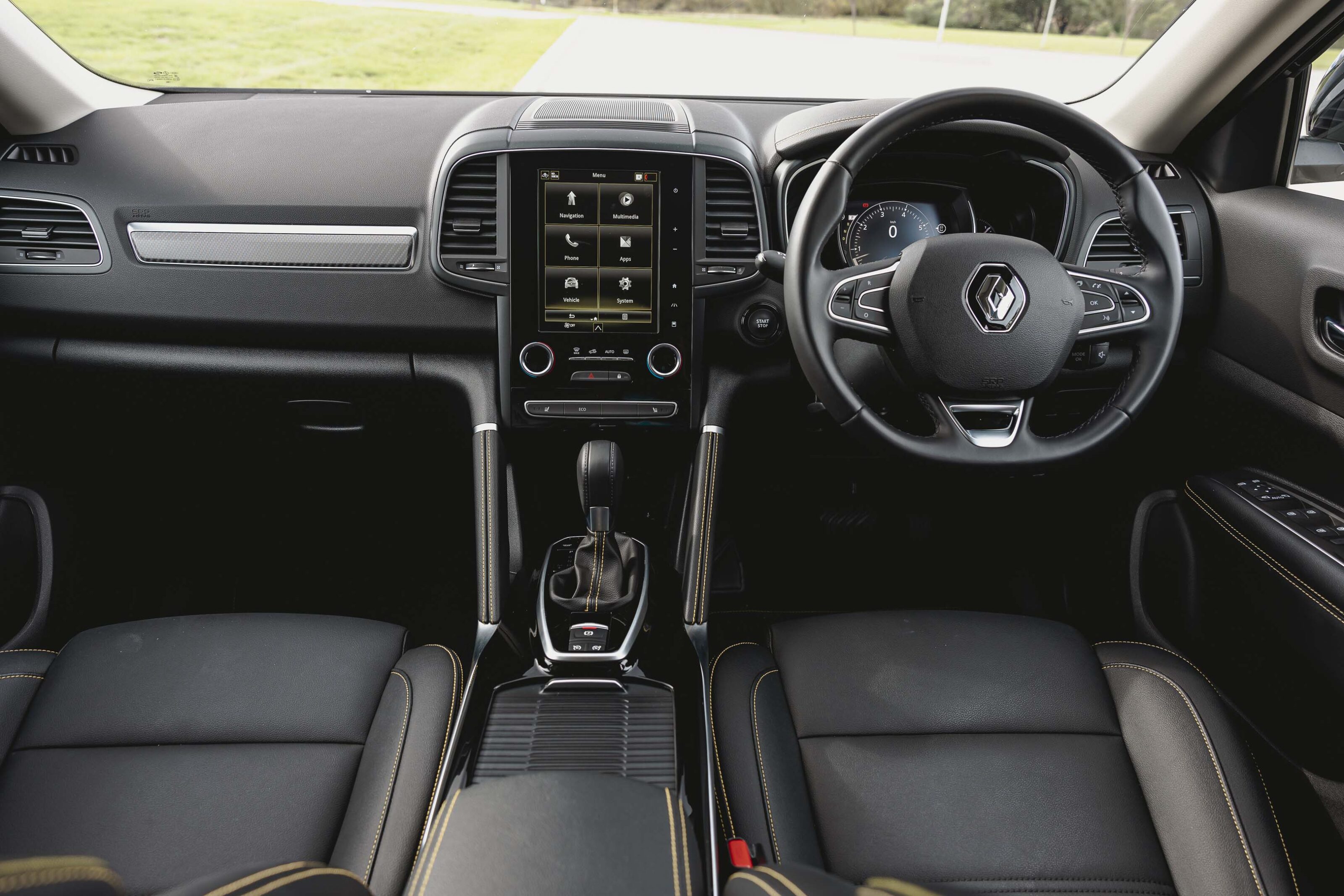
For model-year 2023, the Zen gains several features previously limited to the Intens, including a portrait-orientated 8.7-inch infotainment system, automatic parking, a hands-free electric tailgate, sequential rear indicators, and one-touch folding rear seats.
It also sports black leather upholstery (replacing leatherette), plus the new additions found on the Life.
The range-topping Intens has lost its light grey Nappa leather upholstery option – now black Nappa leather only – and its 11-speaker Bose audio system, in favour of the eight-speaker Arkamys setup available on lower grades.
1
Across the range, the front LED fog lamps and wide-view driver’s side mirrors have been deleted for 2023.
To the end of October, 2297 examples of the Renault Koleos have been registered in Australia in 2022, up 72.7 per cent over the same period in 2021.
While it has outsold the Volkswagen Tiguan (2097) and Ford Escape (1837), it is still far away from Australia’s top-selling mid-size SUVs, including the Toyota RAV4 (30,370), Mazda CX-5 (23,476), Mitsubishi Outlander (15,619), Kia Sportage (15,497) and Hyundai Tucson (14,493).
JUMP AHEAD
- Pricing
- Features
- Options
- Colours
- Engine, drivetrain, and fuel economy
- Safety
- Dimensions
- Warranty and servicing
- Availability
1
2023 Renault Koleos pricing
Prices exclude on-road costs.
| Model | Pricing | Change |
|---|---|---|
| Life FWD | $37,000 | up $2000 |
| Zen FWD | $41,700 | up $2900 |
| Zen AWD | $44,200 | new |
| Intens FWD | $45,200 | up $200 |
| Intens AWD | $47,700 | up $200 |
1
2023 Renault Koleos features
Life
Zen
Intens
1
Colours
Metallic paint incurs a $800 premium.
1
Engine, drivetrain and fuel economy
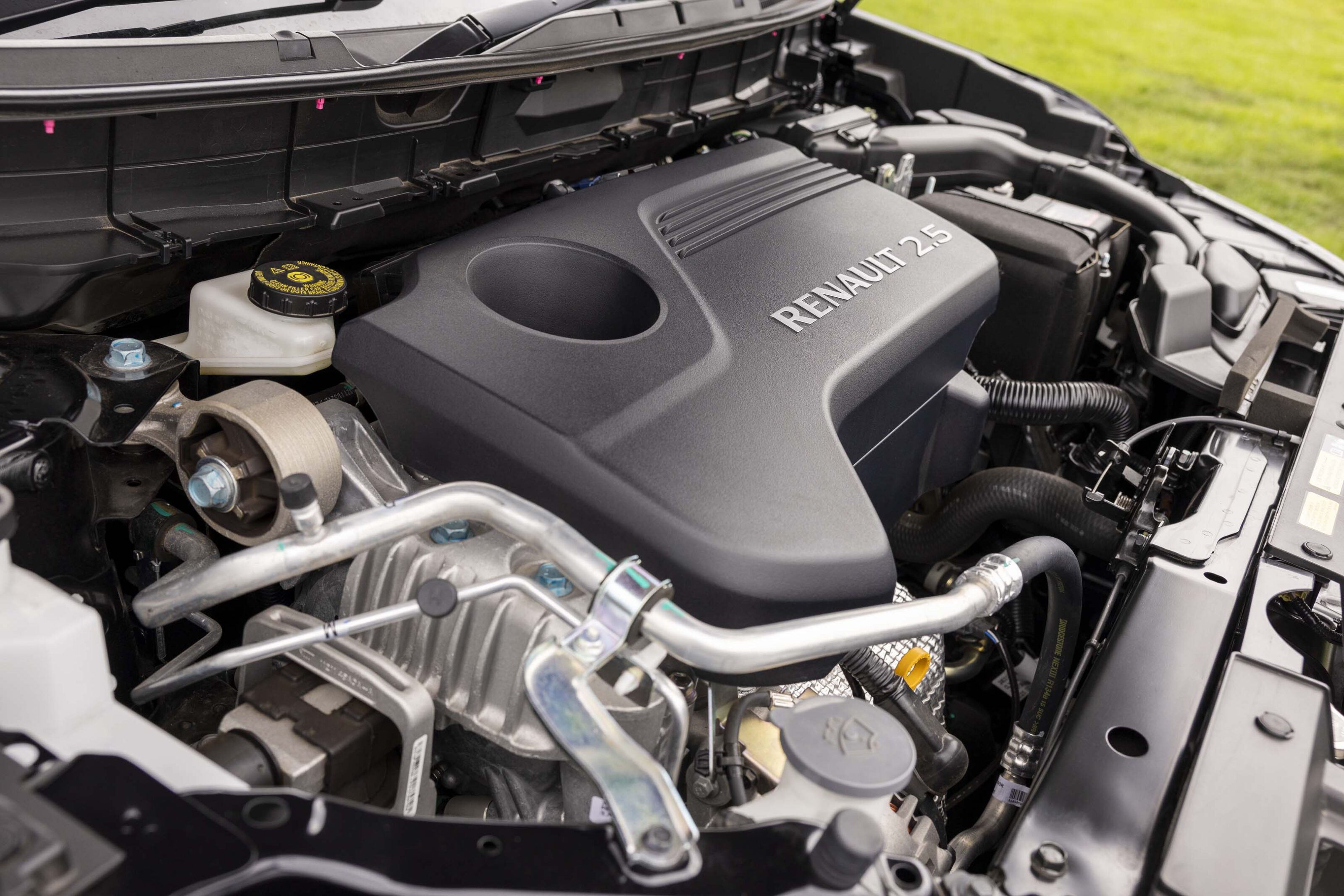
Under the bonnet, the Renault Koleos is powered by a naturally-aspirated 2.5-litre four-cylinder, producing 126kW and 226Nm.
It is paired with a CVT automatic transmission sending power to the front wheels, or all four wheels for $2500 extra on the Zen and Intens.
This powertrain was found in the previous-generation Nissan X-Trail, which shares its Renault-Nissan-Mitsubishi Alliance CMF-CD platform with the Koleos.
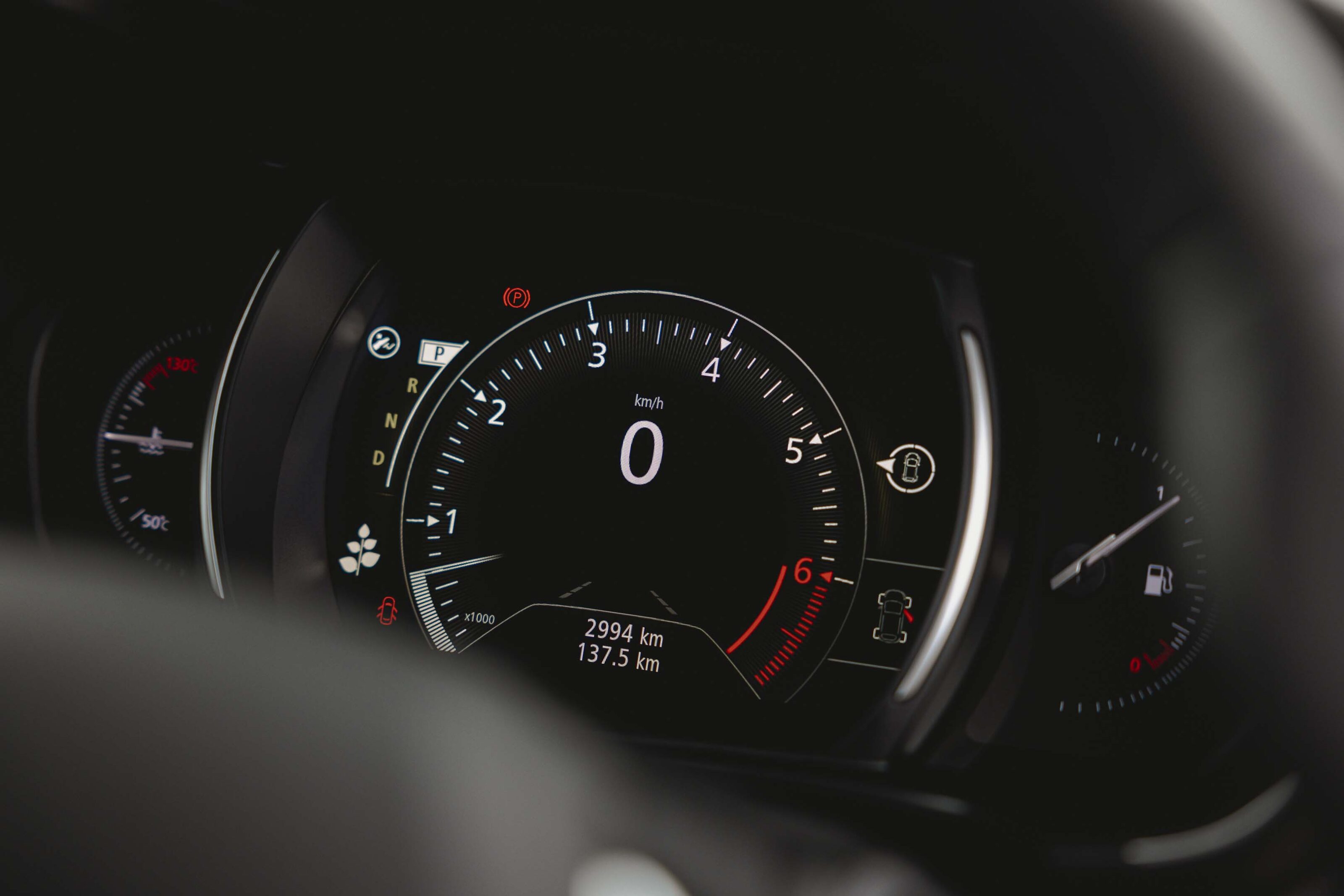
According to the brand, the Koleos has a claimed 0-100km/h acceleration time of 9.5 and 9.8 seconds for front- and all-wheel-drive models, respectively.
1
2023 Renault Koleos claimed fuel economy
All variants have a 60-litre fuel tank. It is compatible with 91RON unleaded petrol.
1
Safety
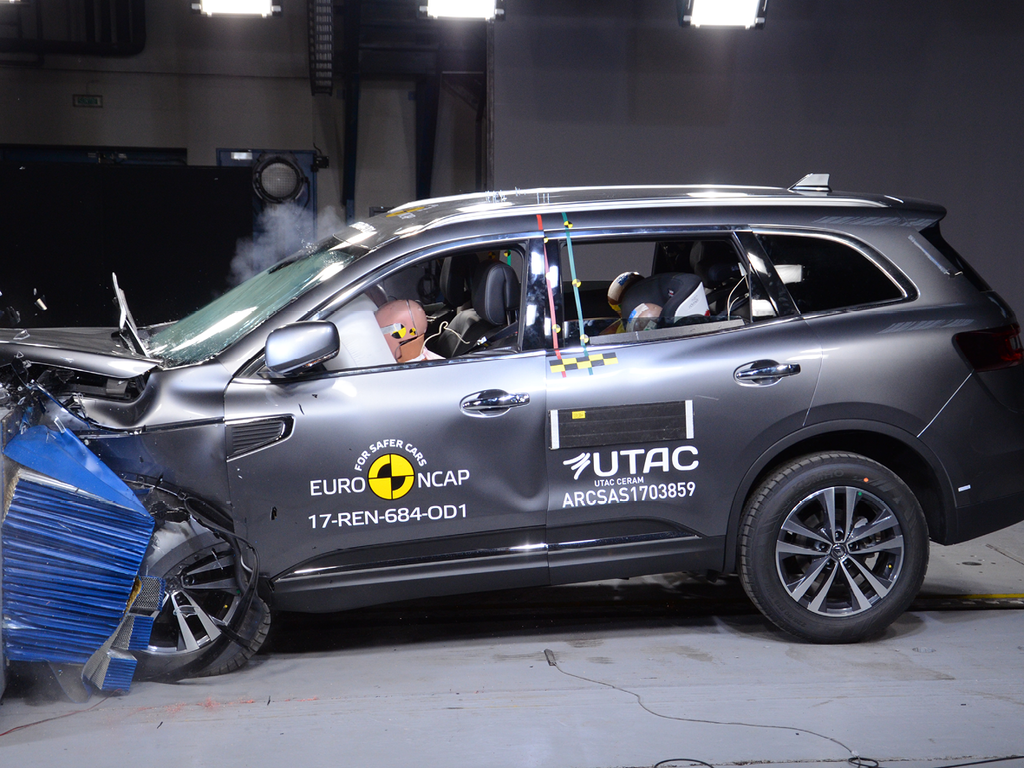
The Renault Koleos is covered by a five-star ANCAP safety rating, based on testing conducted in 2017. This score applies to FWD variants.
It received a score of 87 per cent for adult occupant protection, 79 per cent for child occupant protection, 62 per cent for vulnerable road user protection, and 52 per cent for safety assist.
Six airbags (dual front, side and curtain) are fitted across the range.
Each variant includes the following active safety equipment as standard:
1
Dimensions
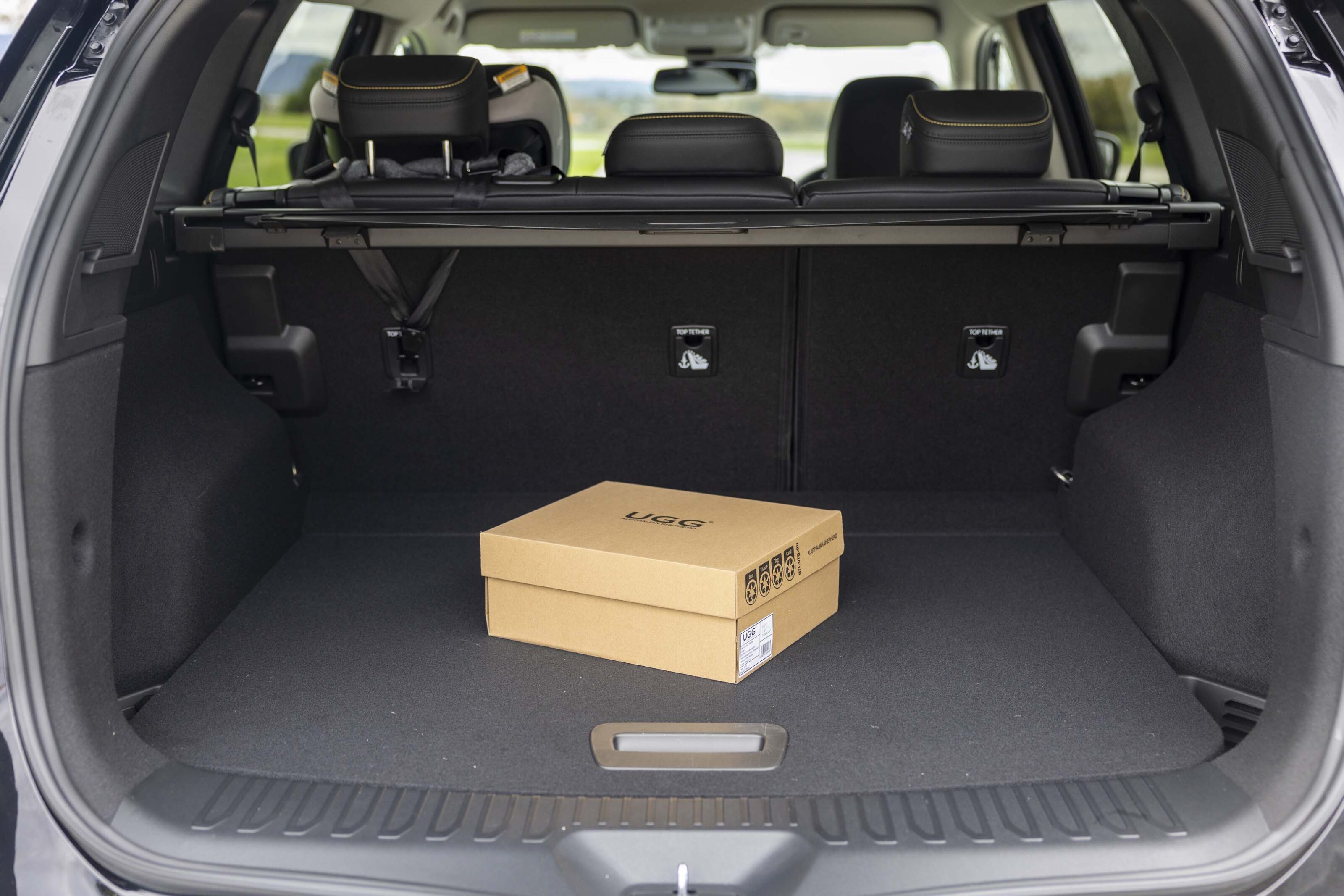
The Renault Koleos has a 2705-millimetre wheelbase, and is 4673mm long, 1843mm wide and 1667mm tall.
2023 Renault Koleos boot space
With the rear seats up, the Renault Koleos has a 493-litre boot capacity. Folding the second row increases luggage capacity to 1707 litres.
1
Warranty and servicing
As per the wider Renault range, the Koleos is covered by the brand’s five-year, unlimited-kilometre warranty.
Maintenance for the Koleos is required every 12 months or 30,000 kilometres, whichever comes first.
Capped-price servicing is available for five years, priced at $429 for the first three services, and the fifth. The fourth service is priced at $999.
Roadside assistance is available over the same period if the vehicle is serviced at a Renault dealership.
Availability
The 2023 Renault Koleos is on sale now.
MORE
Everything Renault
If you’re reading this review, you’ve probably got an idea of the current state of play for hot hatches in Australia.
The Hyundai i30 N and Honda Civic Type R are the hardcore players, the Golf GTI and Focus ST ideal everyday hatches, and the i30 N Line a nice warm entry into the sporty hatch world.
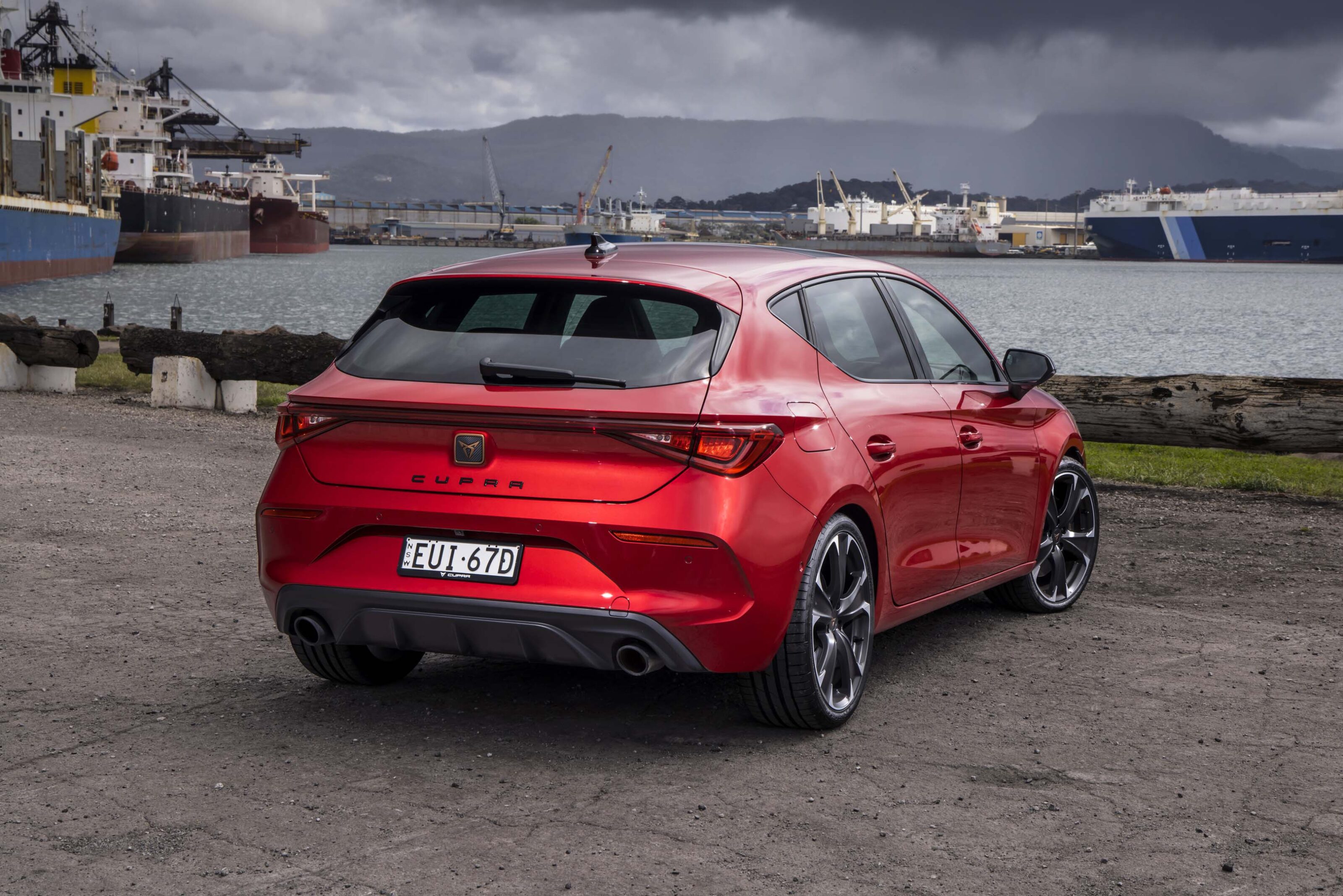
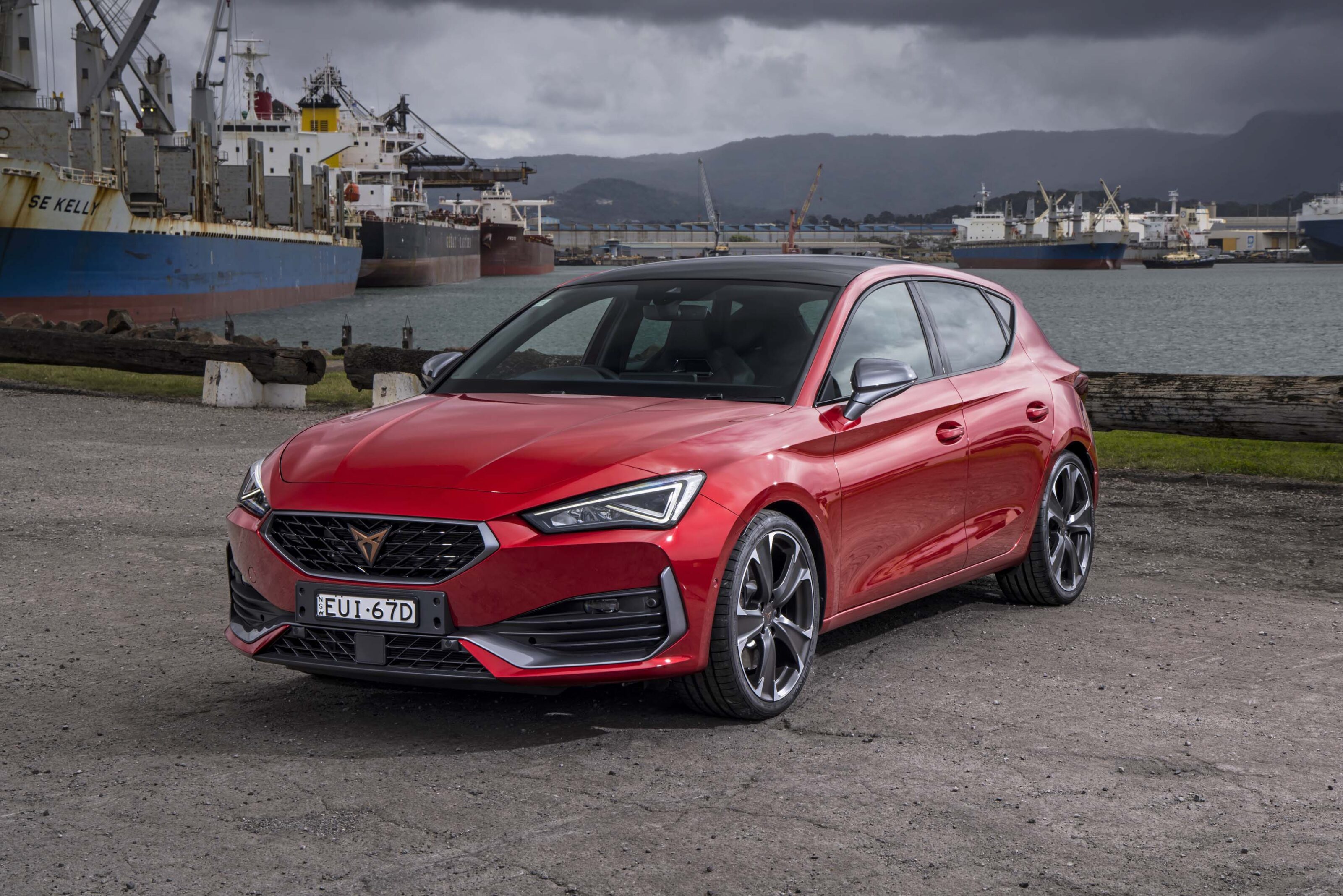
Where does that leave Cupra? Well, VW’s sexy Catalan cousin actually has all bases covered. We’ve driven the flagship 221kW Leon VZx on track, but as more variants trickle into Australia it’s now time to sample the mid-spec 2023 Cupra Leon VZ.
The Leon VZ gets the same 180kW/370Nm ‘EA888’ 2.0-litre turbo petrol four-cylinder as the Volkswagen Golf GTI. But unlike that car, it also gets Cupra’s signature suspension settings, cabin design and exterior swagger.
1
In essence, the Cupra is a whole lot cooler than the GTI.
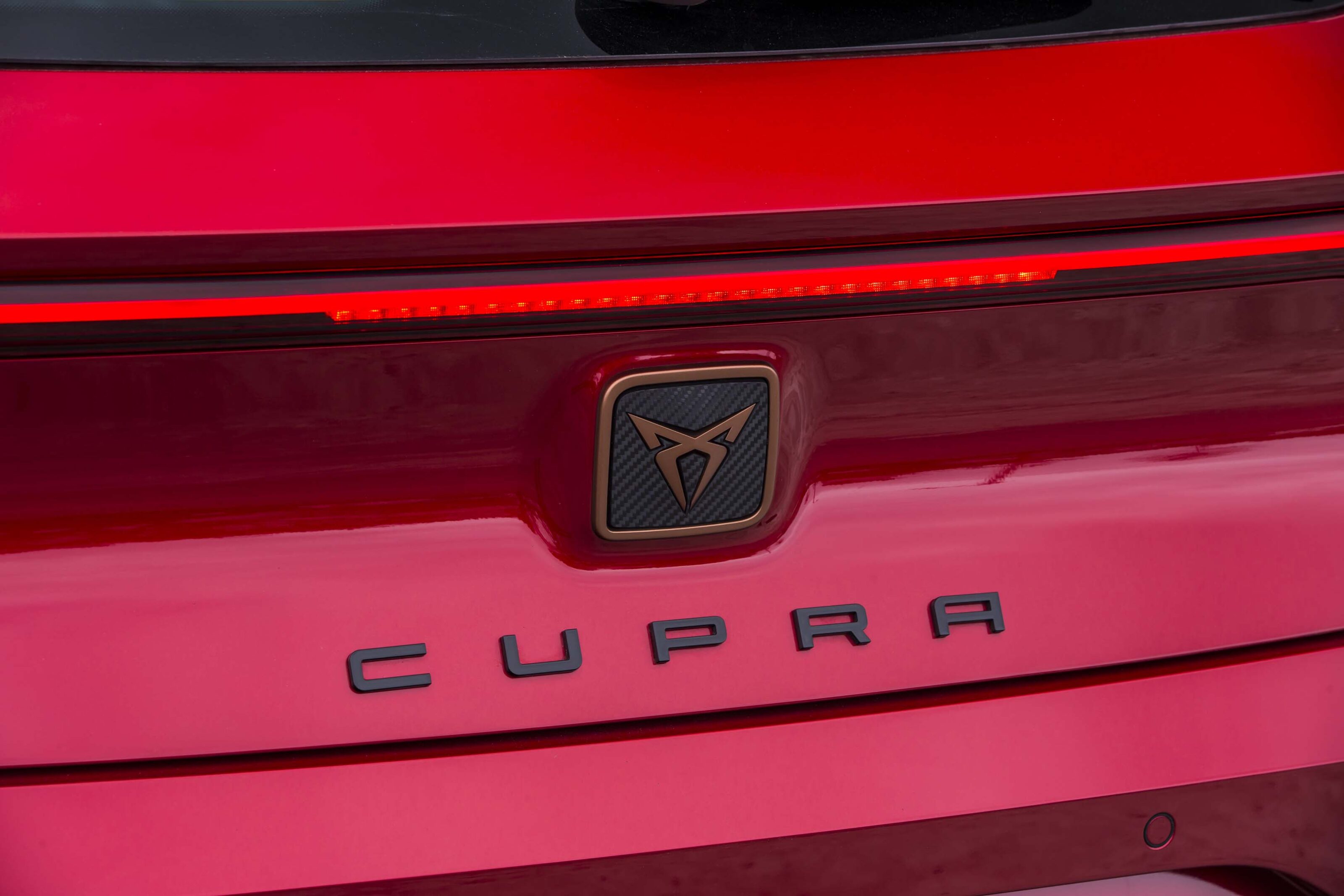
People look at this car, and I mean really look at it. You’d expect that of Cupra’s first bespoke vehicle, the Formentor SUV, but how often the eyes of bystanders ended up locked onto the Desire red VZ was quite astonishing.
Pragmatic Volkswagens and Skodas already litter Sydney’s Inner West, where I’m based, and while the Leon VZ stood out, there was less of the tall poppy syndrome you’d get in something more exotic like an Audi RS4.
Sure, the Leon is still edgy, the sort that’s likely to have a few too many even on a Tuesday night, but sometimes that’s the kind of friend you want around.
The Leon, initially at least, is nailing the brief.
1
JUMP AHEAD
- How much is it, and what do you get?
- How do rivals compare on value?
- Interior comfort, space and storage
- What is it like to drive?
- How much fuel does the Cupra Leon use?
- How safe is it?
- Warranty and running costs
- VERDICT
- Specifications
How much is it, and what do you get?
There are four variants in the Leon line-up and none are wanting for spec. This VZ essentially gets all the fruit, as does the 140kW Z that’s due to hit experience centres next month.
A few options have been added to this particular test car. The eye-catching (and VZ-exclusive) Desire Red hue ($475) falls just the right side of retina-searing and complements the copper badging. Our tester was also fitted with the optional leather and sound pack ($2450) and sunroof ($1800), bringing the total to $61,740 drive-away.
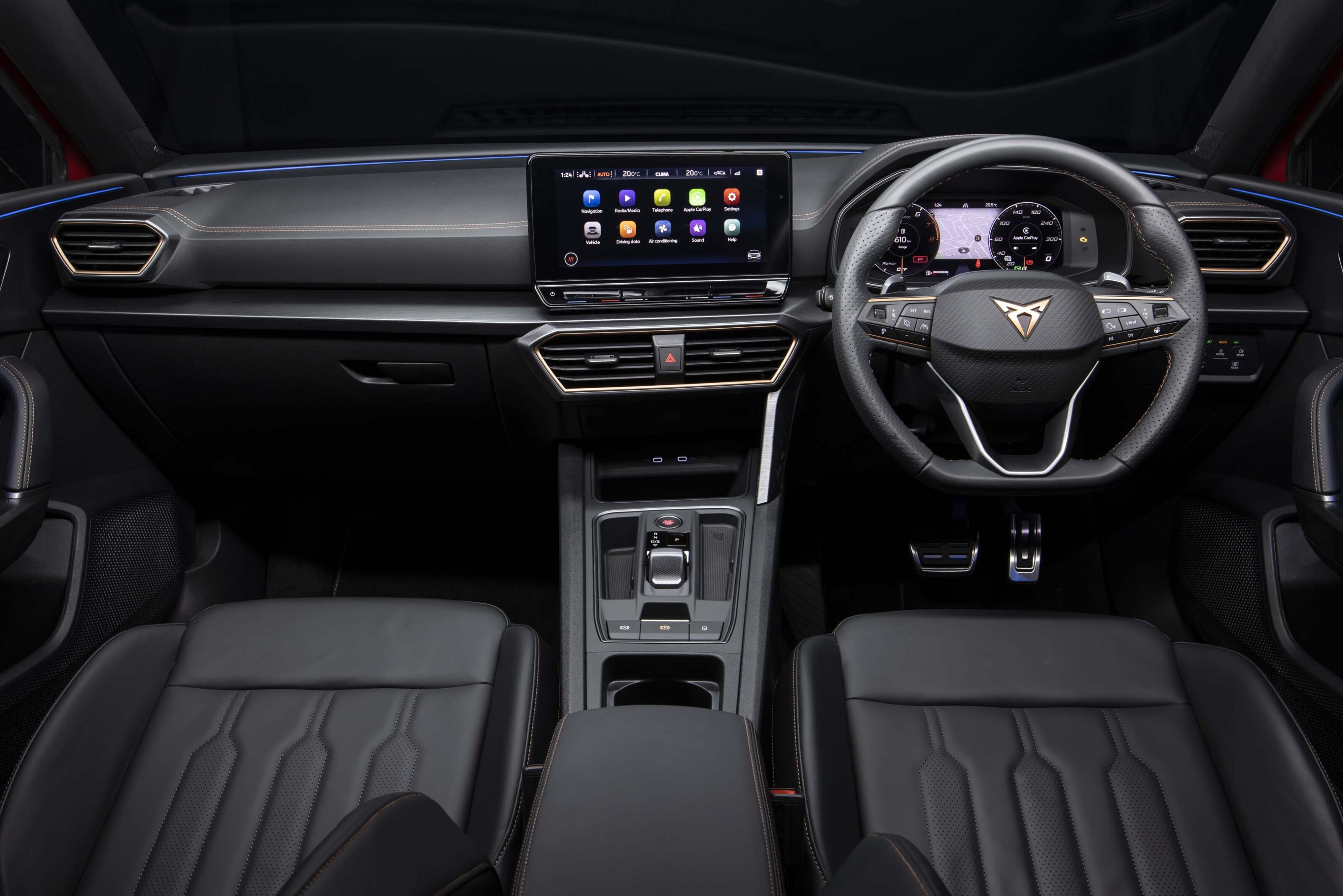
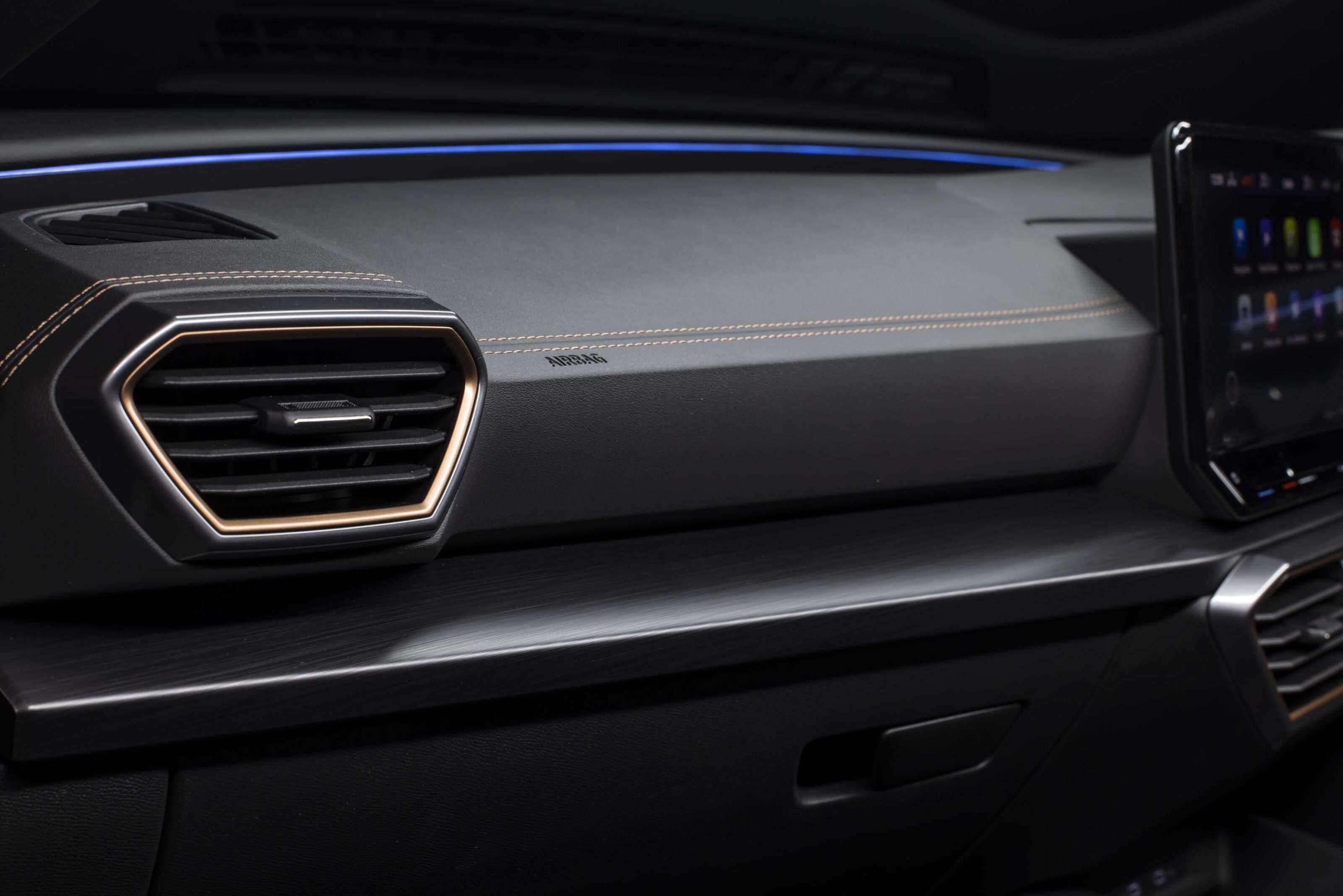
Inside, Cupra’s technology package sits in an uncanny valley; decidedly not a VW clone, but with parts sourced from the same bin. It’s more differentiated than a Skoda Octavia that’s based on the same MQB platform.
1
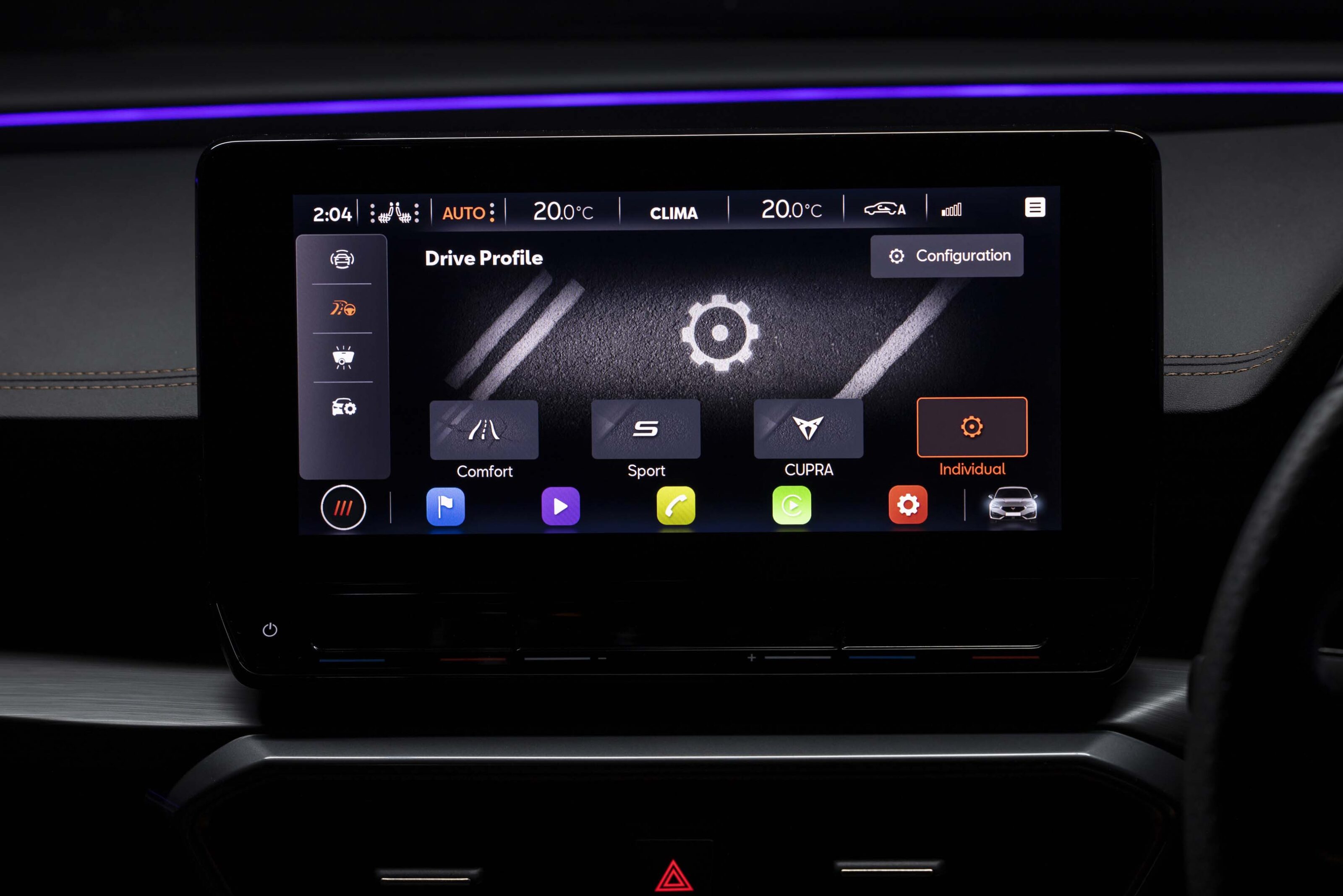
The Leon’s 10.0-inch infotainment touchscreen has a unique user interface that takes a little time to learn. There are many ways to interact with HVAC settings, driver assistance settings and drive modes, none of which are tied to physical buttons.
Wireless Apple CarPlay and Android Auto feature, and the Apple system performed faultlessly. The optional nine-speaker Beats sound system (part of the $2450 pack) performed strongly, too.
Ahead of the driver is a 10.25-inch digital display that, in typical VW Group style, provides flawless interaction, including the option to display a full map with native navigation directions.
1
Leather and sound pack adds
| 9-speaker Bose sound system | Power driver’s seat with lumbar |
| Black leather upholstery | Heated seats (1st row) |
How do rivals compare on value?
The hot hatch price hierarchy remains intact – the Hyundai i30 N is still the cheapest to buy at $46,200 before on-road costs, making the Leon VZ’s $57,490 drive-away (or $61,740 drive-away as tested) price a bit rich at first glance.
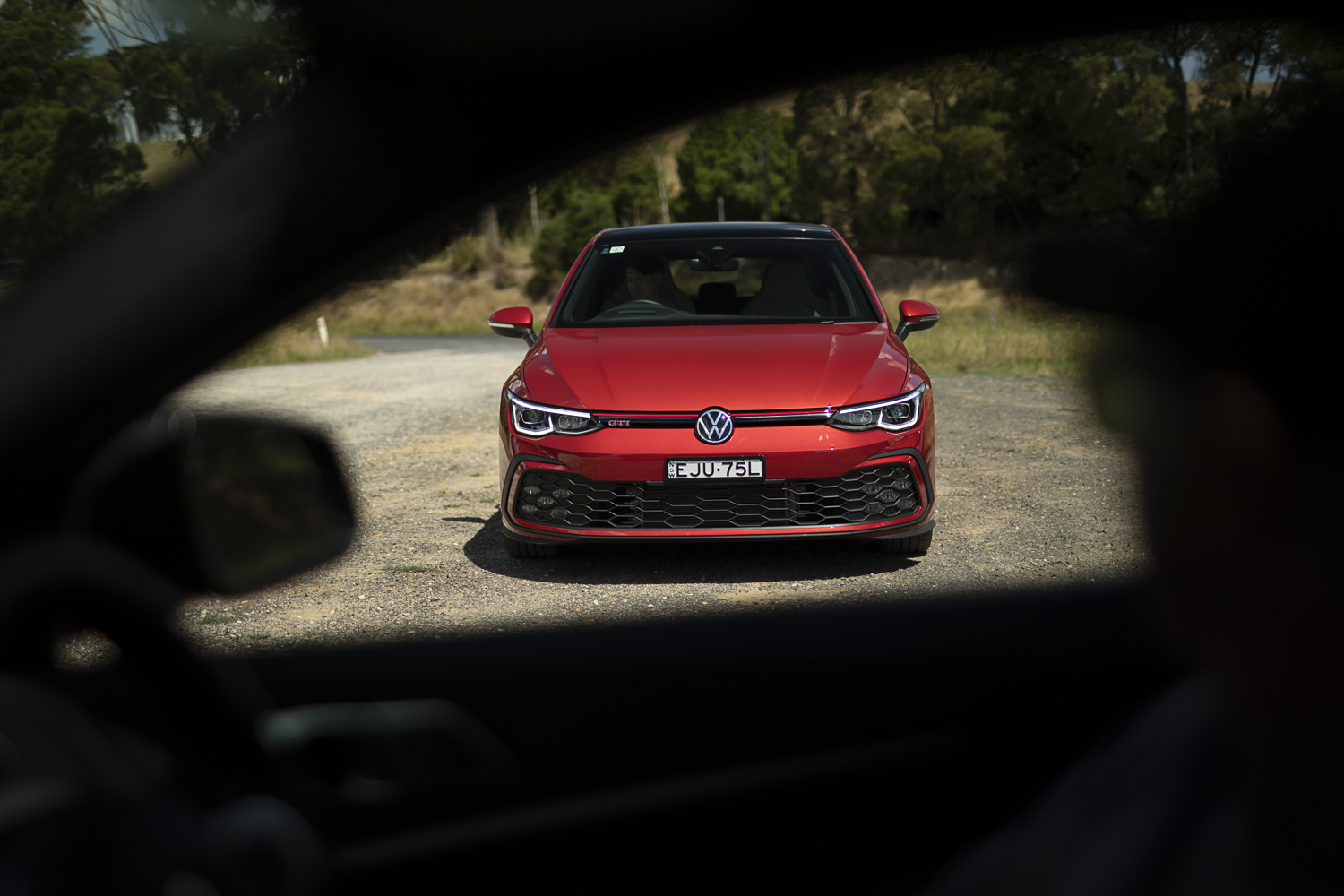
That is until you compare it with its German counterpart, the Golf GTI that in Mark 8 guise has not just crept but leapt up in price to $54,990 before on-road costs – about $60,839 on the road.
Like the Leon, the Golf is equipped with cloth upholstery (albeit quite attractive tartan) and manually-adjustable front seats as standard.
1
With the required packs fitted to match our tested Cupra, a Golf GTI costs $67,874 drive-away. Oh, and if you haven’t already seen Honda Civic Type R pricing, that hardcore hot hatch is $72,600 drive-away.
Given the Cupra’s interior fit and finish, more premium rivals are also legitimate considerations.
The BMW 128ti is also in the Leon’s sphere ($58,900), as is an Audi A3 40 TFSI ($56,500) and Mercedes-Benz A250 ($66,900) – all before on-road costs.
1
Interior comfort, space and storage
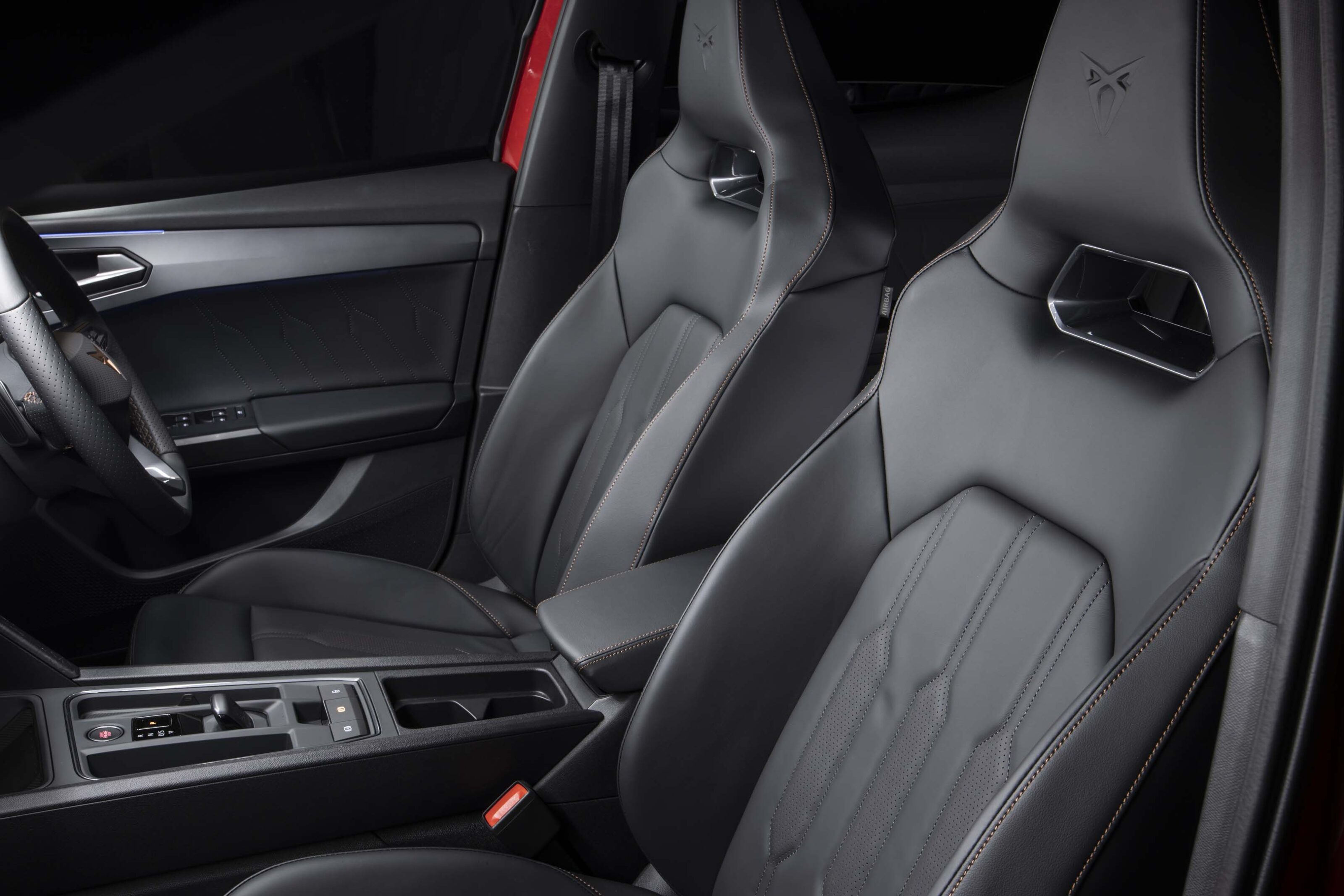
Although we’re partial to a cloth interior at Wheels, ultimately the leather and style pack is a worthy addition to the Leon.
We’re also informed by Cupra execs that if a pack is there, most buyers will cough up the extra cash.
The seats are supportive, well-bolstered, and offer a good range of electric adjustment including four-way lumbar support. Three-stage heating is fitted to the seats and the steering wheel, though accessing the settings is done through the touchscreen’s ‘Clima’ panel, which can be a steep learning curve.
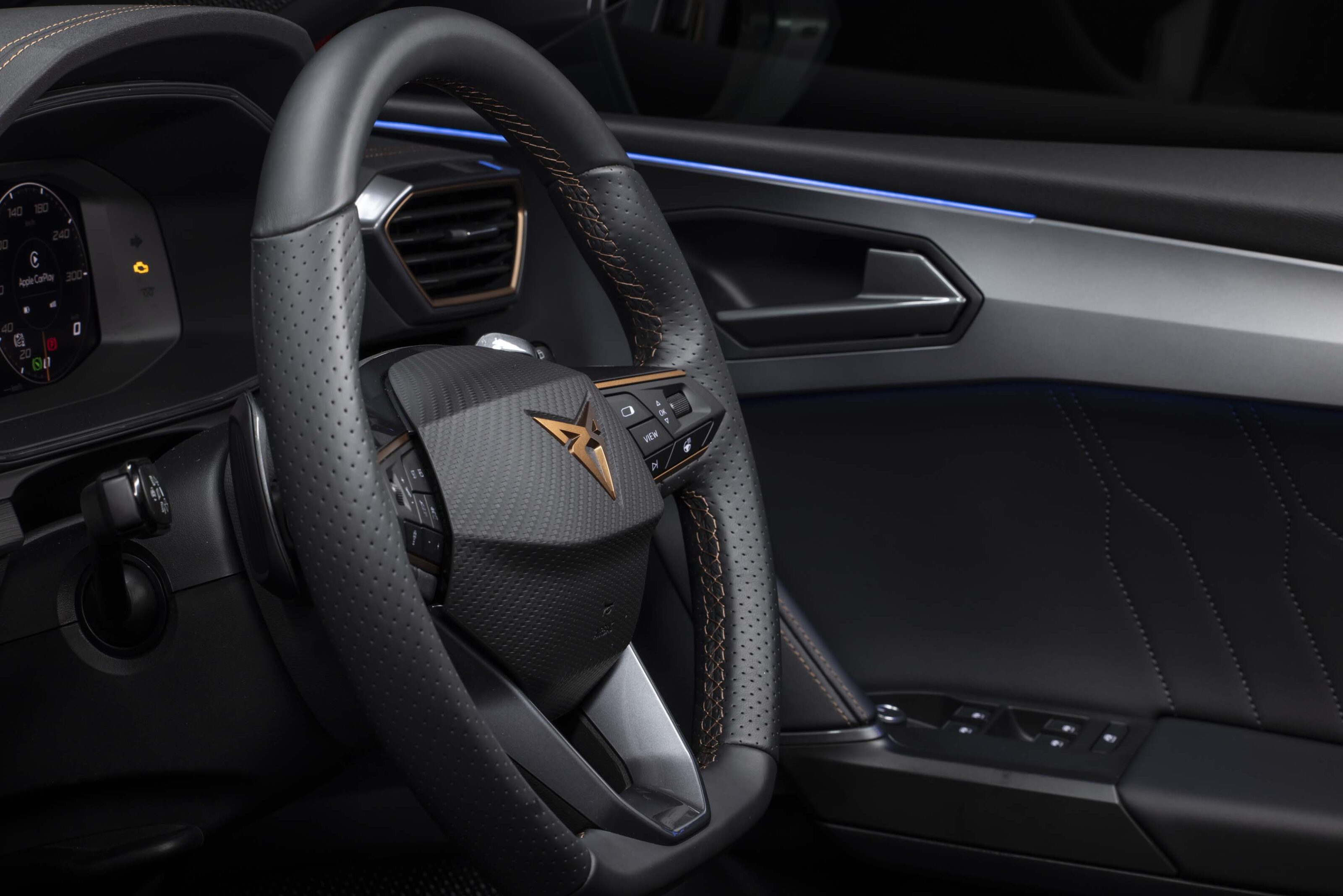
Material quality is generally high. The primary plastics are convincing and the perforated leather-appointed steering wheel is a highlight, being just the right size and finished with Cupra’s copper-coloured logo taking pride of place on the boss.
1
Secondary plastics in the Leon aren’t quite so nice and don’t live up to the BMWs and Audis mentioned above – or, arguably, a Mark 6 Golf – but they are enough to match the latest GTI. Cupra’s cabin design is more confident too, with jutting angles, crisp lines and a bold colour palette.
The door pockets are a good size for a one-litre camping bottle and have a little bit of carpeting at the bottom (though they aren’t fully flocked like Golfs of old). There are two well-sized cup holders in the centre console and a very clever spot to store the Leon’s weighty and premium-feeling fob.
Cupra also fits the Leon VZ with two USB-C fast-charging ports and a 12-volt socket as well as a Qi standard wireless charging pad.
1
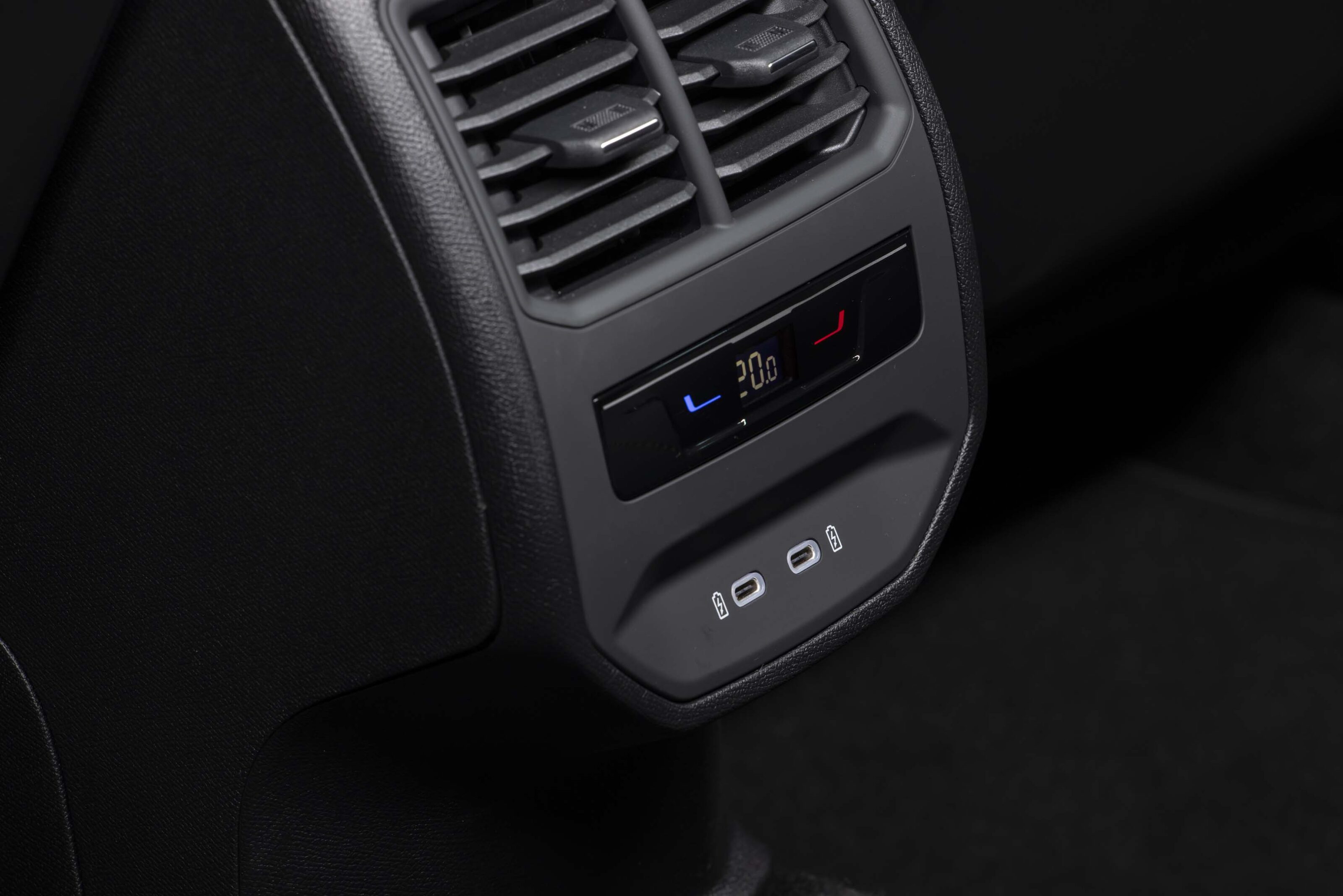
Jumping into the Leon’s back seat, there are two more USB-C ports and adjustable air vents with a separate climate control zone.
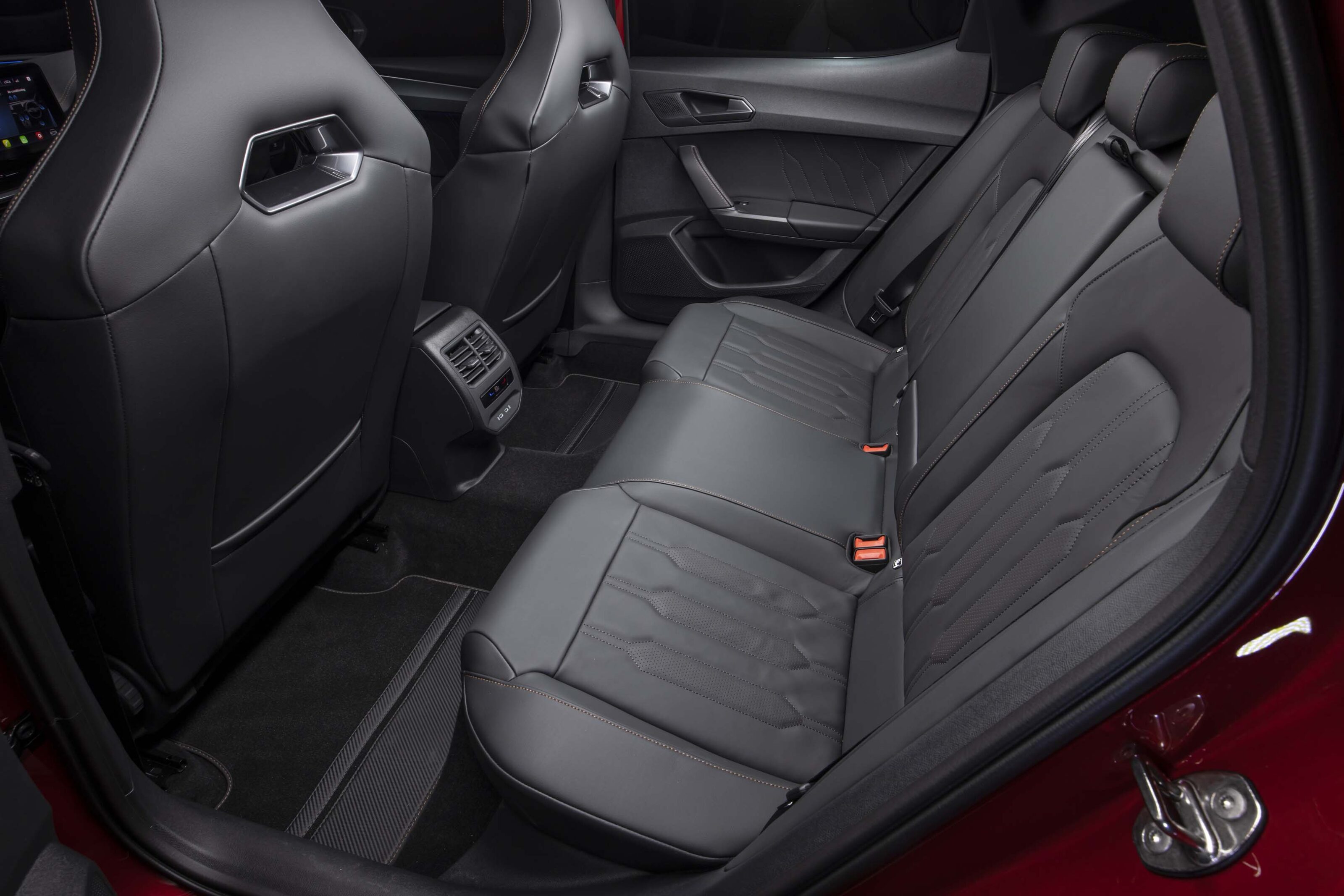
Rear seat space in the Leon is generous – much like the Golf on which it’s based – and at 188cm I was comfortable, even under the optional sunroof.
For securing child seats, ISOFIX ports are fitted to both of the Leon’s outboard rear seats and there are three top tether points in the seat back. This really is a hot hatch big enough for the whole family.
Boot space is also fairly generous, with 380 litres of cargo space under a manually-operated tailgate. There is a little more storage under the floor including a spot for the space-saver spare tyre.
1
What is it like to drive?
The basics
| 2023 Leon Cupra VZ | |
|---|---|
| Driven wheels | front |
| Engine | 2.0L turbo-petrol 4cyl, dohc, 16v, PPF |
| Power & torque | 180kW / 370Nm |
| Transmission | 7-speed wet dual-clutch auto |
| 0-100km/h (tested) | 6.4 seconds |
| Required fuel & tank | 95 RON, 50 litres |
| Fuel consumption (tested) | 7.6L/100km |
| Boot space | 380L |
The Cupra Leon strikes a balance between the Golf GTI and Hyundai i30 N in power terms, but it also happens to do the same when it comes to chassis setup.
The Leon VZ also gets VW Group’s 15-stage adaptive dampers as standard – part of the $3500 Sound and Style pack in a Golf GTI.
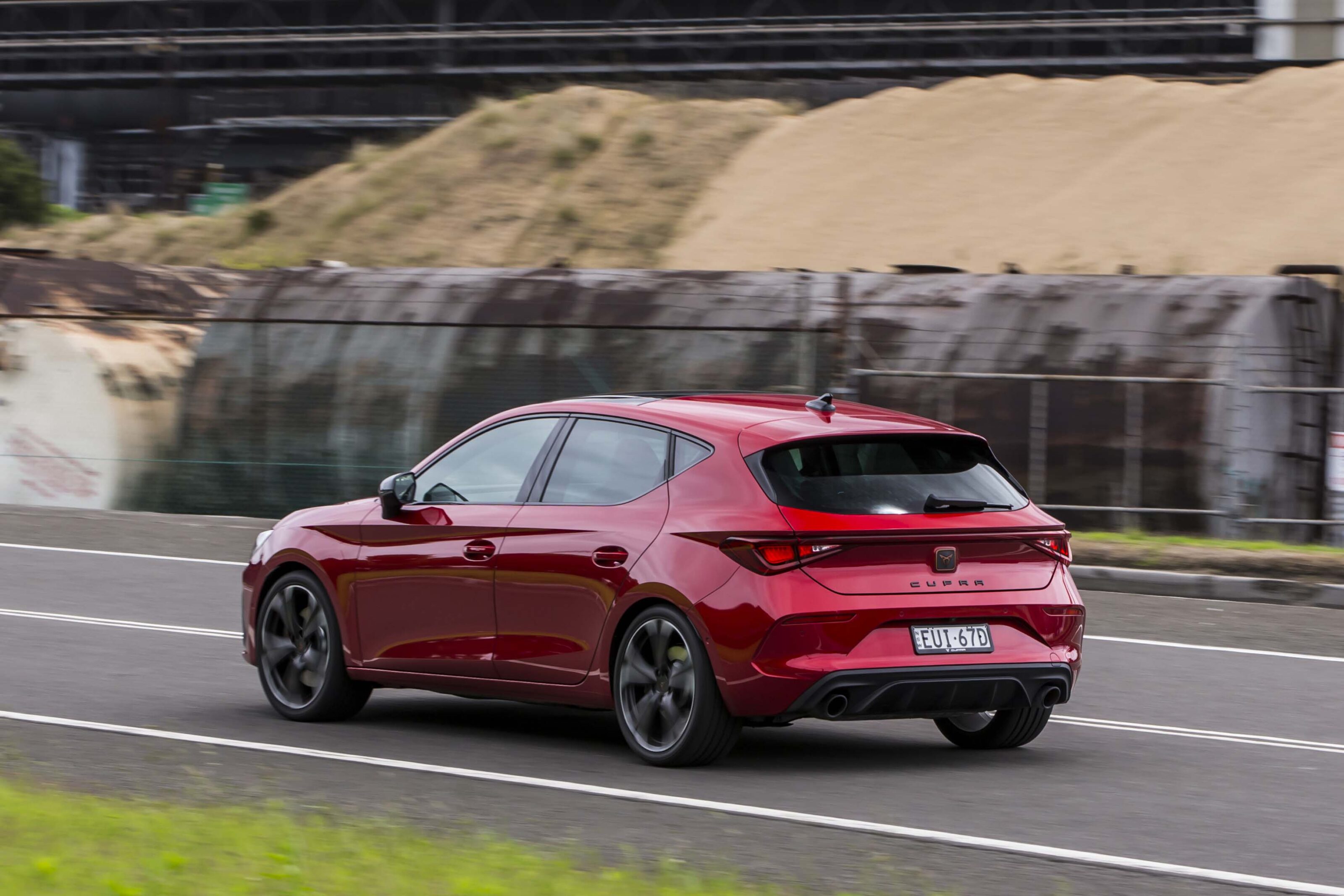
Cupra chooses firmer suspension settings than Volkswagen, with notably stiffer springs installed in the Leon. Some will appreciate the Leon VZ’s firm body control and sporty ride, but we found it to be a little clunkier than the oh-so-fluid Golf GTI on adaptive dampers.
This suits the range-topping VZx’s aggressive persona, but in a VZ that you expect to be slightly more laid back, it can get tiring around town. The ride does settle at speed and there’s no fidget on smooth surfaces with the adaptive dampers set just to the soft side of Sport, so the Leon is never busy and unsettled like an i30 N can be.
1
Unfortunately, the front-drive Leon VZ misses out on the flagship VZx’s wheel-mounted drive mode and start buttons. This is frustrating when you want to quickly jump from Comfort to Individual, as it means interacting with a touchscreen, not simply bumping a shortcut button – one reason to shell out an extra $8K for the range-topper.
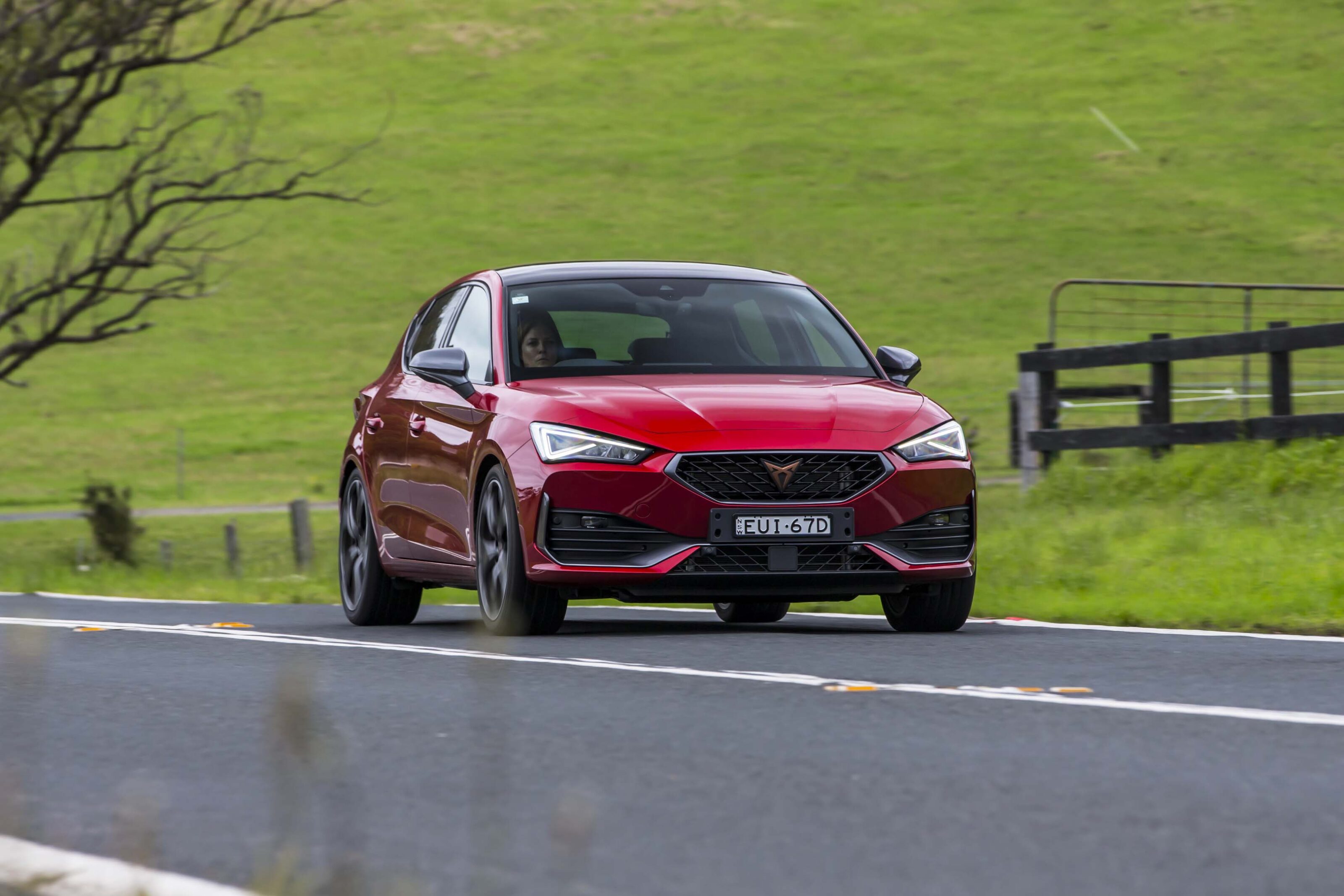
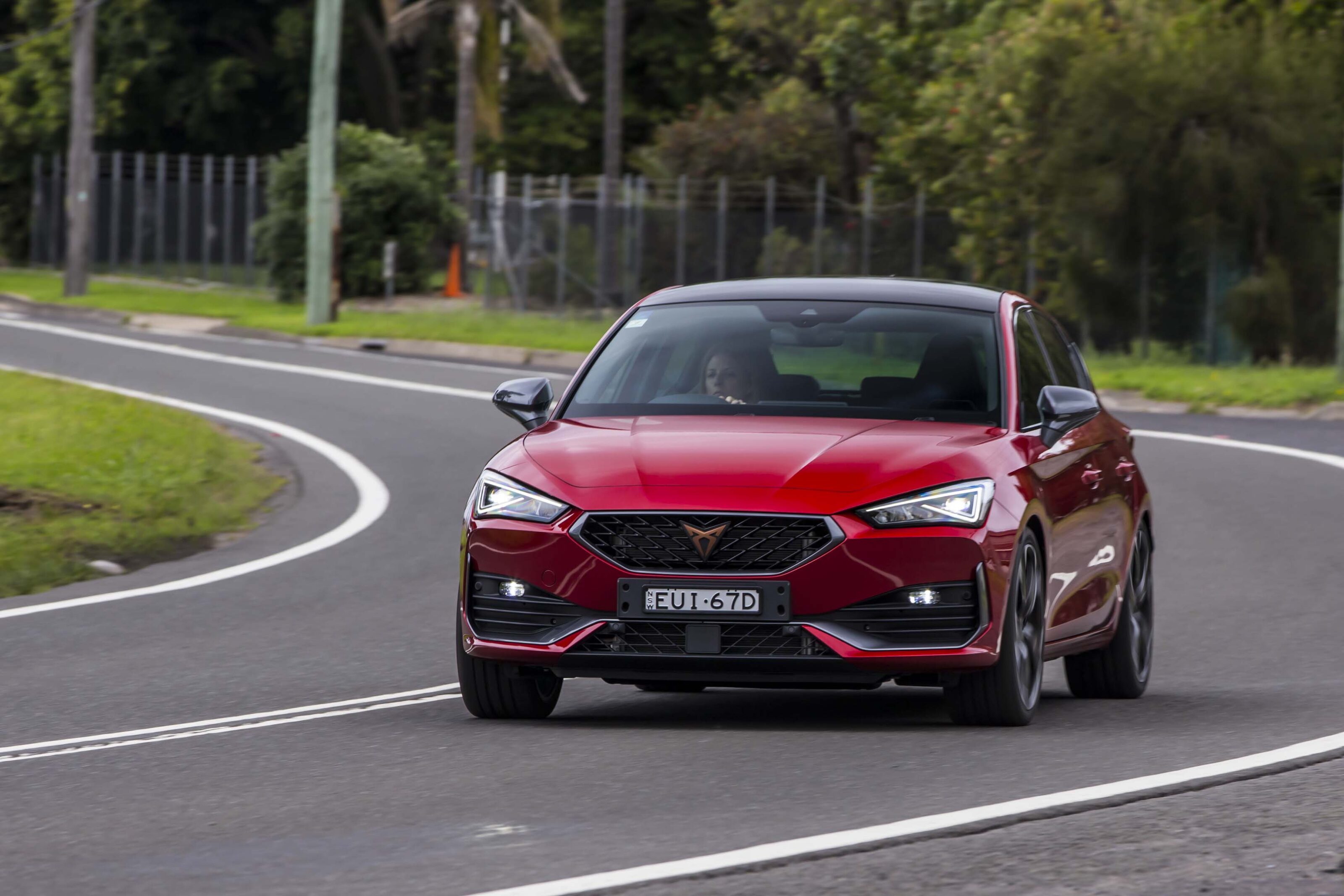
That said, once locked into the perfect drive mode and pointed at a string of corners, the Leon VZ is a delight. This is a sharper hot hatch than the Golf GTI, with pointier turn-in and tighter body control. You can lean on the locking front differential through the middle of a corner to drag the Leon’s nose around.
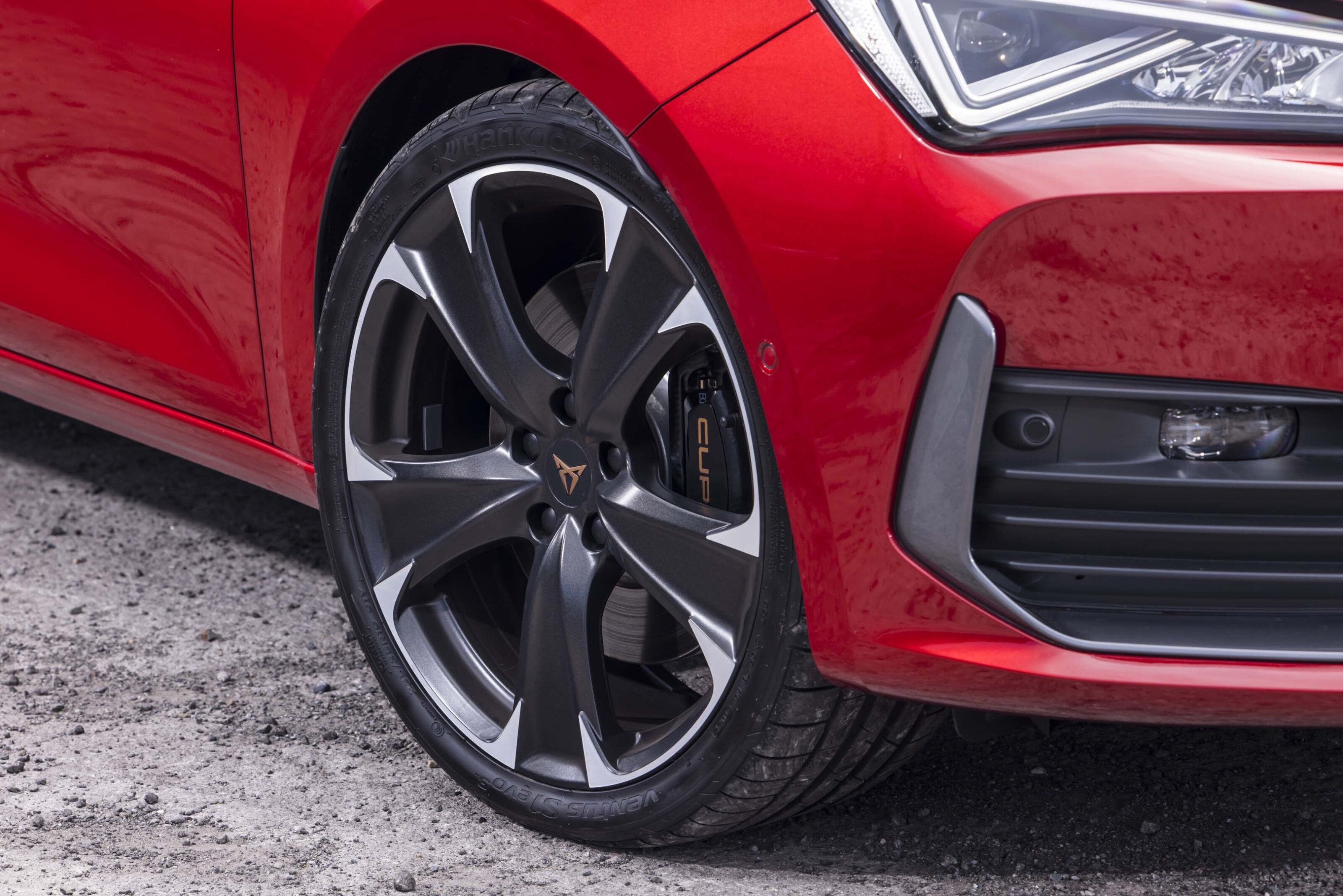
It’s true to say the Leon isn’t as expressive as the Golf, but it’s more confidence-inspiring, those 235/35 R19 Hankook Ventus S1 Evo tyres biting convincingly into the tarmac.
The steering, too, is sharp and precise – measuring only two turns lock-to-lock with its progressive rack.
1
Where the Leon feels a little odd is in its engine and exhaust tune. With the VZ’s powerplant locked in ‘Cupra’ (read: loud) mode, you get burbles, a throaty bark and genuine turbo spool-up sound to around 4000rpm.
Above 4K though? The 2.0-litre turbo-petrol four-cylinder engine feels a little flat and thin, like its 180kW and 370Nm are held back from the 221kW/400Nm VZx, rather than offering a different experience.
The other oddity is, although quiet at high revs, the Leon VZ has a pronounced exhaust drone at 110km/h in seventh gear. The low resonance is offputting and had me switching back to sixth using the shift paddles to get rid of the drone on long climbs.
Despite being mid-spec, the Leon VZ is not a slow vehicle by any stretch. Cupra claims the 1496kg Leon VZ will get from 0-100km/h in 6.4 seconds, and we were able to confirm that using a V-Box. The VZ would likely be even quicker with a gripped-up dragstrip at its disposal, that seven-speed wet clutch DSG automatic providing effortless shifts at full noise.
1
How much fuel does the Cupra Leon use?
The Leon VZ used 7.6L/100km of fuel during our week of testing, which compares quite well with the official 6.7L/100km combined ADR rating and is much more fuel efficient than a Hyundai i30 N that scores 8.5L/100km in the same protocol.
As the Leon VZ’s Euro 6 compliant engine is fitted with a petrol particulate filter, Volkswagen recommends 95 RON unleaded at a minimum, with 98 RON premium unleaded preferred.
1
How safe is it?
Evaluated under ANCAP’s 2020 protocol, the Cupra Leon rated five stars in safety testing.
The Leon is equipped with myriad driver aids, including front auto emergency braking (AEB) with pedestrian and cyclist detection plus junction function, as well as low-speed reverse AEB. Rear cross-traffic alert, blind-spot monitoring and lane-departure warning are also included.
Adaptive cruise control with stop-and-go function for traffic jams combines with lane-trace assist to provide Level 2 autonomous driving. The system worked well during testing, with strict speed control and decent lane tracing.
Leon Cupra VZ safety features
1
Warranty and running costs
Cupra covers its cars with a five-year, unlimited-kilometre warranty in Australia, matching all major rivals in the hot hatch class including Volkswagen, Hyundai and Ford.
Until December 31 this year Cupra is offering three years of free servicing on all models. That equates to a saving of $1600 compared with a mechanically similar Volkswagen Golf GTI.
Cupra has not detailed full servicing costs in Australia, but if you want to extend your servicing plan to five years it’ll cost an extra $1200. Leon VZ maintenance is due every 12 months or 15,000km.
1
VERDICT
The Cupra VZ strikes an intriguing balance
The VZ sits between the entry and flagship variants in Cupra’s Australian Leon range and, without the sheer grunt of the VZx or electric efficiency of a VZe PHEV, could be easily forgotten.
It’s true, though, that the VZ strikes an intriguing balance. Cupra’s overt character is still dripping from the VZ, with a burbly exhaust note and more focused chassis tune than a Golf GTI. It’s also more affordable than the equivalent Volkswagen.
For most people, the extra grunt of the VZx will be hard to walk past, but for those after a red hot hatch with the unique Cupra badge, the Leon VZ delivers a sharp drive, lashings of style and – perhaps most importantly – a topic of conversation at the next dinner party.
MORE
Everything Cupra
2023 Cupra Leon VZ specifications
| Driven wheels | front |
|---|---|
| Engine | 2.0L turbo-petrol 4cyl, dohc, 16v, PPF |
| Power | 180kW |
| Torque | 370Nm |
| 0-100km/h (tested) | 6.4 seconds |
| Transmission | 7-speed wet dual-clutch auto |
| Body | steel, 5-door, 5-seat small hatch |
| Required fuel | 95 RON minimum |
| Fuel tank | 50 litres |
| Fuel consumption (tested) | 7.6L/100km |
| Boot space | 380L |
2023 Cupra Leon Australian pricing
Note: Indicated prices are non-inclusive of on-road costs unless marked as drive-away.
As a child of the ’80s, Transformers nailed the formula for winning my heart and my parents’ money: cars and jets that are also robots.
I mean, that’s hard to top. Weird-lookin’ turtles with swords and a trash diet were just no match.
Even now, I occasionally still throw on the 1986 animated Transformers movie. I shouldn’t have been allowed to watch it when I was a kid, but as a grown manchild, it still hits all the right notes for a banging soundtrack, epic old-school animation, awesome big-name voice cast (Orson Welles famously hated that he’d ever accepted the job), memorable quotes and some very adult-oriented death scenes.
The new live-action movies, though? Nah. Ridiculous redesigns of the robots, fight scenes that are impossible to keep up with (who threw that punch?), and dopey scripts. (I’m told Bumblebee is a good ‘reboot’, so that’s on my list to watch with my little boy.)
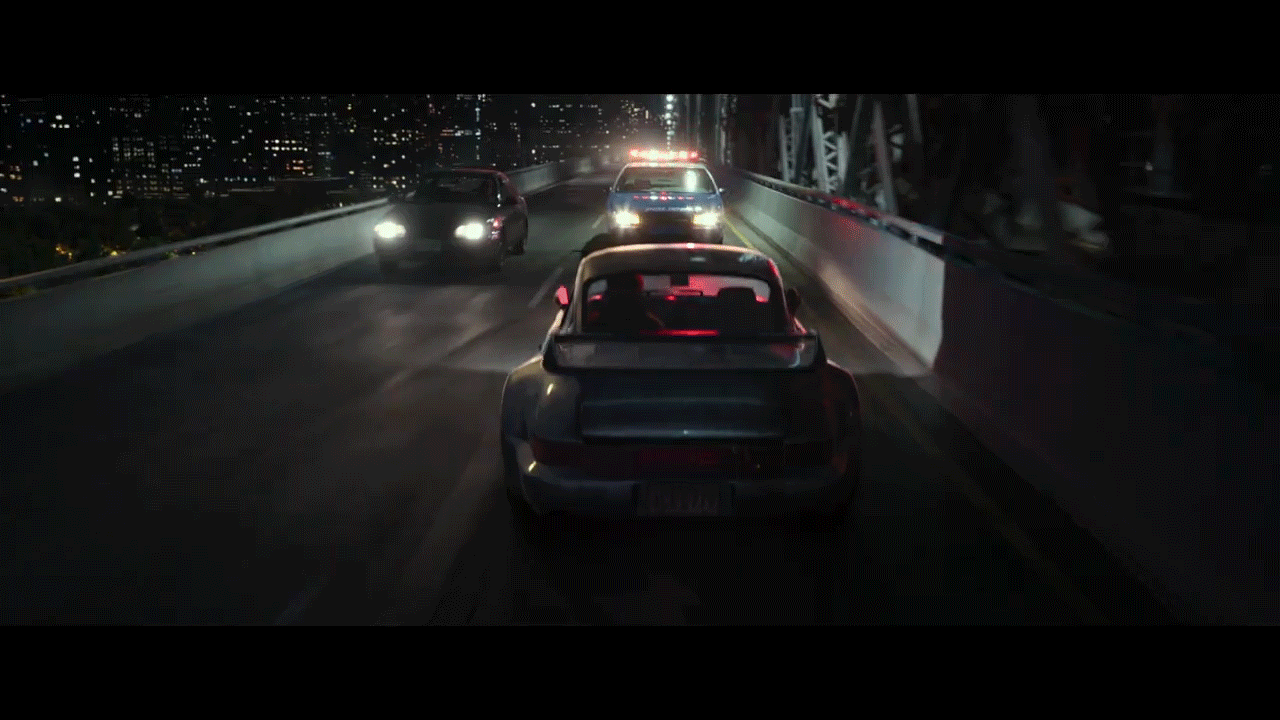
BUT NOW! A trailer dropped this morning for the new film, Rise of the Beasts, and it does look good. But I suspect the best reason to check it out might be for Mirage, the silver 964 911 voiced by SNL alumni and Kardashian-ex, Pete Davidson.
Car fans will probably also enjoy the return of Bumblebee in his Camaro form (he’ll always be a Beetle to me though), along with the appearance of an R33 Skyline GT-R and a classic VW Kombi.
Oh, yeah, and Optimus is there in his much classier ‘G1’ look as a flame-free flatnose truck. (This argument on a Transformers forum back in 2007, when Optimus first appeared as a longnose truck, is hilarious.)
Transformers: Rise of the Beats hits cinemas in June, 2023.


1
Snapshot
- Grand Highlander to be revealed in February
- Will use HybridMax powertrain
- Likely based on TNGA-K platform
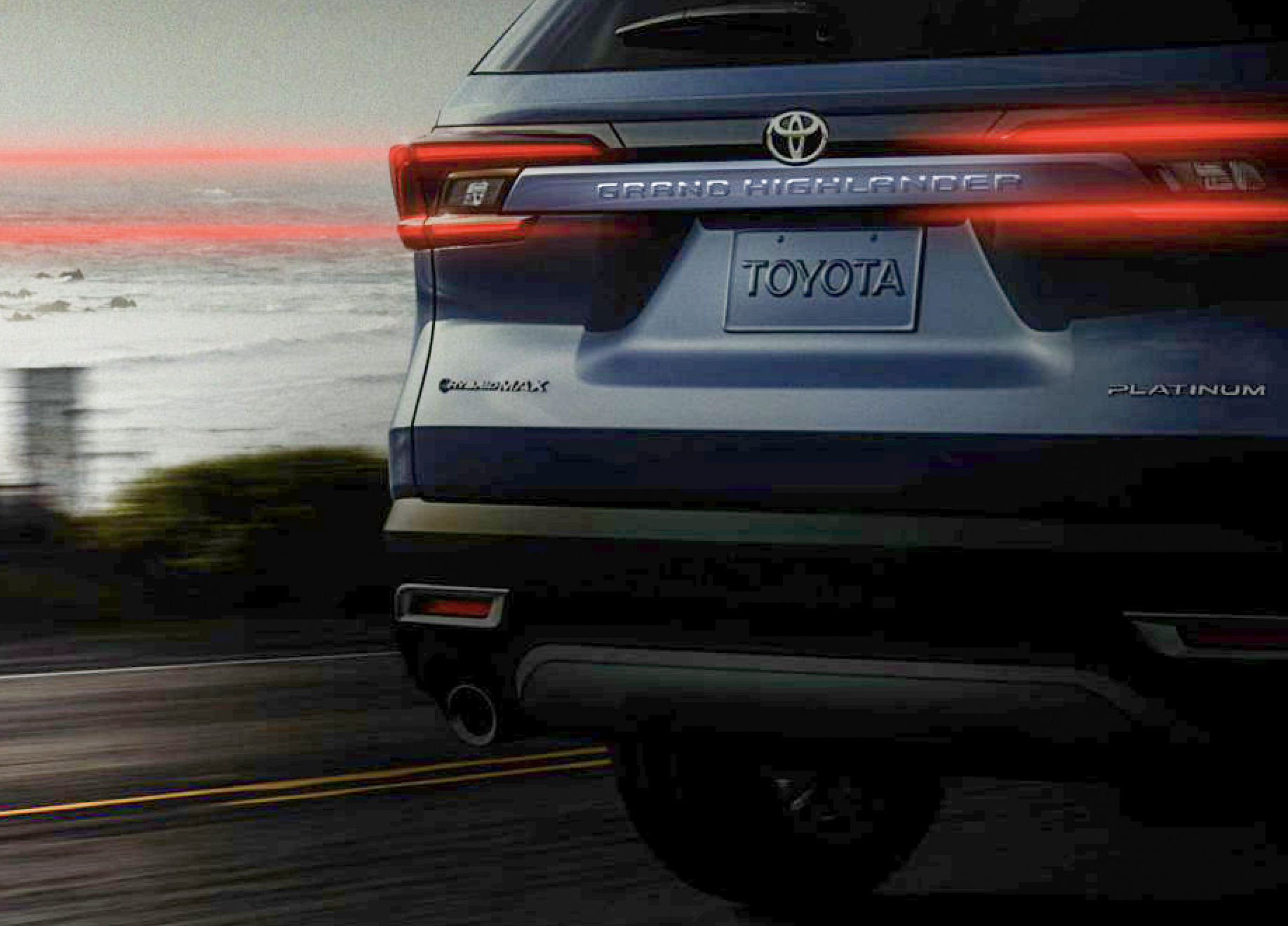
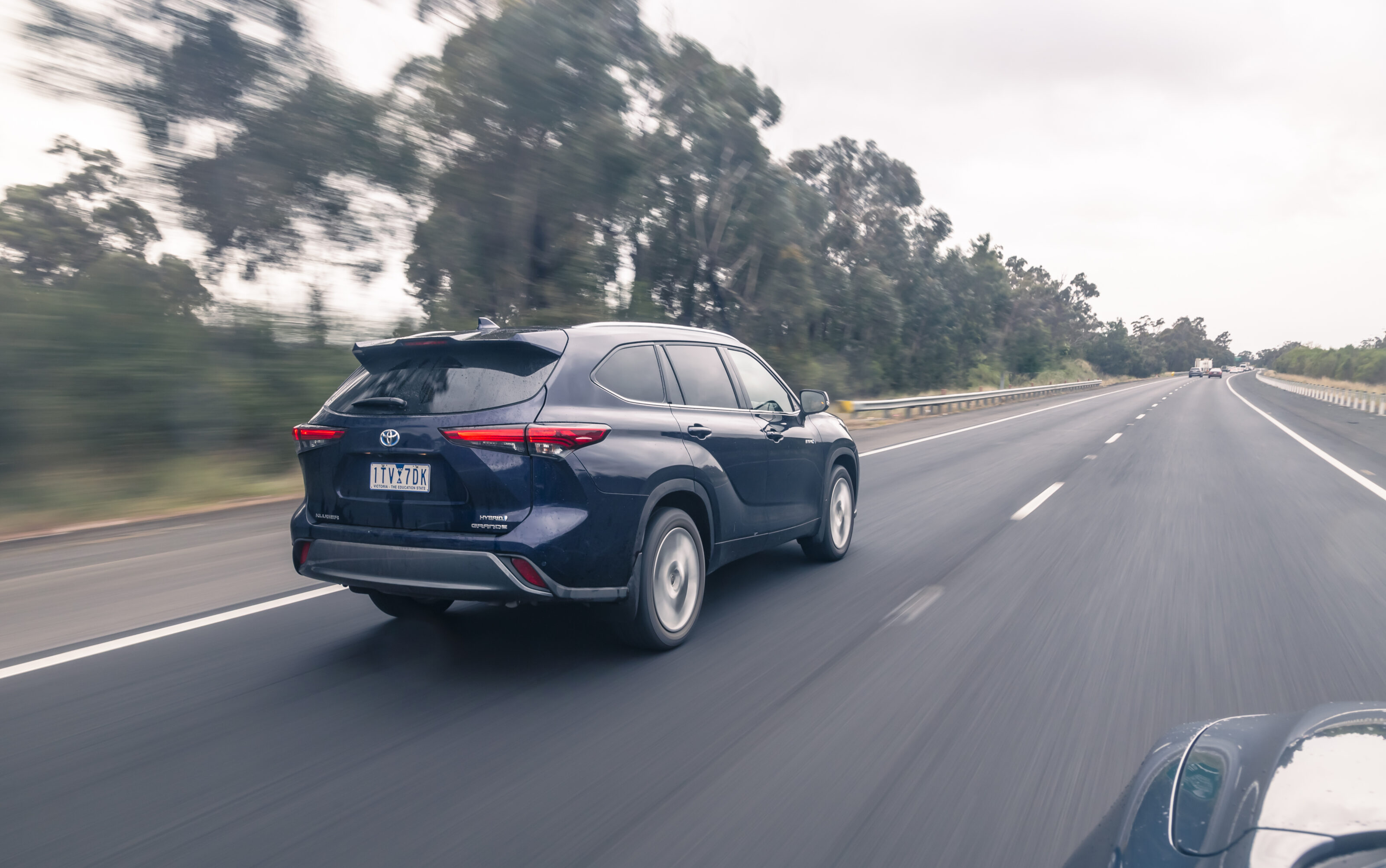
Toyota USA has released a teaser image of the new Grand Highlander, an even bigger version of the carmaker’s Highlander – Kluger to us Australians – wearing a Hybrid Max badge.
The Grand Highlander has been rumoured for some time, with patents filed in August last year. Toyota USA will reveal the new Grand Highlander at the Chicago Auto Show, on February 8 next year. Australian plans are unconfirmed at this point.
Instead of the Kluger’s more organic tailgate with sloping roof, the Grand Highlander appears to have a taller roofline and squared-off tailgate – likely providing more space for third-row occupants.
1
1
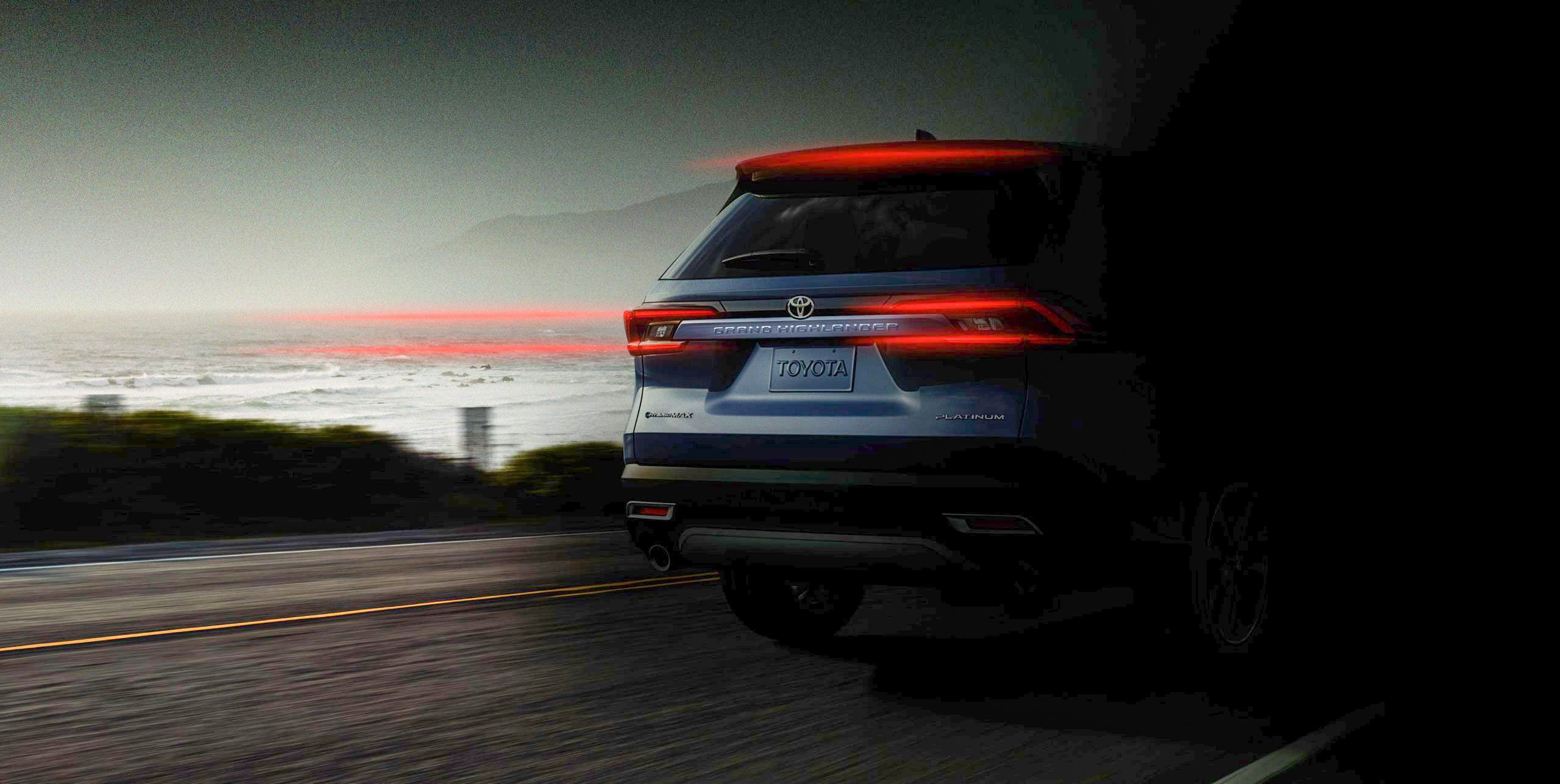
The Grand Highlander’s tail lights and chrome tailgate garnish share much in common with the RAV4, rather than the Kluger, too.
Perhaps most interestingly, the tailgate badge reads Hybrid Max, suggesting the Grand Highlander will be available with the Crown’s 2.4-litre turbo-petrol hybrid powertrain developing around 250kW of power.
Toyota has also revealed the name of the flagship trim, Platinum, just like the existing US-market Highlander.
1
As for further details, Toyota has kept these very much under wraps, only telling us it’s a three-row SUV perfect for a family road-trip.
The Grand Highlander is likely to share its underpinnings with the forthcoming Lexus TX, another extra-large three-row SUV that will sit above RX. Grand Highlander is also likely to be produced in Toyota USA’s Indiana plant currently producing the Highlander and Oz-market Kluger.
Toyota hasn’t explicitly said that the Grand Highlander will ride on TNGA-K, though it seems likely unless the brand has developed another iteration of its global architecture.
As for measurements, expect longer, wider and taller than the Kluger’s 4966mm, 1930mm, 1755mm measurements. Perhaps the Grand Highlander will even push above the Hyundai Palisade and Kia Telluride in size terms.
Further details will be revealed on February 8 next year, with Australian plans yet to be confirmed.
MORE
Everything Toyota
Nissan’s X-Trail is an indelible part of Australia’s mainstream mid-sized SUV fleet. Not only does it offer an affordable option from a trusted Japanese brand, but a diverse range of variants has always meant there’s something for everyone.
It’s no surprise, therefore, that the X-Trail is Nissan’s most popular model after the Navara ute.
But the 2023 X-Trail has just arrived and, for now, it offers just one drivetrain, no hybrid options and an increased price across the four-grade line-up.
In a fearsomely competitive market, can Nissan’s favourite SUV make a splash with a comprehensively revised offering and a significant injection of standard kit and technology?
JUMP AHEAD
- How much is it and what do you get?
- How do rivals compare on value?
- Interior comfort and space
- What’s it like to drive?
- Warranty and running costs
- VERDICT
- Specifications
How much is it and what do you get?
The 2023 X-Trail range comprises four variants with choices of front- or all-wheel drive depending on the specific version. The more affordable end of the range kicks off with the $36,750 ST 2WD or about $3000 more for the AWD version, which gets seven seats. The middle of the line-up is represented by the $43,190 ST-L 2WD which is also on offer with all-wheel drive and seven seats. Both prices before on-road costs.
For our first meeting with the new model, however, we only had a chance to get behind the wheel of the new range-topping Ti and Ti-L which are exclusively all-wheel drive five-seaters and cost $49,990 and $52,990 respectively (before on-road costs).
All versions get a revised version of the previous 2.5-litre petrol four-cylinder which has been uprated to produce 135kW and 244Nm – an increase of 9kW and 18Nm – and again bolted to an automatic continuously variable transmission (CVT).
2
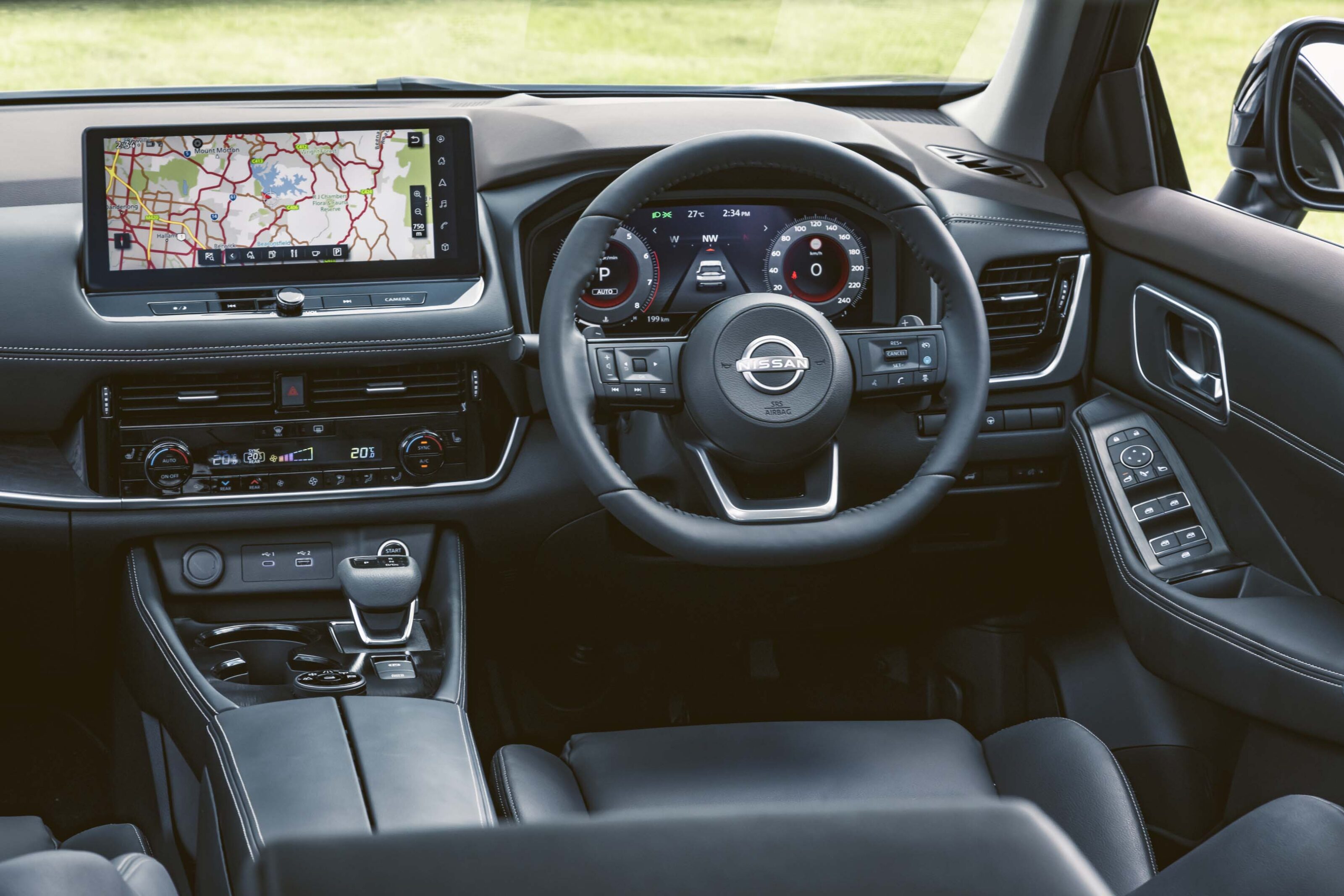
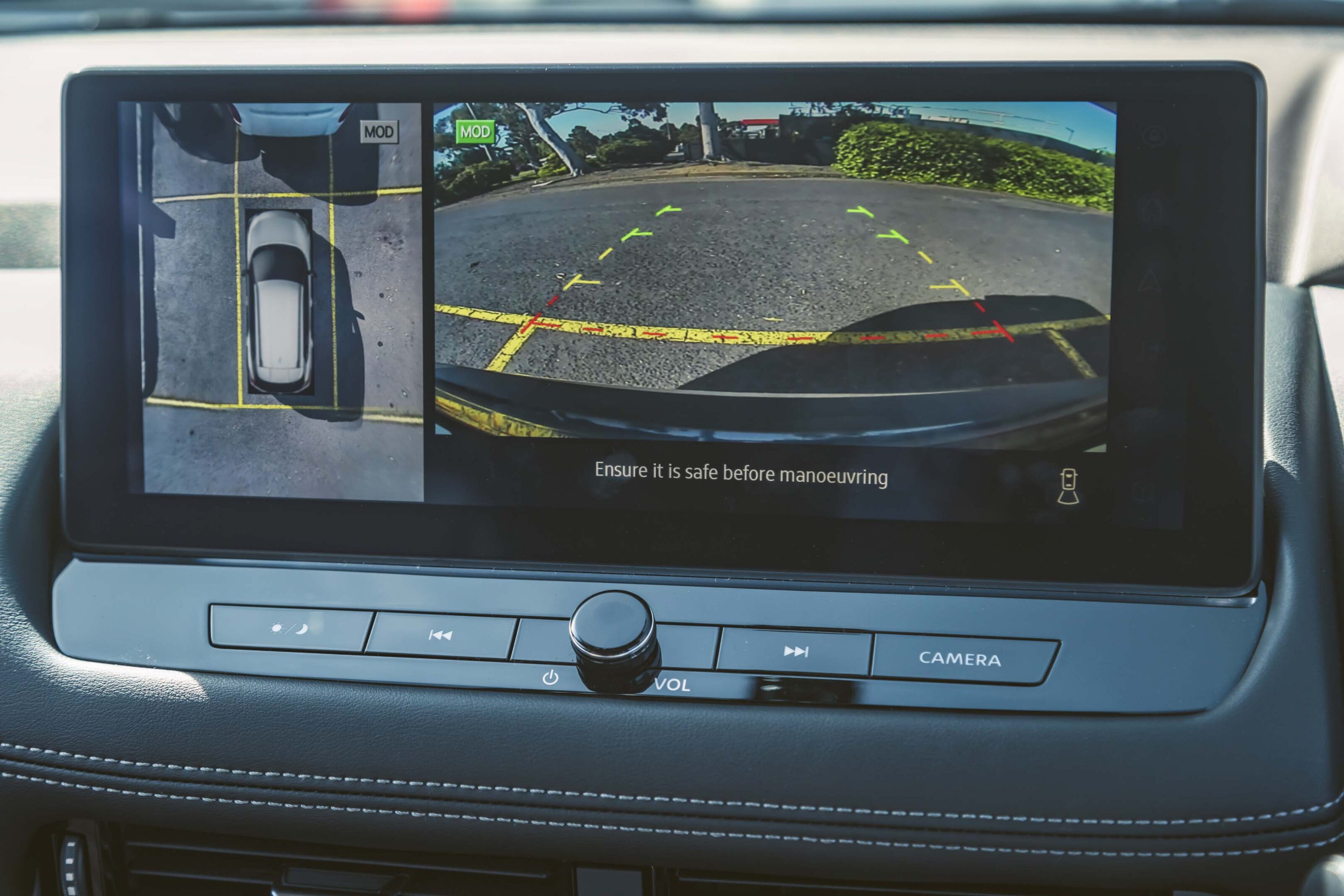
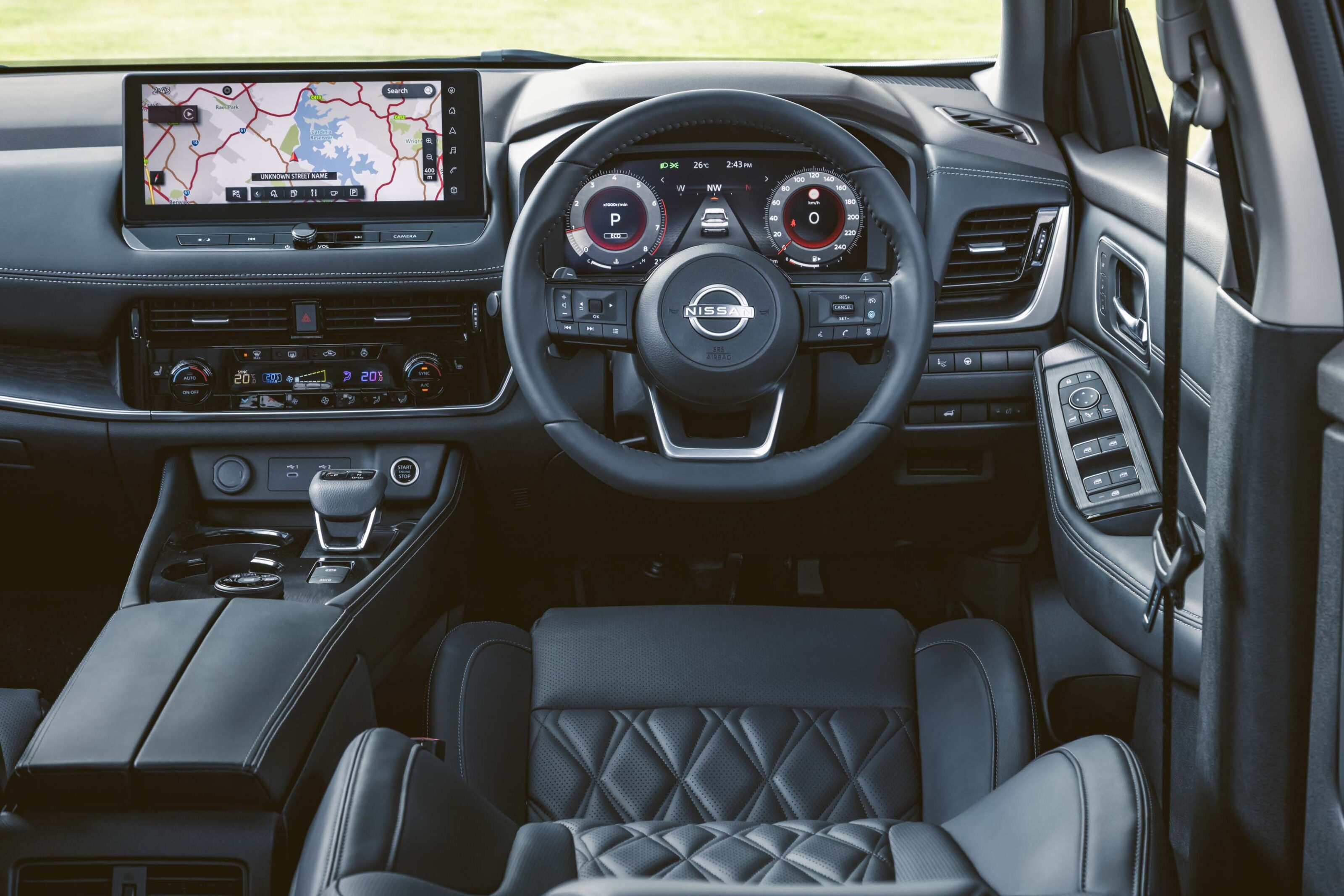
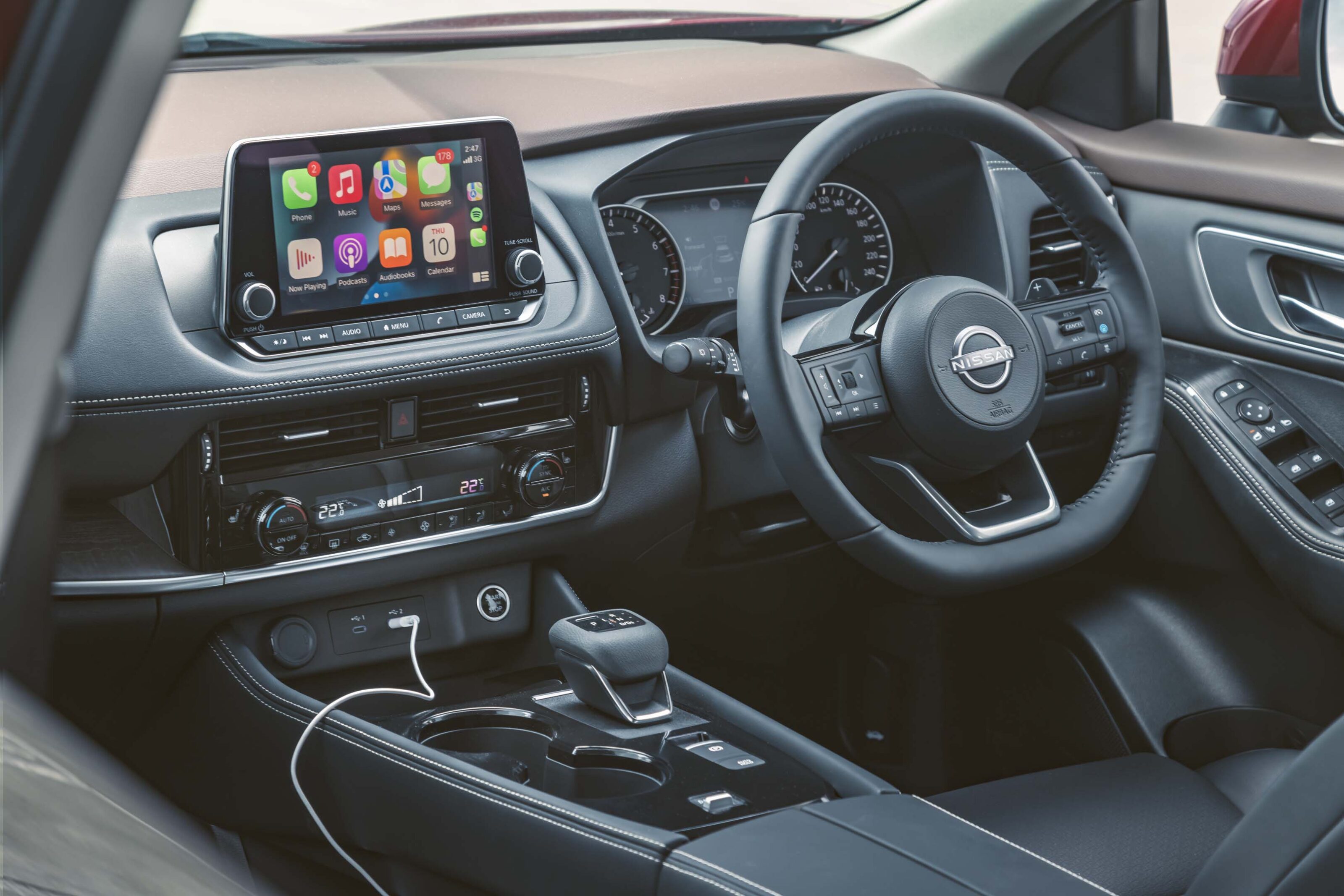
Included as standard for all variants are LED headlights, Android Auto, Apple Carplay, a 7.0-inch driver’s information display and 8.0-inch central touchscreen, reversing camera and parking sensors, keyless start and a choice of six paint colours.
An extensive suite of standard safety features includes auto emergency braking (AEB), cruise control, lane departure warning and prevention, rear cross-traffic alert and reverse AEB.
Go for any X-Trail above the ST entry point and Nissan’s ProPilot system is included too, which adds adaptive cruise control that works all the way down to stop-start traffic. In practice, the system is smooth in operation and is more effective at locking on and off cars ahead than some brands’ systems.
2
Step up again to the Ti, however, and Nissan upgrades the central screen to a wide version measuring 12.3 inches, the instrument cluster becomes all-digital and also measures 12.3 inches, while a 10.8-inch head-up display is included as standard.
Android Auto remains wired but Apple CarPlay is wireless, in conjunction with wireless device charging.
Lighting is all LED on the Ti, including indicators and matrix adaptive headlights, while 10-way electric adjustable seats are provided for front passengers, there is part-leather upholstery throughout and tri-zone air conditioning, a panoramic glass roof and 19-inch alloy wheels complete the upgrades.
The money-no-object Ti-L comes with a 10-speaker Bose sound system, Nappa leather seats with memory for the front two, heated rear seats and sunshades for their occupants, a hands-free electric tailgate, heated steering wheel and remote engine start.
1
How do rivals compare on value?
In such a popular segment, the X-Trail has plenty of competition. It goes up against the Toyota RAV4 which offers hybrid drivetrains and tops out at $55,150 before on-road costs for the flagship Edge AWD Hybrid.
Mazda’s CX-5 is also available with a choice of three drivetrains including a diesel and is priced comparably at the pointy end, while the Kia Sportage also aligns closely to the X-Trail range, performance and pricing, although it too has more engine choices.

1
Interior comfort and space
For the fourth-generation model, X-Trail prices have increased across the board – including this high-spec Ti that now costs $3875 more than the previous version – but the cabin is where a vast majority of that extra spend is evident.
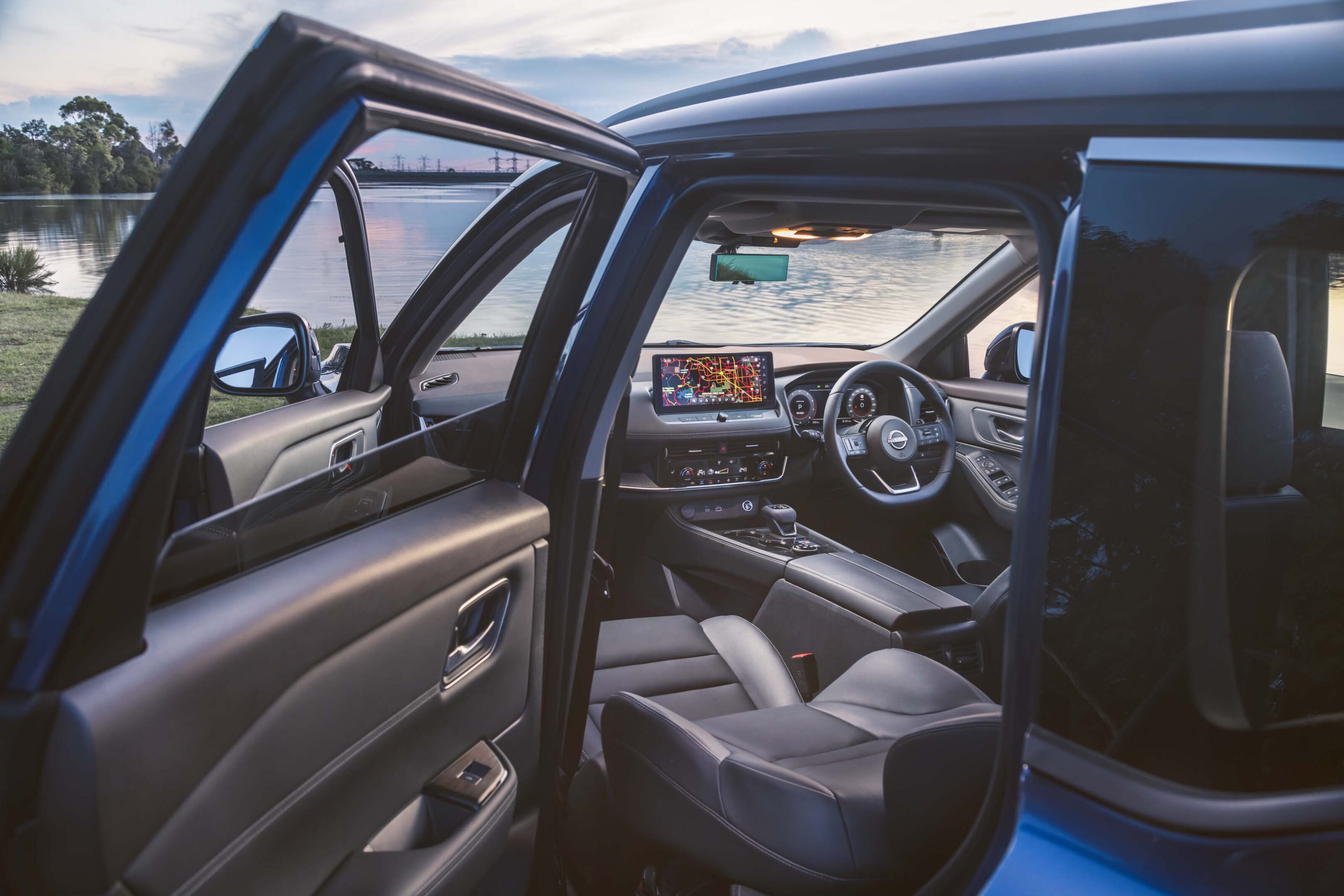
A wall of high-resolution digital displays meets anyone boarding the Ti in the front row, immediately imparting a sense of quality and technological superiority not yet seen from the Nissan brand.
1
In both the digital instrument cluster and central touchscreen, the graphics are sharp and attractive, while navigating the various systems and applications is simple and fast.
The screens are complemented by a 10.8-inch head-up display for the driver, completing a very impressive technological show by the X-Trail.
Leather comprises a majority of the seat upholstery and the leather steering wheel is particularly high quality, matching well with the upholstered dash and its French stitching, as well as pleasant quality materials throughout.
Skinny A-pillars enhance the view of the road ahead as well as letting in more light – along with the big panoramic glass roof – for a cabin that feels as big as it is.
1
A seven-seat option is not available for either of the top Ti or Ti-L but the X-Trail’s third row is certainly not a place for adults and the larger boot of the five-seat version may be a more useful attribute for the majority of owners.
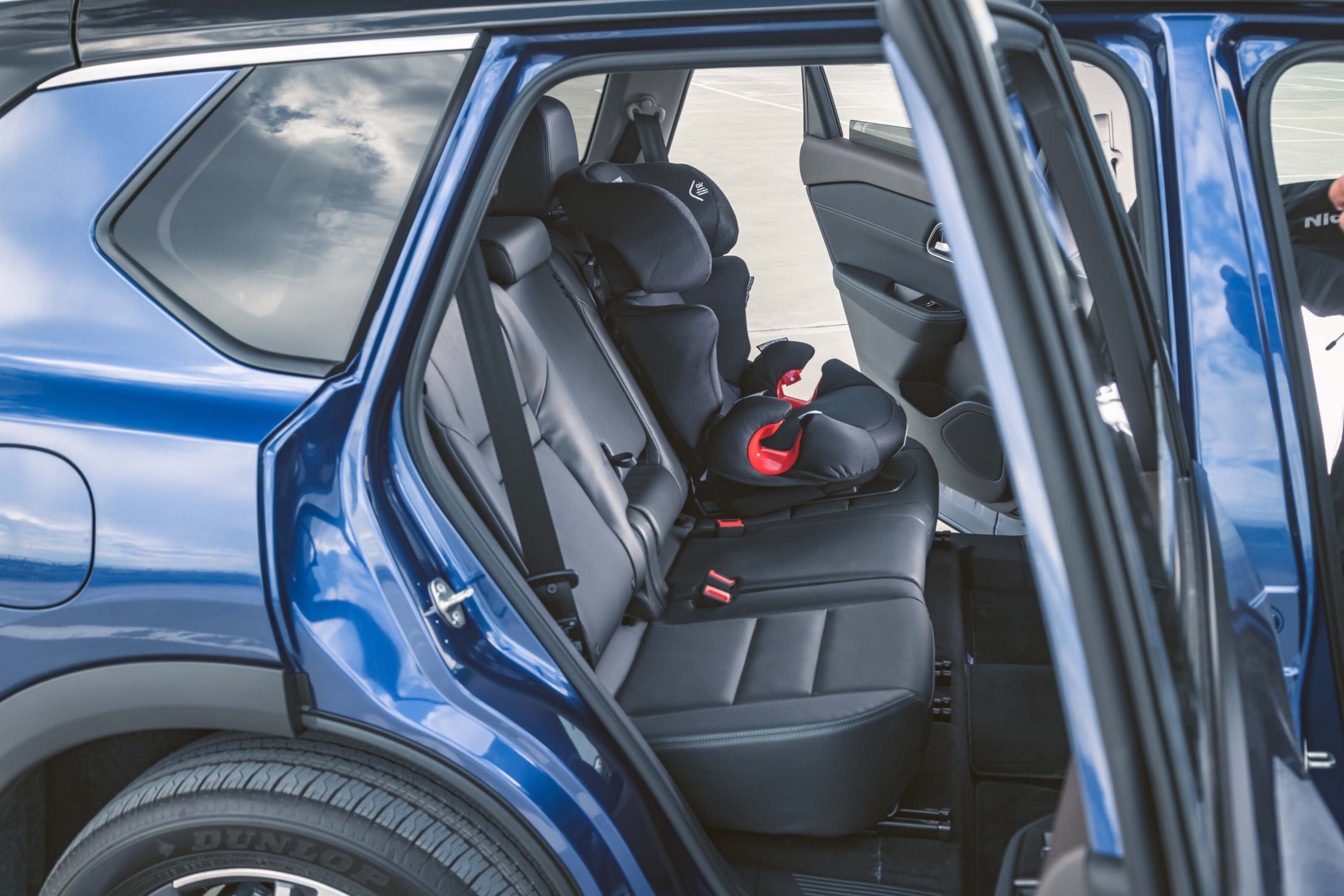
Furthering the X-Trail’s practical versatility is a very comfortable second row of seating with 40:60:40 split-folding, tilting backrests and sliding bench, while 82-degree rear door openings are a breeze to hop in and out of, or for loading things, for example.
Speaking of which, the presence of ISOFIX child seat attachments and requisite top tether anchorages for all three rear seats is another deal-sweetener that families will like.
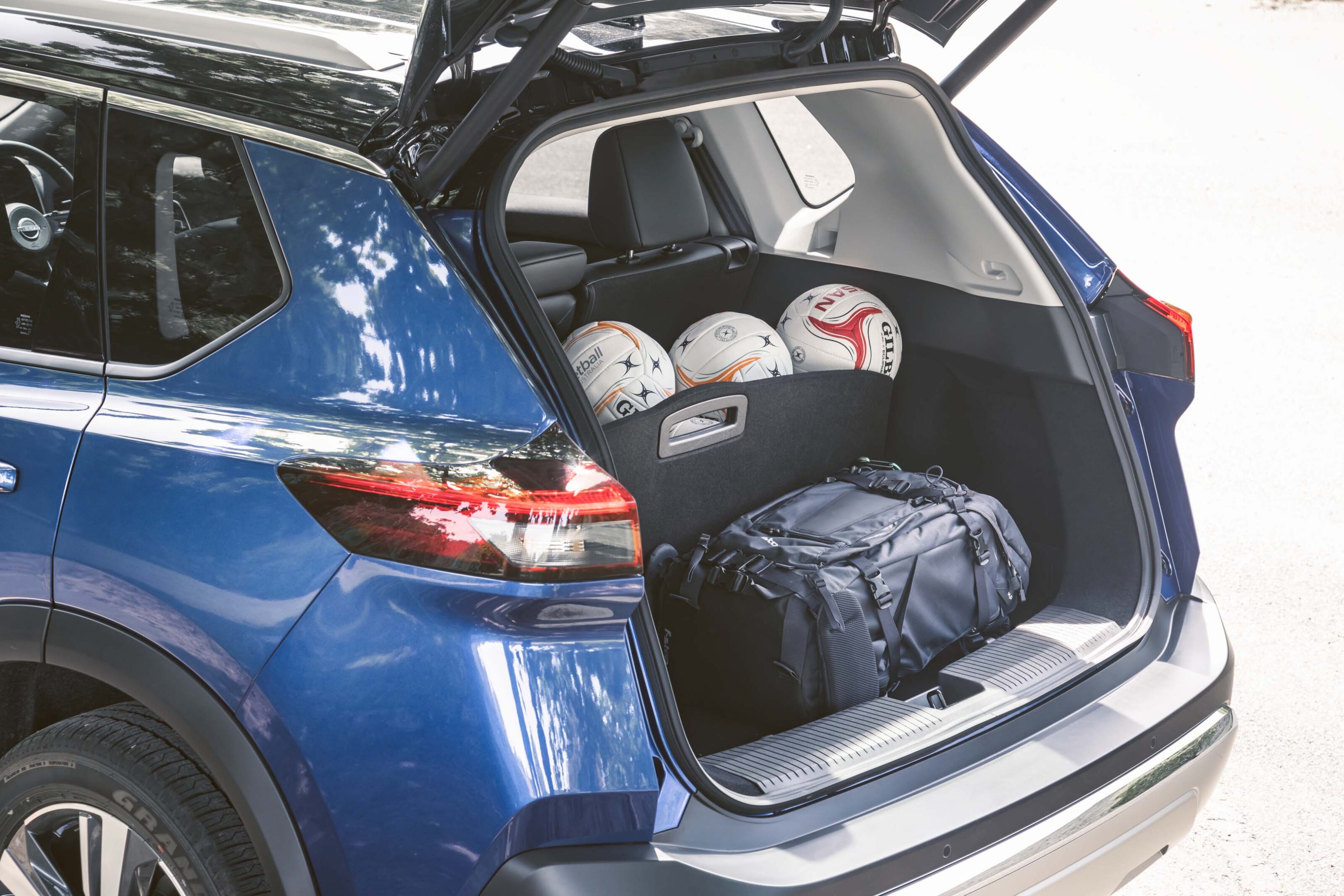
2023 Nissan X-Trail boot space
Seven-seaters get a 465-litre boot whereas the five-seater’s 585L capacity is among the best in the segment.
1
What’s it like to drive?
The basics
| 2023 Nissan X-Trail Ti | |
|---|---|
| Engine | 2488cc4cyl, dohc, 16v, petrol |
| Power | 135kW @ 6000rpm |
| Torque | 244Nm @ 3600rpm |
| Transmission | continiously variable automatic |
| Fuel consumption (claimed) | 7.8L/100km |
Nissan has labelled the fourth-gen X-trail ‘all new’, including the platform it shares with the Mitsubishi Outlander. In reality, the CMF-C architecture is a heavily revised version of the previous X-Trail’s underpinnings and the same goes for its 2.5-litre non-turbo four-cylinder petrol engine.
Despite the chunk of carried-over hardware, however, the X-Trail feels very different on the road.
Performance has changed little, with just a hint more power and torque and the carry-over CVT has the same droning nature that you’ll either dislike or not notice at all. The engine, however, is a free-revving unit that is more refined and less thrashy than the previous version with reduced levels of noise, vibration and harshness making their way into the cabin.
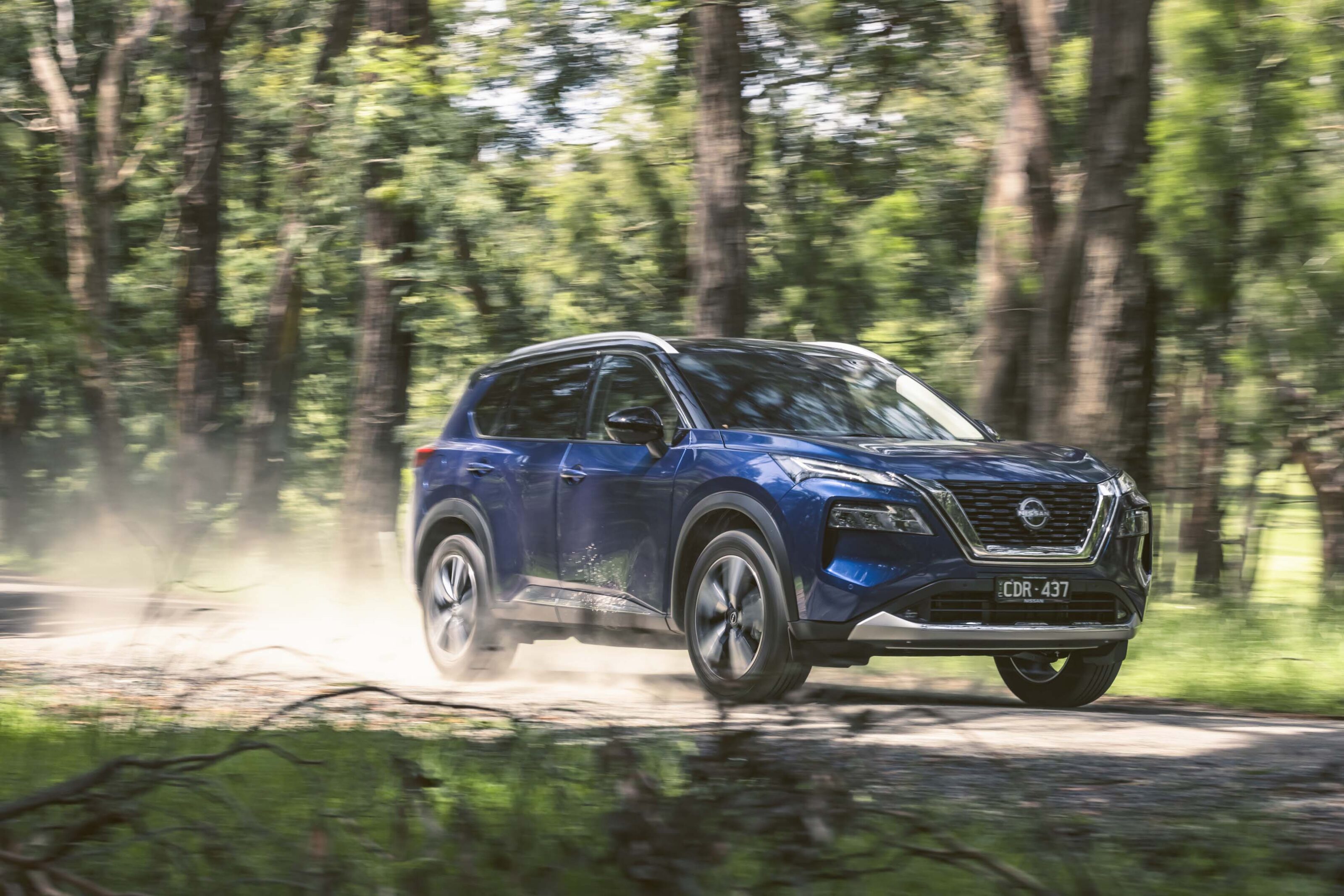
1
Without a turbo (and there’s no diesel option either), low-down torque is a little lacking and while initial acceleration is strong off the mark, the performance drops off quickly unless the engine is revved hard. This will certainly negatively impact the claimed average fuel economy figure of 7.8 litres per 100km.
For most day-to-day duties, the combination of revised petrol engine and CVT auto will be adequate for most owners.
What really stands out though, is the significantly improved ride. With a complete overhaul of the chassis and suspension tuning, the new X-Trail is both confident on its feet and comfortable, while road noise is also notably low.
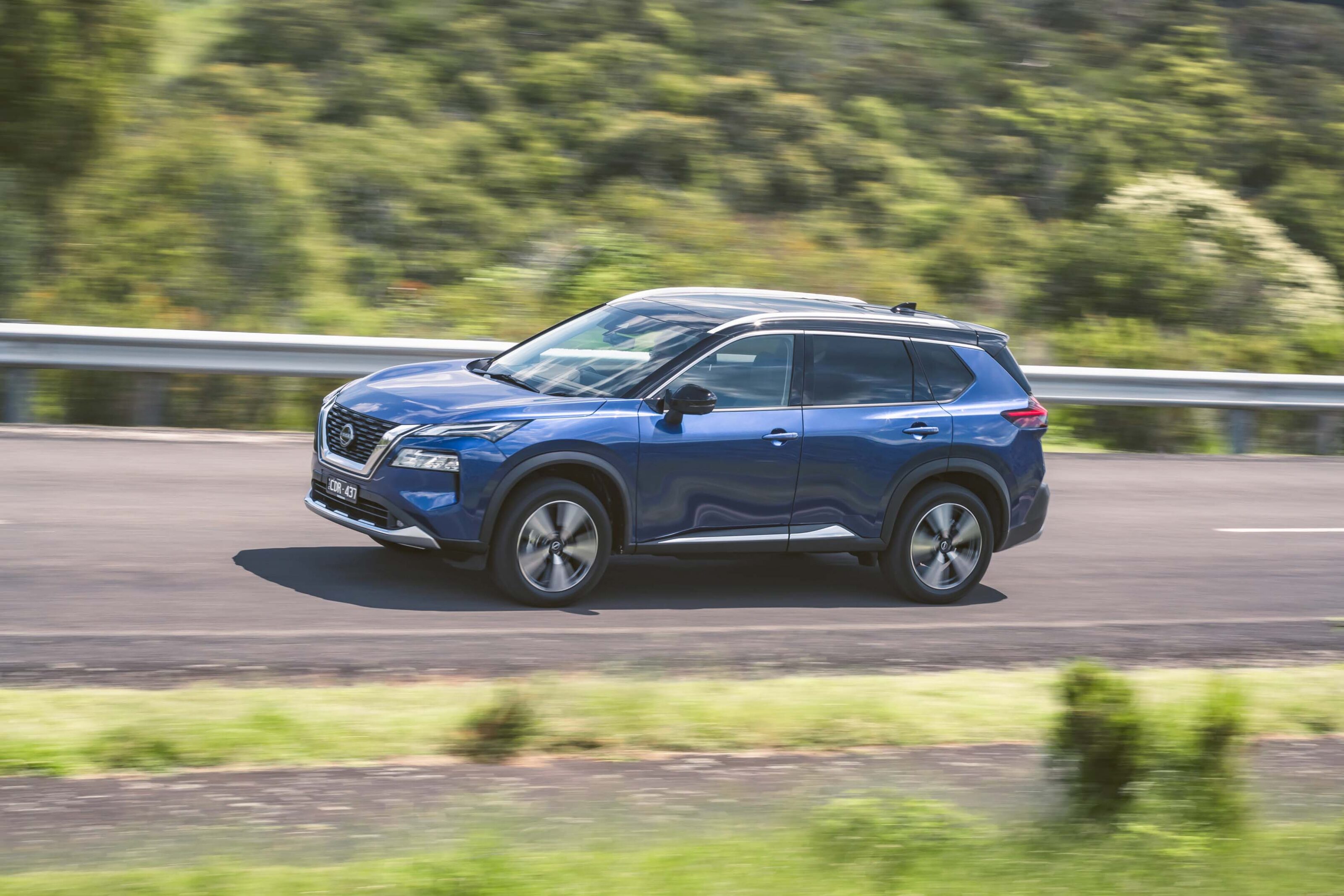
1
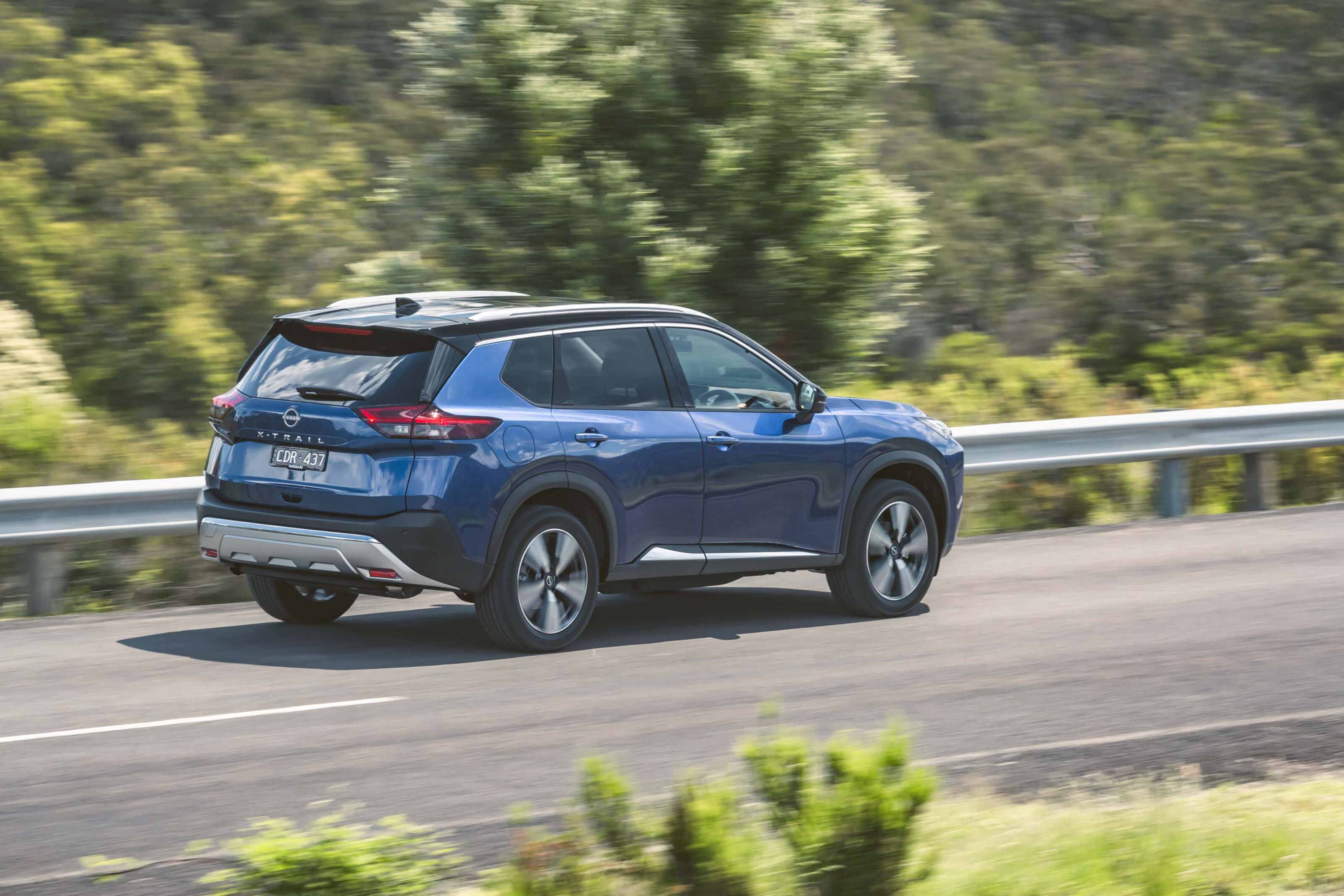
The pay-off is a little roll in corners and steering that, while fast and precise, is a little short on feel. But for an SUV that will be put to work ferrying people and things far more frequently than cutting laps of great driving roads, Nissan has struck a lovely balance of ride, handling and comfort.
Some recent sharp-edged road damage in Victoria was the enemy of 19-inch wheels fitted to the Ti and Ti-L X-Trails we drove at the launch and it’s likely the manners of the entry ST, which rolls on 17-inch alloys, will be even better. We’ll see if our speculation is correct when we get our hands on a mid- or entry-grade X-Trail.
A brief spin in the Ti-L offered a chance to enjoy its full Nappa leather upholstery, heated steering wheel, heated rear seats, ambient lighting and Bose stereo. Spending the extra $3000 over the Ti also brings front seat position memory, hands-free tailgate opening and rear sunshades which maxes out the X-Trail’s luxury credentials but we’d find it hard to justify the cost when the Ti is so well-appointed.
1
Warranty and running costs
Like all new Nissans, the 2023 X-Trail is offered with a five-year, unlimited-kilometre warranty along with roadside assistance for the same period.
All Nissans registered from the 1st of January 2018 are eligible for capped-price servicing, which limits the maximum price paid for routine servicing and maintenance for the first six planned visits.
Customers can also buy a pre-paid maintenance plan that covers the first three, four or five scheduled services with a single payment.
1
VERDICT
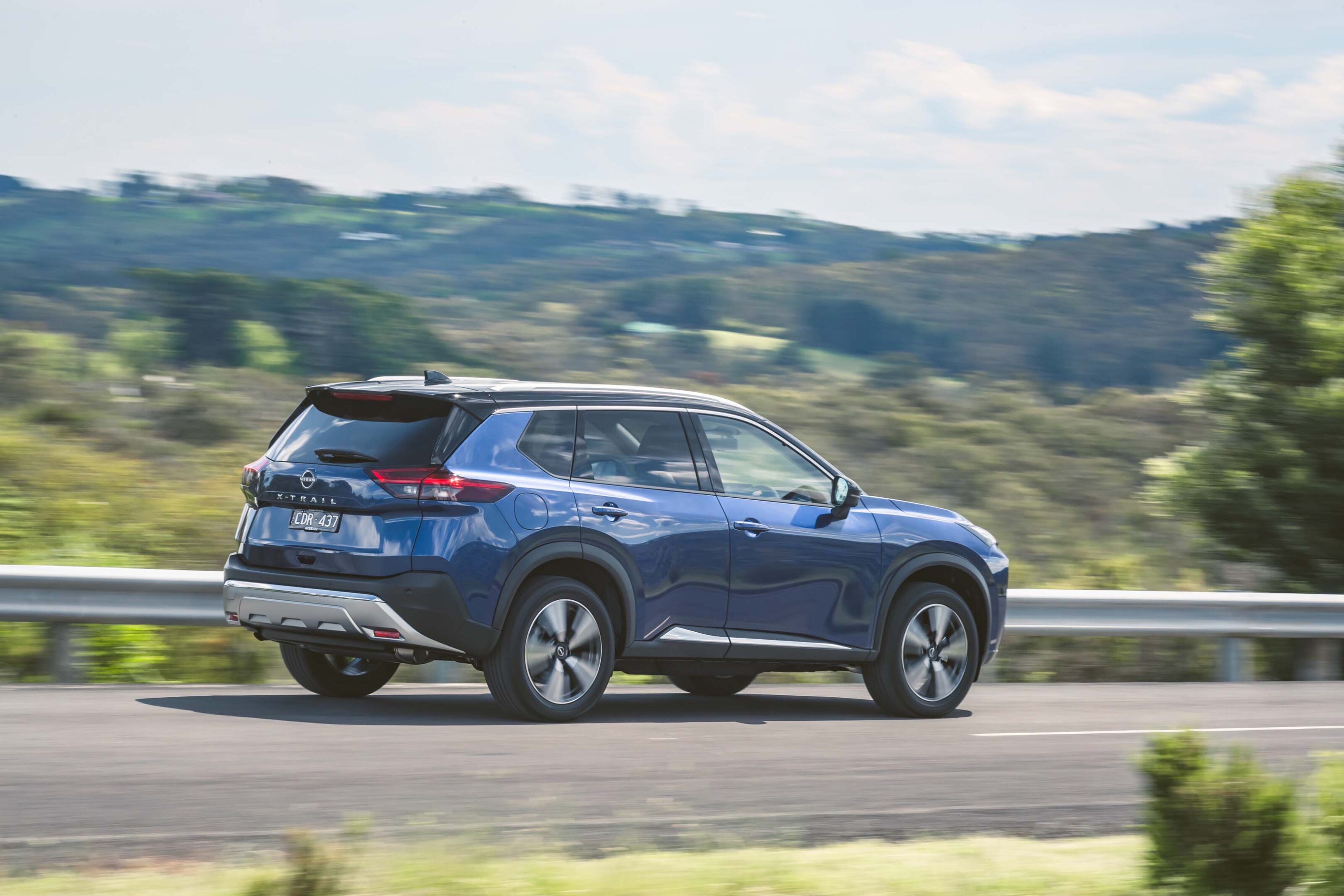
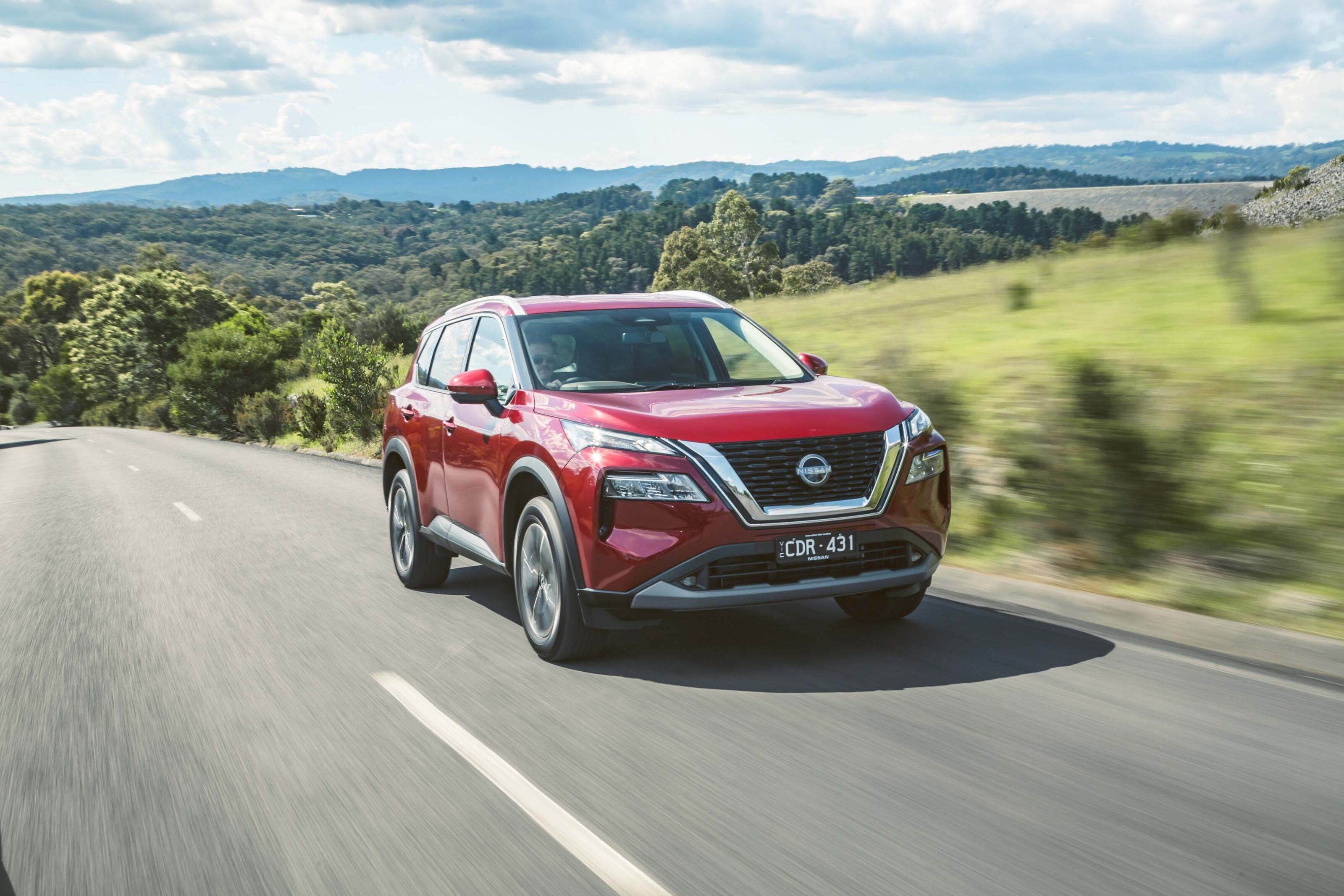
The fourth-generation X-Trail may not be as ‘all new’ as Nissan suggests but it certainly feels like it shares very little with the previous generation model. Its exterior styling has lifted the model from timid wallflower to confident contender, while a big spend on the interior and tech puts higher-spec variants firmly in premium territory.
It’s a shame its rather conventional engine couldn’t have been enhanced to do battle with more potent mid-sized SUVs and complete the transition, and the lack of a diesel or turbo-petrol means customers will have to wait for the e-Power hybrid version for something with a little more grunt and fuel economy. But of course, that would have pushed the high-end versions into even more expensive territory.
Those willing to write the cheque for a $50K X-Trail will get a version that’s unrecognisable from its predecessor and one that breaks new ground for the nameplate and Nissan as a brand.
As for the more crucial and affordable ST and ST-L volume players, that verdict will have to wait.
MORE
Everything Nissan
2023 Nissan X-Trail Ti specifications
| Engine | 2488cc4cyl, dohc, 16v, petrol |
|---|---|
| Power | 135kW @ 6000rpm |
| Torque | 244Nm @ 3600rpm |
| Transmission | continiously variable automatic |
| Fuel consumption | 7.8L/100km |
| Weight | 1668kg |
| L/W/H/W-B | 4680/2065/1725/2705mm |
| 0-100km/h | N/A |
| Price | from $49,990 |
April 2023: Nissan X-Trail ST-L E-Power priced
December 1, 2022: Nissan X-Trail pricing and features
Snapshot
- 2023 Nissan X-Trail pricing and features
- Four-tier structure with high levels of standard equipment
- Priced from $36,750 before on-road costs
The next-generation 2023 Nissan X-Trail medium SUV has arrived in Australia.
It is offered with four variants, an optional hybrid powertrain, and a host of updated active safety systems, with prices starting from $36,750 before on-road costs – up $2485 over the outgoing X-Trail.
The fourth-generation X-Trail rides on Nissan’s fresh CMF-C platform (shared with the Mitsubishi Outlander), with a sizeable improvement in interior quality, equipment and space.
While the hybrid ‘E-Power’ variant isn’t available at launch, it is scheduled to arrive in early 2023 with improved fuel economy and sharper performance thanks to its electronic all-wheel drive system.
Across the range, prices are up over the current model from anywhere between just under $2500 to over $5600, while the new flagship Ti-L variant’s $52,990 list price is $6875 more than the outgoing X-Trail’s range-topping Ti grade.
1
JUMP AHEAD
- Pricing
- Features
- Colours
- Engine, drivetrain, and fuel economy
- Safety
- Dimensions
- Warranty and servicing
- Availability
1
2023 Nissan X-Trail pricing
Prices exclude on-road costs.
| Model | Price | Change |
|---|---|---|
| ST FWD five-seat | $36,750 | up $2485 |
| ST AWD seven-seat | $39,790 | up $5125 |
| ST-L FWD five-seat | $43,190 | up $2915 |
| ST-L AWD seven-seat | $46,290 | up $5615 |
| Ti AWD five-seat | $49,990 | up $3875 |
| Ti hybrid AWD five-seat | $54,190 | new |
| Ti-L AWD five-seat | $52,990 | new |
| Ti-L hybrid AWD five-seat | $57,190 | new |
1
2023 Nissan X-Trail features
ST
ST-L
Ti
Ti-L
1
Colours
Metallic paint incurs a $700 premium. A two-tone black roof option is available on Ti and Ti-L in sunset orange, ceramic grey, ivory pearl, Caspian blue and champagne silver for $1200.
1
Engine, drivetrain, and fuel economy
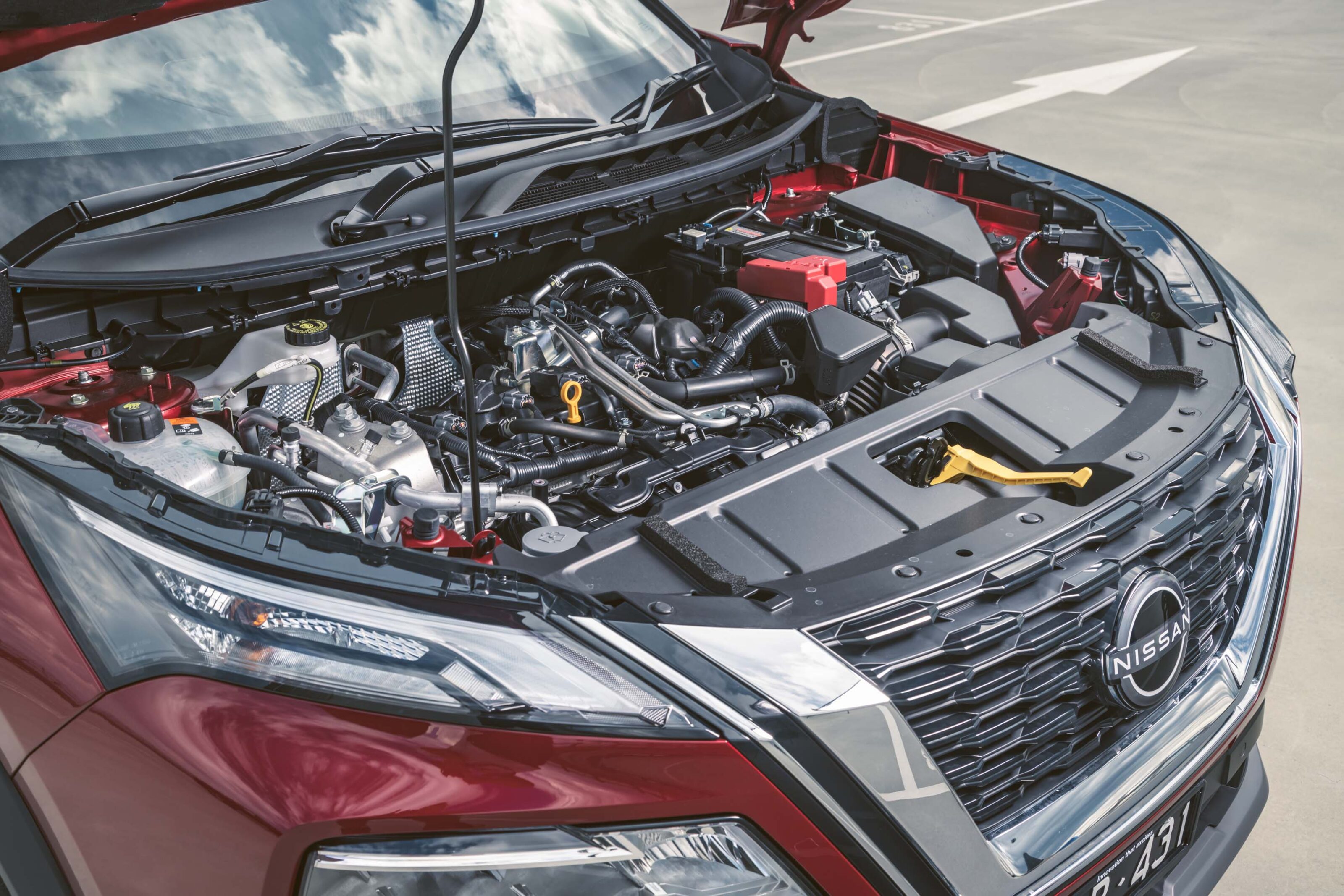
Under the bonnet, the Nissan X-Trail offers a naturally-aspirated 2.5-litre four-cylinder engine, or an optional 1.5-litre turbocharged three-cylinder petrol-electric ‘E-Power’ hybrid on the range-topping Ti and Ti-L grades.
The standard engine is a revised version of the old model’s petrol engine, as found in its twin-under-the-skin, the latest Mitsubishi Outlander. It’s paired exclusively to a CVT automatic and produces 135kW/245Nm, which is a 9kW/19Nm improvement over the outgoing X-Trail.
Meanwhile, the X-Trail E-Power features a unique hybrid setup, with a 1.8kWh lithium-ion battery, a power generator, inverter and dual electric motors (150kW front, 100kW rear), for a combined system output of 157kW with electronic all-wheel drive.
1
For more information on the X-Trail E-Power’s hybrid setup, click here.
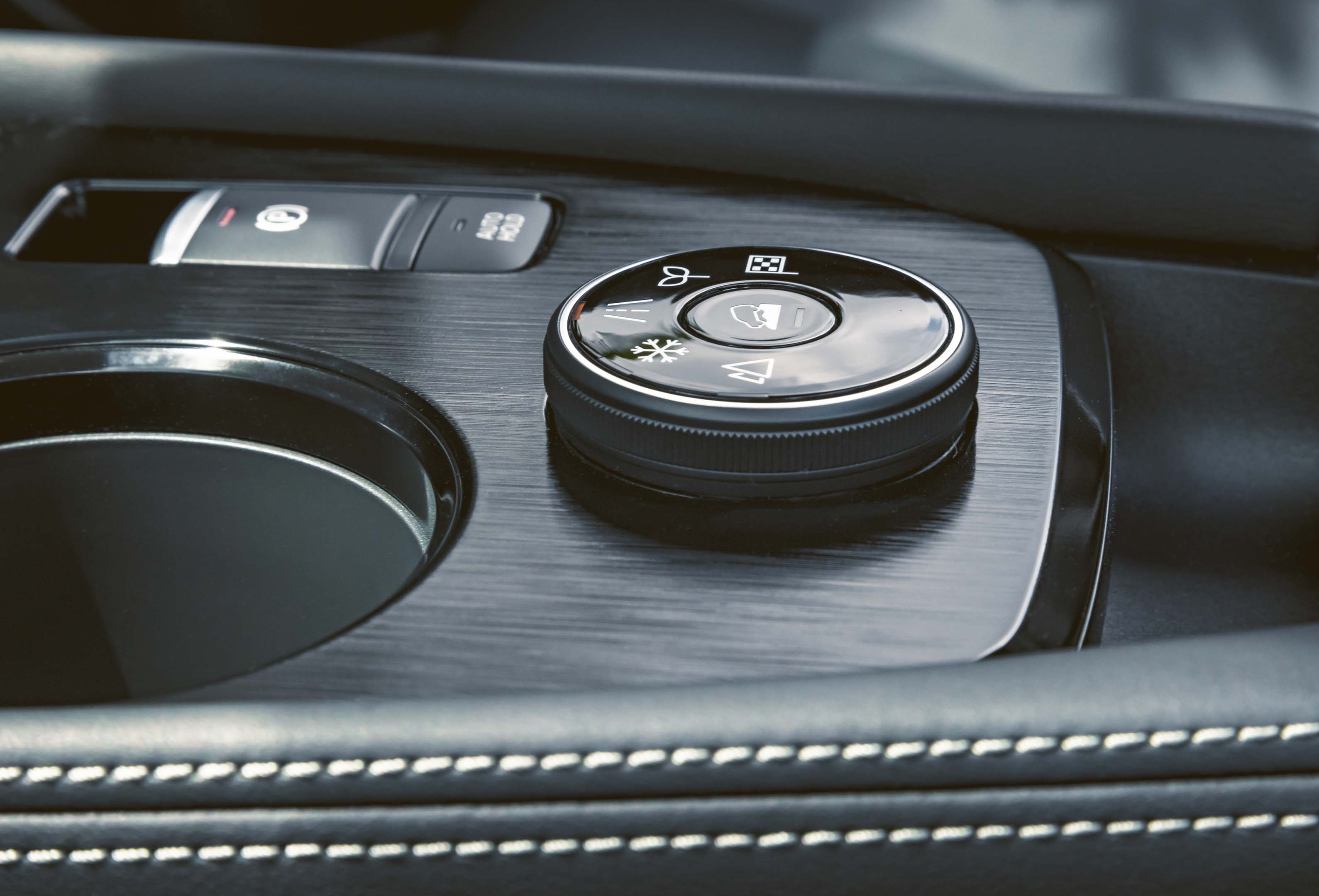
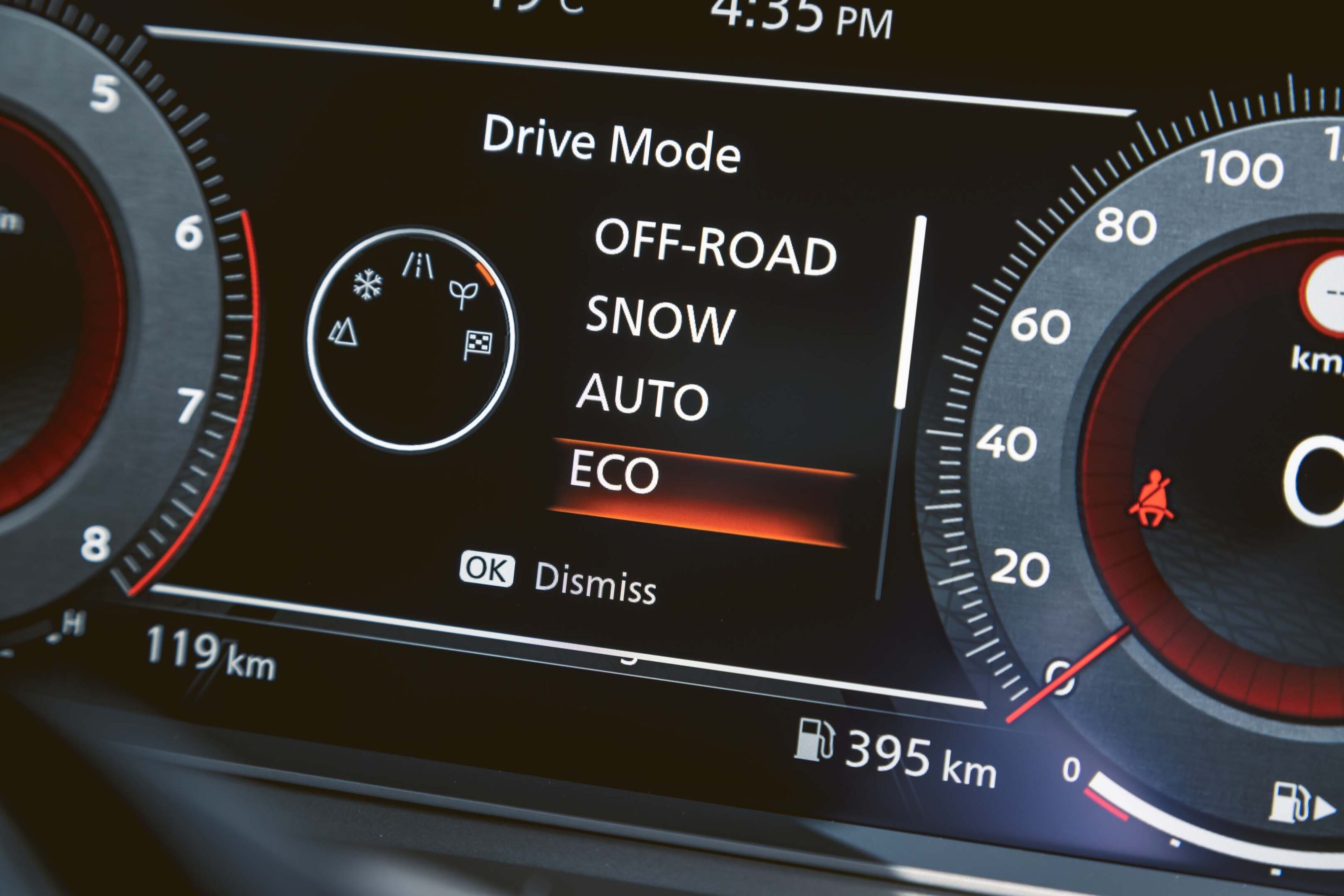
Towing has been improved across the X-Trail range, with all-wheel drive versions now capable of towing 2000 kilograms braked – 500kg more than before. AWD versions also have a revised system with five drive modes: Off-road, snow, auto, eco and sport.
Fuel economy figures can be found in the table below:
| 2.5-litre FWD | 7.4L/100km | 174g/km |
|---|---|---|
| 2.5-litre AWD | 7.8L/100km | 183g/km |
| 1.5-litre hybrid AWD | 6.1L/100km | 139g/km |
1
Safety
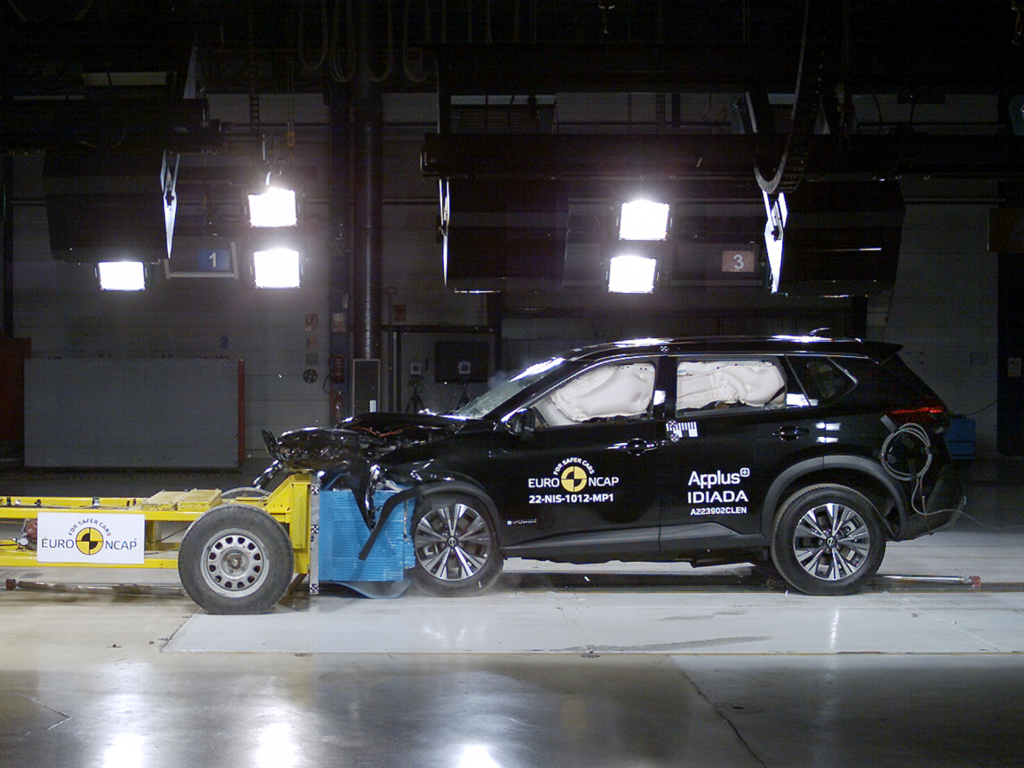
The Nissan X-Trail is covered by a five-star ANCAP safety rating, based on testing conducted on the related Qashqai small SUV in 2021. It has a 91 per cent score for adult occupant protection, 90 per cent for children, 74 per cent for vulnerable road users, and 97 per cent for safety assist.
For a full run-down on the X-Trail’s crash performance, click here.
Seven airbags (dual front, side, curtain, and front-centre) feature across the range.
Each variant includes the following active safety equipment as standard:
ST-L grades and above also include Nissan’s ProPilot+ safety suite, allowing semi-autonomous highway driving in certain situations.
1
Dimensions
The Nissan X-Trail has a wheelbase of 2705 millimetres, and is 4680mm long, 2065mm wide and 1725mm tall.
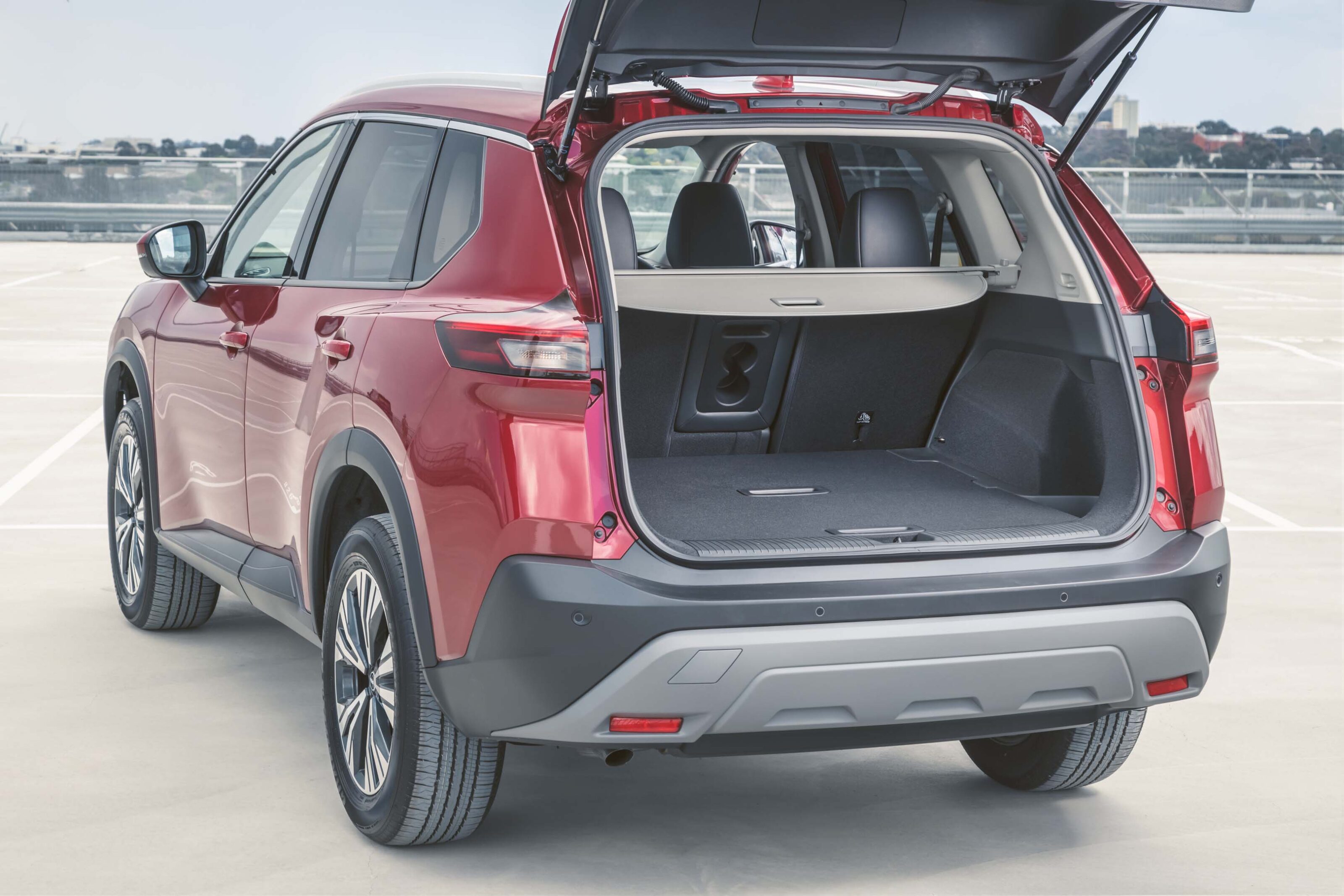
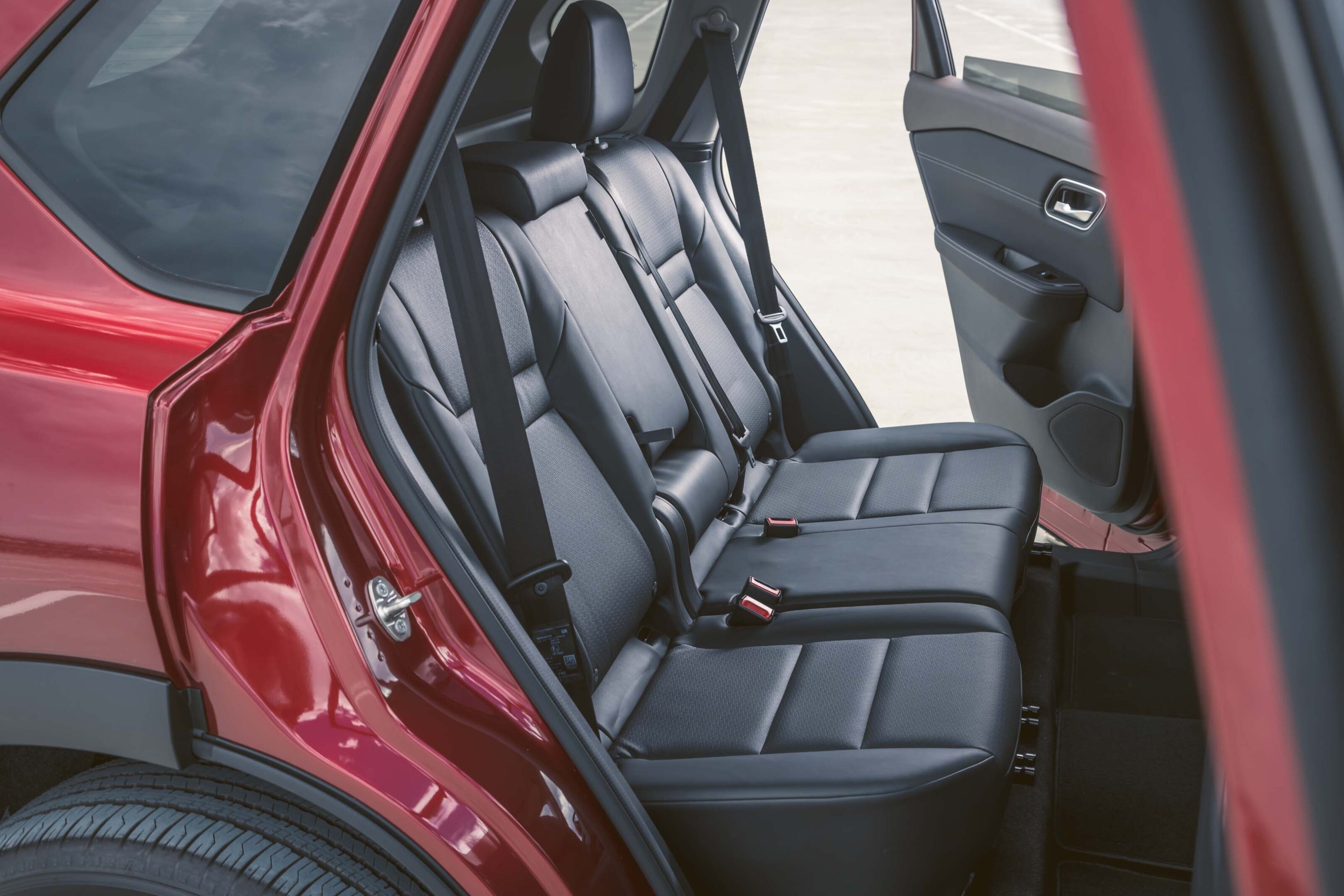
Five-seat versions have the largest boot capacity at 585L, while the E-Power hybrid is listed at 575L. The seven-seat option, available for the ST and ST-L, reduces space to 465L with the third-row folded flat.
That does put the X-Trail ahead of key five-seat rivals like the Toyota RAV4 (540L), Mazda CX-5 (442L) and Kia Sportage (543L) for load-lugging ability.
The X-Trail also includes Nissan’s modular boot dividers that allow two carpeted sections to be arranged in 16 different configurations to secure bags, hide valuables or store longer items.
1
Warranty and servicing
As per the wider Nissan range, the X-Trail is covered by the brand’s five-year, unlimited-kilometre warranty, with complimentary roadside assistance across the same period.
Maintenance is required every 12 months or 10,000 kilometres, whichever occurs first.
Capped-price servicing is available for the first five years, at the following cost:
Availability
The next-generation 2023 Nissan X-Trail is now available in Australian showrooms.
For more information on Nissan’s wait times, click here.
Get more on Nissan’s big 2023 line-up refresh
MORE
Everything Nissan
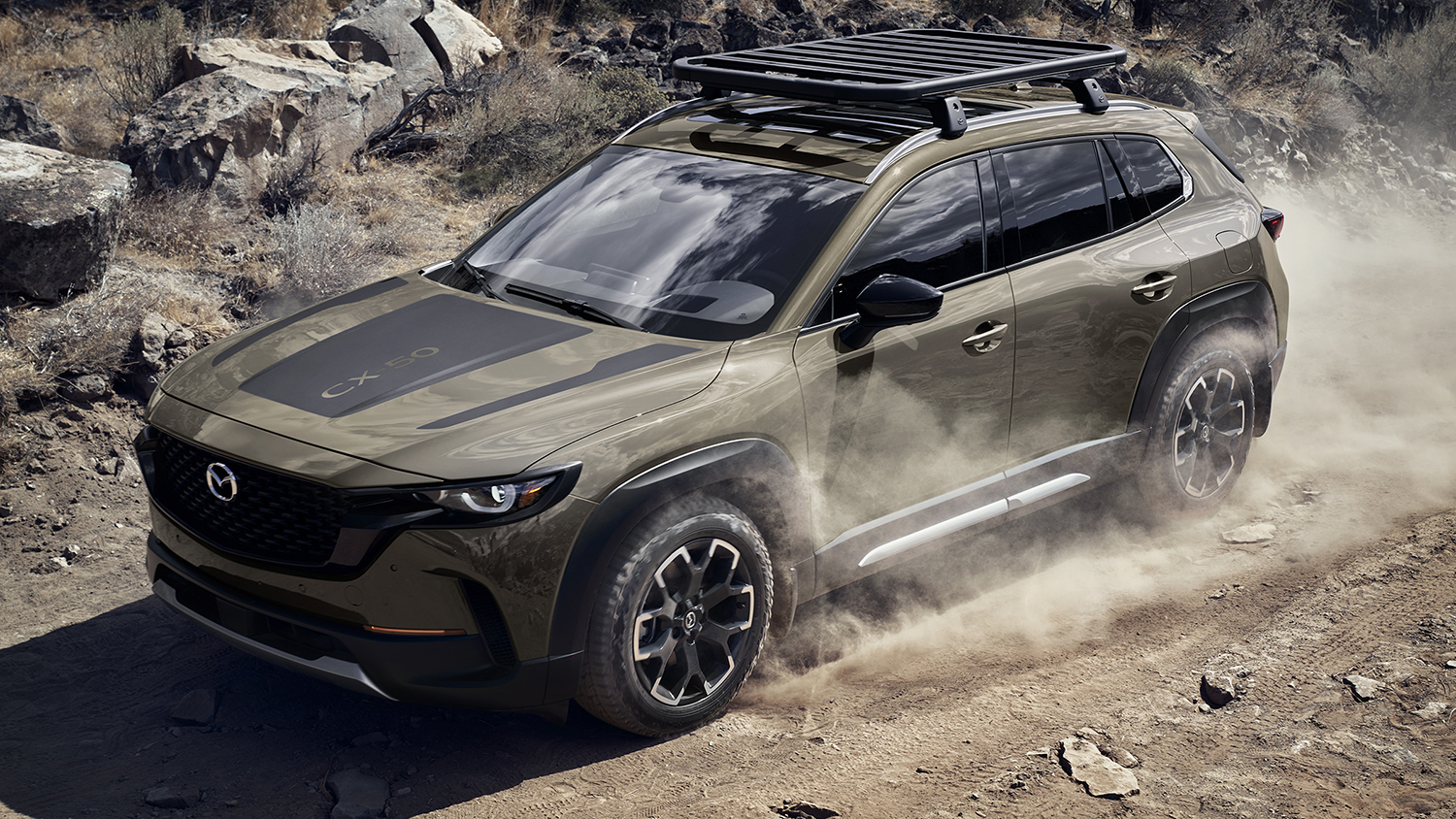
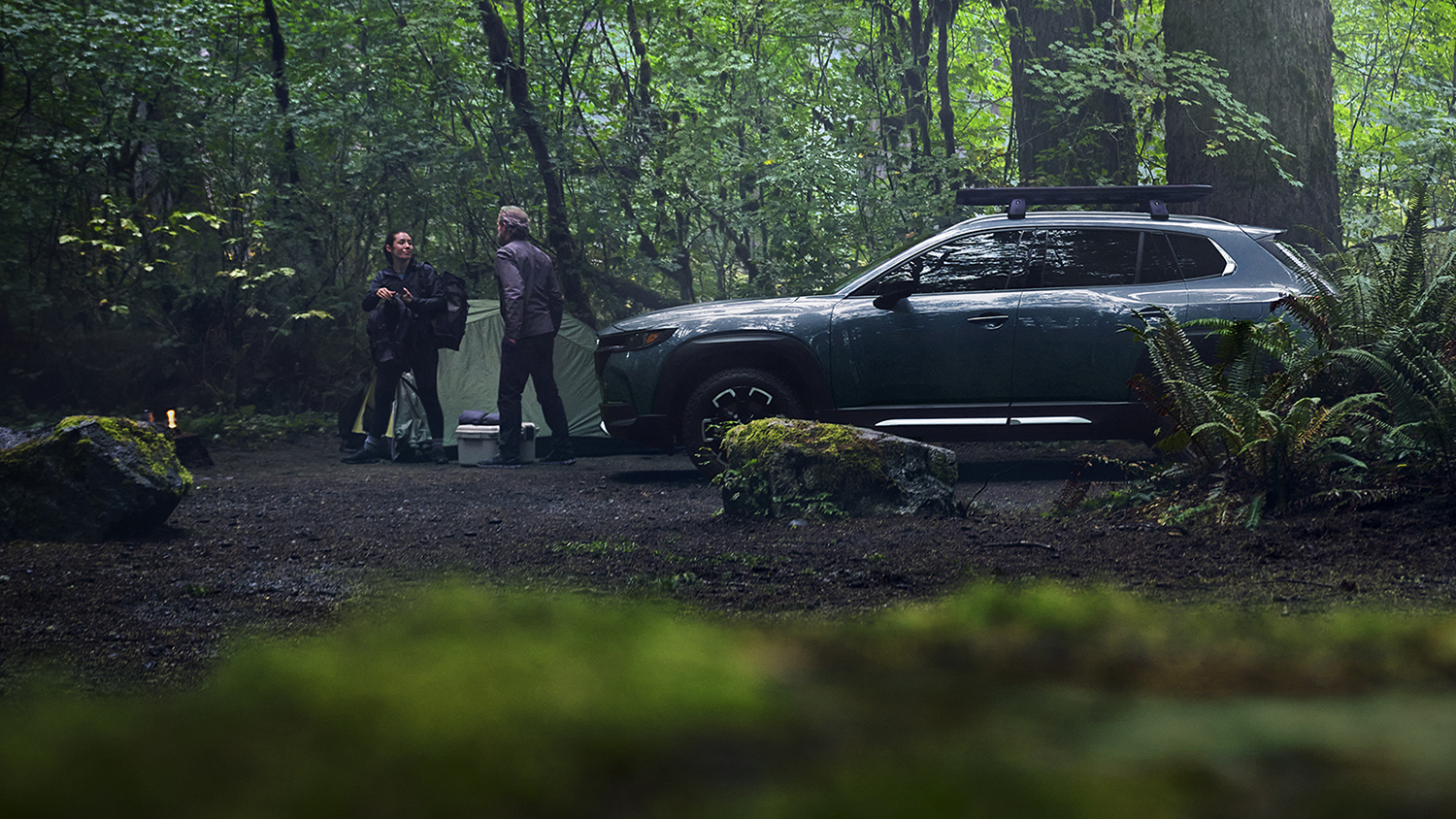
UPDATE: Mazda Australia’s desire to add the CX-50 to local showrooms is as strong as ever with the brand reaffirming the rugged mid-size SUV is still firmly on its wish list.
Top brass from Mazda’s local division has confirmed their hand is still raised with company HQ to import the CX-50 if the new SUV is given the green light for right-hand-drive production.
1
Currently, the CX-50 is left-hand-drive only and is built for the American and Canadian markets at a manufacturing plant in Huntsville, Alabama, that’s jointly run by Mazda and Toyota. That means it’s currently off the table for Australia.
If it was to become available, the CX-50 would complement the CX-5 and incoming CX-60 in Mazda Australia’s mid-size SUV line-up. Exactly when that might happen, though, is unclear.
“No, no movement,” replied Mazda Australia boss Vinesh Bhindi when asked if there was any progress in securing production. “It’s still on the wish list, though.”
MORE
All Mazda
1
November 16, 2021: Mazda CX-50 revealed
The new 2022 Mazda CX-50 has been unveiled today, and… so much for our speculative renderings. Where we imagined a sleek, road-focused and coupe-like design, Mazda has turned to a more rugged and muscled look.
Mazda confirmed the CX-50 in October, alongside news of new CX-60, CX-70, CX-80 and CX-90 nameplates bound for the global stage.
1
So we’re missing out for now, but what does North America get?
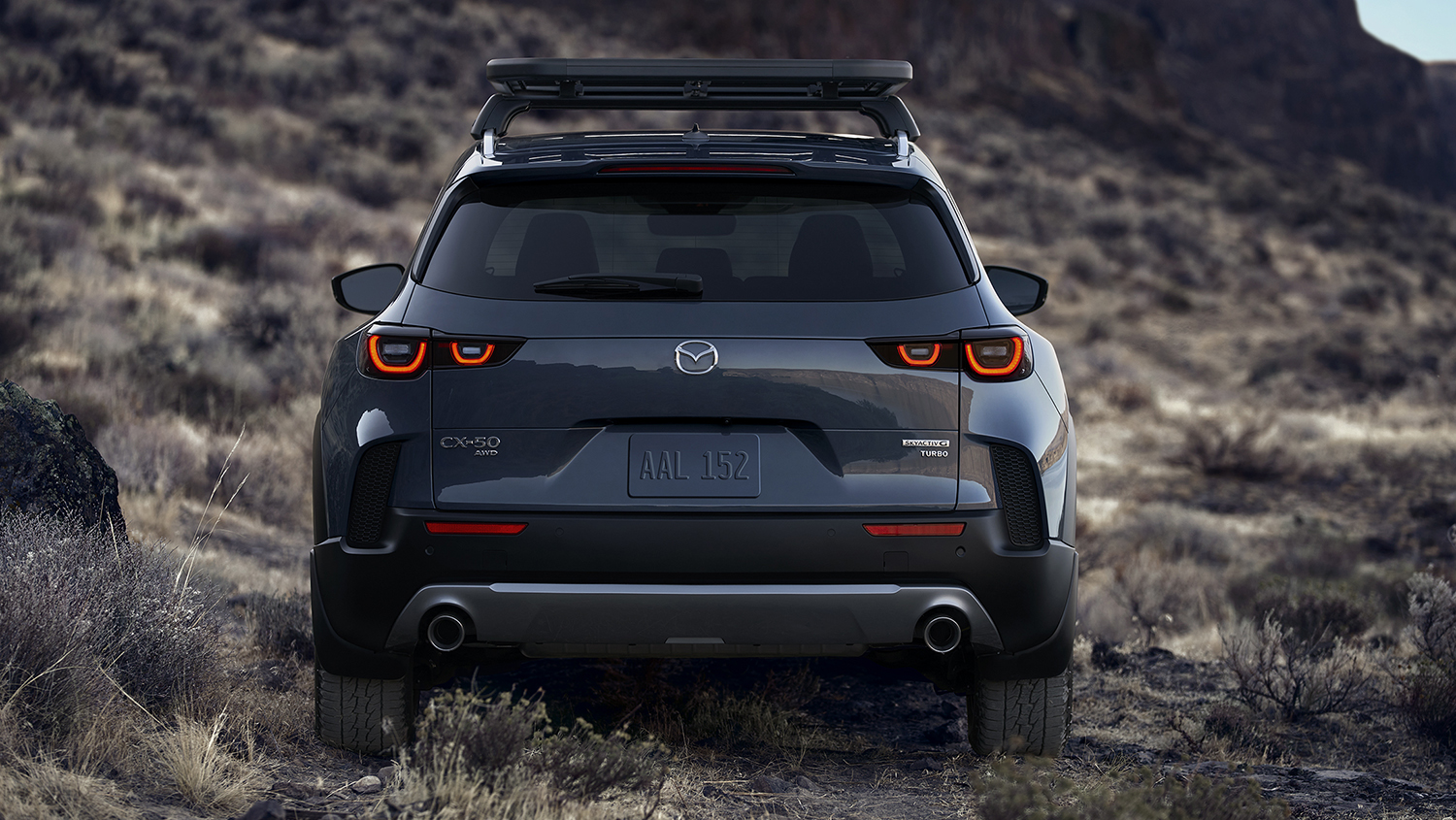
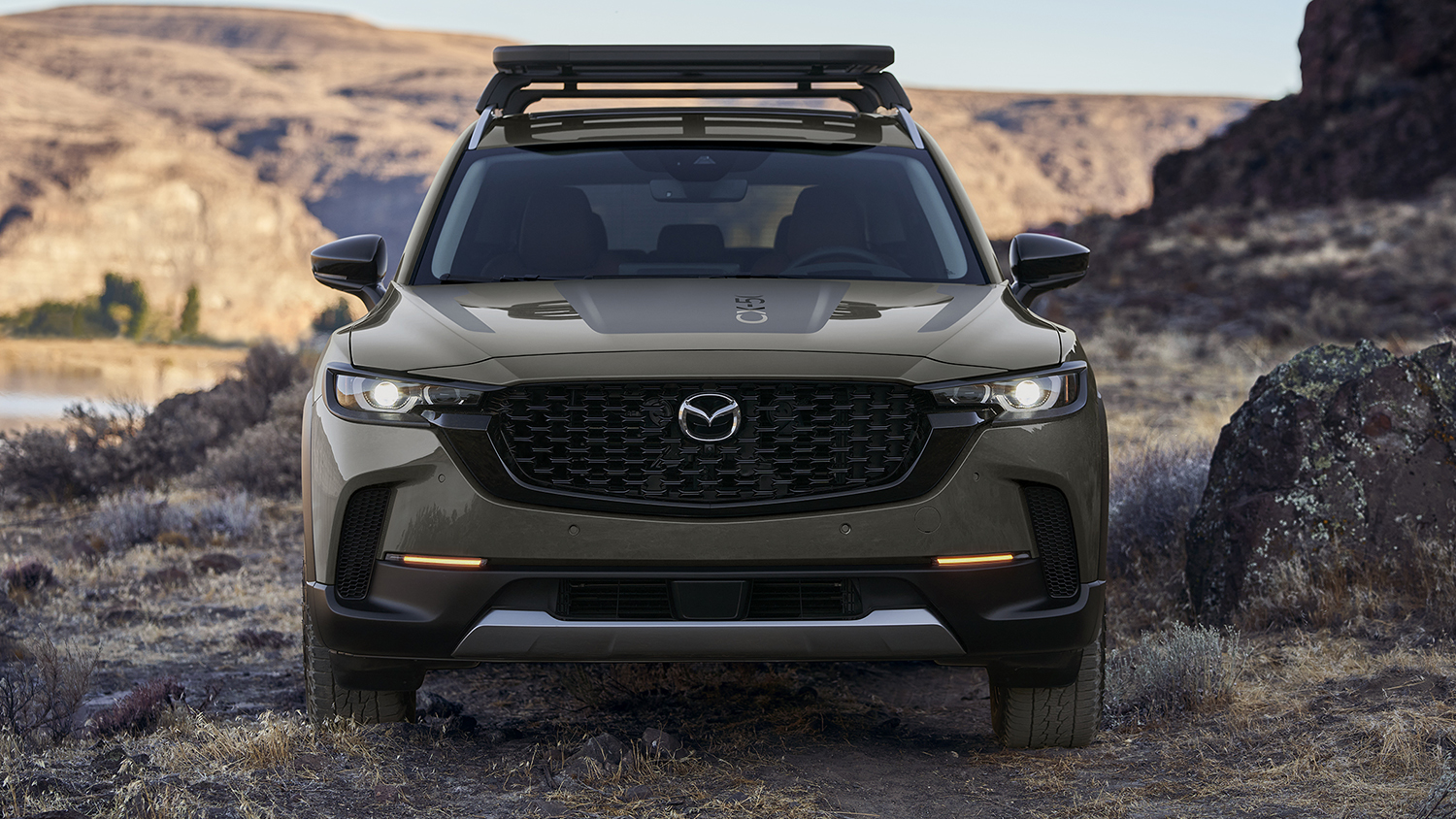
The CX-50 revealed today showcases a wider body design, with surprisingly boxy guards and a host of protective cladding elements along its wheel arches and lower edges.
Other evolved styling elements include a new lighting signature with two LED rings in place of Mazda’s usual one, along with wide outboard intakes and vents at both ends.
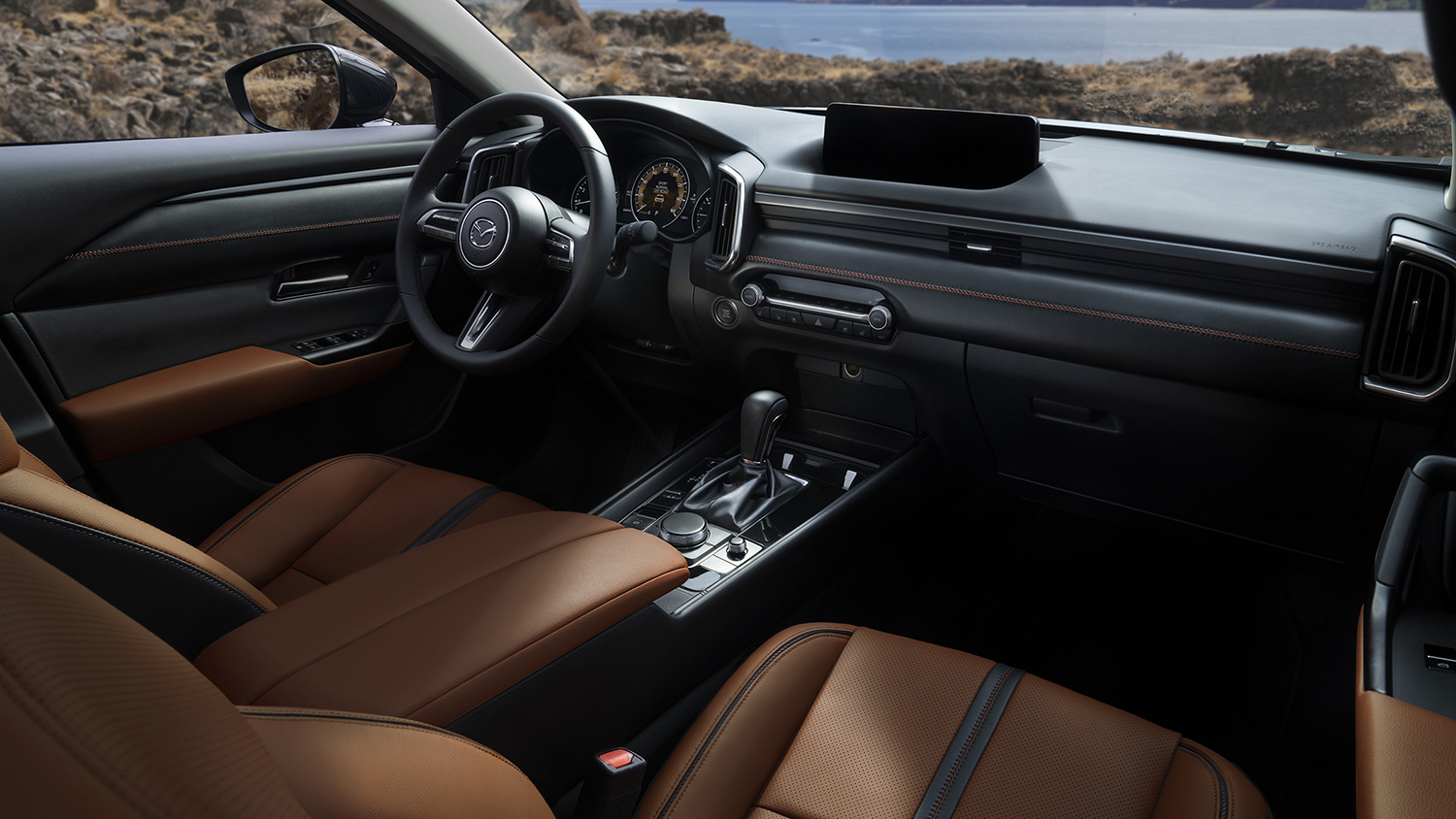
The interior likewise brings significant styling changes, with a taller and more masculine look to the dashboard and vents – although the air-conditioning controls, centre console and steering wheel are all familiar Mazda fare.
1
The CX-50 will be offered with Mazda’s 2.5-litre four-cylinder petrol engines in both naturally-aspirated (non-turbo) and turbocharged designs, with other “electrified” options to debut later, “including a traditional hybrid model”.
Output numbers reveal no surprises, with the N/A engine offering 139kW and 252Nm, while the turbo engine will deliver 186kW and 434Nm.
Likewise, Mazda’s ageing six-speed automatic transmission remains the only shifter on offer, matched to its i-Activ all-wheel-drive and ‘Intelligent Drive Select’ systems – the latter referred to as Mi-Drive.
Unlike the CX-30, which debuted in early 2020 as a bigger Mazda 3-based companion to the compact CX-3, the CX-50 is being presented – at least in these initial marketing shots – as a family-oriented SUV will light off-road capability.
Off-roading in the CX-50 will be limited to fairly lightweight touring, with US-market research suggesting most road-tripping buyers will do less than 30 kilometres of driving on unsealed roads on any holiday journey.
1
“Compromising all of that on-road driving, just for a little bit of improvement off-road doesn’t make a whole lot of sense,” said Dave Coleman, Mazda North America’s vehicle dynamics boss, during the CX-50’s reveal event.
“Especially if you’re Mazda, with our expertise on-road. So we resolved to get the best off-road performance that we could without making any compromises in on-road driving.”
The company has not offered deep mechanical detail at this stage, but it has confirmed the CX-50’s handling of unsealed roads will come through drive mode calibration, essentially using software smarts to manage traction.
Unlike many new ‘soft-roader’ offerings, Mazda is sticking with a simple ‘off-road’ mode, eschewing the slew of options that often include modes for snow, sand and gravel. Mazda says these options do little more than confuse drivers in this market segment – although it did not confirm if this conclusion was the result of buyer research.
When will we see the CX-60?
Reveal timing for the CX-60 has not been confirmed, but we would expect to see it sometime after the new-generation, rear-wheel-drive Mazda 6 debuts in the first half of 2022.
MORE
CX-5 news & reviews
MORE
All Mazda
January 2023: Kia EV6 GT driven in Australia
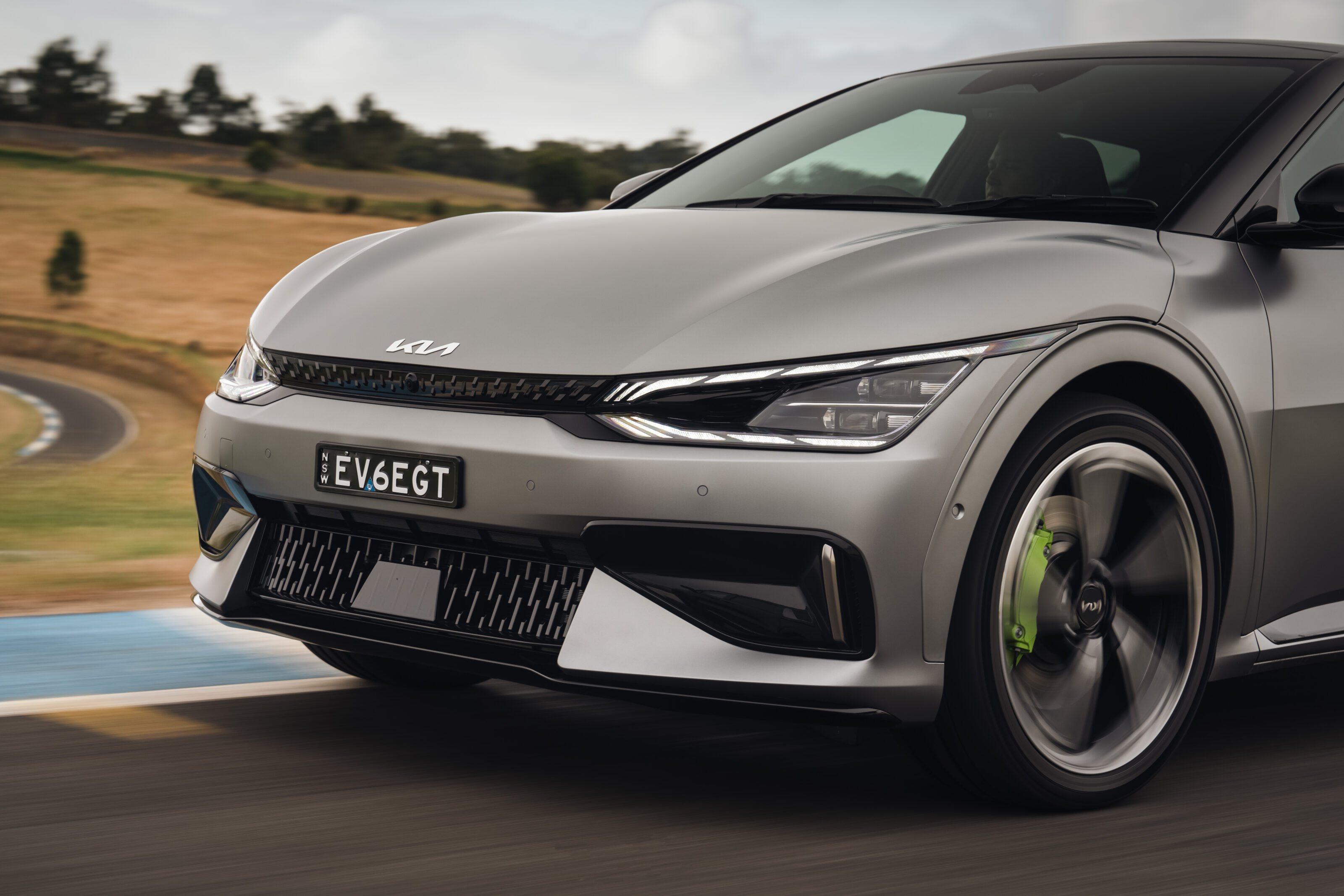
“This isn’t even my final form”, chuckled the 239kW & 605Nm EV6 GT-Line last year. Now we understand… see our first drive review of the flagship EV6 GT, including a track test, at the link below.
1
The story to here
Kia’s extra hot EV6 GT will cost nearly $100,000 before on-road costs
As long expected – so, no surprises here – the powerful performance-focused 2023 Kia EV6 GT will be priced from almost $100,000 when it goes on sale in the coming months.
Kia itself has yet to announce pricing and specifications, but a trusted industry price guide distributed to media has listed the EV6 GT at $99,590 before on-road costs.
That price positions the hero EV well above the current top model, the GT-Line AWD, which is priced from $87,590. The entry-level Air, by comparison, is listed at $72,590.
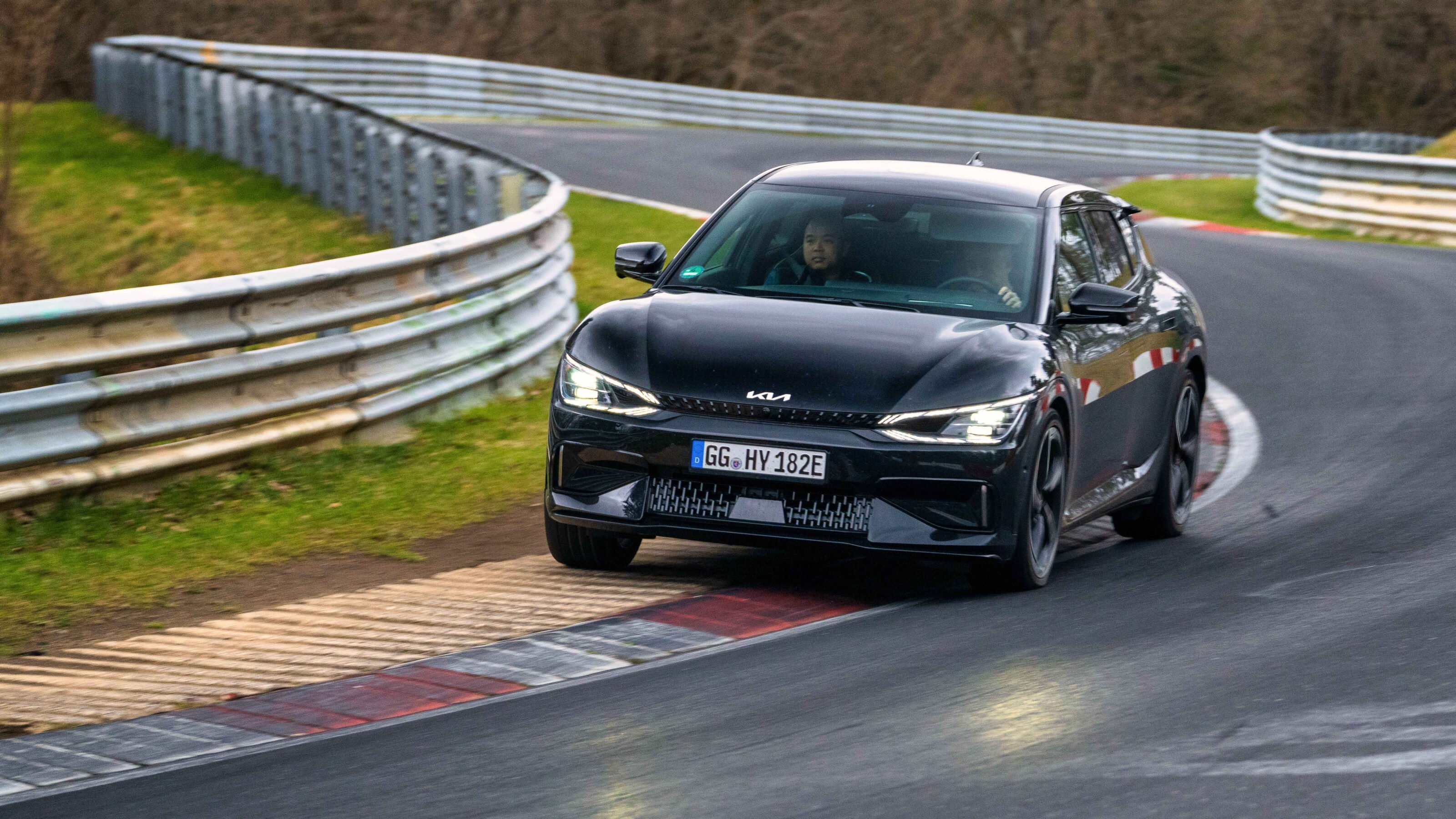
Entering above the already rapid GT-Line (239kW/605Nm, 5.2sec to 100km/h), the EV6 GT will develop 430kW and 740Nm, with a claimed 0-100km/h time of 3.5 seconds.
Learn more about the EV6 GT in our story below, and watch for more details to come in the near future.
1
EV6 GT reaches Australia for local testing
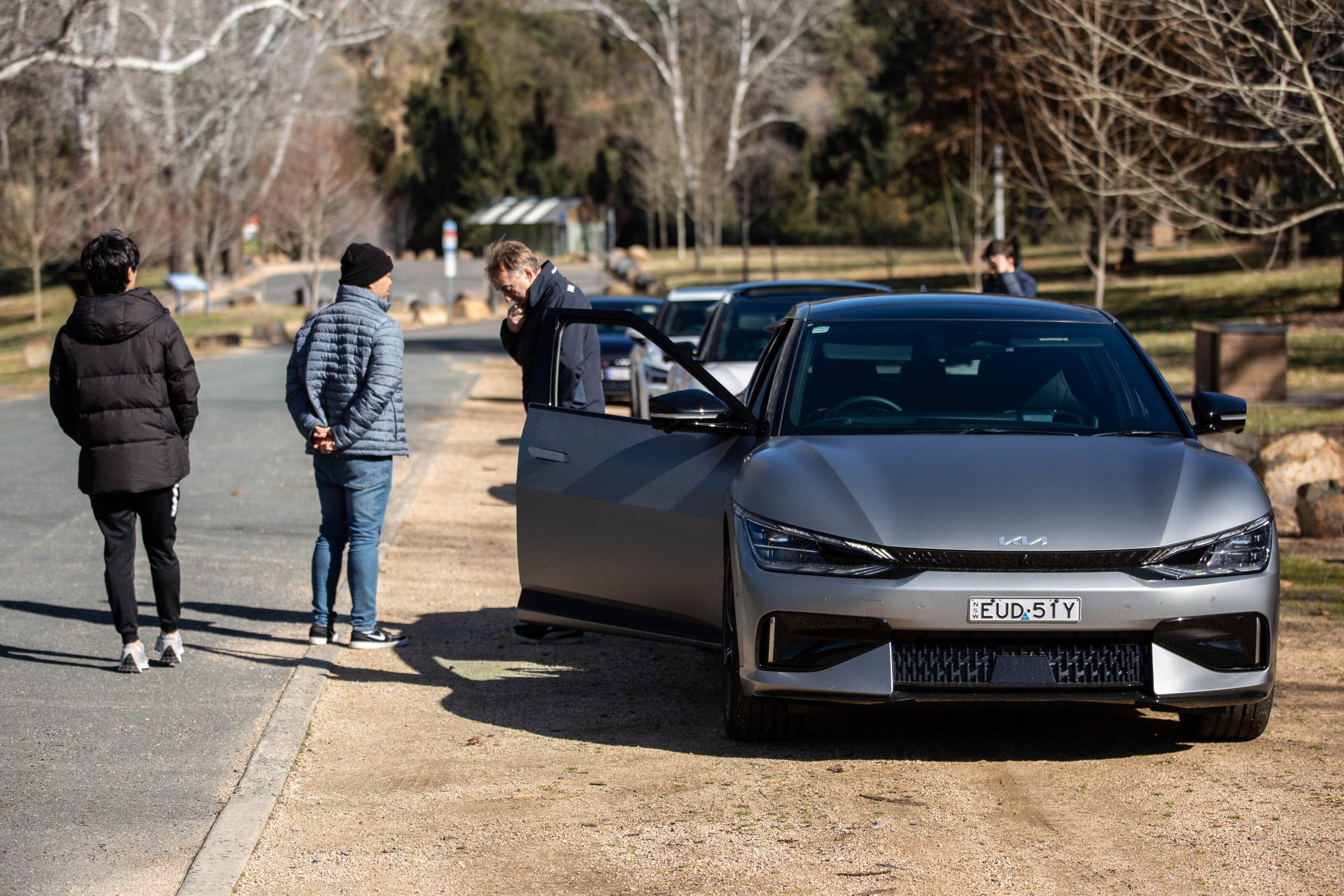
The hero variant of Kia’s popular EV6, the 2023 EV6 GT – expected to be priced close to $100,000 when it goes on sale next year – has arrived in Australia for local tuning.
As with most other Kia models, the EV6 GT will go on sale with the benefit of a ride and handling tune specific to the Australian market.
Much work has been done already, carried out by Kia partner Graeme Gambold, but that has so far been based around communicating with Korea and travelling to the company’s European facilities.
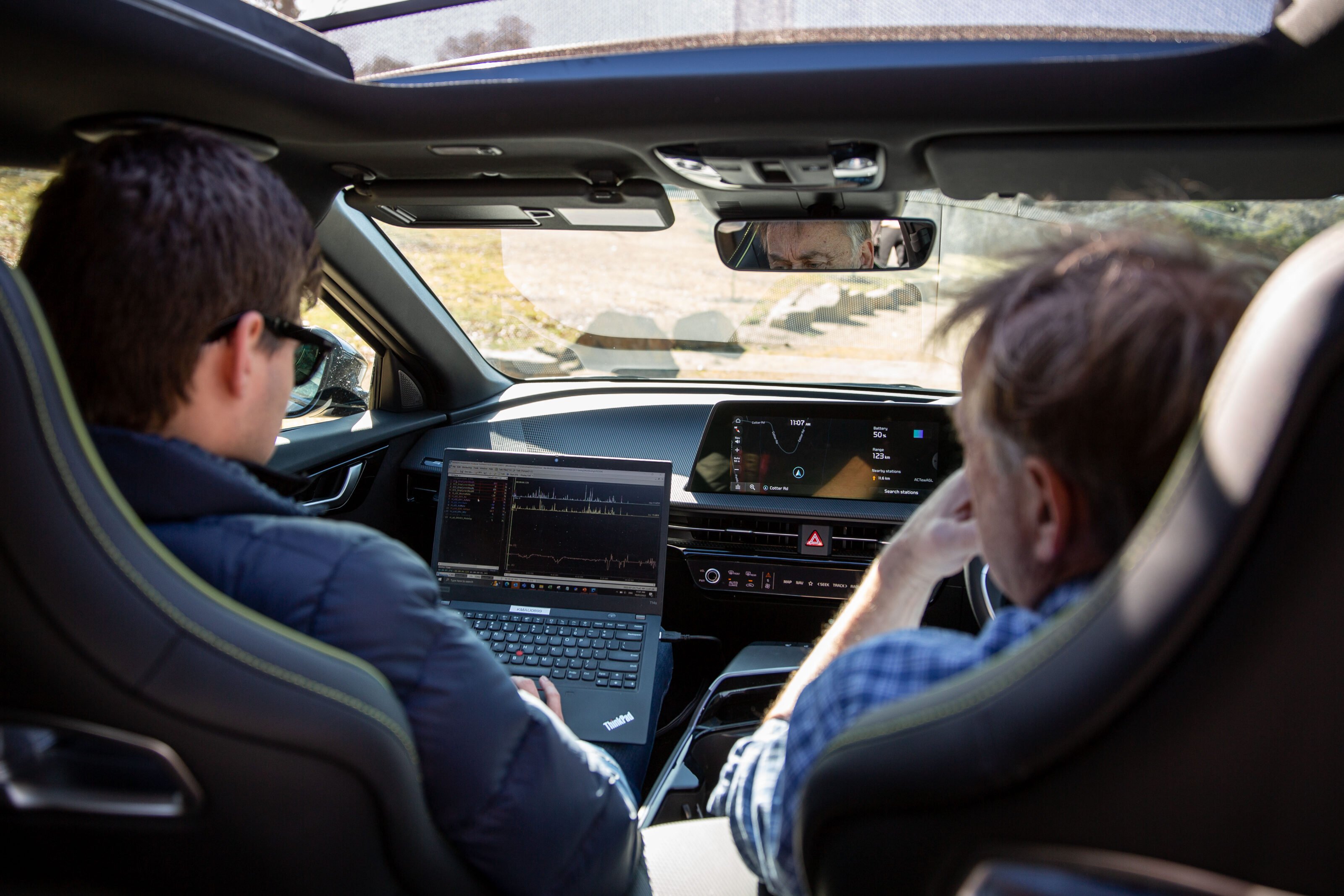
“The Australian product and tuning team travelled to Germany and searched for ‘B grade’ roads replicating Australian roads, an essential element in transforming the vehicle into a GT capable of coping with rough, country roads,” the company said of its efforts up to this point.
To make the task even more challenging, COVID-19 and international travel restrictions seemingly colluded to restrict the team’s chances of ensuring Kia’s halo performance car would launch in Australia with the best chance of success.
1
“Despite the hurdles that confronted us, from the lack of availability of a test mule in Namyang to the impracticalities of Covid-19 restrictions in Korea requiring 7-days isolation, we negotiated an unprecedented new process of initial tuning in Germany and then fine tuning in Australia,” Kia Australia product planning boss, Roland Rivero, said.
The EV6 GT’s arrival in Australia this week represents the team’s opportunity to put their parts selection and data through the wringer of real-world driving on local surfaces.
“Tuning our vehicles to suit Australian conditions is a crucial feature in the local model lineup and can be significantly credited to the growth in our overall sales,” Kia Australia chief operating officer, Damien Meredith, said.
“The challenge with the local tune of the GT variant is to go above and beyond what is already available in the very capable and award-winning EV6 GT-line.”
1
Catch me up
The EV6 GT was unveiled in late 2021, debuting as the company’s most powerful model ever destined for production.
Entering above the already rapid EV6 GT-Line (239kW/605Nm, 5.2sec to 100km/h), the EV6 GT will develop 430kW and 740Nm, with a claimed 0-100km/h time of 3.5 seconds.
Exact Australian timing for the hero model is still to be confirmed, but the company is hoping to make an announcement in the coming months. An early 2023 launch date is likely.
MORE
EV6 news and reviews
Snapshot
- 2023 Mitsubishi Outlander pricing and features
- ES gains new safety equipment, but downgrades to a smaller infotainment system
- Flagship variants receive semi-autonomous highway driving capabilites
- New, blacked-out LS Black Edition grade
- Priced from $36,240 before on-road costs
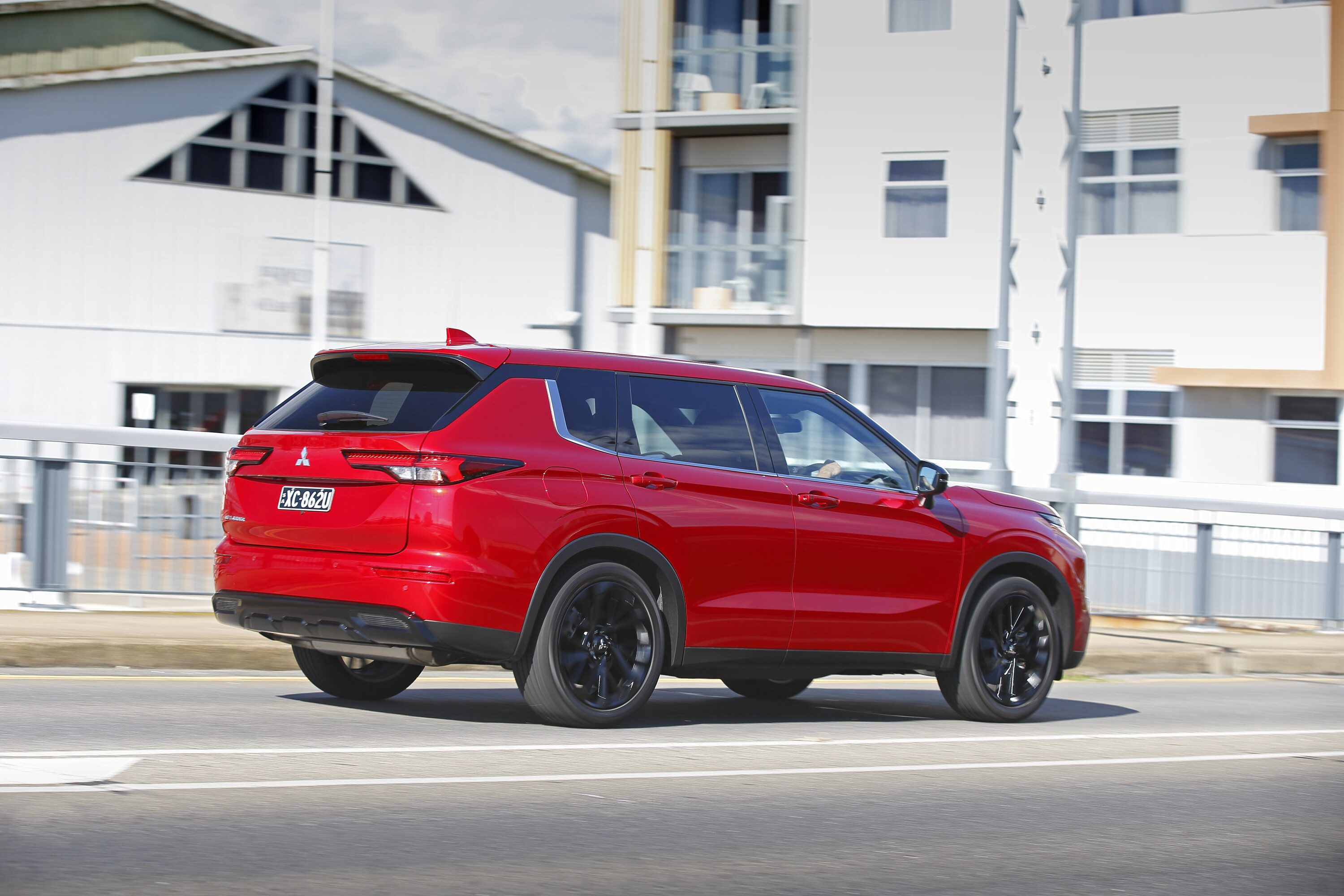
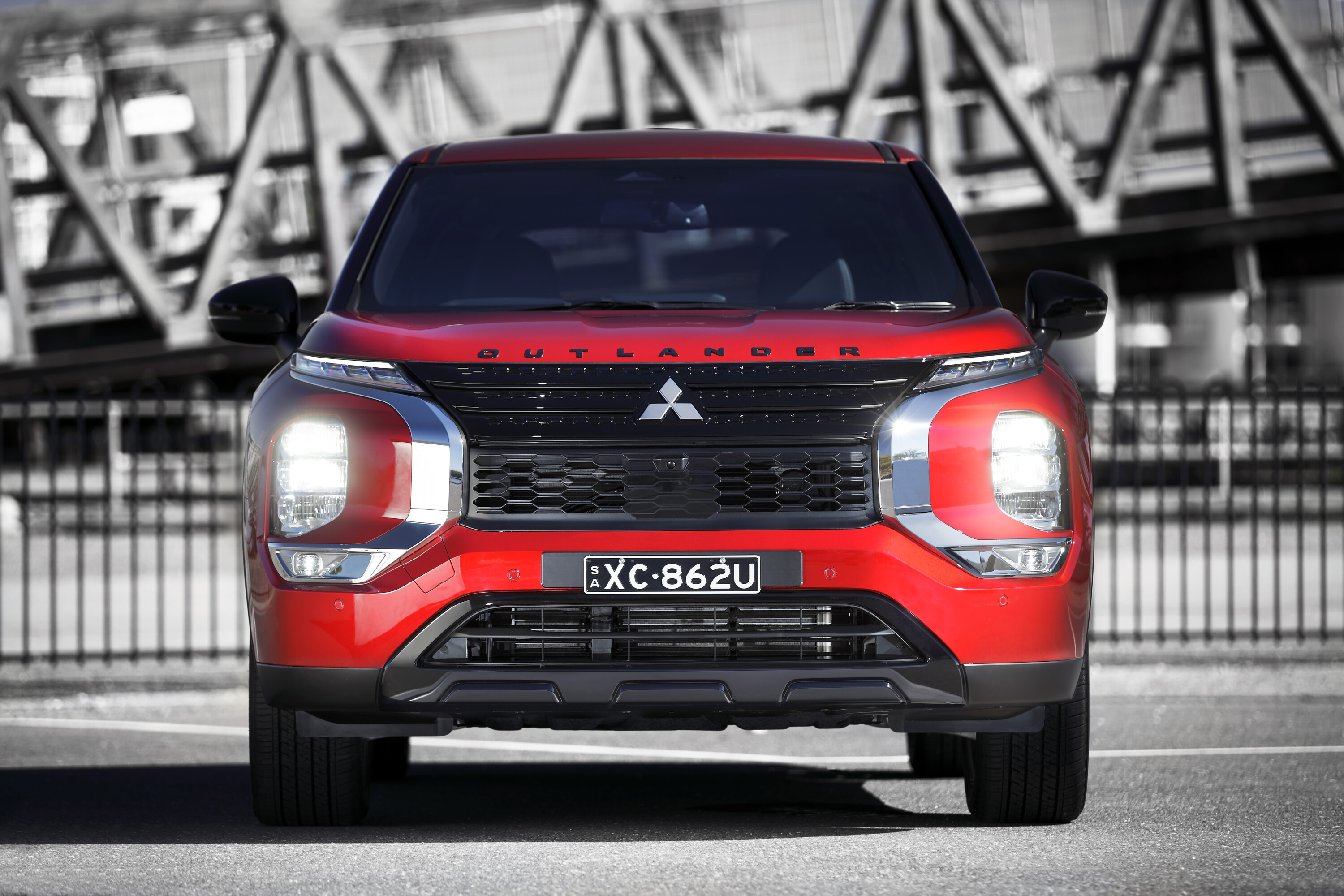
The updated 2023 Mitsubishi Outlander mid-size SUV has been detailed ahead of its local arrival in January.
The popular family SUV gains new active safety features, a new variant and minor specification changes, while pricing has increased between $250 and $1000.
Across the range, the Outlander now includes reverse AEB, a ‘last memory’ function for its auto-hold electronic park brake, and improvements to its air-conditioning refrigerant.
1
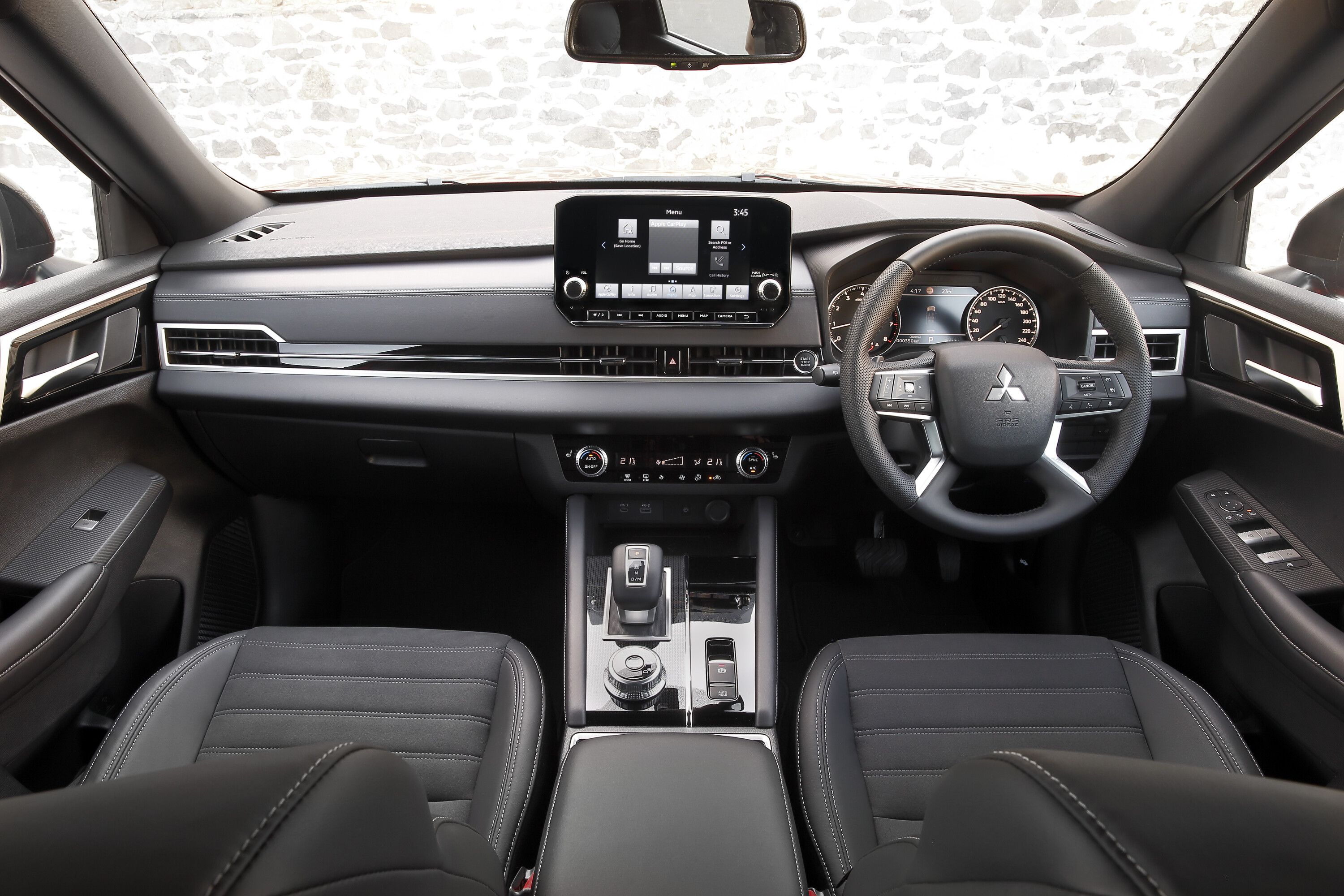
The entry-level ES adds rear cross-traffic alert and automatic high beam, but loses its 9-inch infotainment system with wireless Apple CarPlay for a smaller 8-inch unit with wired connectivity (and wired Android Auto, as before).
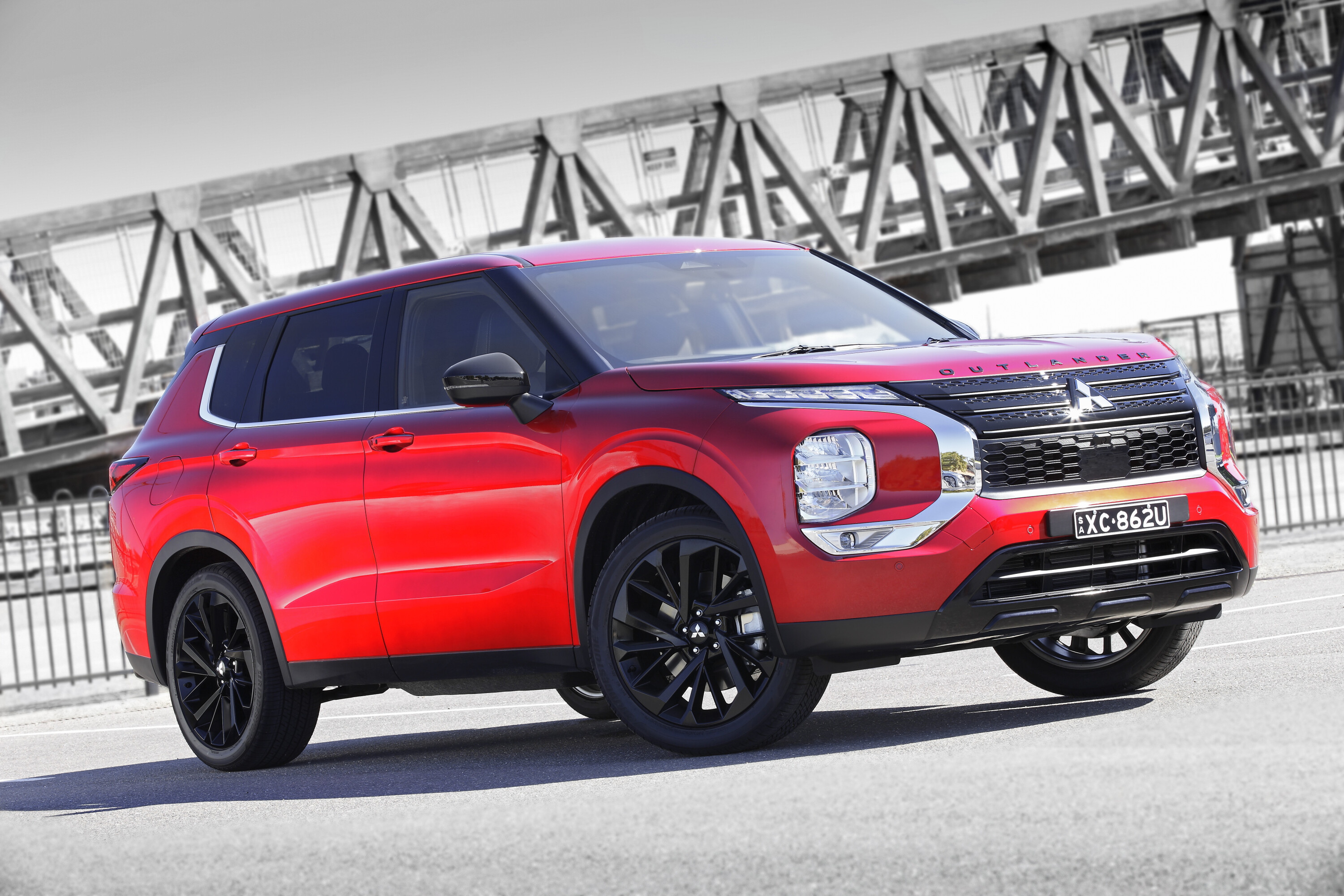
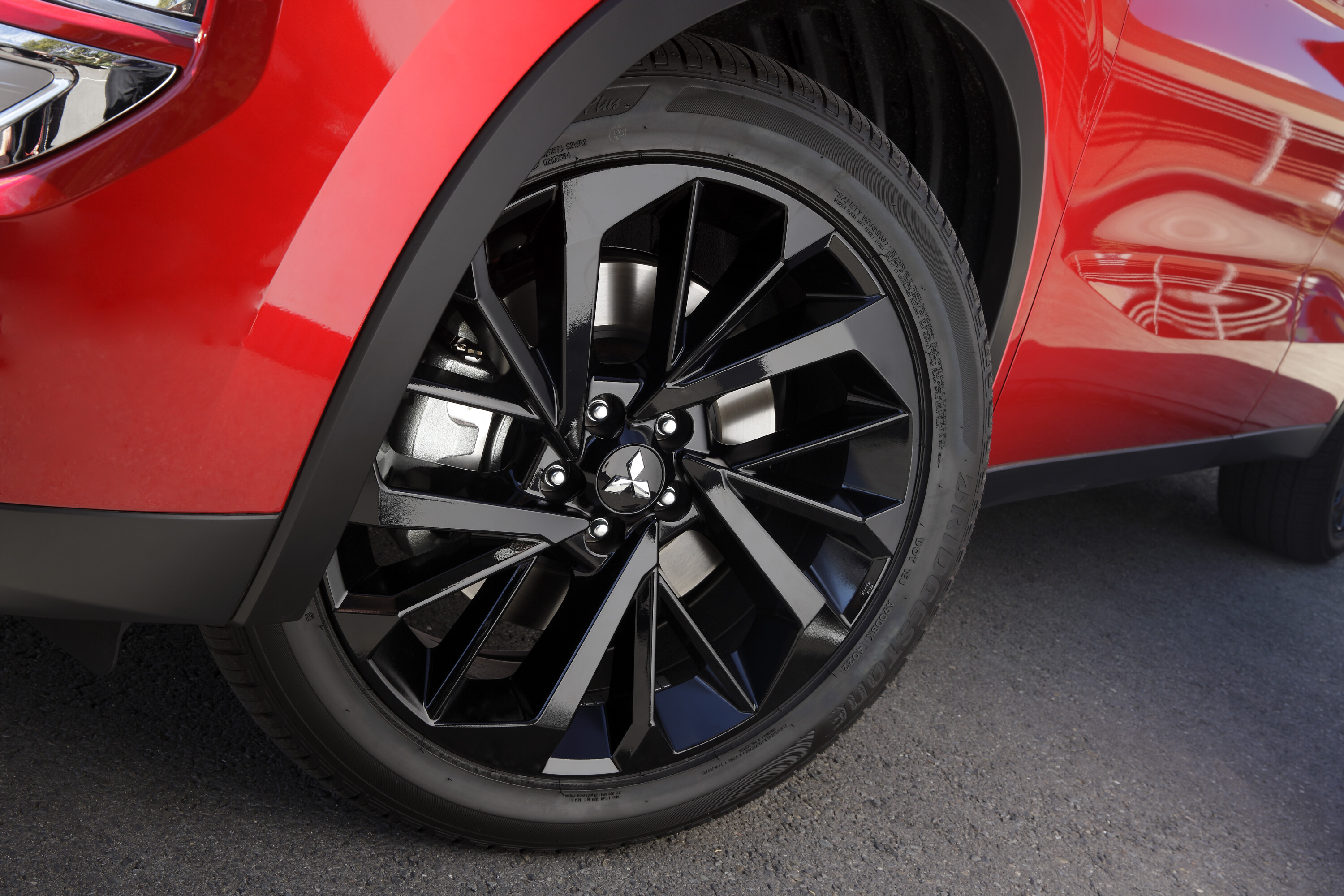
For model-year 2023, the Black Edition nameplate returns to the Outlander line-up, with the blacked-out grade based on the LS seven-seat FWD.
It gains 20-inch black alloy wheels, darkened trims, metallic paint, black headlining, and suede upholstery with synthetic leather inserts.
1
The highest price increase applies to the flagship Exceed and Exceed Tourer, which receive the brand’s ‘Mi-Pilot’ driving system for semi-autonomous highway steering.
It works in conjunction with the existing adaptive cruise control and lane-keep assist to keep the vehicle within its lane at speeds above 60km/h, or under 60km/h if a vehicle is travelling in front.
The system also features traffic jam assist – allowing the adaptive cruise control to re-engage after coming to a complete stop – and an automatic speed limiter.
1
In addition, the Exceed and Exceed Tourer gain a heated steering wheel and sequential front indicators, while the Exceed Tourer features additional two-tone paint finishes.
The Mitsubishi Outlander is the third best-selling medium SUV in Australia, with 15,619 sales to the end of October, equating to a 10.8 per cent market share. This is behind the Toyota RAV4 (30,370) and Mazda CX-5 (23,476), but ahead of the Kia Sportage (15,497) and Hyundai Tucson (14,493).
JUMP AHEAD
- Pricing
- Features
- Options
- Colours
- Engine, drivetrain, and fuel economy
- Safety
- Dimensions
- Warranty and servicing
- Availability
1
2023 Mitsubishi Outlander pricing
Prices exclude on-road costs.
| Model | Pricing | Change |
|---|---|---|
| ES five-seat FWD | $36,240 | up $250 |
| ES five-seat AWD | $38,740 | up $250 |
| LS seven-seat FWD | $39,740 | up $250 |
| LS Black Edition seven-seat FWD | $41,490 | new |
| LS seven-seat AWD | $42,240 | up $250 |
| Aspire seven-seat FWD | $43,240 | up $250 |
| Aspire seven-seat AWD | $45,740 | up $250 |
| Exceed seven-seat AWD | $50,990 | up $1000 |
| Exceed Tourer seven-seat AWD | $53,490 | up $1000 |
1
2023 Mitsubishi Outlander features
ES
LS
LS Black Edition
Aspire
Exceed
Exceed Tourer

1
Colours
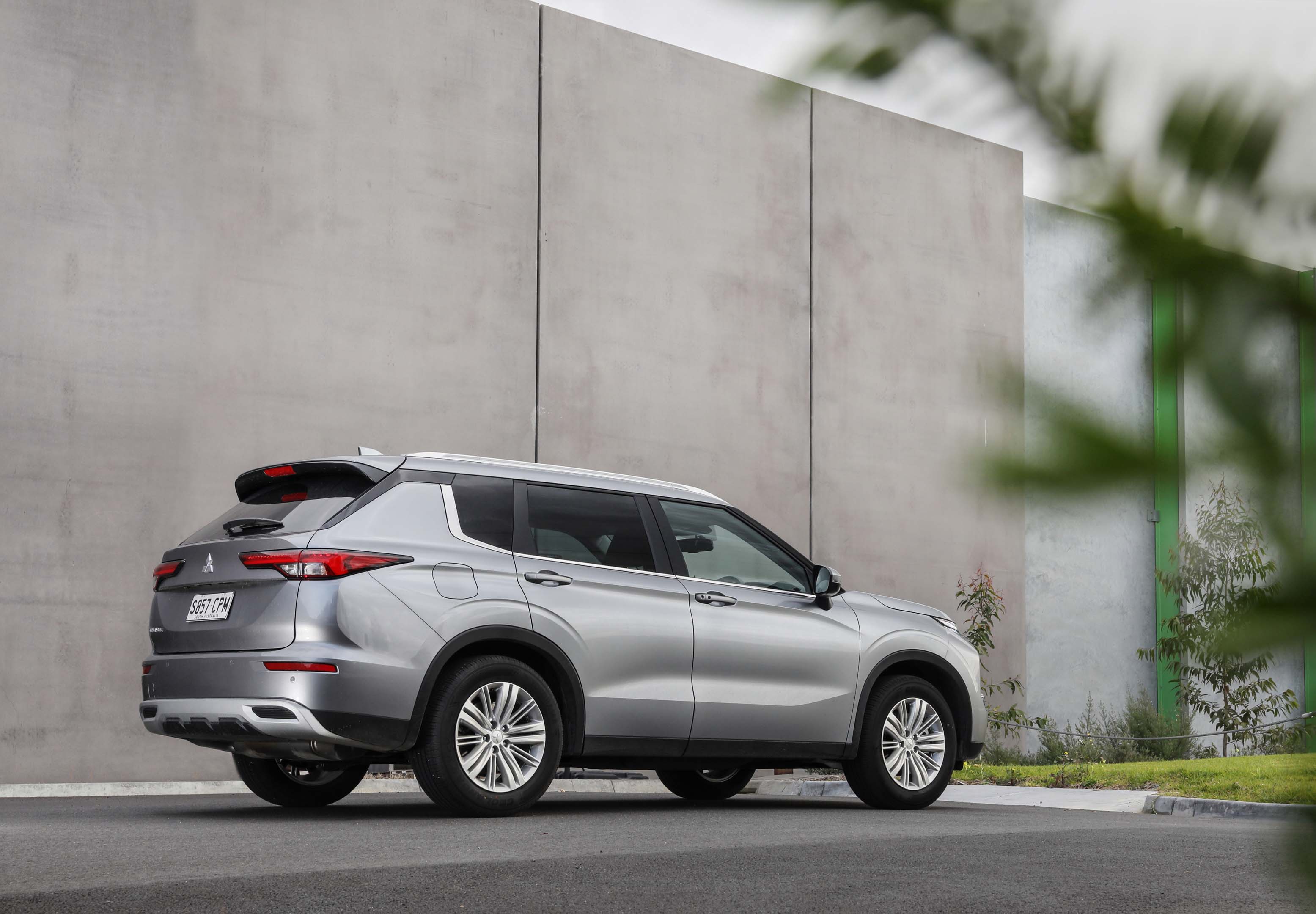
Metallic paint incurs a $740 premium (excluding LS Black Edition and Exceed Tourer).
White diamond, red diamond and black diamond incur a $940 premium, or $200 for the LS Black Edition.
A two-tone finish is standard on the Exceed Tourer, paired with black diamond (with a bronze roof), white diamond, sterling silver or titanium (with a black roof).
1
Engine, drivetrain and fuel economy
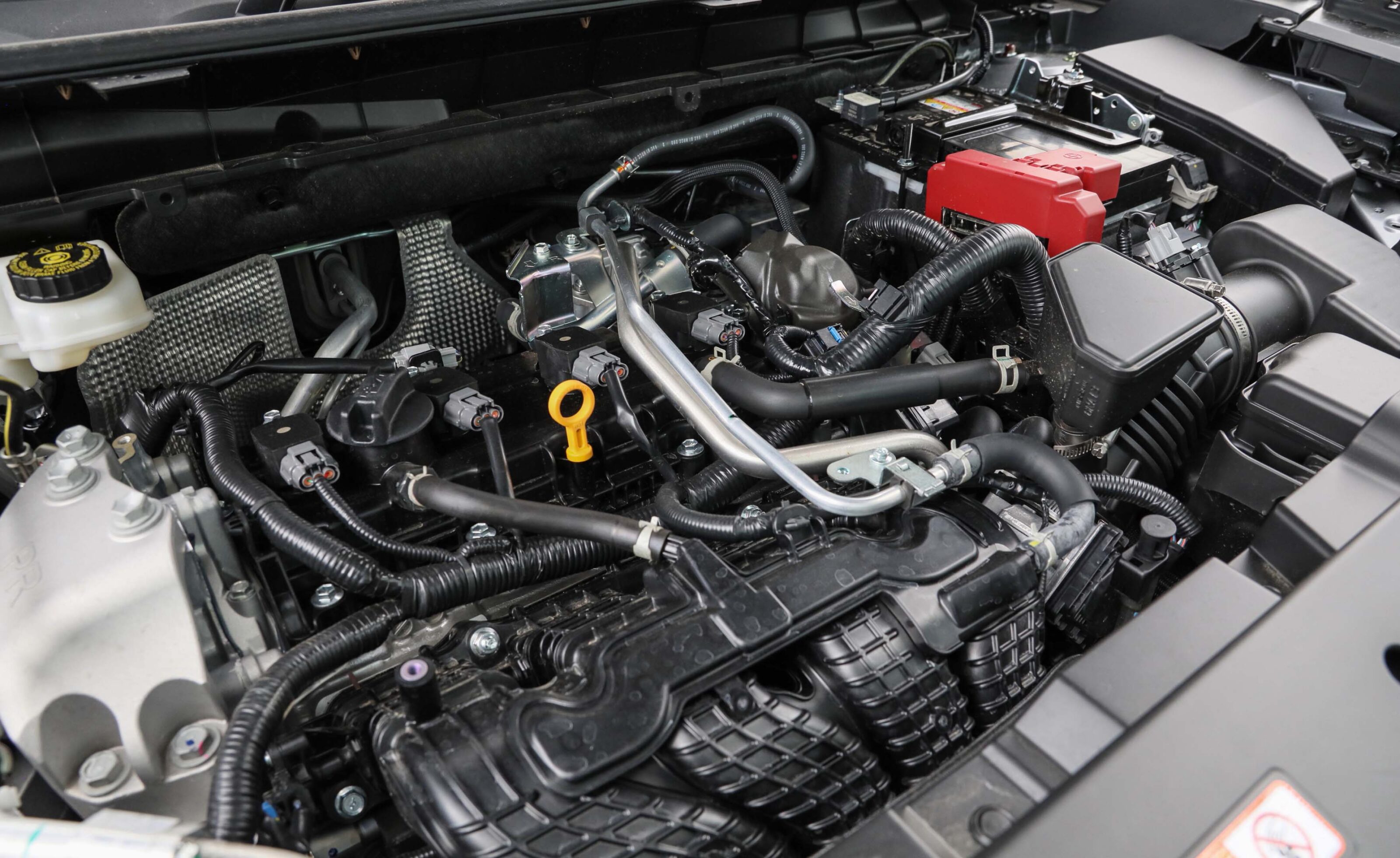
Under the bonnet, the Mitsubishi Outlander is powered by a naturally-aspirated 2.5-litre four-cylinder, producing 135kW and 245Nm.
It is paired with a CVT automatic transmission, with the option of front-wheel drive on the ES, LS and Aspire, and AWD is available throughout.
There are six drive modes available in the AWD versions (five in the 2WD), which the company calls Super All Wheel Control (S-AWC).
1
A range-topping plug-in hybrid powertrain is also available. For more information, click here.
Claimed fuel economy
1
Safety
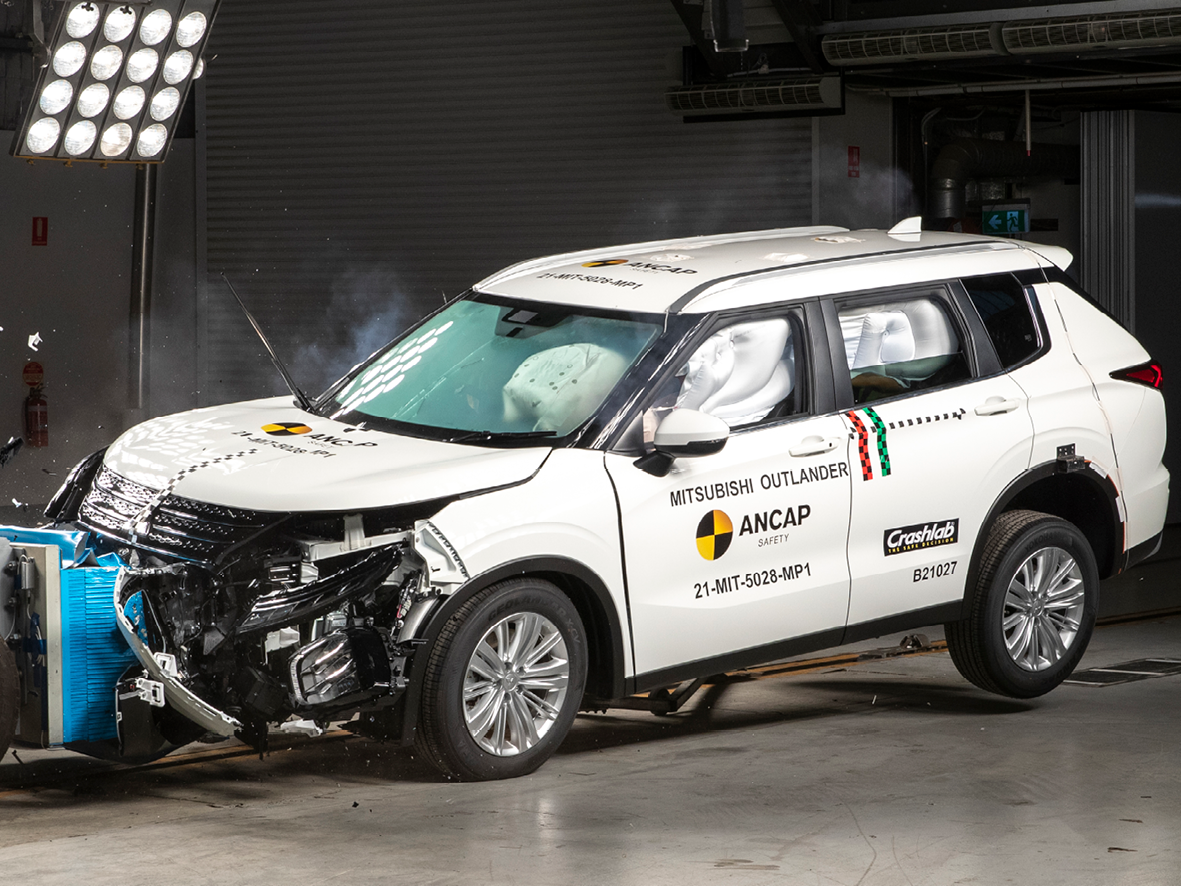
The Mitsubishi Outlander is covered by a five-star ANCAP safety rating, based on testing conducted in 2022. This score applies to all variants.
It received a score of 83 per cent for adult occupant protection, 92 per cent for child occupant protection, 81 per cent for vulnerable road user protection, and 83 per cent for safety assist.
Eight airbags (dual front, side, curtain, driver’s knee, and front-centre) are fitted across the range.
Each variant includes the following active safety equipment as standard:

1
Dimensions
The Mitsubishi Outlander has a 2706-millimetre wheelbase, and is 4710mm long, 1862mm wide and 1745mm tall.
2023 Mitsubishi Outlander boot space
With the rear seats up, the five-seat Mitsubishi Outlander has a 485-litre boot capacity. Folding the second row increases luggage capacity to 1466 litres.
Seven-seat examples have 163L of storage behind the third row, extending to 478L and 1461L (or 1473L for Exceed and Exceed Tourer), respectively
1
Warranty and servicing
As per the wider Mitsubishi range, the Outlander is covered by the brand’s 10-year/200,000-kilometre warranty.
This reverts to a five-year/100,000-kilometre period if the vehicle is serviced outside the Mitsubishi dealer network.
Maintenance for the Outlander is required every 12 months or 15,000 kilometres, whichever comes first.
Capped-price servicing is available for ten years, priced at $199 each for the first five services.
Availability
The 2023 Mitsubishi Outlander will arrive in Australian showrooms in January.
For information on Mitsubishi’s wait times, click here.
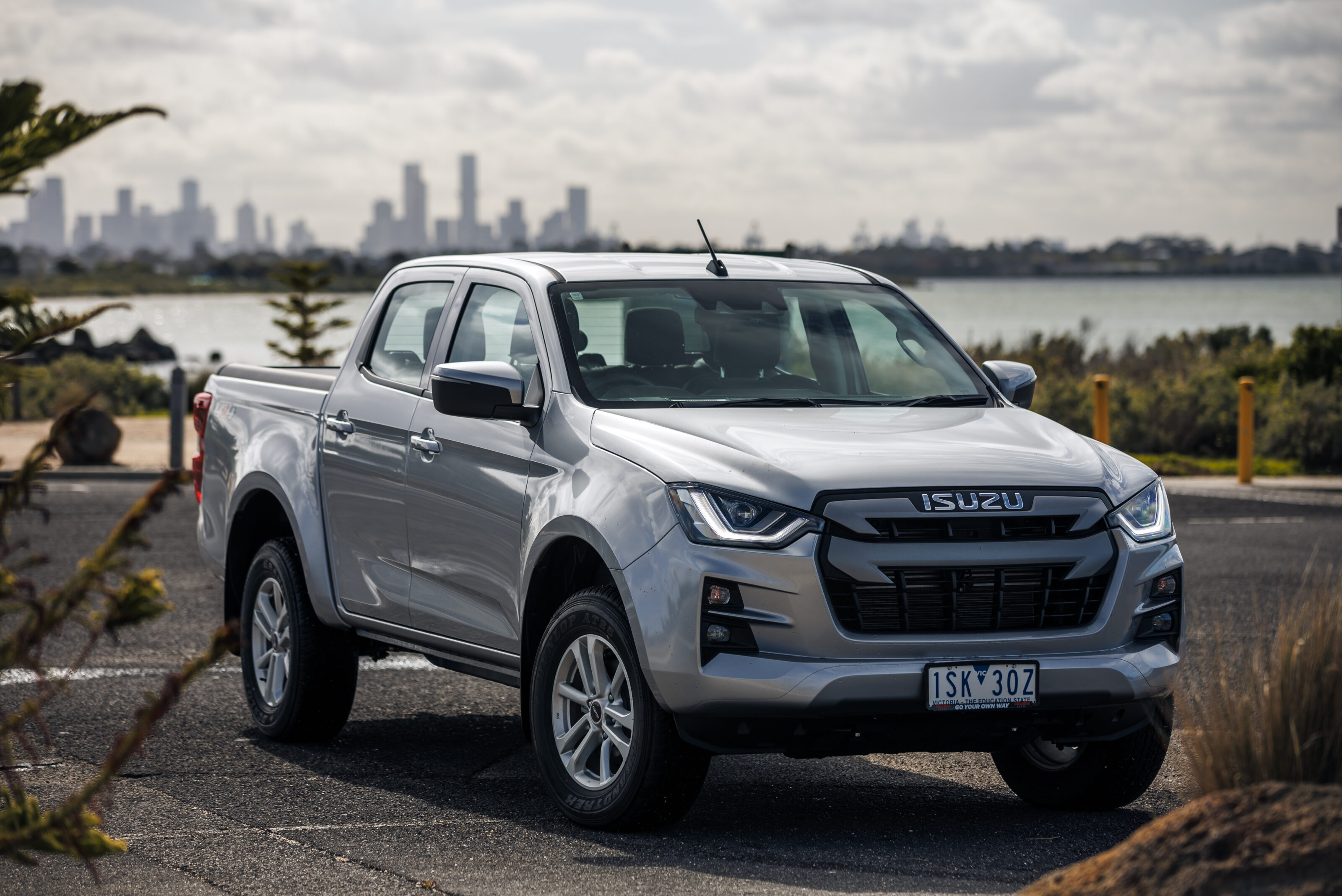
The popular Isuzu D-Max frequently punches above its weight in terms of value, with the mid-spec LS-M positioned particularly. keenly as an appealing and affordable offering within the increasingly active diesel 4×4 dual-cab market.
MY23 Isuzu D-Max range updates include minor cosmetic and packaging revisions, including a new grille (finished in black and grey for the LS-M) appearing across the range, along with dark grey trim around the LED foglights and LED taillights, and new cloth upholstery inside.
1
Images show the MY22 Isuzu D-Max, which mechanically presents, and is priced, identically. We’ll bring you a review of the MY23 D-Max soon.
And the price is right, asking mid-$50Ks for the six-speed automatic version tested here, netting buyers a lifestyle-ready five-seat ute with 4×4 capability and 3.0-litre turbo-diesel grunt. But is it the one you should go for?
JUMP AHEAD
- How much is it, and what do you get?
- How do rivals compare on paper?
- Interior comfort, space and storage
- What’s the payload like and is the tray practical?
- What’s it like for towing?
- What’s it like to drive?
- How is it on fuel?
- How safe is it?
- Warranty and running costs
- What about the 2023 update?
- VERDICT
- Specifications
How much is it, and what do you get?
| Body | 4-door, 5-seat dual-cab ute |
|---|---|
| Power | 140kW |
| Torque | 450Nm |
| Transmission | 6-speed automatic |
| Drive | four-wheel |
| Fuel consumption | 9.65L/100km |
| Price | $55,300 + on-road costs |
The D-Max range begins at just $32,200 before on-road costs for the fleet-spec entry-level 4×2 single-cab D-Max SX, fitted with a manual transmission and 1.9-litre turbo-diesel four-cylinder.
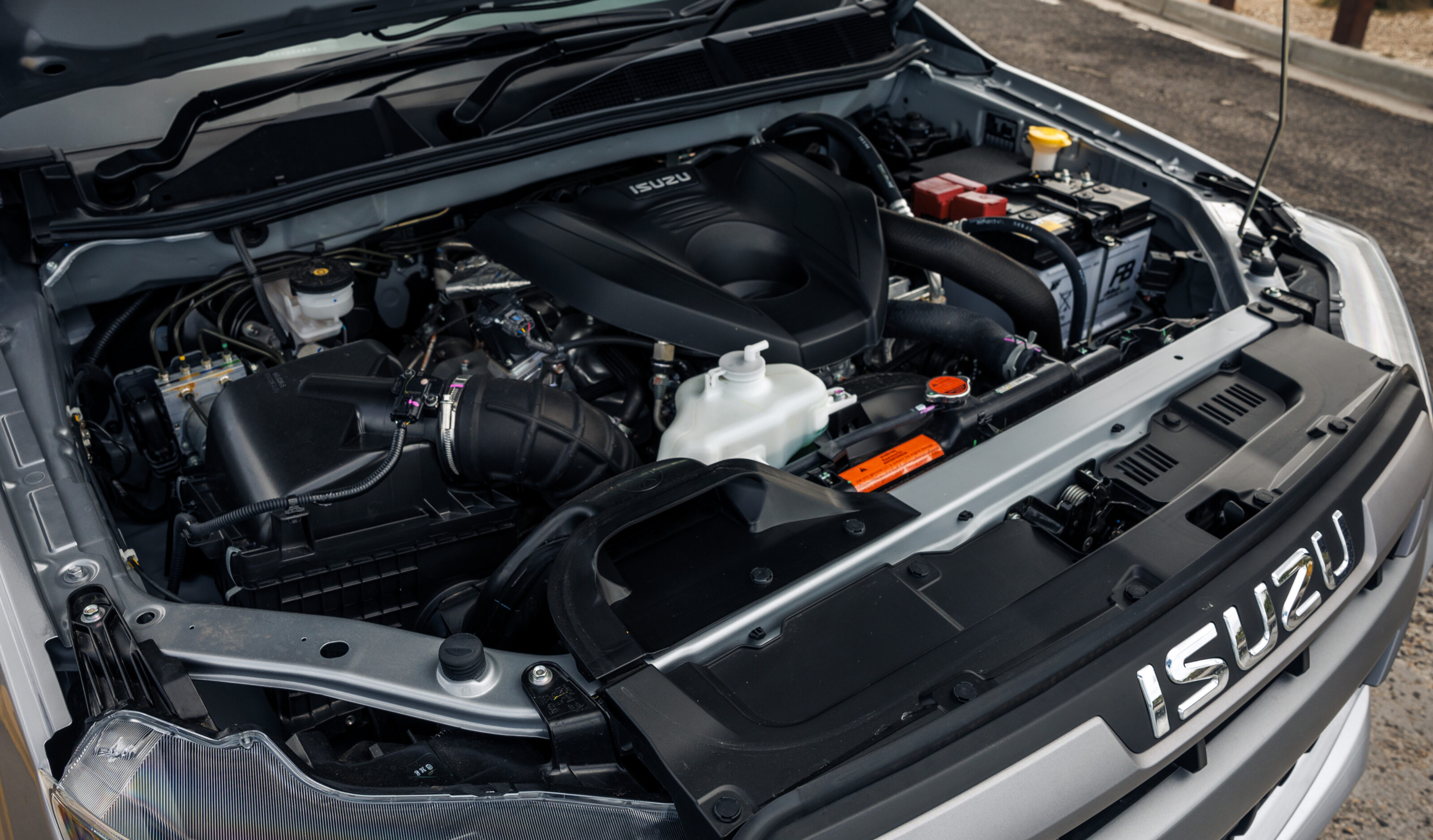
For private, family and/or lifestyle buyers, however, the mid-spec LS-M likely represents the sweet spot, as the most affordable means of netting Isuzu’s 4×4 dual-cab with the bigger 3.0-litre turbodiesel four-cylinder.
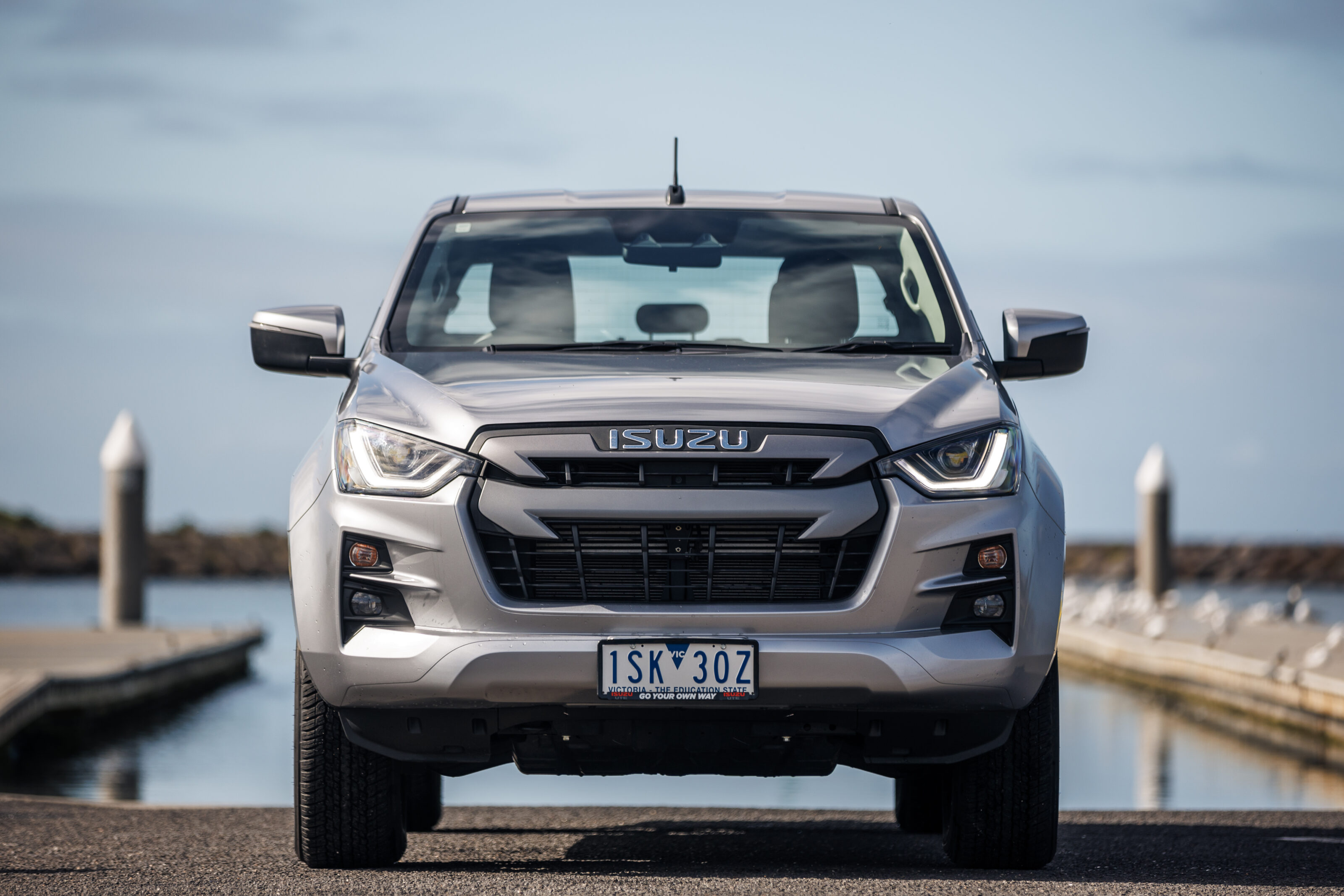
1
The six-speed manual D-Max LS-M asks $53,300 before on-road costs, but it’s the six-speed auto, driven here, that most buyers will be eyeing, asking $55,300 (before on-road costs).
Standard features include 17-inch alloy wheels, auto bi-LED headlights with auto levelling and auto high beam, LED daytime running lights and foglights, 7.0-inch infotainment screen, wireless Apple CarPlay and wired Android Auto, DAB+ digital radio, six-speaker sound system (up from four in lower variants), rain-sensing wipers, power windows and mirrors plus more.
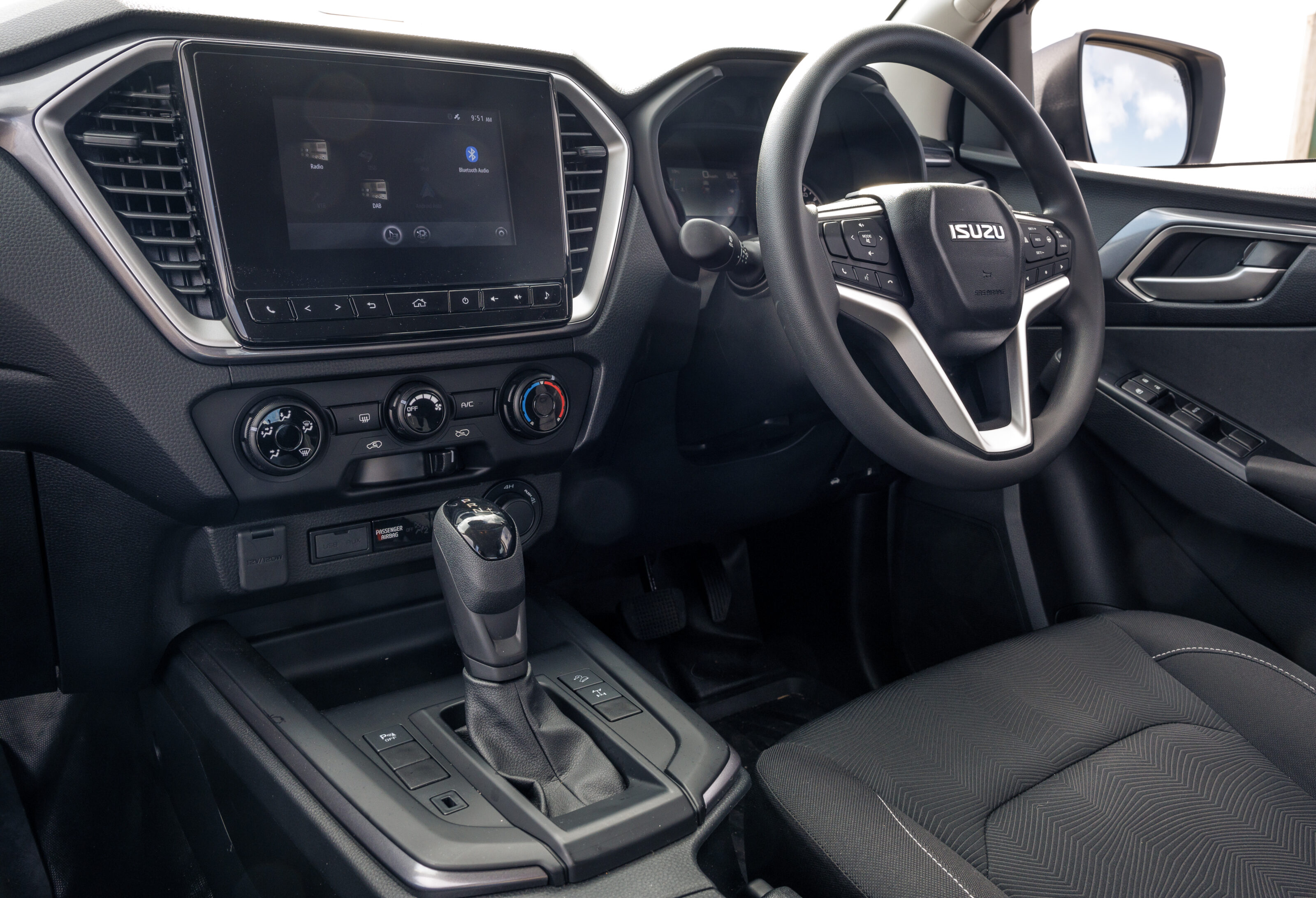
1
Standard safety equipment includes lane-keep assist and adaptive cruise control (both auto only, not compatible with manual vehicles), lane departure warning, blind-spot monitoring, rear cross-traffic alert, traffic sign recognition and driver attention alert.
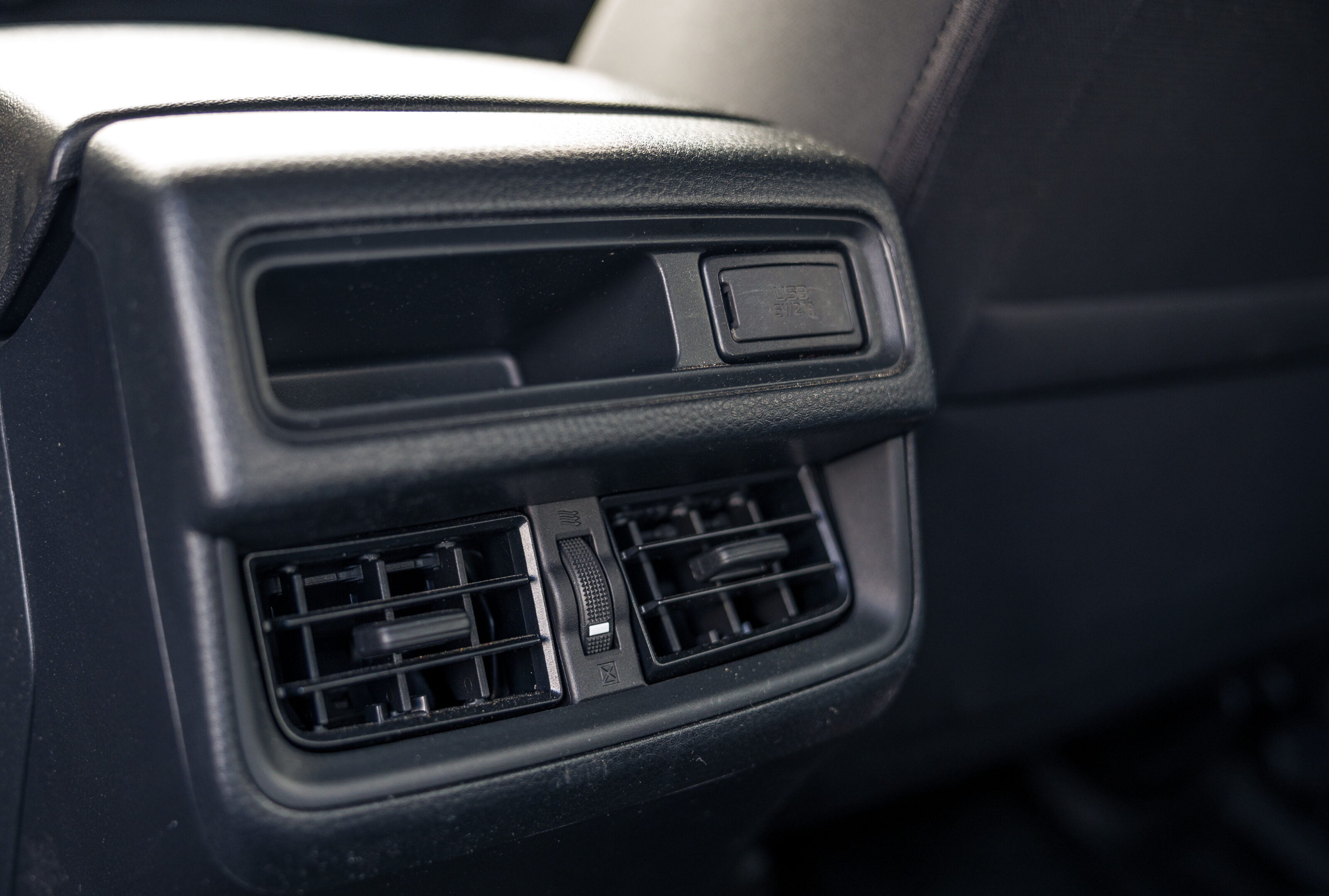
MY23 updates arriving this month for the D-Max LS-M, in particular, include a new grille, dark grey foglight and taillight surrounds, new cloth upholstery, tailgate gas struts, an additional USB port for the second-row seats and new-look cloth upholstery.
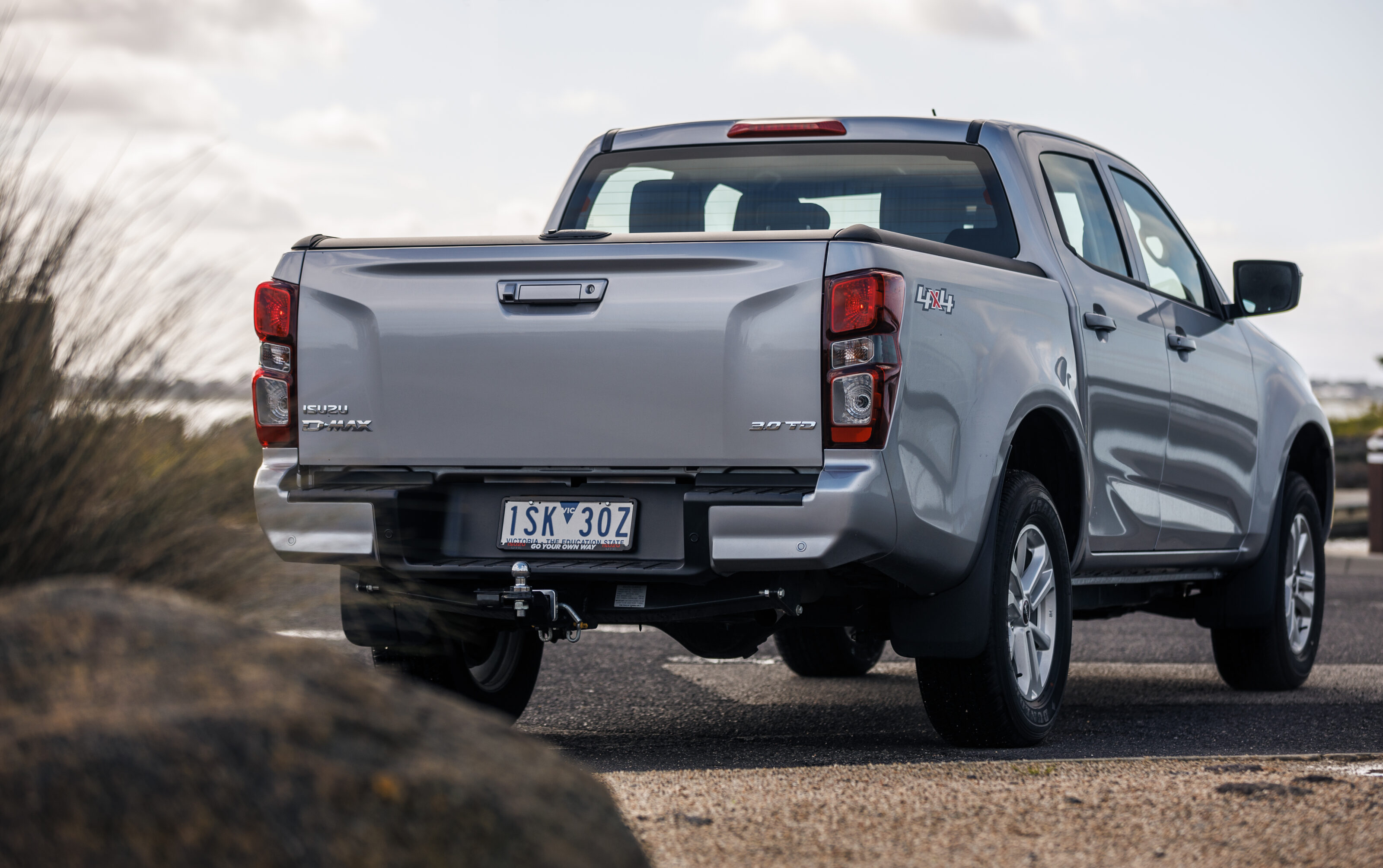
1
For those who seek to personalise their D-Max, Isuzu Australia offers no shortage of genuine accessories, from rugged bullbars ($3999-$4299), nudge bars ($1199), fender flares ($1249-$1499), both hard and soft tonneau covers ($768-$3599), manual and auto-electric roller tonneau covers ($3099-$3899), with various roof, rack and ladder mounting kits for extra stowage.
How do rivals compare on paper?
There are a lot of rivals to consider at this position and price point, with the nation’s favourites – the Toyota HiLux and Ford Ranger – both swinging in with the popular HiLux SR and Ranger XLS, for $52,795 and $54,330, respectively (both before on-road costs).
Mazda’s D-Max twin-under-the-skin BT-50 is also offered in second-from-entry XT Automatic trim, for $53,490 before on-road costs.
Nissan’s mid-spec Navara ST also closely matches the D-Max on spec, features and price, by wearing a $54,780 (before on-road costs) sticker price.
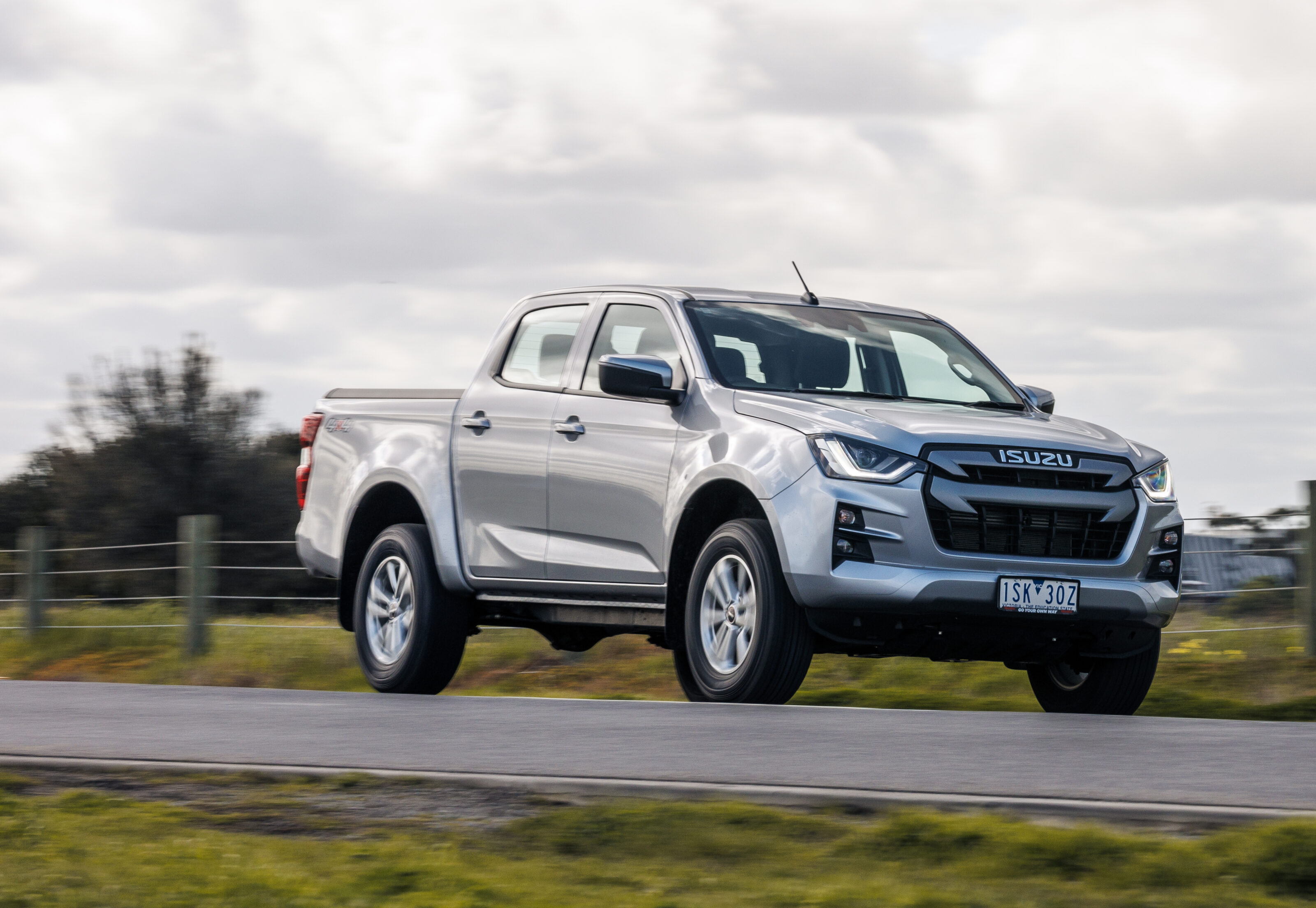
1
The D-Max has been quietly moving upstream since it first launched locally. As the sector grew, and buyers demanded more feature-filled vehicles, this third-generation D-Max, launched in 2020, took a decidedly upmarket step and is now priced in line with heritage names such as Toyota, Ford and Mazda, yet never lost its value-minded appeal.
Subsequently, year-on-year sales have been trending northward over the past five years and culminated in an outright sixth-placed finish in the 2021 sales charts where it sold 25,117 units. The HiLux and Ranger took out first and second, with Mitsubishi’s Triton following behind in ninth.
Interior comfort, space and storage
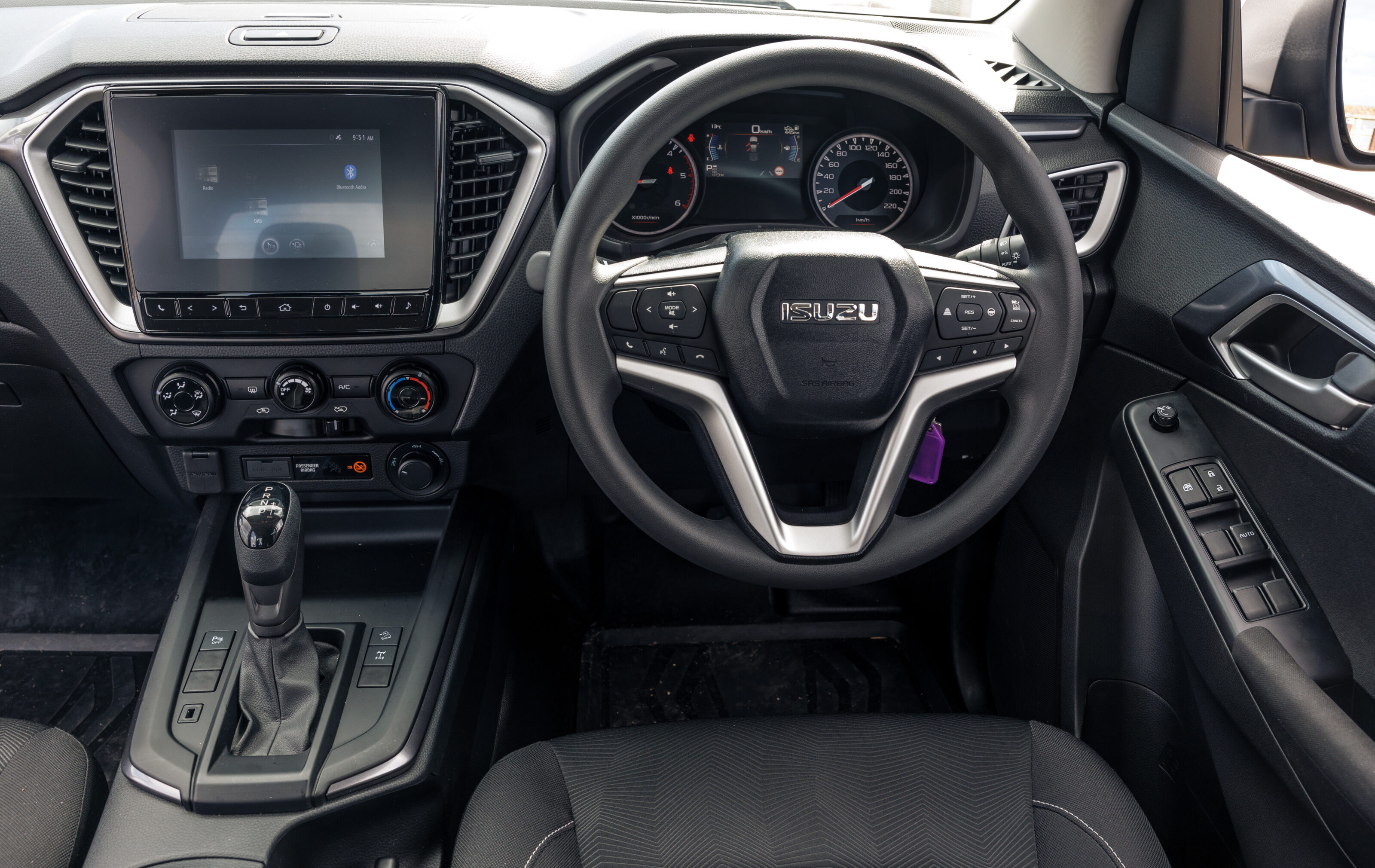
While stepping up from the base D-Max SX to the LS-M secures buyers the ‘big-block’ 3.0-litre diesel mill and 4×4 drivetrain, stepping into the LS-M’s cabin is where the ute’s more workmanlike roots begin to emerge.
A hard-plastic dashboard and a polyurethane steering wheel may be mood dampeners at this price for some, but it’s all about perspective.
1
Combined with an easily washable vinyl floor, the cabin feels rugged and durable. One imagines that the LS-M would be well-suited to private buyers with an active outdoor lifestyle, or for family buyers where the ute must earn its keep at the worksite during the week, and is tasked with lugging sporting equipment and bicycles on the weekend.
Presentation aside, functionally speaking, the D-Max does a good job of front-row comfort, with supportive wide-set seats and good amounts of adjustment to be found in the driver’s seat and steering column.
2
Storage is well catered for, with deep pockets in each door that are capable of holding large drink bottles, two glovebox compartments and a tray in front of the gear shifter.
Second-row occupants are treated to good levels of headroom, even for taller folk, and decent knee room. The air-conditioning offers just single-zone adjustment, but its air vents welcomely extend to the second row.
What’s the payload like and is the tray practical?
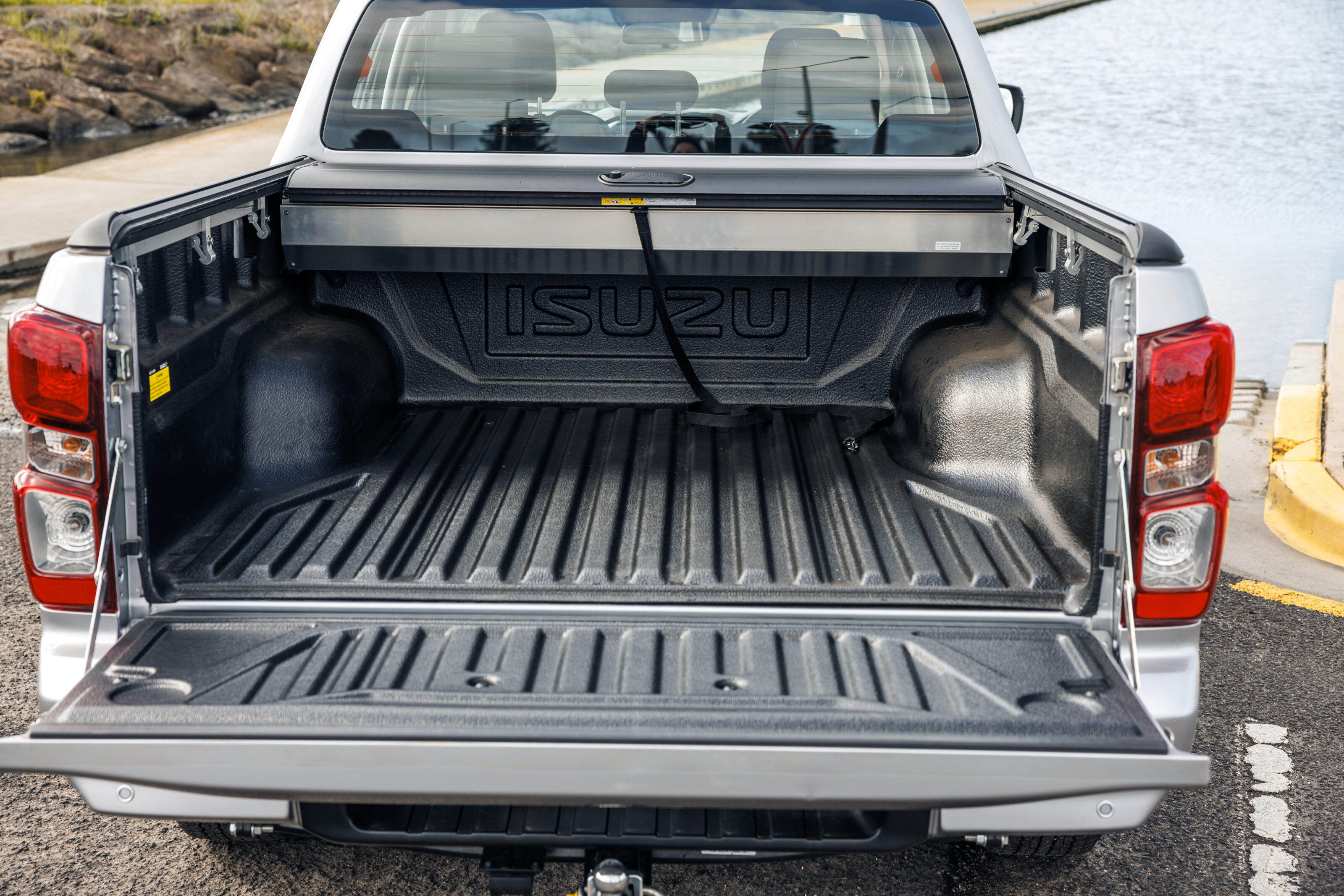
The Isuzu D-Max’s payload is 1070kg in LS-M Crew Cab ute guise with automatic transmission as tested here, and the tub measures 1495mm long, with 1122mm between the wheelarches and a depth of 490mm.
1
Our vehicle’s optional hard roller tonneau cover is a nicety for keeping stored items away from prying eyes, but the mechanism does impinge significantly on rear tub space.
This D-Max also bears only two integrated tie-down points, both mounted towards the rear of the tray, which is down against many contemporary dual-cabs.
What’s it like for towing?
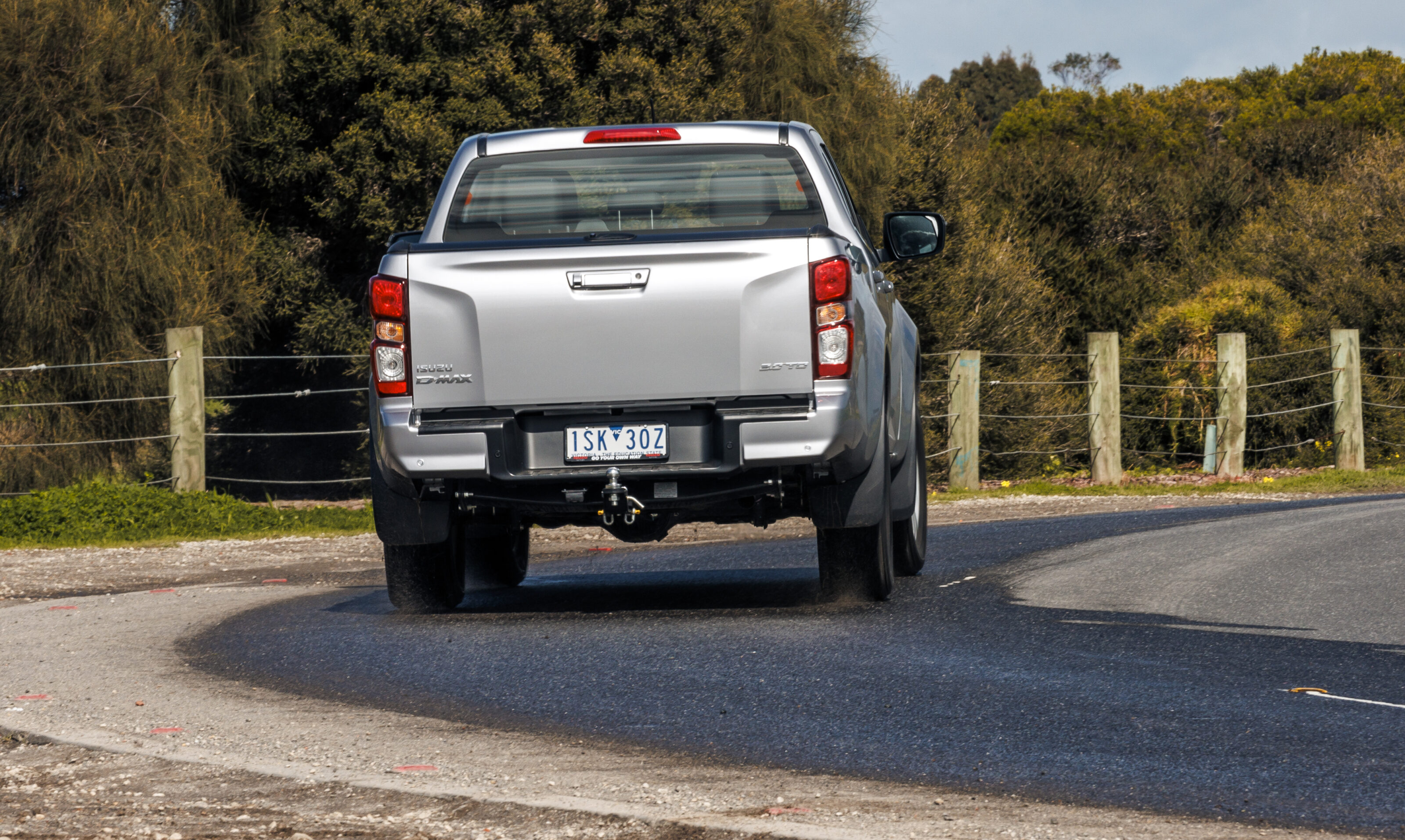
The D-Max wears an official braked tow capacity of 3500kg, with a gross combination mass of 6000kg, and is more than suitable for towing a trailer, caravan or small boat.
Its six-speed automatic transmission can be a little too quick to shift into higher gears; a good calibration for efficiency but with a tendency to fall out of its power band when pulling a load. A manual override feature makes light work of selecting the ratio you want, however.
1
A firmer suspension tune, compared to Mazda’s BT-50, can deliver a rough and busy ride when unladen but comes into its own when towing.
Prior testing from our dual-cab ute megatest shows the Isuzu D-Max to return a fuel consumption figure of 15.3L/100km during the towing assessment when hitched to a 6.1-metre, 2100kg caravan.
What’s it like to drive?
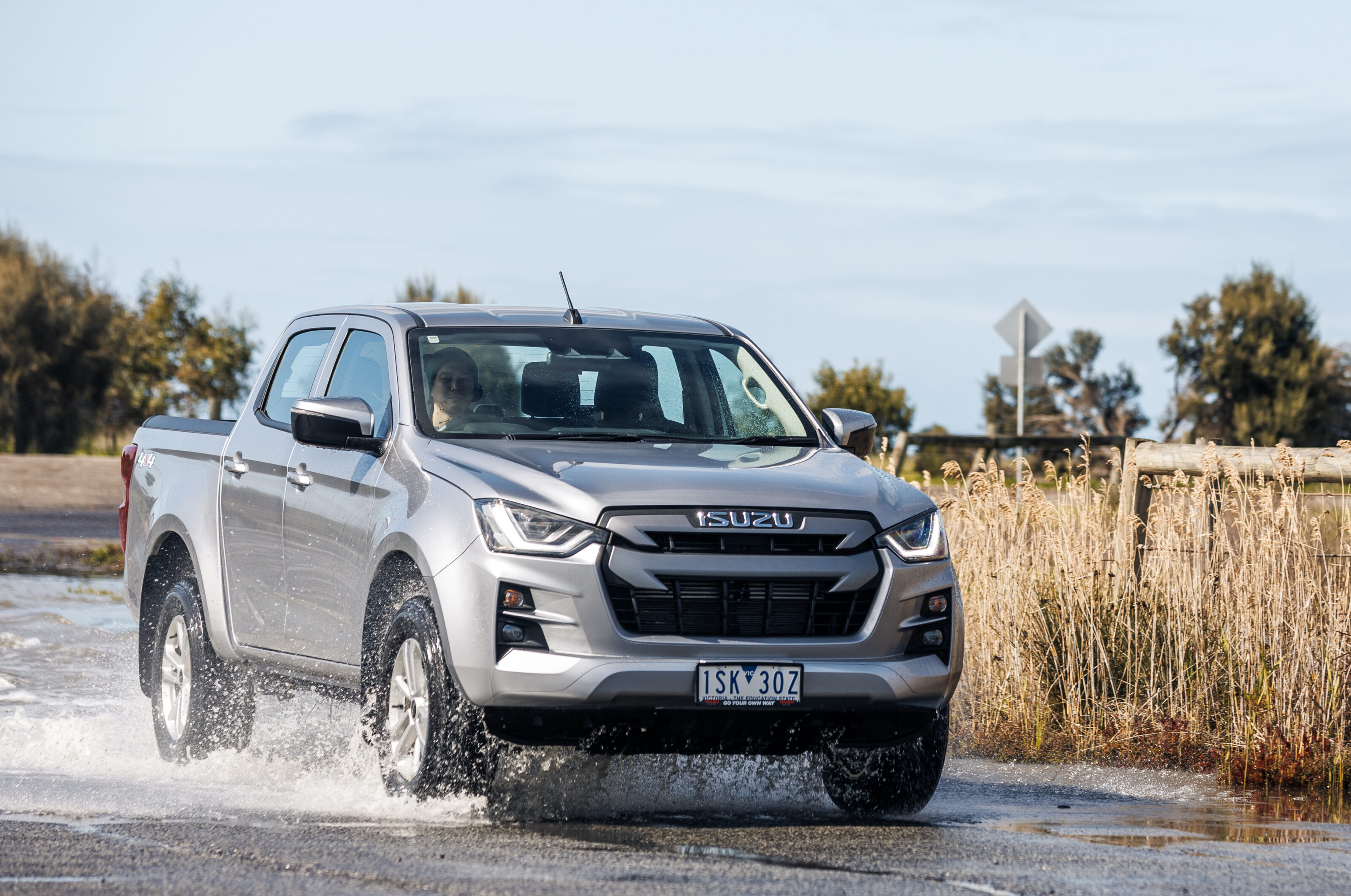
The Isuzu D-Max LS-M delivers a respectable on-road driving experience given its keen value position and off-road prowess.
Its 3.0-litre diesel is torquey and responsive, its torque delivery swelling to the full 450Nm between 1600 and 2600rpm – with a sweet spot around 2000rpm – and peaking with 140kW at 3600rpm.
1
The turbo-diesel is well-matched to the six-speed auto’s ratios, but again its calibration can be a little too keen to settle into higher gears, with uphill instances frequently requiring a manual downchange, or for you to stick the boot into the throttle to force the efficiency-minded software to change down.
Steering is nicely weighted and cuts the line between urban ease, high-speed predictability and low-speed precision. The wheel itself has a chunky profile and feels wonderful in the hands.
1
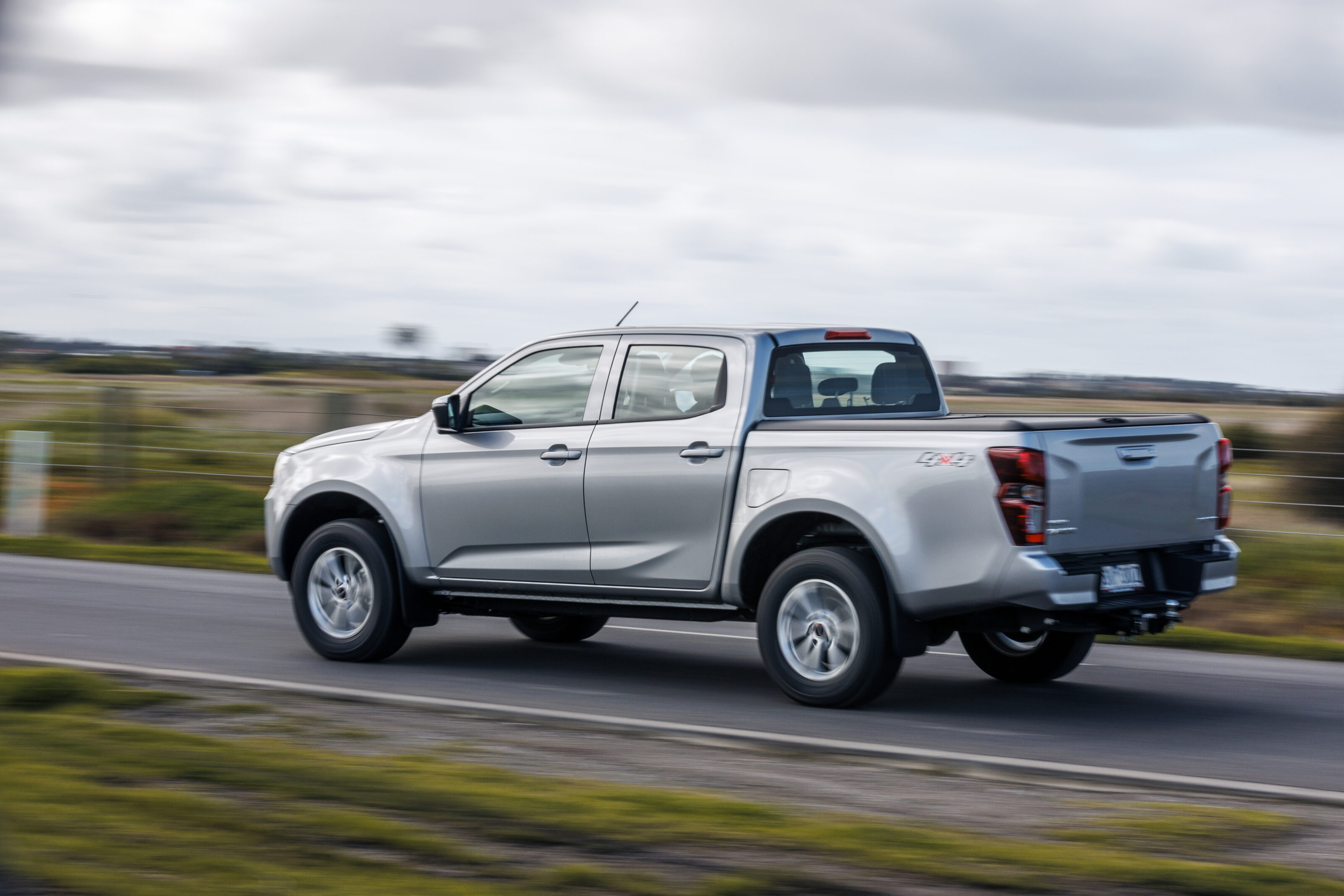
A rather firm suspension tune can deliver a terse and busy ride over subtle road corrugations but the D-Max delivers respectable levels of refinement around town. Its Bridgestone Dueler H/T tyres do an admirable job of containing road noise in the wet and dry.
How is it on fuel?
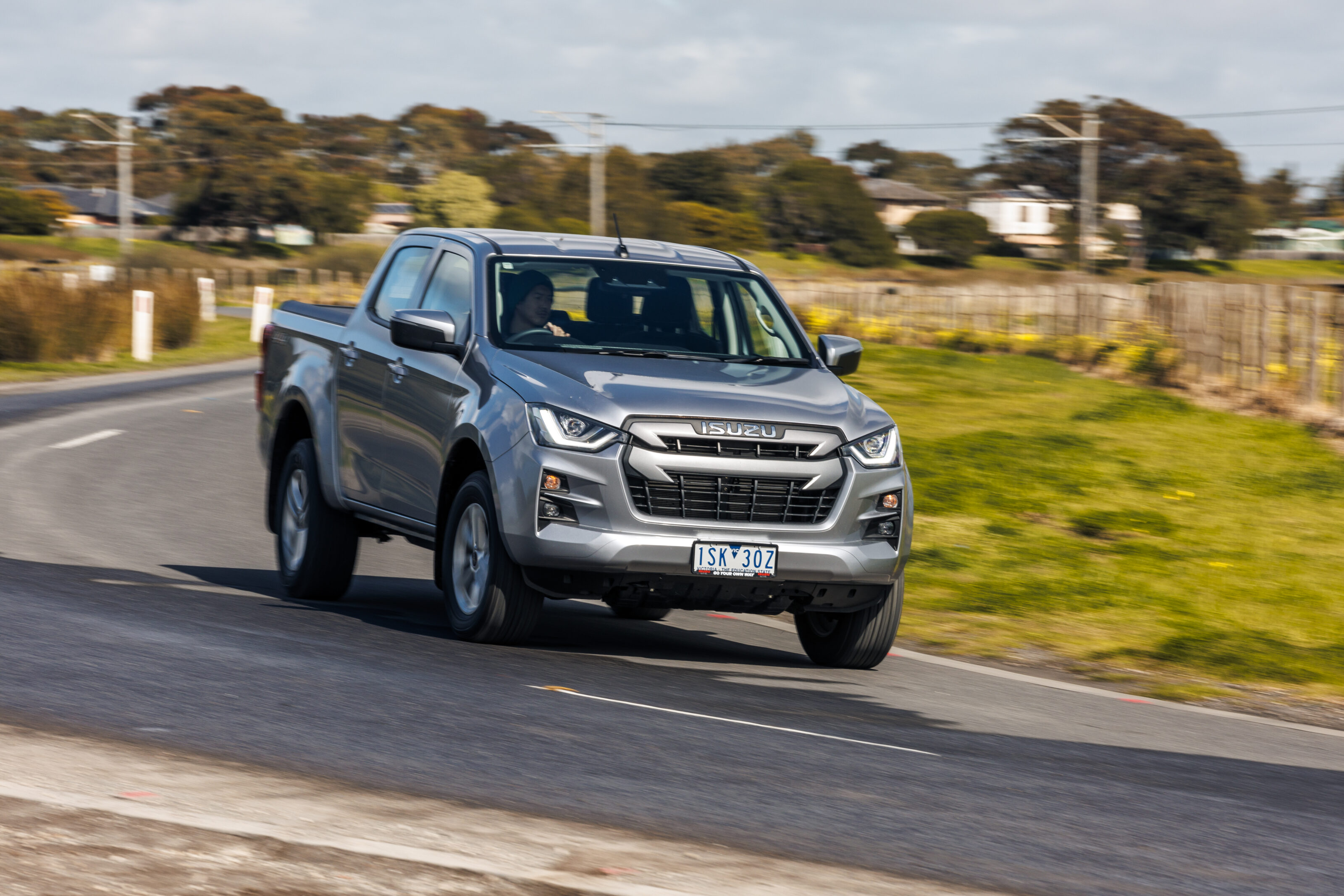
Our testing shows the Isuzu D-Max registering fuel use of 9.65L/100km when driven on a mixture of highway, country and unsealed roads.
1
How safe is it?
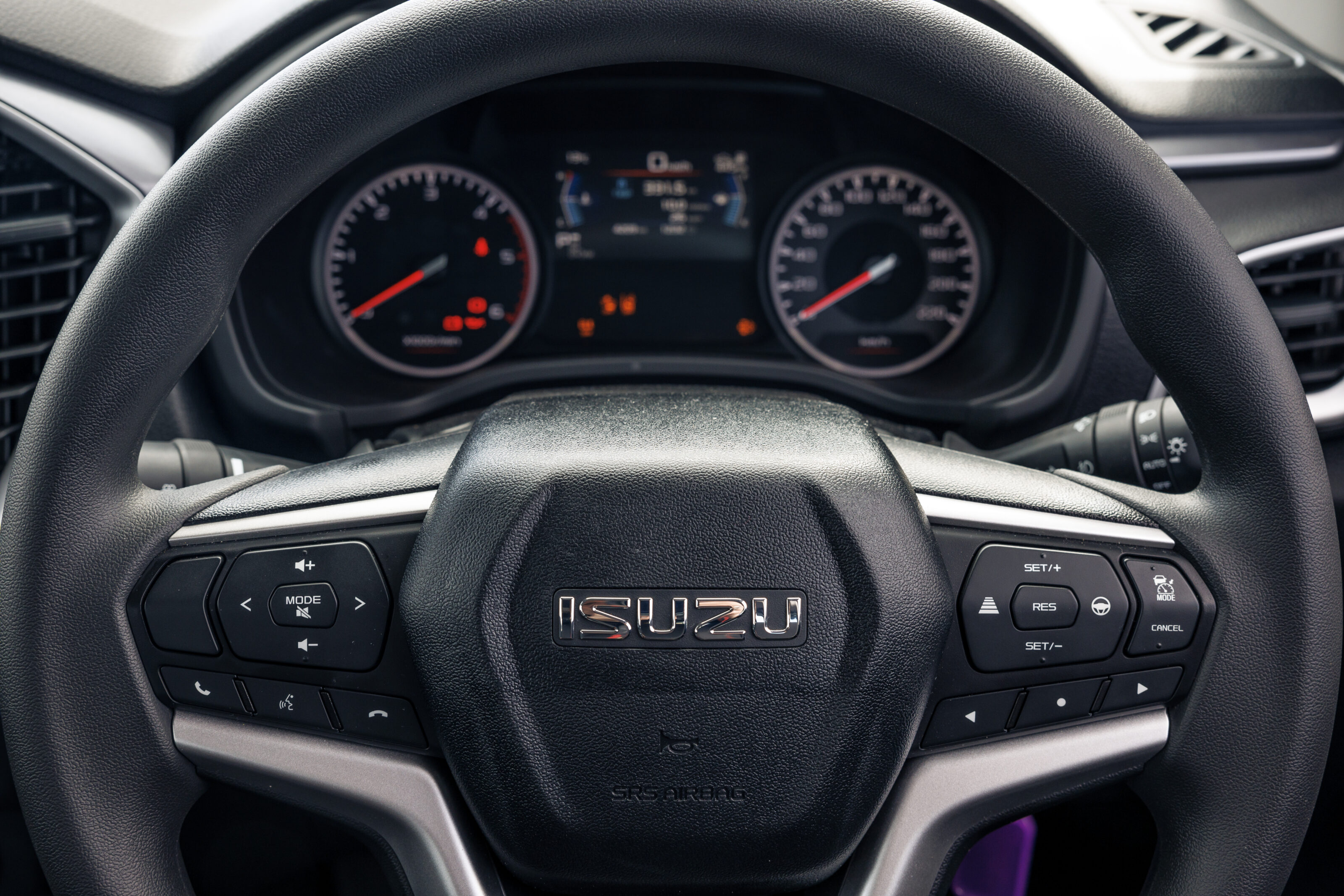
The current-generation Isuzu D-Max was assessed by ANCAP in 2020, achieving a five-star rating.
1
Standard safety features are generous across the range and among the class best, including autonomous emergency braking, adaptive cruise control, lane departure warning and prevention, lane-follow assist, rear cross-traffic alert, speed assist (with traffic sign recognition), rear parking sensors, blind-spot monitoring and a reversing camera.
Warranty and running costs
Isuzu Ute Australia provides all models with a six-year, 150,000km vehicle warranty – one year greater than the mechanically identical Mazda BT-50, although that runs to unlimited kilometres.
Seven years of roadside assist and seven years of capped-price servicing are also included with a new D-Max sale.
1
Service intervals run annually, or every 15,000km, whichever occurs first. At the time of writing, capped servicing costs ranged from $335 to $799 depending on interval, adding up to $3689 over the first seven visits at an average price of $527.
What about the 2023 update?
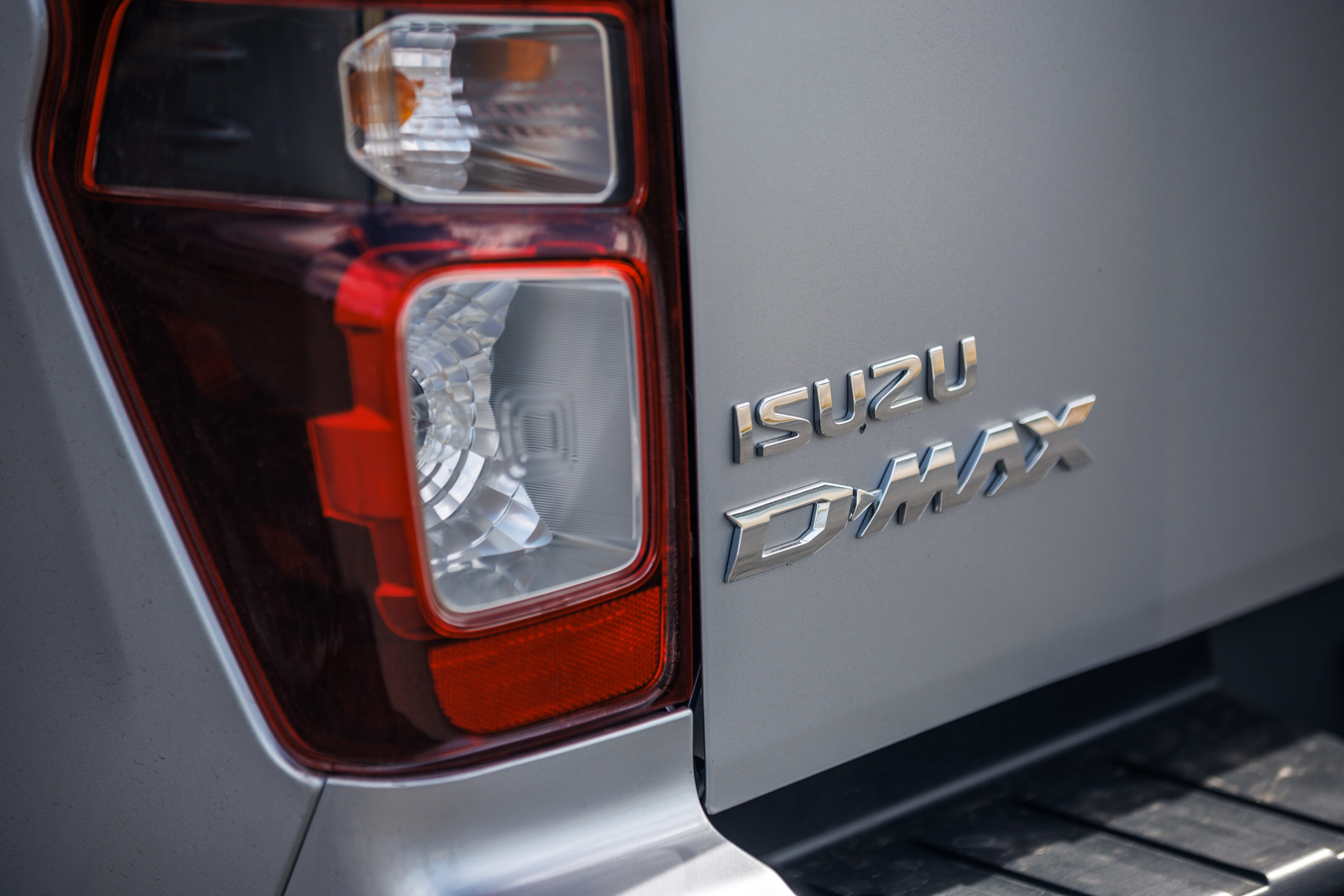
Starting from December 1, a lightly updated D-Max will be available in Australia as an MY23 model. Prices will remain unchanged from the current MY22 models but the dual-cab gains new alloy wheels, a redesigned front grille, new trim and paint finishes, and a tailgate gas strut for less abrupt opening and closing.
1
Other feature additions for MY23 include auto-off blind-spot monitoring and rear-cross traffic alert when a towing connector or plug is detected.
Those who own an MY22 D-Max will be able to have their vehicles retrofitted with these features, but will incur a cost for replacement parts and labour.
VERDICT
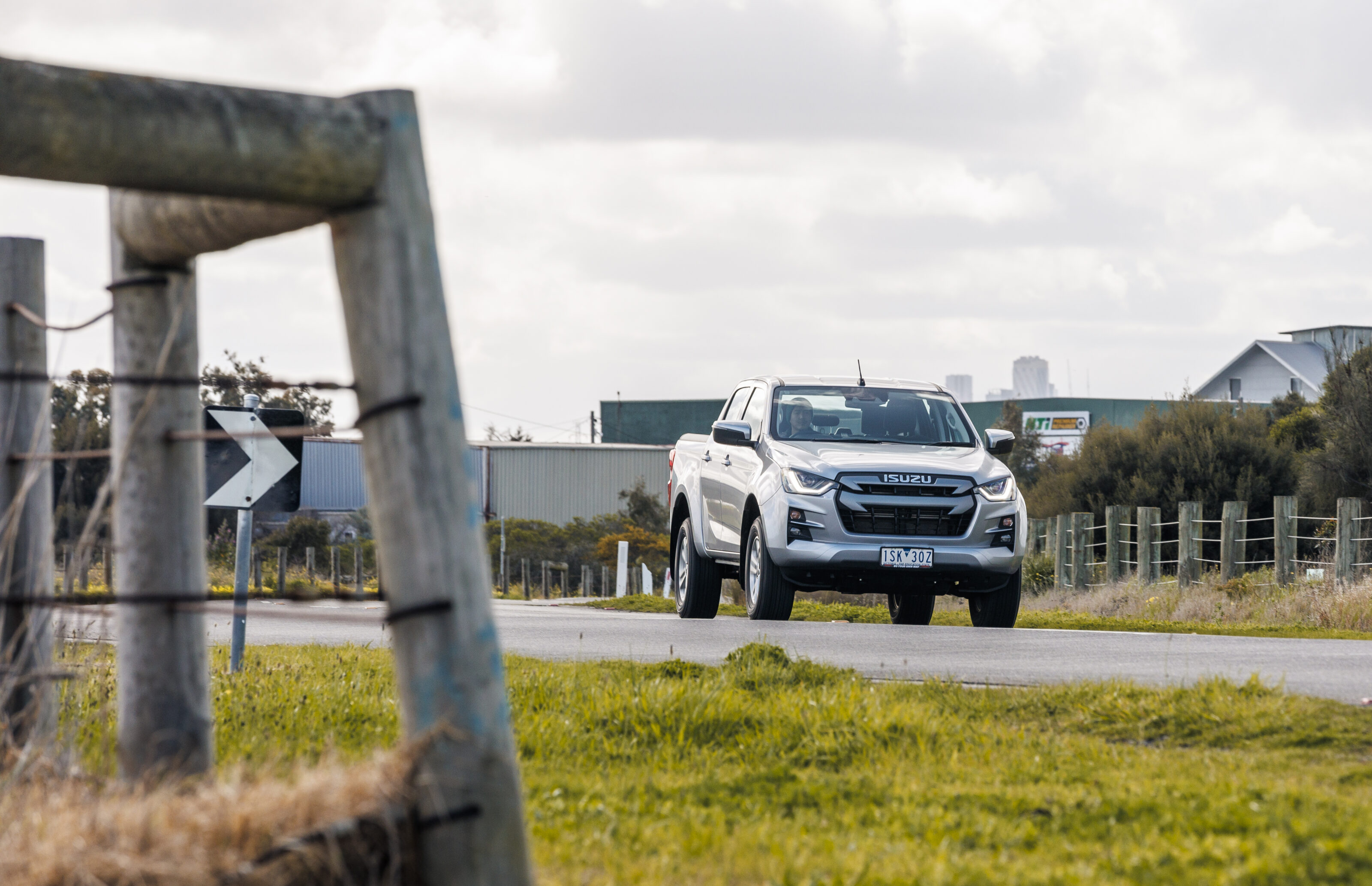
The Isuzu D-Max LS-M is an admirable Jack-of-all-trades, delivering an adventure-ready package with respectable on-road manners for an attractive price.
As upmarket dual-cabs seem to continue to grow in aspiration for buyers, the humble D-Max LS-M won’t impress with any diamond-stitched upholstery or imposing bull bars but offers genuine worksite utility blended with creature comforts you’ll appreciate daily and a very generous standard safety suite.
1
As a family ute that goes to work during the week, or as a weekend toy that’s ready to get down and dirty, if you’re shopping for a capable mid-$50K dual-cab ute, this is one well worth checking out.
MORE
Everything Isuzu
2022 Isuzu D-Max LS-M specifications
| Body | 4-door, 5-seat, ute |
|---|---|
| Drive | All-wheel |
| Engine | 3.0L turbo-diesel, inline-six |
| Max power | 140kW @ 3600rpm |
| Max torque | 450Nm @ 1600-2600rpm |
| Transmission | Six-speed automatic |
| Fuel consumption | 9.65L/100km |
| Weight | 2020kg |
| L/W/H/W-B (mm) | 5265/1870/1785/3125 |
| Price | $55,300 |
| On sale | Now |
