
We’ve all done it. You’re busy on the weekend, but an Ibis has just laid waste to your paintwork with yesterday’s breakfast. Most importantly, you have to get the bird dirt off.
Sometimes an automatic car wash feels like the only answer and, hey, once in a while it can’t hurt too badly, right?
Conventional logic says every now and again, an auto wash won’t be too bad – but according to Damon Lawrence, owner of automotive detailing business Auto Attention, automatic washes are a major cause of damaged paintwork.

What’s wrong with automatic car washes?
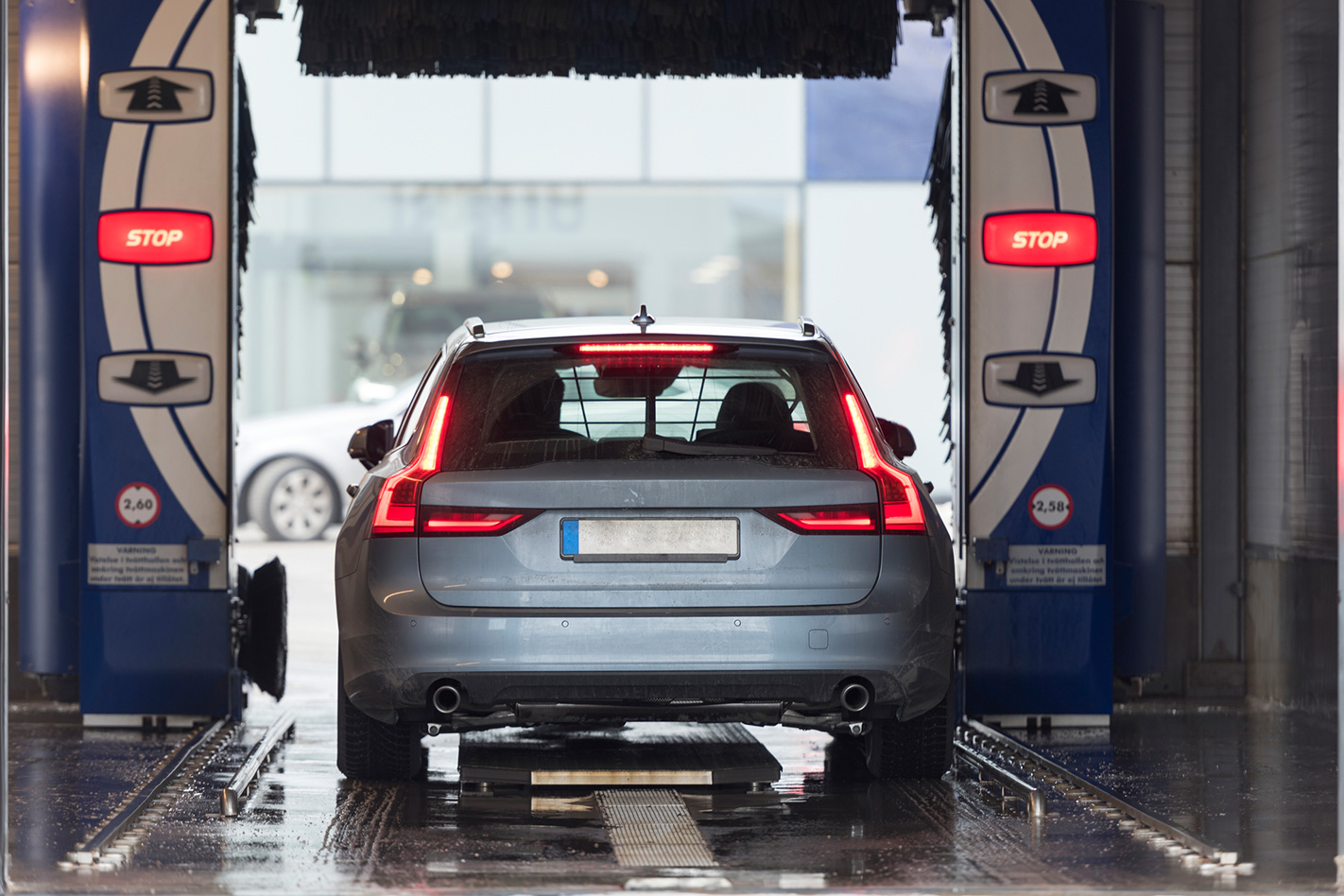
“Automatic car washes, as much as they are convenient, are abrading your paintwork because the brushes used aren’t properly maintained,” Damon says.
“These machines are essentially like slapping your car with a dirty mop, causing hundreds of deep micro scratches called ‘swirl marks’. Over time, this damage builds and eventually results in your paint becoming dull and the scratches become easily noticeable.
“Repairing the swirl marks is done through a process called paint correction. This process cuts down the peaks of your paintwork to level out any swirl marks seen on the surface. This process can only be done so many times due to a car’s clear coat being a certain thickness, depending on your manufacturer.
“The cost of this process varies but on average costs over $1000.”
And if you think you’re slick navigating the issue by using a touch-free automatic car wash, chances are you’re still doing damage.
“Unfortunately as perfect as the idea sounds, not only do touch-free washes use aggressive acids to cut down the grime – which can eat away paint – the high pressure hose simply won’t clean it 100 per cent.”
How do I clean my car quickly, easily and cheaply?
What’s the alternative for time-poor owners? Well, as the old saying goes: cheap, fast, or good. Pick two.
The best protection comes in the form of high quality wax or, even better, a semi-permanent ‘ceramic coating’.
Applying a ceramic coating is a great way for your car to stay clean in the first place. The hydrophobic coating keeps dirt and grime from sticking to a car’s paintwork. Ceramic coatings also give you a ‘free wash’ when it rains.
Ceramic coatings can be applied at home, but it’s better to correct your paint first for best results. Again, DIY is possible though it takes at least a weekend to do properly, therefore seeking out a professional will suit most people’s schedules better.
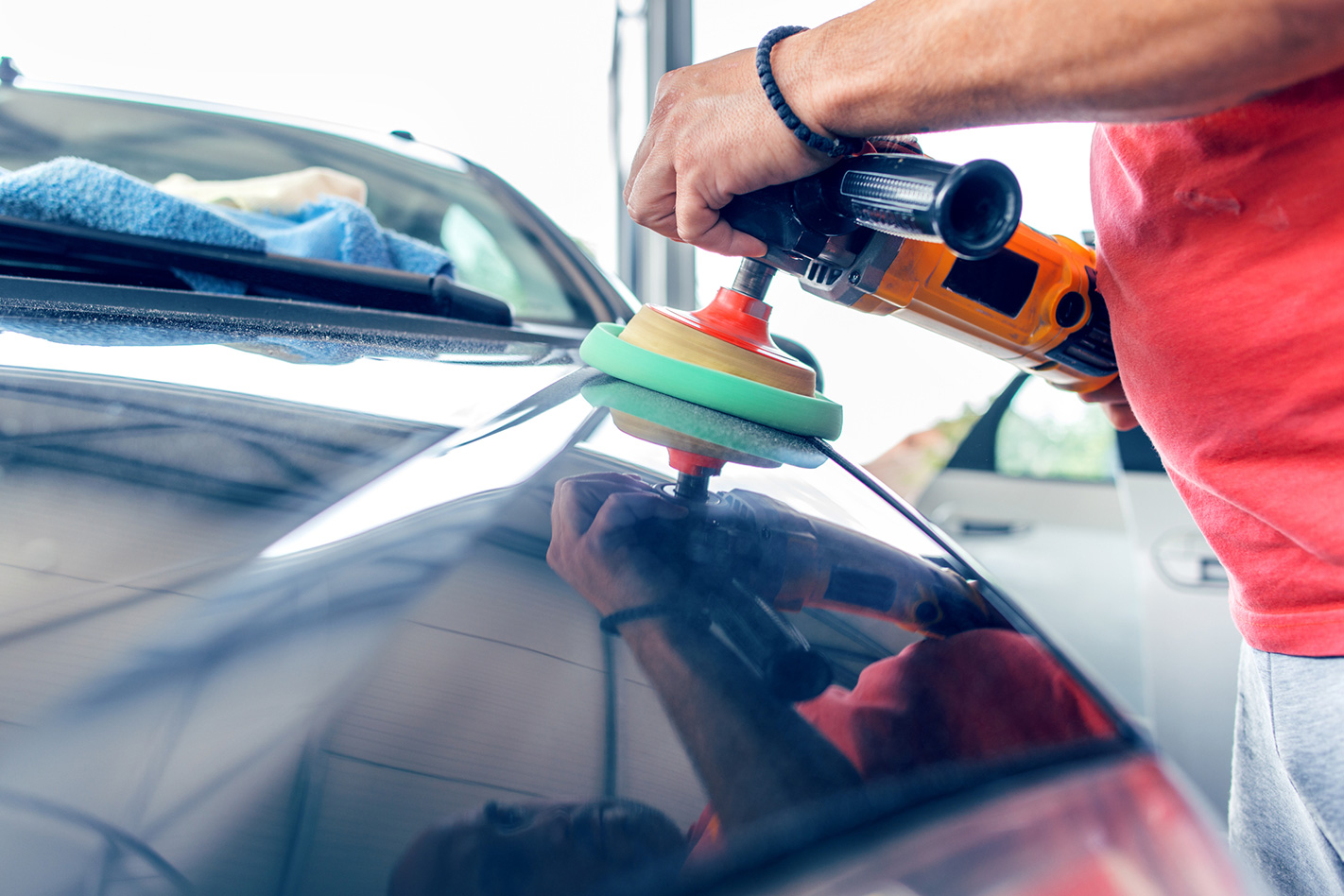
If you want to take the best care of your car’s paint, “it is always best to do it yourself and use the two bucket wash method, making sure to use clean microfibre materials when touching the car.”
The original 1974 Pony Concept that set the wheels in motion for the Hyundai Motor Corporation will be rebuilt.
The work will take place through a joint venture between the Korean carmaker and GFG Style – the Italian design firm helmed by the concept’s original designer Giorgetto Giugiaro and his son Fabrizio.
The announcement was made during a Design Talk in Seoul attended by the Giugiaros, Luc Donckerwolke, Chief Creative Officer of Hyundai Motor Group, and SangYup Lee, Executive Vice President and Head of Hyundai Motor’s Global Design Center [sic].
“The original Pony and Pony Coupe Concept were one of those rare creations that influenced the designs of not just one, but multiple production and concept vehicles, including our award-winning Ioniq 5 and attention-grabbing N Vision 74,” said SangYup Lee.
“Since the original concept car no longer exists, we’ve commissioned Giorgetto Giugiaro to rebuild it based on our design philosophy – ‘shaping the future with legacy.’”
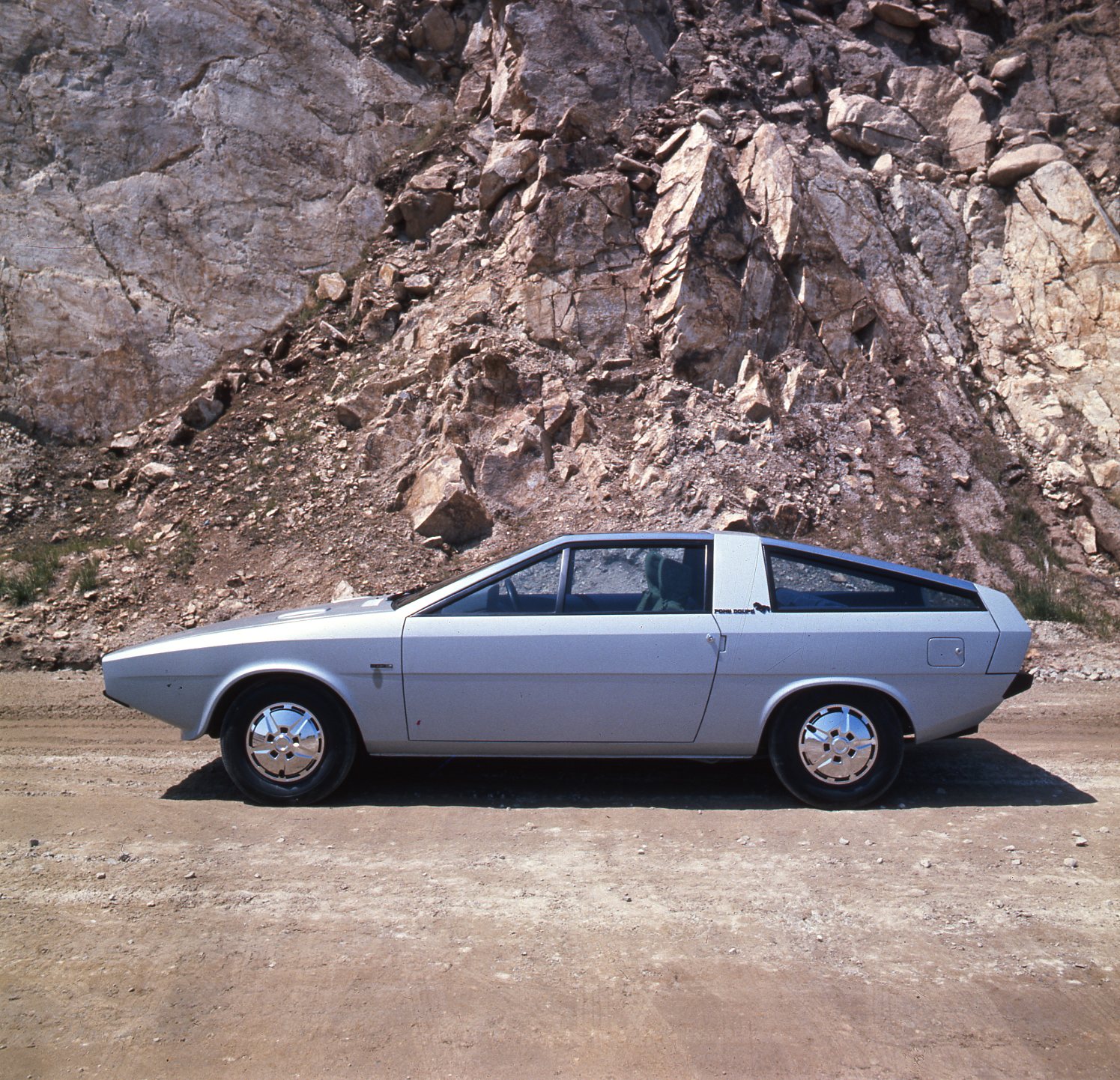
Giorgetto Giugiaro is also responsible for the iconic DeLorean DMC-12, a design largely inspired by the work he performed on the original Pony concept for Hyundai. The two cars share the long wedge-shaped silhouette, with abrupt rear haunches and long noses.
Hyundai’s ”shaping the future with legacy” strategy is clear in the N Vision 74 concept vehicle, which was revealed recently, paying tribute to the Pony Concept with same distinctive styling to the front and rear of the car – albeit draped with modern-day aerodynamic flourishes and LED lighting. The Pony coupe also served as inspiration for Hyundai’s 45 concept, which became Hyundai’s Ioniq 5 crossover two years’ later.
A one-off Pony EV concept has been previously shown as a means to promote how EV technology can serve the restomod scene.
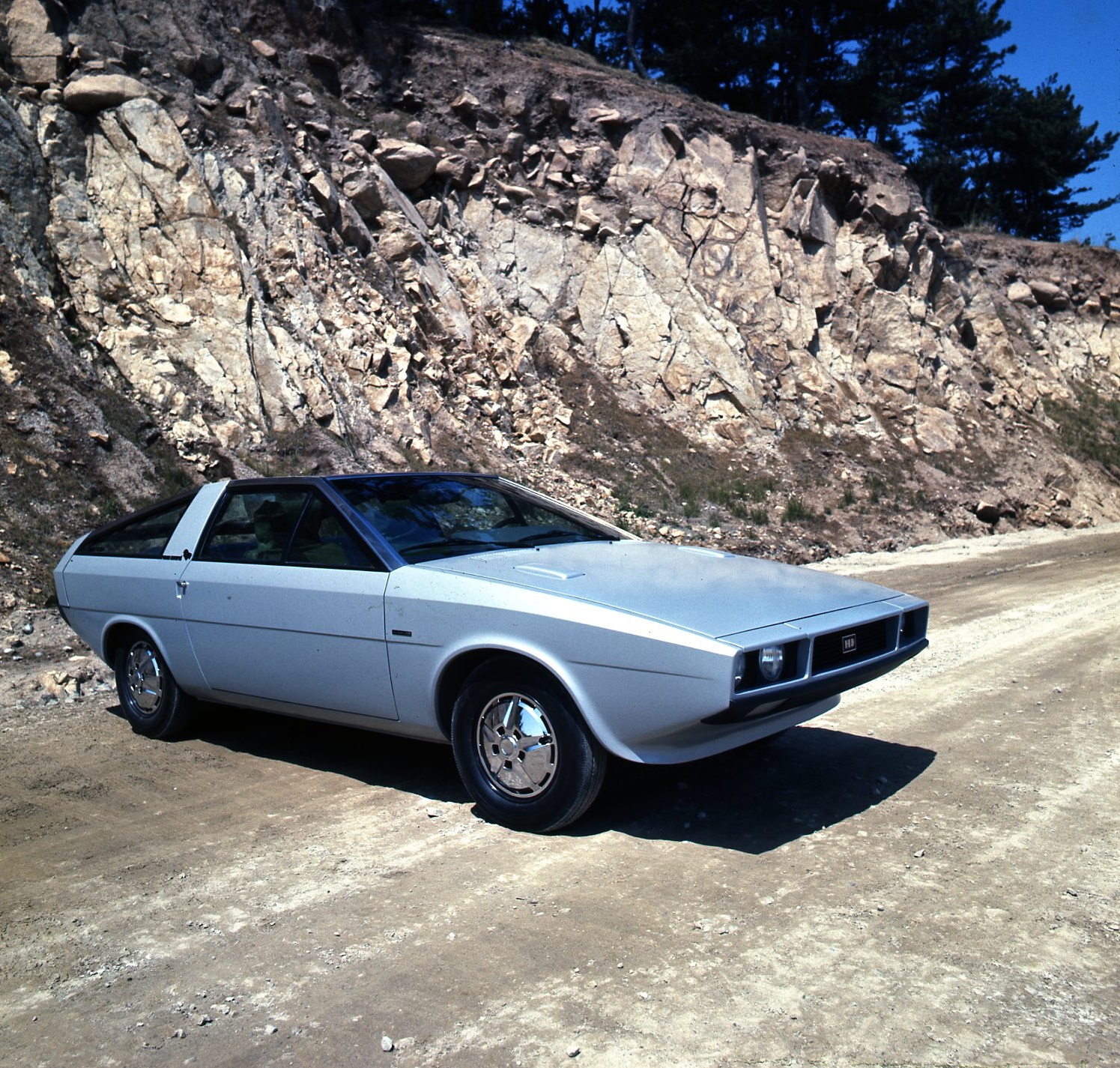
While the Pony Coupe Concept never came to fruition, the Pony nameplate would be applied to Hyundai’s first offerings that were built between 1975 to 1990.
Regarding his original work, Giugiaro said: “I designed the Hyundai Pony when I was still a young designer at the start of my career. I felt very proud that I was in charge of creating a vehicle for a company and country that was about to take on a fiercely competitive global market. Now, I’m deeply honoured Hyundai has asked me to rebuild it for posterity and as a celebration of the brand’s heritage.”
The one-off rebuild of the Pony Concept will be shown in early 2023, with the vehicle being kept as part of Hyundai’s corporate collection.
If you’re looking to purchase a brand-new vehicle for your newly licensed offspring, a small SUV can provide an excellent balance of safety, economy and practicality.
Is Mazda’s CX-30 worth considering for the job? To find out, we’ve put young fella Jordan Hickey in the Pure grade.
The small SUV segment is growing rapidly in Australia, and the Mazda CX-30 is one of the biggest culprits in this surge.
We’ve already tested several variants in the 2021 Wheels Car of the Year range, including the newly launched G25 Touring SP and mild-hybrid G20e Evolve, but it’s now time to evaluate the most affordable model: the 2022 Mazda CX-30 G20 Pure.
Launched in early 2020, the CX-30 – closely related to the current Mazda 3 – sits on the podium for small SUV sales, behind the cheap-as-chips MG ZS and ahead of key competitors, including the Kia Seltos, Hyundai Kona, Mitsubishi ASX and GWM Haval Jolion.
In addition, the CX-30 will face the Toyota Corolla Cross and Nissan Qashqai later this year.
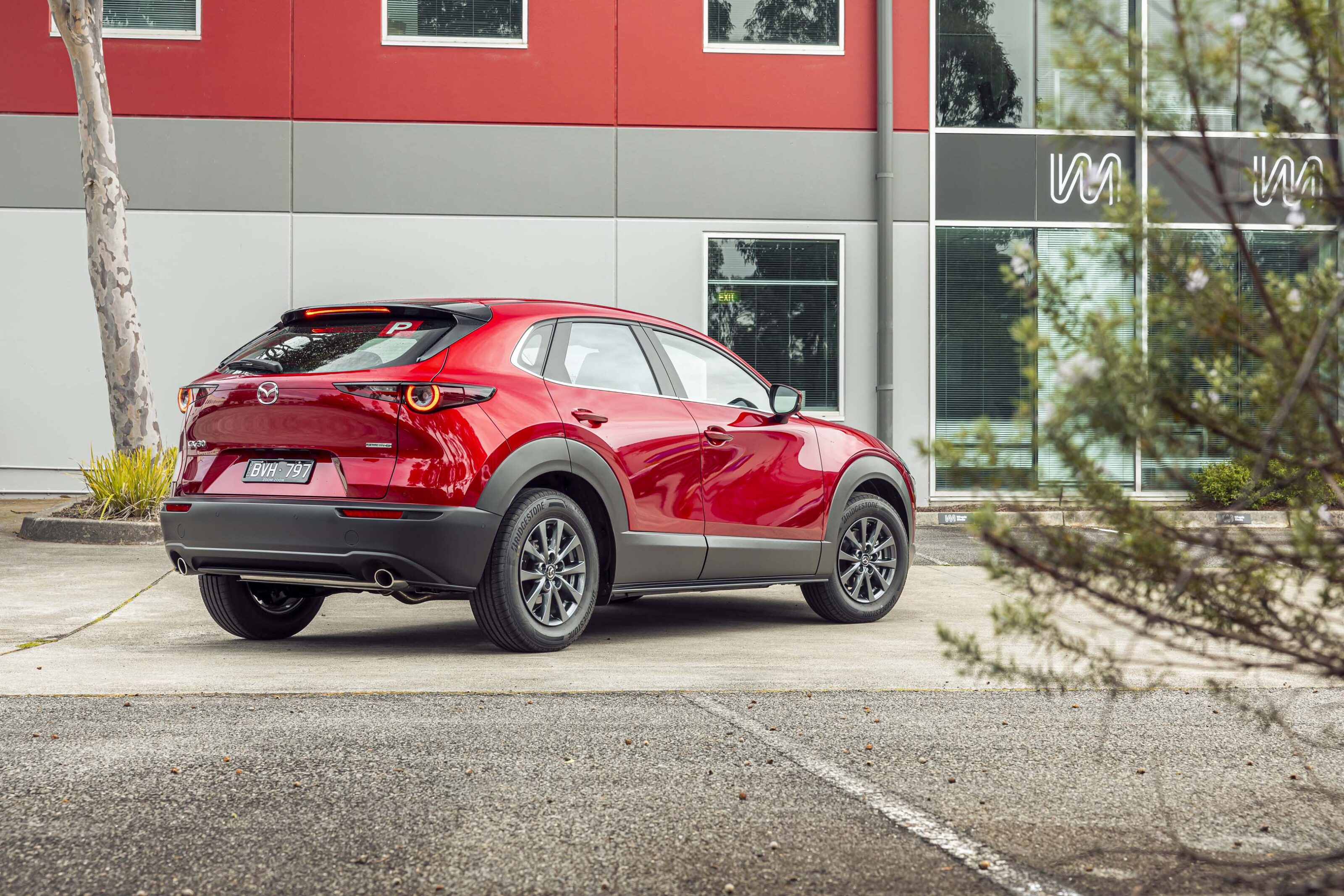
The basics
| Engine | 2.0-litre naturally-aspirated four-cylinder |
|---|---|
| Power | 114kW @ 6000rpm |
| Torque | 200Nm @ 4000rpm |
| Claimed fuel consumption | 6.1L/100km |
| Price | $31,185 before on-road costs |
Mazda’s local arm tells us the entry-level Pure variant is the third best-selling variant in the CX-30 range, behind the mid-spec G20 Evolve and G20 Touring – showcasing the value-proposition found at the bottom end of the 10-strong model line-up.
The expansive range provides an option for all, comprising the G20 Pure, G20 Evolve, G20e Evolve M-Hybrid, G20 Touring, G20 Touring SP, G25 Touring, G25 Touring SP, G20 Astina, G25 Astina and X20 Astina.
A six-speed automatic is standard for all variants except the G20 Pure, which opens with a price-leading six-speed manual gearbox.
NOTE: While the CX-30 G20 Pure was on test with Wheels Media, Mazda Australia announced a stop-sale for all 2.0-litre variants, excluding the G20 Astina, due to stock shortages. These models should become available in the coming months, with limited stock currently available at dealerships. The brand advises buyers to speak to their local dealer for the latest information.
In a unique move, Mazda allows buyers to option the Vision Technology package on the automatic (but not manual) G20 Pure and G20 Evolve, whereas it is standard on the Evolve M-Hybrid, Touring SP and Astina variants.
Opting for this pack nets a 360-degree camera system, front parking sensors, a driver monitoring camera, front-cross traffic alert and traffic jam assist. A necessary tick-box? Nope, as the standard array of active safety kit is comprehensive enough.
However, if your budget can stretch a further $1500, the higher-quality cameras and front sensors are a nice-to-have – but be prepared for the potential of an extended wait time since the option is factory-fitted.
Alright, now that’s out of the way. Let’s get back to the CX-30 G20 Pure.
Pricing and features
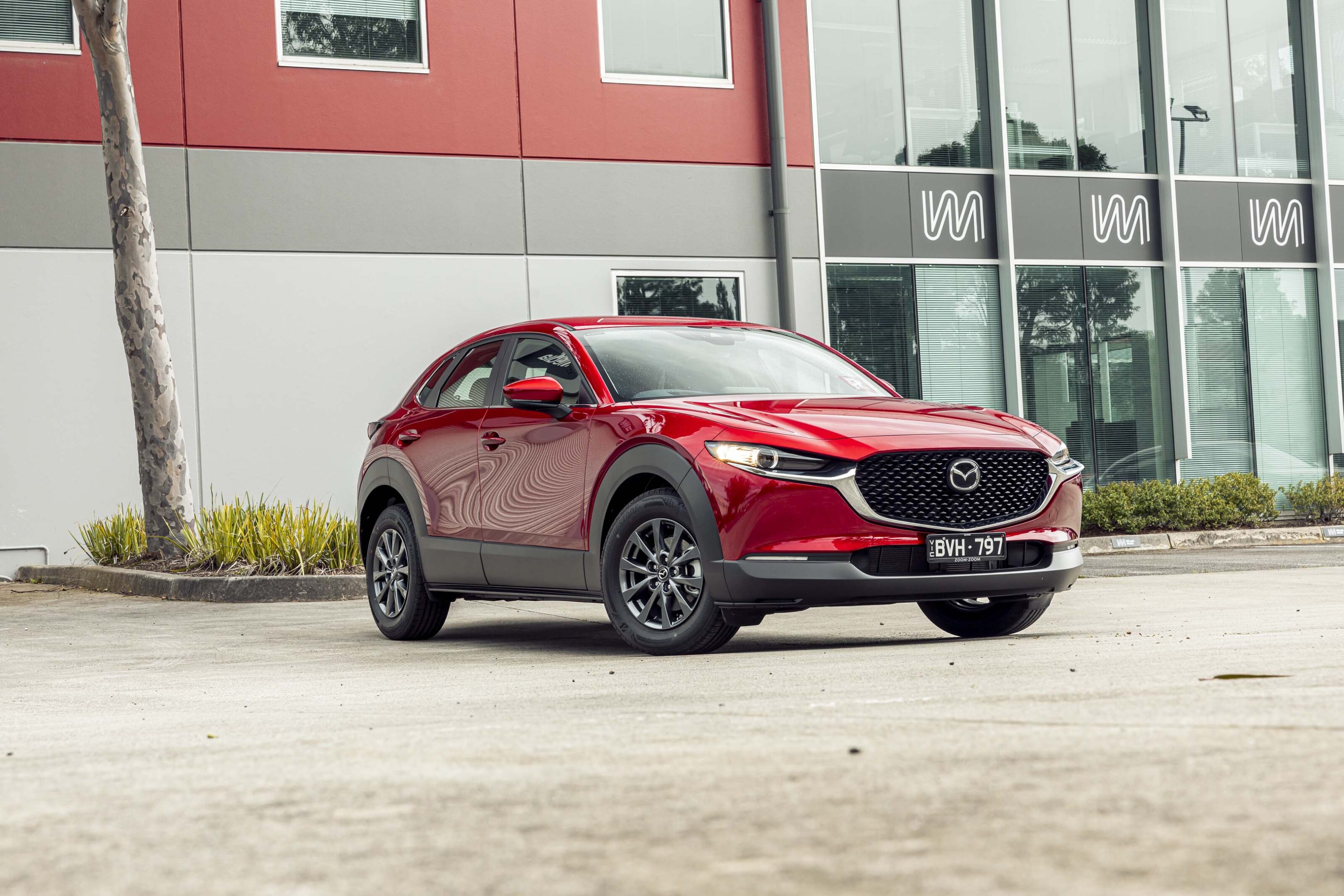
As tested, our automatic G20 Pure FWD example – finished in the $595-extra Red Crystal metallic – is priced from $31,685 before on-road costs or $35,895 drive-away in Victoria.
Price-wise, it squares up against the Toyota Corolla Cross GX ($33,000), the updated Kia Seltos Sport ($30,290), and Hyundai Kona Elite ($31,900). All before on-road costs. A new-gen Nissan Qashqai is also imminent.
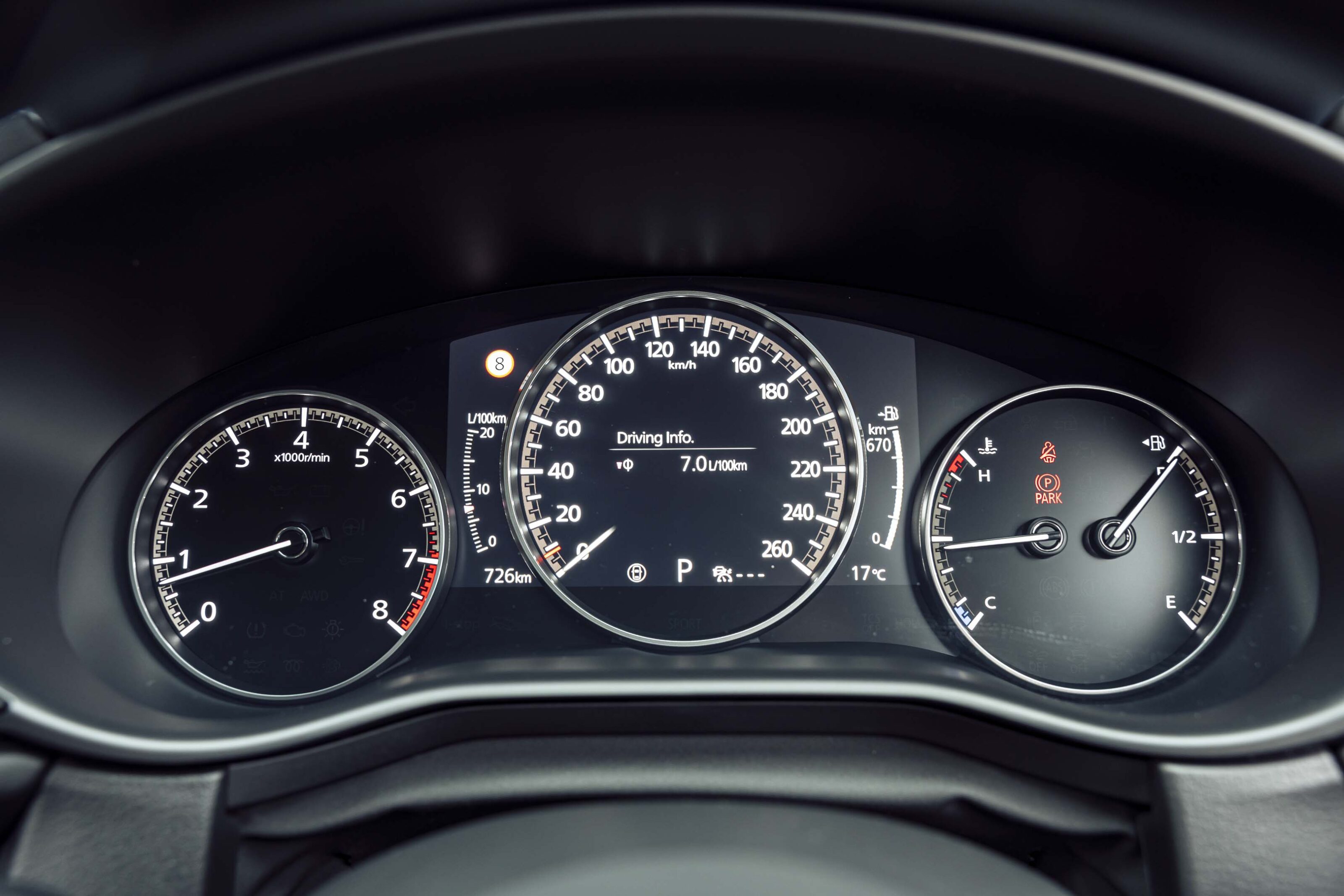
The idea of a ‘poverty pack’ vehicle is quickly diminishing, with a strong mix of technological and safety features as standard in the CX-30, such as a head-up display to keep your eyes on the road and a 7.0-inch semi-digital instrument cluster – both are rare at this end of the small SUV market.
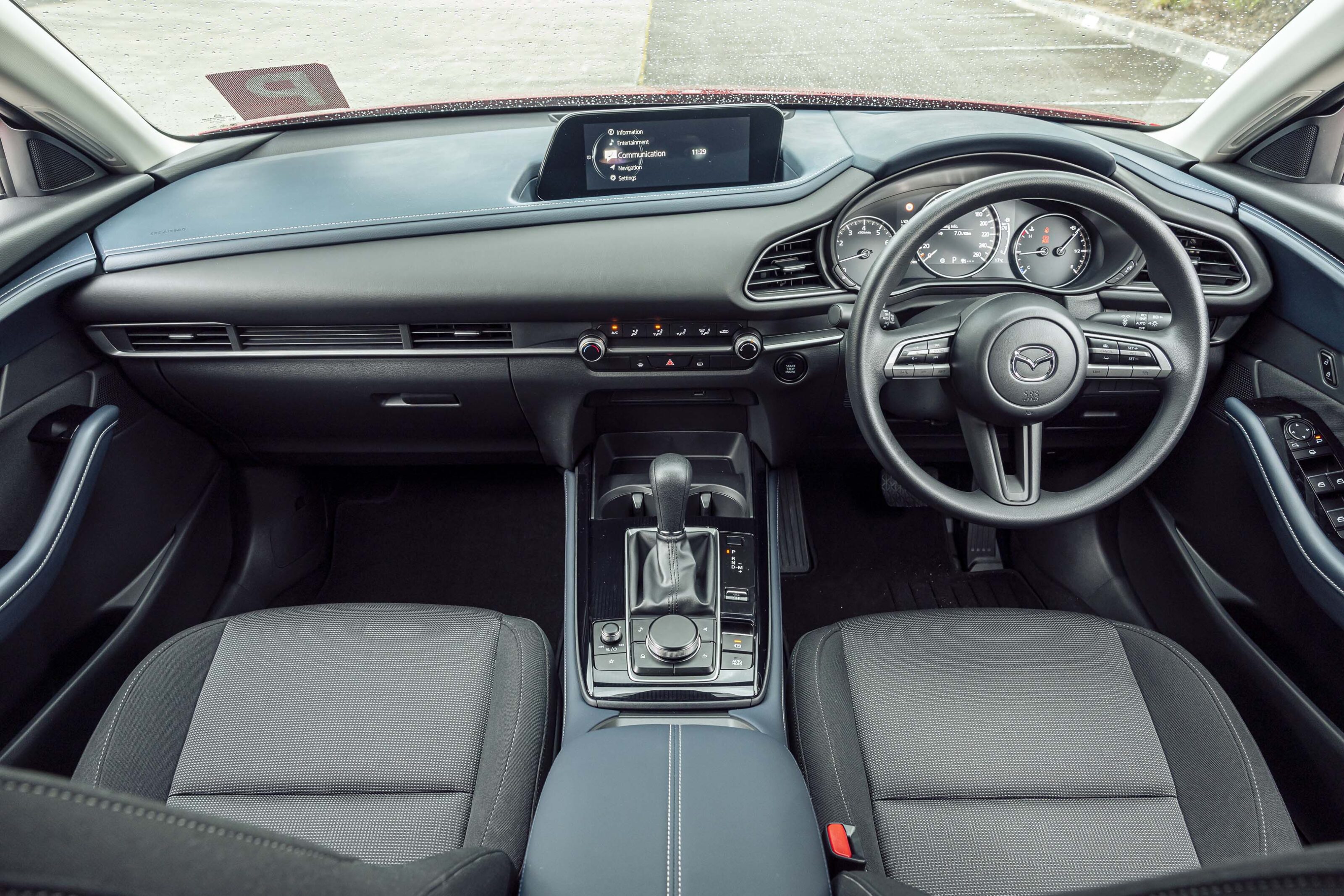
For model year 2022, Mazda swapped out the G20 Pure’s chintzy plastic steering wheel and gear shifter for leather-accented items, addressing our strongest gripe with the entry-level CX-30 and lifting the ambience (although industry-wide supply issues led to Mazda providing a 2021 example for this review).
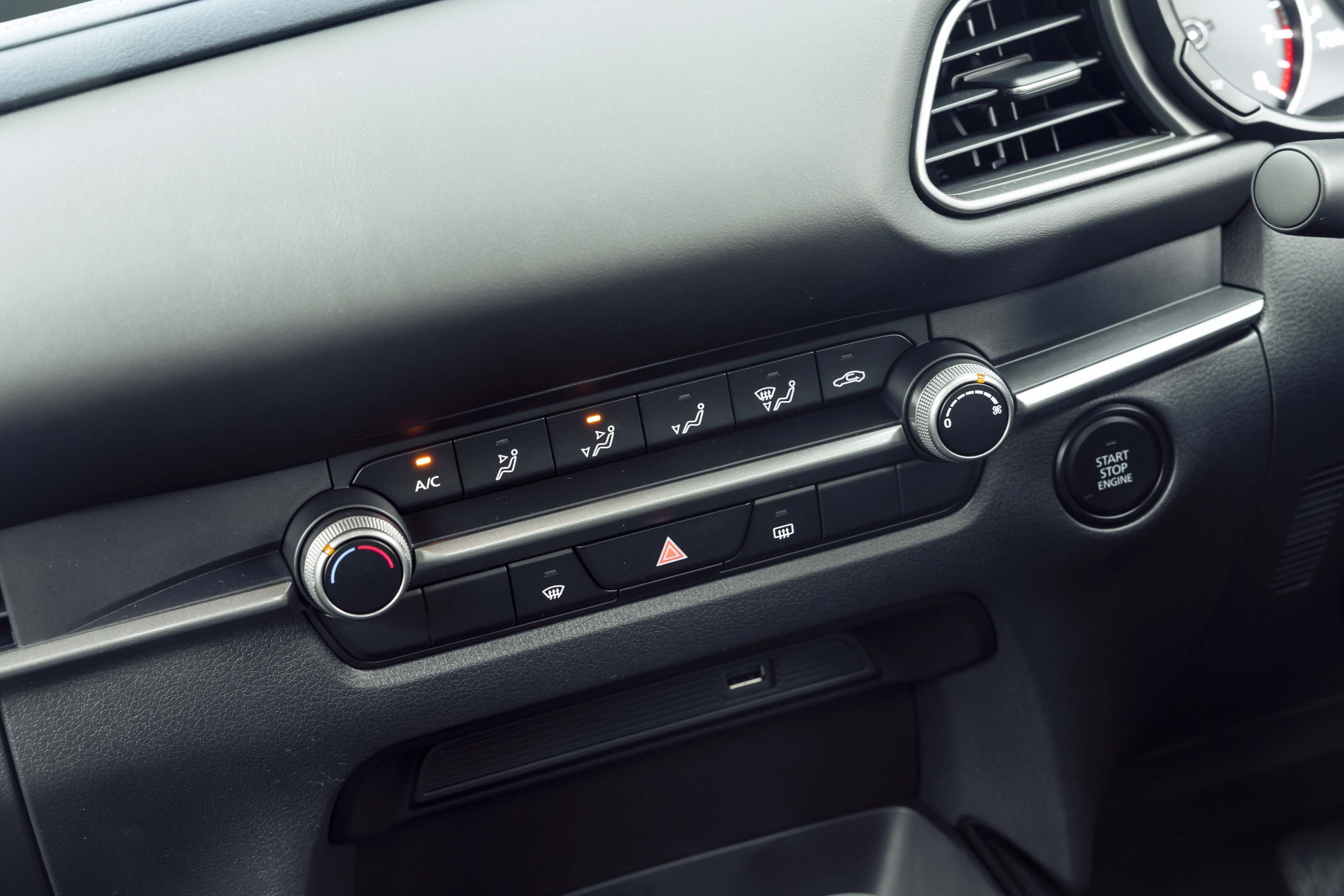
Equipment highlights include 16-inch alloy wheels, manual air-conditioning, cloth upholstery, manually-adjustable seats, an electronic parking brake with handy auto-hold function and rain-sensing wipers.
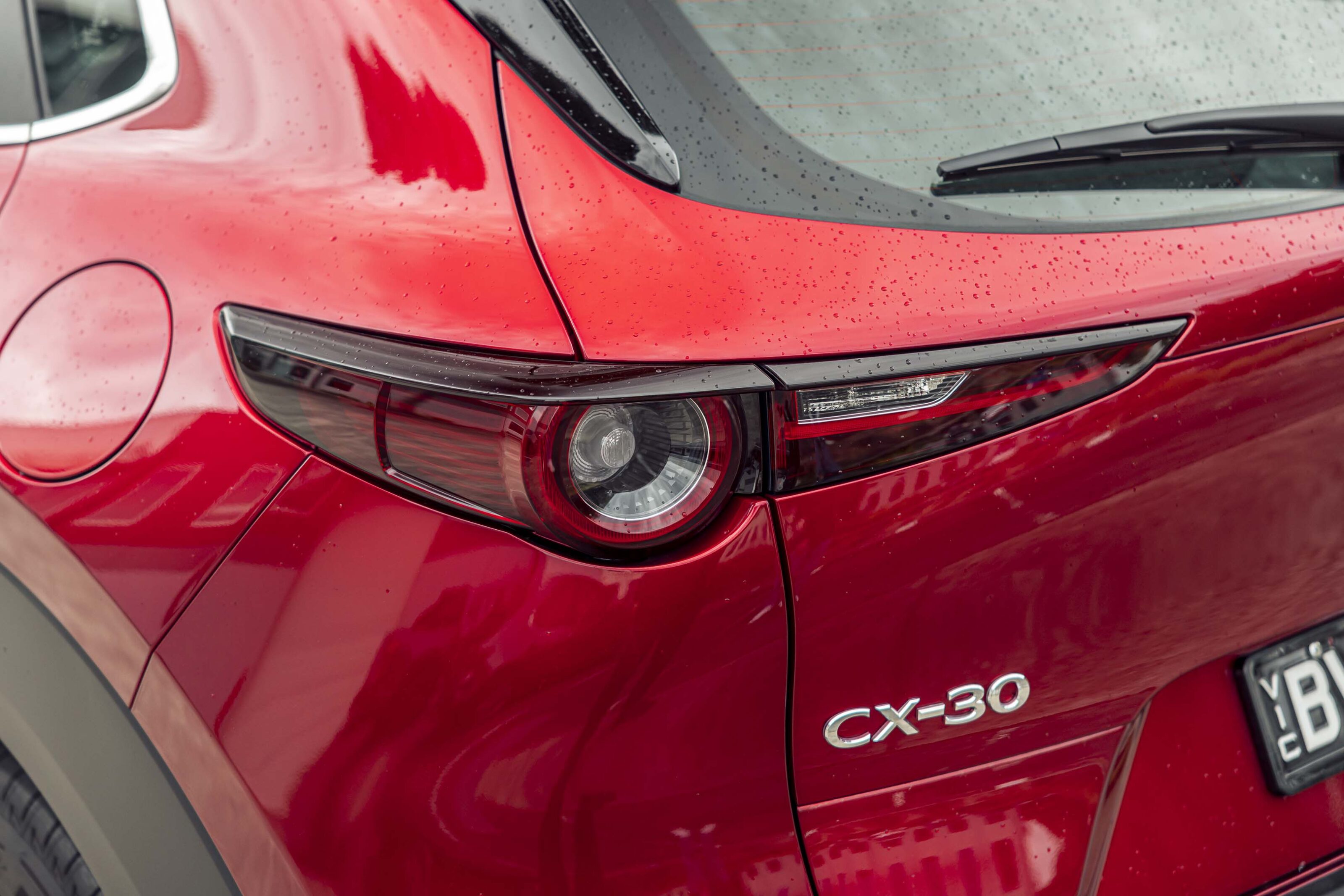
Unlike the Kia and Hyundai, automatic LED headlights and taillights are standard – but this is let down by halogen daytime running lamps (DRLs), which cheapen its look.
It’s a strange design choice, as there is a white/amber LED strip on the front bumper for the side lights and indicators, with the latter having an excellent pulsating design. Mazda could easily modify this to incorporate always-on DRLs.
The high beams provide a decent range on rural roads, and the automatic high beam has been fine-tuned since the CX-30 and 3 first launched, requiring less manual intervention.
While the fitment of push-button start is excellent, it is let down by the omission of keyless entry, which is limited to the G20e Evolve and above. This means you’ll miss out on the capacitive door handle sensors and the walk-away lock feature, but this is a common issue among its entry-level rivals (many of which also retain an old-school ignition key).
On the technology front, the CX-30 sports an 8.8-inch Mazda Connect infotainment system, which lacks a touchscreen but is easy to use with a rotary controller dial.
Apart from the advantage of never having to worry about marks – until an unwitting passenger touches it – the dial works quite well with Mazda’s software. It functions okay with wired-only Apple CarPlay and Android Auto, and it is easy to become accustomed to smartphone mirroring with the dial, but those systems are clearly designed with touch in mind.
In saying this, scrolling down a long list of music in a playlist to find a song, for example, is more intuitive and less distracting with the rotary setup compared to touch.
While most buyers will naturally use navigation from Apple CarPlay or Android Auto, the embedded system works well, with directions in the head-up display.
Mazda offers three years of complimentary map updates, but this pales in comparison to Google Maps, Apple Maps or Waze, which are always up to date.
In addition, unlike Siri or Google Assistant, don’t expect to have a human-like conversation with the built-in voice control when setting your map – and scrolling from A-Z to enter a destination can be painful.
The eight-speaker audio system provides great clarity but lacks a subwoofer, which is noticeable with bassy songs. Only the flagship Astina includes a higher-quality 12-speaker Bose unit with a woofer.
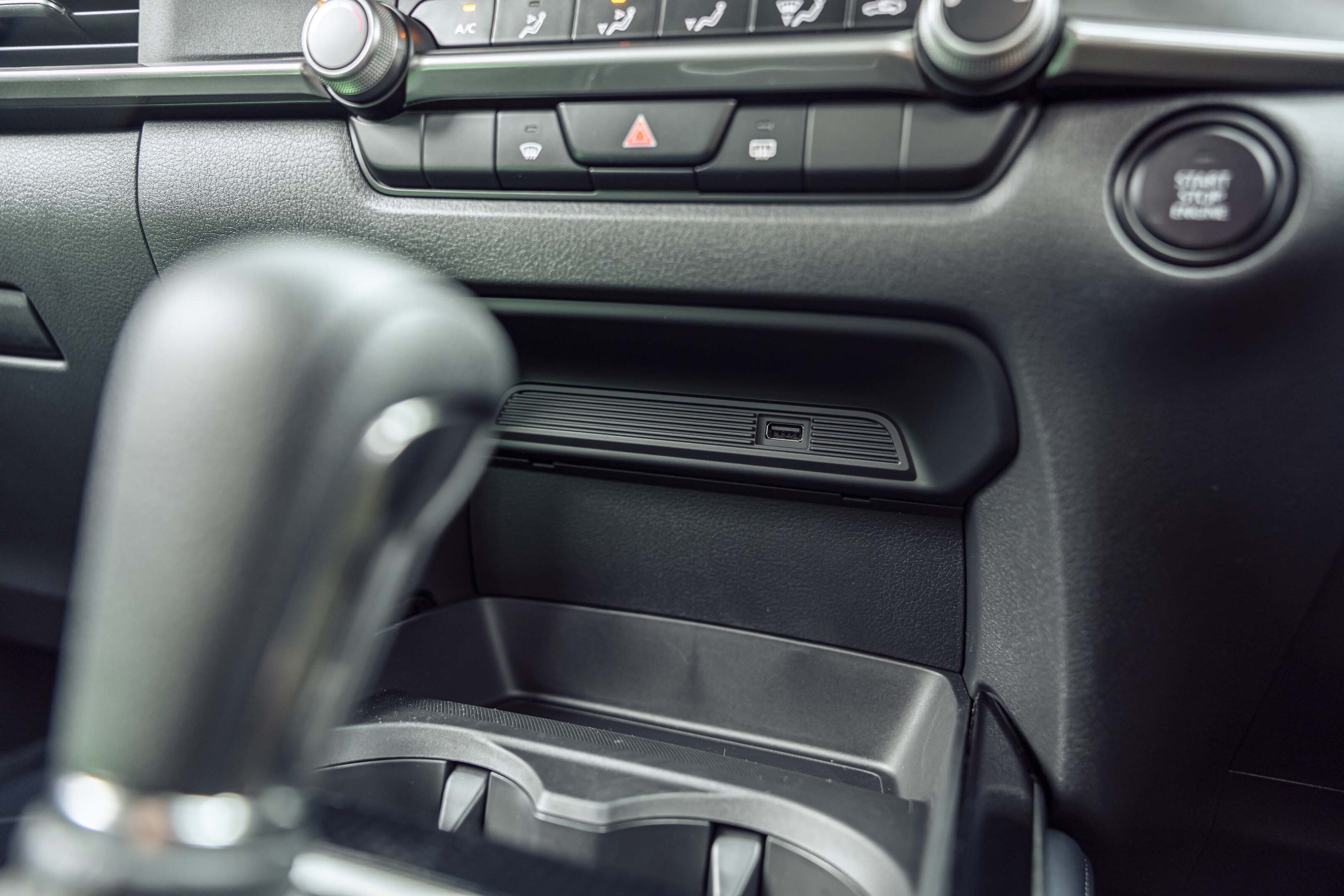
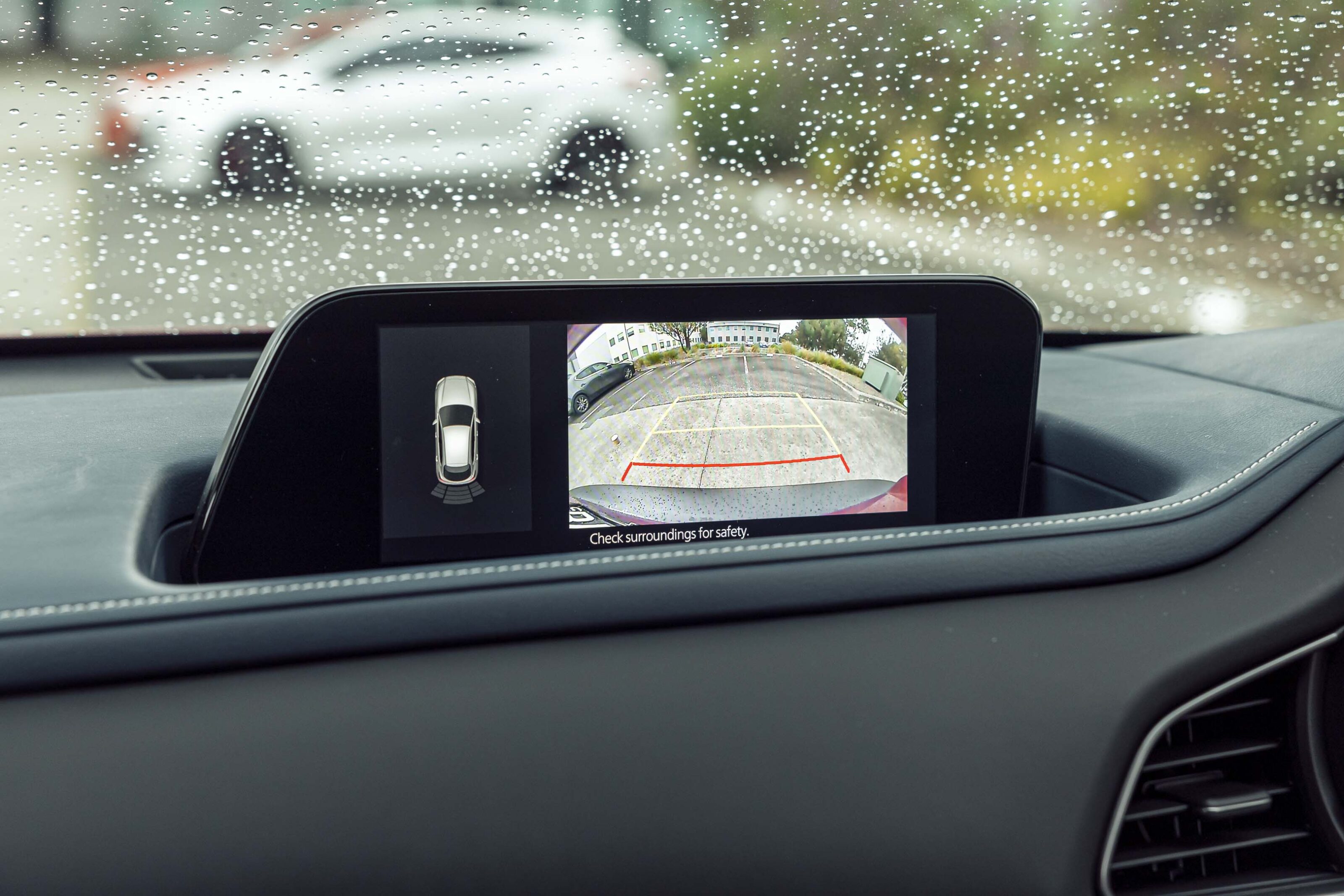
Image quality from the reverse camera is average – neither crisp nor blurry – but it doesn’t fill the entire screen, which is disappointing.
The colour palette is identical across the CX-30 range, with five no-cost paint options (Snowflake White, Jet Black, Deep Crystal Blue, Platinum Quartz and Sonic Silver) and three $595-extra metallic finishes (Soul Red Crystal, Polymetal Grey and Machine Grey).
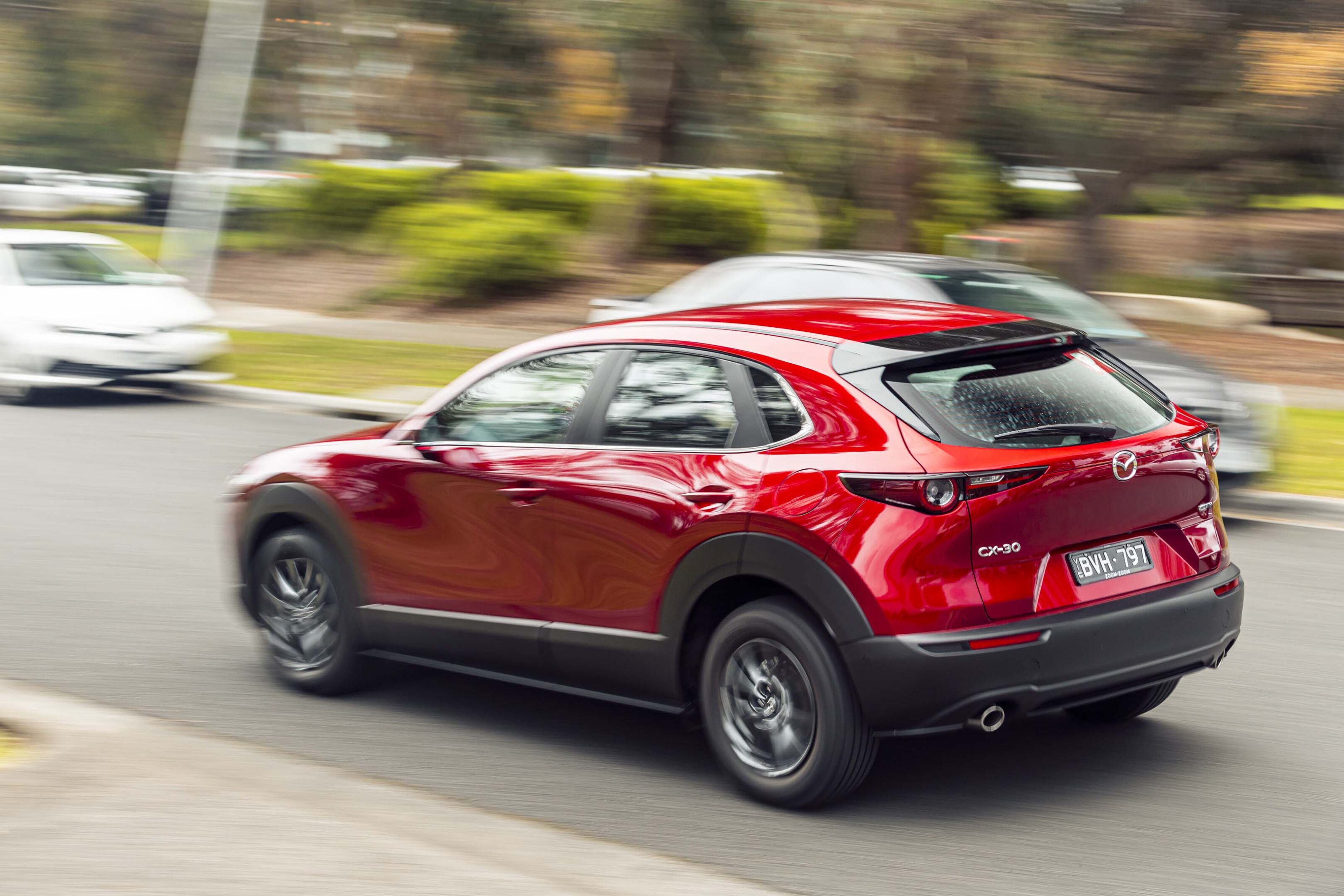
With the smaller alloys – and red paint – the excessive plastic body cladding is quite noticeable. It should be slimmer to improve the otherwise handsome styling.
Safety
A five-star ANCAP safety rating covers the Mazda CX-30 range, based on testing conducted in 2019.
Seven airbags (dual front, side, curtain, and driver’s knee) are standard.
It packs a comprehensive suite of active safety features even in base form. This includes autonomous emergency braking with vehicle, pedestrian, cyclist and reversing detection, adaptive cruise control, lane-keep assist, lane departure warning, blind-spot monitoring, rear cross-traffic alert, driver attention alert and traffic sign recognition.
The lane-keep assist system works well for steering intervention, with a subtle jolt of the wheel when veering close to the edge, but it is quick to alert the driver – either visually in the head-up display or audibly too.
Meanwhile, Mazda could improve the traffic sign recognition system during roadworks and in wet weather, but it is almost perfect in normal conditions. It can work with the speed limiter (known as intelligent speed assist in Mazda parlance) but not with the adaptive cruise.
A reversing camera and rear parking sensors are standard, which can be expanded to include a better-quality 360-degree system and front sensors – plus front cross-traffic alert, traffic jam assist and a driver monitoring camera – with the $1500 Vision Technology package.
The second row includes two ISOFIX anchors, three top tether points and rear door locks.
Comfort and space
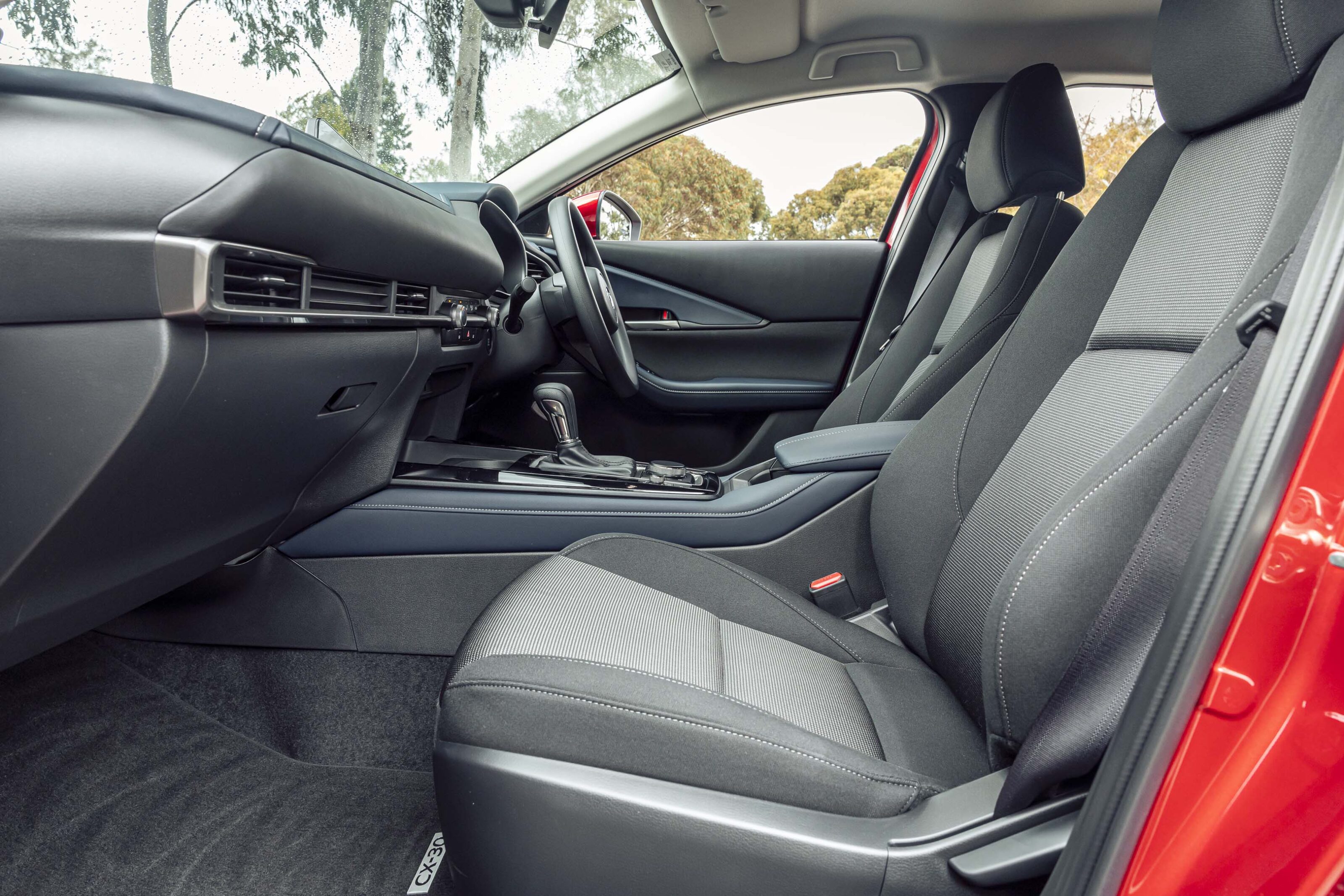
The cabin of the Mazda CX-30 remains a class leader, even at the entry level.
It’s pleasant and straightforward, with few quirks. The buttons and dials are tactile and materials in the front are soft to the touch.
One quirk is that the dashboard layout – padded in soft blue leatherette – could obscure the bottom section of the screen for shorter drivers, while the piano black surfaces in the cabin will look good for about one week before scratches emerge.
The cloth upholstery is comfortable; however, there is no driver’s seat lumbar support or height adjustment on the passenger side.
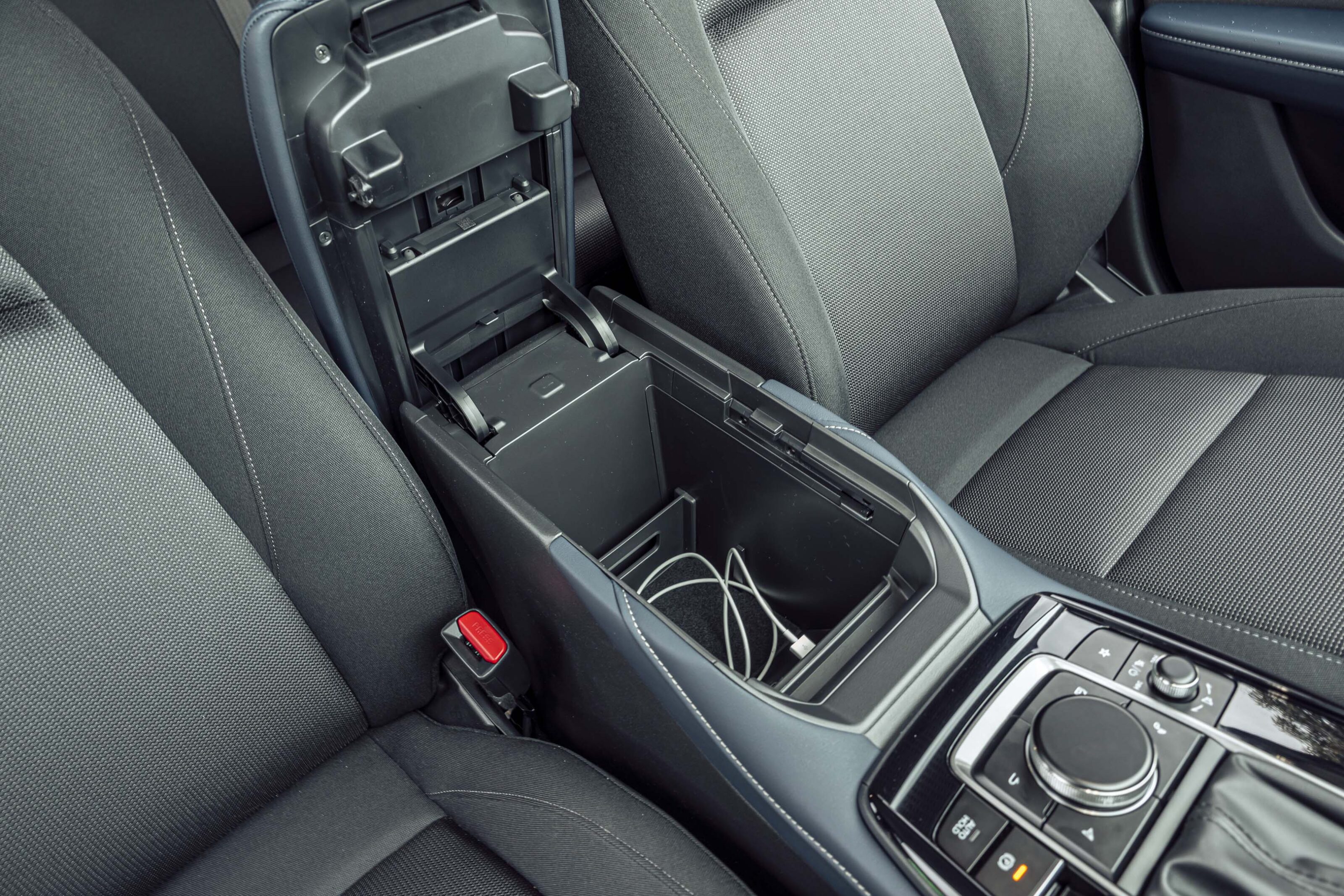
Don’t expect to find the glovebox useful with the handbook stored, while the centre console is small but deep. It offers a nifty phone holder to keep your device upright, but it seems a little flimsy if you’ve got a larger device.
All grades include two USB-A ports in the centre console, helping to keep cables out of sight, but there are no modern USB-C outlets, wireless Apple CarPlay and Android Auto support, or power connections for the second row. All three features are offered in the Skoda Kamiq.
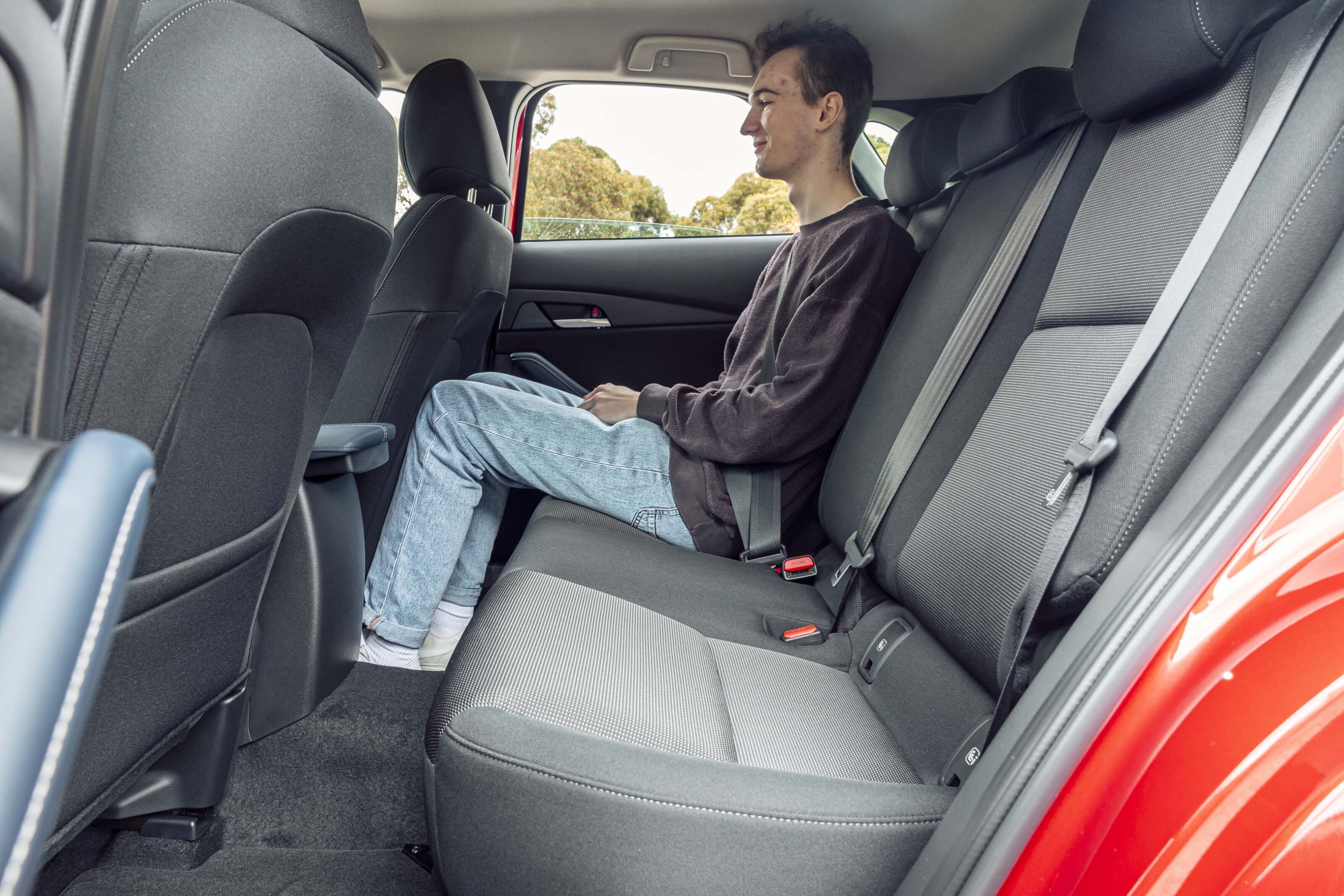
In the back, the CX-30 isn’t as roomy as some other small SUVs, with limited space for taller passengers.
Nevertheless, it’s an improvement over the Mazda3 hatch, which feels very claustrophobic in the second row. When sitting behind my driving position, head, leg and toe room were acceptable for me at 183cm tall, but it would likely become cramped on longer trips.
In base form, it also lacks rear air vents and a rear-centre armrest. Both amenities are fitted on G20 Evolve and above.
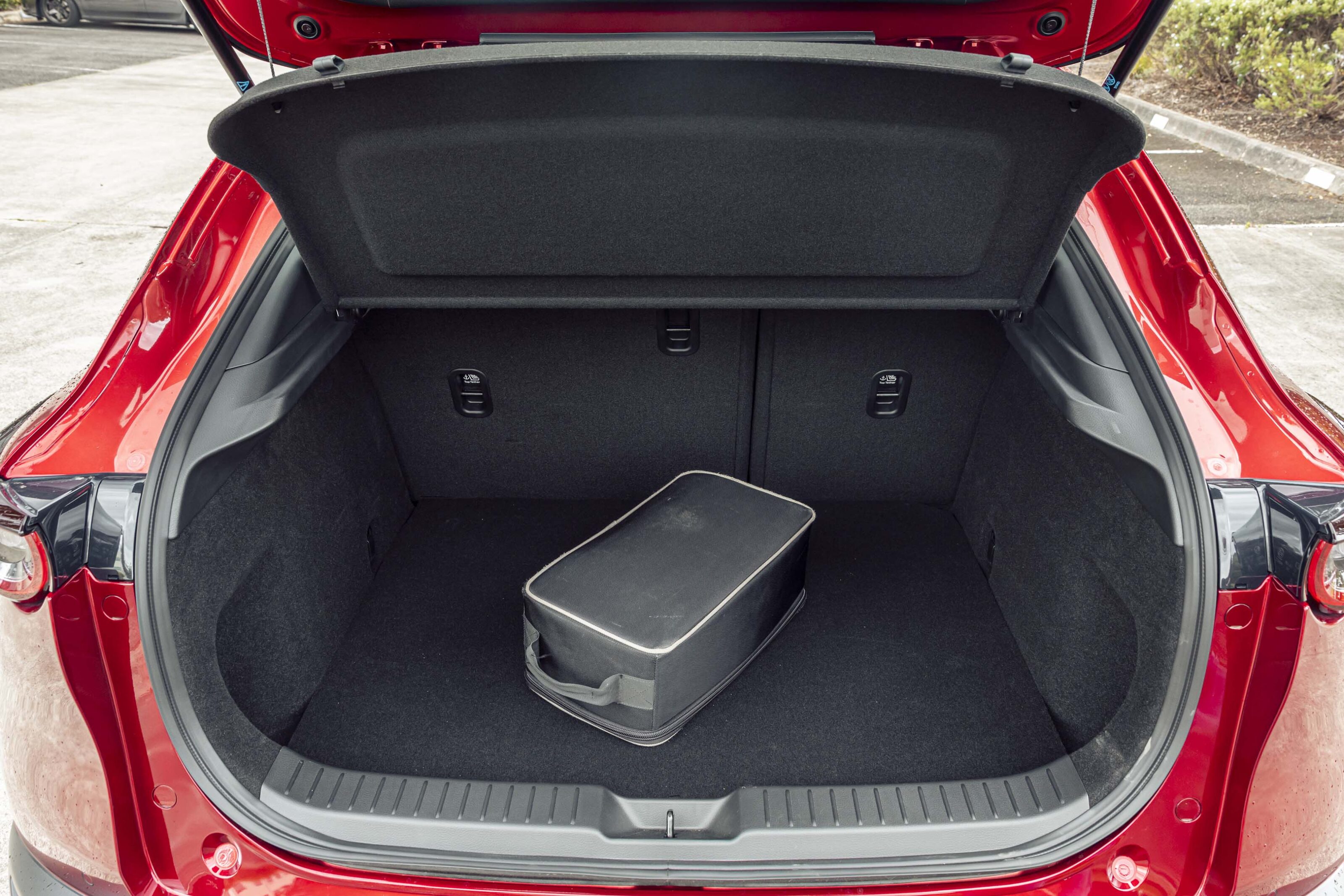
2022 Mazda CX-30 boot space
The boot has a small 317-litre capacity. This compares poorly against the Nissan Qashqai (490L), Toyota Corolla Cross (487L), Honda HR-V (437L) and Kia Seltos (433L), while even the slender Hyundai Kona has a larger 374L capacity.
It’s not all bad, though, as the CX-30 can extend up to 430 litres with underfloor storage. With the 60:40 split-fold second row down, it has a 1406-litre total capacity.
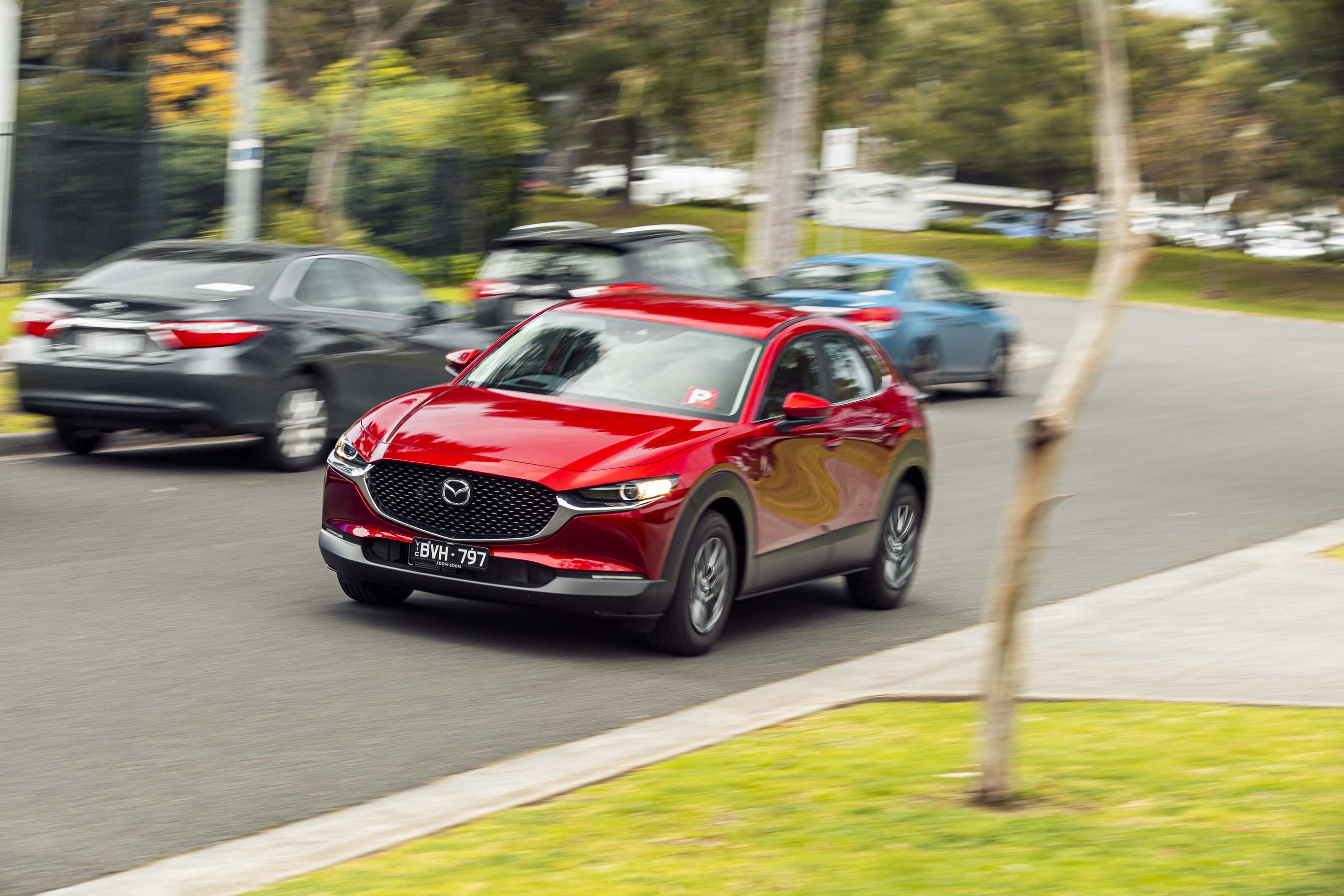
On the road
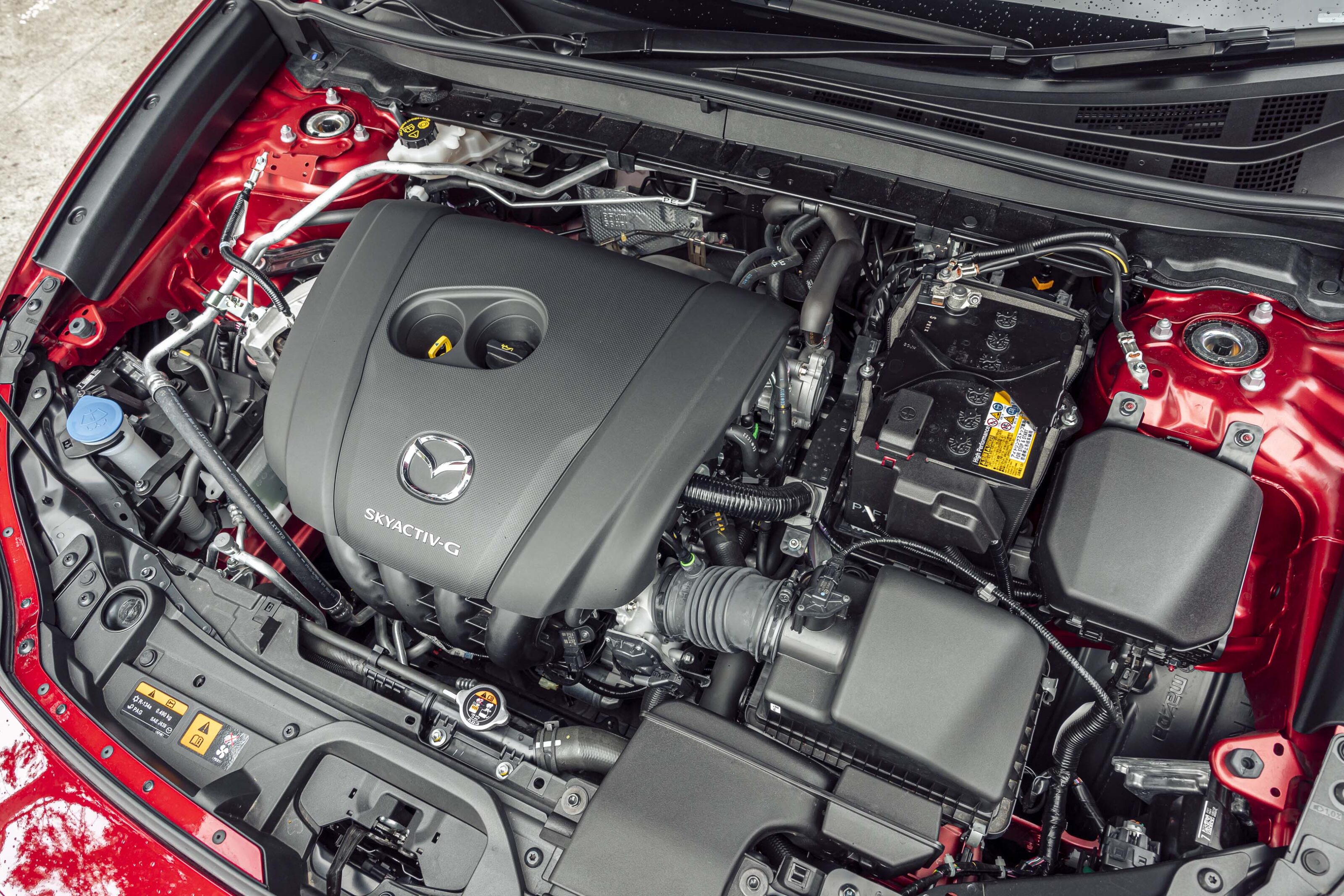
As G20 name hints, the Pure is powered by a naturally-aspirated (non-turbo) 2.0-litre four-cylinder engine.
The engine produces 114kW at 6000rpm and 200Nm at 4000rpm, with a more-powerful 138kW/252Nm 2.5-litre available on G25 grades.
It is compatible with 91RON regular unleaded petrol.
The base 2.0-litre lacks initial punch – which will assist with fuel economy in city driving – but it has a sharp throttle response with decent mid-range performance.
While it’s a sportier tone, the engine note is loud when accelerating, so more insulation would better suit the nature of the CX-30 – especially since wind and tyre noise are pleasantly hushed.
It gets even louder when switching into the Sport drive mode, which seems only to hold the gear ratios, thus requiring more acceleration.
While it doesn’t feel slow, the CX-30 would be more engaging with a lower-capacity turbocharged engine or by stepping up to the more powerful 2.5-litre mill.
The six-speed automatic is a reliable and well-tuned unit, remaining a solid choice compared to other continuously variable and dual-clutch transmissions. However, we look forward to testing Mazda’s modern eight-speed auto in the CX-60 and hope it will filter through to lower models in the coming years.
Mazda’s start/stop system works well. It stops the engine with a solid press of the brake pedal, and restarts almost instantly with little noise or vibration, unlike some other vehicles.
However, the system hardly activated during our time with the car, with a ‘low battery risk’ message at one point and Melbourne’s cold weather requiring more heating.
2022 Mazda CX-30 G20 fuel consumption
Claimed fuel consumption is listed at 6.5L/100km. This is a lower claim than the 7.1L/100km achieved during our time with the car in both urban and highway environments, which seems accurate based on our previous experience with the 2.0-litre engine.
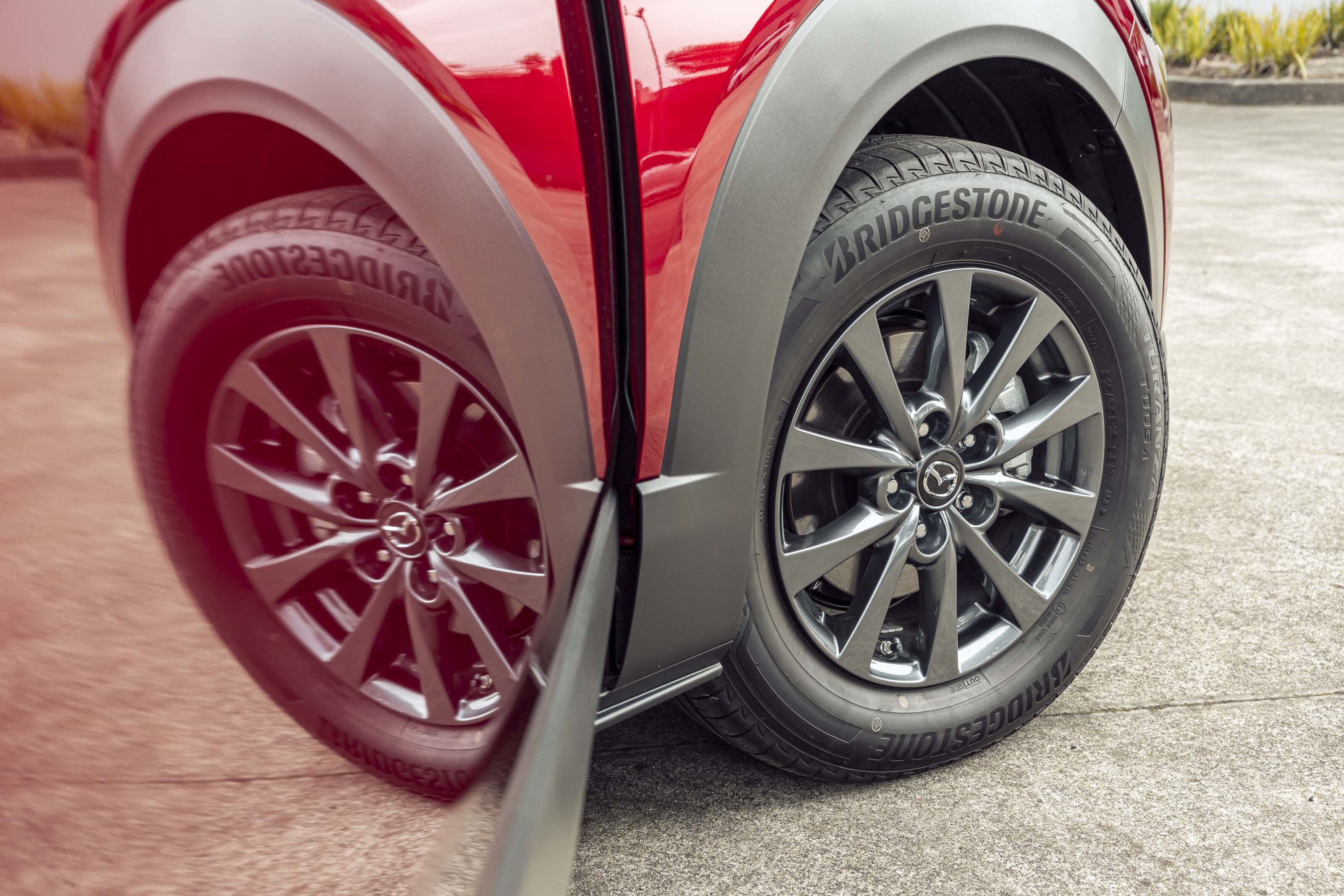
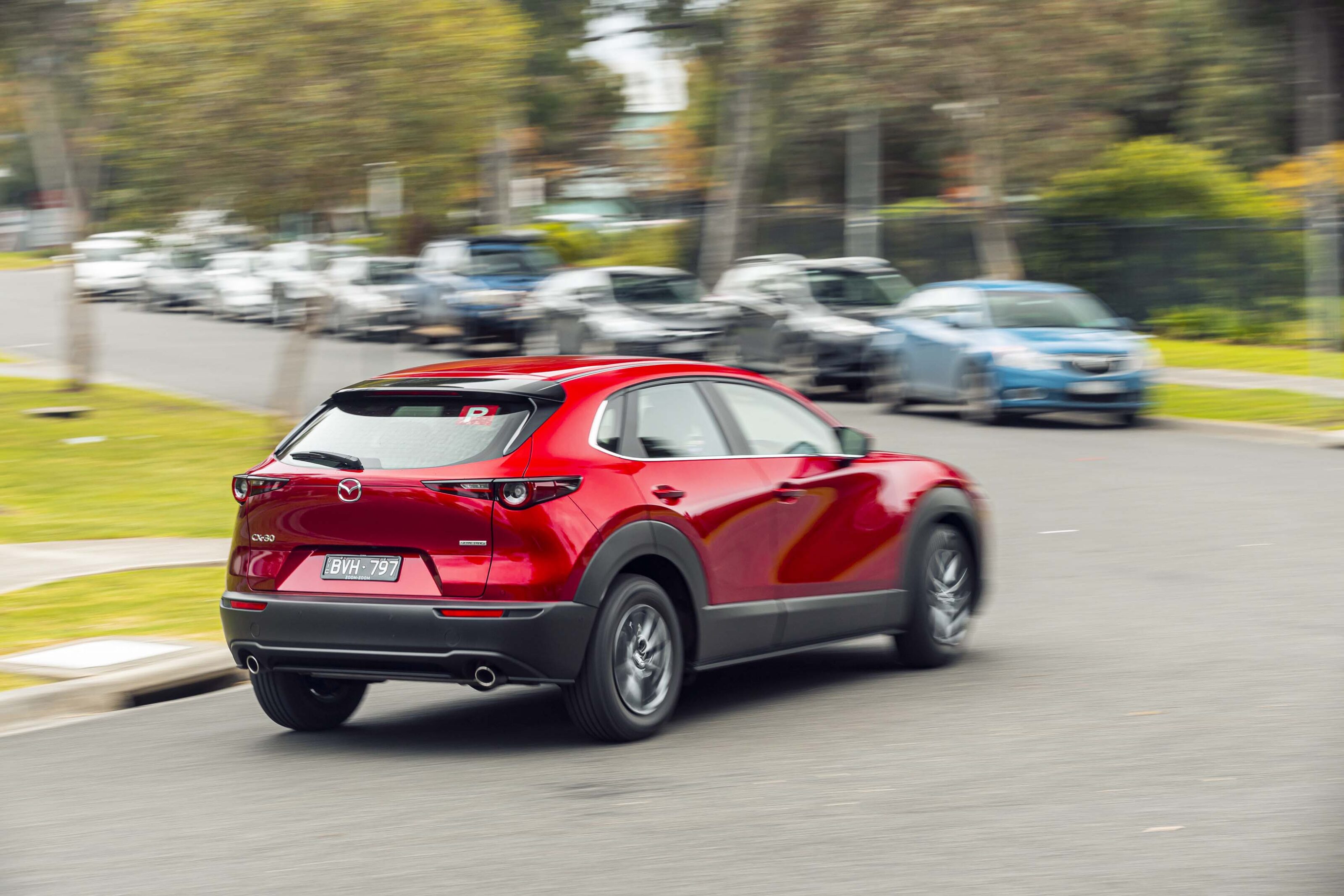
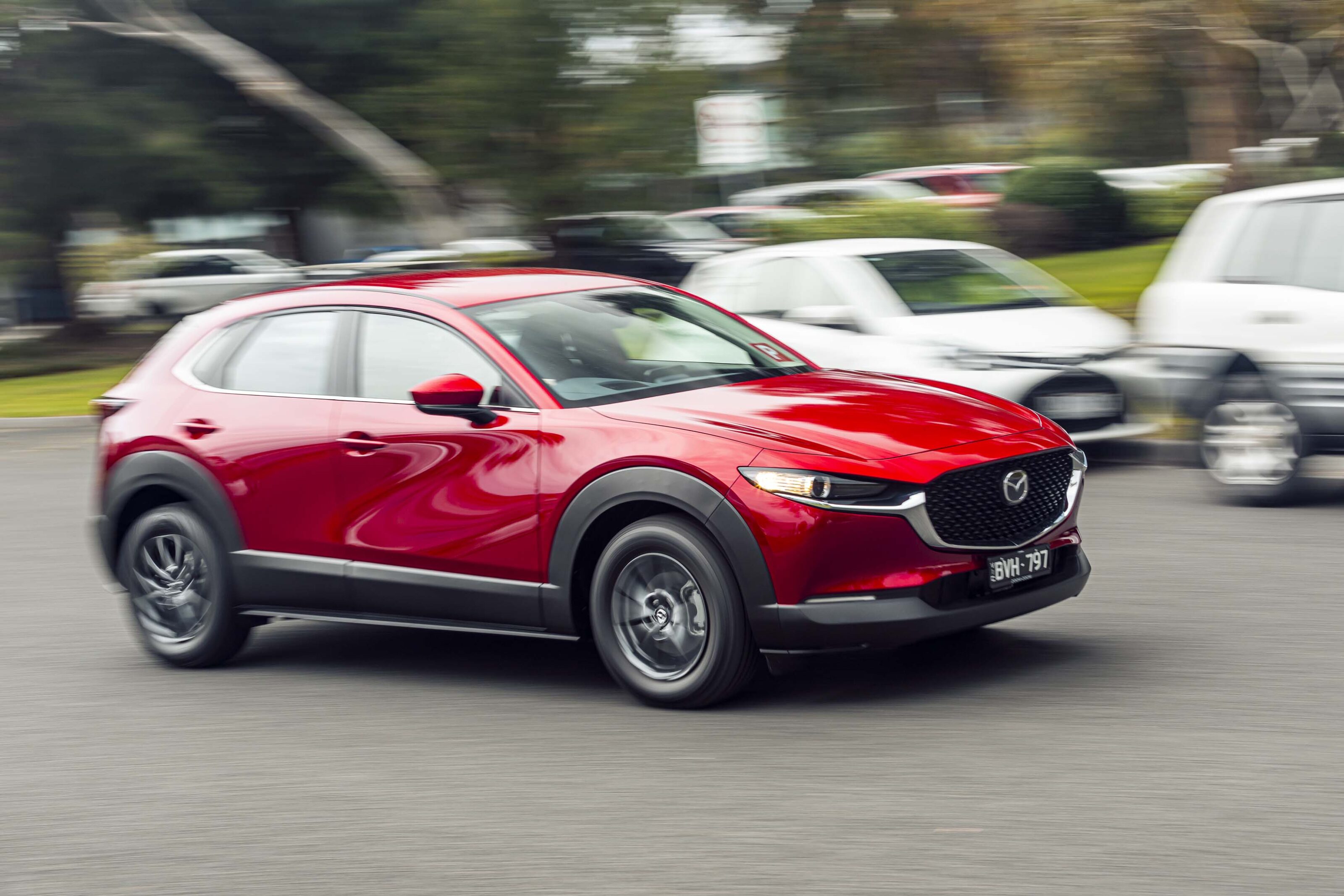
The impression of being a jacked-up Mazda3 hatchback transcends beyond the CX-30’s design. This is no surprise as it retains the same underpinnings. Despite its heavier weight, the small SUV body hasn’t affected dynamics, with the CX-30 feeling just as planted.
Mazda’s engineers focused on retaining its sporting DNA, with a sharp turn-in and sharp, weighty steering. The agile handling is likely to plant a smile on your face; even around tighter bends, there’s minimal body roll and your progress is assisted by a torque vectoring system for enhanced stability.
It has a smooth ride, but the suspension can become fidgety at low speeds and over obstacles such as large potholes or speed bumps. While we could blame this on the torsion-beam rear suspension, the front suspension isn’t perfect either.
Ownership
As with the wider Mazda range, the CX-30 is covered by the brand’s five-year, unlimited-kilometre warranty, with five years of capped-price servicing and roadside assistance.
Maintenance is required every 12 months or 10,000 kilometres, whichever occurs first. This is shorter than most of its rivals, which typically allow 15,000 kilometres between services.
For the first five services, Mazda’s capped-price program will set you back $1732 at an average of $346 per service.
This is not as cheap as the Toyota Corolla Cross petrol ($1025) or Hyundai Kona ($1595 pre-paid), but it is less than the Kia Seltos ($1914).
VERDICT
As the most affordable option in the CX-30 line-up, the entry-level G20 Pure offers an impressive array of standard equipment and backs this up with excellent on-road dynamics for a small SUV. It’s no surprise our judges gave it the coveted COTY win in 2021.
If your budget can stretch a little more, consider the best-value model: the $1700-extra G20 Evolve, which gains 18-inch alloy wheels, dual-zone climate control, paddle shifters, an auto-dimming rear-view mirror, rear air vents and a fold-down centre armrest. Little wonder this is is the top-selling G20 variant.
It’s also worth looking at the G20e Evolve – not for its (very) mild-hybrid tech, but for keyless entry and a powered driver’s seat – or stepping up to the G25 Touring for more power, albeit at additional expense.
Or better yet, the Mazda 3 G25 Evolve SP hatch if you’re prepared to sacrifice the CX-30’s higher ride height and improved visibility. The larger CX-5 should also be shortlisted if you require more space.
The Toyota Corolla Cross Hybrid is also worth a look if you’re seeking a more efficient option.
Young drivers and first cars
More Mazda
2022 Mazda CX-30 G20 Pure specifications
| Body | 5-door, 5-seat small SUV |
|---|---|
| Drive | front-wheel |
| Engine | 2.0-litre naturally-aspirated four-cylinder petrol |
| Transmission | 6-speed torque converter automatic |
| Power | 114kW @ 6000rpm |
| Torque | 200Nm @ 4000rpm |
| Bore/Stroke | 83.5 x 91.2mm |
| Compression ratio | 13:01 |
| 0-100km/h | 10.2s (claimed) |
| Fuel Consumption | 6.5L/100km (combined); 7.1L/100km (tested) |
| Weight | 1438kg |
| Power/Weight | 83.8kW/t |
| Suspension | MacPherson strut (front) / torsion beam (rear) |
| L/W/H | 4395/1795/1540mm |
| Wheelbase | 2655mm |
| Tracks | 1565mm (front and rear) |
| Steering | electrically assisted rack-and-pinion |
| Brakes | ventilated discs (front) / solid discs (rear) |
| Tyres | 215/65 R16 |
| Wheels | 16-inch alloy |
| Price (as tested) | $31,185 + on-road costs |
Snapshot
- An LCV will be the first full electric Peugeot here
- More PHEVs coming
- 408 under consideration
Peugeot’s new 308 Hatch and wagon launch has signalled the start of a number of new models for the famous French marque.
The 308 plugs a long-standing gap in its passenger car line-up after the second-generation model ended production just before COVID-19.
While the brand launched the three-cylinder turbo 308, the first half of next year will see the introduction of the 165kW plug-in hybrid. The price is not yet announced, but with the 308 GT Hatch starting at $43,990 before on-roads, it’s likely to be steep, although there will be some relief in the form of the Federal Government’s electric car discount legislation.
Some good news on pricing did arrive with the new model. Peugeot is now offering prepaid service plans on its models, offering substantial discounts on the capped-price servicing regime. A three-year plan saves $427 over PAYG, while five years saves $689.

Asked whether the 308’s price point might hold it back, local MD Kate Gillis says it’s in line with the brand strategy.
“Where you’ve got the premiumisation of Peugeot, more premium variants sell very well. So when there is something that’s different or something slightly unique with the product, it’s really well received by customers.”
She did add that in the event demand for a cheaper 308 arose, the company would consider it.
Next year will also see the introduction of the 508 PHEV Sportwagon to accompany the already-launched fastback. The 508 range has weathered Peugeot’s sales downturn, which, Gillis said, is largely down to supply rather than an issue with Peugeot’s brand positioning.

“It’s definitely semiconductors and supply, we can see that all throughout the industry. So we’re looking forward to the time when this normalises. I think that we’ll start to see that improvement throughout every part of our business, so I’ve no doubt that with a new line-up, with the new 308 in our range, we’ll see that starting to take effect more or less as soon as it gets to market.”
Gillis put the success of the 508 down to its uniqueness.
“I think it really comes down to what other options there are in the market. Arguably if someone is looking for a vehicle like that in terms of the sporting sort of style of a sedan and the fastback (then) that is appealing to some people so it’s placed very well within the market.
Peugeot delayed the introduction of the 308 until it could guarantee a good supply of the new car to dealers.
Gillis would not be drawn on the previous announcement about the electric LCV coming to Australia next year.
Peugeot has a choice of options from the factory. As with the 508, Peugeot’s Partner LCV has not endured a sharp fall in sales, so that might be it. If the importer can keep the price under the Luxury Car Tax limit, a hefty discount courtesy of the electric car discount and its Fringe Benefits Tax concessions may apply.
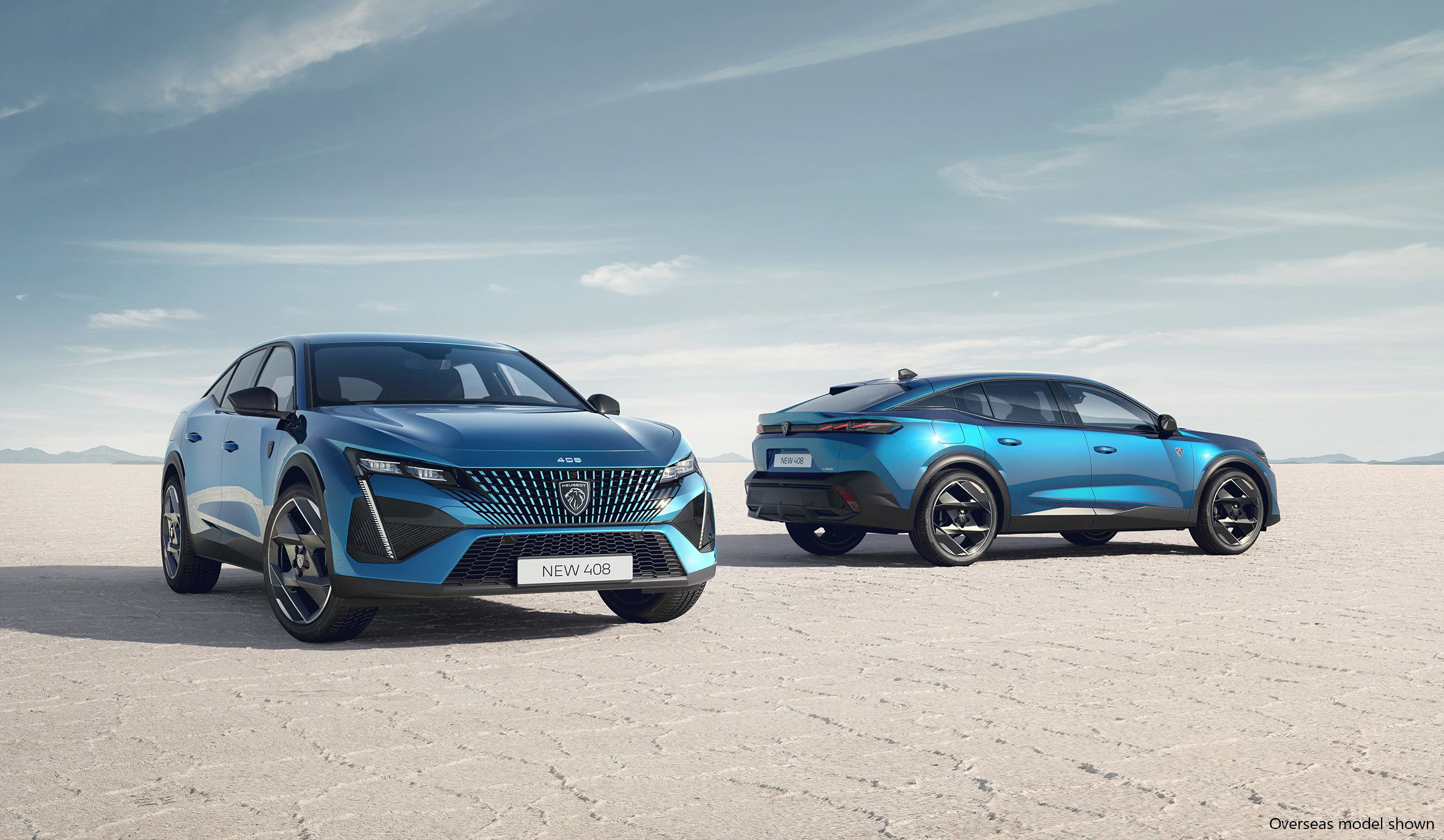
Another model is also under consideration in the form of the recently-released 408. A departure from that model’s previous incarnation, it’s a higher-riding five-door coupe in the vein of the Renault Arkana, although Peugeot says that’s in a different segment.
“At this point we have tabled our interest and consideration for 408 within this market,” said Gillis. “When we start to understand in terms of spec and what we can offer, then we’d start to understand where it sits within our product mix.”
Any potential partnership between Volkswagen Australia and Walkinshaw to produce tweaked next-gen Amaroks locally will have a healthy lead time, the firms have revealed.
The two companies joined forces to produce 2600 Amarok W580 models, which have now ceased production, and are currently in talks about continuing the partnership once the next-gen model arrives Down Under.
However, Aussies keen to get their hands on a next-gen Amarok that has been tweaked by Walkinshaw could be waiting until at least 2025.
As explained by Volkswagen Commercial Vehicles director Ryan Davies, this is to allow for the lead times required to develop the new variants.
December 7: NEW AMAROK DRIVEN! Words & Video
We’ve finally driven the new-gen 2023 Volkswagen Amarok, with Jez jetting (Jet jezzing?) to South Africa for a world’s-first spin in the new ute. Get our full story below.
Story continues
Walkinshaw-fettled next-gen Volkswagen Amaroks not likely until late 2024
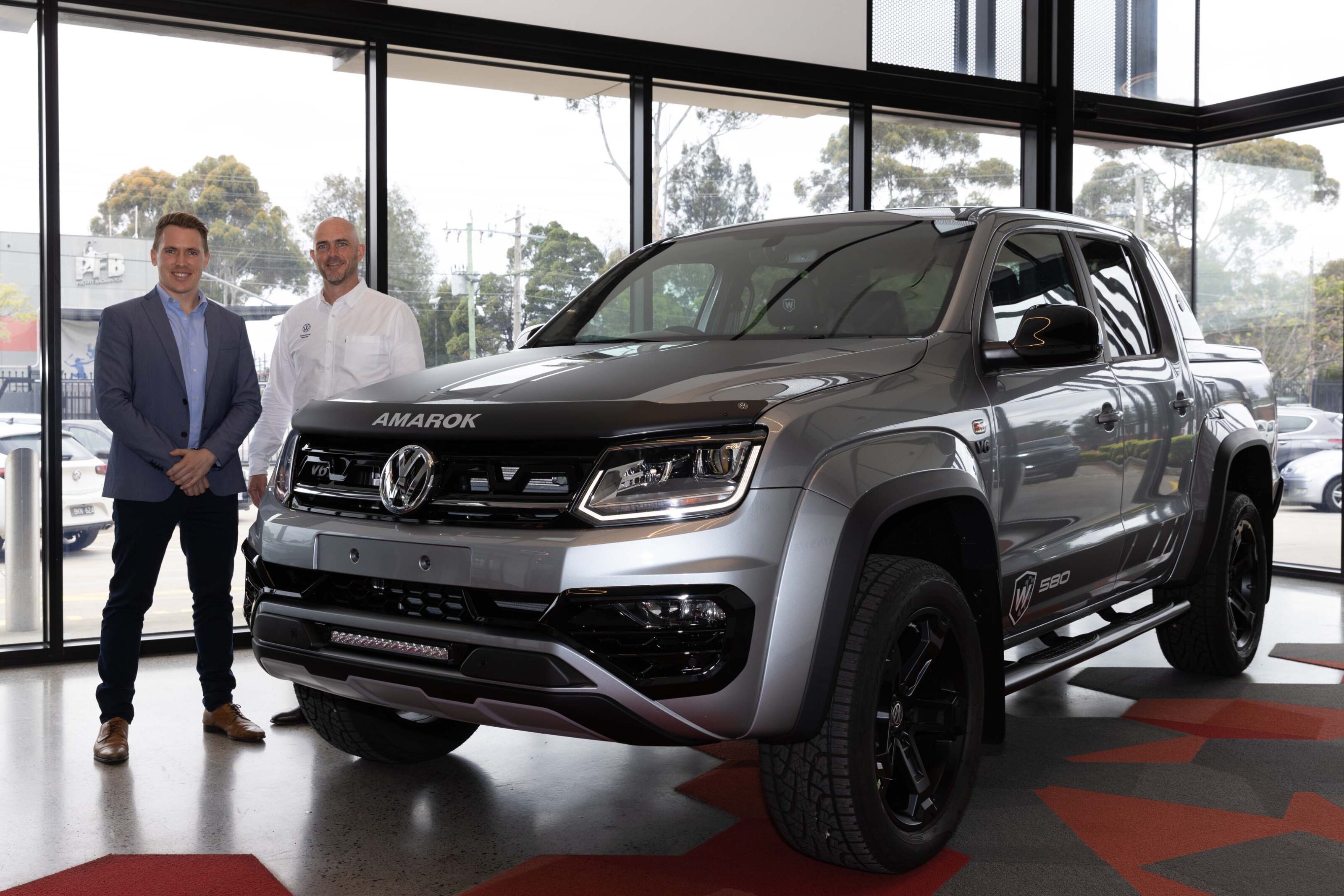
“We have both got appetite to continue the program, and we want to look toward formalising something in the coming months,” Davies told Wheels.
“With the long lead times that are necessary for a program like this, we will have a couple of years to dwell on what we can make work, if it comes to fruition.”
When pressed on when exactly we could expect a Walkinshaw Amarok back in the local line-up if a deal is made, Davies revealed it depends on when exactly cars arrive in the country.
“The timeline really depends on the development times and how long it takes to get the components, etcetera, that we would necessarily need to get the program up and running,” he said.
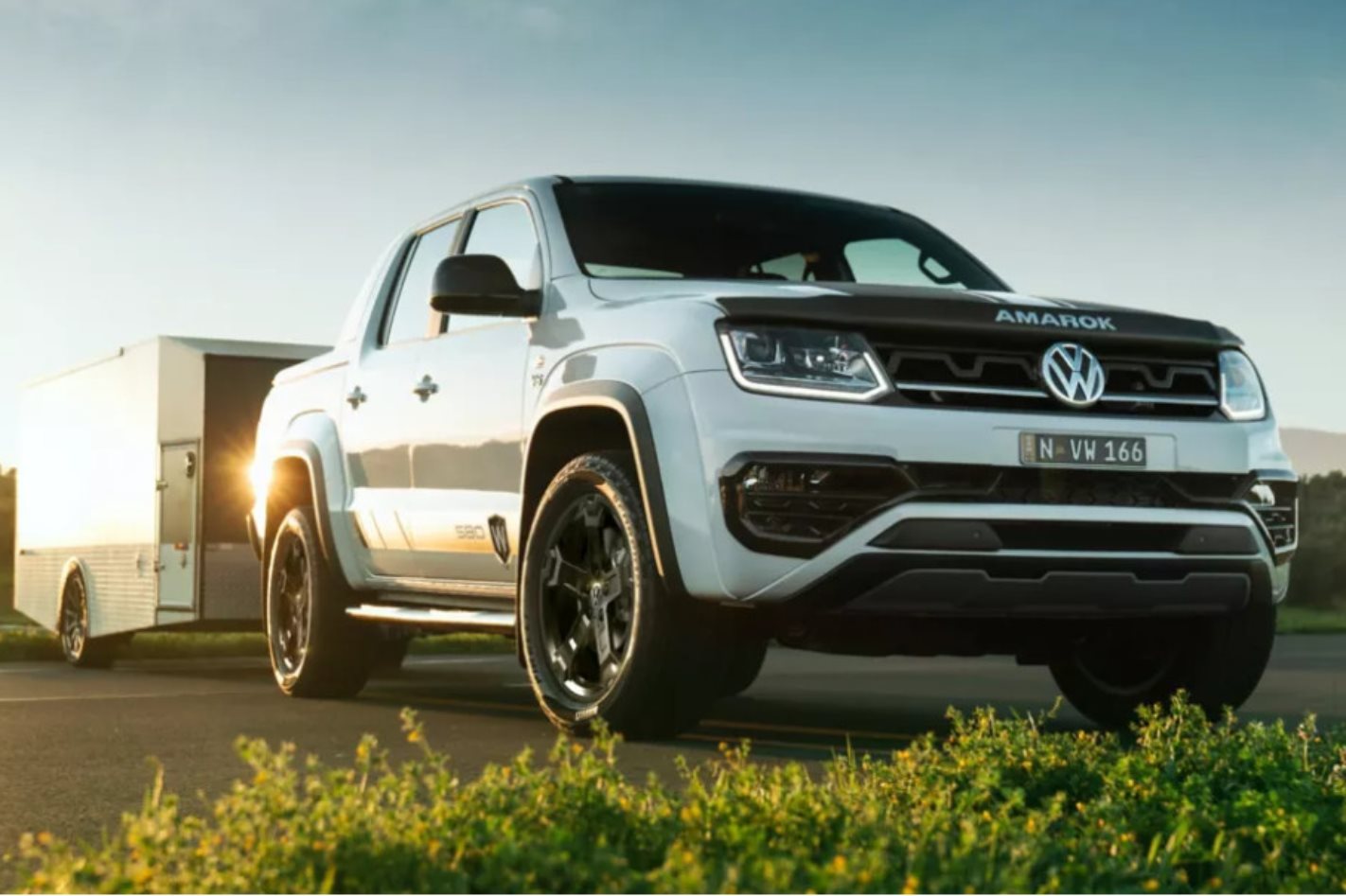
“That means that we need to have cars arrive here and be ready for development work, and that won’t happen until the first quarter, early second quarter next year [2023].
“Best case scenario you are talking about 18 months from that point onwards.”
With an 18-month minimum wait from Amaroks landing in Australia, that puts a likely launch in the ballpark of late 2024 or early 2025 at best.
Again, this would require an official program to be signed off, but both Walkinshaw and Volkswagen Australia were positive about a potential future deal when speaking to Wheels.
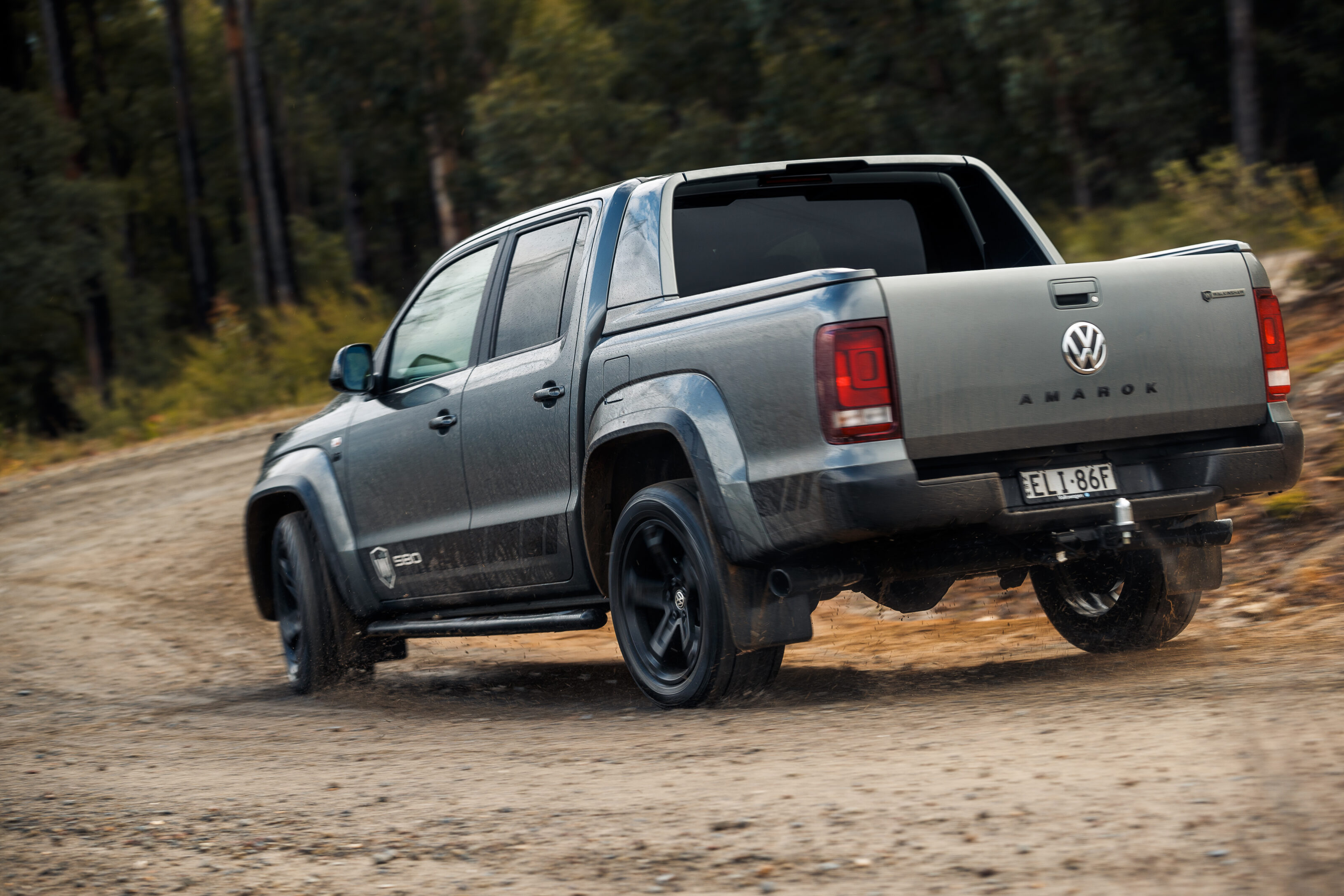
Walkinshaw Automotive Group director Ryan Walkinshaw said he has enjoyed the current partnership which produced the Amarok W580 variants.
“The relationship with Volkswagen has been fantastic. You never really know until you are already in bed with someone what it is going to be like,” he enthused.
“Right from the start the relationship was very synergistic and very collaborative. We worked very closely on the product we wanted to create. There is a lot of mutual respect between the two groups.”
? MORE 2023 AMAROK
Get all of our latest stories in one handy place, with our Everything You Need to Know article at the link below.
MetaCritic. The cultural battleground of the terminally online, the unshakeable arbiter by which all visual media is judged. (Although you may prefer Rotten Tomatoes for TV and movies…)
When it comes to video games, MetaCritic (MC) is the go-to for a quick verdict on which game to buy next. So, to help you decide on racing games, we scoured the aggregate site’s entire archive, calculated the averages, and now present to you the top ten car racing video game series of all time.
But, first, we had to establish some parameters in order to not make this whole venture impossibly chaotic.
We decided there had to be at least three installments for a franchise to be considered (sorry, Rallisport Challenge fans), and that we’d be limiting it to franchises where the racing of cars was the focus, so no F-Zero or Driver, or what have you.
All titles in a franchise which had an aggregate MC score would be included, as would all platform ports of each installment. Did a series see a number of poorly received handheld spinoffs or terrible DLC expansions? They’re counted and will affect the ratings.
Also of course as MetaCritic has only been around since 1999, nothing from the glory days of offline gaming and print magazines would really be included.
With those points in mind, let’s get to it!
10. MotorStorm
Six entries with a combined MC average of 78.6667

The Mountain Dew Baja Blast of racing games, Sony’s MotorStorm series saw five installments land between 2006 and 2012 to consistently good-not-great reviews.
The fourth in the series, MotorStorm Apocalypse, was the last home console installment and suffered at launch due to an 11th-hour delay in response to sensitivity concerns surrounding the 2011 Tōhoku earthquake and tsunami, which occurred during the same month.
Apocalypse’s weaker reception critically and commercially spelled the end of the series as a AAA title, with the smaller-scale MotorStorm RC closing out the series a year later.
9. GRID
18 entries with a combined MC average of 79.3333
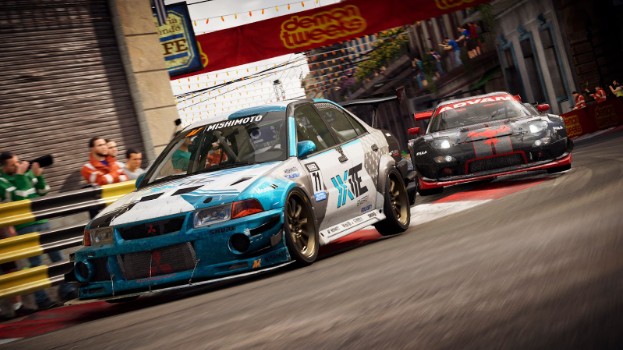
Since its 2008 debut with Race Driver: GRID, the GRID franchise has been a quiet success for racing game titans Codemasters across its five installments.
The most recent entry, 2022’s GRID Legends, saw the series’ story mode presentation shift delightfully to a live-action video style modeled on Netflix’s Formula 1: Drive to Survive documentary series.
Legends publisher Electronic Arts made the dubious decision to release the game one week prior to the years-hyped Gran Turismo 7 – a move that we really hope won’t impact the series or its developer.
8. Midnight Club
13 entries with a combined MC average of 79.6923
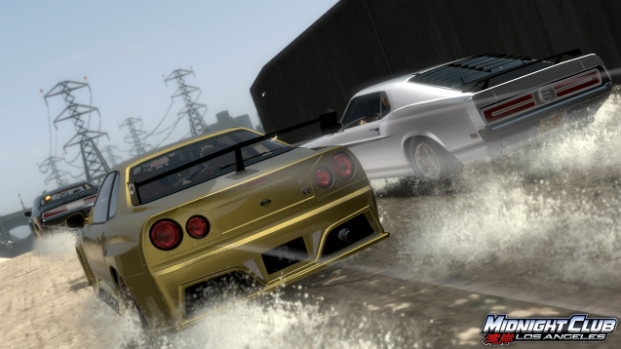
Rockstar’s street-racing franchise was a mainstay of the sixth and seventh generation of consoles but went dormant in 2009 following the release of Midnight Club: Los Angeles Complete Edition.
It’s hard to imagine we’ll see a revival now that the company is so focused on counting its utterly bananas GTA Online profits, and considering how nasty their recent ‘definitive editions’ of the Grand Theft Auto games from Midnight Club’s same era was, maybe it’s for the best that we don’t see a re-release either.
7. Gran Turismo
11 entries with an MC average of 80
Somehow not the top-ranked series?!
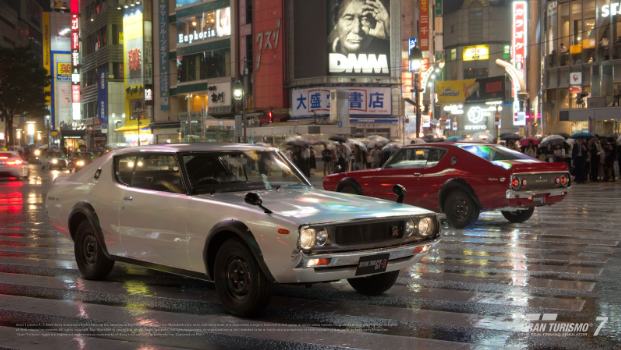
Arguably the most iconic driving title since games consoles made the jump to 3D, Gran Turismo will celebrate its 25th year this December.
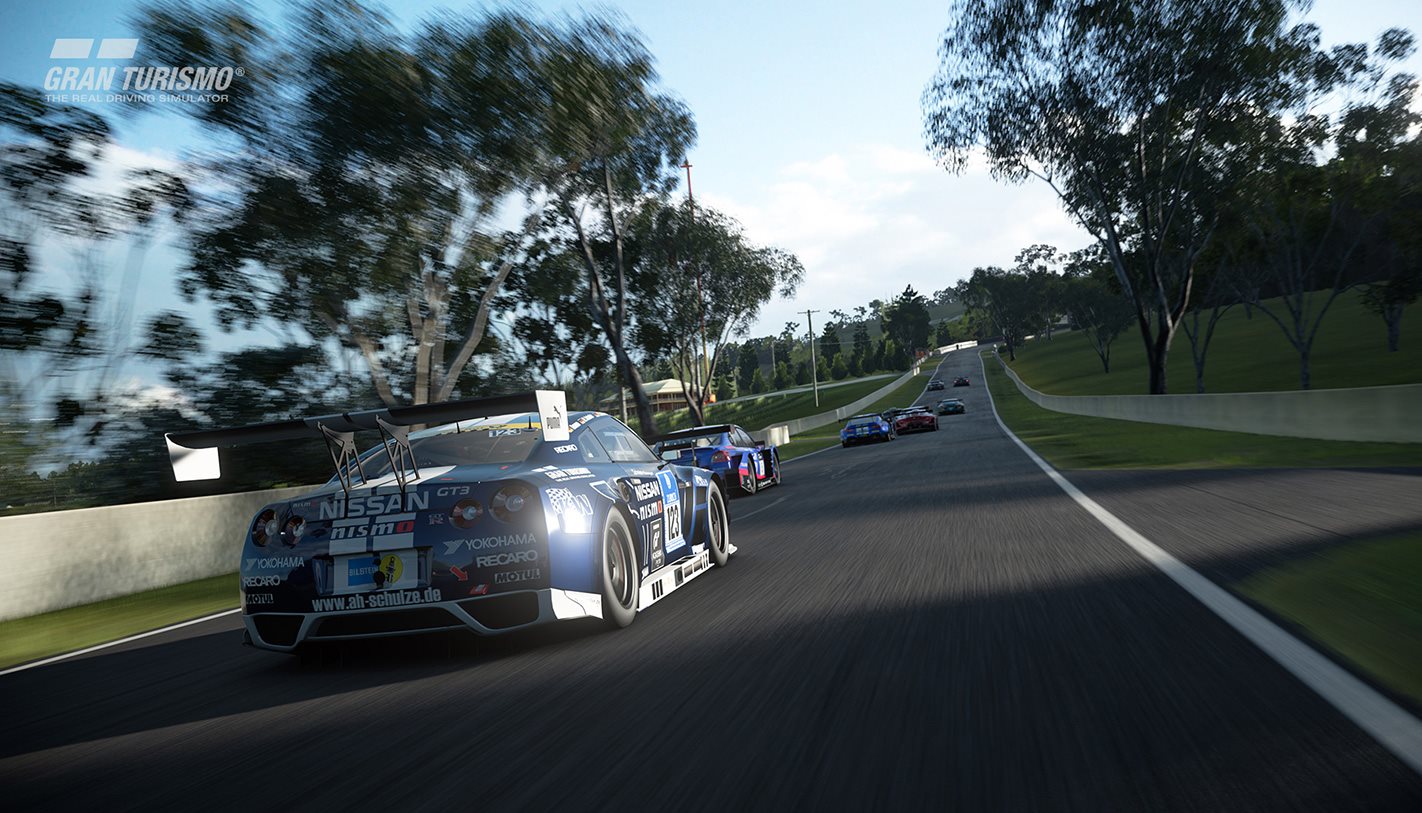
Despite fans being forced to endure painstakingly long periods between installments, (seven core titles in 25 years!), developers Polyphony Digital always manage to push the technical bounds of PlayStation hardware so far above and beyond what anyone would think possible that the wait tends to be worth it.
You’d be forgiven for looking at screenshots of even the PlayStation 3 installments and thinking they’re real-world photographs.
With over 420 cars available at Brand Central* and the Used Car Dealership* from day one, Gran Turismo 7 recreates the look and feel of classic motors and bleeding-edge supercars alike in unparalleled detail. Each car handles differently and feels unique as you navigate over 90 track routes in dynamic weather conditions, including classic courses from GT history.
*Internet connection required to download.
6. Burnout
24 entries with a combined MC of average 80.7917
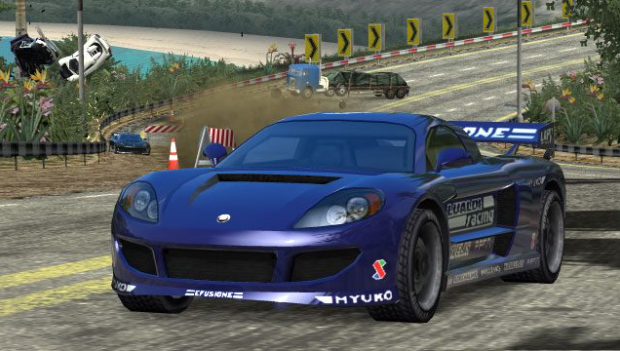
I miss Crash Mode. I miss it a lot.
Burnout Paradise remains a wonderful game even almost 15 years on, and I’m extremely glad that it’s continually been ported and updated to modern consoles, including just 18 months ago on the Nintendo Switch. Hot damn do I miss Burnout 3: Takedown’s Crash Mode though. IYKYK. ?

THE DEFINITIVE BURNOUT PARADISE EXPERIENCE Fully remastered and meticulously recreated, Burnout Paradise Remastered delivers the complete original game and all additional main DLC packs ever released, including the Cops and Robbers pack, Legendary Cars, Burnout Bikes, and Big Surf Island, with new locations, challenges, and vehicles to discover
5. Colin McRae Rally / Dirt
34 entries with a combined MC average of 80.9

Codemasters’ venerable rally simulator has been a cornerstone of the racing game genre for five console generations. The UK developers were acquired in 2021 by publisher EA who, based upon changes to the game’s official social media accounts, appear to be rebranding the franchise as EA Sports Rally. Let’s just hope the financial demands of their new American parents don’t turn Codemasters’ baby into annualized sludge.
4. TOCA Race Driver
5 entries with a combined MC average of 82.8

Another one from Codemasters! It’s almost like they’re the… masters… of quality racing games. ?
The series saw 6 installments between 1997 and 2006 but shed its touring car racing focus with the fourth entry, TOCA Race Driver. In Australia the series even dropped its entire name from this point forward and was fully rebranded as V8 Supercars.
3. Forza Motorsport / Forza Horizon
26 entries with a combined MC average of 83.6154
(Xbox fans cheer, crowd goes wild, etc.)

Xbox’s flagship racer since 2005, the Forza series has managed to stay fairly fresh for over 15 years through the wise decision to alternate releases between the simulation-focused Forza Motorsport and the more arcadey Forza Horizon.
Impressively, every installment released on both sides of the brand have managed to be both critical darlings and commercial powerhouses, and we absolutely can’t wait for the eighth Motorsport to land next year.

Lead breathtaking expeditions across the vibrant and ever-evolving open world landscapes of Mexico with limitless, fun driving action in hundreds of the world’s greatest cars.
2. Real Racing
4 entries with a combined MC average of 85.75
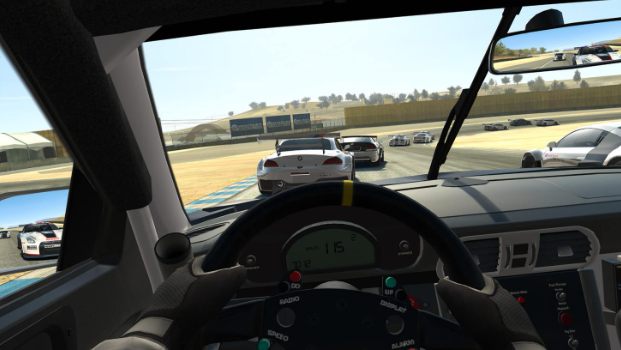
An icon of Melbourne game development, Firemonkeys’ Real Racing series set a benchmark for smartphone gaming in a time when ‘smartphone gaming’ was barely even a thing.
Real Racing 3 ushered in a controversial pivot for the series, completely redesigning it as a ‘freemium’ experience when its predecessors were lauded for being ‘complete’, feature-rich experiences available for a relatively small one-time purchase price.
Amidst mass layoffs dictated by parent company EA, Real Racing 4 was cancelled in 2019 before even being announced. A new installment titled Real Racing Next was unveiled a year ago to heavy criticism at its further push toward heavy microtransaction and season pass monetisation. It still has yet to be released.
1. Metropolis Street Racer / Project Gotham Racing
5 entries with a combined MC average of 87
Did you see this one coming?
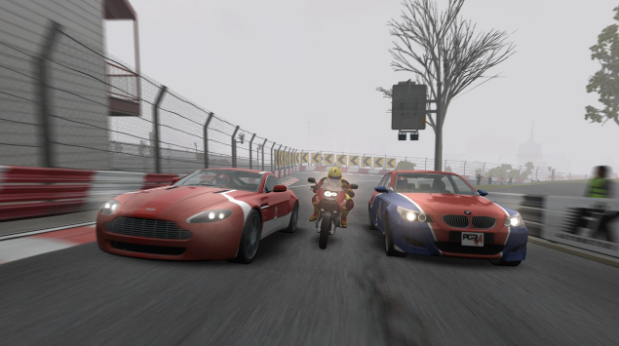
The flagship racer of the Xbox and Xbox 360, way back in the day, Bizarre Creations’ Project Gotham Racing was a critical and commercial powerhouse during the early 2000s.
Its in-series Dreamcast predecessor Metropolis Street Racer met with a glowing reception too, but suffered under an exclusivity deal for Sega’s dying console.
PGR was lauded in its day for its ‘Kudos’ system, which rewarded and progressed players not just for coming in first place, but for driving with as much flair and skill throughout a race as they could.
The franchise might have even continued beyond PGR4, had Bizarre not been bought by Activision in 2007 and shuttered in 2011.
What do you think of this ranking? Tell us your top 10 in the comments below.
The recently revealed 2023 Toyota Prius marks the significant fifth-generation of Toyota’s original plug-in pioneer.
With, as yet, no plans for an Australian arrival, the stylish new Prius will debut overseas in North American, European and Japanese markets with a variety powertrain configurations – including both conventional and plug-in hybrid systems.
The most powerful layout newly developed 2.0-litre engine, augmented by a 13.6kWh lithium-ion battery pack and several electric motors, powering all four wheels with a combined 164kW output.
A claimed 0-100km/h time of 6.7 seconds makes this the fastest Prius yet, and just a precious few tenths off Toyota’s current combustion sports offering, the GR86.
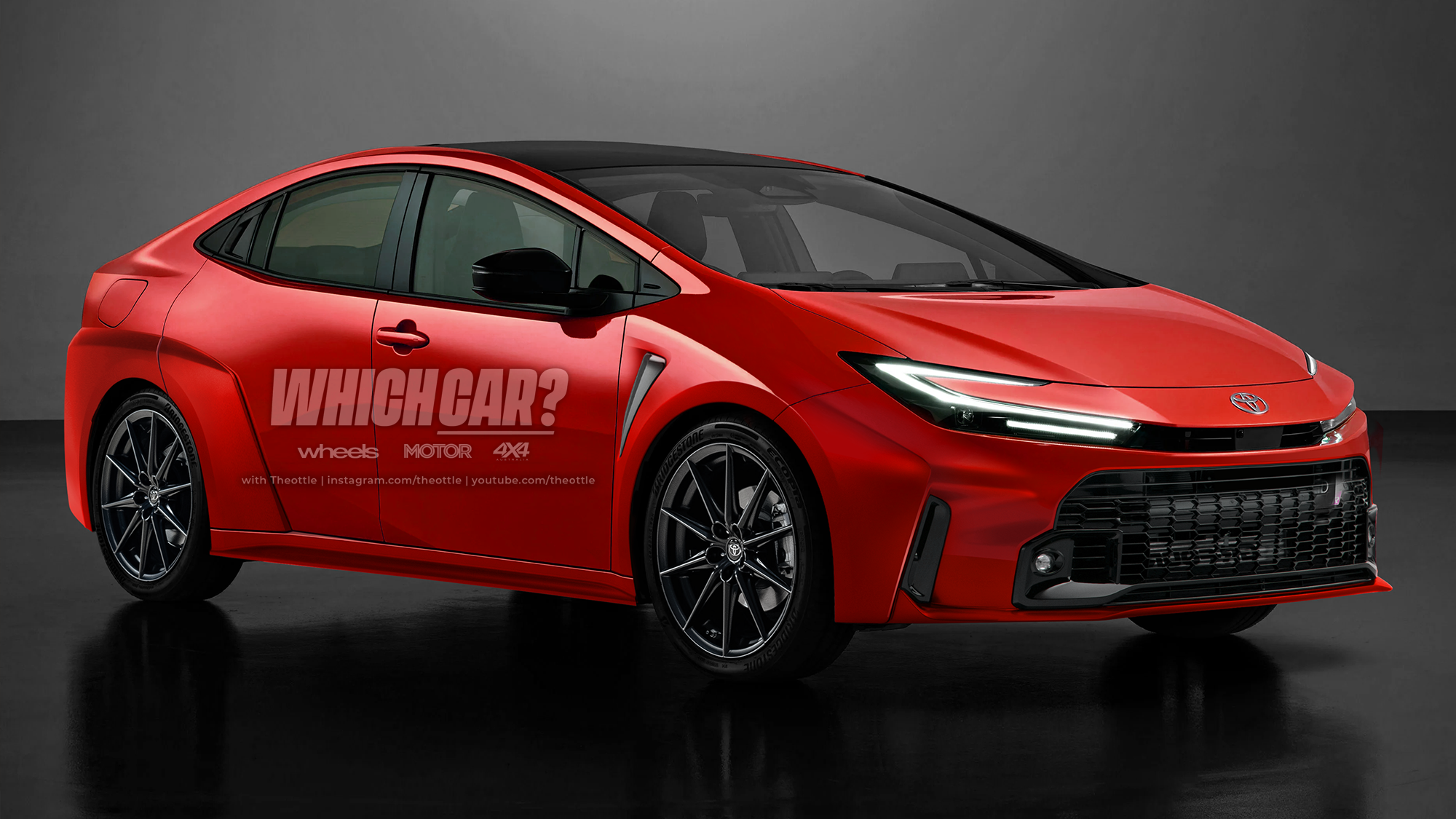
That got us wondering, what might a proper GR-developed Toyota Prius look like?
These rendered images, created by digital artist Theottle, shine a light on exactly what we’d hope for.
The pumped-up Prius looks like a lovechild between the forthcoming Toyota GR Corolla and the sleek new Prius. Once we began digging under the skin – is this really such a stretch of the imagination?
The 2023 Toyota Prius is underpinned by Toyota’s TNGA-C platform, the very same platform underpinning the new GR Corolla.
This suggests that Toyota’s bombastic 1.6-litre turbocharged three-cylinder could feasibly be set in the Prius’s engine bay without drastic further development, illustrated by GR’s signature triple exhaust system and cheeky intercooler visible from behind the front grille.
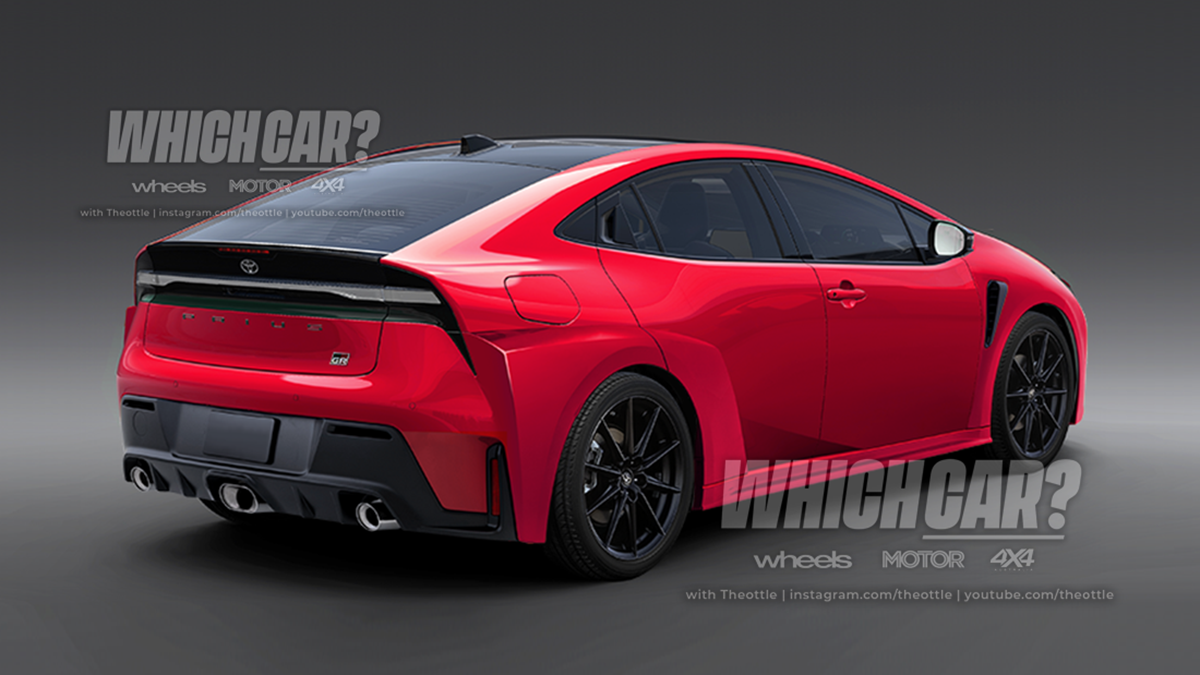
Were Toyota to augment this flexible little unit with hybrid assistance, possibly acting as a low-end torque fill, a performance-oriented Prius could be a shockingly quick thing.
Further considering the Prius’s taught chassis, improved battery location and weight distribution, and a versatile MacPherson front/double wishbone rear suspension setup – there are more makings of a sports car in Toyota’s traditional hypermiler than you might initially think.
Sadly, Toyota Australia currently has “no plans to introduce the new Prius to the Australian market“, and has yet to officially comment on whether there are any further GR products in the developmental pipeline.
We can never say never, though, and Toyota Japan’s growing catalogue of GR Sport part upgrades, including chassis bracing and suspension tuning components, for the Japanese market Prius suggest there is some appetite for a more dynamic hybrid product.
What would you think of a Toyota GR-developed Prius? Leave your thoughts in the comments below!
Snapshot
- First alleged spy shots of BYD electric ute shown-off
- Unclear whether itu2019s PHEV or BEV, but likely sold under spinoff brand
- Local distributor says itu2019ll land in Australia
A new spy photo in China has given the first glimpse of an alleged BYD electric ute – and it could be coming to Australia.
Since the Shenzhen automaker now only produces electrified plug-in hybrids and pure battery-electric vehicles, it’s unclear whether the mid-sized ute will be offered in both powertrains or just the latter.
But, the Chinese-made electric ute may fall under either BYD’s new upmarket Yangwang spinoff or separate yet-to-be announced sub-brand that’ll both launch next year.

The heavily camouflaged spy shot doesn’t give much away of the purported BYD dual-cab pickup, besides an opening at the front-left fender where the charge port could sit.
BYD electric cars are sold in Australia via independent distributor EVDirect. But, it’s been a rocky start after several backtracking moves and implementing odd specific warranty exclusions on the Atto 3 small crossover that’s currently on sale priced from $44,381 before on-road costs.
“It’s real,” EVDirect chief executive Luke Todd told Wheels previously.
“It’s under development and I’ve seen it. We’d be looking to open pre-orders for it in 2023, for deliveries in late 2023.”
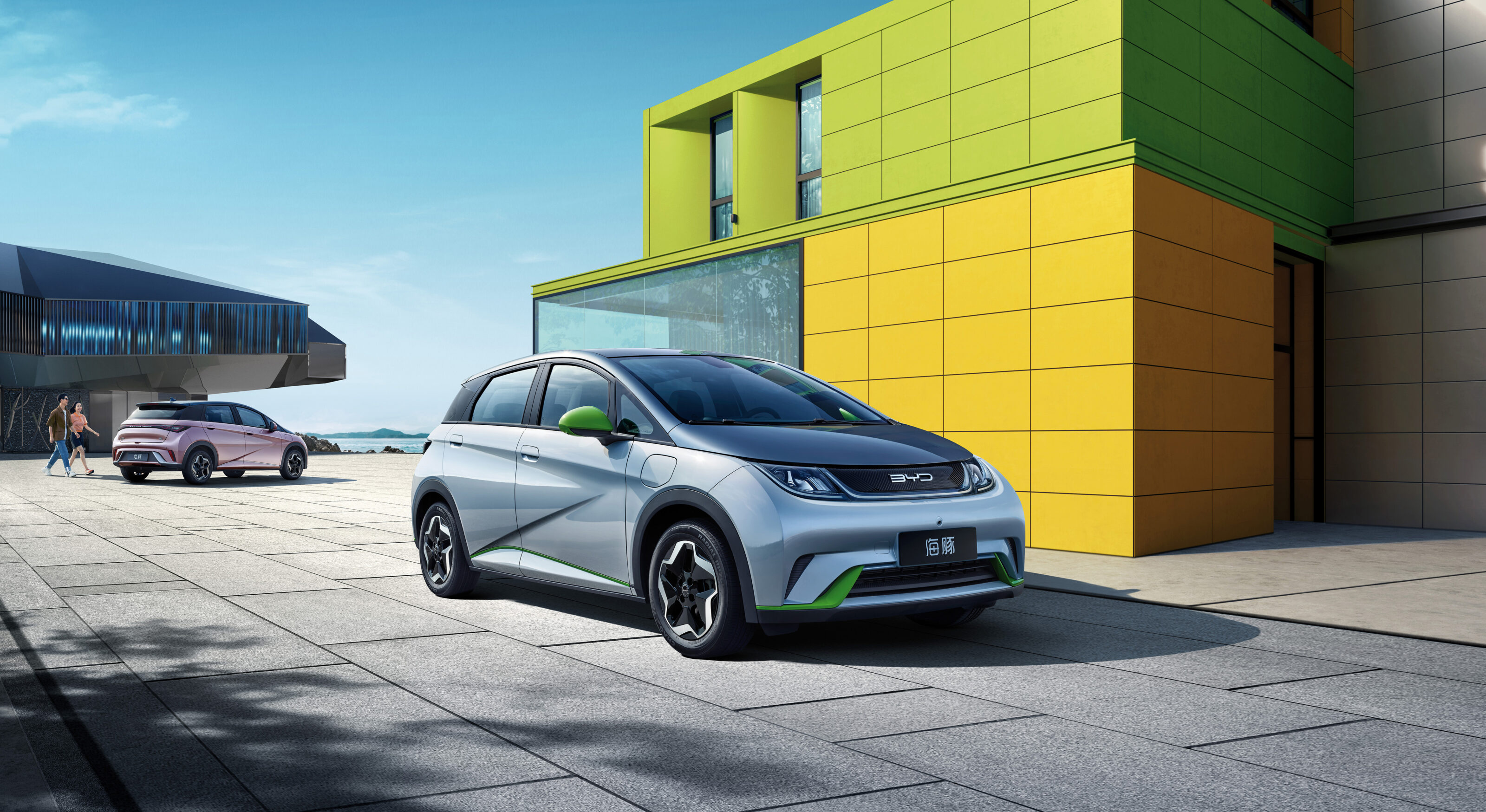
However, EVDirect is expected to sell the BYD Dolphin small hatchback and Seal sedan next year first, before focusing on other products in the pipeline.
If it does arrive in Australia, it’ll directly compete with the LDV eT60, Australia’s first full-electric ute at $92,990 before on-roads, and vye against popular combustion-engined ute models like the evergreen Toyota HiLux, Ford Ranger and GWM Ute, plus Brisbane startup Roev that’ll soon offer an electric conversion kit for the former two for fleets.
If you want an electric ute in Australia and you’re tired of waiting for an announcement, a new option is set to become available next year – and the startup has committed to convert 1000 utes in the first 12 months.
Snapshot
- ROEV electric ute conversions cost $47,990 to $57,990
- Two battery packs, up to 360km range and V2L power station capability
- Initially available to fleets only, starting as soon as Q2 2023
Brisbane-based startup ROEV has announced a fully-electric conversion of the Toyota HiLux and Ford Ranger utes will cost from $47,990 on top of the vehicle price. But, it’ll only be available for fleet customers only at launch.
The electric ute conversion kit is available for all body styles of the internal combustion engine (ICE) HiLux and Ranger spanning 2016 to 2022 model-years, and 4×2 or 4×4 variants. Fleet customers can retain existing accessories fitted to their vehicles.
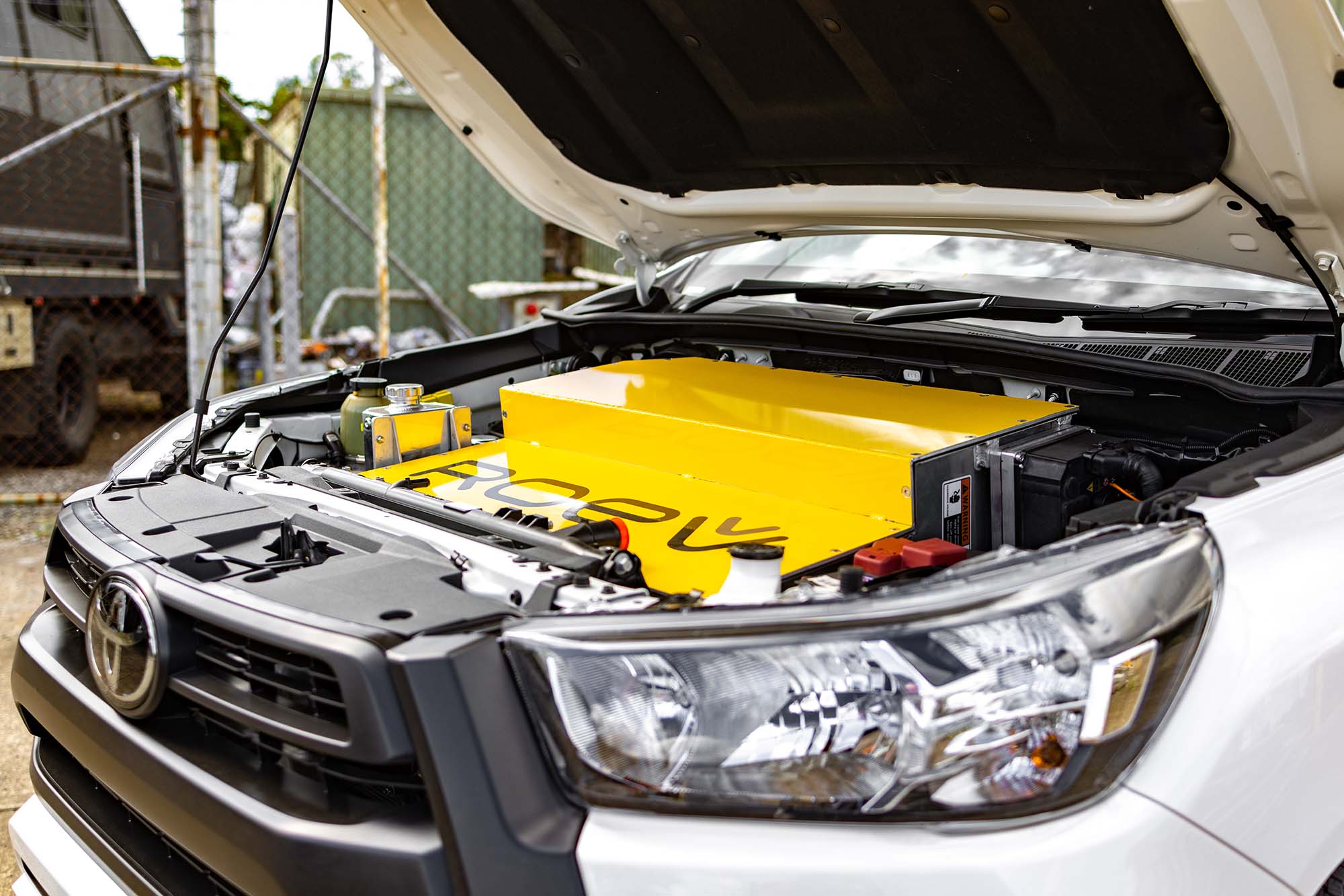
The standard-range battery pack is a 64kWh unit offering a claimed range of up to 240km on a full charge. It’s priced from $47,990 to $51,990 for the conversion. The older the model, the pricier the ICE to EV retrofit gets.
Meanwhile, the large extended-range battery pack is 96kWh in capacity with a claimed driving range of up to 360km, costing $53,990 to $57,990 depending on the model-year.
All can be recharged at up to 11kW AC and 80kW DC using the standard Type 2/CCS2 charging connector.
The retrofitted electric utes are also capable of vehicle-to-load (V2L) for using the large battery packs as a mobile power station to power tools and charge devices via a 240-volt, 20-amp socket.
ROEV (Renewable Optimised Electric Vehicles) is also planning for vehicle-to-home (V2H) and vehicle-to-grid (V2G) bidirectional charging in the second version, so EVs can act as a home battery storage system to save household electricity costs and be a backup source during blackouts.
https://www.facebook.com/RoevCo/videos/476427090719393/
How much is the electric Toyota HiLux and electric Ford Ranger conversion?
NOTE: The prices below are on top of the purchase price of the vehicle itself.
| HiLux/Ranger Base Vehicle | Standard Range | Extended Range |
|---|---|---|
| 4×2 MY20-22 | $47,990 | $53,990 |
| 4×2 MY16-19 | $48,990 | $54,990 |
| 4×4 MY20-22 | $50,990 | $56,990 |
| 4×4 MY16-19 | $51,990 | $57,990 |
The only original equipment manufacturer (OEM) electric ute on sale in Australia is the LDV eT60, which costs from $92,990 before on-road costs.
How does the LDV eT60 compare on price to buying and converting a HiLux or Ranger?
For context, the petrol-powered 2022 Toyota HiLux Workmate in cab chassis 4×2 guise with a manual transmission starts from $24,225 before on-roads. Opting for the standard range conversion totals $72,215 overall.
Or if it’s the outlandish 2022 Ford Ranger Raptor that costs from $85,490 before on-roads, choosing the extended range will land it at $142,480 in total.
And, it’s worth noting that many ROEV customers may have existing utes on their fleet suitable for conversion, with the purchase price already accounted for.
When will ROEV’s electric HiLux and electric Ranger conversions start?
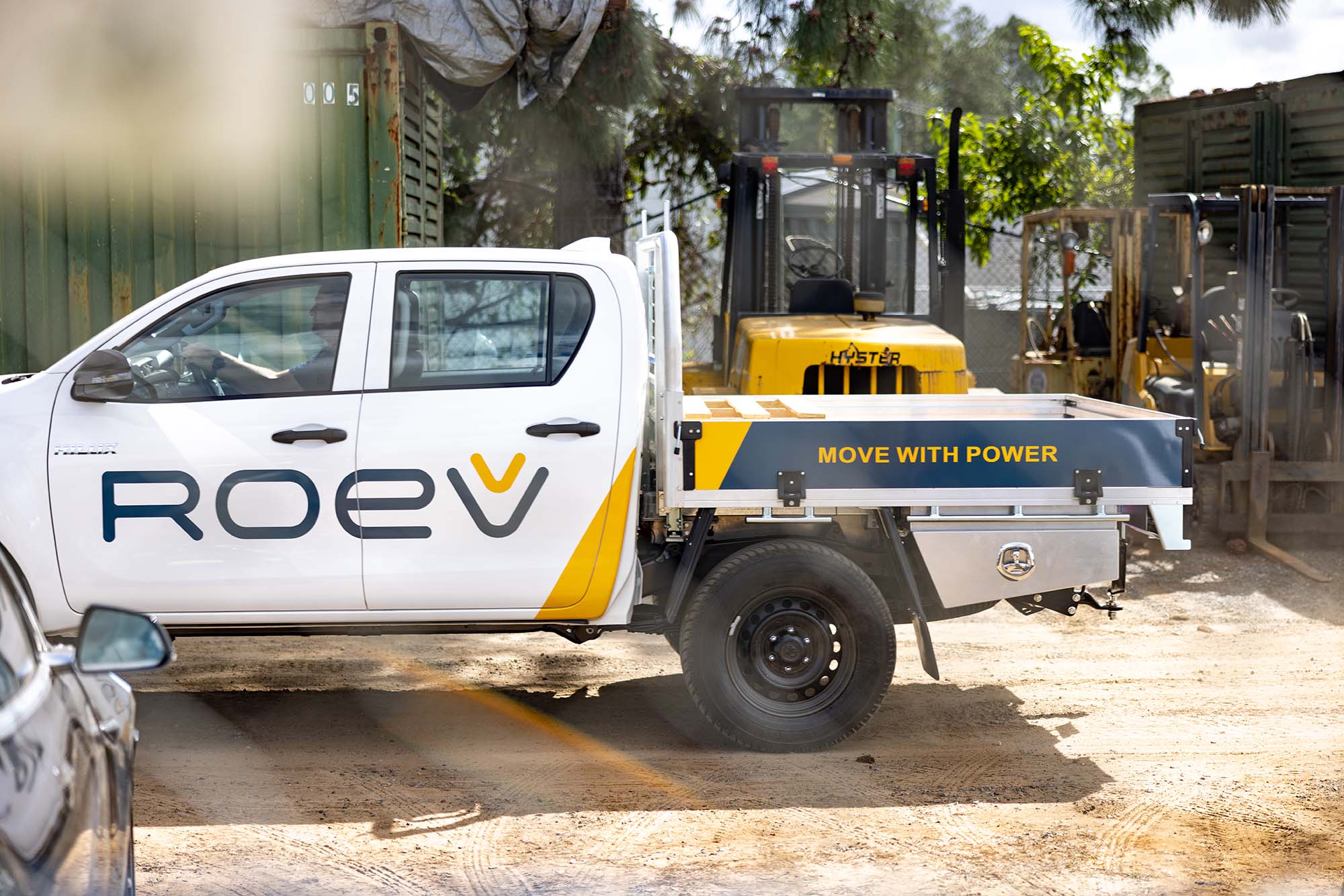
Roev will start conversion productions from the second quarter (April to June inclusive) of 2023, with the first-round of reservations opening in December.
However, it’ll only be available for fleet customers to extend the life of their current petrol- and diesel-powered vehicles by going all-electric. But, offering the conversion kit to the wider public is on the cards in the future.
The startup has committed to convert 1000 utes in the first 12 months.
Roev says the retrofit integrates with the vehicle safety systems, is safety and compliance certified, includes warranty and maintenance support, and is a more sustainable way to transition fleets to electric (rather than replacing vehicles).
“We’re excited to be working with fleets to unlock the potential of their fleets for energy storage, resilience, management and distribution,” Roev CEO Boah Wasmer said.
“Something we heard from a lot of fleets is the desire to convert slightly older vehicles to extend the life of their existing assets.
“With a conversion, you’re not only adding an electric vehicle to your fleet, but you’re also taking a diesel vehicle off the road and preventing many years of future tailpipe C02 emissions.
“Australia needs electric utes in massive numbers… Conversions are one way we can tackle the problem, but we also need imports and the mainstream brands to come to the party.”
The Brisbane-based company is also planning to design, engineer and produce its own pure-electric ute and SUV model based on a ladder frame chassis to launch by around 2026.
Related videos
UPDATE: Lotus Type 133 sedan spied in China
Following the Eletre SUV’s reveal in March, Lotus has been out testing its next addition, the Type 133 sedan, in China.
Expected to wear Envya badges, the Porsche Taycan and Audi E-Tron GT rival has been snapped by spy photographers, and it looks like the renders we commissioned from Theottle are pretty close to reality.
The Envya is a departure from the dainty Elise that relaunched lotus in the late ’90s, and even the Emira sports car. But that’s because, under Geely’s ownership, Lotus is looking to become more mainstream than ever before.
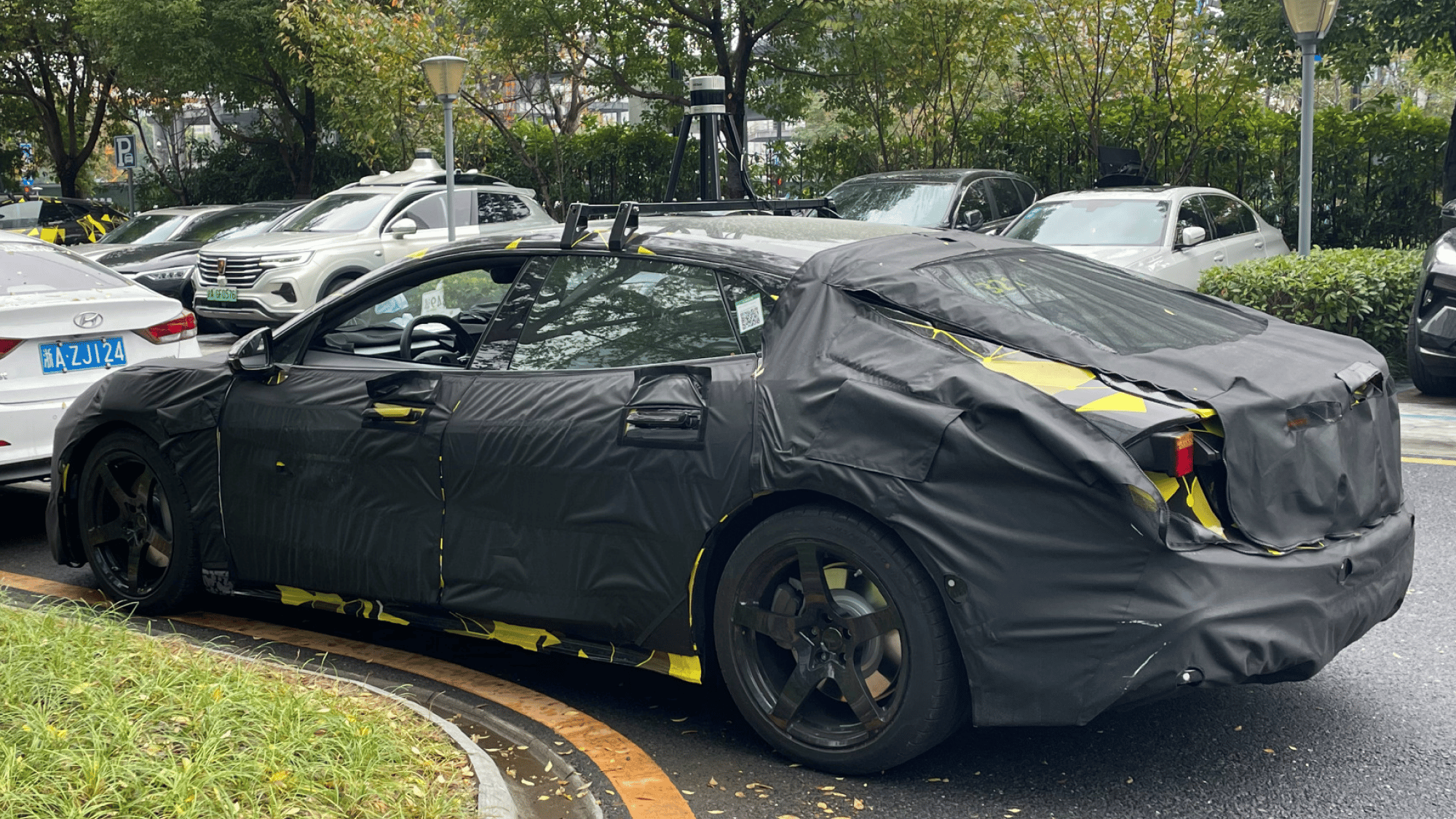
As for the spied car, it appears that the rendering is very close indeed to the mule’s front end. Its broad intakes and grille nod to the Emira but, understandably, on a larger body.
Around the rear, though, the Envya mule appears to depart from the render and Eletre’s thin LED tail-light with distinctly different lozenge-like outer brake lights. This detail could be a red herring, of course, to fit in with the camouflage and keep brake lights visible.
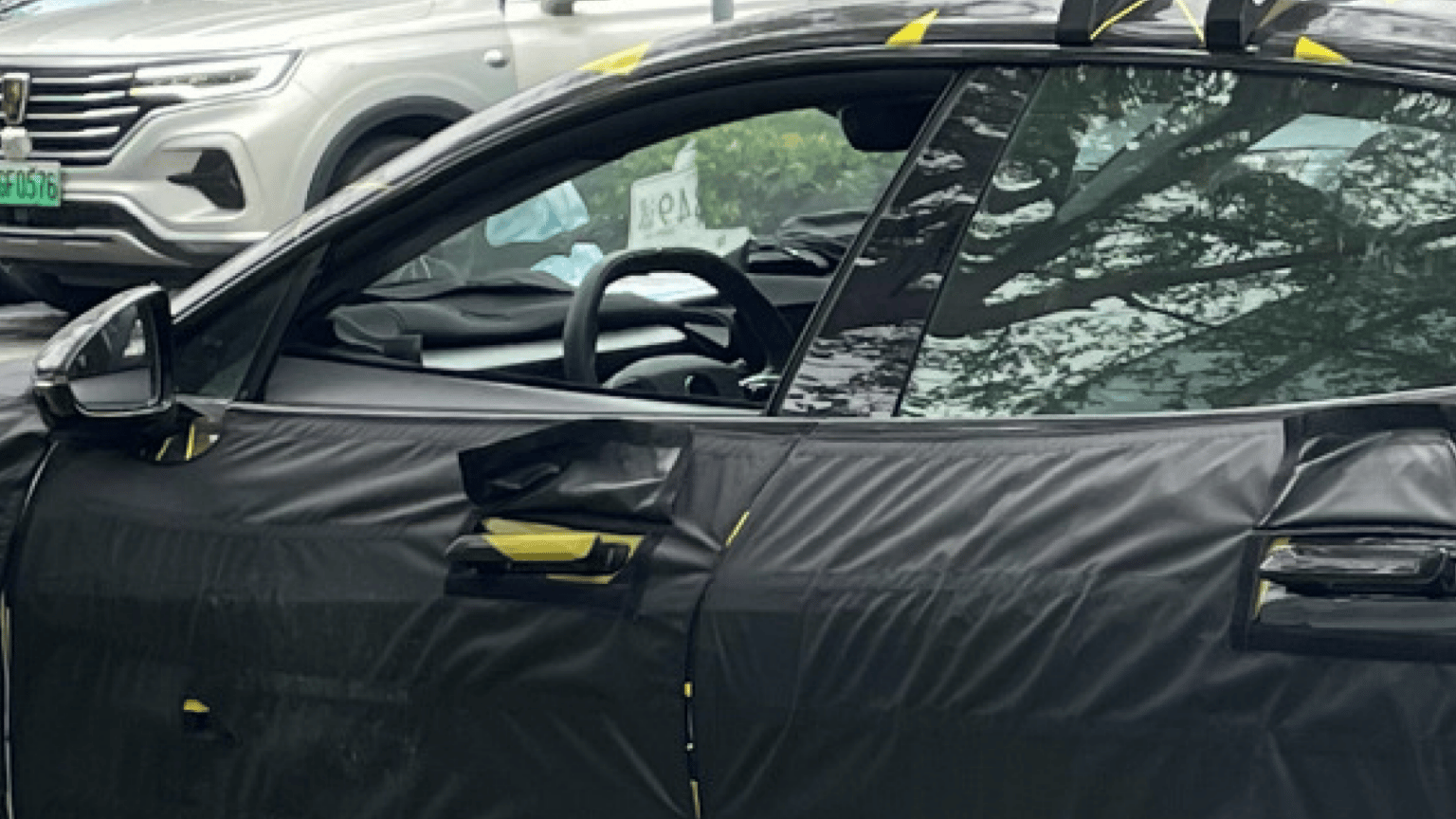
Glimpsing through the open window, a polygonal steering wheel can be spotted, similar in shape to Emira’s but definitely larger in diameter. Like the Eletre, the Envya’s cabin looks minimal with no traditional gauge cluster evident ahead of the steering wheel.
There are generously-sized brakes hiding behind rather unimaginative five-spoke alloy wheels. It’s expected the Envya will ride on Lotus’s Electric Premium Architecture (EPA).
Expect outputs to be similar to Eletre’s, meaning as much as 675kW of power and 985Nm of torque, with battery sizes up to 112kWh and circa-500 kilometres of driving range in the WLTP combined cycle.
Lotus is expected to unveil the Envya in full next year, with further details to be confirmed closer to its reveal.
Our original story, below, continues unchanged
The story to here
September 26: Lotus Type 133 sedan imagined
Earlier this year, Lotus confirmed it would charge headfirst into the EV era, kicking off its all-electric program from 2023.
Our first look at that project was the ‘Type 132’ Lotus Eletre SUV revealed in March, but we’ve yet to see any sign of the models that will follow – including the Type 133 sedan, the larger Type 134 SUV, and the Type 135 sports car.
With the Type 133 due to debut next year, our friend and Photoshop wizard Theo Throttle has turned out a speculative look at how the new electric sedan might be styled.

In its production form, the Type 133 is likely to debut as a rival to the Porsche Taycan, focusing on its legacy of performance – and now luxury, as shown by the Eletre – in the way most legacy brands have prioritised since pivoting to EVs.
No surprise, Theo’s renders point to a sedan with styling inspired by the Eletre, and until we see design patent images or a first set of teasers, his guess is as good as any.
What do you think of this Type 133 sedan, and what do you think it should be called? Maybe we’ll see the Carlton name revived in some ‘clever’ e-badged way…
Tell us in the comments below!
The story to here
June 2022: Lotus to go all-electric from 2023
Snapshot
- All mainstream Lotus models to be electric from 2023
- Four-door sedan, SUV and sports car to be launched over the next five years
- Emira could be its final combustion engine-powered vehicle
British manufacturer Lotus has committed to electric vehicle production as a part of its ‘Driving Change’ campaign.
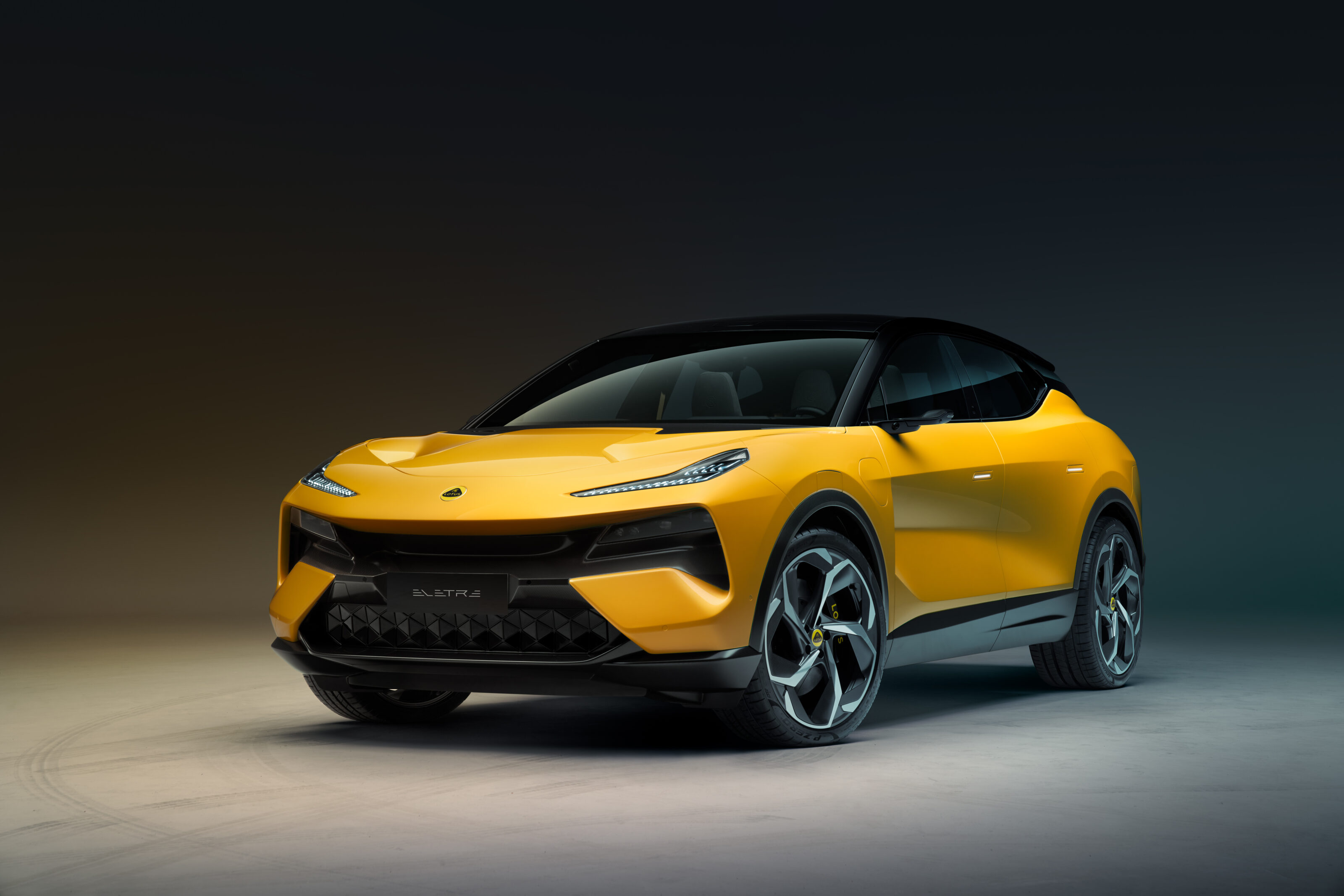
At the launch of its Environmental, Social and Governance (ESG) Charter, the Hethel-based manufacturer announced its entire mainstream model range will be fully electric from 2023, starting with the Eletre revealed earlier this year.
Codenamed Type 132 when it was under development, the Eletre SUV is the first mass-market EV from Lotus in addition to the Evija electric hypercar, the latter of which won’t be a common sight at your local supermarket carpark with a price tag of over $3 million when it launches later this year.

In addition to the aforementioned EVs, Lotus plans to introduce three more electric models over the next five years – the Type 133 four-door sports sedan in 2023, the Type 134 SUV in 2025 and finally the Type 135, a lightweight next-generation sports car in 2026.
Lotus believes this product mix will allow it to enact its Vision80 strategy, transforming the former low-volume sports car manufacturer into a “truly global performance car business and brand ahead of its 80th anniversary in 2028”.
Aiming to go net-zero through committing to become a SBTi (Science-Based Target initiative) organisation, Lotus Cars’ Managing Director, Matt Windle, says it’s the responsibility of the manufacturer to be at the forefront of environmental change.
“Our new ESG Charter formalises many activities that we have been carrying out for a number of years,” said Windle. “Lotus as a business has always been agile, efficient and impactful within the automotive industry.
“Now, more than ever, as we transform rapidly to become a global pioneer of electric performance vehicles, we recognise our responsibility to do so in ways that lead our industry in minimising its impact on the environment, benefitting society and the planet as a whole.”
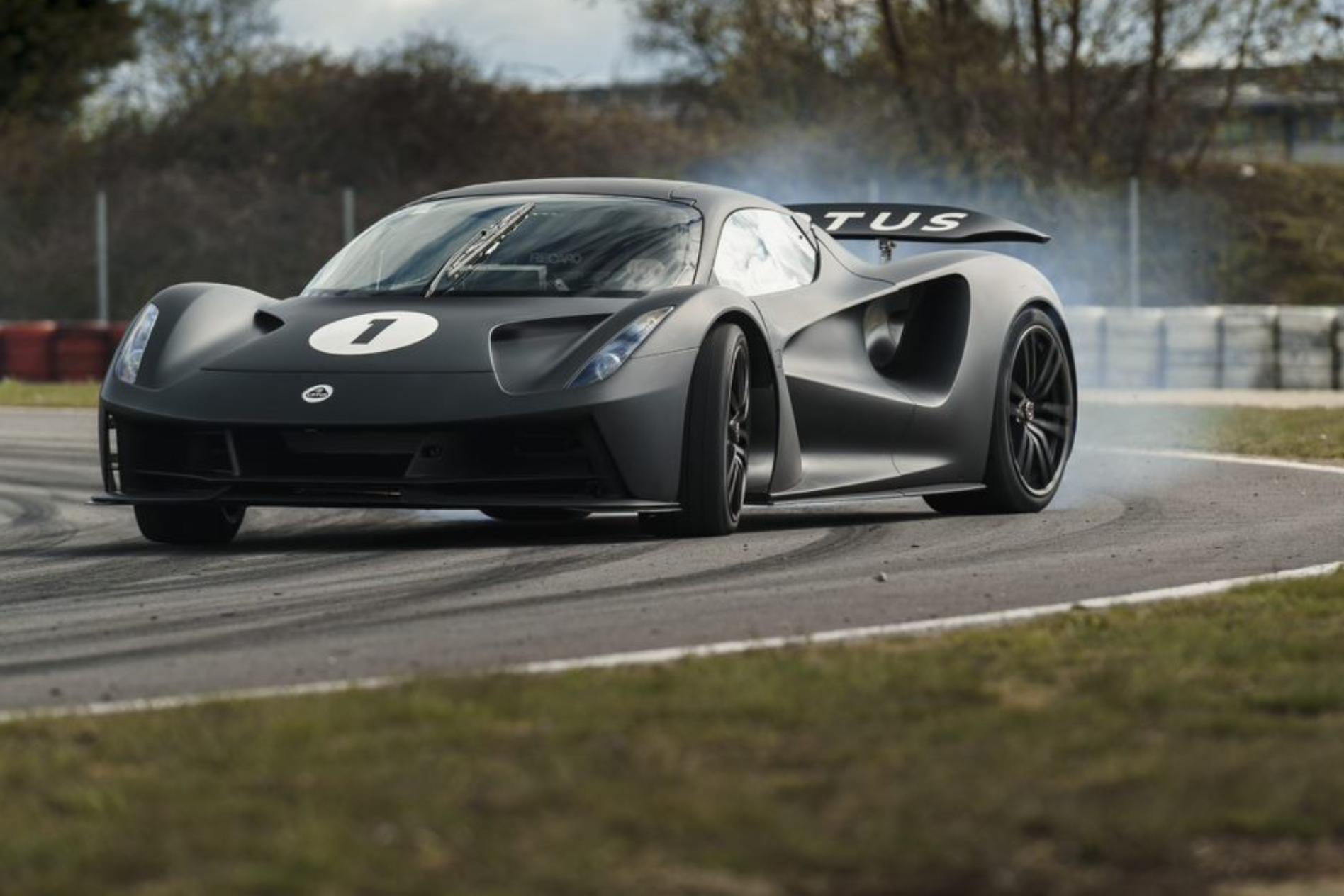
The Lotus model range of combustion engine-powered cars has recently been reduced to just the Emira, with the mid-engined sports car set to be its final non-electric mainstream model before it’s replaced by the Type 135 from 2026.
While the Emira’s lifespan is set to be short, Lotus began production of the sports car at its new Chapman Production Centre last month, a facility which will eventually be home to its local EV production alongside the Wuhan plant of its Chinese owners Geely.
