
Snapshot
- 2022-23 NSW State Budget allocates more money towards electric vehicle charging
- Extra $38 million to be spent on co-funding chargers
- Total investment now up to $633 million
The New South Wales State Government has pushed its commitment to electric vehicles even further in its 2022-23 Budget.
Having announced Australia’s biggest electric vehicle incentives and infrastructure package last year, the NSW Government has doubled down by allocating a further $38 million to its EV charging infrastructure – bringing total investments in EVs up to $633.
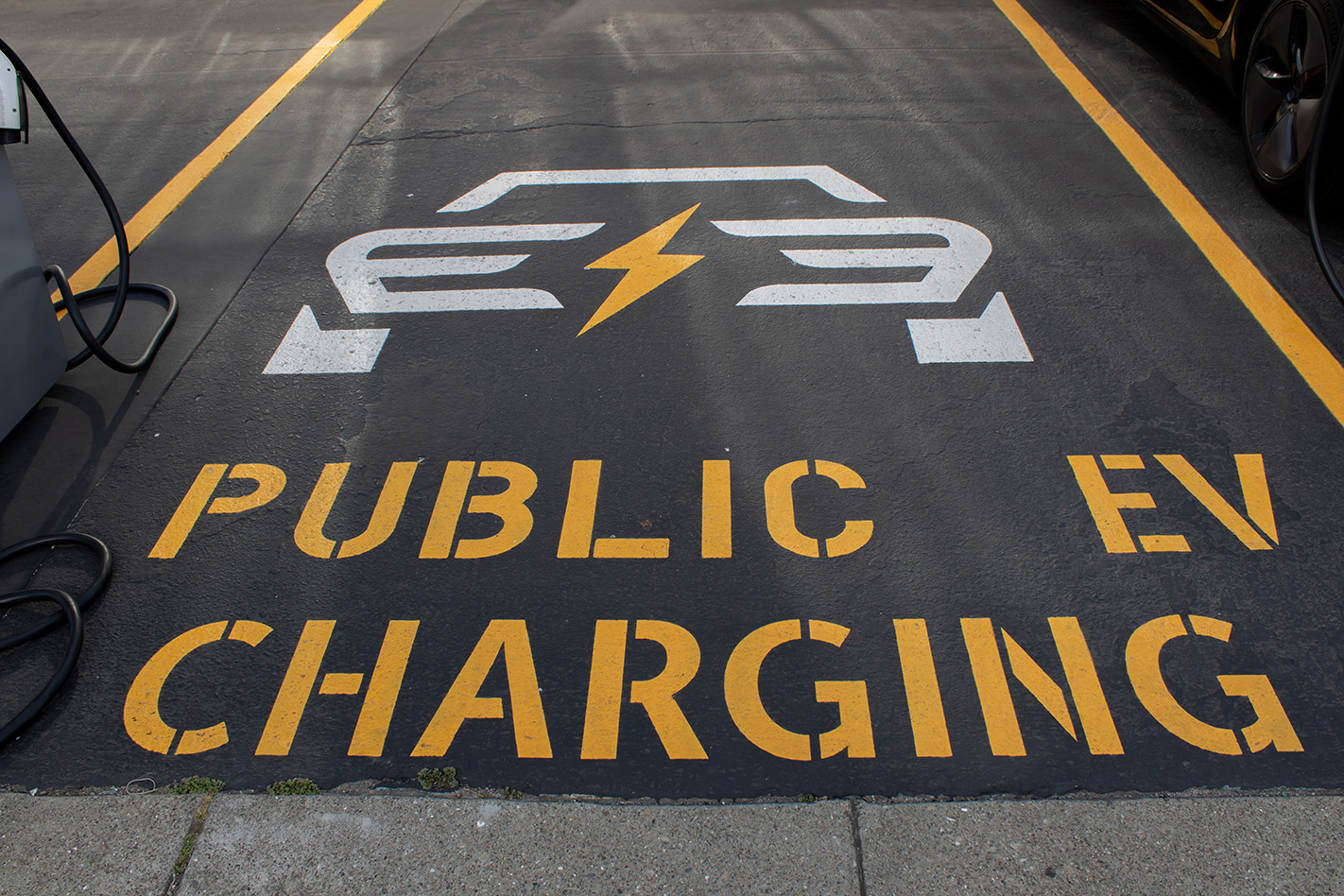
From the latest $38 million package, $10 million will be used to co-fund 500 kerbside charge points for on-street charging in residential streets where private off-street parking is limited, another $10 million will go towards co-funding 125 apartment buildings with more than 100 car parking spaces to make EV charging electrical upgrades and the remaining $18 million is to provide more grants for fast charging stations in high density urban areas.
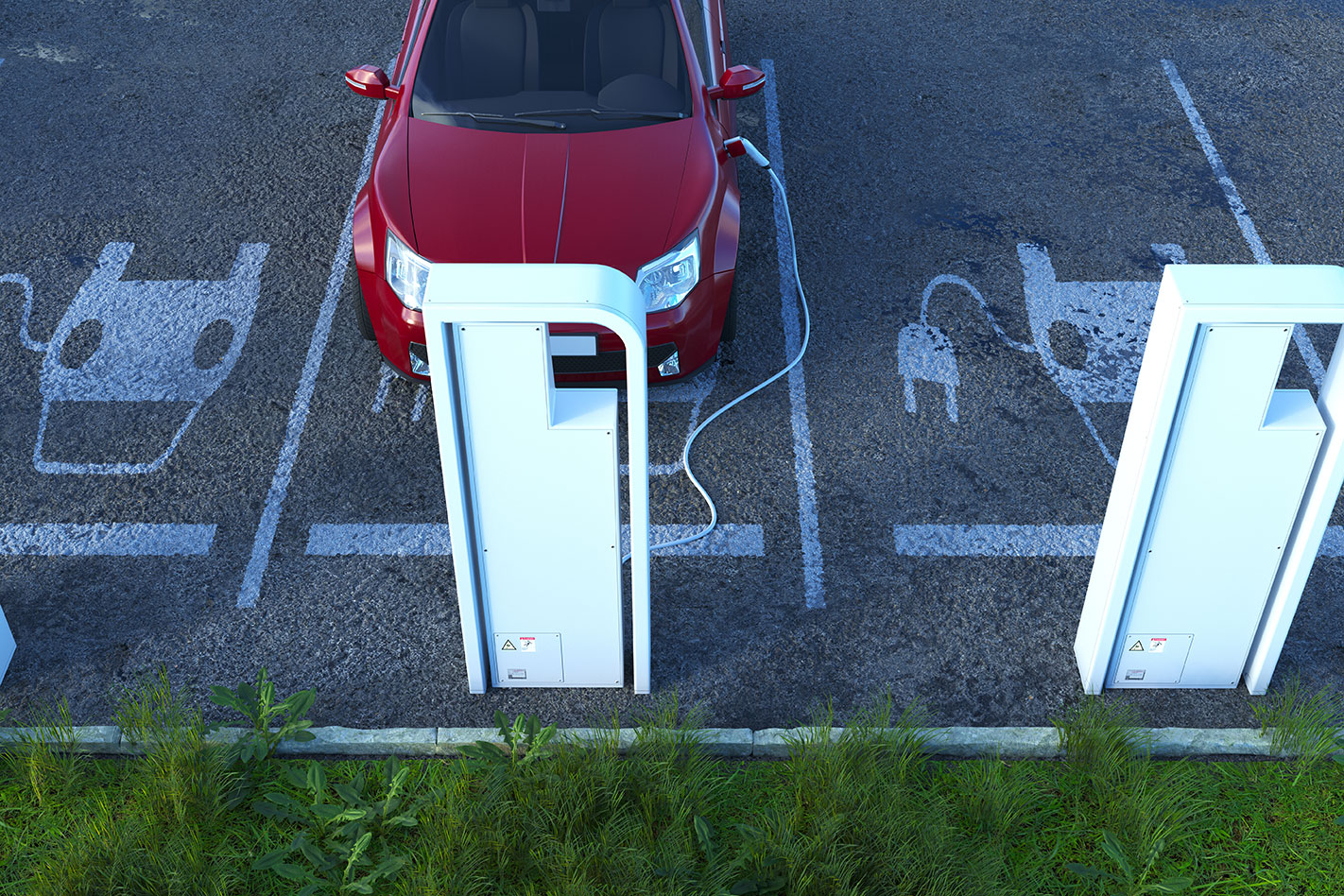
“Rolling out extra chargers will allow more EV drivers to benefit from their cheaper running costs and a cleaner, quieter and more sustainable road network,” said NSW Treasurer and Minister for Energy, Matt Kean.
“You’ll never be far from a charger on our major highways, in regional destinations, apartment buildings and on kerbsides in metropolitan areas with limited off-street parking.
“This funding will help communities stay connected and help holidaymakers hit the road to enjoy weekend trips as NSW motorists gear up for the next era of driving.”
The extra investment has been welcomed by the Federal Chamber of Automotive Industries (FCAI), with Chief Executive Tony Weber saying the infrastructure upgrades will benefit car owners and manufacturers alike.
“Investment in electric vehicle infrastructure is a key priority as Australia journeys towards our electric future,” said Weber.
“Building 500 kerbside charge points and equipping 125 apartment buildings to take on EV charging upgrades is going to help make owning a battery electric or plug in hybrid vehicle more realistic for NSW motorists.
“Continuing infrastructure investment in electric vehicle charging prepares Australia’s automotive fleet for a fully electrified future. Our journey towards that is going to encompass a range of vehicle technologies including hybrid, plug in hybrid, fuel cell and efficient internal combustion engines.
“We look forward to continuing to work with NSW and all Australian governments in supporting the rollout of more zero and low emission vehicles onto Australia’s roads.”
The NSW Electric Vehicle Strategy continues to include a $3000 rebate for EV and hydrogen fuel cell electric vehicles under $68,750, as well as the waiving of stamp duty on zero emissions vehicles under $78,000.
Snapshot
- Our Next Energy enters partnership with BMW
- Dual-chemistry battery pack gives the iX SUV a driving range of over 950km
- New technology could be implemented into production models
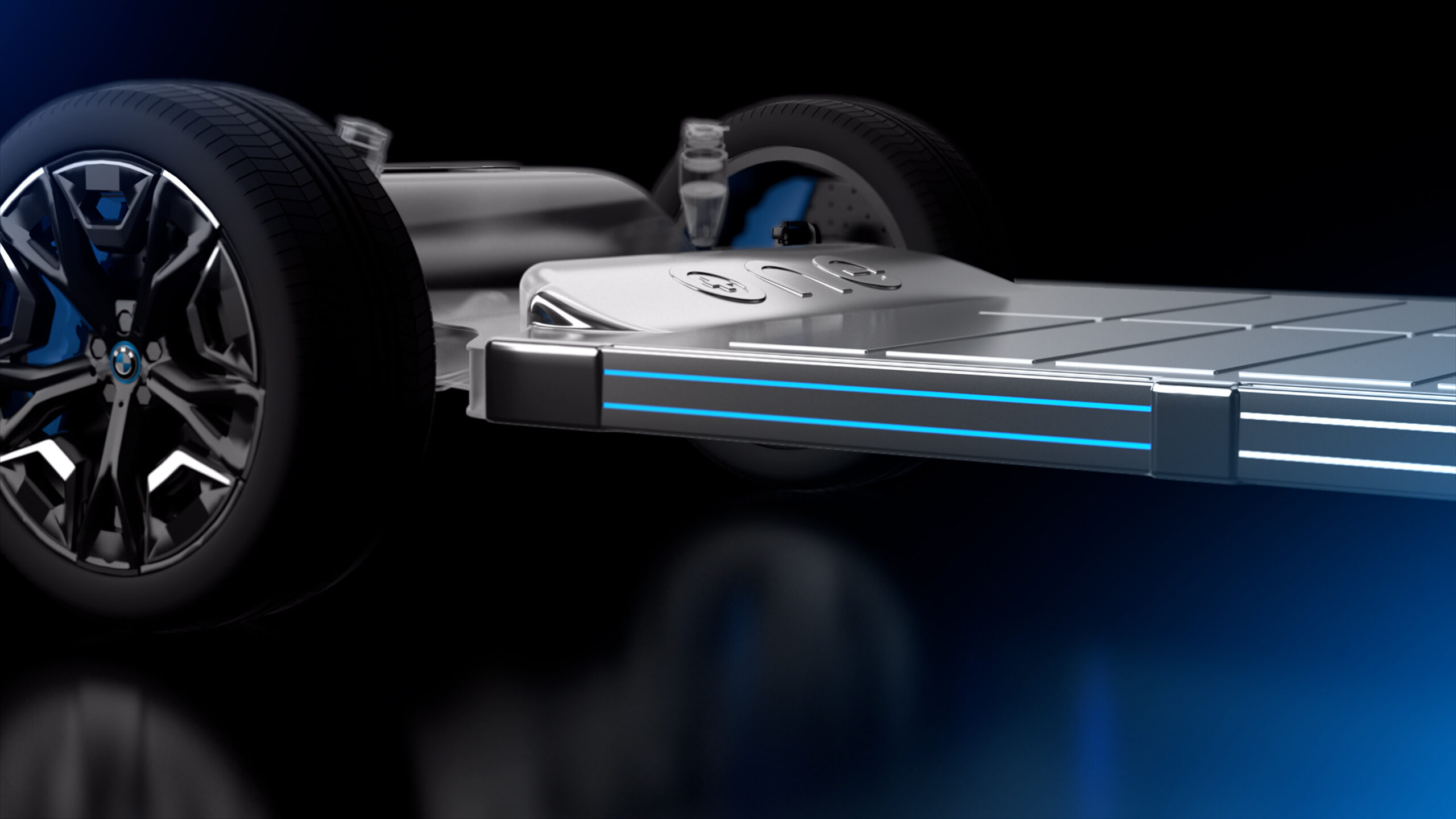
Michigan-based start-up Our Next Energy (ONE) has developed a dual-chemistry battery pack for electric vehicles, as BMW signs on to incorporate the new technology into its production vehicles.
Unlike most mainstream EV batteries which are comprised of lithium-ion only, ONE’s dual-chemistry Gemini pack has two separate main cells that feature unique characteristics, allowing it to not only store more energy but also reduce the amount of materials used.
While the company has previously fitted a Gemini battery to a Tesla Model S – nearly doubling its claimed range of 652km to 1210km – its latest project has featured the BMW iX SUV, as the new pack has increased the EV’s range from 630km to 966km.
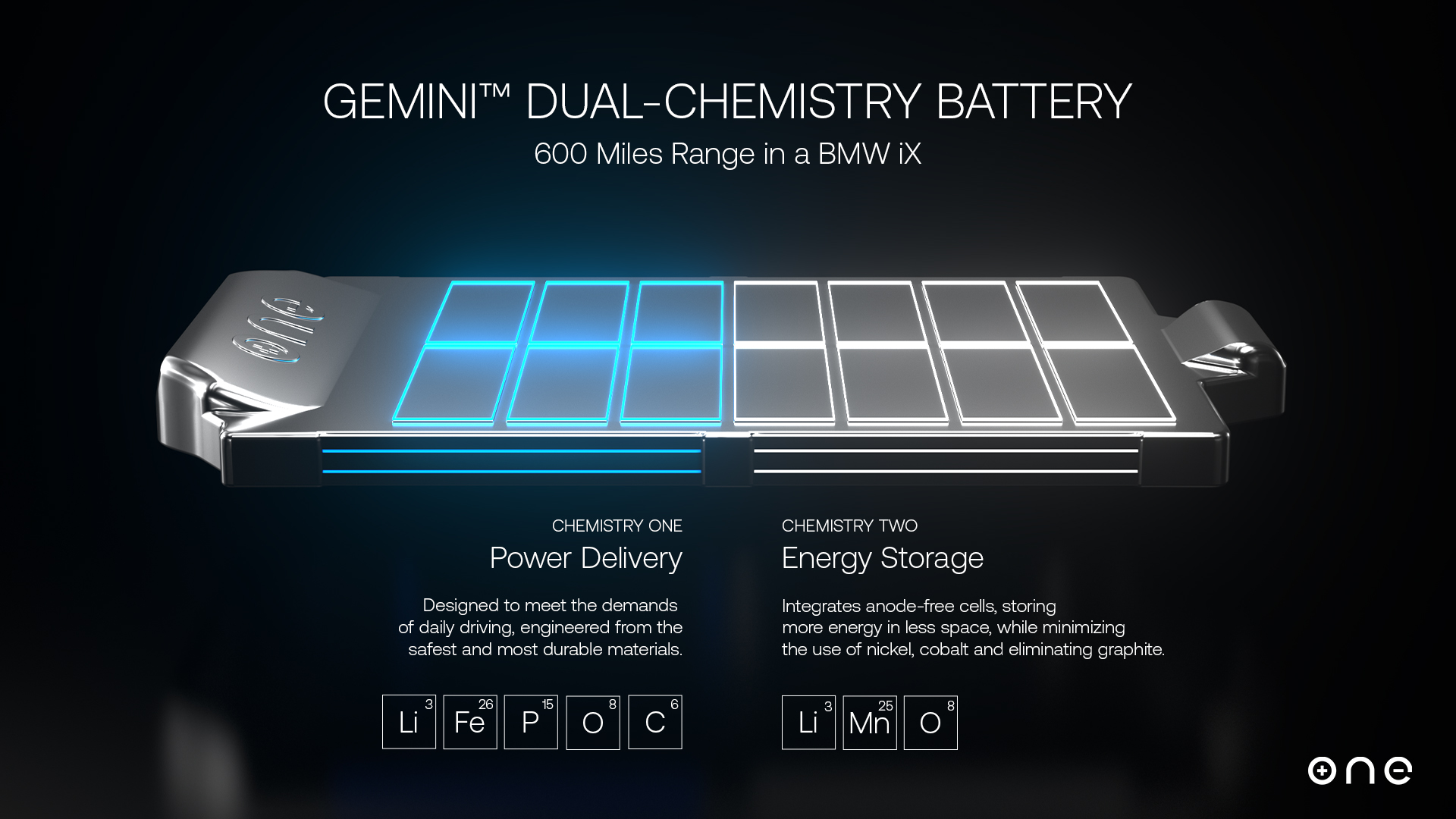
The Gemini battery achieves this longer range despite its construction being made up of roughly 20 per cent less lithium and 60 per cent less graphite than a normal pack, while nickel and cobalt usage is also down.
Although it’s just a prototype for now, BMW is considering using ONE’s battery technology in its future EVs.
“We are well-positioned to incorporate ONE’s IP into BMW’s SAV line,” said BMW’s head of high voltage storage, Jürgen Hildinger.
“We are confident that given economic viability, this can lead to commercial opportunities and strategies to integrate ONE’s battery technologies into models of our future BEV product line-up.”
The Silicon Valley-based BMW i Ventures recently led a US$65 million (AU$93.65m) funding round into the technology, with partner Baris Gazul saying ONE’s Gemini battery could lead to greater EV adoption.
“Our Next Energy is working to fundamentally reinvent the battery while focusing on sustainability, safety, and cost; three key factors which will help speed the development and adoption of battery electric vehicles,” Guzel said.
ONE founder and CEO Mujeeb Ijaz believes his company’s dual-chemistry packs will be able to deliver driving ranges which better reflect what consumers demand in EVs.
“As EV adoption grows, drivers are learning that real-world conditions can significantly reduce the performance of their batteries,” said Ijaz.
“Common situations like maintaining highway speeds, winter temperatures, climbing mountains, towing, or a combination of all four things present challenges to electric vehicles. We plan to pack twice as much energy into batteries, so EVs can easily handle long-distance driving in real-world conditions.”
The BMW iX recently placed sixth in the 2022 edition of Wheels Car of the Year.
Snapshot
- Mini launches new edition trim for Hatch, Convertible, Clubman and Countryman
- Extra features added to each model, tech specs unchanged
- Order books now open, arrivals expected later this year
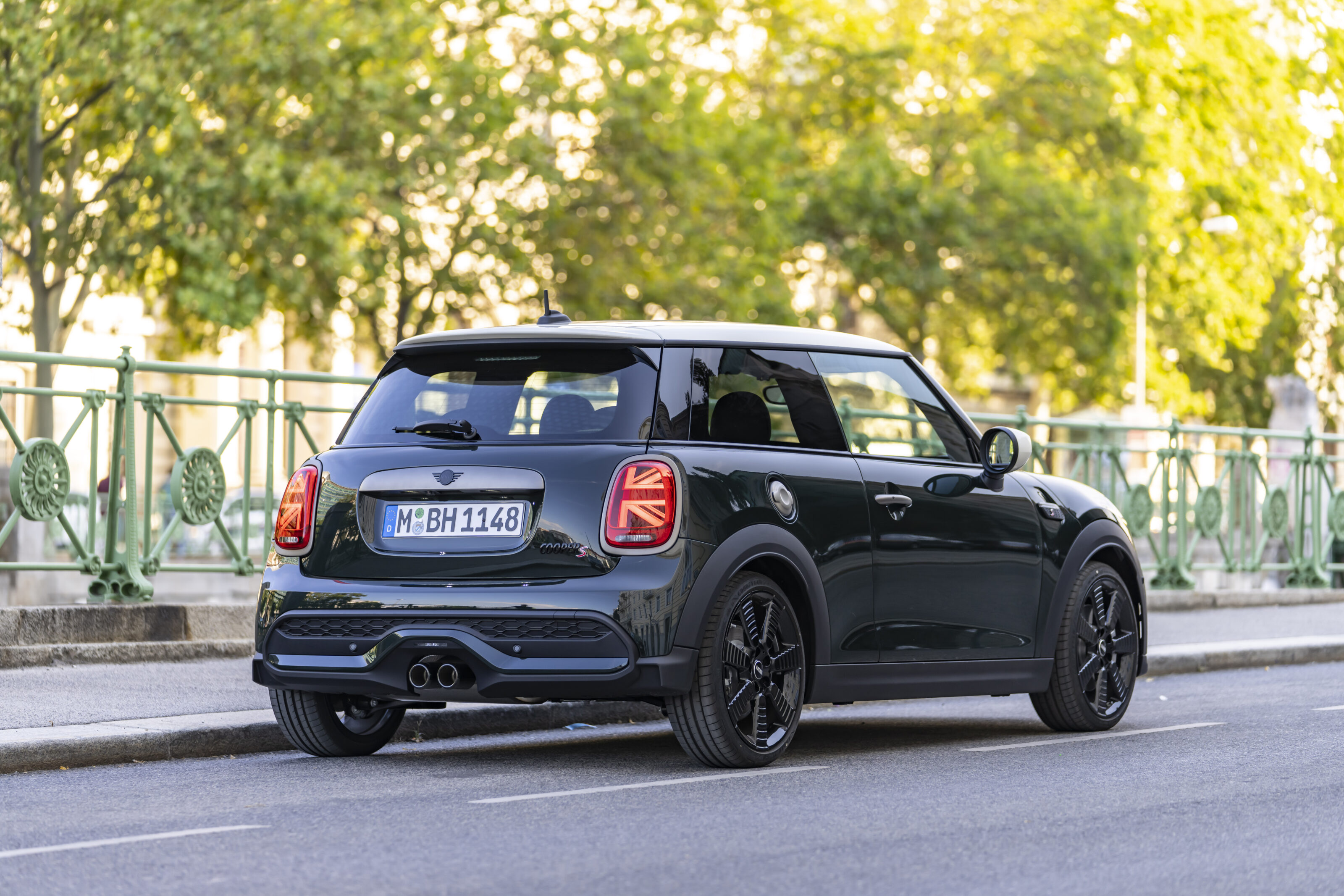
Mini has revealed a number of new grades for its Cooper Hatch, Convertible, Clubman and Countryman models, set to arrive locally in late 2022.
Dropping into Mini’s model line-up, the new variants include the ‘Resolute’ spec for the Hatch and Convertible, ‘Untold’ for the Clubman and ‘Untamed’ in the Countryman.
The upgraded grades bring a number of additional visual tweaks over the current range, although a majority of features and specifications across the line-up are unchanged.
Pricing
Hatch and Convertible
| Model | Price |
|---|---|
| Cooper 5 Door Resolute | $45,800 |
| Cooper S 3 Door Resolute | $53,800 |
| Cooper S 5 Door Resolute | $55,450 |
| Cooper S Convertible Resolute | $59,880 |
| Cooper SE 3 Door Resolute | $63,825 |
Clubman
| Model | Price |
|---|---|
| Clubman Cooper S Untold | $58,900 |
| Clubman JCW Untold | $72,250 |
Countryman
| Model | Price |
|---|---|
| Countryman Cooper S Untamed | $62,400 |
| Countryman Cooper S Untamed | $70,000 |
Features
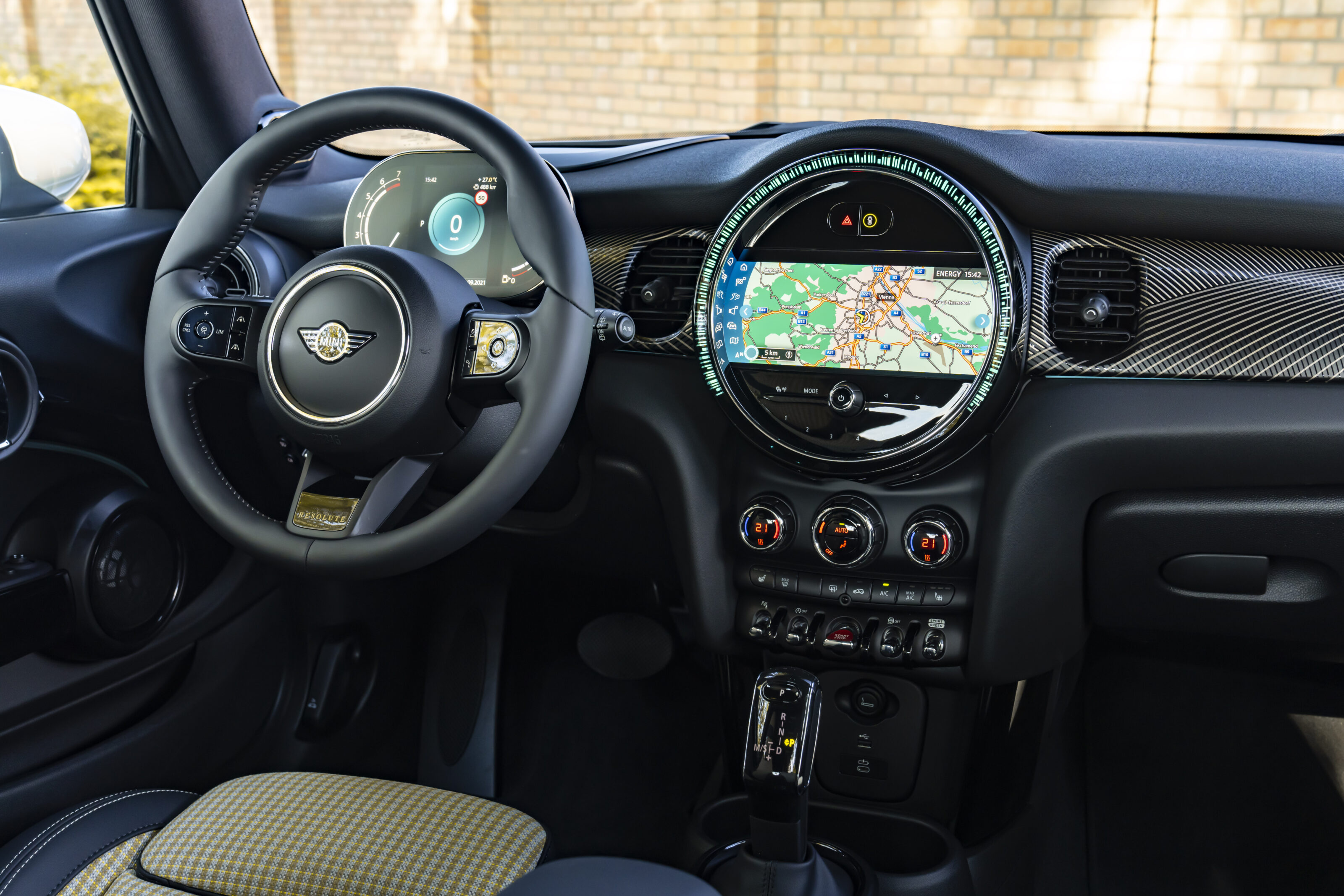
Hatch and Convertible Resolute
| Chrome-free exterior design |
| Rebel green paint (previously only available on John Cooper Works models) |
| Pepper white roof and mirror caps (Hatch only, black on Convertible) |
| Resolute bronze headlight surrounds, grille, rear lights, side scuttles, door and tailgate handles, air intakes and fuel filler cap |
| Piano black badges, inner grille frame, exhaust trim |
| Resolute lettering on bonnet stripes and the door sill panels |
| 18-inch pulse spoke black alloy wheels (17-inch electric collection spoke design wheels for Cooper SE, 17-inch tentacle spoke black optional for all grades) |
| Sports seats finished in carbon black leather or light chequered fabric and leatherette |
| Black armrests and knee rolls |
| Nappa leather steering wheel |
| Anthracite headliner (Hatch only) |
| LED ambient lighting |
| Mini driving modes |
| 8.8-inch infotainment touchscreen |
Clubman Untold
| Sage green paint |
| John Cooper Works-inspired aerodynamic kit |
| Dark green cladding |
| Narrow sports striping |
| Striped side scuttle panels |
| 18-inch jet black/refined brass Untold spoke design wheels |
| Refined brass grille surround and radiator crossbar |
| Piano black door handles, exhaust tips and Mini logos |
| Sports seats finished in sage green leather (carbon black leather optional) |
| Nappa leather steering wheel |
| Floor mats with Untold emblem |
| Adaptive LED headlights |
| Mini excitement package |
| Mini driving modes |
| Anthracite headlining |
| Interior light package |

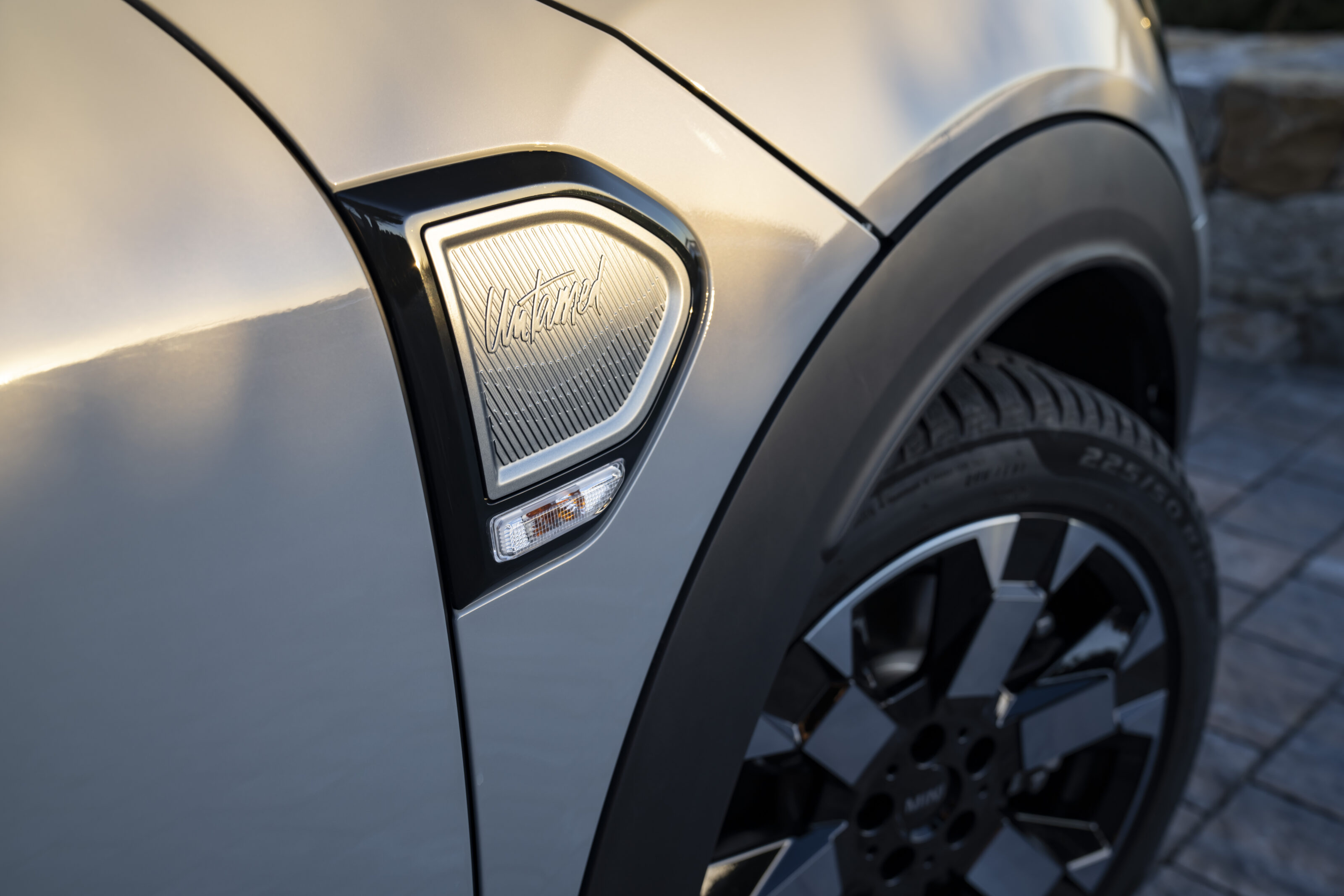
Countryman Untamed
| Momentum grey paint |
| Black roof, mirror caps, roof rails and headlight housings |
| Momentum grey lower air intake surround, air curtain inserts, side skirts, lower rear bumper and exterior badging |
| Frozen bluestone diagonal stripes and side scuttles |
| 18-inch two-tone alloy wheels |
| Sports seats finished in highland green leather with blue and green contrast stitching, Untamed lettering |
| Illuminated decorative trim |
| Frozen blue metallic cockpit and centre console accent strips |
| Arctic silver metallic door trim strips |
| High-gloss black air vent surrounds |
| Nappa leather steering wheel with Untamed lettering |
| Embossed floor mats |
| Anthracite headliner |
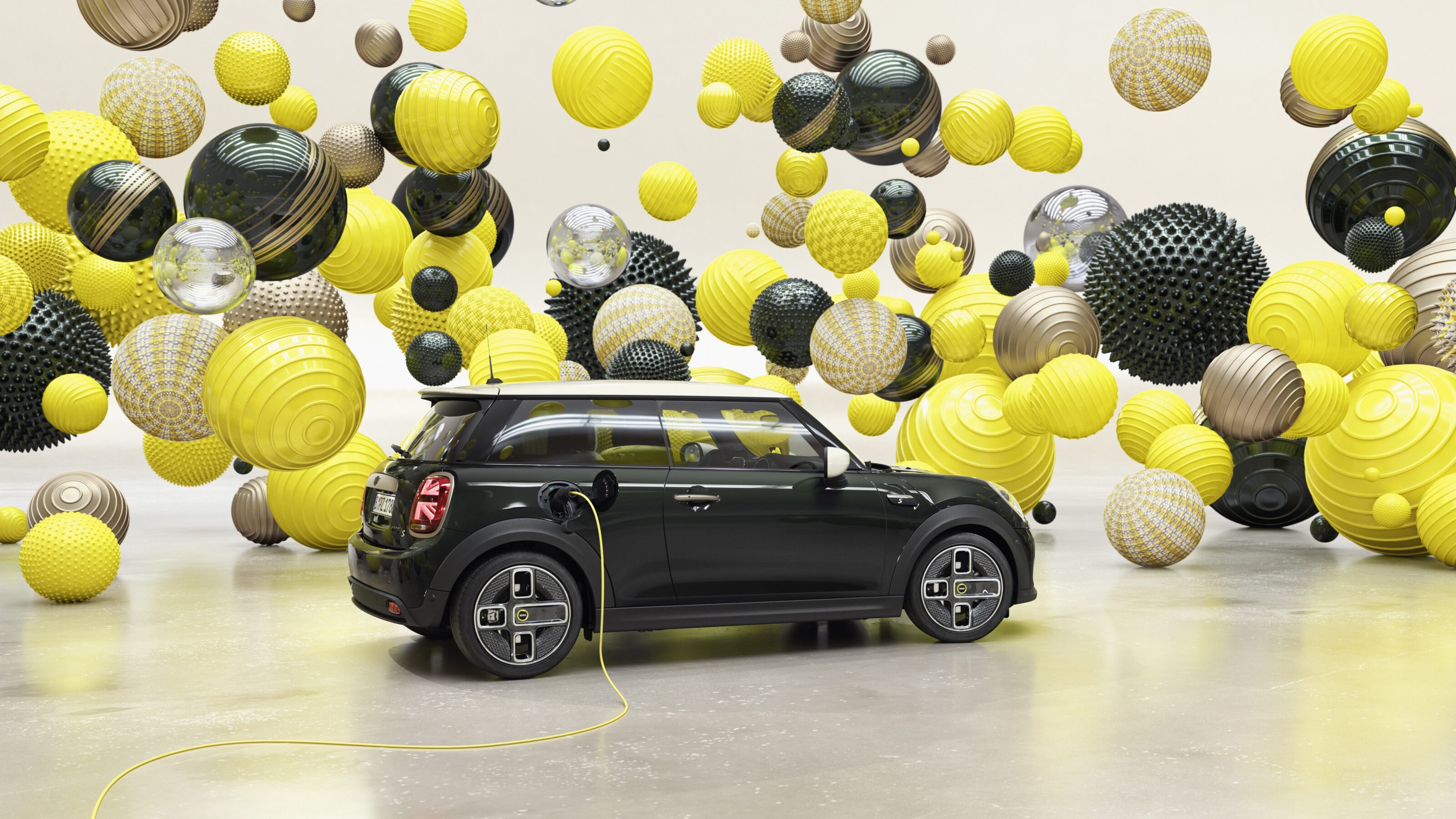
Mini has confirmed the order books for the upcoming variants have now opened, with the first examples set to land in Australia towards the end of the year.
Here’s a question: does anyone actually stage a pedal-to-the-metal 0-100km/h run? It’s a figure quoted all the time, and taken very seriously in certain circles. If you regard it as the hot-hatch holy grail, then here’s the spoiler: Audi claims a sprint time of 3.8sec for the RS3, the Mercedes-AMG A45 S can do the job in supposedly 3.9sec, while the BMW M240i is another four-tenths behind at 4.3sec. Half a second between first and last.
But that dragstrip exercise is, in reality, only a fragment of the bigger picture. Neither the RS3 nor the A45 feels as quick off the mark as a PDK-equipped Cayman GT4, for instance, which claims a time identical to the Merc. And when it comes to seat-of-the-pants feel, the M240i xDrive really doesn’t seem half a second slower.
There’s a good reason behind all this. The 2.0-litre four-cylinder AMG engine needs 5000rpm to muster its maximum torque of 500Nm. The Audi 2.5-litre five-cylinder’s identical 500Nm peak is at 2250rpm, while the 3.0-litre straight-six in the BMW requires only 1900rpm to produce its 500Nm.
UPDATE, August 5, 2022: New RS3 driven in Australia
The new-generation RS3 is finally in Australia. You can read our review here, and watch Inwood’s track and road drive in the video below.
The story to here
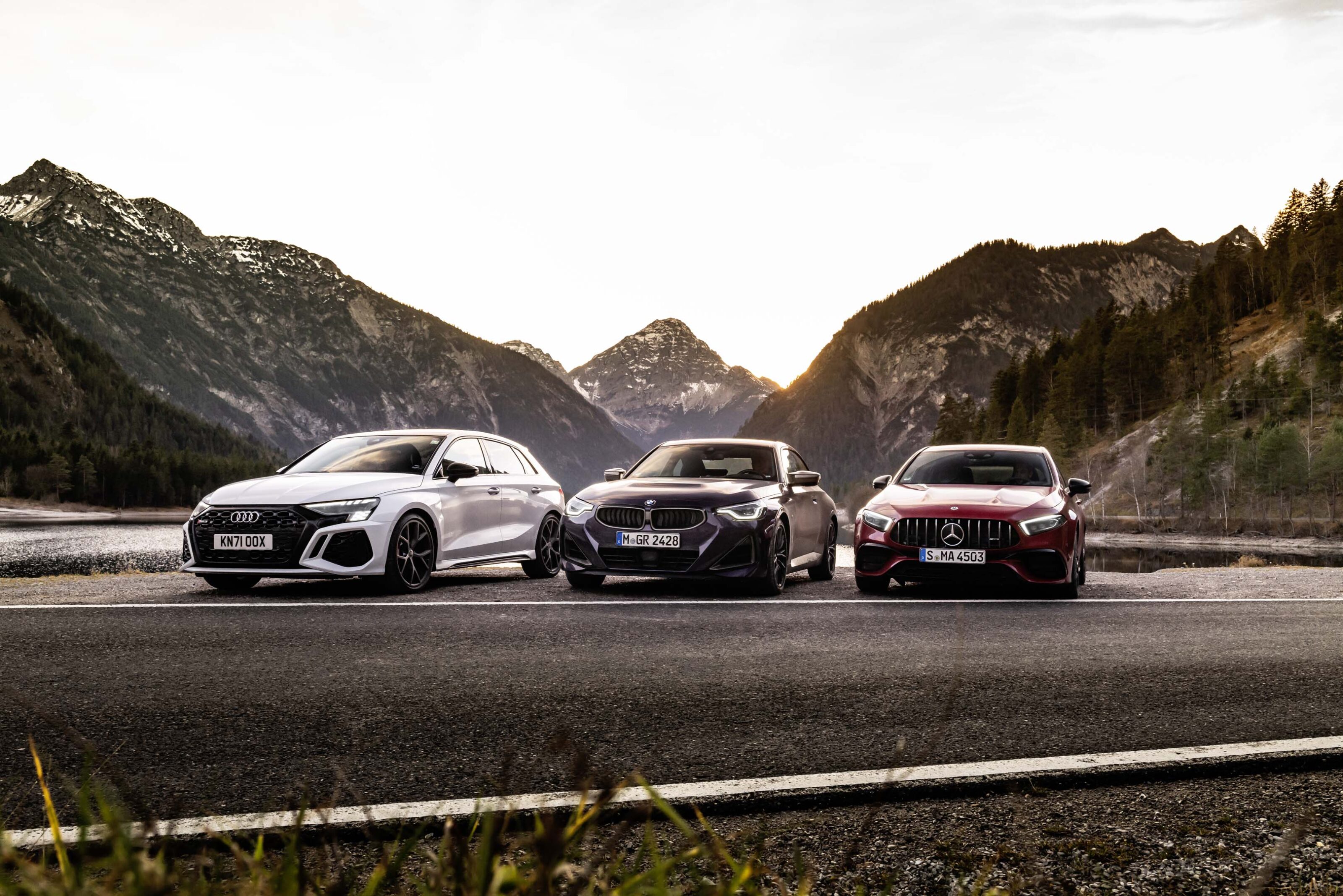
It’s not the number of cylinders that matters here. What really counts is the combination of displacement, calibration and gearing. The result is that the BMW can, on public roads, keep up with its rivals – and that’s without even pulling out all the stops.
With this trio of compact all-wheel drive performance cars – you might want to call them hyper hatches, except the BMW’s not a hatch – you soon realise that there’s a significant gap between on-paper form and real-life observations. It’s not the engine in isolation, nor the chassis, or those in-dash bits of tech that tip the scales. More than ever, this threesome is all about the sum of each player’s parts.
You soon realise there’s a significant gap between on-paper form and real-life observations
These cars all have significant differences, beyond the number of cylinders. In character, content and composition, they are quite distinct. But there’s enough overlap for it to be very clear that they’re aimed at the same type of customer. Let’s begin by comparing the three drivetrains, and for a change start with the transmissions.
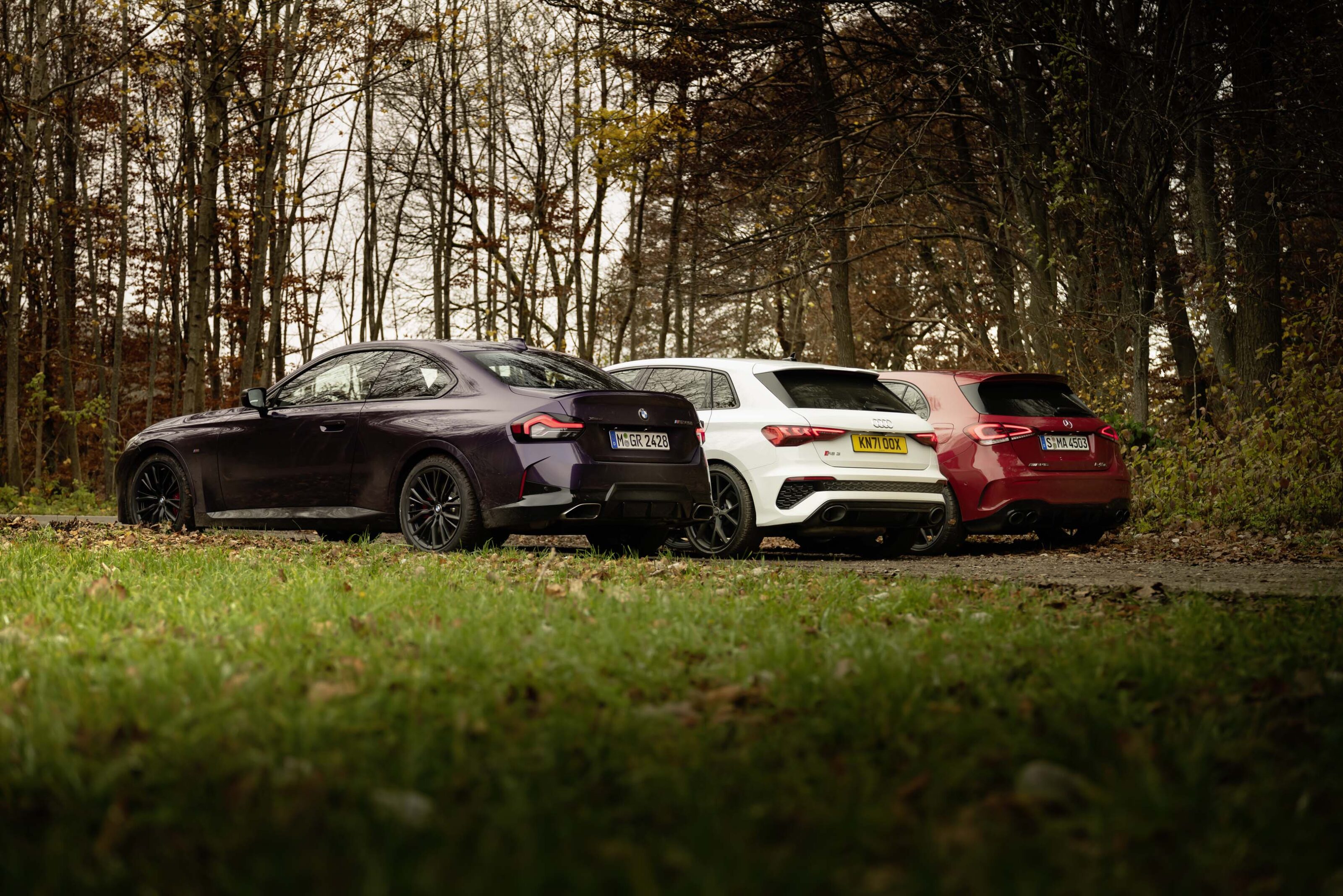
BMW used to be an avid supporter of the dual-clutch design, but the latest M3/M4 has ruefully returned to the eight-speed M Steptronic Sport also fitted to the M240i. Ever since Mercedes launched the CLK AMG DTM way back when, it dawned on the sports-car community that a super-stiff and fast-acting torque converter delivered most the pros and none of the cons of the DCT.
Having said that, both the staccato eight-speed dual-clutch unit of the Mercedes-AMG and the seven-speed ’box fitted to the RS3 turn every single full-throttle upshift into a more physical and emotional exclamation mark. In the sportiest drive mode, up-shift action is whiplash brutal while the equally sudden hardcore downshifts are liable to make the entire drivetrain shrug and judder from front to rear before calm is re-established for a brief breather.
Select Dynamic or Race, and the mechanical stress will be augmented by sky-high revs, a distinct unwillingness to step up to a taller ratio and an urge to change down super early. Yes, it’s as easy to hate this pre-programmed hyper-agility as it is to question the synthetic, extra-loud exhaust, the artificial throttle blipping and the fake lift-off blat-blat.
But the children of the AMG revolution beg to differ. Always inspired, here you’re rewarded with an even more aggressive launch control sequence which increases the engine speed and opens all exhaust flaps before igniting the crackling take-off fireworks.
Audi’s answer to the Merc’s decibel attack is a somewhat more pronounced rear-bias torque split, a fraction more standing start wheel slip, and a slightly shorter first and second gear. Although the RS3 is 65 kilos heavier than the A45, the shorter-legged transmission and the hungrier AWD calibration secure that token one-tenth advantage in the 0-100km/h shootout.
The iconic single-turbo five-cylinder is a proper powerhouse. It was test-benched by Audi Sport at up to 350kW when the old world order was still intact, but even this 294kW version ticks all the right boxes – as long as the revs are kept on the busy side of 2500rpm.
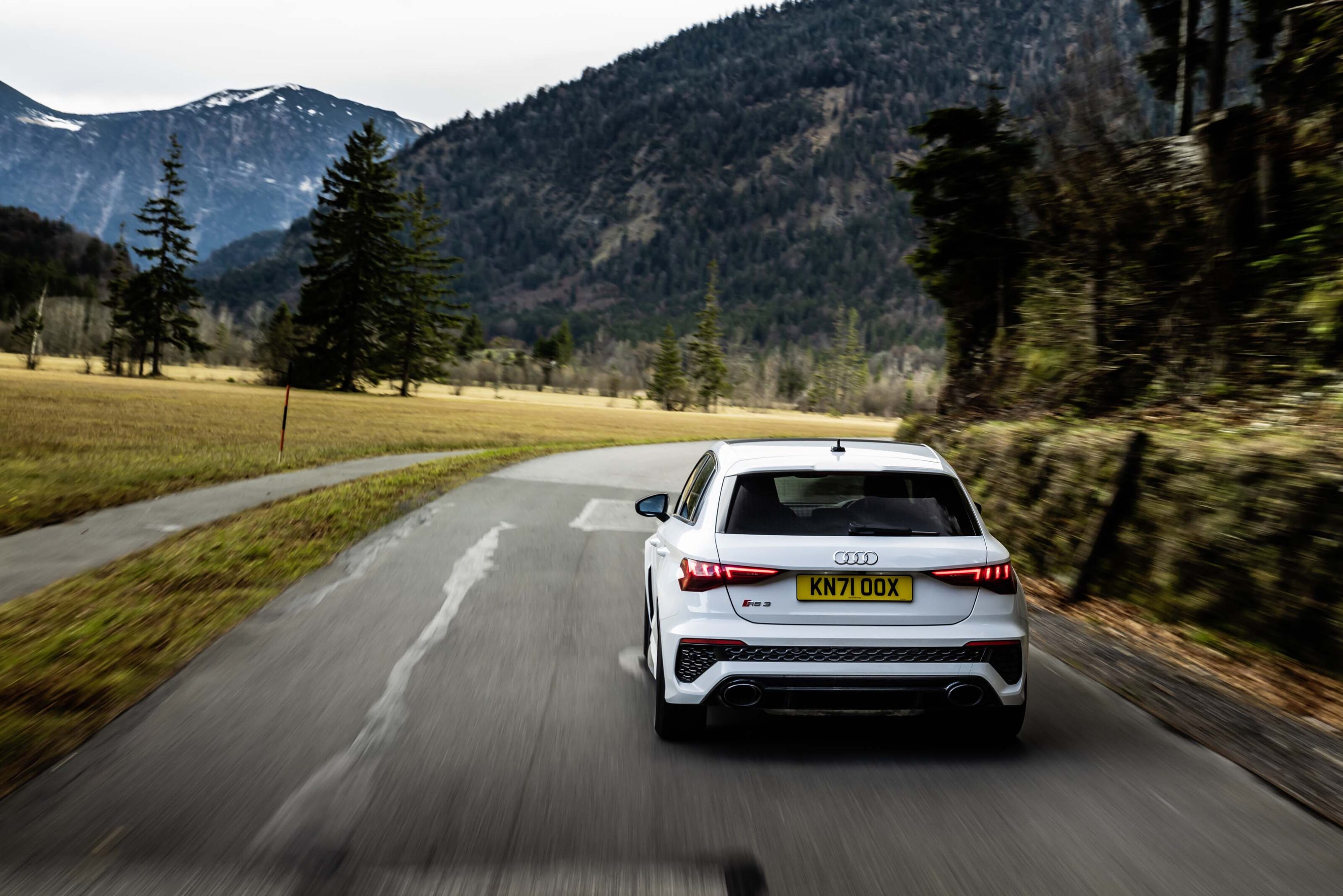
Max power arrives at a comparatively relaxed 5600rpm. Whereas the ceiling of the BMW in-line six sits between 5500 to 6500rpm, the AMG unit needs a roaring 6750rpm to muster its full force.
The M240i is not a hot hatch but a coupe. As such, it has no rear doors and token rear seats but an adequate 390 litres of boot space. Part of what makes the 2 Series unique in this company is the sportier driving position. It’s not so much the vehicle height but the lower H-point which creates that coveted road-hugging feeling of being in full control at all times.
The BMW cockpit layout is relatively user-friendly; in contrast, the A45 S warrants a total immersion course in advanced ergonomics. Its flat-bottom helm is studded with 15 different thumb challenges; the main monitor is happy to display and memorise special drills like drift angle, steering angle, g-force and throttle depression rate; the choice of go-faster modes includes M for manual, Race with Race-Timer, Track Pace, Advanced, Sport Plus, Sport Handling and Powerful (exhaust note only).
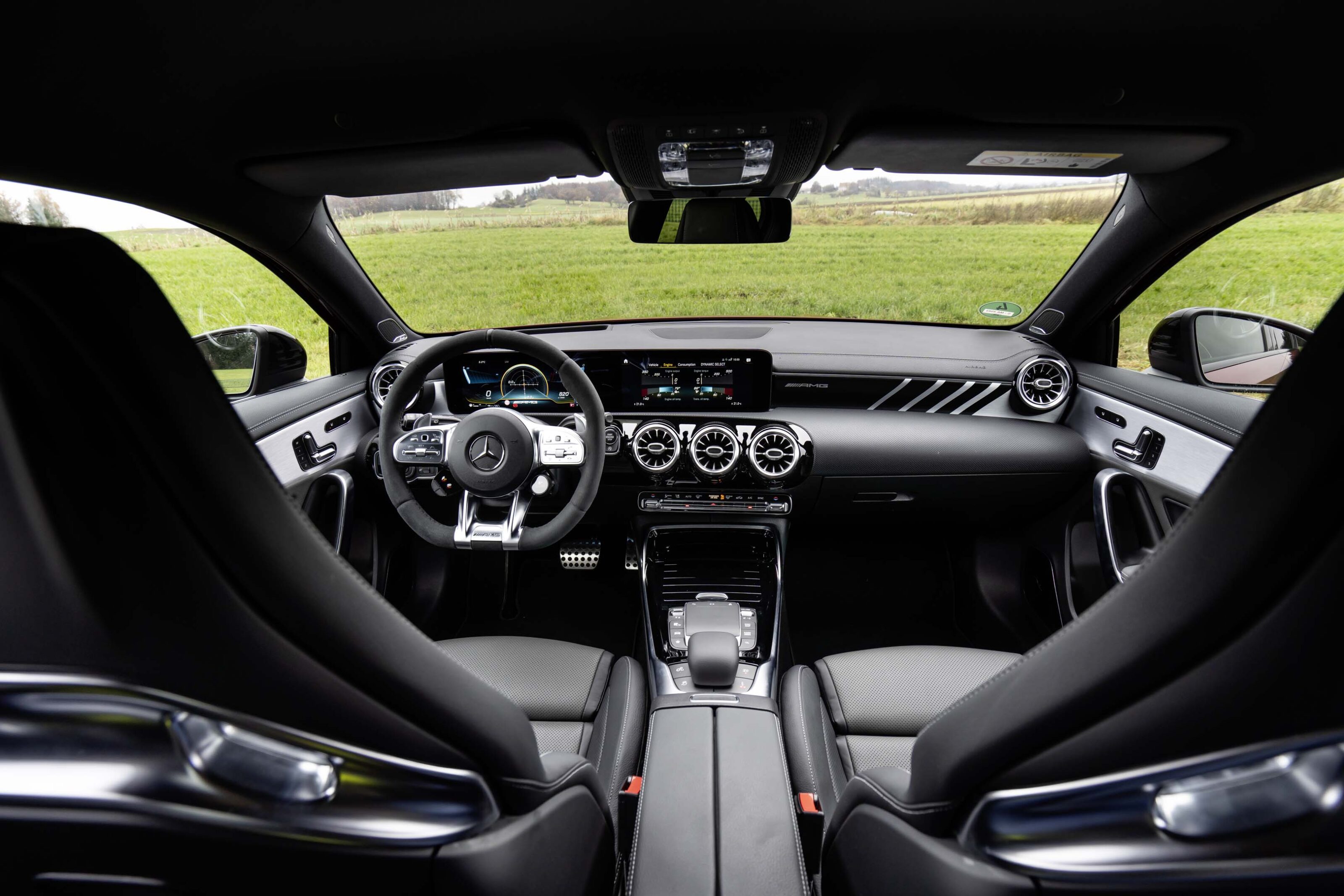
What’s missing are a couple of buttons to access your two preferred settings, BMW M1- and M2-style.
The RS3 wins the Golden Eiderdown Trophy for the best ride in Comfort mode
While the cabin of the AMG is gaudy and garish as well as loaded with features and five stylish eyeball vents, the dashboard of the Audi looks more e-Tron than RS3, despite a handful of fire-red accents. The driver environment is a sombre mix of matte and polished surfaces which attract fingerprints like moths to a flame.
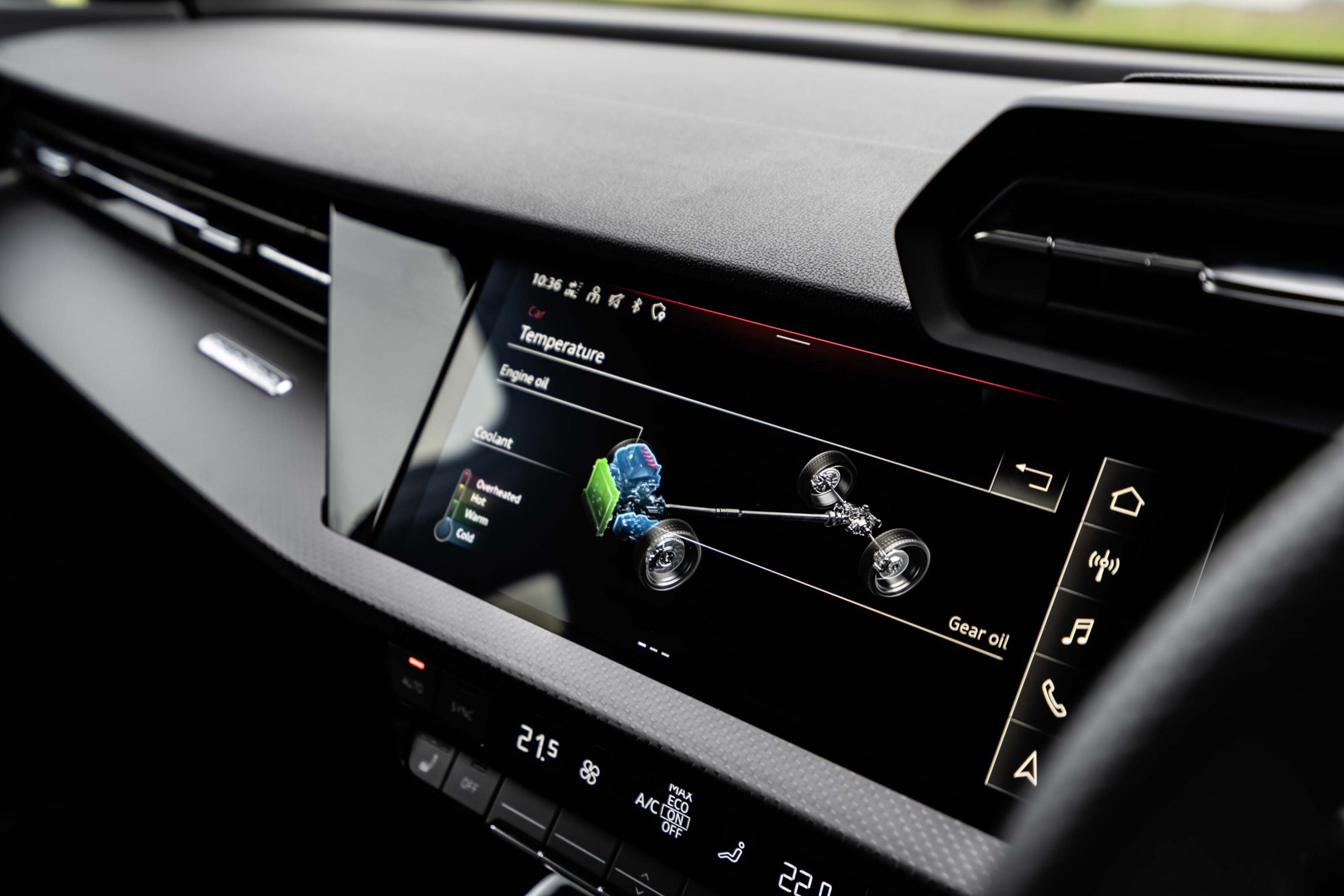
A few direct-consequence buttons lurk low down in the centre stack, but the main interfaces are a large touchscreen and the excellent voice-control system. The on-demand, full waltzing step compendium requires the RS Dynamic Pack Plus which includes desirable carbon-ceramic brakes, adjustable dampers and a mildly lowered ride height.
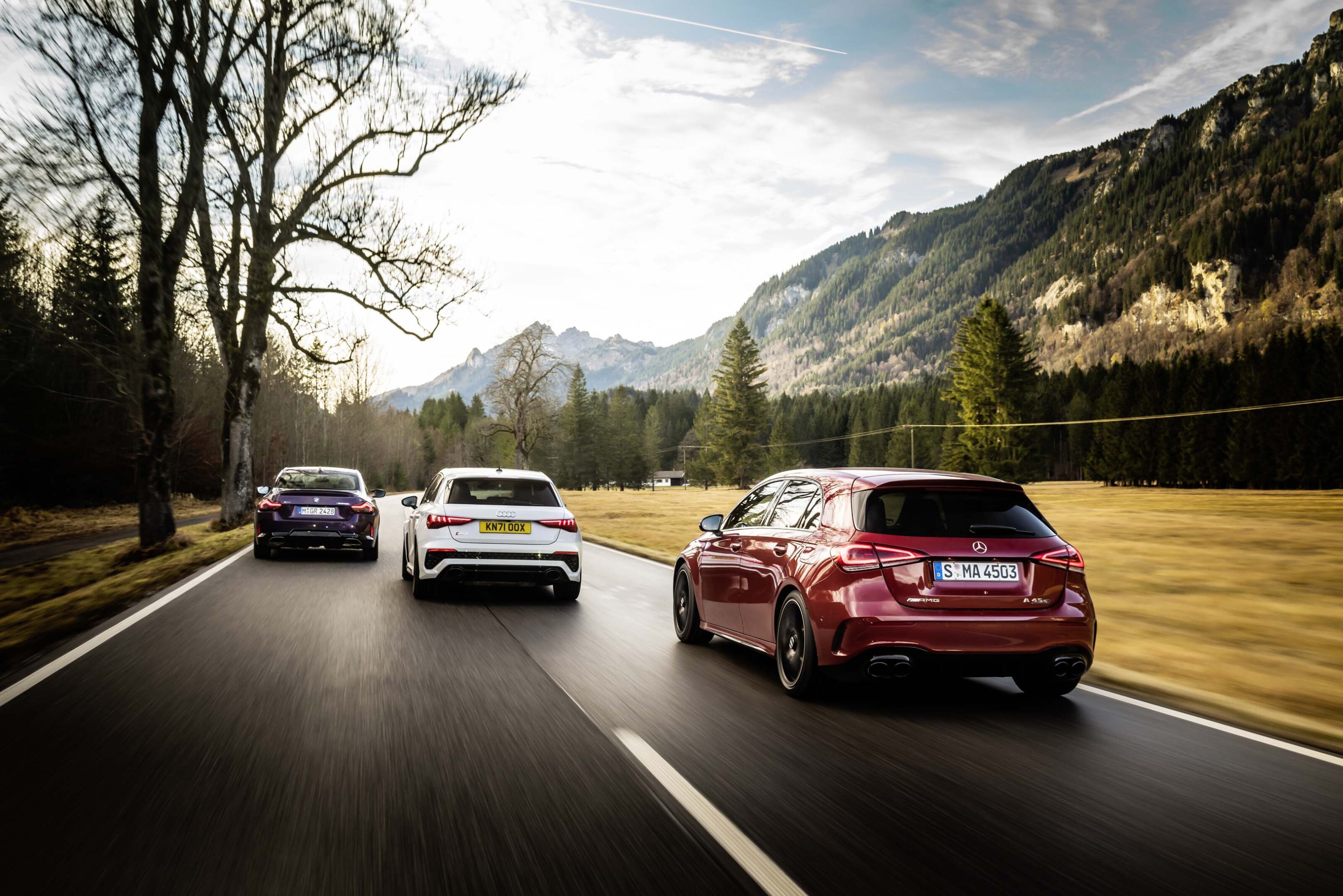
While the RS Performance Mode invites you to precondition the car for the next drift session, the newly introduced Runway instrument graphics boast gimmicks like g-meter, power and torque meter, digital speedo and two parallel bar graph rev counters. What a contrast with the first no-handbook-required RS3 launched in 2011…
The latest RS3 is shod with 265 tyres up front and 245 rubber at the back – but not primarily for more front-end grip and a more energetic turn-in. Instead, it was the higher axle load which demanded the upgrade complemented by fatter anti-roll bars, reinforced pivot bearings and a dash more negative camber.
These measures result in an absolutely unerring directional stability. The Audi also wins the Golden Eiderdown Trophy for the best ride in Comfort mode. The BMW is a relatively close second, the Mercedes a predictably distant third. Those of you who agree that compliance equals control would find the car from Ingolstadt the perfect 24/7 Jack of all trades.
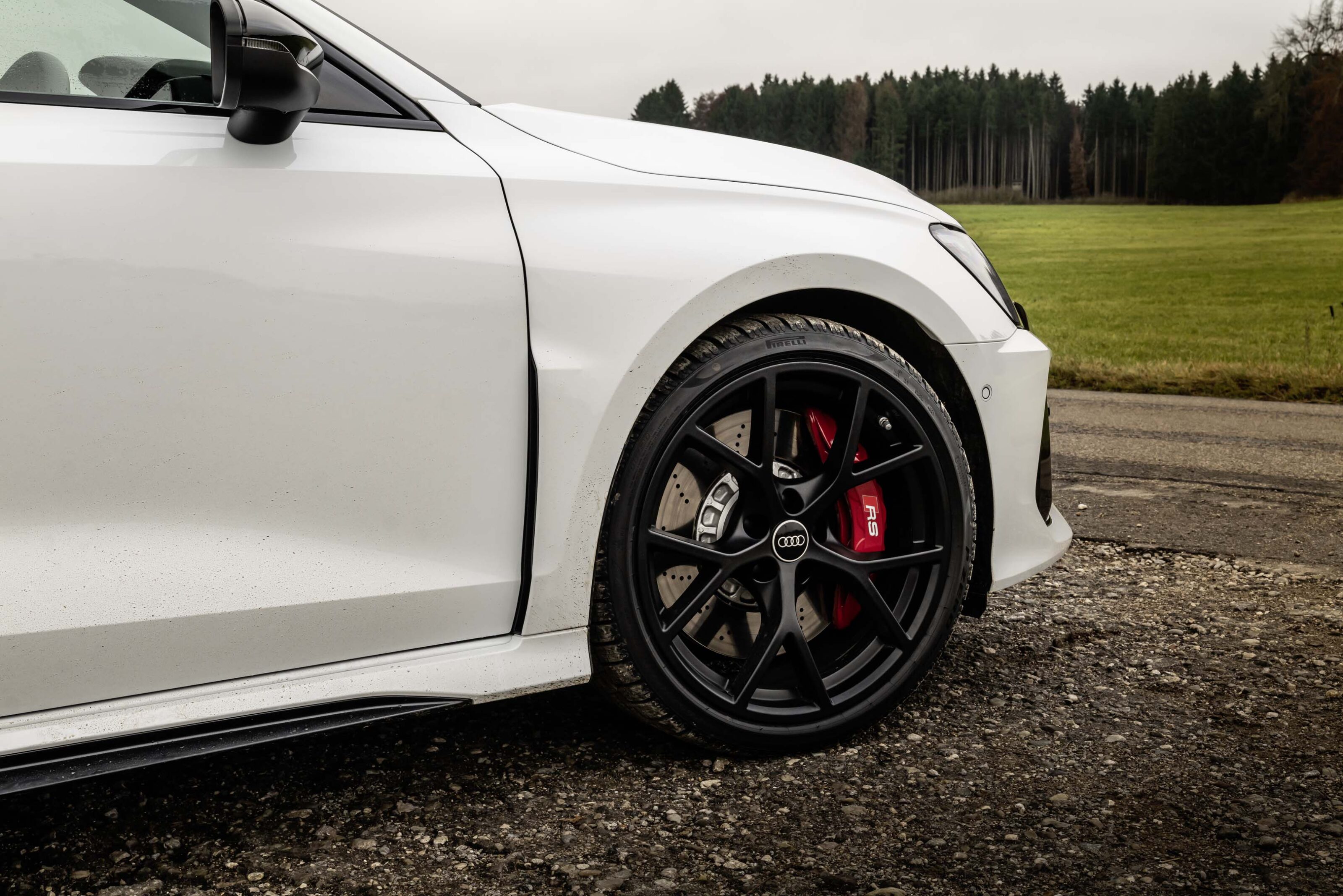
But since Comfort permits a little too much roll, pitch and yaw over uneven bitumen, one could argue that this chassis would actually be better suited for a theoretical ‘S3 Plus’ than for the uncompromising RS range-topper.
With their respective suspension set-ups locked in the meanest domina position, the Audi and the Merc plot their paths like four-wheel, high-speed staplers, wildly determined to mash coil springs and clobber shock absorbers.
The A45 AMG, in particular, can feel locked in battle with C-roads where it keeps coming close to losing the red guiding thread under hard braking, hard acceleration and hard cornering. This inherent nervousness remains, albeit to a lesser extent, on fast, winding Autobahn sections.
The AMG engineers could have mitigated the prevailing restlessness by opting for a slightly more relaxed steering set-up, but no, it had to be every bit as razor-sharp and prompt as the suspension and the drivetrain. As a result, the car from Affalterbach is an impulsive, hyper-active apex wrestler.
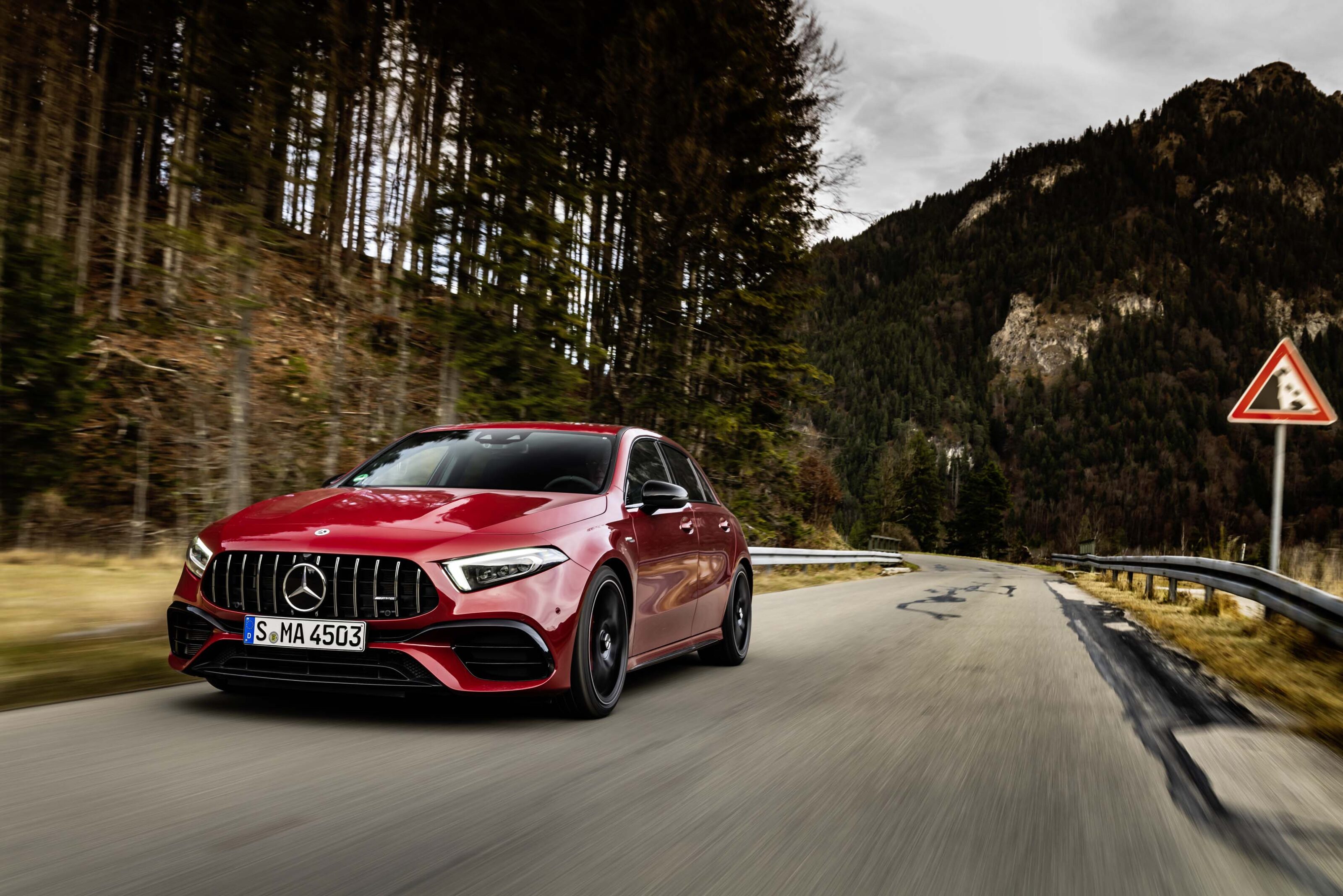
Audi chose a different set of parameters for the RS3. Its steering feels even lighter than the two-finger Benz, the questionable variation in effort and rate is more subdued, the self-centring effect is well contained, and the feedback around the straight-ahead position is reassuringly firm.
But as soon as you wind on lock, the wheel cuts back on poise and rigour, and that underlying nose-heaviness on winding roads relies on the driver’s right foot almost as much as on the palms of both hands.
What happened to the BMW while the Audi and Mercedes were busy kicking each other’s heads in? Over the course of this comparo, it got promoted, step by step, driver by driver, from known quantity to maybe the new reference. And it did so because the two alleged superstars lost a few feathers en route from brochure promises to reality.
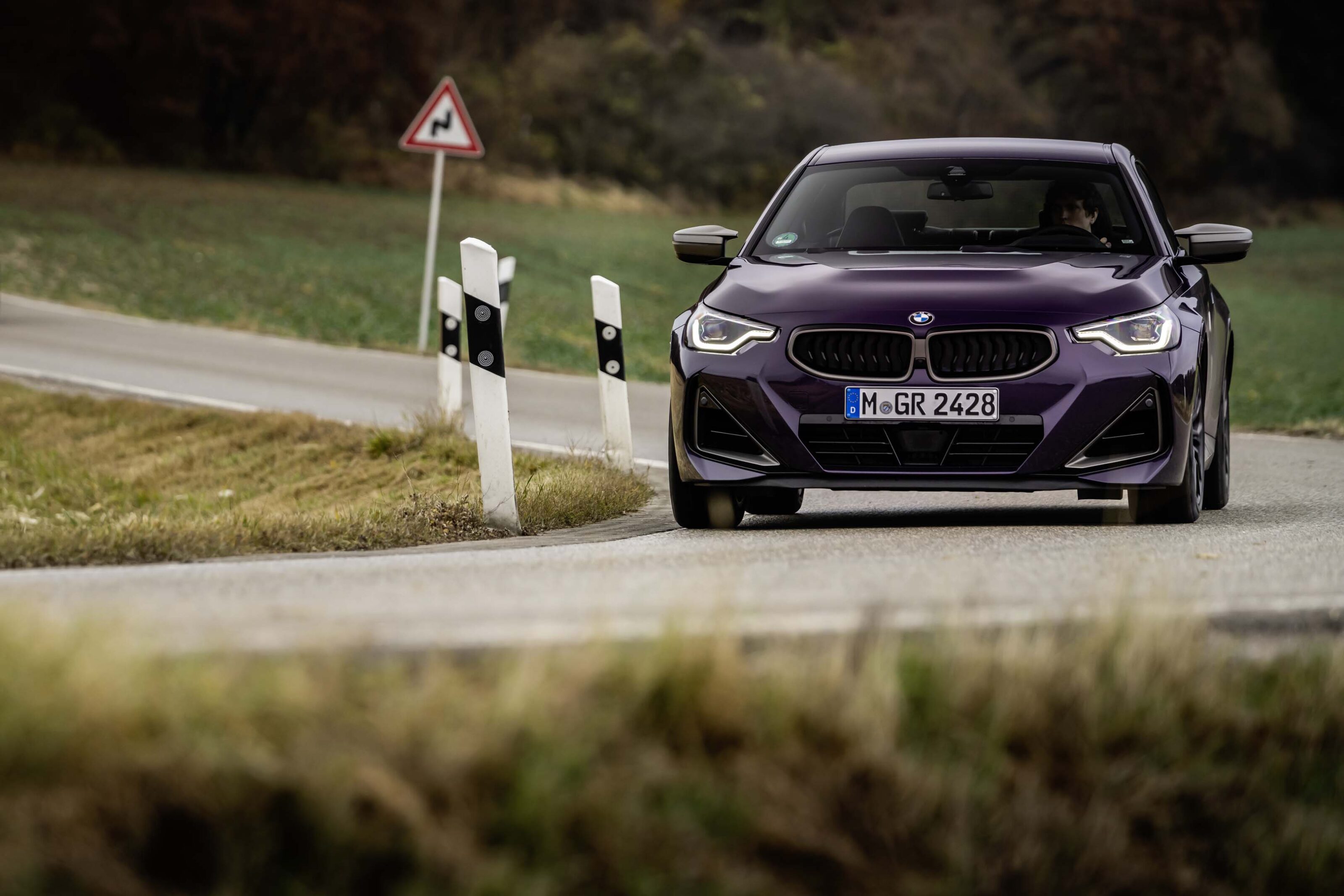
After all, the M240i wins the two disciplines than matter most for any daily driver; namely ride and handling. The steering, for starters, operates in a realm of its own, blending a fluent meatiness with total clarity and exactly the right measure of response.
There is a linearity and honesty to this direction-finder the other two more heavily chip-loaded systems simply cannot match: gearing, weight, accuracy, number of turns from lock-to-lock, speed of response, even the turning circle.
The BMW sports the longest wheelbase which eclipses the RS3 by an important 110mm. No surprise, then, that the 2 Series rides better than its two rivals here and, thanks to the optional adaptive M suspension you can choose between a marginally cushier or firmer set-up.
Although over 900kg of the kerb weight rests on the BMW’s nose, the chassis has homogeneity written all over it. A congenial support act, the xDrive system was taught to push or pull, with tapering fingers or a bargepole, depending on driving style, speed, radius, steering angle and distance to apex.
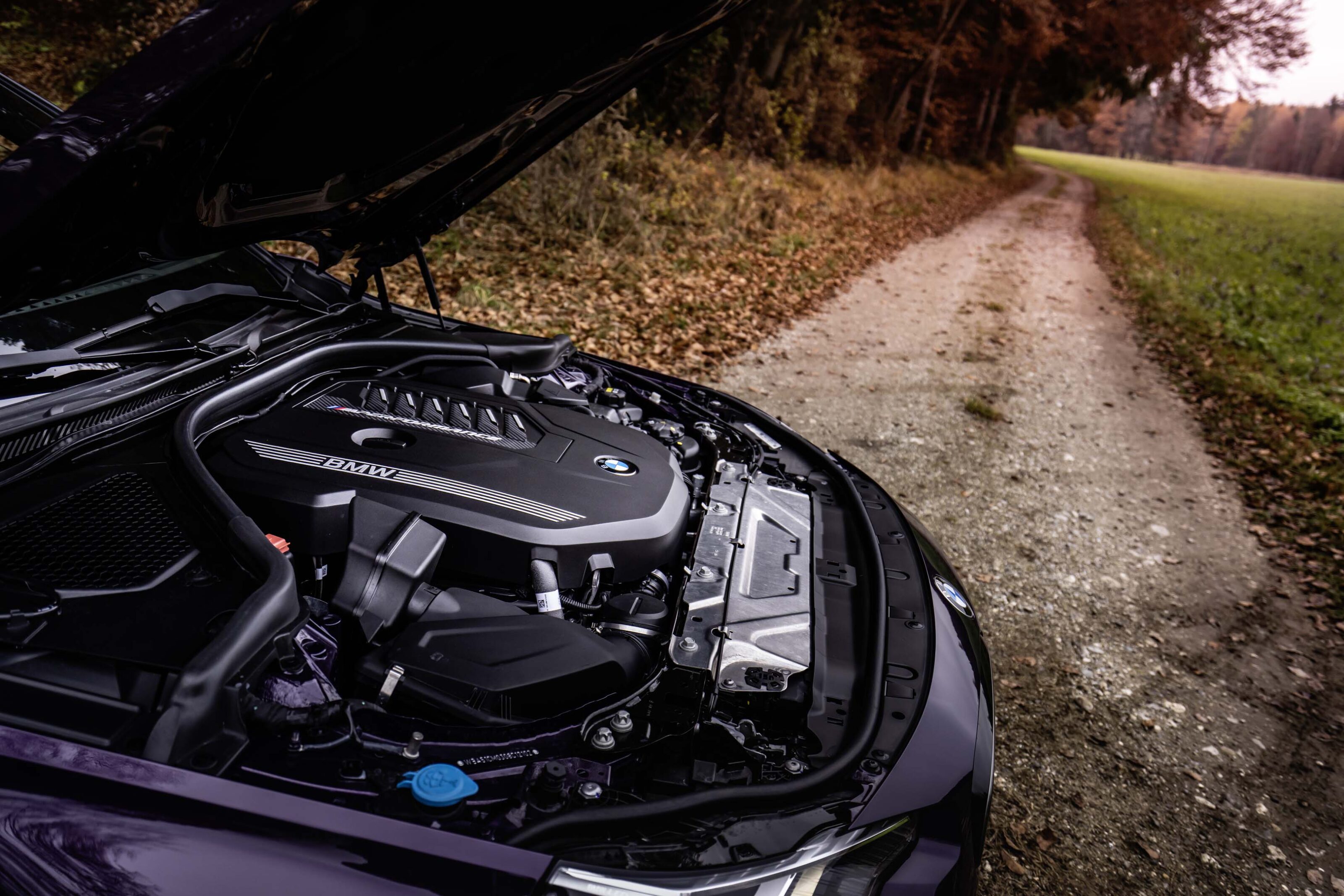
Especially with DSC off, this sweet handling balance stems from the genetic code and is not the result of a chip-induced afterthought. It makes a difference because when opportunity knocks around the very next bend, there is no need for the BMW driver to stop and edge the tool.
So, is there a winner, or do we have a tie at the top?
As an all-rounder, the Audi almost matches the BMW. It costs more, but it also is quantifiably quicker and is thoroughly practical. But the potent yet gruff engine doesn’t always make all the right noises, the drift mode is nice to have but not a game-changer, and the sensational brakes are no compensation for the split-personality suspension set-up and the underwhelming steering.
In some ways, the A45 S is even more of an achievement than the RS3, simply because it is such a huge leap from the base A-Class. The highly tuned four-cylinder engine lives on a razor’s edge, audibly, physically and emotionally. Steering and brakes come out of the same war chest, as does the bespoilered body.
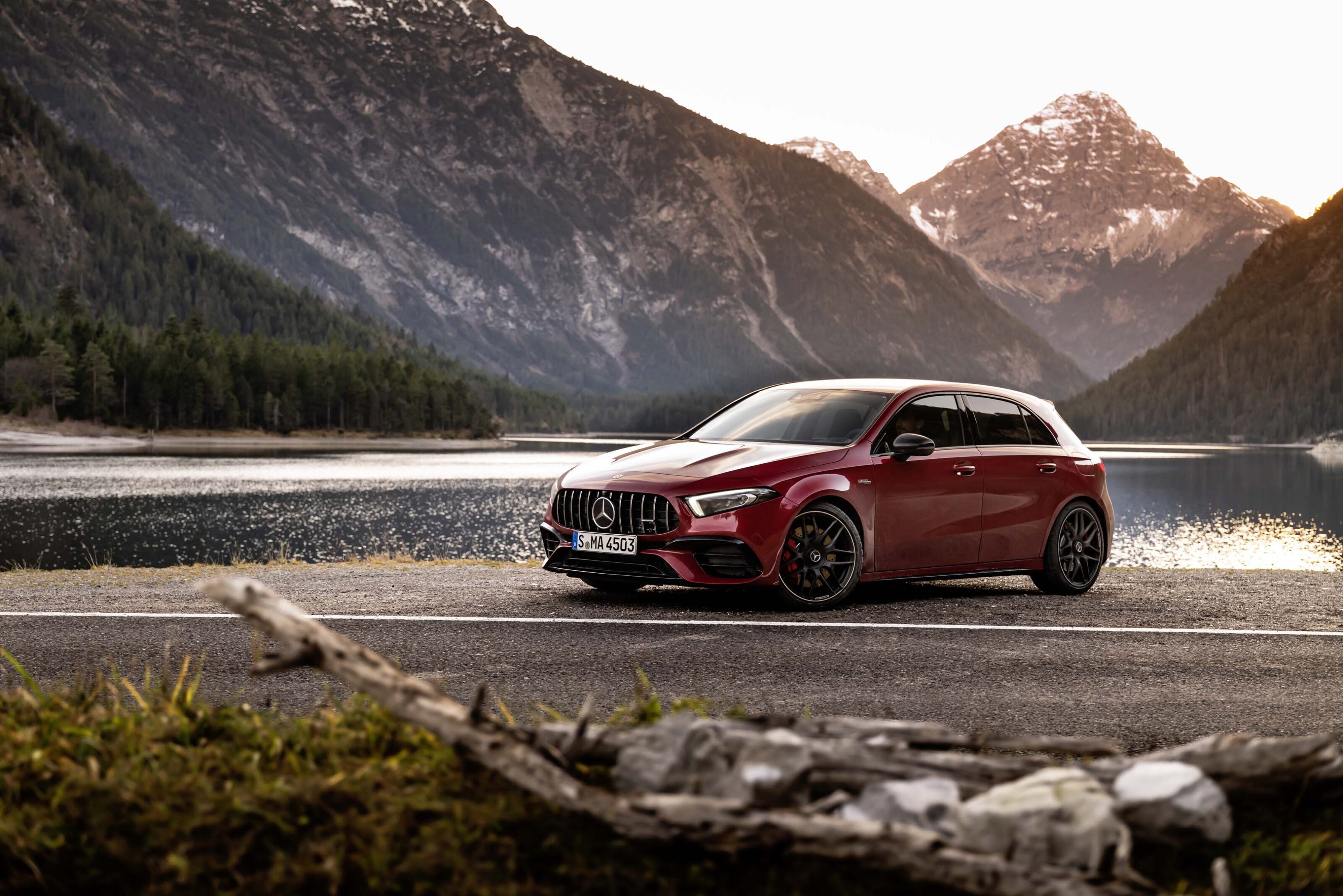
If one had to choose a car for crazy pre-dawn blasts, this is it. Equally, the Mercedes is not at its best for rush-hour crawls and speed-limited travel through frustrationland.
So the BMW wins, by merit, common sense and respectable balance in all departments that matter. True, it’s less lavishly appointed than its opponents, but on aggregate, the M240i xDrive makes the most compelling compromise between a broad smile on your face and a not totally depleted bank account.
It is neither the fastest nor the flashiest choice here, but as a totally honest driving machine with a rich pedigree, it needs zero artificial preservatives to deliver the full authentic flavour.
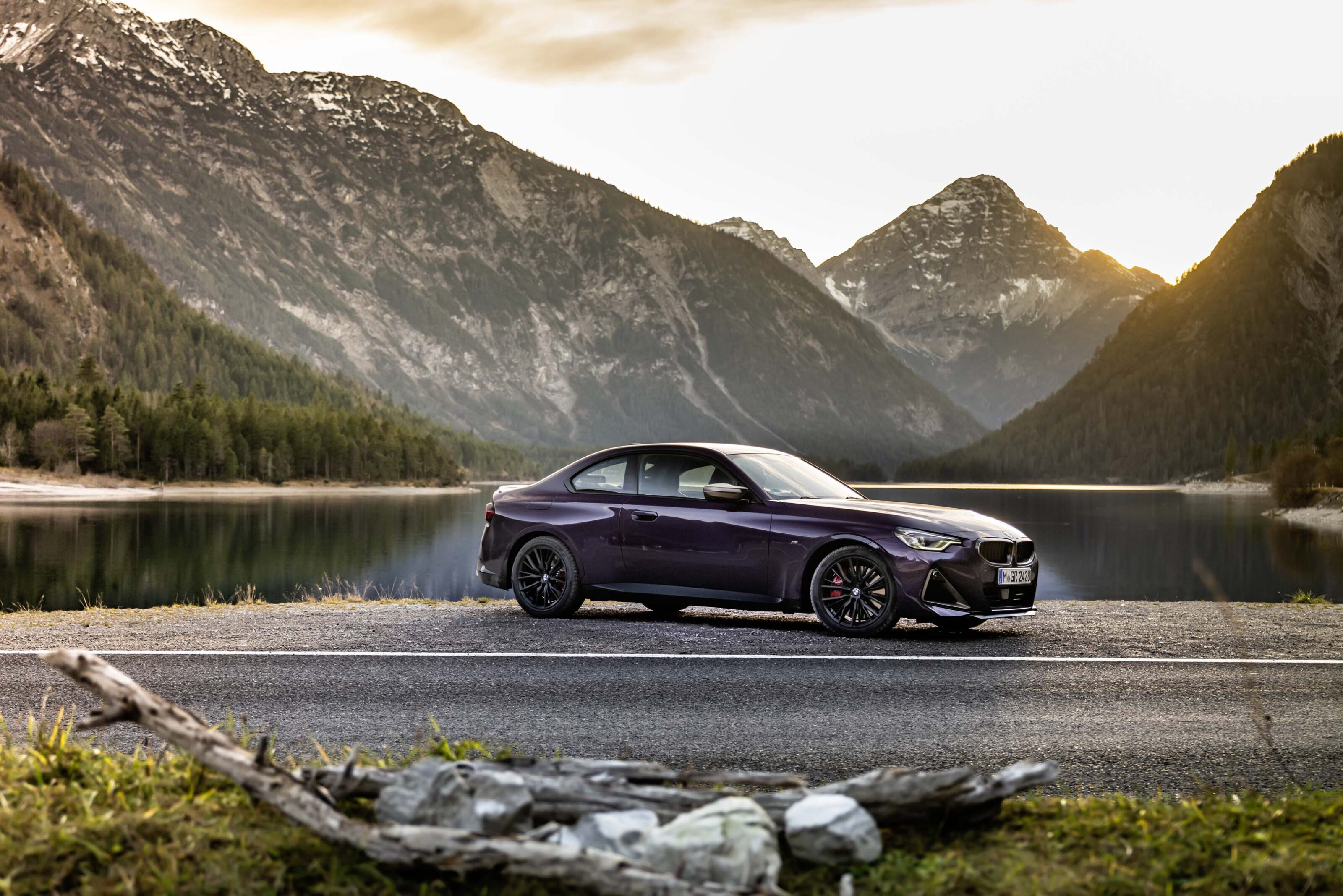
Advance from the rear
Which does the fun stuff best?
In the Audi, the most extreme option labelled Torque Rear turns the RS3 into a three-wheel driving machine. Both RS3 and A45 S achieve oversteer by channelling an extra-large portion of grunt to the outer rear wheel. This enables everything from subtle and brief tail-slides to full circles of varying diameter.
But while the Audi and the Merc had to develop fancy rear multi-plate clutches to conceal their front-drive roots, the BMW was born with a tail-happy torque distribution.
Even in xDrive form, the system’s preferred torque recipient is always the rear axle, and this demeanour can of course be further emboldened by selecting M Sport or DSC Off.
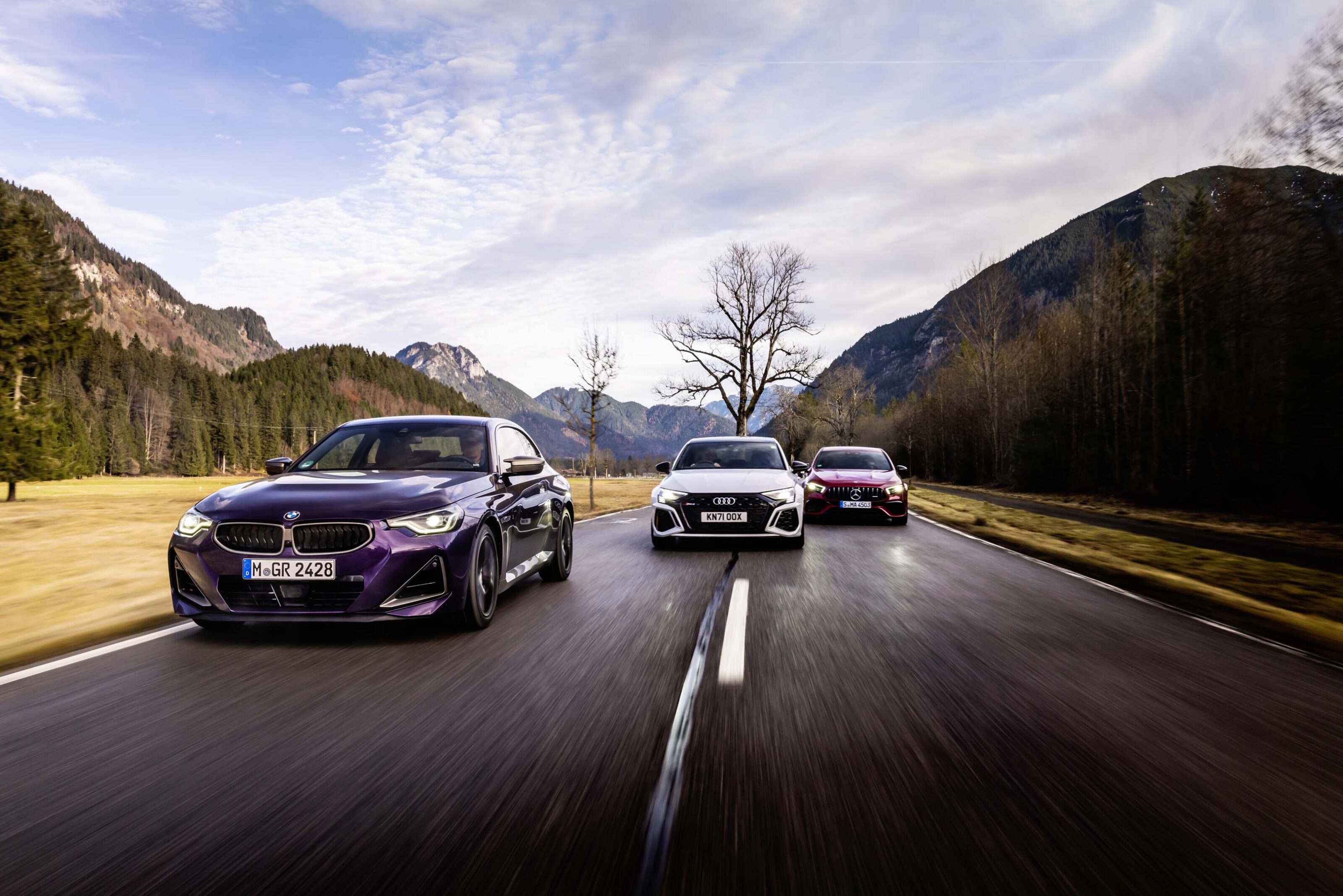
The FWD fuel saver
RS3: quattro, but not always
Constant all-wheel drive is excellent for traction, but the mechanical drag is less great for lowering consumption and emissions.
Because of this, the RS3’s newly calibrated Efficiency mode sees the hottest Audi hatch operate exclusively as a front-driver, making it the logical drive mode for steady, undemanding highway driving, and helping the RS3 to a 8.3L/100km rating on the WLTP test cycle.
SCORING
BMW M240i: 8.5/10
Audi RS3 Sportback: 8.0/10
Mercedes-AMG A45 S: 8.0/10
Snapshot
- 2023 Bentley Continental GT and GTC S revealed with sportier touches
- Flying Spur S unveiled alongside its two-door siblings
- Available in petrol V8 form, or an optional plug-in hybrid V6 for the Flying Spur
Bentley has expanded its line-up for buyers who prefer to drive, not be chauffeured.
The 2023 Bentley Continental GT S coupe/convertible and Flying Spur S limousine are the latest addition to the luxury marque’s sportier range, joining the Bentayga S large SUV.
Previously offered with the previous-generation range, the Continental GT S and Flying Spur S make a return after the current designs first debuted in September 2017 and June 2019, respectively.
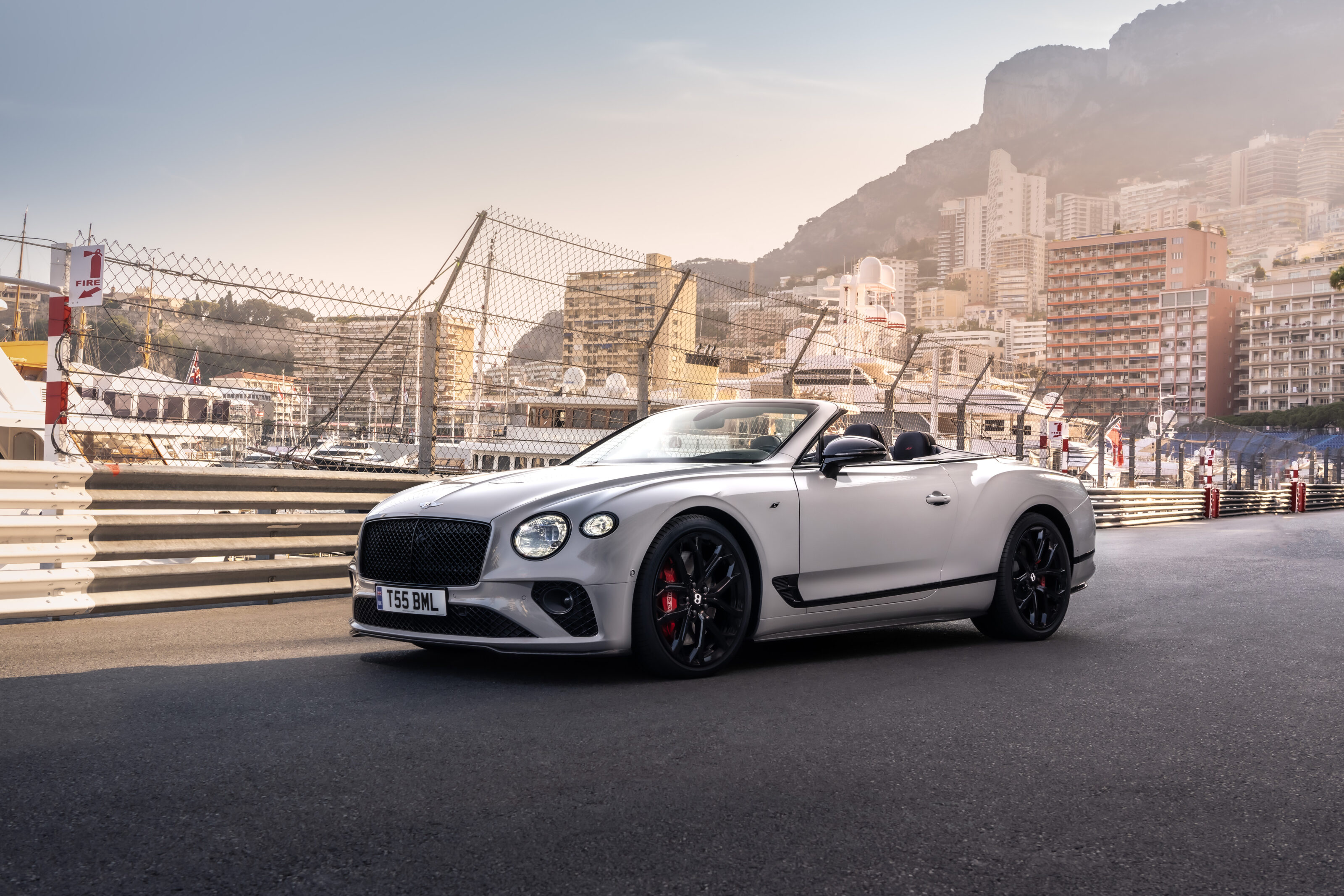
A plug-in hybrid variant of the Flying Spur S will be offered for the first time, pairing a Porsche-sourced 2.9-litre turbo V6 with a 14.1kWh lithium-ion battery and 100kW electric motor for a combined 400kW of power and 750Nm of torque.
The hybrid can travel up to 42 kilometres on electric power with a combined 700km range, producing a WLTP-rated 75 grams of C02 emissions per kilometre.
These figures are unchanged from the regular Flying Spur Hybrid revealed in mid-2021.
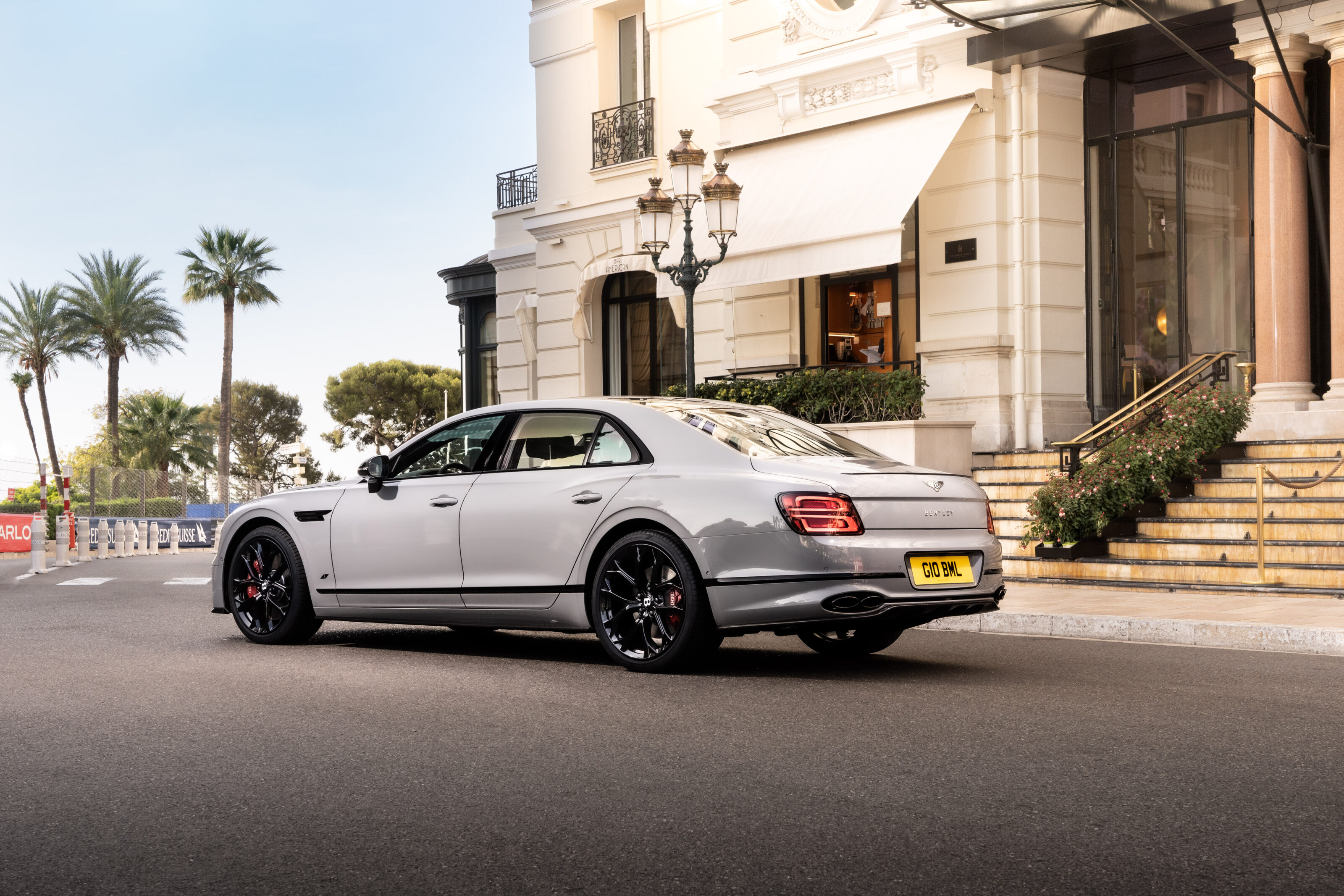
A 4.0-litre petrol V8 producing 405kW and 770Nm is also available for selection on the Continental GT S and Flying Spur S, with the eight-cylinder outgunning the PHEV from zero to 100km/h at 4.0 and 4.2 seconds, respectively.
Unfortunately, for those hoping to secure the W12 powertrain before its impending extinction, the Continental GT S and Flying Spur S will not be offered with that engine, which is available on the Continental GT Speed and Flying Spur Mulliner.
Bentley says the Continental GT S and Flying Spur S will feature an 48-volt active anti-roll system – known as Bentley Dynamic Ride – as standard, which includes rear-wheel steering and active anti-roll bars.
A redesigned sports exhaust system is included for the V8-powered Continental GT S and Flying Spur S, allowing for a louder tone in comparison to the regular variants.
Meanwhile, the plug-in hybrid Flying Spur S is said to be equipped with “ingenious sound enhancements” to deliver a sportier character when placed in Sport mode.
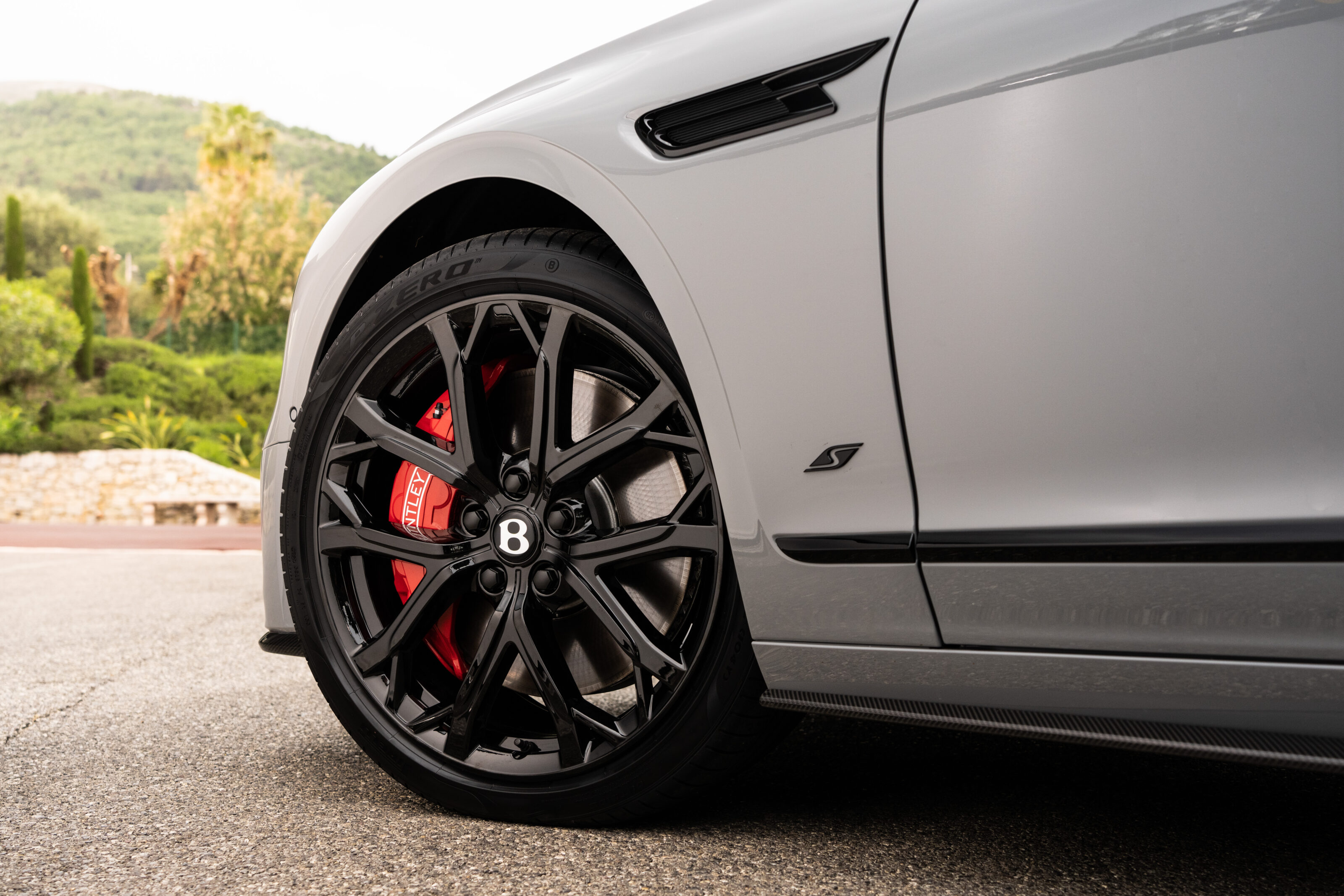
Exterior changes include; a darkened exterior, tinted headlights and tail lights, black quad exhaust pipes, S badging on the front quarter panels, and a black-painted grille.
A set of new 21- or 22-inch alloy wheel designs finished in satin or gloss black feature, along with red-painted brake calipers.
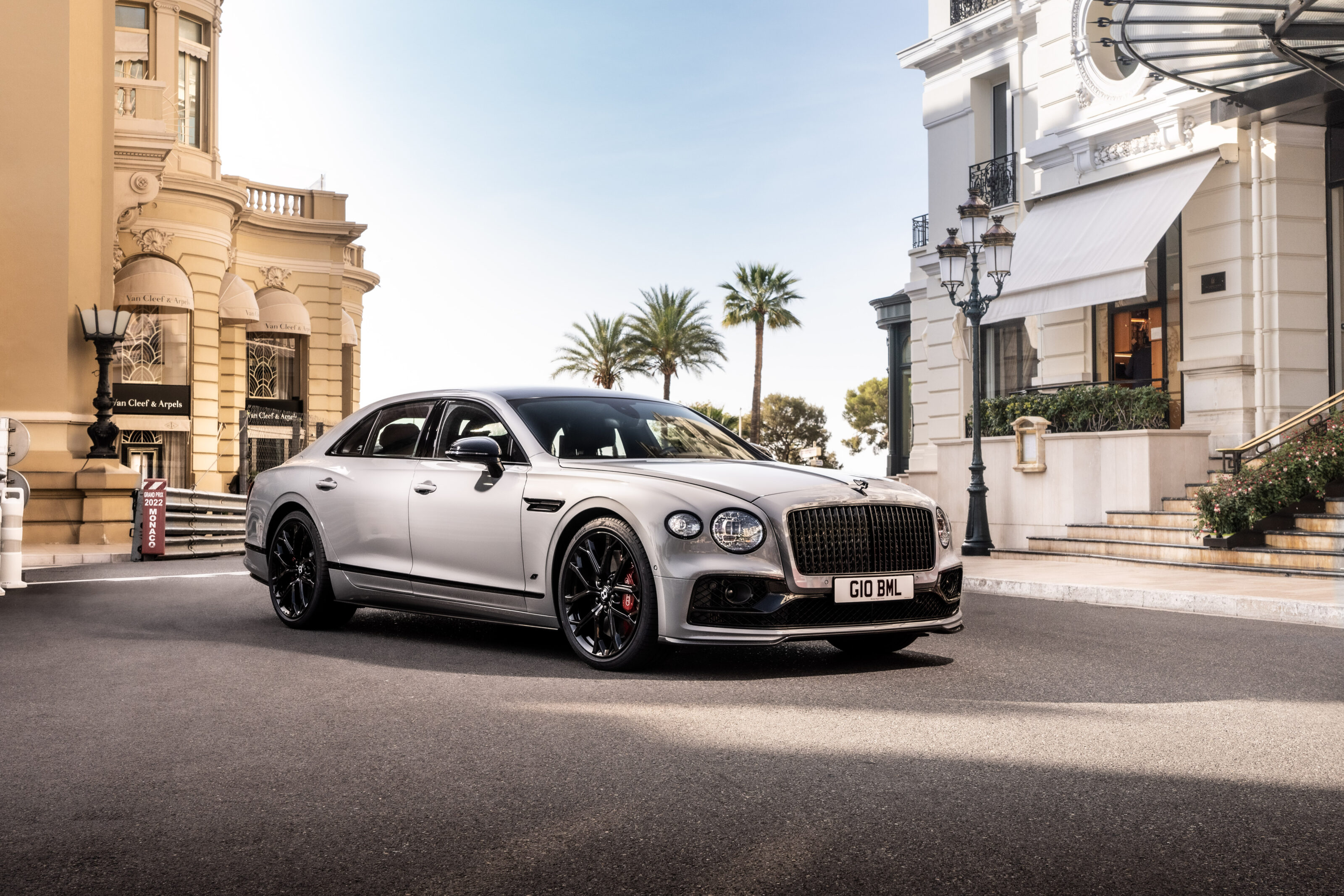
The only elements that retain a bright chrome finish are the Bentley badges and lettering on the boot lid.
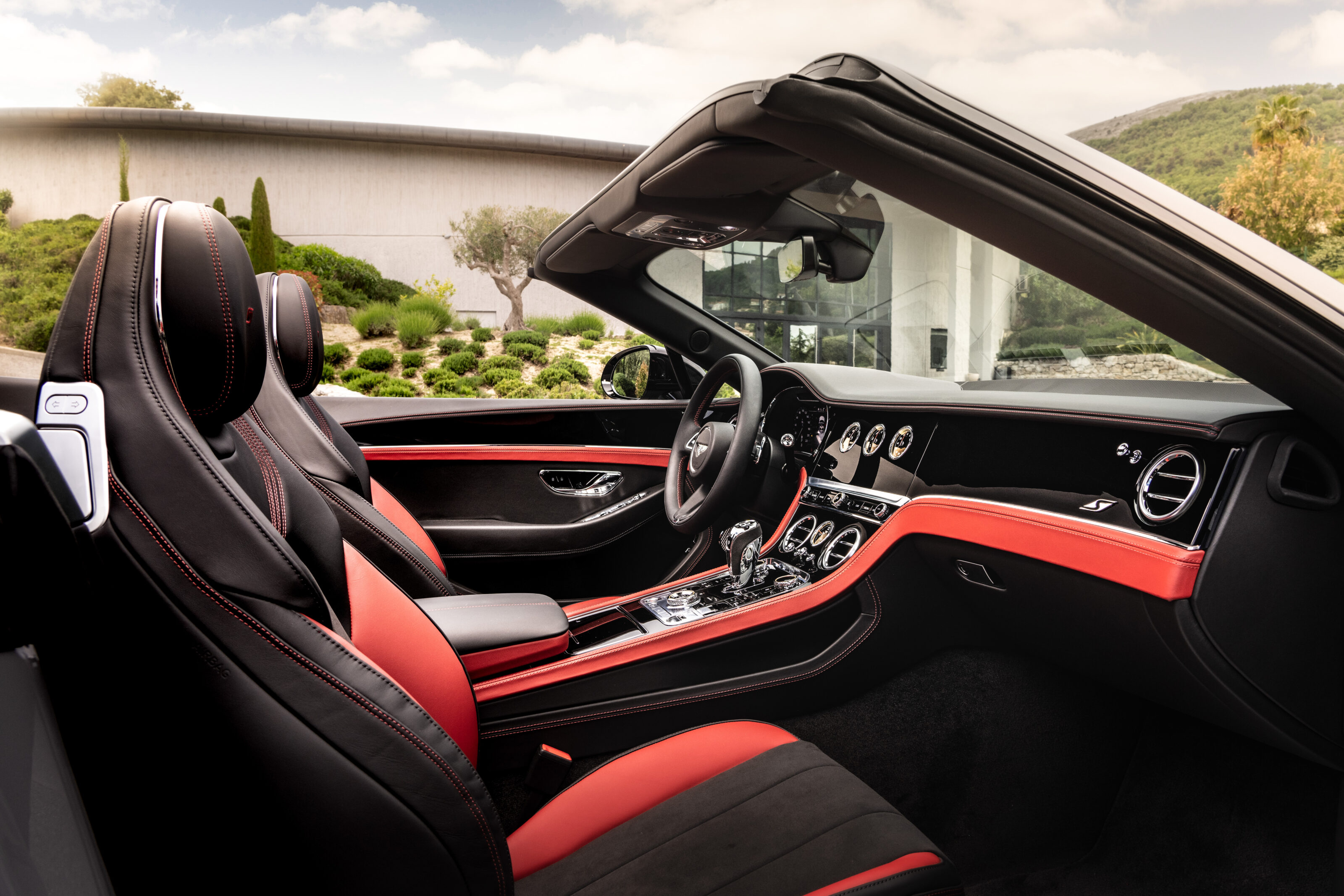
Inside, the Continental GT S and Flying Spur S are offered with two-tone suede and leather sports seats handcrafted at a specialist leather shop within the marque’s Crewe facility.
These seats are finished with a quilted pattern and include ‘S’ emblems (or no-cost optional Bentley badging) embroidered into the headrests.
Other enhancements comprise of an illuminated metal S scuff plates in place of the traditional Bentley logo, as well as unique badging on the dashboard and motorsport-inspired digital gauges shared with the Continental GT Speed.
The 2023 Bentley Continental GT S and 2023 Bentley Flying Spur S will be unveiled in person at the 2022 Goodwood Festival of Speed in the United Kingdom later this week.
Pricing and full specifications for Australia will be announced in the coming months, ahead of an expected launch in early 2023.
Snapshot
- Volkswagen confirms plans for ID. Buzz and ID.3 GTX
- All ID. family vehicles to gain GTX performance variants
- No plans for Australian electric vehicles yet
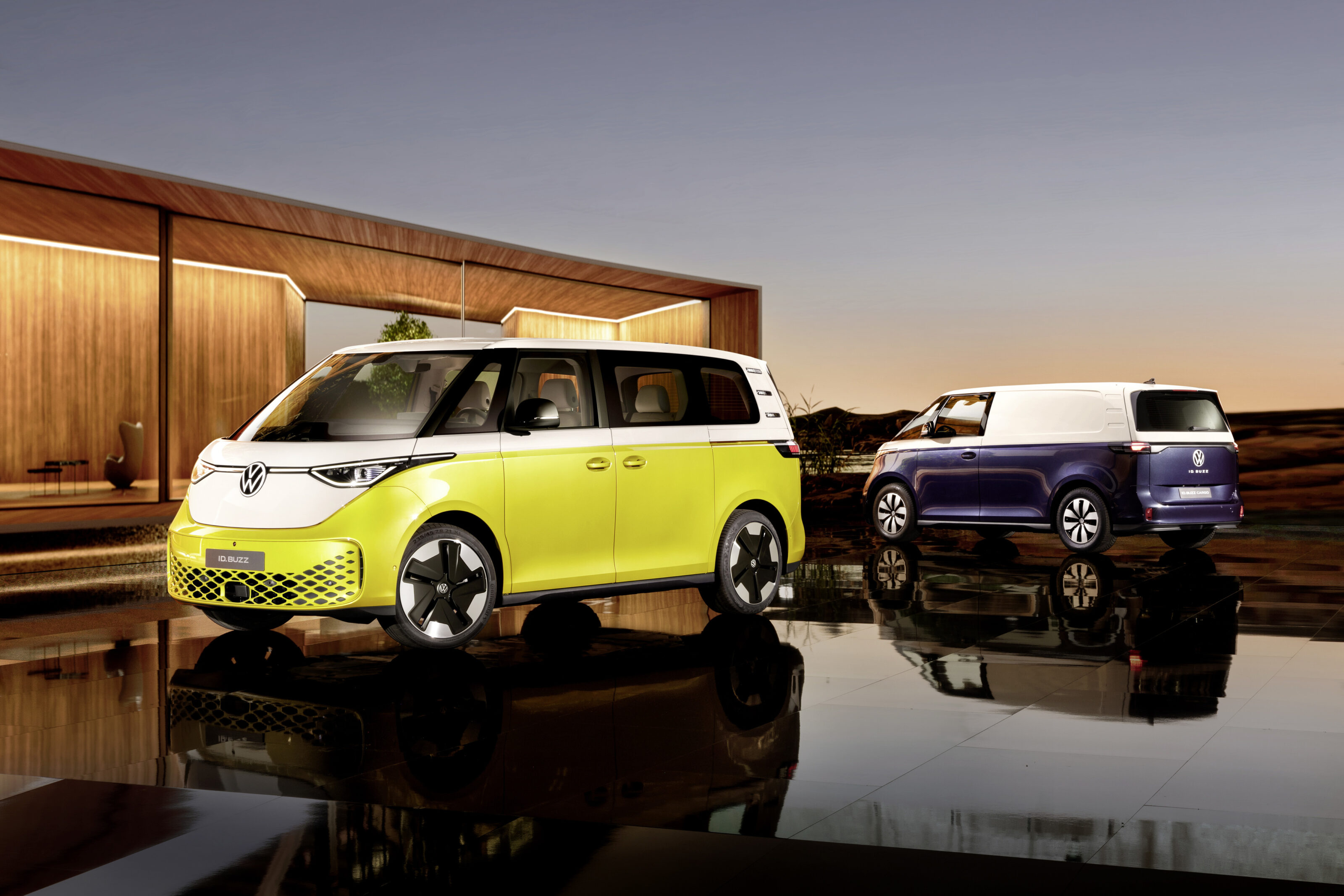
Every Volkswagen ID. model will gain a GTX variant – including its Buzz van and ID.3 hatchback, Wolfsburg has confirmed.
The German manufacturer announced its performance GTX nameplate affixed to the ID.4 and ID.5 SUVs will be rolled out across the rest of its fully-electric model range, with the ID.3 hatchback and ID. Buzz van set to benefit from the flagship treatment.
While the standard ID. Buzz and ID.3 are powered by a single 150kW, 310Nm electric motor on their rear axles, a GTX variant could amp up the outputs to 220kW and 460Nm with dual motors – matching the outputs of the existing MEB platform-based GTX counterparts.
UPDATE, Dec 15: ID Buzz comes to Australia
Volkswagen’s ID Buzz has been whisked into Australia for a quick tour, ahead of its local launch in the coming year. Join John Law for a look at its features and space.
Story continues…
According to Volkswagen ID.’s head of sales and marketing, Silke Bagschik, roughly 40 per cent of ID.4 and ID.5 buyers have opted for the flagship spec GTX, prompting the marque to offer the variant in more of its electric models.
“The success of the ID.4 GTX and ID.5 GTX confirms our strategy of positioning the GTX brand independently. Both models in their respective series have installation rates of almost 40 per cent,” said Bagschik.
“We will continuously expand this brand and offer a GTX variant for every ID. model in future – from the ID.3 to the ID. Buzz.”
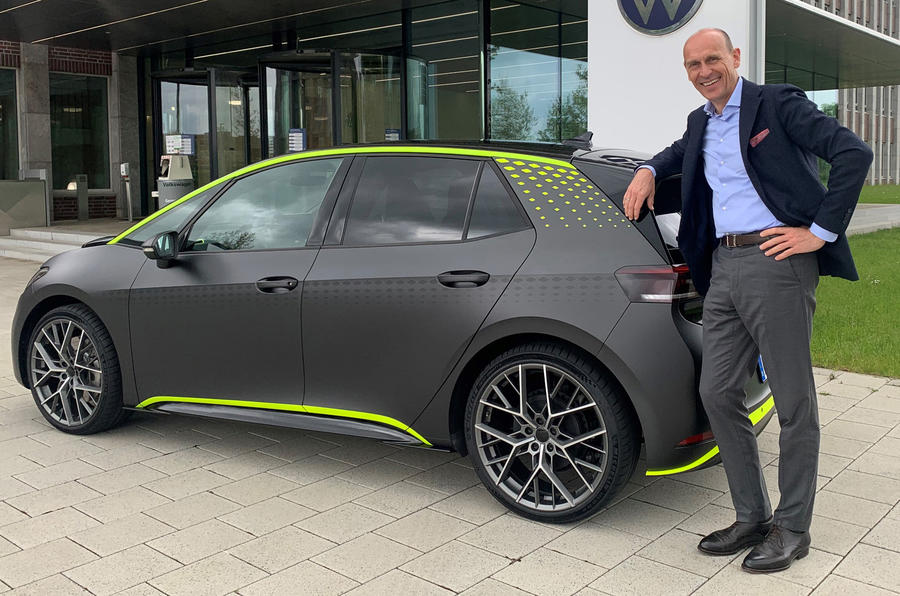
In September last year, Volkswagen COO Ralf Brandstätter all but confirmed the ID.X concept would go into production as the ID.3 GTX, giving the brand’s electric customers an alternative to its petrol-powered Golf R.
It will be the first time Volkswagen has offered a flagship van with the same performace specs as its passenger vehicles, although it’s unclear as to whether the GTX nameplate witll be used across one or both of the ID. Buzz’s passenger and commercial (Cargo) variants.
The announcement coincided with a minor update to both the ID.4 and ID.5 GTX, with both now gaining dual-zone climate control, a climate comfort windscreen, tinted side and rear windows, heated front seats, two USB-C ports and a variable centre console.
None of the ID. range is currently in Volkswagen’s Australian plans for 2022, however its off-shoot Cupra will bring the Born EV to the local market later this year, followed by Skoda’s Enyaq iV SUV in 2023.
Ferrari has recently confirmed that the Purosangue SUV will go into production this year. Spy photos suggest the family-friendly Ferrari is more oversized hot-hatch than soccer-mum SUV, but we still can’t shake our vision of Enzo Ferrari spinning in his grave at 7500rpm.
Il Commendatore famously declared there would never be a four-door Ferrari. His view was reinforced in 2014 by Sergio Marchionne, CEO of Ferrari (and Fiat-Chrysler) until his sudden passing in 2018.
“There will be no four-door or SUV from Ferrari.” Three years later, Marchionne announced the SUV project.
Four-seater Ferraris had long been another matter. The first true production Ferrari four-seater (overlooking various low-volume coachbuilds) was the 250 GTE 2+2, launched in 1960. With more than 950 made, the 3.0-litre V12 250 GTE became the biggest selling Ferrari model to that time.
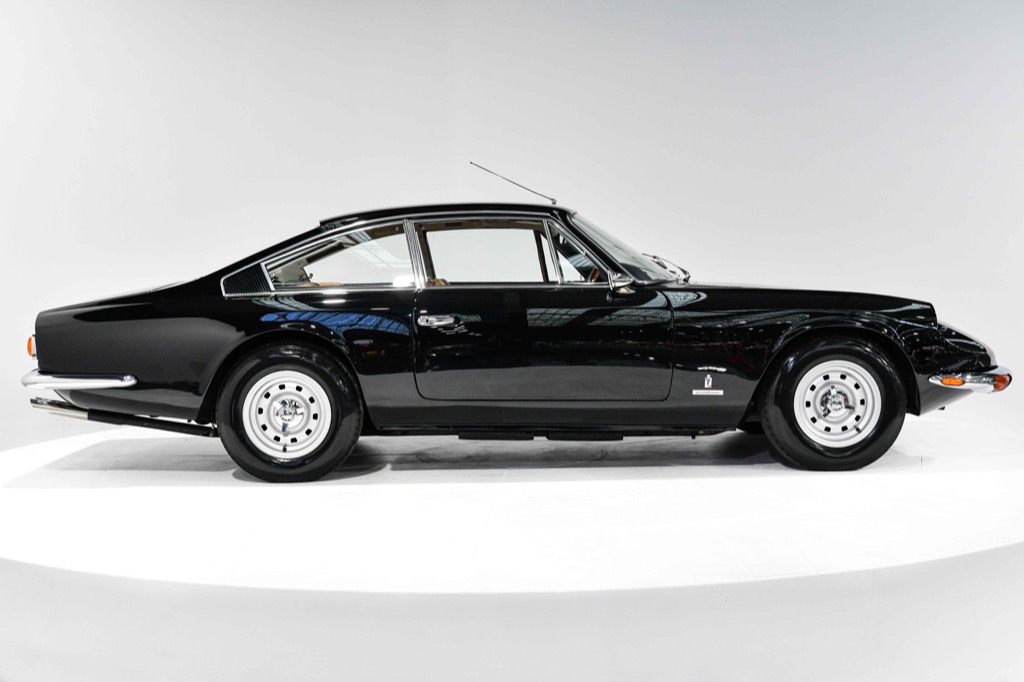
It’s said that Enzo used a 250 GTE 2+2 as his personal car; better documented is his use of a subsequent 2+2 model, the 4.0-litre 330 GT.
If Enzo liked the practicality of his four-seaters, he surely loved the lire that they brought in to help fuel the golden age of Ferrari’s dominance at Le Mans.
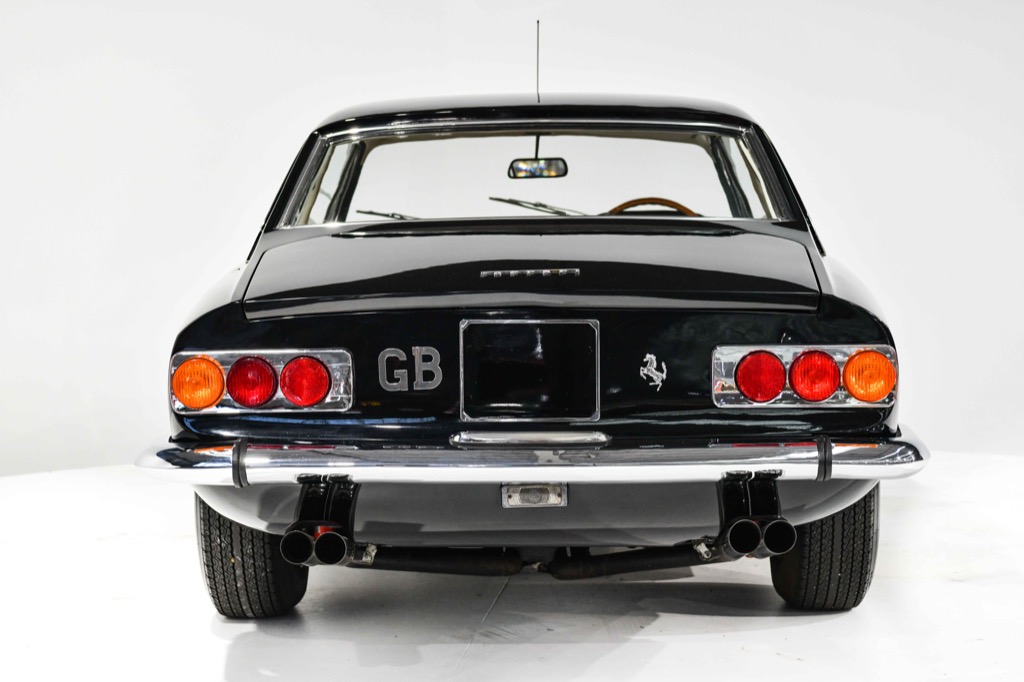
In 1967 came the 365 GT 2+2. With a 4.4-litre version of the Colombo V12, the new 2+2 retained the 330’s 2647mm wheelbase, but with longer overhangs and a flowing shape that took cues from designer Aldo Brovarone’s recent 500 Superfast and concurrent Dino 206 GT.
At almost five metres overall, it was the largest Ferrari ever, prompting the US Road & Track to nickname it Queen Mary (the legendary liner was moored permanently in California the same year).
The familiar steel-tube spaceframe chassis carried a steel body, with fibreglass floor pan and firewall.
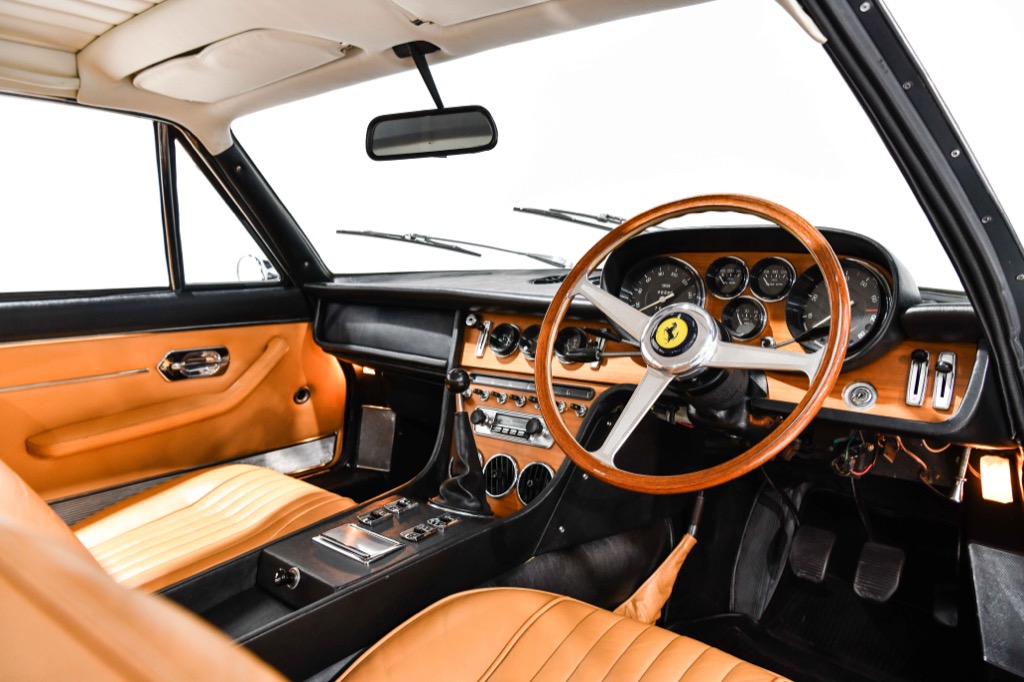
Since 1960, Ferrari has only twice been without a V12 2+2 in its range – from 1989-’92 and right now, after the 2020 axing of the GTC4Lusso.
Grand touring sophistication extended to the dual Ferrari firsts of power steering and air conditioning, along with an independent rear suspension (versus the 330’s leaf-sprung live axle) with a hydraulic self-levelling system.
The 365 GT 2+2’s success was also boosted by its compliance with newly introduced US safety and emissions regulations; it was briefly Ferrari’s sole model in the US market.
Ultimately 801 examples were built, 52 of them in right-hand drive, before it was replaced in 1971 by the ‘Daytona’-based 365 GTC/4.
Since 1960, Ferrari has only twice been without a V12 2+2 in its range – from 1989-’92 and right now, after the 2020 axing of the GTC4Lusso.
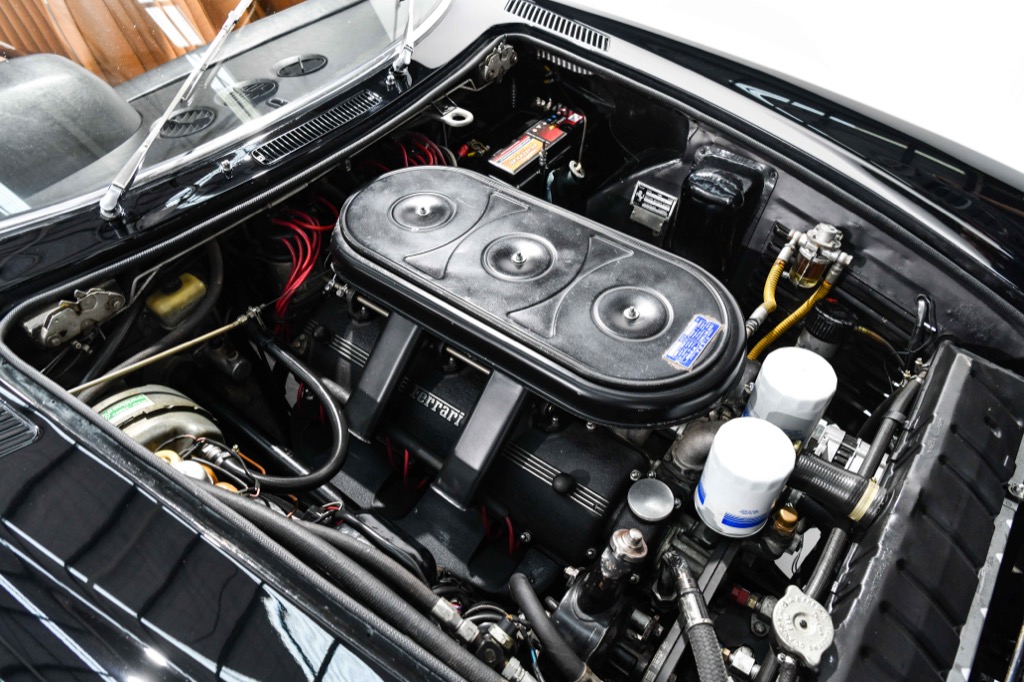
Living large
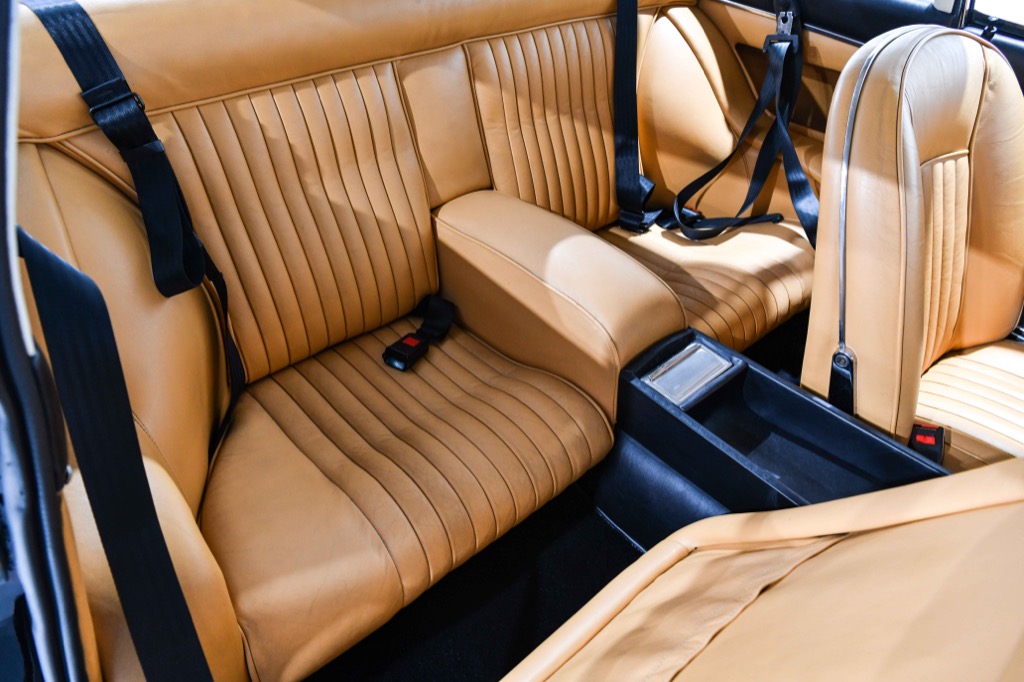
The 2+2 more than earned its title, with rear seating space and grand touring comfort praised in contemporary road tests.
The cabin was luxuriously appointed, with a wood rim steering wheel framing comprehensive Veglia instrumentation.
A tall, timber veneered centre console straddled the front-mounted gearbox and housed switches for the power windows.
Down below, alloy disc wheels were standard, though many owners optioned more traditional Borrani wires.
Inspecting Colombo
Gioachino Colombo designed Ferrari’s first V12, the jewel-like 1.5-litre ‘125’ in 1947. Successive increases in stroke, bore and (in 1963) bore spacings, brought the all-alloy, 60-degree ‘Colombo’ V12 to the 4390cc ‘Tipo 245’ in the 365 GT 2+2.
The last Ferrari V12 with sohc per bank, it’s fed by six Webers and produces 245kW and 364Nm.
Via a five-speed manual ’box, the 1480kg coupe runs 0-100km/h in 7.1 seconds and has a top speed of 245km/h.
UPDATE, July 21, 2022: Civic Type R revealed!
The new-generation Honda Civic Type R has now been revealed. Get all the pics and details at the link below!
The story to here
New Civic Type R hits the highway in Japan
The upcoming new 2023 Honda Civic Type R, first seen in this same state of undress back in mid 2021, has been spied cruising on a highway in Japan.
There’s no thrilling action in the short video below, and we’ll never know if a couple of Honda engineers were simply setting out for some midnight action on the Wangan, but it’s nonetheless a tasty dripfeed moment for ‘CTR’ fans.
We’re not far now from the new-gen hot hatch’s big reveal, with a date set for sometime in the northern summer – meaning we could see it anytime from now through to the end of August.
You can learn more about what we’re expecting from the new Type R, apart from its clearly more subdued styling (but the wing remains!), as the story continues below.
The story to here
October 2021: Just one day after the 2022 Honda Civic Type R was officially teased by the Japanese carmaker, the hot hatch has been spied undergoing road testing.
The Civic can be seen wearing its special Type R camouflage – and showing more of its exterior than in the video – as Honda finalises preparations ahead of the model’s launch.

Honda has already confirmed the Civic Type R will be offered with a manual transmission, with the outgoing model’s 2.0-litre turbocharged four-cylinder petrol engine expected to carry over in some form – potentially with the addition of a 48-volt mild-hybrid system to aid acceleration, as well as reducing emissions and fuel consumption.
Given the CTR was caught testing on the roads around the Nürburgring in Germany, it appears as if Honda is serious about maintaining the car’s reputation for being one of the top front-wheel-drive hot hatches on the market.
To make sure everybody knows about it, the Civic will feature a body kit with large air vents on the front spoiler, deep side skirts with louvres incorporated into the front wheel arches, and a large rear wing – which may end up being adjustable to improve rear-end grip.
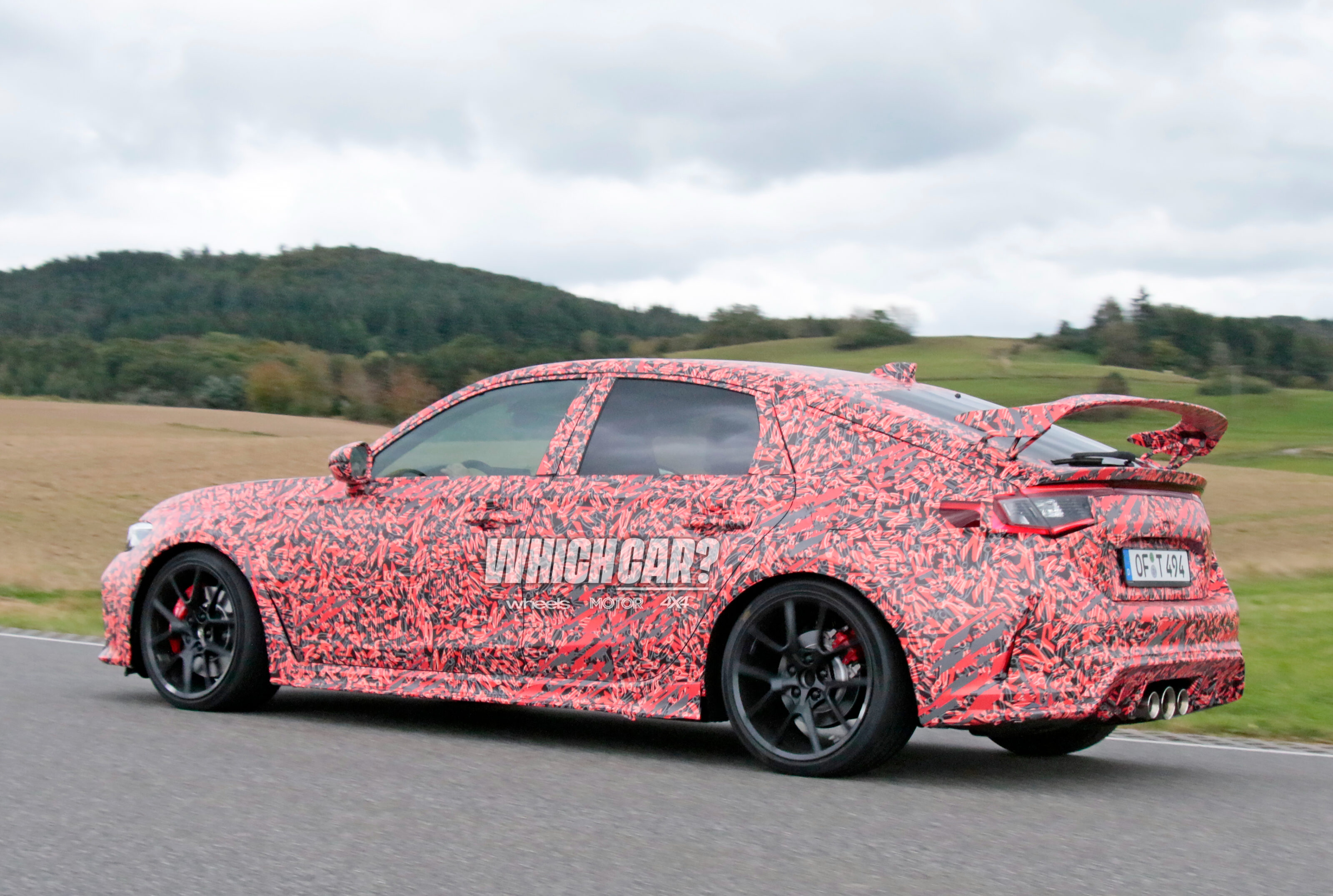
A trio of three exhaust tips also features, together with high-performance Brembo brakes hiding behind large black alloy wheels, clad in Michelin Pilot Sport 4S tyres.
As with previous models, expect body-hugging front seats finished in red, and a signature Type R aluminium shifter – together with plenty of red contrast stitching and highlights throughout the cabin.
The 2022 Honda Civic Type R has a global launch scheduled for 2022, but it’s likely we’ll see an official unveiling before the end of 2021.
Snapshot
- RAV4 ranks as the world’s most popular car for 2021, beating three other Toyota models
- Four Honda entries internationally despite no top 10 models in Australia
- Tesla Model 3 jumps from 21st to 10th in overall rankings, 40 per cent year-on-year increase
Last year was a tricky one for the automotive industry, with manufacturers around the world struggling with supply constraints due to semiconductor shortages and illness within the workforce.
While sales were down compared to ‘normal’ years in most countries, some were able to take advantage of other’s misfortunes and move up the sales charts.
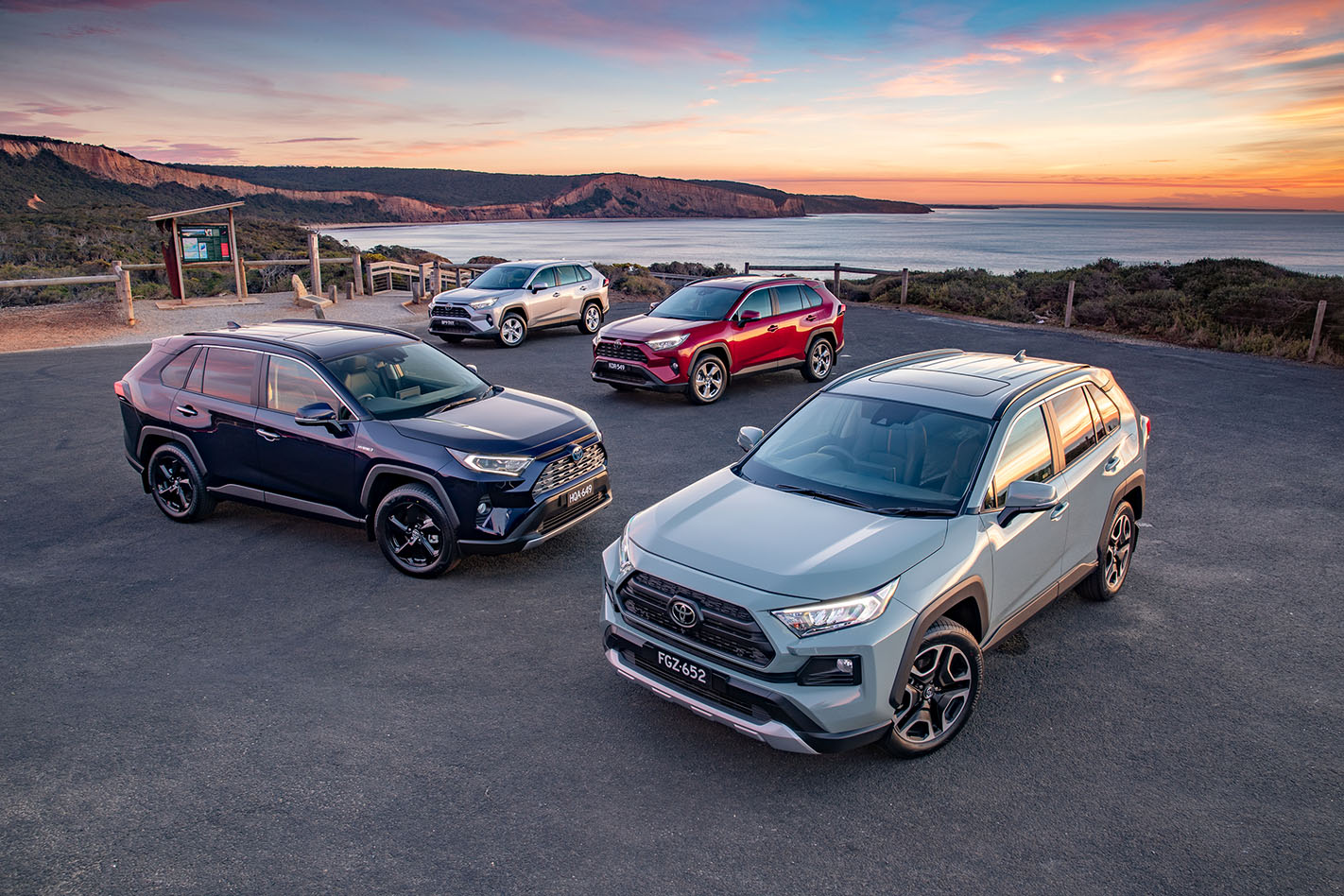
In a list compiled by Car Industry Analysis, the Toyota RAV4 (or Wildlander as it’s known in China) beat its Corolla sedan stablemate to the top spot with 1,132,000 units shifted last year – a six per cent increase over the year prior.
https://www.instagram.com/p/Cex2qDQsY9l/
Locally, the RAV4 was third on the Australian sales charts, behind only the HiLux and Ford Ranger utes with 35,751 units sold – as Toyota claimed just under three in four examples of the crossover SUVs delivered were hybrids.
Just as it was internationally, the Corolla sat behind its RAV4 sibling in the local rankings, managing 28,768 sales over the 12-month period, although it’s worth noting these sales were for the combined hatch and sedan – rather than the global list, which focuses on the four-door only.
The first car to miss the one million unit mark last year was the third-placed Honda CR-V, with the 903,000 sold globally representing a three per cent increase over 2020’s sales figures – although Australian sales dropped by 27.8 per cent, with 6875 cars shifted throughout 2021.
Despite its popularity growing by eight per cent internationally, with a total of 681,000 sales to put it fifth on the list behind the Nissan Sentra (a model not available in Australia), the Toyota Camry was only sixth-best amongst the manufacturer’s local offerings, dropping behind the aforementioned HiLux, RAV4 and Corolla – as well as the Prado and LandCruiser wagon.
Honda’s second entry on the global charts came in the form of its smaller HR-V crossover, with sales growing by 20 per cent to 670,000 units across the globe.
As with its CR-V sibling, the HR-V missed out on a top 10 appearance in Australia, although its 6069 sales made it the brand’s second-most popular model, just under 800 units behind the larger offering.
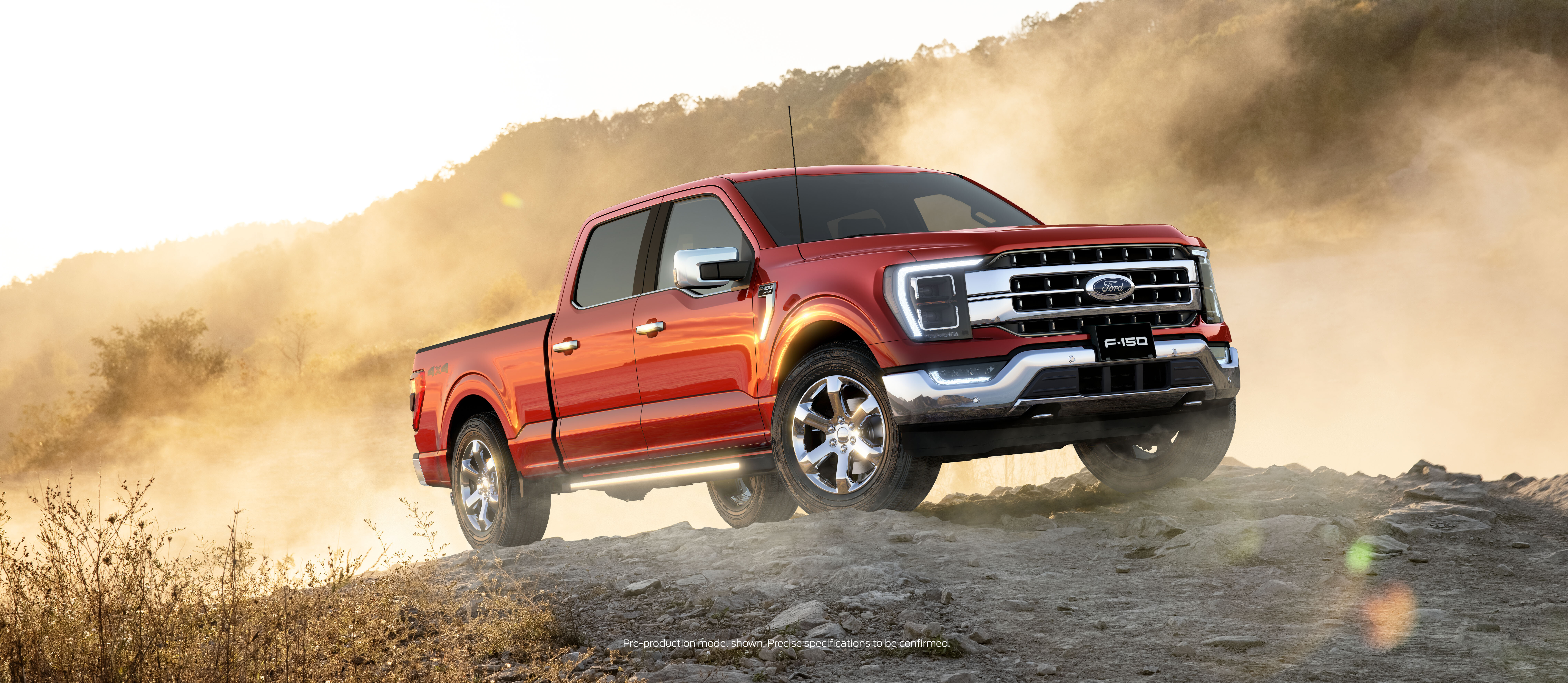
While the Ford F-150 pick-up truck is only available in the North American market (for now), its success in the United States means it sits in seventh overall – a drop of one place over 2020, although it could have fallen further had Ford not prioritised it amidst semiconductor shortages.
Behind it was the Toyota HiLux – Australia’s best-selling model – accounting for just under 10 per cent of global sales, with the 52,801 units sold Down Under pushing the ute up to eighth overall from 13th in 2020.

For the first time ever, an electric vehicle made it into the top 10, as the Tesla Model 3 cemented its status as the most popular EV around the world – and in Australia – with a staggering 508,000 units sold, coming from just two plants in Freemont, California, and Shanghai, China.
Closing out the rankings were Honda’s Accord (481,000 sales) and the Civic sedan (467,000 sales) – the latter of which saw the introduction of its 11th generation halfway through the year en route to 2950 deliveries in Australia, while the Accord recorded just 90 local sales.
Looking through the extended top 110 list compiled by Car Industry Analysis to find where other top 10 Australian models ended up, the Hyundai i30 (fifth locally) missed out completely, as did the Toyota Prado (eighth), Mitsubishi Triton (ninth) and MG ZS (tenth).
Australia’s two other leading utes in the Ford Ranger (second locally) and Isuzu D-Max (sixth locally) managed to both sneak into to top 40 global rankings, placing 23rd and 39th respectively.
Opulence is a mindset. A mindset best exemplified by the 2022 Mercedes-Maybach S 680. Everywhere you look in its over five-metre length, you are reminded of why this vehicle is worthy of wearing the hallowed Maybach badge.
Unwavering is the S 680’s focus on luxury. Everywhere you look and touch is an ocean of the finest materials, crafted with care, along with the best technology this side of a spacecraft.
As you’d expect, this kind of opulence comes at a price. Specifically, $574,000 plus on-road costs. That makes this Mercedes-Maybach limo the most expensive car you can buy in Australia with a three-pointed star badge. Yes, the AMG GT Black Series wore a larger price tag ($796,100), but try calling your local dealer to buy one and report back to us.
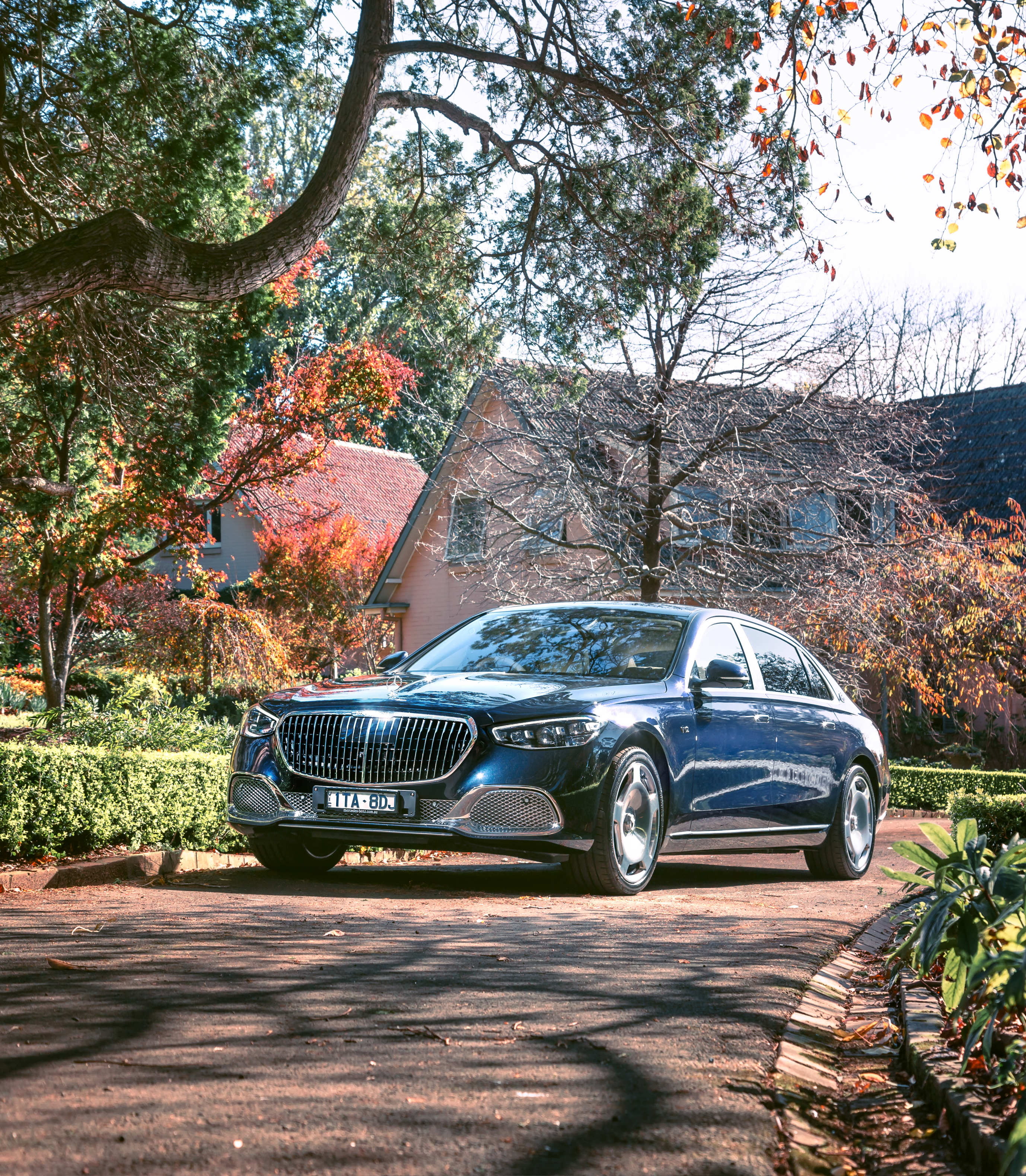
That half-million-plus price is $129,000 more than the previous-generation Mercedes-Maybach S 680, and an additional $239,000 more than the most expensive S-Class currently available in Australia – the S 580 L.
Identifying the Maybach variant is a bespoke grille, along with stainless steel exterior trim on the lower intake, sills, and rear bumper. Exclusive to the Maybach is the chance to option a two-tone paint scheme, with customers able to choose between 10 contrasting colours.
There’s also the extended wheelbase that stretches further than the L variants of the other S-Class models. The S 680’s wheelbase measures 3396mm in total, an extra 180mm between the arches. At five and a half metres from bumper to bumper, the S 680 requires the aid of four-wheel steering for its svelte manoeuvrability.
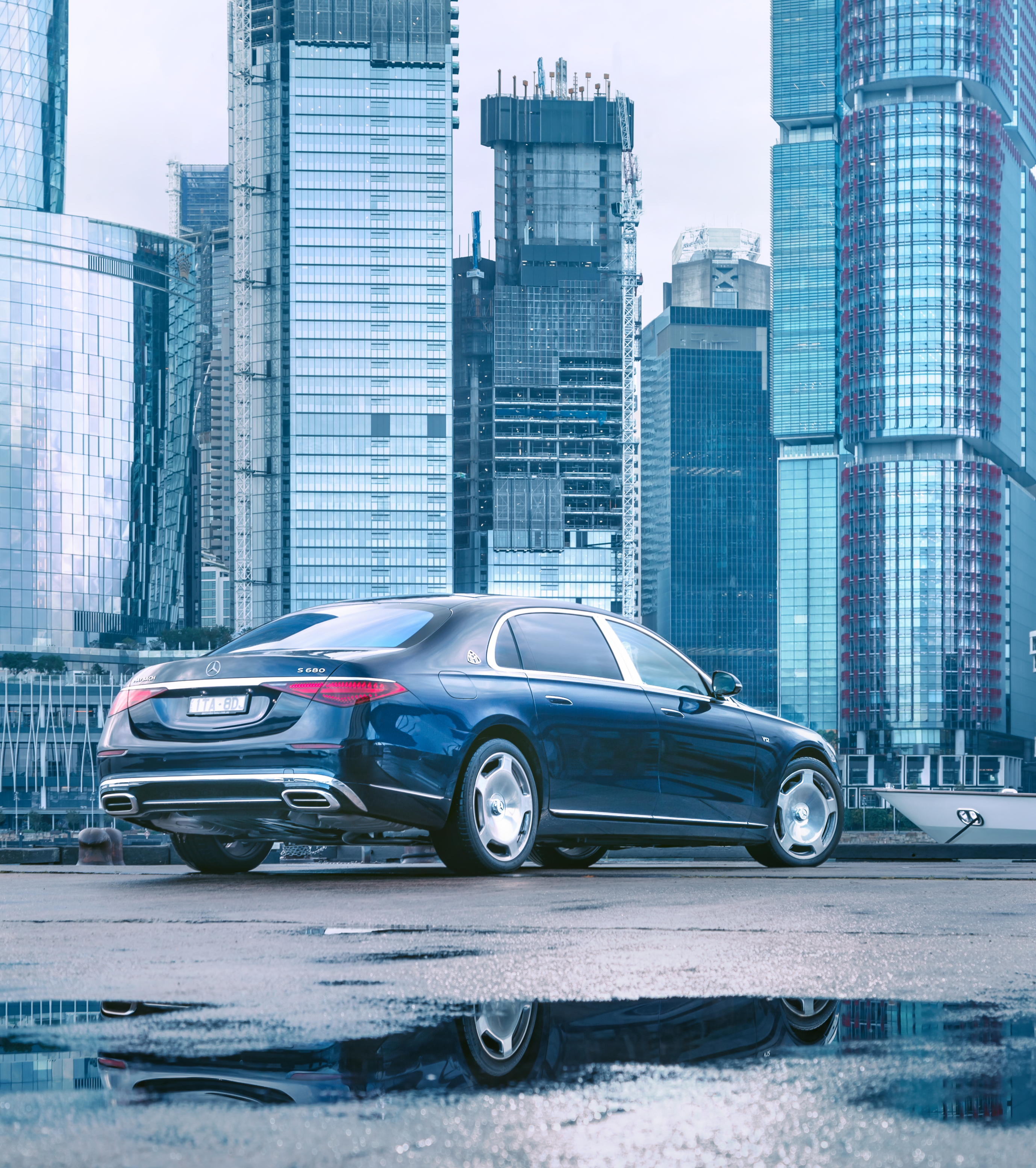
The system is able to assist the S 680 in navigating tight urban spaces with ease, even when limited to just 4.5 degrees of rear lock if owners opt for wheels above the 20-inch standard (down from 10 degrees).
But, as mentioned earlier, a hefty price tag does not true opulence make. Justifying that significant outlay of wealth is a level of engineering that leaves you reeling at every turn.
Core to it all is the engine, a 6.0-litre twin-turbocharged V12 (codenamed M279) that produces 463kW and 900Nm. That V12 – the last of its kind in Mercedes showrooms – is a centrepiece jewel in the crown. A masterwork in engine design and refinement. Crisp, pure, and smoother than the softest silks. Yet it has a tensile strength that seems unbreakable.
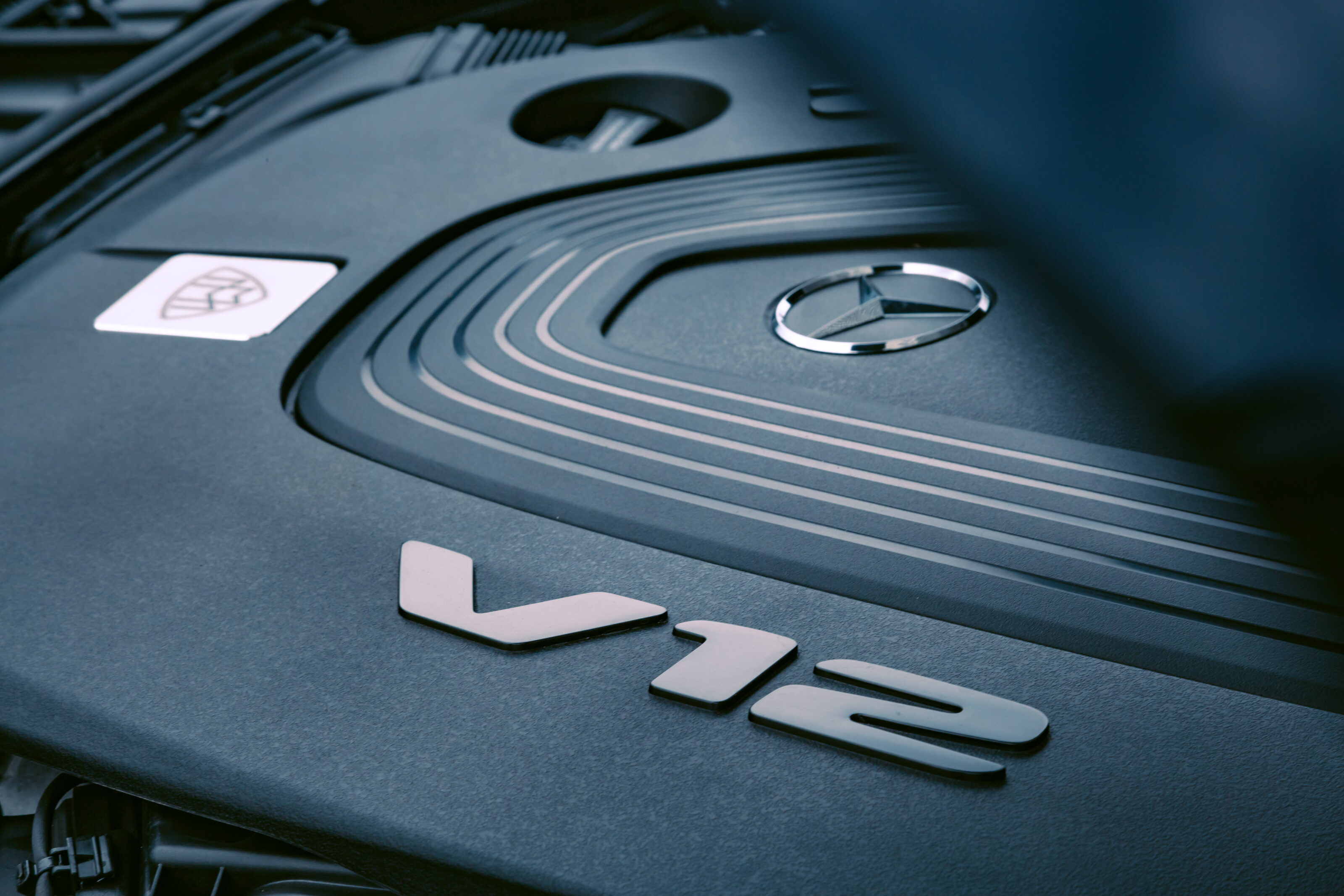
Those outputs on paper are akin to many supercars, but the S 680 drives like a gentle breeze. Supple in the extreme, the big (6.0 litres is a rather large capacity by today’s standards) unit thrusts the car forward on demand without fuss.
There is plenty of pace to be found, with the claimed acceleration capabilities being a 0-100km/h sprint of 4.5 seconds. Top speed is a stately 250km/h. Ponder that in the context of the Maybach’s 2255kg kerb weight. It’s the heft, and aforementioned swept capacity, that results in the M279’s thirst for fuel. The claimed combined fuel consumption is 13.6L/100km. And you’ll be feeding the Maybach premium, of course.
Not that any owner is going to be bothered, even with our perennially rising fuel costs. What really matters to buyers is what it’s like inside the S 680’s cabin. In short, extravagant. The Maybach’s features and design are so far removed from the norm, it’s like being transported inside a cocktail bar on an alien spaceship.
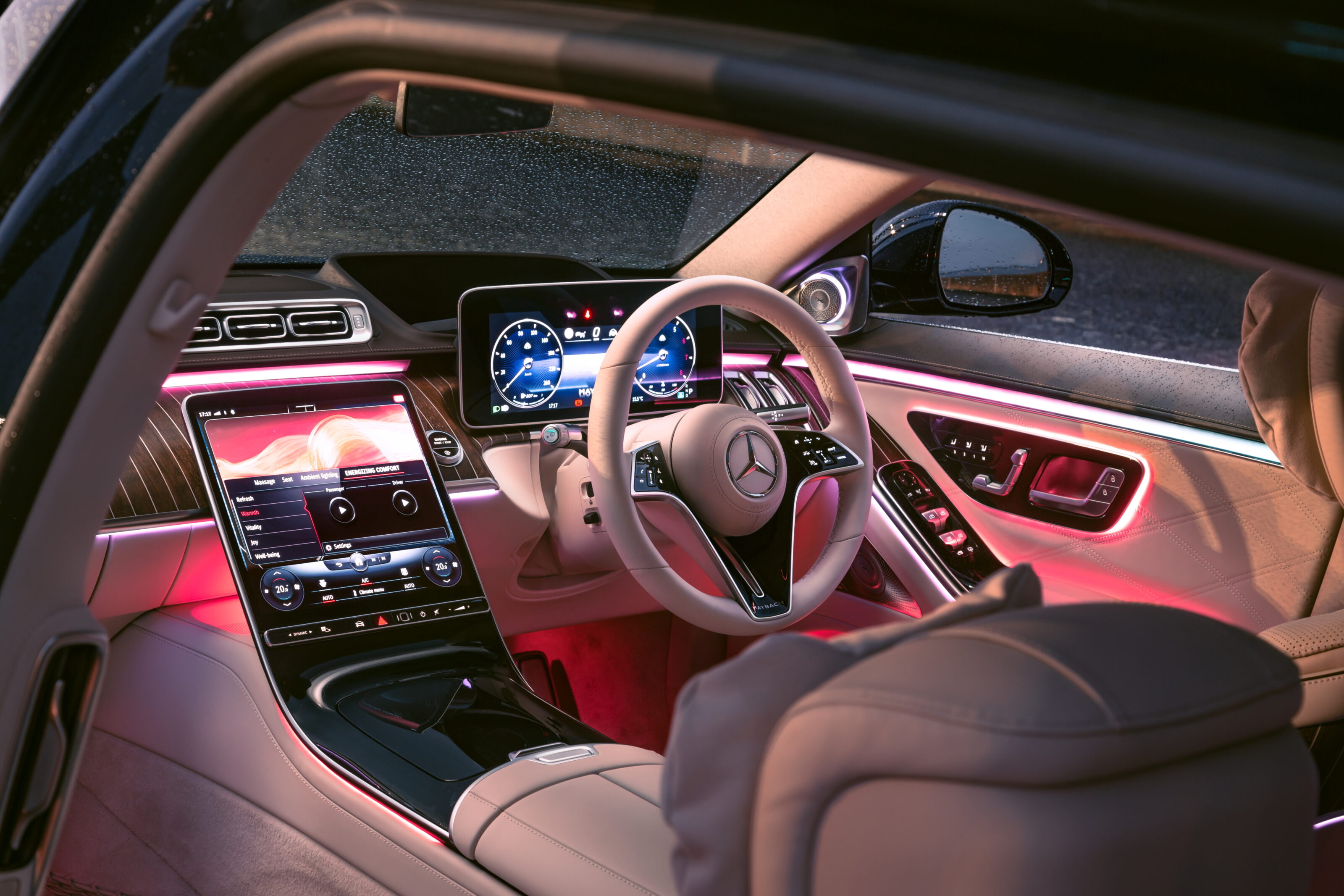
Nappa leather abounds, with an entire herd of bovine stretched across the seats, dash, and headliner. Duck-down pillows adorn each of the seats, which are electrically adjusted (naturally), and feature heating, cooling, and massaging functions (sometimes all at once).
A panoramic sliding roof is standard, along with motion-controlled rear window shades. Peek at the options list and things get truly lavish, with the likes of a champagne cooler with accompanying silver-plated flutes, and power-closing doors all on the menu.
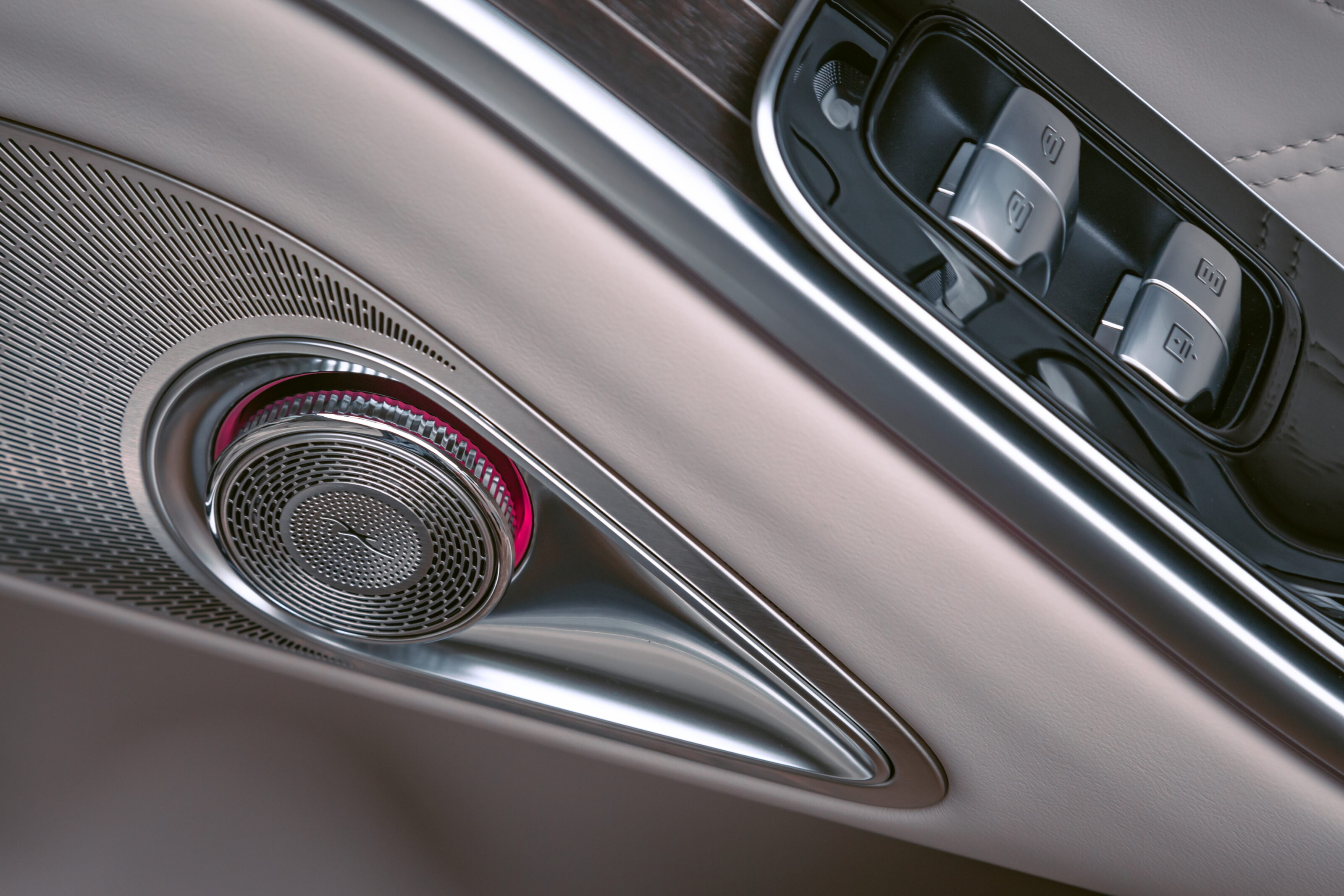
The highlight for us was the 1750-watt Burmester 4D sound system. This is easily the finest audio system on sale in a car today, featuring a total of 31 speakers. That includes a subwoofer, and eight bass shakers in the seats. These ‘exciters’ are part of the 4D system that crates massage-like movements in time with the music.
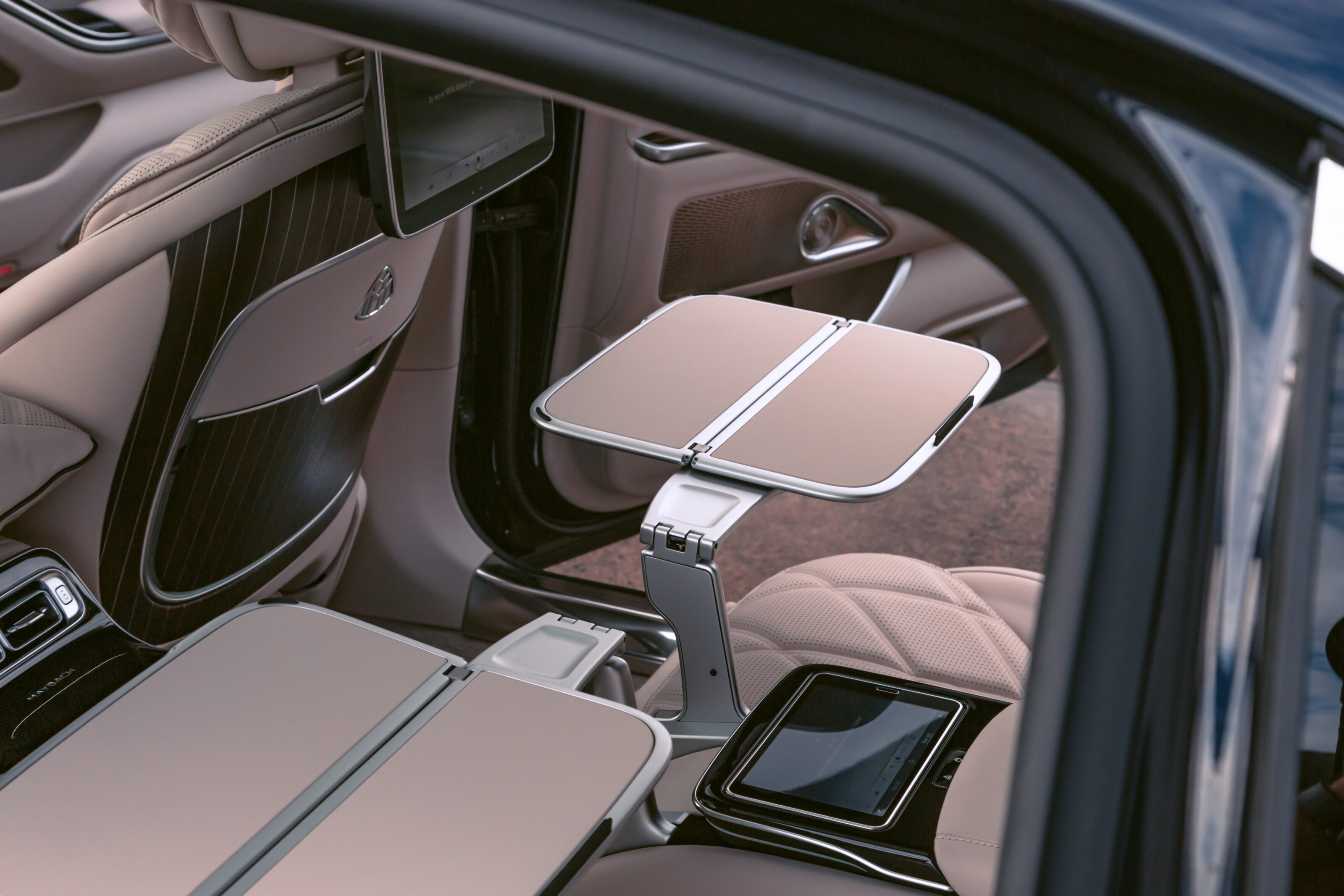
That unique feature aside, the sound from the S 680’s speakers was incredibly crisp, retaining fidelity at window-shaking volume levels. The cabin also features active noise cancelling, which combines with traditional NVH suppression and soundproofing to create an environment that is incredibly quiet when required.
Then there are the screens that are both sizeable and plentiful. The driver’s instruments are displayed through a 12.3-inch digital display, while the central infotainment is controlled via a 12.8-inch central unit that dominates much of the dash (impressive considering the high-quality wood trim finish).
Rear passengers are both offered 11.6-inch screens, along with a tablet-like control unit that integrates with the central armrest. The S 680 comes with an inbuilt TV tuner, so those enjoying the voluptuous rear seats will be heartily entertained at all times.
To put the focus on rear occupants into focus, Mercedes has fitted the rear seats of the S 680 with a seat belt feeder, like that featured in its two-door coupes and convertibles, for the first time. That’s on top of the airline-style reclining seats, and dedicated MBUX Interior Rear Assistant system.
While most owners will experience the Maybach from the rear seats, there are going to be owners who want to take the helm of the limo and drive themselves. Those customers are going to be blessed with a driving experience that is among the most calming we’ve experienced.
Due to Mercedes being unable to fit the V12 with its 48-volt EQ Boost mild-hybrid system, the Mercedes-Maybach can’t be specified with the more advanced optional suspension system that can be added to regular S-Class variants.
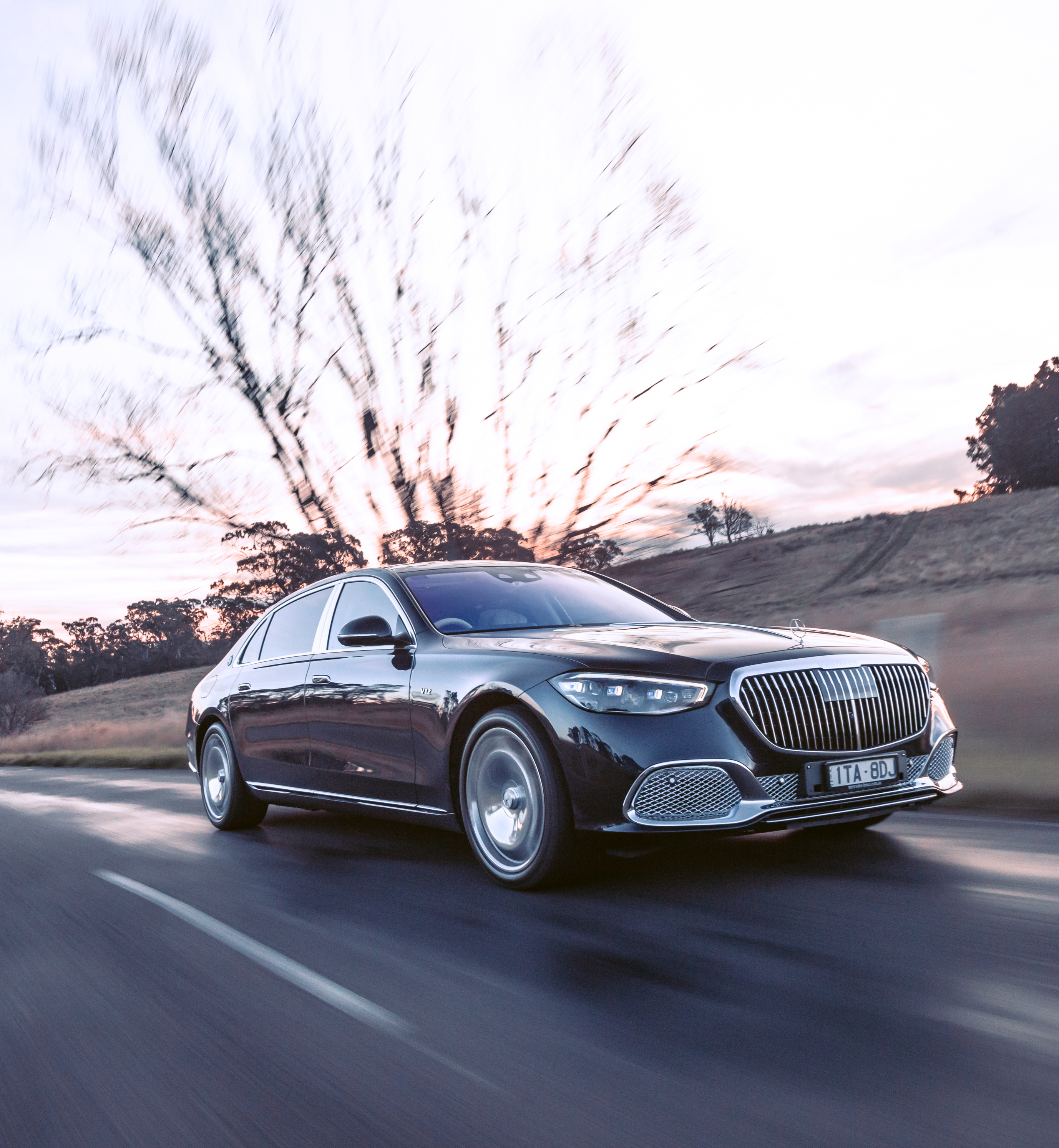
However, the Airmatic adaptive air suspension is still exemplary. Imperfections in the road are kept at arm’s length for occupants, the Maybach simply taking them in its stride without so much a hint of crashing. The only shortfall for the ride is on major sharp bumps, where the Maybach can take a touch longer to settle than we’d prefer.
Steering is similar in its nature, being direct and light. Even the self-righting of the wheel is gentle, giving the entire experience of driving the S 680 a silky-smooth demeanour. Despite the soft edges and the Maybach’s sheer size, it doesn’t require armfuls of lock to turn. Instead, the S 680 tips into corners with poise after turning the wheel off centre. Dead zones? Nowhere to be found.
The Mercedes-Maybach S 680 isn’t so much driven as experienced. It is outlandish in how it takes the most extreme examples of luxury and distils it all into a single, barely believable product. The result is something to can be hard to distil into simple scores and verdicts.
For the few that will enjoy its wares, the Mercedes-Maybach S 680 offers something money can’t buy – a mindset.
2022 Mercedes-Maybach S 680 4Matic specifications
| Body | 5-door, 4-seat upper large sedan |
|---|---|
| Drive | all-wheel |
| Engine | 5980cc V12, dohc, 48v, twin-turbo |
| Compression | 9.0:1 |
| Power | 463kW @ 4000-5500rpm |
| Torque | 900Nm @ 2000-4000rpm |
| 0-100km/h | 4.5sec (claimed) |
| Transmission | 9-speed automatic |
| Weight | 2255kg |
| Fuel consumption | 13.6L/100km |
| Front suspension | multi-link, air suspension, anti-roll bar, adaptive dampers |
| Rear suspension | multi-link, air suspension, anti-roll bar, adaptive dampers |
| L/W/H | 5469/1921/1510mm |
| Wheelbase | 3396mm |
| Brakes | ventilated discs (front + rear) |
| Tyres | 255/40 R20 Bridgestone Turanza T005 (f); 255/40 R20 Bridgestone Turanza T005 (r) |
| Wheels | 20-inch alloy |
| Price | $574,000 + on-road costs |
