
Just days after Nissan announced it was killing off the Datsun brand, information has emerged suggesting it could be revived – again.
A source within Nissan has told US publication Automotive News it could transform Datsun into an electric vehicle company for emerging markets.
While there’s no indication of when Datsun could make its return, its parent company is focusing on a new-generation of electric vehicles within the Renault-Nissan-Mitsubishi Alliance.
Part of this push includes a successor to the compact Micra hatch, which will make its debut in 2024 with a driving range of up to 400 kilometres available from a single charge.
With the Micra replacement expected to use the same CMF-BEV platform, which will also underpin the battery-powered Renault R5, mass production and amortisation could eventually lead to a cut-price Datsun-branded electric vehicle being introduced into selected markets.
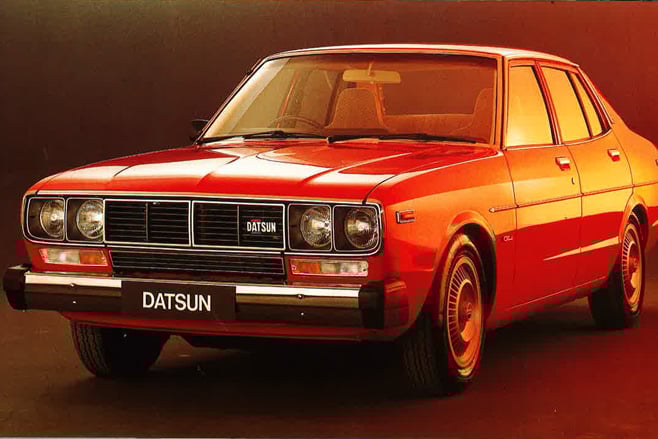
After the badge was retired by Nissan in 1986, Datsun was brought back by former CEO Carlos Ghosn in 2013 for buyers in India, Russia, and Indonesia, among others.
Struggling sales were said to be to blame for the brand’s most recent retirement, but it seems Nissan isn’t quite ready to kill off the Datsun brand for good.
Snapshot
- European media reports Hyundai and Rimac will split
- Hyundai held a 12 per cent stake in the Croatian manufacturer
- Korean carmaker revealing a number of electric models over the coming years
The relationship between Korean manufacturer Hyundai and Croation electric vehicle specialist Rimac has reportedly come to an end.
According to Automotive News Europe, Hyundai will sell its 12 per cent stake in Rimac due to the latter company’s increased investment from Porsche, with the Korean firm and its sister brand Kia allegedly unhappy with the German sports carmaker’s relationship.
Last year, Porsche increased its stake in Rimac from 10 per cent to 24 per cent, as well as instigating a joint venture which resulted in the manufacturers completing a 55-45 per cent takeover of Bugatti from the Volkswagen Group, the majority of which is held by Rimac.
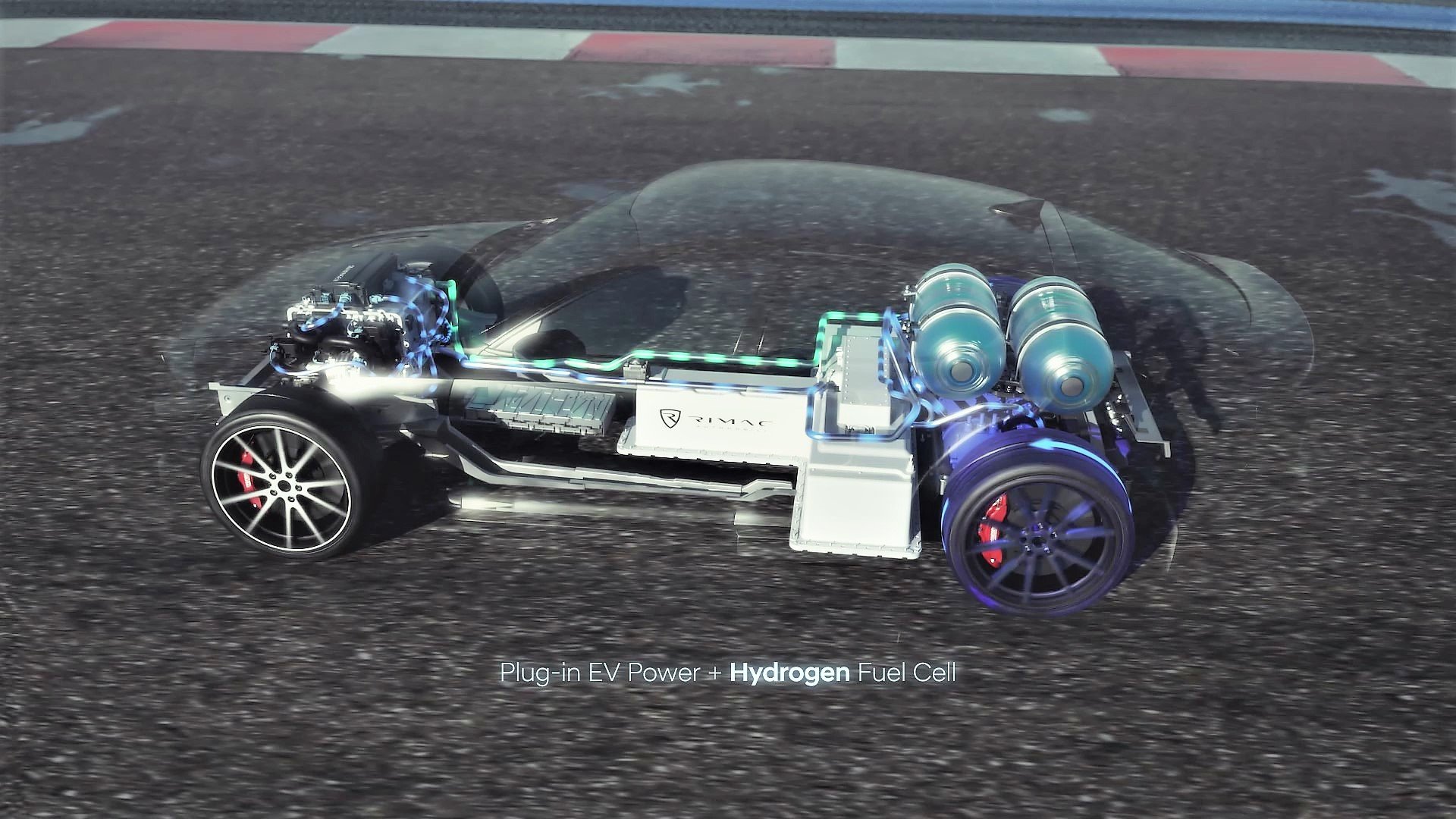
A spokesperson for Rimac told Automotive News Europe one project has been completed while two more are still active.
“We have two active high-level projects ongoing [with Hyundai], one completed and several future projects under discussion,” said the spokesperson.
“Hyundai has been supportive in the transformation of the company during the last 12 months – including the carve-out of Rimac Technology and joining forces with Bugatti under the new company Bugatti Rimac.”
It has been rumoured the Hyundai Vision FK concept – a hydrogen fuel-cell joint venture with Rimac – won’t continue, although the Korean team might already have all the information it needs to make the model work.
The Hyundai Ioniq 6 is set to be the next electric vehicle to come from the carmaker, with its platform derived from the Ioniq 5 mated with a sleeker body shape – perhaps in a lesson learnt from its Croation partner.
Snapshot
- Stellantis commits CA$3.6 billion (AU$3.95bn) to upgrading Canadian plants
- Manufacturer’s electric vehicles targeted to make up 50 per cent of sales by 2030
- Investment in electrification now totals AU$50bn
Canada’s automotive industry has received a boost with manufacturing congomerate Stellantis announcing a CA$3.6 billion (AU$3.95bn) package to upgrade its existing plants.
Currently operating out of facilities in Windsor and Brampton, Ontario, the modernisation of the factories from 2023 will be made in time for Stellantis’s electrification strategy to come into play – with the company aiming for half of its new vehicle sales in the United States to come from electric vehicles by 2030.
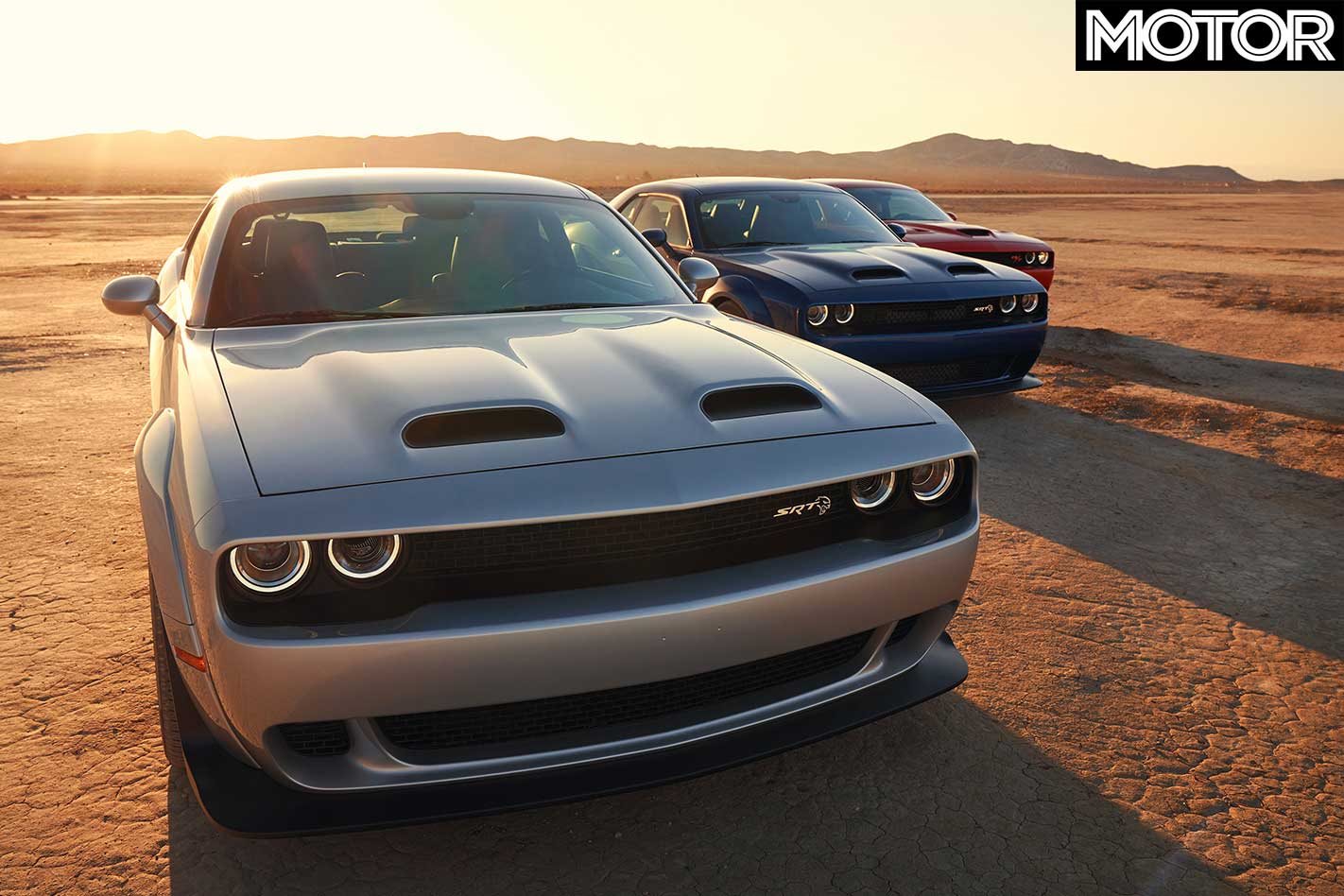
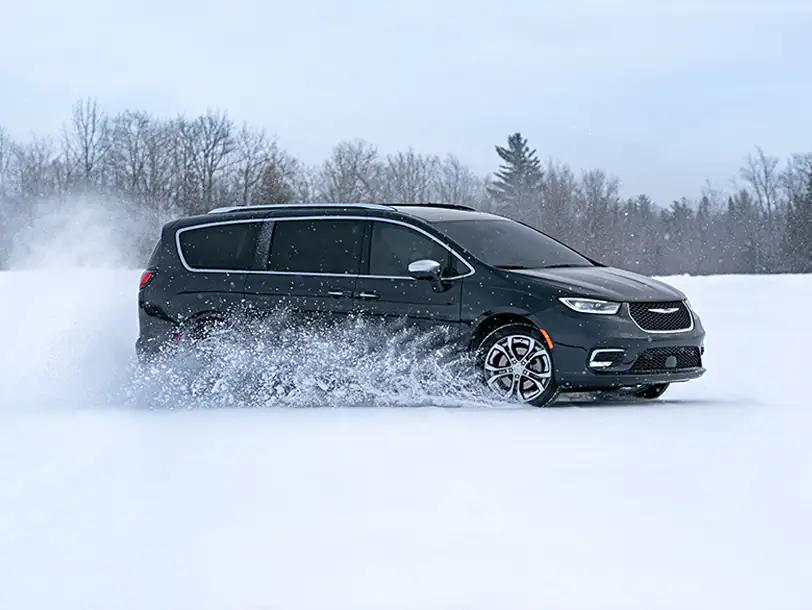
The announcement also secures the future for both plants, as Windsor currently assembles the Chrysler Pacifica, Voyager and Grand Caravan people-movers, while Brampton is the only manufacturing facility for the Chrysler 300, Dodge Charger and Challenger – all of which are at risk from the parent company’s decision to go electric.
Stellantis’s North America Chief Operating Officer, Mark Stewart, said the investment was not only one in Canada, but also in the manufacturer’s commitment to builder cleaner vehicles.
“These investments reaffirm our long-term commitment to Canada and represent an important step as we move toward zero-emission vehicles that deliver on our customers’ desire for innovative, clean, safe and affordable mobility,” said Stewart.
“We’re grateful to both the federal and provincial governments for their shared vision to create a sustainable future. And, to Unifor and our workforce for their support in helping ensure the viability of our Canadian operations for the long-term.”
Canadian Prime Minister Justin Trudeau supported the additional investment, having passed legislation last year to ensure only zero-emission vehicles will be sold in Canada by 2035.
“Today’s deal on made-in-Canada electric vehicles is yet another investment in our workers and in our future,” said Trudeau.
“We’re building a world-class Canadian auto industry, an innovative economy and a clean, strong future for everyone. This is what a healthy environment and a healthy economy looks like.”
The announcement now brings Stellantis’s investment in electrification up to just under AU$500bn, with each of its 14 brands set to move away from internal combustion engines before 2035 at the latest.
Snapshot
- Audi is understood to be taking over McLaren’s racing operations
- Porsche to establish a relationship with Red Bull Racing
- Both manufacturers have started development on Formula One engines
It’s official – Porsche and Audi will enter the Formula One World Championship, with Volkswagen Group CEO Herbert Diess confirming the sport’s worst-kept secret.
Rumoured to be a done-deal since the start of the year as mutiple manufacturers took an interest in McLaren’s operations, the announcement all but confirms Audi will invest in the Bruce McLaren-founded operation, while earlier reports of Porsche developing an alliance with reigning champions Red Bull seem to be all but done.
As reported by Automotive News Europe, Diess confirmed the decision to enter Formula One was made to bring in more money to the Volkswagen Group through international exposure.

“According to both premium brands, Formula One is the most important lever to boost brand value,” said Diess.
“With the plans for a bigger presence in China and the US, the attraction as the biggest motor-racing spectacle is only going to grow.”
Porsche has been in Formula One before as an engine supplier, having won the World Championship three years in row from 1984 to 1986 with McLaren thanks to its dominant TAG-Porsche TTE PO1 V6.
It will be the first time for Audi on motorsport’s biggest stage despite all its success at Le Mans and in the World Rally Championship, with the German marque understood to be planning an offer of €500 million (AU$742m) for McLaren – inclusive of the Formula One team and its road car operation.
It’s not yet known when the two brands will make it on to the Formula One grid, although each manufactuer is understood to be currently developing power units for the series, with the 2026 season seeing new generation engine implemented for the series.
Snapshot
- Updated T-Roc range to launch in August
- New R-Line variant to replace outgoing Sport grade
- Entry-level T-Roc Style starts at $37,250 before on-road costs
The 2022 Volkswagen T-Roc will be given a facelift and technology upgrade later this year, launching from August.
Announced late last year, local features for the refreshed Volkswagen T-Roc have been confirmed, with the crossover gaining a host of standard equipment including safety technology over the outgoing model.
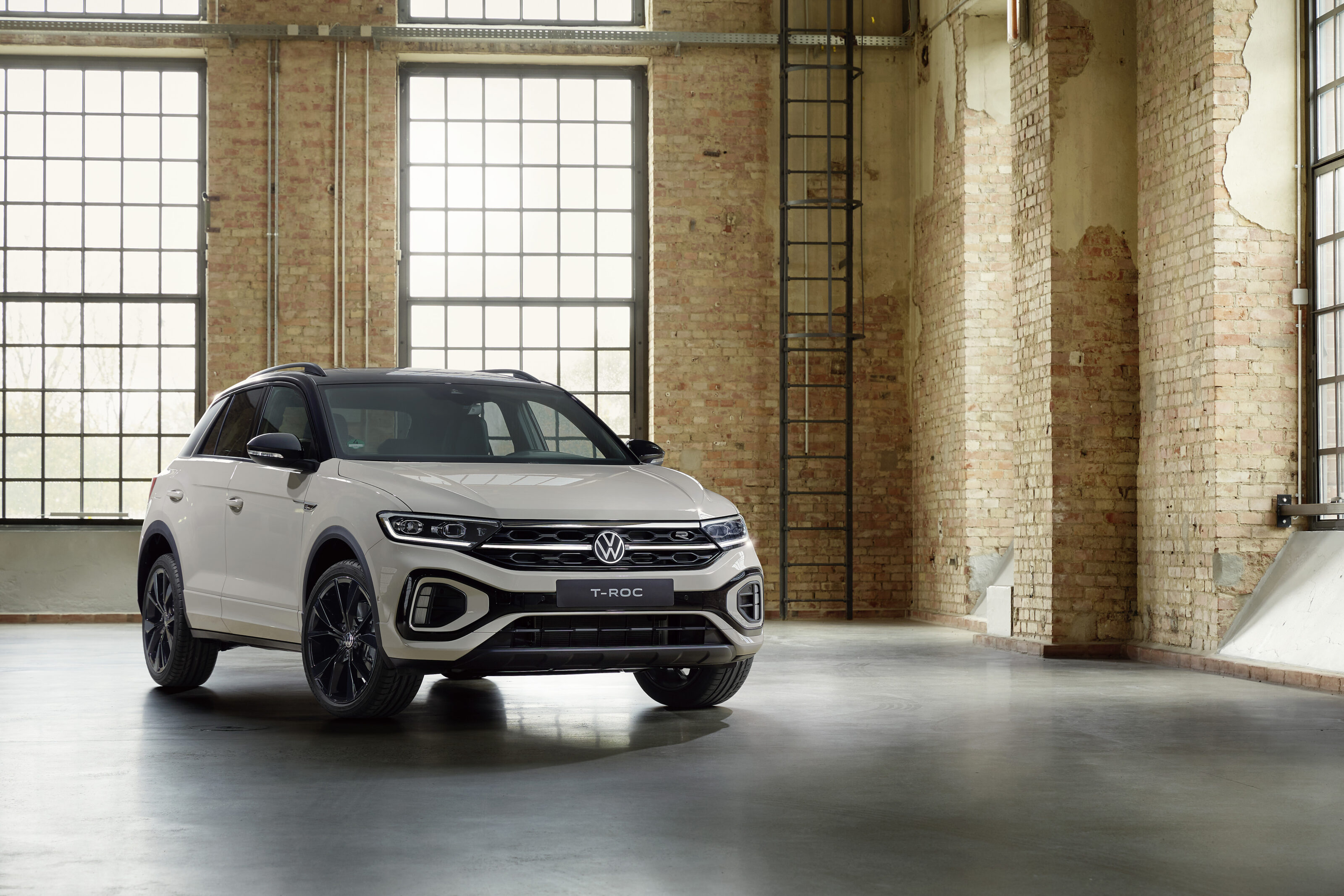
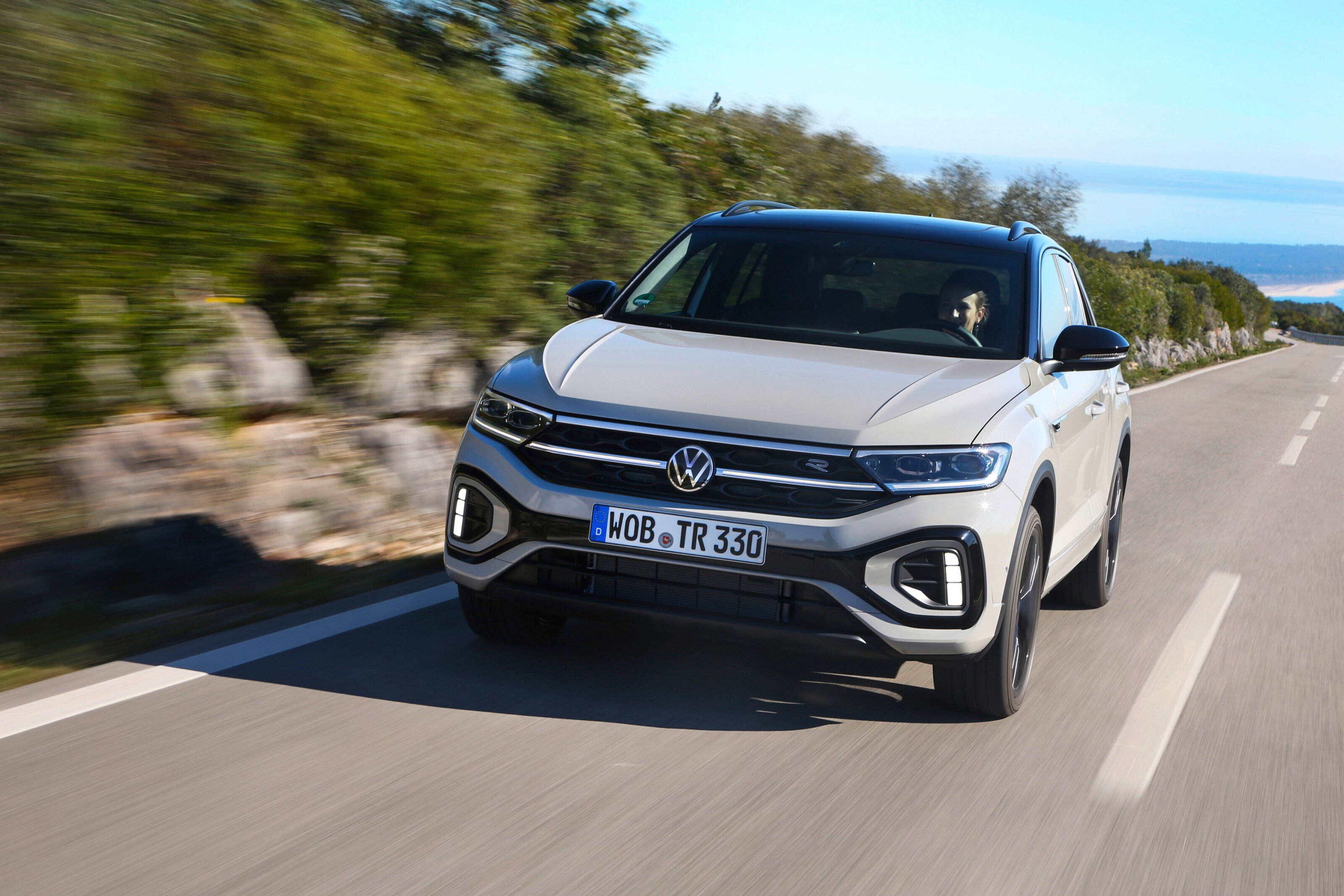
A facelift will differentiate the new T-Roc from its predecessor, with its new front-end incorporating LED headlights, a revised grille with an LED light, new lower intakes and foglights.
Pricing
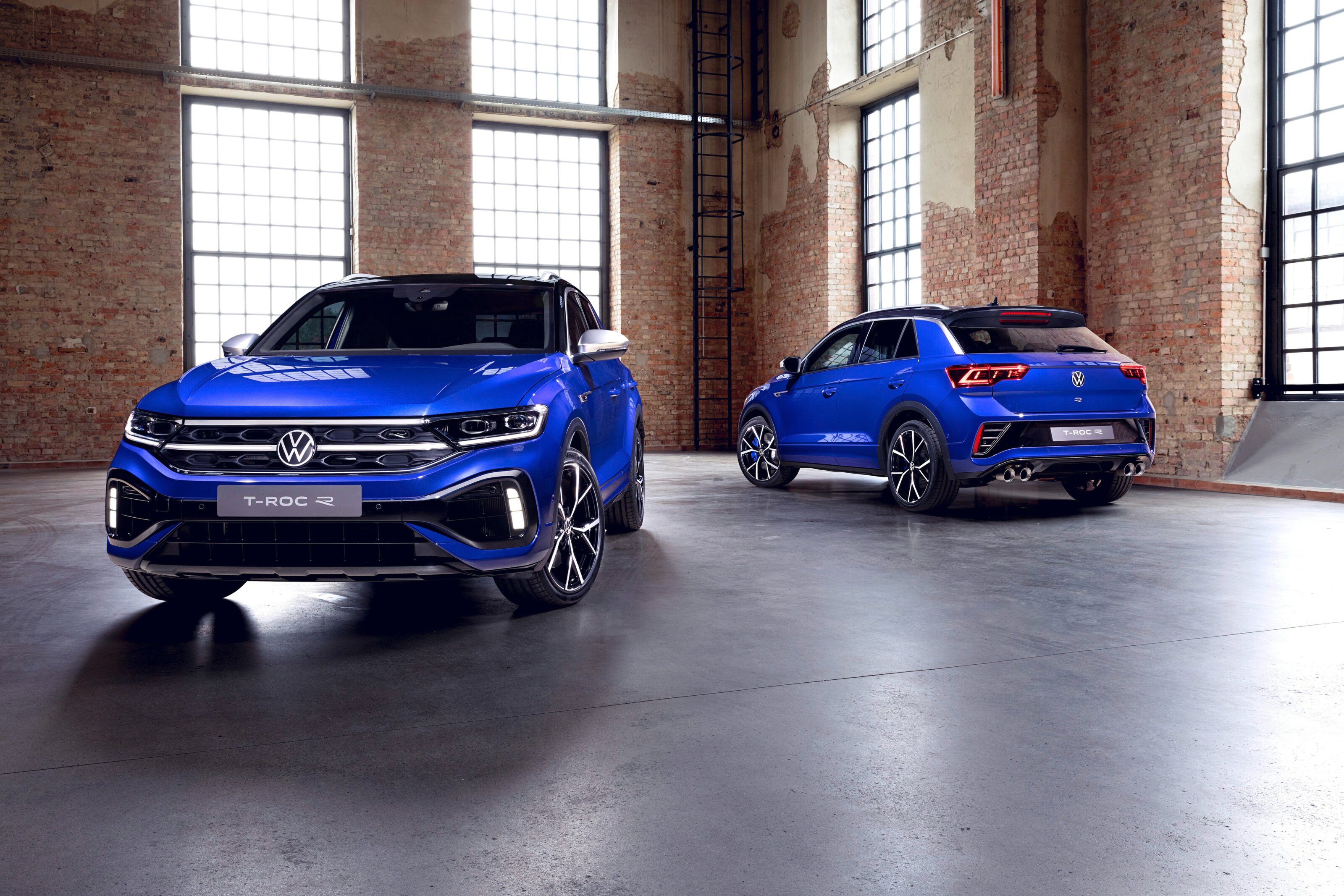
While the Style variant remains as the entry-level T-Roc grade, R-Line now replaces Sport as the next step, with the T-Roc R now joining the range as its flagship.
Prices exclude on-road costs.
| Modelu00a0 | Price |
|---|---|
| T-Roc Style | $37,250 (up $1750) |
| T-Roc R-Line | $45,250 (up $2550 over Sport) |
| T-Roc R | $59,300 |
Features
Opening the T-Roc’s account, the Style variant includes a high level of equipment as standard, including:
Style
| Eight-inch digital cockpit |
| Wireless charging |
| Leather multi-function steering wheel with gearshift paddles |
| Driving profile selection |
| Comfort sport front seats upholstered in microfleece with lumbar adjustment |
| Ceramique headlinging |
| Deep iron grey gloss inlays |
| Tinted rear and read-side windows |
| 18-inch Grange Hill alloy wheels |
| Keyless access |
| Electrically folding door mirrors |
| Auto dimming rear-view mirror |
| LED interior ambient lighting |
| Rain-sensing windscreen wipers |
| Dual-zone climate control |
| Eight-inch infotainment screen with App-Connect and DAB+ digital radio |
| Apple CarPlay/Android Auto |
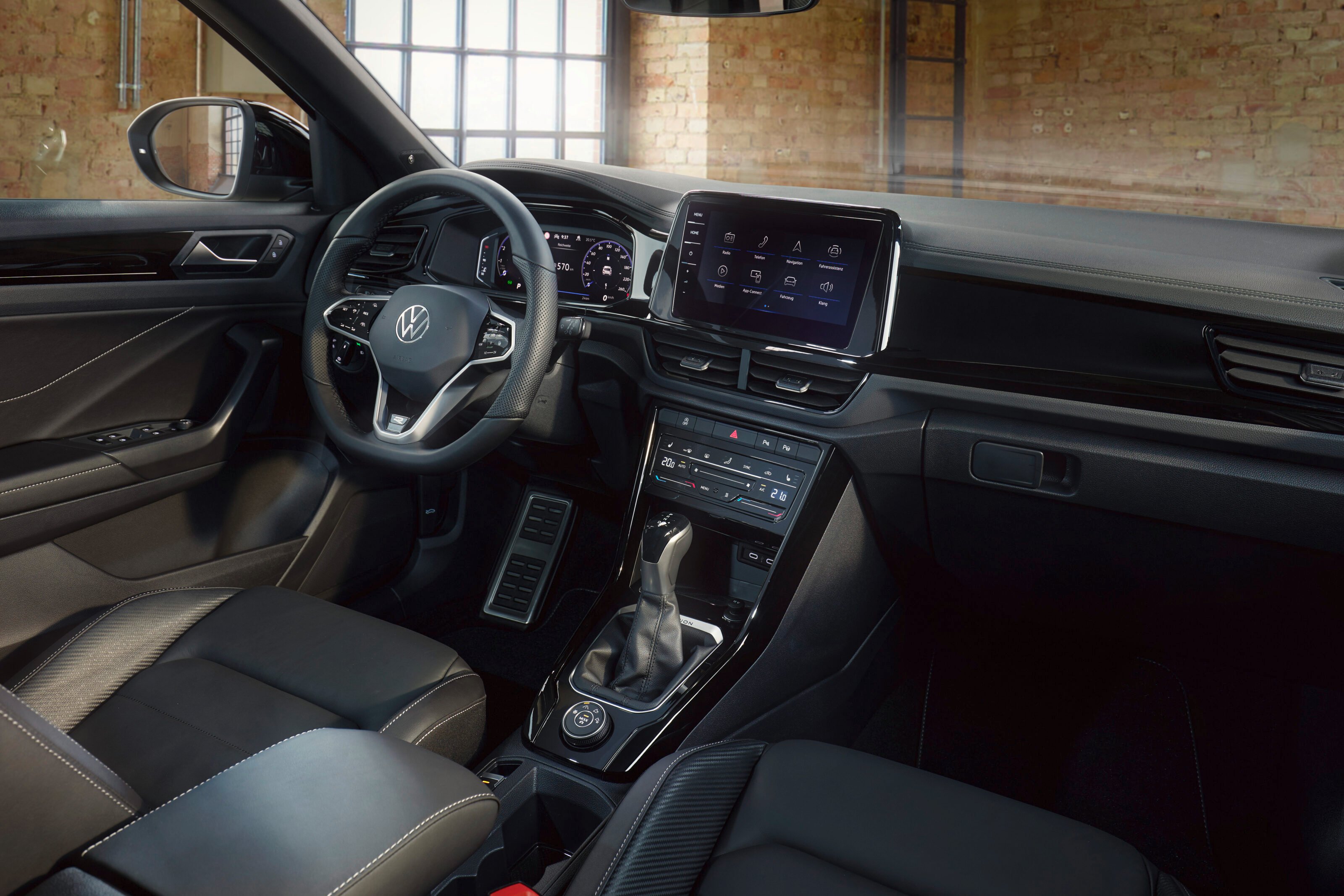
Above this, the R-Line adds a number of additional exterior and interior features such as:
R-Line
| 10.25-inch digital cockpit pro |
| R-Line exterior and interior styling |
| Voice control |
| Sport front seats with R-Line fabric |
| Black headlining |
| Lava stone black gloss inlays |
| 18-inch Nevada alloy wheels |
| Sports suspension |
| Progressive steering |
| Discover media navigation |
| Wireless App-Connect |
The flagship T-Roc R caps off the range, with a plethora of equipment, bringing it on par with the rest of Volkswagen’s ‘R’ models
R
| Metallic paint |
| 19-inch alloy wheels with space-saver spare |
| Adaptive chassis control with race mode |
| 9.2-inch infotainment system |
| Matrix LED headlights with adaptive high beam |
| LED tail-lights with sequential indicators |
| Exterior ambient lighting |
| Electric tailgate |
| Wireless phone charger |
| Nappa leather upholstery |
| Heated front seats |
| Electrically adjustable driveru2019s seat with memory |
| Parking assistant |
Options
A number of optional features are also available to order, although some are only available on certain grades.
| Panoramic sunroof u2013 $2000 |
| Electrically adjustable tailgate with easy open and close function u2013 $600 (Style and R-Line) |
| Beats audio system (300W, six speakers, digital eight-channel amplifier, subwoofer)u00a0 u2013 $700 |
| Lapiz blue matte du00e9cor inlays u2013 $250 (R only) |
Engine, drivetrain and fuel economy
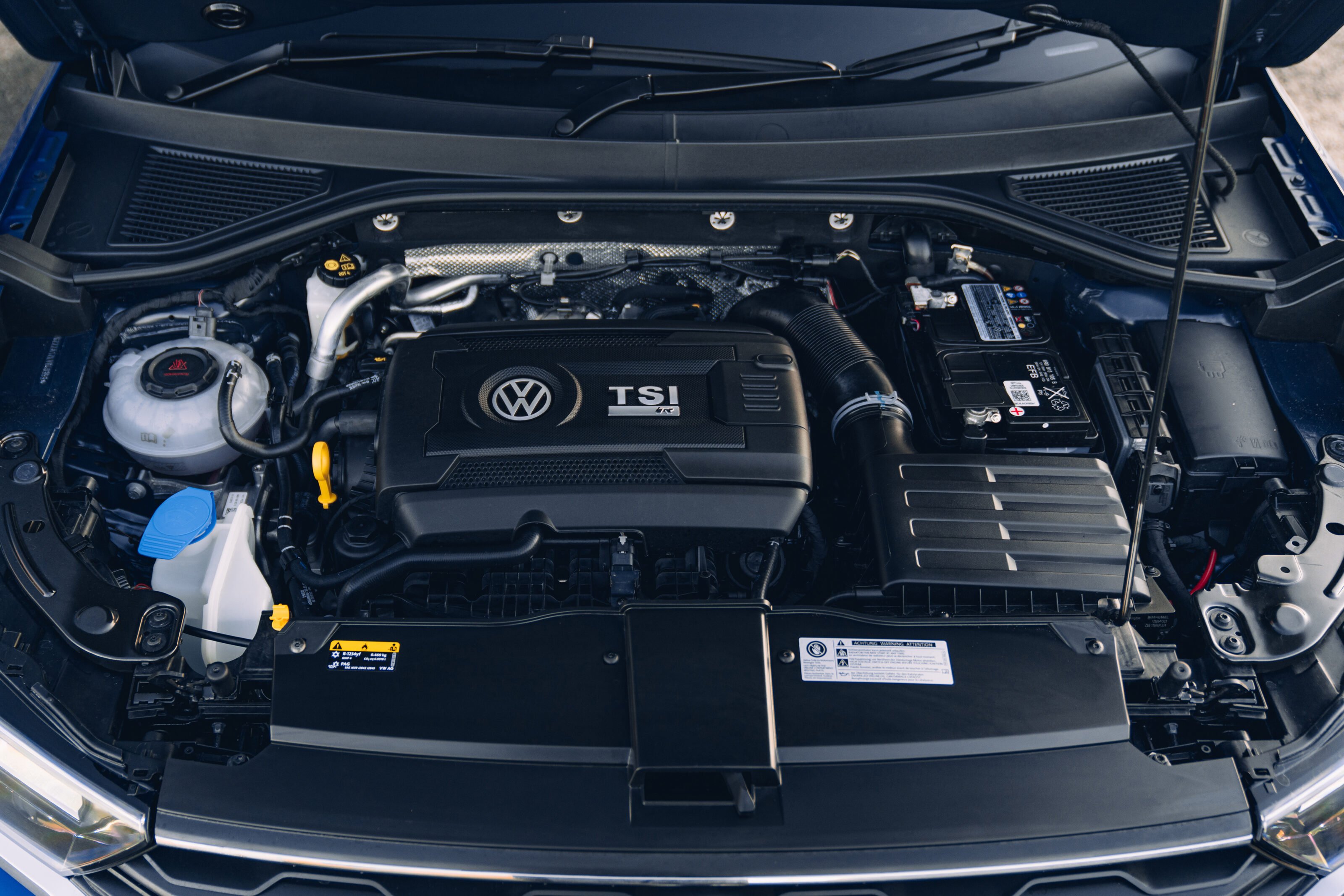
As with its predecessor, the T-Roc Style continues to be powered by a 1.4-litre, turbocharged four-cylinder petrol engine, delivering 110kW and 250Nm to the front wheels through an eight-speed torque-converter automatic transmission – returning a combined fuel consumption of 6.3L/100km.
The outgoing Sport’s powertrain carries over to the R-Line, with the mid-range variant adopting a 2.0-litre, turbocharged four-cylinder petrol engine, which produces 140kW and 320Nm, paired with a seven-speed dual-clutch auto transmission and four-wheel drive – this time with a combined fuel consumption of 7.3L/100km.
Finally the range-topping R offers 221kW/400Nm from a four-pot engine, mated to a seven-speed dual-clutch auto ‘box and four-wheel drive system – achieving a claimed 7.8L/100km ful consumption.
Safety
The five-star ANCAP safety rating of the outgoing T-Roc is applied to its successor, although the new model benefits from a number of additional technology upgrades.
| Travel assist (new) |
| Six airbags |
| Front assist with pedestrian monitoring |
| Adaptive cruise control |
| Lane assist |
| Side assist with rear traffic alert |
| Proactive occupant protection system |
| Rear view camera |
| LED headlights |
| Light assist |
| Park assist |
Availability
Volkswagen says the new T-Roc will launch in Australia this August, barring any further production delays, with all local models to be backed by the manufacturer’s five-year/unlimited-kilometre warranty.
Senior executives from car manufacturers are warning there could be disruptions to production if Russia cuts off its supply of natural gas to Germany.
The CEO of Volkswagen Group, Herbert Diess, warned being cut off from Russian gas poses a serious threat to the German car giant, according to a report from Reuters.
During a discussion on YouTube, Diess said Volkswagen’s Wolfsburg factory was in the process of being converted to run on more environmentally-friendly natural gas, but conceded its power plant would continue to use coal for the time being.
Last week, Russia cut its gas supply to Poland and Bulgaria in retaliation to sanctions imposed on the country following its invasion of Ukraine.
“Every company is looking at options for diversifying energy sources,” Mercedes-Benz CEO Ola Kaellenius told Reuters television.
“It is still too early to say exactly which scenario will happen, but of course we are carefully looking at this.”
Mercedes-Benz is said to be working closely with German authorities to secure its energy needs, Automotive News Europe reports.
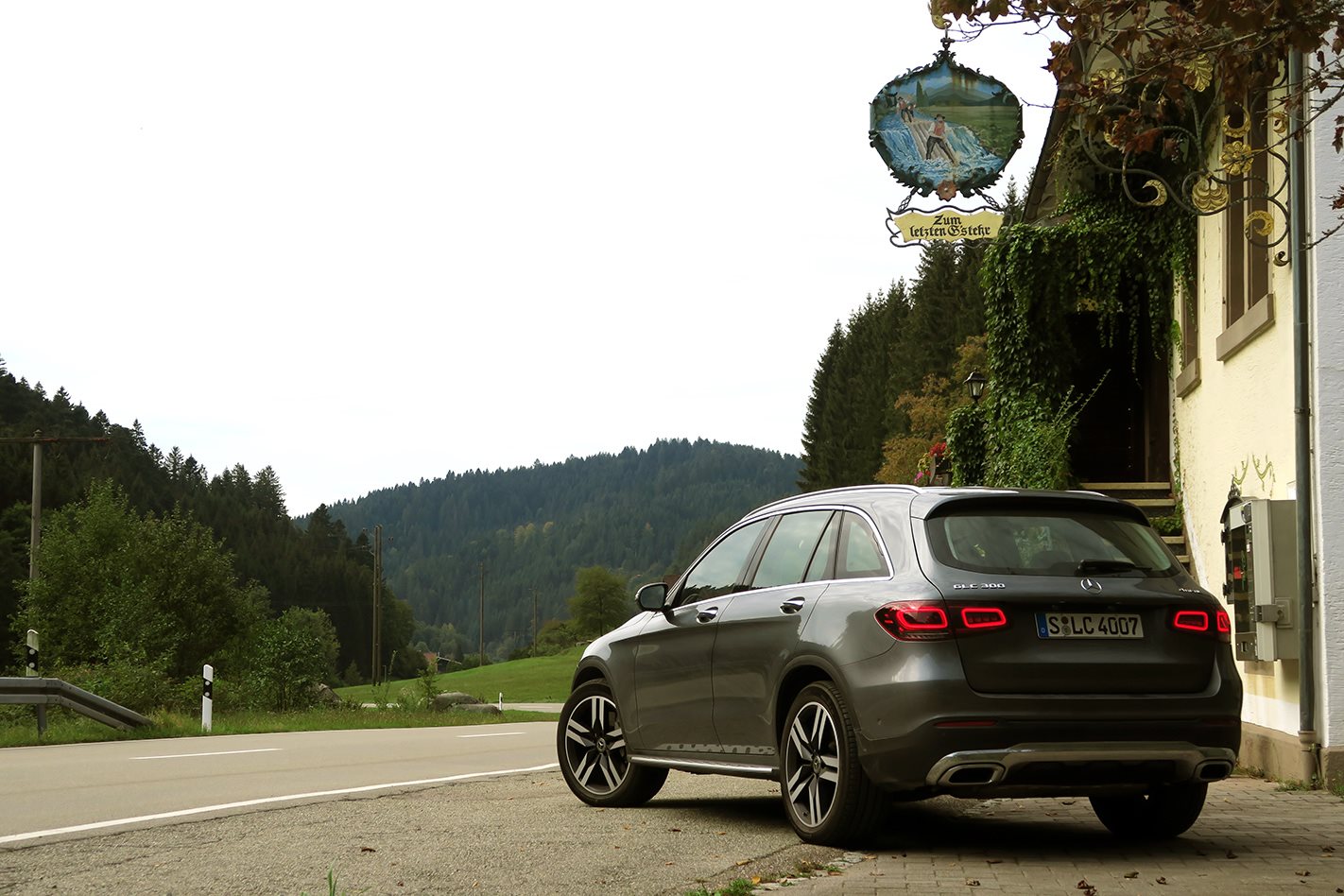
Last year, Germany imported 55 per cent of its natural gas from Russia, with Reuters reporting a reduction to 40 per cent in the first quarter of 2022.
BMW told the publication it is also working with authorities, and is “monitoring the volatile situation closely”.
If the gas pipeline is shut off by Russia, it would add insult to injury for a sector which has struggled to maintain new-car production following a global semiconductor chip shortage and parts supply issues from equipment manufacturers based in Ukraine.
While the previous model was doing nothing to excite anyone or differentiate itself from the rest of the mid-sized SUV pack, the design of this 2022 Kia Sportage is so bold as to be quite literally turning heads – though not in that ‘what a funky car but I’d never actually buy one’ kind of way.
The line-up consists of four grades, from the entry S to the mid-range SX and SX+ and finishing up with the top-spec GT-Line.
Here we have the SX, powered by a 2.0-litre turbo-diesel with eight-speed torque converter automatic transmission and all-wheel drive. Other engines are available, though this is undoubtedly the best one – more on that later.

All trims benefit from the striking boomerang daytime running lights and tiger-nose grille, and it wears the new Kia logo that was introduced last year.
But while the exterior styling of the mid-spec SX variant is pretty lush, its interior lacks some of the bells and whistles that give the flagship GT-Line its premium feel. So does the SX still represent good value? Or should you stretch to more expensive models higher in the range? Let’s find out.
Pricing and Features

The 2022 Kia Sportage range starts at $36,820 drive-away (based on Melbourne registration) for the lowest-spec S on offer, but the SX we have with the 2.0-litre turbo-diesel and the eight-speed auto comes in at $47,193 drive-away – plus add an extra $520 on top for premium paint, which in this case is Gravity Grey.
You can buy the SX for less than $40K if you prioritise price over driving performance. Opting for the 2.0-litre petrol engine with a six-speed manual drops the sticker price down to $39,483 drive-away.
Meanwhile, the top-spec GT-Line will set you back between $54,457 and $57,583 drive-away depending on the powertrain chosen.
There has been a significant price bump from the last model when it arrived in 2018. But does it matter? Increasingly, with supply issues, shipping issues and, COVID-19 issues – it would seem not.

Taking the Sportage on a day out to Mother’s Beach in Mornington, we returned after a cheeky ice-cream pit-stop to find a couple in their 50s giving the Kia the eye as if it were from a luxury brand.
“Wow,” the hubby proclaimed. “That’s a good-looking thing isn’t it!”
It turned out the couple’s daughter had recently tried to buy a Sportage but wasn’t prepared to wait the expected six months it would take to get her hands on it. She bought the new Peugeot 3008 instead, which at $58,695 drive-away in GT 2.0-litre diesel guise, is more than $11.5K over the price of the Kia. The point being, they splashed the cash anyway just to get into a car ASAP.

Best-sellers in the segment such as the Mazda CX-5 and Toyota RAV4 are also pricier than the Kia, commanding around $3000 and $1000 more respectively for the roughly equivalent CX-5 Touring Active and RAV4 GXL.
The new Mitsubishi Outlander, however, is around $2000 less expensive if you go for the equivalent mid-spec LS all-wheel drive.
There are some slight spec and equipment differences to note, of course, and the Toyota and Mistubishi don’t offer a diesel engine. The Toyota comes with a frugal 2.5-litre petrol hybrid drivetrain and the Mitsi a 2.5-litre naturally aspirated petrol.
As standard, the SX gets Kia’s new 12.3-inch infotainment screen paired with a 12.3-inch digital instrument panel, auto up/down window controls in the front, six-speaker sound system, and sat-nav that works well – even if it looks a little cluttered with the split-screen in use and is unnecessarily fiddly to use on-the-go.
Opting for the more focused single view layout is much better and far less distracting, making use of that vast screen space and minimalist map layout, but Apple CarPlay/Android Auto-supported apps are still the better option.

The infotainment can be accessed through a touch panel rather than physical buttons, which can be toggled between the menu options and climate control. It works well and you don’t find yourself missing the hard buttons at all.
SX trim also nabs a full-size spare wheel, 18-inch alloys, LED headlights and tail-lights, silver roof rails, body-coloured mirror housings, and gloss black bumpers and wheel arches – which oddly, we feel, give it a cleaner, more premium aesthetic than the matte black plastic alternative found on the higher grades.
What it loses, being two steps down from the range-topping GT-Line, isn’t a deal-breaker but does take away from some of its charm. In place of a rotary dial gear shifter is a traditional stick and it foregoes the panoramic sunroof (though in fairness there are big windows all round that give a light and open feel), easy-open doors, wireless device charging, front fog lights, paddleshifters, a powered tailgate and a smart key.
Oddly, wireless Apple CarPlay/Android Auto is only available on the entry-level S that has a smaller 8.0-inch touchscreen.
The infotainment can be accessed through a touch panel, which can be toggled between the menu options and climate control. It works well and you don’t find yourself missing the hard buttons at all

We can’t tell you how frustrating it is to be missing a powered tailgate and keyless start on a car of this price and general overall standard – and how glaringly obvious it is when the absent buttons are filled in with blank plastic just to make sure you realise what you don’t have.
Actually we can tell you – having to physically insert a key these days and not just chuck it into a cup holder or not have to bother getting it out of your bag or pocket at all, plus manually pulling down quite a heavy tailgate, is pretty tedious. Sure it’s not really a big deal, first world problems and all, but they’re the touches modern car buyers expect.
As a result of losing the smart key, the SX also drops the remote parking assist function found on the GT-Line, which is a cool selling point of the new generation Sportage. The tailgate button on the key only serves to unlock the boot separately from the doors.

As far as safety equipment goes, the SX gets almost the full suite available in the Sportage range, including systems such as ABS, stability control, hill-start assist, lane-keep assist, blind-spot collision warning and avoidance, autonomous emergency braking (AEB), front and rear parking sensors, a rear-view camera (with an impressively crisp picture), three top-tether anchors and two ISOFIX points – easily found and accessible, making installing a car seat a cinch in seconds.
Trailer stability assist, high beam assist and blind-spot collision avoidance however are only available in the auto SX, not the manual.
Having recently driven the GT-Line, we missed the blind-spot view monitor in the SX, as it’s a nifty feature when cornering

In fact, the only safety equipment left off the SX’s extensive safety list and held back for the top of the range GT-Line is the self-dimming rearview mirror (can be had in SX+), surround-view monitor with 3D mode, blind-spot view monitor and reverse parking collision avoidance assist. Having recently driven the GT-Line, we missed the blind-spot view monitor in the SX, as it’s a nifty feature that shows the view down the sides of the vehicle when indicating.
Some of the alarms for the safety alerts were a little grating at first, but fortunately you can adjust the volume up or down, or even on or off for many of them, including the rear occupant alert and seatbelt warning, to suit you.
Like us, you may well find it comes to that when the annoyingly loud bongs of the rear parking sensors were so penetrating that any chance of relaxing to the ‘sounds of nature’ feature found in the media system was nigh-on impossible. Turning them down to a lower, though still perfectly audible, level was much better.
Comfort and Space
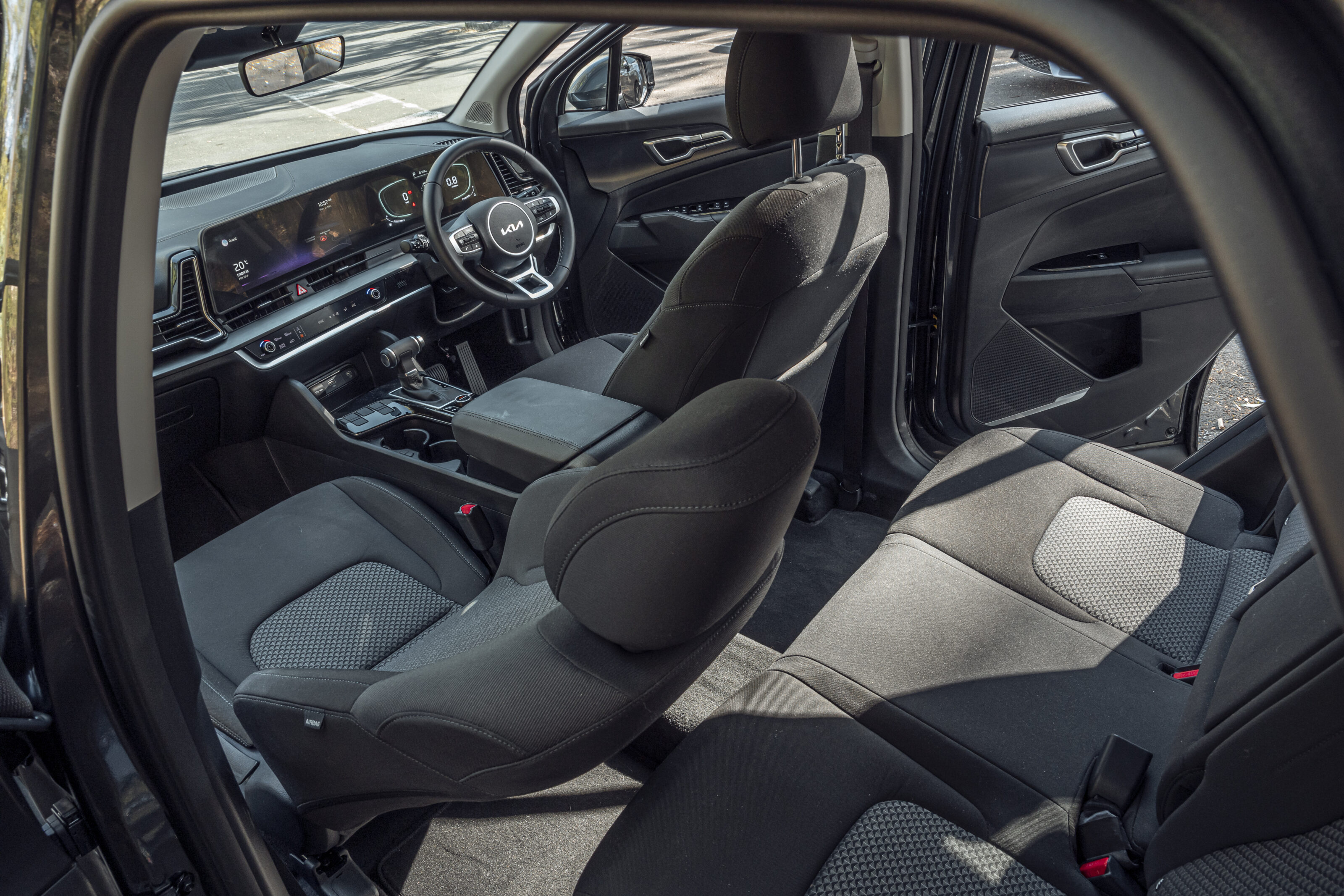
While the SX gains Kia’s standout 12.3-inch infotainment/digital display there’s little else inside to set it apart from the entry-level S variant.
There’s a lot of hard plastic to be found, especially on the doors and centre console, which undermines the sense of quality a little.
Brushed metal dash garnish and grain effect for the door handle surrounds help elevate things, as does the leather-appointed gear selector – though it’s a real shame the SX loses out on the rotary dial available in the GT-Line grade as it’s surprisingly easy to use and looks great.

The doors and central armrest benefit from soft-touch faux leather, but the seat fabric is a real letdown, with the black cloth trim (complete with exposed zips on the front seatbacks) proving scratchier than a canvas bag.
Our test variant also lacks the heated and ventilated seats on offer higher up in the model range, as well as replacing eight-way electrically adjustable ones with a manual option.
A day out with a packed car of four adults and a child in a car seat is handled easily with room to breathe … no squashed sardines here!

A saving grace here is that it does come with two-way lumbar support over the base S, and even though it is manually operated, it does help with seat comfort, which is more than adequate for a long journey.
Like the rest of the Sportage range, the SX boasts impressive levels of space in the front, rear and boot for the mid-sized SUV segment, with 543L on offer with all seats up or 1829L with the second row down (which can fold remotely) – more than enough room to swing a cat or, if you’d prefer, to sling in a pram, esky, beach trolley and inflatable paddleboard before even thinking of expanding upwards to the roof.
A day out with a packed car of four adults and a child in a car seat is handled easily with room to breathe (no squashed sardines here!), as well as plenty of legroom and headroom plus pockets on both sides.

While the driver and front passenger have use of two USBs in the cabin – one type A and one type C – there are none in the back, and the air vents are directional only. Two 12V sockets also feature; one in the centre console and the other in the boot.
There are two lovely big cup holders in said console too, with neat retractable supports to keep smaller bottles or cans fitted snugly without risk of a spill. Each door has space for a bottle, but only slim 500ml or child-size vessels – anything larger won’t fit.
With families in mind, there are two features we especially want to call attention to here, one good and one bad.

Bad news out the way first? No privacy/tinted glass for rear windows, and it’s not an option either, so be prepared to ruin that jazzy exterior look with a daggy window sock to protect young eyes and skin from the sun, or budget for an aftermarket tint upgrade.
Good news? Quiet Mode (sadly for the car, not your kids). In the car’s infotainment system is a Quiet Mode which isolates the sound from the speakers to the front row only and limits the volume to a maximum of 25 (we found the average volume needed to overcome road and engine noise was roughly 40) – a great idea so parents can keep listening to the radio or podcast while little ones kip in the back.
Door apertures are good for getting smaller members of the family in and out too, and there’s a nice weight to the doors to keep them in place while doing so.
On the Road

The 2022 Kia Sportage line-up is comprised of a trio of four-cylinder powertrains: a 2.0-litre MPI petrol engine linked to either a six-speed manual or automatic transmission which can be had in S or SX grades, a 2.0-litre turbo-diesel with eight-speed auto (as seen here) available across all variants, and a 1.6-litre turbo-petrol coupled with a seven-speed dual-clutch automatic transmission found in just the SX+ and GT-Line.
The 2.0-litre petrol, whether manual or auto, drives only the front wheels, while the 1.6-litre turbo-petrol and 2.0-litre diesel send power to all four wheels.
Power and torque outputs for the AWD diesel we have on test here are 137kW and 415Nm, up marginally from the unit seen in the previous generation. We think this is the best engine of the lot. It’s a solid performer with responsive power and torque, and is eager to please, taking care of quick starts or swift overtakes with zero fuss.

Thanks to almost double the torque (265Nm v 415Nm) and the inclusion of an excellent, quick-witted eight-speed torque converter auto instead of the DCT, the diesel fortunately does not suffer from the same sluggish experience you get with the 1.6-litre turbo-petrol.
The ride is smooth and the suspension stays compliant, even on rougher roads. Body roll is well controlled too, holding amply through corners, even at speed.
In fact, it’s hard to fault how the SX rides and handles, with the only exceptions being the slightly heavy steering, meaning you need to put in a bit more effort, and a lack of brake pedal feel, even though the anchors themselves are more than up to the task.
We think this is the best engine of the lot. It’s a solid performer with responsive power and torque, and is eager to please with zero fuss

For a diesel, it’s surprisingly quiet – slightly louder than its petrol equivalent with that gravelly/rattly din you’d expect, but never intrusive or excessive. Road and wind noise are also kept to a pleasing minimum at low or high speeds.
There are four driving modes: Eco, Normal, Sport and Smart. To be quite honest, there’s not much difference between most of them.
In Eco, the steering seems slightly lighter than in Sport (the latter adds artificial weight that is best avoided), and the obvious fuel efficiency gains versus performance enhancements (though they appear marginal), but there’s no clear distinction between Eco, Normal or Smart.
Smart is a bit of a ‘Jack of all trades’ mode – but seemingly offers no real-world benefit that we’ve found.

We haven’t really had cause to put the terrain modes to the test during our time with the SX, though there are three when the diesel AWD drivetrain is chosen: Mud, Snow and Sand. At best we used the Sportage on an unsealed gravel track, which it handled without blinking.
As is the case with other members of the Kia family we’ve come across, some of the safety systems, such as the lane-keep assist, are a little overzealous and you can find yourself dragging it back to centre even without actually drifting out of the lane. Equally the auto-dimming headlights are nice to have, but the actual illumination is less intense than we were expecting when driving at night.
Ownership
Kia Australia’s industry-leading seven-year warranty continues to be a massive bonus for owners, and roadside assistance is renewed annually with approved servicing.
Capped-priced servicing is also offered, with costs for the 2.0-litre diesel SX being:
- One year/15,000km $349
- Two years/30,000km $541
- Three years/45,000km $435
- Four years/60,000km $794
- Five years/75,000km $393
- Six years/90,000km $695
- Seven years/105,000km $417
VERDICT

With its jazzy good looks, any member of the Sportage family would earn some envious stares from your neighbours, and if that’s all that counts and you’re on a limited budget then the base-model S would do the trick. You can still get it with the 2.0-litre diesel too.
But, as our former Holden designer friend Richard Ferlazzo points out, we spend most of our time with our cars on the inside – so having the best and most enjoyable cabin experience is something we just can’t overlook, and for that reason, our SX wouldn’t be the pick of the bunch as it lacks a number of features and feels like too much of a downgrade compared to the higher specs available.
As an overall package, the Sportage is hard to ignore in any trim, but if budget allows, the range-topping GT-Line with the diesel engine ticks all the boxes with its stylish exterior, premium interior and impressive driving experience.
It’s where we’d invest our hard-earned.
2022 Kia Sportage SX Diesel specifications
Alfa Romeo is recalling more than 500 examples of its Giulia and Stelvio models in Australia due to an issue with Adaptive Light System sensors.
The problem affects 558 cars made between 2020 and 2022.
According to the Department for Infrastructure, which issued the recall notice, due to a manufacturing fault, the automatic Adaptive Light System (AFS) sensors may not adjust as intended when there is a change in load or load distribution on the vehicle.
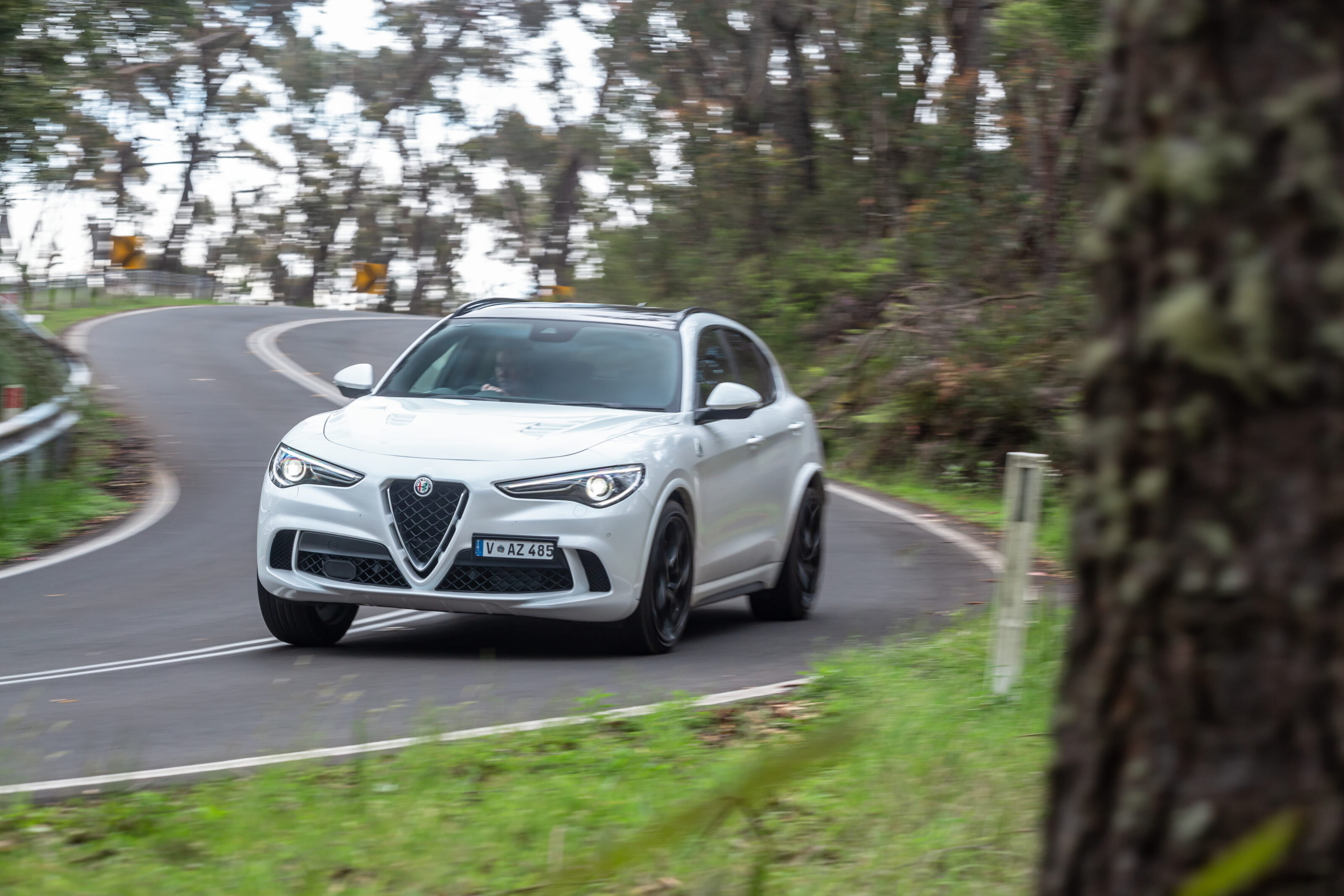
As a result, if the vehicle headlights do not operate as intended it could increase the risk of an accident.
A list of VINs for the affected cars is available here.
Owners are advised to contact their local authorised Alfa Romeo dealer to recalibrate the automatic headlight position sensors and align the headlights, free of charge.
Alternatively, Alfa Romeo can be contacted on 1800 870 724 or [email protected]
Hydrogen as a fuel source faces an uphill battle when it comes to road cars. While it has clear benefits in the long-range logistics and transport industry, along with aerospace, using hydrogen to replace unleaded fuel for the cars we all love is a tough sell due to some obvious and inescapable inefficiencies.
However, this argument relies wholeheartedly on envisaging a future where cars are only driven for prosaic reasons. It doesn’t take into account the fact that certain people, someone like you dear reader, buy and drive cars for reasons other than merely getting from Point A to Point B.
We want to hear the rich notes of an exhaust, ride a fluid and growing wave of power, have our souls stirred. These elements of emotion are something electric performance cars, to this point at least, have done a questionable job of satisfying.
Yes, electric cars have a more than worthy place in our performance car ecosystem, but right now and in the immediate future, internal combustion reigns when it comes to driver involvement. However, we need to create more efficient performance cars.
This is a certain fact if we want to enjoy the genre of vehicles at all in the coming years. But we can still do so while enjoying the drive. This is where hydrogen combustion enters the fray by mixing environmental responsibility with old school noise and involvement.
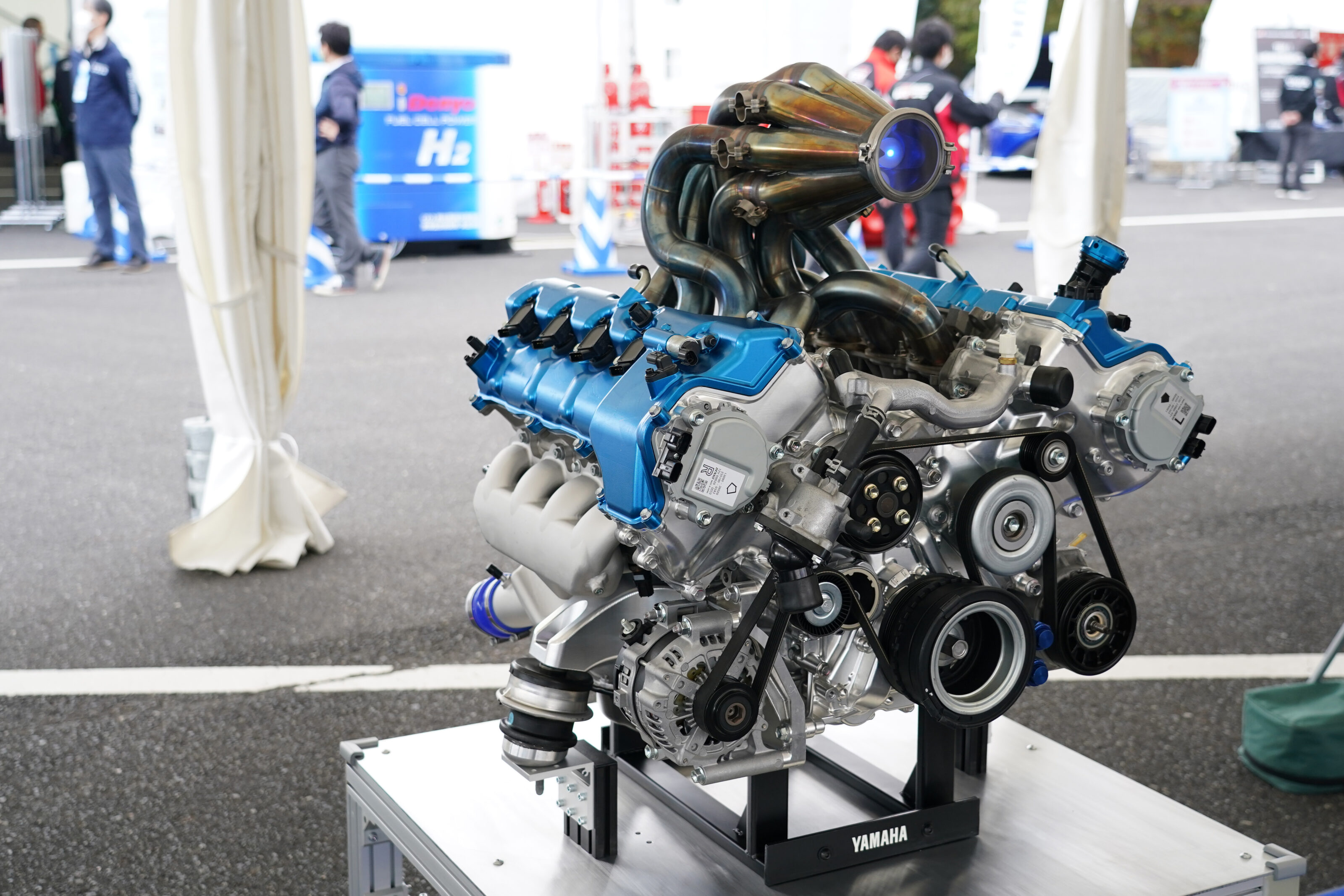
Toyota and Yamaha have teamed up for the most exciting example of hydrogen combustion engines – a 5.0-litre naturally aspirated V8 producing 335kW and 540Nm but with extremely limited exhaust emissions. The basis of the engine is the 2UR-GSE co-developed by the two Japanese companies found in the Lexus RC F coupe.
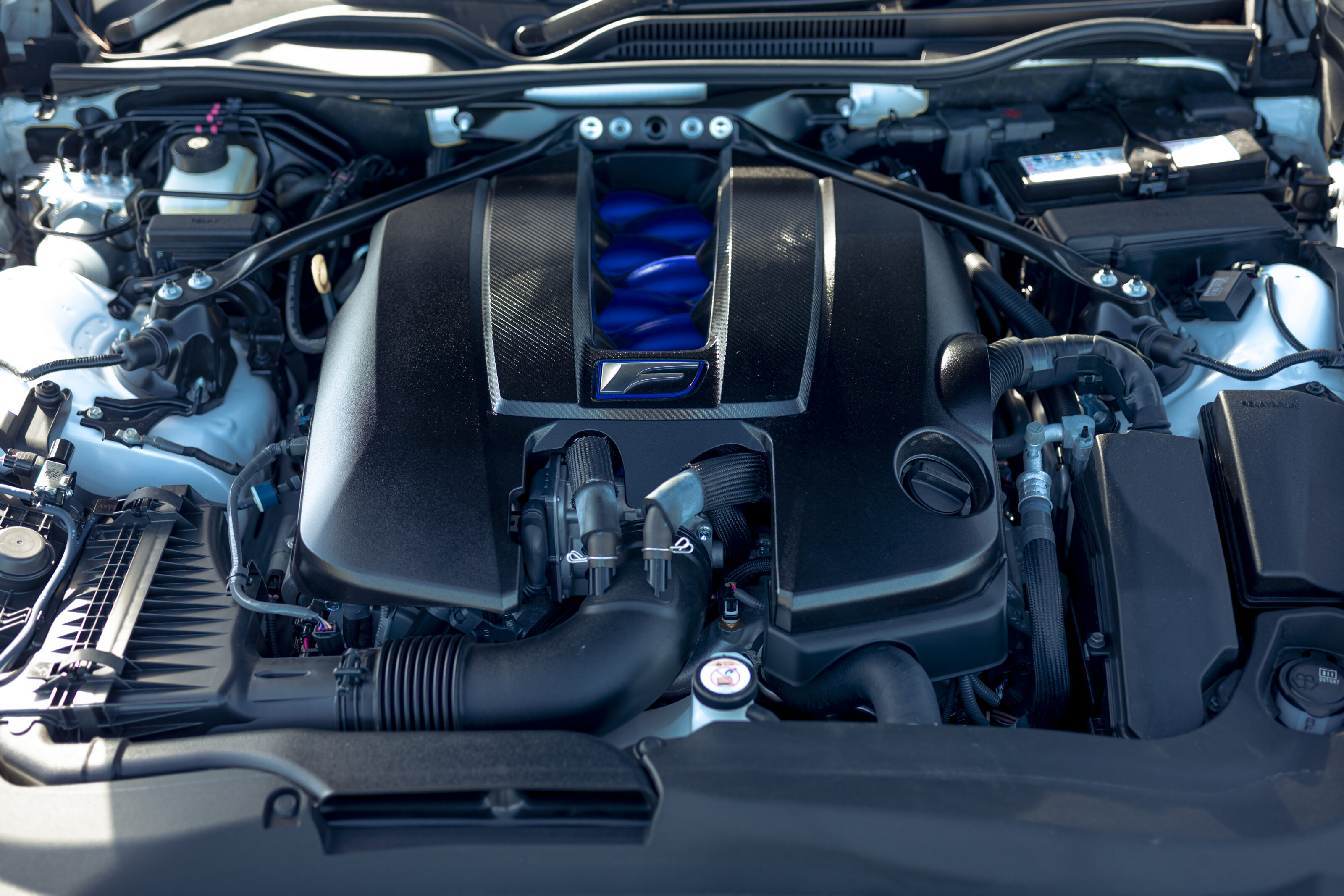
Yamaha changed the intake manifolds and injectors while tweaking the cylinder heads to allow the engine to run on compressed hydrogen while only dropping 16kW (and gaining 10Nm) compared to its unleaded-fuelled sibling. The dramatic 8-into-1 exhaust isn’t just for show either, and is said to give the car an engaging exhaust note.
Hydrogen combustion functions in much the same way as cars that use regular unleaded. There is the same four-stroke combustion cycle, with fuel directly injected into the chamber and ignited with a spark. That sounds all very simple, but Toyota says development has been anything but.
In 2016 the company was having to use a 50/50 fuel mix of unleaded and hydrogen to get the required ignition, and the current purely-H2 powered test engines require incredibly high internal temperatures for the spark to catch.
The major upside in an era of reducing emissions is that the most significant by-product from the engine is water. However, hydrogen combustion isn’t entirely zero-emission. By igniting it in air and using the same mechanical internals that require lubrication, small amounts of oil are burnt in the process, creating minor levels of carbon particulate emissions.
Catalytic filters in the exhaust system will be able to catch most, but not all, of these discharges.
Another benefit is that engineering combustion engines to run on hydrogen is cheaper than developing and building hydrogen fuel cell vehicles like the Hyundai Nexo or Toyota Mirai.
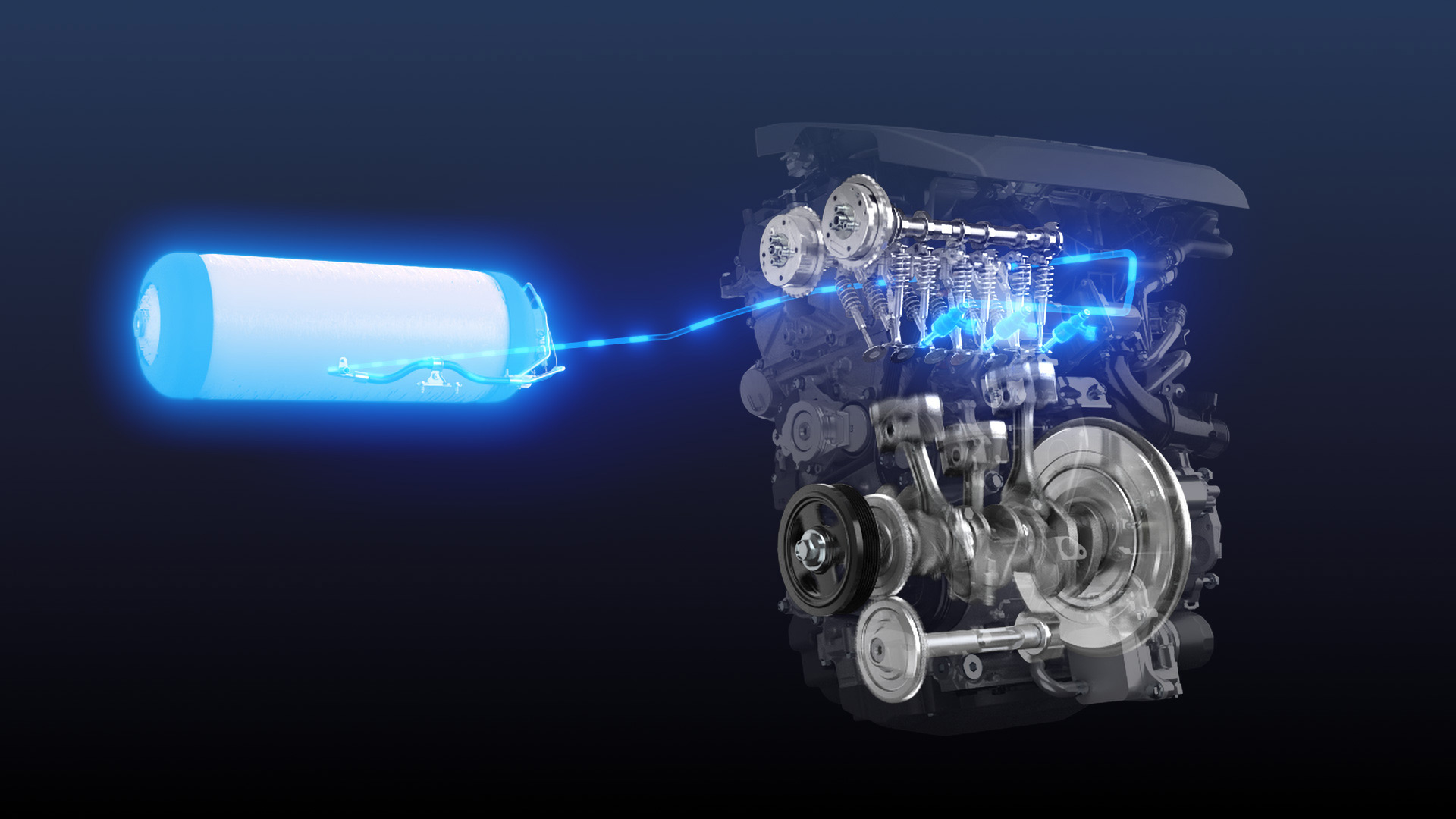
However, there are some significant caveats. Hydrogen fuel cells are already at a well-to-wheel efficiency disadvantage compared to battery electric vehicles. Energy is lost at electrolysis, compression and transport stages for hydrogen, while it also slowly bleeds out of the highly compressed fuel tank (usually running at a pressure of 10,000psi) if left unattended.
Most battery electric vehicles boast a well-to-wheel efficiency of around 75-85 per cent. Fuel cells fall in the 30-35 per cent range, with hydrogen combustion an additional 5 per cent worse off.
But Yamaha and Toyota haven’t developed a performance engine to boast about efficiencies. This is a proof of concept from the maestros of internal combustion that aims to demonstrate that niche enthusiast ICEs still have a place in an environmentally conscious future by drastically and radically cutting emissions. More power to them.
Four cool facts about using hydrogen in cars
1. A new category is born
Showing its support for alternative fuel sources, the Automobile Club de l’Ouest (ACO) which organises the 24 Hours of Le Mans has announced a new category will be launched in 2025 to allow hydrogen electric vehicles to compete in the endurance classic.
2. Getting the band together
Subaru, Mazda, and Kawasaki have joined Yamaha and Toyota to form what has been nicknamed ‘Team Japan’ in a coordinated aim to support the future of internal combustion. While Yamaha and Toyota work on hydrogen combustion, the other three manufacturers will participate in motorsport using bio-diesel and biomass-derived synthetic fuel.

3. Put ya boot in
Jim Glickenhaus is committed to racing a Hydrogen-powered version of his Boot off-road vehicle in the Baja 1000. Instead of running on compressed hydrogen like almost every other fuel cell vehicle, the American team intends to use liquid hydrogen. Glickenhaus claims a range of nearly 1000km from a single tank.
4. Going long
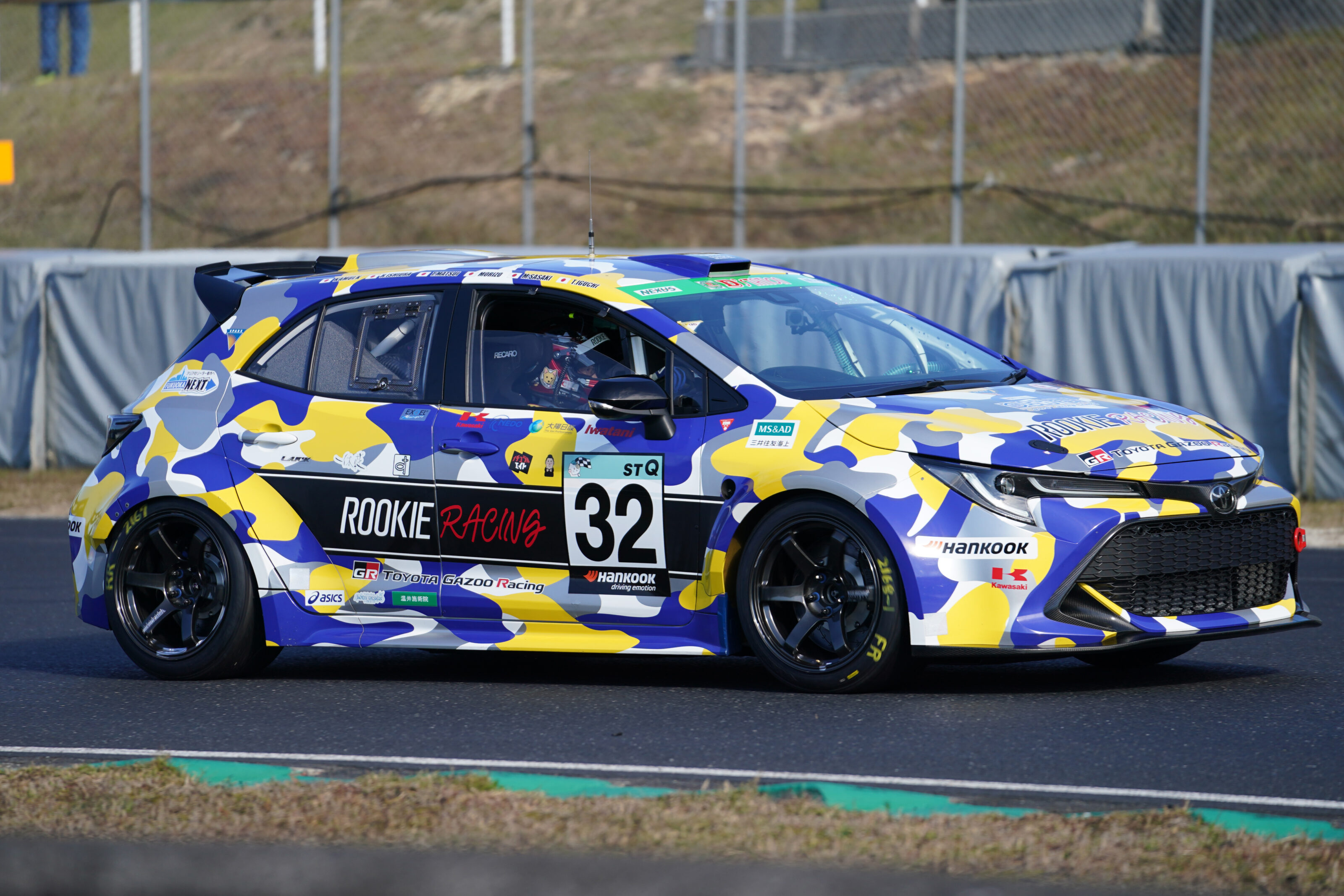
Toyota raced a Toyota Corolla in a 24 Hour endurance event last year using a GR Yaris engine converted to run on hydrogen. The hatchback travelled 1634km, with 12 hours of total driving. The team refuelled 35 times, with four hours spent stationary for an average stop time of seven minutes. The car was entirely immobile for eight hours of the race for repairs and safety checks.
UPDATED: May 3, 2022 – When Australia flew its democratic flag in 1901 after the first election, Packard’s Model C Roadster rolled down the line in Warren, Ohio, with the world’s first steering wheel.
There wasn’t much road infrastructure in Oz back then, let alone cars, and hot topics leading up to the vote were the construction of a transcontinental railway and dismantling the tariff system.
Since that time we’ve flourished, with more than 50 political parties wooing punters for a vote and more than one million cars sold each year. However, when you mix the two into an election, it all gets rather complicated.
Electric vehicles, climate change, emissions standards, renewable energy and local manufacturing are all on the parliamentary table. It’s a great time to be a voting-age petrol (or electric) head – but it can get a bit baffling.
Wheels has scoured every running party’s policies and distilled the important ones you need to know about. And once you’re done reading, let us know in the comments below which policies you’d vote for.
We will regularly update this list as the campaign progresses.
Animal Justice Party
Largely a single-interest party concerned with animal welfare but backs a “climate tax” on fossil fuels. Precisely how that tax will be applied and what effect that would have on fuel prices is impossible to discern.
Australian Christians
Besides being fond of rigid interpretation of scripture and having no qualms about squeezing church and state closer together (but only, you know, one particular kind of church), the Australian Christians party also wants to bring down the price of public transportation and improve cycling infrastructure to get people out of cars.
Oh, by the way, the party also doesn’t believe climate change is caused by human activity.
Fusion
This is a new party formed from the merger of the Science Party, Pirate Party, Secular Party, Vote Planet, and Climate Change Justice Party – so you’d think there might be a bit here when it comes to EVs and fuel standards.
Under its Climate Emergency policy, Fusion wants to place a material price on carbon emissions, and remove all subsidies from greenhouse intensive practices and vehicles.
It also wants to set a target for net-zero emissions in 10 years and invest in research and development to accelerate the transition away from fossil fuels, and make Australia the global leader in clean technology.
What’s missing though is the former Pirate Party’s call to subsidise early EV adopters, install charging points in highway emergency stopping bays, legalise driverless cars and phase out diesel trucks and buses in urban areas.
Australian Greens
It’s the very nature of the beast that the Australian Greens have never been hot on cars – dirty, fuel-guzzling, climate-polluting things that they think they are.
But the electric vehicle is changing perceptions, with the Party pushing for an ‘EV revolution’ to make transport cleaner, cheaper and more reliable, and create thousands of jobs and new industries to help tackle the climate crisis in the process.

At its 2022 Election campaign launch in April, Greens leader Adam Bandt announced a $6.1 billion electric vehicle (EV) investment package to stimulate growth over the next three years.
This includes allocating $1.2 billion to manufacturers of electric vehicles and electric vehicle components to relaunch the country’s car industry.
The proposal would also provide generous incentives to help Australians buy their first EV, including cutting costs by up to $15,000 and providing “ultra-cheap” finance.
Also pledged were a $2 billion publicly-owned EV fast-charging network and the electrification of the Commonwealth vehicle fleet by 2025 to help drive the second-hand EV market.
Not averse to punitive measures, the Greens also proposed ending the sale of new petrol and diesel cars from 2030, “so you’re not stuck on yesterday’s technology”, and legislating tough vehicle pollution standards to drive down emissions.
The Greens also want fewer reasons for people to drive cars by investing in fast and efficient public transport solutions to reduce traffic.
This plan includes putting an extra $25 billion into rail and clean electric-bus services and $500 million per year into making cycling and walking safe and accessible, connecting people from the cities to outer suburbs and regions.
The Great Australian Party
Cheaper fuel and higher speed limits on six-lane freeways. It’s an Australian motorist’s dream, right?
Well, that’s the gist of the Great Australian Party’s transport policies. It wants to re-regulate fuel prices and remove all excise tax on Australian produced liquid fuels. It wants to upgrade roads to meet the world’s “best practice” traffic rules and introduce international standards.
But it’ll also make sure speed limits will be monitored by accurate, certified measuring devices “for the purpose of gaining evidence of any dangerous activities on public highways and connecting roads.”
The GAP is also big on rights for truck drivers and would invoke an Interstate Commission to take powers away from the states in implementing large fines that put trucking companies and drivers at financial risk.
The Commission would also be responsible for making a fatigue management system that operates on a 24-hour period logbook.
It will also allow owner drivers to collectively register to obtain discounts by bulk purchasing to compete with larger logistics companies, make diesel exempt from tax for on-road use, and review all heavy vehicle road tax and roadworthiness laws.
Katter’s Australian Party
This Queensland-centric party has few motoring-related policies to speak of, besides wanting to increase the ethanol content of fuel to 10 per cent by 2025 – not to lower fuel prices or boost energy security, mind you, but for the (financial) benefit of sugar cane growers in the Sunshine State.
KAP also wants to crack down on rideshare companies like Uber in favour of the taxi industry.
When it comes to transport infrastructure there isn’t much unless you regularly use North Queensland’s Hann Highway or the Gulf and Cape cattle roads.
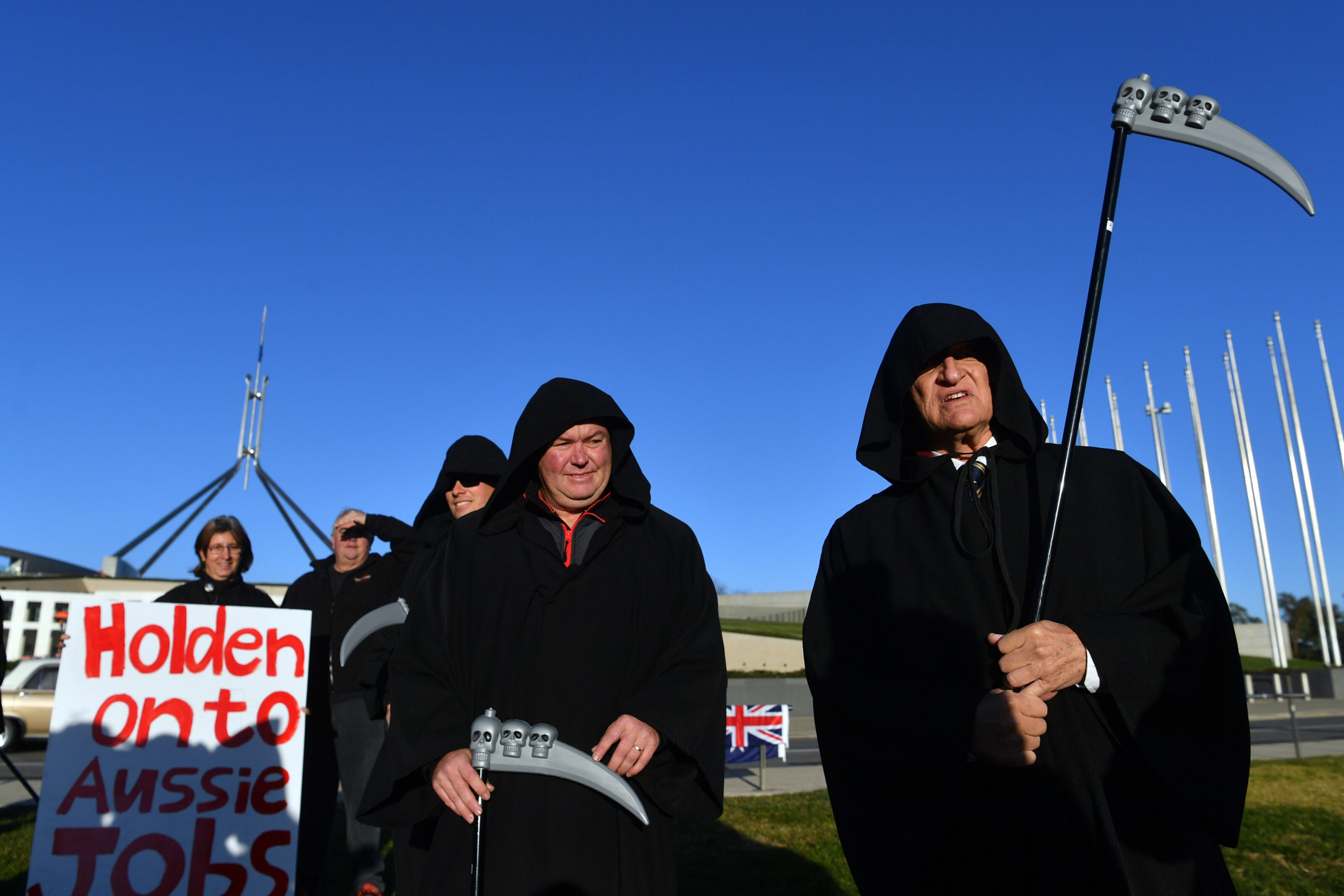
While not listed under the Party’s official policies, the leader of his eponymous party, Bob Katter, introduced a motion in the Lower House that Australia supports the re-establishment of Australian car manufacturing.
Australian Labor Party
The Federal Opposition went into the last election with sound car-related policies including an ambitious plan to increase EV uptake to 50 per cent of new cars by 2030.
Australia didn’t seem ready for such a policy then, but the discourse has done a complete U-turn during the past three years.
Hence, its latest pledge to commit to reducing carbon emissions by 43 per cent by 2030 and get 3.8 million electric vehicles on the road by the same time if it wins the election won’t be met with cynicism or claims that Albo is trying to ruin your weekend.
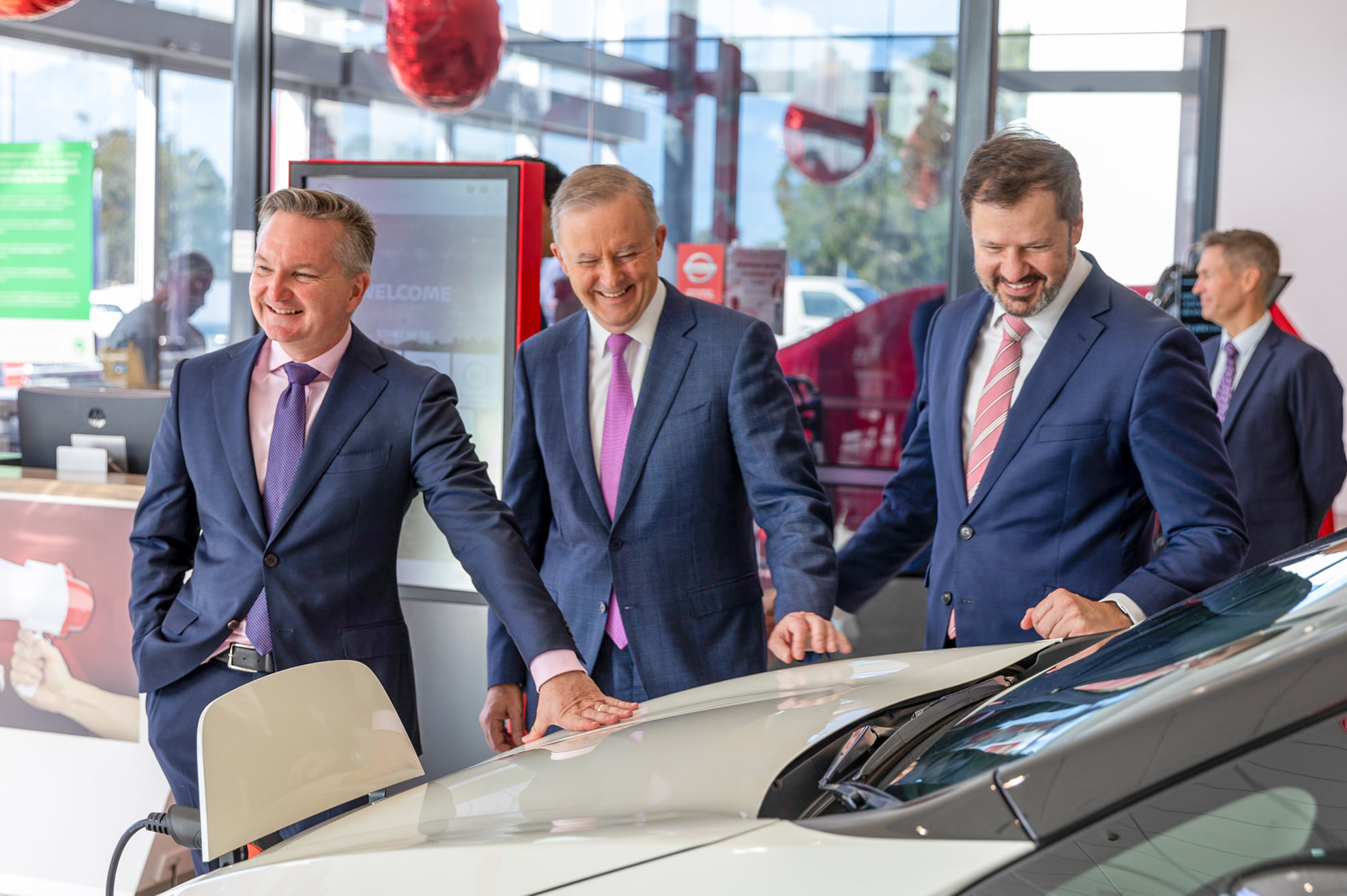
Labor plans to get more EVs on the roads by making them exempt from the five per cent import tariff and the 47 per cent fringe benefits tax where applicable.
It also aims to work with industry, unions, states and consumers to develop Australia’s first National Electric Vehicle Strategy, which would examine further ways to increase electric car sales and infrastructure, encourage Australian manufacturing of EV components and possibly cars themselves, and address the policy implications of declining fuel excise.
At the Party’s 2022 Election launch in Perth on May 1, Labor leader Anthony Albanese pledged $39.3 million toward the building of a National Electric Vehicle (EV) Charging Network as part of its $500 million ‘Driving the Nation Fund’ to support renewable fuels.
The charging network would feature charging stations spread out at an average interval of 150km on major roads, with government spending to be matched by the NRMA and bolstered by partnerships with State, Territory and Local Governments.
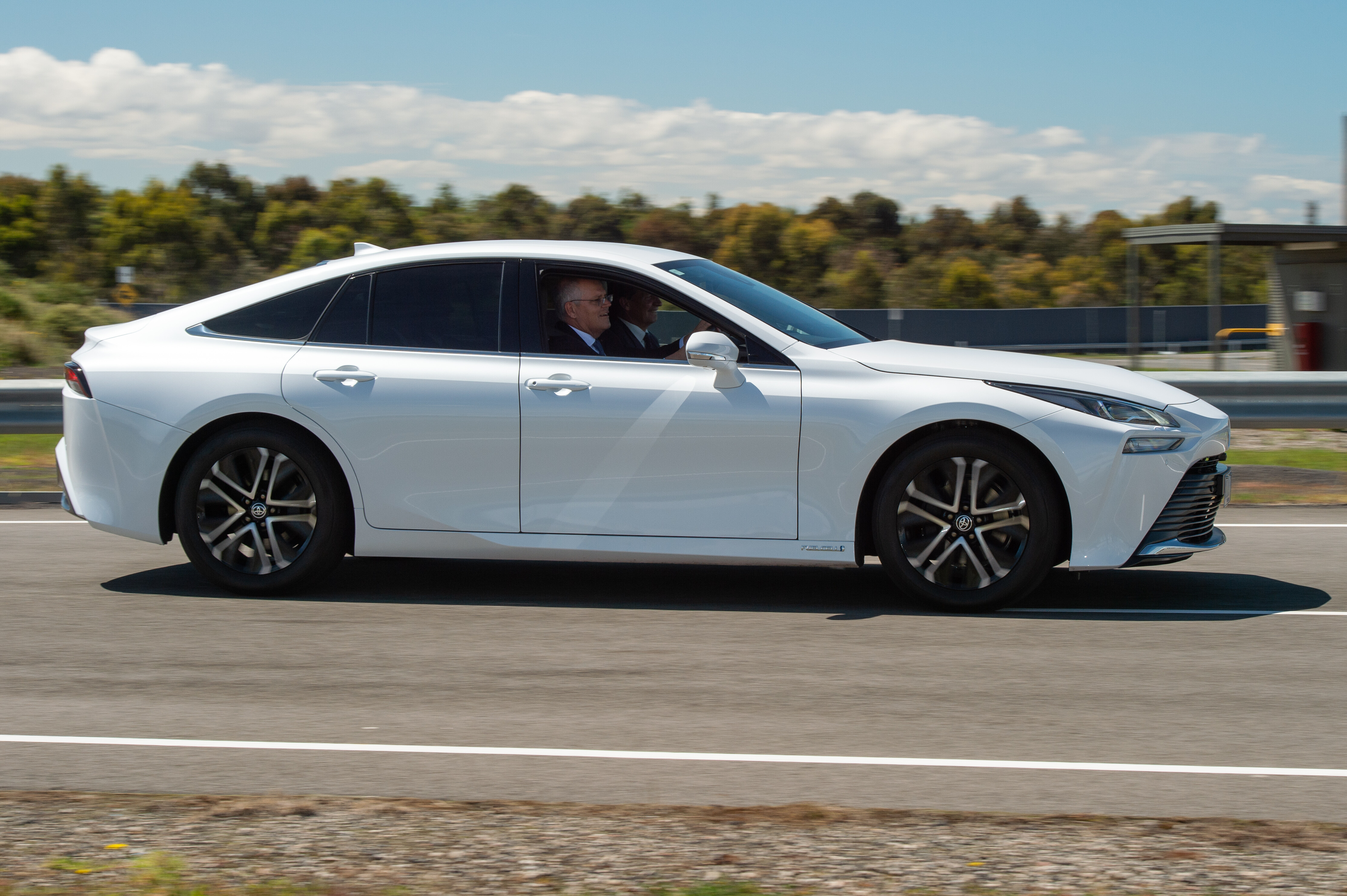
The Driving the Nation Fund will also invest $80 million to deliver up to 16 hydrogen refuelling stations along Australia’s busiest freight routes.
As for cars with internal combustion engines, Labor previously announced it would establish a real-world vehicle fuel-consumption testing program to inform consumer choice.
No mention of roads in its overall policy platform, but expect the odd localised announcement once the election campaign gets into full swing.
Liberal Democrats
The Lib Dems have previously called for; a five-year trial where the blood alcohol limit is increased to 0.8 per cent, highway speed limits raised by 10-30km/h, a 10 per cent tolerance for speedometer error considered, special speed limits (for example in school zones) applicable only when flashing yellow lights are operating, passive radar detectors be re-legalised, covert enforcement of speed limits replaced with sign-posted enforcement, and wearing seatbelts and helmets (for motorcycles) should be optional.
Though some of the ideas sound a bit flippant, the Party has had some more conservative policies such as; reducing speed limits over 90 km/h by a uniform amount (eg 10-20 km/h) at night and in the rain, that licence testing should emphasise the skills and knowledge required to handle a vehicle to avoid being a danger to others, that drivers should be subject to retesting after a certain number of years, and the highest enforcement priority should be on driver behaviour that infringes on the rights of others.
More recently the Party responded to high fuel prices by pledging to cut the 44.2 cents per litre fuel excise to ‘see us return to the glory days of lower fuel prices’.
Liberal Party of Australia
It seemed the Liberal Party was beginning to see the light, or at least votes when it came to electric vehicles, but so far its policy platform makes no mention of EV subsidies, though it’s probably a case of watch this space.
What it has promised is a $110 billion fund for transport infrastructure, which is very similar to the policy it put forward at the last election – but with an extra $10 billion chucked in.
Much of it will be spent on roads including major highway and local road upgrades ‘to bust congestion and improve safety’ and the removal of traffic pinch points through the Urban Congestion Fund.
Other road initiatives included; upgrading key regional road corridors to free up freight routes and providing safer roads for tourists, and upgrading local roads and bridges. Interestingly, there is no mention of car parks.
As with Labor, expected to see the Libs announce a swathe of local road projects during the campaign.
National Party of Australia
Mirrors main Liberal party policies with a $110 billion road/rail infrastructure fund, and also allocates millions more for rectifying major black spots and improving road maintenance in regional areas.
Being the Nationals, there’s not much here for motorists in major cities.
Pauline Hanson’s One Nation
One Nation questions the idea of man-made climate change and as such has not made a stance on electric vehicles and emissions targets.
But if it does rise to power, building new low-emissions coal-fired power stations and initiating a “sensible debate on the establishment of nuclear power” is on the agenda. So plenty of power in those plugs for EVs.
As part of its Australian Jobs and Infrastructure policy, One Nation would introduce nation-building infrastructure projects including water, rail, and roads – but it doesn’t detail how much or where.
Shooters, Fishers and Farmers Party
Where there are shooters, fishers and farmers there are four-wheel-drive vehicles, so you won’t be surprised to learn that part of the Shooters, Fishers and Farmer’s Outdoor Recreation and Access policy is to oppose the vilification of four-wheel driving and motoring enthusiasts from claims that off-road driving is detrimental to the environment.
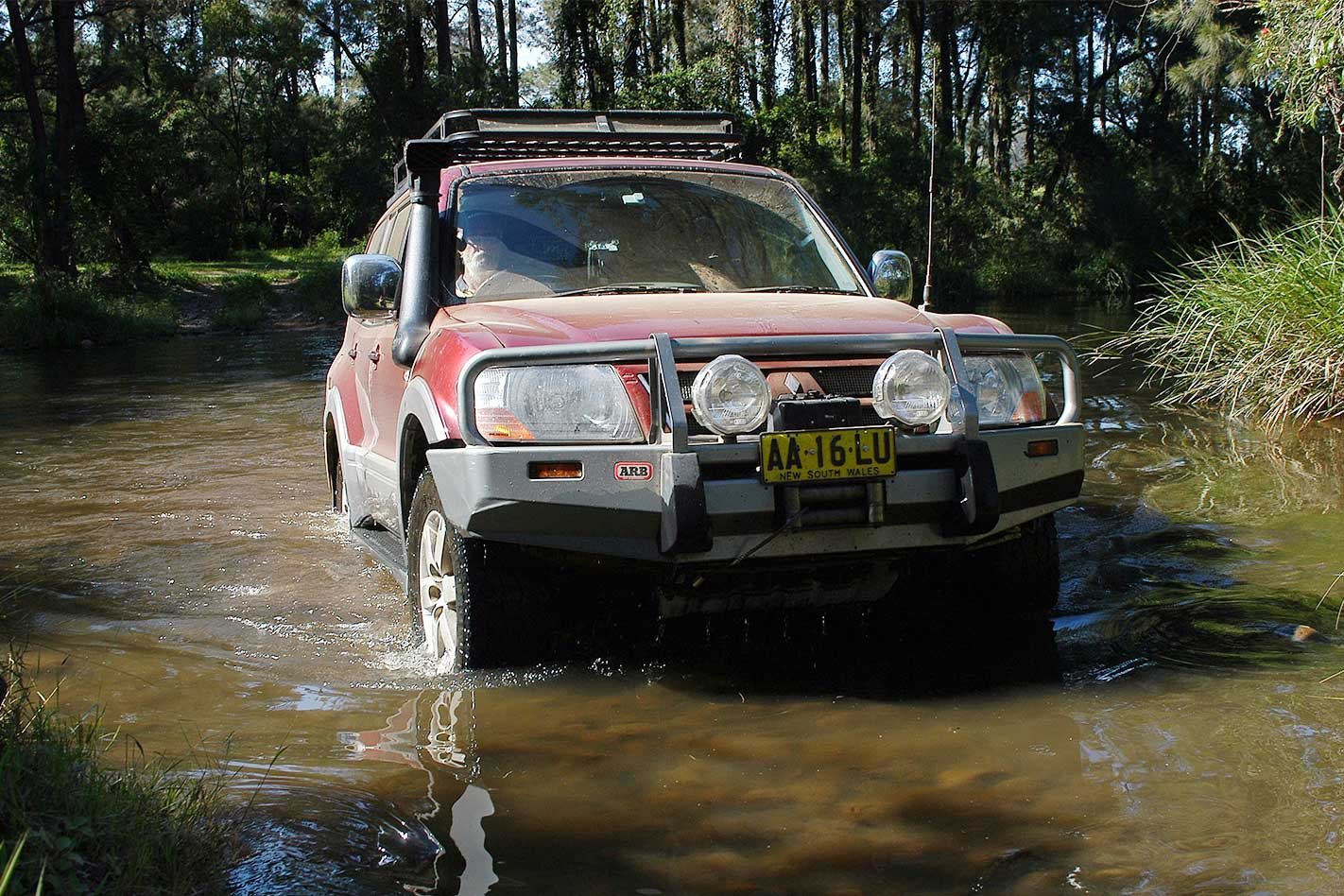
It also wants to reopen and maintain fire trails and expand tracks and public access to National Parks.
Socialist Alliance
This Party naturally prefers that most things would be owned by the state, but wants to steer new-car buyers into electric vehicles as a matter of urgency – except for those who frequently travel in regional areas.
It also wants to end fossil-fuel subsidies and replace fuel stations with charging stations but doesn’t exactly outline how it’ll do so.
That said, the party envisages crafting a socialist utopia where most people take the bus or train – which will be state-owned and free, naturally – so private car ownership won’t be necessary for the vast majority anyway.
Hasn’t something like this been tried before? Seems familiar…
Sustainable Australia Party
As you’d expect from its name. SAP wants priority given to ecologically sustainable and congestion-free public and private transport systems by expanding rail and/or bus networks instead of building more roads.
While prioritising public transport systems, it supports the uptake of electric vehicles and funding related infrastructure, while reducing registration fees for electric and low-emissions cars.
Sustainable Australia also wants to conduct an enquiry into the feasibility of a majority-Australian-owned electric car company and the potential for mass production of a small-to-medium utilitarian electric commuter car for local and export markets.
Teal Independents
While campaigning on their own merits, members of the so-called Teal Army of independent candidates mostly challenging key Liberal-held seats are in sync when it comes to policies that encourage electric vehicle uptake.
One of these is the incumbent Member for Warringah, Zali Steggall, who introduced a bill into Federal Parliament to reduce emissions by 60 percent.
Stegall, along with North Sydney candidate Kylea Tink and Mackellar candidate Sophie Scamps called for at least 76 per cent of new cars sold in 2030 to be electric.

According to Tink, carbon emissions and climate policy were the top issues for voters in her electorate and she wants whichever party takes power to match state-based cash incentives for EV purchases.
In Melbourne, the Independent candidate for Kooyong Dr Monique Ryan called for EV policies in line with Steggall’s emissions bill.
In the adjoining electorate of Goldstein, Zoe Daniel called for an end to fossil fuel subsidies and EV incentives including registration and stamp duty discounts and free parking for EVs, reforming the fringe benefits tax to exempt EVs and the establishment of a national charging network.
The Australian Electoral Commission website has details of your local candidates including independents, whom you can look up online to see what their individual policies are.
United Australia Party
One would assume UAP voters do drive cars, but looking through Clive Palmer’s political manifesto it seems that motor vehicles don’t exist.
The closest policy we could find was the Ending Australia’s Energy Crisis – which was pretty much a pitch to mine more uranium and become proactive in establishing research into new nuclear technology to help solve Australia’s energy problems.
