Snapshot
- Entire Aston Martin model range to be electrified by 2030
- Hybrid deliveries to start in 2024, first electric vehicle the year after
- Carbon neutral operations targeted by 2039
British manufacturer Aston Martin has unveiled its planned pathway to go carbon neutral by 2039, with a number of hybrid and electric vehicles set to launch in the coming years.
Unveiled in its Racing.Green sustainability strategy, Aston Martin will introduce its first hybrid vehicle – the Valhalla – to the market in 2024 before launching a fully-electric vehicle in 2025, a first for the Gaydon-based brand.
The introduction of its first electrified models by 2025 will lead to Aston Martin’s entire model range boasting some kind of electric power by 2030, with all new models from 2026 to be electrified.
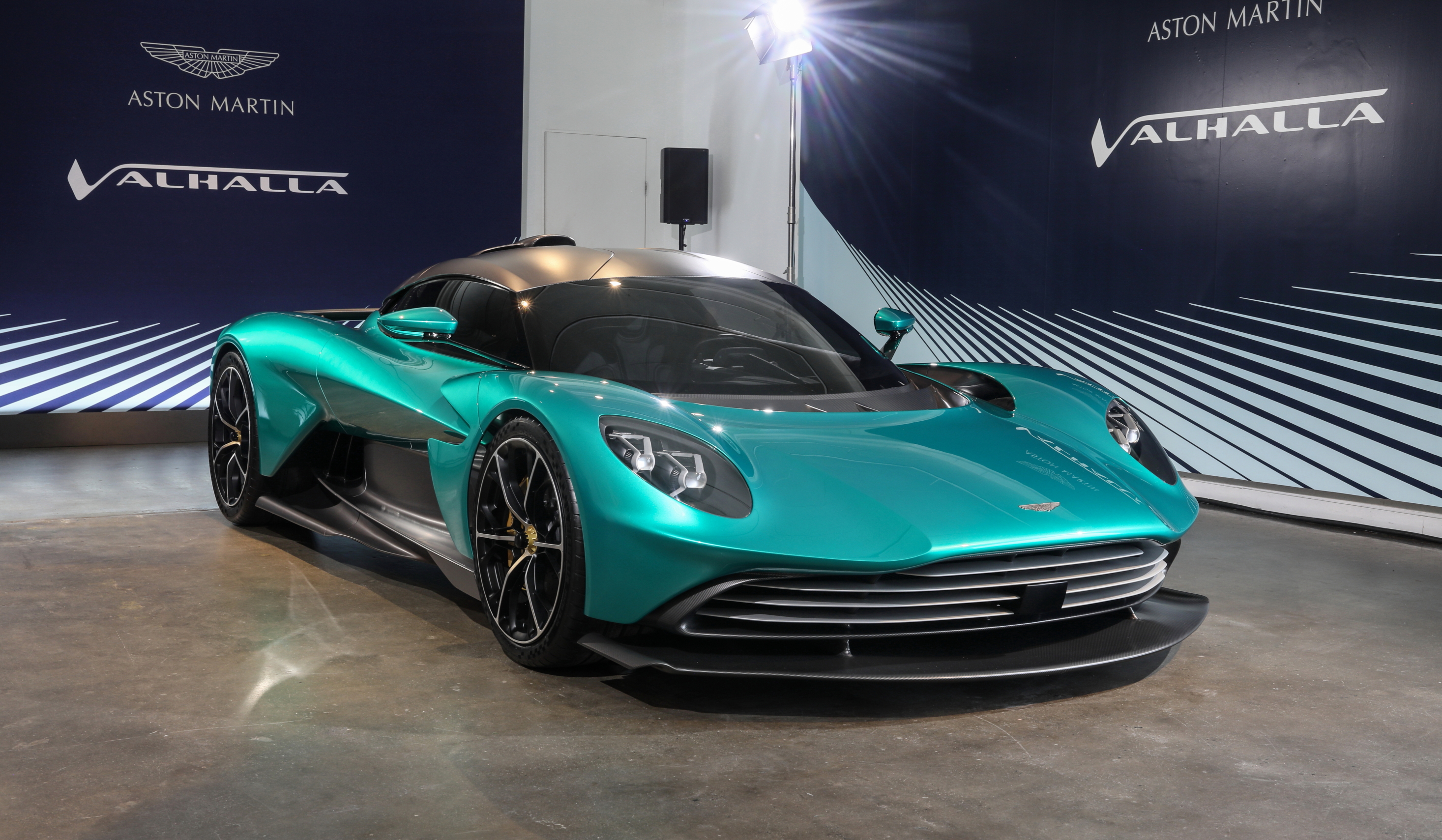
Aston Martin has previously said it expects at least 50 per cent of its new vehicle sales to come from EVs by 2030, potentially spearheaded by a fully-electric variant of the DBX SUV and a successor to the current DB11 and Vantage.
A move towards net zero manufacturing emissions by 2030 comes off the back of a 44 per cent reduction in its UK emissions output between 2020 and 2021, which has been assisted by the move to 100 per cent renewable energy since 2019.
Supply chain emissions are set to drop as well, with a 30 per cent reduction from its 2020 baseline by 2030 targeted before the entire process goes carbon neutral before 2039, ultimately signialling the end of internal combustion engines in the process.
This reduction in supply chain emissions will come alongside a move to more sustainable materials being used in production, from green aluminium alloy to leather-free vegan interior options, allowing Aston Martin’s vehicles to retain their luxury feel but with an environmentally conscious twist.

CEO Tobias Moers believes the marque’s shift towards electric vehicles will allow it to retain its place as one of the biggest luxury automotive manufacturers.
“Aston Martin is accelerating – we are transforming our business and believe that now is the time to challenge ourselves to make a bigger difference, to become a world-leading sustainable ultra-luxury business,” said Moers.
“Whilst embracing electrification, we believe our sustainability ambitions must be broader than just producing emissions-free vehicles, and want to drive sustainability principles across our entire business, with a team representative of society proudly producing responsible products with a reduced environmental impact and making a positive contribution to the communities where we operate.
“Applying our passion for engineering and design innovation to this challenge, we are excited about shaping not just how quickly the world gets from zero to sixty, but how quickly we get to net zero.”
A culture of inclusivity is also set to be adopted at Aston, with its Diversity, Equality and Inclusion strategy targeting 25 per cent of leadership roles within the business to be held by women within the next five years, spearheaded by Dr Anne Stevens who oversees the Racing.Green strategy.
Few cars were as eagerly anticipated at COTY 2022 as the Polestar 2. And after three days of granular exploration at the proving ground, fewer still divided opinion quite so strongly. After all, there’s a lot to unpack here. Once the ‘go fast’ department of Volvo, Polestar has since unplugged itself from Gothenburg and gone out on its own as a premium EV player.
Australia missed out on Polestar’s first standalone model, the sleek and striking Polestar 1, but it was left-hand drive only and made in limited numbers. That makes the Polestar 2 our first taste of the reinvented Swedish brand and, as it arrived Down Under just weeks before testing began, COTY was the judging panel’s first chance to form an impression. Things were divisive from the get-go.
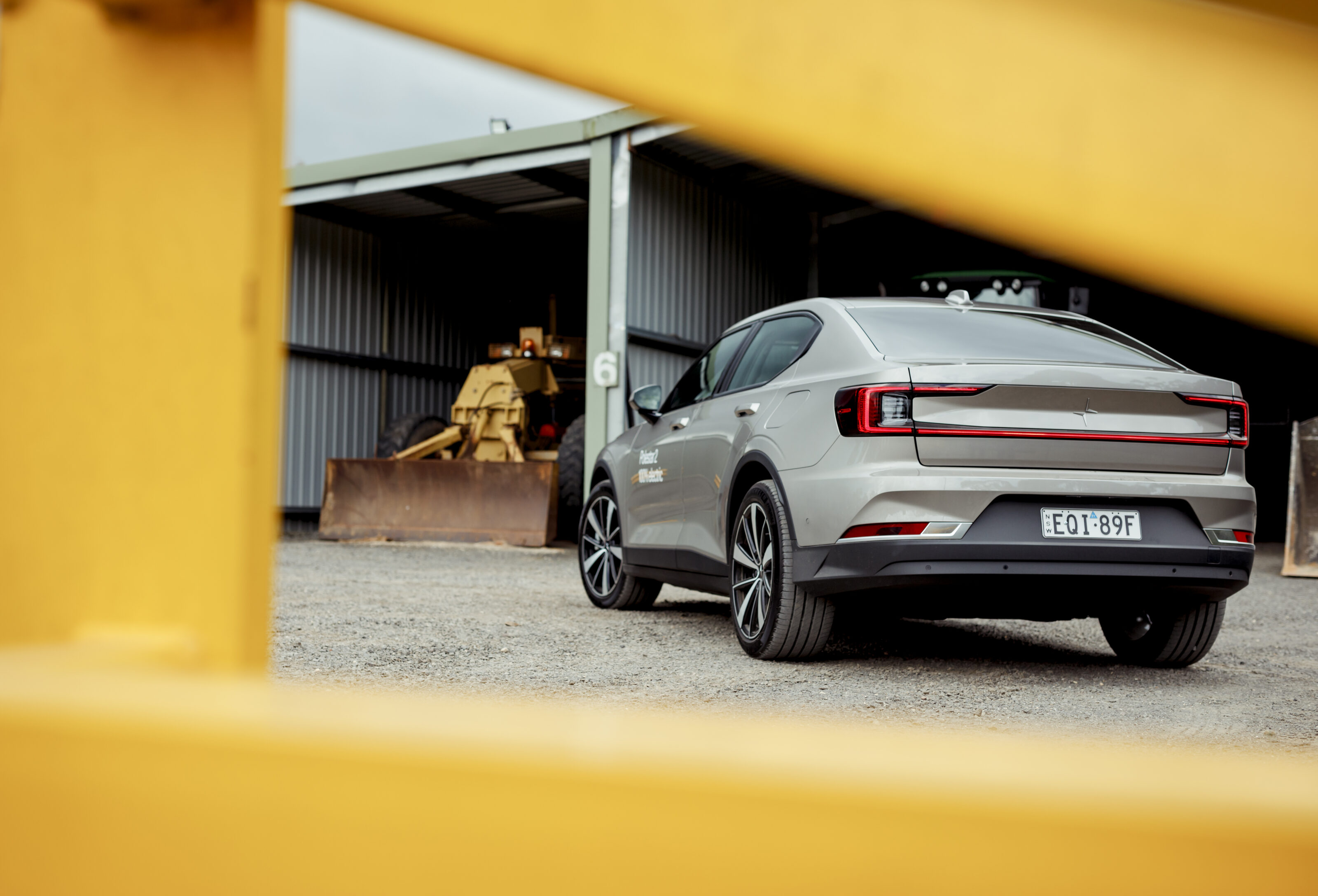
Polestar says design, build quality and offering a ‘complete’ driving experience (read: not just 0-100km/h times) are core brand values. And visually at least, it delivers. All of the judges were impressed by the sleek and understated exterior design, while the beautifully trimmed and richly equipped cabin also earned some approving nods.
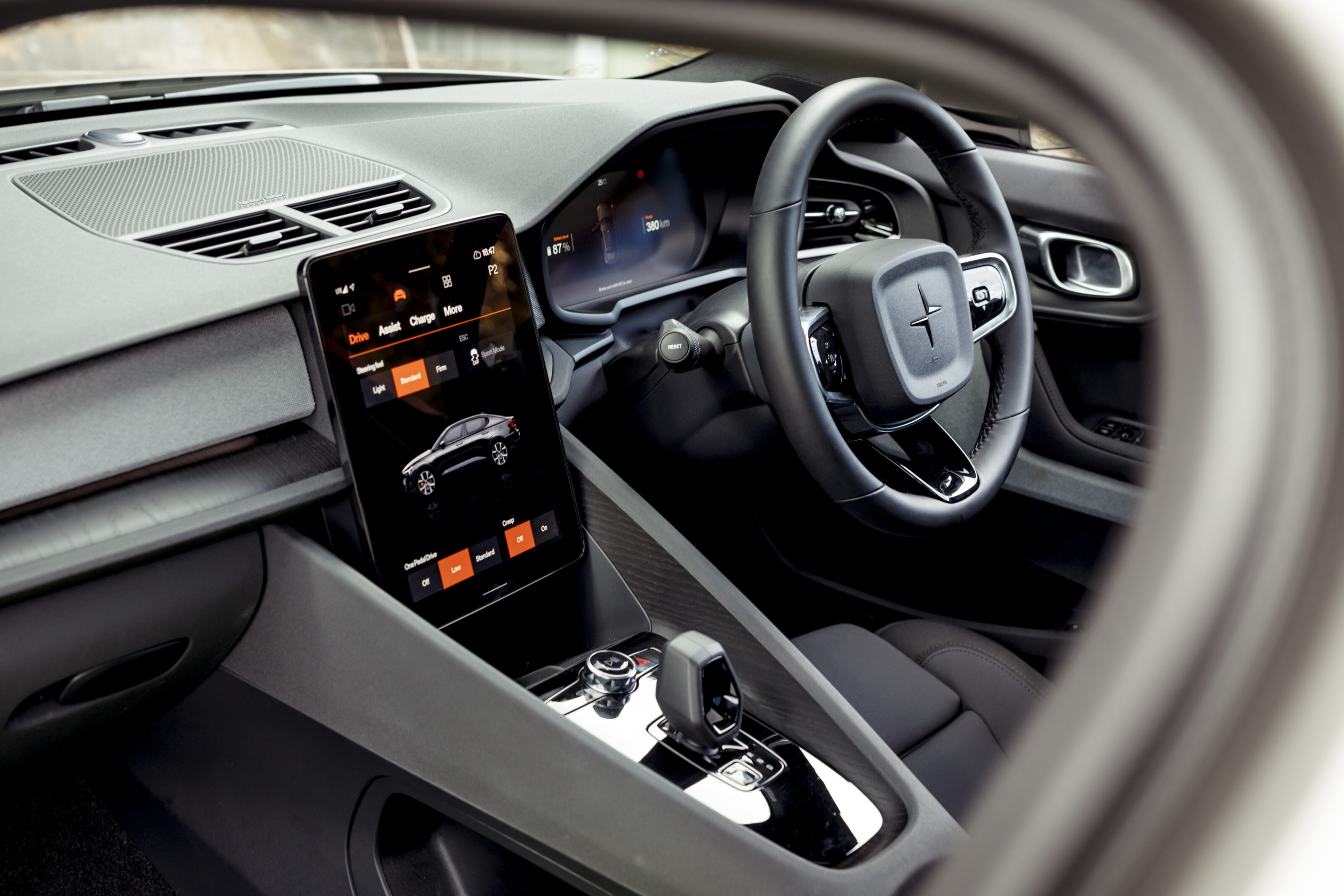
Cabin tech was a positive too, and saw the Polestar 2 score some early points courtesy of the functionality and crisp graphics of its large 11.2-inch central screen. The slick operating system was jointly developed with Google and while a few judges did note the lack of Apple CarPlay may annoy some owners of early models, an over-the-air update to include that functionality is planned later in 2022.
“I like how it drives but interior is oddly disappointing in places” – Dylan Campbell
But compromised packaging and some strange standard safety omissions were also clear weaknesses. The Polestar 2 shares its Geely-sourced CMA platform with the Volvo XC40, and the drawbacks of shoehorning an EV powertrain into an ICE-derived chassis were evident, especially in the rear.
“Cabin space is clearly compromised by the multi-drivetrain platform,” said Jez. “But the seats are great, materials feel special and the interior design is contemporary.”
Polestar’s approach to safety, however, is what really raised eyebrows. The Aussie range offers three trim levels, two battery sizes (64 or 78kWh, with the latter claiming 540km of WLTP range) and the option of front- or all-wheel drive.
The car chosen for COTY testing was the mid-spec front-drive ‘Long Range Single Motor’, which at $64,900 is a direct rival for the Tesla Model 3 on price and size. But oddly, given its link to Volvo, Polestar has grouped desirable active-safety systems (including adaptive cruise, blind-spot monitoring, a 360-degree camera and rear cross-traffic alert) into a $3400 Pilot Lite option pack.
“That seems hypocritical for a company so closely associated with safety leader Volvo,” said Dan.
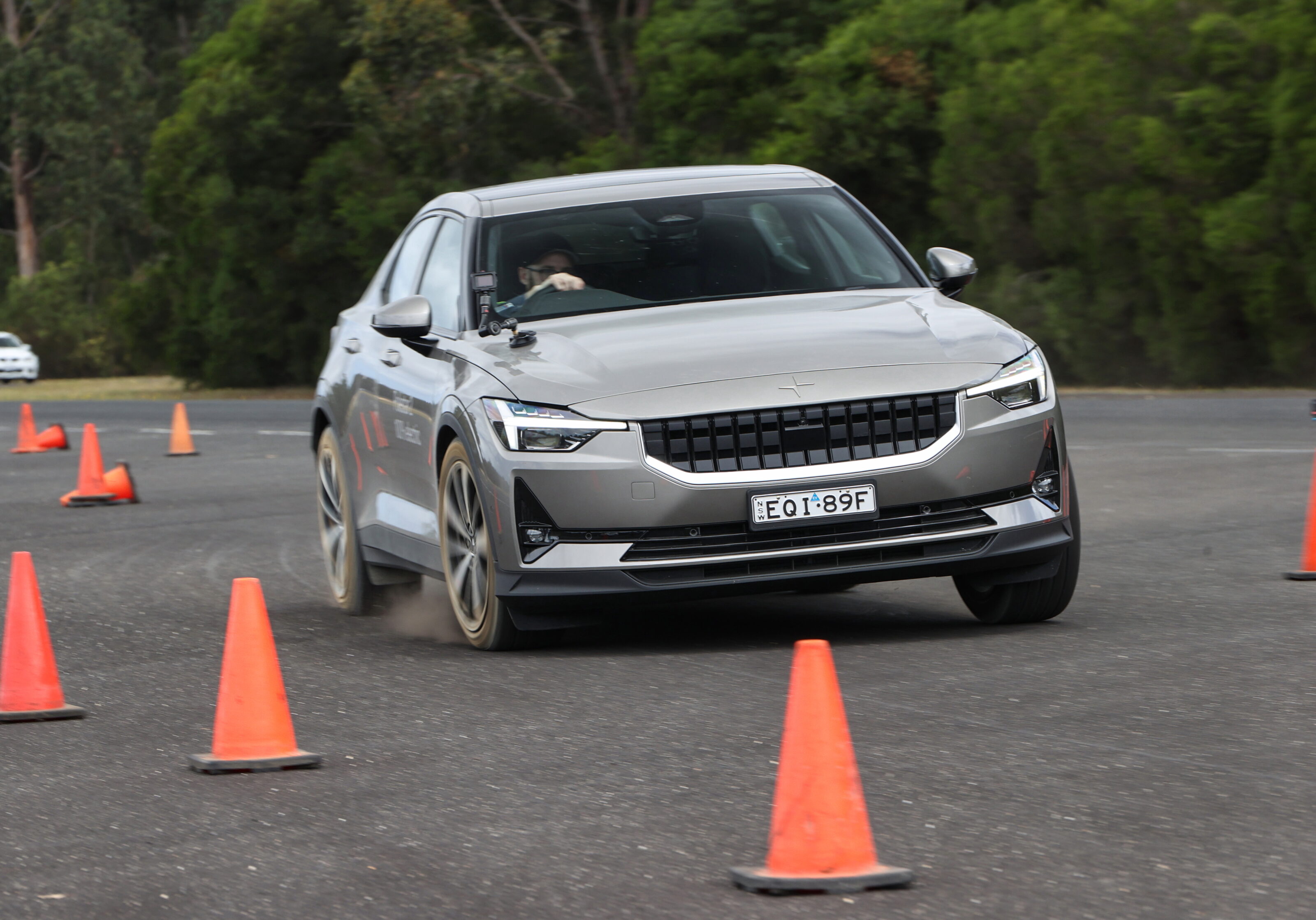
Things were more convincing through COTY’s dynamic exercises. An excellent driving position, crisp and accurate steering, and sweetly balanced handling were all noted, and the regen braking (adjustable through three appreciably different settings: Low/Standard/Off) was the best of all the EVs at COTY.
Performance of this 170kW/330Nm single-motor version is effortless, if not sporty, but overall refinement was letdown by excessive tyre noise.
So it’s a convincing first shot for Polestar, with some caveats, but brand identity is what really divided the judges. While some thought the Polestar 2 did just enough to feel unique, others felt establishing a clear brand remains a work in progress. Richard: “It cuts a handsome figure as an EV sedan and drives nicely. But it feels like an electric Volvo, not a standalone brand.”
- Update 1: In our clutches
- Update 2: Strip, with no tease
- Update 3: Munching twisties
- Update 4: Cruising altitude
- Update 5: Urban grind
Update One: In our clutches
| Price as tested | $52,000 |
|---|---|
| This month | 406km @ 9.2L/100km |
| Overall | 406km @ 9.2L/100km |
The four years spent waiting for the Hyundai i30 N DCT have felt like an eternity. Back in 2017, after Hyundai coaxed former BMW M boss Albert Biermann away from retirement to build its first hot hatch, and to raging success, everyone knew the i30 N would never realise its sales potential until it delivered one thing: an automatic option.
Yet, Hyundai was already developing an eight-speed dual-clutch. At that stage the prototype ’box could already handle lofty torque limits, something which denied the i30 SR’S dry-clutch seven speed DCT from ever partnering with the i30 N’s grunty 2.0-litre four-banger. Anticipation grew for the transmission as Hyundai announced a provisional late-2019 launch.
But Hyundai was, in fact, taking its time. It was anxious to hit crucial refinement and economy targets. On one hand, this was reassuring. Hyundai was exercising caution to ensure we got a reliable, well-calibrated transmission. However, rivals like Ford and Renault Sport were already racing to introduce their own auto hot-hatch heroes.
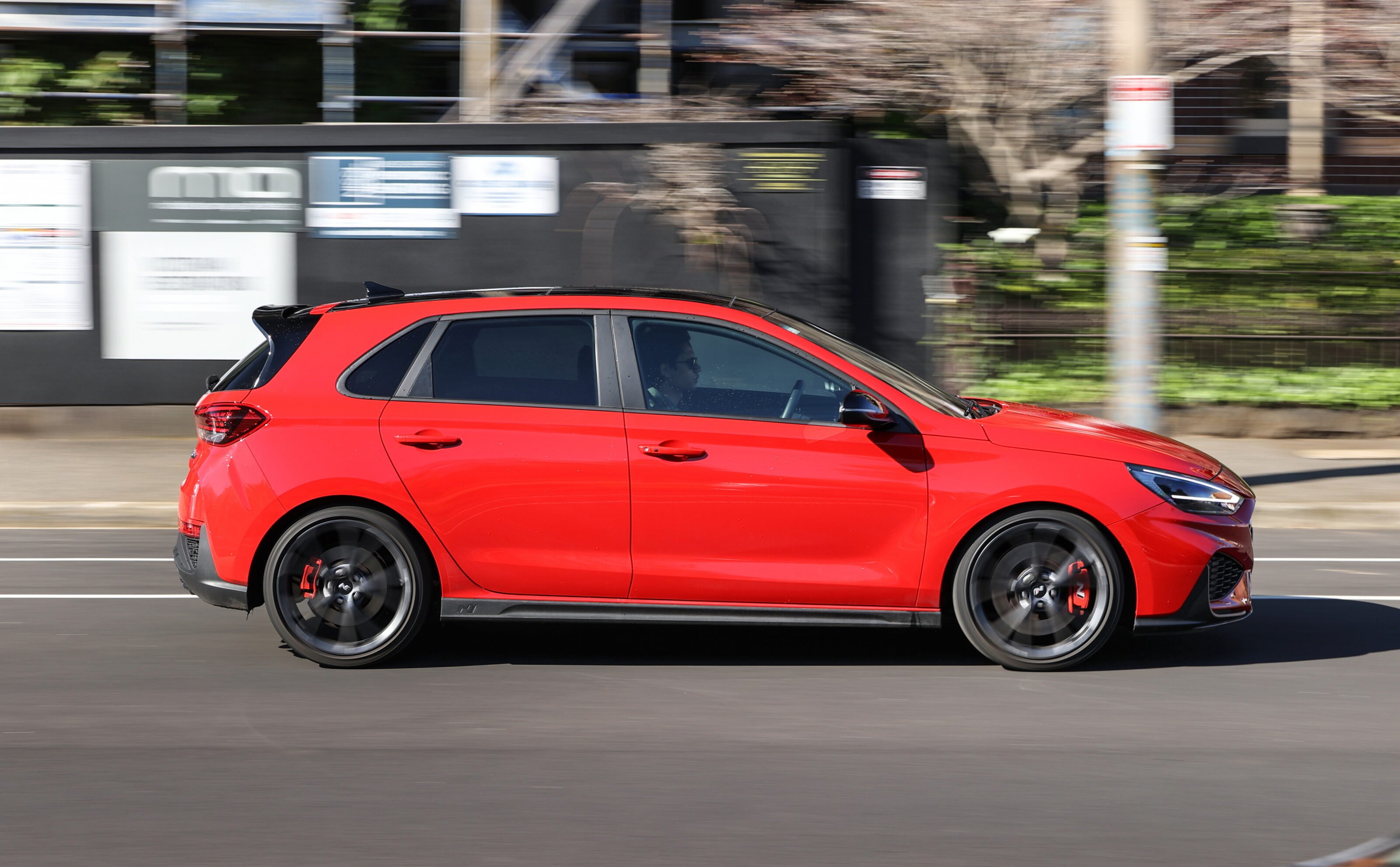
After reading the new i30 N DCT’s on-paper numbers, though, I get the feeling it has been worth the wait. Not only is the 2021 Hyundai i30 N a fitter, meaner and leaner machine, it seems there’s no apparent compromise in opting for the dual-clutch transmission besides paying another $3000.
This comes on top of a $4510 generational price hike for the new i30 N, opening at $44,500 for the manual. The higher price brings a small bump in peak power and a decent helping of extra torque, up 2kW and 39Nm, taking outputs from 202kW/353Nm to 206kW/392Nm in either the manual or dual-clutch version.
Despite the new transmission adding its own oil-filled cooling circuit to the nose of the i30 N to keep its clutches cool, which contributes to a 33kg increase over the manual, the DCT variant is claimed to reach 100km/h in 5.4sec. That’s 0.5sec quicker than the new manual i30 N, already 0.2sec up on the old car’s 6.1sec claim.
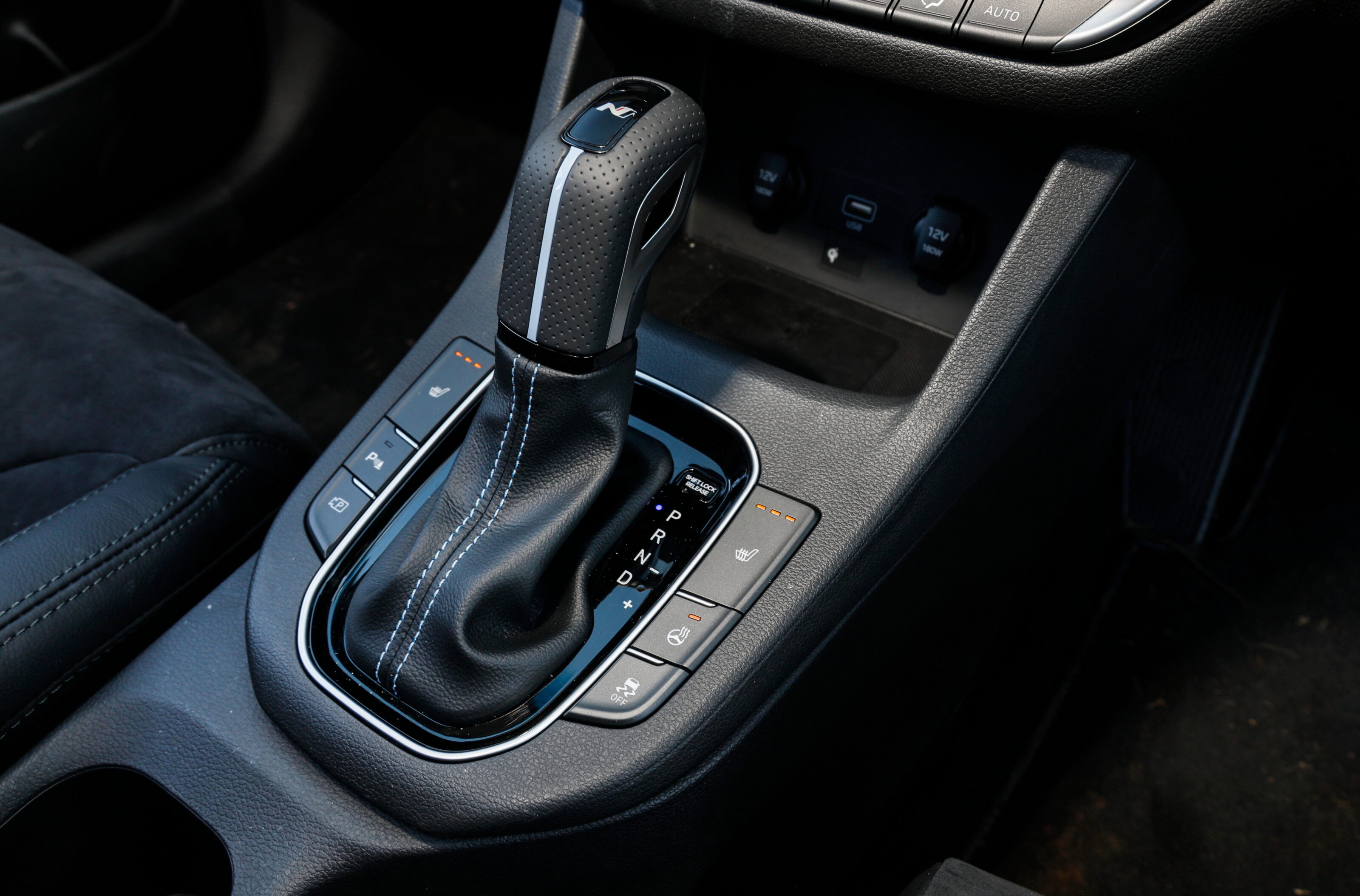
Functions specific to the DCT, like an adjustable launch control, play a part in this. And we look forward to testing the accuracy of our DCT’s acceleration claim.
Other new goodies include redesigned 19-inch wheels that shave 3.6kg from each corner, coming wrapped in bespoke Pirelli P-Zero tyres. The car’s spring rates and damping, as well as alignment settings, are newly tweaked to suit redesigned suspension hardware. The front brake discs have grown, too, from 345mm to 360mm.
Built in Czechia, you’ll also notice the N is the only locally supplied i30 hatch to score the European model’s complete facelifted front-end. This is marked by LED headlights equipped with V-shaped daytime running lights.
But the N badge ups the visual aggro with unique grille inserts, aero-guides in the front bumper, a rear spoiler with an oh-so-cool rally-style central brake light, a specific rear bumper and new dual bazooka-sized exhaust tips.
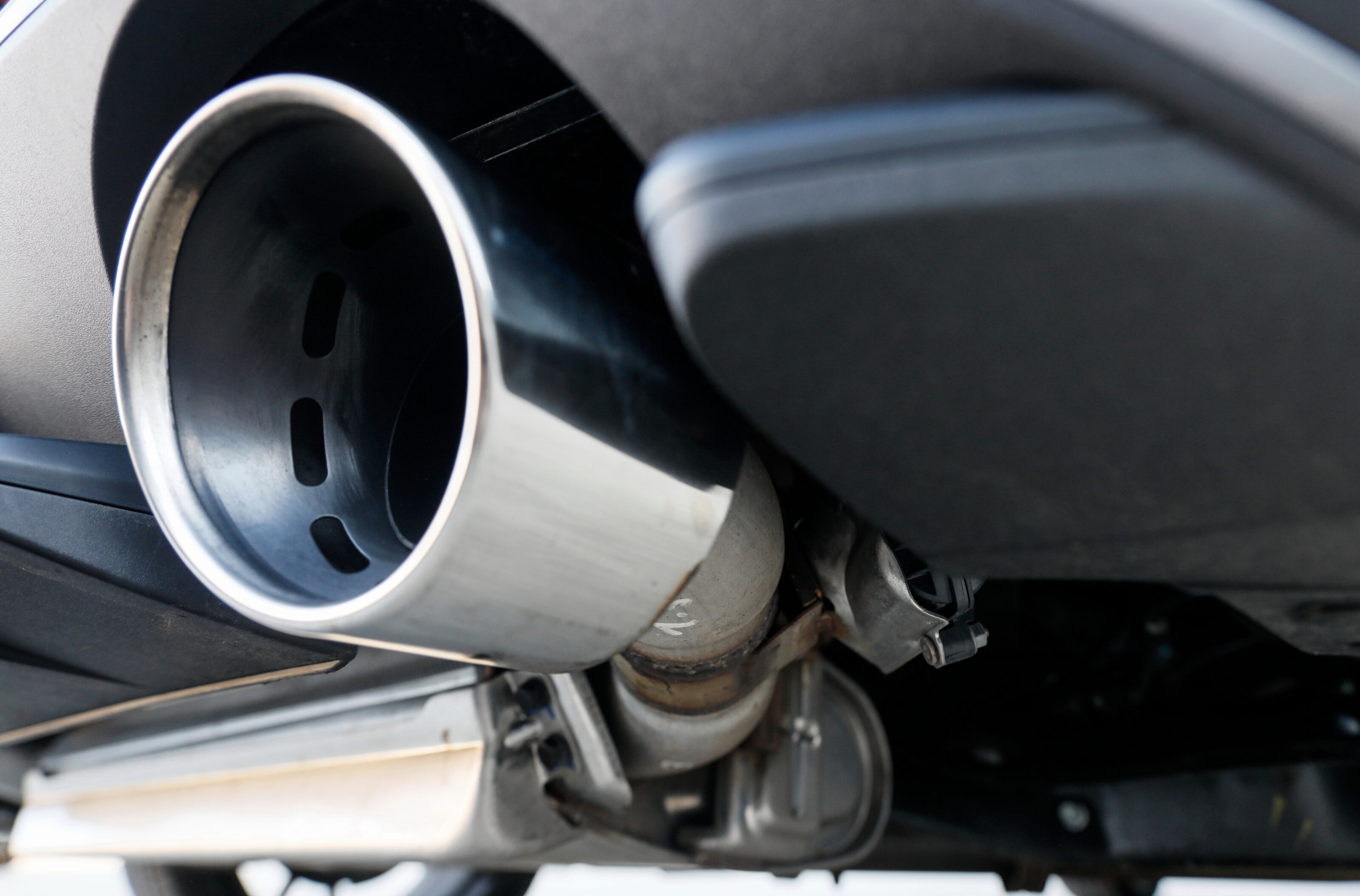
My i30 N DCT, bearing the rego WSE 74N, also comes in Engine Red, which deletes the model’s iconic red GTI-aping pin stripes from the front and rear bumpers. I feel guilty admitting I would have preferred it in Phantom Black, but beggars can’t be choosers.
Consolation comes from my example’s top-of-the-range specification. The DCT version of the i30 N can only be had with either base or N Premium Sunroof trim. And as you can see, mine has a panoramic power sunroof.
This $4500 upgrade on top of the base N DCT, taking its total price before on-roads to $52,000, is the only way you’ll get to upgrade key specification when putting an i30 N in your driveway. The sole option for this model range, otherwise, is $500 for metallic black paint.
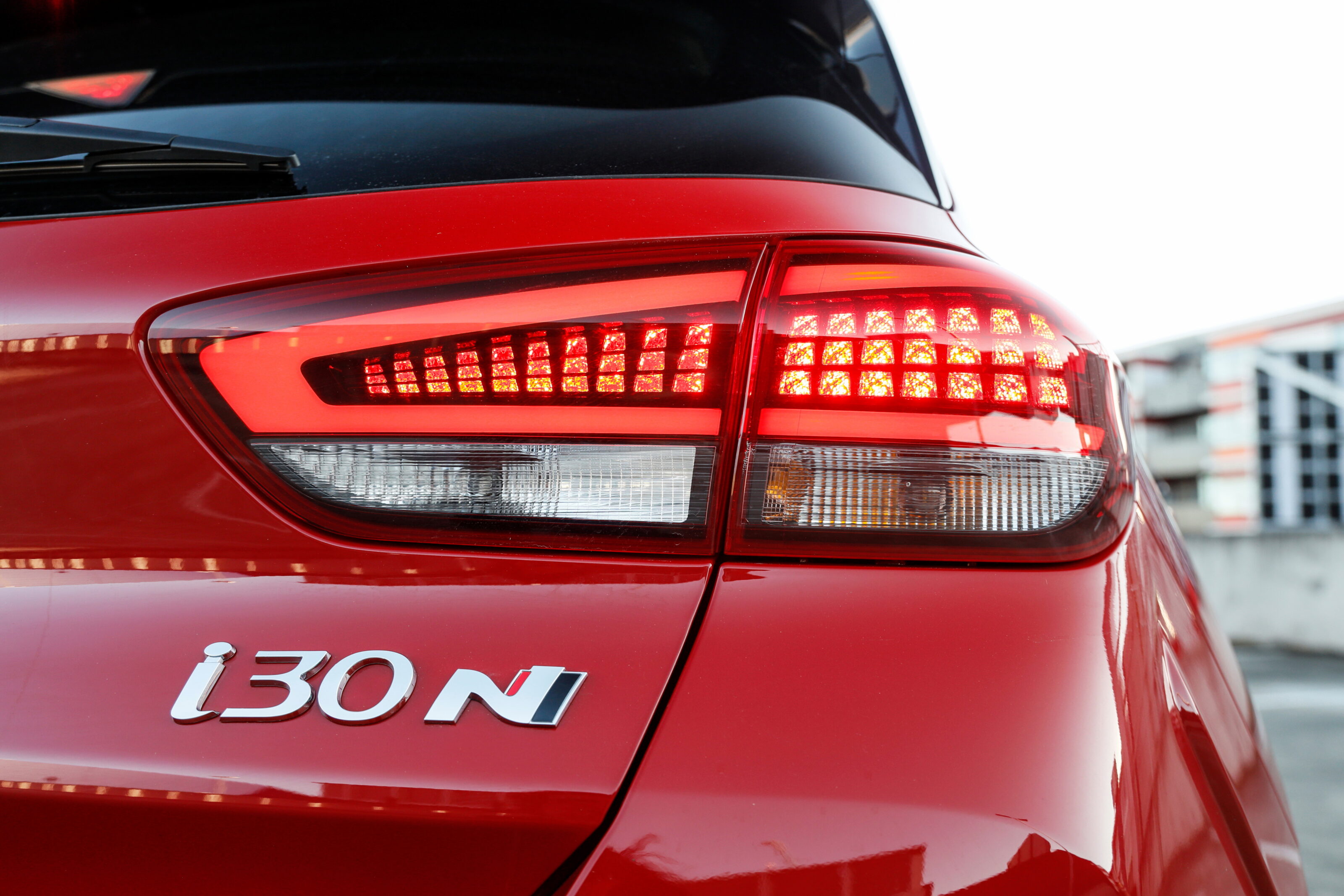
On top of the base car, the grade adds heated front seats and steering wheel, auto windscreen wipers and lightweight adjustable front bucket seats. The latter items are especially trick. They’re finished in Alcantara, shed 2.2kg in total and contain ‘N’ logos that illuminate in the dark.
Besides a new gear lever, and an updated cabin inherited from the i30, most of the car will feel familiar to pre-facelift i30 N owners. For instance, it has the same quick-access N mode button on the wheel which wakes up adjustable hardware – like the eLSD, adaptive dampers, adjustable exhaust, ESC, steering and transmission – in a blink.
Over the next six months, I’ll explore the N Performance menu through the updated centre screen in a range of scenarios, including the track, strip and road. But most importantly, I’ll strive to answer if this i30 N DCT can justify a whopping $52,000 price tag this far into its life. Because we’ve all waited long enough.
Update 2: Strip, with no tease
| This month | 746km @ 9.6L/100km |
|---|---|
| Overall | 1154km @ 9.4L/100km |
As far as understatements go, calling the new i30 N a facelift, especially in automatic guise, is like saying Amazon is just an online store. Yes, the i30 N wears a more expressive face with sharpened features, but leaving it at that ignores so much else.
As mentioned last month, Hyundai claims that the i30 N DCT, when unleashed from a standstill, can launch itself to 100km/h from rest in 5.4sec. That’s 0.7sec quicker than the pre-facelift version with a manual transmission, or 0.5sec better than the new manual.
Among the i30 N’s rival set, not the Ford Focus ST, Renault Megane RS, or even the eighth-gen Volkswagen Golf GTI (which won’t have a manual in Australia) can match that leap in performance with a simple box-tick. None even come close to the outright 0-100km/h claim at all.
So, naturally, when the video department asked if they could film the i30 N DCT for a YouTube video at Heathcote Park Raceway, I jumped on a small window available for me to test the car.
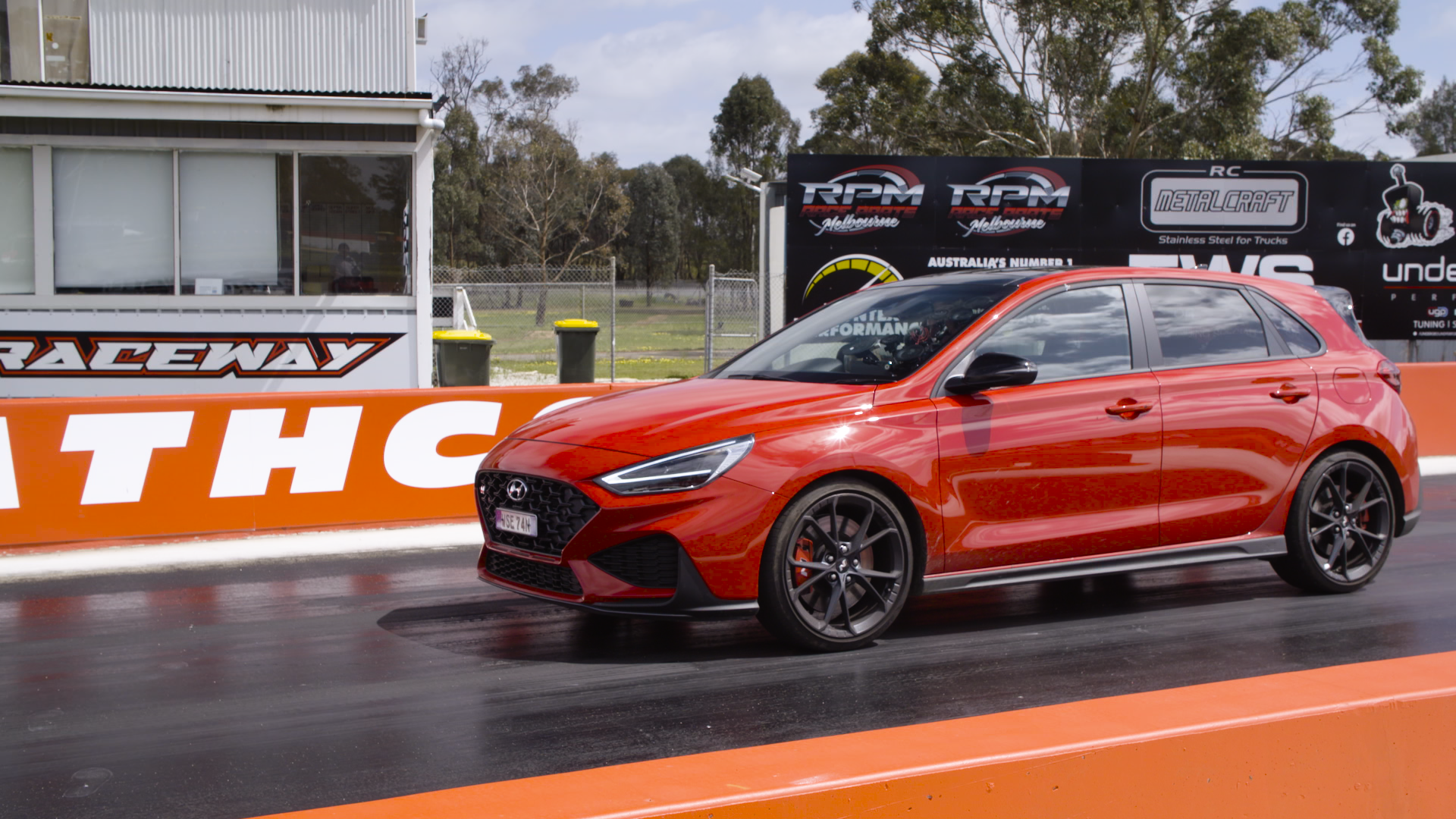
The dragstrip would answer something nagging me since reading the spec sheet: does 4kW and 39Nm equal that much improvement? Remember that torque improvement also shrinks to 14Nm when you take into account that the pre-facelift i30 N activated a clandestine overboost system. In the right temperatures, it helped the i30 N produce 378Nm.
While the i30 N’s updated four-cylinder turbo engine, codenamed G4KH, misses out on an overboost function, it does get serious new hardware. Hyundai has completely redesigned the turbocharger system, increasing the compressor wheel size 3mm, the turbine wheel 5mm and the turbine’s scroll area by 25 percent.
Reversing the turbocharger’s shaft rotation from clockwise also allows better exhaust flow, and the intercooler’s now 4 percent larger. Engineers shored up the engine block, too, while introducing new pistons and exhaust valves.
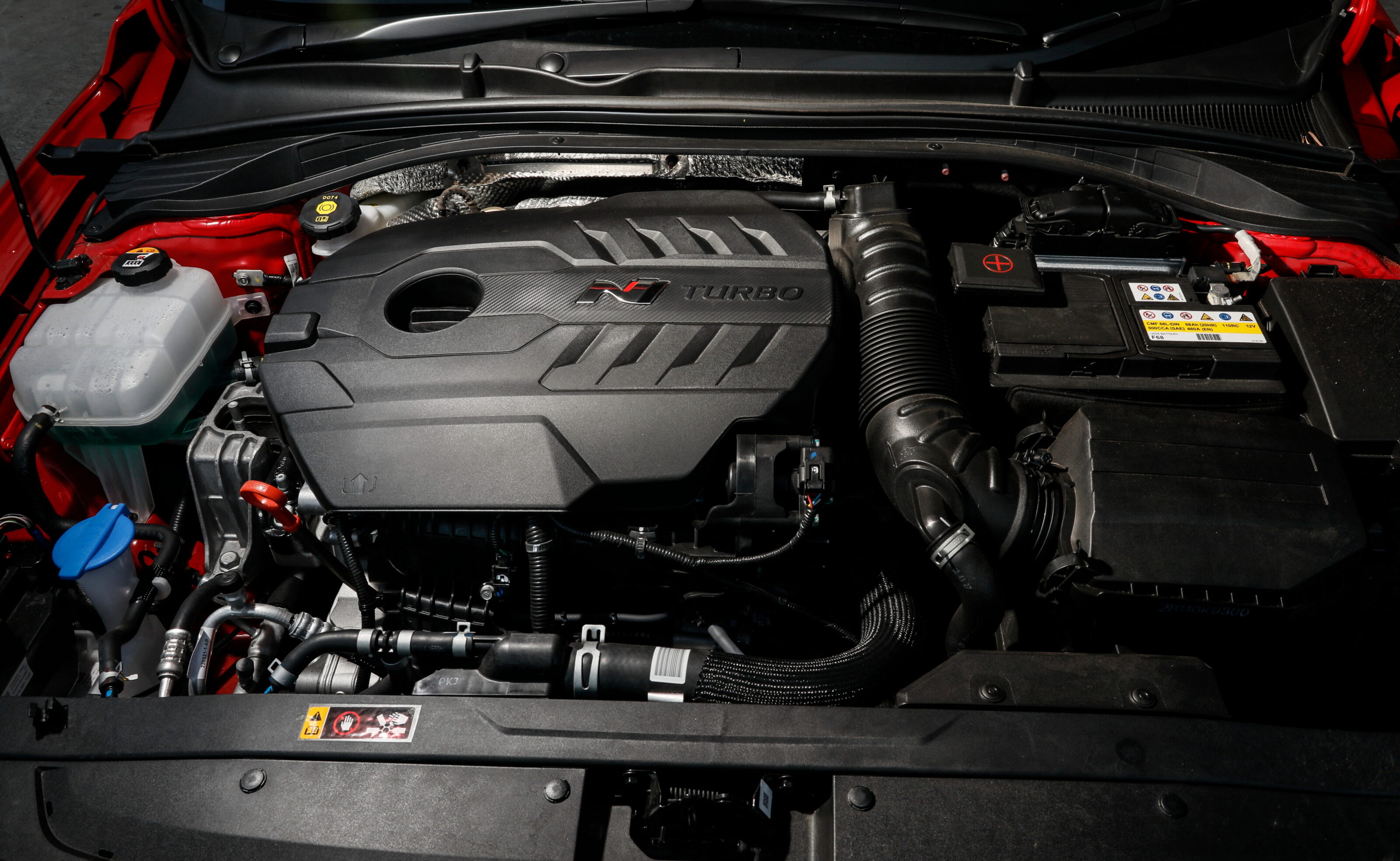
Drastic changes like these reap more than an increase in peak numbers. The new engine makes more power than before, and for longer, with the surplus difference in kilowatts growing exponentially between 2000rpm and 5500rpm.
Thankfully, it seems the weather gods want an answer on the new i30 N’s acceleration as well. Conditions at the strip are dry, wind is low, and the temperature sits in the teens. Fellow road tester Scott Newman has already completed some runs in the i30 N DCT, one of them without launch control.
Fumbling a getaway procedure results in 0-100km/h in 6.1sec and a 14.2sec pass over 400m – times that would match the best a pre-facelift i30 N could muster with launch control. Now, that would be promising if Hyundai didn’t say the new manual is good for 5.9sec. Time to reveal its true potential.
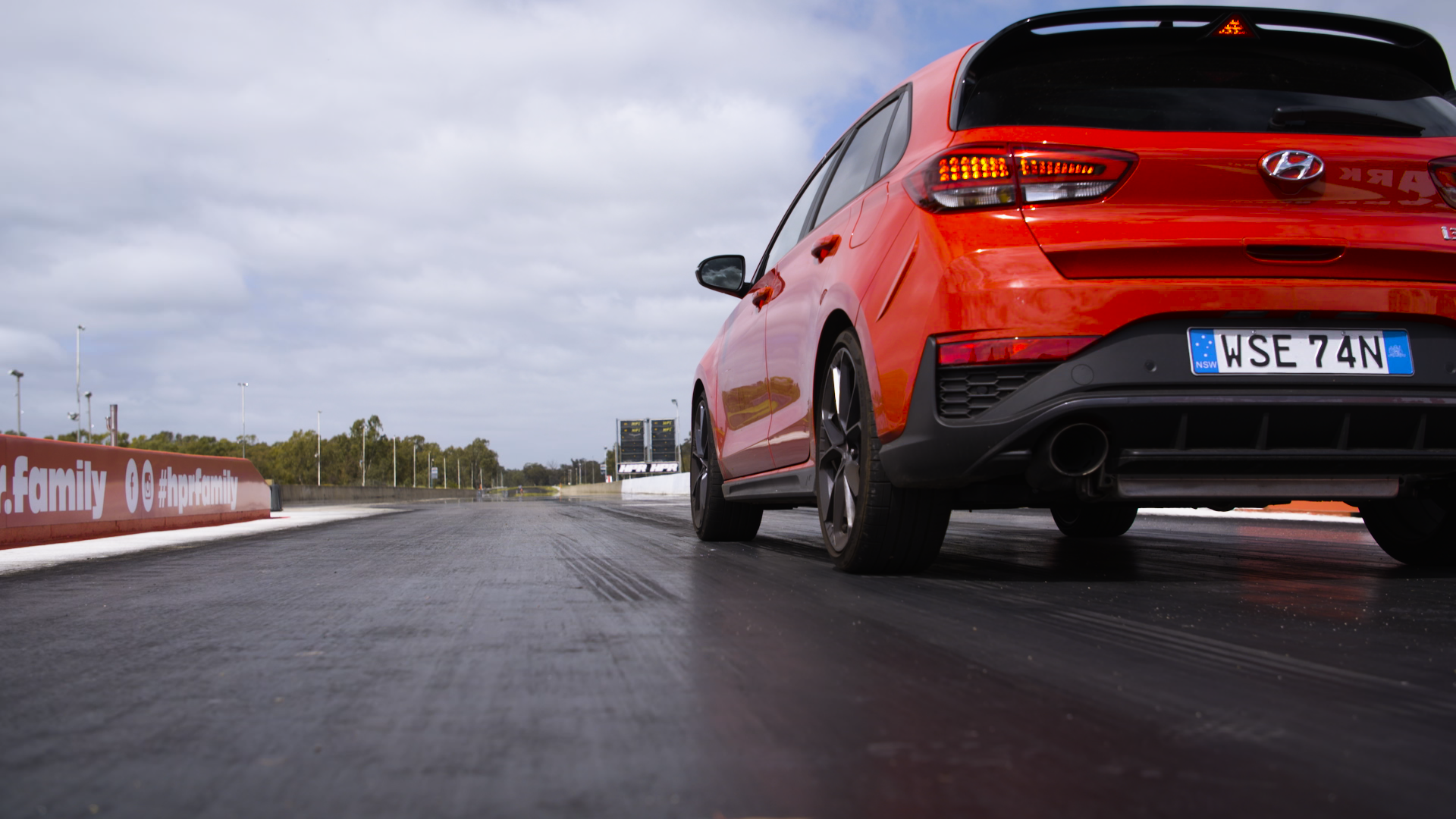
Setting up launch control is easy. Select the Sport Plus or N drive mode and ESC Sport at a minimum through the central screen. Or you can thumb the oversized N button on the steering wheel, which feels like you’re about to launch a missile.
Next, press N-mode on the 10.25-inch centre screen, then Performance Options. Launch Control is on the first tab, allowing you to choose an engine speed between 2500-3500rpm for, well, launching, which can be otherwise adjusted through the steering wheel’s speed increment buttons after you pin the throttle.
Two-step the pedals, lift the brake, and the new DCT manages torque delivery and clutch engagement perfectly without any axle tramp or excess wheelspin. It launches cleaner than any powerful front-drive manual hot hatch could ever dream. First gear can stretch to 58km/h, but the DCT upshifts earlier than the 6750rpm redline as power tapers off after 6000rpm.
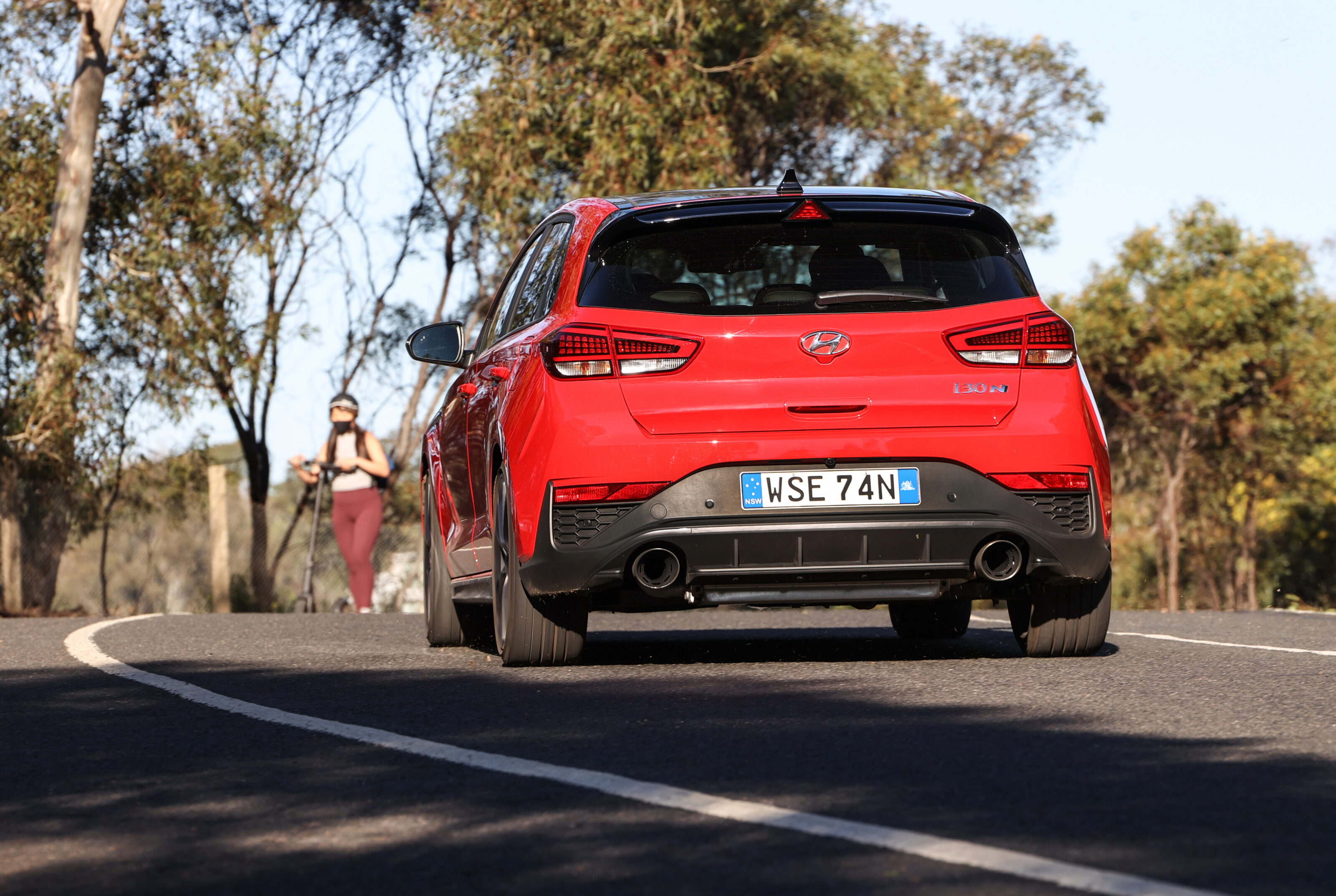
What strikes you once you’re away is how much extra grunt there is in the mid-range. The i30 N pins you to your seat, ejecting a guttural bark on each upshift with the signature ignition-cut sound of a dual-clutch. On a roll, the ’box shifts rapidly, and 80-120km/h disappears in 3.1sec – only a couple tenths off the recent Honda Civic Type R’s 2.9sec.
Importantly, within two runs, the i30 N DCT nails its 5.4sec 0-100km/h claim. There’s more in it, though. Switching off ESC and trying to steer as straight as possible shaves off another tenth, dropping the 0-100km/h time to 5.3sec. And back in the pits, someone says the DCT can even do an incredible 5.2sec. But not today.
Ultimately, the i30 N DCT’s 13.55sec 0-400m time at 171.8km/h is a tenth quicker than what sister magazine MOTOR recorded with a Type R, the fastest FWD they’ve tested in recent memory and the segment benchmark. And to do that, repeatedly without a hiccup, underscores that this new i30 N is much more than a facelift.
Next month, we’ll investigate what that means on roads more winding.
Update 3: Munching twisties
| This month | 365km @ 11.95L/100km |
|---|---|
| Overall | 1519km @ 10.0L/100km |
I’ve never enjoyed geometry as much as I am right now, parked in the i30 N DCT at the bottom of Victoria’s Mount Donna Buang.
I’m currently preparing my attack on its sinuous mountain road, playing race engineer on the ‘N Mode’ page within the centre screen’s infotainment display.
Here I can adjust the i30 N’s individual driving parameters for the Custom drive mode, accessed with a double-tap on the N button underneath the right wheel spoke. Just like in the pre-facelift i30 N.
But the ‘N mode’ page has been redesigned. Instead of tapping into a separate page for each piece of hardware, their adjustable settings are all laid out at the points of a spider’s-web chart.
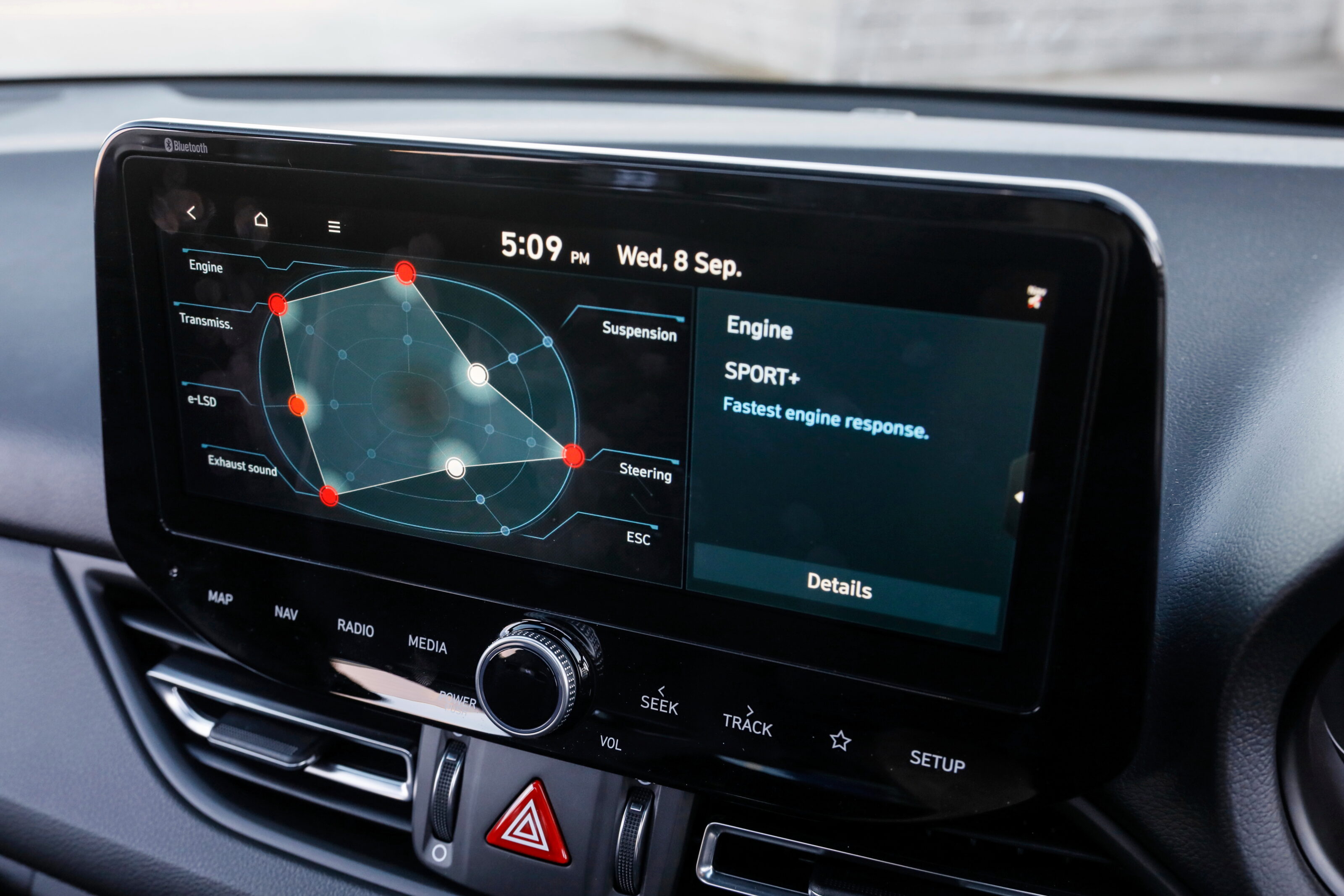
You can set up the adaptive suspension, steering weight, ESC, engine and DCT by the way of three modes. The e-LSD, meanwhile, is bi-modal. Their first settings are the most sedate, and sit on an inner ring within said web, while the max settings sit on the perimeter.
Having all settings on the one page, ready at one touch, drastically improves on-the-fly accessibility.
For a racetrack, you’d spread the chart as wide as possible, all the way to each corner. But going up Mount Donna Buang on a road defined by undulations, bumps and a wide range of corners requires more finessing of my web’s shape. And I’m intrigued about how the i30 N’s suspension now handles.
For example, the front suspension uses new knuckles and lower control arms to increase the front negative camber to 1.7 degrees and front track by 17mm. As well as that, the spring rates are stiffer by 5.7 percent in the front and 4.2 percent in the rear. Local engineers have also re-valved the dampers for increased ride comfort, while the rear toe arms and bushings are new, claimed to aid mid-corner response.
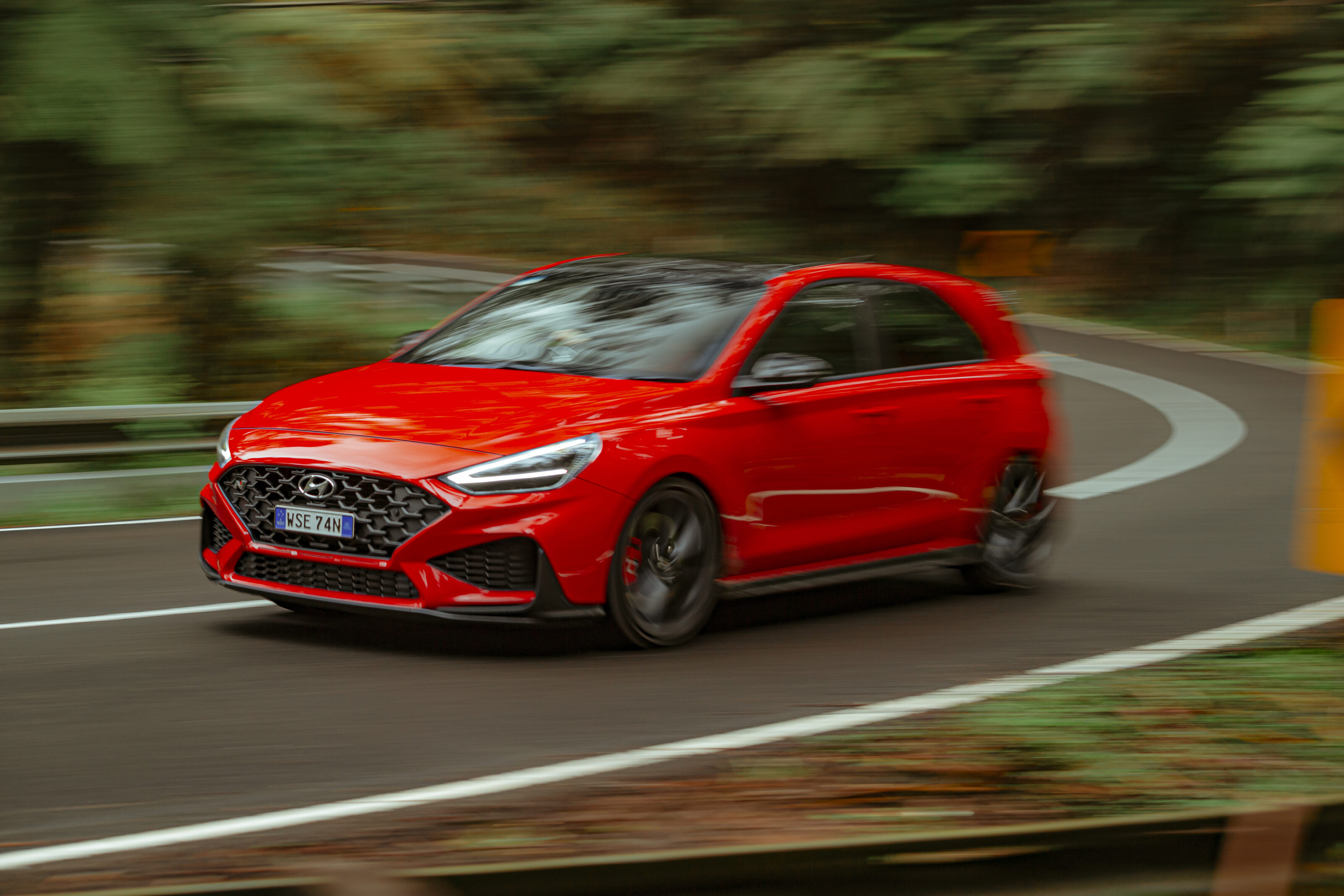
My baseline Custom mode set-up is mixed. I begin the adaptive damping in its softest setting, the steering in its heaviest, the e-LSD in the lower locking threshold and the ESC in its middle mode, Sport. As for the powertrain, I crank everything to full.
Mount Donna Buang’s ascent is punctuated by two toilet stops, creating three sections of road. Setting off, the i30 N’s low-slung chassis resists body roll like it’s on rails through the first section’s smooth, constant radius bends – even on the softest damping.
Roadholding is only questioned by two pronounced mid-corner bumps that allow the i30 N to linger a touch too long on rebound for my liking. But there’s enough suspension travel to keep each wheel on the ground.
In response, I jack up the damping to its mid-level, after the stiffest setting rattled the i30 N like it suddenly found a cobblestone road. Medium damping strikes a sweet balance between body control and an ability to iron out bumps with impressive pliancy.
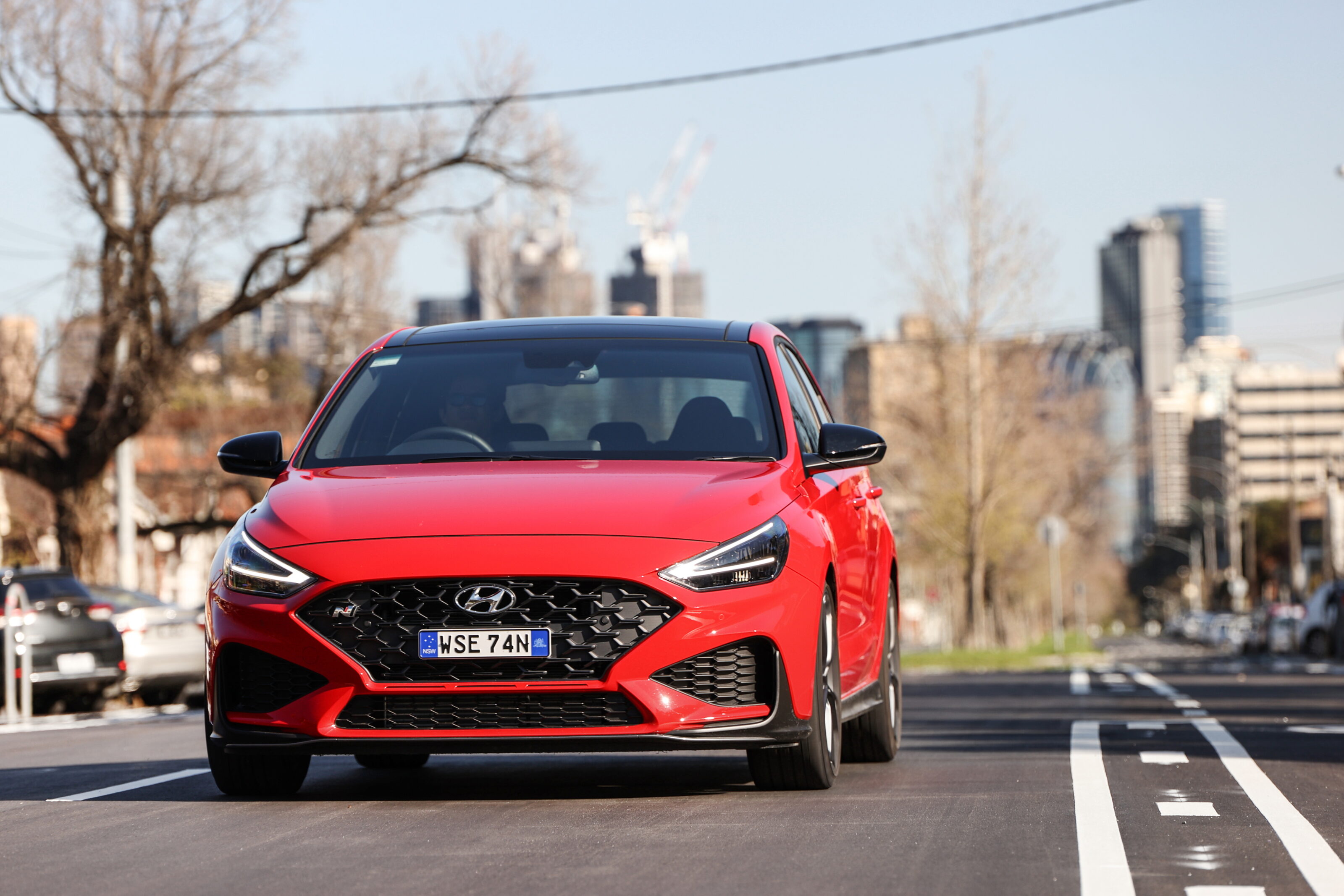
But as you push harder, traces of torque steer emerge when powering out of low-speed bends. It’s particularly bad in the Mountain’s second section snaking through a left-right switchback that crests an undulation, and shifting early to a higher gear helps dilute the amount of torque fed to the front hoops.
Meanwhile, ramping up the e-LSD to its higher setting boosts traction to impressive levels for a 392Nm front-drive hatch, but sometimes you can feel the 235mm-wide Pirellis only just holding your intended line.
Continuing up the ’Buang, the steering is direct and responsive. But while the heaviest setting helps steady the tiller during torque steer or kickback from road imperfections, it also slightly insulates feedback. Medium is the best compromise. It’s still firmly weighted, but allows you to read grip levels with a good amount of fidelity.
What’s clear is that none of these adjustable toys, including the ESC, ever waver the i30 N’s trademark sure-footedness. The grip balance remains evenly distributed and the i30 N only hoists an inside rear wheel with late trail braking.
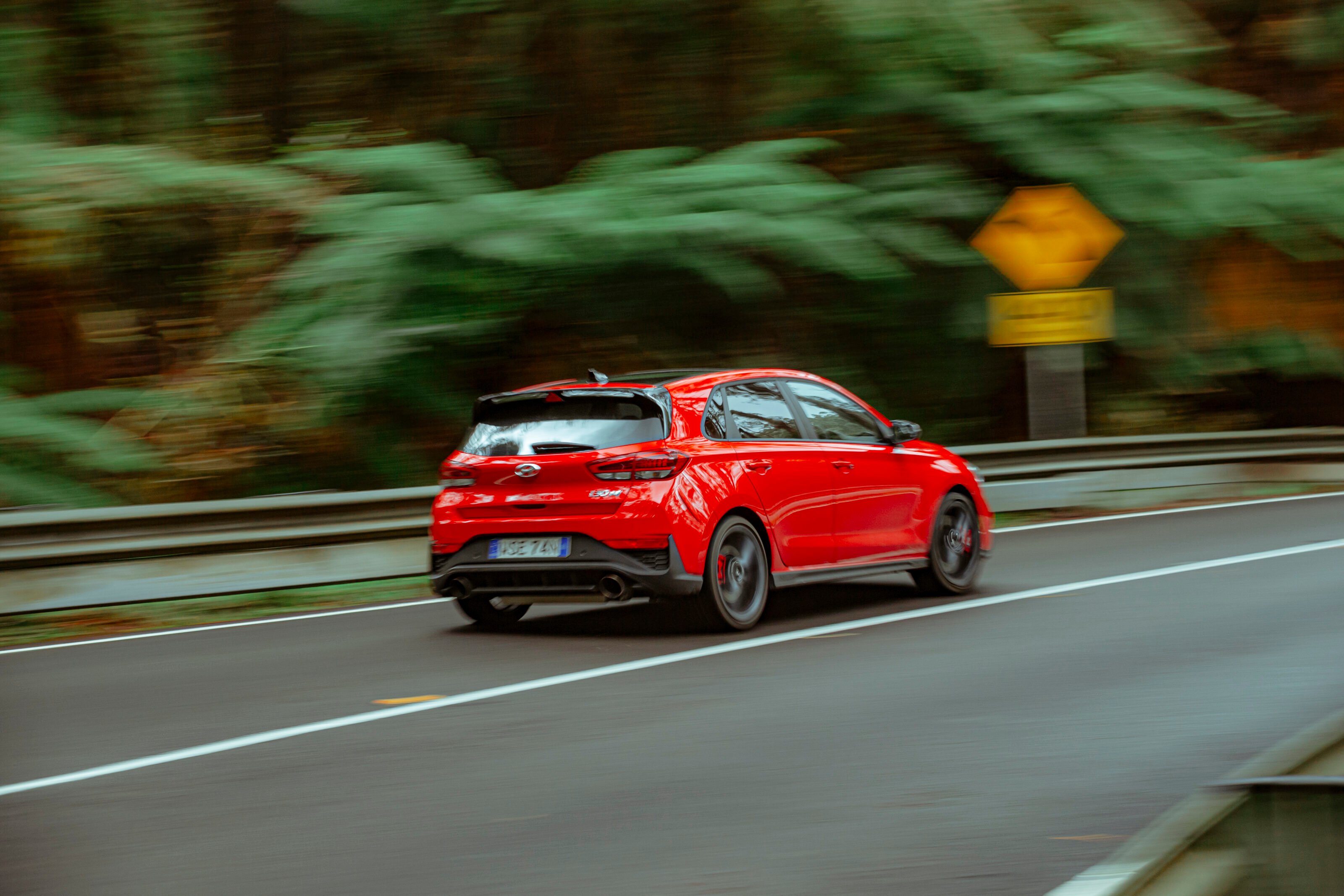
The N’s front end is also resolute and has banished the pre-facelift model’s chattery on-limit understeer. But these Pirelli P-Zeros do still limit your level of commitment.
As for the powertrain, I’m surprised to find the eight-speed DCT upshifting between corners when you’re holding a steady throttle. A Track Sense Shift program (activated in the ‘N mode’ page) counters this by choosing sportier ratios by sensing when you’re having a go. However, the DCT’s so obedient and quick, I prefer manual mode.
Away from civilisation, as well, the exhaust’s maniacal pops and bangs are to be revelled in with open windows. After a couple runs up and down the Buang’s first two sections, I’m convinced the i30 N’s changes work cohesively. They unlock higher realms of performance and enjoyment without losing any of its well-known accessibility. Custom mode never loses its fun, either.
The i30 N is not a fundamentally changed handling machine, but it’s certainly improved, leaving the hot-hatch’s reputation in excellent shape.
Update 4: Cruising altitude
| Label | Value |
|---|---|
| This month | 1038km @ 10.8L/100km |
| Overall 6125km | 6125km @ 10.3L/100km |
Touring ability is essential for the modern sports car. With the best roads, racetracks and hillclimbs often in the middle of nowhere, long hours behind the wheel are usually necessary. And whether they leave you relatively fresh at the end – or with ringing ears and homicidal urges – depends entirely on your vehicle of choice.
Today, that’s our Hyundai i30 N DCT long-termer which we are going to fire up the Hume Highway from Melbourne to roughly Wangaratta and back, a 1038km experiment to find if the experience is more Qantas First Class or Backwater Airlines Economy.
Our first moments behind the wheel of the i30 N are, with the prospect of many hours at the wheel ahead, cause for mild concern. Deep and snug bucket seats might hold you superbly in the twisties, but firm padding threatens over the hours to anaesthetise muscles you didn’t know you had.
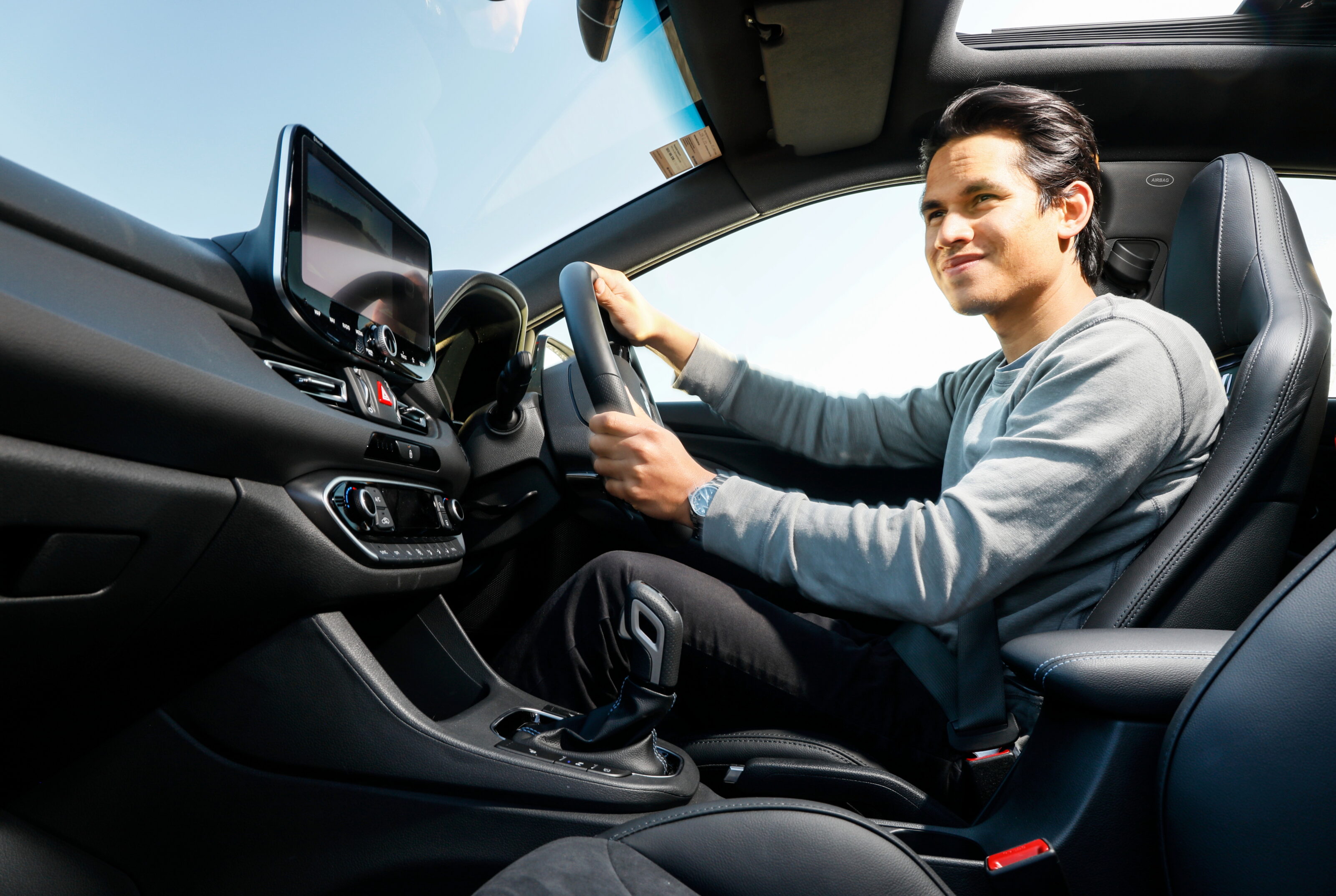
The first hundred metres in the i30 N, too, reveal a seriousness within the chassis that, while kinda cool, is omnipresent – a harshness from stiffly side-walled tyres and from suspension bushes felt to be made from the stiffest polyurethane available. A body that seems torsionally stiff like it’s got a full touring car roll-cage also tends to have a bit of an amplifying effect.
Luckily, though, despite the slightly elevated levels of vibration and harshness, there is a softness to the suspension itself providing an unexpectedly lovely ride quality that redeems massively – and somewhat saves the day.
The new twin-clutch automatic, too, is excellent around town, as smooth and clever as you’d want it to be. There is an eagerness to get away from a standstill that takes a bit of getting used to; take a bit of pressure off the brake pedal and the clutches start engaging straight away, the car aggressively creeping whether you wanted it to or not, but otherwise we couldn’t fault it.
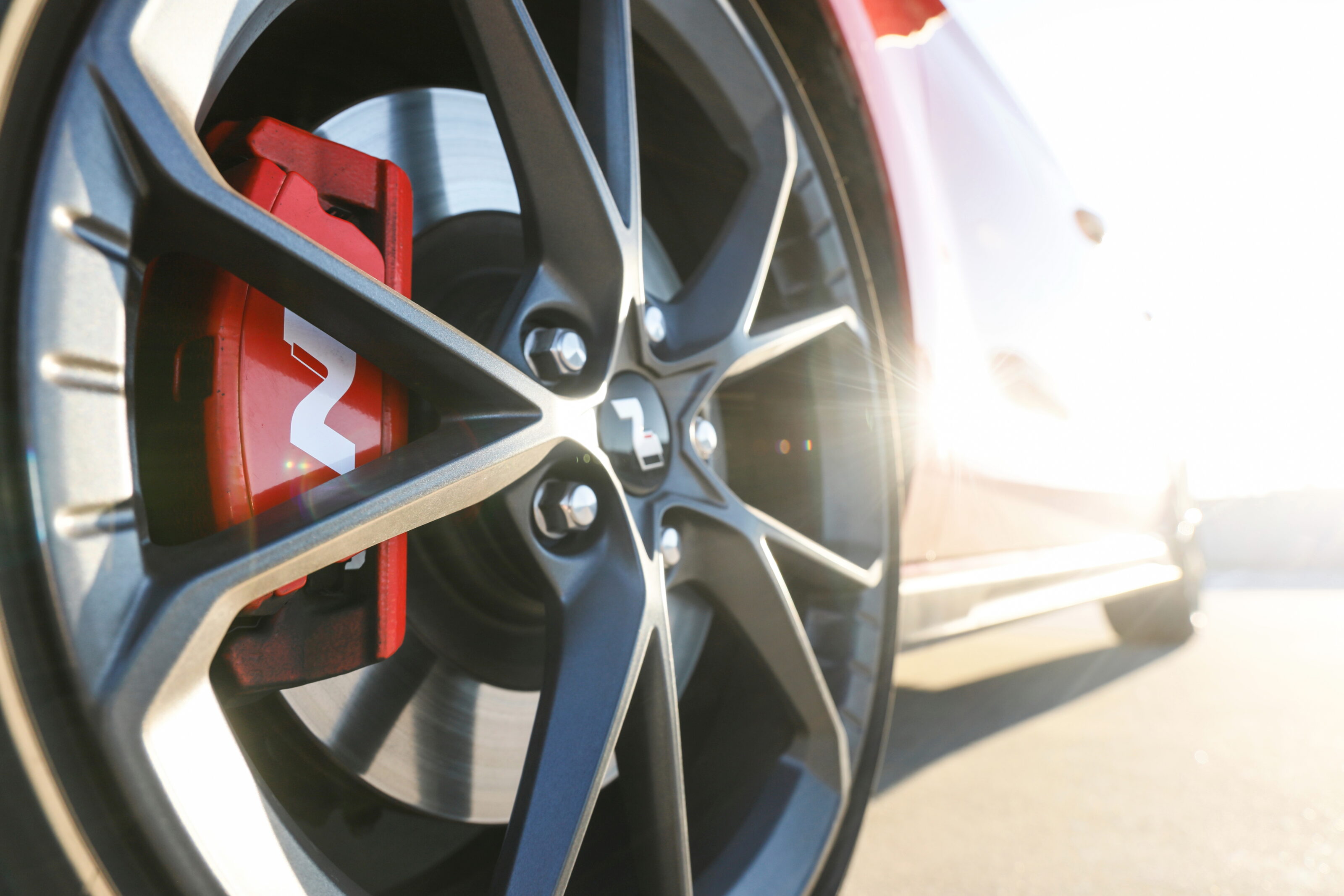
Out on the open road, despite stretches of coarser bitumen booming into the interior like the speakers are blasting static at a rude volume, the i30 N acquits itself satisfactorily as a freeway tourer. It’s the little things that make life easier, like the speed displayed nice and clear in the centre of the instruments; same for the distance-to-empty.
There’s also blind-spot monitoring so you don’t crash into that dill in the grey car that’s matched your speed off your five o’clock; cruise control that’s easy to use (if not of the radar type) and lane-keeping assist that, delightfully, is easy to switch off via a steering wheel button. A nice little feature is the ability to set the one-touch indicators to blink three, five or even seven times if you want. (On the Hume, I’m a five-blink kinda guy – Victorian drivers need plenty of notice.)
Apple CarPlay (or Android Auto) also makes it easy to navigate podcasts, music and Google Maps via the centre 10.25-inch touchscreen. Meanwhile the six-speaker stereo was more than happy to turn ‘All That She Wants’ by Ace of Base into unsociable quantities of decibels (it’s stuck in your head now, isn’t it?). These help make up for an interior that’s a bit $17,990 driveaway – although to be fair, the bits that you do touch the most like the seats and steering wheel are a contrast in how nice they are.
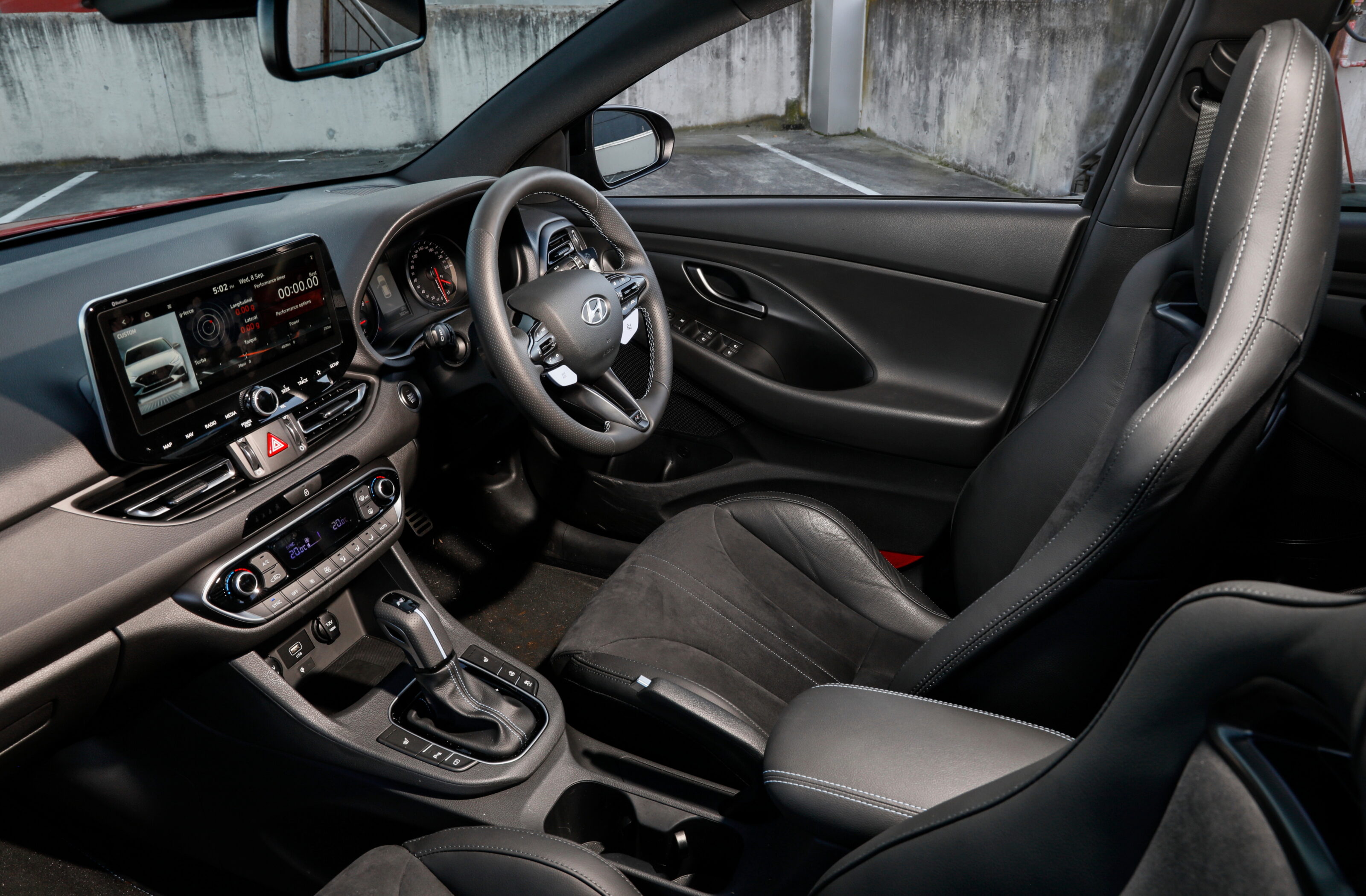
As you’d expect from something with 206kW and 392Nm, overtaking is pretty easy… although the turbo needs a bit of notice if you’re low in the revs and when the power does arrive – quite suddenly – the thing wants to jettison itself into oncoming traffic. It’s a turbo lag and torque steer party like it’s 1999.
Fuel economy is more than good enough to rival airfare prices Sydney to Melbourne. A full 50-litre tank should, in theory, give about 750km range at the claimed 6.5L/100km extra-urban consumption, and the i30 N will take 95RON. The best as-tested, general consumption we’ve got so far is 8.3L/100km but with some actual effort would drop considerably further.
Without a doubt, the i30 N has compromised a lot of comfort for performance – but not by that much compared to say, a regular i30 (if the springs were stiffer, it might be a different story). And it’s performance you’re more than happy to ‘pay’ for, especially when you arrive at your far-flung road or racetrack and hit that ‘N’ button on the steering wheel. This is a proper driver’s hot hatch as we’ll explore in coming issues. So for now call it Qantas Premium Economy, or Backwater Airlines First Class – with a few chickens in the overhead lockers.
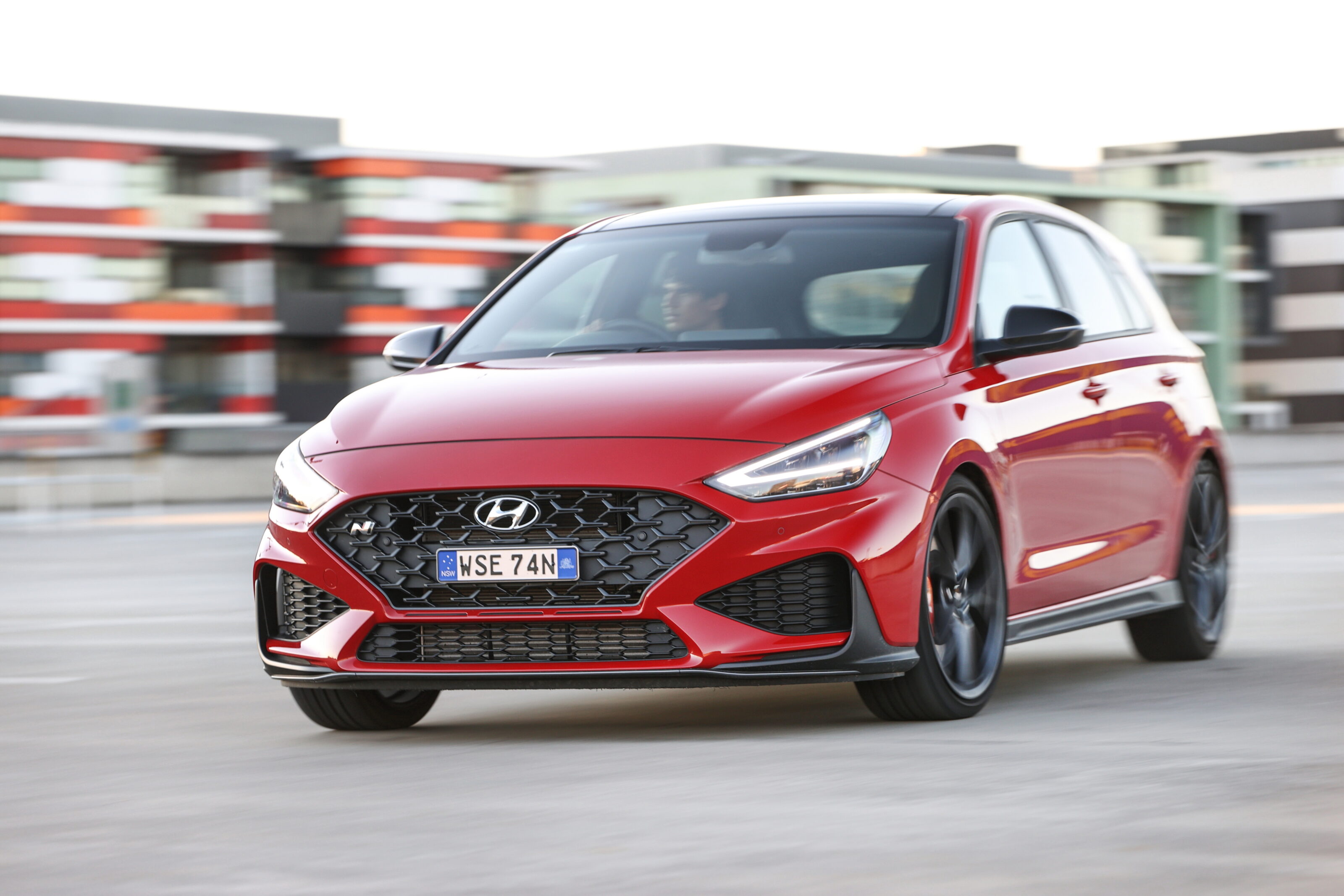
Update 5: Urban grind
| Period | Distance and Fuel Economy |
|---|---|
| This month | 1292km @ 9.05L/100km |
| Overall | 4274km @ 10.55L/100km |
Have you ever been embarrassed by your car? I have. When I started up the Hyundai i30 N in my neighbourhood street one early morning, I winced as the i30 N’s exhaust tips shattered the pre-dawn peace with the car’s soundtrack. There isn’t much you can do to suppress the i30 N’s exhaust note during a cold start, either. The idle plays a bassy tone, no matter what the revs are, sometimes fooling me to think the exhaust’s valves are stuck open until I accidentally hit the N-mode button. Then it really turns things up.
I love the i30 N’s wild streak far away in the mountains, but its obnoxious exhaust has even strained relations closer to home. Hovering my thumb over the N mode button with my girlfriend on board, which instantly flicks the exhaust valves open, always draws a cold stare.
It serves as a reminder that daily manners are important in a hot hatch. For instance, when reminiscing about the late Honda Civic Type R, it’s not just the Type R’s mind-blowing performance that sticks in mind, but also how liveable it was day-to-day.
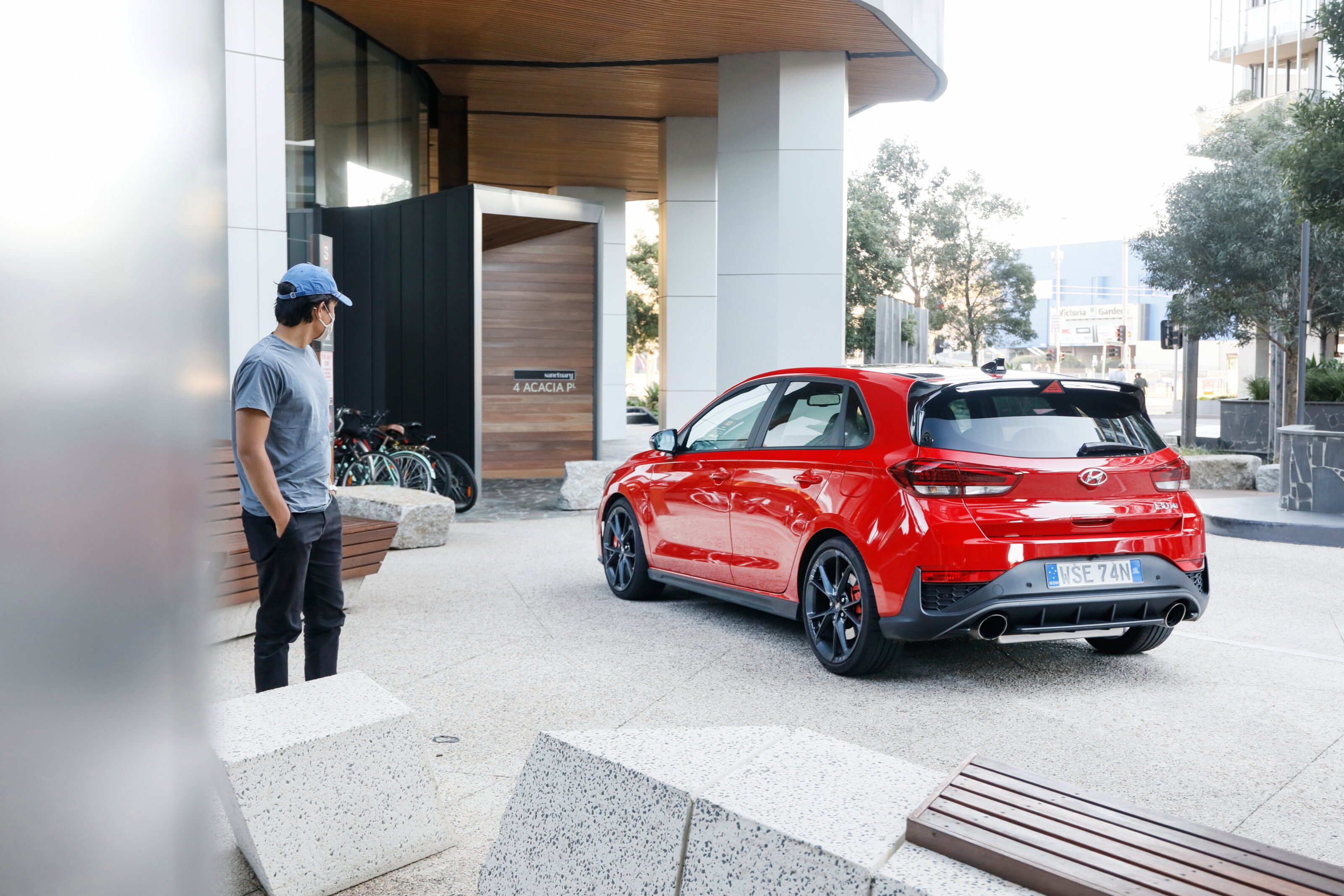
Keeping that in mind, we reckon the i30 N’s doing all right as a daily chariot. Thankfully, the i30 N’s soundtrack is more subdued while moving in its Normal or Eco modes. The engine also partners nicely with the dual-clutch transmission, which acquits itself incredibly well around town for driveability.
The DCT behaves much like a torque converter in start-stop traffic, taking off smoothly from a standstill. Transmission creep is strong, but you can switch it off if you find it unnerving. Otherwise, the surge forward is easily managed with light braking.
You’re only confronted with the car’s seriousness when the DCT clunks downshifting to first gear sometimes when you come to a stop. It’s perfectly normal and imbues the transmission with a race-bred feel. But when cruising in any mode other than Sport+, the DCT’s operation is refined to the point of anonymity.
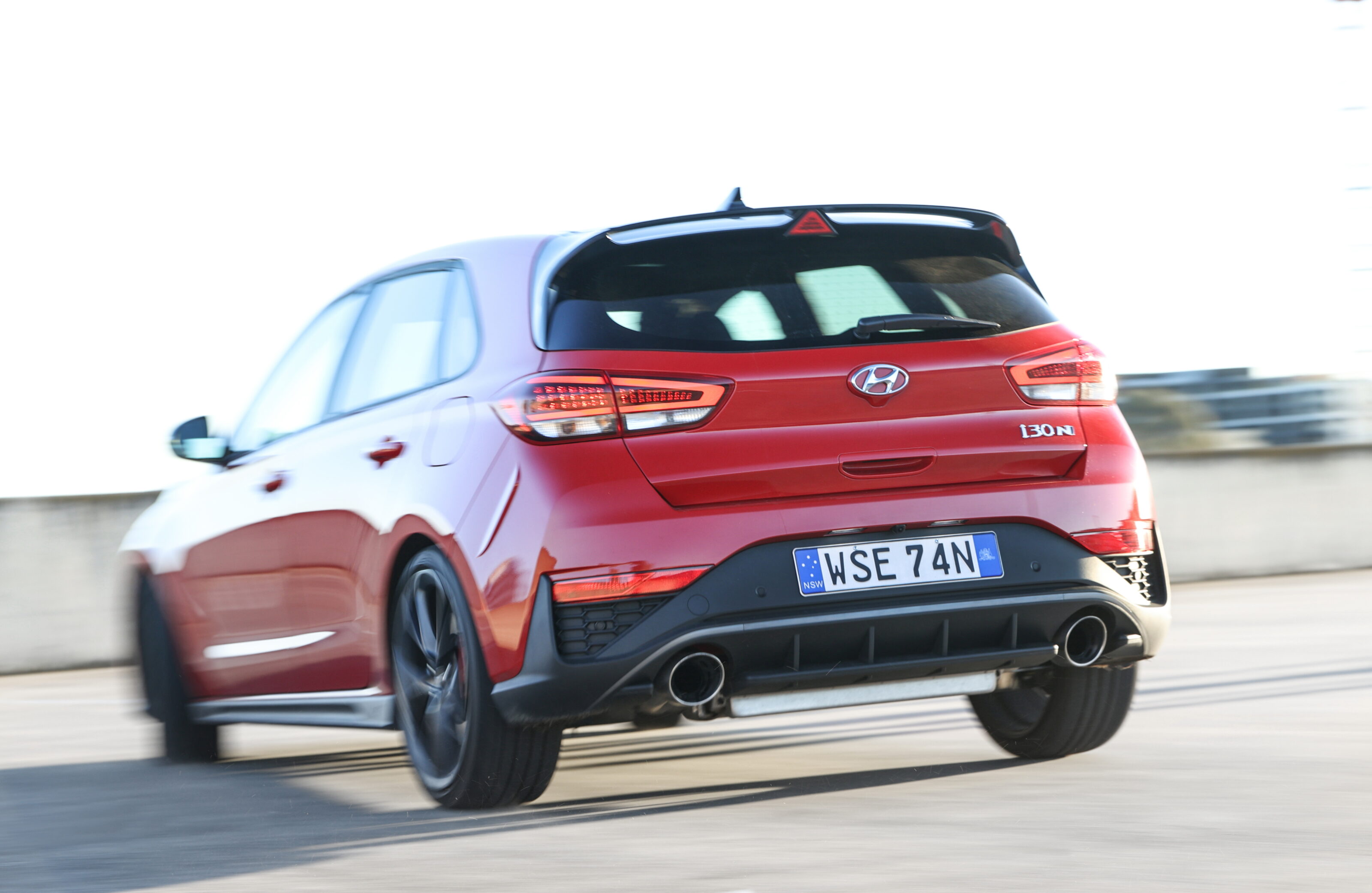
As for the engine, its larger turbocharger has lifted the i30 N’s peak outputs higher in the rev range. It now delivers a stronger top-end rush, but driving around town on part throttle reveals the car’s significant mid-range torque is slightly delayed compared to the old i30 N. This is easy to overcome when keeping with traffic, you simply add more throttle before the boost arrives. But the lag is noticeable when trying to seize a gap or jump across lanes.
Beyond this power delivery niggle, the i30 N can be tricky to manoeuvre in tight situations. The steering is heavy off-centre. And although engineers quickened the steering to 2.14 turns lock-to-lock (from 2.57), the turning circle has grown from 10.6m to 11.6m.
Because of this, whipping the i30 N around in anything less than a wide street requires a three-point turn. Thankfully, the DCT tackles the change between forward and reverse gears without fuss, smoothly taking up either drive even before you’ve fully come to a stop.
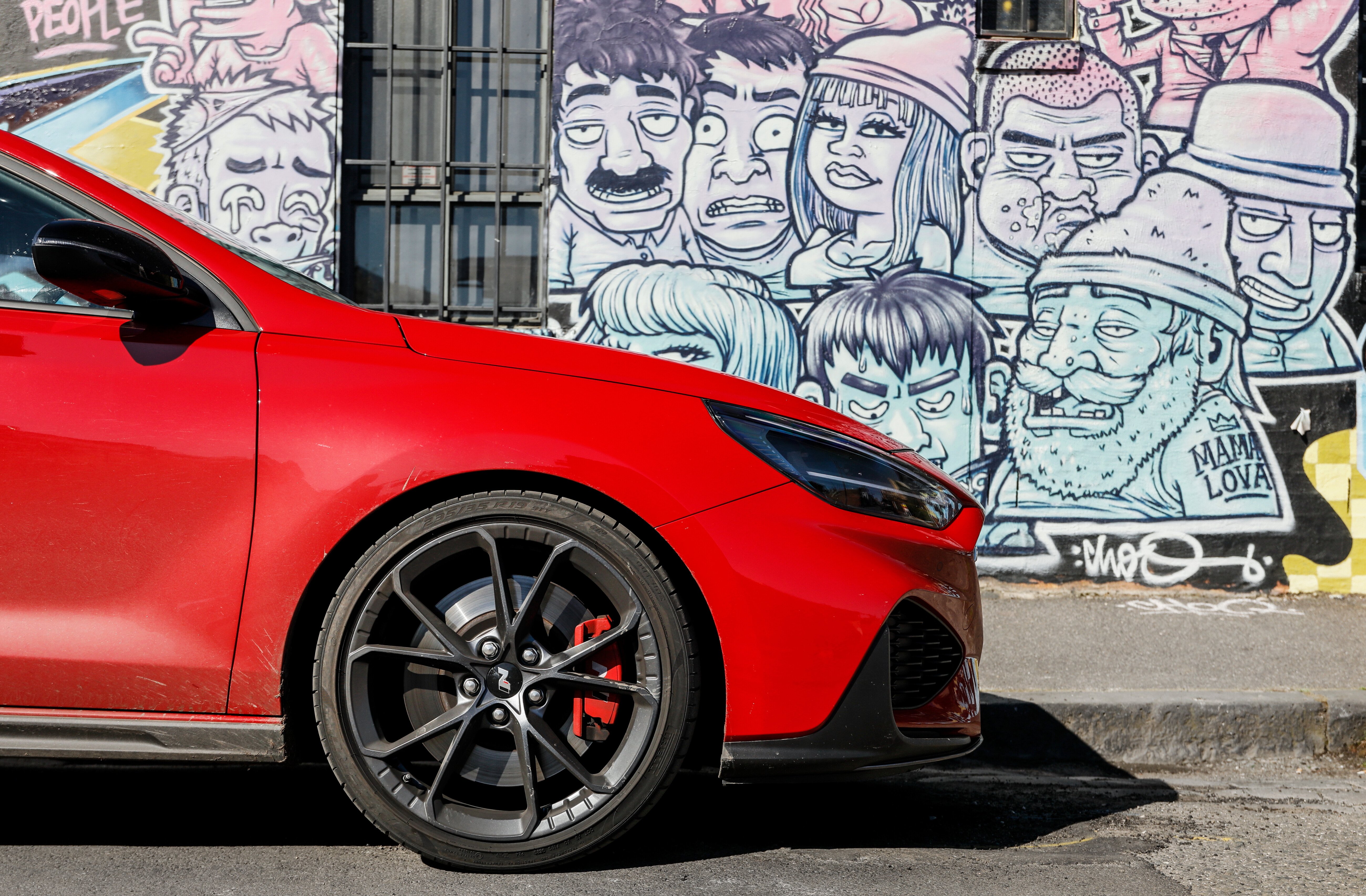
Despite Hyundai cranking up the spring rates on the i30 N for this facelift, the dampers also provide a cushioned ride when they’re slackened off in Normal or Eco modes and offer excellent wheel control over small imperfections.
You’ll have to amble over speed humps, though, since soft damping under compression lets the front-lip scrape the road if you’re not careful. Or at least that’s what it feels like.
I once jumped out of the driver’s seat expecting serious damage, only to discover a dam integrated into the underside of the bumper. This protective piece extends 25mm underneath the front lip and sounds a crucial warning when it graunches into the pavement.
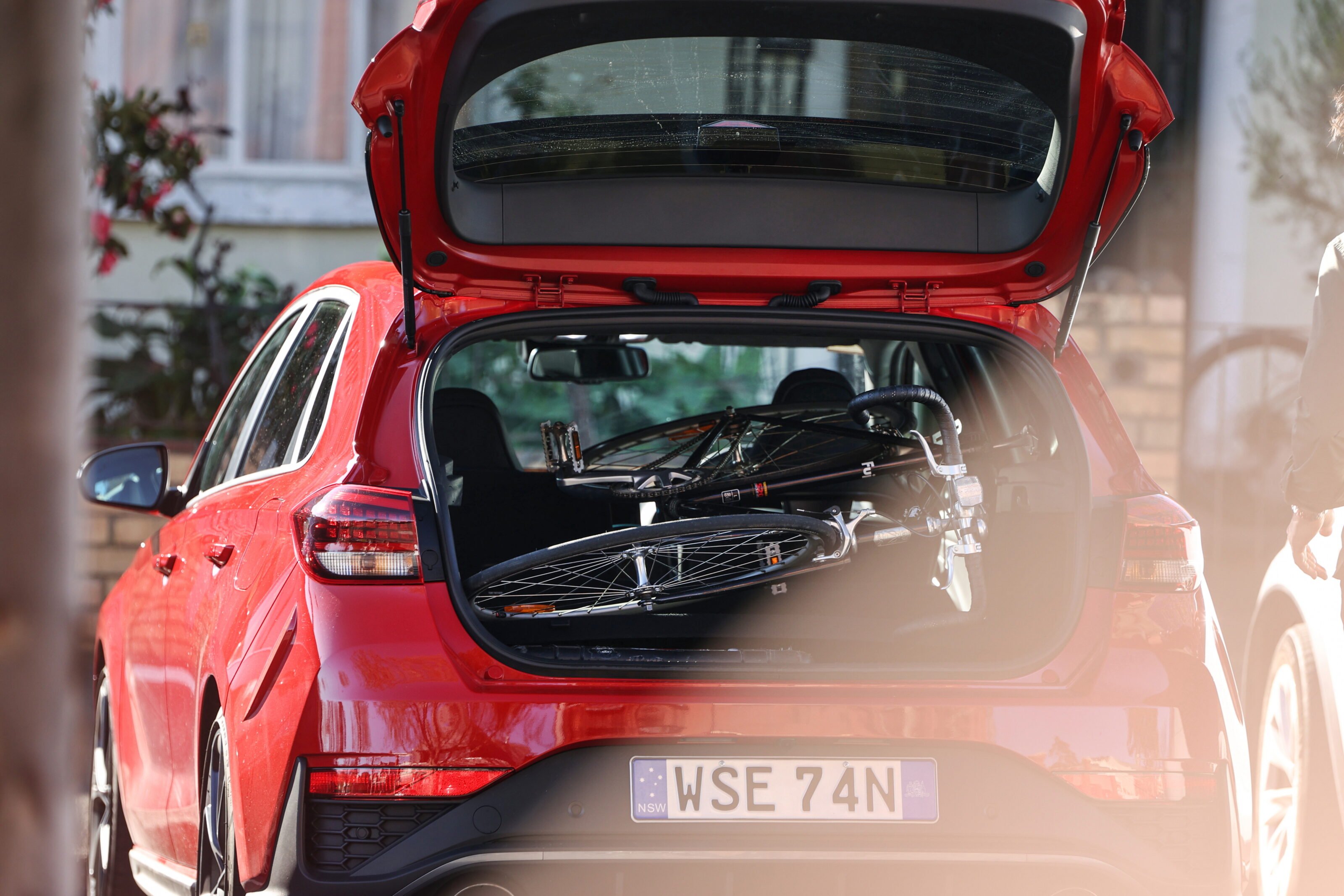
As you’d expect from a city car, parking the i30 N is simple enough once you’ve adapted to the larger turning circle and heavy steering. I’d only recommend parallel parking in quiet streets, as the sensitive Rear Cross Traffic alert will jam the brakes on unnecessarily when it detects traffic passing a lane over.
As for small things, the central cupholders won’t accommodate a protein shaker, but they at least fit coffee cups and small drinks. But otherwise, storage is great. The boot easily swallows my bicycle when the rear seats are dropped flat. And when the seats are up, the 381L rear boot accommodates a large amount of stuff in its sunken floor.
As time goes on, the i30 N DCT has proved incredibly versatile, even if slightly flawed. It’s an easy one to recommend.
April, 2022: Updated Kia Telluride revealed
The 2023 Kia Telluride has been unveiled this week, forming a mid-life update to the large SUV.
The Telluride is a platform mate to the Hyundai Palisade sold in Australia, but unlike that car, the Telluride is only offered in North America.
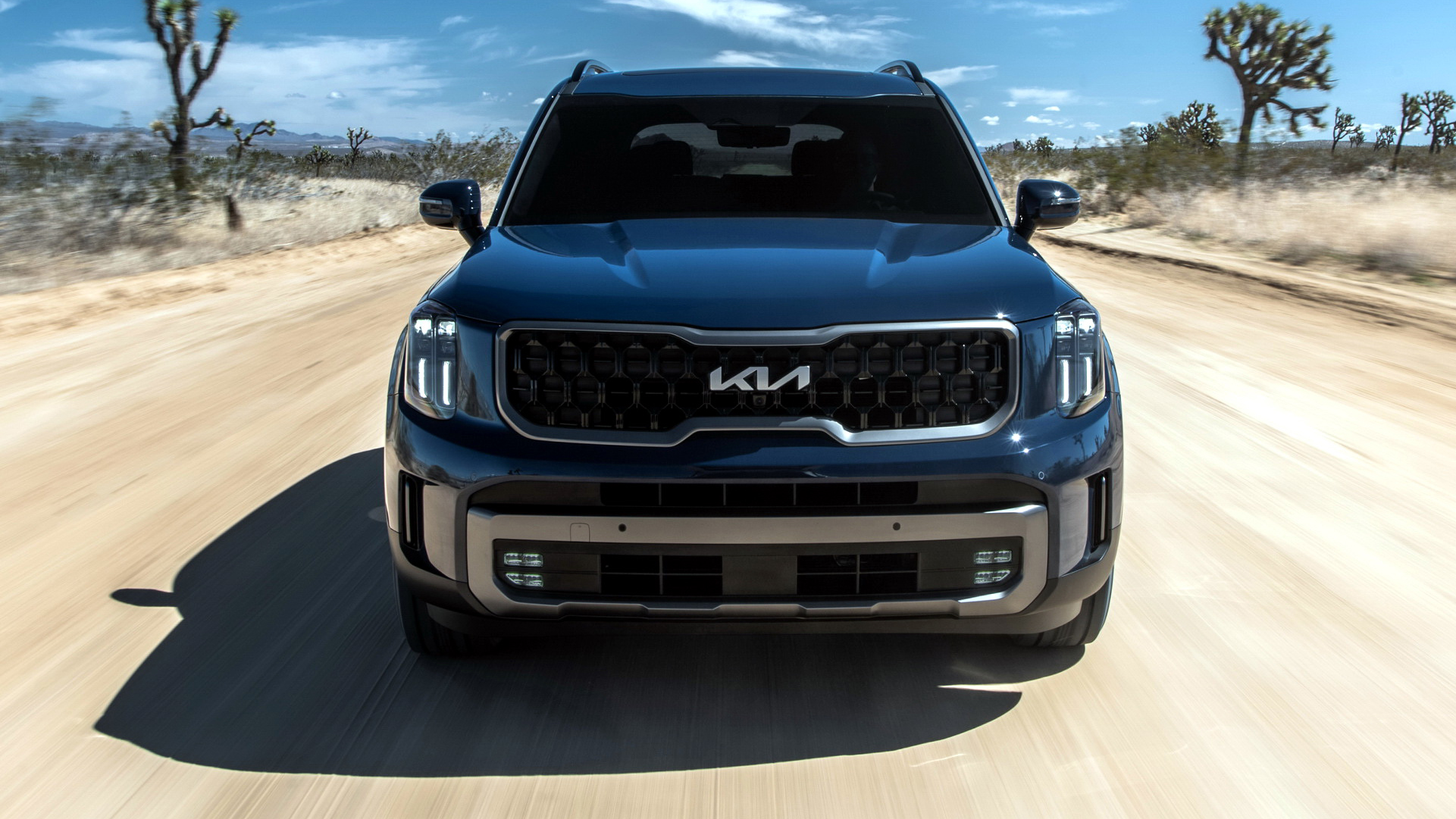
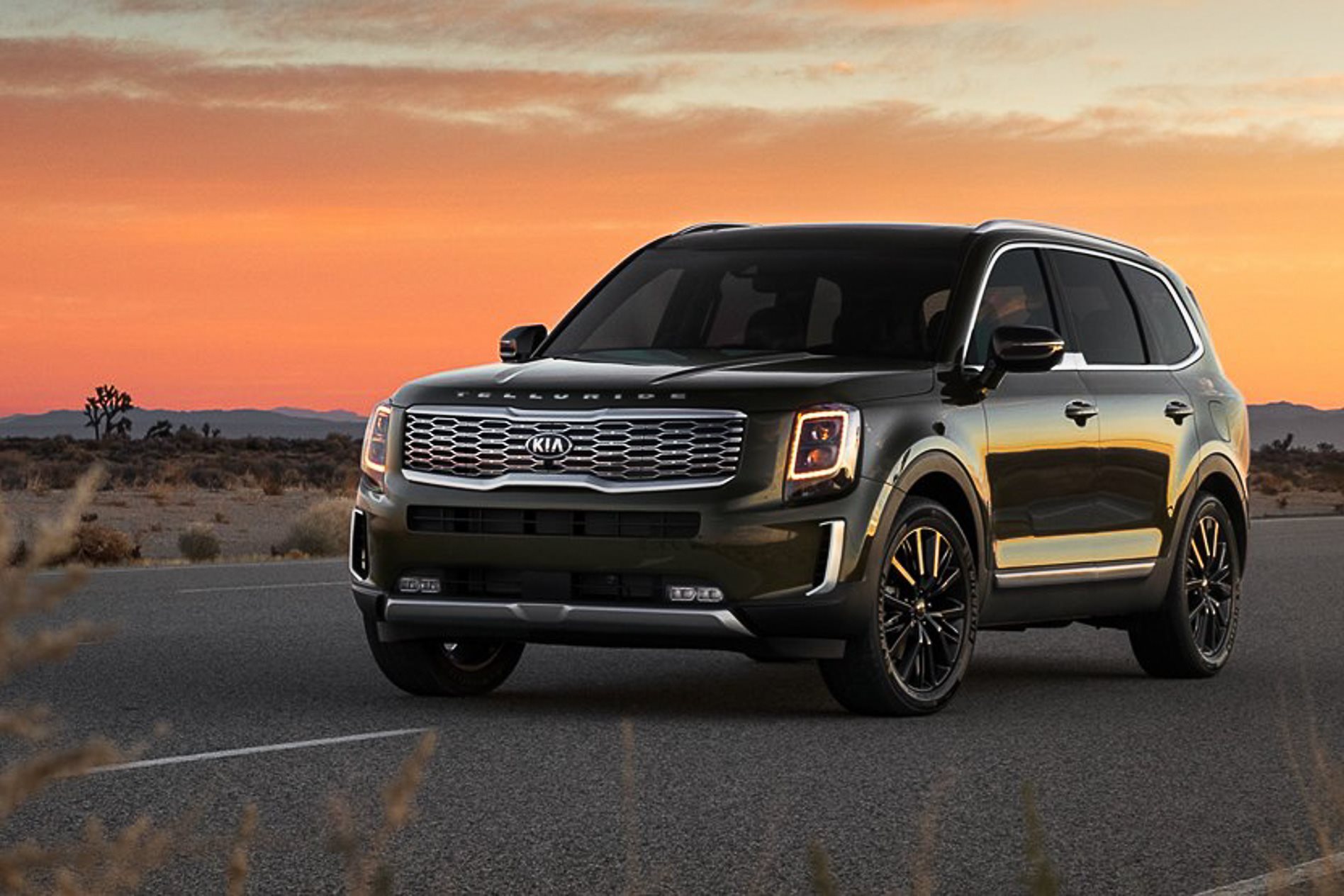
For the new model year, the already bold-looking Telluride gets a new grille with a more distinct silver frame bordering a subtler black pattern and Kia’s now familiar new logo.
The vertically-aligned headlights also get a refresh with with a new LED signature, while the bumper features a big new garnish that gives the large SUV more of an off-roading look.
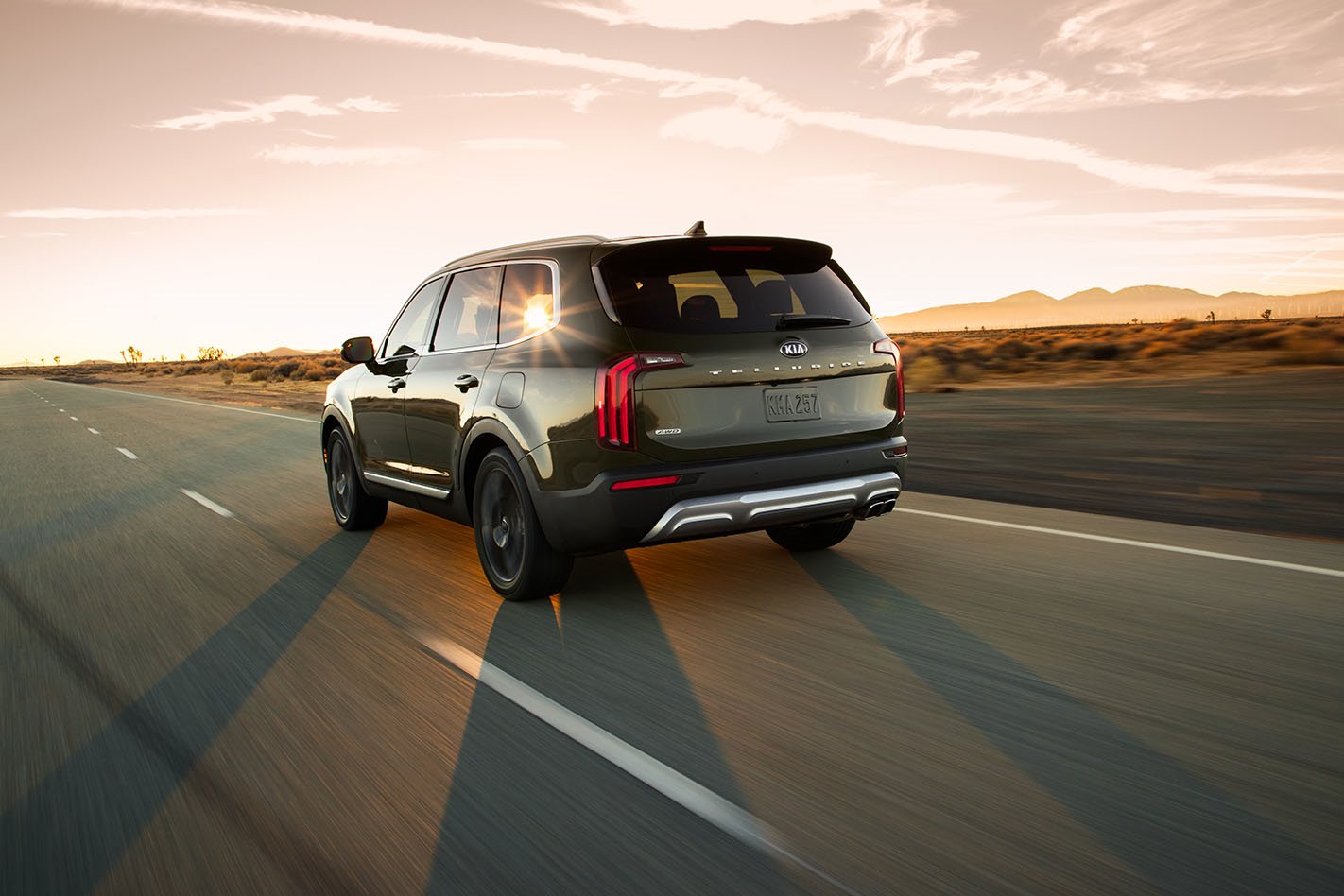
Changes at the rear are limited to a lightly revised lighting signature in the hooked tail lamps, and the bumper gets a similar redesign to that featured at the front end.
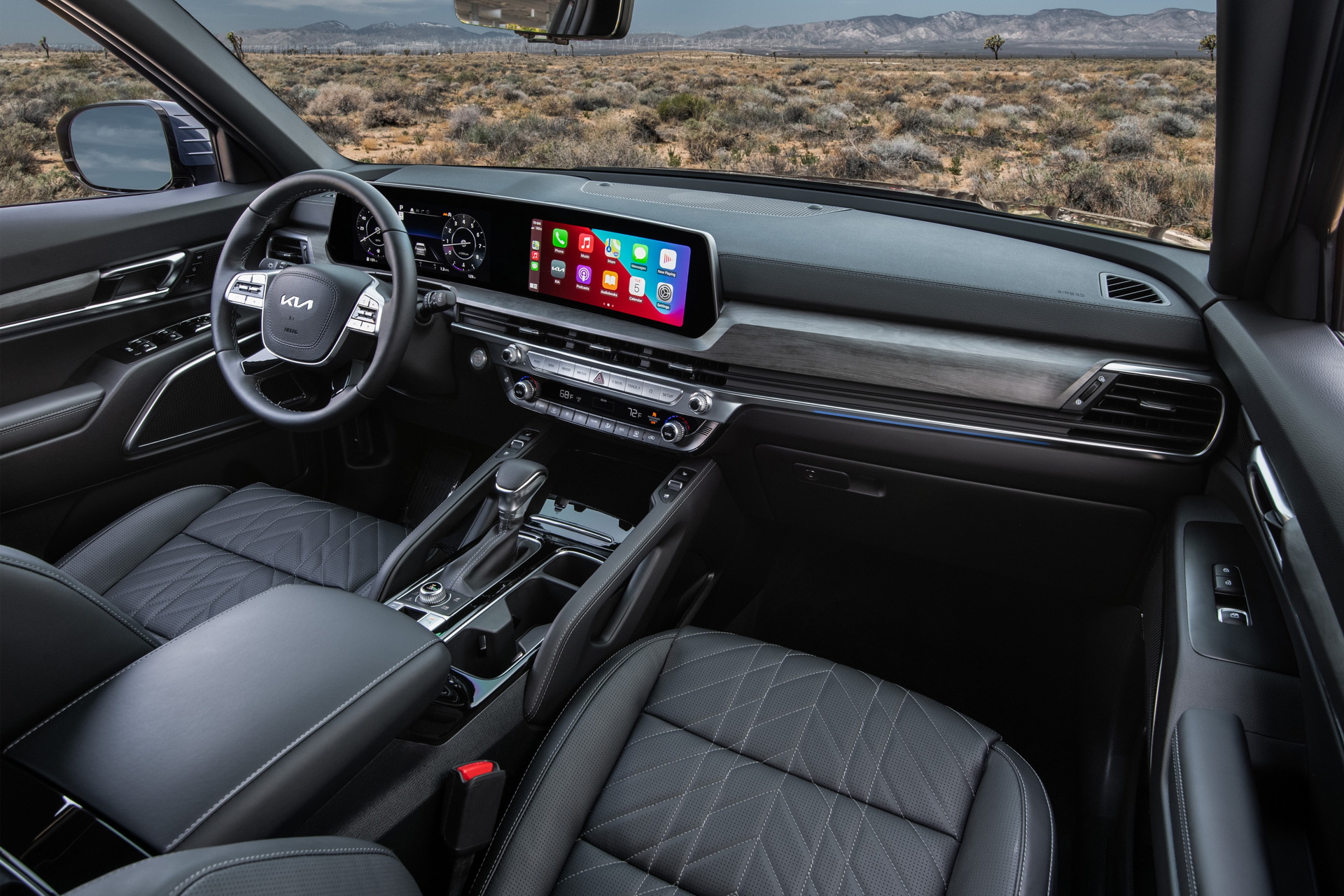
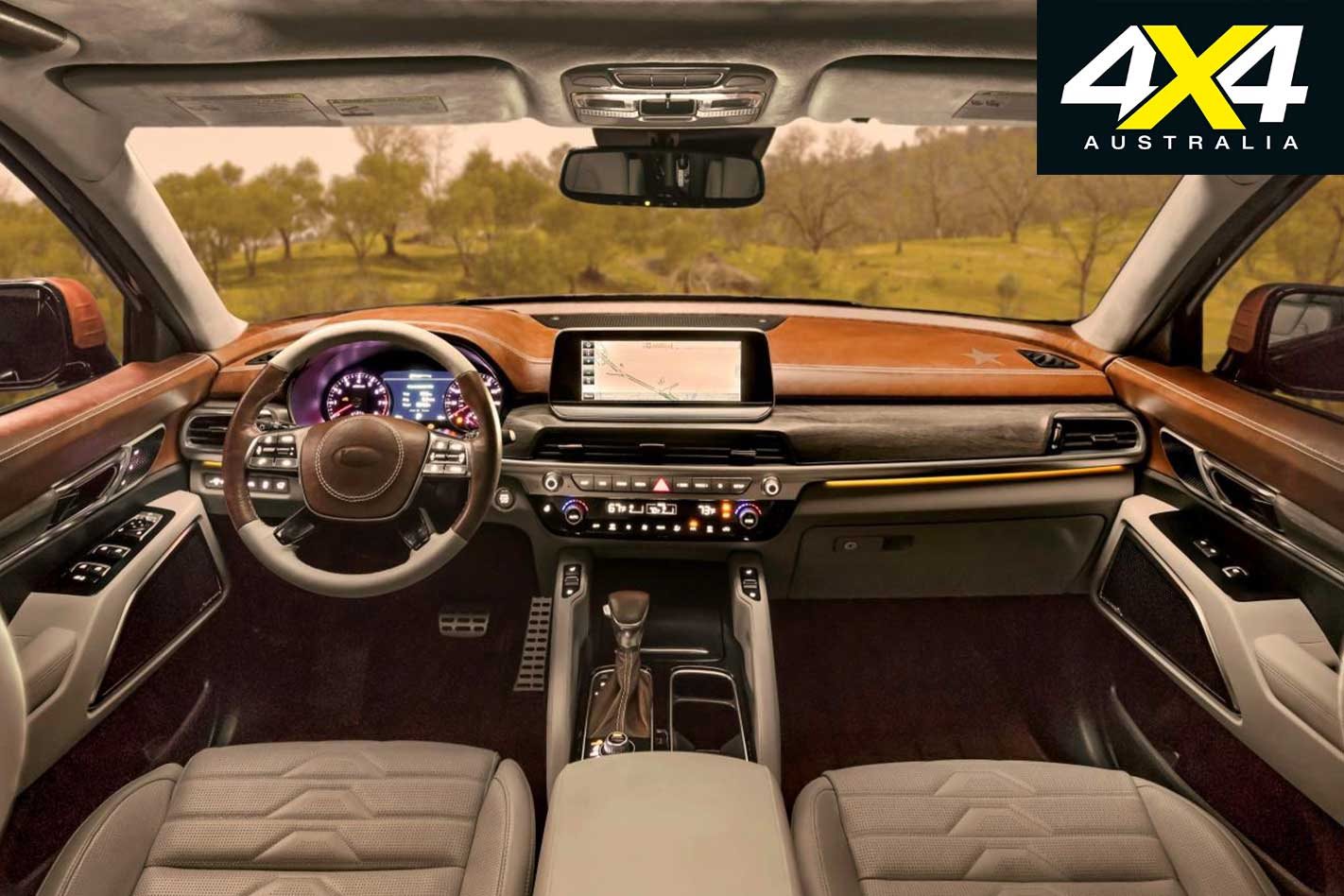
The changes inside are more significant, with the entire upper dash replaced to give the Telluride a more contemporary look – particularly in the case of the huge 12.3-inch displays that reach across the dash to form both the main infotainment screen and a new digital instrument cluster behind the steering wheel.
There’s a flat new horn pad for the steering wheel, but the interior is otherwise largely unchanged, with the lower dash, centre console and door cards all carrying over with only minor material trim and colour revisions.
On the technology front, there’s new safety kit, including sign recognition capability and forward collision avoidance at intersections, along with a navigation-based smart cruise control.
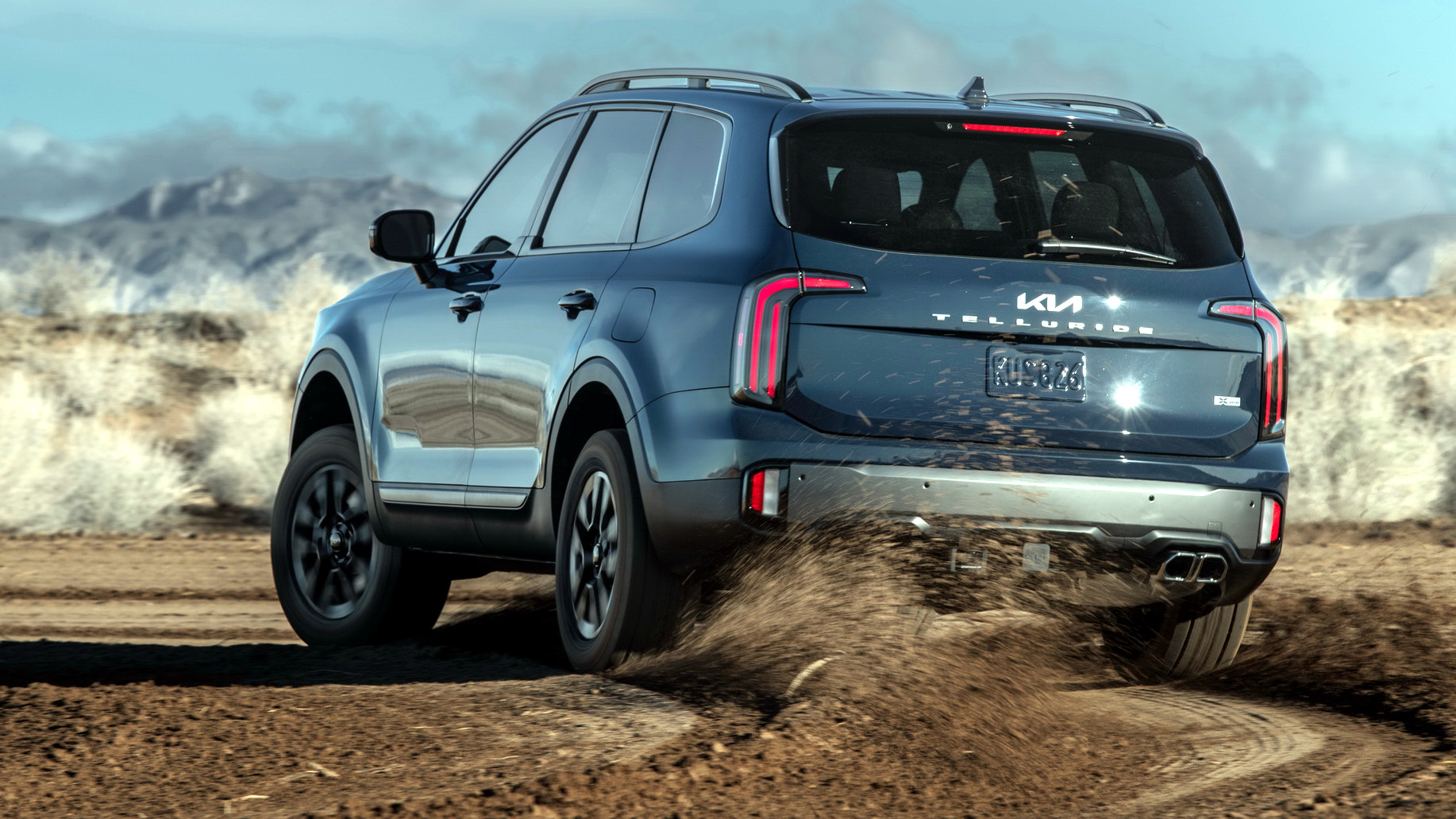
Powertrains likewise remain unchanged, limited to a 217kW/355Nm 3.8-litre petrol V6 matched to an eight-speed automatic transmission and the option of all-wheel drive in place of the standard front-wheel drive setup.
Continue reading below for insight on why the Telluride isn’t offered in Australia.
The story to here
December, 2020: Why can’t Australia have the Telluride?
If you know your car companies, then you probably know that Hyundai and Kia are directly related by blood – but what you might not know is that the two don’t always get along.
In most sibling rivalries, there’s the older, more measured one and there’s the younger, feistier one that won’t necessarily follow the lead set by their elders.
Thus it is with Hyundai and Kia, whose model lineups show signs of both commonality (Sportage and Tucson, i30 Sedan and Cerato) and divergence (Stinger and N products).
However, it came as a real surprise to hear that Kia wasn’t going to follow the pack and import its own eight-seat quasi-luxury large SUV in the wake of the successful rollout of the Hyundai Palisade.
It’s recently shown that it has an appetite for larger, well-appointed SUVs with the launch of the new-generation Sorento, while the incoming Carnival eight-seater is by far and away the best performer in the (admittedly small) people mover space.
On the surface, the decision not to bring the Kia Telluride comes down to a simple matter of geography and numbers.
While the Telluride and Palisade share platforms and drivetrains across their respective ranges, the key issue standing in the way is where the two are made.
Because the Palisade is sourced from Korea, right-hand-drive is not an issue for the local operation to source.
However, the Telluride is produced in a single plant in the US state of Georgia, which is reportedly flat-out keeping up with American demand despite the onslaught of the coronavirus pandemic.
Given the numbers – the West Point plant can build up to 340,000 cars a year – it makes no economic sense to compromise the plant’s output for a relative handful of right-hook versions that would cost a bomb to ship out to Australia.
“We’re no-go for Telluride,” Kia’s chief operating officer Damien Meredith said.
Interestingly, he’s not convinced that the Telluride would necessarily suit the local Kia product mix.
“I don’t think, with what we’ve got and what we can do, I don’t think it’s necessary for the Australian market,” he said. “Even if we had the opportunity in right-hand-drive [to import it], I’m not quite sure it’s the right vehicle for us.”
A significant upgrade to the Carnival people mover – including a comprehensive rethink of the styling and presentation of its currently boxy visage – will hit the market very early in 2021, and Meredith believes that it can do the job
“We’ve got a pretty good range up there, the new [Carnival] which I think will be incredibly successful, and I think it will fill the gambit there,” he said.
The 2022 Porsche Taycan Turbo Cross Turismo explores one of the best Aussie motorsport events that never was.
This feature was first published in the March 2022 issue of MOTOR Magazine.
The front straight isn’t actually straight, but more a nice place to stage competitors and viewers alike.
It’s not a particularly fast bit of track by this circuit’s standards, but one that sweeps gently upward right at the turn-in point of a sharp left hander.
From there the circuit slowly drops down a fast left into a gentle climbing right, straightening for the uphill braking zone of what is the second real corner – an acute 90-degree right. From here racers are on a roller coaster of tarmac that makes Portimao look like the scene of the Caesars Palace Grand Prix.
Elevation changes arrive thick, fast, and dramatic, timed right at the apex of full-throttle bends where engines will be approaching redline in third, fourth, maybe even fifth gear.
That starting complex is just the first kilometre of a 47km circuit that would have pushed the bravest souls on the planet to step astride fire-breathing mechanical steeds for a motorsport event unlike any other in Australia’s modern racing landscape.

Would have, because the ambitious plan to make it a reality was blown away like a raindrop in a cyclone. Named the Sunshine Coast International TT in honour of the Isle of Man Tourist Trophy it is inspired by, the proposal was as ambitious as it was out of place in our nation of regulatory chokeholds.
In 2016 businessman and motorcycle enthusiast David Rollins wanted to lure the world’s best road racers – the likes of John McGuinness, Michael Dunlop, and Bruce Anstey – to Australian shores to compete with slick-shod Superbikes that would leave any four-wheeled machine this side of a Carrera Cup wondering how so much speed can be achieved on a contact patch the size of your palm.

While ultimately unsuccessful, the proposal showed initial early promise with local council support from the town that would form the event’s home base, Maleny.
MOTOR is here to trace the heaving 47km course and ponder what could have been. The town is filled to the brim with endearing motoring enthusiasts from all walks of the automotive spectrum. Hot rodders, British anoraks, JDM enthusiasts, and yes, even our two-wheeled kin, rub shoulders in the town’s main street between expeditions through the nearby driving roads which are among the best in the country.
Yet, as with every natural equilibrium, there is also a vocal selection of residents vehemently opposed to something as crass and brash as a high-speed street race that were more than happy to air their grievances at a number of town council meetings.
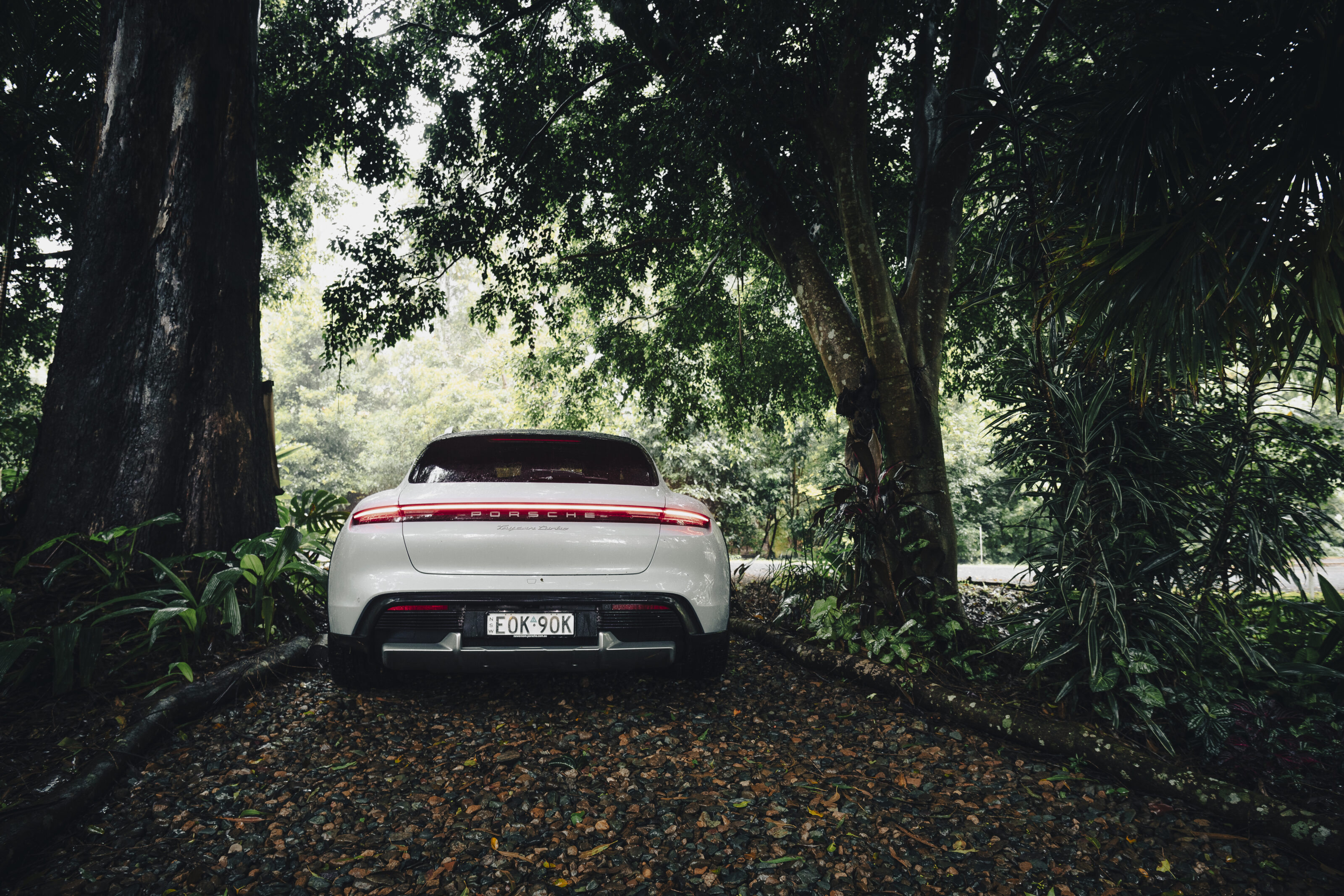
As quickly as the Sunshine Coast TT was proposed, it was met with well-organised opposition. Anti-racing resident groups weren’t the only killing blow that has us writing about the TT in the past tense, but their influence is not to be understated.
Hence why today’s driving is a stealth mission. To ensure photographer Dewar and I fly under the radar as we retrace the proposed Sunshine Coast TT route, I needed a set of wheels that wouldn’t draw too much attention, but would still be capable of making the most of the carefully curated course.
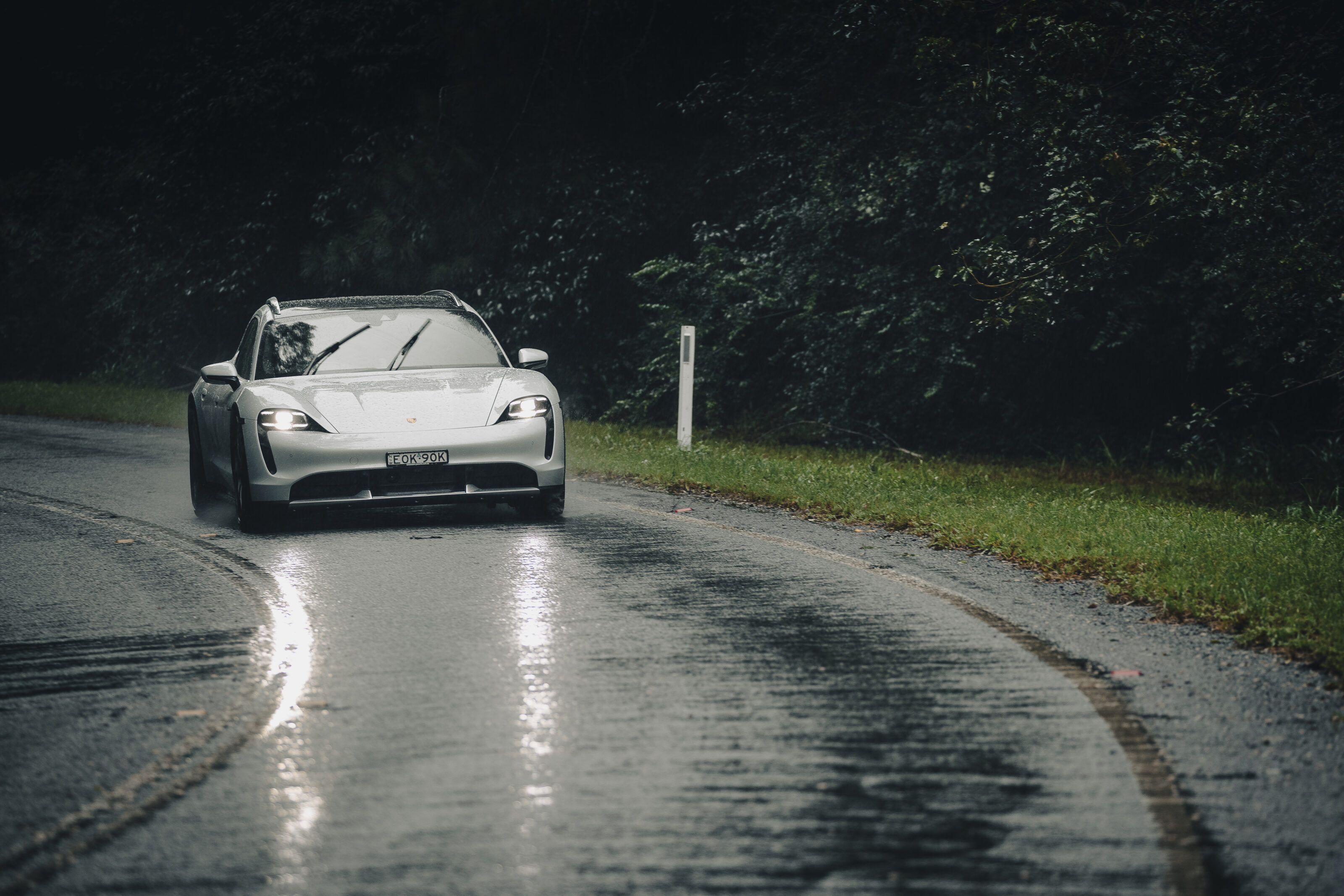
What better than a silent wagon like the Porsche Taycan Turbo Cross Turismo?
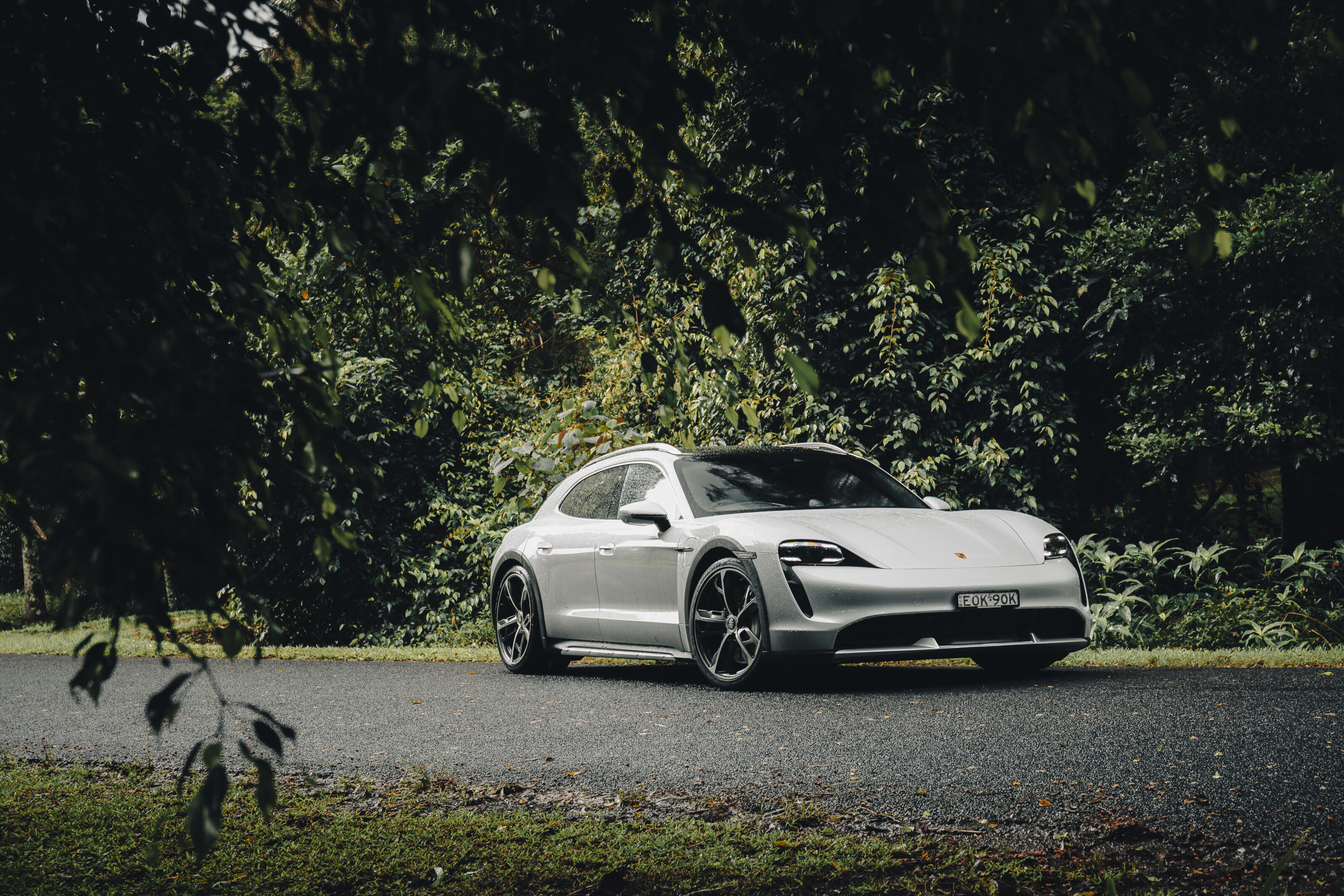
Being the flagship of the long-roof Taycan Cross Turismo range, the Turbo deploys 460kW and 850Nm through a two-speed transmission on the rear axle, and single-speed on the front, each mated to a respective permanent magnet synchronous motor. Peak power can lift to 500kW using launch control with overboost.
There is no Turbo S in the Taycan Cross Turismo family, and it doesn’t need it.
The extra money and additional letter on the rear bumper badging would bring no full-time boost to power levels, and the increase to 560kW on overboost launches can only be experienced a handful of times before needing to lie down while your insides return to their anatomically appropriate layout.
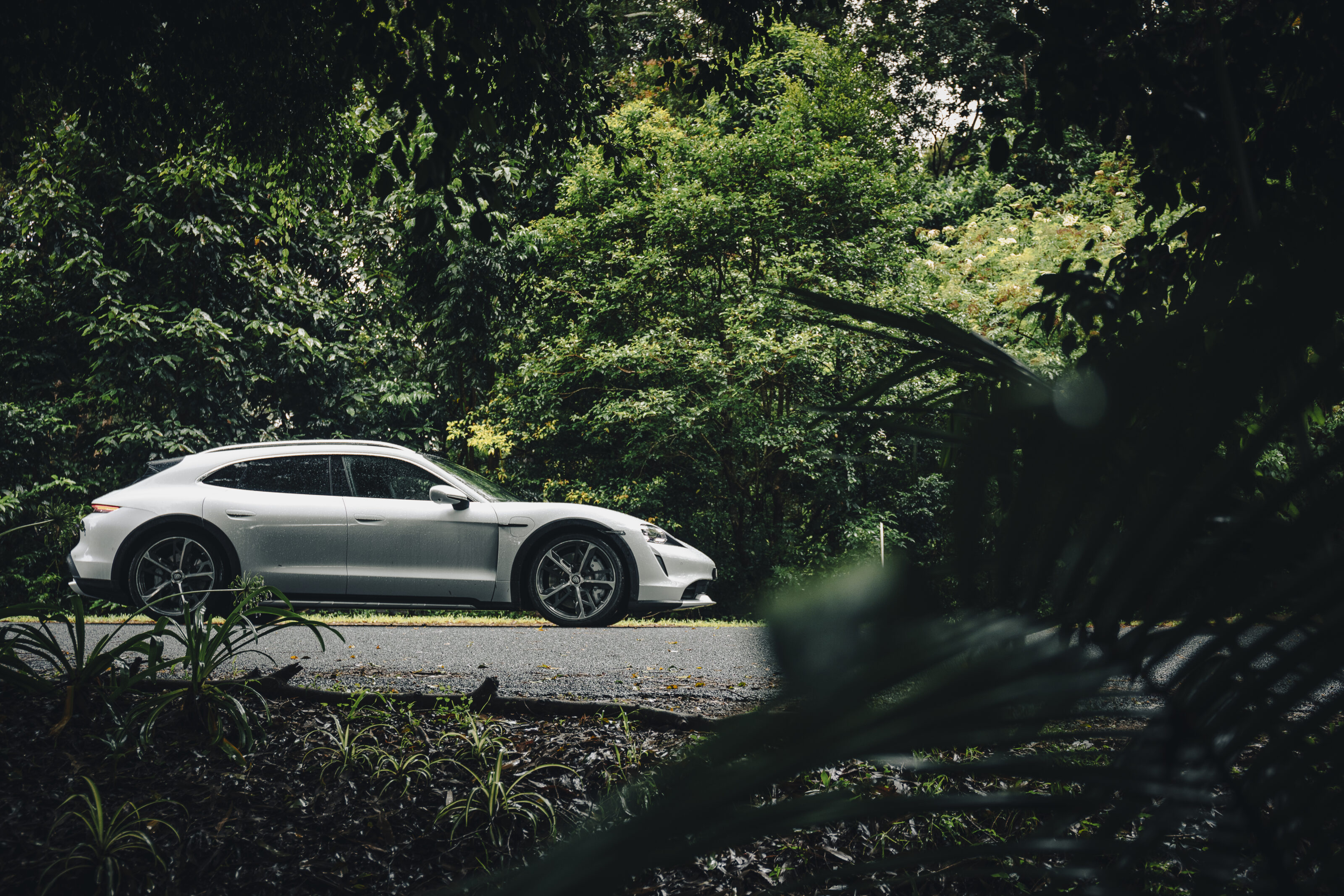
Similarly, the non-cladded, slightly lower riding Sport Turismo version and its exclusive GTS variant won’t be joining the Turbo, 4, and 4S Taycans in Australia.
That model’s bodystyle would have filled a tiny hole in a niche market instead of being a proper value-add to the local line-up, and the three-step model range doesn’t need any extra complexity provided by the GTS.
That power is deployed with a ferocity that you never really get used to.
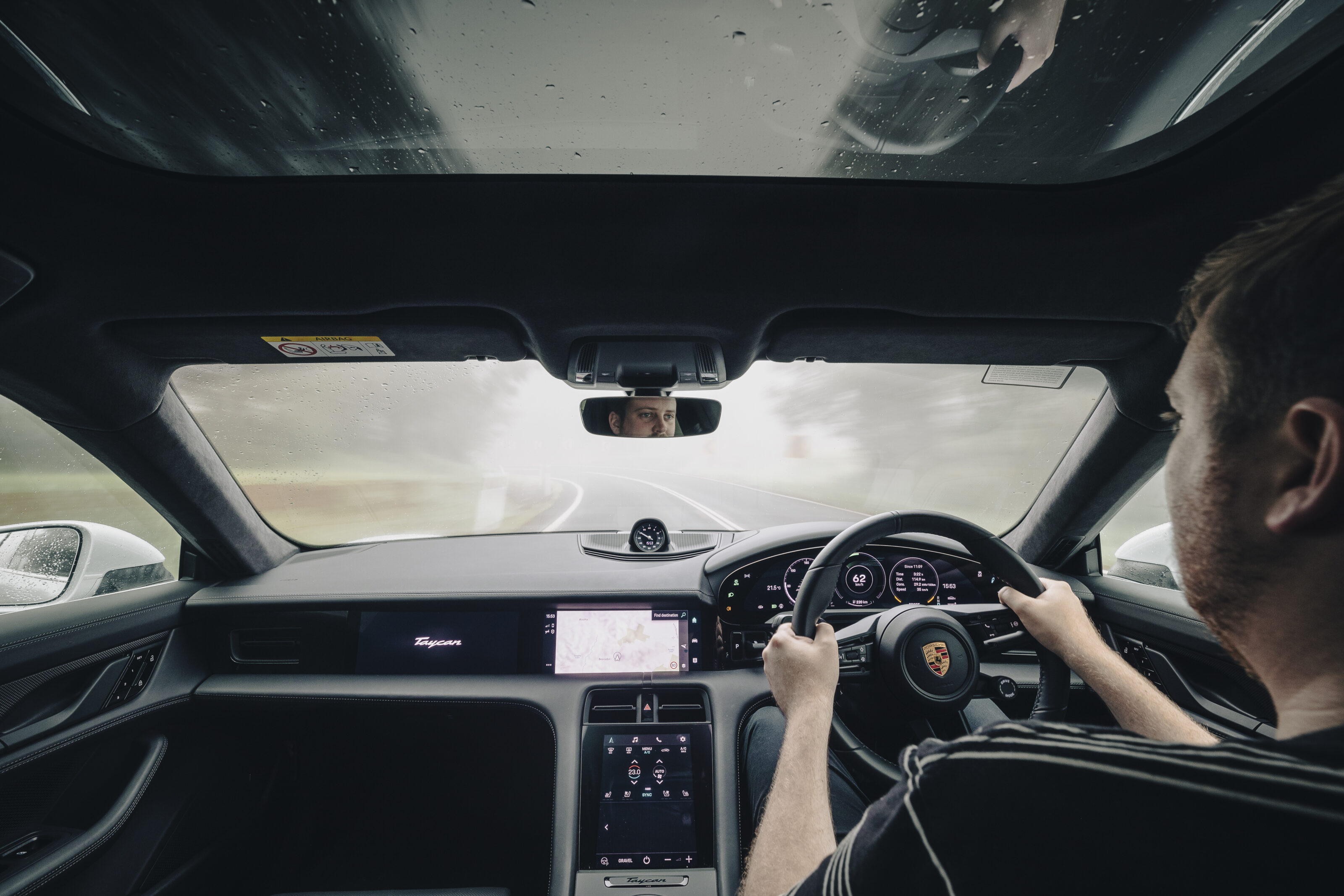
Perhaps it’s decades of internal combustion conditioning, or a hardwired form of evolutionary self-preservation, but repeated sharp throttle applications and launches in the Taycan take their mental and physical toll.
A proper launch control needs to be experienced to be believed, with the 2320kg machine pausing for a fraction of a second as the brake is released and the tyres work with the computer to find the correct amount of power for a perfect bite of the tarmac. There’s a slight chirp from the rubber, and then the piece of road that was just a moment ago all the way over there suddenly transposes itself to right here in front of you.
As tested our Q-ship costs $320,690 before on-roads from a $279,000 sticker.
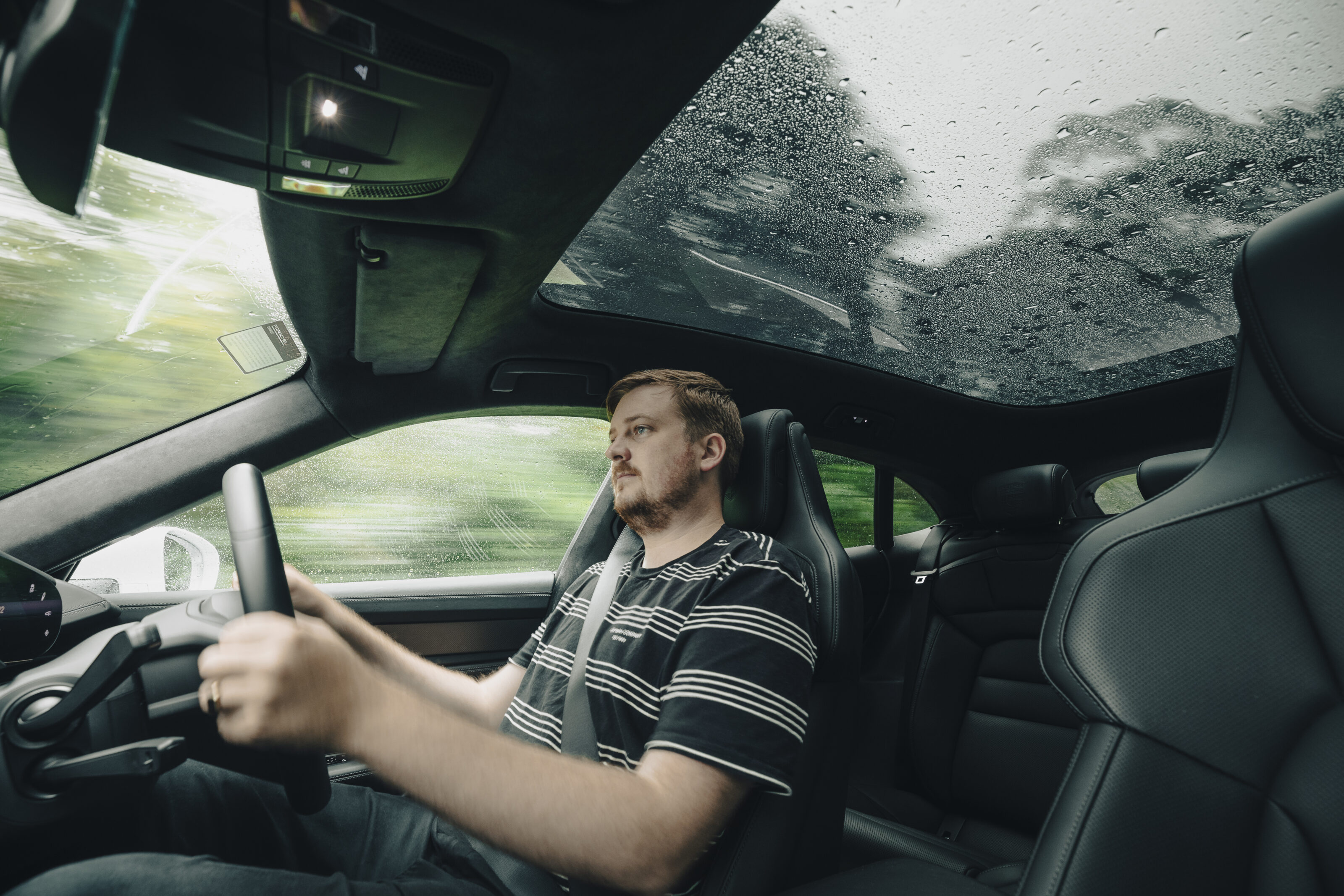
Some of the options filling that forty-odd-stack chasm include the stunning 21-inch Cross Turismo Design wheels ($6770), subtle Ice Grey metallic paint ($5000), confounding rear-axle steering ($4300), giant fixed panoramic glass roof ($3370), gimmicky passenger display screen ($2150) and the must-have, even on an EV, Sport Chrono pack ($2340).
Helping cover our tracks as we head off from the starting point outside Maleny’s high school is a heavy lashing of thick fog that only continues to worsen throughout the day. At some points it is a complete white-out, almost prompting an entire abandonment of the day’s proceedings.
My local knowledge of the route, and Ellen’s sheer bloody mindedness sees us push on to face pouring rain, limited visibility, cool road temps, and constant standing water. If held today the TT would be a wash out on safety grounds, but even in dry conditions the time-trial-style event would have been easily the most hazardous in Australia.
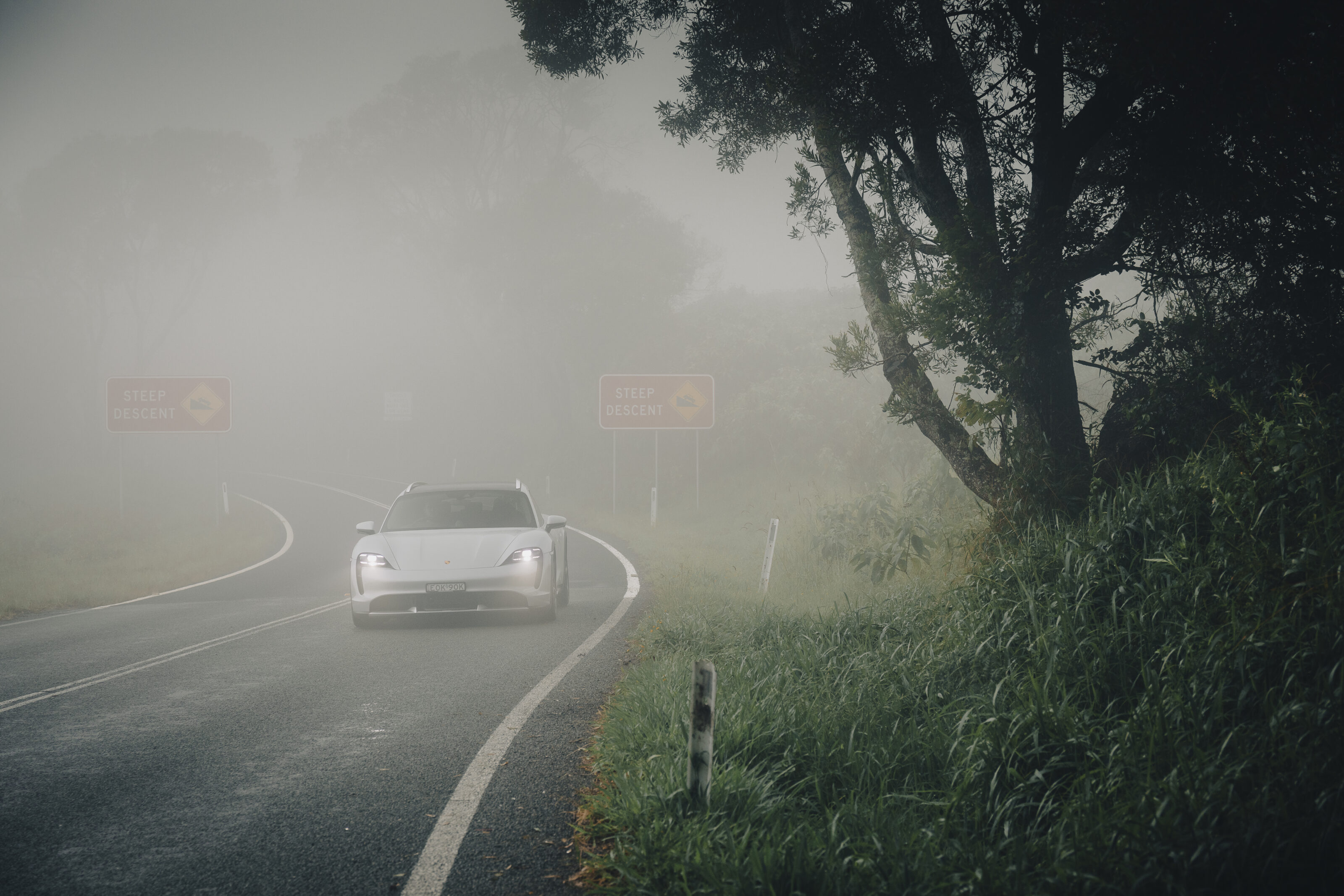
The first kilometre has power poles on apexes, brick letterboxes as braking markers, and sturdy cow-proof fences as run-off. Then you are upon the crowning jewel of Maleny Stanley River Road that takes us from the eponymous township along the ridge of the Blackall range. A main feature of the road has been heavily curtailed by the weather.
To both our left and right should be wide vistas of the surrounding valleys and craggy, once-volcanic cores that form part of the Glass House Mountains.
Instead I can barely see the edge of the road, and looking through the corner is completely out of the question.
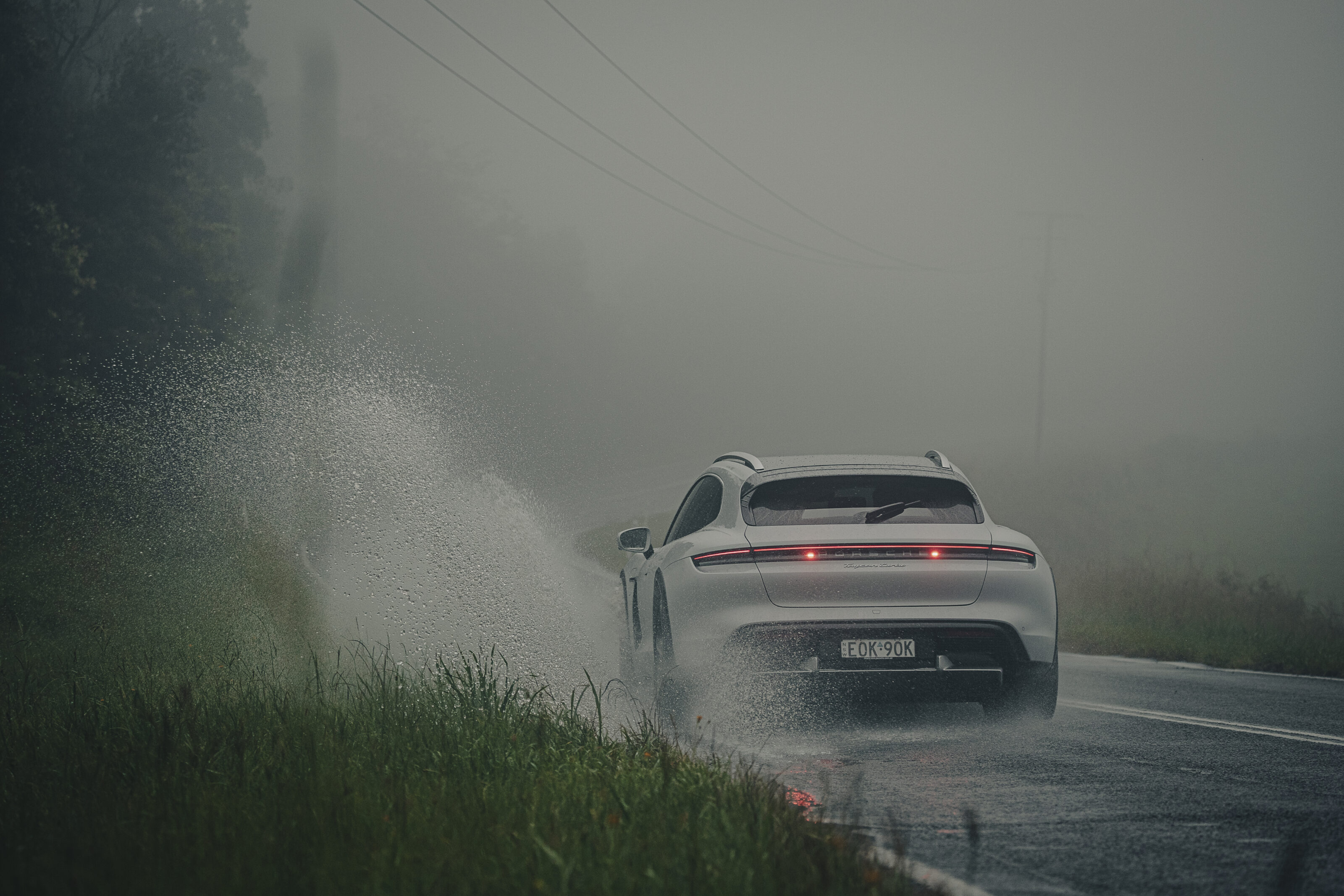
Much like the Snaefell Mountain Course, get it wrong at certain points on the Sunshine Coast TT and you’d be doing high speed improvised landscaping through someone’s favourite rose bush. Thankfully unlike the Isle of Man event, organisers in Australia weren’t going to give spectators free rein of the course, instead containing them within six distinct viewing areas.
Reprieve is only slight but nevertheless appreciated when the road begins its descent proper. Glaring road signs warn of the vertical drop in principle, but it’s a drastic change in gradient that requires confidence in your chosen vehicle’s braking ability and front-end bite regardless of four contact patches or two.
The Taycan’s braking ability is indomitable, with regenerative powers paired with 410mm diameter discs clasped by six-piston calipers up front, and 365mm discs and four-pot grabbers on the rear. Despite the immense kinetic energy deployed, its easily disposed of with a brake pedal that never saps confidence thanks to resolute and unwavering feedback.
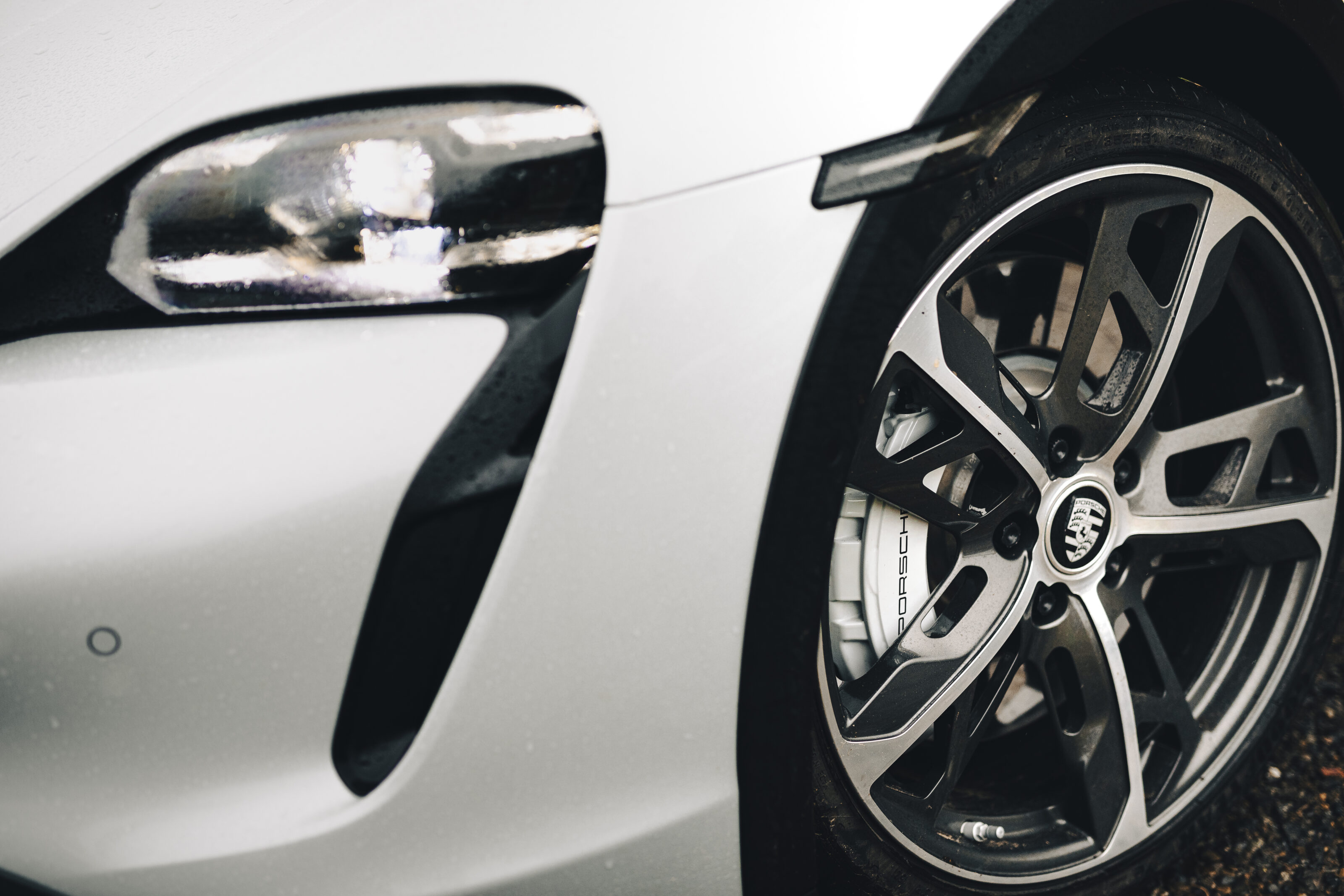
The Taycan Turbo deploys its significant power with relative ease despite the treacherous conditions, and its ability to increase velocity is far more enjoyable when already up and rolling.
Torque vectoring and an astute traction control and ESC calibration helps me find what little grip is available as I press into the throttle on corner exit. Not from a standstill, acceleration is no longer a punch in the nape of the neck, but a shove on the lower back that refuses to relent. While there is instant power deployment, the throttle calibration isn’t overly sharp, and sustained mid-corner throttle inputs are easy to maintain.
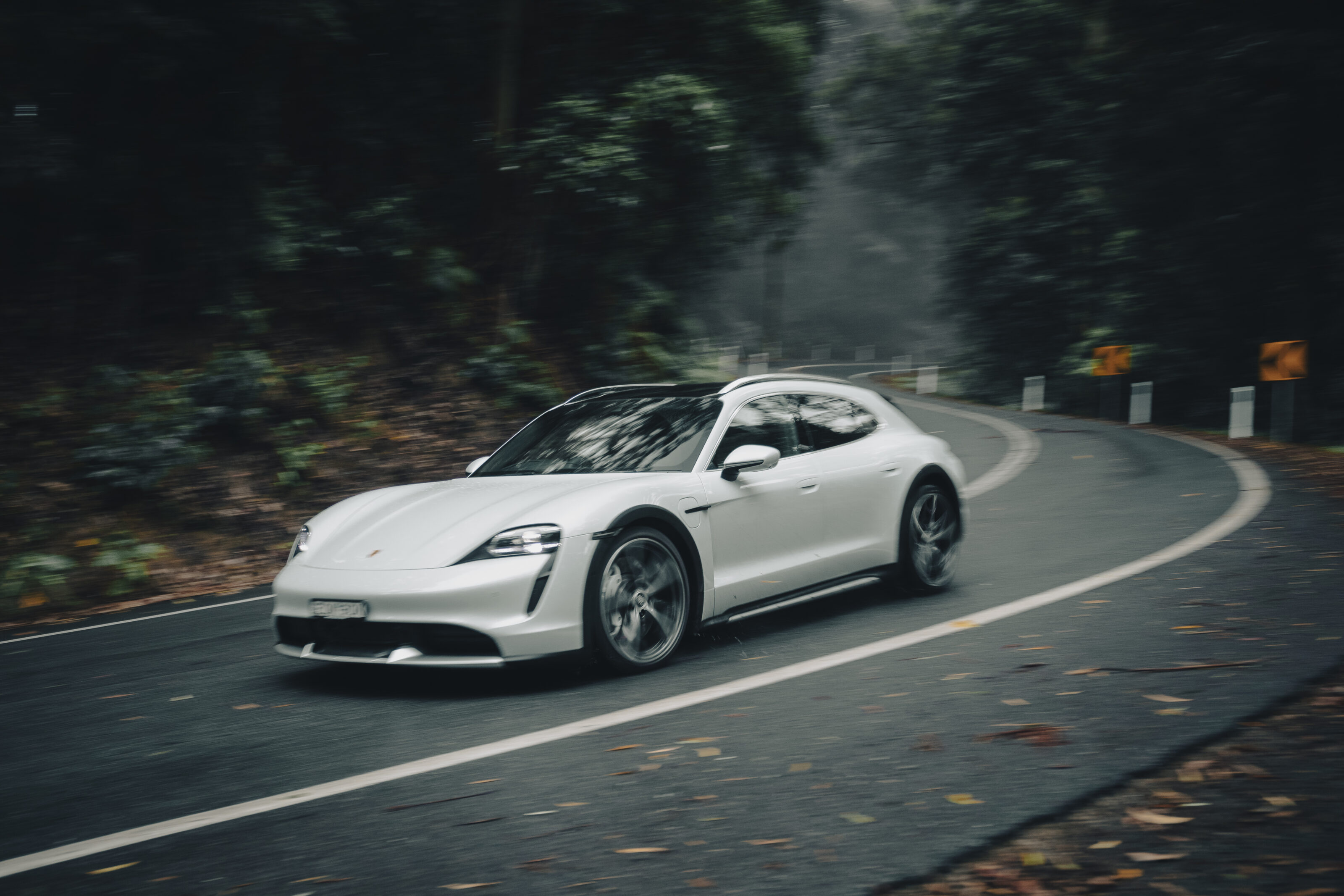
Despite all the mass, the Taycan has impressive lateral body control aided by the low battery placement, and irons out niggles and imperfections in the ride surface admirably despite the low-profile rubber. But the weight becomes abundantly apparent over larger suspension compressions and crests, with a heaving motion that shatters the, up until this point, well-maintained charade of being a much lighter car.
At the terminus of Stanley River Road competitors take an off-camber left that also signals a transition to the best road surface of the route. With this improvement comes a remarked uptick in pace as the road now straightens toward Peachester.
On a closed course, riders would be clipping into high gears at full chat while tipping into what barely resemble curves at the legal speed limit. Just the thought of doing so has me gulping in imagined astonishment.

Further along a Rav4 has rolled and wedged itself sideways between the end of the Armco and a bank of earth. It’s a good reminder that even at the speed limit this road isn’t entirely tame.
Before entering the town of Peachester proper the route again dives left, moments after its longest arrow-straight stretch.
Next on the menu is Bald Knob Road, a tight and twisted antidote to the speedo-cracking portion we’ve just traversed. Again, brave pills are required before admission, but this time for entirely different reasons.
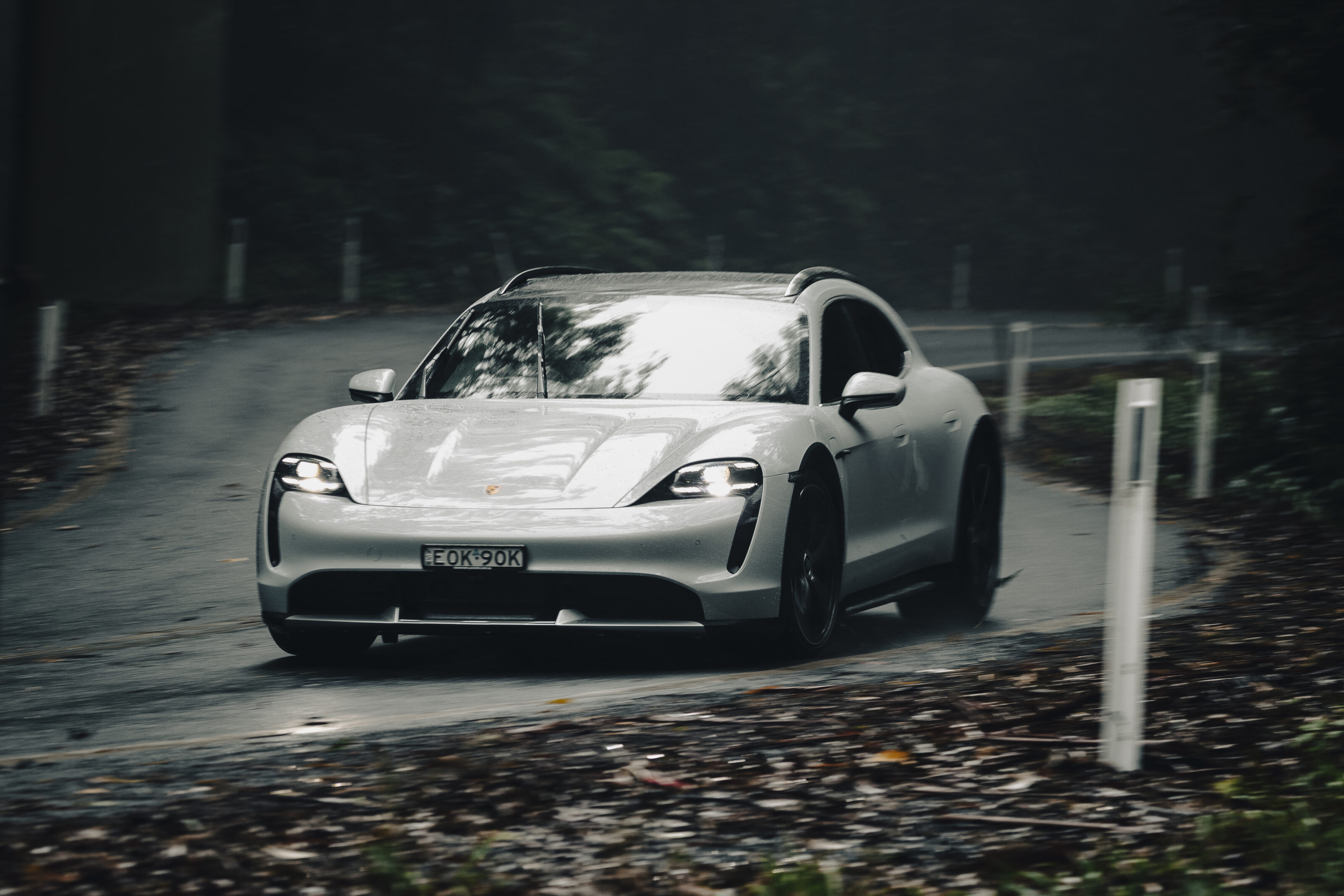
Bald Knob is the most technical part of the route, and there’s no reprieve in the entire length. It’s up, down, left, right, mix, match, repeat, survive.
So intense is the focus required that the sheer drops to the right-hand side of the road sneak up on you. There are always a few trees or a house between you and becoming a low-orbit pilot, but get it wrong here and there will be no small accidents. The surface is passable, just, for road use. Race speeds? Good heavens.
The rest of the proposed roads are heavily trafficked from here to the finish line, but for competitors they’d be a delight us mere mortals will never come close to replicating.
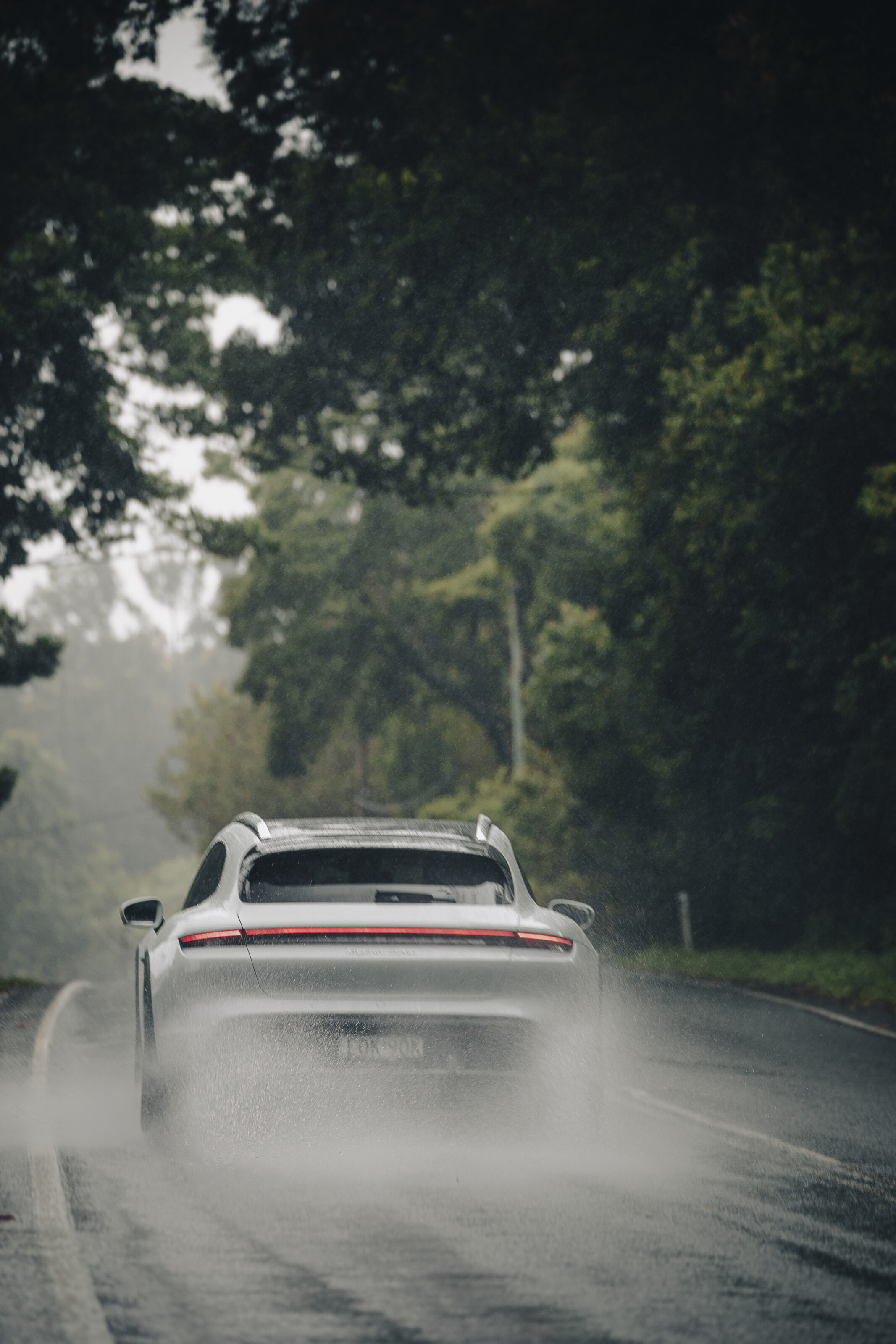
At least not legally. A predictable flow returns, as does a road surface that’s enjoyed a semblance of proper maintenance, and three quarters of an hour after our departure the start-finish line appears again.
At race pace we’d predict a lap time in the region of 13 minutes.
Prior to colonisation, the route of the TT would have been entirely covered in sub-tropical rainforest. Late 19th-century logging has caused an almost complete denudation of the towering hardwoods, and there are only brief pockets that seem representative of the locale’s true heritage.
When the timber companies ran out of trees to decimate it was the dairy industry that stepped in as the economical backbone of the area, making use of the now cleared, fertile lands to house Guernsey cattle.
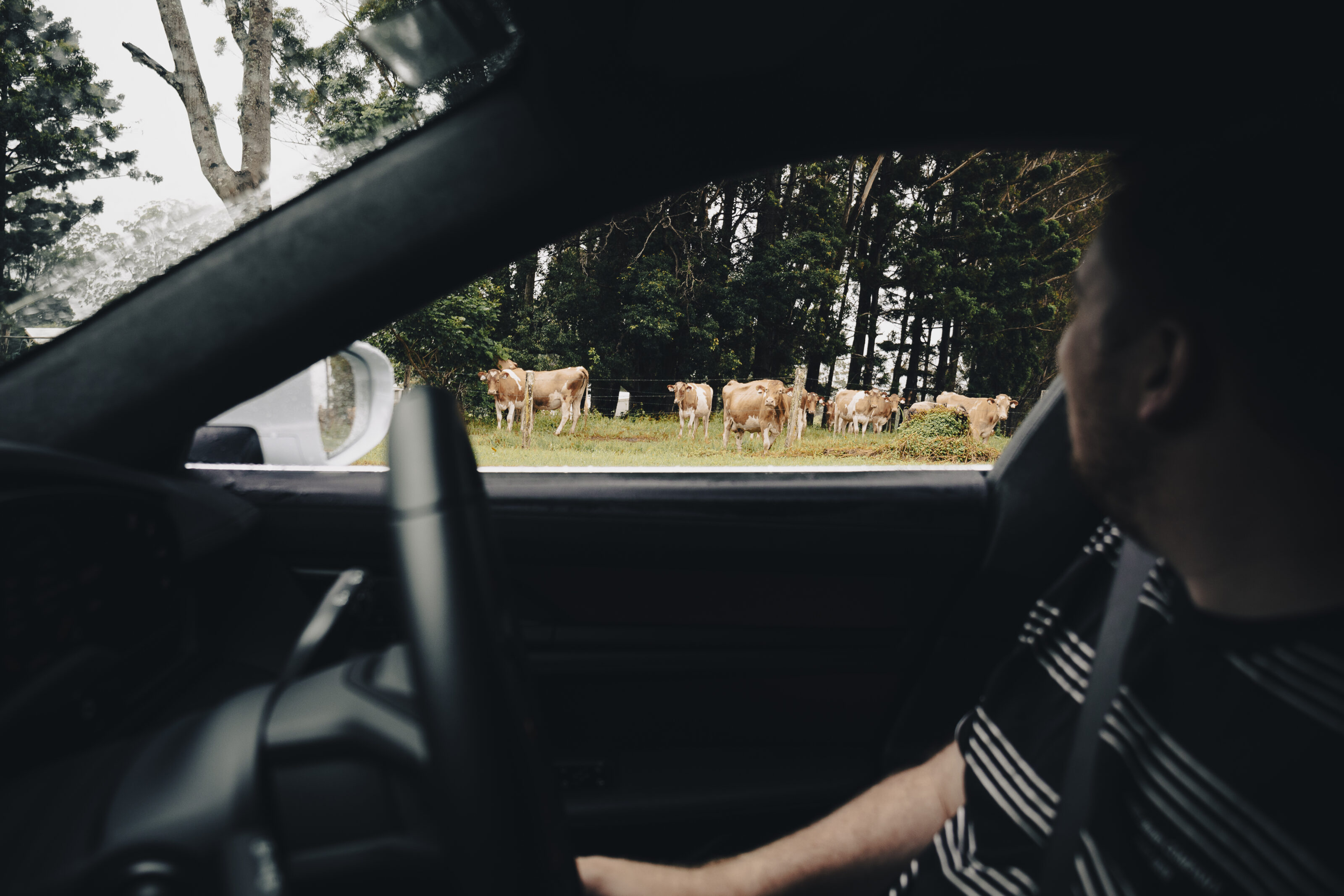
Almost as old as Australia itself as a nation, the Maleny Butter Factory began operation more than a century ago in 1904. Today cows are the primary spectator of our clandestine tour.
When the TT event was proposed, opponents claimed noise from the racing bikes would upset the local prized stock. The owner of Maleny Dairies, an astute businessman and caring farmer whose land borders much of the route, dismissed these criticisms and threw his support behind the TT.
The pride of Maleny Dairies’ herd was a Guernsey named Belladonna – a future world champion the breed that at its peak produced 70.5 litres of milk in a single day compared to the average cow’s 15 litres.
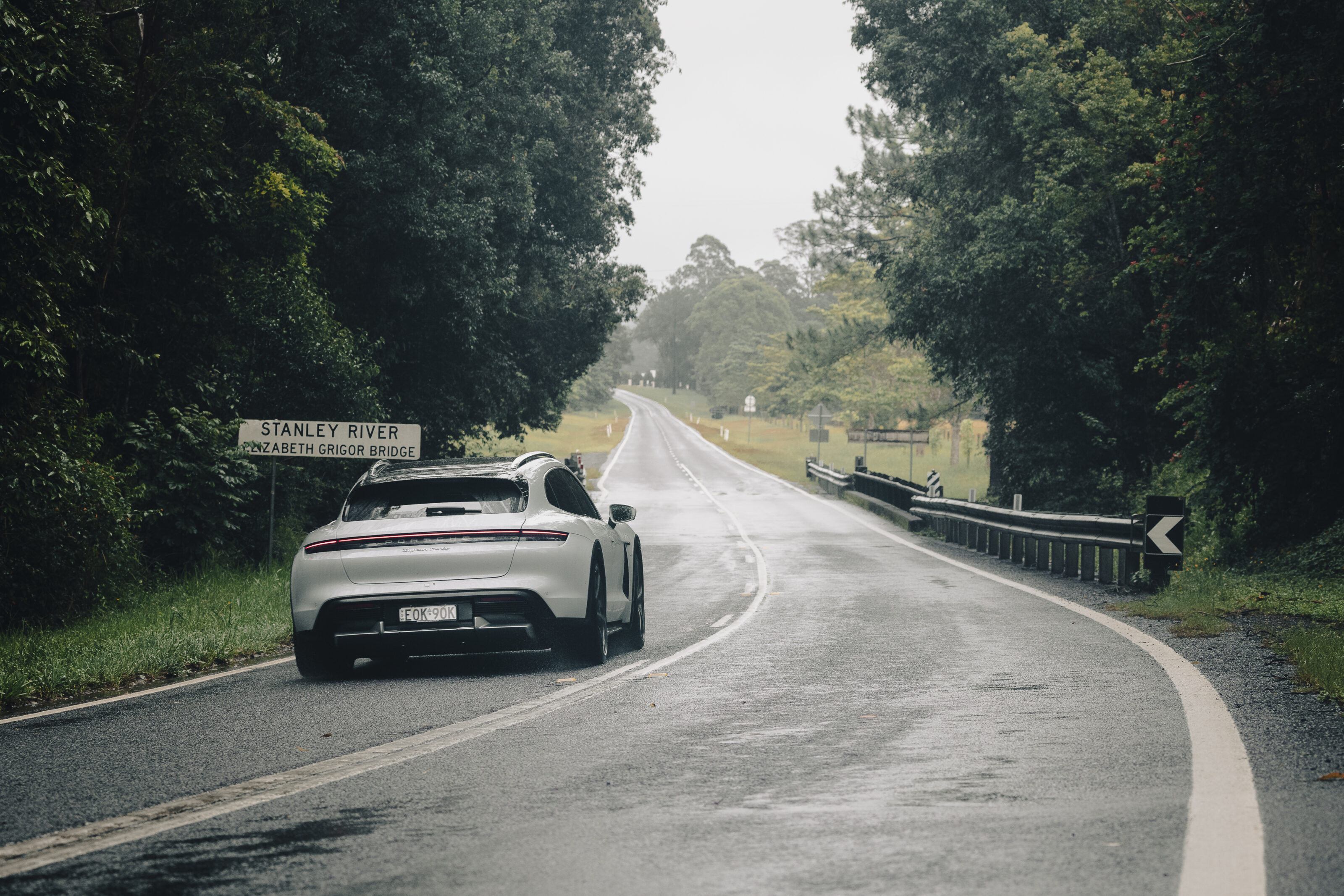
Not yet Porsche’s Belladonna (that title remains resolutely retained by the Cayenne), the Taycan is already outperforming the 911 in terms of global sales.
That commercial success says more about customer habits and supply and demand than it does the future of Porsche’s most iconic model, but it’s also an indication that purists will need to get used to the idea of electric performance Porsches very quickly.
A performance Porsche the Taycan Turbo Cross Turismo certainly is by any meaningful data or emotional metric.
Driving it quickly is an involved, pulse-raising process that requires considered inputs and rewards with gobsmacking pace.
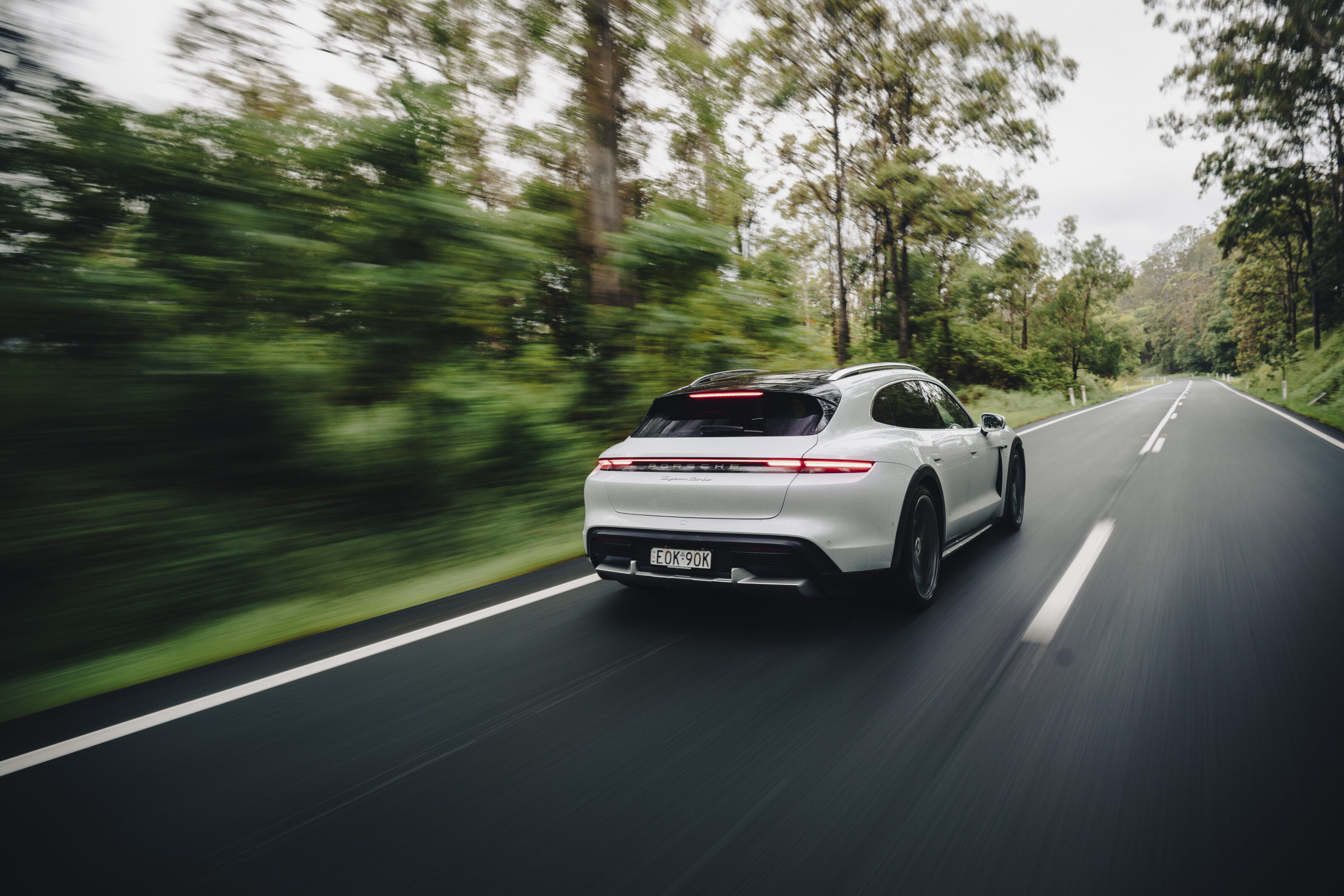
The steering is typical Porsche top-shelf quality. Fantastic accuracy with nary a deadzone in sight, with well-judged weight that straddles the middle ground of too-light remoteness and artificially heavy.
The optional rear-wheel steering system adds a level of complexity to the driving experience that doesn’t necessarily result in a net benefit. Turn in on tighter corners is sharper, and stability on fast flowing bends more composed, but it also acts as an artificial barrier to truly understanding the chassis’ reactions to inputs and feedback from the rear axle takes extra work to fully parse – something that isn’t a boon when putting on pace as quickly as the Taycan Turbo does.
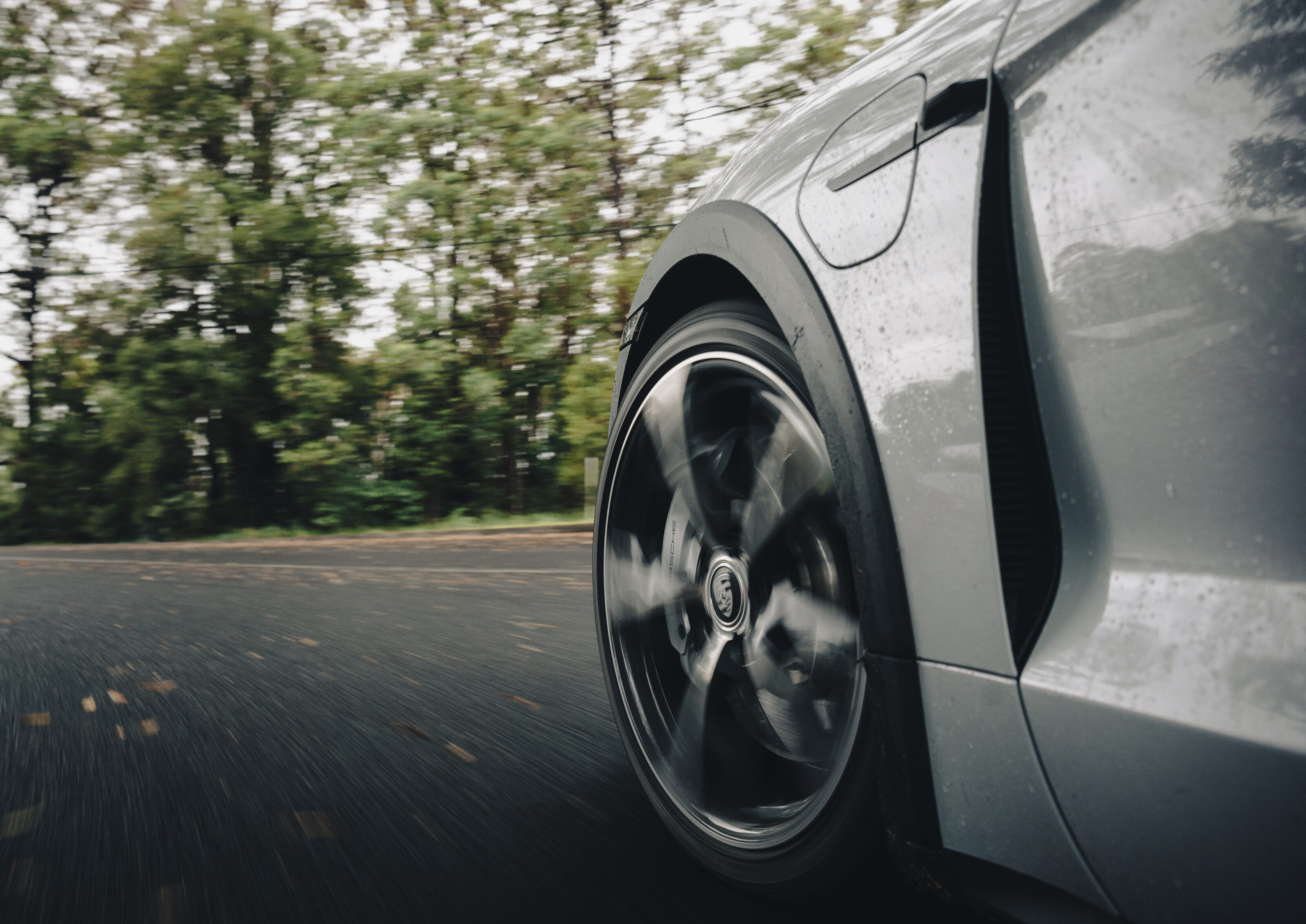
In short, four-wheel steer is great when manoeuvring the almost five-metre long, two-metre wide beast into a tight space, but those searching for driving excellence from their EV adoption are better off saving their money.
Increasing the difficulty level inside is the loss of the auditory feedback from the electric powertrain. You don’t realise how heavily you initially rely on sound to interpret and understand pace on the road until its gone.
However, the power of the human brain quickly compensates to this aural absence, and the issue is remedied somewhat in Sports Plus with an internal sound symposer that matches your speed and throttle application with an artificial tone played through the speakers.
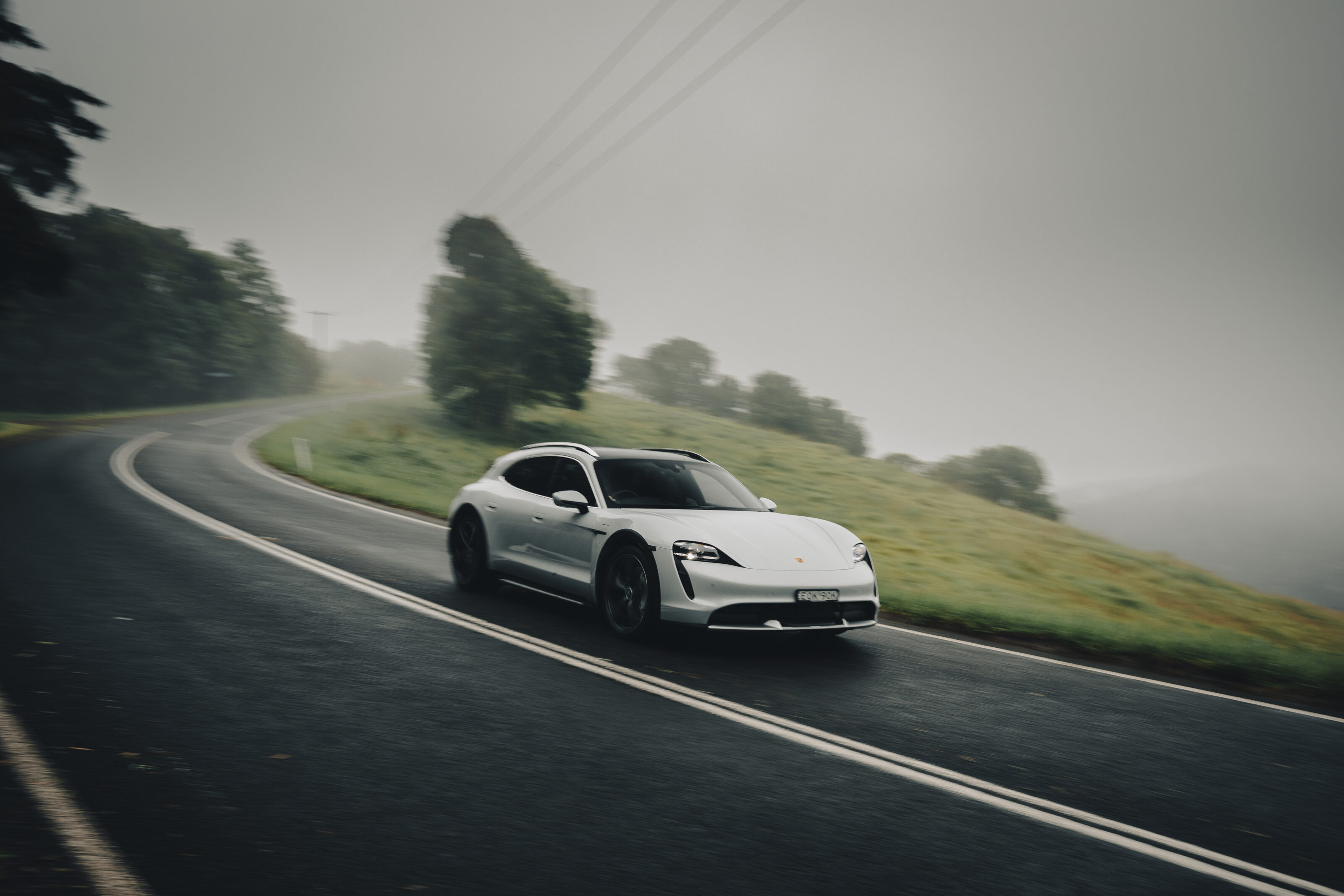
Thankfully Porsche avoided a cringe decision of using a combustion engine’s note, instead opting for a slightly understated UFO warble. I quickly found it more distracting than helpful, which on these roads and with the prevailing weather conditions prompted me to turn it off entirely.
The ambition of the Sunshine Coast TT’s organisers outstripped their ability or patience to turn an aspirational vision into reality and promises of a worthy event were never realised.
If executed properly, it could have been a world-class event.
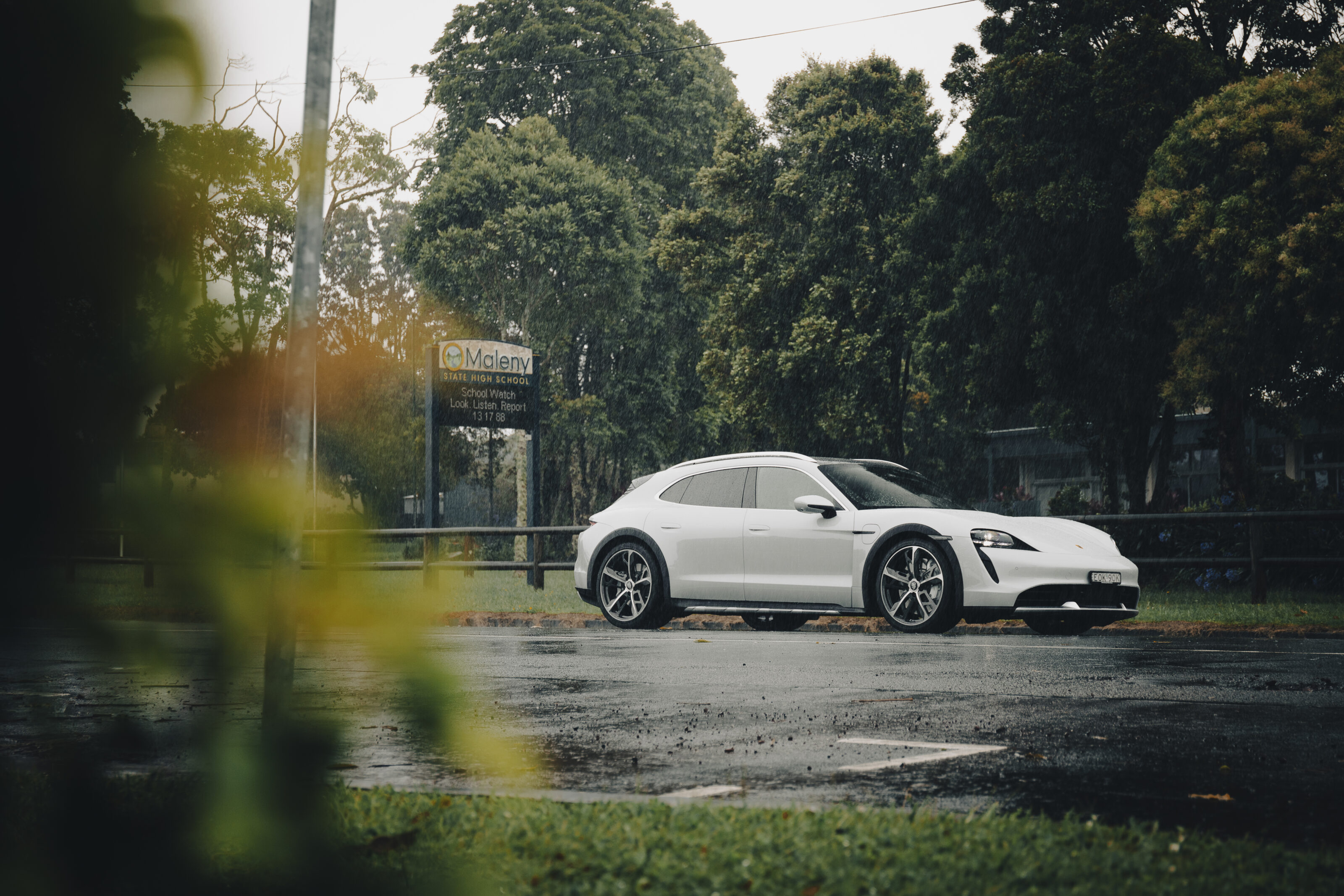
Porsche has not suffered the same folly. While the Taycan has allowed us to pass undetected throughout the day, its performance credentials are as serious as they are undeniable.
Put the same ethos into something smaller and more compact like, say, a Cayman and the next age of electric speed is going to be mighty enjoyable indeed.
How to best experience the Sunshine Coast TT route
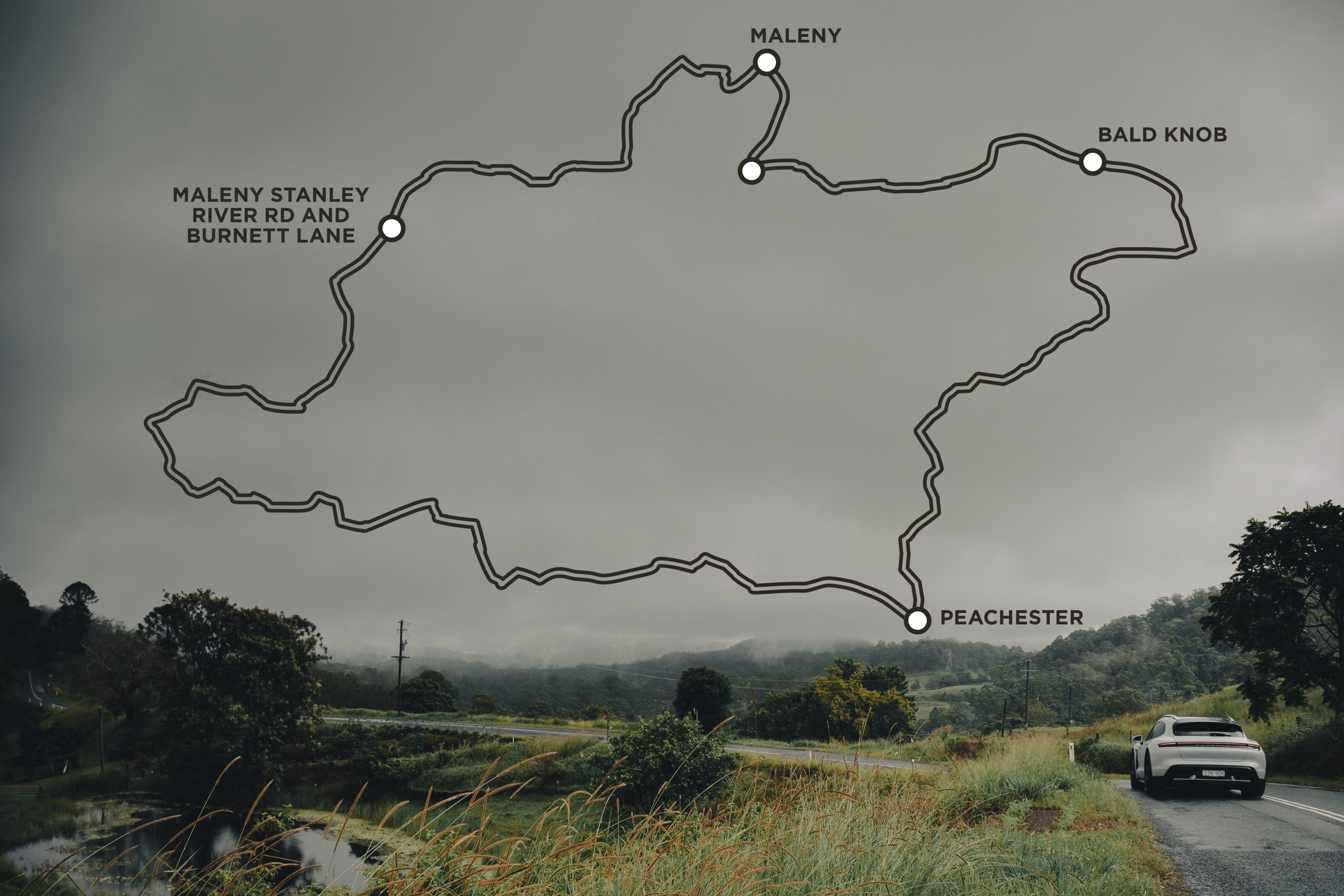
There are great venues in the surrounds of the Sunshine Coast TT route.
Shotgun Espresso has the best coffee in Maleny, along with a selection of fine food.
It’d take more than the 45 minute driving time of the route to explore Maleny’s main drag, so you can bring along partners and leave them in town.
The final stretch of the TT course heads along Mountain View Road. Make sure to stop off at the Mary Cairncross Scenic Reserve for a spectacular view of the nearby Glasshouse Mountains.
2022 Porsche Taycan Turbo Cross Turismo specs
The 2023 BMW M2 performance coupe has been teased in Mexico gearing up for production.
Set for reveal before the end of 2022, production of the next-generation M2 will shift from Germany to join the 2 Series and 3 Series at BMW’s plant in San Luis Potosí, Mexico.
The facility started operations in 2019, initially building North American versions of the 3 Series sedan, before expanding to manufacture the new-generation 2 Series for the global market in 2021.
UPDATE, June 2022: BMW M2 prototype review
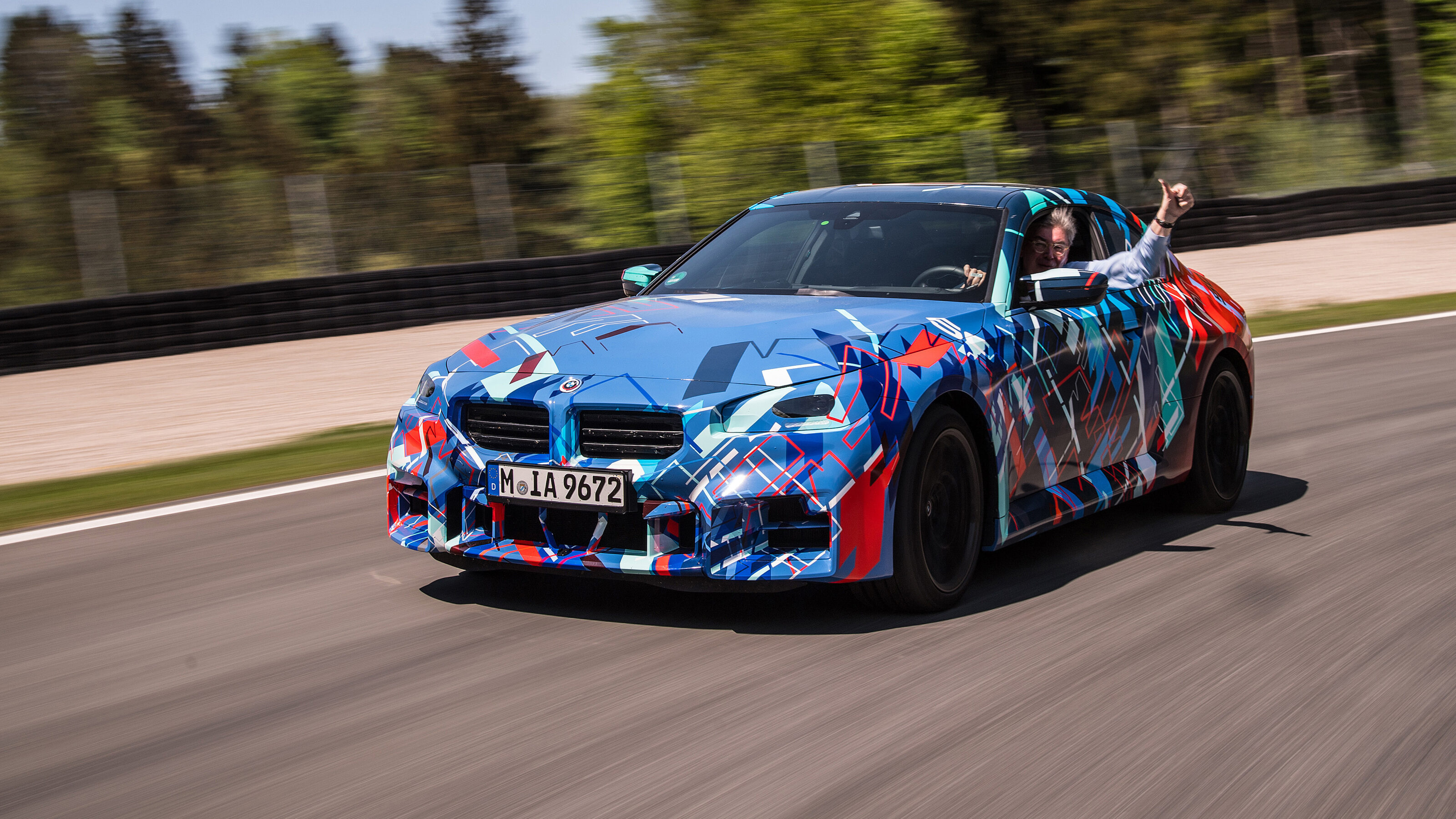
We’ve now driven the new M2 on track! It’s still camouflaged, and technically a prototype, but this is your best insight yet on what’s to come.
“Specify this new M2 with the no-extra-cost manual, and you have a fairly-priced instant classic with no waiting list. A no-brainer, really.”
Get the full story at the link below.
The story to here
A second production shift and 800 additional employees will be added by the year’s end to meet demand, with production increasing by nearly 25 per cent last year.
“We are very excited to be part of the celebration of the 50th anniversary of M, now that our Mexican plant will build M vehicles for the whole world,” said Harald Gottsche, president and CEO of the plant.
“The high capacity of human talent in San Luis Potosí is once again demonstrated and our commitment to the growth and development of the state is renewed.”
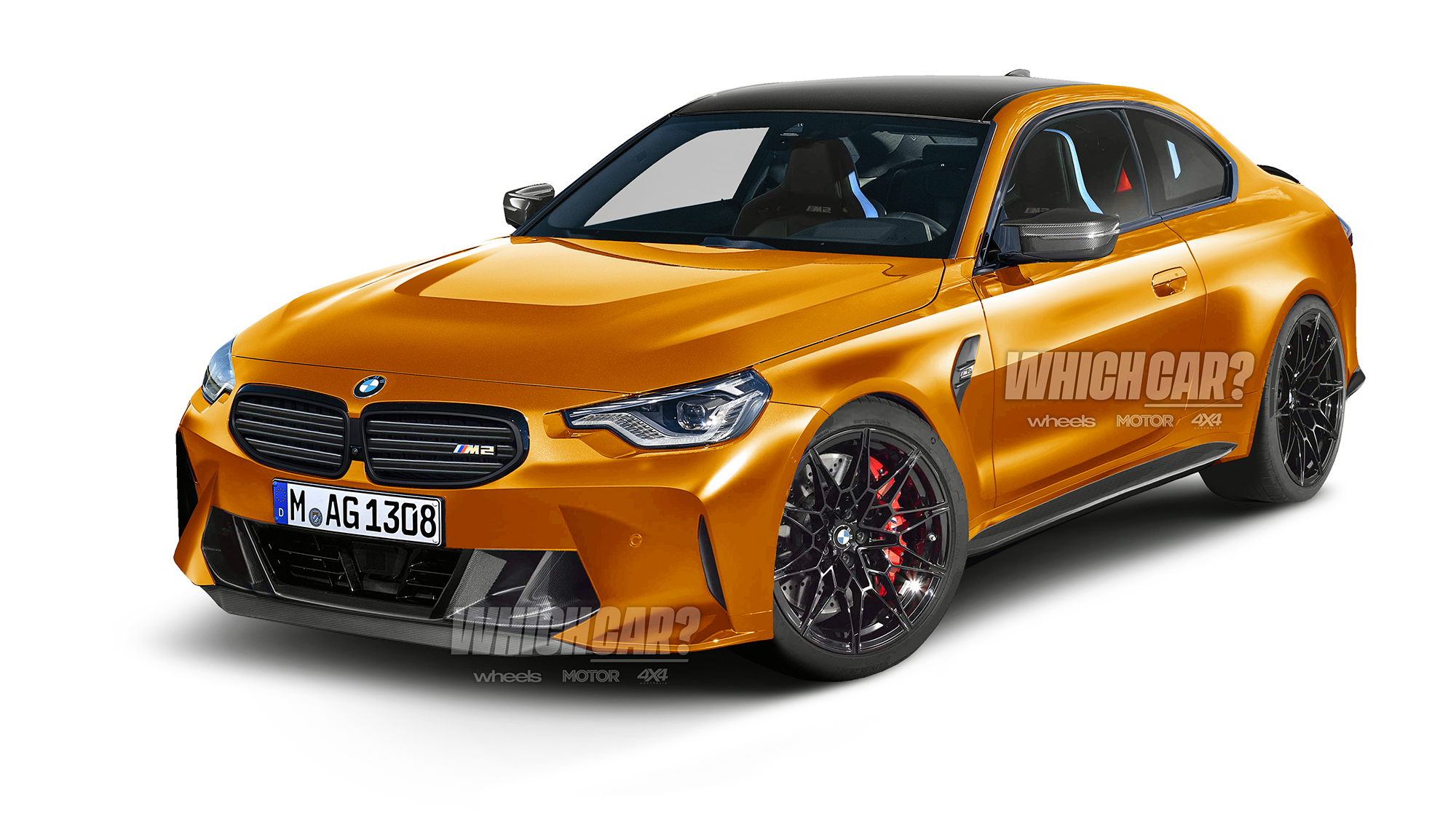
Australian deliveries of the rear-wheel-drive M2 are likely to commence in 2023.
It is expected to feature a detuned version of BMW M’s latest 3.0-litre ‘S58’ twin-turbocharged inline-six, sourced from the M3 and M4.
The model differentiates from the regular, second-generation 2 Series with aggressive front and rear bumpers, flared wheel arches and quad tailpipes.
More angular front styling inspired by the Z4 and M8 will also feature, with little influence from the controversially big-grilled M3 and M4.
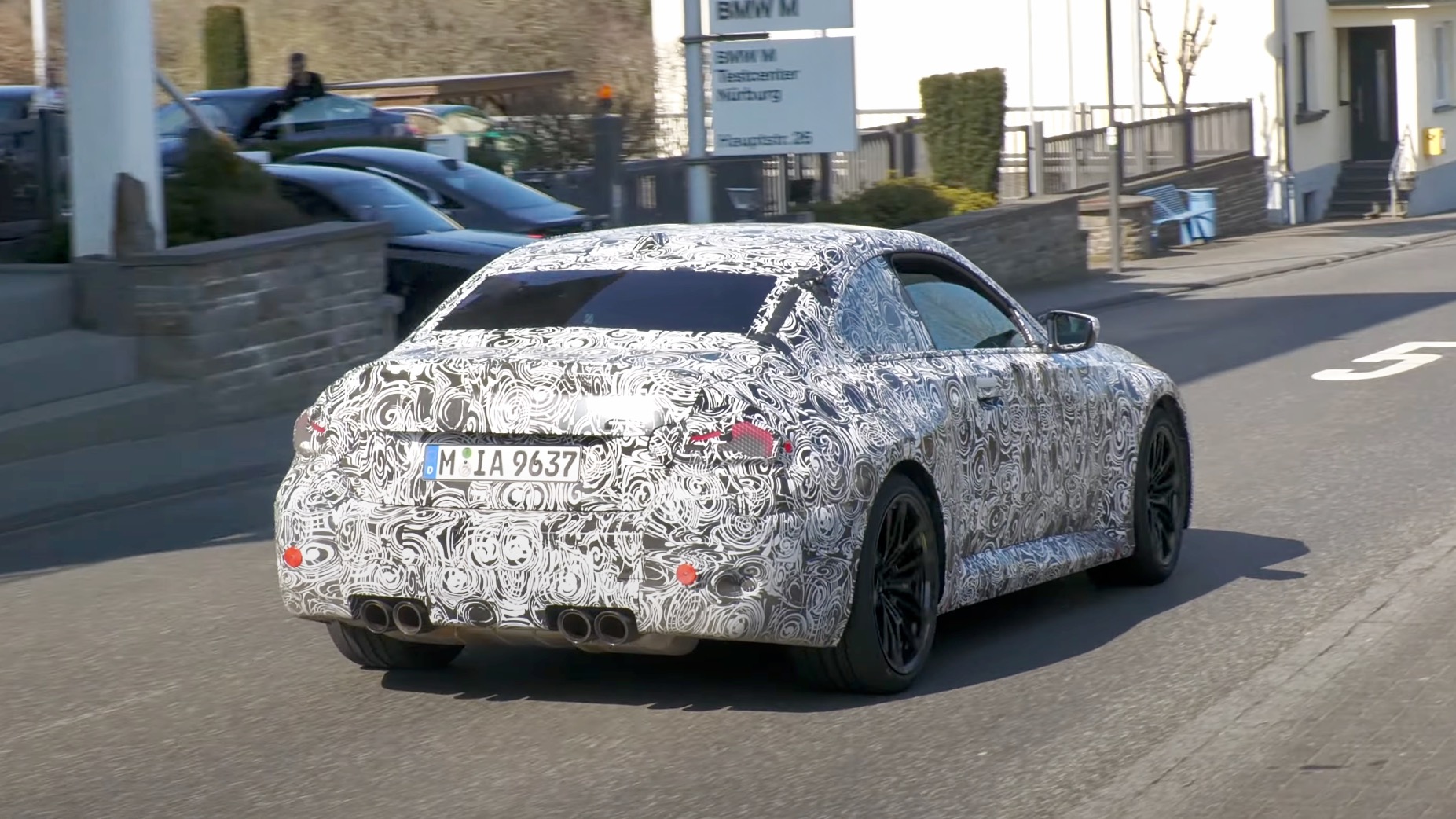
As reported by Wheels in September, the updated engine is expected to produce at least 317kW of power and 560Nm of torque in standard form, beating the 310kW/500Nm turbocharged four-cylinder found in the Mercedes-AMG A 45 S.
This is an increase of 15kW over the similarly configured S55 engine underneath the outgoing M2 Competition, allowing for similar off-the-line performance in spite of the added heft of the new-generation model.
With the 2 Series and M2 based around the brand’s latest Cluster Architecture – also underpinning the 3 Series, Z4 and Toyota GR Supra among others – the mechanical layout remains identical to its predecessor, but adds the ability for BMW to add 48-volt electrification in the future.
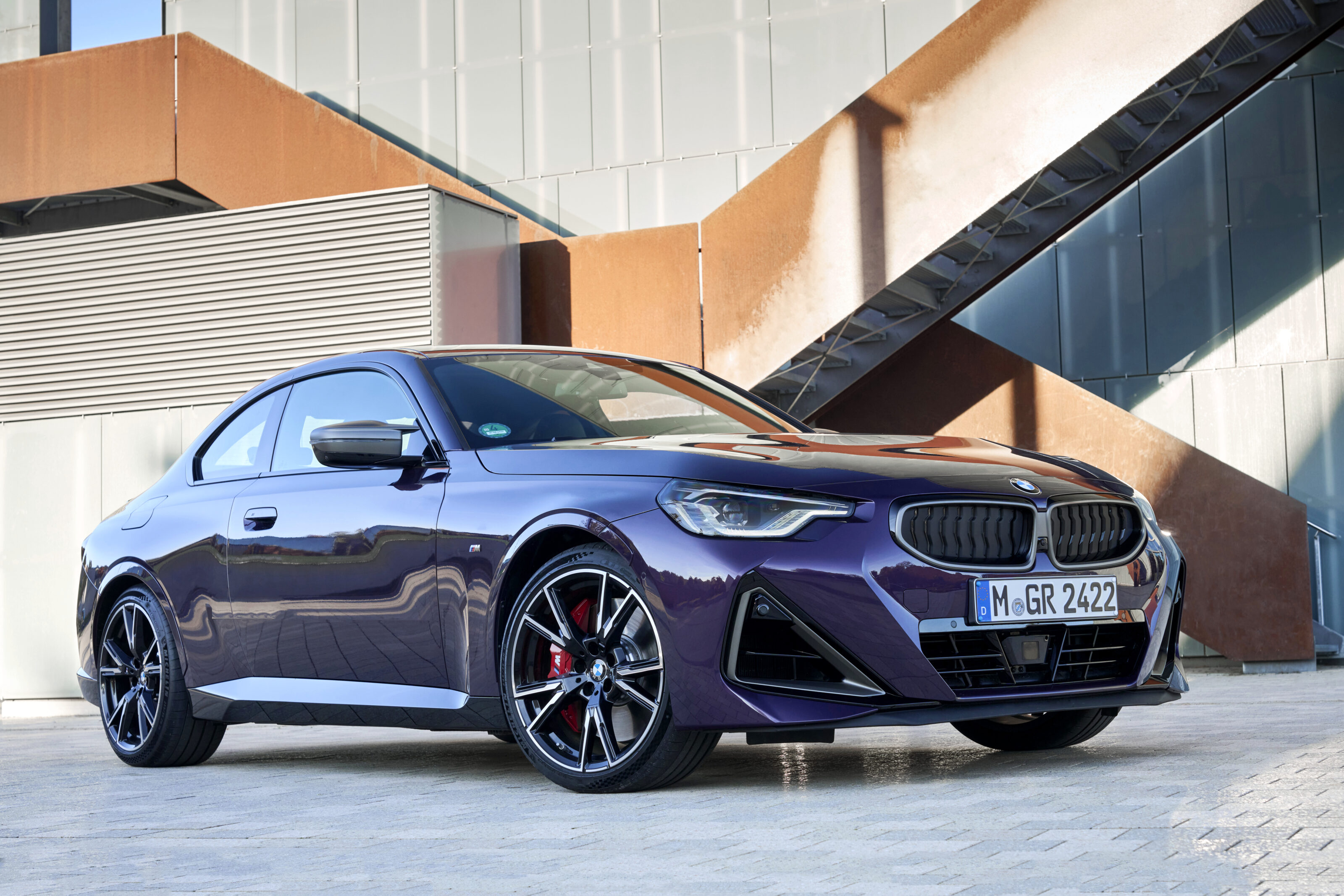
The addition of a mild-hybrid system would assist with acceleration and efficiency, however, the M2 is tipped to initially launch without any electric assistance.
An eight-speed torque-converter automatic transmission, replacing the previous seven-speed dual-clutch gearbox, will be joined by a six-speed manual.
The 2023 BMW M2 is expected to debut in the coming months, ahead of its Australian launch in 2023.
Welcome: Gallic Bred
Price as tested: $57,490 This month: 551km @ 9.6L/100km Total: 551km @ 9.6L/100km

Regular readers may have noticed a pattern starting to develop among the Wheels long-term fleet. Recently, nearly everything has hailed from South Korea or been an SUV; more often than not, it’s been both. The arrival of Felipe’s angular Lexus UX last issue provided some welcome diversity, but this month I’m here to shake things up even further. Enter the Peugeot 508 GT Fastback; a car that’s about as far removed from ‘mainstream’ and ‘conventional’ as you can get.
One glance is all you need to know that this car is proudly individual. It really is striking to behold, especially when bright sun hits this shade of Celebes Blue paint (a no-cost option), and the 508 isn’t only a refreshing respite from the swathes of SUVs on our roads, but it looks nothing like any of its more conservative rivals (think Skoda Octavia, Volkswagen Passat, etc).
People stare, most smile, and nearly everything about driving the 508 feels an event. The doors are frameless, the cabin is even more spectacular than the exterior, and despite the almost heavy-handed attempt for everything to seem modern and edgy, the traditional French traits of comfort and suppleness are there, just below the surface.

As first impressions go, then, the Pug has impressed, but first impressions aren’t the currency of long-term tests. What we’re interested in here are second, third and fourth impressions. So let’s dig a little deeper because a few of my opinions are already beginning to shift after only a few weeks.
The most obvious mental swing concerns the driving position. Like almost all modern Peugeots, the 508 employs the French brand’s iCockpit twin-screen layout which requires you to drop the steering wheel in your lap to ensure a clear view of the clocks.
My natural preference is to have the wheel as high as possible, so that in itself required some adjustment, but compounding the strangeness is just how small the wheel itself is. The diameter feels puny and it seemed odd to be steering a big car with such a small and low tiller. But as the days rolled past, I began to warm to the alien ergonomics. The steering is light and the rate of response is quick and natural, so you soon adjust to sweeping through round-a-bouts with a roll of the wrists. And the seating position is fantastic.
You can get nice and low and the chairs are soft, generously padded and include a massage function.

I’m slowly learning the idiosyncrasies of the cabin, too. Apple CarPlay works seamlessly and I love the finger-like hotkeys below the main screen for important functions, although there are a few oddities: the heated seats, for example, stay in the same setting as you left them between trips, yet the auto wipers need to be activated every time it starts to rain. And the carbonfibre inserts are hard on the doorcards but are soft touch on the dash. You won’t start or stop the 508 by mistake either. Unlike most push-button starts which respond instantly, the 508’s button requires an extended hold for a few seconds.
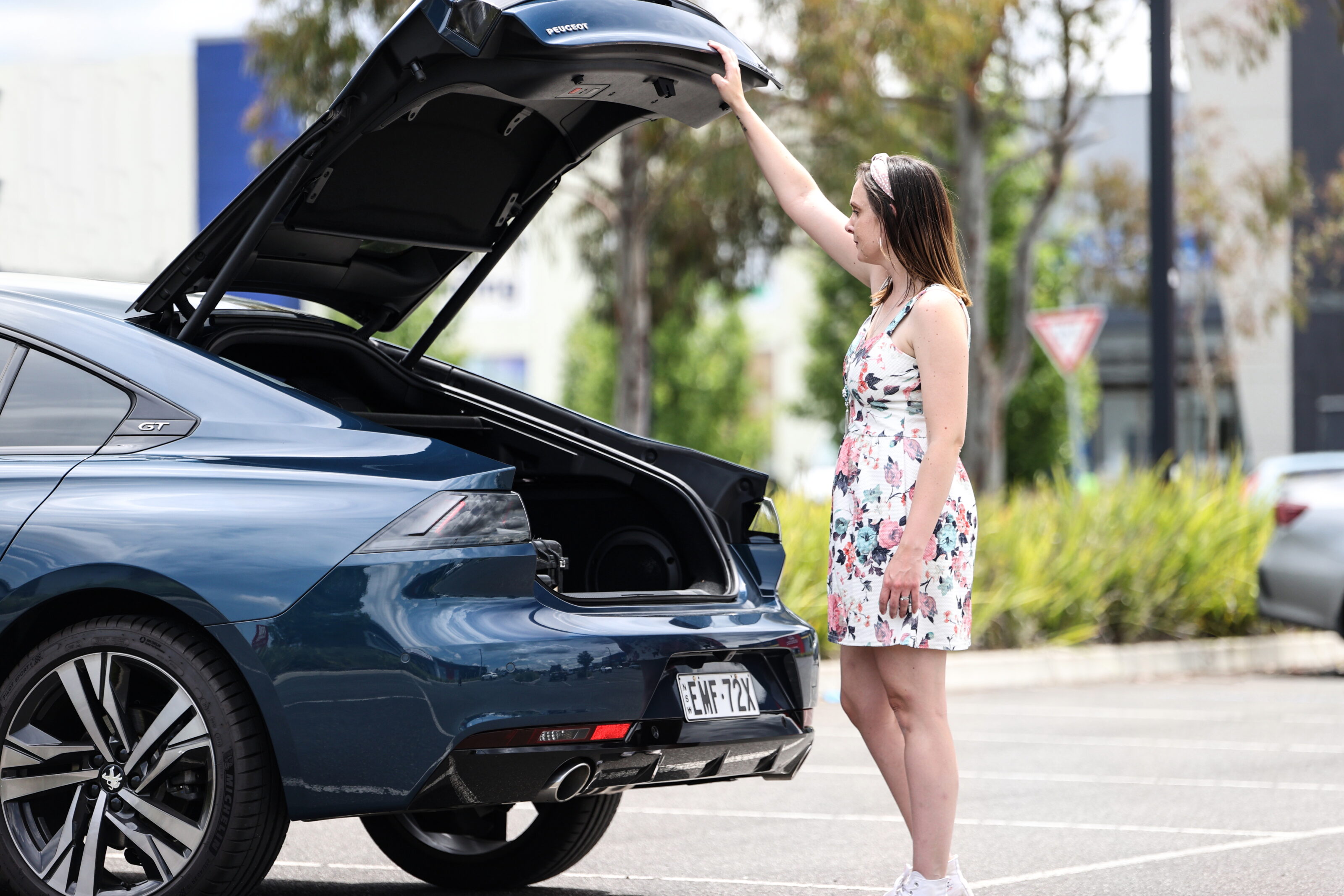
Still, it’s a richly finished and well-equipped cabin, if perhaps not quite as large as I first thought. This is where we get to the second opinion shift. At first blush, the low and wide 508 plays the optical illusion of looking quite large. The cabin, too, feels spacious from the front pews and the boot (accessed via the auto liftback tailgate) seems generous to the eye at 487L. Slip into the back seat, however, and that sense of space evaporates.
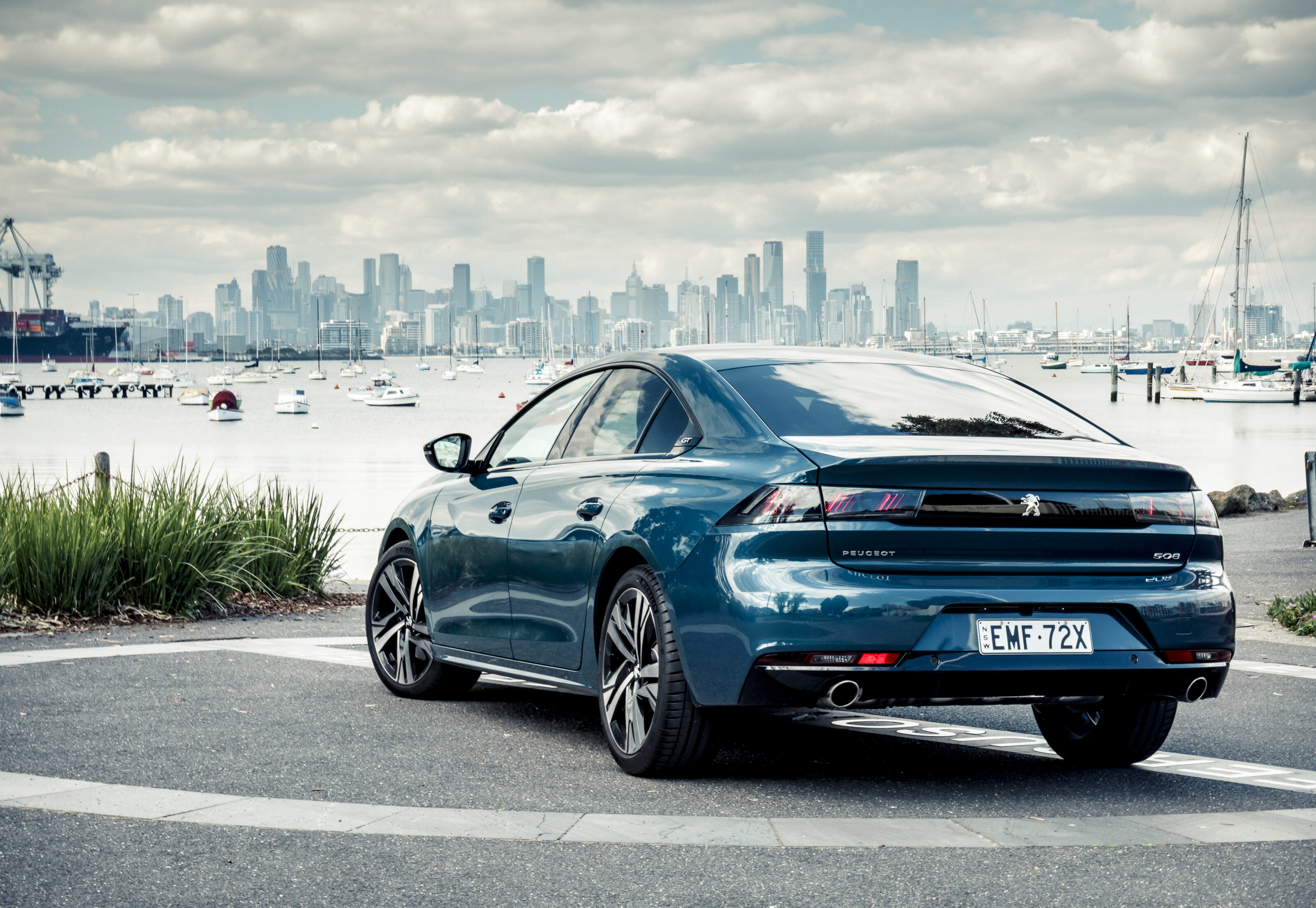
This generation of 508, which moved onto Peugeot’s excellent EMP2 platform, is actually 80mm shorter than the old version. And while that sweeping roofline does wonders for its silhouette, the same can’t be said for rear headroom. Things are snug back there for anyone over 6ft and while knee room is adequate, it’s not on the same level as those aforementioned rivals. And the boot fills up worryingly quickly. Plonk a pram back there and there’s scant room for anything else.
So it’s a beguiling thing, the Peugeot 508. Some cars are open books that lay bare all of their qualities within minutes of driving them, but others reveal their strengths and weaknesses more slowly. This 508 is certainly the latter, but if first impressions of the perky 1.6-litre turbo petrol, fluid dynamics and lithe chassis are any gauge, there’s still plenty of goodness to look forward to.
Part 2: Precious cargo
This month: 696km @ 7.9L/100km Total: 5485km @ 8.8L/100km
They say “you never forget your first…” Never, I think to myself as I glance at the freshly fitted baby seat and the Pug’s open rear door, has a cliché been so wrong. My newborn, who is waiting patiently to embark on her first ever car ride, won’t remember this journey at all. But I will. In fact, I’ve been preparing for weeks. And so has the Peugeot.
Fitting the baby seat was our first task. Now I’d heard all of the horror stories. Friends frequently complain of skinned knuckles, twisted belts and fiddly buckles but I encountered none of these with the 508. Once I’d located and exposed the deep-set ISOFIX anchorage points, it was a simple process of clicking in the clips and tightening the top tether. Job done.
The issue was things felt a little… squishy. With the child seat set in its rear-facing newborn position, we had to move the power-sliding front passenger seat forward which means the knees of anyone approaching six-foot now brush the dash. It’s fine for short journeys but after a few hours I reckon I’d start to feel a little uncomfortable.

It’s snug in the rear seat, too. This is where my wife sits to keep an eye on the kiddo and her primary complaint is a lack of toe and knee room, which makes it tricky to cross and un-cross her legs. And that sharply raked roofline, which looks so striking, means the aperture for placing the baby in and out of the child seat is worryingly narrow. Accidentally bumping a head feels a real possibility.
So there’s room for improvement but, like the front, the rear cushion is supple and comfortable and back passengers do score plenty in the way of amenities. Rear air vents, a folding central armrest with two cup holders and two USB ports are all present and accounted for.
And the 508 has impressed elsewhere this month. The steering, which is quick and light around town, is a pleasant and fluid surprise at speed. And the ride, which can feel a little sudden over sharp bumps, also improves with some pace under the tyres. I’m yet to properly explore any drive mode beyond Normal and Comfort but the 1.6-litre turbo four is also an eager companion that delivers punchy performance that feels greater than its on-paper outputs of 165kW/300Nm suggest.
The only blemish is the occasional intrusion of some driveline shunt. Picking the throttle back up after rolling into an intersection or after a speed bump can give a small delay and an abrupt jolt as drive is taken back up. Hardly a deal breaker but not ideal when you’re trying to make smooth progress on your newborn’s first car ride, whether she remembers it or not…

Part 3: Changing hands
Author: Kathryn Fisk
This month: 298km @ 9.1L/100km Total: 5845km @ 8.9L/100km
It may not have found its forever home just yet, but the Pug has at least for now got new digs – leaving the custody of former editor Alex Inwood and coming to stay with moi for a while.
It ticked off ‘bring home newborn baby’ from its task list with Inwood and has now moved on to the next challenge – accommodating a three-strong family with a toddler in the midst of his terrible twos. Luckily for me, he’s not so terrible after all and he’s a sucker for a new car.
On first sight, the Peugeot is impressive to behold and looks classy inside and out, thanks to its sloping roof, chrome accents and Nappa leather trim. It would be perfectly at home on the driveway of a business exec keen on standing out from the crowd.
Alas though, the 508’s je ne sais quoi has not curried favour with the youngest member of the pack, who is big on anything with a sunroof at the minute. I, too, have to agree that while it turns heads driving around town, it isn’t particularly practical for a young family.
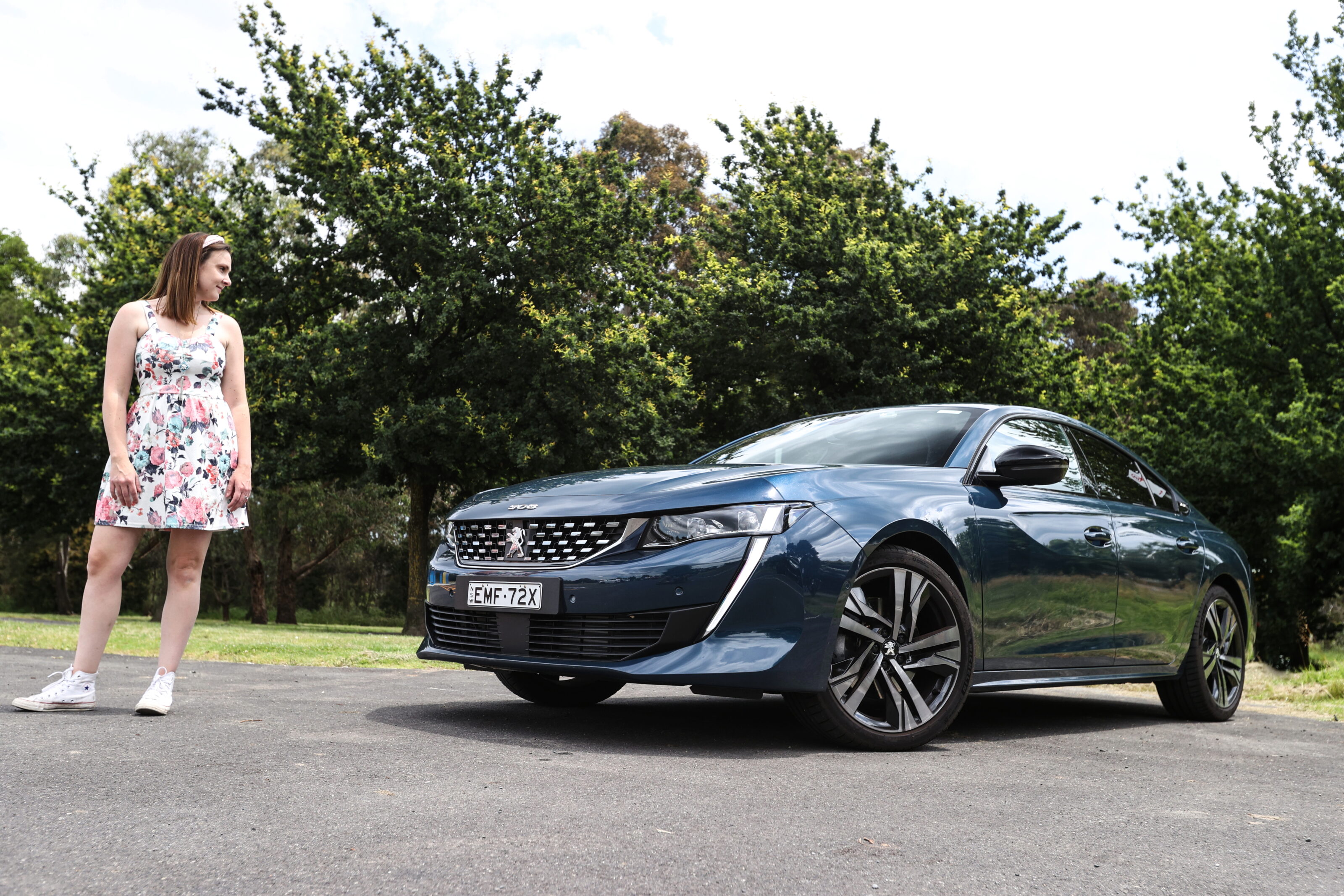
While boot space is sufficient to carry out day-to-day tasks, disappointingly, space in the cabin is at a premium for what, at first glance, appears a large car. In addition to Alex’s wife’s encounter in the second row, I’ve also found the space around the driver to be on the tighter side of things, with simple actions such as reaching to operate the rear window switches uncomfortable, especially on my elbow.
I have to agree that getting children in and out can be tricky, and bending over multiple times due to its low-slung body style might get old quickly.
In fairness, however, the powered tailgate is very much appreciated when you’ve got your hands full – figuratively and literally – and dark privacy glass on the rear windows comes in handy for sunny days too, protecting young ones’ skin from those damaging UV rays and mitigating the need to panic when they’ve fallen asleep on a journey with no hat or sunscreen on.
This month we’ve also had time to get to know the infotainment system and controls a bit better, but what initially appears to be a sleek and sophisticated set-up has some functionality short-falls.
The system, operated through the 10-inch centrally-mounted touchscreen, is a faff to use – there’s no central menu, you can’t listen to the radio if your phone is plugged in (because it defaults to your music app) without using the voice command function, and there’s relatively limited choice in what you can ask it to do. Even at maximum brightness the display is dull.
Furthermore, by switching between profiles you can easily end up with everything in French – meaning you’ll need to desperately rack your brain for anything useful from those long-gone high-school lessons to help you get back on the straight and narrow.
If desirability and emotiveness were key Car of the Year criterions, the Porsche Taycan Cross Turismo would have featured much later in the pages of this issue. The entire judging team was beguiled by the electric Porsche; by the way that it looked and by the way that it drove.
Yet when the votes to select finalists were tallied, there were none for this widely admired car. So, what happened?
Starting with background, this was the Taycan’s first appearance in COTY. The sedan’s launch timing meant it missed last year’s event, leaving the newer Cross Turismo variant as a natural choice for 2022.
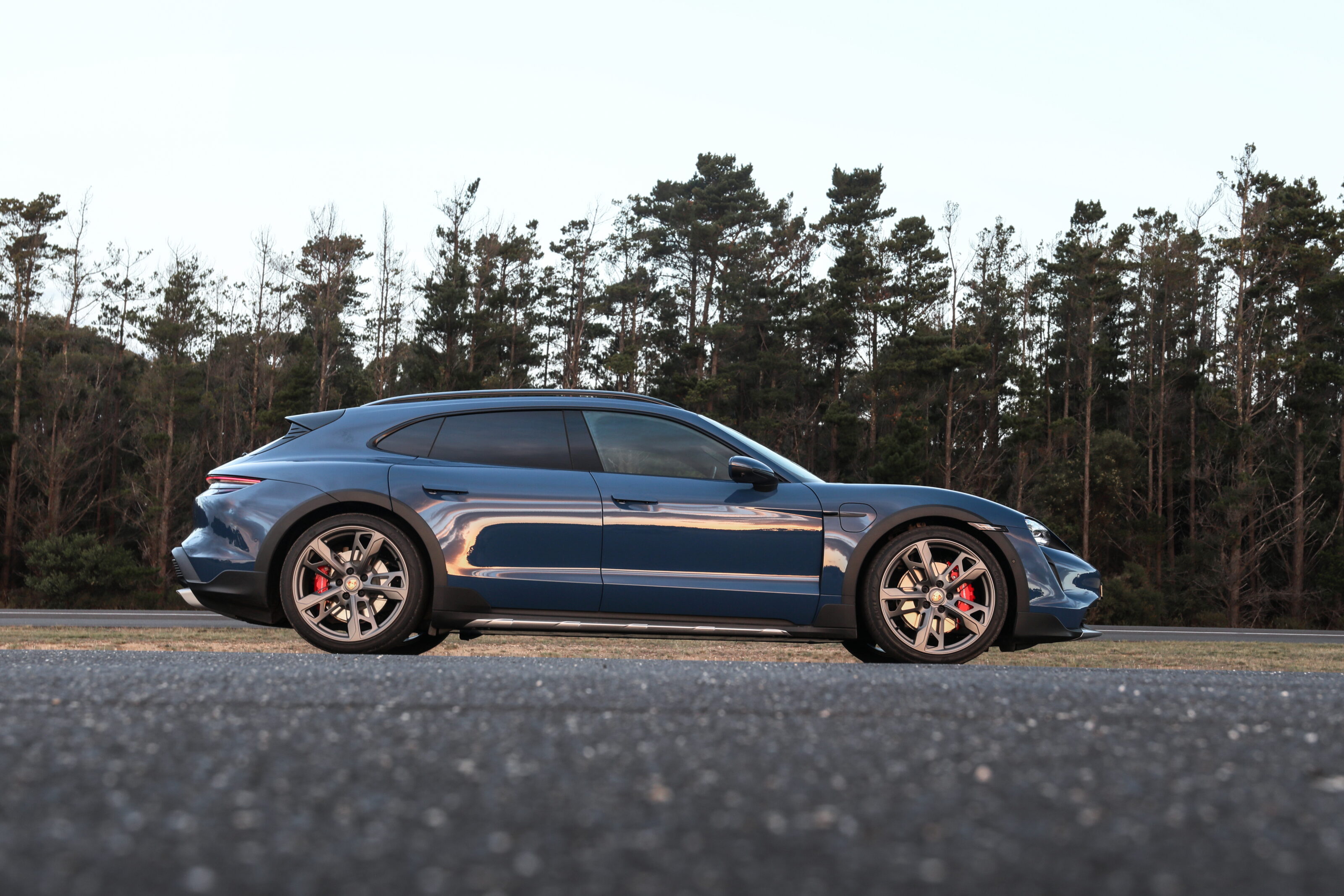
The wagon-style Cross Turismo is only fractionally longer than the regular Taycan, but a silhouette altered significantly at the rear brings a higher roofline, liberating more rear headroom and luggage space. Off-roader design cues are accompanied by an extra 20mm of ground clearance. (Or another 10mm if you opt for the Off-road Package.)
Unlike the sedan, every single Cross Turismo variant is all-wheel drive; we picked the mid-range 4S as the sweet-spot for a $205,300 price that’s relatively close to the $176,600 opening cost but much lower than the Turbo’s $271,200 ask.
With a plethora of options added, our test car was valued closer to $250,000. Still, this is a helluva lot of Porsche you’re getting when you consider a 911 starts from $241,000.
Putting aside the Cross Turismo’s alluring aesthetics, the big question for an electric Porsche is whether it can stay true to the brand. The answer from the judges was emphatic. “Looks like a Porsche, feels like a Porsche, goes like a Porsche,” said Dylan.
“Captures the essence of Porsche DNA in a more convenient, practical package” – Richard Ferlazzo
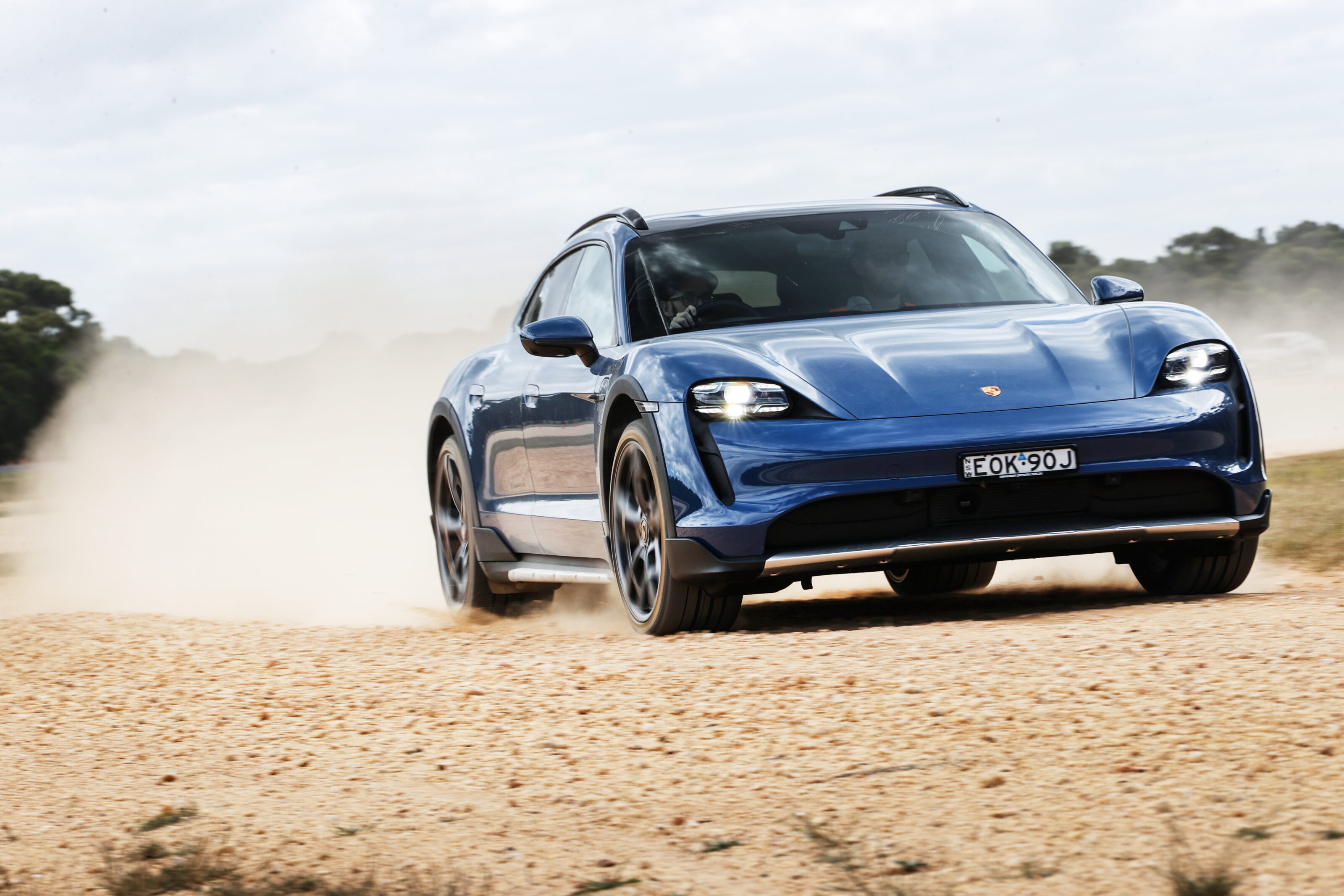
The Taycan was utterly dismissive of every challenge presented at the proving ground, including the dirt section that was a particularly relevant test for the Cross Turismo’s implied promise.
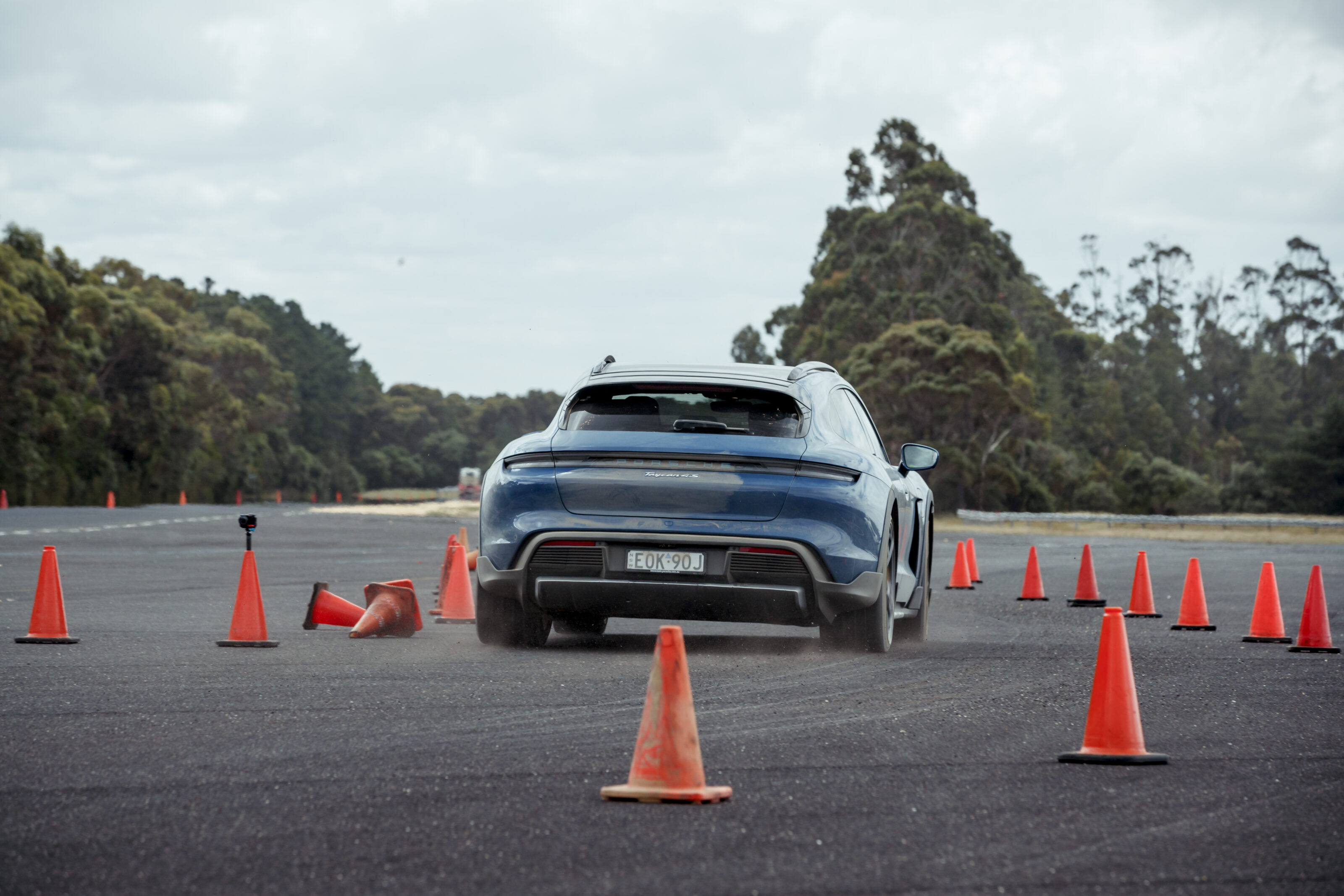
Its ESC calibration proved to be decisive yet unobtrusive, NVH remained impressive, and it pulled up quicker than most on the 80-0km/h dirt-brake exercise.
So effortless was its progress through the swerve-avoid lane-change that many contemplated a repeat attempt about 50 percent faster again.
The two-speed gearbox on the rear axle – distinctive in the EV world – was much loved, while ability on the Five Percent Gradient section steered the conversation back towards classic Porsche territory. “Sheer performance and dynamic alacrity are in the Dear Lordy realms,” said Curt.
Yet the Taycan Cross Turismo doesn’t quite warp the rules of physics: “The Cross Turismo conceals its weight well, but it does make a Panamera feel like a Lotus,” noted Dylan. Brake pedal response was criticised by some, too.
If a stunning interior is a prerequisite for any car sitting in post-$200K territory, the Taycan delivers. Beyond the overarching sporty attractiveness of the cabin, there’s faultless seating up front and gorgeous details such as the curved driver display.
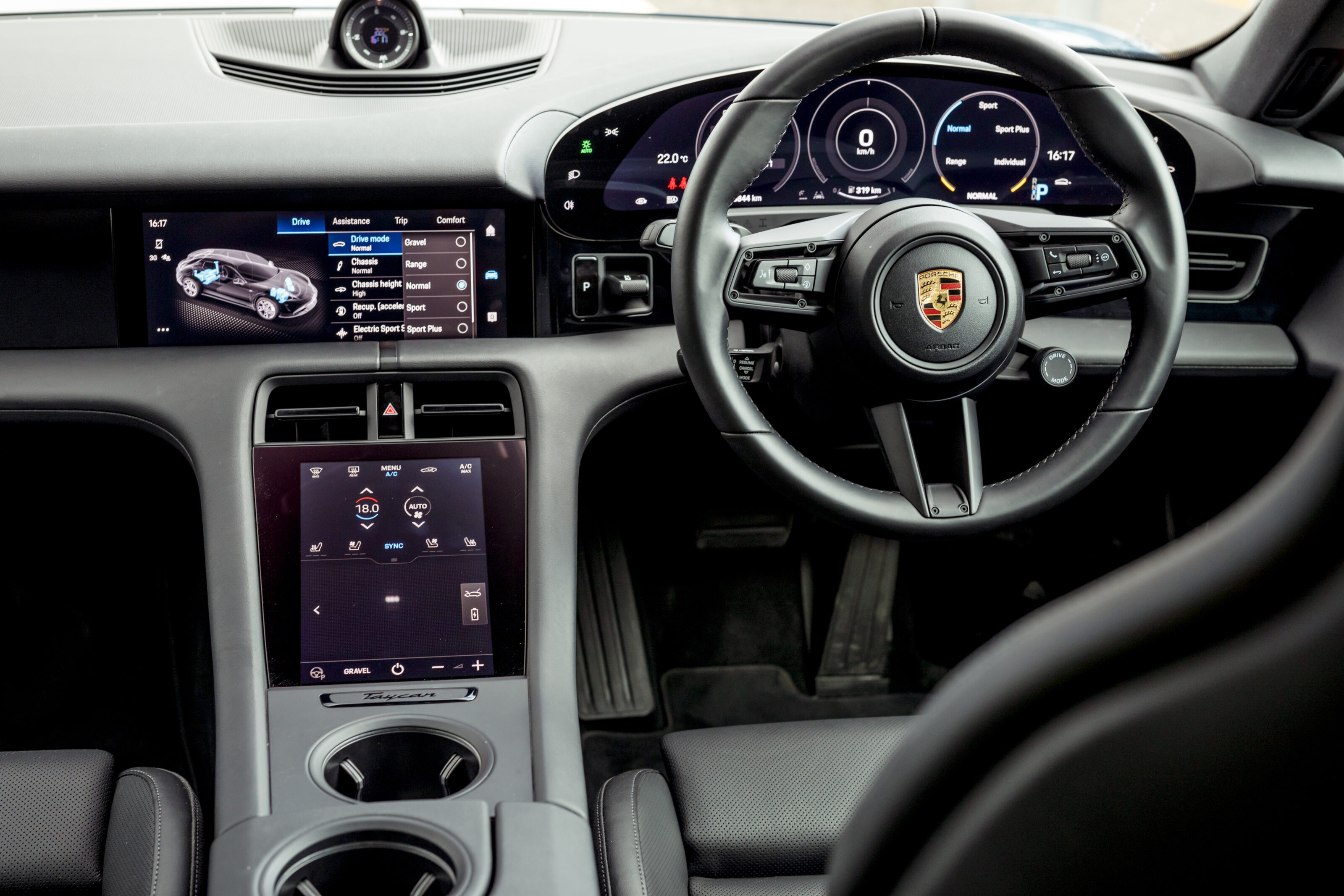
Rear headroom improves noticeably over the Taycan sedan and boot space increases by nearly 40 litres, though the rear seat still feels compromised – particularly for toe space – and the luggage area remains narrow.
Then there are factors such as a 436km range (a Tesla Model S Plaid claims 637km), and a maximum charging speed that’s outperformed by the Hyundai Ioniq 5 and Kia EV6 pair.
If it wasn’t a complete shock, then, that the Taycan Cross Turismo didn’t progress beyond the proving-ground stage, disappointment was clearly etched on the judges’ faces when they realised, collectively, that they would be driving this Porsche no longer that week.
You may be wondering, how relevant is an indulgent $300K luxury sedan to COTY in 2022? Well, this award is all about recognising automotive excellence and it’s fair to say that Mercedes-Benz’s flagship has always been synonymous with that ethos. Cars like this are ostensibly Research and Development test beds, and eventually we are all beneficiaries from the expensive exploration process, as the technology filters down to mainstream cars.
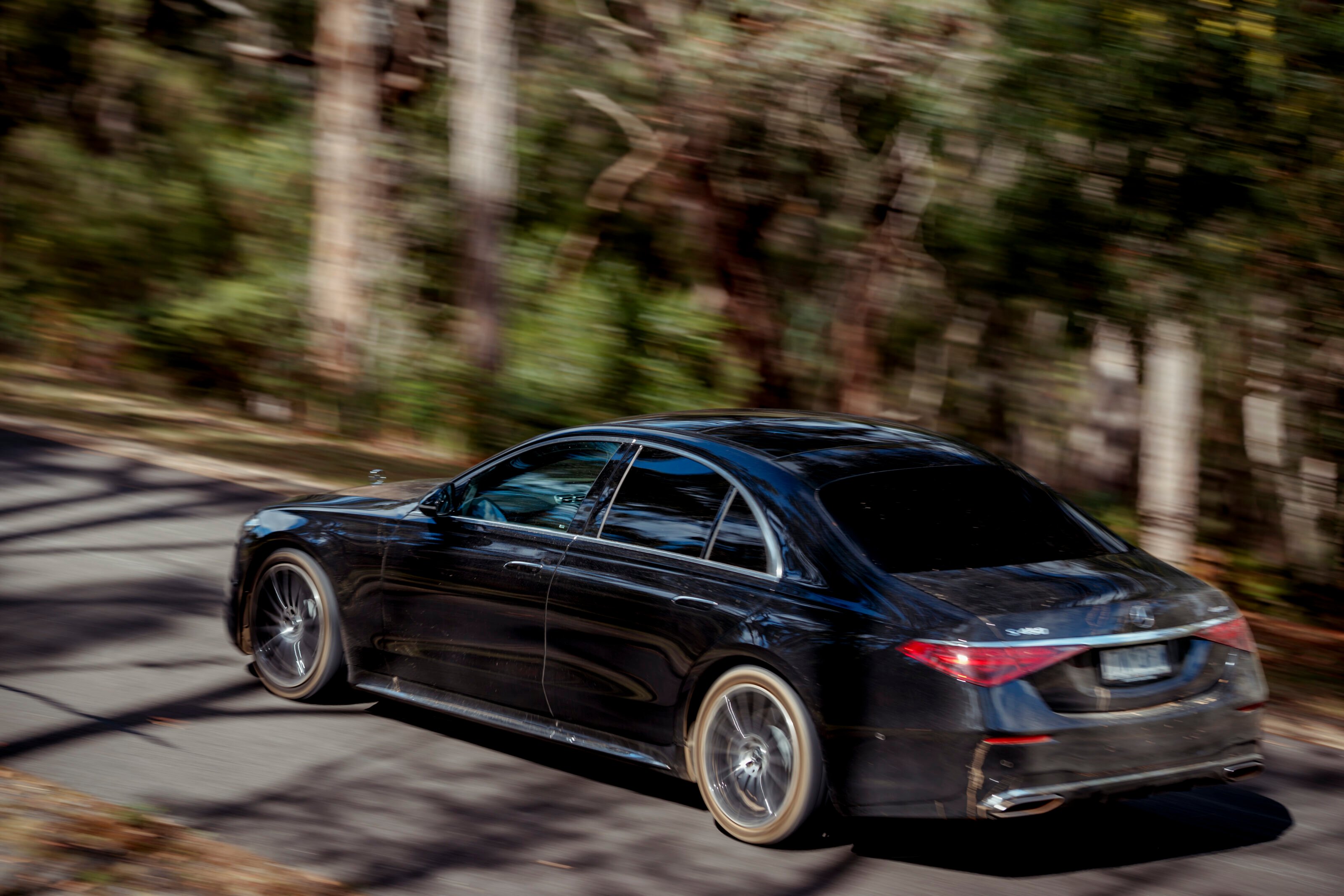
As expected, the S-Class presents beautifully, both inside and out. Slightly larger in every dimension than its predecessor, it certainly has road presence. But in today’s landscape of oversized SUVs, it doesn’t stand out as ostentatious. Indeed, since we also had the chic C-Class in the mix, the recurring observation from the judges was the obvious Russian-doll similarity.
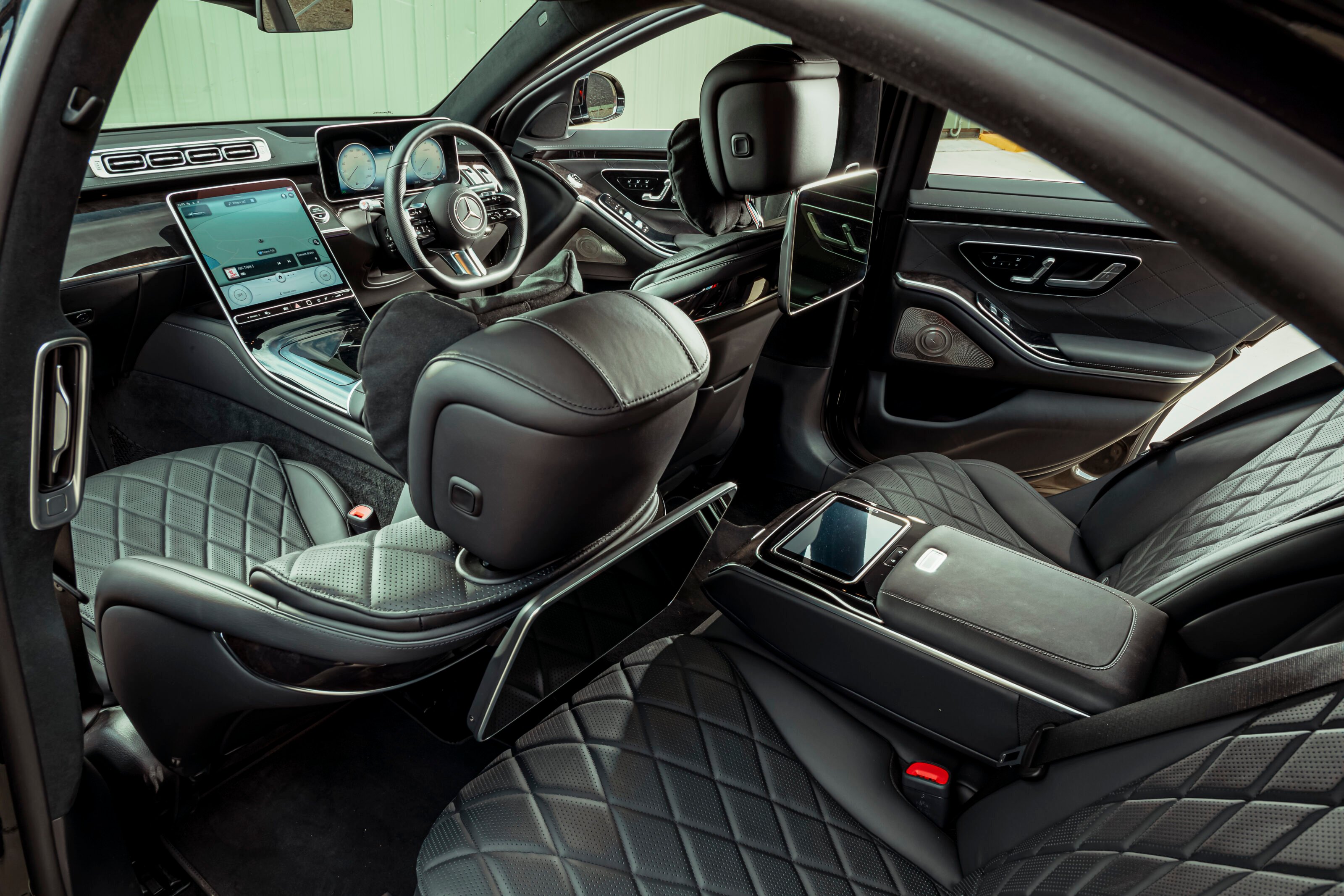
There is a quiet confidence surrounding this luxo-cruiser. The cabin design is both opulent in ambience yet restrained in concept. The digital interface is achieved via two separate screens; the driver’s instrumentation screen and a large centre screen which elegantly sweeps up from the centre console.
The overall theme may not be the vanguard for interior design but the finish is exquisite and the comfort level is sumptuous. Curiously, the precision trimming of the seats is contrasted with the addition of saggy, headrest pillows; “COTY’s softest headrest award,” said Alex.
Not all the judges were happy with the cabin feel, however, as Jez noted that the giant screen “robbed the cabin of opportunities for more jewel-like controls”.
Currently, the only engine option is the mild-hybrid, 3.0-litre, turbo-petrol straight-six. With 270kW and 500Nm, it propels the two-tonne ship to 100km/h in an as-tested 5.6sec. As Curt captured, “So silky, so refined, so fittingly S-Class.”
“So comfortable … just a beautiful car to drive” – Dylan Campbell
Most of the judges felt satisfied with the performance, with only Dan left wanting for a bit more oomph for this level of luxury.
At normal traffic pace, the ride is magic-carpet like and its manners belie its hefty proportions. The optional rear-steering system probably has a lot to do with the reassuring feel, as Dan noted: “Not only is it dynamically superior to the previous S-Class, its turning circle drops from 12.5m to 10.7m.”
Nonetheless, the limo persona didn’t deter the judges from putting the car through its paces, and Dan even managed to invoke the “Pre-Safe ‘pink noise’ feature”, which cleverly introduces a synthetic noise of about 80 decibels to prepare your ear drums from a potentially noisy collision. True story!
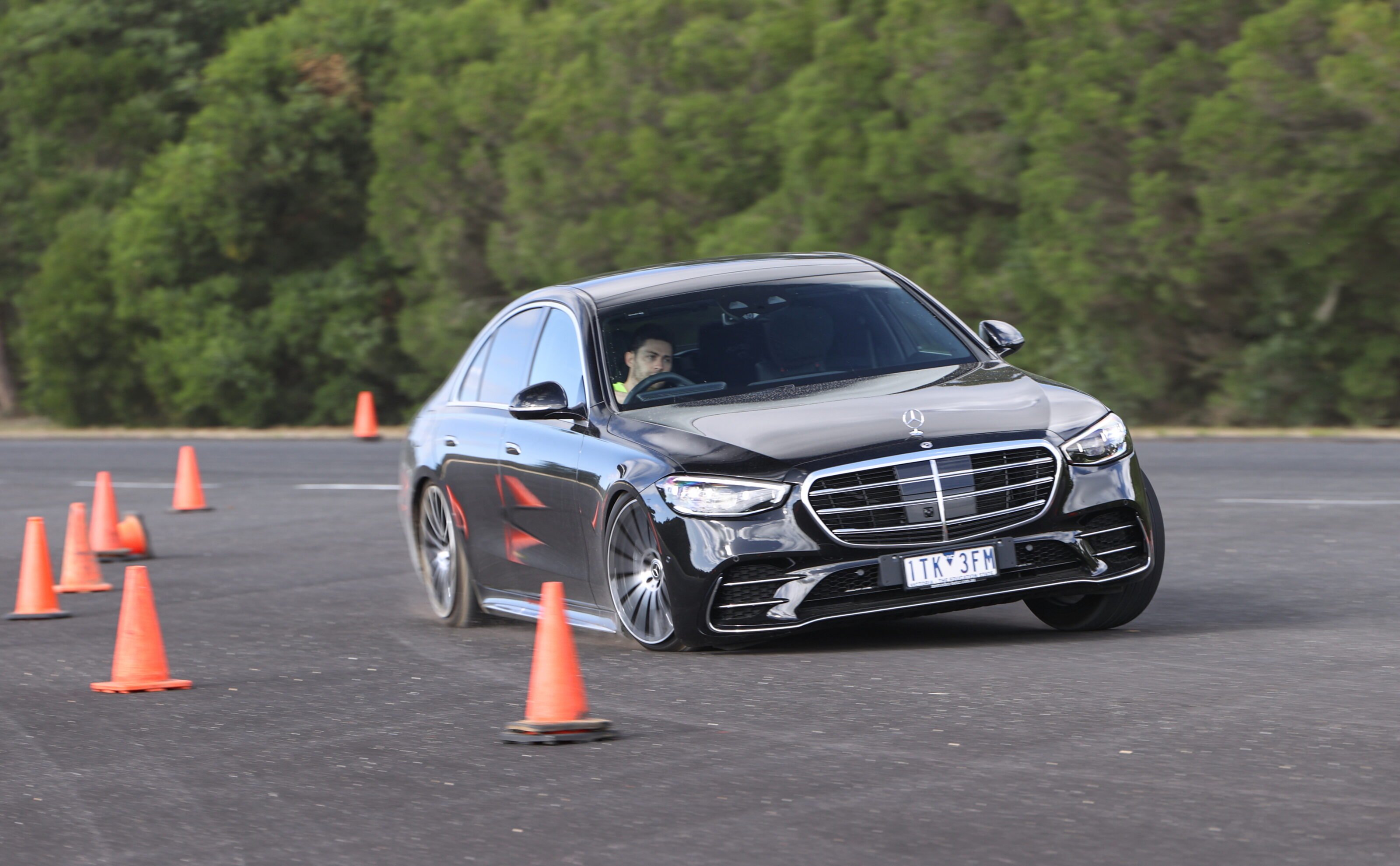
The S-Class remains the benchmark for an ICE executive express; smooth, quiet and sumptuous. Loaded with technology, more than adequate performance and a cosseted ride.
But despite the glorious characteristics of its petrol engine, when compared back-to-back with EVs at a fraction of the cost, it actually felt a bit old-fashioned. Surely, we must be reaching the top of the bell curve for development of the combustion engine, notwithstanding the potential of hydrogen.
There is much to admire about the big Merc, but the commendable achievements are not in the tech space that resonates most in today’s automotive landscape. Unavoidably, the EQ range is quickly assuming the tech mantle.
Snapshot
- Lamborghini Huracu00e1n production started in 2014
- Over 70 per cent of customers have opted for the coupe variant
- The United States has been the model’s most successful market
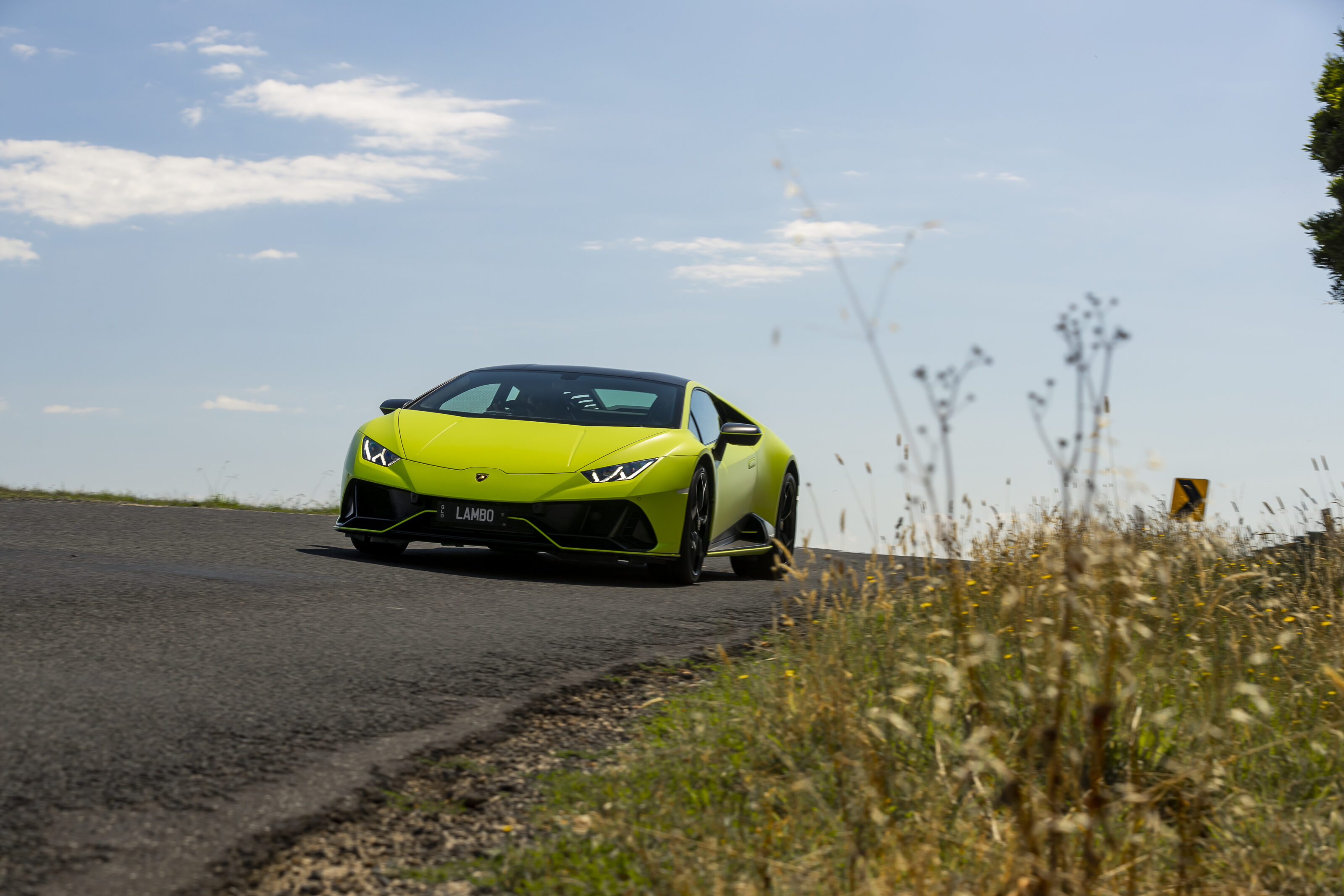
Lamborghini is rolling out the bunting for its Huracán, with the 20,000th example of the V10-powered supercar leaving the production line this week.
The Huracán was first launched in 2014 as Lamborghini’s successor to the Gallardo, retaining its 5.2-litre V10 engine but with the added benefit of more power and torque as well as a seven-speed dual-clutch gearbox.
From its first iteration as the LP 610-4 (standing for 610 horsepower and four-wheel drive), the Huracán evolved and morphed with multiple variants, such as the LP 580-2, the Performante, Evo, STO and the recently-announced Tecnica, set to be one of the last Lambos without an electrified powertrain.
As one of the contender’s for this year’s MOTOR Performance Car of the Year, the Huracán Evo was an early favourite to take the top gong but had to settle for second place behind Porsche’s latest 911 GT3.

Lamborghini CEO Stephan Winkelmann believes the Huracán has been one of the company’s most important vehicles, not only for its success in showrooms but also on the race track in its Super Trofeo and GT3 guise.
“At its unveiling we said that with the Huracán, Lamborghini is writing the next chapter in its great history,” said Winkelmann.
“The Huracán has delivered an evolution of design, technological know-how, driving adventures, track records and sales records since its launch. It was designed as a car to provide super sports emotion in every environment, from daily driving to thrilling performance on track.
“Every iteration of the Huracán has stayed true to that Lamborghini philosophy, while in motorsport the Huracán is not only the protagonist of the Lamborghini one-make Super Trofeo series but has proved its dominance in GT3 series throughout the world.”

The 20,000th Huracán produced is an STO finished in Grigio Acheso Matt, set to be delivered to its owner in Monaco over the coming weeks.
A special off-roading Huracán is expected to launch later this year, with spy photos showing an all-wheel drive, lifted version of the supercar testing in the snow, likely adopting the Sterrato name.
Of the 12 road-going Huracán variants available, Lamborghini says 71 per cent have been ordered as the hard-top coupe while 29 per cent have been convertibles.
The United States has led Huracán sales with more than 32 per cent of all models ordered going to America, with the United Kingdom and China trailing close behind.
Last year, Lamborghini sold 67 Huracáns in Australia, contributing to the model’s best year of worldwide sales with 2586 units delivered.