
Snapshot
- 2019-2021 Mercedes-Benz EQC400 recalled
- The issue can cause the electric steering system to fail
- A total of 324 vehicles are included
Mercedes-Benz Australia has recalled a total of 324 examples of the 2019-2021 EQC400 4Matic due to a potential issue with the car’s electric steering system.
According to a recall notice published by the Department of Infrastructure, a manufacturing defect could cause damage to the steering system, potentially allowing moisture into the wiring harness.
The issue could lead to a short circuit, resulting in steering failure.
Mercedes-Benz will contact affected owners, but the company can be contacted directly by calling 1300 300 896 or visiting a dealership, found here.
You can check a list of all 324 VINs related to the recall by clicking here.
Imagine the unimaginable. Like reeling in by magic all that explosive forward thrust on the nose-dive approach to a triple-X bend. Cornering at g-forces that would unglue the rear-view mirror in lesser automobiles.
Shrieking smoothly, effortlessly and safely through a wide and long third-gear arc, climaxing momentarily in a hinted tailslide. Briefly exceeding an indicated 315km/h on a downhill stretch of the A8. Not lifting through a series of heart-stopping esses in the Black Forest. Questioning the on-board computer’s calculated average consumption of 28L/100km.
There’s no doubt about it: this is a silly car that has fallen out of time. But those who still live in the past are bound to love it. The 4.0-litre V8 installed in the new Cayenne Turbo GT musters 471kW and 850Nm – up 67kW and 80Nm over the Turbo – but it still does not quite match the 500kW and 850Nm of the Turbo S E-Hybrid, which is also significantly more economical and over $36,000 less expensive.
The GT is, on the other hand, sportier and lighter, 5km/h faster at the faintly academic (in Australia at least) top end and half a second quicker to 100km/h. Peanuts? Yes and no.
Outright performance is not the sole decider; the more restrained mass and momentum do make a difference on winding back roads and on Porsche’s handling track at Hockenheim. They make a difference too on the great leveller that is the Nordschleife, Porsche having claimed a production SUV record with the Turbo GT of 7m38.9sec. Somewhat staggeringly, this is on par with the pace of a 997-gen 911 Turbo.
Available only in coupe form (but it doesn’t have Coupe as part of its full name), the Turbo GT’s transition from plain Turbo involves fitting every conceivable chassis upgrade as standard, lowering the ride height by up to 17mm, applying bespoke settings and getting Pirelli to come up with a special version of the P Zero Corsa to sit on the new 22-inch wheels.
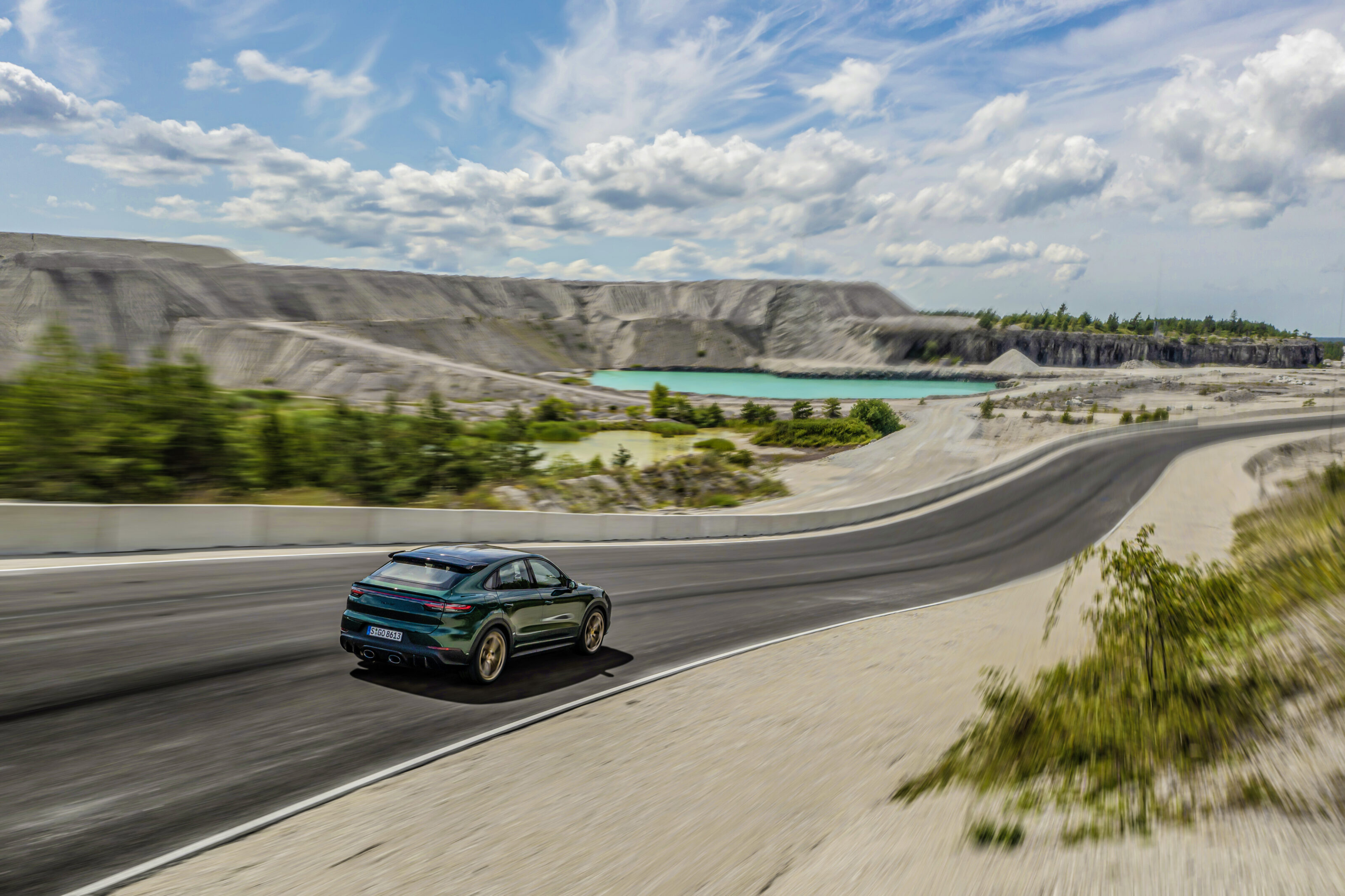
Standard kit includes rear-wheel steering and a water-cooled diff. Most of the time and on most surfaces, it’s a rear-drive SUV with on-demand AWD capability, so the front axle can usually concentrate on turning the wheels. Since torque distribution is an active dynamic element, the handling is subtly tail-focused.
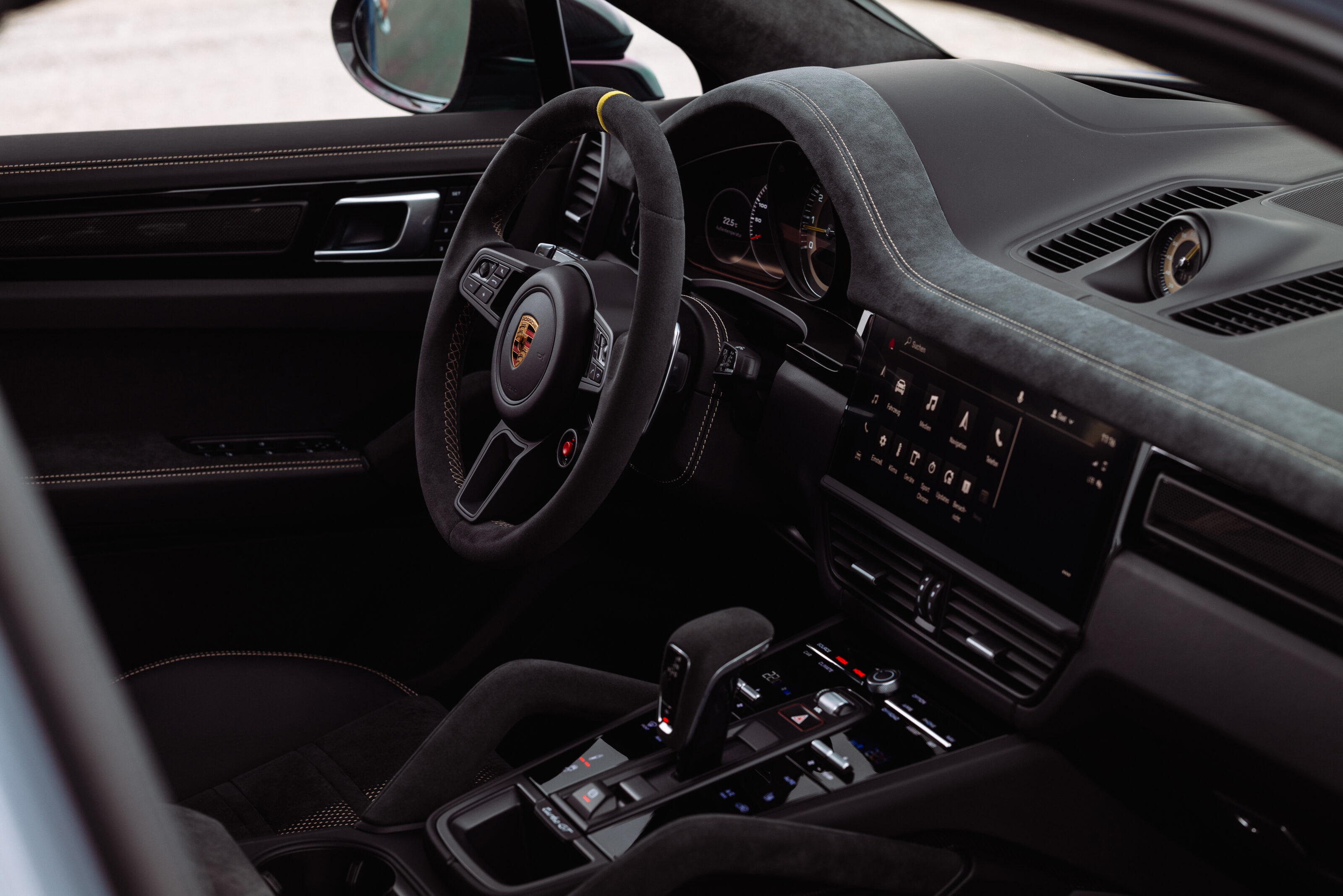
Despite all the bulk and the nose-heaviness, the car’s character is determined by an underlying agility and athleticism. However, the throttle response borders on jerky, and the titanium exhaust – devoid of a centre silencer – can by sheer phonetic vibration make trees shed their fresh leaves in early spring. Externally, the Turbo GT goes big on carbon fibre – double-bubble roof, rear diffuser – and aero, including a bigger active rear spoiler. Inside, you are treated to acres of Alcantara, eight-way sports seats and the latest infotainment trickeries.
The related Audi RS Q8 may be the more compelling all-rounder, while the Lamborghini Urus is sharper and more extrovert. But the Turbo GT manages to prise open a new sub-niche, as a high-rise GT that combines high technology, high fuel consumption and very usable performance.
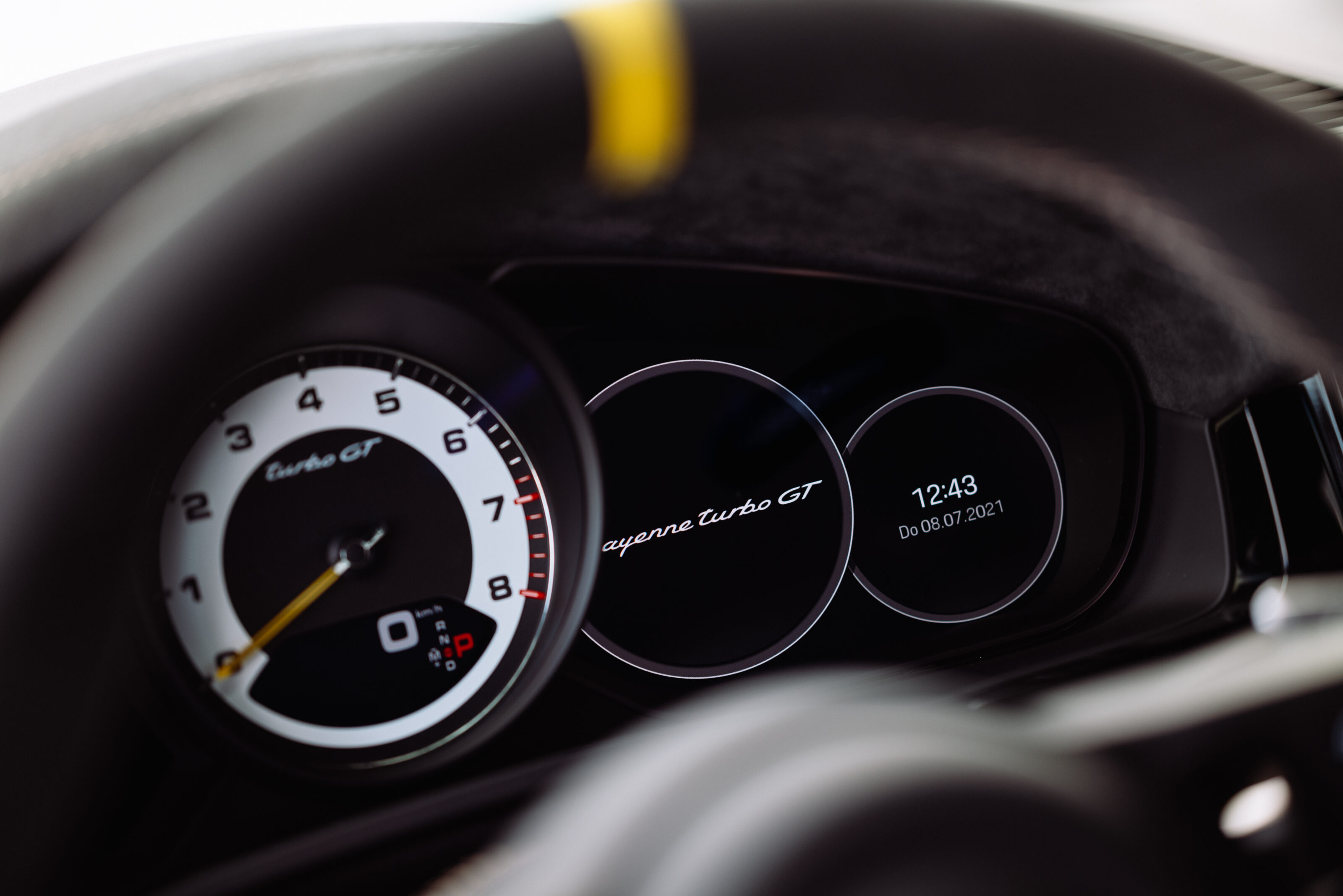
Porsche Cayenne Turbo GT specs
Key Points
- Renault teases Air4 in short video
- External portions look similar to SUV sizes
- Release date will coincide with the original Renault 4’s 40th anniversary
A revamp of the Renault 4 nameplate could see the French manufacturer introduce an electric SUV next year.
After first revealing its new, retro-style badge in April this year, the manufacturer said it was going to be releasing a surprise in November and, by all accounts, this seems to be it.
Leaked patents in May showed us the Renault 4 would be returning in SUV guise, although its most recent announcement provides strong cues hinting at the model going all-electric, as part of Renault’s wider electric vehicle targets.
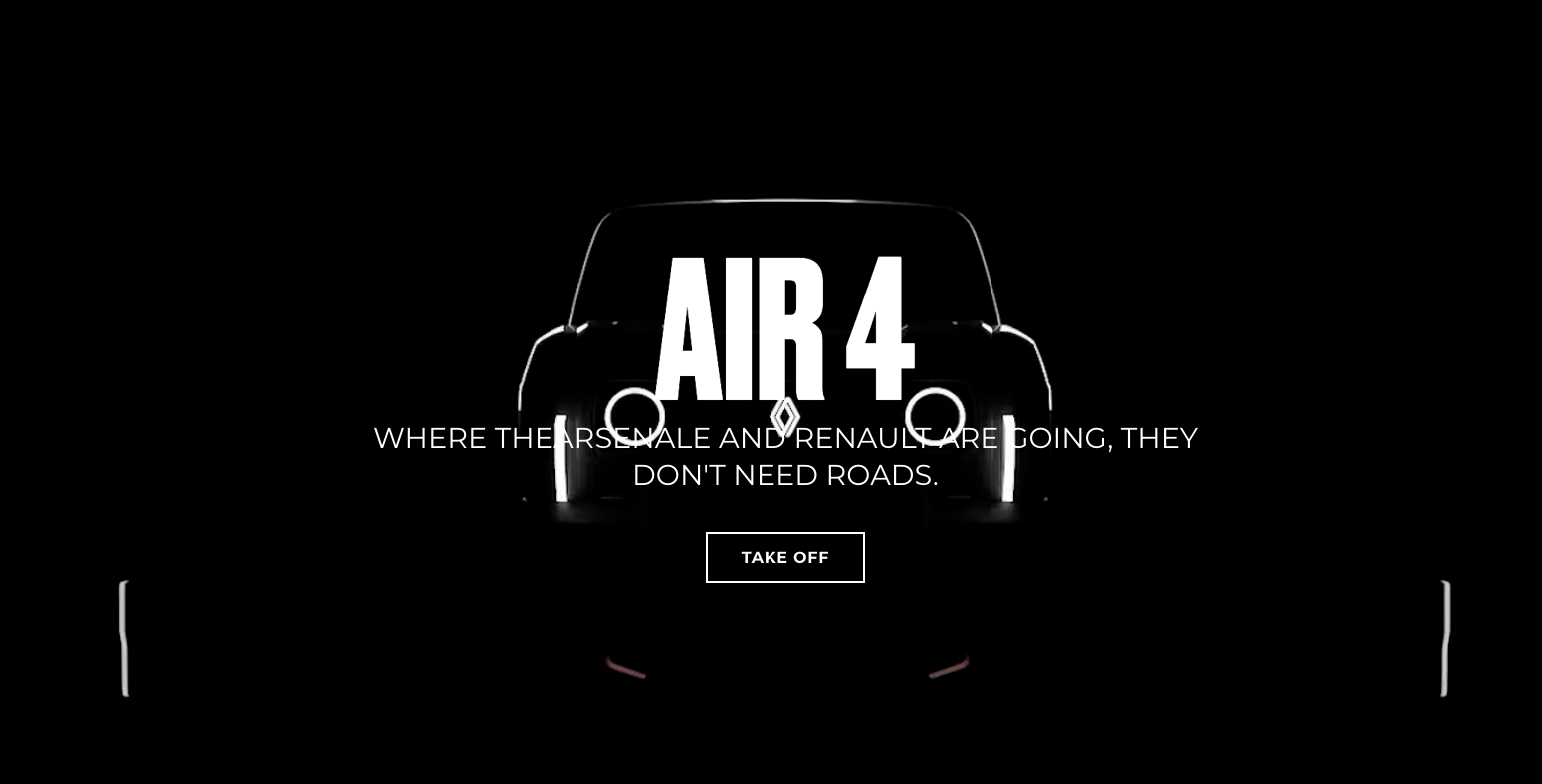
Utilising the 4L nameplate, Renault has also collaborated with lifestyle partners TheArsenale, with the latter’s logos featuring on the concept.
Curiously, TheArsenale’s website says: “Where TheArsenale and Renault are going, they don’t need roads” – tying in to the Air4 concept name, but potentially hinting at something more extravagant.
It’s likely the Air4 could be underpinned by Renault’s new Common Module Family B-segment EV (CMF-BEV) platform, the same architecture upon which the new retro-inspired Renault 5 will be based.
The CMF-BEV platform could see the Air4 powered by a single, 100kW electric motor on the front axle, with driving range expected to sit around 400 kilometres depending on the size of the battery pack.
Key Points
- MCA Records first bought Sir Elton John the car in 1987
- Features a single mirror and a 5.0-litre flat-12 engine
- Expected to sell between $300,000-350,000
A very special Ferrari Testarossa is up for sale through this month’s Shannons auctions, previously owned by music royalty.
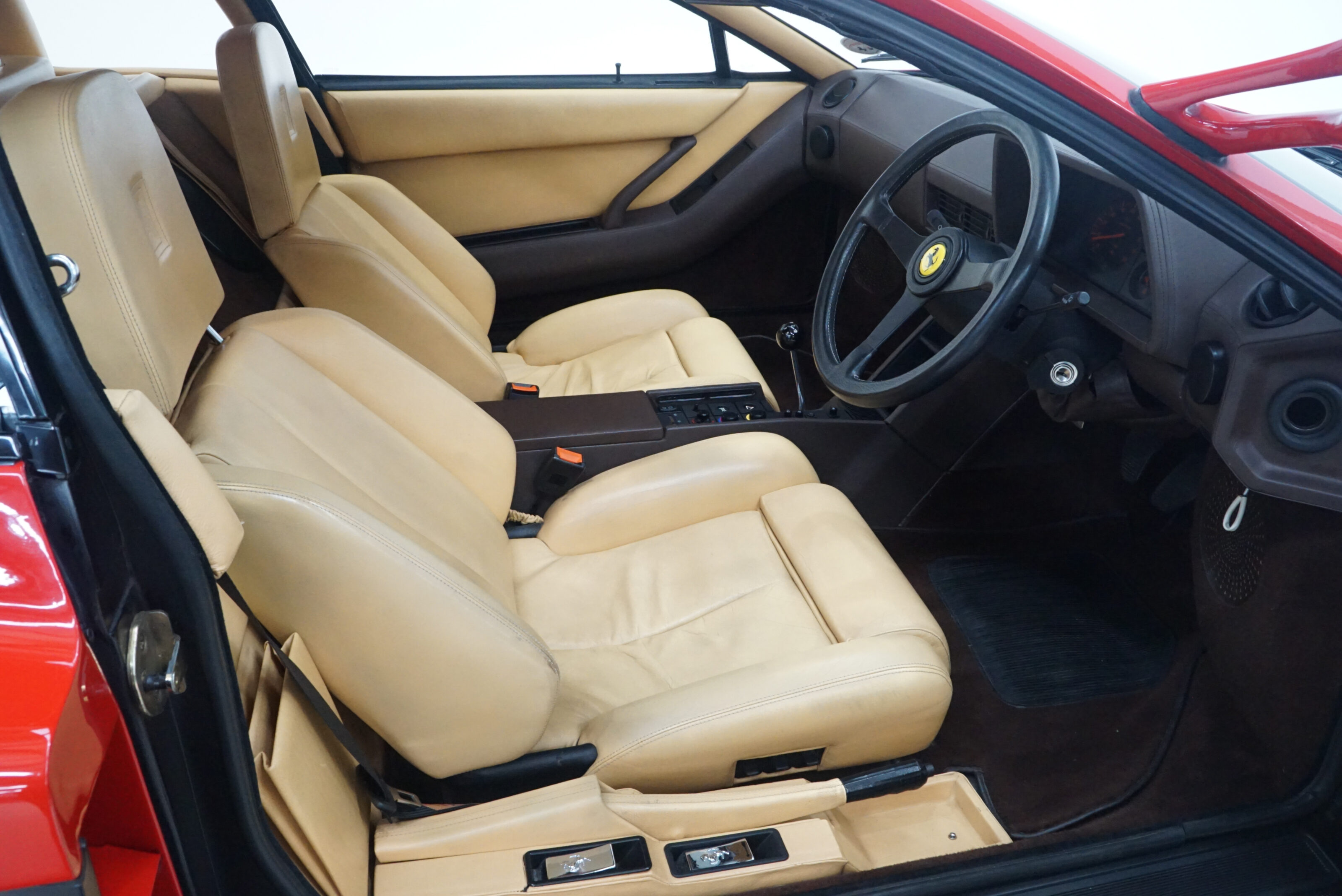
The Testarossa was gifted to Sir Elton John by MCA Records for his 40th birthday in March 1987, featuring a single, high-mount driver’s side mirror – one of the hallmarks of the early Testarossa.
Staying under the custodianship of Sir Elton until 2001, the car had recorded just 7434 miles (11,964 kilometres) when it was sold to a Ferrari dealer in the UK. It then made the trek over to Australia around 2010 where it resided in Sydney until its current owner purchased it seven years ago, bringing the mileage up to 10,733 (17,273km) in the process.
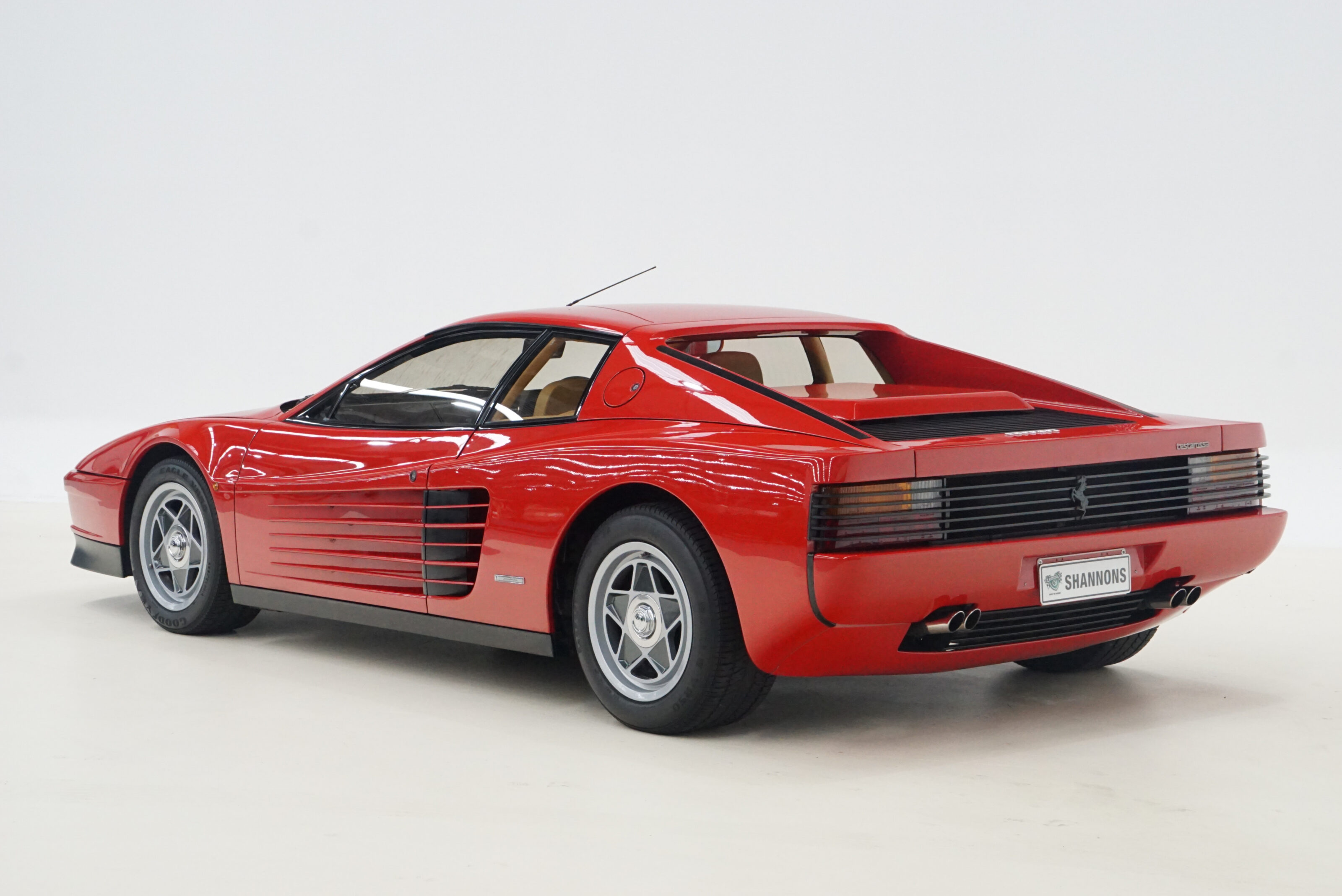
Powered by Ferrari’s Tipo F113 engine, the 5.0-litre, naturally-aspirated flat-12 put out 287kW when new, delivering drive to the rear wheels through a five-speed manual gearbox.
Shannons expects the Testarossa to sell at around the $300,000 to $350,000 range, with a signed letter from Sir Elton included in the sale.
Also in the auction will be two other Maranello motors, one 1983 308 GTSi QV ‘Targa’ Coupe – expected to fetch $170,000-$200,000 – and an Australian-delivered 2000 456M GTA Coupe, a relative bargain at around $140,000-$160,000.
The Shannons 40th Anniversary Auction will run from November 23 to 30.
The Kia Stonic, like its Toyota Yaris Cross and Ford Puma schoolmates, has burst onto the light SUV scene in Australia and is already shaking up the segment.
While it has been available overseas for around four years now, 2021 has been the first taste of the baby SUV in Australia – and the model’s latest facelift version is making major inroads. By the end of October, it had amassed 6239 sales, giving it third place and a 14 per cent share of the compact SUV segment. (CX-3 remains in top spot with 11,640 sales year-to-date, followed by Yaris Cross with 6697.)
If there’s a reason this newcomer seems familiar, however, that’s because it is. Based on the comparatively smaller Kia Rio, the Stonic does bear much resemblance to its sibling.
But the designers have made a real effort to make this car more than a high-riding version of the hatch – and its looks for a crossover aren’t quite so divisive as those of some rivals.
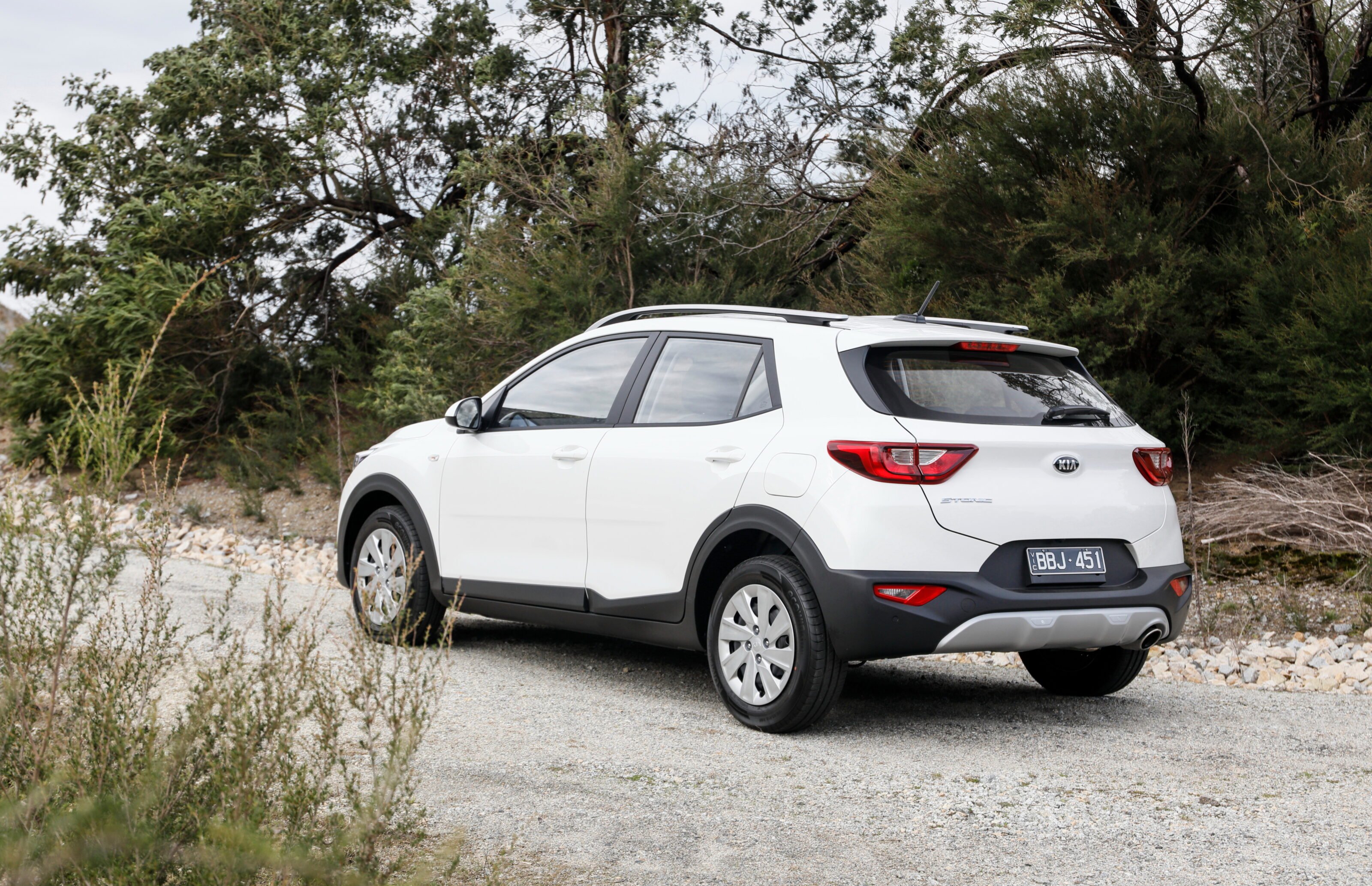
The version tested here is the 2WD 1.4-litre petrol automatic in base spec S trim, sporting clear white paint and zero optional extras.
Pricing
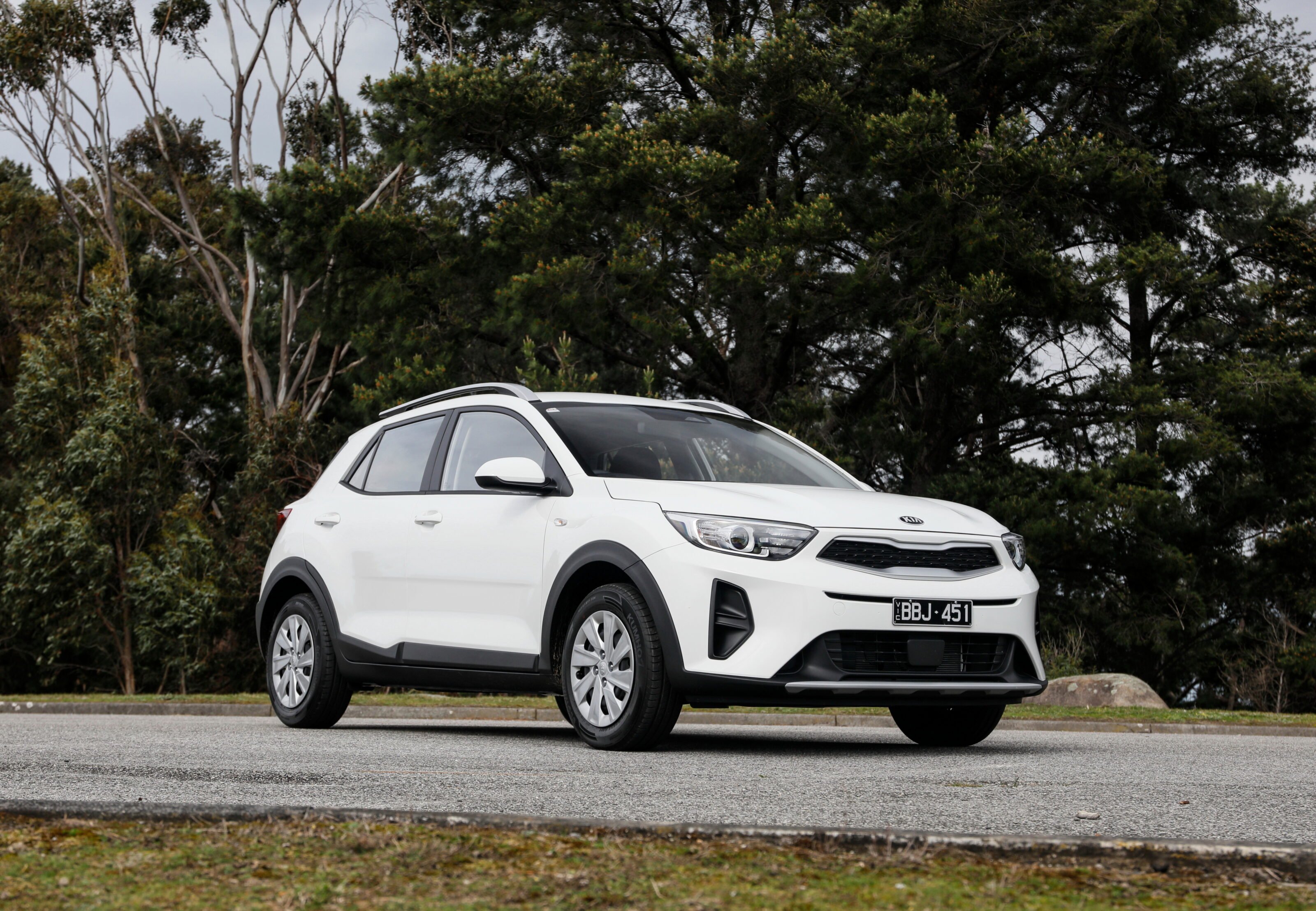
In total there are three variants – the S, Sport and GT-Line, all of which have power going to the front wheels. The entry-level Stonic S and mid-range Sport versions come with Kia’s 1.4-litre MPI petrol engine and a choice of six-speed manual or automatic transmission, while the top-spec GT-Line houses a 1.0-litre T-GDI petrol, which is paired with a seven-speed dual-clutch auto.
The Stonic S auto we’ve got on test costs $24,490, while its manual twin will cost $1000 less. Heading on to the Sport, the mid-ranger $25,490 (manual) or $26,490 (auto), and finally the range-topping GT-Line comes in auto guise only for $30,490. All prices are drive-away.
For the S and Sport, there is a choice of seven no-cost paint colours while the GT-line exclusively adds four contrasting roof options. Beyond picking the colour you like best, there are no other extras, which is actually quite refreshing – there is, after all, such a thing as too much choice.
Features
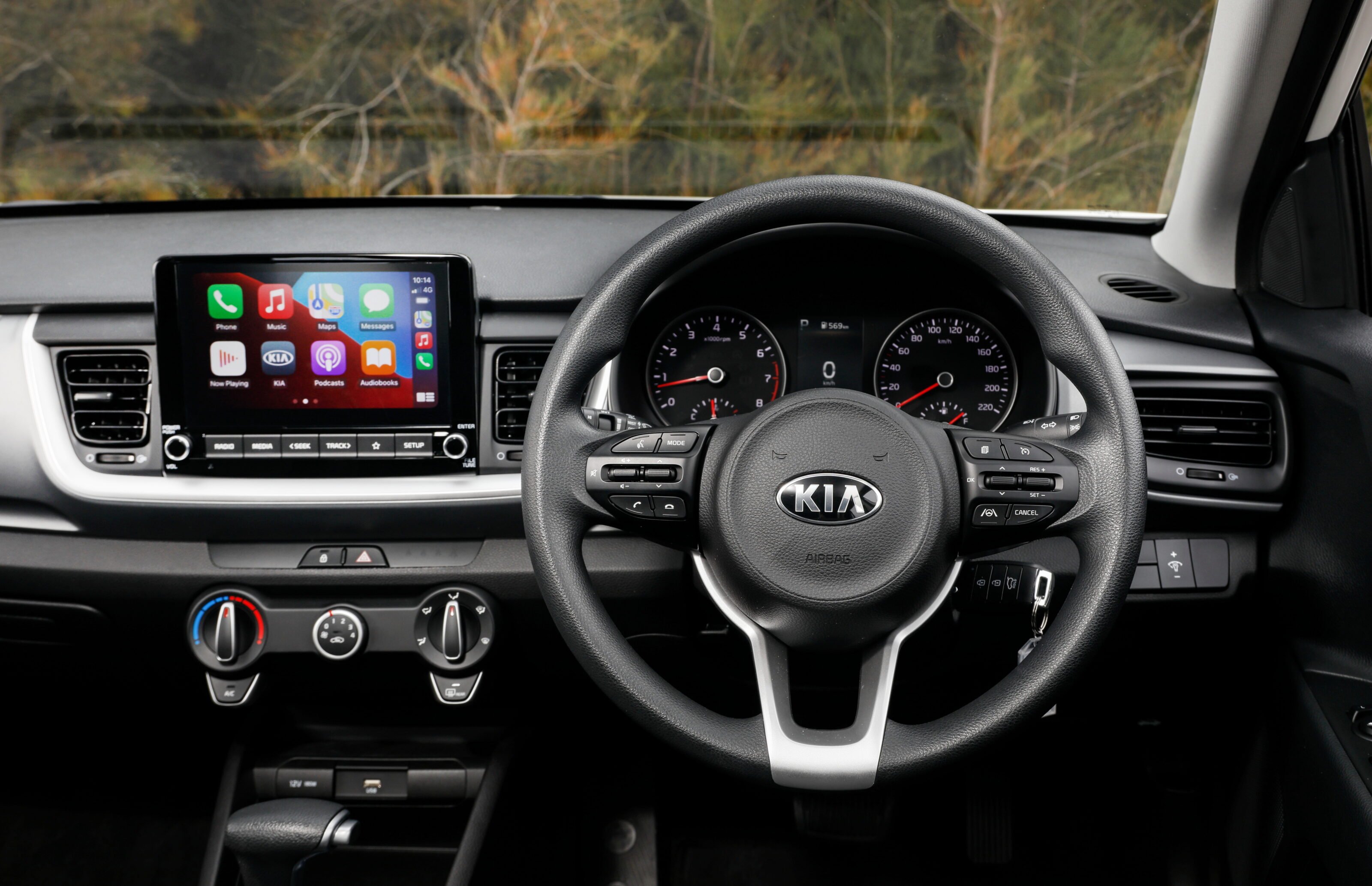
Much like its customers, the Rio has grown up and it is time for a change.
Unlike the Rio, the Stonic has edgier lines, it’s taller and it has roof rails for outdoor lifestyle activities. There’s also little resemblance at the front – with the slimmer and flatter headlights, as well as the lower and side air intakes, all being markedly different to its twin under the skin.
Where the two are similar is the ‘tiger nose’ grille with satin silver surround, the exception being the GT-Line variant, which has a black surround. The top-spec version also nabs the GT-Line Package, which includes a mesh radiator grille and rear diffuser, as well as black wing mirrors, rear privacy glass and a sunroof.
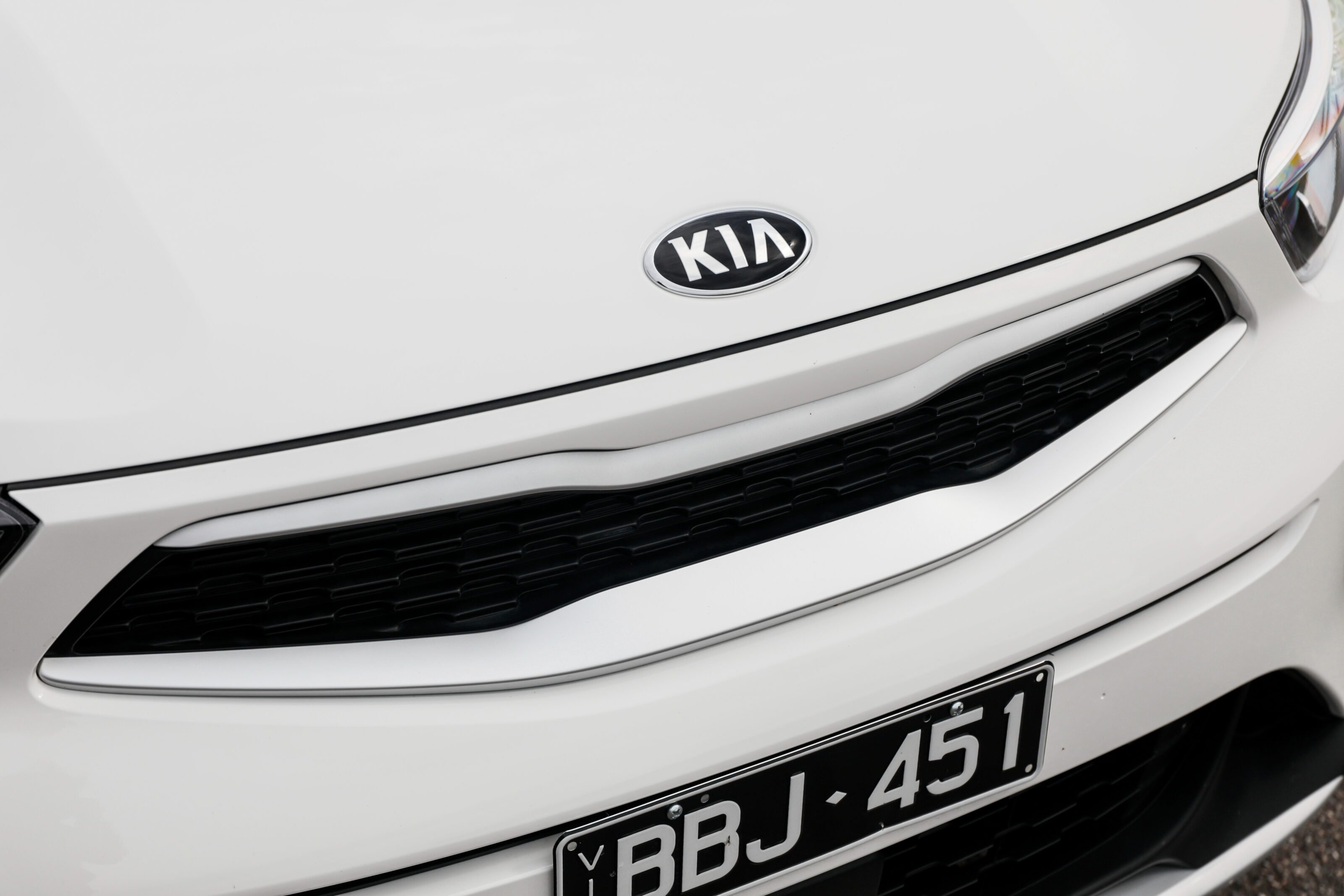
In profile, the exterior features black plastic wheel arch cladding marking it out as the SUV alternative to a Rio. LED daytime running lights are standard only on the GT-Line and while the Sport and GT-Line ride on 17-inch alloys, the lower budget S steps down to 15-inch steel wheels.
At the rear, the aesthetic differences to the Rio are obvious again, with sharper tail-lights, a wider tailgate and a plastic rear bumper featuring smaller inserts.
Measurement-wise, it’s 4140mm in length, with a width of 1760mm and height of 1520mm – making it 70mm, 35mm and 70mm larger all round than the Rio.
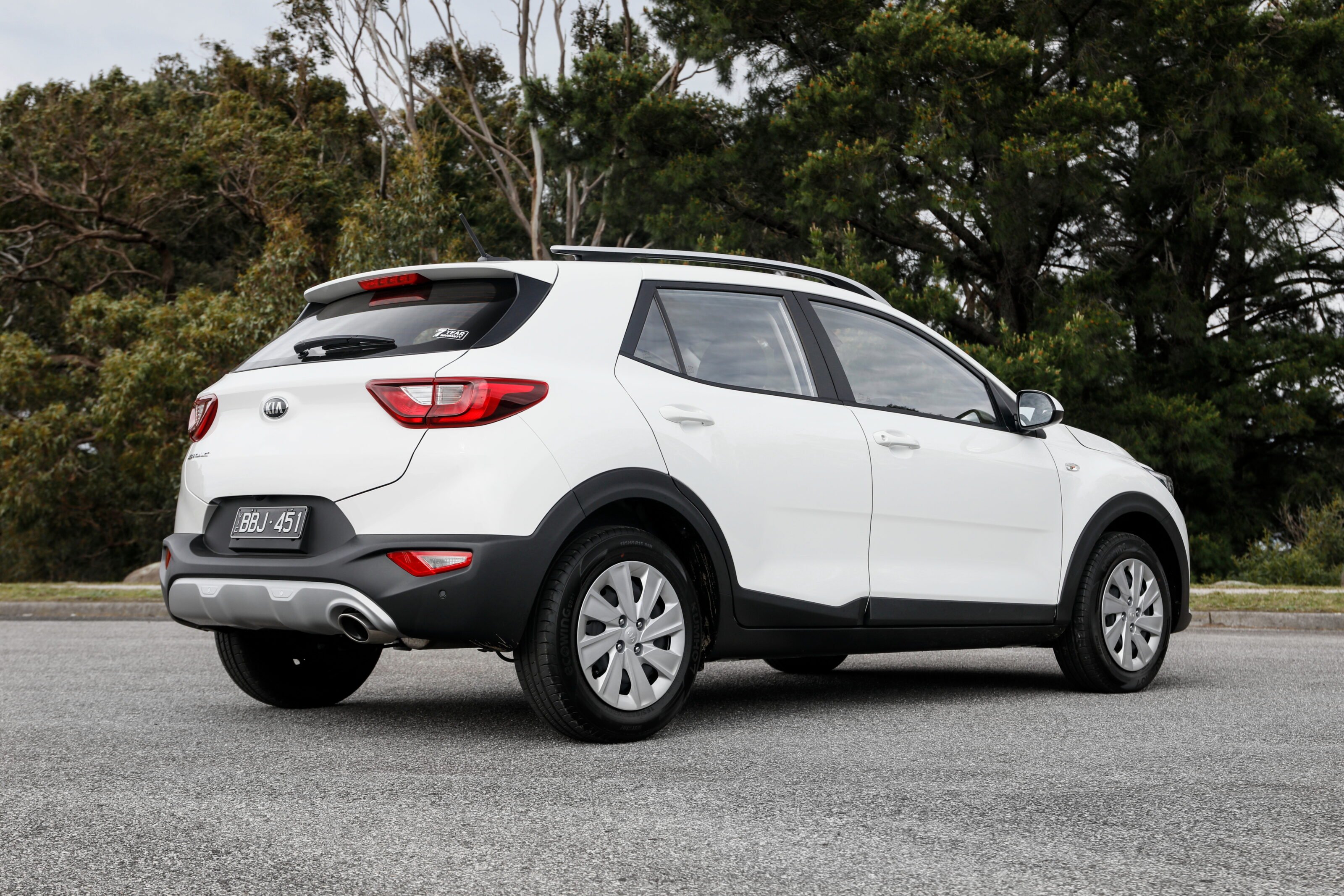
While the Stonic has a broad appeal on the outside and doesn’t actually scream “budget” for a car of its price range, inside (on the base-spec S at least) the cabin is unfortunately a much more sedate – perhaps even a little dated – affair.
There’s a lot of plastic on offer, as well as a metallic-finished dash fascia, a rough-feeling steering wheel and seats swathed in a scratchy, cheap material known as Tricot cloth trim.
Step up into the GT-Line and improvements are made, with the top-of-the-line variant gaining premium seats and a carbonfibre-look dash, as well as a sports steering wheel with the GT-Line logo along with satin silver interior trim for the wheel and door handles.
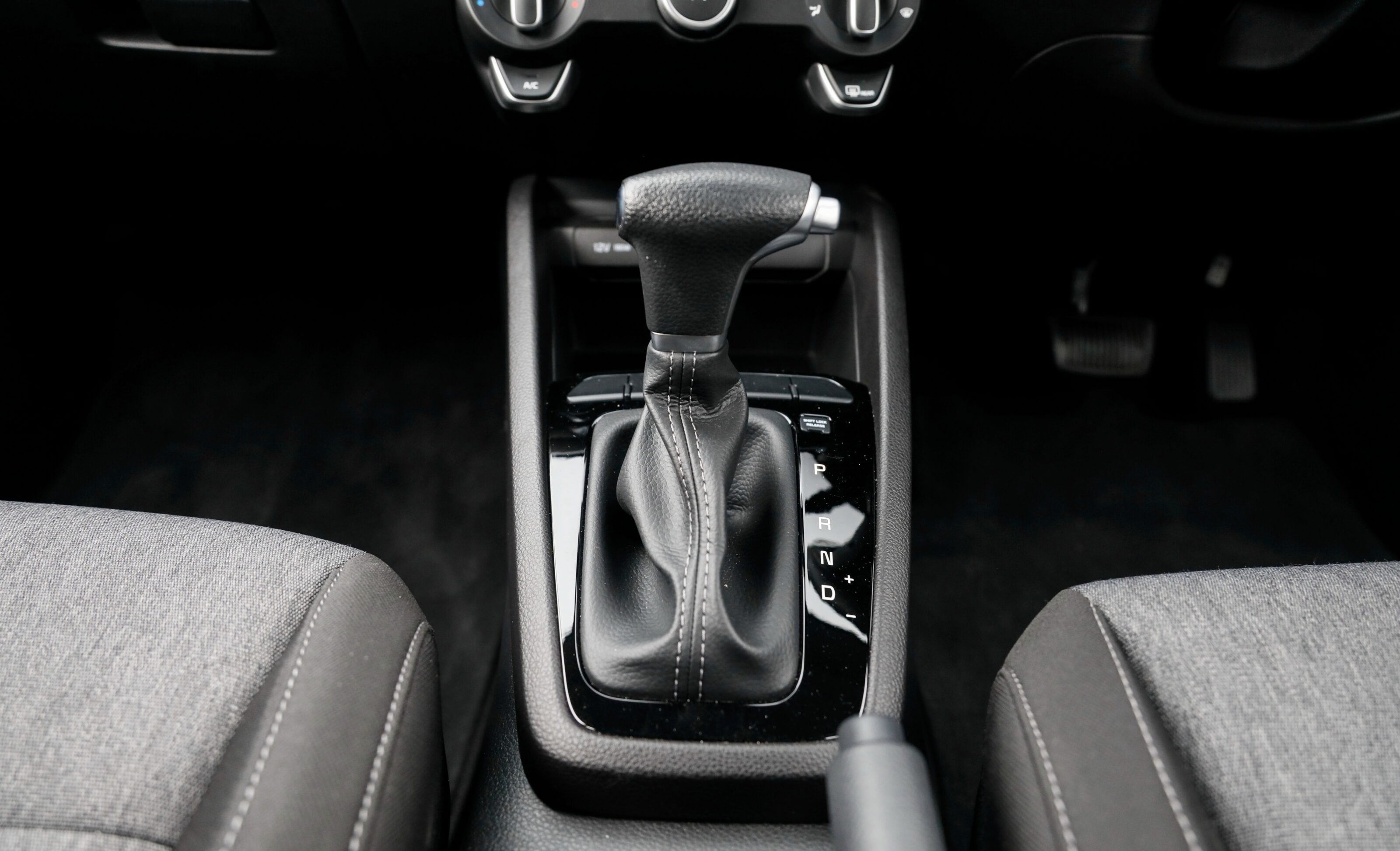
All versions get a traditional gear stick and handbrake, although the mid- and top-spec cars get a ‘premium’ shift knob.
The Stonic is missing some creature comforts such as a centre console arm rest, although in fairness this is only on the entry S – unlike in the rival Toyota Yaris Cross where the armrest-cum-sliding-storage-bin is also nowhere to be found even on the range-topping Urban. A vanity mirror has been included on the passenger side, but it is not illuminated on the S.
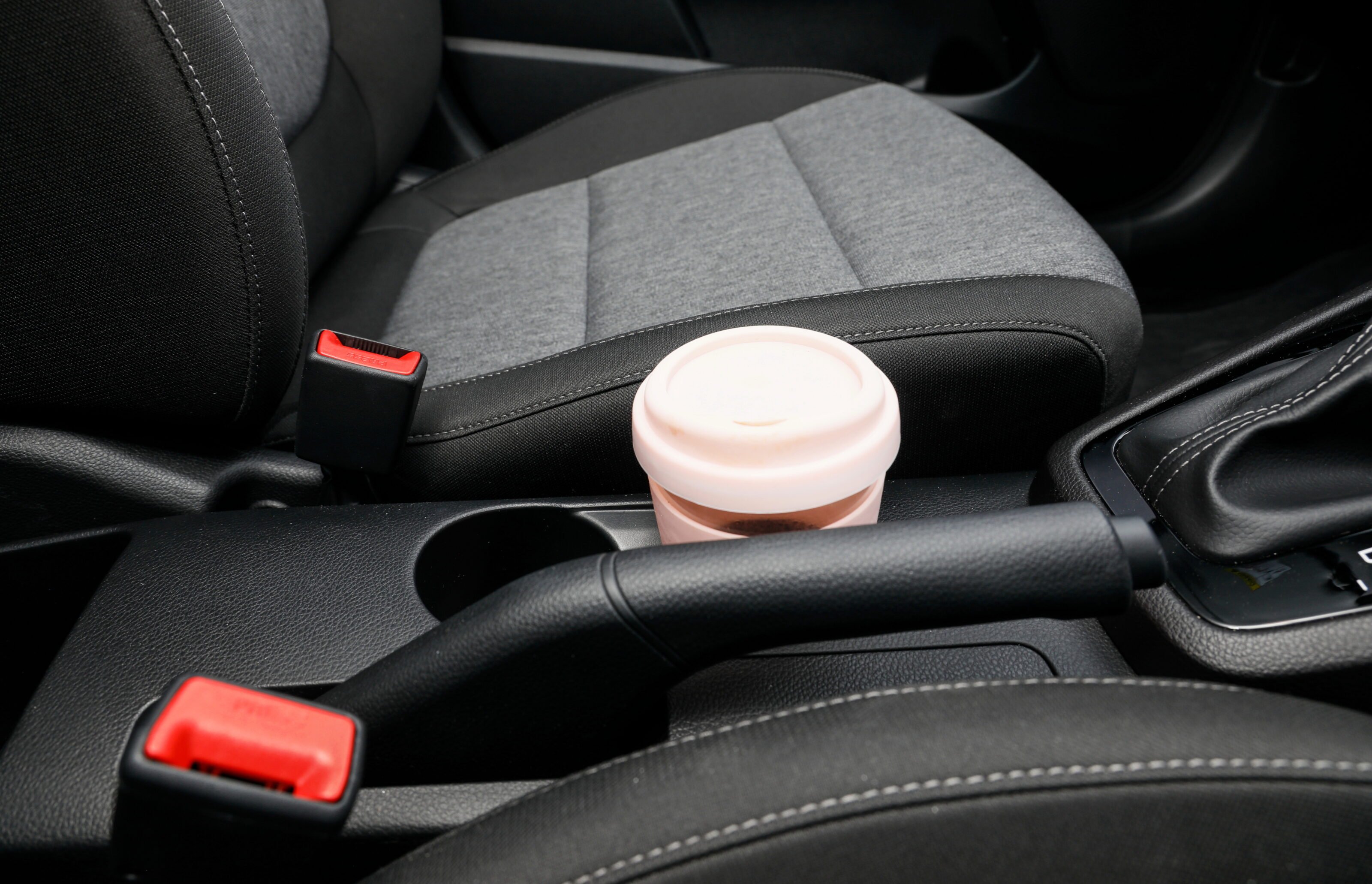
Despite missing a central compartment, the Stonic does have plenty of little pockets of storage here and there, as well as six cup holders – two in the middle and one in each door.
However, only the ones in the front row are really of any use, as the holders in the rear doors can’t even fit a child’s small 700ml Thomas the Tank Engine drink bottle, so when you need both your hands (and probably another pair with all the stuff kids come with nowadays) there’s nowhere to put it but the roof – so make sure you don’t leave it there and drive off.
Additionally, having a folding key starts to grate after a few days, especially when you just want to push a button and go, knowing your key is safely somewhere in your bag or on your person. If this is a problem for you too, the Sport and GT-Line come with a smart key and push-button start.
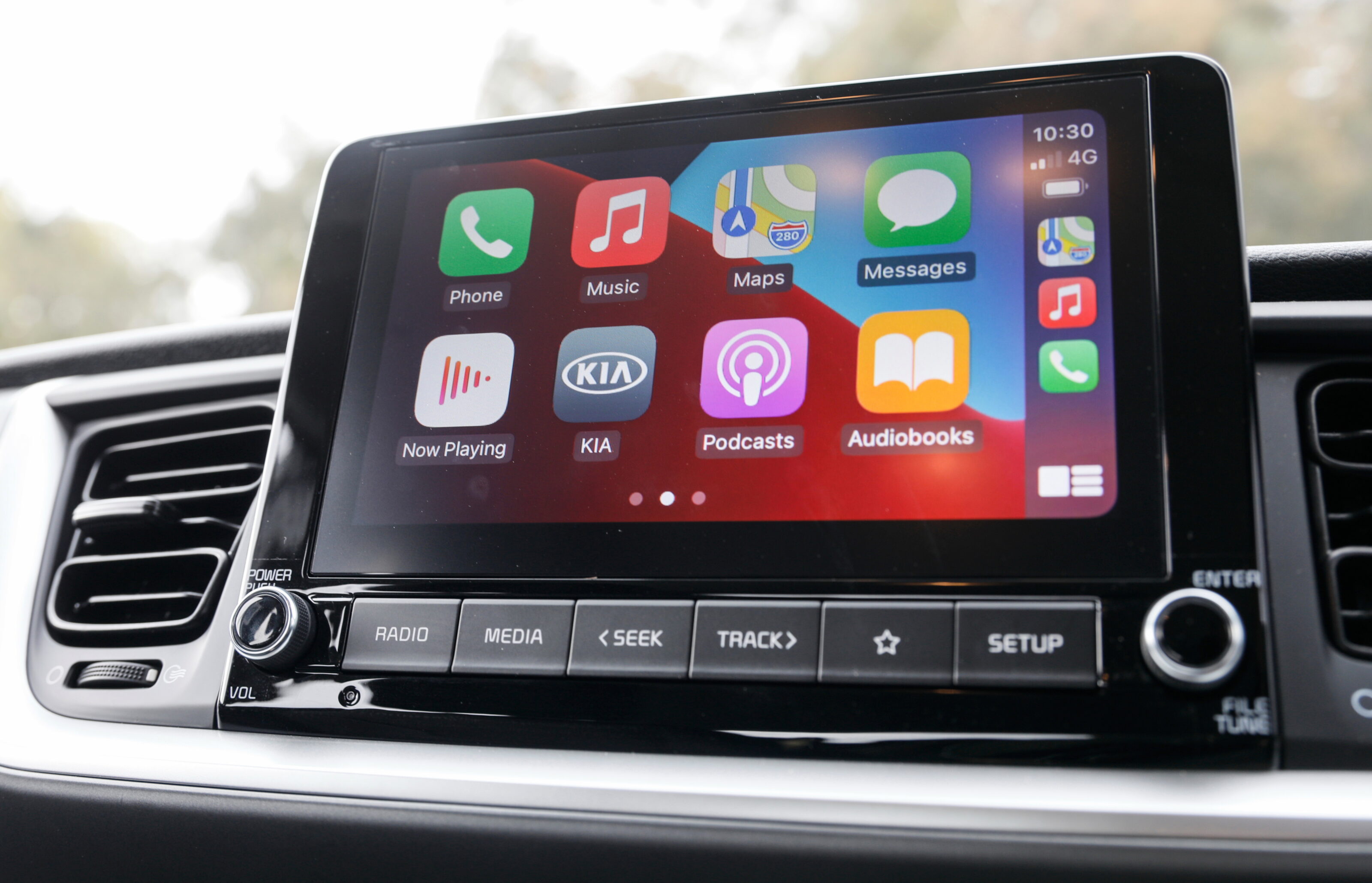
What it does have is an 8.0-inch touchscreen, which is relatively simple to use, and comes with Apple CarPlay and Android Auto integration. Although interestingly in the entry-level S we have here, just Android Auto can be physically accessed via a lead into the single USB port as Apple CarPlay is wireless only.
Even though you could argue wireless capability is considered a luxury, it is oddly missing from the two higher-spec variants and, in truth, the wireless Apple CarPlay functionality on the S is patchy at best anyway.
Unfortunately, the connection drops out every few minutes and needs reconnecting on the move. While that really only involves pushing a button on the touchscreen, it’s still a distraction and not ideal.
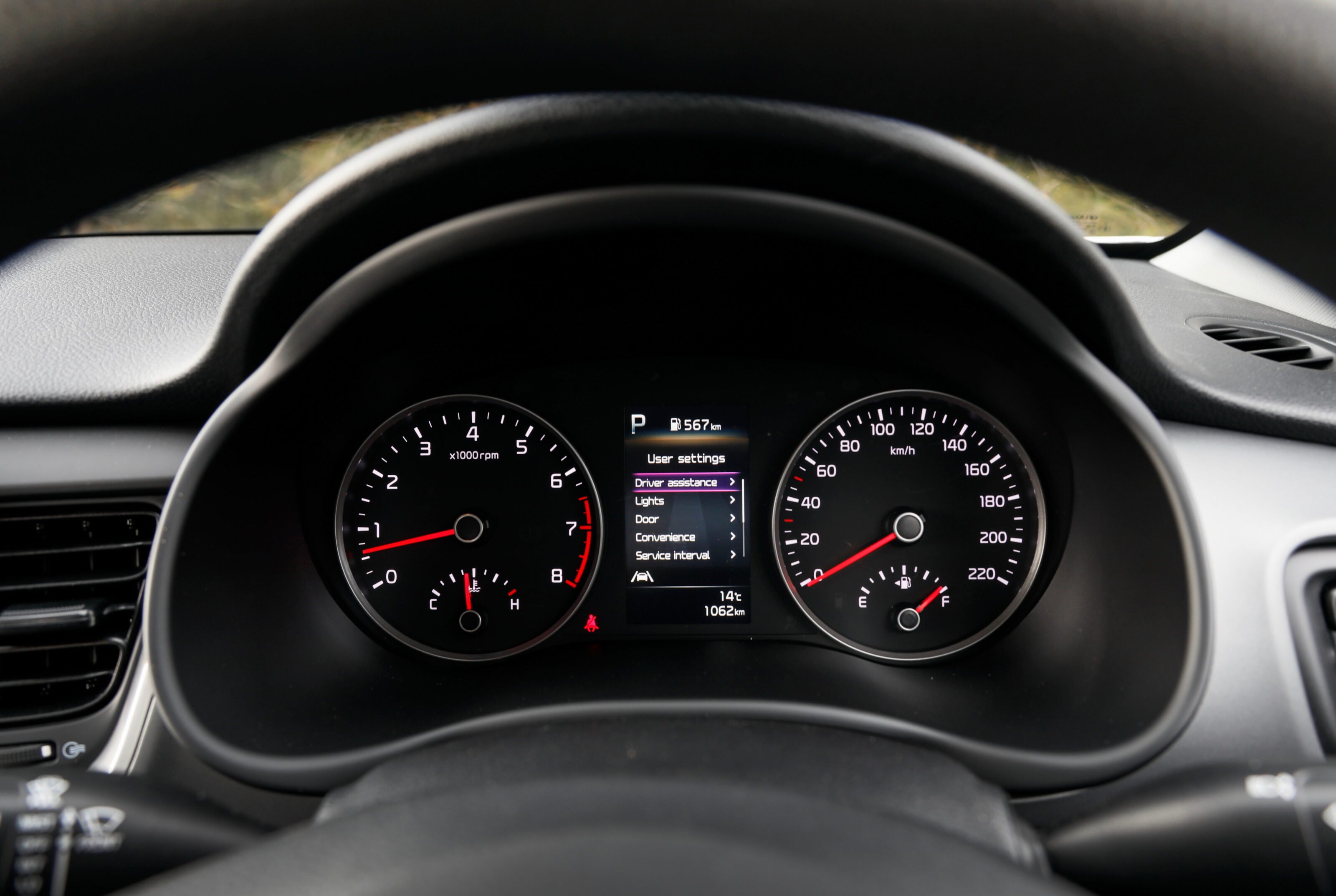
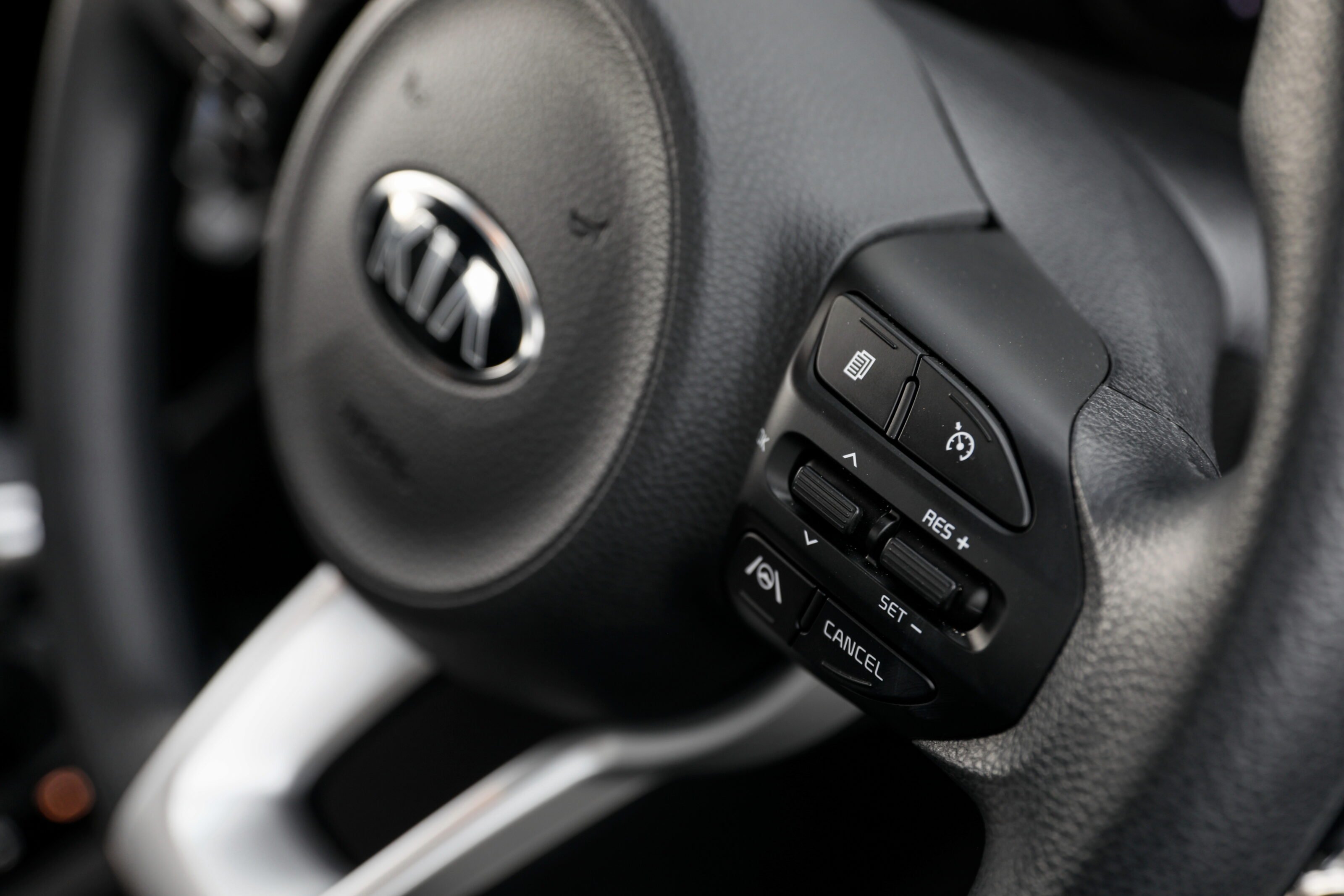
We like the 4.2-inch binnacle display, which provides straightforward information and features a digital speedometer, which is always nice to have (especially on a base version), and the steering wheel controls are well laid out too – making it easy to access them while driving.
The Sport and GT-Line also include a sat-nav as standard, but as it already has Apple CarPlay we honestly don’t think it’s needed because phone map applications tend to be more accurate.
Oddly the Stonic S misses out on DAB+ digital radio, which feels a little outdated.
While the Stonic’s exterior has a broad appeal, and doesn’t scream “budget” for its price range, unfortunately, the cabin is a sedate – perhaps even a little dated – affair.
Comfort and Space
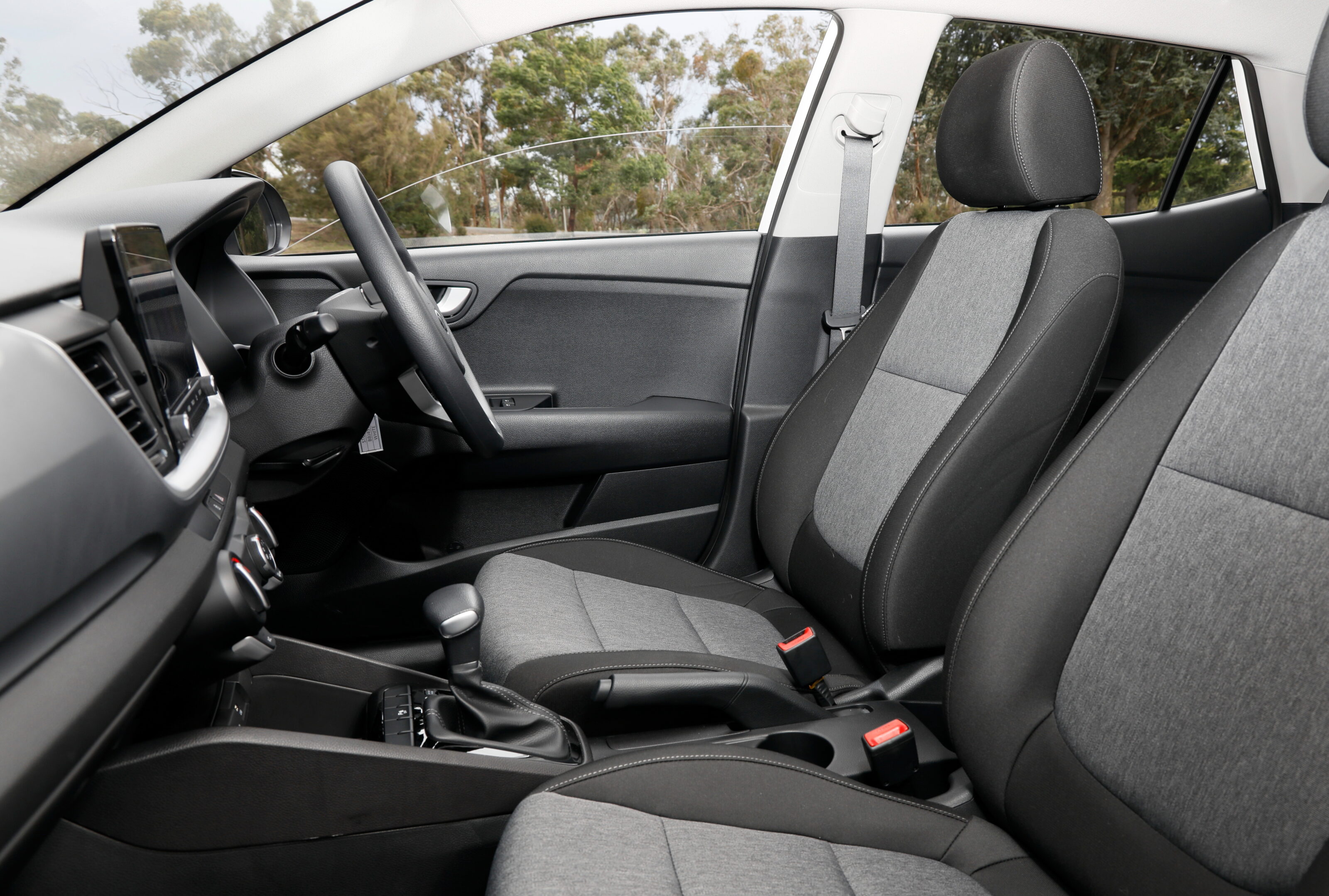
Being a light SUV, the Stonic doesn’t have as much space as we’d like for a true family car. Though there is a pouch for maps on the back of the passenger seat (maps, remember them?), there is a distinct lack of places to put things.
In addition to the cup holder issue mentioned above, the boot features a high and strangely small side compartment, only just about large enough for a mobile phone. What the designers imagined its purpose would be we have no idea.
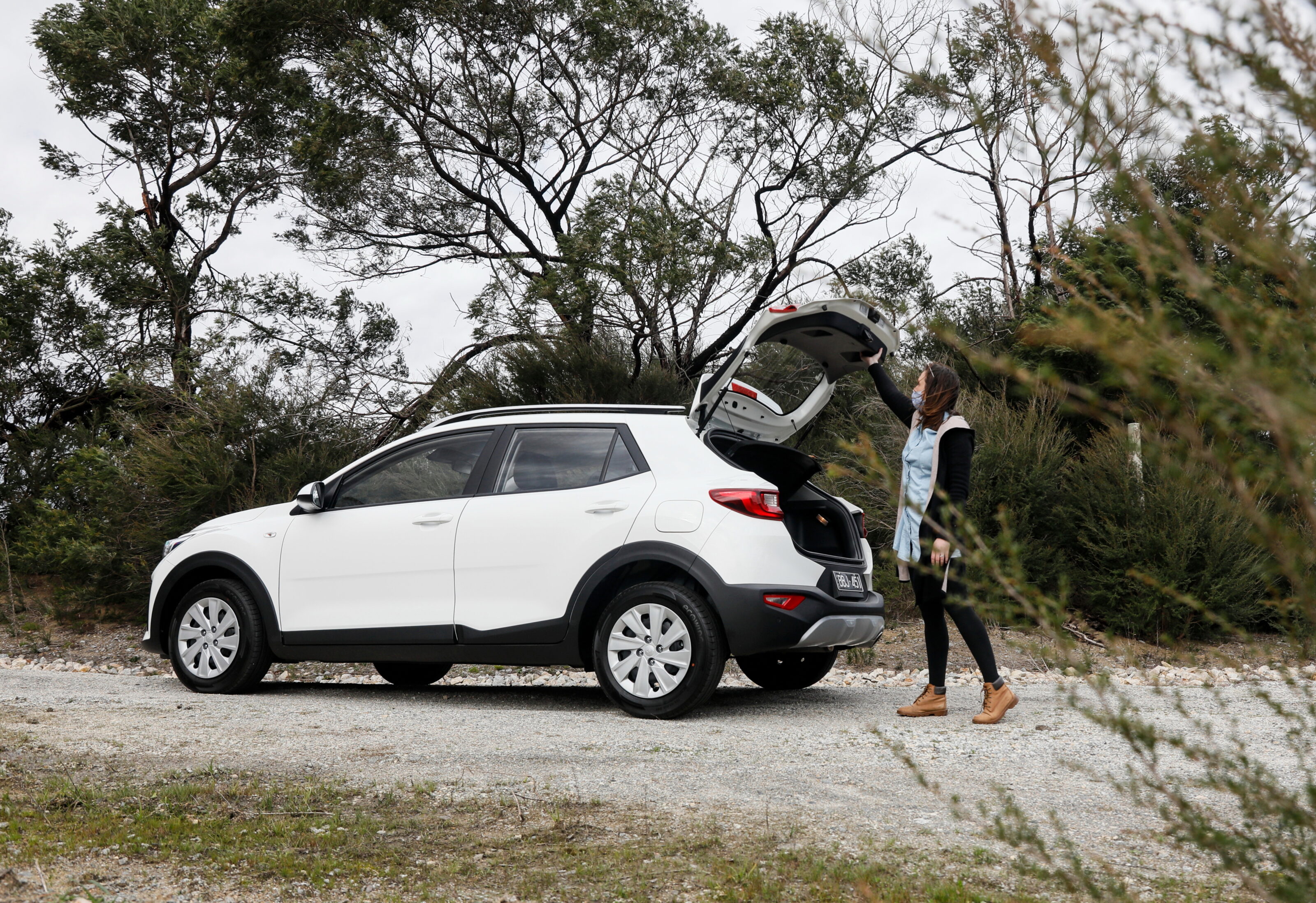
Upon first look, the boot appears to have more than ample space – with a pleasingly low lip perfect for safely containing a cheeky toddler for at least five seconds. However, the vehicle’s on-paper specs actually reveal its max cargo capacity is smaller than the already compact Yaris Cross – offering 332L with the rear seats up compared to 314/390L in the Toyota, depending on how you have its split floor positioned.
While it can easily meet the needs of a trip to the shops for a family of two young children or an older couple, and has space for an average-sized pram – putting it to the test for a weekend getaway with more bags and other kiddy paraphernalia might be pushing it.
The grab handle for the tailgate is also awkwardly positioned, making it tricky to pull down without twisting your arm at a strange angle if you don’t want to get your hand dirty on the paint.
Getting little ones in and out of the back doors is straightforward though, and we have to commend Kia here for making sure they open wide enough – a fact so easily overlooked by some manufacturers.
The seats front and back are surprisingly comfortable given the rough material, with ample back and leg support, though none are electrically adjustable.
Moving to the rear row, there is just enough legroom for an average-sized adult for short-ish journeys. Although fitting our car seat to the ISOFIX anchors we noticed you need to move the front passenger seat almost the whole way forward just to accommodate it, as well as provide enough legroom for a three-foot-high two-year-old – which is less than ideal if someone else is in the front beside the driver who themselves is roughly 170cm or taller.
Rear passengers also face a distinct lack of amenities – with the S missing out on rear air vents and USB ports, though the Sport and GT-Line benefit from one in the front and back.
Climate control is reserved for the range-topping GT-Line only, the lower variants making do with a manual air conditioning system, as is privacy glass – the latter a disappointing feature to lose out on, as without it the sun is very bright on young children’s eyes.
Getting little ones in and out of the back doors is straightforward and we have to commend Kia for making sure they open wide enough – a fact so easily overlooked by some manufacturers.
On the Road
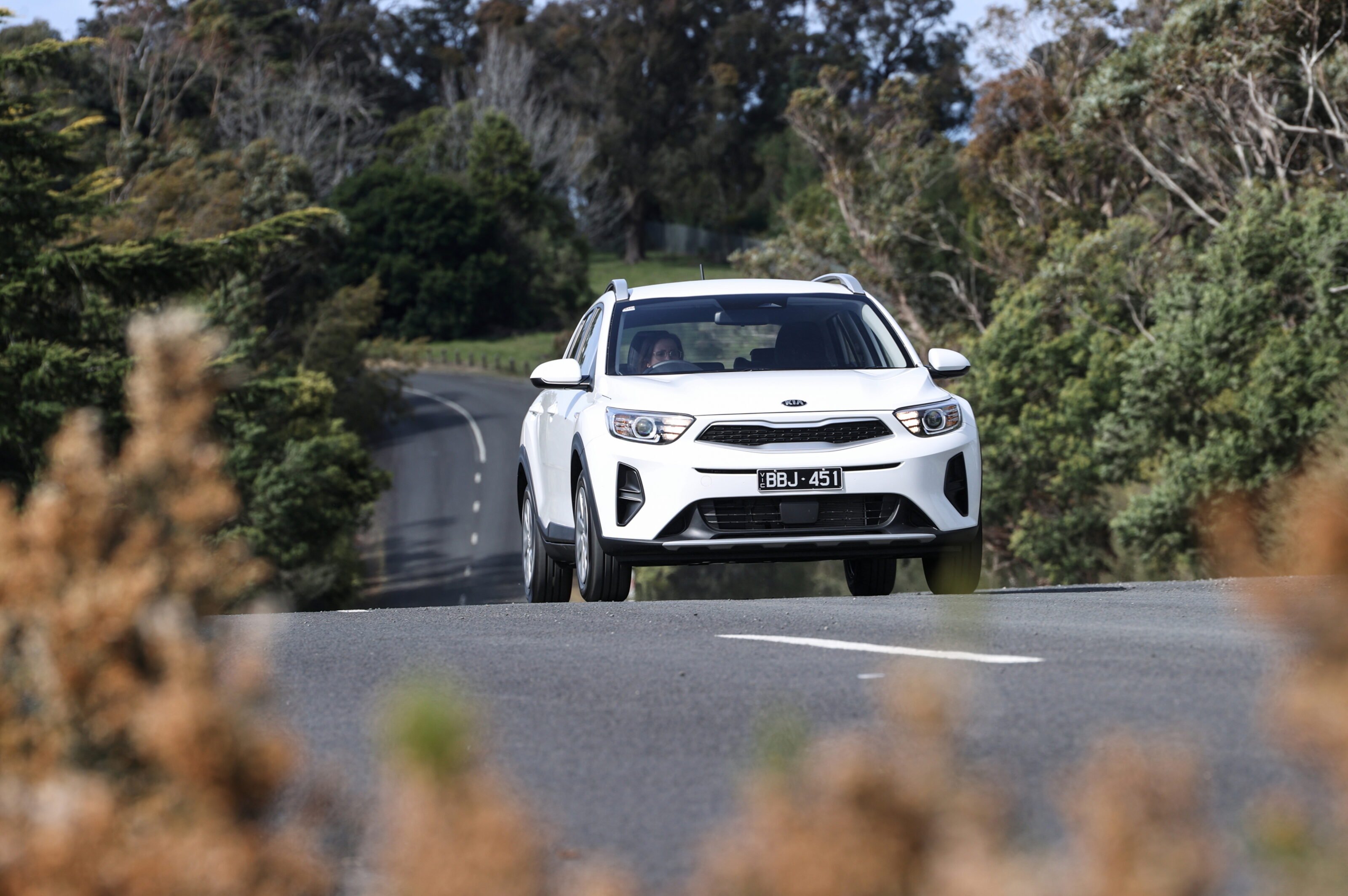
How do you know it’s not too different to the Rio underneath?
It’s got the hatch’s 1.4-litre inline-four petrol engine mated to a six-speed automatic transmission, sending 74kW/133Nm to the front wheels in S or Sport guises. The top spec GT-Line version has a slightly higher torque output of 172Nm coming from a punchy little 1.0-litre three-pot turbo that’s coupled with a seven-speed dual-clutch auto.
Both at freeway cruising speed and around town, overall wind and tyre noise is very respectable for a car of its size, and the engine is refined and quiet making for an enjoyable driving experience as far as sound is concerned.
Unfortunately the S variant misses out on any driving modes, but the higher spec GT-Line gets Eco, Normal and Sport if a bit more control when it comes to performance is important to you.
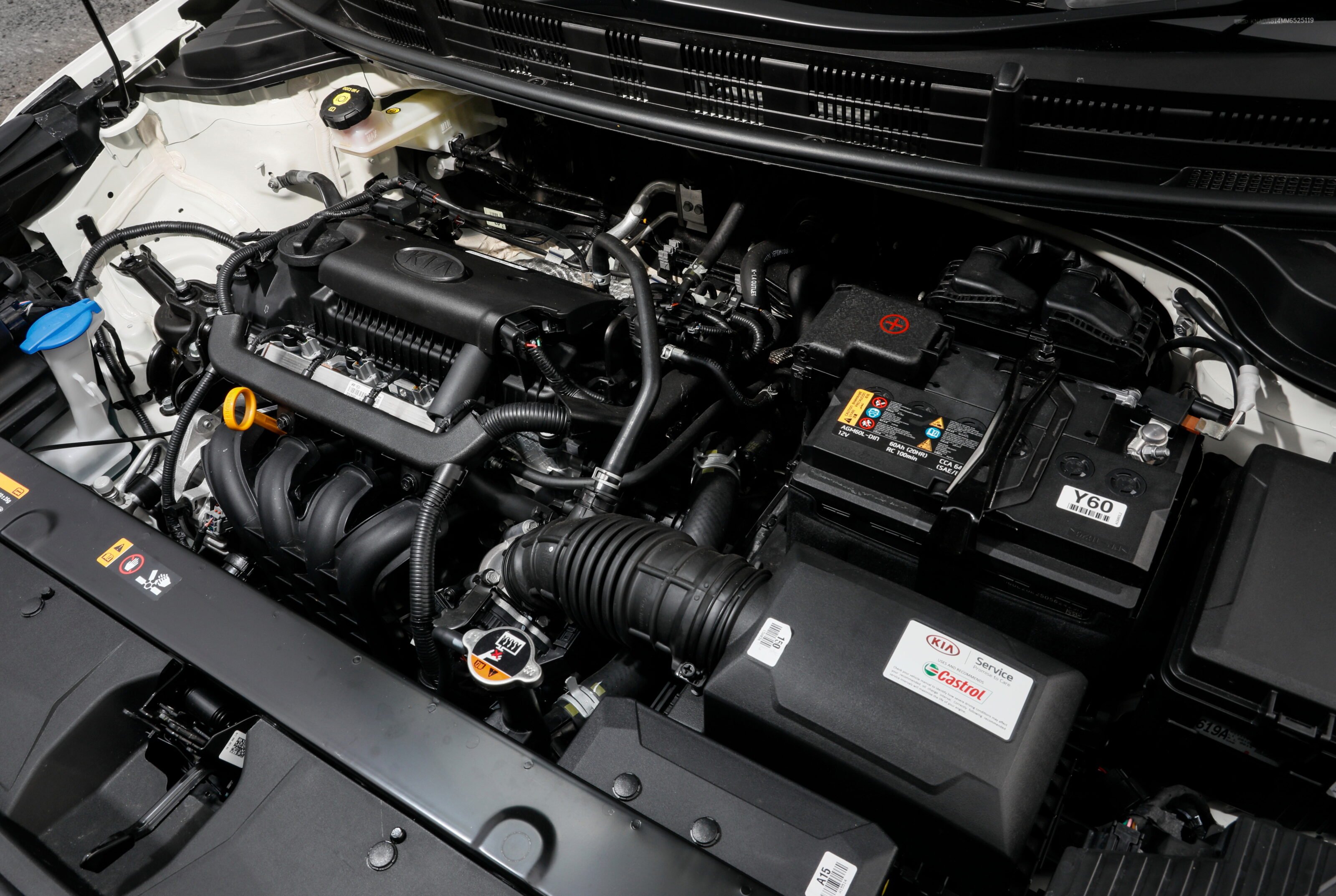
Around town, where undoubtedly the Stonic will spend most of its time, the 1.4-litre is a solid performer and by no means out of its depth for day-to-day driving. Pulling away from the lights it doesn’t feel too strained, but you do have to work it hard in the mid-range, particularly between 40-80km/h, and a surprising amount of throttle input is required.
This is where a separate sport mode for the transmission would make sense. Unfortunately, no such option is available and the same goes for the 1.0-litre, despite it having a more sophisticated dual-clutch transmission. This is a shame, as in certain situations we felt the car could have used a bit more urgency – for example during higher speed overtakes.
There is a manual mode on the automatic gearshift but the Stonic does not come with paddles on the steering wheel. This is probably for the best, as when you use this feature it is quite slow to respond and noticeably hesitant in changing down when you want it to. It’s best left in auto where the gearing is pretty well matched to the response of the engine.
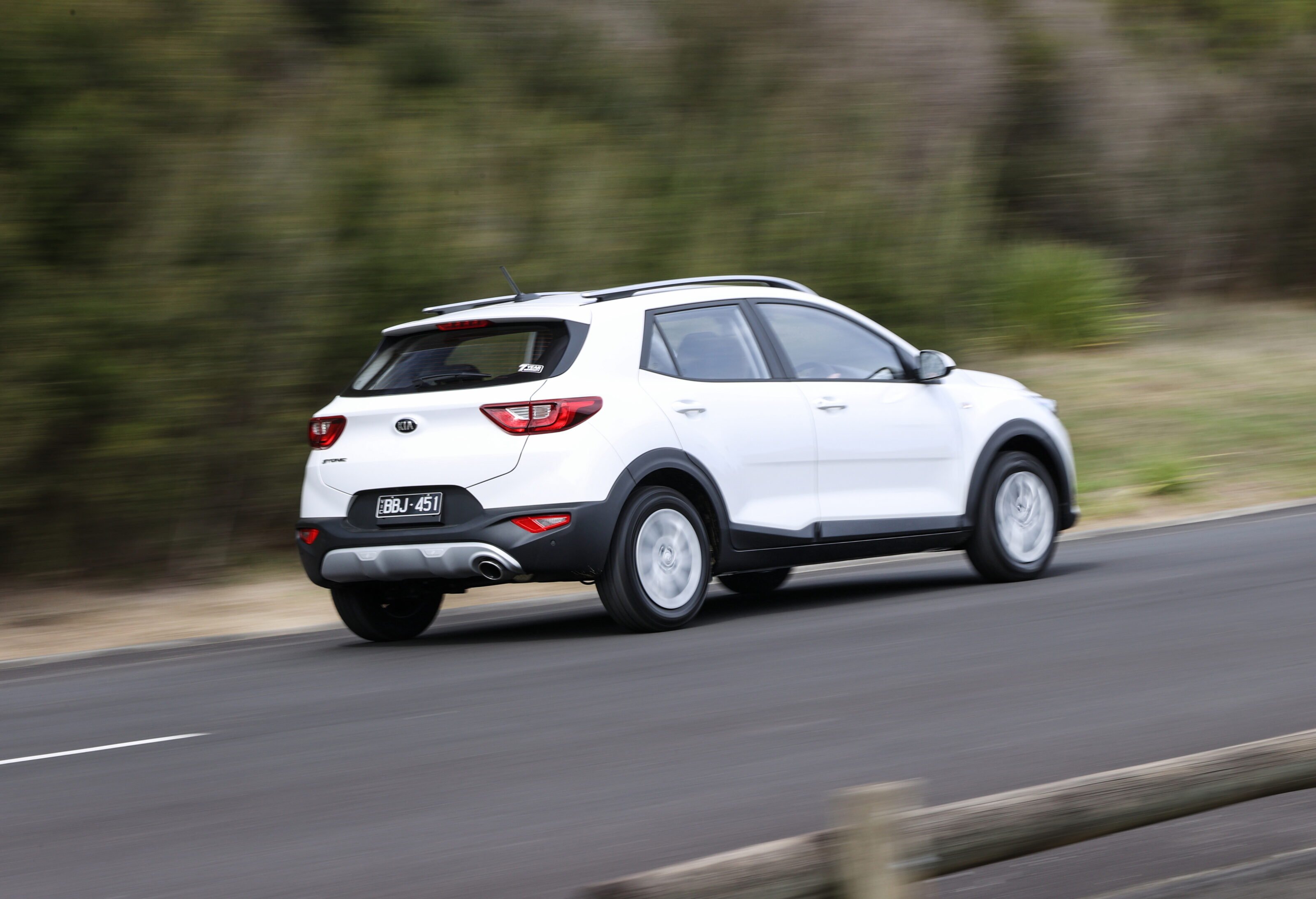
The steering is quick and light, aided by Kia’s engineers doubling the number of teeth on the serrated steering column shaft compared to the Rio’s, and as a result, it feels nimble on its toes.
Cornering and changes in direction are undertaken with ease, thanks to its diminutive stature, and even when we were taking bends on a gravel track at 60km/h to snap the photos you see here, the Stonic still felt controlled.
Similarly, the brakes are well-judged and always feel powerful enough whatever the speed. This will undoubtedly be helped by the car’s comparatively light 1157kg weight.
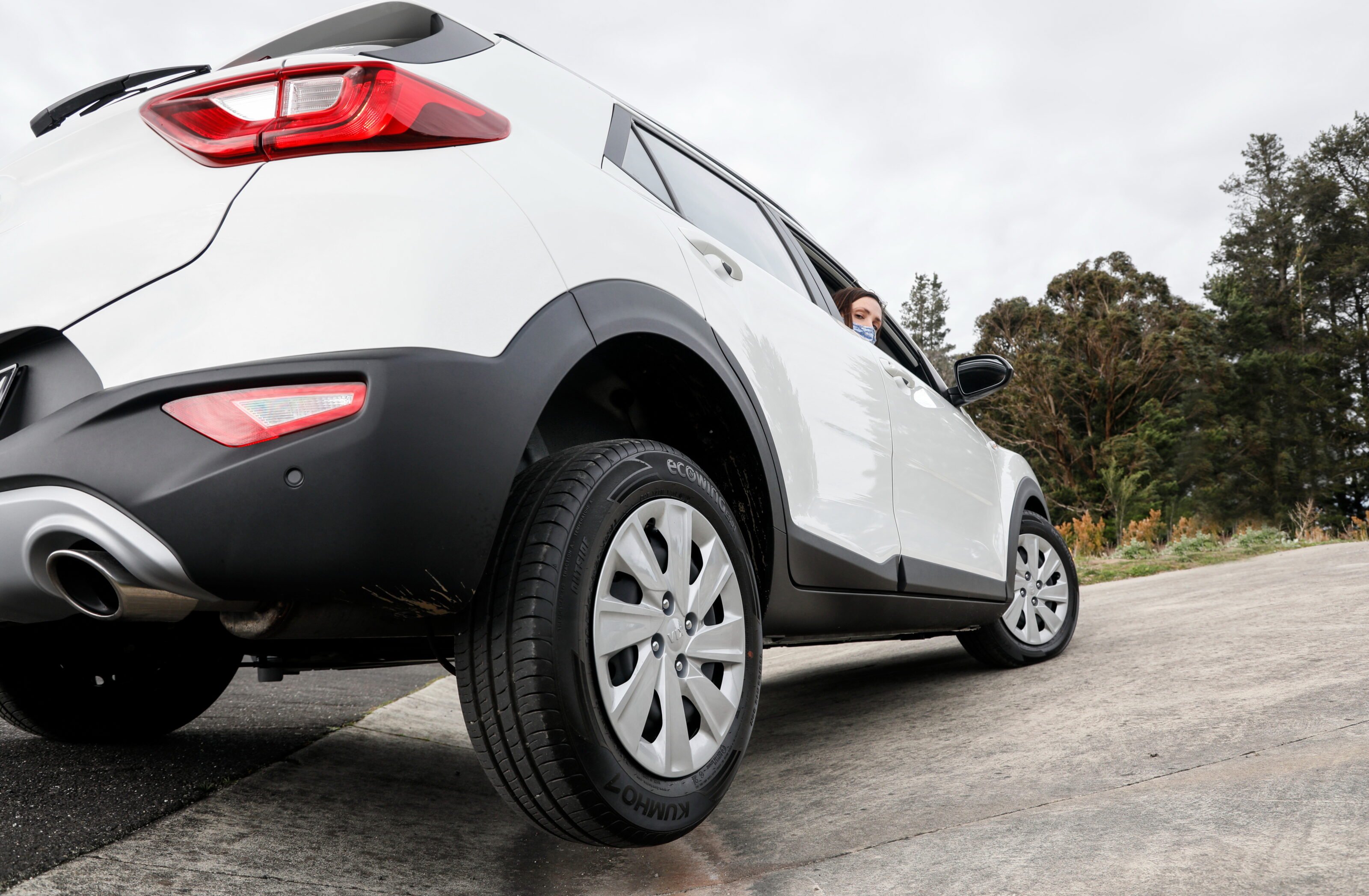
Considering the basic suspension setup, which fits in with the budget price-point, the ride is smooth and comfortable on the whole, and it handles itself well over minor bumps on suburban or regional main roads – thanks, in part, to 15-inch steel wheels with a chunkier sidewall. You will notice, however, that there can be some harsher feedback on particularly prominent speed bumps or pothole-ridden roads.
Officially rated at 6.7L/100km (combined), we’ve found the best fuel economy we could achieve was an impressive 5.7L/100km, but most of the time it has been closer to 7.9L/100km in real-world town driving and at worst, thanks to lots of COVID restriction-enforced small trips, we hit 9.7L/100km.
Compared to its competitors, on paper, the Stonic offers marginally poorer fuel performance – with the Ford Puma and Mazda CX-3 providing a rated 6.3L/100km (combined) with an auto transmission. The manual Stonic S claims 6.0L/100km versus 6.6L/100km for the manual CX-3. The Puma only comes fitted with a seven-speed auto. Meanwhile, the Toyota Yaris Cross undercuts them all by some margin with a 5.4L/100km official combined rating for the petrol version and 3.8L/100km for the hybrid.
Considering the basic suspension setup the ride is smooth and comfortable on the whole, and it handles itself well over minor bumps on suburban or regional main roads.
Safety
The Stonic comes with a host of active and passive safety systems across its line-up, which include:
- Anti-lock braking system
- Electronic stability control
- Vehicle stability management
- Hill-start assist
- Autonomous emergency braking with forward collision warning system
- Lane-keeping assist
- Lane following assist
- Driver attention alert
- Reverse parking sensors and camera
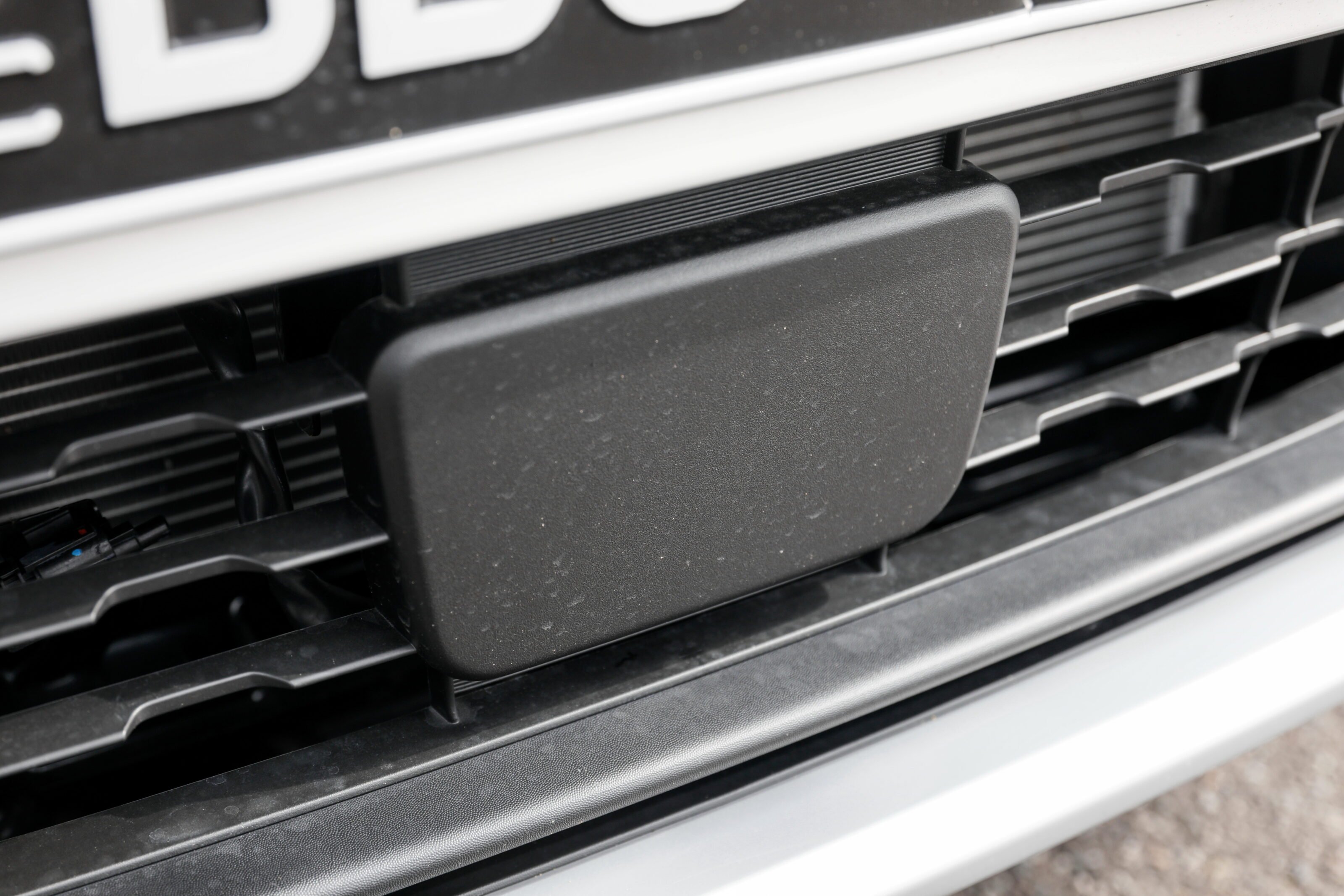
What we found was a significant plus point for a car of this price is the inclusion of rear parking sensors and a reversing camera, even on the base-level S. While rivals such as the Yaris Cross also feature these as standard across their ranges, it is a costlier vehicle overall.
That said, while the camera’s functionality is faultless, the quality of the picture leaves something to be desired and doesn’t match up to competitors like Suzuki that have a superior image in vehicles of a similar price, if not in the same segment, such as the Vitara.
The lane-keep and lane following assistance is useful at times, if a little keen to correct at the slightest sign of deviation. Unlike the Yaris Cross, however, noises are kept to a minimum with just a flashing symbol on the dash to alert you to the error of your ways – which is preferable as loud noises in themselves can be distracting on occasion.
The Stonic rides on the coattails of the Rio on which it is based for its five-star ANCAP rating, awarded in 2017.
For Kia’s first foray into the light SUV segment, the Stonic is performing well already – having sold 5601 units since launching in early 2021.
In September this year alone, 721 were snapped up, making it the second best-selling model in the class for that month (behind the also new Yaris Cross, and well ahead of the popular Mazda CX-3 and Venue offering from sister firm Hyundai) and third year-to-date – despite having some more established competitors such as the Nissan Juke and Volkswagen T-Cross to contend with.
All Kias come with a respectable, if not quite industry-leading, seven-year/unlimited-kilometre warranty plus capped-price annual servicing (or every 15,000km, whichever comes first) for seven years starting at $281 and fluctuating thereafter depending on whether it is a minor or major service. The most you’ll pay during that time is $702 in the fourth year or at 60,000km.
Verdict
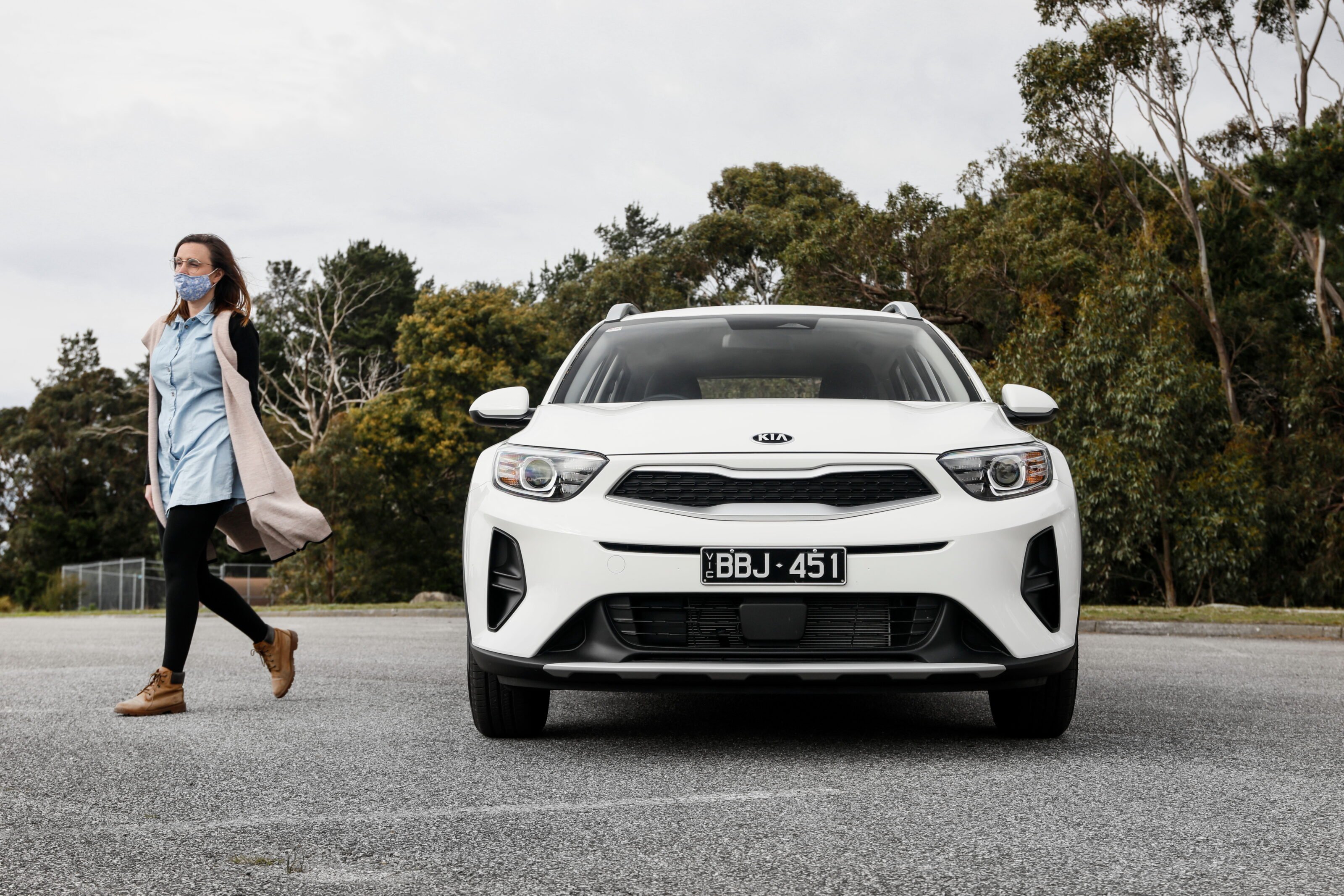
According to Kia, the Stonic boasts “European styling with youthful character” – with its marketing clearly aimed at getting young people, and specifically young families, into the car.
But we think it goes deeper than that. Yes those with a baby or potentially one or two small children could do well with this as their first family motor – there’s ample room for all the kit and caboodle in the boot, the rear seats have ISOFIX and top tether points, and there’s enough legroom even for an adult to be comfortable on hops around town.
Yet it shouldn’t be ruled out that it may curry favour with older drivers too, who want a higher ride without the larger sticker price of many SUVs. Interestingly, even though it is higher than a hatch, once you’re in the driver’s seat it doesn’t ‘feel’ high so may not suit all tastes.
Out of the three, S, Sport and GT-Line variants, we’d go with the top of the range GT-Line as it gains some of the creature comforts we just prefer not to go without such as privacy glass on the rear windows, climate control air-con, a push-button start and a more premium feel to the cabin. It’s $6000 more, but that feels like money well spent.
By comparison, the base-spec from its rivals – the Mazda CX-3 G20 Pure, Ford Puma 1.0-litre, and Toyota Yaris Cross GX petrol (not with the hybrid drivetrain chosen) will set you back $29,940, $34,158 and $ 30,933 drive-away respectively minus any options. The Kia’s drive-away price is $24,490 in auto guise or $1000 less as a manual.
While it certainly feels like a no-frills experience, and it rides a little lower than we’d like for an SUV, there’s little doubt this newcomer would make a sturdy runaround and has the potential to really unsettle the competition.
2021 Kia Stonic S specifications
| Body | Five-door light SUV |
|---|---|
| Drive | Front-wheel drive |
| Engine | 1.4-litre MPI four-cylinder petrol |
| Transmission | Six-speed automatic |
| Power | 74kW @ 6000rpm |
| Torque | 133Nm @ 3800rpm – 4800rpm |
| Bore/Stroke | 72mm x 84mm |
| Compression ratio | 10.5:1 |
| 0-100km/h | N/A |
| Fuel consumption | 6.7L/100km (combined) |
| Weight | 1157kg (kerb) |
| Suspension | MacPherson strut (f); Coupled torsion beam (r) |
| L/W/h | 4140/1760/1520mm |
| Wheelbase | 2580mm |
| Brakes | 280mm ventilated discs (f); 263mm solid discs (r) |
| Tyres | 185/65 R15 |
| Wheels | 15-inch steel |
| Price | $24,490 drive-away |
Becoming the benchmark is tough, but remaining so is even tougher. Whether in sport or business, once you’re top of the pile a large target is painted on your back and everyone ups their game in response.
The Volkswagen Golf has regularly adopted this mantle throughout its 47-year history. While it hasn’t always been top of the class, it’s fair to say that any car that bests it – the original Ford Focus, for instance – is usually very special indeed.
The problem for the competition is that, like Porsche and its 911, Volkswagen has an extremely close understanding of what makes the Golf successful and how to improve it, which it tends to do with each successive generation.
Since 2003 it’s been on a roll. The Mk5 took its predecessor’s improved quality and upmarket positioning and added handling nous, while the subsequent Mk6 and Mk7 – COTY winners both – have only further refined the concept. Now the eighth chapter is here.
And an intriguing chapter it is. In some ways the Golf is yesterday’s news. VW is investing tens of billions of dollars in electrification and leading the thrust is the ID.3.
Just as the Golf usurped the Beetle, so too the ID.3 is intended to carry Volkswagen into a new era. Does that mean this latest Golf hasn’t been lavished with the same care and attention as its predecessors?
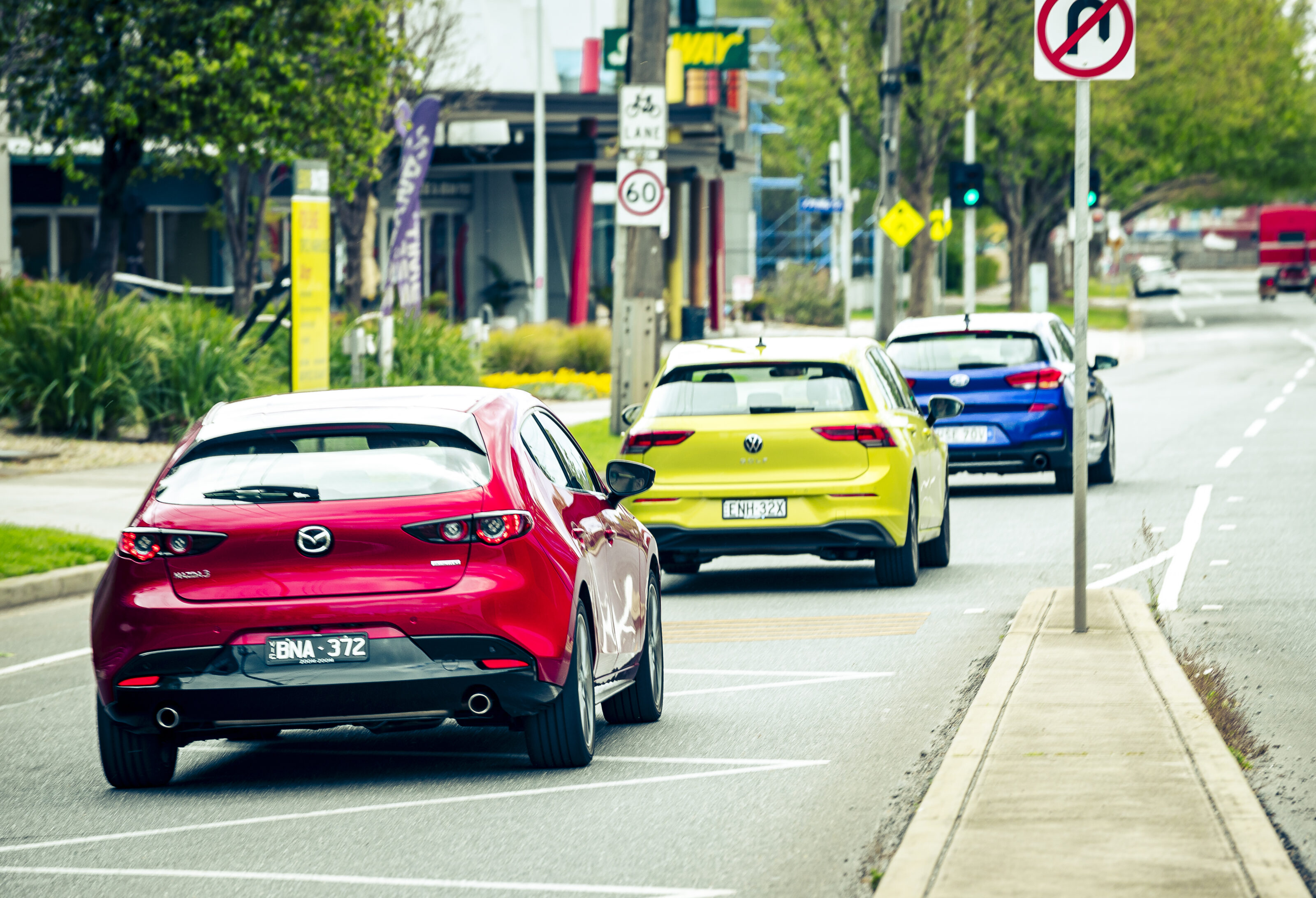
To help answer this question we’ve gathered two of its main rivals. The Mazda 3 is the Golf’s current nemesis having pipped the Mk7.5 the last time we ran a comparo and it’s joined by the freshly updated Hyundai i30.
Full disclosure: this was meant to be a four-way but the Toyota Corolla could not attend at the last minute. Its absence is excusable, however, as our chosen circa-$35K price point sits slightly above even the ceiling of the Corolla range.
This money also buys the flagship of the i30 range – sizzling N aside, of course – the N-Line Premium. Pricing starts at $37,690 retail, to which metallic paint adds $495, which equates to around $40K drive-away depending on your state taxes.
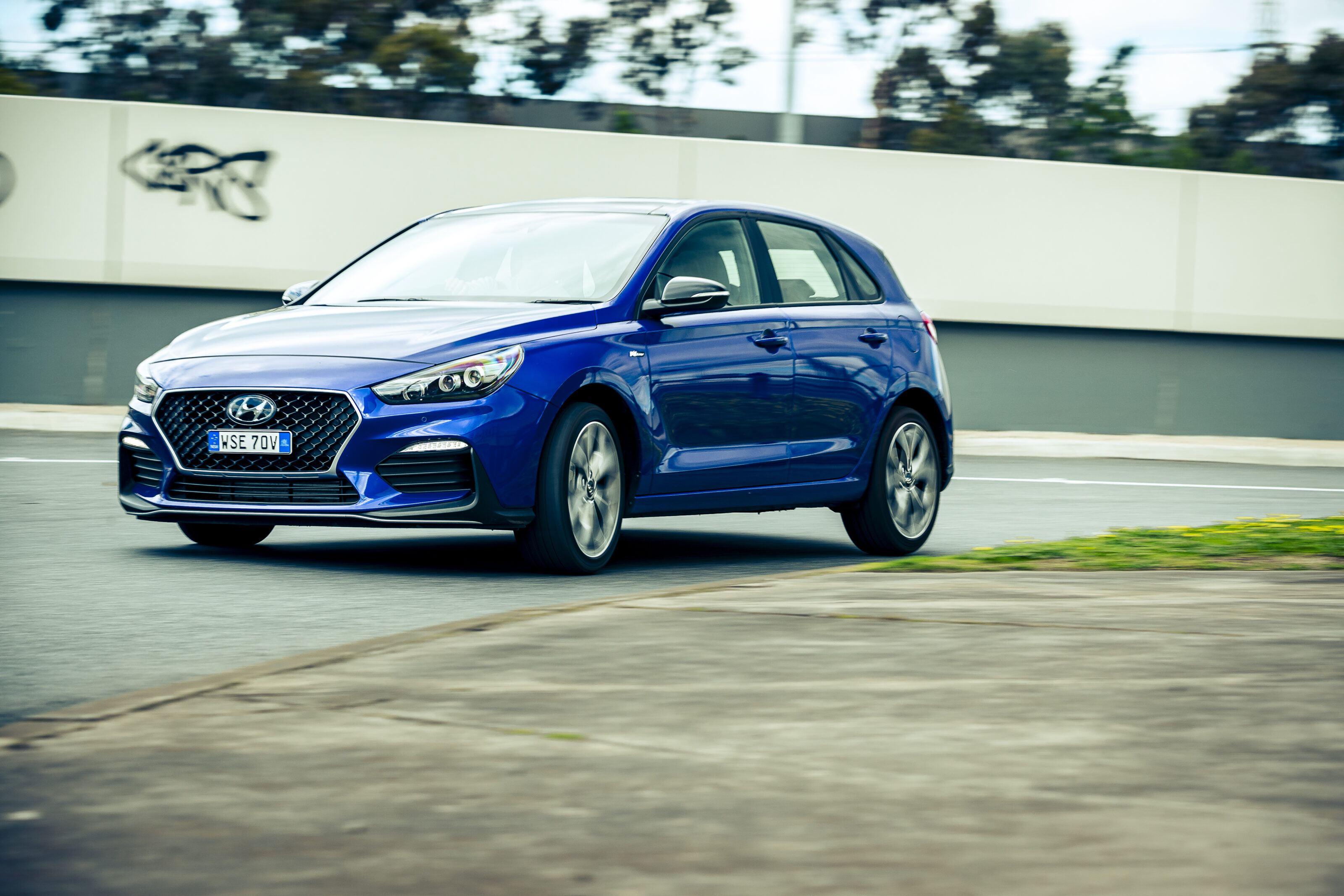
It comes basically fully loaded, with dual-zone climate control, leather seats – the fronts heated and ventilated and the driver’s 10-way electrically adjustable – 10.25-inch touchscreen infotainment system with smartphone mirroring and digital radio, wireless charging, native sat-nav, keyless entry and start, seven-speaker stereo, front and rear parking sensors and a panoramic glass sunroof.
Oddly, while certain active safety systems are standard, including forward collision warning with pedestrian and cyclist detection and lane-keep assist, blind-spot collision warning, rear cross-traffic alert and safe exit warning are limited to the i30 Elite and not available even as an option.
No such dramas in the $34,590 Mazda 3 GT, which includes AEB, lane keep assist, rear cross traffic alert, smart brake support front and rear, adaptive cruise with stop and go function, speed assistance and blind spot monitoring standard. A $1500 Vision Technology Pack adds a 360-degree monitor, cruising and traffic support, driver monitoring, front parking sensors and cross traffic alert.
On the convenience side of things there’s auto wipers and headlights, dual-zone climate, heated seats and steering wheel, keyless entry and go, colour head-up display, leather seats (fronts electrically adjustable) and an 8.8-inch infotainment screen that controls smartphone mirroring, digital radio and a 12-speaker Bose stereo.
The reason these two variants were chosen was to line-up with the new mid-spec Golf Life, which starts at $34,450.
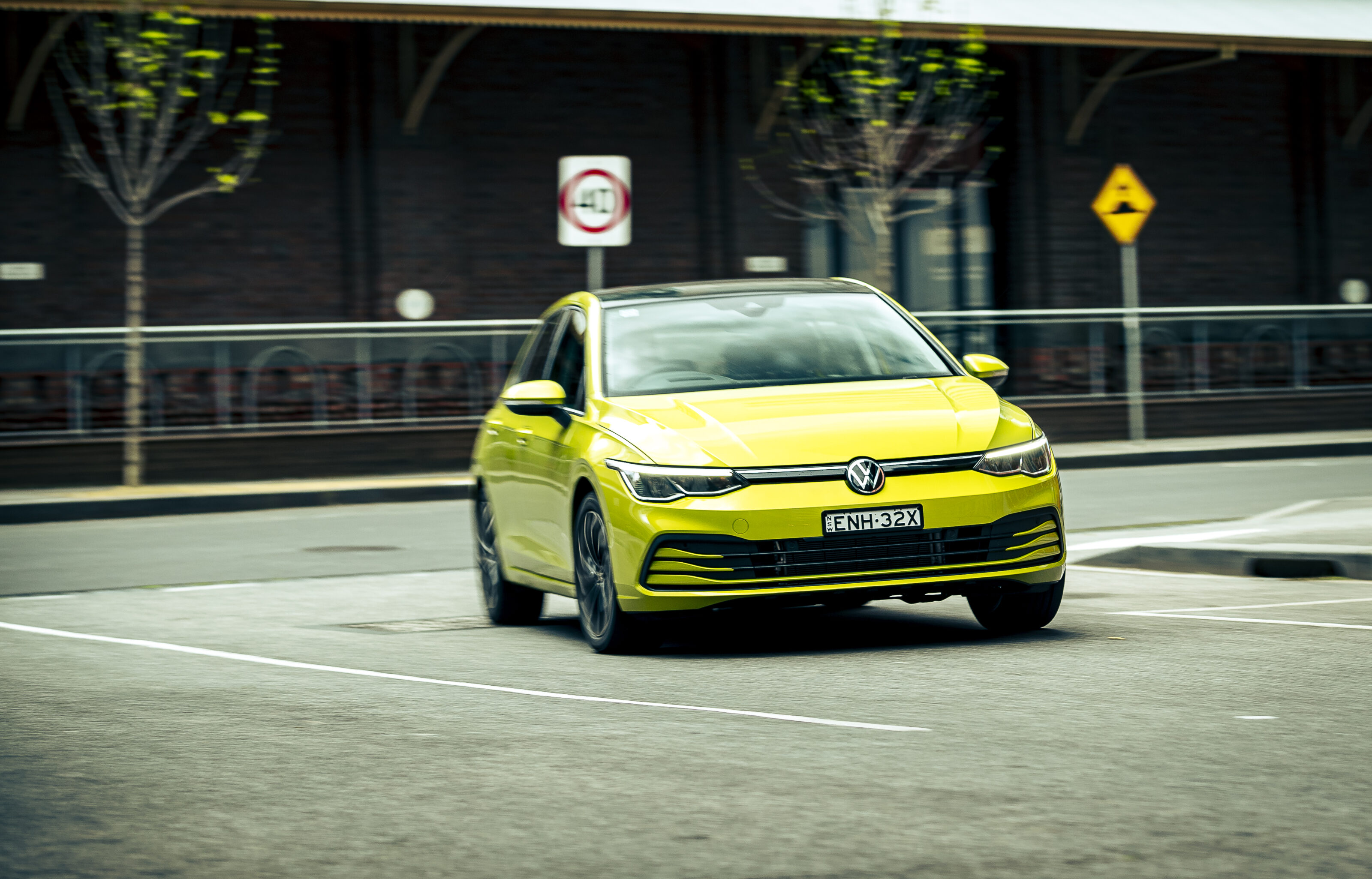
Starts is the operative word, as the Pomelo yellow paint of our test car adds $900, the Sound & Vision Package (Harman Kardon eight-speaker audio with subwoofer; head-up display) a further $1500 and the Comfort & Style Package (LED ambient interior lighting, comfort sport front seats with microfleece and cloth upholstery, full-length sunroof) an extra $2000 for an as-tested total of $38,850 before on-roads.
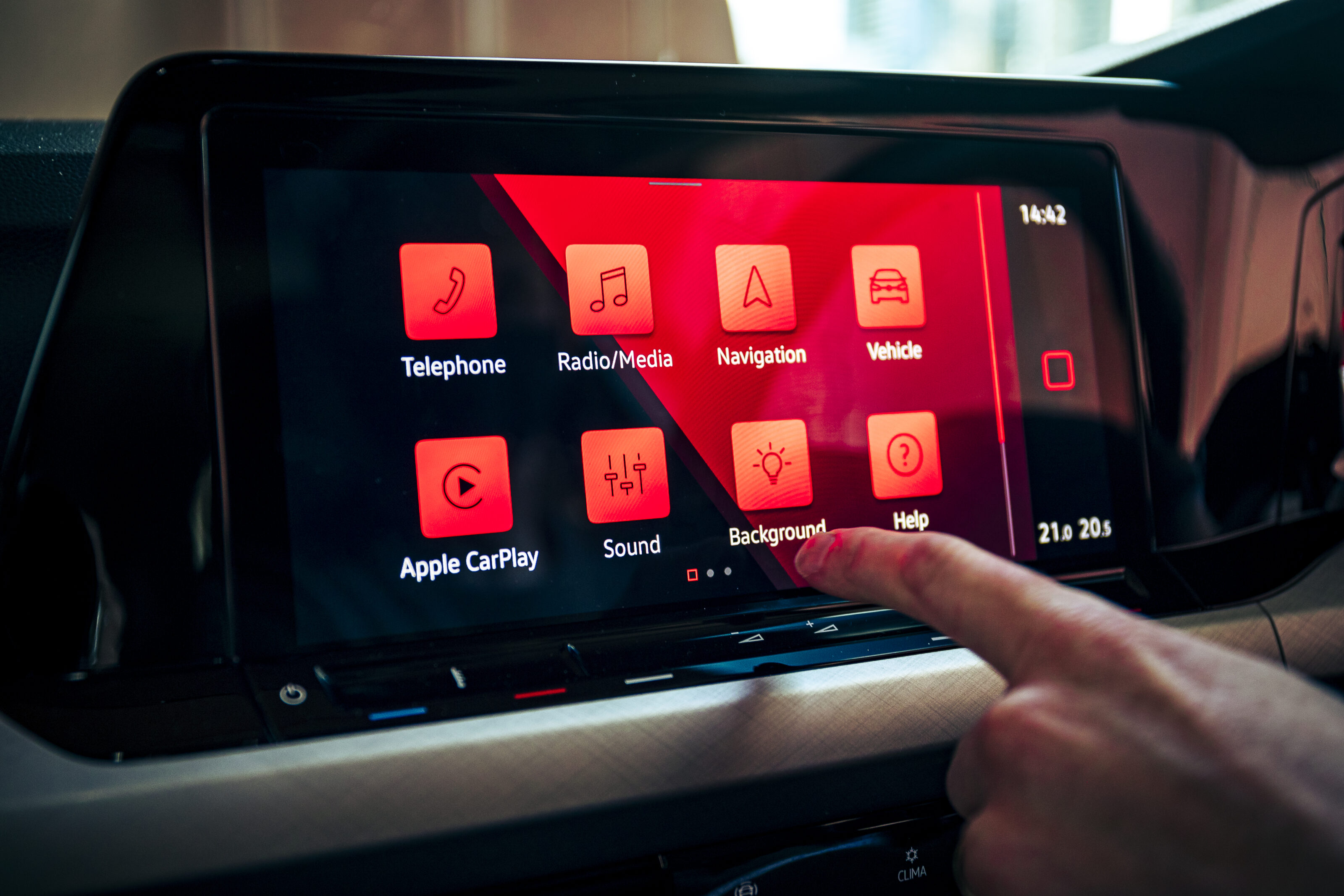
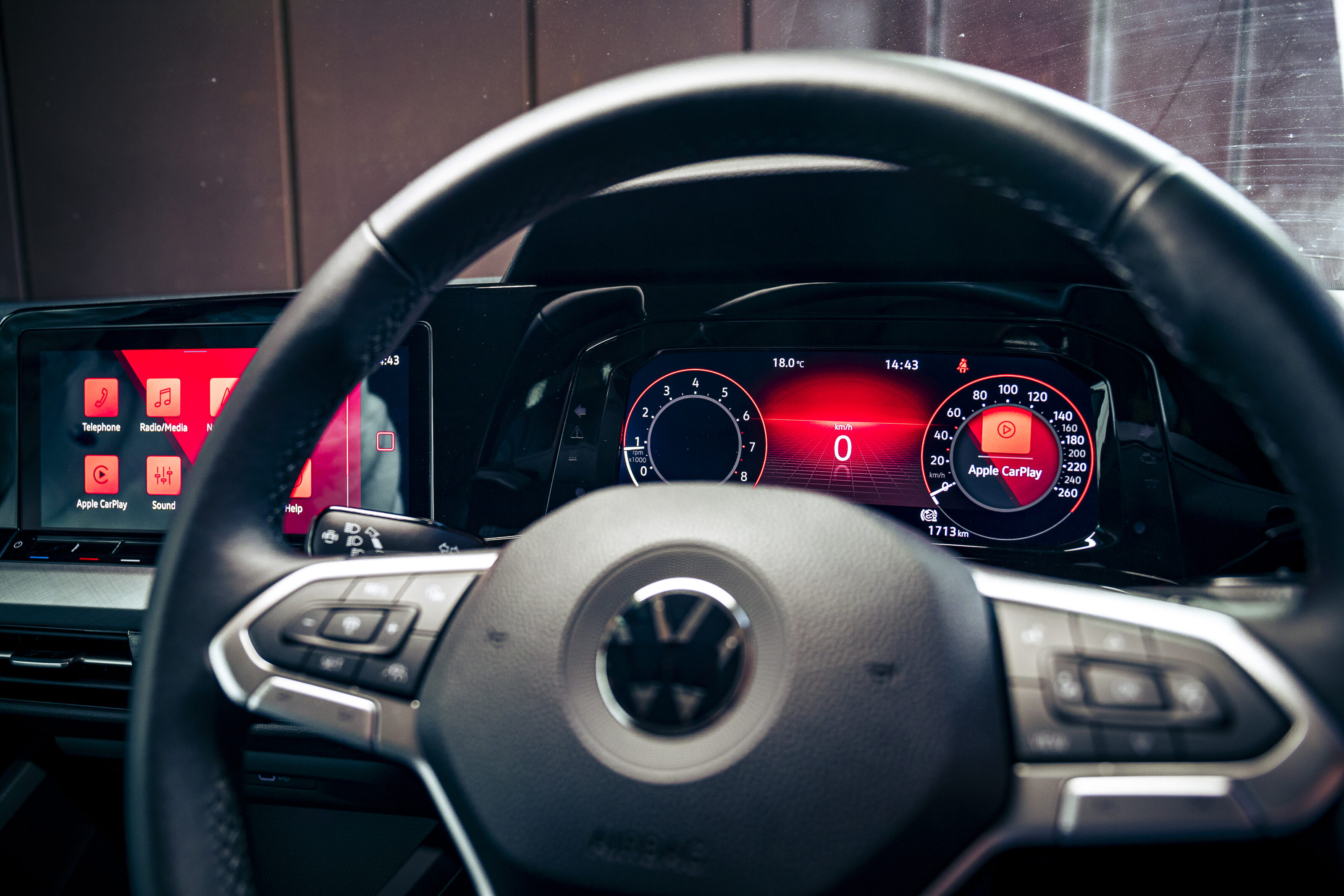
The high price is backed by a high level of equipment, including proximity keyless entry and go (the car locks/unlocks as you depart/approach), LED lights all around, tri-zone climate control, the Digital Cockpit Pro full-width colour instrument display and a 10.0-inch touchscreen infotainment system with wireless charging and smartphone mirroring.
In addition, VW’s comprehensive IQ Drive active safety suite is standard, including adaptive cruise with stop & go, side assist with rear traffic alert, exit warning system, front assist with pedestrian and cyclist detection, auto high beam, park assist, front and rear parking sensors, reversing camera and traffic jam assist.
It’s the highest specification of our three, albeit not by a huge margin, but some may be surprised or dismayed by the lack of electric seat adjustment or leather trim.
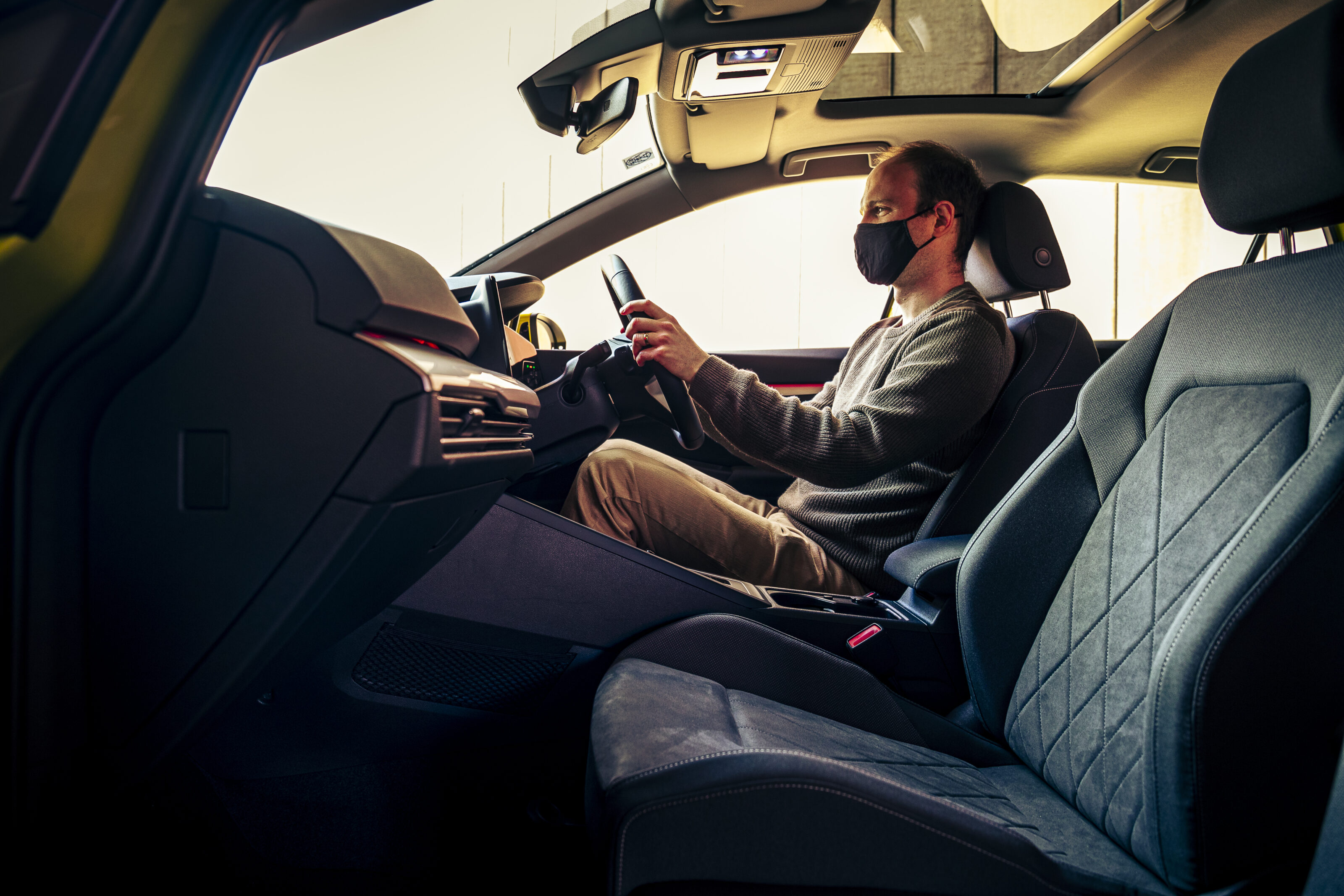
It’s not even an option, which suggests Volkswagen has adopted a vegan approach to the Mk8’s seat upholstery. The rest of the cabin is equally modern in its design; by moving virtually every function into the two digital screens the result is a very minimalist affair.
On the plus side, the interior is light and airy with excellent visibility thanks to large windows and the optional sunroof. The cloth seats are supportive and comfortable with infinite wheel adjustment for the back rests.
Rear accommodation is clearly the best of the three cars, not only thanks to generous room in all directions but the level of equipment.
There are vents with separate temperature controls, courtesy lights, a pair of USB-C ports and not only map pockets but a pair of smaller pockets above that are the perfect size for phone storage.
The rear seats fold 60/40 to expand the 374L boot to 1230L and there’s also a handy ski port hidden behind the fold-down armrest.
The only real demerit is the extent to which almost every function has been crammed into the central infotainment touchscreen.
VW boasts of a smartphone-style HMI (human-machine interface) but it ain’t as slick as your handheld device in its speed of operation, though it could potentially improve with future software updates. With a little familiarity it’s quite easy to navigate quickly but enough functions are buried in sub menus that a few more one-touch shortcut keys would not go astray.
Hyundai’s new infotainment system, installed as part of the i30’s recent facelift, strikes a good balance. The large, clear screen is easily navigated thanks to the row of shortcut keys along the bottom, though the actual speed of operation is little different to the Golf’s.
Wireless smartphone mirroring like in the VW would help, especially as wireless charging is already present. It’s common to curse the Golf’s still-unusual USB-C ports until you realise you don’t need them.
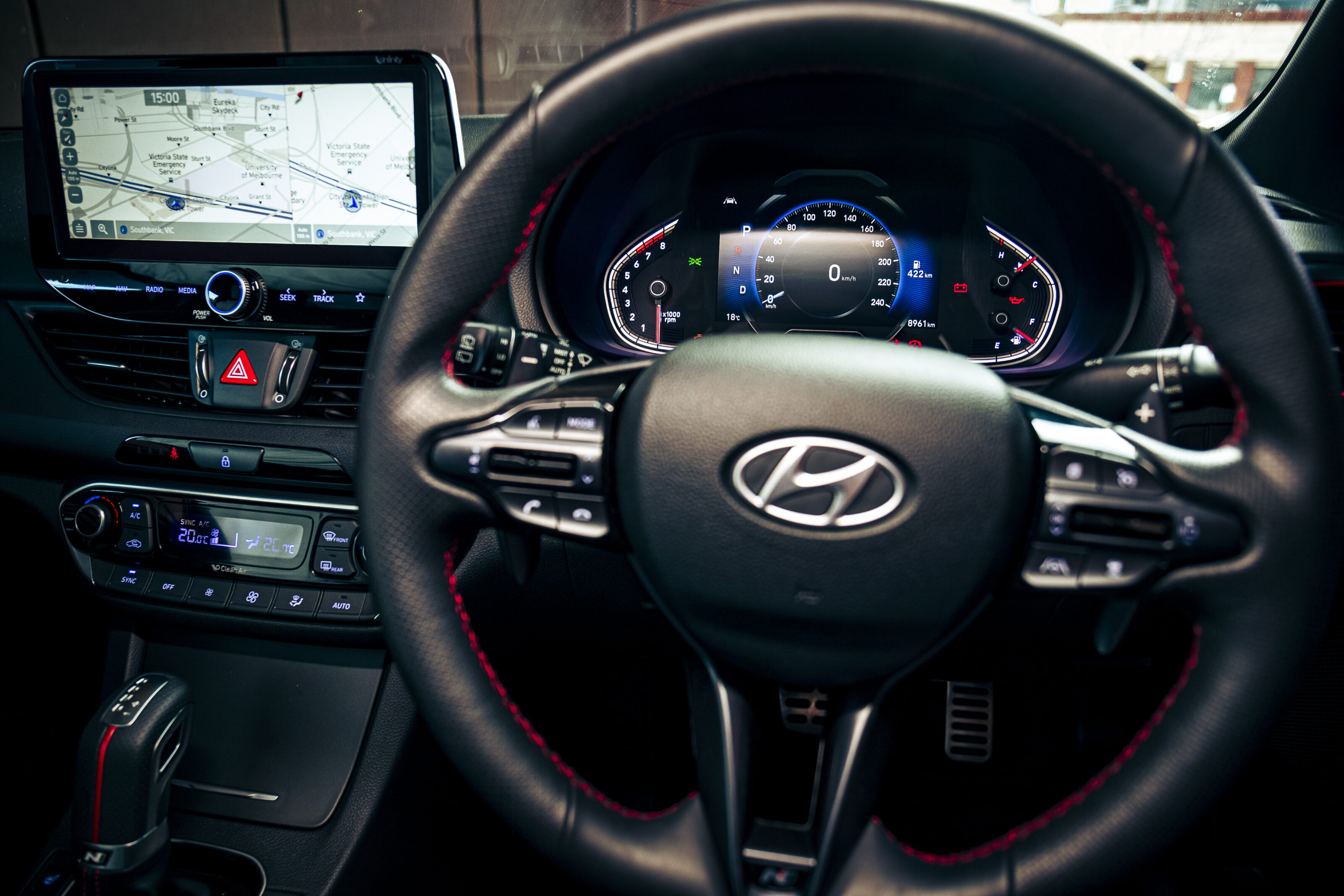
The i30 N-Line Premium is clearly a tarted-up version of quite a basic hatch. Red seatbelts, stitching and trim highlights and the wheel from its N big brother can’t disguise the swathes of hard, coarse-grain plastics that proliferate throughout the cabin.
Likewise, the rear seat isn’t as comfortable and while there are vents, USB ports and separate temperature controls are conspicuous in their absence. Foot room is hindered by the front seat rails and the full-length sunroof robs headroom, though it does let in plenty of light and the boot is a handy 395L with a false floor for taller objects.
Practicality isn’t a Mazda strong suit. That suave, stylish exterior does come with some compromises, including a 295L boot, limited rearward vision and less rear headroom than its rivals.
Leg and foot room are reasonable but while there is a pair of rear vents, USB ports, temperature controls and even map pockets are conspicuous in their absence.
Up front the overall ambience is quite dark, in part due to the 3 GT lacking the sunroof of its comparison competitors but also thanks to the colour palette, every surface being black bar a couple of chrome trim highlights and some dark red stitching.
That’s the bad news. The good news is that Mazda has gone to town with material quality, with virtually every surface being covered in soft, deeply padded leather, front and rear.
Combine this with the interesting tiered design and excellent instruments – clear digital facsimiles of traditional analogue dials cleverly blend the past and present – and you have a cabin that would be at home in a much more expensive vehicle.
It’s also an easy environment to navigate, whether it be the HVAC controls, central infotainment system with its iDrive-like controller or those digital instruments.
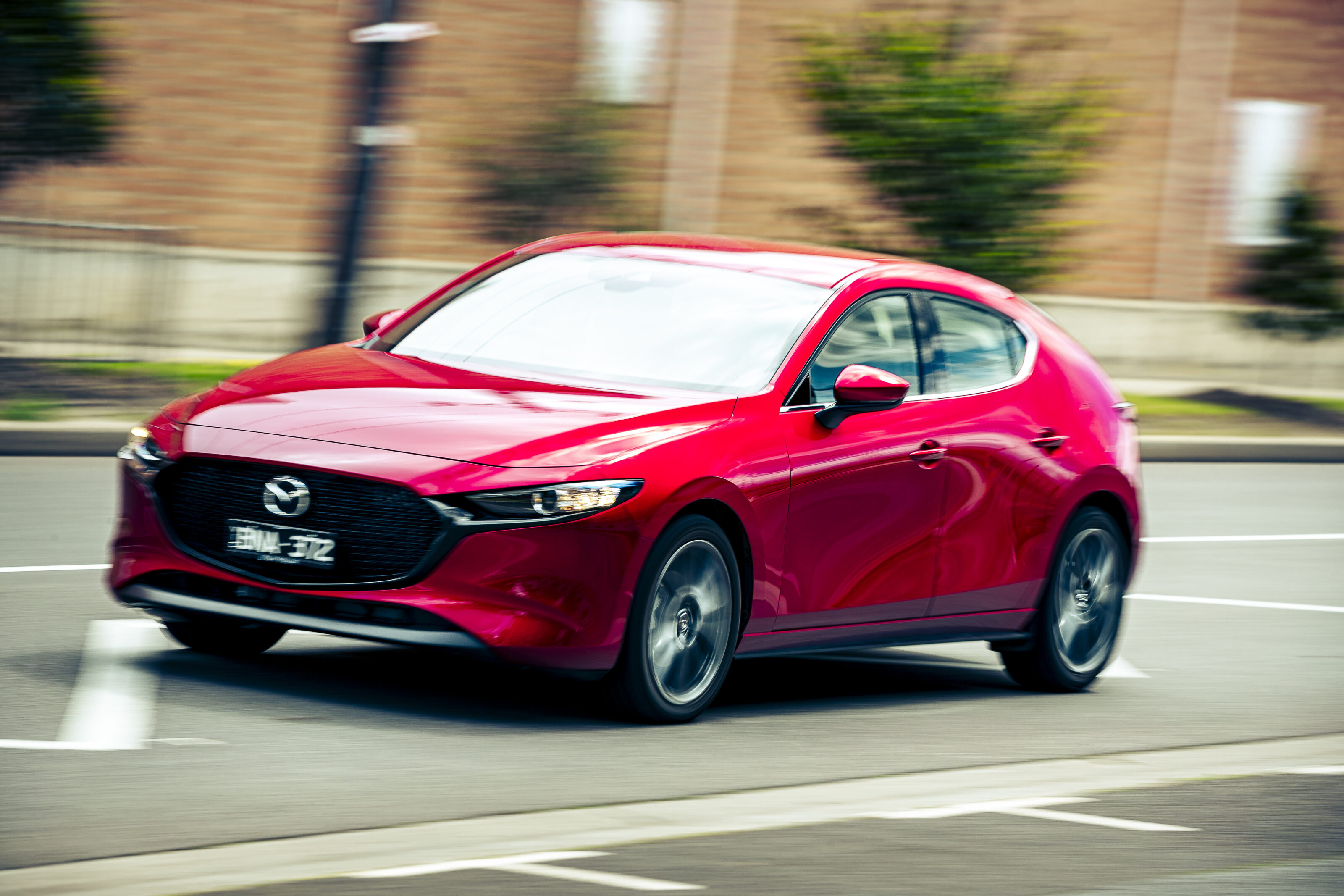
The Mazda punches above its price tag in terms of looks, too. The rounded back gives it more of a coupe-like profile and the paint (a $495 option) is deep and lustrous.
The Golf is a surprise packet. Early press shots made it look like the Mk8 had an enlarged proboscis (aka a big schnoz) but the design is much more cohesive in the metal.
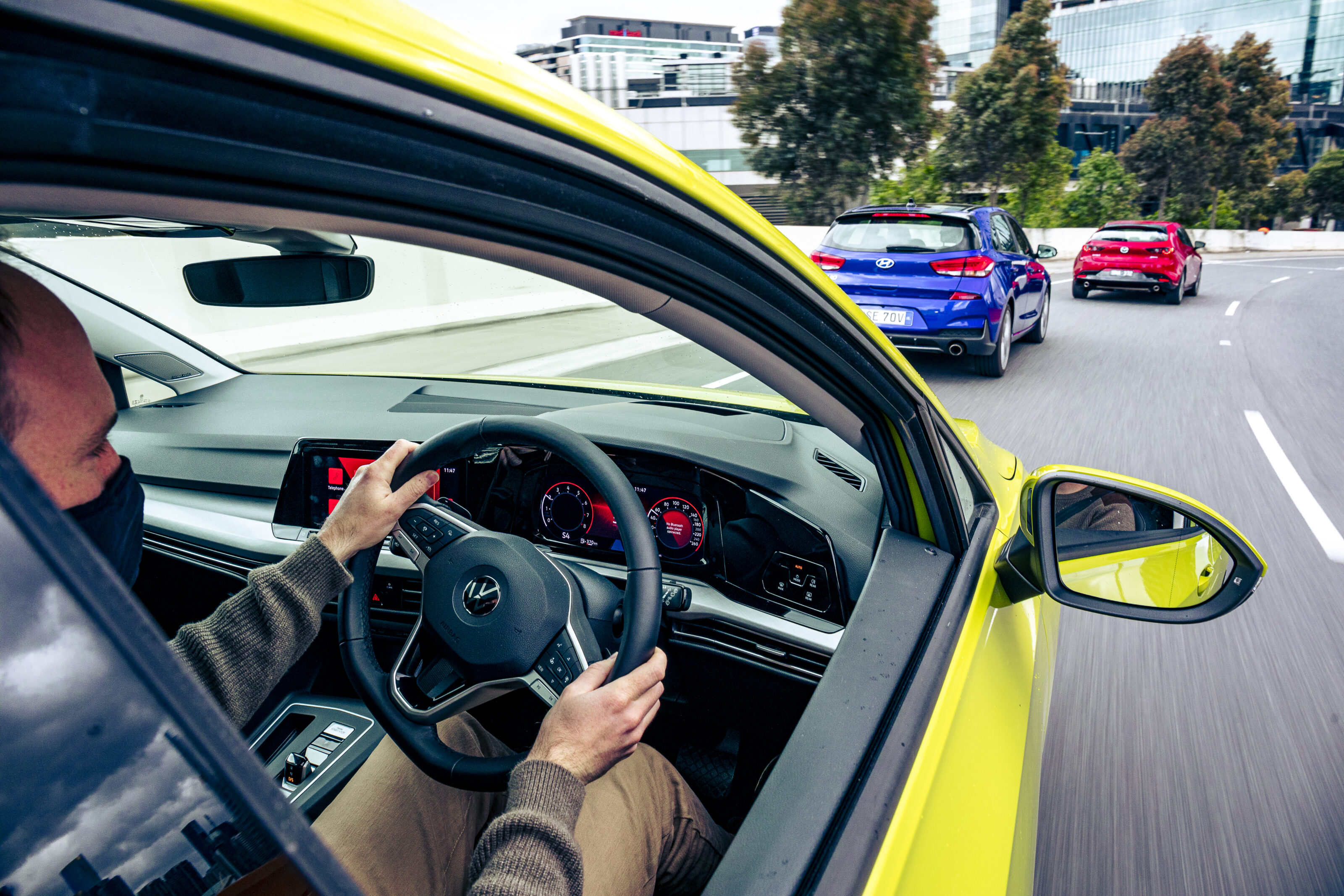
It’s clearly an evolution of the Mk7 but a successful one. Last but not least is the i30, Hyundai adopting an old-school approach of bigger wheels and a bodykit to sex up the N-Line. Perhaps think of the three as cocktail dress (Mazda), smart casual (VW) and activewear (Hyundai)?
The i30’s sporty character strengthens on the move, particularly in the way it really wakes up when flicked into Sport mode, which quickly becomes the default choice.
In Normal throttle response is lethargic, but Sport sharpens it nicely and the gearbox is decisive, though there is the occasional clunk when selecting third.
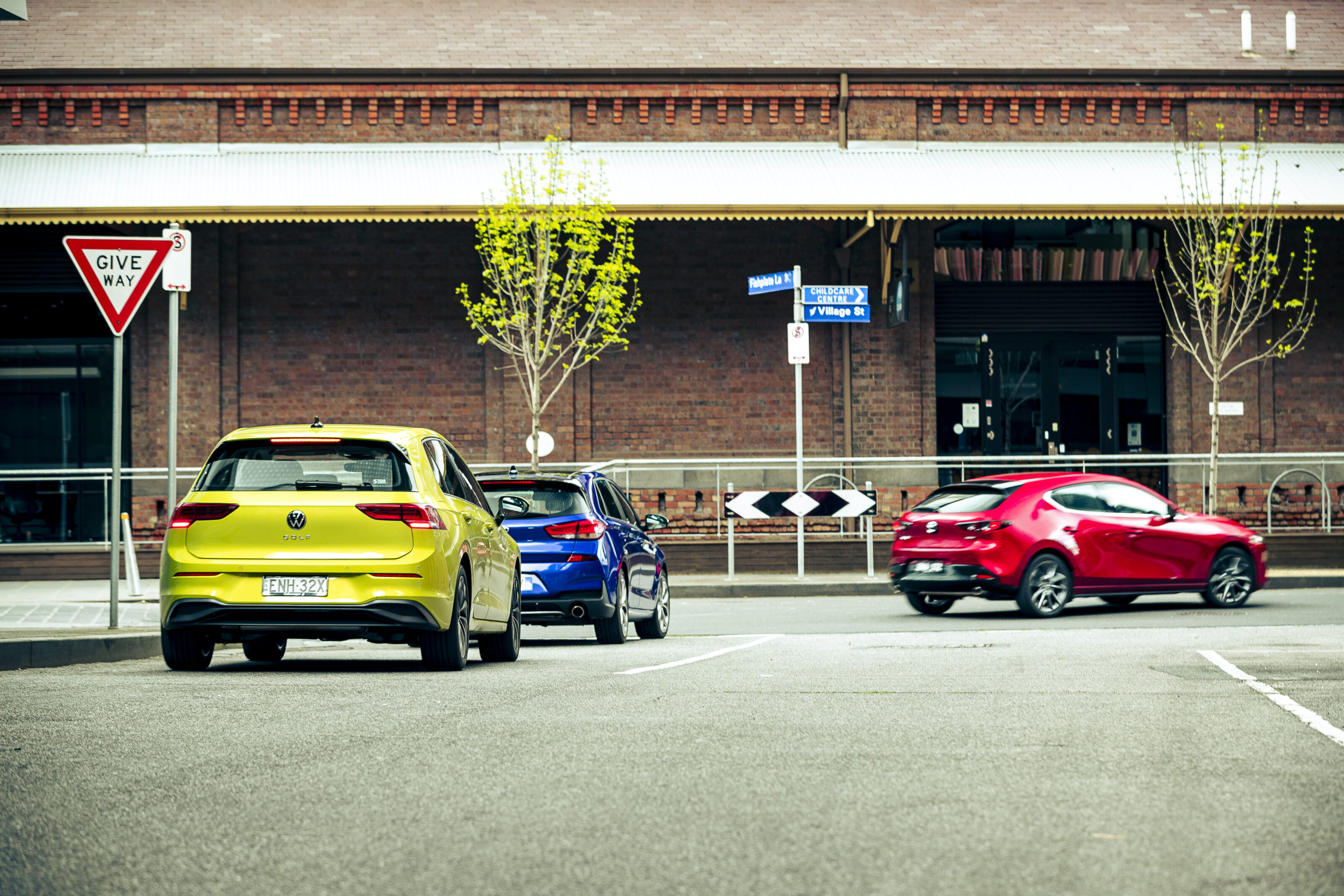
N-Line could be renamed N-Lite, as the sportiest ‘base’ i30 does a good job of approximating its bigger brother at slower speeds; there’s the same considered balance between ride and handling and the same chunkily weighted steering.
It’s a very different story in the Golf where relaxation is the name of the game. The steering is light; not in a finger-twirling lack of connection fashion, just perfectly weighted for accuracy without effort.
My early notes read “VW has really smoothed out the dual-clutch behaviour” forgetting the Mk8 has switched to a conventional torque converter auto with a commensurate improvement in low-speed refinement. Combine this with the suspension’s uncanny ability to soak up poor road surfaces and the result is a soothing day-to-day driving experience.
The Mazda 3 takes a different tack. Its low-speed behaviour is unusual with a brake pedal that’s firm to the point of being wooden, weighty steering and a firm ride that favours communication over comfort.
The 2.5-litre naturally-aspirated engine doesn’t have the easy torque of the Hyundai and VW’s turbo units so everything about the drive requires more intent.
Once you intend to drive the 3 quickly, however, it all begins to make sense. For a humble hatchback this Mazda is remarkably good to punt hard.
That weighty steering provides plenty of feedback – albeit also with a little kickback over mid-corner bumps – those wooden brakes are now reassuringly firm under hard applications, the 139kW/252Nm atmo engine rewards you with more power the harder you rev it, the six-speed auto is satisfyingly swift in its changes and the firm ride results in great body control.
It gives you confidence to commit to corners and lean on the front end, but a trailed brake or mid-corner lift tucks the nose or floats the car through quicker corners with all four tyres working hard.
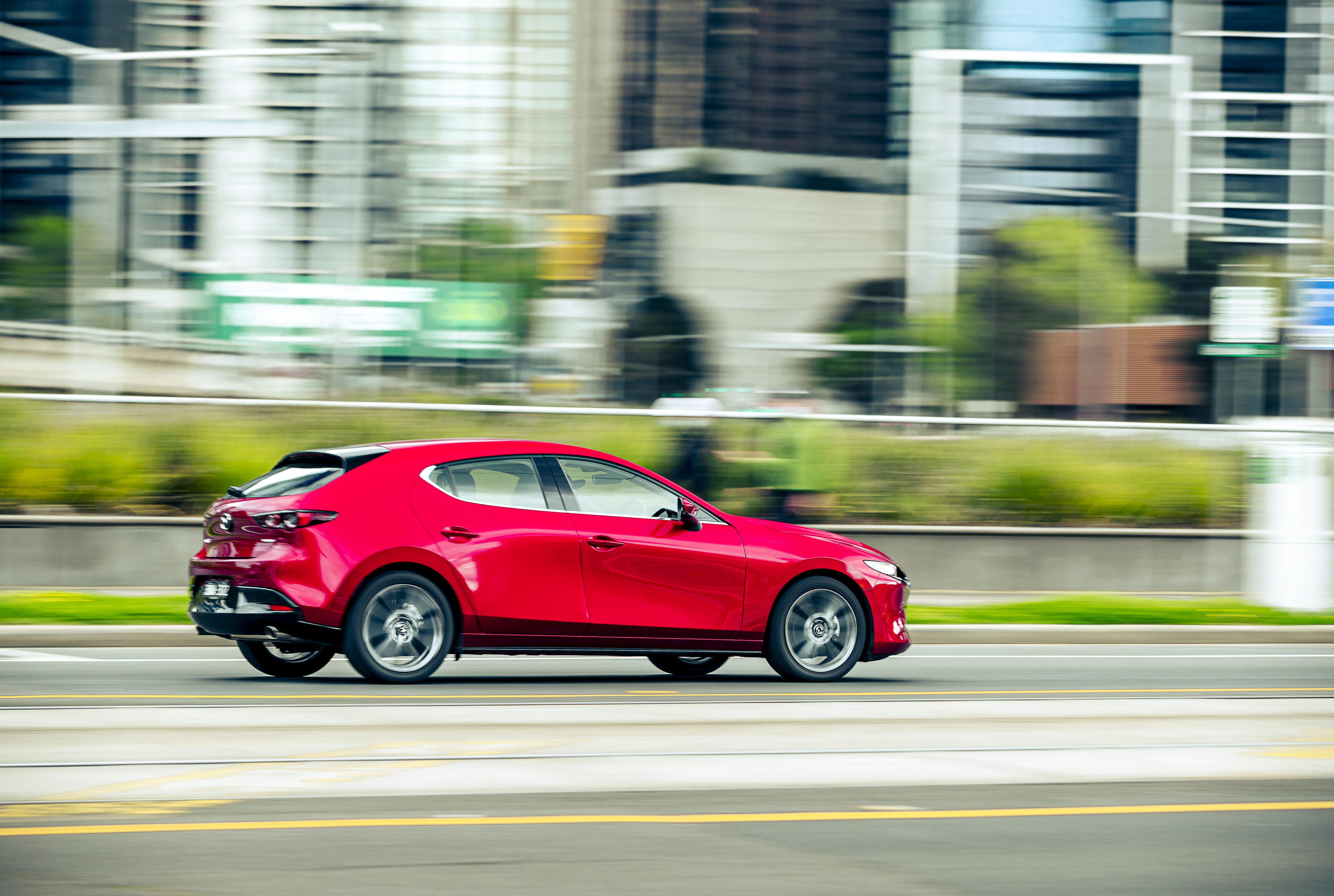
It makes every roundabout an opportunity for enjoyment and can be driven with enthusiasm for long periods without wilting. Kudos to Mazda for largely solving the 3’s road noise issues, too, while the visual cue in the head-up display that a vehicle is in your blind spot is another clever touch.
Everything about the Golf’s low-speed behaviour suggests it’ll be a bit of a blancmange under cornering duress but nothing could be further from the truth. Of course it’s not a razor sharp corner carver, nor should you expect it to be, but it’s balanced and poised without a trace of the Mazda’s steering kickback.
The VW’s lack of sporting focus is evident in the fact it doesn’t even have an ESP Sport mode, though you can deactivate traction control, which is so well tuned it almost never intervenes. In fact, the Golf’s electronic aids in general are subtle in their intervention; Hyundai’s lane assist engineers could certainly learn a thing or two.
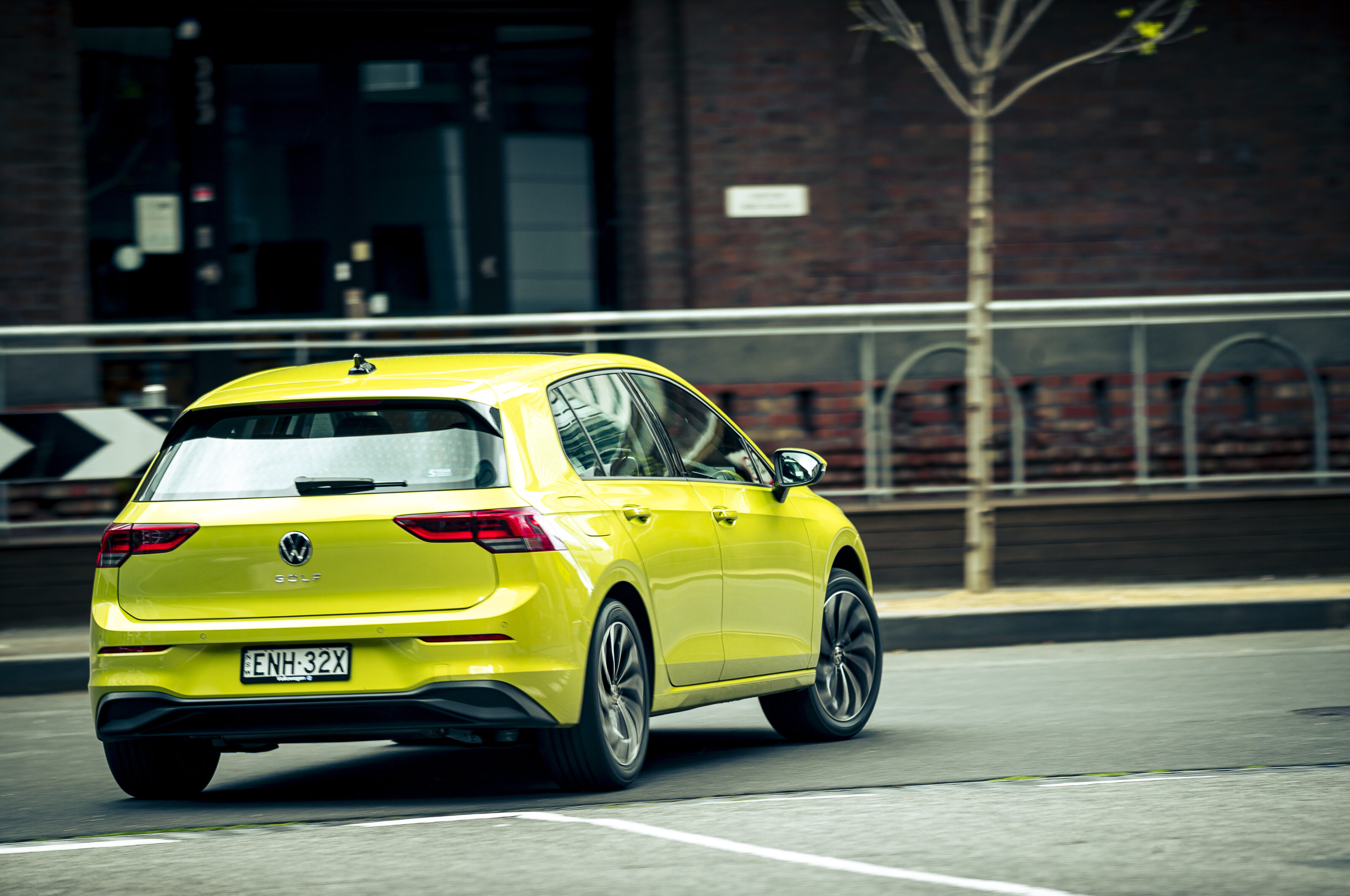
In GTI Golfs the XDL electronic ‘diff’, which quells wheelspin through brake activation, hasn’t always been up to the task, but with just 110kW/250Nm to handle it nails the front end to the tarmac.
The VW’s 1.4-litre turbo engine is undoubtedly its weakest point in a sporting context, with little incentive to explore its upper reaches, but the respectable mid-range torque makes for decent progress and means the auto’s conservative approach to downshift requests is less of an issue, third or even fourth gear being useable for all but the tightest turns.
Initially the i30 continues its ‘N-Lite’ impersonation. The 1.6-litre turbo engine’s power curve is flatter than a steamrollered pancake but its quantity of grunt – with 150kW/265Nm it has the highest outputs here as well as the best power-to-weight ratio – makes it the quickest of this trio in a straight line.
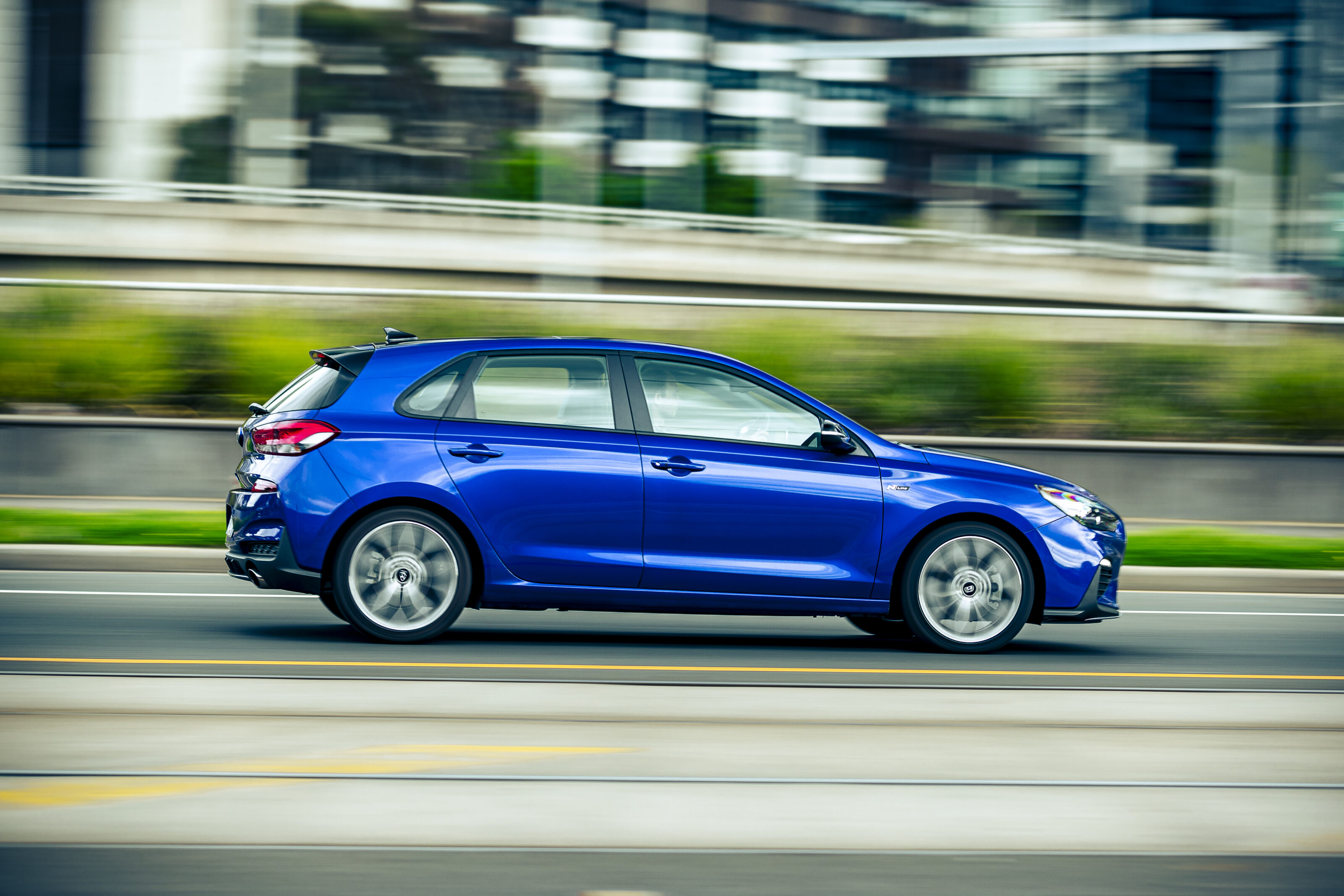
On smooth roads there’s plenty to enjoy; it can be driven hard in a similar fashion to the Mazda with a nice, wide limit and few dynamic surprises. Float it into a corner on the brakes and it’ll gently slide the rear and traction is strong on the way out. The suspension can run out of ideas slightly on a bumpy road at speed but retains enough control for you to happily bounce along.
All this makes what happens next all the more disappointing. Hit a bump mid-corner under load and the i30 N-Line exhibits some nasty steering kickback. The wheel jolts sharply in your hand and the steering assistance feels to disappear at the same time; if you’re committed to a particularly bumpy corner the ensuing wrestle with the wheel can be quite alarming, especially if Sport mode is activated – which it probably is – with the corresponding increase in steering weight.
It’s bad enough that I actually stop and check all the wheel nuts are done up correctly – they are – so the only conclusion to be drawn is that the larger wheels and extra power stretch the standard i30 front suspension geometry beyond its capabilities.
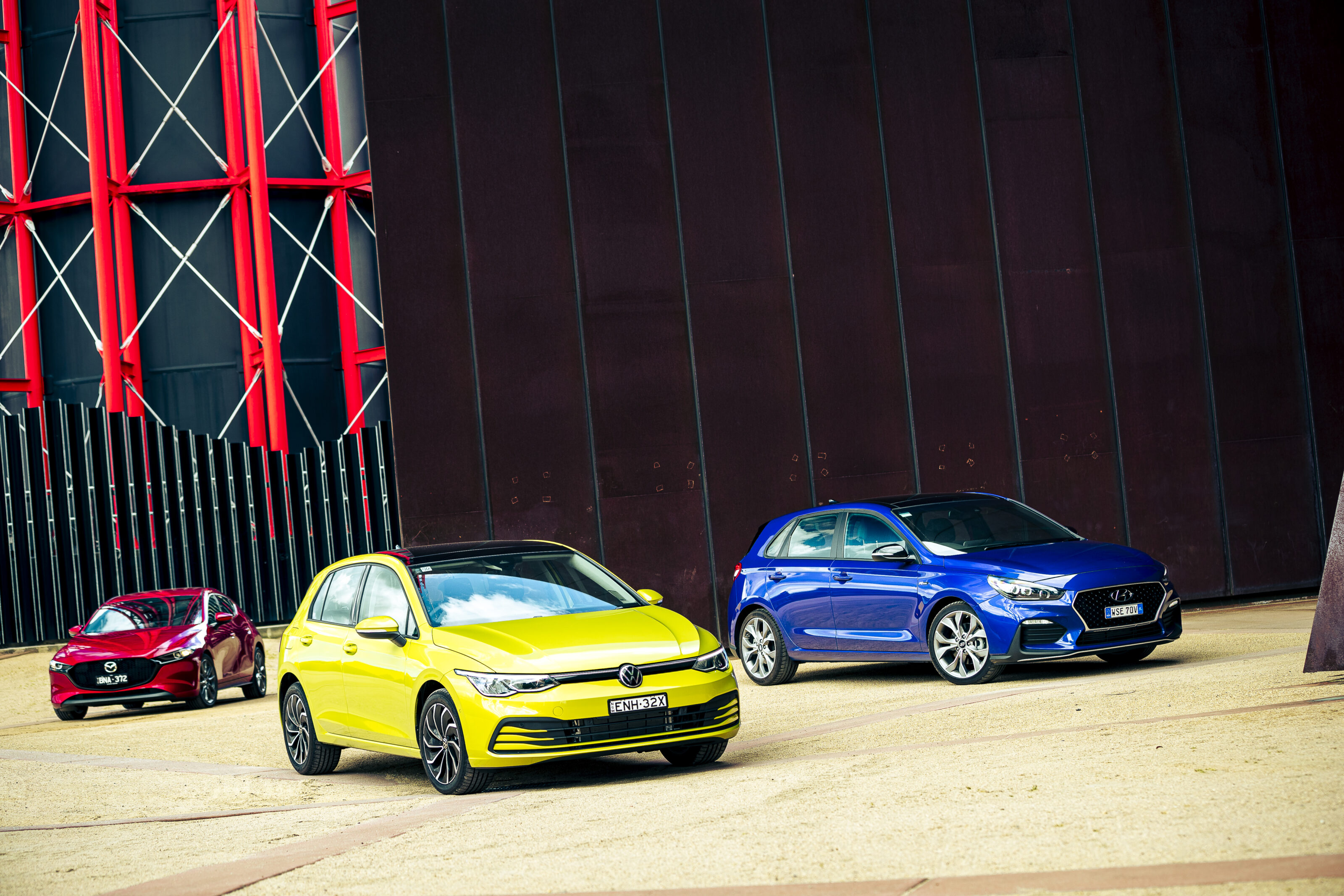
It’s a severe enough dynamic shortcoming that it knocks the Hyundai down to third in this comparison, which is a shame as until this point the i30 made a reasonable case for itself as a wannabe ‘N’ with decent performance and plenty of kit. If you just want a fancy i30, buy an Elite and save $6000; if you want an i30 to drive fast, buy a second-hand first-gen N.
In second place is the 3 GT. Mazda clearly didn’t want to build ‘just another hatch’ and has ratcheted up the exterior style and backed it up with beautiful interior materials and sparkling dynamics. Kudos to Mazda for trying something different, but the trouble is that the design heavily compromise practicality and vision, while the controls that shine when being exploited to their fullest annoy when used day to day.
This leaves the Golf as the winner, but it’s not a position it occupies by default. The Mk8 may be an evolution of the Mk7 rather than a genuine game-changer and VW might have gone a step too far with its smartphone-style infotainment, but this Life variant is a beautifully polished car.
It excels where the Mazda struggles, with a supple ride, effortless controls and a light-filled interior that’s packed with the latest safety and convenience technology. Match this with the best rear cabin and ace driving dynamics and it’s clear that the Golf is, for now at least, still the hatchback benchmark.
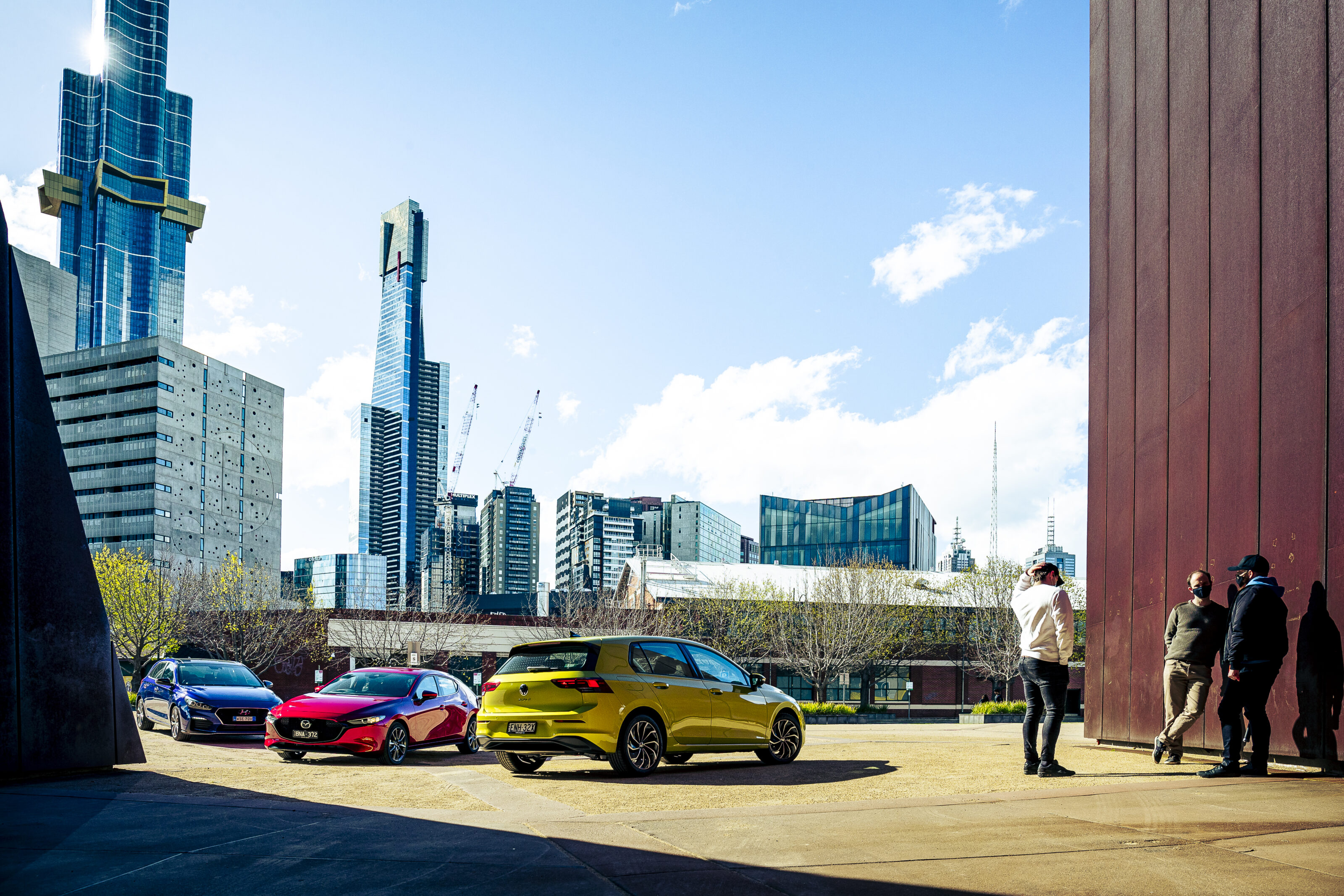
Spice Cabinet: The hotter hatches
You’re keen on one of the offerings here but want a bit more zing, what to do? Well, Volkswagen has you covered with the Mk8 Golf GTI, which offers 180kW/370Nm and 0-100km/h in a claimed 6.3sec for $53,300.
So too Hyundai with its updated i30 N, which starts at $44,500 for the six-speed manual and $47,500 for the new eight-speed dual-clutch.
It now produces 206kW/392Nm and can knock off the 0-100km/h sprint in just 5.4sec in dual-clutch guise.
But where art thou Mazda? A hotter 3 has been developed and is available in the US, a 2.5-litre turbocharged four-cylinder developing a healthy 186kW/434Nm allied to all-wheel drive, but sadly it’s currently left-hand drive only, leaving the likes of the UK, Japan and Australia out in the cold.
Australia has put its hand up for the model if the steering wheel can be shifted, so fingers crossed for some drastic engineering developments.
Interior focus
VW Golf Life
1. First impressions are “There’s nothing in here!” but the modern, minimalist environment is refreshing with classy touches like the Taycan-style light panel and 911-style gearshift toggle.
2. Some may rue the lack of leather, but the Golf’s cloth seats are supportive and comfortable with plenty of room front and rear. A heating option would be welcome, though.
3. Tech-shy buyers may struggle with the smartphone-style touchscreen, with some functions buried in various tap-and-swipe sub menus, but with familiarity it’s easily navigated.
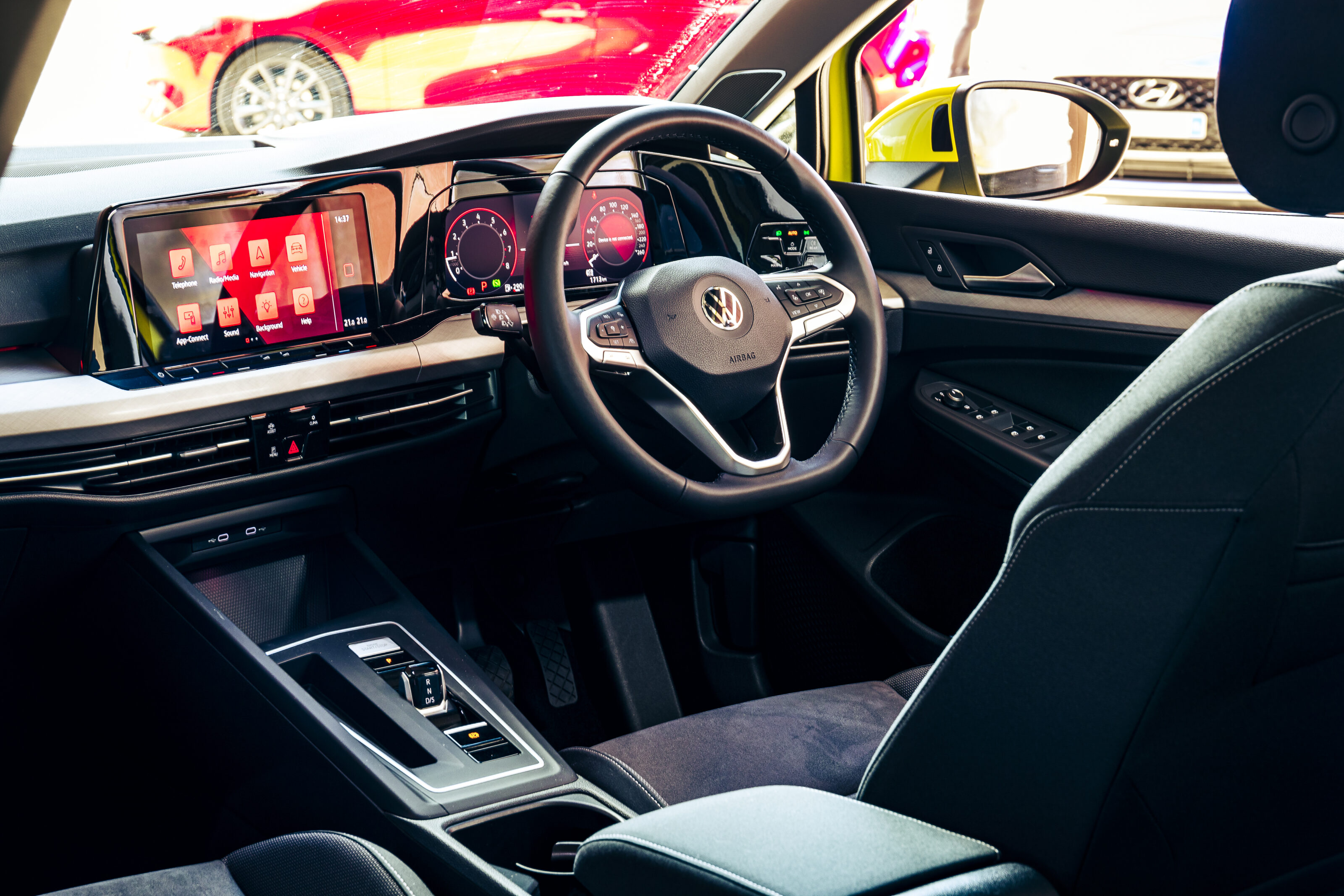
Hyundai i30 N-Line
1. Steering wheel basically a straight lift from the N, with the large gearshift paddles being a highlight, and the contrasting stitching provides a flash of colour the Mazda is lacking.
2. i30’s humble origins evident in the hard plastic that makes up the centre console and lower trim. It counters with plenty of kit and update has brought a shift to an electronic park brake, increasing storage.
3. Large 10.25-inch widescreen infotainment screen is a slick operator, though wireless smartphone mirroring like the Golf would make the wireless charging a lot more useful.
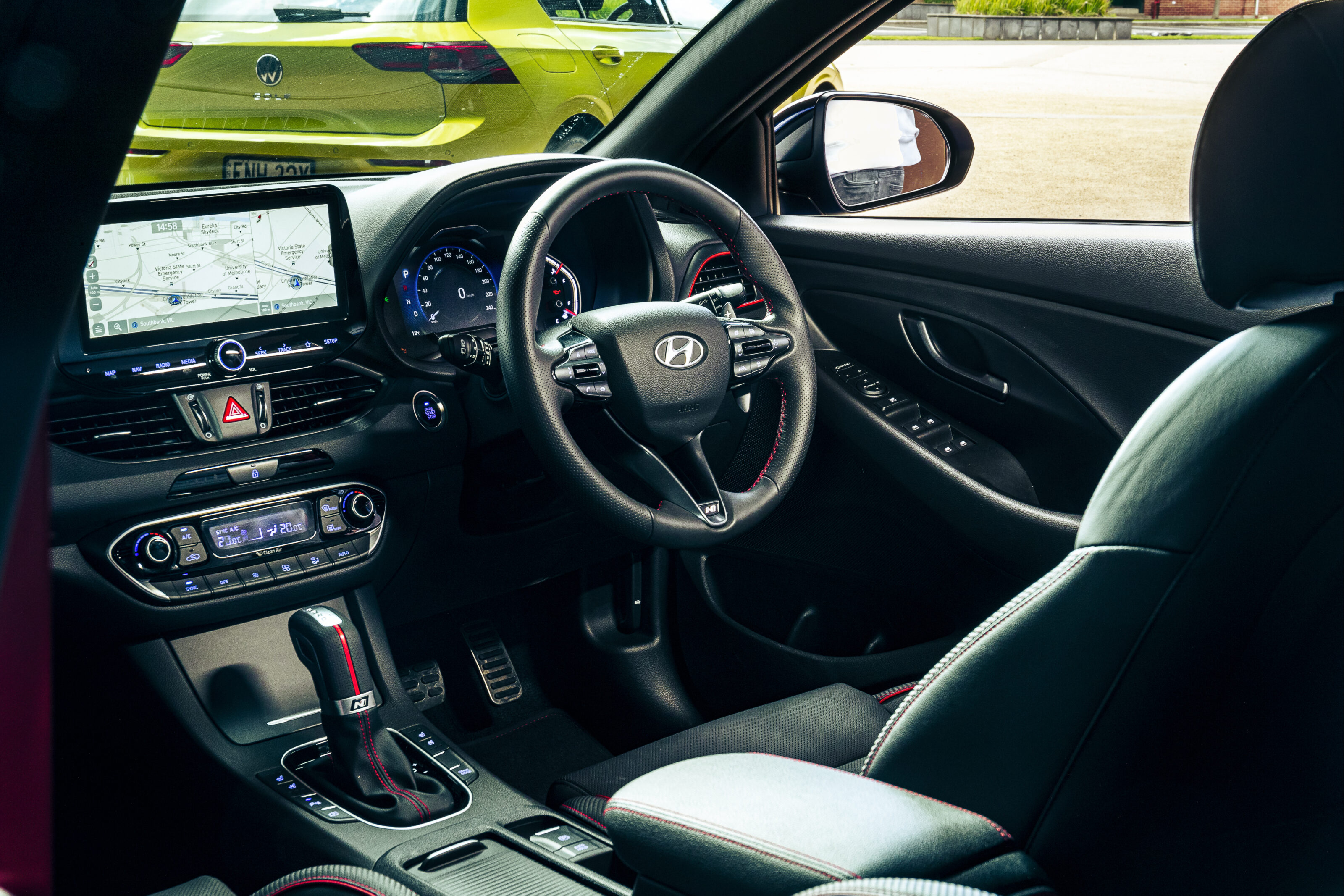
Mazda 3 GT
1. Reach out anywhere in the Mazda’s interior and chances are the surface will be plushly padded leather. It really helps the 3 feel like a much more expensive car.
2. As in the i30, Mazda’s HVAC is controlled by conventional knobs, which plenty of buyers will prefer to the Golf’s touchscreen system.
3. Analogue dials? Digital? Why not both? The 3’s digital representation of analogue dials are super clear and easy to read, yet still have the multi-screen functionality required.
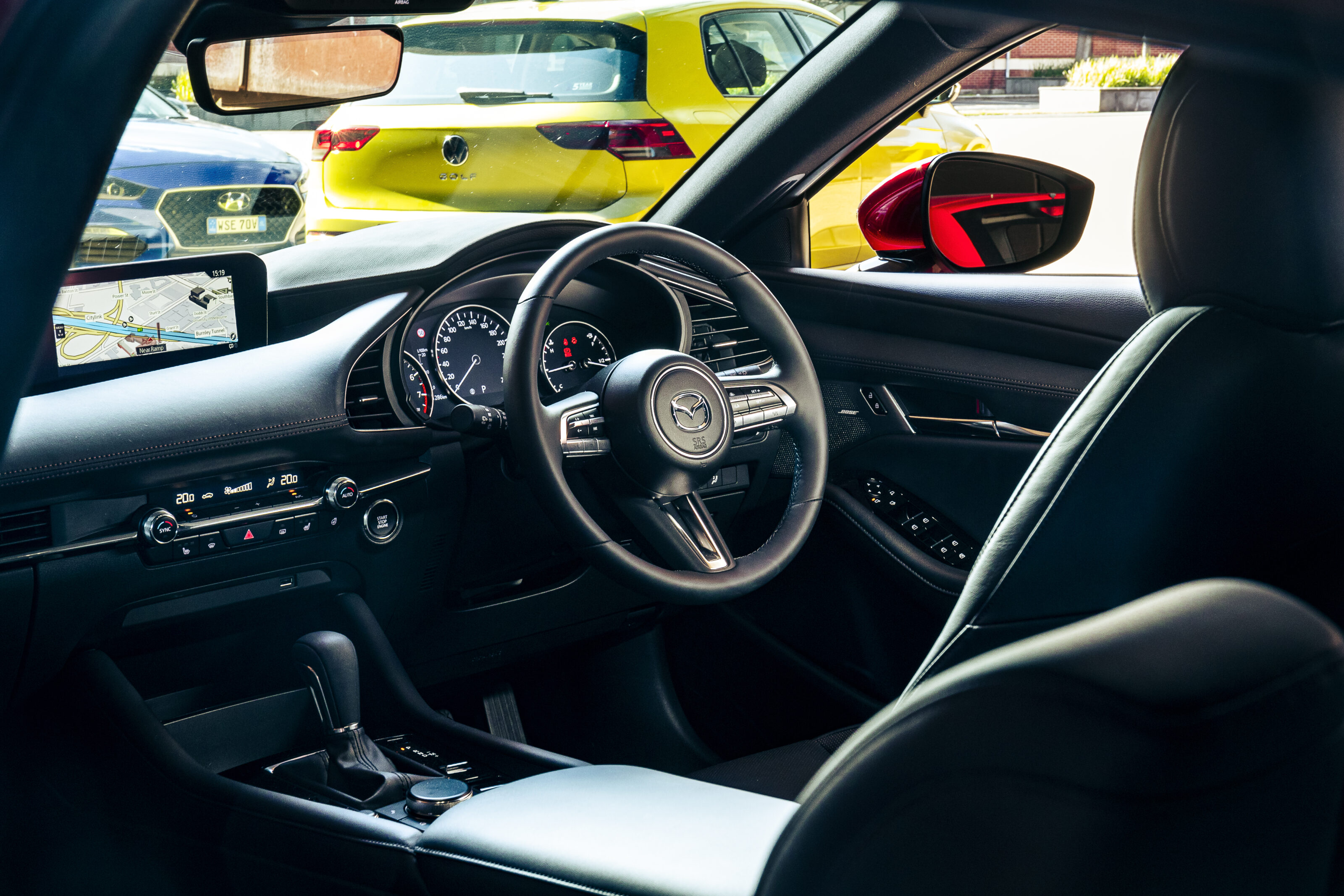
Specifications for the VW Golf Life, Mazda 3 GT and Hyundai i30 N-Line
Snapshot
- Performance hatch powered by a turbo 1.6-litre four-pot with 150kW and 275Nm
- 0-100km/h claimed to be 6.7 seconds, top-speed rated at 230km/h
- The 2022 Hyundai i20 N is on sale now
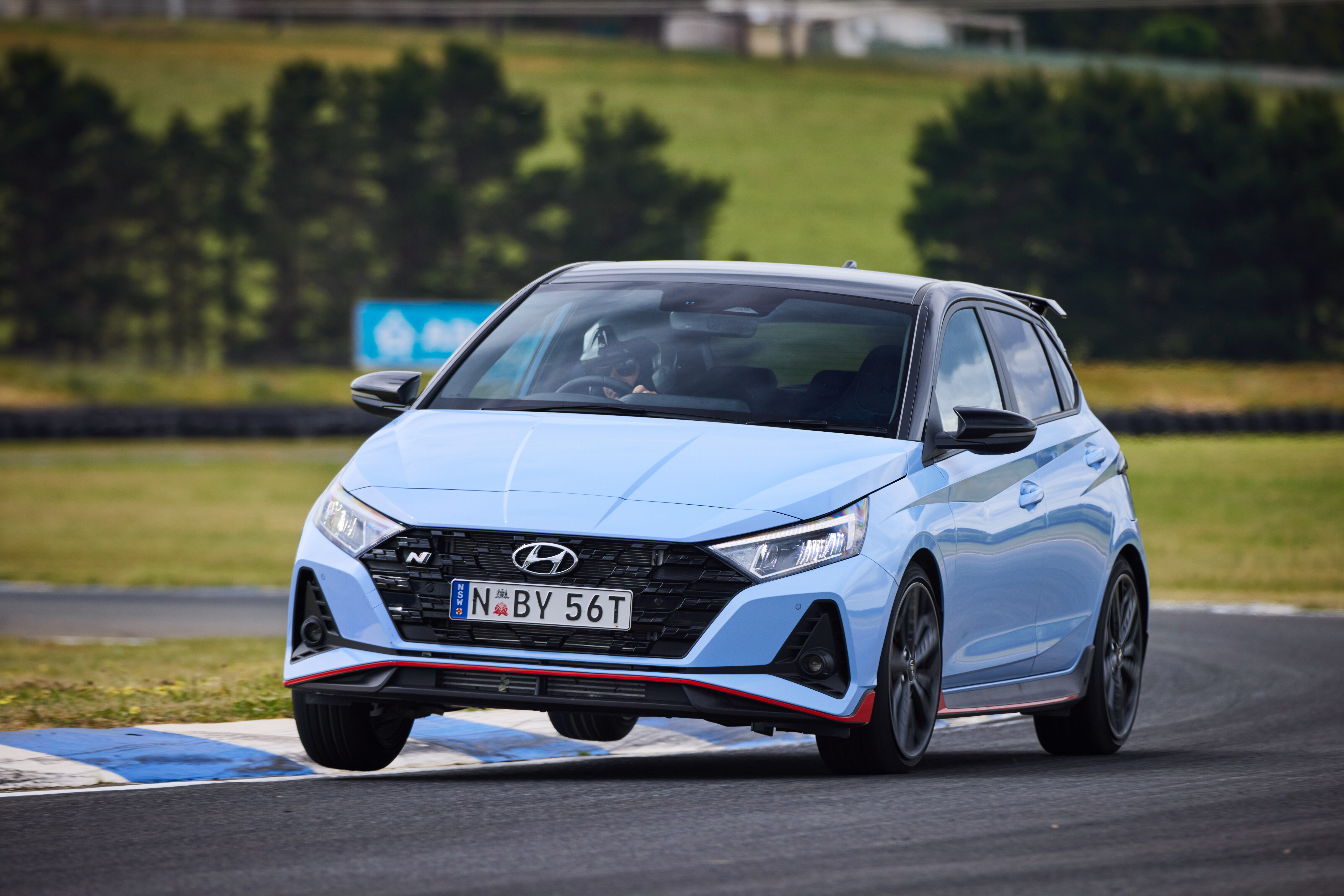
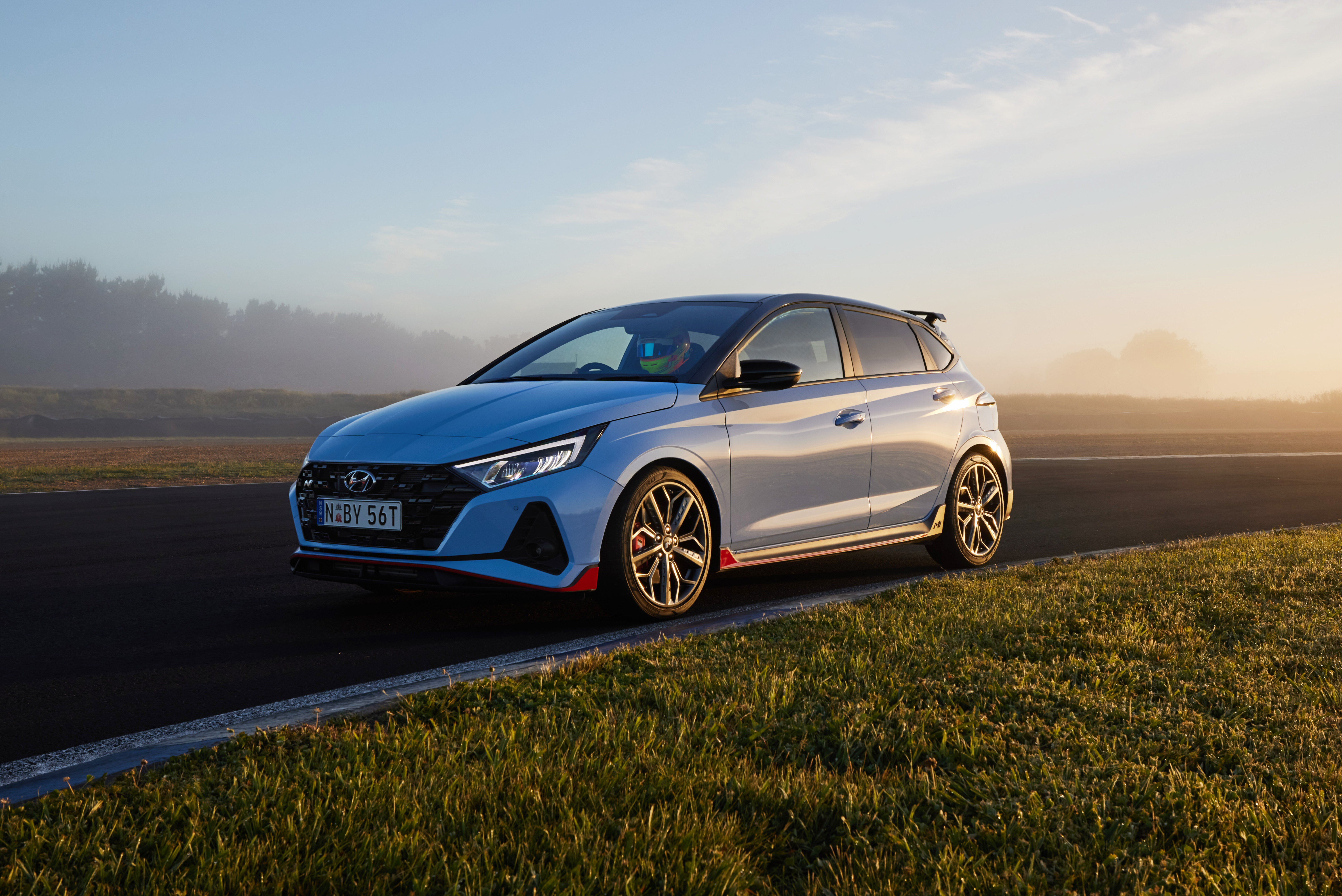
The 2022 Hyundai i20N eagerly anticipated hot hatch has gone on sale in Australia, priced from $32,490 before on-road costs.
Korea’s latest offering will set local buyers back $200 more than the i20N’s main rival, the Ford Fiesta ST, which starts from $32,290 plus on-road costs.
However, while the i20N may cost slightly more than its Blue Oval counterpart, on paper, it’s more powerful, faster, and lighter.
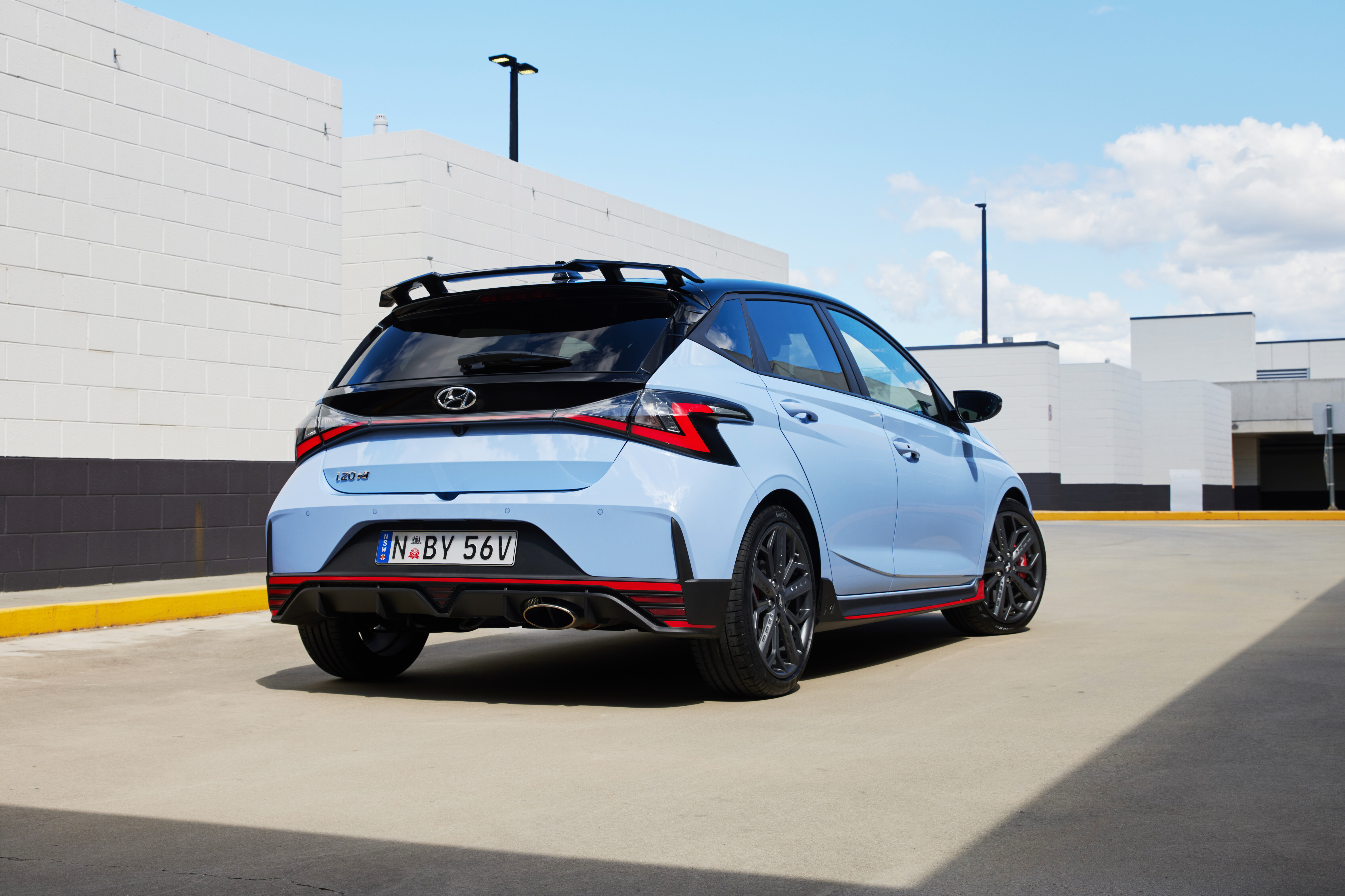
2022 Hyundai i20 N Australia pricing
The 2021 Hyundai i20N will only be available in one specification:
| Hyundai i20N manual | $32,490 |
Note: Pricing excludes on-road costs.
Engine, transmission, and performance
The i20N is powered by Hyundai’s turbocharged Gamma II 1.6-litre T-GDi four-cylinder petrol engine, which is good for 150kW and 275Nm.
Drive is sent to the front wheels exclusively through a six-speed manual transmission and a mechanical limited-slip differential.
The 0-100km/h sprint is taken care of in a claimed 6.7 seconds, and flat-out, the i20N will reach a top-speed of 230km/h.
So, compared to its main rival, the i20N will have 3kW more power than the Fiesta ST (147kW). However, the Ford counters with 45Nm more torque (320Nm).
The i20N’s 0-100km/h time outguns the previous Fiesta ST’s acceleration time, which Motor has previously clocked at 6.9 seconds, but that may change with the extra torque of the new ST.
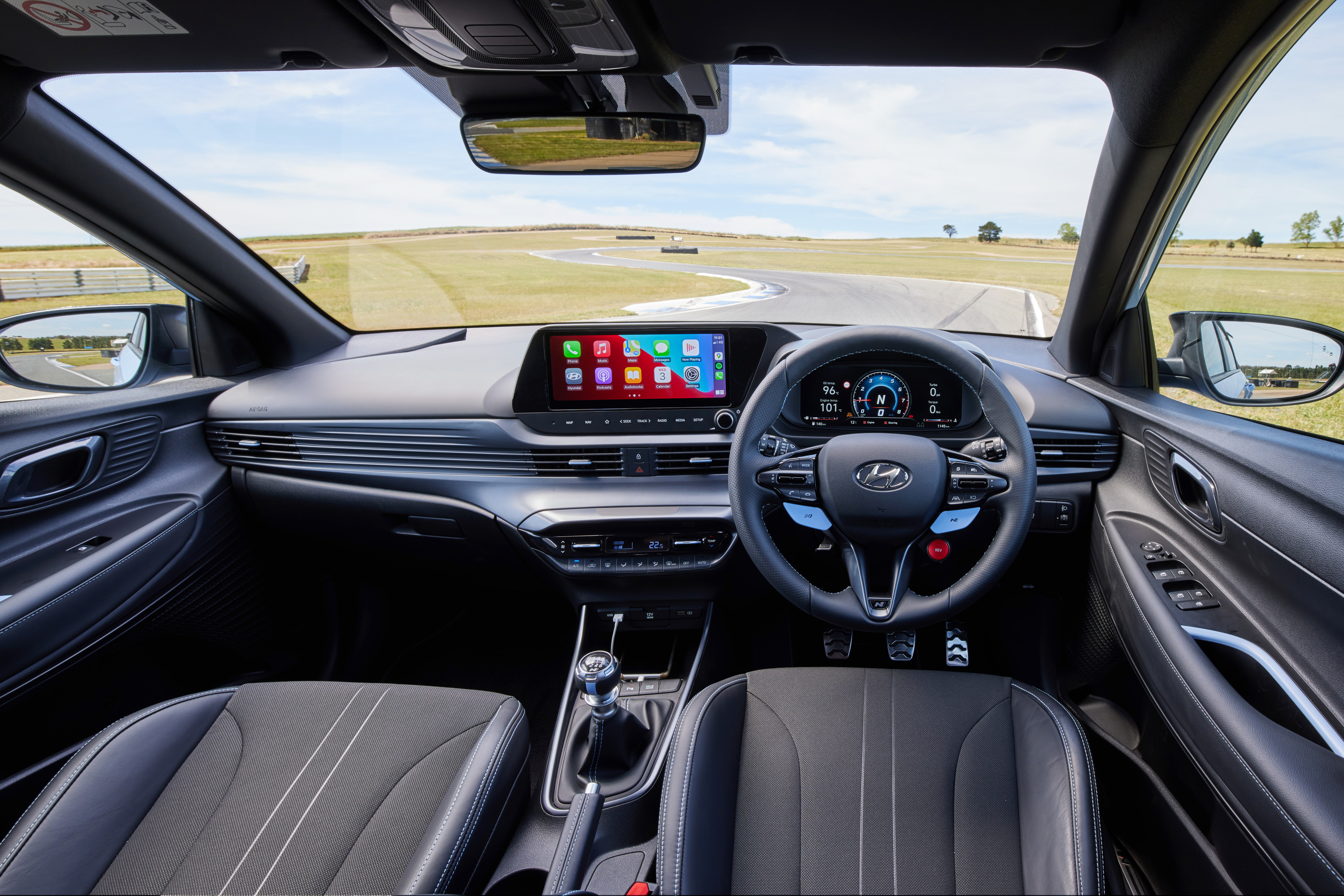
Other performance features of the i20N include an active variable exhaust, N selectable driving mode system, N performance driving data system, performance brake package, rev-matching function, 18-inch alloy wheels, and Pirelli P-Zero tyres.
Features
The Hyundai i20N’s features include:
| Brushed alloy sports pedals |
| Sports front bucket seats |
| Leather appointed steering wheel |
| 10.25-inch supervision digital dash |
| 10.25-inch infotainment display with satellite navigation |
| LED headlights and taillights |
| Temporary space saver spare wheel |
| DAB+ digital radio |
| Apple CarPlay and Android Auto |
| Bose 7-speaker premium audio |
| Cruise control |
| Single zone climate control |
| Power folding exterior mirrors |
| Rain sensing wipers |
| Keyless entry and push-button start |
| Wireless charging |
It can be had in five different colours from launch:
| Polar white | no-cost option |
| Performance blue | no-cost option |
| Metallic sleek silver | $495 |
| Mica phantom black | $495 |
| Mica dragon red | $495 |
Safety
The Hyundai i20N comes with the following safety features as standard:
| Blind-spot collision warning |
| Forward collision-avoidance assist |
| City/urban/pedestrian (camera) |
| Driver attention warning |
| Lane keep assist |
| Lane following assist |
| Rear cross-traffic collision warning |
| Tyre pressure monitoring system |
| Front and rear parking sensors |
| Rearview camera |
Dimensions and kerb weight
The Hyundai i20N is 4075mm long, 1750mm wide, and 1440mm tall and has a wheelbase measuring 2580mm.
This means the Korean hatchback is longer, wider, and lower than the Fiesta ST.
The i20N also weighs less than the Ford, with a kerb weight of 1190kg, which is a substantial 28 kilograms lighter than the Fiesta (1218kg).
Warranty and servicing
Like all Hyundais, the i20N comes with a five-year/unlimited-kilometre warranty, which also covers non-competition track driving, including the fitment of performance-oriented tyres.
Hyundai also offers both lifetime and pre-paid servicing plans.
Availability
The 2022 Hyundai i20 N is on sale now.
UPDATE, November 16: McLaren has put out a written statement refuting it has been purchased by Audi.
Overnight, British magazine Autocar published a story stating McLaren had been acquired by Audi – a claim McLaren stringently denies.
“McLaren Group is aware of a news media report stating it has been sold to Audi. This is wholly inaccurate and McLaren is seeking to have the story removed,” the statement from McLaren read.
But while the company denies the deal being done, Car Magazine is quoting unnamed sources who say BMW and Audi are in a bidding war for McLaren.
According to those familiar with the matter, Audi is vying for both McLaren Cars and its Formula 1 division in a deal said to be worth £1 billion (AU$1.83bn).
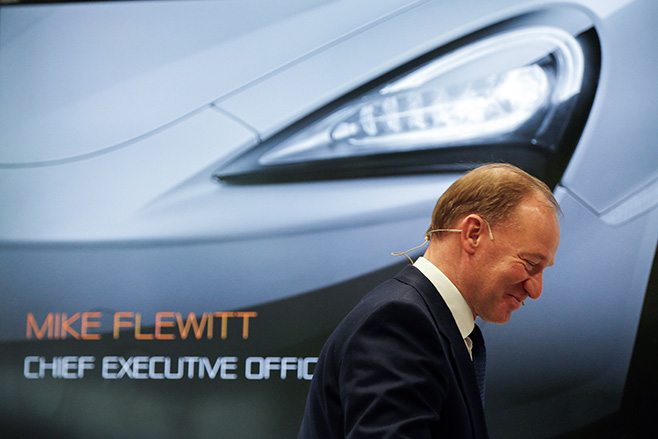
Two former Volkswagen Group executives are currently in charge of McLaren, following CEO Mike Flewitt’s departure last month.
Car Magazine also says BMW will be meeting with wealth fund Mumtalakat in an “on-the-record” meeting in early December.
A BMW-McLaren partnership would allow the German carmaker to go head to head with AMG-Aston Martin, as well as competing against supercars from Volkswagen Group brands such as Audi, Porsche, and Lamborghini.
While Audi – and by proxy, the Volkswagen Group – appears interested in acquiring McLaren’s F1 team, the purchase of its road car division would is seen as a strategic defence play by blocking out BMW.
BMW dismissed the initial report from Automobilwoche as “wrong”, while Audi has been more open about its interest.
Exactly what movements are happening behind the scenes can expect to become known in the coming weeks.
The original story remains unchanged below.
The story to here
November 15: BMW has dismissed reports it is interested in buying McLaren.
Over the weekend, German industry publication Automobilwoche suggested BMW was eyeing McLaren – potentially adding the supercar maker to its portfolio of British marques, already comprising Mini and Rolls-Royce.
Unnamed sources within the article pointed to a proposed meeting next month between BMW and wealth fund Mumtalakat, which controls McLaren.
A BMW spokesperson has since said the article is “wrong”.
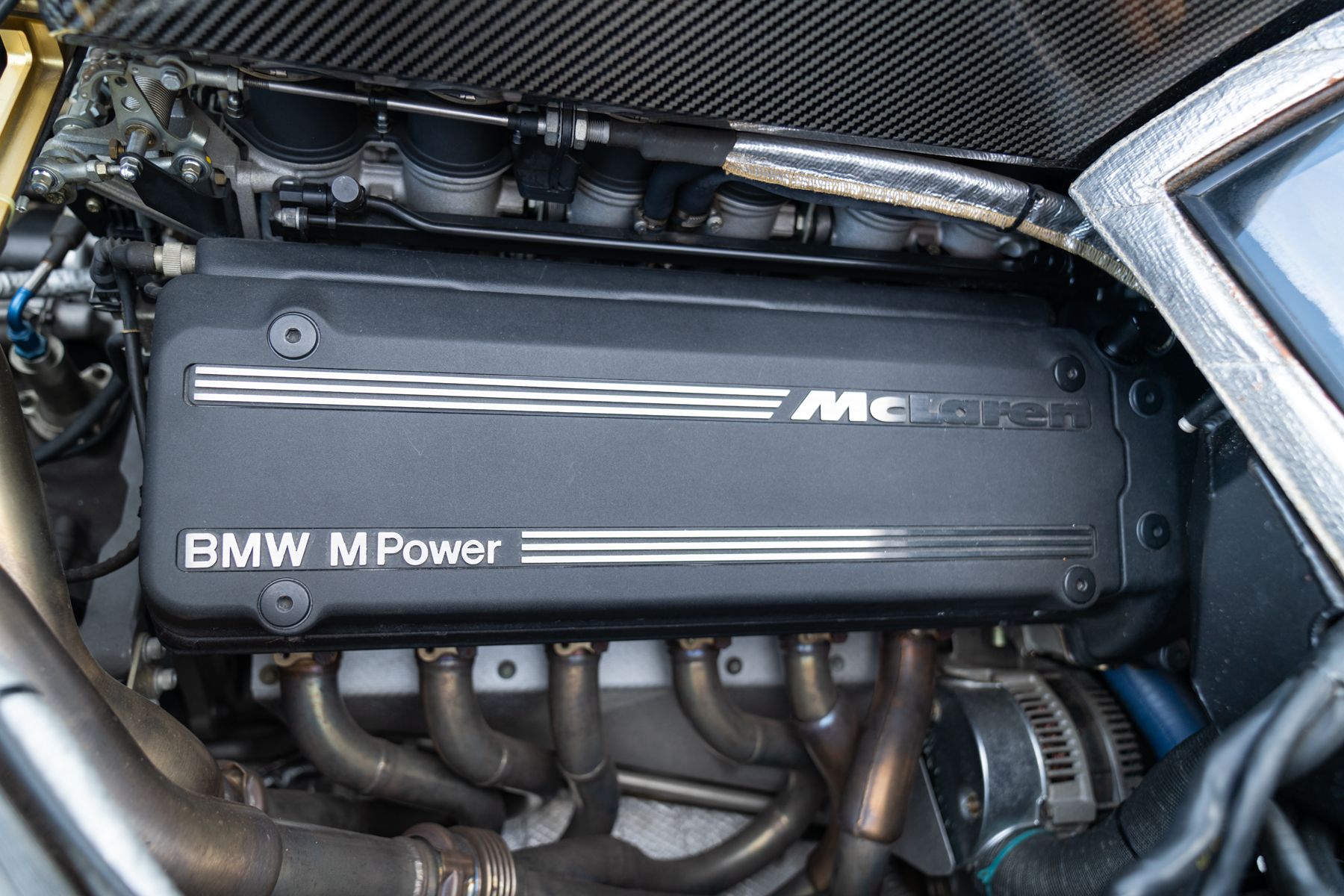
The two organisations do have a history together, with the original McLaren F1 supercar being powered by a BMW V12 engine.
However, Audi has told Reuters it is “open to cooperation opportunities” following whispers the company was looking at purchasing McLaren’s Formula 1 racing team.
Audi’s parent company Volkswagen Group has long been rumoured to be considering an entry into Formula 1.
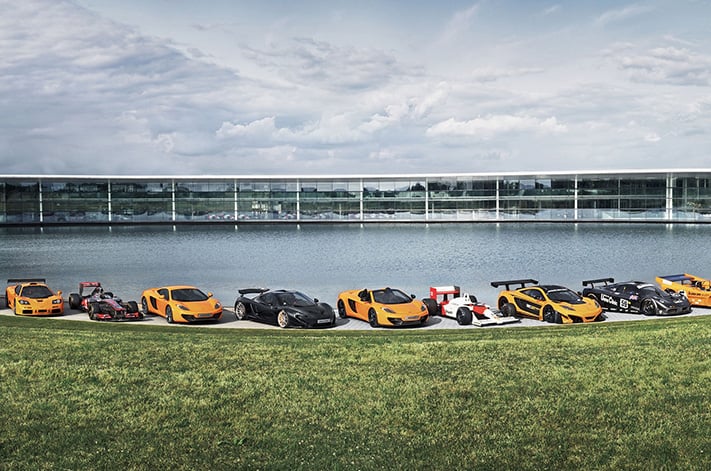
McLaren has been struggling through financial woes in recent years, being forced to raise funds through the sale of its iconic headquarters and the issuance of shares and other financial instruments.
Australia will receive 500 examples of the 2022 Kia EV6 next year, but only two will be allocated to dealerships initially.
Kia confirmed the 500 electric vehicles earmarked for Australia will be staggered throughout the year, but a source familiar with the matter has told Wheels most Kia dealerships will get just two EV6 models to begin with – a demonstrator, and a vehicle to sell.
Of the 91 Kia dealerships across Australia, a handful have yet to be set up to both sell and service the EV6 – the Korean carmaker’s first dedicated electric car. It’s estimated the first batch will comprise around 160 vehicles.

While Australia has 500 examples of the EV6 earmarked in both base-level and GT-Line trims, a spokesperson for the company’s local arm suggested the number had the potential to increase, telling Wheels it was “of course in continuous dialogue with head office about this number”.
As with other models, Kia will sell the vehicle through its Australia-wide dealership network – a strategic difference between the EV6 and the Hyundai Ioniq 5. While the two vehicles are underpinned by the same battery-electric architecture, Hyundai Australia has opted to sell its allocation of 400 Ioniq 5s at a fixed price through its website.
Local pricing and specification has yet to be announced, but it’s expected Australian buyers will have a choice of a EV6 base model, or an EV6 GT-Line – with both variants available with either a 58kWh battery or a larger 77.4kWh battery, in either rear- or all-wheel drive. There are four power levels of between 125kW and 239kW available.
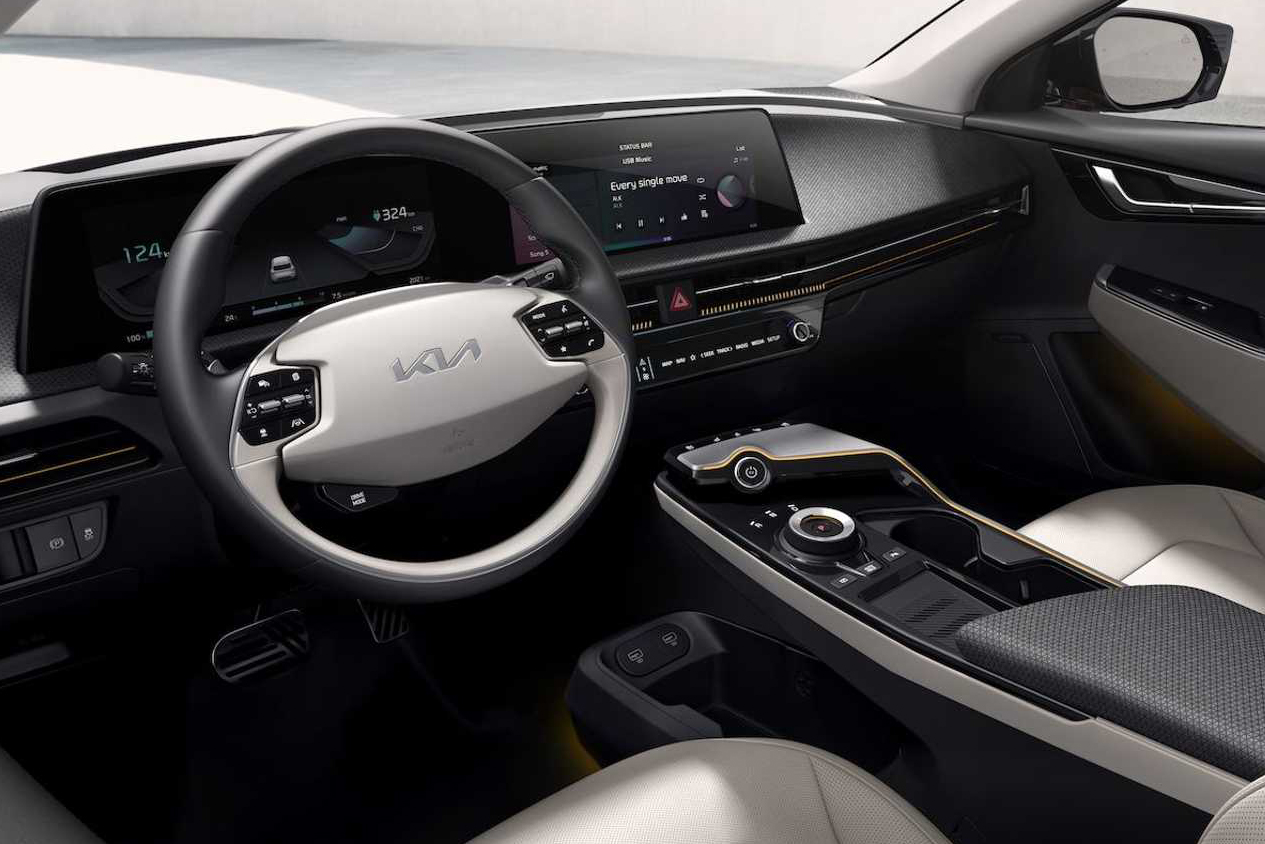
A high-performance Kia EV6 GT is expected to become available in late 2022, producing 430kW and 740Nm – making it the most powerful model to ever come from the brand.
“Interest in the EV6 is unmatched, with the expressions of interest tally already exceeding all previous Kia models before it,” a Kia Australia spokesperson told Wheels.
“This level of interest in our first all-electric model is equally shared between existing and new Kia customers. EV6 will be tremendous for the Kia brand in Australia and we’re confident it will cement itself as a true halo model atop our product portfolio.”
Snapshot
- Kona N is powered by a turbo 2.0-litre four-banger making 206kW and 392Nm
- 0-100km/h takes 5.5 seconds, top speed rated at 240km/h
- Performance SUV on sale now
The 2022 Hyundai Kona N performance SUV has arrived in Australia – undercutting its closest rival on price by more than $20,000.
Starting from $47,500 plus on-road costs, the Kona N is significantly cheaper than the similarly sized Mini Countryman John Cooper Works Essential ($68,350) and, if it ever comes to Australia, Volkswagen’s T-Roc R.
Just because it’s cheaper than its competitors, though, don’t think for a second the Kona N is a slouch.
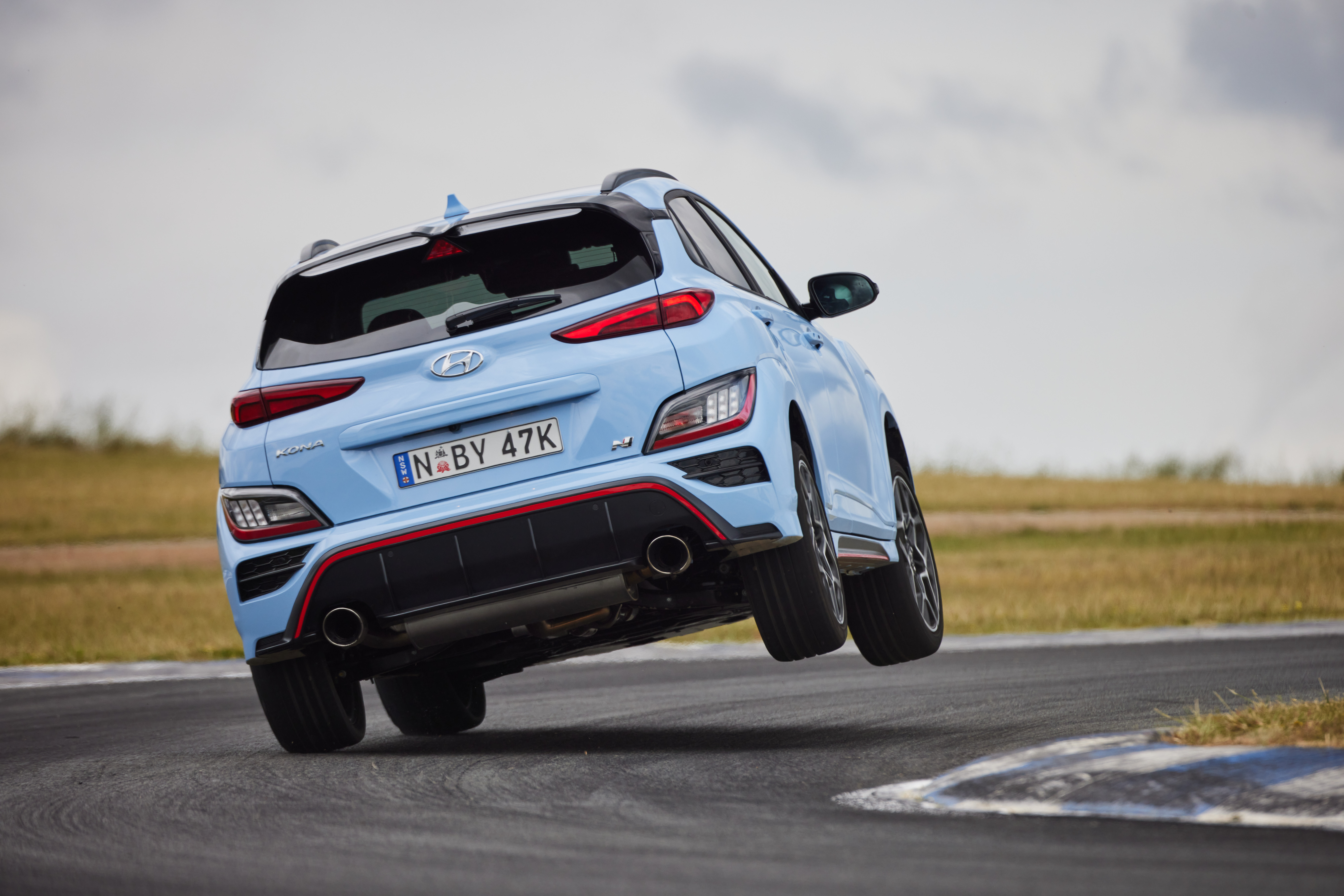
With power derived from the same turbo 2.0-litre four-pot found in Hyundai’s brilliant i30N hot hatchback, the high-riding SUV has what it takes to hang with some serious performance cars.
Due to be released locally in the third quarter of 2021, the Kona N will be launched alongside its smaller hot hatch sibling, the i20N.

2022 Hyundai Kona N Australian pricing
| Hyundai Kona N | $47,500 |
| Hyundai Kona N Premium | $50,500 |
Note: Prices do not include on-road costs.
Engine, transmission, and performance
The Kona N is powered by the Korean automaker’s turbocharged 2.0 litre T-GDI four-cylinder petrol engine, which produces 206kW (213kW with N Grin Shift) and 392Nm.
Drive is sent to the front wheels through Hyundai’s own wet-style eight-speed dual-clutch automatic transmission and an electronically controlled limited-slip differential.
Thanks to a trick launch control system, the Kona N can accelerate from 0-100km/h in a claimed 5.5 seconds, with a 240km/h top speed.
Like the i30N, the new Kona N features an N Grin Shift mode (NGS), which gives the driver maximum power from the engine and transmission for a short 20 second burst, which is activated by pressing a button mounted on the sports steering wheel.
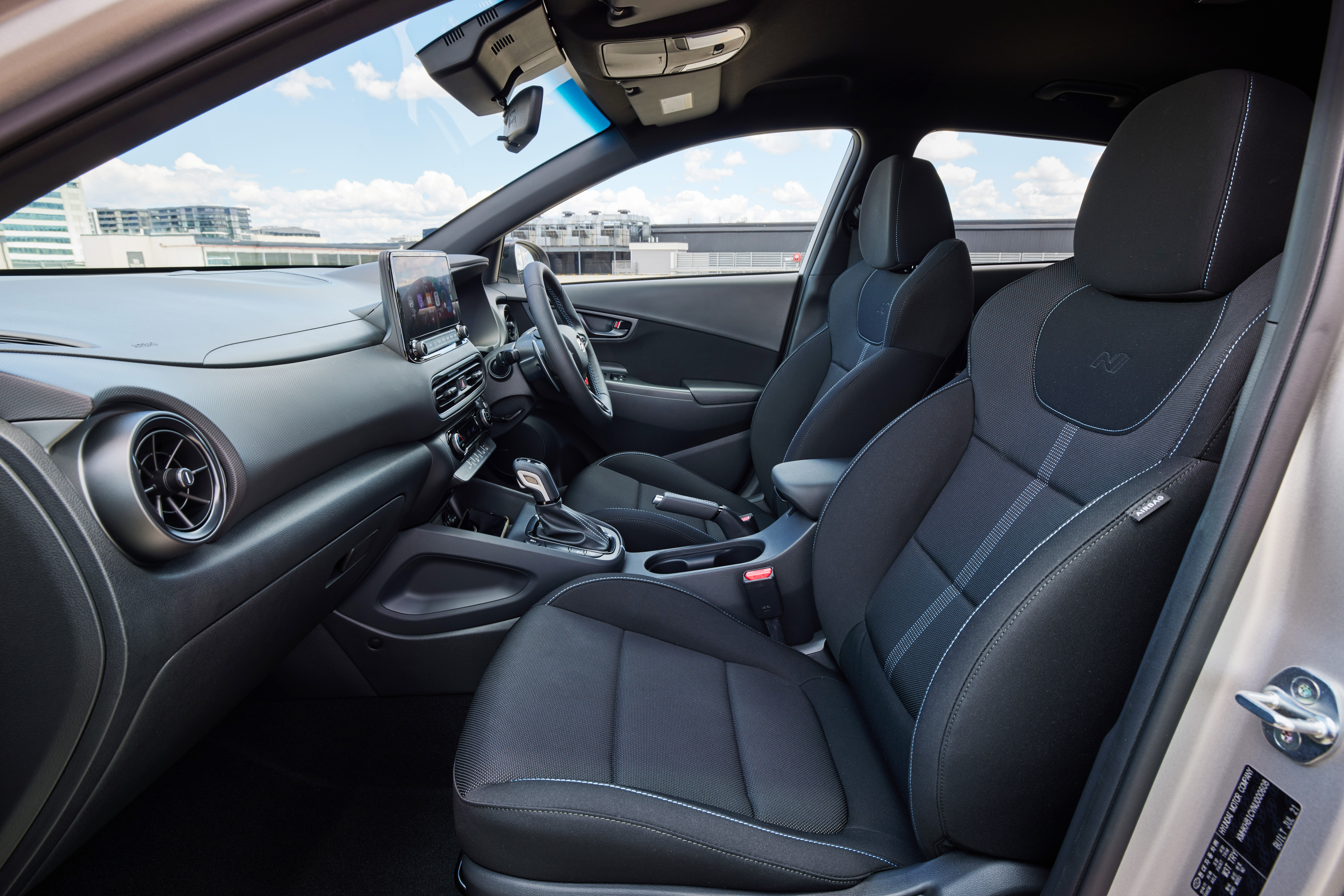
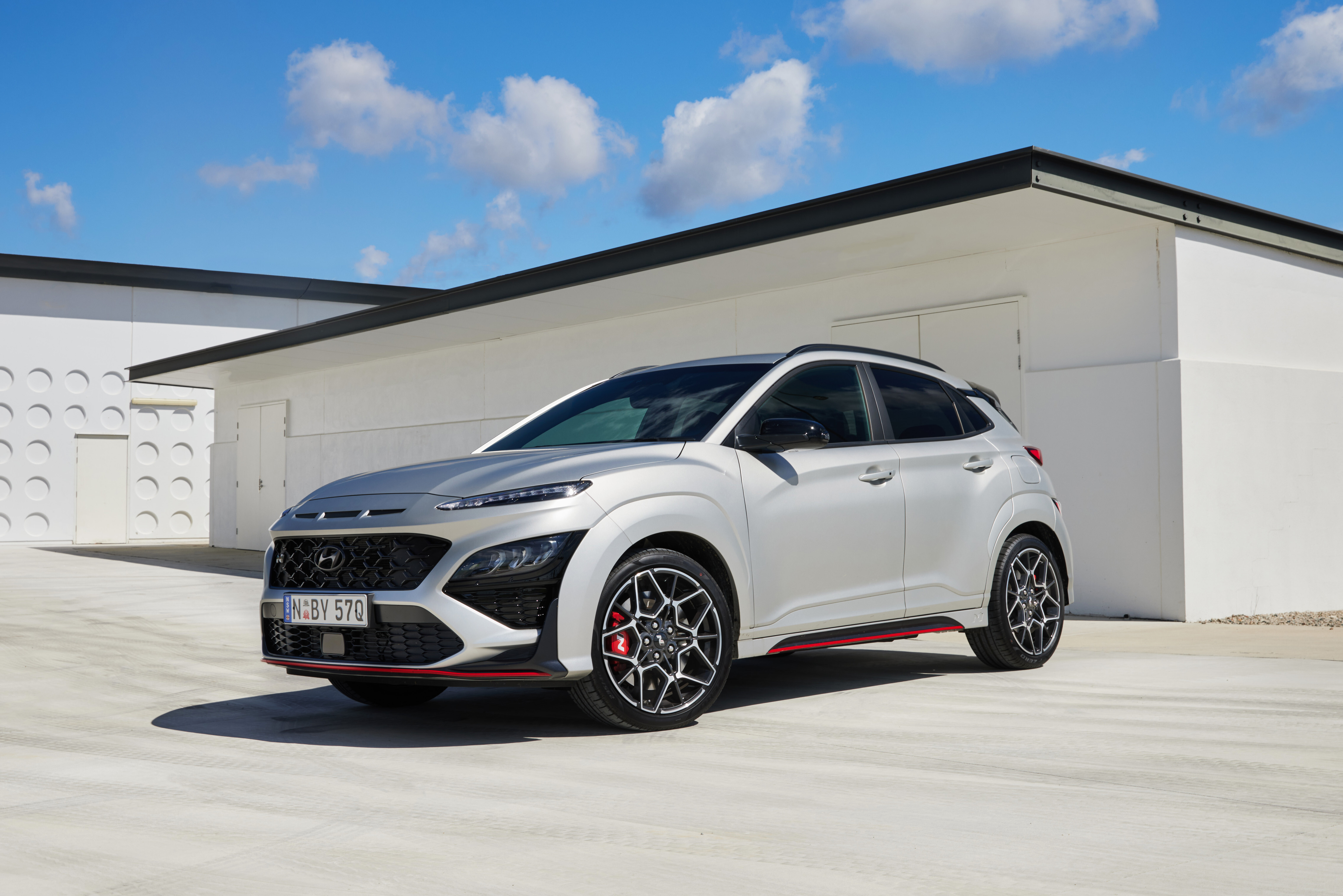
Other performance features include 19-inch lightweight forged wheels, active variable exhaust, electronically controlled dampers, N driver mode system, N Performance driving data system, performance brake package, and Pirelli P Zero tyres.
Features
The Kona N comes with a host of features as standard, including:
| Sports front bucket seats |
| Leather-appointed steering wheel |
| 10.25-inch supervision digital driveru2019s dash |
| 10.25-inch infotainment display satellite navigation |
| Keyless entry and push-button start |
| LED daytime running lights, headlights, front indicators, side repeaters, and taillights |
| DAB+ digital radio |
| Apple CarPlay and Android Auto |
| Harman Kardon eight-speaker premium sound system |
| Wireless charging pad |
| Climate control |
| Power folding exterior mirrors |
| Rain sensing wipers |
| Auto light control |
| Rear privacy glass |
| Acoustic laminated windshield |
| Temporary space saver spare wheel |
The Kona N Premium adds:
| Electro-chromatic mirror |
| Suede/leather-appointed interior |
| Heated steering wheel |
| Head-up display |
| Powered, heated, and ventilated front seats |
| Glass sunroof |
| Parking distance warning u2013 front |
| Ambient lighting |
The performance SUV can be had in seven paint options:
| Solid atlas white | no-cost option |
| Solid ignite flame | no-cost option |
| Solid performance blue | no-cost option |
| Metallic cyber grey | $595 |
| Mica dark knight | $595 |
| Matte gravity gold | $1,000 |
Safety
When it was assessed in 2017, the Hyundai Kona achieved a five-star ANCAP safety rating.
Standard safety features include:
| Blind-spot collision-avoidance assist |
| Driver attention warning |
| Forward collision-avoidance assist |
| High beam assist |
| Lane following assist |
| Lane keeping assist |
| Rear cross-traffic |
| Collision-avoidance assist |
| Safe exit warning |
| Adaptive cruise control |
| Tyre pressure monitoring system |
| Parking distance warning u2013 reverse |
| Rear view monitor |
Dimensions and kerb weight
The Kona N is 4215mm long, 1800mm wide, 1565mm tall, and has a wheelbase measuring 2600mm.
Unlike many other performance SUVs, the Kona N’s kerb weight is a featherweight 1510 kilograms. This lack of mass is down to the car’s diminutive dimensions and lack of all-wheel drive, as well as several lightweight solutions like the aforementioned 19-inch forged wheels.
Warranty and servicing
Like all Hyundais, the Kona N comes with a five-year/unlimited-kilometre warranty, which also covers non-competition track driving, including the fitment of performance-oriented tyres.
Hyundai offers both lifetime and pre-paid servicing plans.
Availability
The 2022 Hyundai Kona N is on sale now.
