
The Longest Day
Braving road kill and road trains in a 24 hour, 3000km blast across the country
Paul? Jesse. Just wanna bounce an idea off you. Simon Johnson from Chrysler is keen we try a Crossfire SRT6 but we can’t do a comparo because, well…With what?
This feature was first published in MOTOR magazine’s October 2005 issue
“But he says it goes like a cut cat so I’m thinking maybe we could do a drive thing with it. No, not ’Round Australia again. That’d be silly. How about across it? Adelaide to Darwin? About 3000 kays… In under 24 hours… Paul?”
That, folks, was the presentation: and, as it turns out, the extent of planning until a wee bit more research revealed that a Crossfire SRT6 has neither a spare tyre nor anywhere to pop Photographer Brunelli. So Mr Johnson offers up a Grand Voyager supply-ship, which immediately begs the question of who’d be crazy enough to chase us flat-out across a continent in a Mum-Mobile?
‘Flat-out’? Taylor M, of course. Hell, on a Lambretta if need be. And with that and no more in place, we’re standing, after dark, in the car-park at Adelaide airport looking at a stone-stock Crossfire.
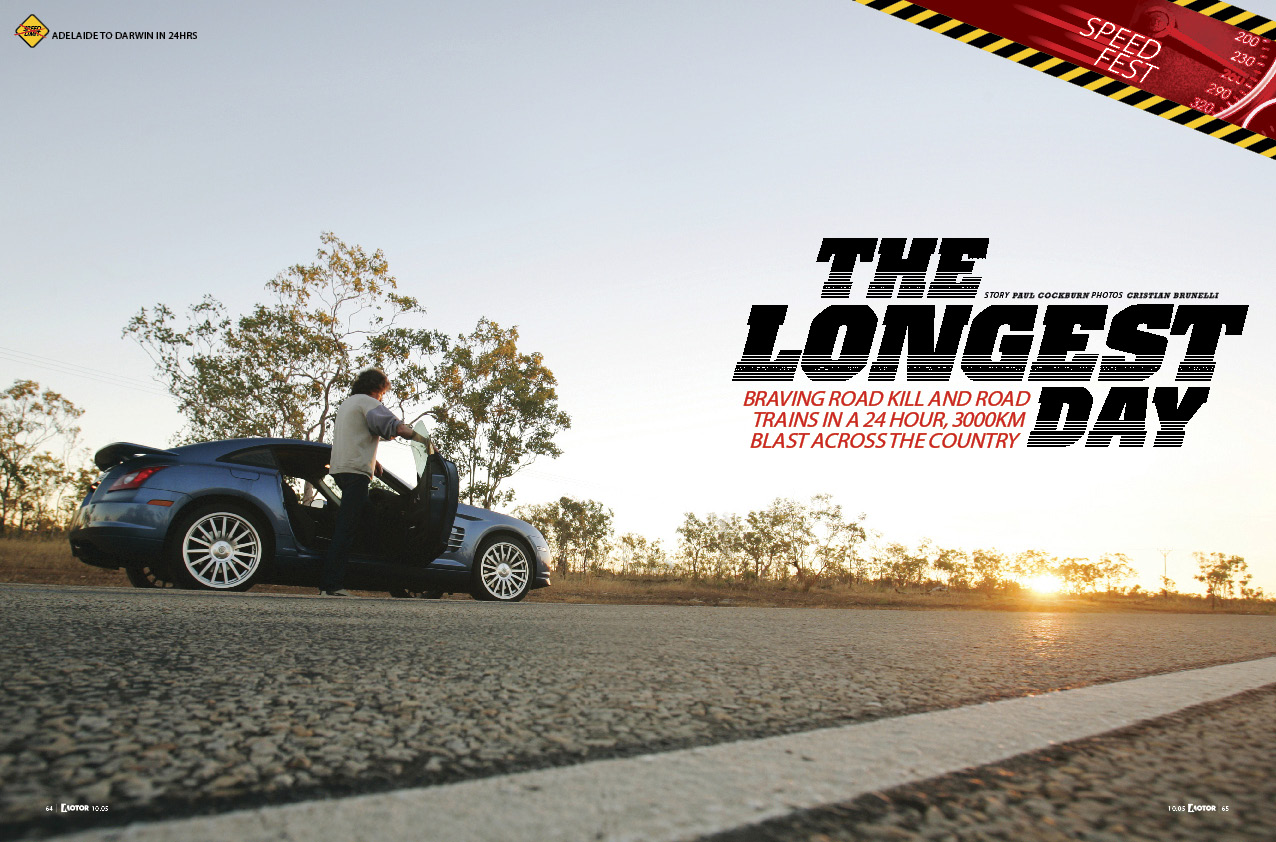
It is devoid of beauty. It is also innocent of driving lights, bullbar, spares et cetera and, as the plan (hah?!) says we’re driving through South Australia overnight in order to reach the unlimited roads of the Northern Territory at dawn, there will be no wine with dinner. I’ve been happier. Nonetheless, we dine with a vestigal sense of optimism but, tragically, no-one steals the bastard so we’re doomed to the darkness north of Adelaide.
There’s no rhythm yet. That’ll come. The first priority is to get a feel for the car and the journey ahead: look for roadkill to get an idea of the nightlife’s agenda and at the road’s edging to peg the level of maintenance. In the first hours these signs are good and we run the two vehicles in three-second convoy, both on high-beam – with the lead car’s mirrors averted – to maximize vision. We also learn, even in this early stage, that the Crossfire’s Grand Touring credentials are suspect. The short-travel, harshly damped suspension and lo-pro tyres give it the ride quality you might imagine and both wind and road noise at open-road pace discourage casual banter. The lights are good, though, and see us into Port Augusta without strain.
Less comforting is the range. The car’s 60-litre tank hasn’t a prayer of covering the 525km to Coober Pedy and, let the record show, Jesse’s researched enough to determine there’s no pre-dawn fuel available before there. So jerry cans are purchased and filled and things look, briefly and deceptively, organised.
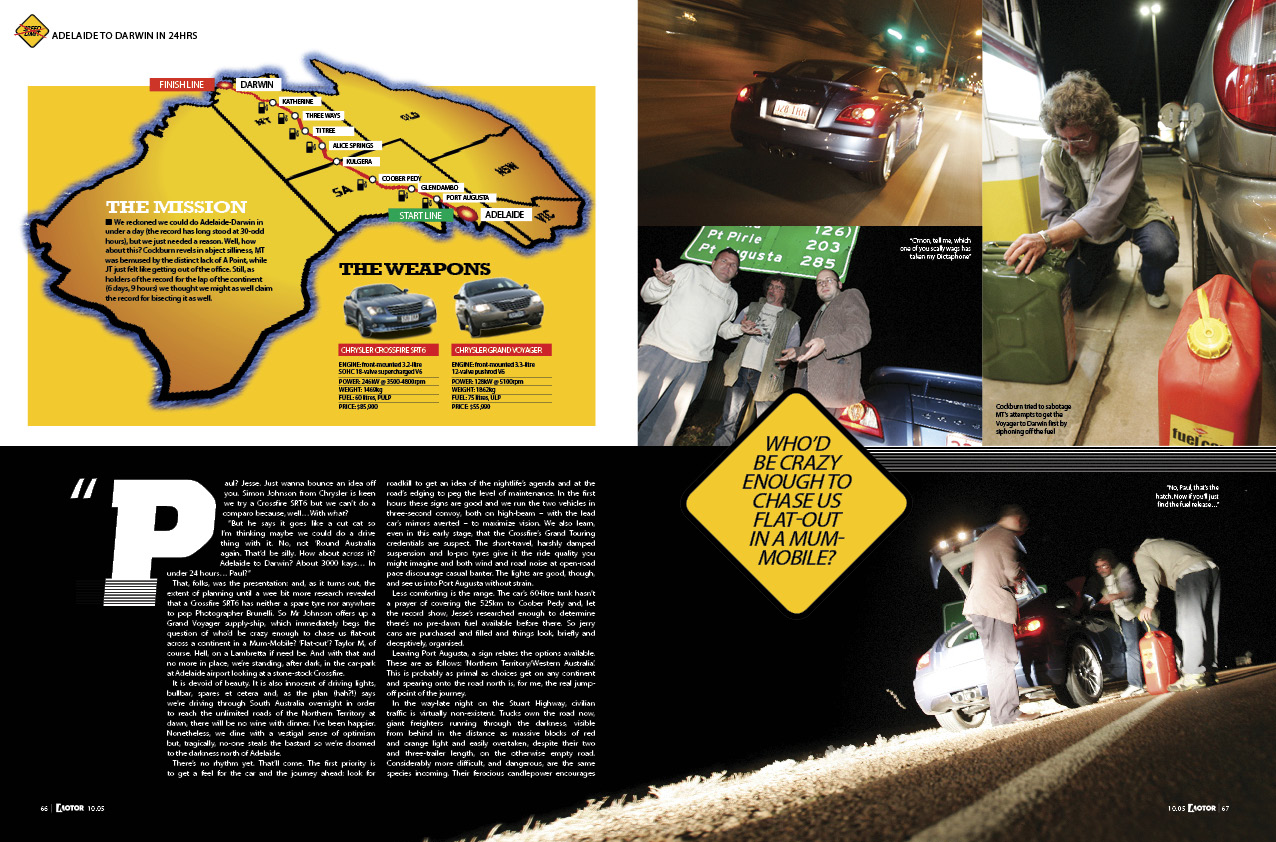
“Who’d be crazy enough to chase us flat-out across a continent in a mum-mobile?”
Leaving Port Augusta, a sign relates the options available. These are as follows: ‘Northern Territory/Western Australia’. This is probably as primal as choices get on any continent and spearing onto the road north is, for me, the real jump-off point of the journey.
In the way-late night on the Stuart Highway, civilian traffic is virtually non-existent. Trucks own the road now, giant freighters running through the darkness, visible from behind in the distance as massive blocks of red and orange light and easily overtaken, despite their two and three-trailer length, on the otherwise empty road.
Considerably more difficult, and dangerous, are the same species incoming. Their ferocious candlepower encourages the early dipping of our headlights but, even at a closing speed somewhat in excess of 200km/h, that can mean many minutes of driving into a bright point of light on low beam. Scary. Sheep are on the road now and cattle warning signs, grids and stock crossings all tell the story. Impressive skidmarks and explosions of blood on the road underline it.
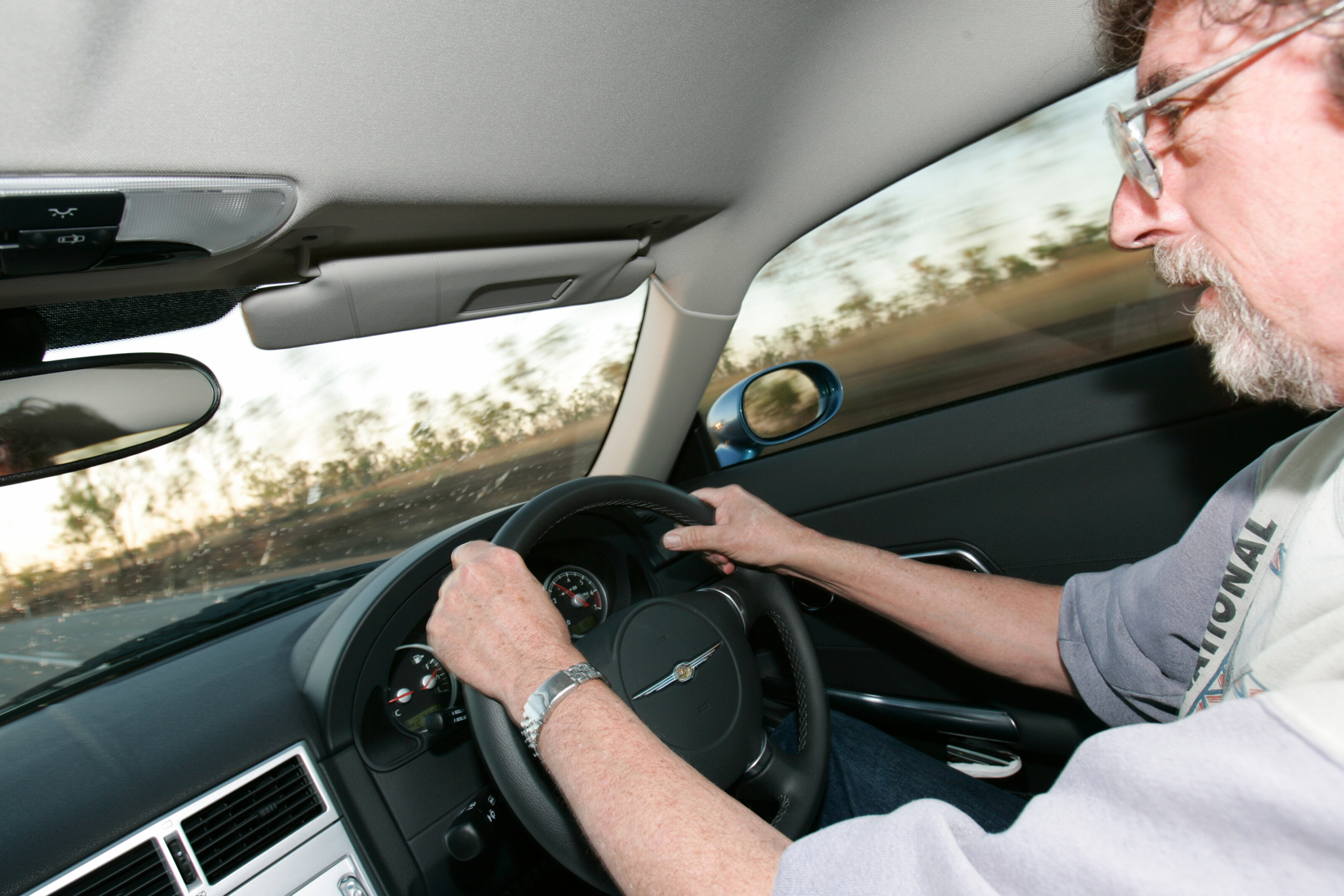
We will lift our average in the Territory daylight and perhaps enjoy more of the Crossfire’s dynamic ability then, but tonight’s constant-speed cruise is not favouring it. Or us. The seats are harsh, with sod-all under-thigh support generating pressure on the coccyx and growing discomfort. Granted, they’ve got gangs of lateral grip but that’s a bit tell-my-bum right now, and their inability to recline beyond the normal driving position is a bugger when you come off-shift.
About 250km south of Coober Pedy we stop in the epicentre of absolutely bloody nowhere for a driver change and jerry can refuel, an episode made briefly romantic by the spectacular star-mass above but very soon less so, let the record also show, by an End Of Planning somewhere short of a funnel that fits the unleaded filler neck.
Jury-rigging produces the sloppiest fuel-handling since the Exxon Valdez, followed by a desperate swab-up involving every rag in the Crossfire’s first-aid kit (you might want to look at that, Mr Johnson) and climaxed, on finding that neither open-plan vehicle has anywhere to store the fuel-soaked components, with their wholesale abandonment.
Onwards and upwards, we are soon punished by nature firing back all manner of stuff in retribution, including one enormous feral cat, many kangaroos, even more sheep and a fat night-lizard-thing (who knew?) but they all miss. I can’t wait to see what the daylight brings but for now it’s all Jesse’s problem as I squirm into a sleep that lasts as long as the tankful which, unfortunately, is some 50km shy of the nearest fuel stop.
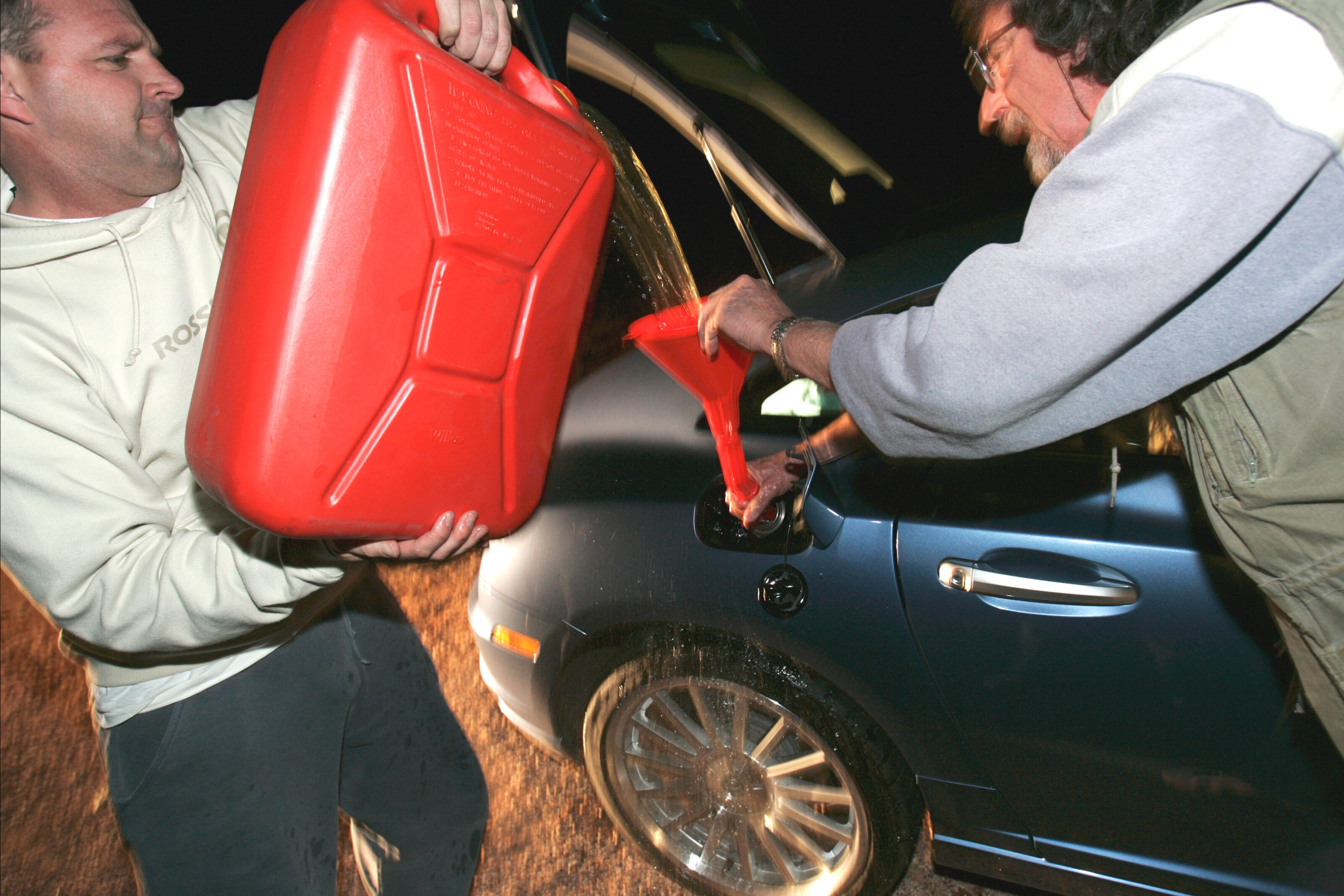
That’s what we’ve got the jerry cans for, but having flung the funnel to buggery, we’re well short of something to pour it into the tank with until Jess gets editorial, empties his bottle of octane improver into the tank, cuts the butt away and Hey Presto! Instant Funnel.
Thus, with the surprising blend of blind luck and management that distinguishes most things MOTOR, we run 1200km through the night until the sky begins to flare, the tops of the low shrubbery candle and the enormity of the vast, flat outback appears in a fiery spectacular. All in all, this is a hellovaway to start a Friday morning.
Right on target, we arrive at the border at dawn and soon after take a mighty caffeine hit at Kulgera, which, FYI, boasts 17 people, 6 dogs, 1 horse, 1 bull and 6 fish, the latter of which I suspect may be on the menu and subject to change. The rest of breakfast is brief, however, as we’ve still got the equivalent of Sydney-to-Melbourne and back to drive before the 24 hours are up.
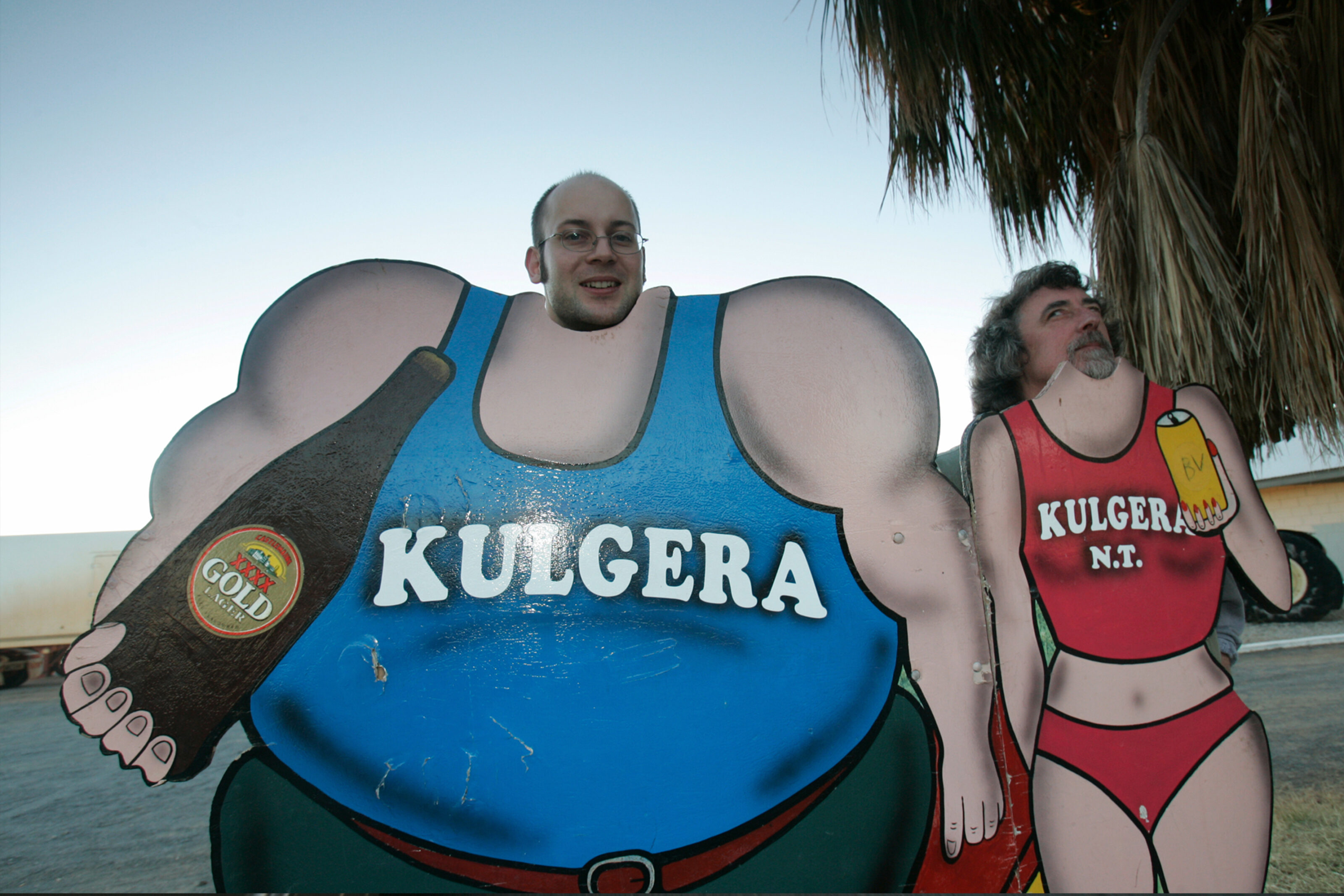
The unlimited highway north promises an astonishing drive. Built to cater to a far-flung population that uses cars as an alternative to light planes, it crosses a landscape largely flat but rarely dull. Well-maintained and cleared to the sides, the Stuart allows speeds that would encourage incarceration anywhere else in Australia. And the locals use it accordingly and well.
Not that it doesn’t require attention, mark you: we soon encounter our first cow and add it to the list along with the crows and ride-sized eagles claiming the overnight kill by the roadside.
The speed rises now, revealing a readiness in the Crossfire to whap past 200km/h with some very serious, supercharged whomp when needed. In truth, this isn’t very often, as traffic is light… it will be all day… and cooperative. Our pace, however, is set by the Grand Voyager, which the ferociously competitive MT has bowling along at a fairly impressive 180km/h once we’ve all accepted, ref his bet, that, okay, its real top-end is a wee bit higher in third but let’s be sensible.
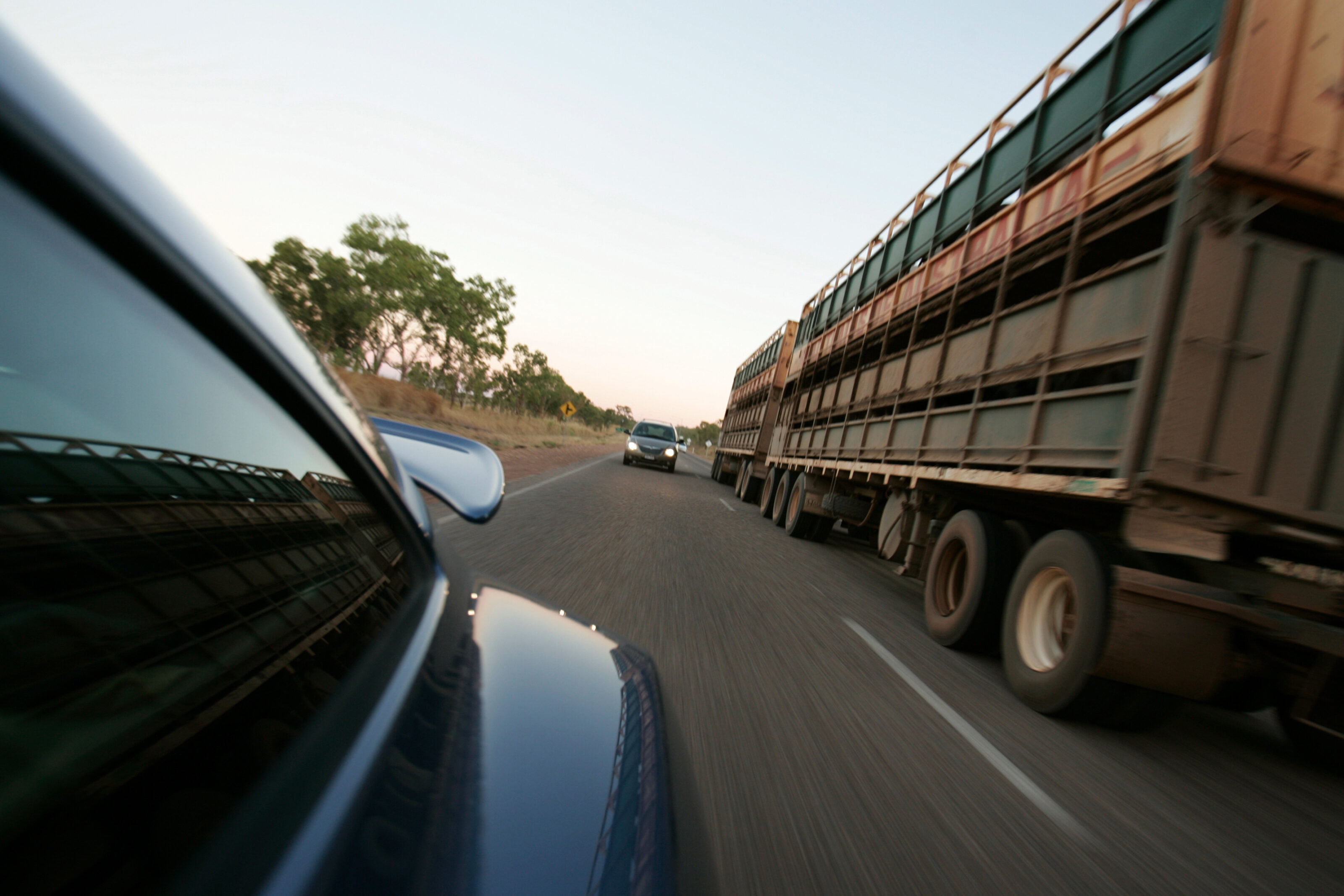
So far, only Jesse and I have shared the Crossfire, alternating seats in 2-3 hour shifts, but now Photographer Brunelli takes the navigator’s chair for interior shots so I briefly retire to the mother-ship and am immediately impressed at its comparative comfort and quiet. Plus the thing has reclining seats and enough space back there to roll out a double-swag and set a campfire.
Okay, it’s not the rocket of the pair but its grace above The Ton is surprising. Which only makes the Crossfire’s irritations, such as non-adjustable steering wheel height and insufficient legroom, more noticeable… and, with the morning sun blinding, in the absence of sunvisors that swivel to the side unforgivable in an $86,000 luxo coupe.
But for all that, the journey through an ever-changing land, ancient beyond imagining, is an absolute joy. South of Alice we cross the Finke River, the world’s oldest, now just a string of waterholes waiting for the rains but capable, when they come, of flowing in a torrent hundreds of metres wide.
A sense of grand scale pervades the journey now and, beyond Alice, our velocity increases. We will cruise between 180-190km/h for 10 hours this day, soaring between flatlands and skyscapes of infinite size, unrolling the land in spectacular stop-motion images of mesas and mountains once higher than the Himalayas now worn to mounds and the Devils Marbles in their incomprehensible balance, all in colours and light unique on the planet.
Despite the speed, however, the breaks for fuel and photography are limiting the average. At this pace, the Voyager’s fuel range has dropped below the Crossfire’s and the wagon now becomes the determinant of both speed and stops.
It has been a shield and punched through the night for us, carrying spares and vital fuel, but good roads have rendered the former unnecessary and, in daylight, the latter is readily available. Throughout the morning it becomes clear that we may not make the 3000km to Darwin in under 24 hours and the option exists for us to leave the ballroom behind and run for the record in the Crossfire. But it’s Jesse’s call and he makes it. We will go together.
Spurred to even greater endeavour by such generosity, MT folds the wing mirrors back to gain another five-kliks-worth of whack and by the 16th hour we’re on schedule. And still grinning about the passing police car that gave us a wave while we got there.
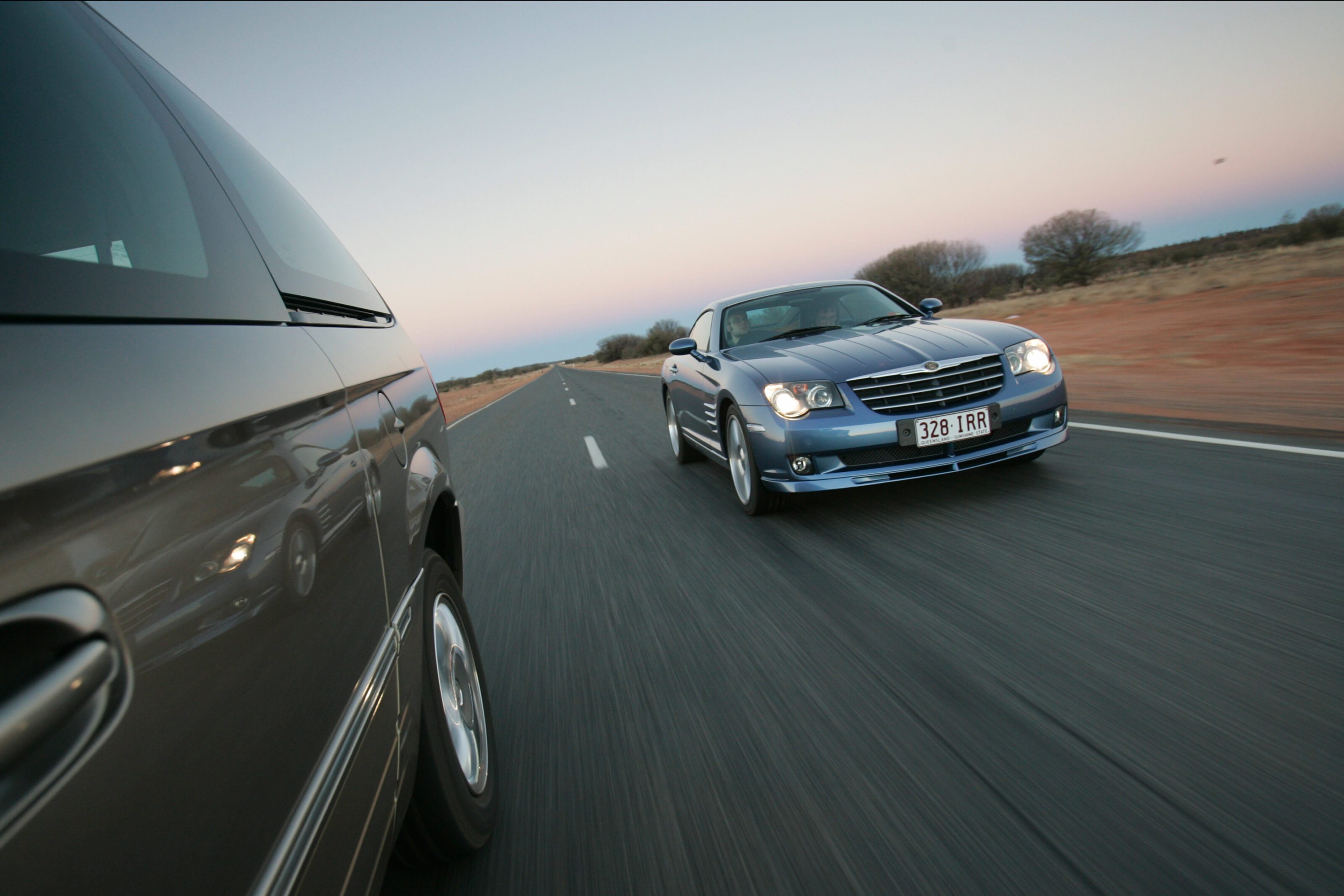
By mid afternoon we’ve raised the trip average to over 140km/h including all stops and, even allowing for the two-and-a-half hours we’ll lose in a dozen fuel ’n’ food grabs, roadside refueling, every stationary shot in this story (and more), getting lost (Cristian) in Alice Springs and cruelly caught at roadwork redlights, we’re tidy for time. But we use the light to keep the average as high as possible in deference to the coming night and, as the day closes in around Mataranka, home of the hot springs that I’d give Jesse’s left nut to be sitting in, we add ‘pig’ to the wildlife sightings and concentration to the task.
At the end of a splendid day we pass through Katherine and, having explored the Crossfire’s catch-up ability in the last of the light we’ve grabbed extra shooting time for Photographer Brunelli and aroused ourselves with some extraordinary Top End rush but hush. Just didn’t want you to think it’s all work. So we sail the last 300km into Darwin well-sated and, above all, in awe of this highway.
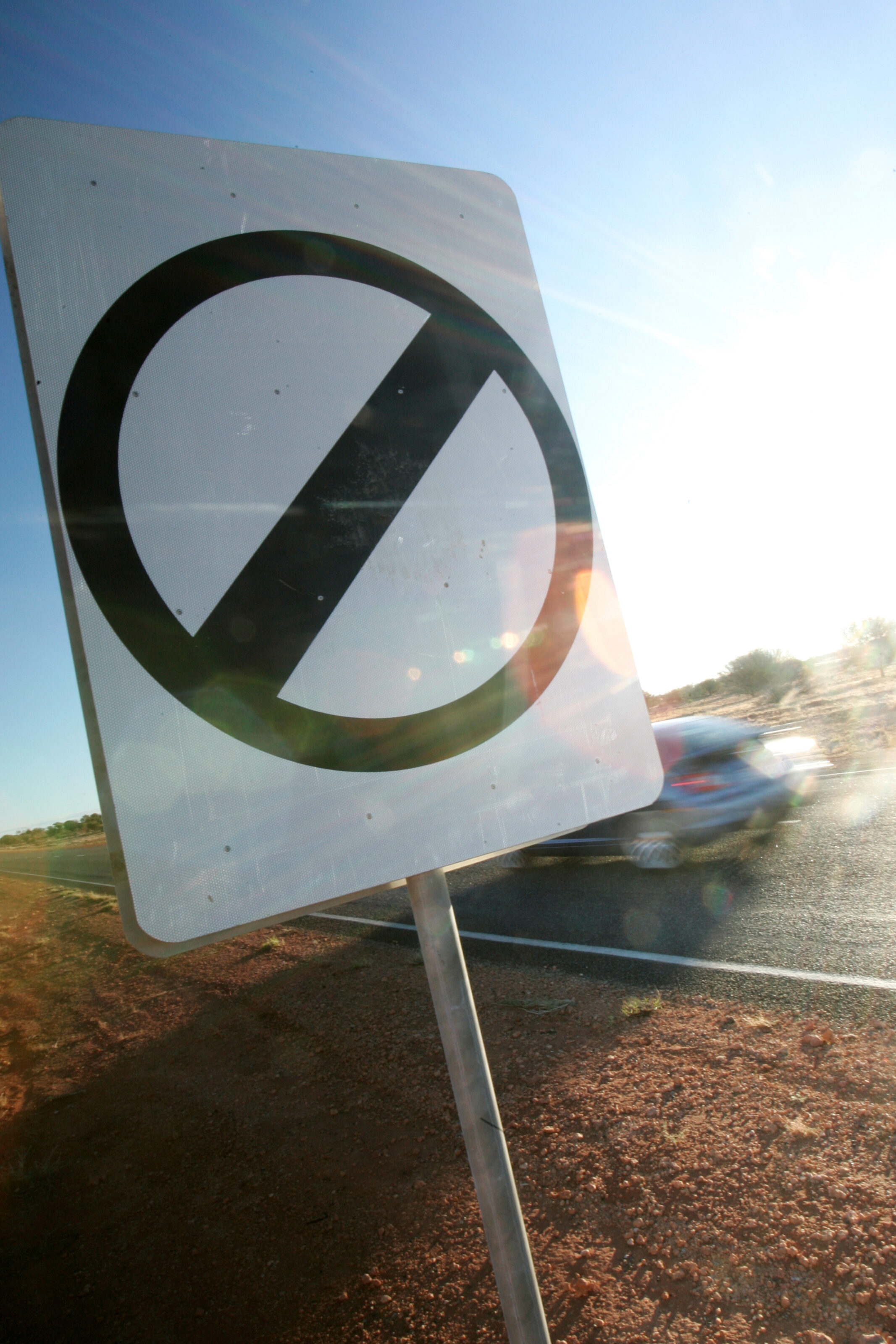
Jesse calls it “one of the few world-class roads Australia has” but that’s an understatement. After all, where else in the world can you drive in complete freedom 3000km across a continent, for much of it at whatever speed you choose, on an excellent and empty highway through a spectacular landscape largely undisturbed by improvement?
And, as we roll into Darwin to stop the clock after 3001.4km at 23hrs:35mins, I realise that not only have we done just that but have done it in perfect safety, harming nothing larger than an insect, without rousing a horn, flash or brakelight from any other road-user, without ever having to brake hard or swerve. Hell of a road. Hell of a drive.
And as, now wearying, we pull into our hotel, I realise I’ve warmed to the Crossfire SRT6. Oh, sure, it’s still flawed, funny-looking and deeply confused about its role, but it’s got a good heart underneath. And getting out of it for the last time, and seeing the travel stains all over its unlovely nose I feel, if not affection, respect for a shared accomplishment.
Only one farewell fits: “That’ll do, Pig. That’ll do”.
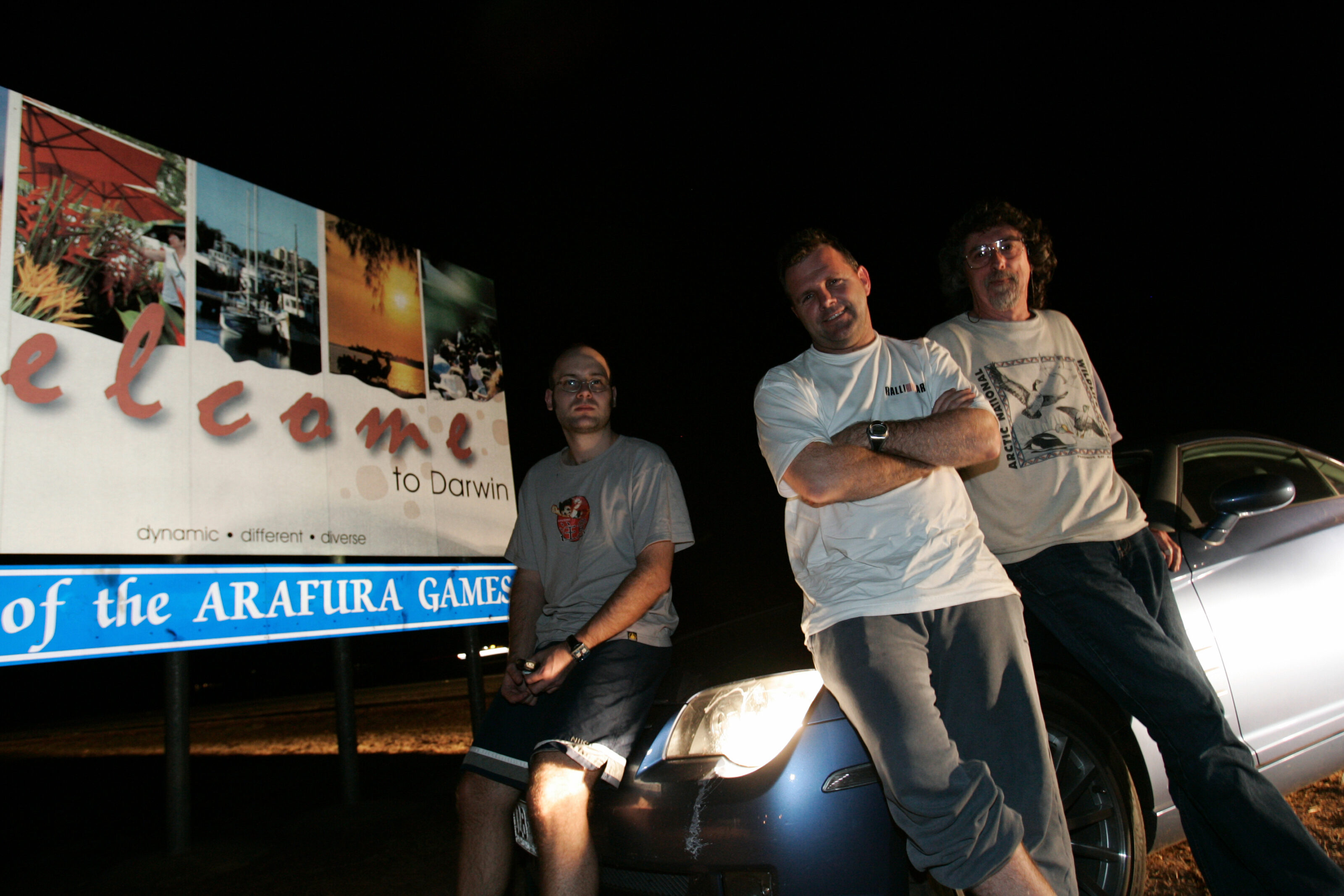
The Mission
We reckoned we could do Adelaide-Darwin in under a day (the record has long stood at 30-odd hours), but we just needed a reason. Well, how about this? Cockburn revels in abject silliness, MT was bemused by the distinct lack of A Point, while JT just felt like getting out of the office. Still, as holders of the record for the lap of the continent (6 days, 9 hours) we thought we might as well claim the record for bisecting it as well. [Ed’s note: the Lap of Australia record has since been broken, and now stands at an impressive 5 days, 13 hours and 43 minutes.]
Run to glory
Stay together or push on alone?
With just over 1200km to Darwin and less than 9 hours to run before the clock struck 24 there was talk the Voyager had done its job and the Crossfire should push on to victory alone. The soccer-mum wagon had supported the SRT6 throughout the night but was now starting to slow the pace, putting the record in jeopardy. However, I felt it was still too early to make that call and barring an incident both vehicles were on target to hit Darwin just shy of the 24-hour mark. It was agreed we’d reassess the situation at every fuel stop and as every hour ticked away.
In the meantime, the Voyager would leave each servo first while the Crossfire crew paid for fuel and then played a game of high speed catch up. After a frustrating 20-minute wait to pay for juice at the spooky, one donkey Ti Tree servo, Cristian and I jumped into the SRT6 and, for the first time all trip, put all 246kW to use.
Even though we were running at high speed since crossing the NT border at dawn, there’s a noticeable step-up in the required focus above 200km/h, but your mind soon adjusts to the increased pace. While the SRT6 tickled its 250km/h limiter a couple of times it was actually less comfortable above 235km/h which became the actual top speed.
By the time we’d caught the tail of the Voyager, the SRT6 had covered 140 kays in just 40 minutes at an average of 212km/h (and Cristian slept for most of it). – Jesse Taylor
Shield of Steel
It’s a funny old world where the support truck leads the way
Point man is the one who gets shot first or who aurally alerts the rest of the boys to the presence of mines by stepping on one.
And so it was with the Grand Voyager and I. We spent approximately 22 of the 23 hours out there cutting a house-sized hole in the air for the slim-hipped, whispy-haired nancy boys, sheltering them from drama and giving them a relay set of high beams.
After leaving Adelaide, the Voyager cleared a 1200km path through the ’roos, sheep, cattle and wedge-tailed eagles (but, curiously, not a single insect) to the NT border. Considered expendable, it lead again until half an hour out of Darwin, when CB and I waved them through to take their glory (did you buy this issue to read about Voyagers?).
It’s not easy to drive at 180-plus, and its lack of acceleration meant carrying a lot of mid-corner speed. Anyway, I preferred to drive it because I just figured the whole thing would be a quirkier achievement in the bus. It rode well, had great seats and it was quiet. It’ll sit for days on 180 (or 190 with the mirrors folded in!) and it was incredibly stable.
I had another very good reason to be point man, though. No way was I spending the whole width of Australia looking at an arse that crook. – Michael Taylor
It’s a common product strategy in the modern automotive business: when a sporting car gets long in the tooth and the base model is nearing a complete redesign, it’s time to debut the stonking model. In the majority of instances, the end result is predictable. Sure, the car’s quicker, perhaps a little louder, visually distinctive, but more often than not, it’s just not that special.
The BMW M5 CS is one of those end-of-the-line rigs and it’s the first 5 Series in history to receive the CS designation. From the earliest E28 through to the E60, these M specials were known simply as M5s. Then, with the F10, BMW muddied the waters and offered customers an appealing Competition Package, which increased power and buttoned down the suspension.
With this latest F90 generation, the sedan started with the regular M5 model followed by the M5 Competition. Both are formidable machines that succeed in living up to the model’s almost four decades of heritage. With the new 5 Series on the horizon, the ultimate M5 arrives right on time and according to BMW, the CS stands for “Competition Sport”, which is a natural extension to the nomenclature. The question is, however, whether this M5 is worthy of the CS designation.
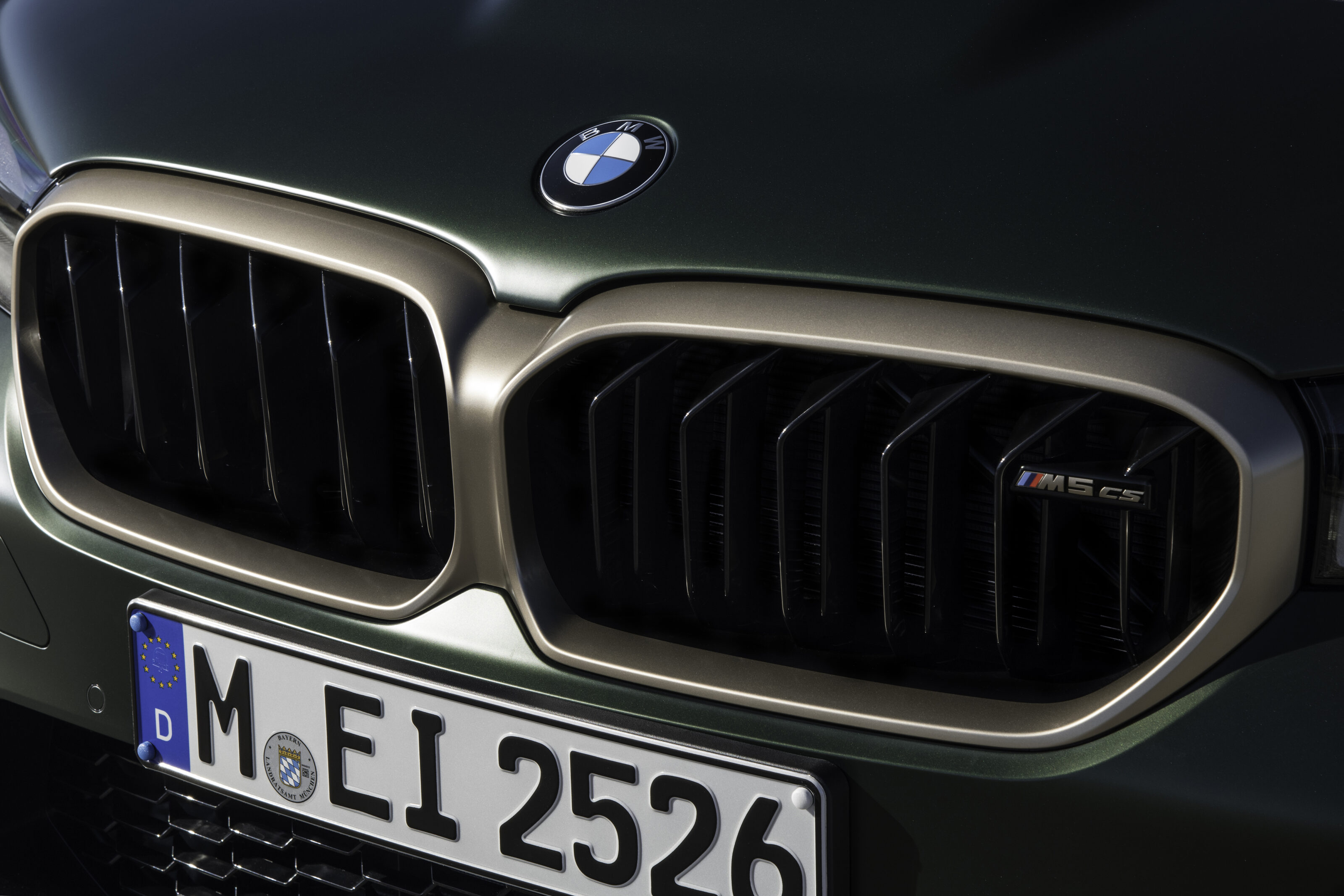
Save for minor aesthetic changes, it looks much like the standard M5 to the casual viewer. It uses the same 4.4-litre, twin-turbocharged V8 as the Competition, but with some software tweaks. Peak power is up from 454kW to 467kW and is produced at 6000rpm. The torque is identical – 750 Nm – but the curve’s been subtly massaged to produce maximum torque for another 90rpm in the rev range, so peak twist is made from 1800 to 5950rpm in CS tune. The V8 is fitted to the car with stiffer engine mounts.
The CS uses the same eight-speed automatic transmission as the Competition, identical ratios and all. Departing from rear-drive tradition, the F90 M5 sends power to the ground through a sophisticated, M-tuned, xDrive all-wheel-drive system. There is an electronically-controlled clutch that distributes power between front and rear axles, the latter fitted with BMW’s M Active Differential, which means it’s one of those fancy electronically-controlled types that varies the amount of lock based on a range of driving variables.
Relative to the M5 Competition, the suspension is thoroughly reworked, with firmer spring rates, ride height lowered by 6mm, more negative camber for the front tyres, and revised rates for the adaptive damping system. Where a CS-spec M5 might have been an opportunity for a quicker steering rack, the CS uses the same variable ratio, electrically assisted system as the Competition.
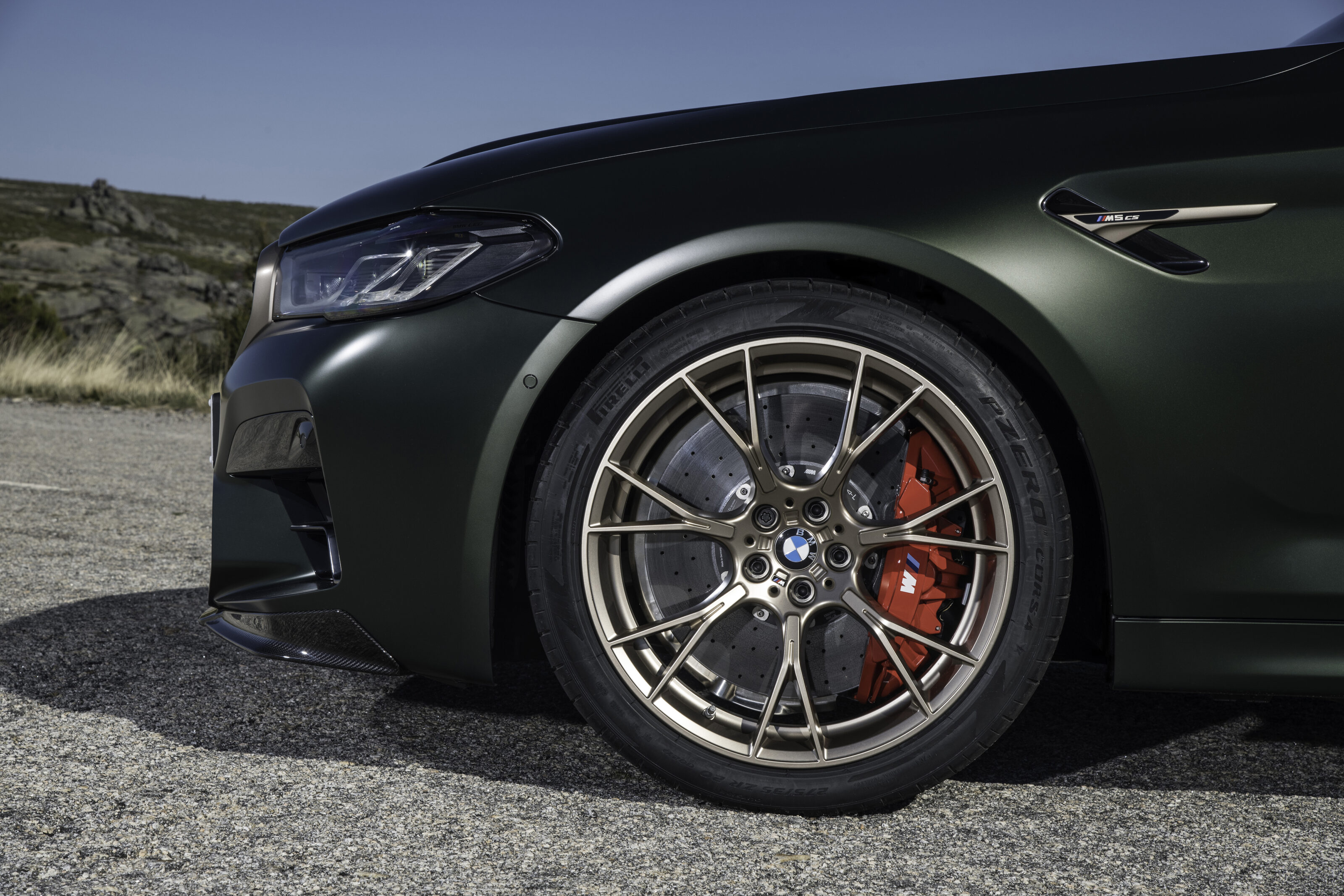
Pirelli P Zero Corsa tyres are standard equipment, but our tester had to be fitted with Michelin Pilot Sport 4S rubber because the first set of Pirellis was thrashed to oblivion and it turns out there’s a worldwide shortage of them.
Pirelli P Zero Corsa tyres are standard equipment, but our tester had to be fitted with Michelin Pilot Sport 4S rubber because after the first set of Pirellis were thrashed to oblivion, it turned out that Corsas are in short supply around the globe. Wheels are forged twenty-inchers that are 9.5 inches wide at the front, 10.5 at the rear.
BMW’s technical literature suggests that the CS tips the scales at 1866kg, which is 105 kilos lighter than their official numbers for the Competition. 23kg of that weight loss comes exclusively from the brakes. They’re massive, two-piece, carbon-ceramic rotors, clamped by six-piston calipers in the front and single-piston calipers for the rear.
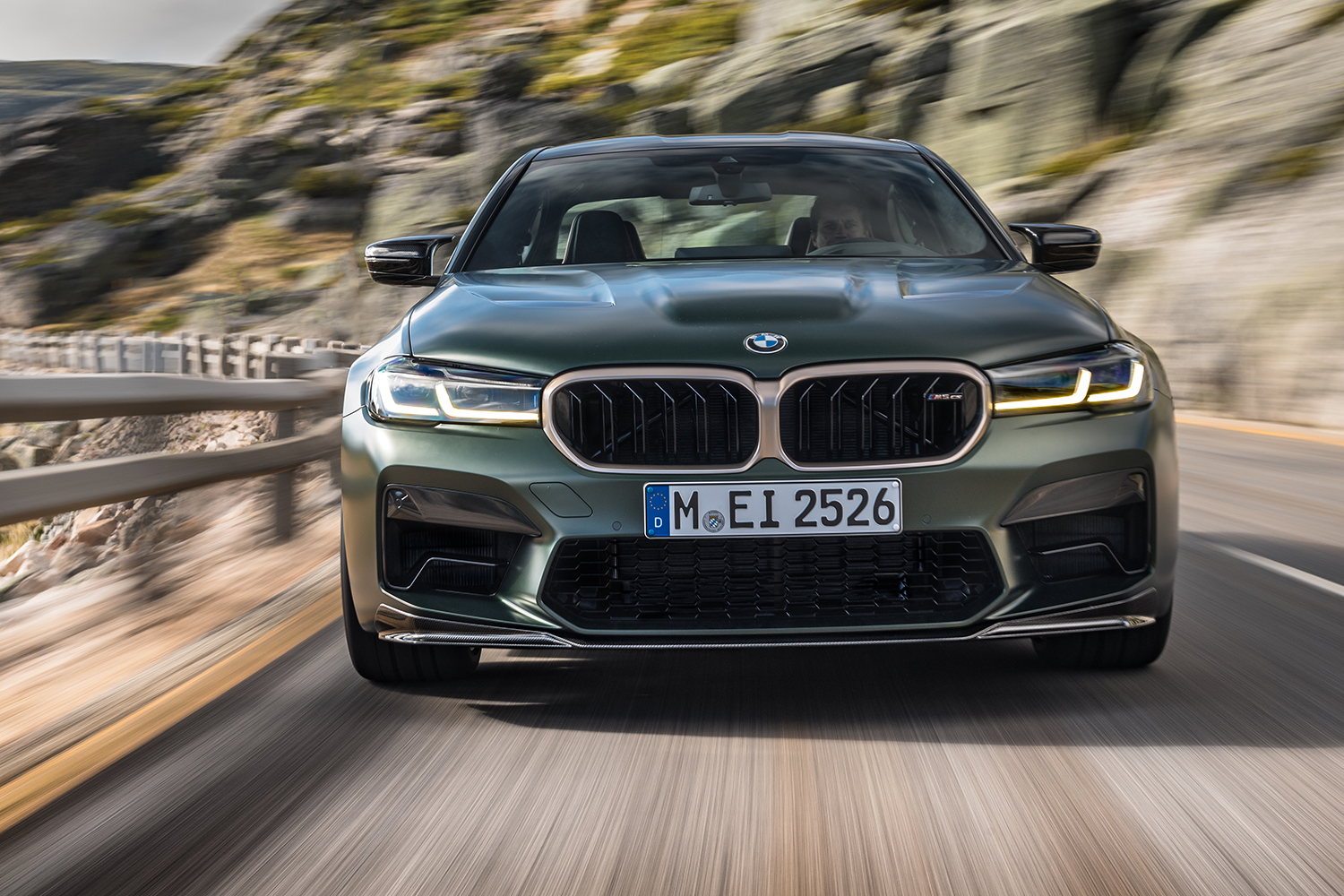
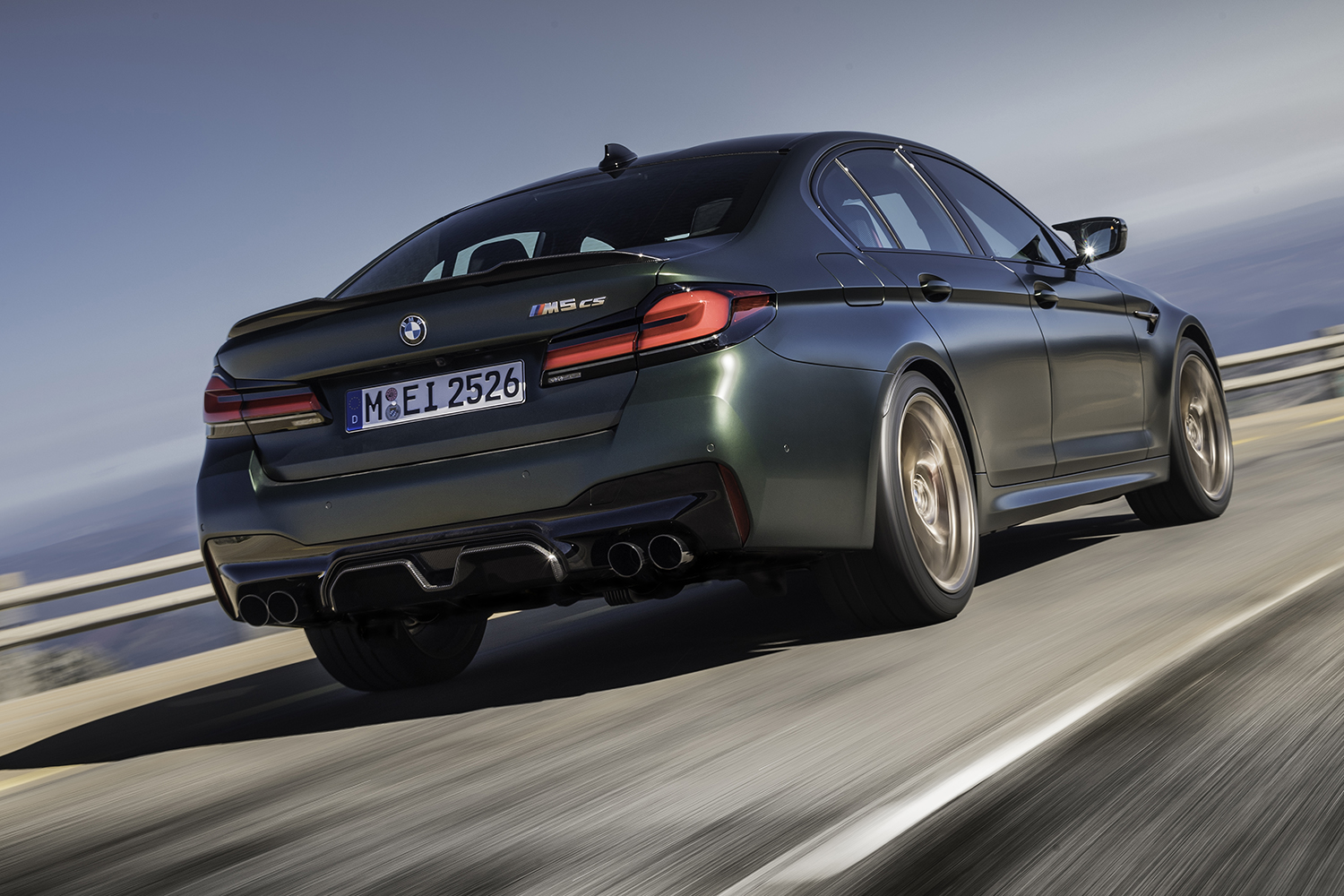
The exterior changes are defined by the use of carbonfibre, though the coolest part is the bonnet, but not because it’s a complete carbon piece. Rather, it’s cool because there is a subtle model designation embossed into the raw carbon on the underside. The bonnet uses carbonfibre vents, there’s a carbon splitter at the front and carbon mirror caps, as well as a carbon rear spoiler and diffuser.
Front and rear badging is done in the CS’s signature Gold Bronze colour and extends to include the kidney grille, wing vents, and wheels. Gold Bronze brake calipers are a no-cost option. BMW doesn’t disclose this information, but both front and rear fascias appear to be constructed of thinner material. Paint colours are limited to the standard Brands Hatch grey metallic, along with two matte finishes that BMW calls Frozen Brands Hatch grey metallic and the signature Frozen Deep Green metallic.
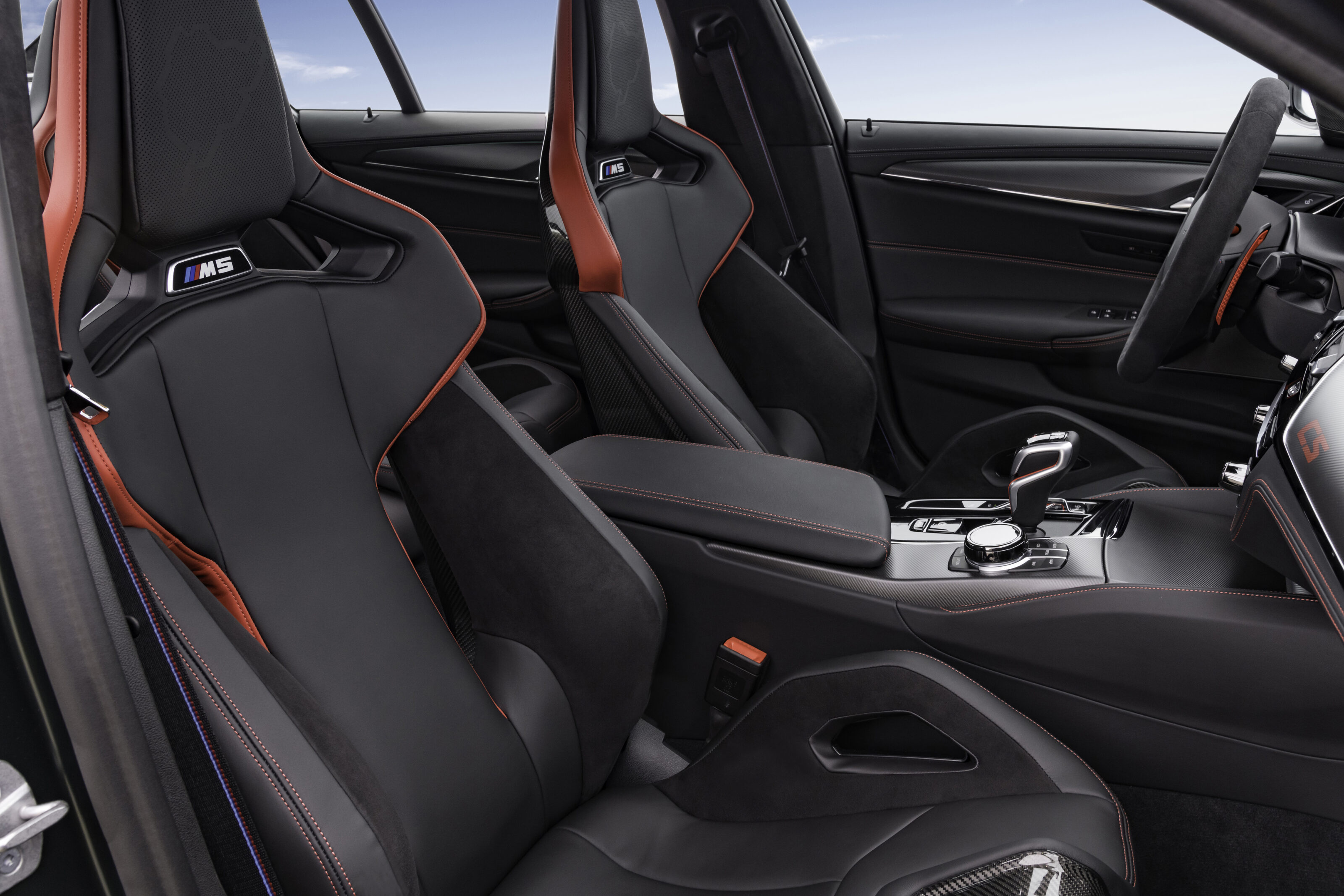
The interior is a dramatic departure from the Competition and the CS is exclusively a four-seat sedan. Gone is the Competition’s three-person rear bench, replaced with a pair of deep, fixed bucket seats. The front seats are similar to the optional M3/M4 Competition buckets emblazoned with a stylised map of the famed Nürburgring Nordschliefe on the headrests, which is where those lucky engineers spent much time developing this CS. Given the hardcore nature of these front seats and their built-in ventilation, they’re heated only and without the cooling feature of the Competition.
The stereotypical, fat-rimmed BMW M steering wheel is present and accounted for, but in CS spec, it gets an Alcantara finish as well as carbonfibre shift paddles. For the purposes of saving weight, the useful centre console storage is deleted, but the wireless phone charger is retained. On the surface, it appears to be hypocritical, but with iDrive’s wireless phone support, someone at BMW decided it was necessary. The company did, however, reduce the use of sound-deadening material throughout the car.
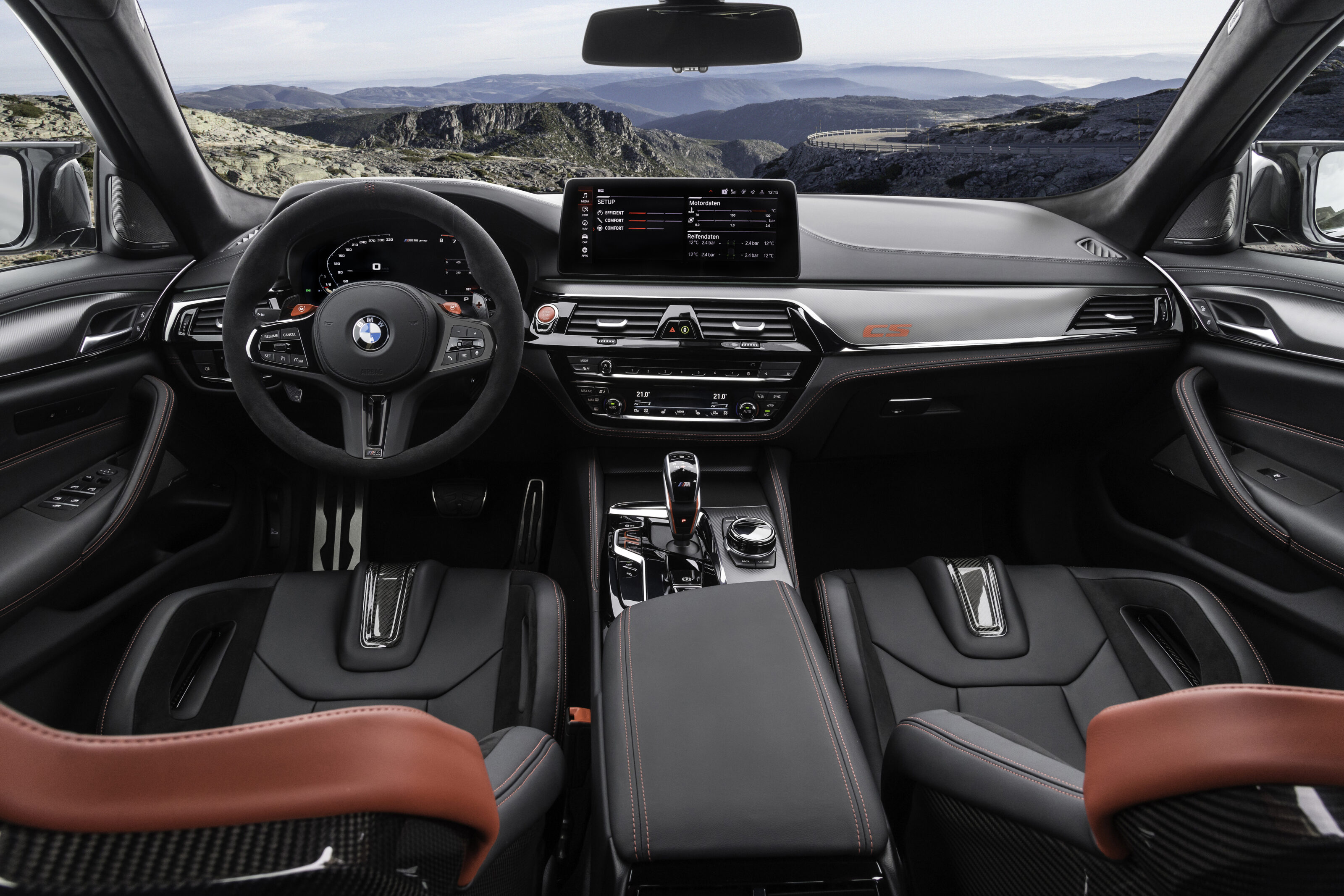
Speaking of iDrive, it’s the familiar, current system used across many of BMW’s latest cars, with both wired and wireless Apple CarPlay and Android Auto connections. The M5 Competition’s adaptive cruise control and lane-keep assist systems have been deleted from the CS, presumably to add lightness, and it’s exclusively available with an antiquated, basic cruise control setup.
Officially, the CS is said to launch from naught to 100km/h in three seconds flat and it seems like this sedan can perform that feat repeatedly, all day long, every day. Given the perfect conditions without any engine heat soak, low ambient temperatures, and the ideal road surface, this über M5 feels like it could perform that feat a couple of tenths less than that. This kind of acceleration is simply obscene. The nature of the V8 ensures that in nearly all driving conditions you’re running at revs near peak torque, so maximum thrust is a tip of the throttle pedal away.
If you find yourself tempted to hold that pedal to the firewall, you’ll run out of courage long before the CS. Ungoverned (and on a closed circuit), it’s said to max out at 306km/h, but that number also seems pessimistic. The throaty rumble of the small-displacement V8 is always present, but what’s funny is that the CS exhaust is more docile than that of the Competition. It’s shy a few decibels and generally less rowdy overall.
Confidence under acceleration is another matter altogether and is, in a word, sublime. The engineers behind the M-tuned xDrive system should be awarded medals for their work. The CS never puts a foot wrong, whether in a straight line or exiting corners, and there is never a hint of power-on understeer.
The active differential provides one other, often overlooked benefit – stability under braking. Unlike a mechanical diff, an e-diff frees up while braking, giving the driver confidence under maximum deceleration as well as when transitioning off the brake and throttling out of corners.
While there’s no clear weakness in the driveline, a super sedan could be enhanced by a rapid-fire dual-clutch gearbox but BMW engineered the xDrive system to mate exclusively with the automatic. Between quick upshifts and rev-matched downshifts, the eight-speed auto does all of the right things, plus it’ll cruise along, happily shifting on its own, if that’s what the driver desires.
This CS, however, is far more enjoyable when you’ve configured personalised drive modes for the M1 and M2 buttons on the steering wheel. Given the default mode on engine start is formidable due to the basic performance of this BMW, the best use of these buttons is as follows.
M1 should be set for aggressive engine and automatic transmission modes, along with maintaining all-wheel drive and moderate stability control interventions. This setup is a perfect middle ground between a completely extreme mode and the car’s default.
To complement those settings, M2 is best configured as a de facto lunatic mode, saved for special occasions. Manual shifting, stability control disabled, and rear-drive only, just as the original M5s were delivered (we’ll overlook the fact that this M5 CS produces more than twice the power of the original E28 M5 for just a moment). While you might be kicking it old school with no software interventions, you’ll need a well-honed skill set to tango with this dance partner.
If you do hit the dance floor and kick it old school, you’ll be rewarded with a wonderfully balanced chassis that gives you high-fidelity chassis feedback around and beyond the limits of this CS. One of the highlights of the CS is improved feedback through the countless (but subtle) suspension tweaks and turns the M5 into a rewarding super sedan that you can place with exceptional precision. Even power-on oversteer, at least in the rain, is remarkably controllable for an 1800-plus kilo sedan.
Both M1 and M2 should be prescribed with the softest damping settings unless you’re on a billiard-table smooth racing circuit. Simply put, in a car this big, you have to give the dampers the freedom to keep the tyre in contact with the road surface.
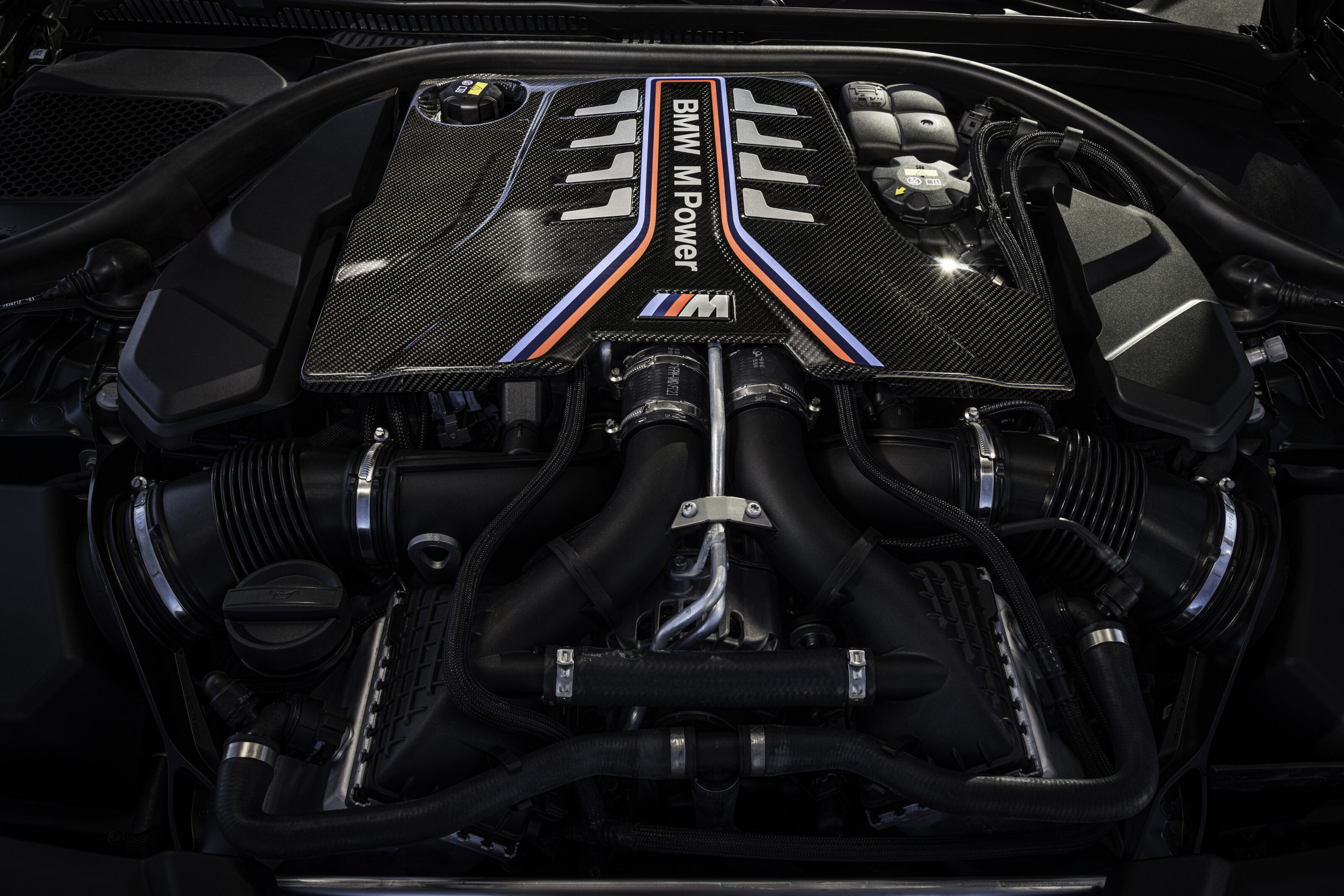
Undoubtedly, it must have been tempting for the development engineers to specify stiffer suspension calibrations, which would have resulted in a jarring ride anywhere but the racetrack. It’s a common fault of cars purported to have been developed on the Nordschleife, but the CS has escaped the curse of Nürburg. The ride is noticeably firmer than the Competition, but it remains compliant enough to take Gran out for tea, though she may not appreciate the deeply bolstered bucket seats.
The lesser unsprung weight of the carbon-ceramics certainly permits the dampers to work a little easier than with a heavier steel brake setup, but let’s not forget that carbons deliver significantly better thermal efficiency. Repeated heavy braking like you’d find on a racing circuit is something this car will do all day long.
Power, feel, feedback, and modulation are all tops, though there are a few too many millimetres of initial pedal travel before the pads begin to bite the rotors, and they do tend to produce a disconcerting low-frequency wail when you’ve worked some heat into them.
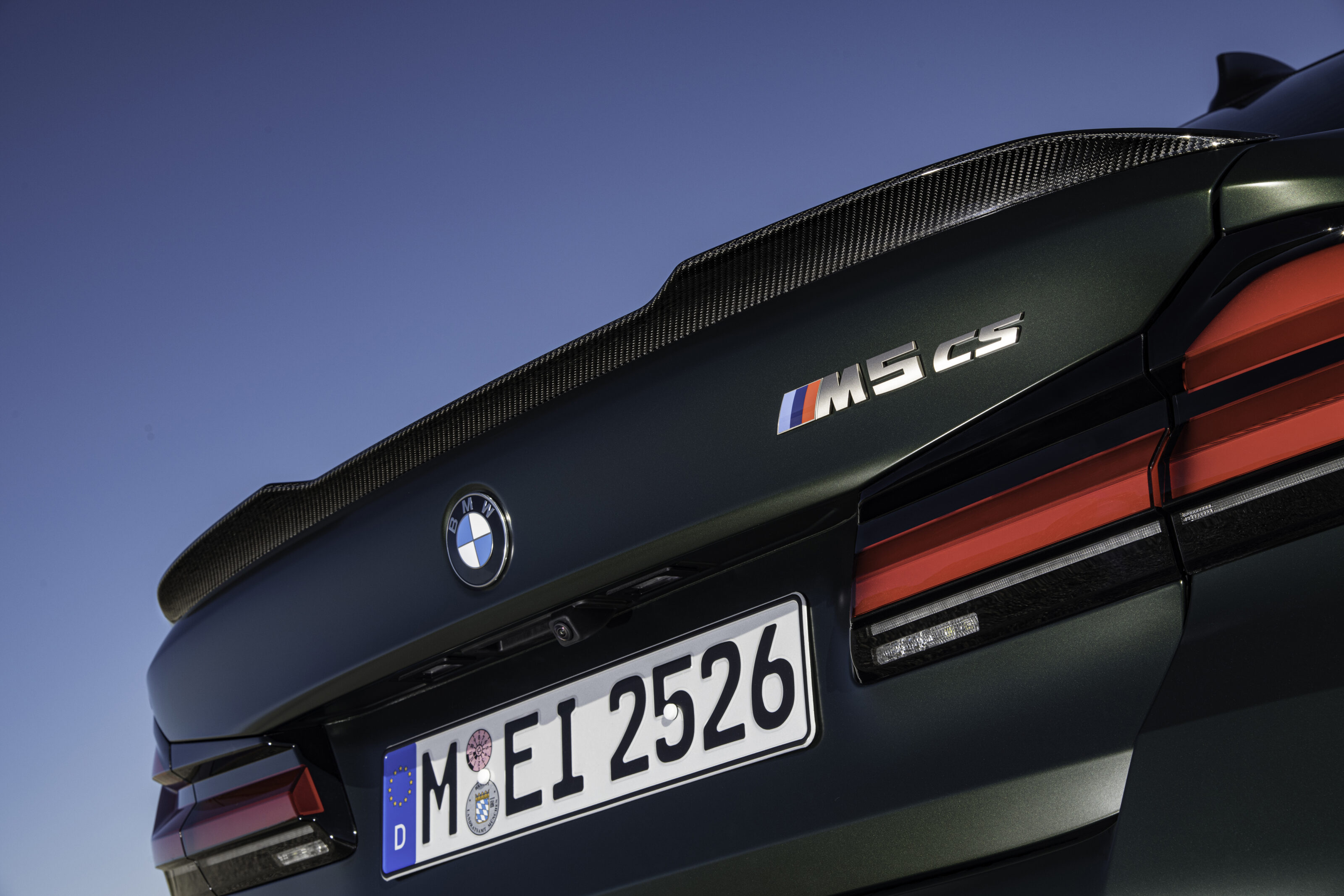
All things considered, the M5 CS is a car for a select few, but not by its low volume numbers. It’s available exclusively for the 2022 model year and while BMW hasn’t disclosed production quantities, total numbers shouldn’t exceed much more than a thousand, if that.
Still, the CS takes a special kind of driver to appreciate all of its qualities along with its compromises. Among the many considerations, the deep bucket seats make ingress and egress inelegant, the lack of useful console storage has you leaving bits and bobs in strange places, and the lack of adaptive cruise control makes it less usable than a regular M5 or even the Competition.
Its all-conquering performance makes this M5 certainly worthy of the CS designation. However, it’s not just the ultimate BMW performance sedan. It’s a fully-fledged, four-door supercar.
2022 BMW M5 CS specifications
| Body: | 4-door, 4-seat sedan |
|---|---|
| Drive: | all-wheel |
| Engine: | 4395cc V8, DOHC, 32v, twin-turbocharged |
| Bore/stroke: | 89 x 88.3mm |
| Compression: | 10:1 |
| Power: | 467kW @ 6000rpm |
| Torque: | 750Nm @ 1800rpm u2013 5950rpm |
| 0-100km/h: | 3.0sec (claimed) |
| Fuel consumption: | 11.1L/100km (combined/claimed) |
| Weight: | 1866kg |
| Power/weight: | 250kW/tonne |
| Transmission: | 8-speed automatic |
| L/W/H: | 5001/1903/1468mm |
| Wheelbase: | 2982mm |
| Tracks: | 1626mm (f); 1595mm (r) |
| Steering: | Electrically assisted rack-and-pinion, variable ratio |
| Brakes: | 400mm ventilated discs, six-piston calipers (f); 396mm solid discs, single-piston calipers (r) |
| Wheels: | 20 x 9.5-inch/20 x 10.5-inch (f/r) |
| Tyres: | 275/40R20/285/35R20 (f/r) Pirelli P Zero Corsa |
| Price: | TBD |
When Ferrari offered us a chance to have a poke and a prod around its all-new 296 GTB supercar, we weren’t about to say no. The figures are, to be frank, ridiculous. This is a plug-in hybrid that generates a massive 611kW from its electrified drivetrain, with the 120-degree 3.0-litre V6 alone contributing 487kW to that figure.
It’s quicker to 200km/h than a Ferrari 812 Superfast and boasts a specific output of 163kW per litre. It is, by any measure, one heck of a new edition to the Ferrari range.
It’s also a car that we’ll get used to in time. Despite representing the biggest step forward of any of the mid-engined supersports models, this rear-wheel drive powerhouse also has a foot on the past, some of the styling touches redolent of the 250 LM from 1963, without other touches that crib from 512 BB and, more latterly, the SF90 Stradale. In fact, it seems far more SF90-lite than anything resembling the 458/488/F8 Tributo family.
Ferrari had flown in an early Rosso Imola left-hooker for us to run the ruler over, so settle in and drink in the details of what might be one of the most revolutionary regular production Ferrari models of recent years. You may well wonder whether a V6 can ever replace a V8 and you may have doubts as to whether a hybrid Ferrari is a better Ferrari. We’ll answer those questions in time.
In the meantime, dive in and check out the face and the feature set of Ferrari’s bold new future.
Snapshot
- 981 chassis which underpins Boxster and Cayman affected
- 310 units under recall
- Porsche encourages customers to contact their local dealers
German manufacturer Porsche has issued a recall notice for Boxster and Cayman models built between 2012 and 2014.
Affecting a total of 310 units, an apparent manufacturing defect means the vehicle’s rear suspension may fail under extreme driving conditions, leading to a loss of control.
Porsche hasn’t provided details as to which specific variants of the Boxster and Cayman are affected, but the 310 vehicles under recall represents just under a third of all models sold over the three-year time period, as Porsche shifted 1051 units of the two models between 2012 and 2014.
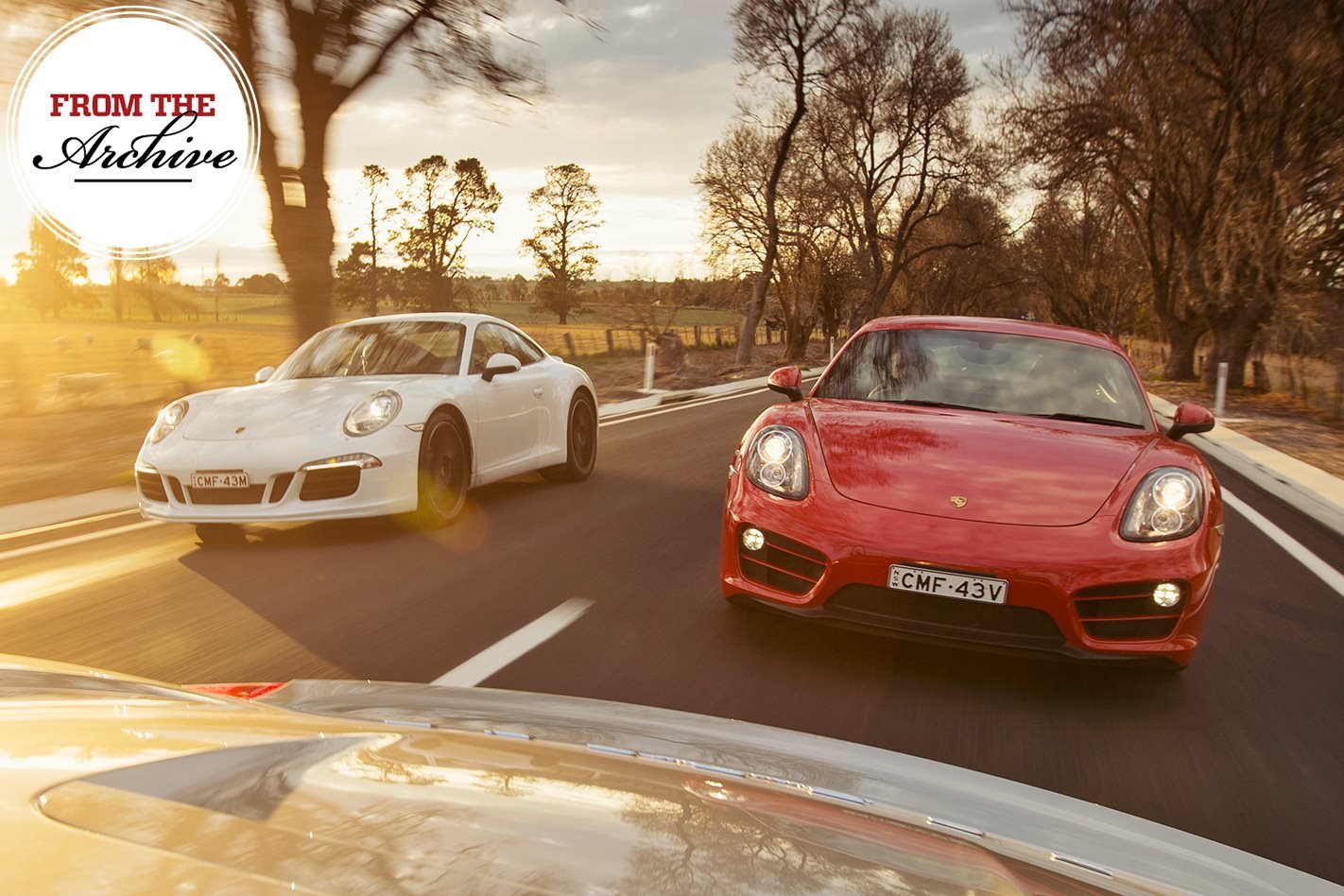
Any owners of the aforementioned models have been urged to contact their local Porsche Centre to clarify whether their vehicle is affected, with the manufacturer offering to rectify the fault free of charge.
A list of VINs for affected vehicles can be found here.
Ferruccio Lamborghini didn’t believe in motorsport improving the breed, but here’s proof it does: the Lamborghini Huracan STO.
The gist is that the STO (which stands for Super Trofeo Omologato) transfers lessons learnt from the Super Trofeo one-make Huracan series, plus the more serious Huracan GT3 Evo racers (that have won Daytona three times on the bounce). There’s much of the approachability of the gentleman-spec former, with the capability of the latter.
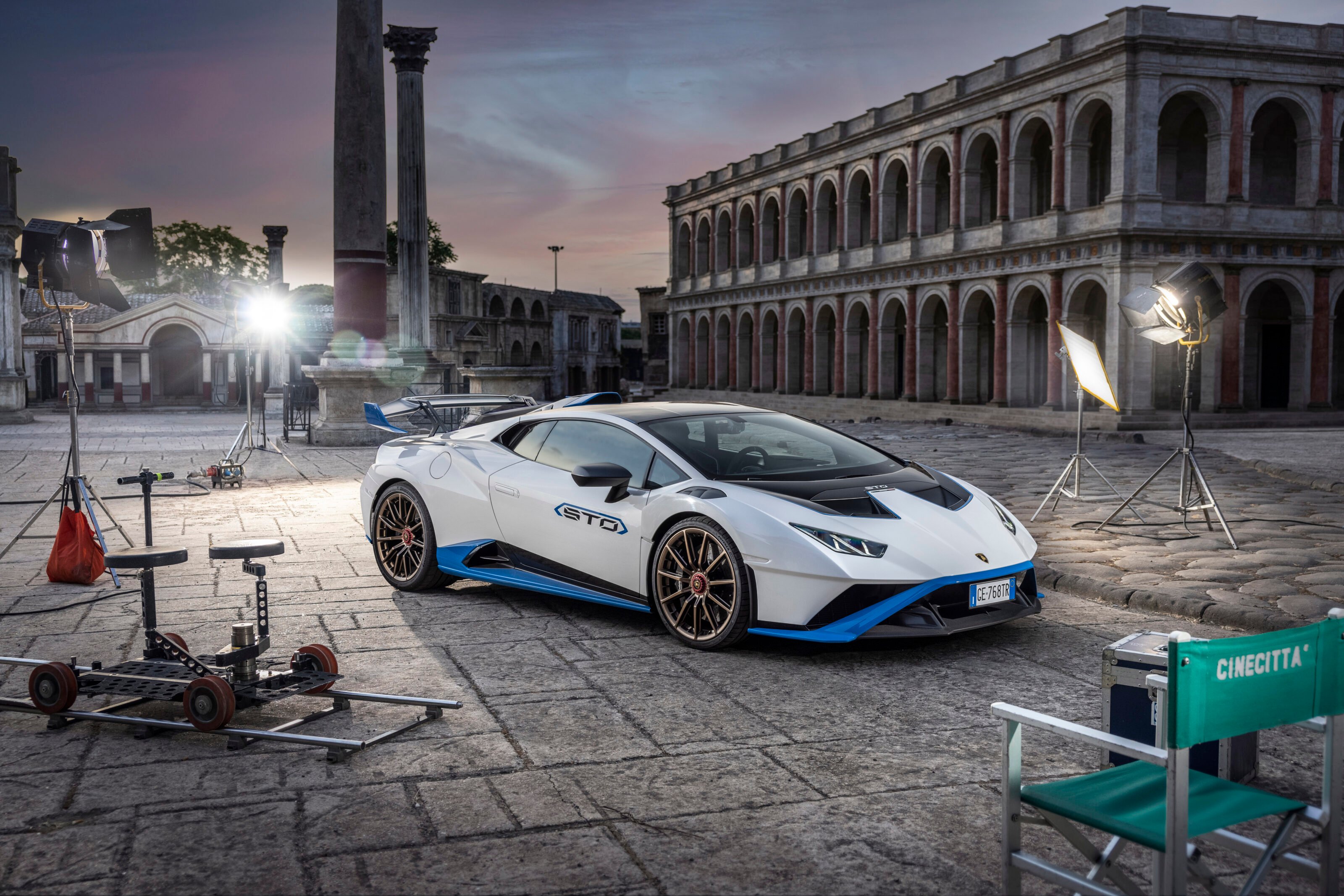
In doing so, the STO steals the previous Performante’s crown as the most hardcore Huracan, and corrects an anomaly previously at the heart of the range: until now only the entry-level model was rear-wheel drive like the race cars, but now the STO is rear-wheel drive and the fastest, lightest and most expensive Huracan at $596,000 before on-road costs.
What do you get for that wedge?
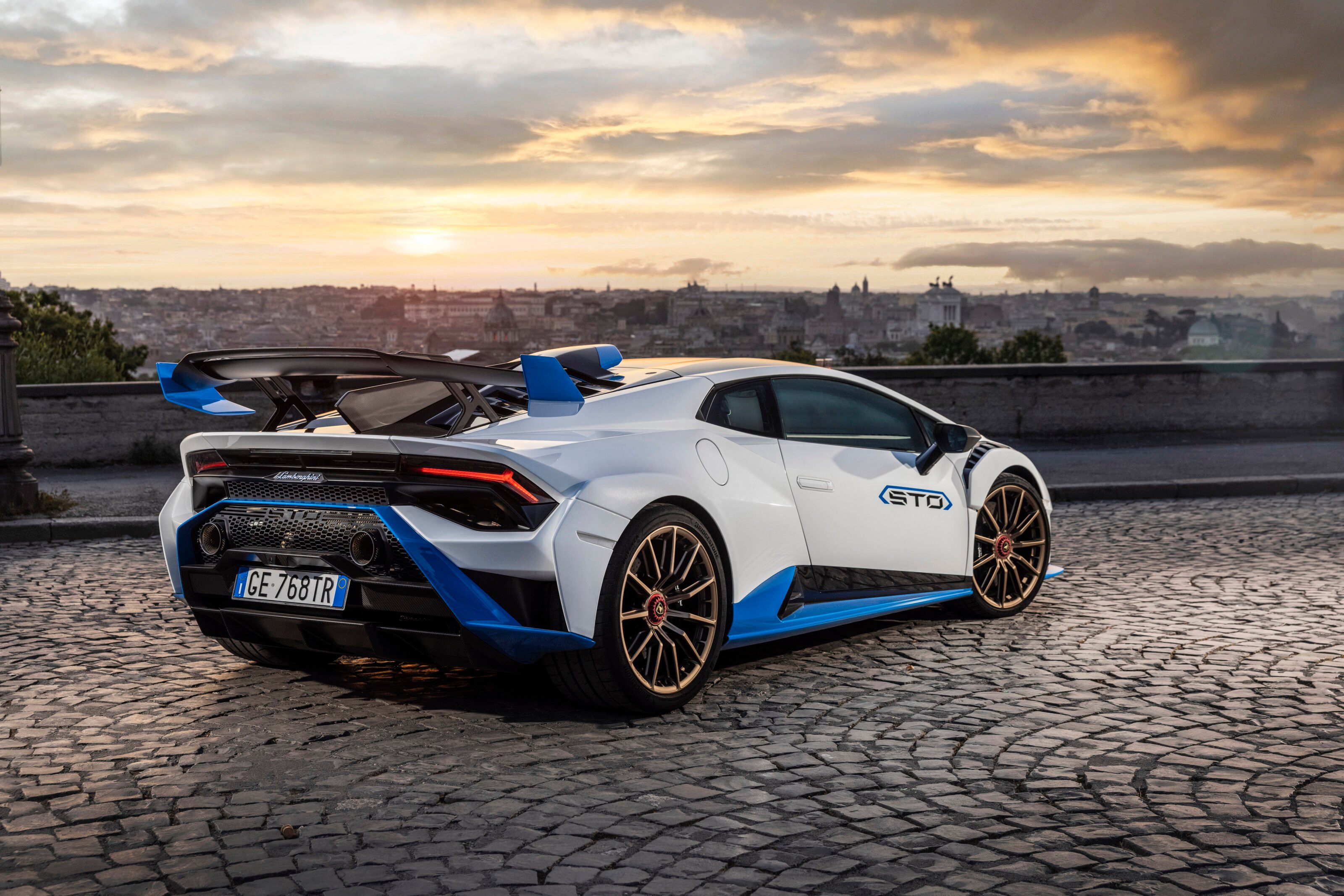
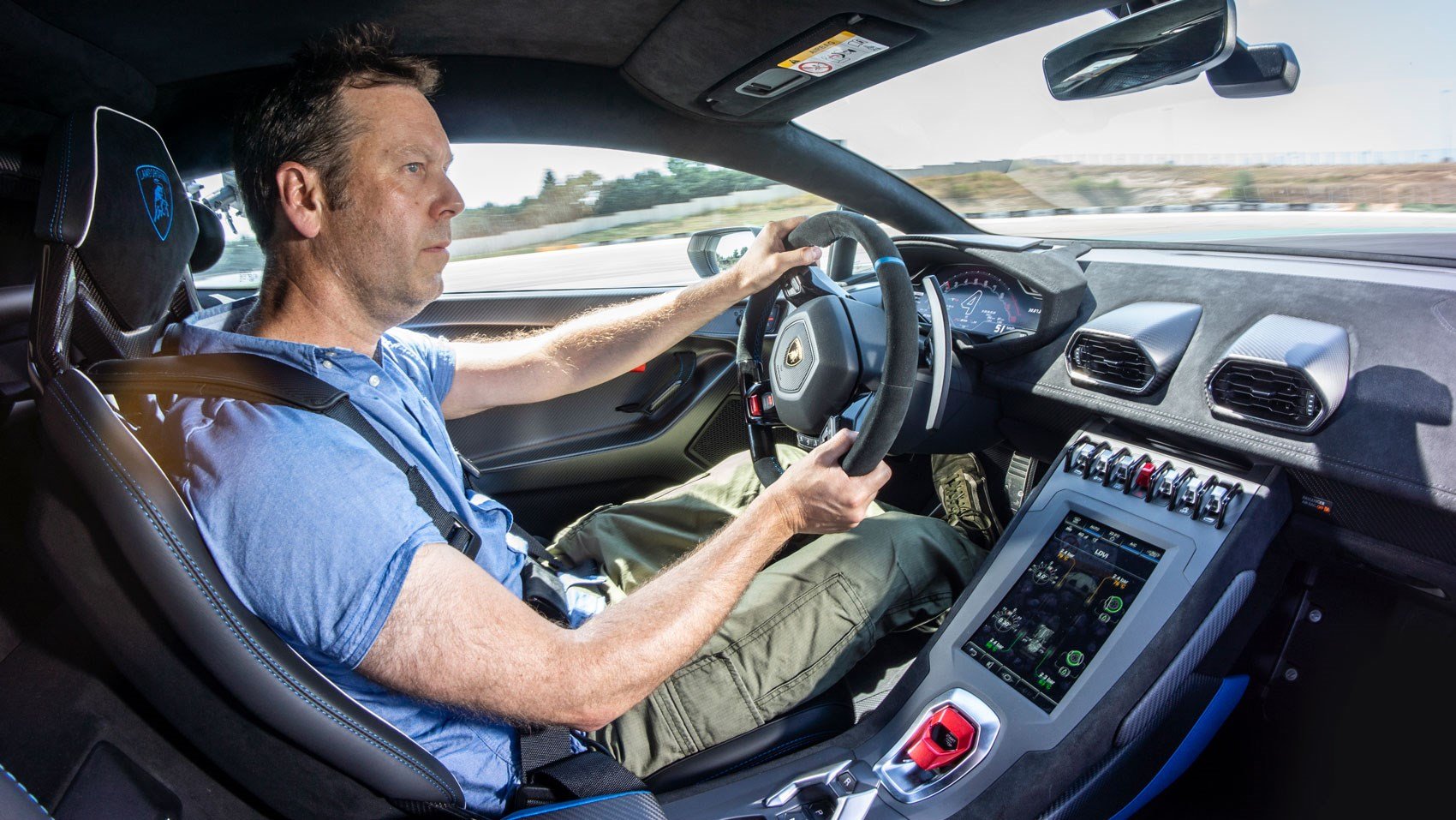
Weight drops 43kg versus a Performante to 1339kg dry thanks to copious use of carbonfibre, there’s peak downforce of 420kg at 280km/h (53 per cent up on the Performante and includes rear Le Mans-style shark fin), the chassis is uprated with stiffer anti-roll bars, and you sit in an interior dark, functional and a little foreboding like a fighter-jet cockpit.
Carpets are replaced by carbon floor mats, there are bare minimum carbon door cards, and carbon-shelled seats that are as firm and supportive as they look, if decently comfy too. Over my shoulder there’s a half roll cage, my XL helmet occasionally snags the roof (I’m 185cm and I just fit) and Mad Max-style slats over the rear window block visibility, while onboard telemetry is primed to analyse my every move. You can even play back your laps on the in-car screen.
It wants to bite and turn, and any bottled-up momentum at the apex escapes through an oversteer release valve
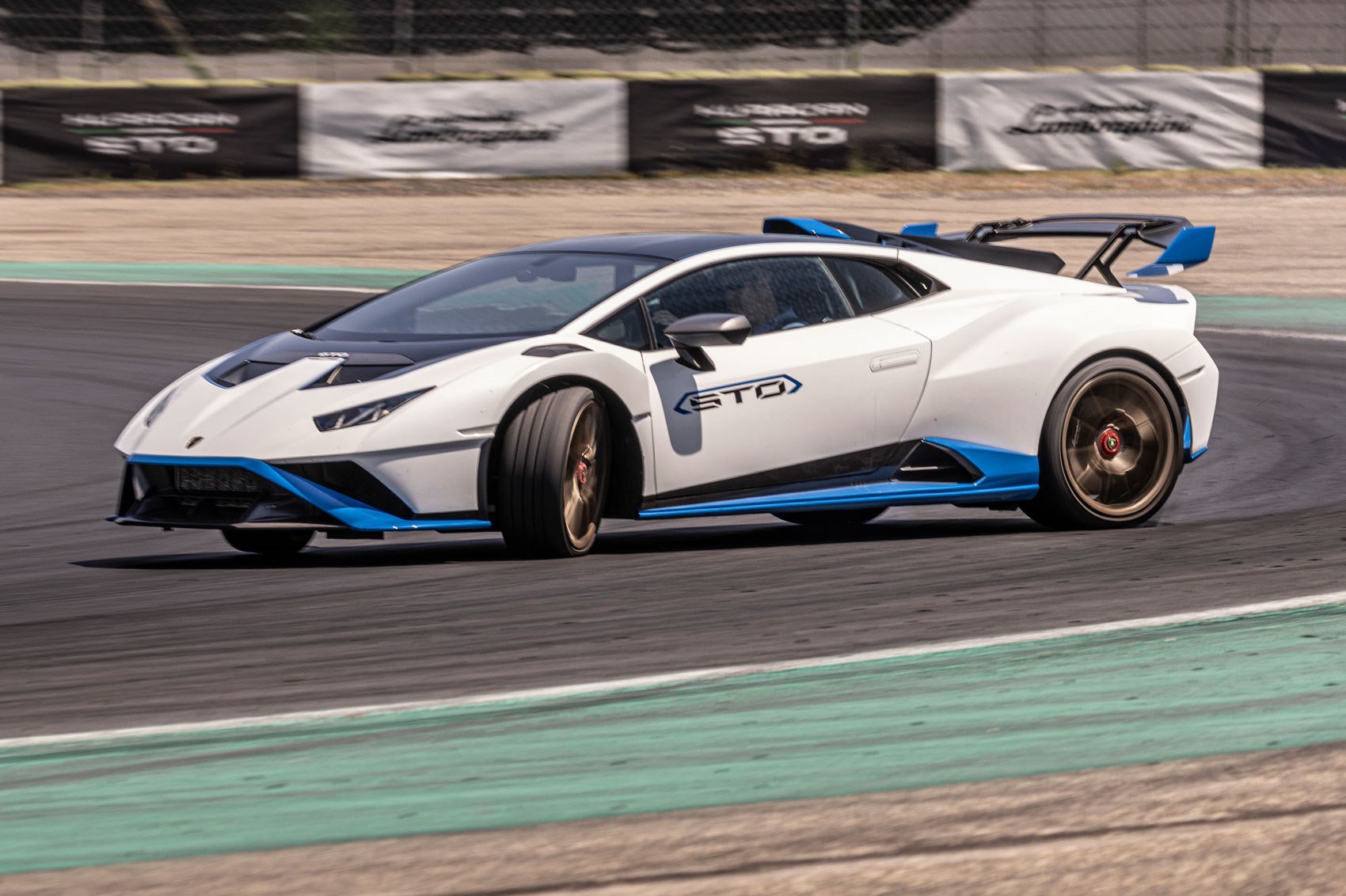
For all the familiar track-focused tropes, there’s also a genuinely surprising level of differentiation here: all the body bar the aluminium doors and roof is carbonfibre, the entire front end is now one piece (‘cofango’) and hinges forwards like a Miura clamshell to reduce fixings and therefore weight, plus the rear haunches have a more brutally angular aesthetic lifted from the Super Trofeo racers, with a NACA duct sitting on top.
How does all of that feel?
Even stroking along, the delectable V10 is working its magic, gargling and purring through lower revs like operatic warm-up exercises, the symphony now louder thanks to those notoriously pricey Akrapovic exhausts, if entirely appropriate given everything else is cranked to the max.
On cold tyres the Huracan STO initially feels so pointy as to be almost nervous – the front end runs a wider track and more aggressive camber, and there’s rear-wheel steering too, plus minimal body roll or pitch. It wants to bite and turn, and any bottled-up momentum at the apex escapes through an oversteer release valve. The first mid-speed corner on cold, new tyres makes me flinch like running my hand under a surprisingly hot tap.
This chassis and this delivery is a deliciously malleable combination, and the V10 noise and response only eggs you on
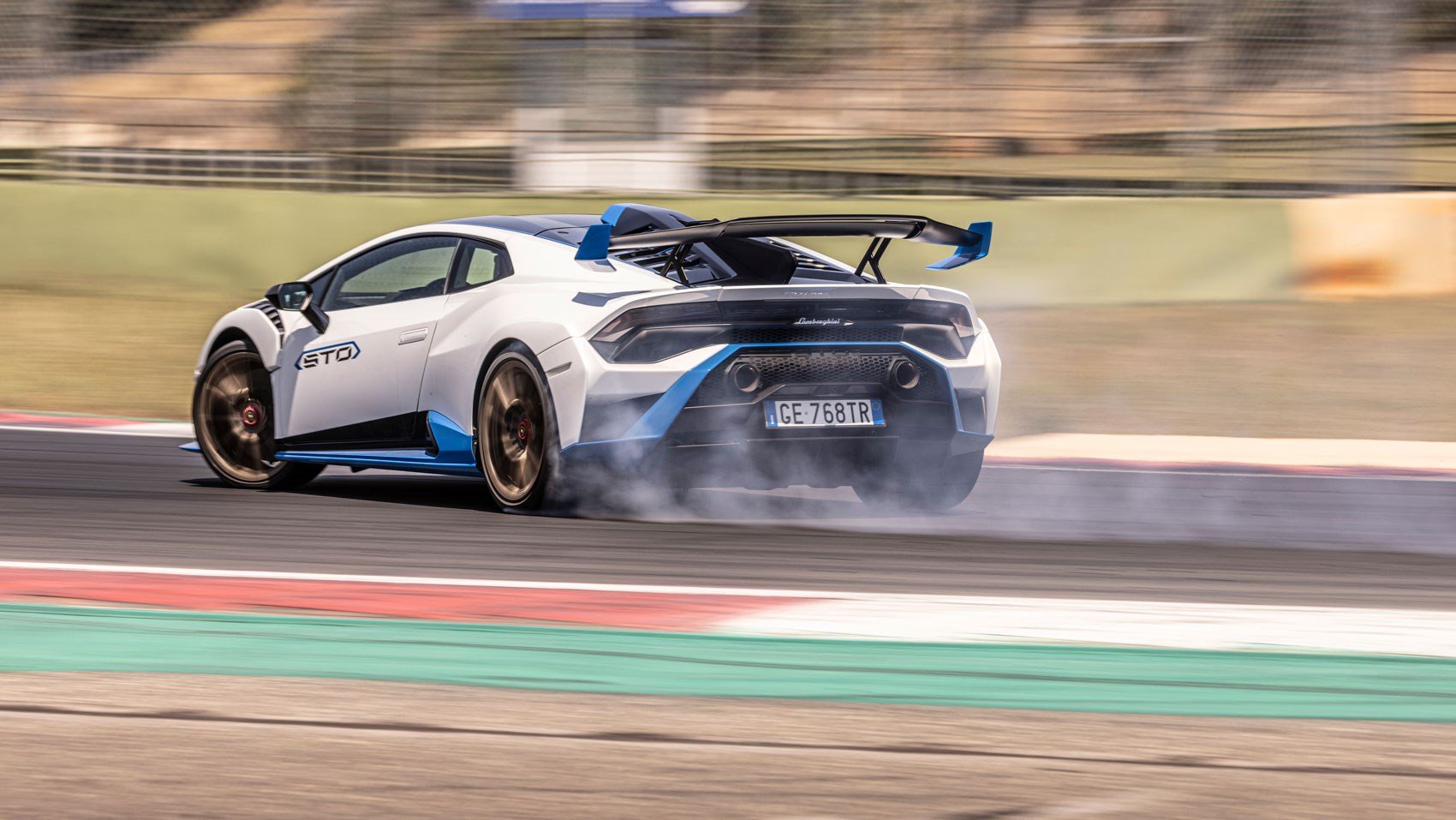
It takes very little time for the tyres to switch on, though, and when they do they ground the Huracan’s reactivity like the track is coated in a gossamer of chewing gum. Instead of being tip-toesy anxious, now you gain confidence to chuck the Huracan around, to stand hard on those almighty brakes, work the steering with big positive inputs and go large on the throttle knowing that the grip will smear and bleed rather than snap.
The STO is so much more intuitive and involving than the all-wheel-drive models, and then through the really quick stuff, you’ve got the godly squish of aero keeping you planted. Perfect.
What about that gorgeous engine?
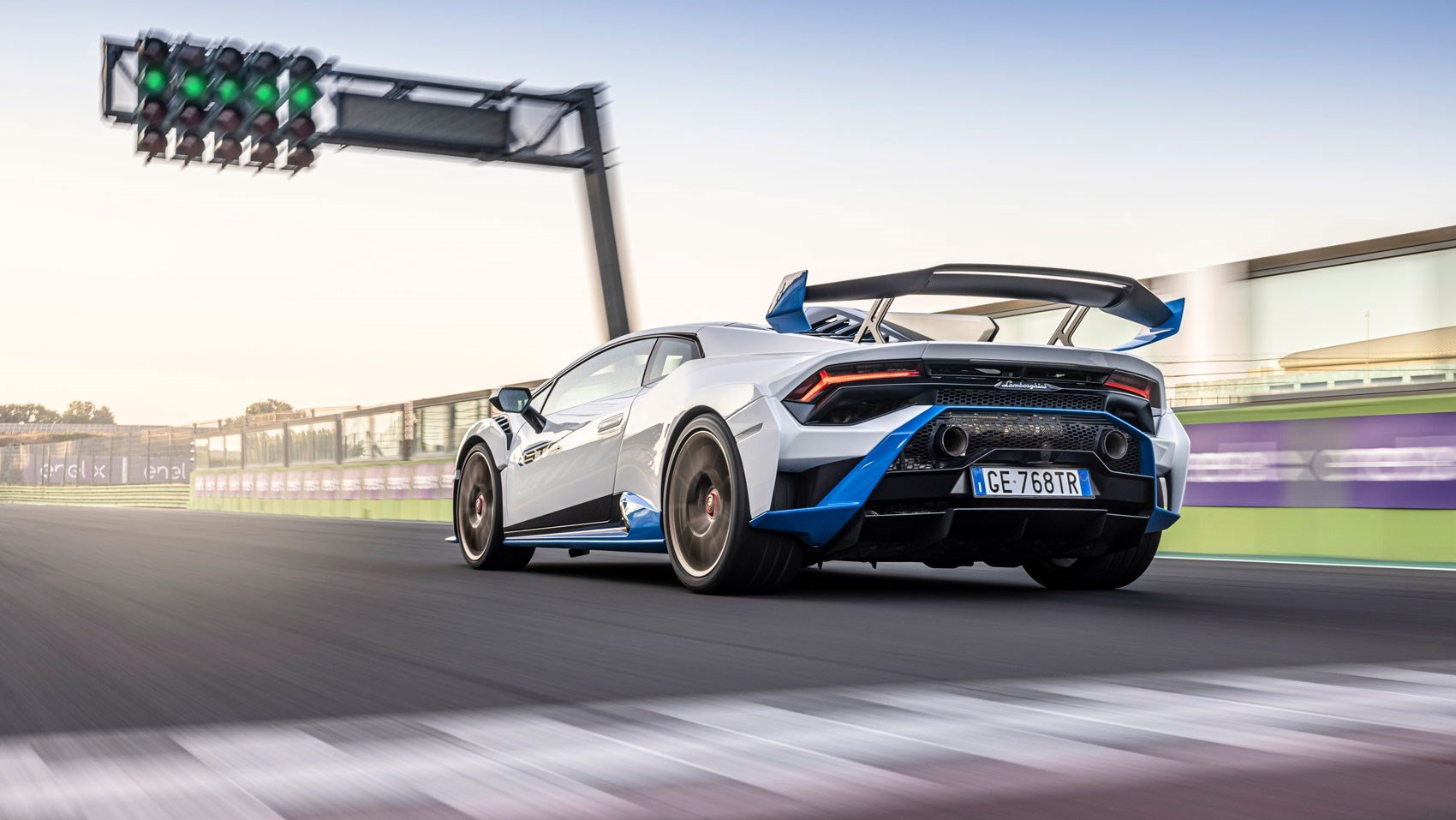
The (unrestricted) V10 is said to be a direct lift from the GT3 Evo racer, but the Huracan is now a way off its 520kW-plus turbocharged rivals from Ferrari and McLaren, and 470kW is no more than a Performante (plus there’s a little less torque).
Doubtless, you’ve already guessed the STO remains a vividly rapid machine, one that serves as a welcome reminder that you simply don’t need any more performance to have fun. In fact, putting less torque on a higher shelf (565Nm at 6500rpm) with a more progressive naturally aspirated delivery lets you work the tyres harder, feeling them chew at the surface progressively as torque builds rather than explodes and you carefully but resolutely squeeze throttle to floor.
This chassis and this delivery is a deliciously malleable combination, and the V10 noise and response only eggs you on like the home crowd at a State of Origin game.
Ultimately it’s uncorking the V10 that makes the Huracan so addictively visceral above everything else, and the chassis gives you the tools to do it so extrovertly.
VERDICT
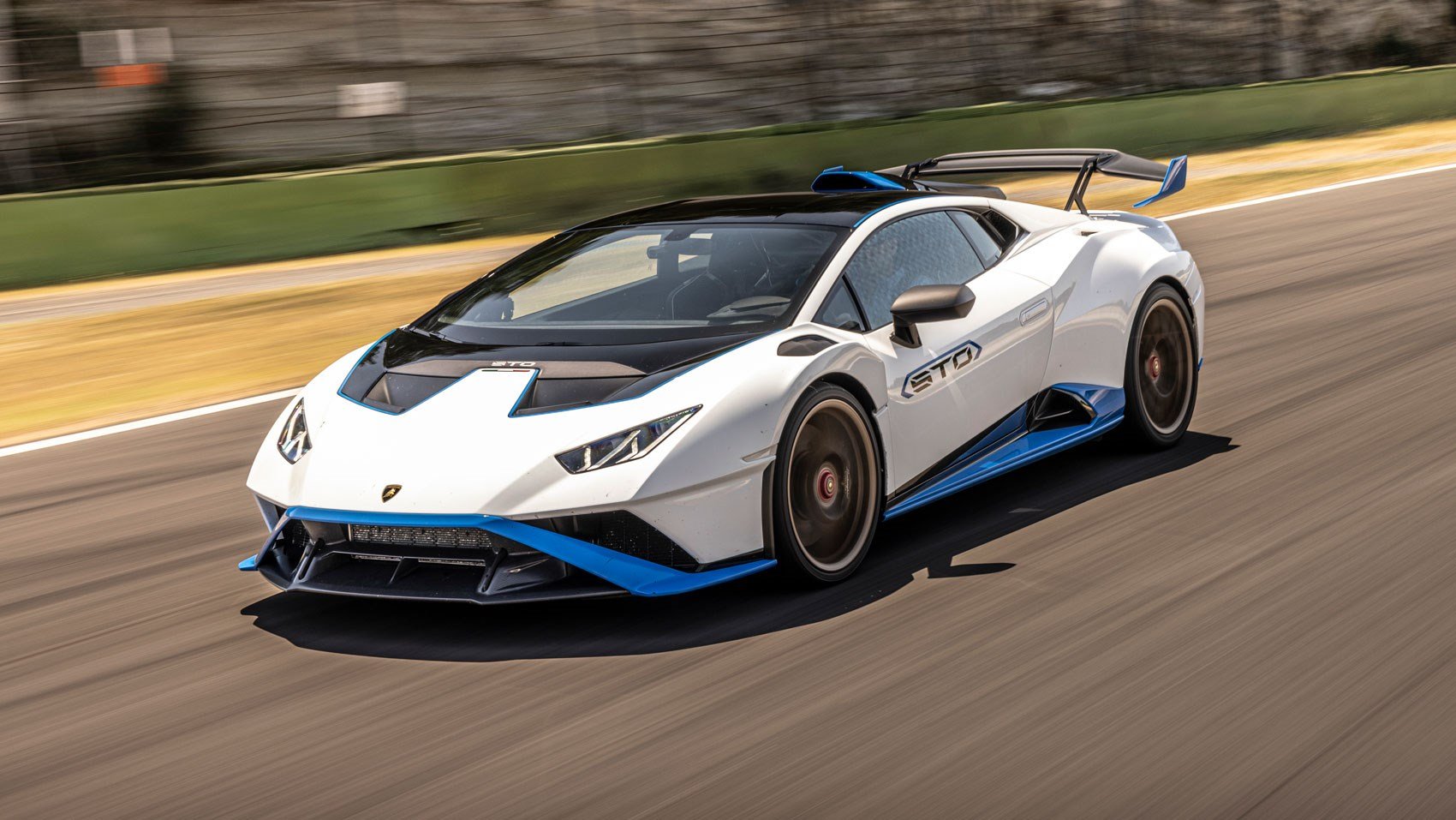
Just before lockdown in 2020, I said the new Lamborghini Huracan RWD Evo was not just the cheapest, but also the best Huracan you could buy, and that its existence must’ve tied the marketing people up in knots.
Well, not anymore, because if you like watching the GT3 Evo win on a Sunday, the STO is the car you should buy at 9am on Monday – as well as being the best Huracan full stop.
This article was first published at Carmagazine.co.uk
Snapshot
- Toyota adamant it will not de-spec any vehicles
- Deliveries of LC300 pushed back to December at the earliest
- Three-quarters of models to be delayed by six months or less
Toyota Australia has sought to clarify its current position after the company’s global operations announced a number of production pauses throughout September and October.
Currently grappling with the worldwide semiconductor shortage, nearly all models offered by Toyota locally have been impacted by the plant shutdowns – pushing back deliveries of stock for up to 10 months.
While Australia’s top-selling automotive manufacturer believes one-third of its models will be delayed by four months or less, up to three-quarters of its range could be postponed by as much as six months, with the LandCruiser 70 Series and RAV4 Hybrid bearing the brunt of the production stoppage, being pushed back by at least nine months.
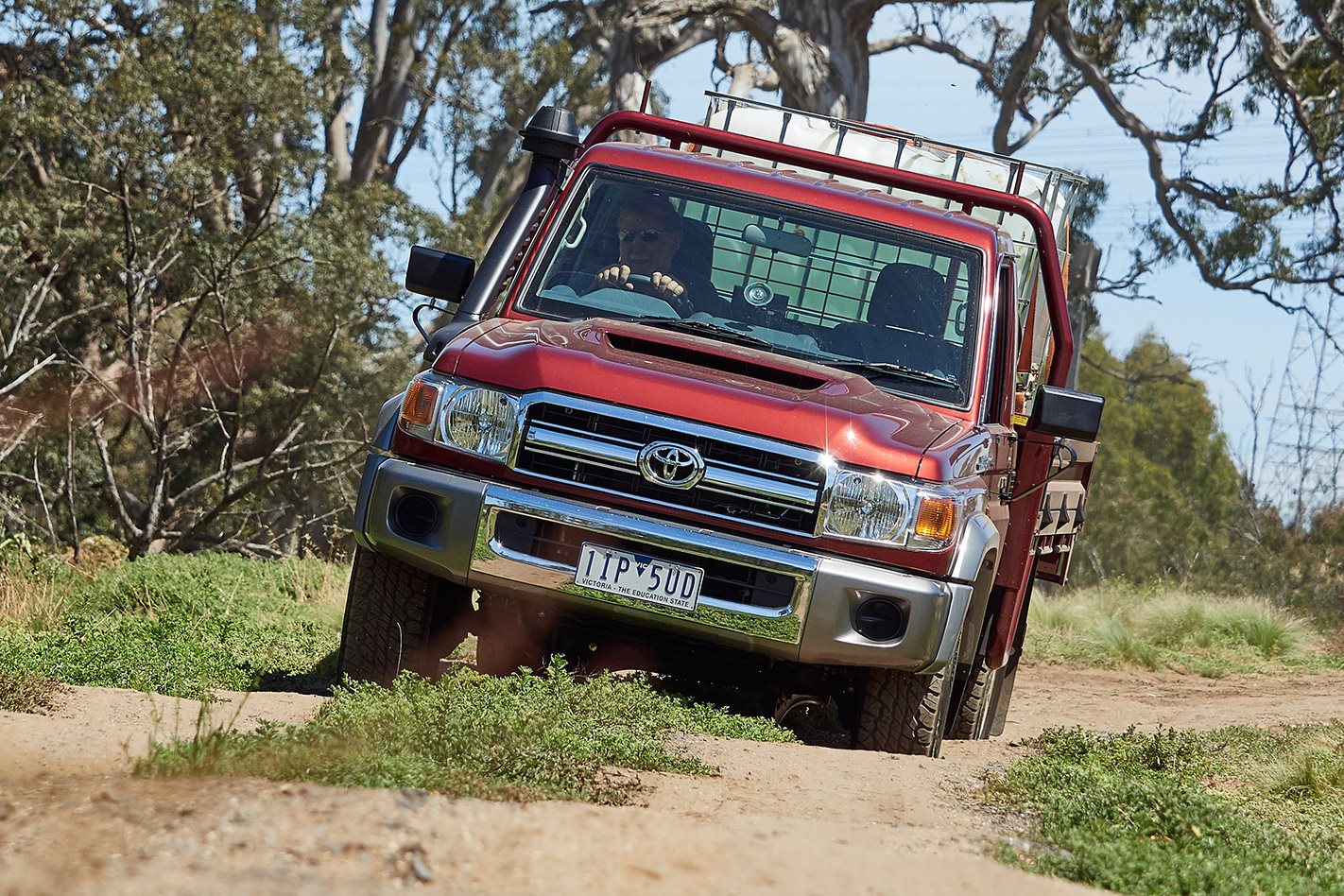
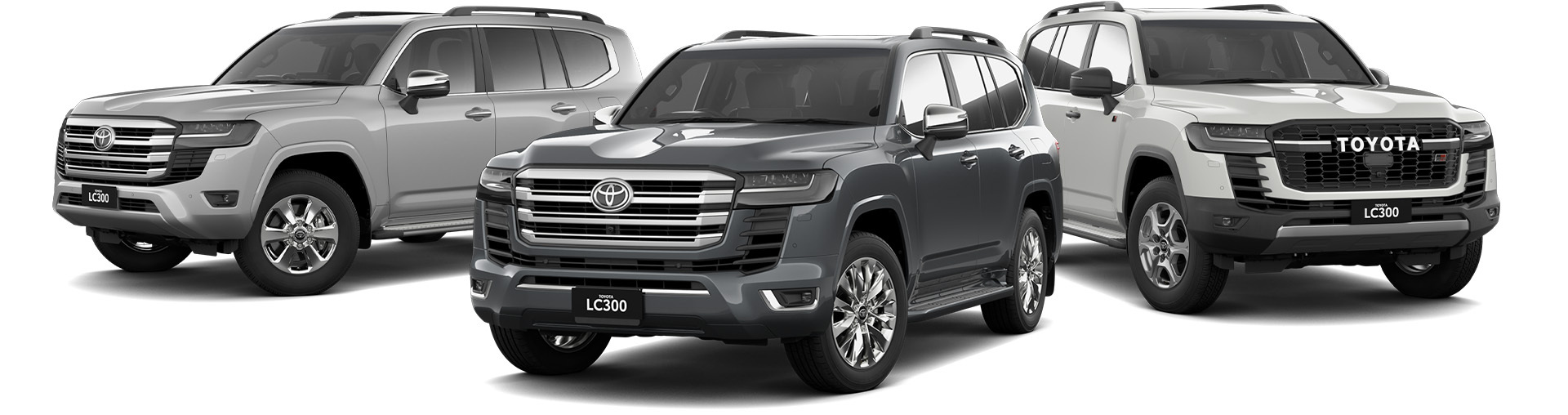
Toyota’s Vice President of Sales, Marketing and Franchise Operations, Sean Hanley, confirmed wait times to local media, with the LandCruiser 300 Series becoming the talking point given its delayed Australian arrival and 10,000-plus expressions of interest.
Hanley confirmed Toyota was not producing any right-hand drive LC300s across its plants throughout September and October, potentially pushing back the first arrivals to just before Christmas if production resumes in November, however this won’t be known until further clarity is provided from the Japanese company towards the end of the month.
Despite the delays in production to customers, a range of LC300s have arrived in Australia for deliveries to dealers as demonstrator vehicles, providing those who have pre-ordered a chance to see it in the metal for the first time. The caveat being however that dealers are being reminded to not sell their demonstrators as a part of Toyota’s six-month retention period.
The carmaker would not disclose the details as to which models will be affected the most with regards to the plant shutdowns, saying it wouldn’t confirm the vehicles likely to be delayed by four months compared to six, but it did point out none would be prioritised for production over others – stating every customer is equal, no matter the profit margin.
There is also no specific characteristic or equipment which is causing the production delays, as Hanley said Australia’s high demand for hybrid models led to the electrified range being naturally affected.
Hanley also unequivocally denied any of Toyota’s models would be de-specced to get around the semiconductor shortage, not willing to sacrifice any existing features or quality to deliver vehicles to customers.
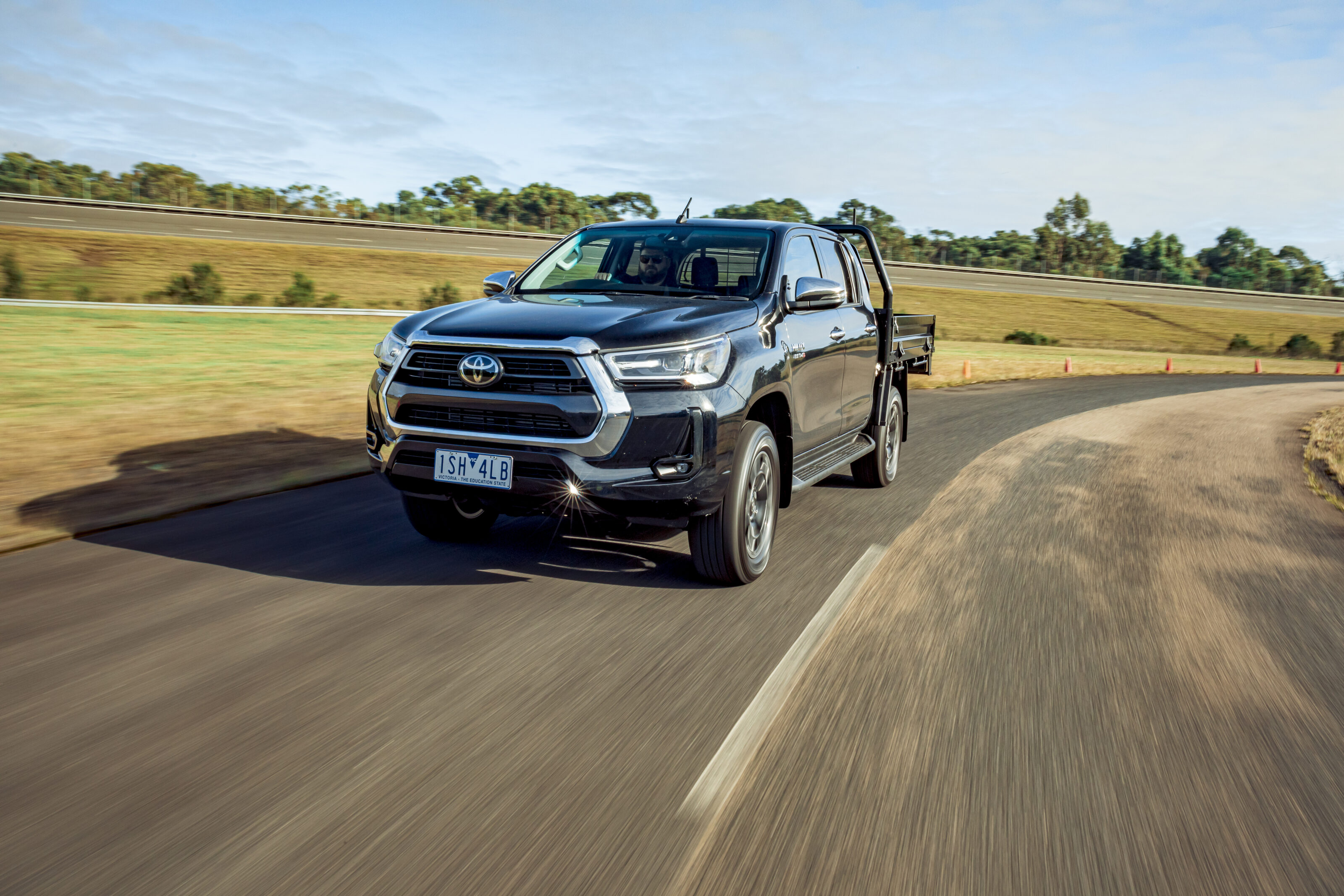
Looking at its long-term plans, Toyota still aims to introduce the Corolla Cross and bZ4x towards the end of 2022, with the current production issues not hampering the launch plans of either vehicle at this stage.
The best-selling HiLux has so far been unaffected by the plant closures, staying in production throughout the last two months to lead Toyota’s charge to the top of the Australian sales chart with 4470 units sold throughout August, helping the manufacturer to reach 156,555 total sales to the end of August.
Despite the shortages of supply, Toyota has recorded its best sales to the end of the third quarter since 2008, reporting an additional 20,107 sales in September which boosts its 2021 year-to-date total to 176,661.
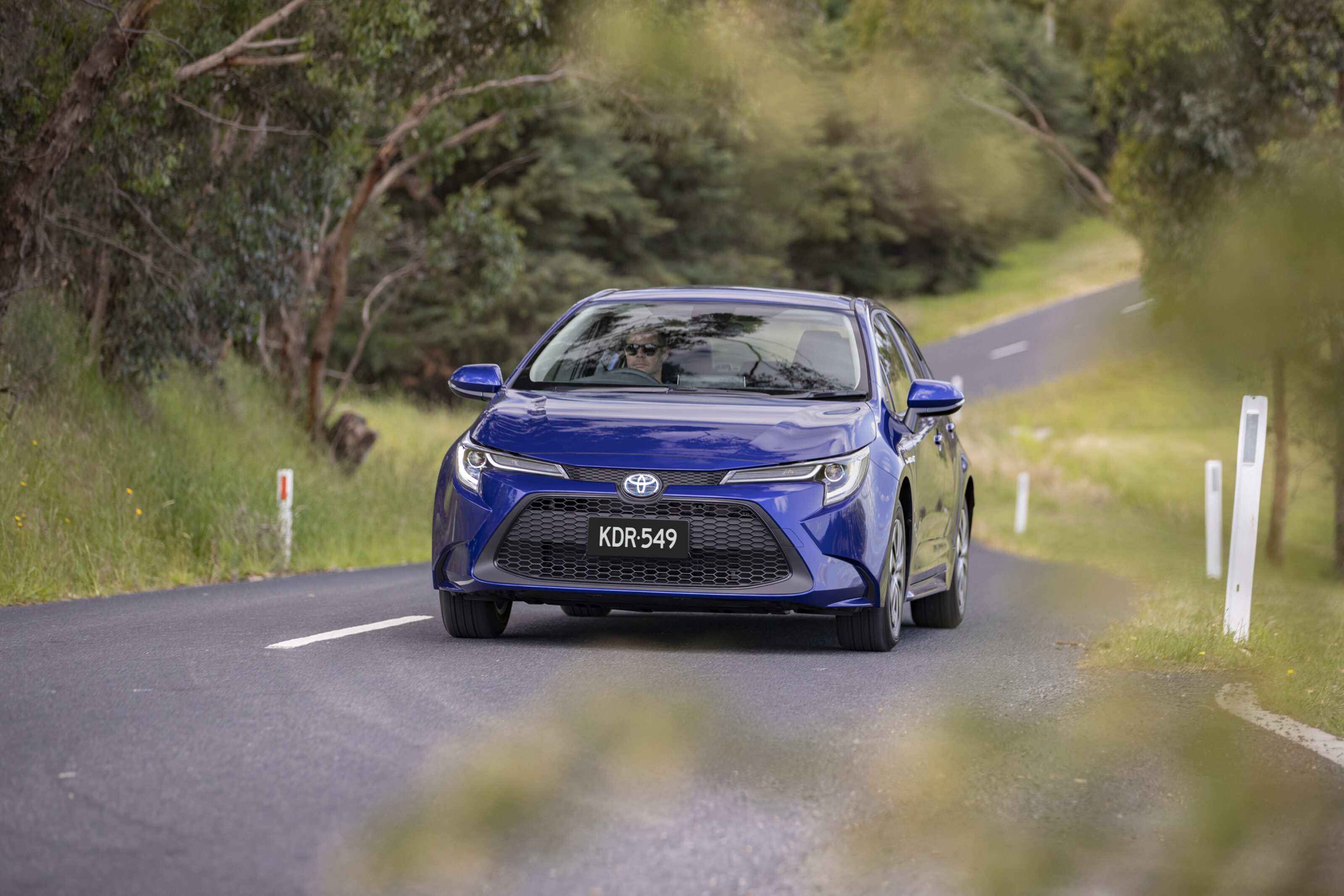
Hanley closed by apologising to Toyota’s customers for the delays and inconvenience, hoping for the situation to be resolved in the near future.
“Toyota understands your frustration, and I sincerely apologise for these delays,” said Hanley.
“I want to thank you for your patience and assure you we are doing everything we can to get you behind the wheel of your new Toyota as soon as possible.”
The 2022 Kia Niro will soon be unveiled with new styling, despite the model only going on sale in Australia in May 2021.
The Niro is the only electrified model in the Kia line-up currently – with hybrid, plug-in hybrid, and fully-electric versions available – but is already approaching its first major facelift, having been introduced in overseas markets back in 2016.
Our European spy photography partners snapped the camouflaged Niro while the model was undergoing final testing on European roads, though it appears Kia’s engineers weren’t expecting them to stick around late into the afternoon – removing the heavy canvas camouflage from the front-end and revealing the car’s new headlights.
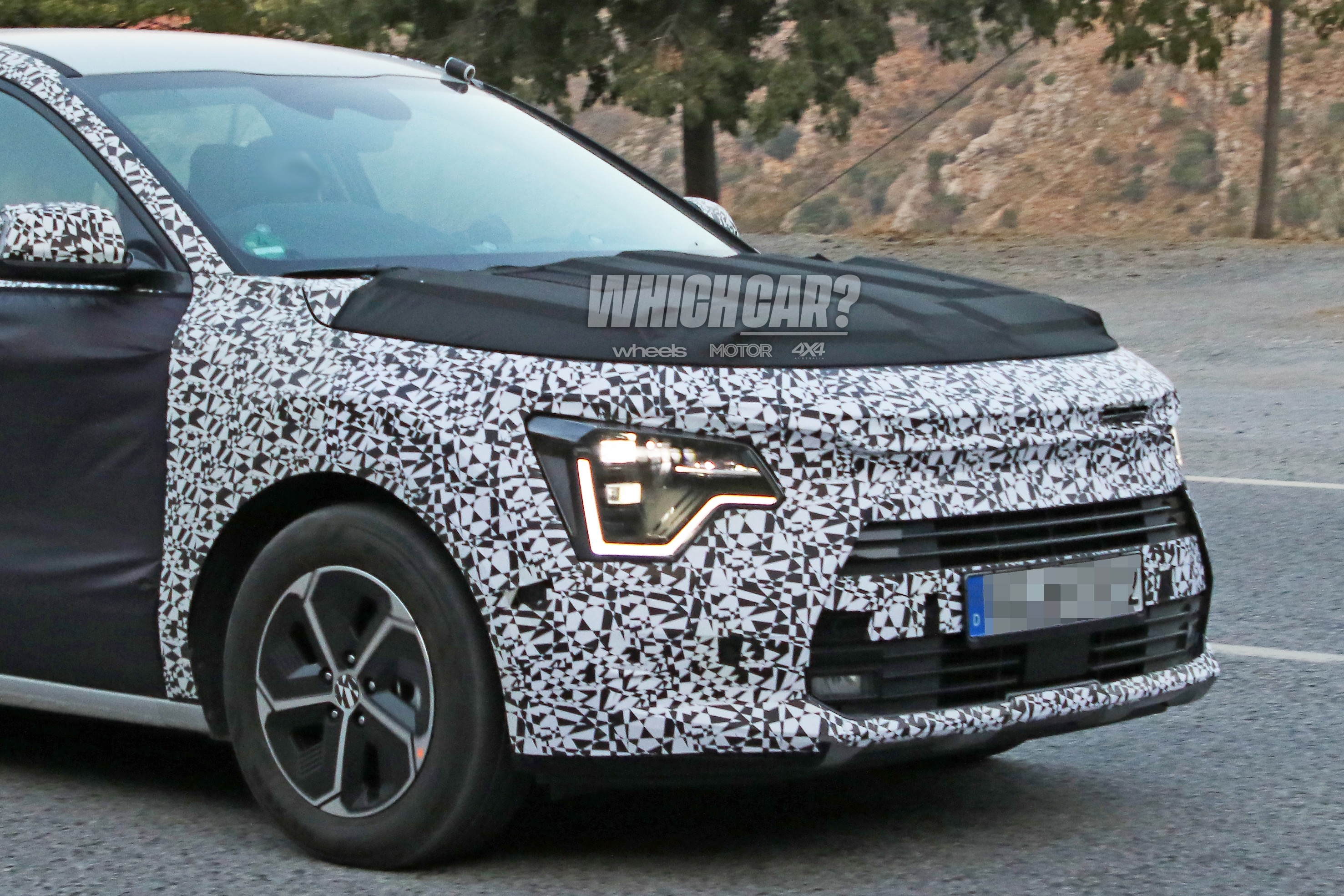
While not entirely unexpected, we can see the small SUV adopt a similar headlight shape and daytime-running light (DRL) signature as Kia’s HabaNiro concept car, first shown at the 2019 New York motor show.
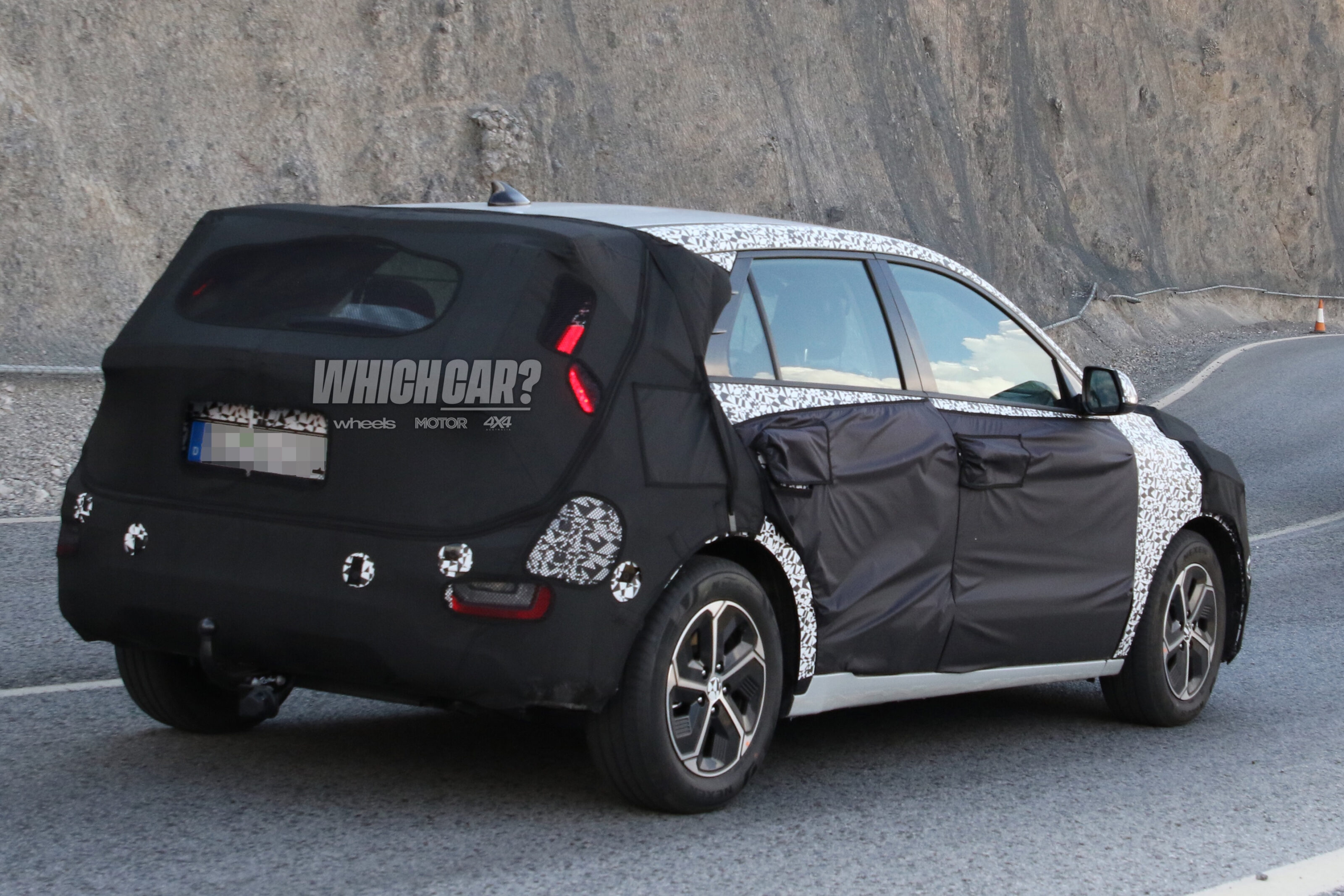
At the rear, new upright LED tail-lights appear to now be integrated into the D-pillar, though it’s unclear whether the rear quarter glass will remain – as with the current Niro – or if the car’s new exterior design will follow the HabaNiro concept with large panels featuring instead.
The 2022 Niro has been heavily facelifted to bring the model into line with the bold looks of Kia’s new range, but a report from UK’s Autocar suggests the updated version will continue to use the current Niro’s platform – albeit with revised powertrains to provide greater driving range and efficiency.
If true, it’s likely the Niro EV will retain its 64kWh battery pack – though improvements in technology could see its 455km driving range increased slightly, while the Niro PHEV may also see its electric distance capability go up from the current claim of 58km.
In Australia, the current 2021 Kia Niro Hybrid starts at $41,990 drive-away, with the range-topping Niro EV Sport priced from $70,990 drive-away.
The 2022 Kia Niro is expected to be unveiled late next year.
Snapshot
- All-electric, three seat ute
- Claimed payload over 450kg
- Tipped to arrive in US next year
UPDATE, October 1: Nobe Cars told WhichCar it plans to bring the 500 ute to Australia.
Nobe board secretary Andrus Viirg said the company plans to have a prototype 500 ute and 600 van assembled by April 2022, followed by testing and homologation later that year. A number of vehicles will be manufactured and in right-hand-drive layout for the UK market, which Nobe intends to also offer in the Australian market.
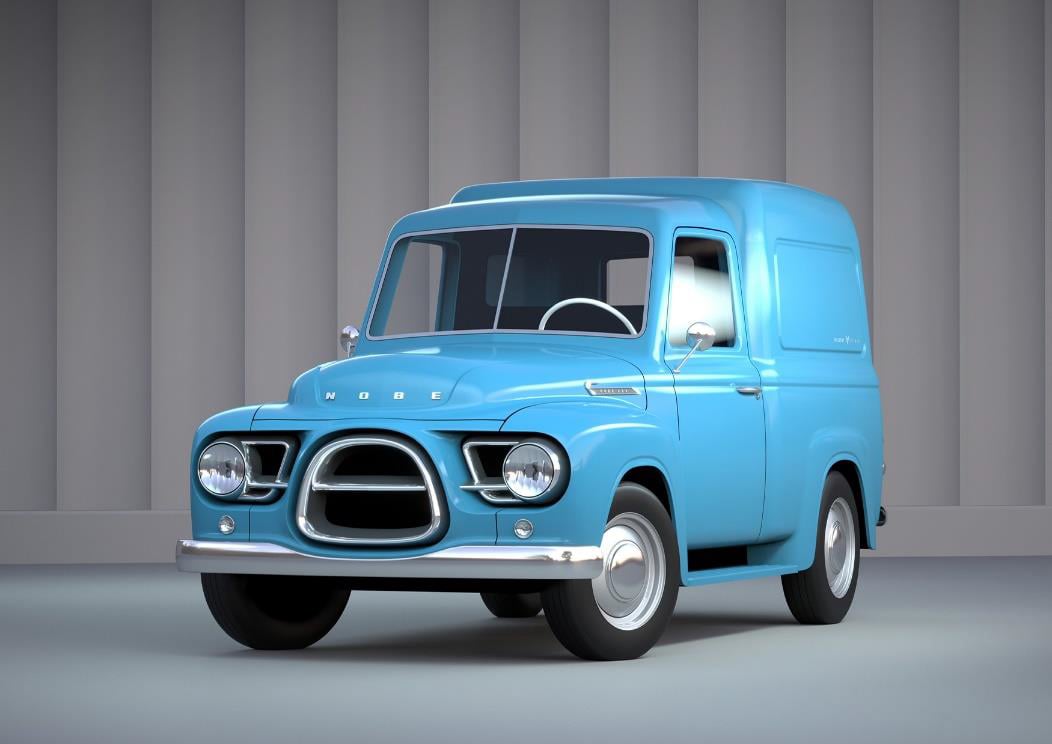
According to Viirg, it’s too early to forecast when the 500 will be offered in Australia, though it will “not be before 2023”. Nobe is currently searching for a local dealer or partner to offer the its EV range.
The story to here
October 29: Estonian EV start-up Nobe has revealed its second design, a compact ute visually inspired by the iconic Ford F100.
Something of an antithesis to Tesla’s brutalist Cybertruck, the Nobe 500 Ago was first teased in late 2019. Described by Nobe as “a light EV truck with classic nostalgic style”, the tiny ute is due to hit US shores in mid-2022 with a US$20,000 (AU$27,654).
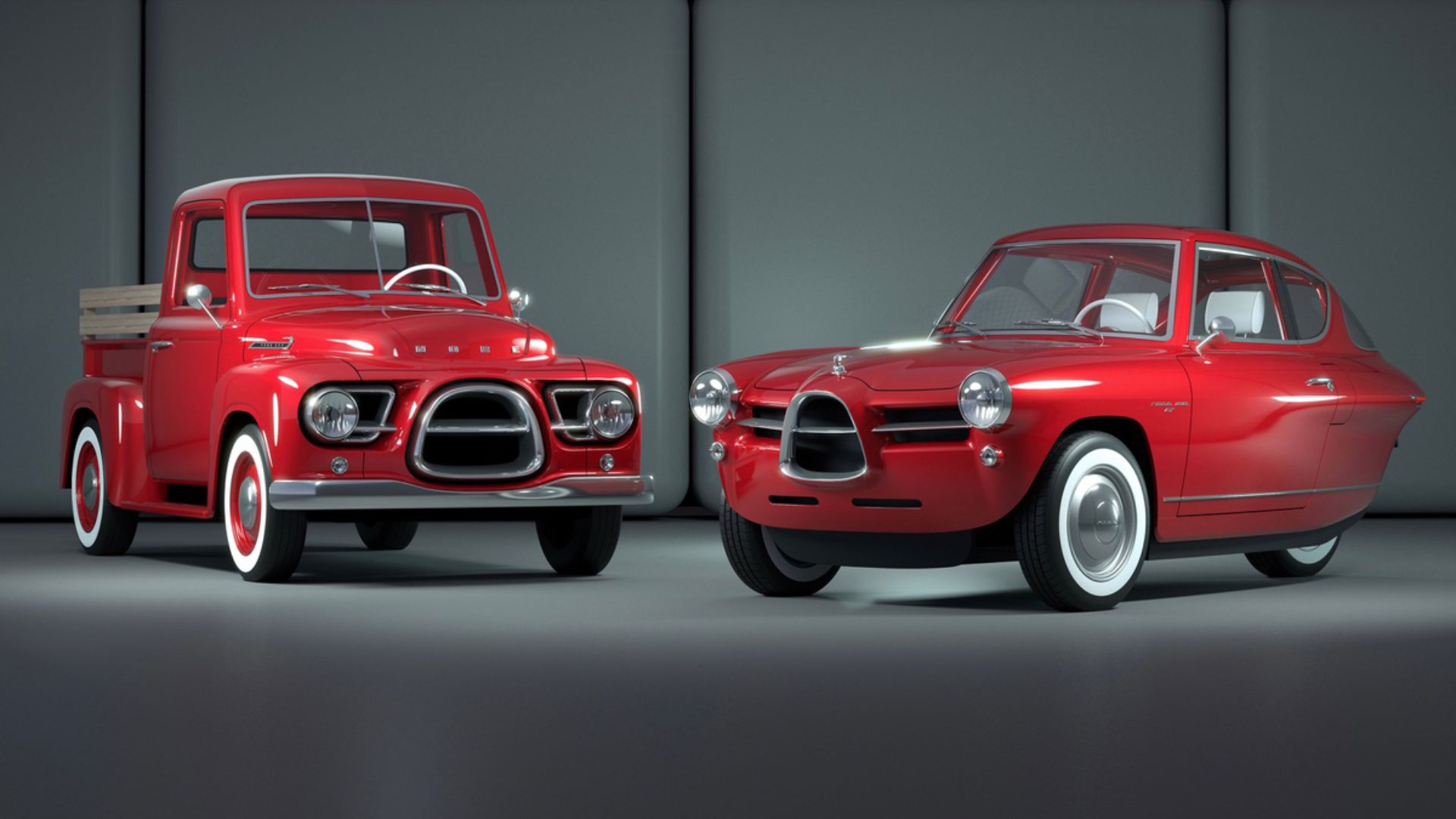
Nobe has not confirmed specifics around the 500’s drivetrain, though it’s expected to be a derivative of the Nobe GT100’s 72kW electric motor. That vehicle features a 25 or 34kWh battery for a 257km range, but the larger, heavier 500 may use a bigger battery. Drive type is also unconfirmed, as the GT100 uses a three-wheel-drive system.
Unlike the GT100, which counts as a motorcycle under US law, the 500 will be classed as a fully-fledged car and thus face stringent crash-testing requirements. The ute will feature a carbon fibre ‘tub’, similar to that used by Lotus to minimise weight and boost crash safety. UK speciality firm Far was been contracted to design the tub.
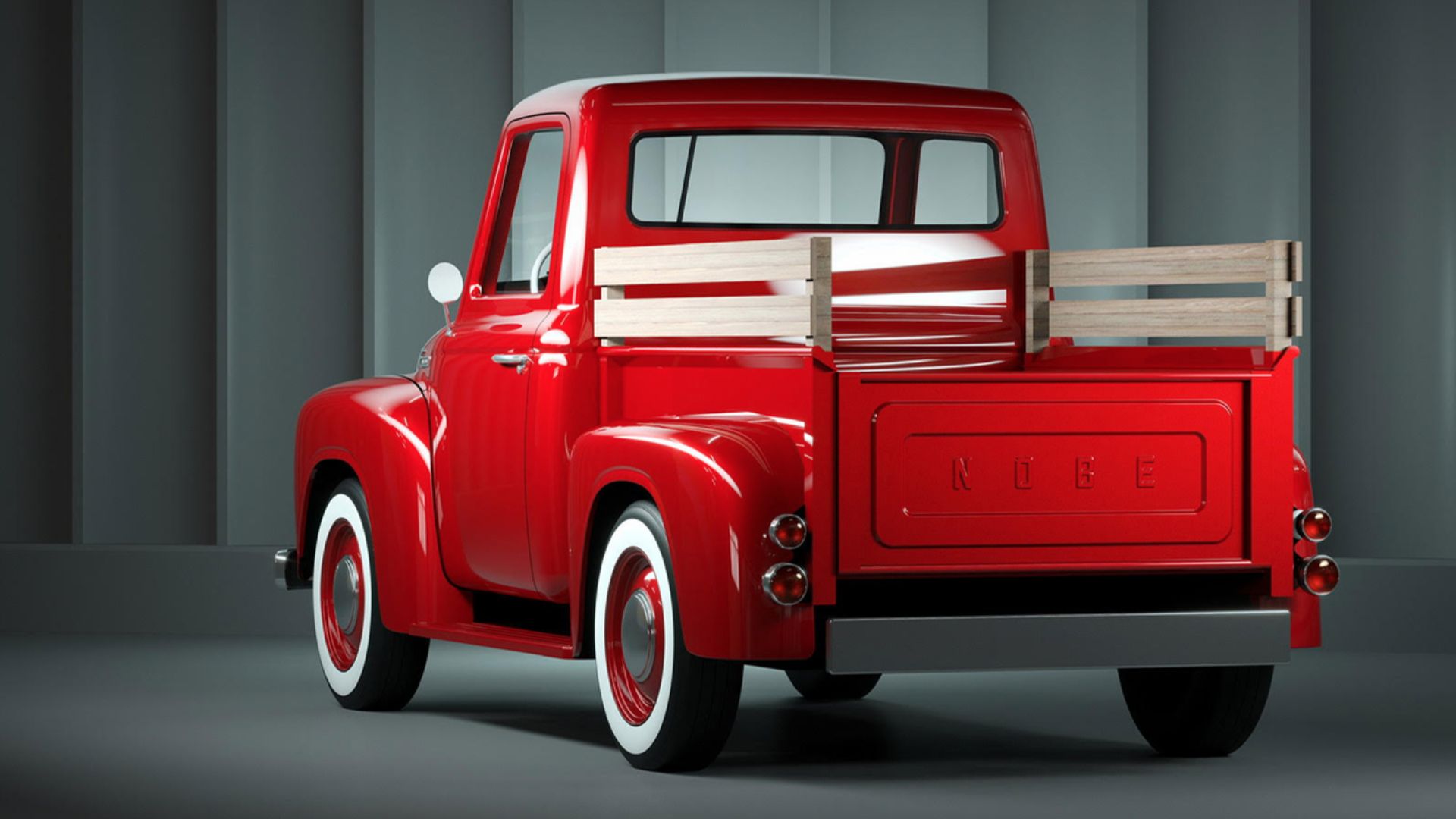
While the GT100 uses all-carbon fibre panels, it’s not yet clear if the same bodywork will feature on the 500. In an August interview with Shark Invest, Nobe CEO Roman Muljar said the small ute bed will have a capacity of “over 1000lb”, or 453kg. Muljar also said that while the 500 chassis has been driven, “it’s very rough.”
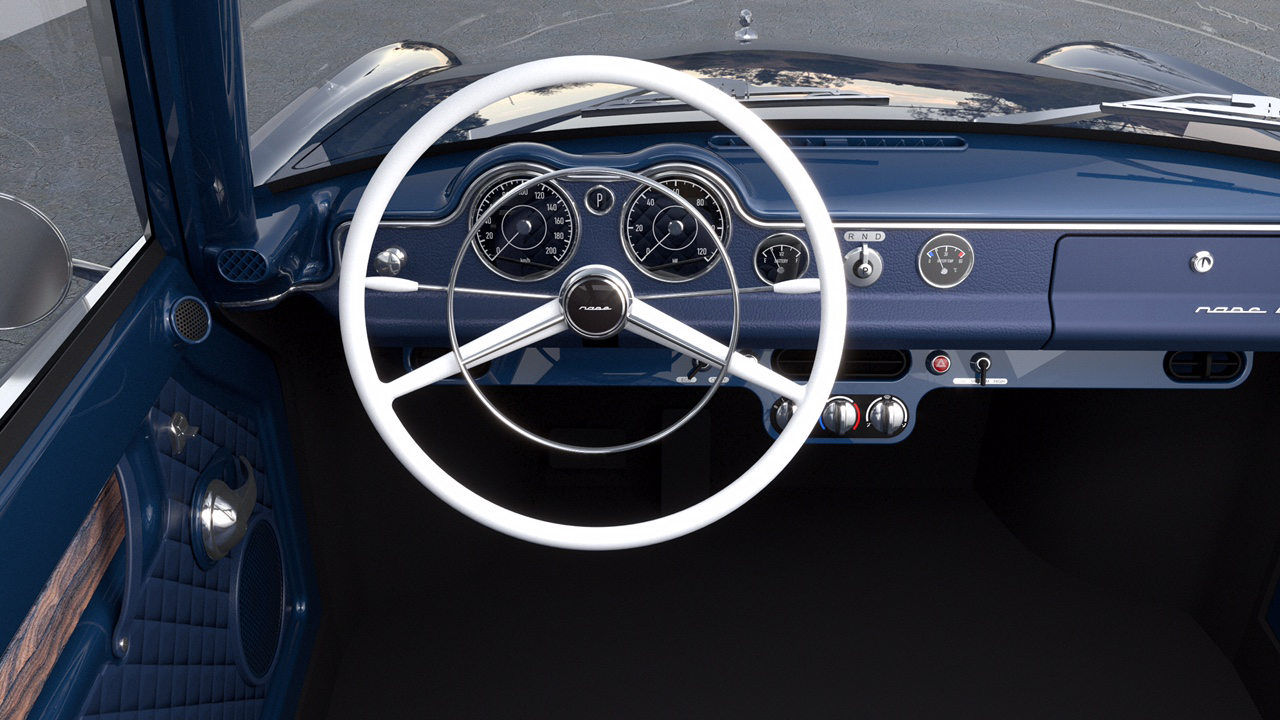
The interior of the 500 is also yet to be revealed, but it’s slated to use a similar analog dash layout to the GT100. As with the three-wheeler, Nobe says inflating seatbelt airbags will be used to protect occupants.
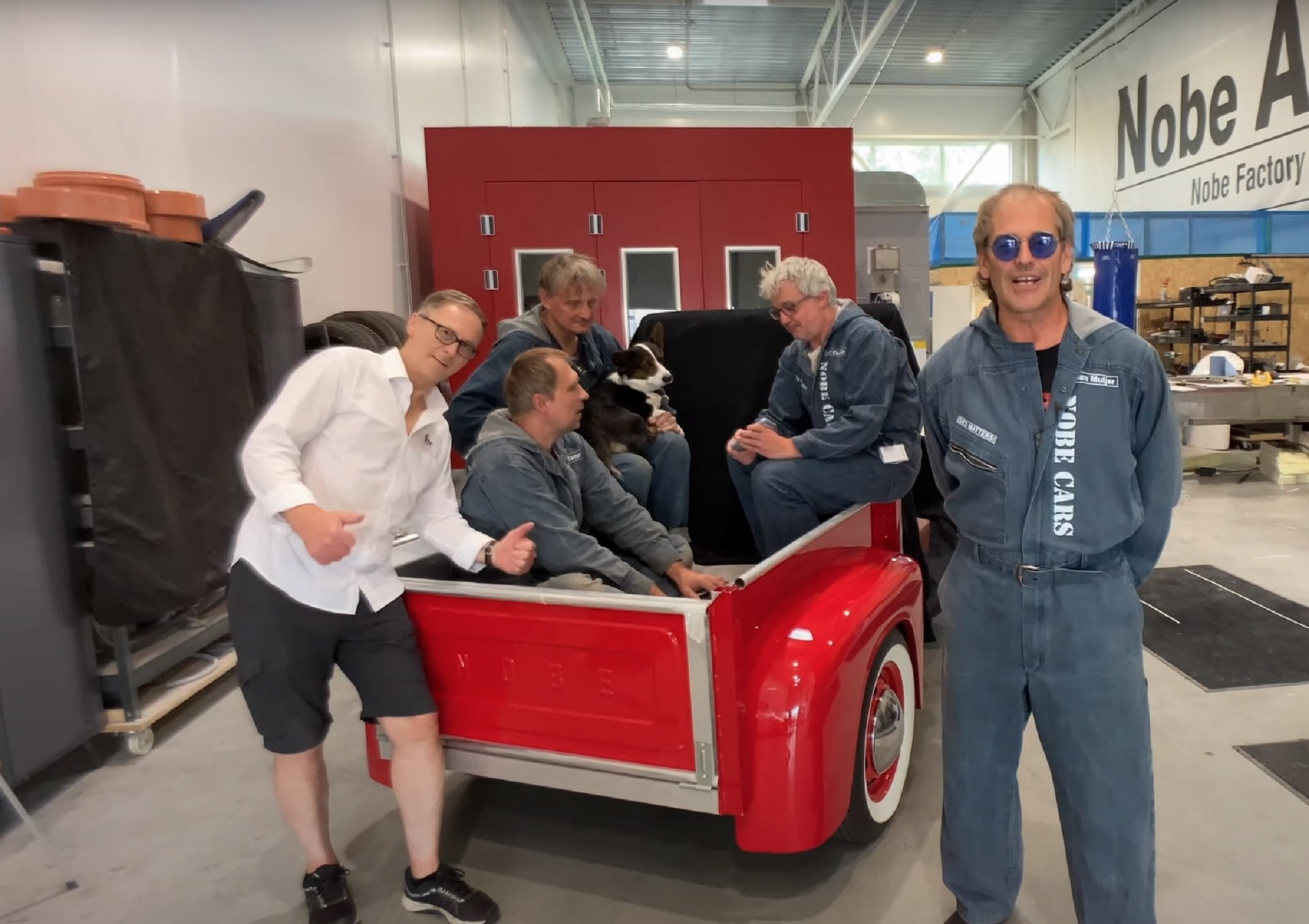
Nobe — Estonian for ‘agile’ — was founded in 2017, and has since launched a number of crowdfunding campaigns to help bring the GT100 to fruition. Two driving prototypes were produced in 2019, but both were destroyed in a major workshop fire.
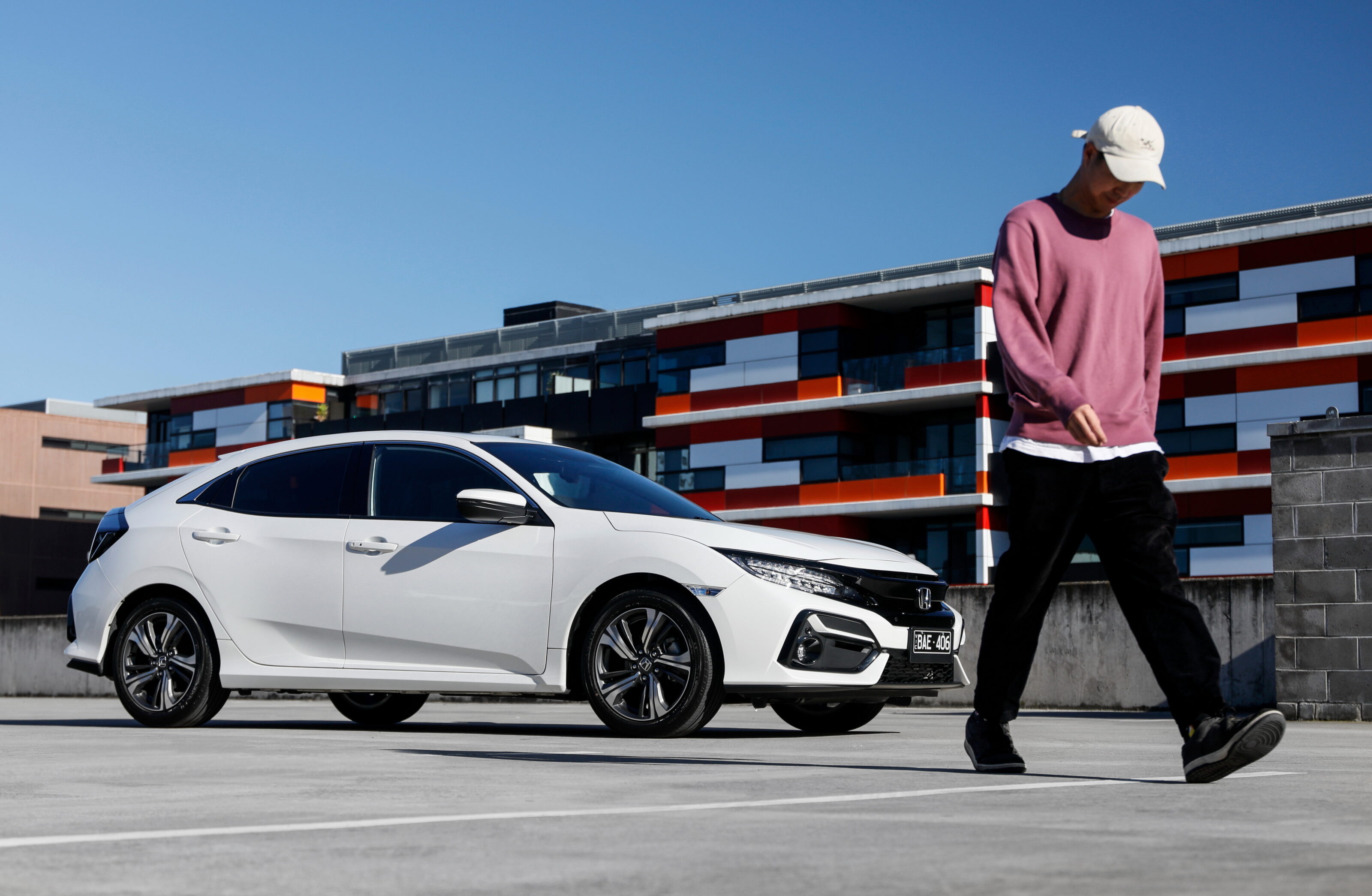
A new 11th-generation Honda Civic is just around the corner, but some recent time in the outgoing flagship VTi-LX reminds us that the familiar compact hatch can still impress with excellent dynamics and versatile packaging.
Topping the mainstream Civic range at $36,600 before on-road costs, the feature-rich Civic VTi-LX hatch is powered by a 1.5-litre turbocharged four-cylinder petrol engine and feeds 127kW/220Nm through the front wheels via an automatic continuously variable transmission (CVT).
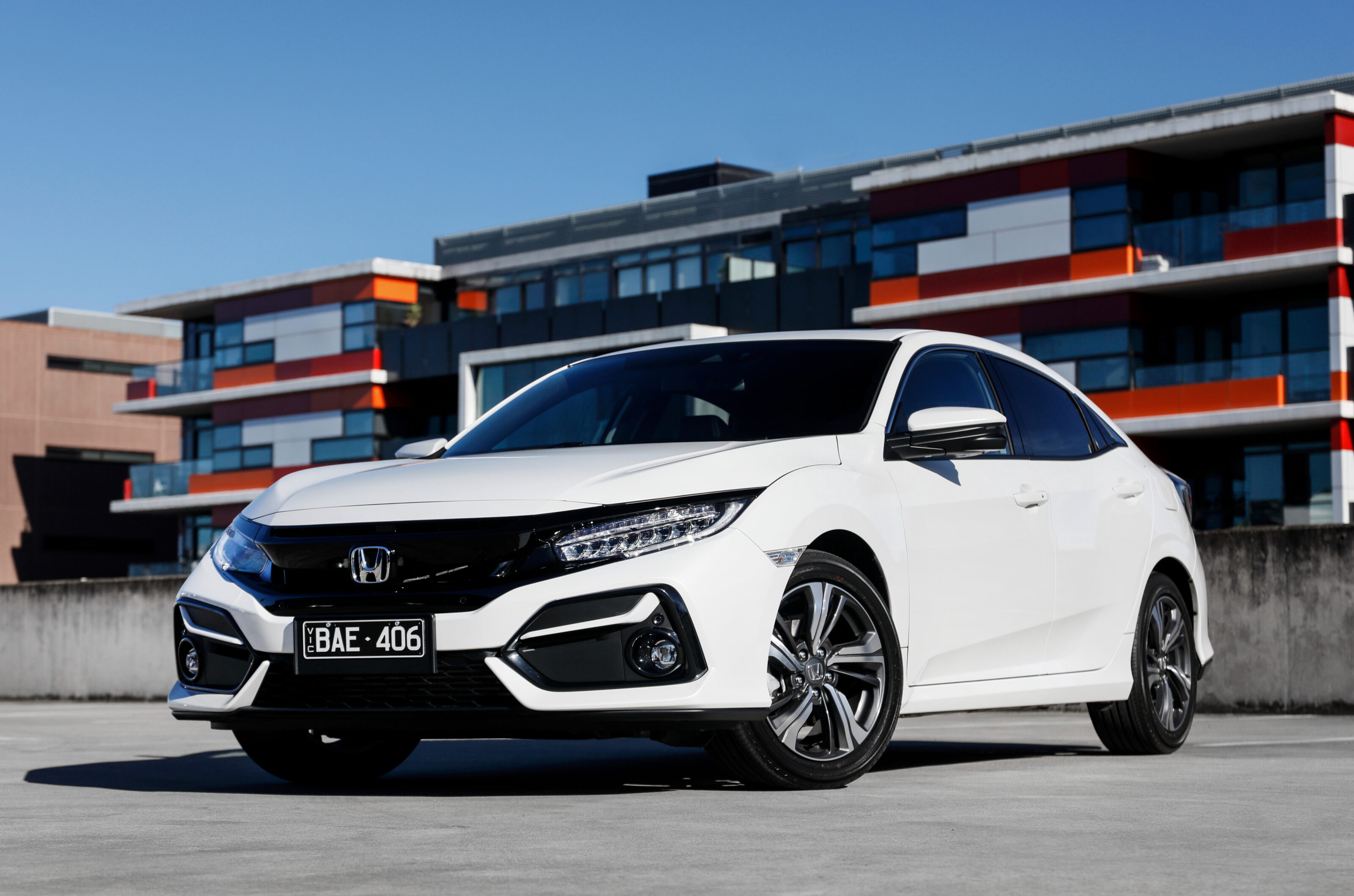
You can have the same mechanical package for $5500 less by opting for the VTi-L, which also packs dual-zone climate control, automatic headlights and wipers, digital radio, 17-inch alloy wheels and the Honda Sensing suite of active safety features.
The sporty RS gains its own bodykit and shaves $1000 off the range-topping VTi-LX but shares the electric sunroof, leather trim, heated front seats, power-adjustable driver’s seat, LED headlights and an upgraded stereo while missing out on the integrated sat-nav.
It’s a generous amount of standard equipment for the price that encapsulates the Civic’s functional and no-fuss mien.
Despite nearing the end of its lifecycle, sliding into the low-slung cabin still feels reasonably premium for this day and age. It feels roomy from the front seat, too, thanks to its low seating position and a tall, shallow dashboard. There are various ingenious pockets and storage binnacles within arm’s reach, with a wireless phone charger, 12-volt socket, USB and HDMI ports located under the central stack.
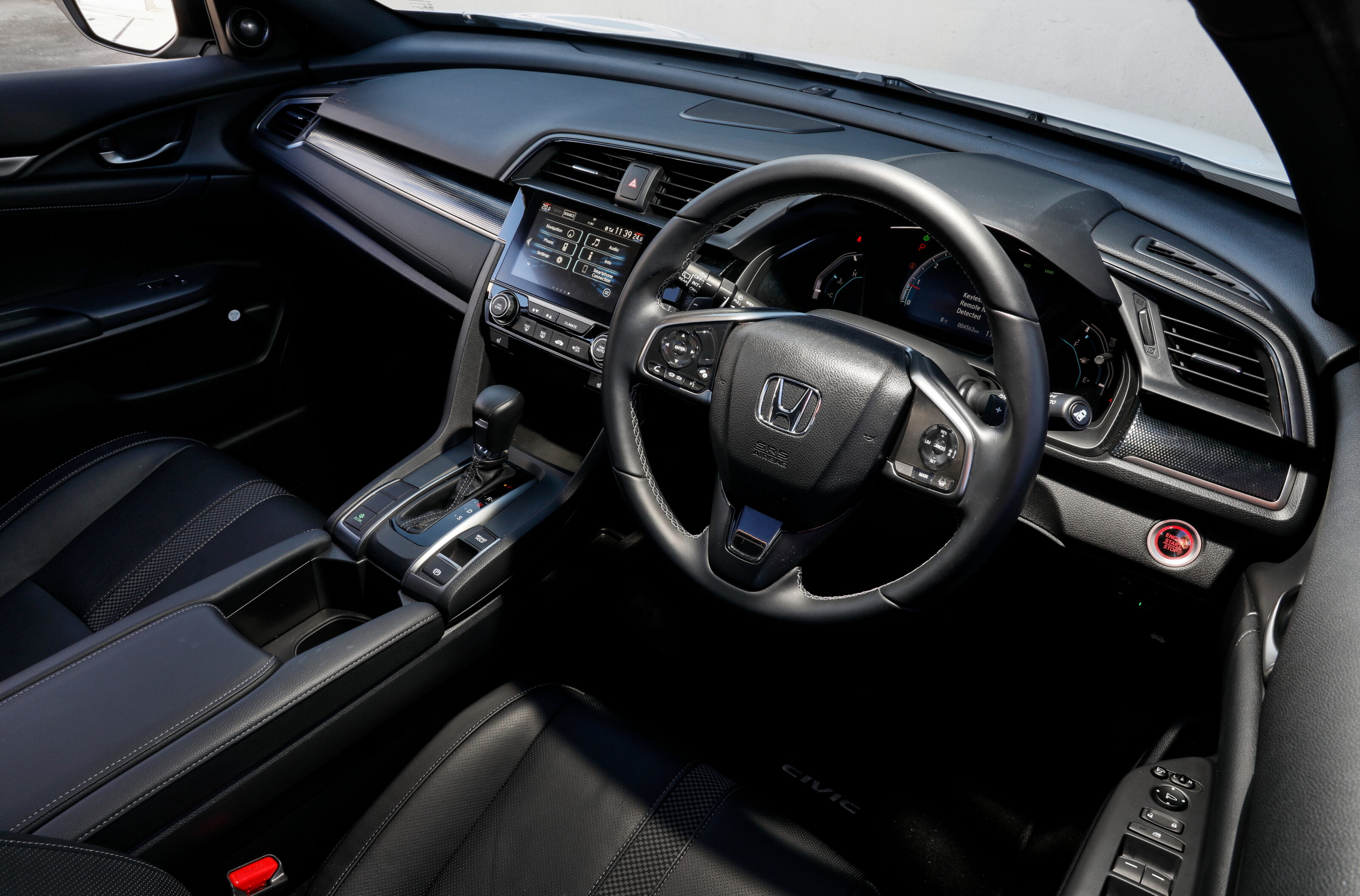
The cabin may lack the X-factor of younger rivals due to some ageing design cues but the leather seats are comfy and most touchpoints and interfaces are clearly legible and straightforward.
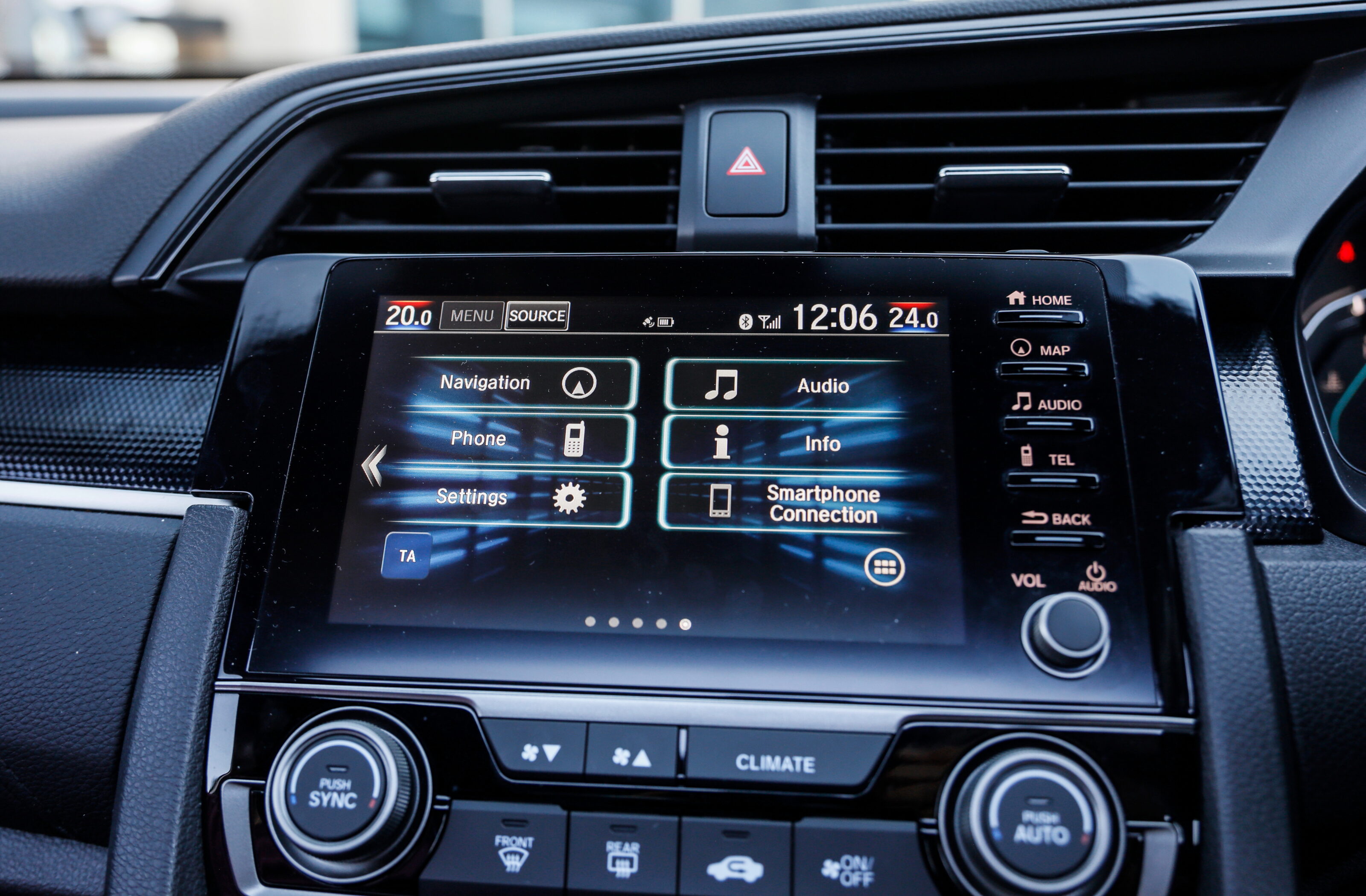
Giving away the Civic’s age is a central 7.0-inch touchscreen isn’t the highest-resolution unit, is angled in a way that catches glare through the sunroof and has runs dated software that can be clunky to use. The included wired smartphone mirroring, however, makes for an easy solution.
Rear passengers are no longer penalised in the way they were in previous Civic hatches, the 10th-generation sedans and hatchbacks moving to share the same platform. Subsequently, rear passenger comfort is virtually the same as the 13cm-longer Civic sedan, with rear legroom up there with the best of the segment. A lack of rear air vents may be a sore point for some, however.
Beyond the second row lies one of the Civic hatchback’s main party tricks.
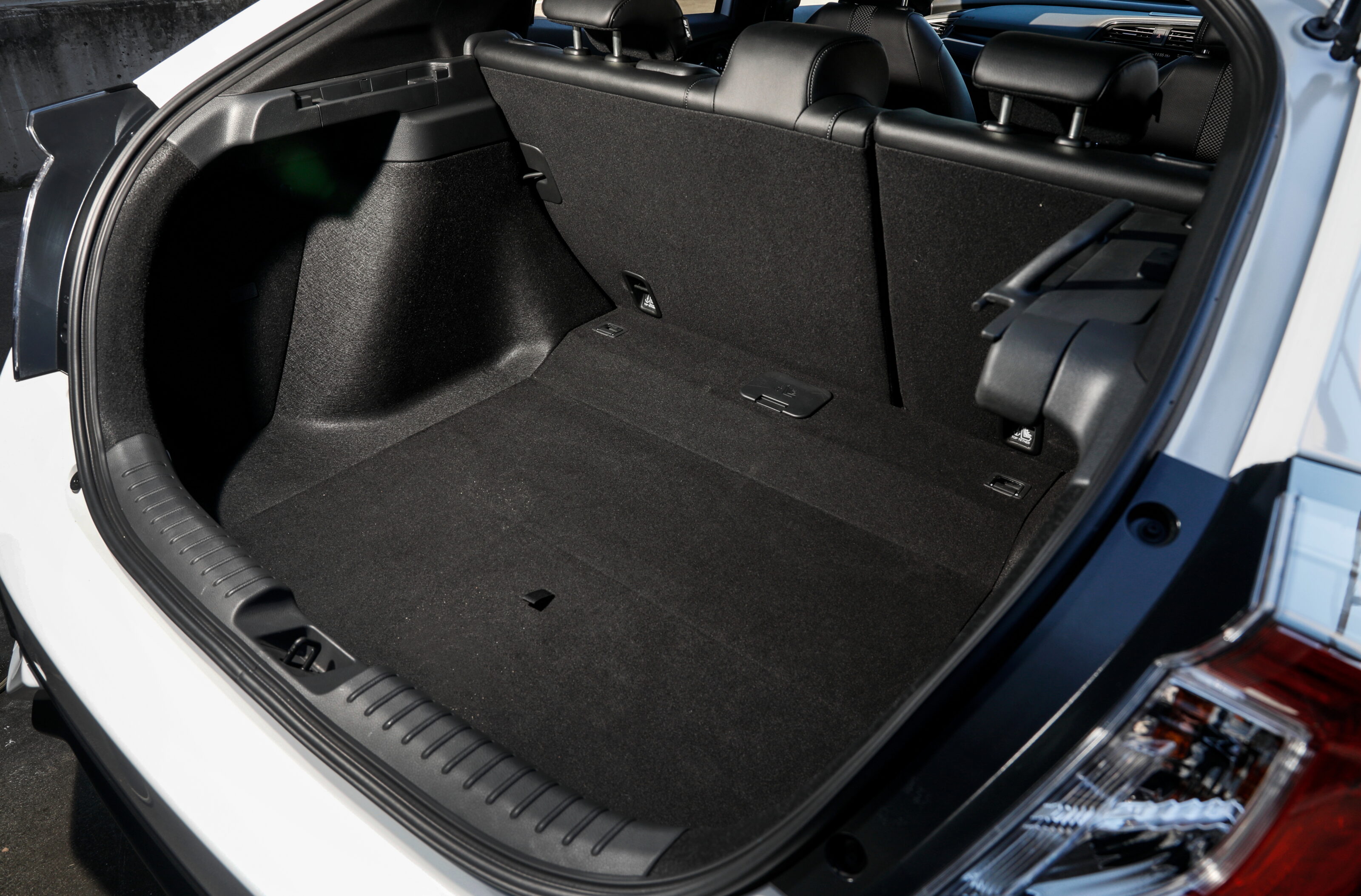
Lifting the wide hatch reveals a huge aperture for ease of loading large goods. The short hatchback’s 414-litre luggage capacity yields 105 litres to the longer sedan (519 litres) but easily eclipses that of its main rivals such as the Hyundai i30 (395 litres) and Mazda 3 (295 litres).
The rear seats are split 60/40, folding almost flat to greatly expand the cargo space. An ingenious side-scrolling cargo blind keeps your items away from prying eyes while a space-saver spare under the boot floor ensures you won’t be left stranded in the event of a puncture.
It’s not just clever packaging where the Civic is still able to impress, however, with keen and enjoyable dynamics that still stand up among current offerings in the small car segment.
The turbocharged 1.5-litre mill found in the VTi-LX (and lower VTi-L and RS variants) is the pick of the range, adding bandwidth and flexibility that the breathless 104kW/174Nm naturally aspirated 1.8-litre simply can’t match.
It also drops the 1.8L Civic’s claimed 0-100km/h time from a glacial 9.2 seconds to an agreeable 7.6 seconds in the turbo. The gain in performance doesn’t come at the cost of fuel economy either, as less stress on the powerplant is required to get the car moving.
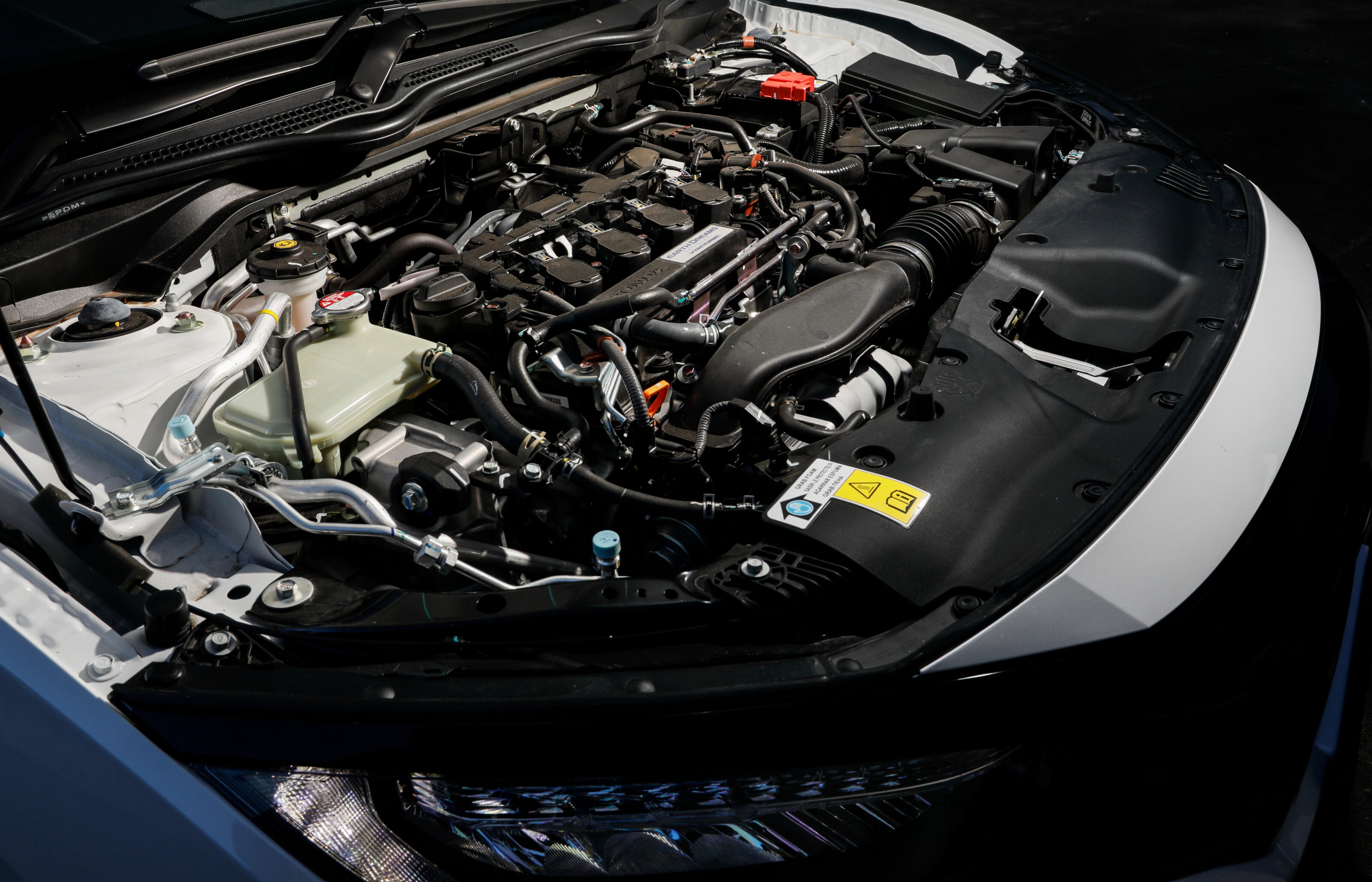
Being smaller but more powerful, the 1.5-litre engine delivers a claimed combined-cycle consumption of 6.1L/100km while our test car returned 8.4L/100km from a week of hustling about inner-city Melbourne.
The steering is very well-judged, possessing an intrinsically light and fast rack that weights up progressively with input and speed. The Civic also employs torque vectoring by brake, which makes the front-end feel remarkably nimble.
Adding to the popular Honda’s deceptive agility is an inherently well-balanced chassis that feels taut, with impressive body control, yet refined and compliant. Multi-link rear suspension was new for this generation and added a welcome level of sophistication to the Civic’s ride. Even with the VTi-LX’s upsized 17-inch rolling stock, the Civic remains composed and comfy over bumps and juts in the road.
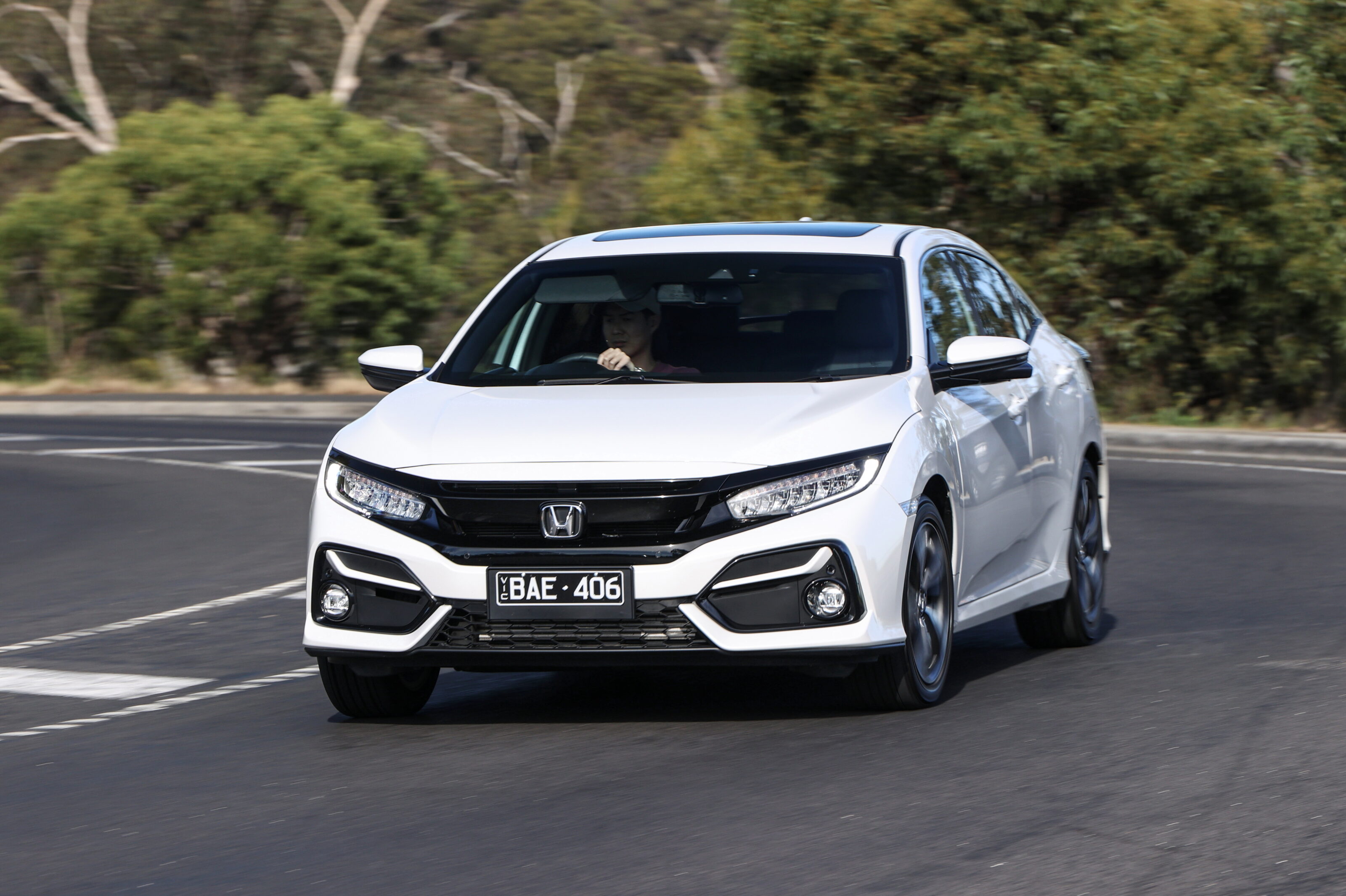
While it’s not positioned as an outwardly ‘sporty’ offering, in the dynamics department the Civic is genuinely rewarding to drive around town, being deceptively agile in the way it covers ground and ‘pulls’ you through corners.
The CVT is the sole transmission choice and can take the shine off the experience somewhat, as it struggles to make up its mind when faced with changing inclines and can display similar indecision when maintaining a constant cruise.
Each new Civic is backed up by Honda’s five-year/unlimited-kilometre warranty with servicing required annually, or every 10,000km. ANCAP has also awarded the mainstream Civic range a five-star rating.
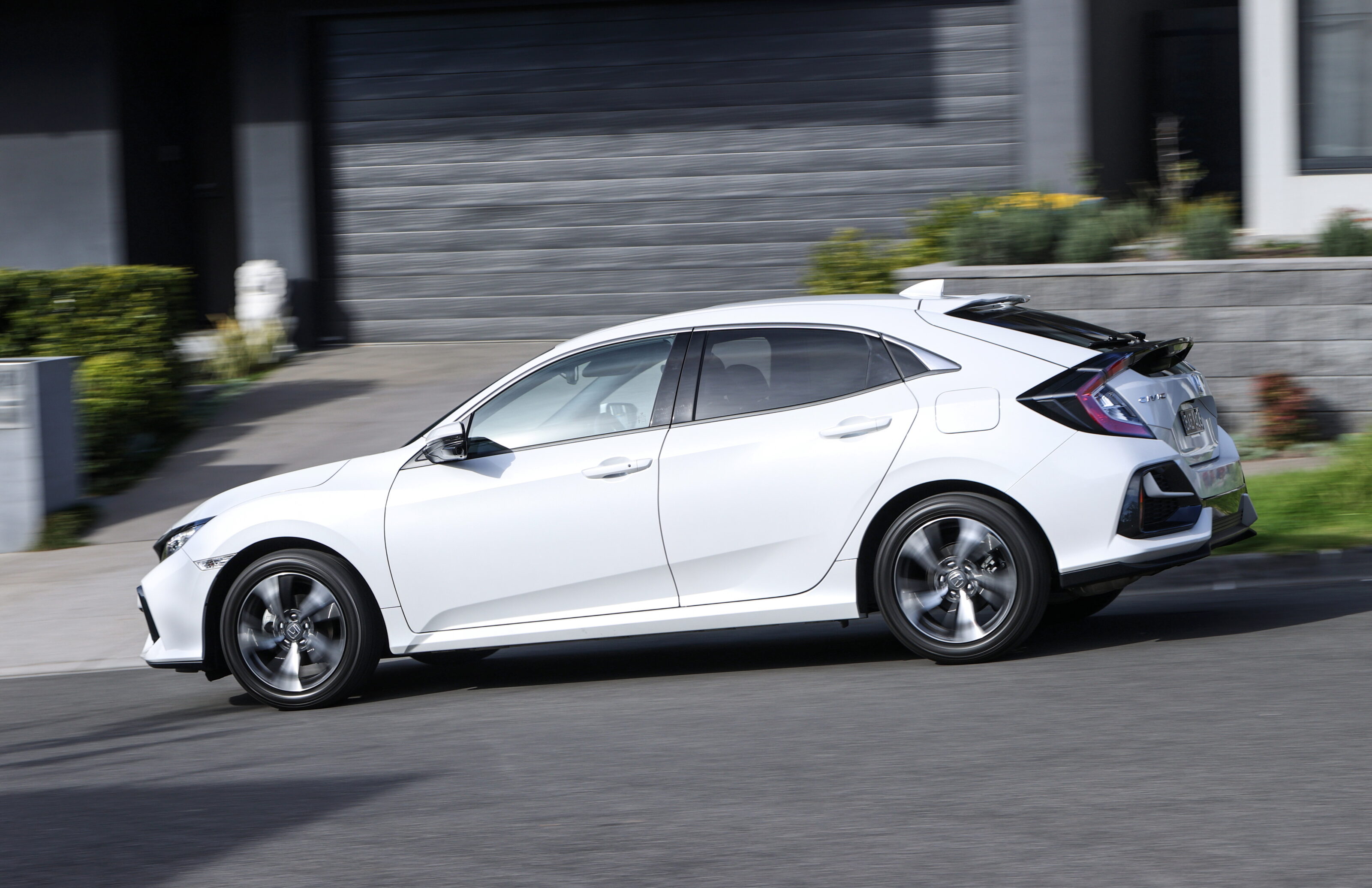
The 10th generation of Honda’s perennial small car may be beginning to show its age but the outgoing flagship endures as a capable and feature-rich dark horse within a hotly contested segment.
It may lack the intangible soul-stirring X-factor that younger rivals may bring, but that’s no fault of its own and the Civic still charms with innovative ergonomics, ingenious solutions, generous active safety equipment and joyful dynamics.
With a new generation Honda Civic waiting in the wings, our reappraisal of the outgoing Civic flagship, and its flashes of greatness, only bolsters our expectations for the new one. The humble Honda Civic is still a good car, and we’re excited by the prospect that the next one could be even better.
Honda Civic VTi-LX specs
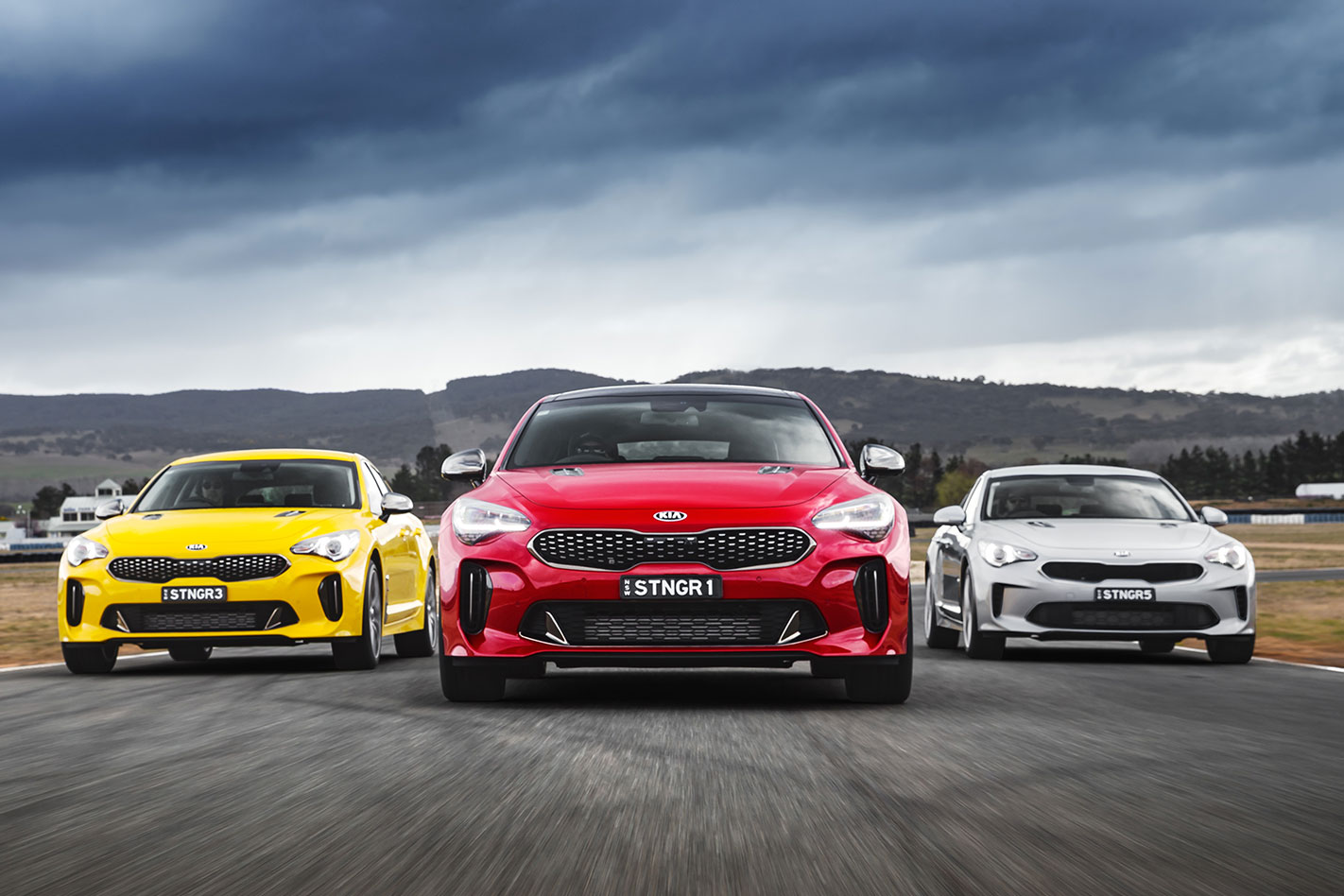
Kia‘s seven-year warranty – an industry first when it was launched – has reached its seventh birthday.
First introduced at the start of October 2014, the seven-year/unlimited-kilometre warranty was an Australian first and still remains as one of the longest available – second only to Mitsubishi’s 10-years, although this is limited to 200,000km.
Although new at the time for Australia, Kia had previously introduced a seven-year warranty in Europe back in 2006, preceding sister brand Hyundai in becoming the first manufacturer on our shores to offer five years in 2008.
“It quickly became apparent that Kia’s value proposition had changed dramatically when the 7-7-7 package was introduced to customers,” said Kia CEO Damien Meredith.
“The peace of mind that comes with seven-year warranty, capped-price servicing and roadside assist was an unrivalled feat in the market and will continue to be a staple for future success.”
For Kia’s head of after sales, Phil Murray, the inclusion of capped-price servicing and roadside assist meant Kia could push boundaries as the product continued to improve.
“Over the years it has been no secret that the quality of our product has improved dramatically and when the 7-7-7 offering was introduced it added another dimension to the Kia family,” said Murray.
By tracking buyer behaviour internally, its warranty has gone from being the most popular reason for purchasing a Kia, for five of its seven years, to now ranking third behind manufacture and design.
Wheels asked our Kia-owner readers for their feedback on their warranty experiences. Here’s what they said:
“Mines just about up. April 2022. Kia’s been great. It’s like a shopping list every service with niggly things and they just get it done,” said Melissa Ong from the Kia GT Owners Club Australia.
“Bar my annoying clutch chatter… [but] not because [they’re] refusing to fix it. Anyway, 11/10 from me. Can’t fault. Will buy another Kia.”
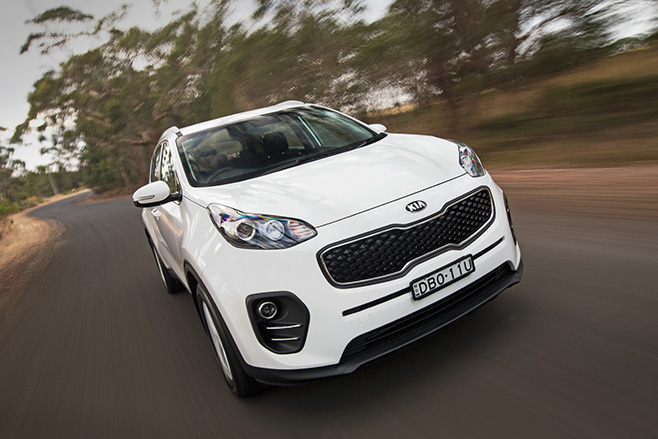
Geoffrey Gregory said: “Great so far, I bought a November 2014-built Cerato in March 2015 as last year’s stock.
“It now has 146,000km on it, it’s on its third new set of tyres, front pads were changed at 110,000km, and only two issues – one was [an] apprentice problem, breaking a rubber o-ring when the fuel filter was replaced, causing [the] fuel pump to fail.
“At the last service the air compressor was replaced after it was found to be leaking. Everything else has been to the book in services. I drove it from Perth to Canberra the day after purchase. So [the] 1500km service was four days after buying, [put] 3500km [on it] and drove back to Perth in April.”
Matthew Irvine said his Kias have all worked well, even under the strain of inexperienced drivers.
“I’ve been very happy with them. We have a small fleet of vehicles all used for driving instruction. We’ve had a few things go wrong on a couple of vehicles, but they’ve all been addressed under warranty, without argument.”
“We couldn’t be happier with the feedback and results we’ve received as a result of our 7-Year plan, and I’d like to thank every customer who has joined us for the journey, making Kia Australia the family it is today” Meredith added.
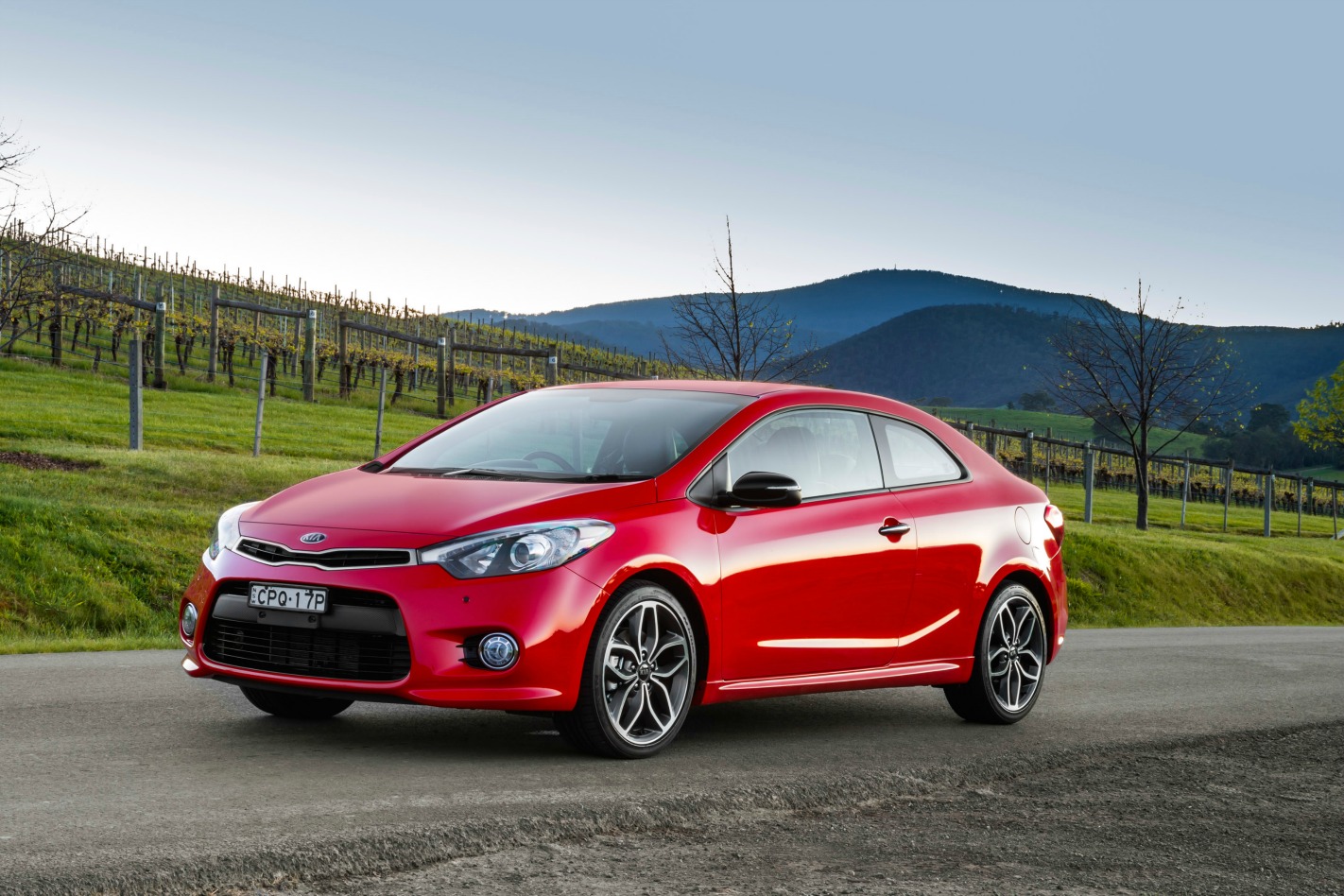
Unfortunately, this means cars which were sold on October 1, 2014 are no longer under warranty, although new Kias are now covered until 2028 at a minimum, with the seven-year deal stretching to its capped-price servicing as well.
Have a Kia memory? Let us know in the comments below.
