
The Venn diagram of people who like hot hatches and people who like SUVs doesn’t really exist. It’s one or the other in many car peoples’ heads – and by car people, I mean people like you and me – because SUVs are the work of Satan sent to ruin our fun while hot hatches are the best things ever sent from above.
I certainly used to think that way because early SUVs from car companies that hadn’t made their names with them didn’t do a great job in the heady days of a decade ago. Most of them were lifted hatchbacks and if you remember the first Audi Q3, even premium manufacturers didn’t get them right.
When the Q2 landed in the compact SUV space to start eating into the A3’s market share, I remember thinking that the 2.0-litre Quattro was a heck of a lot of fun. But that couldn’t be right, could it? It was a compact SUV I was threading through the Yarra Valley and it was holding up very nicely. I will always want to be in a lower, sharper car, but I didn’t resent this car and, crucially, this car isn’t meant for me. But during that day, I wondered what one would be like with S3 power. And here we are.
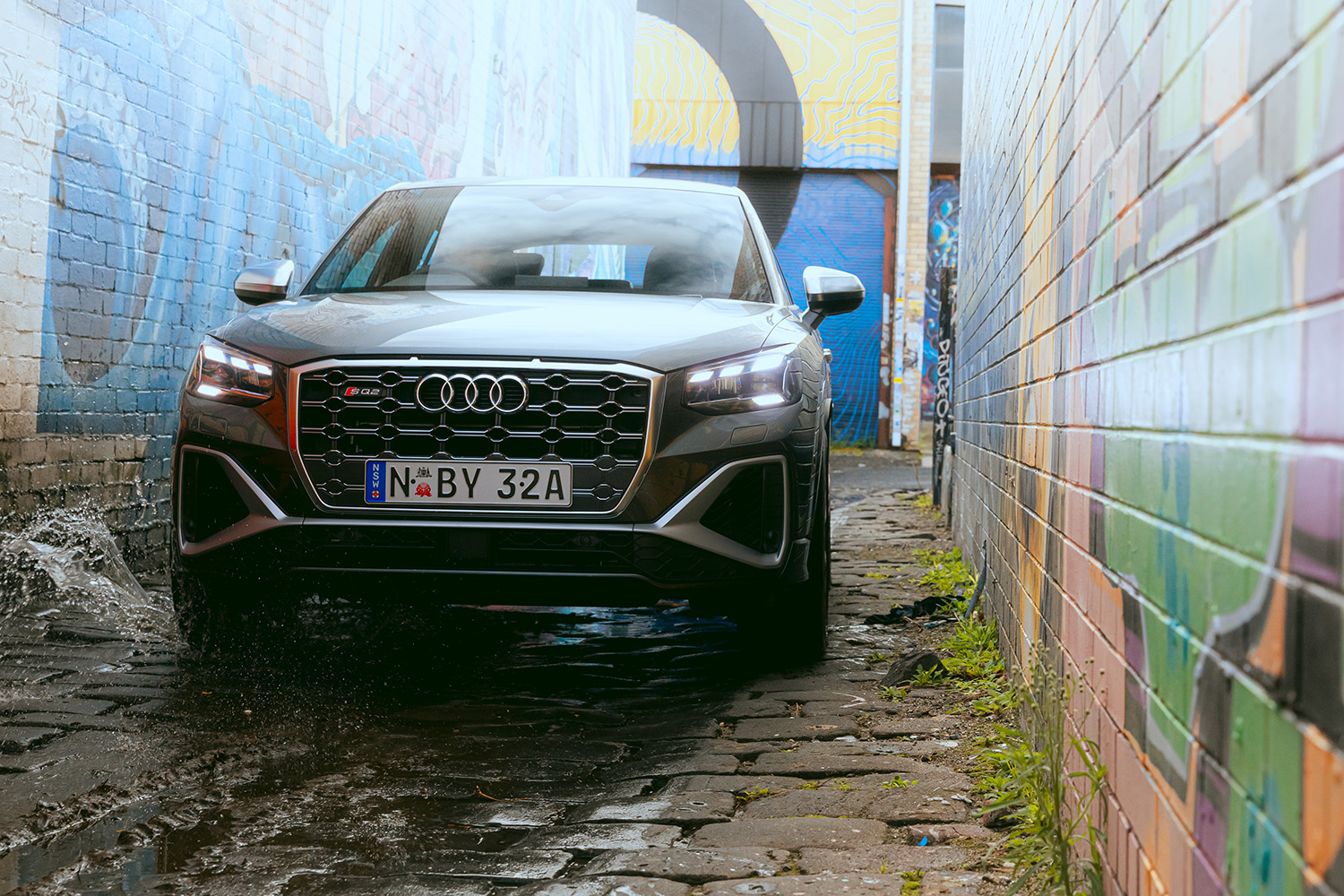
Pricing and Features
At $64,400 before on-roads, it seems like a lot of money for a fairly small car. And, it is, but it’s far cheaper than its direct rivals from BMW and Mercedes while cheerfully rumbling with them in the performance figures – and beating them.
For an Audi, there’s little in the way of options, so your money gets you 19-inch alloys, metallic paint, automatic Matrix LED headlights, power everything (except, curiously, the seats), keyless entry and start, a powered tailgate, heated front seats, dual-zone climate control, Audi’s Virtual Cockpit digital dashboard, wireless phone charging, sat-nav, adaptive cruise control, reversing camera and front and rear parking sensors.
The SQ2’s dash is fundamentally identical to the A3’s, so has the same media screen with Audi’s excellent MMI software. Because this is based on the outgoing A3, sadly that screen doesn’t accept touch commands so you have to run the whole thing from the rotary dial and shortcut buttons on the console.
It works really well in the Audi menus, but it’s a bit annoying in Apple CarPlay and I imagine would be equally irritating in Android Auto, though both are present and correct. You do have to connect with the USB ports in the front, though, so the wireless charging in the armrest is nice but moot.
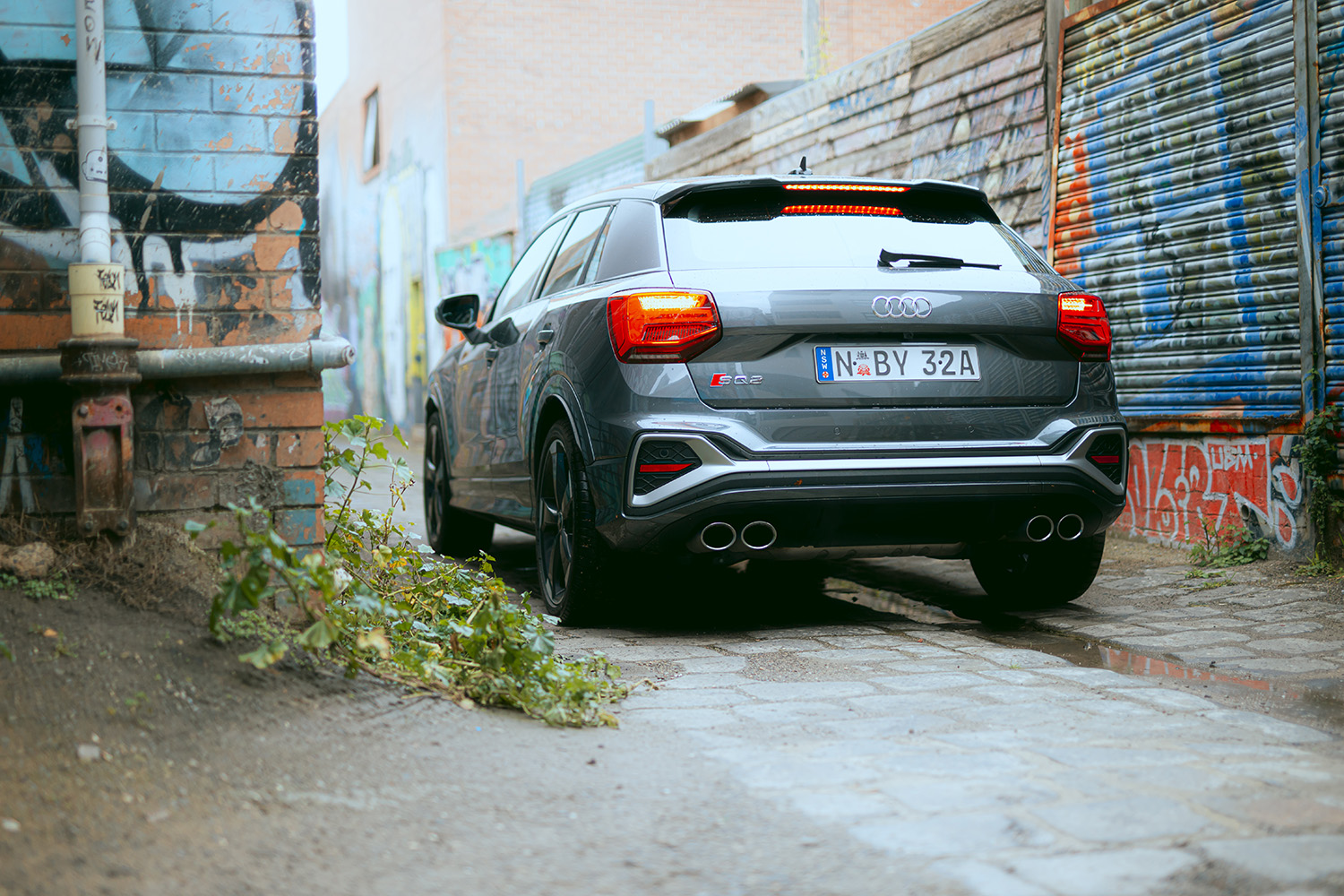
At $64,400, it seems like a lot of money for a fairly small car. And, it is, but it’s far cheaper than its direct rivals from BMW and Mercedes while cheerfully rumbling with them in the performance figures – and beating them.
The 14 speaker stereo is a lot for this small space, so you’ll be fine if you fancy blowing out your eardrums. The speakers wear Bang and Olufsen badges, which is fancy. On top of your smartphone and usual radio, there’s DAB digital reception as well.
Safety tech isn’t as comprehensive as newer Audis, with six airbags, ABS, stability and traction controls, AEB with pedestrian and cyclist detection, blind-spot monitoring and lane-keep assist. Two lots of ISOFIX mounts and three top-tether points look after the kids.
It’s missing a lot of the good stuff, like reverse AEB, which is kind of a shame. Its five-star ANCAP safety rating reaches back to 2016, which is a while ago and it’s unlikely to hit that number under the current ANCAP regime.
Comfort and Space
One of the good things about jacking up a hatchback is that while you shouldn’t gain any more space, you do. A more upright stance means easier entry and exit and higher-set seats mean your legs fit better behind front seats.
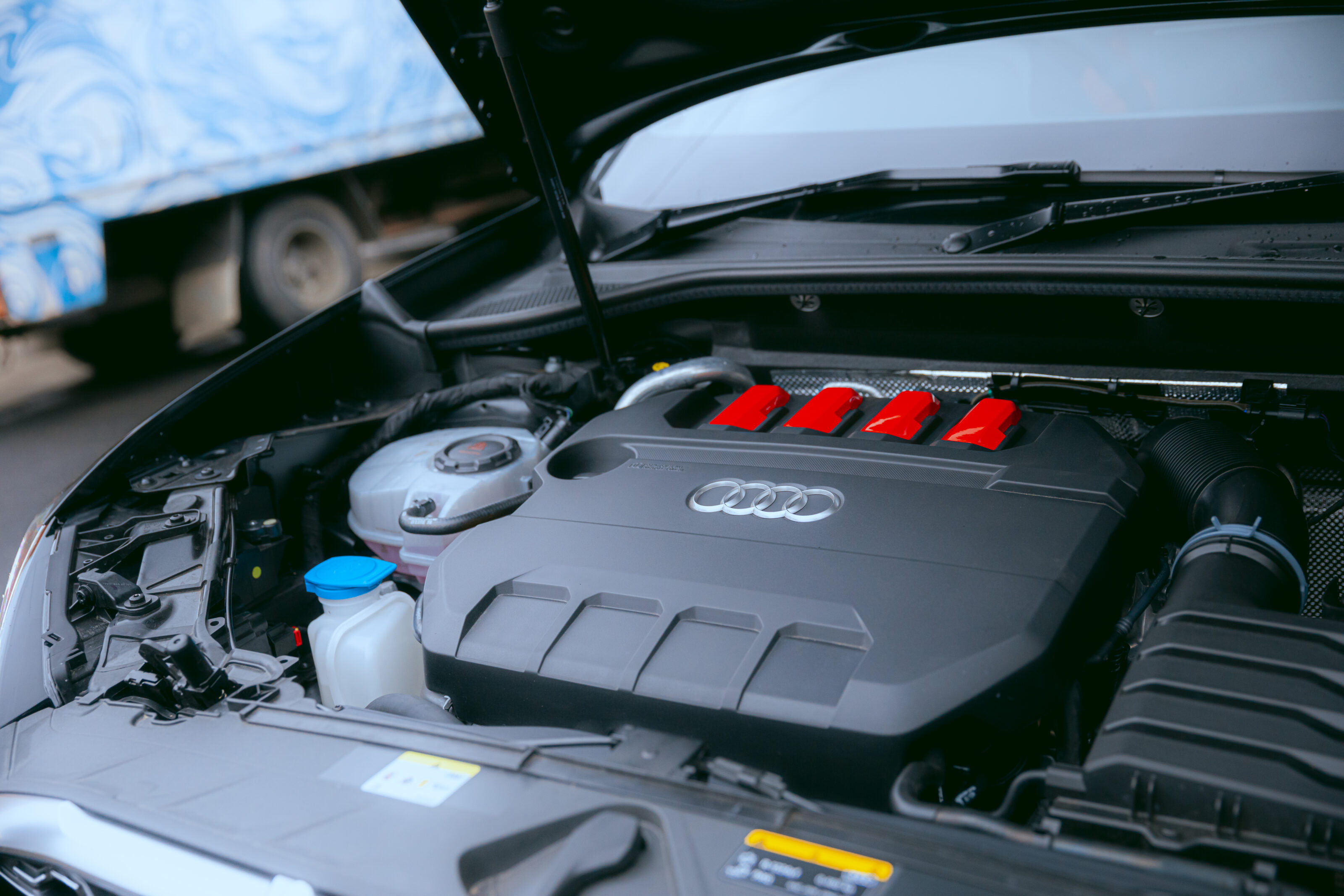
While hardly luxurious, the rear seats in the Q2 are comfortable for six-foot old me when I sit in the back behind where I set the front seat for driving. You get USB ports back there and bottle holders, but scandalously, no cupholders or armrest. That’s bad in a $43,000 35 TFSI but more than twenty grand north of that, I’d like an armrest, bitte.
The front seats are great to sit in and look at, particularly with the racy red quilted inserts. The driver gets a round steering wheel rather than a tedious flat-bottomed unit (again because there’s plenty of space in the taller car).
It can take a while to get the seating position right – and sharing the car with my wife for a week meant a lot of muttering about that – it would be fine if the seats were electrically operated with a memory function, but they’re not. I mean, we were fine, we’re still married and not blaming Audi for a messy divorce, but the pedals aren’t as far ahead of you as you’d like. Mercifully the steering wheel has a lot of reach adjustment to help get that right.
Two cupholders, a small tray under the climate controls and an armrest with a shallow space underneath for the phone charger are pretty much your lot for storage. You can get a small bottle in the doors, but yeah, places to stash stuff are a bit slim in the SQ2.
On the road
Audi Sport doesn’t usually muck about when turning its attention to SUVs. The SQ5 and SQ7/SQ8 pair are thumping great bruisers, with big turbocharged diesel engines hurling them down the road with great flipping gobs of torque and some real technical tour de force stuff like 48-volt mild-hybrid systems spinning an electric turbo to eliminate lag.
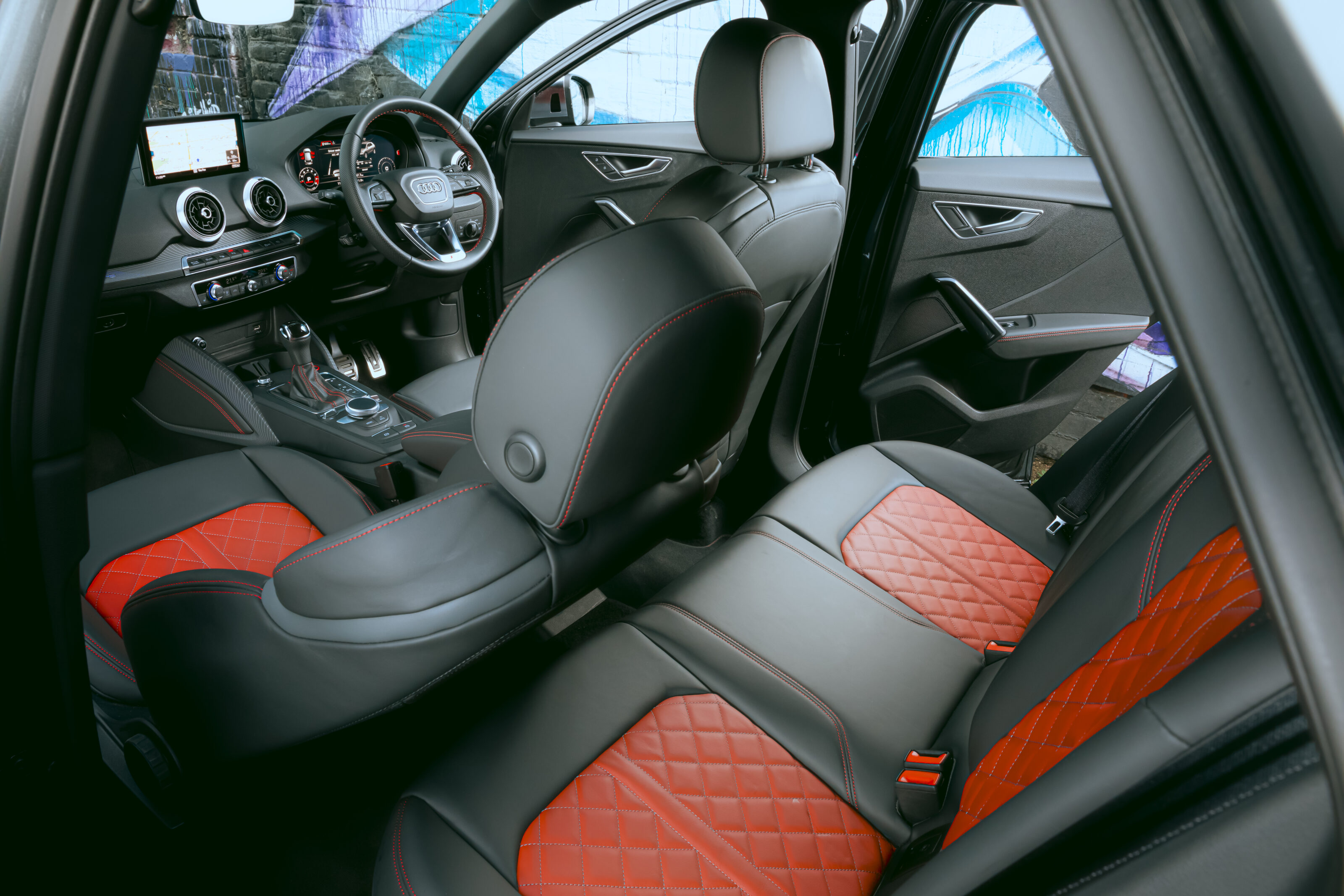
The SQ2 is a little more subtle. In fact, given its very close relationship with the soon-to-be-replaced S3 there was only one thing for it – the tried and true EA888 2.0-litre four-cylinder turbo found in various Audis and Golfs, in this case, the S3 and Golf R.
With a whopping 221kW and 400Nm managed by a seven-speed dual-clutch auto and all-wheel drive, the SQ2 is super quick to 100km/h, knocking the dash over in just 4.9 seconds.
That’s pretty quick and defeats both of its main rivals, the AMG A35 and BMW X2 M35i, although both are bigger cars.
Both the power and torque curves are quite flat for an engine you could reasonably expect to be a bit peaky, with maximum power available between 5300 and 6500rpm while torque goes all the way from 2000rpm to 5200rpm.
I’m somewhat fond of this engine. Turbo lag is present but minimal and the way the transmission manages the power delivery makes it very easy to conduct in a manner that might scare your passengers. It does have the classic VW Group “where’s the pow– oh, there it is” off the line, but in the gears it’s immense with all that torque shrugging off overtaking manoeuvres and powering out of corners like a demon but without all the unseemly scrabbling of some front-wheel-drive offerings.
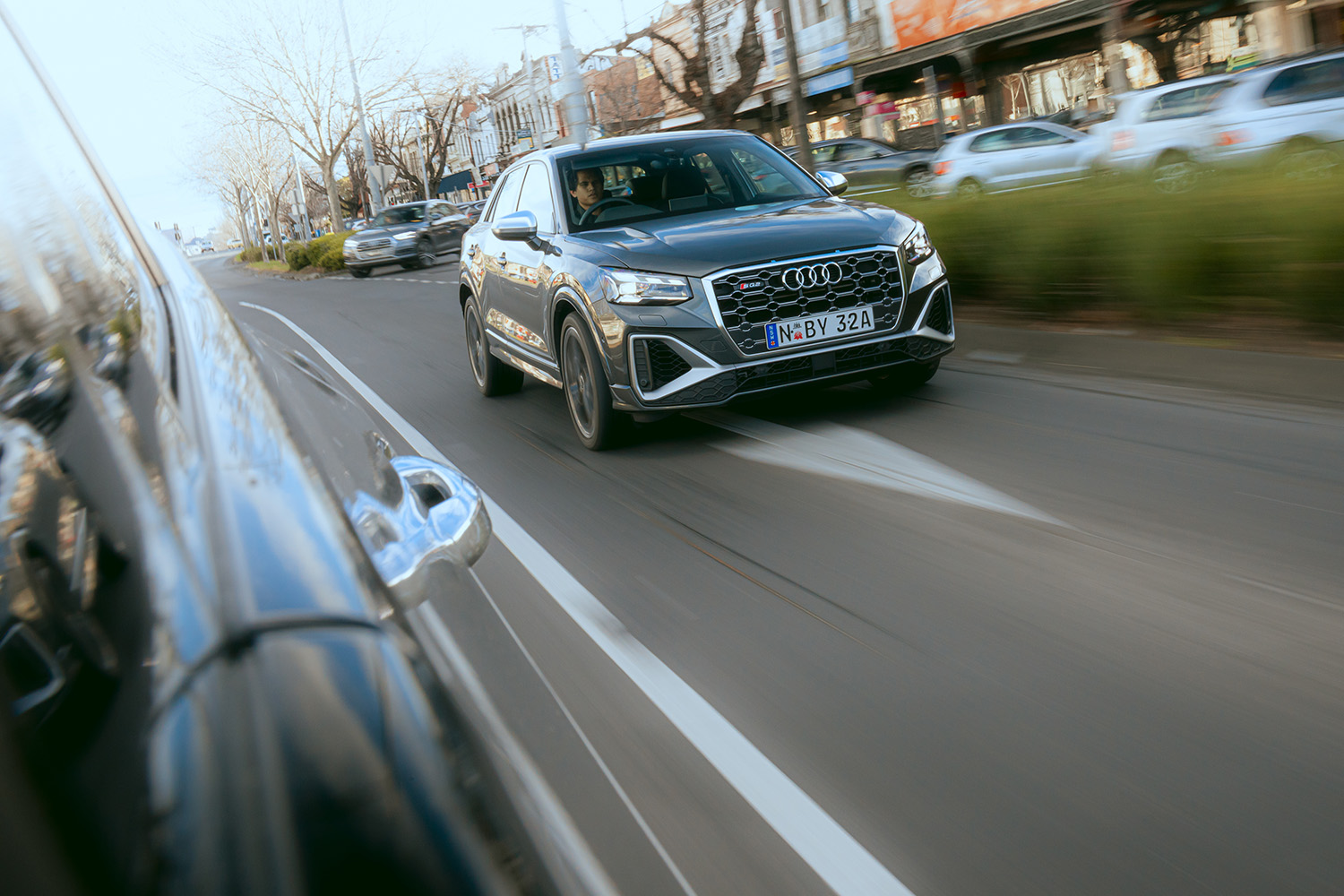
Unlike the bigger Audi Sport cars, you’re also rolling on a static suspension setup, the Drive Select button only turning up the engine and transmission.
We’ve seen on more recent German cars like the BMW 128ti that if you spend some quality time honing a non-active setup that you can get a good balance and that’s where the SQ2 landed in 2019 at its launch, its arrival delayed not by COVID but by bureaucracy. The ride is taut without being too firm and even though it rolls on 19-inch wheels, you’ve got to be looking for trouble to get a nasty jolt in the cabin.
Chucking an SQ2 down a twisty road is a genuine slab of fun. The electric steering has just the right amount of weight as you thread the car through the turns. I don’t mind a performance car with a little bit of roll, it means things are less likely to suddenly go south because you’re not across what’s going on underneath you. The Turanzas bite into the road nicely, too (and aren’t too loud) and my goodness this thing goes like a stabbed rat.
What it isn’t is light. At 1600kg, it’s a proper chonk as the kids say (or probably did about three years ago). That should count against it far more than it does, because the engine easily overcomes the weight and doesn’t seem to blow out the fuel consumption (which was about 9.0L/100km on test, 1.3 off the sticker).
It’s very stable under brakes, you can get away with slight dumbness and once you’re at the apex, you can just punch the throttle and the torque will carry you away at almost indecent speed. You get a little pop and burp from the engine, too,
Most folks won’t be chasing that ultimate dynamic feedback or performance of a lower, nimbler hot hatch, so the SQ2 nails the brief.
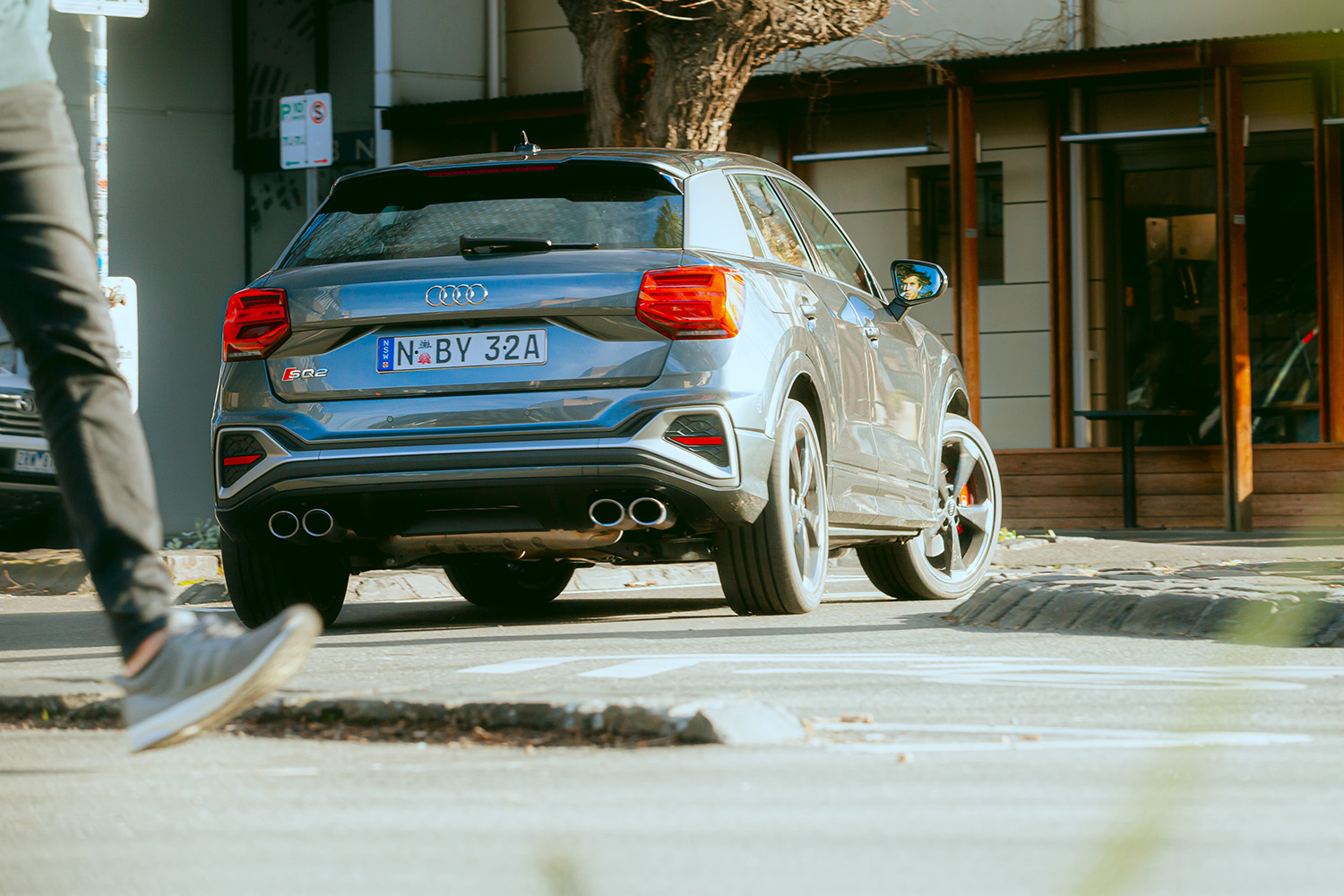
Ownership
Every time I get to the warranty section on an Audi (or, yes, a BMW) I draw a long breath and sigh the way Kate Winslet does in period dramas. By all accounts, owning an Audi is quite nice but the three-year/unlimited-kilometre warranty is just too short. Mercedes bit the bullet in 2020 and went to five years on the entire range, including AMG, and so should its compatriots. It’s just too short when a $16,000 econobox has a seven-year warranty.
Happily, the servicing plan is reasonably priced, with a five-year term costing $2580. While that’s not especially cheap, the inclusions seem generous (and are listed on the website), so your five-service average is just over $500. You have to return to the dealer every 12 months/15,000km.
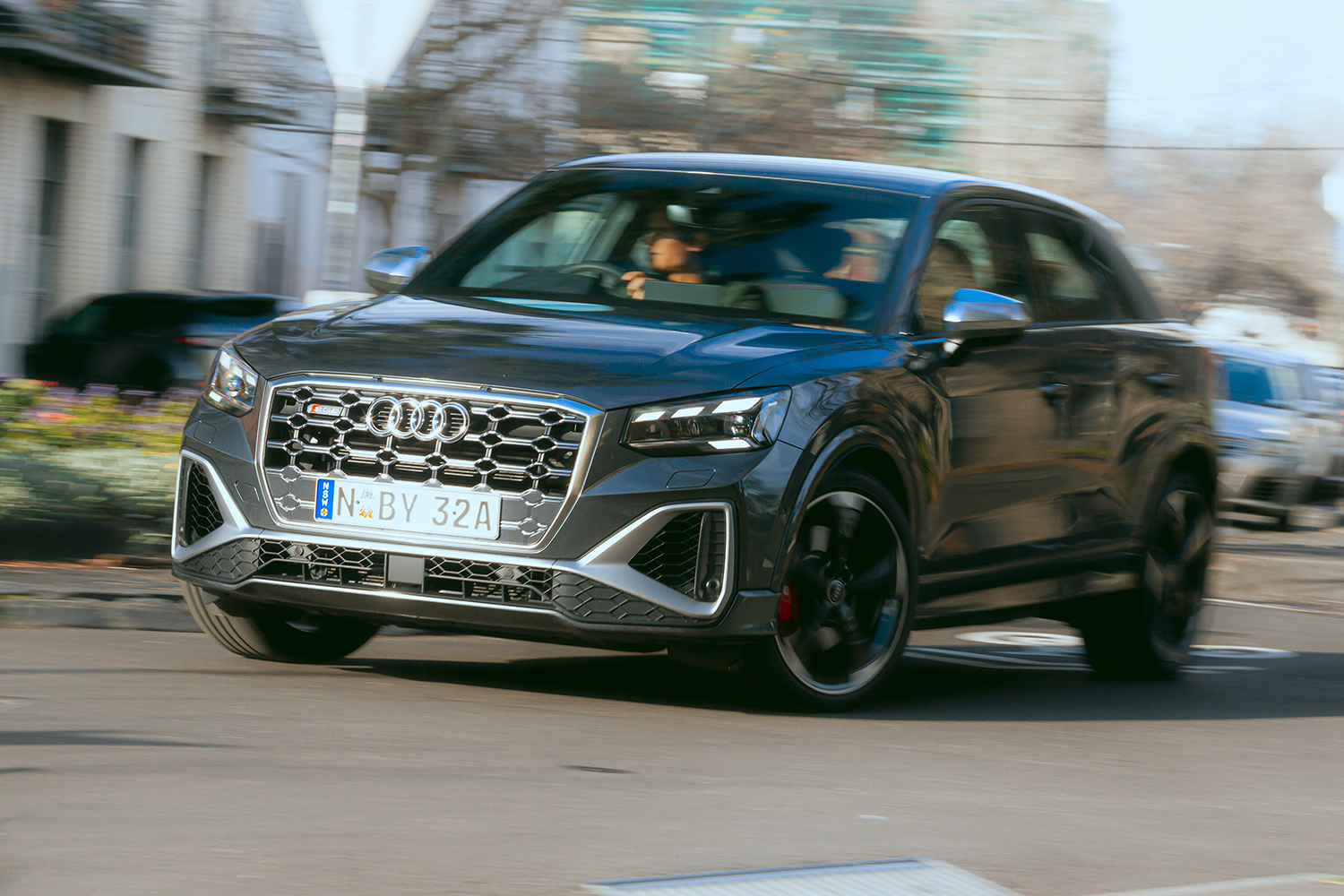
VERDICT
It’s not often that you find that the cheapest car in its niche is possibly the best. While I’m quite fond of the GLA35, it doesn’t quite have the zap of the SQ2 and nor does the X2 M35i – a car that polarises the Wheels office in a way that has me quite lonely at one end and everyone else at the other – provide quite as much fun.
The SQ2’s simplified options list also makes it an easy proposition to just walk in and buy, with your biggest issue being which wheels and paint to choose and remind yourself you’re not paying for it.
Although the SQ2 isn’t as bonkers or charismatic as the RSQ3 (hands up who wants to see that five-cylinder in an RSQ2?) but nor is it as expensive or as hard to live with. The SQ2 really works as a hot hatch alternative – it’s easy to get in and out of, you’re not losing much and you’re not far down on power.
On top of that, you have a bigger boot and a better resale prospect because nobody buys hatchbacks anymore.
2021 Audi SQ2 specifications
| Body:u00a0 | five-door compact SUV |
|---|---|
| Drive: | AWD |
| Engine: | 2.0-litre four-cylinder turbo |
| Transmission: | seven-speed twin-clutch |
| Power: | 221kW @ 5300-6300rpm |
| Torque:u00a0 | 400Nm @ 2000-5200rpm |
| Bore stroke (mm): | 82.5 x 92.8 |
| Compression ratio:u00a0 | 9.3 : 1.0u00a0 |
| 0-100km/h:u00a0 | 4.9 sec (claimed) |
| Fuel consumption:u00a0 | 7.7L/100km (combined) |
| Weight: | 1600kg |
| Suspension: | MacPherson struts front/multi-link rear |
| L/W/H:u00a0 | 4216mm/1802mm/1524mm |
| Wheelbase: | 2594mm |
| Brakes:u00a0 | 340mm ventilated disc front / 310mm solid disc rear |
| Tyres:u00a0 | 235/40 R19 Bridgestone Turanza |
| Wheels:u00a0 | 19-inch wheels (space-saver spare) |
| Price:u00a0 | $64,400 + ORC |
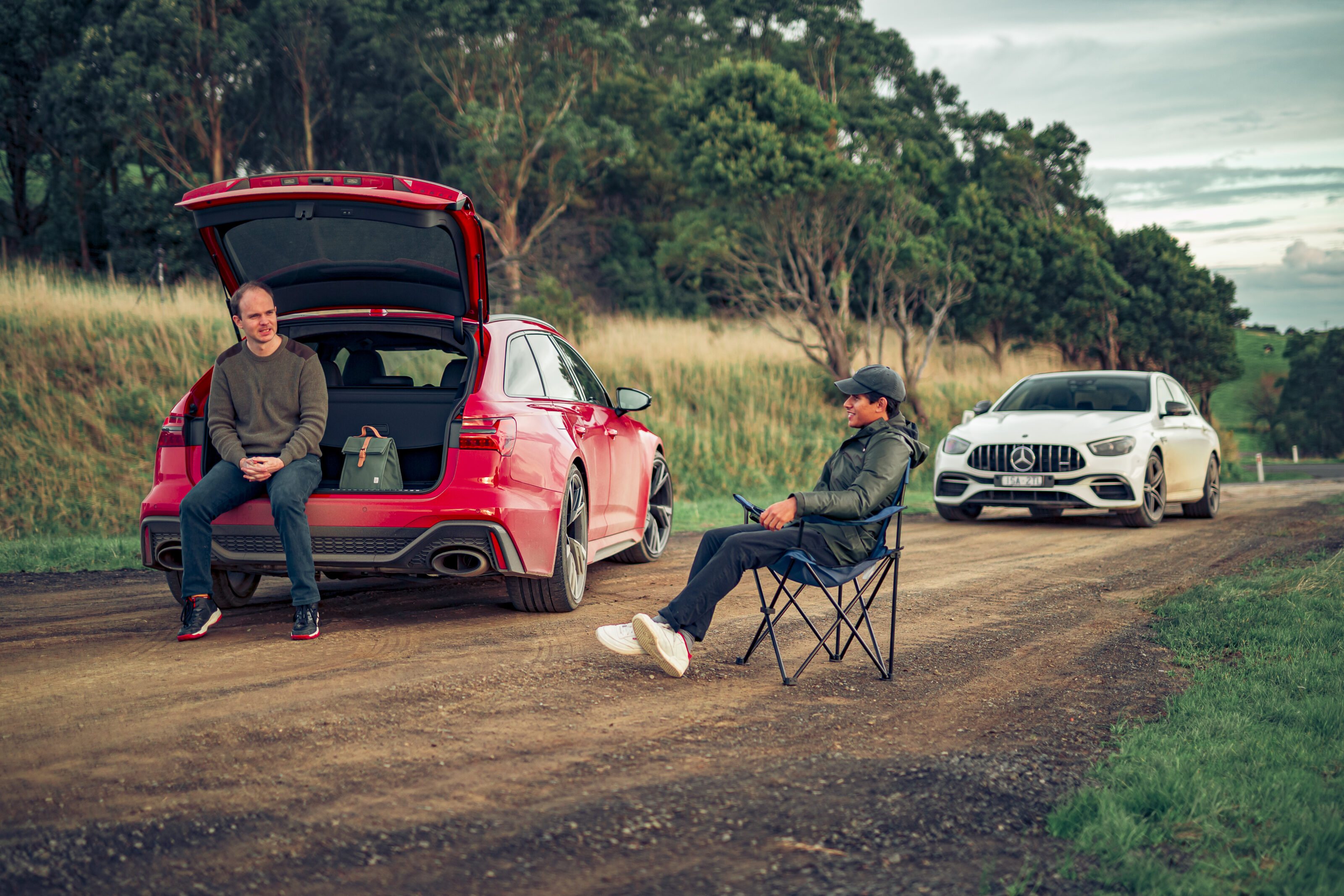
Five years ago, this wouldn’t have been close.
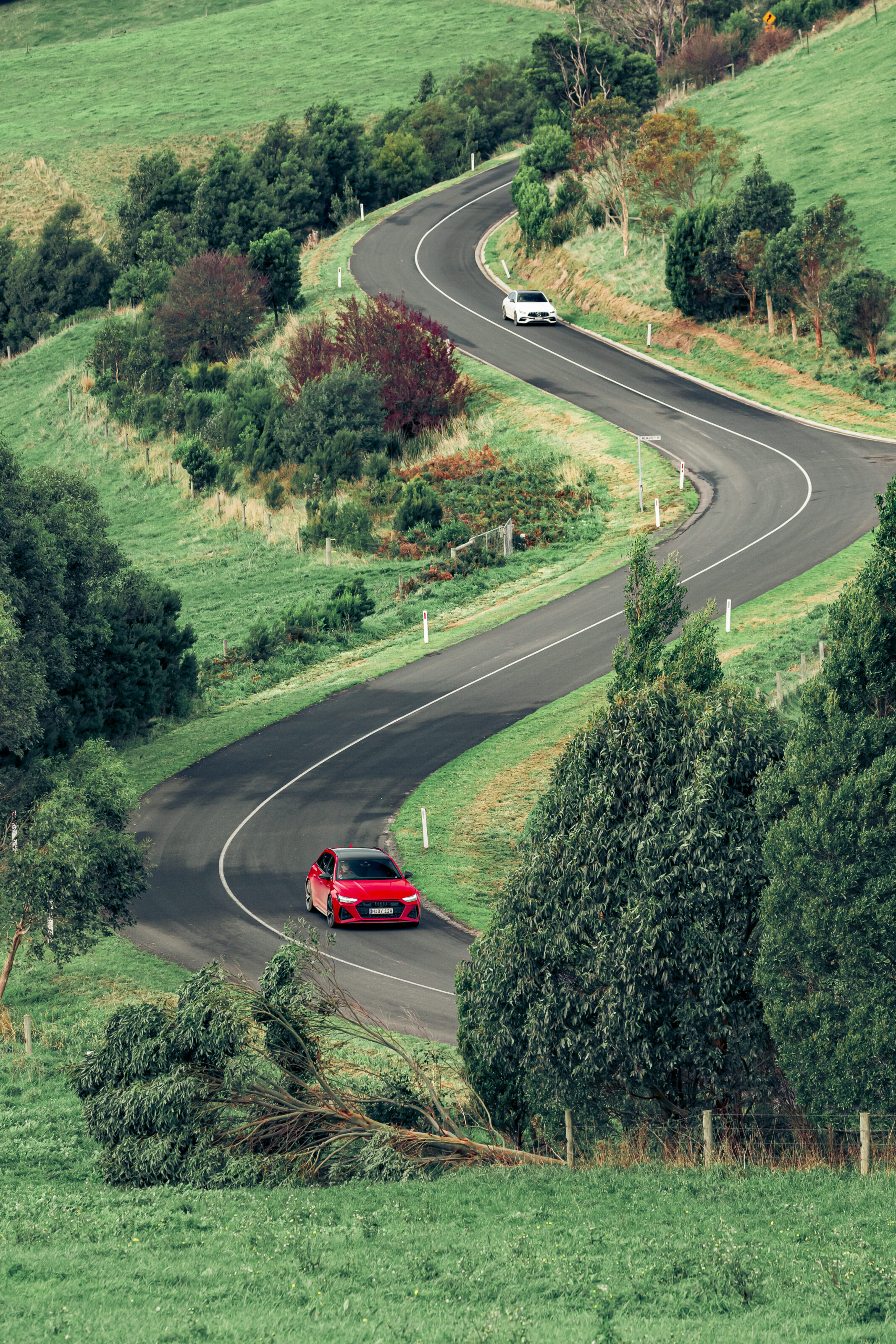
Our test route winds deep through Gippsland farm country and the roads aren’t just intermittently wet but full of environmental hazards: tree litter from recent storms and mud from roving tractors mixed with some special surprises left behind by the local cow population.
The Audi RS6 is made for situations like this. No matter the weather or road surface it’s never flustered, deploying more of its virtually endless power reserves than you ever thought possible. For almost 20 years it’s been thus. On the other hand, the Mercedes-AMG E63 S has traditionally preferred warmer climes.
Fast E-Classes have always been near the top of the tree when it comes to horsepower but putting it through just the rear wheels made them a wet newspaper to the RS6’s hardwood two-by-four when it came to effectiveness in conditions like these.
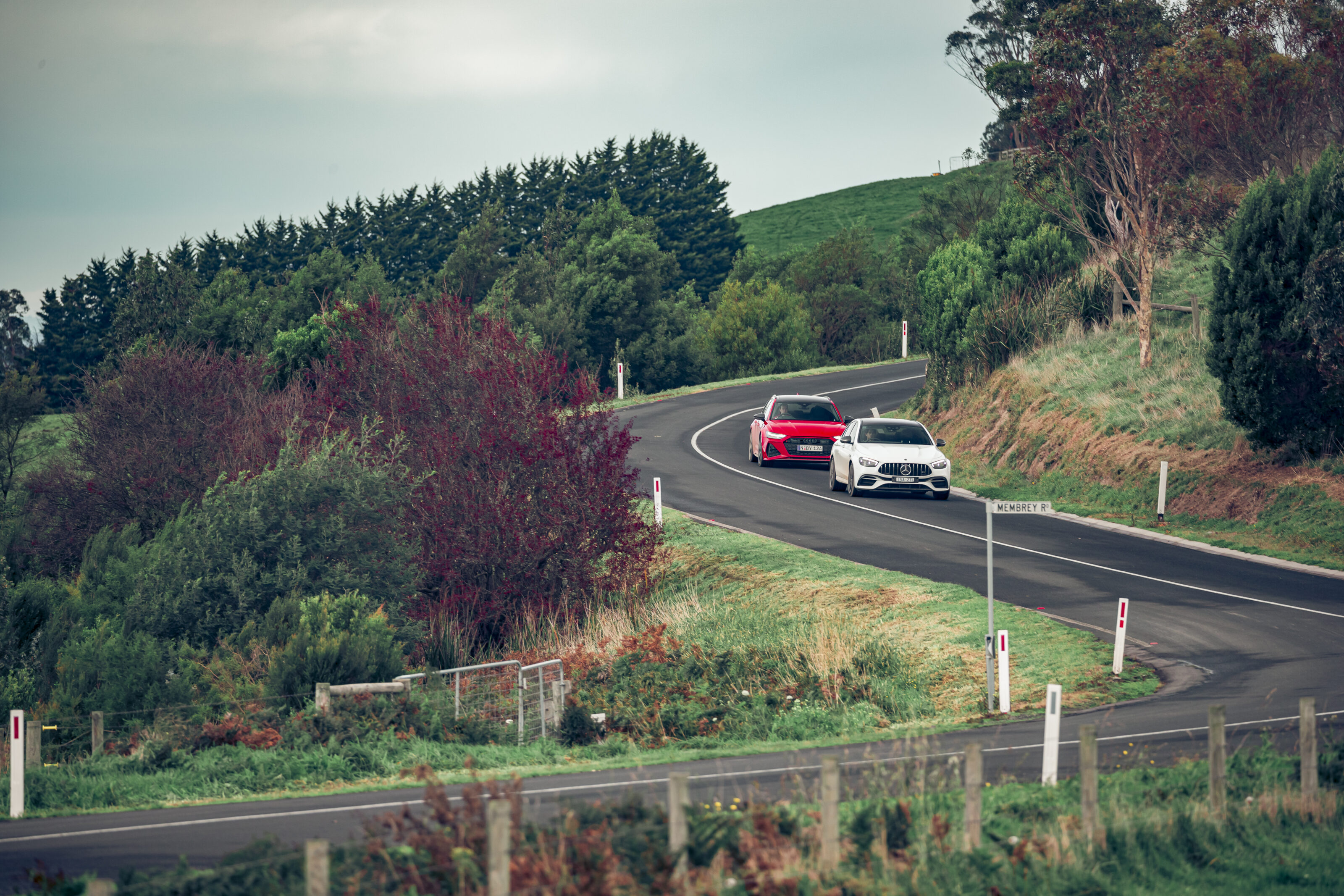
That all changed with the arrival of the W213 in 2017. This was Australia’s first exposure to a 4MATIC E63 (left-hookers had been around since 2013) and it totally changed the model’s character. Not only did it transform its tractive capabilities, but AMG took the opportunity to redefine what an E63 was.
Whereas previous models – from E36 to E55 to E63 – had been high-speed cruisers but dynamically inferior to, say, BMW’s M5, the W213 was a genuine four-door supercar, capable of 0-100km/h in 3.4sec and tearing up a racetrack to boot.
Its incredible performance landed it second place at Performance Car of the Year 2017 but, ironically, it was the other end of the spectrum that possibly cost it the win. By injecting its newest E63 S with the distilled essence of AMG, it left arguably too much of the Mercedes behind.
While phenomenal to drive hard, the car never wanted to relax; the ride was firm, impacts would thud and buzz through the bodyshell and it always felt to be egging you on to stick it in Race mode and drive like your pants were on fire. Great for an AMG, not so much a $250,000 luxury Mercedes sedan.
Somebody quite high up at AMG has obviously had similar thoughts. It might even have been former boss Tobias Moers, who recently departed AMG to head up Aston Martin.
? February 2024: RS6 GT revealed as C8 swan song
Hey, it’s Wheels phoning from the future. Audi has revealed a fitting finale for its C8 RS6, dubbed RS6 GT. Read about it at the featured story link below.
Story continues…
”The RS6 is made for this. No matter the weather or road surface it’s never flustered”
In a recent interview with our sister title Wheels, Moers responded to a question that AMGs have often felt too stiff outside the smooth roads of their German homeland: “I know that now. British B-roads are different! You should not tie the body down too much.”
Recent Affalterbach products have been noticeably more comfortable than their predecessors, namely the C63 S and new A45 S, and now it’s the turn of the E63 S.
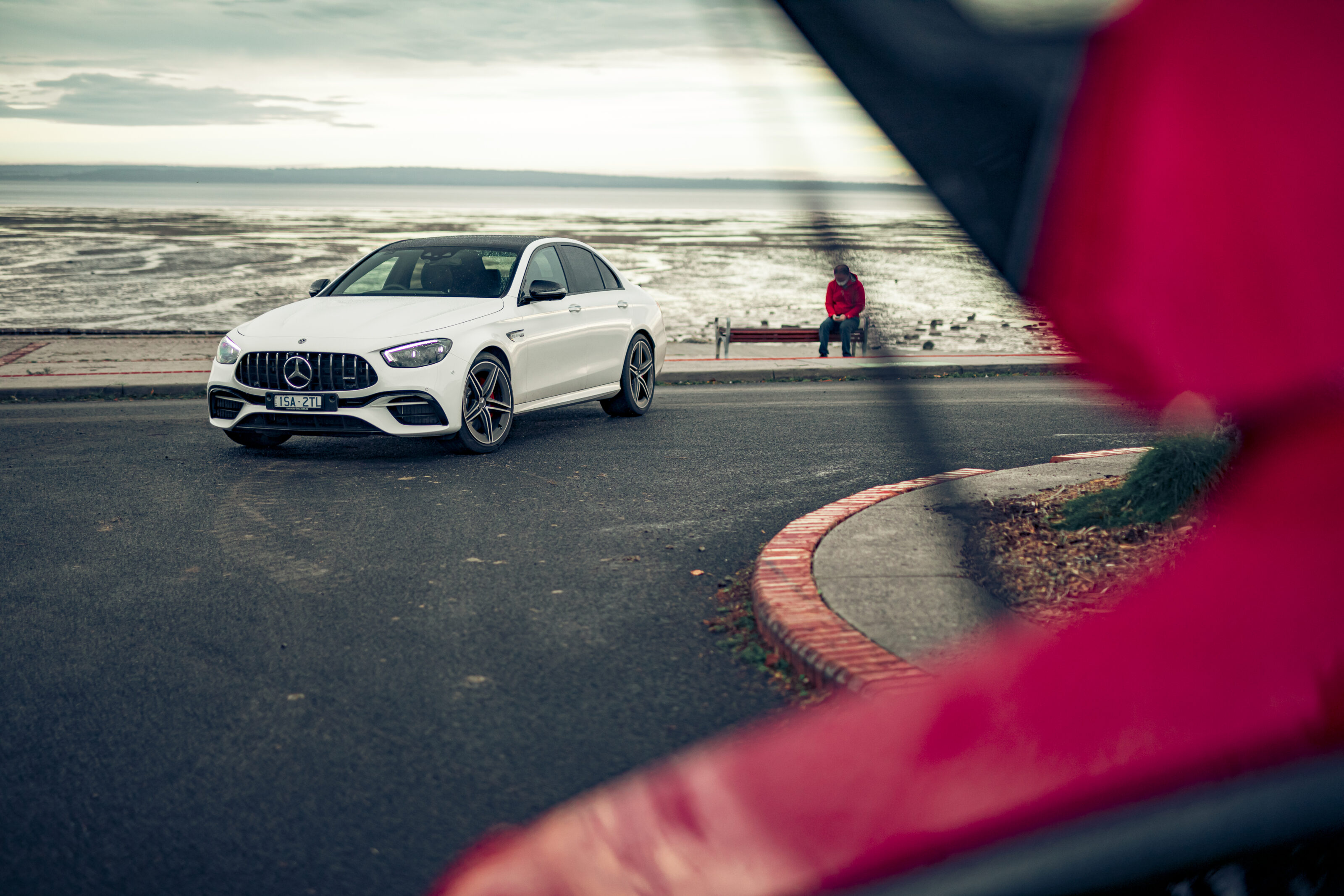
The tagline for the E63’s recent facelift is “Comprehensively updated exterior, interior and ride comfort”.
At the front there’s a larger grille and narrower headlights, like the car is suspicious of something, while at the rear the tail-lights are now horizontal, stretching into the boot, rather than vertical – much closer in style to its W212 predecessor.
I can’t personally decide if it’s an improvement or not. The somewhat understated spec of our test car doesn’t do it favours – it takes the sleeper vibe a step too far for mine – but a play on the configurator suggests a colour and wheel change ups the menace.
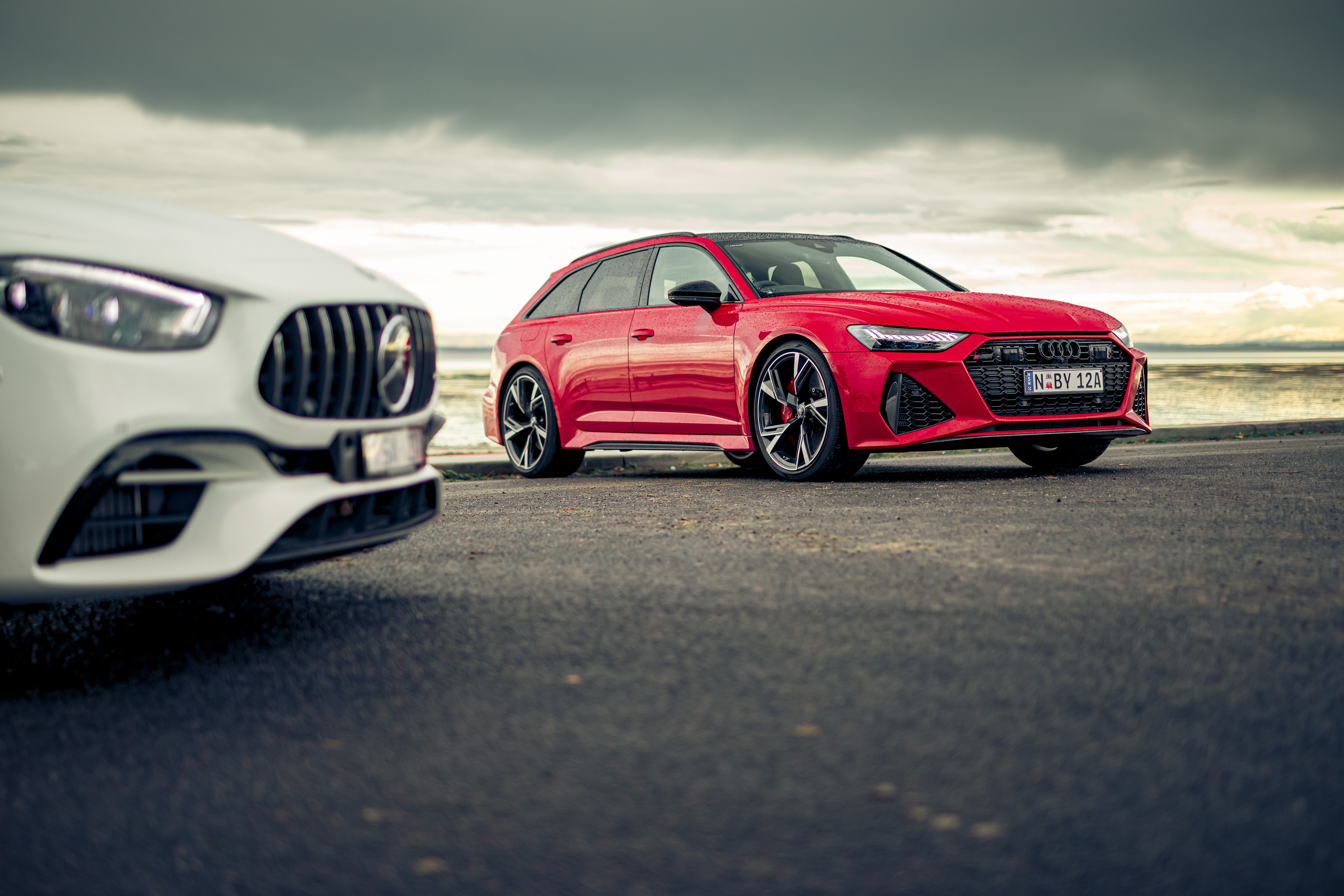
It must be said, however, that attempting to out-butch an Audi RS6 is a bit like hitting the gym next to prime Arnie – you’re virtually guaranteed to come off second best. The Audi is actually only 44mm wider than the Merc, but the way the body flexes out over the gargantuan 22-inch rims gives it enormous presence. It’s possible to confuse the E63 for a more humble variant, but there’s no mistaking the RS6’s purpose.
The wagon bodyshell does its cool score no harm, as well as giving it a practicality advantage. With rear seats in place it offers 565 litres to the AMG’s 540 litres (though we suspect that figure doesn’t load the Audi to the roof), but drop the rear seats and the RS6 swallows 1680 litres.
The two interiors are markedly different in design and execution. You sit relatively high in the RS6 with plenty of space in the footwell. It’s a great cabin, simple and classy. The vast majority of the buttons have been replaced by screens – two in the centre for HVAC and infotainment, a third for the instruments – but somehow it doesn’t feel like tech overload.
Audi’s MMI is slick and intuitive and the thin-rimmed steering wheel with its clear buttons is the polar opposite to the AMG’s, which I’ll come to in a moment. The Alcantara covering – part of the $2900 RS Design Package, which spreads Alcantara, Nappa leather and red highlights throughout the interior – isn’t usually a good idea in road cars as it reacts to the oil in your skin over time, but the RS6’s wheel shows no signs of wear after 10,000 press kilometres.
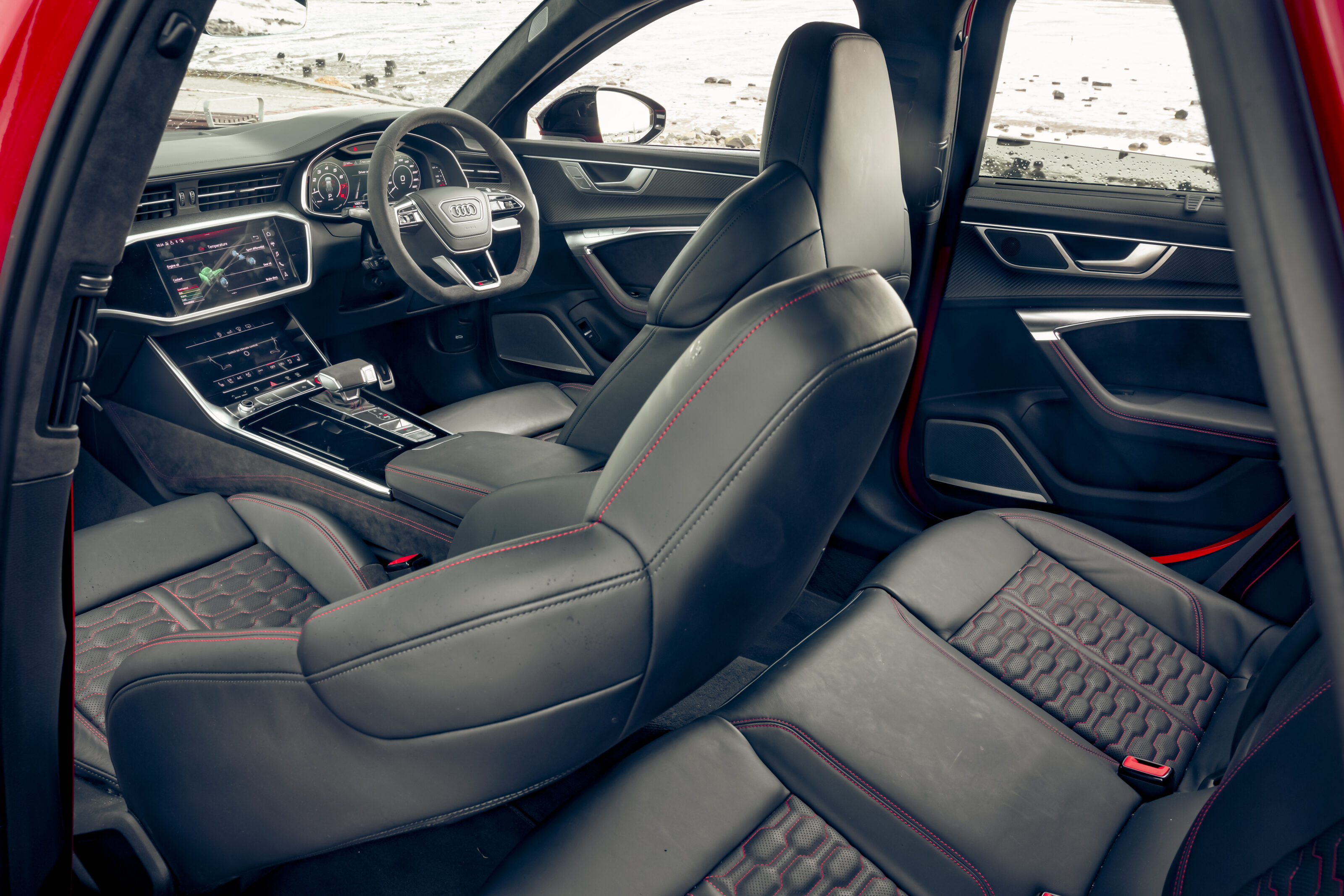
In addition to the RS Design interior treatment, our test car wears the $8700 ‘Carbon & black exterior package’, which as the name suggests smatters the exterior in carbon and black, the $11,000 ‘Sensory Package’ (awesome 19-speaker Bang & Olufsen stereo, Alcantara heading, leather airbag cover, heated outer rear seats, rear sunblinds), gloss black badging ($700), carbon twill inlays ($1700), big-ticket $19,500 RS Dynamic package (carbon ceramic brakes, 305km/h top speed) and $2850 RS sport suspension, which replaces the standard air springs with steel and includes diagonally linked dampers to reduce pitch and roll.
In standard guise the $216,000 RS6 has a handy price advantage over the $253,775 E63, but as-tested the unadorned Mercedes is cheaper than the $263,350 Audi. What’s $10K when you’re talking a quarter of a million?
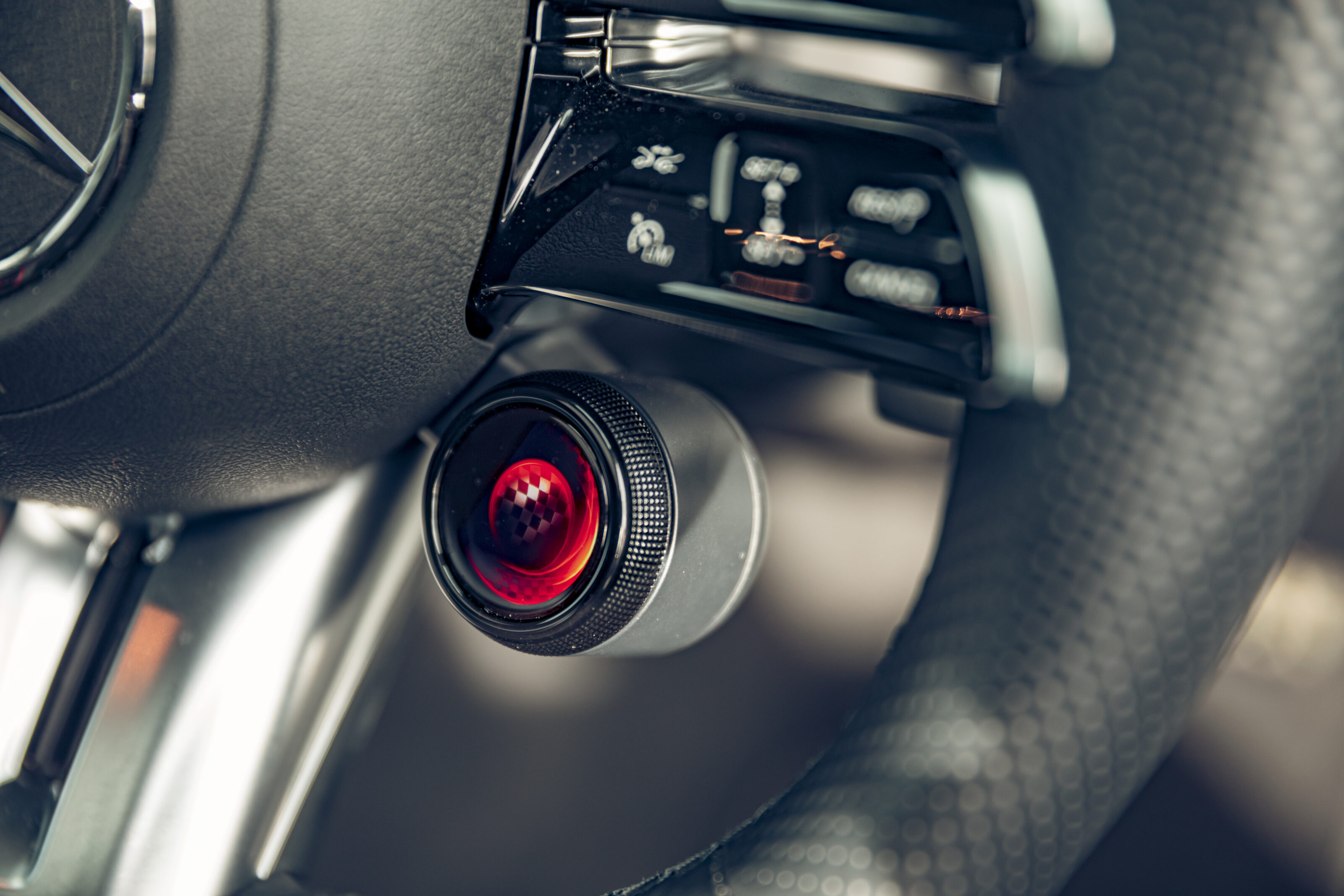
You sit lower and deeper in the E63 in seats that are firmer but more supportive. The transmission tunnel intrudes into the footwell and the new AMG Performance steering wheel is offset slightly to the left. It’s a beast of a thing, the super-thick rim too chunky for my tastes, though the new manettino-style drive mode controller is both flash to behold and easy to use, allowing the adjustment of all manner of vehicle functions on the fly.
The swipeable haptic sensors, which control the volume, cruise control speed and dual 12.25-inch screens, are decidedly less successful. They work OK for simple functions like volume or navigating the instrument cluster, but the fine control required for working the infotainment becomes an exercise in frustration with inputs frequently ignored. Thankfully, the central trackpad is more successful, but the MBUX infotainment isn’t as user-friendly as Audi’s MMI.
It doesn’t take long to realise Mercedes has made real strides in comfort and refinement. It’s still firm and certainly no magic carpet, but it rounds off bumps and lumps and no longer are impacts heard and felt in the same manner. Combine this more relaxed demeanour with toasty seat warmers (front and rear) and benchmark assisted driving technology – that new steering wheel has pressure sensors in the rim so it knows when you’re holding it, removing the need to wiggle the steering to keep lane assist active – and the new E63 S finally delivers on the Mercedes end of the deal.
There’s still room to improve at low speed, though, the nine-speed auto occasionally slow to react and the front wheels chattering as they skip across the road at full lock.
The Audi’s damping is softer, the RS6 less concerned than the E63 S with body control in Comfort mode, but the ride is compromised. Speaking to colleagues who have sampled the standard air-sprung RS6, it seems some of the blame must be apportioned to the steel springs of the RS Sport suspension, but the heavy-footed response to potholes and road imperfections suggests those giant wheels must shoulder some responsibility. It takes the shine off the experience somewhat, as high- or low-speed, the car rarely settles for any length of time.
It’s just as well that the Audi delivers on the other side of the ledger, then, with handling prowess that’s difficult to countenance with a car of this size. The RS6 must be as dense as a dying star, as despite being roughly the same size as the E63 S it weighs almost 200kg more at a whopping 2075kg.
Audi has employed high technology in a – largely successful – effort to counteract this bulk, with rear-wheel steering and a very clever all-wheel drive system. The steering is very quick, particularly off-centre, so inputs need to be measured; resistance is light and initially it feels quite numb, but as the front tyres begin to slip across the road the level of feedback increases.
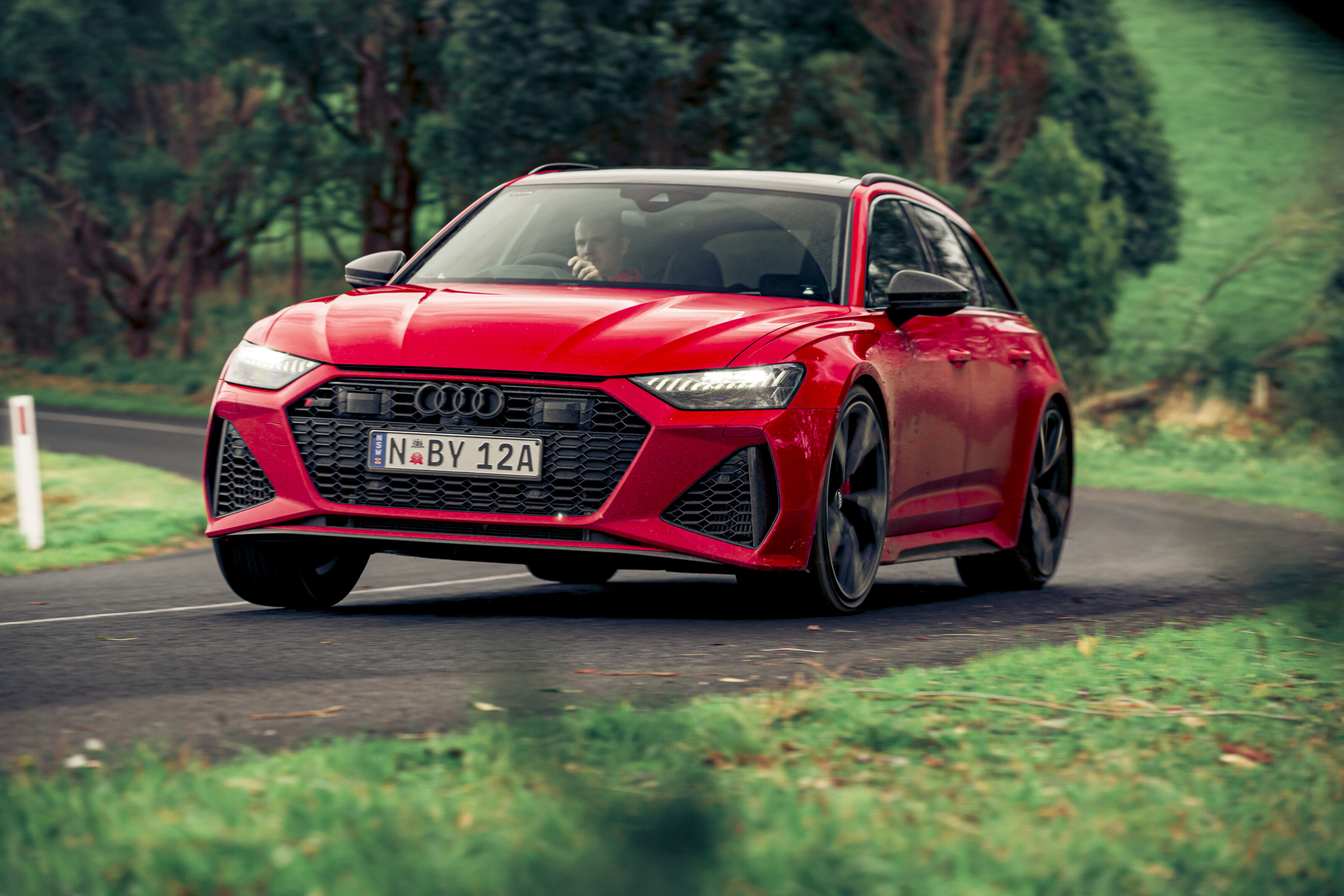
Some experimentation is required to set the RS6 up to its optimum, a couple of favoured settings combinations then able to be saved to the ‘RS1’ and ‘RS2’ modes activated by the RS button on the steering wheel.
Steering weight is likely to be personal preference, as thankfully selecting Dynamic no longer turns an Audi’s helm into a syrupy mess; drivetrain in Dynamic is a no brainer, ESP in Sport likewise, but the dampers must remain in Normal as selecting Dynamic makes them far too stiff, bumps bouncing the car clear of the roads at times. Normal retains acceptable levels of body control with increased compliance and the little extra roll makes it easier to read the RS6’s behaviour.
In these slippery conditions the Audi is brilliant. It takes up a lot of the road but can be placed accurately and with confidence. The rear-wheel steering proves its worth with mid-corner rotation; from there the throttle does the rest, with enough power being sent to the rear wheels to complete the rotation and offer a wiggle of oversteer on exit.
It’s not only brutally effective but bloody entertaining to boot. Tackling the same section of road in the E63 S is a hair-raising affair. Attempting the first corner at what feels roughly the same speed as the RS6 managed, the rear end steps out sharply, the resultant ESP intervention then sliding the front end out.
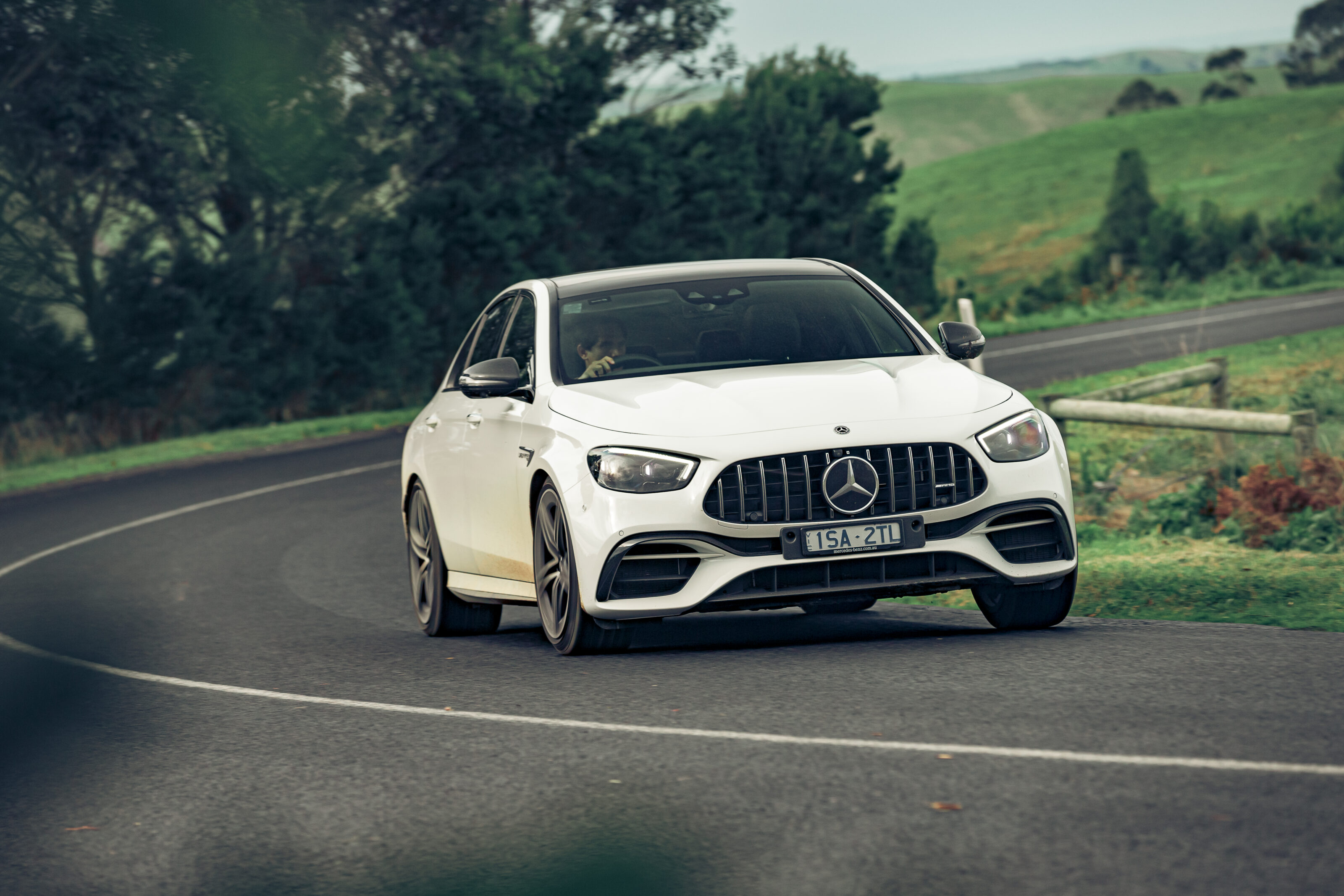
It’s immediately apparent that in the wet the Mercedes can’t find anywhere near the same level of grip as the Audi. Why that should be is somewhat of a mystery. Both cars wear identical Pirelli P Zero tyres of roughly equal dimensions – the RS6 has 285s at each corner, whereas the E63 S is staggered with 265s front, 295s rear – so presumably the difference is down to drive logic and geometry. Despite its slight softening, the AMG is still clearly the more aggressive car, its setup beginning to pay dividends as the road dries.
The steering is slower off-centre and weightier but also more organic with greater communication, an observation that similarly applies to the rest of the car. Whereas Audi has cleverly given the massive RS6 a sense of agility with some clever toys, the E63 S possesses the traits inherently. To drive hard it is, frankly, stunning for a car of this type.
The nearer you get to the limit the more it separates itself from the RS6, eventually becoming chuckable in a way the massive Audi can’t replicate. Sport+ damping is now perfectly judged for difficult roads, keeping the car’s still-substantial 1880kg mass under control but without hopping and skipping over sharper bumps. Turn-in is immediate, front-end grip tenacious, mid-corner balance tremendous and traction almost unimpeachable. Only the brakes trail the Audi’s, needing a greater push without offering the same feedback, though by any objective measure they are still hugely powerful.
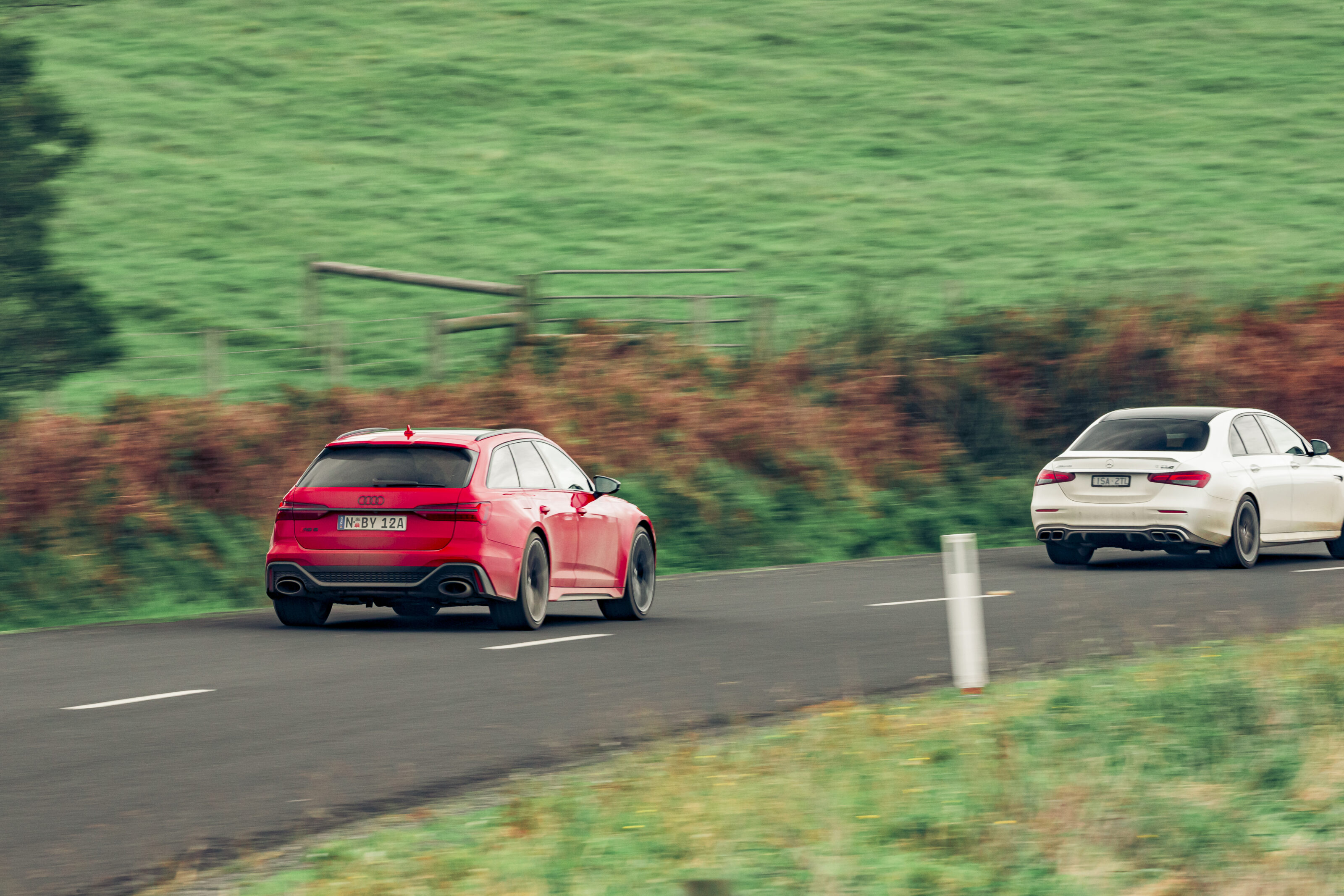
Not as powerful as the engine, though. The 4.0-litre twin-turbo V8 is a force of nature, with a whopping 850Nm spread from 2500-4500rpm, but it’s the top end ferocity that takes your breath away. Just as your body begins to adapt to the longitudinal force being applied the rate of acceleration increases again as the tacho needle rips through to the 7000rpm redline.
Activate launch control and the whole car vibrates with potential fury. Lift the brake and it explodes off the line; several runs are needed to lay down enough rubber on the slippery strip to stop ESP killing both the wheelspin – yes, even with all-wheel drive – and any chance of a good time, but eventually the E63 S clocks an impressive 3.51sec 0-100km/h and 11.52sec 0-400m at 198.11km/h. Ludicrous numbers, though we did manage 3.40sec and 11.28sec at 203.72km/h respectively in the pre-facelift car at PCOTY 2018 – environmental factors or is the updated car a bit heavier?
Regardless, the RS6 isn’t as quick, but let’s keep a little perspective here, shall we? Activating launch control is a bit of a process, with the need to select this and deactivate that, but it’s every bit as effective as in the Mercedes. The revs hover at around 5000rpm until road speed catches up to wheel speed, followed by a relentless charge, each gearshift thumping you aggressively in the back.
At 80km/h the two are neck and neck – no, I mean it, they clock exactly the same 2.58sec – but from there the AMG begins to edge away, a 0.05sec deficit at 100km/h (3.51sec vs 3.56sec) increasing to 0.72sec by 200km/h (11.72sec vs 12.48sec). At the end of the quarter mile the RS6 clocks a still-impressive 11.64sec at 193.44km/h, but it clearly trails the E63.
Likewise, its 2.2sec 80-120km/h punch is a tenth slower than the AMG’s, but it turns the tables under brakes by stopping in 36.73m vs 38.29m, though the weight and braking force of both cars is too much for the tyres to handle effectively.
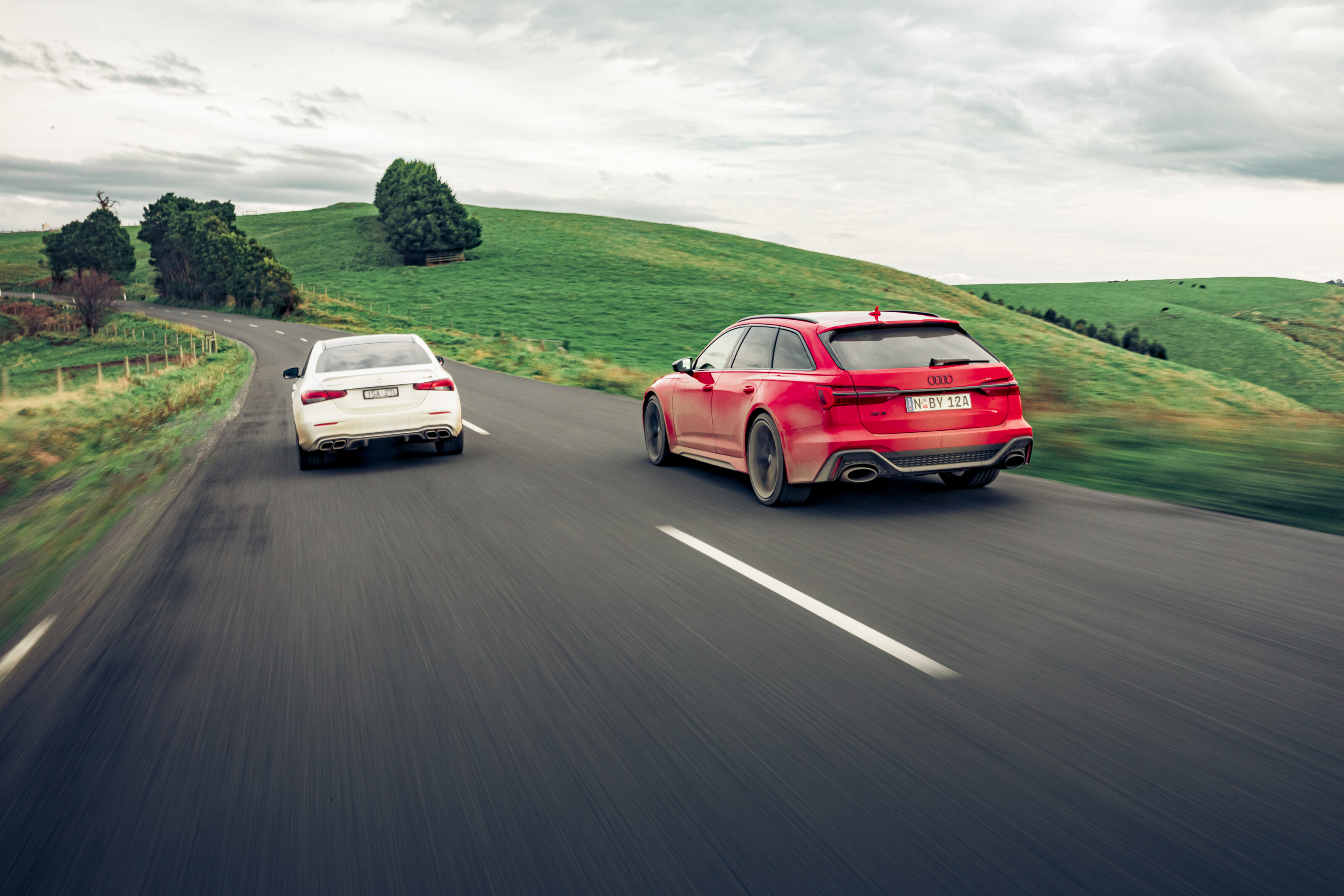
Five years ago this wouldn’t have been close, but now it is. Very close.
Depending on your priorities you could make an argument either way, but the E63 S gets the nod as the superior driving machine. Would an air-sprung RS6 have changed the result? Probably not, but it would feel more cohesive.
Its size and weight prevent it from being a true driver’s delight, so why not (arguably) pay a slight dynamic penalty for a plusher ride and luxuriate in a phenomenally fast, all-weather family weapon?
Mercedes has a done a very considered job with this E63 S facelift. Its low-speed refinement and some of the ergonomics are still questionable, but its improved ride and benchmark safety systems make it a fine luxury sedan, while retaining its ability to tear your head off. AMG has not only moved in on Audi’s territory, but given it a hip-and-shoulder for good measure.
The Strip
Lights, cameras, traction!
Heathcote Dragway, dry. Driver: Scott Newman Official timing Partner www.vboxaustralia.com.au
| Audi RS6 Avant | Mercedes-AMG E63 S |
|---|---|
| 0-10km/hu00a0u00a0u00a0u00a0u00a0u00a0u00a0u00a0u00a0u00a0u00a0u00a0u00a0 0.33 | 0-10km/hu00a0u00a0u00a0u00a0u00a0u00a0u00a0u00a0u00a0u00a0u00a0u00a0u00a0 0.25 |
| 0-20km/hu00a0u00a0u00a0u00a0u00a0u00a0u00a0u00a0u00a0u00a0u00a0u00a0u00a0 0.59 | 0-20km/hu00a0u00a0u00a0u00a0u00a0u00a0u00a0u00a0u00a0u00a0u00a0u00a0u00a0 0.57 |
| 0-30km/hu00a0u00a0u00a0u00a0u00a0u00a0u00a0u00a0u00a0u00a0u00a0u00a0u00a0 0.85 | 0-30km/hu00a0u00a0u00a0u00a0u00a0u00a0u00a0u00a0u00a0u00a0u00a0u00a0u00a0 0.88 |
| 0-40km/hu00a0u00a0u00a0u00a0u00a0u00a0u00a0u00a0u00a0u00a0u00a0u00a0 1.15 | 0-40km/hu00a0u00a0u00a0u00a0u00a0u00a0u00a0u00a0u00a0u00a0u00a0u00a0 1.20 |
| 0-50km/hu00a0u00a0u00a0u00a0u00a0u00a0u00a0u00a0u00a0u00a0u00a0u00a0u00a0 1.46 | 0-50km/hu00a0u00a0u00a0u00a0u00a0u00a0u00a0u00a0u00a0u00a0u00a0u00a0u00a0 1.54 |
| 0-60km/hu00a0u00a0u00a0u00a0u00a0u00a0u00a0u00a0u00a0u00a0u00a0u00a0 1.81 | 0-60km/hu00a0u00a0u00a0u00a0u00a0u00a0u00a0u00a0u00a0u00a0u00a0u00a0 1.86 |
| 0-70km/hu00a0u00a0u00a0u00a0u00a0u00a0u00a0u00a0u00a0u00a0u00a0u00a0u00a0 2.17 | 0-70km/hu00a0u00a0u00a0u00a0u00a0u00a0u00a0u00a0u00a0u00a0u00a0u00a0u00a0 2.20 |
| 0-80km/hu00a0u00a0u00a0u00a0u00a0u00a0u00a0u00a0u00a0u00a0u00a0u00a0 2.58 | 0-80km/hu00a0u00a0u00a0u00a0u00a0u00a0u00a0u00a0u00a0u00a0u00a0u00a0 2.58 |
| 0-90km/hu00a0u00a0u00a0u00a0u00a0u00a0u00a0u00a0u00a0u00a0u00a0u00a0 3.07 | 0-90km/hu00a0u00a0u00a0u00a0u00a0u00a0u00a0u00a0u00a0u00a0u00a0u00a0 3.04 |
| 0-100km/hu00a0u00a0u00a0u00a0u00a0u00a0u00a0u00a0u00a0u00a0 3.56 | 0-100km/hu00a0u00a0u00a0u00a0u00a0u00a0u00a0u00a0u00a0u00a0 3.51 |
| 0-110km/hu00a0u00a0u00a0u00a0u00a0u00a0u00a0u00a0u00a0u00a0u00a0u00a0 4.15 | 0-110km/hu00a0u00a0u00a0u00a0u00a0u00a0u00a0u00a0u00a0u00a0u00a0u00a0 4.02 |
| 0-120km/hu00a0u00a0u00a0u00a0u00a0u00a0u00a0u00a0u00a0u00a0u00a0u00a0 4.77 | 0-120km/hu00a0u00a0u00a0u00a0u00a0u00a0u00a0u00a0u00a0u00a0u00a0u00a0 4.63 |
| 0-130km/hu00a0u00a0u00a0u00a0u00a0u00a0u00a0u00a0u00a0u00a0u00a0u00a0 5.45 | 0-130km/hu00a0u00a0u00a0u00a0u00a0u00a0u00a0u00a0u00a0u00a0u00a0u00a0 5.32 |
| 0-140km/hu00a0u00a0u00a0u00a0u00a0u00a0u00a0u00a0u00a0u00a0u00a0 6.19 | 0-140km/hu00a0u00a0u00a0u00a0u00a0u00a0u00a0u00a0u00a0u00a0u00a0 6.03 |
| 0-150km/hu00a0u00a0u00a0u00a0u00a0u00a0u00a0u00a0u00a0u00a0u00a0u00a0 7.00 | 0-150km/hu00a0u00a0u00a0u00a0u00a0u00a0u00a0u00a0u00a0u00a0u00a0u00a0 6.78 |
| 0-160km/hu00a0u00a0u00a0u00a0u00a0u00a0u00a0u00a0u00a0u00a0u00a0 7.89 | 0-160km/hu00a0u00a0u00a0u00a0u00a0u00a0u00a0u00a0u00a0u00a0u00a0 7.62 |
| 0-170km/hu00a0u00a0u00a0u00a0u00a0u00a0u00a0u00a0u00a0u00a0u00a0u00a0 8.86 | 0-170km/hu00a0u00a0u00a0u00a0u00a0u00a0u00a0u00a0u00a0u00a0u00a0u00a0 8.55 |
| 0-180km/hu00a0u00a0u00a0u00a0u00a0u00a0u00a0u00a0u00a0u00a0u00a0 9.99 | 0-180km/hu00a0u00a0u00a0u00a0u00a0u00a0u00a0u00a0u00a0u00a0u00a0 9.52 |
| 0-190km/hu00a0u00a0u00a0u00a0u00a0u00a0u00a0u00a0u00a0u00a0u00a0 11.19 | 0-190km/hu00a0u00a0u00a0u00a0u00a0u00a0u00a0u00a0u00a0u00a0u00a0 10.59 |
| 0-200km/hu00a0u00a0u00a0u00a0u00a0u00a0u00a0u00a0u00a0u00a0u00a0 12.48 | 0-200km/hu00a0u00a0u00a0u00a0u00a0u00a0u00a0u00a0u00a0u00a0u00a0 11.76 |
| 0-400m 11.64sec @ 193.44km/h | 0-400m 11.52sec @ 198.11km/h |
| 80-120km/h 2.2sec | 80-120km/h 2.1sec |
| 100-0km/h 36.73m | 100-0km/h 38.29m |
The Specs
Twin-turbo V8 brutes
| u00a0 | Audi RS6 | Mercedes-AMG E63 S |
|---|---|---|
| Body | 5-door, 5-seat wagon | 4-door, 5-seat sedan |
| Drive | all-wheel | all-wheel |
| Engine | 3996cc V8, DOHC, 32v, twin-turbo | 3982cc V8, DOHC, 32v, twin-turbo |
| Bore x Stroke | 86.0 x 86.0mm | 83.0 x 92.0mm |
| Compression | 10.0:1 | 8.6:1 |
| Power | 441kW @ 6000-6250rpm | 450kW @ 5750-6500rpm |
| Torque | 800Nm @ 2050-4500rpm | 850Nm @ 2500-4500rpm |
| Power/Weight | 213kW/tonne | 239kW/tonne |
| Transmission | 8-speed automatic | 9-speed wet-clutch auto |
| Weight | 2075kg | 1880kg |
| u00a0Suspension | multi-links, coil springs, adaptive dampers, anti-roll bar (f/r) | four-link; air springs, adaptive dampers, anti-roll bar (f); multi-links; air springs, adaptive dampers, anti-roll bar (r) |
| L/W/H | 4995/1951/1487mm | 4993/1907/1460mm |
| Wheelbase | 2930mm | 2939mm |
| Tracks | 1668/1650mm (f/r) | 1649/1595mm (f/r) |
| Steering | electrically assisted rack-and-pinion | electrically assisted rack-and-pinion |
| Brakes | 440mm ventilated/drilled carbon-ceramic discs; 10-piston calipers (f); 370mm ventilated/drilled carbon-ceramic discs, single-piston calipers (r) | 360mm ventilated/drilled discs, 6-piston calipers (f); 360mm ventilated/drilled discs, single-piston calipers (r) |
| Wheels | 22 x 10.5-inch (f/r) | 20.0 x 9.5-inch (f); 20.0 x 10.0-inch (r) |
| Tyres | 285/30 ZR22 (f/r); Pirelli P Zero | 265/35 ZR20 (f); 295/30 ZR20 (r) Pirelli P Zero |
| Price | $216,000 ($263,350 as tested) | $253,775 |
| PROS | Great cabin; secure, entertaining chassis; looks | Fearsome engine; great handling; improved ride |
| CONS | Fidgety ride; too heavy; options swell price quickly | Fussy controls; low-speed behaviour; tricky in the wet |
| Rating | 4/5 | 4.5/5 |
A replica of the dog-inspired van famously referred to as the “Shaggin’ Wagon” from the 1994 comedy hit Dumb and Dumber has recently sold at RM Sotheby’s in the United States for $27,500 (AU$37,300).
Similar in pop culture fame to Steve McQueen’s Bullitt Mustang, the DeLorean DMC-12 from Back to the Future, Smokey and the Bandit’s Pontiac Trans Am and the Ford Falcon XB GT from Mad Max – the classic ‘Mutt Cutts’ grooming service van has led to a massive craze of replicas in the United States, where vehicle modifications to this extent are largely legal.
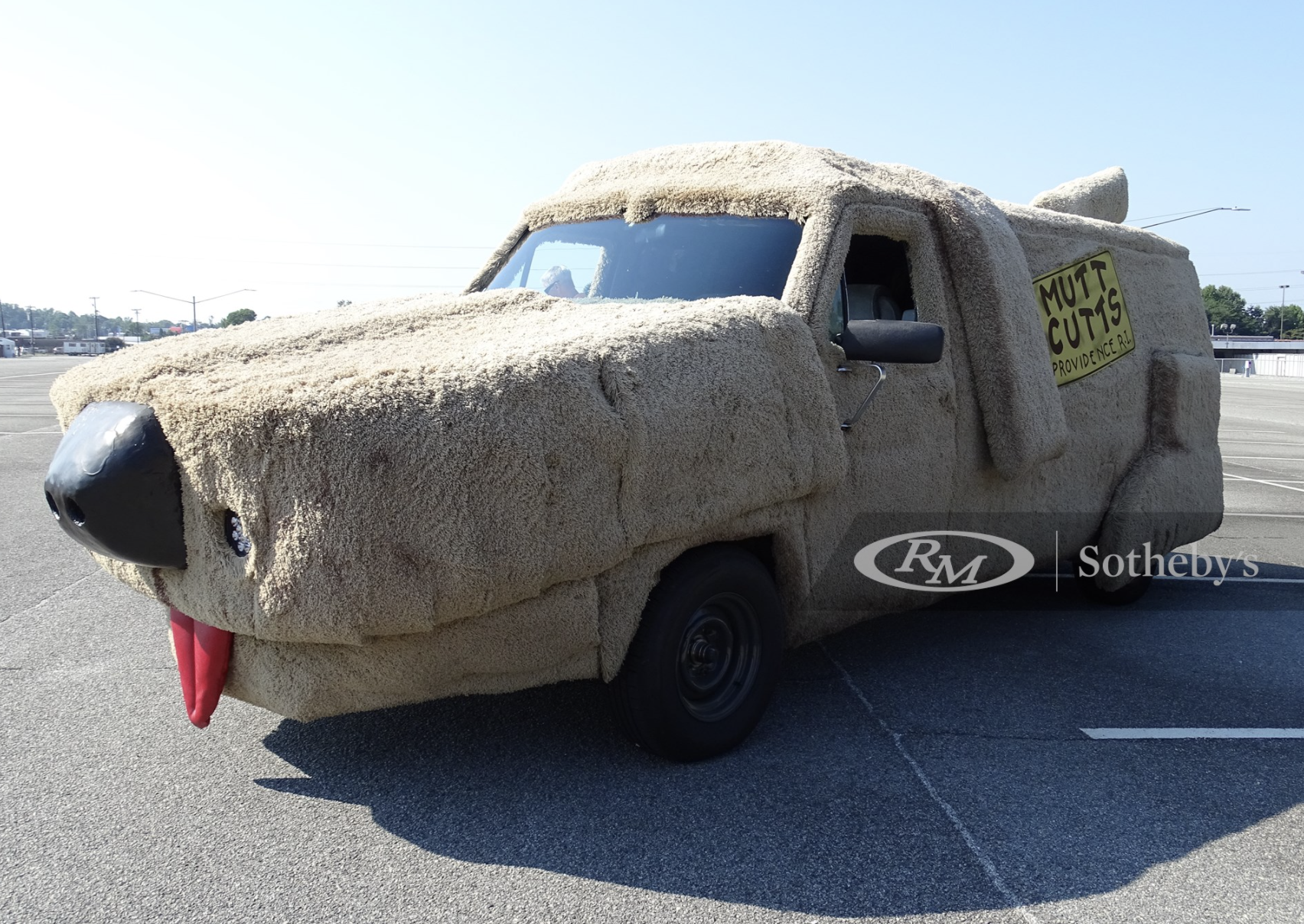
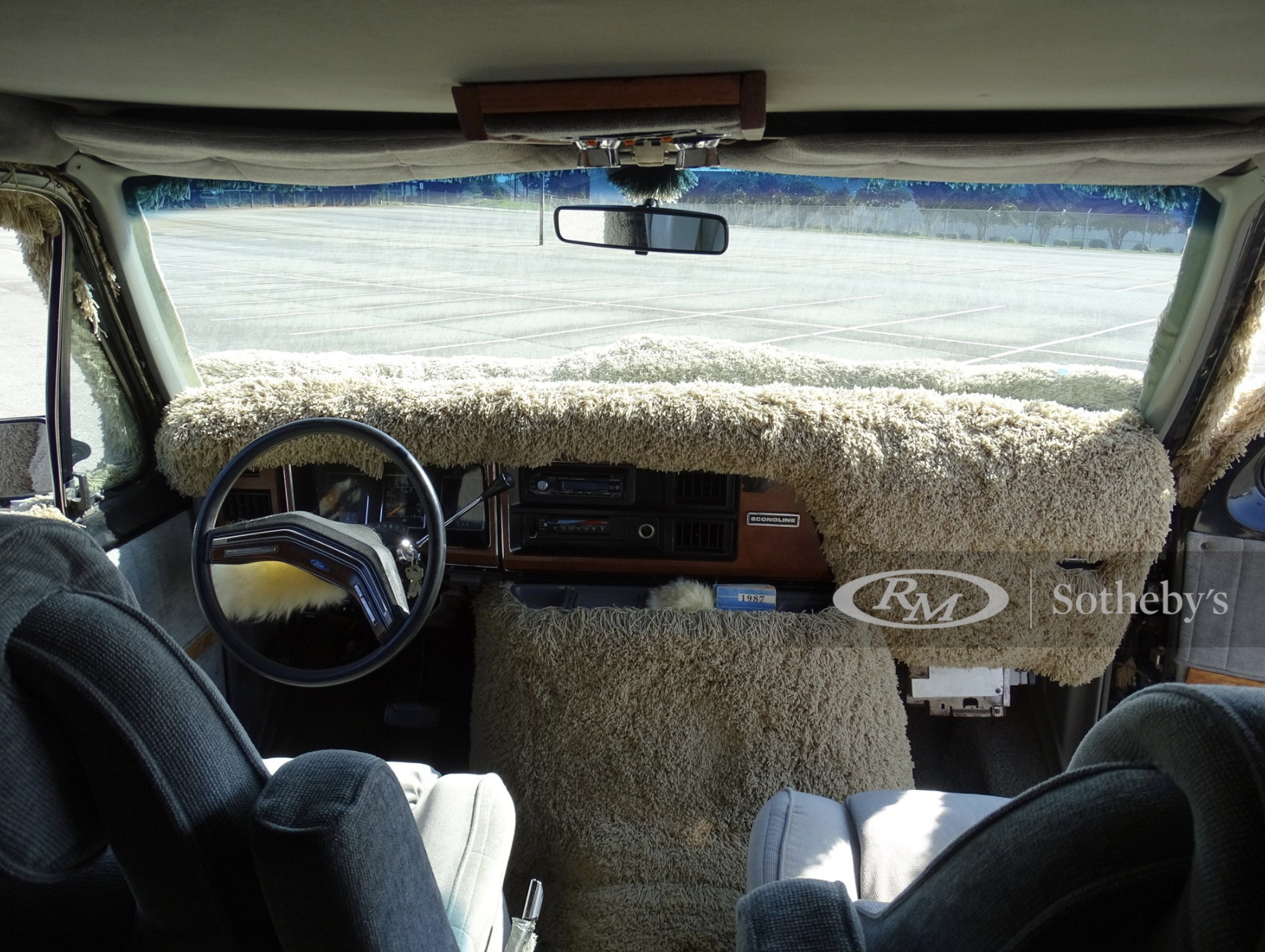
Based on a 1987 Ford Econoline E-150 Chateau van, the clone features a V8 engine mated to a four-speed automatic transmission, with a not-so-spritely 791,221 kilometres on the odometer seen in the ad listing – in addition to a prior accident at some stage over its prolonged lifetime.
While highly impractical, the van is covered in shag carpeting inside and out, with ‘Mutt Cutts’ exterior signage. It also has the face of a dog up front – in addition to an interior decorated with a number of classic scenes from the film.
As part of the sale, the van was accompanied by an operational replica of the minibike it was later traded for in the movie.
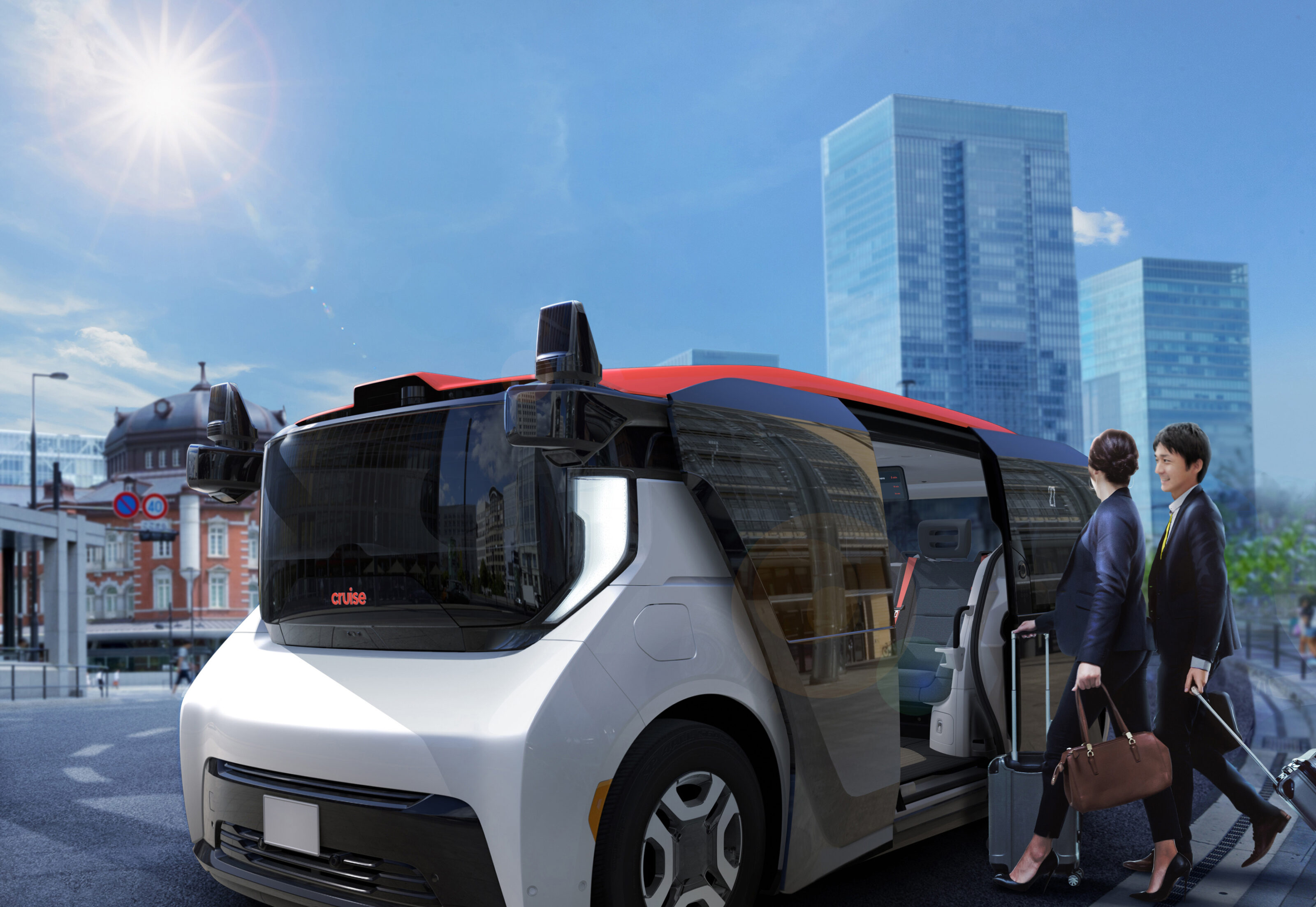
Honda has announced it will begin testing an autonomous vehicle program in Japan this month, as it continues a partnership with General Motors’s Cruise self-driving car company.
The idea of self-driving cars might seem like a long way off, but the automotive industry is quickly progressing towards an autonomous zero-emissions future, with Honda and Cruise soon to join a number of ‘robotaxi’ vehicles currently roaming around the streets of major cities across the world.
The program, known as the Autonomous Vehicle Mobility Service, will be tested in Utsunomiya City and Haga Town in Japan’s Tochigi Prefecture, with an initial focus on developing a high-definition map of the two areas using a specialised car fitted with dedicated 3D mapping technology.

Once the map has been developed, which is anticipated to be complete in 2022, the Cruise AV autonomous vehicle will be driven on public roads to test and develop its driving style as it adapts to the traffic environment, as well as the laws and regulations in Japan.
Moving forward, Honda will launch an autonomous vehicle business dubbed Maas for public transportation, using the Cruise Origin robotaxi – a driverless electric vehicle first revealed in January 2020 – developed in conjunction with Cruise and General Motors.
The program between the two companies will be headquartered within a Honda facility in the Tochigi Prefecture area.
Honda has been pushing autonomous vehicles in its home nation, with the soon-to-be-discontinued Japanese-market Honda Legend beating Tesla to the market with level three autonomy earlier this year.
Audi Australia is recalling one of its RSQ8s due to a fault which could cause potential engine damage.
The German carmaker has issued a notice for just one 2021 RSQ8.
According to the Department of Infrastructure, a crack may occur on the cylinder contact surface in the engine and the piston may be damaged or seize.
If the piston gets jammed in the cylinder, it would lead to engine damage. Additionally, the possibility of the conrod being torn off and the crankcase being pierced, and subsequently of oil escaping, cannot be ruled out – which could result in the engine stalling, losing power and potentially leading to an accident.
The VIN for the vehicle involved is WUAZZZF11MD011849.
Audi has asked the owner of the affected vehicle to schedule a service at their nearest authorised dealership, advising of the recall, to have the work carried out free of charge. Until the work has been carried out the car can be used as normal.
Or for further information Audi can be contacted on: 1800 502 834
About $40,000 drive-away or less. Crossover body style. Sporty aesthetics. Turbocharged performance.
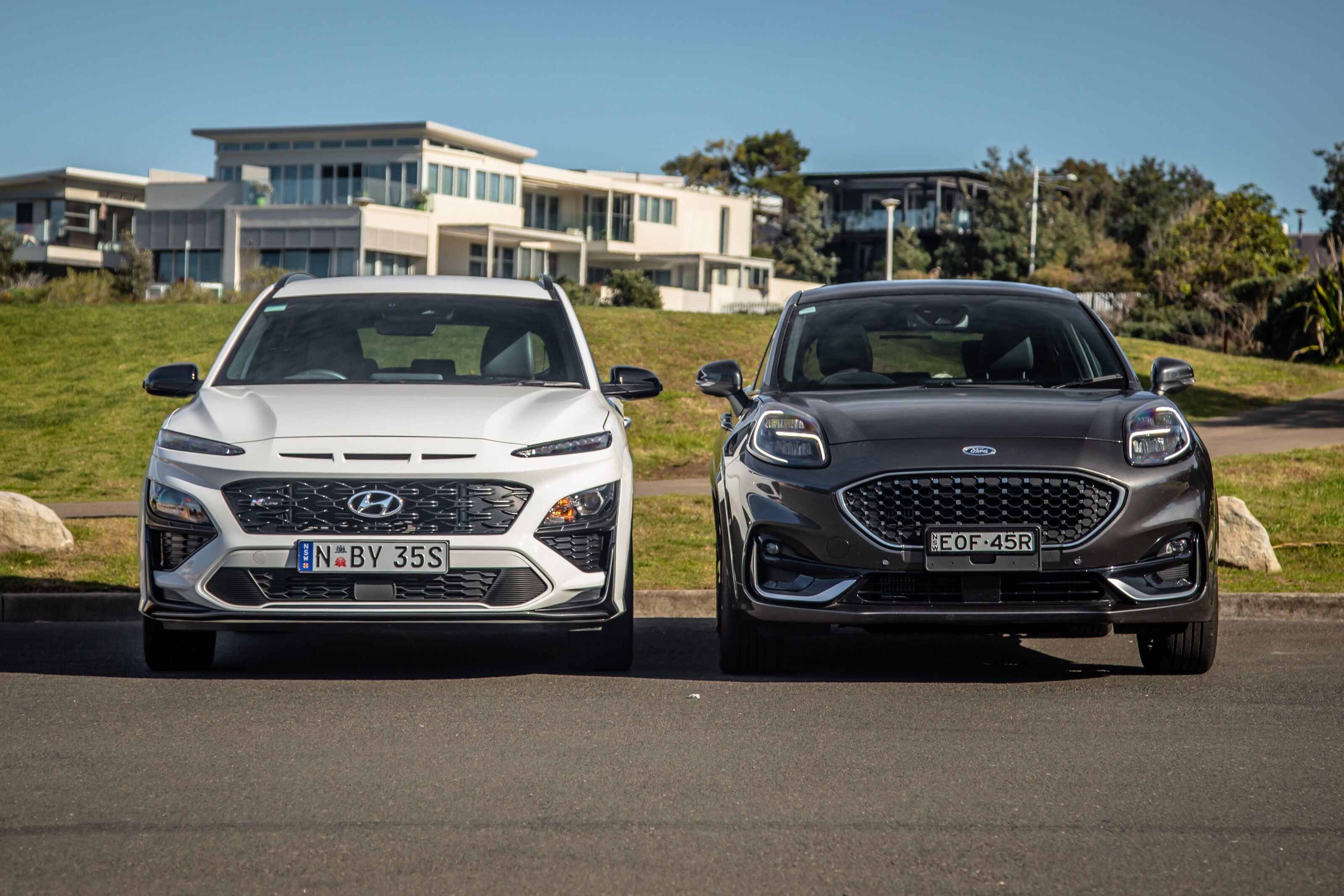
The Hyundai Kona N-Line and Ford Puma ST-Line V are two models that tick all four of the above tempting boxes.
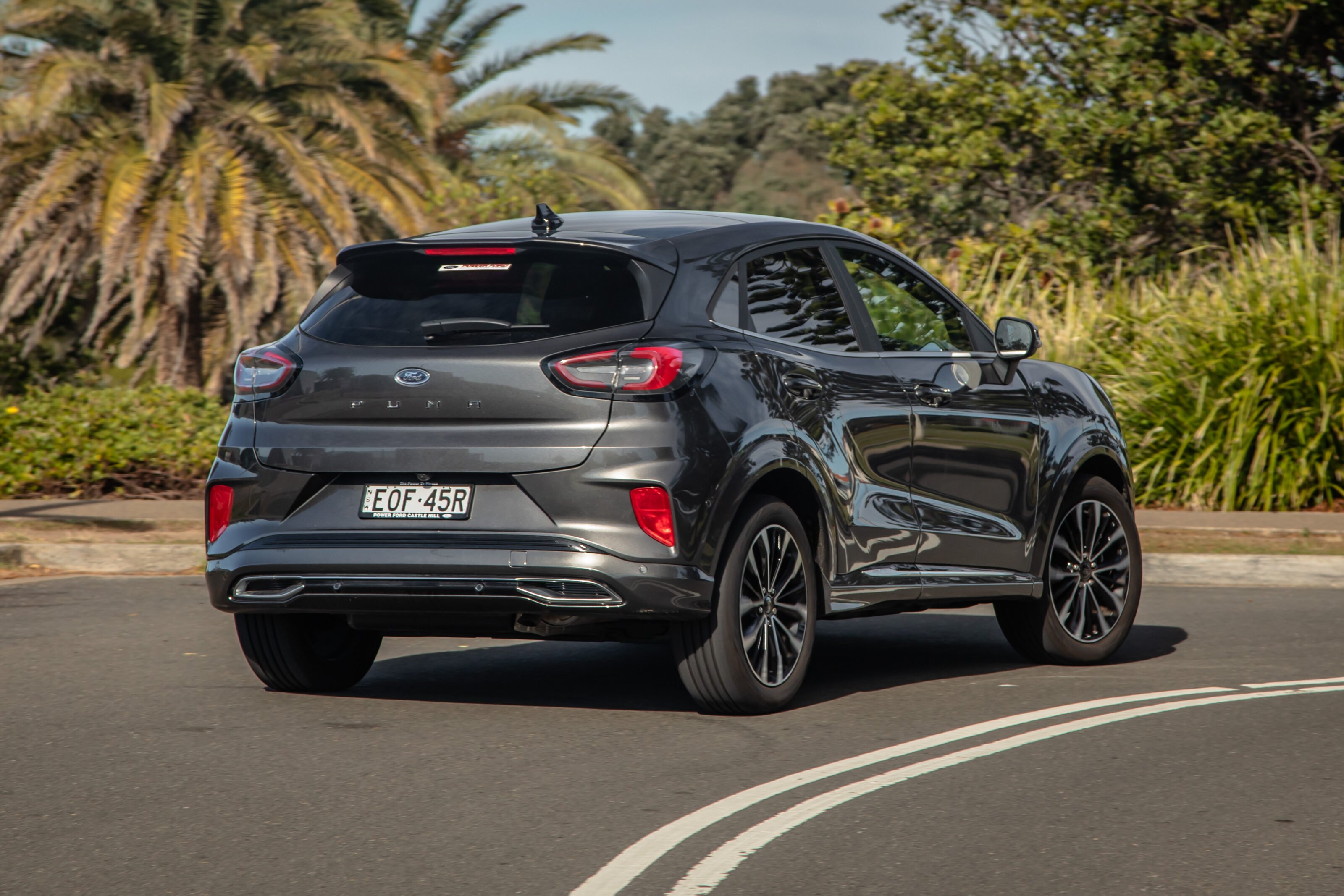
Ford’s hatchback/SUV is the newer vehicle, introduced in September 2020 as a replacement for the unloved EcoSport. It’s also Ford Australia’s entry model after the company stopped importing the Fiesta city car (except for the ST hot hatch version).
The Puma’s underpinnings are based on the Fiesta’s, where the Kona is related to the i30 small car, yet the two models are virtually identical in size at 4.2-something metres.
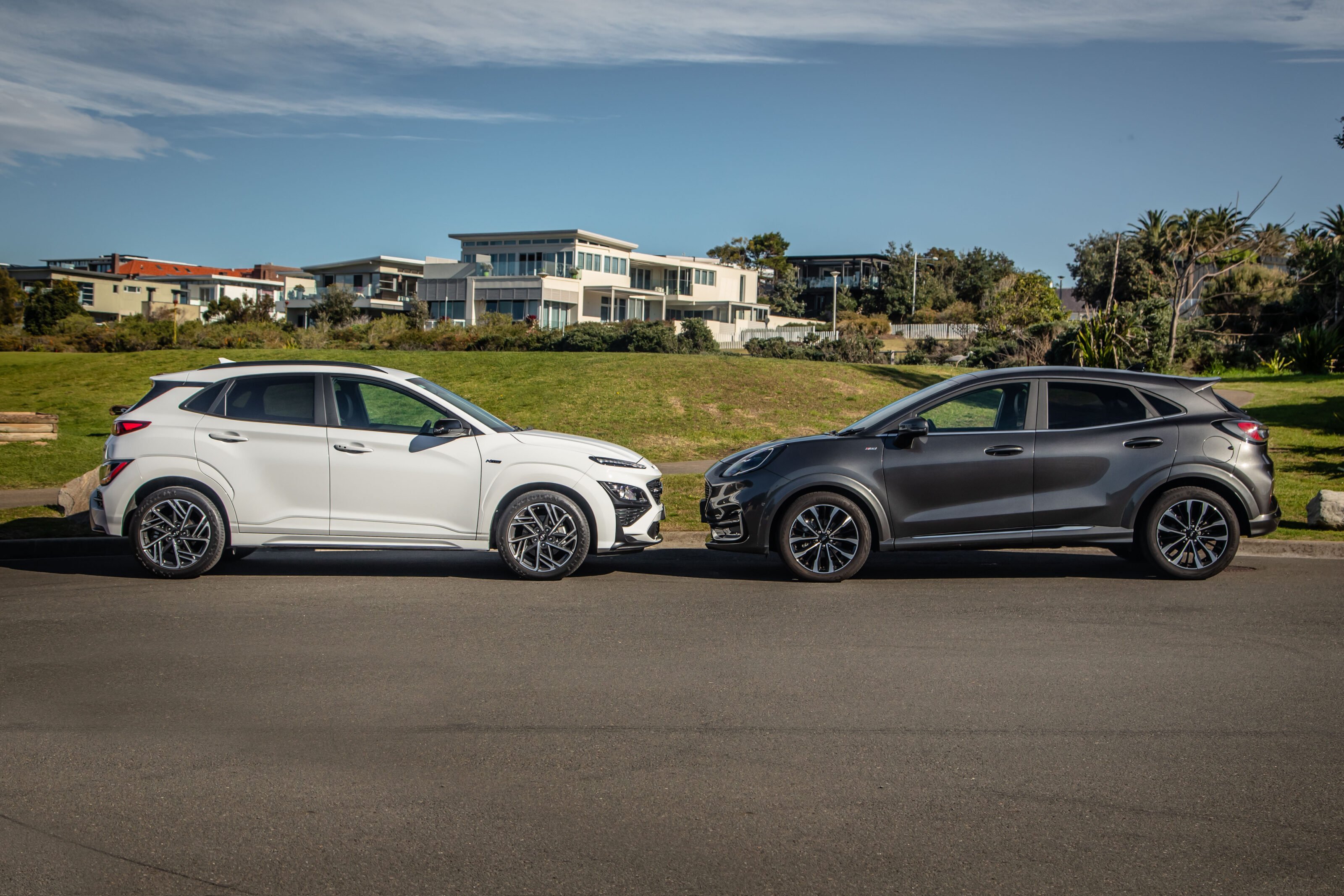
The specific variants in this comparison also share badges inspired by performance ranges.
Hyundai’s Kona N-Line, a new variant introduced in 2021 as part of a mid-life model update, ties in with the Korean brand’s N performance models, which started with the i30 N and later this year will include a Kona N.
The Puma ST-Line trades off the ST badge applied to fast Fords, which includes the Fiesta ST and Focus ST hot-hatches sold here. And there’s also a Puma ST available overseas that would make a natural rival for the Kona N, though Ford Australia has so far opted against bringing it here.
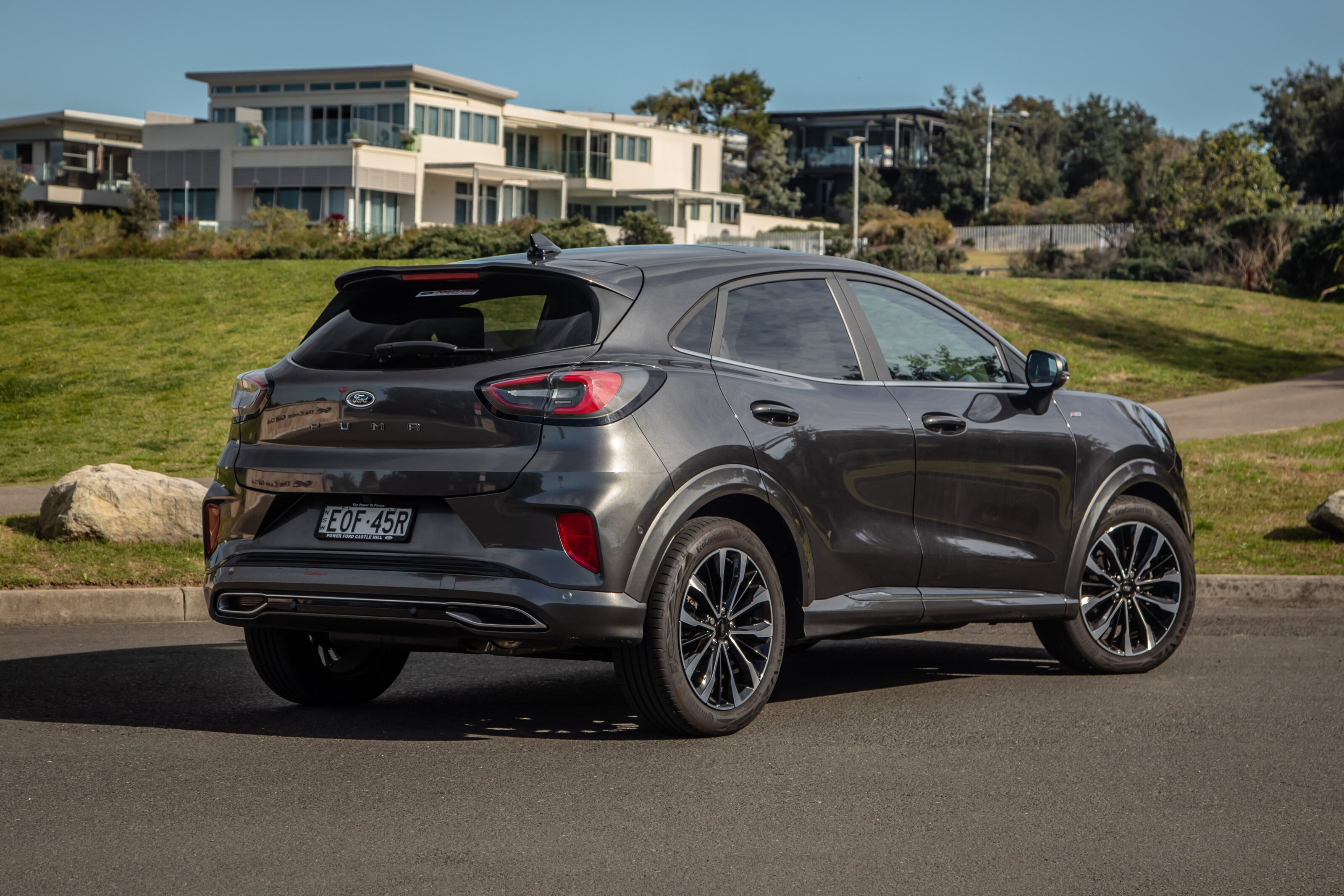
Built in Romania whereas its predecessor was made in India, the three-grade Puma range begins at $29,990 and ends at $35,540 before on-road charges (or about $39,500 drive-away) for the ST-Line V we have here.
Hyundai’s seven-tier Kona line-up starts from $26,600 before on-roads, with its N-Line variant squaring up neatly to the top Puma with a $36,300 RRP (and about $40,200 drive-away).
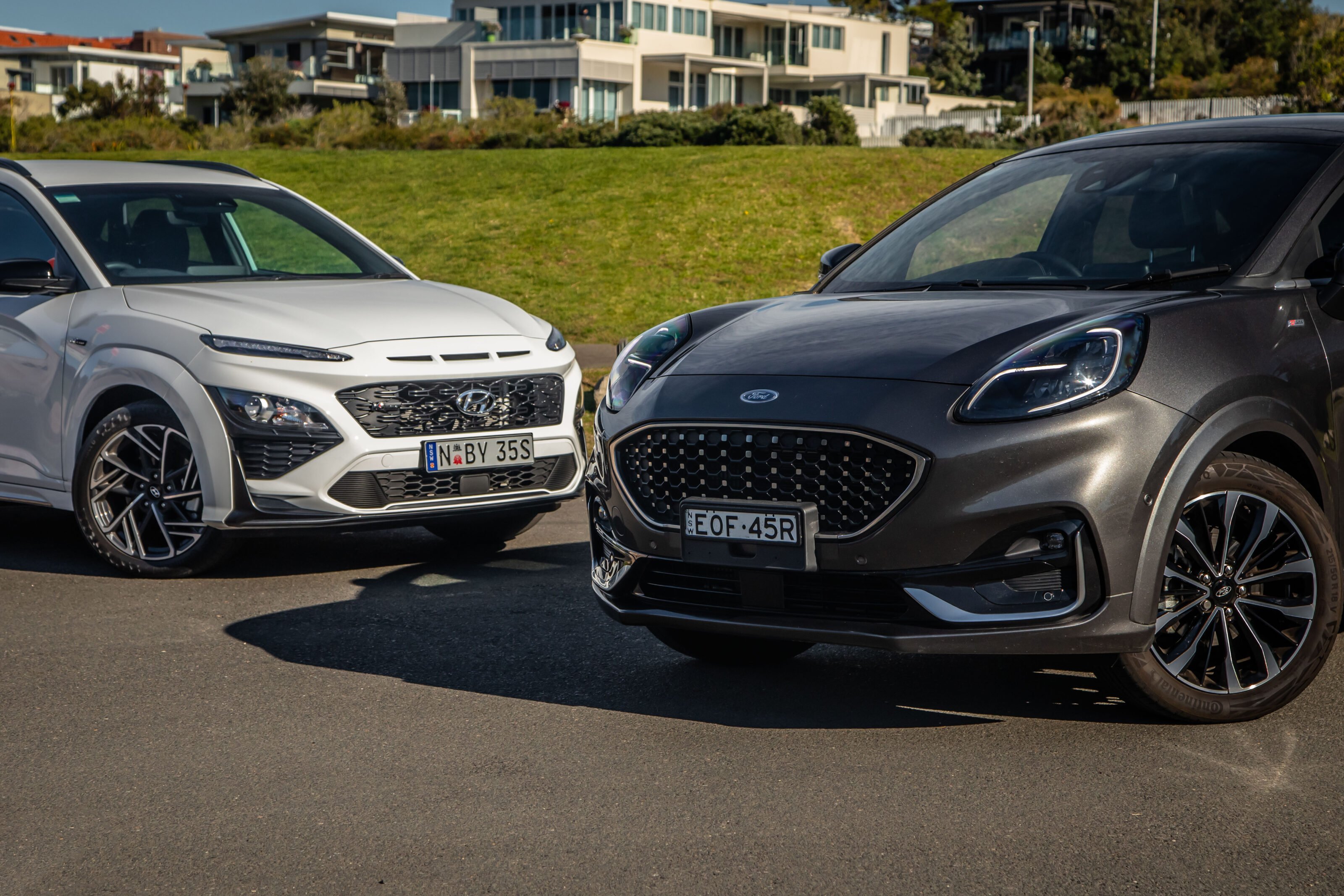
The Kona N-Line and Puma ST-Line both make visual nods to their respective N and ST performance siblings, each wearing bodykits with more aggressive-looking bumpers and extended side skirts, as well as multi-spoked 18-inch alloy wheels.
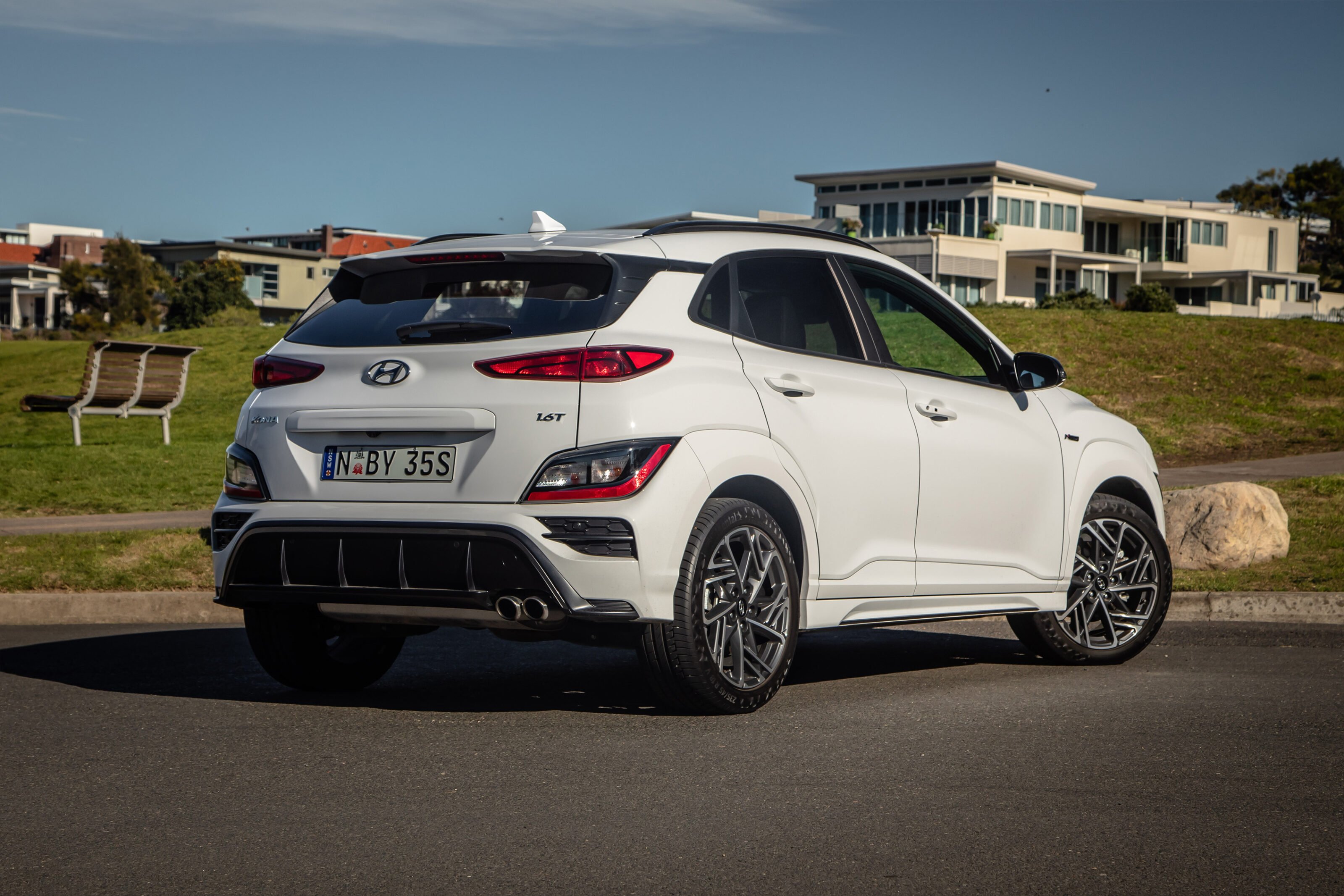
For $500, the Puma can be had with a contrasting black roof. To get the same (no-cost) option on the Kona N-Line, buyers must step up to the $42,400 N-Line Premium.
Hyundai charges $595 for premium paints, with three colours carrying no extra charge. Ford asks $650 for all colours except white.
LED daytime running lights are standard on both models but only the Puma features LED headlights. These are again found only on the N-Line Premium.
Ford’s keyless entry set-up is also slightly more advanced, allowing the closure of windows and sunroof with a hold of the lock button on the key fob. The Kona also needs a button to be pressed on the door handle to open the door.
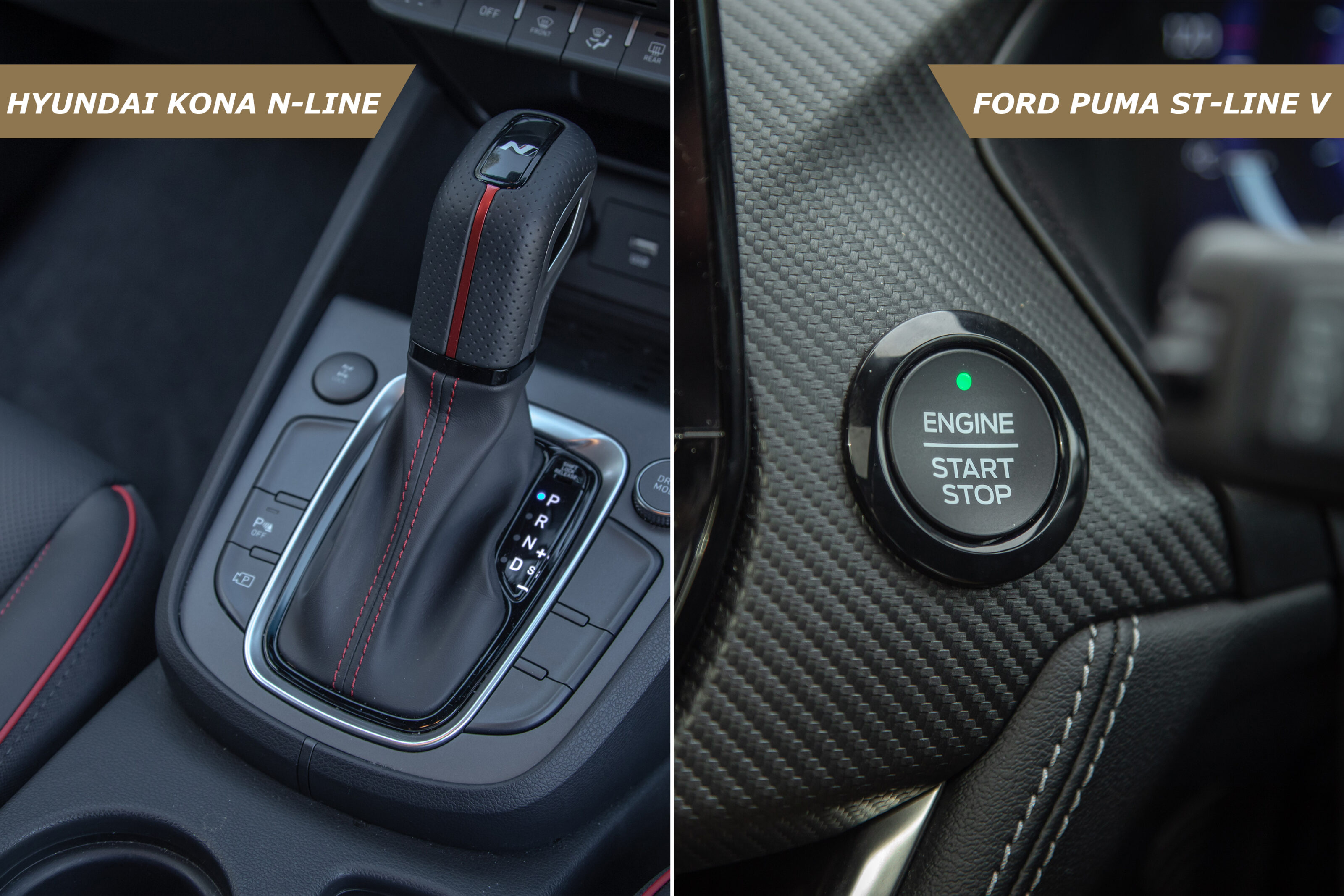
A multitude of sporty embellishments are applied to the cabins.
This includes a liberal amount of stitching in various areas, including seats and steering wheels. The stitches are red in the Kona N-Line and white in the ST-Line V (yet red in the mid-range ST-Line).
The Kona adds anodised-red touches for the gear lever and side dash vents. The Puma’s dash plastics include an infotainment and instrument cluster surround that mimics carbonfibre weave.
The Kona N-Line and Puma ST-Line both make visual nods to their respective N and ST performance siblings, each wearing bodykits as well as 18-inch wheels.
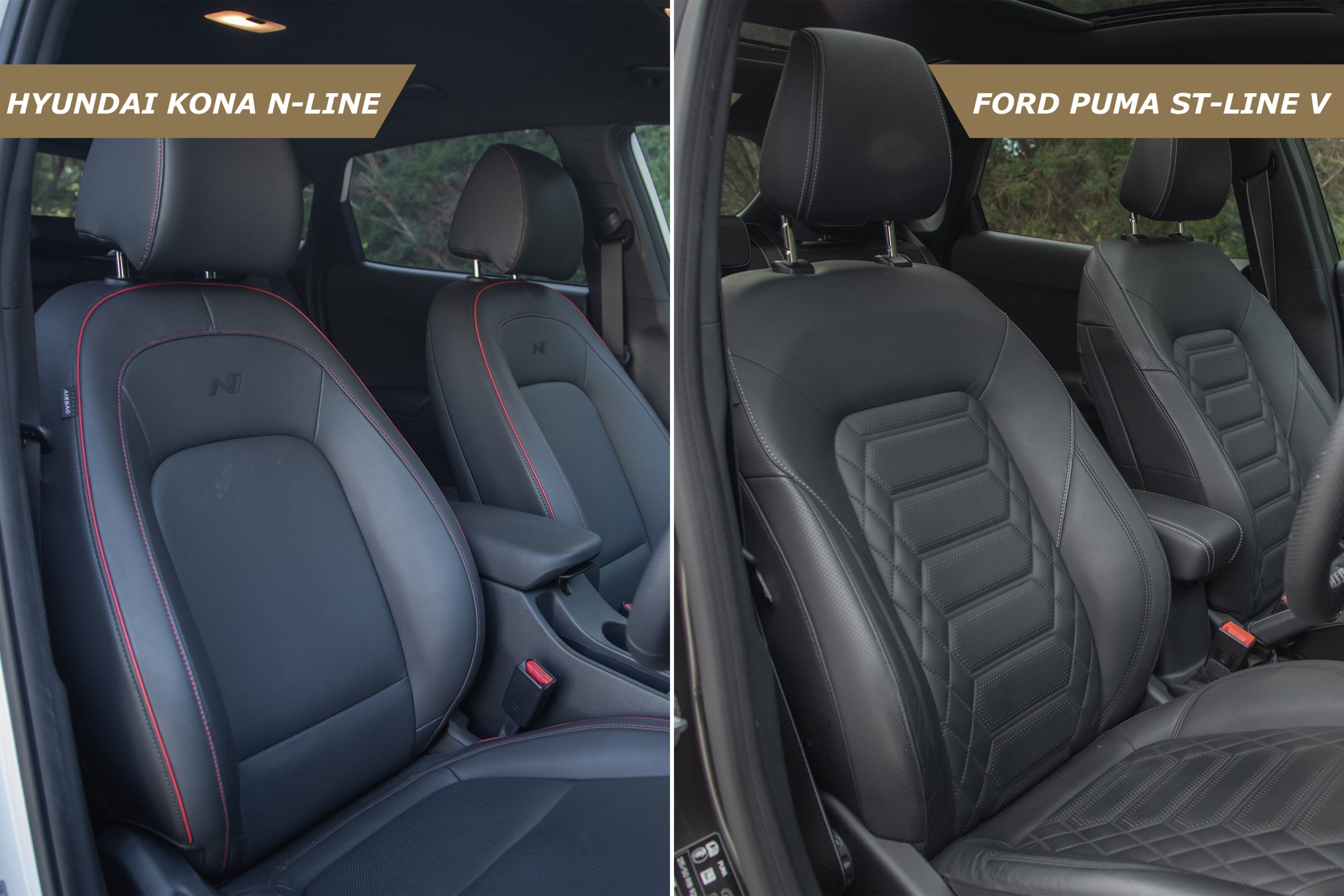
The Puma also spruces up its door trim with white-stitched leatherette panels, which overall give the Ford a slightly higher percentage of soft materials, though hard plastics are common to both interiors.
Headlining quality is higher in the Puma, which also features blue LED ambient lighting, plus an auto-dimming rear-view mirror.
While the Kona’s N-badged front seats look the sportiest here, the Puma’s are plenty supportive and upholstered in full leather where the Hyundai’s are leather-accented only.
Its manual seat adjustment all round; electric operation plus heating/cooling features on the N-Line Premium.
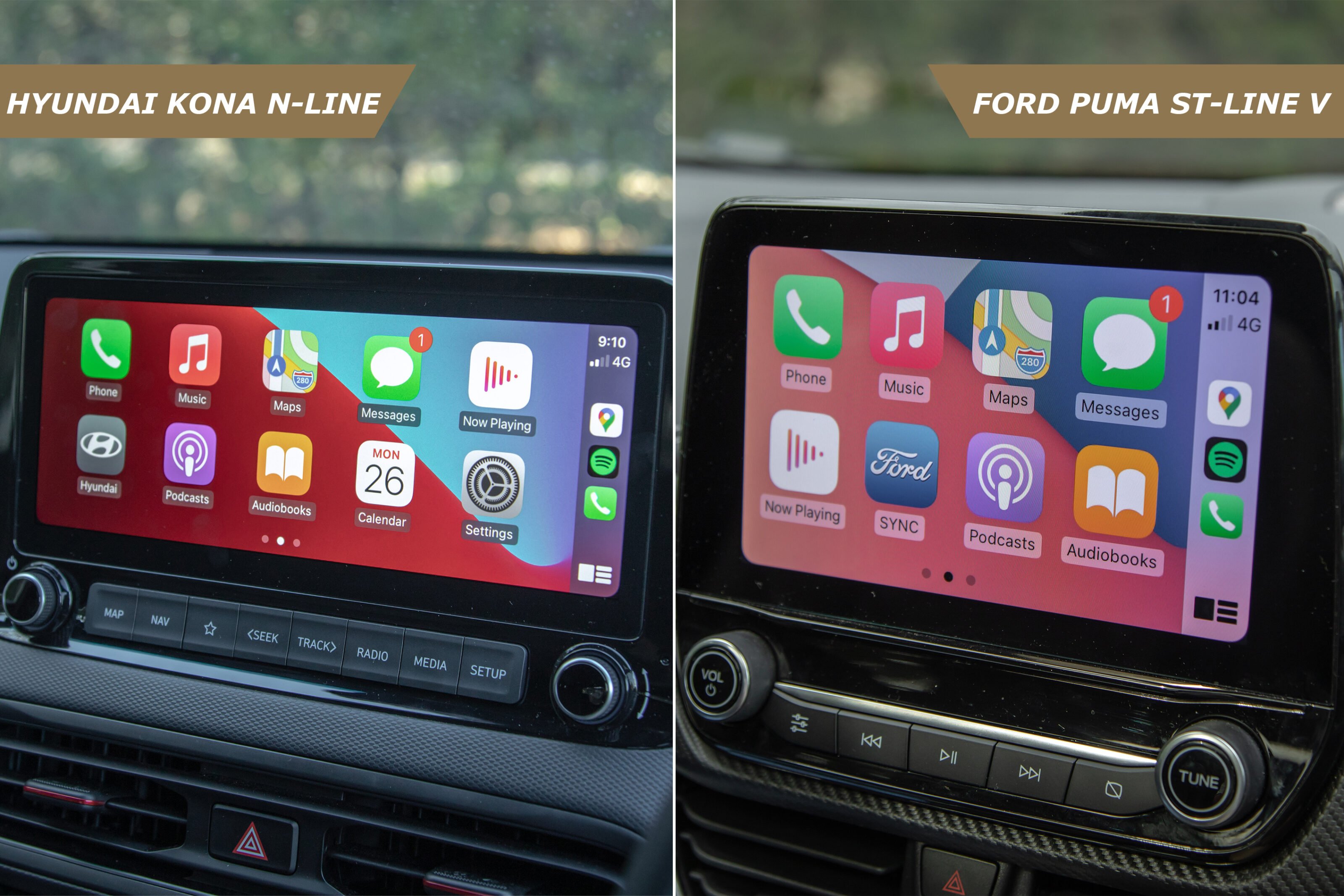
The Kona N-Line is equipped with Hyundai’s latest infotainment touchscreen – a 10.25-inch display that is smartly presented and easy to use.
Ford’s 8.0-inch display may give away 20 per cent in touchscreen real estate but it doesn’t look undersized for the cabin and its interface is brightly and sharply presented, and highly intuitive.
Each infotainment system comes with an ear-pleasing branded audio system – Harman Kardon for the Kona, B&O (Bang & Olufsen) Play for the Puma – as well as digital radio and Apple CarPlay/Android Auto smartphone interfaces. Wireless smartphone charging trays with USB ports are also shared.
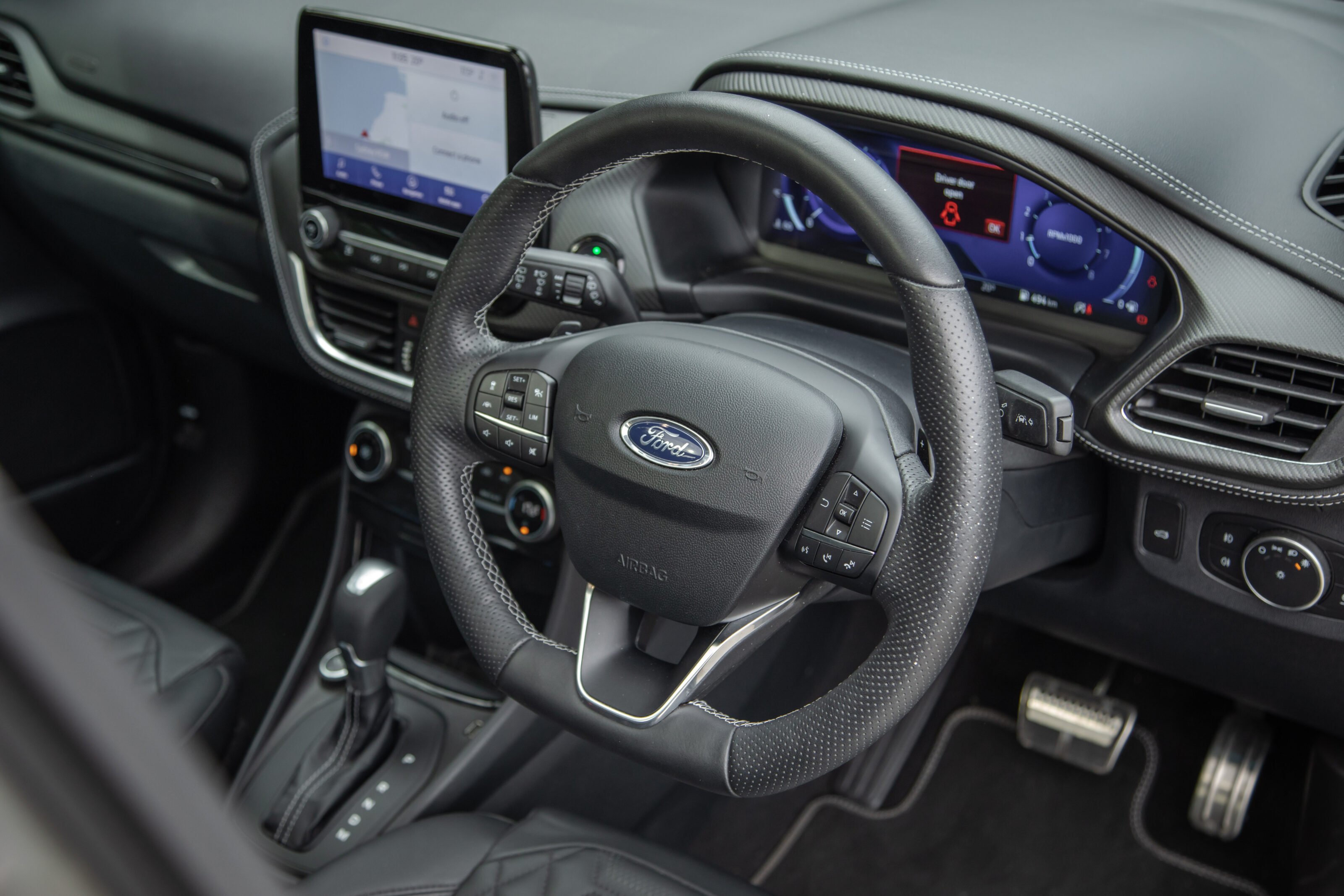
The Ford has the more sophisticated-looking instrument cluster – a 12-inch-diameter digital screen that matches the colouring and clarity of the infotainment screen. Steering wheel buttons allow the driver to flick through pages of info/functions, though there’s no option for customisable layouts as with fully digital driver displays offered by the likes of the VW T-Cross and Skoda Kamiq.
Hyundai matches that only with the more expensive N-Line Premium. The regular N-Line has a digital info panel sandwiched between conventional dials.
The Puma’s display includes a helpful speed limit notification that’s enabled by a forward camera, where the Kona’s is GPS-based and only available on the centre screen when the nav-map is being used.
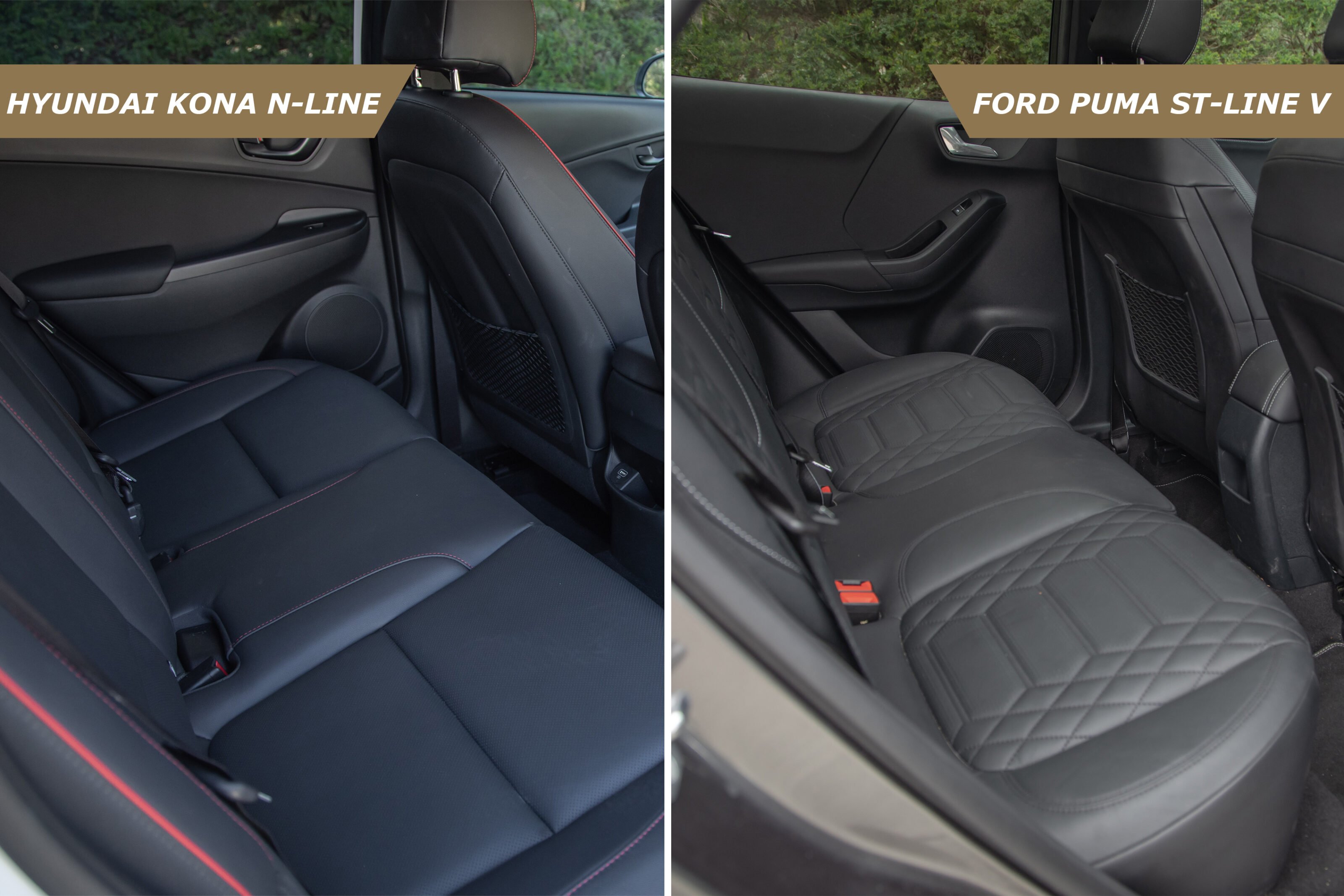
Neither the Kona nor Puma offer generous rear-seat legroom, though there’s more in the Ford if average-height adults are seated front and rear. The Puma skips a centre armrest and both models lack rear vents.
Our Puma test car was also fitted with the optional ($2000) electric panoramic sunroof, which brings extra light (and fresh air if you want) into the cabin.
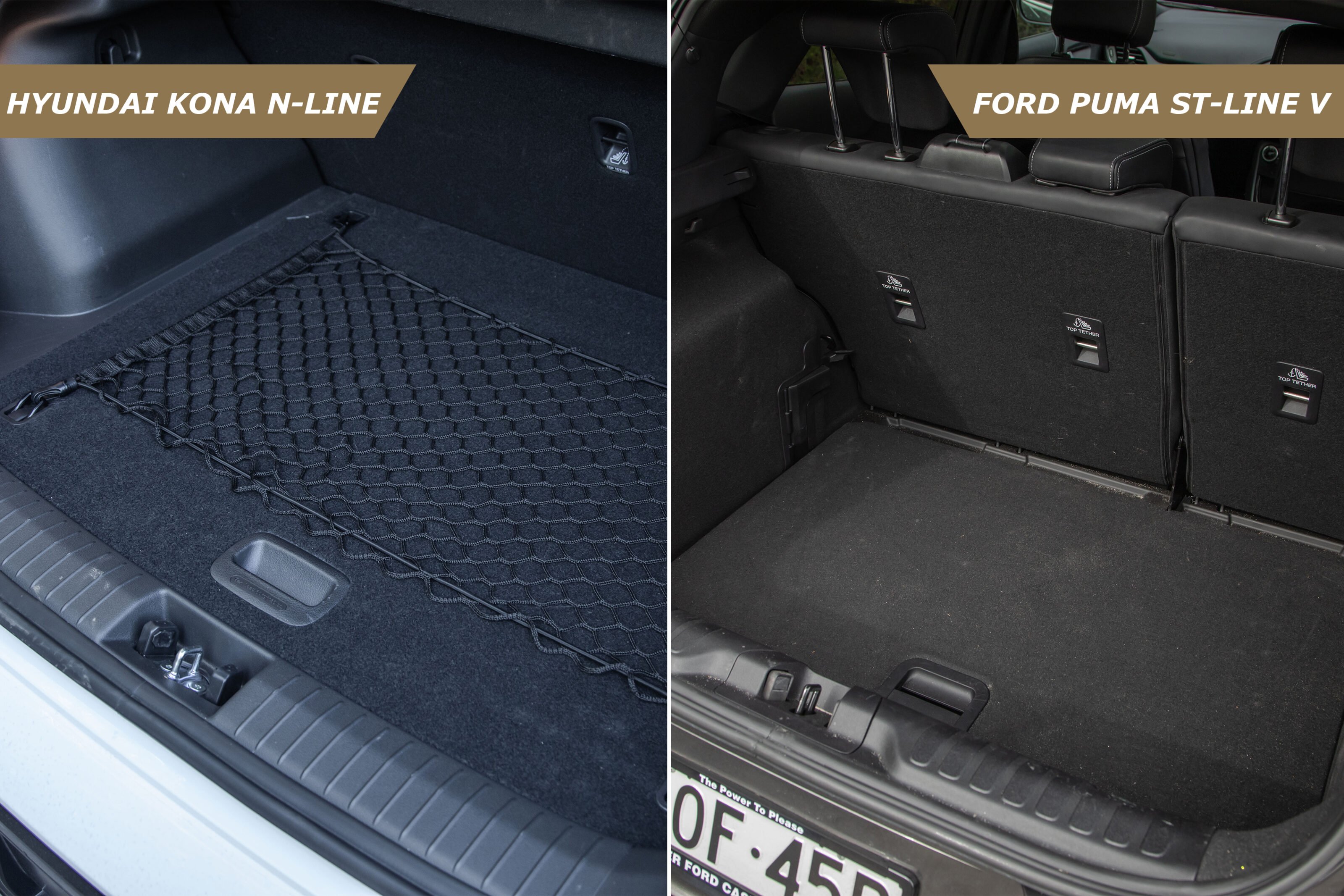
Back-seat space is less of an issue if child seats are being used, though the Puma makes for the better small-family vehicle with its superior boot.
The Kona’s luggage compartment is relatively shallow and limited in length – even making it smaller and less practical than the i30 hatch’s boot.
The Puma’s 410-litre boot volume trumps its rival’s 374 litres beyond on-paper figures. It offers greater versatility with adjustable floor levels, with the highest allowing for a flat load bay when the rear seats are folded down. The Ford also includes a handy storage tub under the floor, with access made more convenient by the ability to click the floor into an upward position.
It’s easier to fit suitcases, prams, or kids’ scooters in the Puma’s boot, which provides the extra advantage of an automatic tailgate in this ST-Line V spec.
Both vehicles include a temporary spare wheel under the boot floor, as well as tyre pressure monitoring and 24-hour roadside assistance (refreshed with each official service).
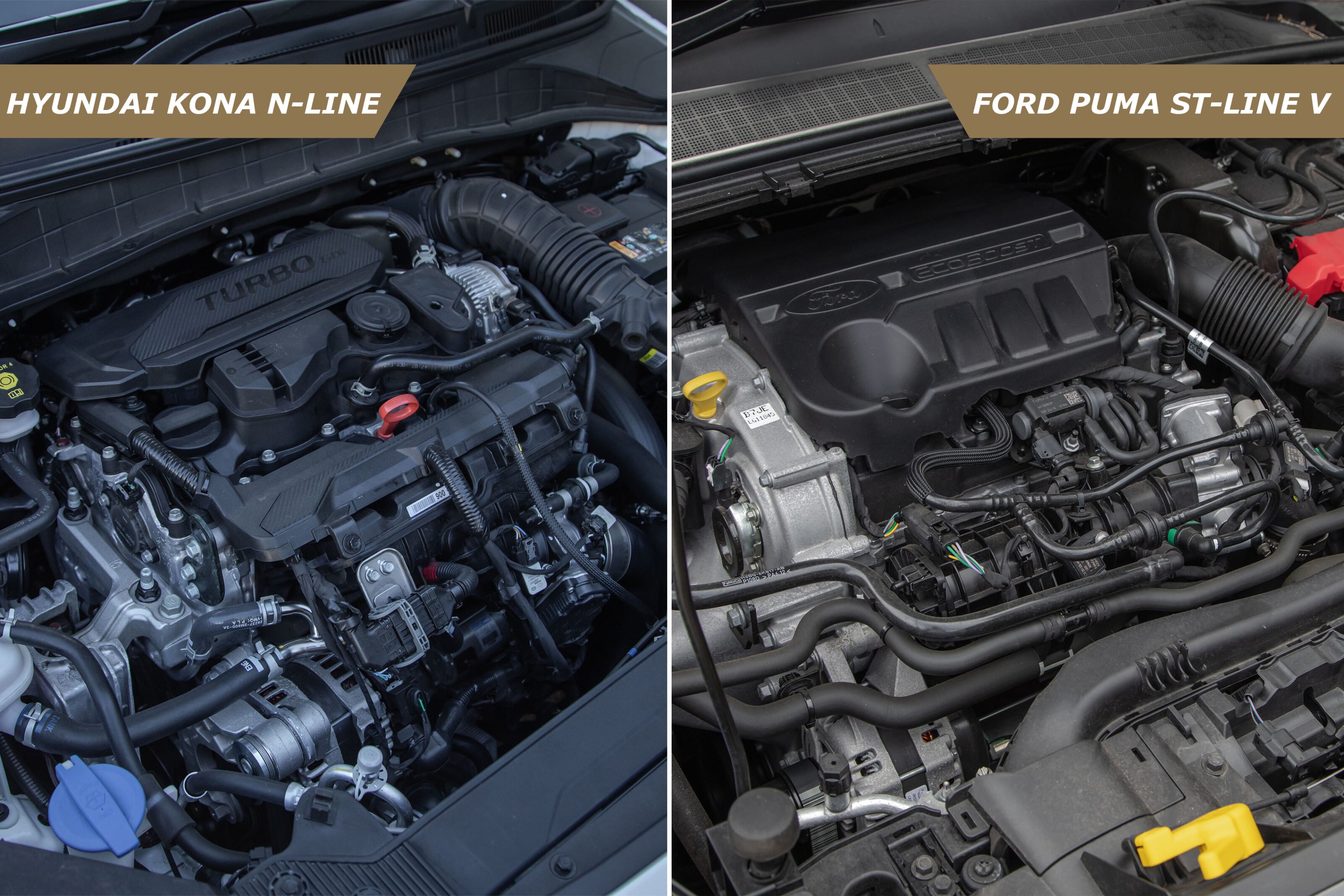
There are significant mechanical variations between the N-Line and ST-Line.
The Hyundai has multi-link rear suspension, while the Puma goes with a theoretically inferior semi-independent torsion-beam set-up (as with regular versions of the Kona).
And while both models feature turbocharged engines, the Kona has a 1.6-litre four-cylinder compared with a 1.0-litre three-cylinder for the Puma. The Kona can also send power to all four wheels via an on-demand AWD system where the Puma is front-drive only, though both use seven-speed dual-clutch automatic transmissions.
The Kona sends power to all four wheels via an on-demand AWD system whereas the Puma is front-drive only.
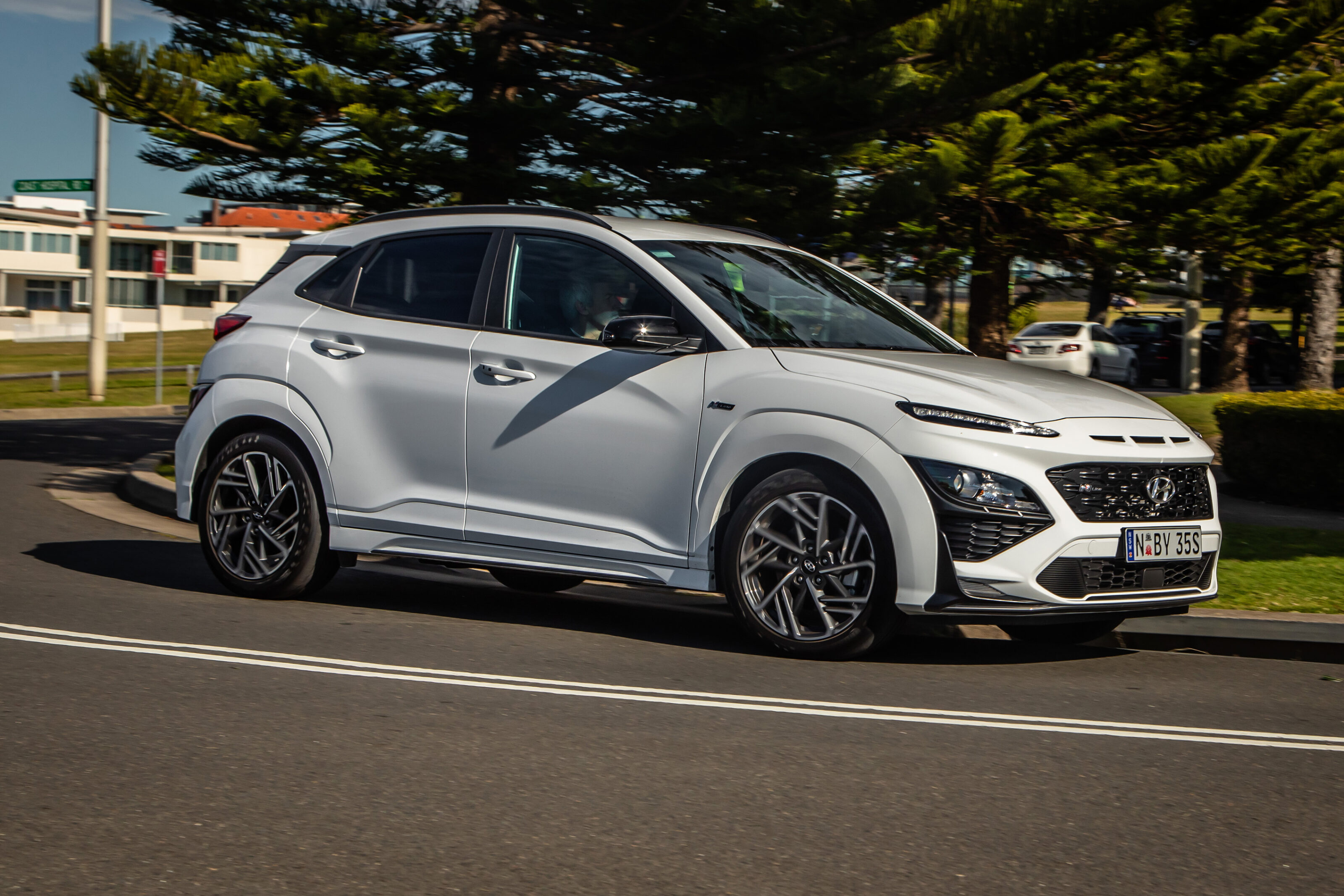
A bigger engine ensures the Kona N-Line outguns its Ford rival – producing 146kW and 265Nm for ‘warm-hatch’ levels of performance.
The Puma ST-Line V uses the same drivetrain as every variant, with frankly modest outputs of 92kW and 170Nm.
Yet this is less of an all-round performance-advantage slam-dunk for the Hyundai and more of a ball-circling-the-rim-before-dropping-through scenario.
The Hyundai undoubtedly offers stronger in-gear acceleration, and its all-wheel-drive system gets it off the line quicker (though neither manufacturer provides 0-100km/h sprint claims).
In everyday driving, however, the Puma feels more responsive at the throttle pedal without feeling overly reactive. The fizzy three-cylinder feels particularly alert at low to medium speeds, helped by an auto that is quick to shift down a gear if needed. There’s audible character in the form of the engine’s trademark warble.
In contrast, the Hyundai’s auto seems to have been calibrated with a fuel-economy bias, and its determination to keep revs below 1500pm makes the Kona N-Line lack the Puma’s relatively effortless feel.
There is a simple fix: rotate the Drive Modes dial on the centre console to move from the default Comfort to Sport. This brings much livelier progress, though the tendency to hang onto gears longer means Sport mode may become tiring if used for too long around town.
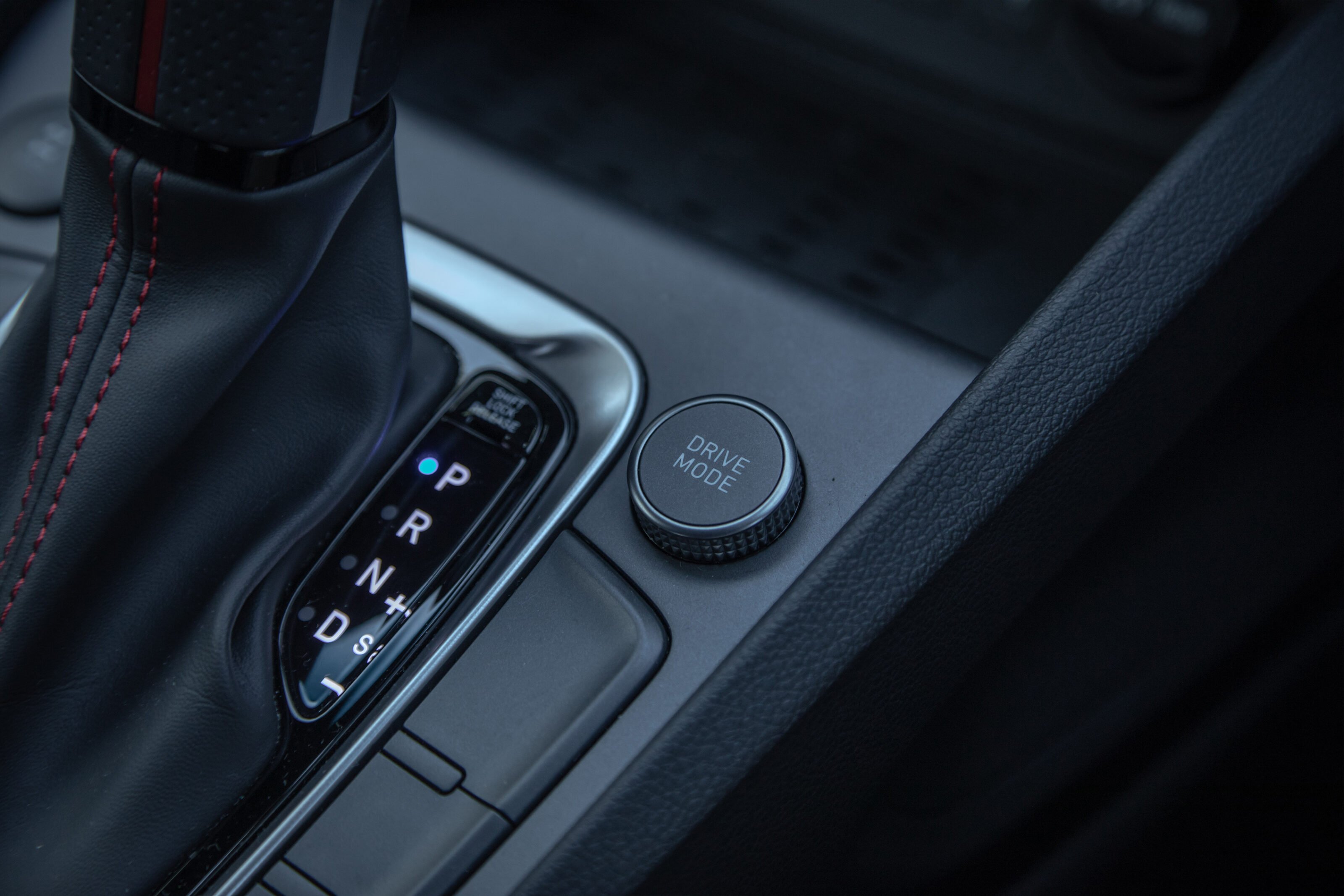
A Sport mode is also available in the Puma, though it’s arguably redundant for all but the twistiest of country roads such is the sufficient enthusiasm of its Normal setting.
And when you do encounter such roads, the Ford is in a league of its own for driver enjoyment. This applies beyond this comparison to the entire segment.
The Puma’s chubbier, perforated steering wheel not only feels more tactile in the hands but delivers a stronger sense of connection to the vehicle’s front end.
The Puma has a playful nature that showcases the DNA it shares with the Fiesta ST. The Hyundai offers driver confidence with its grippy tyres and tied-down chassis.
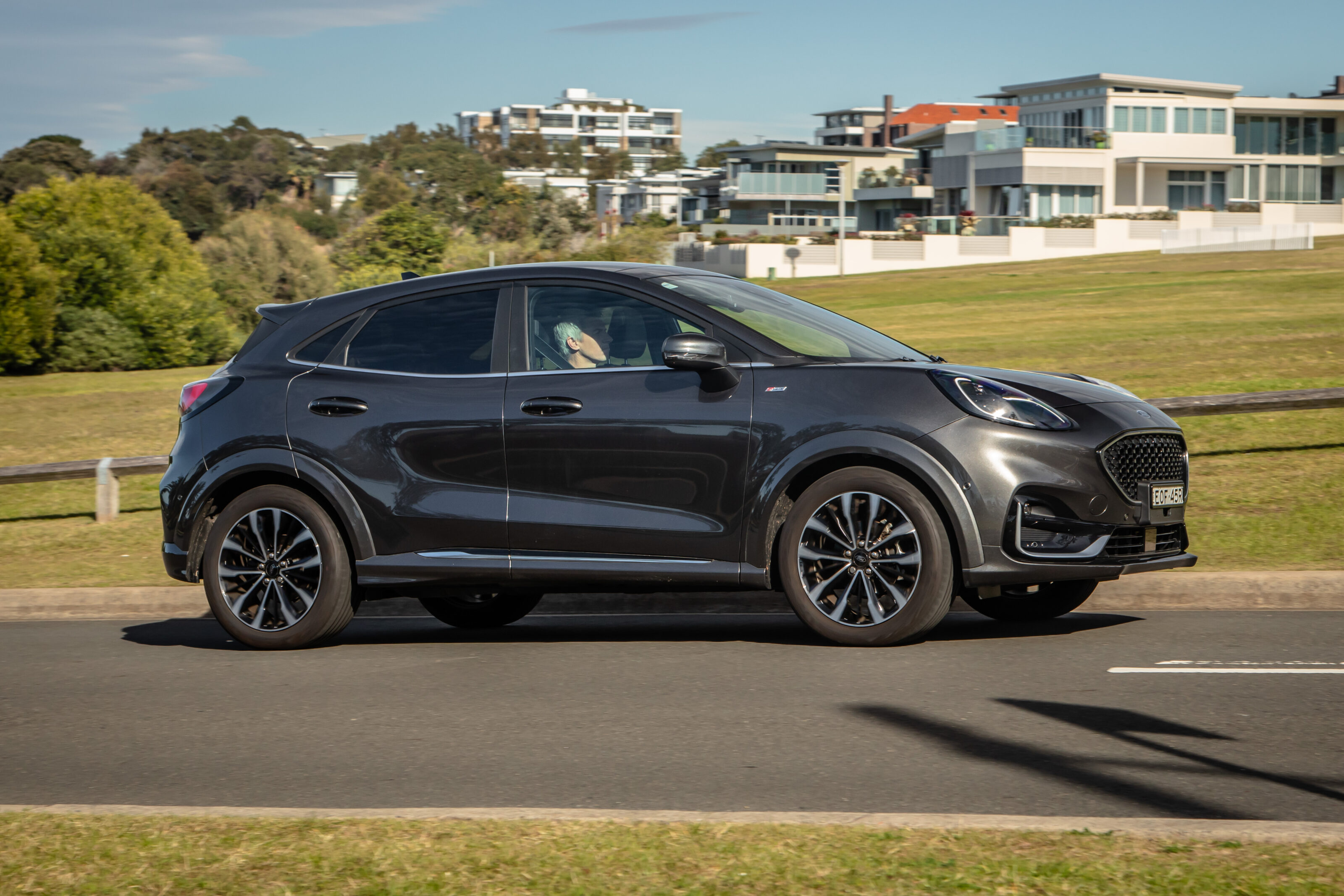
Turning in to corners more keenly than the Kona N-Line and feeling even more poised with directional changes, the Puma has a wonderfully playful nature that showcases some of the DNA it shares with the Fiesta ST.
It imparts this feeling irrespective of speed, so the Puma is rewarding to drive even when navigating suburban streets and roundabouts.
The Puma, with a kerb weight of 1291kg, is also notably lighter than the N-Line that’s closer to 1500kg.
That’s not to suggest the Kona N-Line is dull by any means. A dynamic link to the i30 N hot-hatch may be more tenuous than that of the Puma-Fiesta ST relationship, but the Hyundai offers its driver copious amounts of confidence with its grippy tyres, tied-down chassis, and nicely modulated brakes.
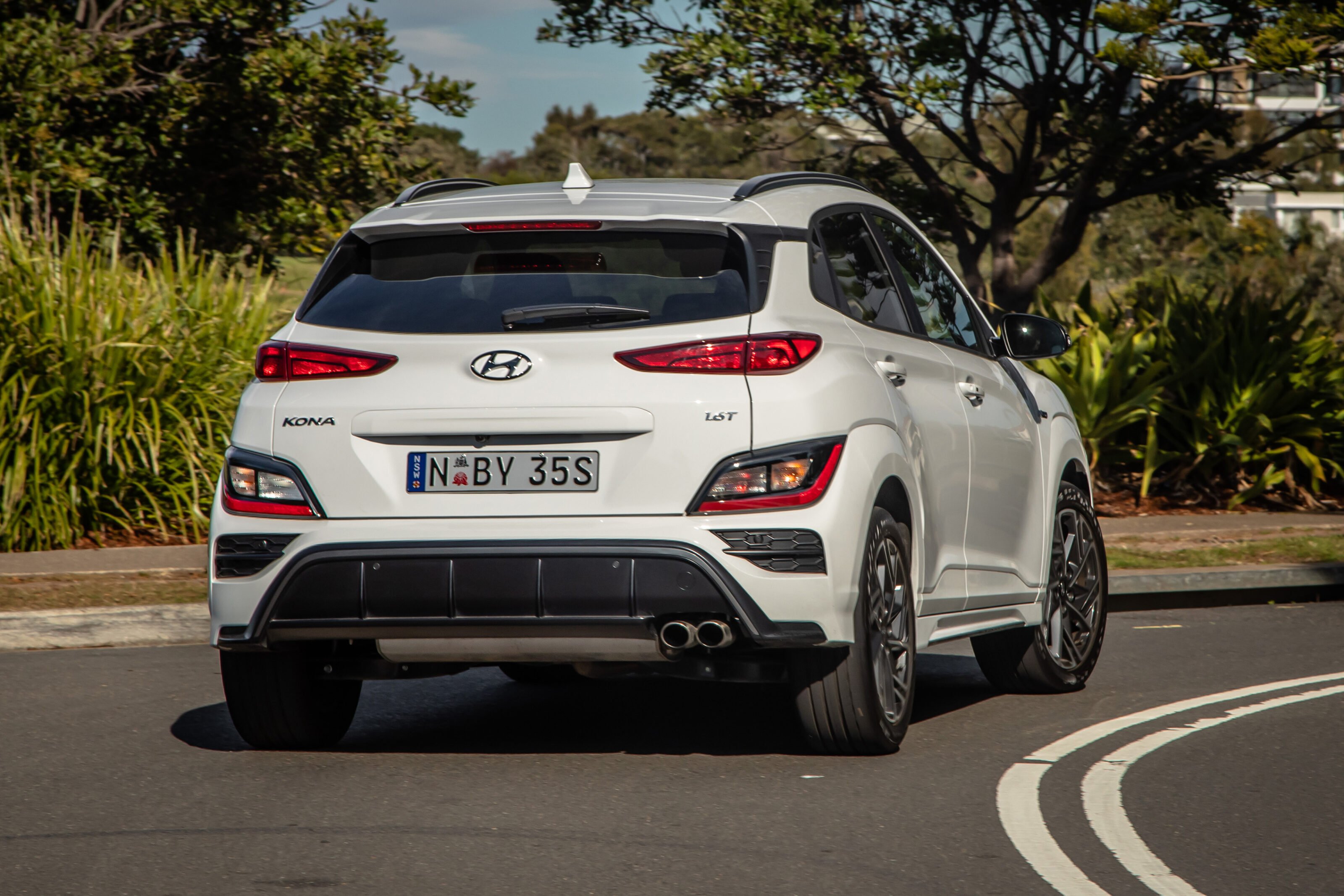
To best enjoy the Kona, however, its Lane Keep Assist system must be switched off (done by holding the steering wheel icon on, well, the steering wheel for a couple of seconds).
The system, at 60km/h and above, can otherwise act like a phantom driver, making small tugs at the steering wheel in the frequently erroneous belief that the Kona is crossing lane markings.
It’s a default setting, unfortunately. The Puma has a similar system, yet you wouldn’t know it existed unless the vehicle is actually encroaching on lane markings without indicating.
The Ford’s driver-assistance technology isn’t complete without a $1500 Park Pack, however. Only with this can the Puma match the Kona N-Line’s standard adaptive cruise control, blind-spot monitoring and rear cross-traffic alert.
It also gives the Puma front parking sensors and a semi-auto parking system as advantages, while auto high-beam is standard. Front sensors and anti-dazzling headlights are available only on the Premium version of the Kona N-Line.
Both crossover vehicles have a firmish ride, the tuning of springs and dampers aligned with their respective performance-inspired N-Line and ST-Line badges.
Crucially, both models provide adequate comfort to ensure they’re not tiresome for daily driving. The Kona has the slightly more supple suspension, while the Puma is slightly better at absorbing bigger bumps.
Running costs will depend on your typical annual mileage and fuel-grade preference.
The Kona N-Line’s engine can run on regular unleaded to help keep costs down, where the Puma requires 95 premium unleaded as a minimum. Our testing suggests there should be some offset for the Ford, which averaged a bit over a litre less than the Hyundai every 100km.
Just don’t expect to match quoted fuel consumption figures of 5.3L/100km for the Puma or 6.9L/100km for the Kona, unless you’re doing a significant amount of freeway driving.
Servicing costs are similar over three years (Kona $957; Puma $1010) and not wildly different over five years (Kona $1595; Puma $1895). However, the Hyundai’s mileage intervals are short at 10,000km, where the Puma’s intervals are the 15,000km industry average.
Ford and Hyundai provide five-year factory warranties.
It wouldn’t be unfair to remark that the $40,000-odd required to drive away in a Ford Puma ST-Line V and Hyundai Kona N-Line is quite steep for a compact crossover.
For less money than this Puma, you could have the brilliant Fiesta ST hot hatch that comes with a more powerful engine. In the case of the Kona, you could have an i30 N-Line hatch for several grand less, or, for similar money, an i30 N-Line Premium that comes with significantly more features.
This pricing quirk is common to the compact SUV segment in which the Puma and Kona reside.
For less money than this Puma, you could have the Fiesta ST that comes with a more powerful engine. In the case of the Kona, an i30 N-Line hatch for several grand less.
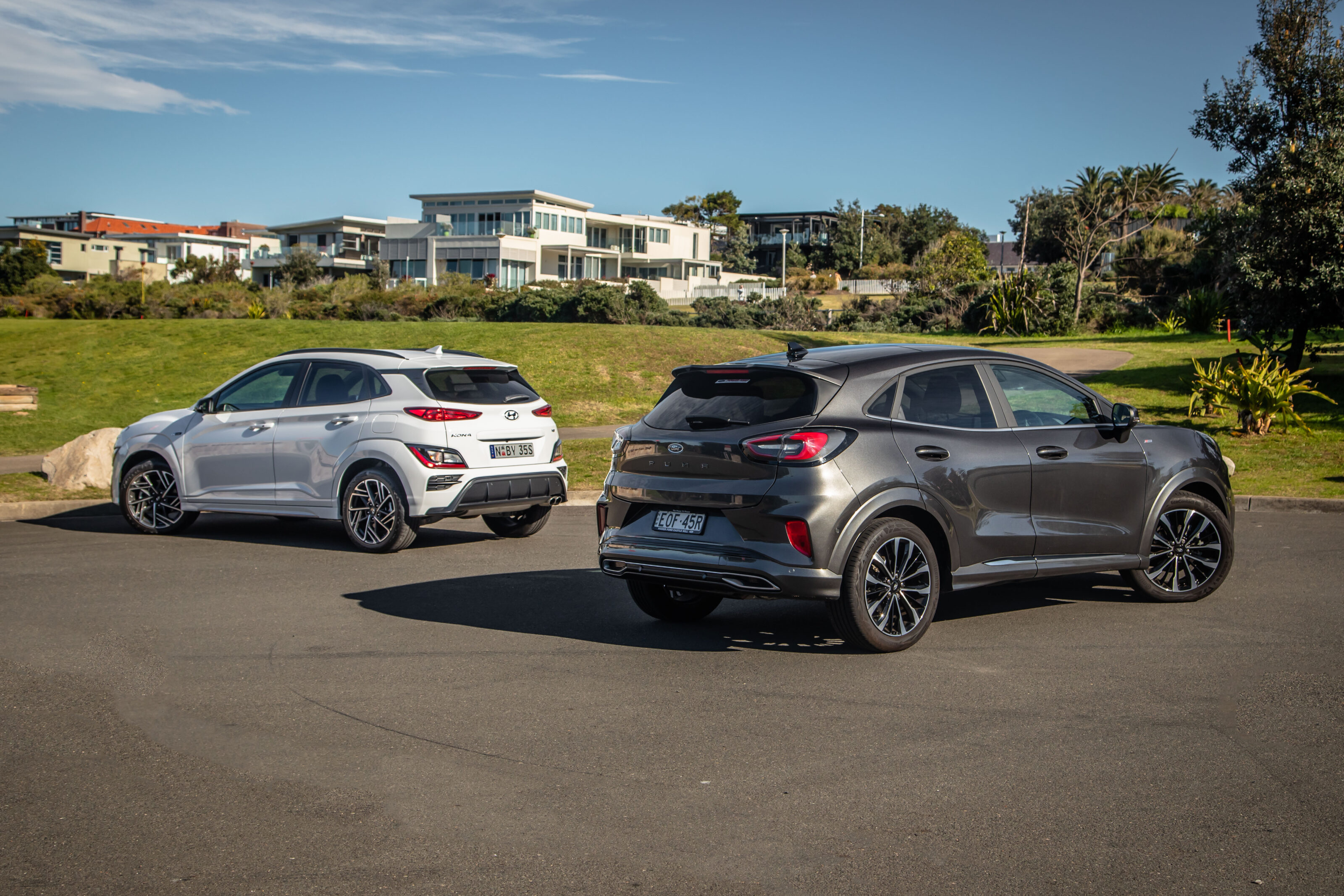
A key distinction for the Puma, however, is that it’s bigger and more practical than the Fiesta on which it’s based, while the Kona is smaller than the i30 hatch and has a less practical boot.
The Puma also bests the Kona for interior and luggage space, while also offering many features that are either missing from the Hyundai or can only be matched by opting for the more expensive N-Line Premium.
The Kona N-Line does have the advantage of all-wheel drive, though we’d suggest it’s a debatable one for the typical compact SUV owner. The Puma does include Trail/Slippery driving modes to help its front wheels deal with, respectively, looser and wetter surfaces.
Also take into account that the Puma ST-Line V puts more of the ‘ST’ into the way it drives than the Kona N-Line puts the ‘N’ into its motoring, and overall there’s a clear winner here.
2021 Hyundai Kona N-Line vs Ford Puma ST-Line V specifications
| u00a0 | Hyundai Kona N-Line | Ford Puma ST-Line V |
|---|---|---|
| Body | 5-door crossover | |
| Drive | On-demand AWD | FWD |
| Engine | 1.6-litre turbo 4-cylinder | 1.0-litre turbo 3-cylinder |
| Transmission | 7-speed dual-clutch auto | |
| Power | 146kW @ 6000rpm | 92kW @ 6000rpm |
| Torque | 265Nm @ 1600-4500rpm | 170Nm @ 1500-4500rpm |
| Bore/Stroke | 75.6/89.0mm | 71.9/82.0mm |
| Compression ratio | 10:1 | 10.5:1 |
| 0-100km/h | N/A | |
| Consumption (combined) | 6.9L/100km | 5.3L/100km |
| Weight | 1504kg (max) | 1291kg |
| Suspension | Front strut/Rear multilink | Front strut/Rear torsion beam |
| L/W/h | 4215/1800/1560mm | 4207/1805/1548mm |
| Wheelbase | 2600mm | 2588mm |
| Brakes | 305mm/284mm | N/A |
| Tyres | 235/45R18 | 215/50R18 |
| Wheels | 18-inch alloy | |
| Price (before ORCs) | $36,300 + ORC | $35,540 + ORC |
Nissan Motor Company has had some good times and some not so happy periods. Fans of the brand have seen the enthusiast car portfolio wither of late. There hasn’t been a hot hatch worthy of the name for years, the promising Infiniti premium launch proved an abject failure here in Australia and both the 370Z and R35 GT-R coupes are in their teens now. Of course, the new Z car promises a shot in the arm, but it’s all still a far cry from the heady days of 1989.
Japanese manufacturers were overflowing with cash thanks to Japan’s booming economy, and Nissan in particular wasn’t shy about throwing ludicrous amounts of development dollars at its product catalogue. Maybe it was all too much. A culture of costs excesses within that bubble economy landed the Yokohama brand in fiscal hot water by the end of the ’90s, forcing a 44.3 per cent buyout from Renault, the cultural repercussions of which the business still seems to be grappling with.
There’s a reason many refer to that time period as Japan’s Golden Era of motoring. Those were the halcyon days, the likes of which we may never see again.
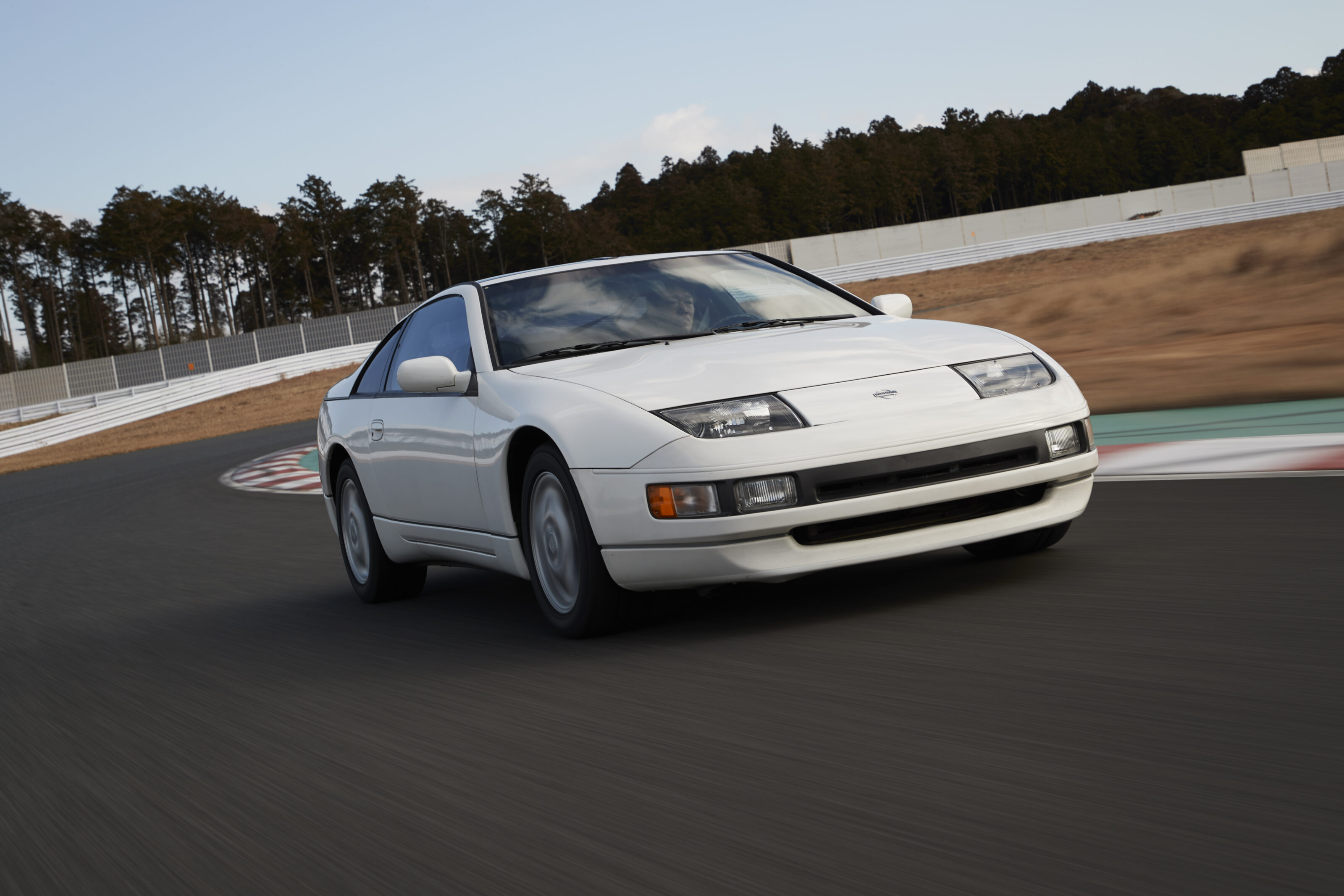
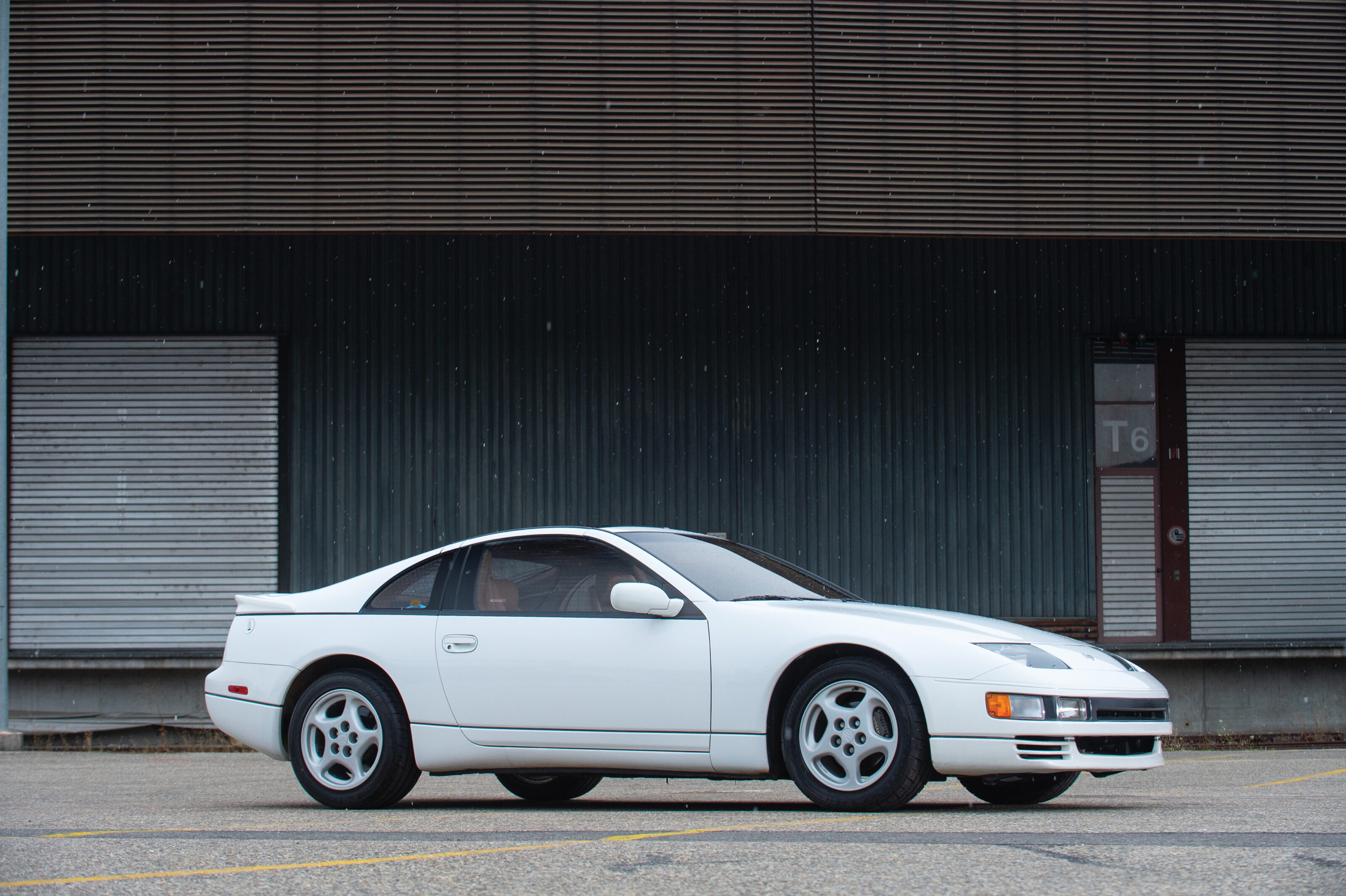
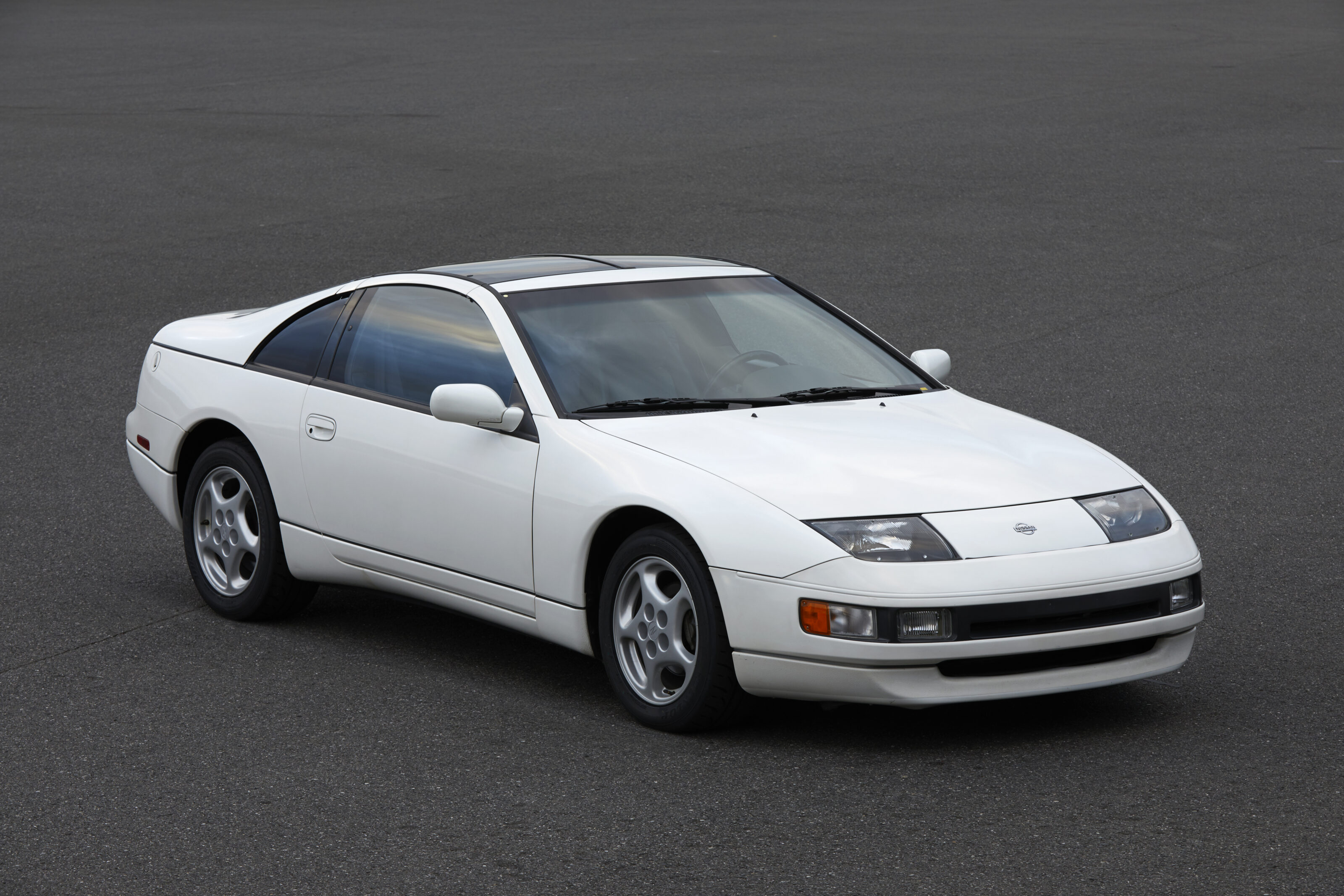
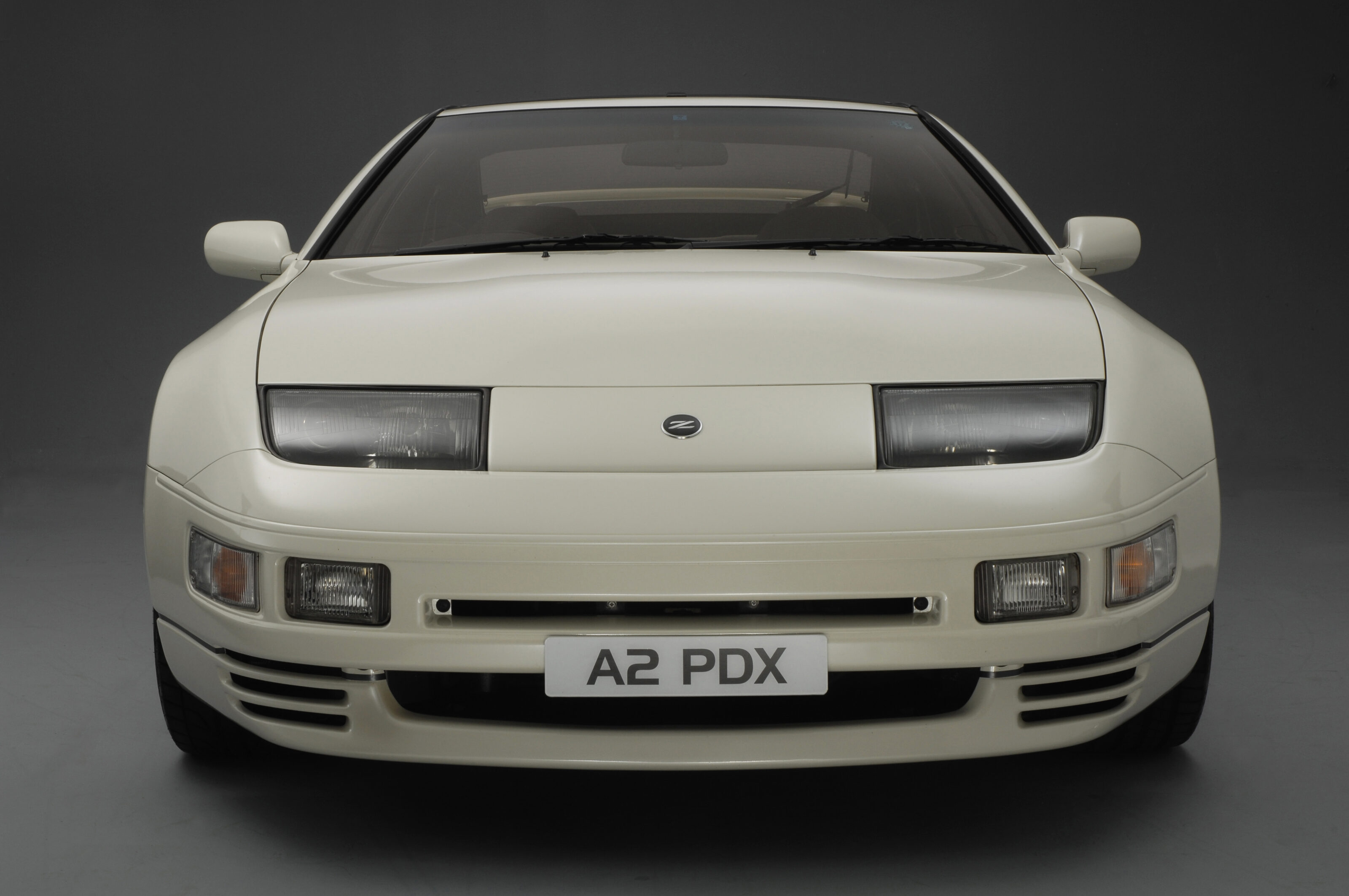
Of course Nissan’s world-beating R32 GT-R famously launched in 1989, but so did this: the Z32 300ZX, further bolstering Nissan’s multi-pronged assault on the Japanese sports car markets. Like the R32 GT-R, the 300ZX’s development was heavily aided by Nissan’s techno-futuristic Mid4 concept. It was a ‘blank page’ design, in contrast to the preceding Z31 which was based on a modified 280ZX chassis, dating back to 1978.
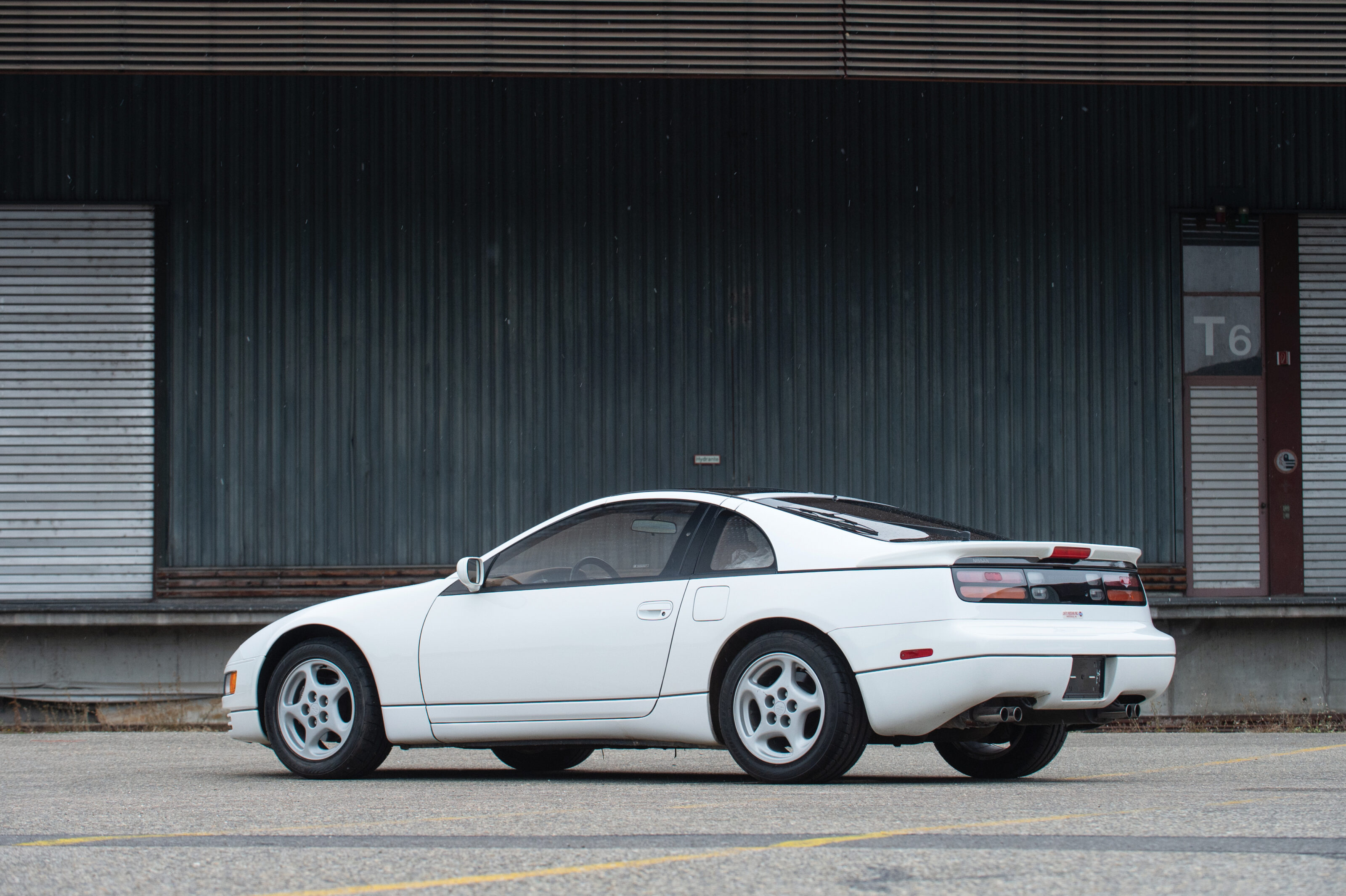
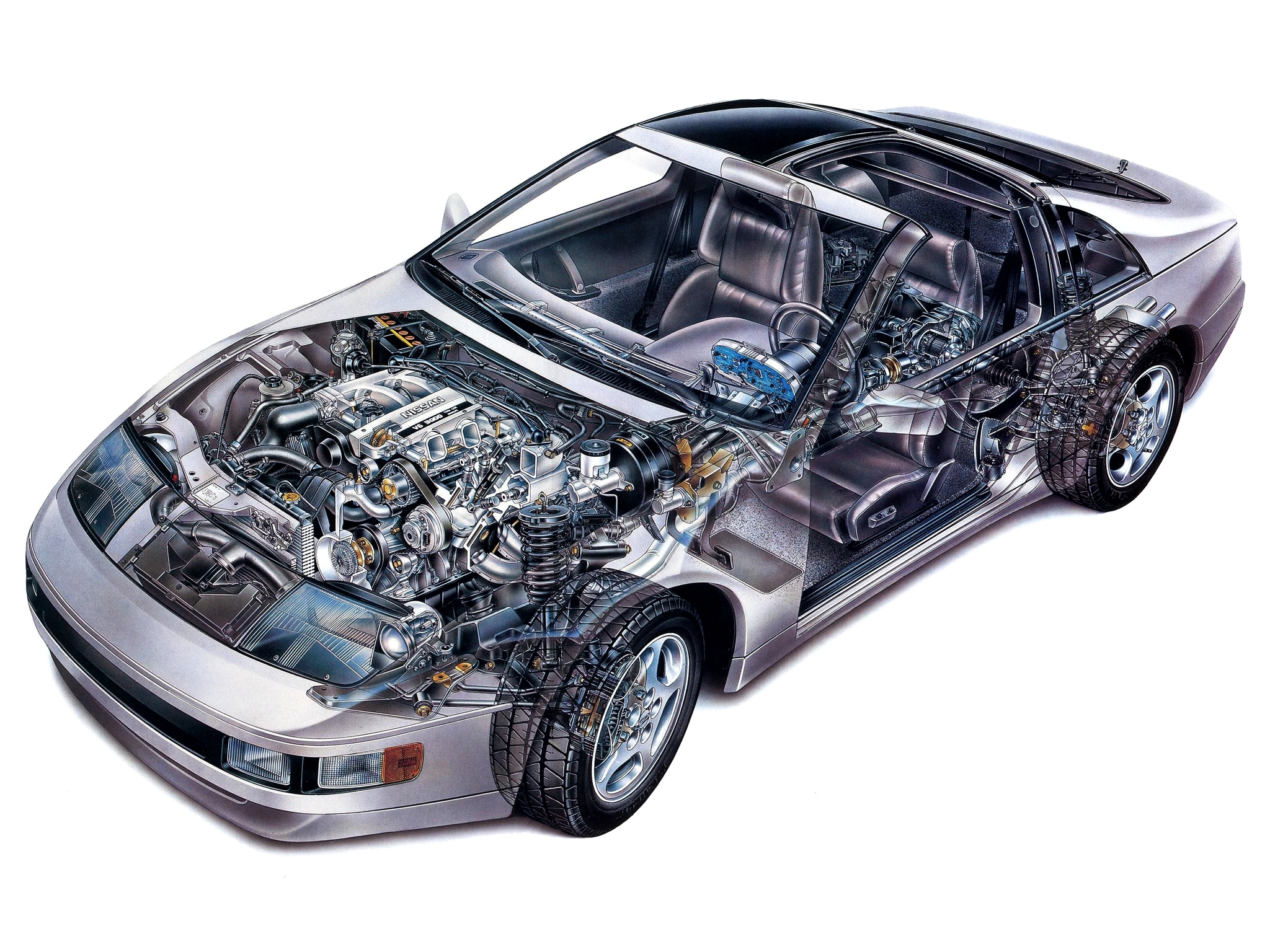
By that point, the Z-car lineage had taken on a discernibly less dynamic and lazier, American boulevardier role. Now with all-new multilink suspension, rack-and-pinion steering, a viscous differential, anti-lock brakes, and a brand-new 24v DOHC naturally aspirated 3.0-litre V6 capable of 165kW (Aus-spec cars), the 300ZX proved a refreshing return to sporting form.
With a rising tide seemingly facing all forms of JDM metal of the era, the 300ZX hasn’t enjoyed the same stratospheric rise in price enjoyed by many of its fellow Nissan-branded stablemates. Prices have been shoring up, but it remains one of the more intriguing options attainable at halfway sensible prices.
Essential checks
As history has shown, Australia’s comparatively small market frequently saw less-desirable specifications sold through local showrooms. The 300ZX was a case in point, with only the naturally aspirated V6 offered in LWB 2+2 configuration. We also missed out on fancy options such as Nissan’s super-HICAS four-wheel steering, adaptive dampers and the digital cluster. Australian domestic sales were slow, at less than 100 cars per annum, ending in 1996. Grey market imports subsequently boomed, with JDM-spec 224kW twin-turbo examples arriving in short order.
Australia also received a local 25th anniversary, which gained a bespoke body kit, Steven Millen-designed suspension, and 17-inch AVS alloys. It’s believed that 122 examples were sold to the tune of $92,995 when new. Today, the market ranges from around $12K for the most well-worn examples, to upwards of $60K for the most pristine/rare-spec cars.
Body and chassis
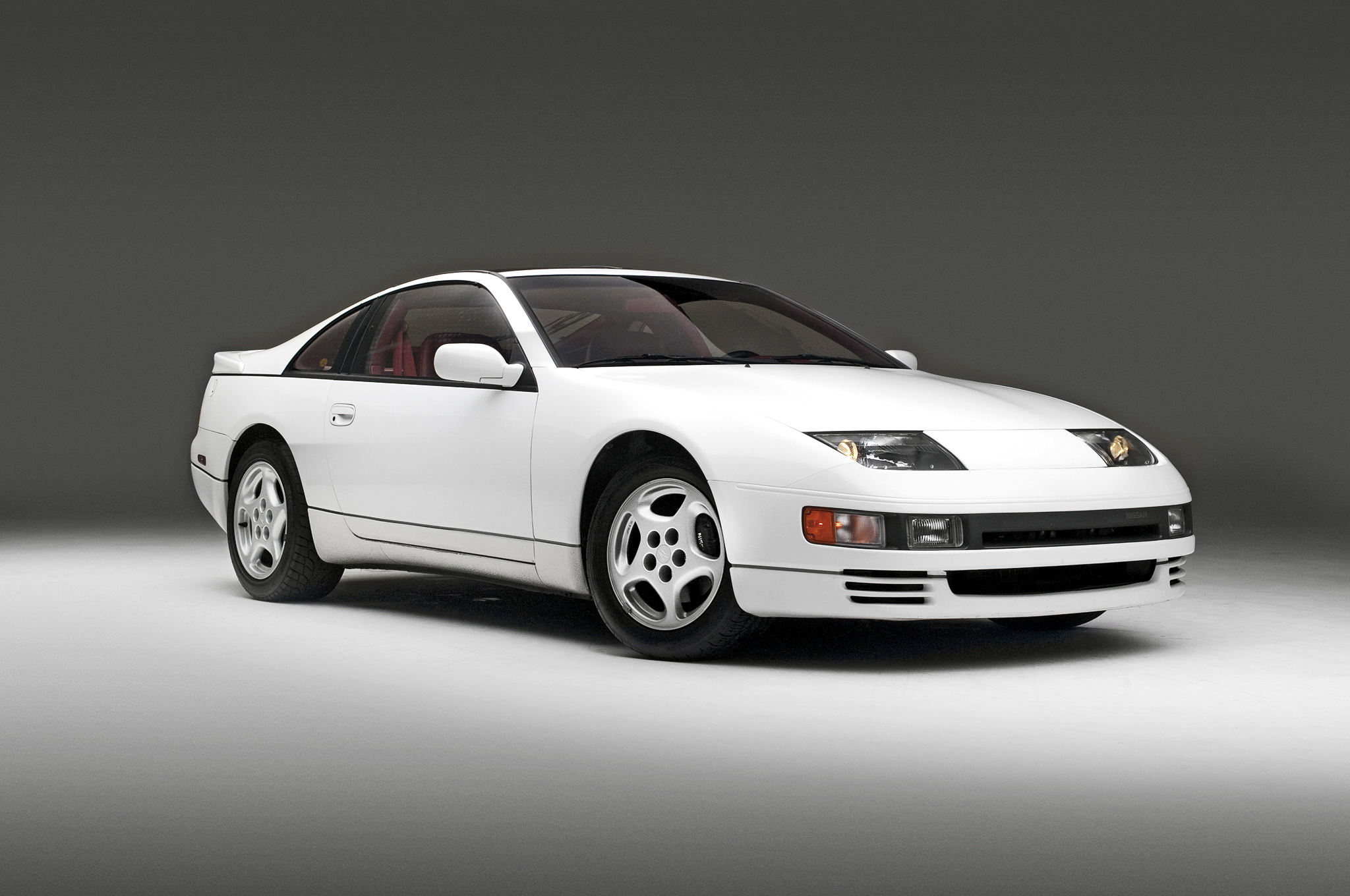
Fun fact: the Z32 was one of the world’s first production cars designed entirely on CAD, with a slippery drag coefficient of 0.31.
They’re regarded as largely corrosion-resistant; however, age and years of apathetic owners make inspection for rust and damage a priority.
Furthermore, cars that have lived outside in the elements under Australia’s beating sun often display visual degradation that includes perishing window rubbers and discoloured plastic panels.
Engine and transmission
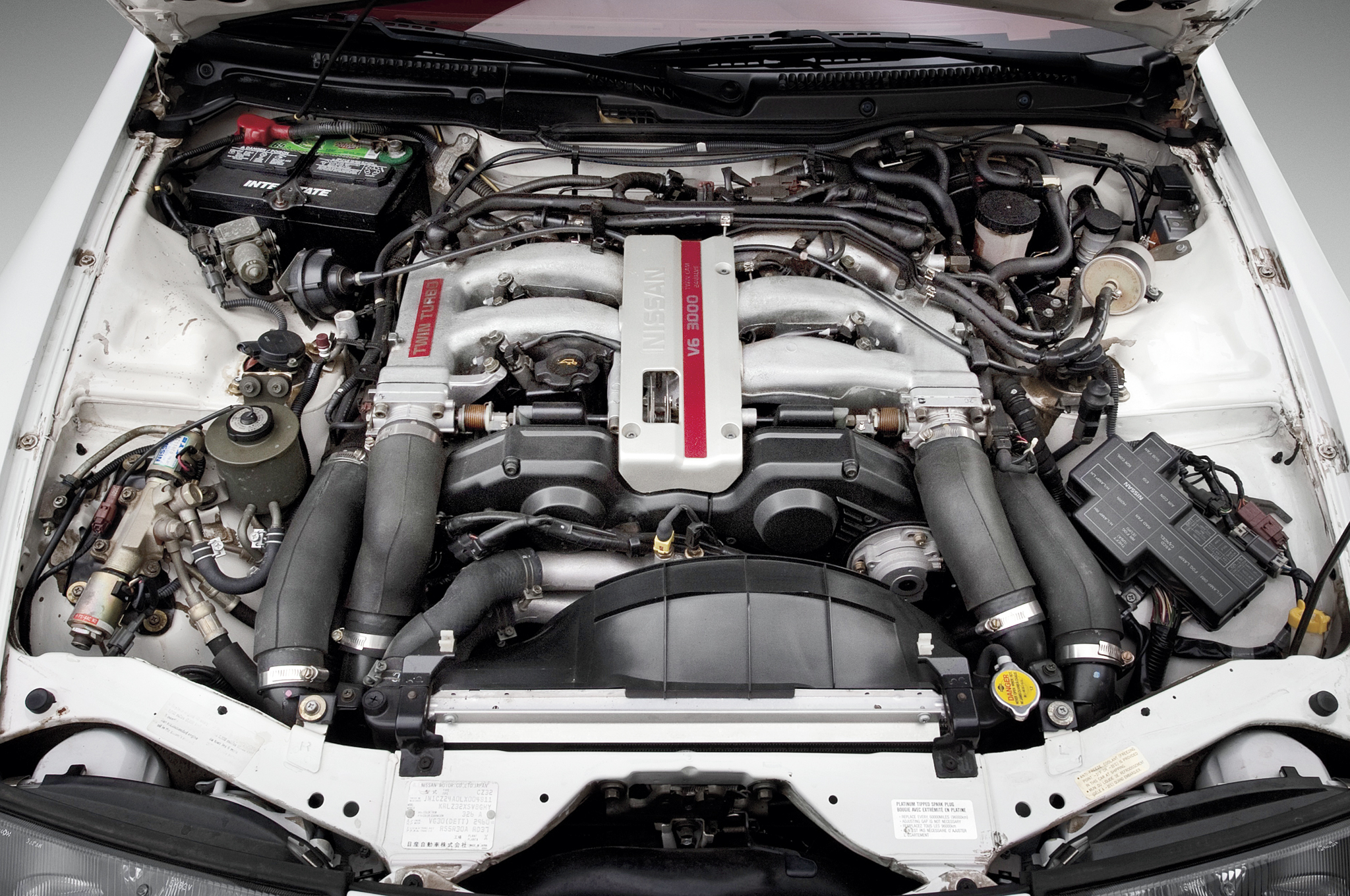
The VG30 engine is capable of spinning up hundreds of thousands of fuss-free clicks, with regular maintenance being the important caveat. Physical service history is a big plus, with factory service intervals calling for timing belt replacements at 60,000kms, and every 100,000kms thereafter. Failure to do so can lead to serious engine damage.
Both five-speed manual and four-speed automatic gearboxes are reliable, however, manual transmission synchros are known to wear under ‘spirited driving’. If you happen to be shopping for an auto example, try to avoid cars built up until early 1991 as they are more susceptible to overheating.
Suspension and brakes
Cars are at an age where bushings, if not already replaced, should be. Suspension units should be inspected for cracks, leaks and corrosion. It’s likely that many examples have had their OEM suspension binned long ago for lower aftermarket units. OEM parts are always a valuable nice-to-have as original components grow ever more scarce.
Brake master cylinders in early cars pre-1991 were known to leak as soon as 80,000kms. Later models gained a redesigned unit and are a popular upgrade.
Interior and electronics
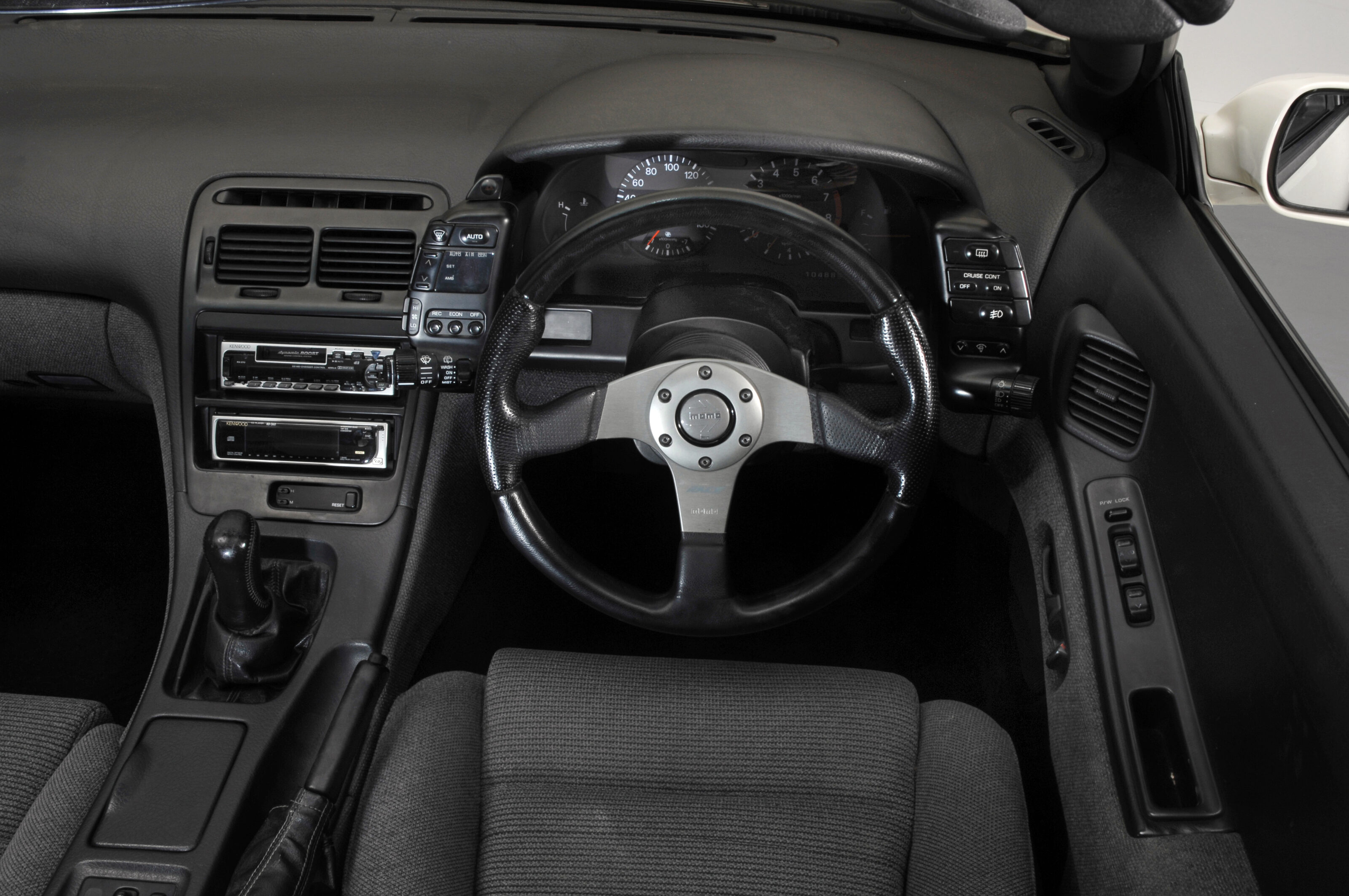
The Z32 gained critical acclaim for its futuristic ‘cockpit’-style cabin. It had the tech to match, too, including power mirrors, power steering, power windows, cruise control and more.
Test all functions to ensure everything works. Nissan interiors of this era were notoriously prone to sun damage, exacerbated by Australia’s climate. Wear to leather trim may be expected with age, however, it should be consistent with purported mileage and use.
Other options you may consider
1. The obvious: Nissan 200SX/Silvia
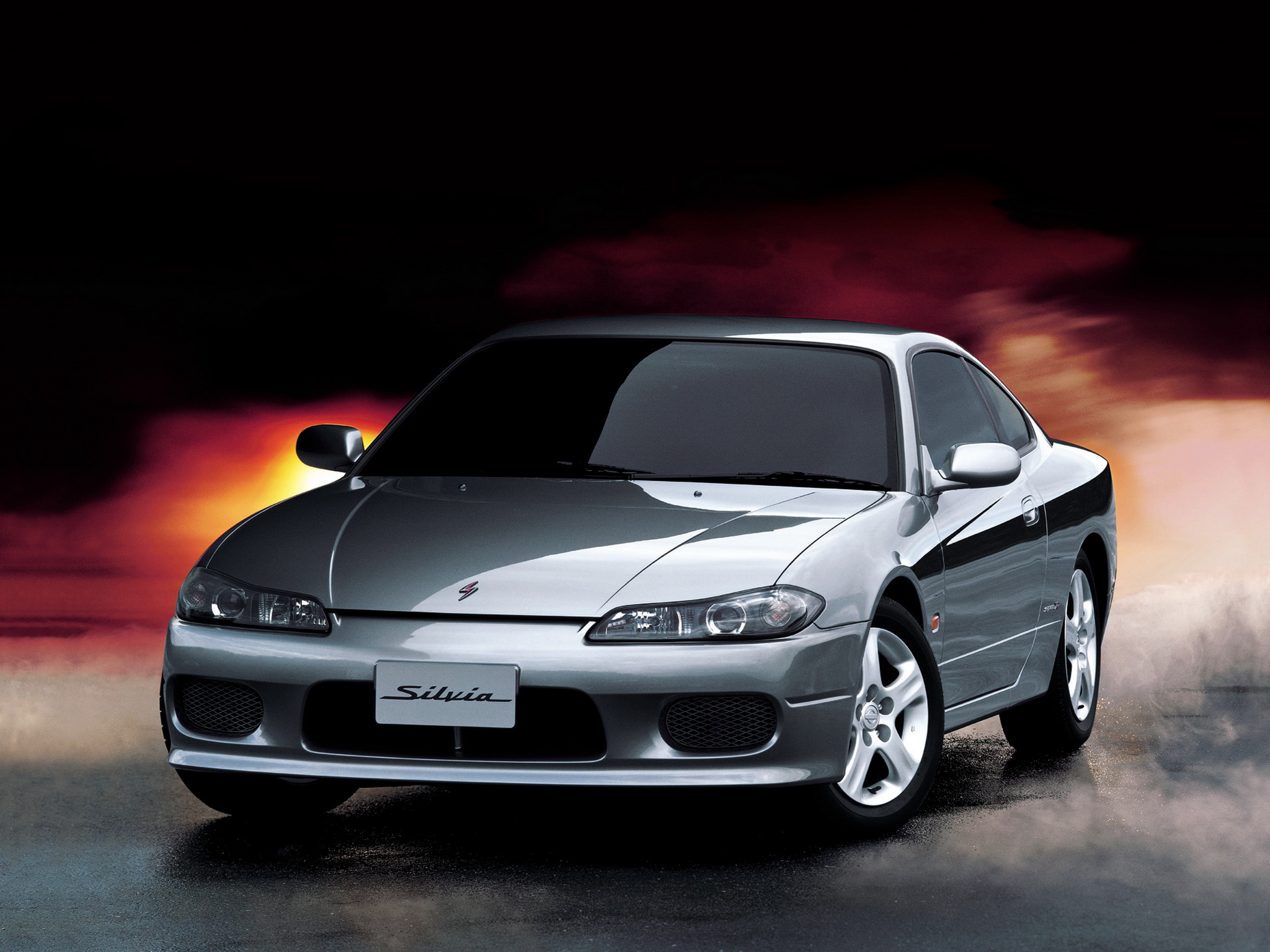
Far more popular (and somewhat more costly) than the humble Zed-car, the locally delivered 200SX, or imported Silvia, offers a rawer Japanese coupe experience, and redefined performance for generations of young Aussies throughout the ’90s and early-’00s.
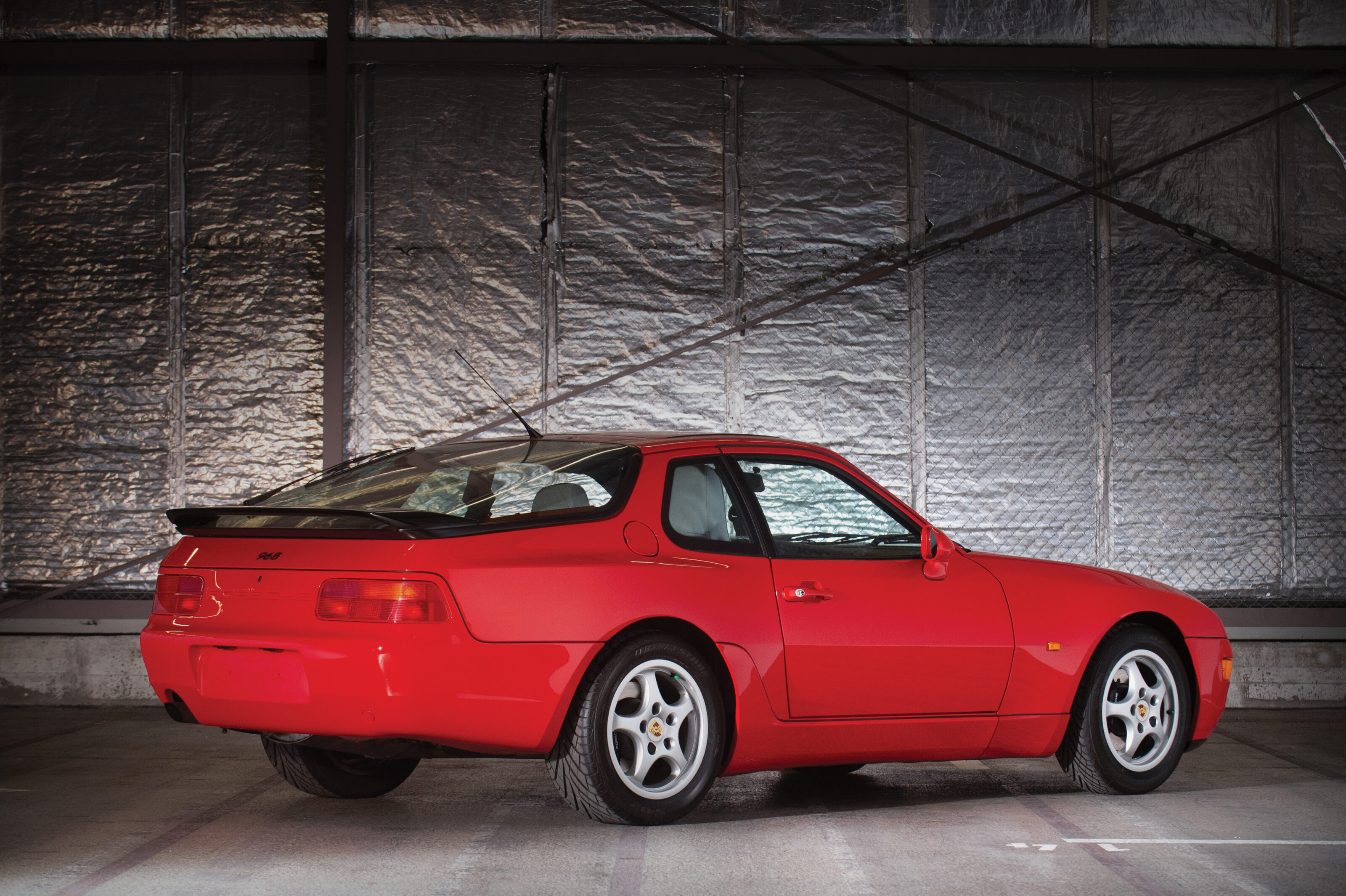
2. The unexpected: Porsche 968
The Z32 battled with Japan’s Supra, RX-7 and 3000GT of the time, but also took the fight to more exotic Europeans including the Porsche 944/968. Older 944s are well within reach towards the low-mid range of the Zed market, while top-end values can exceed good 968s.
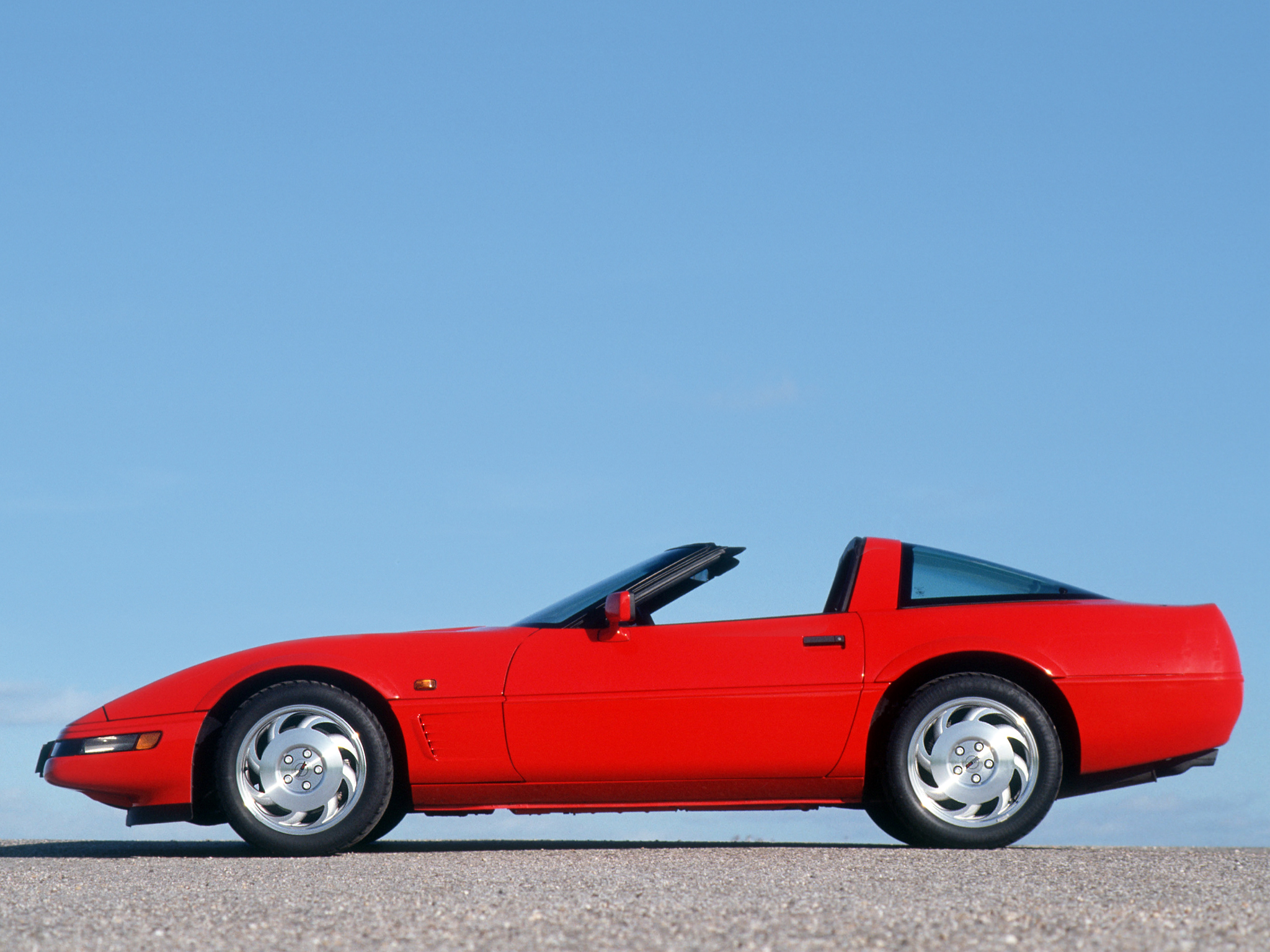
3. The oddball: Chevrolet C4 Corvette
In the US market, the local C4 Corvette was also a prime target for Nissan’s 300ZX. It’s an older platform and lacks much in the way of exotic engineering, but is rarer on Aussie roads and top-end Zed values will afford you a near-concours level 5.7-litre V8 ‘Vette.
1983-2000 Nissan Z32 300ZX specs
| Body: | 2-door, 2+2-seat coupe |
|---|---|
| Engine: | 2960cc DOHC 24v V6 |
| Power: | 165kW @ 6400rpm |
| Torque: | 268Nm @ 4800rpm |
| Transmission: | 5-speed manual/4-speed automatic |
| Weight: | 1496kg |
| Used price range: | $15,000-$60,000 |
Jaguar Land Rover Australia is recalling three of its models due to a faulty fuel injector return pipe
The British carmaker has issued a notice for 100 examples of the Land Rover Discovery Sport, and Range Rover Evoque and Velar, all made in 2020 and 2021 with the 2.0-litre diesel engine.
According to the Department of Infrastructure, the fuel injector return pipe may not meet manufacturing specifications and may split, allowing fuel to leak into the engine bay and onto the road – increasing the risk of an accident.
A list of VINs for affected vehicles is available here.
Owners will be contacted by Jaguar Land Rover to arrange with their nearest authorised dealer to have the work carried out as soon as possible, free of charge.
Or for further information JLR can be contacted on: 1800 625 642 or https://www.landrover.com.au
Snapshot
- ID.X concept will influence the first hot ID 3
- Increased power to come at the expense of driving range
- R-badged ID 3 expected in the future
Volkswagen’s top brass has confirmed the ID.3 electric hatchback will get its own hot-hatch variant, saying the recently-revealed ID.X concept is an influence for the model.
Speaking to Autocar at this year’s IAA Mobility Show in Munich, Volkswagen COO Ralf Brandstätter said the ID.X concept will be the basis for an all-wheel drive, high performance ID.3 GTX – joining the ID.4 GTX as a performance-oriented EV.
As both the ID.3 hatchback and ID.4 SUV are based on the same MEB platform, Brandstätter hinted the ID.4 GTX’s powertrain could be grafted into the ID.3 GTX, giving it at least 220kW – but this could be increased to 245kW if figures from the ID.X carry across.
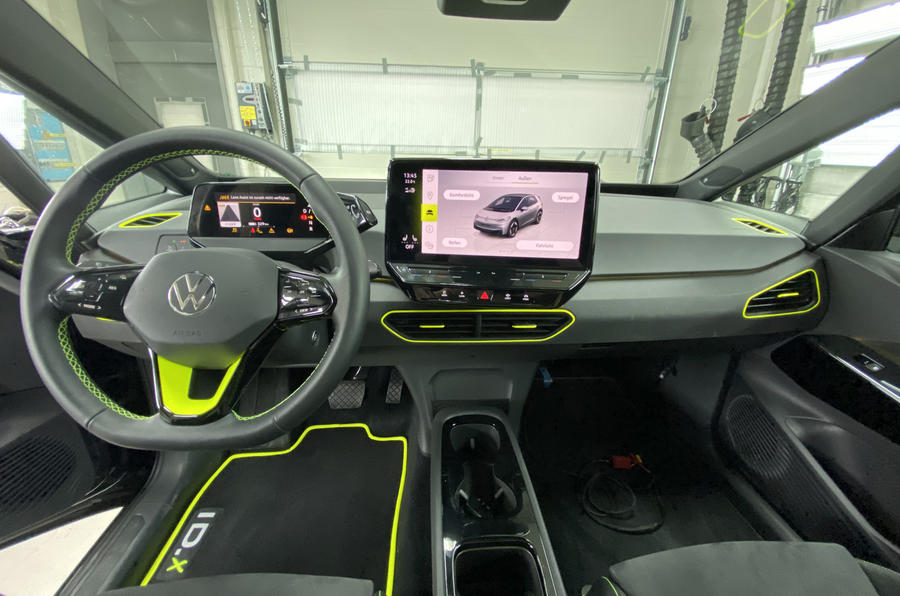
The extra power could potentially come at the cost of driving range – with VW’s 77kWh battery fitted, the top-spec rear-wheel drive ID.3 Pro S has a WLTP-tested driving range of 550km. Meanwhile the all-wheel drive ID.4 GTX can run for just over 480km on a charge, with the ID.3 GTX potentially featuring a similar figure thanks to its lighter weight and higher output.
Brandstätter also told Autocar the IDX concept was equipped with drift mode – similar to the new Mk8 Golf R – and could sprint from 0-100km/h in 5.3 seconds, giving Volkswagen’s engineers “many ideas” for a potential ID.3 GTX project.
According to the VW boss, the engineers behind the ID.X “have discovered the fun of developing high-performance electric cars, and so we just let them do it”.
Volkswagen will need to start looking at performance hatches to replace the Golf when the company eventually ditches internal combustion engines, committing to build only EVs for Europe from 2035.
With the big reveal this week of Subaru’s new-generation 2022 WRX, we’re revisiting this celebration of one of the most iconic examples of the breed ever developed.
Take a tour with us down memory lane.
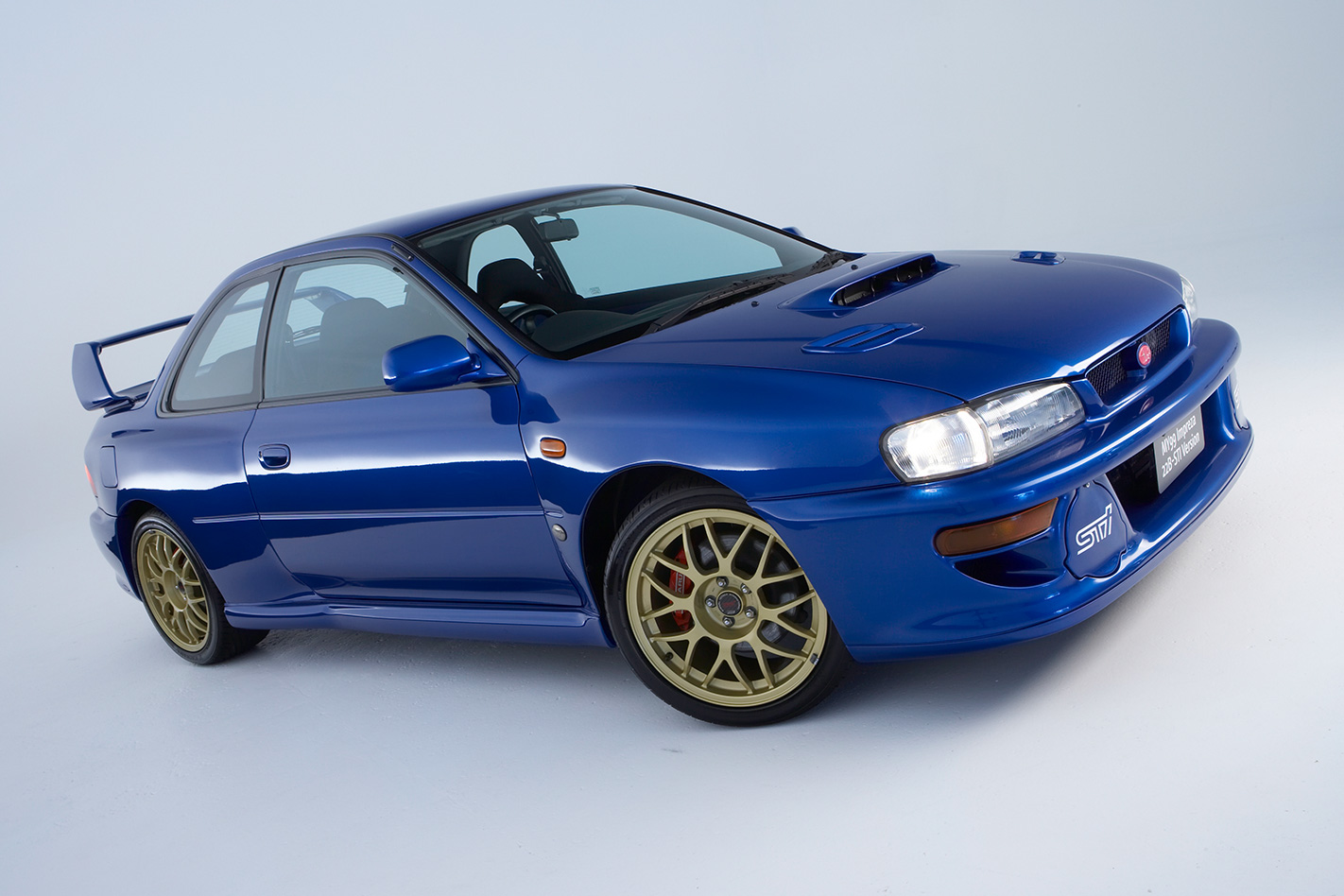
October 2018: As with many of the great cars of the late 20th Century, Subaru’s unicorn-rare STi 22B is a limited edition celebration of motorsport success.
Only 425 were built, and a miniscule five of those made it to Australia. Four hundred of them were sold in Japan, though many left as private imports, while the rest were specifically destined for export or as cars for particular people, namely the legendary Colin McRae and his co-driver Nicky Grist.
Despite this, it has garnered admiration from Aussies, with a South Australian-built tribute to the 22B (named 25BB) gracing MOTOR’s pages being a case in point.
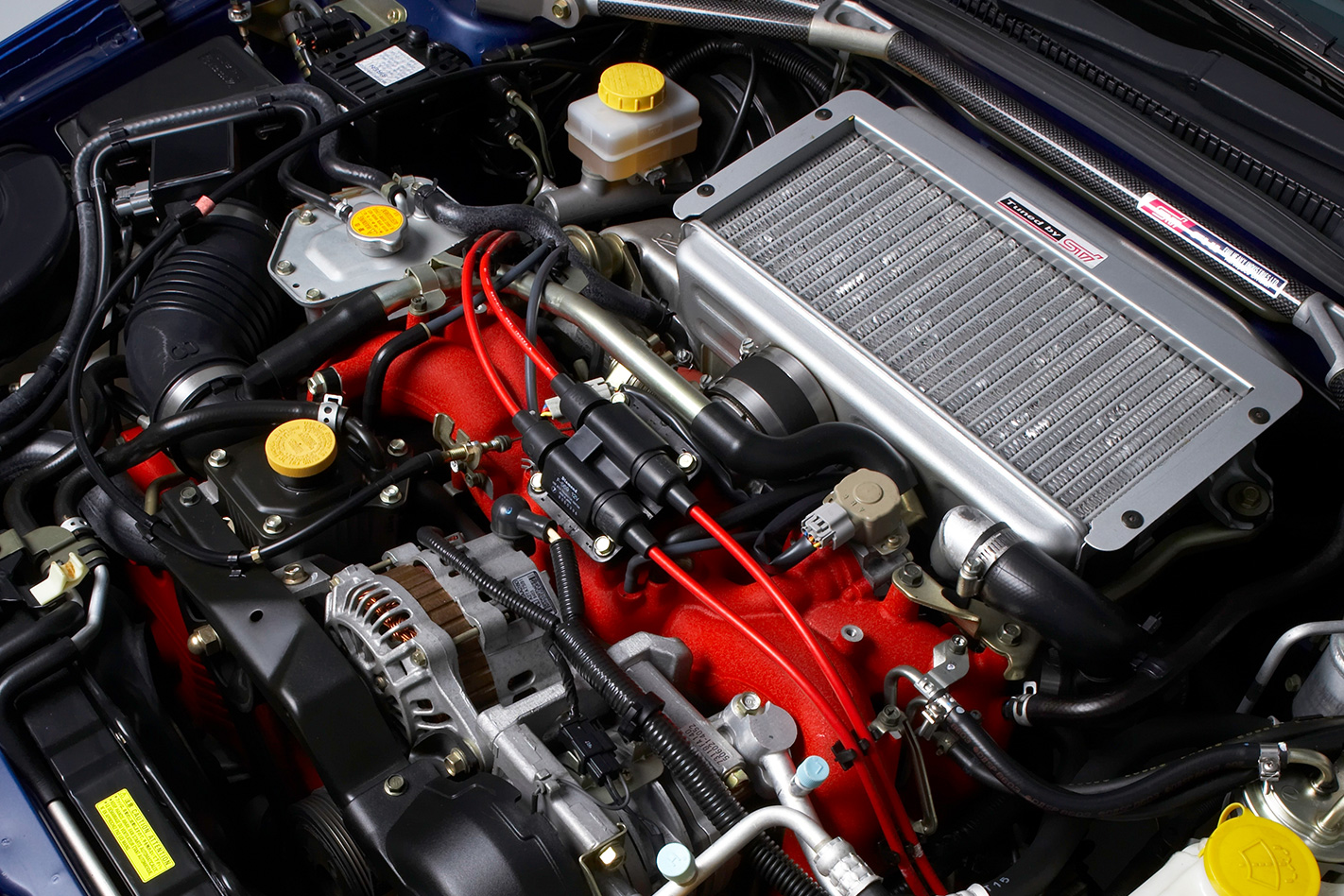
The 22B was gifted a slightly larger 2.2-litre flat-four than the STi Version V it was based on, with a larger bore, though its claimed power output was still the same 206kW at 6000rpm.
Motoring scribes have pondered the accuracy of this claim at length over the years, but one figure that shows an obvious improvement is torque.
The hand-assembled engine would generate 360Nm at 3200rpm to trump the Version V’s 353Nm at 4000. This helped give it tremendous mid-range power.
Subaru strengthened the driveline with a twin-plate ceramic metal clutch. And even from a standstill, the 22B would hit 100km/h in 4.7 seconds.
We’re talking 18 years ago now, but that’s still fast even today. Its power-to-weight of 162kW-per-tonne matches that of a new Ford Focus RS, or a BMW M140i.
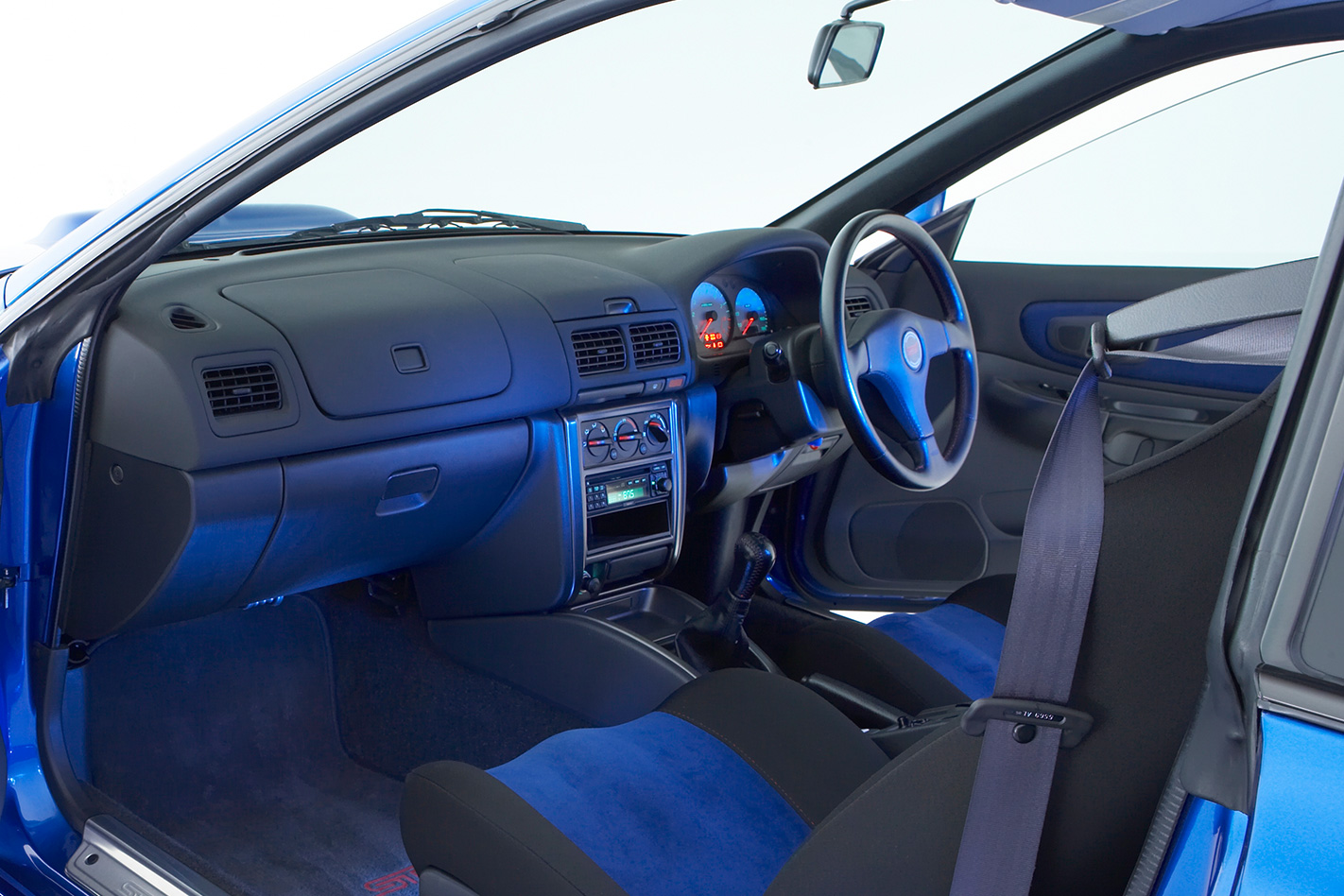
If you think you’ve spotted a 22B in the wild, a few dead giveaways are the hand-crafted widebody wheel arches, STi caps where the foggies should be, an adjustable rear-wing, slightly larger 17-inch BBS alloys and – if you manage to get inside – a lack of niceties such as air-conditioning.
If it ticks all those boxes, you’ve probably found yourself a damn good replica. Look for its intercooler water spray.
If it is the real deal, don’t scratch it. These things can fetch huge money… six-digit money. And that’s only likely to get higher.
1999 Subaru WRX STi 22B specs
Engine: 2212cc flat-four, DOHC, 16v, turbo Power: 206kW @ 6000rpm Torque: 360Nm @ 3200rpm Weight: 1295kg 0-100km/h: 4.7sec (claimed) Price new: $132,000
3 Fast Facts
1. Booming Prices
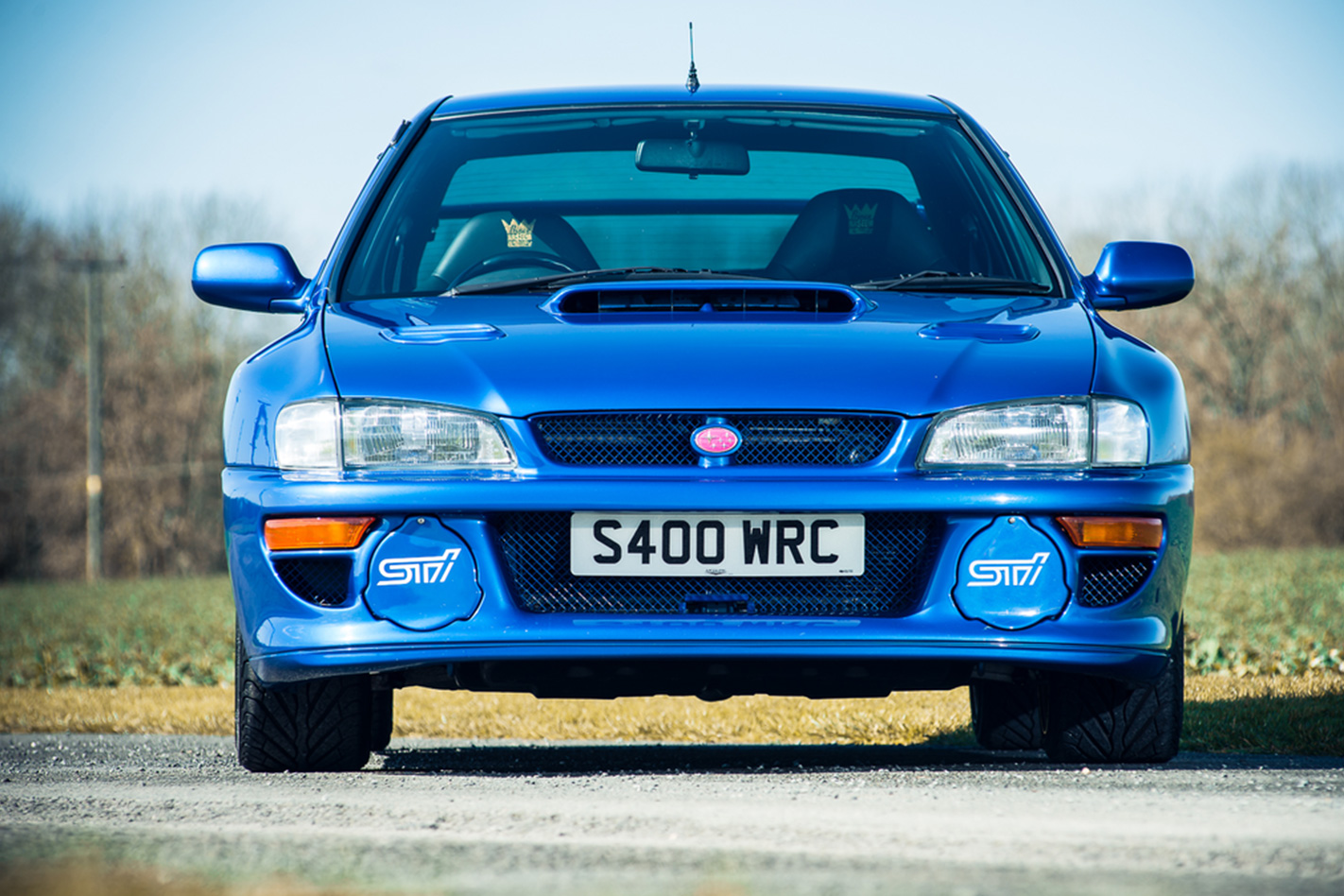
Silverstone Auctions sold number 311 for £73,125 (AUD$121,000) in May 2016, and that 22B had panels replaced after a ding-up. Another sold this year for $181,000 in Japan.
UPDATE: Get ready to lose your mind… in April 2021, a 22B sold for $424,000.
2. Numbers and superstition
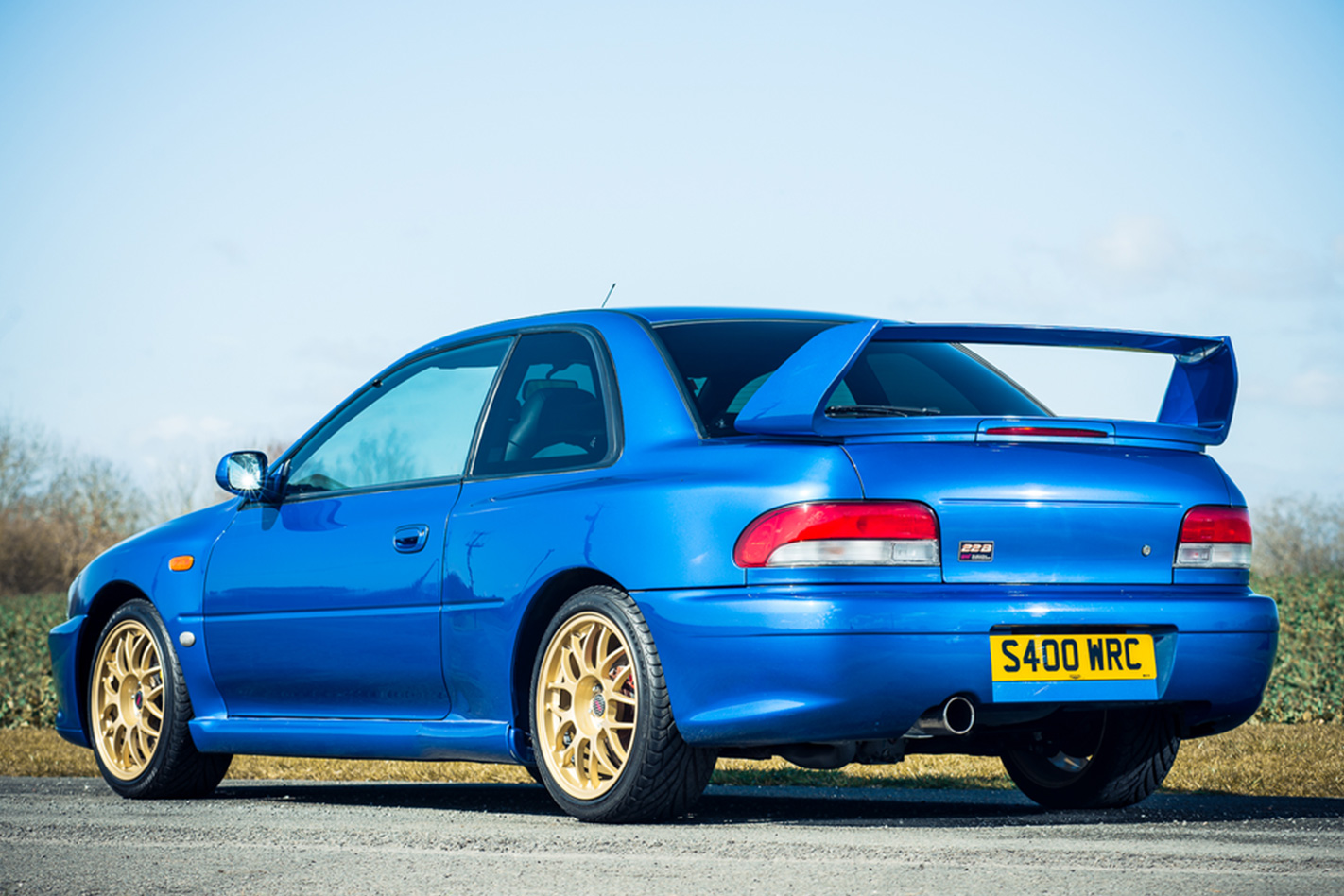
It was believed Subaru made only 224, rather than 225, rally-inspired hot rods until it was revealed the mystery 22B, build number 13, actually belongs to Subaru America.
3. Fast Perks of the job
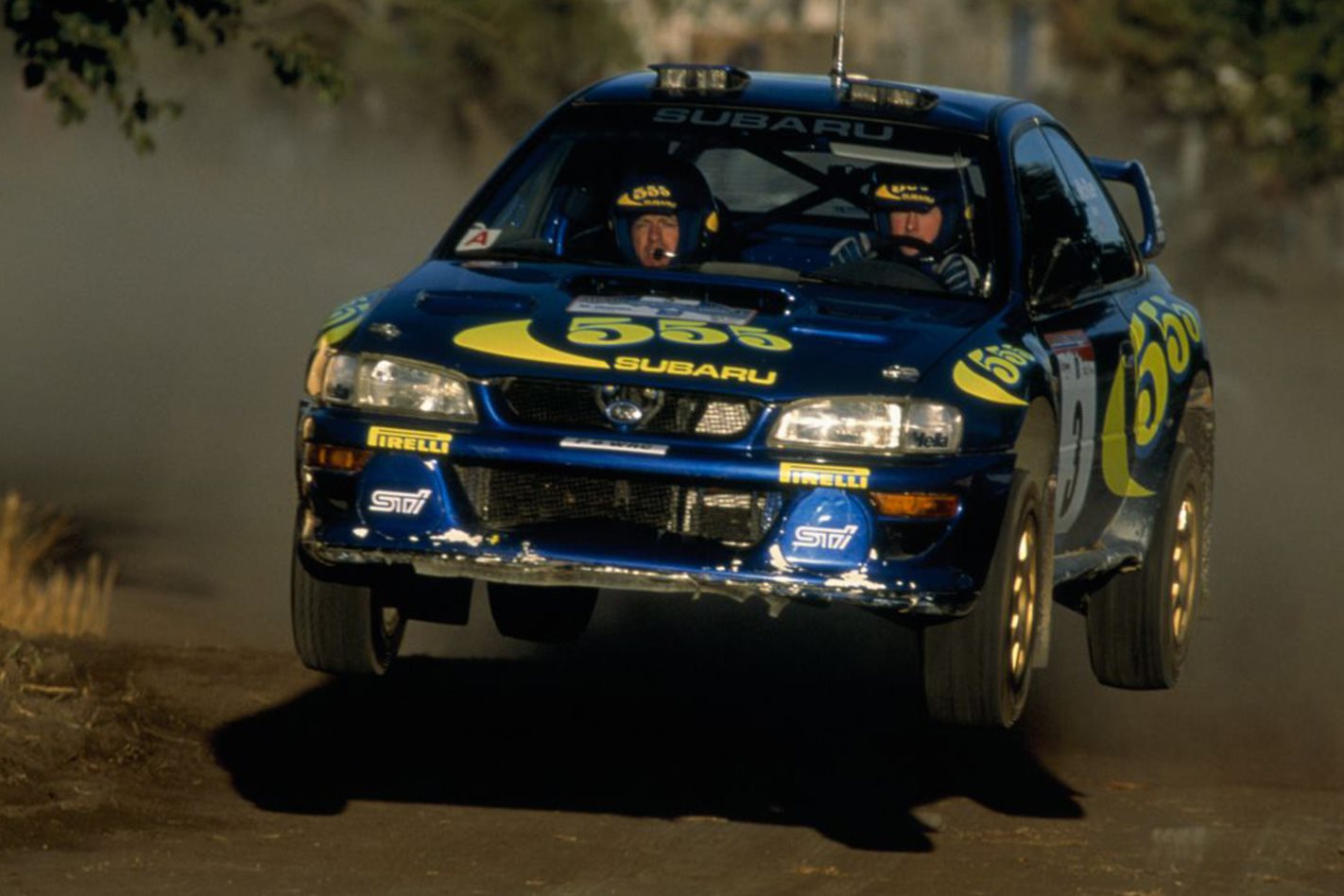
Subaru gifted its rally legends and Subie icons – Colin McRae and his co-driver Nicky Grist – two examples. It’s believed they were numbered #000 and not 555.
