Snapshot
- Harold Baggott learnt to drive in a Model T aged 10
- Took great-grandkids for a run in the Mustang Mach E for three miles
- Still drives daily aged 101
A great-grandfather has taken a Ford Mustang Mach-E out for a spin after originally learning to drive in a Model T when he was aged just 10.
Born in 1920, Harold Baggott had his first taste of getting behind the wheel in a Model T, driving the family’s milkman’s delivery float on a farm.
He went on to get his licence in 1936 (the first year they were introduced in the UK), and purchased his first car – a Ford 8 Popular in 1937 for £100 and a Ford Anglia – the next year.
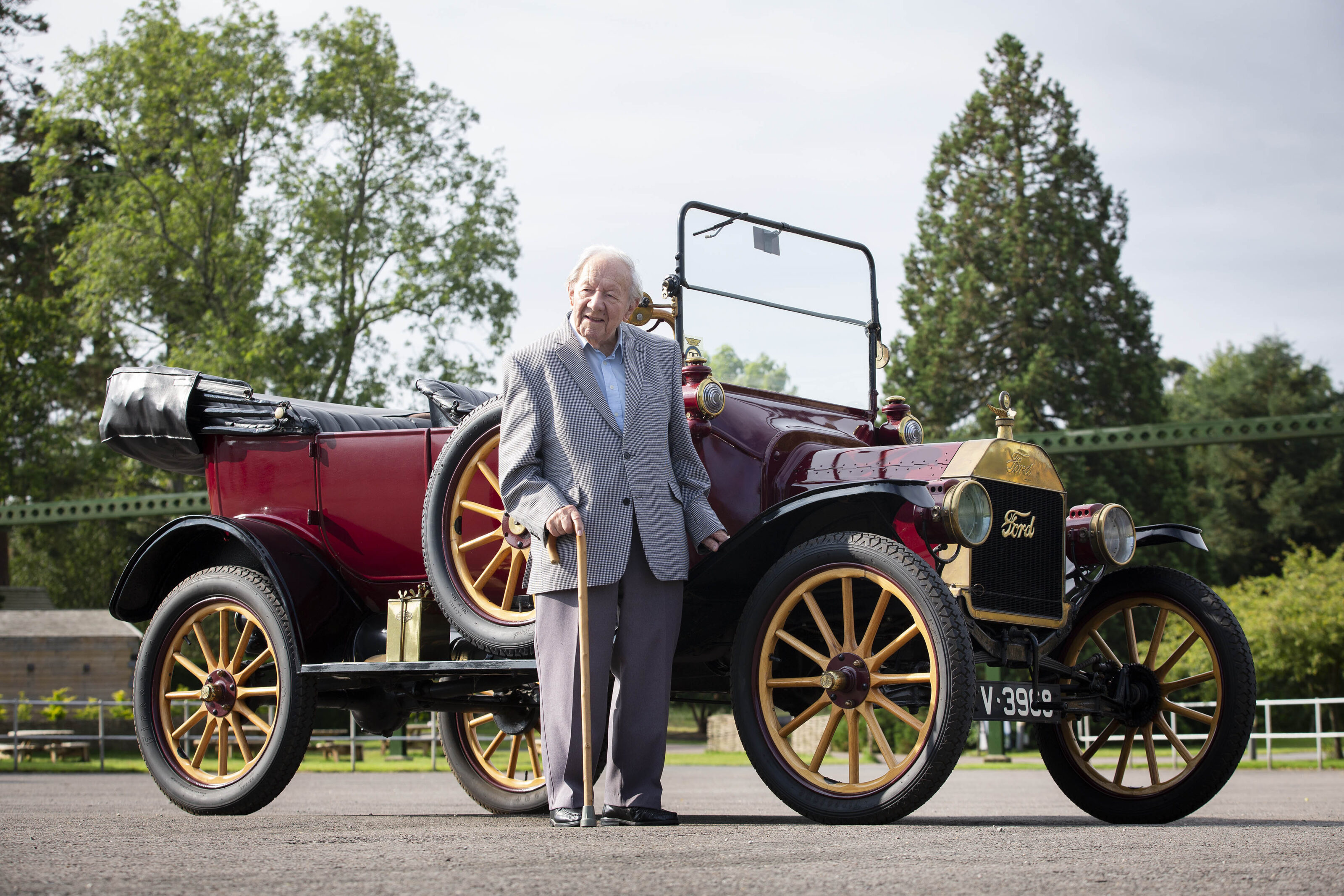
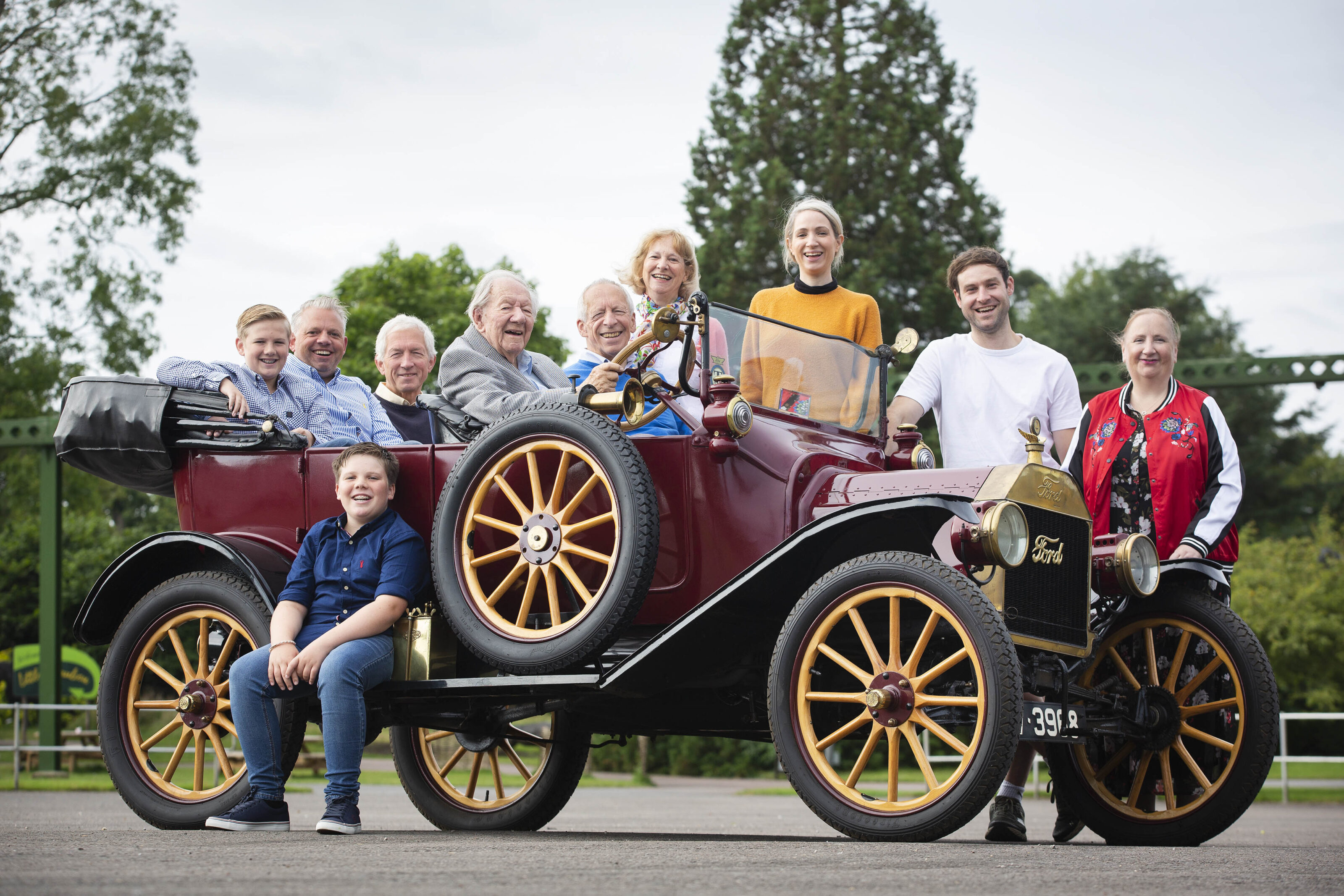
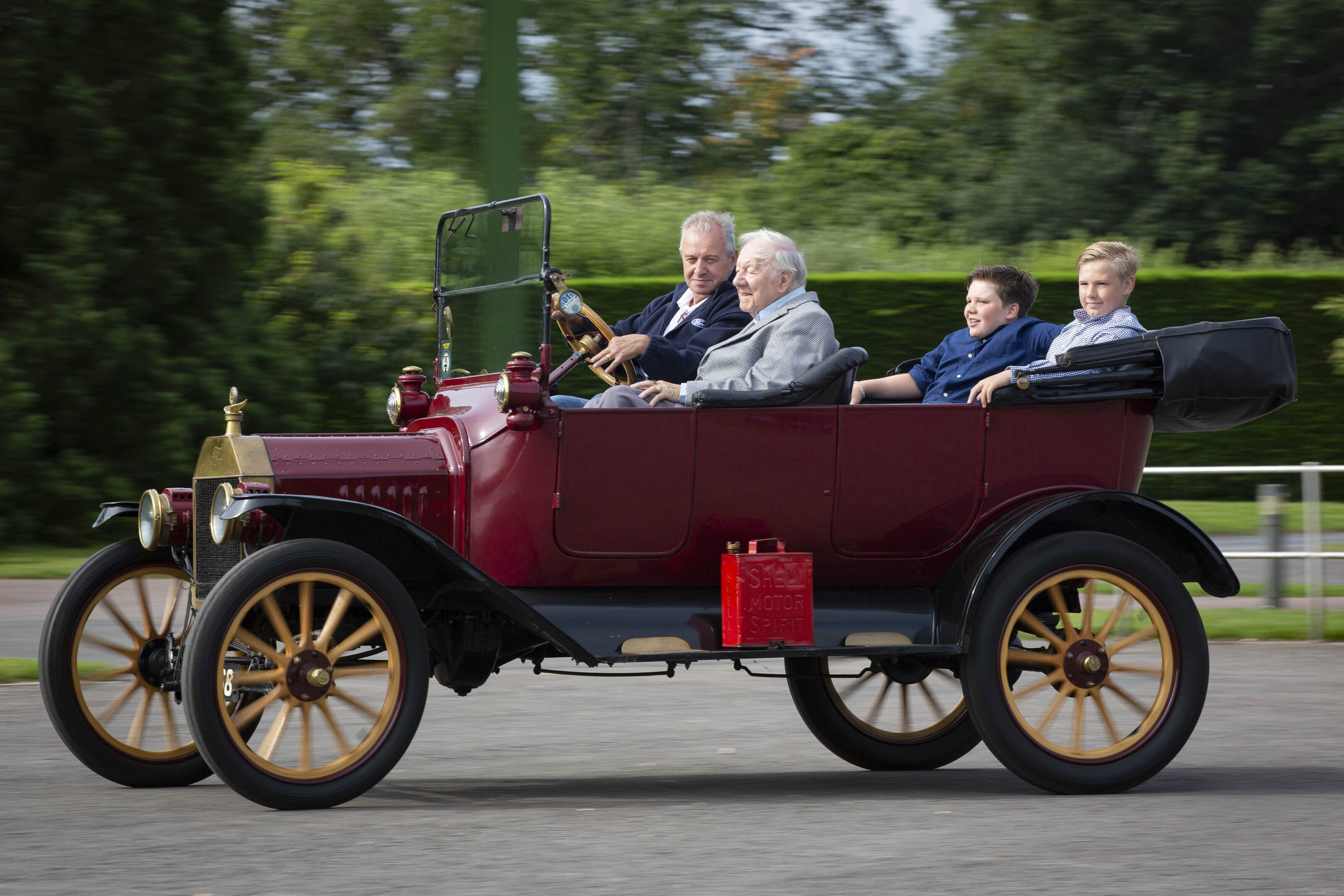
Since then the family has owned 20 Fords privately, as well as Ford commercial vehicles in chassis form, converted into coaches for a fleet of 140 run by their travel and coach business.Mr Baggott, now 101, was reminded of his Model T experiences with rides in a 1915 model from Ford’s heritage collection, before moving bang up to date and behind the Mustang Mach-E’s steering wheel.Driving great-grandchildren 15-year-old Felix, who has ambitions to be a racing driver, and his 12-year-old brother Charlie, Mr Baggott was struck by the quietness of electric motoring.
He said: “Since the age of 10, I’ve retained my interest in motoring and today find myself interested in the switch to electrification following the [British] Government phasing out the traditional combustion engines I’m used to.
“I have reminisced about my driving history with the Model T and seen what the future has in store. It was exciting to get behind the wheel of what I expect my great grandchildren will be driving.”
The Mach-E is Ford’s first all-electric SUV on sale in the UK and US now, with a maximum electric driving range of 379 miles.
Unfortunately, Ford Australia told WhichCar earlier this year that it has no plans to bring the Mustang Mach-E Down Under – despite the EV being homologated for other right-hand drive markets like the UK.
Snapshot
- Report finds Germans change with more frequency than others
- 41 per cent of Australians only make the change when its necessary
- Britons found to be the worst for tyre maintenance
How often do you change your tyres? Every year? Every few years? Only when one is shredded like a Sunday roast?
A report commissioned by United Kingdom-based research firm YouGov sampled participants from the UK, Germany, United States and Australia to find out just that.
German motorists were the most attentive regarding tyre maintenance – with 14 per cent of respondents claiming to change theirs twice or more every year, double the amount of the other three countries combined.
| u00a0 | Great Britain | USA | Germany | Australia |
|---|---|---|---|---|
| Only when necessary/damage | 60 | 46 | 42 | 41 |
| Once every three years | 12 | 22 | 16 | 22 |
| Once every two years | 9 | 10 | 10 | 12 |
| Once a year | 4 | 5 | 6 | 5 |
| Twice or more a year | 1 | 3 | 14 | 3 |
| Don’t know | 13 | 14 | 12 | 15 |
Almost half of Australians surveyed said they only changed their tyres when necessary or due to damage, with 41 per cent of locals waiting until theirs are well past their prime to get a fresh set of boots.
However, in this category we fared better than the Germans (42 per cent) and Americans (46 per cent), and worse still were the British – 60 per cent of whom said they waited until theirs were busted before changing the set, despite having to undertake an MOT test every 12 months.
Furthermore, 22 per cent of Australians said they changed theirs every three years, right on the borderline of when a typical road tyre would start to go hard and lose its peak performance.
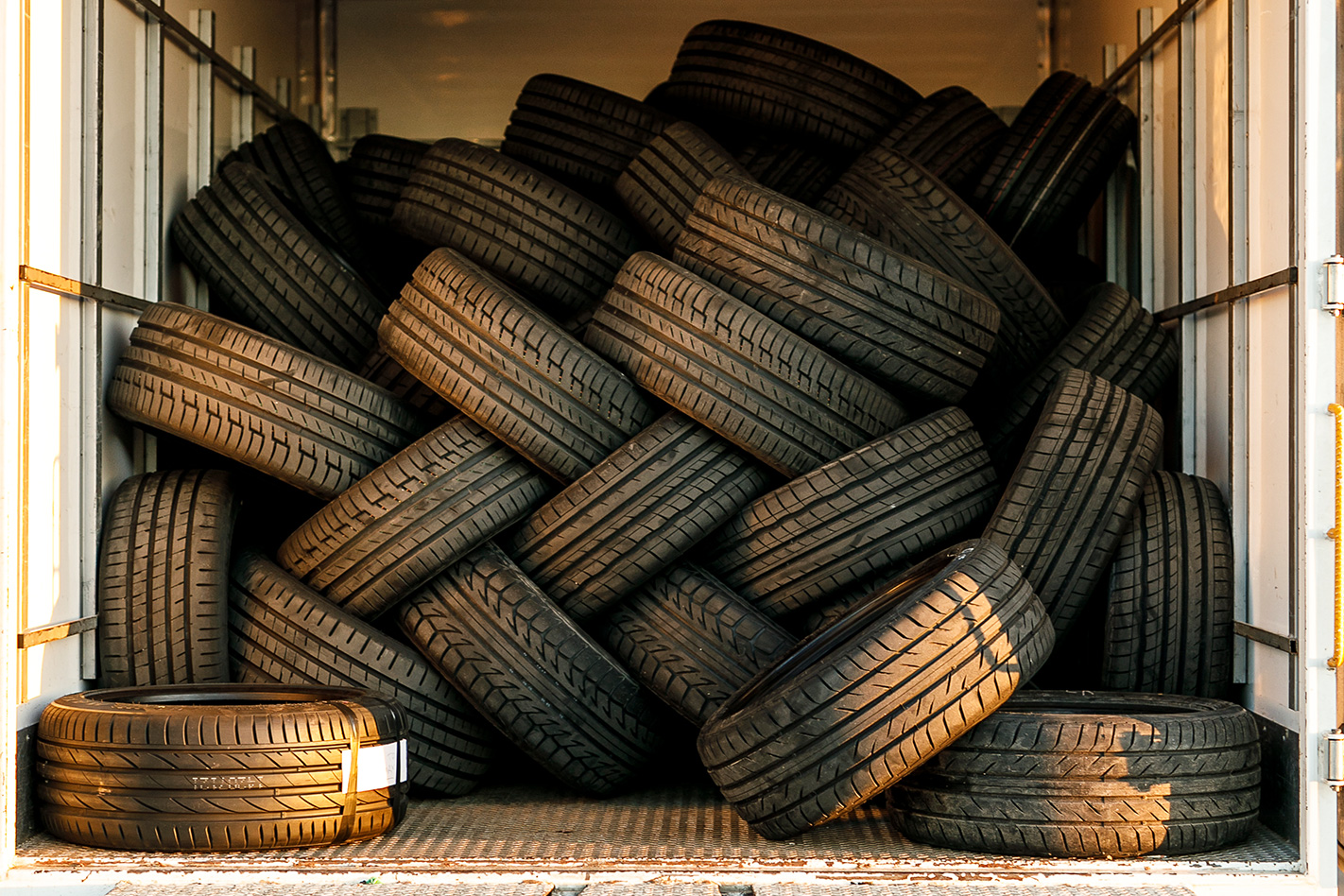
When respondents were asked if they changed theirs at least once a year, or once every two years, the results were fairly even among the four nations.
In each country, between 12 and 15 per cent of those two took part in the study didn’t know how often they gave their cars new rubber.
The Royal Automobile Club of Victoria’s (RACV) safety policy lead of safety, Elvira Lazar, says tyres should be checked regularly for minor defects which can lead to bigger issues down the line.
“RACV encourages drivers to regularly check their tyres as they play a critical role in vehicle safety,” said Ms Lazar.
“Looking for wear and tear, checking pressure, and removing debris when you fill up with fuel will help maintain them and get more use.
“If you keep them at the recommended pressure, they provide you with a better grip, so you will need less time to come to a stop and use less fuel overall. [Regular maintenance] means they will need to be replaced less often, so it’s worth checking pressure at least once a month and making a habit of looking when you fill up with fuel.
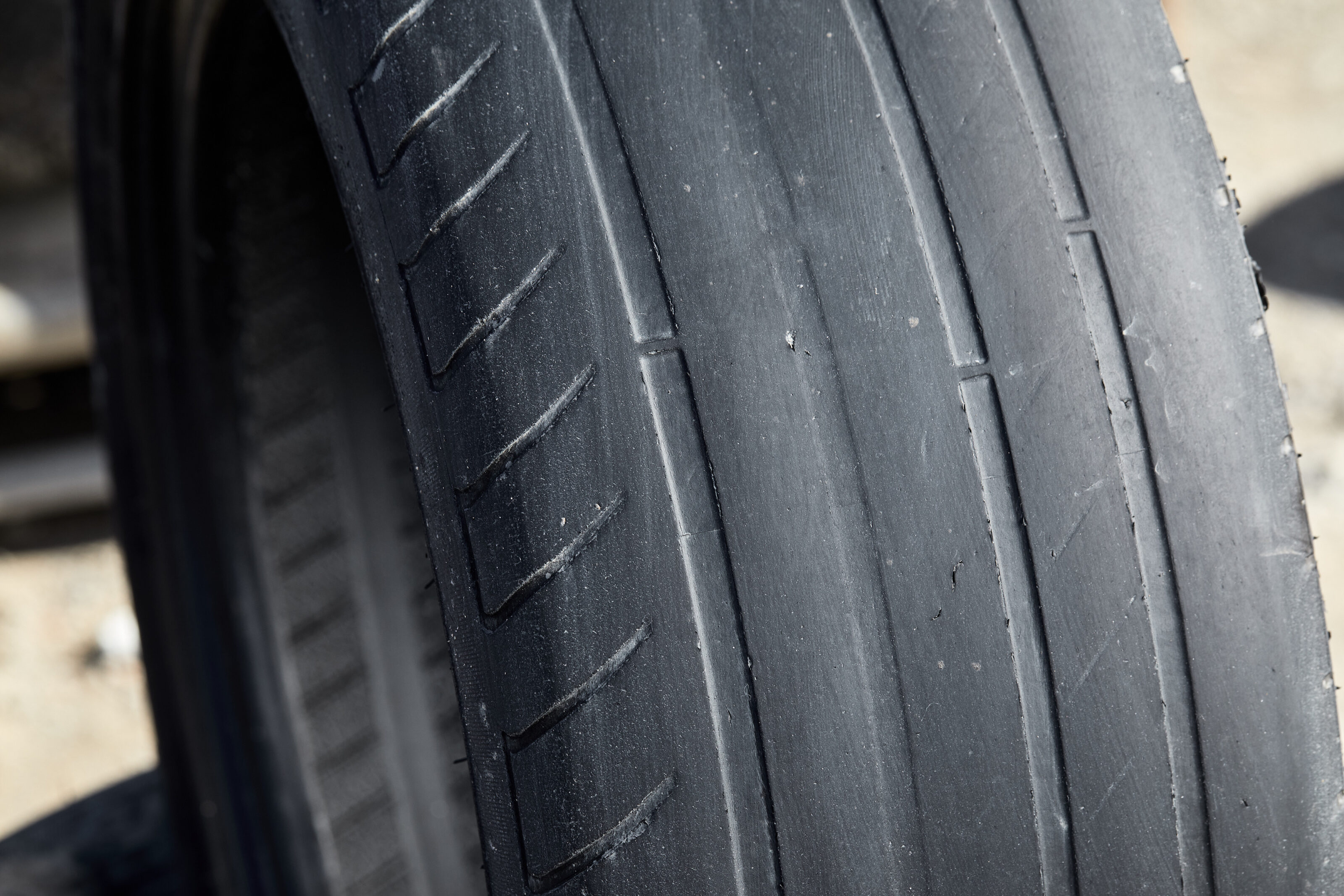
“Wear and tear eventually affect the structure of the rubber and how they spring back into shape. If drivers notice cracking or hardening, the strength and grip diminish and they become more prone to punctures.
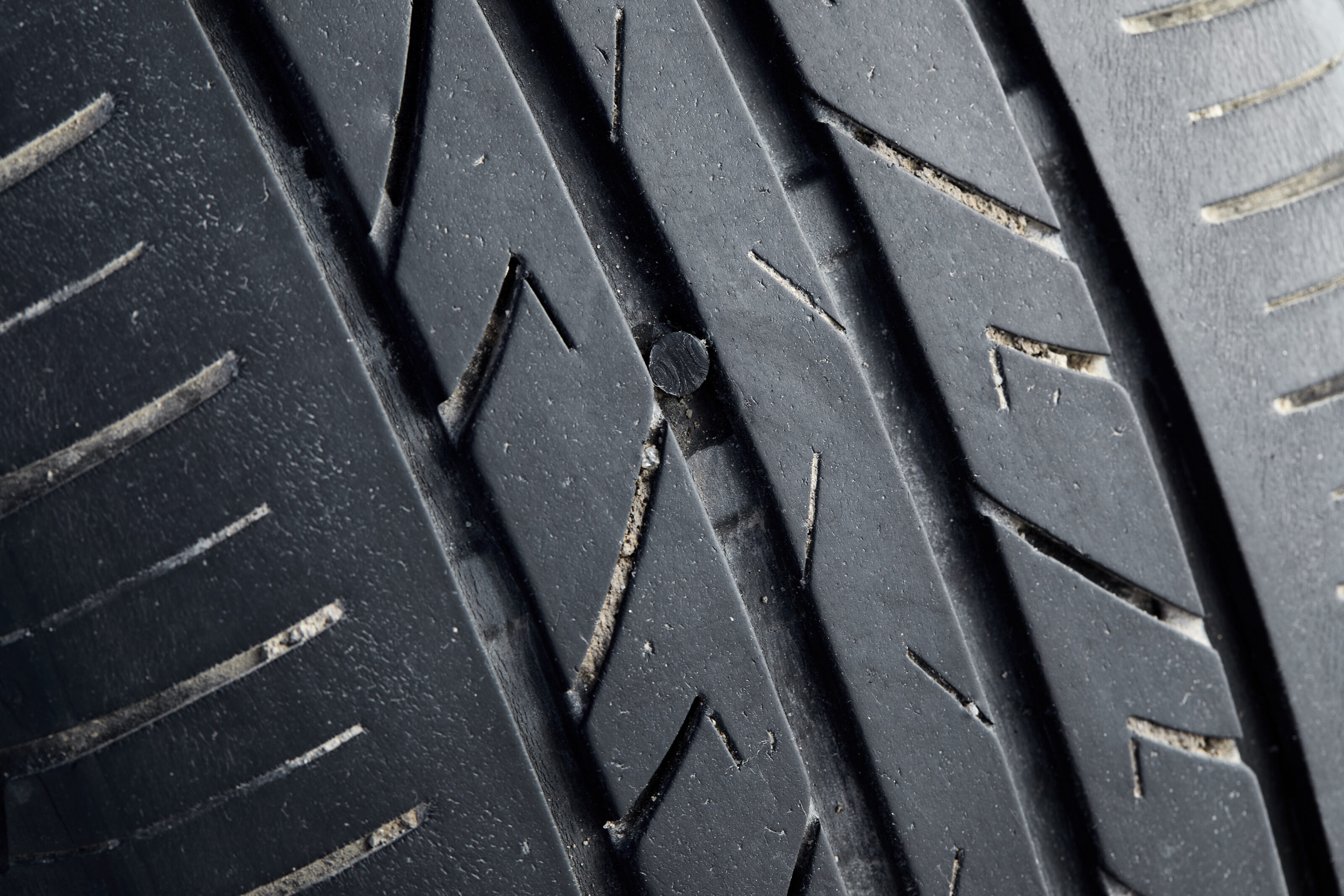
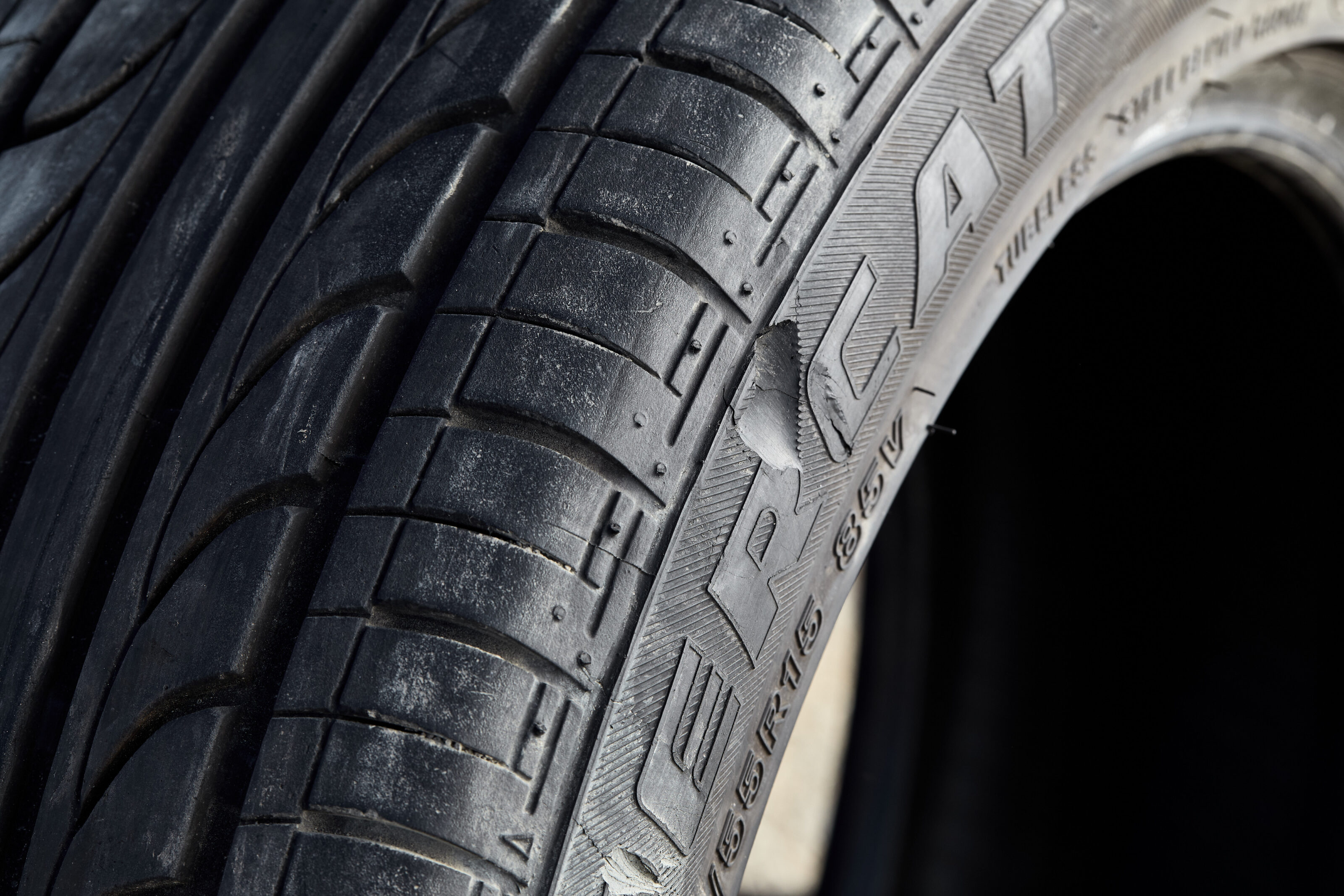
“Debris wedged into tyres can cause slow leaks that can deflate them, whereas bald ones will not grip the road surface in wet weather and need to be replaced immediately. Cuts can compromise the load capacity, so depending on the depth, they may need to be replaced rather than repaired.
“All tyres have an indicator that will show you when they are worn down too far. The indicator is a small raised marker between the more prominent grooves of the tread.”
The Royal Automobile Club of Queensland (RACQ) Principal Technical Researcher John Ewing said there was no law in Australia requiring tyres to be replaced at a specific age, rather drivers needed to make sure theirs were compliant and above the minimum legal tread depth.
“The average distance travelled by a motorist is around 15,000km per year, so after three years, they may be due for renewal or could still be in a satisfactory and legal condition,” Mr Ewing said.“Age-related deterioration can be a factor, and it can vary according to conditions, but it’s usually not a potential issue until around five or six years old.“We’re not aware of any studies or other scientific evidence to suggest changing tyres every one or two years, when they’re still in sound, legal condition with sufficient tread depth, delivers any significant safety benefits.“There are likely to be factors in overseas countries, such as Europe, which influences the need to change tyres more regularly – including weather severity, which don’t apply in Australia.“It also requires a substantial amount of resources – including oil, steel and energy – to manufacture, so an increase in changing frequency is likely to add to environmental and supply issues, as well as becoming an unnecessary cost burden for drivers.“We encourage drivers to maintain and regularly inspect theirs and the pressures to ensure safety and longevity, and to replace when they are unserviceable due to wear, damage or ageing.”
While we don’t know the demographics of those surveyed, you could assume enthusiasts are more meticulous in checking their tyre condition and would likely fork out for better quality tyres – another variable which isn’t taken into account in this study.
Next time you go to get behind the wheel, take a second to look over your tyres, see if they’re still holding air and double check the production date mark – it might just be time for them to be given a second life.
Snapshot
- New mid-spec Elite model arrives
- Entry price drops to $55,000 before on-road costs
- On sale from September
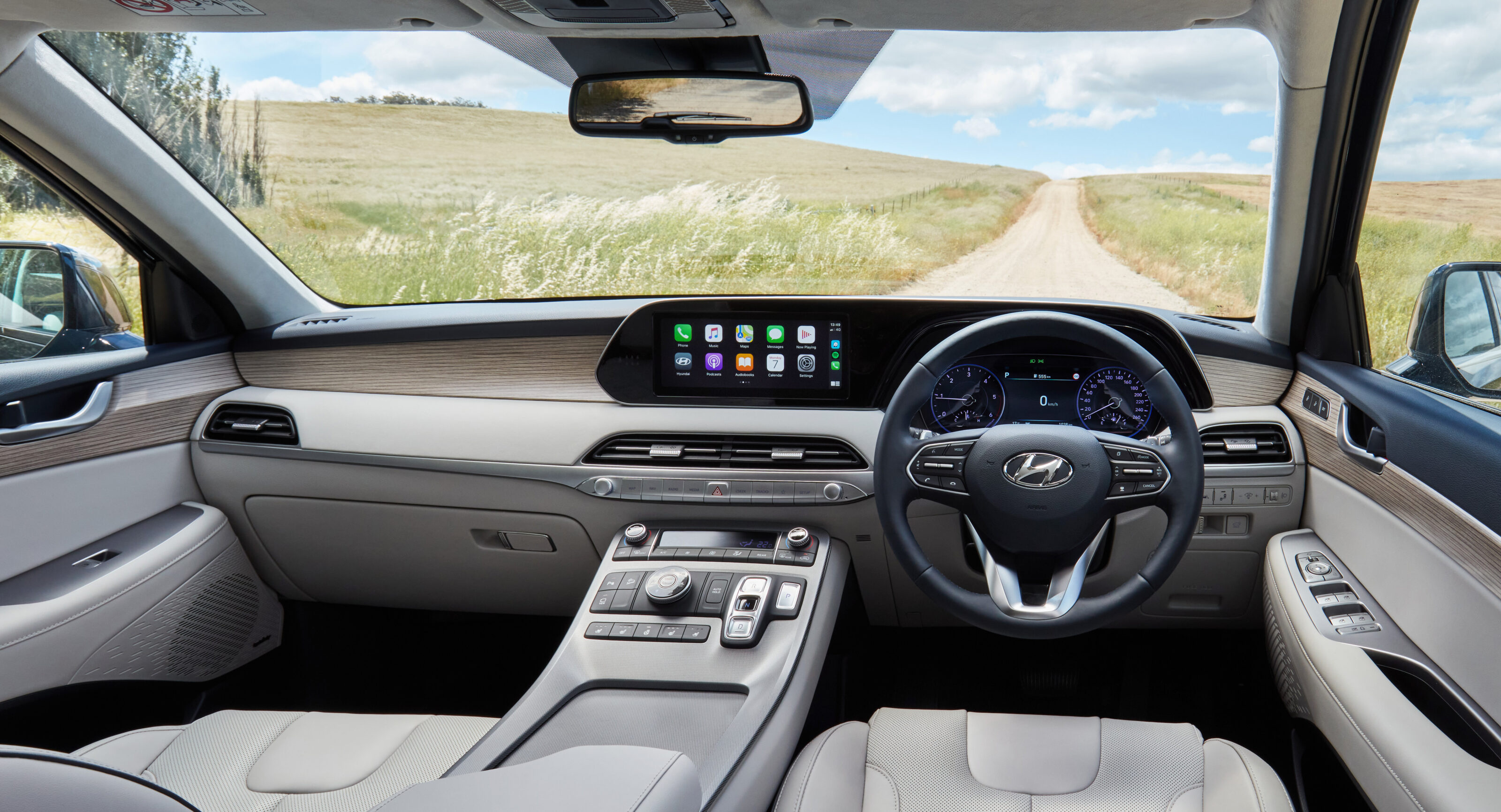
The big and bold 2022 Hyundai Palisade is now a more affordable proposition, thanks to the arrival of a familiar trim grade as a new mid-range variant.
This week’s announcement of the Palisade Elite grade sees the price of entry for this model-year 2022 range drop to $55,000 (before on-road costs), compared to the MY21 line-up’s $61,000 starting price.
The Elite essentially takes over the pricing position of the previous entry model, with a small increase on the petrol model (now $61,500) and a moderate step up for the diesel (now $65,500 instead of $64,000).
2022 Hyundai Palisade pricing for Australia
Available from September 2021. Prices exclude on-road costs.
| Drivetrain | Palisade | Elite | Highlander |
|---|---|---|---|
| 3.8 petrol FWD | $55,000 | $61,500 | $71,000 |
| 2.2 diesel AWDu00a0 | $59,000 | $65,500 | $75,000 |
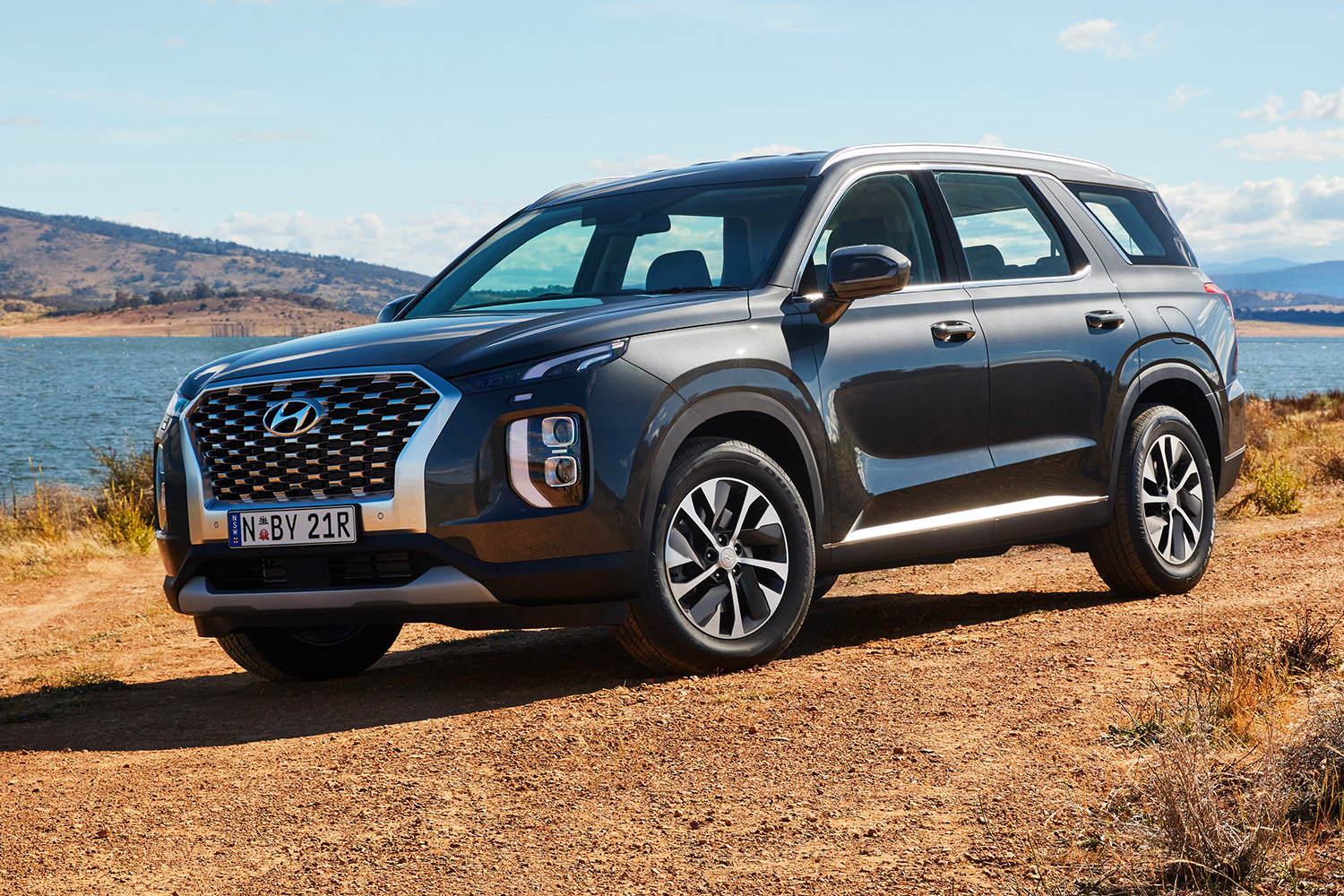
The eight-seat-only entry model still gets standard leather trim and 18-inch alloy wheels as standard, while gaining wireless charging – however, its new price position is underscored by the change from a 10.25-inch infotainment display to an 8.0-inch unit.
A full table of key specifications for the entry Palisade is below.
| Driving Convenience | Active Safety | Lighting |
| u25cf Electronic Parking Brake (EPB) | u25cf SmartSense advanced safety, including: | u25cf Auto dusk sensing headlights |
| u25cf Shift-by-wire transmission | – Blind-Spot Collision-Avoidance Assist-Rear (BCA-R) | u25cf LED Daytime Running Lights (DRL) |
| u25cf Smart key with push button start | – Driver Attention Warning (DAW) | u25cf Rear fog lights -LED |
| u25cf Wireless Charging Pad | – Forward Collision-Avoidance Assist (FCA) (camera & radar) | u25cf LED High Mount Stop Light (HMSL) |
| Multimedia System | – High Beam Assist (HBA) | Vision & Sight |
| u25cf Apple CarPlay4 & Android Auto5 | – Lane Keeping Assist (LKA) | u25cf Electro-chromatic Mirror (ECM) |
| u25cf Multi-Bluetoothu00ae Connection | – Lane Following Assist (LFA) | u25cf 7-inch supervision cluster (TFT, colour) |
| u25cf 8-inch touchscreen display | – Rear Cross-Traffic Collision Avoidance Assist (RCCA) | Ventilation & Heating |
| u25cf Quiet Mode Function | – Rear Occupant Alert (ROA) | u25cf Climate control AC (3 zones) |
| Passive Safety | – Smart Cruise Control with Stop & Go | u25cf Cabin air filter |
| u25cf 6 airbags (including 3rd row curtain) | u25cf Parking Distance Warning (F&R) | u25cf Cooling/heating diffusion type roof air vent – 2nd row & 3rd rows |
| u25cf ISOFIX child restraints (x3) | u25cf Rear view camera | u25cf Cooling/heating vents 2nd row floor |
| u25cf Top tether child restraint anchors (x5) | u25cf Tyre Pressure Monitoring (TPMS) | Occupant Comfort & Convenience |
| Wheels & Tyres | u25cf Trailer Stability Assist (TSA) | u25cf Leather-appointed6 interior – seats & steering wheel |
| u25cf 18-inch alloy wheels | u00a0 | u25cf Power driveru2019s seat |
| u25cf Full size alloy spare wheel | u00a0 | u00a0 |
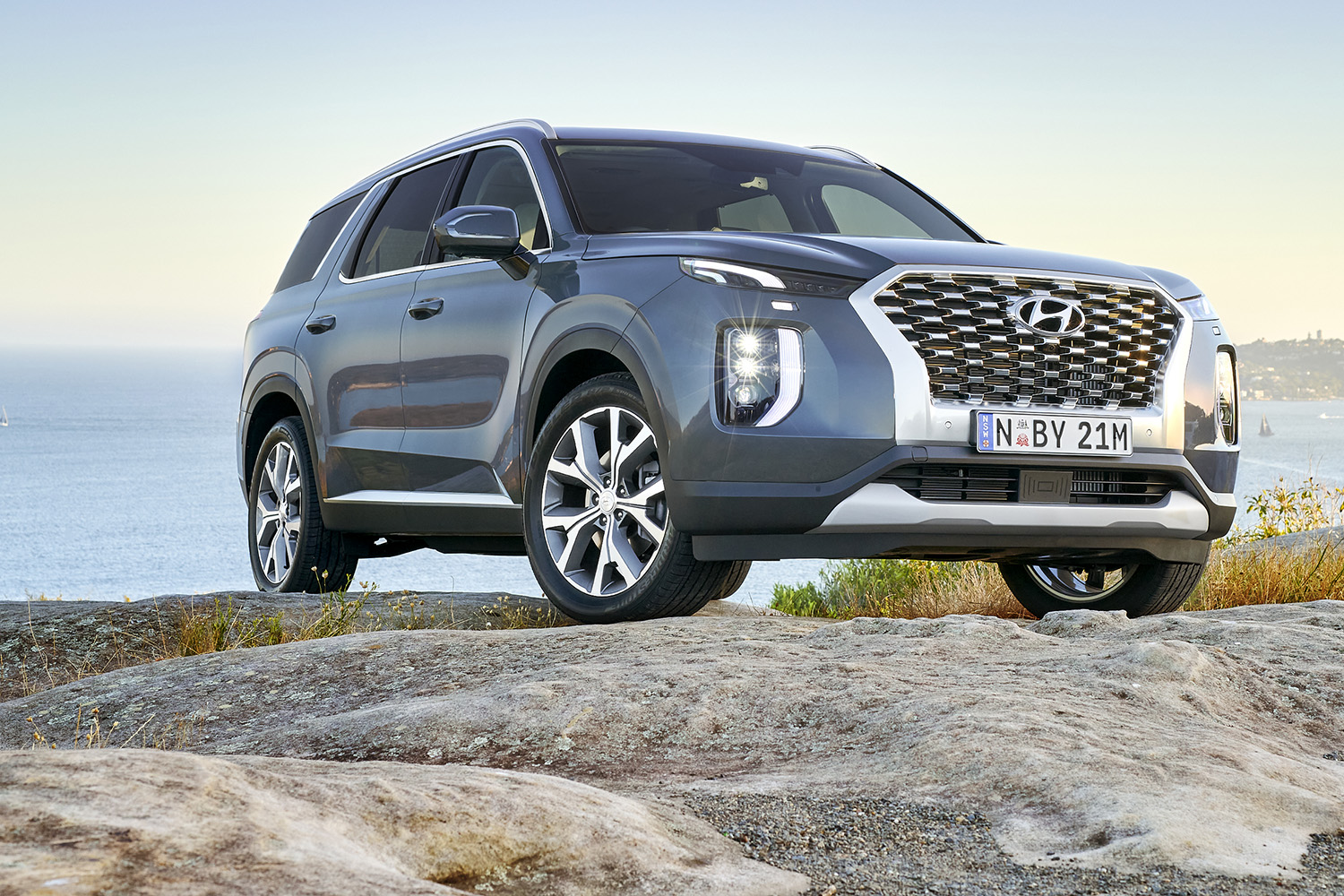
Stepping up to the Elite returns that bigger display to the features list, along with 20-inch alloy wheels, LED tail lamps, integrated satellite navigation, 12-speaker sound, heated front seats, a single-panel sunroof, tinted rear windows, and “smart” powered tailgate.
The Elite also adds the choice of seven- or eight-seat configurations.
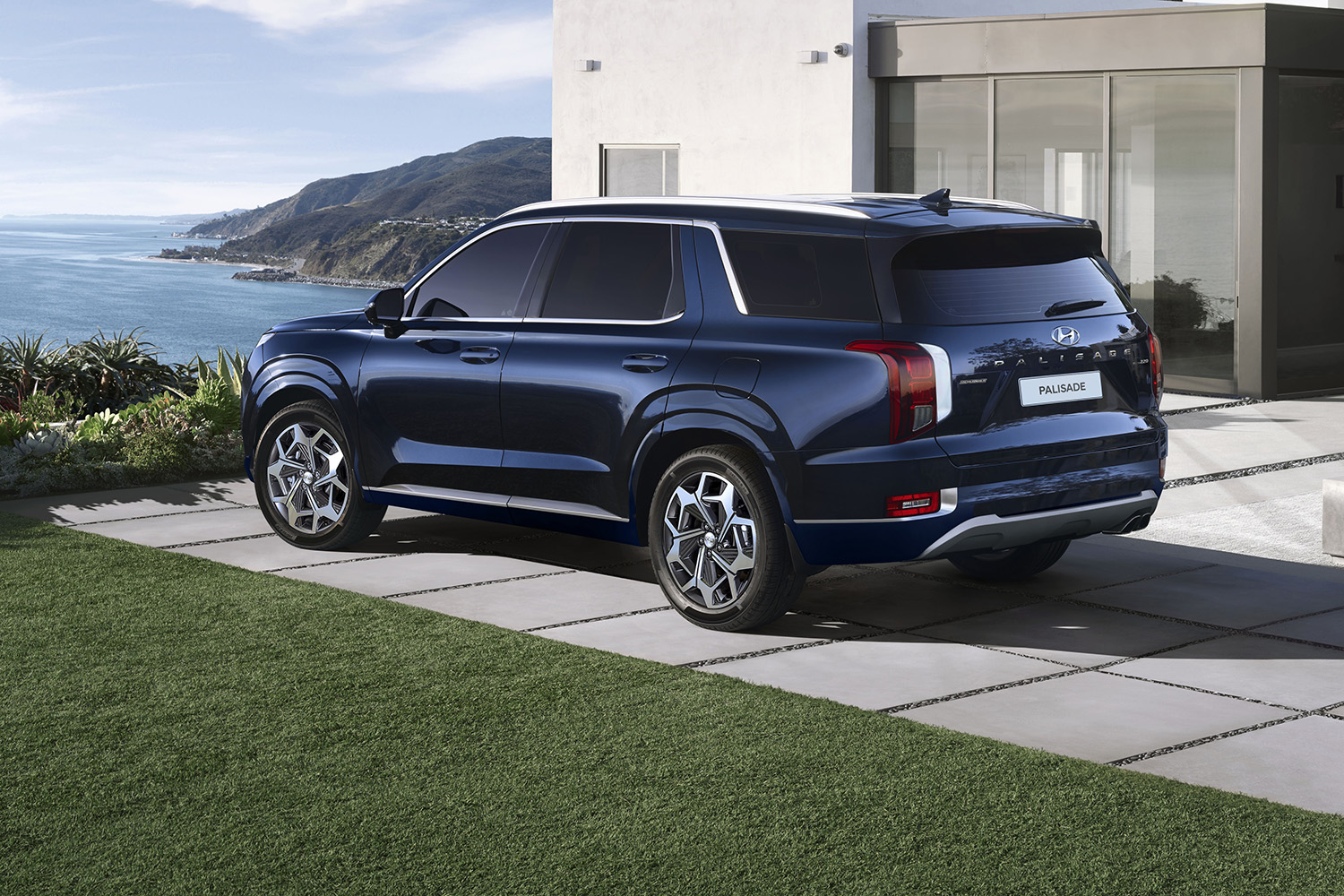
Reach for the top-shelf Palisade Highlander and you’re treated to the following:
- Head-Up Display (HUD)
- Blind Spot View Monitor (BVM)
- Surround View Monitor (SVM)
- Suede roof lining
- Nappa leather seats (beige standard, black a no-cost option)
- Dual sunroof with tilt function
- Rear door blinds
- Integrated Memory System (IMS) Driver’s seat
- Heated front and second row seats
- Ventilated front and second row seats (rear ventilated only available on 7-seat Highlander)
- Heated steering wheel
- Rain-sensing wipers
- Safe Exit Assist (SEA)
- 20-inch alloy ‘calligraphy’ wheels
- Body-coloured bumpers
- Body-coloured cladding
The Palisade range’s mechanical package is unchanged for the 2022 model year, meaning petrol models get a naturally-aspirated 217kW/355Nm 3.8-litre V6 engine driving the front wheels, while diesel variants get a 147kW/440Nm four-cylinder turbo engine matched to all-wheel drive.
All variants get an eight-speed automatic transmission, with fuel consumption listed at 10.7L/100km for the petrol models and 7.3L/100km for the diesels.
The Palisade shares its platform with the Santa Fe, but measures a whopping 210mm longer and 85mm wider. With the third seating row folded down, the Palisade boasts a generous 704 litres of storage space. A full-size spare wheel lives under the rear floor.
Should you need to haul additional cargo, each Palisade variant has a braked towing capacity of 2200kg and 750kg unbraked.
Service intervals are every 15,000km or 12 months and, like any Hyundai, it comes with a five-year/unlimited-kilometre warranty.
The updated 2022 Hyundai Palisade range is on sale from the start of September 2021.
Snapshot
- Higher prices but better-equipped
- More safety features
- Bigger inside and out
UPDATE, February 15 2022: Mitsubishi has announced ‘2022.5’ pricing for its revised Outlander line-up, with semiconductor shortages resulting in changes to the equipment lists and pricing.
Read about it here, and catch up on our latest Outlander coverage at the link below.
The story to here
August, 2021: Mitsubishi’s 2022 Outlander is almost here and the company is gearing up for its release later this year by announcing pricing and specification.
The next-gen Outlander is the first fruit of the Renault-Nissan-Mitsubishi alliance, with a more rigid chassis, weight-saving measures and increased use of aluminium.
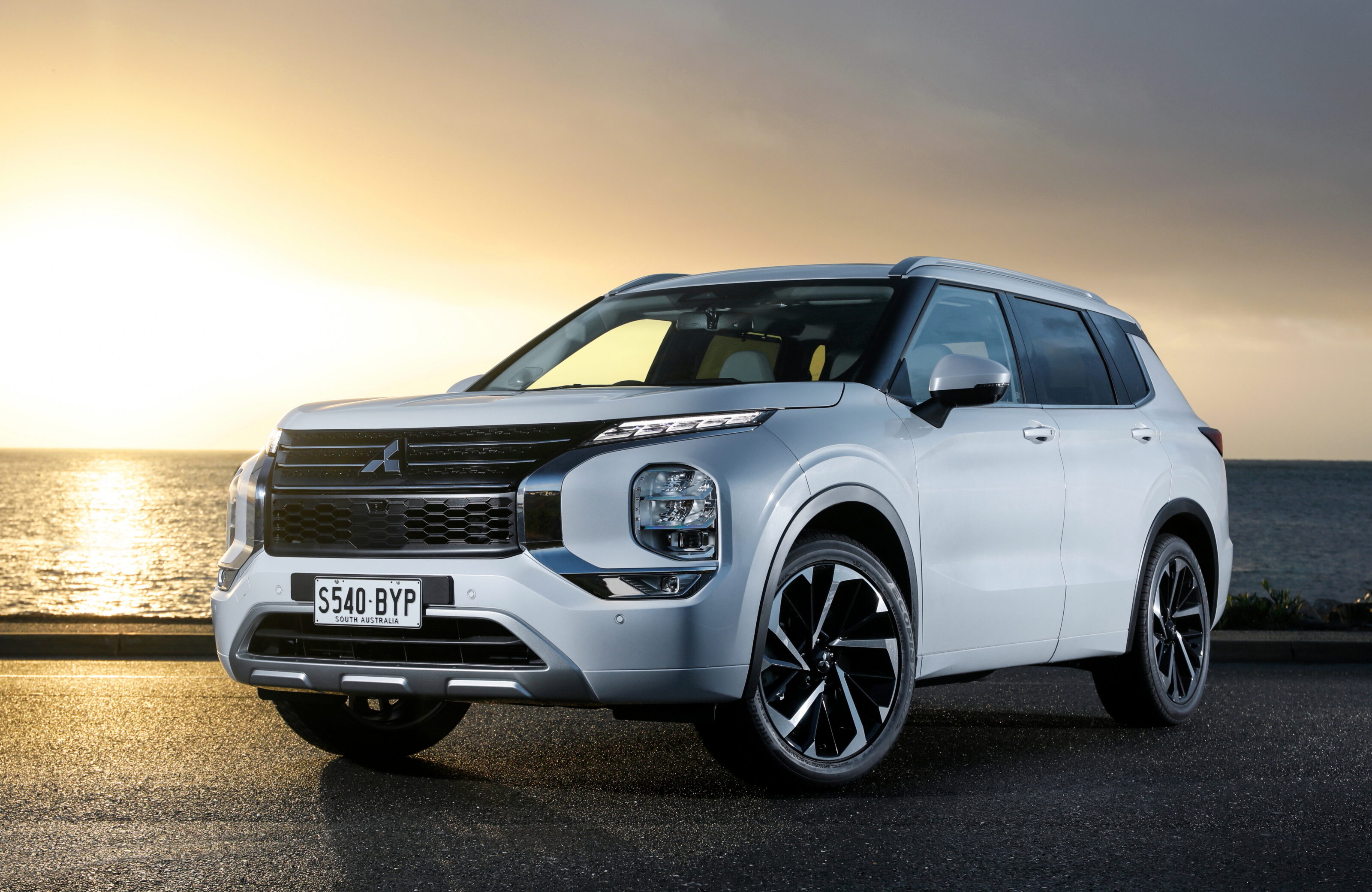
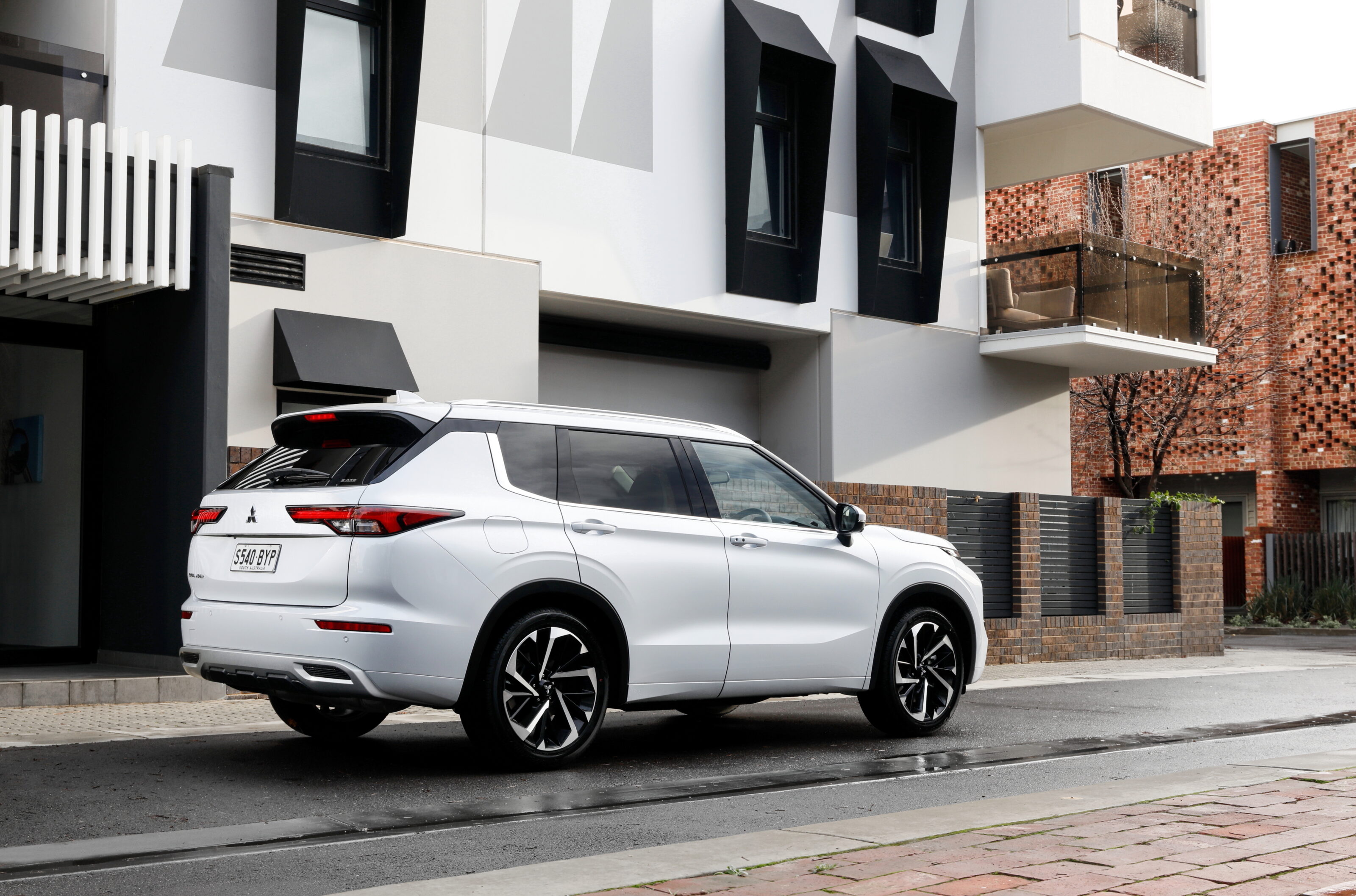
The new car looks far more substantial than before, especially riding on the 20-inch wheels of the upper models. Mitsubishi says the new car uses the i-fu-do-do design language, which means authentic and majestic – as well as featuring the striking (and polarising) Dynamic Shield front end.
This is an important car for the Japanese marque – its buyers are price sensitive and used to a bargain, as well as the previous model’s cheap and cheerful image. With more upmarket looks inside and out, as well as not-insignificant price rises (along with a lot more stuff), the 2022 Outlander has big wheel-arches to fill.
Pricing
The Outlander has remained a local favourite for Mitsubishi, so the brand is continuing to offer a broad range of models and specification, starting at $34,490 and rising to $49,990 for the all 2.5-litre petrol line-up.
Prices are up across the range by between $1500 and $4000, depending on the model, but there is a hefty increase in safety specification and a claimed improvement in materials, as well as a general specification uplift.
The manual disappears from the line-up, although that’s hardly a surprise. That does mean, however, the Outlander no longer starts under $30,000.
| Model | Seats | Price before on-roads | Difference |
|---|---|---|---|
| ES 2WD | 5 | $34,490 | +$2000 |
| ES 2WD | 7 | $35,490 | +$2000 |
| ES AWD | 5 | $36,990 | +$1000 |
| LS 2WD | 7 | $37,990 | +$1500 |
| LS AWD | 7 | $40,490 | +$1500 |
| Aspire 2WD | 7 | $41,490 | new to the range |
| Aspire AWD | 7 | $43,990 | new to the range |
| Exceed AWD | 7 | $47,990 | +$4000 |
| Exceed Tourer AWD | 7 | $49,990 | new to the range |
Features
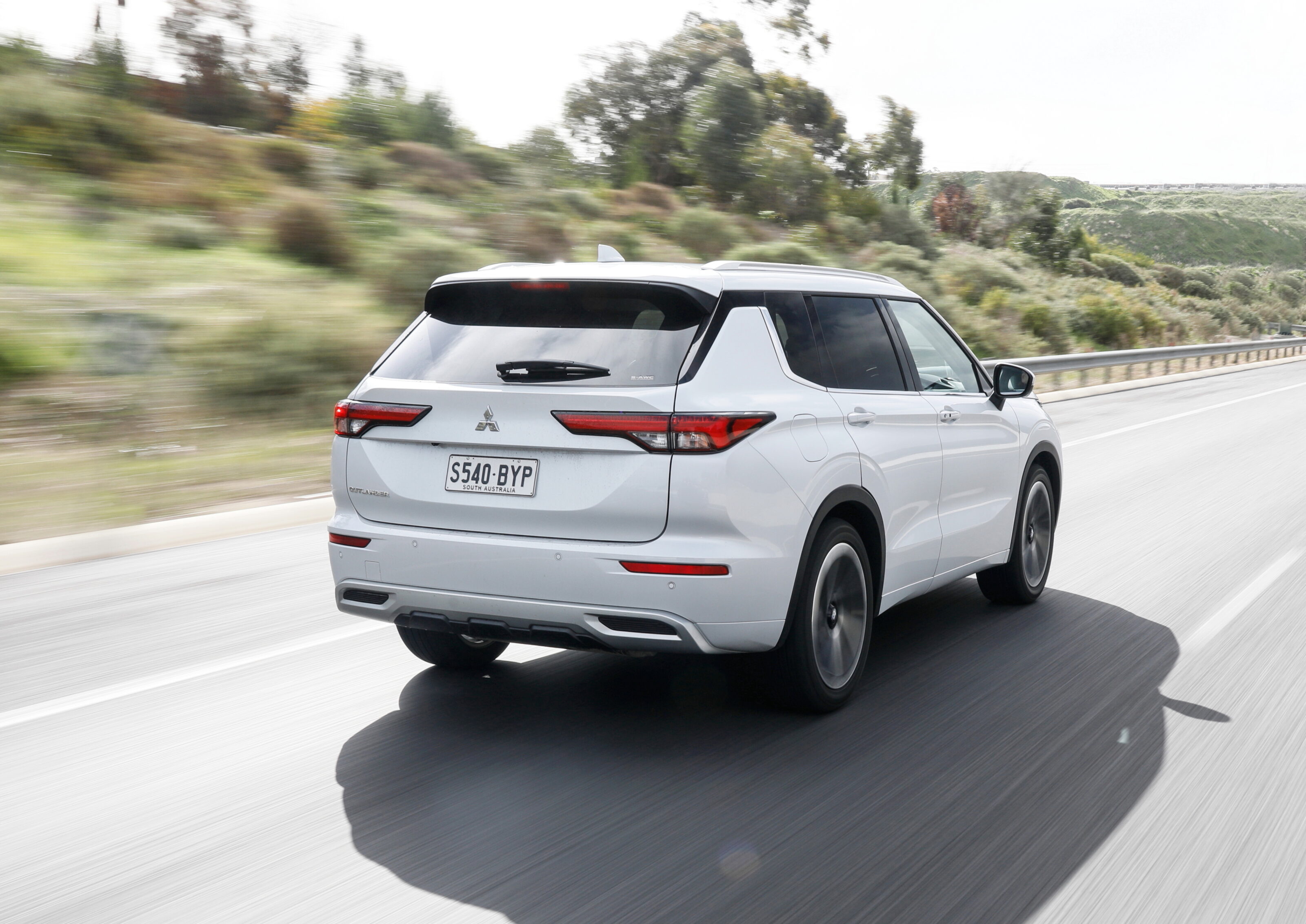
The ES starts the range with its three seat and powertrain combinations and has:
- fabric interior
- 7.0-inch info screen between analogue dials
- 9.0-inch media touchscreen
- wireless Apple CarPlay
- USB Android Auto
- 40/20/40 split fold rear seat
- dual-zone climate control
- second-row air vents
- front and rear parking sensors
- adaptive cruise control
- reversing camera
- 18-inch alloy wheels
- privacy glass
- cargo blind
- leather wheel and shifter
- silver front and rear bumper garnish
- power tailgate with hands-free operation
- auto-dimming rear vision mirror
- heated and folding door mirrors
- auto headlights with automatic high beam
- silver roof rails
- LED fog lamps
- auto wipers
- 20-inch alloy wheels
- 12.3-inch fully digital dashboard
- 10.8-inch head up display
- combination fake suede and fake leather interior
- power driver’s seat
- heated front seats
- automatic levelling headlights
- 10-speaker BOSE-branded audio system
- panoramic sunroof with tilt and slide opening
- pull-up rear sunshades
- leather seats
- three-zone climate control
- two-tone exterior colour
- two-tone leather interior
- massage function front seats
There are also three option packs.
The $3060 Style Set adds body coloured front, rear and side garnishes in body colour, a black and chrome Mitsubishi bonnet logo and a bodyside decal.
If you want a nudge bar, tinted bonnet protector, roof carrier, roof rail (ES only), luggage tray and boot flap, the Adventure Kit costs from $2402.
And for the discerning driver, the Protection Pack adds a bonnet protector, side wind deflectors, floor mats, luggage tray and scuff plate for the boot, starting at $1155.
All grades, except the Exceed Tourer are available in one of seven colours – white, sterling silver, titanium, cosmic blue, white diamond, black diamond and red diamond.
White is free, metallic and pearlescent paints are another $740 and prestige paint (anything with diamond in the name) is $940.
The Exceed Tourer’s tow-tone paint jobs are free and come in deep bronze/black diamond and black mica/white diamond combinations.
Engine, transmission and fuel economy
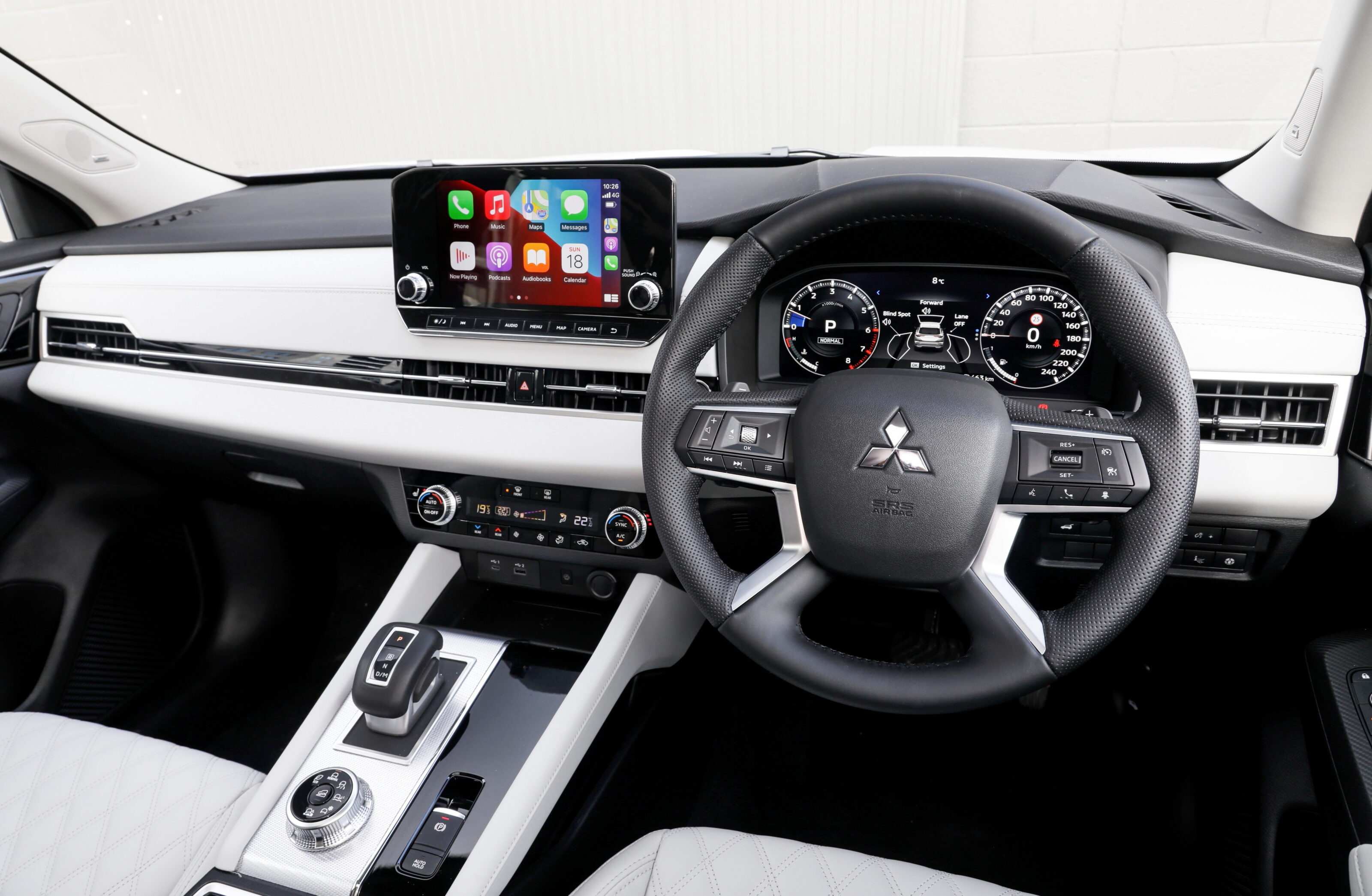
At launch, the range will be powered by just one engine – a 2.5-litre four-cylinder, which Mitsubishi says is newly-developed. With an extra 100cc over the old car, the new engine arrives with 135kW and 245Nm – which represents increases of 11kW and 25Nm.
Sadly there is no PHEV yet (due early 2022) and there has been no mention of diesel, which fell out of the range some time ago.
An updated CVT with shift-by-wire means you can use the paddle shifters (sadly, the lovely aluminium paddles of the old car appear to have been retired) to select a gear yourself, with eight software-enforced ratios for what Mitsubishi calls a “more natural” automatic transmission feel.
You can choose front wheel drive on the cheaper ES, LS and Aspire spec grades, and AWD is available throughout.
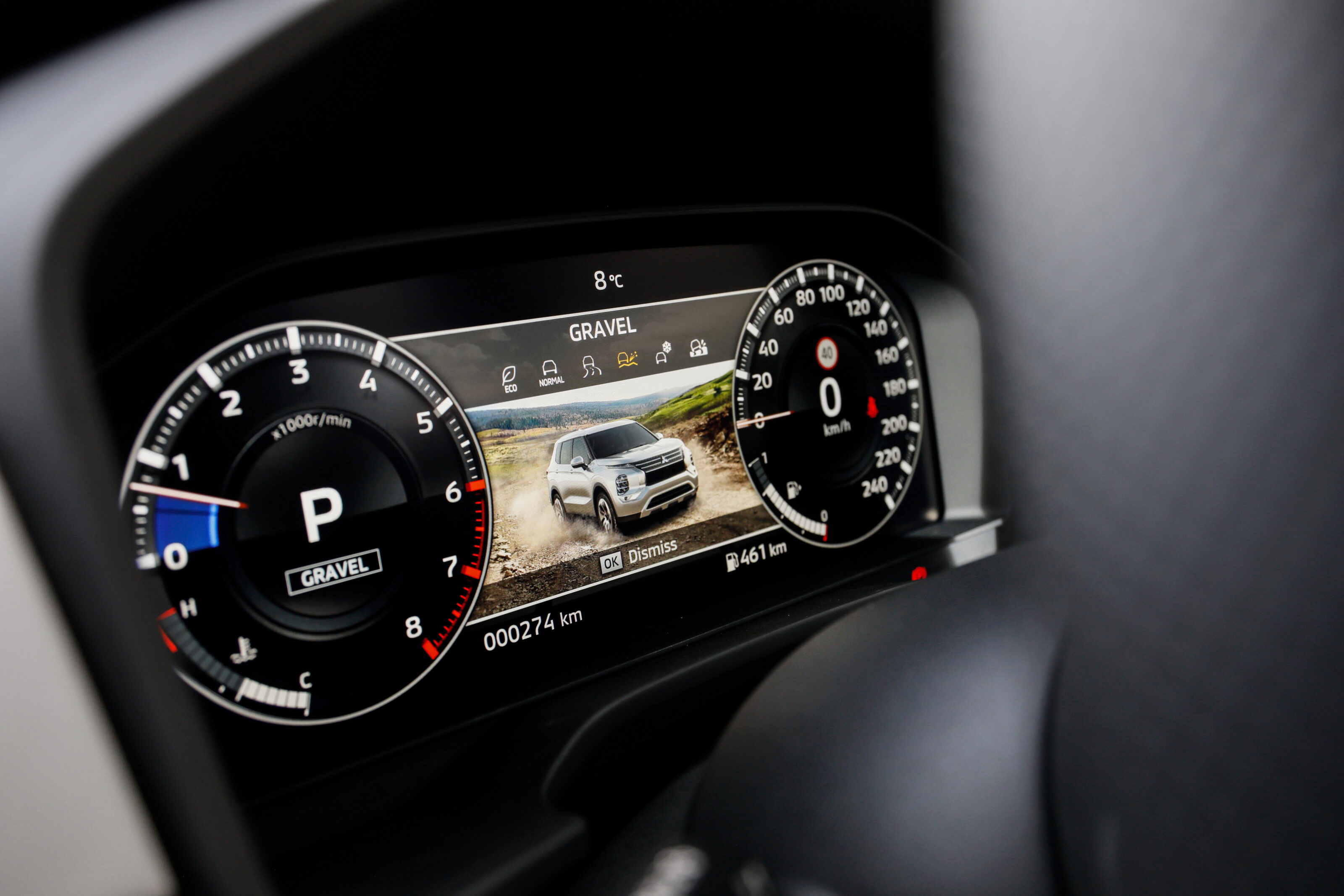
There are six drive modes available in the AWD versions (five in the 2WD), which the company calls Super All Wheel Control (S-AWC) and claims a motorsport connection to its development.
The updated system also features a re-calibrated Active Yaw Control and a new hydraulically activated direct coupling for quicker power transfer between the four wheels.
Each model has slightly different combined cycle fuel economy figures based on the ADR measurement.
2WD ES: 7.5L/100km
2WD LS/Aspire: 7.7L/100km
AWD ES: 7.8L/100km
AWD LS/Aspire/Exceed: 8.1L/100km
CO2 outputs range from 170g/km for the 2WD ES through to 185g/km for the upper end AWD models.
Safety
Standard across the range are eight airbags (including driver’s knee and a centre airbag) and all the usual braking and stability systems, along with:
- Forward AEB with cyclist detection and junction assist
- Lane departure prevention
- Driver attention alert
- Traffic sign recognition
- Hill descent control
- Trailer stability assist
- Adaptive driving beam.
Warranty and servicing
As with the rest of the Mitsubishi range, the company offers its 10/10 Diamond Advantage warranty with up to 10 years/200,000km warranty coverage and 10 years capped-price servicing. If you don’t service with Mitsubishi, that program reverts to a five-year warranty with unlimited kilometres.
The five-year warranty is technically the standard warranty and you have some fairly easy hoops to jump through to qualify for the longer warranty period.
Roadside assist runs for up to four years/unlimited kilometres, again, as long as you service with Mitsubishi.
Availability
Mitsubishi expects to launch the 2022 Outlander in November 2021
Snapshot
- Tesla-rivaling model range
- Four models planned
- First customer cars to be delivered in February 2022
Polestar is preparing a model onslaught with enough hardware to threaten Tesla.
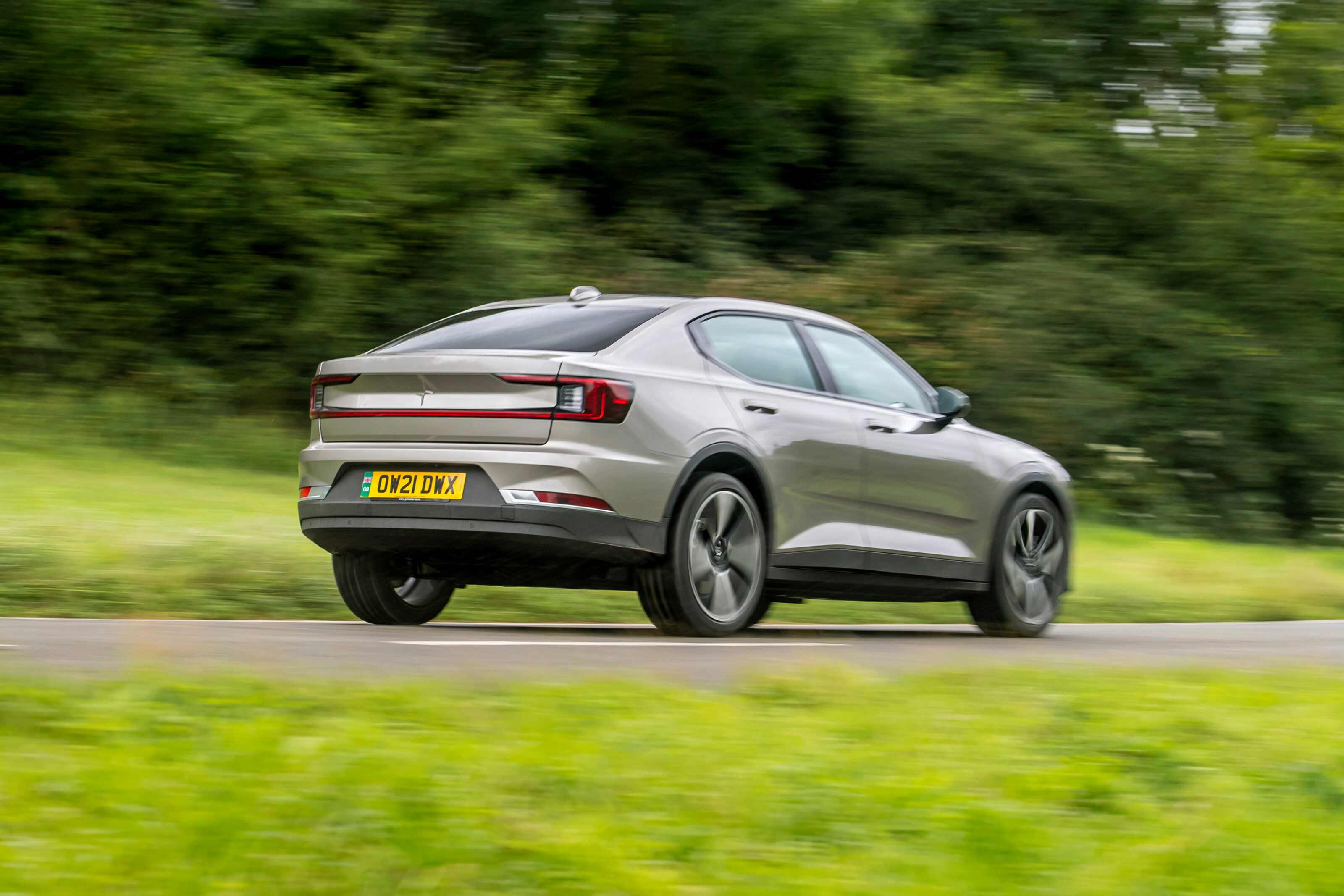
The first to arrive locally will be the delightfully Scandinavian Polestar 2 liftback, which borrows its platform from Volvo’s COTY-winning XC40. The first cars will land in November 2021 for an official launch before order books open in January 2022. Customer cars will be delivered from February.
The Polestar 2 has been on sale since 2020 overseas, so there won’t be a spike in demand for Australia to contend with.
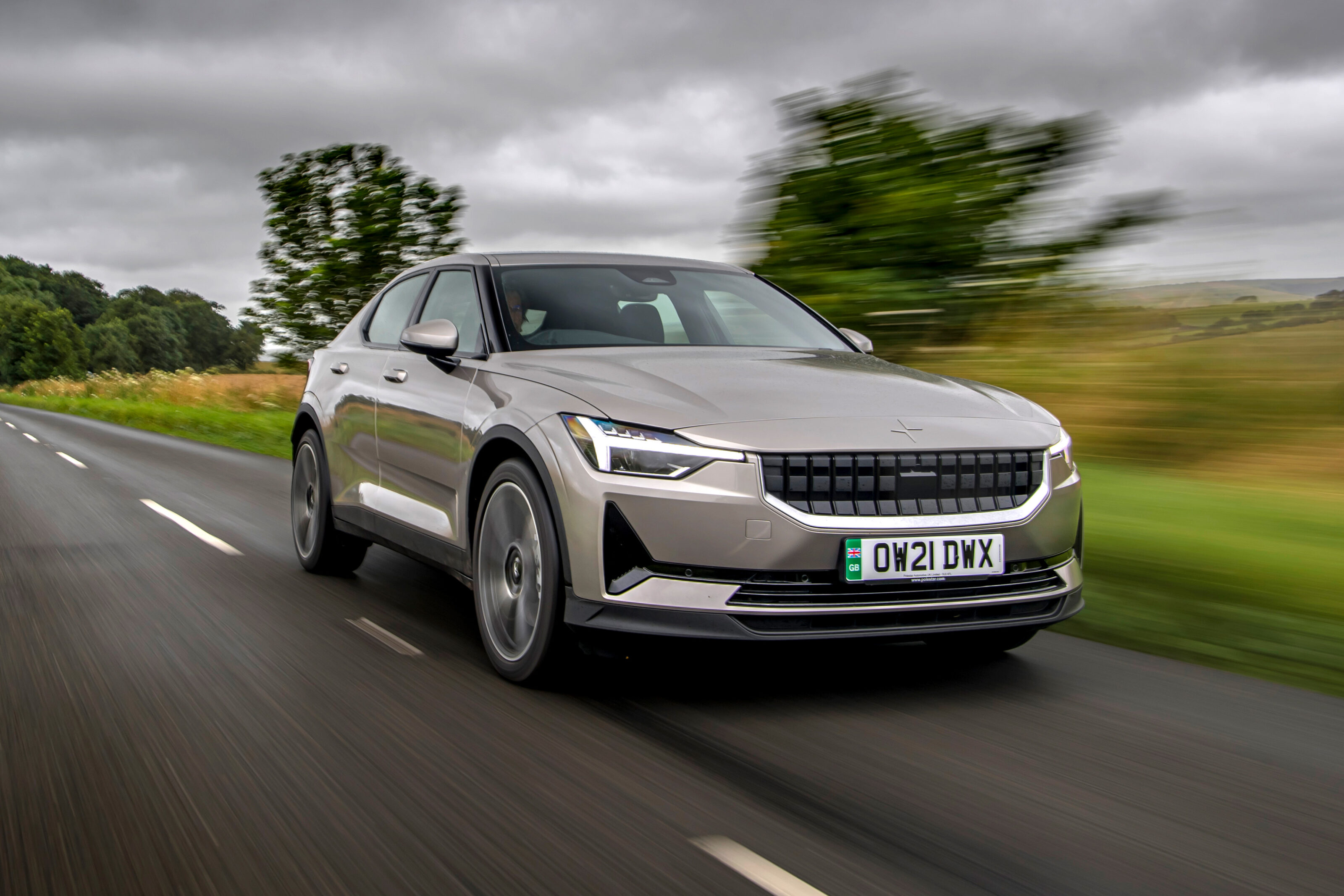
Top spec will be all-wheel drive with a 300kW and 660Nm output from two motors, drawing power from a 78kWh battery pack which provides a range of up to 480km. This variant will hit 100km/h in a claimed 4.5sec.
A 64kWh, front-drive version will have a range up to 440km, while a long-range (78kWh) FWD version will be able to travel up to 540km. These have 165 and 170kW respectively, and take 7.0sec to hit 100km/h.
The Polestar 2 will fight the Tesla Model 3 on price, despite an expectation the brand’s premium positioning will push it higher. With Model 3 starting at $71,000, expect to see the Polestar 2 start below $80K.
Next will come the Polestar 3. Set to be based on the same platform as the larger Volvo XC90, the 3 will serve as Sweden’s answer to the Tesla Model X.
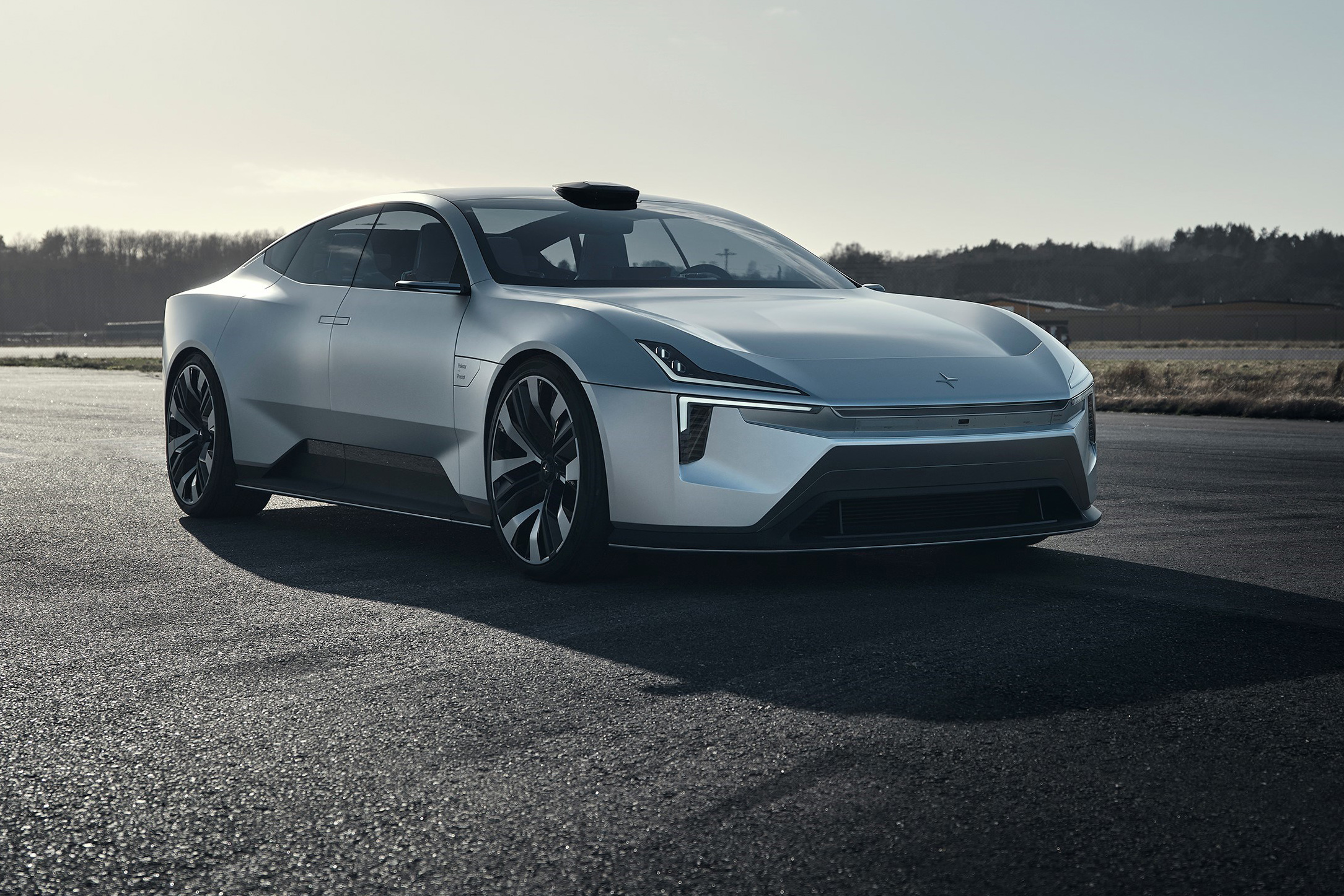
Expect a similar spread of variants as the 2, albeit with outputs befitting a large luxury SUV, and styling inspired by elements of the Polestar Precept (see caption). Timing for the Polestar 3 is uncertain, though we should know later this year.
The Precept itself will also go into production, though both the reveal and launch timing for this model are yet to be finalised. Separate from the Polestar 3, the Precept was hailed as a ‘look into Polestar’s future’ meaning it could be some time away. It’s a large four-door sedan, so Tesla’s Model S will need to stay frosty.
Finally, Wheels understands a fourth upcoming model, dubbed Polestar 4, is already in the planning stages, though it seems any further details have yet to leave the walls of Polestar’s Gothenburg headquarters.
Polestar won’t have standard dealerships, instead setting up ‘spaces’ where customers can get info and test drive a car before buying online. Servicing, however, will be undertaken at Volvo dealerships, as Polestar still retains links to its former parent company.
Why Volvo is launching Polestar as a standalone brand?
While Polestar still retains technical and parent company links to Volvo, the brand is technically separate, a little like Mini is to BMW. The primary reason Volvo let Polestar branch off was its need for freedom in design.
When Volvo built the Concept Coupe, then design boss Thomas Ingenlath wanted to put it into production. The Coupe ‘wouldn’t suit the Volvo image’, so Ingenlath split Polestar off to build performance-focused models, turning it into the Polestar 1.
The updated 2022 Jeep Compass is here, bringing a lightly refreshed look on the outside and an almost all-new feel in the cabin.
Jeep will be looking to the Compass to give its growing sales figures a shove – while its 2021 numbers of 533 up to August are improved on last year’s effort of 331 for the same period, the Compass still lags well behind the big Grand Cherokee’s 1917 sales year-to-date.
Priced from $37,950 before on-road costs, the five-seat Compass starts with the new Launch Edition and ranges through to the top-shelf Trailhawk at $51,250 before on-road costs.
Indeed, price is the biggest challenge for the Compass. Although well-equipped, the Indian-built Compass competes on price with larger offerings like the Toyota RAV4, Hyundai Tucson and Mazda CX-5.
In the case of our $46,950 S-Limited test car, powerful high-specification variants in the above ranges – with price tags in the range of $45,000 to $50,000 – become hard to ignore.
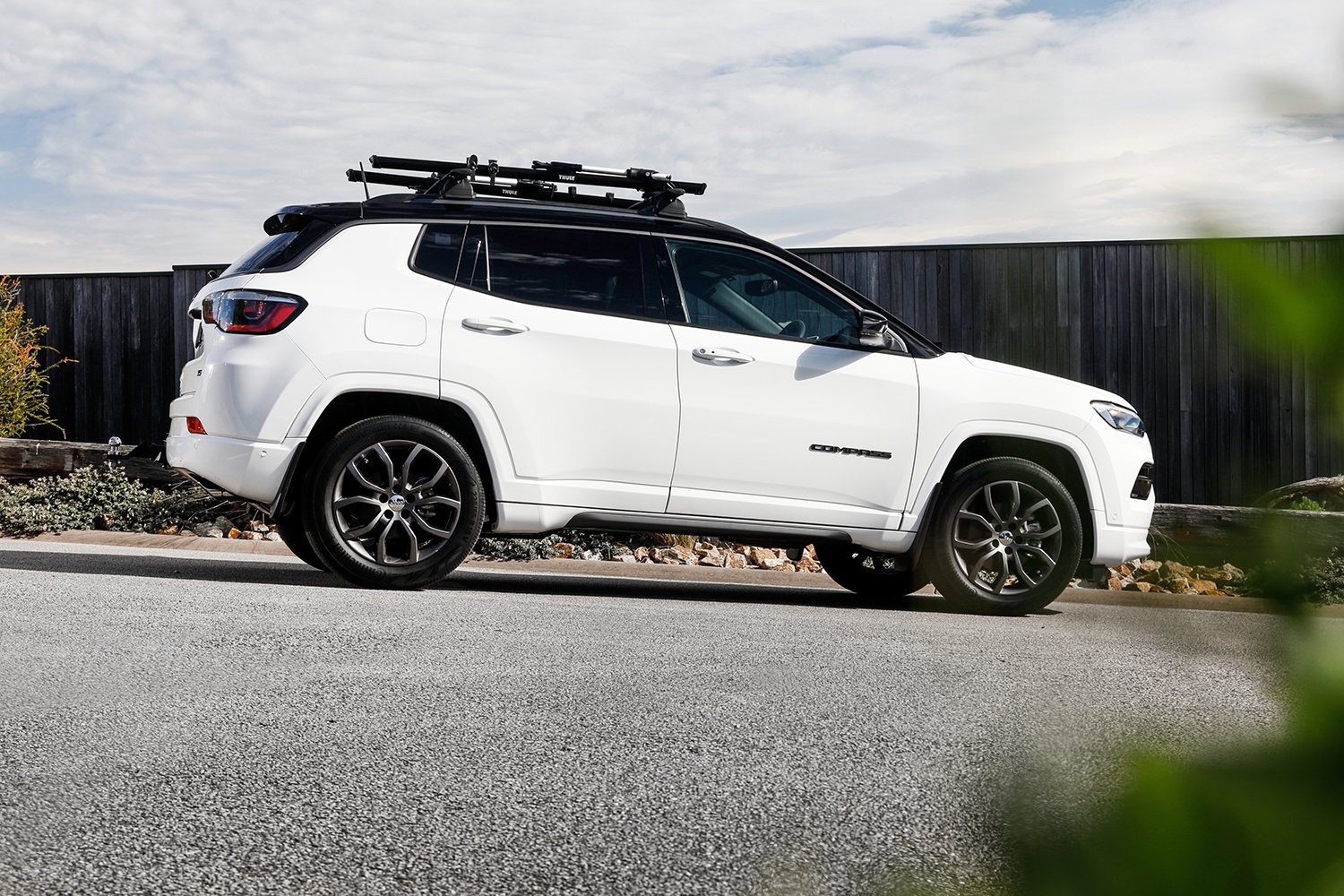
Power in the Launch Edition, Limited, 80th Anniversary and S-Limited models is provided by the same 2.4-litre four-cylinder naturally-aspirated (no turbo) petrol engine that was offered previously, producing 129kW and 229Nm.
At the top of the range, there’s a more compelling 125kW/350Nm 2.0-litre diesel in the Trailhawk – but for that engine, its trim upgrades and enhanced off-roading prowess, you pay a good deal more.
Front-wheel drive and a six-speed automatic is standard in the Launch Edition, but every other variant is treated to the surety of all-wheel drive and a more efficient nine-speed automatic.
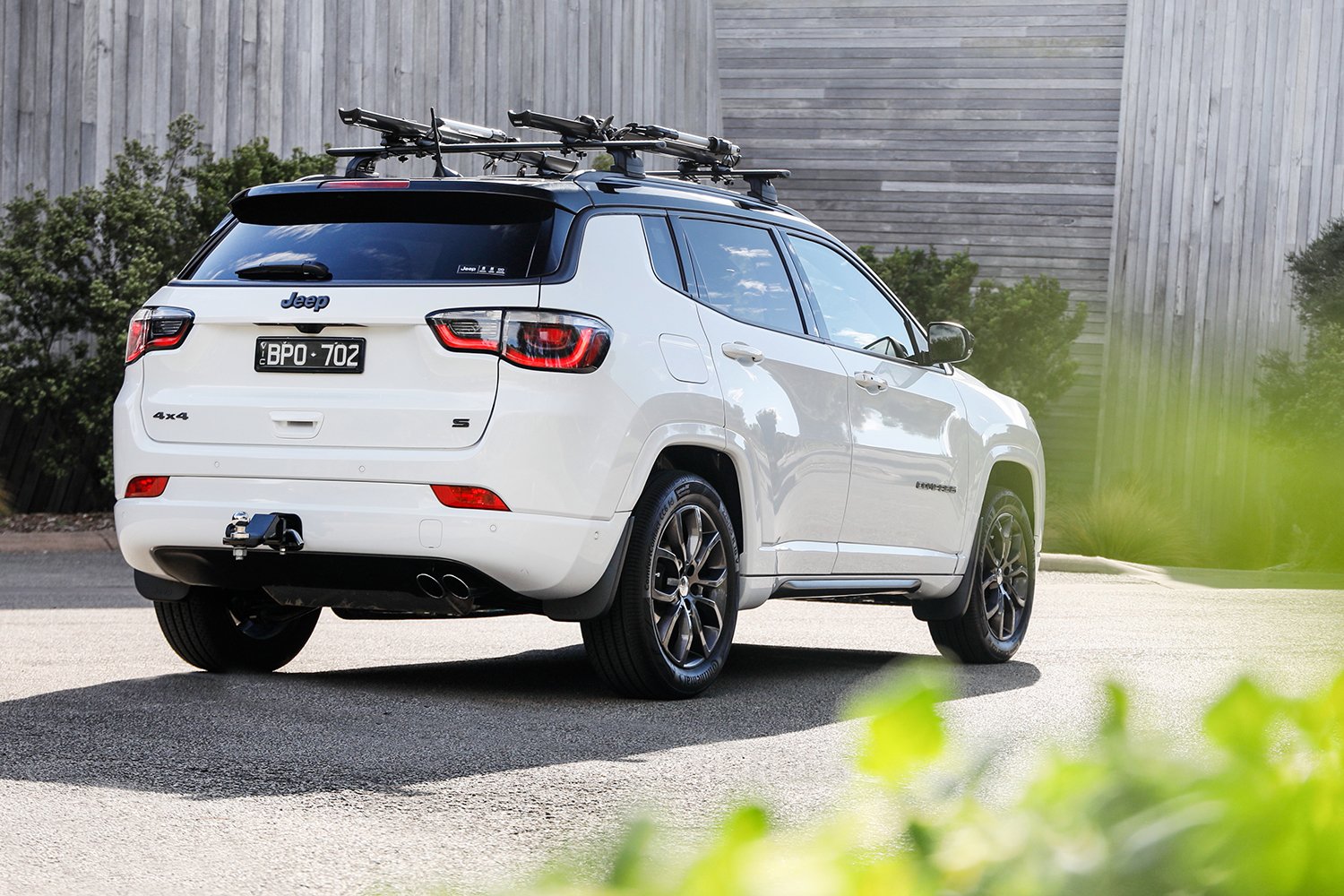
On test here is the high-spec S-Limited, which, like its siblings, is treated to new looks inside and out.
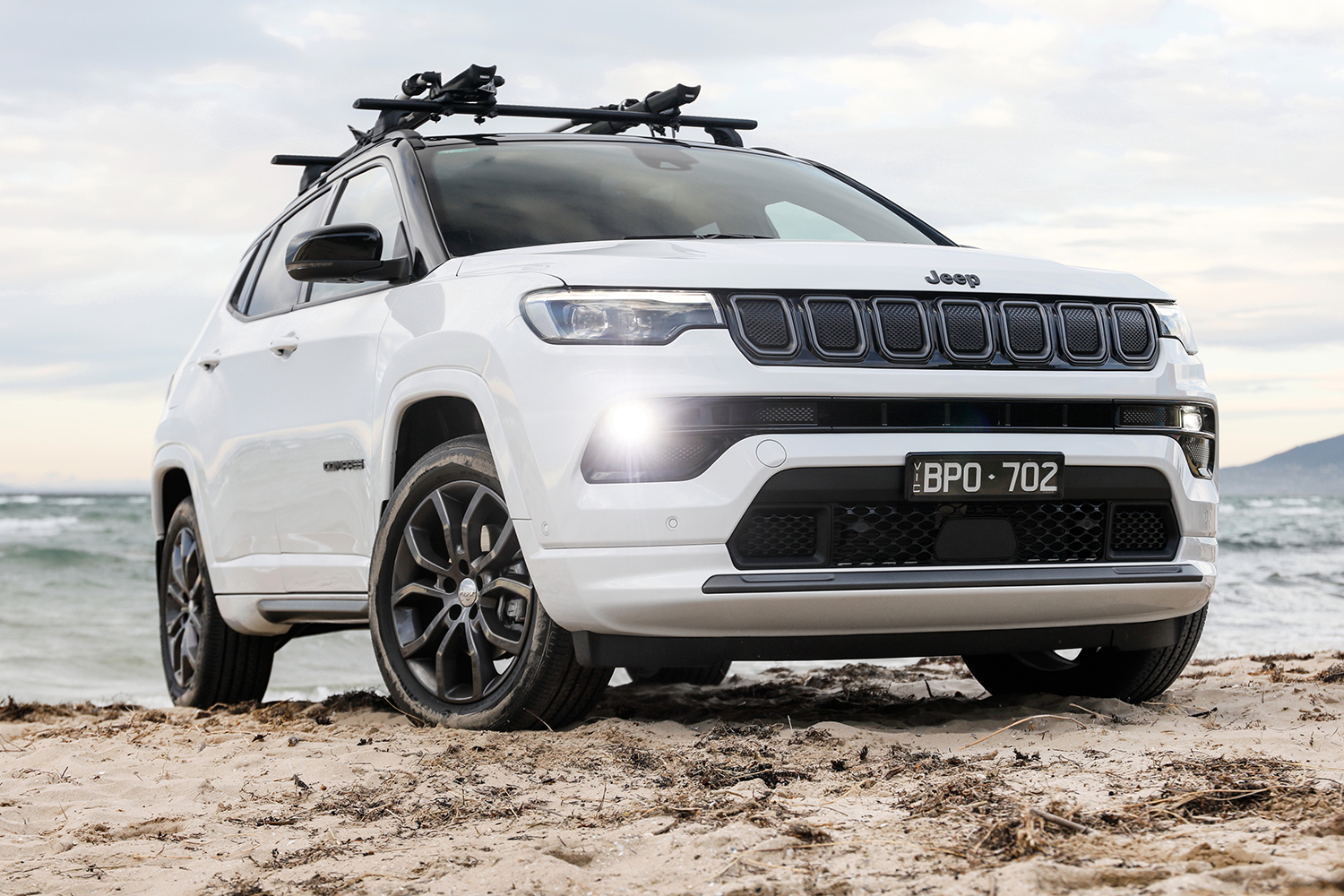
Outside, there’s refreshed styling at the front with slender new headlights, a subty redesigned take on the iconic seven-slot grille, and a mean new bumper design with deep-set fog lights and a large lower air dam.
Body-coloured arches and skirts are new and add a more premium look, while changes at the already stylish rear end are limited to a body-coloured bumper.
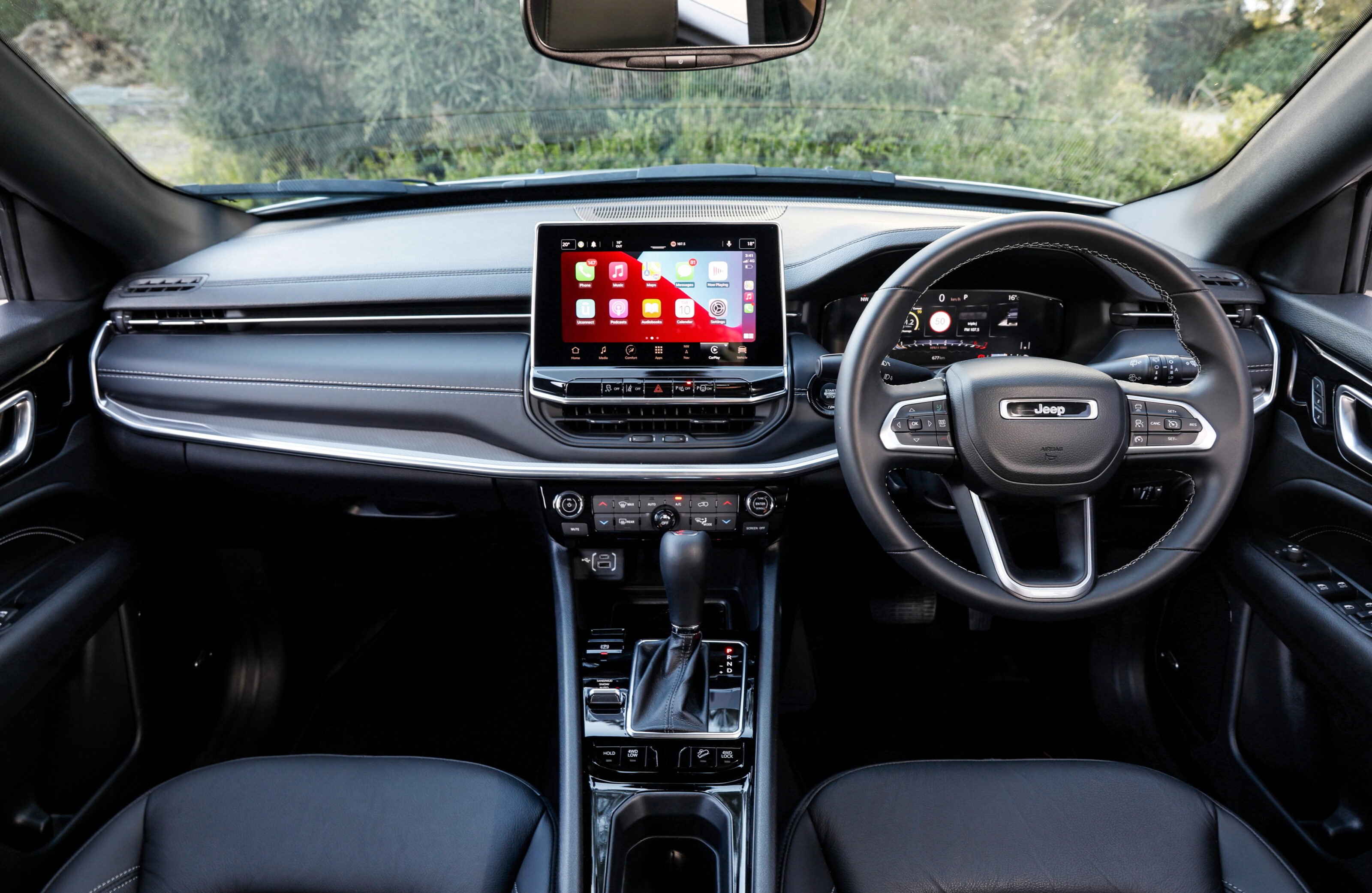
Comprehensive barely describes the work done to the Compass’s interior, and it shows how quickly the segment has moved on.
Our tester also serves as the company’s Mopar accessories demonstrator in Australia, so it’s been equipped with moulded splash guards front and rear, ‘High Gloss Granite Crystal’ 18-inch alloy wheels, satin-chrome tyre valve caps, a Kicker “premium” speaker upgrade with midbass and tweeter, a cargo net and tray in the boot, and Thule roof racks.
Inside is where the Compass has had its most significant makeover work done. Step in blindfolded and you’d be forgiven for seeing this as an all-new car instead of a tasteful refresh on the second-generation model that launched in 2018.
Interior and space
Not one old surface has survived the update. There’s a sporty new steering wheel, a new three-tier dashboard with molded and stitched accents, and completely redesigned door panels.
Fit and finish is top shelf for the segment, with soft-touch surfaces throughout the first row – right down to rubberised vent dials and well-damped switches in the dash.
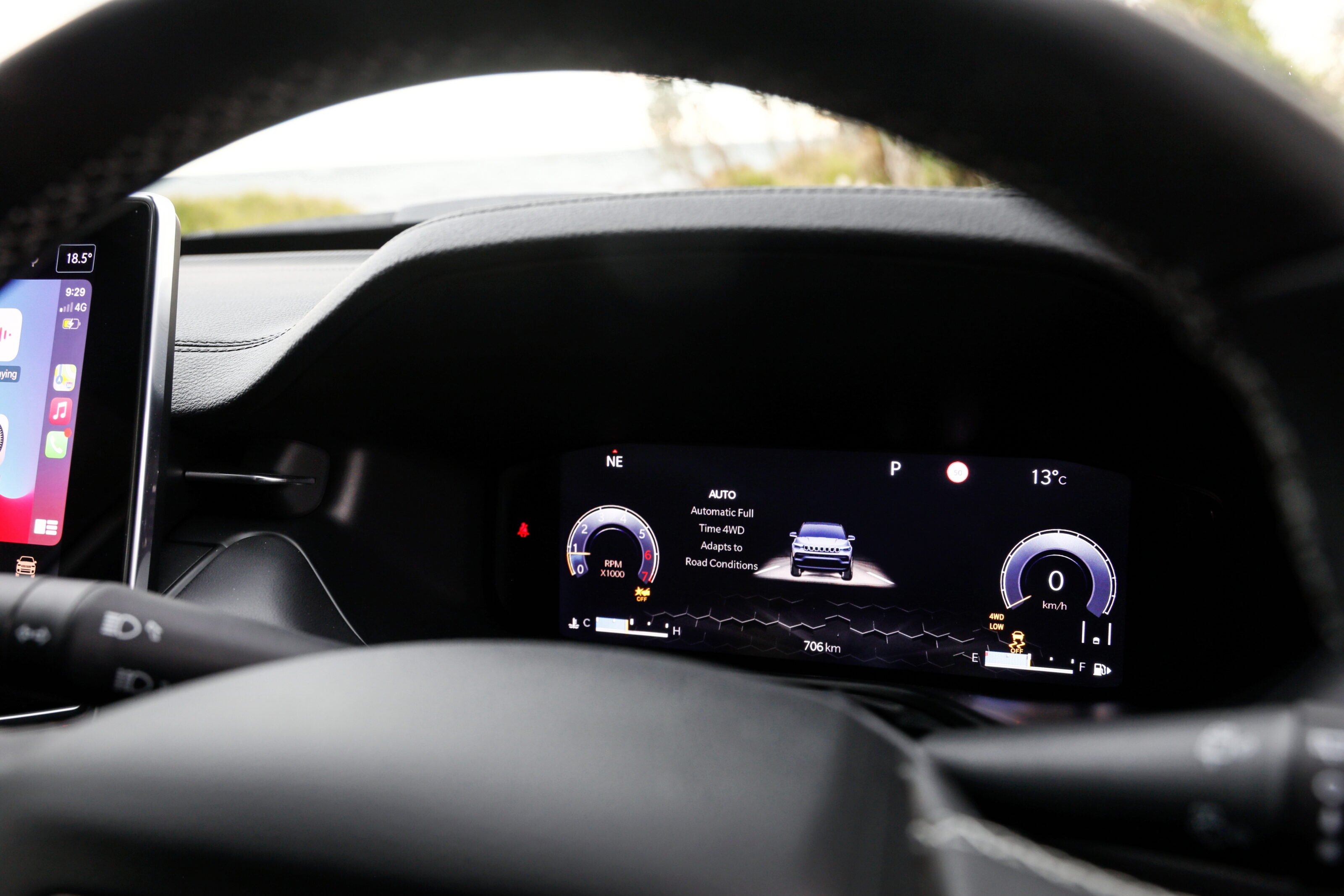
Big new high-resolution displays are also featured, in the form of a tablet-like 10.1-inch screen atop the dash, and a new 10.25-inch instrument display behind the steering wheel.
Comprehensive barely describes the work, and it shows how quickly the segment has moved on that Jeep has had to push through such unusually extensive work at the halfway mark.
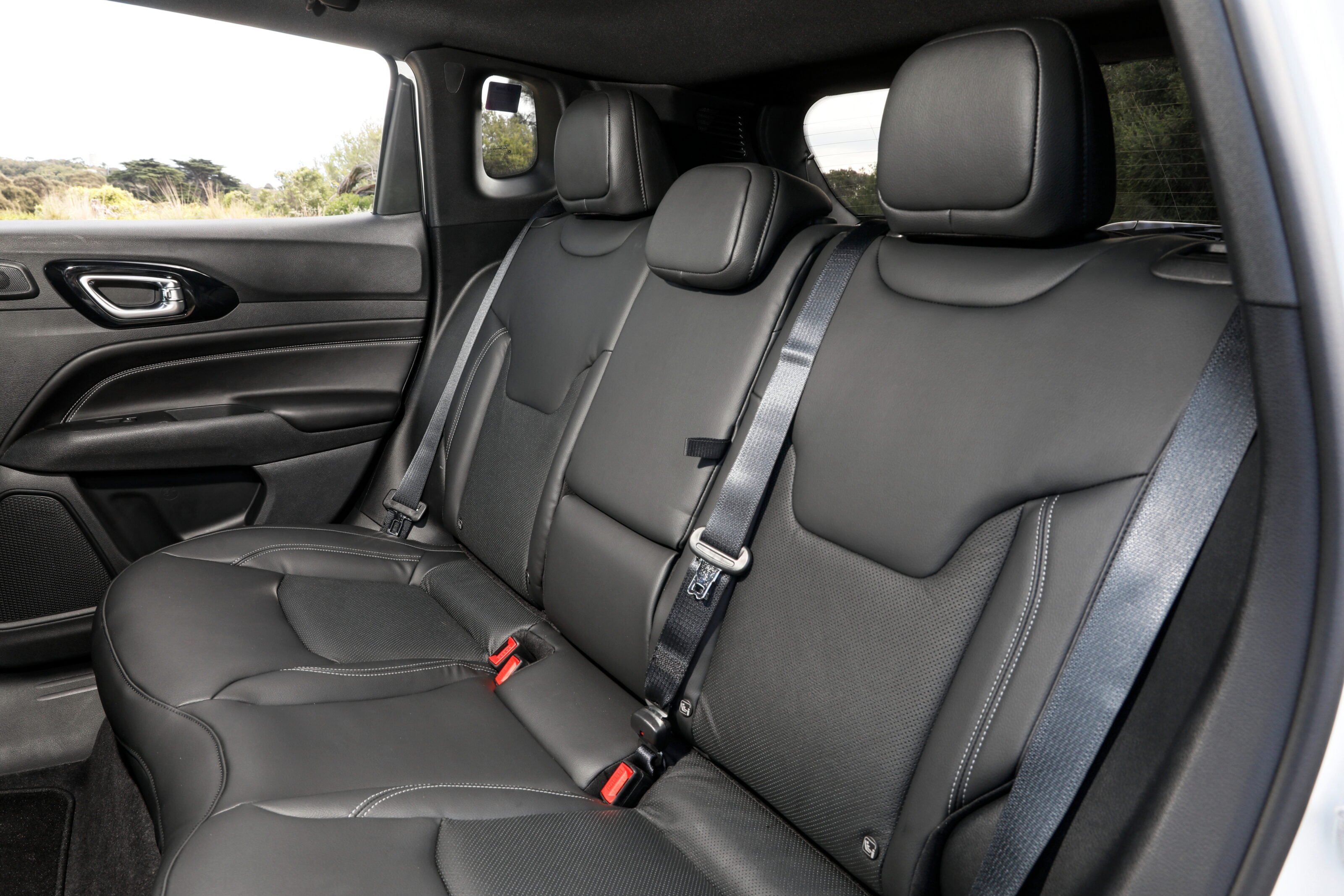
Because the Compass comes close to the midsize segment, interior space is generous. There’s decent leg and headroom in the rear for average-height adults, although the body’s relatively narrow design – remembering that this is still technically a ‘small’ SUV – means the second row is really only ideal for two adults or a trio of a small kids.
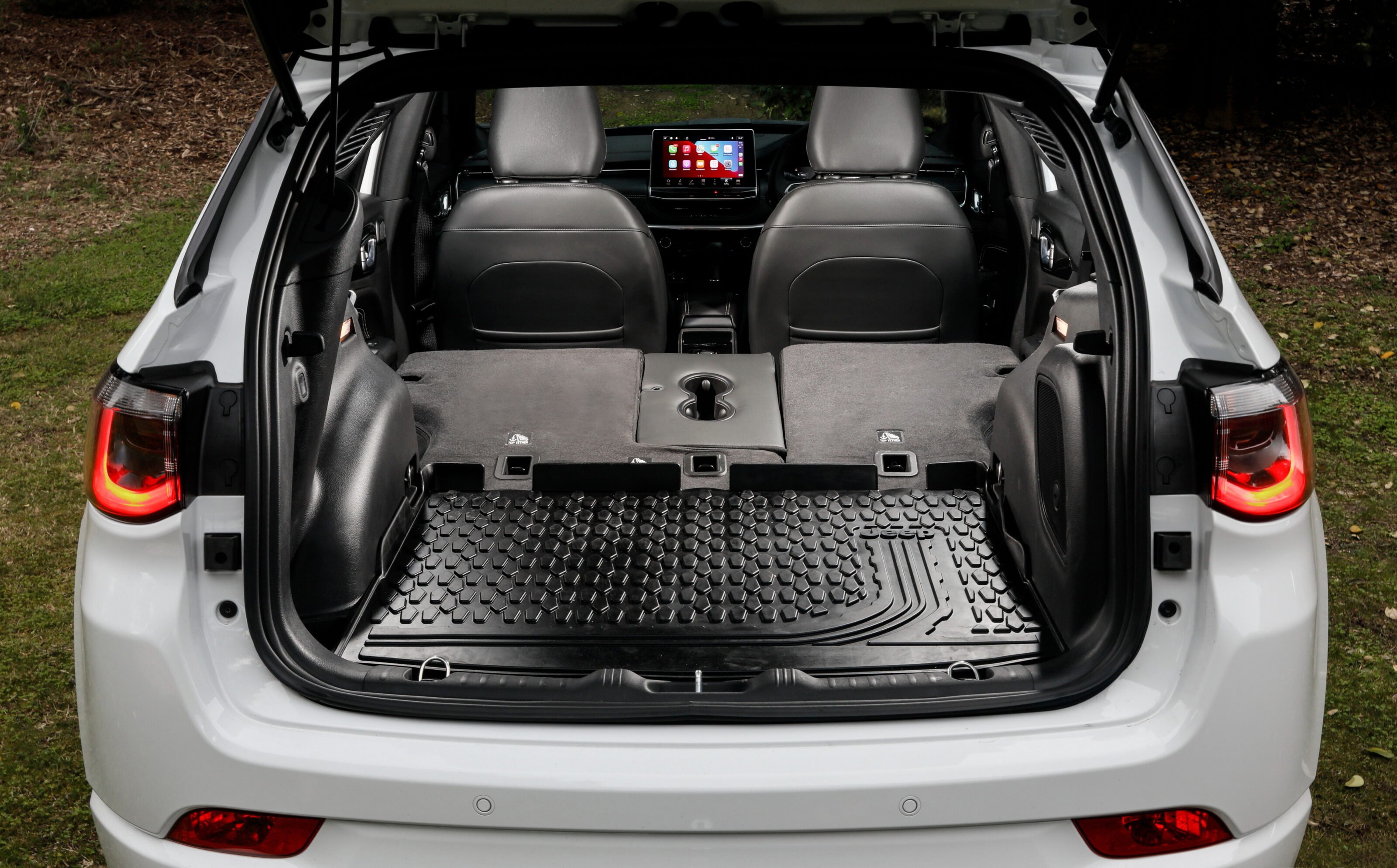
The 438-litre boot is huge for the segment, and the second seating row has a 40/20/40 split-fold design, allowing the centre seat to fold down as a generous arm rest or to fit long items through from the boot. Ideal for skis, obviously.
Safety & technology
Tech in the Compass is boosted further with key safety upgrades, including adaptive cruise control that can come to a complete stop with traffic, along with intelligent speed assist, lane-keep assist and traffic-sign recognition. These join the existing autonomous emergency braking, blind-spot monitoring, rear cross-traffic alert and lane-departure warning.
The UConnect infotainment remains a reliable, user-friendly package, bolstered now with the sharper and faster new displays. Wireless Apple Carplay and Android Auto is a cherry on top, both running smoothly and bug-free in our tester.
Standard kit on our S-Limited includes dual-zone climate control, powered front seats (eight-way for the driver, four for the passenger), and a hands-free powered tailgate.
From the options list, you can add a heated steering wheel, heated and cooled front seats, a dual-pane panoramic sunroof, and a 360-degree camera system. (A regular reversing camera is standard.)
On the road
Mechanically, the ‘new’ Compass is unchanged for this mid-life update. While the styling and interior quality have been improved, the Compass’s 2.4-litre petrol four remains a fairly middling thing in the performance stakes.
The smooth-shifting nine-speed auto keeps the engine’s torque band in reach, and power is largely adequate for most driving. That gearbox is intelligent enough to grab the right gear most of the time, although it can’t do magic – demand power suddenly while cruising and you’ll be left waiting a moment for it to catch up, shifting down a few gears before powering away.
Like most small naturally-aspirated petrol engines, the 2.4 petrol is no powerhouse, but its pairing with the nine-speed auto makes it a fairly quiet and refined experience.
The S-Limited benefits from all-wheel drive in the form of a usually on-demand ‘4×4’ system that also boasts a 4WD Low setting, which – while not a proper low-range system – locks the Compass into full-time all-wheel drive and first gear. Drive modes available for this setting include Sand, Mud, and Snow, along with an automatic setting.
On this first drive, we didn’t get the opportunity to go off-road (a short booking and lockdown life), but we’ll have a crack at that in the near future.
Fuel consumption for the S-Limited 4×4 is listed at 9.7 L/100km on the combined cycle.
Our driving on this test saw mostly highway work, where the official claim is 7.4 L/100km. In all, our testing came to an 8.5L/100km average.
Ride comfort is a highlight of this model, at least, with the smaller wheels and bigger-profile Continental ComfortContact CC6 225/55 tyres helping the Compass to see off most potholes and bumps.
We say skip the standard 19s and their thinner 235/45 rubber – they look good, but these smaller hoops and fatter rubber makes for a more comfortable ride.
VERDICT
For many buyers, this is the most important point: the Compass is a spacious offering in the small-SUV market, veering more to the midsize segment.
That means there’s better-than-average room for rear passengers, and the big boot is one of the most generous in the class. That’s hard to ignore for any family.
For buyers seeking more power and towing capability, the 2.0-litre turbo diesel is an easier recommendation, but you’ll have to step up to the $51,250 Trailhawk.
When it comes to interior quality, space and ride comfort, the Compass S-Limited is a compelling option – but its price can make it hard to recommend.
2022 Jeep Compass S-Limited 4×4 specifications
| Model: | Jeep Compass S-Limited |
|---|---|
| Engine: | 2359CC 4cyl, DOHC, 16v, naturally-aspirated petrol |
| Max power: | 129kW @ 6400rpm |
| Max torque: | 229Nm @ 3900rpm |
| Transmission: | 9-speed automatic |
| Weight: | 1503kg (tare) |
| 0-100km/h: | 10.1 seconds |
| Economy: | 9.7 L/100km (claimed) |
| Price: | $46,950 |
Modified Mustangs are the flavour of this week’s MOTOR drag battle, as this pair of ponies take to the strip packing over 1100kW and 1800Nm combined.
Built by Melbourne-based powerhouse, Mustang Motorsport, both cars sport Roush’s 750hp TVS 2650 supercharger delivering a tyre-frying 559kW/900Nm, each.
The critical difference is that one is an otherwise standard current-gen Mustang GT, and other comes fully loaded with Roush’s Stage 3 package.
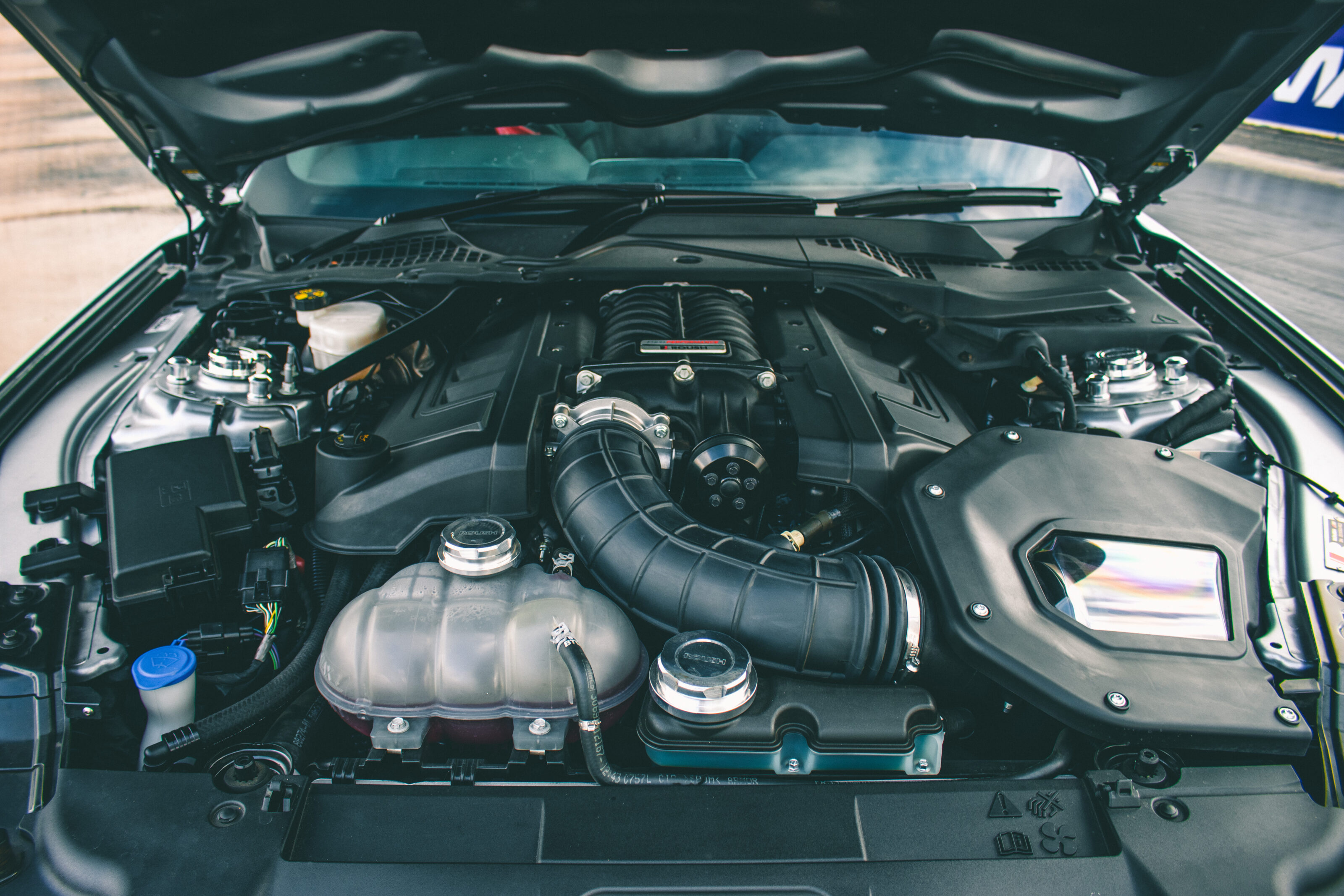
The full Roush treatment gains you extra transmission, diff’ and auxiliary engine coolers, 20-inch wheels, Roush-tuned suspension, a bespoke body kit and leather interior, and unique Roush serialisation. Considering the scope of modifications, most impressively, you also get full turn-key ADR compliancy in all seven states and territories.
Our Stage 3 car also came with a pair of chunky Mickey Thompson radials in the boot, but we’ll have a play with those later…
The full Roush Stage 3 package will set you back upwards of $58,000, and that’s ‘bring your own’ Mustang GT, too.
So how much faster is it than the Roush-charged standard car at the drag strip? You’re about to find out, so strap in because today’s drag race is going to be fast.
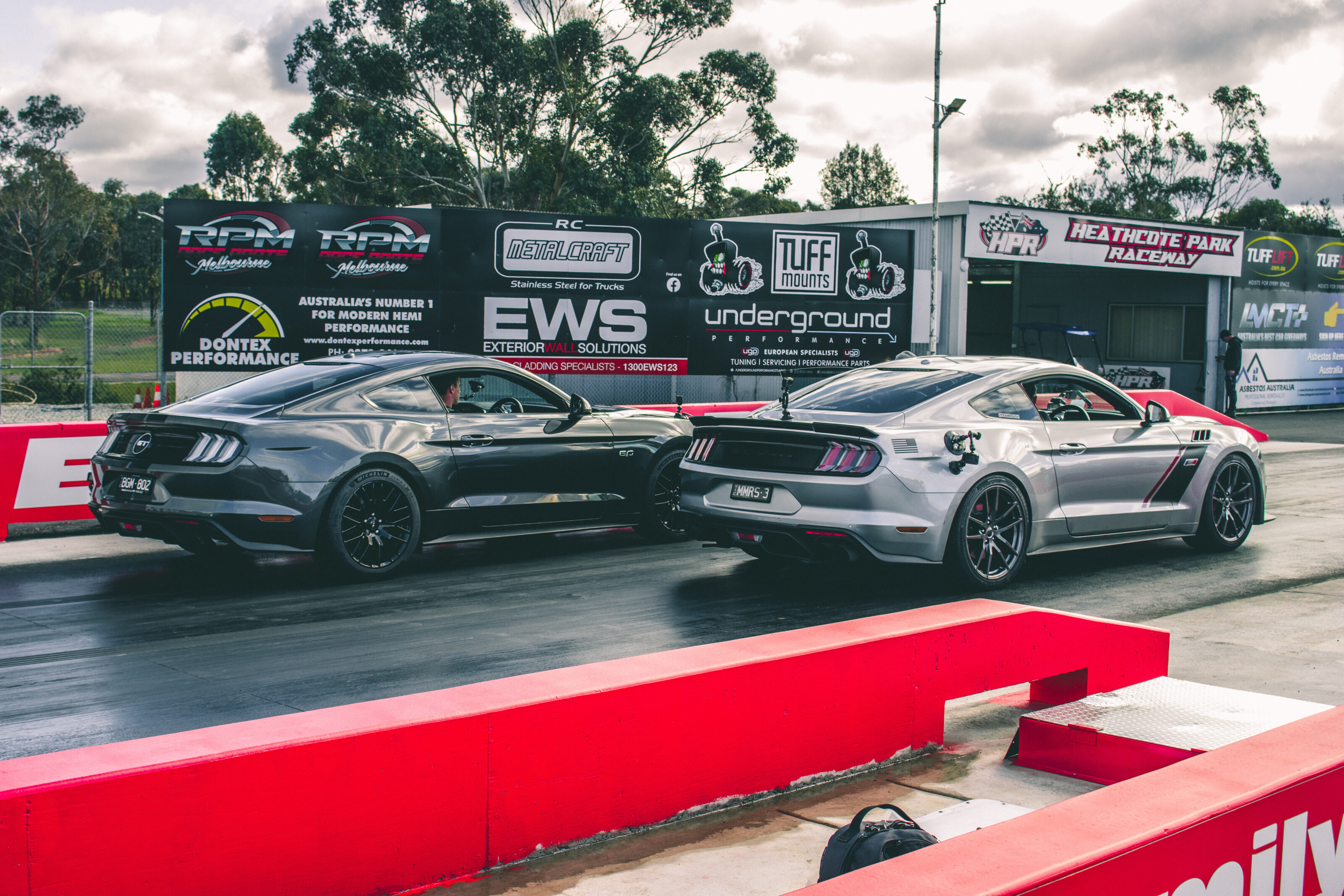
Race start: road tyres v road tyres
A standard naturally aspirated V8 Mustang is a difficult car to launch in the best of circumstances, but our ponies are seriously traction-limited as they attempt to deploy a collective 1800Nm through their rear tyres.
Both cars immediately descend into wheelspin, however the silver Stage 3 car is able to claw its way ahead thanks to a larger footprint and possible rubber advantage; shod with bigger wheels and Continental ExtremeContact Sport tyres compared to the standard Mustang’s Michelin Pilot Sport 4S.
A second run seemingly saw the less-modified Mustang launch away from the line, leaving the Stage 3 car in hot pursuit. It was a chase down for the ages, with a scarcely believable photo finish comeback victory. That is, before race control radioed in confirming a false start.
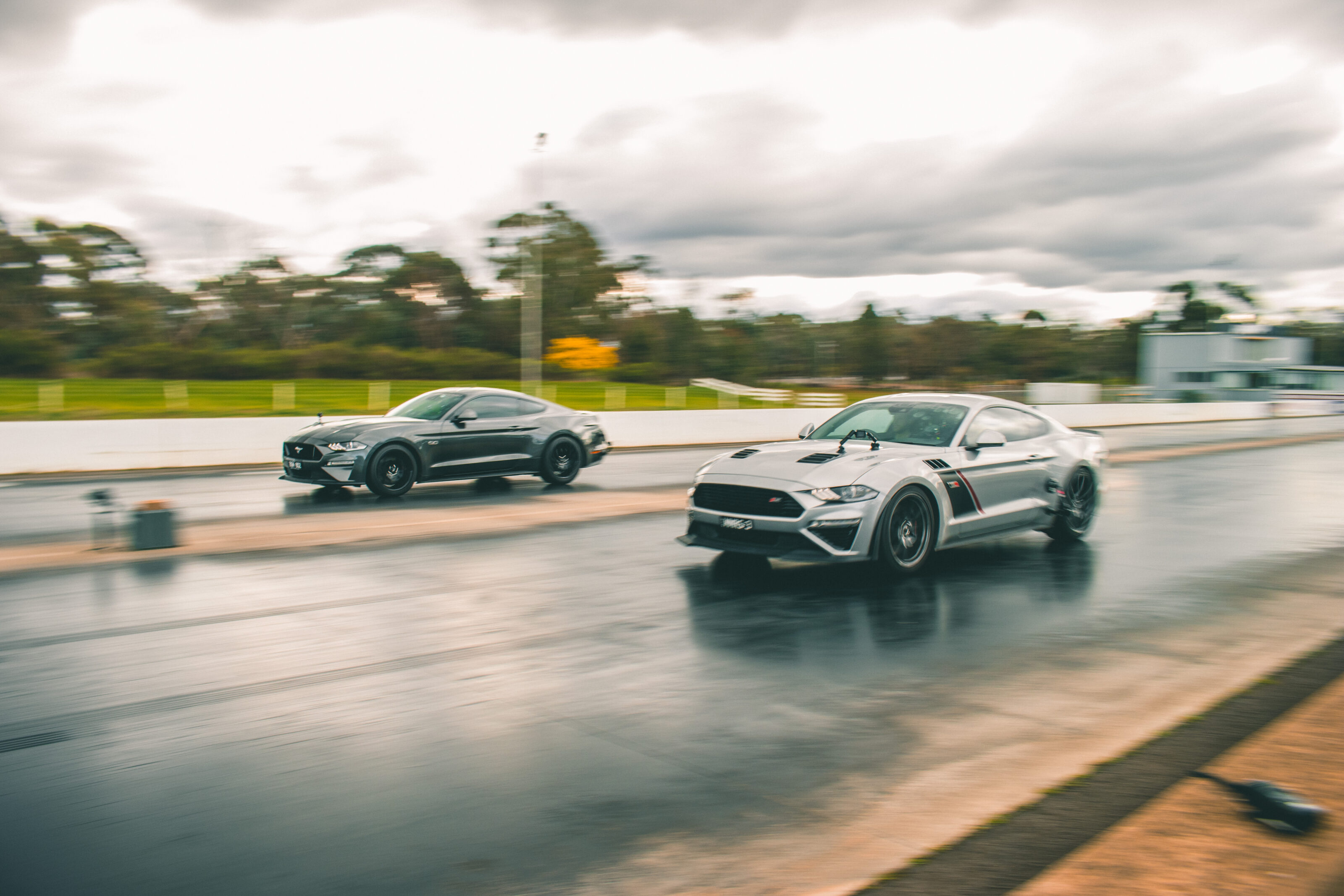
Race start – radials v road tyres
…Back to those radials we found in the boot. We couldn’t resist swapping over the rear tyres of the Roush Stage 3 car for the pair of chunky Mickey Thompson ET Street R radials, to see how they might affect the ultimate timeslips.
Despite the sticky Mickeys, a slightly damp surface and a ridiculous power output still produced eye-widening levels of wheelspin. It easily kept the more standard car at bay, but it was far from the whitewash that many expected.
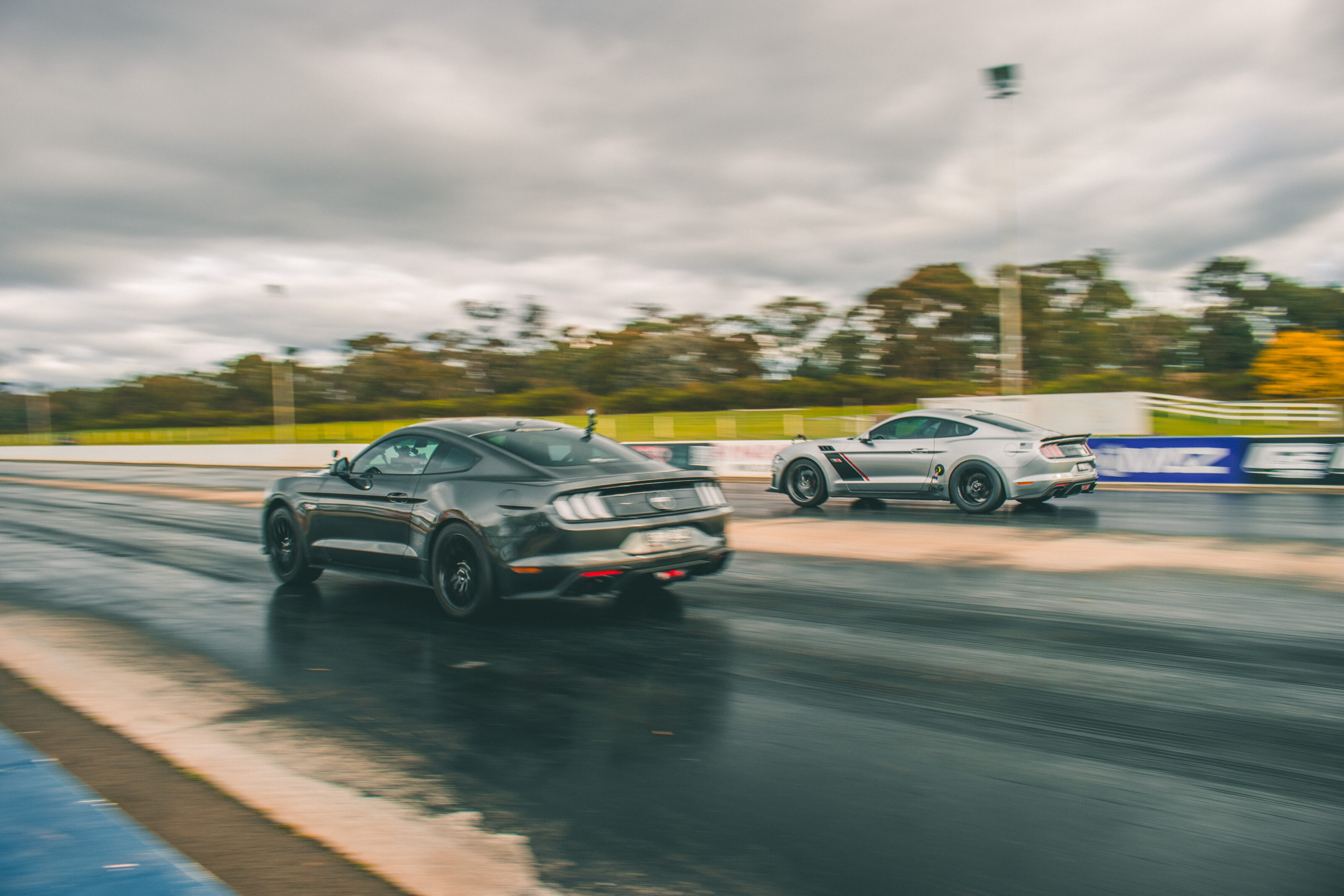
Results
With the track-intended radials still mounted, Mustang Motorsport owner Craig Dean strapped in to see just what the fully-kitted Stage 3 car was capable of.
On a fairly slow surface, and sans one-foot rollout, the Stage 3 ‘Stang bested a 4.0-second flat 0-100km/h time, clearing the quarter-mile in 11.7-seconds at a blistering 201km/h.
The other supercharged, but otherwise standard, Mustang trailed about half a second behind across the board; sprinting from 0-100km/h in 4.65-seconds, and clocking the quarter in 12.26-seconds at 197km/h.
Bonus: Roll race
With the Stage 3 car back on the tyres it drove in on, both Mustangs lined up for a 50km/h rolling start race.
Even on a roll, both cars are champing at the limits of adhesion with every whiff of the throttle. The less-fettled Mustang is at a traction disadvantage, and is forced to temper its throttle while the Stage 3 silver bullet (or, should we say, Bullitt?) is able to better apply its prodigious amounts of grunt.
Crossing the line while nudging 220km/h, the Stage 3 car feels at the limit of wheelspin the entire way. With all the extras, it’s undoubtedly the quicker car here.
Want to see us play with more modified cars? Let us know in the comments below!
Snapshot
- 12 models to be made for Chinese market by end of 2021
- First products made in partnership with SAIC Volkswagen coming in 2022
- Internal combustion engine production to end by 2033
Audi will sell 12 models produced in China, for the Chinese market, by the end of this year – with the first products from its collaboration with partner SAIC Volkswagen to be launched in 2022.
The German automaker has outlined more on its approach to selling, and producing, its vehicles in the country as it pushes towards complete electrification.
By 2030, Audi expects China’s market for premium vehicles will grow to 4.5 million units annually – up from 3.1 million in 2020 – with the number of electric vehicles sold locally predicted to rise from 10 per cent to 40 per cent by the same year.
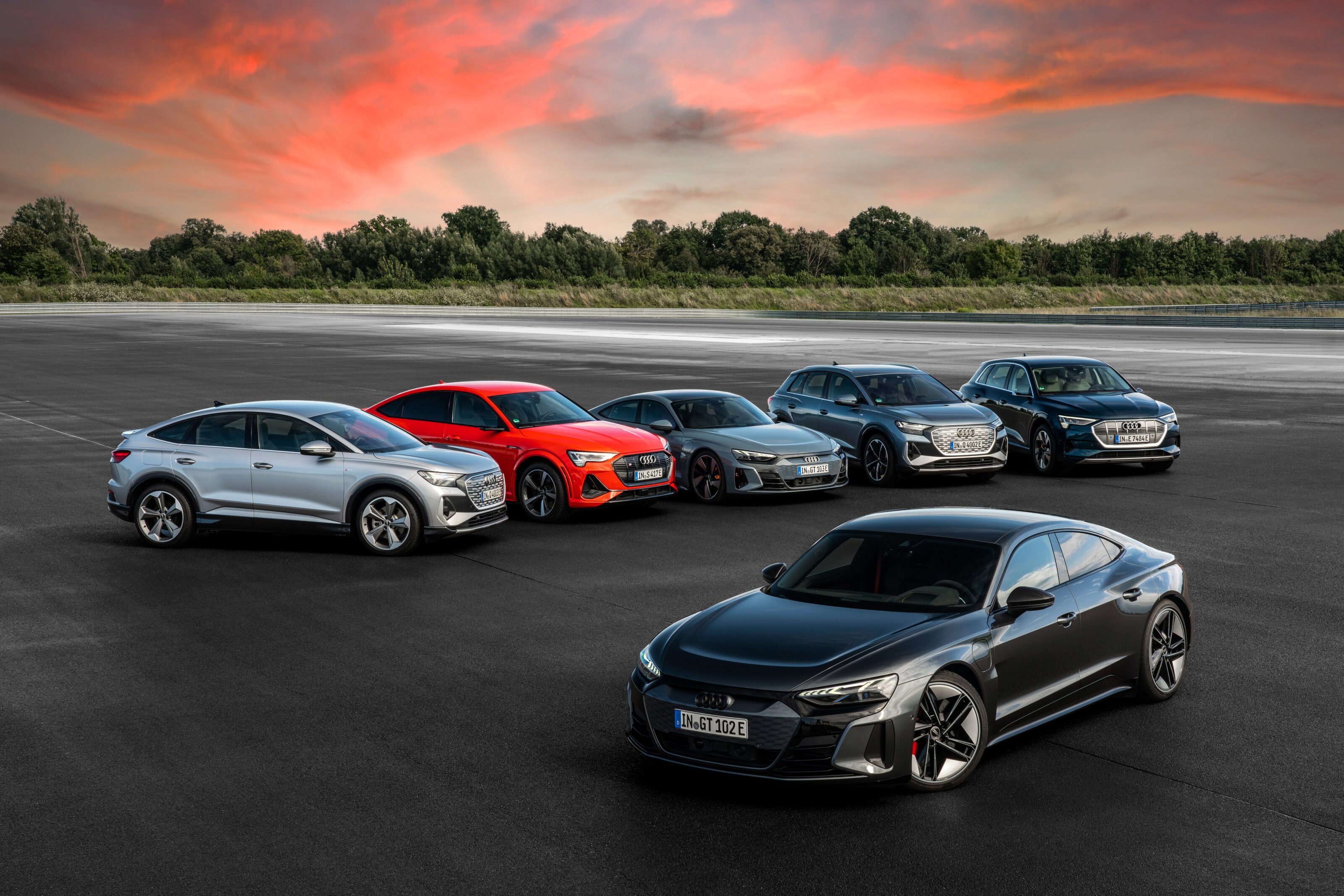
The firm has been manufacturing cars in the country for more than 30 years at the joint headquarters of FAW and Volkswagen in Changchun, as well as at other locations.
The new models will be sold through the existing dealer network operated by FAW-Volkswagen Audi.
“Our approach here is based on the idea of ‘In China for China,’ and as such, Audi is focusing on the specific needs of customers in the world’s largest automotive market and actively driving innovation,” said Werner Eichhorn, president of Audi China.
“Together with our two partners FAW and SAIC, we are well prepared for the challenges of the future.”

To date, Audi has shipped a total of more than seven million vehicles built in China, selling 727,358 vehicles in the country in 2020 alone. In the first half of 2021, this figure stood at 418,749 vehicles.
Additionally, the marque has confirmed production of its final internal combustion engine will end in 2033, putting a firm date on its plans to transition to ‘e-mobility’.
Earlier this year, Audi announced it was working on its last ever internal combustion engine, with plans for production to start in four years time and the brand to introduce only fully-electric models by 2026.
The company said however, it expects to see continued demand in China beyond 2033, which is why there could be a supply of vehicles there with combustion engines manufactured locally.

As part of its “Vorsprung 2030” strategy, which it has been working on for the last few months, Audi will also expand its after-sales offering to include intelligent hardware.
Key to its future development will be a an increasing focus on vehicle software and autonomous driving.
“‘Vorsprung durch Technik’ [meaning progress through technology] remains necessary because we can only solve many of the world’s major problems, such as carbon emissions and global warming, through the use of clean technologies,” said CEO Markus Duesmann.
“We view ourselves as a company that guarantees the freedom and individual mobility of our customers. That is why Audi is focusing on zero-emission drive systems.
“We don’t simply develop technology for its own sake. It must be consequential and effective in keeping the world moving.”
Snapshot
- Twin of the Renault Kangoo now entering second generation
- Rival to the Volkswagen Caddy
- Mercedes-Benz vans to go all-electric in the future
The new Mercedes-Benz Citan will be the German manufacturer’s final van to be made available with an internal combustion engine, with an electric variant demonstrating the nameplate’s future direction.
Badge-engineered alongside the third-generation Renault Kangoo, the Citan commercial van is powered by a choice of three Renault diesel engines – making 55kW, 70kW and 85kW respectively – while the Tourer people carrier variant only offers the 70kW diesel alongside a choice of two petrol units, which produce 75kW and 96kW.
A fully-electric version of both the commercial and passenger vans will be made available in the second half of next year. Dubbed the eCitan, it will feature a motor and battery which allows for up to 285 kilometres of WLTP driving range.
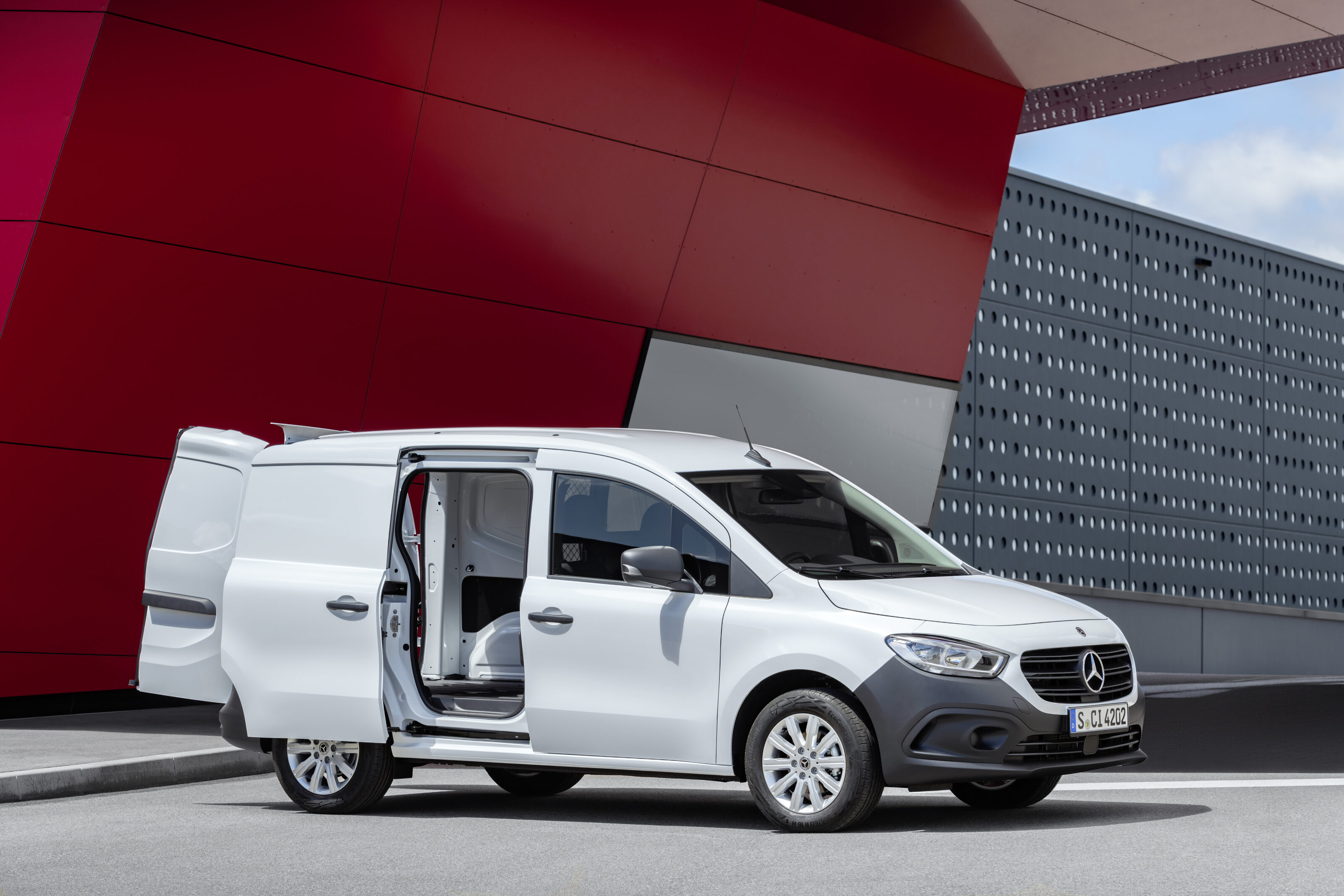
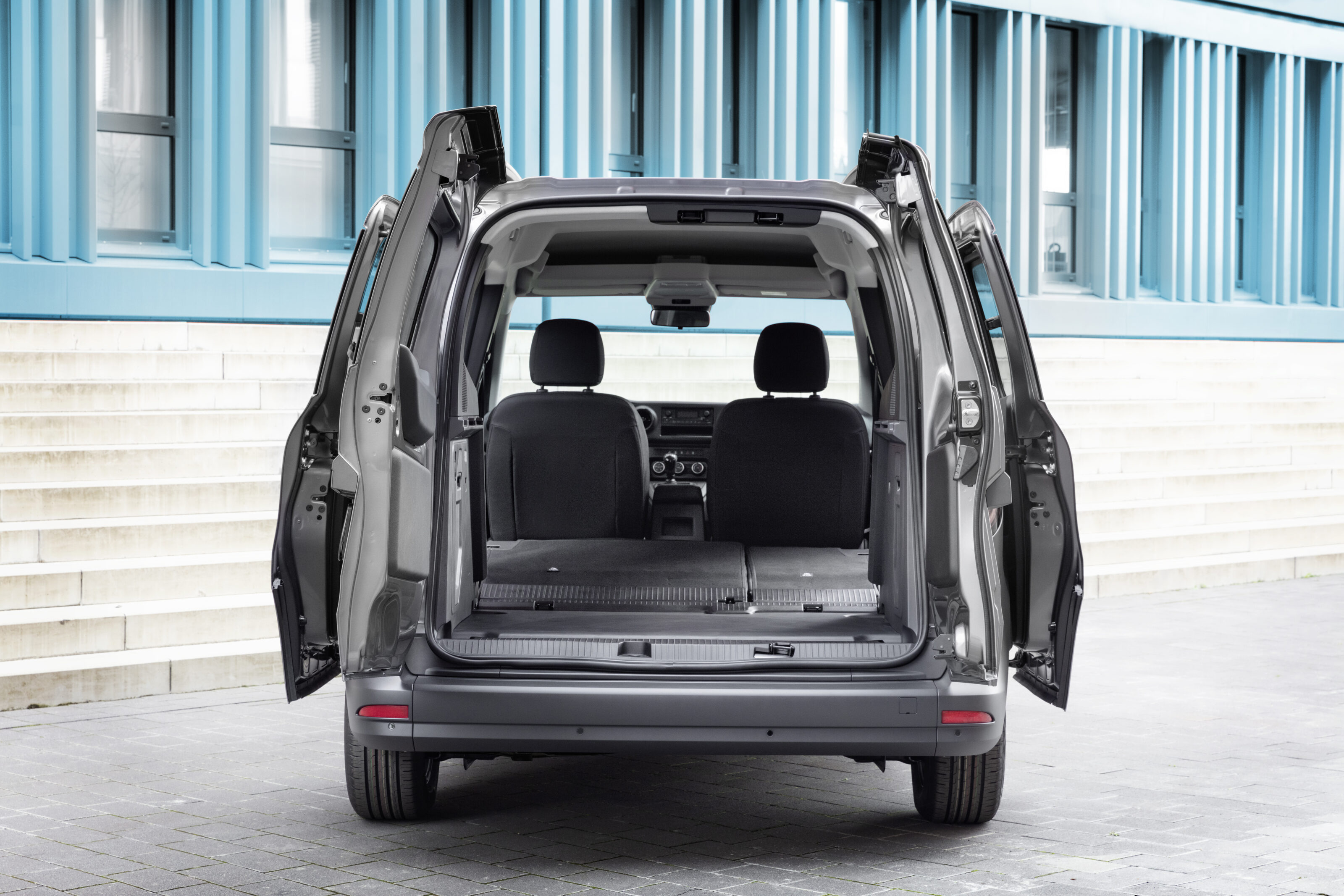
Exterior dimensions are identical to the Kangoo with an overall length of 4498mm which provides 3050mm of load space compartment length, while the entry to the rear compartment is 615mm wide and 1059mm tall.
Mercedes-Benz will offer Citans with a choice of a flexible or fixed partition wall – available with and without a window – which provides extra protection for front row occupants.
In the Tourer variant, its second row of seating can either be left up to fit three adults or folded in a one-down/two-down split, increasing rear room for luggage.
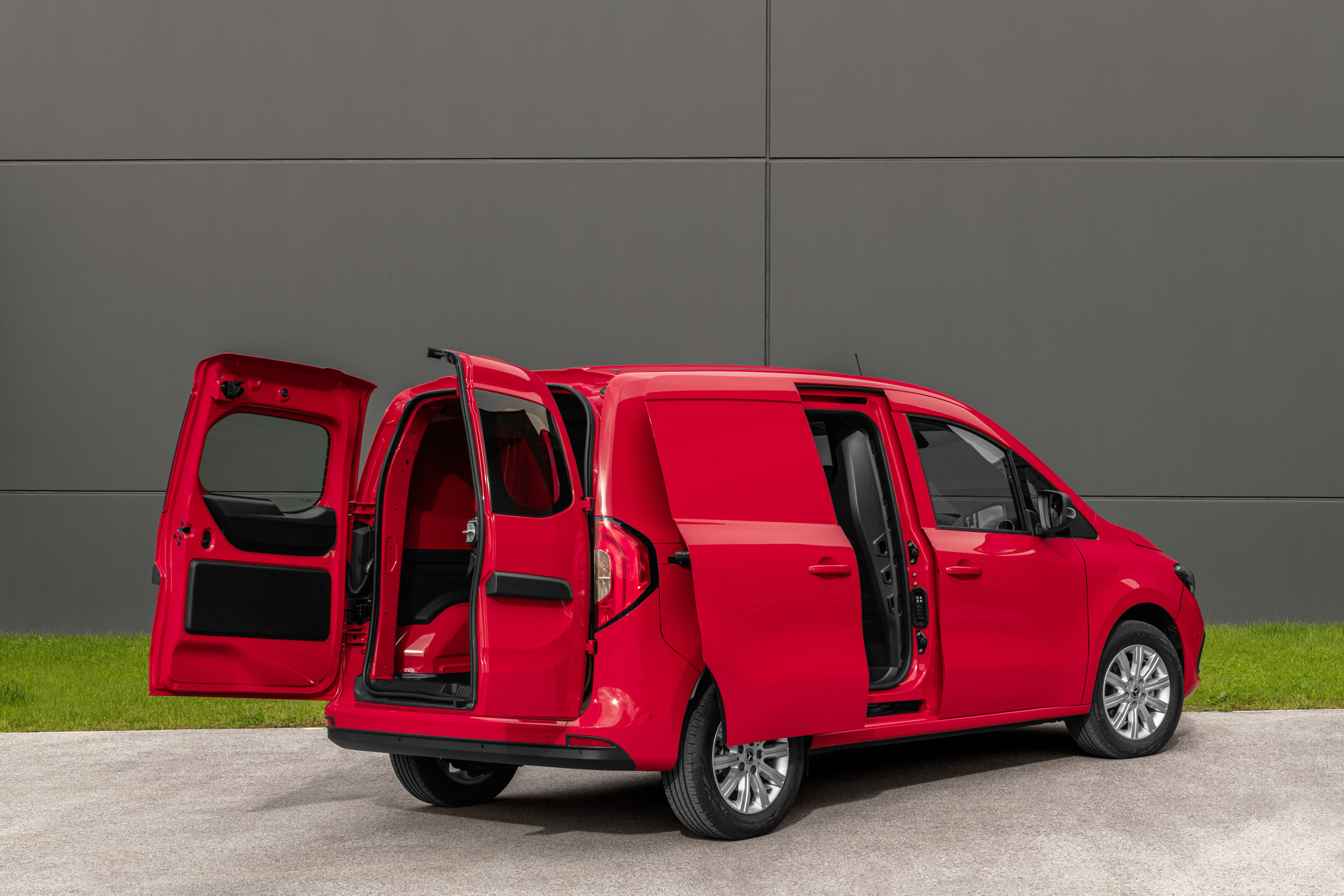
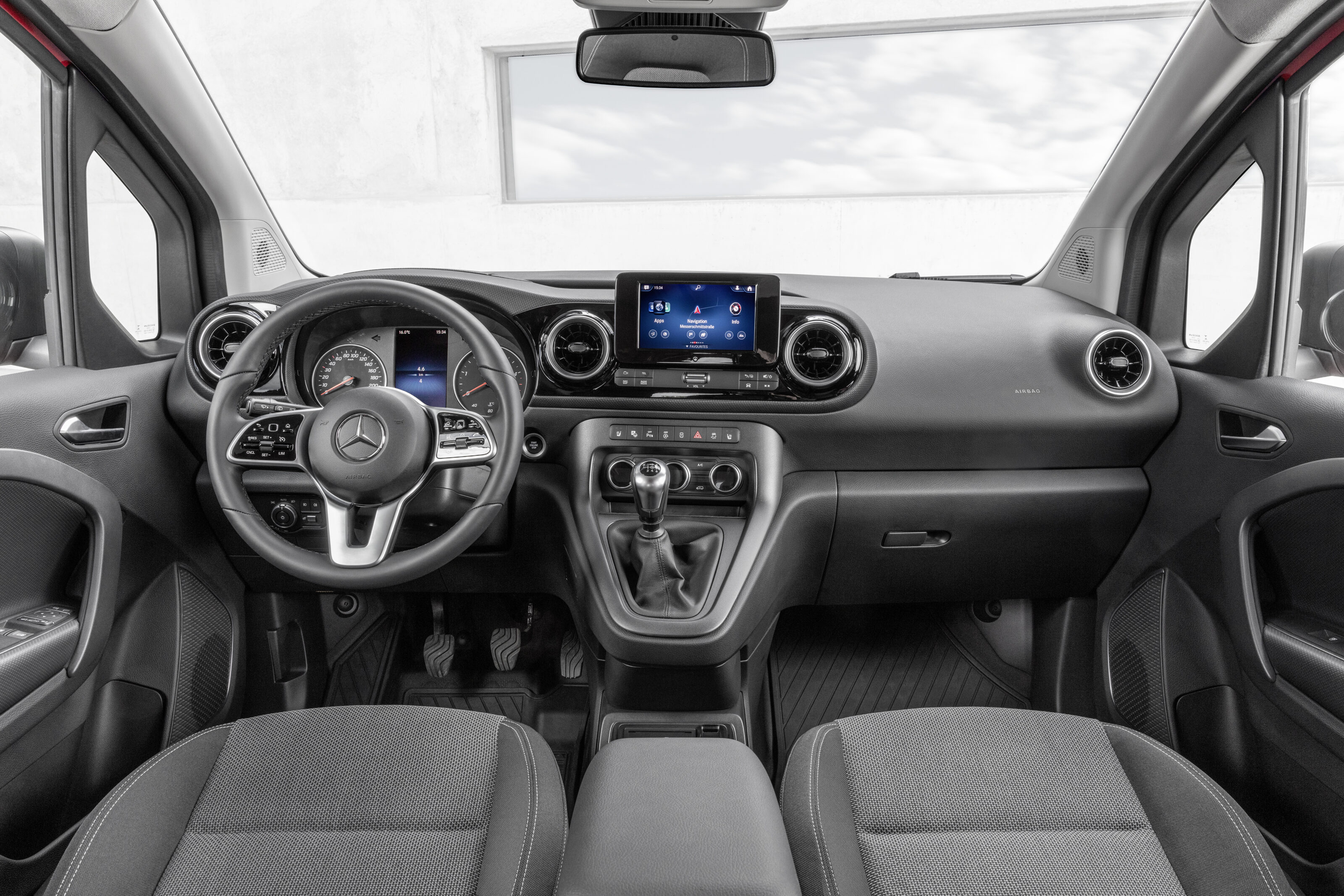
Each Citan variant will also be available in a range of two trim levels – Base and Pro. While Mercedes-Benz doesn’t specify which trim scores what equipment, both are understood to include a 7-inch touchscreen, touch control buttons on the steering wheel, voice assistant, Apple CarPlay and Android Auto, bluetooth and digital radio (DAB and DAB+) as standard.
Safety features such as; lane keep assist, hill start assist, a fatigue warning system, Mercedes-Benz emergency call are standard across the van and Tourer, while the latter also gains; active brake assist, lane keeping assist, blind-spot assist and speed limit assist.
When Wheels asked Mercedes-Benz Vans in July about potential for a local release of the Citan, the Australian arm said it was looking at the possibility of bringing the van Down Under – but had not committed to any plans.
“We are currently assessing the suitability of the new Citan for our market, including both the electric and ICE variants, but no decision to launch in Australia has been made,” said the spokesperson.
With the second-gen Citan set to launch in Europe next year, Mercedes-Benz has confirmed it will be the last commercial vehicle to be powered by an internal combustion engine, with the new T-Class and EQT set to go fully-electric after the Citan’s lifecycle comes to an end.
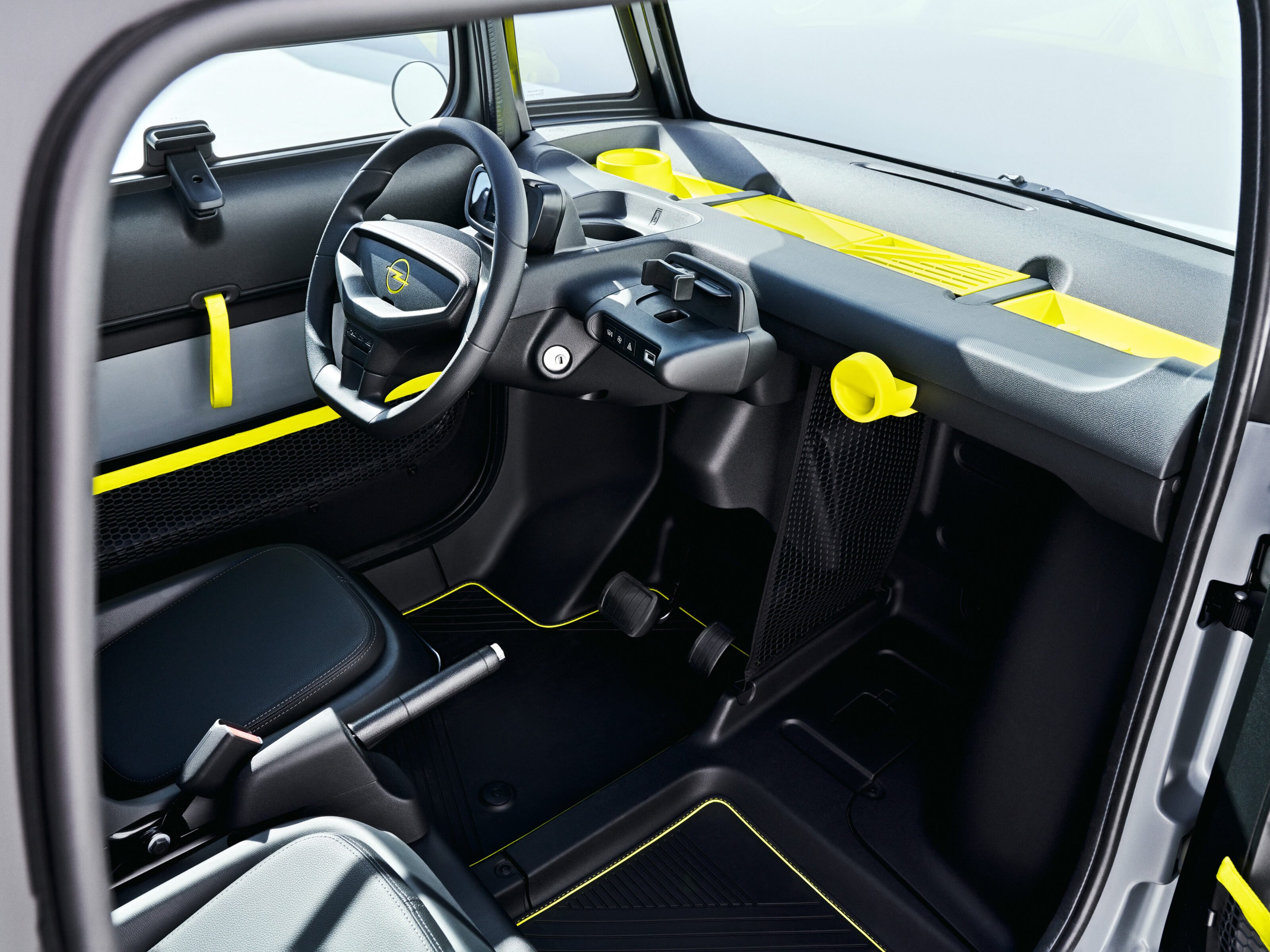
The Stellantis-owned era of Opel continues to churn out badge-engineered vehicles for the German manufacturer, this time in the form of a light quadricycle.
Based on the Citroen Ami two-seater, the Opel Rocks-e is a two-door EV with a total driving range of 75 kilometres, provided by its 5.5kWh battery pack which can be recharged in just three and a half hours.
Apart from changing the Citroen’s chevron-style badges to its own lightning strike design, and a mild showing of its new ‘Vizor’ design language, not much is different on the tiny Opel – it’s still powered by a 6kW electric motor, which can propel it up to speeds of 45km/h.
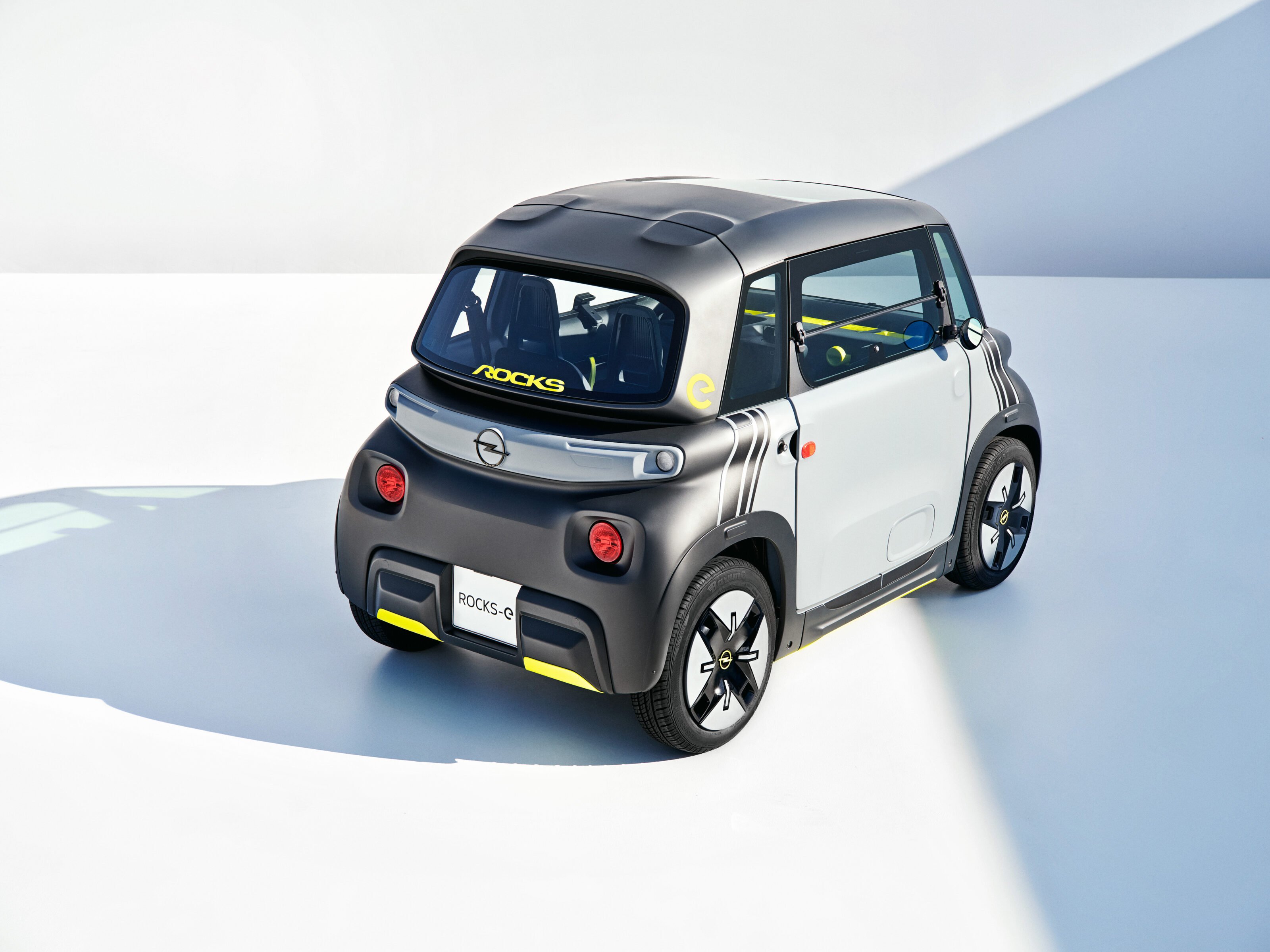
At a maximum weight of 425 kilograms excluding its battery pack, the Rocks-e and its Ami twin aren’t classified as cars, rather quadricycles – which means, in some European countries, they can be operated by drivers as young as 15 years-old.
Despite its external dimensions being 2.41 metres in length and just 1.39 metres wide (sans mirrors), Opel claims the Rocks-e’s cabin is still comfortable for occupants over 1.9 metres tall, with up to 65-litres of storage space in the passenger footwell when unoccupied.
The Rocks-e will be offered with an entry-level variant, as well as “Klub” and “TeKno” trim levels, although there are no plans to bring the ultra-light vehicle to Australia.