Snapshot
- New bodykit rendering released by WALD in Japan for the LC300
- Features new front bumper, side skirts, flares and wheels
Japanese group WALD International has recently released renderings of its vision of a new bodykit for the incoming Toyota LandCruiser 300 – which is set to be available in Australia by the end of the year.
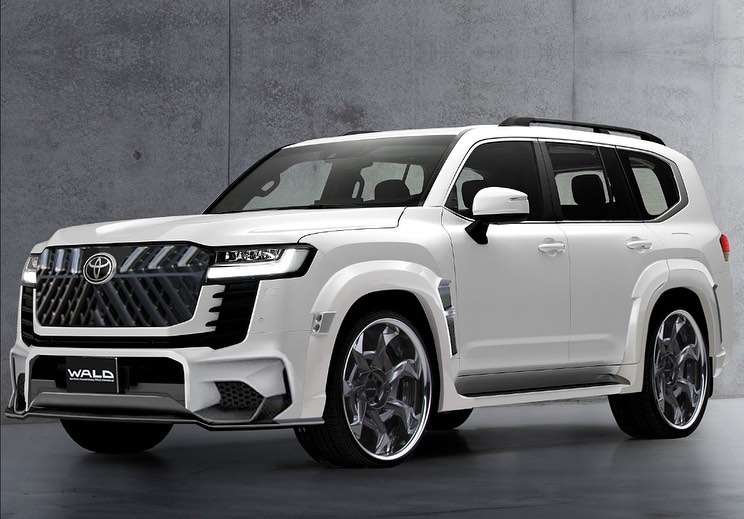
WALD specialises in offering aftermarket bodykits for new cars, stretching from the super luxury S-Class Mercedes right down to the current Model Suzuki Jimny and Toyota RAV4.
At this stage, all WALD has released is images of the front and side of the kit of the LC300, with no rear shots at the time of writing.
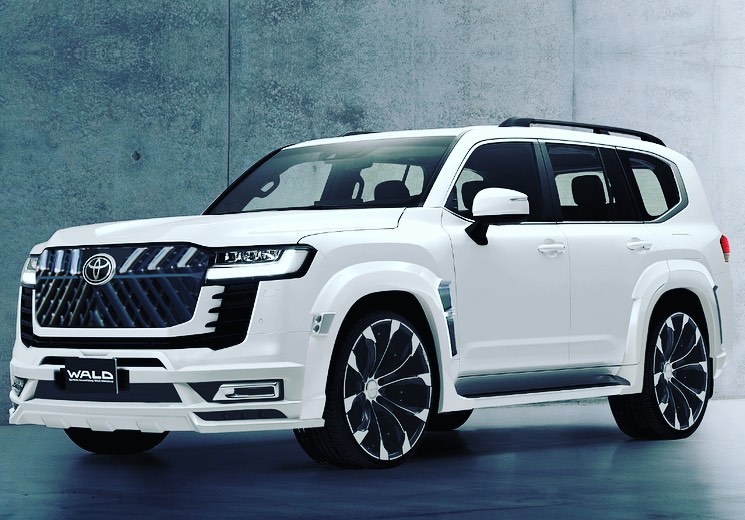
Obvious changes include a new (and much lower) front bumper and splitter, as well as a new front grille. The factory side-steps have been replaced with low-slung side skirts and there’s a new set of beefy, colour-matched flares sitting on top of massive alloy wheels with paper-thin tyres.
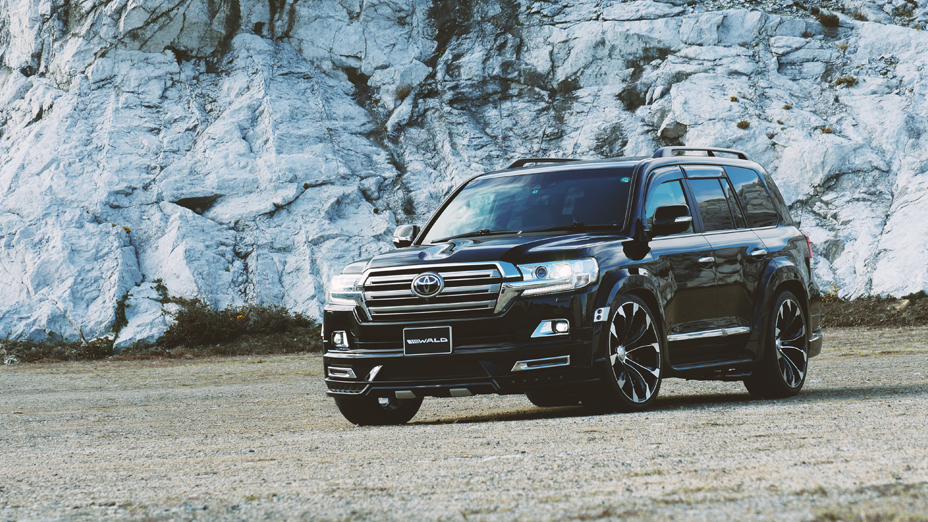
WALD currently offers a full kit for the out-going 200 series LandCruiser, which features the same changes flagged for the LC300 kit – along with a twin side exit exhaust in front of the rear wheels and an upgraded set of brakes.
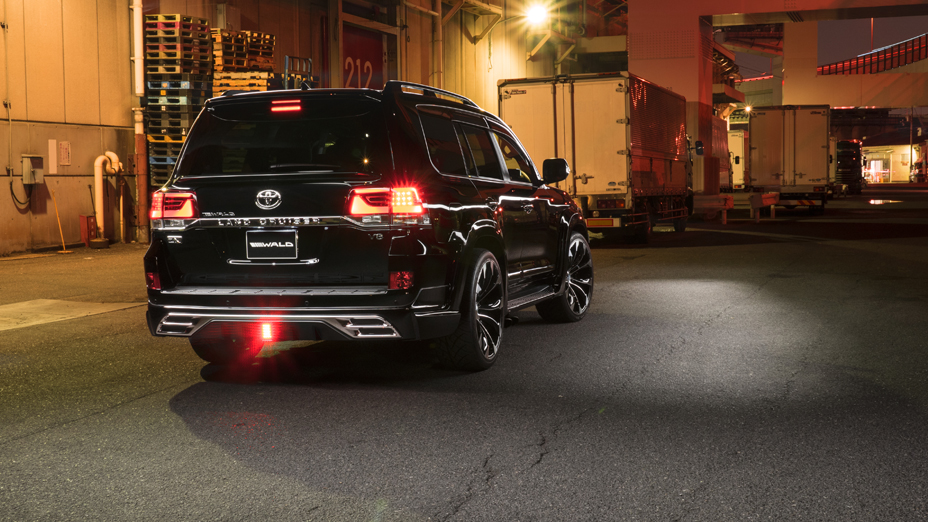
The kit may seem like a pointless way to spend a small fortune on an already expensive 300 series ‘Cruiser, but with the popularity of big, luxury, high-riding wagons of this size skyrocketing in recent years (think Porsche Cayenne, Range Rover), it’s not too surprising there is a market for kits like these.
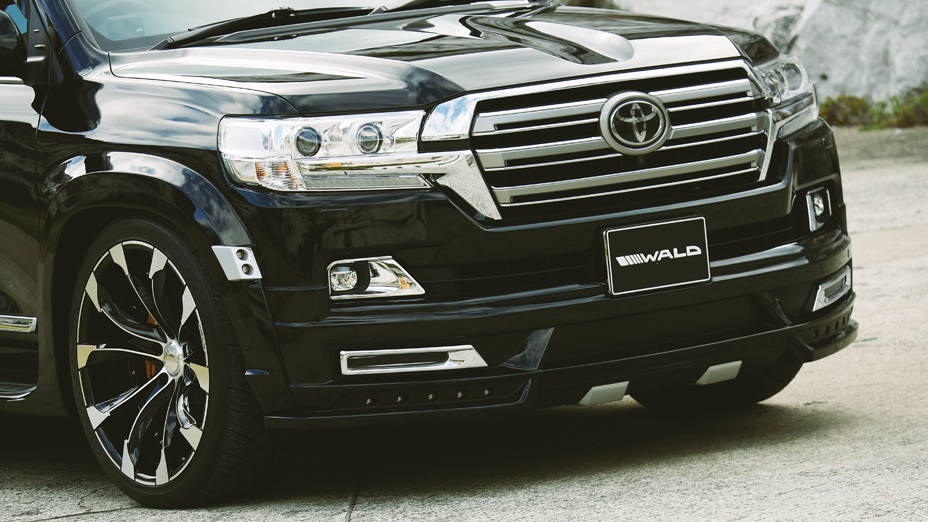
4×4 Australia recently reported the LC300 may be in Australia as early as October this year, after a Sydney dealer claimed they would have stock by then.
Snapshot
- QLD Government takes delivery of five Nexos
- First Brisbane hydrogen station opened in Redland Bay
- Government aims to learn from using hydrogen in its fleet
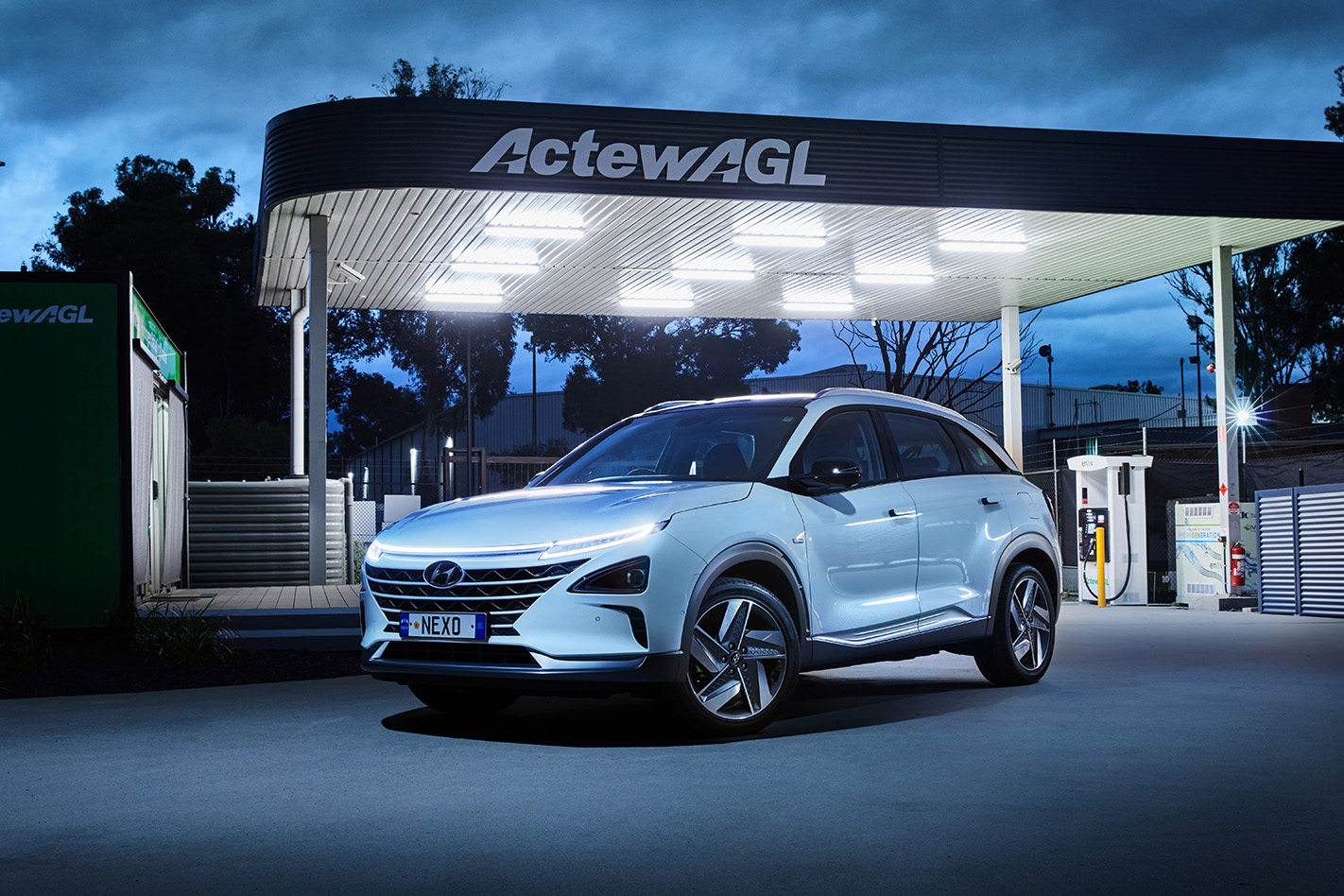
The Queensland Government vehicle fleet has been bolstered by the addition of five new vehicles from Hyundai, with the northern state becoming the second to include hydrogen in its line-up.
Five Hyundai Nexo hydrogen fuel-cell vehicles will join the Queensland fleet, joining the 20 which are a part of the Australian Capital Territory’s Government set, becoming the first hydrogen vehicles to be used by a government in Australia back in March.
Wrapped in an Indigenous-inspired livery which features the Brisbane River and a hydrogen nucleus, the Nexo’s debut in Queensland comes shortly after the opening of the first hydrogen filling station in the Sunshine State, based in the eastern suburb of Redland Bay.

Hyundai Australia’s CEO, Jun Heo, said he was proud to be partnering with the Queensland Government to introduce hydrogen vehicles.
“We congratulate the Queensland Government for its vision and advanced policy as the state moves toward a zero-emissions future with hydrogen as a key component,” said Heo.
“The zero-emissions Nexo is a cornerstone in our green vehicle line-up, and joins hybrid, plug-in hybrid and pure electric models to underscore our leadership in eco-mobility and our commitment to developing sustainable motoring solutions.”
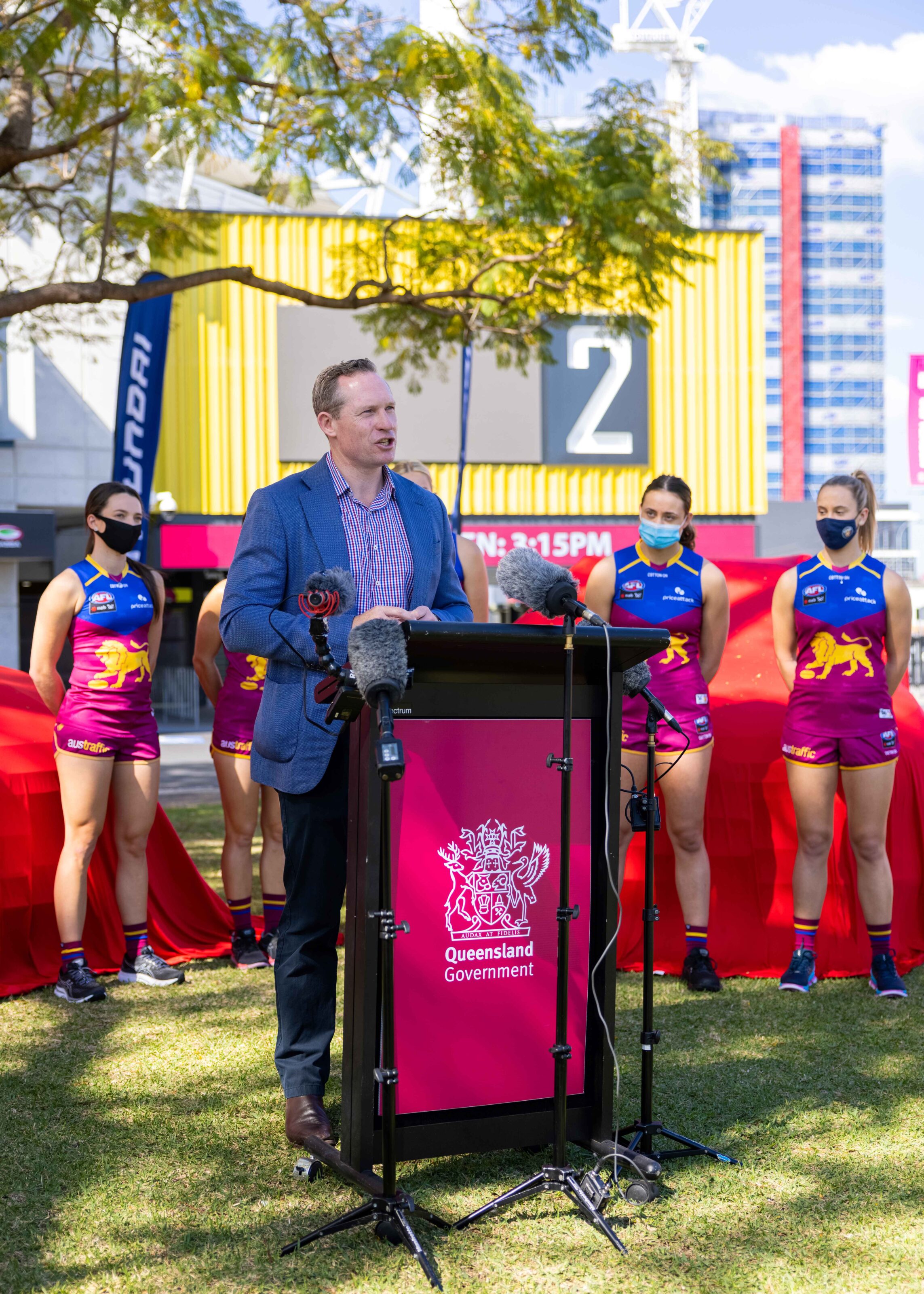
Queensland’s Minister for Energy, Renewables and Hydrogen, Mick de Brenni, said the lease of the Nexos will allow the Government to assess future viability of hydrogen vehicles in the state, while also reducing emissions.
“This trial aims to accelerate the uptake of hydrogen technology and support Queensland’s push to position itself as a global hydrogen superpower,” Minister de Brenni said.
“It will demonstrate the effectiveness and efficiency of hydrogen for passenger vehicles and possibly lead the way for hydrogen’s roll-out to trucks, trains and marine applications.
“These head-turning fuel-cell electric vehicles will be fuelled with home-grown Queensland hydrogen as they are tested in on-road conditions over the next three years.
“Leasing them as part of our trial of fuel-cell electric vehicle technology highlights the fact that QFleet – the government’s fleet manager – continues to drive Queensland’s transition to cleaner and greener transport options.
“This, in turn, helps grow our local hydrogen supply chain and that means more jobs for Queenslanders in this emerging sector.
“It means jobs sourcing raw materials for clean production and manufacturing state-of-the-art technology, right through to exporting this green energy to an increasingly hydrogen-hungry world market.”
The Nexo is currently on sale in Australia but only under loan from Hyundai, with the South Korean manufacturer offering it under an all-inclusive loan programme, covering service and maintenance.
Toyota’s Gazoo Racing division is on a roll, but it has a slight problem with mainstream cut-through beyond hardcore enthusiasts. Most people would understand what an AMG or M badge means – but GR?
The reborn Supra and GR Yaris have done wonders for reaffirming Toyota’s performance credentials. However, both are preaching to the converted.
When it comes to getting the Gazoo Racing brand – and its values – into the mainstream Toyota will need a product that speaks to everyone.
MOTOR is here with a solution – the Toyota GR C-HR.
Toyota already builds a GR Sport version of its stylish small SUV, and while it looks the part, its 1.8-litre petrol-electric front-drive CVT powertrain doesn’t exactly extol the good work being done by the Gazoo team.
The performance SUV would take the same ingredients that make the GR Yaris so attractive and put them in a more palatable mainstream body.
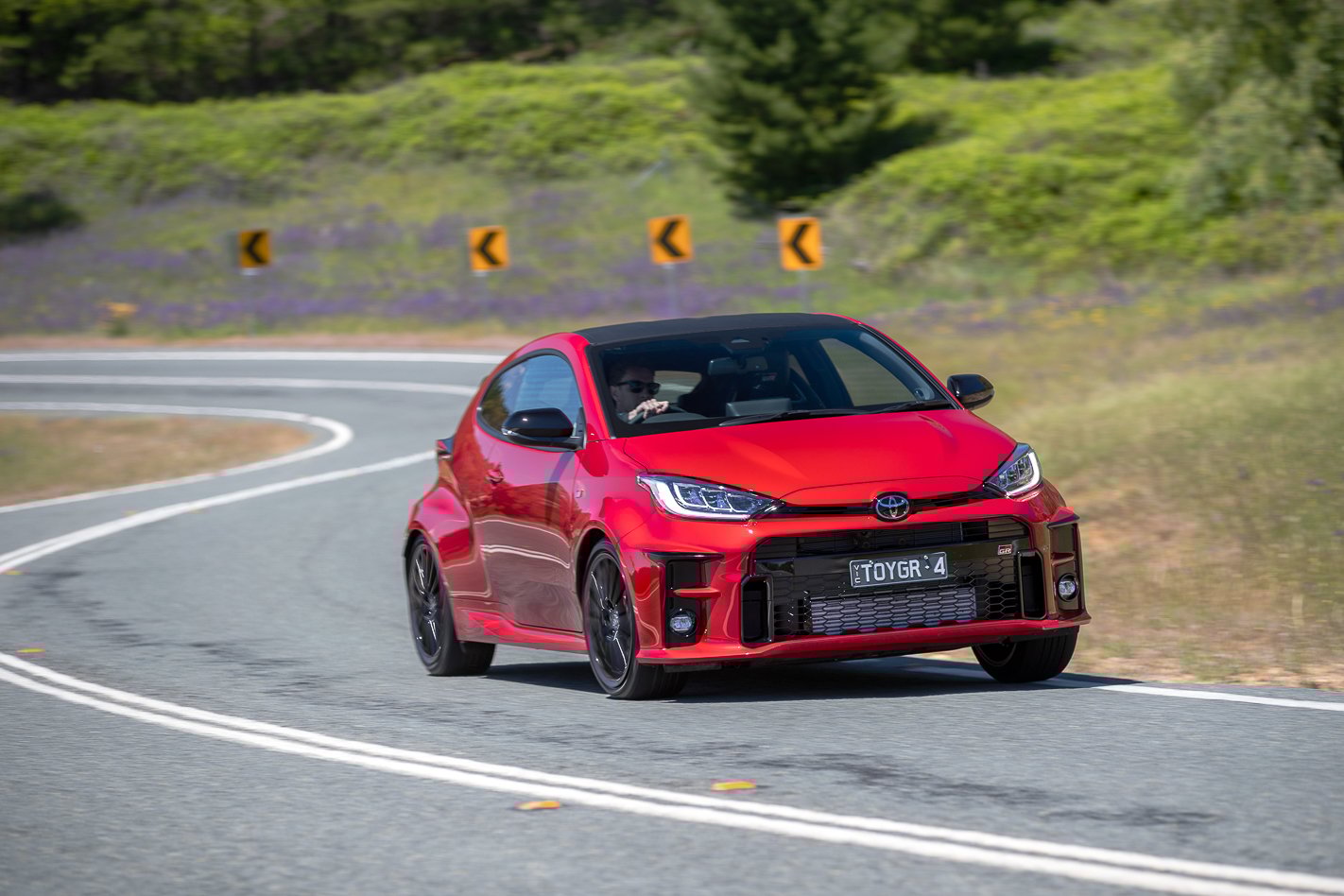
Carving a niche of its own, the GR C-HR wouldn’t need to break records with its performance, but a mid-5 second sprint to 100km/h, improved brakes, sticky rubber, and a slick-shifting drivetrain would be worthy of the full-fat Gazoo Racing badge.
To avoid repeating the disappointment we experience with the non-Performance Pack Yaris the GR C-HR would be fitted with the full gamut of differentials and more aggressive rubber as standard.
Performance enthusiasts would be pleased as well, with the small SUV body being a compelling argument to help sway a significant other that was unconvinced by the Yaris’ compromised three-door layout.
Read on to discover the finer details of how we’d make it all work.

Step 1: Up the ante
The Yaris’ three-pot engine is endearing, but with the extra size the C-HR needs more firepower. A punchier tune would unleash 220kW and 400Nm from the 1.6-litre unit – similar figures to what we expect from the potential GR Corolla.
Step 2: Self-shift
Aimed at being a more rounded alternative to the GR Yaris, the Gazoo Racing C-HR would need an automatic transmission option, with an eight-speed dual-clutch being the natural fit. A six-speed manual would also still be available, obviously.
Step 3: Locked up
A pair of Torsen limited-slip differentials fore and aft will do wonders for the GR C-HR’s performance credentials. Suspension, while sporty in intent, would be softened a touch compared to the GR Yaris to be more family-friendly.
Step 4: Sticky stuff
Like its smaller sibling, Michelin Pilot Sport 4 S tyres will be fitted at each corner. An 18-inch rim diameter remains compared to non-GR variants, but with a wider wheel to accommodate 255mm of performance-focused tread.
Step 5: Wide load
The Toyota C-HR is already bequeathed with slight flares to its arches, but a proper GR would amp things up. While not a completely bespoke bodyshell, new panels on each side add to the SUV’s width, helping accommodate the wider rubber.
Step 6: Air of confidence
The extra addenda for the GR isn’t just for show. More aggressive front and rear spoilers will aid high-speed stability, while those intakes to either side of the front grille will be entirely functional, helping cool the larger performance-focused slotted brake discs.
Want to play fantasy product planner with us? Send your best ideas to [email protected]
Snapshot
- New logo appears to represent rotary engine
- e-SKYACTIV R-HEV may appear on 2022 MX-30
- Several other trademarks recently filed by Mazda
Mazda has filed for a series of new trademarks – including a logo that looks unmistakably like a rotary engine.
The newly-published applications were discovered by Japan’s Hatena Blog. The emblem consists of a triangular motif with rounded edges, much like a rotor within a Wankel design.

The lower-case ‘E’ formed by the logo’s cutout suggests it’s likely to appear on Mazda’s upcoming rotary-assisted electric range, the first of which will be a variant of the MX-30. This theory is backed by the other trademark filings, which include ‘e-SKYACTIV R-HEV’, ‘e-SKYACTIV R-EV’, and ‘e-SKYACTIV R-Energy’.
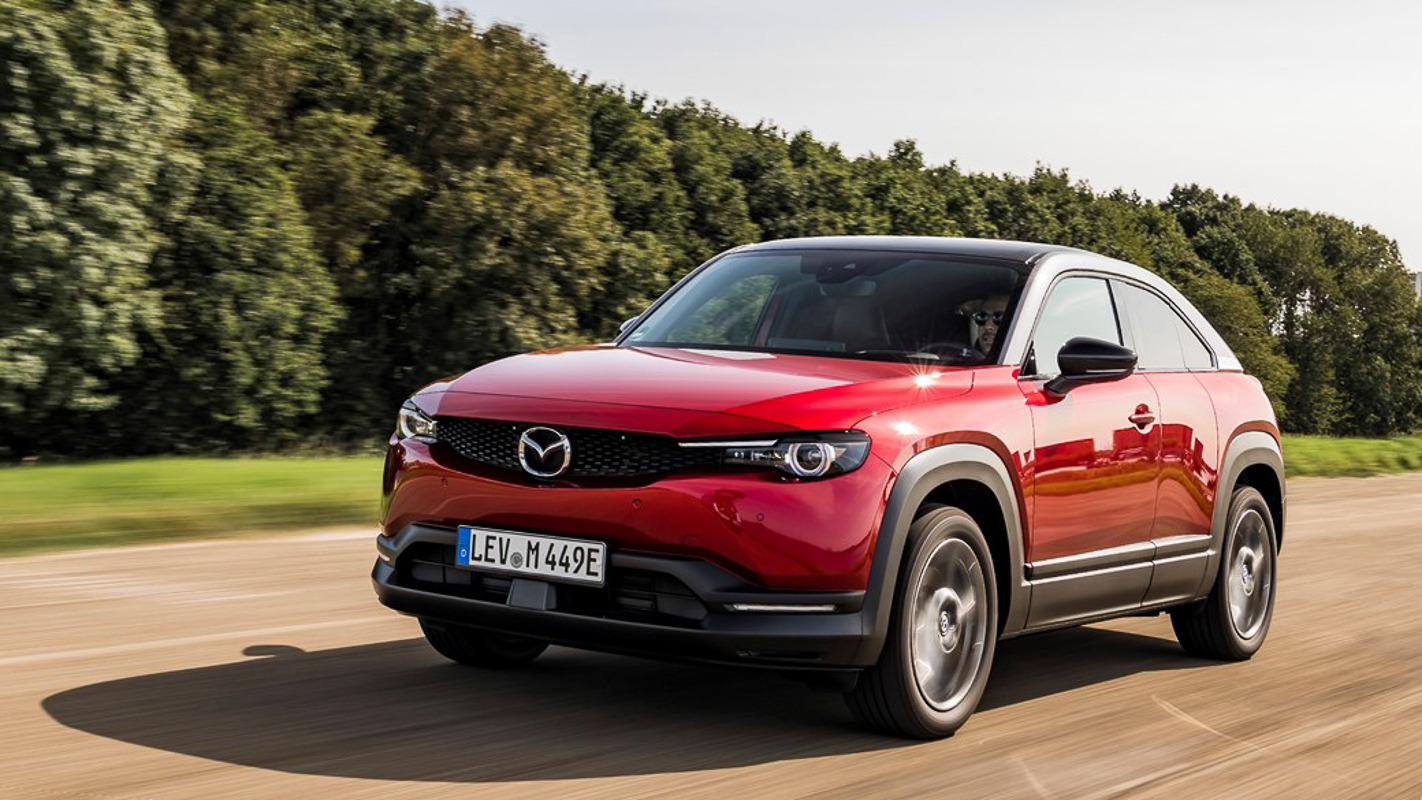
The R-HEV tag may appear on the upcoming MX-30 hybrid, which will use an electric motor in conjunction with a range-extending rotary engine. The MX-30 is currently available with a 2.0-litre four-pot with hybrid assistance, or as a dedicated EV with a 200km driving range.
R-EV seems likely to represent a dedicated electric vehicle, while R-Energy remains unclear. Some outlets have speculated it could be a vehicle powered by an alternative fuel such as hydrogen — a project rumoured to be on the cards at Mazda.
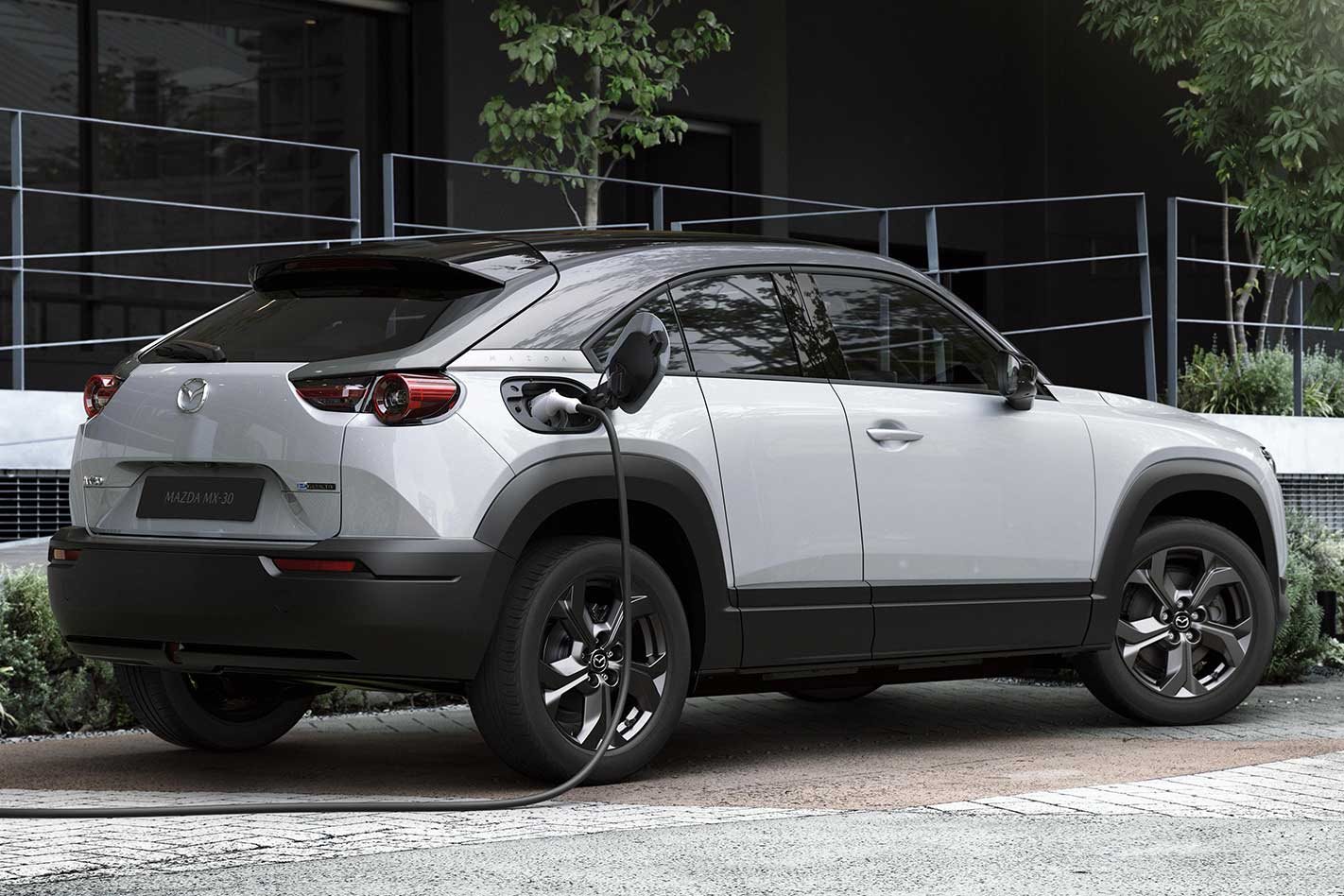
While reports in July indicated Mazda was putting the Wankel range extender on hold, a company representative recently told WhichCar that a 2022 arrival is still planned.
“There are no delays to the rotary range extender that is expected to come through next year in the MX-30,” they said.

They also said Mazda is yet to publicly reveal anything about its freshly-trademarked ‘R’ logo, which sparked talk of a possible return to Wankel-powered sports cars.
Mazda has been contacted for comment on the new trademarks.
Snapshot
- Wireless Apple CarPlay and Android Auto now standard
- Advanced cabin air purification system taken from other JLR models
- Three engines available, two with mild-hybrid assistance
The Range Rover Velar has been treated to an update for 2022, bringing a host of minor changes to the range.
Picking up new technology and styling options, the updated Velar range is headlined by the addition of wireless Apple CarPlay and Android Auto, as well as a fresh paint palette.

Much like the recently-updated Jaguar F-Pace, an over-the-air software update will allow existing Velar models with the Pivi Pro infotainment system to receive wireless smartphone mirroring later this year.
Land Rover’s SV Bespoke paint service is now available on the Velar, with 14 specialised paint options on offer – in addition to allowing customers to match their own unique colour to a set sample. A range of finishes complement the updated colour palette, such as ultra-metallic and satin matte.
A semi-autonomous steering assist function joins standard-fit adaptive cruise control for 2022, working with the lane-keep assist system to guide steering, acceleration and braking on long highway trips.
Available across the range is Jaguar Land Rover’s Cabin Air Purification Plus system, allowing drivers to ‘purify’ the air inside the cabin prior to entering the vehicle.
Running as part of climate pre-conditioning, the feature will activate the recirculation system and fans, with the ability to set a departure time on the infotainment system or Land Rover Remote smartphone application.
A carbon dioxide sensor will allow the Velar to automatically introduce fresh external air when sensors detect CO2 levels beyond acceptable levels, such as when driving through polluted areas. Internal and external air quality levels are accessible through the infotainment system.

A choice of three engines are available within the Velar range, with two turbocharged petrol units and one turbo diesel on offer.
The P250 is a 2.0-litre, four-cylinder turbo petrol with 184kW of power and 365Nm of torque, acting as the base of the range. Stepping up in price to the D200, the mild-hybrid diesel unit features decreased power but increased torque with the figures now at 150kW and 430Nm.
Finally the range-topping P400 adds mild-hybrid assistance to a 3.0-litre straight-six petrol, boosting power to 294kW while now producing 550Nm from 2000rpm.
While the Range Rover Velar is offered as a plug-in hybrid in the United Kingdom and Europe, the PHEV powertrain is not available in Australia on the Velar but can be optioned on the Range Rover Sport.
2022 Range Rover Velar pricing for Australia
| Velar P250 R-Dynamic S | $89,147 |
| Velar P250 R-Dynamic SE | $93,042 |
| Velar D200 MHEV R-Dynamic SE | $96,538 |
| Velar P400 MHEV R-Dynamic SE | $117,041 |
| Velar P400 MHEV R-Dynamic HSE | $129,043 |
Prices exclude on-road costs
The current ND-generation of the world’s most popular roadster, the Mazda MX-5, has been around for some time now.
It burst on to the scene in 2015, winning Wheels’ Car of the Year and making a strong impression at our own Bang For your Buck competition. It also carries one of the most compelling design philosophies of any modern car, with Mazda engineers defying the model’s generational size and weight creep and returning to the dimensions benchmarked by the original NA MX-5 of 1989.
Five years on, the ND MX-5 still maintains a strong presence on the sales charts, too. This year so far, it’s bested in volume by only the Ford Mustang in its own sub->$80k sports car segment.
But after over half a decade on the scene, has the game moved on?
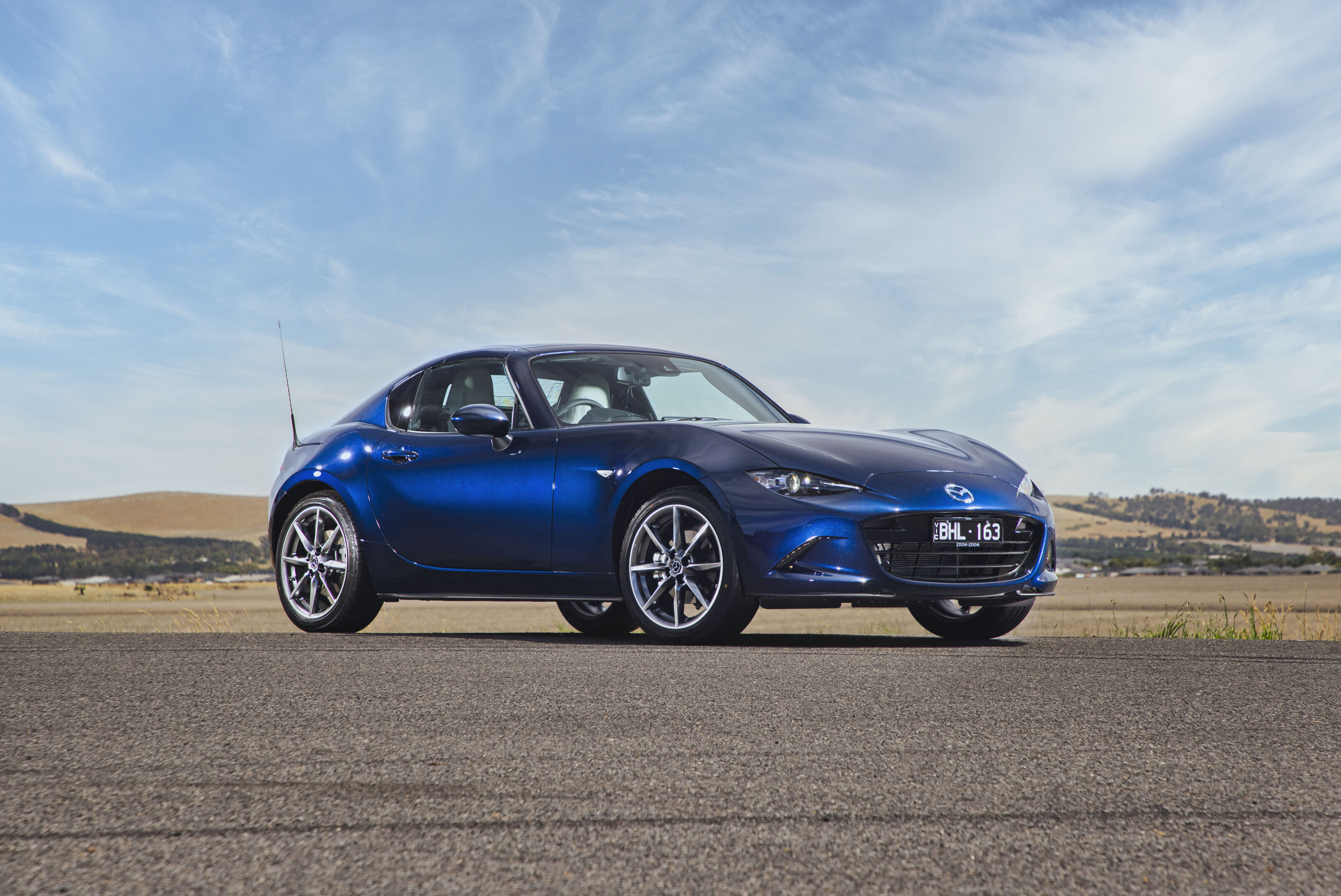
Indeed, while the Mazda MX-5 may have resisted bloating dimensions and weight, it hasn’t survived a significant price creep. While the Mazda has made great strides to reposition its brand and models upstream, the MX-5 may no longer be quite the same champion for affordable motoring it once was.
In fact, the cheapest MX-5 you could buy upon launch began at $31,990. But the high-spec automatic 2.0-litre MX-5 RF GT we have here today carries a list price of $50,100 (before on-roads).
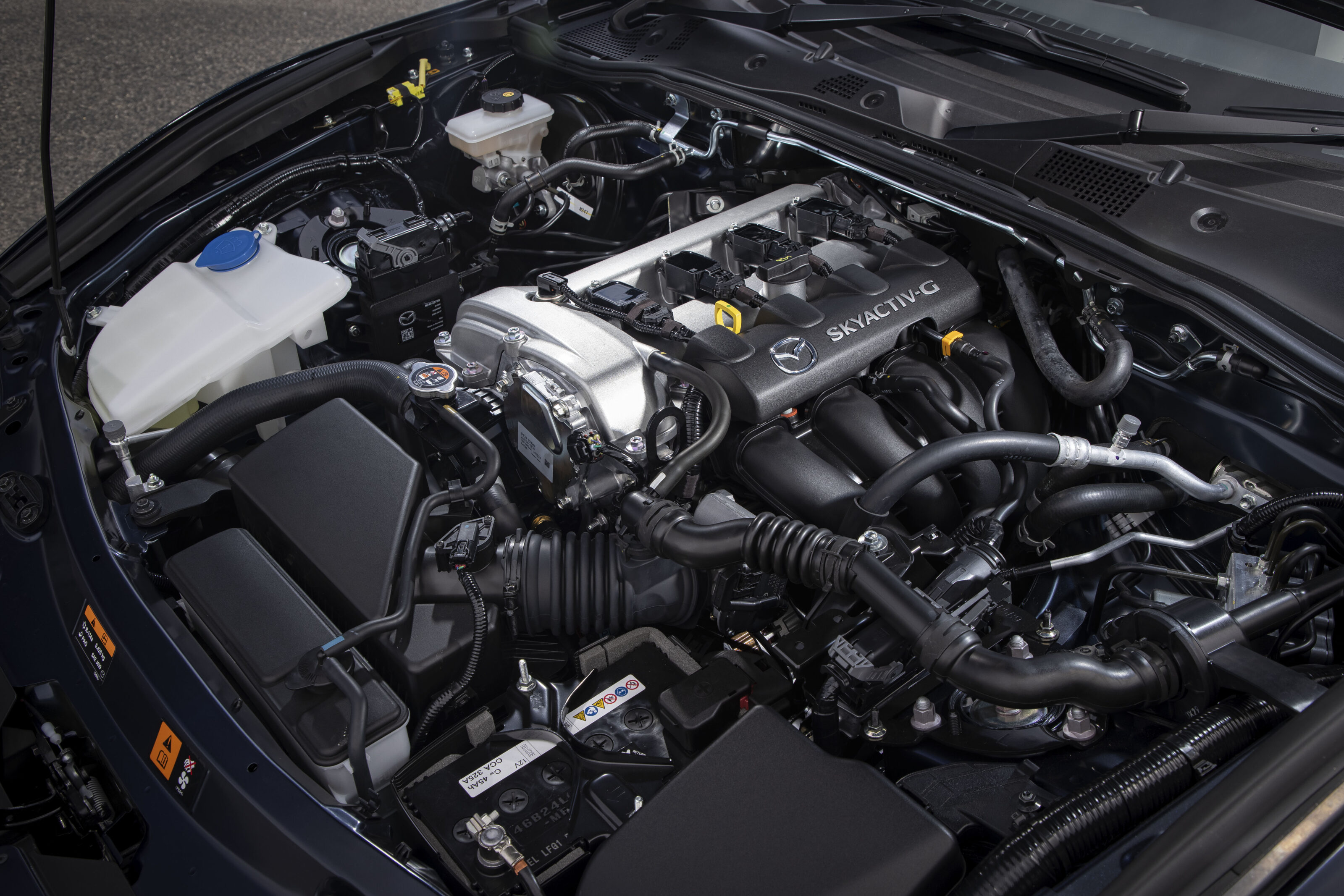
For that money, you’re getting the ‘big-block’ 2.0-litre four-cylinder yielding 135kW and 205Nm, a six-speed automatic and a folding metal roof.
As the family’s most premium offering, the RF GT’s price tag significantly exceeds that of its closest natural rival, the naturally-aspirated rear-drive 2.0-litre flat-four Toyota 86/Subaru BRZ. You’d have your pick of the litter as well: from the base 86 GT, at $34,480 for the auto, to the fully-loaded BRZ tS which scores Brembo brakes and Sachs dampers for $43,190 in automatic configuration.
The MX-5 RF GT also encroaches on the territory of some seriously rapid hot hatches, like the Toyota GR Yaris ($49,500) and Hyundai i30 N ($41,400).
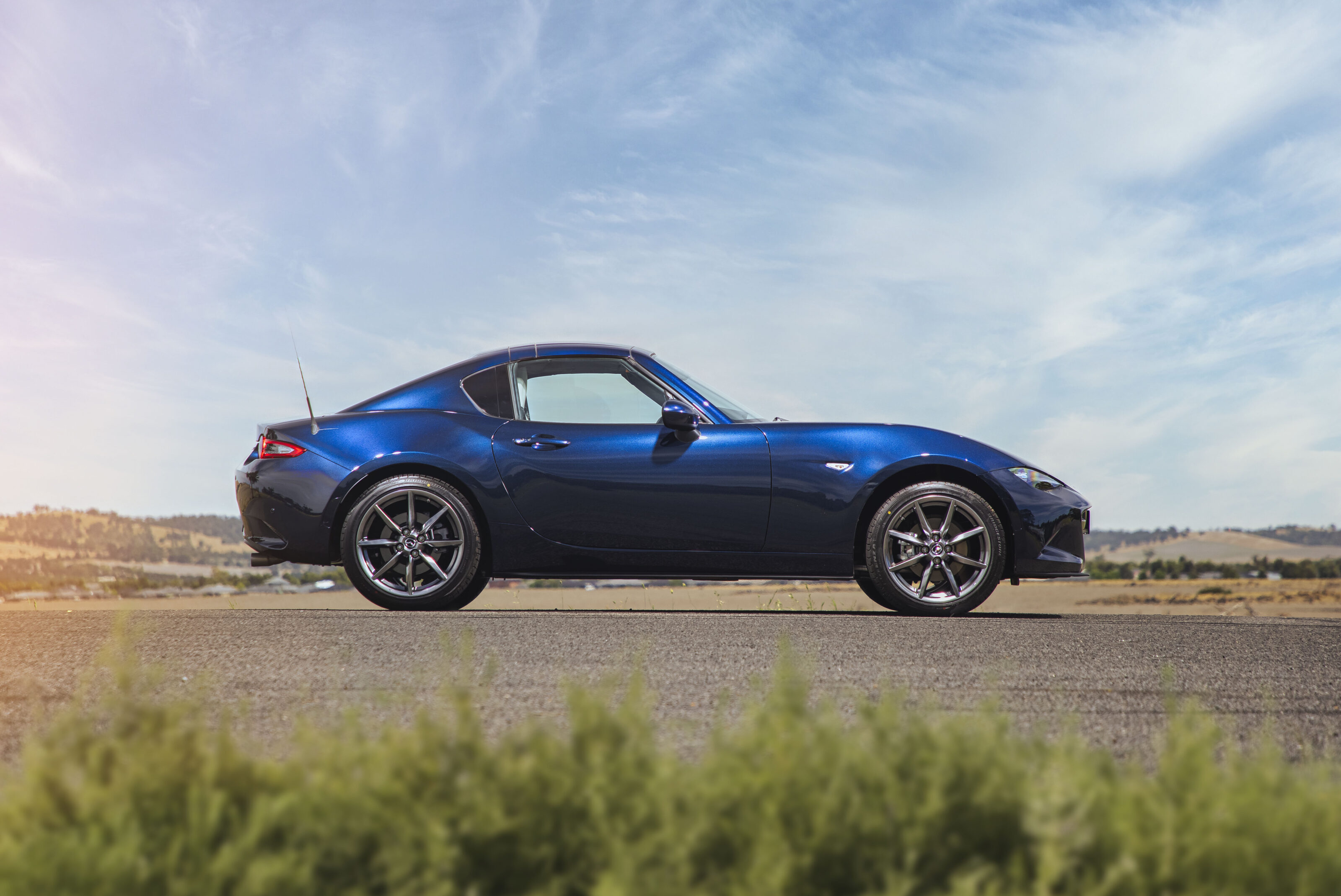
In actuality, however, the prospective buyers of those cars likely aren’t looking at the MX-5 as the experience and ethos are entirely different.
The MX-5’s USP is steeped in its decidedly old-school charm, and it’s biggest drawcard is its ability to distil the very essence of motoring joy into such a simple and accessible package.
With a claimed 6.5 second 0-100km/h time, the MX-5 won’t be hoping to embarrass much of anything at the traffic lights, but the naturally-aspirated four-cylinder offers incredibly smooth and linear delivery makes relative ease of overtaking opportunities with peak torque delivered at 4000rpm.
Around the bump and grind of metropolitan Melbourne (pre-lockdown, of course), the MX-5’s ultra-low seating position, diminutive dimensions, and spritely mid-range delivery made it an absolute hoot to zip through traffic.
The origami-like folding metal roof stows away in just 15 seconds, and is operational at up to 50km/h so you can avoid that red light anxiety.
The cabin itself is well presented with a graceful and minimal dashboard, 7-inch touch screen with familiar Mazda infotainment system, SatNav, Android Auto and, new for this year’s update, wireless Apple CarPlay.
It’s a fairly snug setting however and, with the roof closed, there’s little headroom to spare for myself at 175cm. The closed cabin does feel a little claustrophobic, so all the more reason to drop the top at every opportunity. In fact, the RF’s targa configuration does seem to contain airflow within the cabin while the roof is down, far better than the open-air soft top, even at highway speeds.

Also included is a full suite of active safety equipment, including: blind-spot monitoring, driver attention alert, emergency brake assist, lane-departure warning and rear cross-traffic alert.
Some ergonomics may seem a little counter intuitive upon first interaction: the cupholders are behind you, as is the ‘glove box’, and the main rotary dial can feel a little too far back. Upon further reflection, however, Mazda has made the most of the available space, and laid it out in a way that is unobtrusive and doesn’t distract from the driving experience.
And the driving experience is what the MX-5 is all about.
Not ‘speed’, per se. Not necessarily ‘performance’ in the traditional MOTOR sense, either. The MX-5 is an experiential machine, through and through.
It’s not very powerful, and it’s rather softly sprung with a lot of compliance; two features that would doom it in the eyes of many enthusiast motoring writers. But those are two features that, in this application, make the MX-5 the beautifully communicative thing that it is.
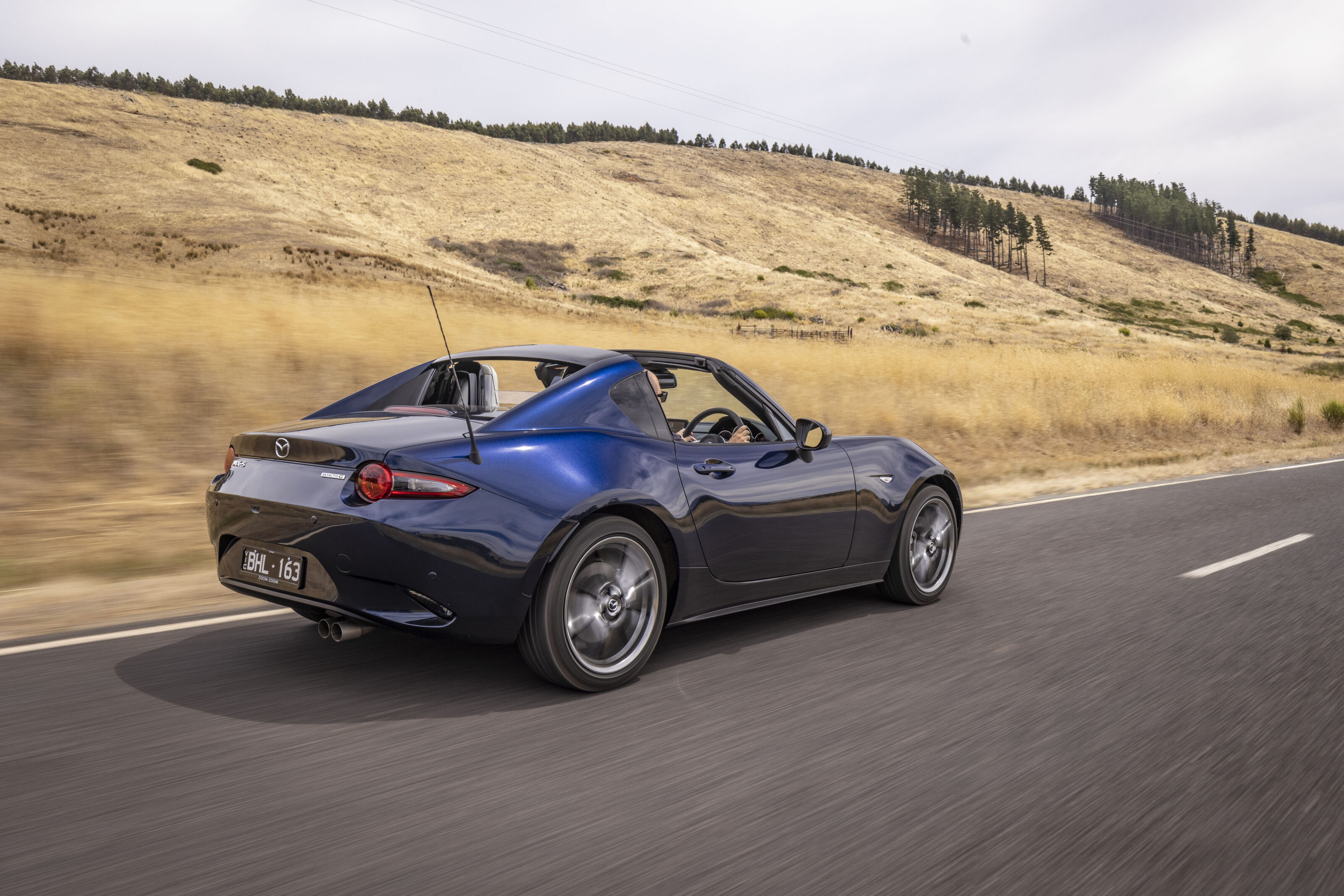
On an uncharacteristically warm May Sunday morning, in the mountains north of Melbourne, the MX-5 – roof down, of course – was an absolute pleasure.
The RF GT automatic is the heaviest roadster in the family, at 1134kg. That’s tremendously petite by today’s standards, but it’s still a fair amount of mass to ask of just 135kW. Subsequently, you quickly learn that you can apply virtually full throttle, virtually, everywhere.
And with the soft and friendly suspension settings, you get tangible sensations of pitch under acceleration, dive under hard braking, and roll under lateral load; sensations that would otherwise be ironed out, or simply go by too fast, in a more rapid and powerful vehicle.
With much of the engine positioned behind the front axle, turn-in at speed is remarkably sharp; after which the MX-5 quickly settles on its front outside tyre. With modest grip levels, you get frequent hints of neutral and over steer without ever needing to reach truly consequential speeds.
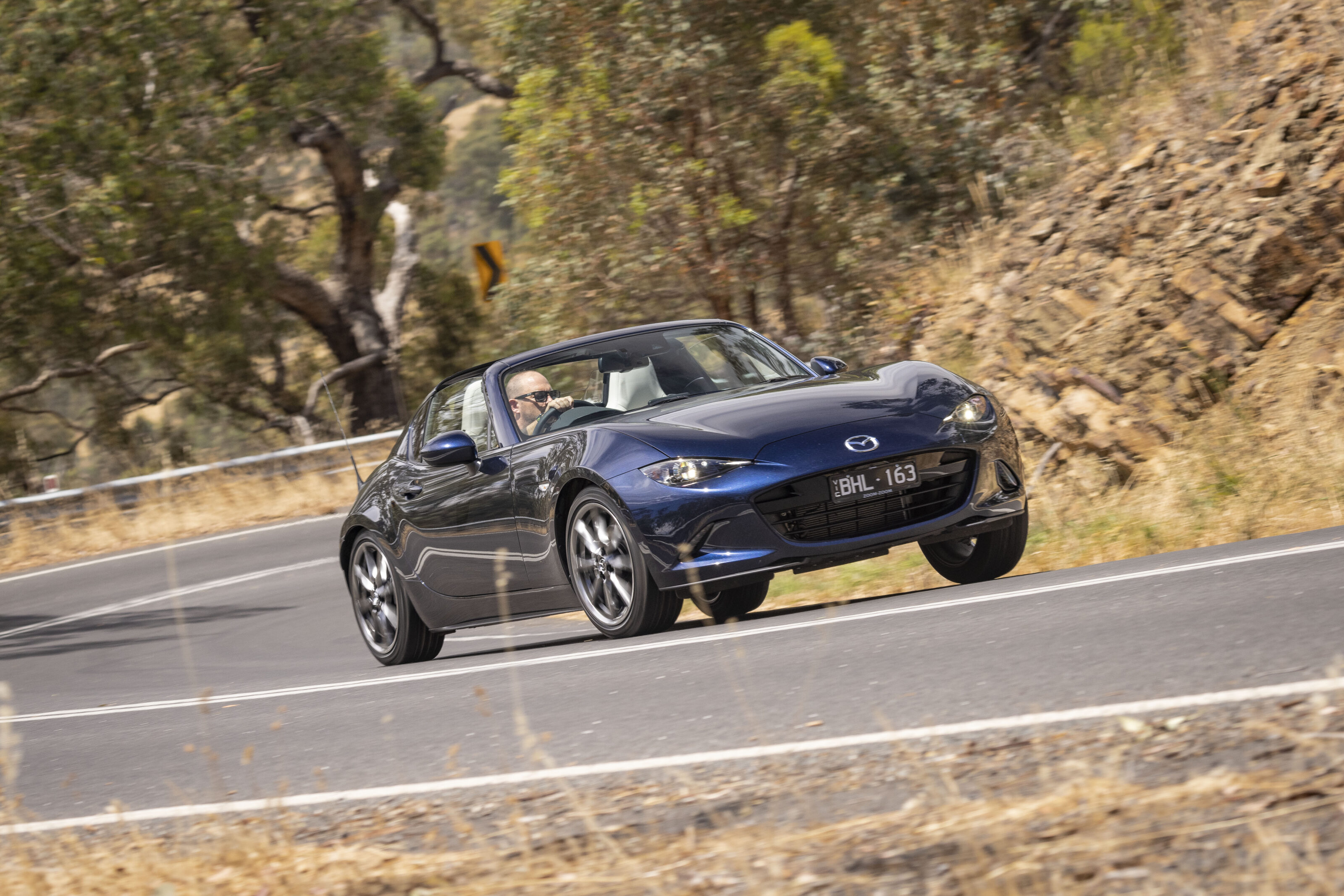
The fly-by-wire throttle is well calibrated, and sharpens in response nicely in Sport mode. My only real gripe was the steering which, while incredibly direct and precise, felt a little artificial and didn’t offer the same tactile delightfulness as the MX-5’s main rival, the Toyota 86/Subaru BRZ. The automatic gearbox is similarly well-judged and, in manual mode, was very accommodating of shift requests.
Not once, did the gearbox refuse to give me a downshift but it must be said that I wasn’t zinging the little four-pot off its head as there’s little reason with this powerplant to be hanging around high up in the rev range. The little MX-5 feels best when happily clicking up and down gears while zipping between corners.
And that brings our MX-5 under a more philosophical review.
Its strength of character is entrenched in its retro, almost classical, charm.
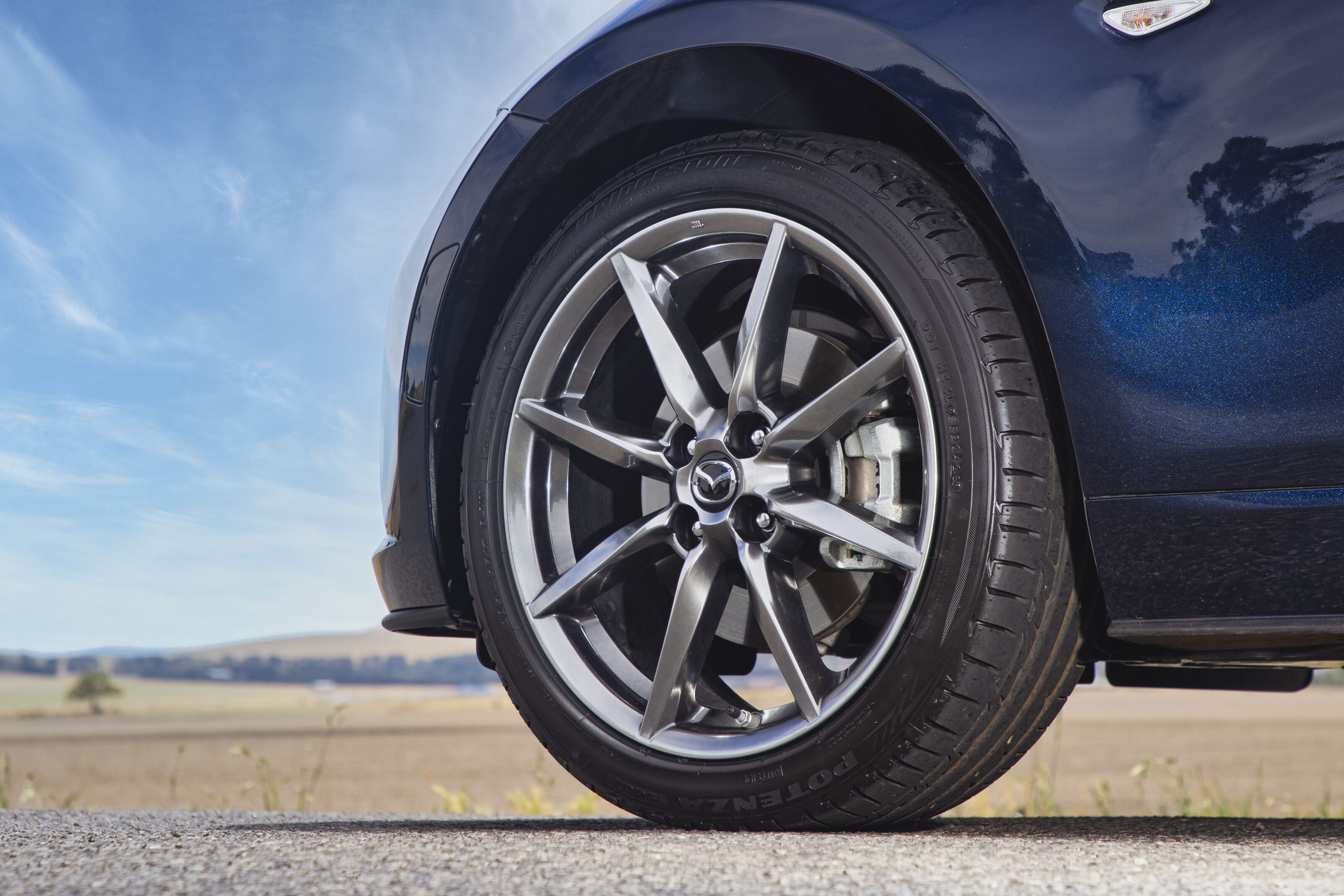
And if the MX-5 is likened to the modern resurgence of the film camera or record player, the automatic gearbox and – to an extent – the RF’s folding metal roof, is a bit like a new brand-new digital Leica made to look like a vintage filmy.
Don’t fake the funk. If you’re buying an MX-5, buy the manual soft top and save your dollars.
In isolation and for what it is, I like the MX-5 RF GT a lot. But whether to recommend a $50k automatic Mazda MX-5 to the MOTOR readership is a tricky matter.
Put this ND MX-5 RF GT next to something like a cheaper Hyundai i30 N and of course, it looks tremendously expensive and outmoded for the level of practicality, technology, and performance on offer.
But an MX-5 is not bought for the same reason as an i30 N or even, to a lesser extent, the 86/BRZ.
Put that same $50k Mazda MX-5 next a $90k 1966 Austin-Healey MkIII? And well… that begins to look like the bargain of the century, doesn’t it?
Mazda MX-5 RF GT specs
The Isuzu D-Max X-Terrain is proof of the grander ambitions the brand has for the latest generation of its popular dual-cab ute.
Long regarded as a dependable workhorse, the D-Max now has a flagship X-Terrain variant that adds a bit of a style and a whole heap of convenience in an attempt to lure buyers out of Rangers and HiLuxes.
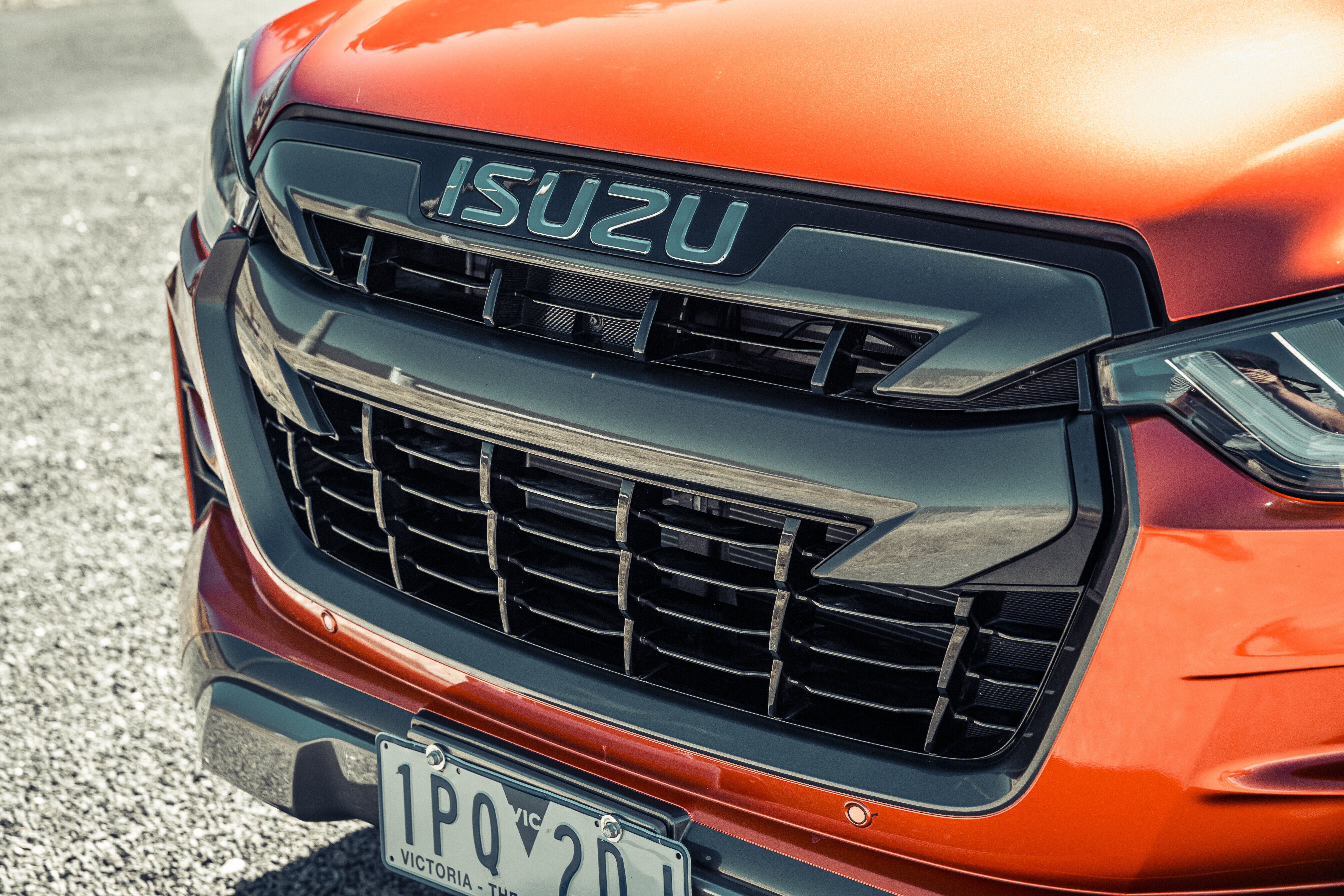
Differentiating it visually are plenty of charcoal highlights, including the grille, wheelarch extensions, mirrors, wheels, door handles and roof rails, as well as a roller tonneau, sports bar and underbody spoilers front and rear.
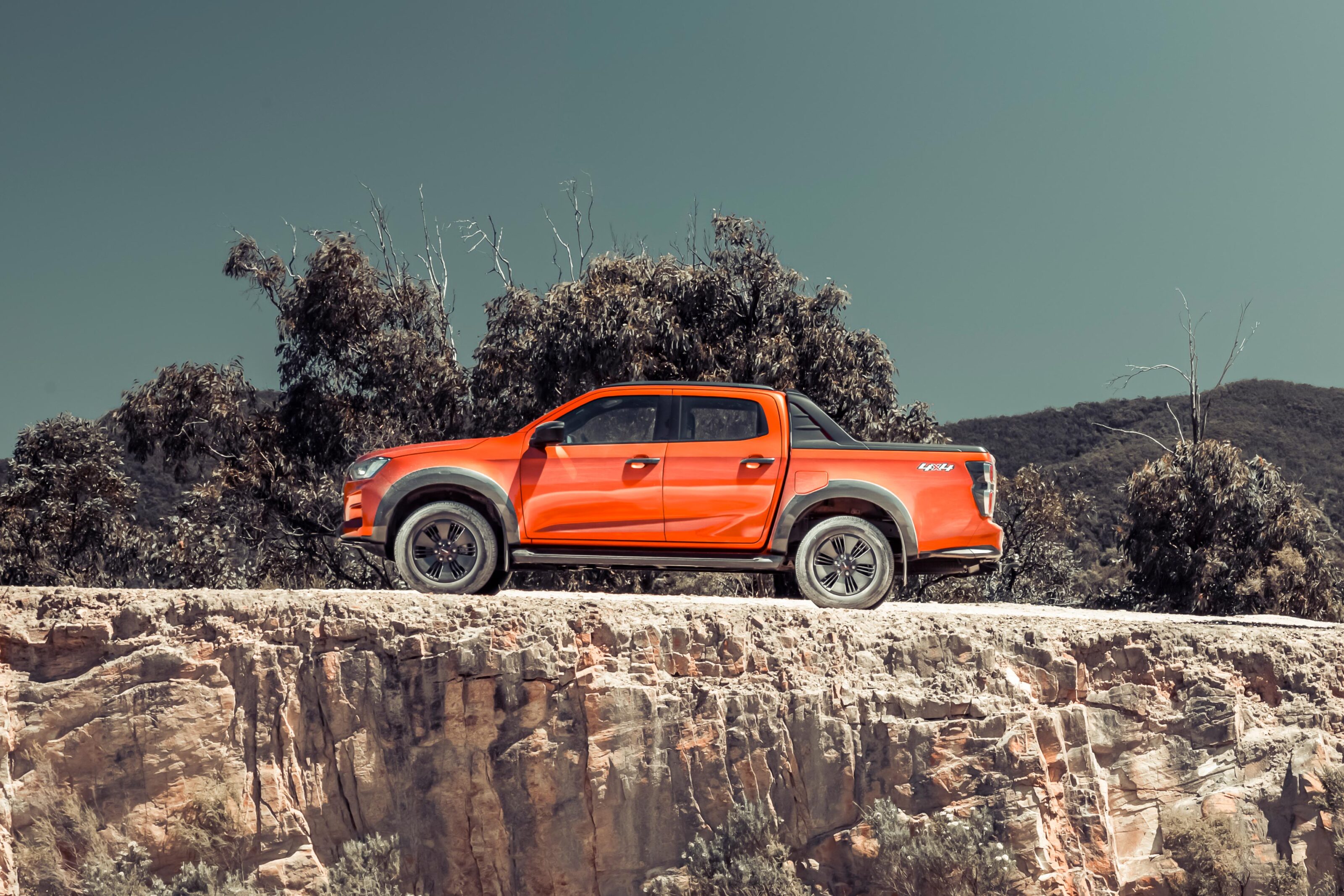
What you can see are auto-levelling LED headlights and taillights, while what you can’t see are steel plate guards for the engine sump, transfer case and leading edge of the fuel tank. Eight colours are available, including the X-Terrain exclusive Volcanic Amber metallic you see here.
It has an angry, Predator-like face, though a more aggressive wheel and tyre package would help as the 18 x 7.5s wrapped in 265/60 Bridgestones look a little undernourished when compared to the likes of the Ranger Raptor and Navara Warrior.
As you’d hope for a range-topping offering listed at $63,900 before on-road costs, the X-Terrain is packed to the gills with equipment.

Where the D-Max moves the dual-cab game on is with its impressive suite of safety systems
The interior itself has some nice touches, such as the row of silver switches for the HVAC, a storage cubby atop the dash and a large 9.0-inch multimedia touchscreen, but the leather feels shiny and slippery, there’s plenty of hard plastic present and the piano black inserts are a magnet for dust and dirty fingerprints.
Finding a comfortable driving position is aided by an eight-way electrically adjustable driver’s seat and rake/reach adjustable steering wheel, but the seats themselves are flat with quite a short base that lacks thigh support.
The infotainment’s larger size is handy and it’s relatively straightforward to use with shortcut keys below, but glare can make it difficult to see in certain lights and wireless smartphone mirroring (Apple CarPlay and Android Auto) is less useful when the lack of wireless charging means your phone will likely be plugged in anyway. Re-connection sometimes took quite a long time, too.

In the rear there’s space for three across and there are vents and large door pockets that accept 1.5-litre bottles, but the single USB port could start arguments if devices are running low. There’s a pair of child seat tethers and extra storage space both underneath and behind the flip-up rear seat.
Smart keyless entry with push-button or remote start is handy while cabin temperature is handled by dual-zone climate control, tunes broadcast through an eight-speaker stereo and there’s native satellite navigation if smartphone mirroring isn’t your thing.
Where the D-Max moves the dual-cab game forward is with its comprehensive active safety offering right across the range. Deep breath, here we go.
Like its lesser siblings, the X-Terrain incorporates autonomous emergency braking, turn assist, post-collision braking, forward collision warning, misacceleration mitigation, adaptive cruise control with stop & go function, traffic sign recognition, lane departure warning and prevention, blind-spot monitoring, rear cross-traffic alert, front and rear parking sensors as well as eight airbags.
Isuzu’s after-sales support is also impressive, with a six-year/150,000km warranty, seven years of roadside assistance as long as you service with an approved dealer and seven years capped-price servicing, with services required every 12 months or 15,000km.
Before we hit the road, the X-Terrain’s tub is 1570 x 1530 x 450mm (length, width and height) with 1122mm between the wheel arches, but the roller tonneau robs it of significant cargo space and there are only two cargo tie-down points instead of the four on lesser D-Maxes.
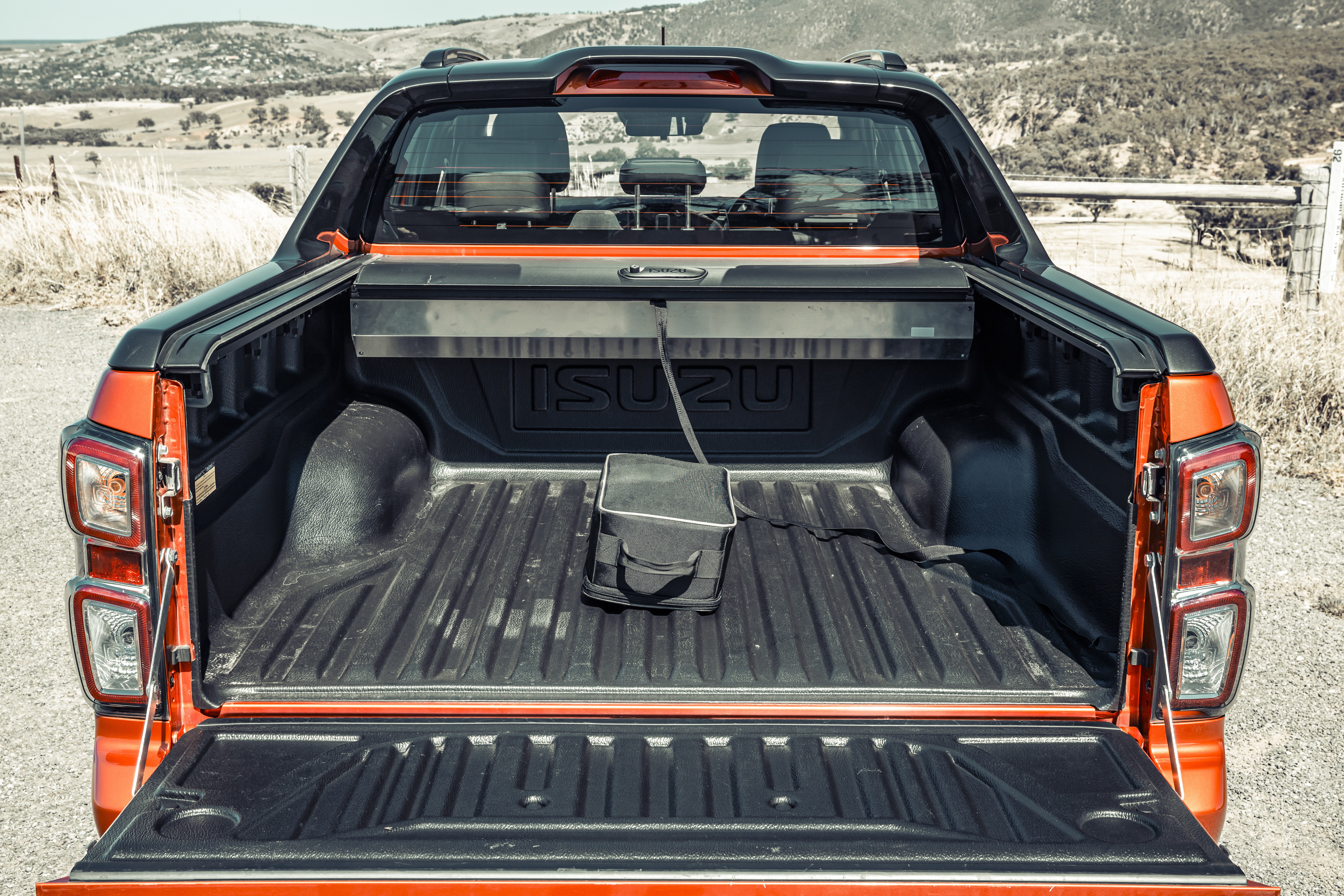
A 3100kg Gross Vehicle Mass provides a 970kg payload, though the 5950kg Gross Combination Mass then limits towing capacity to 2850kg rather than the 3500kg rated maximum.
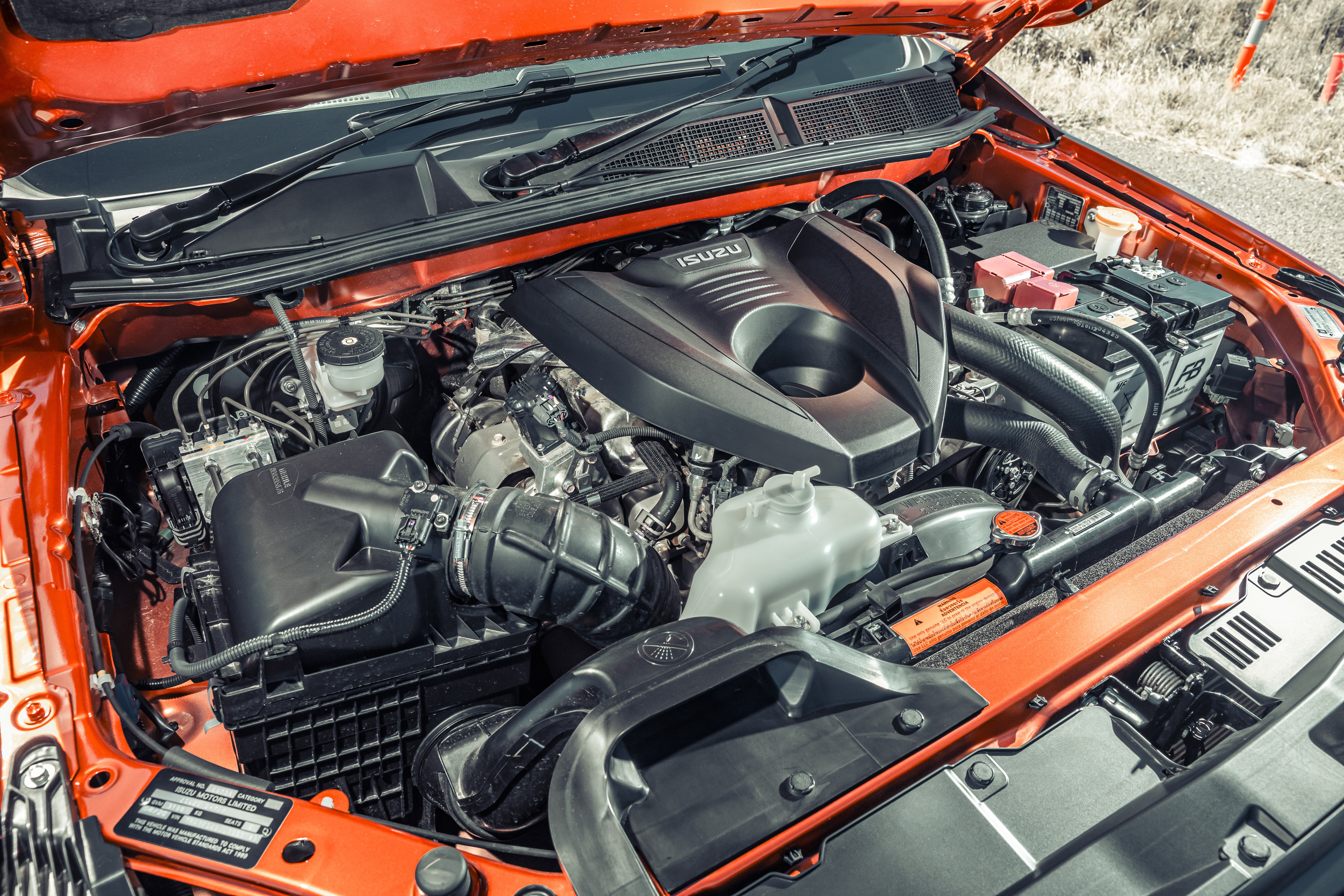
The D-Max is known for its strong powerplant and the latest generation does little to dispel that notion. Its 140kW/450Nm 3.0-litre turbocharged diesel has a solid hit of low- and mid-range torque that gives it impressive towing and off-road performance, though it’s noisy in its operation.
While the six-speed auto works well, a couple more gears wouldn’t go astray to make better use of the relatively narrow power band, the engine having done its best work by 3600rpm, which is the point at which peak power arrives. Fuel consumption is claimed to be 8.0L/100km on the combined cycle, our test number hovering slightly above that at 8.3L/100km.
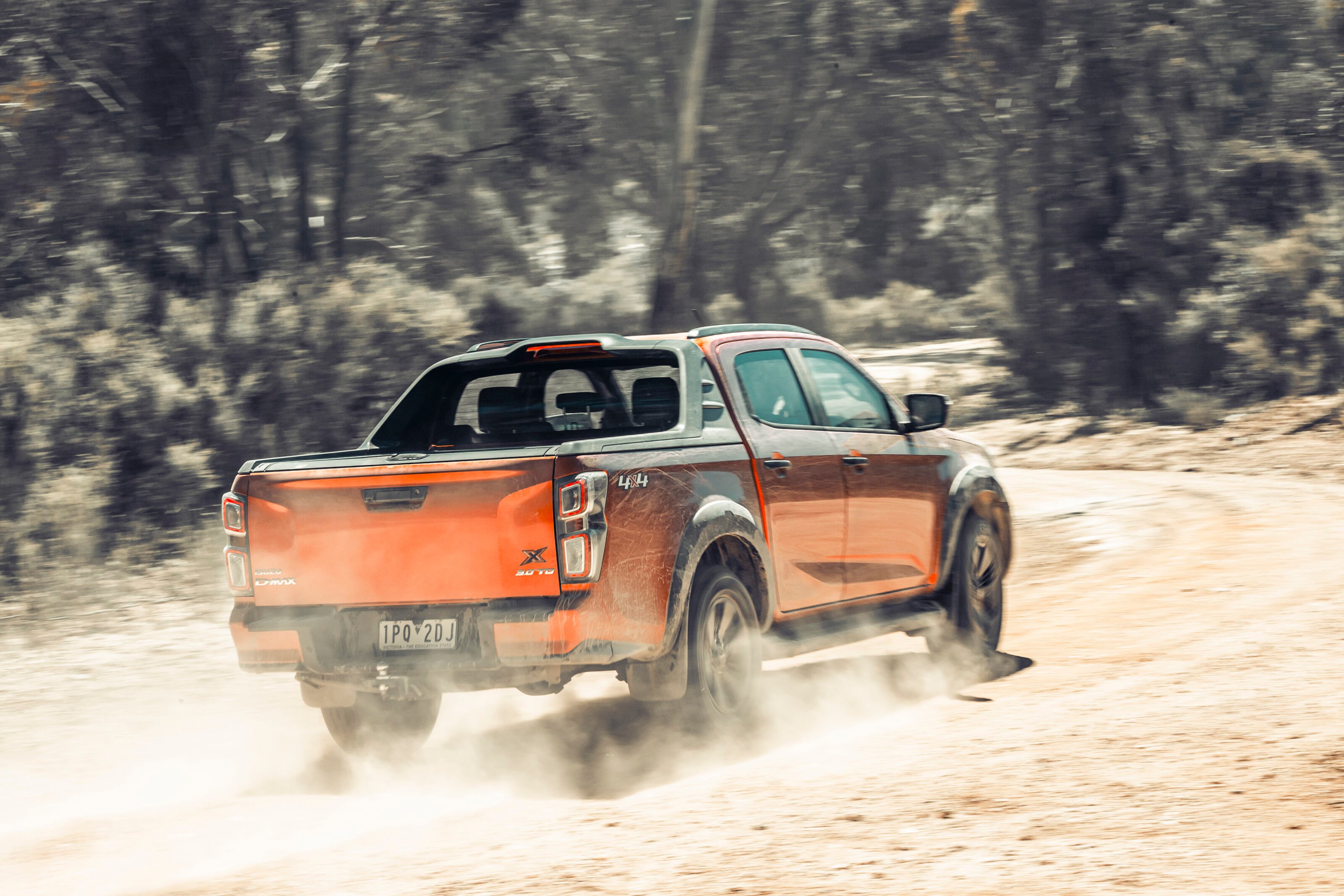
Rear-wheel drive is the default drive mode. While there is the ability to switch to 4H on the move at up to 100km/h, the lack of a centre diff means this should only be done on unsealed surfaces. A limited-slip differential would improve traction on slippery surfaces when driving in rear-wheel drive.
Selecting 4L requires a stop and the selection of neutral, but it engages quickly on most occasions. This latest D-Max now includes a rear differential lock but it’s only available up to walking speeds and also cancels the traction control.
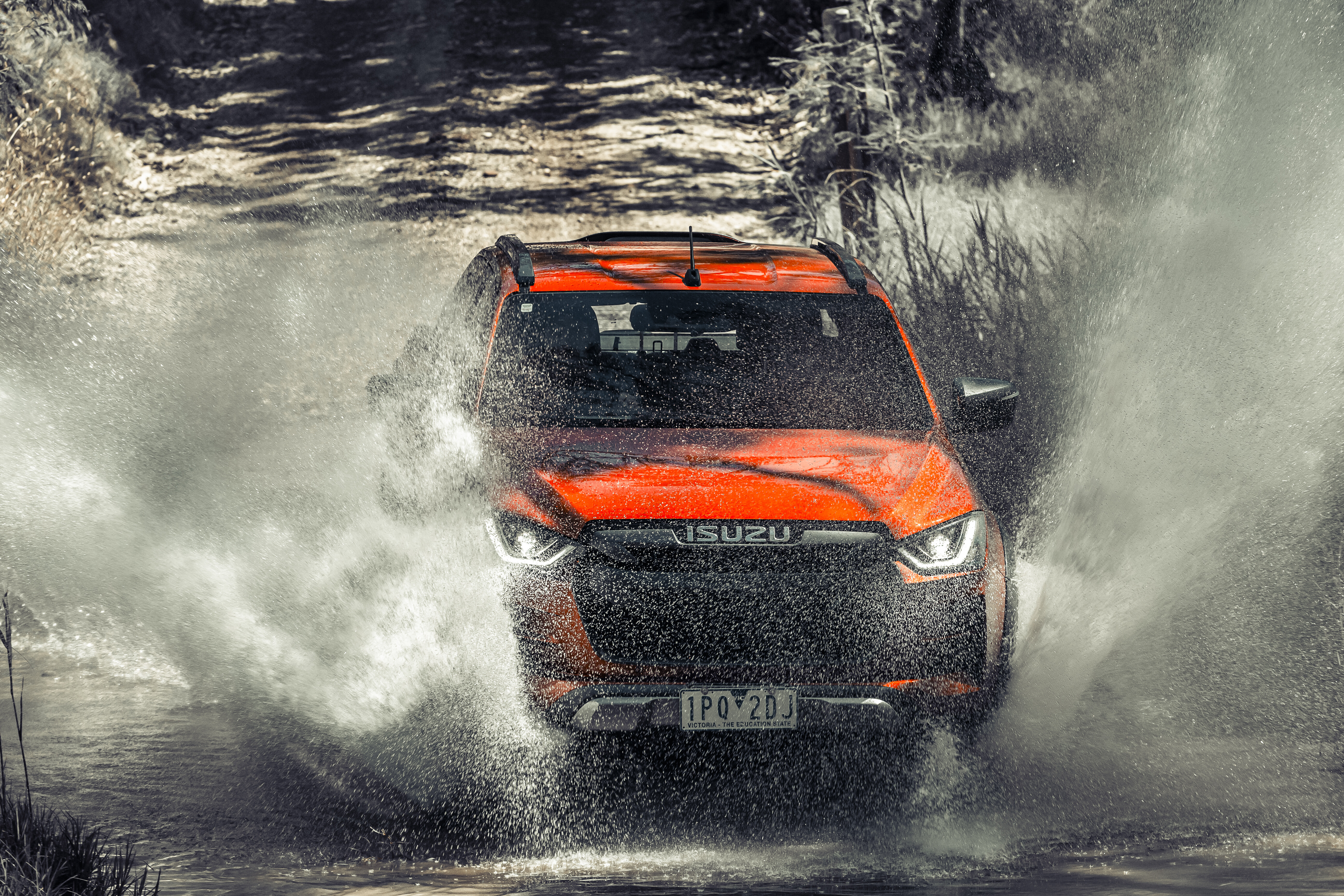
The standard highway-terrain tyres also limit the X-Terrain’s ability off road, but check out the review from 4×4 Australia for a full rough stuff run down. On the plus side, the more road-focused tyres help the D-Max deliver impressive sealed-surface braking performances.
Speed-sensitive steering allows for little effort at parking pace – useful when the slow steering requires plenty of twirling – while increasing in heft at higher speeds to increase connection. Like most dual-cabs, communication isn’t a strong point but its driving manners are better than most of its competitors, if not up to the standards of the Ranger and Amarok.
Its ride is comfortable enough in most circumstances given its leaf-sprung rear end, absorbing most bumps but with quite a lot of vertical movement over larger undulations at higher speeds.
All in all, the D-Max X-Terrain is one of the better dual-cab offerings on the market, as evidenced by its second-place result in our recent ute mega test. It’s a big step forward over its predecessor, with improved road manners, benchmark safety and plenty of equipment.
There’s room for improvement off road but a decent set of appropriate tyres would go a long way to rectifying that. The dual-cab segment is an ultra-competitive one, but Isuzu’s efforts with the D-Max have propelled it towards the top of the class.
| Body: | 4-door, 5-seat ute |
|---|---|
| Drive: | rear-/all-wheel |
| Engine: | 2999cc inline-4cyl diesel, DOHC, 16v, turbo |
| Bore/stroke: | 95.4 x 104.9mm |
| Compression: | 16.3:1 |
| Power: | 140kW @ 3600rpm |
| Torque: | 450Nm @ 1600-2600rpm |
| 0-100km/h: | 10.1sec (tested) |
| Fuel consumption: | 8.0L/100km (combined/claimed) |
| Weight: | 2130kg |
| Power/weight: | 66kW/tonne |
| Transmission: | 6-speed automatic |
| Suspension: | Double wishbones, coil springs, anti-roll bar (f); leaf springs (r) |
| L/W/H: | 5280/1880/1811mm |
| Wheelbase: | 3125mm |
| Tracks: | 1570mm (f/r) |
| Steering: | Electrically assisted rack-and-pinion |
| Brakes: | 320mm ventilated discs, 2-piston calipers (f); 295mm drums (r) |
| Wheels/tyres: | 18 x 7.5-inch (f/r); 265/60 R18 Bridgestone Dueler H/T 684II |
| Price: | $63,900 + ORC |
UPDATE, August 21: The worsening COVID-19 outbreak across NSW has seen strict border restrictions in place with all other states and territories. Meanwhile, Victoria and the Australian Capital Territory seem no closer to easing their Covid-19 restrictions either.
Jump to:
- Victoria
- New South Wales
- Australian Capital Territory
- Queensland
- Northern Territory
- Western Australia
- South Australia
Can I drive my car during COVID-19?
Generally, driving your car is permitted when COVID-19 restrictions are in place but within the rules set by the jurisdiction – such as distance limits or local government area boundaries, or only with members of your household.
See below for state-by-state restrictions on when and where you can drive your car.

Victoria travel restrictions (updated)
Melbourne’s sixth lockdown has prompted a stay-at-home curfew in place between 9pm and 5am, meaning you cannot leave your home (or the home of your intimate partner or bubble buddy) other than for limited reasons.
These include:
- Authorised work
- Health and medical purposes
- Care and support of a child or someone with special needs
- In an emergency or to escape harm.
- Shopping for necessary goods and services
- Caregiving or compassionate reasons, including medical care or to get a COVID-19 test
- Authorised work (with a permit) or permitted education
- Exercise (once a day for 2 hours)
- To get a COVID-19 vaccination.
You must stay within 5km of your home for shopping and exercise. This limit does not apply to permitted work or education, when giving or receiving care, getting a COVID-19 vaccination or visiting an intimate partner or your single social bubble buddy.
Regional travel restrictions
Residents of Regional Victorians are now subject to the same restrictions as Metropolitan Melbourne but are do not have a curfew.
Border restrictions
NSW and the Australian Capital Territory are is considered in the ‘Extreme Risk’ zones with a $5452 facing anyone who arrives in Victoria without an exemption, including residents.
If you have been in an extreme risk zone any time in the last 14 days, you cannot enter Victoria without an exception, exemption or another valid permit – even if you are a Victorian resident.
Northern Territory: The City of Darwin, City of Palmerston, Litchfield Council, Wagait Shire, Belyuen Shire, Dundee, Bynoe, Charlotte, Cox Peninsula, Municipality of Katherine, including Tindal, have been classed as Red Zones since August 16.
Victorian residents who have been in a Red Zone can get a permit to enter Victoria – but they must isolate on arrival, get tested, and quarantine for 14 days.
If you are not a Victorian resident, you are not eligible for a red zone permit, and you cannot enter Victoria without an exception, exemption or another valid permit.
Queensland: South East Queensland LGA of City of Brisbane, Moreton Bay Regional Council, City of Gold Coast, City of Ipswich, Lockyer Valley Regional Council, Logan City, Noosa Shire Council, Redland City, Scenic Rim Regional Council, Somerset Regional Council and Sunshine Coast Regional Council are now considered Orange Zones.
Anyone travelling to Victoria who has been in these LGAs within the past 14 days still needs an Orange Zone permit and must isolate on arrival, get tested within 72 hours and stay isolated until receiving a negative result.
Travelling by car in Victoria
You are only allowed to drive if it is for a permitted reason as listed above. You must stay within 5km of your home when exercising, and when shopping for necessary goods and services. If you are unable to access necessary shopping within 5km from your home, you are allowed to travel further than 5km to your closest option to obtain necessary goods and services.
You must not have anyone outside your household in your car unless it is otherwise not practical for the other person to drive themselves, and the trip is for one of the permitted reasons. If you are driving someone for the purposes of authorised work, you do not need a permit to drive them, but the worker will need to carry a permit and photo ID.
Face masks must be worn unless an exception applies. Opening windows and having hand sanitiser available is recommended.
Taxis and ride-sharing are also allowed, but only for one of the permitted reasons for leaving home. You must wear a face mask.
Where possible, maintain physical distancing by sitting in the back seat. Wash or sanitise your hands before and after getting in the vehicle.
Is the NSW-Victoria border closed again?
Yes. This includes border towns which were subject to the border bubble but are now considered ‘extreme risk’ with the rest of NSW.
There are no border checkpoints, instead, Victoria Police have roving patrols along the border.
NSW travel restrictions (updated)
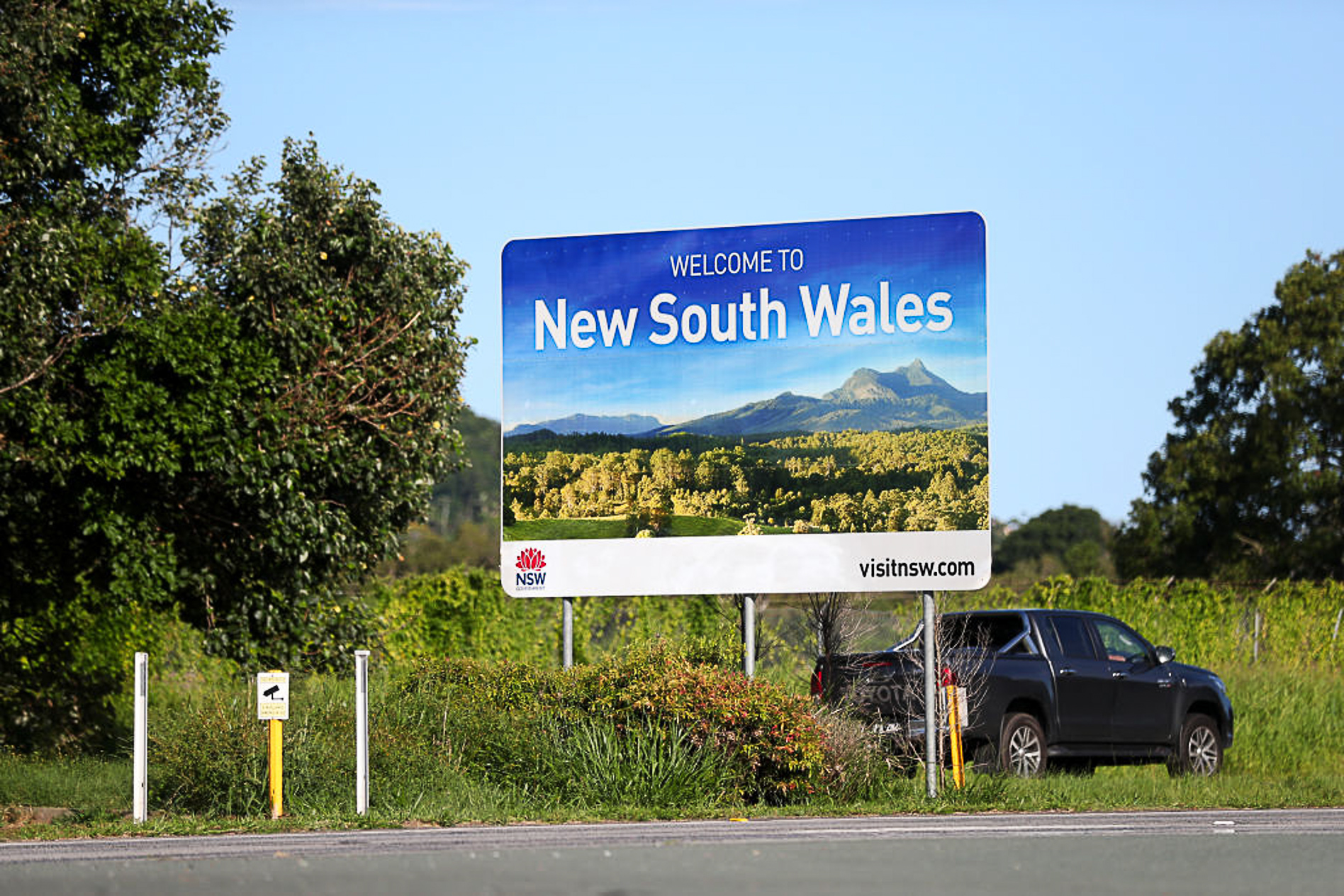
Centred in Sydney’s local government areas of concern, the NSW outbreak has spread to regional areas, prompting statewide restrictions and severely limiting travel to other states and territories.
Different rules apply to various regions across the state.
Local government areas (LGAs) of concern.
These include the council areas in; Greater Sydney of Bayside, Blacktown, Burwood, Campbelltown, Canterbury-Bankstown, Cumberland, Fairfield, Georges River, Liverpool, Parramatta, Strathfield, and some suburbs of Penrith.
You are only permitted to leave your home if you have a reasonable excuse, such as; shopping for your household or vulnerable people with 5km; working if you can’t work from home (within your LGA, or outside if authorised); education, if you can’t you learn at home; exercise with 5km of home; and medical care reasons including obtaining a COVID-19 vaccination.
Greater Sydney
The rest of Greater Sydney, which extends out to Katoomba and Wollongong, has similar rules in place, but you’re allowed to travel into a neighbouring LGA for shopping and exercise if it is within 5km of your home.
Regional and Rural NSW
Same rules as Greater Sydney.
More details about NSW COVID-19 restrictions in each of the above regions.
Travelling by car in NSW
You may only travel in a car with other people who you live with unless it is for:
- An emergency
- A compassionate reason
- To provide care or assistance to a vulnerable person
- The car is being used as a taxi or rideshare.
- Required to use a vehicle for your work (for example, if you are a police officer working in a team of two people).
- Travelling with your nominated visitor (‘singles bubble’) to exercise outdoors.
- Masks must be worn.
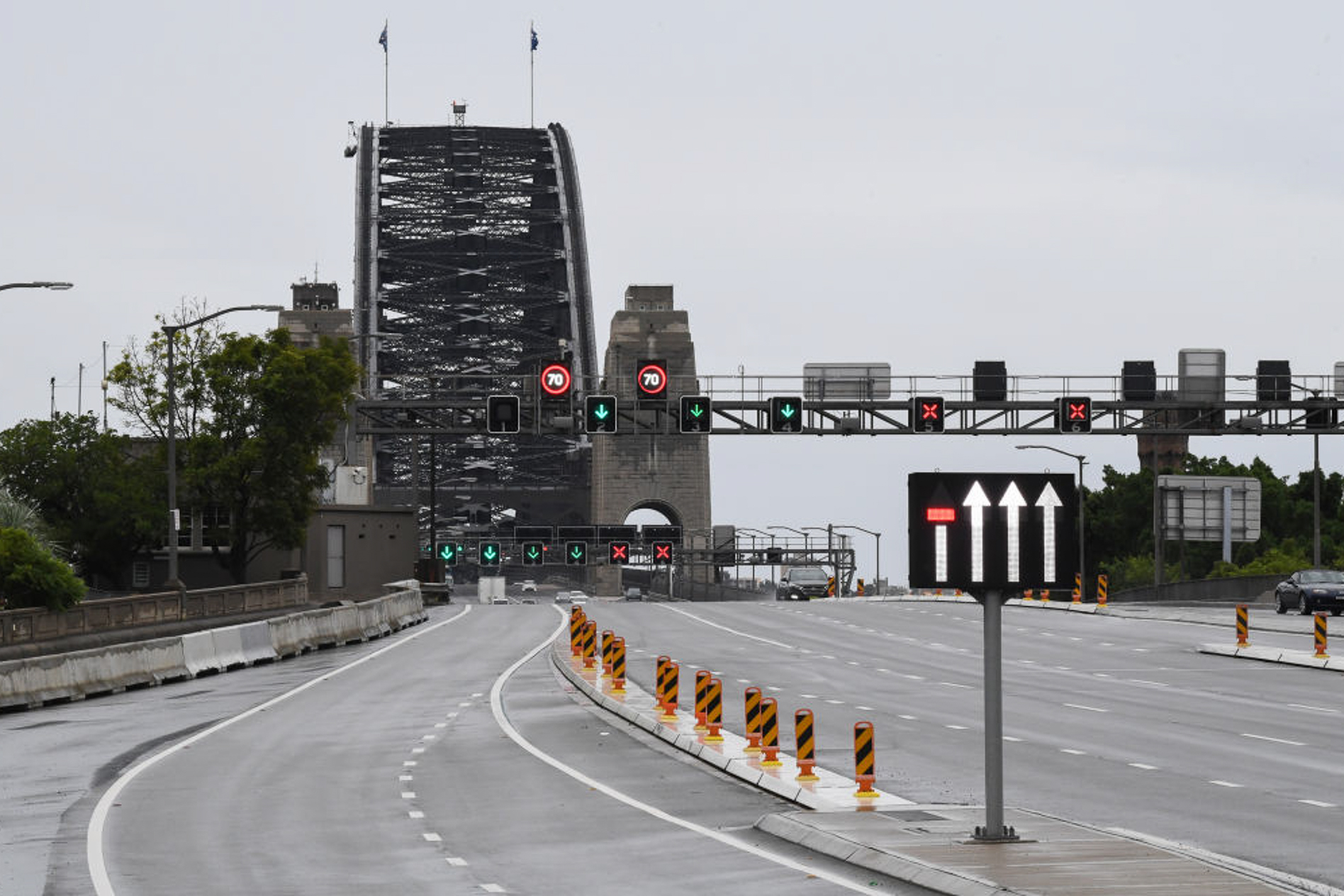
ACT travel restrictions (updated)
The NSW outbreak has spread to the ACT prompting the Territory Government to impose a snap lockdown from August 12 to help slow the spread of the virus and allow contact tracers to do their work.
In the ACT there are six essential reasons you can leave your home. These are:
- To buy essential groceries and medicine
- To access essential healthcare including in-home care
- For essential work
- To exercise outdoors for one hour per day in your region
- To get a COVID-19 test
- To get a COVID-19 vaccination.
Border restrictions
NSW: ACT Government declared all of NSW as a COVID-19 Affected Area, with some exemptions for people living in surrounding postcodes.
ACT residents leaving NSW will need to complete the online exemption form within 72 hours prior to arriving in the ACT and enter quarantine immediately for 14 days.
Non-ACT residents will require an approved exemption from ACT Health prior to arriving in the ACT and will also enter quarantine for 14 days.
For residents in the surrounding NSW region, if you live in an approved postcode you may enter the ACT for essential purposes only under a standing exemption.
Greater Melbourne: The ACT Government has a stay-at-home requirement which applies to all travellers who have spent any time in Greater Melbourne during the previous 14 days.
Non-ACT residents seeking to travel to the ACT who have been in Greater Melbourne must not enter the ACT without an approved exemption. Exemptions will only be granted for exceptional circumstances, and even if an exemption is approved, you will still be required to follow the stay-at-home requirements while you are in the ACT.
Queensland travel restrictions (updated)
Queensland seems to have beaten its latest outbreak which centred on the South East of the state and spread as far as Cairns. To maintain zero cases, it has declared certain regions around Australia to be COVID-19 hotspots.
If you have been in a declared COVID-19 hotspot in the last 14 days you will not be allowed to enter Queensland, except for a limited range of people who can enter for essential purposes.
These include:
Australian Capital Territory
Northern Territory – Greater Darwin and the Katherine region.
Victoria
New South Wales: The above conditions apply to the whole state. However, NSW residents who live anywhere in the border zone can only enter Queensland for essential purposes. These include:
- Shopping for household goods or personal needs that are unobtainable on the NSW side of the border
- To receive medical care or supplies, including a COVID-19 vaccination
- To perform essential work which cannot be done from home or provide emergency volunteering
- To attend school or childcare – only for children of essential workers or vulnerable children
- To provide assistance, care or support to a vulnerable person or family member or visit a terminally ill relative
- To fulfil an obligation relating to shared parenting, child contact or contact between siblings
- An emergency situation.
Northern Territory travel restrictions (updated)
A single COVID-19 case sparked a snap lockdown of the Greater Darwin and Katherine regions on August 12, 2021 and a lack of subsequent cases has seen most restrictions lifted. People are now allowed to travel outside these regions as long as they wear a mask and social distance at their destination.
Border restrictions
Like Queensland, the Northern Territory has classed most of south-eastern Australia as a COVID-19 Hotspot, including NSW, ACT and Greater Melbourne.
You will only be allowed to enter the NT if you are a returning Territorian or have received an approved exemption to enter from the NT CHO. This is a new requirement in addition to the existing Border Entry Form.
Travellers from Coronavirus hotspots are being advised to cancel their travel plans, and if they have already arrived, they’ll be subjected to 14 days quarantine at their own $2500 expense.
Regional NT travel is unrestricted.
More NT border and travel restrictions
Western Australia travel restrictions (updated)
Western Australia has classed NSW as a high-risk zone – so don’t even think about driving across the desert to get there.
Under high-risk permitted entry, which is available under very few circumstances, you must self-quarantine at a suitable premises for 14 days. If suitable accommodation is not available, you will be directed to a Government-approved quarantine facility at your own expense.
- Approved travellers must provide proof of a negative COVID-19 PCR test in the 72 hours prior to arriving.
- You must provide proof of receipt of at least one dose of COVID-19 vaccine, where eligible.
- Approved travellers must submit to COVID-19 tests on day two and day 12.
If permitted to enter the state from these areas, you must self-quarantine at suitable premises for 14 days – note that driving to WA you will have to self-quarantine at the border, which might be difficult. If a suitable premises is not available, you will be directed to a Government approved quarantine facility at your own expense.
Approved travellers are subject to a COVID-19 test within 48 hours of arrival and on day 12 of quarantine, or at any point when symptoms develop.
Travel within Western Australia is unrestricted, with people currently encouraged to ‘Wander out Yonder’ to regional communities to help the local economy.
However, remote Aboriginal communities remain off-limits to travellers within Western Australia.
South Australia travel restrictions (updated)
South Australia has tough restrictions for people arriving from high-risk areas. All travellers coming to South Australia are also required to complete a Cross-Border Travel Registration.
High-risk areas include:
NSW: Under Level 4 restrictions, anyone travelling from here is currently prohibited from entering South Australia, except for Essential Travellers and some permitted arrivals. This includes people who reside in the cross-border corridor.
If you manage to acquire an exemption from the ban, you may enter South Australia subject to Level 4 requirements:
- COVID-19 test on day 1, 5, and 13
- Must self-quarantine for 14 days
- A person must wear a face mask (covering mouth and nose) at any time that they come into contact with the public.
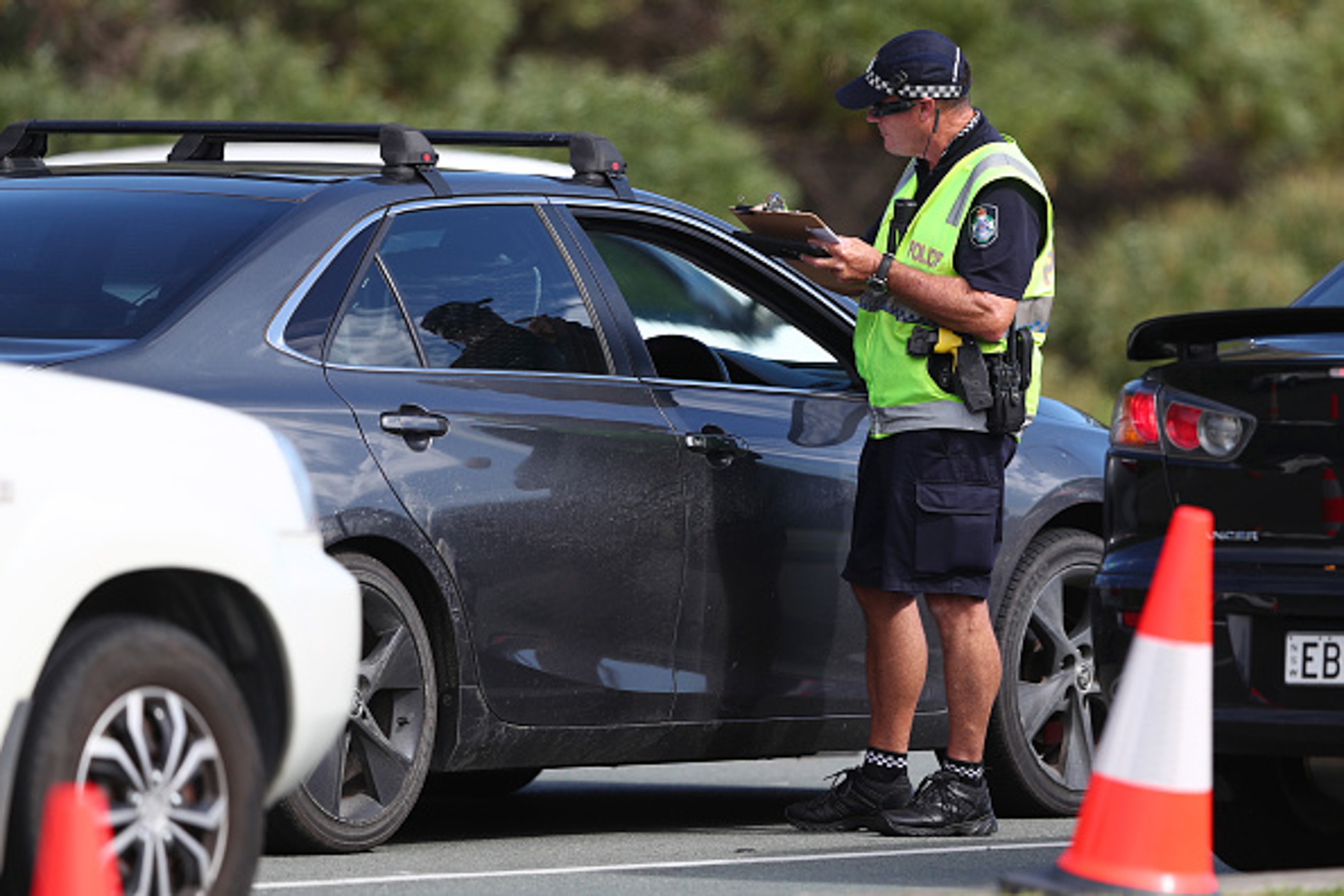
Victorian, ACT and Queensland travellers face the same restrictions and exemption criteria as NSW.
However, the cross border corridor with Victoria is still open and is defined as the area 70km on either side of the border between the two states. Permitted reasons to travel from this zone are:
- Employment or education
- Providing care and support to or receiving care from another person or obtaining food, petrol or other fuel or medical care or supplies
- Obtaining a COVID-19 vaccination.
Travellers from all other areas in the Northern Territory will be subject to Level 3 requirements:
- COVID-19 test on days 1, 5, and 13.
- Quarantine until a negative COVID-19 test result.
More information about exemptions and rules for essential travellers such as truck drivers.
Snapshot
- Renault’s budget brand to enter Australia next year
- Sandero expected to become one of Oz’s cheapest cars
- Ateco to be importer of Dacia vehicles
UPDATE: Dacia boss outlines model plans for Australia
The Renault Group has now confirmed the Dacia brand will return to Australia in the coming months.
Read our new story on the link below.
The story to here
August 22, 2021: Return for Dacia likely
Car buyers hunting for strong value will soon have another brand to consider, with Dacia set to join the Aussie marketplace early next year.
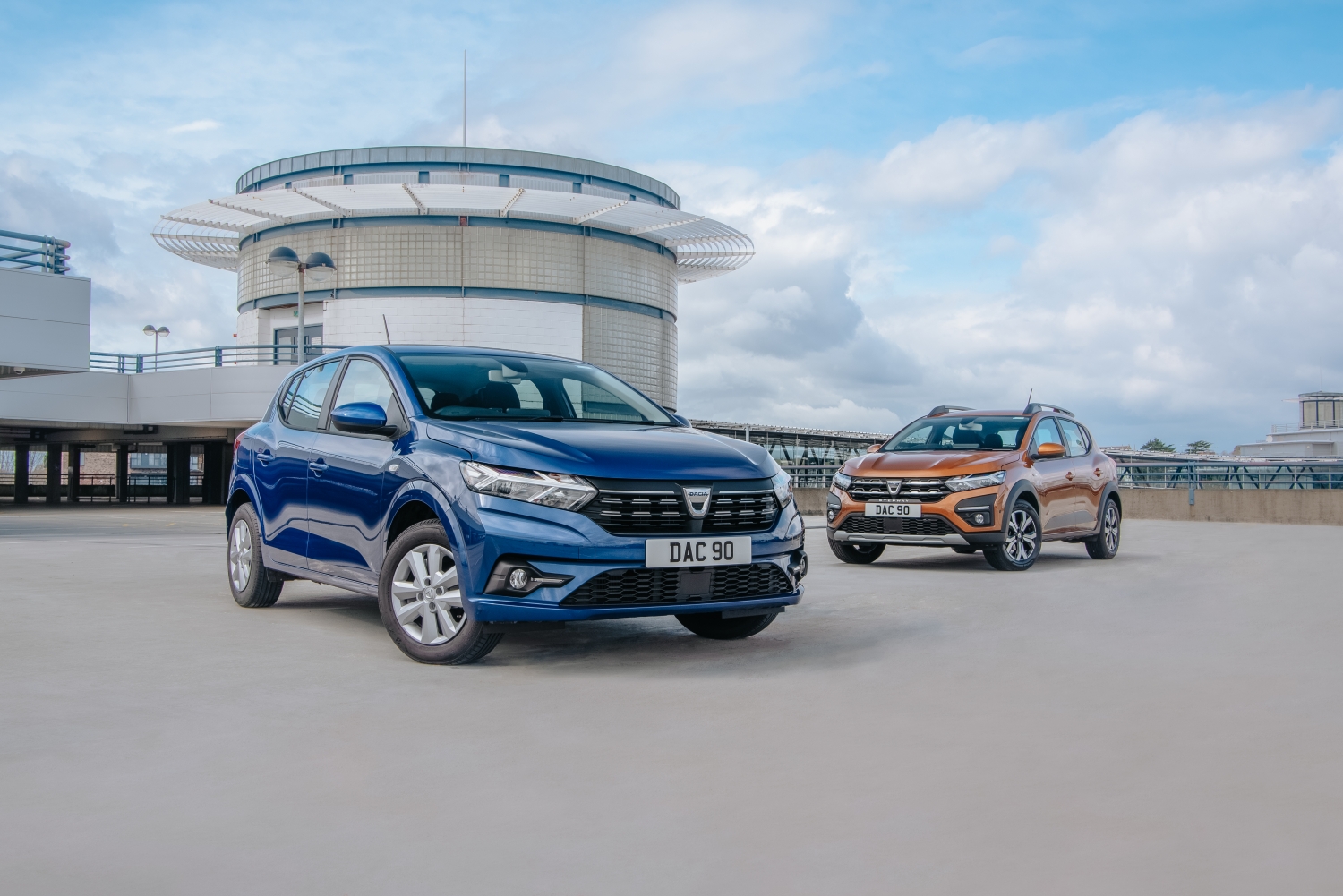
The budget-focused brand, which leapt into the global spotlight through a series of running jokes by Top Gear co-host James May, is aiming to launch locally with at least four models ranging from a small hatch through to light commercials.
All will major on value, with the Romanian-built Dacia Sandero expected to be the cheapest of the lot with a sticker price tipped to start below $20K.
While Aussie pricing is yet to be announced, the Sandero costs from £7995 in the UK, which equates to around A$14,600. If such a price is possible, it would see the Sandero significantly undercut the Kia Picanto to become one of Australia’s cheapest cars.
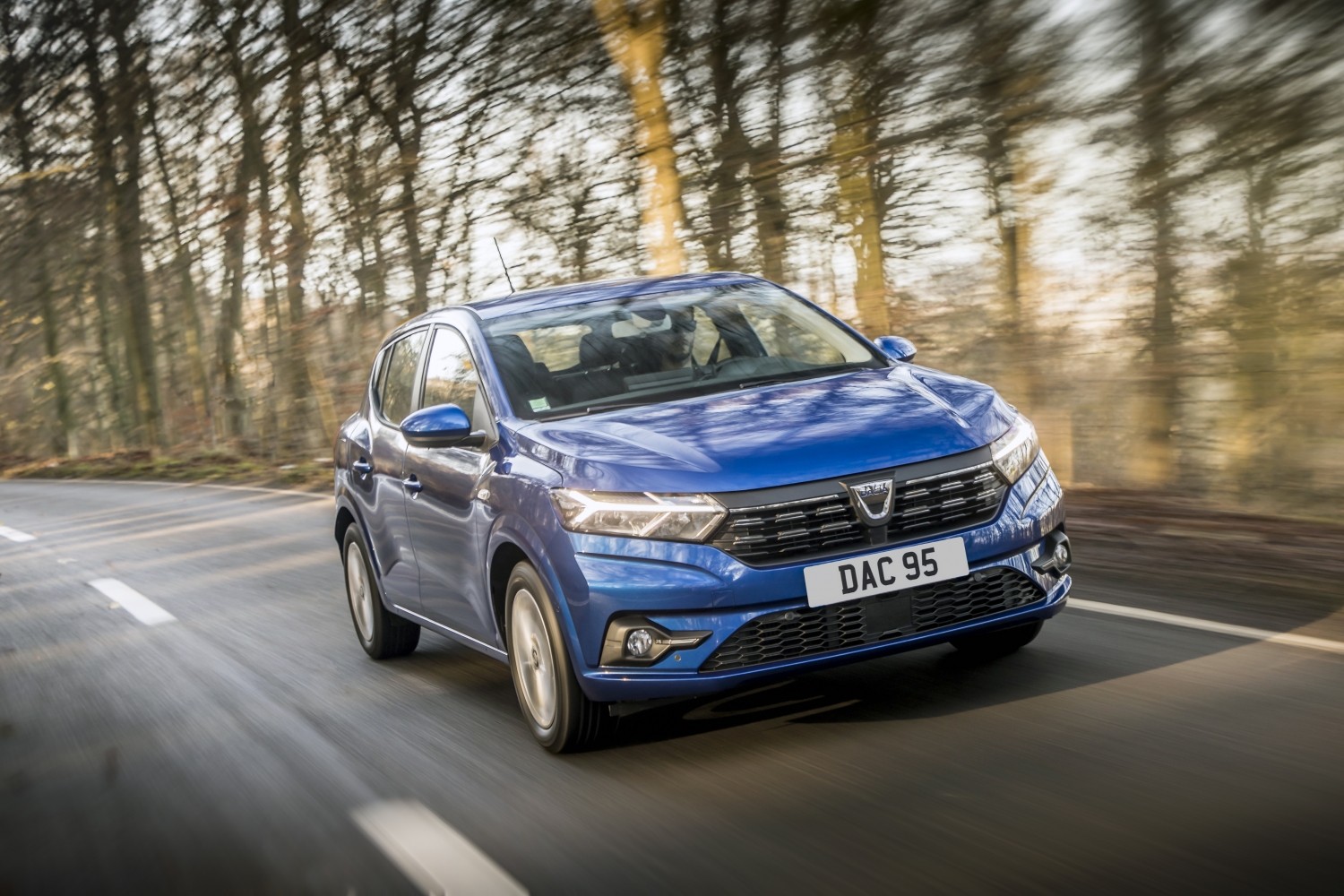
An exact local line-up is yet to be confirmed, but early talk is that we will also see the Sandero Stepway crossover, Duster SUV and Oroch ute.
As you might expect, such bargain basement prices requires certain sacrifices. The most glaring concerns safety, with Dacia’s current line-up lacking many of the active safety systems that Aussie buyers now expect.
The Dacias also carry poor crash ratings, with the Duster SUV awarded just three stars by Euro NCAP in 2017. The newly released 2021 Sandero Stepway fared even worse under today’s more stringent testing critiera, only managing a two-star safety score.
Don’t expect much in the way of cutting-edge equipment either, with the Sandero hatchback currently lacking touchscreen infotainment in cheaper models. But as MG’s success shows, there is clearly an appetite for budget-focused cars in Australia.
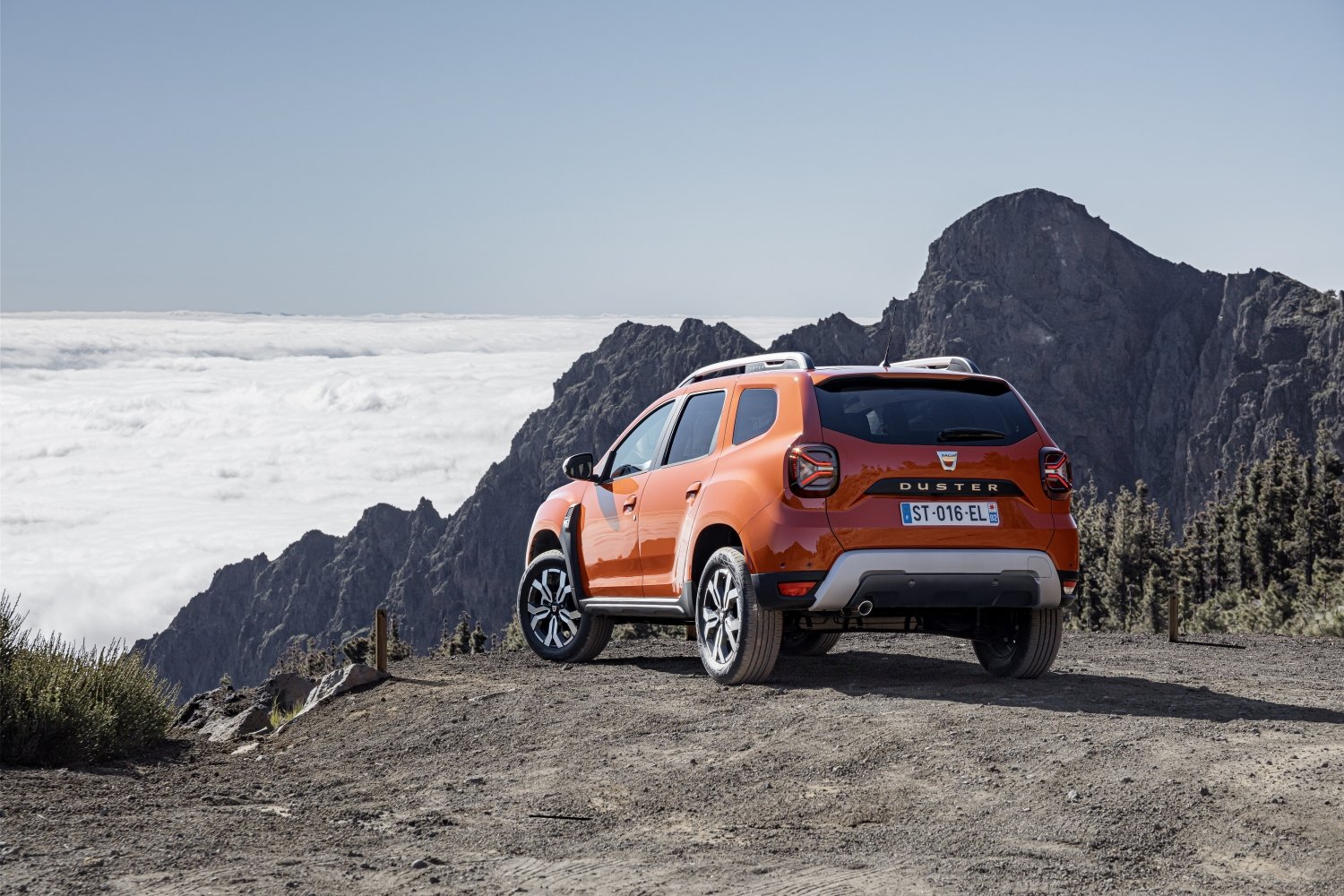
Don’t expect much in the way of cutting-edge equipment. But as MG’s success shows, there is clearly an appetite for budget-focused cars in Australia.
Dacia will be imported into Australia through Ateco, which also handles other low-volume players such as Ram, Maserati and LDV, and will be positioned as a more affordable alternative to Renault (in a similar way to Skoda’s relationship with Volkswagen).
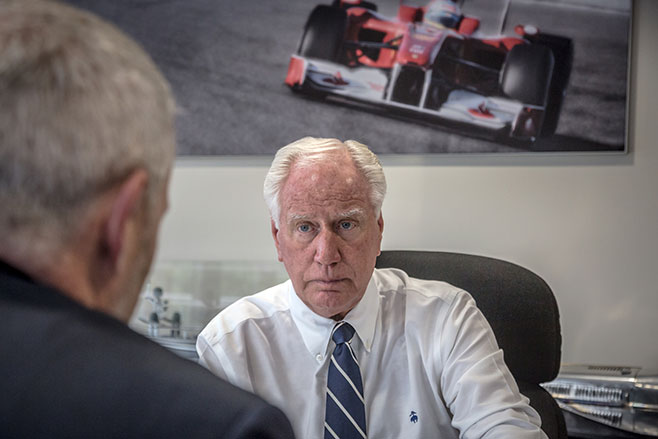
Ateco boss Neville Crichton told Carsales that Dacia offers a real opportunity in Australia. “It will happen. Absolutely. We’re talking to them right now about the details,” he said. “Dacia will fit below Renault.”
Another piece of the puzzle that’s yet to be confirmed is whether Dacia will be sold through existing Renault dealers, or if it will follow an online model with fixed pricing. As for sales volumes? That’s even harder to predict, although one additional benefit Ateco will likely be hoping for is that Dacia’s arrival helps to rejuvenate some interest in an ailing Renault.
The French brand has been in steady decline in Australia for almost half a decade, with sales slipping by 40 per cent since the mid-2010s to just 6904 units in 2020. It’s a problem the brand’s local boss, Glen Sealey, is painfully aware of.
“The first thing we need to do is stem the decline and bring stability back,” he told Wheels.
Given Renault already has a strong presence in vans, Sealey’s plan centres around strengthening the SUV line-up. The second-generation Captur small SUV has just launched Down Under and the Arkana crossover is also due to arrive later this year.
Yet even with a new-metal injection, it’s clear Renault is facing an uphill battle to turn its Aussie fortunes around. Currently its most popular model, the Koleos, remains a bit player that makes up less than one percent of the medium-SUV market.
Getting Renault models onto buyers’ consideration lists has to be a priority, although Sealey also pointed out high volumes aren’t the immediate goal.
“Levels of success are not always volume-based,” Sealey insists. “There’s a lot to be said for the quality of a business rather than the volume of the business.”
With Renault currently making up around half of one percent of Aussie sales, Dacia’s injection may help.
We’re to blame. Us. And by us I mean you and me: motoring enthusiasts. You may well have looked at the recently revealed Emira and wondered why the heck Lotus is building a replacement for the Elise that weighs more than 1400kg and can be specified with electric seats, radar cruise and space for golf bags. Let’s not forget that the original Elise weighed 725kg.
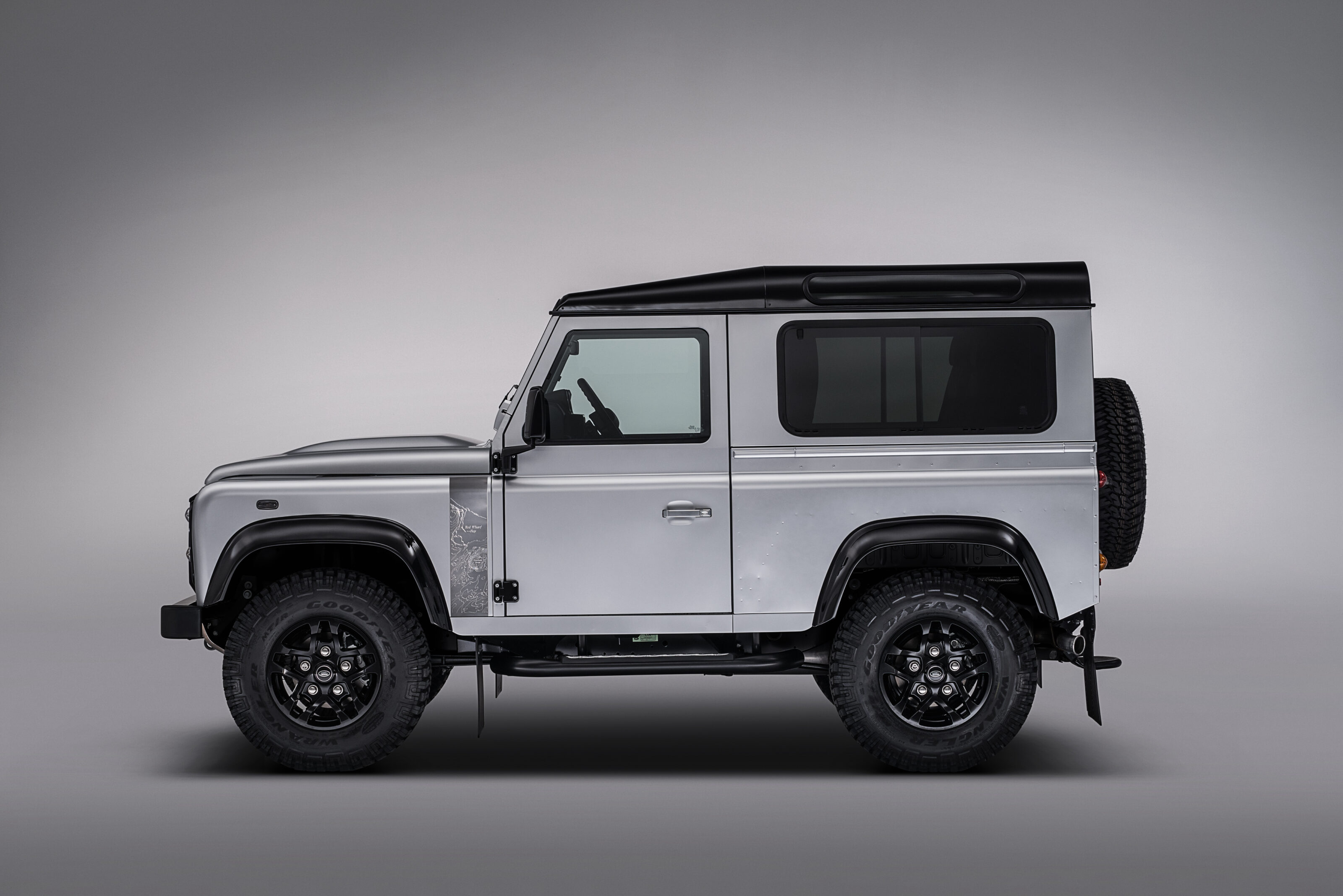
Lotus is right now fielding the same criticism Land Rover did with the Defender when it dragged that model into the here and now. Nobody bought the old Defender in its latter years. Or the Elise come to that, of which 16 examples were sold last year in Australia. And while you probably couldn’t envisage a market better suited to selling Land Rover Defenders, in its last full year on sale here, the Defender was roundly trounced in the sales charts by clanging wrong’uns like the Dodge Journey.
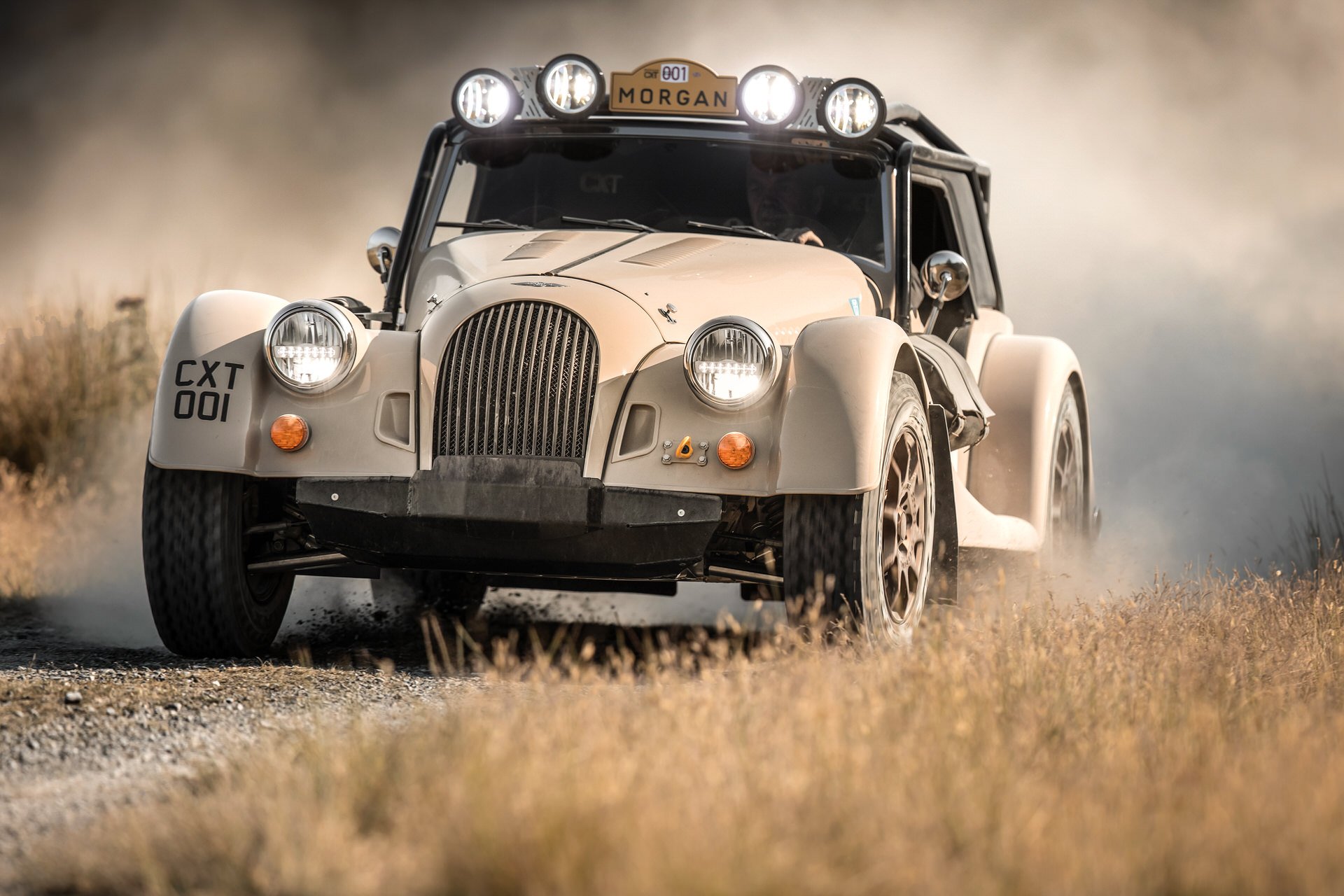
You can unearth such cognitive biases everywhere you look. The Alpine A110 is a car of near-deity status, but it shifted seven units here last year, which means it outsold Morgan by one solitary car. A threadbare constituency of middle-aged men who enjoy dressing up as Mr Toad almost one-upped the might of Formula One’s Alpine. Having considered this issue for a while, I think it’s because our passion means that we can become fixated on the idea of something rather than the reality.
We love the notion of hosing out an old Defender but were we in the position to buy one it would fairly quickly become a peripheral concern. Likewise we lionise Lotus’ ideals of light weight while parroting Chapman tropes at length, but would an Elise be a better car if a six-footer could fit in it, there was space to charge a phone and the air-con and infotainment system worked? Through a purist lens, possibly not, but reality probably disagrees.
When Mercedes-AMG launches the four-cylinder C63e hybrid, you’ll notice the cycle restart. In the same vein, many will choose to ignore the fact that the all-wheel drive BMW M135i sells better than the old rear-driver. The first full year of sales for Porsche’s four-cylinder 718 Boxster and Cayman was 19 per cent better than the last full year of the six-pot 981, and that was in a declining market for sports coupes.
Granted, to the likes of us, sales are anything but a perfect indicator of a car’s inherent worth but, to car manufacturers at least, runs on the board count for a lot more than our closeted marketplace of ideas and ephemera. We may be shouting our opinions into a private echo chamber of like-minded individuals but, in the background, development continues apace and it usually results in ever superior cars. We’ve never had it so good and yet we’ve never raged against the machine of progress quite so vociferously. Even now I feel an anxiety over how the Emira is received. I might go and hose out somebody’s car. It sounds wholly therapeutic.