Snapshot
- Hanks personally commissioned the FJ40 build
- Now powered by emissions-certified 4.3L V6
- Several of Hanks’s vehicles will be sold
Hollywood megastar Tom Hanks is putting his custom 1980 FJ40 LandCruiser under the hammer.
It’s being sold by Bonhams at its Quail Lodge Auction in California, with a final price expected to climb well into the six-digit range.
The short-wheelbase, four-seat Cruiser was commissioned by Hanks as a practical driver. Rather than choose a high-output LS-family V8 like many, he opted to repower the FJ40 with a GM-sourced, Vortec 4.2-litre V6 which makes a respectable 180hp (134kW).
It’s matched to a GM five-speed manual gearbox, itself paired with the original high and low-range transfer case. Importantly, the modifications have been approved by California’s Bureau of Automotive repair — an increasingly difficult task.
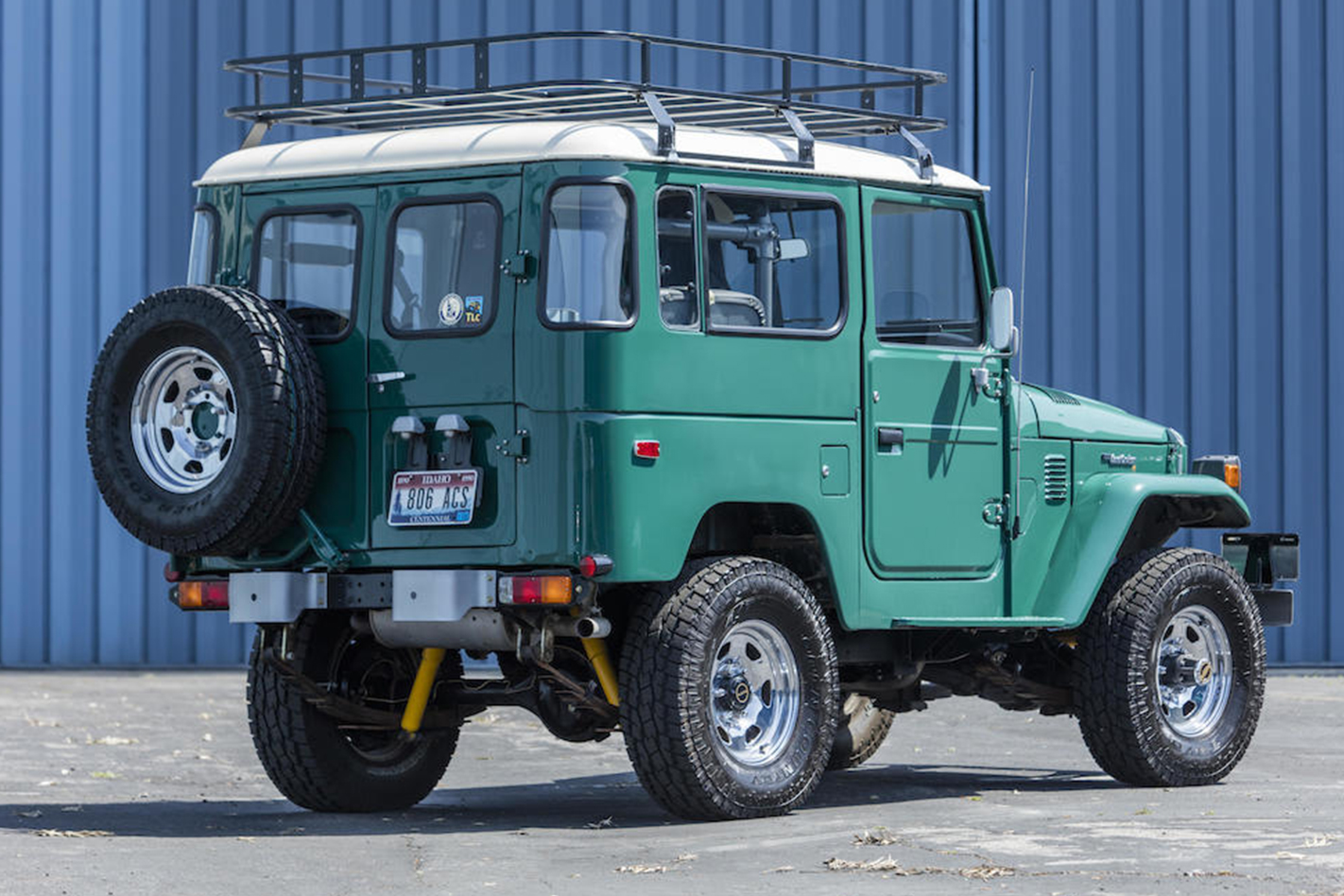
The FJ40 rolls on Toyo Open Country 31×10.5 R15 all-terrain tyres, with a matching spare. The stock ride-height is bolstered by a set of Old Man Emu shock absorbers and steering damper, making for a vehicle which is comfortable both on and off-road.
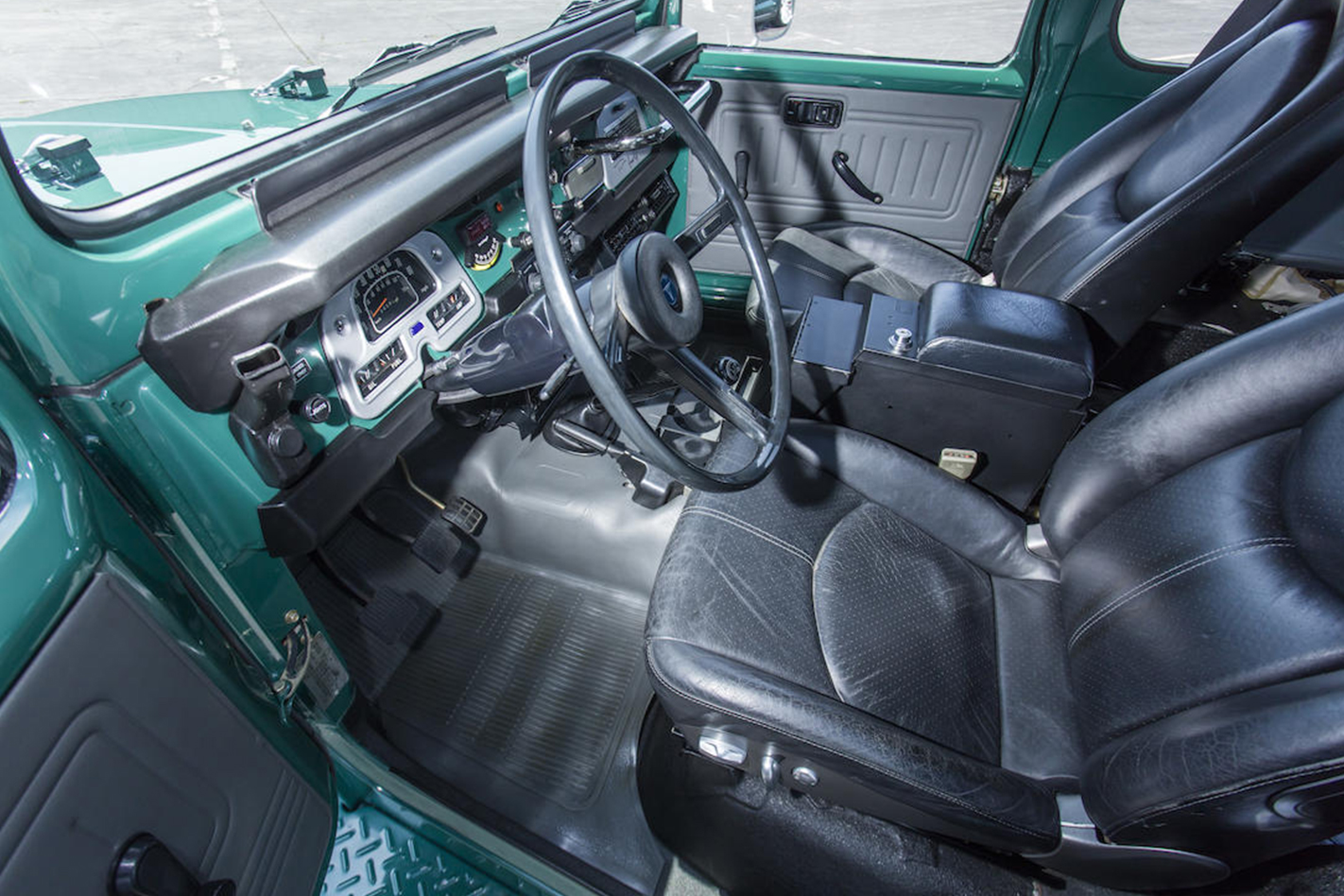
Inside the cab, rests a set of power-operated Porsche leather seats – though the original units are being bundled in with the sale and appear to be in very good condition. Extra mod-cons include a Sony head unit and aftermarket air conditioning. The dash has also been signed by Hanks himself.
While it’s far from a concours example, Bonhams describes the paint as “sound and presentable”, with the engine bay presenting similarly. The chassis is apparently well-used, though entirely usable as-is.
The auction will begin on August 13, with the LandCruiser slated to take in between US$75,000 – $125,000 (AU$100,000-170,000). While the price may seem exorbitant for a sparsely-equipped Toyota, groups such as The FJ Company have offered restomodded FJ40s in the US for more than AU$270,000.
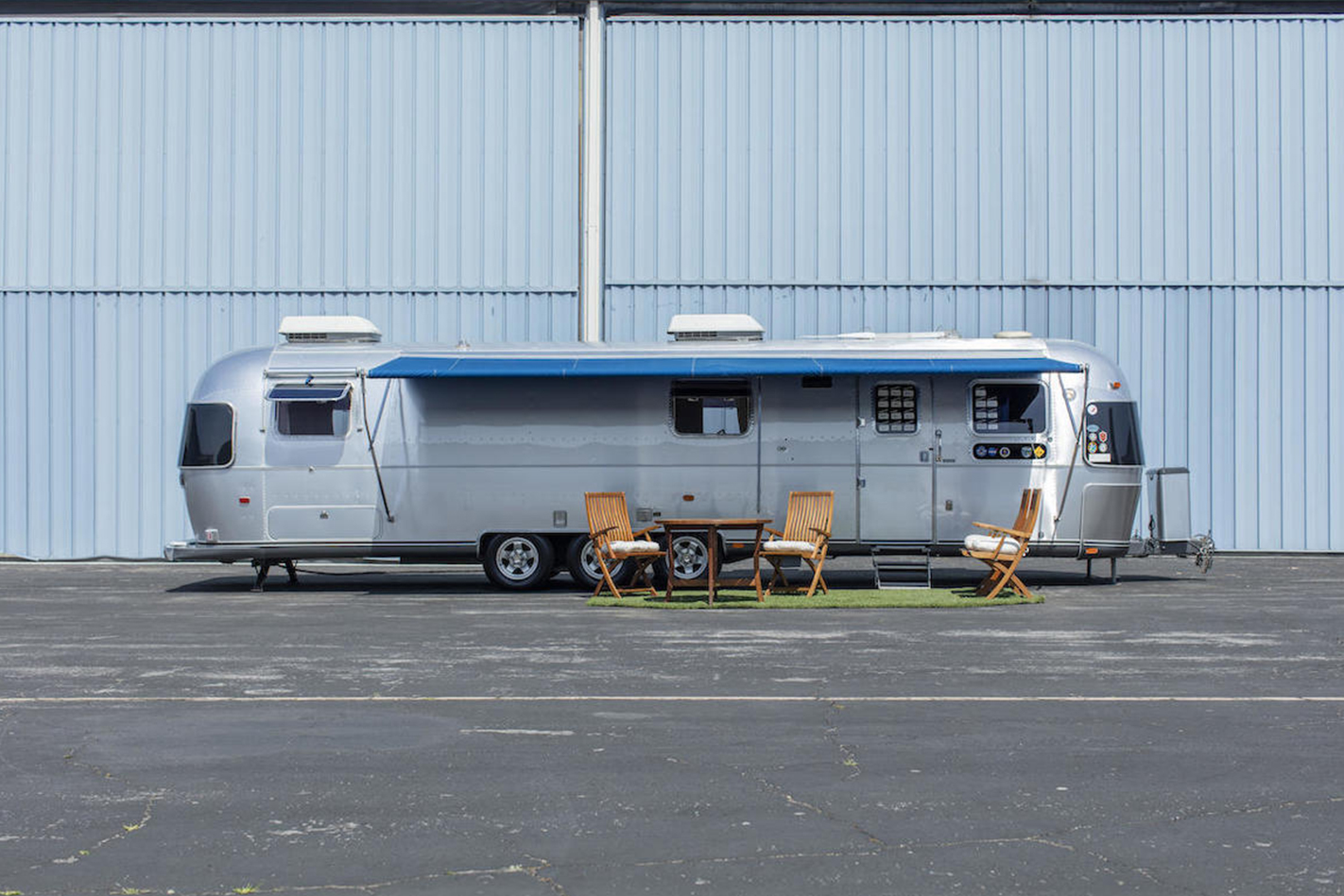
It’s one of a few items being off-loaded by Hanks, in a collection which notably features his bespoke ‘silver bullet’ Airstream trailer.
He ordered the trailer in 1992, which became his home while shooting Forrest Gump, The Green Mile and countless other blockbuster films. Hanks said he’s decided it’s time to move it on thanks to changing production methods. “Movies move faster now,” he told Bonhams. “I got it in the days when movies moved slower.”
It’s expected to sell for somewhere between US$150,000 – $250,000 (AU$200,000 – $340,000).
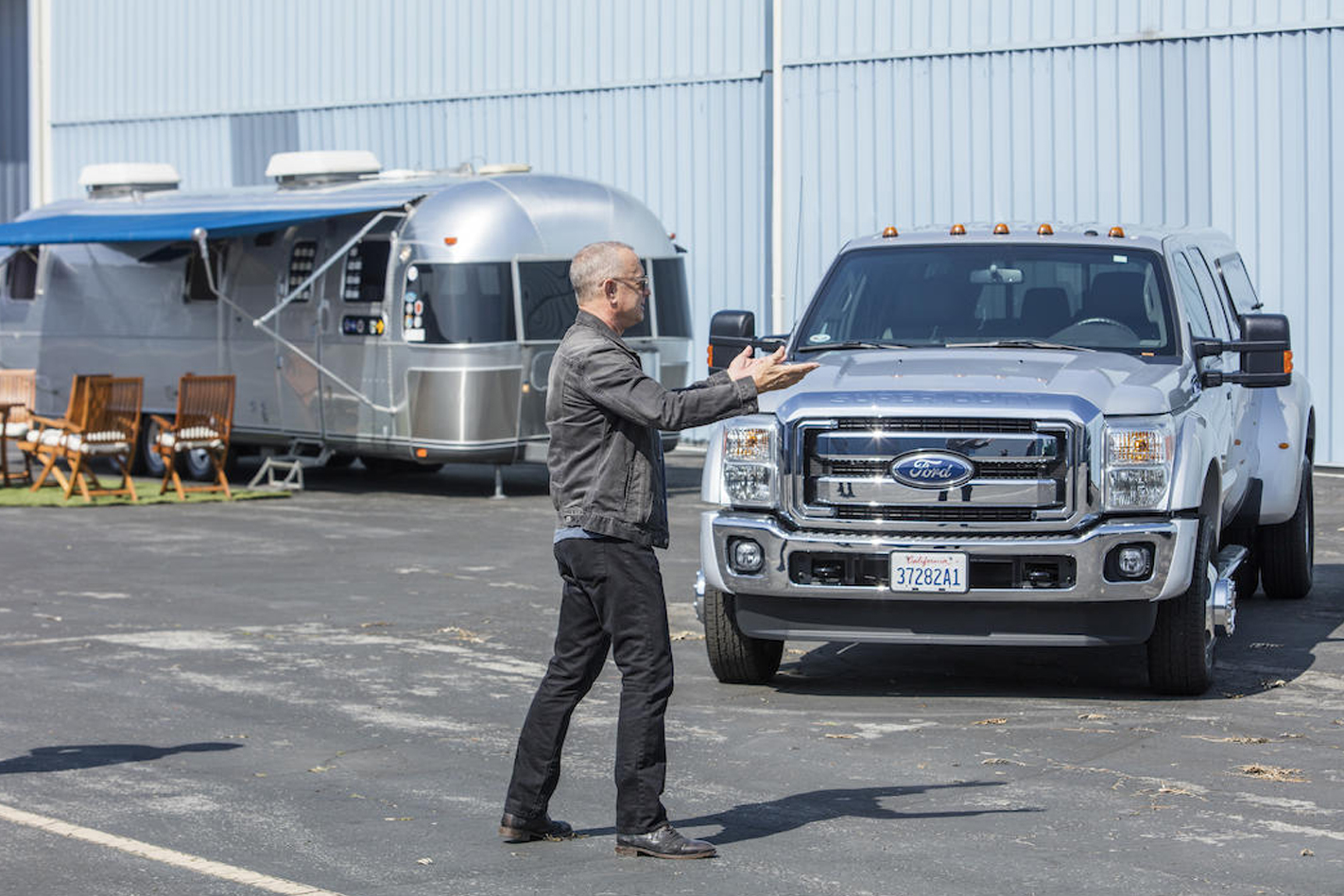
Also going under the hammer are Hanks’s 2011 Ford F-450 Super Duty tow rig, and his 2015 Tesla Model S P85D.
A wide range of highly-collectable cars will be sold at the Quail Lodge auction. The highest estimated prices include a 1967 Ford GT40, which should fetch US$3million – $3.5m (AU$4.1 – 4.7m). You’ll find the full list of cars on the Bonhams website.
The SsangYong Rexton Ultimate is the features-packed top-spec version of the two-pronged Rexton range that’s easily one of the plushest ute-based four-wheel-drive SUVs on the road.
It’s also the most affordable range-topper in its class with a fixed drive-away price of $54,990, which is several thousand dollars less than rivals such as the Pajero Sport Exceed, Isuzu MU-X LS-T and Toyota Fortuner Crusade. And it’s about $20 grand less than the Ford Everest Titanium.
If you’re looking for something to haul your growing family everywhere from school to a camping holiday in comfort, this seems to represent a great bargain.
But there are a few things you need to know.
What is the SsangYong Rexton Ultimate like to live with?
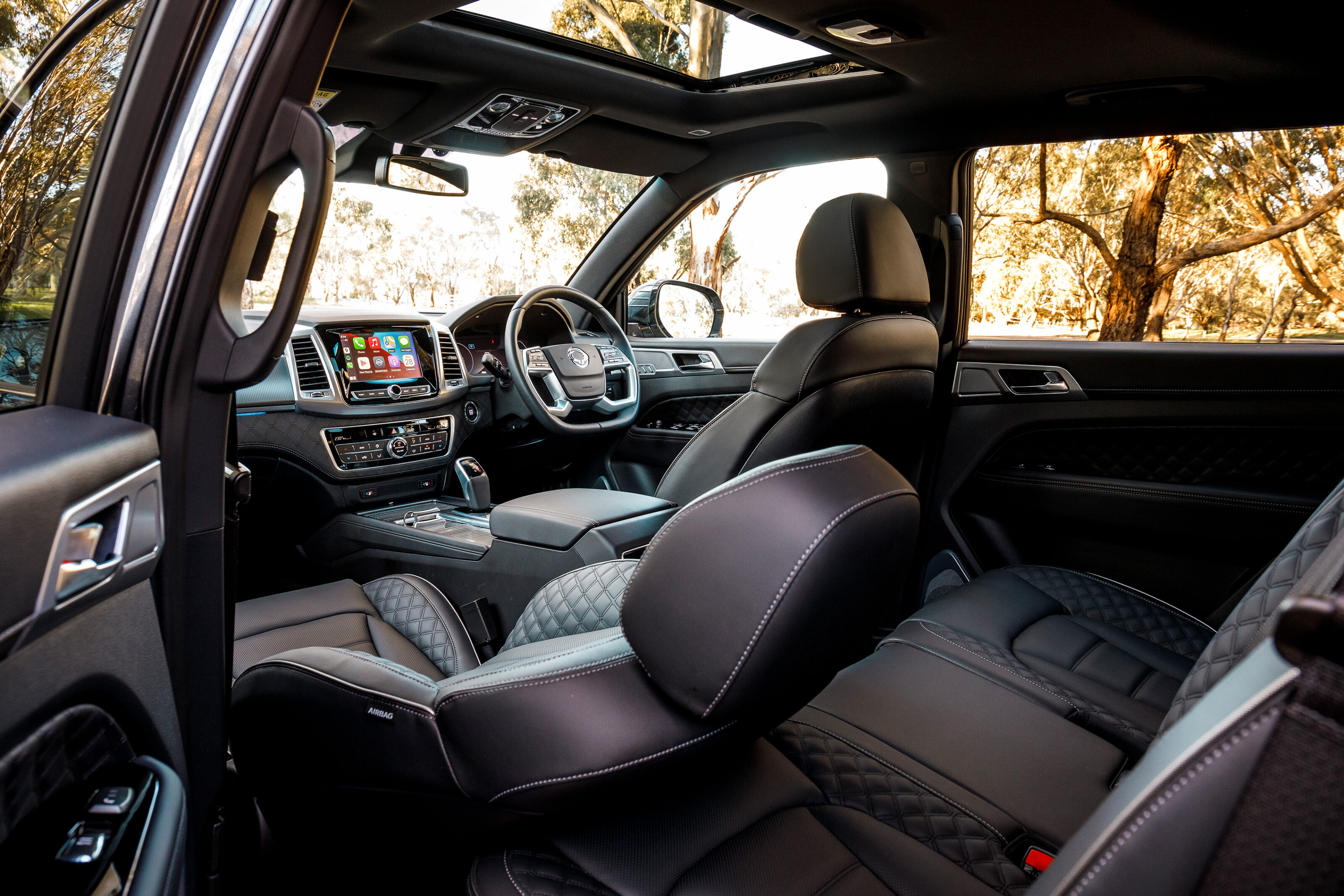
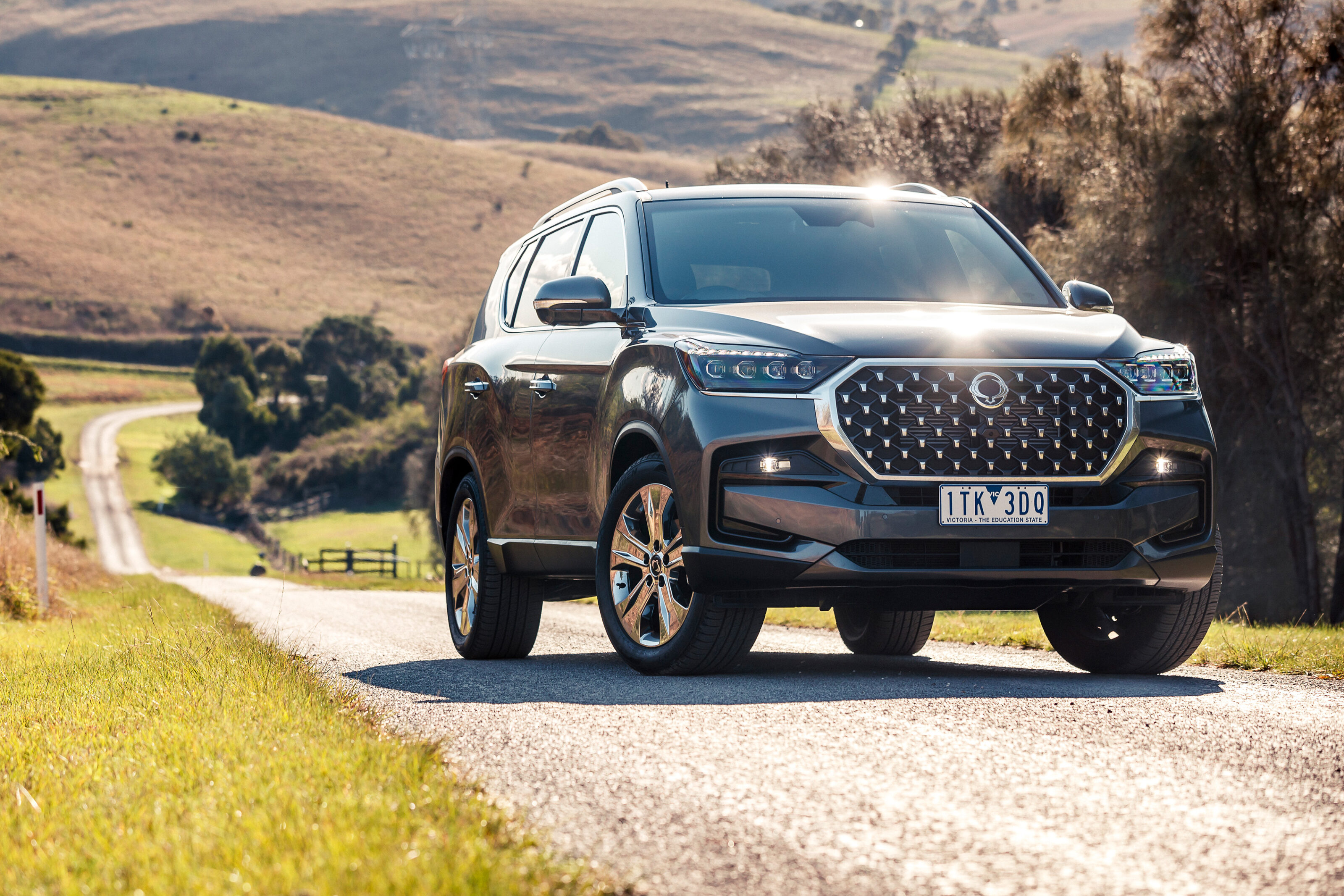
Sharing underpinnings with the SsangYong Musso 4×4 ute, the second-generation Rexton has been around since 2017. It recently underwent a significant facelift that brings a much bolder-looking face dominated by the huge grille and attractive quad-style LED headlights, LED DRLs and LED foglights.
It’s available in two flavours in Australia, the ELX and Ultimate. The ELX priced, at a very competitive $47,990 drive-away, comes with a 10.25-inch digital gauge cluster and creature comforts such as leather-appointed seats, power-adjustable front seats with heating and ventilation, heated outboard rear seats and dual-zone climate control.
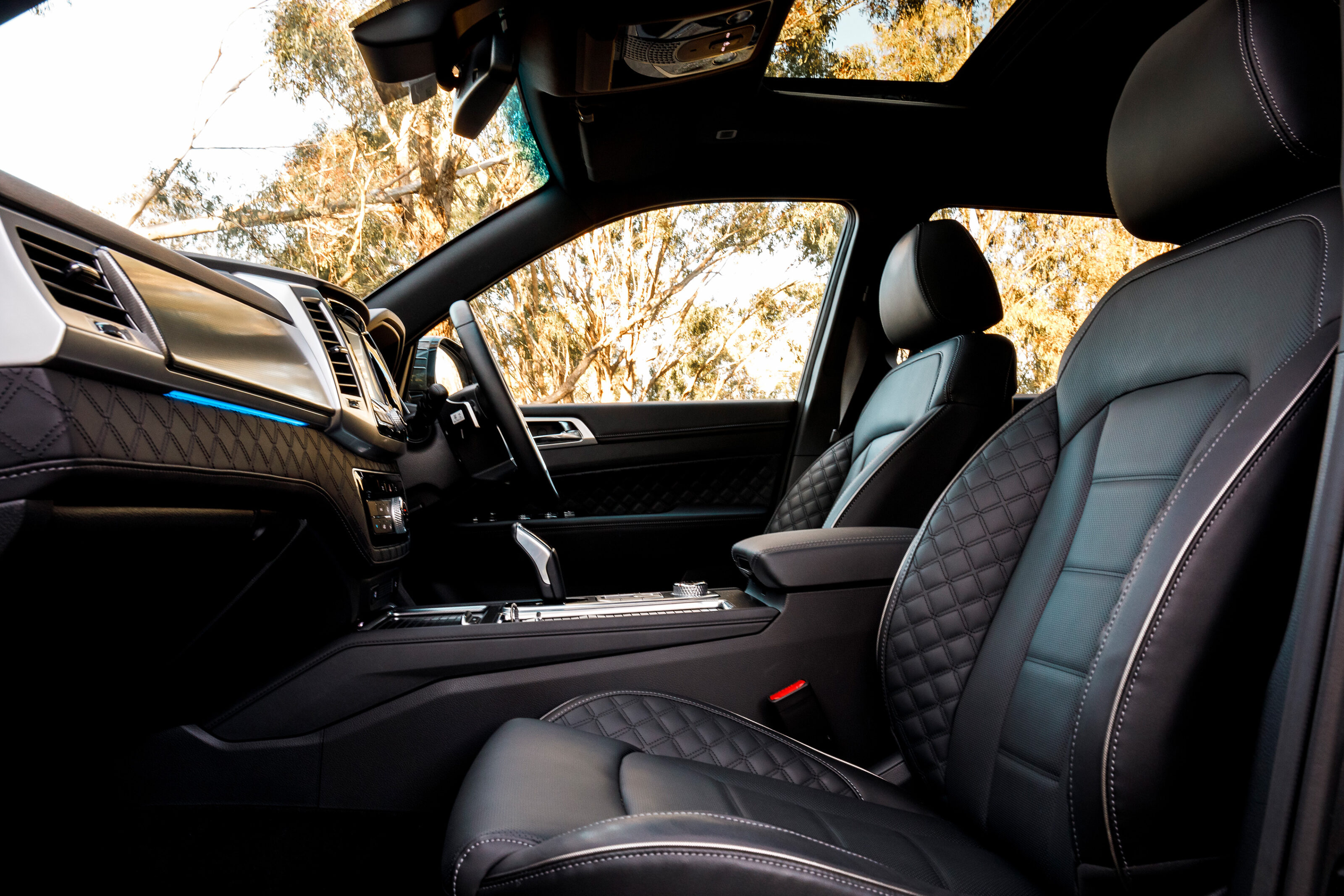
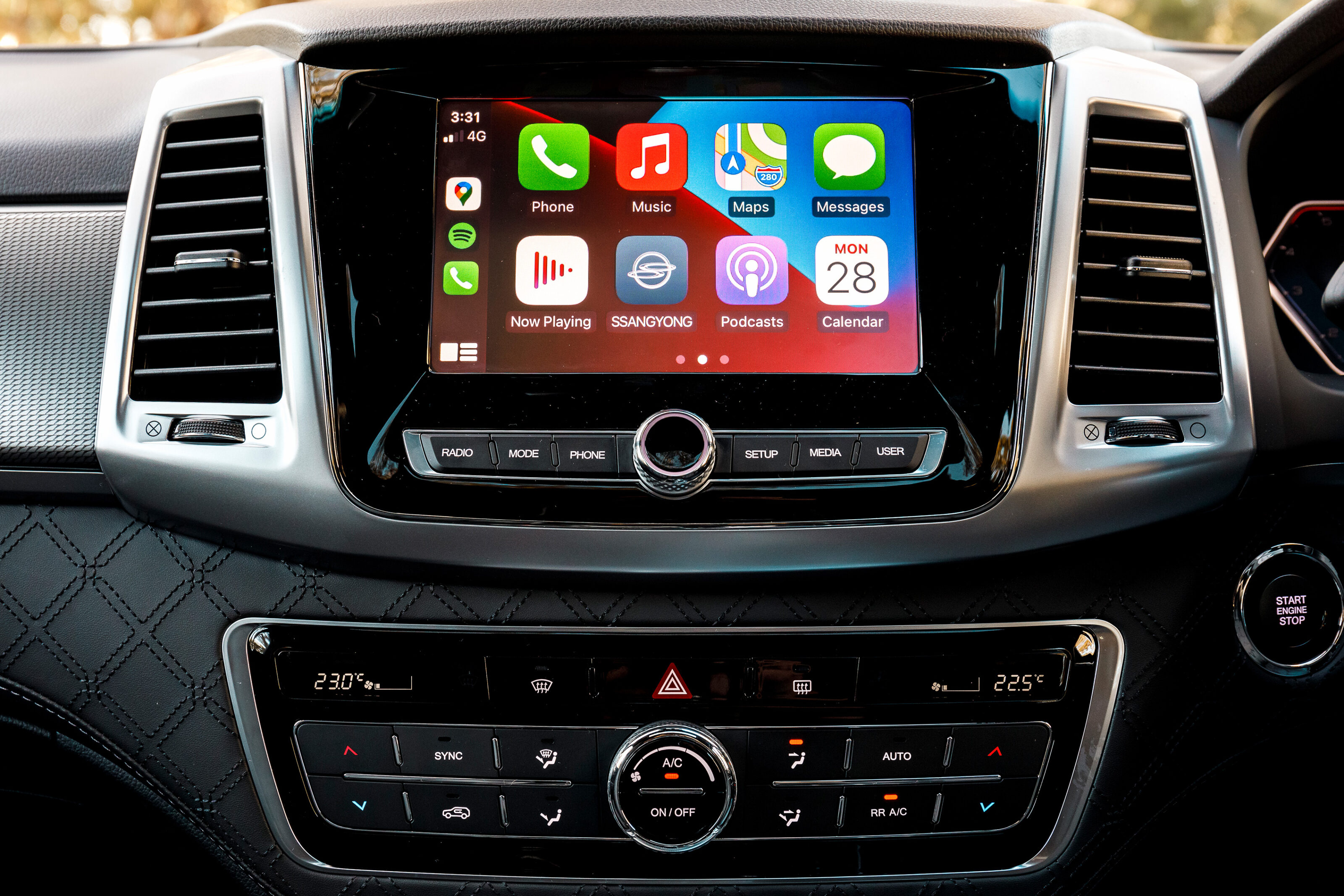
The Ultimate has all that, with the extra $7000 bringing fancier Nappa leather upholstery, illuminated scuff plates, sunroof, driver’s seat position memory, ambient interior lighting, 360-degree reversing camera, powered tailgate, touch-sensing front door locks and a wireless phone charging pad.
The Ultimate also ditches the ELX’s 18-inch alloy wheels in favour of very fancy 20-inch chrome-finished rims, which are odd inclusion for a vehicle with genuine off-road capability.
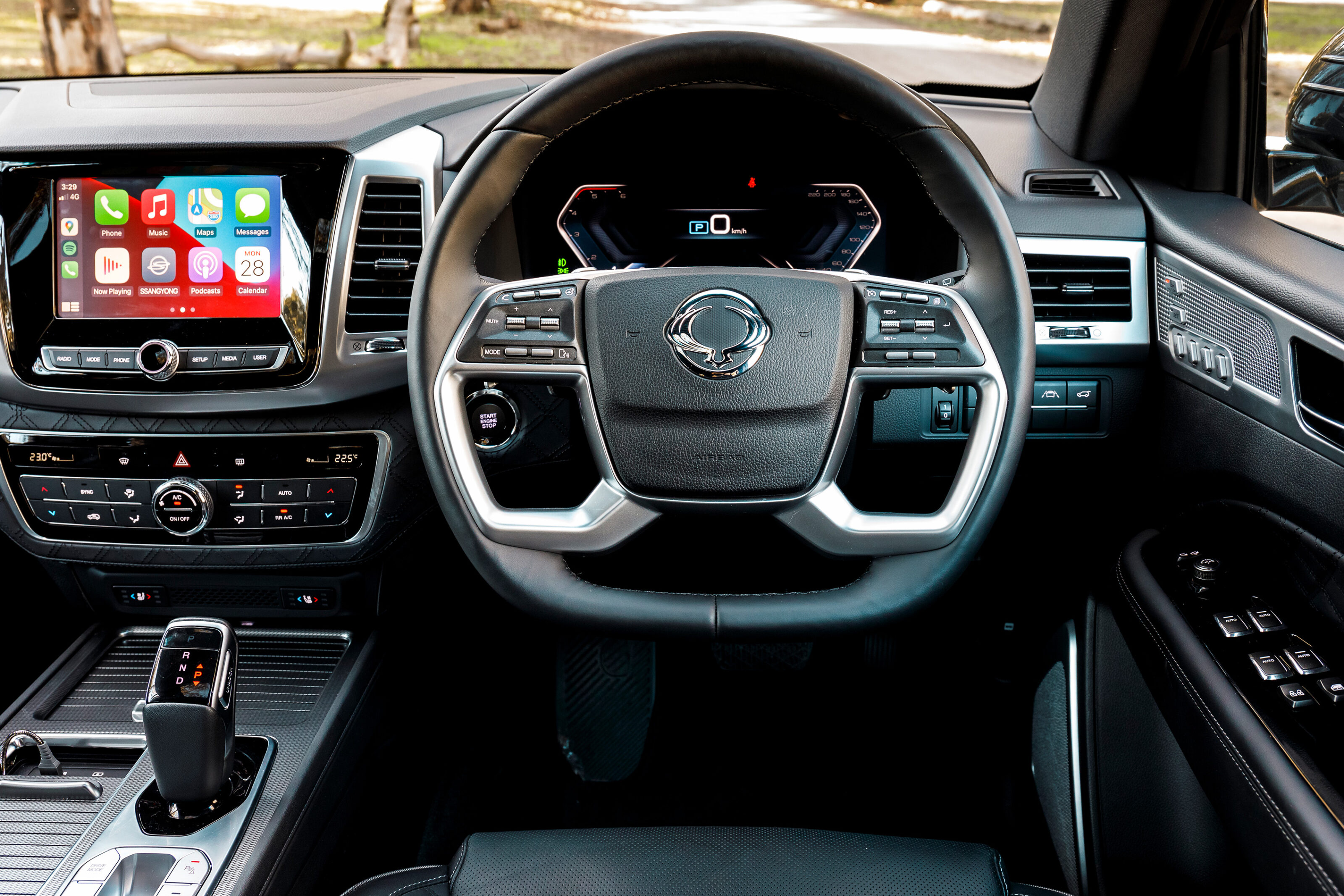
Step inside and the Rexton Ultimate oozes showroom appeal. The heated and ventilated front seats are a nice place to be with their Nappa leather and quilted side bolters, feeling sturdy and supportive.
The quilting is replicated on the dashboard trim and the door cards and is just one of a few different finishes across the cabin that look and feel good.
Step inside and the Rexton Ultimate oozes showroom appeal. The front seats are a nice place to be with their Nappa leather seats and quilted side bolters, feeling sturdy and supportive.
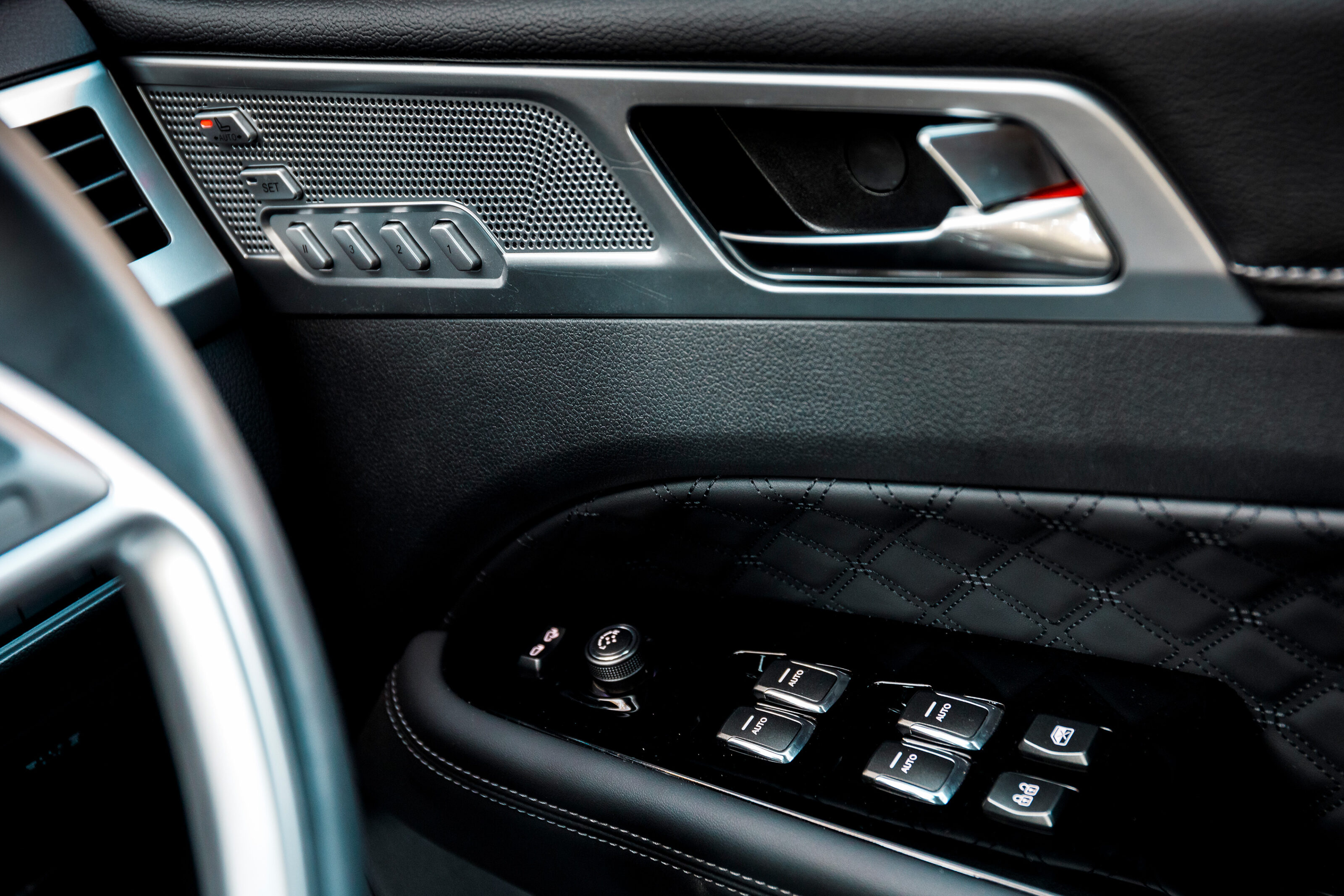
Overall fit and finish are good. Hard plastics are mostly confined to hidden spots and the area directly above the 8.0-inch touchscreen.
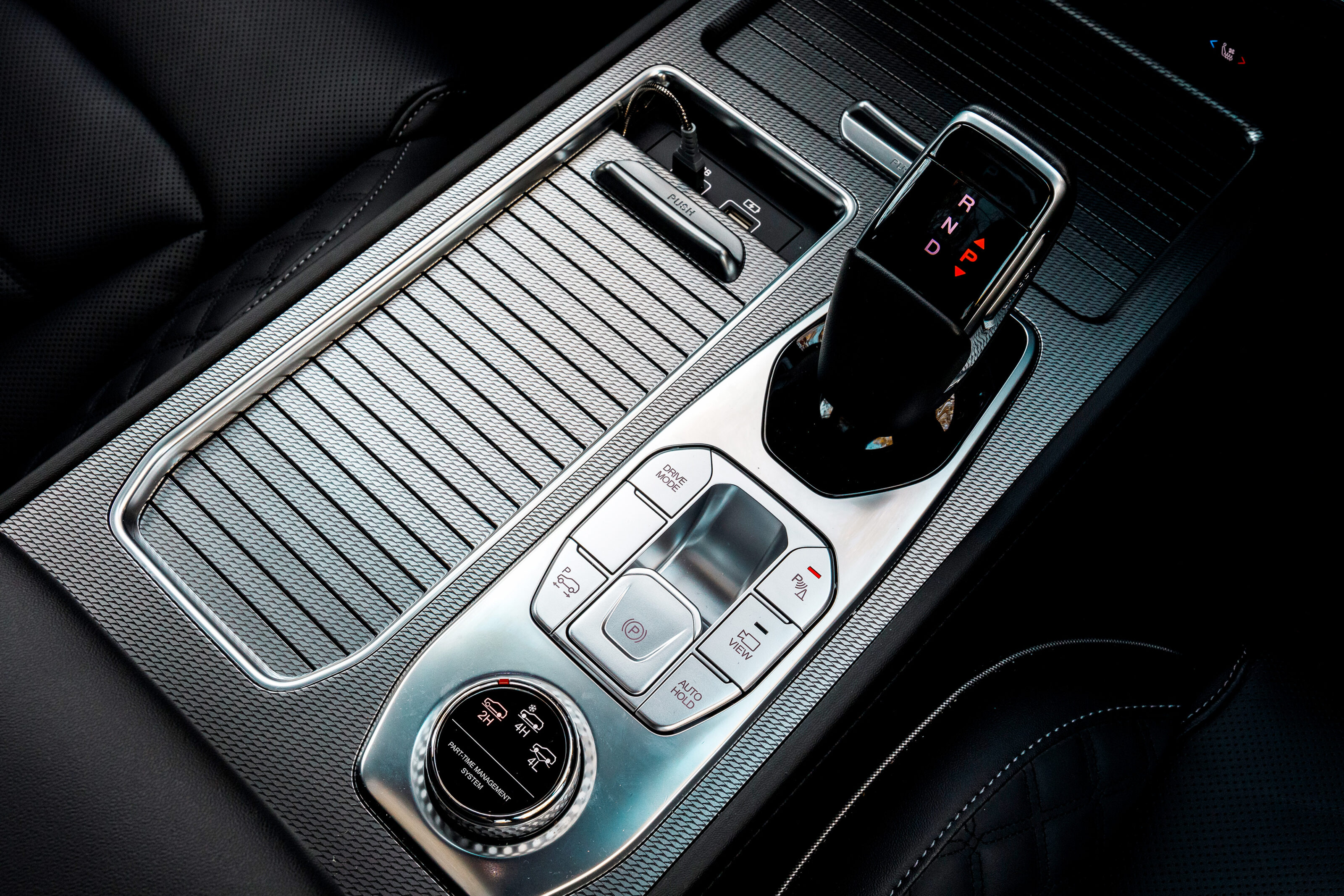
The centre console looks good and houses the wireless phone charger, cupholders and two USB ports under attractive roller shutters.
It has a joystick-like gear shifter similar to those found in BMWs, which looks attractive but can be quite fiddly – give me an old-school T-bar any day.
Storage is okay with a modest size centre-console tub complemented by big door bins.
The middle-row seats are trimmed like those up front and are quite comfortable, the outboard ones coming with bum warmers. Taller people will find leg and headroom to be a little tight, which is surprising for a large SUV.
Although the seats don’t slide back and forth, the backrests recline up to about 60 degrees so passengers can catch 40 winks on longer drives.
The middle seat is okay for short trips, though you will only be really comfortable if you have an unusually inward-curving spine. With nobody sitting there, the centre backrest folds down to become an armrest with cup holders and a handy enclosed storage tray.
Rear-seat passengers also get air vents, two USB sockets, and a 12-volt socket, and the door trims have the same plush furnishings as the ones in front.
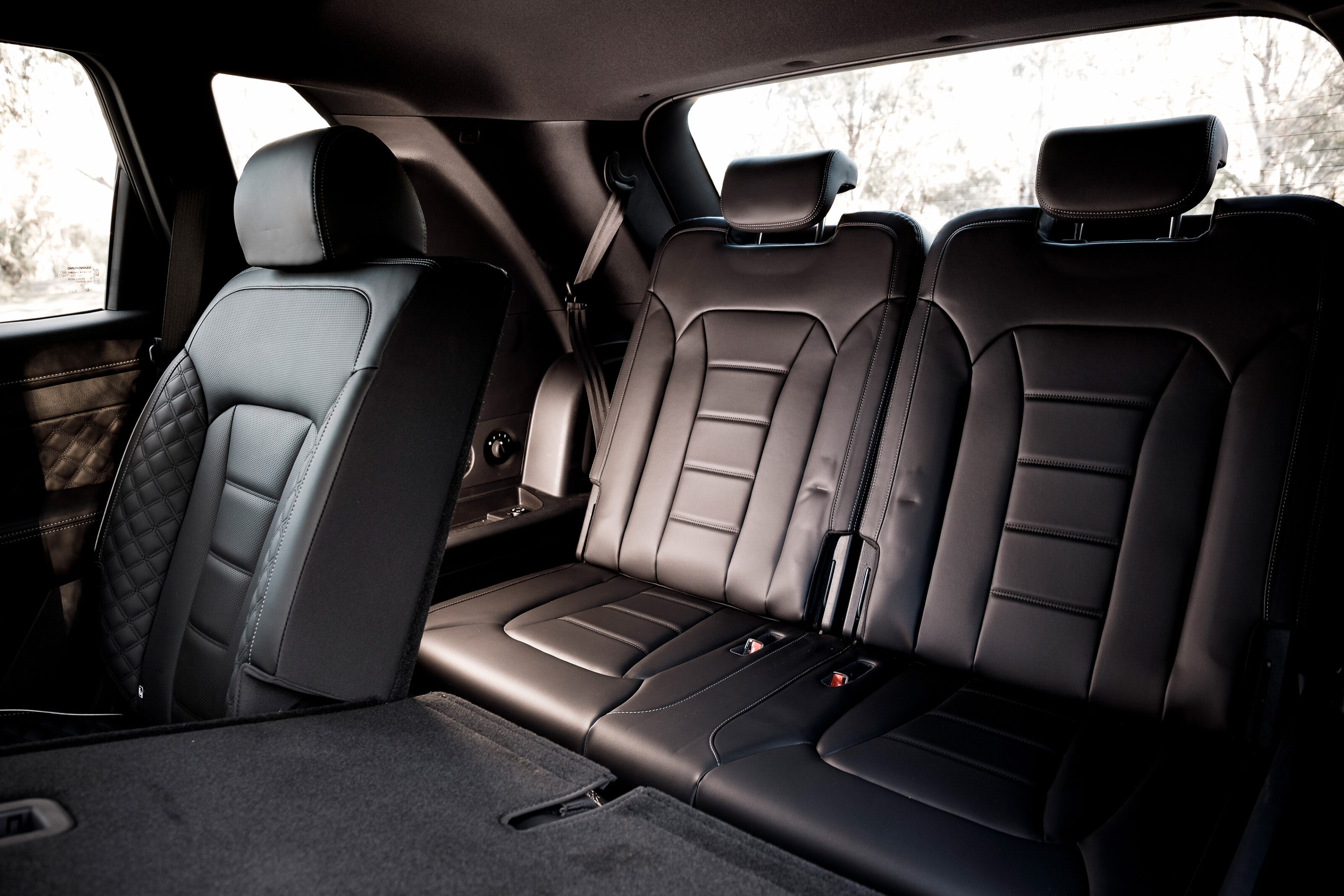
The third row is accessible by folding the middle row seatback down and rolling the lot forward. This provides a decent gap to get back there, but that is about where the convenience ends.
The rear space is very tight even with the second-row backrests upright. The seats are very low too, so anyone from about 12 years old will be sitting with their knees up and hard against the seatbacks.
Kids will naturally find it roomier back there, but there’s no view and they’ll feel quite isolated. Having been the carsick kid of the family I can’t think of anything worse for a long trip. But at least there is an air-vent with fan control back there should they feel a little queasy.
I reckon you’re best treating the Rexton as a five-seat-plus SUV that brings a huge boot with pop-up seats for emergencies.
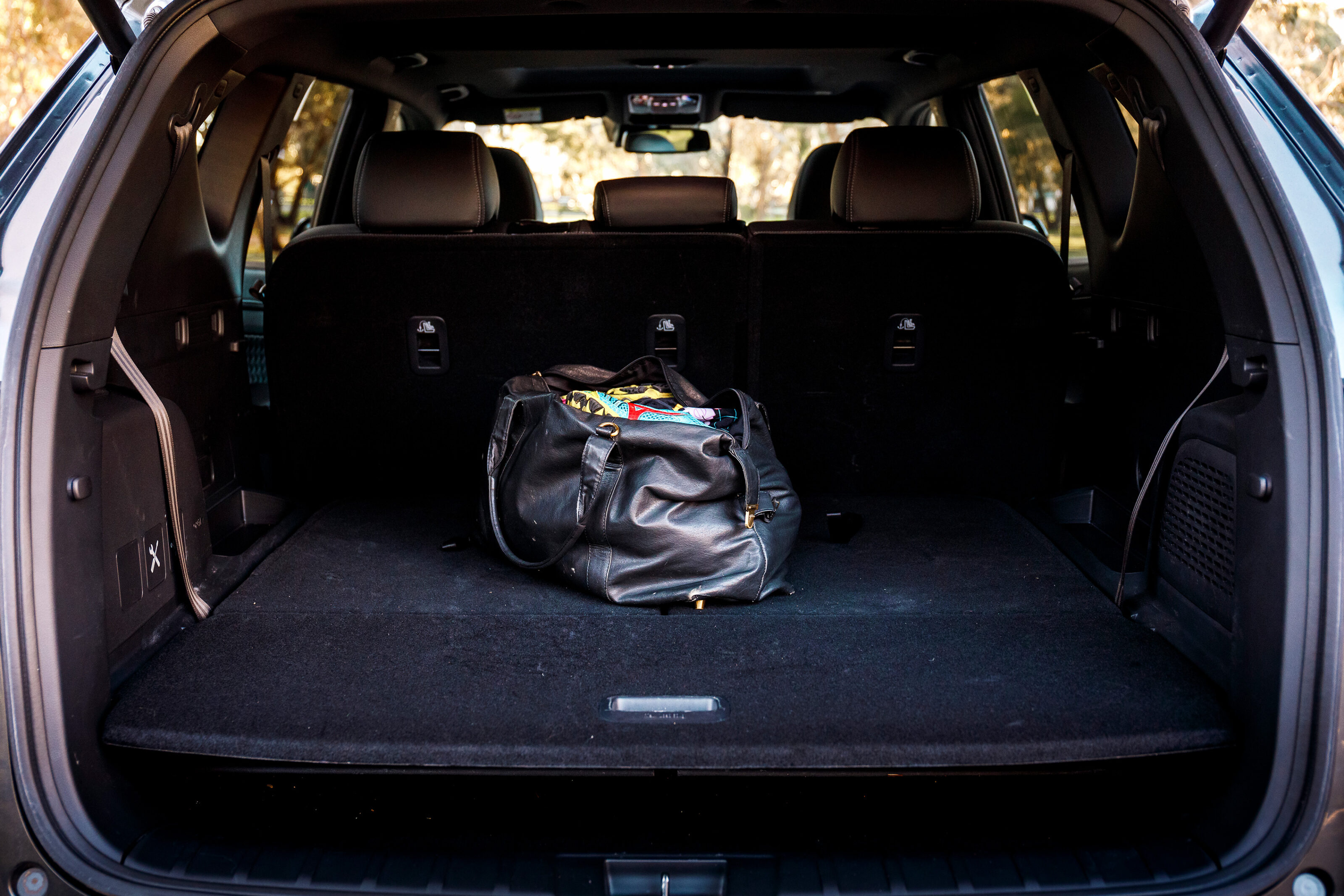
Speaking of boot space, with three rows up storage is very tight – the floor area is about 116cm wide with about 40cm between the powered tailgate and seatback, but that decreases as you come up because of the seat pitch. Still, it’s enough to fit your weekly shopping or a set of golf clubs.
But put the second-row seats down and you have a huge 641-litre cargo area that will take loads up to 1.2 metres long. You can also raise the floor so it lines up with the folded seats to create a flat surface.
Folding the middle row seats down or forwards allows for loads up to 1.7 metres long.
If you need to haul more, the Rexton has a big 3500kg braked towing capacity.
The Rexton has an official combined fuel economy rating of 8.7L/100km, which isn’t bad for a 2.3-tonne wagon.
Running costs are also kept down with an affordable service regime under the brand’s 777 Care Cover that includes a seven-year warranty, seven-year roadside assistance plan and seven years of capped-price servicing.
Like all SsangYong models, it has a 15,000km/12-month service schedule, which costs $375 for each service and includes oil changes plus air- and oil-filter replacements. As with most brands, you pay extra for parts when required, and SsangYong provides up-front pricing for different parts.
What is the SsangYong Rexton Ultimate like to drive?
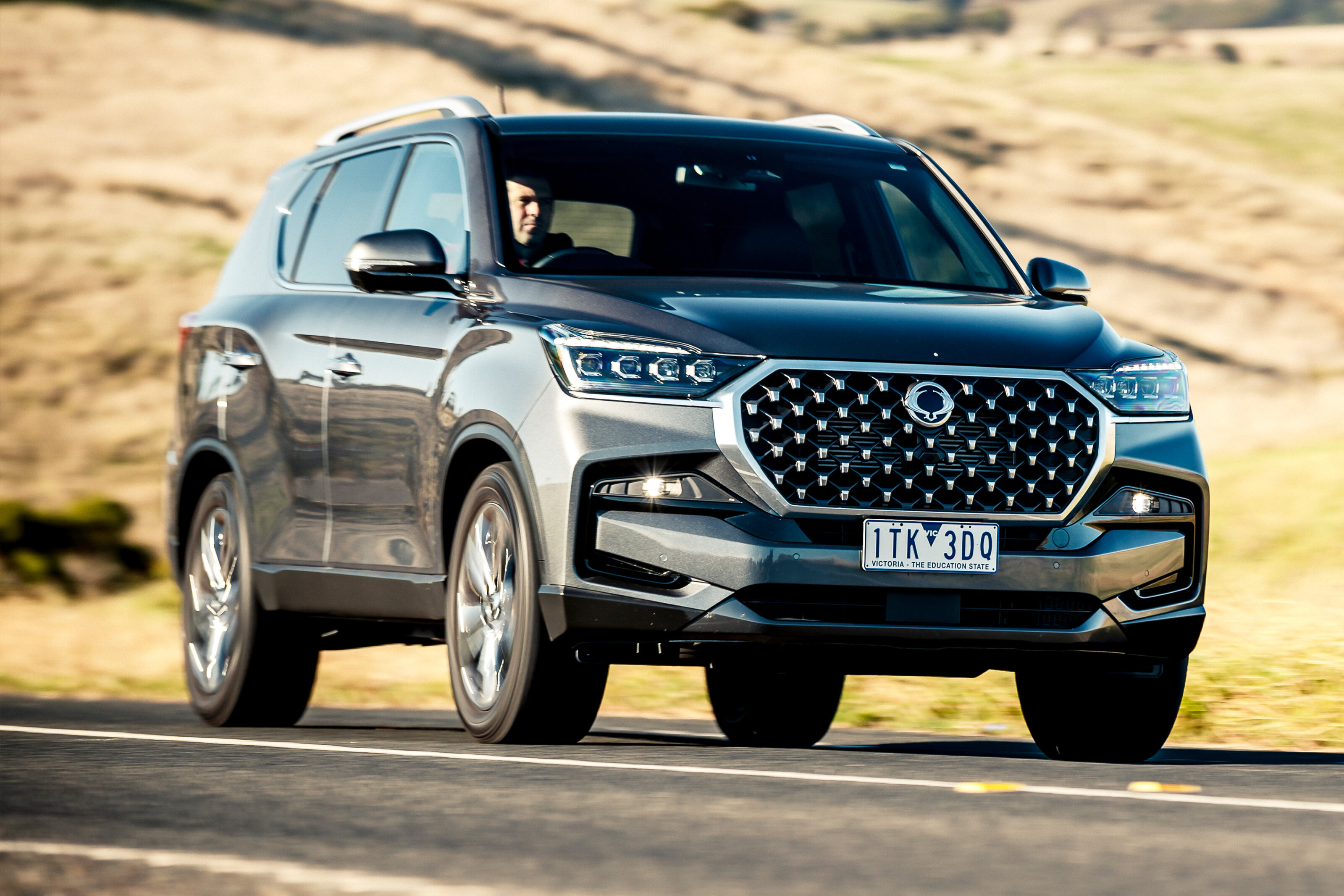
The Rexton is powered by a 2.2-litre turbodiesel engine that produces 148kW of power and 441Nm of torque delivered via an eight-speed automatic gearbox sourced from Hyundai.
This is a smallish engine compared to its rivals, but it produces more or power and torque than 2.4- and 3.0-litre turbodiesels in the Pajero Sport and Isuzu MU-X.
The Rexton is primarily rear-wheel drive, but you can select high- and low-range four-wheel drive with a neat dial for when you want to go bush or to the snow – though with those shiny wheels and the fancy interior trim I was hesitant to try either.
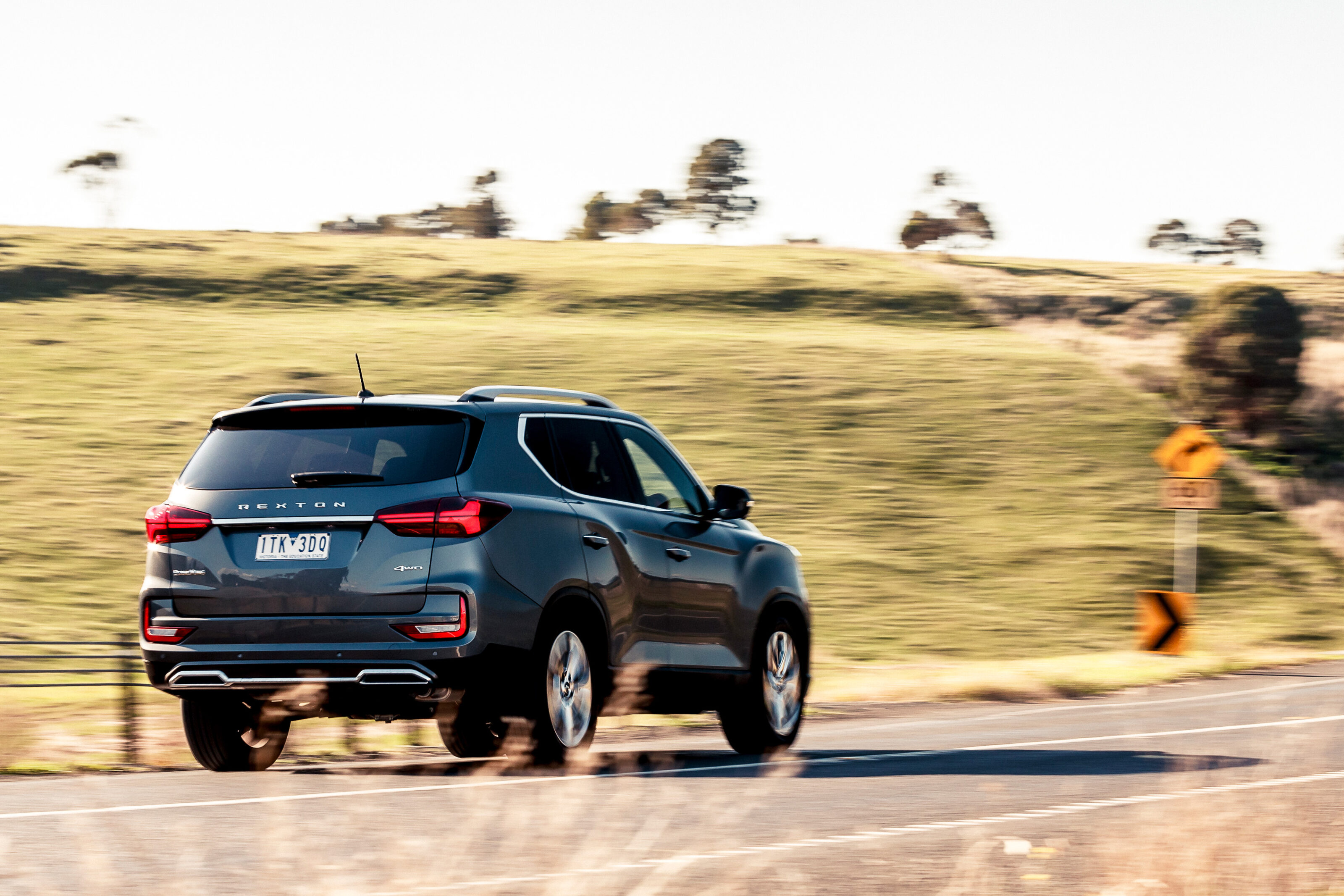
It’s quick off the mark and will get to highway speeds soon enough, the transmission quickly finding the right gears to get you there. Once at speed there is sufficient power in reserve for overtaking albeit with a little turbo lag.
The engine sounds rather agricultural on start-up, but once you get moving is surprisingly quiet, with the entire 4×4 diesel powertrain feeling quite refined.
The Rexton rides on a 10-link independent rear suspension setup with wishbones up front and coil springs at each corner, which brings reasonable road manners at moderate speeds around town. However, this is an old school body-on-frame SUV meaning that, at higher speeds, you feel every bump and crease, which isn’t helped by the Ultimate’s bigger 20-inch rubber. The ride on the ELX’s 18s is noticeably better.
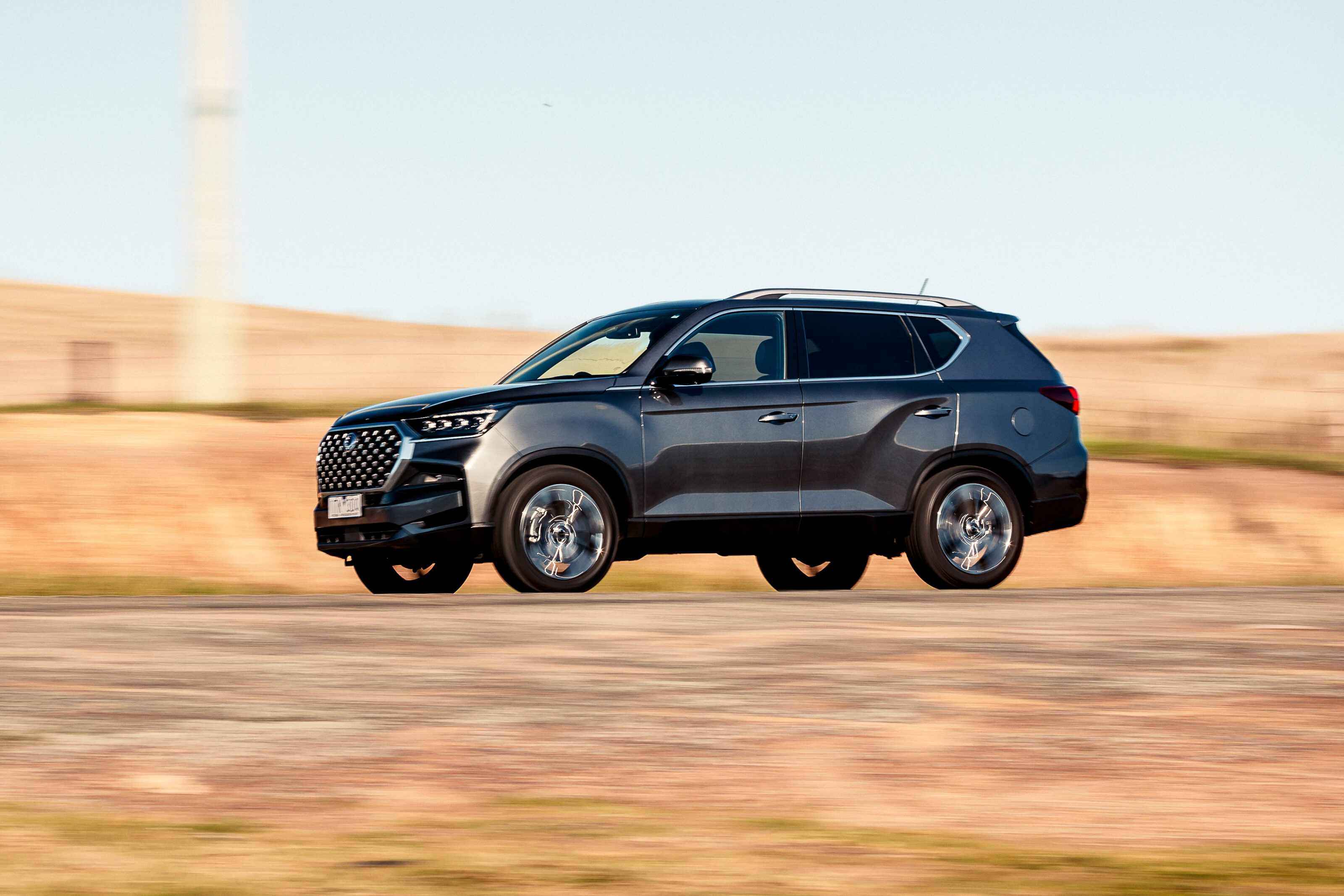
The ride isn’t jarring as such, just busy, and it can become unrelenting as road conditions deteriorate – though it’s pretty good on gravel. You get used to the busy ride in the front seats but it can be a little hectic in the back, especially in the third row – I’d hate to think how my younger self would fare back there.
And while its 203mm of ground clearance will see off any speed bump, you’ll quickly negotiate the need to tiptoe over them.
To be fair, none of the Rexton’s direct rivals exactly provide a smooth ride, but they do tend to settle a little quicker over bumps.
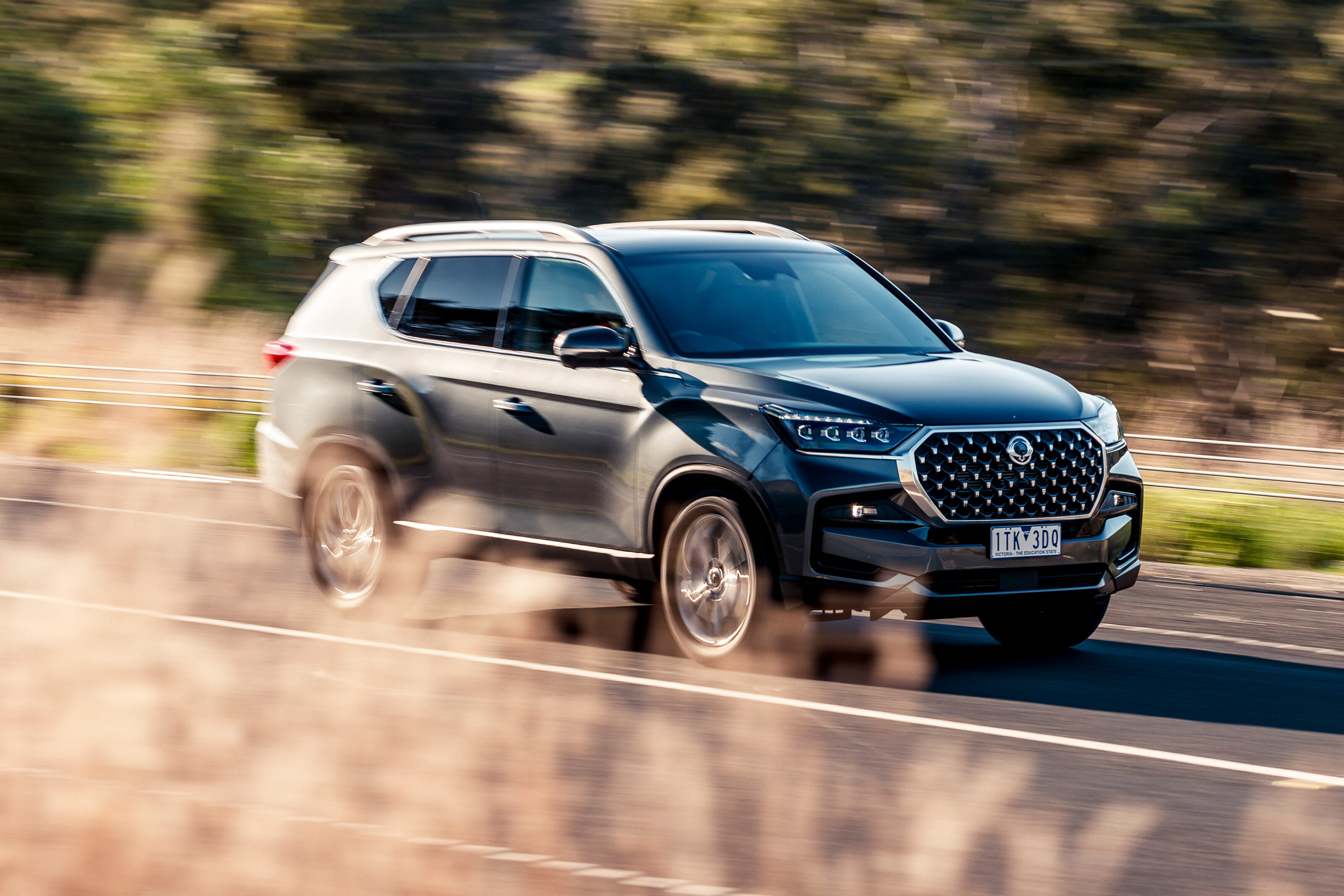
Another disadvantage of the body-on-frame chassis is that handling can be compromised, particularly on winding roads. Body roll can be quite pronounced and the steering feels a little light despite getting tighter as you speed up.
If you do overcook a bend the Rexton will do its best to avoid disaster by employing anti-rollover protection, which adjusts the amount of engine output and braking power delivered to each wheel while driving around sharp turns to keep it upright.
But it brakes okay, and on downhills, you can engage paddle shifters to gear down to ease yourself into bends.
The ride isn’t jarring as such, just busy, and it can become unrelenting as road conditions deteriorate – though it’s pretty good on gravel
What is the SsangYong Rexton Ultimate like for safety
For some reason, the Rexton hasn’t been independently crash-tested by ANCAP or EuroNCAP, but both variants bring a bunch of safety features including autonomous emergency braking with forward collision warning, braking assist, blind-spot warning, rear cross-traffic alert, lane departure warning, trailer sway control and parking sensors at both ends.
It also comes with nine airbags, including for the driver’s knee and side curtains although the third row is unprotected.
Noteworthy omissions are adaptive cruise control and lane-keeping assist, which are available in the smaller Korando Ultimate.
Verdict
I’d love to say the Rexton is an excellent comfortable large SUV that will take a family anywhere in comfort. But I reckon its busy ride and tight third row, which kids will quickly grow out of, precludes it from being suitable for a younger family or anyone with more than two older children.
But, if you’re not after a family chariot but want an affordable large SUV with a big towing capacity, huge boot, reasonable fuel economy, a tonne of creature comforts for the daily drive and the ability to tackle moderate off-roading, the Rexton Ultimate is well worth a look.
That said, you won’t be wanting for much if you settle for the cheaper ELX, which, to me, is the real bargain buy of the pair.
2021 SsangYong Rexton Ultimate specifications
Snapshot
- New styling theme called u2018Powered by Toughnessu2019
- Brand talking up its u201cconsiderable SUV heritageu201d and future identity as u201cthe authentic SUVu201d
SsangYong, Korea’s fourth biggest car brand after Hyundai, Kia and Renault-Samsung, has been through the wars in recent times, having filed for receivership in late 2020 – but the company’s latest next-generation SUV could be its ticket out of trouble.
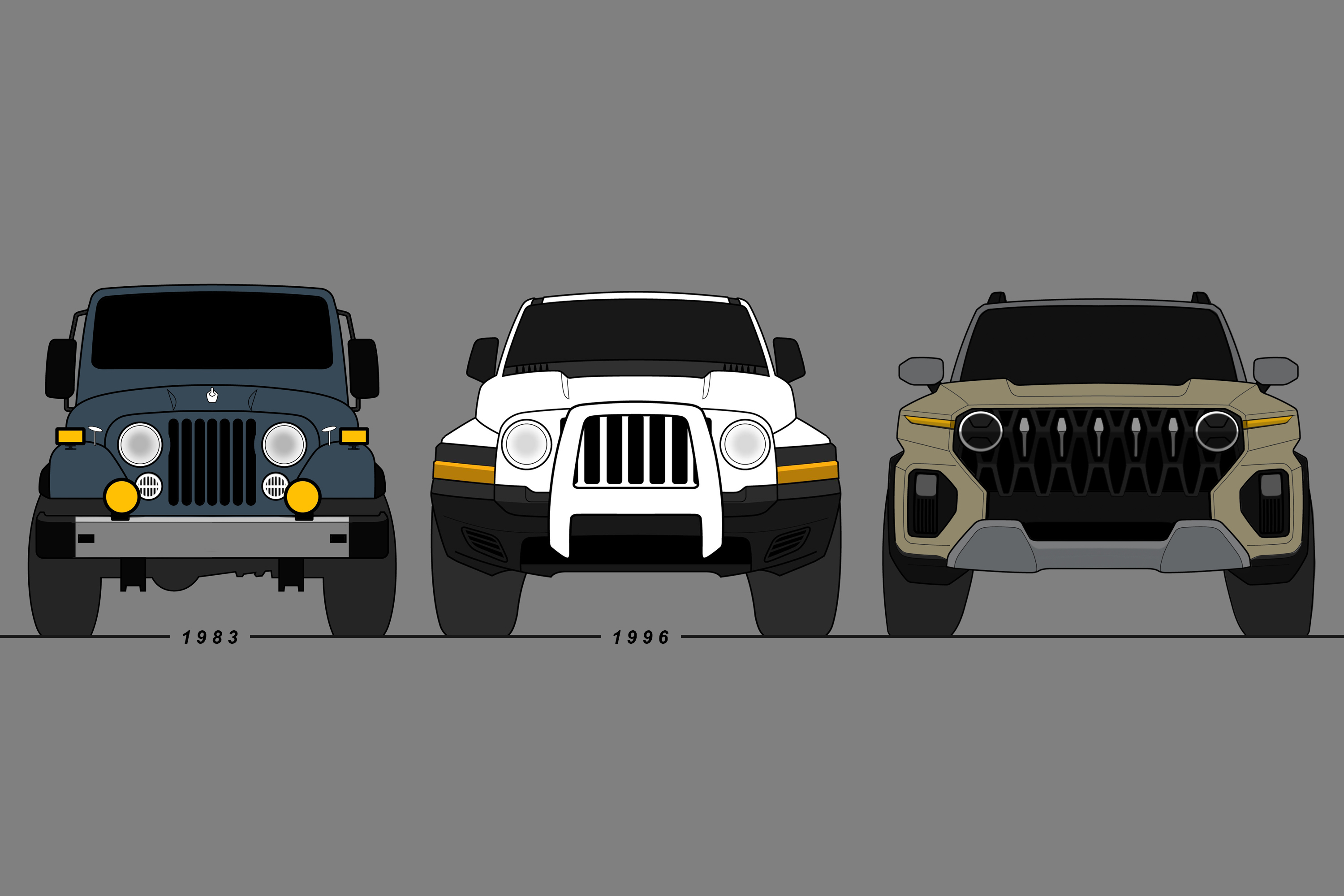
Shown only as a sketch for now, the SsangYong KR10 concept wears a suitably rugged look to woo the type of buyer that might usually be drawn to the big Jeep Wrangler, compact Suzuki Jimny, the new Bronco that Ford won’t bring to Australia, a used Toyota FJ Cruiser, or even the newly boxy RAV4.
The new concept artwork comes just weeks after the release of drawings that depict a new J100 model – a mid-sized electric SUV that would likely sit above the Korando in price and quality. (See bottom of this story.) A pick-up ute version of the J100 is also promised.
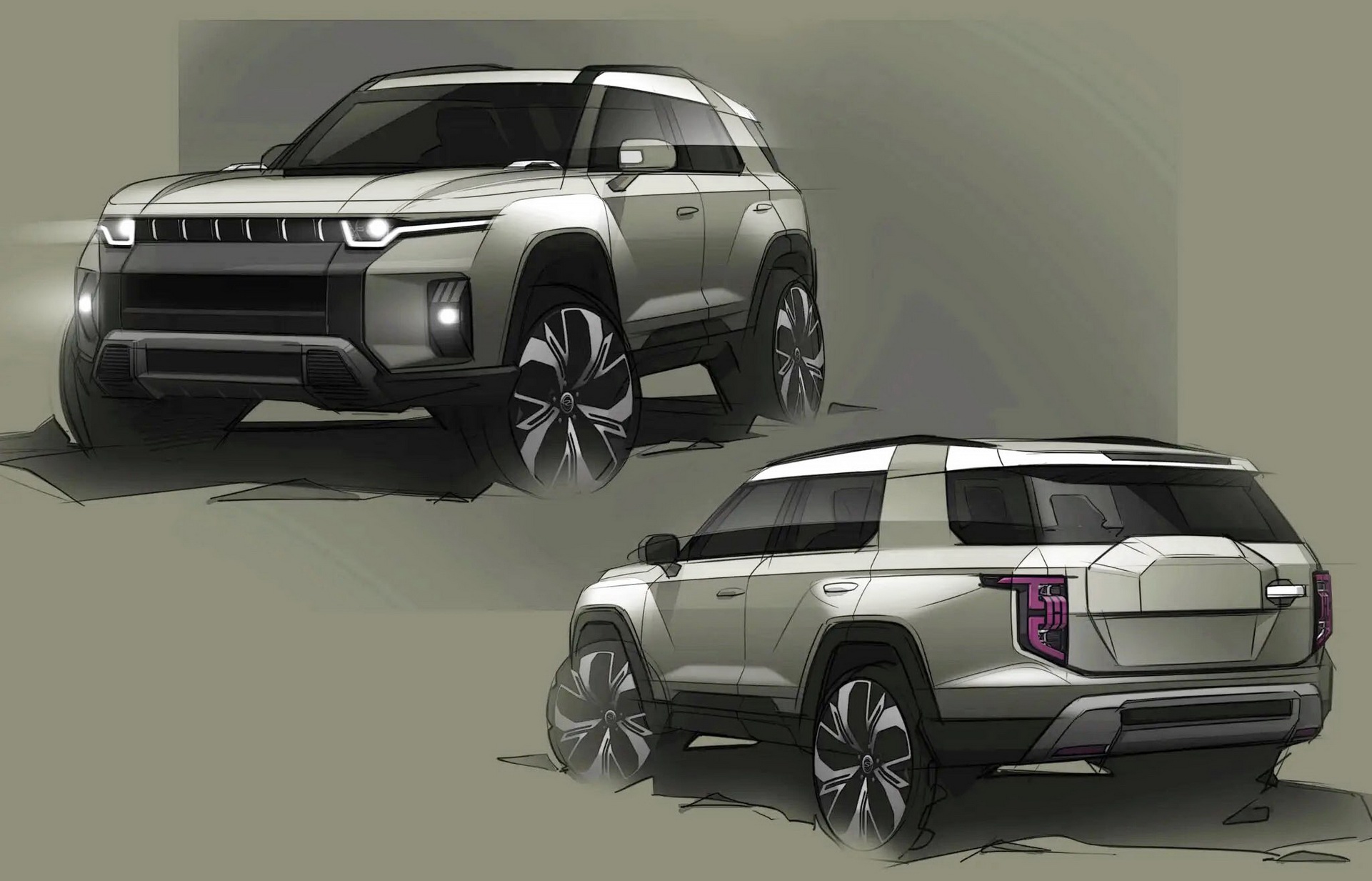
In sketch form, the KR10 looks to be drawn straight from the sci-fi world, with huge box guards, stylised lighting, and oversized wheels wrapped in chunky rubber.
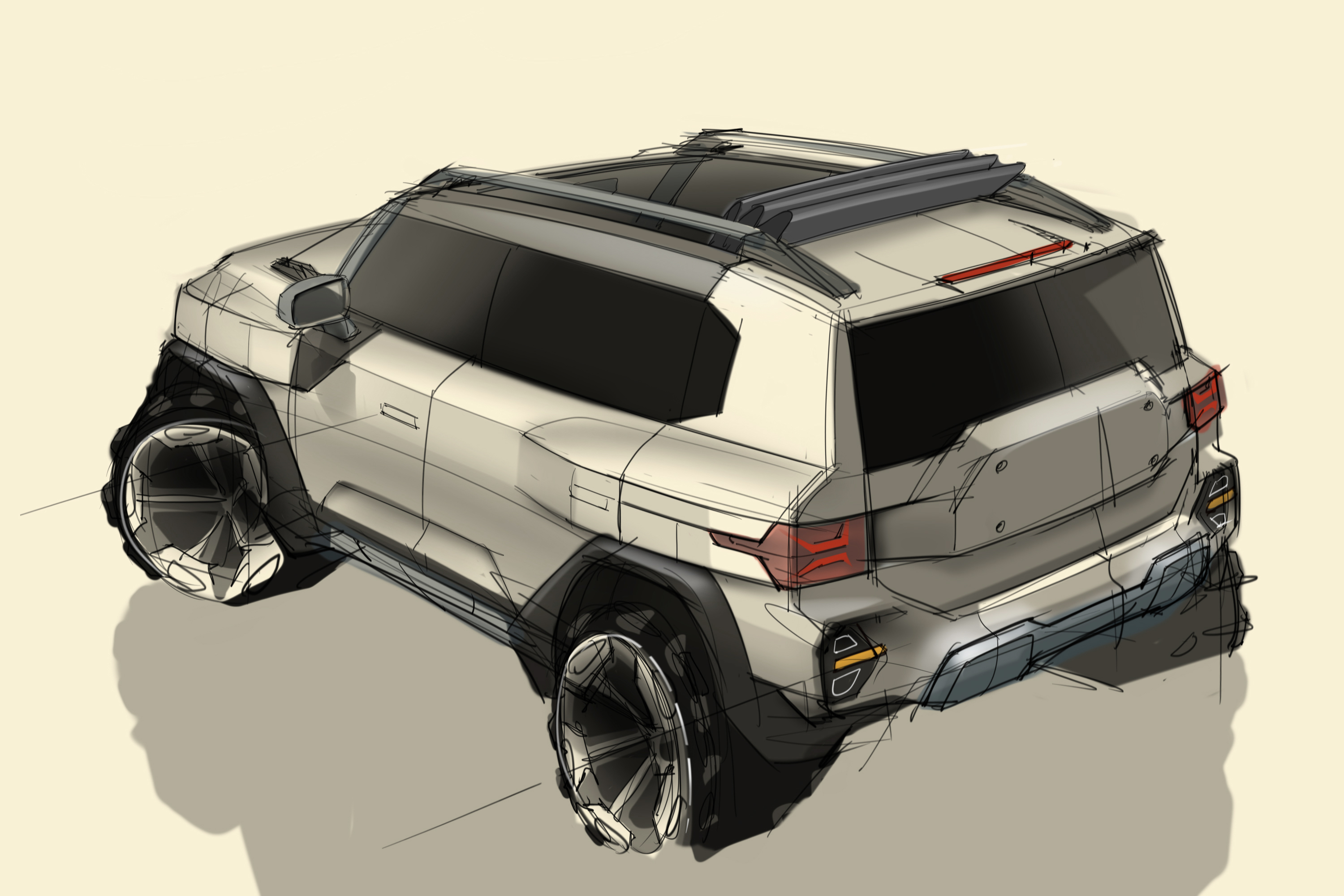
As a production model, buyers can likely expect some of these features to be toned down – although advancements in design and manufacturing are leading to more and more once-experimental features making their way to production on modern cars.
Announcing the concept late today, SsangYong described the KR10 concept as a product of the company’s “considerable SUV brand heritage”, with the new SUV positioned to establish itself as “the authentic SUV”.
Readers may wonder at that heritage, with SsangYong’s earliest SUVs being closely related to Japan’s Isuzu – using the Trooper, a model sold here as the Holden Jackaroo – and, most famously, Daimler (Mercedes-Benz) with the first-generation Musso SUV.
In modern times, SsangYong’s SUV range is at least proving resilient, with the Korando mid-sized SUV selling 201 units in Australia year-to-date – an improvement of 154 per cent over the same time in 2020. Overall, the brand’s sales sit at 1421 so far this year, against 656 for the same period last year.
Speaking about the brand’s future plans, SsangYong design chief Lee Kang said: “We have re-interpreted our future design vision and product philosophy by drawing heavily on our unique heritage. With the forthcoming J100 and KR10 models, we have drawn a line in the sand in terms of design, and everything from this point forward will follow this new brand design direction.
“It is a very exciting time for SsangYong and will build on the history and heritage of its unique and distinctively authentic SUV designs to impress its customers of the future.”
SsangYong promises a range of “eco-friendly” powertrains will drive the KR10, “thereby responding to the biggest trend in the automotive industry which is transforming the way we drive in the future”.
When will the SsangYong KR10 go on sale?
The company has yet to confirm timing for its new models, and for now, these sketches may be little more than an enticement for new suitors to rescue the brand.
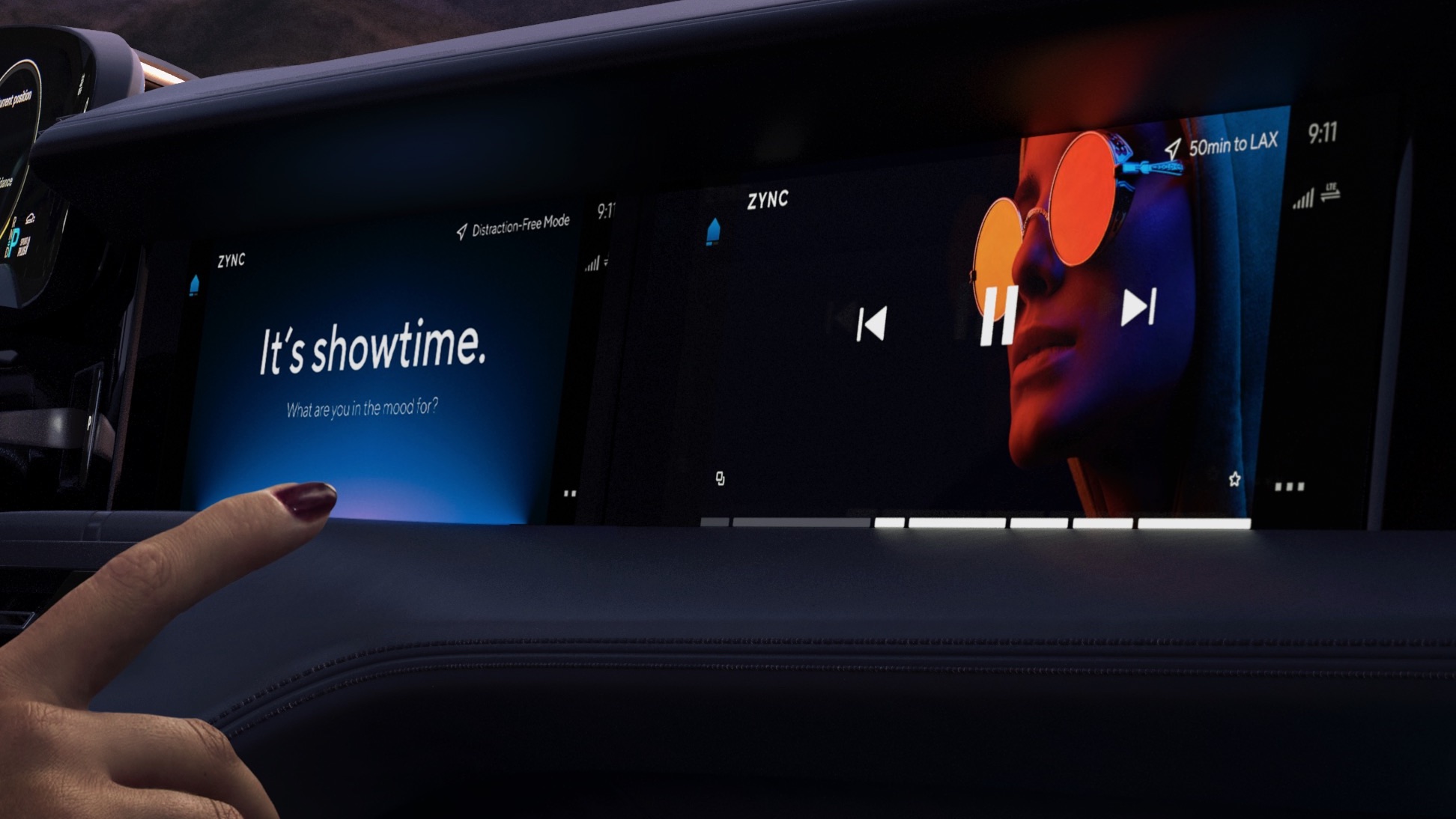
Porsche has partnered with American tech start-up company Zync to improve the infotainment systems in its cars.
Zync specialises in bringing digital entertainment services, such as video streaming, gaming and e-commerce, into vehicles, all of which, thanks to the two firms teaming up, could be found in future Porsche models.
The start-up’s aim is to provide a clearer pathway for the automotive and entertainment industries to interact, making itself a central partner in the delivery of media content in vehicles.
Porsche Digital’s head of company building, Christian Knörle, said the partnership with Zync will give Porsche owners access to premium content in its vehicles.
“Digital and personalisable in-vehicle solutions are becoming increasingly important for many drivers,” said Knörle.
“With Zync, we’re now creating another opportunity to offer current and popular entertainment formats for this environment.”
Zync believes it will be able to integrate functions such as video games and online shopping into Porsche’s vehicles by 2023 – all without the need for hardware upgrades to its existing infotainment systems.
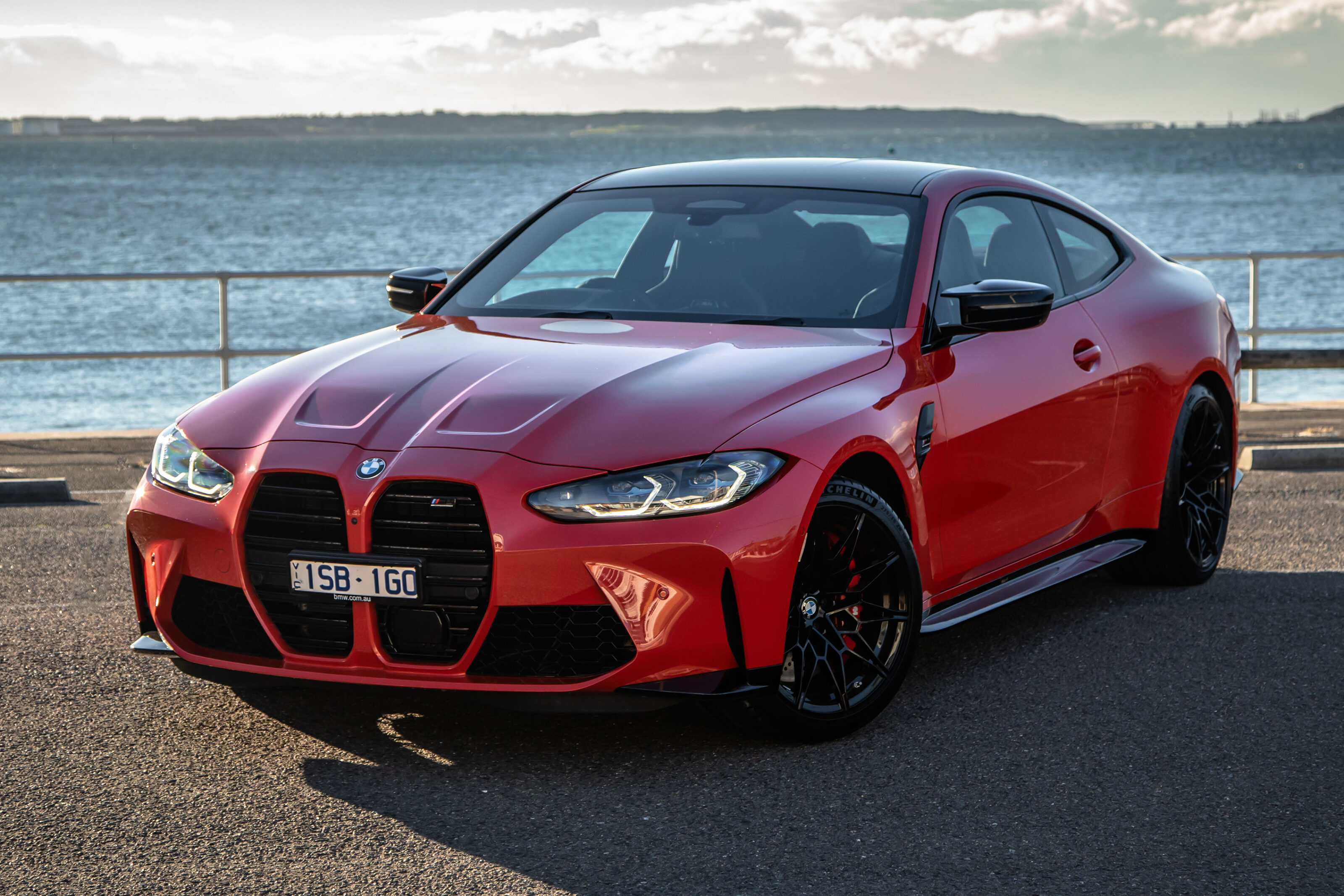
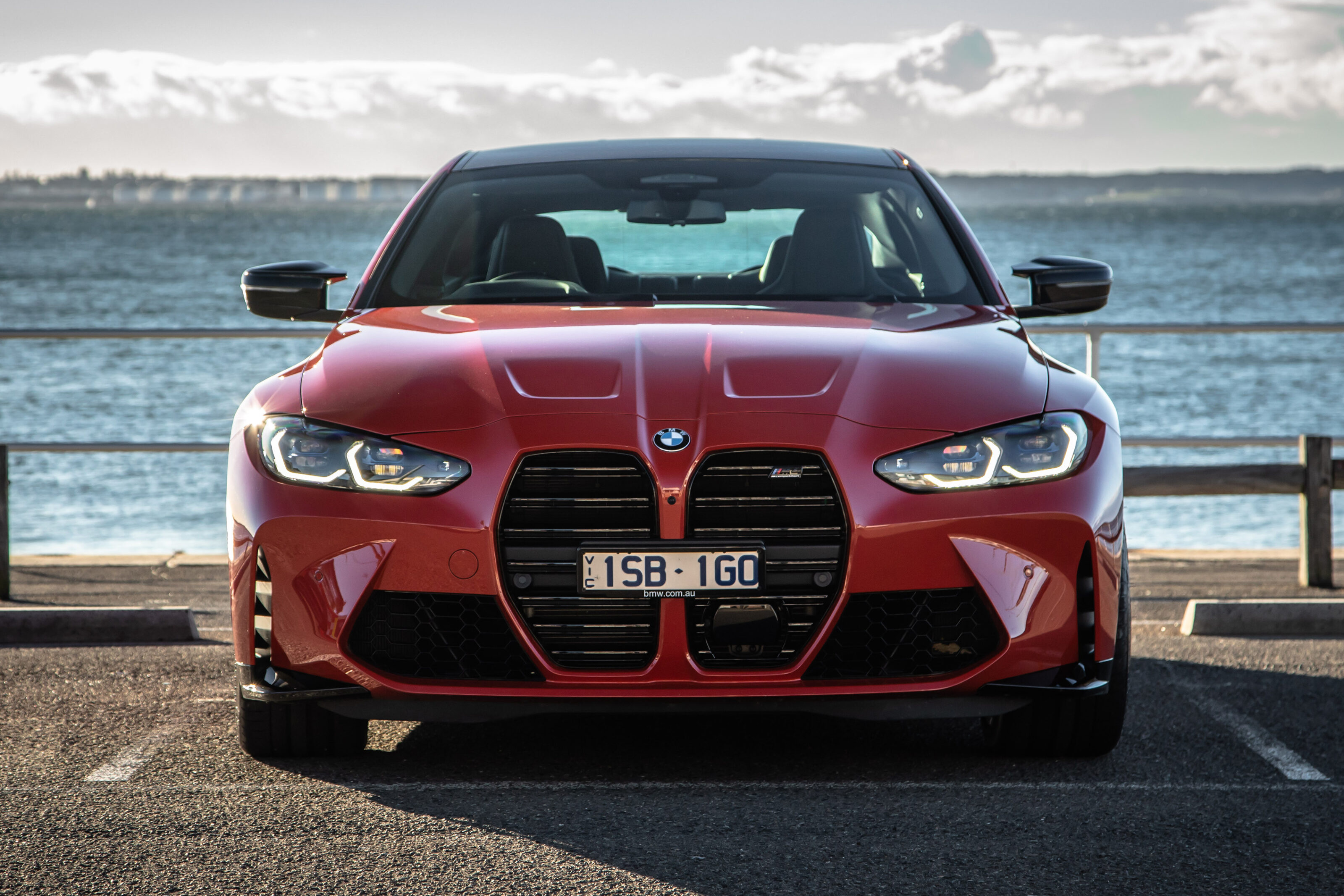
This new BMW M4 had a lot riding on its chunky new shoulders. Its predecessor didn’t have that point of difference that either the charismatic V8 E92 M3 Coupe had or the much-cherished E46 straight-six howler before it. The internet decided as soon as the big grille was made public that this was the worst one yet, as though mere ephemera such as styling could provide any indication at all of what lay beneath.
The G20 3 Series on which the 4 Series is based had meanwhile been hailed as the saviour of BMW’s mid-size car and rightly so. It’s an absolute belter. So why the internet commentariat made such a rash decision is anyone’s guess.
But they had a point. Not only does it have to be significantly better than the old car and its zenith, the CS, it also has to contend with the scrappy street brawler that is the M2 and its gloriously, extravagantly brilliant CS version. The team responsible for this car were under a lot of pressure. We all know what high pressure can create and it’s never mediocrity.
Pricing and Features
Unusually in these paddle-shift-centric times, you can choose between a manual M4 ($149,900) and an eight-speed automatic ($159,900). You’re not just paying ten grand for two gears and one less pedal, you’re also paying for the step up to Competition spec, which includes 22 more kilowatts and a whopping 100Nm of extra torque.
By the time the M3 and M4 range is rolled out with the addition of xDrive variants, there will be more mid-size M cars than sub-$20,000 hatchbacks. Okay, maybe not, but not far off…
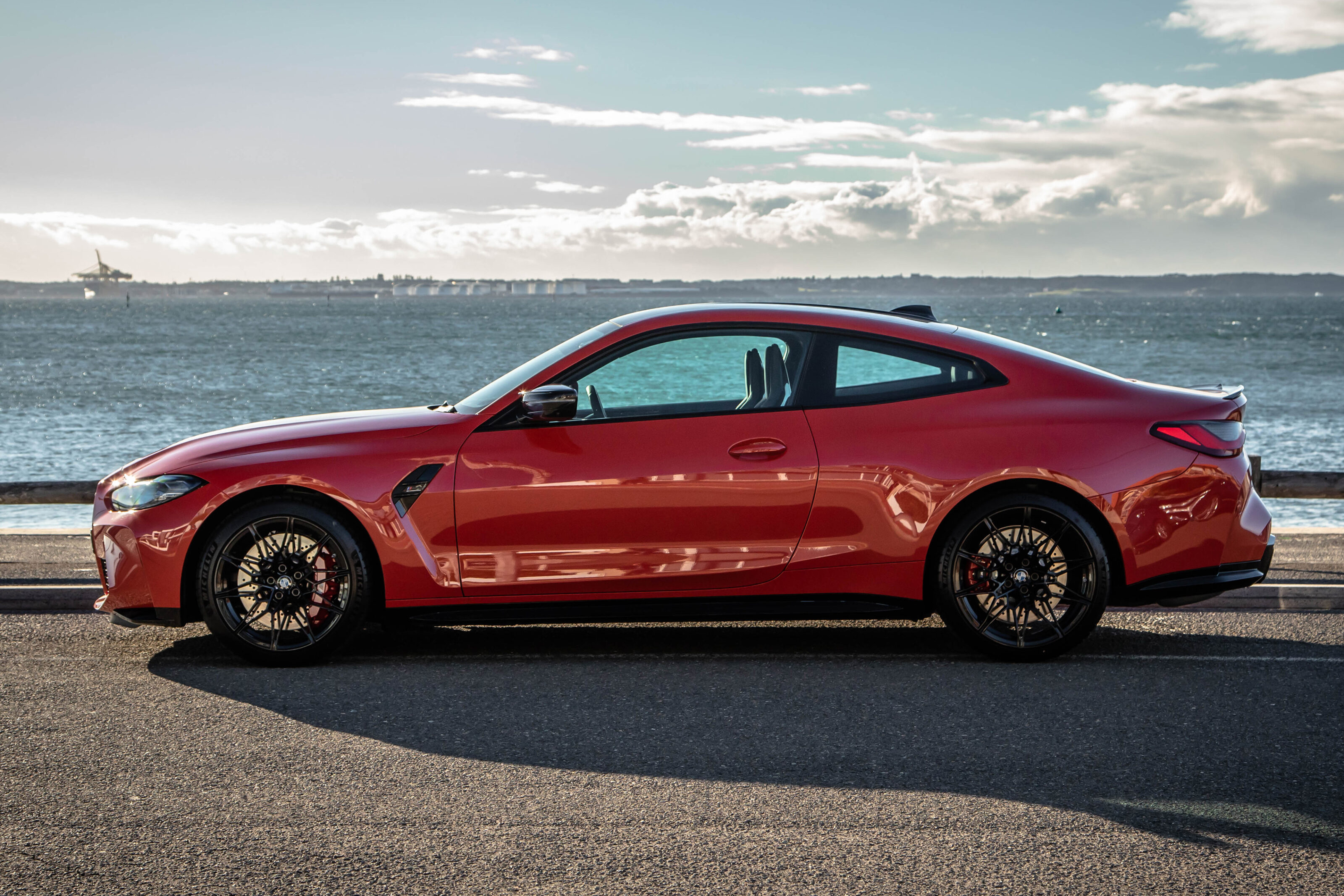
The M4 comes properly loaded with gear. On the outside, you’ll find lightweight forged alloy wheels – 19-inch at the front and 20-inch rear – wrapped in tyres that can be from Michelin, Pirelli, Continental or Yokohama. Which we will absolutely be talking about later.
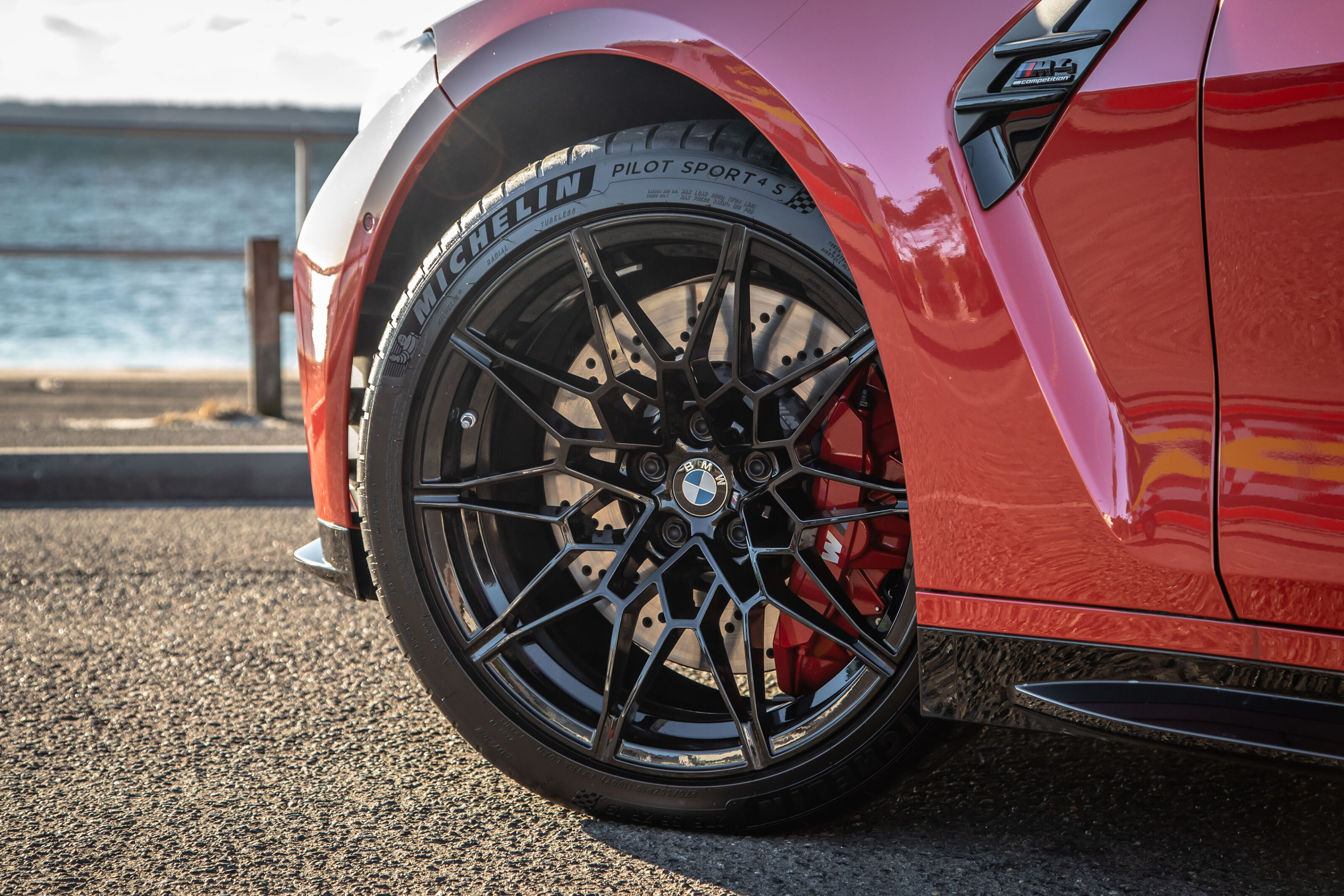
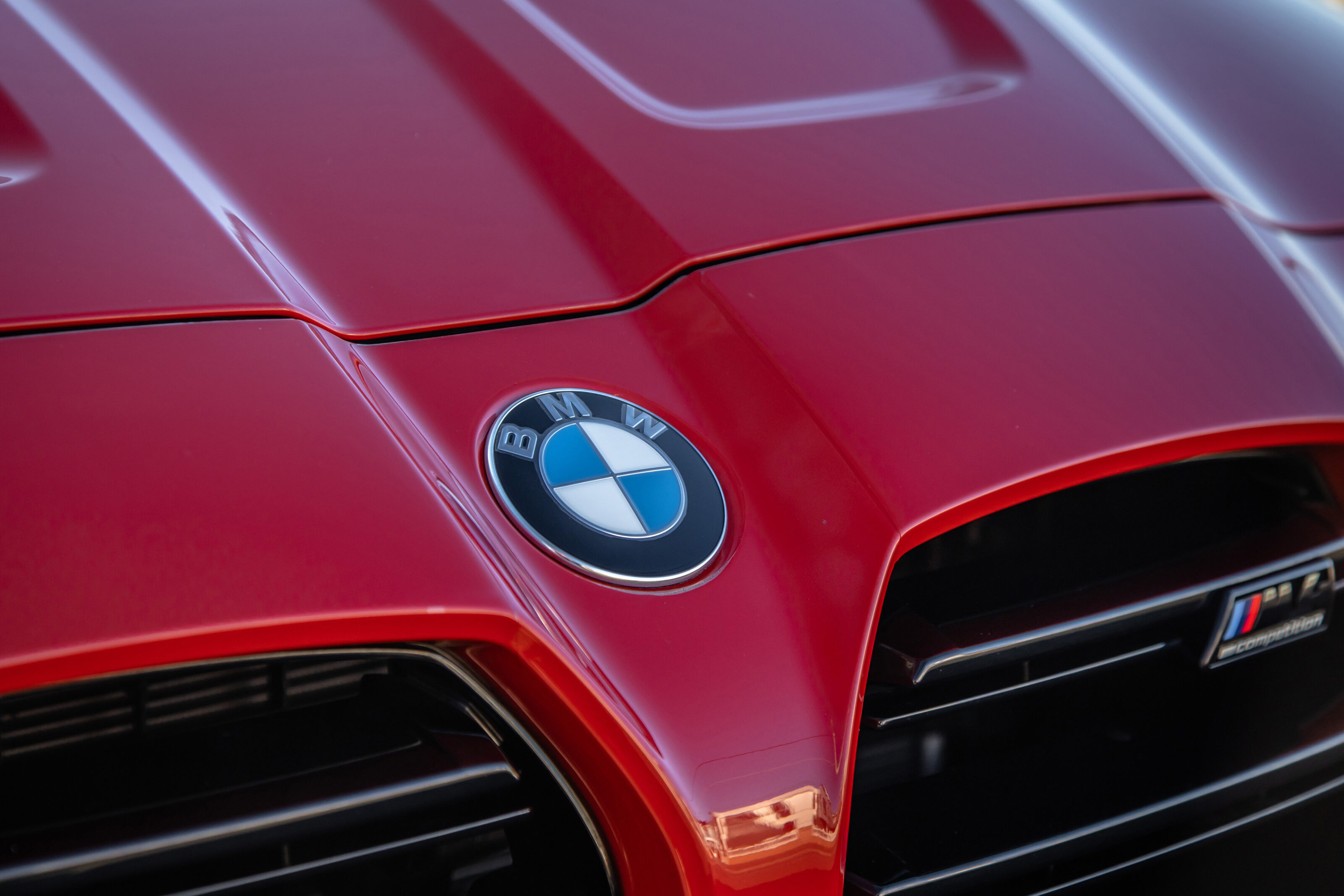
Further exterior fun includes the now-trademark carbonfibre roof, blue M lettering on the brake calipers (you can have red as a no-cost option, as this car did), the brilliant Laserlight headlights, rear spoiler and front splitter.
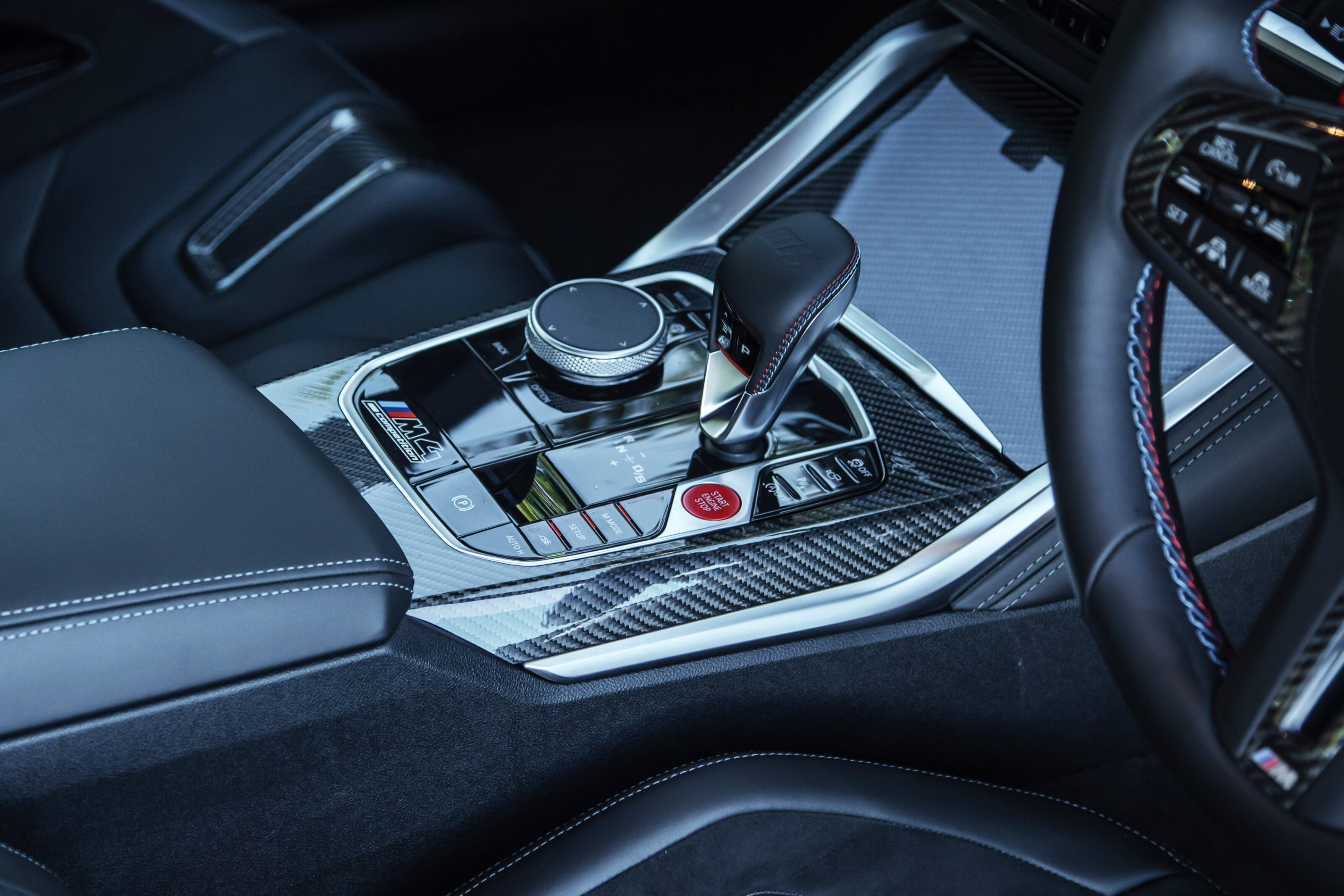
Inside you’ll find tons of leather and plenty of tech. The dash is a 12.3-inch fully digital screen, there is a configurable head-up display and a 10.25-inch touchscreen running OS7 with wireless Apple CarPlay and wireless Android Auto. Which is handy, because there is also a wireless charging pad that fits larger phones, something BMW doesn’t always manage.
The front seats are heated and electrically adjustable, the 12-speaker stereo is branded with Harmon/Kardon badges and you get keyless entry and start. As well as a heap of other stuff.
The G20 3 Series on which the 4 Series is based has been hailed as the saviour of BMW’s mid-size car and rightly so.
Comfort and Space
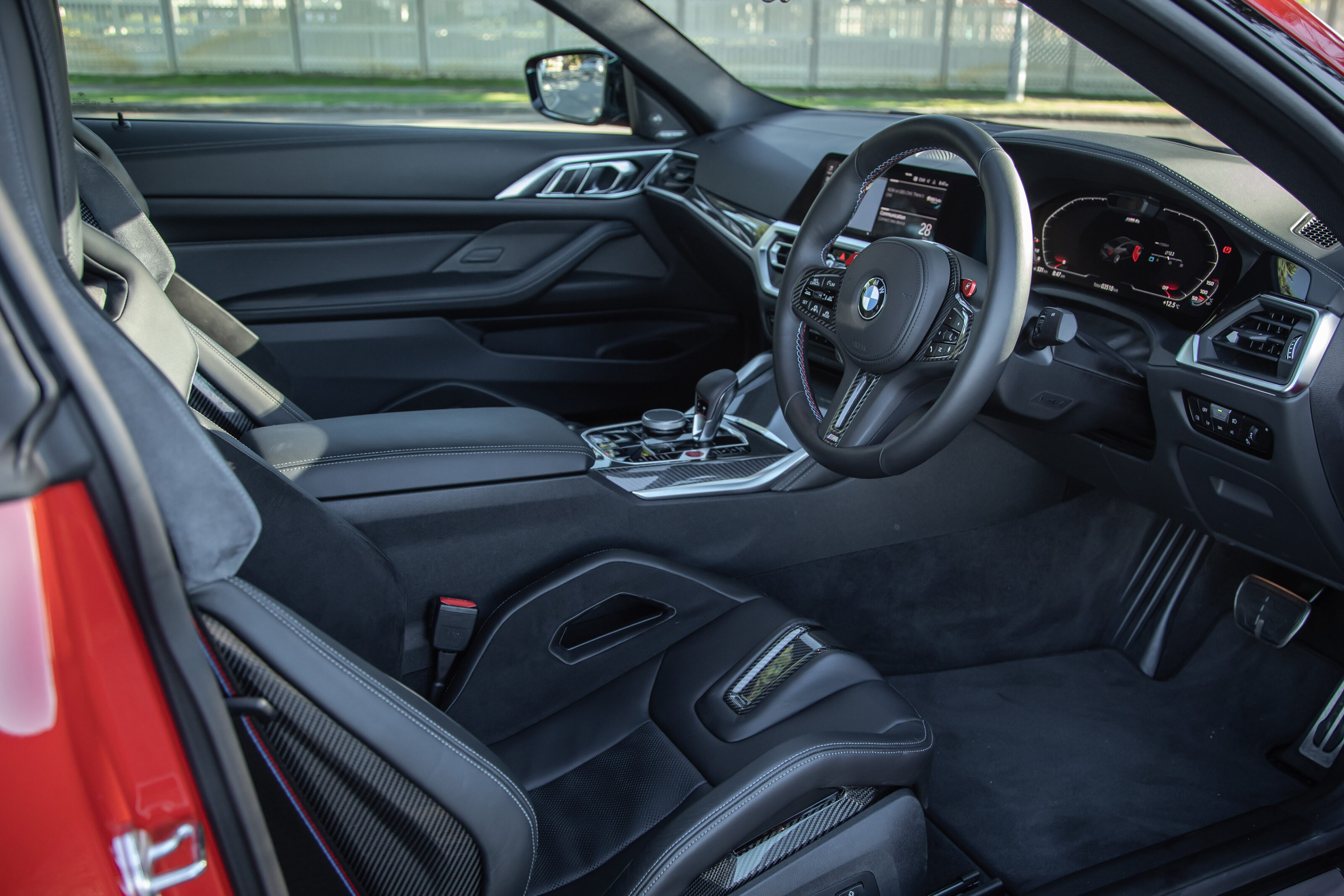
The basic 4 Series is a comfortable car, even though getting in and out can be tricky because it’s a low-slung sports coupe. You don’t get a roofline like that without some sort of sacrifice. All things being equal, you’d expect the same from the M4, just with racier seats.
And racier the seats are. If only the M4 I had was fitted with the standard seats, because boy howdy were the $7500 racing buckets a mistake. Well, they were a mistake for everyone who sat in them. They are in most ways excellent. A great snug fit, but not too snug that you have to hit the steam room to be able to fit. And they’re heated, which was a nice touch during that Antarctic blast we got. Carbon-backed, they looked lovely too but my goodness were they uncomfortable.
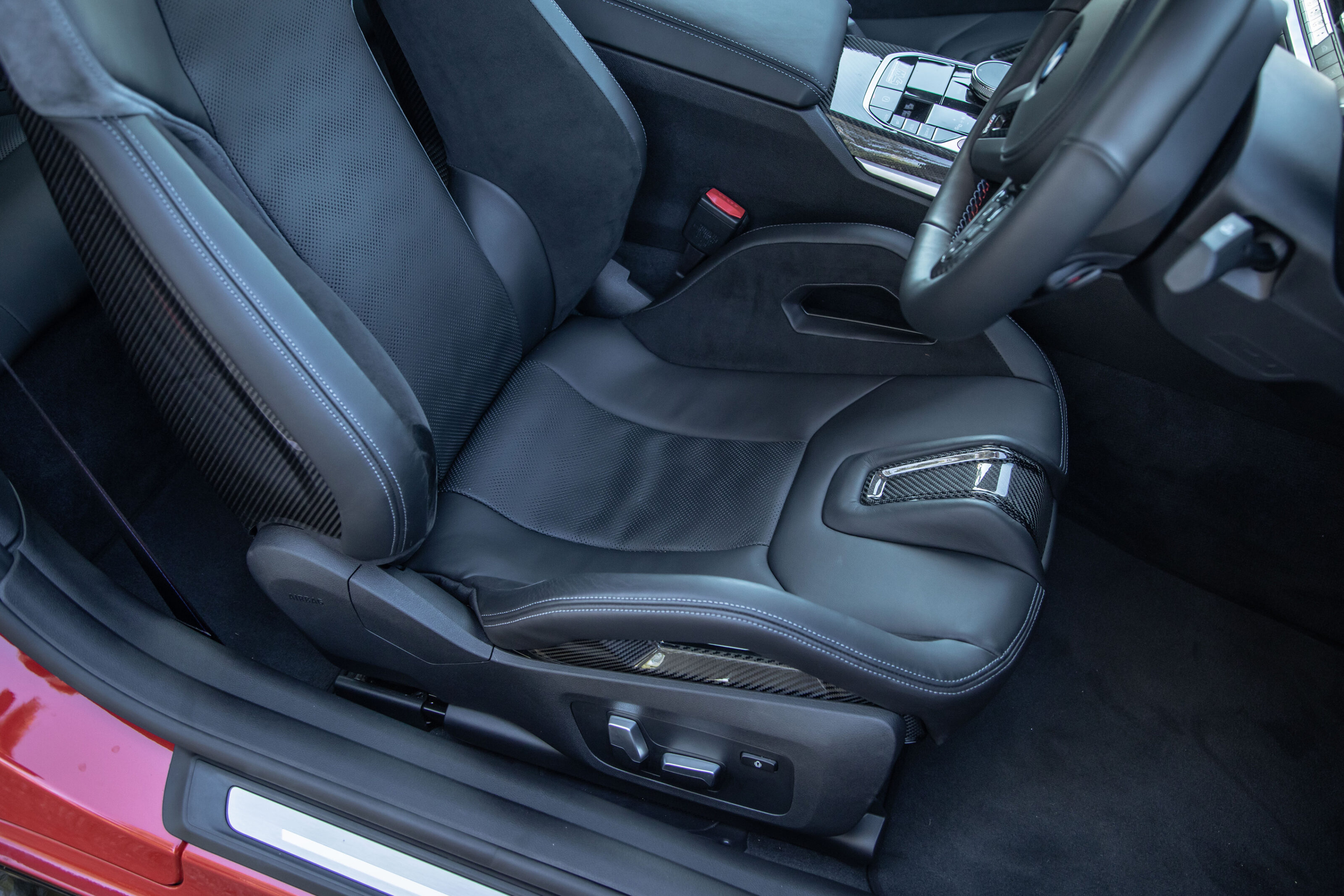
The complaints fell into two camps. First, the weird carbon bulge in the middle of your legs, where a crotch belt might sprout in a race car, bothered my wife and car-interested friend.
The other camp, into which I pitched my tent, concerned the side bolsters. If you weren’t warned, you’d cleft your backside in twain sitting on them and once in, they forced my knees together, as they did with most folks.
I am willing to put a large sum of money down to say that this isn’t a problem in left-hand drive cars but is here because the throttle pedal is not lined up well with the bolster in the RHD versions. My thigh now has an imprint of the bolster itself. It was so disappointing and the only real flaw in the cabin. Which is handy because they’re optional and the standard seats, as I have since discovered, are as brilliant as these are terrible.
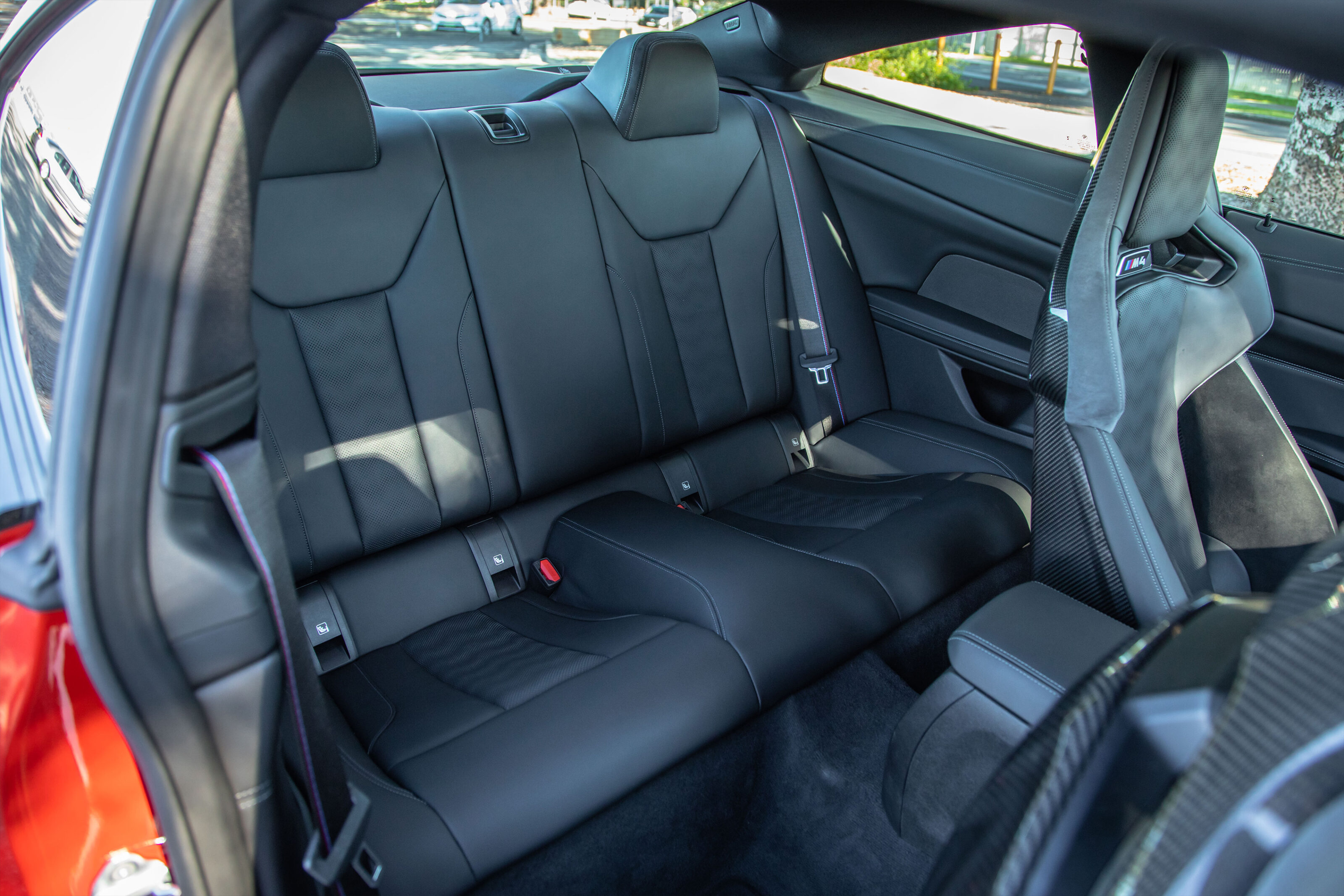
So anyway, if they fit and can get comfortable in these optional seats, front occupants will be well looked after with two cupholders, big door pockets, a shallow but long centre console bin and a wireless charging pad that takes even the larger phones with a cover on.
The rear seat is reasonably comfortable even if you’re up to 180cm in height, although you won’t want to be there long. My lanky son tolerated it for twenty minutes without complaint and he wasn’t even distracted by his phone at the time.
The boot is a very handy 440 litres, which is not far off the 3 Series sedan’s volume. The aperture is smaller, so take it easy at the Flat Pack Emporium. But it does mean that long distance touring is a perfectly reasonable endeavour because you can get your stuff in and no doubt there’s a figure regarding how many golf bags you can load up with as well.
If only the M4 I had was fitted with the standard seats, because boy howdy were the $7500 racing buckets a mistake.
On the Road
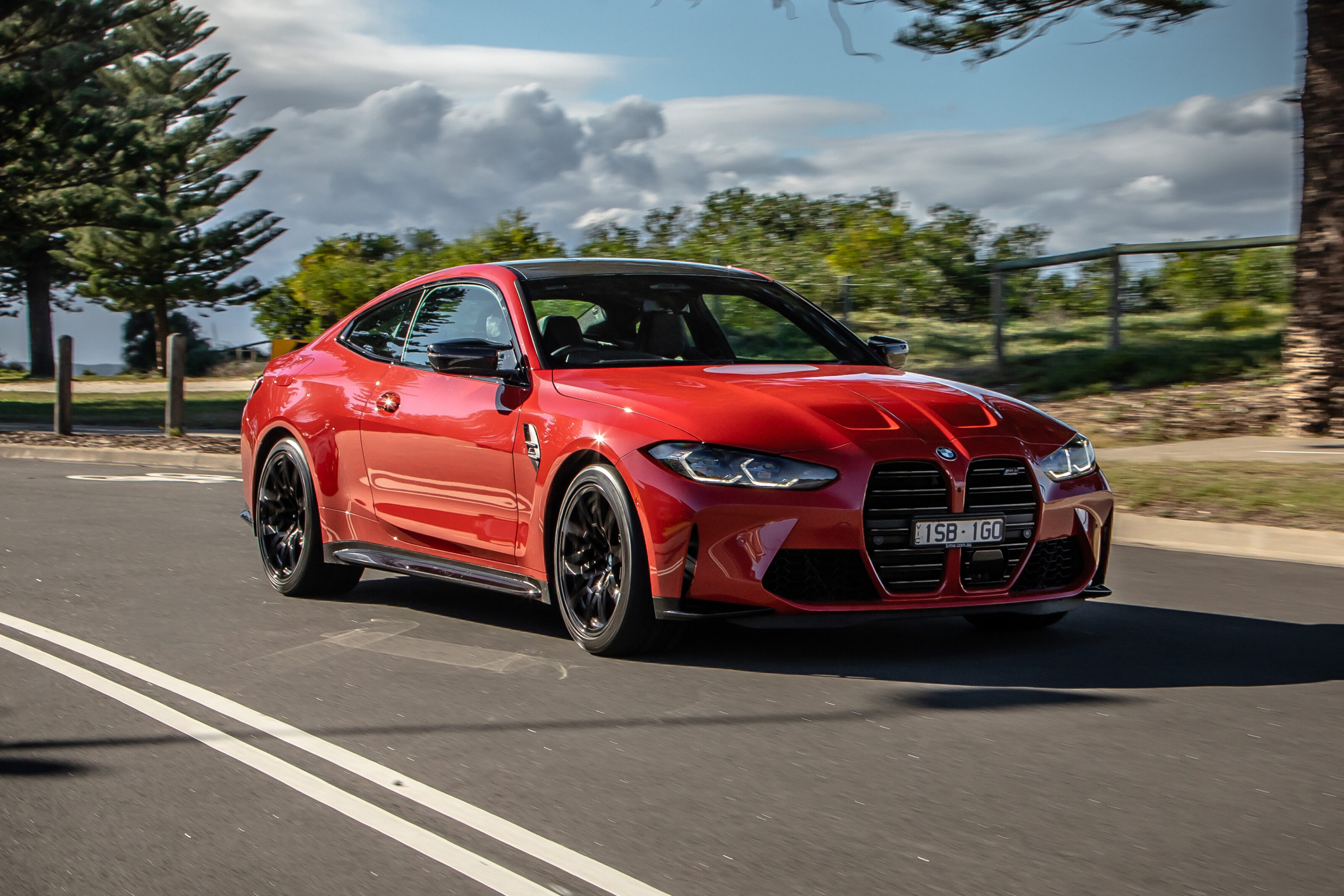
A fast car can often just be about a couple of big engine numbers – in this case 375kW at 6250rpm and 650Nm between 2750rpm and 5500rpm – and that makes plenty of people happy. A Mustang R-Spec, for instance, is heavily dependent on this concept and is a barrel of laughs.
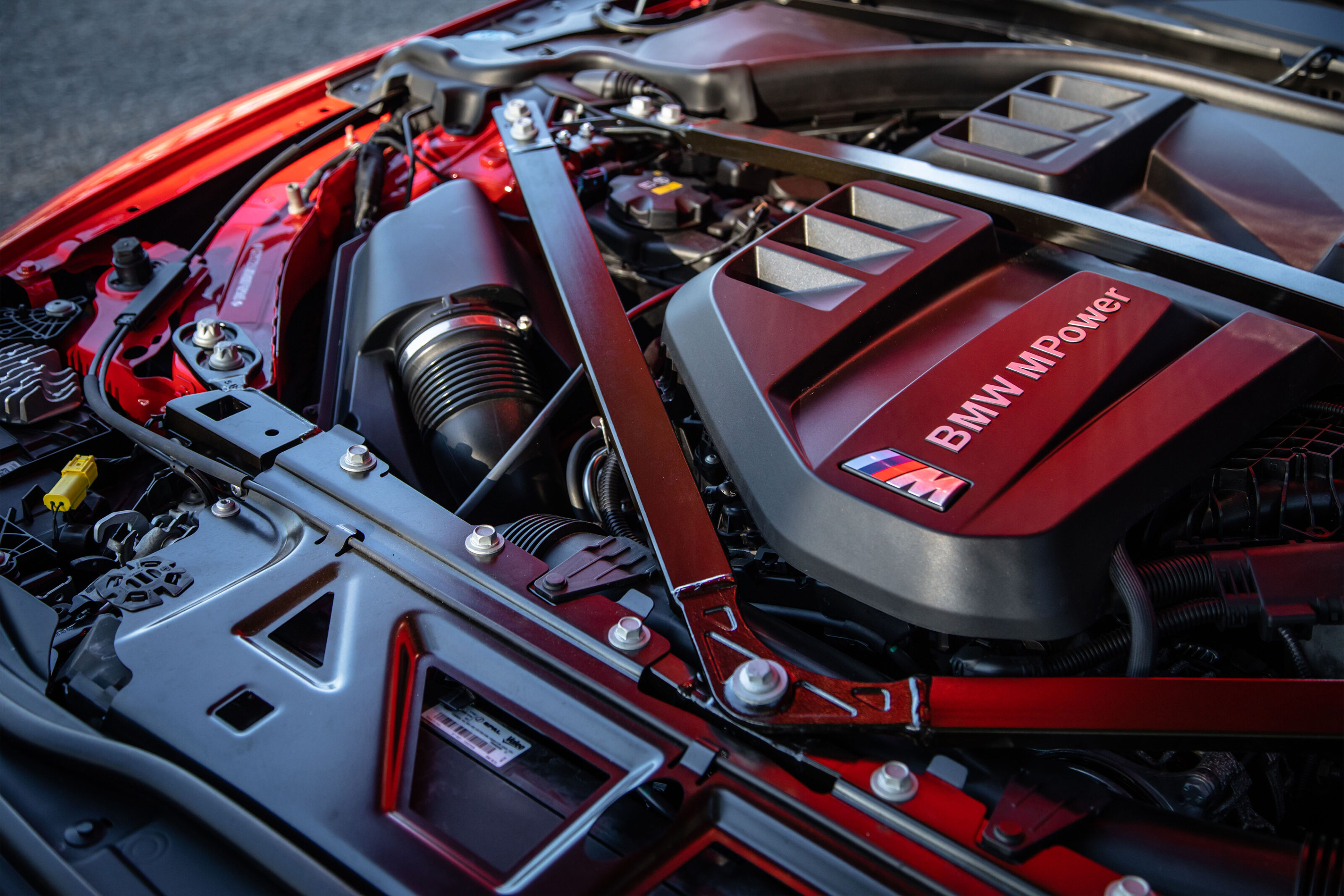
The M4 is, obviously, rather more than a cracking engine. The S58 makes its first appearance in a passenger car as opposed to an SUV (it debuted in the X3 and X4 M pairings) and is an absolute rip-snorter. Technical highlights include a forged lightweight crankshaft, closed-deck construction for strength and 3D-printed cylinder heads for whacky, uncastable shapes.
As usual, a new M car comes with something to upset the purists. This time around it’s the end of the seven-speed DCT, chucked out in favour of the all-things-to-all-cars eight-speed automatic from ZF. The outrage cycle has already died down after its installation in the M5, so the xDrive versions later in the year might have to bear the most opprobrium. Because an M4 can only be rear-wheel drive etc etc.
If you look under the bonnet at the S58 you won’t find the beautiful carbon fibre brace of the previous model. Instead there’s a few pieces of welded and shaped aluminium 4×2 in a triangle, a small part of a package of chassis stiffening measures that continue under the floor to the rear. The new front subframe is also aluminium, while the rear is rigidly mounted to the chassis.
And the result of this stiffening is one of the first things you will notice stepping out of the old car, or even a current 4 Series. The car feels a lot more settled on its suspension and you can feel the potential of the car straight off the driveway. A very stiff chassis working with aluminium wishbones (and ball joints) at the front means the car already feels more dynamic. It’s uncanny how just rolling down the street it feels more planted and inherently stable.
A stiffer chassis means less compromise, too. The engineers clearly worked hard to make the comfort end of the settings spectrum more liveable than the old car. It feels no less compliant than a 430i in Sport mode, which means it rides the bumps and won’t upset your insides. What’s surprising is that even if you turn up the engine, brakes and steering to their highest levels, this softest setting works beautifully on real-world twisty roads.
Of course, twisty roads are what this review is all about. The track-day launch was all very well with its high speeds, smooth tarmac and heroic tales of this car’s undoubted abilities. But not everybody has access to a track and most of us have to make do with a fun bit of road.
Fundamentally, this car is properly rowdy. Like the M2 that reignited M’s sense of humour (the previous generation M4 and M5 were a bit dour compared to their predecessors), the M4 is a party animal, but without the chemical assistance. The huge Michelin Pilot Sport 4S tyres spread themselves across the tarmac and threaten to rip it off the ground.
These tyres are not your off-the-shelf 4S but bespoke BMW M tyres, with a star on the sidewall. Compared to the standard 4S, the face of the tyre has four rather than two compounds and tighter steel belting as well as a bunch of other detail changes. Michelin and M worked on these tyres for two years and it shows.
You won’t necessarily find Michelins on your M4, though. BMW worked with Pirelli, Continental and Yokohama and assure me that they’re all as good as each other. I’m going to take a pot shot, though, and say the Michelins are the ones to have because they were on the M4 I drove for this review and the M3 I drove the week after.
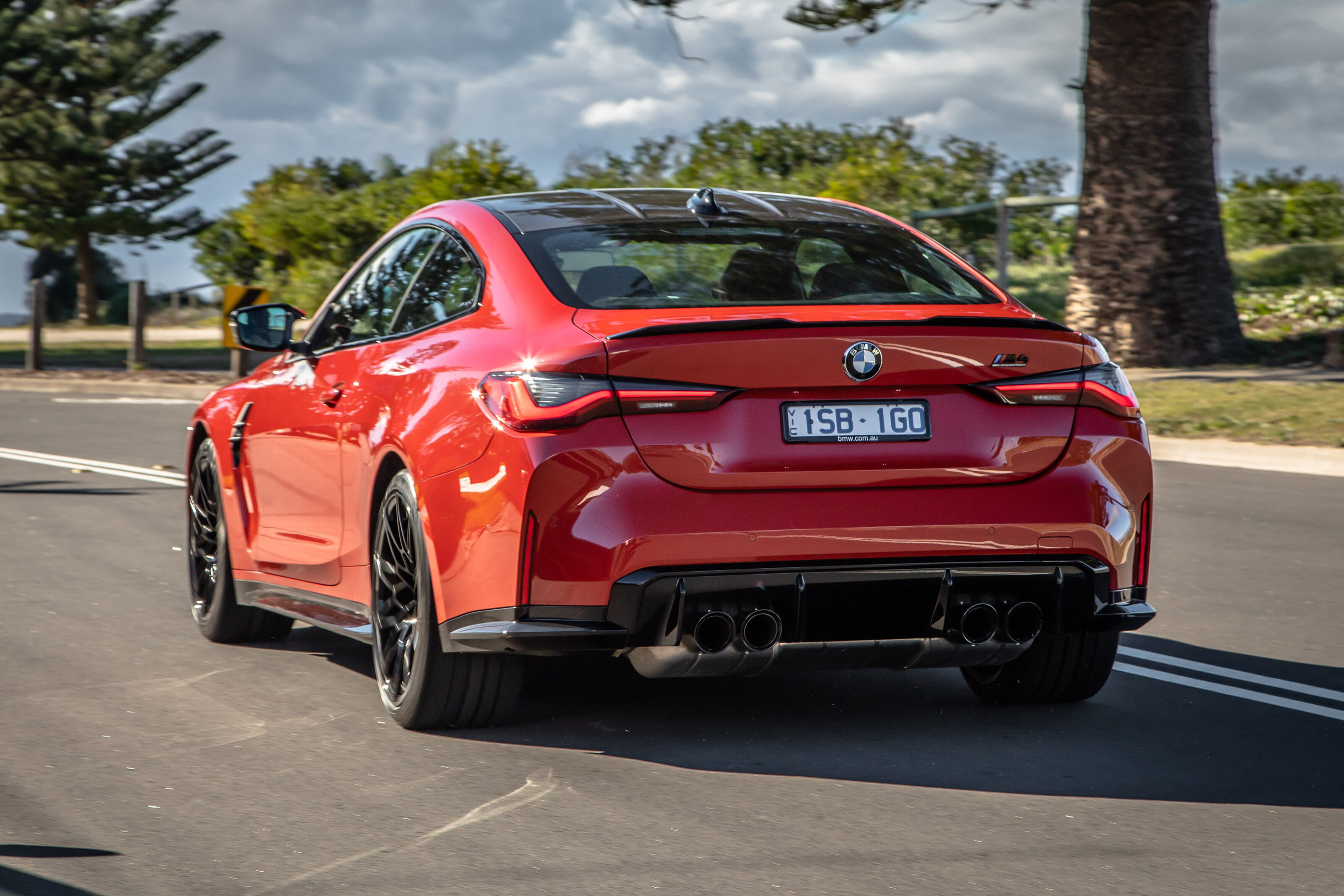
If it matters, it won’t for long. A full throttle will light up the rears, even with everything turned on. The system quickly wrestles it all under control, but it’s hilarious and assures a short life before you can go and fit the tyres you want.
In M Dynamic Mode (MDM), it will cheerfully step out a few degrees to remind you that you’re alive and that 650Nm will toss you into the scenery if you go without the nannies. It doesn’t feel anything like its 1700-plus kilograms when you’re on it, with a strong, positive turn-in and a rear end that goes with you if you want it to or tries to catch up with you if provoked.
The sheer thrust on corner exit is almost physically blinding, the rears gripping and grinding into the road surface and draining the blood to the back of your skull. I found myself involuntarily holding back from full throttle because two-thirds felt like enough. It’s wild but in a controlled, sophisticated way.
Fundamentally, this car is properly rowdy. Like the M2 that reignited M’s sense of humour, the M4 is a party animal, but without the chemical assistance.
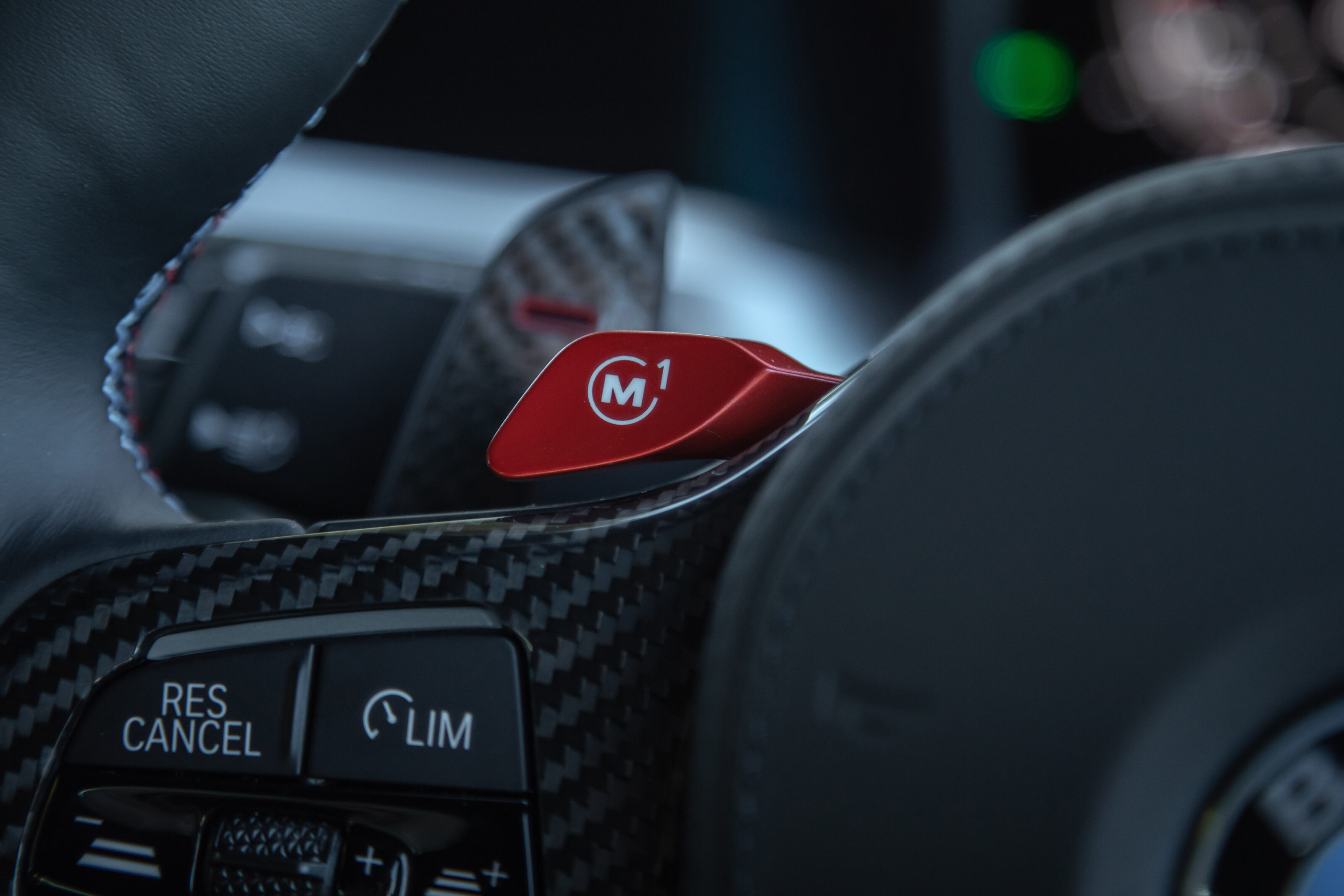
With the change to the ZF eight-speed, though, we have lost a little something. The seven-speed may not have been as good as, say, Audi’s in the R8, but it certainly delivered entertainment in the form of super-fast and firm shifts. The shift in the new M4 is softer and less responsive than I would like when I pull the paddle.
Too often I was bouncing off the rev-limiter madly screaming at the shift paddle I’d just pulled. It’s probably something you get used to – like the pre-emptive lift on the old single-clutch SMG – but the shift has lost that sense of mechanical precision it had before.
Is the ZF superior, though? Yes. Like the rest of the car, it’s much more friendly on the day-to-day and a large part of that is down to the shunt-less driving experience when you’re just bumbling about.
Some folks will complain that Sport Plus suspension and steering are far too heavy for the road and they are absolutely correct. Anything but blemish-free Tarmac makes the ride very hard and doesn’t really step things up the number of notches you might expect. The steering is just plain heavy, so kind of pointless. Thankfully, nobody is holding a gun to your head to use either on the road.
Ownership
Like the rest of the BMW range, the M4 is subject to the increasingly inadequate three years/unlimited-kilometre warranty that it shares (conceptually at least) with Audi.
Mercedes – including AMG – went to five years last year and even Jaguar will sling you a five-year warranty, while Lexus will do four. Complex cars like this need to have longer warranties and it’s not like you’re not paying a ton of money for it.
You can pre-pay your servicing under BMW’s BSI program. For $3810 or $762 per visit, your first five services (every 12 months/15,000km) are covered and the scheme is reasonably generous.
A BSI Plus package is also available for substantially more money but is probably not particularly good value given you won’t need a clutch and wiper blades aren’t that expensive. By all means, terrorise your BMW dealer to bring down the price to something more sensible.
VERDICT
BMW had a little breather with the last-gen car. Again, it wasn’t bad – not a by long shot – but it wasn’t until the frighteningly expensive but oh-so-brilliant CS version that it really found its feet.
This new car has had a shot of whatever went into the M2 and the M4 CS and it’s brilliant for it. I honestly can’t think of why you’d spend more either on a C63 or – whisper it – a Cayman GTS unless you really, really, really can feel the difference on the road.
There isn’t a dud M car in its passenger car range. They’re all a barrel of laughs and they’re all hooligans and all the better for it. The M4 and its M3 sibling have completed the set.
2021 BMW M4 Competition specifications
| Body: | 2-door coupe |
|---|---|
| Drive: | RWD |
| Engine: | 3.0-litre twin-turbo straight-six |
| Transmission: | eight-speed automatic |
| Power: | 375kW @ 5510-7500rpm |
| Torque: | 650Nm @ 2700-5510rpm |
| Bore stroke: | 82 x 94.6mm |
| Compression ratio: | 11.0:1 |
| 0-100km/h: | 3.9sec (claimed) |
| Fuel consumption: | 10.2L/100km (combined) |
| Weight: | 1725kg |
| Suspension: | MacPherson strut front / multi-link rear |
| L/W/H: | 4794/1887/1393mm |
| Wheelbase: | 2857mm |
| Brakes: | 380mm (front) / 370mm (rear) |
| Tyres: | 275/35R19 (front) / 285/30R20 (rear) |
| Wheels: | 19-inch (front) / 20-inch (rear) |
| Price: | $159,900 + ORC |
Snapshot
- Bought by the late Beatles guitarist in 1967
- Powered by 6.3L V8
- One of several Mercedes cars owned by Harrison
A Mercedes 600 once owned by George Harrison will go under the hammer this week in a UK auction.
Harrison bought the flagship car from Mercedes GB in 1967, during the height of the Beatles’s popularity. Numerous photos show the guitarist in and around the 600 in the subsequent years.
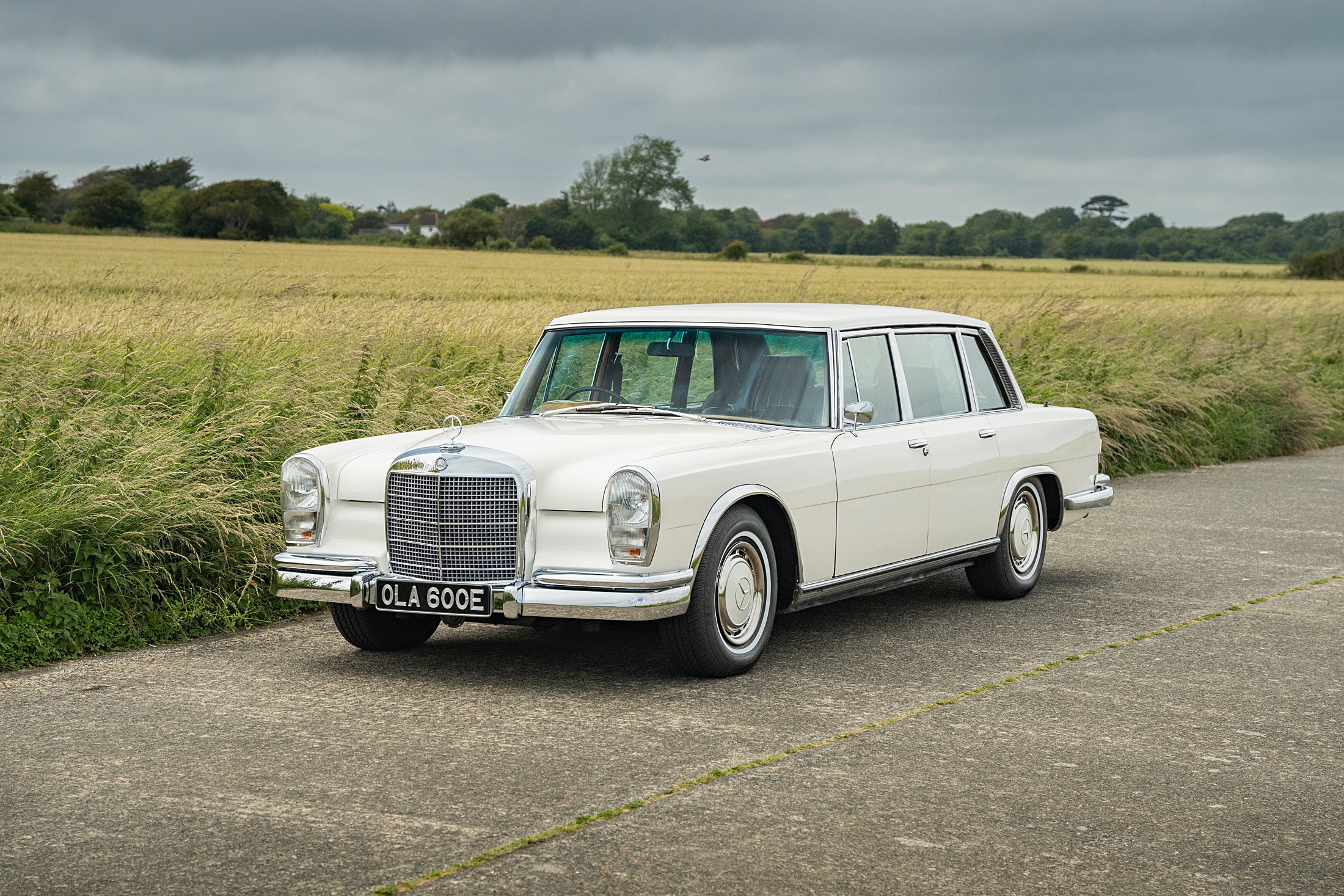
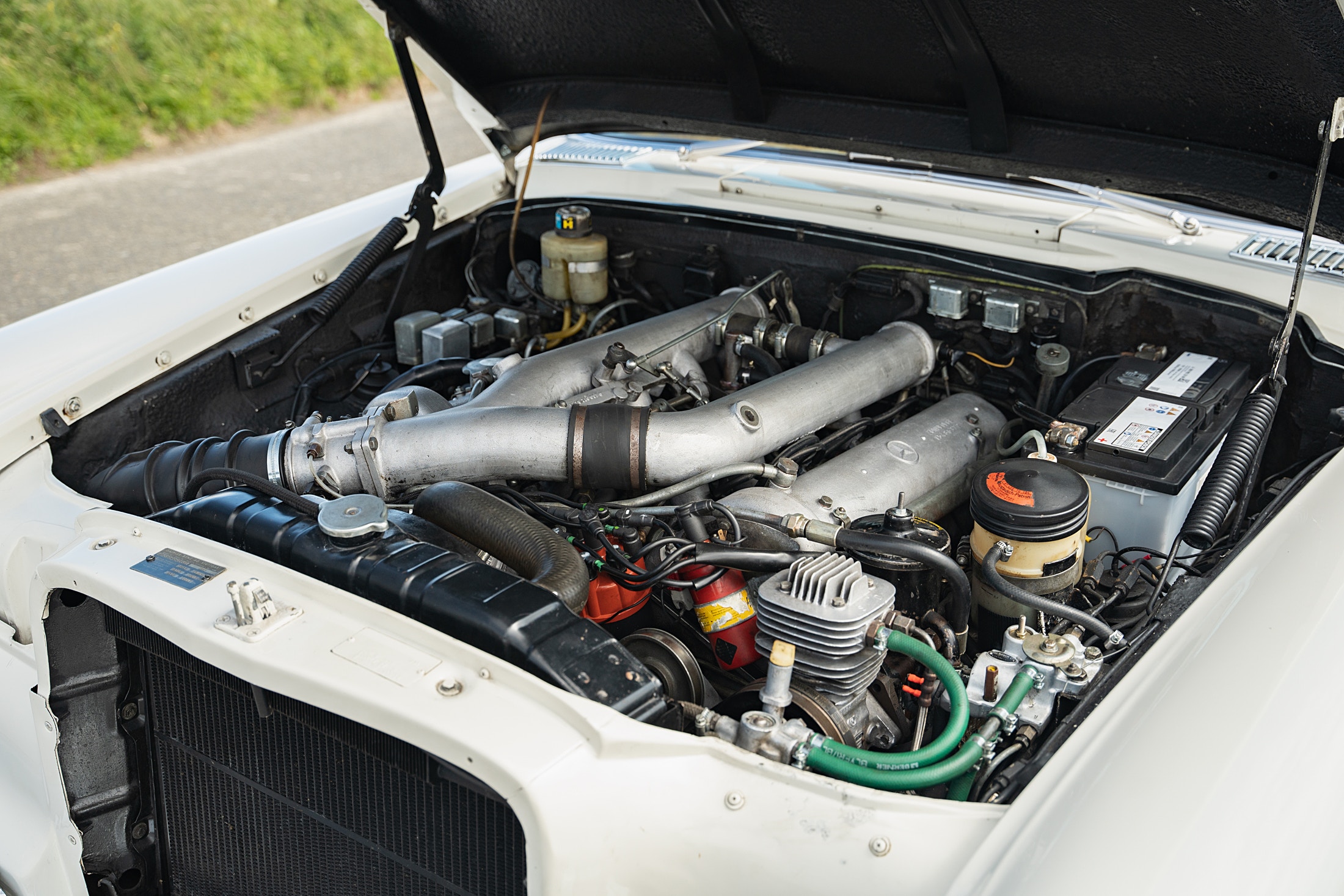
One of just 2190 made, the 600 was used as a demonstrator vehicle before Harrison’s ownership. It’s powered by a 6.2-litre M100 V8 which uses mechanical fuel injection, paired to a four-speed auto.
Luxury features on the W100-generation Mercedes include self-levelling air suspension, and a hydraulic system which allows the power windows, sunroof, seats and automatic doors to operate silently.
It’s currently owned by London-based businessman Sukhpal Singh Alhuwalia, who is selling off his car collection in preparation for a move to India.
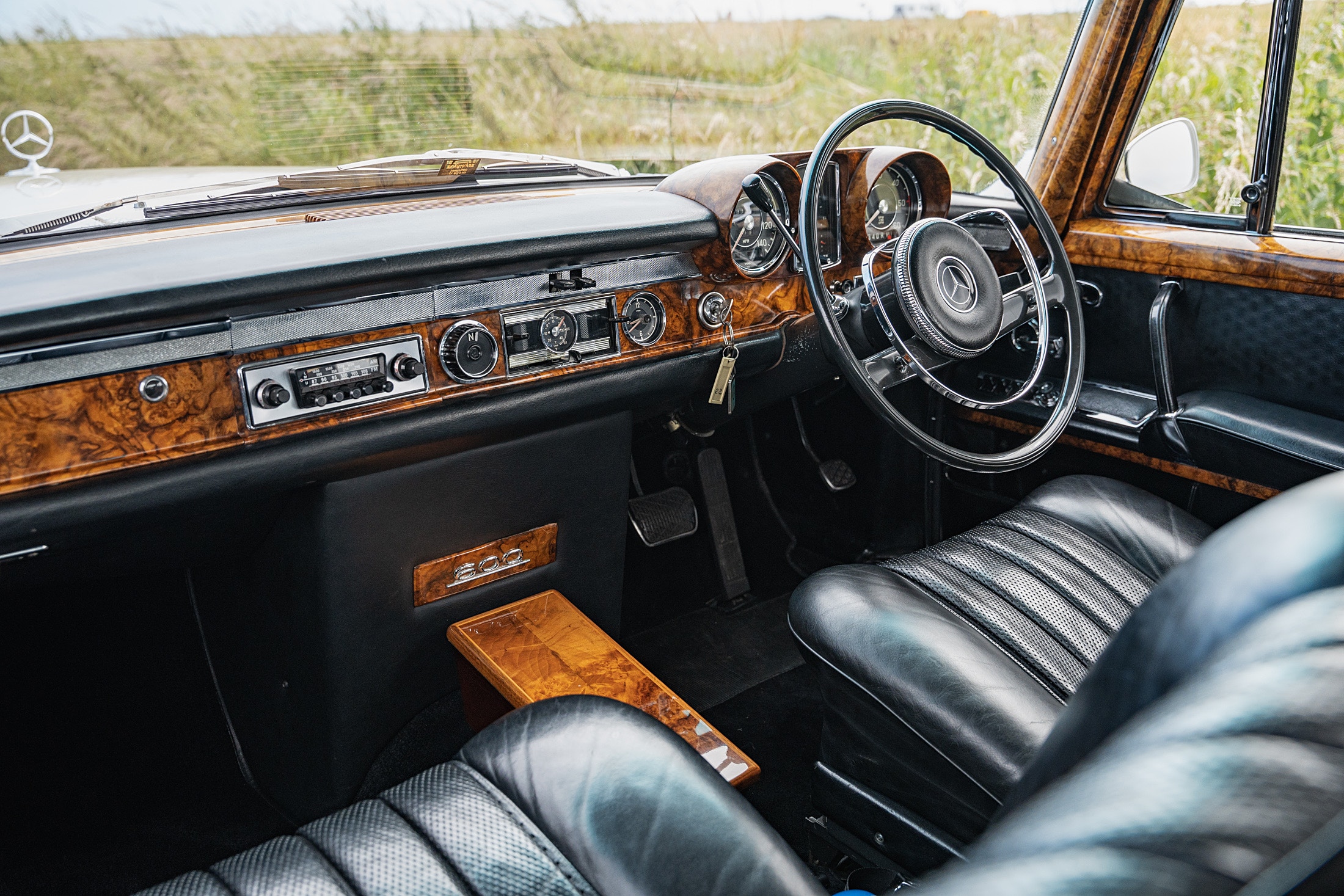
According to auctioneers Collecting Cars, the 600 was overhauled earlier this year by a West Sussex-based Mercedes expert. This included a GB£13,000 (AU$24,311) rebuild of the hydraulics, plus fresh gaskets, bolts and tyres. While the paintwork and chrome are believed to have been refinished sometime in the car’s history, the leather and woodgrain-packed interior is apparently untouched. There are 99,822 miles (160,647km) recorded on the odometer.
Forty hours currently remain on the auction. Nine bidders have so far raised the price to GB£80,000 (AU$149,593), though it’s likely to jump sharply over the next two days. In comparison, the cheapest Mercedes-Benz 600 currently listed on sale in Australia is priced at $209,950 – without any Fab Four connection.
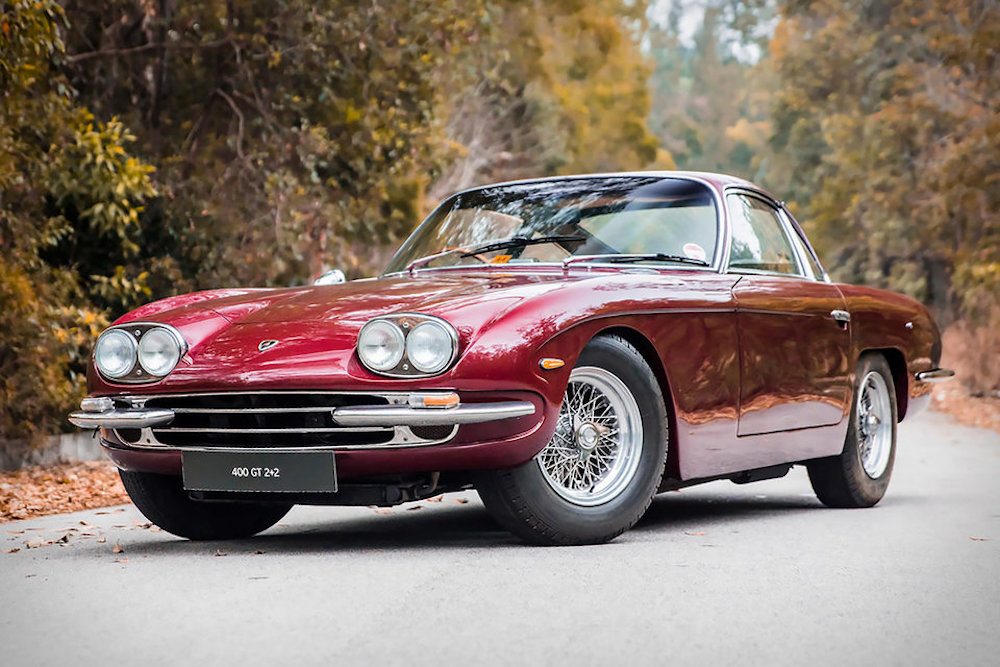
Other notable Beatles cars include Paul McCartney’s early Lamborghinis, John Lennon’s white Rolls-Royce Phantom V, and even an oddball Facel Vega coupe bought by Ringo Starr.
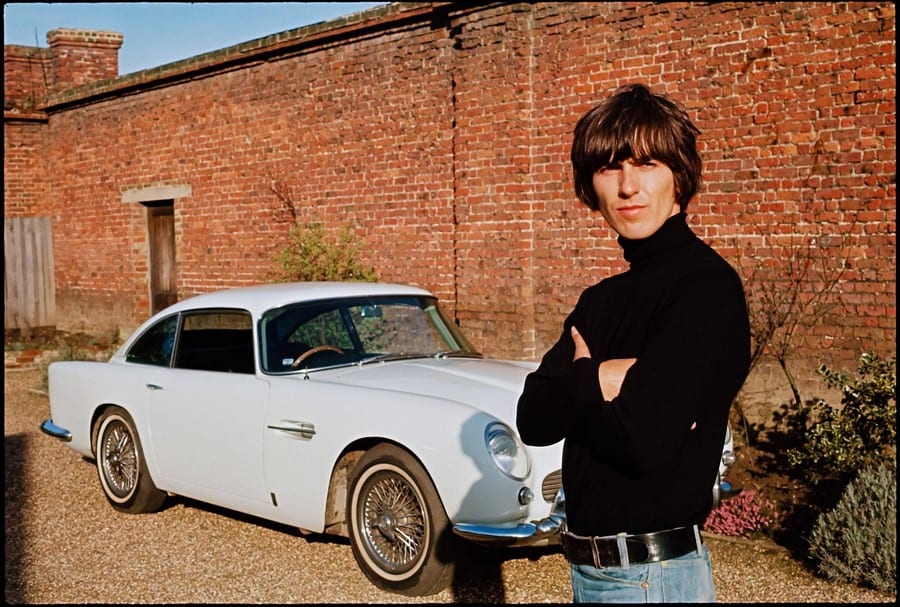
When it came to cars, however, Harrison was undeniably the most fanatical of the group. He drove a Jaguar E-type in 1964, believed to be a 21st birthday gift from manager Brian Epstein. He followed up in 1965 with the purchase of a white Aston-Martin DB5. That car fetched GB£350,000 (AU$654,608) at auction in 2011.
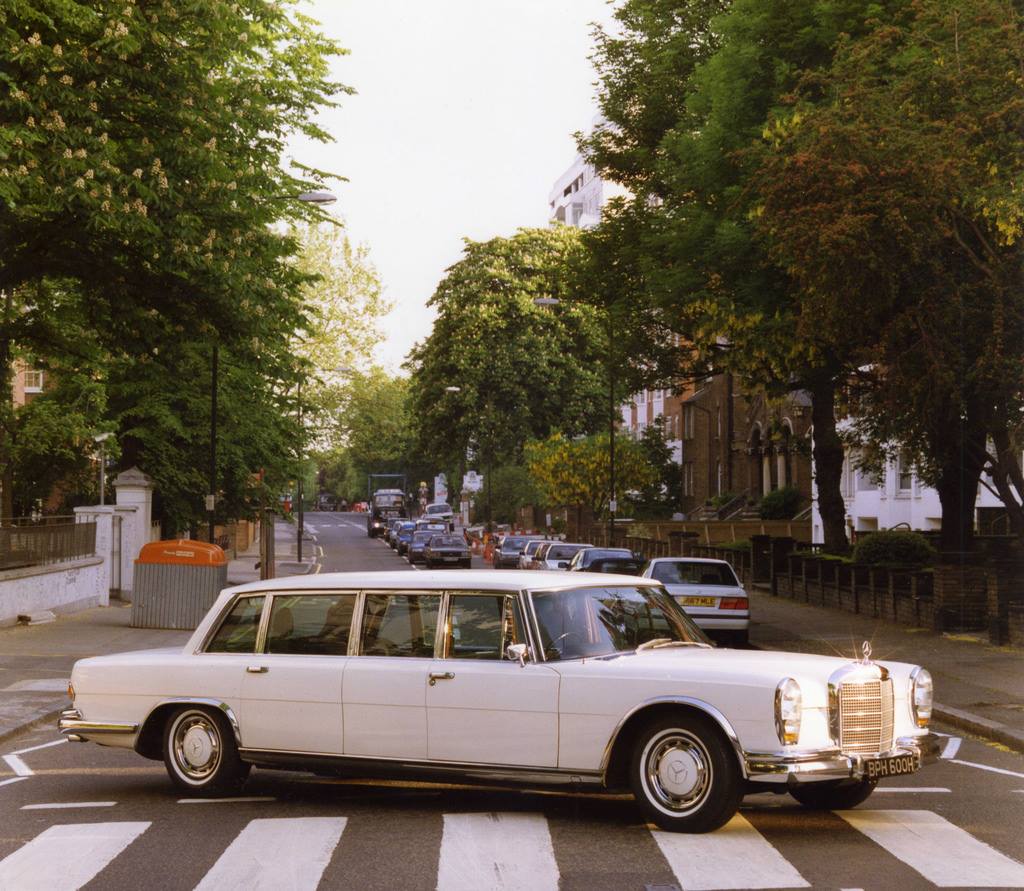
Aside from the aforementioned 600, Harrison maintained a love affair with several other high-end Mercedes cars. In fact, he owned another 600 in the form of a stretch-limo Pullman version, bought from John Lennon in 1971. That car eventually went to The Supremes in 1976 for a US tour.
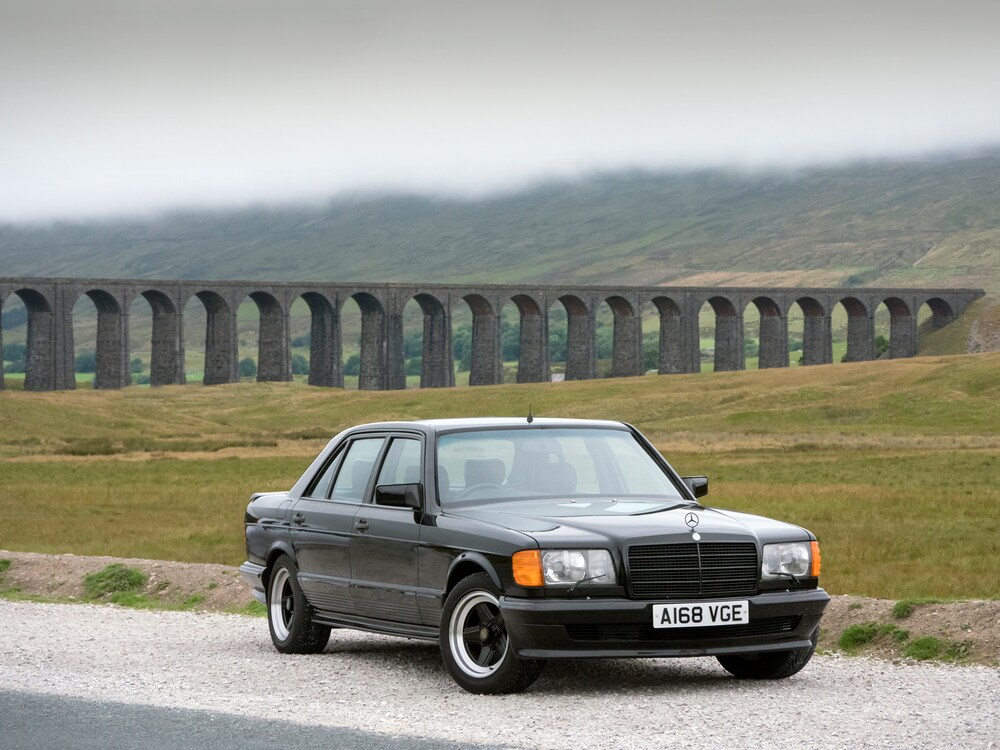
He bought a new 500SEL sedan in 1984, kitting it out with a range of AMG accessories. He owned the car until 2000, just a year before his death aged 58.
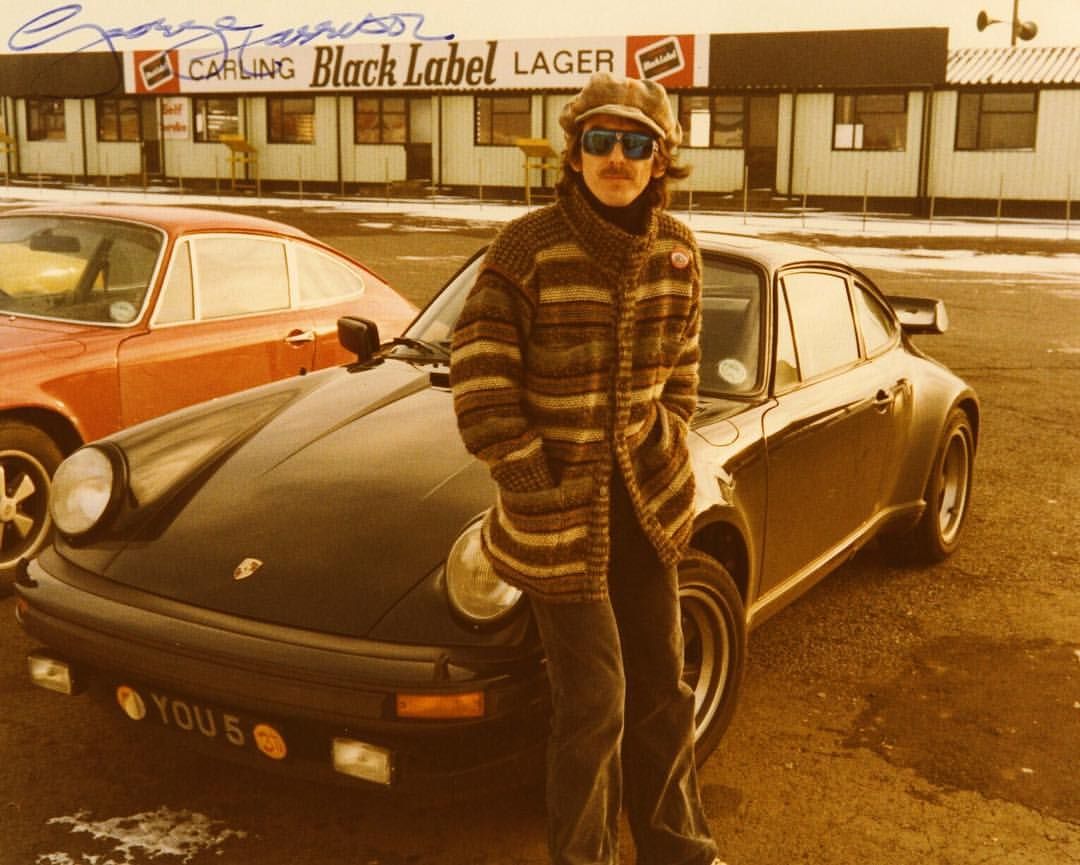
Other highlights include a Porsche 928S and two 911 Turbos, plus a McLaren F1 supercar still owned by the Harrison estate – despite the repeated efforts of close friend Eric Clapton to buy it in the 1990s.
Snapshot
- Heritage Edition trim available in 840i Coupu00e9, Gran Coupu00e9 and Convertible
- All vehicles to be powered by a 250kW/500Nm straight-six
- Variant to arrive in fourth quarter of 2021
BMW is honouring the 30th anniversary of the first 8 Series model arriving in Australia with a Heritage Edition variant of its luxury grand tourer.
Based on the six-cylinder, twin-turbo 840i, the Hertiage Edition packs the same power and torque numbers as the car it is based on – 250kW and 500Nm, with fuel consumption rated at 7.7L/100km – and is available as an option on the Coupé, Gran Coupé and Convertible body styles.
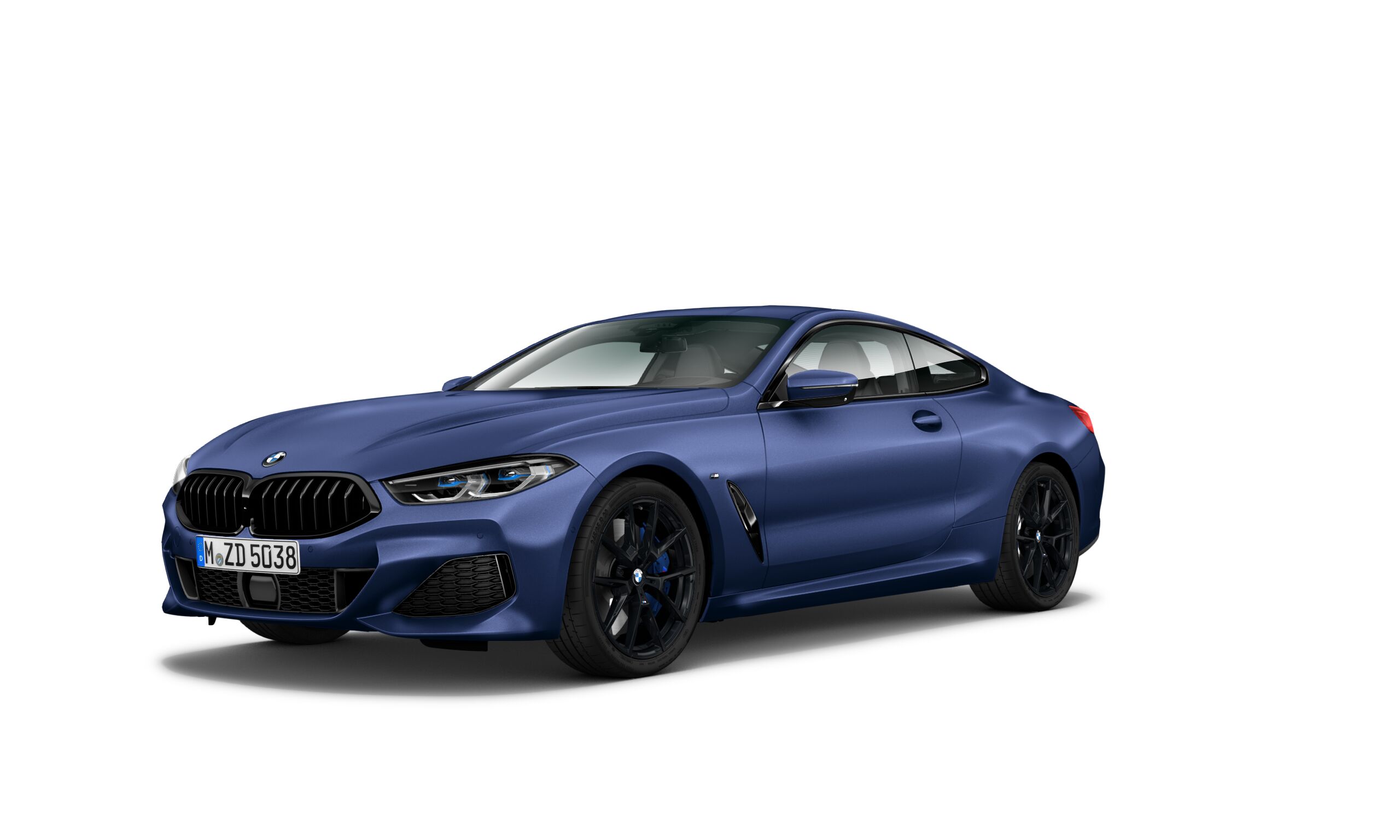
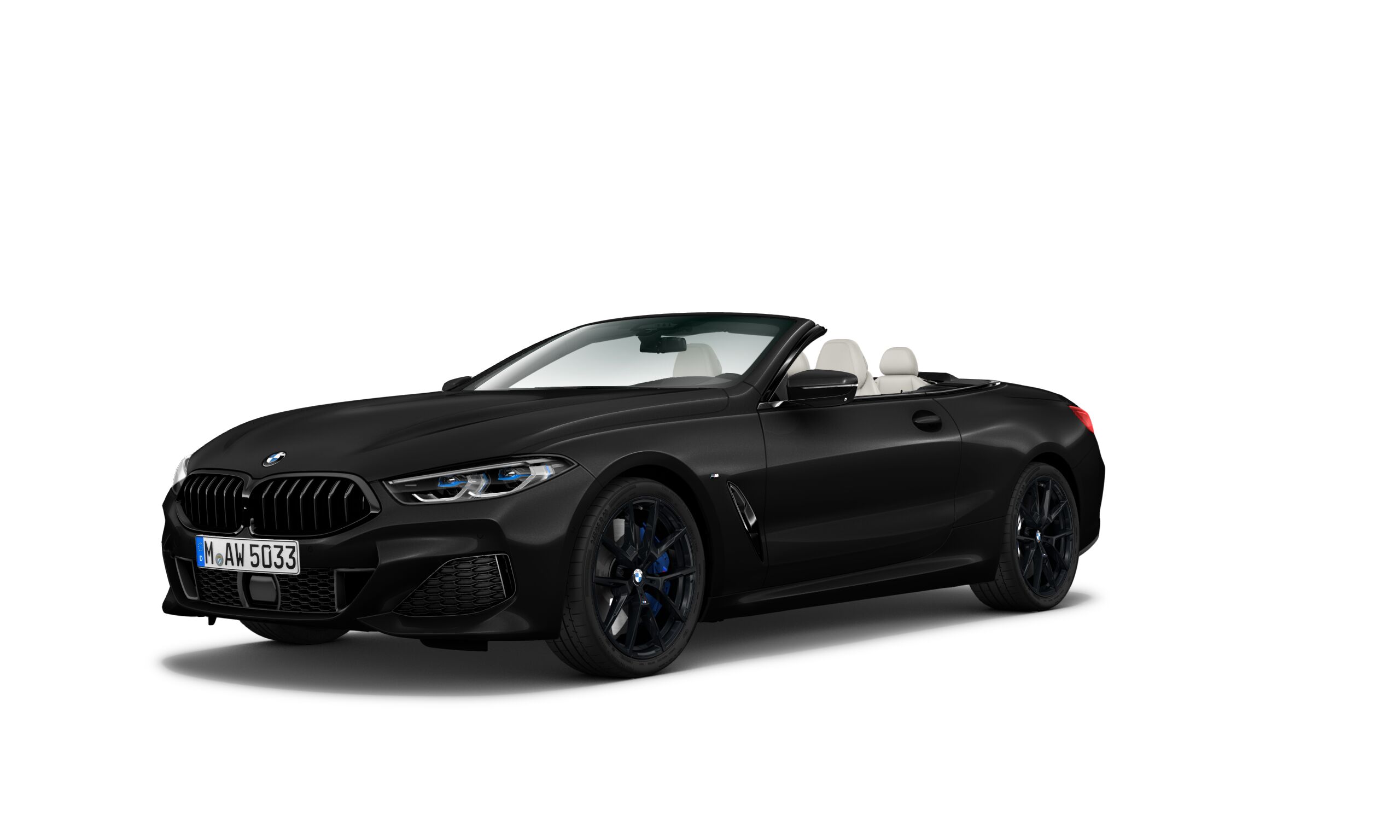
Setting the Heritage Edition, limited to just nine local units, apart from the standard 840i is the 20-inch M alloy wheels in 728M jet black, M Sport brake calipers and M black window trim, as well as a unique ‘Heritage Edition – 1/9″ badge on the centre console.
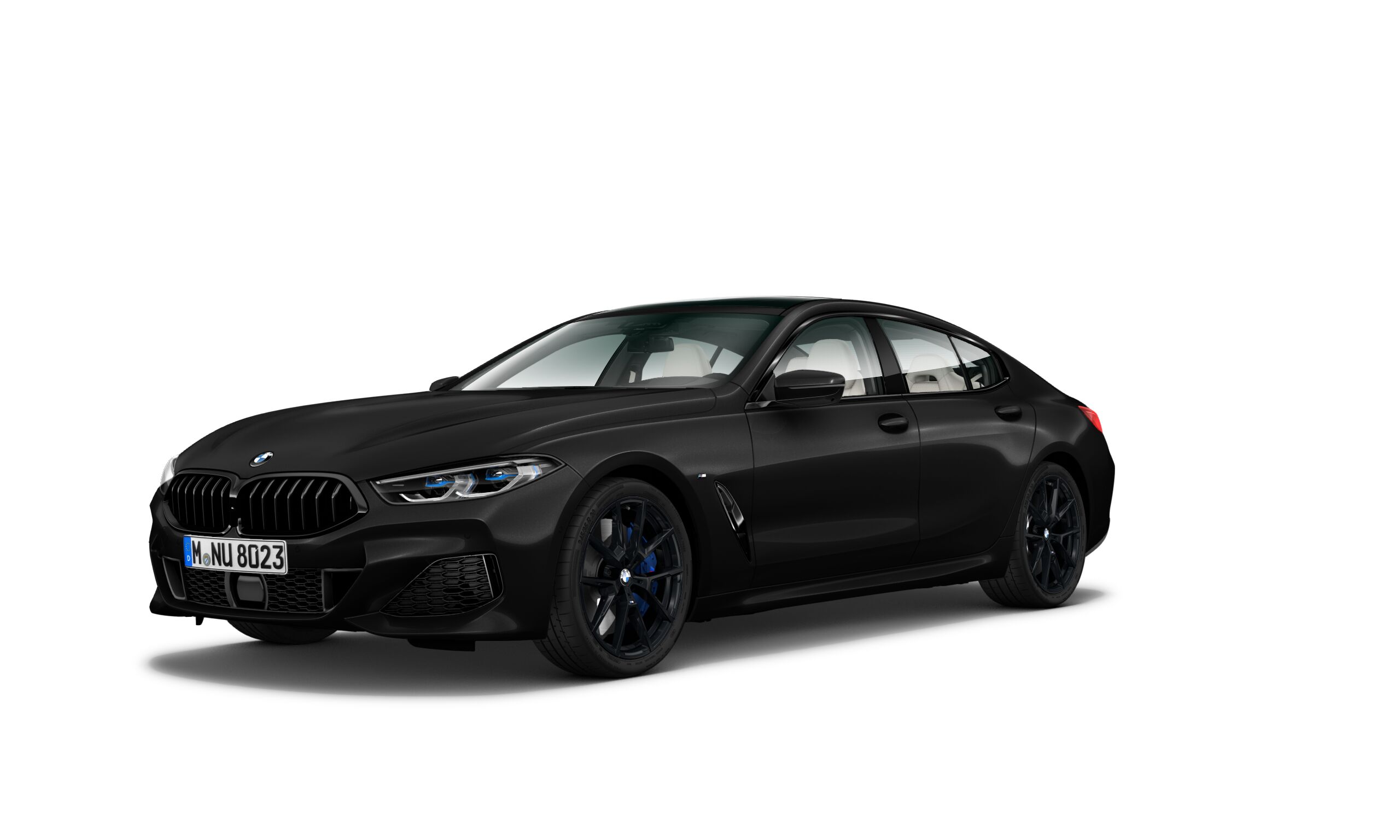
The asking price, before on-road costs, is increased by $10,429 on the regular 840i, reflective of the variant’s exclusivity and extra standard equipment.
| Gran Coupu00e9 Heritage Edition | $189,900 |
| Coupu00e9 Heritage Edition | $192,900 |
| Convertible Heritage Edition | $207,900 |
Just three paint finish and interior trim combinations are available on the Heritage Edition, giving owners the only chance to choose their own options:
| BMW Individual frozen marina bay blue/BMW Individual full-leather Merino black |
| BMW Individual frozen black/BMW Individual full-leather Merino ivory white |
| BMW Individual frozen dark silver/BMW Individual full-leather Merino Tartufo/black |
Standard equipment on the 840i Heritage Edition includes; Walknappa leather on the instrument cluster and upper door trim, active seat ventilation, heated seats, heated armrests, soft-close doors and a 464-watt Harmon Kardon surround sound system.
BMW’s driver assistance systems are also fitted as standard, such as; a head-up display, parking assistant plus – including active park distance control, reversing assistant and 3D view – and driving assistant professional which integrates active cruise control with stop/go, as well as steering and lane control assistants.
The first deliveries of the Heritage Edition are expected to arrive in the fourth quarter of 2021.
The past fortnight has seen unprecedented flooding in Germany and its surrounding countries, leaving thousands of people without homes and hundreds missing – while the death toll has now surpassed 180.
To assist with emergency aid in the affected regions of North Rhine-Westphalia, Rhineland-Palatinate, and Upper Bavaria, BMW and Porsche have each made sizeable financial donations to help rescue organisations in the area, totalling €2.5million (AU$4m).
BMW’s donation is the largest of the two, making €1.5m (AU$2.4m) available to local rescue groups, which will help to provide targeted assistance in the worst-affected areas, and also offering resources from its plants in Munich, Landshut, Dingolfing, Regensburg and Leipzig to emergency services.

Porsche’s contribution to the relief comes from €1m (AU$1.6m) in funding to local aid services for flood victims and rescue crews, as well as also appealing to its own employees to make private donations to support those affected.
As flooding has affected the village of Nürburg, the nearby world-famous Nürburgring circuit has been opened as a hub for support services working to assist those affected in the area, with Porsche chairman Oliver Blume saying the motorsport community has rallied around the region.
“We are in close contact with our friends and partners,” said Blume.

“We know that the situation there is desperate. Many have been affected themselves or are volunteering as relief workers. So it is all the more important we pull together now.
“Our motorsport colleagues took emergency generators and other relief supplies to the Eifel region as soon as the news broke, for example. Our donations will now provide additional help to alleviate some of the suffering.”
Bridge to Gantry, a forum and news site dedicated to the Nürburgring, reports a collection point has been set up at the circuit for clothes and homeware while the local council of Adenau has opened an account for donations to assist with recovery services.
Snapshot
- 60 vehicles involved in recall
- Compliance plate shows an incorrect GVM
- Production dates range from March to June 2021
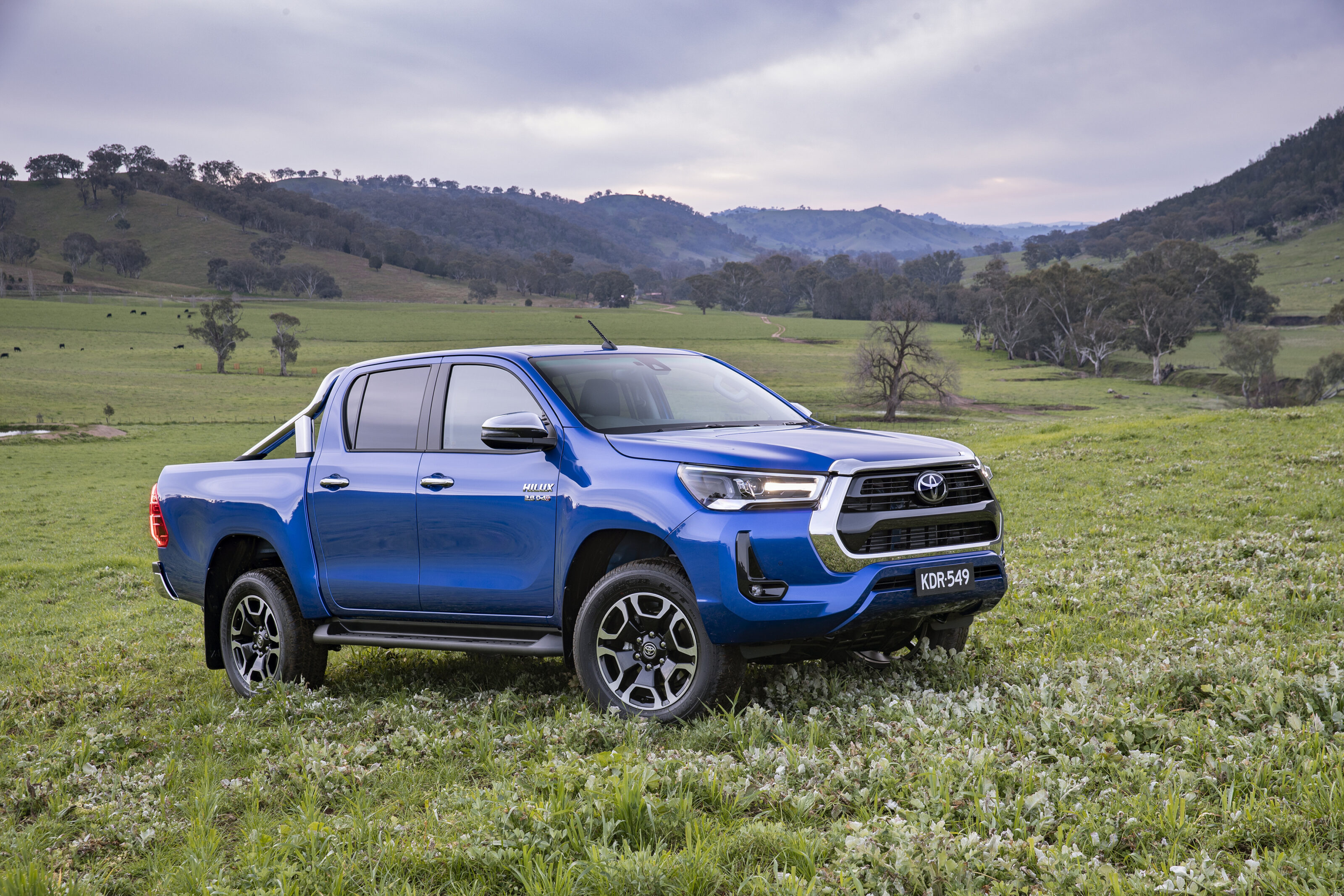
Toyota Australia has issued a recall notice for 60 of its HiLux models due to an incorrectly printed second stage compliance label, providing the wrong Gross Vehicle Mass (GVM) for the affected vehicles.
Units affected were produced between March and June 2021, with the recall only applying to the 4×2 SR5 Hi-Rider, 4×4 SR5, Rogue and Rugged X variants.
Toyota says 58 of the 60 vehicles show a GVM of 3000kg instead of the correct 3050kg, while the remaining two units also show a GVM of 3000kg despite the actual figure being 2980kg.
While it is not an immediate safety issue, Toyota has urged all owners to keep their contact details up to date so they can be notified of the issue, offering to affix the correct label free of charge, a process which should take under half an hour.
Toyota’s recall campaign helpline is open from 8am-6pm Monday to Friday on 1800 987 366, allowing owners to check whether their vehicle is affected.
The VIN range of HiLuxs under recall can be found below:
- 4×2 SR5 Hi-Rider – AA3DD 00006595 – 00006596
- 4×4 SR5 – BA3CD 00043432 – 00133846
- 4×4 Rogue – BA3CD 00044848 – 00133321
- 4×4 Rugged X – BA3CD 00044928 – 00132988
The comprehensive effects of Covid-induced lockdowns on human populations remain largely unmeasured, but has anyone else noticed a drastic shift in their automotive interests over the past year and a bit?
Melbourne’s recent ‘circuit-breaker’ restrictions were a sharp reminder of the dire times in 2020, during which I realised that; in terms of the road-going vehicles I spend 90 per cent of time dreaming of owning, for the first time in my life, I’m not concerned with speed.
That feels like a big thing. Everyone here seems to know me as the ‘JDM guy’, or the ‘track day guy’, but in the midst of strict stay-at-home orders, my need for speed seems to wane like the very tempo of life.
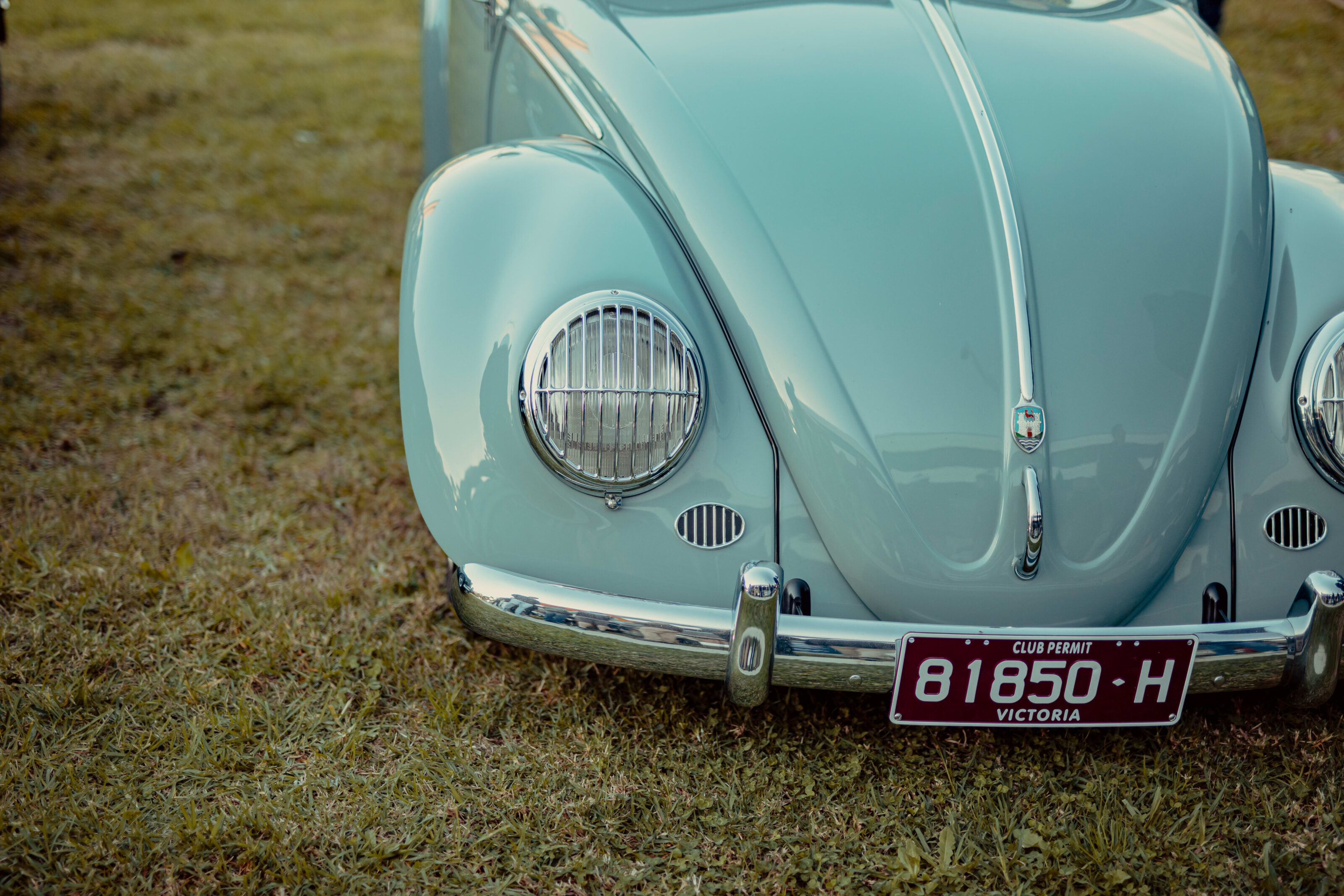
And it’s not like I was getting my fix elsewhere. Beyond the cars I’m so gracious to turn wheels in professionally, the notion of working for MOTOR wasn’t even on my radar this time last year.
I did, of course, have access to my heavily turbocharged 1990s imported Nissan sitting in the garage, but I think I only drove it once over Melbourne’s exhausting 112-day lockdown last year – simply to top up the petrol tank and make sure the tyres hadn’t gone flat. I needed to re-park at the fuel bowser three times because I had forgotten which side the filler cap was on…
Had my passion for cars diminished? Not so at all. The desire to drive, of course, was there; but with movement limited to ‘essential reasons’ within 5km of home (10km, for this most recent bout), the need certainly wasn’t.
I’m sure many fellow Melburnian car nuts can relate to emphatically volunteering for any ‘essential’ grocery run; any excuse to hop in, fire up the machine, and go for a short drive.
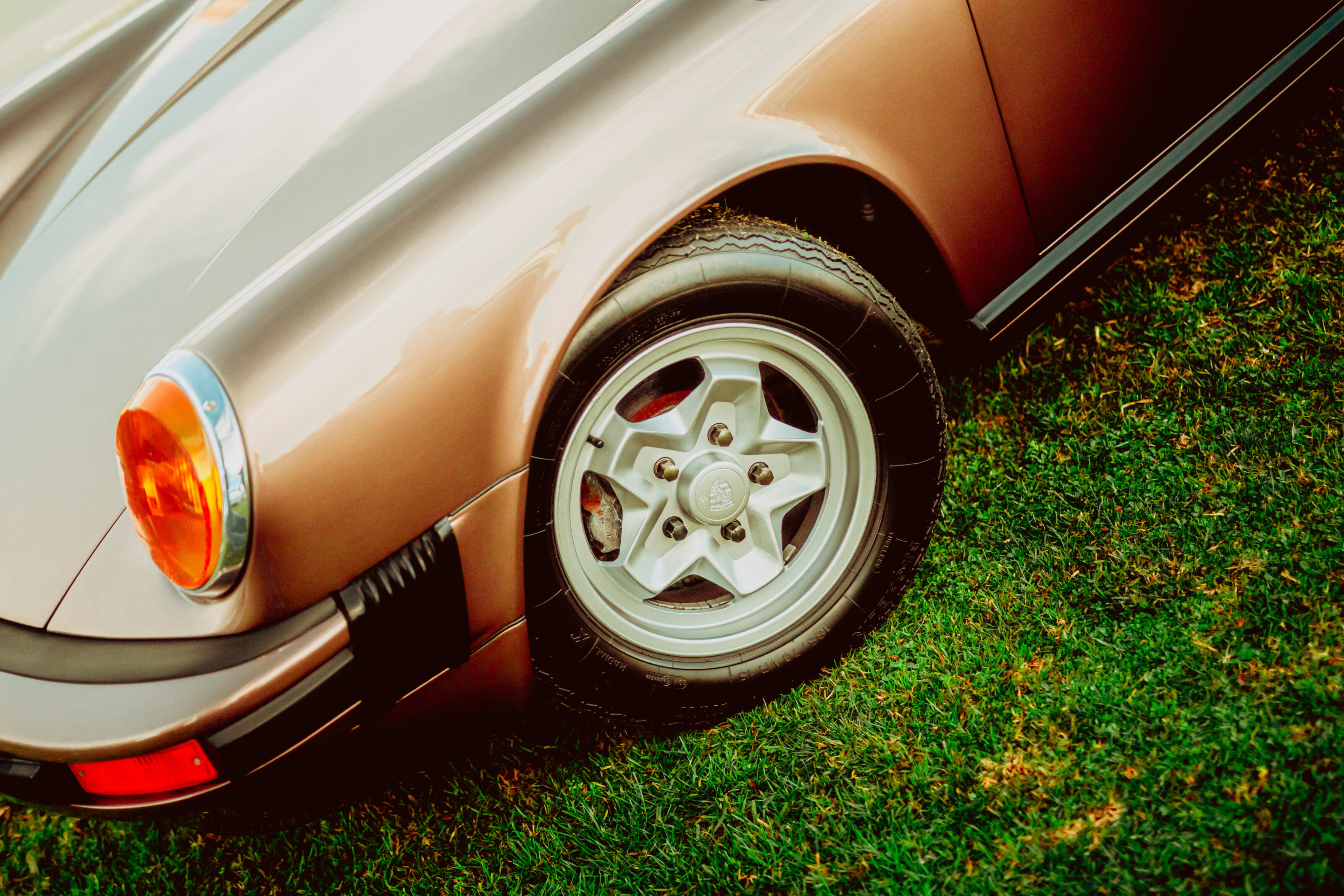
On those occasions, though, I’d forgo my beloved old Nissan as the slow-to-warm nature of its forged-internal inline-six meant it took longer to reach operating temperature than it did to physically reach Woolies.
Luckily, I had another steel chariot awaiting me: a 1970 Chevrolet C10 pick-up, the old Unique Cars shop truck whose keys were tossed at me as we were all sent home from the office on that fateful day in March.
Now, the small-block Chevy pick-up is possibly the most un-MOTOR car ever. Recirculating ball steering means a third of steering lock was needed before the squarebody so much as thought about changing direction, it would occasionally stall, and – even with a 5.7-litre crate engine under the bonnet – performance was not what you’d call brisk.
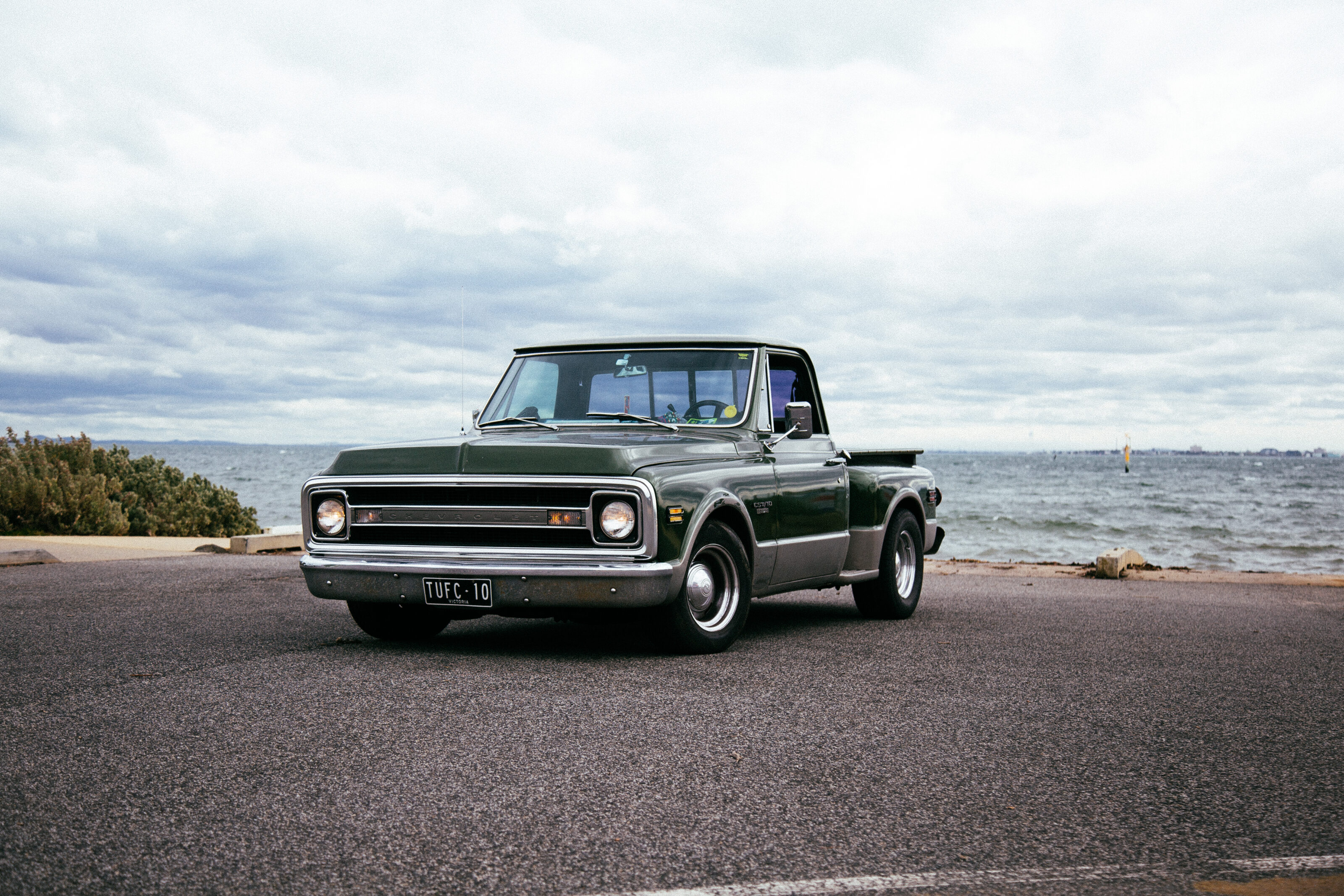
However, that 50-year old workhorse was a bright spot on an otherwise dark year, the perfect lazy companion for lockdown life in slow motion. It really seemed to reframe my automotive enthusiasm, too. I’ve always prided myself on appreciating all aspects of our four-wheeled fascinations, but I’d never yearned to own a properly old car like that before. It taught me to look for different things from a recreational road car which, up until this point in my life, has been all about speed.
Modern cars are faster than ever, but our road laws haven’t moved in line with the progress. So there’s certainly something to owning an older, slower, but perhaps more soulful machine. A booming second-hand car market indicates that many others have come around to this way of thinking, too.
Is there more at play here, though? Many are quick to point to a lack of international travel as the leading factor in a buoyant used car market, and they’re likely right. There was also a large cultural shift, too, as many sought solace in nostalgic things of the past as people rushed to old music, old movies; naturally seeking comfort from an unfamiliar new world in an era gone by.
The spirit of MOTOR is entrenched in the endless pursuit of progress and admiration for the most cutting-edge technology of today – a spiritual celebration of the act of driving. But is there a space in the MOTOR universe for cars like that old Chevy C10? If Covid has taught me anything it’s that perhaps there is joy to be found in slowing down.
Here’s to a very deliberate pause.