
Kia Australia is recalling almost 60,000 examples of both its QL Sportage and CK Stinger models over a problem with the Hydraulic Electronic Control Unit being at risk of catching fire.
The issue affects 56,203 QL Sportage models built between 2016 and 2021, and 1,648 CK Stingers manufactured between 2017 and 2019. In total the recall applies to 57,851 vehicles.
The fault involves the The Hydraulic Electronic Control Unit (HECU) which is responsible for the Anti-lock Braking System, Electronic Stability Control System and Traction Control System.
According to safety experts, the problem is, in the affected vehicles the HECU can remain live even when the vehicle is switched off. If moisture enters the HECU, the electrical unit could short circuit and catch fire even when the vehicle is switched off and parked.
Kia told WhichCar that no vehicles have caught fire in Australia, but could not confirm if the fault had caused any incidents overseas.
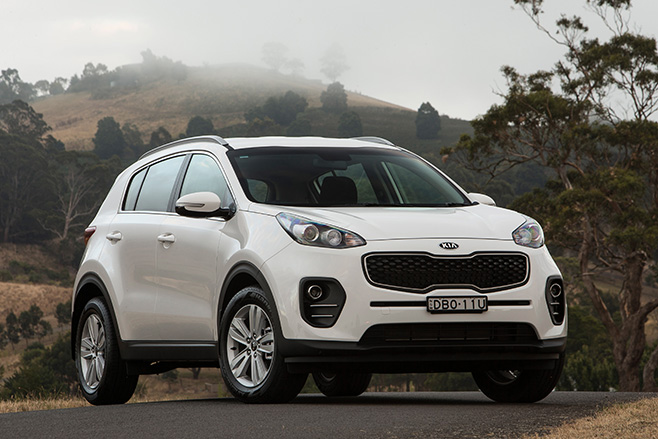
Kia Australia is contacting all known owners of affected vehicles by direct mail and asking them to contact their local Kia dealer to arrange for an inspection and repair. The repair takes 20 minutes and is free of charge.
A dealer can be located at: https://www.kia.com/au/shopping-tools/find-a-dealer.html
According to Kia the replacement part has started to be dispensed through its dealer network already and there will be no delay in fixing owners’ vehicles by waiting for parts.
Until the fault has been repaired, Kia urges owners not to park their car near any flammable structures or in an enclosed area, such as a garage but has confirmed vehicles are still safe to drive.
Speaking to WhichCar, Chief Operating Officer for Kia Motors Australia, Damien Meredith, said: “This is the same issue Hyundai had with its Tucson. It’s the same part. We notified Product Safety Australia [of Kia’s recall] three weeks ago and it just announced it to the public recently due to its own checks-and-balances. That’s just how long the process takes. We informed Product Safety Australia as soon as our head office let us know.
“I think the consumer understands recalls are an ongoing thing in the industry. I don’t think it has an effect if you’re upfront and honest. We have seen no correlation between recalls and a fall in sales.”
A list of VINs for affected vehicles is available here.
For further information, owners can contact Kia Motors Australia on 13 15 42.
Got a tip-off for a story? Get in touch: [email protected]
Ford Australia is recalling more than 300 of its 2019 Focus models over a fault with the wiring loom.
The manufacturer has issued the alert for 342 Focus models built between September 2018 and May 2019.
According to Product Safety Australia, the problem may cause the “transmission stud [to] chafe on the engine wiring loom”, and also cause the engine warning light to come on.
It added: “Damage to the wiring loom may lead to reduced engine power and engine stall. This can increase the risk of injury and death of vehicle occupants and other road users in an accident.”
A list of VINs of affected cars is available here.
Ford said it will contact owners of all affected vehicles to arrange for inspection and repair, free of charge.
For further information, owners should contact their local Ford dealer which can be found at https://www.ford.com.au/dealership/ or contact Ford’s Customer Relationship Centre on 1800 503 672.
Got a tip-off for a story? Get in touch: [email protected]
The AMG Performance Studio in Affalterbach didn’t leave us expecting very much. A studio is where you go to get a demi-wave or a manicure. It signally lacks the race-honed grittiness of a garage, a workshop or better still, a skunk works. AMG didn’t help themselves either, their initial press material crowing about how the studio could sell piano black plastic dash fillets for your S-Class. It’s hardly the stuff of legend.
And then in 2006, with little to no fanfare, the Mercedes-Benz SLK 55 Black Series appeared. The SLK 55 AMG’s 5.4-litre atmo V8 had been tweaked from 268 to 294kW thanks to a new inlet manifold, tweaked valve timing and a racier exhaust, the seven-speed automatic box was sharpened for more brutal upshifts, the suspension was beefed up for better body control, and huge brakes lurked behind each of the 19-inch P-Zero Corsa-shod alloy wheels. The sprint to 200km/h dropped from the 55’s 17.5 second figure to just 15.5 seconds. That still stands up pretty well today.
That alone would probably have been enough to pique our attention, but AMG had gone a lot further. It had contracted Austrian ski manufacturer Fischer to replace the heavy folding hard top roof mechanism with a lightweight carbon fixed shell and decked the cabin out in carbon fibre and hard-shell Recaro buckets. It was a true little monster and drove a lot better than the SLK’s slightly fey reputation would suggest, with a hammering 520Nm – although the nose-heavy weight distribution was a killer for front wishbones and bushes.
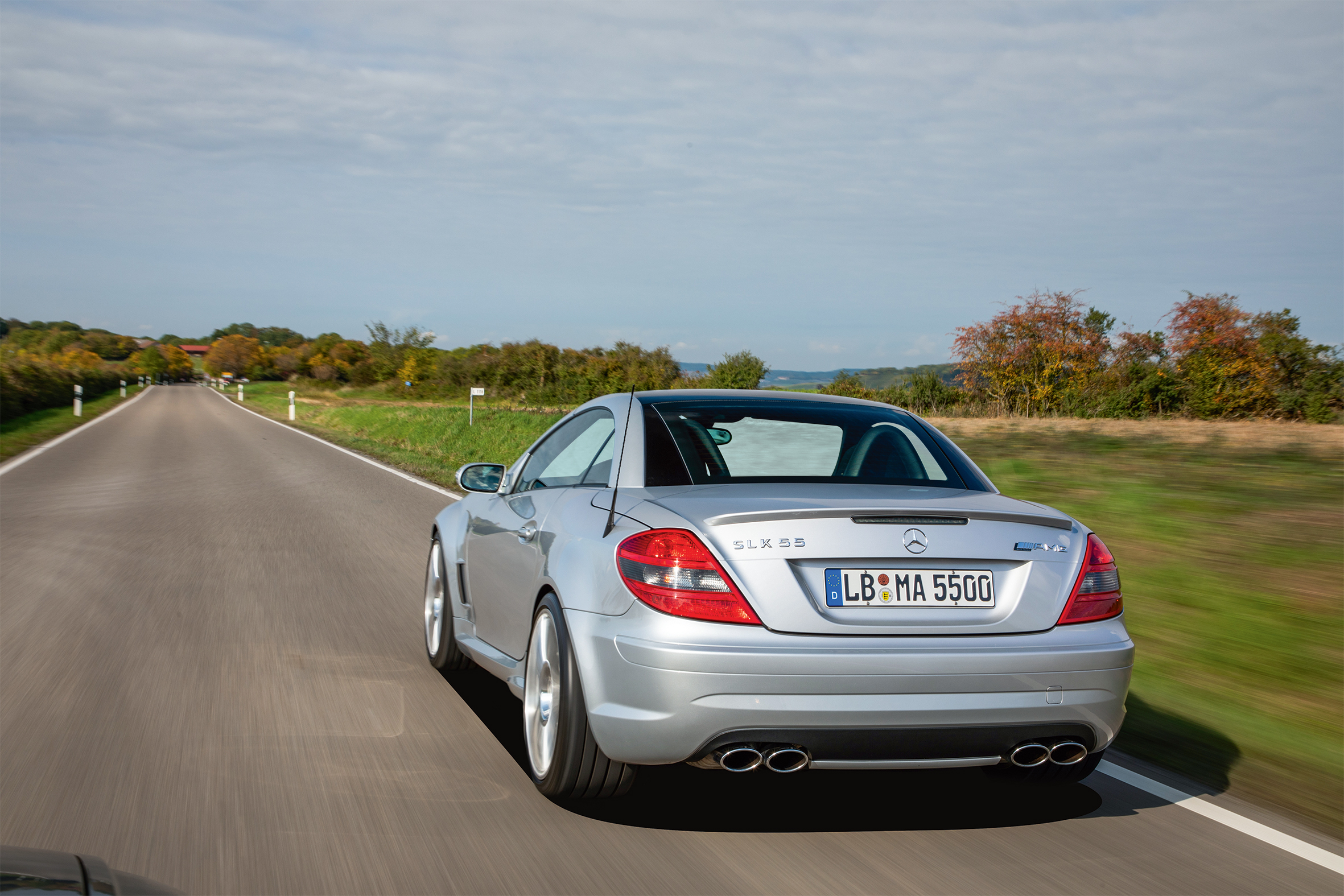
Despite all the carbon parts, the Black Series still weighed 1495kg, just 45 kegs less than the standard 55, which is a fair whack for a car that measures just 4089mm stem-to-stern, or about the same as a Fiesta ST. Its pricing was also well into Porsche 911 territory. It’s perhaps unsurprising that only 120 found buyers, and prices today reflect that fact, with decent cars changing hands for 150K in Europe.
As good as the 5.4-litre M113 V8 was, it was rapidly eclipsed by an engine that motored straight into the hall of fame; AMG’s legendary 6.2-litre M156. Shoehorning this beneath the bonnet of the CLK 63 Black Series, the first of the Black line that was officially sold into Australia, might have created a legend. A sliver of the 700-unit production run made their way to these shores in 2007, shouldering a $299,000 price tag.
The CLK Black’s problem was that despite the atmo M156 being tweaked from 354 to 373kW, it followed on the heels of the supercharged 428kW CLK DTM AMG (2004-2006), so the Black had something of a wash of penultimate about it. You see, back then, Mercedes had a line above Black, which was dubbed Signature Series, of which the DTM was but one. That’s perhaps why these early Black models are viewed by the market as slightly quirky things. Their message and positioning were never crystal clear. Was the CLK Black a 911 GT3 rival? If so, why pair carbon-composite brakes and F1 safety car styling with a seven-speed automatic transmission?
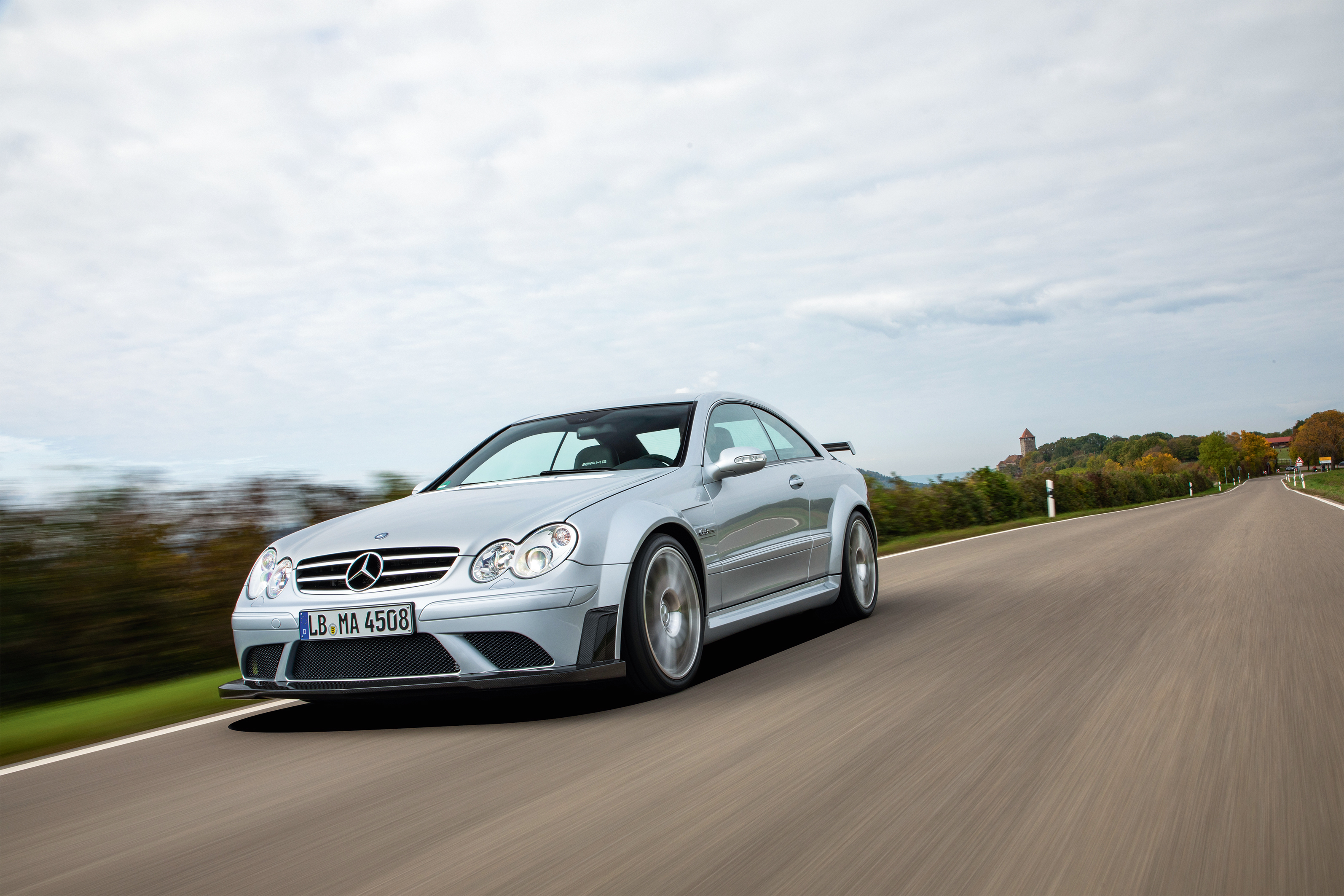
Straight-line pace is hard to fault. I strapped timing gear to the CLK Black and recorded a 4.1 second 0-100km/h time, which was pretty much bang on top of a contemporary 997 GT3 and better than the 4.3 second official timing. While I didn’t get the chance to explore the 300km/h top-end capability of the CLK Black, the rest of the package was well engineered with revised axles, expensive coilovers, sharper steering, 19-inch forged wheels, and a somewhat stripped cabin.
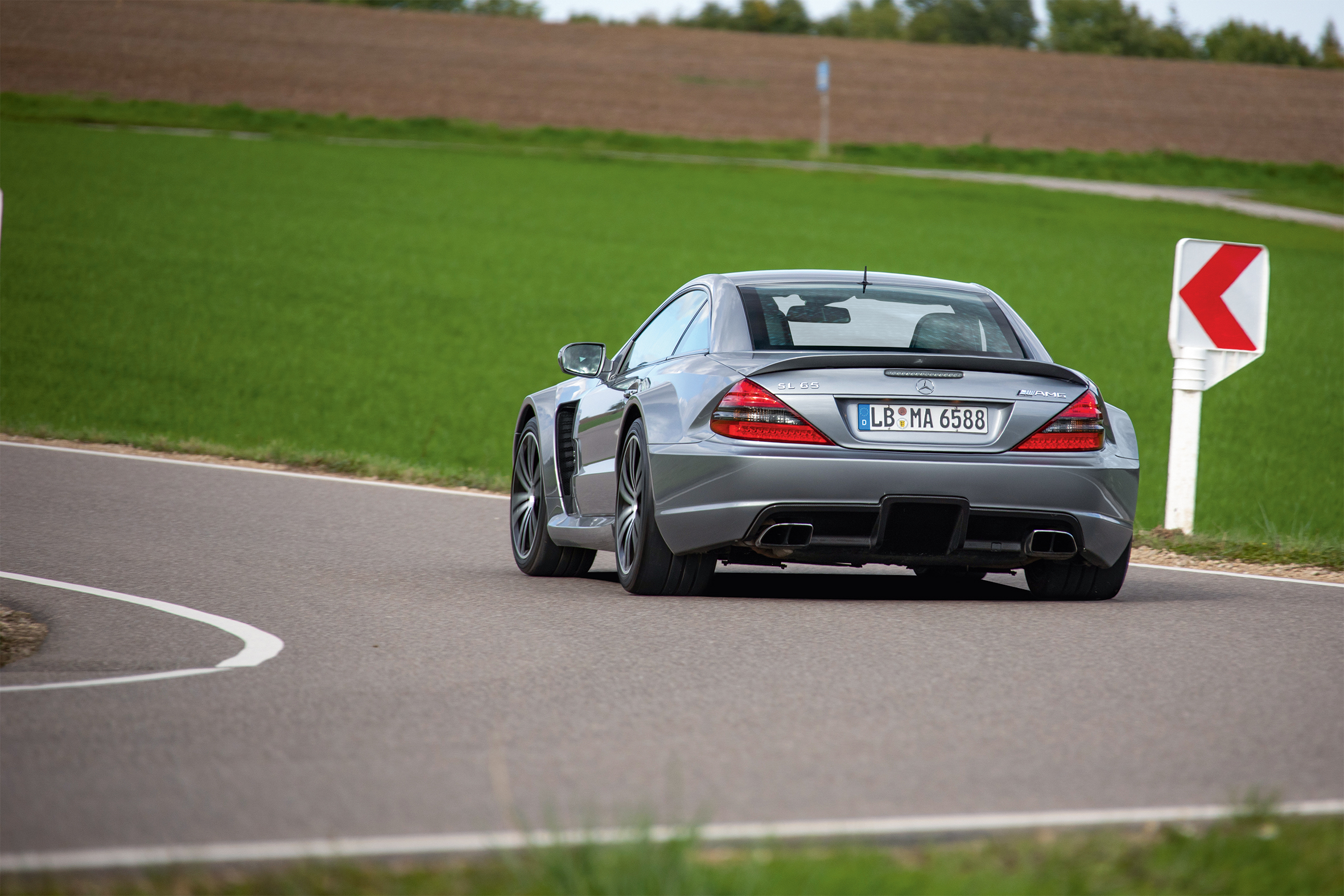
There was nothing second fiddle about what came next. In 2008 AMG didn’t just up the ante, it changed the rules of the game. With the SL 65 AMG Black Series, Affalterbach certainly went large. At a time when the flagship Lamborghini Murcielago LP670-4 SV could hick up 660Nm before it turned itself inside out, the SL rolled out an easy 1000Nm of 6.0-litre V12 twin-turbocharged grunt. Until the current AMG GT Black Series, this was the only turbocharged Black model. The SL Black was more than the brawn, the 493kW or the 3.8 second sprint to 100km/h. Above all, it was about how thoroughly AMG set about deconstructing Benz’s boulevardier, before transforming it into something malevolent. Here at last was a car that lived the Black badge.
A massive 250kg was shorn from the standard SL 65 AMG, with a fixed carbon-fibre roof, along with composites for the bonnet, boot lid, front wings and rear apron. More than anything it was the SL Black’s stance that set it apart. The front and rear tracks were punched out and shrouded in angular wheelarch flares, the bodywork was liberally hole-punched to massage air in and out before finally macerating it with a rear-mounted fixed aerofoil.
It took four full years for AMG to try to come back from that level of overkill. The SL had changed the public perception of what a Black Series product represented, and expectation was through the roof for the 2012 C63 AMG Coupe Black. Packing 380kW and 620Nm and priced at $245,000, it was no shrinking violet.
The 6.2-litre powerplant borrowed a lot of tech from the SLS project, including forged rods and pistons, a lighter crankshaft and a smarter ECU. The transmission also came in for some love, with a beefier version of the seven-speed auto with AMG’s clutch pack appended to it.
Surprisingly, after the SL, carbon brakes weren’t fitted as standard, and it tipped the scales at 1635kg, even after the rear seats had been ejected. It looked brutal though, with a delightful blending of the C-Class coupe’s slightly voluptuous roofline with a pugnacious stance that had a DTM look, the front tracks widening by 56mm and the rears by a massive 84mm. Six-click coilovers offered track-day fiends something to fiddle with before the almost inevitable return to factory settings.
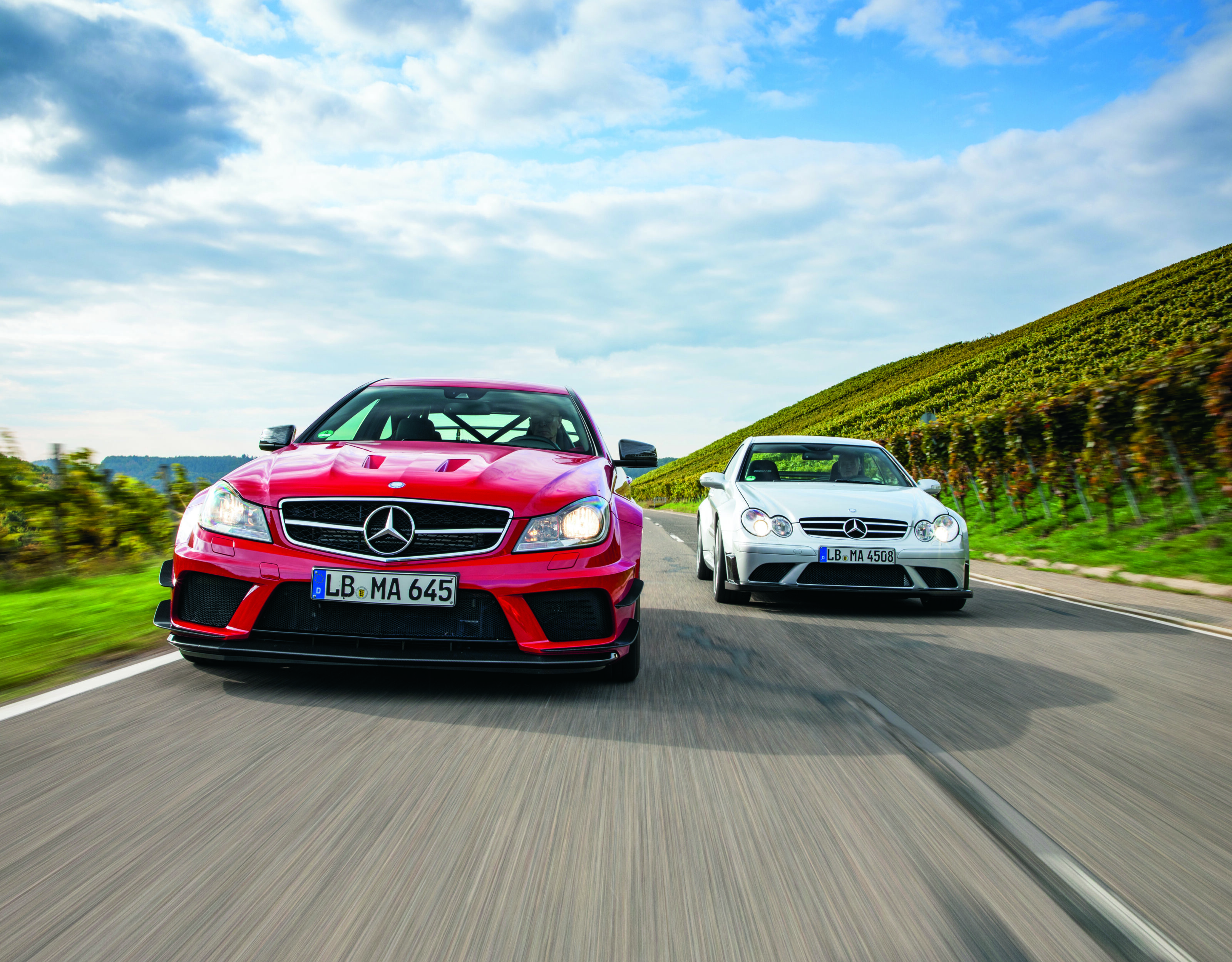
If you were serious about taking this fairly heavy but hugely entertaining car on track on a semi-regular basis, you’d doubtless tick the box for the optional Track Package which featured more focused Dunlop tyres, active cooling of the rear diff, as well as the AMG Aerodynamics Package with flics, front splitter and adjustable carbon rear aerofoil. In this configuration you could try to replicate the wholly serious 7m43s Nurburgring lap time. Only 650 were slated for production, but the build run was so oversubscribed that AMG eventually loosed 800 cars from the Affalterbach gates.
They were also the last of the ‘sedan platform’ Black models. When the AMG GT models appeared in the line up, Moers openly admitted that this spelled the end of C-Class based Black models. “Black Series is dedicated to two doors cars,” said Tobias Moers. “And you know with GT lineup, there’s no sense of a C-Class Coupe Black Series.” No sense of an SUV either. When that was put to him, Moers was adamant that this wasn’t even in the starting blocks. “No, no, no, no… never. Black Series is for the race track,” he laughed.
The template for the future, and indeed the intensity went up another notch with the SLS AMG Black Series, launched in 2013. Taking its cue from the Customer Sport SLS AMG GT3 car, this never quite managed to eclipse the old SL Black’s power output, falling a few kilowatts short at 464kW. It was nevertheless quicker than the old stager, its 44kW advantage over the stock SLS AMG seeing it to 100km/h in 3.6 seconds. Control was vastly improved, too, thanks to the AMG Ride Control suspension, the ceramic compound brakes, an electronically controlled locking differential, and an optional aero pack.
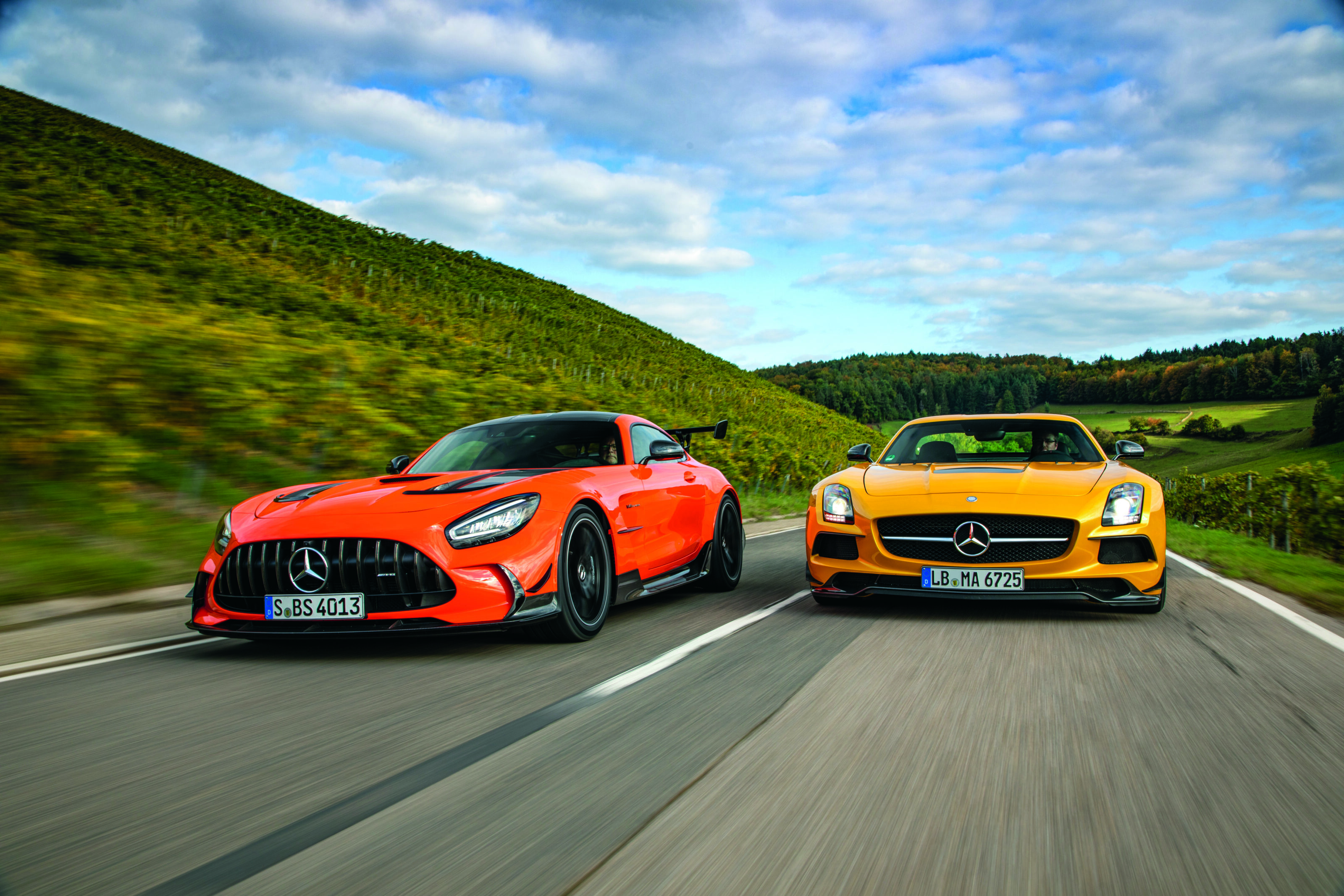
Few corners were cut in the SLS Black’s development. Weight was slashed by 70kg compared to the standard SLS, with a titanium exhaust and a petite lithium-ion battery featuring. The atmo M159 engine featured a redline increased to 8000rpm and received a completely revised high-speed valvetrain, that included modified camshafts, and new bucket tappets that had a special coating AMG traditionally reserved for its race cars.
The SLS AMG Black was 70kg lighter than the standard SLS, with weight reduction aided by a new titanium exhaust system that cut 13kg compared to the original steel unit. A lithium-ion battery cut a further 8kg of heft. The suspension also came in for a closer look, with AMG engineers making the system 42 per cent stiffer for the Black, while widening the front track 20mm and rear track by 24mm. Only 350 were made.
It was also the final car to feature the 6.2-litre V8. While most of us shed a tear at its passing, we weren’t to know that the 4.0-litre twin-turbo V8 that replaced it would be even better. Miles more torque, better driveability and more tuning potential seemed to fall straight into the lap of the Black philosophy. Except then it didn’t.
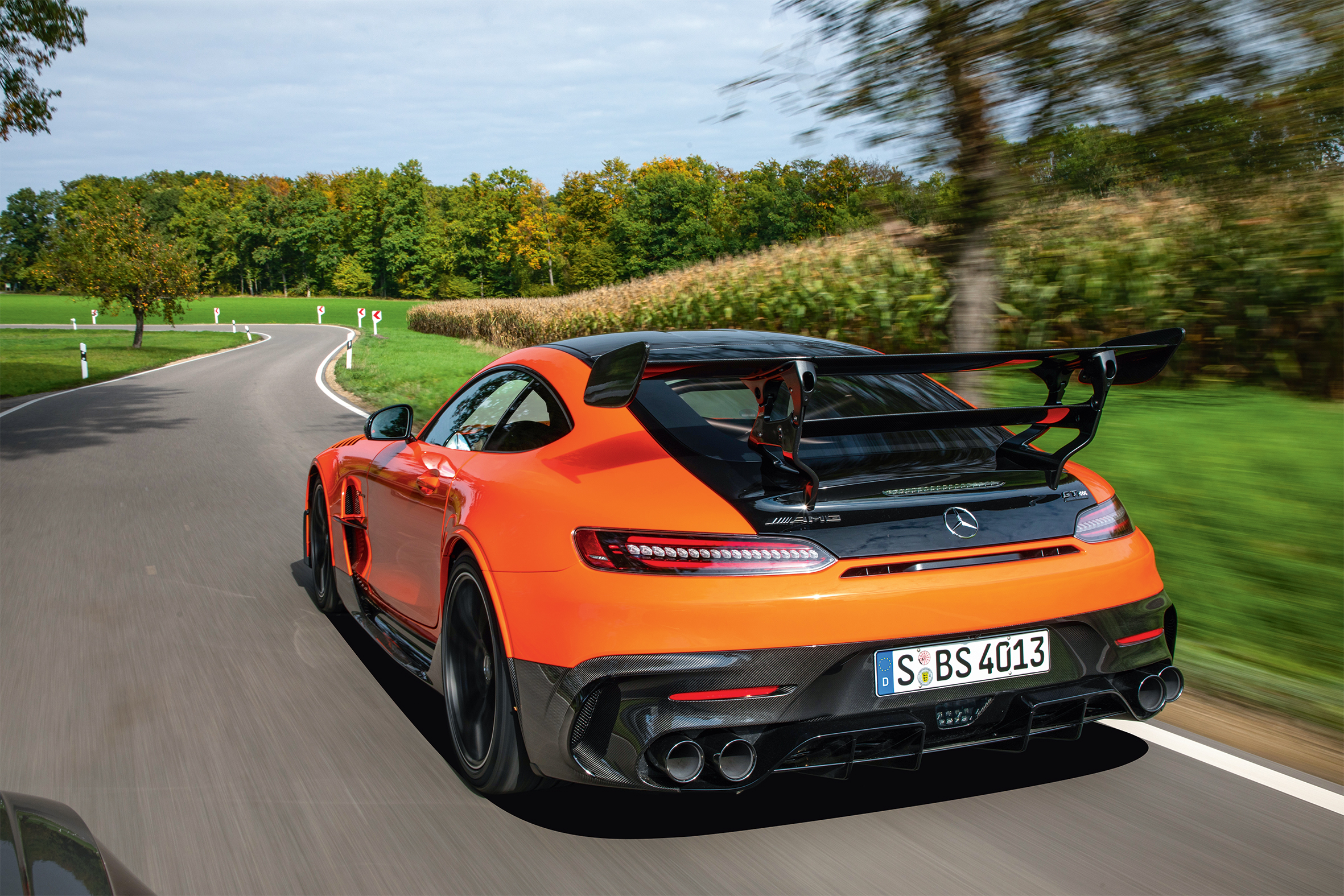
When AMG wanted an engine for the AMG GT Black Series, it didn’t just wick up the GT R’s M178 lump. It changed it to a new flat-plane crank design, dubbed the M178 LS2, making it the very first car from Affalterbach to feature such a V8. Different firing order, more boost, higher compression ratio – it all contributes to the Black’s 537W, finally eclipsing the old SL Black as the most powerful AMG model. Only 28 are being officially imported to Australia at $796,000 a pop. Look for it to defend AMG’s crown at next year’s Performance Car of the Year.
With each generation, AMG has refocused the Black ethos as a product line. Where it was once a badge that struggled to define itself, it now clearly stands for extreme road-legal track cars, akin to Porsche’s Rennsport models. For a series of cars defined by internal-combustion engines, it’s clear the future holds certain challenges. AMG’s new era begins right here.
The Lexus LC500 is a car that trades on intangibles, rather than absolutes. As such, it’s a car that has never quite made sense on paper against the bevy of top-tier metal on offer at that end of town.
I must confess that when I was on the way to collect this concept-car-made-real, even I was wondering what the striking coupe could offer that perhaps a slightly dearer 992 Carrera could not.
And that’s the centre of the LC500 fallacy. It’s not as fast or as engaging at the limit as many of its more focused competitors, nor has it ever been the truly cushy cruiser that would see it admired as a bargain-priced Bentley. It instead falls somewhere in between, but it’s far from a master of none.
When listing rivals for the $194,757 flagship Lexus, it proves quite difficult to pinpoint where exactly it sits in the pantheon of performance cars.
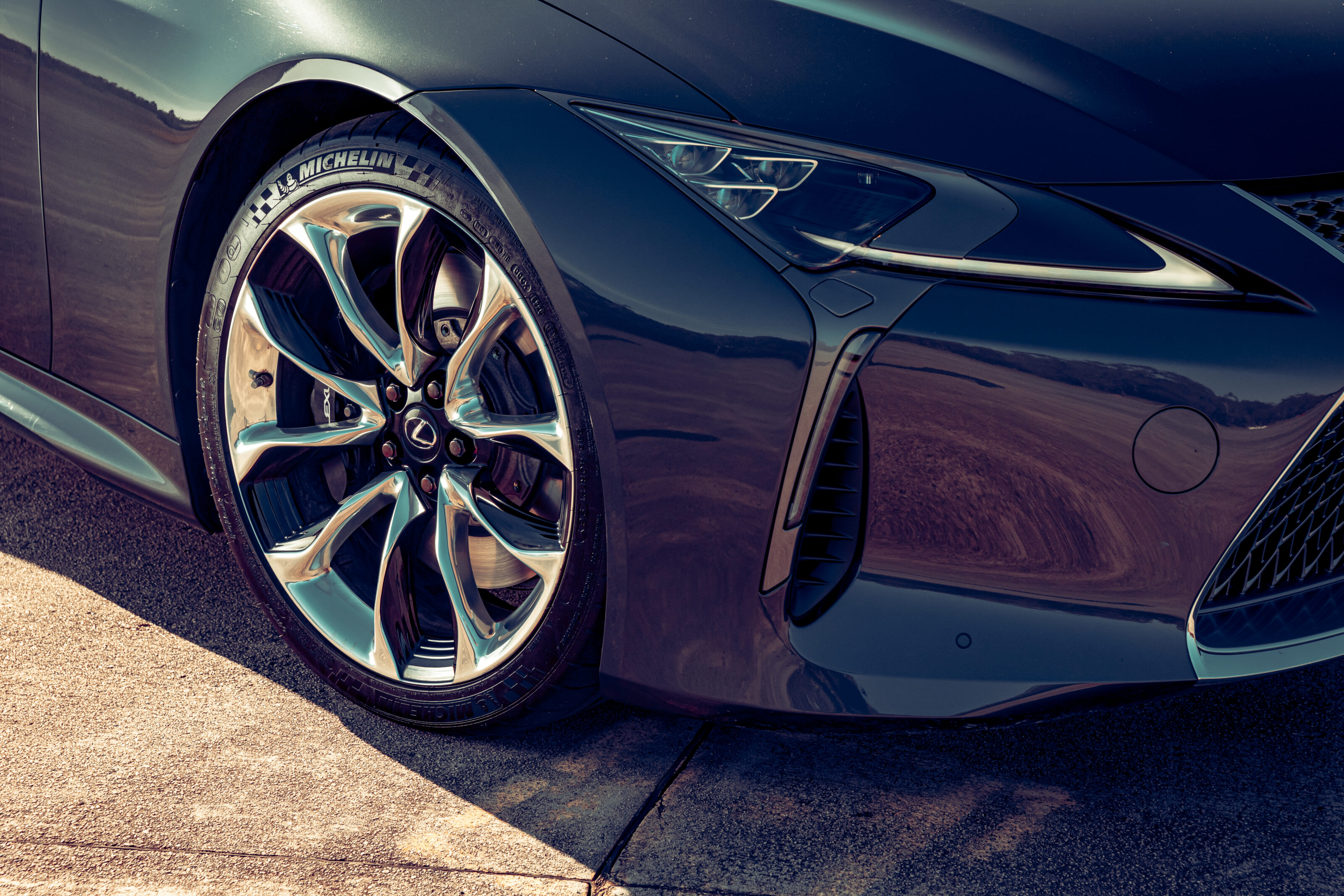
As you’ll find in the current issue of MOTOR, Andy Enright has pitted this bellowing 5.0-litre V8 super coupe against the $173,100 Jaguar F-Type P380 R-Dynamic and the $164,800 Mercedes-AMG E53. But cross-shoppers could also throw in the BMW 840i coupe ($207,900) and aforementioned Porsche 992 Carrera ($236,300) for good measure.
Hitting the starter button sees the 2UR-GSE flare into life as the digital tachometer reaches for the sky, occasionally rewarding you with a subtle ‘whipcrack’ at its peak.
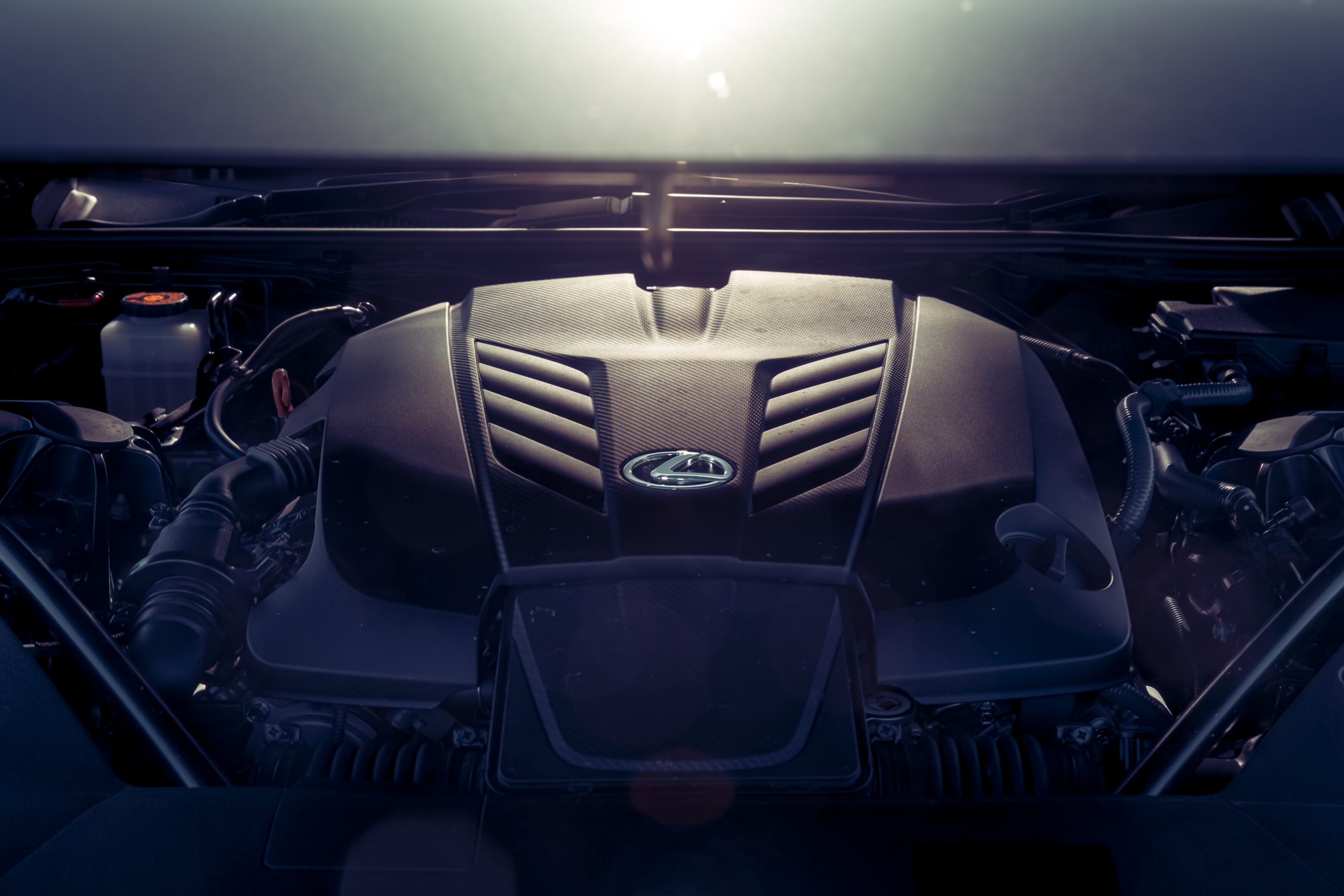
The all-alloy naturally-aspirated quad-cam 5.0-litre V8 boasts Yamaha-designed cylinder heads, titanium inlet valves and dual-length intakes; and is one of our favourite engines on sale today.
It feels integral to the car’s character and while you can get a V6 hybrid version for as near as much the same price, we can’t help but feel like you’d be losing much of what makes this big coupe so special.
For a car that may not make much sense on paper, things soon seem to coagulate as you drive down the road.
It feels solid, with a graceful interior that wraps around its occupants. Lexus is frequently critiqued for dated interior styling but I find there to be a utilitarian charm to them that throws the garish Germans, with their ambient lighting and brushed metal elements, into stark relief.
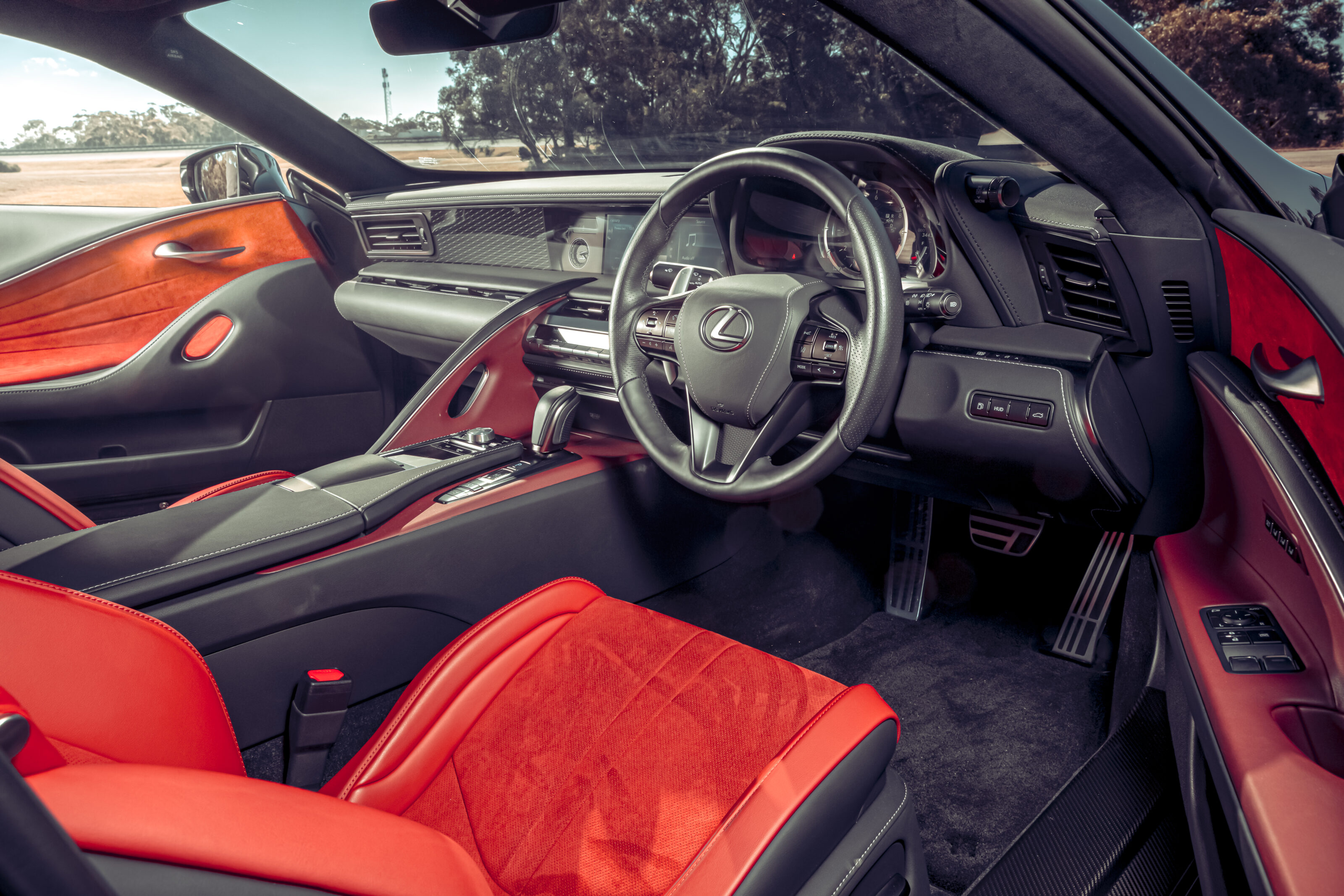
The LC500’s cabin is still beautifully presented, with the asymmetrical door cards rising in front of you to join seamlessly with the sculpted twin-plane dashboard.
There’s something to be said for a beautifully engineered, well-laid-out cabin that still boasts physical buttons and switchgear for everything; and an interior that doesn’t fight for your attention against what’s going on through the windscreen.
The infotainment system may still be a bugbear for many, as Lexus persists with the much-maligned trackpad interface and while other models in the Lexus range have been updated with easier-to-use touchscreens, the LC500’s central display is mounted far beyond arm’s reach. The 2021 update, however, welcomely introduces Android Auto alongside Apple CarPlay compatibility.
On the whole, though, the exotic cabin does a good job of matching the space-age coupe’s exterior dramatics, but adds to your driving experience instead of distracting from it.
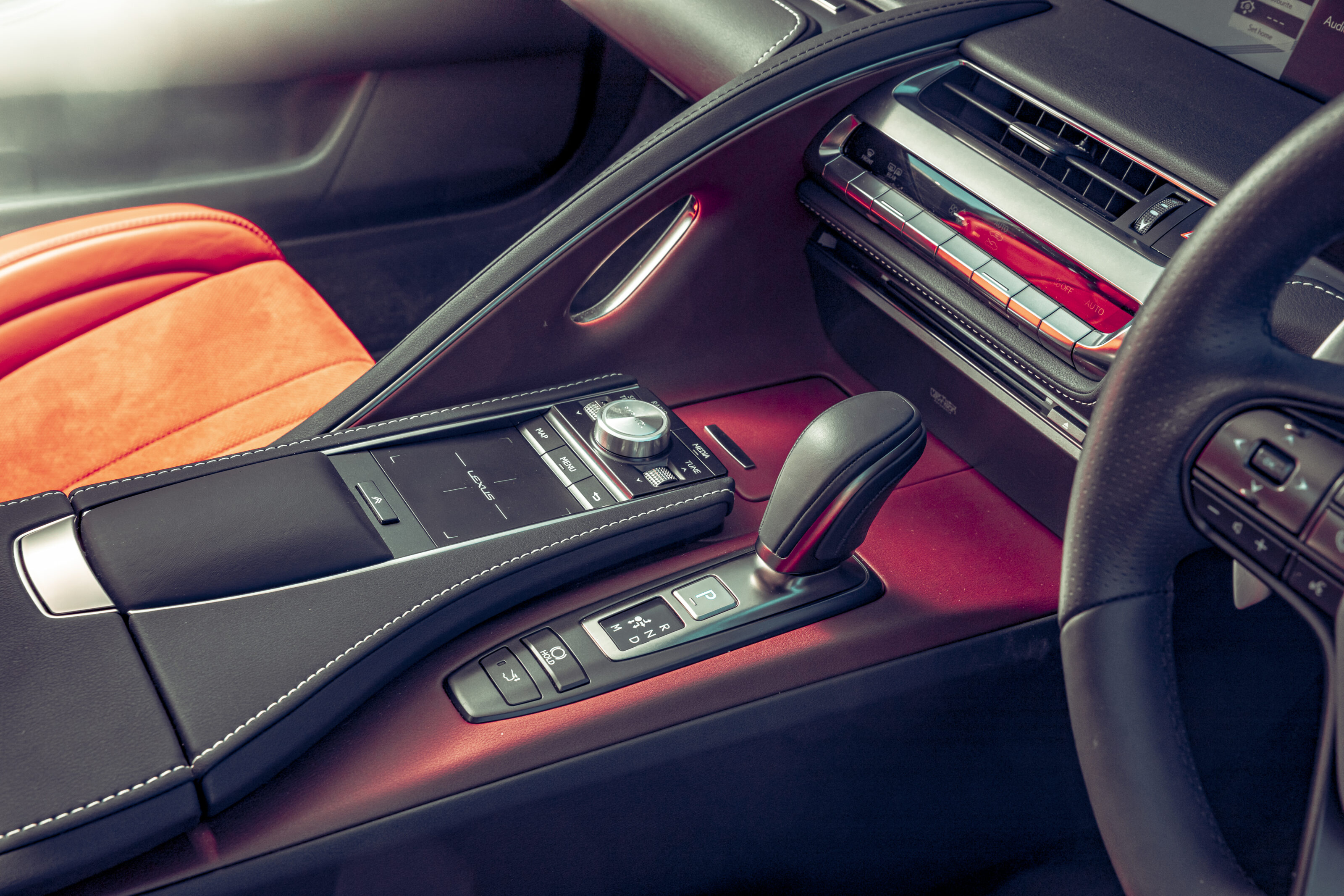
There’s a stack of adjustability in the seat and steering column, and in my preferred settings – seat at its lowest, steering wheel at its closest – you sit low and close to the centre of the wheelbase.
In addressing the original LC’s here-nor-there dynamics, a large focus of the latest model update pertains to further refining of the suspension tune with a more rigid rear anti-roll bar fitted to increase turn-in response, the removal of approximately 10kg of unsprung mass and revised damping that has been given a longer and smoother stroke plus an optimised rebound stopper for increased compliance and road feel.
Around town, the big coupe festoons the most menial of errands and drives with a sense of occasion. The naturally aspirated 351kW V8 is an increasingly endangered species and something to be cherished today. It may lack the histrionic low-down warp-speed rush of its turbocharged contemporaries but prodigious linear mid-range grunt and a not-insignificant 540Nm of torque – peaking at 4800rpm – enable you to extract a higher percentage of the powertrain’s reserves more frequently than many a modern powerhouse. The variable gear ratio steering is typically Lexus, with a slightly doughy on-centre feeling that improves in precision once more lock is wound on.
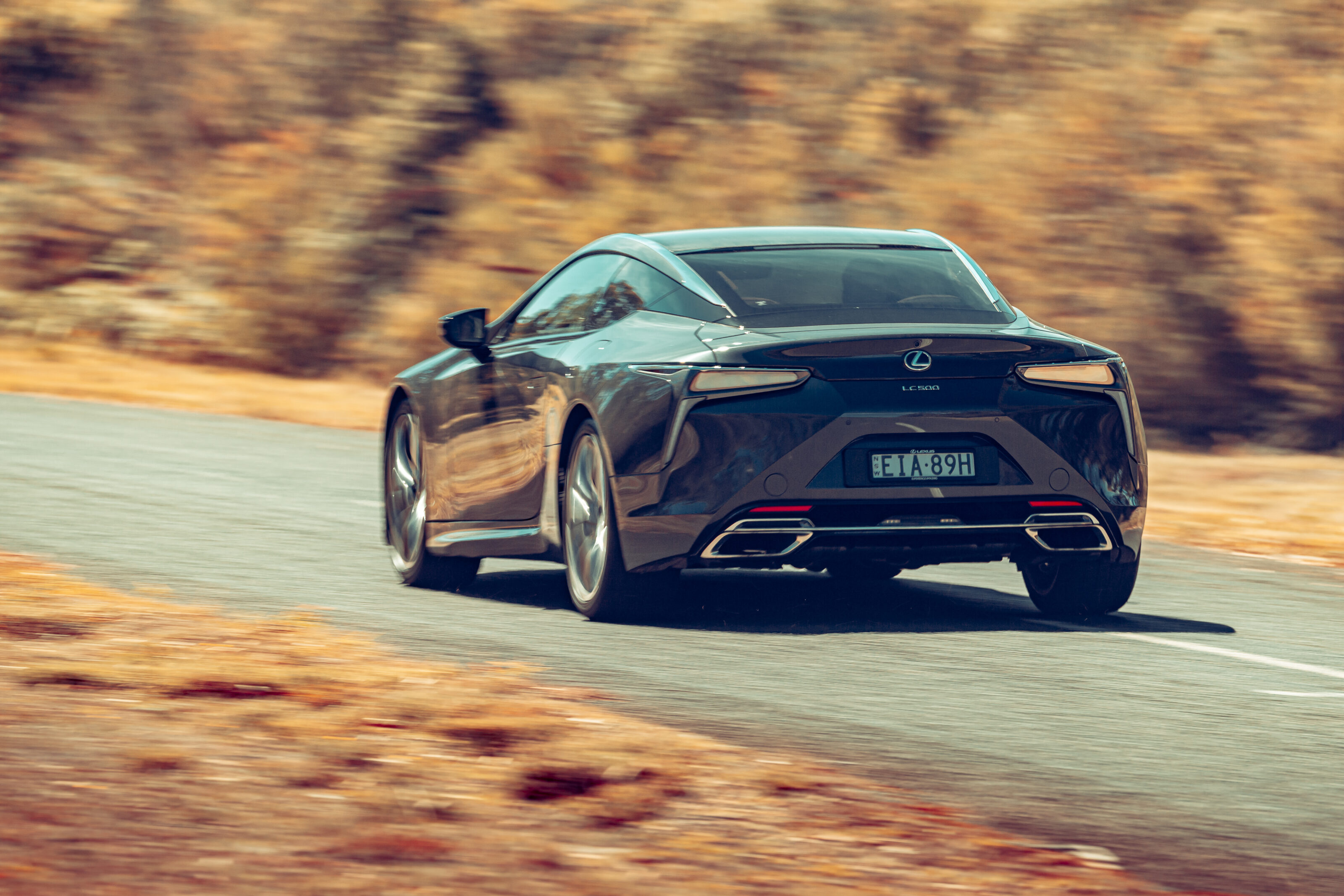
Peak power chasers will be reaching for the sky often as the V8’s headline figure is delivered at a dizzying 7100rpm, shortly before the digital needle ricochets off the 7200rpm cutout and rewards you with an addictive crackling exhaust overrun.
The versatile 10-speed transmission’s logic is agreeable when left to its own devices and the short gear ratios down low have the desirable upper regions of the rev range well within reach at legal speeds around town.
On a twisty open road, taking paddles into your own hands, the rich driving experience grows more rewarding with speed, up to a point when it doesn’t.
There’s an elephant in the room, or perhaps beneath the LC500’s skin, as the swathes of visible carbonfibre belie a portly kerb weight of 1970kg. While high-end boutique carmakers often quote the notion that ‘it’ll cost what it’ll cost’, you get the sense that Lexus engineers settled on the ethos of ‘it’ll weigh what it’ll weigh’.
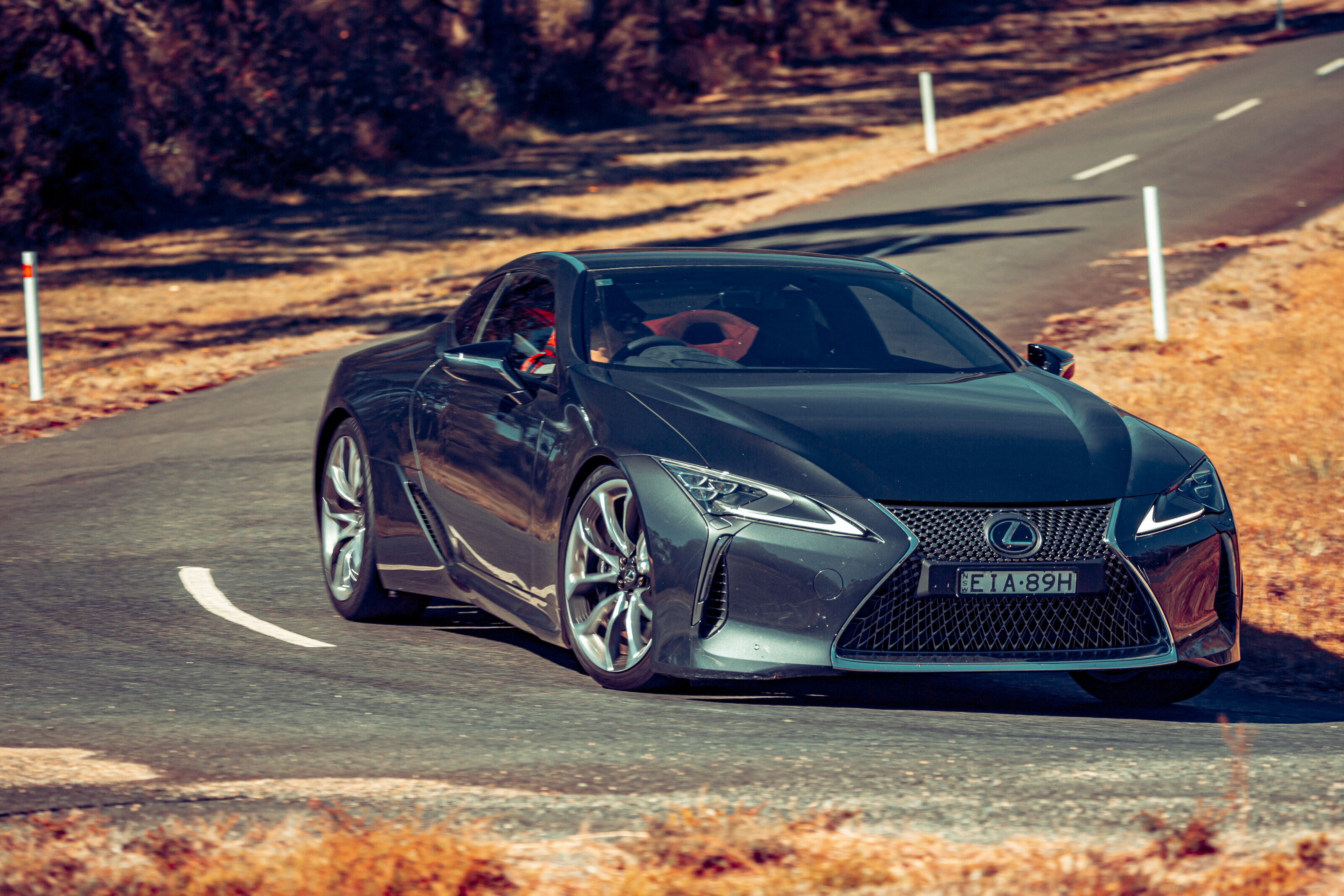
In the LC500’s most focused Sport+ mode, and manually shifting, the big and heavy beast does a good job of disguising its weight if you keep it keyed into the power band above 5500rpm. You will be abruptly reminded of its mass, however, should you ask too much of it and over commit to a corner. The electronic stability control intervenes abruptly as it works hard to contain more than two tonnes of precious metal and driver.
Dial it back to seven- or eight-tenths, and manually clicking up and down gears on a twisting hill route becomes near-spiritual, life-affirming stuff. And that’s where this brawny GT coupe works best.
Lexus’ latest update aims to refocus the LC Coupe’s identity crisis in the eyes of buyers. Its dynamic prowess still pales in comparison to the scalpel-sharp precision of a more expensive 911 but it was never going to steal away that buyer to start with.
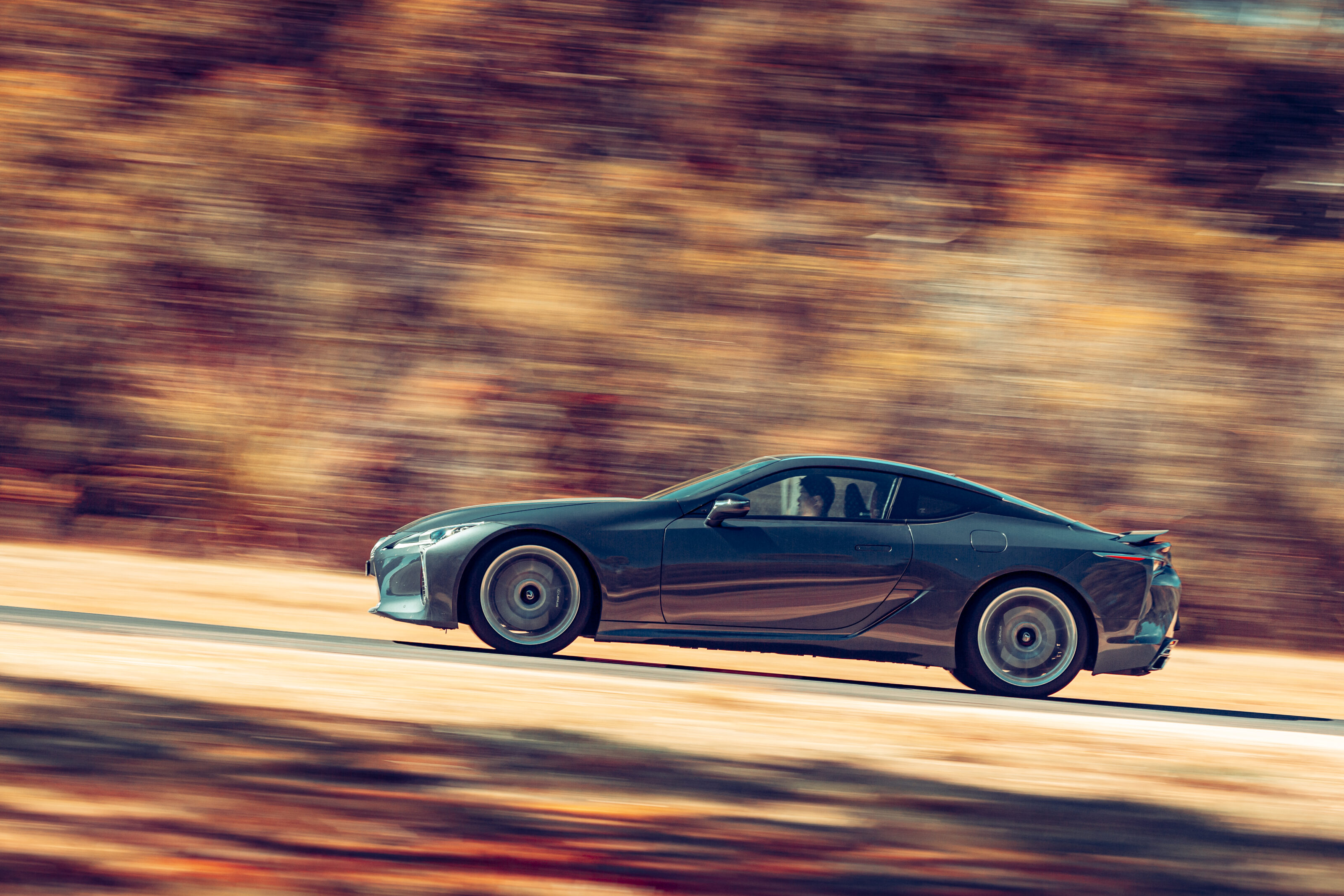
Spend some time with it and you’ll realise that it makes no dissimulation towards being an outright performance car, but it’s a tremendously engaging, rewarding and charming thing all its own.
We’re currently in one of the most transitory ages in motorcar history and it feels like cars have never been more homogenised, with niches of niches increasingly filled with ever more vehicle variants as buyers lust for more tech and more convenience.
In that context, the LC500’s intoxicating duality of futuristic styling and cosseting ownership experience, blended with some of the best aspects of old-school mechanical charm, is truly something to be celebrated.
There’s nothing quite like the Lexus LC500, and while that may have initially been its biggest criticism, we think it should be proudly and unapologetically heralded as its greatest strength.
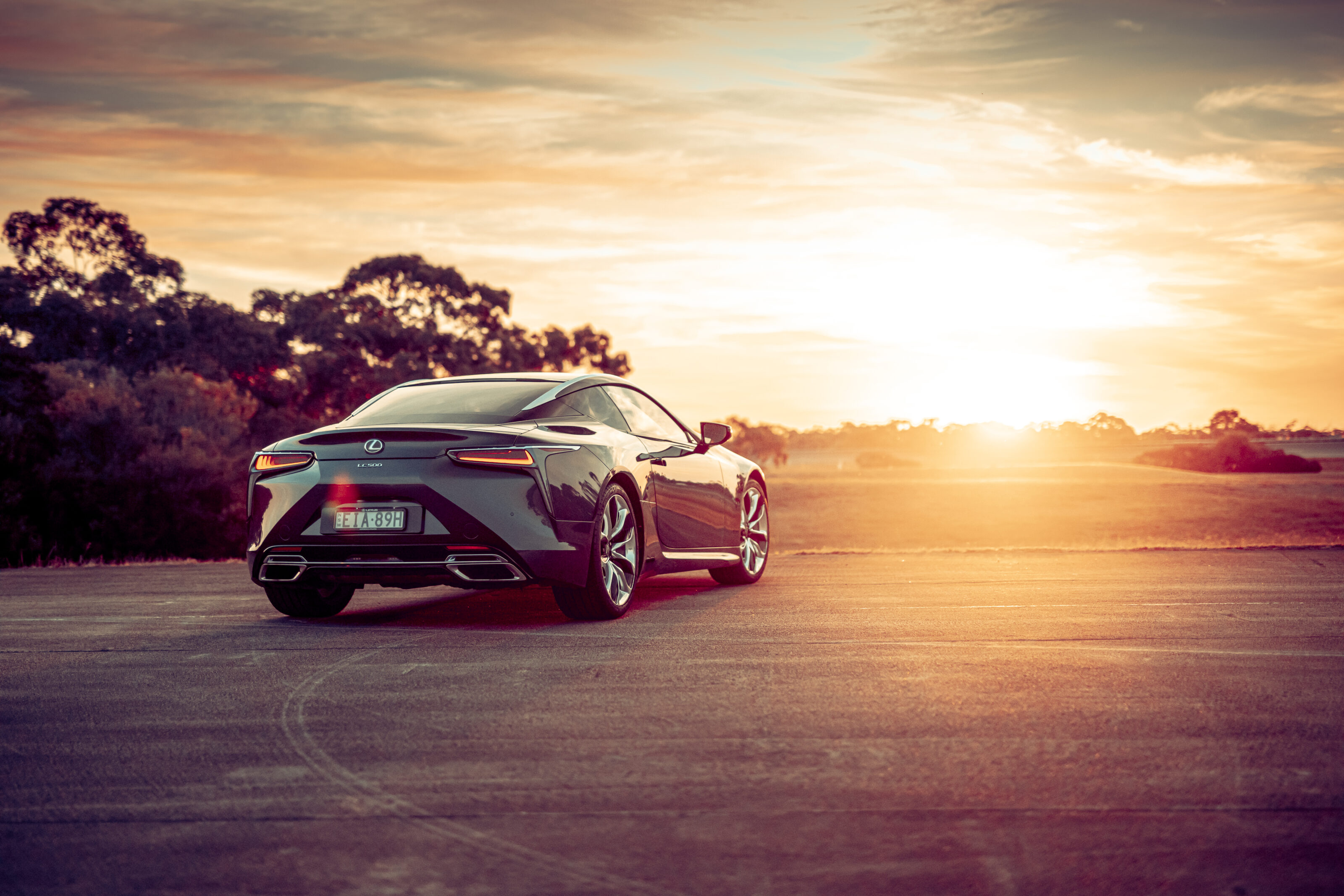
Lexus LC500 specs
Engine: 4969cc, V8, DOHC, 32v Power: 351kW @ 7100rpm Torque: 540Nm @ 4800rpm 0-100km/h: 5.0sec (claimed) Weight: 1970kg Price: $194,757
I’M LOOKING TO BUY A PUNCHY HOT HATCH. I NEED SOMETHING A BIT BIGGER THAN A GR YARIS BUT I CAN’T STOMACH THE LOOKS OF A CIVIC TYPE R. THE FIELD HAS NARROWED TO EITHER A FORD FOCUS ST OR A HYUNDAI i30 N. WHERE’S THE SMART MONEY GOING HERE? -ALAN R.
The smart money? That’s easy. Buy the Hyundai. I’d wager it’ll be worth a good deal more than the Ford three years down the road, it’s got a warranty that covers circuit use, it’s just as quick as the Focus in the real world, it’s cheaper to insure, it costs less to buy than the Ford, is better equipped and so on.
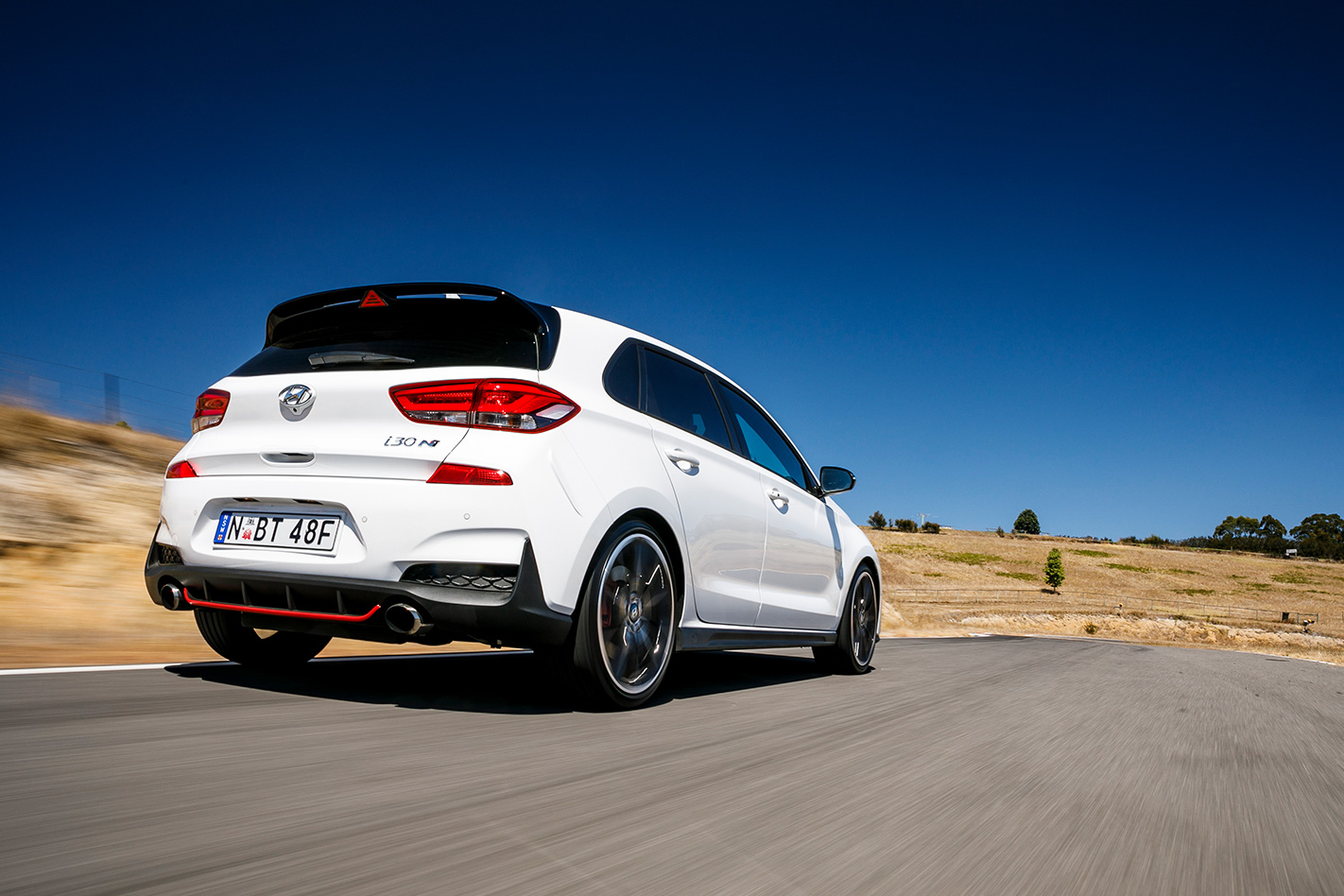
I could go on but I reckon you’ve got the gist of this by now. As an all-round hot hatch, the Hyundai i30 N is extremely tough to beat. End of discussion? Not exactly. You’ll probably want to drive both of these cars before you make your decision, because they feel markedly different.
Whereas the Hyundai is easy to key into quickly, the Focus requires a little more time to worm its way into your affections, but there’s something about the Ford that is hugely endearing. It almost feels like a hot hatch with overtones of muscle car in the way that the engine burbles and serves up huge torque from very low rpm.
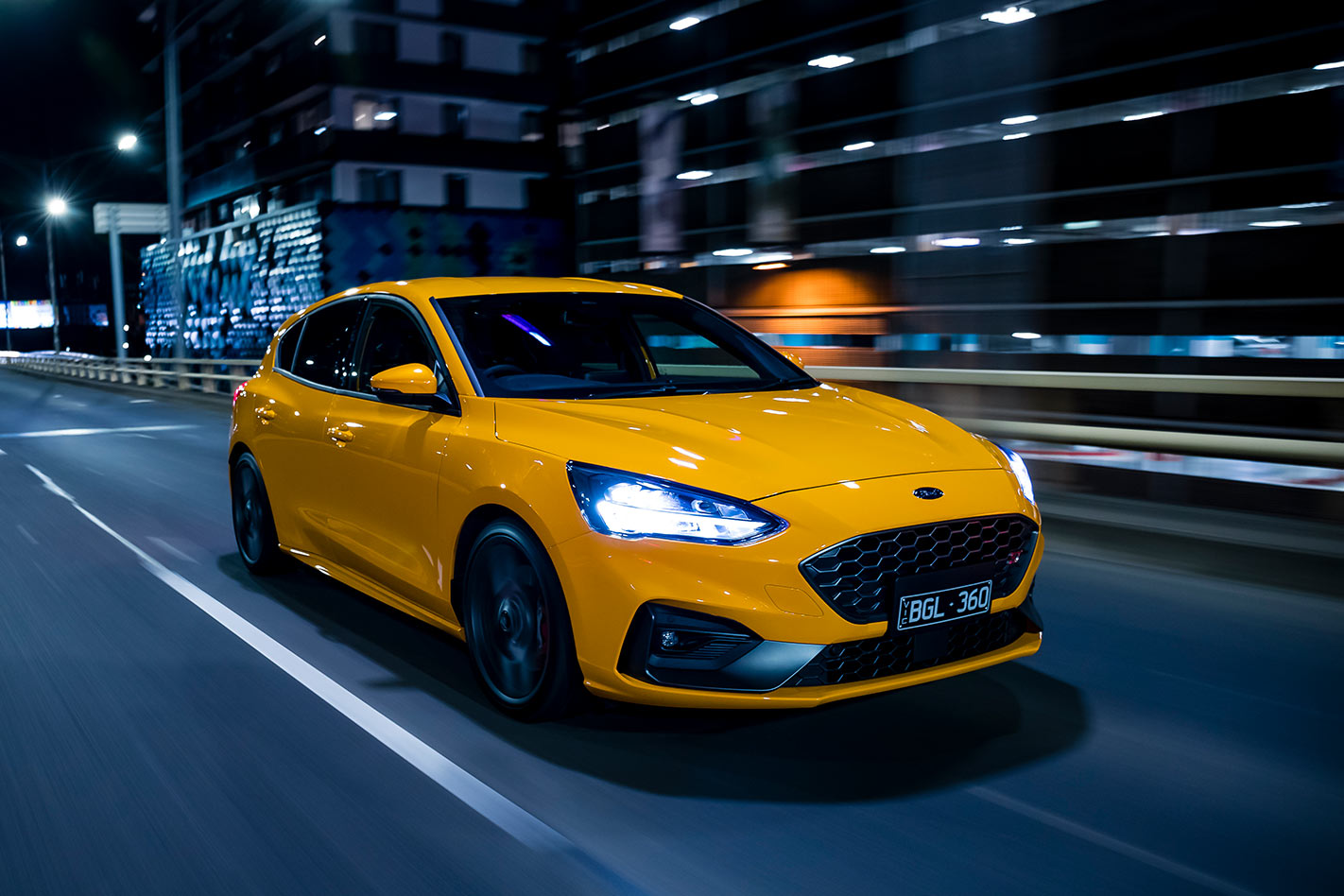
There’s real character to the Focus ST, and character goes a long way. Just check the hot hatch group test versus the Renault Megane and the BMW 128ti in MOTOR’s April edition for more details on its bona fides. Is it enough to swing the decision to the Blue Oval? Not if you go head over heart. That decision belongs to the Korean car every day of the week.
The issue here is that we don’t always buy hot hatches for purely objective reasons. We want to drive something that we end up loving, not admiring, and that could well make this decision closer than it initially looks on paper. Great choices, by the way.
– AE
2021 Ford Focus ST v 2021 Hyundai i30 N specs
Engine: 2261cc 14, DOHC, 16v turbo | 1998cc I4, DOHC, 16v turbo Power: 206kW @ 5500rpm | 202kW @ 6000rpm Torque: 420Nm @ 3000-4000rpm | 353Nm @ 1450-4700rpm Weight: 1508kg | 1429kg 0-100km/h: 6.1s (tested)| 6.24s (tested) Price: $44,890 | $41,400
As The Great Gatsby author F. Scott Fitzgerald once noted – and the $2.9 million Bentley Mulliner Bacalar proves – the very rich are different from you and me. You’d think launching one of the most extravagant Bentleys ever made during a global pandemic would be a disaster. But all 12 of the 12-cylinder, 320km/h Bacalars were quickly snapped up shortly after the ultra-luxe barchetta’s virtual launch in March last year. What’s more, not a single customer has since cancelled their order. Crisis? What crisis?
In simple terms the Bacalar is a Bentley Continental GT Speed Convertible wrapped in unique carbon fibre and aluminium panels by Bentley Mulliner, the company’s in-house coachbuilding, customisation and classic car operation. That means it has the 485kW, 900Nm version of the recently refreshed 6.0-litre twin-turbo W12 under the bonnet, driving all four wheels through an eight-speed dual-clutch that’s been tweaked to deliver faster shifts. The GT Speed hardware also means the Bacalar gets that car’s rear-axle steering system, along with its electronic rear differential and quicker steering calibration.
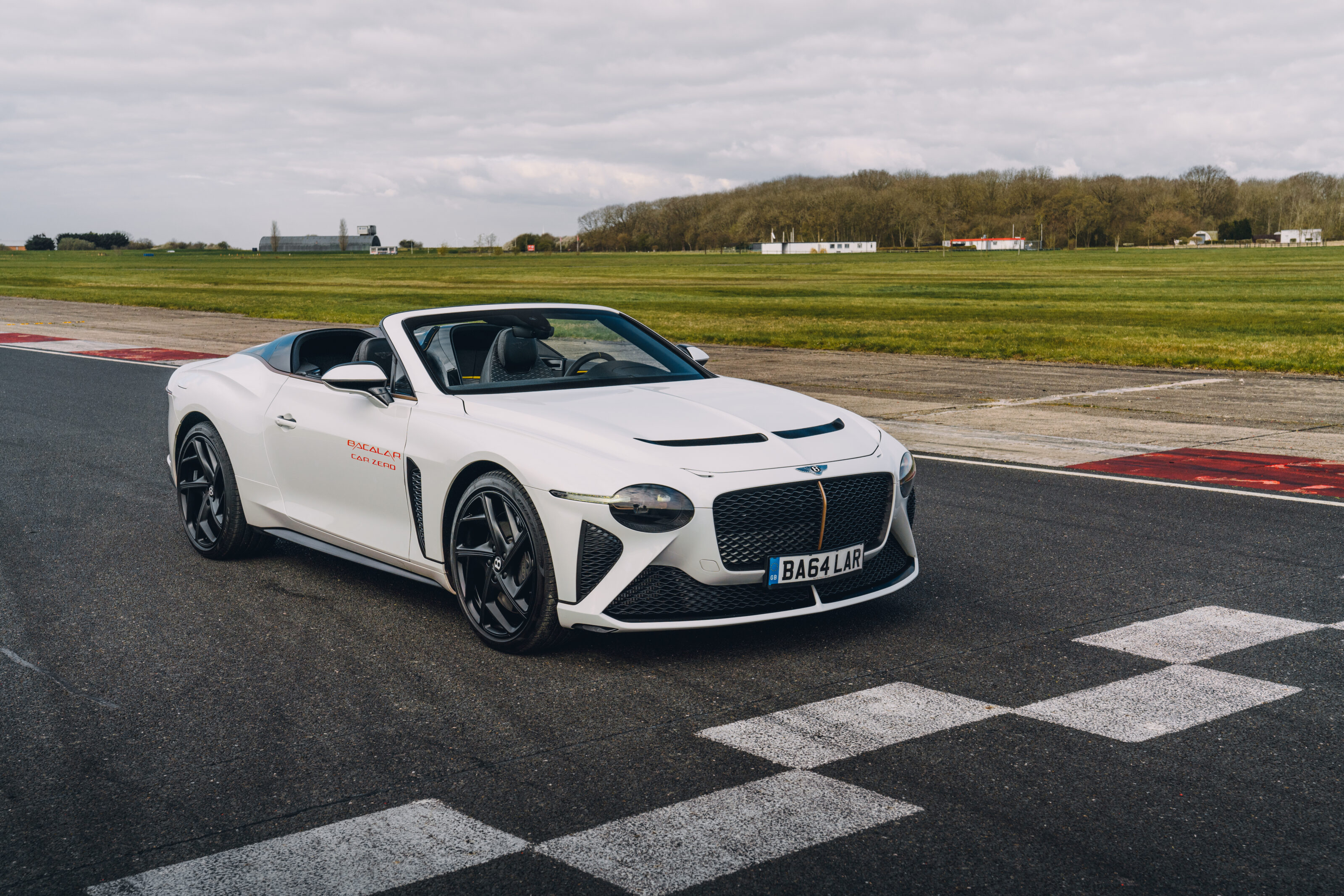
Mulliner, which traces its origins to a saddlery business founded in the 1500s, became a coachbuilder in the 1760s, and has been a part of Bentley since 1959, has used both traditional hand-crafting methods and state-of-the-moment manufacturing technique to create the Bacalar’s arresting exterior and plush interior. More than 750 of the car’s components are new, including 40 carbon-fibre parts and almost 100 individual 3D-printed components.
The Bacalar’s exterior design riffs on the EXP 100 GT coupe concept revealed in 2019 to celebrate Bentley’s 100th anniversary. The forms and details have been toned down, but the essential vocabulary remains. Up front is a similarly dramatic interpretation of the Bentley grille, unique oval headlights with light bars that extend into the front guards, and a front splitter that looks as if it is supported by buttresses under the lights that extend outwards to the front corners of the car. At the rear, the unique tail-lights sit in a deeply notched vee section above a fascia designed to visually enhance the car’s overall width.
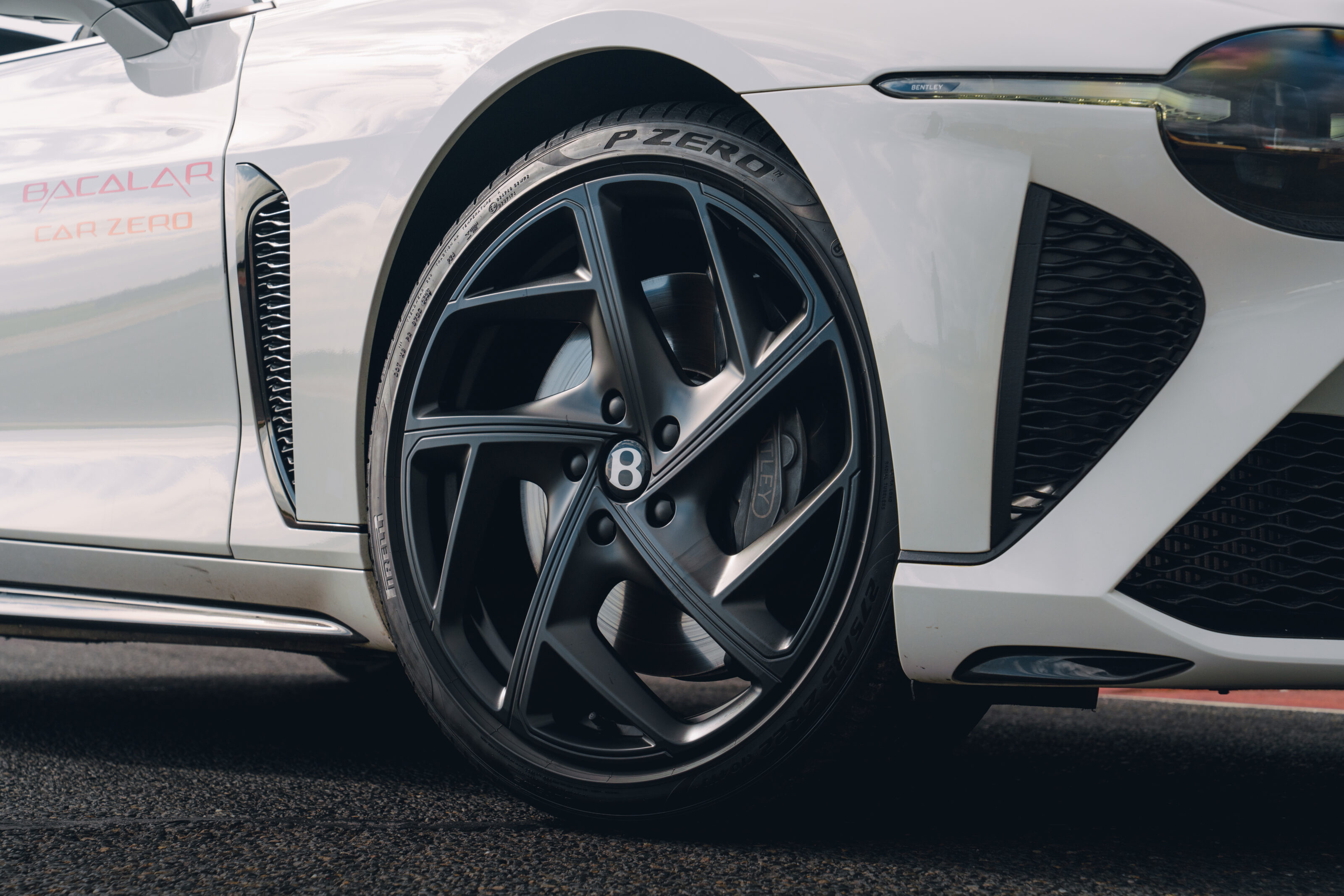
Though it shares key hard points with the GT Speed Convertible – wheelbase, dash-to-axle, cowl height – the Bacalar is 50mm longer overall, with most of the extra length behind the rear wheels, and 43mm wider, the rear quarter panels pumped out to accommodate a 20mm increase in the rear track. The door handles, needed because they contain the hardware for the keyless entry system, are the only recognisable exterior parts from the regular GT. Even the windscreen is unique, 41mm shallower than the standard Convertible. The Bacalar’s bespoke 22-inch alloy wheels are a complex design, each wheel taking a whole day to paint and polish, making it more labour intensive than prepping a Bugatti Chiron wheel, says Bentley Mulliner coachbuilding project leader Omar Sheikh.
“Few Bacalar owners are ever likely to pinball it from apex to apex”
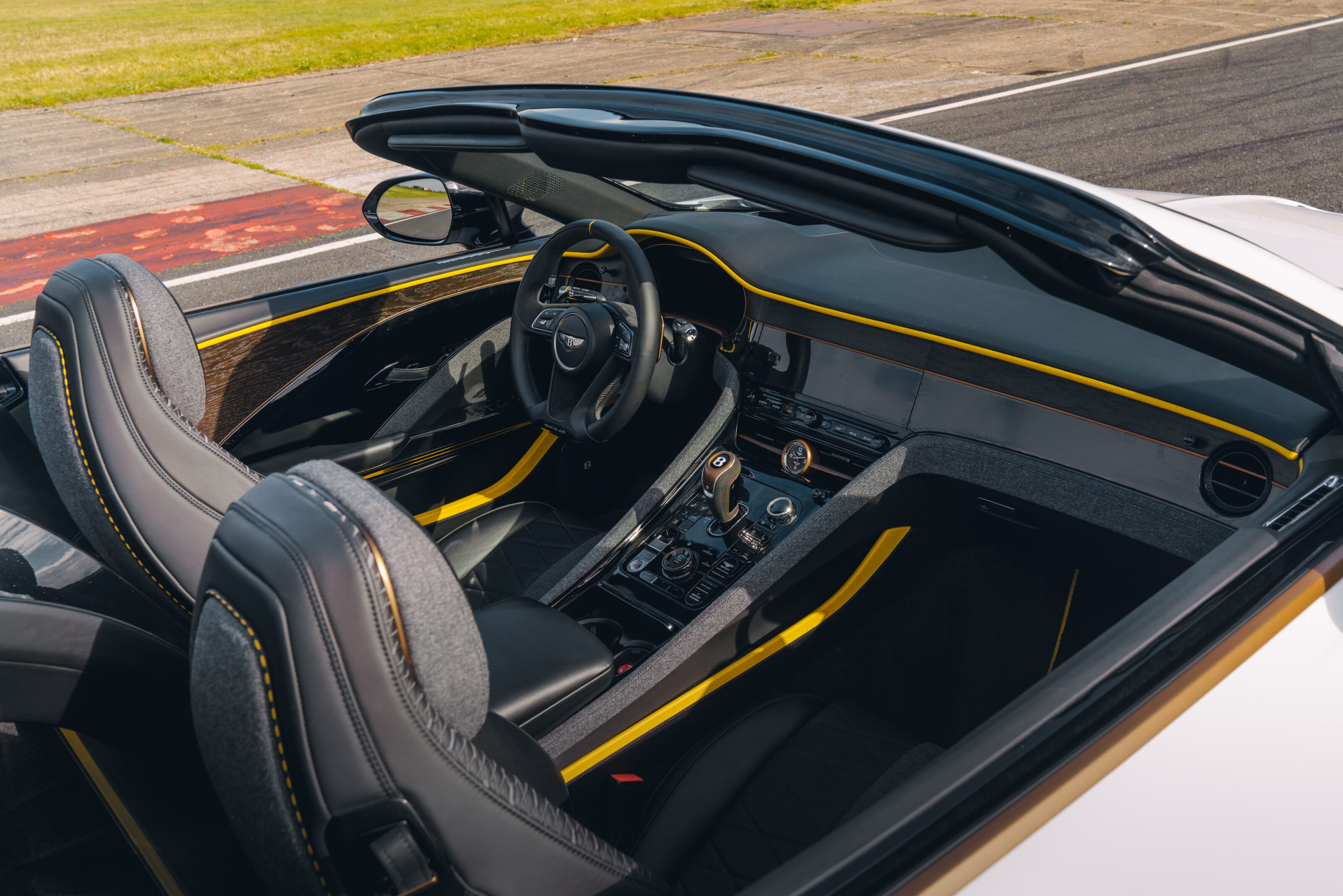
The essential hardware in the cabin is shared with the Continental GT, but the Mulliner makeover includes unique door and centre console trims, and a host of other unique details, right down to the knurling on the bullseye vents, and the quilt pattern on the two seats that, according to Bentley, requires precisely 148,199 stitches per seat to complete. Behind them, under the aero humps extending towards the rear of the car, is room for two specially designed bags by Italian luxury luggage maker Schedoni. The Bacalar also debuts a new veneer called Riverwood, made from 5000-year-old trees that have been preserved in peat bogs, lakes and rivers in the Fenlands of East Anglia – of course it does…
It might look dramatically different, but the way the Bacalar goes down the road is initially familiar. That muscular W12 delivers Bentley’s trademark surge of weapons-grade thrust all the way to 6000rpm, a muted snarl from the exhaust echoing in the slipstream. And the ride has the same measured cadence as the Continental GT, the calm heft of the body motions artfully modulated by the air suspension and steadied by the 48V anti-roll system.
Turn into a corner, though, and the Bacalar suddenly feels a very different sort of Bentley, lighter on its feet than you expect, with a more alert and responsive front end. It’s not really that much lighter – despite all that carbon fibre and aluminium and the lack of a roof, the Bacalar weighs a mere 30kg less than a GT Speed Convertible. Yes, the steering is quicker, but all the magic comes from the back axle, courtesy of the rear-steer system and the electronic rear diff, both of which are supported by a new carbon fibre tub that adds even more stiffness to the Continental GT’s already impressively rigid structure.
Want to tuck the nose in tighter? Lift off and the Bacalar will begin to rotate gracefully. You then need to be a little patient with the throttle otherwise the nose will push wide – this is still a big, heavy car and the laws of physics are immutable. But once you get past the clipping point and open the steering, pull the trigger and the big Bentley grunts, grips, and fires down the road. The factory claims a 0-100km/h time of about 3.8 seconds. The Bacalar feels every bit that quick, effortlessly whisking past 160km/h on even the shortest straight.
Of course, few, if any, of the 12 well-heeled Bacalar owners are ever likely to pinball it from apex to apex with their hair on fire. No, this Bentley will do its best work wafting through the luxury hotspots dotted around Australia, cosying up to the kerb outside the best hotels and restaurants. For them, the Bentley Mulliner Bacalar is not so much a car to drive as it is a car to be seen driving.
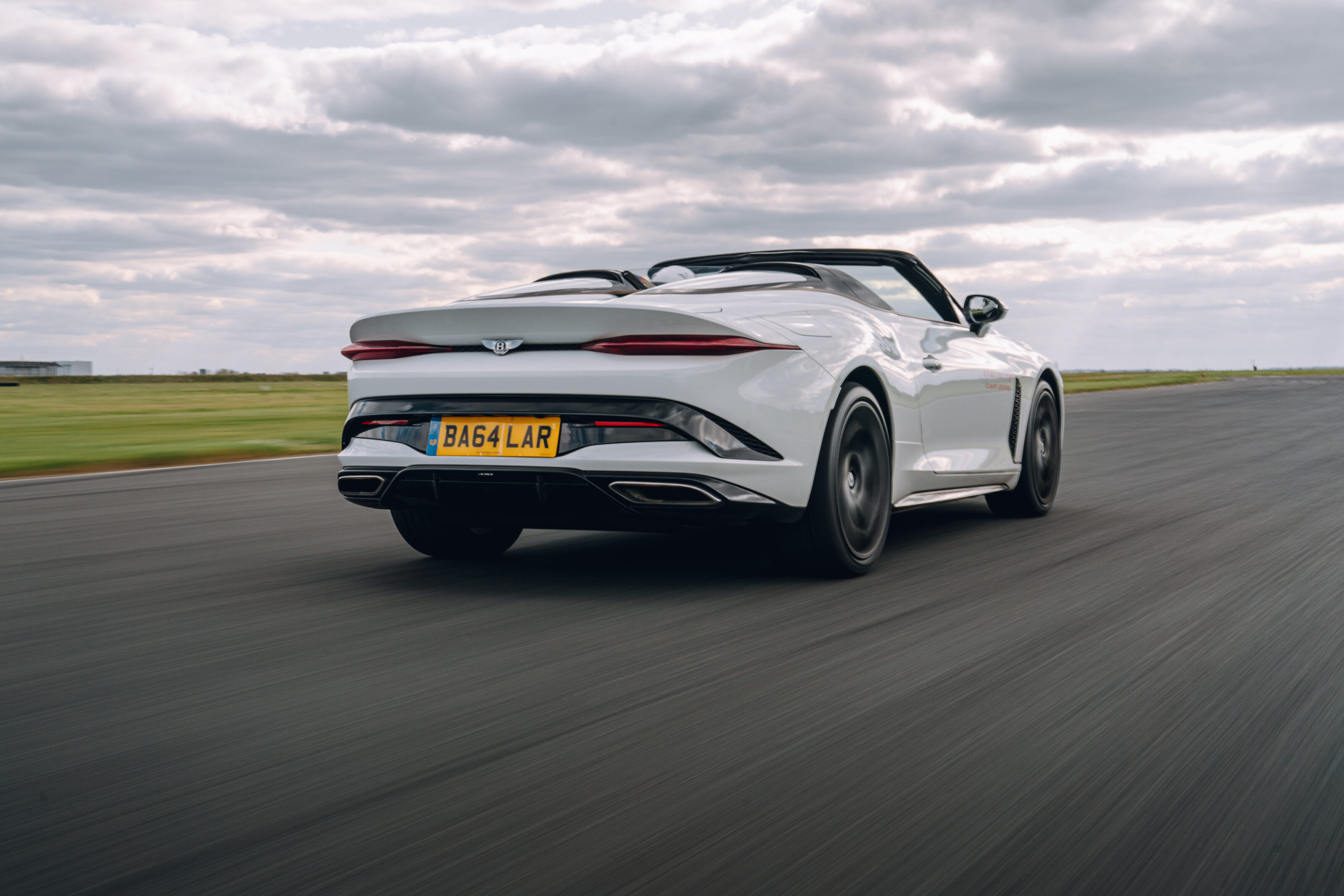
2021 Bentley Bacalar specs
Engine: 5998cc W12, DOHC, 48v, twin-turbo Power: 485kW @ 5000rpm Torque: 900Nm @ 1350rpm 0-100km/h: 3.8sec (claimed) Weight: 2300kg (est.) Price: $2.9m
Snapshot
- Details remain murky about the reported quarter mile time
- If true, only the Rimac C_Two is faster covering the same distance
Customer deliveries of Tesla’s hotly anticipated Model S Plaid may not have begun yet, but already there are wild claims about the four-door’s performance being thrown about.
Tesla themselves reckon a 0-60mph (0-98km/h) time of 1.9 seconds is achievable – which, quite frankly, is absurd.
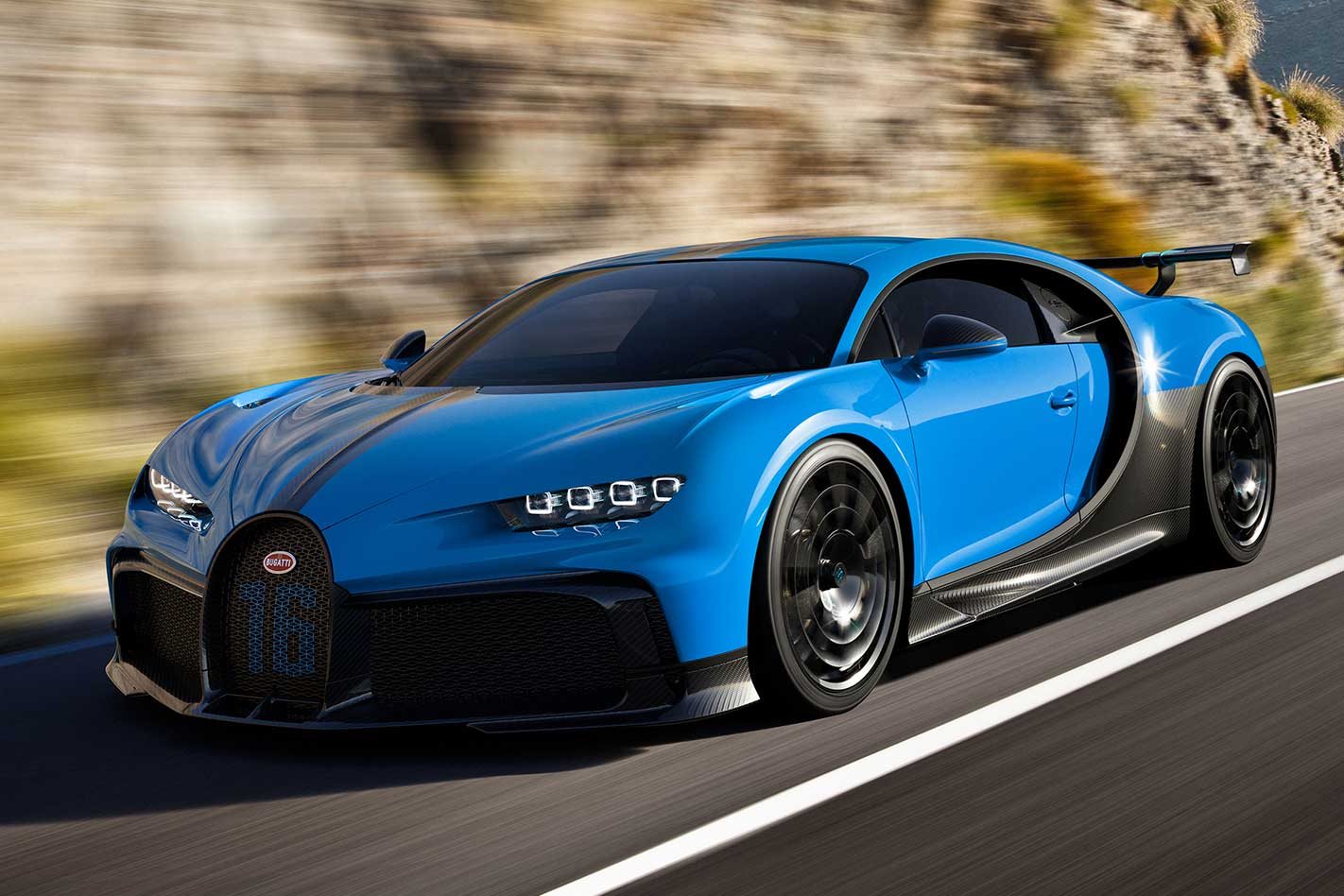
But now, Drive Tesla Canada is reporting that a source witnessed the Plaid run the quarter-mile time in just 9.23 seconds recently at Autoclub Famoso Raceway in Bakersfield, California.
That’s fast enough to leave a Bugatti Chiron Pur Sport in the dust. Let that sink in for a moment – an electric four-door sedan is quicker than an eight-litre, quad-turbo W16 hypercar that costs more than the average Beverly Hills mansion.
It’s so quick that the only production car that could hope to beat it in a drag race is Rimac’s multi-million dollar C_Two, which recently ran a quarter mile time, on standard Michelin PS4S tyres, in 8.94 seconds.
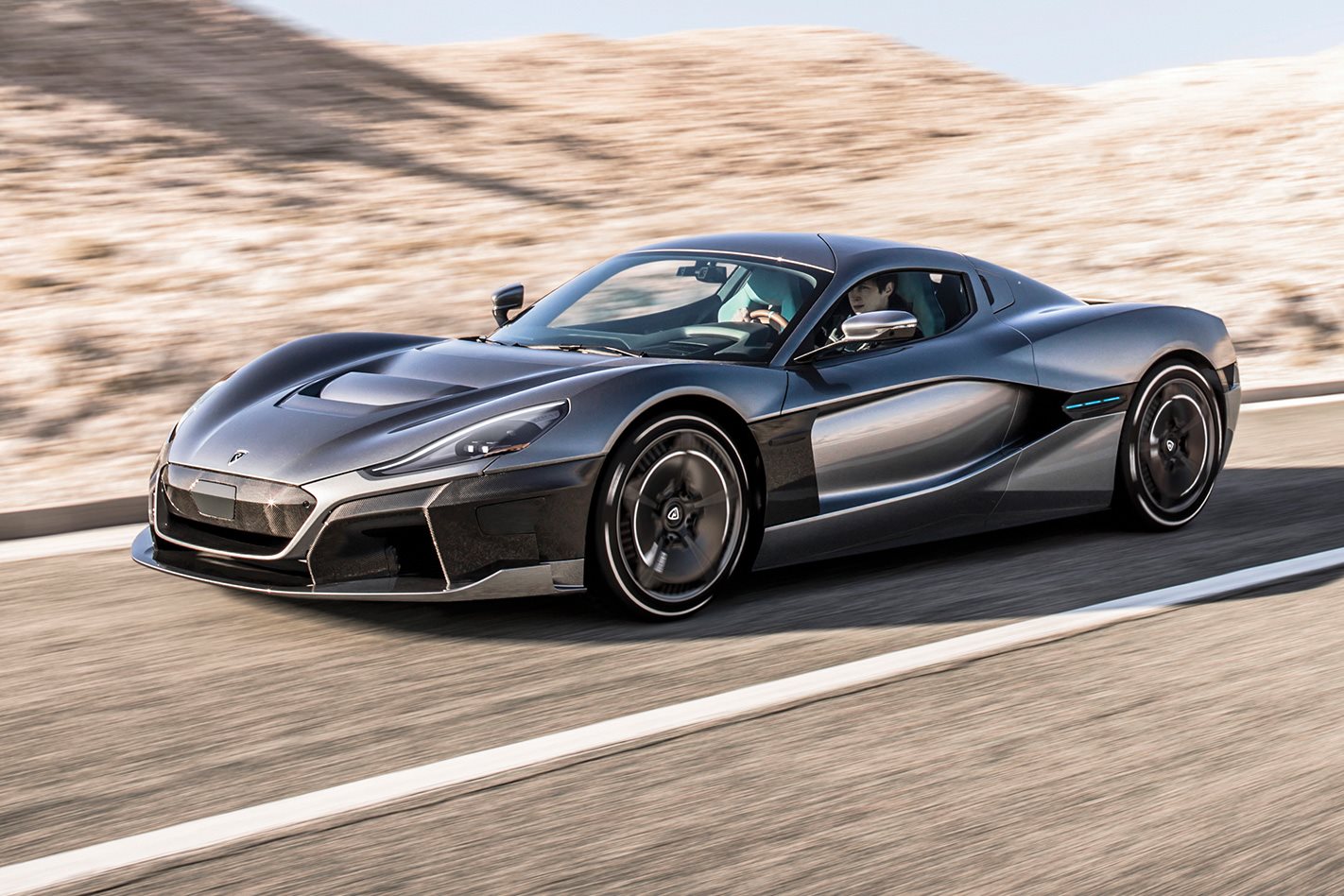
Of course, the Plaid’s time is just an unsubstantiated rumour at this point, and we don’t know what the circumstances were.
Was the car on standard tyres or drag radials? What sort of surface was it run on, drag strip or road? These are the questions that need to be answered before we can start hailing the Model S Plaid as the new performance benchmark of the automotive industry.
But, if it’s all legit, then my oh my has Elon Musk and his team been able to achieve something truly staggering.
Got a tip-off for a story? Get in touch: [email protected]
In general, products inexorably improve over time. Regardless of how good or bad the original concept was, incremental development tends to pay dividends. Practice makes perfect and all that. The Porsche 911 is the perfect example. Slinging a six-cylinder engine behind the rear axle of a sports car flew in the face of conventional engineering wisdom in 1963 and doesn’t make any more sense today, but almost six decades of development has turned the 911 into one of the finest driving experiences you’ll ever have.
This isn’t always the case, however. Now and then a product or concept reaches its zenith. Occasionally gold is struck immediately, other times it’s at the end of the rainbow where the journey ends, but at this point it doesn’t matter how much time, money or effort is spent. Any further progress will be a regression, a descent from the peak.
This is most apparent with food, oddly enough. Remember when they changed the recipe for Arnott’s Shapes? Or Cadbury chocolate? Or Vegemite? In every example a bunch of people thought that change was needed, that they knew better, that they could improve on perfection. Every single time they messed it up. No matter how many different varieties of Tim-Tams they dream up (currently 10), the originals are still the best. Special shout-out to the Double Coat, but that’s just the original turned up to 11.
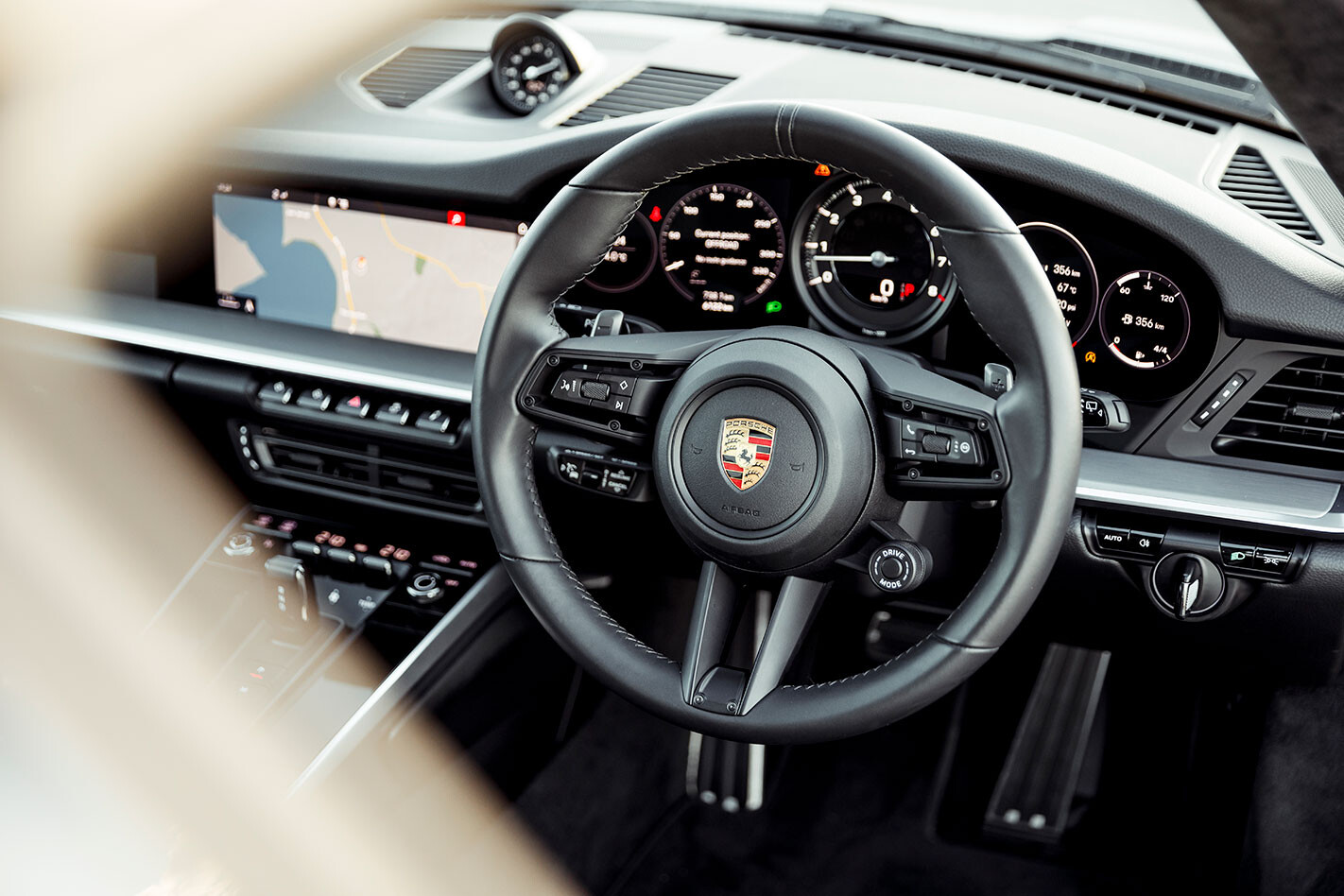
I’ve belatedly come to the conclusion that the car world has now passed peak dials. The digitisation of instruments has, in virtually every example, been a retrograde step. Until recently limited to high-end machinery, this plague is now creeping across the entire automotive sphere. Hyundai latest i30 hatch, for example, features a tachometer that has been shunted aside as a stylised afterthought in order to accommodate a vastly swollen central digital screen that does nothing to improve functionality.
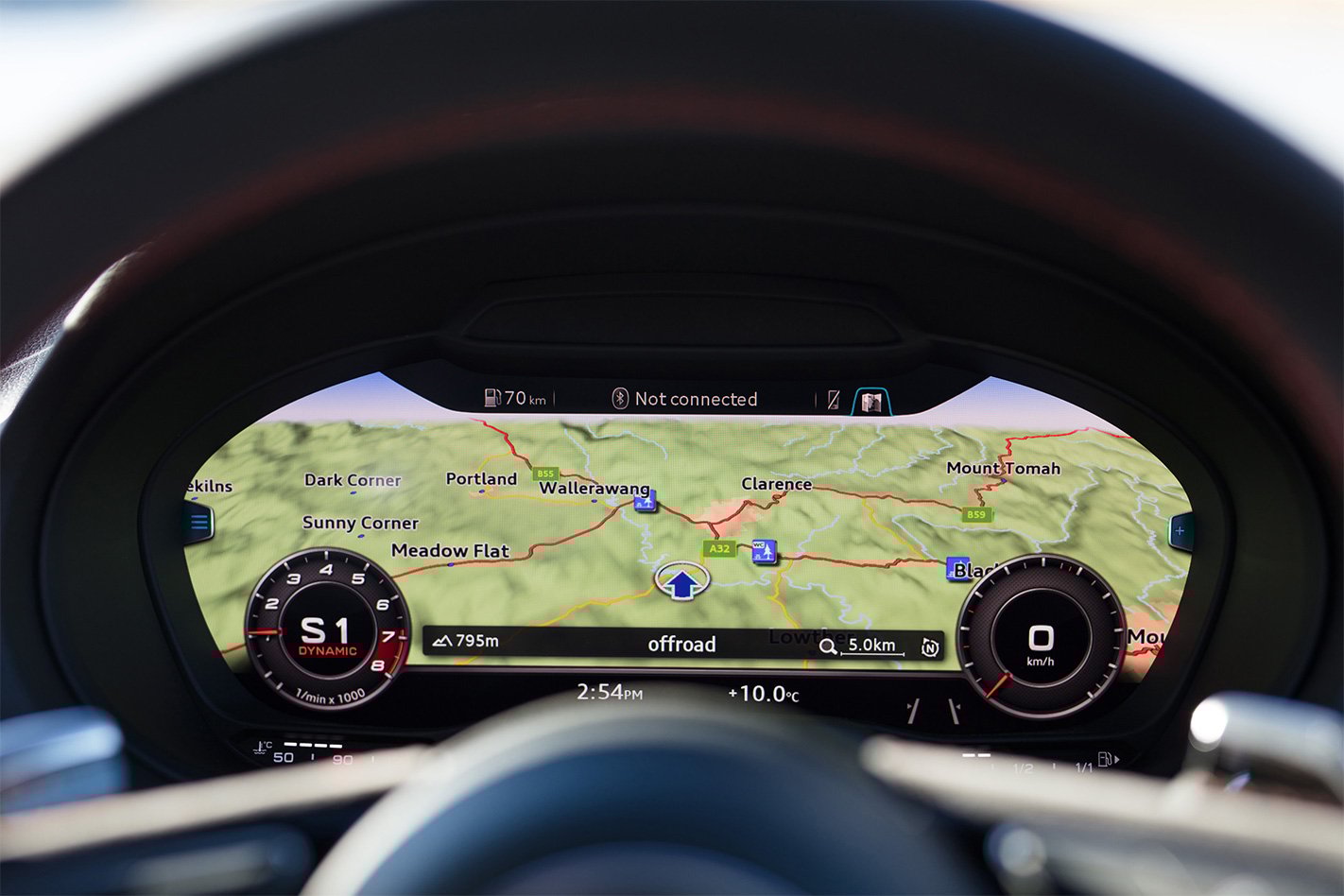
Audi is also guilty. Its ‘Virtual Cockpit’ digital instruments are now basically standard fit across its range and make perfect sense in its sports cars, as they eradicate the need for a vision-robbing central infotainment system in machines that already have quite narrow fields of vision. In the case of the S5 Sportback I reviewed recently, when I have sat-nav instructions on the central screen and the head-up display, do I really need them in the instruments as well? Worse, the latest Virtual Cockpit update eradicates the fuel and temperature gauges that typically flank the digital screen and relegate them to sub-menus. That’s right, they’ve deleted the fuel gauge.
No doubt the argument in favour of this odd decision is the fact that ‘distance to empty’ is always on display and the car will warn the driver when it reaches reserve fuel levels. The trouble is these figures vary wildly depending on driving style; for example, during recent PCOTY track testing both the 911 Turbo S and AMG GT R Pro had less than 50km to empty despite having half-full tanks. On track they were ‘almost empty’ yet on the highway would’ve travelled 300km or more. Flip the scenario and your car warning there is 50km of fuel left on a highway drive is fine, unless you’re 55km from the next fuel station.
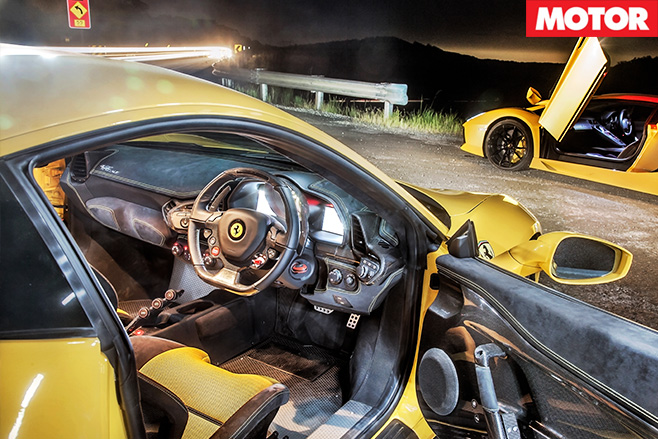
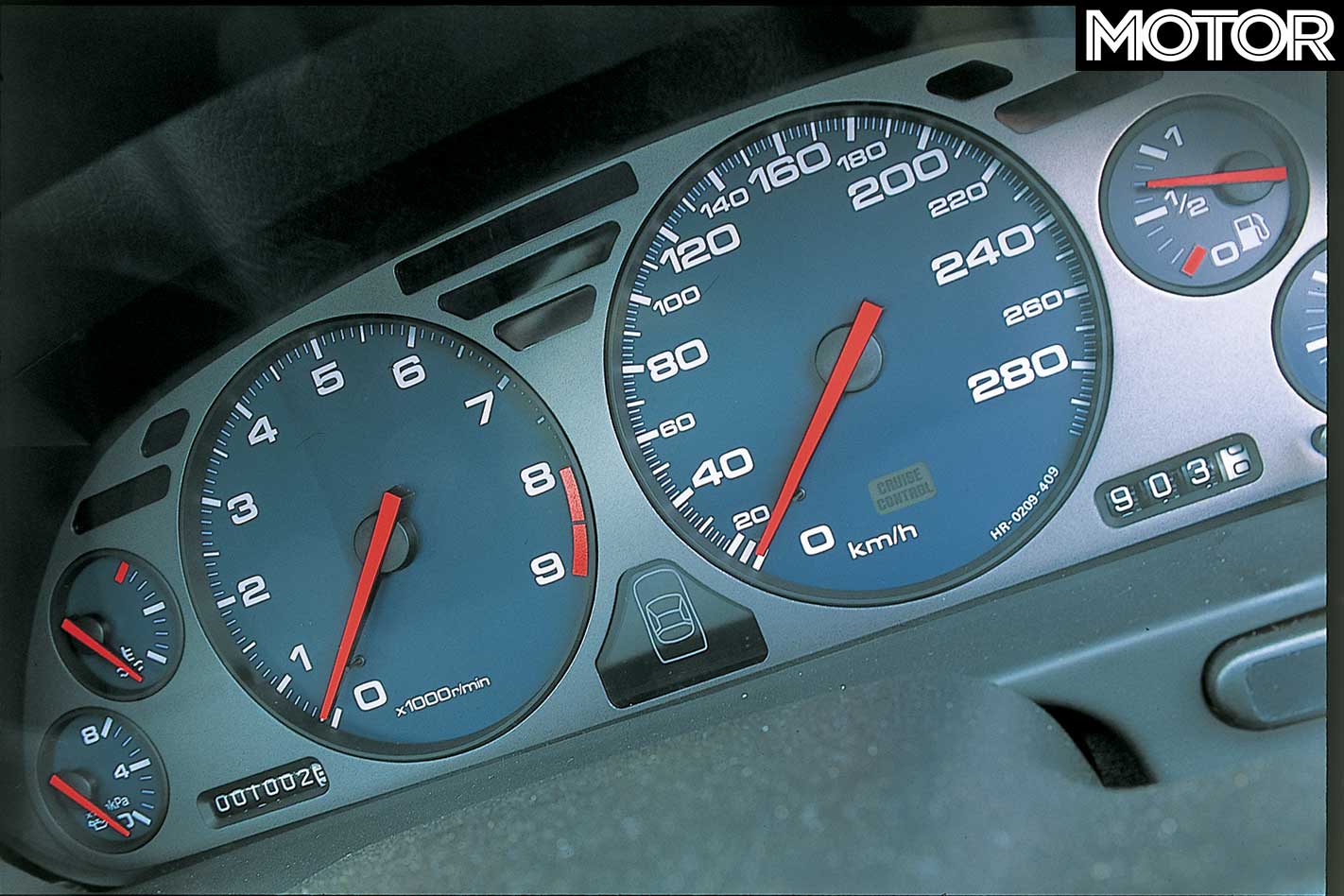
I don’t mean to pick on Audi, this was just one of the more egregious examples that typifies the problem of ‘progress’ for progress’s sake. It doesn’t even make financial sense, as despite the proliferation of digital screens I’m of the understanding that it’s still more expensive than using traditional dials. Personally, the most harmonious integration of analogue and digital has been achieved by Porsche and Ferrari, which have both kept their signature analogue tachos as a focal point and added smaller digital screens to each side. However, look at the beautifully functional instruments of a BMW E36 M3, Audi B7 RS5, Porsche 997 911, Ferrari F430 or VW Mk VI Golf GTI and you’ll see that, to me anyway, peak dial has passed.
In the previous-generation BMW M3, this would have been truly terrifying. A wet road, cold Michelin Pilot Sport Cup 2 tyres and a spiky twin-turbocharged, rear-drive layout would create a driving experience that’s about as enjoyable as petting a hungry tiger.
But right now, in the new G80 BMW M3 – the sixth generation in one of motoring’s most-loved dynasties – we wouldn’t wish the conditions were anything else.
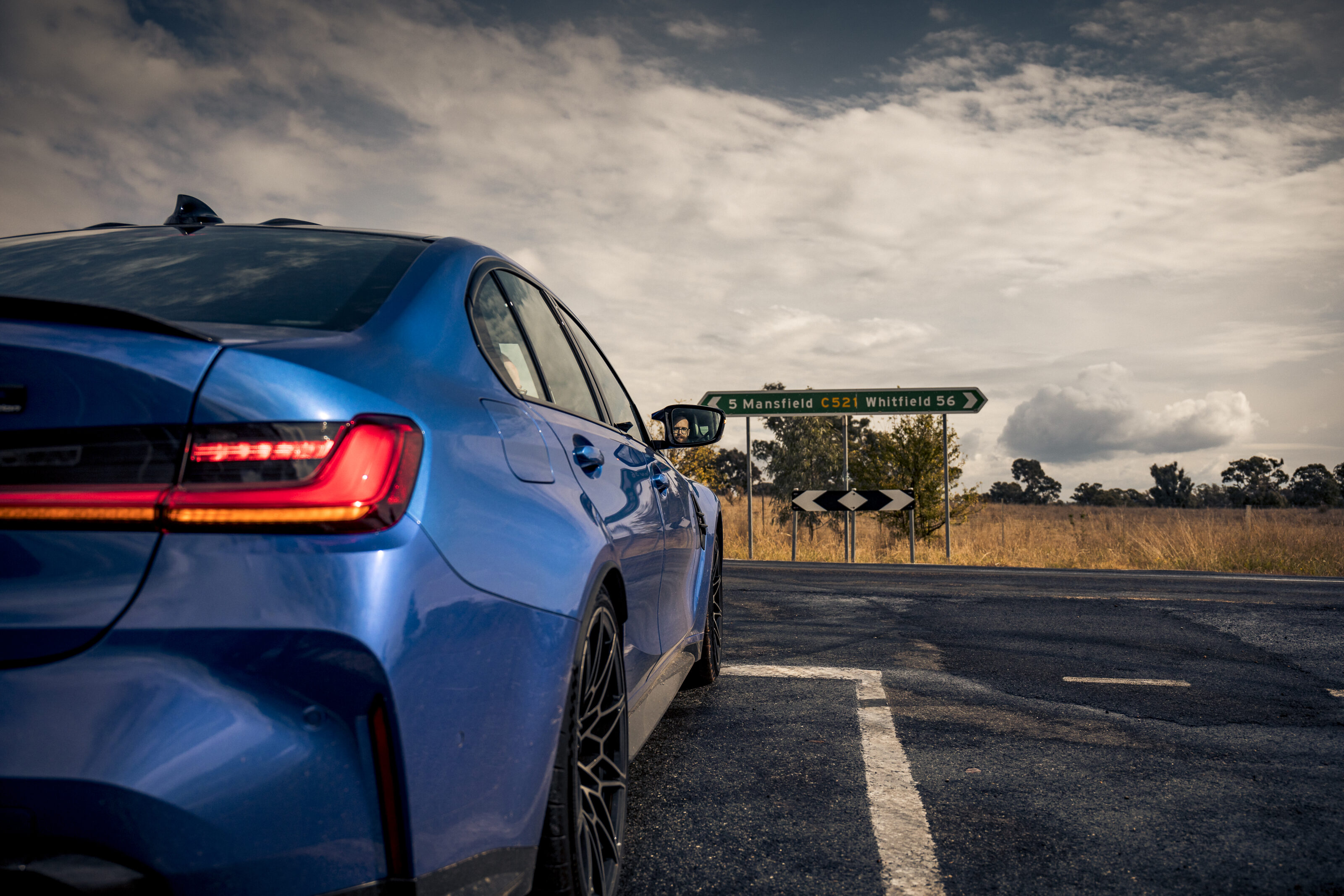
We’re on the fairly unimaginatively named Mansfield-Whitfield Road in country Victoria, 62km of some of the best winding bitumen in the state.
At least that was until someone dropped the speed limit to 80km/h, presumably to make it look like things were being done in the face of an unflinching road toll, but let’s not dwell on that.
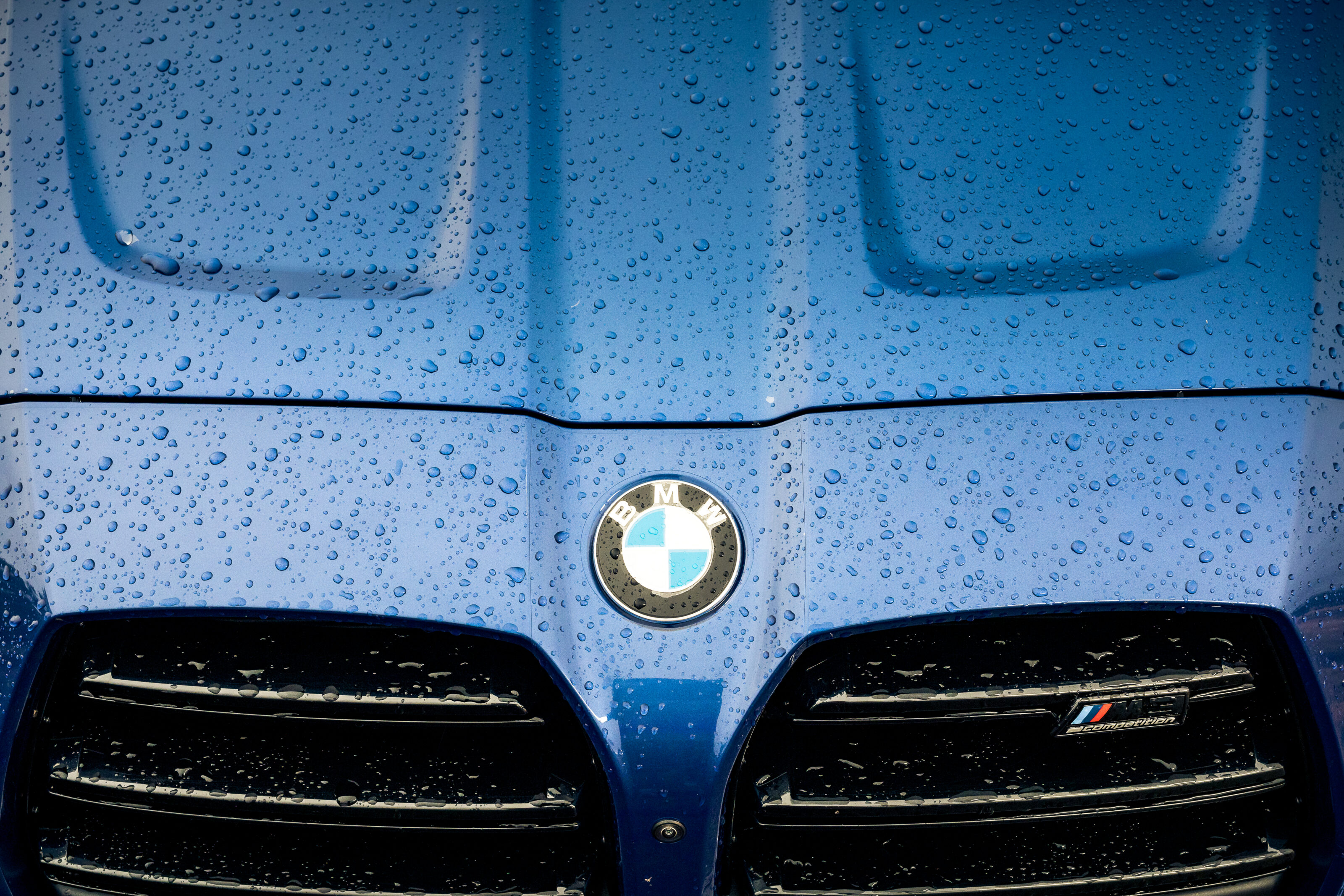
With lots of tight corners, it remains a wonderful road, linking the charming old town of Mansfield with Victoria’s King Valley.
It’s old bushranger country (and of the Taungurung people long before that) but also where Italian immigrants settled after the war, growing first tobacco and then wine. Indeed, the King Valley is a must-visit for anyone with a penchant for a good drop.
Today we’re in something decidedly more German than Italian. This car is a big deal; an all-new M3 does not come along very often. Built on the new ‘Cluster Architecture’ that underpins the G20 3 Series and also future rear-drive BMW models, the latest M3 is 123mm longer and 26mm wider than the old one, with a 45mm-longer wheelbase (increasing rear legroom).
But even with additional use of high-strength steel and aluminium in the 3 Series chassis, which has helped to keep weight down in other models, the M3 Competition auto is unfortunately 170kg heavier than before at 1730kg.
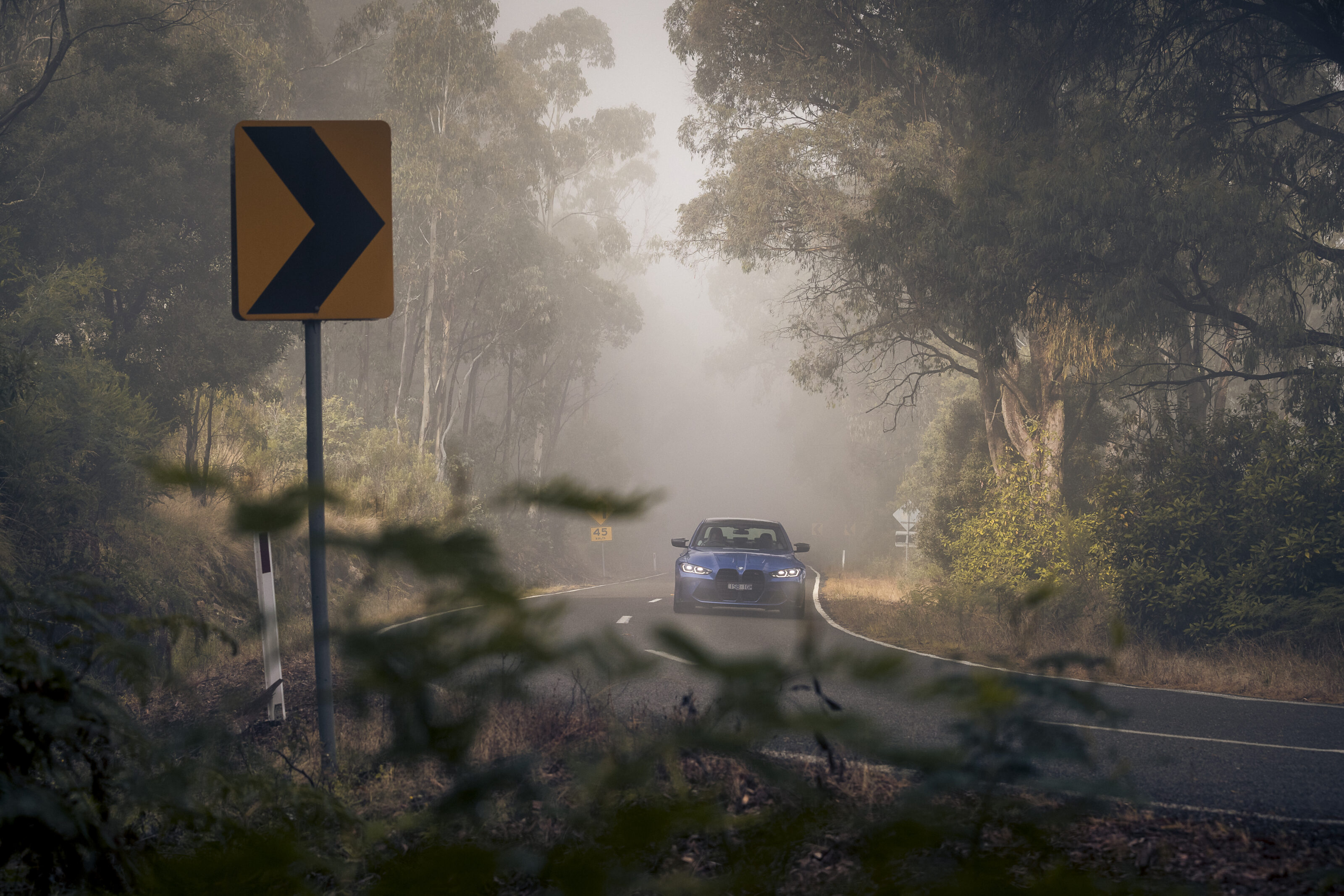
Some of that would have to do with the biggest philosophical mechanical change M Division has levelled at its super four-door, and that’s the ditching of the old, cantankerous but characterful seven-speed dual-clutch transmission for the eight-speed ZF torque-converter auto widely used across the BMW range.
A six-speed manual – hallelujah – is also available.
All-wheel drive will be offered for the first time in both M3 and M4, slashing 0-100km/h times and significantly extending the service life of the little bulb that illuminates the traction control icon, but today our test car is rear-drive. No complaints from me.
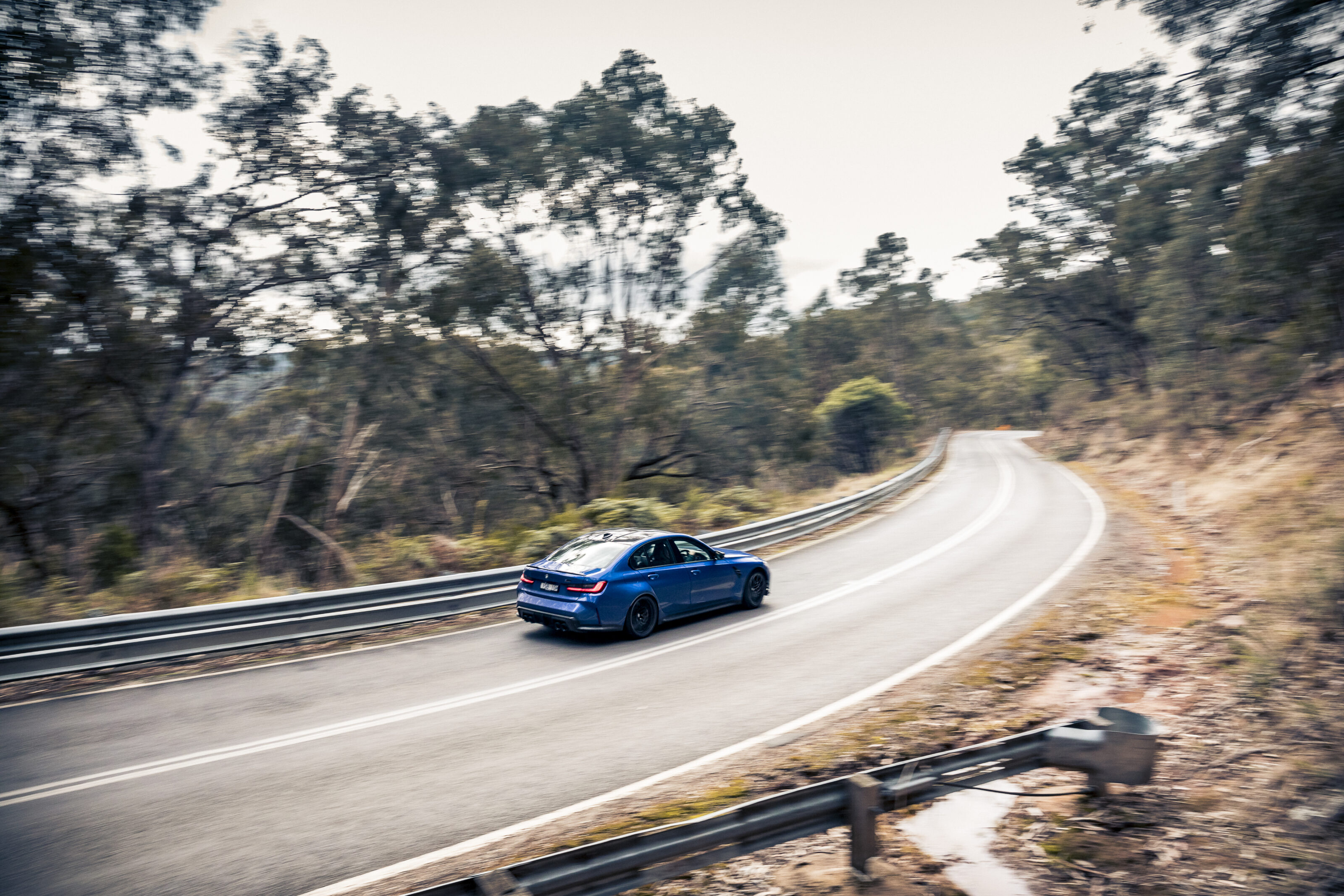
The new M3 and M4 also score a brand new engine. The ‘S58’ looks a lot like the previous S55 on paper – 3.0 litres in capacity, six cylinders in a row, two turbochargers – but there’s a new closed-deck block design for extra strength (and indicating seriously big power potential), a slightly longer stroke, more boost and lower compression (9.3:1 vs 10.2:1).
BMW assures it’s much more efficient and lower-emitting, but also there’s a lot more power. In the Competition guise of our test car, that means 375kW at 6250rpm and 650Nm from 2750 to 5500rpm, easily eclipsing the 338kW and 600Nm of even the previous F80 M3 CS, with torque also arriving 1250rpm sooner.
A fully variably locking electronic rear differential distributes power to a pair of 285-section rear tyres, which on our Competition test car are very sticky and focused Michelin Pilot Sport Cup 2s. Tamer Michelin Pilot Sport 4S rubber is available as standard.
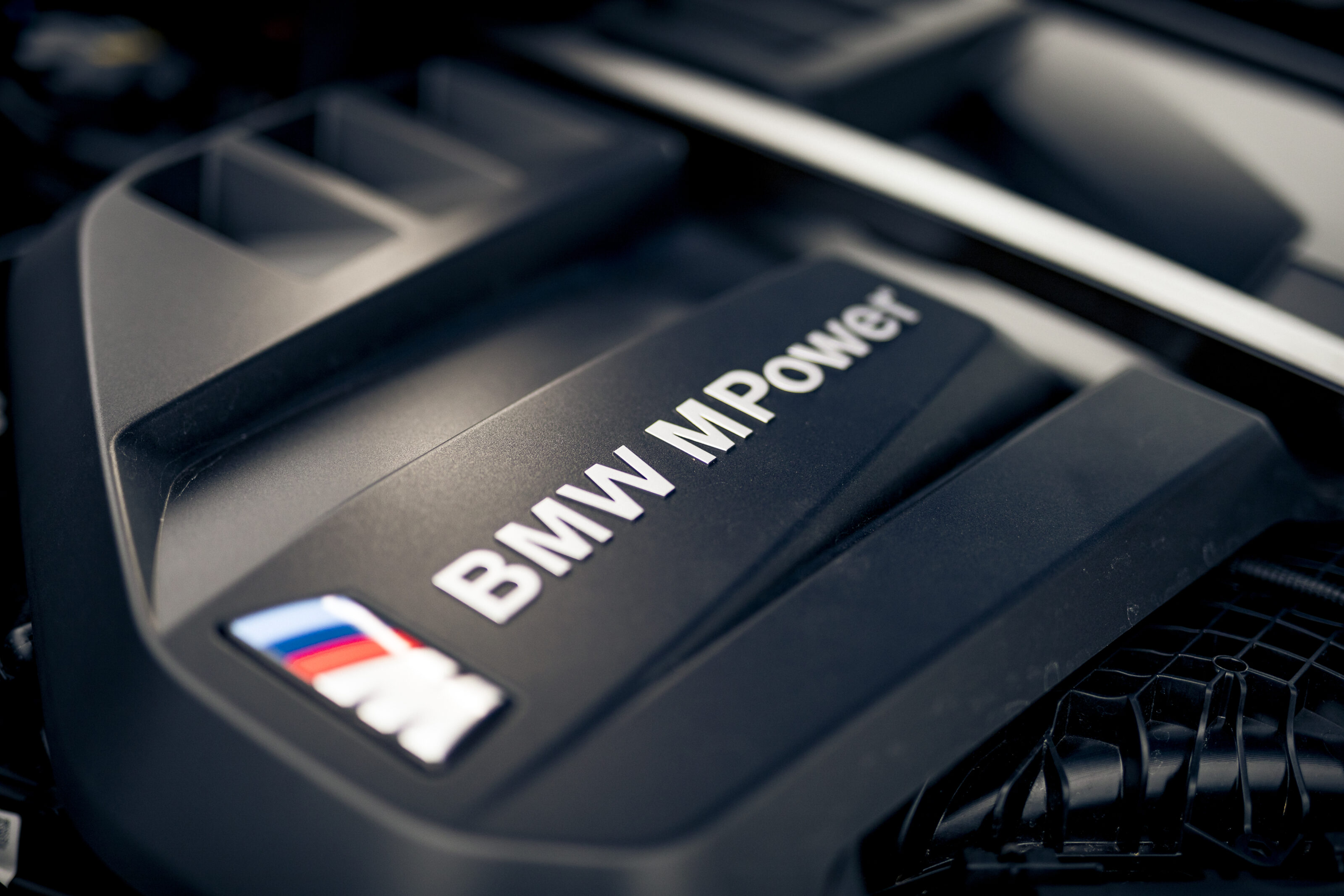
With launch control, BMW claims the new rear-drive M3 Competition will hit 100km/h in 3.9 seconds from rest, matching the F80 CS. It smashes the CS from 80-120km/h, though, at 2.6sec vs 3.4sec in fourth gear.
All-wheel drive drops the M3 Competition’s 0-100km/h sprint to just 3.5sec. We ran numbers on our test car at Heathcote Dragway, but the soaking conditions were such that the results aren’t worth publishing. We will try again in dryer and warmer times.
Now we come to that exterior styling. To some, it will look tough, a bit space-age and original. To others, it will look like a weird mish-mash of BMW, Alfa Romeo Giulia and Lexus IS.
We admit that, with the metaphorical ghost of Chris Bangle jangling chains and moaning forlornly up and down the corridors of BMW Design in Munich, we were surprised BMW ported the M4 front end treatment across to the M3 as well.
We guessed the M3 might look like a hotter, more aggressive M340i. Indeed, it will be interesting to see if the new gnawing-rodent nose survives the models’ first Life Cycle Impulse (BMW-speak for facelift). At least the M3 keeps a Hofmeister Kink where the M4 doesn’t.
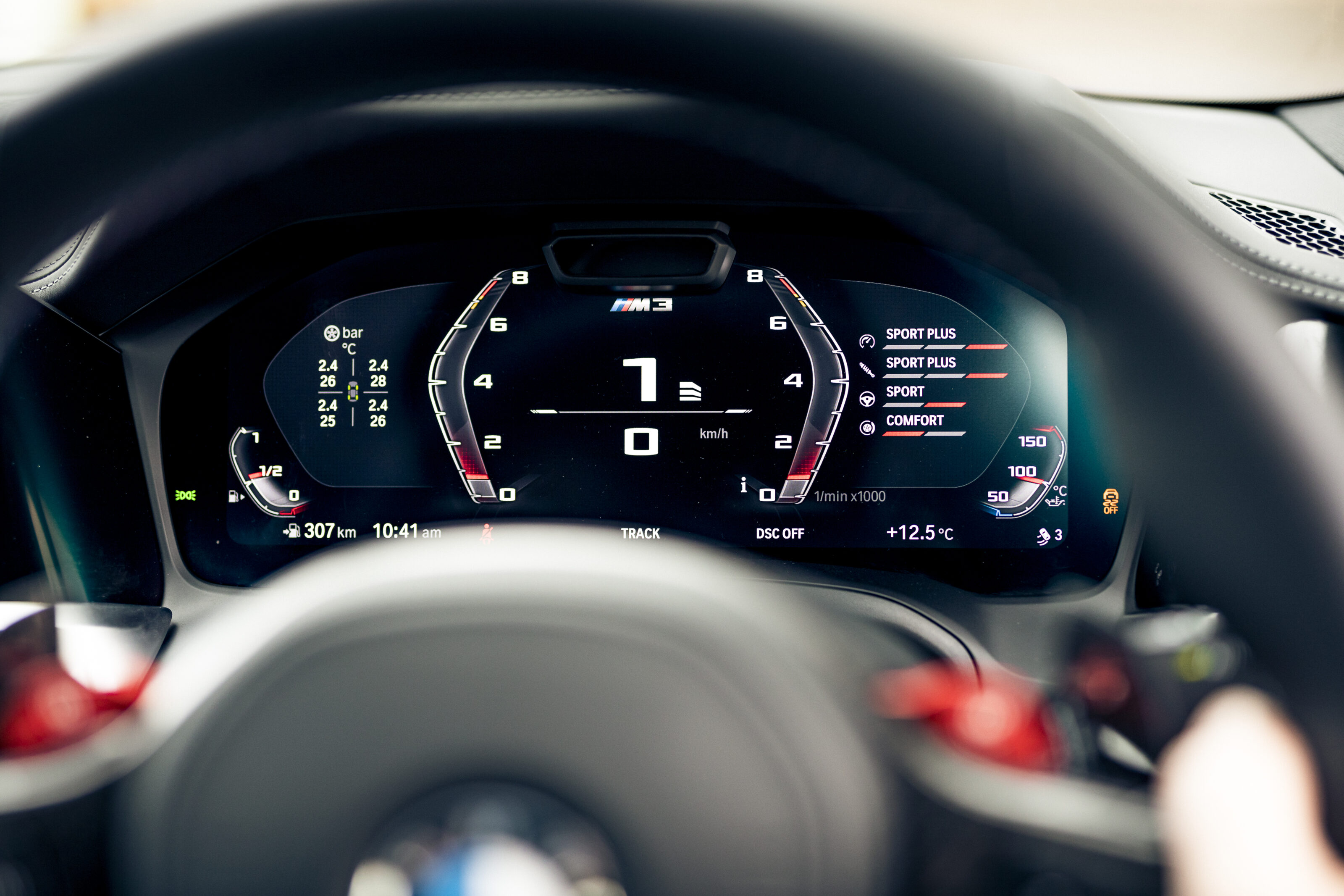
In the metal, there is no denying this car’s presence. Spot it in a dark alley and you will be gripping your wallet tighter, turning 180 degrees and walking off as fast you can. It strikes a menacing silhouette, those big, wide, low offset wheels filling the pumped guards perfectly, creating a mega stance. Under a street light, the mesmerising three-dimensional weave of carbonfibre, on the roof and mirror caps, draws you in for a closer look.
But back in broad daylight there’s no denying the M3 is like a muscled-up boxer with a bent nose and cauliflower ears. Also, on a car with already challenging front styling, couldn’t they have integrated the front radar unit a little more elegantly?
Thankfully, you only see the side of the car in shop windows, and inside it’s a nicer story altogether. As you open the doors and slide inside, there’s no denying the impeccable BMW build quality. Everything feels solid yet precise and tactile.
Apart from the dash pad, which is quite an oppressive, large chunk of soft black plastic, the material choices and finishes are exactly what you would want.
With the 12.3-inch digital instrument display (a moment’s silence for the loss of analogue dials) and 10.25-inch central infotainment display, the interior is a luxurious, intuitive and high-tech place to sit. And iDrive 7.0 is as good as ever.
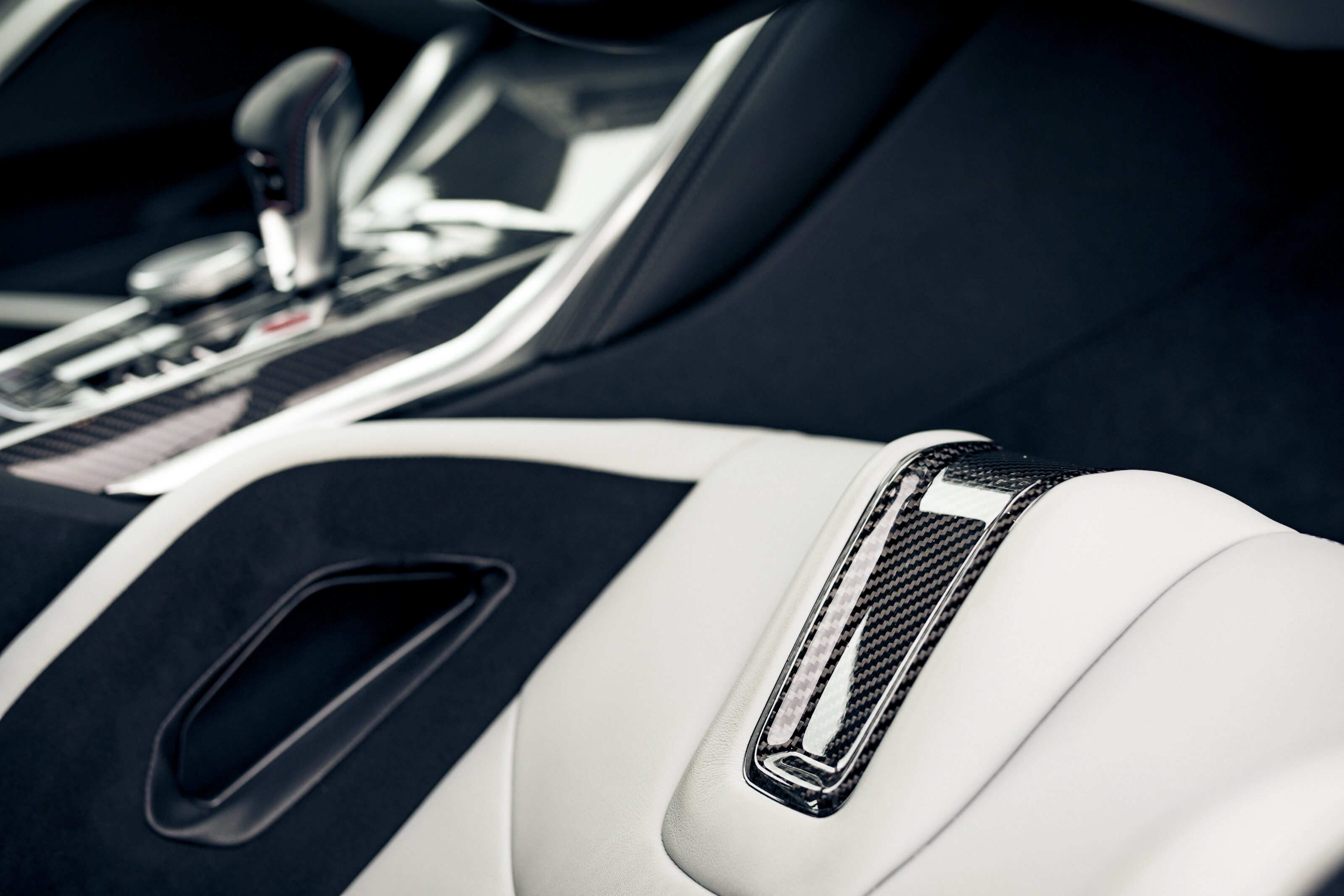
Then you notice the seat… This car is fitted with BMW’s optional M Carbon seats, which, curiously, have a raised carbonfibre mound between your thighs. The idea is to hold your legs in place during high-g cornering, but they mustn’t eat much in the engineering department at BMW… I’m a small man with medium-chunky thighs and the weird mound was definitely uncomfortable.
Especially as I like left-foot braking, and the right-aligned brake pedal placement means having a chunk of protruding hard plastic under my left knee. Although they do offer incredible hip support, granting a very tight connection to the rear of the car, make sure you try these seats before ordering them!
Awaken the S58 with the starter button on the transmission tunnel and, after enjoying the loud exhaust note at idle, within 100 metres you’re aware the engineering runs very deep below any superficial styling criticisms. Immediately the steering feels more connected and precise, having the effect of making the car feel marginally smaller.
The old car’s steering was always a bit muted, which was annoying as it has such a mega front-end. The ride quality compared to the old car is much improved as well. No more thudding into potholes or jiggling over low-speed irregularities. Aside from quite a lot of harshness we would attribute to the Cup 2 tyres, this is a comfortable car.
The torque converter, as you would hope, has banished all the ugly driveability issues of the old DCT unit. It still feels tight, but it is a lot smoother and there’s no more creep forward or back as clutches jolt and engage. It’s completely changed the low-speed character of the car; for urban manners, the M3 is a lot more refined, more grown up.
This is a very nice car to drive around town, as we find during the trip from BMW’s suburban HQ to Mansfield, where things heat up. Points are also awarded to the new active cruise control, which will steer the car even down a challenging country road, so long as you touch the steering wheel often.
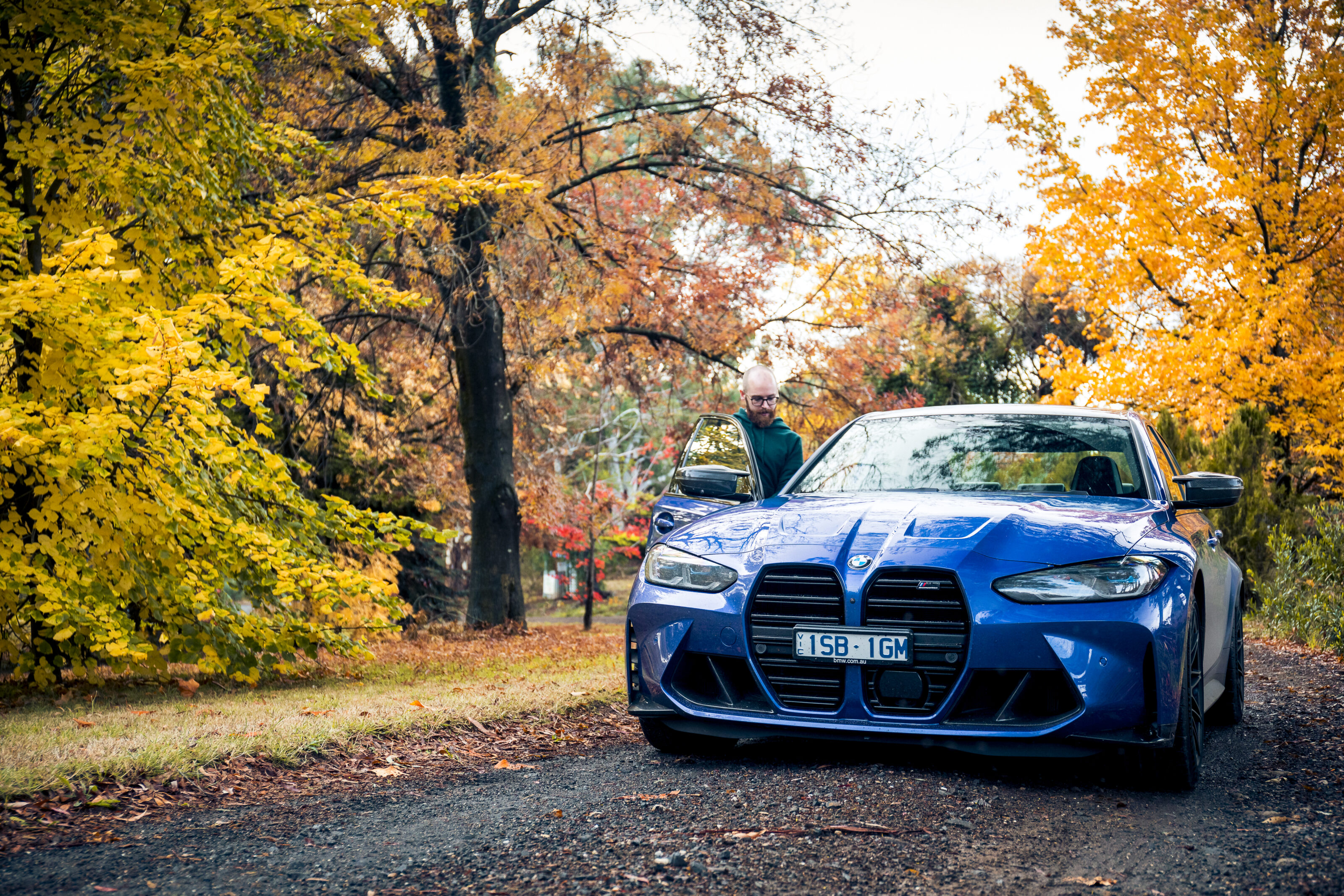
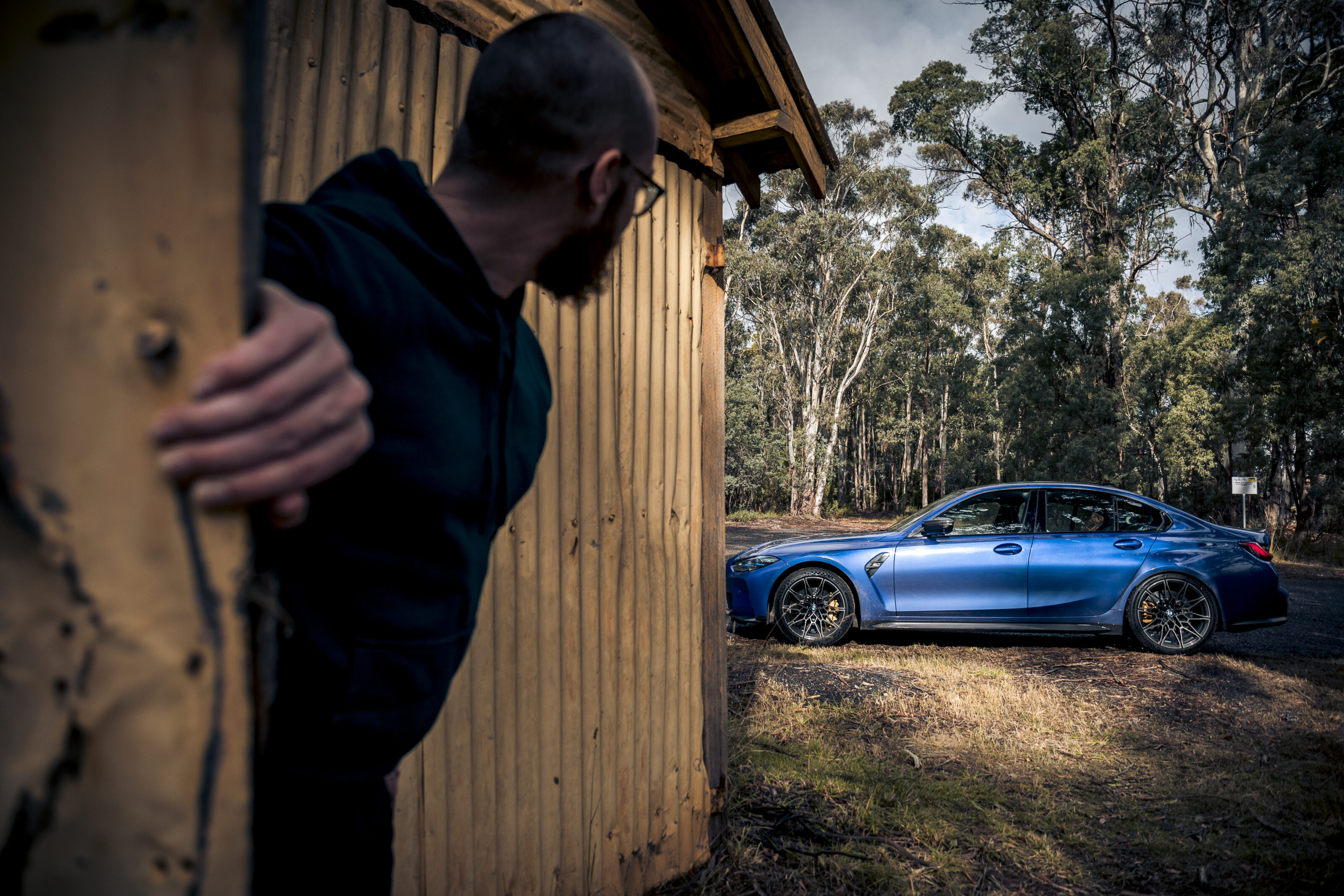
Curiously, even in the vibrant San Marino blue of our test car and riding on fat 19-inch front and 20-inch rear wheels, our new M3 attracted hardly any attention from pedestrians or other drivers – and, to be fair, that’s just the way many owners would like it.
Having driven the 215km from Melbourne to Mansfield, it’s time to uncork the M3 on the way to Whitfield. Care is needed because the Cup 2 tyres are cold – and an ever-flickering traction-control light only reinforces that – although these tyres, while apparently optimised just for M3, don’t feel to be the death traps in cold and wet conditions that they used to be.
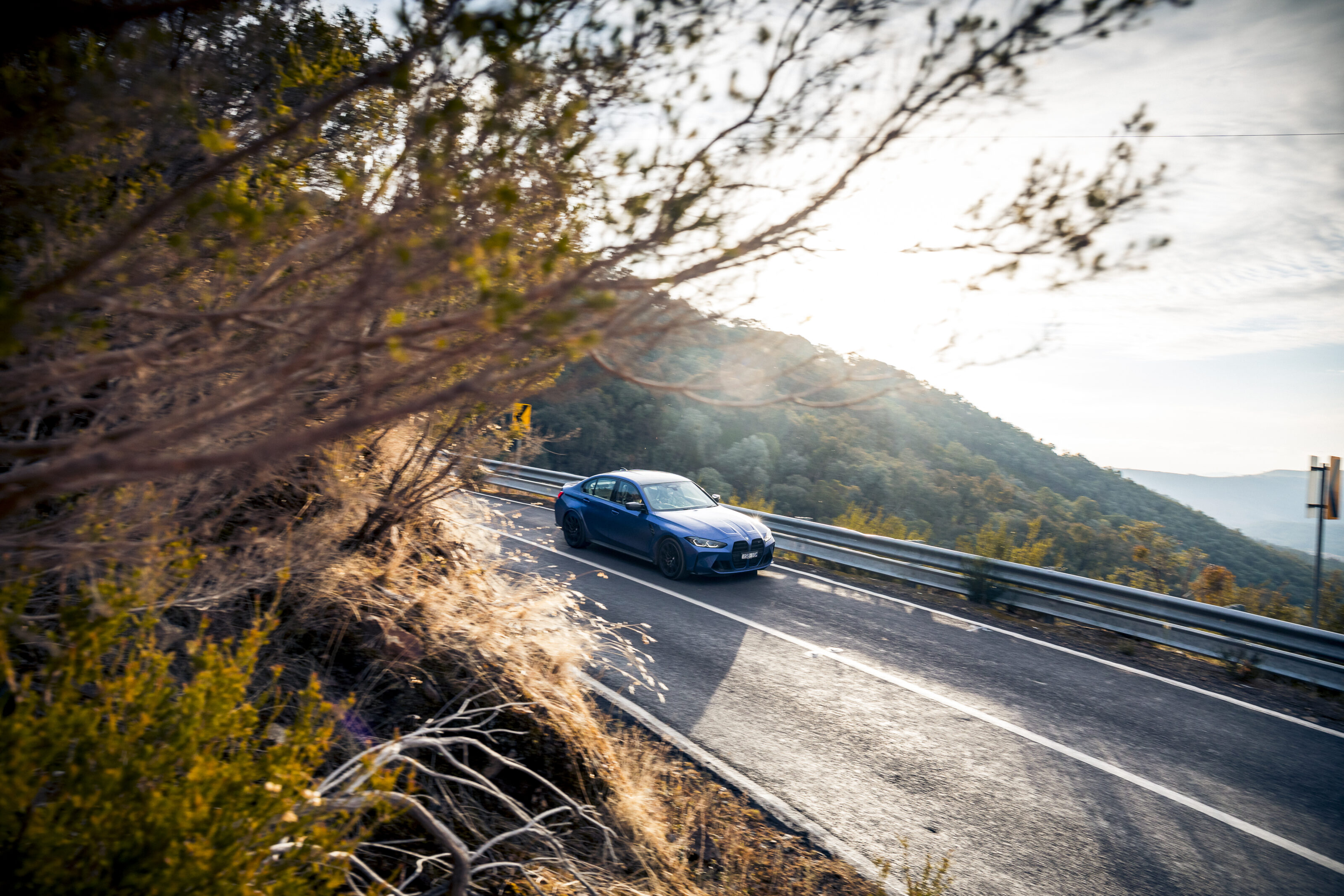
Blessedly, as we arrive on the Mansfield-Whitfield Road, the surface is dry and it’s as if we have it all to ourselves. Flicked into Sport mode, it is immediately obvious the M3 is seriously, eye-poppingly fast, with way too much power for the rear tyres. When it hooks up, your brain will want to be wide awake.

Interestingly, the new M3 doesn’t feel enormously faster than the old one, and the S58 doesn’t feel that much different to the old S55.
It’s all about torque with this engine, winding up the turbos and surfing the 650Nm then short-shifting, as hitting the soft limiter is quite the buzz-kill, but also there is nothing really to gain in the upper revs.
The power delivery, from about 3000rpm and onwards, just feels like a massive slingshot of torque.
Somewhat disappointingly, there is still quite a lot of lag and it’s easy to catch the engine snoozing.
It’s not quite as ‘bad’ as the old S55, but hardly the unbelievable, razor-sharp response AMG has managed to achieve from some of its latest turbocharged engines.
Fortunately, though, the power no longer arrives with a mind of its own, somewhat independent of whatever instruction you have given with the throttle pedal. The old car liked surprises; the new one at least is a little easier to predict.
It was with a trembling index finger that you ever went near the ESC button in the previous M3; with the new one, it’s a button you are excited to play around with. It’s just a shame the reduced M Dynamic Mode (MDM) ESC setting is not that different to ESC fully on.
But there is 10-stage traction control, another new toy possibly borrowing inspiration from rivals AMG – although, while AMG uses dashboard and steering-wheel dials to adjust its nine-stage TC, in the M3 you have to turn the ESC fully off and then tap between one and 10 in the new drive-modes menu (where every setting can be easily selected on the fly).
And while 10-stage TC sounds cool, really you only find yourself using level three to give the slip and safety net that should have probably been MDM.
In the previous-generation M3, selecting Sport mode for the adaptive dampers was a step too far on most roads, but in the G80 you find yourself reaching for Sport Plus – and more.
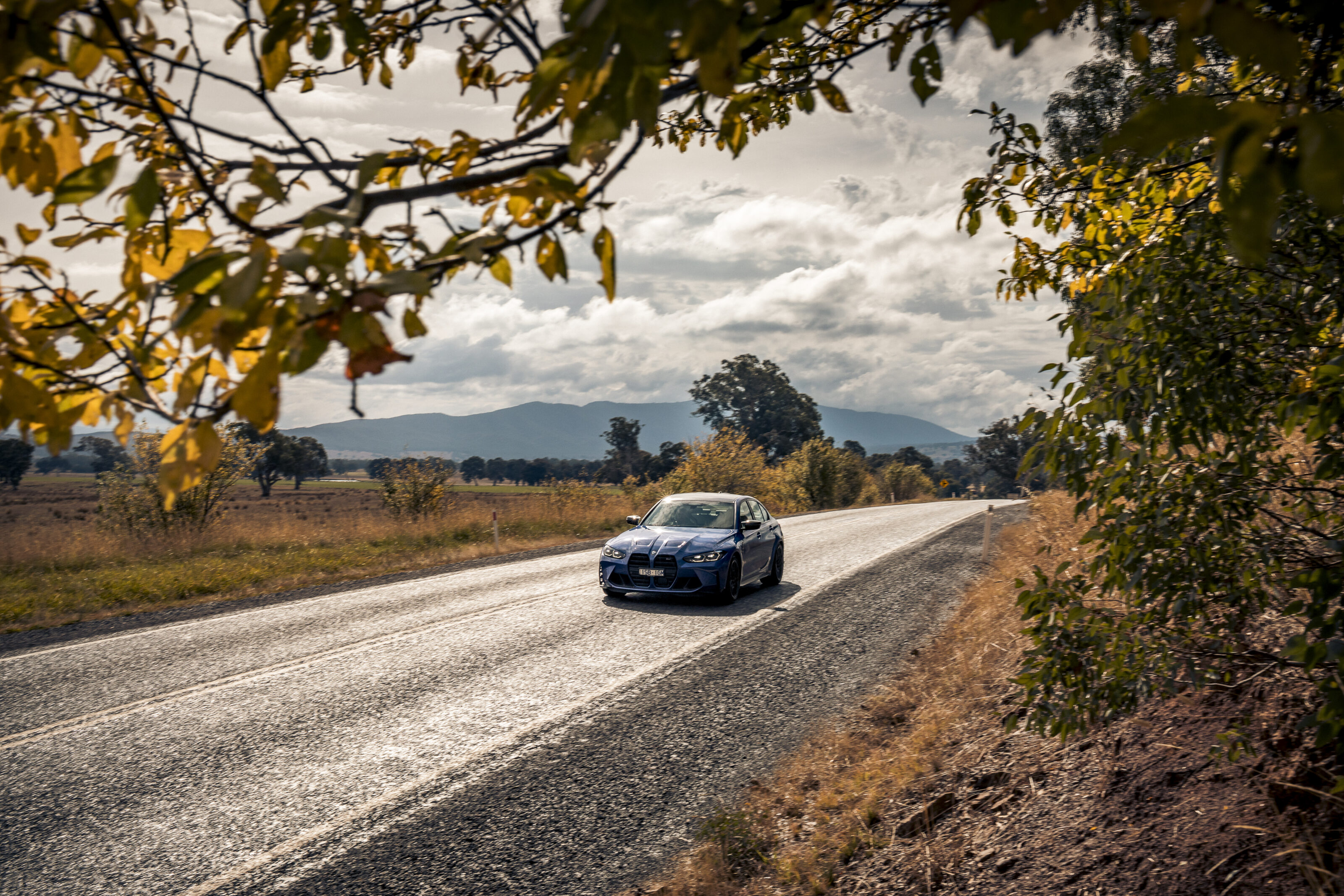
However, it seems there is a trade-off for that lovely new ride quality, one exacerbated by the extra weight and sticky optional tyres: body roll. While the M3 still sits acceptably flat in corners, at the ragged edge a bit of patience is now required as you turn in and wait for the body to settle.
And a bit of care is needed during hard changes of direction too, particularly as the rear end now moves through a slightly larger arc. Yes, the bigger, heavier, softer new M3 is not quite as agile as the old one. The upside is that the M3 now encourages you to keep pushing even as the road gets a bit choppy, where you would be backing off in the old car.
Luckily, though, they’ve ‘fixed’ the steering. It is much better. You now find yourself carrying speed into long corners and trying to feel with your fingertips how much front purchase is left, something unheard of with the mute tiller of the F80. Big ups to M Division, as the front-end is now pure joy.
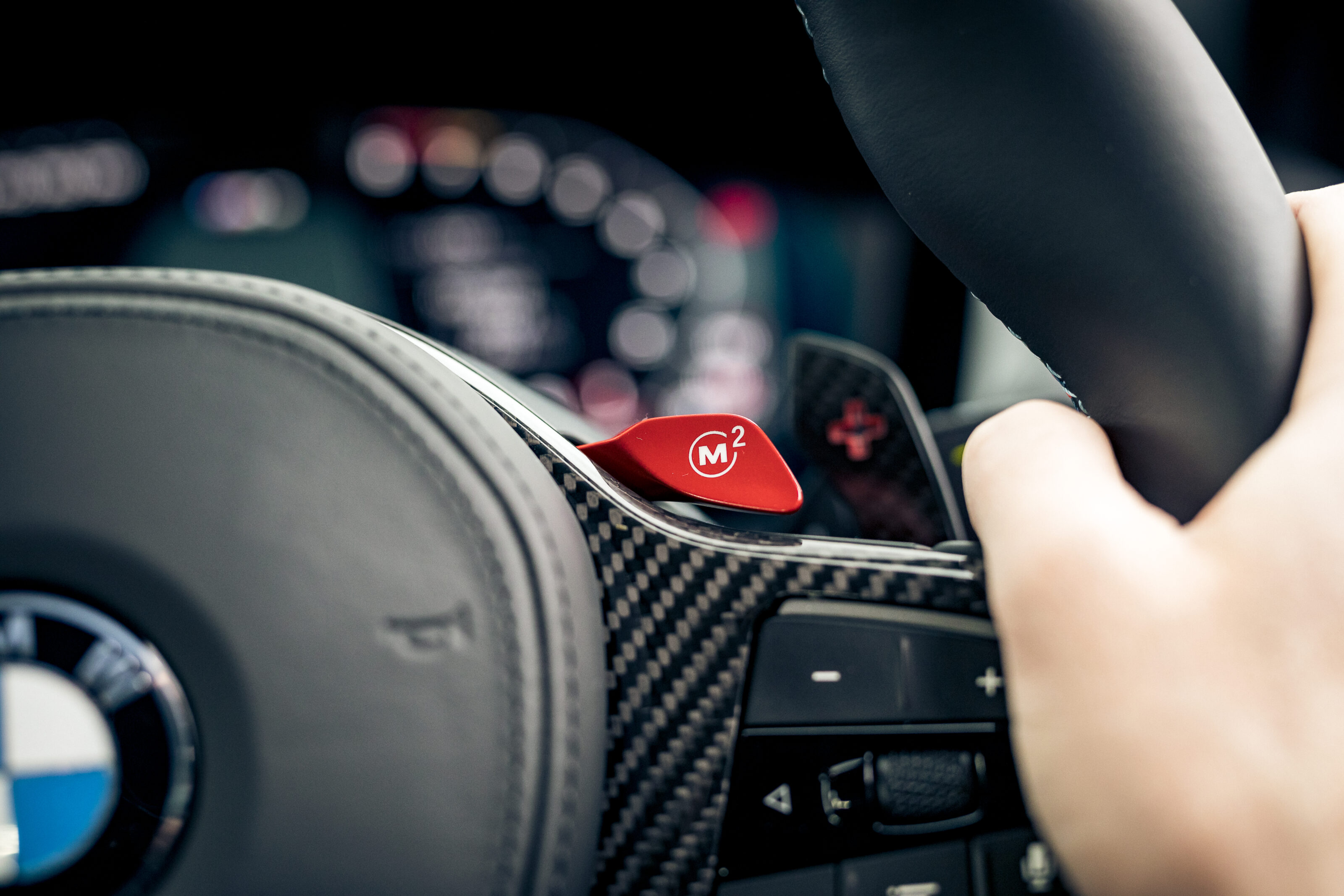
The overall softening of the suspension has also breathed some life into the M3’s handling it probably needed. It’s a more natural-feeling handler now, more predictable, more inspiring of confidence, more fun.
And, in the dry, on the Cup 2 tyres, it’s insanely fast and grippy. In fact, the Michelins are so good that it’s quite the task trying to judge the chassis with such incredibly feelsome and communicative rubber bolted to it. But they are both as good as each other.
The eight-speed auto also steps up to the plate in an impressive way. It has three shift speeds, but all are incredibly smooth so there’s no reason why you wouldn’t just always use the fastest one.
The changes are fast, slick and responsive up the gears, even if there is a bit of a delay going back down again.
And, if we’re honest, part of us does miss the highly strung, racy personality of the old dual-clutch, however flawed it was overall, but such is life. The new auto’s eight ratios are spaced well, there seemingly being a gear for every possible corner.
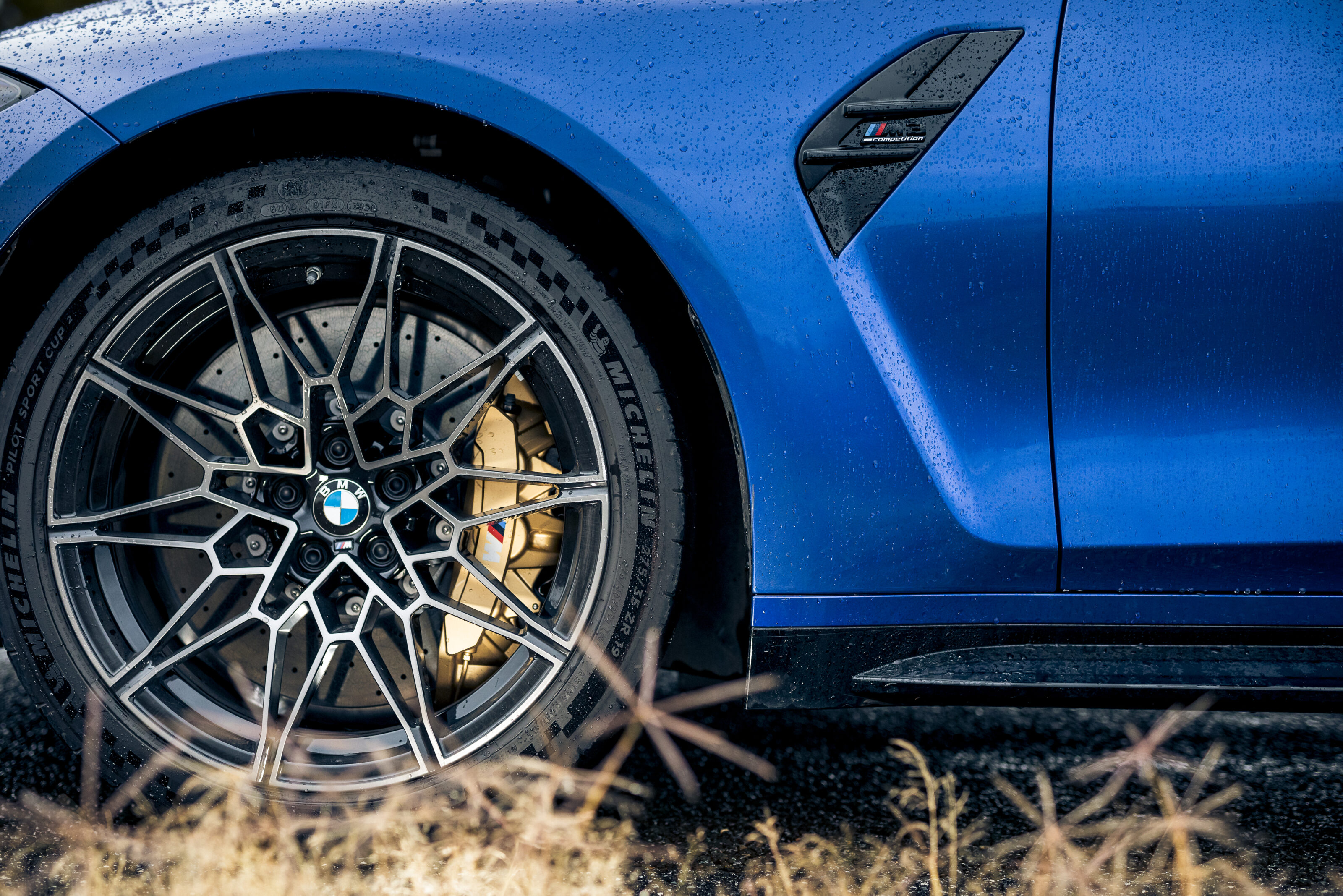
The brakes are interesting too. Now brake-by-wire, you can select between Comfort and Sport modes. They offer incredible stopping ability (optional carbon-ceramics were fitted to our tester) and BMW has done well to make them feel as natural as possible.
Sport mode just reduces travel and increases sensitivity, but we preferred Comfort as it was somewhat easier to modulate.
They did feel a tad muted, and we would be interested to push them hard on a track, where brake-by-wire on other cars (like the Alfa Romeo Giulia) has shown up some weird calibration quirks at the edge of the performance envelope. On the road, though, the carbon brakes were more than convincing enough, and completely fade-free.
BMW has also made improvements to the M3’s sound. In an age of petrol particulate filters and anti-fun brigade oppressive European noise regulations, it’s true the active exhaust button on the M3 may as well not even be there such is the difference it makes in the G80, but BMW has improved the Active Sound Design, so the fake engine noise coming from under the dash is a lot less PlayStation and instead a lot more convincing. Put the windows down and there’s a good amount of turbo personality to be enjoyed too. Does the M3 sound good? It’s no wailing E46 CSL, but it’s okay.
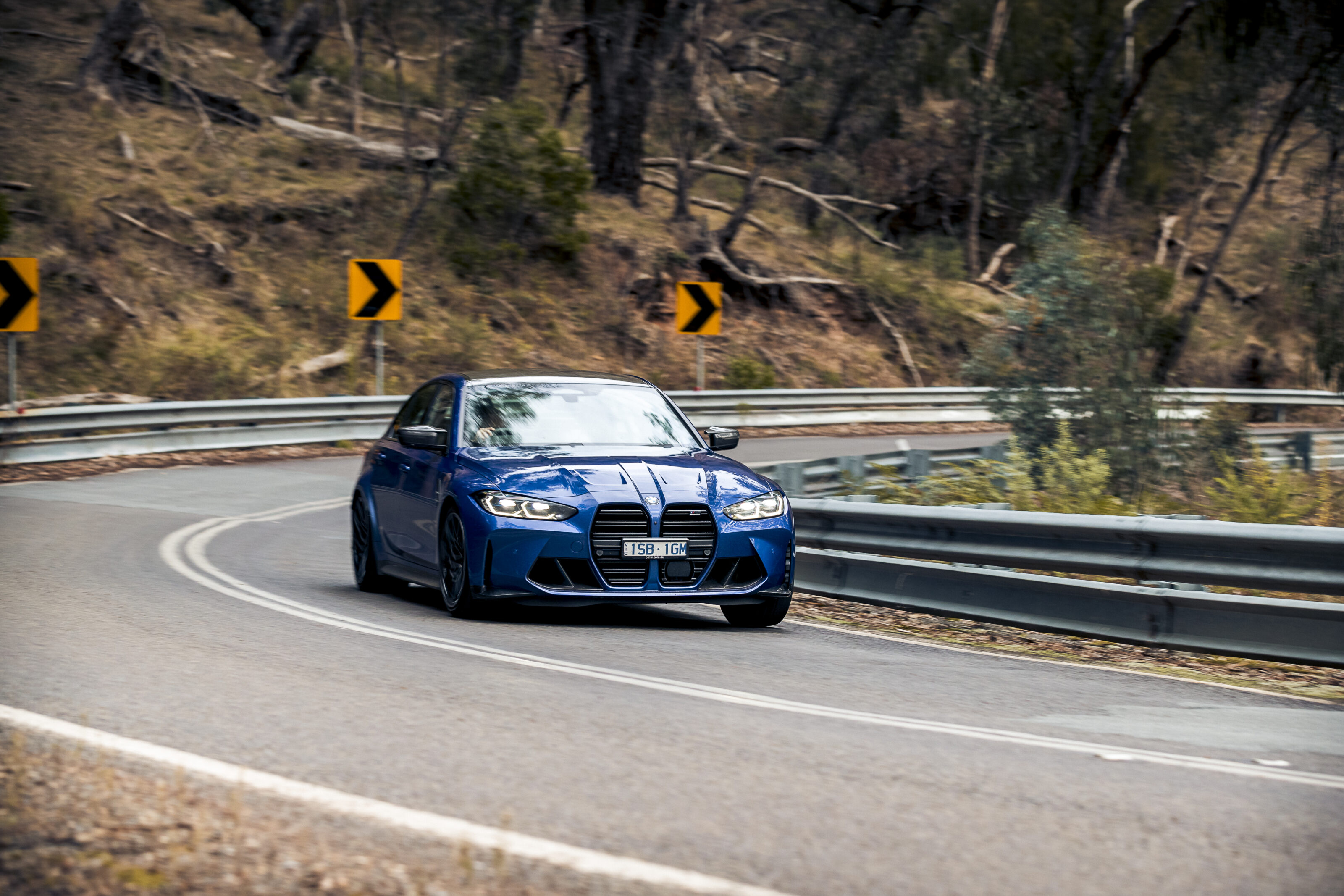
As we get to the end of the road and the King Valley beckons, our mind is made up about the new M3 – it’s brilliant. Just as E30, E36, E46, E92, F80 all had very distinct characters, this one has a different personality again. While it is still plenty feral for most people and has hardly ‘gone soft’, there is a new, grown-up manner about it around town.
It’s a more road-focused performance car. It’s almost like a more serious rear-drive M340i, or a baby straight-six M5. And it continues a run of good form from M Division that started with the current M5 and continued into M2 Competition.
But probably the biggest compliment we can give BMW’s new M model is that it is a lot more fun. It no longer feels to be plotting to kill you when you’re not looking.
Yes, there are still some surprises lurking within to keep you on your toes, but find yourself on cold Cup 2 tyres, on a wet road, and you will be giggling to yourself as you easily enjoy the car rather than just trying to survive.
More of a big kitty cat, it’s no longer the pet tiger – and how the car looks will be a million miles from the front of your mind.
2021 BMW M3 Competition specifications
Price | $154,900/$183,980 as tested |
u00a0 | Drivetrain |
Engine | 6cyl, dohc, 24v, twin-turbo |
Layout | front engine (north-south) |
Capacity | 2993cc |
u00a0Power | 375kW @ 6250rpm |
Torque | 650Nm @ 2750-5500rpm |
Gearbox | 8-speed automatic |
u00a0 | Chassis |
Body u00a0 | steel/aluminium, 4 doors, 5 seats |
L/W/H | 4794/1903/1437mm |
Wheelbase | 2857mm |
Track (F/R) | 1617mm/1605mm |
Weight | 1730kg |
Fuel/tank | u00a098RON/59L |
Economy | 9.6L/100km (combined, claimed) |
Suspension u00a0 u00a0 u00a0 | Front: struts, A-arms, adaptive dampers, anti-roll bar. |
Steering u00a0 | electric rack-and-pinion |
Front brakes u00a0 | ventilated carbon discs (380mm) |
Rear brakes | ventilated carbon discs (370mm) |
Wheels u00a0 | 19.0 x 9.5-inch (f); 20.0 x 10.5-inch (r) |
Tyres | 275/35 ZR19 (f); 285/30 ZR20 (r) Michelin Pilot Sport Cup 2 |
u00a0 | Safety |
ANCAP rating | Five stars |
u00a0 | Warranty: 3 yrs/unlimited km |
Snapshot
- The process uses an enzyme that can depolymerize plastic or polyester
- Michelin aims to use 100 per cent renewable materials by 2050
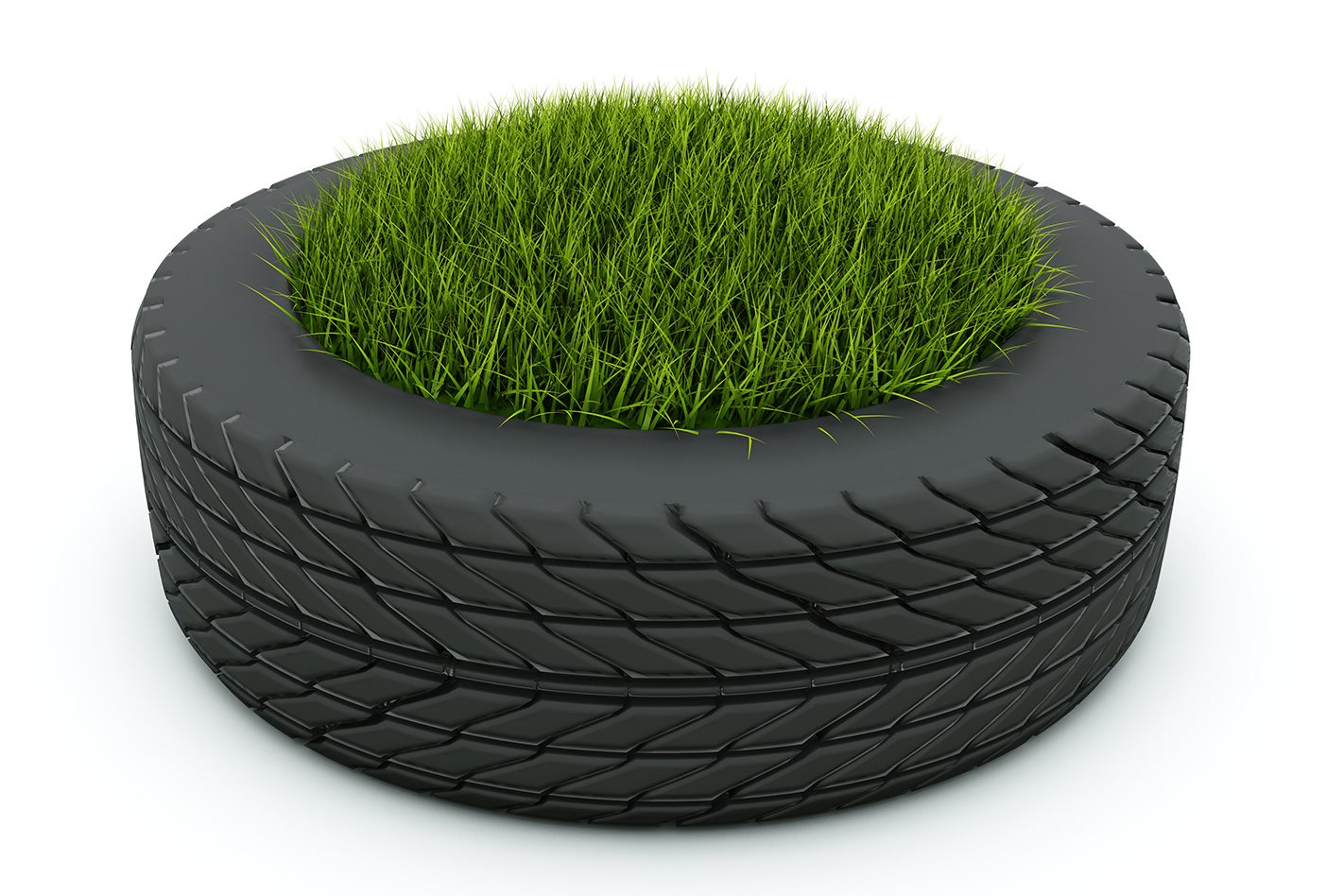
Michelin has taken an important step in its quest to produce tyres from recycled plastics including drink bottles.
The French tyre giant has revealed that it has successfully tested a plastic recycling technology with compatriot biochemistry firm Carbios, which had pioneered the production of polyethylene terephthalate (PET) products using recycled materials.
The complex process for producing tyres uses an enzyme that can depolymerize the PET used in everyday plastic products such as containers and polyester clothing.

According to Michelin, the process has resulted in the creation of a high-tenacity polyester that is suitable for tyres thanks to its breakage resistance, toughness, and thermal stability.
“We are very proud to be the first to have produced and tested recycled technical fibres for tyres,” Michelin’s director of polymer research, Nicholas Seeboth, said in a statement.
“These reinforcements were made from coloured bottles and recycled using the enzymatic technology of our partner, Carbios. These high-tech reinforcements have demonstrated their ability to provide performance identical to those from the oil industry.”
Carbios’s chief scientific officer Alain Marty added: “Today, with Michelin, we are demonstrating the full extent of our process by obtaining from this same plastic waste, recycled PET that is suitable for highly technical fibres, such as those used in Michelin’s tyres.”
Michelin has set an ambitious target of using renewable or recycled materials for 40 per cent of its manufacturing by 2030 and 100 per cent by 2050. Every year, 1.6 billion car tyres are sold worldwide, representing 800,000 tonnes of PET fibres annually.
The company previously announced plans to use wood as an alternative to expensive and not-so environmentally friendly oil-based synthetics across the Michelin range.
