
Combustion engines ain’t dead yet, baby!
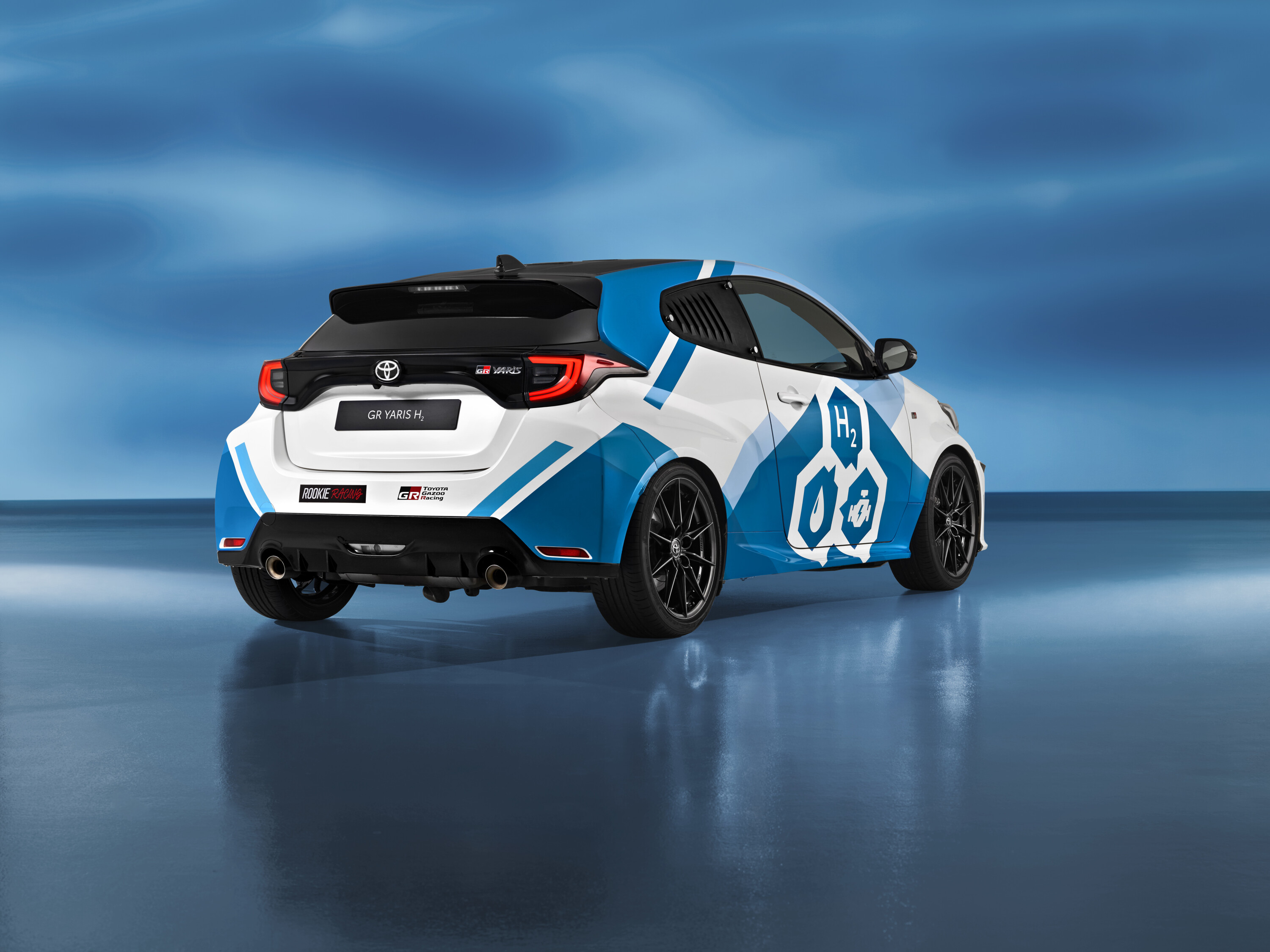
At least that’s the hope of Toyota, Mazda and Subaru who have today announced a partnership to develop new engines that will help decarbonise combustion-powered cars.
The alliance aims to tailor the all-new engines to integrate with motors, batteries and other electric drive units and also to be compatible with various carbon-neutral fuels like biofuels, hydrogen and e-fuel.
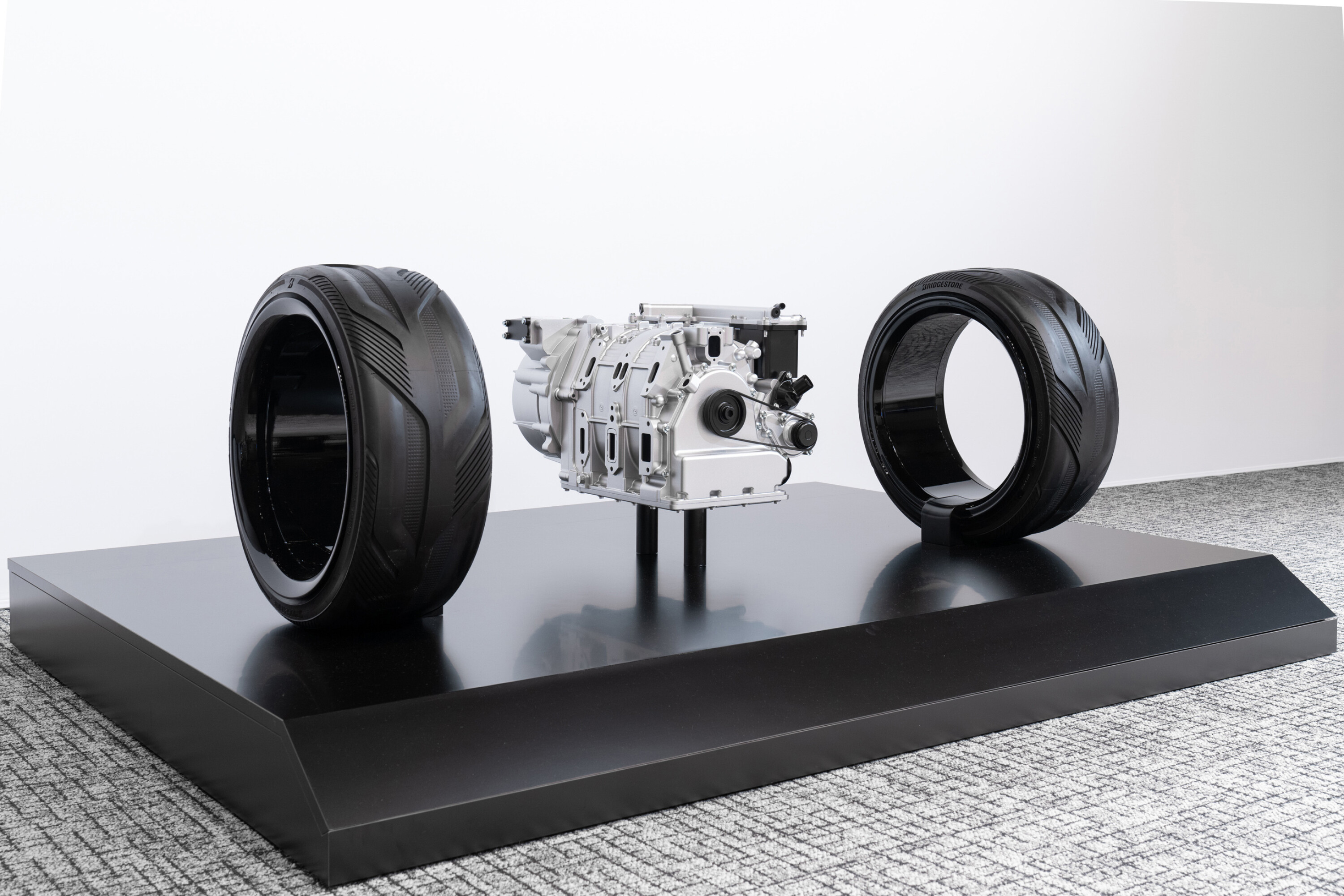
The trio of brands also claims the new engines, which will be highly efficient and powerful, will ‘revolutionise’ vehicle packaging by being significantly smaller than existing powertrains.
“Smaller engines will allow for even lower hoods, improving design possibilities and aerodynamic performance while contributing to better fuel efficiency,” said the brands in a joint statement.
The alliance says their goals are driven by a “deep understanding of their customers’ diverse lifestyles”, alluding to the fact that the broader push towards electric-only powertrains mightn’t be the best solution for everyone.
The news aligns with recent comments from the head of Toyota’s GR performance arm, Tomoya Takahashi, who told Wheels: “[GR] is a passionate brand, so we want to use internal combustion engine as much as possible.”
“It is not the engine that is bad, it’s the carbon that’s bad,” he said. “By using hybrid technology we can reduce carbon emissions or using a carbon-neutral fuel – e-fuel or biofuel.
“Globally there are discussions there is not going to be 100 per cent EVs. As you know, our direction is multi-pathway. At this moment Toyota is making profit and we are investing in future technologies.”
As part of the alliance, Toyota, Mazda and Subaru hope to encourage a wider adoption of carbon neutral fuels like synthetic fuel, biofuels and liquid hydrogen.
“Achieving a carbon-neutral society is a challenge that must be undertaken by all of Japan’s industries and society as a whole. As we continue to refine electrification technology, we will also enhance our horizontally-opposed engines with an aim to use carbon-neutral fuels in the future. Moving forward, the three companies sharing the same aspiration will continue to advance the pursuit of sustainable excellence in Japanese car manufacturing,” said Atsushi Osaki, Representative Director, President and CEO, Subaru Corporation.
Toyota president and CEO Koji Sato added “The three companies, which share the same aspirations, will refine engine technologies through friendly competition.”
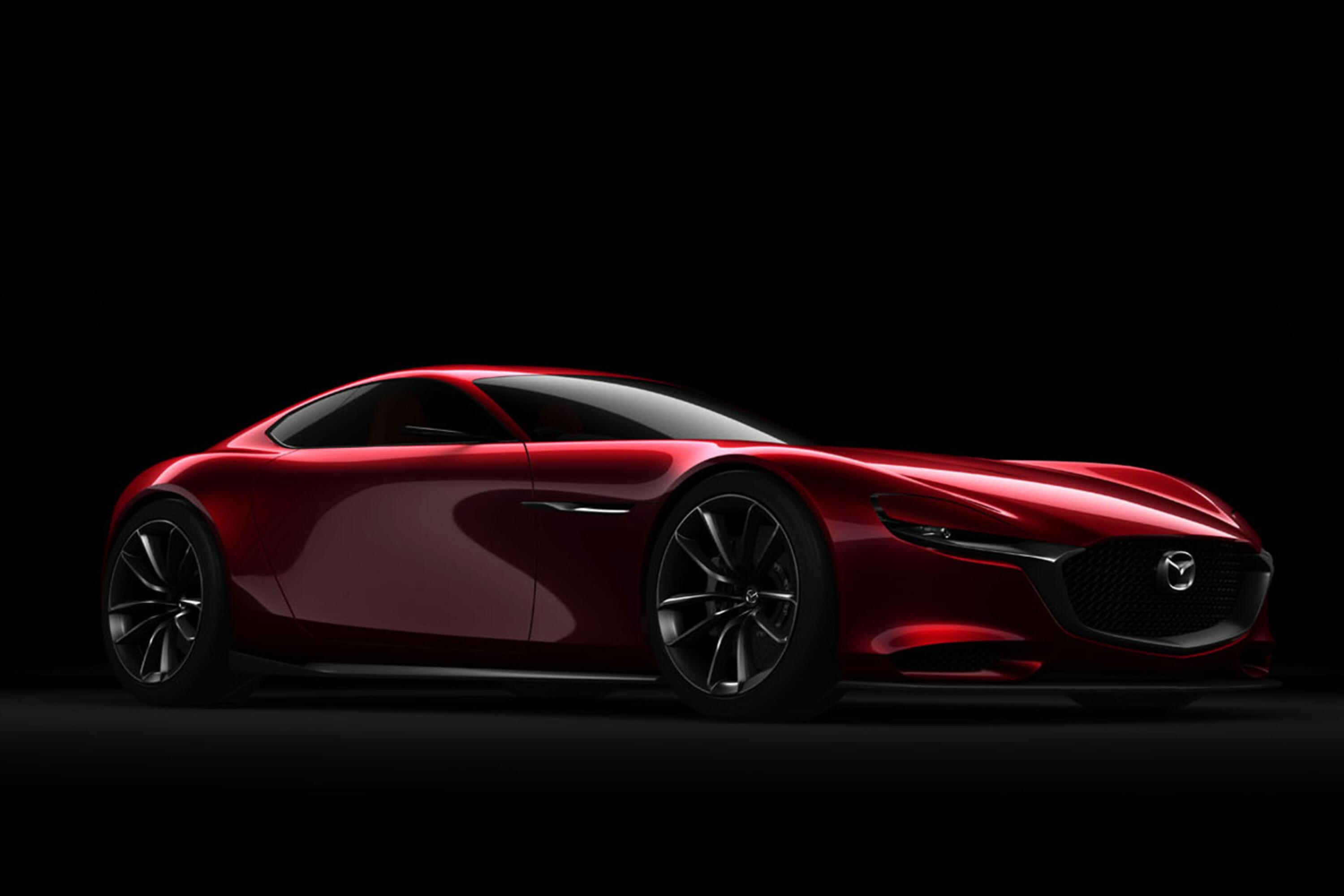
Meanwhile Mazda’s president and CEO, Masahiro Moro, used the announcement to double down on the brand’s commitment to rotary engines.
“Given the rotary engine’s compatibility with electrification and carbon-neutral fuels, Mazda will continue to develop the technology through co-creation and competition to ensure it can contribute broadly to society,” he said.
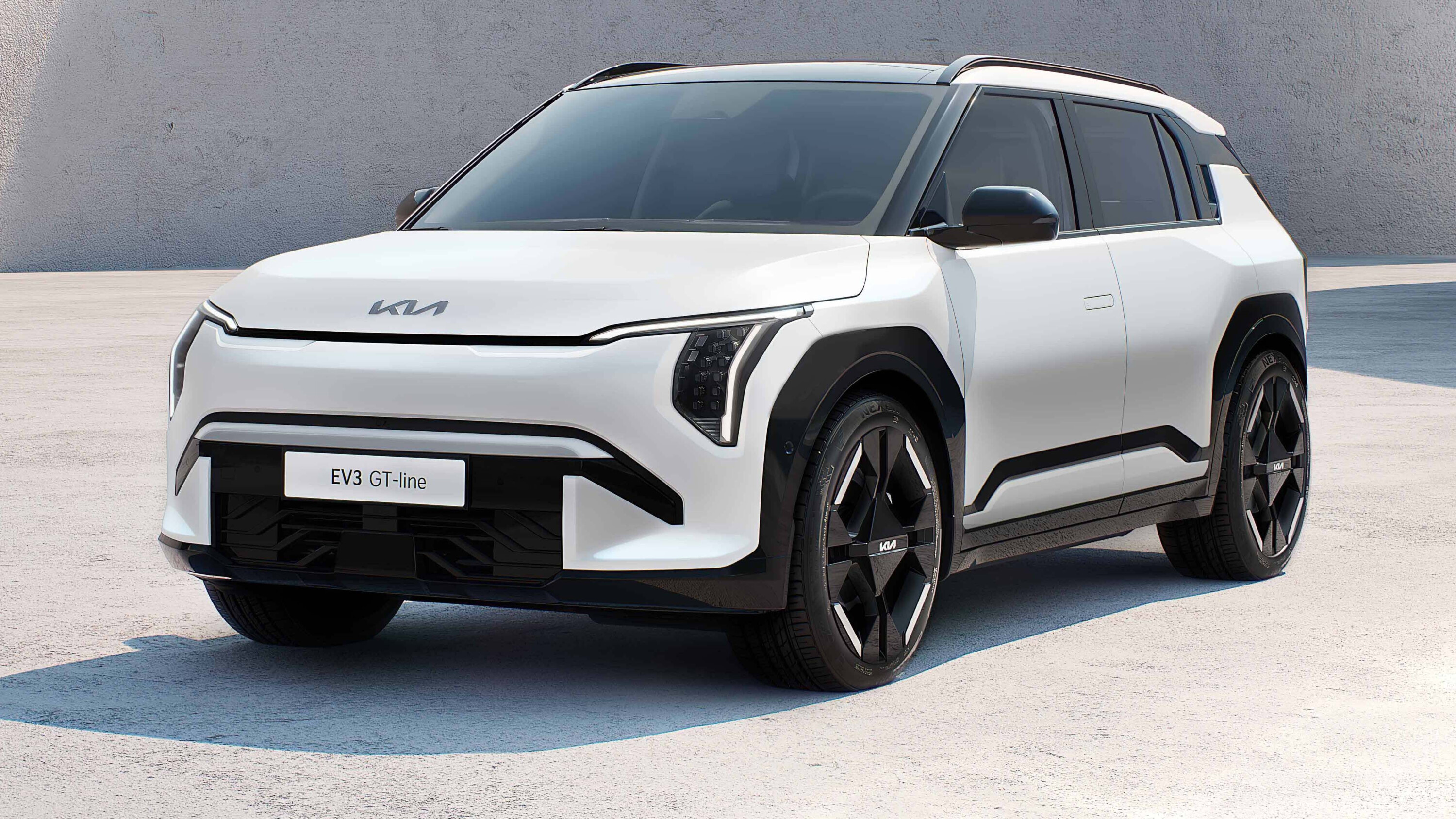
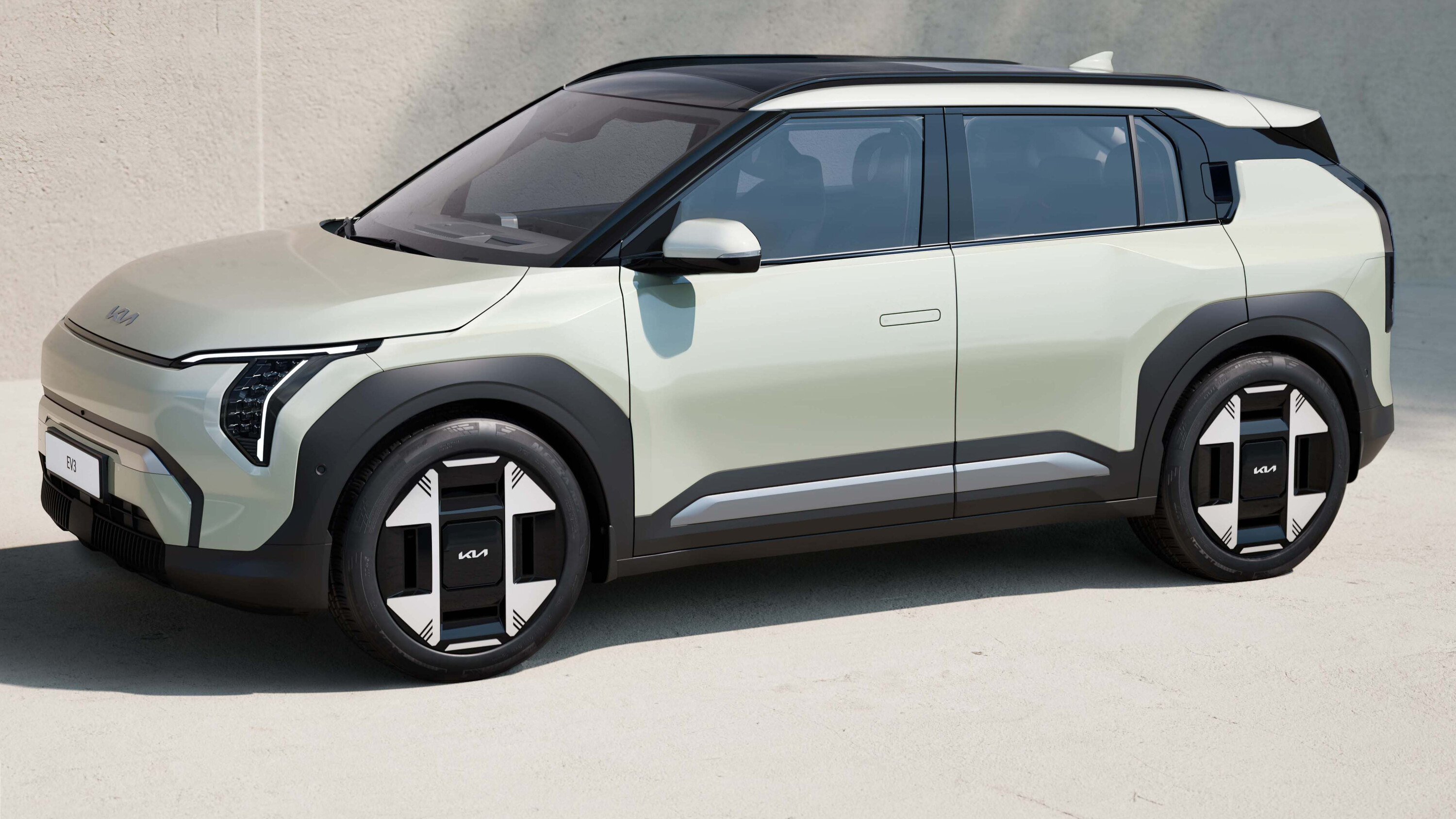
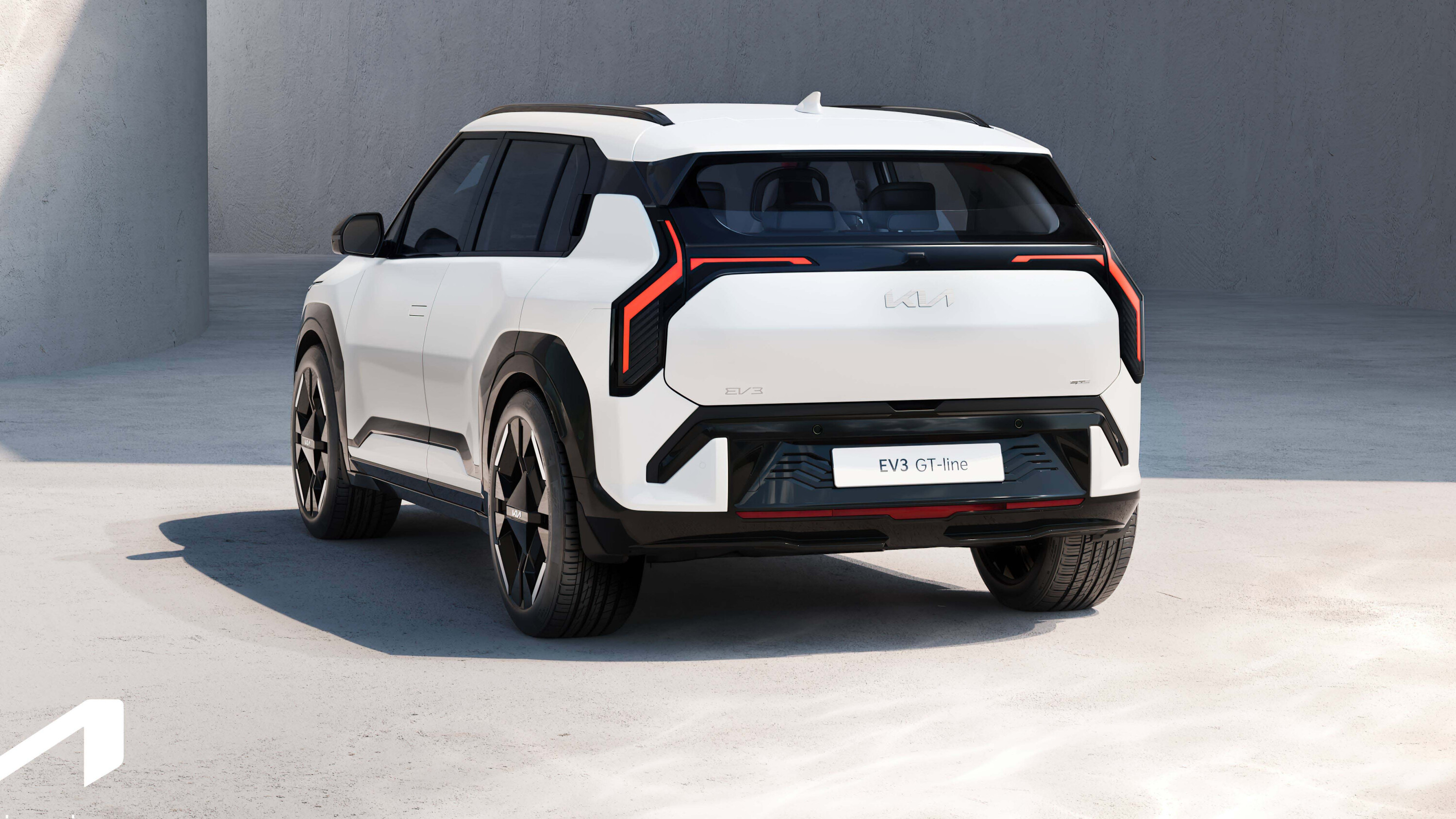
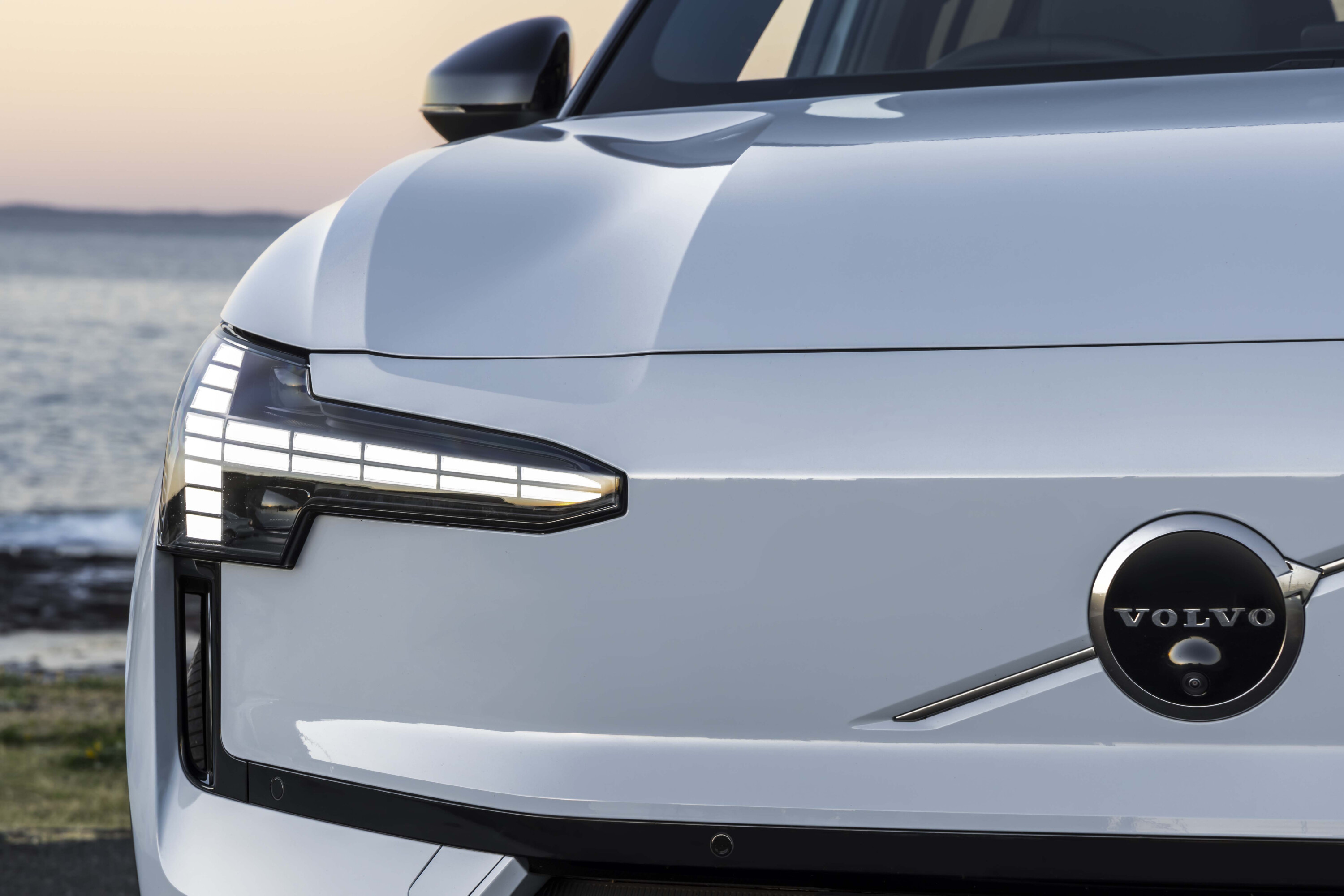
Quick, quiet, cleverly made, desirable and absolutely dripping in style: that’s the promise offered by the Kia EV3 and Volvo EX30.
Both of these small SUVs are box-fresh. And both of them are absolutely critical. We’ve had dedicated EVs from Volvo and Kia before, but none have targeted the hugely popular small SUV segment with such gusto and both brands, perhaps unsurprisingly, have big volume aspirations for these new-generation models.
Helping that cause is price. At around $60K neither of these small, style-driven SUVs is exactly cheap — we’re not talking MG4 levels of value here — but they are playing in a price bracket attainable enough for Aussies to take notice.
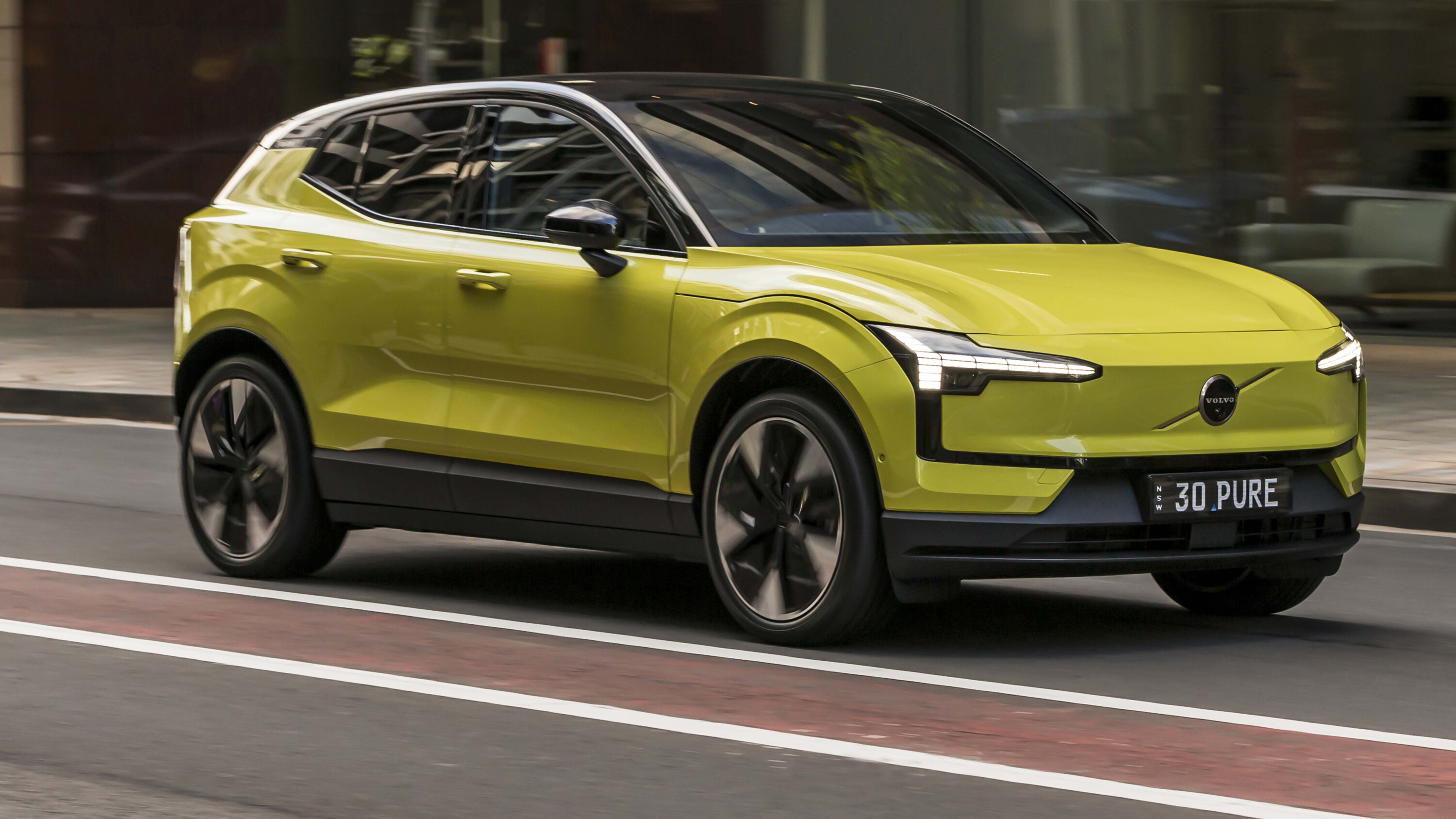
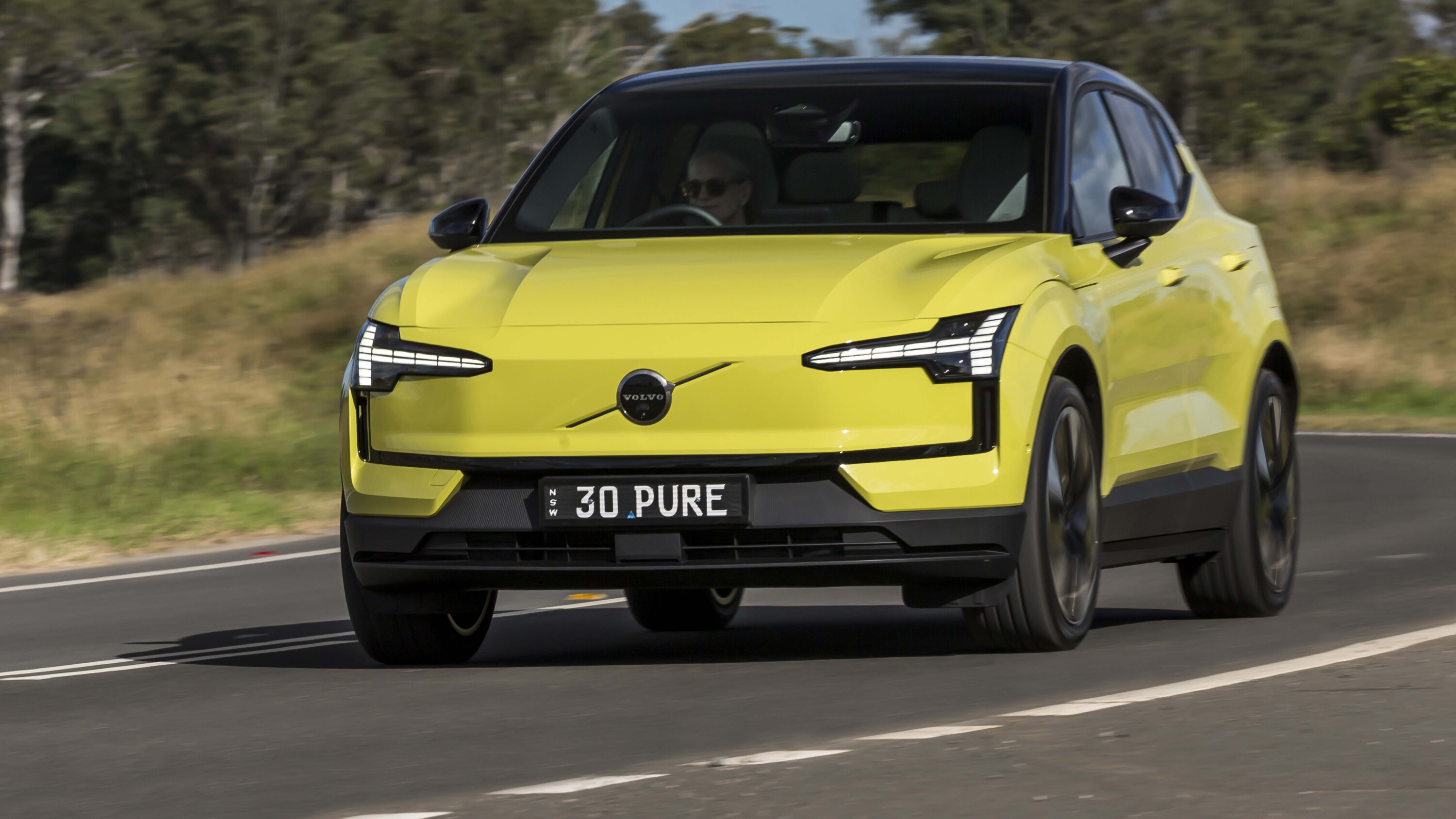
The most readily available right now is the Volvo EX30. It’s Volvo’s smallest SUV offering and, after months of delays, it has just launched in Australia. We were suitably impressed, too, scoring the EX30 8/10 in our first drive review.
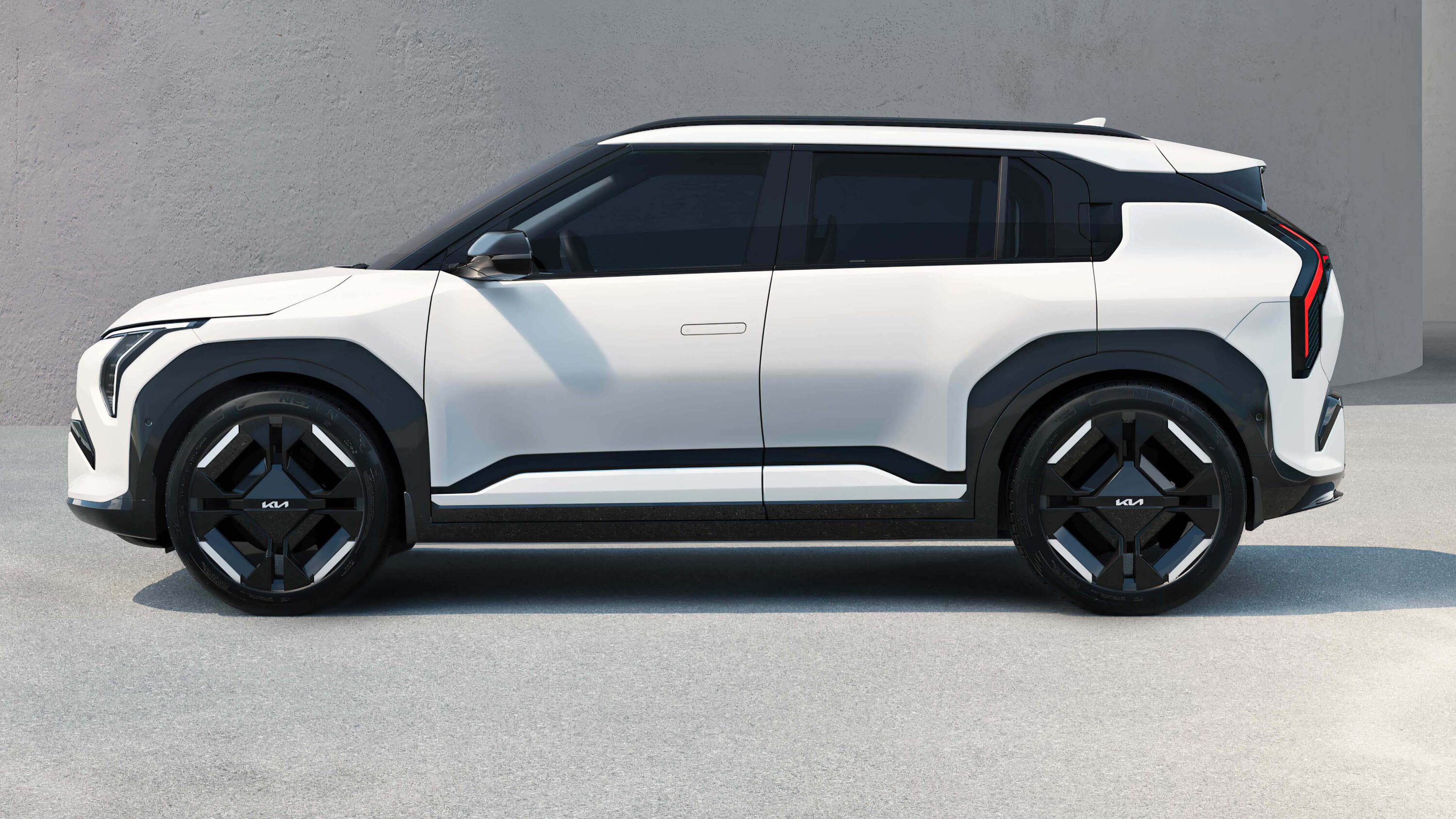
The Kia EV3 will arrive “some time in 2025”, according to Kia, with global pricing targeting US$35-50K. That means it should land in Australia between $50-75K which will put it right in the crosshairs of buyers looking at a Volvo EX30.
So which of these small SUVs has the edge for size, range, recharging, practicality and performance? As you’ll discover, one seems to have a clear advantage over the other…
JUMP AHEAD
Size
Both the Kia and Volvo as small SUVs and dimensionally they’re about on par with a Kia Seltos, Toyota C-HR or a Hyundai Kona.
If it’s outright space you’re chasing, the Kia holds a size advantage over the Volvo. The EV3 is 4300mm long, 1850mm wide and 1560mm tall, while its wheelbase (the distance between the front and rear axles) is 2680mm.
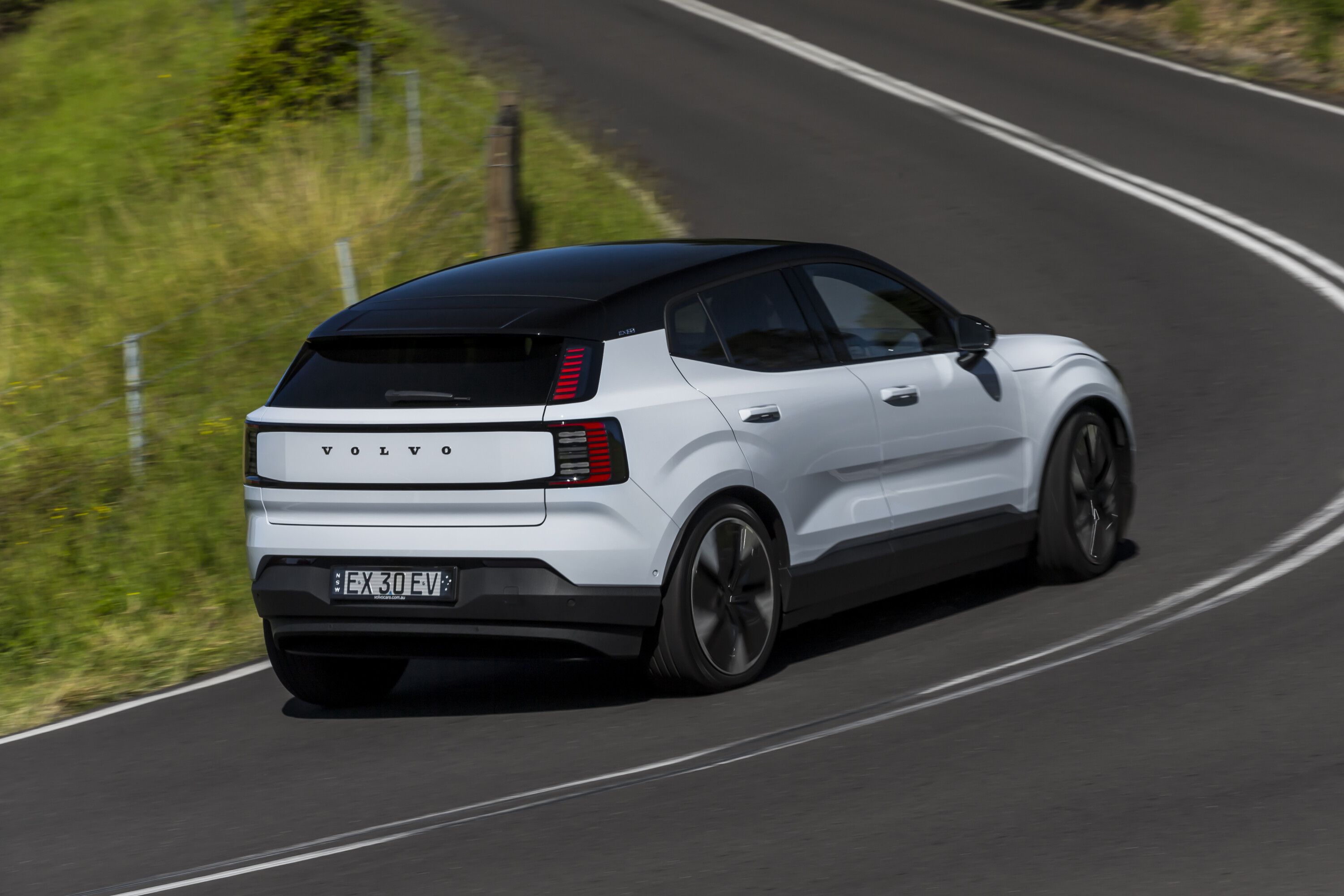
That makes it bigger than the EX30 which is 4233mm long (-67mm), 1836mm wide (-14mm) and 1549mm tall (-11mm). The Volvo’s wheelbase is also 30mm shorter than the Kia at 2650mm, which should translate into less cabin space especially for rear-seat passengers. As we noted in our EX30 first drive, “there’s less rear-seat space than you’ll find in a similarly sized Golf hatchback.”
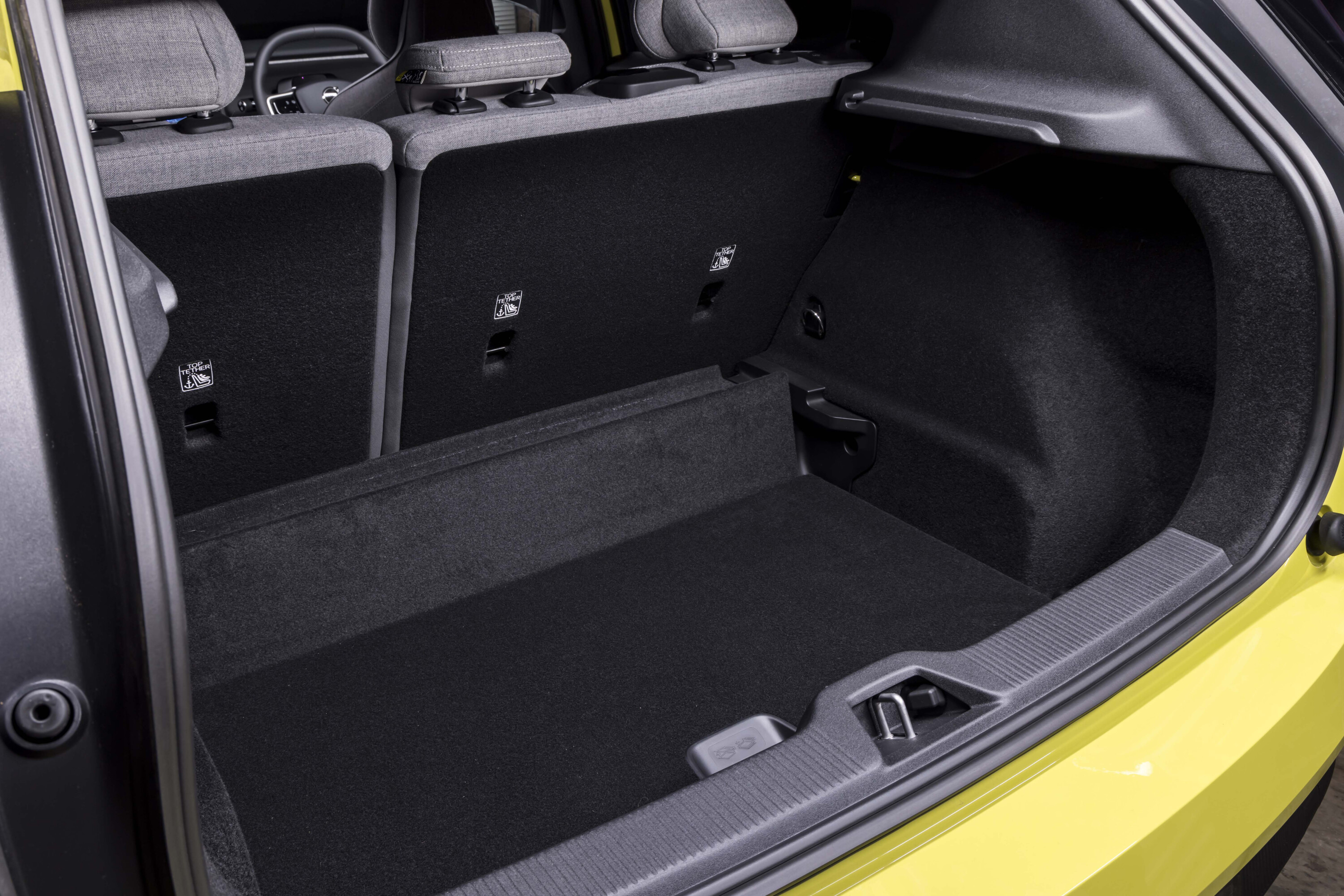
Boot space is also superior in the Kia. The EV3 boot is an impressive 460L and it has a further 25L of storage in the nose or ‘frunk’ to store charging cables. In comparison, the Volvo offers 318L of luggage space in the boot and 7L in its nose.
Platforms
The Kia EV3 is based on the Hyundai–Kia group’s now synonymous E-GMP platform which also underpins well-regarded models like the Wheels Car of the Year winning EV6 and the larger EV9.
Unlike those bigger models, however, which use a rear-biased version of the platform with 800-volt architecture that allows for ultra-fast DC charging up to 350kW, the EV3 has a lower 400-volt architecture and a front-wheel-drive bias.
The EX30 is Volvo’s smallest car and only its second clean-sheet EV. It rides on a dedicated electric-car architecture developed by Geely that’s shared with a host of other brands, including the Smart #1 and Smart #3 which have recently been confirmed for Australia. Like the EV3, the EX30’s architecture is 400-volt meaning there’s no ultra-fast DC charging available.
Battery packs, range and recharging
Kia will offer two versions of the EV3 when it arrives in Australia with two different battery pack sizes.
A ‘standard range’ version will be available with a 58.3kWh battery, while the flagship ‘extended range’ increases the battery to 81.4kWh. Kia says the larger battery will provide a WLTP range of 600km. It’s yet to provide a range claim for versions with the smaller battery.
Recharging times vary between the two EV3 battery packs. The standard range can accept up to 102kW DC fast charging, while the extended range is quicker at 128kW. Both versions will achieve a 10-80 percent recharge in roughly the same time, with Kia claiming 31 minutes for the bigger battery and 30 minutes for the smaller unit.
Local AC charging rates are yet to be confirmed but reports from the United Kingdom rate the EV3’s AC charging speed at 11kW.
The EX30, meanwhile, has a 69kWh battery (64kWh usable) for all versions in the Australian range. A 51kWh battery is available overseas but the Aussie market only takes the bigger and more energy dense of the two battery packs.
The 69kWh battery yields a WLTP range off 480km in the entry level Extended Plus and mid-spec Extended Ultra EX30, while the range topping twin motor Performance Ultra model can travel 460km between charges. So advantage Kia when it comes to outright cruising range.
Charging times a similar between the Volvo and Kia. The EX30 can accept up to 153kW on DC fast charging, which Volvo says delivers a 10-80 percent charge in about 30 minutes for all models.
The Kia also holds an advantage for aerodynamic efficiency, despite its boxy upright styling. Kia says 80 per cent of the EV3’s underbody is covered to improve aero and its 0.263 Cd rating undercuts the EX30’s 0.28 Cd figure.
Price & performance
As mentioned, Kia is targeting a US price of $35-50K which should translate to between $50,000-$70,000 in Australia.
Currency fluctuations and supply constraints could wreak havoc on those projections, of course, but that’s the ballpark Kia is aiming for. Local execs have told Wheels they’re working hard to ensure the EV3’s price is as sharp as possible, aware that value is a crucial factor in this segment.
If Kia can achieve a starting price around $50,000, the EV3 will undercut the Volvo for outright value. Currently the EX30 range starts a $59,000 for the entry-level Extended Plus, while the mid-spec Extended Ultra is $66,290 and the flagship Performance Ultra costs $71,290.
As for performance, for now every version of the Kia EV3 uses a single electric motor on the front axle producing 150kW/283Nm.
Kia says that’s enough to hit 0-100km/h in 7.5sec and sail on to a top speed of 170km/h. So it’s swift rather than fast.
Ride and handling should be a key strength, too, given the strong performance of other E-GMP models and the EV3 will offer dynamic torque vectoring control to further aid its dynamics. An updated ‘I-pedal 3.0’ system is fitted, too, with selectable regenerative braking levels for one-pedal driving in its strongest setting.
The EX30’s powertrain set-up is quite different. Unlike the front-driven Kia, single-motor versions of the EX30 are rear-wheel drive. Outputs are higher at 200kW/343Nm, giving the EX30 a sizeable performance advantage over the Kia.
Line both cars up at a set of traffic lights and the Volvo will scorch the EV3 thanks to a 0-100km/h claim of 5.3 seconds.
And that’s not even accounting for the quickest EX30 variant. The dual-motor Performance Ultra packs 315kW/543Nm and, thanks in part to all-wheel drive, it can hit 0-100km/h in 3.6 seconds. That makes it considerably quicker than the EV3 (at least until its own dual-motor version arrives) and also gives the EX30 the distinction of being the quickest Volvo ever built. It’s also a tenth quicker to three figures than a Tesla Model Y Performance (3.7sec)
Not to be outdone, Kia has confirmed a more powerful dual-motor EV3 is in the product pipeline and will follow in a few years’ time.
Cabin tech
Just like their exteriors, the cabins of both SUVs focus heavily on style.
Technology wise, the EV3 has an enormous panoramic screen — Kia says it’s “a near 30-inch display” — which combines a 12.3-inch instrument cluster, with a 5.0-inch climate control display and a 12.3-inch infotainment screen.
A 12-inch HUD is also available, as is a Harman Kardon sound system. The EV3 is the latest Kia model to support a built-in generative artificial intelligence voice assistant based on a “heavily modified” version of OpenAI’s ChatGPT. And it’s also the first Kia to get apps for Netflix and YouTube, while in-built games are also included to help pass the time while recharging.
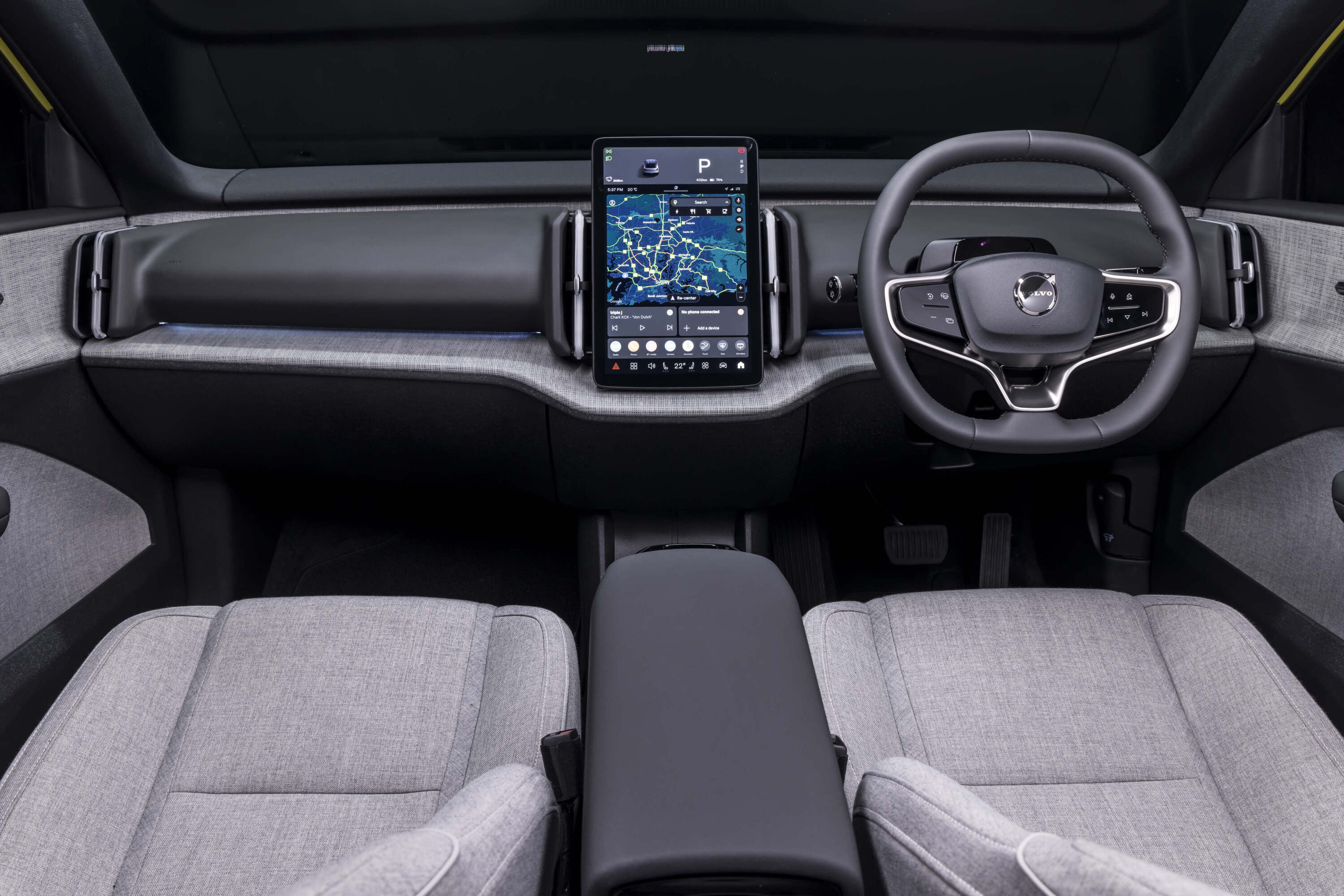
A key design distinction is that unlike Tesla (and now Volvo!) which has waged war on buttons, the EV3 retains physical controls for the cruise control, entertainment, sat-nav and drive modes.
Both cars place great emphasis on using recycled materials. Kia has used recycled materials for the dashboard and door trims, as well as polyethylene terephthalate – said to be “among the most easily recycled plastics in the world” – for the seats, headliner, floor mats and luggage board. All up Kia claims there’s 28.5kg of recycled material in the cabin.
In the rear seat, the EV3 should offer slightly more knee room than the EX30 thanks to its longer wheelbase.
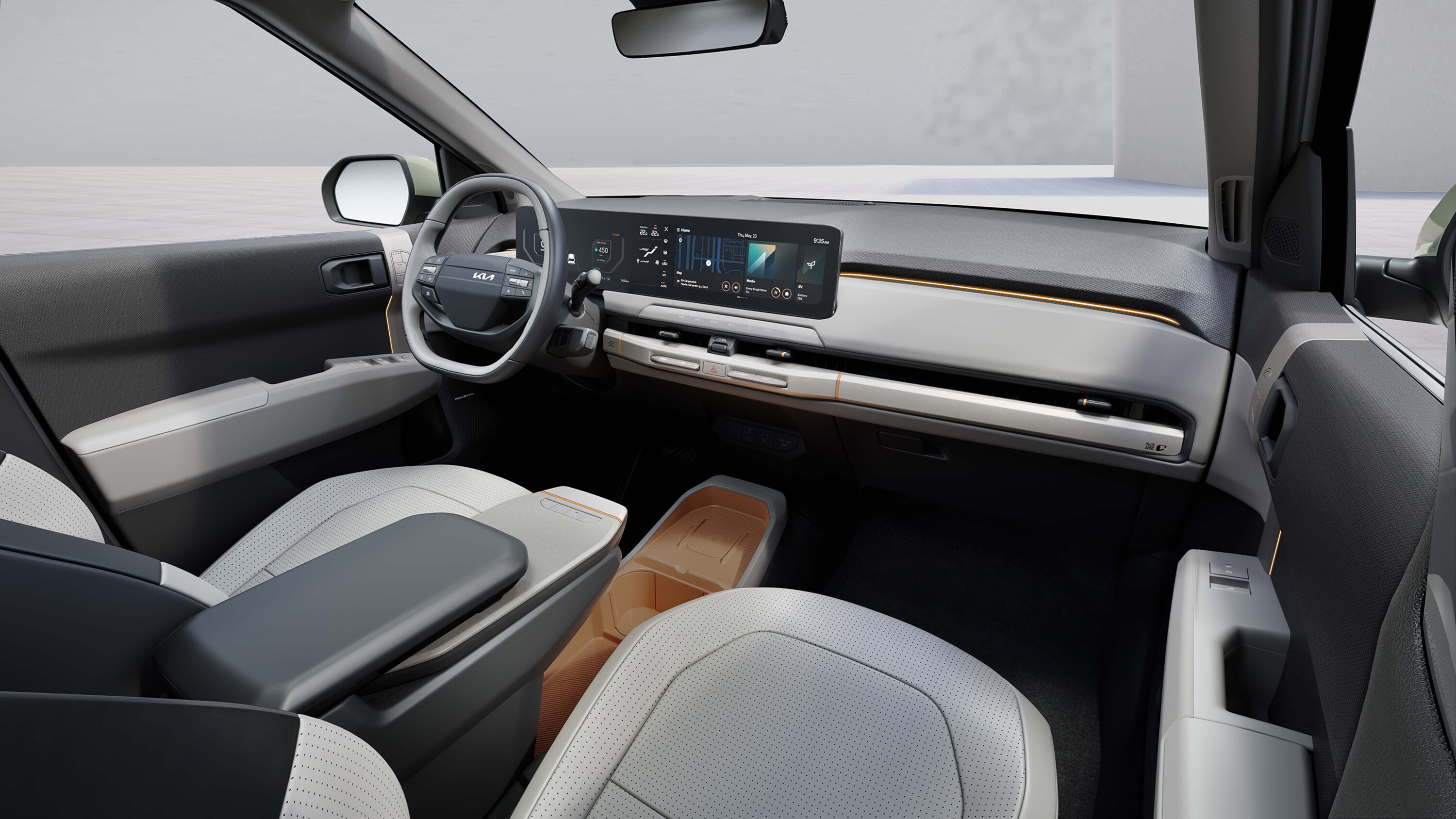
The Kia also scores dedicated rear air vents for backseat passengers, which is a feature missing in the Volvo.
The Volvo’s cabin is quite a departure from the EV3’s. Unlike the windscreen Kia, the EX30 uses a single 12.3-inch portrait oriented screen mounted in the centre of the dash.
There is no instrument cluster ahead of the driver meaning everything, speedometer and battery charge information included, is displayed on the centre screen. The screen itself runs Volvo’s latest software which is Android Auto based and features wireless Apple CarPlay and over-the-air updates. Unlike the Kia, a head-up display isn’t available in the EX30.
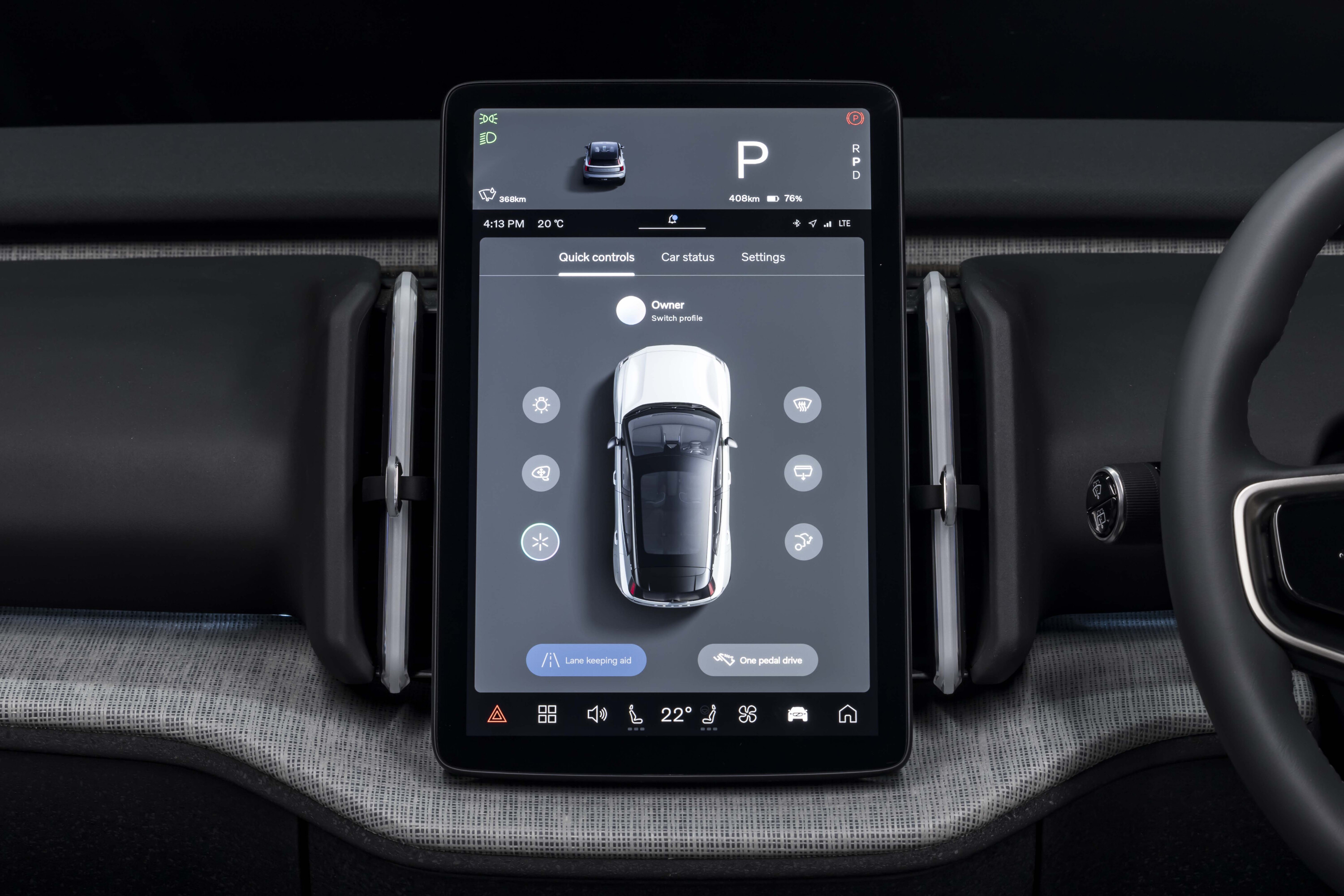
The EX30 also does away with conventional speakers in the doors to free up storage space, replacing the speakers with an integrated sound bar in the dash instead. Both cars have big and clever centre consoles which offer an impressive amount of storage and flexibility.
Snapshot
- Porsche has revealed full details of its first-ever hybrid 911
- T-Hybrid system combines a larger boxer engine with electric turbo and an e-motor in the PDK gearbox
- Outputs lift by 45kW/40Nm while 0-100km/h drops to 3.0sec
- Hybrid GTS will cost $381,200; an increase of $27,500 over its predecessor
In a move sure to make diehard fans groan and whip keyboard warriors into a frenzy (hit us up in the comments), the Porsche 911 has gone hybrid.
We’ve known a hybrid 911 has been coming for a while now — the new powertrain has been in development for more than two years — but it’s only today that Porsche has revealed the full details of its new electrified model.
And if you love performance, the news is good. Dubbed T-Hybrid the new powertrain debuts on the GTS model grade and combines a larger capacity six-cylinder boxer engine with an electric turbo and an e-motor mounted within the eight-speed dual-clutch.
Outputs lift by 45kW/40Nm compared with the previous combustion-only GTS, while the 0-100km/h time has been slashed to just 3.0 seconds.
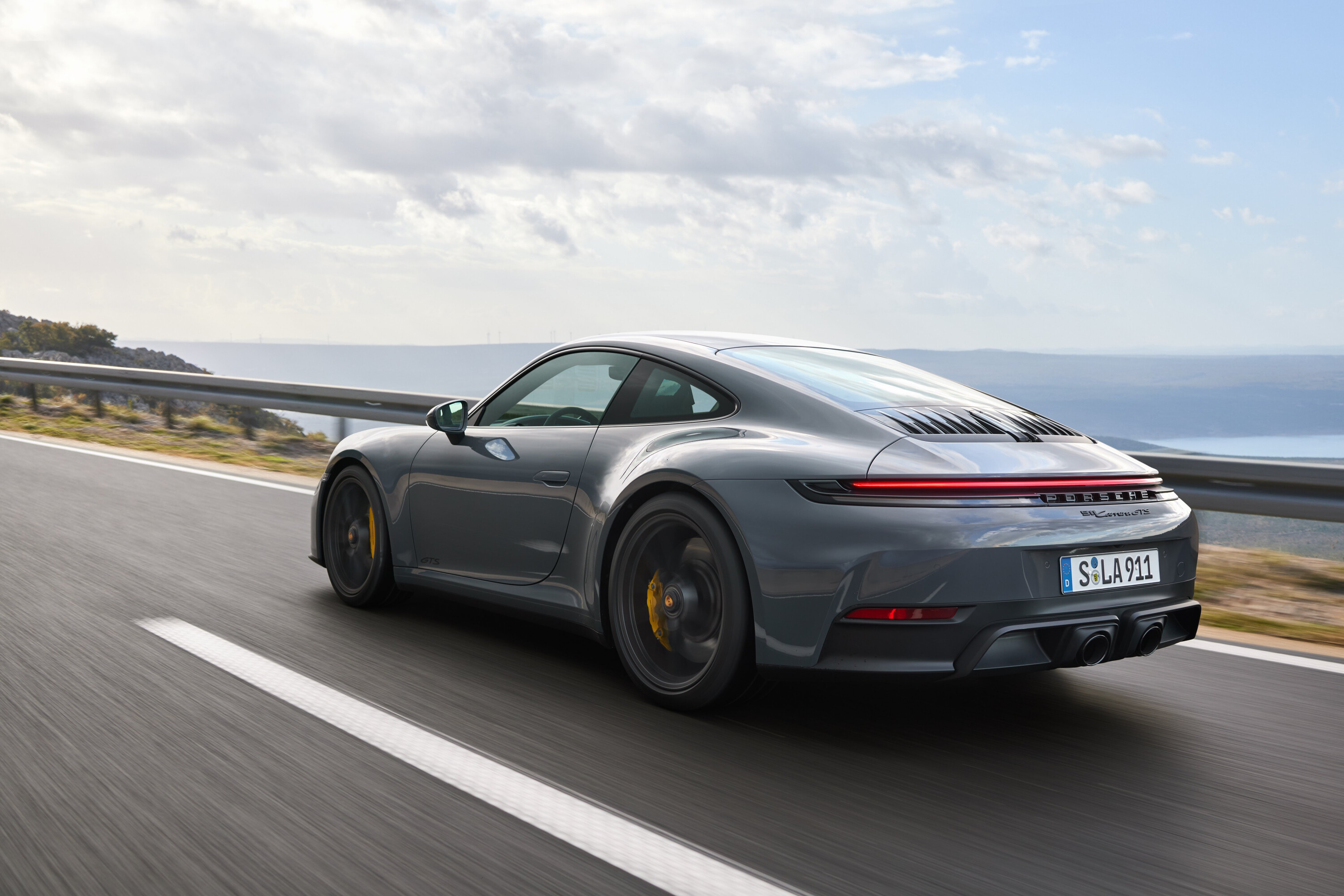
The hybrid inclusion comes as part of a broader update for the regular 911 model range which evolves into its 992.2 generation. The facelift brings improvements to the powertrains, exterior design and cabin design/infotainment. Read our story on the 992.2 model range here.
Unlike other 992.2 models that use an upgraded version of Porsche’s existing 3.0-litre twin-turbo flat six, the T-Hybrid system adopts a ‘newly developed’ 3.6-litre petrol engine. To increase the boxer’s displacement, Porsche enlarged the bore to 97mm and increased the stroke to 81mm. Even without the hybrid system, the six-cylinder engine makes 357kW and 570Nm which is a 4kW improvement over the 3.0L twin-turbo unit.
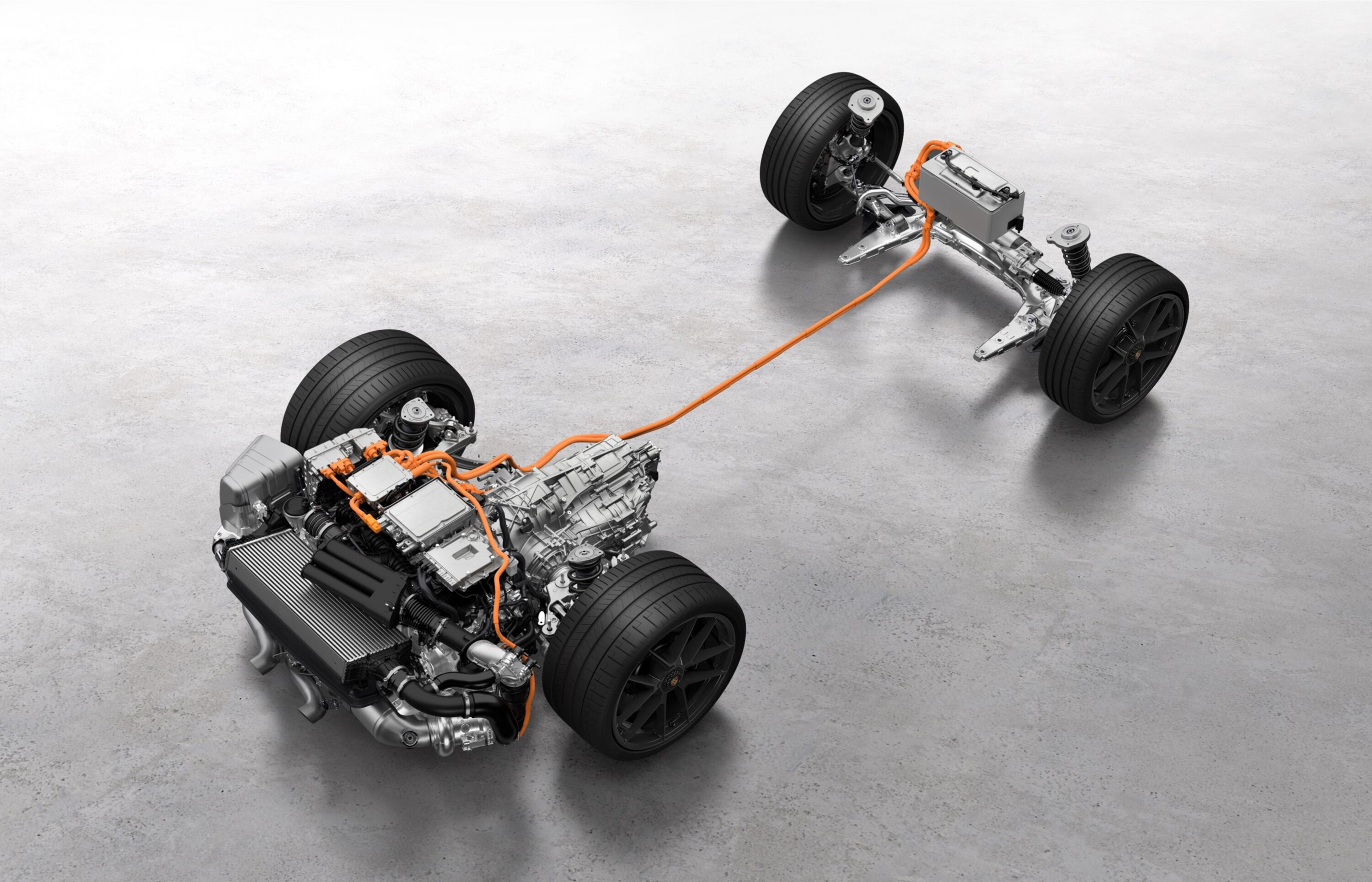
The overhauled petrol engine pairs with a newly developed electric turbocharger that mounts an e-motor between the compressor and turbine wheels. Porsche says the e-motor “instantaneously brings the turbo up to speed” and claims it can also function as a generator and produce up to 11kW of electric power. Sounds promising.
Of greater significance is the inclusion of a permanent magnet synchronous motor within the GTS’s eight-speed dual-clutch gearbox.
That e-motor is fed by a 1.9kWh battery designed to be as small and as lightweight as possible. It’s so small, in fact, Porsche says it’s comparable in size to a conventional 12-volt starter battery.
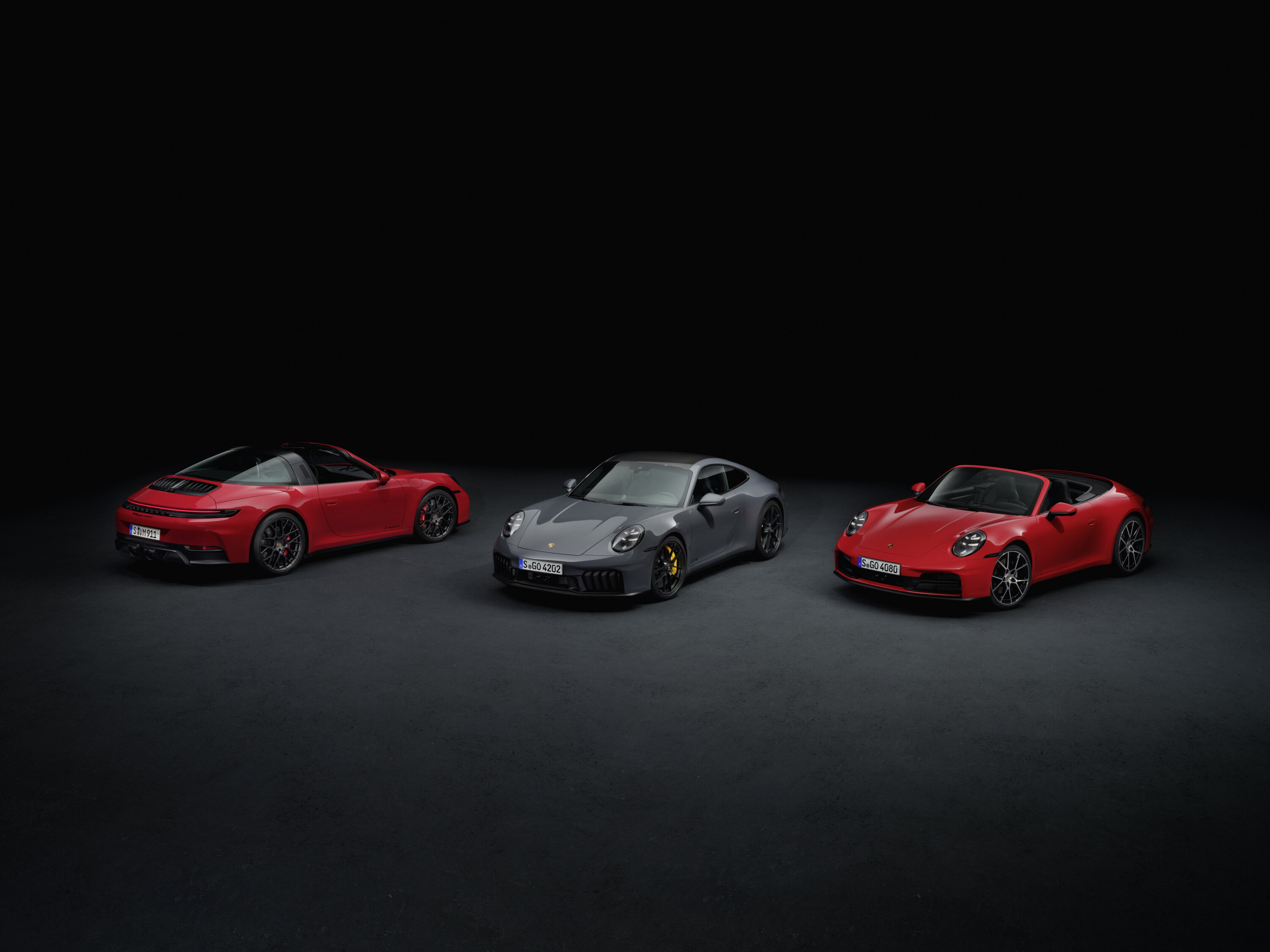
The e-motor within the transmission provides an additional 40kW/150Nm which brings the hybrid GTS’s total combined outputs to 398kW/610Nm. That represents a power increase of 45kW/40Nm over the non-hybrid Carrera GTS which has 353kW and 570Nm.
Naturally, e-motors and an additional battery will add weight and Porsche is yet to confirm how heavy the GTS T-Hybrid is. One figure it has confirmed, however, is its acceleration claims. Thanks to the instant response of its electric system, the GTS now hits 0-100km/h in 3.0sec, which is an improvement of four tenths. Top speed is 312km/h.
NEW CHASSIS HARDWARE
Not to be outdone by the powertrain team, Porsche’s chassis engineers have also been hard at work. The usual GTS treatment continues which brings a 10mm ride-height drop and the inclusion of adaptive dampers, but rear-wheel steering is now standard for the first time. Active-roll stabilisation, which is powered by the electric sub-system, is also included. As before, the GTS rolls on staggered alloys measuring 20-inches up front and 21-inches at the rear. Tyre sizes are 245/35 ZR20 and 315/30 ZR21 respectively.
TWEAKED EXTERIOR DESIGN
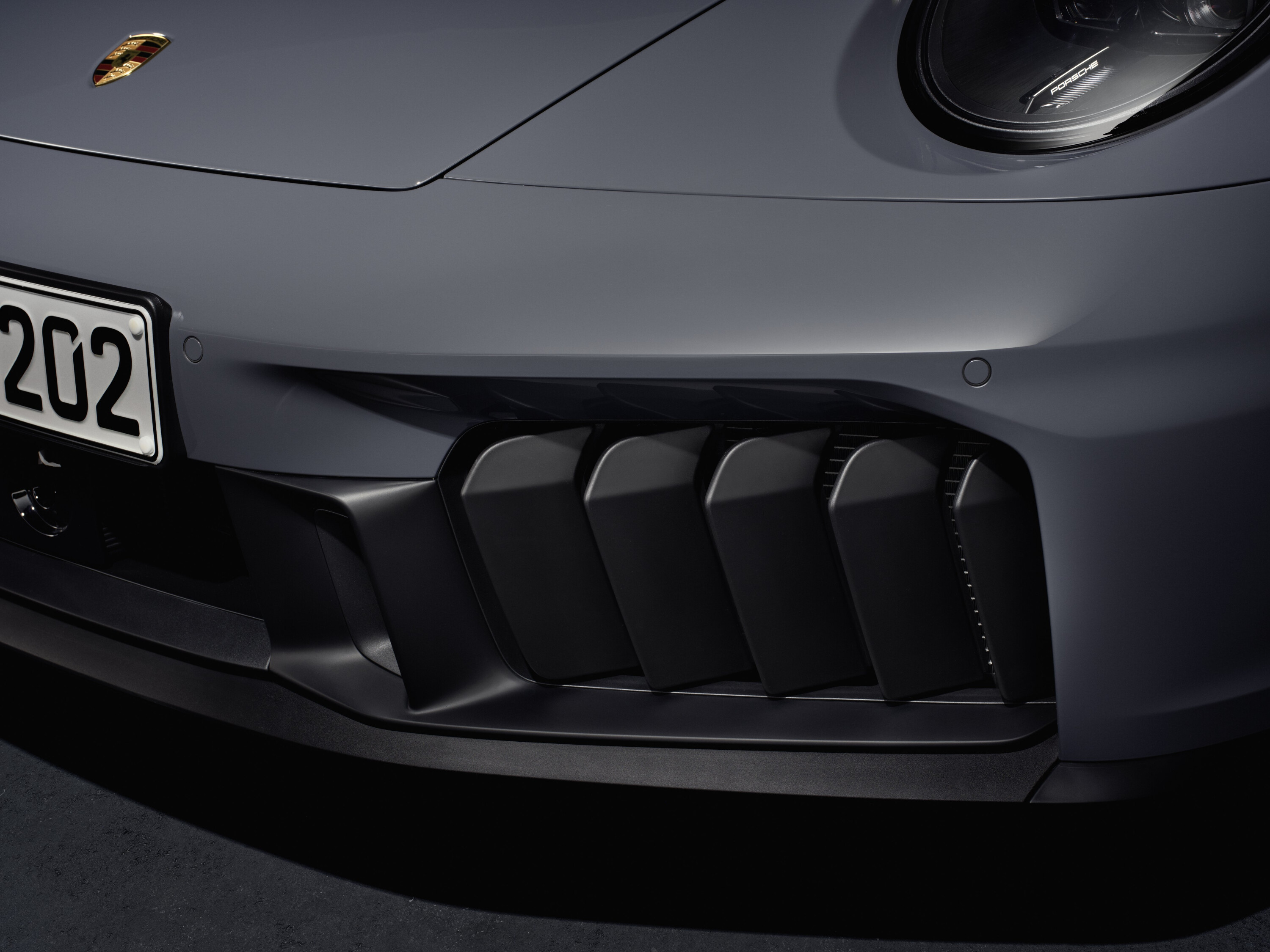
Unlike the rest of the 992.2 range which gains a range of mild design tweaks, the GTS’s exterior is noticeably different. The most obvious change is the addition of five vertical active cooling vanes within the revised front bar. There’s also a new adaptive front diffuser in the underbody which works with the vertical vanes to direct airflow as need: they open to optimise cooling during hard driving or close to improve aero.
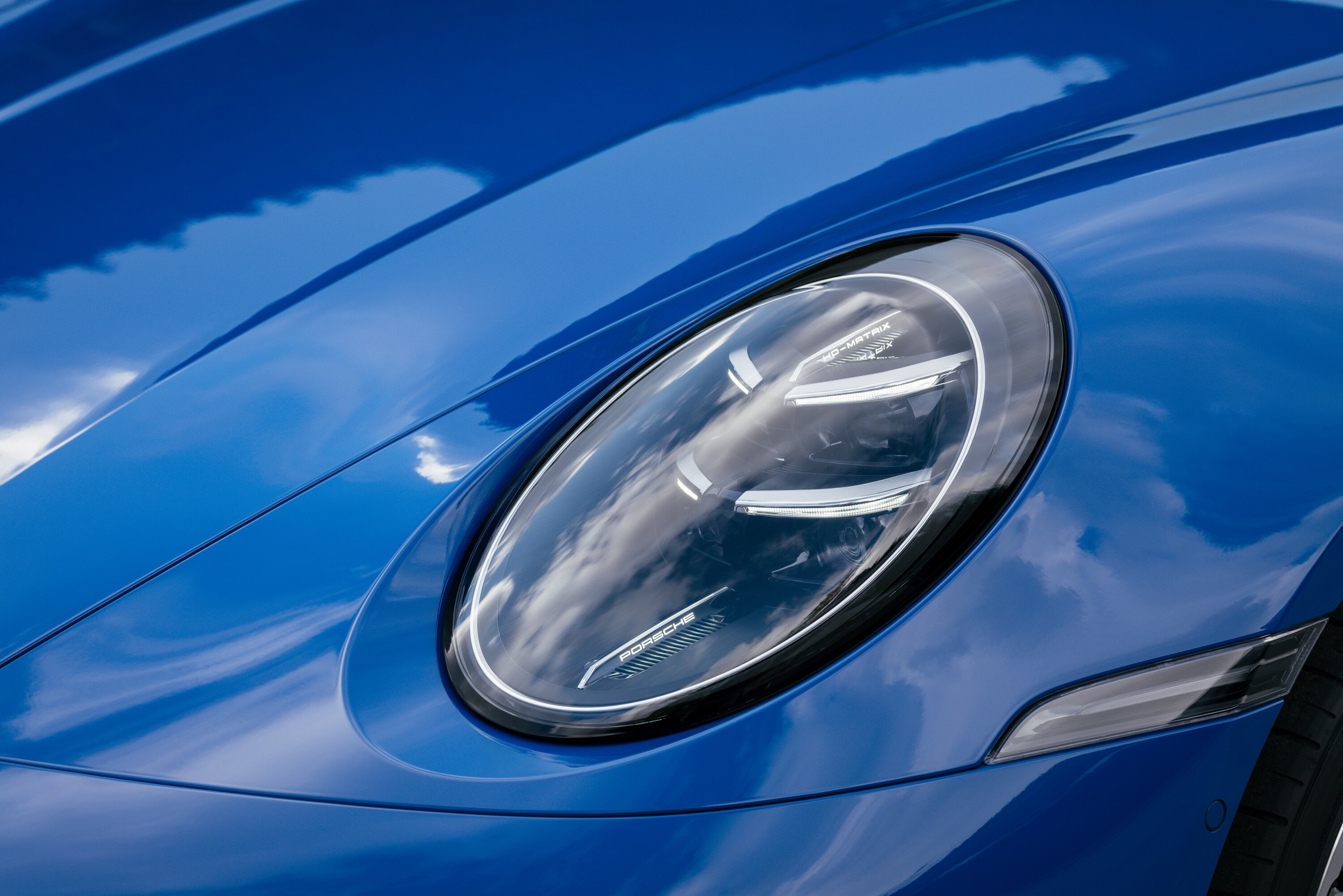
Every model in the 992.2 line-up now gets matrix LED headlights but the GTS can be had with optional HD LEDs that feature more than 32,000 light points and can illuminate the road up to a distance of more than 600 metres. The active lights operate differently depending on your drive mode, too — we assume the active beams move quicker when in Sport+ compared with Normal — and they also have a non-dazzling high-beam function for oncoming vehicles that “is precise to the pixel” according to Porsche.
At the back, there’s a redesigned full-width light bar and a new rear grille, again with five fins per side. The number plate is also higher than before.
MORE SCREENS, FEWER SEATS
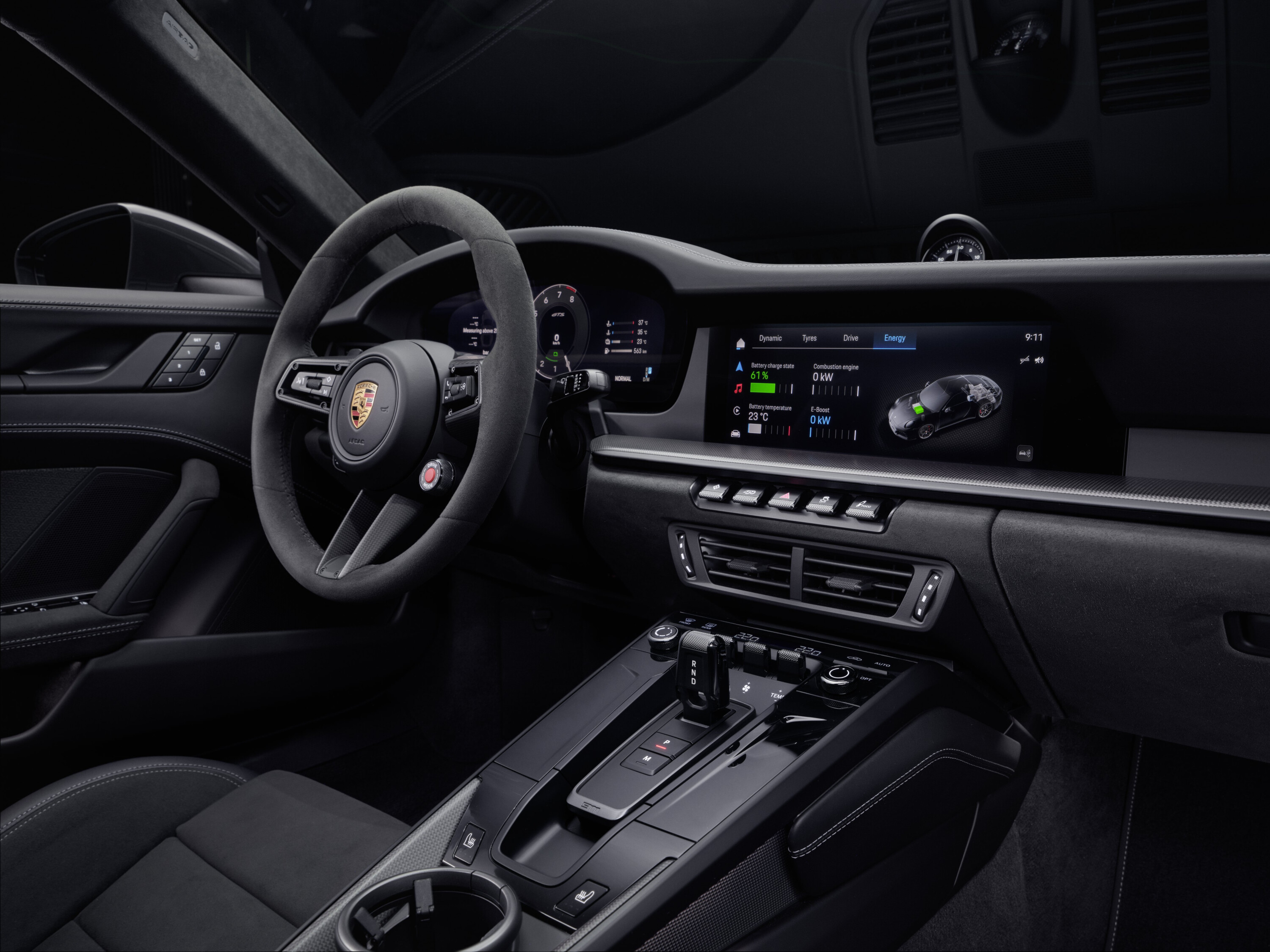
Inside the 992.2 ushers in two big changes: the inclusion of a starter button for the first time and the move to a fully digital instrument cluster. The new gauges are housed in a curved 12.6-inch display that Porsche says can be extensively customised.
Seven different views are available, including a ‘Classic’ display that retains the 911’s traditional five-tube design with a central tachometer.
The centre console now houses a cooled compartment where you can charge your smartphone on a wireless charging pad.
The 10.9-inch centre touchscreen has new connectivity features and integrates more closely with Apple CarPlay functions like Siri voice assistance. Watching video streaming while parked is also available as an option, while apps like Spotify and Apple Music can be used natively through the system without a connected smartphone.
Another interesting change is to the seating layout. Internationally, the 992.2 Coupe will be offered as a two-seater as standard rather than the traditional four-seat configuration. In Australia the 2+2 layout will continue to be the default, however removing the rear seats is a no-cost option.
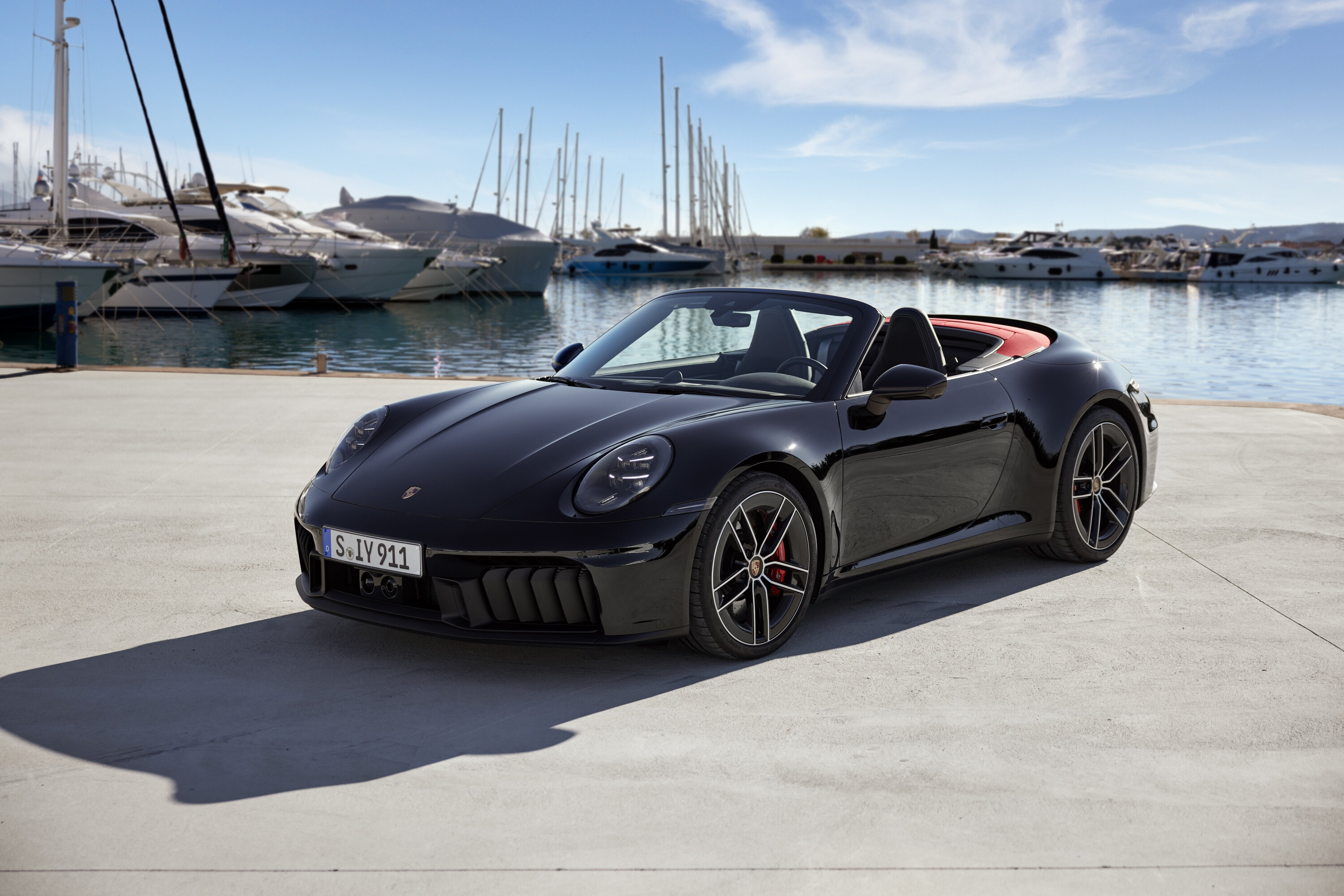
2025 PORSCHE 911 GTS PRICING AND ARRIVAL
Almost inevitably, the hybrid 2025 Porsche 911 GTS will cost more than its combustion-only predecessor. Every model in the updated 992.2 range has been hit with price rises but it’s the hybrid version that cops the biggest spike to now cost $381,200. That’s an increase of $27,500.
The GTS is available in both rear-wheel and all-wheel drive guises and either as a coupe, cabriolet or Targa (all-wheel-drive only).
Order books for the 992.2 GTS are now open with first deliveries set to commence in the first quarter of next year.
2025 Porsche 911 GTS pricing
- 911 Carrera GTS Coupé starts at $381,200
- 911 Carrera 4 GTS Coupé starts at $401,300
- 911 Carrera GTS Cabriolet starts at $417,400
- 911 Carrera 4 GTS Cabriolet starts at $437,900
- 911 Targa 4 GTS starts at $437,900
Porsche is on a new-product onslaught right now, isn’t it?
In the past few months we’ve had updates for the Panamera and Taycan plus an all-new, and all-electric, Porsche Macan to wrap our heads around.
And now we have a new 911. Well, an updated one at least.
Welcome, dear readers, to the 992.2 generation of the world’s greatest sportscar which, gasp, is now powered in-part by electricity in some models.
But while adding hybrid tech to the 911 is undoubtedly the biggest change for this new generation — dare we call it the most significant change in the 911’s 60-year history? — it’s not the only update afoot.
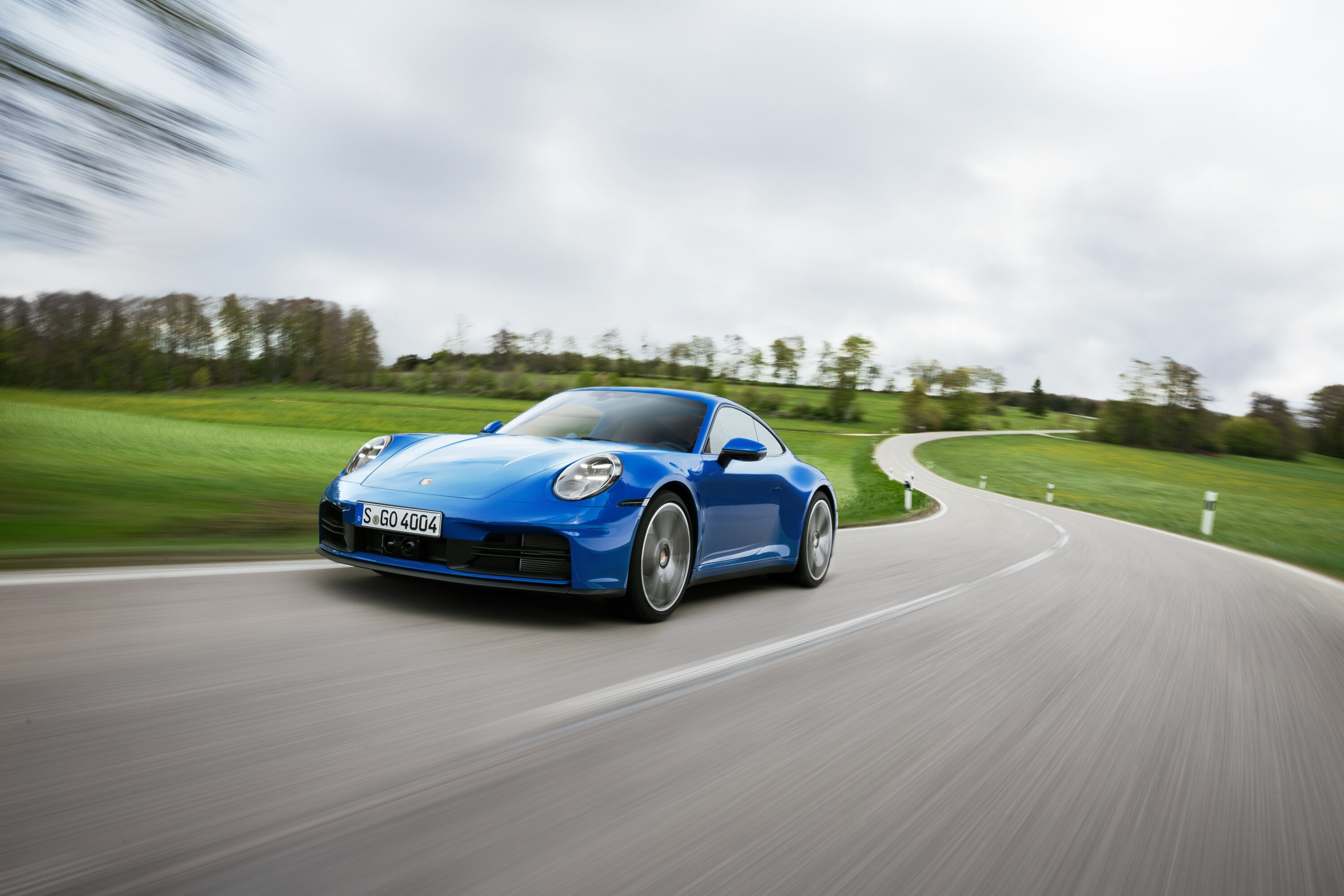
For now the hybrid tech, which Porsche calls T-Hybrid, is only available on flagship GTS versions, meaning the regular Carrera Coupe continues to be powered solely by good old dinosaur juice.
The Coupe’s 3.0-litre twin-turbo boxer has also been fettled to produce more power and torque, while Porsche has also tweaked the exterior design, improved the aerodynamics, overhauled the interior, expanded the connectivity and added a richer list of standard equipment.
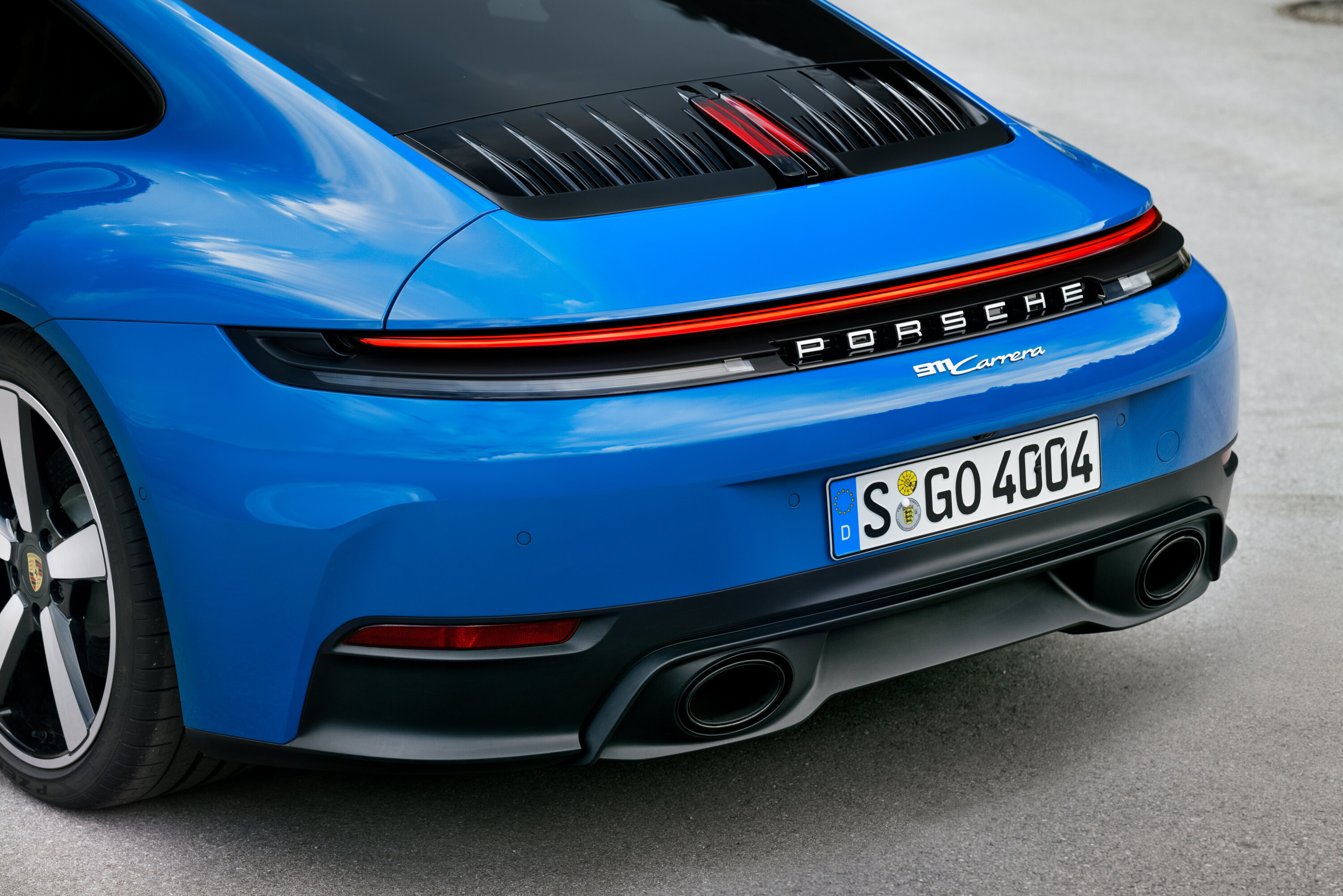
A MORE POWERFUL ENGINE
Confusingly, Porsche’s own press information says the Coupe’s 3.0-litre twin-turbo boxer has been both “lightly modified” and “comprehensively revamped” for the 992.2. Changes include new turbochargers which have been nicked from the previous GTS and a new intercooler, this time taken from the previous Turbo models, which sits directly onto of the engine under the rear bonnet.
Total outputs have increased slightly to 290kW (+7kW) and 450Nm.
The power bump helps to cut the 0-100km/h sprint down to 4.1sec or 3.9 seconds if the Sport Chrono package is fitted. That’s a 0.1sec improvement over the old car.
MORE SCREENS, FEWER SEATS
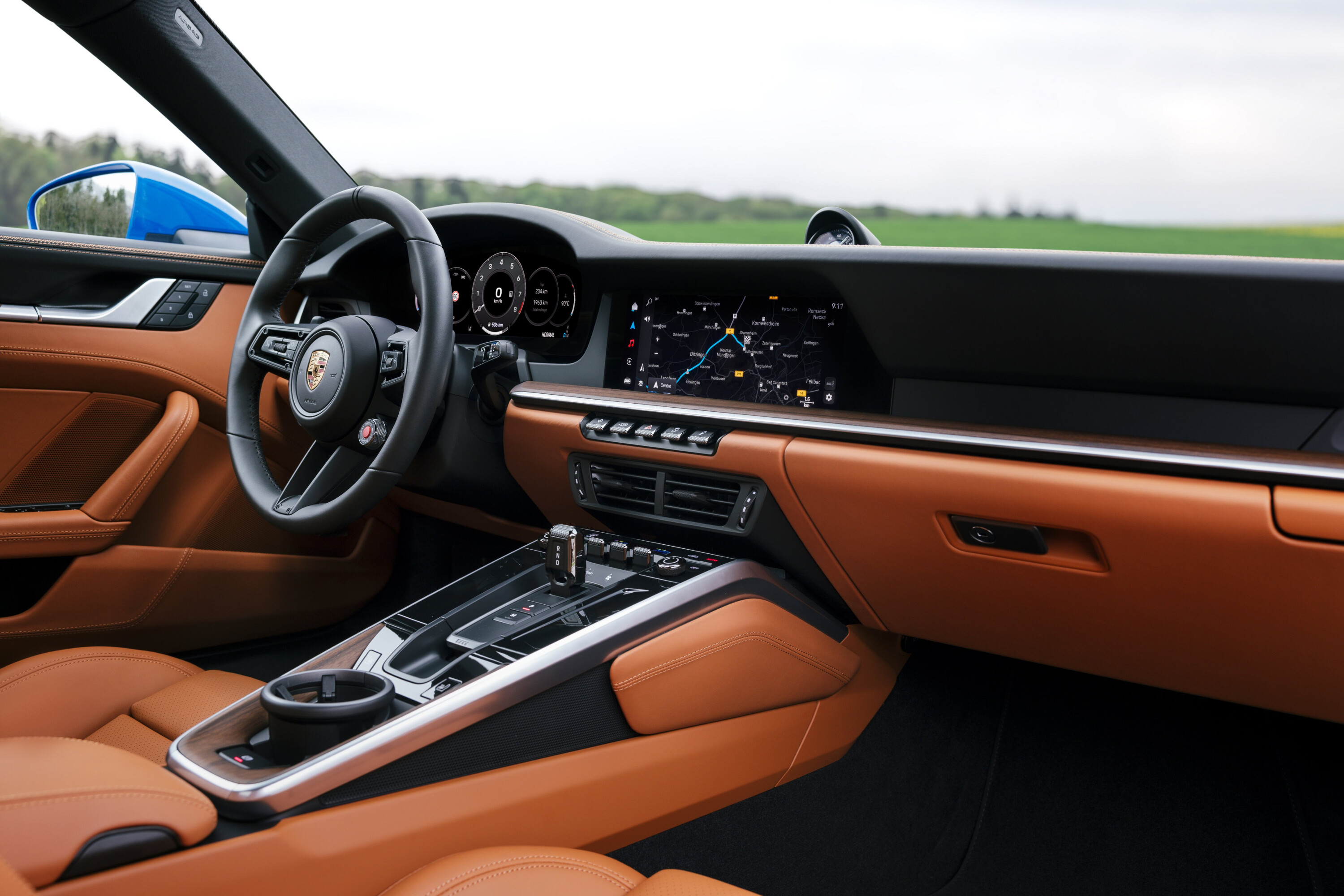
Inside the 992.2 ushers in two big changes: the inclusion of a starter button for the first time and the move to a fully digital instrument cluster. The new gauges are housed in a curved 12.6-inch display that Porsche says can be extensively customised. Seven different views are available, including a ‘Classic’ display that retains the 911’s traditional five-tube design with a central tachometer.
The centre console now houses a cooled compartment where you can charge your smartphone on a wireless charging pad.
The 10.9-inch centre touchscreen has new connectivity features and integrates more closely with Apple CarPlay functions like Siri voice assistance. Watching video streaming while parked is also available as an option, while apps like Spotify and Apple Music can be used natively through the system without a connected smartphone.
Another interesting change is to the seating layout. Internationally, the 992.2 Coupe will be offered as a two-seater as standard rather than the traditional four-seat configuration. In Australia the 2+2 layout will continue to be the default, however removing the rear seats is a no-cost option.
PRICE BUMPS AND AVAILABILITY
The 2025 Porsche 911 992.2 is available to order now with customer deliveries expected to commence in the first quarter of 2025. Prices have crept up across the board and the model range now kicks off at $280,500 for the Carrera Coupe with PDK.
- 911 Carrera Coupé starts at $280,500
- 911 Carrera Cabriolet starts at $303,800
- 911 Carrera GTS Coupé starts at $381,200
- 911 Carrera 4 GTS Coupé starts at $401,300
- 911 Carrera GTS Cabriolet starts at $417,400
- 911 Carrera 4 GTS Cabriolet starts at $437,900
- 911 Targa 4 GTS starts at $437,900
Australians gravitated to brands they trust amid public lockdowns and international travel restrictions during the coronavirus pandemic and delivered vehicles to people like Brisbane based nurse Barbara Lowe who snapped up her Diamond Red metallic MG HS at that time.
Barbara joined the MG family in 2020, and said she had tried out a variety of models before eventually being won over by the HS.
“I got my MG in the height of COVID-19. I was looking at a variety of different brands, but it was the MG that caught my eye, and from the moment we first drove the HS we absolutely loved it.”
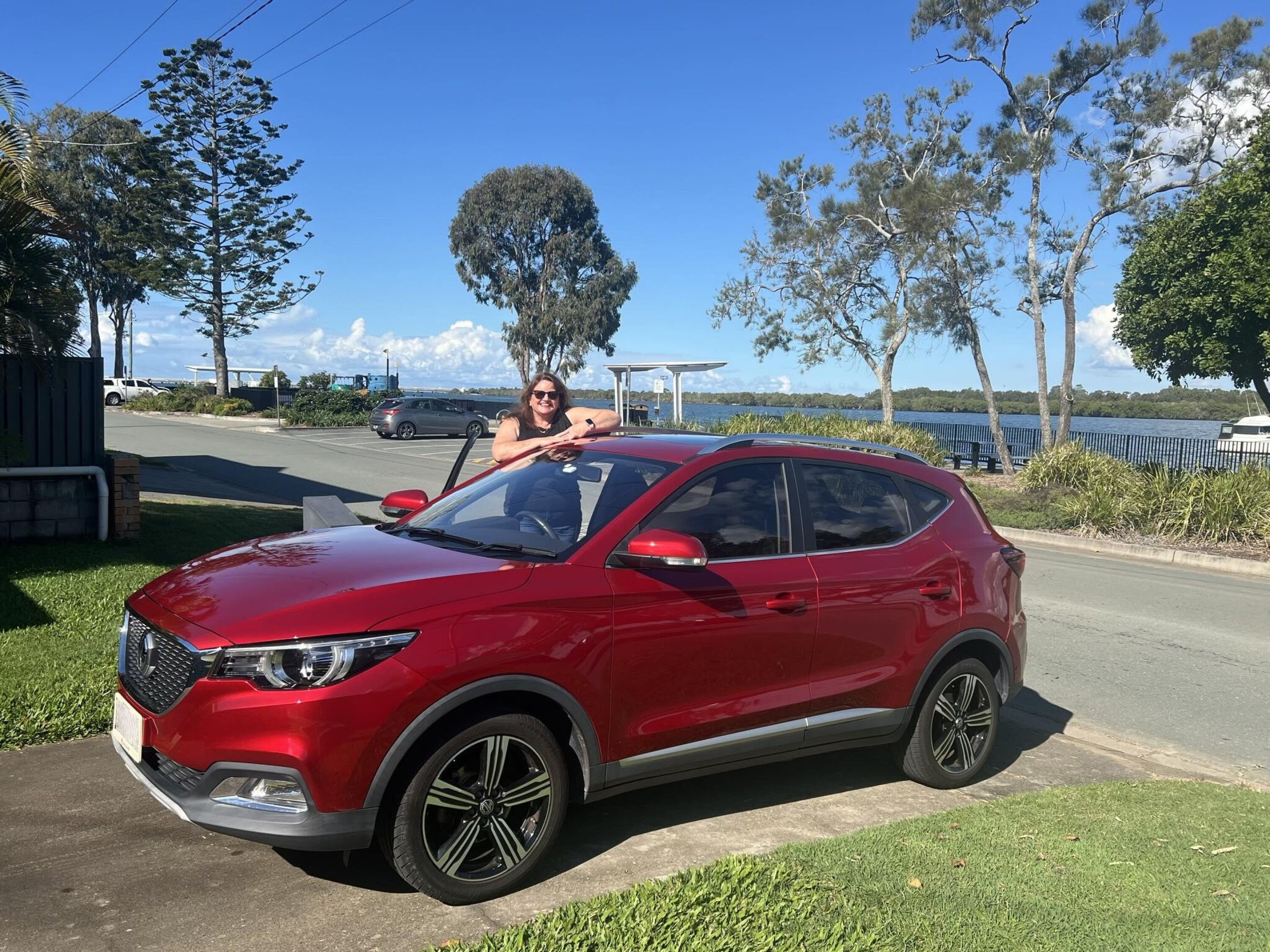
“The HS just had so many bells and whistles that the other cars didn’t have standard, so it was more bang for your buck. The seven years warranty was also a good sales pitch.”
When on the hunt for a new car, Barbara knew she wanted it to be a good size and well equipped to assist her in her day-to-day life as a nurse but also a great car for road-tripping and weekend escapes too.
“Since I am a nurse, my mother always said that I needed a reliable car. The MG HS was brand new and also packed a ton of safety features, so it ticked all my boxes,” she said.
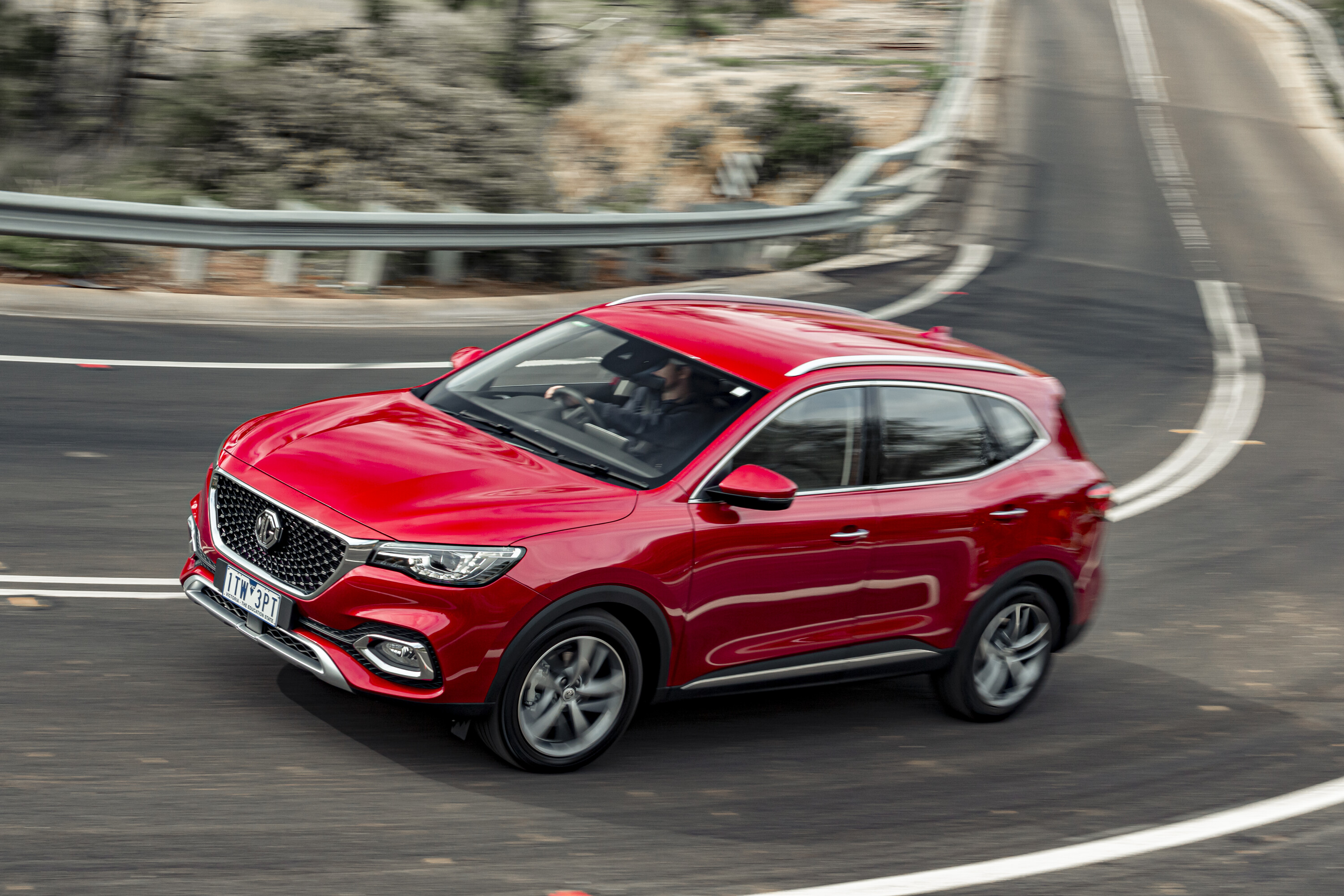
“I travel on the open highway to work each day, and it is always very smooth and very easy to drive.”
Barbara and her partner enjoy being able to hit the road and escape the hustle and bustle of city life when possible. The HS has proved to be more than a competent companion along the open Queensland country roads and a reliable workhorse enroute to the Hospital.
“My partner and I have been on several road trips with the car. Firstly we did Central Queensland, up to Emerald and Sapphire and worked our way back through Dalby,” she said.
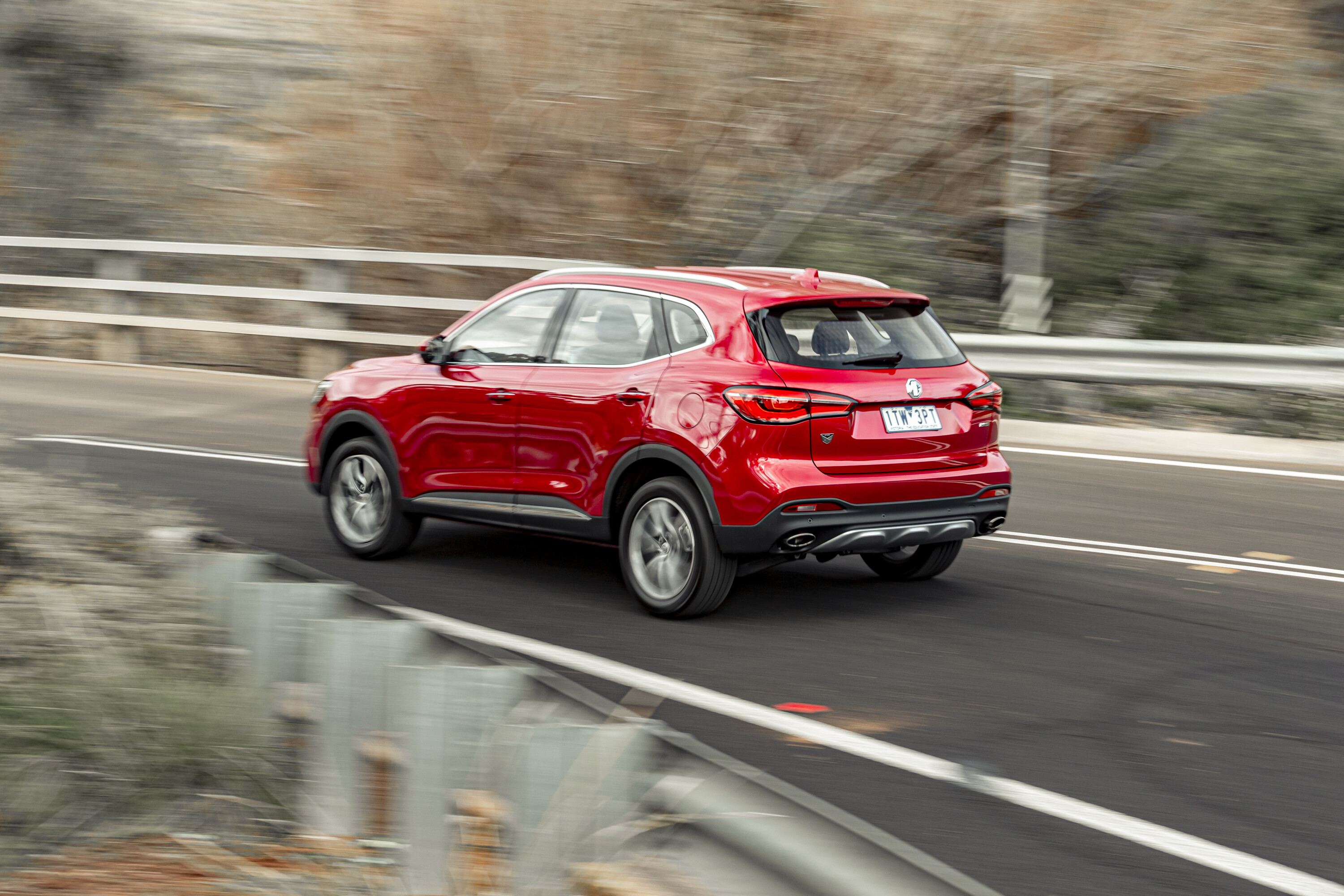
“The navigation for the trip was excellent. Another time I travelled from North Brisbane to the Gold Coast and back, and then the next day drove to Byron Bay on the same tank of petrol. I was absolutely amazed at how efficient the car is.”
This fuel efficiency that the MG HS packs is one of the most outstanding aspects to the car for Barbara, alongside many other features.
“My favourite feature of the MG HS is number one that it is very fuel efficient. It also has excellent handling and overall feels exceptionally smooth on the roads. The tyre pressure gauge is also something I didn’t have on my previous car which has really come in handy.”
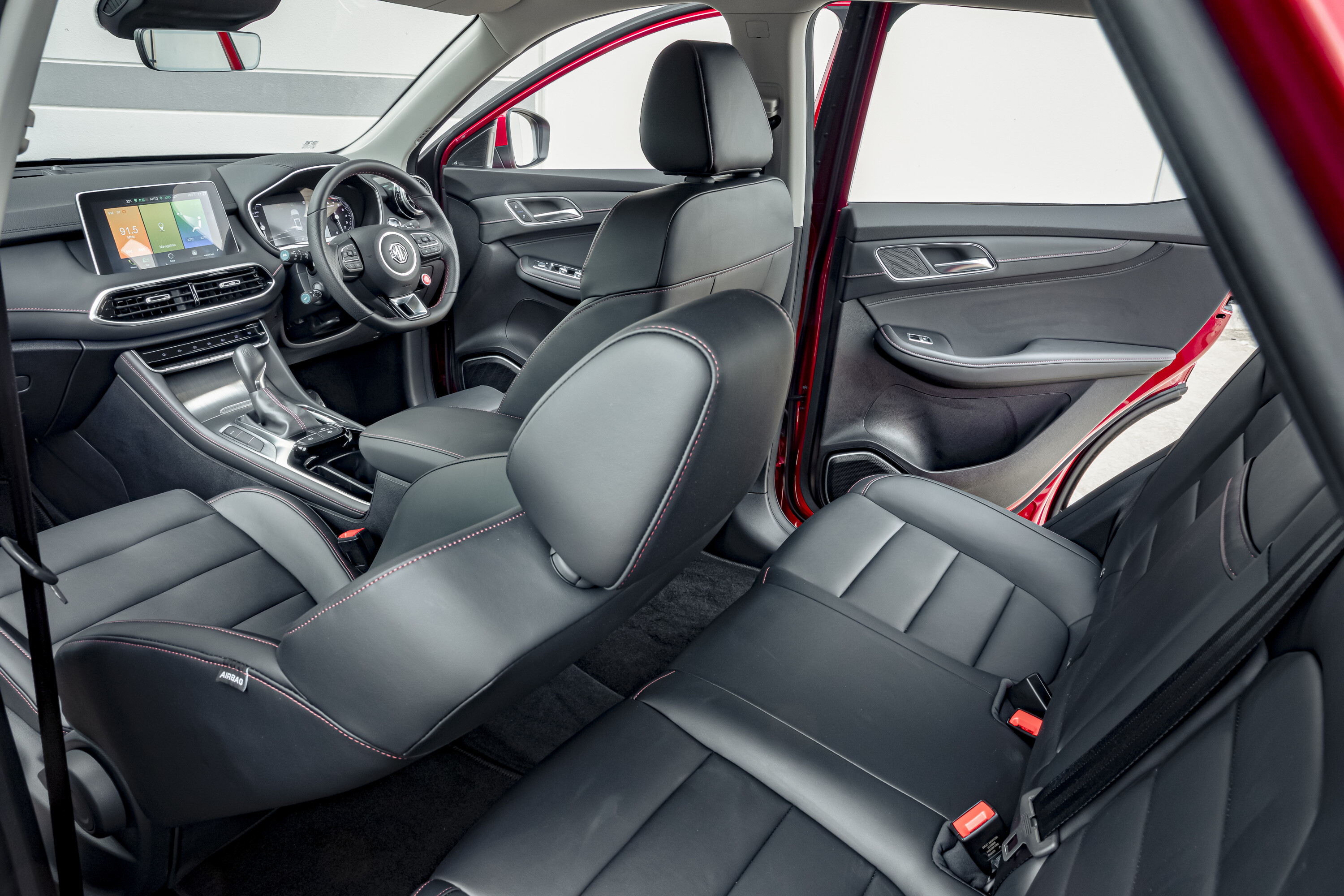
“I was surprised at how comfortable the car is, and the leather like seats make it look very smart. There are a few things I miss from my old car but now I can use Siri hands free when driving.”
“The reverse driving camera comes into use a lot as well and is especially helpful in the tight parking spaces of the hospital in which I work. The Apple CarPlay is great too, it’s fantastic to have an extension of my phone and all its apps.”
Barbara said without a doubt she would recommend an MG to her friends and family and would certainly purchase another in the future if she ever felt the need to add another vehicle into her family.
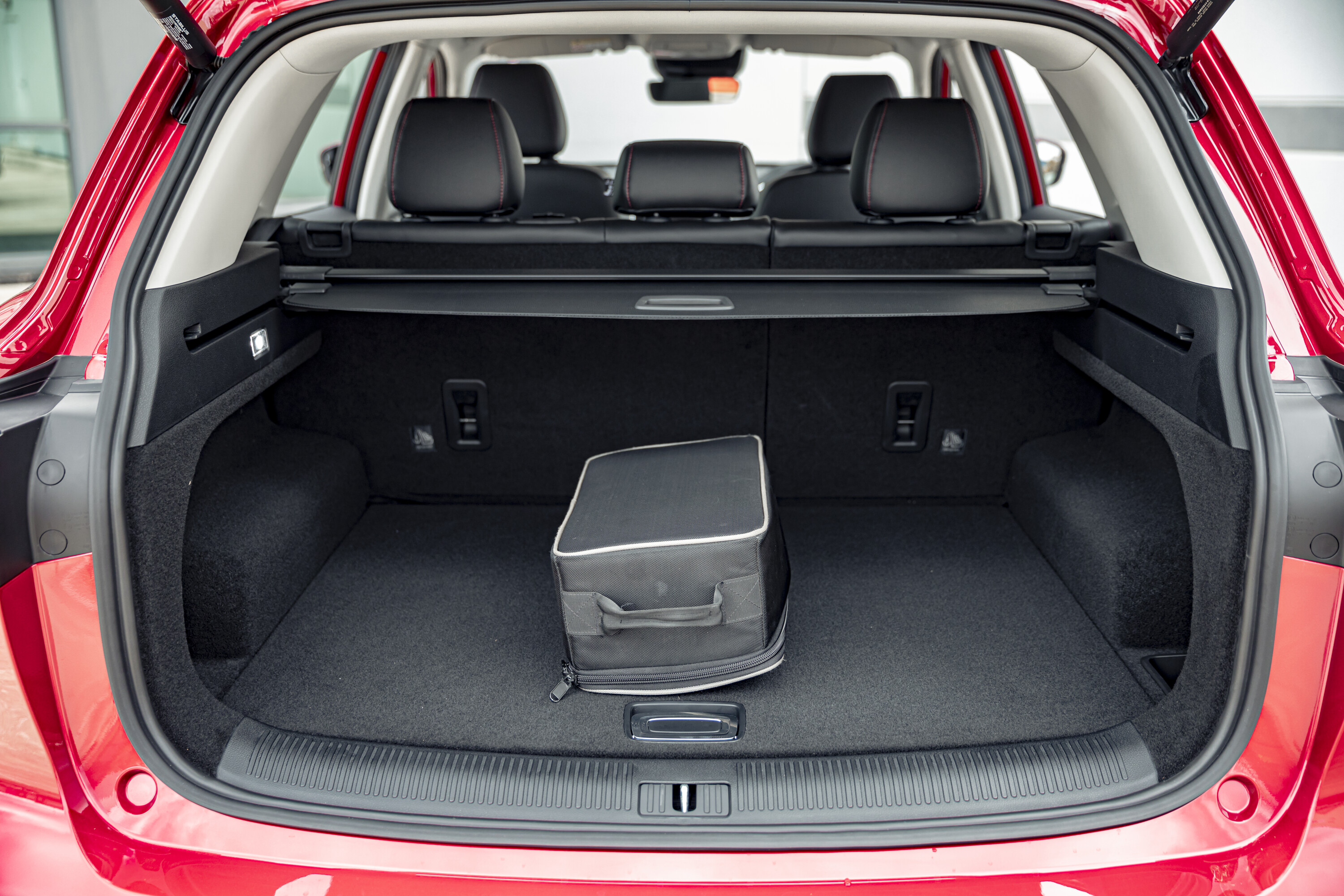
“I would certainly purchase another MG again, and I highly recommend the HS. I have had to use another MG HS before, and while it didn’t have all the features of mine, it was still great, and the fuel efficiency was just as top notch.”
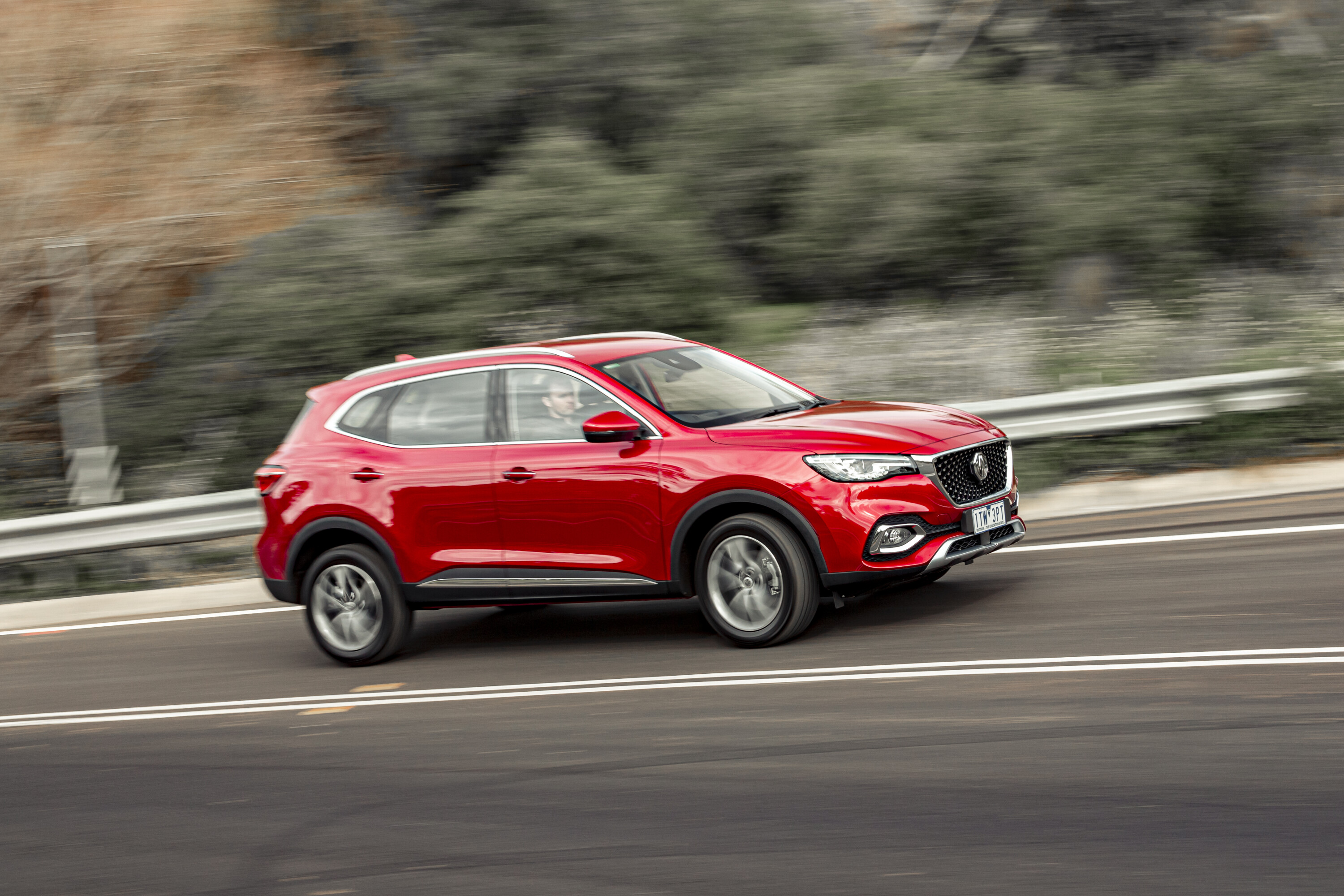
“I am so happy with my HS, I know it doesn’t have the go of some other cars. However, I continue to be pleasantly surprised with just how good it is, plus I absolutely love the colour (Diamond Red Metallic).”
Visit your local MG Dealership today, and take the MG HS for a test drive. [↗️]
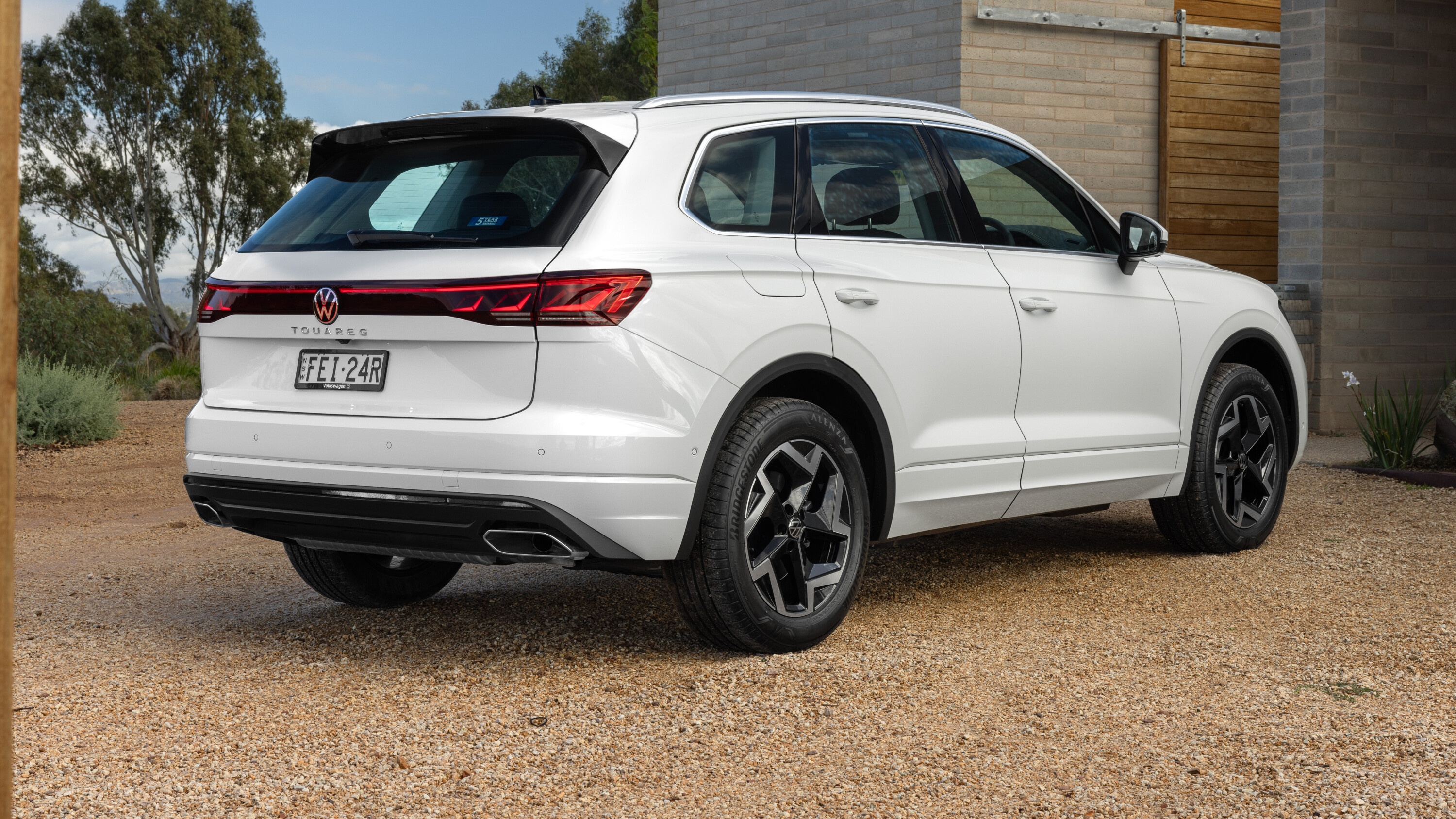
The Volkswagen Touareg has been revamped and repositioned, with the entry-level 170TDI model now offering a claimed $10,000 of extra spec for a lower price than the outgoing version.
It still comes with a V6 diesel engine, all-wheel drive and 3.5-tonne towing, but as with the previous take, it remains a five-seater, and that means some of its rivals may make better sense for family-car buyers.
Unless, of course, you are one of those people who bought a seven-seater only to realise that the third row could have just been a big boot…
JUMP AHEAD
- Pricing and features
- Comfort and convenience
- Powertrain
- Driving
- What are the best rivals?
- Should I put it on my shortlist?
- Specifications
Pricing and features
The updated Touareg 170TDI lists at $86,790 plus on-roads, nearly $2500 less than the last version, but with the aforementioned $10K spec bump that includes a heap of new items.
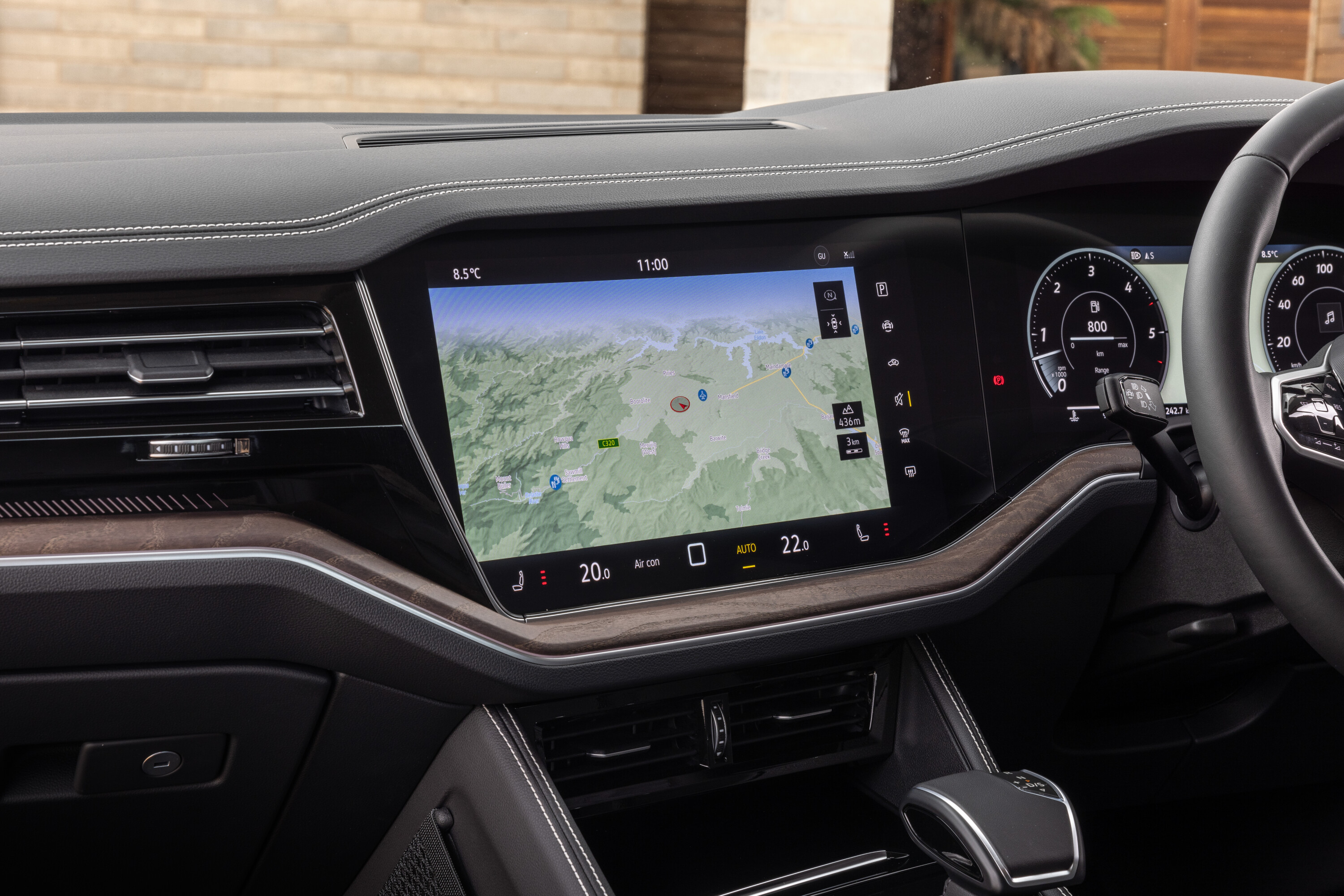
Highlights include LED matrix HD headlights with adaptive beam tech, 19-inch alloy wheels, a power tailgate, keyless entry and push-button start, leather interior trim, heated front seats with electric adjustment, a 12.0-inch digital driver info screen, and the 15.0-inch Innovision touchscreen – previously optional – is now standard, with wired and wireless Apple CarPlay and Android Auto, as well as sat nav, and it’s the display for the standard surround-view camera system.
Other standard safety tech includes front and rear parking sensors, semi-autonomous parking, dynamic road sign recognition, autonomous emergency braking with pedestrian and cyclist detection, lane-keeping, adaptive cruise control, traffic jam assist, blind-spot monitoring, front and rear cross-traffic alert with auto braking, and the brand has also added Manoeuvre Braking for obstacle and pedestrian protection while parking.
There are other V6 models above this one, both with the punchier 210kW/600Nm tune.
The 210TDI Elegance is $99,990 plus on-roads and adds larger 20-inch wheels, adaptive air suspension, different leather interior trim, and cooled front seats with massage function.
Up from there is the 210TDI R-Line at $109,990 plus on-roads, and it gains a specific R-Line exterior and interior design, 21-inch wheels, black leather interior trim, tinted rear glass, rear-wheel steering and electromechanical anti-roll stabilisation, a heated sports steering wheel, an alarm, and black headliner.
Comfort and convenience
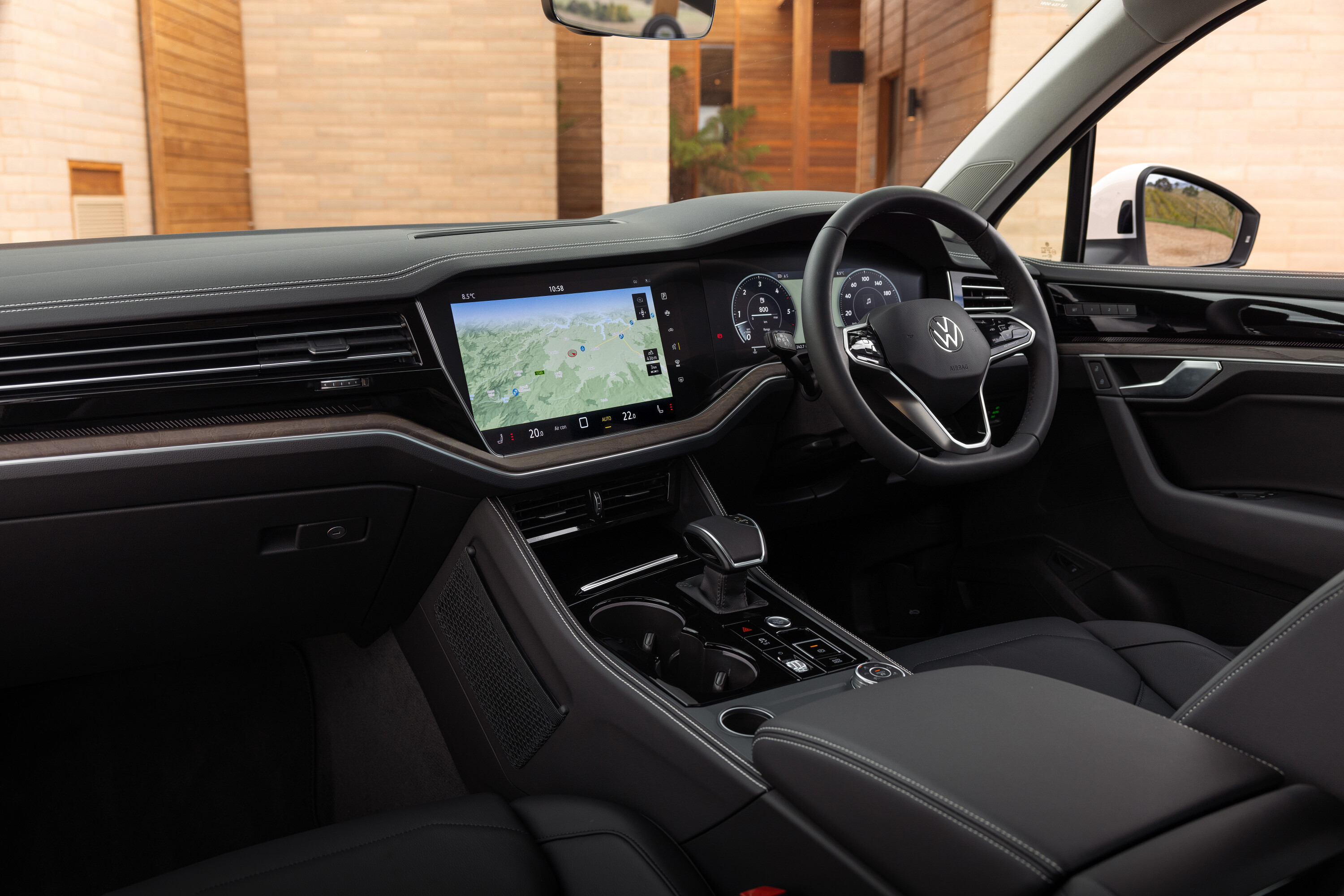
The base grade feels like a luxury SUV inside, with an understated and somewhat minimalist vibe.
The big touchscreen media system certainly takes pride of place in the dash, but sadly there are no buttons to control elements on the screen. There’s a ‘bar’ at the bottom for climate control which takes some learning, and that’s a common theme with the infotainment software. At least the Apple CarPlay display now goes full screen.
While some may prefer a metallic finish across the dash, the “open cell fine grain ash” wood trim is a lovely touch, and it runs across the dash and onto the doors, where there’s also an ambient light strip to brighten things up.
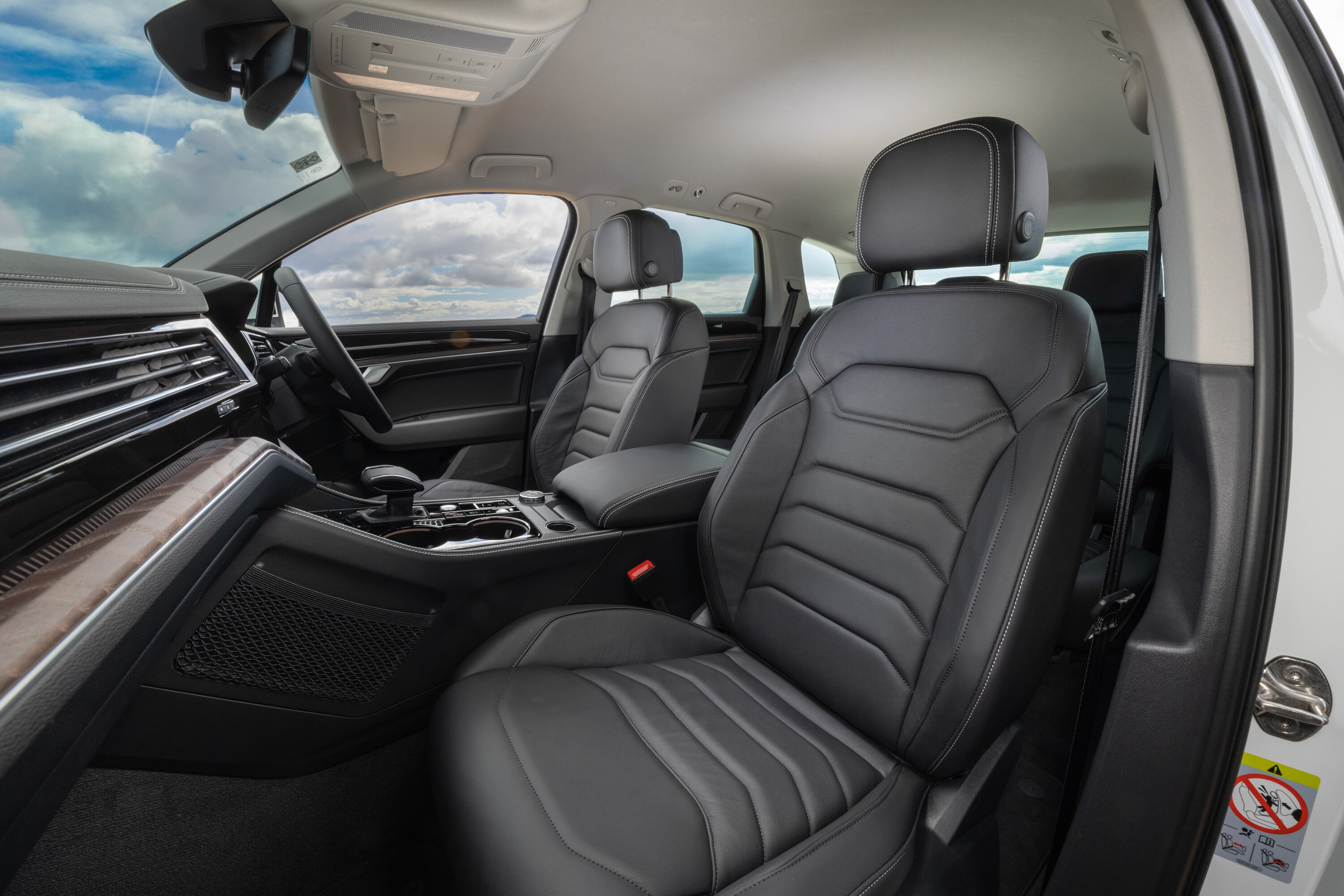
The leather-trimmed, heated and electrically adjustable front seats are super comfy for longer drives, and the back seat offers comfortable accommodation too.
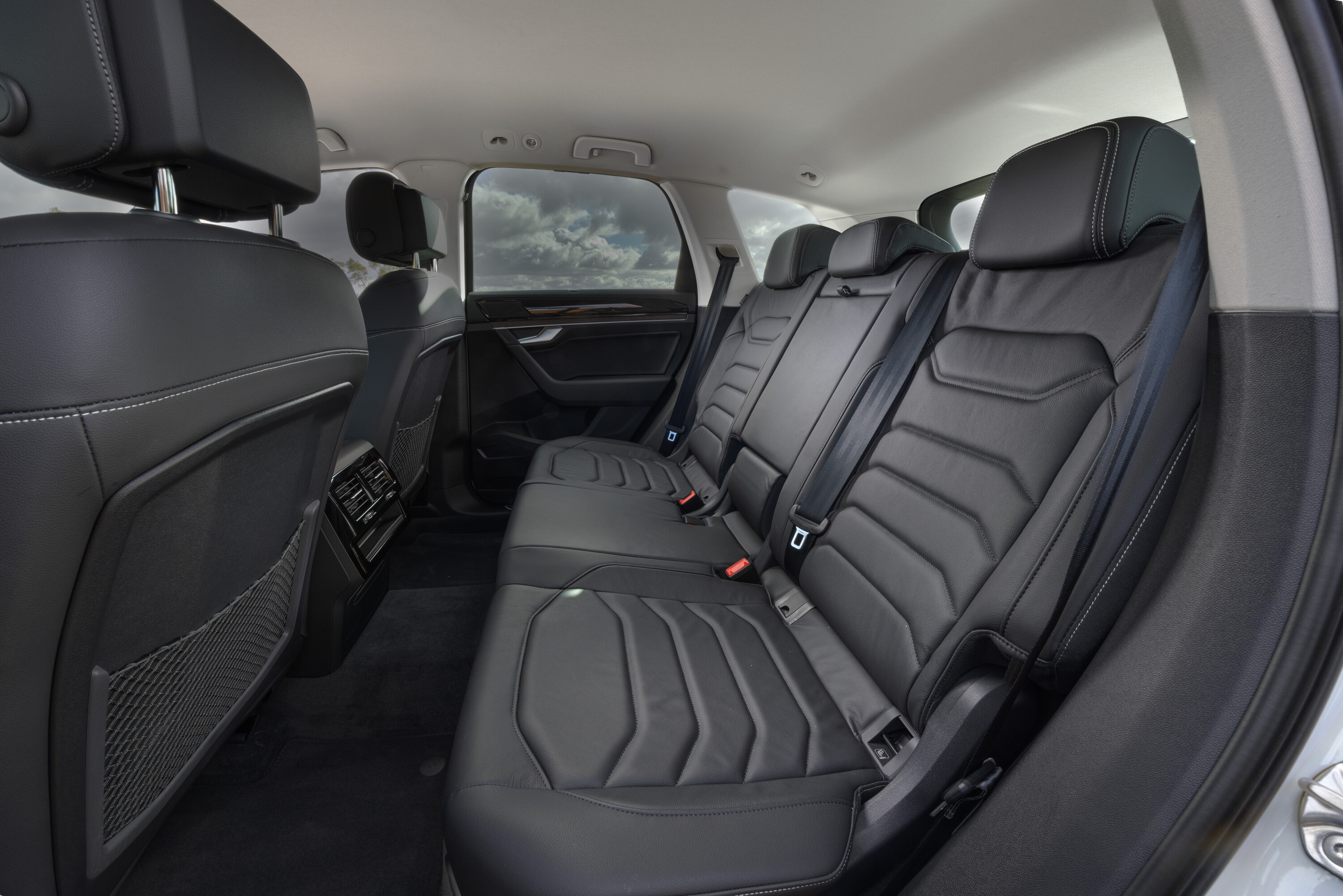
There’s ample room in the rear for a taller adult to sit with space to spare, but three with big feet might be an issue as there’s a transmission tunnel eating into foot space.
And while there are directional vents and USB-C ports in the back, the base car misses out on the handy B-pillar vents for better air circulation.
Powertrain
No changes to the powertrain compared with the preceding model, meaning the 3.0-litre turbo-diesel V6 carries on, and with 170kW and 500Nm, it’s quite a unit. There’s a standard eight-speed auto and 4Motion all-wheel drive.
Maximum towing capacity is 750kg for an unbraked trailer and 3500kg for a braked trailer, but the towing downball weight is capped at 280kg – so do your maths.
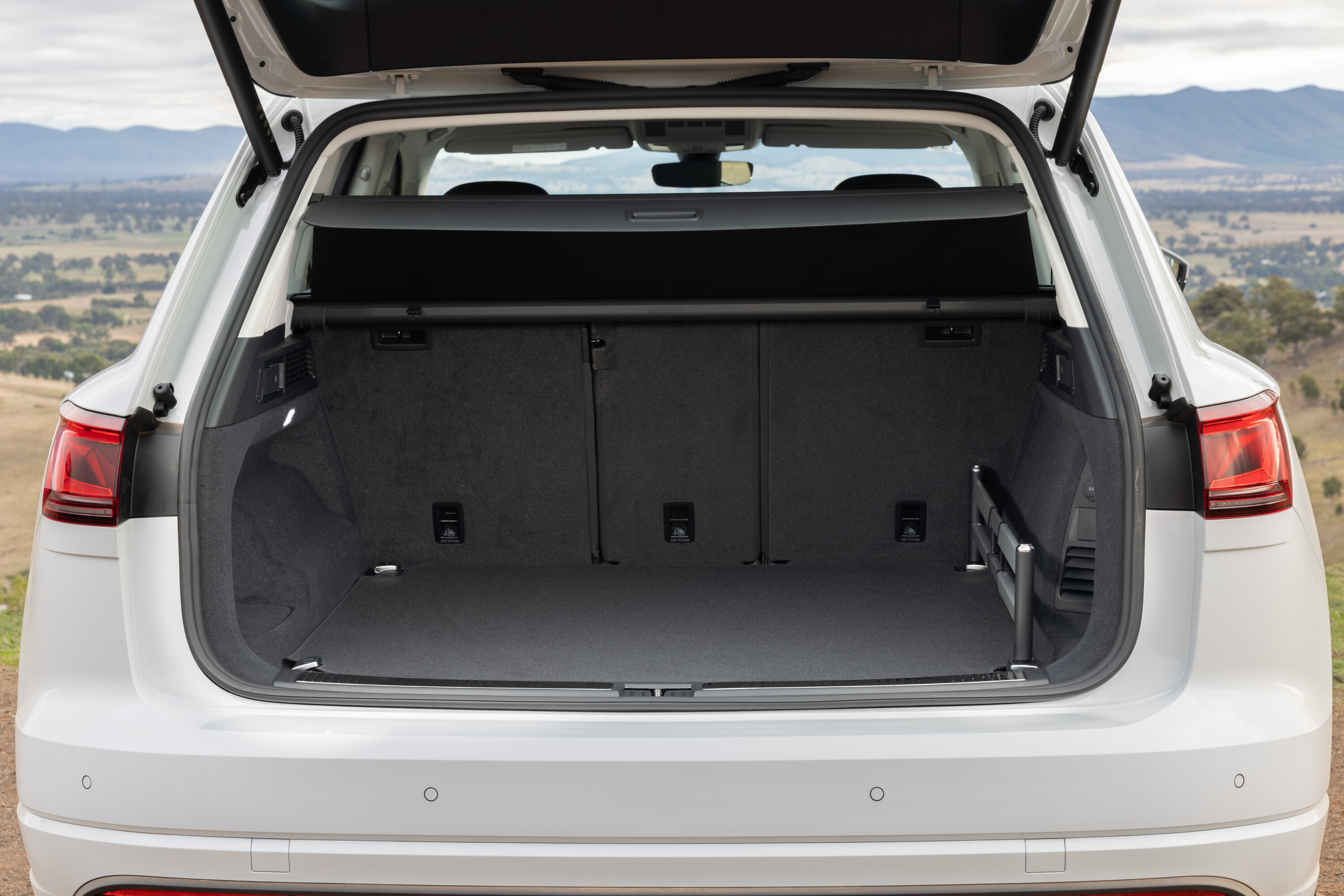
Driving
What a lovely thing to drive in the countryside.
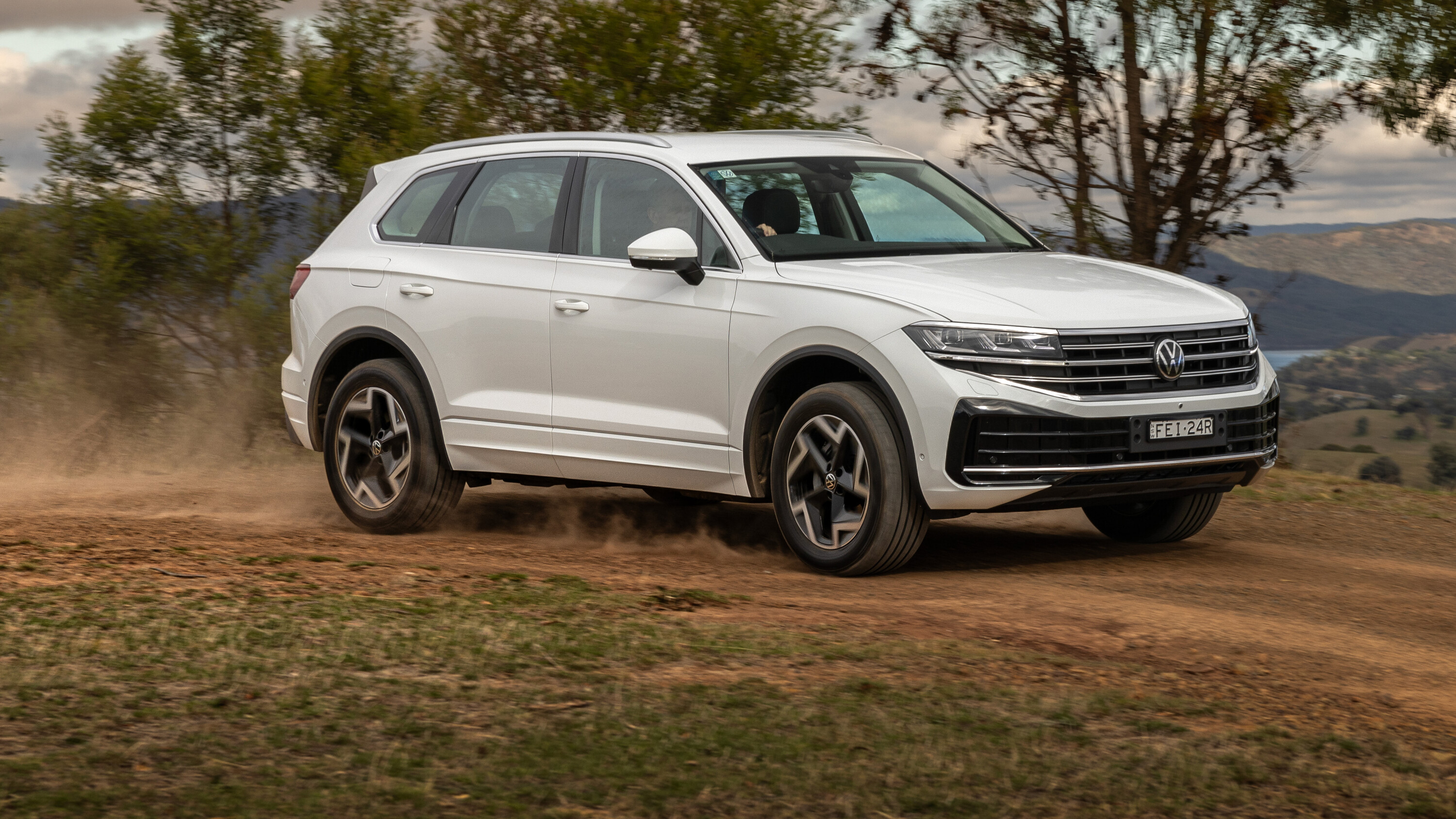
That’s what I found myself thinking after a few hundred kays behind the wheel of the 170TDI at the launch, with a mix of roads a few hours out of Melbourne showcasing the breadth of capability of this diesel family SUV.
The V6 is one of the most refined I’ve driven, with a barely audible note to it, and hardly any rumble whatsoever.
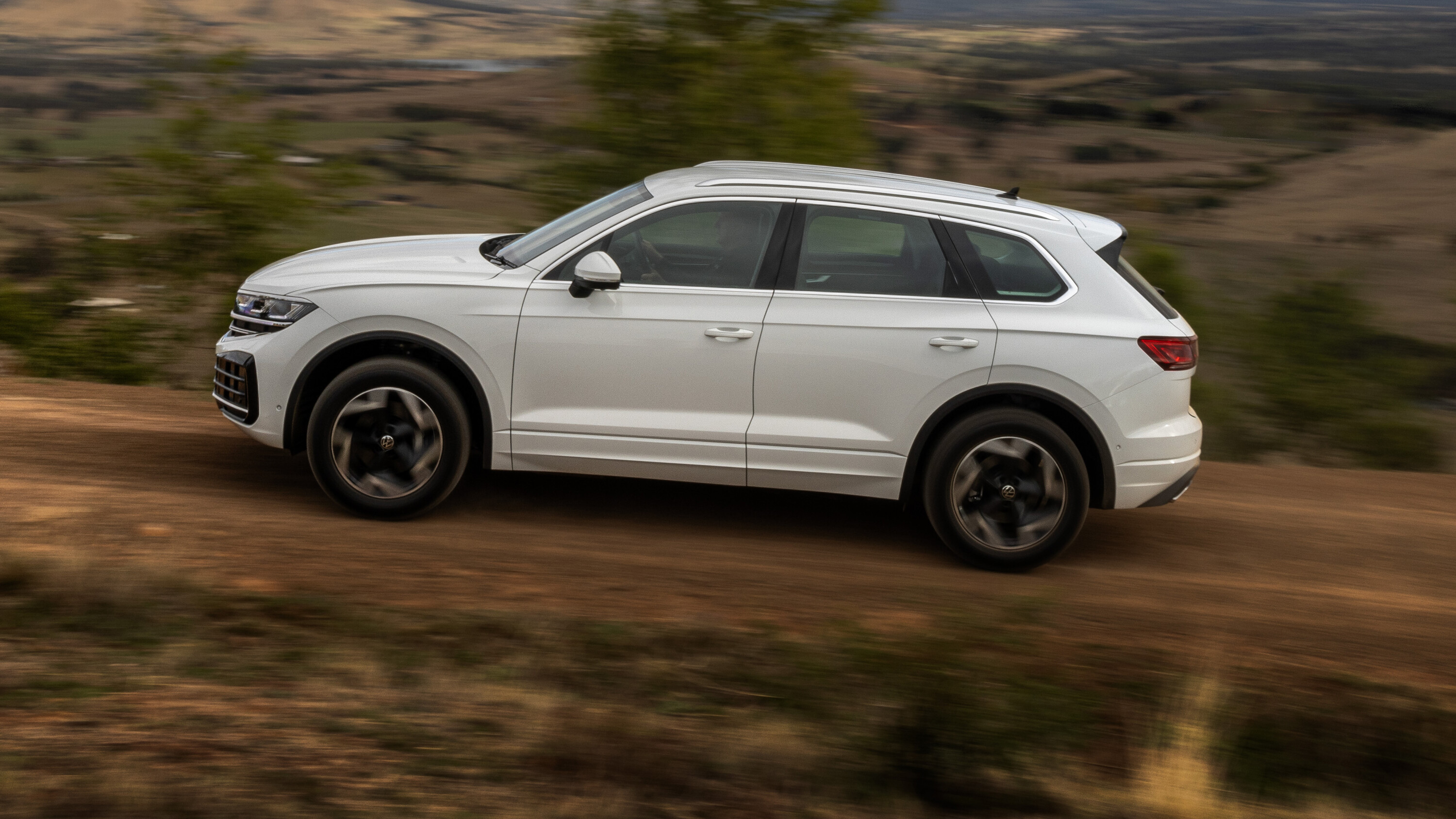
Yet it is urgent in its response, feels easily up to the task when touring or overtaking, and is also mostly very agreeable in stop-start situations, though I did have a couple of laggy moments at times, with the eight-speed auto seemingly getting caught out a little.
What is most enticing about it, though, is the way it handles itself on less-than-perfect bush roads, with a level of body control and predictability that makes it almost innate in its movements. It really shrinks around you.
The steering is accurate and well judged, and while the steel-sprung suspension can feel a little sharp in town, it soaks up the bumps at pace really nicely.
What are the best rivals?
Equivalent diesel V6 models from mainstream brands? Well, there’s the award-winning Ford Everest, which in Platinum 4WD spec is $81,115 and has seven seats, equivalent towing, and a dollop more power (184kW/600Nm).
A luxury-branded alternative with a six-pot diesel for this much…? You might need to buy used.
Otherwise, if five seats could suffice, there’s another VW that might do the trick – the Amarok!
Should I put it on my shortlist?
If you want a luxurious large SUV and don’t want to spend more than a hundred grand, you bet. It should be at the very top of your list.
| 2024 Volkswagen Touareg 170TDI specifications | |
|---|---|
| Powertrain | 3.0-litre turbo-diesel V6 |
| Max power | 170kW |
| Max torque | 500Nm |
| Drivetrain | 8-speed auto, AWD |
| Fuel consumption | 7.3 litres per 100km (official); 7.7 litres per 100km (on test) |
| Price (MSRP) | $86,490 |
Deliveries of the 2024 Mercedes-Benz E-Class have commenced in Australia.
The new E-Class utilises the classic “three-box” sedan layout, with a 20mm longer wheelbase.
Outside, there’s a new high-gloss black front-end design with an illuminated radiator grille, using LED modules with fibre optic technology (optional with Plus Package). High-performance LED headlights are fitted with more than one million pixels per unit.
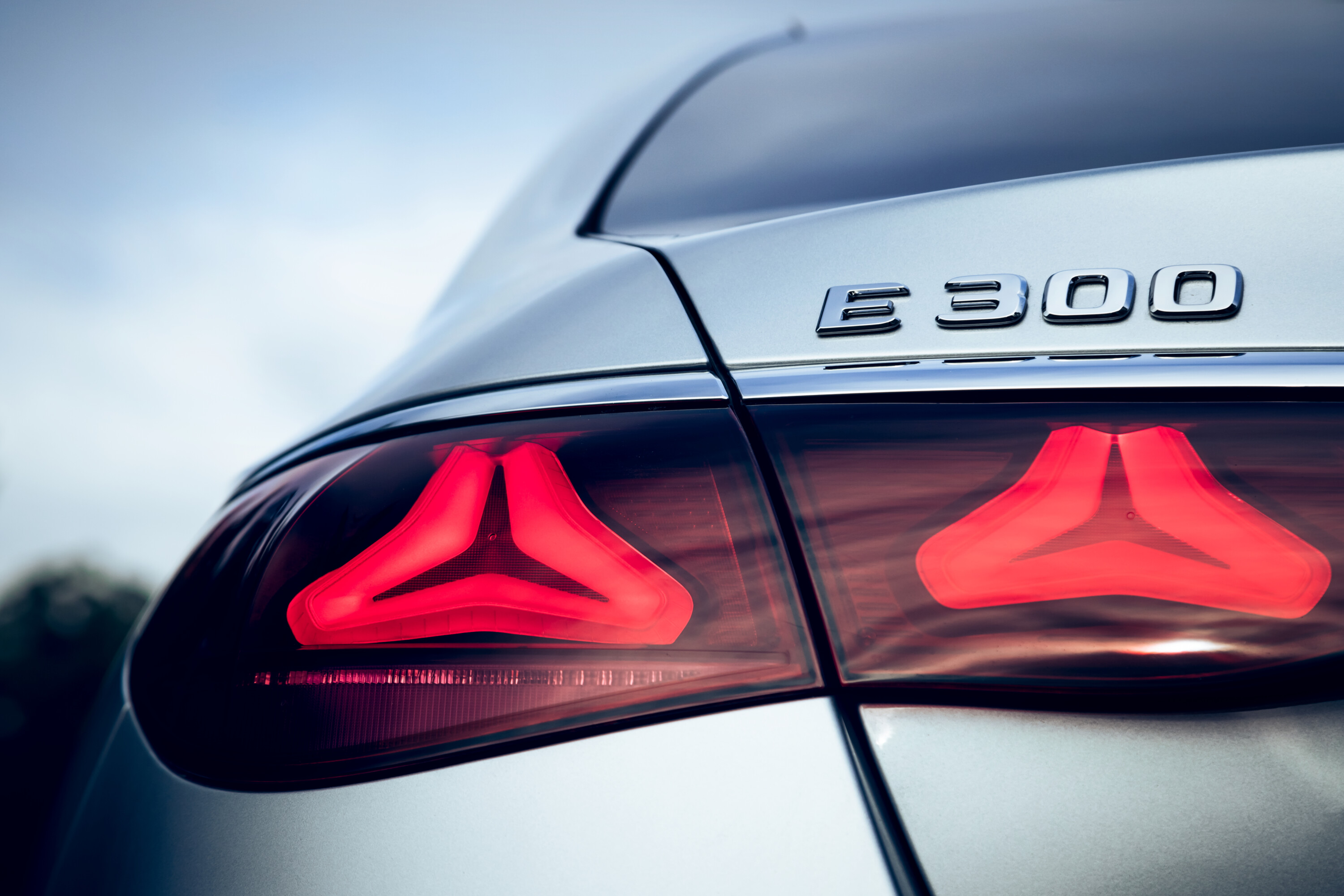
Character lines along the side are intended to define a sporty character. Star-motif two-section tail lights provide a “special day and night design”.
For Australia, the E300 – now priced from $131,500 before on-road costs – is fitted with the AMG Line exterior package as standard equipment.
A choice of six metallic paint colours is available, with the addition of three optional premium paint finishes. 20-inch AMG multi-spoke alloy wheels in high-sheen black are fitted as standard.
A drag coefficient of 0.23 has been achieved by the use of front-section sealing, wheels with “aeroblind claddings”, and improved underbody aerodynamics.
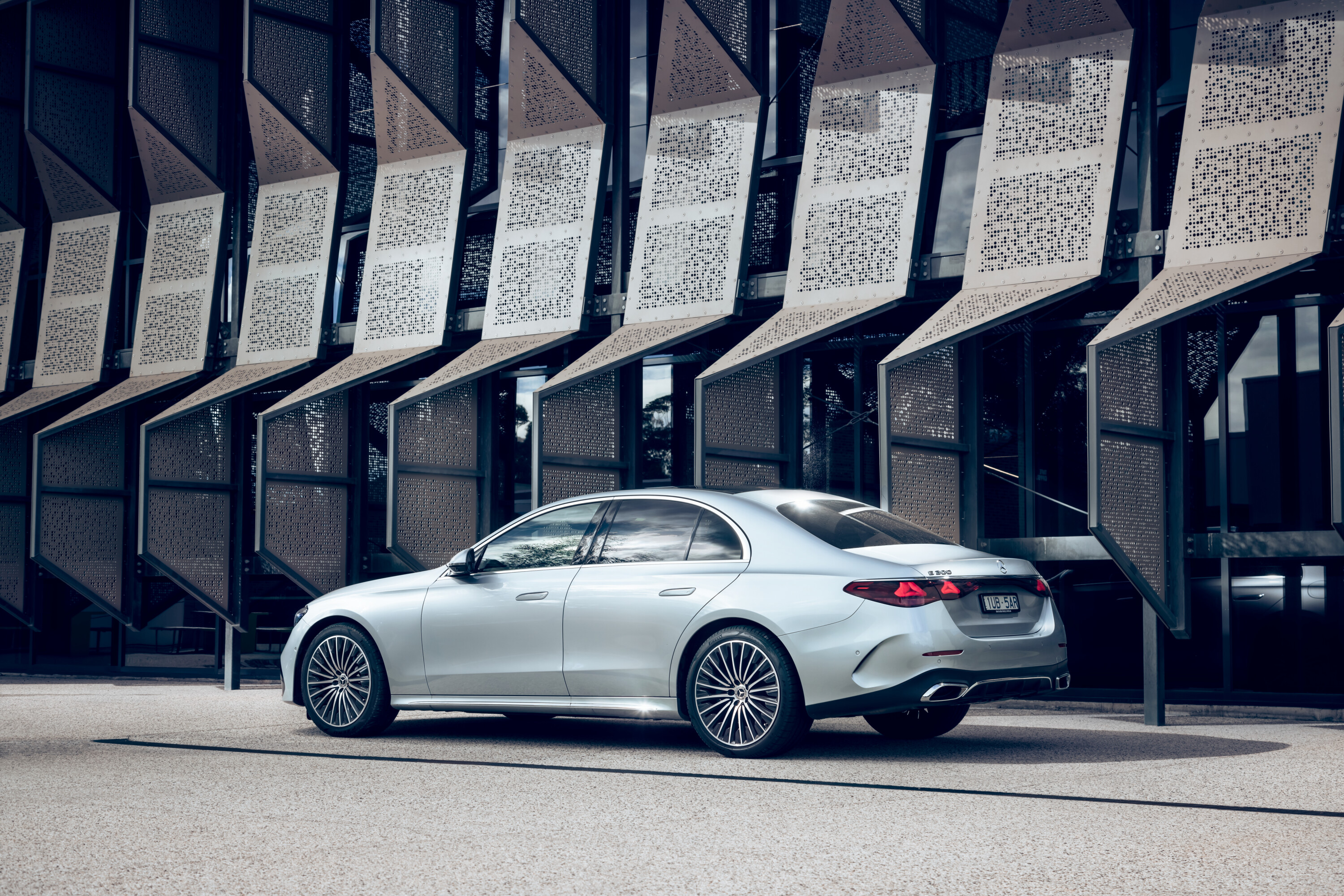
Under the bonnet of the E300 is a 2.0-litre four-cylinder petrol engine combined with an integrated starter-generator (ISG). This system produces a combined 190kW and 400Nm, mated to a nine-speed automatic transmission sending power to the rear wheels.
Variable dampers fitted as standard for Australia, with a 15mm lower ride height. Air suspension and rear-axle steering is optional.
The new E300 features the Driving Assistance Plus package as standard, with a comprehensive suite of technologies including (but not limited to): active steering assist, lane change assist, active emergency stop assist, lane keep assist, blind spot warning and more.
Inside the new E300, the cabin has been enlarged for comfort. There are climatised electrically adjustable sports front seats with leather upholstery and a Memory Package.
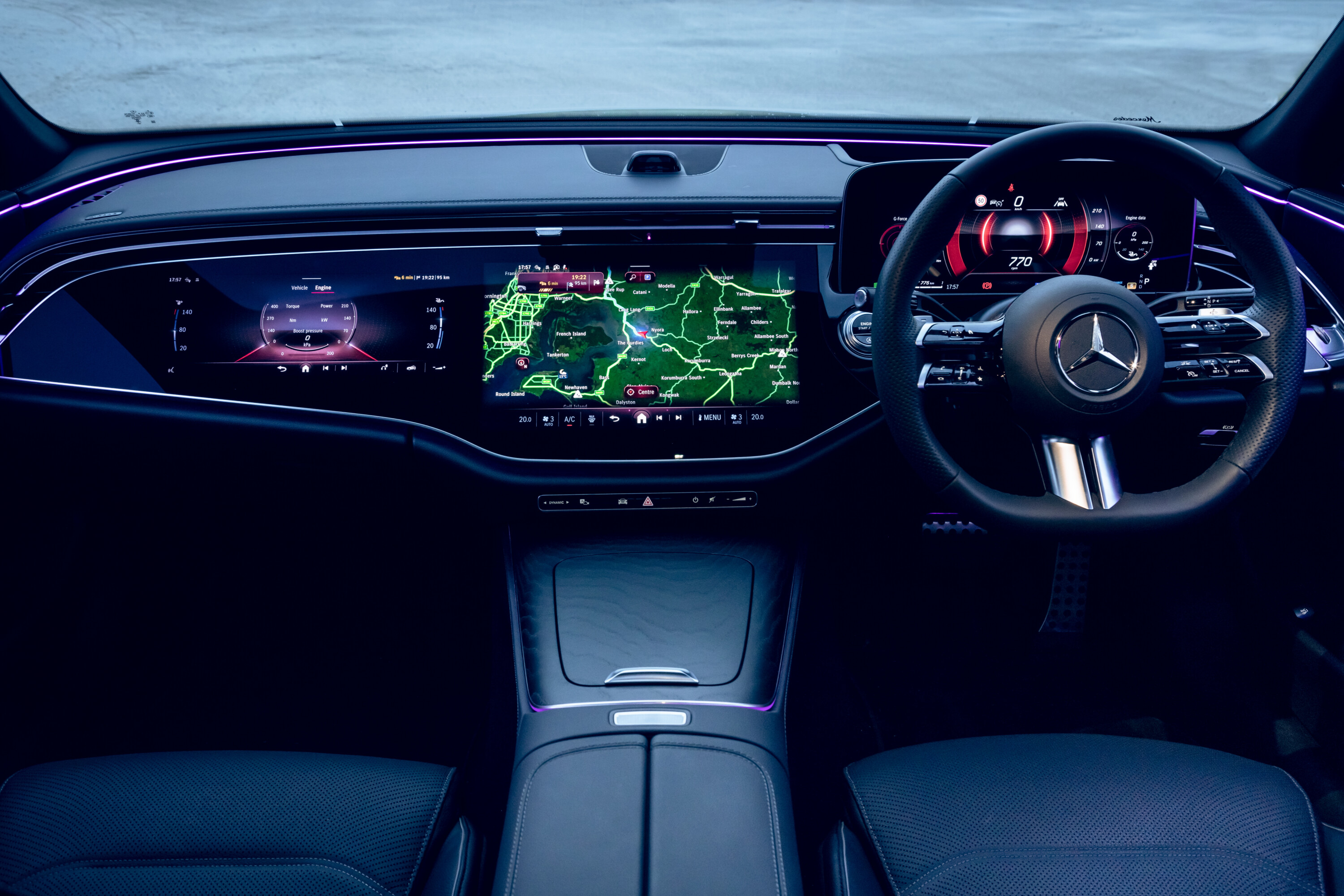
Comfort front seats are available as a no-cost option. Heated Multi-contour front seats with rear-seat heating are available in the optional Energizing Package Plus.
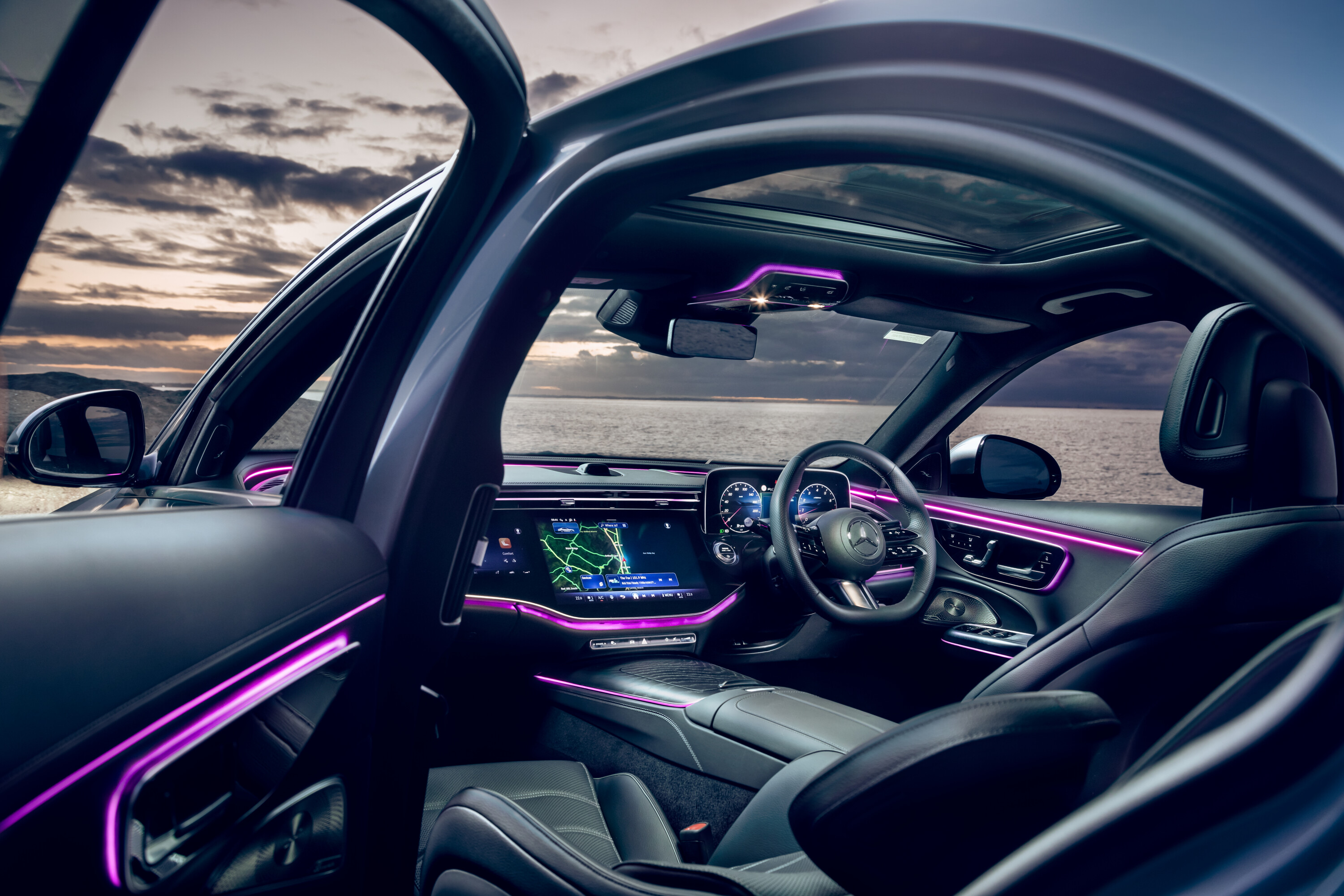
Three interior colours are available: Leather Black, Leather Tonka Brown, and Leather Macchiato Beige. A centre console with cup holders, USB ports, open-pore black ash wood and Black Piano trim and an illuminated light strip is included.
Infotainment is catered for with the new MBUX (Mercedes-Benz User Experience) system with a “Superscreen” display, providing a main 14.4-inch display and a 12.3-inch extendable display for the front passenger. The system also features individualised graphics, smartphone-like functionality, and a new high-power 5G communication module.
The interior of the new E-Class is equipped with several cameras, including a new selfie and video camera on top of the instrument panel. Wireless Android Auto and Apple CarPlay are integrated into the MBUX system.
The MBUX system also features augmented reality for navigation, and various AI-assisted features, with an optional Plus Package allowing automatically executed functions.
Dual-zone climate control is fitted as standard, with optional four-zone climate control available with the Plus Package, including Digital Vent Control. An in-car fragrance system is available with the optional Energizing Package Plus.
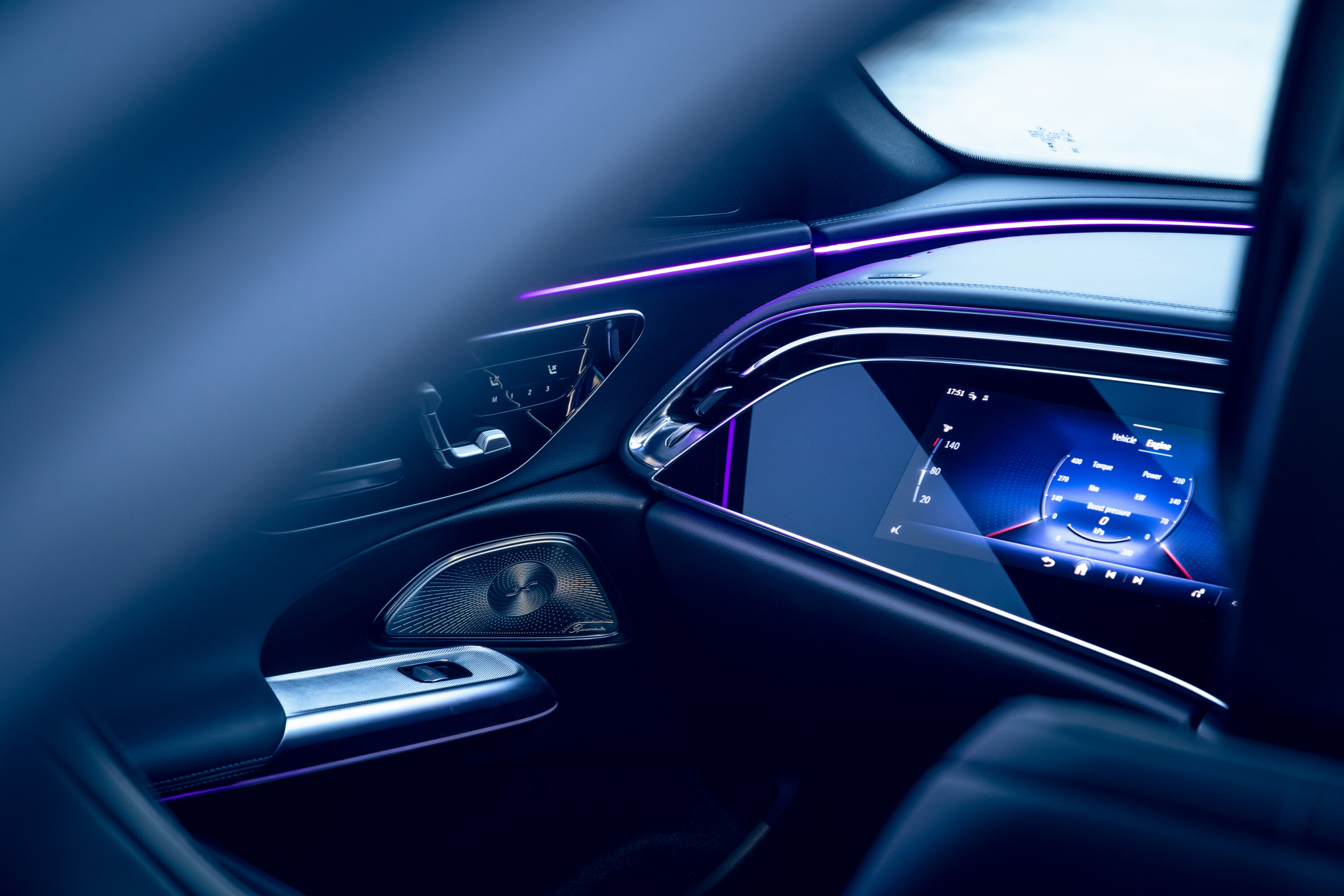
A 730-watt, 17-speaker Burmester 4D surround-sound system is fitted as standard, featuring Spatial Audio with Dolby Atmos to provide a 360-degree listening experience.
Two loudspeakers are integrated into the roofliner, and two “tactile transducers” are integrated into the front seat backrests. Active light strips along the instrument panel and door panels can be set to synchronise with music.
A Digital Vehicle Key is now available for iPhone and Apple Watch, allowing the driver to start and lock the new E-Class remotely. The Digital Vehicle Key can be shared with up to 15 people, and the vehicle can recognise several people at once.
A network connection is only required for the initial one-time setup and for sharing. The main user always retains the ability to revoke the other users’ access rights.
2024 Mercedes-Benz E-Class pricing
| Model | Pricing |
|---|---|
| E300 | $131,500 |
| Prices exclude on-road costs.u00a0 |
Snapshot
- Mitsubishi is the first OEM in Australia to achieve approval to feed power into the electricity grid
- Outlander PHEV and Eclipse Cross PHEV approved after testing by South Australian Power Networks
- Bi-directional V2G charging using Jet Charge hardware adds to PHEV versatility
Mitsubishi is the first car brand in Australia to be approved for Vehicle-to-Grid (V2G) after receiving the official go-ahead from SA Power Networks (SAPN).
The approval means the Mitsubishi Outlander PHEV (plug-in hybrid electric vehicle) and Mitsubishi Eclipse Cross PHEV can feed electricity from their battery packs directly into the South Australian power grid.
“MMAL [Mitsubishi Motors Australia Limited] is now unconditionally able to export power from its PHEVs into the grid,” said MMAL’s eMobility manager Tim Clarke.
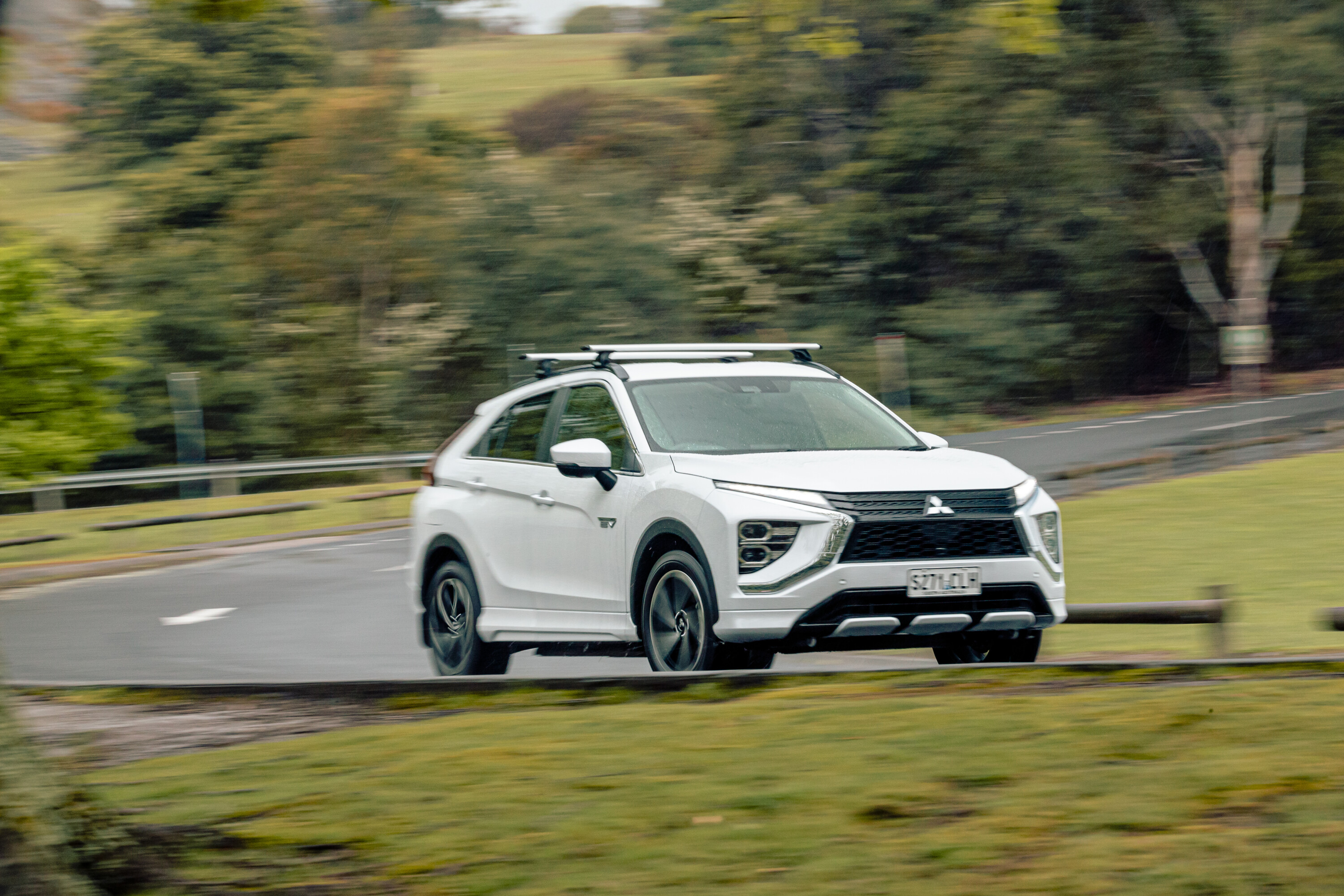
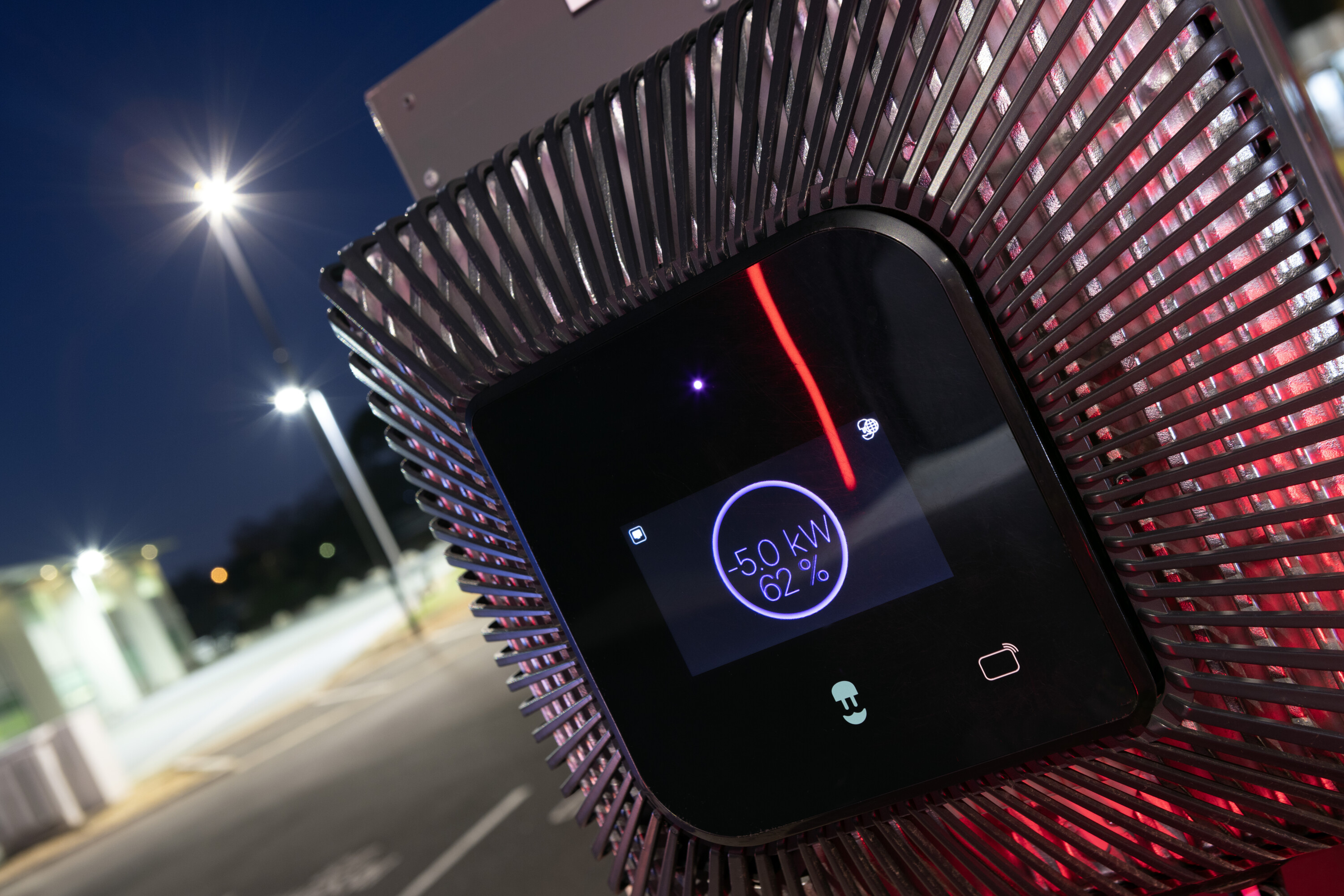
Vehicle-to-Grid charging – part of the more broadly termed bidirectional charging – enables PHEVs to sell power back to the grid the same way rooftop solar panel users are able to.
Approval for V2G charging was approved in South Australia in 2022 with Jet Charge offering the only certified bi-directional charger in Australia, the Wallbox Quasar 1 launched in 2020.
JET Charge worked with Wallbox, SAPN as well as Mitsubishi and Nissan for the V2G approval, with the Nissan Leaf EV also capable – though not yet approved – of feeding power back to the electricity grid.
“Bi-directional charging will fundamentally change how we view transport and energy. It will make our vehicles an even bigger part of our everyday lives, powering how we move and how we live,” said JET Charge CEO Tim Washington.
“That’s why we’re so excited to partner with Mitsubishi Motors to further this cause. It takes different parts of the industry, all working together, to deliver this value for Australians, and I feel like we have made a significant step with this project.”
For Mitsubishi to achieve approval, a Mitsubishi Outlander PHEV was connected to Wallbox Quasar 1 bi-directional hardware supplied and installed by Jet Charge as part of SAPN’s ‘witness testing’.
The Outlander PHEV safely exported electricity from its 20kWh lithium-ion battery via its CHAdeMO fast-charging DC (Direct Current) port into the state’s power grid.
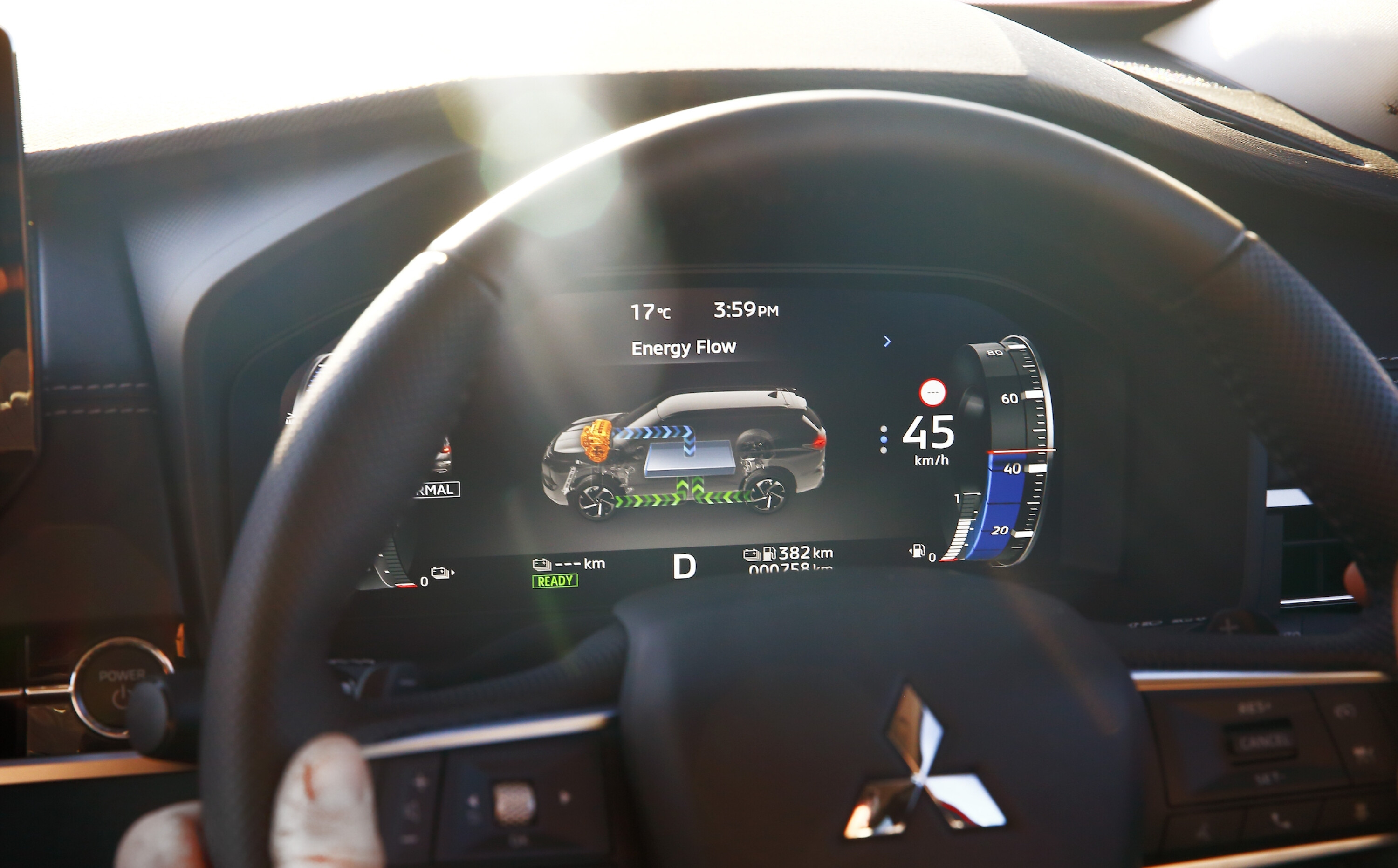
“As Australia’s V2G landscape continues to mature and access to bi-directional hardware increases, Mitsubishi PHEV owners are well positioned to benefit,” Clarke added.
“They will be able to export from their PHEV to the grid or home, reinforcing PHEV’s versatility, while enhancing renewable energy deployment and reducing CO2 emissions across transport and in the grid.
The South Australian electricity grid receives more than 70 per cent of its power from renewable resources and has a target to achieve 100 per cent renewable energy by 2027.
Snapshot
- Smart brand’s return to Australia is now official
- Aussie lineup will include the Smart #1 and Smart #3 as well as Brabus versions of each
- Order books will open from July with deliveries earmarked from September
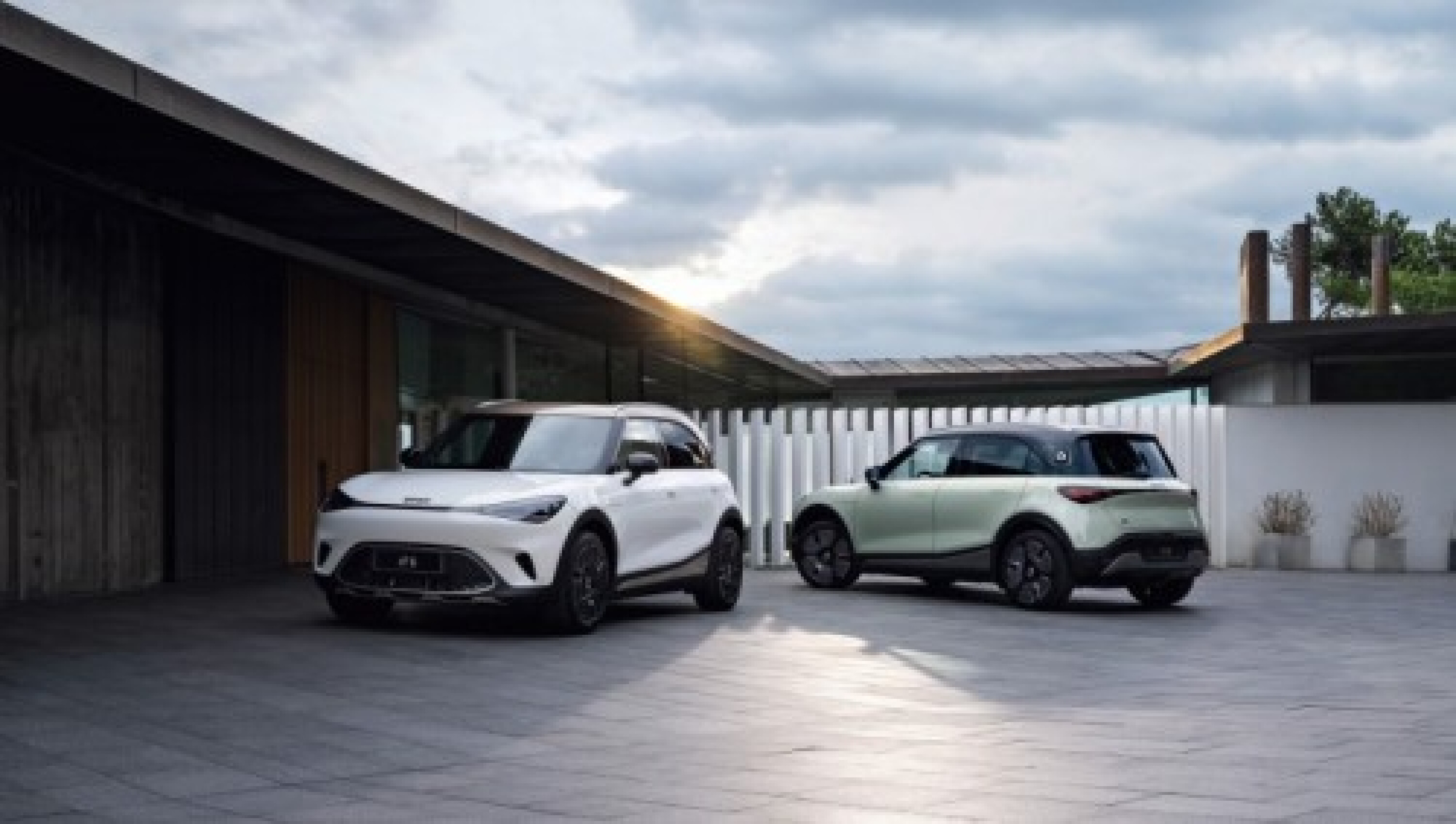
UPDATE: Smart return confirmed!
It’s now official: the Smart brand is returning to Australia with deliveries of a two model lineup set to commence from September.
Officially confirmed this morning by dealer group LSH Auto International, Smart’s return will see it offer two all-electric models in the Smart #1 small SUV and the larger Smart #3 crossover.
High performance Brabus versions of both models will also be sold.
Pricing and local specifications of the new models will be revealed next month, according the LSH, while order books will open from July.
LSH will be the sole importer of Smart vehicles in Australia, with the brand’s return set to be showcased in dealerships in Sydney, Melbourne and Brisbane.
The Smart city-car brand is set for a surprise return to Australian showrooms.
Official confirmation of the plan is expected next week to confirm Smart’s return to Australia through the local arm of LSH Auto International, which claims to be the largest Mercedes-Benz passenger car dealer group with more than 240 dealerships globally.
The Smart brand was previously on sale here between 2003 and 2015 under the Mercedes-Benz umbrella, before it was axed owing to dwindling sales.
Smart started in 1994 as a joint venture between Swiss watchmaker Swatch and Mercedes and was most renowned for its diminutive Fortwo – one of the world’s smallest cars at just 2.5 metres long. It was later joined by Roadster and Forfour models.

It’s unclear which Smart models will be offered here, with the brand now 50 percent owned by Geely with Mercedes-Benz owning the remaining half.
In 2022 the Smart #1 (‘hashtag one’) electric compact SUV was introduced, manufactured in China using Geely’s SEA platform shared with the Volvo EX30 and Zeekr X SUVs.
A second, larger SUV was launched in 2023 – the Smart #3 – using the same underpinnings as the Smart #1 but with a more coupe-like liftback body.
Smart’s Concept #5 rugged SUV made its official debut at the 2024 Beijing International Automotive Exhibition in February as its largest vehicle yet.
Mercedes-Benz Australia had no comment on the news of Smart’s return, while Geely – owner of Volvo, Polestar and Zeekr brand (also planned for Australia) – does not operate locally but is currently hiring for an expected 2025 brand launch of its own.
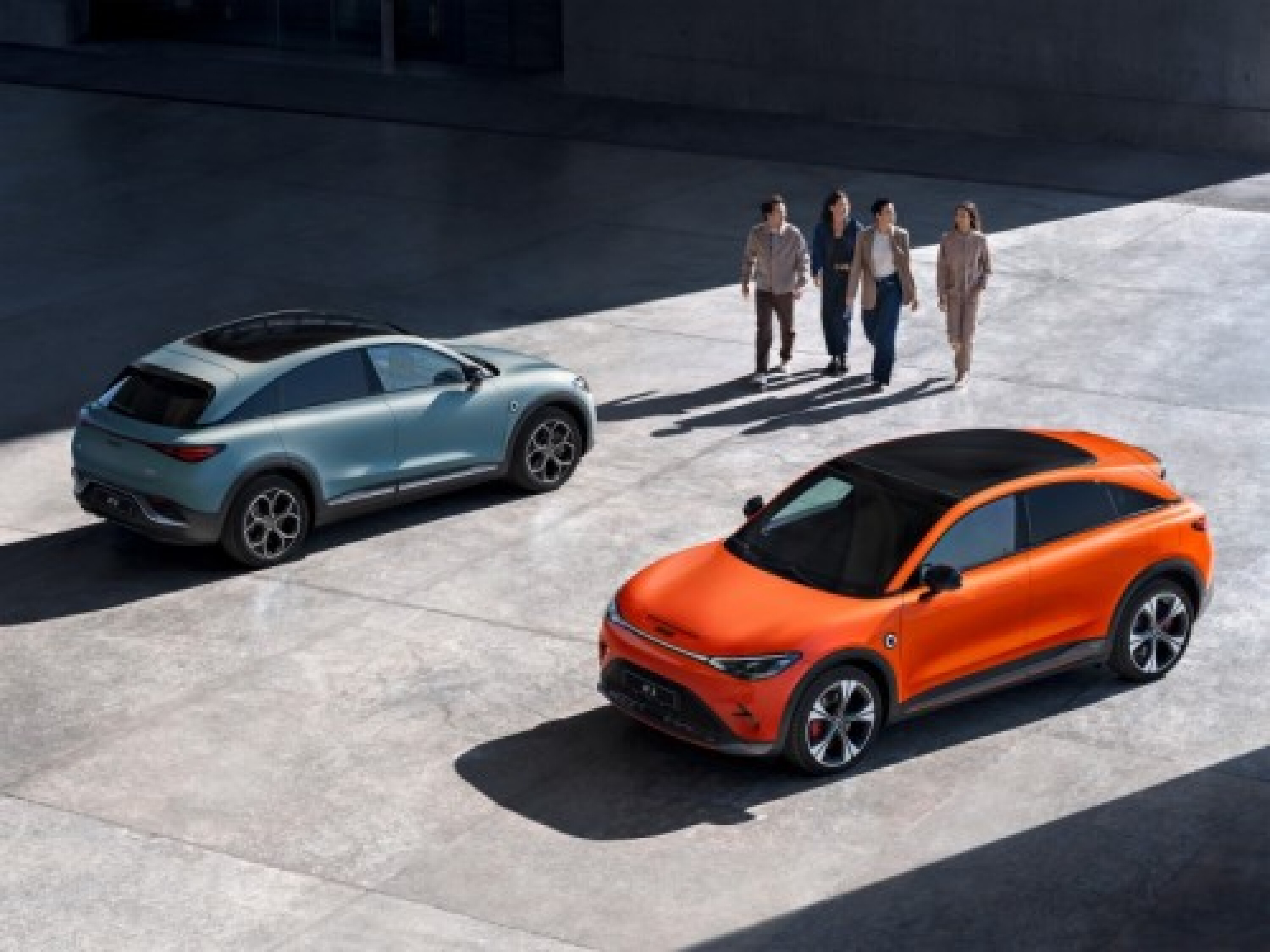
It’s also not confirmed whether Smart vehicles will be sold using the Mercedes-Benz agency model, also used by Honda and Tesla in Australia, across LSH Auto Australia’s 11 sites in Sydney, Brisbane and Melbourne.
In February 2024, Smart reaffirmed its commitment to introduce a new model each year between 2022 and 2025 in new segments, with global expansion into markets in the Middle East and South Asia, including Singapore and Hong Kong.
Geely’s investment since 2019 has seen a significant change of direction for the former city-car only brand with a move into larger, electric vehicles.
Smart’s early success in Australia was driven by demand from small businesses looking to capitalise on the head-turning size of the Fortwo.
Sales, however, declined from its 2005 peak of 799 sales to only 108 in 2014. In an effort to reduce the slide, retailing moved from bricks and mortar showrooms to online only in 2013.
The departure of the brand saw Mercedes-Benz Australian dealers continue to offer service and parts for the roughly 4500 Smart cars sold here over 12 years.
The 2025 Peugeot E-Expert electric van will arrive in Australia between October and December.
Peugeot Australia has confirmed one variant will be available at launch, the E-Expert Pro Long Auto, priced from $79,990 before on-road costs.
The E-Expert’s electric drivetrain produces 100kW and 270Nm, with a 75kWh lithium-ion battery and a 330-kilometre driving range.

Peugeot Australia managing director Kate Gillis said: “This expansion of Peugeot’s electric vehicle offerings underscores our dedication to providing choice to Australian consumers, as they look for an electrified solution to their work needs.”
The front-end design of the new E-Expert will debut a facelift for the van in Australia, which has adopted Peugeot’s latest design language.
This includes a redesigned grille, a new Peugeot emblem, updated full-LED headlights, and a bumper “optimised for protection and aerodynamics”.
It will be available in four exterior colours – ice white, artense grey, nera black and titanium grey – with colours other than ice white attracting a $690 premium.
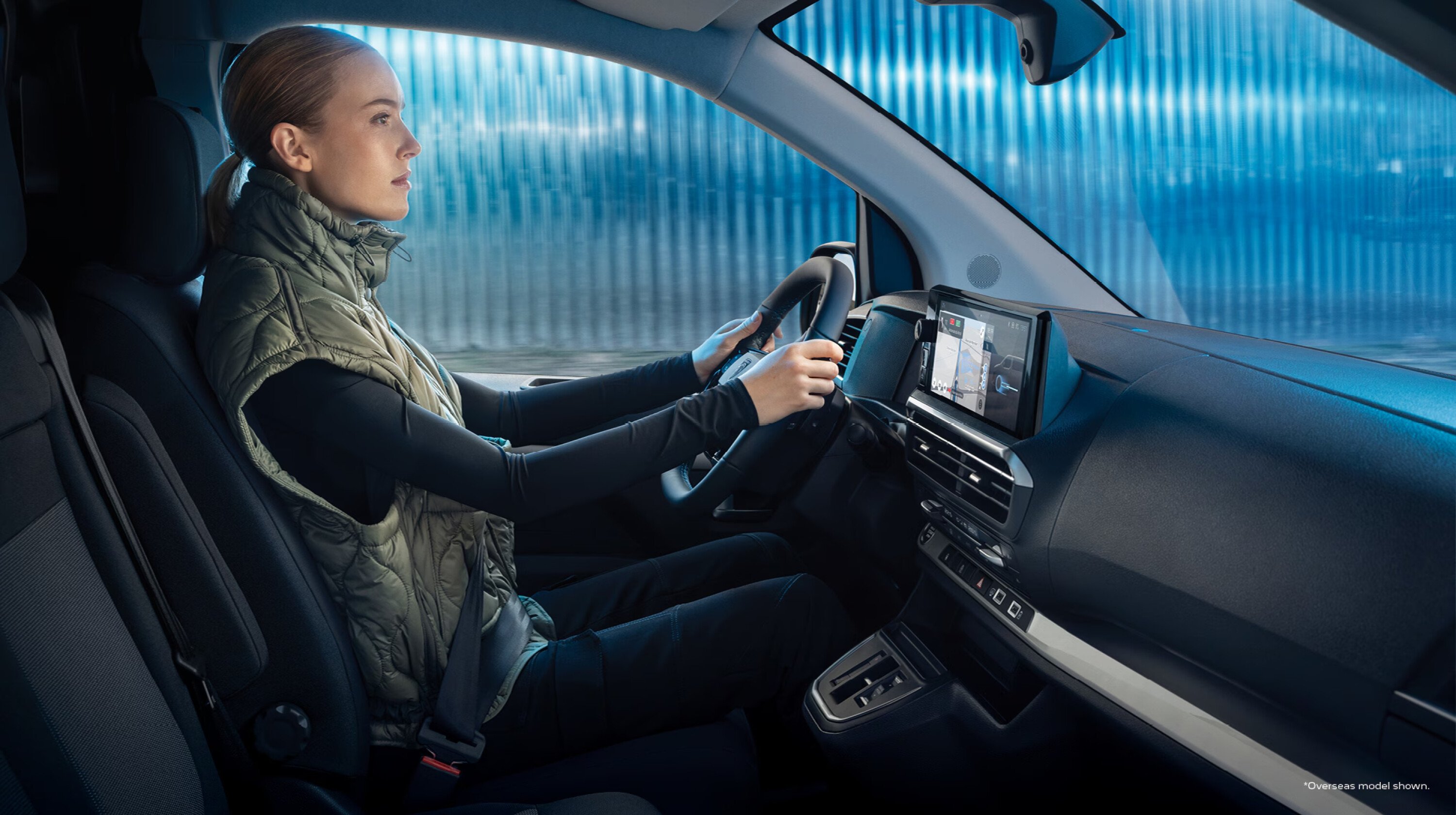
Inside the E-Expert, the driving position has been redesigned to “provide greater comfort, ergonomics and practicality”. A digital instrument cluster is fitted, as is a 10-inch infotainment system.
The E-Expert offers three charging methods with differing charging times, as detailed below:
| Charger Type | Charging Time |
|---|---|
| Single Phase 32A Wallbox (7.4kW) | 0-100% – 11hr 9m |
| Three Phase 16A Wallbox (11kW) | 0-100% – 7hr 30m |
| Quick Charge DC Current (100kW) | 0-80% – 45m |
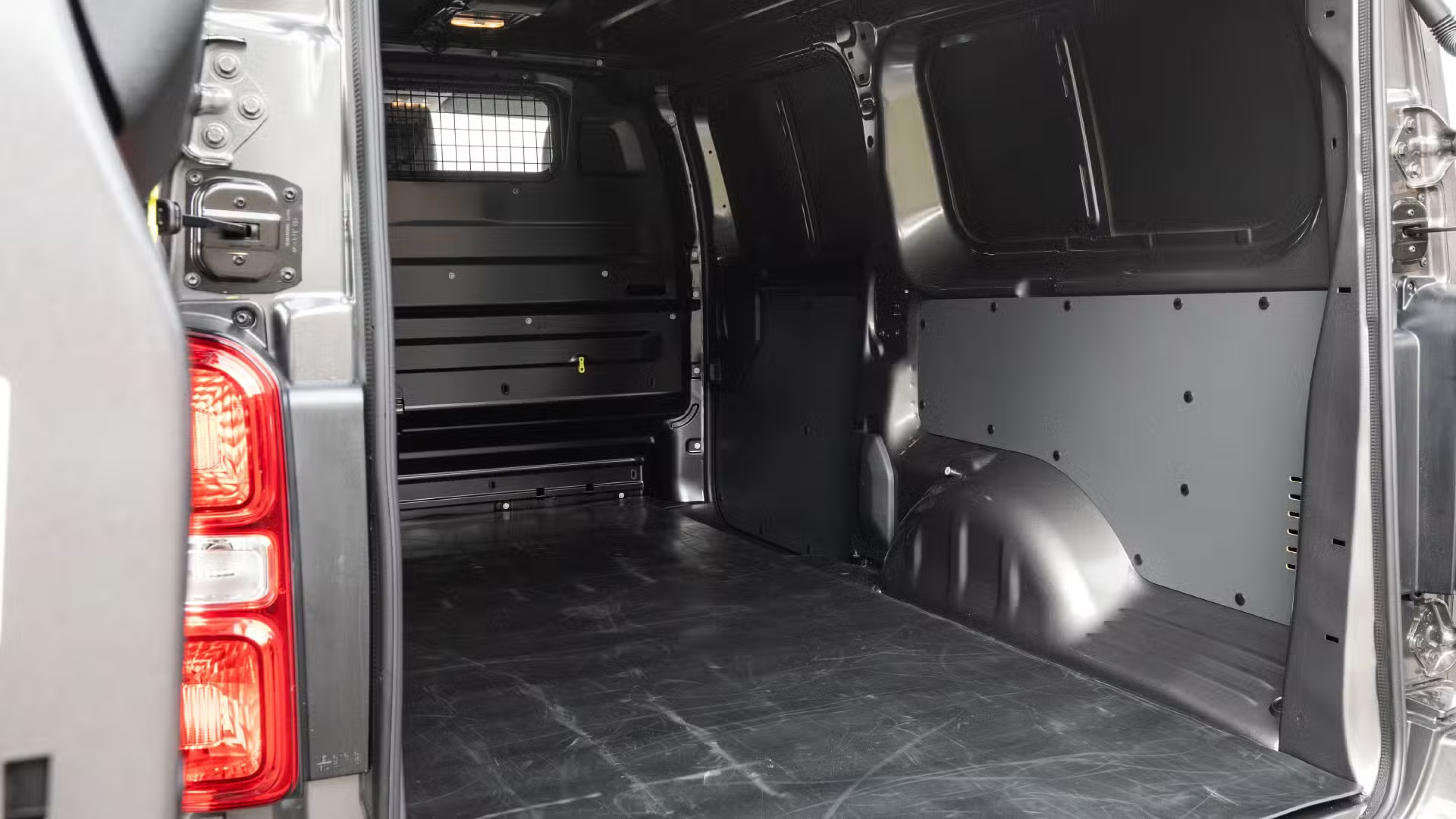
With commercial van users in top consideration, the E-Expert features a 1,001kg payload, a turning circle of 12.4m and 6.1 cubic metres of loading volume. The body length is 5.33m, with a width slightly exceeding 2.2m (mirrors unfolded) and a height of approximately 1.94m.
The Peugeot E-Expert features the following safety systems:
| E-Expert Safety Systems | |
|---|---|
| Autonomous Emergency Braking (AEB) with low light pedestrian and cyclist detection | Forward Collision Warning |
| Anti-lock Braking System (ABS) | Emergency Braking Assistance (EBA) |
| Electronic Braking Distribution (EBD) | Electronic Stability Programme (ESP) |
| Blind Spot Detection (BSD) | Advanced Driver Attention Alert (DAA3) |
| Acoustic Vehicle Alerting System (AVAS) | Front and rear parking sensors |
The E-Expert is covered by a 5-year/200,000km vehicle warranty, a three-year paintwork and 12-year corrosion warranty, and an 8-year/160,000km battery warranty.
A comprehensive list of official Australian-market specifications will be released closer to the on-sale date.
The 2025 Peugeot E-Expert is available to pre-order now, with details on the facelifted diesel-powered Expert range expected to follow.
