
The hot hatch is dying. Discuss.
Almost all of the cornerstones of the hot hatch market are gone. Ford doesn’t build one, Renaultsport has thrown in the towel and Peugeot decided a long time ago that what we needed instead were overpriced and conceptually confused crossovers.
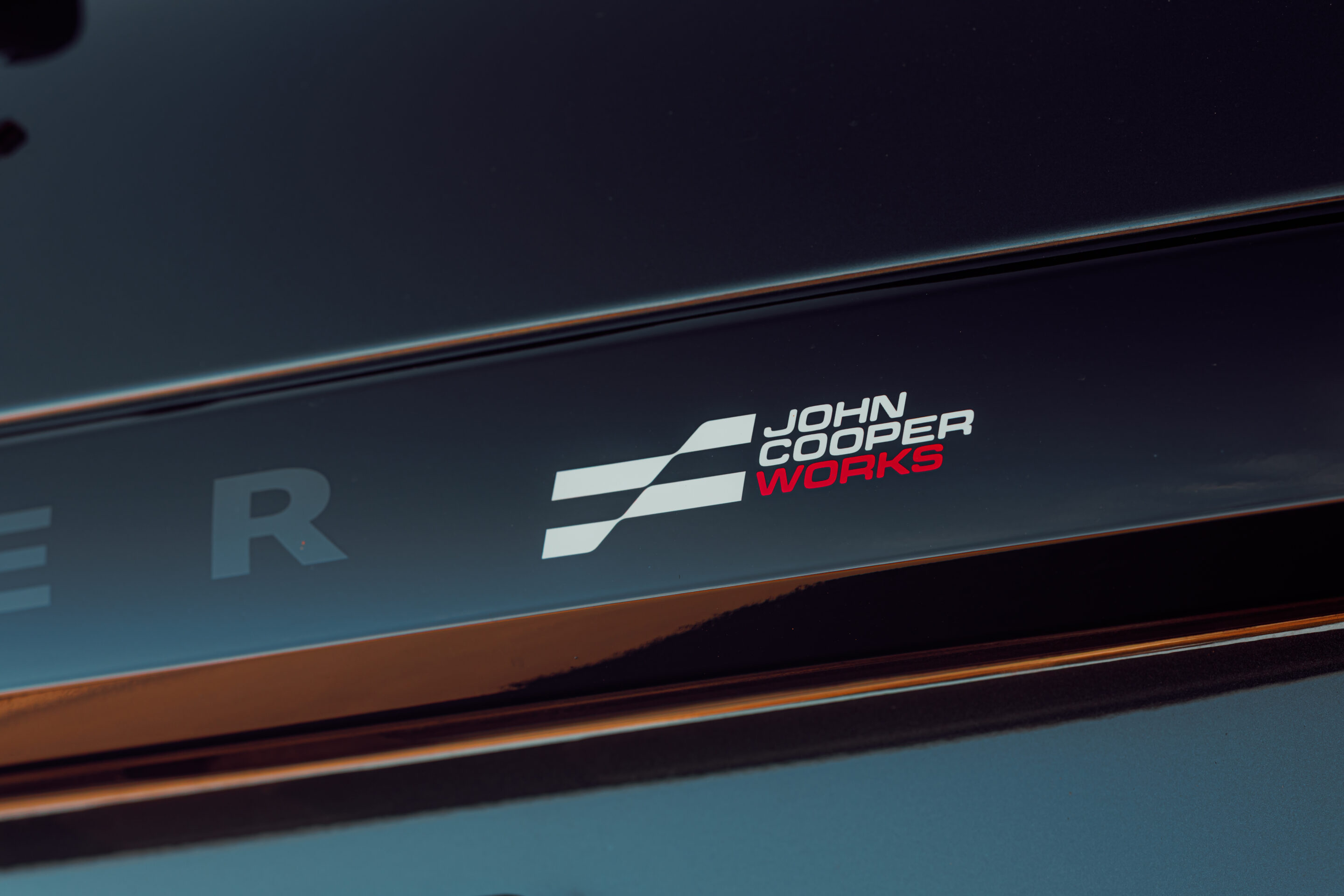
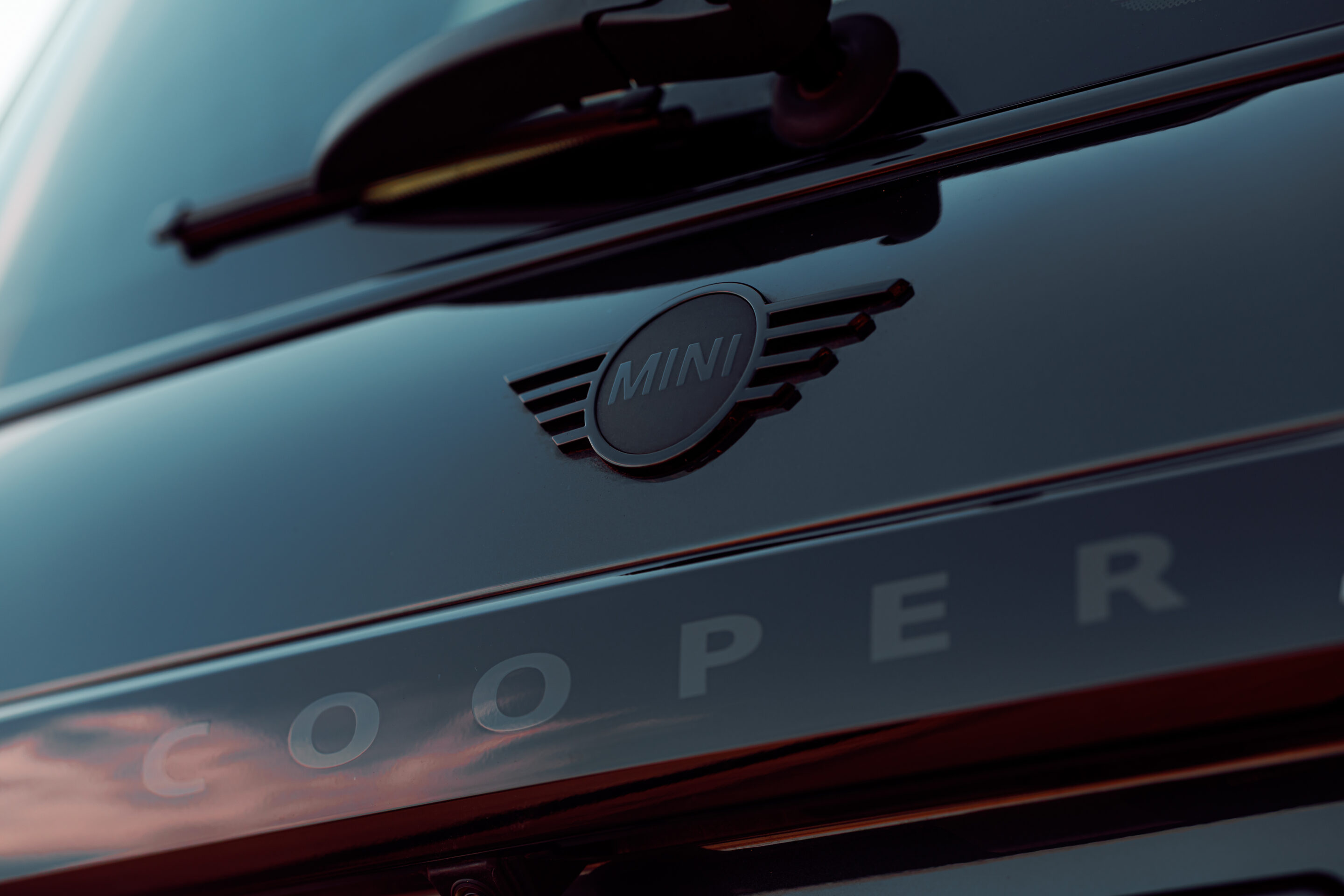
Yes, there are still holdouts. Hyundai, Toyota and Volkswagen, in particular, are still building brilliant sporting tots. Mini also offers something for the staunch hot hatch fan, and its hottest condiment is the Cooper JCW hatch, 170kW and 380Nm of attitude; yours for the princely sum of $60,990 in this Favoured trim.
It’s instructive to pause for a moment and figure out where that fits into the existing hatch hierarchy. Of course we have to start with a Golf GTI, the enduring benchmark in this sector. That’ll run you $58,990 for 195kW/370Nm, so you’re starting to see what BMW’s baby is battling against. Want something with a bit more attitude than the suave Volkswagen? Try the Yaris GR, available for $62,990 in flagship GTS auto trim, sending power to each corner and fronting up with a monster 221kW/400Nm.
In other words, in order to place this Mini onto your shortlist, you’ve probably got to be convinced of its charms in areas other than outright go, stop and steer. The opportunity to drive any new hot hatch is one to be relished and with Car of the Year looming, it seemed an ideal excuse to take the Cooper JCW down onto the roads of Wheels’ COTY test route and see if it’s made of the right stuff.
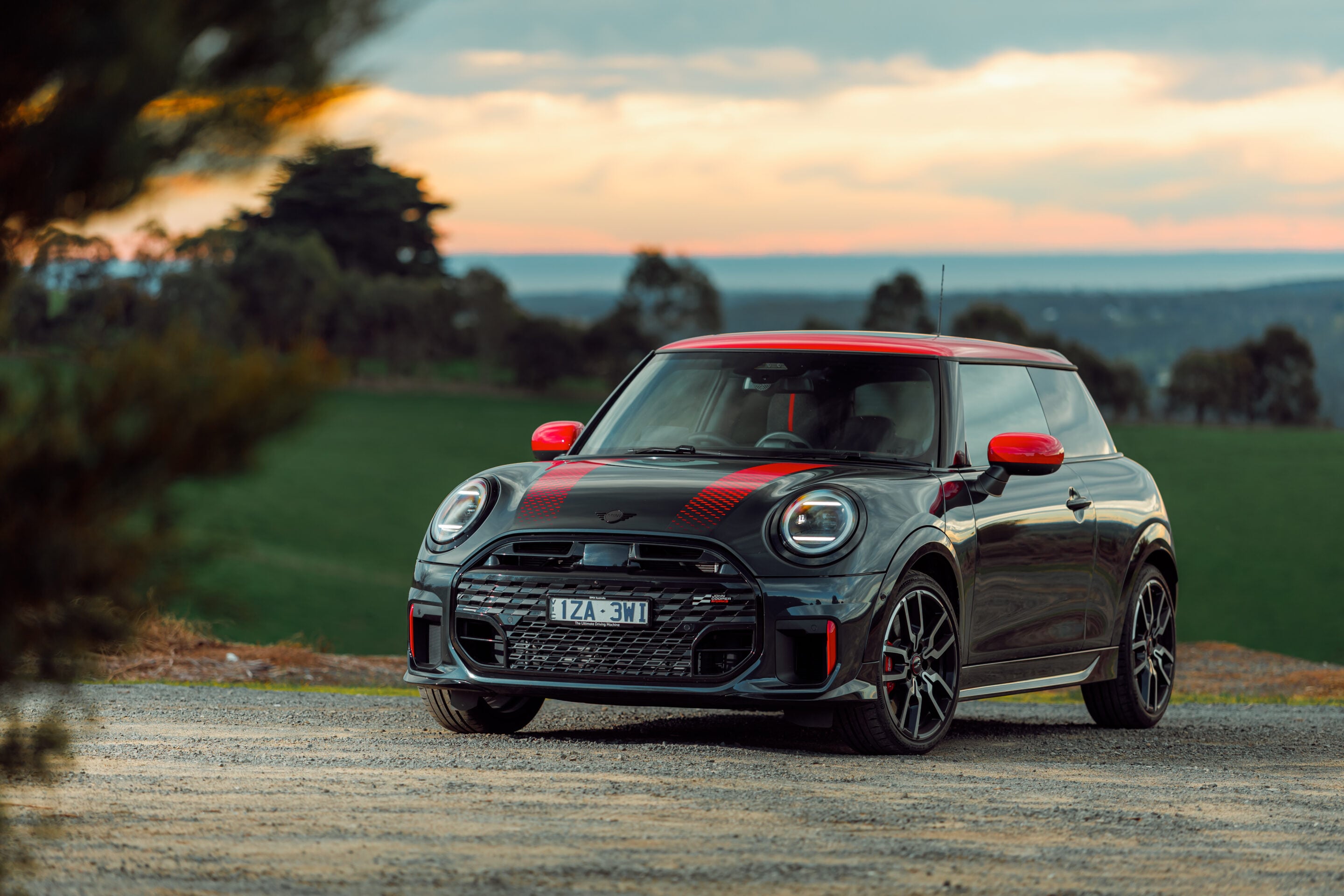
On the milk run
I have a headache right now and I could do with some paracetamol. Somewhat curiously, Mini decided to fit its most hardcore hatch with not one, but two glass sunroofs. Now we can back and forth as long as you like about the wisdom of placing weight right where the car needs it least, but my overriding concern is that the front sunroof places a hard plastic finisher about a centimetre above the top of my head. Hit a bump, or a pebble, or a fag-paper in the rigidly suspended JCW and you’re jolted skywards. And that gets old very quickly.
The issue is compounded by the sunroof robbing you of about 5cm of height, and the electrically
a options. You can tilt and slide the seat to a weird, gibbon-like driving position where your head misses the sunroof trim finisher, or you can hone your reflexes to crank your head forward every time you see what might be an oncoming bump. I end up with a blend of the two.
Because it was chosen, in part, to thoroughly test the ride quality of candidate cars, the Wheels COTY route is far from smooth. In fact, in some places it’s bloody awful, full of ruts, patches and scabs created by the passage down the years of countless Gippsland milk trucks. No car can win COTY if it can’t handle roads like these with some measure of decorum. The Mini is struggling.
On smoother roads, it’s a blast. It loves well-surfaced roundabouts, where it can come winging in on the brakes, the rear end getting a little mobile. Jump on the throttle and the front will grip tenaciously and the 2.0-litre four just pours on torque. It’s incredibly effective and, yes, great fun, despite not featuring a limited-slip diff up front. Mini supplies this car with a variety of OE fit tyres and the Continental SportContact 7s fitted to this one probably wouldn’t be my first choice. A Michelin Pilot Sport 4S or Pirelli P Zero would probably suit the car better.
The engine and gearbox combination at first seem pretty standard fare for a hot hatch, namely a 2.0-litre turbo four driving the front treads via a seven-speed dual-clutch transmission, replacing the old eight-speed torque-converter auto. So far, so conventional. But it’s the power delivery of the engine that’s so unusual. Leave the gearbox to its own devices and more often than not, its blatting around between 2500rpm and 4000rpm. Flick the ‘Experiences’ toggle into Go-Kart mode and things sharpen up a bit but it doesn’t like to hold a gear for too long. A second press on the gear selector puts the transmission into Sport and then you can ping up and down the ’box, but it’ll often deny you what seems a legitimate downshift because it doesn’t want you pinging the redline. Indeed, the 380Nm of peak torque (up 60Nm on the old car) arrives between 1500 and 4000rpm, and that’s where this 1330kg hatch feels happiest. Those pops and crackles on the overrun are coming from a speaker and not the exhaust.
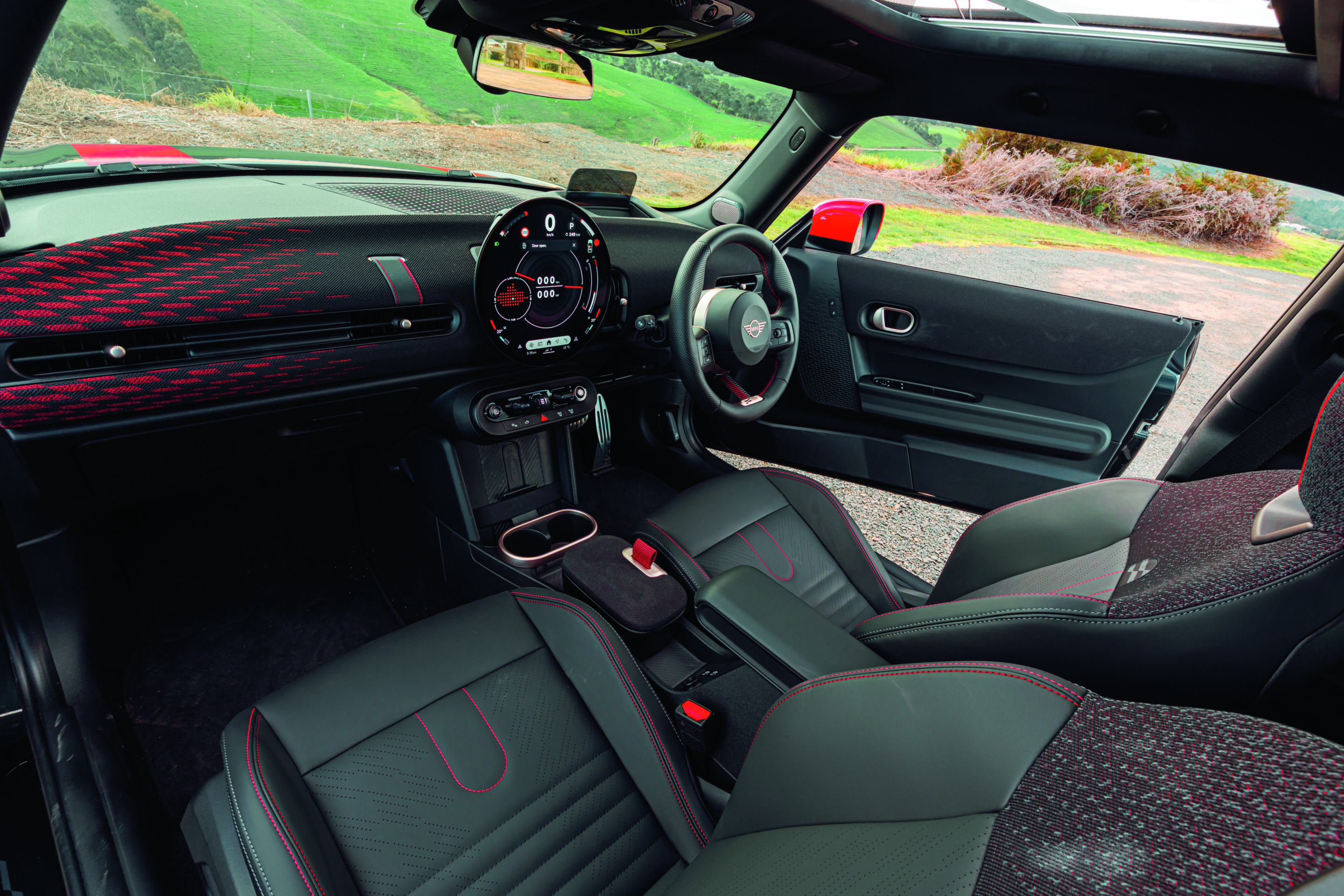
At this point, it was clear that so many of the usual yardsticks of what makes a good hot hatch had been clearly ignored by the good folk at Mini. We usually want a vehicle that’s subtle, but which can be identified by those who know what to look for. The ride should be accommodating, but with a little tension to it. The focus should be on ability rather than raiding the dressing up box. Thing is, Mini also understands its audience extremely well and realises that the people looking for a Golf GTI, an i30 N or a GR Corolla aren’t cross-shopping a Mini Cooper JCW and vice versa.
Whereas a great hot hatch will reveal the light and shade of its chassis dynamics over time, the Cooper JCW delivers it all upfront on a giant platter. Have at it. The ongoing learning curve comes with its cabin, its infotainment system, the various drive experiences and such like. There’s a very deliberate richness about its interior finish that’s never been part of the traditional hot hatch milieu. I’ve got a certain respect for Mini for choosing to plough a very different furrow here.
Drop inside and it’s hard to figure out what to focus on first. The obvious thing is the 240mm dinner plate screen in the middle of the dash, but then you get drawn to interesting dash fabrics, the seating materials, the textured centre box, the near vertical windscreen, the hilariously chubby steering wheel, the Harman Kardon speaker pods seemingly growing out of the A-pillars, or the row of toggles and switches that comprise the physical dash controls.
The screen is an odd ecosystem. Mini’s clearly very proud of it, and has ditched the instrument binnacle ahead of the driver as a result, but many of the controls are a little slow to react, and that matters when you’re adjusting virtually everything via the touchscreen. It also features some very odd functionality, such as displaying two fuel gauges and two rev counters when you flick to the retro Timeless display. I once had a chat with some of the designers of this system and they almost wept when the first thing I did was pair my phone to Android Auto, which displays as a crude square window in the middle of the circular display. The native ecosystem is so richly specified that their take is that phone mirroring robs you of functionality.
The JCW certainly doesn’t want for equipment, this Favoured trim variant featuring LED headlights, 18-inch alloy wheels, adaptive suspension, wireless Apple CarPlay and Android Auto, augmented-reality navigation, a head-up display, a heated leather steering wheel, dual-zone climate control, keyless entry and start, that dual pane sunroof, a 360-degree camera, performance tyres, power-adjustable front seats with memory and driver massage function and sun protective glazing.
Stereo upgrade aside (the standard system always sounds too mid-range muddy) it’s hard to think of any reasonable option you’d want to load into the JCW.
I was surprised and delighted to discover it even featured not one, not two, but three windscreen washer jets. Likewise the way that your mobile phone straps into the wireless charger is a great idea, making it impervious to even the most extreme cornering manoeuvres. The after-dark ambience in the cabin is particularly slick, with the red dash panels concealing illuminated panels beneath the fabric.
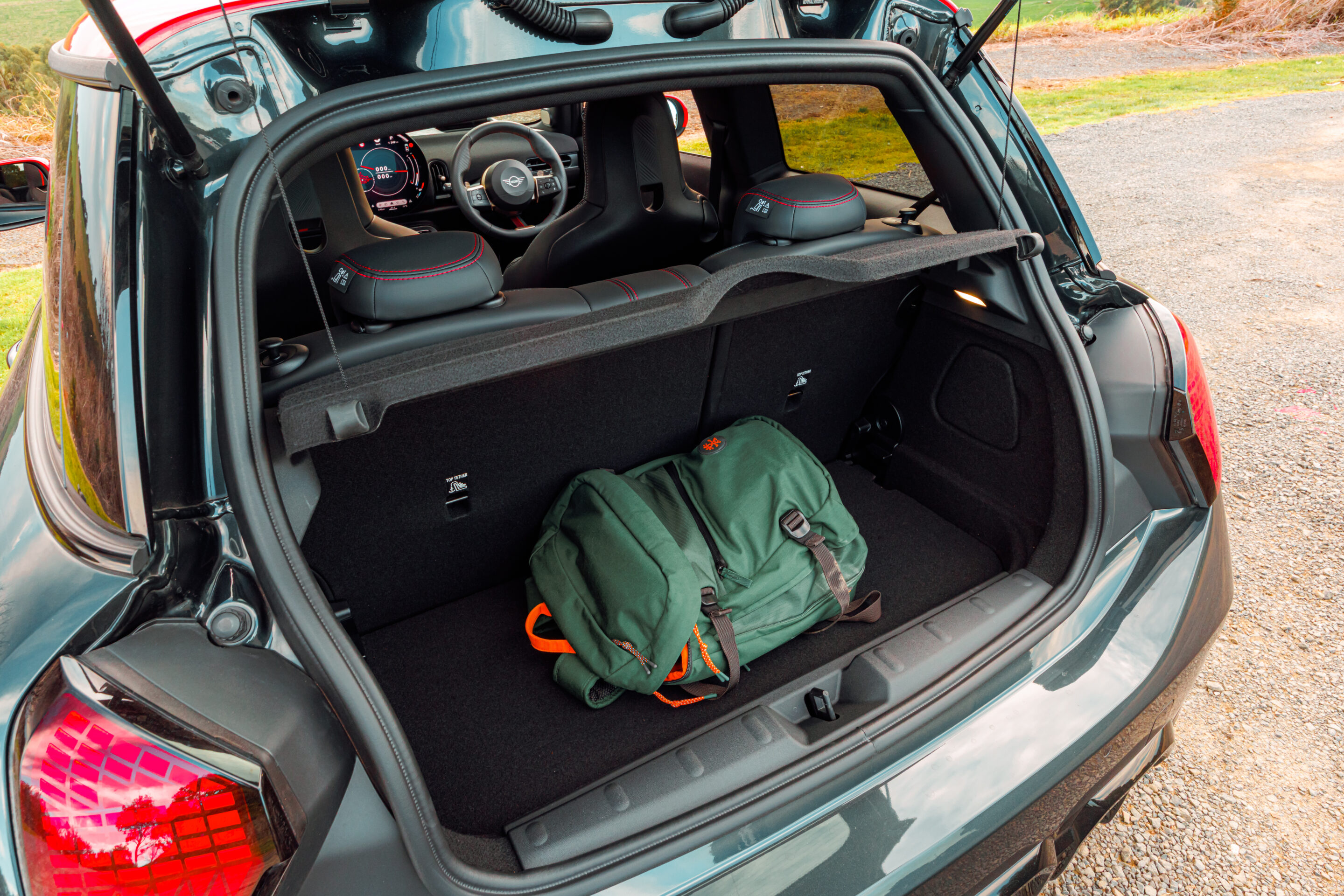
It feels fairly tight inside thanks to that pinched headroom, and there’s no way I could sit behind myself as legroom for two in the back is almost nonexistent. We constantly comment on how big modern Minis have become, but at 3876mm long, it’s 64mm shorter than a base model Toyota Yaris. It’s a little wider than the Toyota at 1744mm (vs 1695mm), but despite that added width, the big seats mean that space for the door pockets is still quite pinched. You do get a decent size glovebox, and there’s only 210 litres of space behind the rear seats or 725 litres with them folded. Somewhat reassuringly, a three-door Mini is still a compact thing, by today’s standards at least. It’s also packaged without a spare and it should be noted that the 70:30 split rear bench doesn’t fold fully flat.
Charming to a fault
After lunch, we head for the series of sharply climbing twisties out of Kongwak. These corners have tripped over a few COTY contenders down the years, and while my lunchtime latte isn’t resting well after the car bucks and jolts along the rutted country roads, I back the pace off a bit and things settle a little. The JCW attacks the bends with relish, the well-weighted steering offering a reassuring feel for what’s going on at the front treads, despite the ridiculous girth of the steering wheel itself. It’s possible to place the car accurately and rely on its crisp turn-in and resistance to pitch and roll to give it the reactions to quickly take a set and attack the next corner.
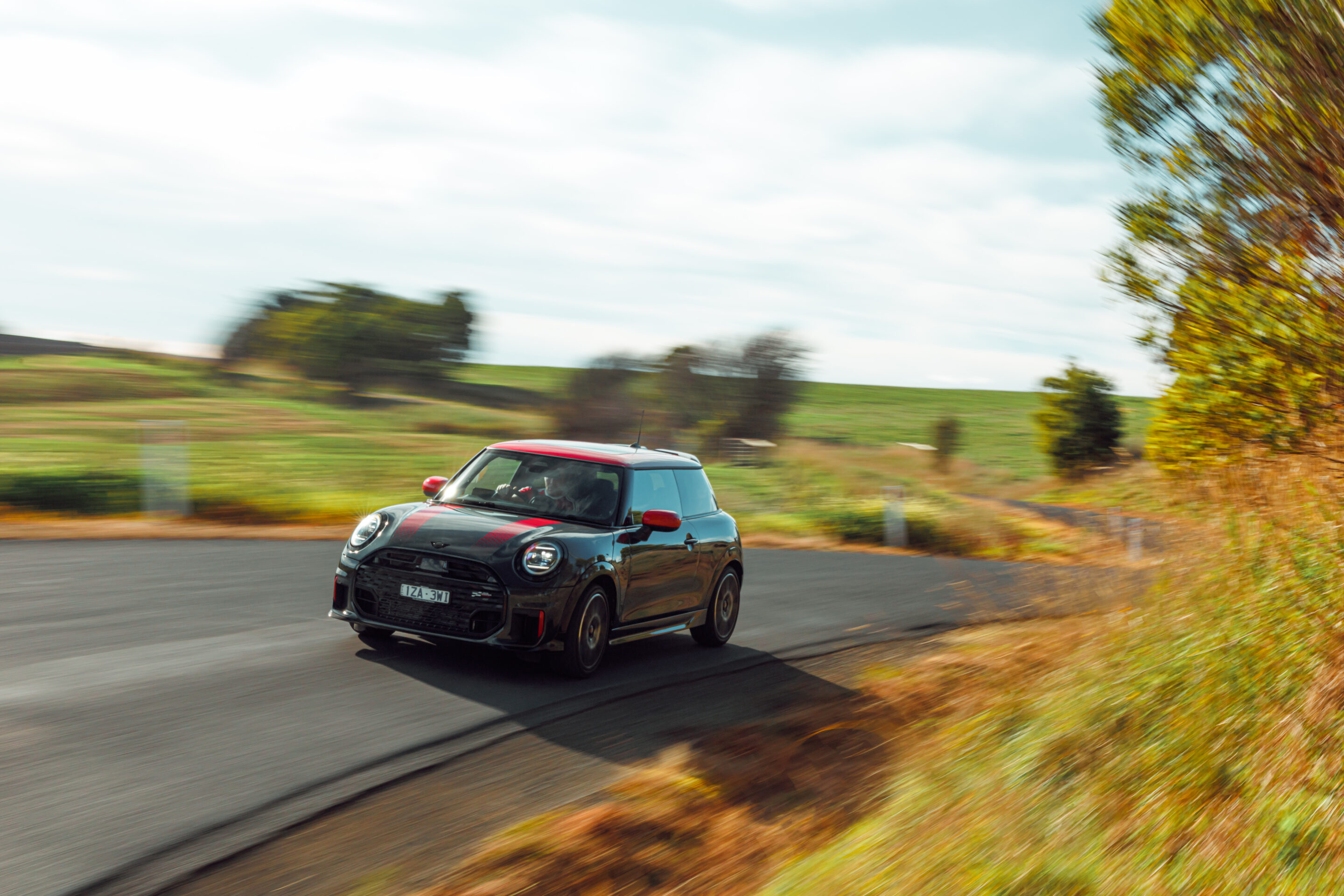
Braking is reasonably good, despite Mini downgrading the JCW’s brakes from beefy four-pot front calipers to a weedier, single-piston floating caliper as seen in the rest of the range. In normal road conditions it doesn’t show up as an issue, but engage road testing mode and punch them hard on a series of corners and the pedal starts to go a little flabby. I suspect they’d be the JCW’s Achilles heel on track.
I don’t think it’s unfair to say that the JCW is not a hot hatch for the connoisseur of this class of cars. That much is apparent. While it is fun and does often feel pretty purposeful, it’s perhaps a little too much of a blunt implement, and too prescriptive in its skill set to appeal to very good drivers. Likewise, those who merely want the fastest and most expensive Mini hatch will rapidly tire of this car’s jittery ride quality, which grates after a while, skipping its rear over speed humps and smashing into potholes. I can see why Mini chose the billiard-table smooth RACQ Mobility Centre track in Queensland as the venue for this car’s press preview.
Out in the wild, it can feel a bit of a handful, offering the compromised ride of super-hatches minus their level of performance. The Cooper JCW would undoubtedly be a better car were its effective spring rates relaxed quite considerably, allowing it to work better with Aussie roads without having its driver wincing in anticipation at every oncoming bump or compression. As well as the firm springs, new anti-roll bars and bump stops have been engineered for the JCW, with an additional measure of camber dialled in.
The dampers are new frequency selective units that are cheaper and less complex than electronic dampers, using trick valving to differentiate between primary and secondary ride issues. There’s no magnetorheological fluid or anything fancy like that, merely a system where the valving helps soften the unit for smaller, rapid bumps and firm it to offer support on lower frequency yumps and rollers. They make a great advert for local suspension tuning.
The purists might sniff at its ride, the lugging nature of its motor, the underspecified brakes and the overwrought cabin, but there may well be a constituency of buyers who finds it extrovert, charming, endearing, cheeky and, having recently worn a three grand price haircut, acceptably good value. I can see both sides of the argument. I suspect that my more old-school colleagues may not.
As we grab a few pictures as the sun sets over the bay at Grantville, I realise I’m looking forward to driving the Cooper JCW home, plotting a route that takes in a series of roundabouts on the Koo Wee Rup Road. It may be flawed, and it’s almost the antithesis of the decathlete hot hatch, but sometimes a car just needs to do one thing well to make you want to drive it. The traditional ‘serious’ hot hatch may not be around forever, but emotional purchases like the Mini Cooper JCW might well be a formula with some legs yet.
This article originally appeared in the September 2025 issue of Wheels magazine. Subscribe here and gain access to 12 issues for $109 plus online access to every Wheels issue since 1953.
We recently covered one of the biggest hurdles to overcome for buyers considering an electric
vehicle for their next car purchase: range anxiety. But another big factor remains cost. While EVs are
getting less expensive, most models still cost significantly more than their petrol, hybrid or diesel-
fuelled equivalents thanks to factors such as battery cost.
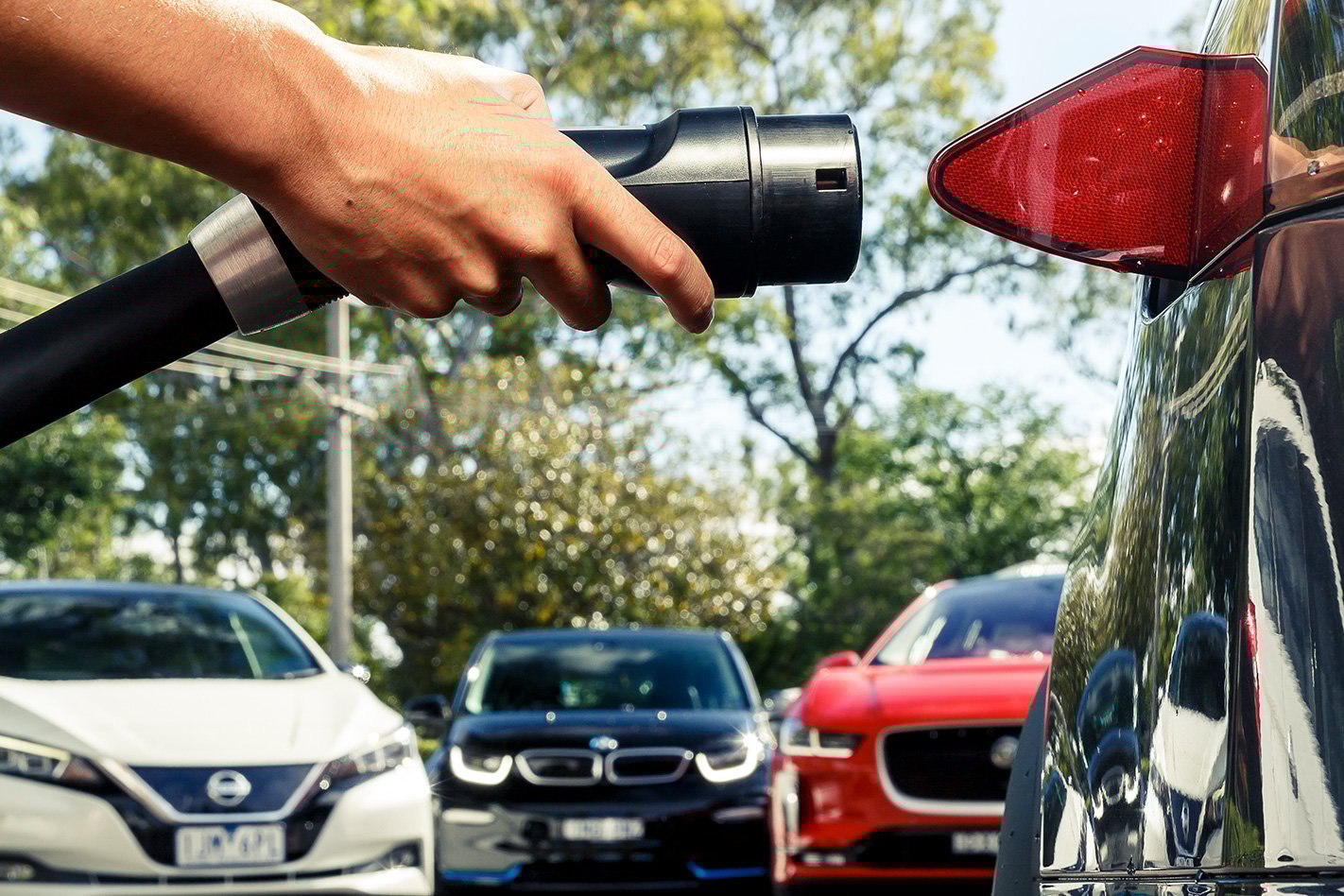
For those considering an EV, various state and federal incentives remain in place in in Australia, aimed at promoting the adoption of electric vehicles (EVs) by lessening their cost. These include rebates, stamp duty exemptions, fringe benefits tax (FBT) exemptions, and higher luxury car tax (LCT) thresholds for fuel-efficient vehicles. Some states also offer free registration or reduced registration fees for EVs.
Nationwide
The biggest incentive by far to own an electric vehicle in the whole of Australia is the Electric Car Discount, which is removal of fringe benefits tax (FBT) for leased and company vehicles. That makes EVs significantly less expensive to buy, often at similar or lesser pricing than equivalent ICE vehicles.
For EVs priced underneath the $91,387 luxury car tax threshold for fuel efficient vehicles, the FBT removal allows the cost of an EV to be at parity with an equivalent petrol or diesel vehicle if novated leasing, according to the Electric Vehicle Council.
EVs priced under the LCT threshold are also exempt from import duties, reducing the cost to import them. The FBT exemption was also available on plug-in hybrid (PHEV) vehicles until April 1st 2025 to gain traction for PHEV sales.
While not directly related to the vehicle purchase itself, federal battery and solar power incentives also exist, including the Cheaper Home Batteries Program that provides a rebate of around 30 per cent off the cost of a home battery system, helping to reduce impact on the electricity grid.
New South Wales
New South Wales no longer provides any financial incentives with the purchase of an EV. Prior to
January 1st 2024, no stamp duty was applied to EV purchases under $78,000.
Victoria
Victoria was the first state to remove the stamp duty exemption from July 1st 2023, and was also the first state to charge a road user charge for EVs (a levy per kilometre) in 2021 – the first in Australia – but it was ruled unconstitutional by the High Court in 2023 and subsequently scrapped.
Incentives for EV buyers now include a $100 discount from the annual registration fee, while there are also grants available for solar power that can be used to charge an EV.
Queensland
Queensland previously offered some of the most generous EV incentives, but like most other states, has finished most with the only left discounted annual registration, saving a minimum of $500.
South Australia
As of 1 July 2025, South Australia no longer offers an EV incentives, though three years of no registration cost is still available for EVs valued below $68,70 and first registered between 28 October 2021 and 30 June 2025.
Western Australia
WA state government incentives to buy an EV are no longer offered.
Tasmania
EV buyers can access an interest-free loan scheme for installing EV chargers.
Northern Territory
From 1 July 2022 to 30 June 2027, the Northern Territory will waive both the stamp duty (up to $1500) and registration fee for new EV registrations, providing a potential saving of up to almost $1600.
In addition, the Electric Vehicle Charger (Residential and Business) Grants Scheme is available to EV owners to buy and install EV chargers.

Australian Capital Territory
From 1 July 2024, the ACT moved to emissions-based registration costs, which means that EV owners pay the least to register their vehicles.
New and used EVs registered before 1 September 2025 are also eligible for a full stamp duty exemption, while EVs underneath a $84,916 subtotal are eligible for a 0% interest rate for up to $15,000 of the total price when financing as part of the ACT Sustainable Household Scheme.
As we can see, most states no longer offer any form of EV incentives, with the federal government FBT exemption the biggest discount available for potential EV buyers.
The Porsche Cayenne Electric is set to be one of the most advanced electric SUVs yet, but its timing could prove tricky. The premium EV market continues to wrestle with volatile residual values, and even a flagship version boasting around 746 kW of power and a 3500 kg towing capacity may find it difficult to carry Porsche through a challenging transition.
Following the Taycan’s strong debut, Porsche seemed perfectly positioned to dominate premium electromobility. But slowing EV demand in China and the U.S. has forced the brand to both maintain momentum with petrol-powered models and accelerate its electrification strategy.
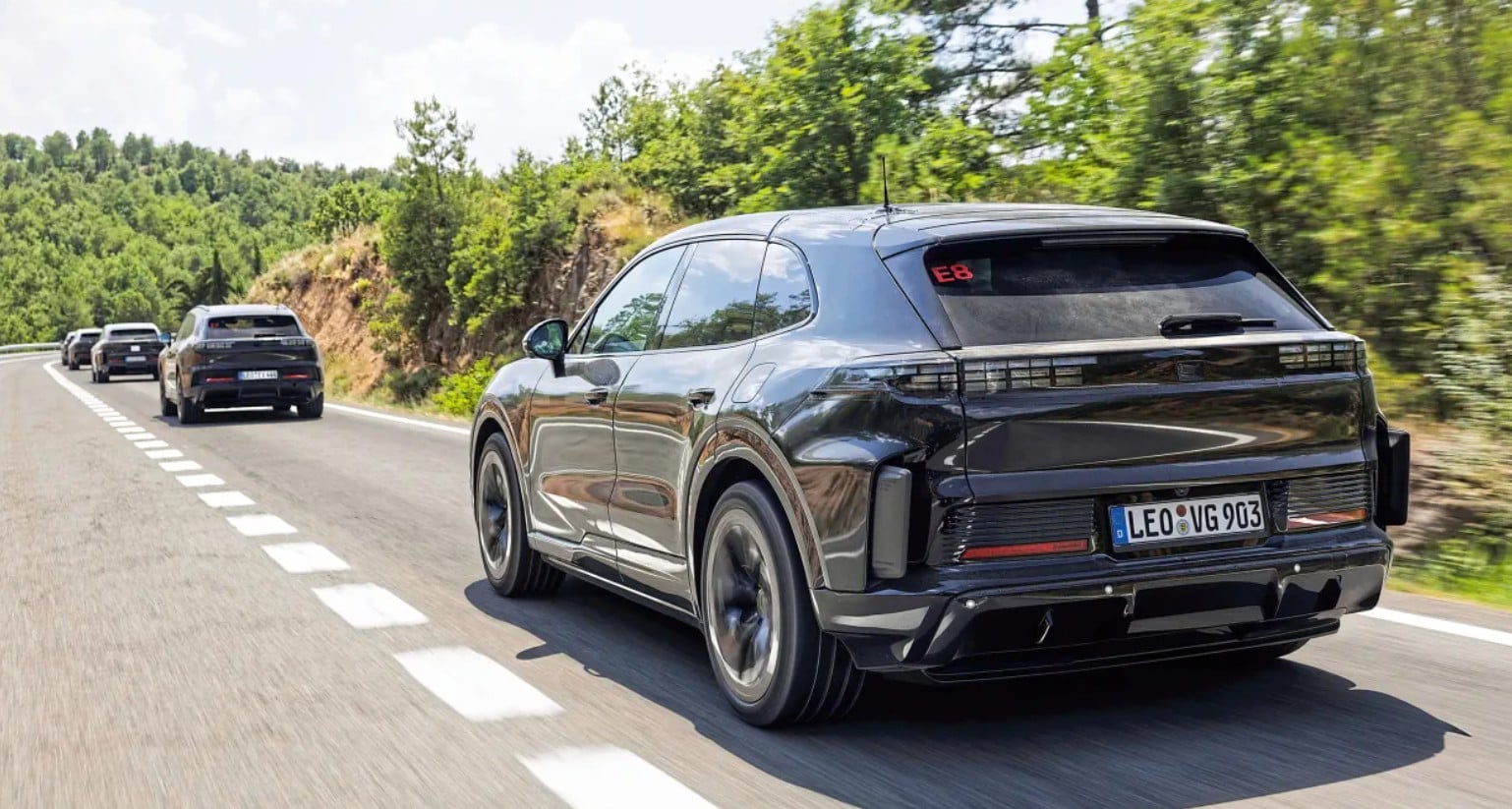
The fourth-generation Cayenne is central to this push, and even in prototype form, it demonstrates Porsche’s intent to remain at the forefront of performance and technology.
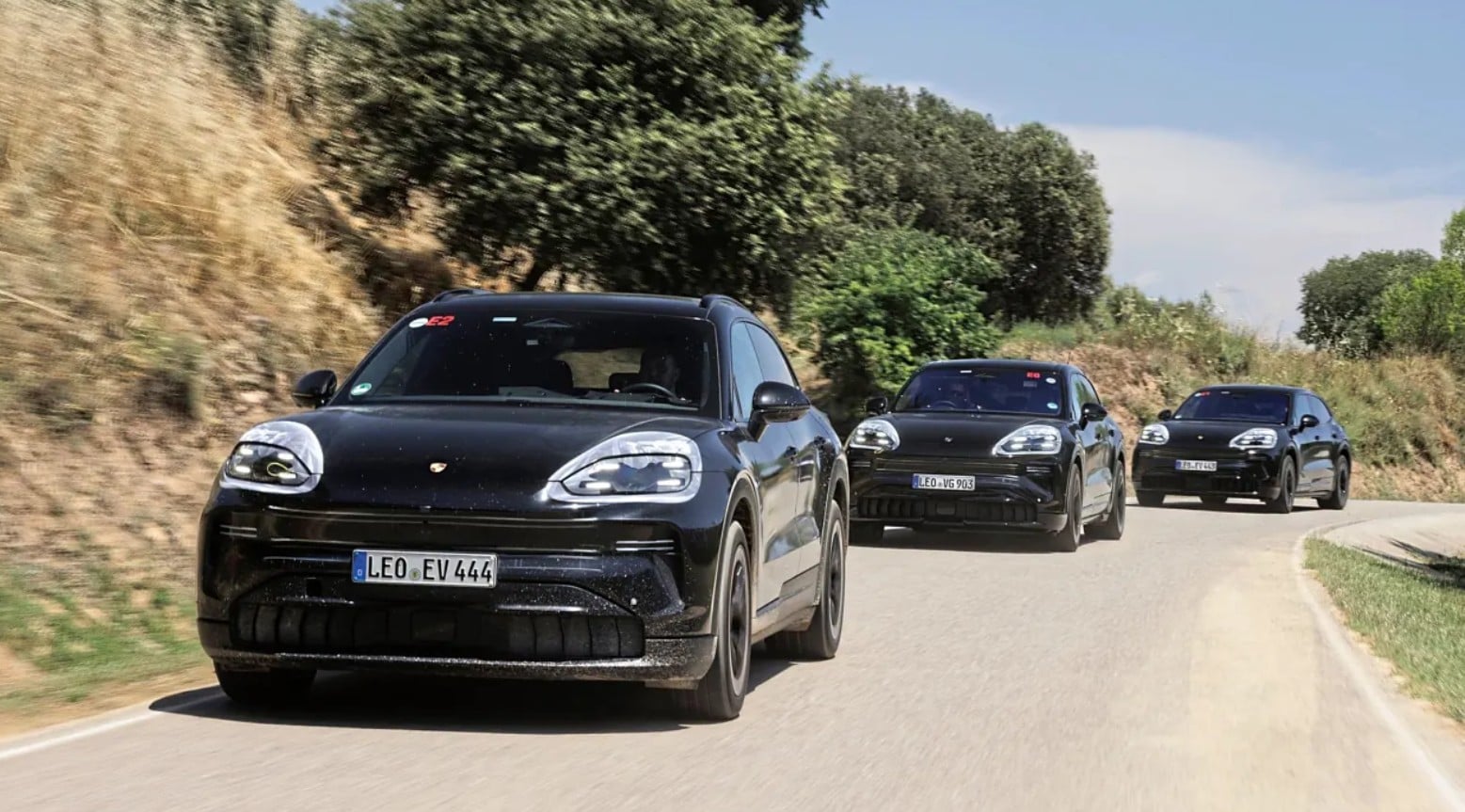
Rather than simply scaling up the Macan Electric, the Cayenne Electric evolves the PPE platform co-developed with Audi. The team has repackaged its 113 kWh battery and introduced new oil-cooled electric motors, delivering greater efficiency and durability. Charging performance is exceptional, with up to 400 kW DC capacity, adding around 300 km in 10 minutes, and a 10–80 per cent recharge in just 15 minutes. Regenerative braking peaks at 600 kW, rivaling the energy recovery seen in Formula E race cars.
All Cayenne Electric variants will feature dual motors and all-wheel drive. The entry model produces around 298 kW, while the Cayenne S is expected to sit between 447 kW and 522 kW. The range-topping Turbo pushes close to 746 kW, launching the nearly three-tonne SUV to 100 km/h in under three seconds, and reaching 200 km/h in under ten. Top speed remains electronically limited to 250 km/h.
As always, Porsche is determined to make the Cayenne feel like a sports car despite its size. Standard air suspension with adaptive dampers is joined by optional Active Ride Control, which uses hydraulic actuators to cancel body roll and sharpen handling. All-wheel steering (up to five degrees of rear axle movement) further enhances agility.
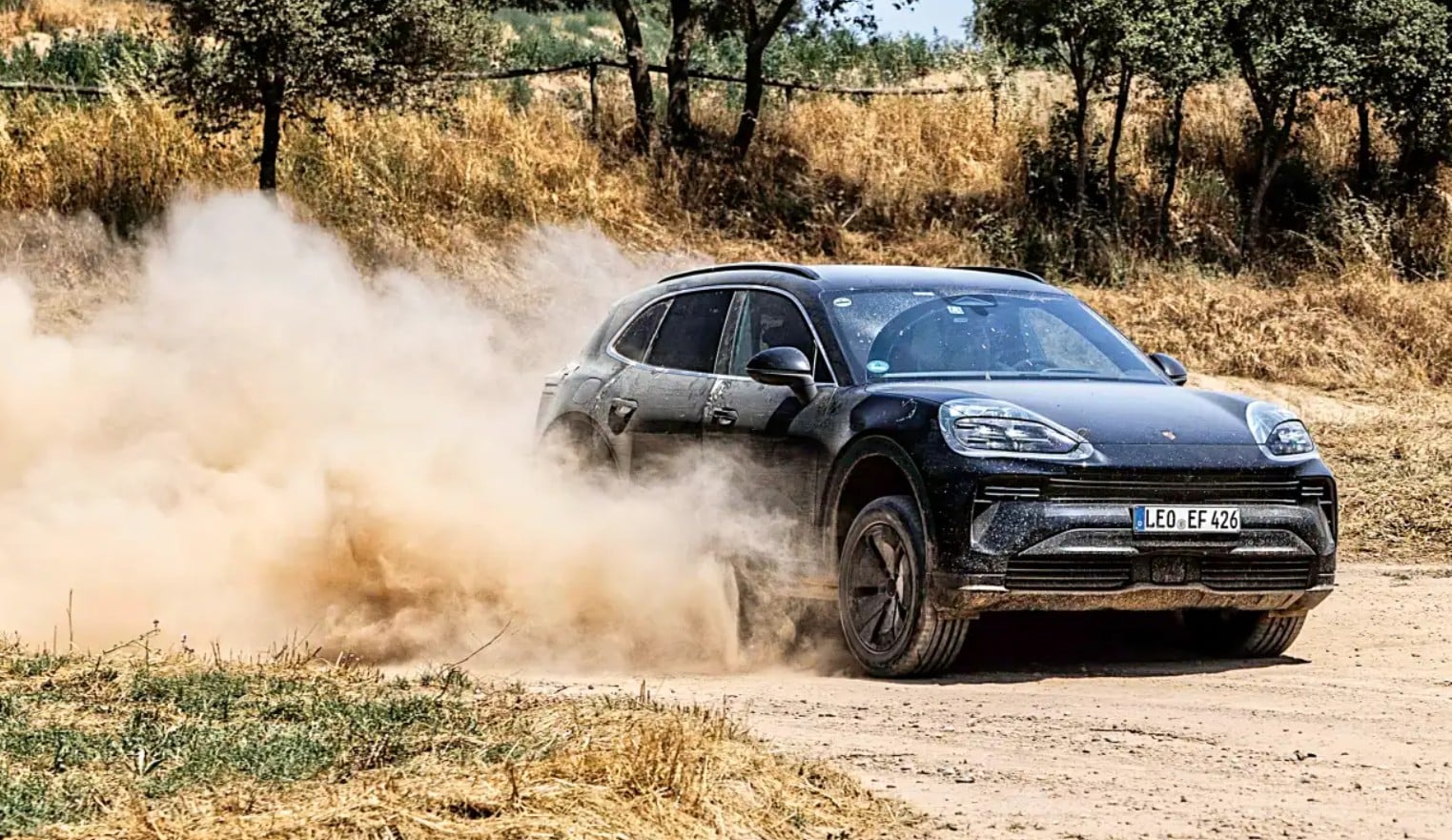
The Cayenne Electric also retains its practical side, boasting the ability to tow 3,500 kg and offering more space than its petrol counterpart. The stretched wheelbase provides better rear legroom and increases boot space by 99 litres, with an additional 90 litres under the bonnet.
The interior is a step beyond the conservative Macan EV, with Porsche hinting at a bold new centre console design. Luxuries include electrically operated doors, reflecting a push toward higher-end refinement.
European pricing is expected to start from around A$175,000, with the Turbo likely to exceed A$310,000, placing it against rivals from BMW, Audi, Mercedes, Bentley, and Aston Martin. A coupé-style variant is due in 2026.
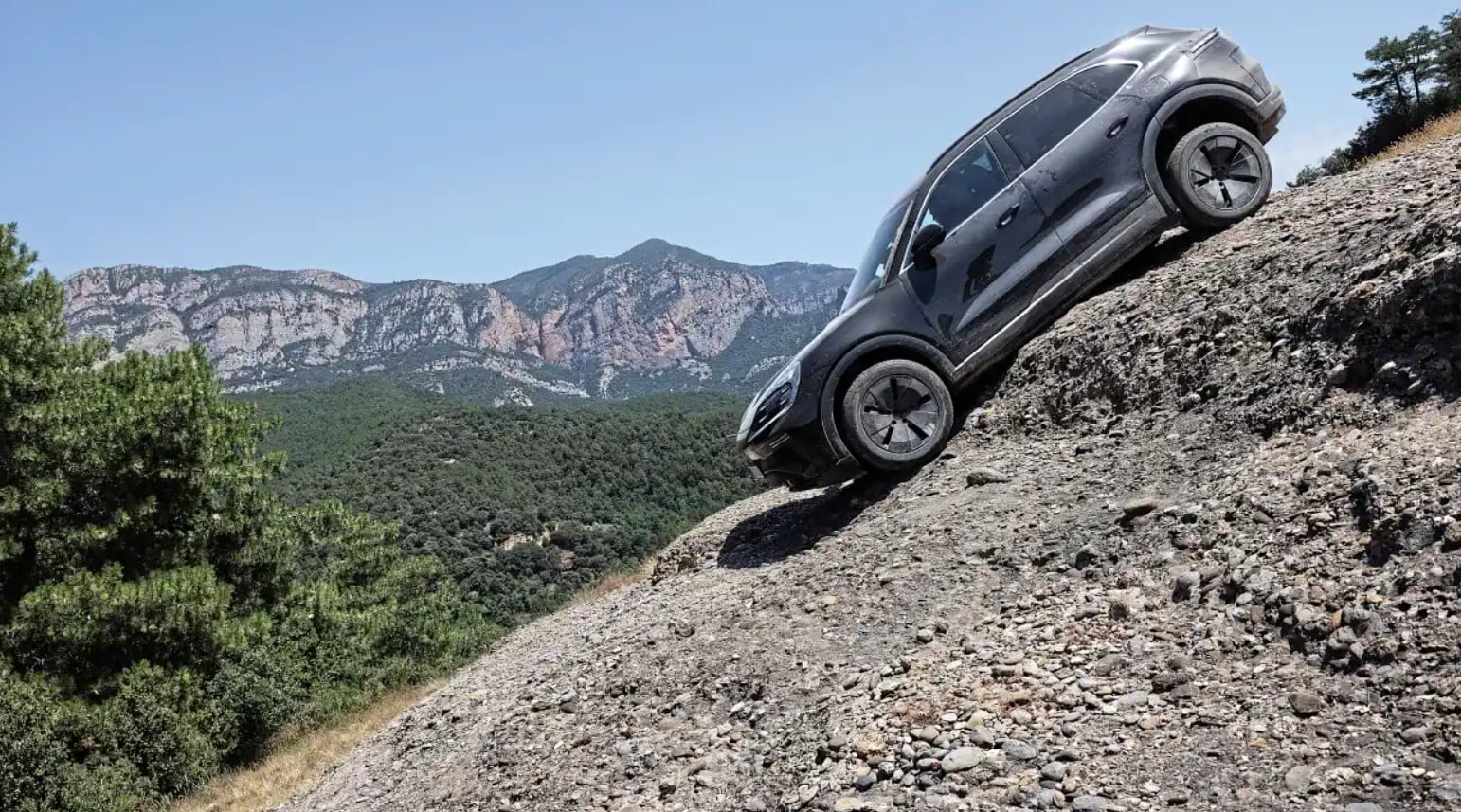
The Cayenne Electric will launch in Europe from Q2 2026, with global rollout following. Importantly, Australian availability has yet to be confirmed.
Interestingly, Porsche will not phase out the petrol-powered Cayenne just yet, instead granting it another update in the next two years. While the Cayenne Electric signals the company’s electric future, Porsche is hedging its bets with internal combustion for now.
For those seeking serious performance in an electric SUV without straying into six-figure pricing, the Tesla Model Y Performance makes a strong case. In Europe, orders open next month, while Australian buyers are expected to see deliveries before the end of the year.
In the UK, the Performance variant is listed at £61,990 (about A$121,000). That’s only a modest premium over the updated Model Y’s Launch Edition. It’s expected to be priced around $82,000 before on-road costs in Australia.
While value is central to Tesla’s pitch, the Performance earns its badge with substantial upgrades in both hardware and software.
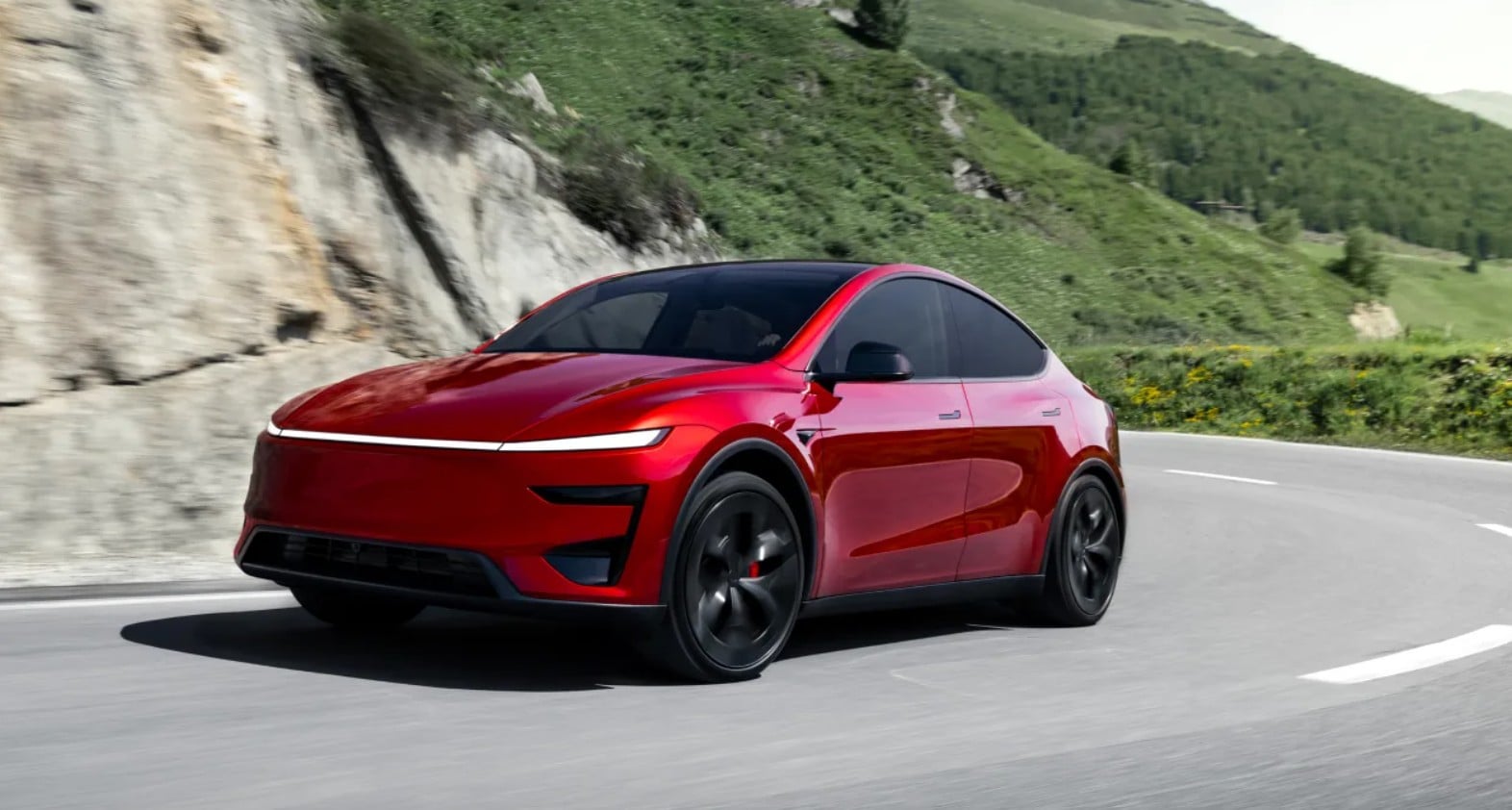
Tesla has reworked the electric motors to deliver 343 kW combined output. Beyond the headline figure, these motors are designed to withstand repeated high-speed driving thanks to improved thermal management. Performance is striking: 0–100 km/h comes up in just 3.3 seconds, only a whisker behind the smaller Model 3 Performance. Top speed remains electronically limited to 250 km/h.
Tesla’s drive modes also allow drivers to bias torque to the rear axle for a livelier, more engaging feel. The company is tight-lipped on exact battery capacity but confirms that the cells have been upgraded for greater efficiency and resilience.
Despite its power and 21-inch wheels, the Model Y Performance promises around 580 km of range (WLTP). That’s only slightly lower than the Dual Motor Long Range version, thanks to the upgraded battery’s wider thermal operating window that helps maintain efficiency under different conditions.
One criticism of the outgoing Model Y Performance was its raw, sometimes unsettled ride. Tesla has addressed this with a series of chassis revisions. Adaptive suspension, reconfigured geometry and a slightly lower ride height all contribute to improved steering response and stability. Grip comes courtesy of new 21-inch alloys wrapped in Pirelli P Zero tyres.
The changes mean the Model Y should now feel less like a straight-line sprinter and more like a genuinely sporty SUV.
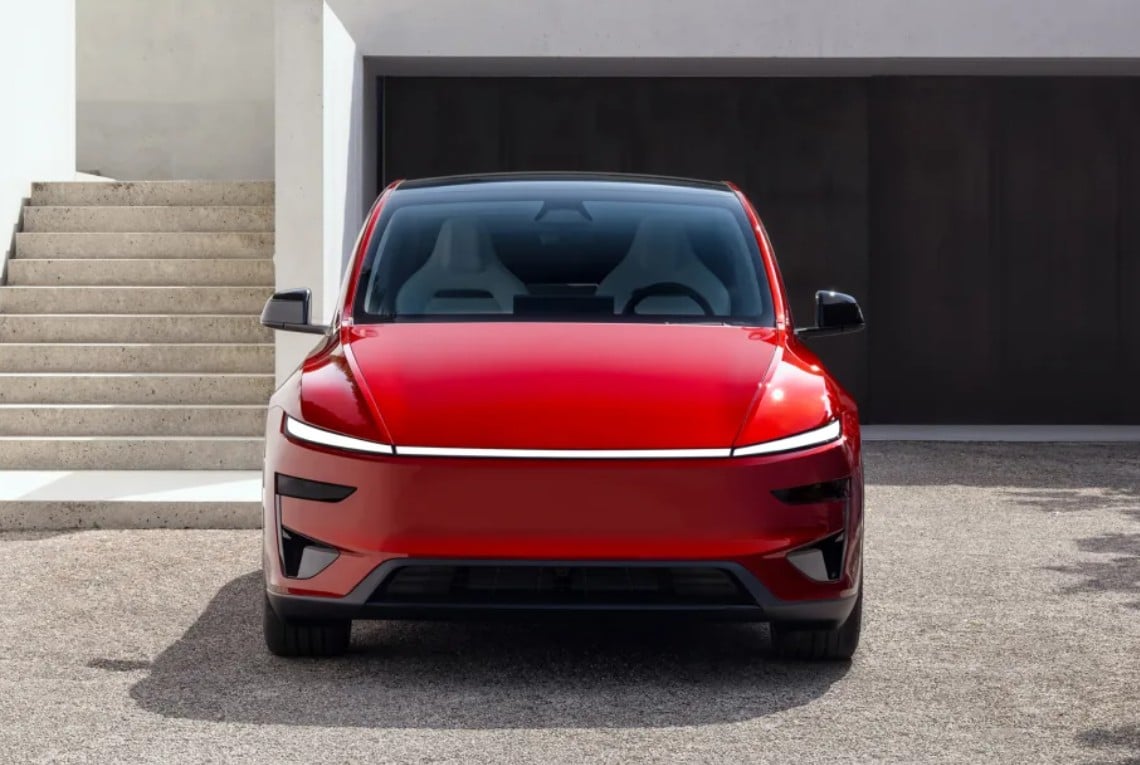
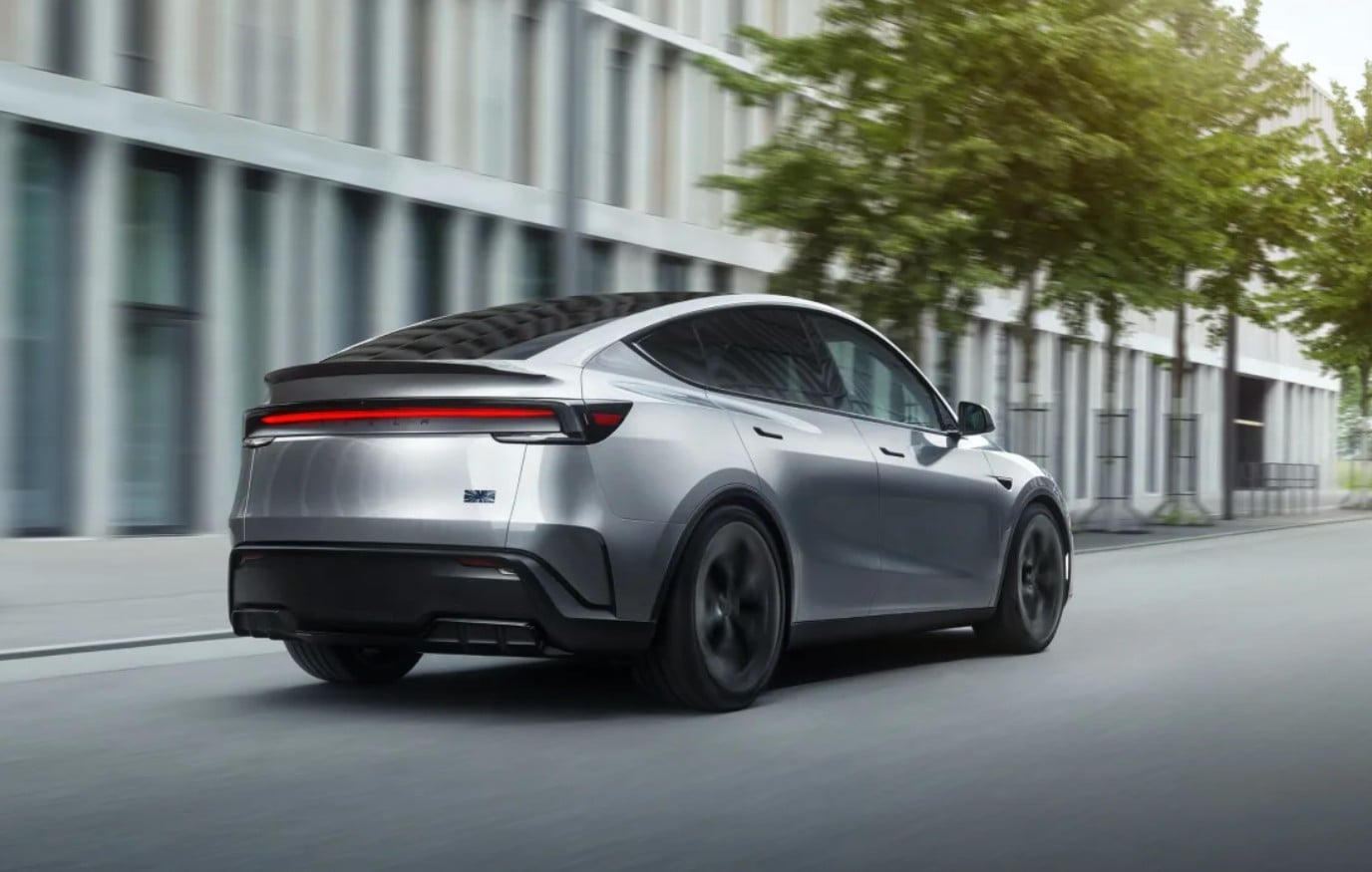
Externally, subtle but effective styling cues set the Performance apart. Redesigned bumpers add aggression, while a carbon-fibre rear wing enhances both looks and aerodynamics. Inside, Tesla has updated the 16-inch central display with thinner bezels and fitted more supportive front seats. Performance badging, inspired by the Model S Plaid, adds a finishing touch.
Europe gets it first Tesla Model Y Performance next month, while Australia’s launch later this year will test how much demand remains for a high-performance electric SUV in a shifting market.
Australia might be a relative minnow in the global automotive market, but it tends to punch above its weight in terms of importance and influence.
Even today it remains an enthusiast market and all manner of manufacturers have created special editions in an attempt to lure punters into showrooms.
Here are 10 of the best, presented in chronological order.
1990 Nissan R32 GT-R
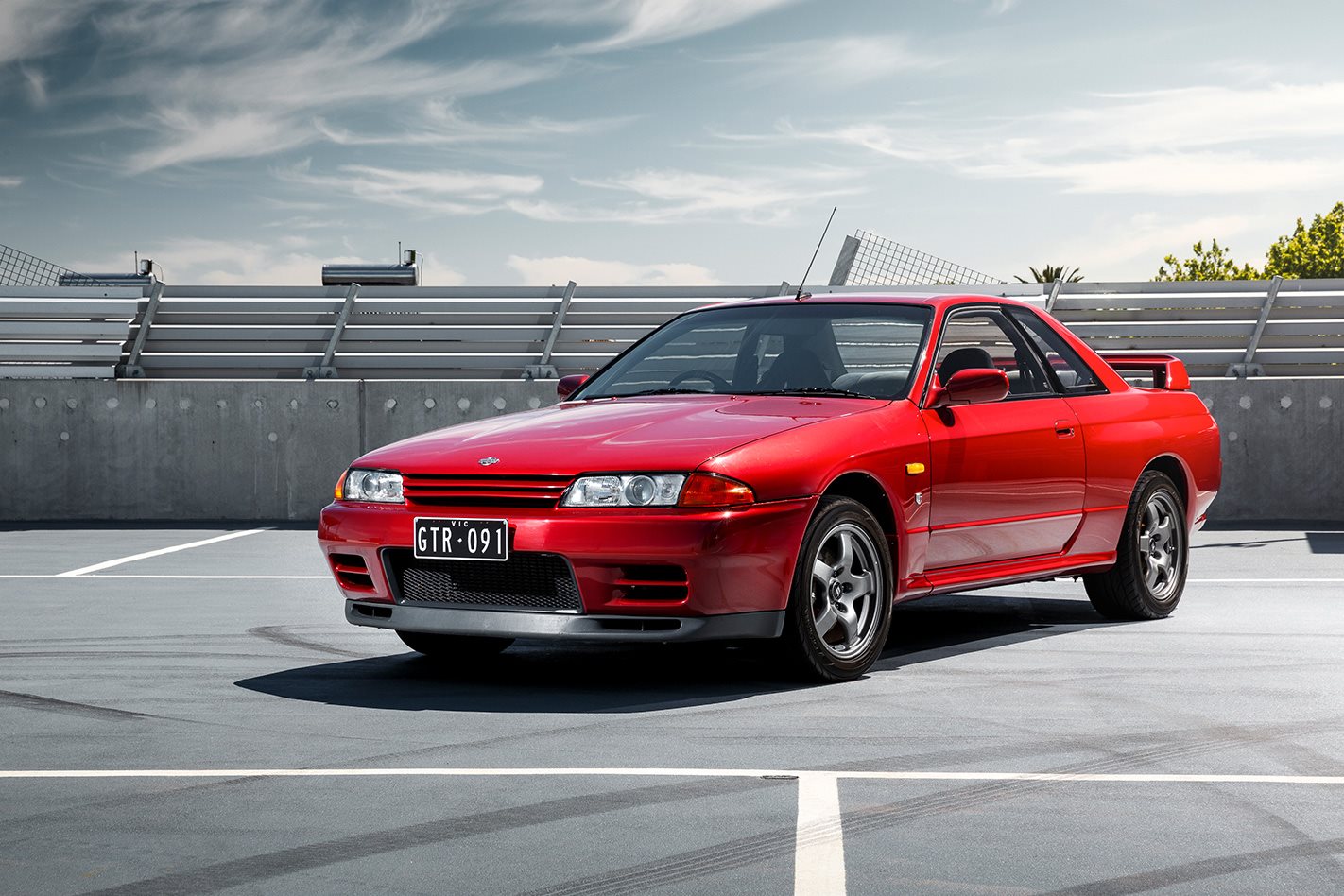
If Nissan Australia was going to spend a fortune campaigning the R32 GT-R in the Australian Touring Car Championship, it had best move some metal to justify the expense. Trouble is, the Japanese-specification R32 needed extensive modifications to meet local regulations.
As such, while the GT-R might not jump to mind as an Aussie special, local R32s had a lot of unique parts, such as new headlights and taillights, side indicators, a new radio with a better aerial, 260km/h speedo, different seat belts, side intrusion beams, child restraint installation and changing the Skyline badge to Nissan. The only mechanical modification was a transmission cooler.
A total of 100 cars were imported, but local buyers weren’t interested in paying $110,000 (more than $250K today) for a Nissan. The cars took a long time to sell, despite the fact that Kerry Packer bought three of them.
1995 BMW E36 M3R
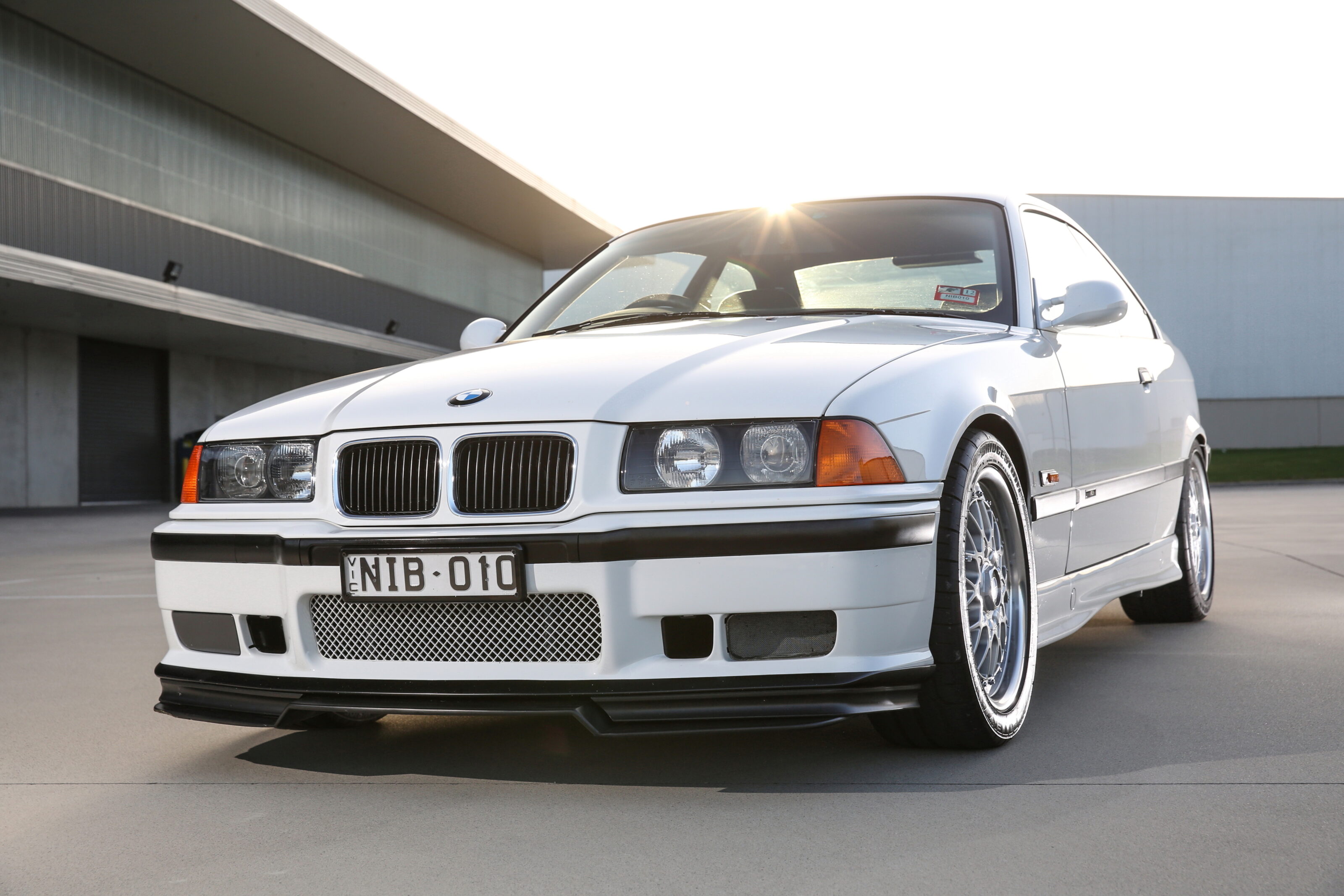
In the mid-1990s, the rarest and rawest BMW M3 you could buy was a product of Australia, not Germany. To homologate a faster M3 for local production car racing, taking on the Mazda RX-7 SP and Porsche 911 RS CS, Frank Gardner Racing convinced BMW Motorsport to green light the E36 M3R.
Fifteen cars were sent over in their lightest form, the final car supposedly 100kg lighter than a standard M3. New camshafts, a revised intake, optimised exhaust ports and a new ECU lifted outputs to 239kW/320Nm, along with a lightened flywheel and shorter 3.23:1 diff ratio.
Stiffer suspension and bigger front brakes completed the package, but you had to really want one. Not only did you need to produce a racing licence to qualify, but the price tag was $189,450, around 50 per cent more than the standard M3 Coupe.
1995 Mazda RX-7 SP
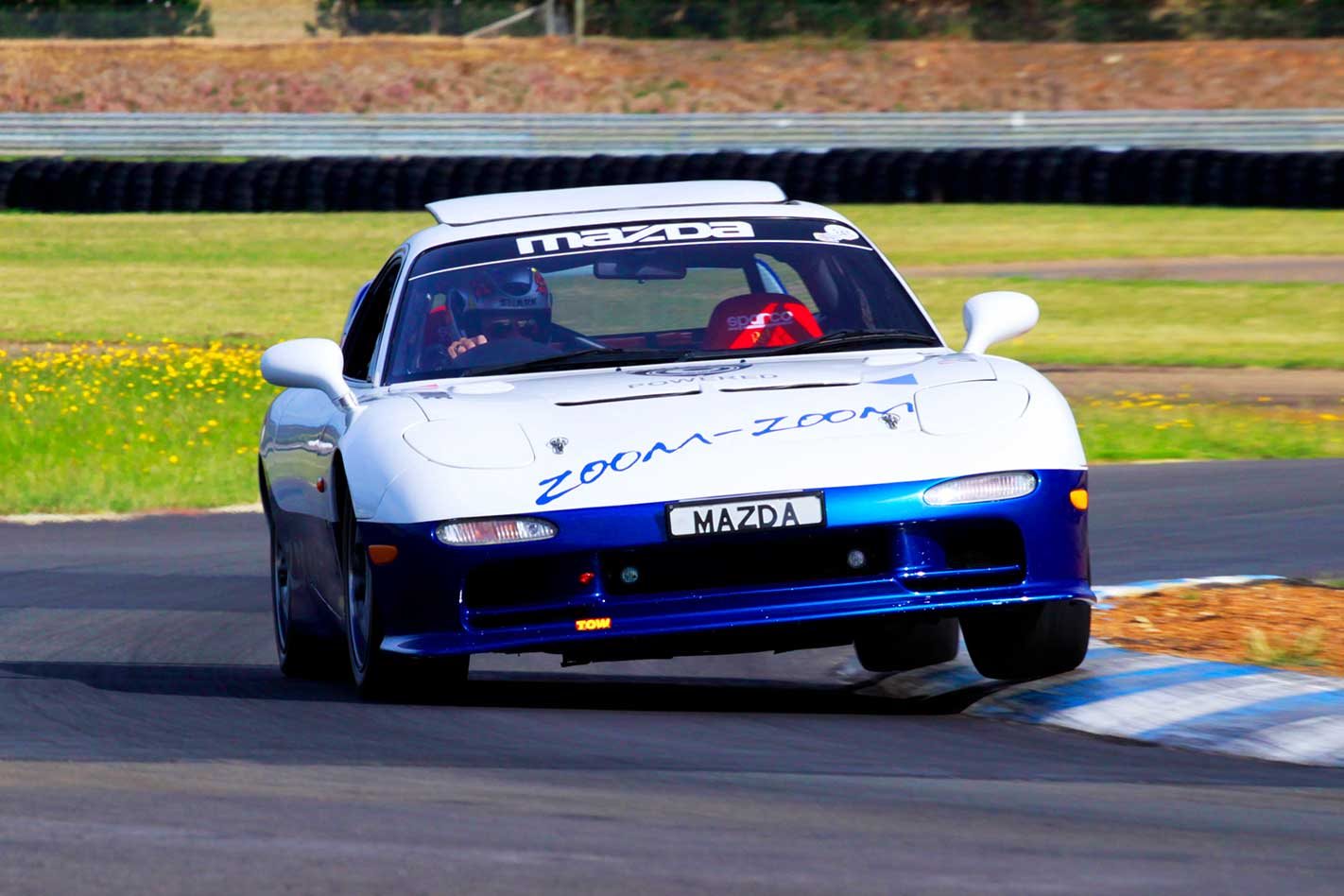
Another manufacturer to push all its chips in in search of production car glory was Mazda. It was top dog, having won three successive Bathurst 12-Hour races, which prompted Porsche to import 10 993 RS CS to homologate the car for local action.
Mazda’s response was the RX-7 SP, put together by Mazda Australia’s savvy Motorsport manager Allan Horsley, 29 cars eventually being produced with 127 changes compared to a standard RX-7, all aimed at making it a more effective endurance race car.
Outputs increased from 176kW/294Nm to 204kW/357Nm, weight dropped by almost 100kg, there was a 110-litre fuel tank, stronger and shorter-ratio Torsen limited-slip diff, bigger brakes and more.
While it couldn’t match the Porsches for outright speed, the RX-7’s superior tyre wear and fuel range led to it crossing the line first at the 1995 Eastern Creek 12-Hour with John Bowe and Dick Johnson behind the wheel.
2002 Mazda MX-5 SP
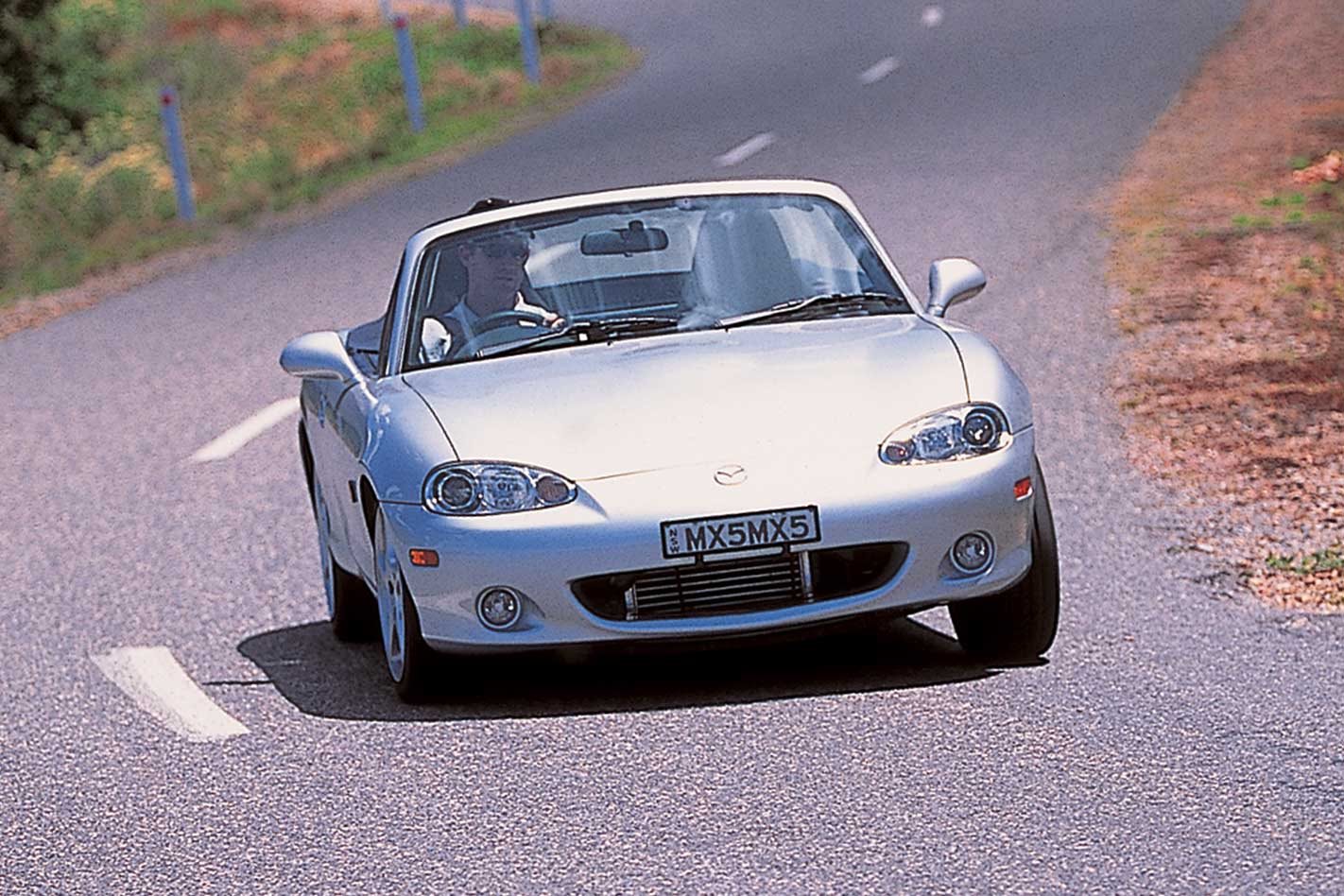
Having set a precedent for hotter Australian-developed Mazdas, the MX-5 was the next model in Horsley’s sights. It says a lot about the inherent strength of the NB MX-5 that it could cop a turbo upgrade on an otherwise fairly standard car and still be warrantable.
The compression ratio wasn’t changed so engine response didn’t suffer, yet adding boost lifted outputs from the 1.8-litre four-cylinder from 113kW/181Nm to 150kW/280Nm and in a 1119kg car that makes a BIG difference.
To prove the SP’s mettle Horsley once again turned to motorsport, telling rally driver and suspension wizard Murray Coote to drive it “as hard as possible” in Targa Tasmania, where it finished a very creditable 20th outright.
2002 Mitsubishi Magna Ralliart
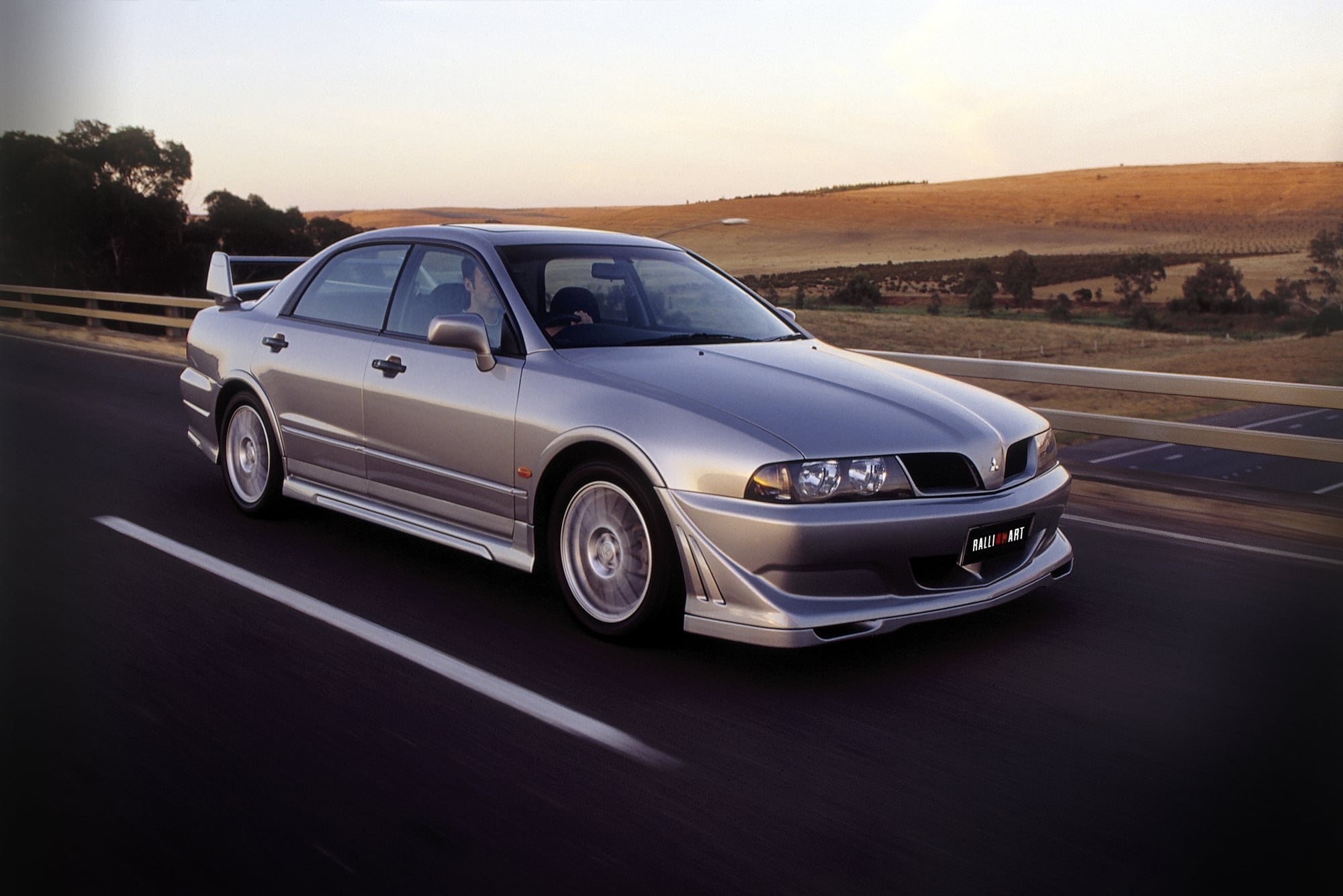
In a way, the Magna Ralliart was Mitsubishi’s ‘Jaguar XJ220 moment’. Having unveiled the Ralliart Concept with supposed all-wheel drive (if it’s unclear if anyone stuck their head under the rear bumper to check) and Recaro seats, the production car arrived with front-wheel drive and Ralliart-badged cloth seats. Hmph.
Putting 180kW/333Nm of 3.5-litre V6 grunt through just the front wheels, even with a limited-slip diff in the case of the manual variants, was a big ask with early-21st century tyre technology and the Ralliart Magna could be an understeery, wheel-wrestling handful if not driven with due care.
Nevertheless, there were Koni shocks, Enkei wheels and bigger brakes and the Ralliart’s grown-up Lancer Evo looks and rarity – just 500 were built – mean it deserves its modern classic status today.
2005 Subaru WRX WRP10
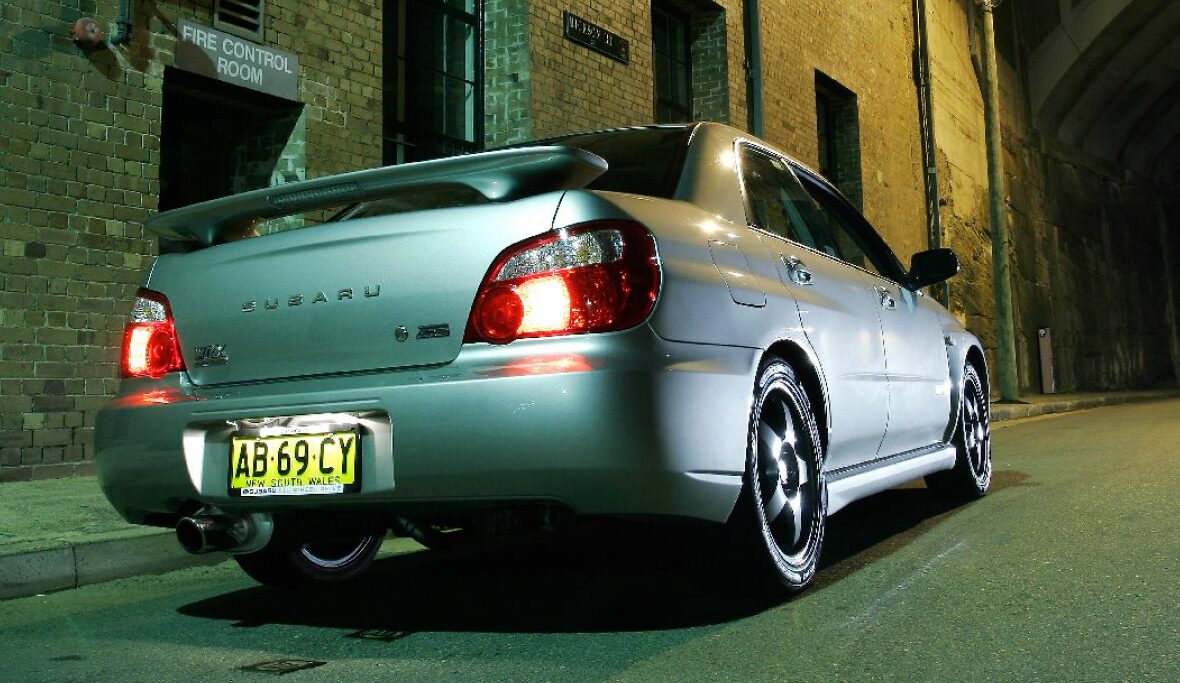
To celebrate 10 years of the Impreza WRX Down Under, Subaru Australia cooked up the WRP10, or World Rally Pirelli 10th Anniversary. Catchy. It was carefully concocted to slot neatly in the gap between the standard WRX and the hotter STI, which it did to good effect.
An STI ECU and muffler lifted the 2.0-litre turbocharged flat-four by just 7kW and 2Nm (to 175kW/302Nm), along with 15mm lower springs and a carbon fibre strut brace, also from the STI, while Rays Engineering alloys were wrapped in Pirelli rubber.
Just 200 were built, all in Crystal Grey, and while it could’ve been a cynical marketing effort, the WRP10 actually fulfilled its role as an in-betweener very nicely.
2007 Toyota TRD Aurion
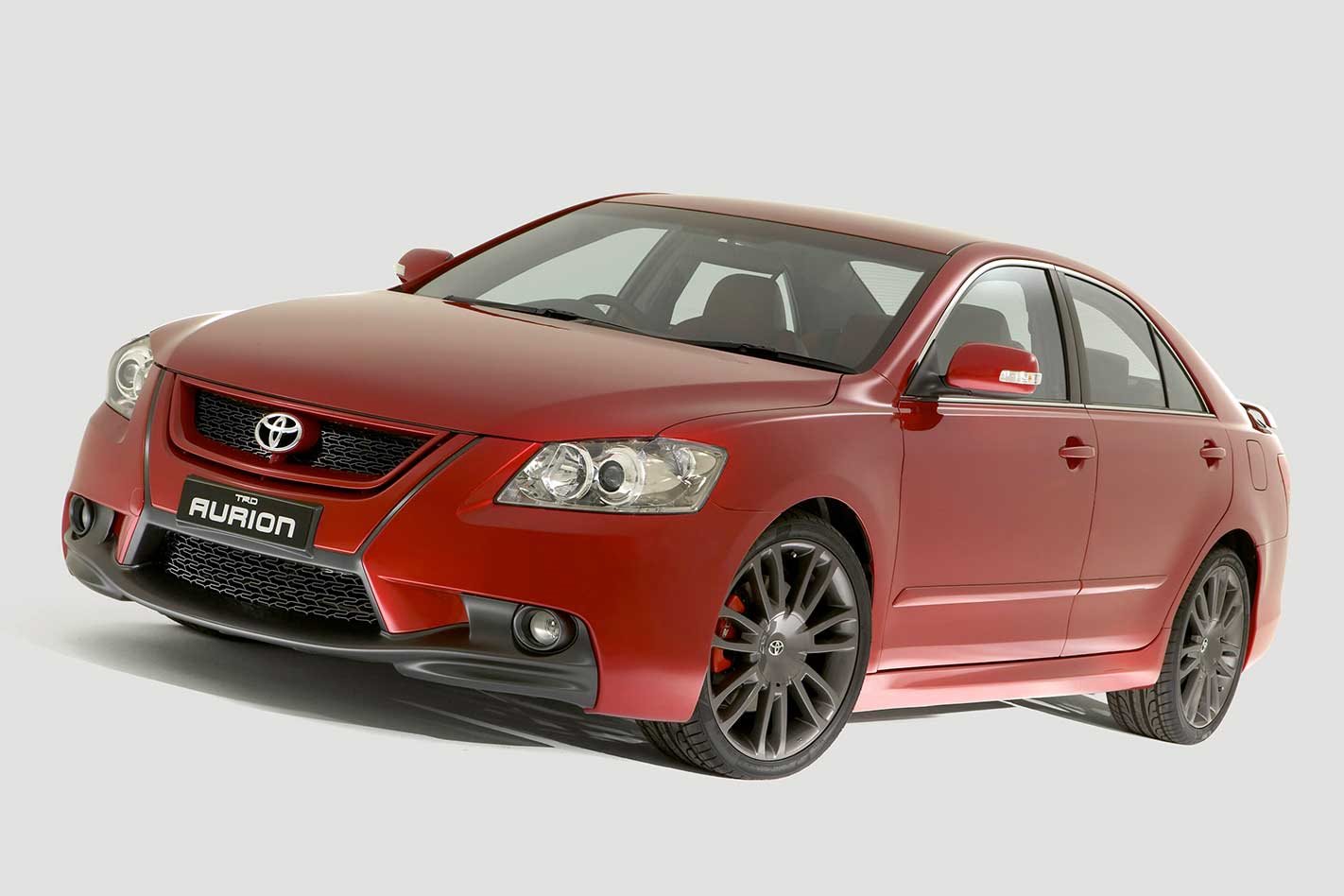
Picking up the baton dropped by the Ralliart Magna, the TRD Aurion once again attempted to prove that front-wheel drive was no impediment to producing a red-hot, dinky-di Aussie performance car.
Whacking a supercharger on the 3.5-litre V6 took care of the power equation, lifting outputs from 200kW/336Nm to 241kW/400Nm, though a six-speed automatic was the only available gearbox.
Bigger brakes and wheels and sportier suspension completed the mechanical overhaul and the Toyota Aurion was impressive as a grunty and well-equipped grand tourer, but as an out-and-out performance car it came up short and buyers stayed with their Falcodores as a result.
2017 BMW M140i Performance Edition
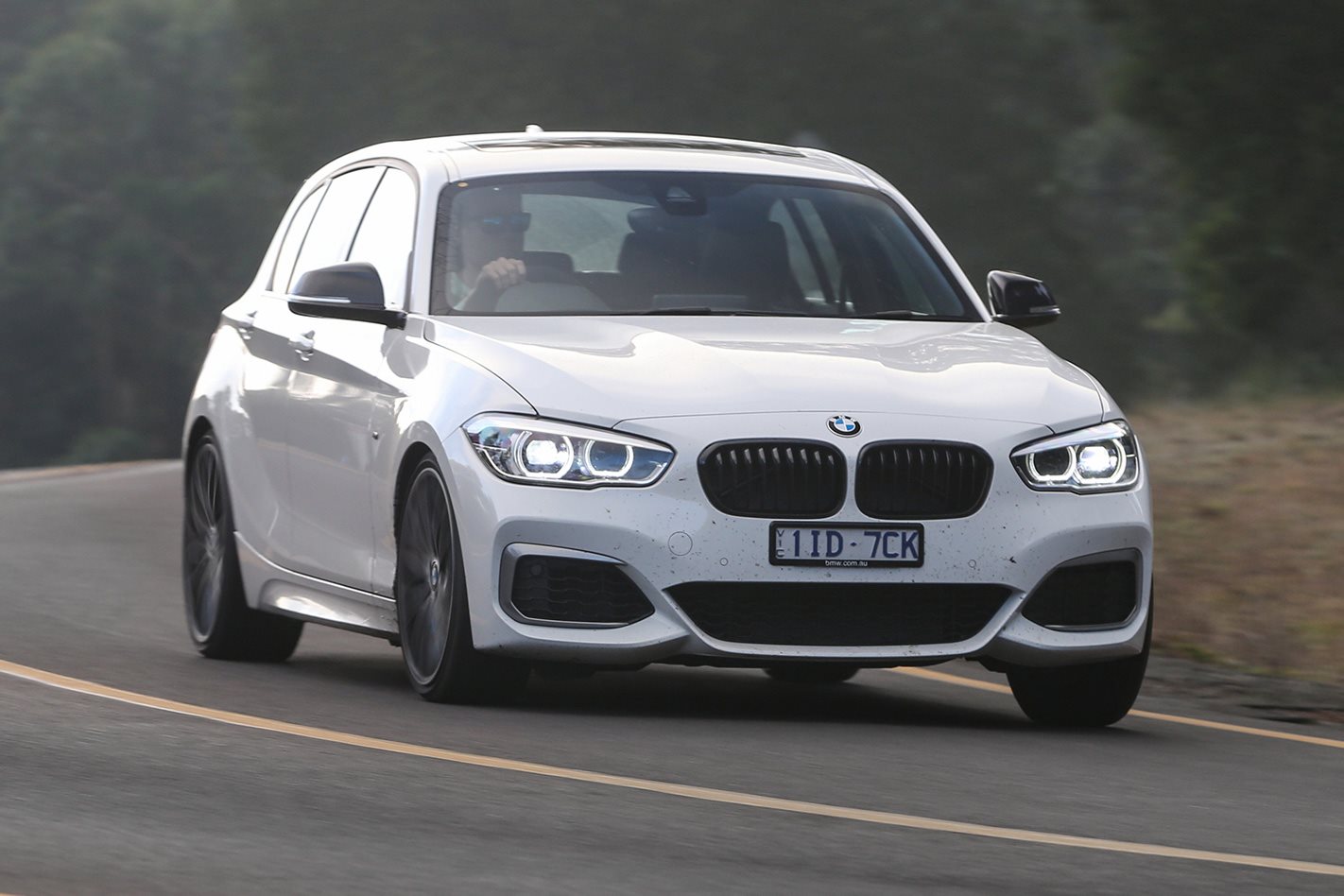
There are two sides to the BMW M140i Performance Edition, a spicier Australia-only hot hatch that plundered the M Performance Parts catalogue. Three-quarters of the 60 cars built were automatic and bar an exhaust were mechanically standard.
Nineteen-inch wheels were an inch bigger along with carbon fibre mirror caps, blacked-outed exterior trim and dashes of Alcantara and carbon fibre on the inside. Choose the manual, however, and you also scored a proper mechanical limited-slip diff.
To be honest, the auto suited the M140i better, but both were an awesome drive and the manual’s extra involvement and rarity will make it worth searching out in years to come.
2019 Ford Mustang R-Spec
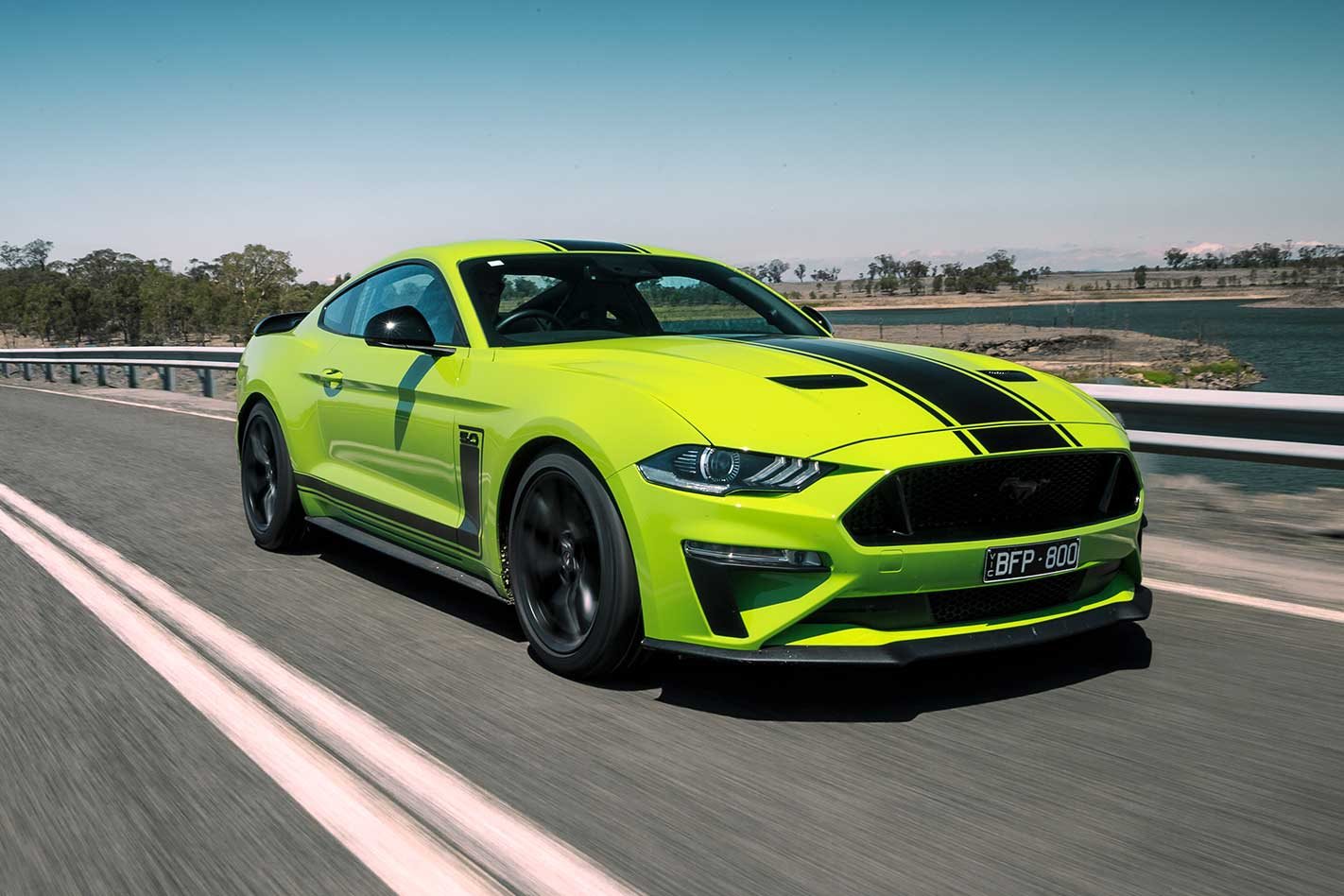
It’s hard to overstate what a big deal the Ford Mustang R-Spec program was. For an automotive colossus to entrust the building of a halo muscle car to a small group of third-party employees on the other side of the world was almost unheard of.
It wasn’t easy and if Rob Herrod – the man in charge of the program – had any hair, it certainly would’ve turned grey, but 500 examples of the 500kW/800Nm+ supercharged monster were successfully produced.
The huge power scored the headlines, but it was a complete package, with lower springs, reprogrammed MagneRide, wider wheels and adjustable anti-roll bars all backed by the full five-year factory warranty.
2021 Porsche 911 GT3 70 Years

Remember what we said about the outsized importance of the Australian market? The Porsche 911 GT3 70 Years was the first market-specific 911 GT product ever, created to celebrate the 70th anniversary of the brand Down Under.
The mechanicals were standard GT3 Touring – no bad thing whatsoever – but the Fish Silver colour matched one of the first two Porsche 356 imported in Australia. It also came stacked with usually optional equipment like the Sport Chrono package, the Light Design package, Touring package, BOSE surround sound stereo and much more.
Inside is where the biggest changes took place, the graphite blue bucket seats having unique inlays, dashboard and centre console trim matching the exterior colour, door sill guards in brushed aluminium with ‘70 Years Porsche Australia Edition’ to name a few.
While effectively a really well-specified 992 GT3 Touring, it’s a uniquely Australian twist on Porsche’s iconic sports car with just 25 built.
The Eighties, Nineties and Noughts were a thin time for American modern classics. You can make a case for the Corvette, certain hotter Mustang and Camaro variants, and the DMC DeLorean (more for its backstory than the quality of the car) but beyond that it’s thin pickings. Look at the avalanche of hot product that came out of Japan and Europe in that era and you begin to appreciate the paucity of America’s quality output during this period.
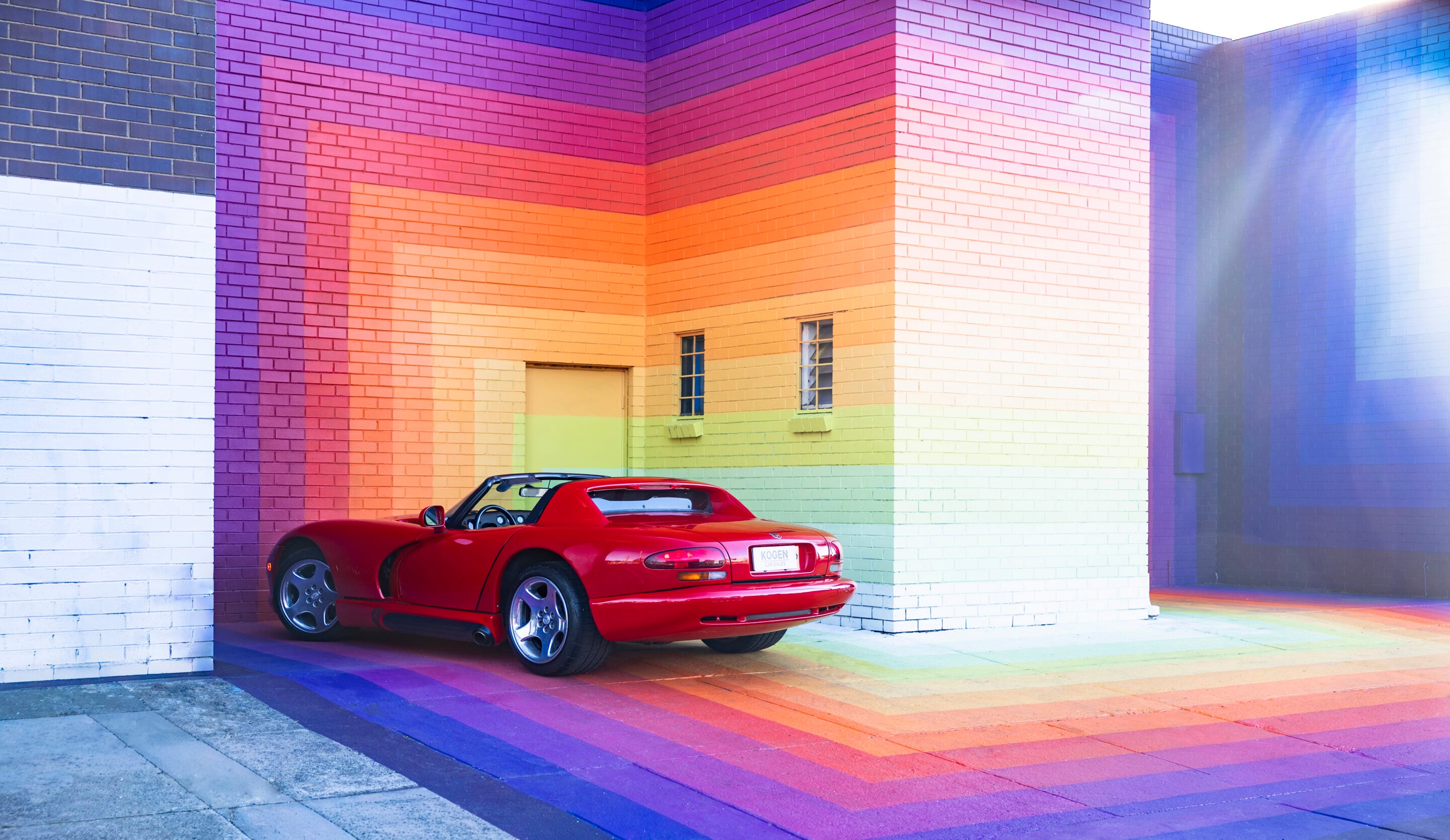
There is, however, one standout that qualifies on any measure you could choose to judge it by – the original Dodge Viper RT/10. It has a great backstory, the car itself was wild, charismatic and uncompromising, it spawned a legacy of successors, and it gave its manufacturer a massive shot in the arm, acting as a halo product for a subsequent range of sporting cars.
It’s hard to believe the Viper is no more, the last version having been sold in 2017. Enthusiasts argue over whether it was weak sales (only 485 cars were sold worldwide in 2017) or the cost of complying with FMVSS26 safety regulations, which required curtain airbags but, in truth, one probably begat the other.
The final nail in the Viper’s coffin was the closure of its Conner Avenue assembly plant in Detroit on August 31, 2017 where a team of 87 staff hand-built the trickle of cars. Times had certainly changed since the late 1980s when the Viper was conceived.
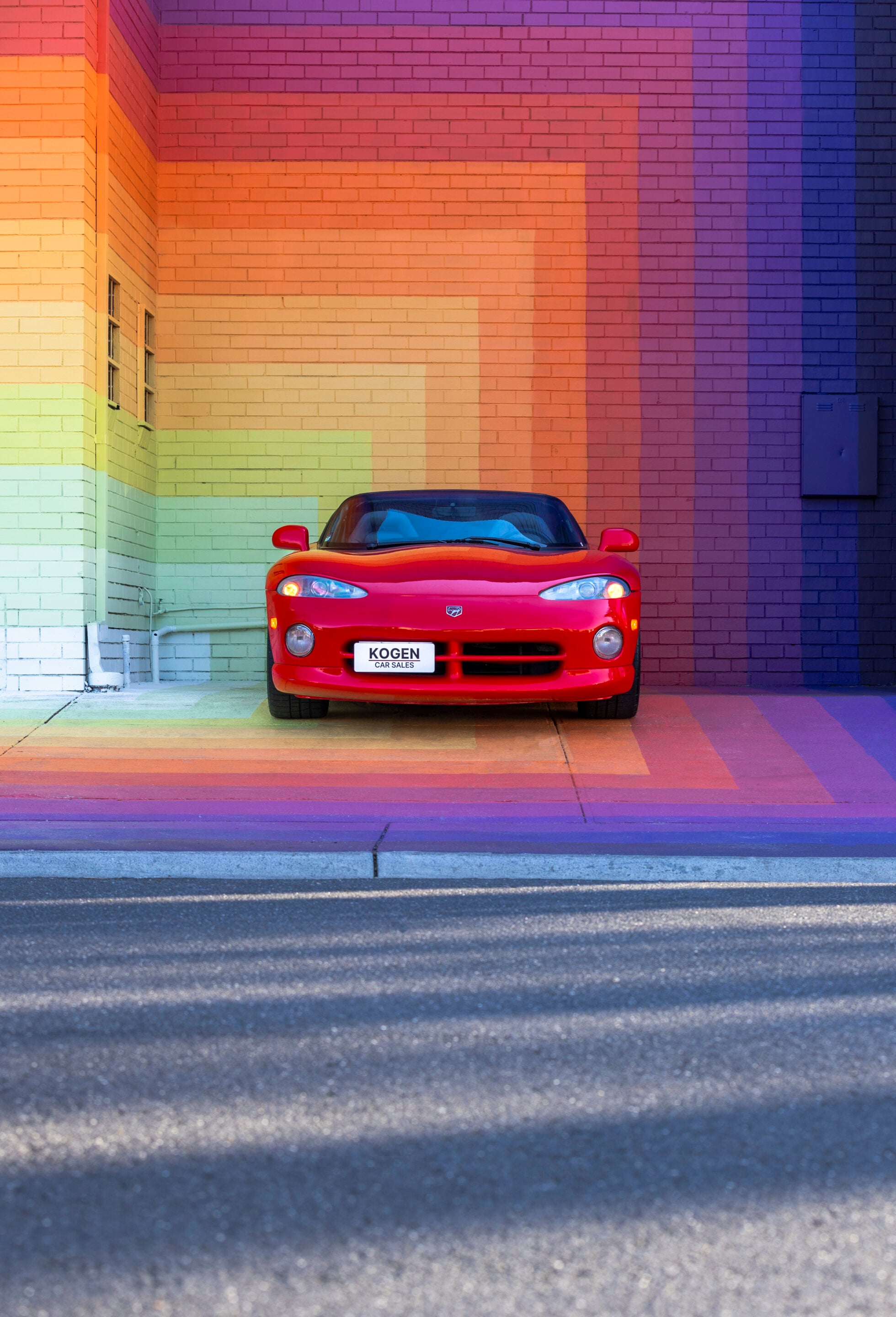
Maximum attack
We’ll start with Bob Lutz. You know him. Following tenures at GM, BMW and Ford, ‘Maximum Bob’ was recruited by Chrysler chairman Lee Iacocca as the product guru charged with making sense of a recent round of acquisitions that had seen AMC, Jeep, Lamborghini and later Maserati added to the fold.
Lutz was good friends with Carroll Shelby and his garage featured a gleaming Autokraft Mk IV Cobra replica. Shelby rarely missed the opportunity to remind Lutz that this formula was due for a reboot. At first Lutz blew it off as Shelby merely looking to earn a slice of the pie, but the idea got under his skin.
The logic was fairly straightforward. Iacocca’s K-car platform, introduced in 1980, had saved Chrysler from certain doom, spawning 50 different models from a single modular chassis. It was originally built around relatively fuel efficient four-cylinder engines on a space-efficient front-drive layout. Pragmatic and profitable it certainly was, exciting it definitely wasn’t. Lutz wanted something extra.
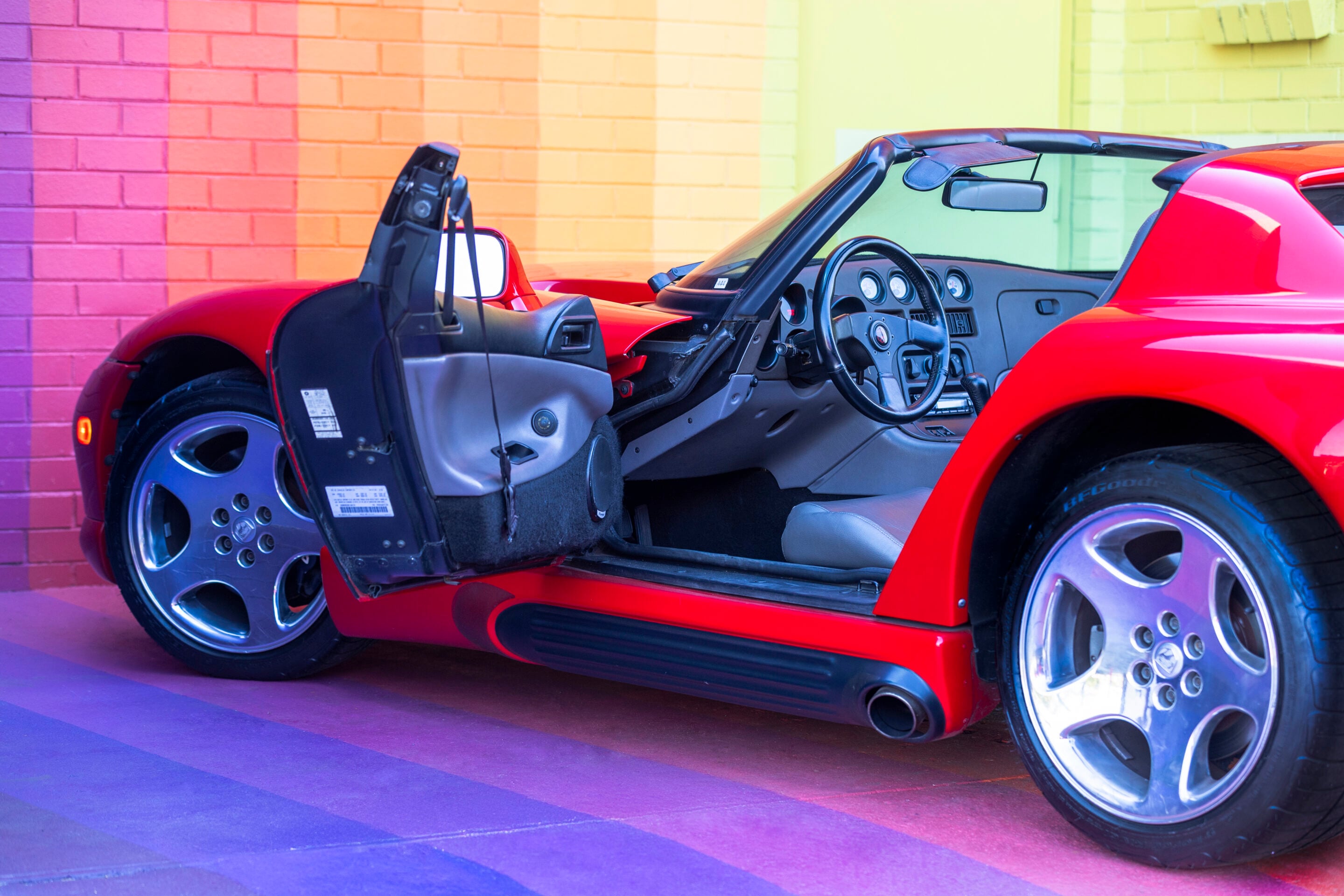
In truth, the successful K-car philosophy had probably run its course by the late 1980s, with so much squeezed out of it that the pips were squeaking. Iacocca couldn’t be convinced otherwise, however, and his idea of a halo car for the organisation was a K-car variant too far – the 1989 Chrysler TC by Maserati. The catalogue of woe that plagued this particular car would probably merit a separate feature of its own. With projected sales of 10,000 units per year, the TC eventually went on to sell a total of 7300 cars across three years before being quietly axed.
One day in February 1989, Lutz and design director Bob Gale got talking at the Chrysler Design Center.
A whole new series of cab-forward LH sedans was incoming, and there was a buzz in the building, with the new Dodge Intrepid and Chrysler Concorde boldly breaking from the old K-car straightjacket. Worried that this wouldn’t be enough to convince the world that the company hadn’t turned the K-car page, Lutz started recalling some of his conversations with Shelby. What if Chrysler could be the one to build a new Cobra? Bob Gale didn’t need asking twice.
Gale believed that every brand within the Chrysler stable needed a hero car to define the essence of that particular brand. With Jeep it was clearly the Wrangler. The forthcoming Prowler would do the job for Plymouth. But Dodge was floundering and Lutz’s proposal was probably the answer. And besides, some of the work had already been done. Gale and his team had worked on a sports car concept called the Izod, which had influenced the styling of the Dodge. Speak to Gale and he’ll tell you that the idea for a serious sports car had ruminated for some time within the business and that was why he had a number of design options ready to roll.
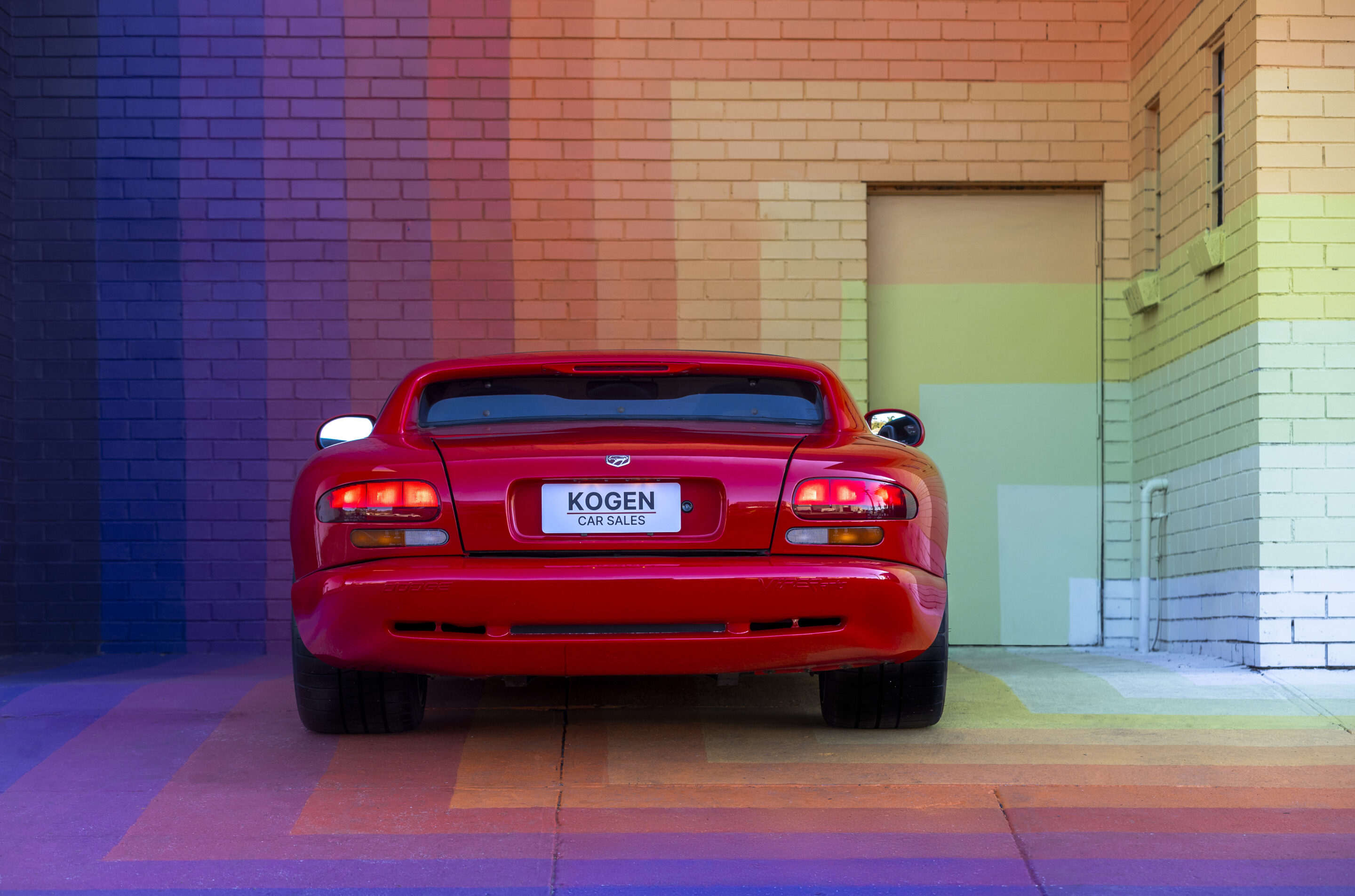
There was an instant sort of serendipity that surrounded the project. Carroll Shelby had been marketing go-faster Dodge products since 1986 and willingly offered his input, Gale had the design direction already mapped out and Lutz had a clear idea of the philosophy behind the car: modern materials but an old-school, raw focus. The fourth key personality in the development of the car was Francois Castaing, ex-head of Renault’s racing arm, and now head of Chrysler’s Jeep and truck engineering division.
Castaing’s team had been working on a 10-cylinder version of the company’s rather ancient 5.9-litre V8 – the classic 360ci lump – and he managed to persuade Lutz that it was sufficiently refined to power a sports car. At that moment, Lutz and Castaing realised that they might have bottled lightning and quickly set Gale to work. One design in particular quickly grabbed the imagination: a wide, low-slung roadster with an exposed fuel filler cap, side pipes and deeply dished five-spoke wheels. The engine would be set as far back beneath a very long bonnet, creating what Gale described as “truly heroic proportions”. A half-scale clay model was quickly built up in order to be presented to Lee Iacocca.
Getting to production
Castaing estimated that a $70m budget would be needed to productionise the concept, chicken feed by modern standards. Costs would be shaved by utilising an existing gearbox, while cannibalising some Dodge Dakota components for the suspension and rear axle. The final element that was needed to convince Iacocca was a name. Lutz wanted Cobra, but was voted down by the others, who felt that Ford’s lawyers would play hardball. Challenger was another name that was floated but it was Viper that seemed an appropriate link to Cobra. A Viper badge, dubbed ‘Sneaky Pete’ by Chrysler insiders, was sketched and Iacocca got to deliberate on the project.
Francois Castaing was again instrumental in the process. He convinced Lee Iacocca that the worth of this model came via the technical opportunities that working with new materials and new workflows would realise. He and Lutz quickly realised that he needed two approvals from the boss: one for the fully worked-up production prototype and the other for the production vehicle. There were blips along the way. Carroll Shelby was unconvinced by the notion of the V10, feeling that a heavy truck engine was wrong for a roadster. He also assumed, wrongly, that Dodge would subcontract the build process to him if the car got the green light, unaware of Castaing’s arguments on building and retention of intellectual property in-house.
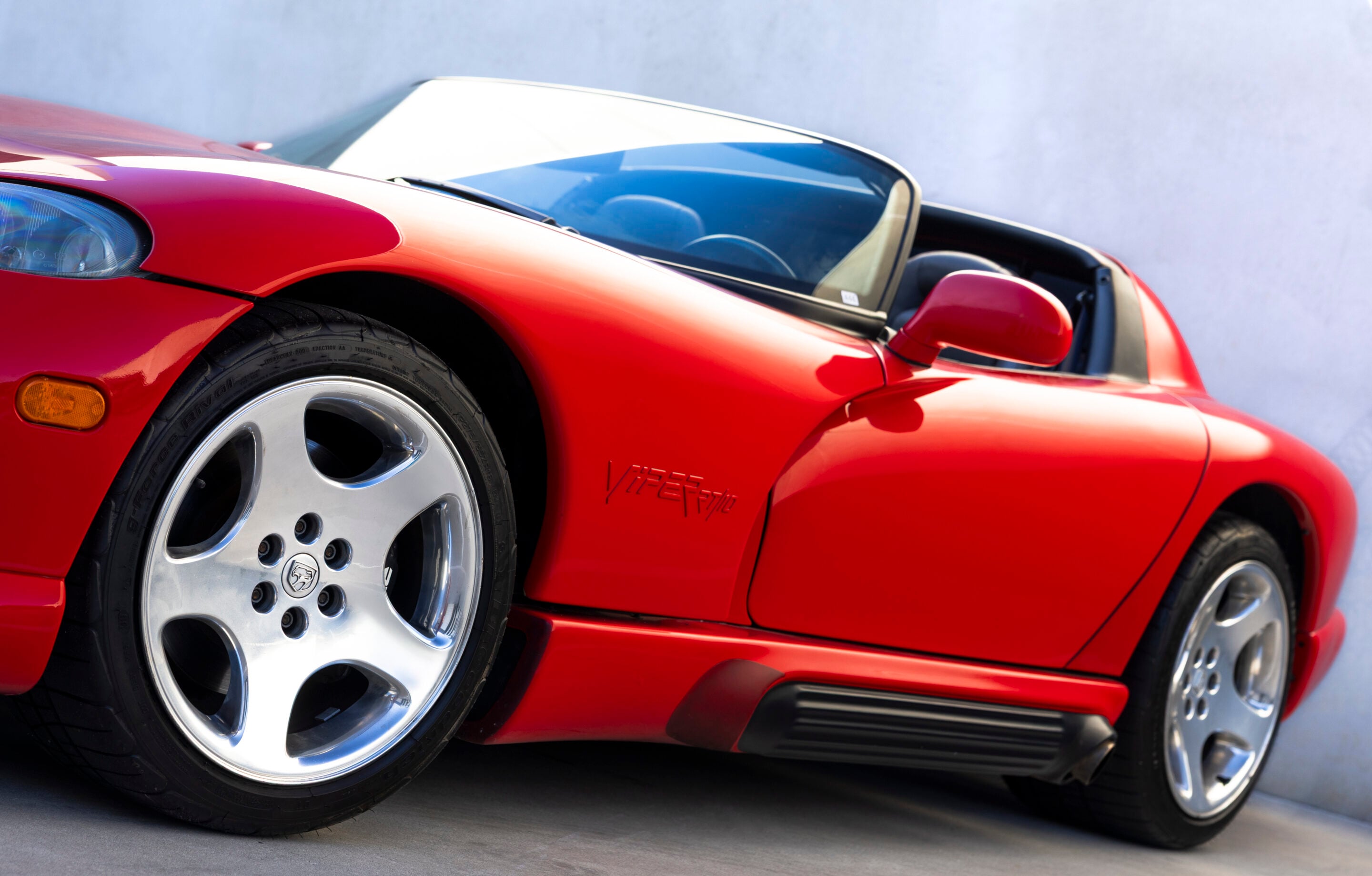
The initial concept appeared at the 1989 Detroit Show, the chassis and suspension built up by hot-rodder Boyd Coddington, the body prepped by Metalcrafters and under the bonnet was a lash-up of a V10, cobbled together by Roush from a couple of 360Ci V8s with a crudely fabricated crank. Yes, the concept could move under its own steam, but it couldn’t steer worth a damn and it sounded terrible. It nevertheless had the desired effect. Huge publicity followed, near universal approval and a palpable sense of excitement that America was going to build this incredibly exciting car.
How could Iacocca say no? Even at $70m, the publicity and halo effect was a bargain. As Jim Julow, Dodge VP, noted, “We needed to send a message that we had a new concept… something that was so outrageous, so cutting-edge, so purpose-built that it said we still had a lot of car nuts around here; people with the know-how to put the most outrageous street car ever on the road.”
The ‘official’ green light came in a typically Iacocca fashion; a publicity stunt before the press, on May 18, 1990, where he threw Lutz the keys to the Viper and barked, “Build it!”
It would come as a shock to Chrysler’s slow-moving and arthritic bureaucracies to get the Viper into production briskly. Castaing was moving mountains to shift the business from siloed, functional teams to a multi-disciplinary platform approach, and the production Viper appeared on the show stand at the 1992 Detroit Show, looking very little watered-down in terms of aesthetics when compared with the original prototype. Yes, the windscreen header rail height needed to be raised by three inches, the headlights were solidly mounted to the radiator rather than the hood to stop them shaking themselves to pieces, the mirrors were redesigned and – at Iacocca’s insistence – a hastily-conceived hood was also designed. But Iacocca’s speech to launch the vehicle spoke not of what the Viper could do, but what it had done for Chrysler.
“We want to show you what an American car company can do when we put our minds to it,” he said proudly as the wraps came off the Viper. “In 1989, this Dodge Viper was just a concept. In January, it’ll be rolling off a production line in Detroit, Michigan. Nobody in the country ever developed a car that fast,” he boomed, to huge applause.
“We’ve changed this company to give you even higher quality cars, faster and at lower cost. For those of us who forgot, it’s called being competitive,” he said. “From now on, every new car Chrysler makes is going to be built the way this one was, and that’s by a team: product and manufacturing engineers, designers, finance guys and marketers all working together with one idea, making a great car.” The crowd erupted.
The rounding error
Castaing had estimated a $70m budget to productionise the Viper. Newly appointed project leader Roy Sjoberg figured $60m might be enough. Chrysler’s Treasurer, Steve Miller had other ideas. Iacocca had been granted a $100m slush fund for miscellaneous development and had spent half of it on the Town and Country minivan. Sjoberg took a call from Miller where the senior accountant told him that “You’re going to do it for $49.9 million. In a billion-dollar corporation, that rounds out to zero, so no-one will see you or hear you or know you exist… The day you spend a dollar over $49.9 million, call me.”
There had been some internal pressure to look at a turbocharged V8 rather than the V10, but Iacocca resisted, reasoning that doing so would just turn the project into another hot rod. The V10 was different, the Viper appearing years before F1 switched to V10s in 1996 and, as a consequence, before the likes of Audi, VW, BMW and Lamborghini jumped onto that particular bandwagon. That said, there were solid technical reasons why V10s weren’t a natural extension of the popularity of American V8 engines.
For a start, tacking on an extra couple of cylinders means that the V8’s characteristically even firing intervals are lost. Firing with 90 degrees of crank rotation creates a cross-plane V8’s trademark and hugely endearing woofle, but a V10 engine will end up with firing intervals that alternate between 54 and 90 degrees. It’s not a particularly harmonic sound, and the V10 prototype’s syncopation at idle had more than an element of commercial vehicle to it.
Castaing hit on an idea. He recruited Mauro Forghieri, the brilliant engineer who had recently defected from Ferrari to Chrysler-owned Lamborghini to fettle the 10-pot. Forghieri ditched the truck’s cast-iron engine block for a lighter aluminium block with iron cylinder liners, designed aluminium heads fitted with magnesium valve covers and a forged crank and con-rods. Chrysler powertrain engineer Dick Winkles was the technical liaison between the US and Italy, and acted as a brake on some of Forghieri’s more extreme demands such as shorter water jackets around the cylinders and an aluminium bedplate for the bottom end. In production guise, and on Aussie fuel, the 8.0-litre engine realised a power output of 298kW at 4600 rpm and 610Nm of torque at 3600 rpm.
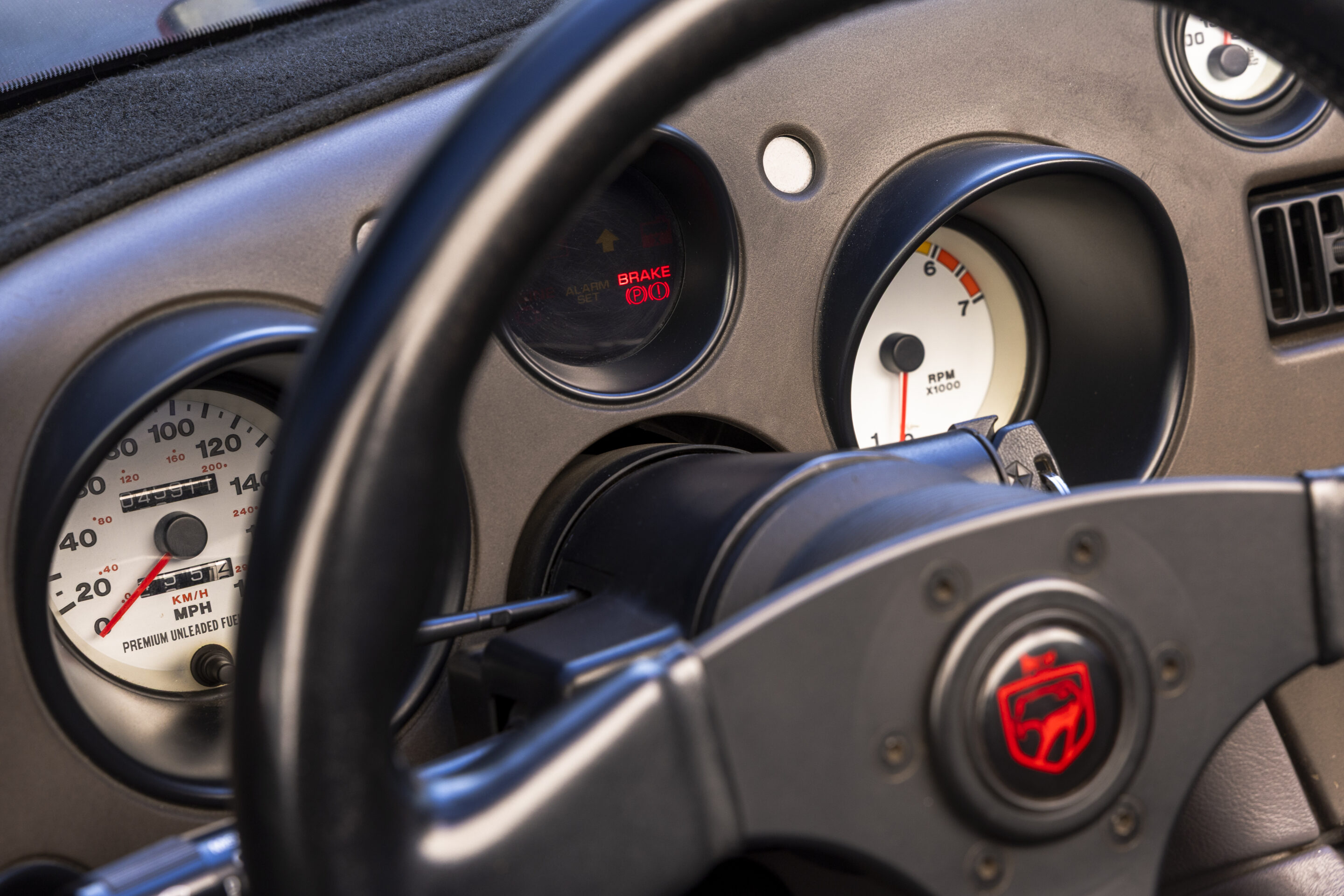
Production of the Viper RT/10, as it was badged, started at Chrysler’s New Mack Avenue plant in Detroit in January 1992. Output was around three cars per day, translating to a first year’s target volume of 400 cars. The gearbox was a beefy BorgWarner T56 unit after the original Getrag transmission proved too fragile. Michelin had won the tyre shootout versus Goodyear, but Chrysler’s bean counters shot that decision down, preferring an American brand, and it took Iacocca’s intervention before the French tyres were instead chosen. No air conditioning, no exterior door handles, no airbags, no anti-lock brakes, no traction control, no automatic transmission. Yes, the target weight of 1360kg was blown through, but by today’s standards, the final 1565kg result was hardly catastrophic.
The car
Wheels’ first test of the Viper on Aussie bitumen came in the December 1993 issue when Michael Stahl put it up against the Robnell SC 429, a 7.0-litre Aussie take on the classic Cobra theme. “Anyone who expected the Viper’s huge V10 to be even more V8 than a V8 is in for a shock,” he claimed. “It’s closer in character, and in sound, to something like Godzilla’s twin-turbo six – or to an Audi turbo-five as Kevin Bartlett pointed out.
“Blessed with a more linear power delivery than either, the V10 likes to work closer to its 5600rpm yellow marking (redline’s 6000) to show its full potential. From the side-exit pipes, there’s just a whooshing sound like an industrial vacuum cleaner – one that’s cleaned Eastern Creek’s main straight at 220km/h,”
he noted.
Stahl was somewhat less enamoured by the interior execution of the big Viper, noting that “an MX-5 could probably fit under the Viper’s bonnet, yet it has more interior room. Everywhere you look, under the hood, around the cabin and in the boot, there are big slabs of plastic panelling where, I dunno, surely some useful stuff could go.” That’s likely a consequence of that crazily accelerated – for Chrysler – development cycle.
It was quick though. The Correvit data logger streamed out 0-100km/h in 5.3s and 400m in 13.6s at 169.3km/h, a trap speed fully 10km/h quicker than the R32 Skyline GT-R had recorded at the same venue.
We had another crack in February 1994 at our ‘Australia’s Fastest Cars’ event at Lang Lang and hotshoe Kevin Bartlett came away faintly terrified. “It’s indicated 260km/h at somewhere near 4000rpm but I couldn’t focus on the rev counter because of the wind buffeting. My head was moving around something dreadful… The chassis is very, very squirrelly with some nasty goings on over the joining strips… It’s not suited to this sort of top speed, banking and bumps situation at all. I’d like to know what my heart rate was. She’s a bit hairy… she’s an adventure, no risk about that!”
Bartlett came away with a top speed registered at 256km/h, the fastest 0-100km/h figure in the 16-car field at 4.88 seconds, and the second quickest run through 400m, the Viper’s 13.18s/171.9km/h showing beaten by a mere three-hundredths by the Porsche 964 Turbo.
Ultimately, this SR I generation of Viper wasn’t long for this world. In 1996, a second iteration model appeared, the SR II, which saw the end of the sidepipes, the introduction of a GTS coupe version and an uptick in grunt to 309kW/662Nm. This was in turn replaced by the new SRT/10 model (dubbed the ZB within Chrysler) in 2003.
Only 6709 of these hand-built specials ever rolled out of New Mack Avenue and there’s significantly fewer surviving today. The breakdown per year is 285 in model year 1992, 1043 in 1993, 3083 in 1994, 1577 in 1995 and 721 in 1996. These early cars have achieved a certain cult status because you just don’t find anything like them any longer. They’re undeniably crude but seriously exciting, and, partly due to rarity, values are firming nicely. Opening book is around $100k, with low mileage cars topping out at around $150k.
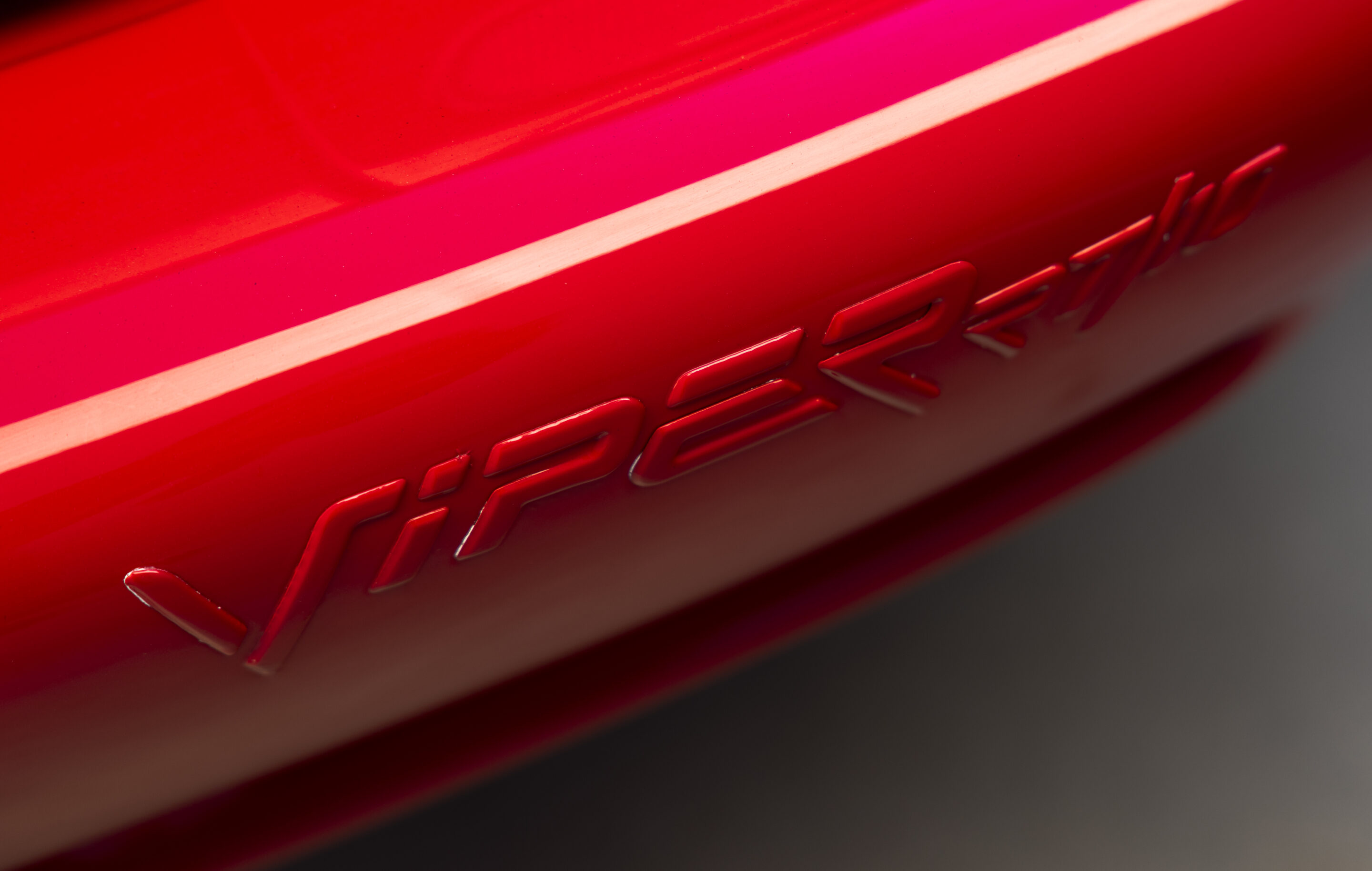
The Viper achieved everything it set out to do. It changed Chrysler for the better and re-established the company’s sporting bona fides. Competition versions went on to win at Indianapolis, the 24 Hours of Nurburgring and the Australian GT Championship. Above all, it revived a moribund American sports car market.
The intervening years have done little to diminish its impact. Yes, the power output figure is now what you’d expect from a senior hot hatch, but the sheer charisma of the Viper RT/10 has, if anything, only amplified over more than three decades. It’s a bona fide hero.
This article originally appeared in the September 2025 issue of Wheels magazine. Subscribe here and gain access to 12 issues for $109 plus online access to every Wheels issue since 1953.
A Sydney grandfather has been left devastated after his prized $120,000 Holden GTS was stolen in front of him by a scammer posing as a buyer on Facebook Marketplace, 9News reported.
Stephen Buttigieg arranged to show the rare collector’s car to a man who called himself “Brendon” in Bonnyrigg Heights, in the city’s west.
The well-dressed stranger claimed to be interested in buying the vehicle and asked detailed questions before slipping into the driver’s seat.
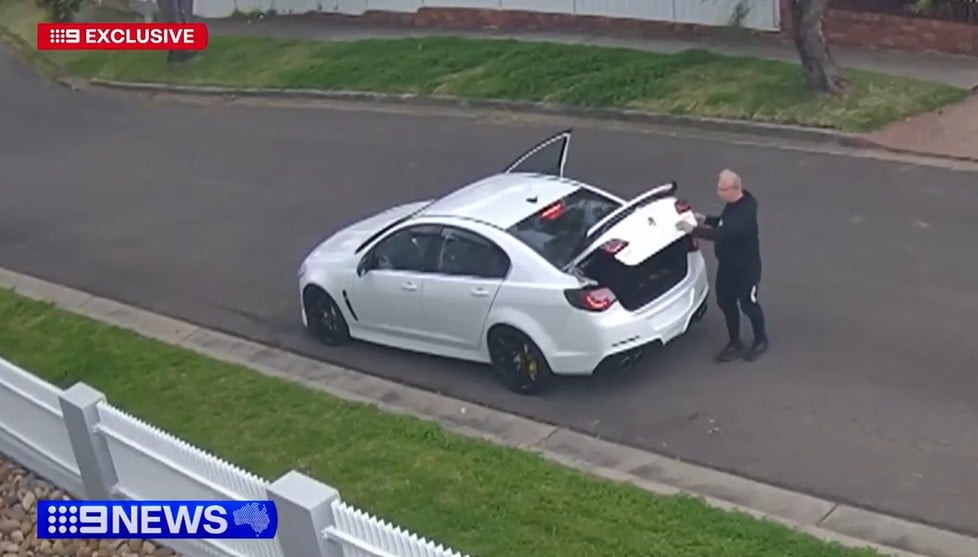
“He said, ‘I think your boot light’s coming on,’ and when I went to check, he put the car into gear,” Buttigieg told 9News. “The next thing I know, he’s reversed and then accelerated off.”
Security camera footage captured the moment the alleged thief opened the boot, prompting Buttigieg to walk to the rear of the vehicle. It was then that “Brendon” sped away, leaving the stunned grandfather watching helplessly.
“I just froze. He seemed so genuine, said he worked at a car yard and had money,” Buttigieg said.
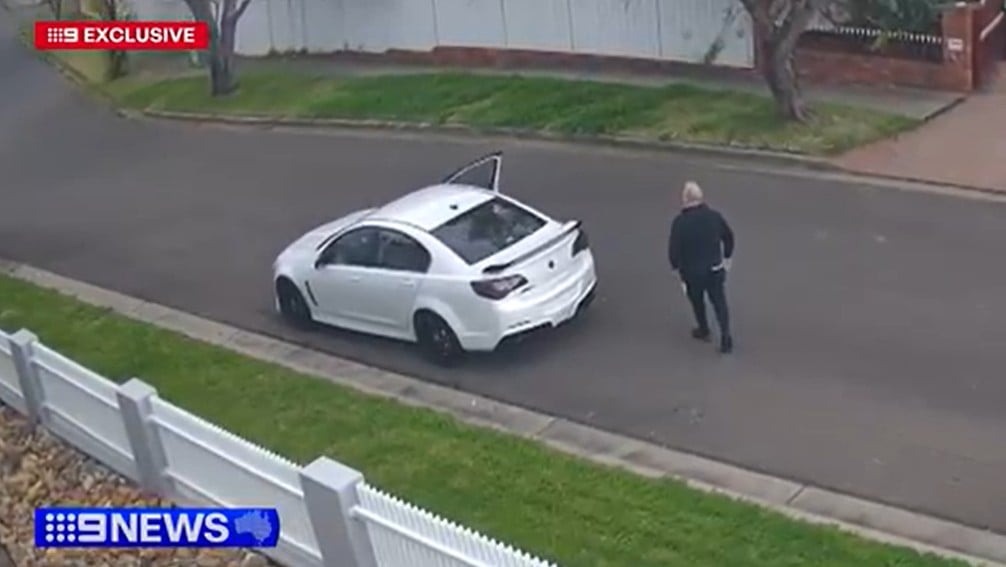
The Holden was more than just a car – it had been carefully stored in a garage, never driven, and served as a “nest egg” for Buttigieg. Without being regularly used, it wasn’t covered by insurance. He had planned to sell it to help his sons enter the property market.
“People work hard, you try to give your kids a hand, and then this happens,” he told 9News.
Police are now searching for both the man and the high-performance vehicle. Detectives are urging anyone with information to come forward.
Better late than never. The Renault Duster has finally made landfall here in Australia, the Dacia-badged version having been a popular fixture in Europe for 15 years. Why the long wait? It’s actually a bit boring, but the potted version is that when third-party business ATECO, which also manages the imports of Maserati, RAM and LDV, took over the distribution of Renault vehicles down under, it set its sights on the Duster, a car that the previous importers had dismissed as not delivering the profit margins to make it worthwhile.
Now the more cynical among you might read that and, quite reasonably, expect ATECO to have padded the new Duster’s retail price with a hefty element of fat in order to justify its decision. I certainly did. When it was revealed that Duster pricing started at just $31,990, it’s fair to say that our attention was certainly piqued, especially as the range opens at £19,380 (A$39,762) in the UK. Aussies not being price-gouged for once? What’s all that about?
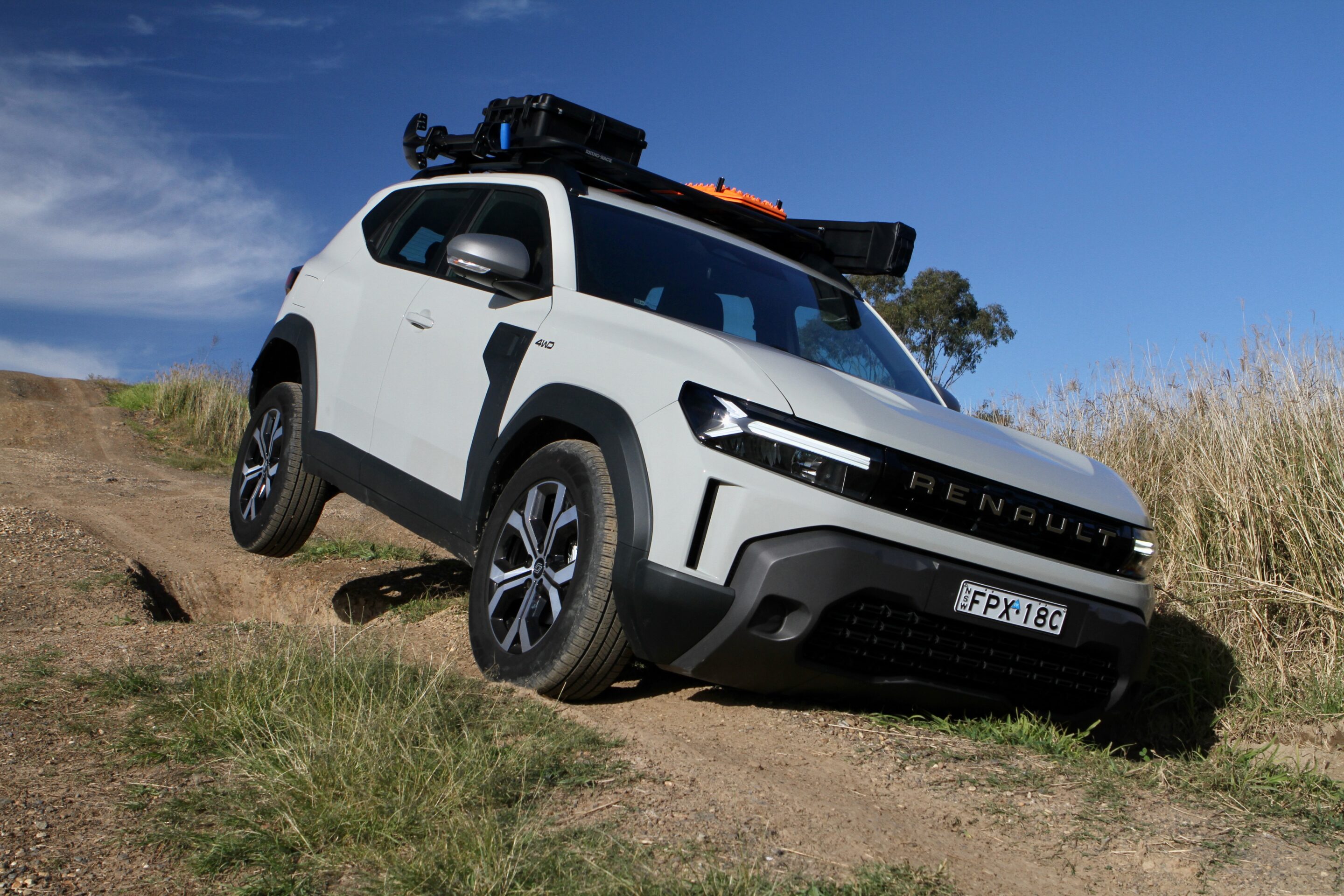
The Duster earned a reputation in Europe for being cheap, tough, purposeful and no-nonsense. If these sound like stereotypically Eastern European qualities to you, you’d be right, Dacia hailing from Romania before being acquired by Renault in 1999. Unlike prior offerings from the East, the Duster was good looking, decent to drive and didn’t rust. As a result, this modest crossover vehicle became a huge success, with production in Romania, Brazil, Colombia, Russia and India. It ran on a long wheelbase variant of the Renault-Nissan B-Zero platform, and spawned a second generation version in 2017 which was a modernised and rebodied development, running on the same old bones.
This third-gen Duster, first unveiled in November 2023 in Portugal, is a different thing, running on the far superior Renault-Nissan CMFB chassis. It’s stepped up in terms of ability and sophistication, which has naturally appalled a certain percentage of traditional Duster owners who only countenance an ascetic UN-spec white paint and steel wheels look, but a little added refinement might well bring even broader mainstream appeal. That’s certainly what ATECO is banking on, anyway.
Here in Australia, there are two powertrain choices and they’re a bit of an odd couple. The budget choice is a 113kW/270Nm 1.3-litre four-cylinder turbo engine that features a dual-clutch transmission and sends its power to the front wheels. Alternatively you can pay a bit more for the all-wheel drive car, in this case sporting a six-speed manual transmission and a weedier 1.2-litre three-cylinder 96kW/230Nm powerplant.
Technically this is a mild hybrid, but it’s so mild it could almost be classed as homeopathic. Fuel consumption is rated at 5.76L/100km (NEDC) for the 1.2-litre AWD version and 6.5L/100km for the 1.3-litre front drive variant. Real world fuel costs might well be fairly similar given that the 1.3-litre engine can drink 91RON fuel whereas the 1.2-litre unit requires you to search for the 95RON bowser.
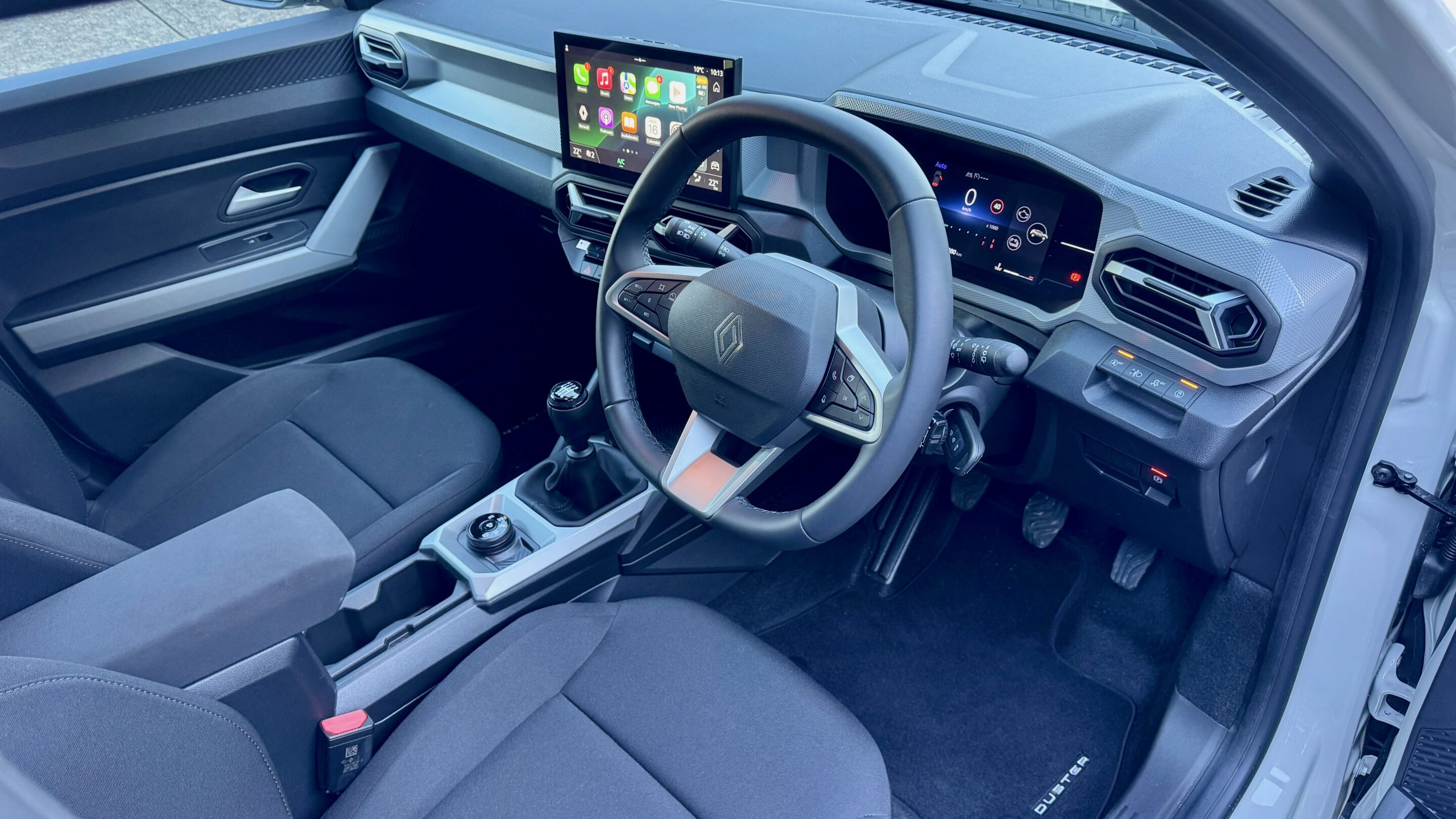
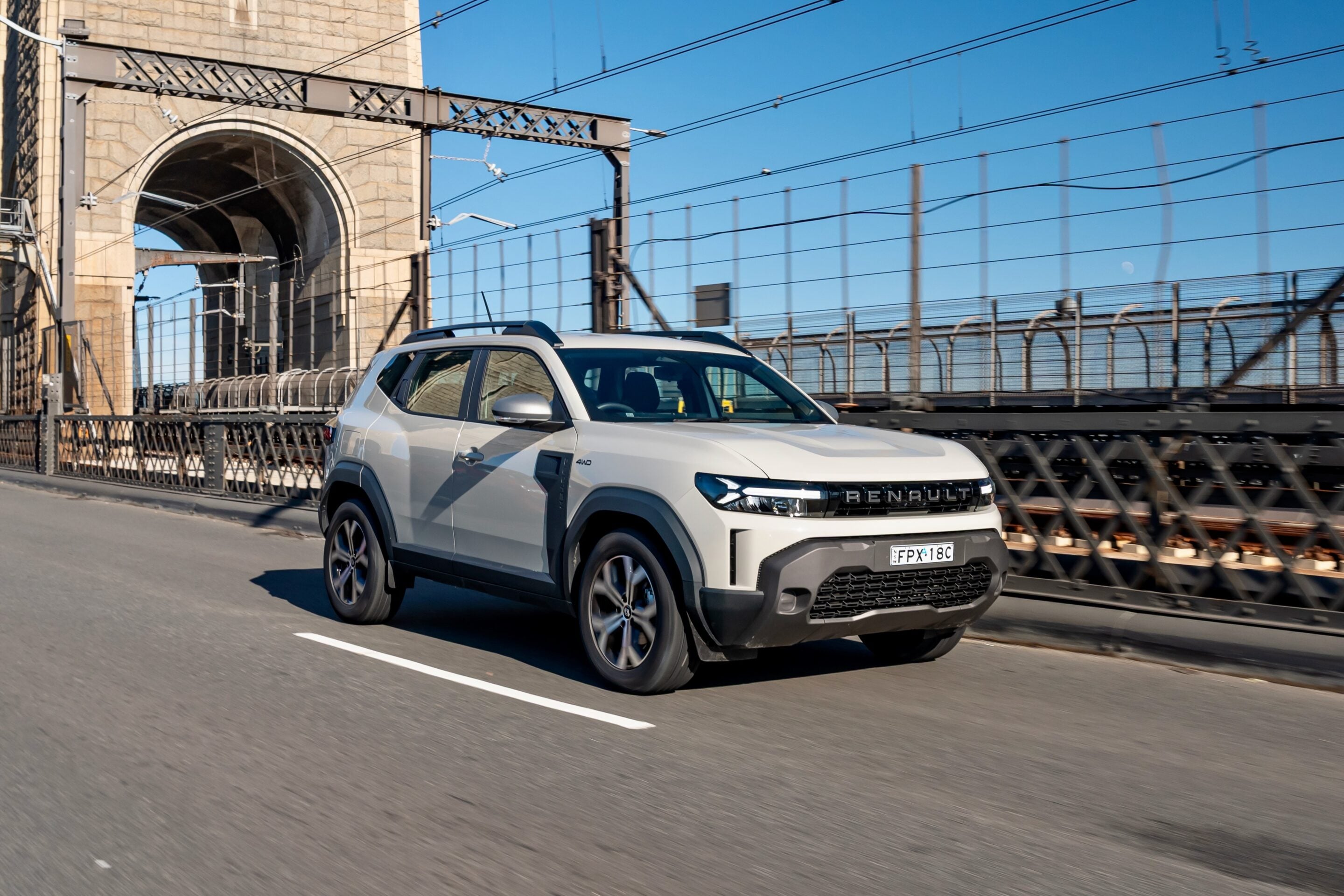
Each of these powertrains is offered in an entry-level Evolution trim or a slightly better equipped Techno guise. The front drive Evolution is priced at $31,990 and the Techno equivalent is $36,990 before on-roads. The all-wheel drive Evolution kicks off at $36,490 and the Techno is priced at $37,990.
You sharp-eyed readers might well be wondering why there’s a $5000 price difference between the two front-drive trims and a mere $1500 variance between the 4×4 variants. It’s a good question, one that ATECO didn’t seem to have a ready answer for, and likely comes down to wanting to offer an eye-catching upfront price for the entry-level car. Spoiler alert: anyone looking to snag a bargain now knows which model to buy.
Unless you feel you absolutely need the all-weather traction of all-wheel drive, or are wedded to the idea of shifting your own gears, it’s hard to escape the realisation that the 1.3-litre front-driver is the better car. It’s markedly quicker for a start. The VBOX showed 8.7 seconds to 100km/h for the dual-clutch front driver and 11.1 seconds for the manual AWD model, not helped by the fact that you need to grab for another gear at 98km/h.
Another significant difference between the two versions is that the front driver rides on a torsion beam rear end, whereas the more sophisticated AWD model features a multi-link rear end. Drive the two down a proper piece of country road and there’s not a great deal of difference. Renault put a torsion beam in its best handling cars such as the Renaultsport versions of the Megane and Clio, so there’s a lot of in-house know-how in tuning these twist beams.
Both cars ride well, steer competently and have punchy brakes. Body control is relaxed without ever being sloppy and you’re never assailed by a volley of beeps and chimes. In that regard, the Duster feels like an old car, and that’s about the biggest compliment I could give it. It’s a low-maintenance, endearing thing to cover ground in. The more powerful 1.3-litre can scrabble its front treads if you gun it out of a junction, there’s a little slack in the steering about the straight ahead that you need to take up on corner entry, and the manual shifter is a bit knuckly in the AWD car, but there’s really nothing to be concerned about.
We got the chance to take both versions on a light off-road track and they fared well, although it should be noted that the AWD version was fitted with an aftermarket BF Goodrich All Terrain KO3 knobby tyre. Ground clearance for the front-drive cars is 212mm and 317mm for the AWD variants: not bad given that a Toyota Prado features 220mm of clearance. Naturally the AWD version is good in low grip situations, but it was interesting to see just what the base front-driver could also clamber over.
The cabin is refreshingly no-nonsense, with decent seats, plenty of stowage space up front, a modestly sized screen that’ll run Android Auto and Apple CarPlay wirelessly, and hard plastics nearly everywhere. At this price I don’t really care about that, as the actual interior architecture is quite pleasant. Climbing into the back reminds you that the Duster has a bigger brother in Europe, the Bigster, which might also end up in Australia. It’s a little pinched for large adults but kids will fit just fine.
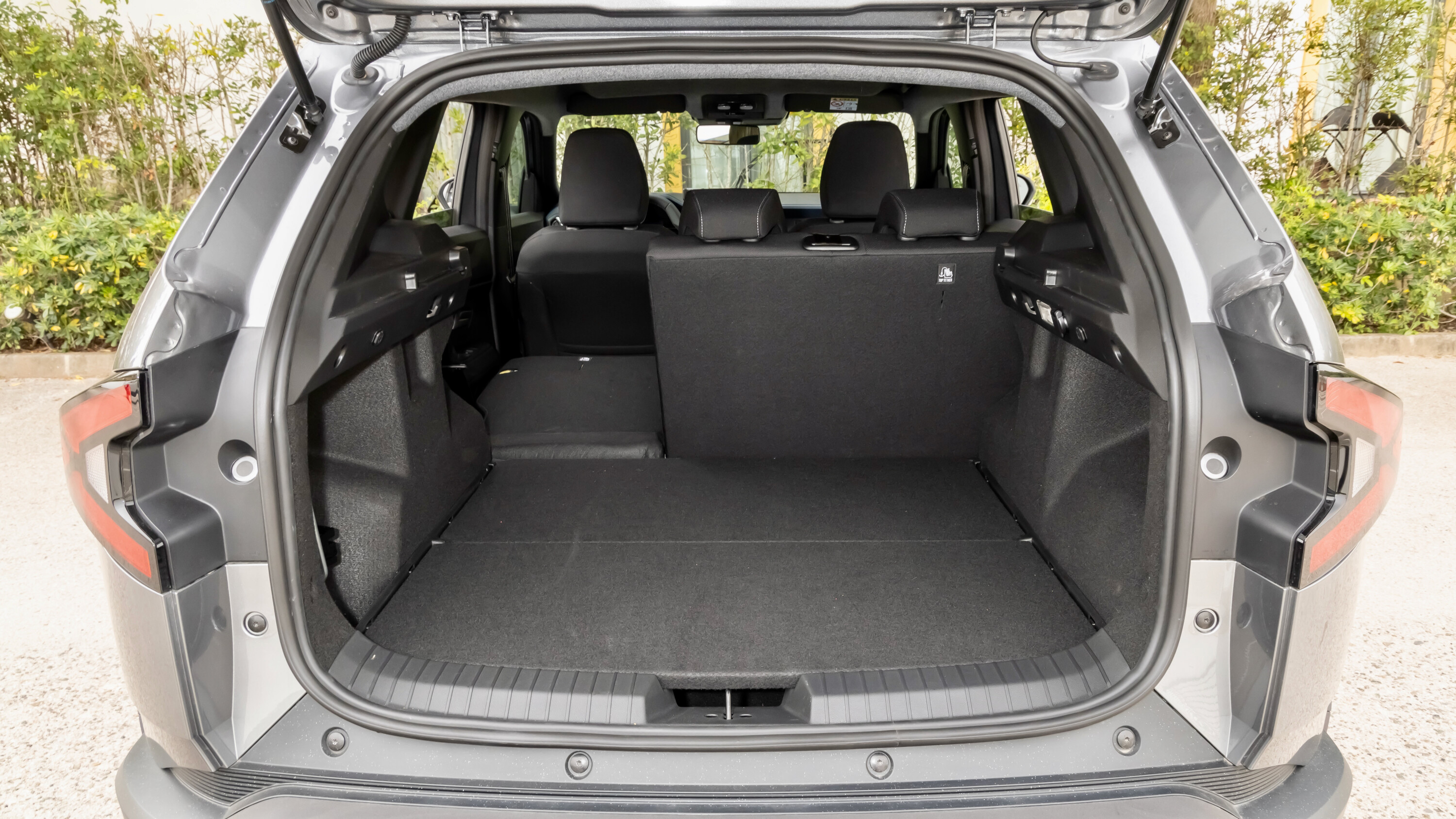
Because of the compact torsion beam rear, the boot of the front-drive model is much bigger than the AWD car. You get 472 litres of space behind the rear seats in the front-driver and a more modest but still respectable 358 litres in the AWD. Predictably, the front drive variants are lighter too, tipping the scales in Evolution trim at 1309kg, versus 1422kg for AWD Evolution variant.
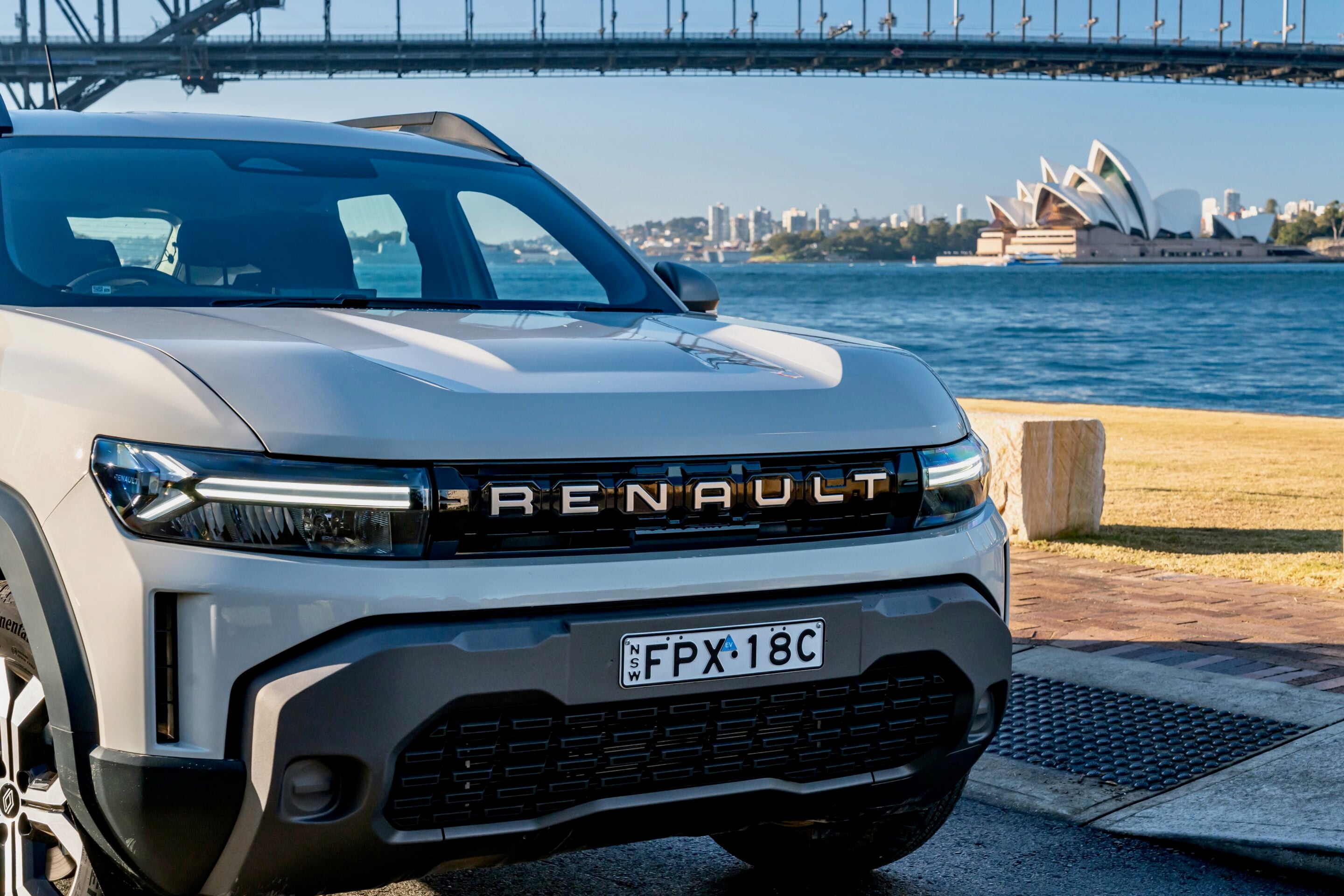
Equipment levels are adequate, with the Evolution getting features like a 10.1-inch touchscreen, DAB stereo, a wireless smartphone charger, four USB-C charging ports, rain-sensing wipers, dusk sensing headlights, 17-inch alloy wheels, roof rails and a spare wheel and tyre set. The Techno adds premium cloth seats, rear privacy glass, a multi-view camera, a start button, blind spot warning, a key card, front parking sensors, auto high/low beam, 18-inch alloys and a modular roof rail system.
Somewhat unusually, the headlights on all models feature an LED dipped beam, but an old-school halogen main beam. Solid White is the only non-cost paint finish, with Cedar Green, Sandstone, Terracotta, Shadow Grey, Khaki Green and Pearlescent Black all adding $750 to your invoice.
Safety features across all models include lane departure warning, a suite of at least eight airbags, stability control, AEB with pedestrian and cyclist detection, traffic sign recognition, driver attention alert, cruise control, speed limiter, rear parking sensors, tyre pressure warning and an ADAS personalised settings button which you can set up once and then store your preferred setup. Renault’s version of this is the industry’s best.
What’s quite far from industry best is the Duster’s Euro NCAP crash rating which was assessed as three stars in 2024. It registered a score of 70 per cent for adult occupant protection and 84 per cent for child occupant protection but was downmarked for vulnerable road users (60 per cent) and safety assist (57 per cent).
The warranty is Renault-spec five years and unlimited kilometres, and there’s a five-year pre-paid servicing plan available that’s priced at $2100 for the all-wheel drive model and $2150 for the front drivers.
It’s an interesting vehicle, the Duster. There’s a lot to like. It drives well, it looks good, it’s decently practical and seems to offer all the things you’d need, but little of the flim-flam that makes so many modern cars so annoying. The $31,995 asking price for the entry-level model instantly makes that an easy recommendation, but there are some caveats to bear in mind.
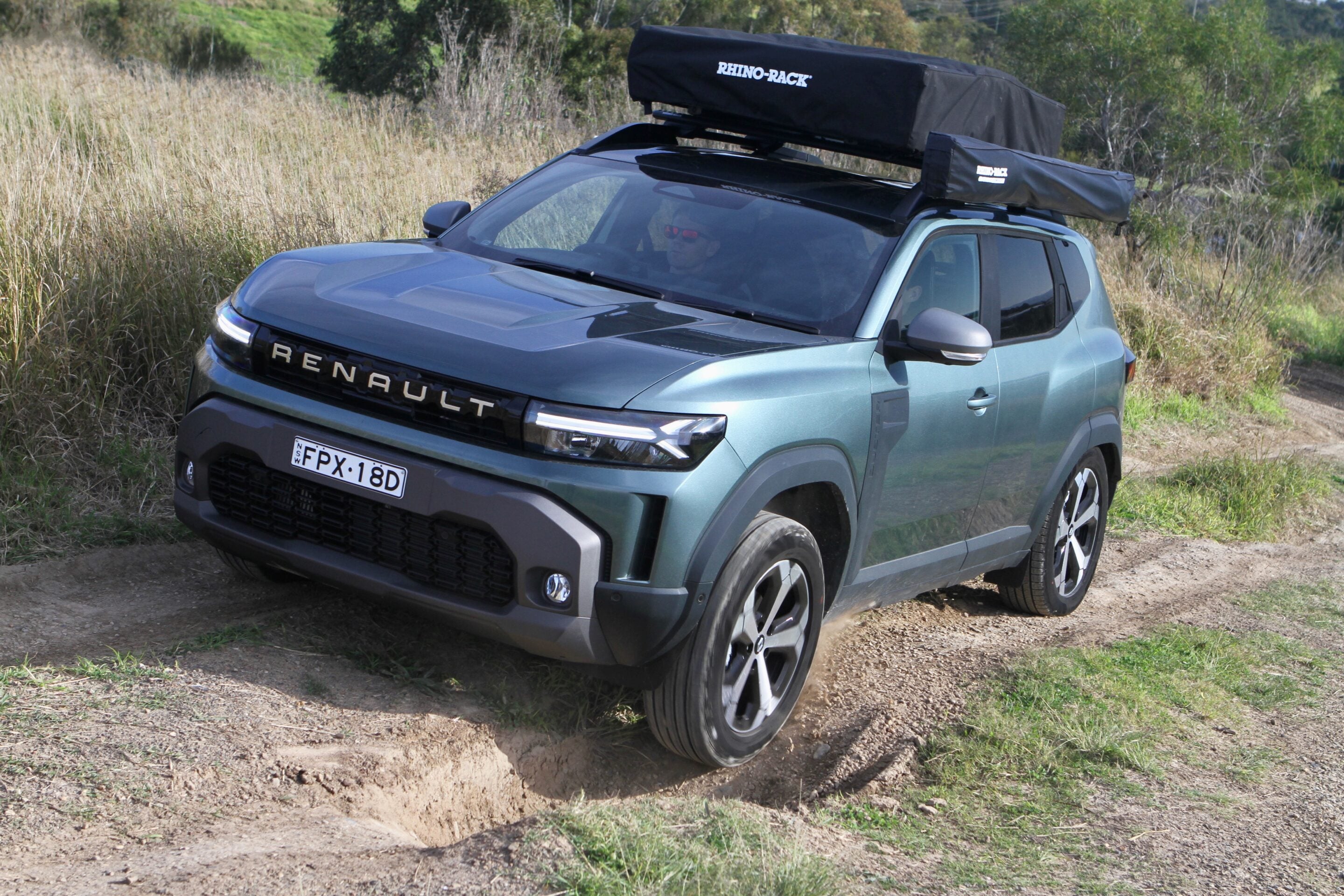
Dacia has long held the opinion that chasing Euro NCAP stars merely adds unnecessary cost to cars that are adequately safe already. It’s been in a stoush with the safety body for some time over poor ratings being given to Dacia models that the safety body hadn’t individually tested. So there’s bad blood there. That the Duster wears a Renault badge in this country doesn’t change any of that backstory.
I quite like the fact that we’re entrusted to make an informed decision. If the Wheels mailbag is any indication, you may have a similar view to Dacia, in which case the Duster probably has more than enough safety provision for you. On the other hand, if you’re a parent and want the absolute safest, lowest-risk option for your growing family, you may feel more comfortable looking elsewhere.
There’s also the slightly odd trim walk-up to consider. On paper, it would seem to have made more sense for Renault to offer a basic, manual front-drive car with a lower powered engine, and then a ritzier, dual-clutch, all-wheel drive model with more power. Instead, there’s now a strange mish-mash of these attributes that doesn’t make all that much sense. The cheapest car is the most powerful and has the more sophisticated transmission. Figure that one out.
Ultimately, the Duster is a very welcome addition to Australia’s carscape. It feels well-suited to Aussie conditions, being rugged, simple, inexpensive and practical. It’s hugely endearing and deserves to sell well. If you’re looking for a budget offering that’s well proven and wears a respected European badge, put it on your shortlist.
Specs
| Model | Renault Duster 1.3 Evolution (FWD) |
|---|---|
| Price | $31,990 plus on road costs |
| Engine | 1333cc 4cyl, DOHC, 16v turbo |
| Transmission | 7-speed dual-clutch |
| Peak power | 113kW @ 5500rpm |
| Peak torque | 270Nm @ 2250rpm |
| Kerb weight | 1309kg |
| L/W/H/WB | 4345/1921/1650/2657mm |
| 0-100km/h | 8.7sec (tested) |
| Boot space | 472L/1564L |
| Available | Now |
This article originally appeared in the September 2025 issue of Wheels magazine. Subscribe here and gain access to 12 issues for $109 plus online access to every Wheels issue since 1953.
Chery has pulled the wraps off the MY26 Tiggo 7, the latest update to its popular mid-size SUV, arriving in Australian showrooms with a bolder design, new technology, and improved efficiency.
Known for practicality and value, Chery believes its latest version strengthens its appeal to Australian families and urban buyers.
The entry-level Urban is priced from $29,990 drive-away, making it one of the most affordable mid-size SUVs on the market with this level of equipment. Stepping up to the Ultimate, priced at $33,990 drive-away, adds further premium touches and technology.
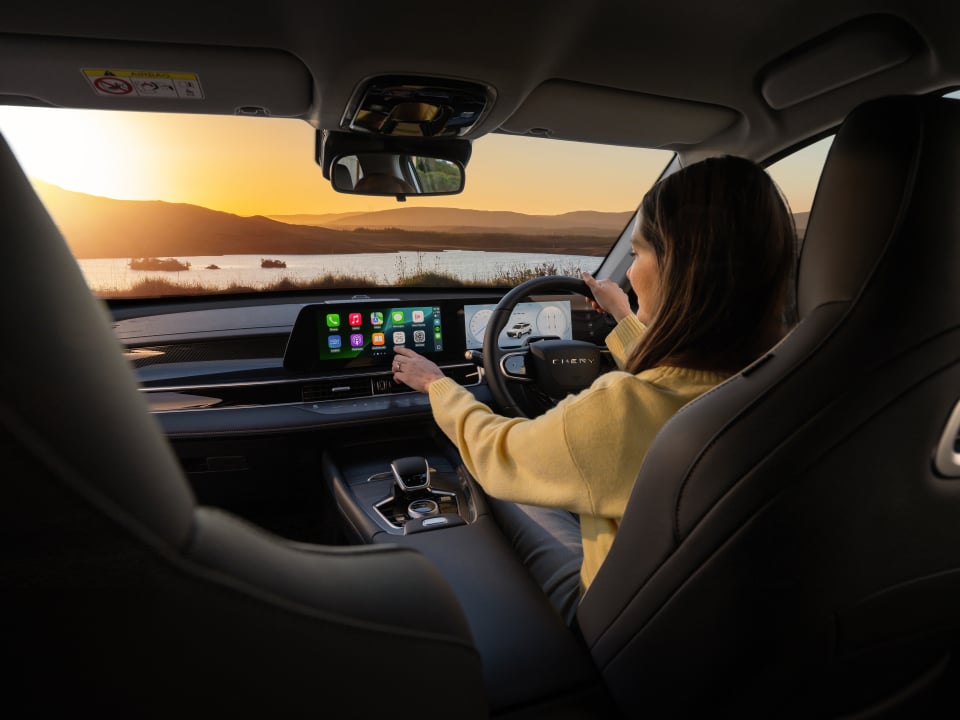
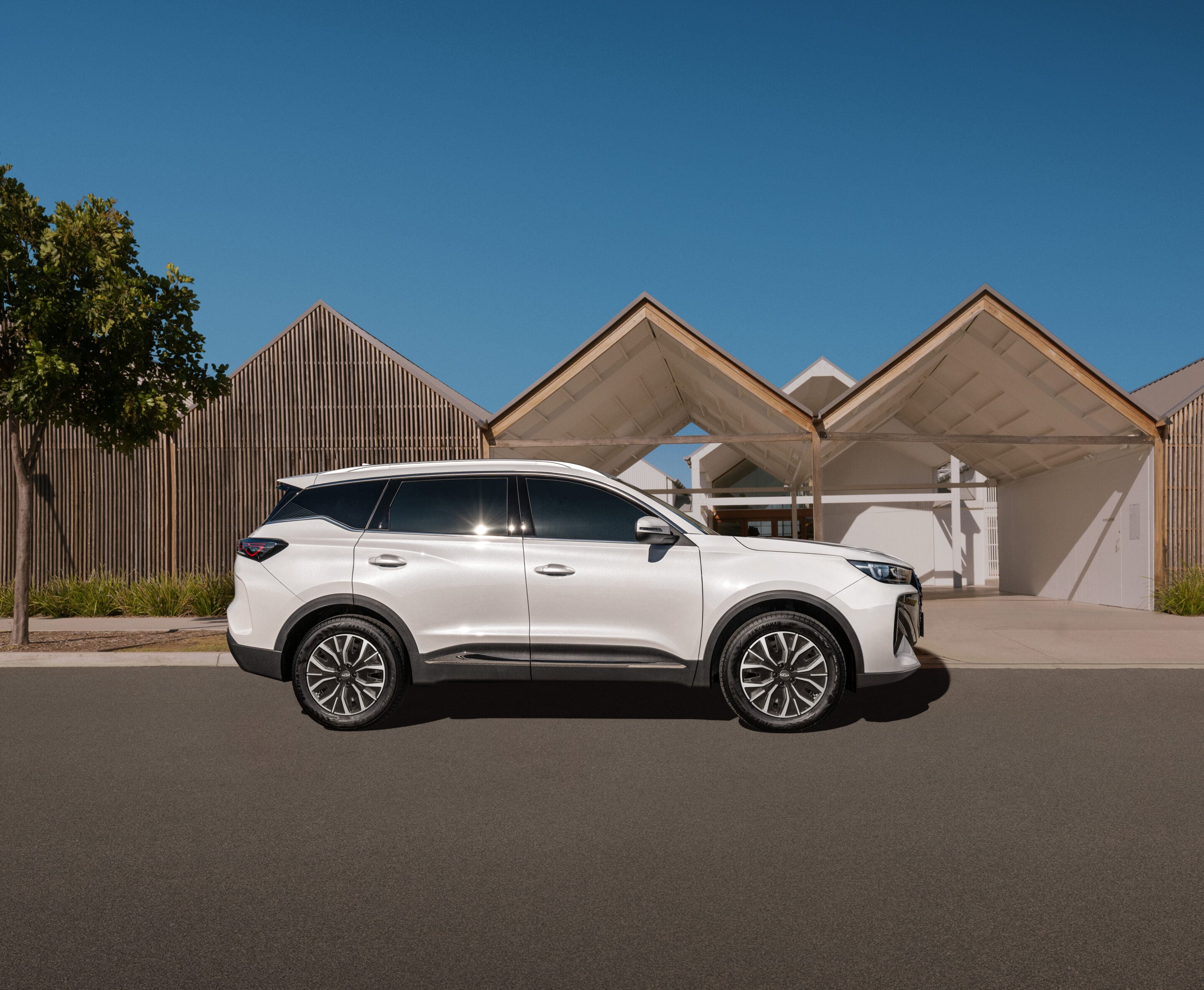
Outside, the MY26 introduces slimmer LED headlights and integrated taillights, giving the SUV a more premium road presence. Inside, drivers will find a contemporary cabin centred on twin 12.3-inch digital displays. Wireless Apple CarPlay and Android Auto, wireless phone charging, and a six-speaker sound system are all standard.
Under the bonnet sits a 1.5-litre turbocharged petrol engine paired with a six-speed dual-clutch automatic transmission. The engine produces 108 kW and 210 Nm, while fuel use has been slightly improved to 6.9 L/100 km combined, offering a balance of efficiency and performance suited to city and highway driving.
Standard ADAS features include adaptive cruise control, autonomous emergency braking, lane keep assist, and a suite of airbags covering the front, sides and curtain areas.
As with the rest of Chery’s line-up, the Tiggo 7 continues to be supported by a seven-year/unlimited kilometre warranty, seven years of capped price servicing, and up to seven years of roadside assistance.
The MY26 Tiggo 7 is available to order now, with first deliveries expected before the end of 2025.
Specs
Urban – $29,990 DA
- 18-inch Alloy Wheels
- Reversing Camera
- 7 Airbags
- TPMS (Tyre Pressure Monitoring System) with Display
- Temporary Spare Wheel
- Acoustic Glass Windscreen
- Intelligent Voice Command (Hello Chery)
- 6 Speaker Sound System (4x Speakers, 2x Tweeters)
- 12.3″ LCD Driver Instrument Cluster
- 12.3″ LCD Infotainment Touchscreen
- Apple CarPlay & Android Auto (Wired + Wireless)
- 6-Way Manual Adjustable Driver’s Seat
- 4-Way Manual Adjustable Front Passenger Seat
- Premium Steering Wheel
- LED Daytime Running Lights (DRLs)
- LED Taillights and Headlights (Projector Type)
- Dual-Zone Automatic Air Conditioning
Ultimate – $33,990 DA
- Panoramic Sunroof (Slide & Tilt Function) with Powered Sunshade
- Colour Selectable Ambient Lighting
- Synthetic Leather Seats
- Heated and Ventilated Front Seats
- 6-Way Power Adjustable Driver’s Seat
- 4-Way Power Adjustable Front Passenger Seat
- 50W Wireless Charger*
- Puddle Lights
- 360° Around View Monitor
- Front Parking Sensors
- Retractable Cargo Blind
- Power Tailgate
Australian pricing for the new Volvo ES90 large electric car has been announced ahead of its impending local arrival. Priced from $88,880 plus on-road costs, the ES90 will initially be offered in two variants locally with up to 554km of range (WLTP) and 305kW DC fast charging. Not actually a sedan despite its appearance, the luxurious ES90 is also high-riding like an SUV, but is also a hatchback for more practicality.
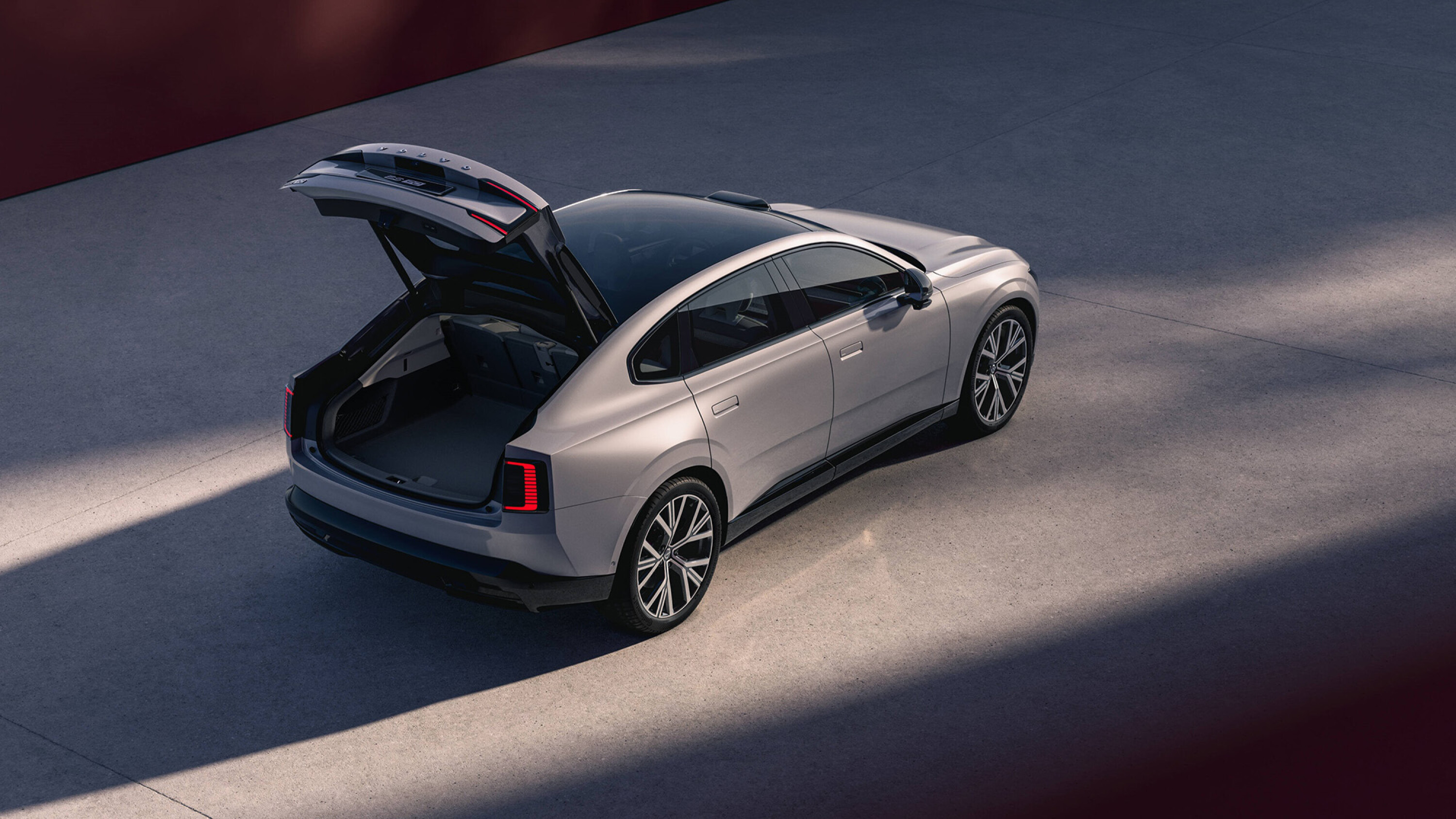
Measuring 5000mm long, 2120mm wide and 1546mm tall with a 3102mm wheelbase, the ES90 is 31mm longer than the S90 it replaces, which was last sold locally in 2018. Bootspace is rated at 424 litres with the seats up and 733 litres with them folded, plus a 22 litre front boot as well.
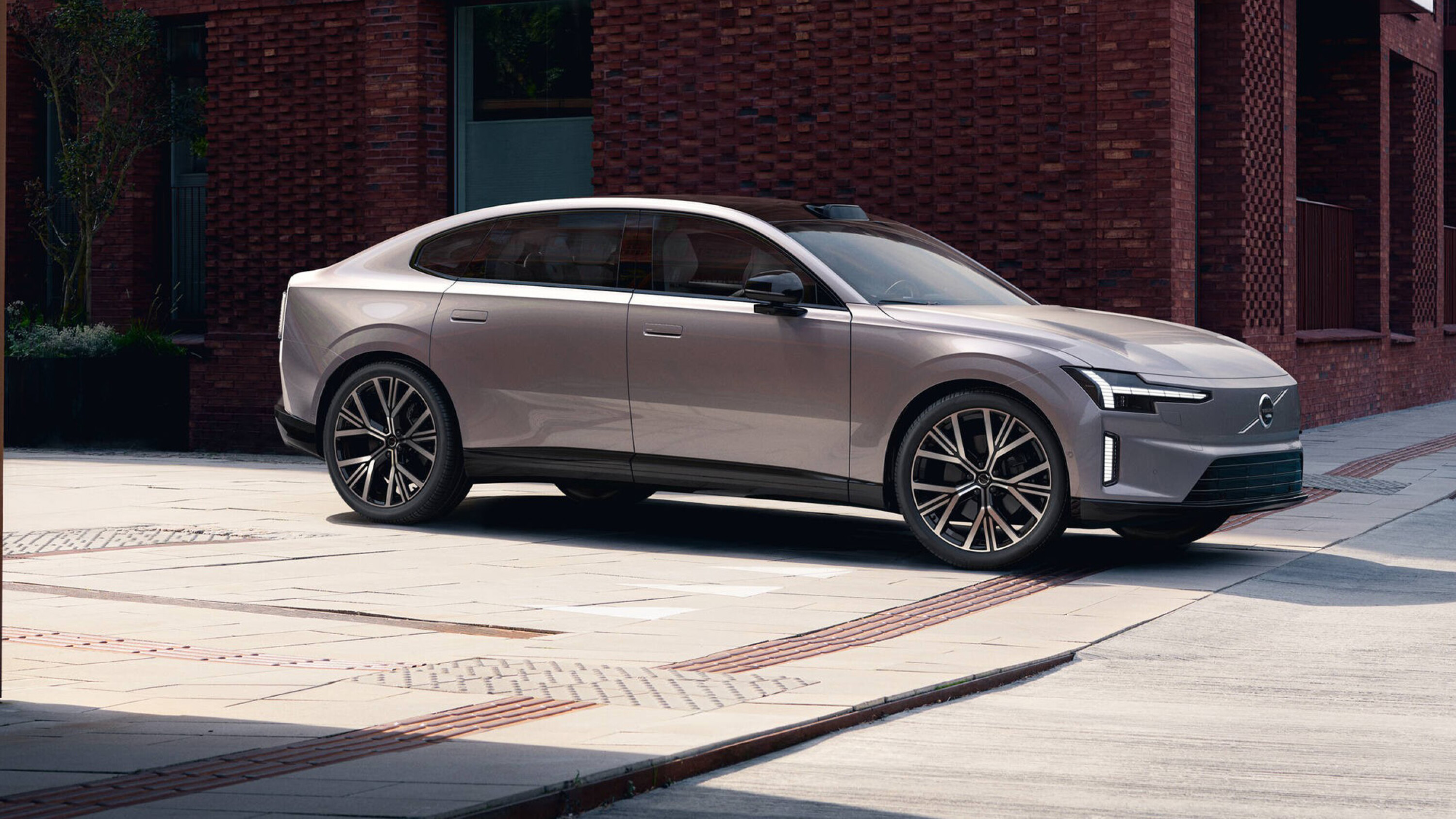
Rivalling cars such as the BMW i5, the Volvo ES90 features a 92kWh battery for a claimed 554km of range (WLTP), which can be charged at up to 350kW on a DC fast charger – the first Volvo model to do so – for a claimed 10 to 80 per cent charge time of just 22 minutes.
Propulsion is handled by a 245kW/480Nm single motor, which is powerful enough for a claimed 6.6-second 0-100km/h time. More powerful dual motor drivetrains exist overseas with up to 500kW of power, but aren’t yet available in Australia.
Standard equipment on the entry-level ES90 Plus includes 20-inch alloy wheels, a 14.5-inch touchscreen with inbuilt Google, a panoramic roof, four-zone automatic climate control, heated front and rear seats, a heated steering wheel and digital key functionality.
The upper-spec Ultra adds Pixel adaptive high beam, a 25-speaker Bowers & Wilkins sound system, soft-closing doors, Nappa leather upholstery, ventilated and massaging front seats and active air suspension.
“The Volvo ES90 combines our most advanced technologies with Scandinavian design and superior
comfort, creating a true premium Volvo car designed to elevate your quality of life,” says Stephen
Connor, managing director Volvo Car Australia. “It joins the EX90 SUV as one of our flagship models
and cements our position as an industry leader in software-defined cars that harness the power of
core computing.”
Volvo ES90 pricing (plus on-road costs):
- Plus Single Motor: $88,880
- Ultra Single Motor: $107,990
The Volvo ES90 will enter local Volvo showrooms soon.
