Ford Falcon

Gallery 1
First published in the July 2014 issue of Wheels magazine, Australia’s best car mag since 1953.
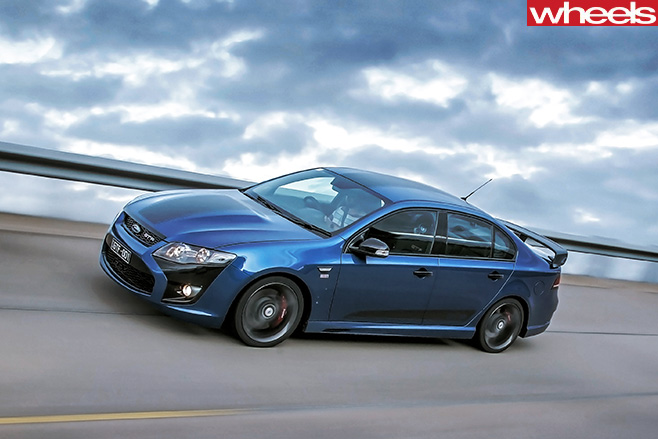
With a nod to Ford’s glorious past, FPV has kept its best for last.
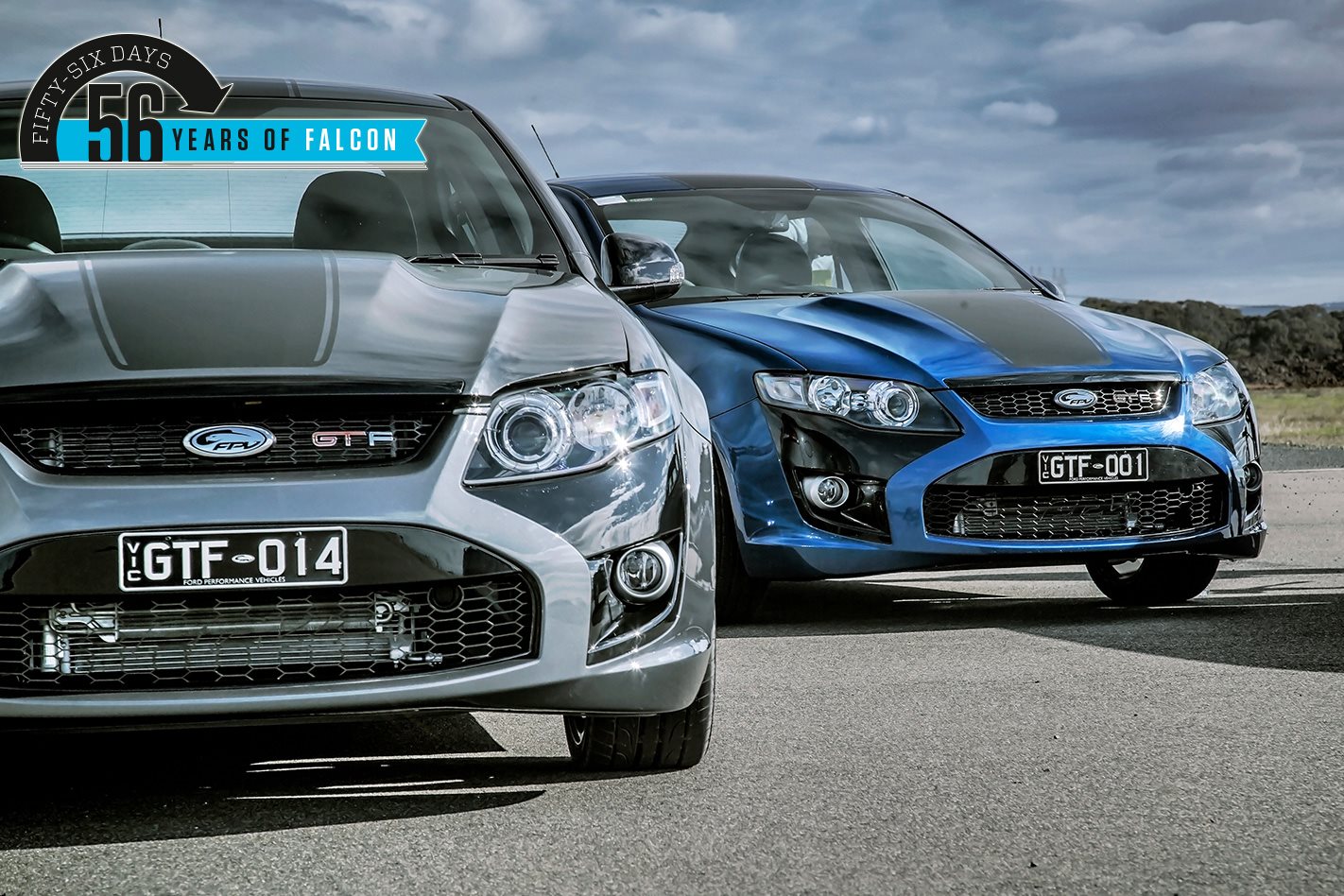
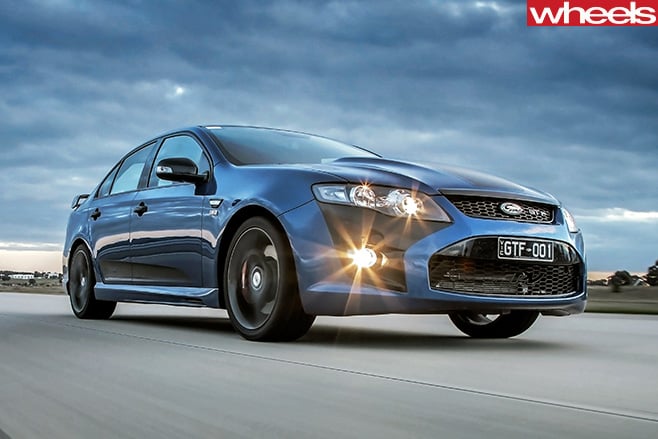
F IS A LETTER no one wants to see on their report card. And it’s definitely something Blue Oval fans didn’t want to see on a Ford Falcon. Especially when F stands for Final – the last-ever high-performance Australian Ford, and the final car to wear a Ford Performance Vehicles logo. So it’s with mixed emotions that we introduce to you the last car, and the best, ever produced by FPV – the GT-F 351.
On the surface, it seems like no coincidence that those three iconic digits – 351 – have reappeared on the farewell FPV. The Falcon nameplate was at its zenith when Ford’s flagship V8 grew to 351 cubic inches (5.8 litres) in 1969, before reaching legend status a couple of years later in the homologation-special Ford XY Falcon GT-HO Phase III. But, four decades of metrification later, 351 now stands for kilowatts, which, for those who still mentally measure an engine’s muscle in ponies, is 471 horsepower.
What seems like an ‘engineered’ power figure, though, is actually the first number the GT-F’s supercharged 5.0-litre V8 showed on Ford’s dyno.
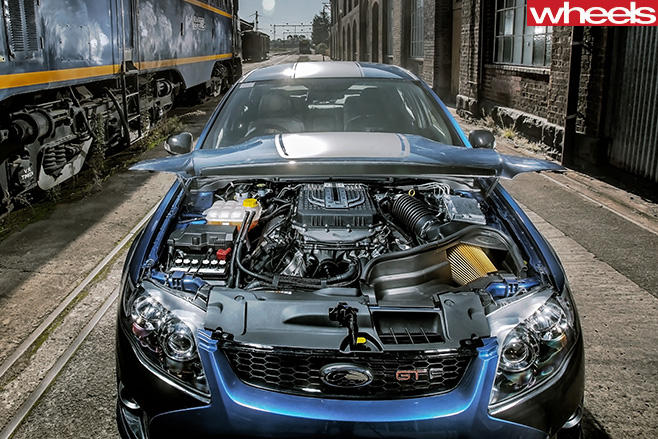
“This engine has a whole bunch of headroom”, says Bernie Quinn, engineering director of Prodrive, referring to the blown ‘Miami’ V8 he played a large part in developing in 2010. Quinn knows the Australian-fettled, Geelong-assembled 5.0-litre quad-cam V8 as well as anybody, and has achieved the GT-F’s iconic power figure without any hardware alterations whatsoever. It’s all in the new ECU.
At its core, the 5.0-litre V8 is an extremely efficient engine, with low intake losses and very low exhaust back pressure, but Quinn says that, with the software technology available to FPV back in 2010, its conservative 335kW was “as much as we could put into it without tearing the car apart”.
Measured according to the most stringent power/torque certification in the world – the ECE system – the GT-F’s supercharged 5.0-litre puts out 351kW at 6000rpm and 570Nm from 2500-5500rpm, whether at sea level in the Northern Territory or at the top of Mt Kosciuszko. But there’s a degree of overboost lurking in the background that, when prevailing conditions are favourable, can bolster both those outputs by “about 15 percent”. No one at Ford or Prodrive was willing to name an exact number, but do the maths and you’re looking at more than 400kW and 650Nm!
Extracting performance times from a standard 335kW FPV was something we looked forward to about as much as a digital prostate check. Didn’t matter how prepared or relaxed you were, it was gonna be painful, or messy, or both. But not the GT-F. Its fat 275/30R19 Dunlop SP Sport Maxx rear boots – part of its R-Spec suspension package – add a big boost to off-the-line and cornering grip. Launch control plays its part, too.
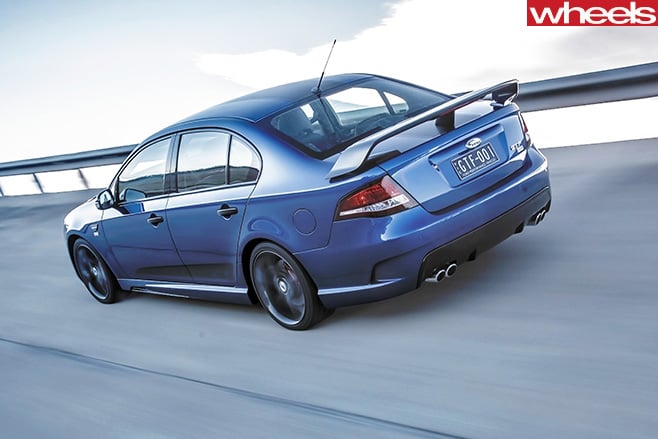
How quick? In 17-degree weather on a concrete surface at Ford’s proving ground, the GT-F auto snatched triple digits in 4.68sec, backed by a subtle blurting from its exhaust pipes as the ZF auto upshifted with rapid-fire slickness.
But it’s the thrust from 150-200km/h that shows just how robust the blown V8’s grunt is. A standing 400m time of 12.68sec (at 186.7km/h) is nothing to be sneezed at, and the GT-F’s pace to 200km/h (14.61sec) makes for an interesting comparison against the world’s fastest sports sedans. We recently clocked 13.9sec to 200km/h in an HSV GTS auto, and the same 2.4sec from 80-120km/h as we did in the GT-F. Make no mistake, FPV’s farewell vessel is a veritable missile.
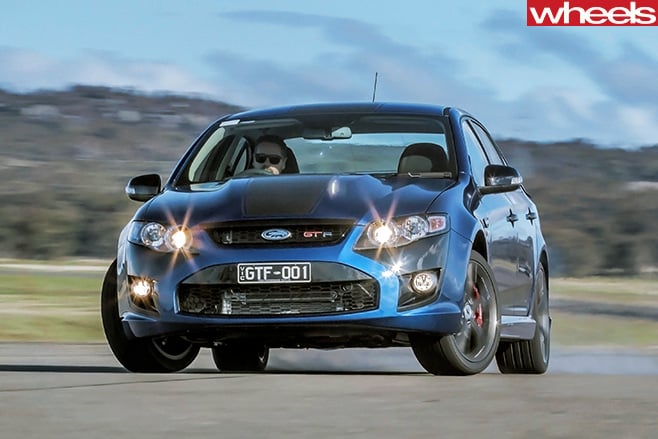
While the auto remains the drag-strip maestro, the manual’s no slouch. The best of three quick runs produced 4.94sec to 100km/h and a 13.09sec standing 400m at 185.4km/h. Given familiarity with the Tremec’s gearshift, you could easily pick up a tenth or two.
Ford’s product planners were caught off-guard by the 351kW GT-F’s enthusiast focus, with far more buyers expressing interest in the manual than anyone anticipated. Impressive as the ZF auto is, the manual would be our choice, too. It’s a great match to the GT-F’s muscular personality.
It follows the same format as 2012’s GT R-Spec, featuring its mixed-width wheel and tyre package (including 19 x 9.0-inch rear alloys wearing 275/30R19 Dunlops) and the now-discontinued GT-P’s premium brakes – 355mm cross-drilled front discs with six-piston Brembo calipers, and 330mm cross-drilled rears with four-piston Brembo calipers.
GT-F’s suspension tune also mirrors the R-Spec – higher spring rates, retuned Sachs monotube dampers, stiffer front upper control arm bushes, stiffer upper suspension mounts, a larger 19mm rear anti-roll bar, reinforced rear lower control arms and a revised toe setting on the rear wheel alignment to improve turn-in, plus stiffer transmission mounts to “reduce powertrain and driveline movement under load”.
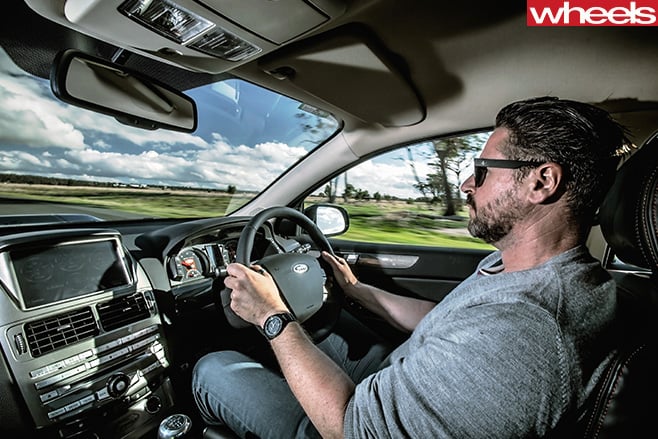
Thanks to the nuances of the new Bosch 9.0 ECU in adjusting power and torque parameters, the GT-F can use more of the available grunt when the car is capable of using it. Combined with the R-Spec suspension package, which moves the chassis’ roll centre from roughly where the driver sits to down near the rear suspension, the GT-F feels far more stable, progressive and comfortably controllable than any non-R-Spec supercharged FG.
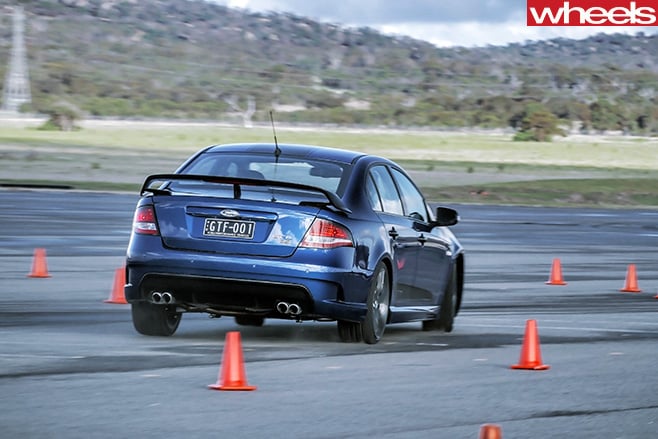
Turn-in is as quick as it’s ever been in an FG FPV, and the GT-F has the tyre grip and the chassis poise to maintain the directional change promised by its front end. Leaning on its outside rear Dunlop, the GT-F enables progressive balance adjustments via the throttle, yet its dynamic threshold is far beyond the constant oversteer minimisation that was the first supercharged FPV.
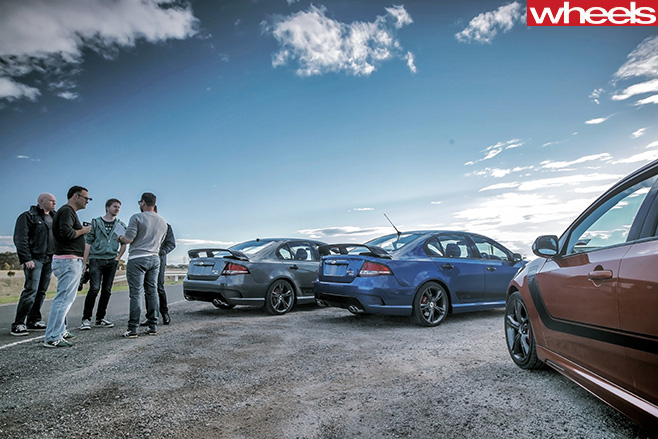
Yet for all the GT-F’s cornering and drifting bravado, it still manages to ride well. Over a 20km loop outside Ford’s You Yangs proving ground, I was surprised at how composed and cohesive the GT-F felt over broken tarmac. It wasn’t the over-stiff sled I expected.
The final and probably most important surprise, though, is the GT-F’s styling. At its core, this circa-2008 Falcon offered little scope for a wholesale refresh, yet design manager Nick Eterovic and his team have done a brilliant job making the most of what they had to work with.
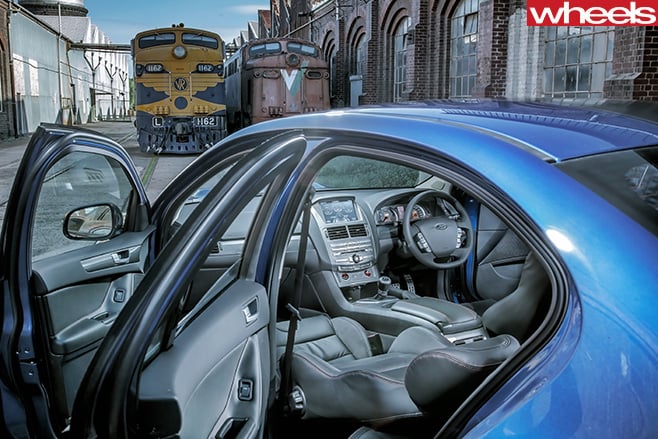
So the GT-F gets a wide, matte-black over-body stripe – reminiscent of the anti-reflective matte-black bonnets of 1960s and ’70s race cars – flanked by a thinner pair of stripes, and matte-black inserts into the scallops in the lower doors. Familiar as the Falcon shape may be, the GT-F’s look is tough and recognisably different.
Still, if it wasn’t for the passion of the engineers, designers and program managers championing the GT-F, it would never have turned out the way it did. They really wanted to do the nameplate justice.
It was a labour of love, born out of the enormous affection for performance Fords in this country, and behind the scenes at Broadmeadows. As GT-F project manager Justin Capicchiano points out, it’s an emotional car for Blue Oval fans and also the guys working on it. “People would come up to you in the hallways at work and say ‘you’ve got to do a good one, you’ve got to make it special’.” And they have.
Follow WhichCar/Wheels on Google
Click the button below to make WhichCar by Wheels a preferred source for your news.