
Reviews
Gallery 1
5
/10
Score
Score breakdown
5.0
Safety, value and features
7.0
Comfort and space
4.0
Engine and gearbox
7.0
Ride and handling
4.0
Technology
Things we like
- Punchy off the mark
- Quiet road manners
- Full-size spare is rare these days
Not so much
- Not enough driving range to be useful
- Neither a workhorse or weekender
- Payload takes a hit thanks to EV battery
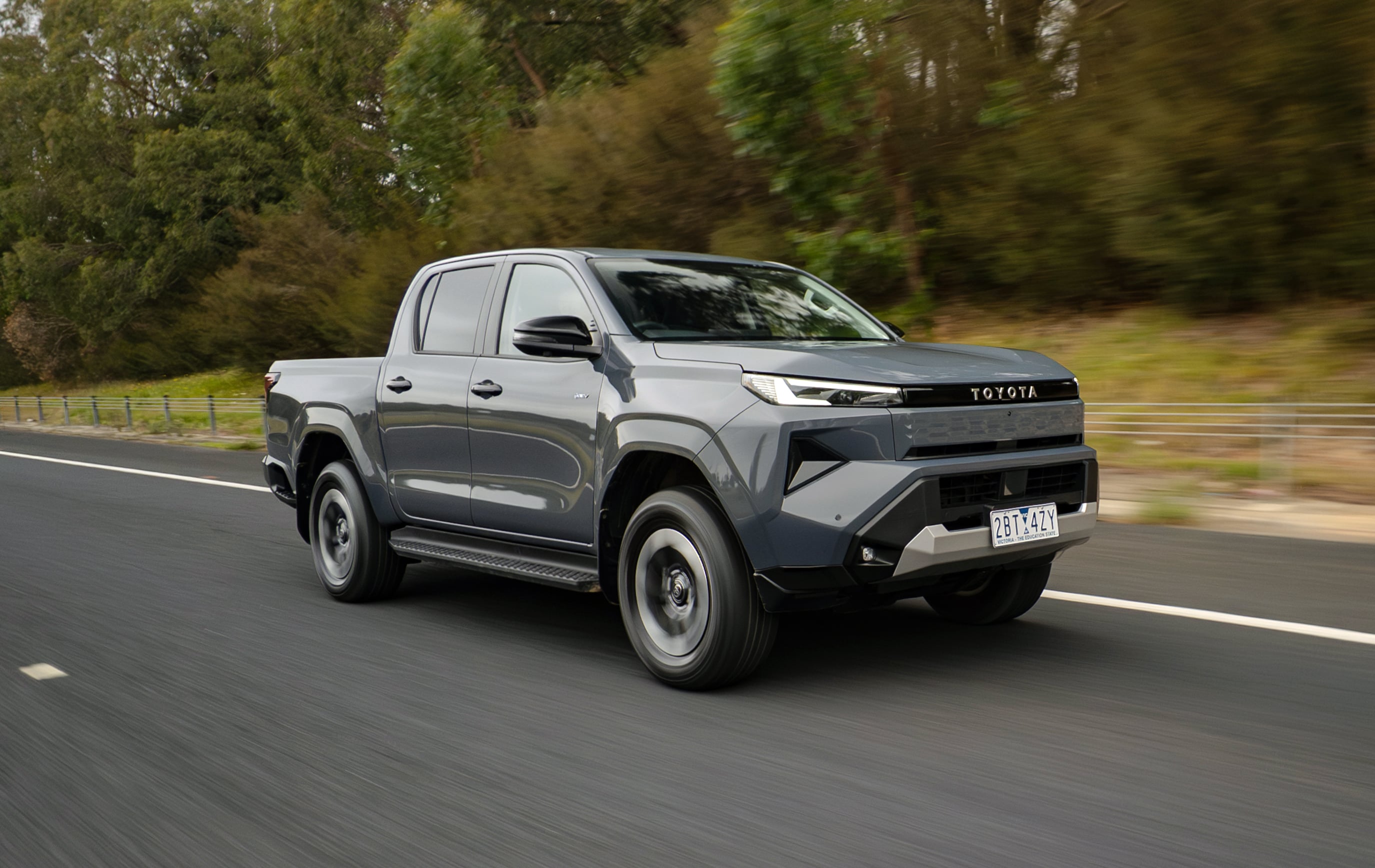
The world has been waiting for a battery-electric Toyota HiLux and now it’s here. But no.
The sparky full-factory all-wheel drive HiLux is much more of a show pony than a genuine workhorse, or even a weekend trail rider, for now. Things will change and the HiLux will be supercharged in many ways over time but, for now, it’s a good idea but underwhelming in reality.
It’s a nice relaxing drive, the EV workings are well integrated and well protected, and it comes with all the goodness of a Toyota ownership experience.
1
Then there are the buts. And there are a few.
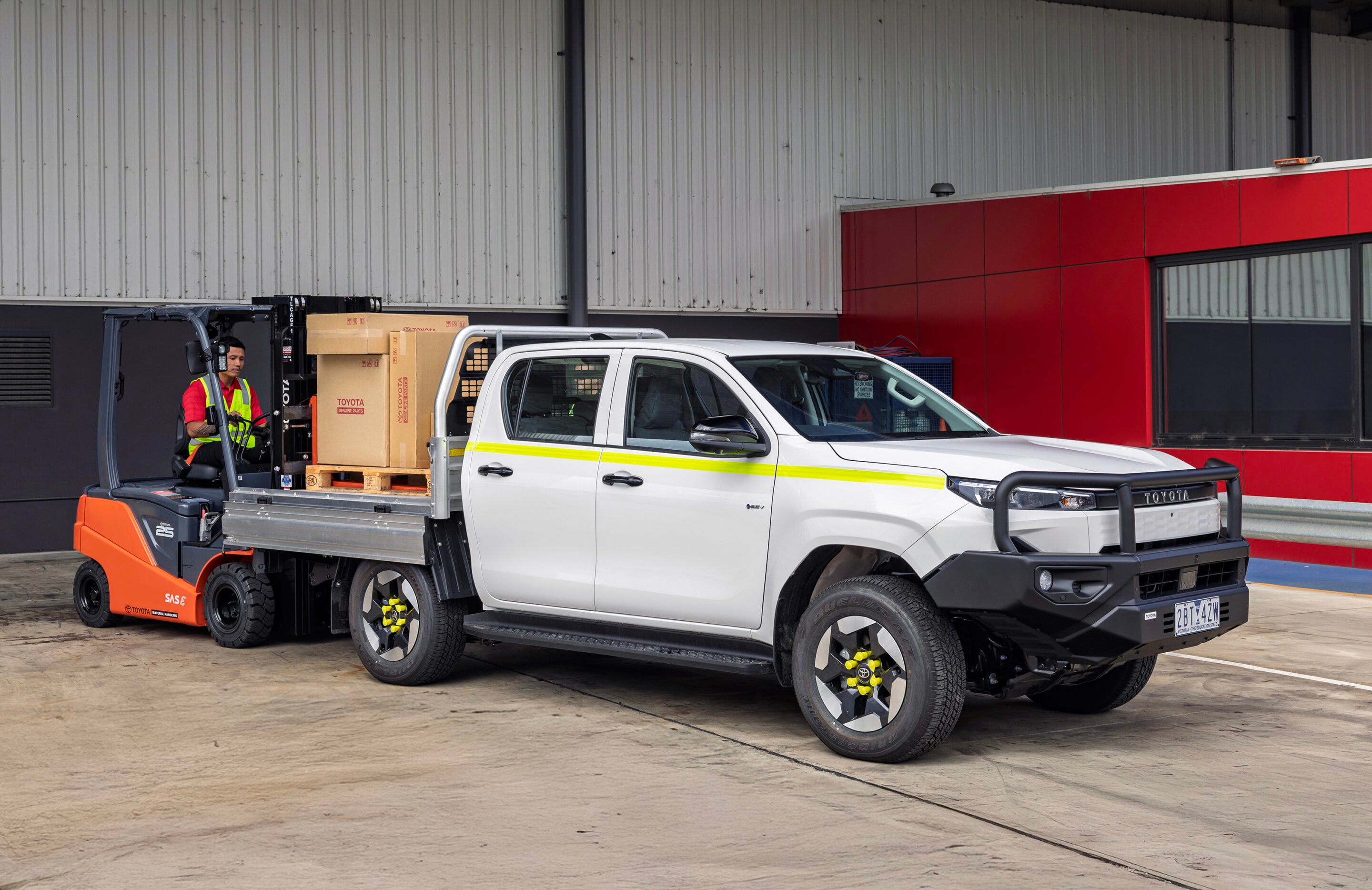
Range? That would be a maximum of 315 kilometres for the double-cab pick-up, but a miserly 245 for the cab-chassis work-mobile. And those figures are by the more generous (read, more lenient) NEDC testing regime, and not the more rigorous and closer to reality WLTP protocols. In our experience, expect a realistic driving range a good deal lower than Toyota’s quoted figure.
Payload? Up to 725 kilograms on the basic model, or 855kg for the SR cab-chassis. Both are significantly down on their diesel counterparts – 965kg for SR double-cab and SR cab-chassis’ 1065kg.
And towing? Two tonnes, but with no official claim on range once you have something heavy hanging off the tail. Regular HiLux is renowned for its 3500kg braked towing capacity.
2
So, the price? At least $74,990 and as much as $82,990 for the double-cab SR5.
So why is Toyota doing it? Because it needs to spread the electrification through its whole family, beyond the all-hybrid plan for Australia, and HiLux land is ripe for targeted and very specific customers.
Based on the early uptake, people are waiting for the early reports from the frontline. Toyota has taken less than 400 pre-orders for the HiLux BEV and less than a dozen of those are from private customers. So it’s business buyers and government bodies, especially at the local level where green washing can translate into votes.
Toyota, of course, is talking big but being careful not to over-promise on the BEV-mobile.
1
“Toyota still believes that a turbo-diesel powertrain still currently offers the best powertrain option for heavy trade and recreational four-wheel drive customers,” said Toyota head honcho John Pappas at the electric ute’s launch.
“But, for companies and fleets that have easily accessible back-to-base charging facilities and want to reduce their carbon emissions, but still require the flexibility and functionality of a four-wheel drive pick-up, our double-cab 4×4 HiLux is a strong contender.”
Core to its development was to maintain as much of the turbo-diesel HiLux’s payload and off-road capability and durability, and that meant optimising the size of the battery from a packaging and weight perspective
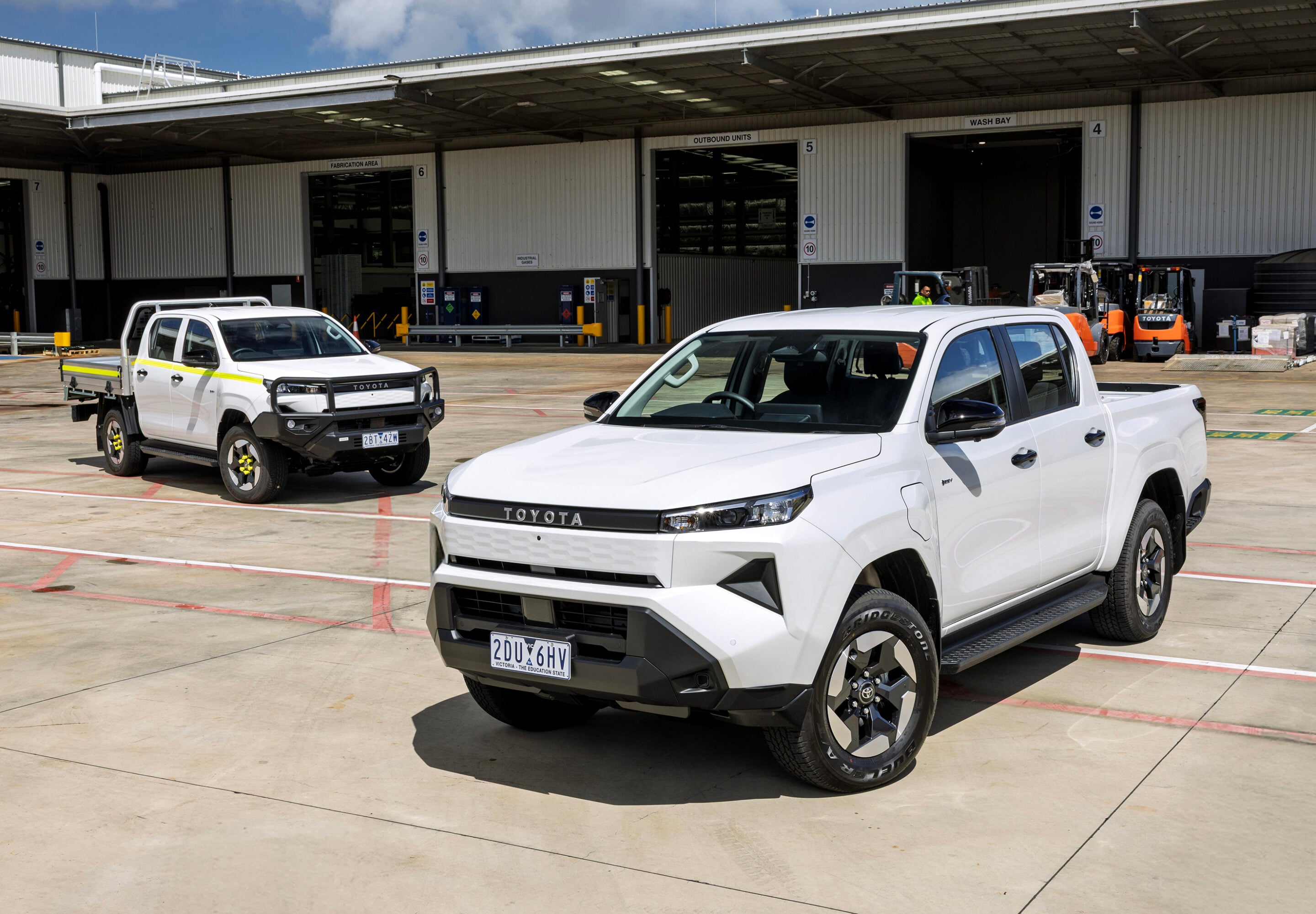
The HiLux BEV is only available in two body styles – double-cab chassis and double-cab pick-up – and there are only three colours, including two working-class whites.
2
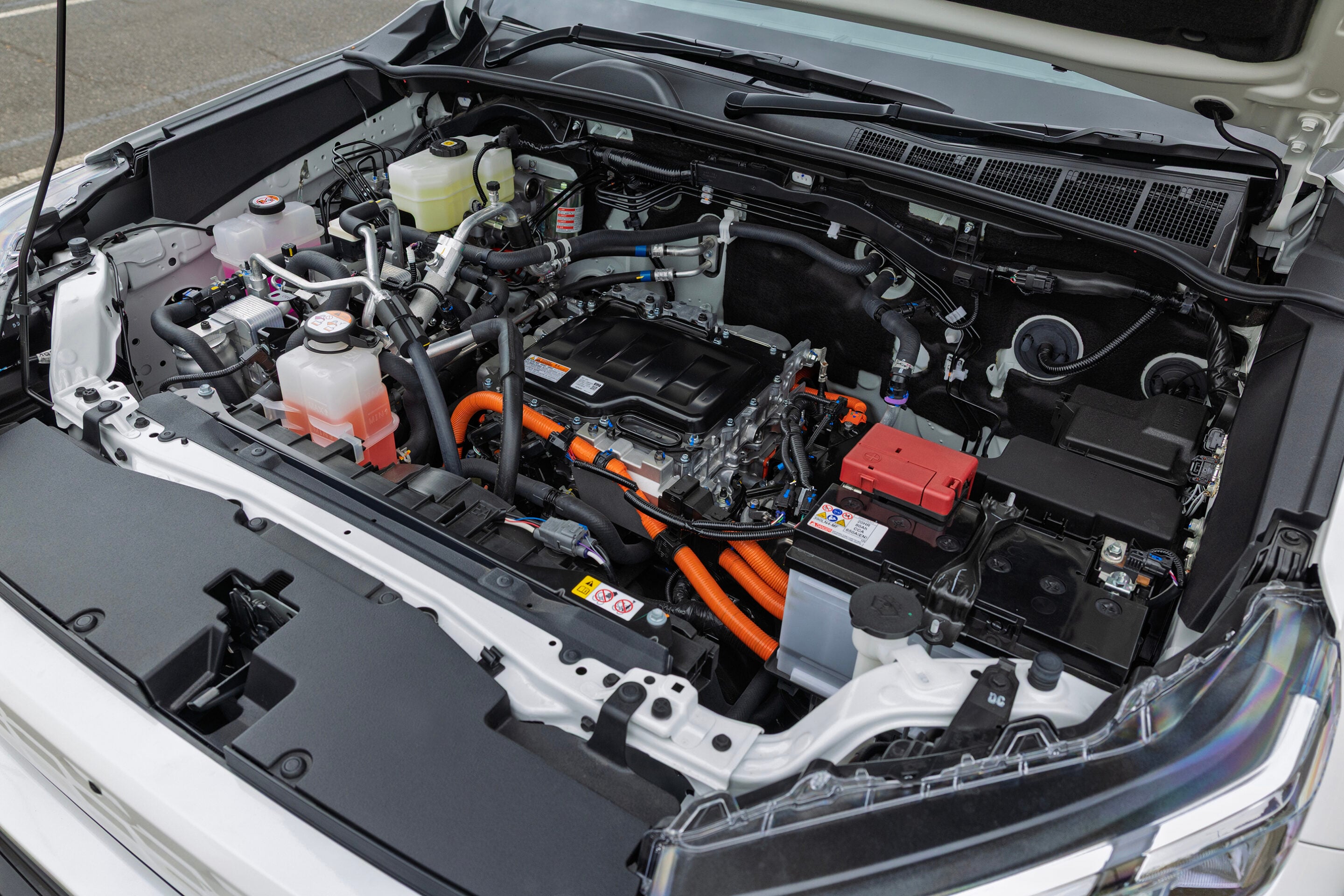
So, what about the electric development? The HiLux has dual permanent magnet synchronous motors in transaxles at each end – described as eAxles – with a water-cooled 59.2 kilowatt-hour lithium-ion battery with 80 individual cells.
The battery fits neatly between the chassis rails, one of the key design objectives, and is tucked up and away from potential damage with additional crossmembers and reinforced rails. There is also reinforcement for the eAxles, with a breather hose to improve water resistance. The claimed charging time is 30 minutes for 80 per cent on a 150kW DC charger or 6.5 hours on AC charging.
Maximum output for the front eAxle is 82.2kW and 205.5Nm, while the rear motor adds 129.3kW and 268kW for a maximum of 144kW. Toyota hasn’t provided combined torque figures.
There are few external clues to the battery-electric switch, beyond a solid front grille, aero-tuned 17-inch alloy wheels and the charger port on the front-passenger side.
1
Inside, the traditional HiLux shifter is replaced by a shift-by-wire lever and there is a BEV digital instrument cluster. Inside the centre console is a three-pin AC power outlet for small appliances.
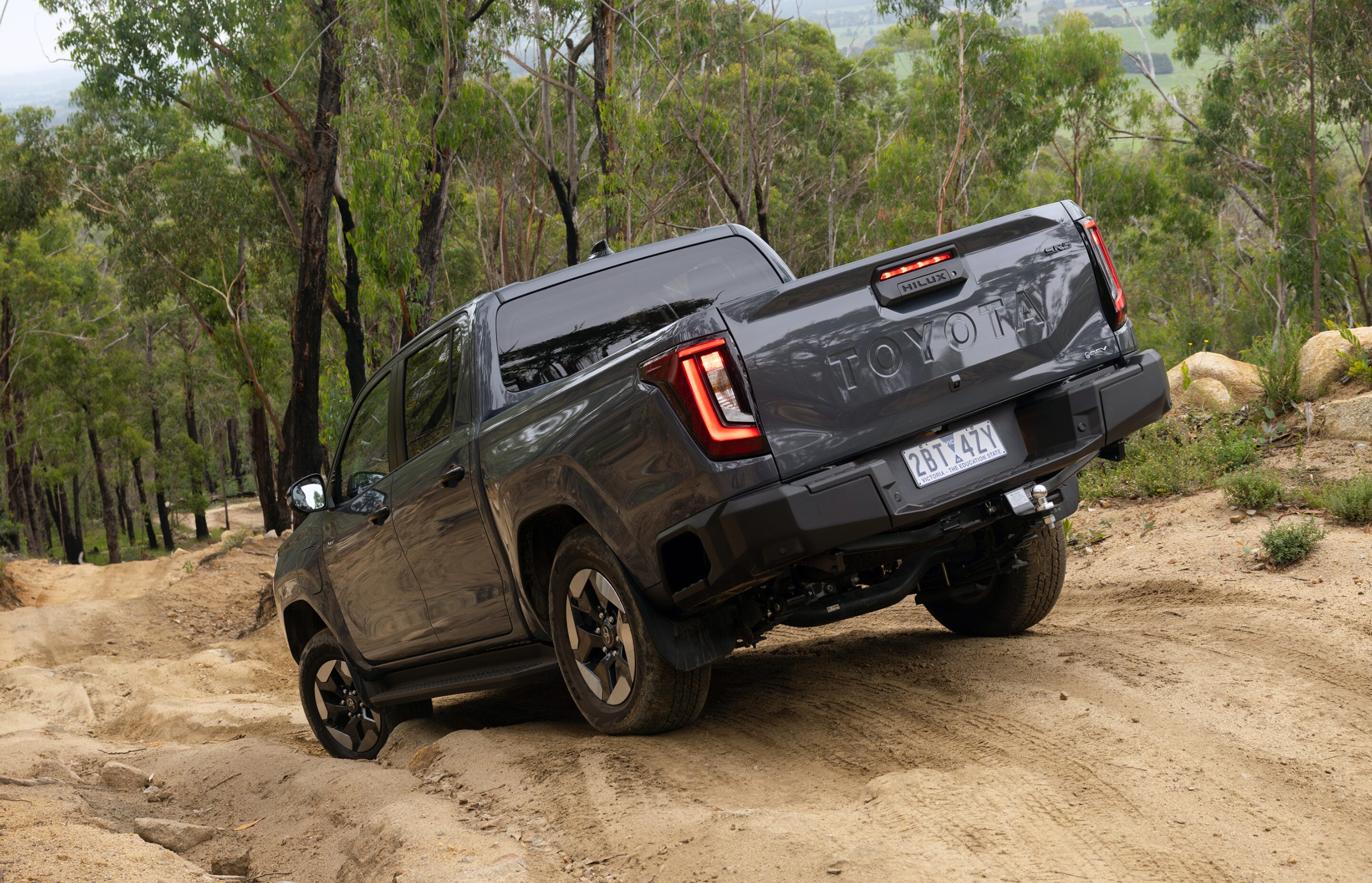
On the driving side, the HiLux BEV is nicely smooth, obviously quieter at all times without a turbo-diesel in the nose, and a little more poised over broken surfaces. Adding a De Dion rear axle helps with grip at the rear, even if it costs a minute 6 millimetres of ground clearance. It has solid punch off the mark, but will not set any electric-car records.
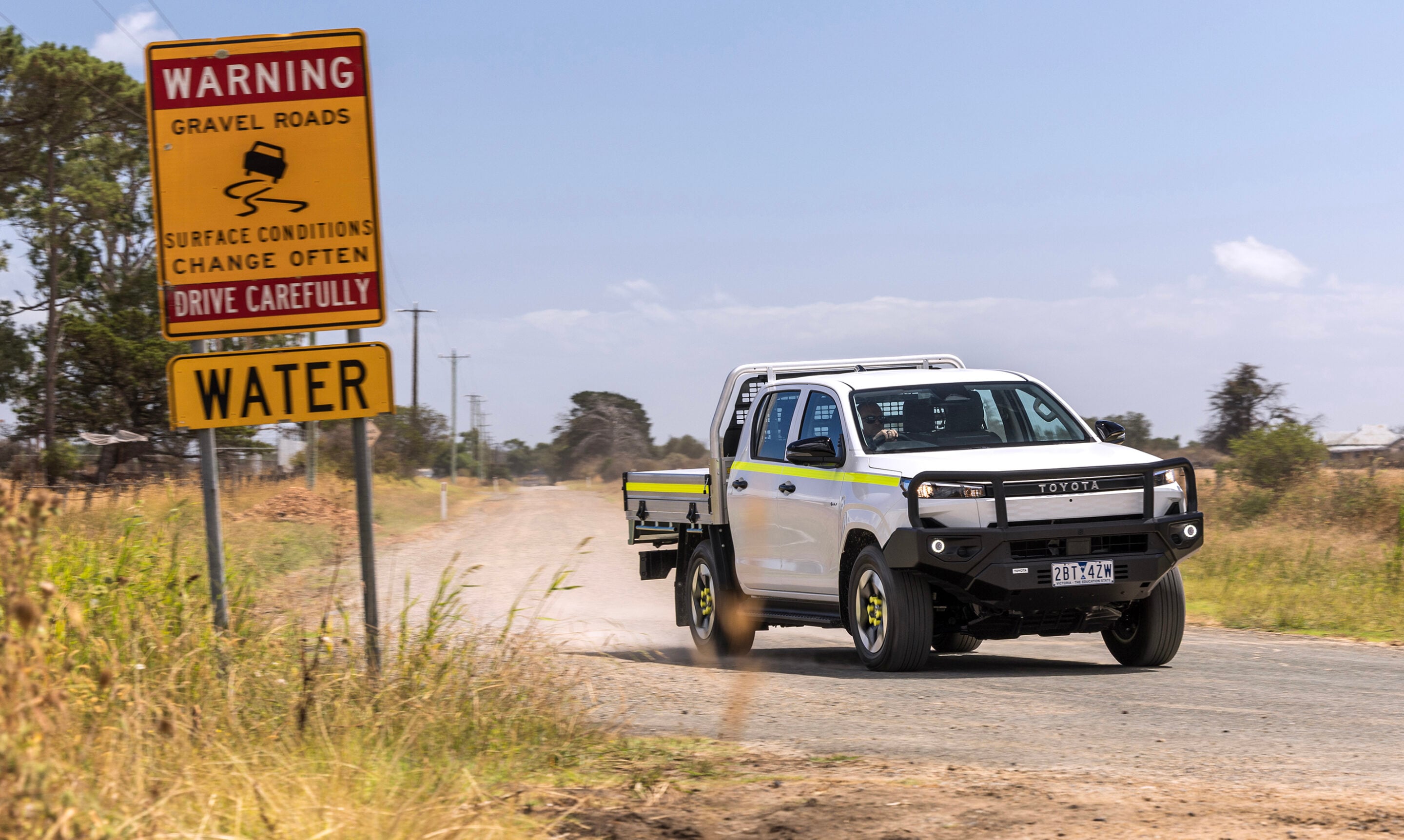
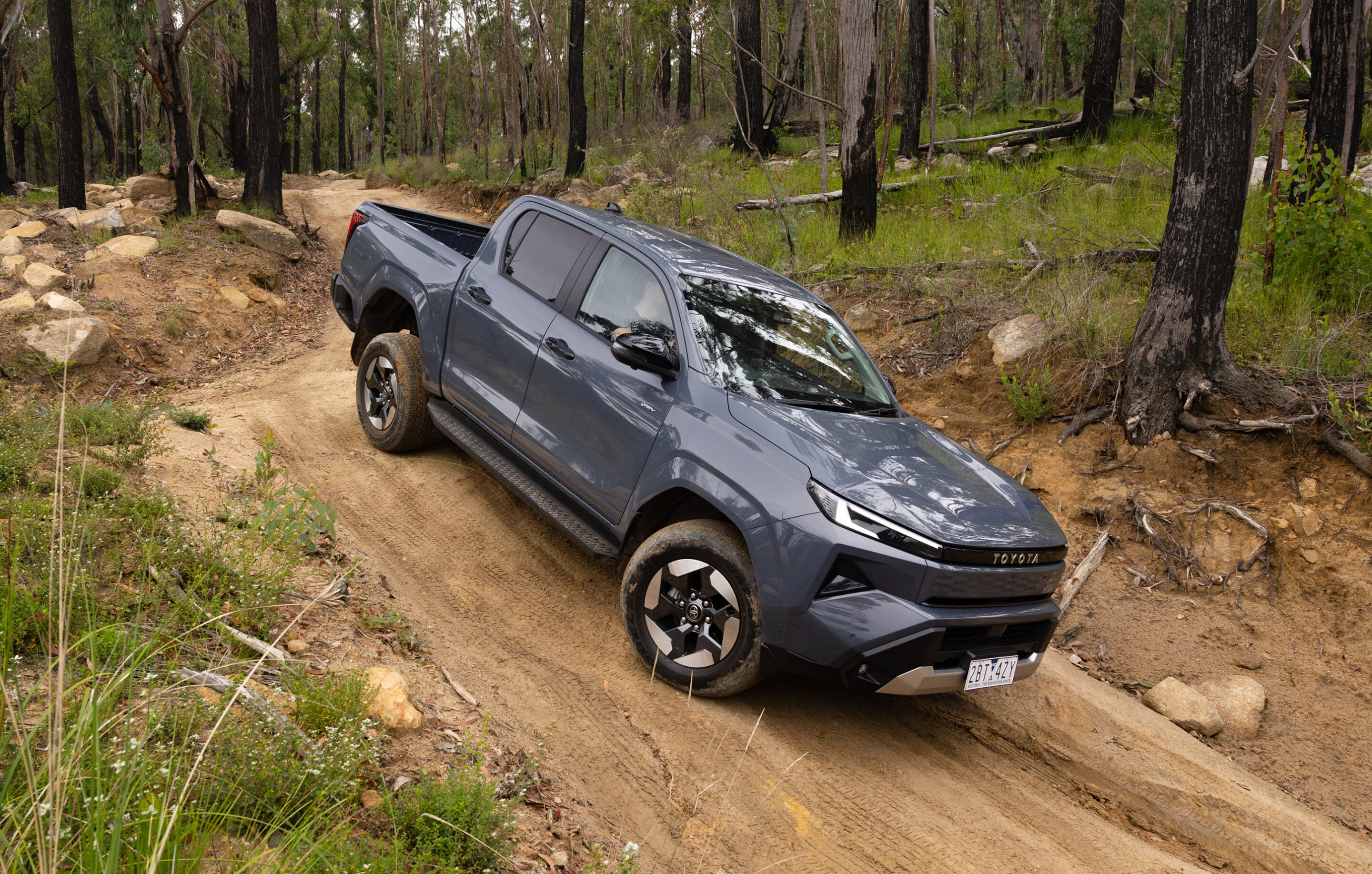
Toyota provided a mild-grade off-road course as part of the preview drive and the BEV-mobile was not even remotely troubled by the conditions. Once it crashed through the rear suspension going into a water crossing, but otherwise it had good grip and the electric torque delivery made it smooth and easy for climbing. The downhill assist control was never challenged but is an important safety net.
2
The all-wheel drive system in the HiLux can vary the torque split up to 100 per cent at either end, using a variety of sensors and pre-programmed settings for Auto, Dirt, Sand, Mud, Mogul and Snow modes.
Toyota Australia intends to keep a close watch on early deliveries – to companies including BHP and Essential Energy – even though the HiLux BEV has been tested in Australia for more than two years.
The ownership package for the pick-up is typical for Toyota, with a five-year/unlimited kilometre warranty, with a five-year coverage on the bigger ’traction’ battery that can be extended to 10 years with an annual check. There is also a battery-capacity warranty for eight years and 160,000 kilometres if the storage drops below 70 per cent of the original capacity. Buyers also get a full-sized alloy spare.
1
There is a lot to happen in the EV pick-up space, and a lot will happen in HiLux land.
Some people will score the first HiLux BEV at a 10, just because it exists, but for many HiLux fans it will be a zero based on their wants and needs.
5
/10
Score
Score breakdown
5.0
Safety, value and features
7.0
Comfort and space
4.0
Engine and gearbox
7.0
Ride and handling
4.0
Technology
Things we like
- Punchy off the mark
- Quiet road manners
- Full-size spare is rare these days
Not so much
- Not enough driving range to be useful
- Neither a workhorse or weekender
- Payload takes a hit thanks to EV battery
Follow WhichCar/Wheels on Google
Click the button below to make WhichCar by Wheels a preferred source for your news.

We recommend
-
 Reviews
Toyota HiLux SR 48V review: Can the updated Aussie favourite keep up with rivals?
It's been one of Australia's best-selling vehicles for the past few decades, so how does the latest Toyota HiLux compare against a swarm of new competition?
-
 Reviews
2026 Toyota HiLux in-depth review: New, or just improved?
Toyota’s ninth-gen HiLux sticks closely to a proven formula, mixing modest structural tweaks, mild-hybrid tech and cabin updates with familiar underpinnings to keep Australia’s top-selling ute on track.
-
 News
News2026 Toyota Hilux: Specs for the workhorse's first electric version revealed
Toyota Europe spills the beans on the capabilities of the first electric Hilux.
