
WhichCar contacted the Electric Vehicle Council and Federal Chamber of Automotive Industries for comment, but did not respond in time for publication.
Expected to arrive shortly after the all-new BMW 3 Series in 2026, the next-gen M3 will offer a whole new level of driving dynamics, according to BMW bosses.
Snapshot
- Next-gen u2018M3u2019 could produce over 1000kW from four motors
- u2018Heart of Joyu2019 onboard computer at the centre of operations
- BMW bosses promising it will be u201cfar above what people are used to todayu201d
- S58-powered M3 to live on in tandem for some time
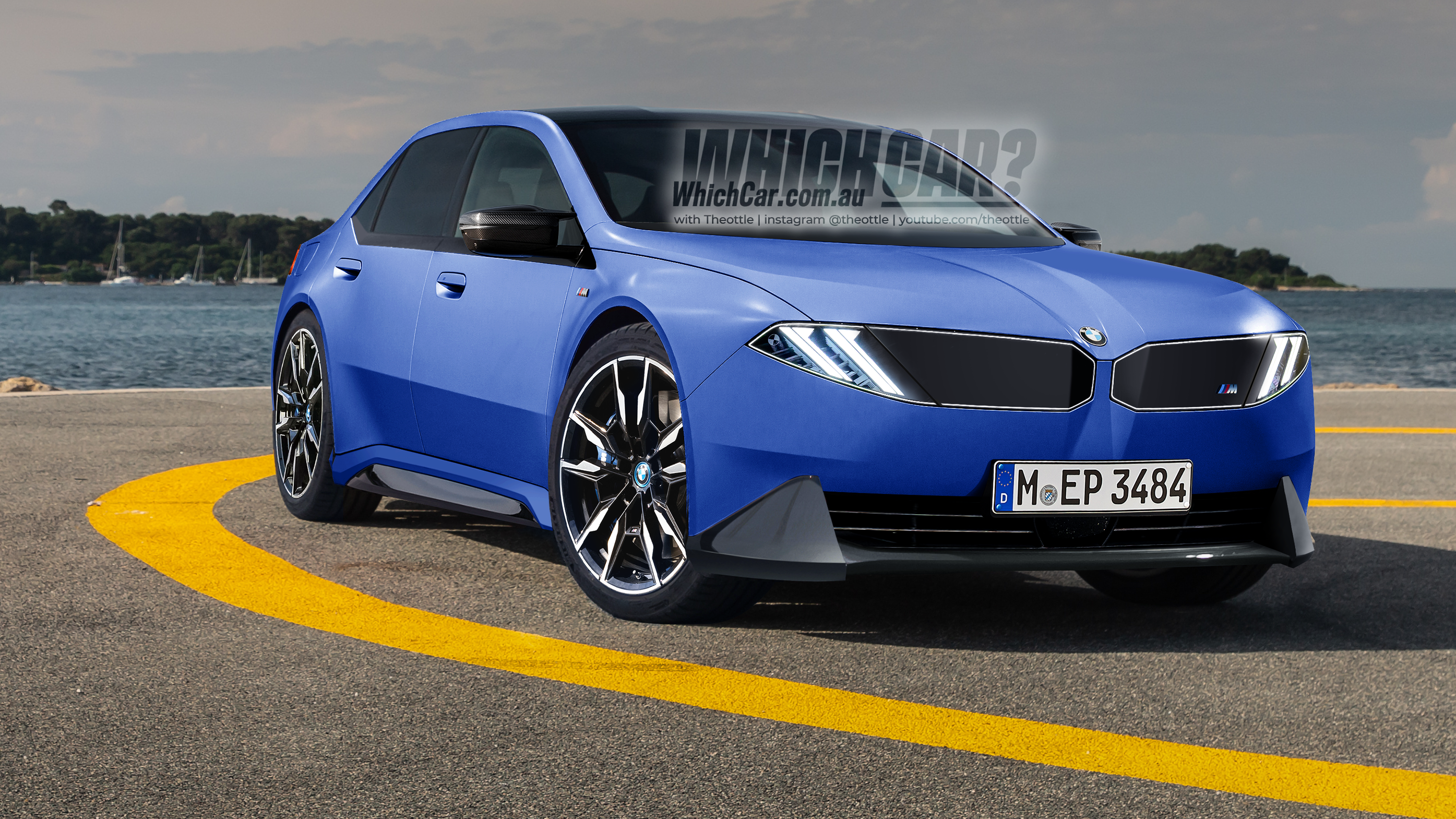
Based on the same Neue Klasse underpinnings as the 3 Series, BMW board member and development boss Frank Weber has high hopes for the all-electric M3 due in 2027.
“The next M3 will be battery-electric – full battery-electric”, Weber told Autocar [↗], before describing how the Neue Klasse platform’s ‘Heart of Joy’ on-board computer – the ‘Hand of God’ i8 chassis controller’s successor – will make this the fastest and most capable M3 ever.
1
“This is a controller that has taken the last 20 or 30 years of our experience into a control unit. Everything that is driving-performance related, chassis-control related, propulsion- [and] powertrain-related is now in one integrated control unit.
“It’s almost the history of how you control a vehicle that is in that thing. We do it ourselves – we don’t buy it. The software is proprietary. This is why we talk about it. We say, see, this will enable driving-dynamics functions that you will love”, Weber said.
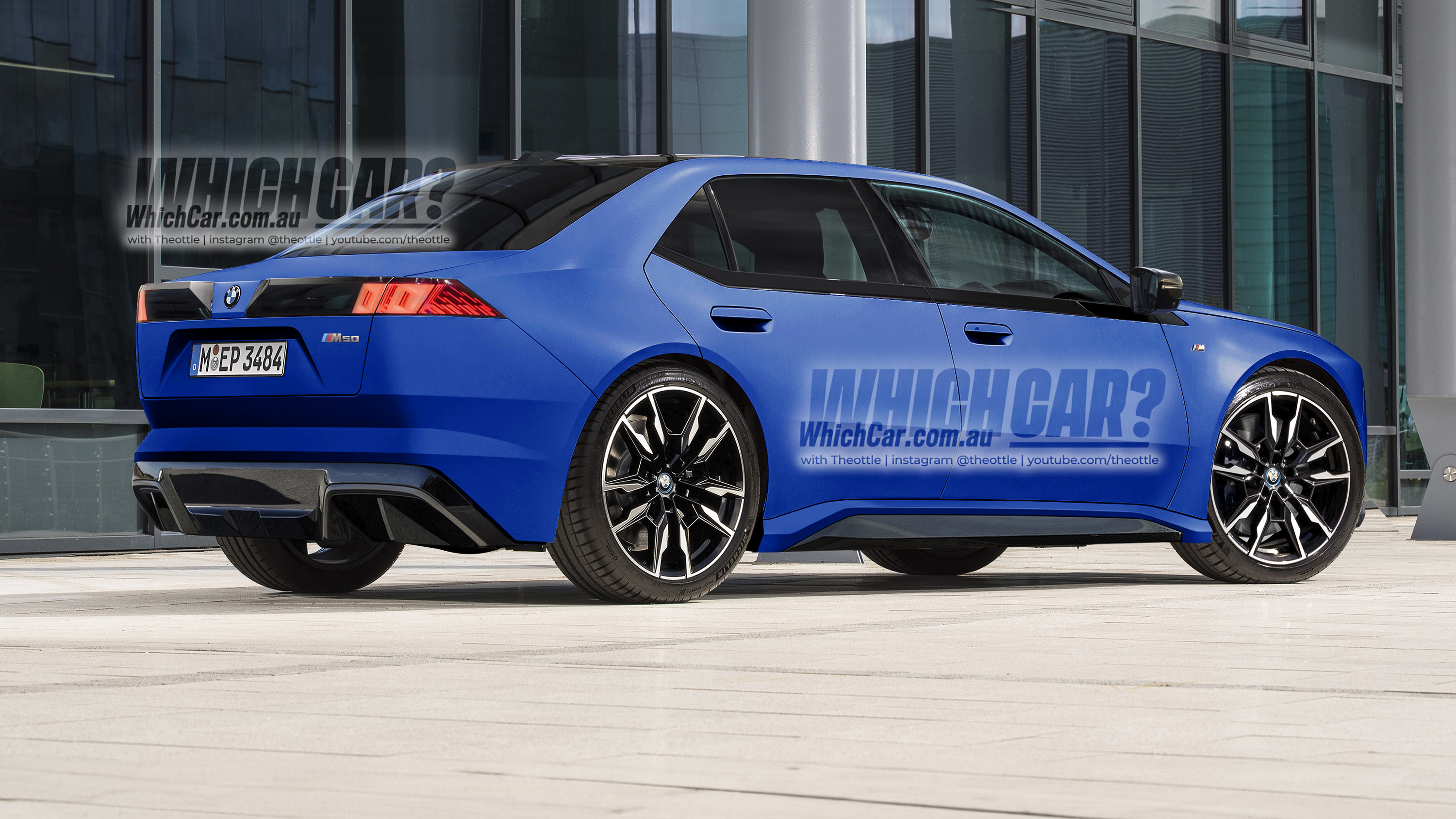
He went on to describe that the Heart of Joy, able to control four electric motors individually and deliver up to 1000kW, will allow new-gen M cars to perform “far above what people are used to today”.
1
There won’t be a long wait between the start of 3 Series production and an M car this time either – unlike the E36 generation 3 Series which had a four-year gestation period for its straight-six M3 – with Weber wanting to exemplify the capability of EVs as soon as possible.
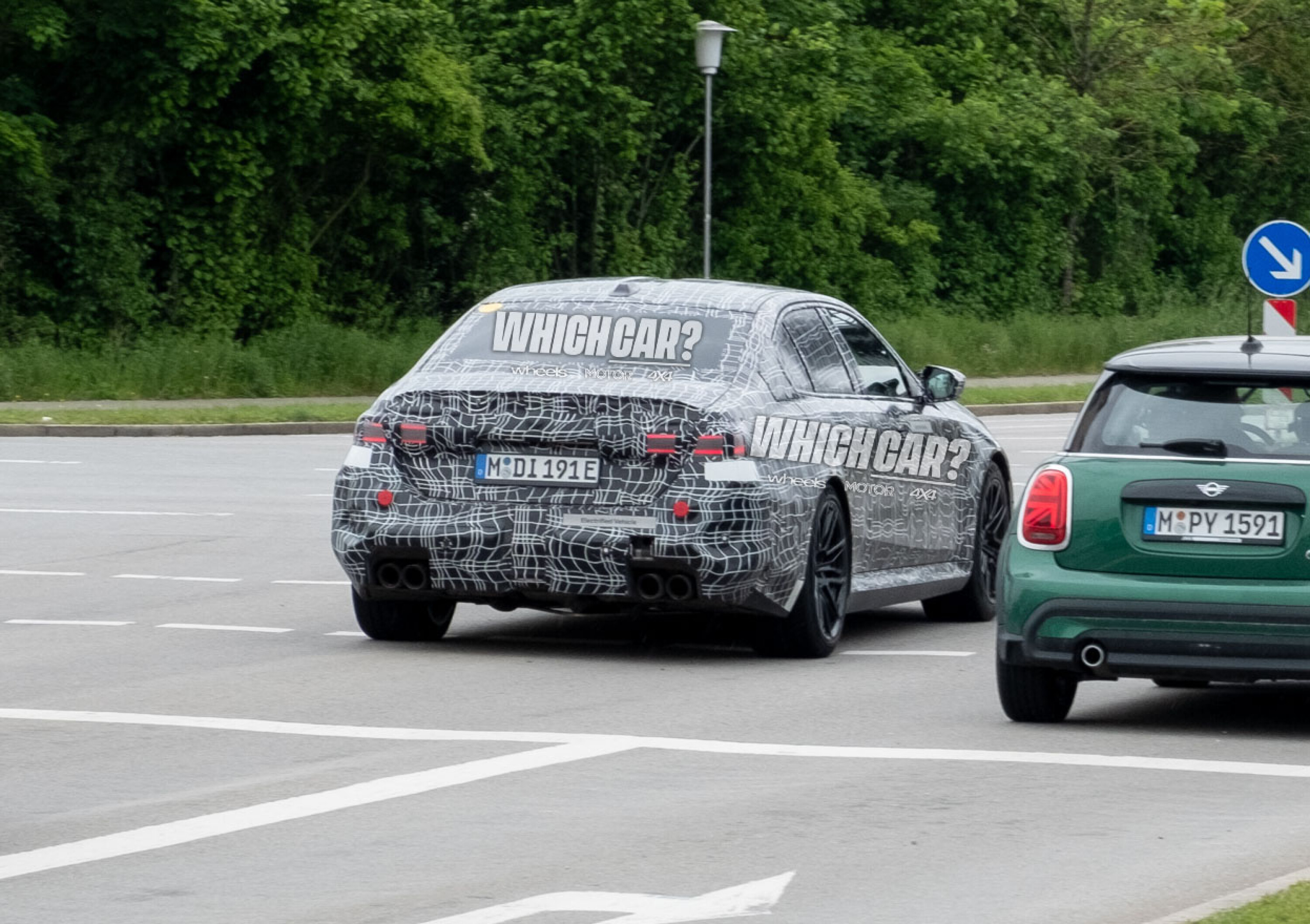
Those who love the raspy sound for which M cars are famous shouldn’t be too worried, though. Weber confirmed that there will be “a coexistence” with the next electric M3 and the current car, with its ‘S58’ inline six staying in production until at least 2030.
Additionally, a plug-in hybrid powertrain built around a petrol V8 will arrive in the new M5, likely in 2025, and production of the XM PHEV will continue as BMW returns to the LMDH category of endurance racing.
1
Conjecture also surrounds the naming conventions of BMW’s most powerful series, with BMW member of the board for sales Pieter Nota telling Autocar that the promised quad-motor 3 Series may not be called the M3, rather a derivative of that name, leaving the combustion lineage to exist separately to the EV.
Any further details will be confirmed much closer to the Neue Klasse platform’s launch under the next-gen X3 expected in 2024, with the eight-gen NK-based 3 Series sedan and wagon due in 2026.
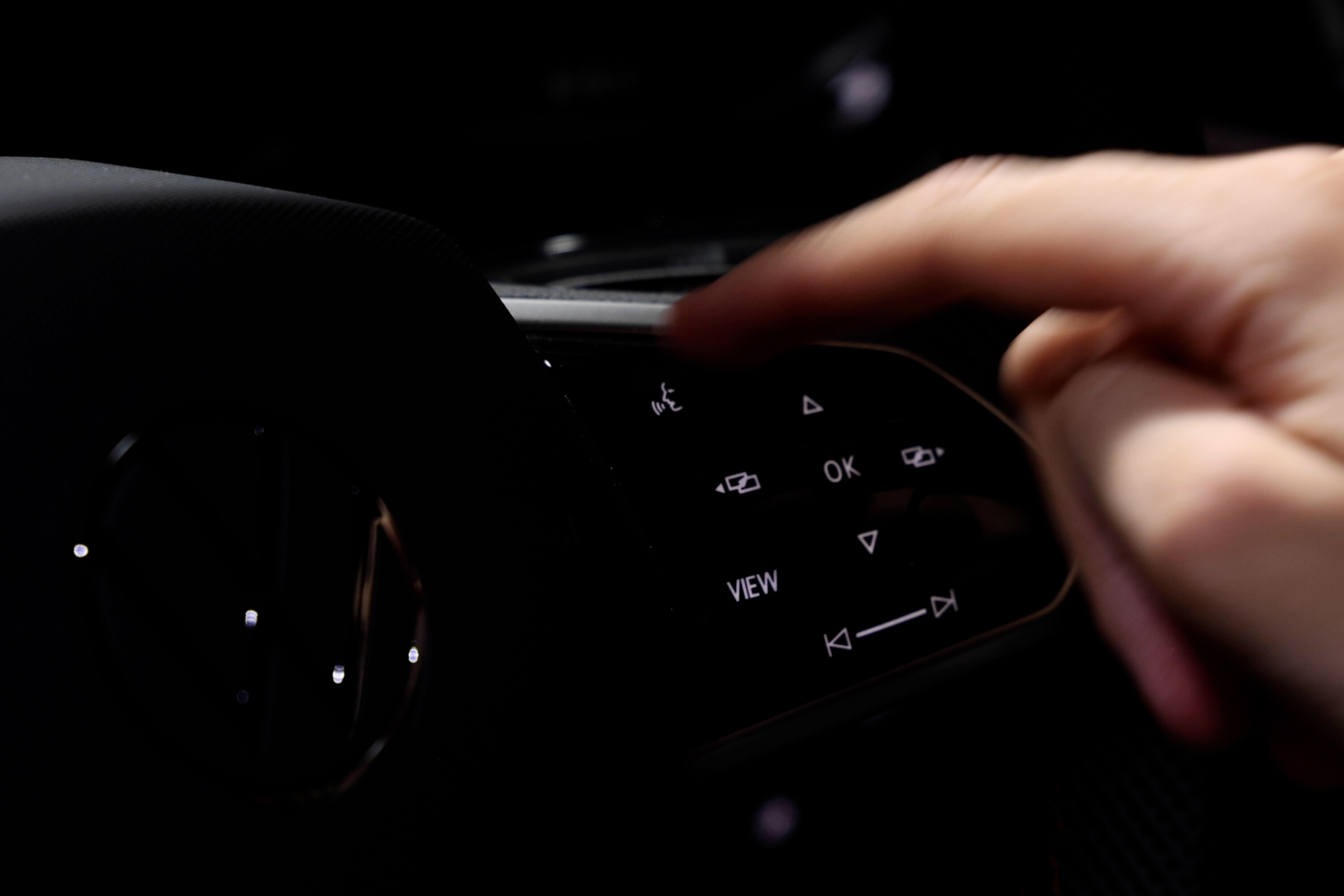
Following feedback from customers about capacitive touch buttons on the steering wheel, the MY24 Volkswagen Polo goes back to buttons.
This only affects the range-topping GTI grade, though Volkswagen has also applied this change to T-Roc R-Lines as well as the facelifted ID.3 electric car following global boss Thomas Shafer’s admittance that the tech had “frustrated” owners and “caused a lot of damage”.
1
Additionally, the entry-level Polo Style gains safety equipment: blind-spot monitoring, rear cross-traffic alert, and proactive occupant protection are now standard. The new models will become available later this year though there are still MY23 vehicles in stock.
“There remains strong MY23 stock in Volkswagen dealerships, and this will continue through 2023. The Polo GTI, Golf Life, Golf R-Line and Golf GTI remain with special drive-away pricing” (detailed below), a Volkswagen Australia spokesperson told Wheels.
Our original story, below, continues unchanged.
July 13: Drive-away deals for 2023 VW Polo range
With good stock on the ground, Volkswagen is offering drive-away deals on the Polo GTI.
Instead of paying $39,690 before on-road costs, VW will currently sell you an un-optioned 147kW/320Nm Polo GTI for $39,990 drive-away.
Our original story, below, has been updated with new information.
May 10: 2023 Volkswagen Polo pricing and features for Australia
The Volkswagen Polo arrived on local shores in May 2022, bringing with it increased spec over the outgoing model – but at a premium price.
Snapshot
- Volkswagen drops manual Polo Life
- Price increases effective July 1 2023
- Drive-away deal available on Polo GTI
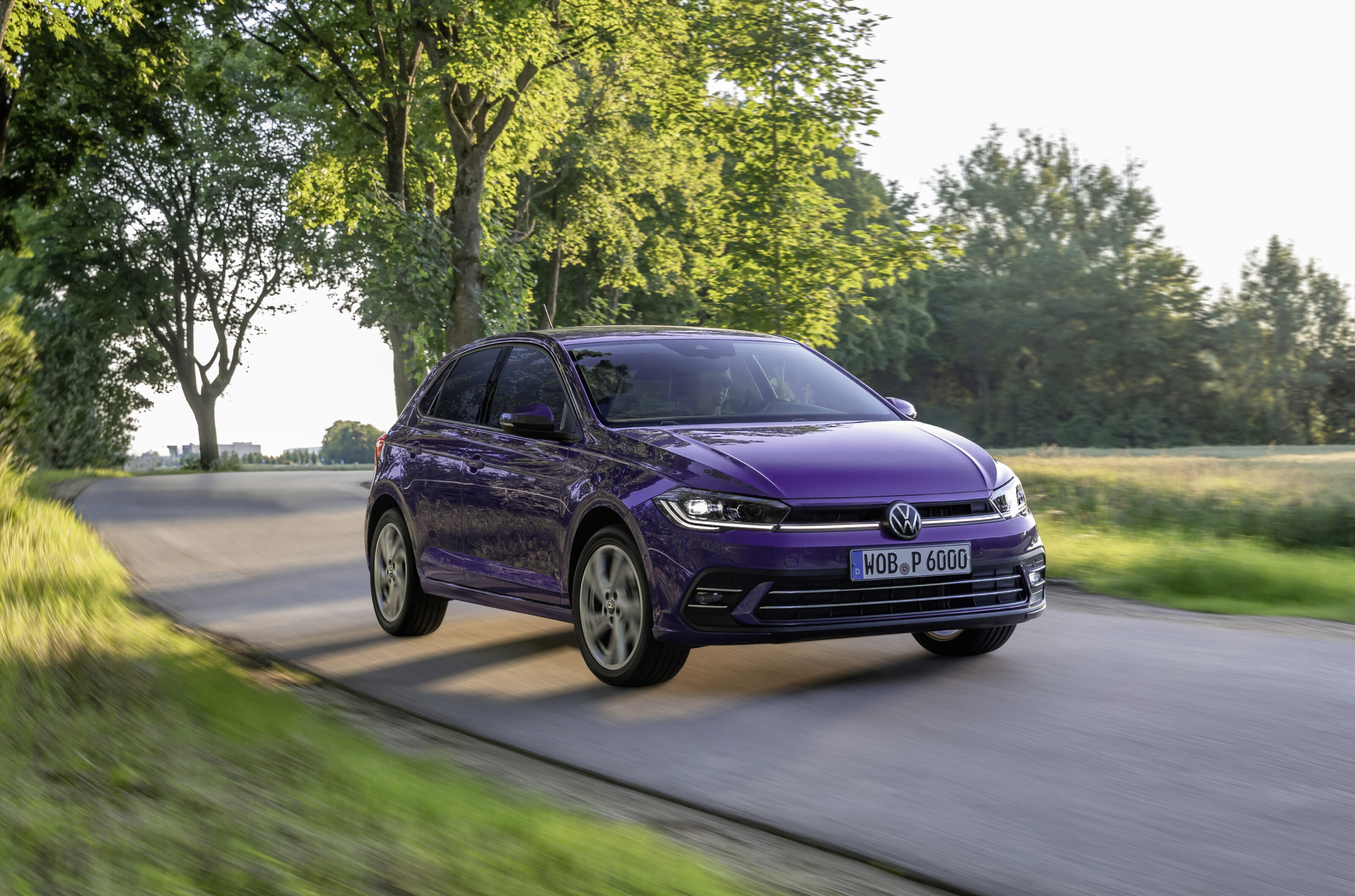
While still a part of the same generation as the current MY21 Polo, the MY22 update features a large amount of equipment upgrades across the range, such as the inclusion of Digital Cockpit, wireless charging and numerous safety additions.
As well as the new equipment, Volkswagen is adopting a new sales philosophy, moving away from chasing sales volume in the pursuit of bringing a higher quality product to market, with brand director Michal Szaniecki saying: “We’ve moved the Polo still further from the sticker-driven rat race into its most premium form to date.”
2
Pricing
The Trendline and Comfortline variants have been dropped for 2023, with the Life nameplate, borrowed from the Golf, Caddy, T-Cross and Tiguan, now opening the Polo line-up.
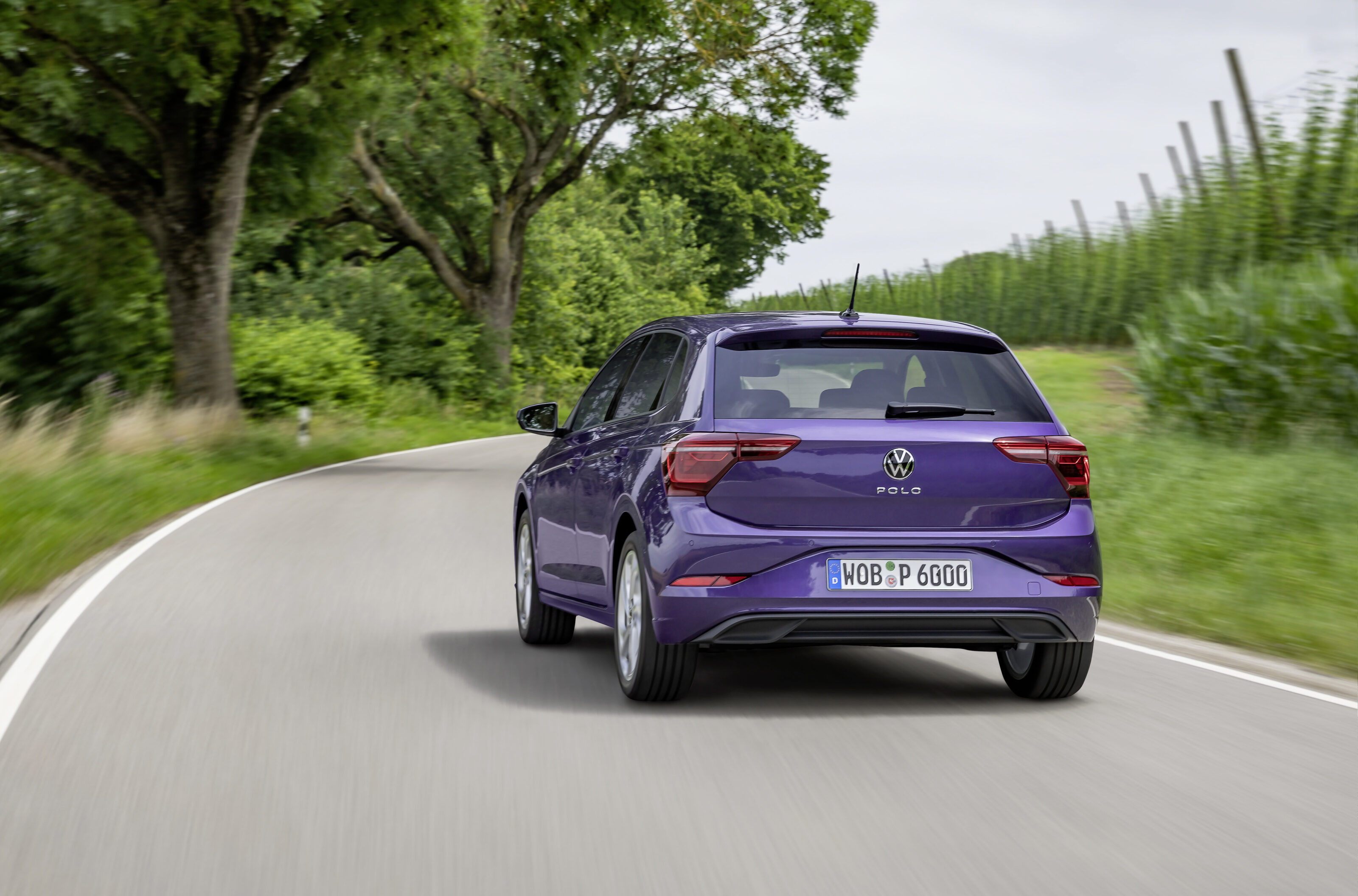
The 2023 Volkswagen Polo can be had in three grades: Life, Style and performance GTI.
Since its May 2022 launch, the Polo has been subjected to several small price increases and the Life manual has been axed. Below is correct from 1 July 2023.
Pricing is all before on-road costs.
| Model | Price at launch | Current pricing |
|---|---|---|
| Life auto | $28,250 | $28,990 |
| Style auto | $31,250 | $31,490 |
| GTI auto | $38,250 | $39,690 |
2
Features
As standard, the entry-grade Polo Life includes equipment such as:
Life
| Parking distance sensors, front and rear | Apple CarPlay/Android Auto |
| Rear view camera | Leather-appointed multi-function steering wheel |
| Cruise control | Comfort cloth upholstery |
| LED head and tail-lights | Front seat lumbar adjustment |
| 15-inch alloy wheels | Automatic headlight function |
| Digital Cockpit (8-inch driver display) | Rain sensing wipers |
| Composition Media 8-inch infotainment screen | Auto dimming rear-view mirror |
| Wireless charging | Illuminated front vanity mirrors |
| DAB+ digital radio | Front centre armrest |
Optional extras
| Options | Price |
| Metallic paint | $600 |
| Vision & Tech Package (DSG only) includes: | $1700 |
| Discover 8-inch navigation | |
| Digital Cockpit Pro | |
| Voice control | |
| Wireless app-connect | |
| Travel assist | |
| Adaptive cruise control |
On top of the base-level Polo Life, the Style variant adds:
Style
| Digital Cockpit Pro (10.25-inch driver display) | Rear traffic alert |
| Dual zone climate control air conditioning | Park assist (automatic reverse parking assistance) |
| Interior ambient lighting | IQ Light Matrix |
| Comfort sports front seats | LED headlights with dynamic light assist (adaptive high-beam) |
| 16-inch alloys | Illuminated LED grille strip |
| Travel assist, including: | Premium LED tail-lights with dynamic indicators |
| Adaptive cruise control | Front fog lights |
| Side assist | |
Optional extras
| Options | Price |
| Metallic paint | $600 |
| Sound & Tech Package includes: | $1900 |
| Discover 8-inch navigation | |
| Voice control | |
| Wireless app-connect | |
| Keyless access and ignition | |
| Beats Premium Audio with six speakers | |
| Digital eight-channel amplifier, 300 watts |
Beyond this, the range-topping Polo GTI gains:
GTI
| GTI body styling | Three-stage adaptive dampers |
| Metallic paint | Driving profile selection |
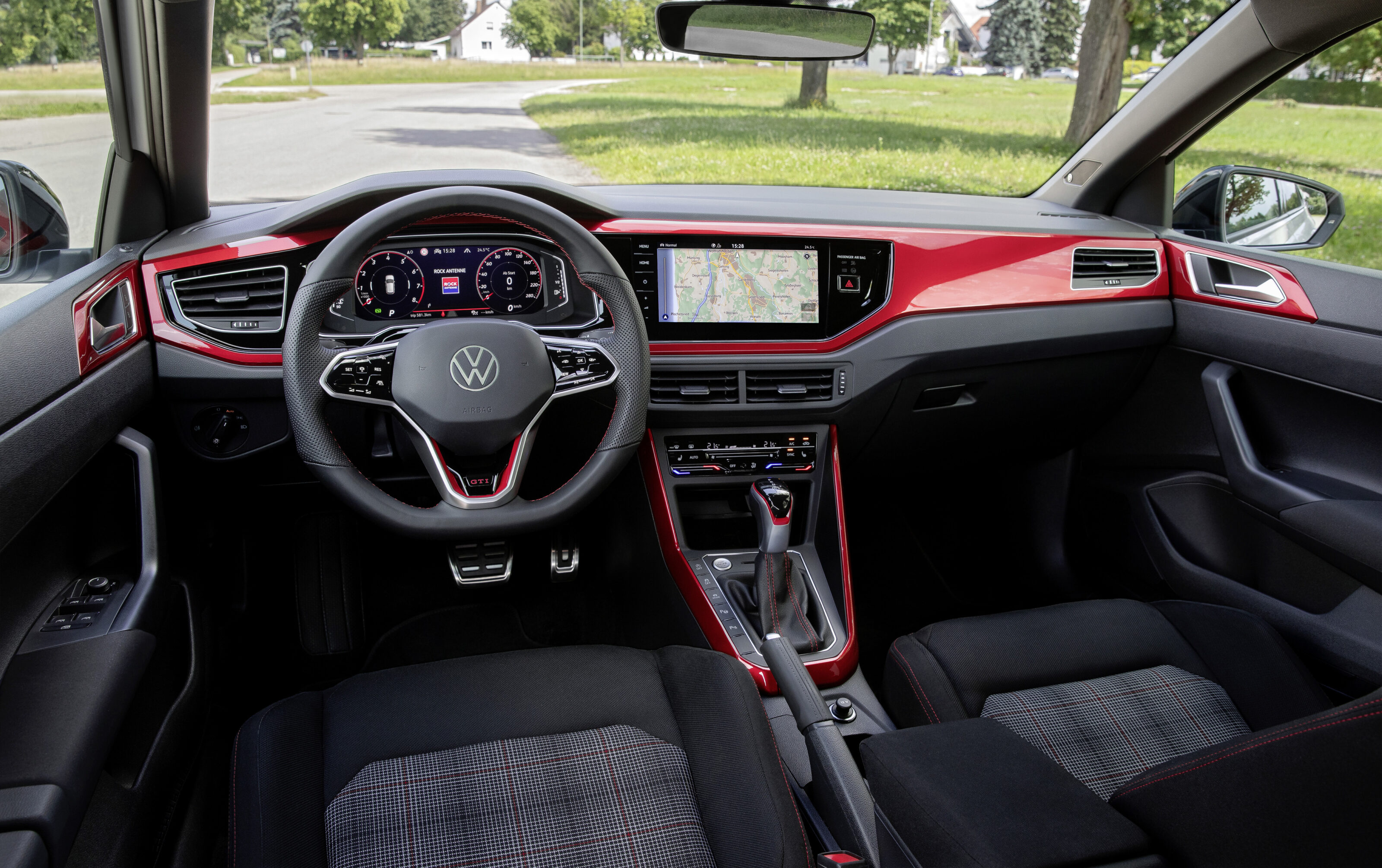
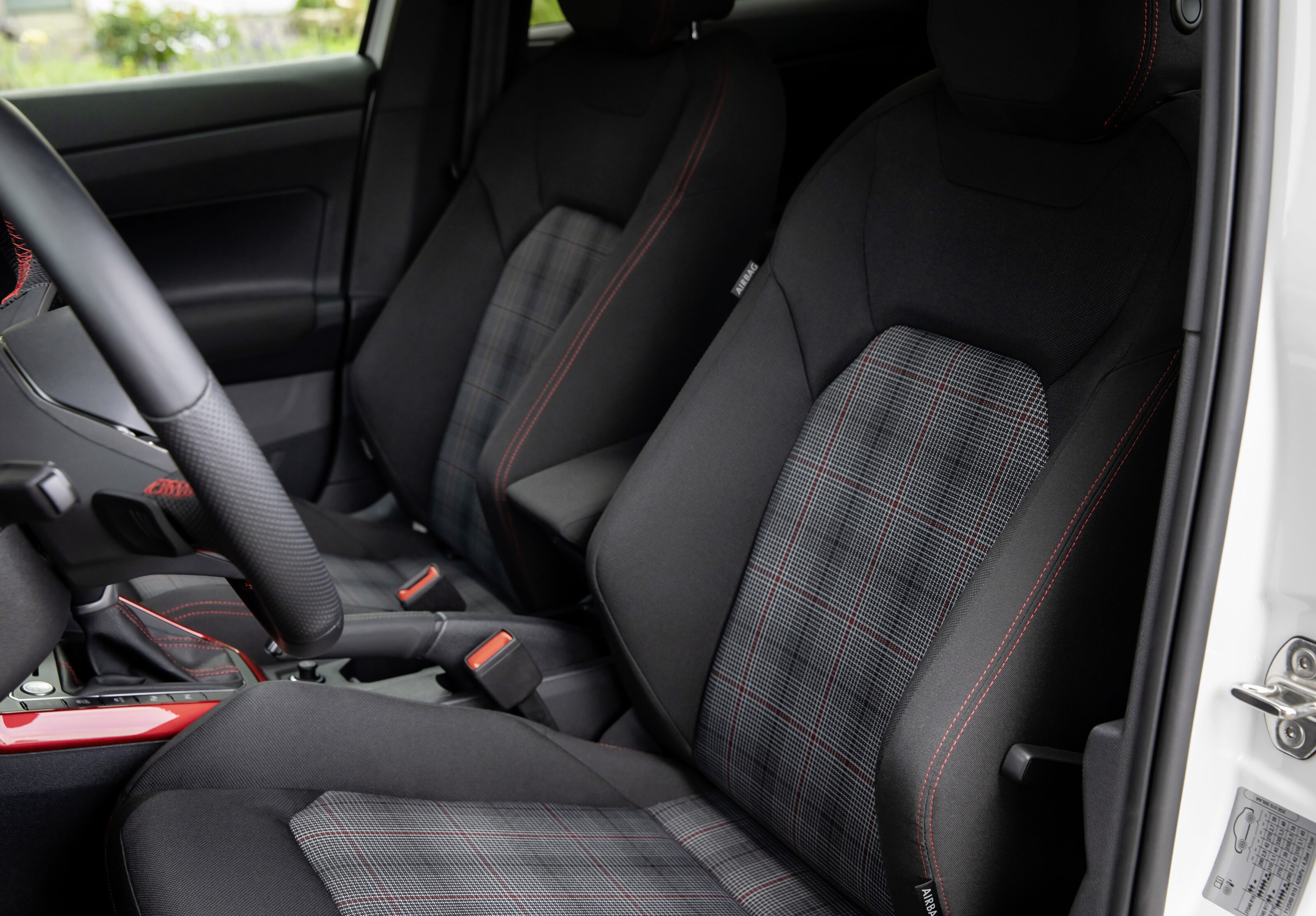
| Sport seats with Tartan upholstery | Discover Media 8-inch navigation system |
| Anti-theft alarm system | Voice control |
| Keyless access | Wireless app-connect |
| 18-inch alloy wheels | Sports steering wheel with paddles |
Optional extras
| Options | Price |
| Premium metallic paint | $300 |
| Sound & Tech Package includes: | $1500 |
| Discover Pro 9.2-inch navigation | |
| Beats Premium Audio with six speakers | |
| Panoramic glass sunroof | $1500 |
2
Engine, transmission and fuel economy
Both the Polo Life and Style share the same 1.0-litre, three-cylinder turbocharged petrol engines, with power and torque unchanged from the outgoing model.
The Polo Life is available with a six-speed manual or a seven-speed dual-clutch automatic transmission – producing peak power and torque figures of either 70kW/175Nm or 85kW and 200Nm respectively.
The Style meanwhile is available only with the seven-speed DSG, producing identical power and torque, with a claimed fuel consumption rating of 5.4L/100km.
Moving up to the range-topping GTI means buyers are treated to a 2.0-litre, four-cylinder turbocharged petrol engine, again with no changes to the current model Polo.
The 147TSI pushes out 147kW and 320Nm for a power-to-weight ratio of 112.8kW/tonne, boasting a 0-100km/h sprint time of 6.7 seconds.
A six-speed dual-clutch auto remains as the only transmission available for the GTI, which achieves a claimed 6.5L/100km – 0.4L/100km more than its predecessor.
In all grades drive is sent to the front wheels.
1
Safety
Carrying over from the outgoing Polo, the MY22 edition comes with a five-star ANCAP safety rating, with even more features such as a centre airbag and front assist with cyclist monitoring.
| Seven airbags (dual frontal, side chest-protecting, side curtain and centre) |
| Front assist with pedestrian and cyclist monitoring |
| Lane assist (adaptive lane-keep assistance) |
| Autonomous emergency braking |
| Manual-set speed limiter |
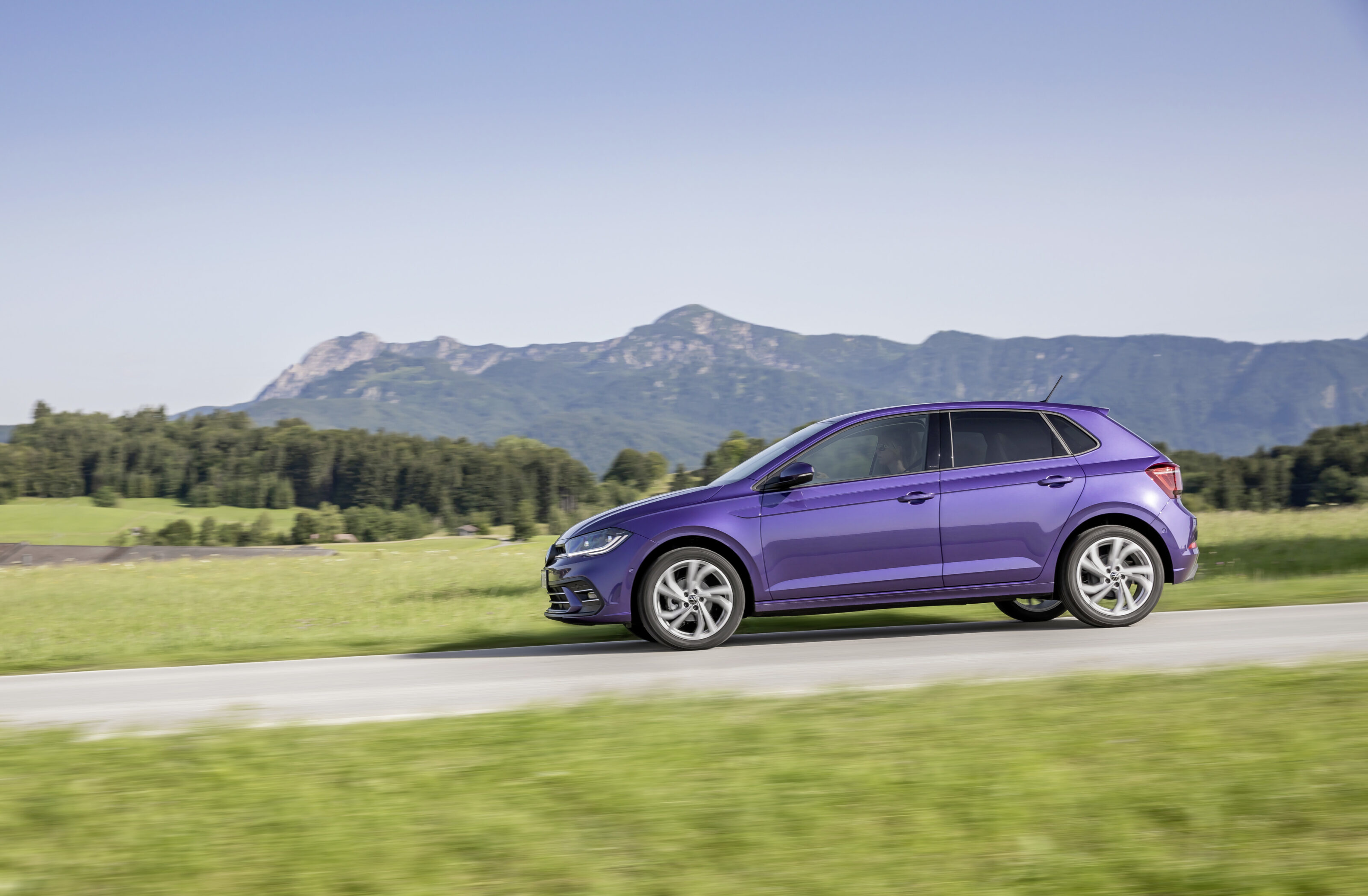
1
Warranty and servicing
As with the rest of Volkswagen’s passenger vehicle range, the Polo is covered by a five-year/unlimited-kilometre warranty, which also includes a one-year membership to its roadside assist program.
Each variant also falls under Volkswagen’s assured service pricing, with the first five years/75,000km intervals and costs listed below.
Life (manual)
| Interval | Price |
|---|---|
| 15,000km/12 months | $425 |
| 30,000km/24 months | $621 |
| 45,000km/36 months | $413 |
| 60,000km/48 months | $969 |
| 75,000km/60 months | $413 |
Life/Style (dual-clutch auto)
| Interval | Price |
|---|---|
| 15,000km/12 months | $425 |
| 30,000km/24 months | $703 |
| 45,000km/36 months | $413 |
| 60,000km/48 months | $949 |
| 75,000km/60 months | $413 |
GTI
| Interval | Price |
|---|---|
| 15,000km/12 months | $455 |
| 30,000km/24 months | $644 |
| 45,000km/36 months | $455 |
| 60,000km/48 months | $1498 |
| 75,000km/60 months | $455 |
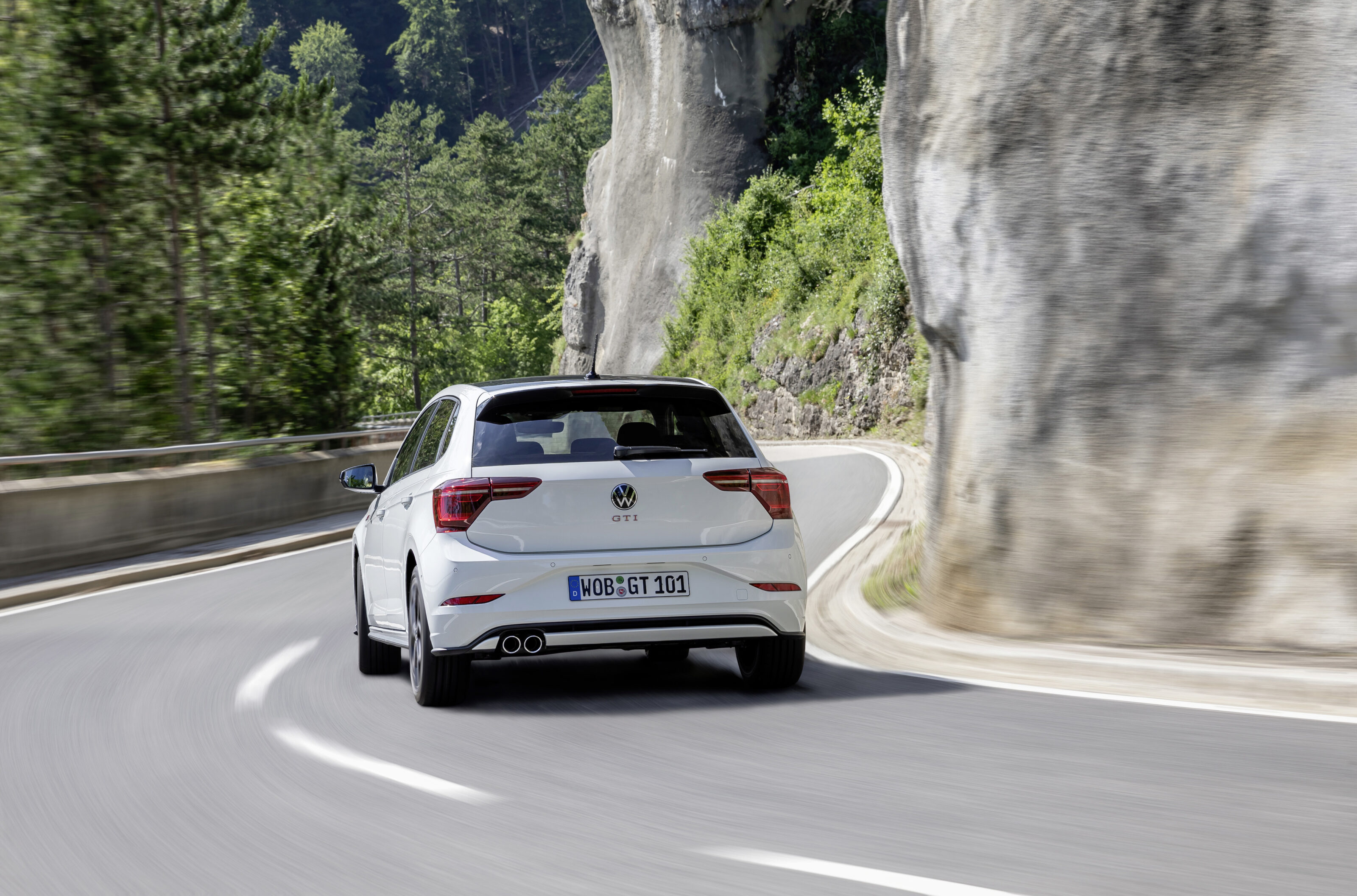
6
Availability
The 2022 Volkswagen Polo range will be available from May this year across Australia.
MORE
All Volkswagen
MORE
Polo news & reviews
The flagship Volkswagen T-Roc 140TSI R-Line will ditch its capacitive steering wheel buttons for 2024.
Pricing and details for the MY24 T-Roc range will be detailed later this year, but the steering wheel swap is the sole spec switch for VW’s best-in-class small SUV.
The T-Roc joins the Polo small car and ID.3 electric car in ditching the controversial capacitive controls. For now, there is stock of existing MY23 models at drive-away prices (detailed below), including the new CityLife, available at Volkswagen dealers.
“There remains strong MY23 stock in Volkswagen dealerships, and this will continue through 2023”, a Volkswagen Australia spokesperson told Wheels.
Our original story, below, continues unchanged.
2023 Volkswagen T-Roc pricing and features
The 2023 Volkswagen T-Roc small SUV has gone on sale with more equipment for some variants, with corresponding price increases – but also drive-away pricing across the board.
A CityLife variant joins temporarily as a new lower entry point to the range, priced from $35,990 RRP or $36,990 drive-away. It will be offered into early 2024 as a bridging model to the smaller T-Cross SUV, which costs up to $33,490 and is due to arrive mid 2024 in facelifted form.
Disappearing from the line-up is the R Grid Edition that was a more affordable, de-specced version of the flagship T-Roc R.
The spec/price revisions are centred around the T-Roc 110TSI Style and 140TSI R-Line.
Pricing for the T-Roc 110TSI Style is up $1790 to $38,890 before on-road costs – but it now features the Sound & Vision package as standard, which retailed for $2050. “Ongoing” drive-away pricing for the Style is $41,990.
Newly added features include a larger 10.25-inch digital instrument cluster, wireless Apple CarPlay and Android Auto, satellite navigation and built-in voice control.
Blind-spot and rear cross-traffic alerts have also returned to the T-Roc Style and R-Line, after the technology was temporarily deleted from select Volkswagen vehicles in late 2022 to avoid extended wait times caused by the industry-wide semiconductor chip shortage.
The mid-spec T-Roc 140TSI R-Line AWD now features standard-fit equipment limited to the Luxury Package, including Nappa leather upholstery, heated front seats, and an eight-way power-adjustable driver’s seat with two-position memory function.
While the R-Line’s now-deleted Luxury Package retailed for $3950, the updated T-Roc R-Line costs $1890 more than before, at $47,090 before on-road costs or $51,990.
“Given its popularity in Australia, we can now offer desirable items as standard on the T-Roc Style and T-Roc R-Line for a smaller premium than the previous optioned versions,” said Volkswagen Australia’s passenger vehicles director, Michal Szaniecki.
There are no changes to the Volkswagen T-Roc R range-topper, which costs $61,990 before on-road charges, or $64,990 drive-away.
Year-to-date to end of August, the T-Roc is just ahead of the Tiguan medium SUV as VW’s most popular model in Australia.
The updated 2023 Volkswagen T-Roc will arrive in local showrooms in September – joining the CityLife special edition – with pre-update stock also due before then.
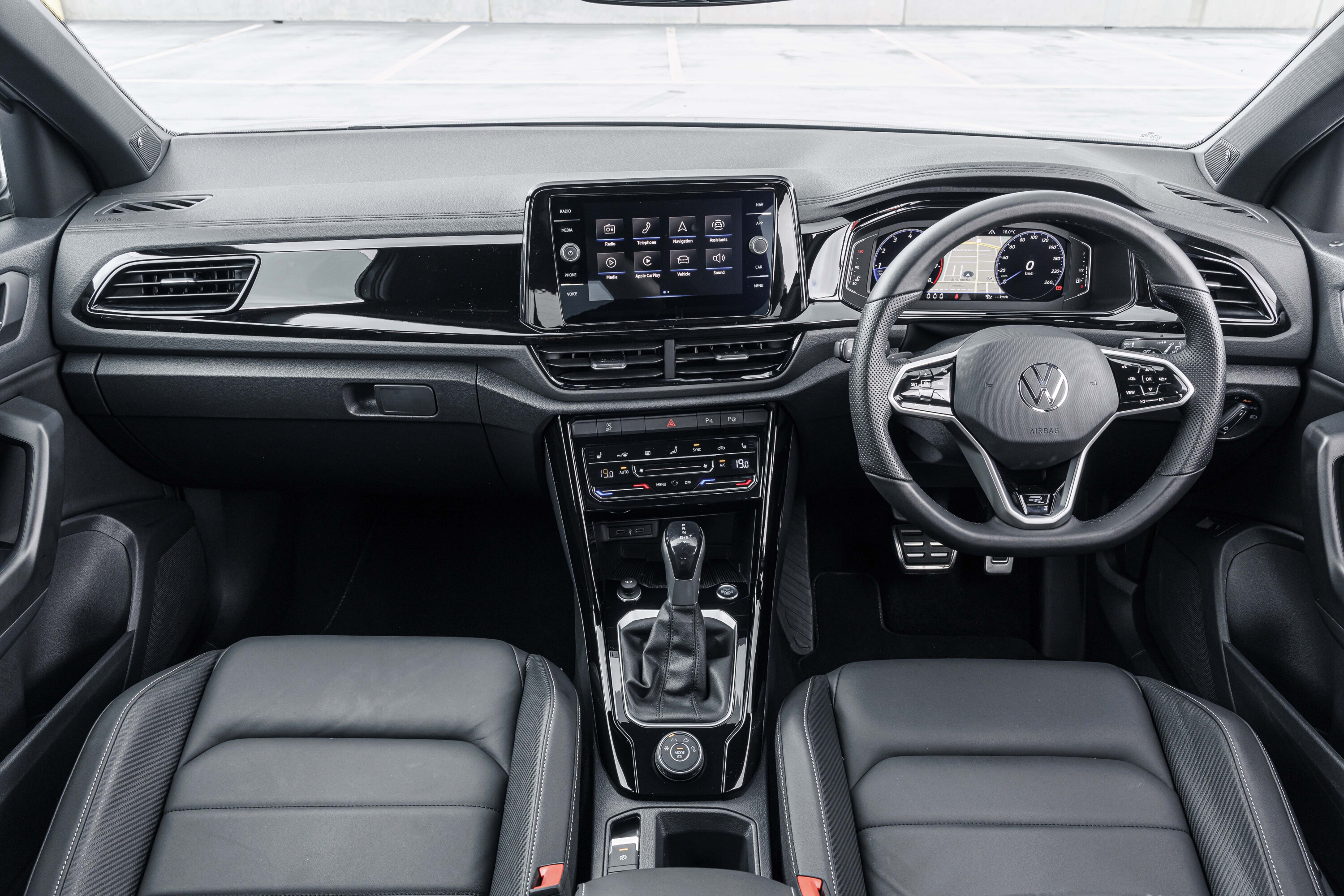
1
2023 Volkswagen T-Roc pricing
| Model | Pricing (RRP) | Change | Driveaway |
|---|---|---|---|
| 110TSI CityLife | $35,990 | u2013 | $36,990 |
| 110TSI Style | $38,890 | up $1790 | $41,990 |
| 140TSI R-Line AWD | $47,090 | up $1890 | $51,990 |
| R AWD | $61,990 | u2013 | $64,990 |
2023 Volkswagen T-Roc features
| 2023 Volkswagen T-Roc CityLife features | |
|---|---|
| 17-inch alloy wheels | Cloth upholsteryu00a0 |
| 8-inch infotainment system | Leather-wrapped steering wheel |
| Wired Apple CarPlay and Android Auto | Dual-zone climate control |
| Six-speaker audio system | Rain-sensing wipers |
| DAB+ digital radio | Paddle shifters |
| 8-inch digital instrument cluster | Black front grille |
| Wireless phone charger | Automatic parkingu00a0 |
| Keyless entry and push-button start | Autonomous emergency braking (vehicle, pedestrian and low-speed reverse detection) |
| Reflector-type LED headlights | Adaptive cruise control |
| Front and rear parking sensors | Automatic high beam. |
2023 Volkswagen T-Roc 110TSI Style features
| In addition to 110TSI CityLife | |
|---|---|
| Blind-spot alert (new) | 18-inch alloy wheels |
| Rear cross-traffic alert (new) | Reflector-type LED headlights |
| 10.25-inch digital instrument cluster (new) | Black-painted roof and side mirrors |
| Wireless and wired Apple CarPlay and Android Auto (new) | Drive mode selector |
| Satellite navigation (new) | Chrome exterior trim |
| Built-in voice control (new) | Rear privacy glass. |
2023 Volkswagen T-Roc 140TSI R-Line features
| In addition to 110TSI Style | |
|---|---|
| 140kW/320Nm 2.0-litre turbo-petrol | Perforated sports leather steering wheel |
| All-wheel drive | LED fog lamps |
| Black Nappa leather upholstery (new) | R-Line body kit |
| Heated front seats (new) | Progressive steering |
| Eight-way power-adjustable driveru2019s seat with two-position memory function (new) | Sports-tuned suspension. |
2023 Volkswagen T-Roc R features
| In addition to R Grid Edition | |
|---|---|
| Adaptive matrix-LED headlights | Blind-spot alert |
| LED tail-lights with sequential indicators | Rear cross-traffic alert |
| Nappa leather upholstery | Proactive occupant protection. |
| Eight-way power-adjustable driveru2019s seat | |
2023 Volkswagen T-Roc optional equipment
- Panoramic sunroof (110TSI Style, 140TSI R-Line, R) – $2000.
- Electric tailgate (110TSI Style, 140TSI R-Line) – $600.
- Vienna leather package (110TSI Style) – $3450.
| Vienna leather upholstery | Heated front seats.u00a0 |
| Eight-way power-adjustable driveru2019s seat with two-position memory function |
- Black Style package (140TSI R-Line) – $2900.
| 19-inch alloy wheels (black) | Black-painted roof |
| Adaptive dampers | Darkened interior trim |
| Black exterior trim | Eight-speaker, 300-watt Beats audio system. |
- Eight-speaker, 300-watt Beats audio system (R) – $800.
- Lapiz blue decor inserts (R) – $250.
A combination of production improvements and fluctuating demand see Volkswagen drop the base Golf for 2024.
According to Volkswagen, there’s now little demand for the basic Golf trim which starts at $36,290. The $38,590 before on-road costs 110TSI Life – with its 17-inch alloys, larger infotainment screen, and navigation – becomes the entry point for 2024.
Detailed MY24 pricing – which we expect to climb slightly – will be released later this year. Existing MY23 models of Golf remain in stock, too.
“The overwhelming majority of Golf customers select the Life, R-Line, GTI or – when available – R model grades. Reflecting these customer preferences, this now means each model line in the Volkswagen passenger vehicle range will commence with the well-equipped Life model grade or higher”, a Volkswagen Australia spokesperson told Wheels.
“There remains strong MY23 stock in Volkswagen dealerships, and this will continue through 2023. The Polo GTI, Golf Life, Golf R-Line and Golf GTI remain with special drive-away pricing” (detailed below), the spokesperson added.
Our original story, below, continues unchanged.
April 2023: Golf GTI and R-Line back on the menu
With 2023 Golf GTI stock levels improving in Australia, Volkswagen is offering drive-away deals on the original hot hatch in the second half of 2023.
Instead of paying $55,490 before on-road costs, buyers will be able to scoop an un-optioned GTI up for $55,490 drive-away from July 1.
Our original story, below, continues unchanged.
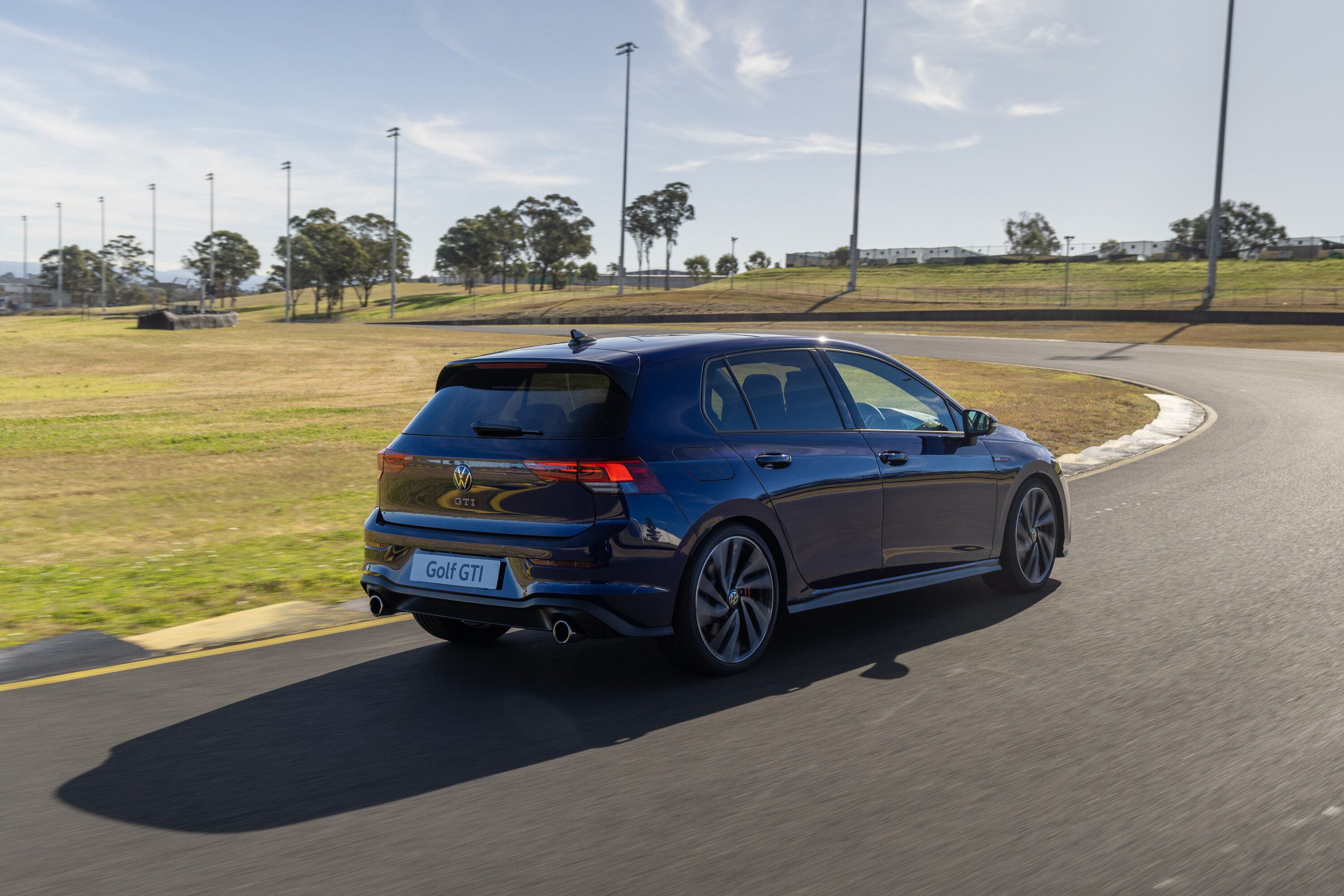
1
Apil 11: 2023 Volkswagen Golf pricing: GTI and R-Line orders open again
Volkswagen has re-opened orders for Golf GTI and R-Line variants after four months off sale.
The German carmaker enacted a sales pause on both high-spec trims in December due to chip shortages that meant right-hand drive examples were being produced without a reverse camera – a necessity for Australian design rules (ADRs).
The reverse camera is now back online for GTI and R-Line trims, so customers are again able to place orders with Volkswagen dealers for the up-spec trims.
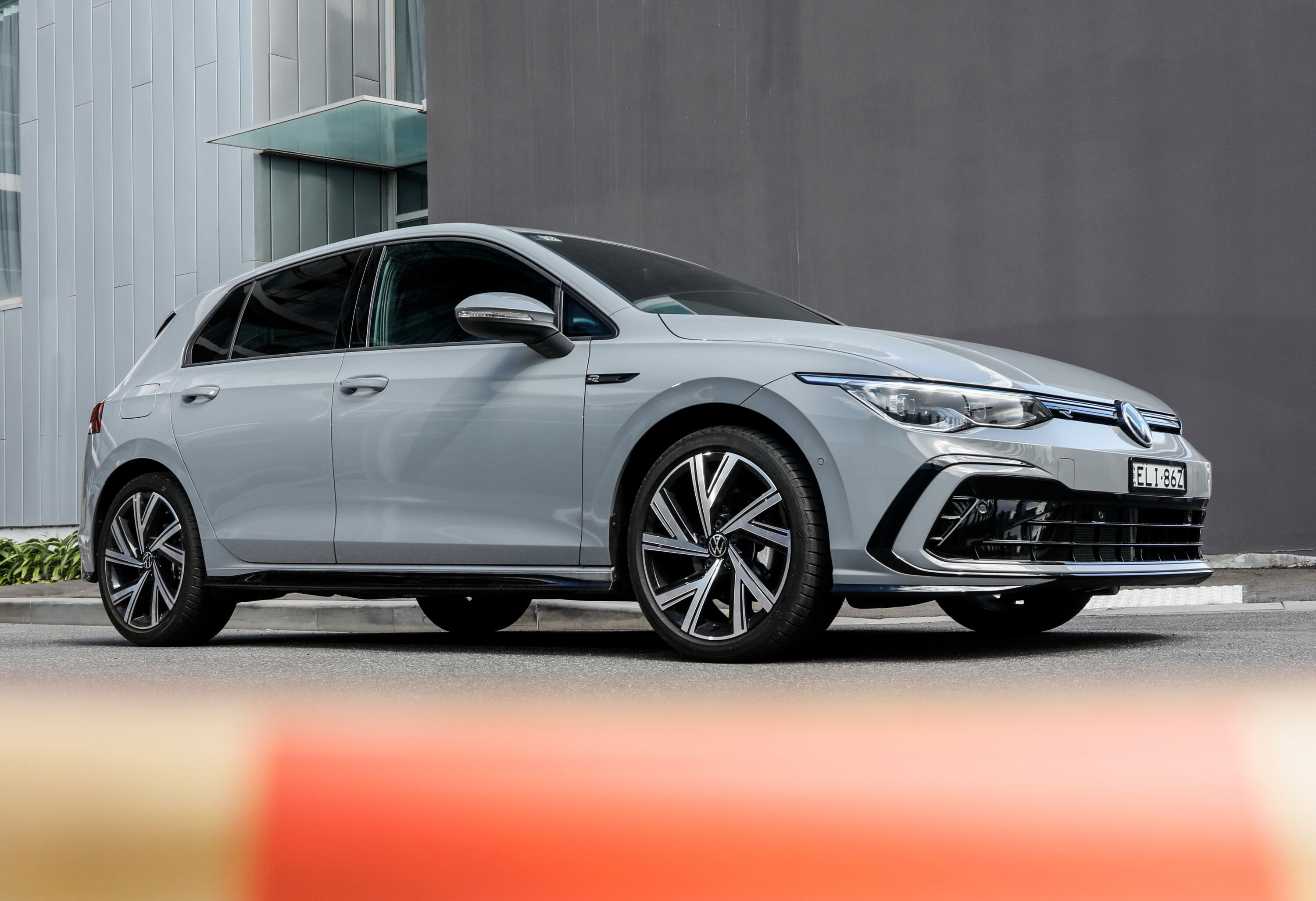
1
A 1300-strong batch of R-Line and GTIs will make their way to Australia in the coming months, and that will see wait times drop to roughly three months for the 110TSI R-Line ($40,490) and GTI ($55,490, both before on-road costs). As always, contact your local dealer for specific wait time information.
“Inside our headquarters and in showrooms there’s so much love for the Golf, so it has been challenging to have our supply restricted for this iconic hatchback,” said head of product passenger vehicles, Michelle Rowney.
Golf 110TSI and 110TSI Life trims will become available in bursts as production is still sporadically affected by rear-view camera production issues. The flagship AWD Golf R remains unavailable to order.
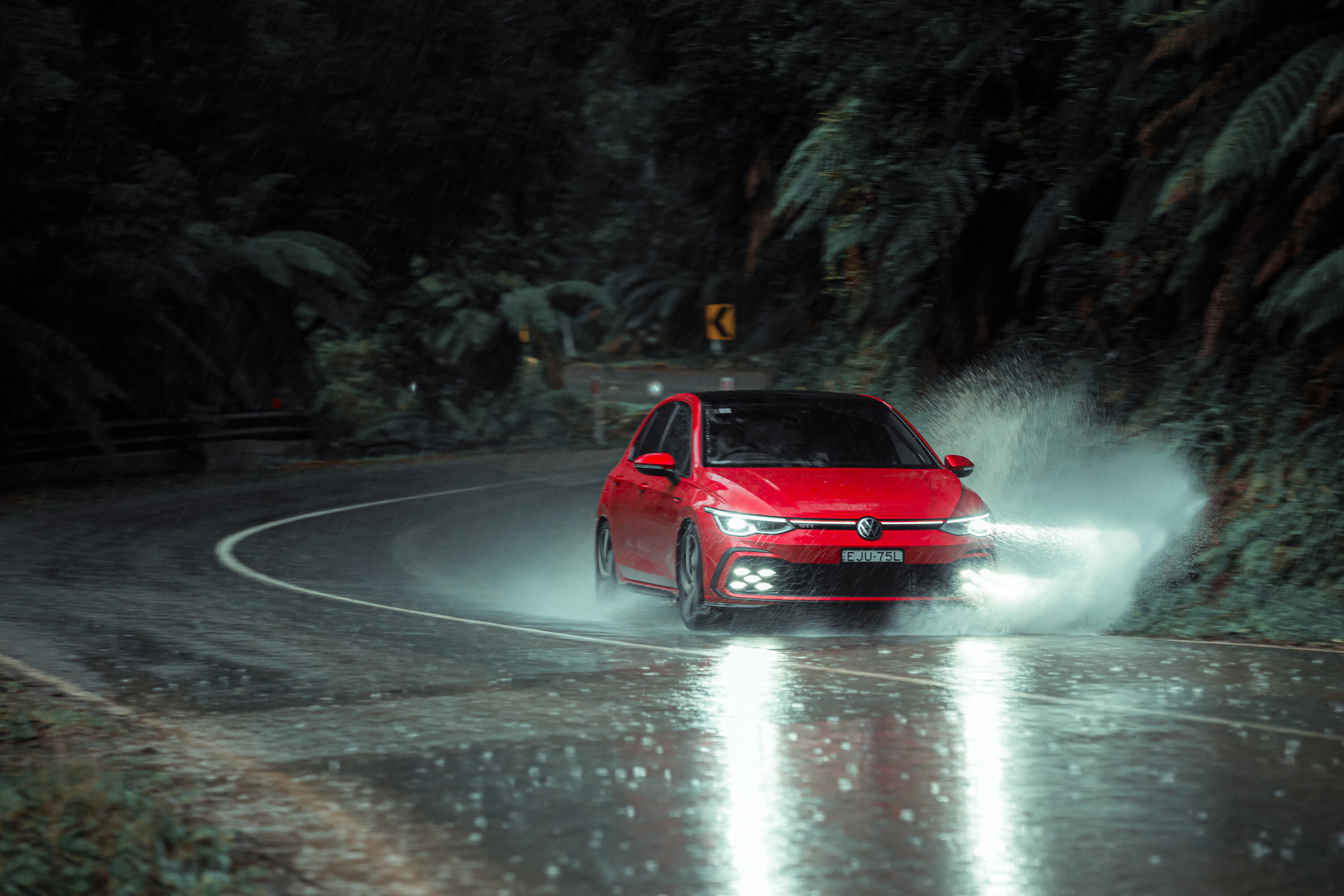
1
Volkswagen Golf sales have begun bouncing back from last year’s crippling stock restrictions, with 615 examples delivered in the first quarter – a 98.4 per cent increase on last year.
In addition to the improved Golf supply, Volkswagen has unrestricted T-Roc stock, and availability of certain T-Cross, Tiguan Allspace, and Passat trims.
Our original story, below, has been updated to reflect pricing changes
The story to here
UPDATE Jan 20: Volkswagen Golf entry model returns; new safety tech added
Snapshot
- 2023 Volkswagen Golf update announced
- Base variant returns; centre airbag added
- Pricing unchanged
The eighth-generation 2023 Volkswagen Golf has received a significant update, just over a year after it first arrived on Australian shores.
It’s not all good news, though: Volkswagen Australia has confirmed the manual Golf is formally discontinued for 2023, after production ended in late 2021 to focus on more-popular automatic variants.
Prior to the removal, the Golf small car had featured a manual transmission option since the brand relaunched in Australia in the early 1990s – including sportier variants, such as the GTI and R, prior to the latest generation.
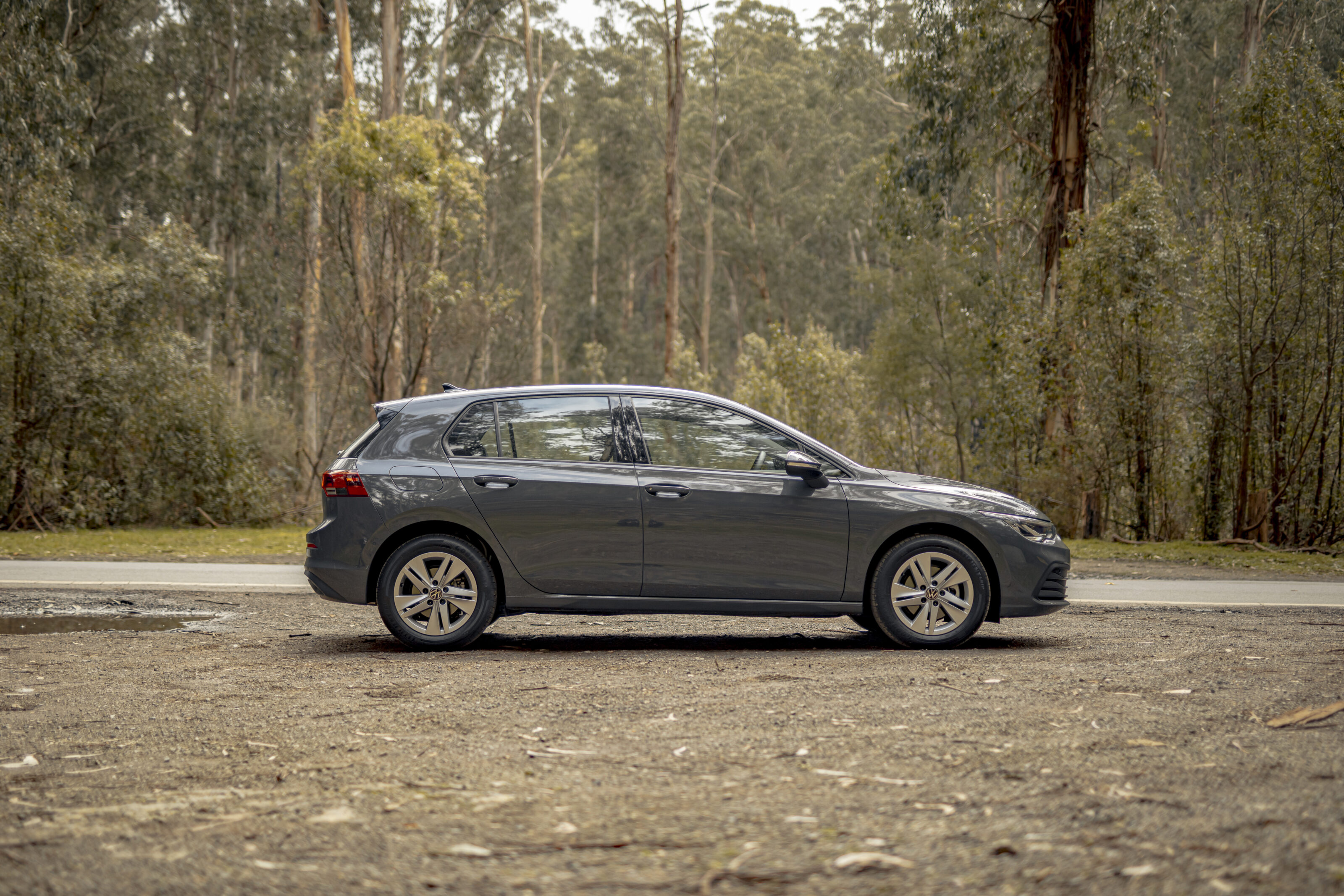
1
The entry-level Golf 110TSI has officially returned in automatic guise, following delays caused by the semiconductor chip shortage – bringing the starting price down to $35,190 before on-road costs.
A full price list is available below.

1
What’s new?
Headlining the changes for model-year 2023 is the addition of a front-centre airbag, taking the total count to nine airbags.
The change follows the addition of a centre airbag – designed to prevent a potentially deadly head clash between the driver and front passenger in a side impact collision – across the facelifted Polo light car range earlier this year.
In addition, Volkswagen has fine-tuned the lane-keep assist system to more accurately detect narrow roads, with the vehicle no longer attempting to steer the driver away from the line when moving close to it.
Other changes include a new steering wheel airbag cover, door trim inserts for Golf, Life and GTI, revised interior decor inlays, embossed seat covers with GTI badging for the hot hatch, and improved graphics for the digital instrument cluster to better show the digital speed readout.

1
Production of the updated Golf and Golf Life commenced in late June, ahead of first arrivals in the coming weeks.
Meanwhile, the R-Line, GTI and R will follow from late November production, with showroom arrivals expected in early 2023.
2023 Volkswagen Golf pricing
Prices exclude on-road costs.
| Variant | Price (before on-road costs) |
|---|---|
| Golf 110TSI hatch | $35,190 |
| Golf 110TSI wagon | $36,890 |
| Golf 110TSI Life hatch | $37,490 |
| Golf 110TSI Life wagon | $39,490 |
| Golf 110TSI R-Line hatch | $40,490 |
| Golf GTI hatch | $55,490 |
| Golf R hatch | $66,990 |
| Golf R wagon | $69,990 |
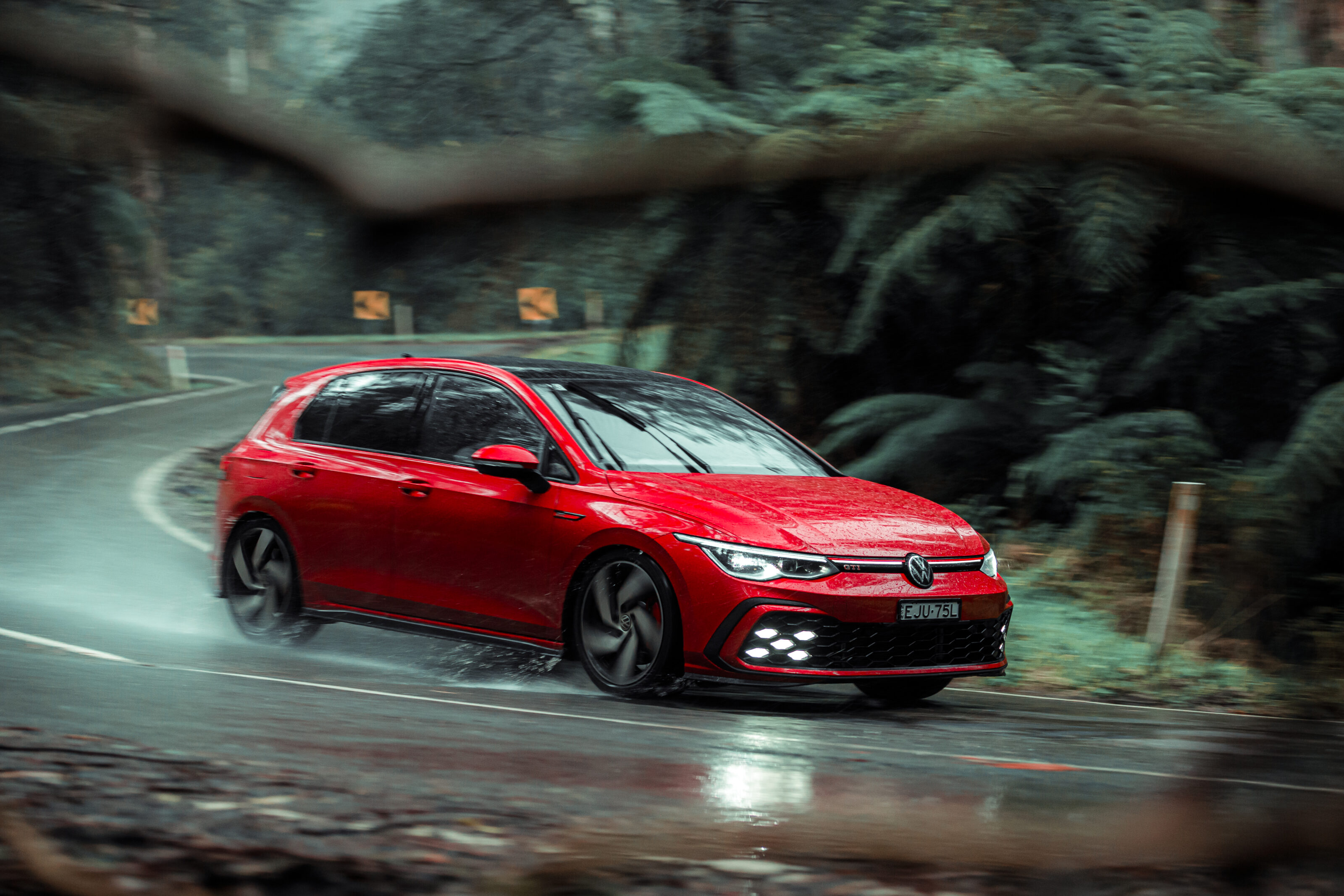
1
2023 Volkswagen Golf features
Golf
| 10.25-inch Digital Cockpit instrument cluster (static display) | Tri-zone climate control |
| 8.25-inch infotainment system | Cloth seats |
| Apple CarPlay and Android Auto (wired) | LED headlights and tail lights |
| DAB+ digital radio | 16-inch alloy wheels |
Golf Life, in addition to Golf
| Digital Cockpit Pro screen (configurable display) | 10-colour configurable ambient lighting |
| 10-inch infotainment system | Comfort sports seats with lumbar adjustment |
| Apple CarPlay and Android Auto (wireless) | Power-folding side mirrors |
| Wireless phone charger | Luggage net |
| Satellite navigation | 17-inch alloy wheels |
| Keyless entry and push-button start | Electric tailgate (wagon only) |
Golf R-Line, in addition to Life
Golf GTI, in addition to R-Line
Golf R, in addition to GTI
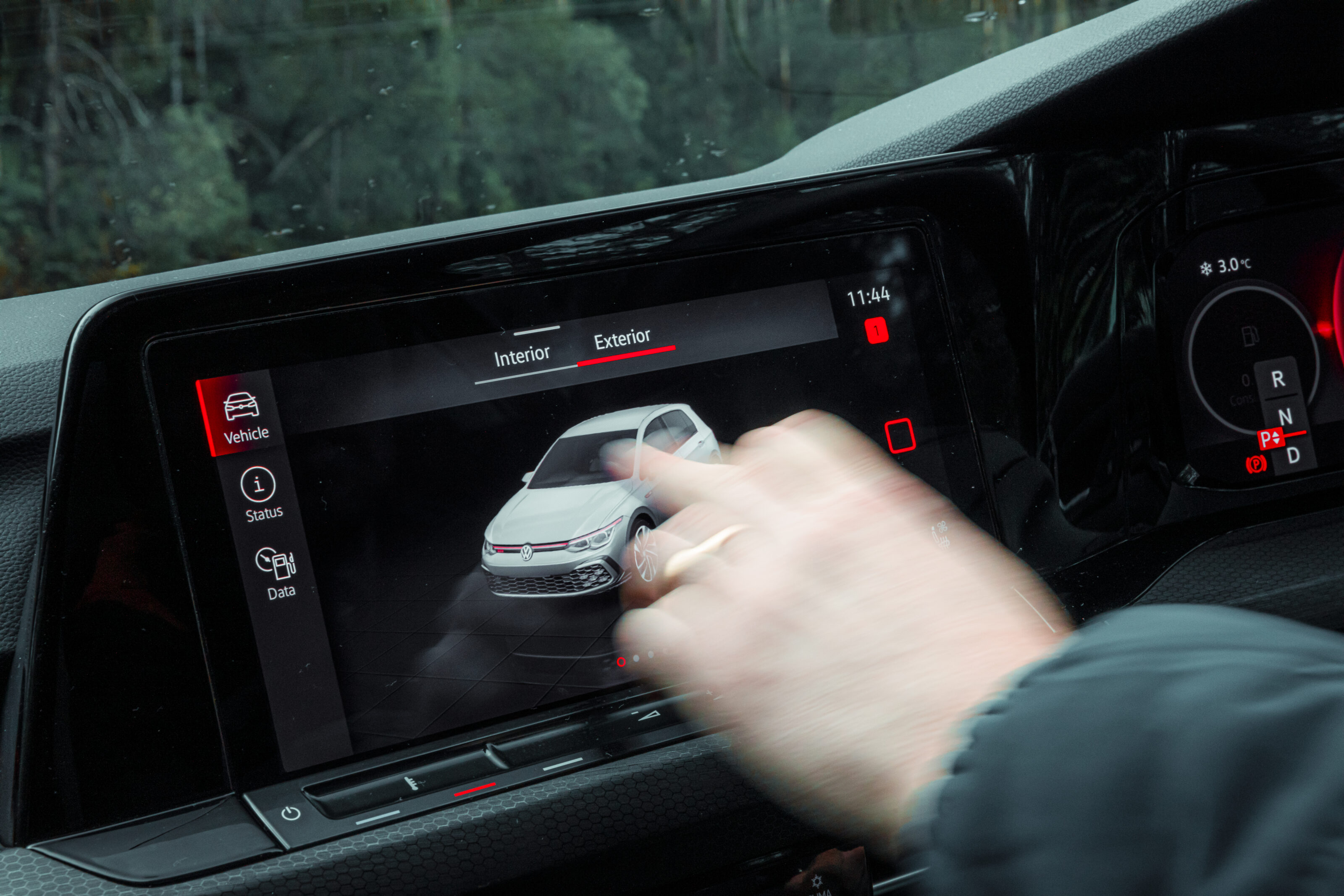
1
Options
- Sound and Vision Package – $1600 (Life, R-Line)
- Comfort and Style Package – $2000 (Life)
- Sound and Style Package – $2500 (GTI)
- Luxury Package – $3900 (GTI)
- Panoramic glass sunroof – $1900 (R-Line, R)
- Nine-speaker, 480-watt Harman Kardon premium audio system – $1000 (R)
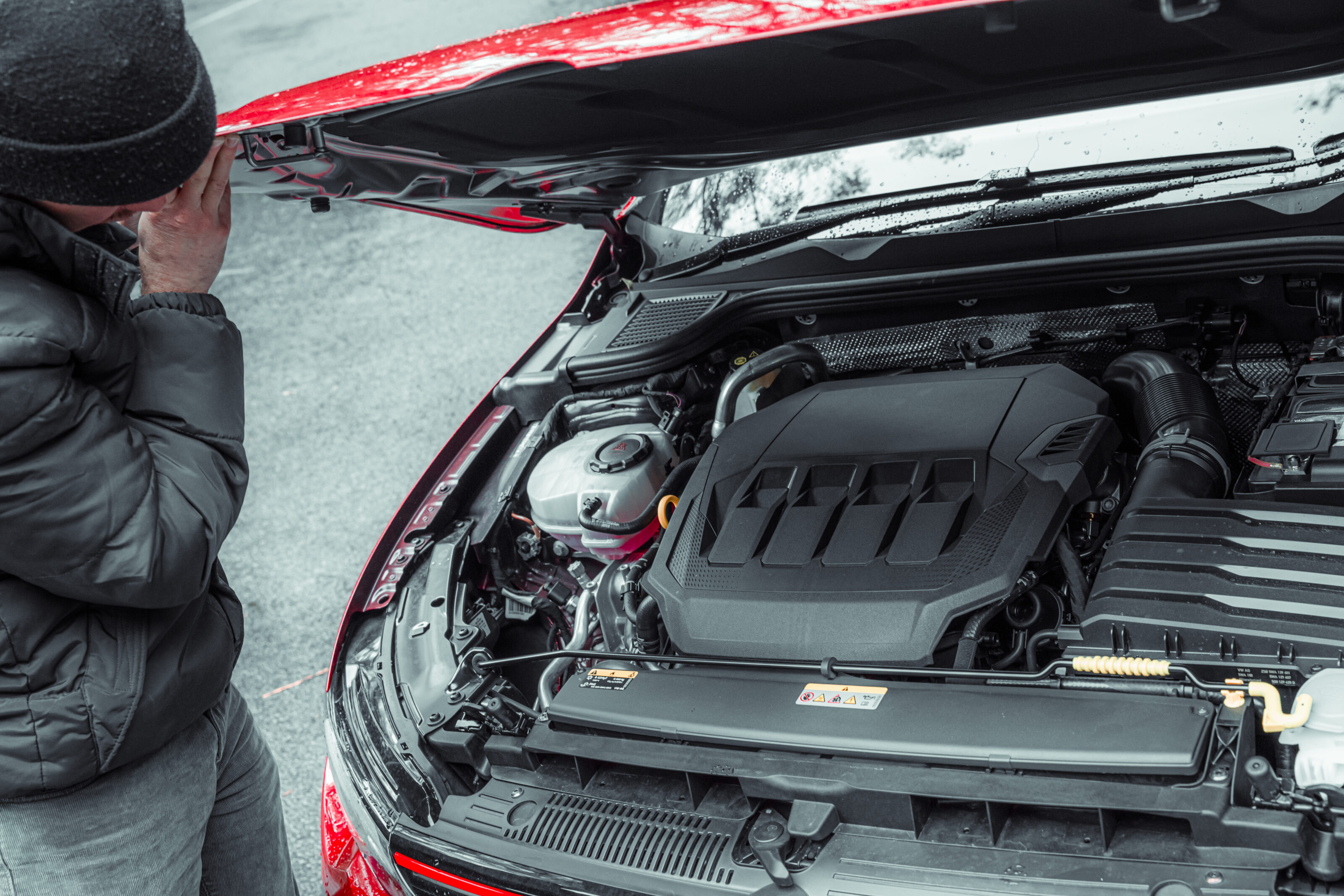
1
Engine, drivetrain and fuel economy
Golf 110TSI variants are powered by a 1.4-litre four-cylinder turbocharged petrol engine producing 110kW of power and 250Nm of torque.
Power is sent to the front wheels through either an eight-speed Aisin-sourced torque-converter automatic.
Stepping up to the front-drive Golf GTI brings the addition of the fourth-generation ‘EA888’ engine, a 2.0-litre turbo four-cylinder unit punching out 180kW and 370Nm, with a seven-speed dual-clutch gearbox.
The flagship Golf R hatch is powered by a modified version of the 2.0-litre turbocharged four-cylinder petrol mill with 235kW and 400Nm.
The wagon has 420Nm of torque and a petrol particulate filter. It utilises a seven-speed dual-clutch transmission and 4Motion all-wheel-drive system.
Fuel economy figures can be found in the table below:
| Golf 110TSI hatch | 5.8L/100km |
| Golf 110TSI wagon | 5.9L/100km |
| Golf GTI hatch | 7.0L/100km |
| Golf R hatch | 7.8L/100km |
| Golf R wagon | 7.4L/100km |
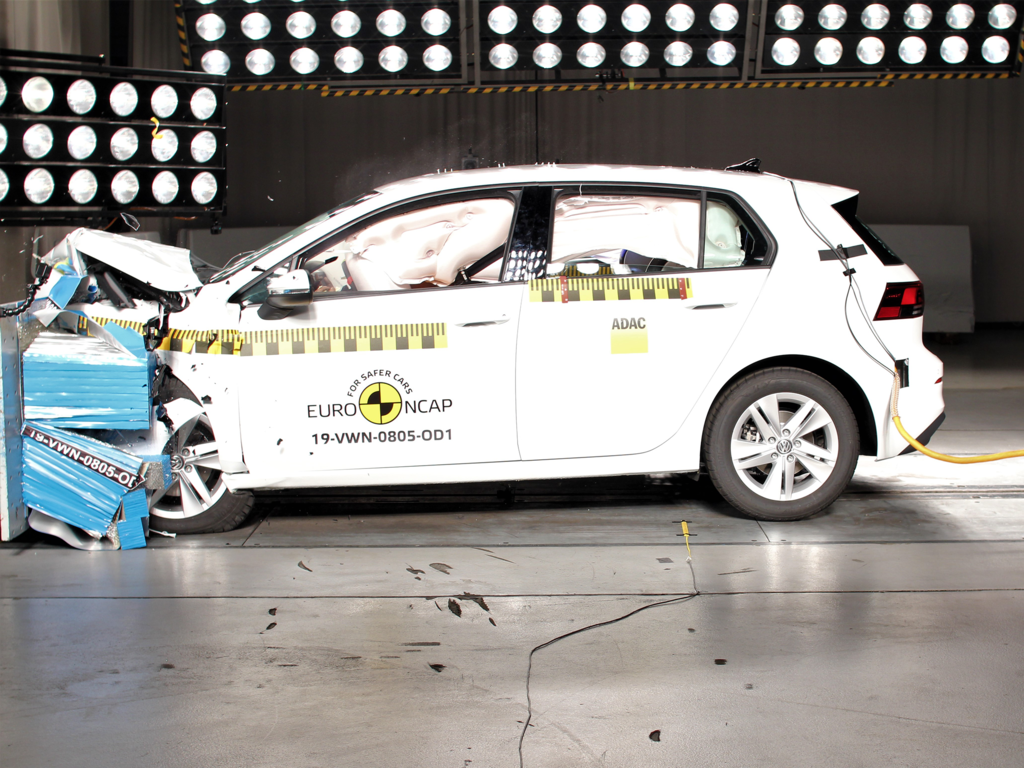
1
Safety
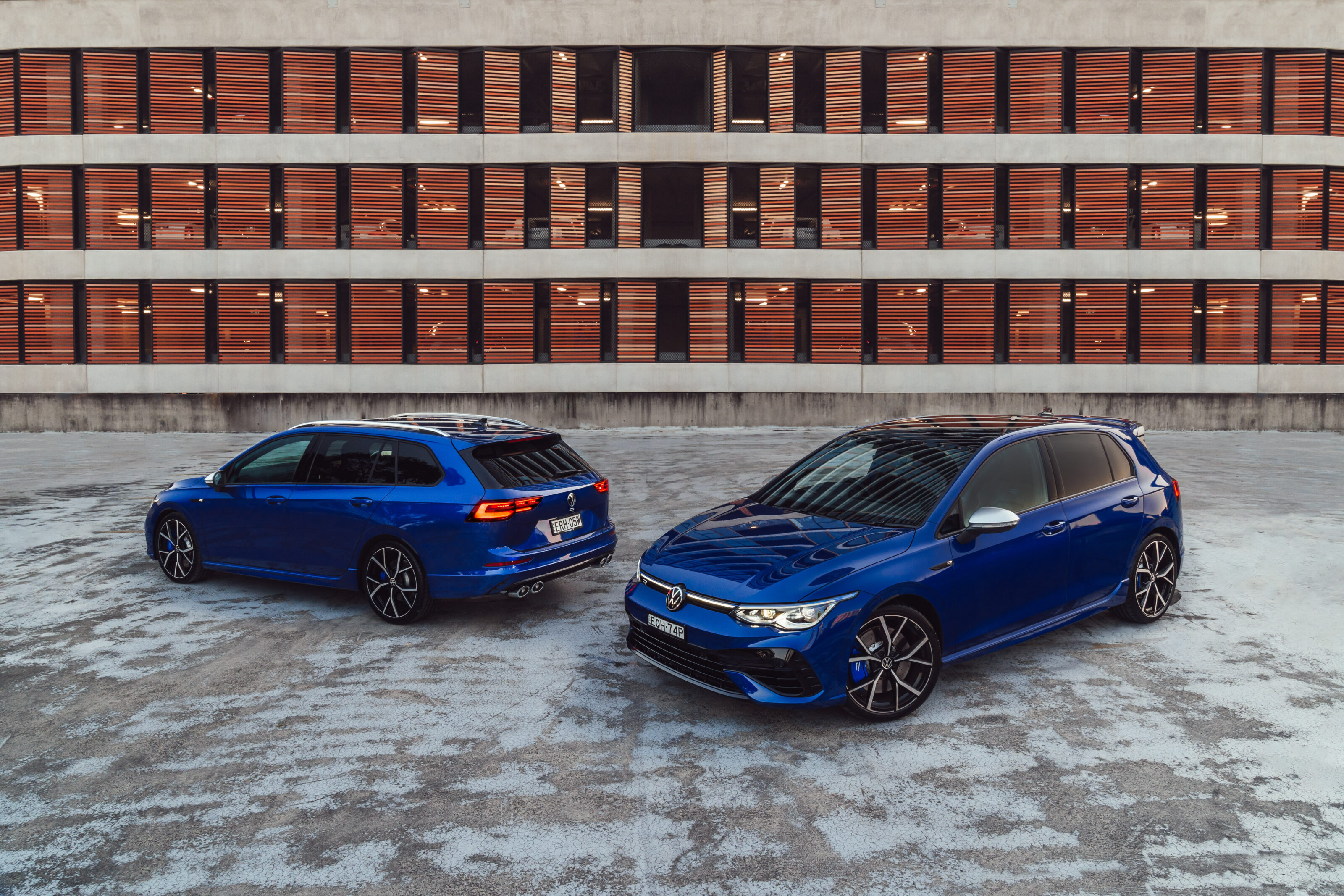
The entire Volkswagen Golf range is covered by a five-star ANCAP safety rating, based on testing conducted in 2019. It has a 95 per cent score for adult occupant protection, 89 per cent for children, 76 per cent for vulnerable road users, and 80 per cent for safety assist.
Nine airbags (dual front, front side, rear side, curtain, and front-centre) feature across the range.
Each variant includes the following active safety equipment as standard:
1
Dimensions
In hatchback guise, the Golf has a wheelbase of 2636 millimetres, and is 4284mm long and 1789mm wide.
The entry-level and Life variants are 1483mm high, with the R-Line featuring 15mm lower suspension. GTI and R variants are 1463mm tall.
Meanwhile, the wagon body has a 2686mm wheelbase, and measures 4633mm long and 1789mm wide.
The hatch has a claimed 374 litre boot capacity, expanding to 611L in the wagon with the rear seats up. Luggage capacity grows to 1230L and 1642L, respectively, with the second-row folded.
Warranty and servicing
As per the wider Volkswagen range, the Golf is covered by the brand’s five-year/unlimited kilometre factory warranty, along with a complimentary 12-month roadside assistance program.
Service pricing can be pre-purchased, consisting of three- or five-year packages with 12-month/15,000km intervals.
Prices for each powertrain can be found below:
| Powertrain | Three-yearu00a0 | Five-year |
|---|---|---|
| 110TSI | $1450 | $2400 |
| GTI | $1600 | $2800 |
| R | $1700 | $3000 |
Availability
The updated 2023 Volkswagen Golf and Golf Life production commenced in late June, ahead of first arrivals in the coming weeks.
Meanwhile, the R-Line, GTI and R grades will follow from late November production, with showroom arrivals likely in early 2023.
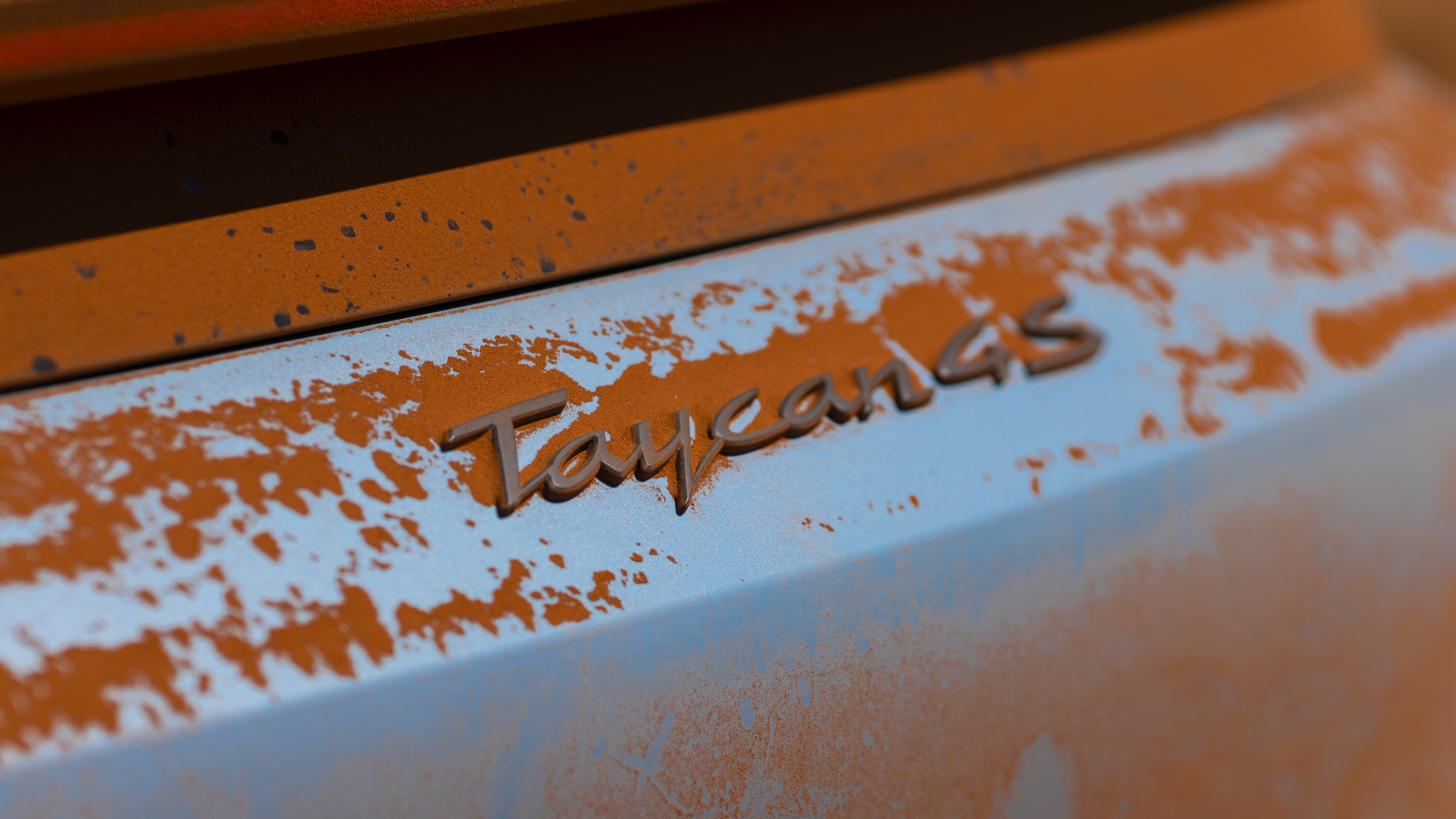
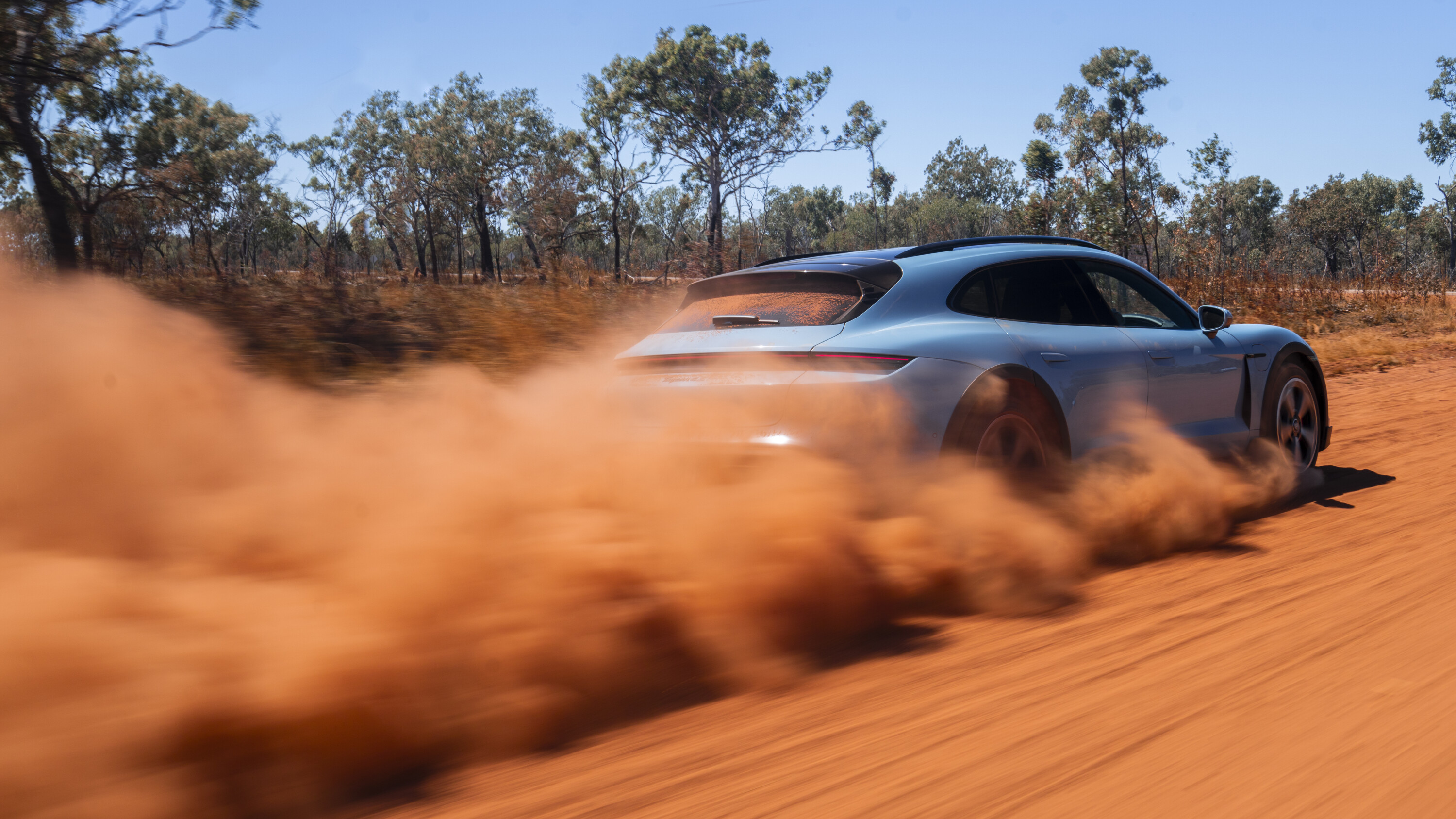
Porsche might not have crossed the Simpson Desert in a 911 – we’ll keep that credit for ourselves – but the Stuttgart Marque has proven EVs can do remote road trips in Australia by taking a Taycan Cross Turismo on a 19 day, 5000km run from Darwin, NT to Bondi Beach in Sydney.
Not only was this a test of the Taycan 4S Cross Turismo’s 469km driving range (WLTP), but also a challenge for charging infrastructure. Along with public ultra-fast charging stations run by ChargeFox, Evie, Tesla, and more, the Taycan was also able to take advantage of Porsche’s own destination charger network.
In total, 27 charge stops were needed to make it to Sydney and together those stops represented 85 hours of stoppage time – most of which were at Porsche dealers where the Taycan recuperated at a rate of 22kW (AC).
1
It wasn’t all plain sailing, though, with Mark Webber having to rejuice the 4S Cross Turismo at a remote cattle farm on his way through. Well-known destinations included Nitmiluk (Katherine) Gorge in the NT, the township of Daly Waters, the ‘Big Red’ sand dune in the Simpson and a tour around Bathurst’s Mount Panorama racetrack on the way to Bondi Beach for a surf.
Those used to smash-and-grab road trips might think 19 days is a pretty relaxed schedule for the above trip, but Porsche wasn’t out to prove how fast the drive could be done, just that road-tripping in an EV is very much possible.
“Embracing the spirit of exploration, on this all-electric trip the Taycan Cross Turismo redefines the very essence of reduced impact adventure”, said Porsche Cars Australia CEO and managing director Daniel Schmollinger.
“The Taycan Cross Turismo offers a thrilling driving experience while exploring nature. This is how Porsche captures the hearts of Australians.”
1
Porsche’s Taycan was the brand’s first EV that generated into the long-roofed and gently raised Cross Turismo used for this trip.
However, Porsche’s pipeline has a whole laundry list of electric models. The electric revolution will continue with the all-new Macan SUV shortly, followed by the brand’s first all-electric sports car – the 718 – and finally the Cayenne large SUV.
MORE
Everything Porsche
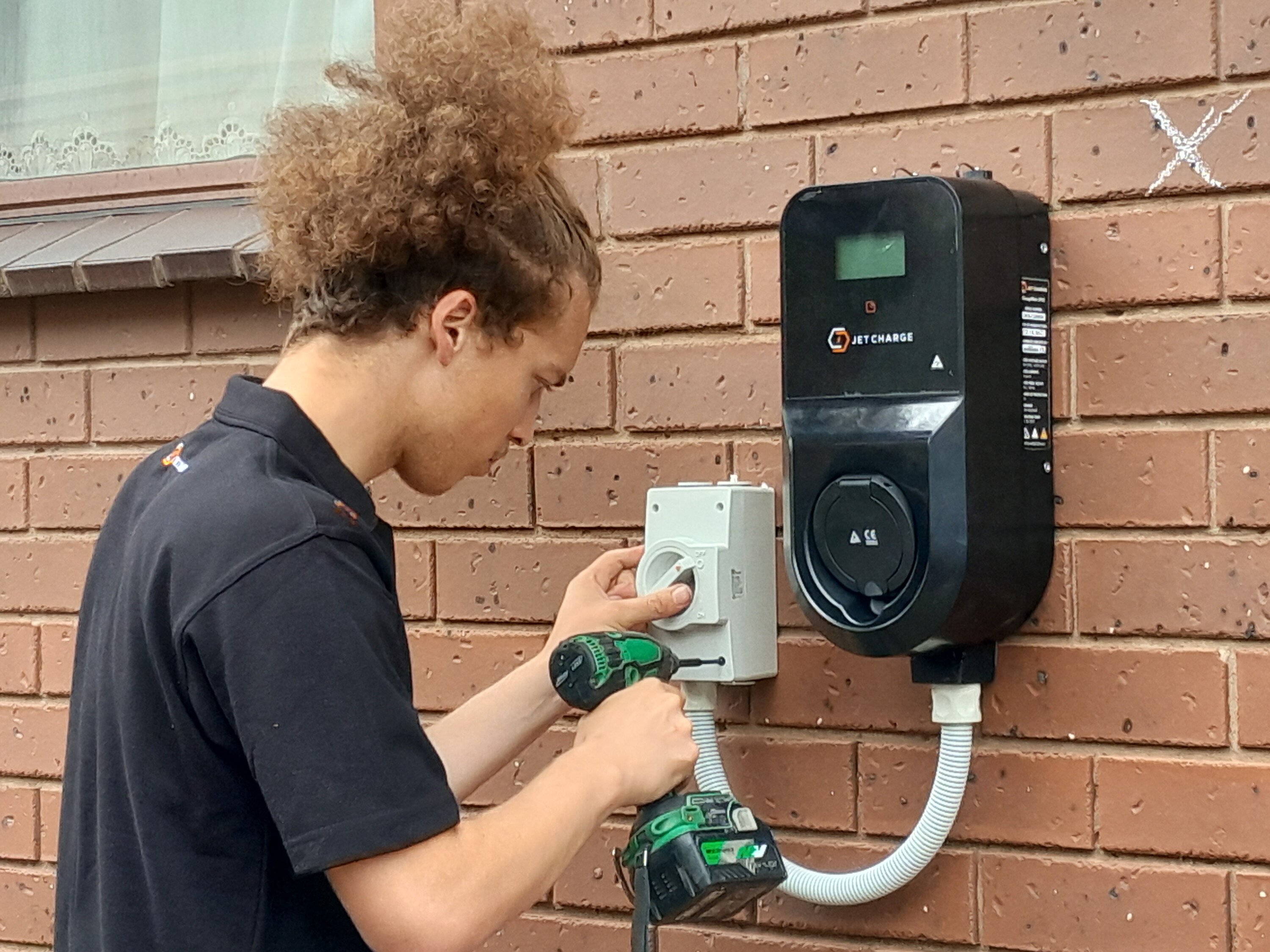
Mitsubishi Australia has provided a trio of Outlander plug-in hybrid electric vehicles (PHEVs) to Jet Charge to support installing charging infrastructure across the nation.
Snapshot
- Outlander PHEVs added to Jet Charge fleet
- Ideal for travelling to remote regions
- To support installing EV charging infrastructure roll out
It represents an extended partnership with the EV charging equipment company which currently supplies AC charging cables for Mitsubishi PHEVs.
Jet Charge founder and chief executive Tim Washington said his team would benefit from the Outlander PHEV’s extended driving range compared to pure EVs and all-wheel drive capability.
In particular, the plug-in hybrid SUV fleet will support building EV charging sites in remote areas that experience harsh conditions. The initial three-strong fleet may grow in the future if the Outlander PHEV’s unique attributes prove useful.
1
The Outlander PHEV pairs a 2.4-litre four-cylinder petrol engine with dual electric motors and a 20kWh gross lithium-ion battery pack.
This results in a claimed 84-kilometre electric range and 1.5L/100km fuel consumption in the combined ADR cycle. Real-world mileage will vary as digital editor Alex Inwood found out in his long-term test.
In addition the Outlander’s V2x – vehicle-to-grid, vehicle-to-home, etc. – capabilities are unique in that, along with the battery its petrol motor can be used as a generator to extend its charging life.
This could provide unique advantages during low-light installs, or where power tools are needed to charge for the Jet Charge team which sells, installs and maintains EV charging equipment for homes, businesses and public charging providers in Australia.
It installed vehicle-to-grid (V2G) bidirectional charging units for Mitsubishi’s Adelaide headquarters earlier this year. The Australian company was established in 2013 and co-founded the Chargefox network in 2017.
MORE
PHEV and Hybrid Cars
September 2023: Here’s the new Tiguan
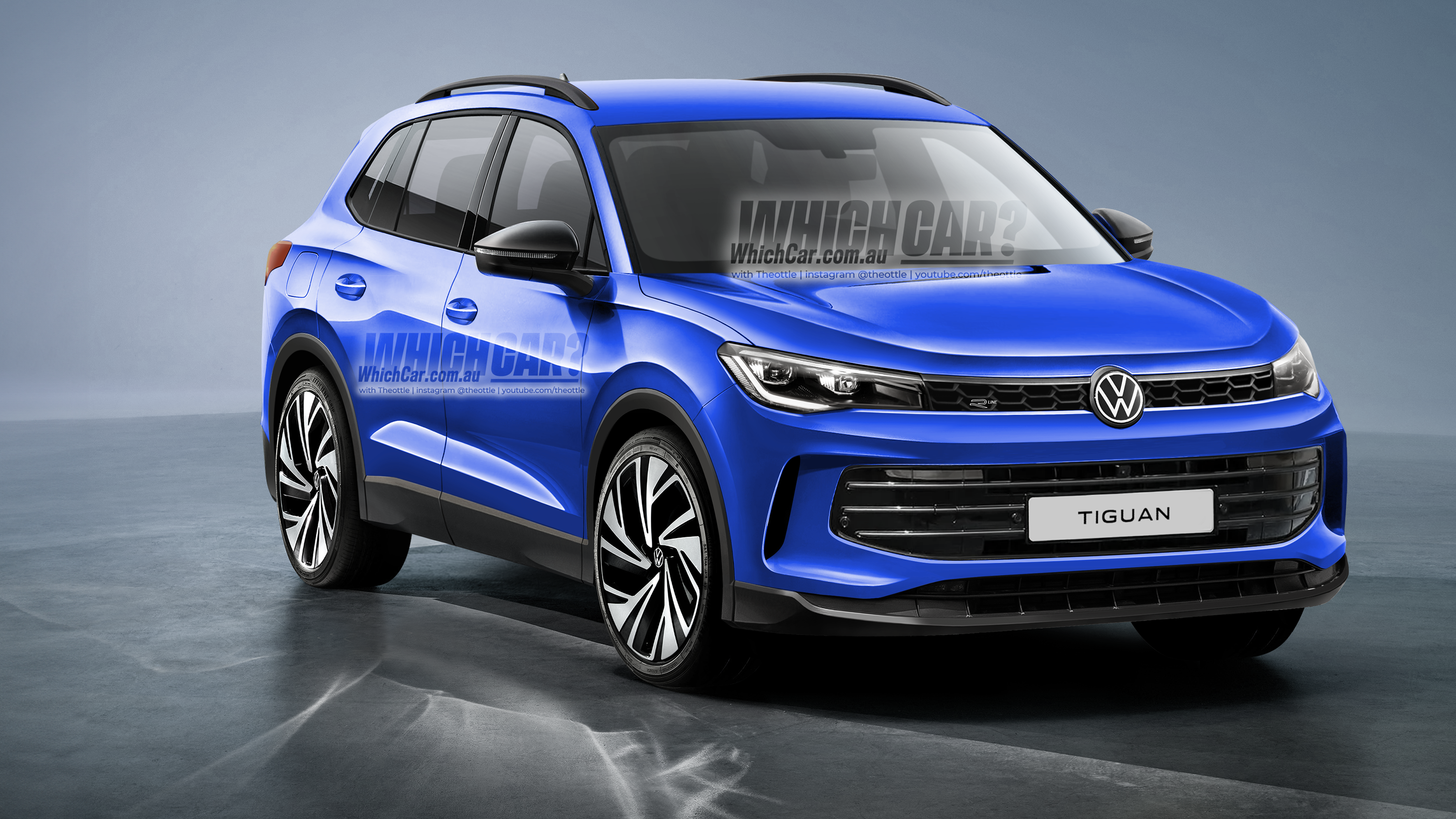
The cat weird tiger-iguana hybrid is out of the bag. Thanks to design patent application images that surfaced online in August, we now know exactly how the new Tiguan will look.
1
We were pretty close with our previous speculative artwork, thanks to the spy photos available at the time. Now, though, there’s little left to wonder at.
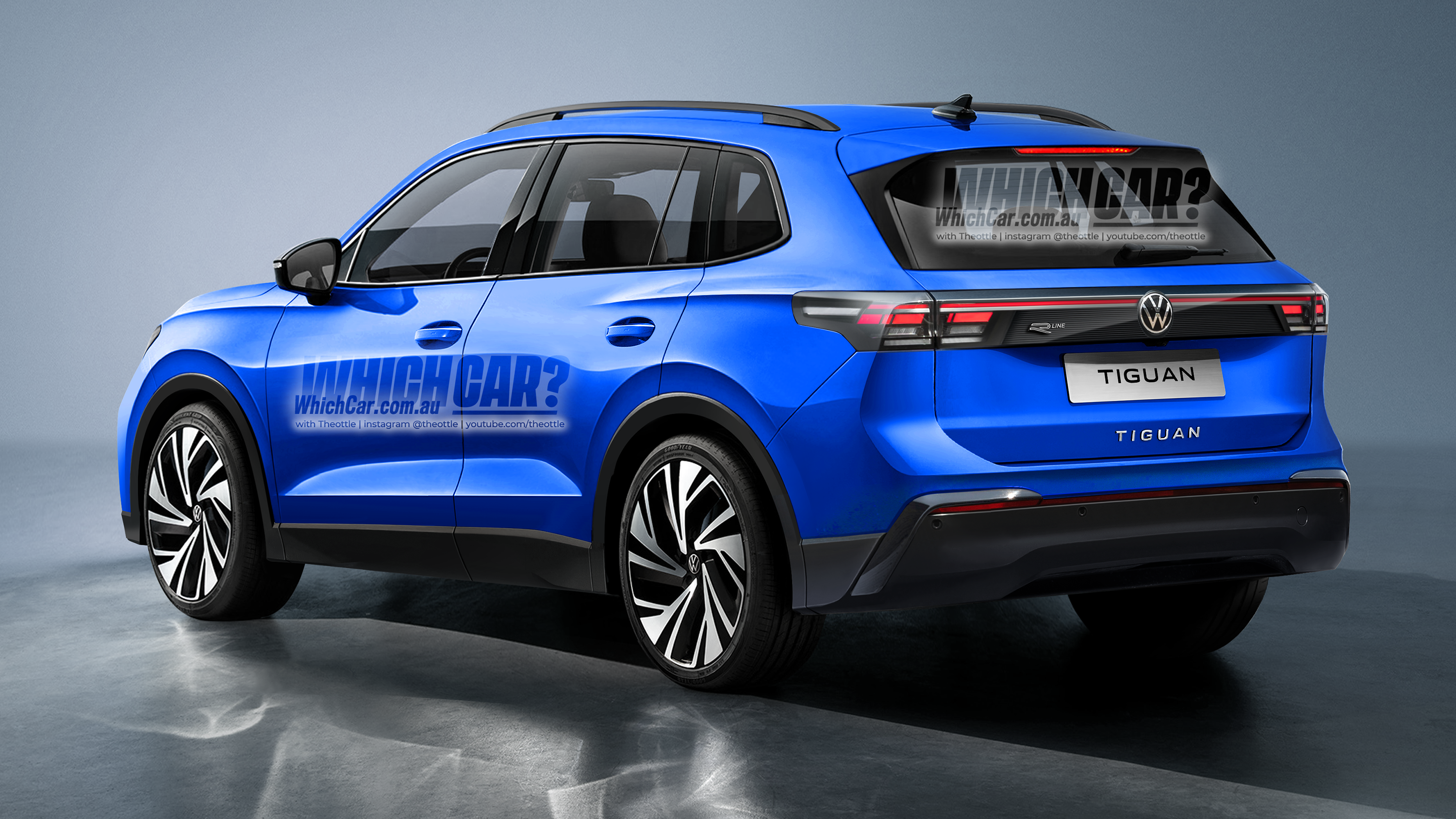
Our new renderings show the third-gen 2024 Volkswagen Tiguan in sporty R-Line form, which hasn’t yet been teased or leaked, but there’s a decent chance it’ll look like this.
1
Interestingly, the current Tiguan R-Line facelift wears a regular new R badge in place of the earlier ‘R-Line’ badge – but for the sake of clarity, we’ve returned the ‘LINE’ text for our version.
What do you think of the new Tiguan’s look? Tell us in the comments below!
September 2023: New Tiguan will be a petrol-only affair
Despite previously revealing efforts to get the plug-in hybrid EV Tiguan into Australia, VW has now confirmed it will only offer the petrol model, alongside the all-electric ID.4. Full details below.
December 2022: Our first crack at the new Tiggy
New spy photos confirm next-gen Tiguan styling, and now we know what to expect inside too
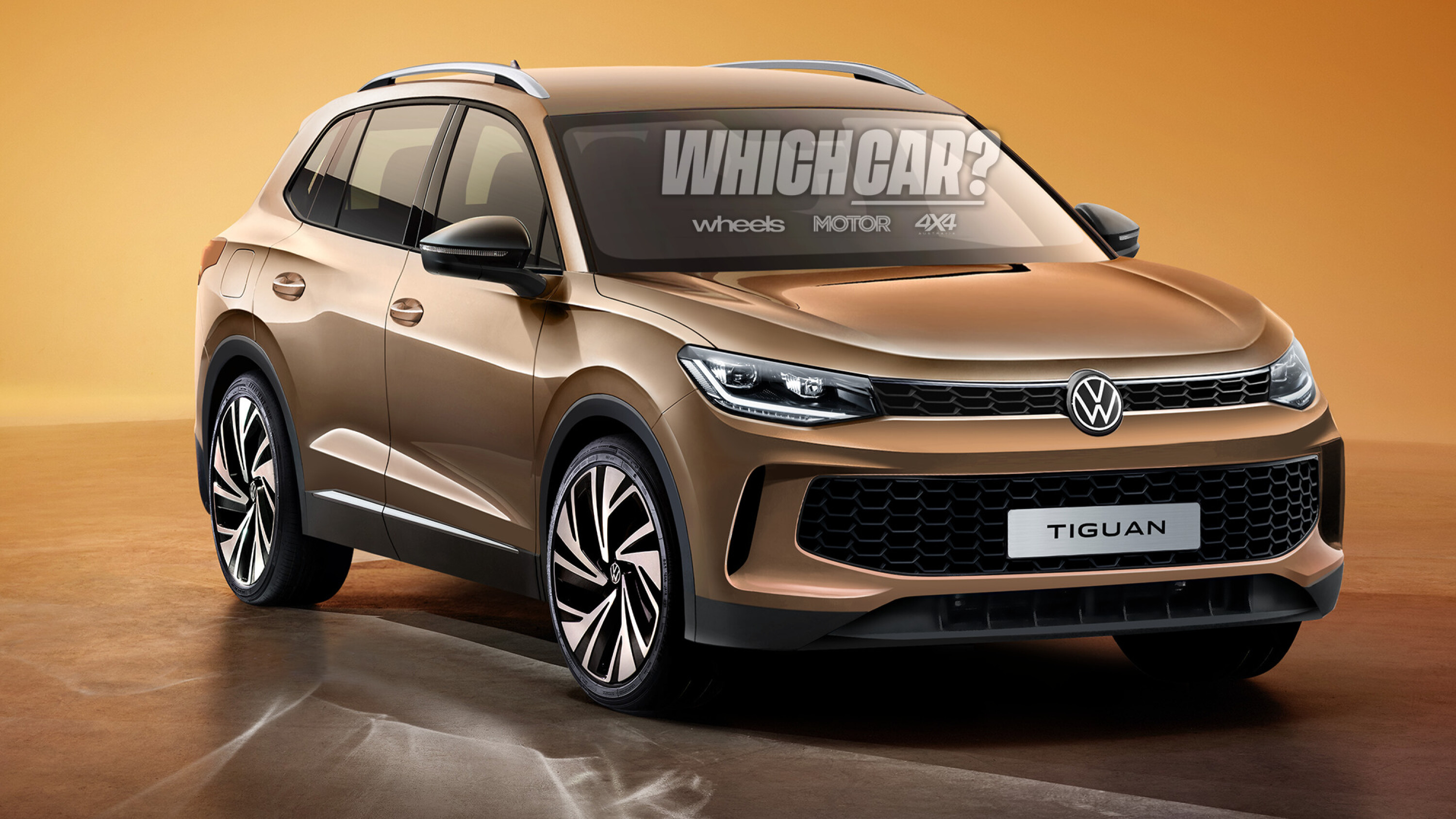
Fresh spy photos of a camouflaged next-gen Tiguan have surfaced again online, further reinforcing the details of our speculative renders here. What do you think of the new look? Tell us in the comments below!
1
We also know, thanks to comments from Volkswagen brand boss Thomas Schäfer, that the new Tiguan will see a return to proper tactile physical switches, reducing the need for drivers to fumble around for the right capacitive touch button on a glossy flat surface.
Schäfer said: “We’ve got feedback from customers, we’ve feedback from clinics and from journalists… They say, ‘You know this is not good. You’ve got to improve this’.”
Volkswagen says it has listened to buyer and media feedback in making the decision, so that’s good news for all – a strong demonstration of where VW is at right now and how seriously it’s taking market demands. Read that story at the link below.
The story to here
October 3: Here’s a glimpse of the third-generation 2024 Volkswagen Tiguan
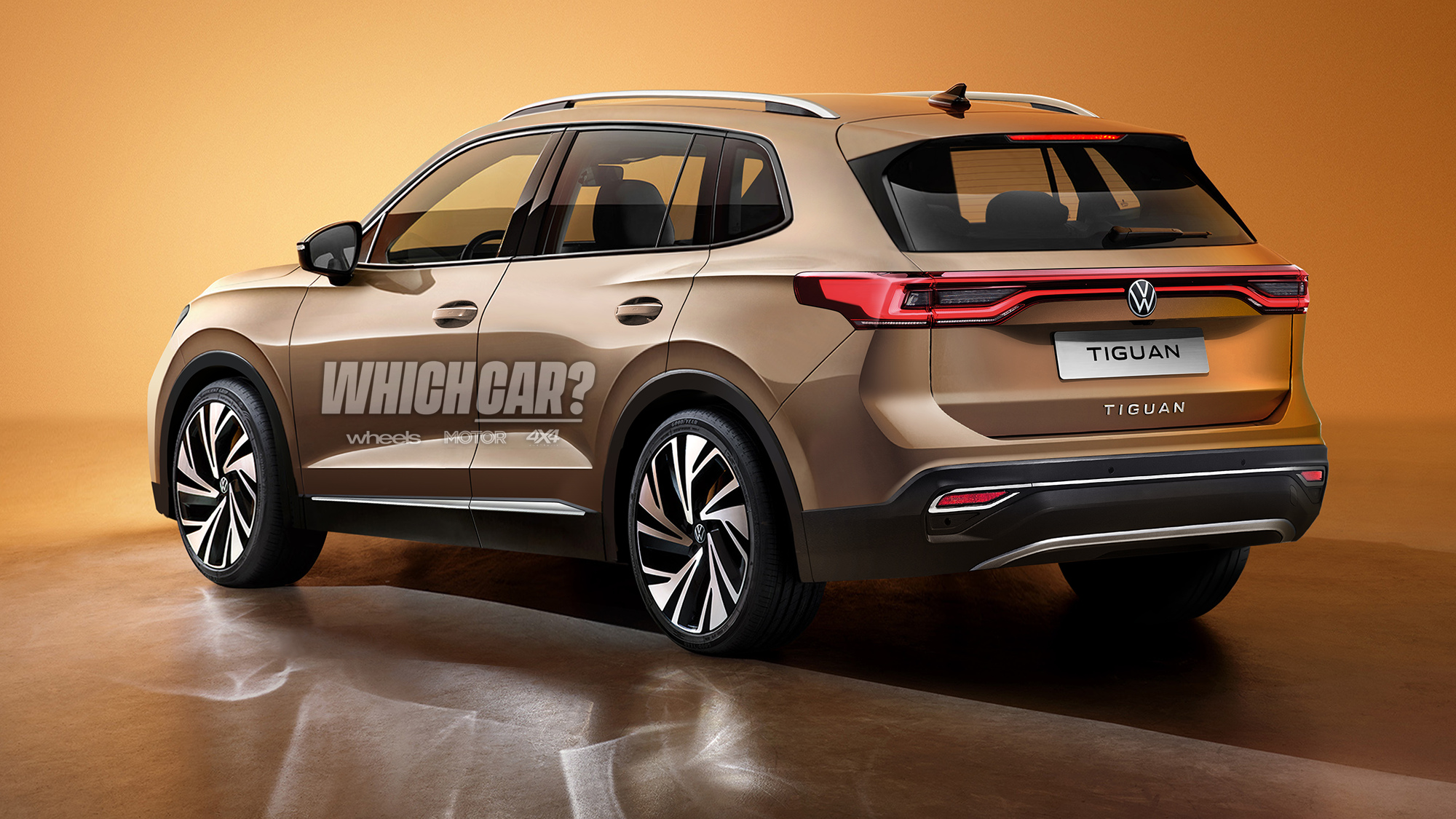
A third-gen VW Tiguan is likely to debut next year. Before then, we have digital artist Theottle’s rendering based on spy shots of prototypes to mull over.
The current Tiguan, launched in 2016, was treated to a midlife refresh in 2020 and is a rival for the Toyota RAV4, Kia Sportage, Mitsubishi Outlander and Hyundai Tucson.
1
It looks like the new Tiguan will grow in length and width. It’s possible the car that’s been spied is the American-market Tiguan – a three-row SUV known as the Allspace in Australia – or a larger vehicle that bridges the gap between short- and long-wheelbase Tiguans.
With Volkswagen Europe moving swiftly towards electrification with similarly-sized ID.4 and ID.5 battery EVs, an ICE-heavy Tiguan range will target markets such as North America, Australia and South Africa.
How’s the design changed?
The spy-shot based render moves the Tiguan’s cab rearward, with a longer bonnet and less square proportions than the current car. The result is a sleeker – dare we say coupe-like – stance.
1
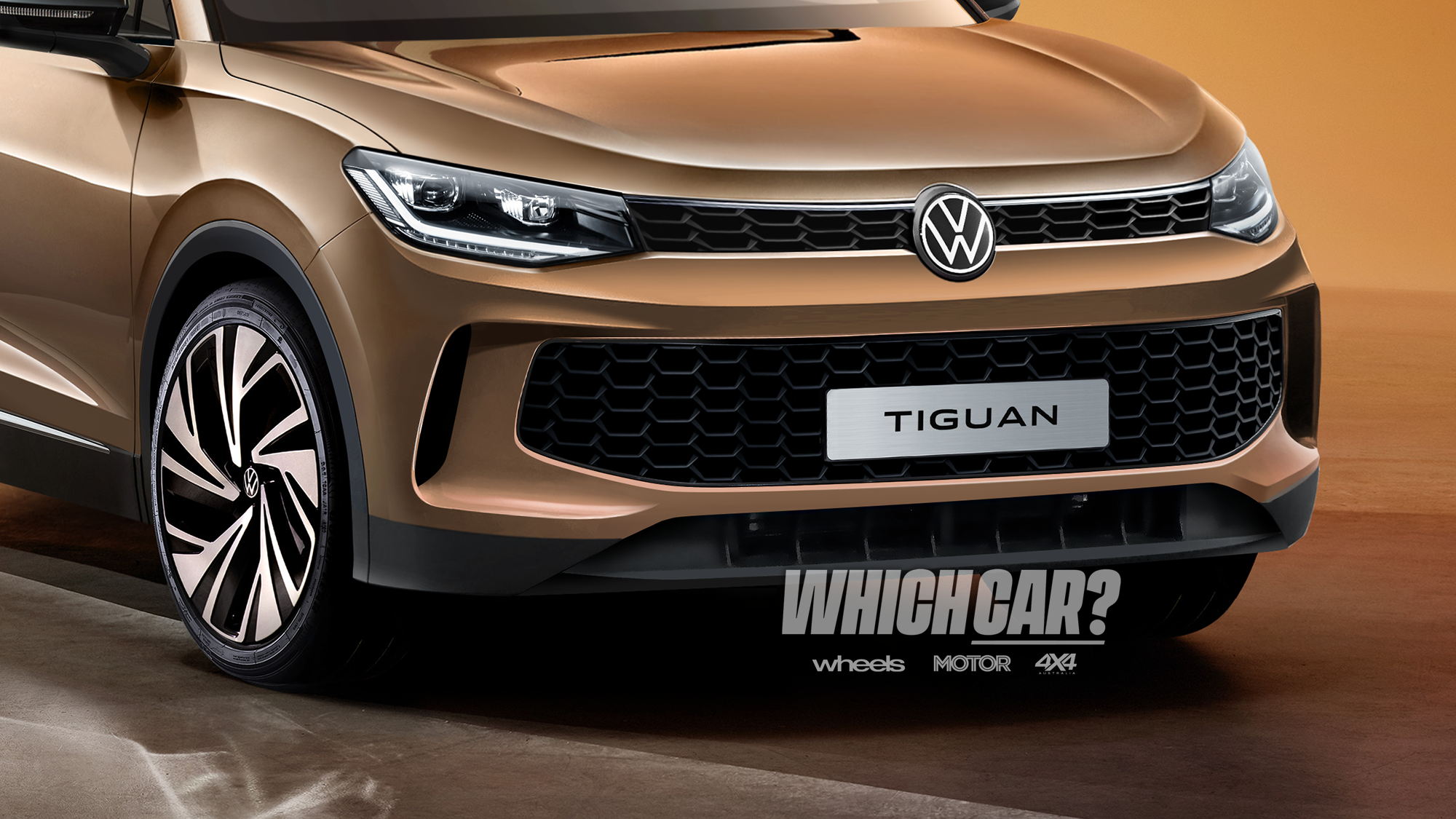
Details are lifted from the VW stable, with the full-length LED tail-lights reminiscent of the smaller T-Cross and new grille design that reminds us of the ID.4. Both details serve to accentuate the new Tiguan’s width.
We know the next Tiguan won’t be an EV, but just to make sure bystanders do, too, the new SUV has a broad air intake below its grille.
Down its flanks, the new Tiguan ditches the current car’s confident, single crease in favour of gently-flared flared wheel arches.
When is it coming?
Providing development continues without hassle, we’ll likely see the new Tiguan debut in Europe as soon as 2023.
The third-gen Tiguan will use a newer iteration of the MQB platform of the current car. Whether that is the same MQB Evo as the Mk8 Golf or an even fresher platform with more computing power is yet to be confirmed.
1
Under the bonnet there will surely be some kind of electrification, be that plug-in, self-charging or mild hybrids. An all-electric variant isn’t off the cards.
But combustion engines – including the current 2.0-litre turbo ‘EA888’ and 1.5-litre 110TSI Evo petrol mills – are likely to feature in the new Tiguan.
According to Mazda Australia, a substantial 45 per cent of Mazda 2 buyers later purchase another Mazda vehicle, highlighting its significance to the brand’s lineup.
Though the current generation is already 9 years into its lifecycle, the 2023 Mazda 2 has received a facelift, incorporating subtle yet essential updates to maintain its contemporary appeal.
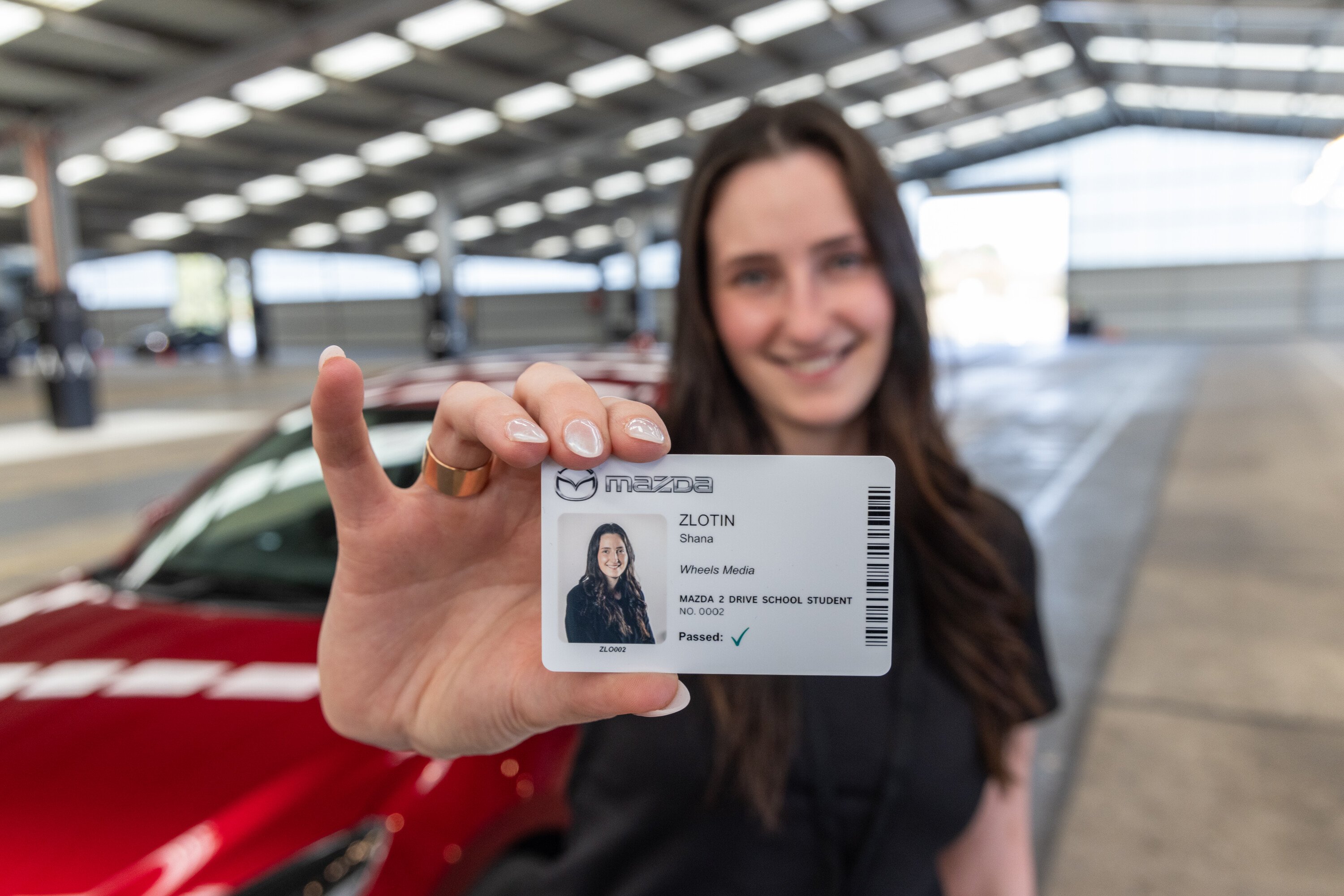
So to test out a car on so many young buyers’ shopping lists, Mazda put us to one of the most embarrassing tests possible for an automotive writer– a driving licence test.
But before we jump into that, let’s take a look at what the updated Mazda 2 brings.
1
JUMP AHEAD
What’s changed?
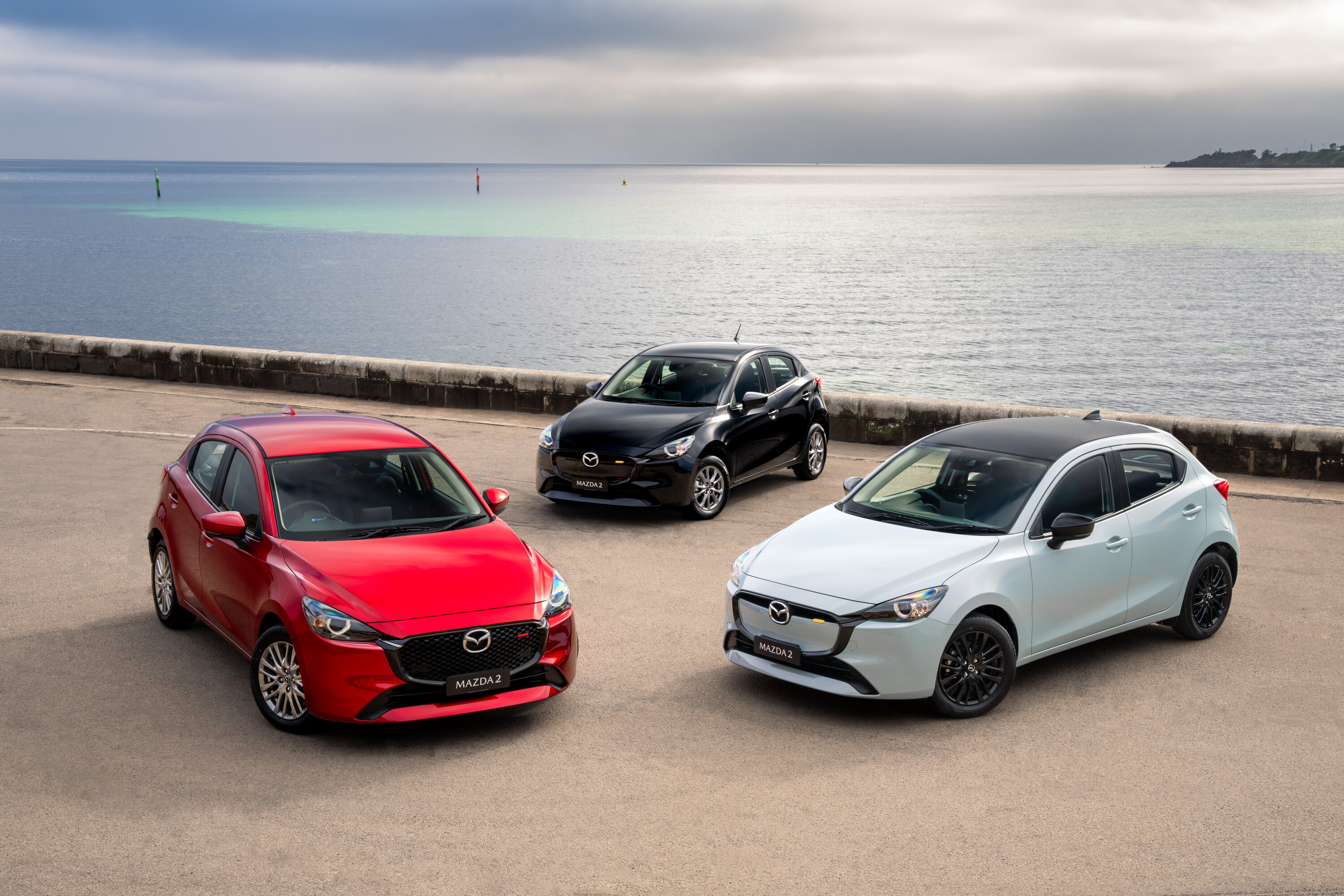
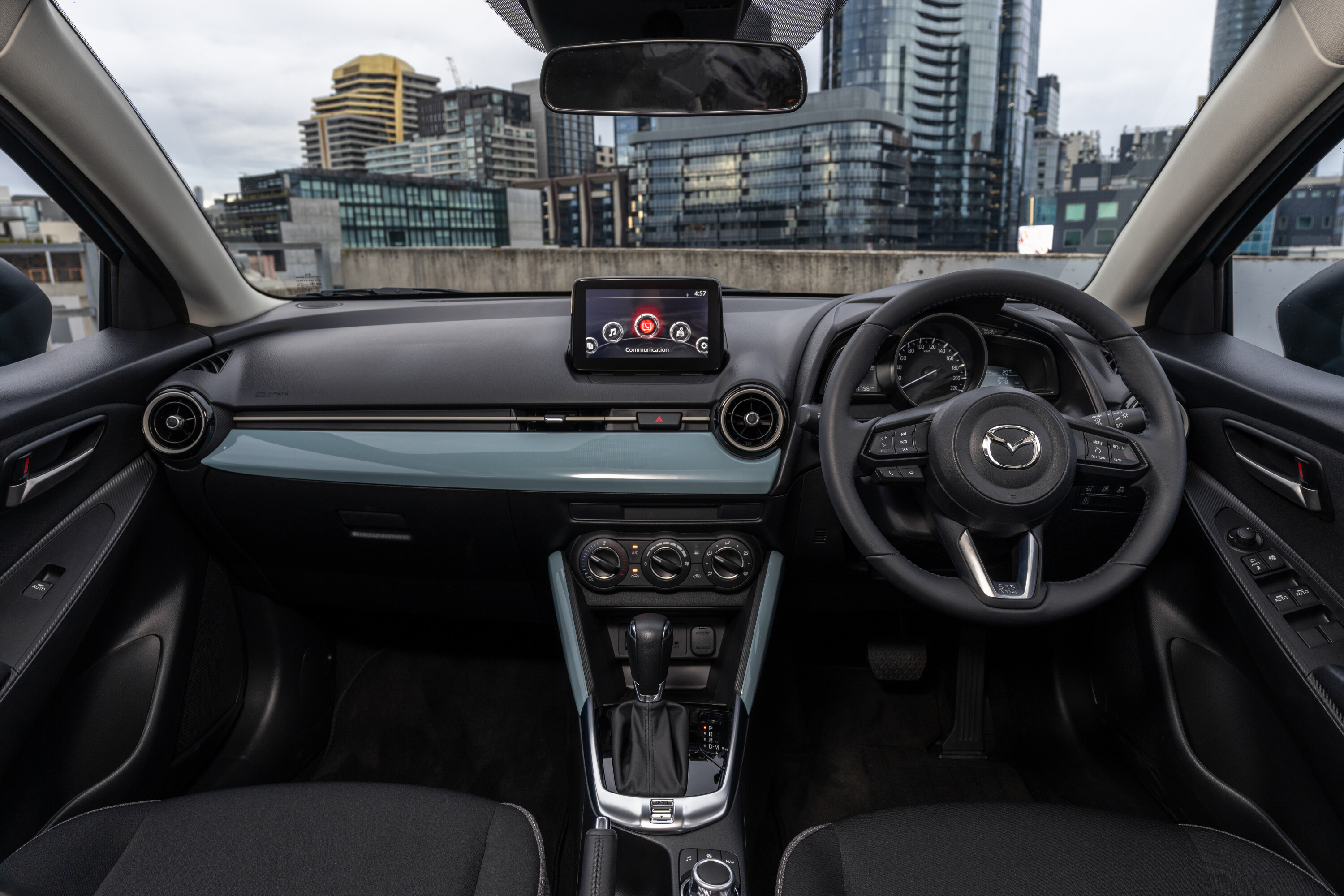
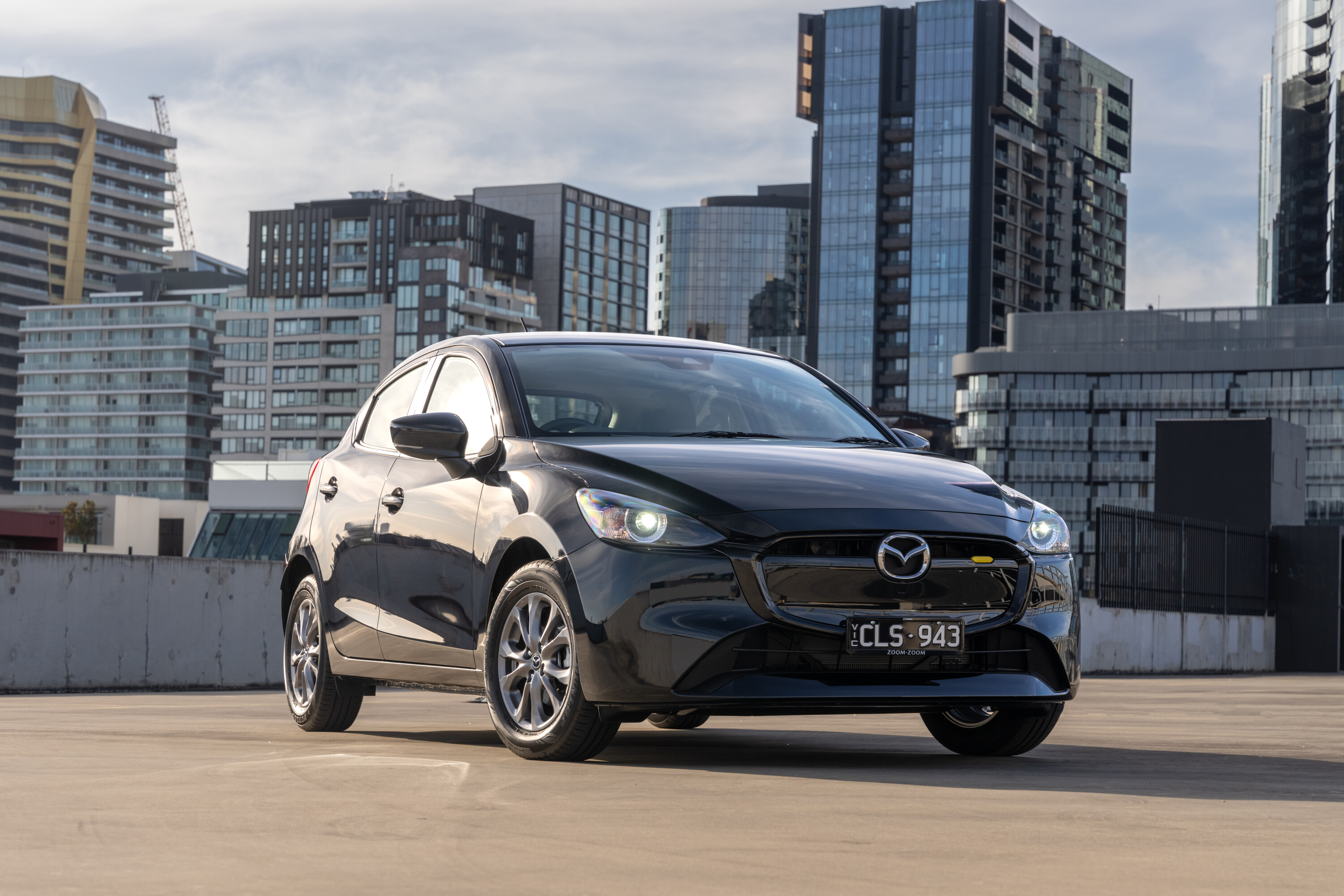
The 2023 refresh showcases a redesigned front fascia, featuring an updated grille and revamped front bumper.
The line-up remains the same with the four variants of hatch (Pure, Pure SP, Evolve, GT) and two model grades for the sedan (Pure and GT). All are paired with a six-speed automatic transmission, except the Pure hatchback which also offers a six-speed manual.
For hatchback models and the premium GT sedan, a new rear bumper is introduced. The hatch further features a colour accent on its front grille and rear bumper, available in yellow or red, depending on the variant.
1
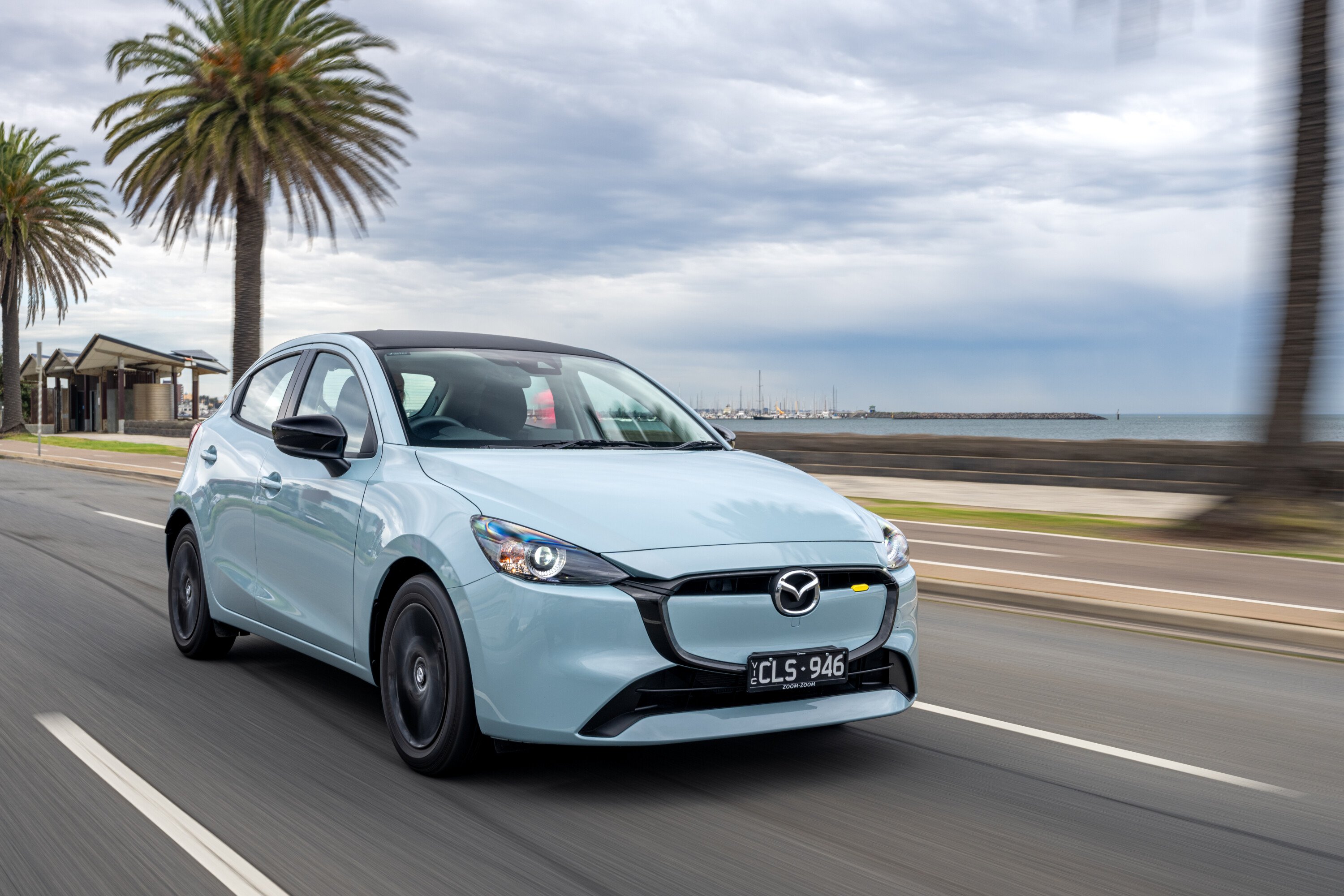
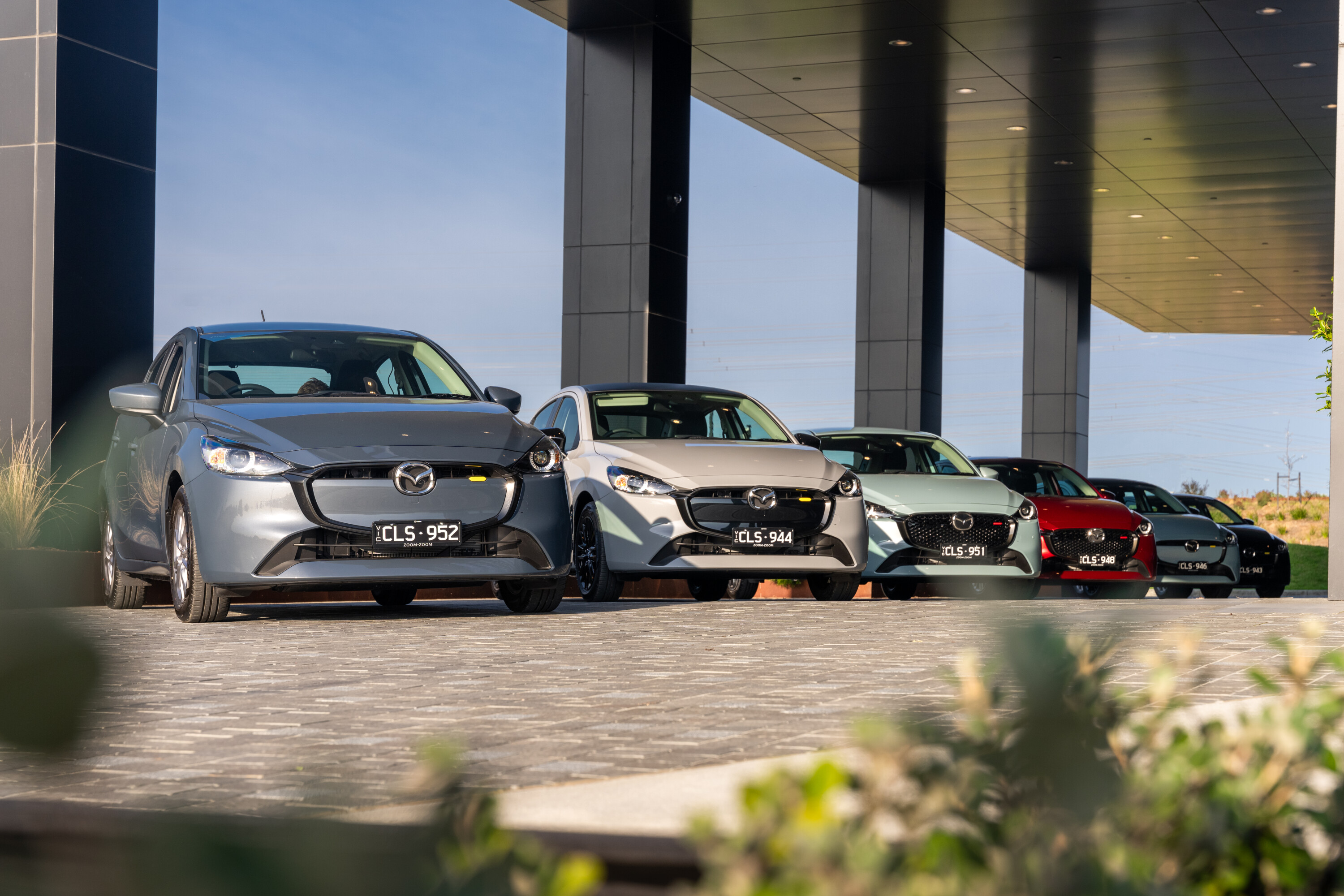
Two new paint shades, Aero Grey Metallic and Airstream Blue Metallic, have been added. The latter of which we really like.
The Pure and Pure SP models showcase three dashboard trim colours – Pure White, Mirror Black, or Mint, determined by the exterior hue. The Pure SP also adds a new carbon-fibre-look roof panel.
Across all variants, wired Apple CarPlay and Android Auto have been integrated.
1
Powertrain
Underneath, the Mazda 2 retains its 1.5-litre four-cylinder naturally aspirated engine, generating 81kW and 142Nm. The Pure manual variant outputs an extra kilowatt.
Mazda claims the 2023 update improves fuel efficiency and lowers CO2 emissions – it sips on 5.0L/100km on a combined cycle compared to the outgoing car’s 5.3L/100km figure.
1
Safety
The Mazda 2 is officially unrated by ANCAP, following the expiration of its 2014 five-star score in January.
Marketing Director Alastair Doak told WhichCar that Mazda has no immediate plans for a retest but emphasised the vehicle is “fundamentally [still] a safe car”.
Opting for the ANCAP safety test, which is a significant investment, would likely have impacted its retail price. Hence, Mazda might have prioritised affordability for a car that doesn’t attract the fleet volume it used to.
The entire range comes standard with the following i-Activsense’ safety tech:
- Autonomous emergency braking
- Blind-spot monitors
- Lane-keep assist
- Rear cross-traffic alert
- Rear parking sensors
- Reversing camera
- Six SRS airbags
1
Pricing
With compact automatic vehicles inching closer to the $30k threshold drive-away, the Mazda 2 follows suit, with price hikes up to $1200.
| 2023 Mazda 2 hatch pricing (prices are before on-road costs) | ||
|---|---|---|
| G15 Pure Manual | $22,410 | up $900 |
| G15 Pure Auto | $24,410 | up $900 |
| G15 Pure SP | $25,210 | up $1200 |
| G15 Evolve | $25,910 | up $800 |
| G15 GT | $27,610 | up $1000 |
1
Accounting for about 10% of Mazda 2 sales, the sedan is available in two grades.
| 2023 Mazda 2 sedan pricing (prices are before on-road costs) | ||
|---|---|---|
| G15 Pure | $24,410 | up $900 |
| G15 GT | $27,610 | up $1000 |
Re-taking your driver’s licence
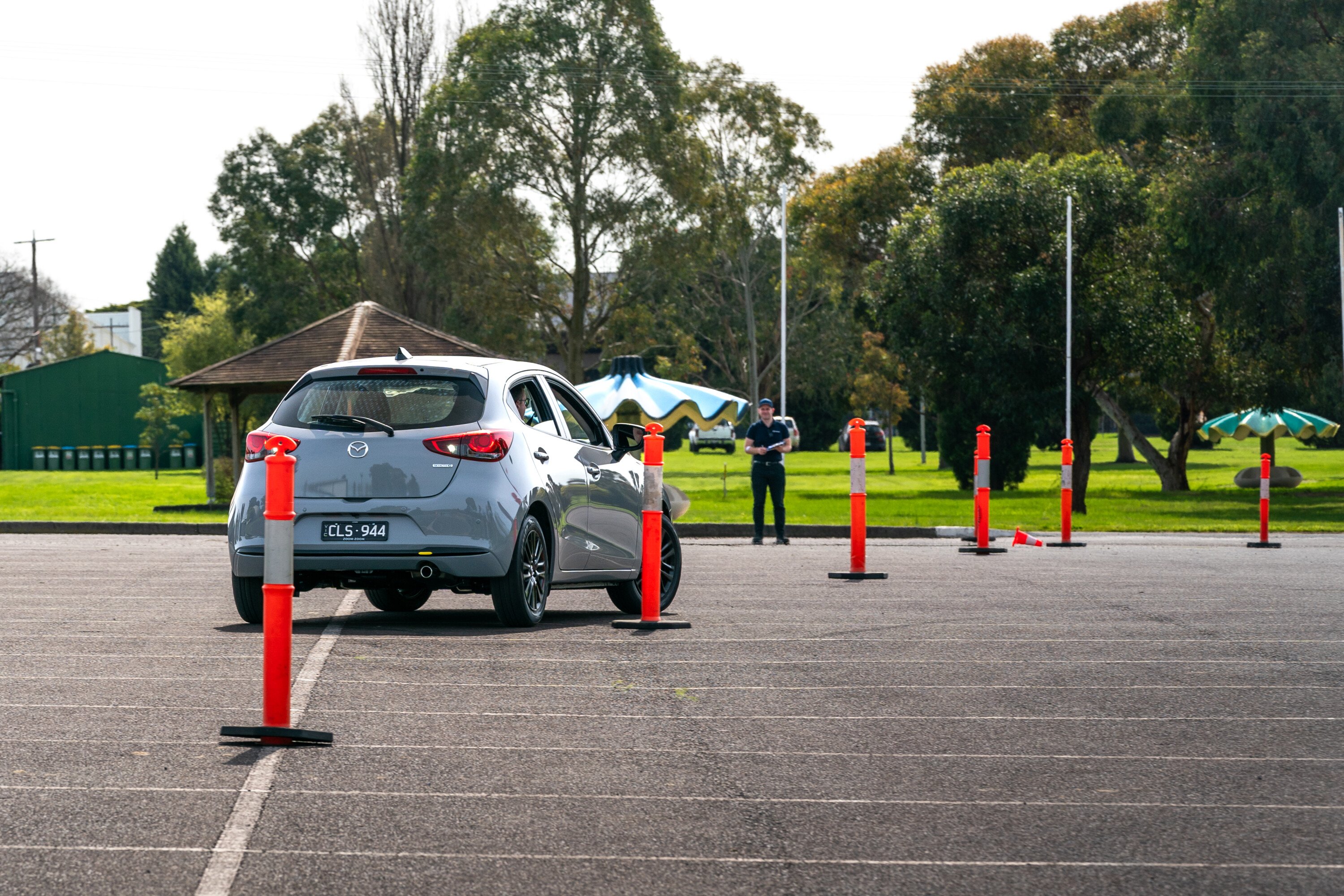
In tune with the vehicle’s target demographic, Mazda set up a series of driving tests at the historic Caribbean Market shed in south-east Melbourne.
After a brief safety overview and some popcorn, we paired up with instructors to cover the basics.
The first test involved a standard driving loop, while responding to quiz questions from the Mazda representative beside me.
1
Despite acing the quiz, I was informed of a minor mishap – driving on the wrong side of the road momentarily. It was a humbling moment.
Next up was a timed parking challenge where had to complete two parallel and perpendicular parks, marked by cones. The challenge? There were eggs on each cone. I’m proud to note that I didn’t crack any eggs during this exercise.
Between a go-to-woah speed test and a figure-8 drift track, my competitive side emerged – so much so that I skipped lunch for a tyre-changing time trial.
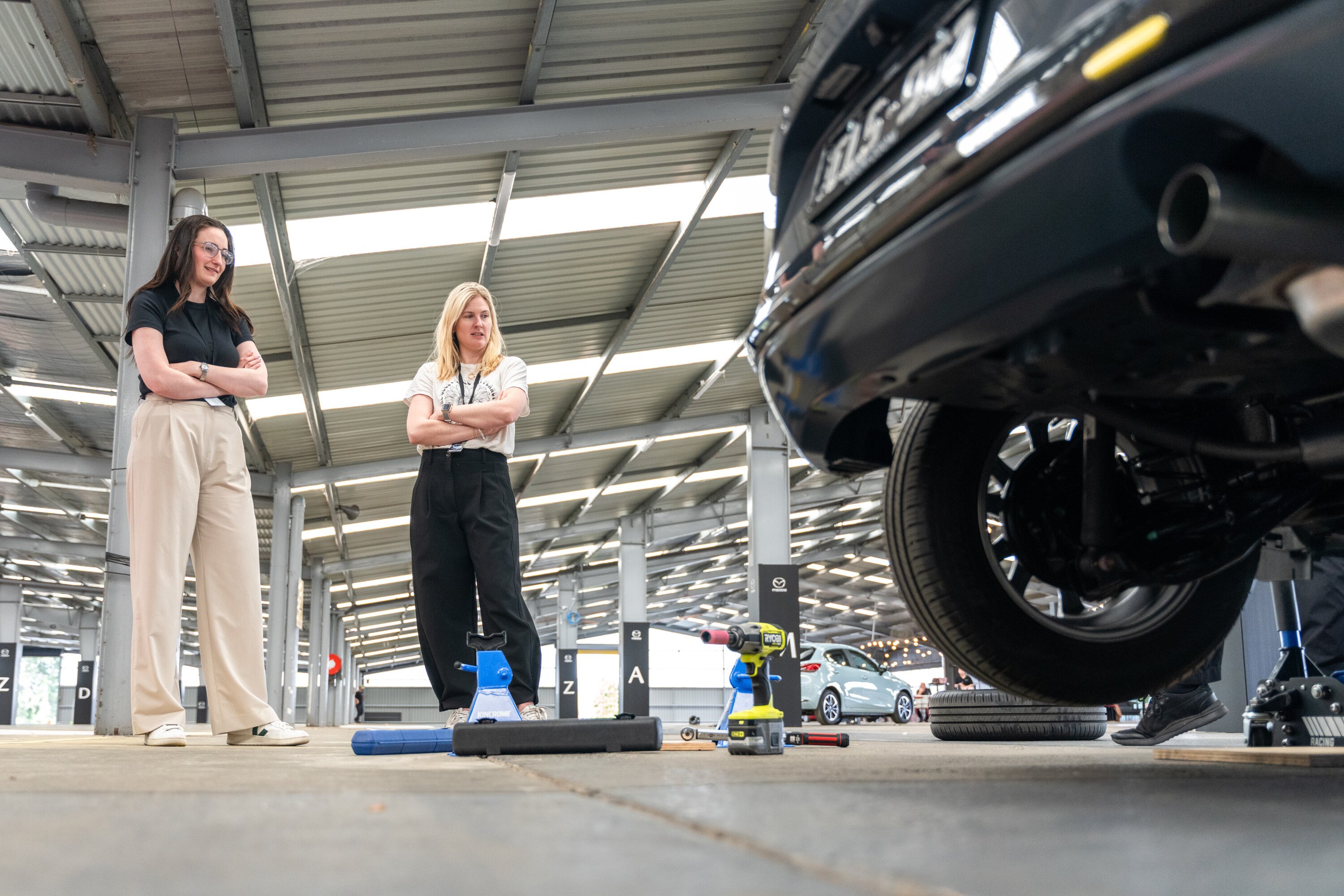
1
In an era dominated by SUVs, it’s refreshing to remember that lively hatchbacks – especially those with manual gearboxes – still have a place.
With Australians being so SUV-obsessed it’s hard to remember that zippy and fun light hatchbacks (with a manual gearbox!) still exist.
Driving around the course made me a little jealous of those upcoming new drivers, who are about to venture into the world looking for an economical and fun little car.
They might choose Mazda’s smallest and most affordable offering and enjoy their early driving years zipping from university car parks to drive-throughs.
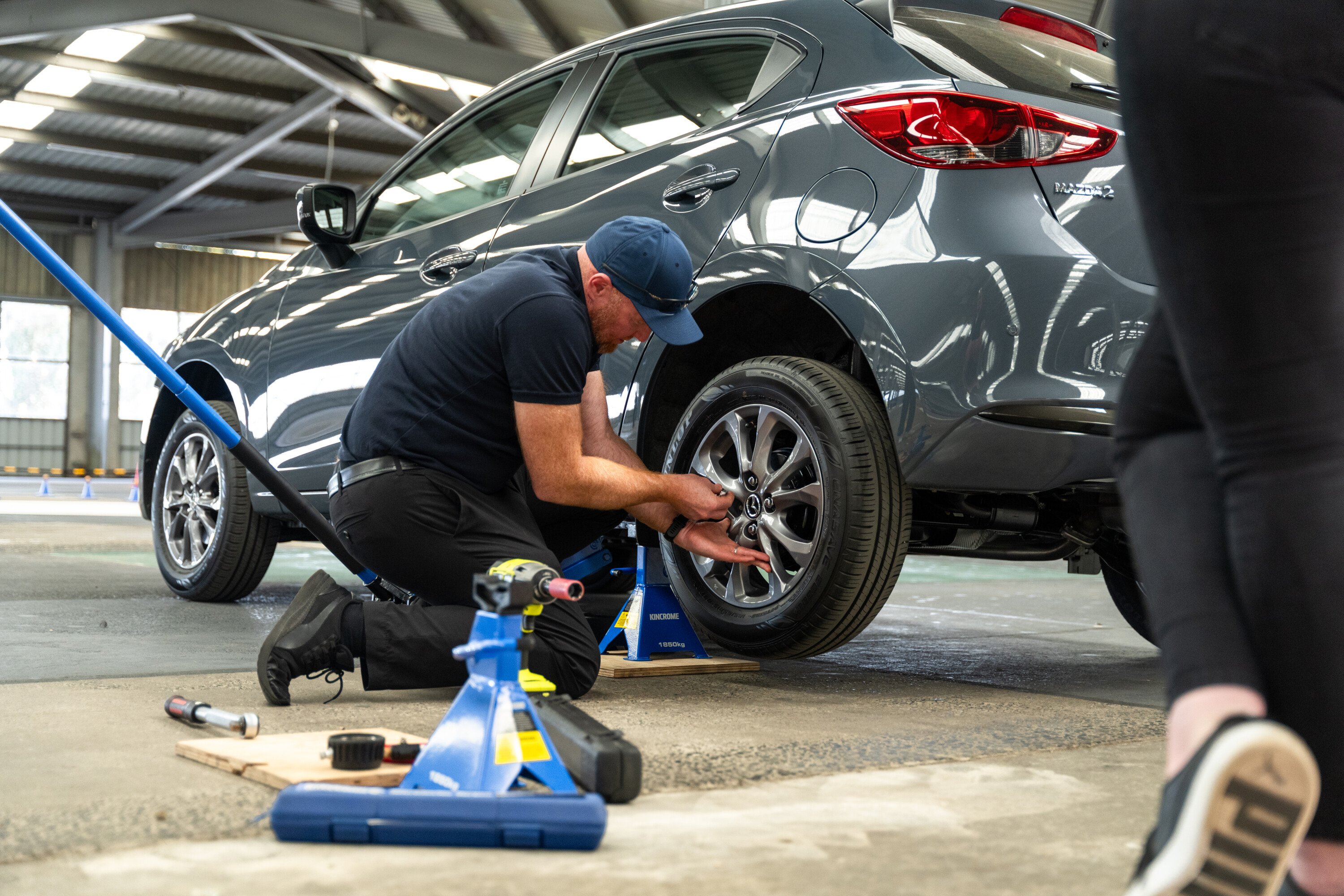
1
VERDICT
In a segment with dwindling options, the Mazda 2 continues to shine, mostly thanks to its sharp styling and fun dynamics.
However, at almost a decade old and with no replacement planned, it’s clear that retirement is on the horizon for Mazda’s smallest model. It’s fought a good fight, and this latest update does bring some worthwhile improvements, but many Aussies are now opting for a light SUV for an extra couple of grand, or turning to cheaper Chinese rivals.
Value is also starting to count against the Mazda 2. While it still stacks up favourably against key rivals like the Toyota Yaris and VW Polo (a flagship Yaris hybrid is $33K before on-roads!), there’s no denying the small-car segment doesn’t offer the bargains it once did.
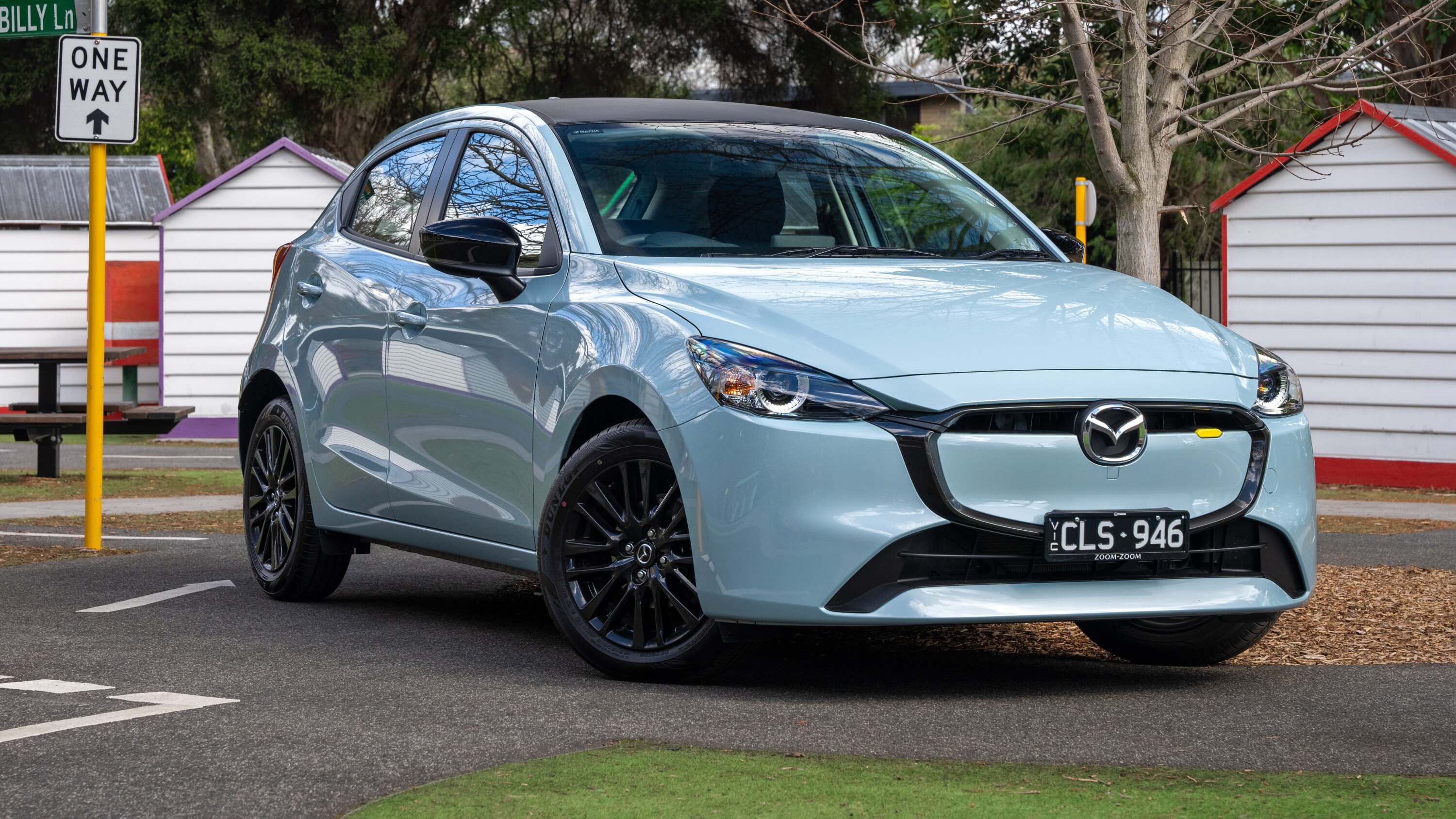
1
MORE
Everything Mazda
2023 Mazda 2 specifications
| Manual transmission | Automatic transmission | |
|---|---|---|
| Engine | 1.5-litre in-line 4 cylinder 16 valve DOHC S-VT petrol (Skyactiv-G) with i-stop | 1.5-litre in-line 4 cylinder 16 valve DOHC S-VT petrol (Skyactiv-G) with i-stop |
| Max Power | 82kW @ 6,000 rpm | 81kW @ 6,000 rpm |
| Max Torque | 144Nm @ 3,500 rpm | 142Nm @ 3,500 rpm |
| Tranmission | 6-speed Skyactiv-MT | 6-speed Skyactiv-Drive |
| Drive | FWD | FWD |
| Cargo room volume VDA (litres) | 250 | 250 |
| Kerb weight (kg) | 1085 | 1,109 |
| Fuel Economy (combined)* | 5.4L/100km | 5.0L/100km |
The New South Wales Government will abolish the $3000 electric vehicle rebate earlier than promised, but will invest in installing more charging infrastructure.
Snapshot
- NSW to end EV rebate, stamp duty waiver in 2024
- Earlier than initially promised
- New budget to invest in EV charging instead
Ahead of the state’s new budget announcement on Tuesday, treasurer Daniel Mookhey confirmed to The Sydney Morning Herald that it will abolish the EV purchasing subsidy and stamp duty exemption on January 1, 2024.
It will save taxpayers $527 million.
When the policy was introduced in September 2021, the subsidy was promised to last for the first 25,000 eligible applicants. However, according to Revenue NSW [↗], it has paid only 8391 rebates as of 31st August 2023.
The incentive covered any new EV priced less than $68,750 including the goods and services tax, dealer delivery fees, and accessories – but excluded government charges, such as registration and compulsory third party insurance.
This lowered the price barrier for NSW residents to buy electric models, such as the MG 4 hatch, BYD Atto 3 SUV, and Tesla Model 3 sedan.
It’s believed buyers will still be eligible for the rebate if they sign the purchase contract – but don’t need to have the vehicle delivered – before the 2024 deadline.
NSW will follow Victoria, which ditched its subsidy earlier this year, with only South Australia and Queensland still offering rebates. As at 15 September, the former has only 5200 rebates remaining, according to Treasury SA [↗].
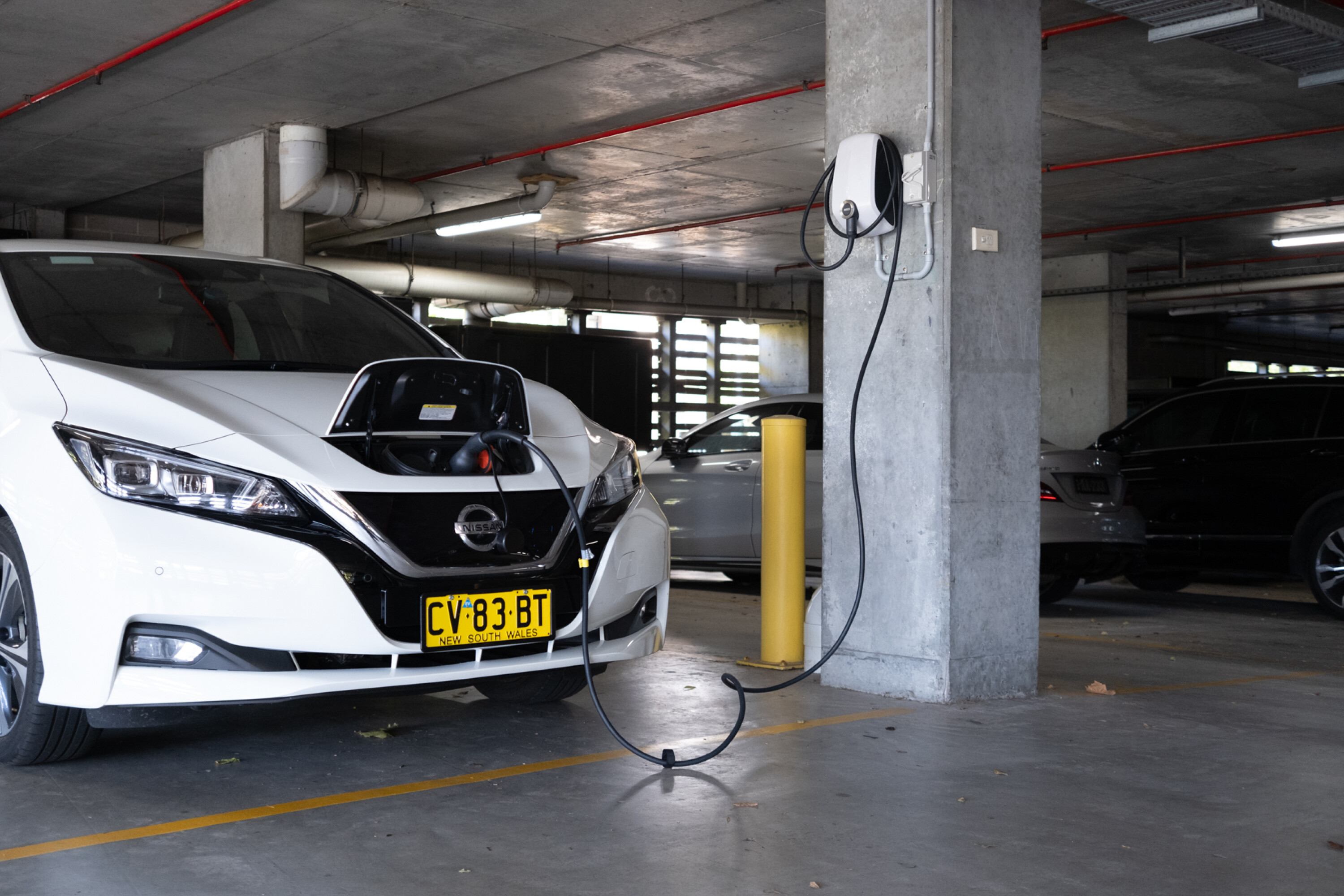
1
NSW to improve EV charging access
Instead of subsidising EV purchases, the NSW government plans to invest an additional $260 million into EV charging infrastructure.
It is said to be targeted for drivers who can’t access a plug at home, including renters, those living in apartments, and regional areas.
NRMA spokesperson Peter Khoury told WhichCar it supports the policy move.
“The [charging] infrastructure investment is critical. The limited resources of the government are best served partnering with the private sector to address that shortfall,” Khoury said.
He added policies that improve charging accessibility, especially for those living in older homes and apartments who are unable to fit electrical equipment, is “going to be really important to make it a more viable option for people who are thinking about buying an EV, but worried about day-to-day charging”.
Khoury doesn’t expect EV sales to decrease after the rebate ends, given it hasn’t slowed in Victoria and more models are continuing to enter the market to further drive prices down.
The announcement comes on the same day Sydney experienced a record 30-plus Celsius heatwave, which is unusual for Spring (Bureau of Meteorology [↗]).
The Honda Motocompacto has been revealed as its first electric scooter, with a retro ‘80s Japanese design, a 19-kilometre claimed range, and a price tag cheaper than a new iPhone.
Snapshot
- Honda Motocompo revived as retro e-scooter
- 19km claimed range, compact design
- Yes, it’s cheaper than a new iPhone
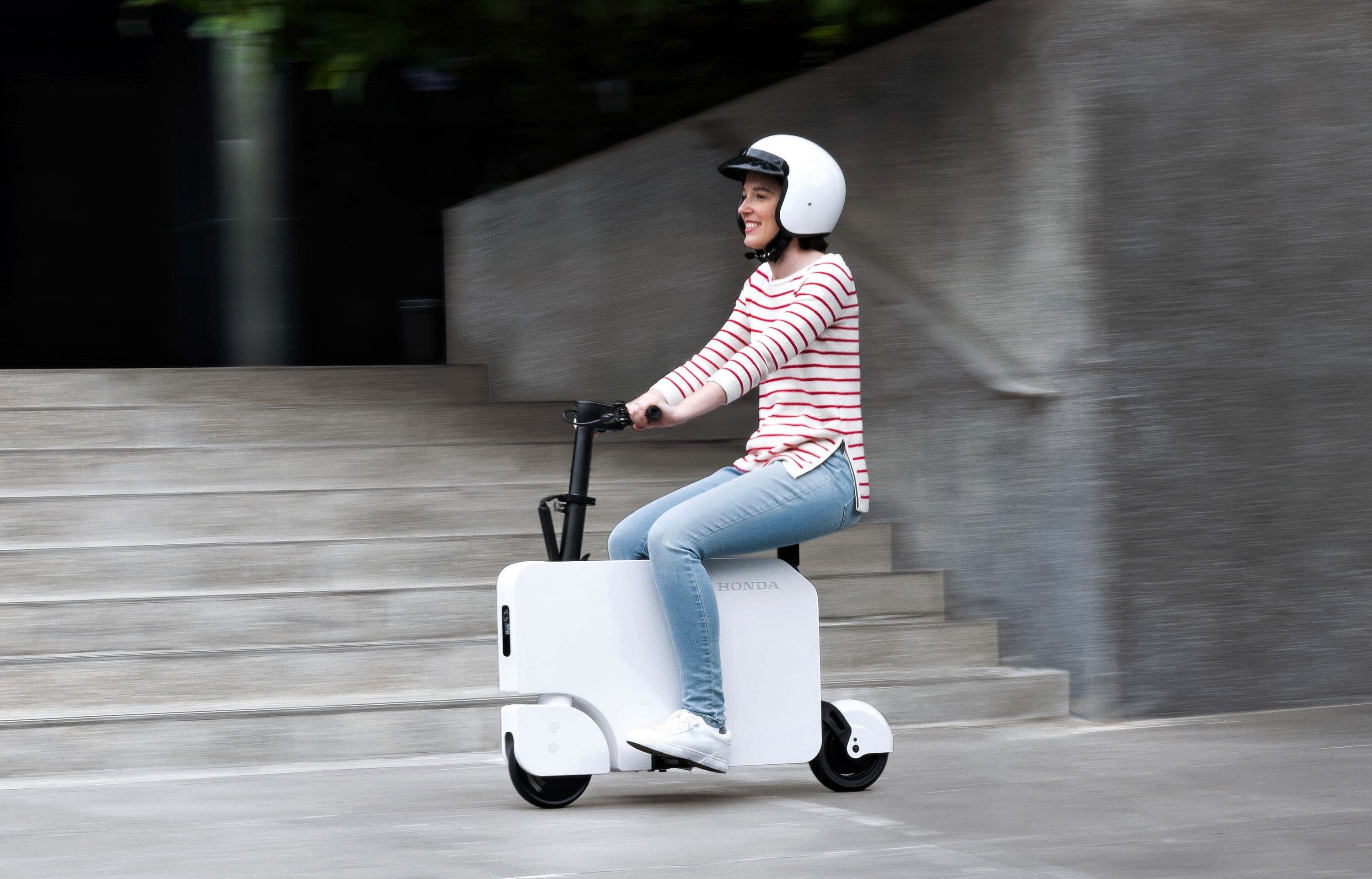
Inspired by the iconic Motocompo from the early 1980s, the Japanese automaker revived it with a thin, blocky white-and-camel design.
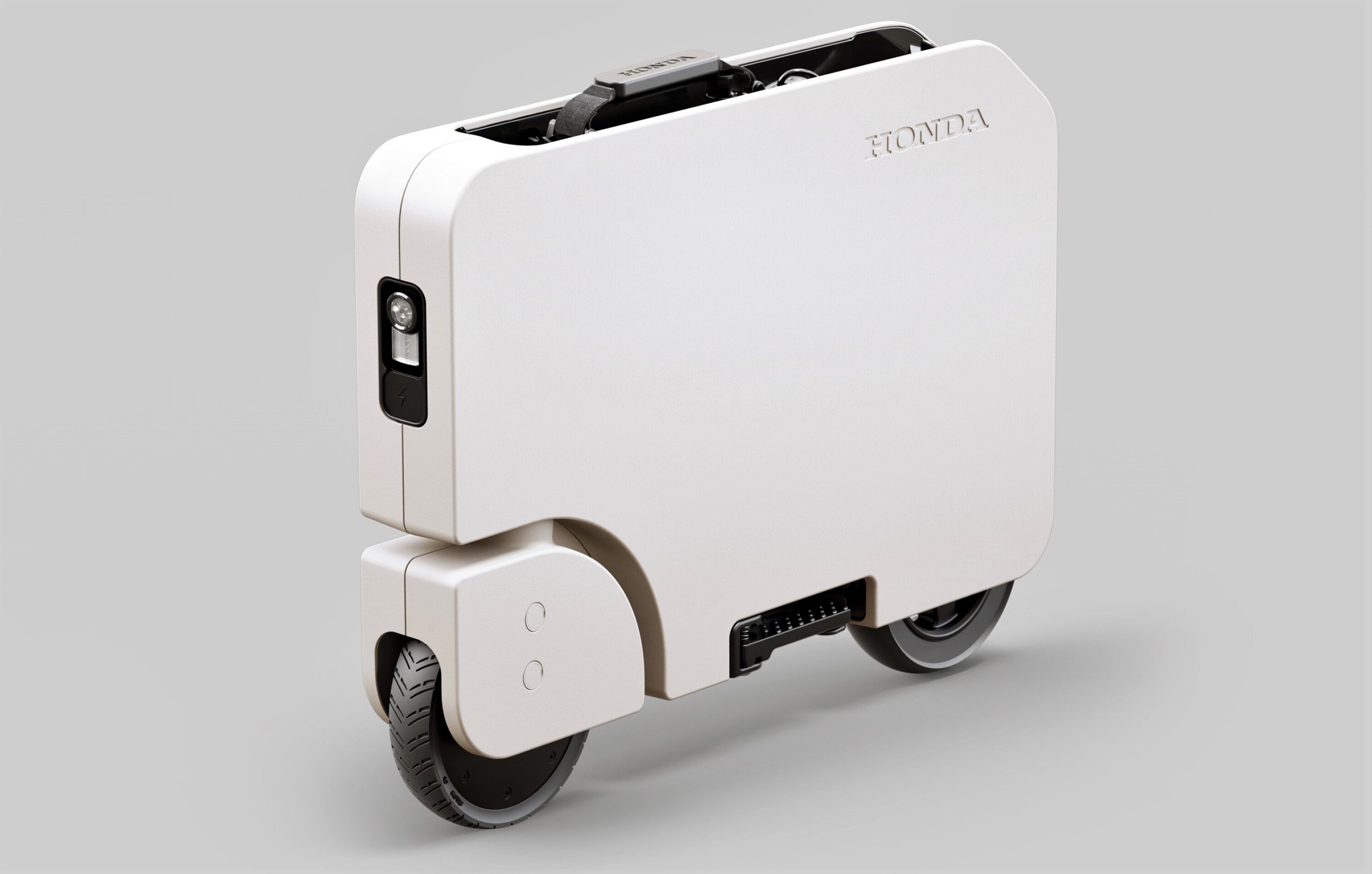
As per the original model that was designed to complement and fit inside Honda’s city cars, the handle, seat and rear wheel can be folded in for a more convenient compact size.
1
An electric motor powers the front wheels, with a top speed of 24km/h and a claimed 19km of driving (or ‘scooting’) range, which can be fully charged in around 3.5 hours using a standard 110-volt home socket.
It’s mainly targeted at urban dwellers, who don’t necessarily need to drive a private vehicle and those who want to reduce their carbon footprint.
1
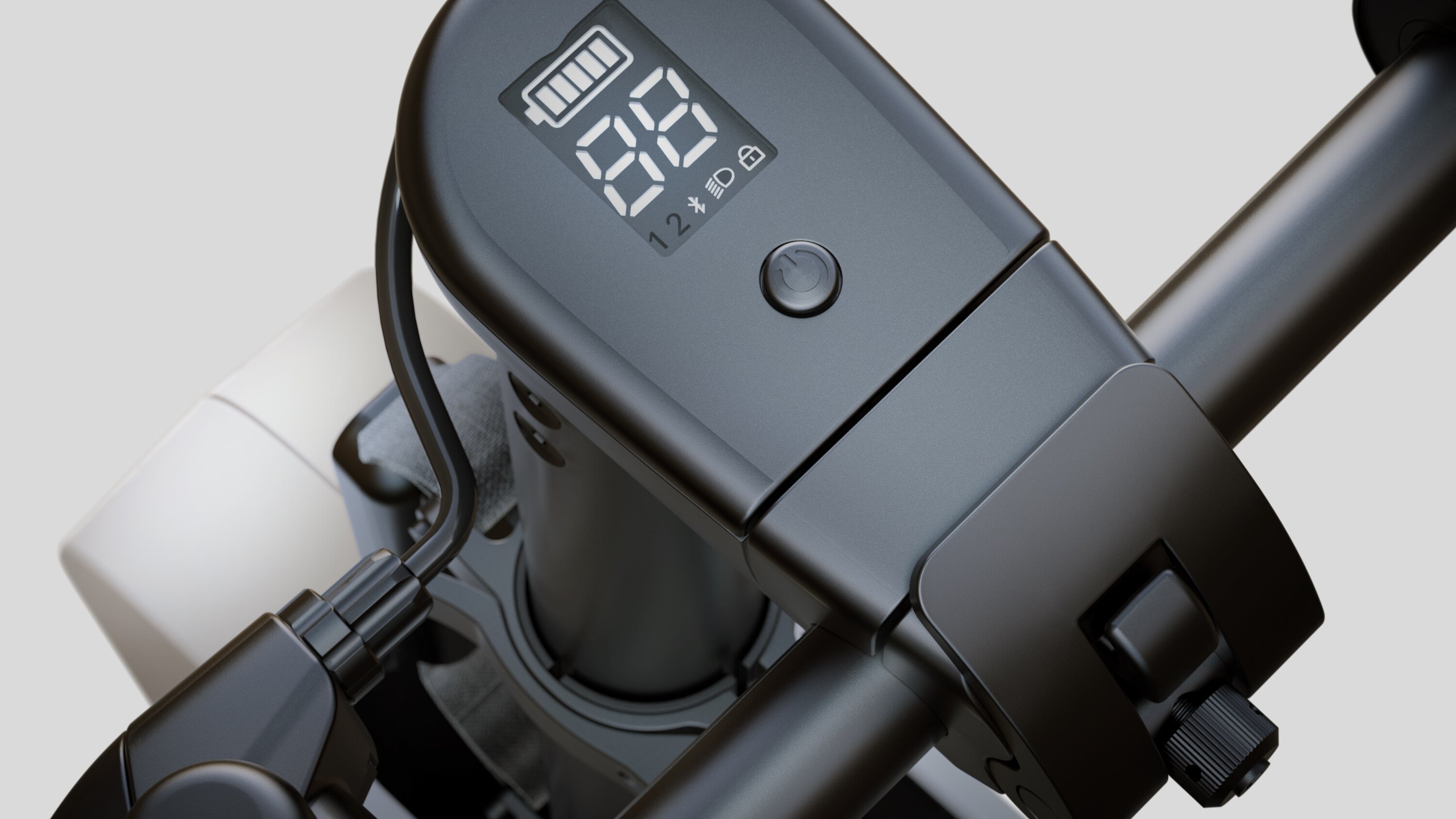
The Honda Motocompacto e-scooter also offers integrated storage for the charging cable, a digital speedometer, a carry handle, and even a connected smartphone app to adjust settings.
Despite the thin suitcase-looking design, it promises to be durable as well with an aluminium frame, LED head- and tail-lights, and a steel lock loop on the kickstand to use on most bike locks.
The retro e-scooter was designed and developed in Ohio and California, and earned 32 patents.
Owners can also personalise it with decals, stickers and skins. If you want to nerd out even more, there will be a full line of Motocompacto-branded accessories, such as a helmet, backpack and apparel.
11
Wait, how much does it cost?
The second-generation Honda Motocompacto will start selling in November, priced from US$995 (AU$1555), but it’ll be exclusively sold in North America.
Yes, that undercuts the latest Apple iPhone 15 Pro smartphone, which starts from AU$1849 or US$999 (it has a titanium frame, though).
It will be available via its website, and even Honda and Acura car dealers in North America.
MORE
Everything Honda
