
With Bugatti putting off further speed record attempts with the Chiron Super Sport 300, the company has turned its attention towards its legacy of building road-going racers.
As such, Bugatti’s lightweight pre-war Type 13 and Type 35 were cited as inspiration behind its “GT3-treatment” given to its latest creation, the Bugatti Chiron Pur Sport.
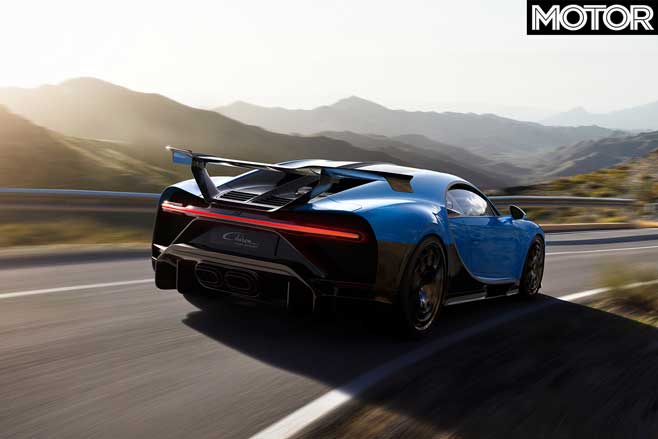
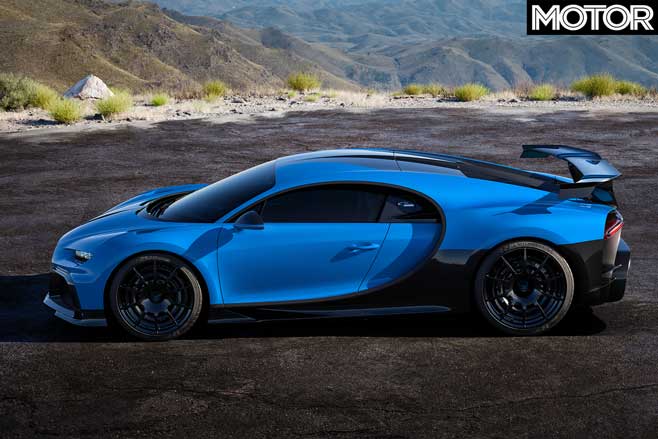
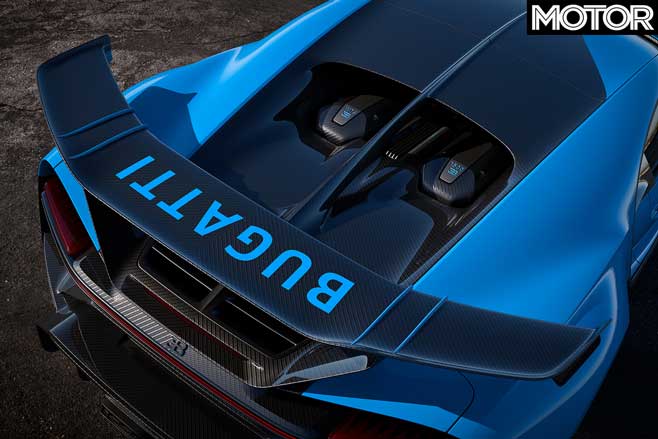
On its exterior, the most obvious changes on the Pur Sport include a front splitter that looks similar to that fitted to the Super Sport 300, new magnesium wheels, and a huge fixed rear wing.
It isn’t just all for show with no intent, the removal of the Chiron’s hydraulically actuated rear wing in favour for a fixed item is said to have relieved 10kg, the magnesium wheels save an additional 16kg, with 3kg removed from the brake pad and disc assembly.
All in all Bugatti says the Pur Sport is 50kg lighter than the standard 1995kg Chiron, which makes it a whisker of 15kg lighter than the lightened limited-edition Divo.
While the Pur Sport maintains the standard model’s monumental 1103kW/1600Nm power outputs from its quad-turbo W16 engine, Bugatti’s engineers has revised its gearing to be 15 per cent closer, and increased the engine’s peak speed by 200rpm to 6900rpm.
According to Bugatti, the revised gearbox is able accelerate the Pur Sport from 60-120km/h in “almost 2sec faster than the Chiron” and deliver “elasticity values that are 40 per cent better compared with the Chiron”.
Bugatti doesn’t care to mention any top speed figures for the Pur Sport with its shortened gearing and big wing, but considering that the standard Chiron operates in a 400km/h window, it will still be plenty quick than most of its peers.
In the handling department, Bugatti’s engineers have tweaked the Pur Sport’s suspension to be firmer, and fitted specially-developed Michelin tyres called the Bugatti Sport Cup 2 R that is said to generate more cornering grip.
Unlike the 40-unit limited-edition €5 million Divo, Bugatti plans to make 60 units of the Pur Sport, costing €3 million, which all things considered, sounds a bit of a bargain for those who fancy a Chiron built for country roads.
Ingolstadt was first to exploit the opportunity of launching a compact premium hatchback with 1996’s original and, four generations later, the new family hatchback is hoping to deliver an extra kick of styling and tech to win over buyers who’ve maybe considered the A3 a bit too meh in recent years.
Due to be unveiled at the 2020 Geneva motor show, the new A3 range will be available initially as Sportback only, meaning it’s five doors or nothing. The three-door model is no more, in the name of range rationalisation, but the A3 sedan will follow later this spring.
What’s new on the 2020 Audi A3 Sportback?
This is an iterative update, reflecting the launch of parent company Volkswagen’s new Golf Mk8. Both take the group’s MQB shared architecture and update it heavily, with a raft of technical changes to bring the modular matrix bang up to date.
Headline news includes the arrival of 48-volt mild hybrid systems, a full plug-in hybrid (PHEV) to follow and lashings of new tech inside to satisfy Generation Digital.
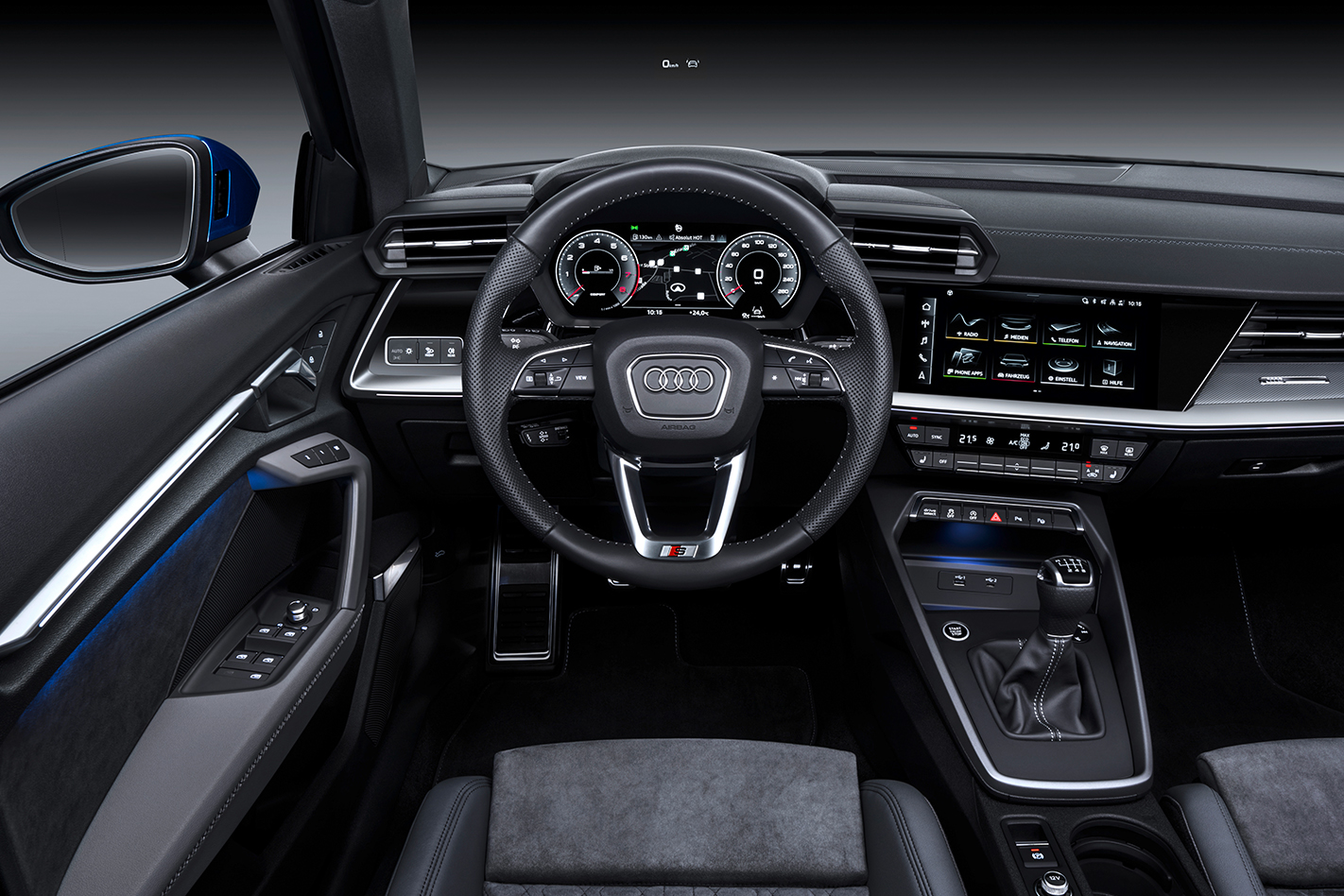
A large 10.1-inch touchscreen is standard on every model and the computers running the infotainment are 10 times more powerful than before, meaning everything from satellite navigation to voice recognition are noticeably more rapid and accurate in their operation.
The new A3 range line-up
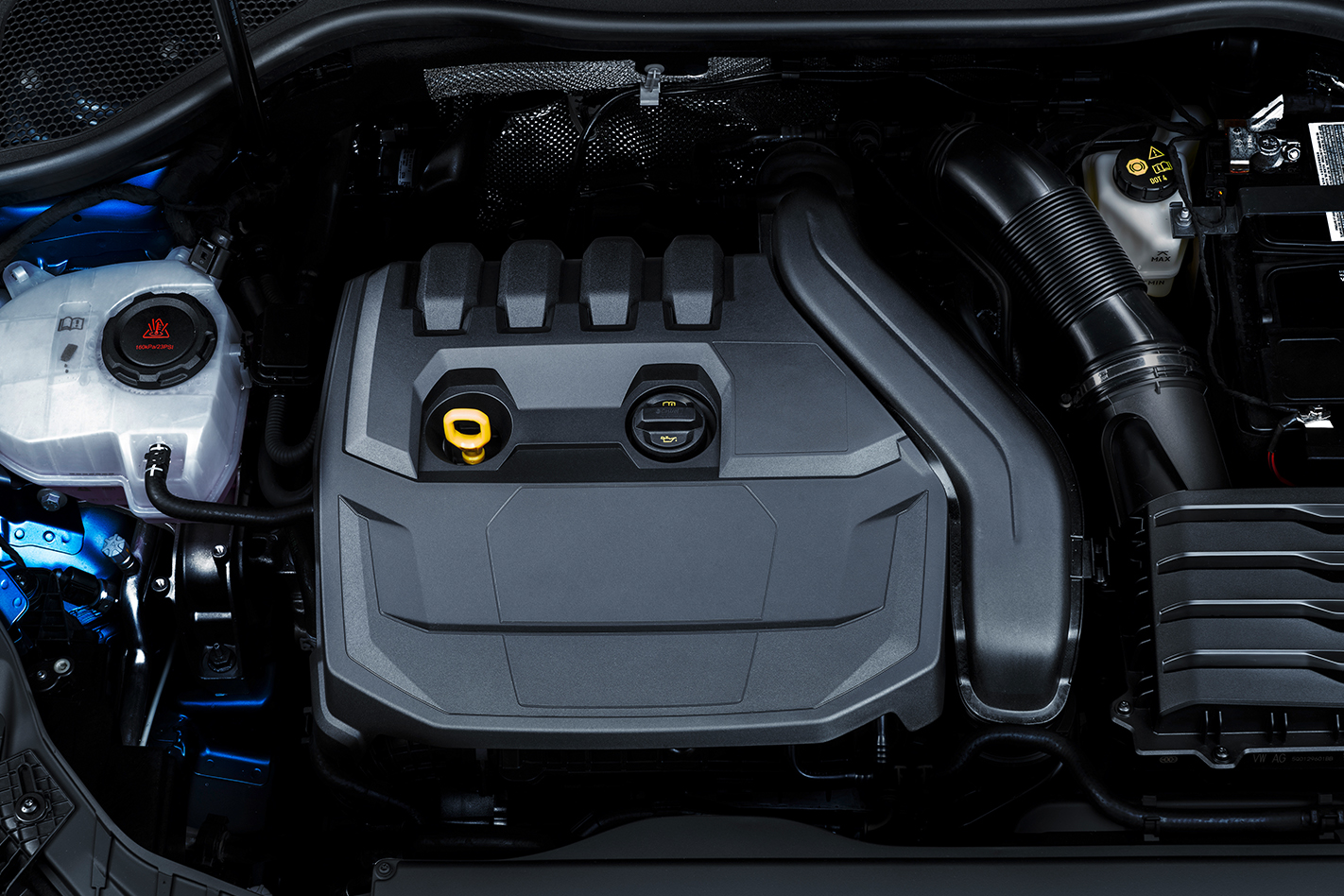
Buyers can choose from these engines at launch, all reworked versions of familiar VW group motors:
- 1.0 TFSI 81kW
- 1.5 TFSI 110kW
- 1.5 TFSI MHEV 110kW
- 2.0 TDI 85kW
- 2.0 TDI 110kW
Quattro all-wheel drive will be ushered in by forthcoming high-performance S3 and RS3 models, but its updated Haldex 6 AWD system will be offered in other models in time.
Tellingly, there will be no pure electric A3; Audi will develop its battery electric vehicles (BEVs) on the group’s standalone e-platforms such as MEB in future, instead of shoehorning all powertrains into all architectures.
The design story
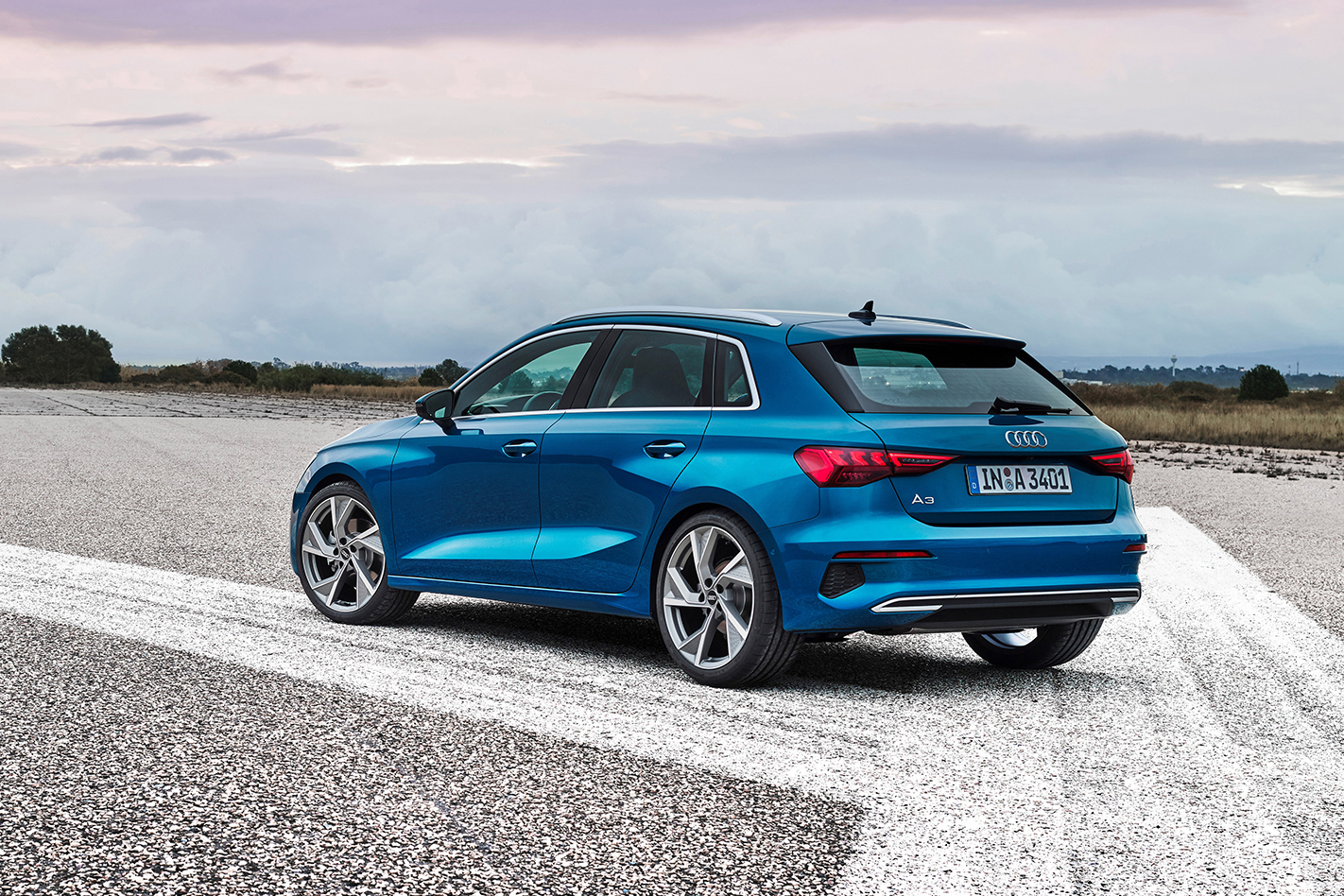
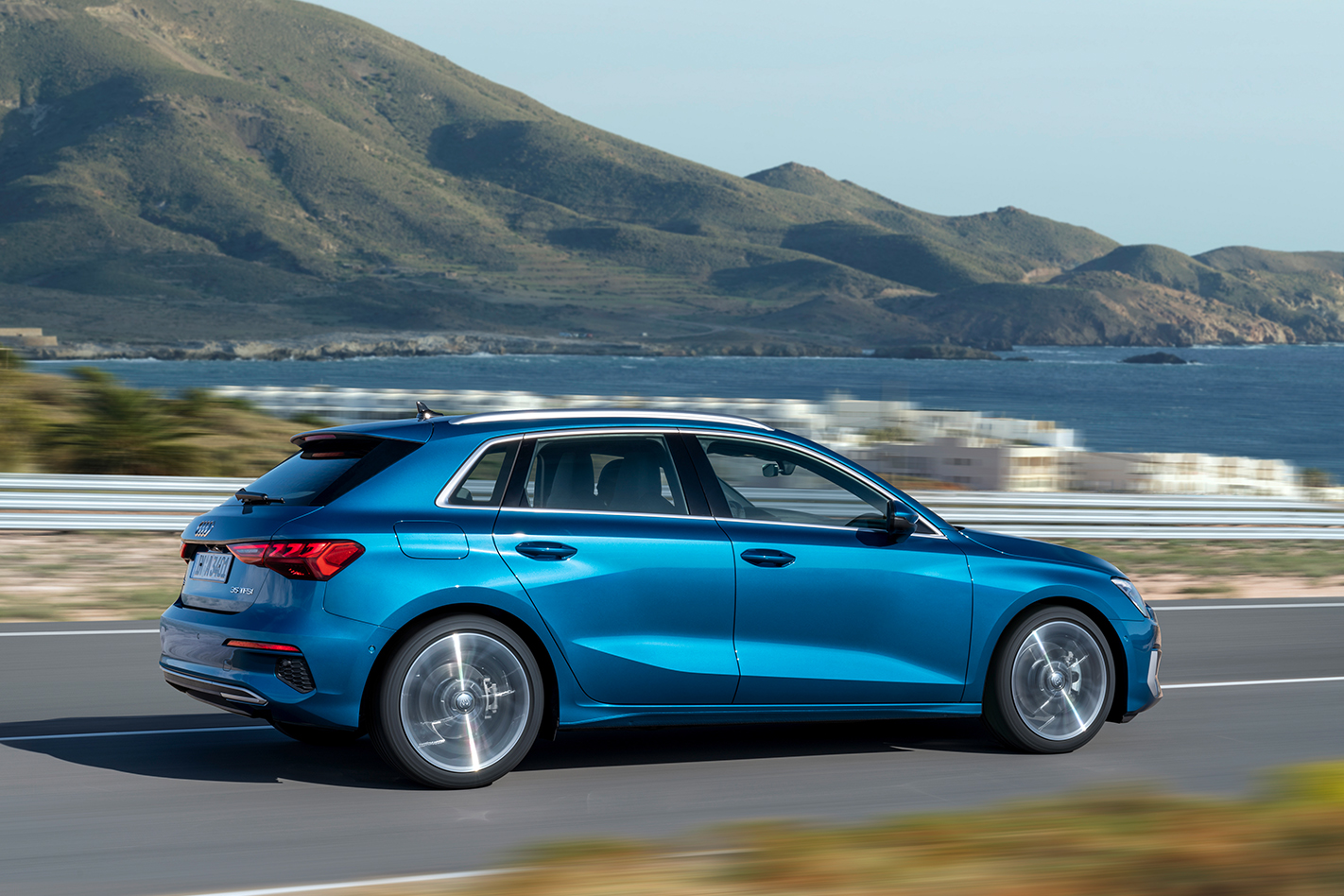
The Audi A3 Sportback’s dimensions confirm this is an iterative design: the wheelbase is unchanged at 2.64m while the 4.34m length, 1.82m width and 1.42m height all but shadow the last A3. But the design language has gently evolved and the styling has a few points of interest despite being sure not to scare anybody off.
Surfacing is more involved than on any recent Audi, with depth scalloped out of the side panels; the designers are proud of the subtly concave metalwork, as a result, with a hint – just a sniff – of Quattro style bolstered rear wheelarch (if you look really closely). The zingy blue car pictured is painted Atoll Blue.
Notice how no exhuast pipes are visible at the rear of the A3. The designers told CAR they were consciously hiding the tips now, to downplay emissions – except on the go-faster S3 and RS3 models, where multiple pipes denote sporting aggression. It’s a sad endictment on humankind when this kind of playground oneupmanship rules, but c’est la vie.
At the front, you can instead play count the LEDs: the day-running light stack below the main headlamp now illuminates different patterns in the 15 diodes to denote which model you’re in.
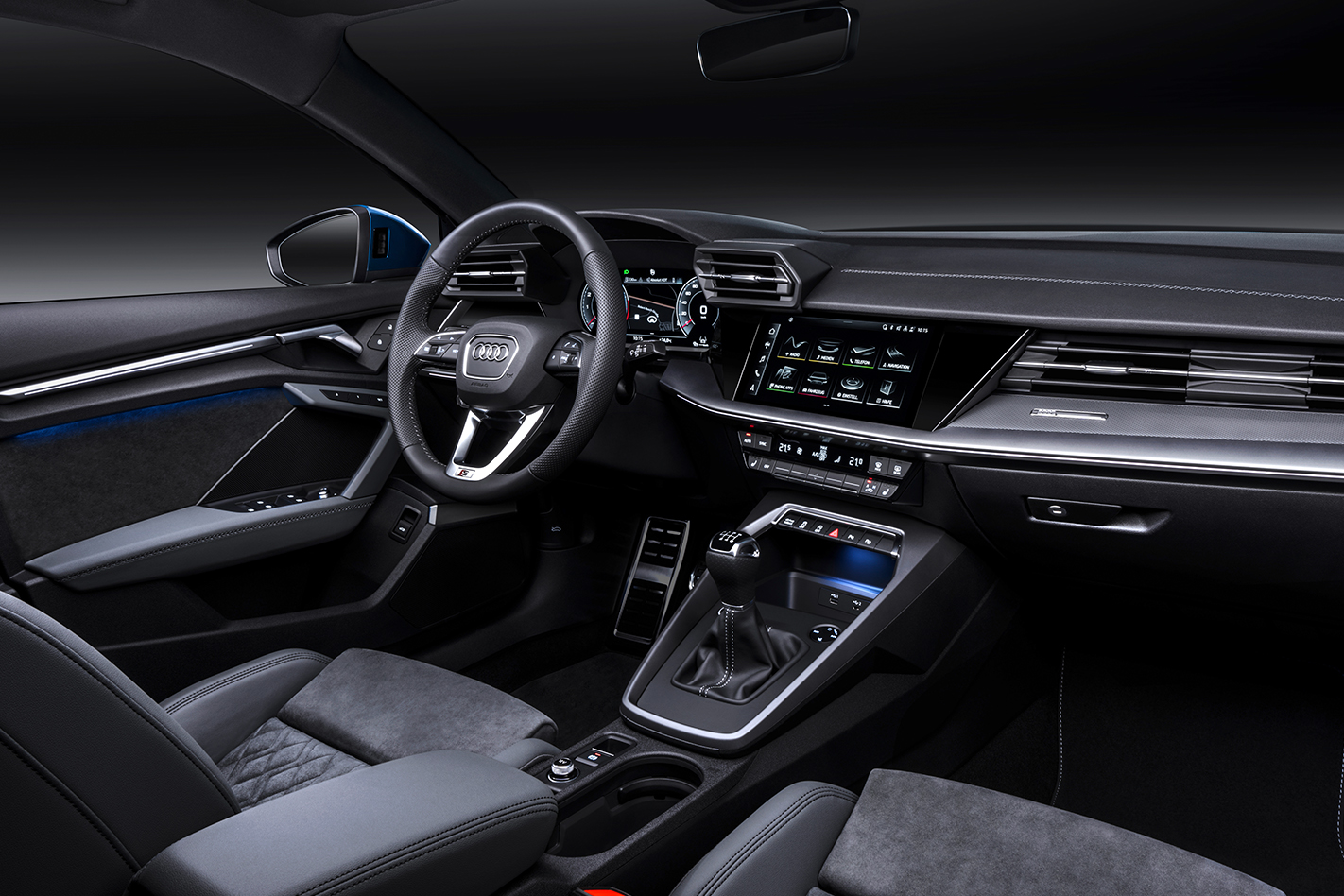
The interior is very much what you’d expect: laced with the latest group electronics, with Audi’s third-generation infotainment system that can now store six different user profiles to remember your favourite seat position, navigation destinations and air-con settings. Even humble entry-level models get the standard 10.1-inch touchscreen.
This story first appeared on our sister site Car Magazine UK
- Merc’s exec express gets a thorough makeover
- Next-level traffic autonomy is included
- New powertrains on offer
There’s also a new look bringing the E-Class more in line with Mercedes’ fresher models.
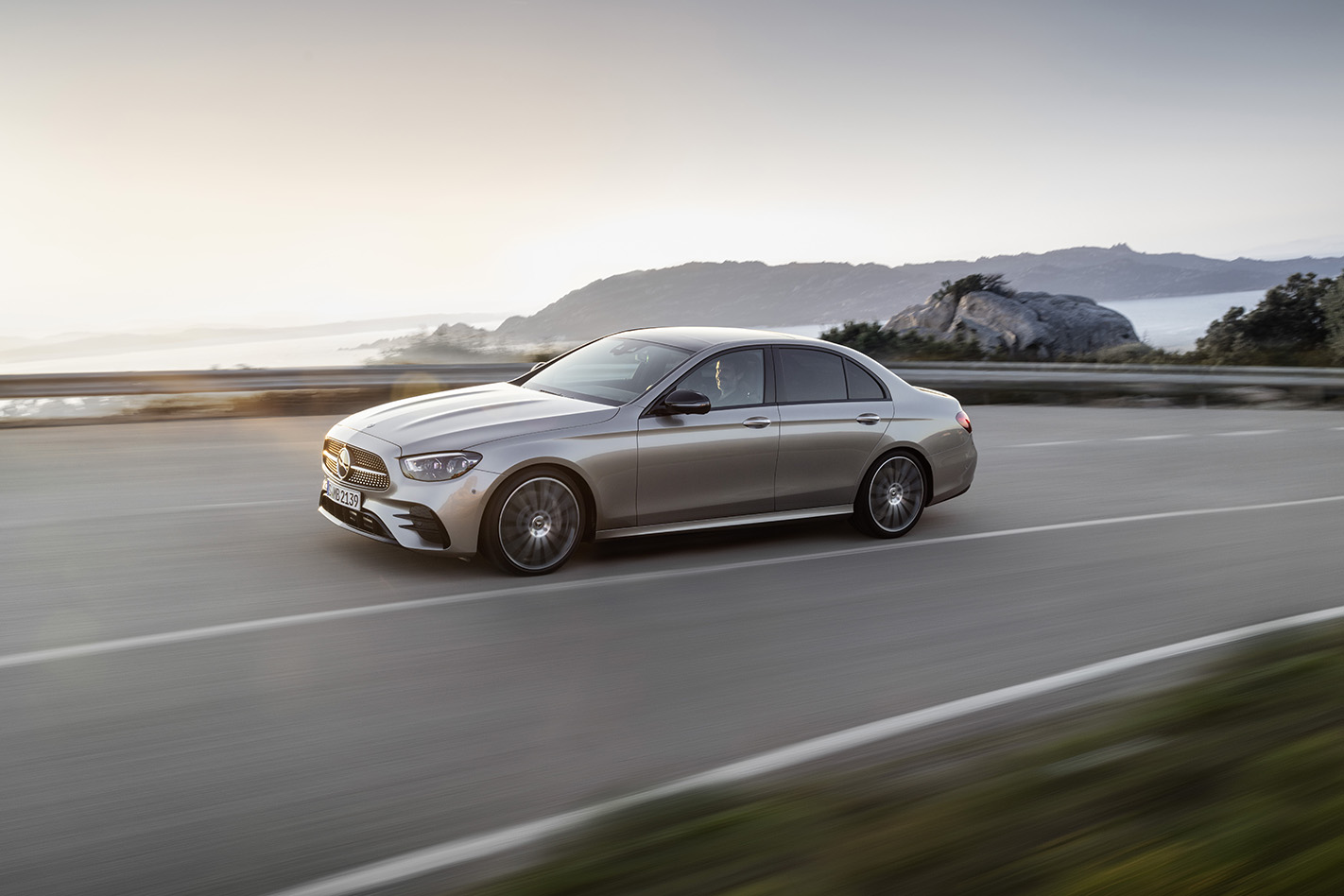
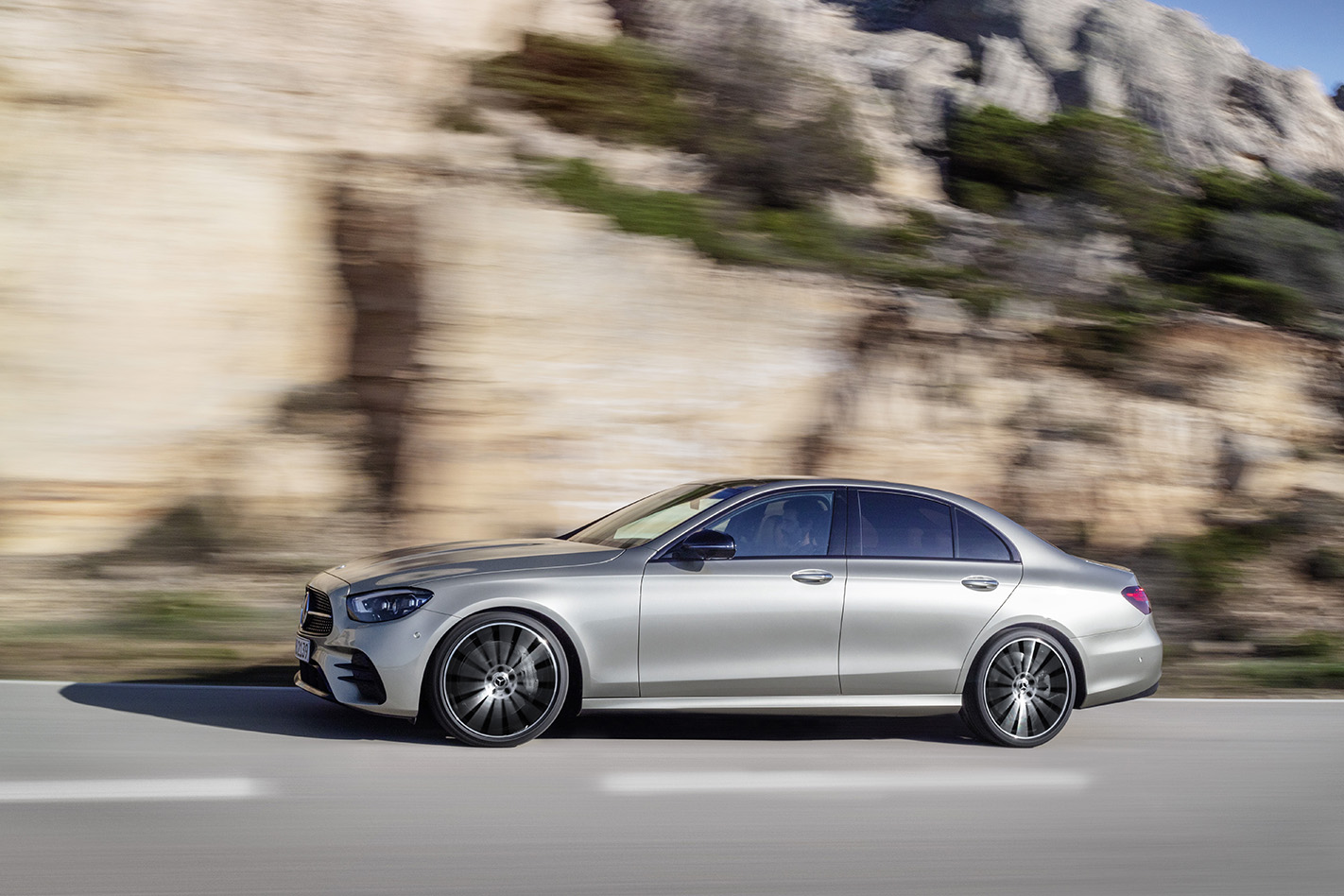
The new grille and light treatments – both front and rear – are more horizontal than vertical, giving the E-Class the same sort of flavour as its younger siblings.
Redesigned lights are full LED as standard, with fancy Multibeam adaptive units (incorporating steroidal-sounding ULTRA RANGE high beam) available further up the range.
There’s plenty of chrome fore and aft – a strip in the grille is mirrored by a chunky bar of the stuff on the boot lid. Piano black fills in the rest, including vanes on the air intakes and splitters.
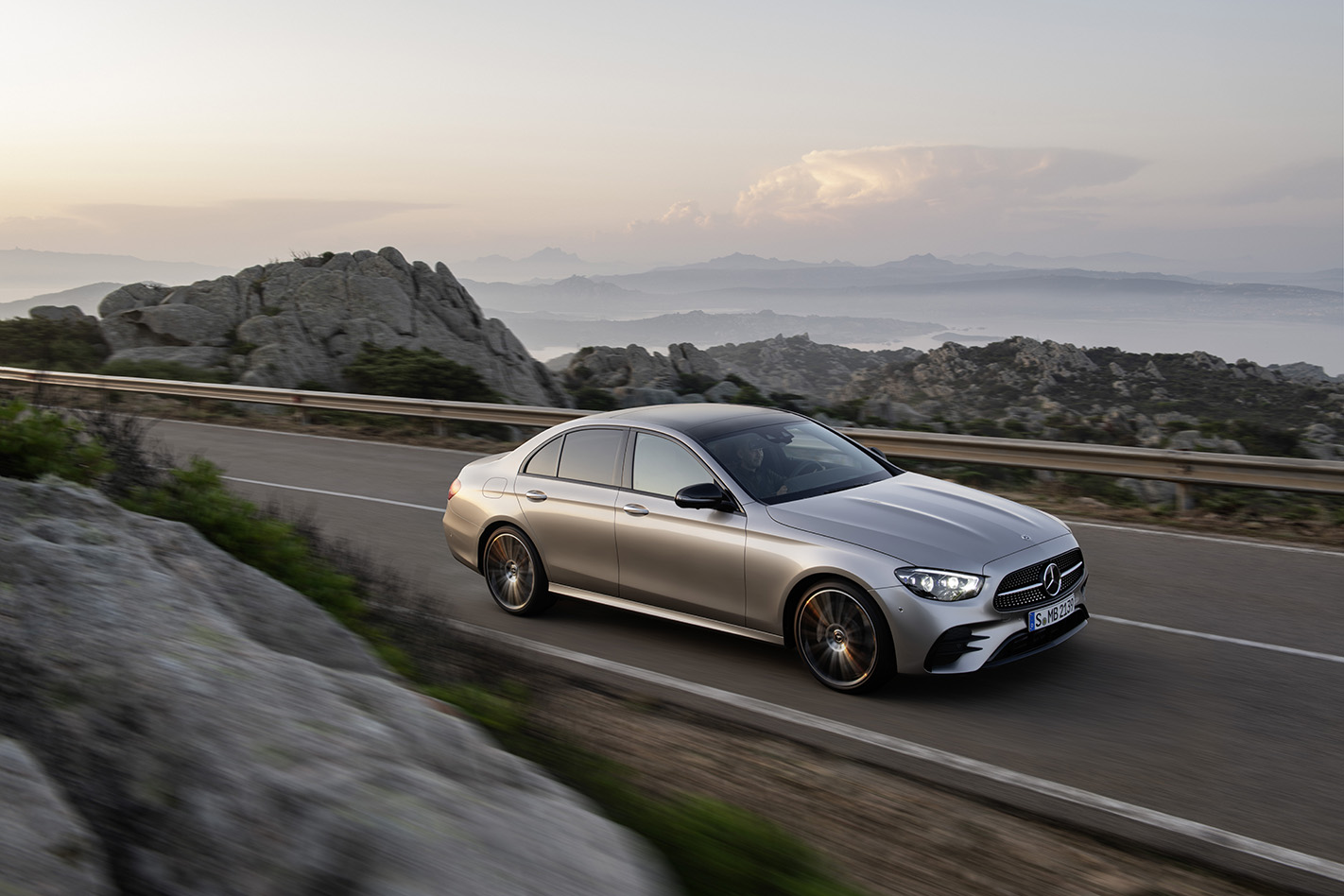
AMG models will have a redesigned bonnet with power domes, while the All-Terrain will be spiritually closer to its SUV siblings such as the GLC, with chrome finishes replacing the brushed silver found on the previous model.
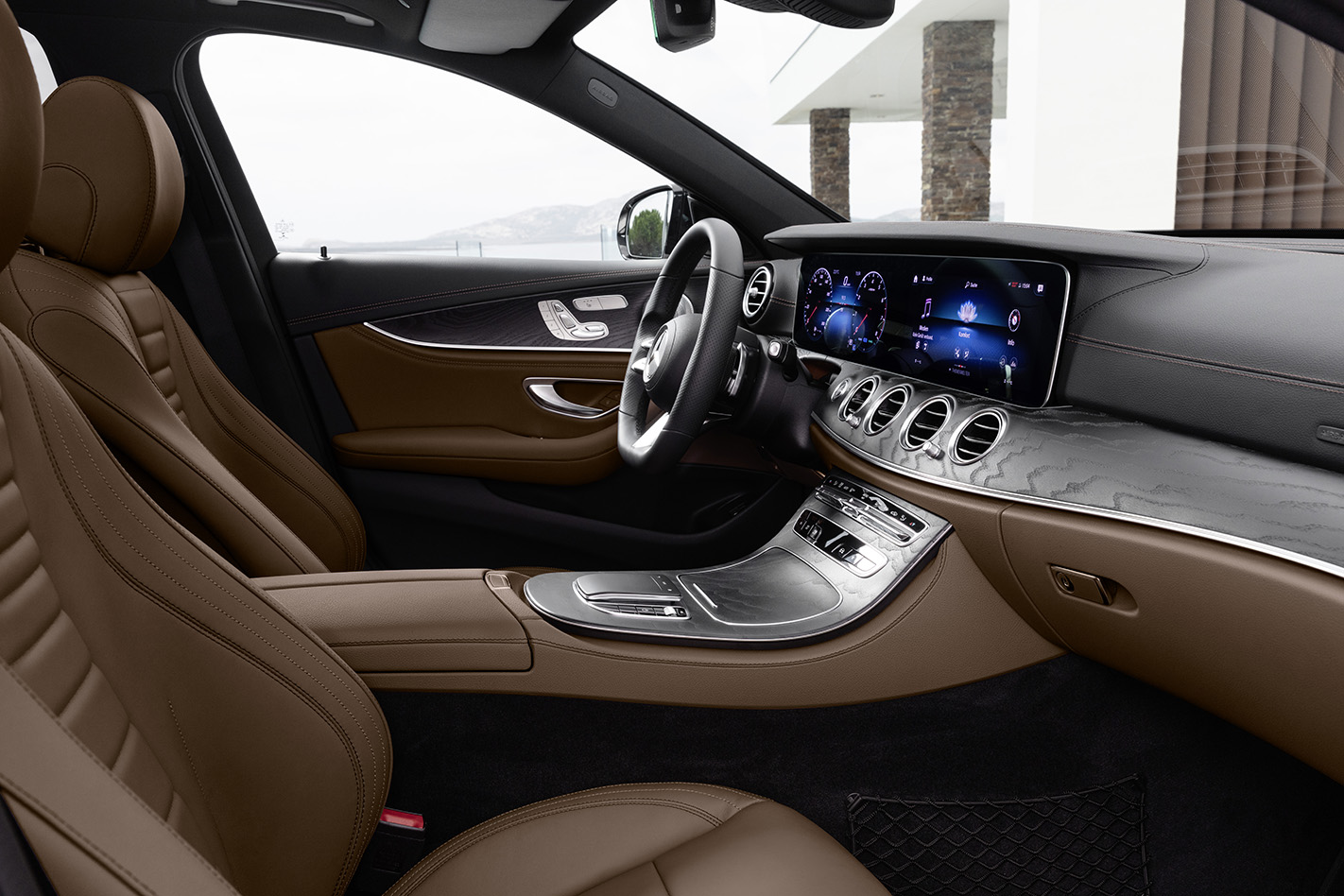
As you’d expect, there’s the latest MBUX operating system at the core of it all. It operates via two screens – either 10.25in or optionally 12.3in wide – arranged side-by-side under the same glossy enclosure to give a real widescreen experience.
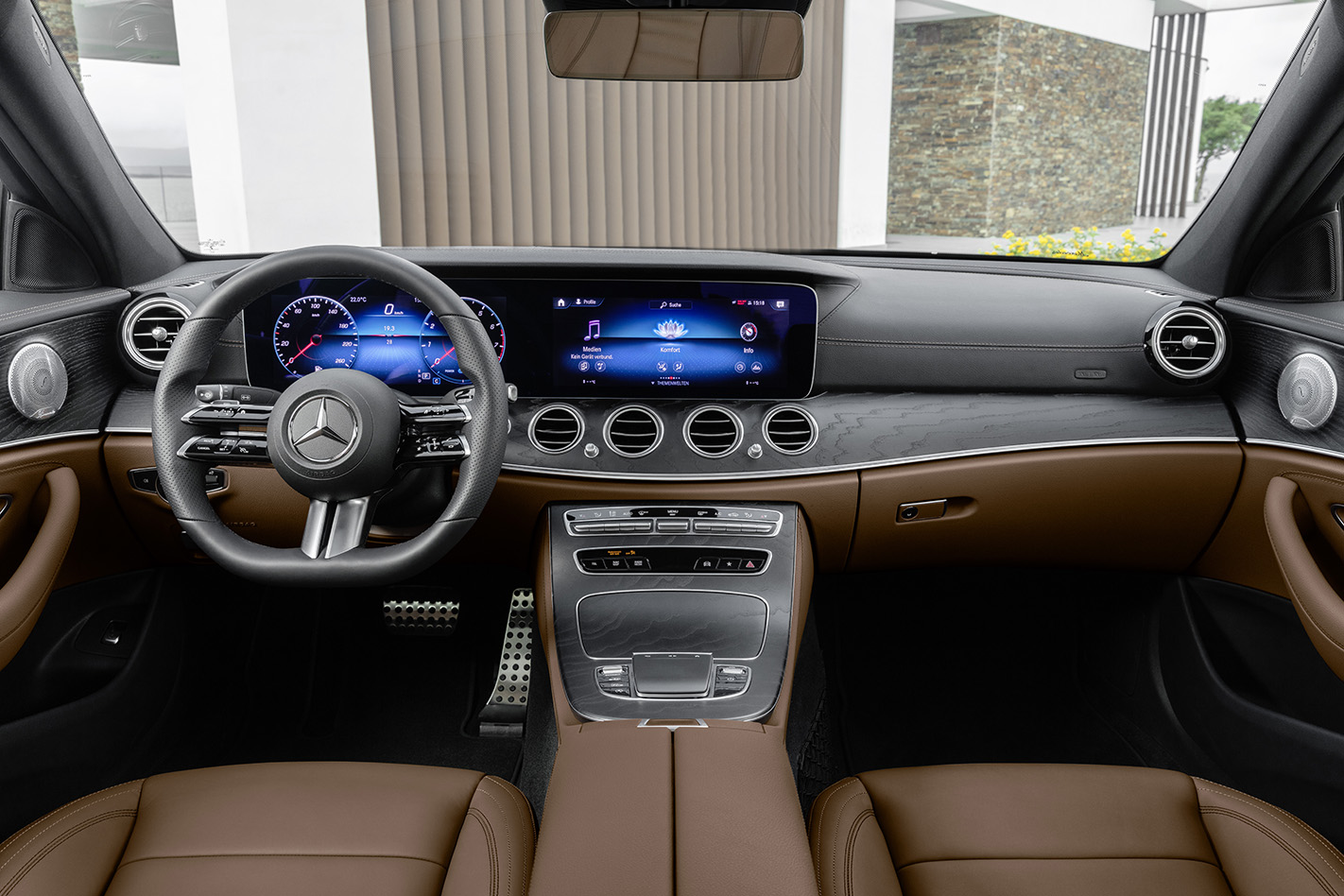
We’ve seen all this in recent models such as the GLS, but we’ve not seen the E-Class’ new steering wheel before. It’s either a split three-spoke design or a six-spoke one, depending on how literal you are.
Essentially, that means it looks to be rather more of a button-fest than even Merc’s previous wheel, though how many of those are physical switches and how many are touch-sensitive remains to be seen.
Elsewhere, the cabin is much the same – with intricate metal air vents, knurled metal aplenty and a swish combination of wood and leather adorning most surfaces. The infotainment adopts the same flat touchpad as its newer sister cars, ditching a scroll wheel once and for all.
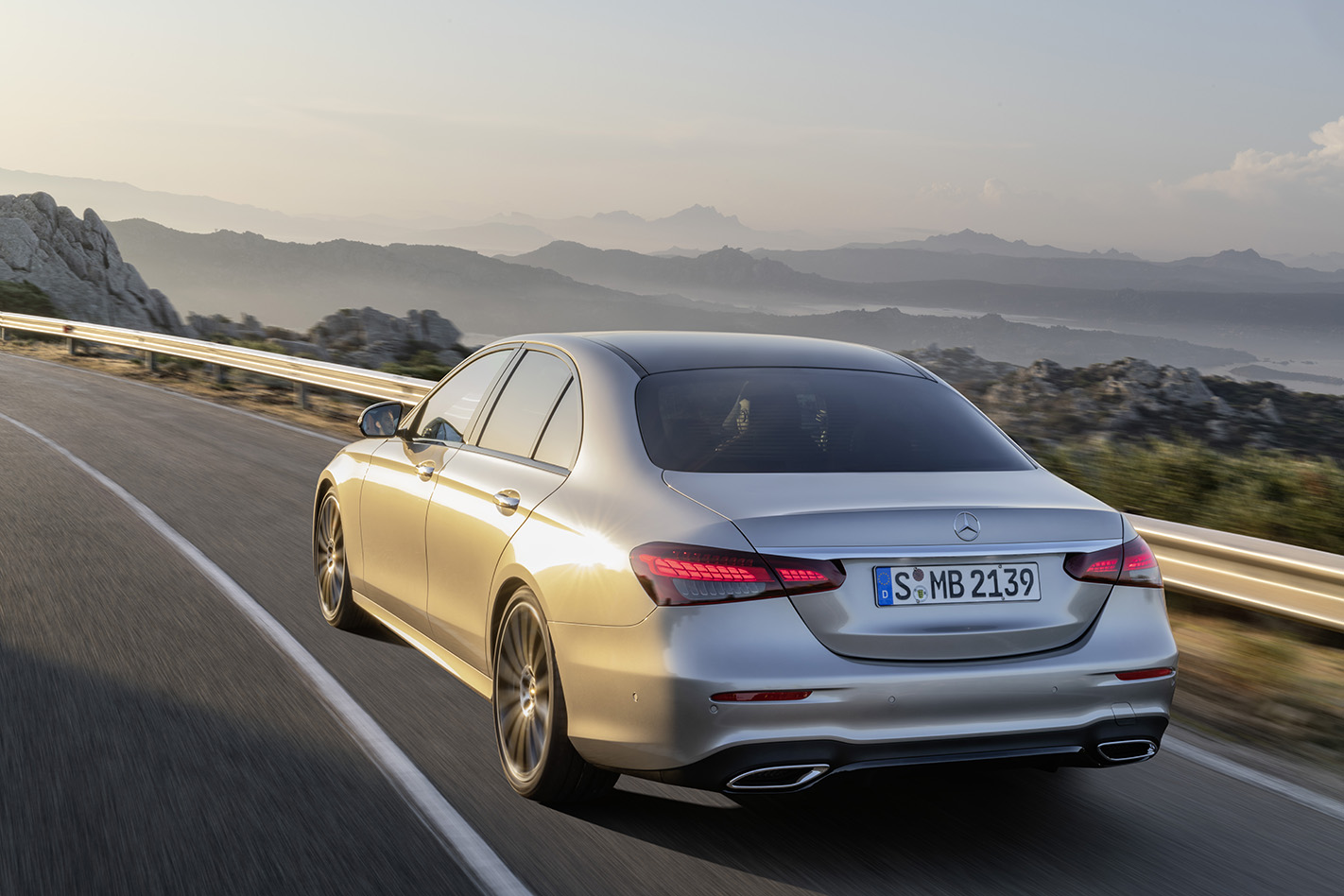
New finishes are available inside and out, too. Three new paint colours are as imaginative as you’d expect from a large German saloon – they’re High-Tech Silver, Mojave Silver, or Graphite Grey Metallic. Inside it’s slightly more exciting, with combinations of brown and beige available if you opt for the right trim levels. New for this year is a clever automatic driving position adjustment – input your height on the infotainment display and the car will adjust the seat and wheel for you.
New powertrains
Whether Australia gets the full line-up is uncertain but European markets will have petrol engines from 115kW to 270kW, and diesels from 118kW to 243kW.
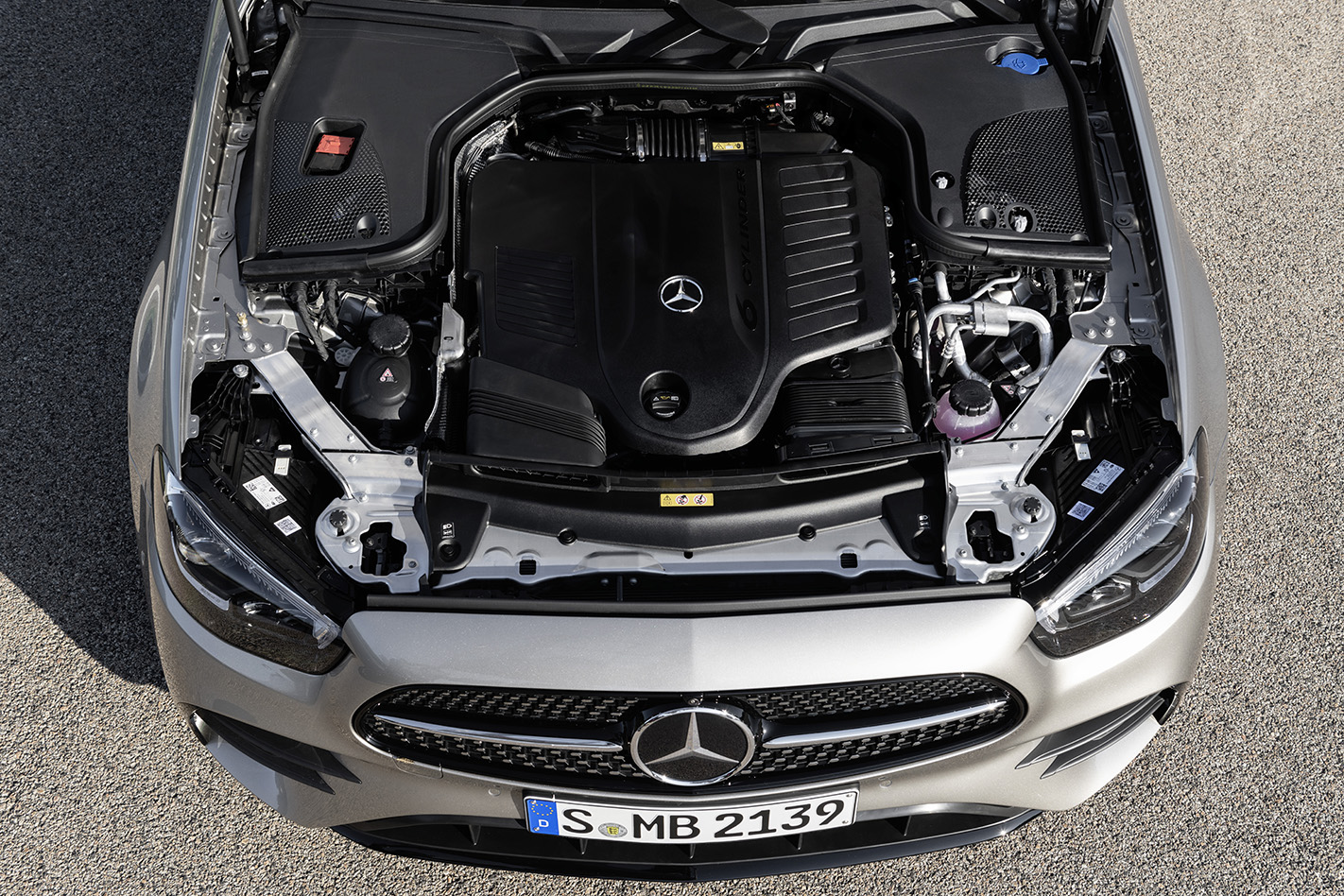
Again, like most other recent Merc arrivals, there is a new four-cylinder petrol with a mild-hybrid system and just about every daft word Mercedes could think of – all fitted in the name of added efficiency.
There’s a Nanoslide cylinder coating, Conicshape cylinder honing, a segment charger with flow connection… but all you need to know is that it’s capable of coasting at high speeds with the engine switched off, features an electric compressor for the turbocharger and promises very high efficiency.
There’s also a glut of emissions control systems fitted to both petrol and diesel engines. As for plug-in hybrids, the E300 e petrol and E300 de diesel will be carried over, though it’s likely they’ll be tweaked and potentially rebadged. Details are thin on the ground so far.
New tech
Mercedes-Benz was one of the first with semi-autonomous driving on the current E-Class, so it’s added and improved it all for this facelifted model.
First off is the fitment of capacitive sensors in the steering wheel – this detects touch, rather than pressure, so there’ll be no need to keep twitching the steering in order to prevent the car yelling at you.
Autonomous emergency braking with pedestrian and cyclist detection is standard, while the Driving Assistance package will add plenty of other goodies. Active Speed Limit assist uses map data and traffic sign recognition to adjust the speed limiter appropriately and can also use the route in the sat-nav to adjust ahead of bends, intersections or sliproads.
The adaptive cruise control will also use live traffic data to detect a tailback and reduce speed unless told otherwise. Once in said tailback, it’ll drive the car at speeds of up to 50km/h, stopping and starting.
Blind-spot monitoring is also available and works even when the car’s switched off – hopefully preventing the occupants from opening their doors into pedestrians or cyclists.
Finally, there’s Urban Guard, which is a vehicle protection system capable of tracking the vehicle and informing the owner of any potential theft or break-ins via their Mercedes app.
Mercedes-Benz E-Class in Australia
The 2020 Mercedes-Benz E-Class is expected to go on sale in Australia during the latter part of this year. Local specifications and pricing will be revealed prior to launch, according to Mercedes-Benz.
This story was originally published by CarMagazine.co.uk
BAC has revealed its new Mono, delivering a new generation car that very much echoes the special-edition R that launched at Goodwood last year.
Like the R, it features a turbocharged four-cylinder engine designed by Mountune, the UK outfit known for hopping up Ford ST and RS products, but features a smaller 2.3-litre capacity.
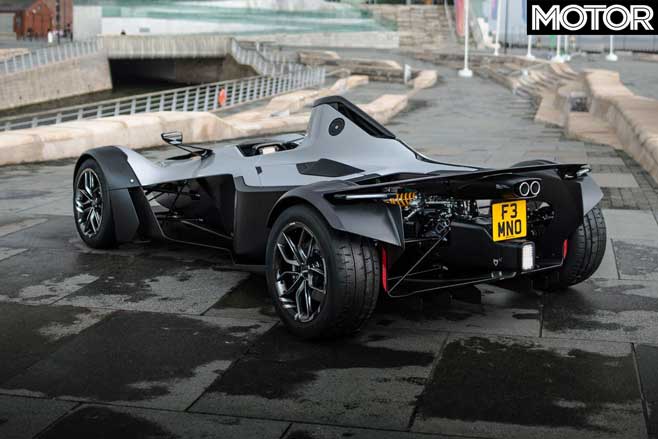
Either way, with 248kW and 400Nm on tap, it succeeds the car’s previous atmo engine with another 11kW and 20Nm, while boasting a dry-sump oil system for added security under high cornering loads.
And that’s exactly what you’ll experience in this street-stalking open wheeler that’s shed 10kg despite adding heavier Euro6D-emissions-beating hardware, thanks to extensive light weighting throughout the car.
The panels are made from graphene-enhanced carbon fibre, a technology developed for the 2019 R, and the car is 25mm longer and 20mm lower than before. Meanwhile the floor is made from carbon fibre and the AP Racing brake system is carbon-ceramic. Each wheel is about one kilo lighter and BAC claims it 3D prints over 40 per cent of the parts on the car.
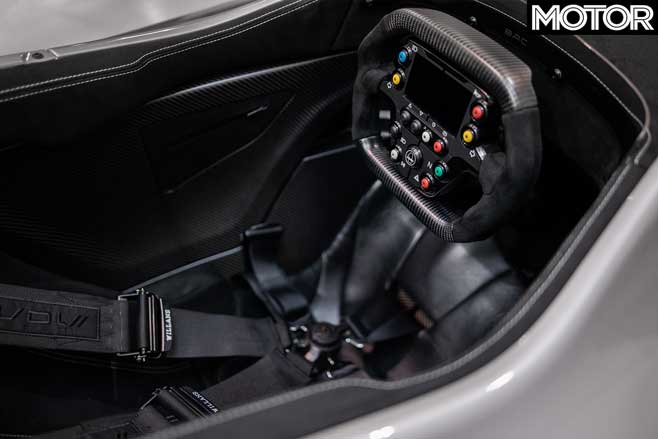
Overall this drives down its kerb figure to 570kg, which helps catapult the new Mono to 100km/h from rest in 2.7 seconds, or as fast as the new 992 Turbo S, while it’s claimed to run on to 274km/h. That acceleration figure is no real improvement over the old model, but the added torque and emissions compliance are what’s useful.
Components like the battery and fuel tank have been relocated to lower the centre of gravity while the Ohlins suspension has also been tweaked to ensure less movement under braking and getting the most from Pirelli Trofeo R tyres.
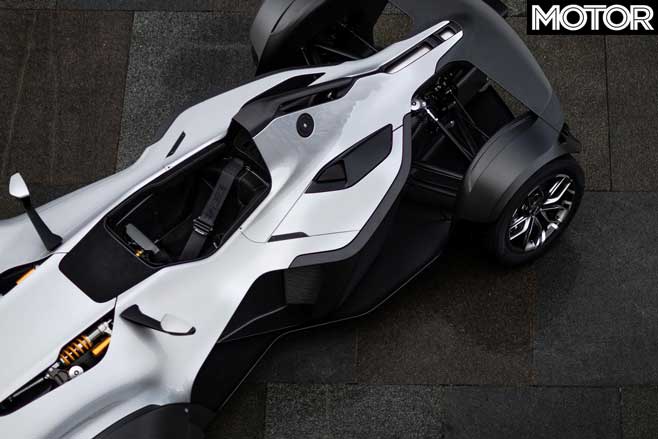
On top of this, the car come with LED headlights and new mirrors, and while its cabin will always remain appropriately bare, it apparently offers more levels of customisation and a new steering wheel. Safety-wise, it also features a new deformable rear crash structure.
The price for one in England is set at 165,950 pounds, or AU$322,791 once converted, which will ensure that the new Mono will remain a rare sight.
Christian von Koenigsegg is known for innovation and exciting ideas in the world of hypercars, but his new Koenigsegg Gemera ‘mega-GT’ might just take the cake.
With four seats, it’s the first car for the Swedish company that’s able to fit more than two, but that’s one point of many which shocked those watching the reveal live on YouTube.
Yes, even though the Geneva motor show was cancelled, Koenigsegg still went ahead with the reveal. In fact, it even broadcast the reveal from the empty GIMS venue using its already-built display area.
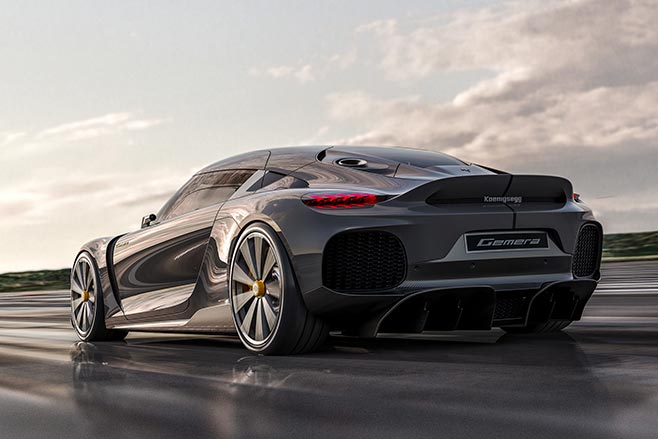
Back to the Gemera, which was named by Koenigsegg’s mother and is a sort of portmanteau of the Swedish words for ‘give more’ – ge mer. Not only is it a four-seater, but it’s also got the luggage capacity to hold a small suitcase for each passenger.
Koenigsegg turned 25-years-old in 2019
That must mean it’s not as fast as Koenigsegg’s other cars, right? Wrong. So very wrong.
The Gemera is a hybrid, with a midship three-cylinder, twin-turbo engine using the company’s Freevalve camless design (Koenigsegg calls this the ‘Tiny Friendly Giant engine’, or TFG) aided by electric motors for a total output of 1268kW and an absolutely astonishing 3500Nm.
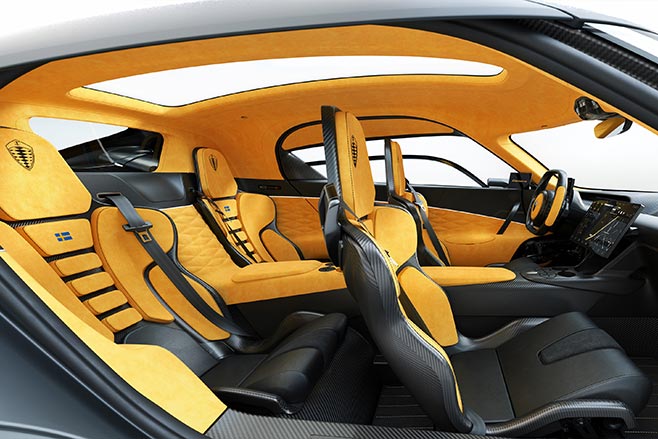
The motors are distributed with one for each rear wheel (about 373kW and 1000Nm each) and one on the crankshaft (about 298kW and 500Nm) to power the front wheels, along with the 440kW/600Nm ICE.
Even though it’s set to weigh just short of 1800kg, Koenigsegg says the Gemera will hit 100km/h in just 1.9 seconds. This car has four seats.
That target kerb weight isn’t exactly small, but with the hybrid system it’s been kept to what’s actually rather impressive given its size and capability. Of course, a full carbon fibre monocoque chassis and carbon body help out here.
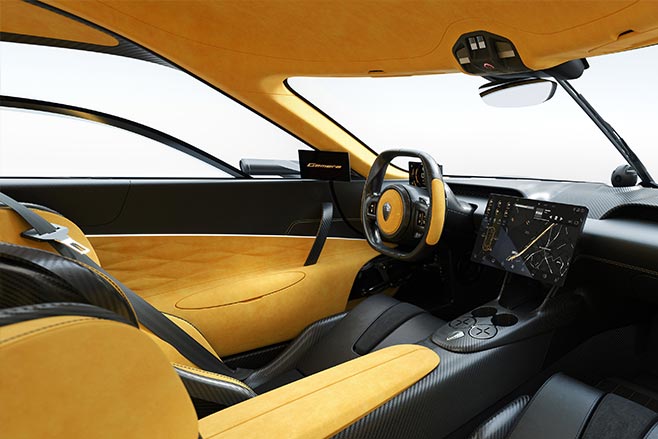
It’s also looking to the future, with a flexible fuel system able to run on “whatever fuel you can find,” the company’s founder says.
With 50km of electric range and another claimed 950km in hybrid mode, Christian von Koenigsegg says if you’re on a trip in the Gemera, you’d only need to stop “for your own personal needs.”
Stay tuned as we plan to take a deep dive into the Gemera’s full specifications, as well as uncover the potential for it to come to Australia.
The new Porsche 911 Turbo S is everything you’d expect: quicker, more capable, more powerful, more expensive and packed with more technology. What you might not expect is the injection of attitude.
In times past, before it became the benchmark all-weather supercar, the 911 Turbo was spoken of in reverential tones. With its huge power, savage delivery and unusual weight distribution, extracting the best from the original 930 Turbo took considerable skill. Not everyone was up to the task.
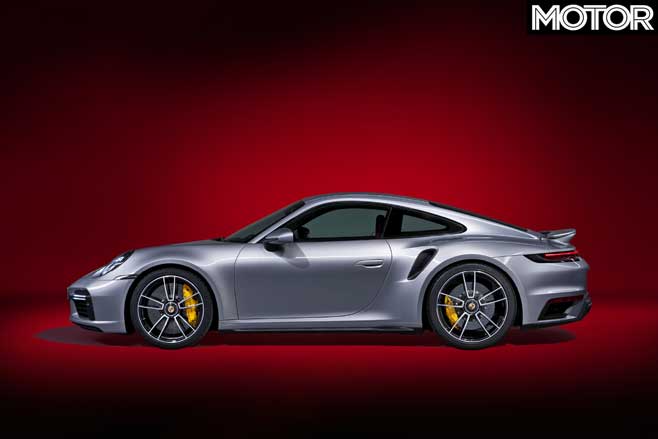
Porsche isn’t intending to hark back to those days with the latest 992-generation model, but it does want to bring back a bit of mongrel to its flagship non-GT 911. “There wasn’t any real need for significant last-minute adjustments,” Porsche’s sports car boss Frank-Steffen Walliser told MOTOR’s European correspondent, Georg Kacher, during the latter’s prototype ridealong.
“But I still feel we have steered the 992 Turbo fractionally more in a back-to-the-roots direction. To do so, even little things helped: stiffer joints, harder rubber bushings, tighter attachment points, modified spring and damper calibrations.”
Porsche’s official press release backs this up, stating, “New optional equipment has been introduced to underline the much sportier image of the all-wheel drive 911 Turbo S. These include the Porsche Active Suspension Management (PASM) sports chassis that has been lowered by 10mm and the sports exhaust system with adjustable flaps that guarantees a distinctive sound.” Not that the Turbo has abandoned everyday usability: “What we definitely refrained from is turning a nicely balanced GT into a hard-edged street fighter,” said Walliser.
PASM includes new-generation adaptive dampers which are able to react faster and more precisely; if they’re anything like those in the Carrera models, ride quality in normal should improve markedly. Expect high-tech chassis aids like rear-wheel steering and active anti-roll bars to continue, too.
The new 911 Turbo S – there will almost certainly be a standard Turbo variant, but Porsche is leading with the flagship S model for now – has a wider footprint than ever before, the front track extended by 42mm and the rear 10mm.
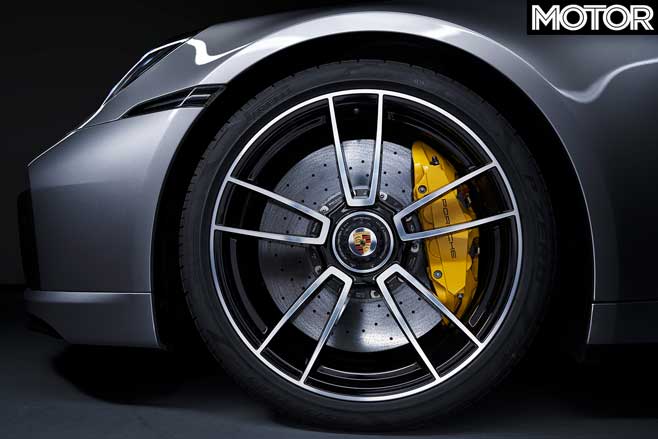
Staggered wheels make their debut, the rears measuring 21 inches in diameter wrapped in 315/30 tyres and the fronts 20 inches wearing 255/35s; the car you see here wears Pirelli P Zeros, but like the regular 911 Carrera we’d expect Dunlops and Michelins to also be available. Brakes carry over in the form of monster 410mm carbon-ceramic rotors and six-piston calipers at the front matched to 390mm discs and four-piston calipers at the rear. Three-stage ESP appears for the first time, on and off now separated by a more relaxed Sports mode.
The car’s fatter stance has necessitated a larger body, the front widened by 45mm and the rear 20mm. Weight has also crept up; no figure has yet been supplied but thanks to the extra equipment and an extra gear in the dual-clutch gearbox the new 911 Turbo S will sit north of 1600kg as a Coupe for the first time and nudge 1700kg as a Cabriolet.
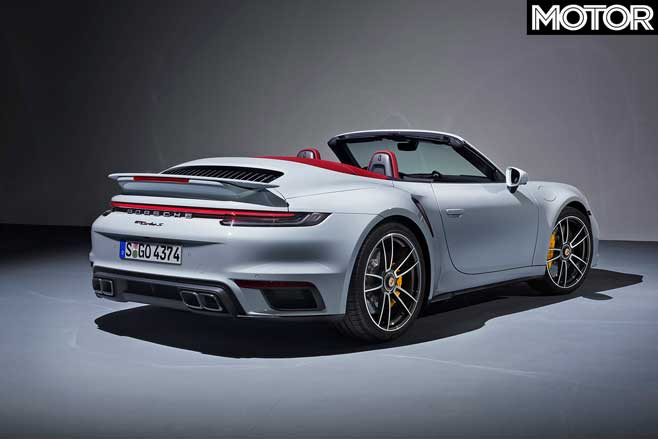
Weight is a key reason that any form of hybrid assistance – even a 48-volt mild hybrid system like that in the Porsche Panamera – has not yet been adopted: “The benefits of partial electrification are marginal compared to the complex weight, packaging and cost issues,” explained Walliser.
Instead, Porsche has made the Turbo faster the old-fashioned way, by adding lots and lots of power. An all-new 3.8-litre six-cylinder boxer, dubbed EA9A2, sits in its rear and it packs one hell of a haymaker.
Based on the engine found in the 911 Carrera model, an extra 800cc, bigger turbochargers, piezo fuel injectors and a completely redesigned intake system liberates a whopping 478kW at 7000rpm and 800Nm from 2500-4000rpm, hefty increases of 51kW/50Nm over its predecessor which, it must be said, didn’t lack urge in a straight line.
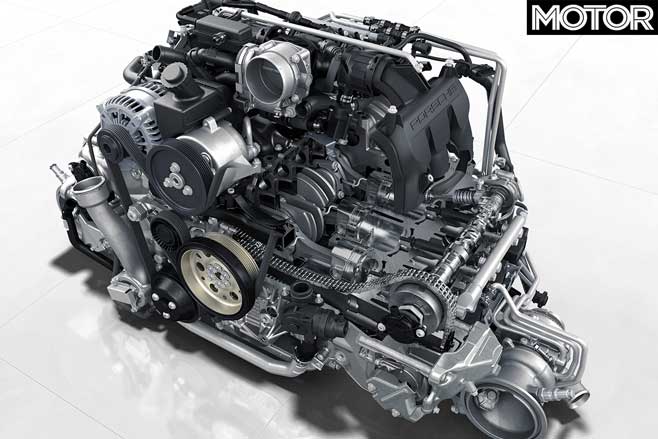
To achieve this massive grunt there are now four intakes, the traditional pair set into the rear guards supplemented by another pair in the engine cover. This increases the cross-section and lowers air resistance, improving engine efficiency.
This air is fed to a pair of variable-geometry turbochargers, the 55mm turbine wheels now 5mm larger and the 61mm compressor wheels 3mm bigger. Previously, the turbos were identical, however, they are now symmetrical, spinning in opposite directions on each side of the car, and incorporate electrically adjustable wastegates for finer boost control.
Porsche claims a scant 2.7sec from 0-100km/h and 8.9sec from 0-200km/h, the latter a one-second improvement over the PCOTY-winning 991.2 Turbo S. This, remember, was a car that clocked a 10.7sec quarter mile at 212.7km/h in our hands; it seems reasonable to expect its vastly more powerful successor to shave a couple of tenths off that at least. Berserk.
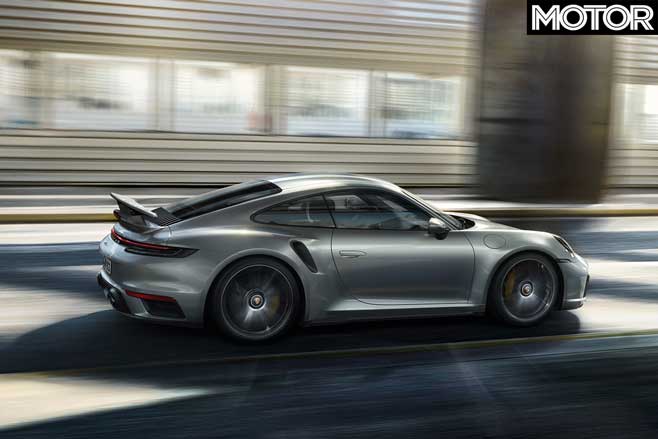
Key to this head-bursting acceleration is the new eight-speed PDK gearbox and all-wheel drive system, an updated transfer case able to send up to 500Nm to the front wheels. Top speed remains 330km/h, achieved in sixth, the final two gears used as overdrives. As is now the norm, drive modes are selected via a steering wheel-mounted rotary switch, with the Sport Response button priming the engine for maximum attack instantly.
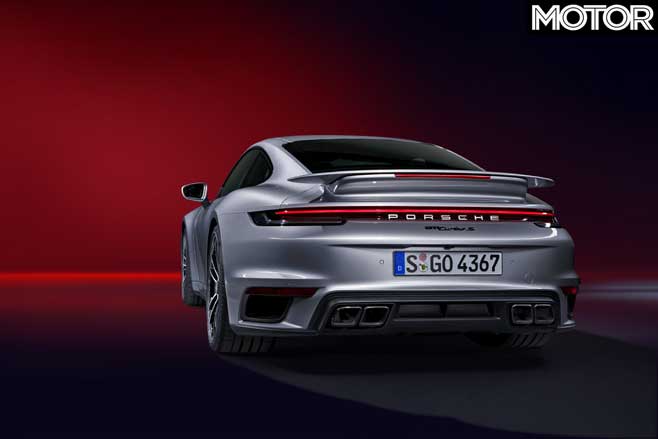
To keep the car pinned to the ground at warp speed, downforce has increased by 15 per cent. The main influences are the larger, active rear wing and pneumatically operated front air dam that slides out below the redesigned front bumper, while electronically controlled flaps also aid cooling or reduce drag as necessary.
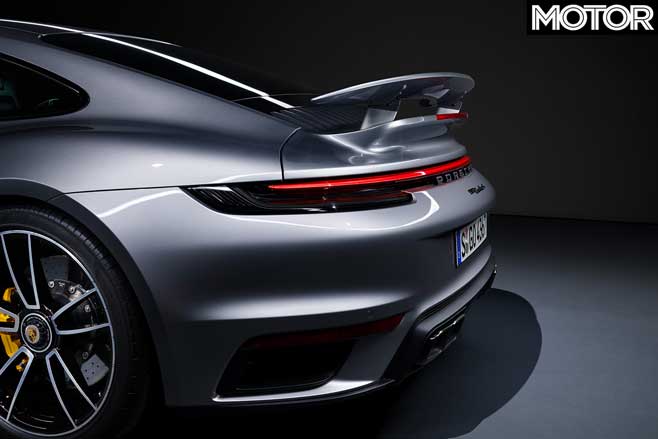
Larger air intakes, dual horizontal running lights and matrix LED headlights are all elements of the new face, while at the rear a larger diffuser, squarer bumper and quartet of rectangular exhaust outlets sit below the 992’s signature full-width tail-light strip.
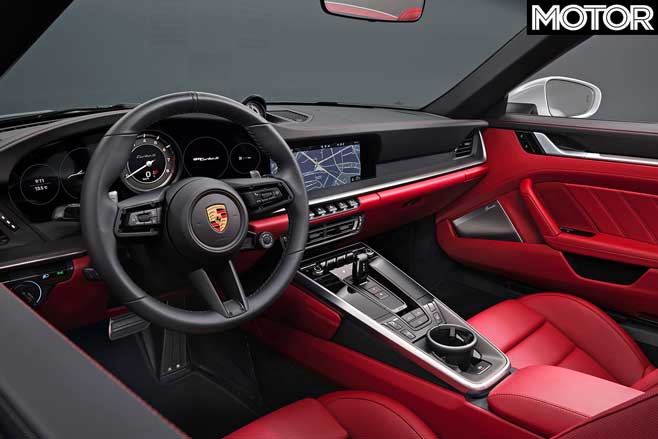
Inside, as with all the latest-generation 911s, there has been a huge lift in design and technology. The trademark central analogue tachometer is flanked by a pair of digital screens while infotainment duties are handled by a 10.9-inch central touchscreen.
Aussie cars will come fully loaded with heated 18-way adjustable seats, keyless entry and go, BOSE surround sound stereo, digital radio and a full leather interior with carbon trim and silver accents, though if you have specific requests, Porsche’s Exclusive Manufaktur department will undoubtedly be able to accommodate them – for a price.
Speaking of, the new 911 Turbo S is scheduled to arrive in Australia in the second half of 2020 starting at $473,900 for the Coupe and $494,900 for the Cabriolet. Next month, we’ll be behind the wheel.
When is a 911 Turbo a Turbo?
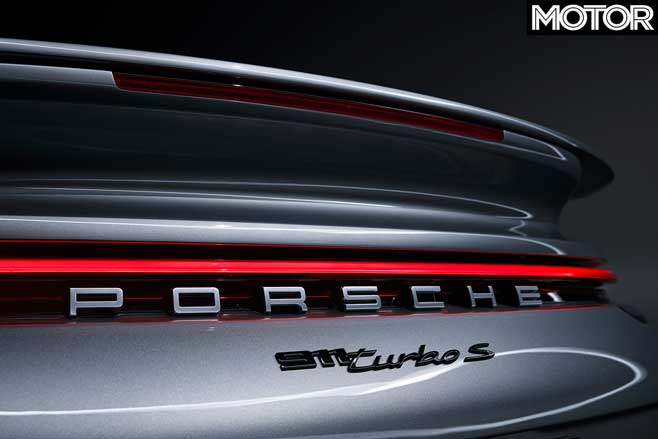
Porsche describes the new 992 Turbo as “Definitely Turbo”, but when all series production 911s use turbocharged engines, what’s the point of the actual Turbo model? Power is obviously a key differentiator, the new Turbo producing 478kW/800Nm instead of the 331kW/530Nm delivered by the Carrera S. It goes deeper than that, however, with the two variants separated by their power delivery.
Powertrain engineer Thomas Wasserbach neatly explains the difference: “It’s a different characteristic of the curve of the power. The 911 Carrera we want a feeling which is near to a naturally-aspirated engine, and the 911 Turbo we need the maximum torque at lower speeds.”
By adjusting ignition and camshaft timing, throttle positioning and wastegate position, Porsche is able to map out a linear power curve in its Carrera models that encourages the driver to use maximum revs in search of power. In contrast, the Turbo is focused more on mid-range punch and delivering the vicious thrust of torque that force-fed engines are traditionally known for.
The next step for turbocharging is to use an electric motor to either assist the exhaust gasses in spinning the turbine wheel or replace it entirely. It also allows energy to be recovered from the movement of the wheels, which is the device called an MGU-H in today’s Formula 1 engines.
Skoda has finally pulled the wraps off its new Octavia RS iV, revealing what things look like for the performance mid-sizer now that it’s welcomed a plug-in hybrid variant.
The good news is its electrified powertrain will deliver a combined maximum output of 180kW and 400Nm, 20Nm more than the current RS245 model, thanks to a 1.4-litre turbocharged engine teaming with an electric motor.
Separately, the electric motor produces 85kW and 330Nm while the petrol engine is claimed to make 110kW. They will both drive the front wheels exclusively and a six-speed dual clutch transmission.
Despite the extra torque, the lithium-ion battery, rated at 13kWh, and the extra weight required for such a system, might explain why acceleration to 100km/h now takes 7.3 seconds. That’s over half a second slower than the 6.6sec the current Octavia RS245 model needs.
Still, the Octavia has made some impressive gains in efficiency. It’s claimed to achieve up to 60km on battery power alone, tested on a WLTP cycle, and it passes Euro 6d emissions which will be enforced in 2021.
As for handling, other than Skoda sharing its progressive steering will complement “typical” RS suspension tuning that will “cater to energetic driving styles,” there’s not much else to say about its chassis.
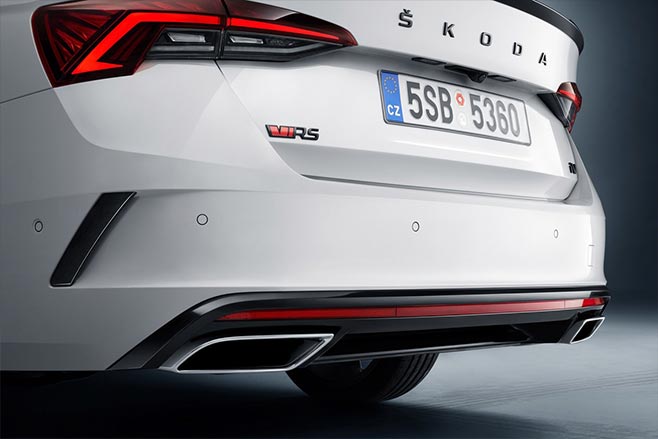
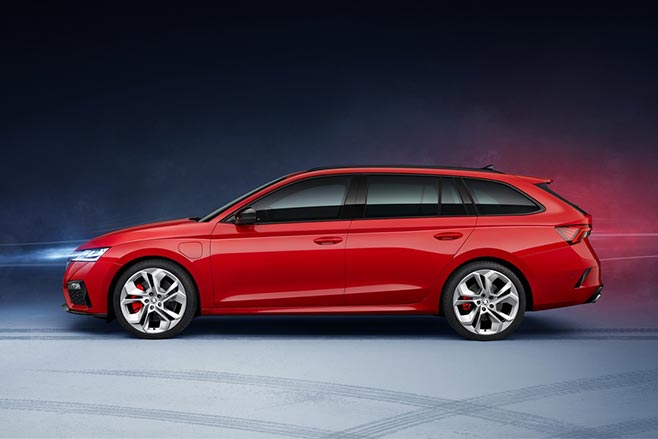
Elsewhere on the Octavia, which will come in sedan and wagon form, you’ll find RS-specific LED fog lights, red brake calipers and black 18-inch alloys to suit its unique bumper, aero flaps and diffuser. It also comes with black exterior accenting and the option to upgrade the wheels to 19 inches.
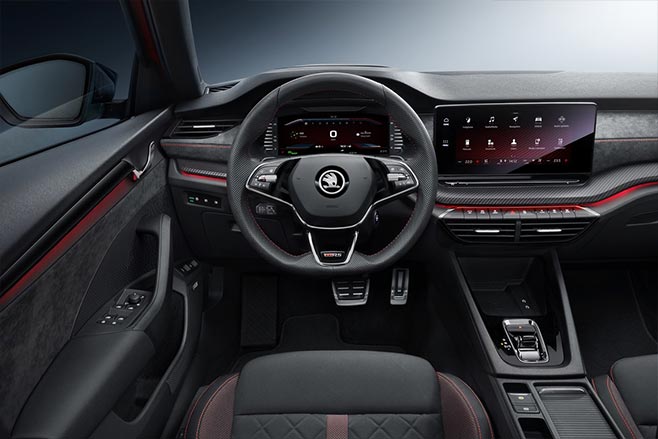
Sports seats feature inside the cabin that’s redesigned around a large centre screen and a simplified centre stack. There’s also a new toggle-style gear selector that echoes what we’ve seen in the new Golf GTI.
UPDATE (4/3/20; 10:20am): Skoda Australia has revealed the new generation Skoda Octavia is slated to arrive Down Under in 2021, but this RS iV is not on the local firm’s radar as it aims to welcome electrified product in the form of full EVs, not hybrids.
It’s reported that Australia will receive a petrol-only new Octavia RS with 180kW/370 and a dual-clutch transmission.
Serendipity is an interesting thing. McLaren was due to unveil the latest in its line of Longtail (LT) vehicles at the Geneva Motor Show, but the threat of coronavirus derailed those plans.
The British carmaker decided to keep calm and carry on, relocating the launch of the new 765LT to McLaren Cars HQ in Woking, England.
The last-minute location shuffle to McLaren’s historical home in the south of England was fitting. Not only did the latest LT look comfortable in its natural habitat, but its story also began with the F1 GT race car, which was made in the same facility in the 1990s.
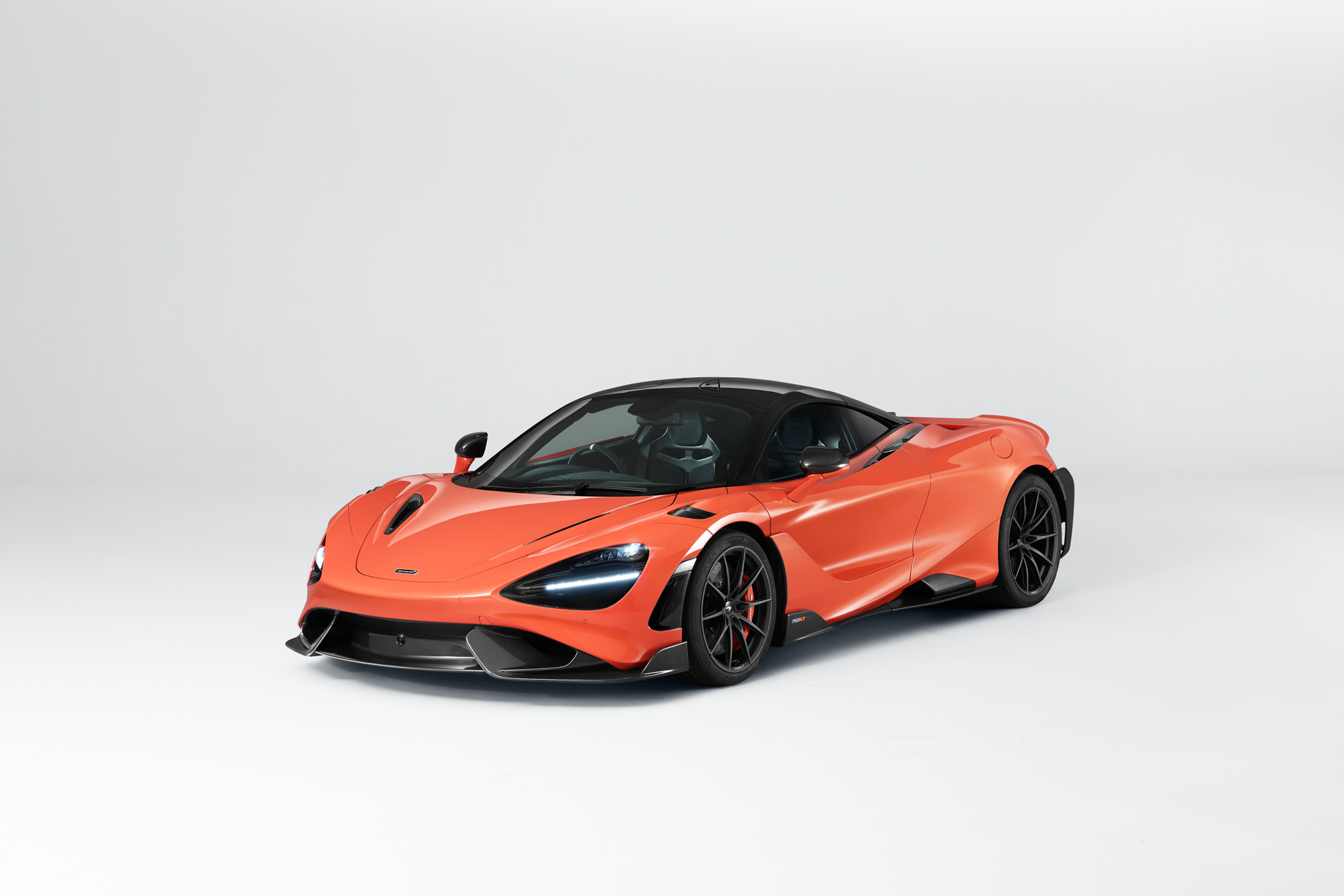
The latest 765LT has substantially evolved from the thee-year-old 720S. It looks more aggressive and purposeful. Its stance is lower, it has a bigger front splitter, a larger, elongated Longtail active rear wing and four large, loud exhausts.
That nose and reptilian eyes are so evocative of speed and cold-blooded aggression, it’s almost intimidating. The black teardrop canopy is modelled off the perfect falling drop of water — the most aerodynamic shape possible.
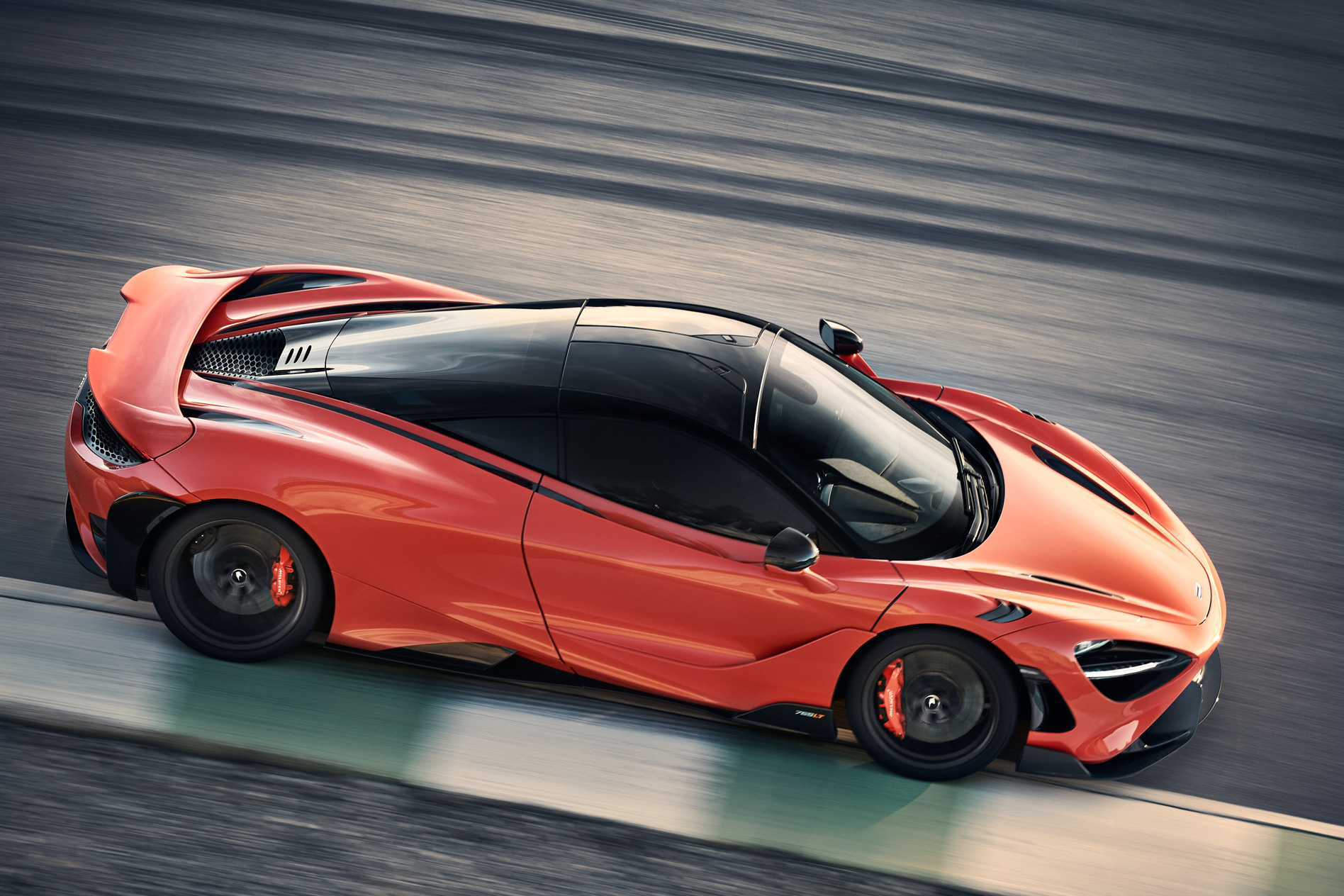
The 765LT is not only powerful than the 720S, it’s lighter, too. How did McLaren’s engineers achieve this?
First, the almost hypercar levels of performance. The 4.0-litre, twin-turbocharged V8 delivers 563kW and an earth-moving 800Nm – 33kW and 30Nm more than the 720. It even shares bits with the multi-million dollar Senna, including engine components and its braking system.
As a result, the LT manages 0-100km/h in a blistering 2.8 seconds and 0-200km/h in 7.2 seconds.
Gearing has been optimised for throttle response, giving the LT a claimed 15 per cent quicker in-gear acceleration than the 720S and the fastest lap times of any McLaren Super Series model to date.
McLaren has developed a trademark Active Dynamics Panel, too, where gearbox and suspension settings can be adjusted through Comfort, Sport and Track modes using the Handling and Powertrain settings.
Clearly, the LT is more track-focused and as the name suggests, that longer tail with its active wing element provides more downforce and better aerodynamics for track work.
This is a car that aimed at people who either race on the weekends or who regularly use their car at track days, but its designers say it’s equally at home on a winding mountain road – and it won’t scare the life out of you.
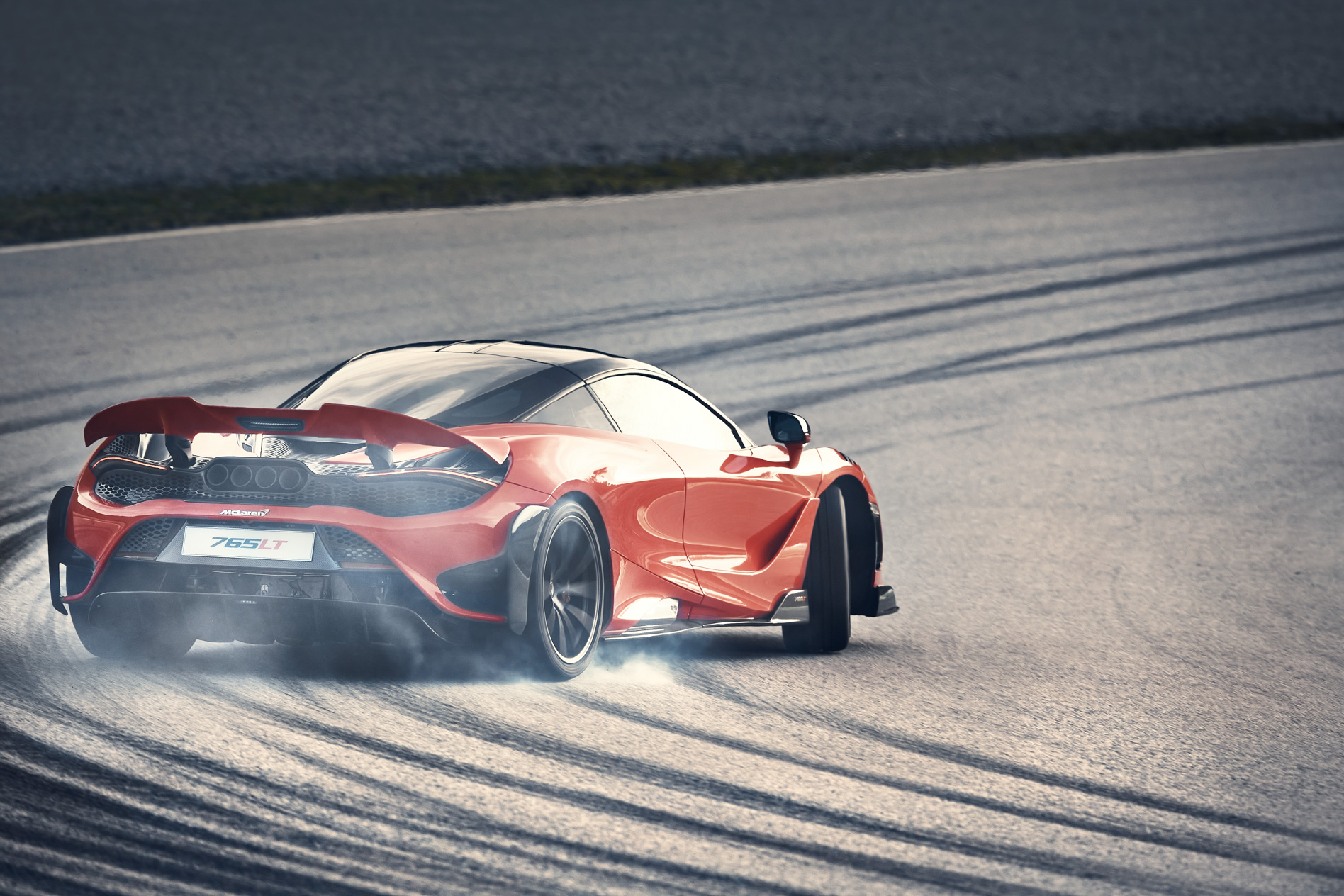
The 765LT weighs just 1339kg, too, which is a full 80kg lighter than the 720S. How on earth did McLaren’s engineers shed the weight? Well, there are the carbon fibre body components, like the front and rear bumpers, side skirts and the upper section of the dihedral doors; the extensive use of titanium in the exhaust system; lighweight alloy wheels and titanium wheelnuts and even thinner glass.
In fact, some of the glass panels have been entirely replaced with polycarbonate. Small luxuries, like air-conditioning, an audio system and even carpet have been chucked to minimise weight, but are available on request. Who knew an audio system weighed a hefty 1.5kg?!
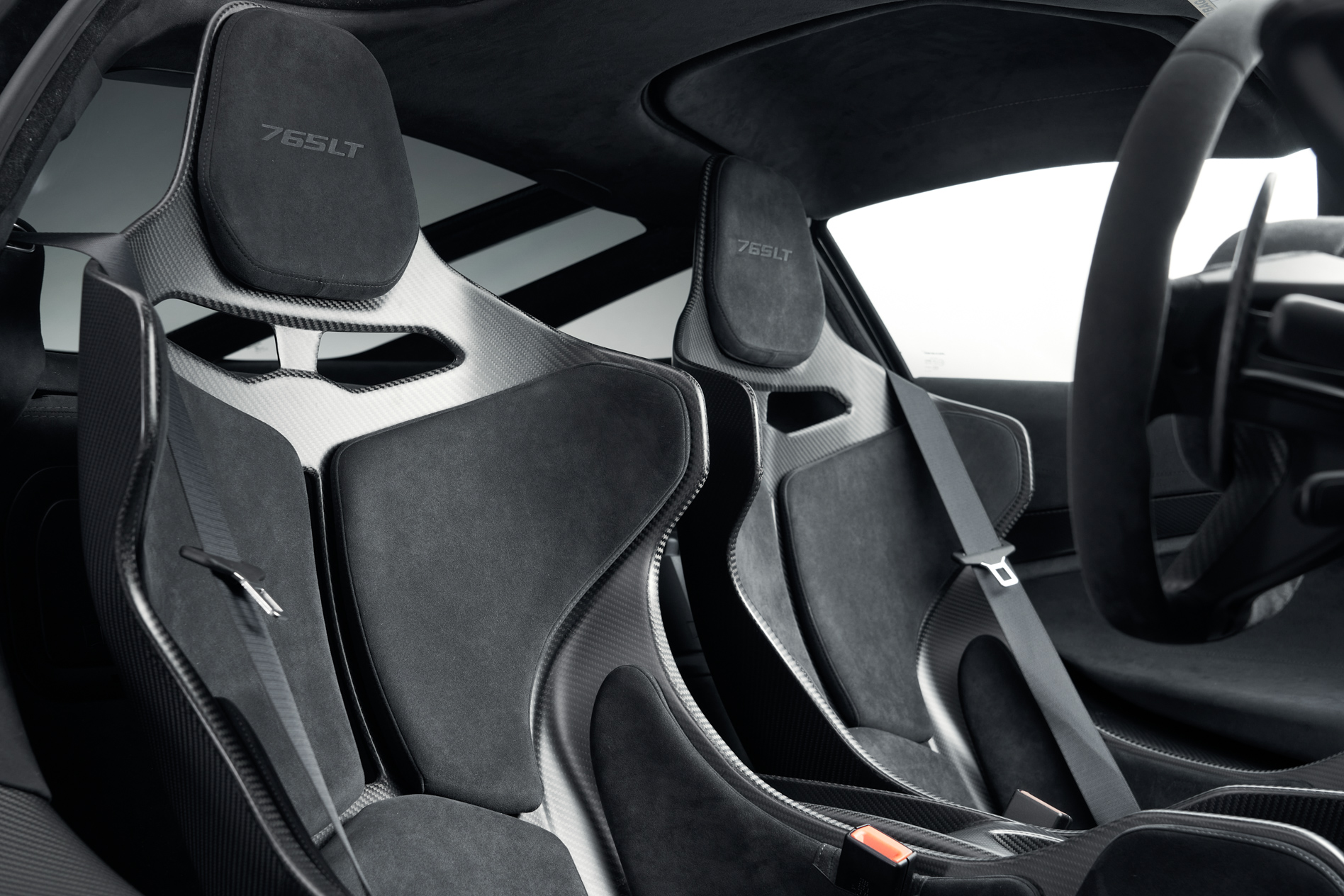
These seats saved 17kg alone!
Seventeen exterior paint colours are offered, including two shades unique to the LT; Nardo Orange and Smoked White.
Despite its lean, mean look, the interior feels refined. The carbon-fibre bucket seats and centre tunnel look absolutely race-car, too. And how’s this for a ‘look at moi’ moment… owners can opt to have a double-glazed panel showcasing the mid-mounted engine. Yep, that’s right, you can turn around and perve at your own V8 at the lights.
According to McLaren, the 765LT is the “most accomplished and exhilarating LT model ever from McLaren Automotive”. If you’re tempted, don’t leave it to serendipity. In keeping of the LT tease of exclusivity, only 765 individually numbered cars are available globally, with a handful sure to make it down under.
As for price, we’ll have to wait and see; locally, McLaren is still firming up the price and specification of the 765LT for Australian buyers. Given where the car will sit in the company’s Super Sport line-up, though, expect the car to encroach upon the $700,000 mark. Lightness doesn’t come cheap, after all.
It’s the most exclusive – and expensive – Bentley ever
Just 13 will be made and 12 sold
Bentley keen to build coachbuilt one-off specials
Bentley is returning to its coachbuilding roots, relaunching the ancient Mulliner bespoke tailoring brand to build extremely expensive limited-edition vehicles for clients with the deepest of pockets.
The first car to emerge from the reborn Mulliner Studio – a brand with almost 500 years of saddle-making and coachbuilding heritage that was acquired by Bentley in 1959 – is the Bacalar, a heavily customised two-seat roadster with no roof priced from $2.9 million.
Bentley says all 12 examples of the Bacalar have already been spoken for, and the new owners will have the opportunity to co-create their ‘one-of-a-kind’ car in collaboration with Bentley Mulliner’s designers.
The $2.9 million price tag is just the starting point for the ‘base’ car. Bentley expects the actual price of each completed Bacalar will be closer to $4 million once each owner’s customisation requests are taken into account.
Bentley confirmed that the Bacalar will be built in left- and right-hand drive, with deliveries expected to begin late this year, but declined to confirm whether any wealthy Australians are among the 12 future owners.
The Bentley Bacalar was to be revealed at the Geneva Auto Salon, but the show’s cancellation due to Coronavirus fears forced Bentley to instead reveal it to WhichCar and a handful of other journalists in Bentley’s CW1 showroom at the company’s Crewe headquarters in England.
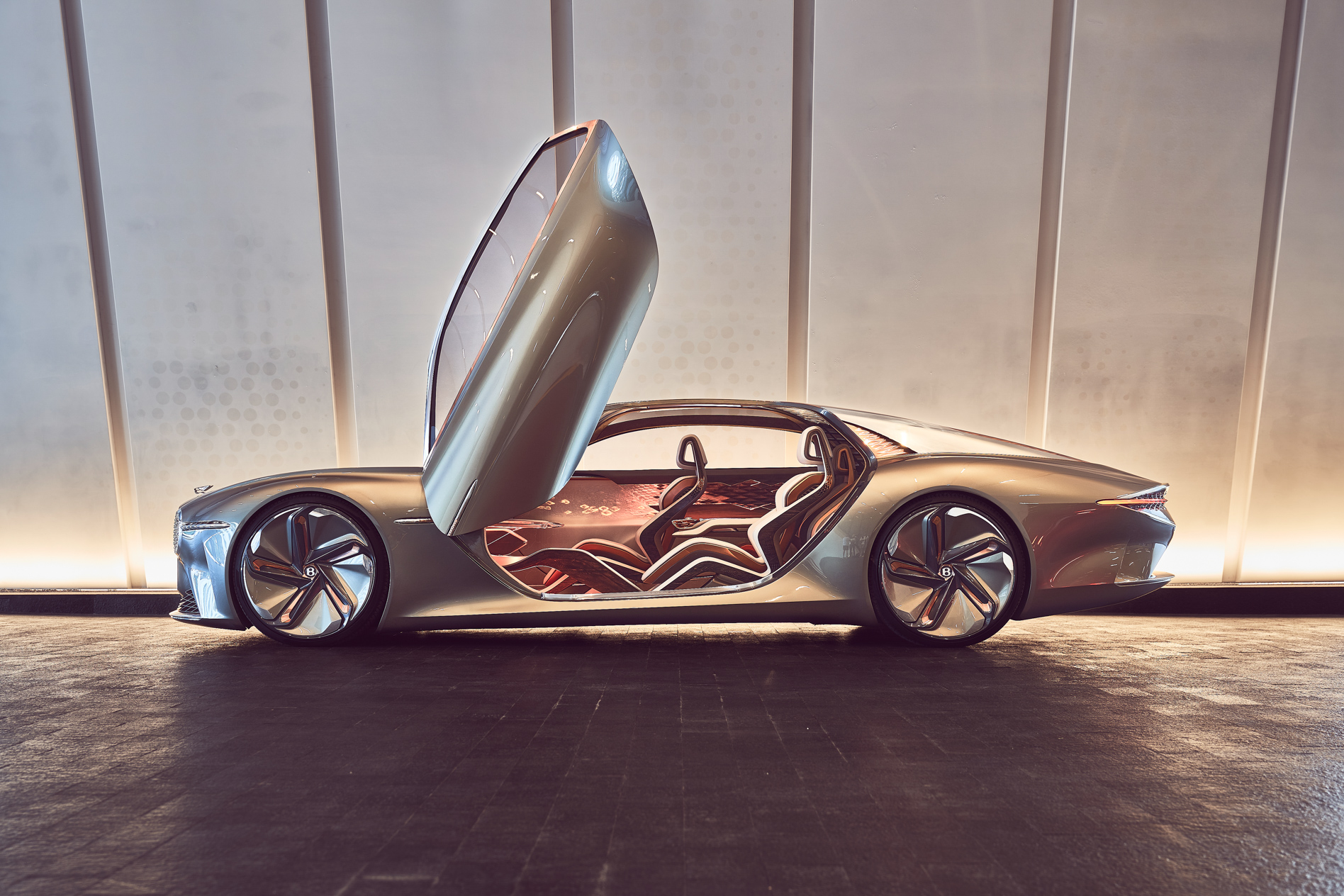
The Bentley Bacalar is based on the Bentley Continental GT Cabriolet, and features all-new panelwork – ‘coachwork’, in Bentley-speak. Every panel is unique to the Bacalar, and some of the embellishments, such as the distinctive headlights and taillights, have been drawn from the stunning EXP100GT concept car revealed by Bentley last year.
The Bacalar is 100kg lighter than the Continental GTC because it uses carbon fibre more extensively, and it has no roof at all.
The customisation tour de force continues inside the two-seat cabin with a wraparound cockpit crafted from sustainable wood from naturally fallen trees – known as riverwood – that has been preserved for 5000 years in peat bogs in England.
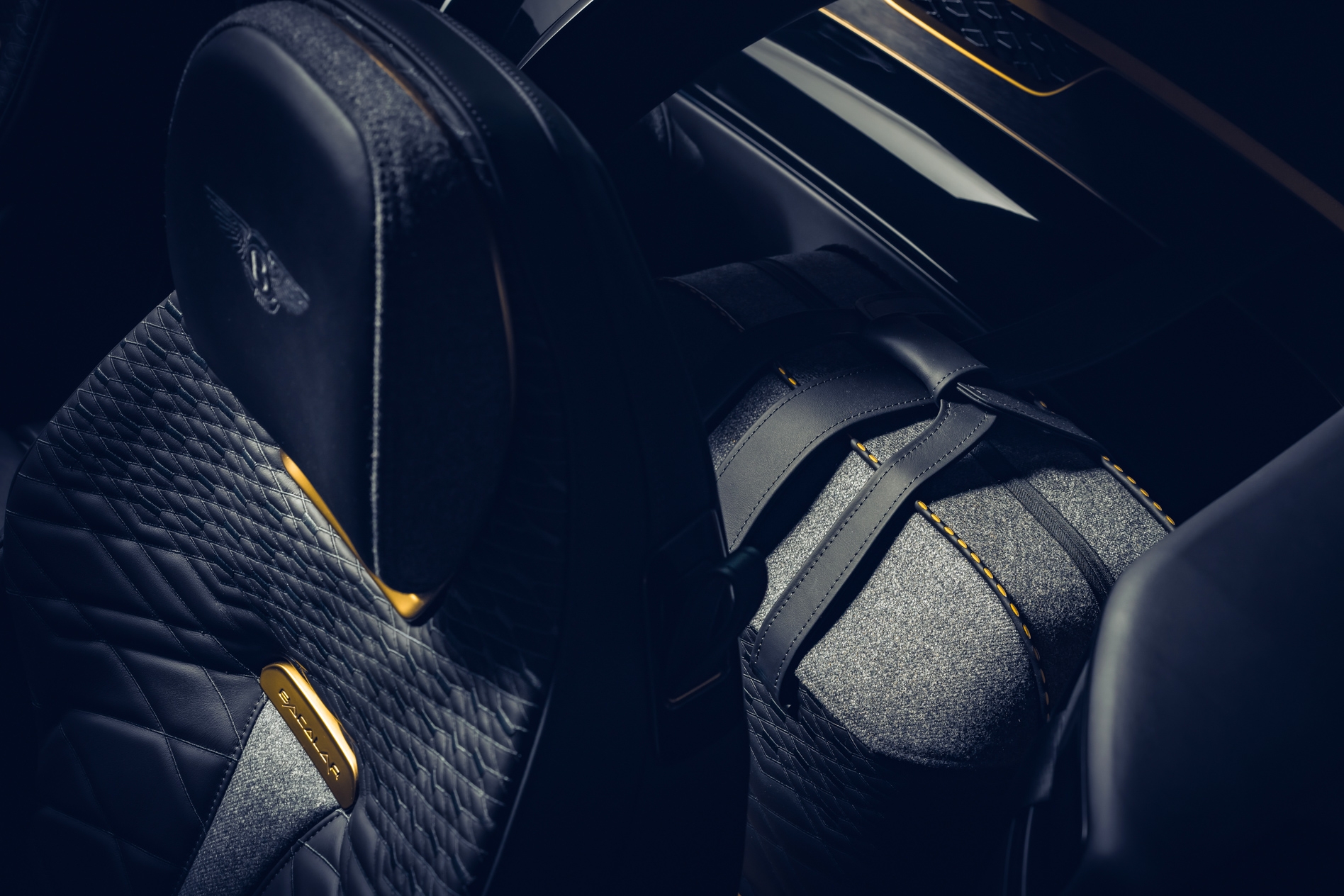
The Bacalar’s cabin also has a unique sloping centre console, bronze highlights throughout and embroidered seats with more than 148,000 quilt-style stitches in each seat.
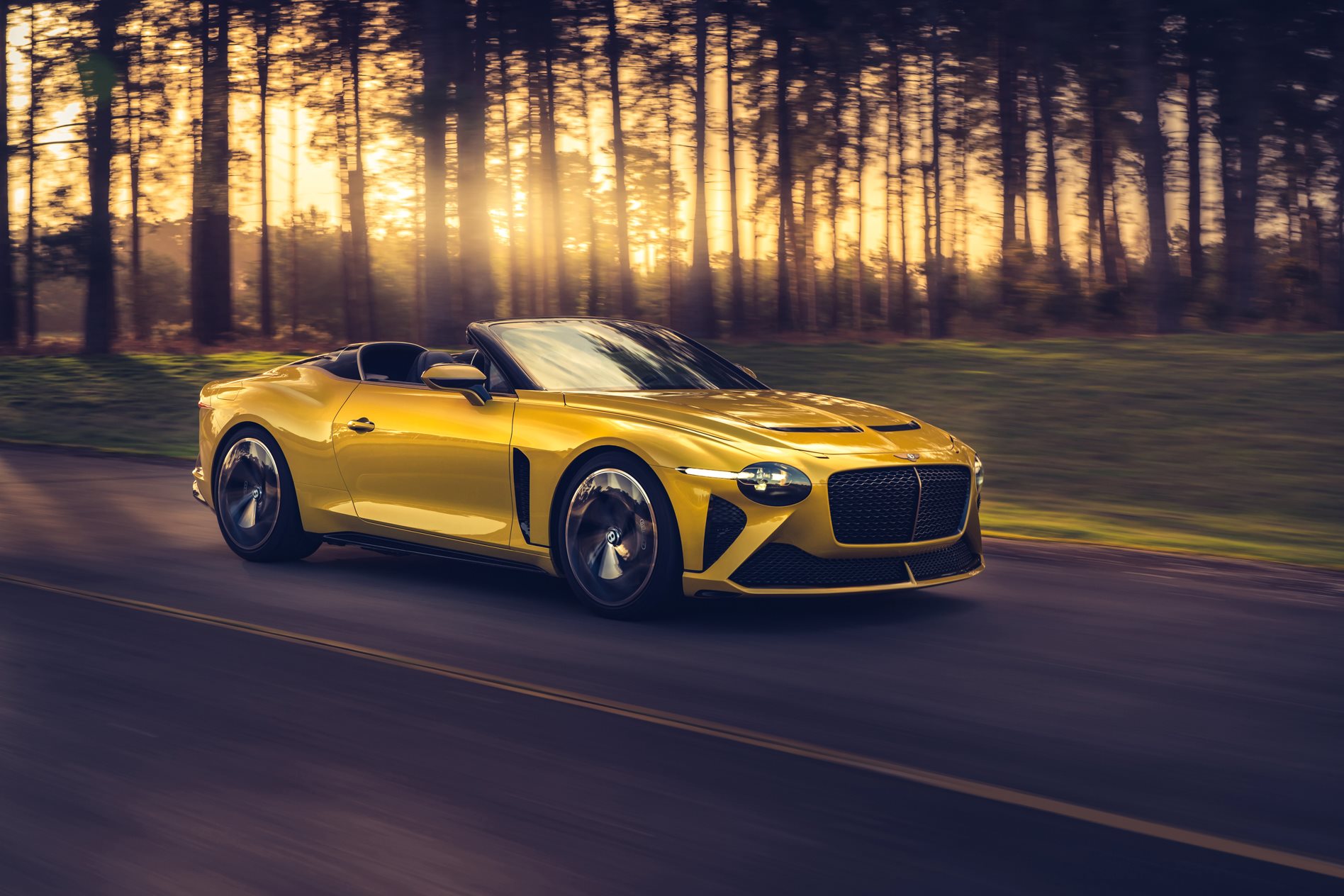
The exterior paint colour of the example vehicle – which is not one of the 12 destined for extremely rich car collectors, but is a runner – is called Yellow Flame, and is made from the ash of rice husks which is said to give the paint its deep metallic lustre.
The Bacalar is powered by Bentley’s 12-cylinder petrol engine, tweaked to produce 484kW and 900Nm, which sends that power to all four wheels. The car’s rear track has been widened by 20mm to give a more muscular sporting stance.
Bentley says the Bacalar is “the ultimate open-air, two-seat luxury Grand Tourer available in the world today.”
The Bacalar is the first limited-edition vehicle to emerge from the reborn Mulliner operation, and it won’t be the last. Bentley has confirmed that other limited-run vehicles will follow – “after a suitable time” – but won’t say when, or what they will be.
WhichCar understands that Bentley will produce a Mulliner limited edition each year, based on a different donor vehicle from the Bentley range each time. Each new release will be limited to 12 vehicles.
“Mulliner is the oldest coachbuilding company in the world, and we want to use it again,” Bentley’s board member for sales and marketing, Chris Craft, told WhichCar at the Bacalar’s reveal.
Last year Bentley restarted production of one of its most iconic cars, the 1929 Bentley Blower (below), building 12 brand new examples based on the original.
“That was the start and we thought ‘great to do a classic’, but now we need to do real coachbuilding for the next century as well,” said Craft.
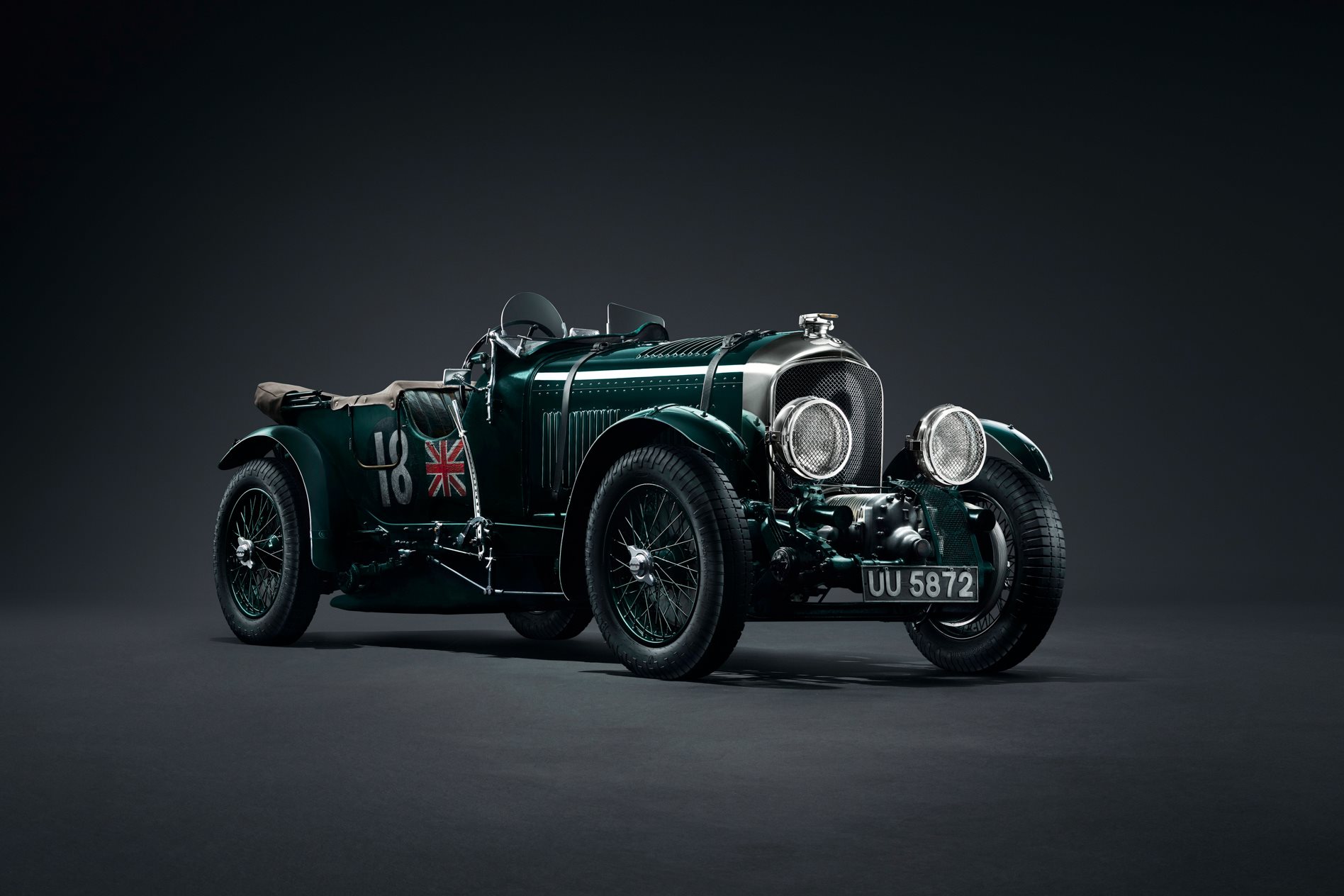
“[The Bacalar] is our first approach with a new modern vehicle, and yeah we see a greater capacity for this for the future, and potentially individual one-offs for customers as well.”
But don’t expect Mulliner to be a vanguard of future technology for Bentley, says Craft.
“When I think about [future] technologies, then I think we can do things with Mulliner at this level that we can learn from and trickle-down [to other models],” he said.
“Of course, what we should never ever do is mimic something that we’ve done as a special series into the mainstream. That wouldn’t be right for the customers of Mulliner.”
Craft says it’s about protecting the exclusivity. “That is what our customers are buying into with something like this,” he confirmed. “That’s what we promise and that’s what we have to uphold.”
Part of the new Mulliner operation will include a new customer-facing facility at Bentley’s Crewe HQ where future owners can liaise with the Mulliner design team to customise, and eventually, collect, their new one-of-a-kind Bentley.
The Mercedes-AMG E53 has been facelifted for 2020, with its new look packaging a series of new interior features inside.
While it looks like quite a significant update, the drivetrain remains unchanged, running on Mercedes-AMG’s relatively new 3.0-litre turbo inline six. Its 320kW and 520Nm are the same, still with an additional 16kW and 250Nm on overboost as supplied by the EQ Boost ‘mild hybrid’ starter-alternator.
The Mercedes-AMG E53 sedan driven
Back to what’s new, and it’s clear Mercedes-AMG is moving forward with new design language features such as the proliferation of its ‘Panamericana’ grille and a more substantial separation between the grille and headlights.
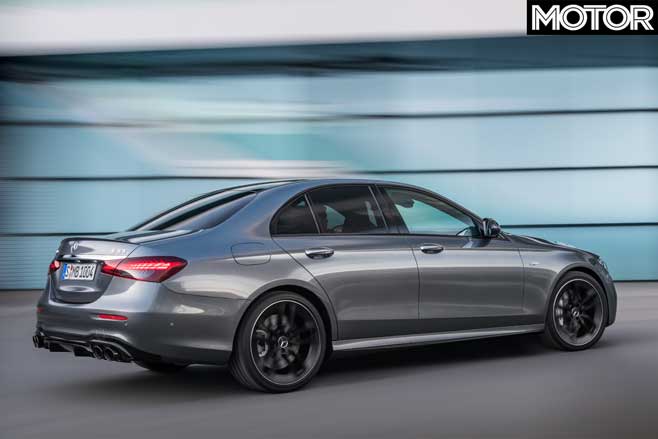
At the rear, the design has been flattened a little, with thinner tail lights for a sleeker, more sporting look.
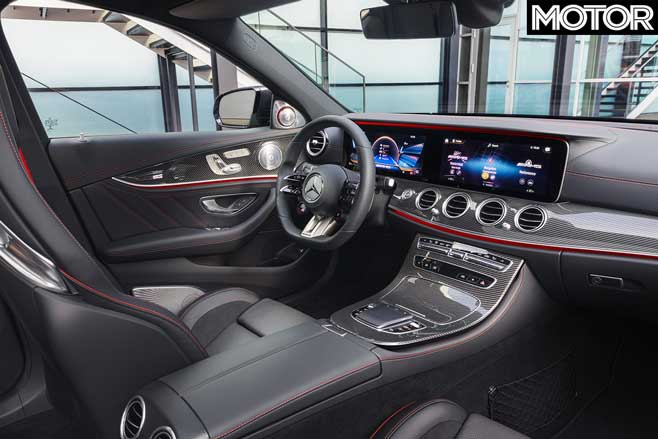
Inside, the changes are less visible, with the primary addition being that of the Mercedes MBUX system. Two screens for the instrument cluster and multimedia displays are housed in the same unit to create a sleek interior design.
The steering wheel is the other major change, with controls now split into two ‘bars’ across the wheel, above two dials as seen in the likes of the facelifted C63. These dials are able to control drivetrain settings, traction and dynamics, and other AMG-specific features.
AMG boss Tobias Moers says the redesign is “added value” to buyers of the E53, while retaining the drivetrain means its performance is already proven.
“Our revised E53 is extensively enhanced, both as a saloon and an estate,” says Moers.
“The visual update offers our customers real added value, which is impressively underscored by our hallmark AMG grille.
“With the electrified 3.0-litre engine we have retained the proven drivetrain. The extensively revised suspension now offers even more of a range between long-distance comfort and precise dynamism.”
Australian details of the facelifted E53’s pricing and availability are yet to be confirmed.
