
EA Games has let slip the full car list for the newest instalment of the Need For Speed franchise, revealing a whopping lineup of 127 playable cars spread across 32 different manufacturers.
Announced at the same time as the release of Need For Speed Heat’s gameplay trailer (below), the car list confirms there will be plenty of choices for players, with a good spread of brands from Europe, the USA and Japan. There’s even one Chinese-made vehicle on the list: the Polestar 1 that also serves as the game’s cover car.
BMW, Nissan and Porsche each have a total of 13 vehicles on the car list, the most of any manufacturers present. That said, there are a lot of repeats that bulk up the count, mainly convertible versions of some models, as well as multiple variations of the same basic car – there are three varieties of Mercedes-AMG GT, for example, not to mention four Lamborghini Huracan variants and four Lamborghini Aventador options.
We also noted the curious exclusion of any Toyota products. Toyota sat out the last NFS title, Need For Speed Payback, and it looks like the company’s video gaming hiatus will continue with Heat. You’ll be able to drive the Toyota 86’s identical brother the Subaru BRZ, but if you were hoping for a steer of the new Toyota Supra then you’re in for some disappointment.
There’s some oddball stuff too, like a Land Rover Defender 110, Chevrolet C10 pickup, Mini Countryman JCW, a 1963 Volkswagen Beetle and Volvo 242DL. The inclusion of classic supercars like the Lamborghini Countach, Ferrari F40 and Ferrari Testarossa are no surprise though, given they’ll mesh perfectly with Heat’s Miami Vice vibe.
For the full list of cars in Need For Speed Heat, scroll down to the bottom.
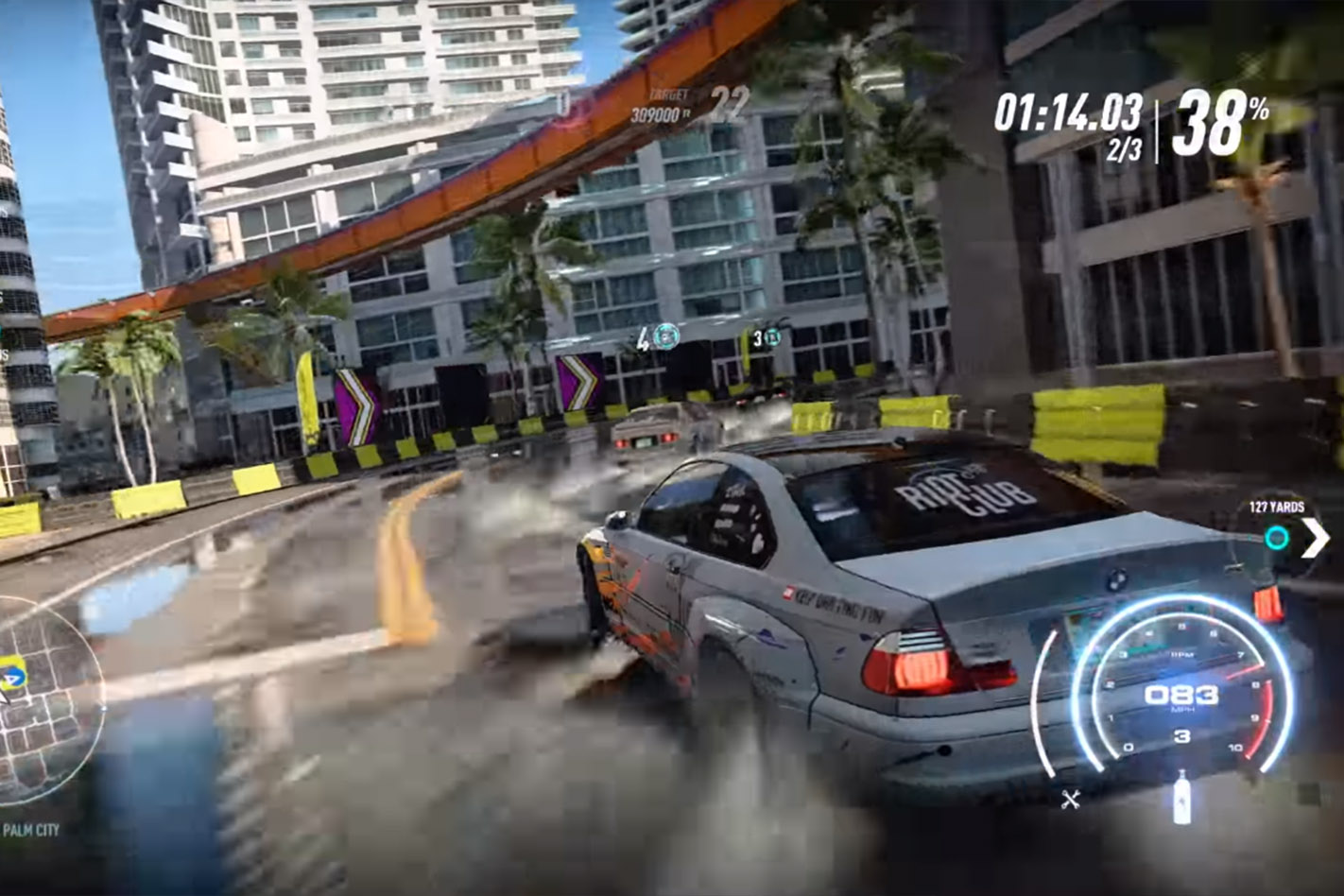
We can see plenty of the cars in action in the gameplay trailer. While there are no shots suggesting we’ll finally see an in-car view, we will say this: the visual rendering is definitely up to NFS’ usual high standard, with plenty of atmospheric light, reflection and particle effects to add some graphical wow factor.
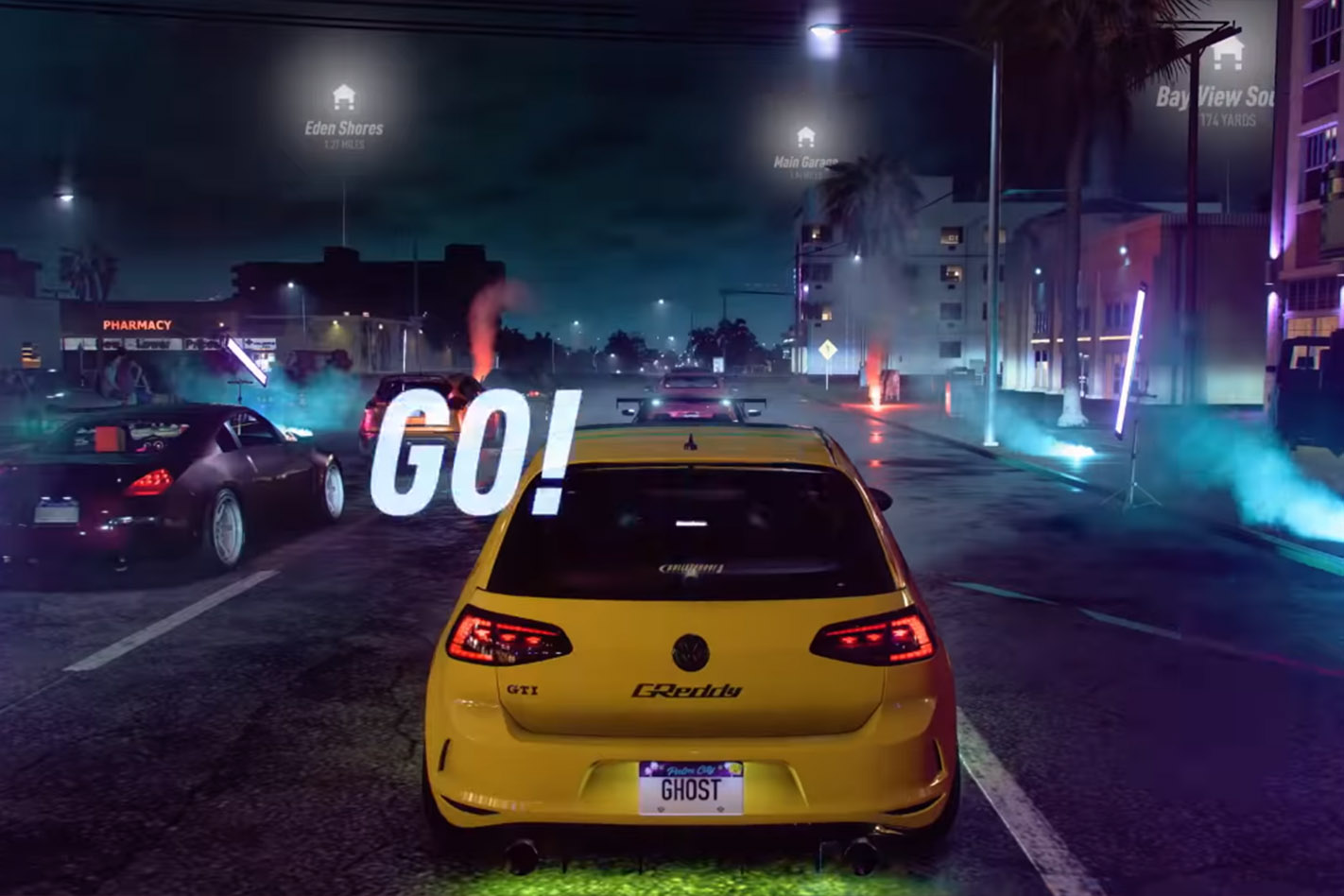
Damage doesn’t appear to be extensively modelled, however, if that footage of a Corvette sliding into four palm trees in quick succession is anything to go by.
The video reiterates what we already know: gameplay will be split into two different styles, with legally-sanctioned competitive racing and challenges happening during daytime, while the night is all about illegal street racing. The police force appears to be active during both the day and night cycle, but their aggressiveness ramps up when the sun goes down.
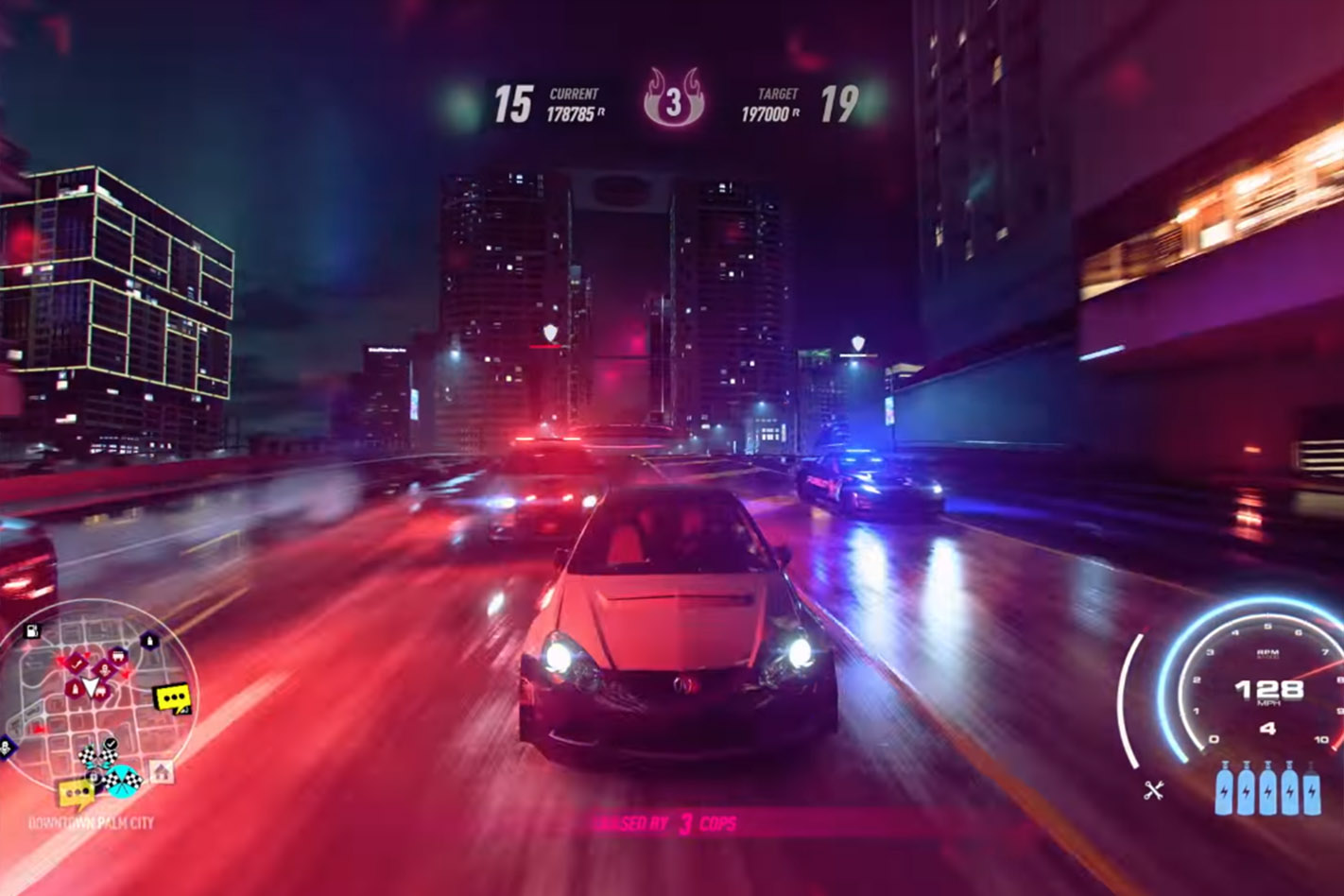
Think you’ll just avoid the cops and mainly do day races? It seems that won’t be possible, with the ‘reputation’ points needed to unlock certain parts and vehicles only able to be obtained through street racing at night.
The money to fund those upgrades can only be earned through the daytime races too, so it appears moving forward in the game will require an even split of day/night activity.
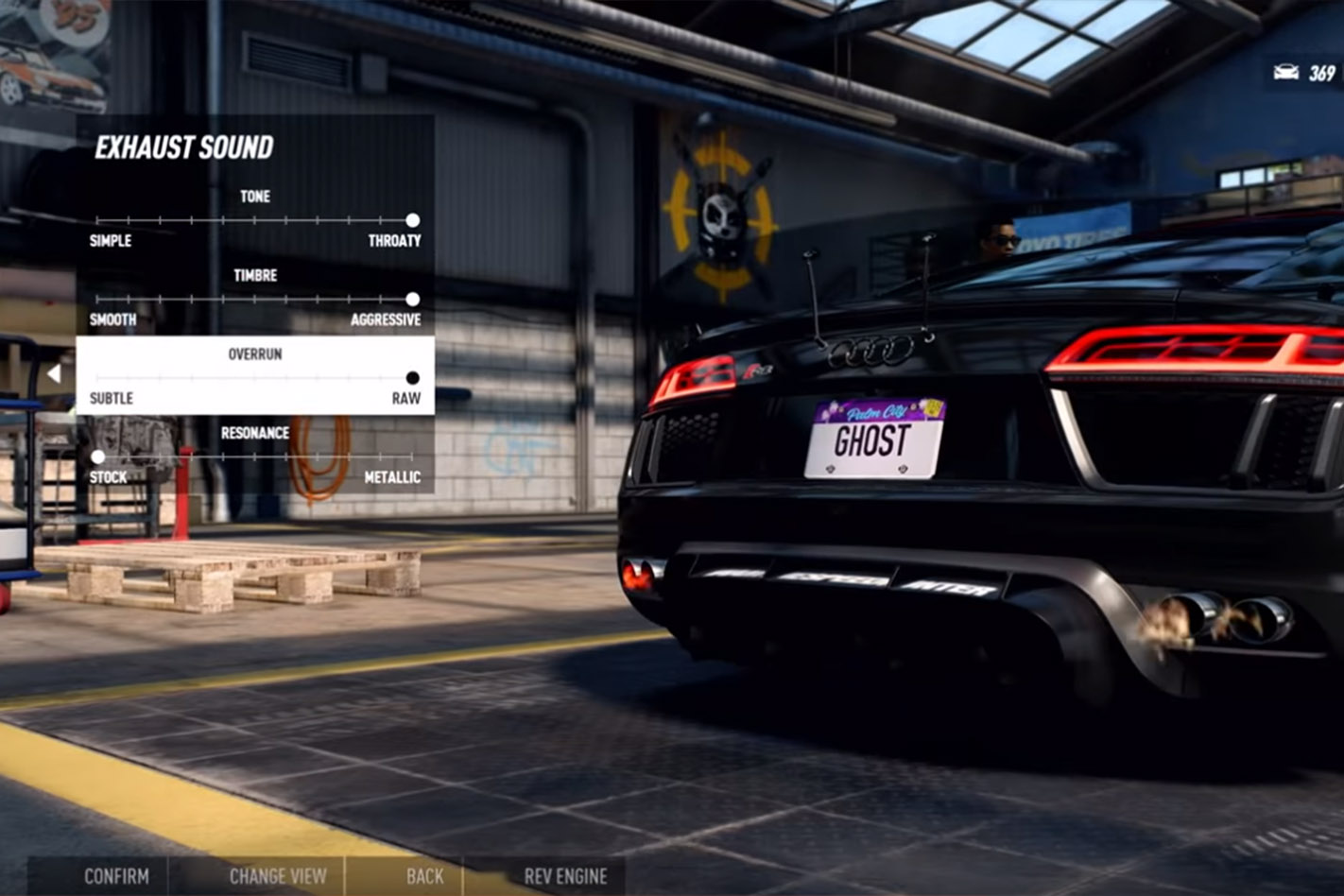
Some other interesting elements of Heat were also revealed in the gameplay trailer, namely the ability for players to customise the actual sound of their exhaust, with sliders for tone, timbre, overrun and resonance able to be fiddled with to your satisfaction. Probably pointless as far as performance is concerned, but hey, sound matters.
If you think introducing exhaust customisation is a bit ridiculous, Heat also introduces branded apparel into the world of car games. Want to deck out your character in a full Adidas outfit? You can! Definitely a feature for all you hypebeasts out there.
Need For Speed Heat officially goes on sale on November 8 across PC, Xbox One and Playstation 4.
THE CARS
Alfa Romeo
- 2016 Alfa Romeo Giulia Quadrofoglio
- 2017 Aston Martin DB11
- 2016 Aston Martin Vulcan
- 1964 Aston Martin DB5
- 2019 Audi R8 V10 Performance Coupe
- 2017 Audi S5 Sportback
- 2020 BMW Z4 M40i
- 2019 BMW M2 Competition
- 2018 BMW i8 Coupe
- 2018 BMW i8 Roadster
- 2018 BMW M5
- 1988 BMW E30 M3 Evolution II
- 2006 BMW E46 M3
- 2006 BMW E46 M3 GTR
- 2010 BMW E92 M3
- 2014 BMW F84 M4
- 2016 BMW F84 M4 GTS
- 2018 BMW F83 M4 Convertible
- 2016 BMW X6 M
- 1987 Buick GNX
- 2013 Chevrolet Corvette Z06
- 2017 Chevrolet Corvette Grand Sport
- 2019 Chevrolet Corvette ZR1 Coupe
- 1967 Chevrolet Camaro SS
- 2014 Chevrolet Camaro Z28
- 1965 Chevrolet C10 Stepside Pickup
- 2017 Chevrolet Colorado ZR2
- 1955 Chevrolet Bel Air
- 2014 Dodge Challenger SRT8
- 1969 Dodge Charger
- 2019 Ferrari 488 Pista
- 2018 Ferrari FXX-K Evo
- 2016 Ferrari LaFerrari
- 2015 Ferrari 488 GTB
- 2014 Ferrari 458 Italia
- 2014 Ferrari 458 Spider
- 1988 Ferrari F40
- 1984 Ferrari Testarossa Coupé
- 2017 Ford GT
- 2016 Ford F-150 Raptor
- 2016 Ford F-150 Raptor (Fem From NFSP)
- 2016 Ford Focus RS
- 2015 Ford Mustang GT
- 1990 Ford Mustang Foxbody
- 1969 Ford Mustang Boss 302
- 1965 Ford Mustang
- 1992 Honda NSX Type-R
- 2017 Acura NSX
- 2004 Acura RSX-S
- 2009 Honda S2000
- 2000 Honda Civic Type-R
- 2015 Honda Civic Type-R
- 2017 Infiniti Q60S
- 2017 Jaguar F-Type R Coupe
- 2019 Jaguar F-Type R Convertible
- 2016 Koenigsegg Regera
- 1989 Lamborghini Countach 25th Anniversary
- 1995 Lamborghini Diablo SV
- 2010 Lamborghini Murciélago SV
- 2018 Lamborghini Aventador S
- 2018 Lamborghini Aventador S Roadster
- 2018 Lamborghini Huracan
- 2018 Lamborghini Huracan Spyder
- 2018 Lamborghini Huracan Performante
- 2018 Lamborghini Huracan Performante Spyder
- 2019 Lamborghini Aventador SVJ Coupe
- 2019 Lamborghini Aventador SVJ Roadster
- 2016 Land Rover Defender 110 Double Cab Pickup
- 2015 Land Rover Range Rover Sport SVR
- 2006 Lotus Exige S
- 1996 Mazda MX5
- 2015 Mazda MX5
- 2002 Mazda RX-7 Spirit R
- 2018 McLaren 570S Spider
- 2018 McLaren 600LT
- 2015 McLaren 570S
- 2015 McLaren P1
- 2015 McLaren P1 GTR
- 2015 Mercedes-AMG GT
- 2017 Mercedes-AMG GT R
- 2019 Mercedes-AMG GT S Roadster
- 2018 Mercedes-AMG C63 Coupe
- 2017 Mercedes-AMG G63
- 2014 Mercedes-AMG A 45
- 1967 Mercury Cougar
- 2017 MINI Countryman John Cooper Works
- 2008 Mitsubishi Lancer Evolution X
- 2007 Mitsubishi Lancer Evolution IX 2007
- 2018 Nissan 370Z 50th Anniversary Edition
- 2018 Nissan 370Z Nismo
- 2017 Nissan GT-R
- 2017 Nissan GT-R Nismo
- 2008 Nissan 350Z
- 2003 Nissan 350Z (Rachel’s from NFSU2)
- 2002 Nissan Silvia Spec-R Aero
- 2002 Nissan Skyline GT-R (Eddie’s from NFSU)
- 1999 Nissan Skyline GT-R V·Spec
- 1996 Nissan 180SX Type X
- 1993 Nissan Skyline GT-R V·Spec
- 1971 Nissan Fairlady 240ZG
- 1971 Nissan Skyline 2000 GT-R
- 2017 Pagani Huayra BC
- 1970 Plymouth Barracuda
- 2020 Polestar Polestar 1
- 1977 Pontiac Firebird
- 1973 Porsche 911 Carrera RSR 2.8
- 1996 Porsche 911 Carrera S
- 2018 Porsche 911 GT2 RS
- 2018 Porsche 911 Carrera GTS
- 2018 Porsche 911 Carrera GTS Cabriolet
- 2018 Porsche 911 Targa 4 GTS
- 2018 Porsche 911 Turbo S Exclusive Series
- 2018 Porsche 911 Turbo S Exclusive Series Cabriolet
- 2019 Porsche 911 GT3 RS
- 2018 Porsche 718 Cayman GTS
- 2017 Porsche Panamera Turbo
- 2015 Porsche 918 Spyder
- 2015 Porsche Cayman GT
- 2014 SRT Viper GTS
- 2006 Subaru Impreza WRX STI
- 2010 Subaru Impreza WRX STI
- 2014 Subaru BRZ Premium
- 1963 Volkswagen Beetle
- 1976 Volkswagen Golf GTI
- 2016 Volkswagen Golf GTI Clubsport
- 1975 Volvo 242DL
- 1970 Volvo Amazon P130
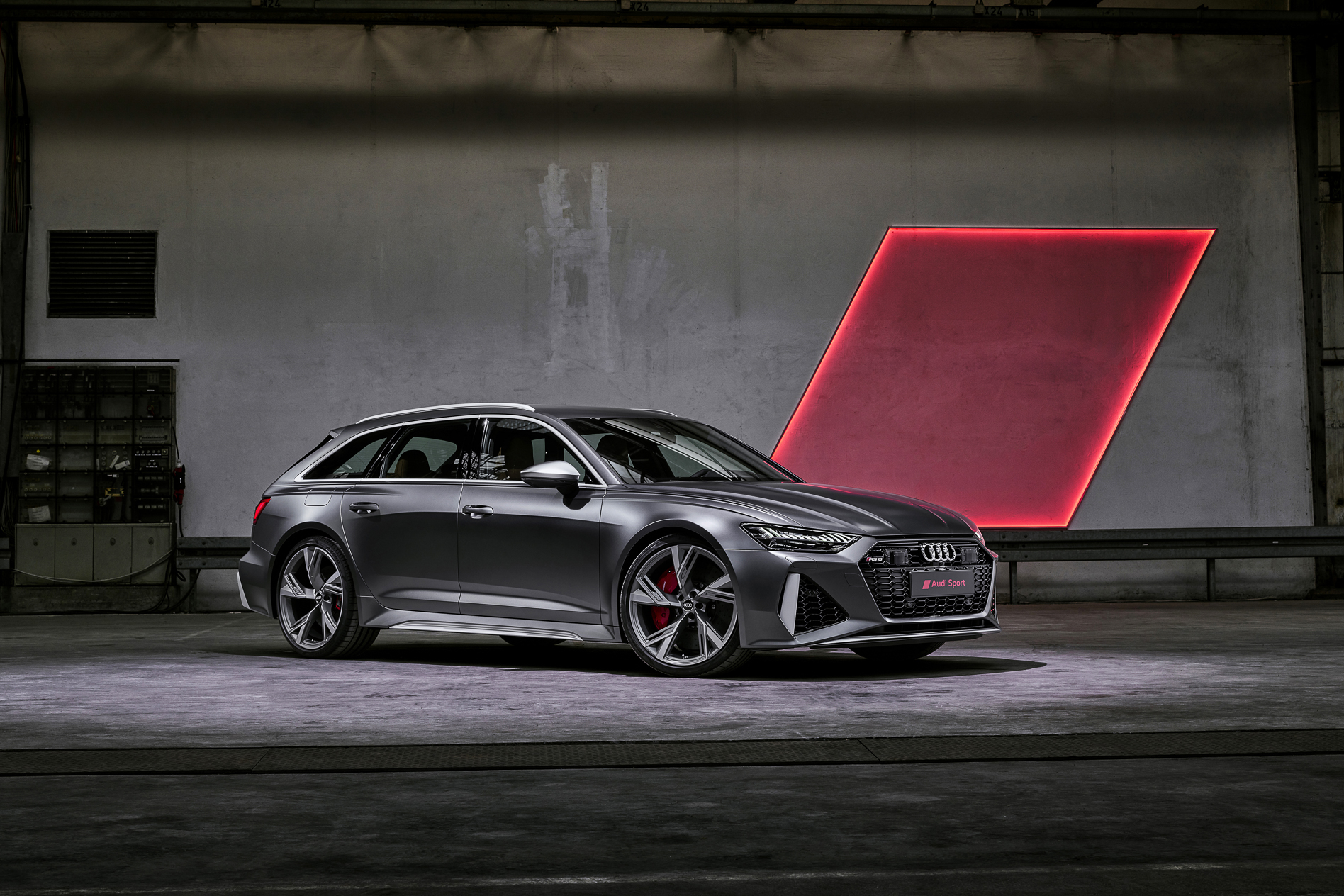
When it comes to outrageously fast and deeply desirable go-fast wagons, Audi has always held the moral high ground, and the revamped RS6 Avant shows that, despite all the signs that fast wagons are an anachronism, Audi is sticking to its tailgated guns.
Audi Sport is in the midst of a product offensive that will yield a brace of new and updated RS product in the next 12 months, and the RS6 Avant is just one part of that.
The fourth-generation Audi RS6 Avant will land in Australia halfway through 2020, with prices and specs to be locked down before then. For reference, the previous RS6 Avant cost around $230,000 before on-road costs.
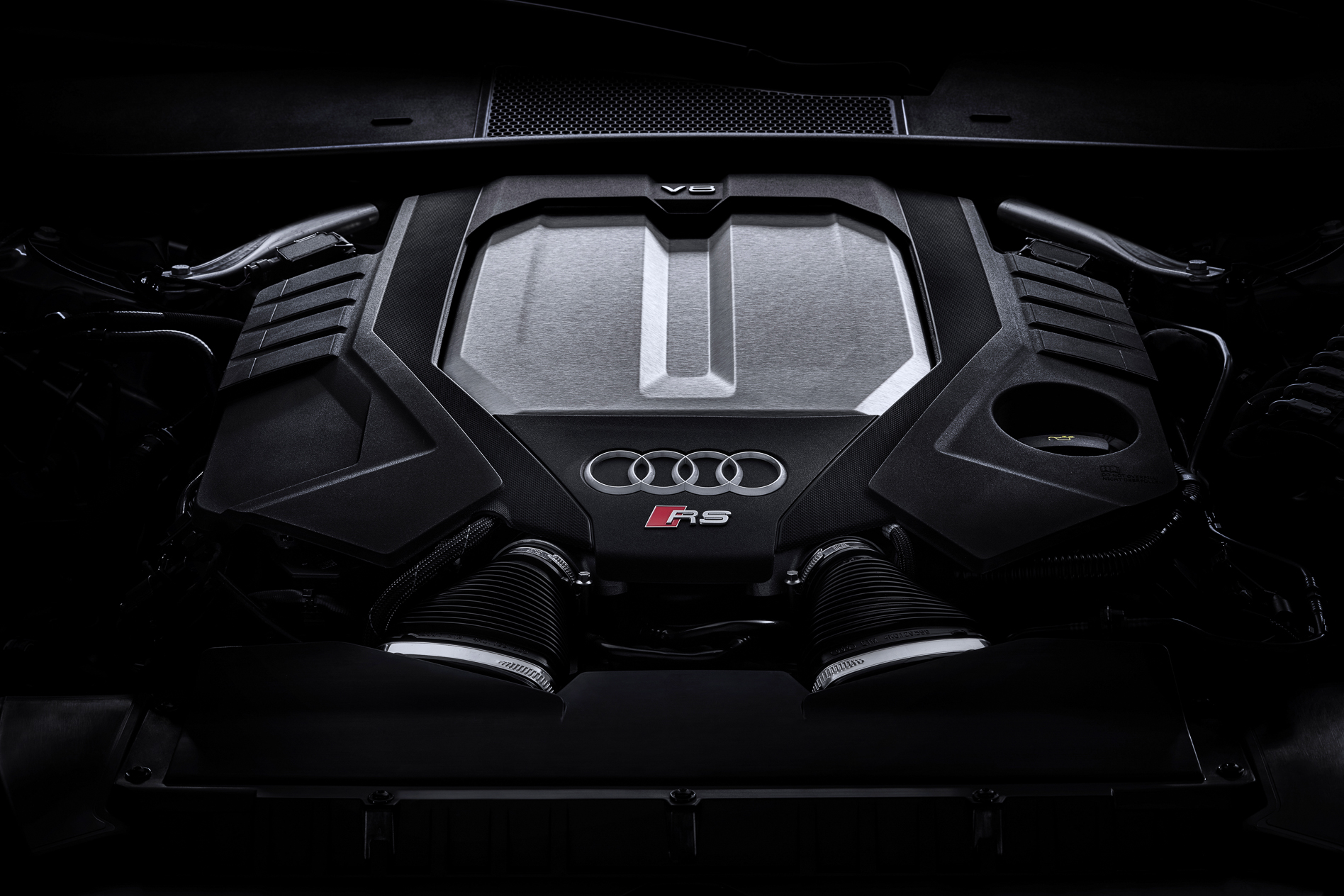
It’s no sticker-and-glitter job, either. The 2020 Audi RS6 Avant shares its MLB platform with the regular A6 line, and its 4.0-litre twin-turbocharged petrol V8 is a carryover from the previous model.
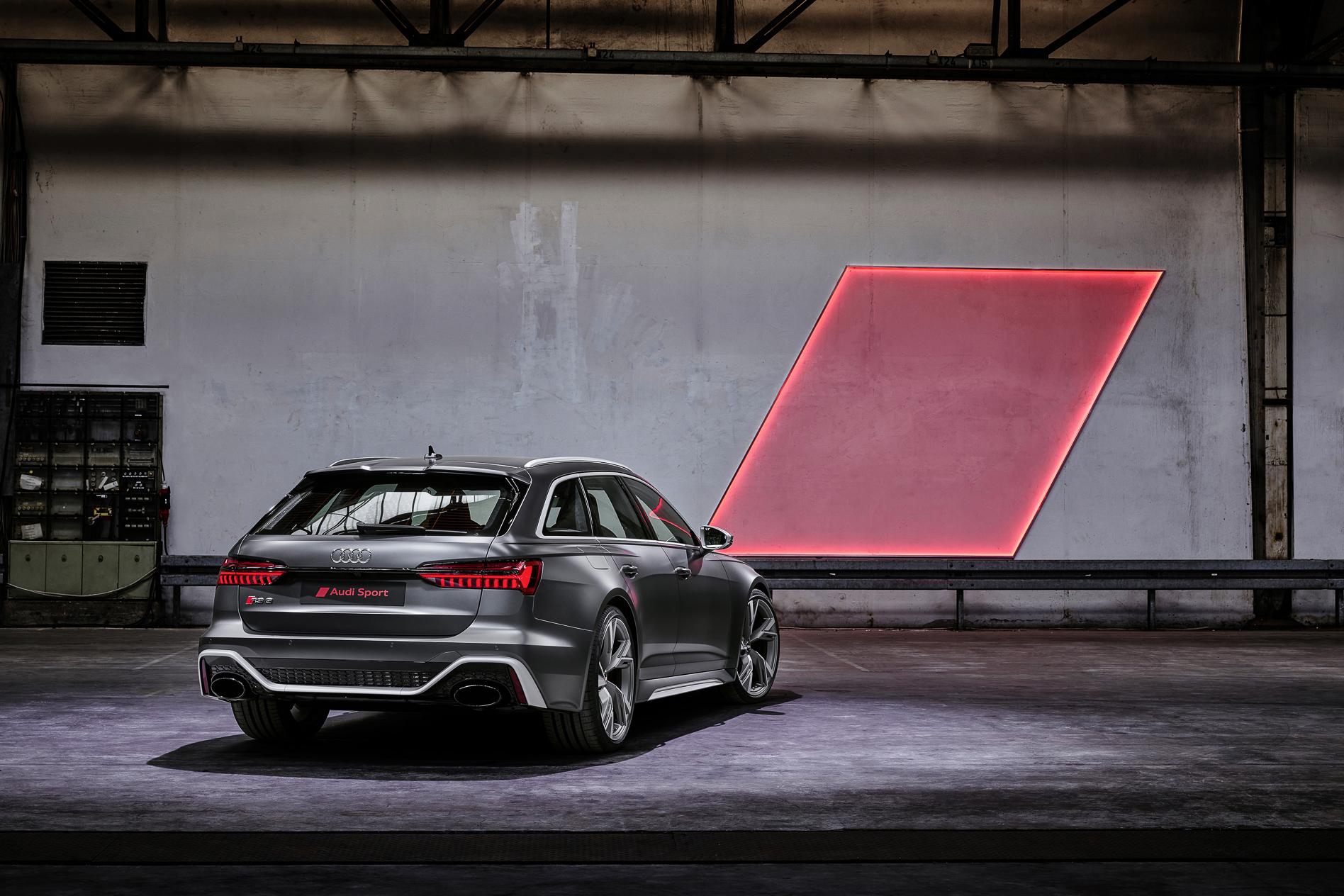
Its low-slung, wide-haunched, unashamedly aggressive design, however, will frighten small children on a dark night. The menacingly narrow LED headlights are lifted from the new A7, while almost every single body panel – aside from the roof turret, front doors and tailgate – is massaged to be wider and meaner.
The bulging bonnet, for example, is an RS6-specific item.
The RS6 sits 80mm wider across the axles, too, and rides on 22-inch tall, 10.5-inch wide wheels and 255mm tyres. Those huge rims can hide optional 440mm carbon front brake rotors that are clamped by 10-piston (yes, 10) brake calipers.
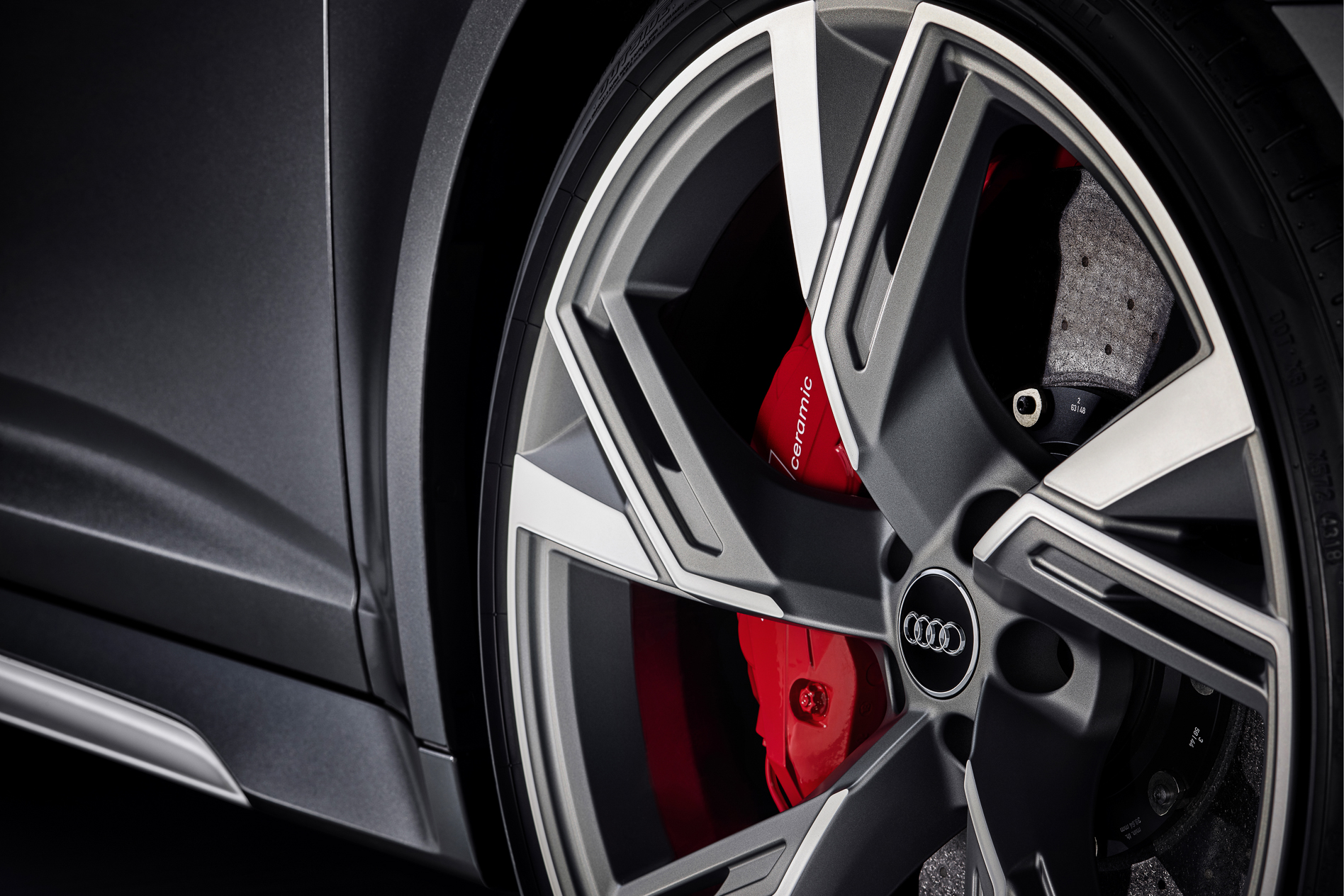
It needs those brakes, too, thanks to a revised version of its 4.0-litre V8 engine, with two turbochargers nestled between its cylinder banks. Those turbos have been revised with bigger impellers – all the better to draw in more air, my dear – and wound up by 0.2BAR to push the RS6’s outputs to 446kW and 800Nm.
It’s only a couple of kilowatts north of the outgoing model but provides a full 50Nm more torque, which has the net effect of propelling the big wagon to 100km/h in 3.6 seconds, and to 200km/h in 12 seconds.
Option up the Dynamics package and top speed can be bumped from 250km/h to 305km/h.
Our hosts even reckon that the RS6 could tow a boat at this pace, “but we haven’t tested it to that speed, to be honest!” laughed Audi Sport suspension engineer Andrei Filep.
A traditional eight-speed automatic transmission sends that prodigious power to all four wheels, with a maximum of 85 per cent thrust available for rear-wheel action if required.
Audi has also added a 48-volt mild (and we mean mild) hybrid system to the RS6, comprising of a 0.5kW battery and belt-driven starter generator. The system allows the big RS6 to ‘coast’ in-gear for up to 40 seconds if conditions are right, and the small battery acts to fire the engine back up.
More cleverly, the V8’s cylinder-deactivation closes down four pots to reduce fuel consumption.
The RS6 uses a newly revised, 50 per cent stiffer air-sprung suspension system at all four corners, and rides 20mm lower than a standard A6 Avant wagon. Whack it in Dynamic mode and it’ll drop a further 10mm. The shocks, too, are connected diagonally across the car to help it sit flatter at higher speeds.
Steel-sprung suspension is available as part of an RS upgrade kit that also provides three-stage adaptive shocks that are also linked diagonally.
As well, a new rear-steering system will tweak the rear wheels up to five degrees at lower speeds in a counter-steer action to help with parking and low-speed maneuvering, and two degrees in the same direction as the fronts at speed to help stability.
Inside, the RS6 is stunning. High-spec cars will come with super high-quality Valcona leather and figure-hugging RS sports seats, while the digital dashboard features a bespoke RS mode.
The flat bottomed steering wheel is new, and so are-hallelujah! – the new, beautifully sculpted alloy shifter paddles that replace the underwhelming items on the previous car.
We cannot wait to fang this booted beast when it arrives here mid-way through 2020.
What stands out?
One of Australia’s biggest selling vehicles, the Ford Ranger is a rugged ute with light steering and good safety credentials – which include a reversing camera on all Ranger pick-ups. The more expensive Rangers have nicely trimmed double cabs that can comfortably take a family touring, and are available with automatic emergency braking. All 4WD Rangers have lockable rear differentials and go very well off road.The Ranger XLT came second in the 2019 Dual Cab Ute Test, held by 4×4 and Wheels magazines, behind the Volkswagen Amarok V6 but ahead of Toyota HiLux SR+, Holden Colorado LTZ and Mercedes-Benz X250d.
What might bug me?
Manoeuvring in city carparks – this is a big vehicle.The bouncy ride when unladen. But all truck-based utes are like that – they are sprung stiffly at the rear so that they can handle big loads.
What body styles are there?
Single cab chassis and pickup; super cab chassis and pickup; double cab chassis and pickup.All are available in rear-wheel drive, and in four-wheel drive with dual-range gearing. The 4WD system is part-time, which means you must select rear-wheel drive for sealed roads but may switch to 4WD on loose surfaces. Dual-range gearing gives you a second set of gears, with low ratios that allow to drive comfortably at very slow speeds when tackling difficult terrain off road.The Ranger is classed as a commercial light pick-up.The Ford Everest is a seven-seat SUV version of the Ranger.
What features do all Rangers have?
Ford’s SYNC3 infotainment with Apple CarPlay/Android Auto viewed on an 8.0-inch touchscreen. Bluetooth audio connectivity with voice control. An AM/FM radio with single CD player, USB input and iPod integration.Cruise control, operated from buttons on the steering wheel.Air-conditioning, power windows, power-adjusted external mirrors, and headlamps that switch on automatically when it’s getting dark.On all Ranger pick-ups, a reversing camera, rear parking sensors, and an ‘easy-lift’ tailgate.Adjustable lumbar support on the driver’s seat, which can help keep your lower back comfortable.Hill launch assist, which operates the brakes automatically to help you start from rest on a slope.Electronic stability control, which can help control a slide and avoid a crash.Trailer sway control, which helps when towing to prevent the load oscillating from side to side.All 4WD and High-Rider Rangers come with a locking rear differential, which helps them go further in difficult off-road conditions (by maintaining drive to the wheel with most grip).A 230-volt inverter, which allows you to run household electrical equipment, is available in all models but the XL Single Cab.Every Ranger comes with a five-year, unlimited-kilometre warranty.
Which engine uses least fuel, and why wouldn’t I choose it?
The 2.2-litre four-cylinder turbo-diesel available in less costly Rangers uses least fuel, consuming as little as 6.6 litres/100km on the official test (city and country combined) when driving a basic 2WD cab-chassis version through a manual gearbox.This engine makes modest power but is quite flexible. However, it can take a while for the turbo to kick in, resulting in some initial sluggishness. And when you work it hard it gets noisy.In the bigger dual-cab Ranger versions, the new and very powerful 2.0-litre Bi Turbo engine is more economical, with an official combined fuel economy of 7.4 litres/100km, while the 2.2-litre engine manages 7.8 litres/100km with the automatic gearbox.The main reason you would not choose the 2.2-litre engine is that you want the easier towing, quieter and more relaxed highway cruising, and swifter overtaking, available from the other engines, the 3.2-litre five-cylinder turbo-diesel, which consumes a still respectable 8.7 litres/100km and is available across the range, or the 2.0-litre four-cylinder bi-turbo diesel that is optional in the well-equipped Ranger XLT and Wildtrak.A second reason is you want a more upmarket 4×4 Ranger, which only come with the 3.2-litre or 2.0-litre engines. The 2.2-litre is only available with rear-wheel-drive models, and lesser equipped XL 4×4 Double Cabs.A reason why you wouldn’t choose a dual cab Ranger with the 2.0 Bi Turbo is you want to pay less for your Ranger. It’s only available in the upper-spec XLT and Wildtrak versions as a $1200 option.Rangers with the 2.2- and 3.2-litre engines offer the option of six-speed automatic or manual gearboxes. The manual gearbox shifts quite well, with Ford having improved its formerly vague action with the bigger diesel. However, the auto remains more user friendly.The 2.0-litre Bi Turbo engine, which is shared with the Ford Ranger Raptor, is only available with a 10-speed automatic transmission. It is the most powerful engine of the three, producing 157kW, and 500Nm of torque.
What key features do I get if I spend more?
Entry to the Ranger line-up is with the XL single cab. It’s basic motoring, with only vinyl floor coverings. Wheels are 16-inches in diameter, and made of steel.From there it’s a leap to the XL Hi-Rider, which is a cleverly marketed two-wheel drive model that gets a taller four-wheel drive stance, but without the expense and weight of 4×4 hardware. Hi-Rider variants are also legally cleared to tow more: up from 2500kg to 3500kg. And they come with lockable rear differentials, which give them extra drive on slippery off-road surfaces.The XL Hi-Rider is also the least costly Ranger to offer an automatic gearbox option.XL Rangers can be fitted with an optional factory-fitted Heavy Duty Suspension (HDS) system that loads improves the bump-stop clearance when carrying heavy loads, which improves departure angles on steep inclines.A Ranger XL Plus gets you the bigger diesel as standard and comes only as a 4×4 automatic. Uniquely among Rangers it has a second battery, so that you can run lighting and other equipment without fear of flattening your main battery, and an extended wiring harness and switch panel. It has wheels an inch bigger at 17 inches, shod with all-terrain tyres, and a towbar. The XL Plus will be deleted from the Ranger line-up when the updated model arrives in September 2018.If you want carpet on the floor and fancier looking 16-inch aluminium alloy wheels, your least costly option is a Ranger XLS. It is available only in 4×4, and with the bigger 3.2-litre diesel.The XLS gets front fog-lamps, and front parking sensors as well as the standard rear sensors. Dual-zone air-conditioning allows the driver and front passenger independent control of air temperature, and there is a cooler in the centre console.The volume selling Ranger XLT gains smart keyless entry with push-button start, LED daytime running lights (DRLs), brighter Bi-LED headlights, windscreen wipers that operate automatically when it rains, a sports/rollover bar, and sensors that alert you if a tyre has lost pressure. A 12V power outlet in the tray is ideal for a small fridge or camping light. And you get a towbar.The volume selling Ranger XLT gets the SYNC3 infotainment and other XLS options as standard. It also has smart keyless entry with push-button start, LED daytime running lights (DRLs), windscreen wipers that operate automatically when it rains, a sports/rollover bar, and sensors that alert you if a tyre has lost pressure. A 12V power outlet in the tray is ideal for a small fridge or camping light. And you get a towbar.From September 2018, optional extras for the XLT include the 2.0-litre bi-turbo engine with 10-speed automatic transmission for about $1200, and a Tech Pack ($1700) which, from September 2018 will add active safety features including autonomous emergency braking, semi-automatic park assist, traffic sign recognition, adaptive cruise control, lane keep assist and auto-high beam.Other XLT options include part-leather seats for Double Cab versions, and the bigger 18-inch alloy wheels.Sitting at the top of the range, the adventurously named Wildtrak gains the Tech Pack’s active safety features as standard, LED front fog-lamps and a power-lock tailgate.You also get a remote-controlled roller shutter for the load area, a mirror-mounted USB socket to plug in a dash-cam, heated front seats with leather accents, and a power-adjustable driver’s seat. It also has bigger and fancier 18-inch wheels, puddle lamps, and other styling tweaks that make it stand out visually.The 2.0-litre bi-turbo/10-speed auto powertrain will also optional with the Wildtrak from September 2018.From time to time Ford offers limited-run variations on the above themes. For example, the Ranger FX4 Special Edition, which was a Ranger XLT with leather on the seats, 18-inch wheels, roof rails, and cosmetic adjustments.
Does any upgrade have a down side?
The better trimmed interiors will be harder to look after in working or off-road environments.The 18-inch tyres on the Wildtrak will be less useful off-road than the tyres on other Rangers, and more prone to punctures on trails.There is only one no-cost colour option, Frozen White – the rest will add about $600 to the cost of your Ranger.
How comfortable is the Ranger?
Inside, XL Rangers feel basic and in some parts cheap, but the main controls fall easily to hand, the seats are comfortable, and head and leg room is generous for front passengers. For the steering column there is only height adjustment, and no reach adjustment.Buttons on the steering wheel make accessing major functions easier on the run. The colour central screen is small, but with Ford’s SYNC1 connectivity it is much more useful than those on previous Rangers.The XLS and XLT are much more welcoming, with carpeted floor, and multi-faceted SYNC3 connectivity system with 8.0-inch touchscreen (optional in XLS). The Wildtrak ramps it up another notch with leather accented trim and a quieter cabin (there is more insulation keeping engine and road noise out). And the standard 3.2-litre diesel in these versions is quieter than the smaller diesel (thanks to a range of improvements introduced for the 2016 model year).Underneath, the Ranger has a truck-like ladder frame chassis and stiff leaf-springs at the rear, to handle the one-tonne-plus load it’s designed to carry. It’s a good, rugged combination, that has been designed to suit Australian conditions, but when unladen the Ranger will shudder and buck on rough roads. With a load on board it settles but the steering still lacks the precision of a passenger car’s steering.Steering on the Ranger feels very light at parking speeds but firms up nicely on the open road.
What about safety in a Ford Ranger?
Standard stability control adds security and can help recover the ute from a skid. Ford fits six airbags to all but the most basic version, and the Ranger is a leader in safety among utes. All Rangers have auto-on headlamps, which make it more likely you’ll be seen in low light. And all Ranger pick-ups have a reversing camera and rear parking sensors.Almost every Ranger has six airbags, including two immediately in front of the driver and front passenger. Front-side airbags – which protect the bodies of the front occupants in side impacts – and side curtain airbags – which protect the heads of front and rear-seat occupants in side impacts – are also standard on all but one version. The exception is the basic XL single cab-chassis work truck, on which the extra four airbags are optional.Standard on the Wildtrak (and optional on the XLT) is an active safety suite that adds significantly to your security on the road – mainly by acting as a backstop for driver attention.They begin with low and high-speed autonomous emergency braking with vehicle and pedestrian detection (from September 2018). Adaptive cruise control, which will slow you to the speed of a car in front when you have cruise engaged. A radar-based Forward collision alert sounds a warning if it concludes you are at risk of crashing into something in front. A Lane keeping aid and warning monitors your lane position on the highway, attempting gently to steer you straight if you drift wide, and vibrating the steering wheel if you continue to drift wide. An impairment alert monitors your driving and sounds a warning if it thinks you are falling asleep. And Automatic high beam control assumes the task of switching to low-beam if you are at risk of dazzling an oncoming car.The Australasian New Car Assessment Program (ANCAP) has awarded the Ranger its maximum safety score of five stars.
I like driving – will I enjoy the Ranger?
Among vehicles of its type, the Ranger is towards the top of the tree when it comes to the way it steers and corners. These are light trucks, however, and there is nothing sporty about them.When fitted with the more powerful five-cylinder turbo-diesel, or optional 2.0-litre Bi Turbo diesel, the Ranger makes light work of hills and loads.The Bi Turbo in particular feels sprightly and provides instant response even from a standing start.Off-road, the 4WD Ranger is a solid performer with good traction. There is dual-range gearing and a part-time four-wheel-drive system (which means you can use 4WD only off-road). The standard diff-lock on all 4WD models is a very helpful feature in very rough or slippery going, and an 800mm wading depth is about as good as you will get in a ute.
How is life in the rear seats?
The Super Cab gets a pair of upright rear seats with minimal leg room. Best, though, to treat it as an area for pets – or for great in-cabin storage behind the front seats.More impressive are the rear-hinged doors, which open at 90 degrees and combine with the fronts to create a cavernous aperture.In the Double Cab, the bench rear seat will fit three at a pinch and brings decent head and leg room. But you won’t be as comfortable as you could be in most 4×4 wagons or passenger station wagons. And there are no rear air-conditioning vents.
How is it for carrying stuff, and for towing?
Excellent, of course – that’s the point of a ute. And the Ranger is also very good at towing.How much you can carry depends on which Ranger you get. Fewer seats in the cab means more length in the tray – and the longer trays accept more weight (because there’s less weight in the cab).Legally, a Ranger can carry about as much as any other ute and more than most. Even the Ranger with the least capacity – the Wildtrak – can carry 800kg in the tray (40 bags of cement) and a driver and passenger, and still be legal.In practice, the Ranger feels stable with an 800kg load on board, the robust chassis handling the weight quite easily. And there is no shortage of urge from the five–cylinder diesel.Most Rangers have a legal towing capacity of 3500kg – even those with the smaller, four-cylinder, diesel. That is as much as any similar ute.In practice a Ranger with the more powerful diesels will tow a 3500kg braked trailer quite easily. That’s like hauling a robust 20-foot tandem-axle off-road caravan, or a three-horse float with the horses on board.Rangers with the smaller 2.2-litre diesel won’t tow anywhere near as strongly, even though their chassis are just as robust. The smaller diesel is better matched to loads around 2500kg. (For some two-wheel drive diesels, that is also the legal limit.)In any ute, extreme care should be taken when carrying or towing big loads.
Where does Ford make the Ranger?
The Ranger is built in Thailand, sharing engines, suspension and platform with the Mazda BT-50 ute made in the same factory.
What might I miss that similar cars have?
Possibly some extra performance, for more urgent overtaking and easier towing. While the Ranger is one of the quicker utes, it is no match for the six-cylinder power of an Volkswagen Amarok V6 or Mercedes-Benz X-Class 350d. The Ranger’s optional 2.0-litre bi-turbo engine should go some way to addressing this.Sub $30,000 pricing as available with budget utes including the Foton Tunland, Great Wall Steed and Mahindra Pik-Up.Some utes offer full-time 4WD, which means you can drive all four wheels on normal roads. This can aid stability in wet conditions, and it’s one less thing to think about. Examples include automatic Amaroks and more expensive versions of the Mitsubishi Triton.The Nissan Navara has a more complex, coil-sprung rear suspension system that helps it steer better on corrugated roads (but it’s no more comfortable).The Mazda BT50 is a near-twin under the skin, sharing major mechanical and many other features with the Ranger. However, several changes to the Ranger from September 2015 that enhanced performance, refinement and off-road ability were not passed on to the BT-50.You might also consider a Toyota HiLux, Holden Colorado, or an Isuzu D-Max.
I like this car, but I can’t choose which version. Can you help?
Our reviewers see value in the XLT Double Cab. Features include better looking alloy wheels, a tow kit, dual-zone air-con, and the excellent SYNC3 connectivity suite with sat-nav and smartphone mirroring. You also get the option of adding the driver aids that come in the Technology Pack, and the zippier 2.0-litre bi-turbo powertrain.
Are there plans to update the Ranger soon?
The current Ranger went on sale in 2011. A refresh in September 2015 included electric variable-assistance steering, a more responsive turbocharger, revised chassis electronics, measures to make the 3.2 engine quieter, a new bonnet, bigger touchscreens and better connectivity systems.About July 2016 Ford extended a reversing camera and rear parking sensors to all Ranger pick-ups, upgraded XLT and Wildtrak connectivity to SYNC3, and made its previously optional active safety suite standard on the Wildtrak (it remained optional on the XLT).In May 2018 Ford announced an mid-life update for the Ranger, giving the XLT and Wildtrak versions a slight facelift in the form of a redesigned grille. The XL Plus variant will be dropped, and the Tech Pack active safety system was upgraded to include autonomous emergency braking and traffic sign recognition.The features to be included in the upgrade are included in the body of this review in case you’re considering buying a Ranger in the next few months. The cars covered at the top of the page, below the main image, reflect the current range.A new engine was also added to the range, a 157kW/500Nm 2.0-litre four-cylinder bi-turbo diesel with 10-speed automatic available as an option with the XLT and Wildtrak.In August 2019 Ford revealed minor changes for the 2020 model year, including the addition of an 8.0-inch touchscreen and Sync3 infotainment in the more affordable XL and XLS versions, and brighter Bi-LED headlights for the XLT and Wildtrak.Ten-year model cycles are common for commercial vehicles, so while there may be more upgrades, an all-new Ranger is not expected before late 2020.
Both the Porsche Cayman S and the original Audi R8 V8 fall under the mid-engine, two-door sports coupe theme, but go about their business in very different ways. Lauded for its dynamics and taunted for its acoustics, the Porsche offers precision, while the Audi brings passion with a bent-eight beating heart. If your dream garage has a circa $140K unused space, which would you choose?
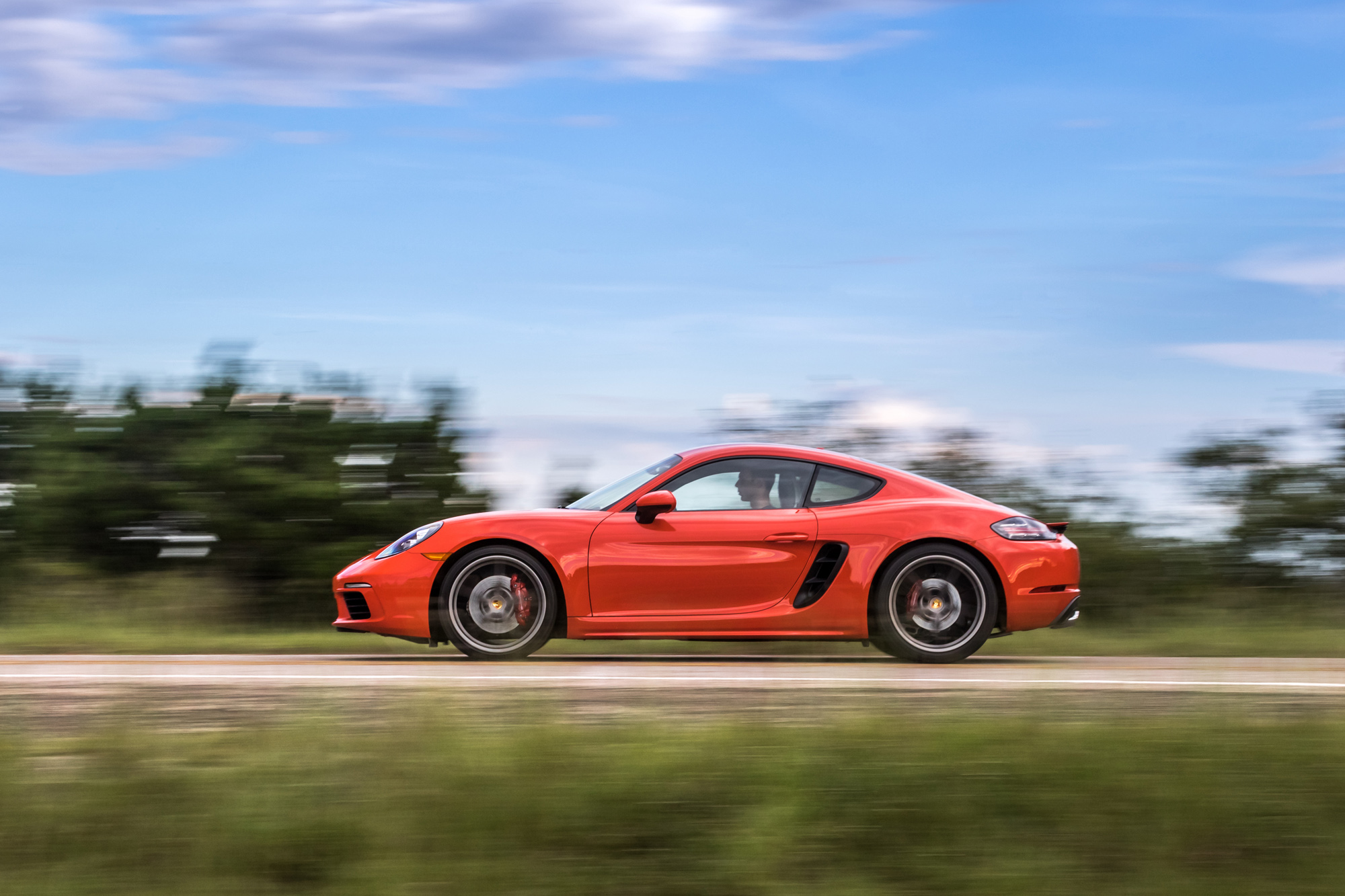
PORSCHE CAYMAN S
Finding flaws in the Cayman S is very, very difficult. So the easy option is to criticise it for having a lacklustre engine. And while it’s never going to win any awards for the polarising soundtrack, the 2.5-litre flat four deserves credit.
After all, with 257kW and 420Nm (only 10Nm down on the R8), it’s enough to propel the little Porsche to 100km/h in 4.6sec when optioned with a manual. That’s more powerful than the beloved flat six fans bemoan the loss of – the only downside being a slight amount of low-down turbo lag. However, the newfound well of torque means the manual’s long gearing isn’t as much of an issue and there’s an intuitive rev-match system.
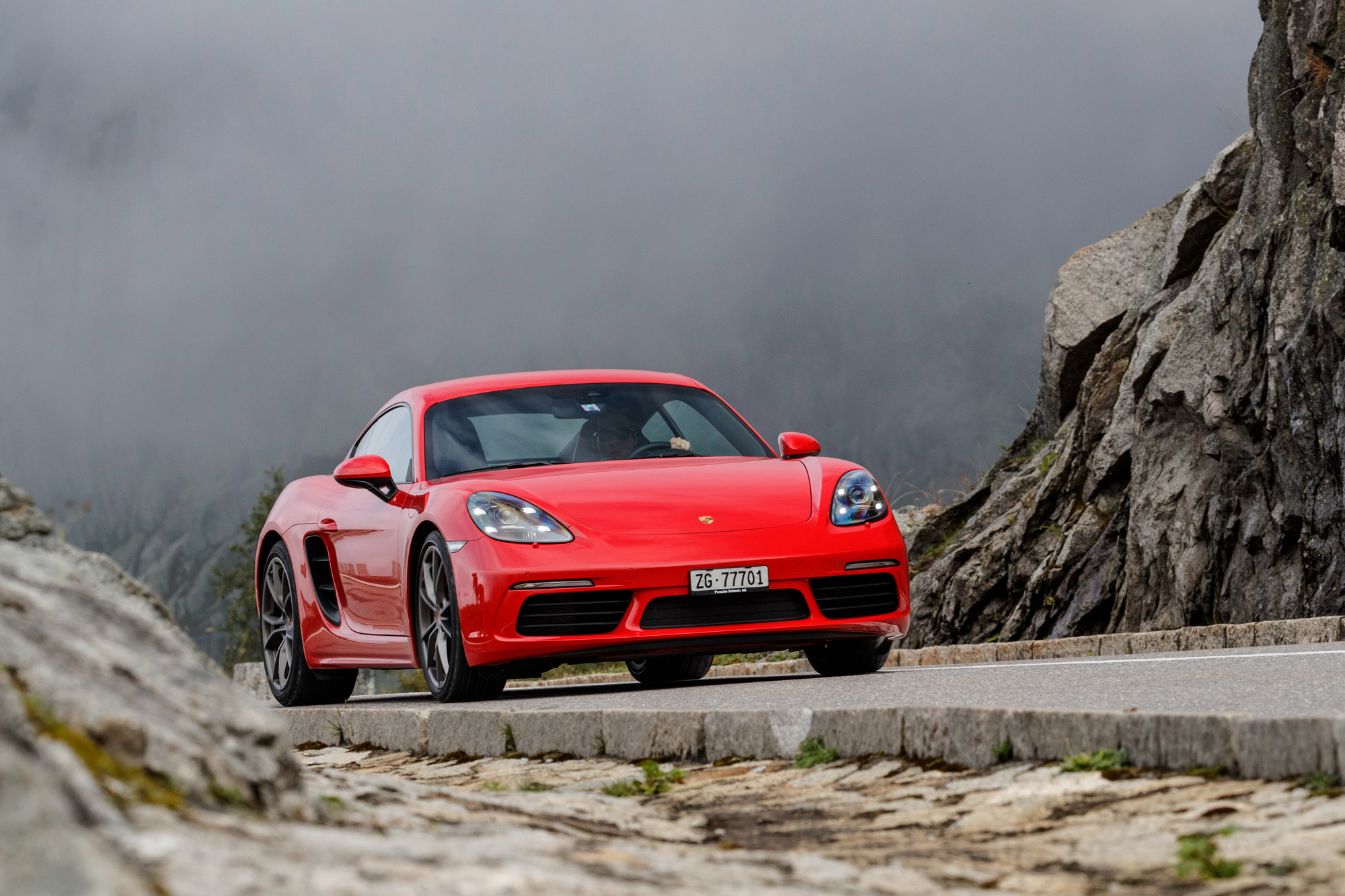
However, if you’re buying the Cayman S solely for straight-line prowess you’ve got the wrong idea. Its forte is corners. Point to point, the plucky Porsche is devastatingly quick. It’s small overall dimensions and razor-sharp front-end allows you to place it wherever you like and it will hang on faithfully, powering out the other side with ample traction and rear-drive poise. The steering is quick, the brakes are strong and the ride quality is absorbent.
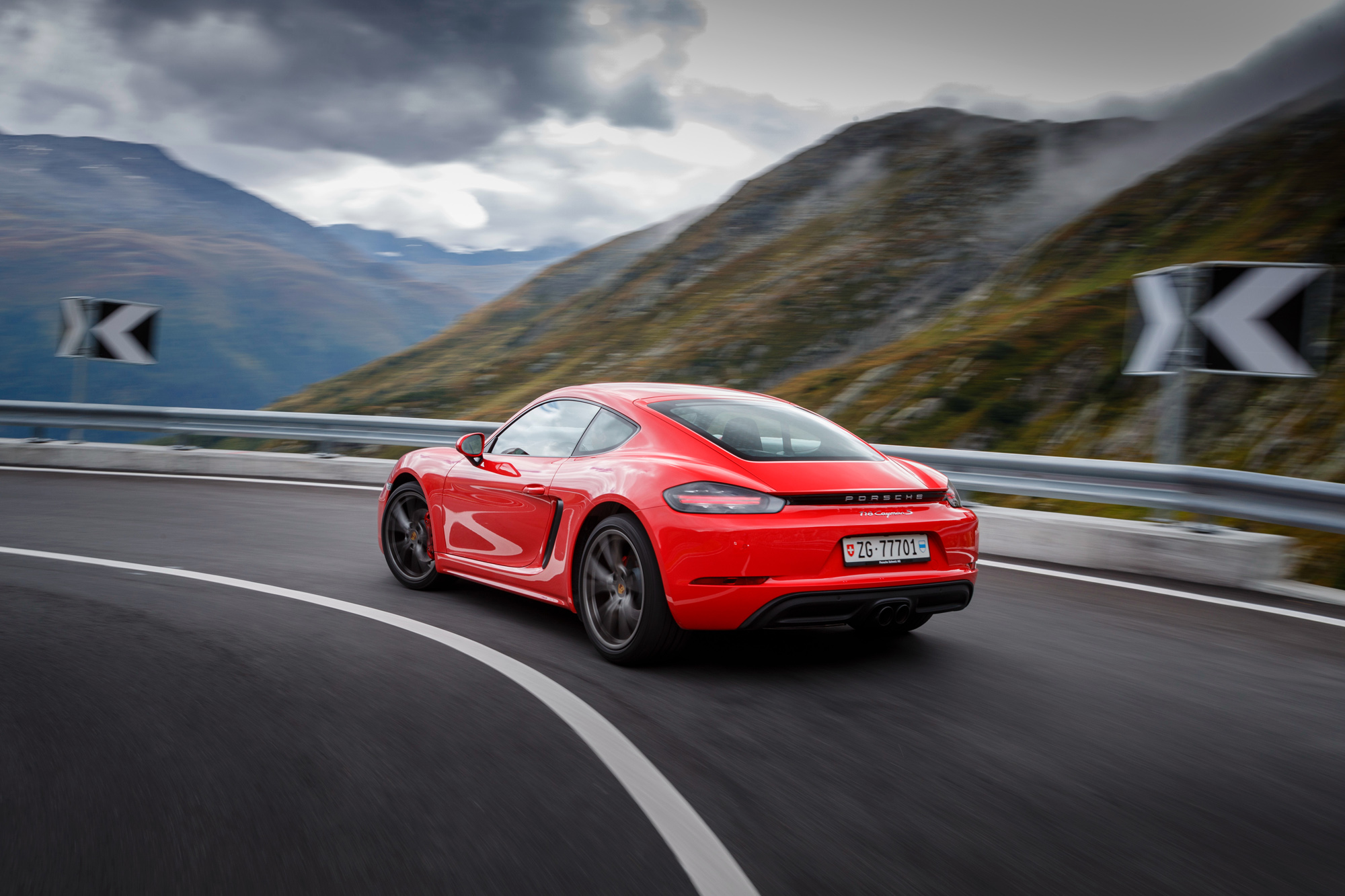
While the interior is looking a little old in terms of the next-gen Porsche cabins (think 992 911), it’s still functional and the driving position is perfectly low-slung. It is a small cabin, but there are inventive solutions like the pop-out cup holders. You also get a ‘frunk’ and a boot for extended luggage capacity. The steering wheel is pleasingly tactile and the rotary dial to select your driving mode is easy to use.
The Cayman S’ only true blight in its copybook is a somewhat sterile persona. You appreciate it hugely for what it can do, but loving it doesn’t come easy. You just need to give it some time.
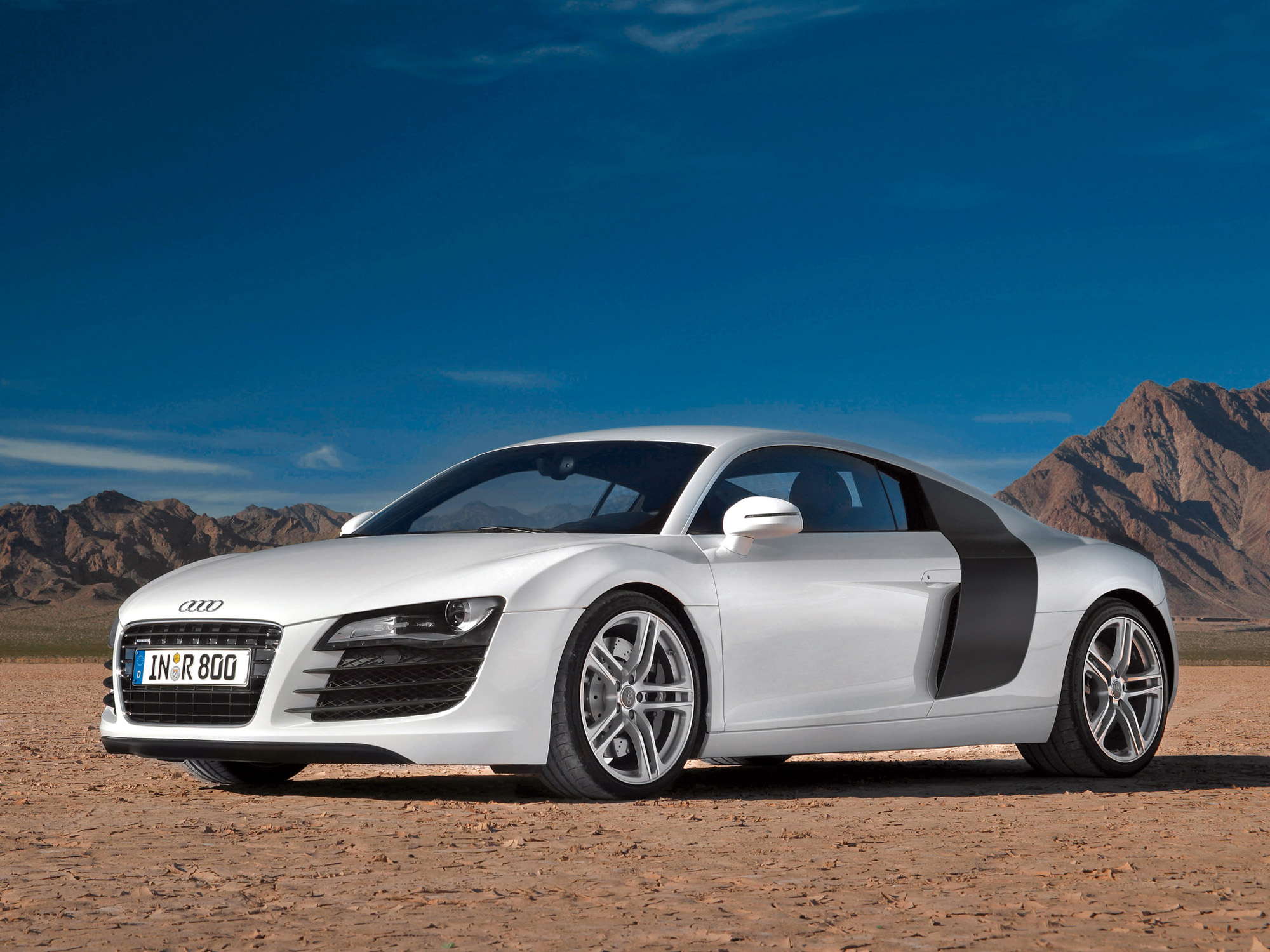
AUDI R8 V8
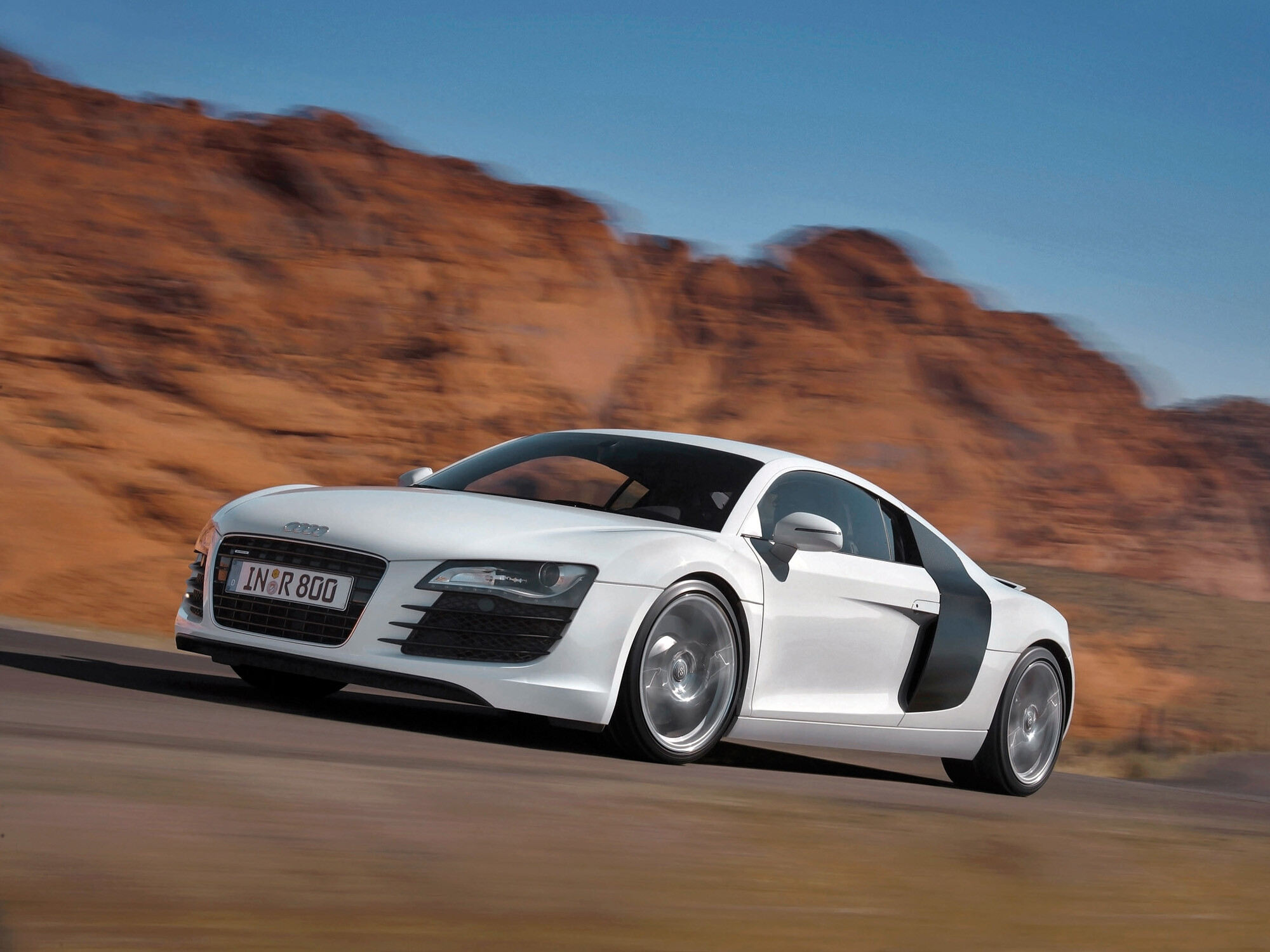
Desirability is something the Audi R8 doesn’t struggle with. Just look at it. And while the 4.2-litre atmo V8 might not have the shove of the V10, it certainly creates enough aural drama to be a match for the pleasing design. To most eyes at Wheels HQ, the original is by far the best-looking R8. Matching the design with a high-revving V8 and a gated manual is a recipe for supercar success.
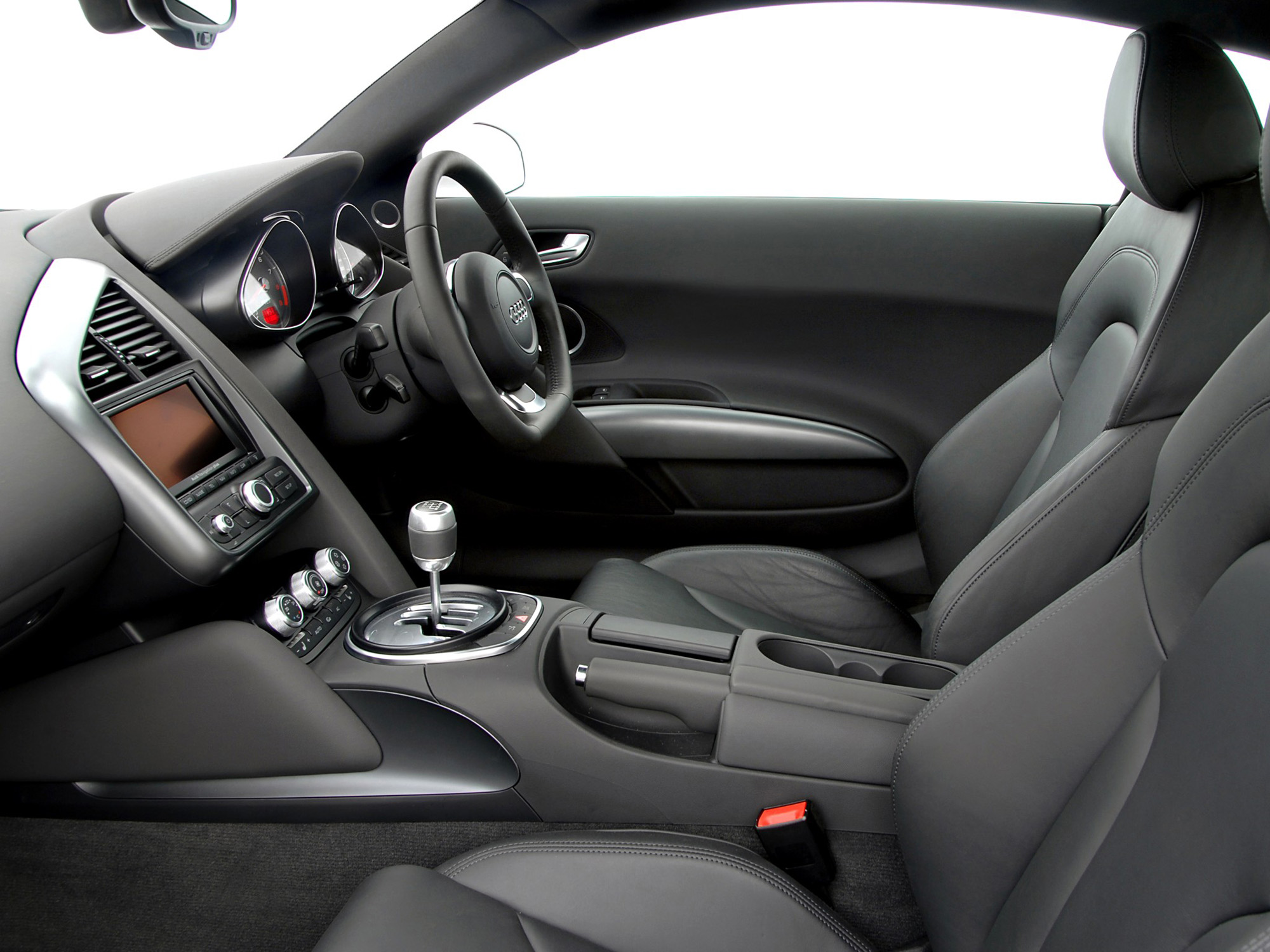
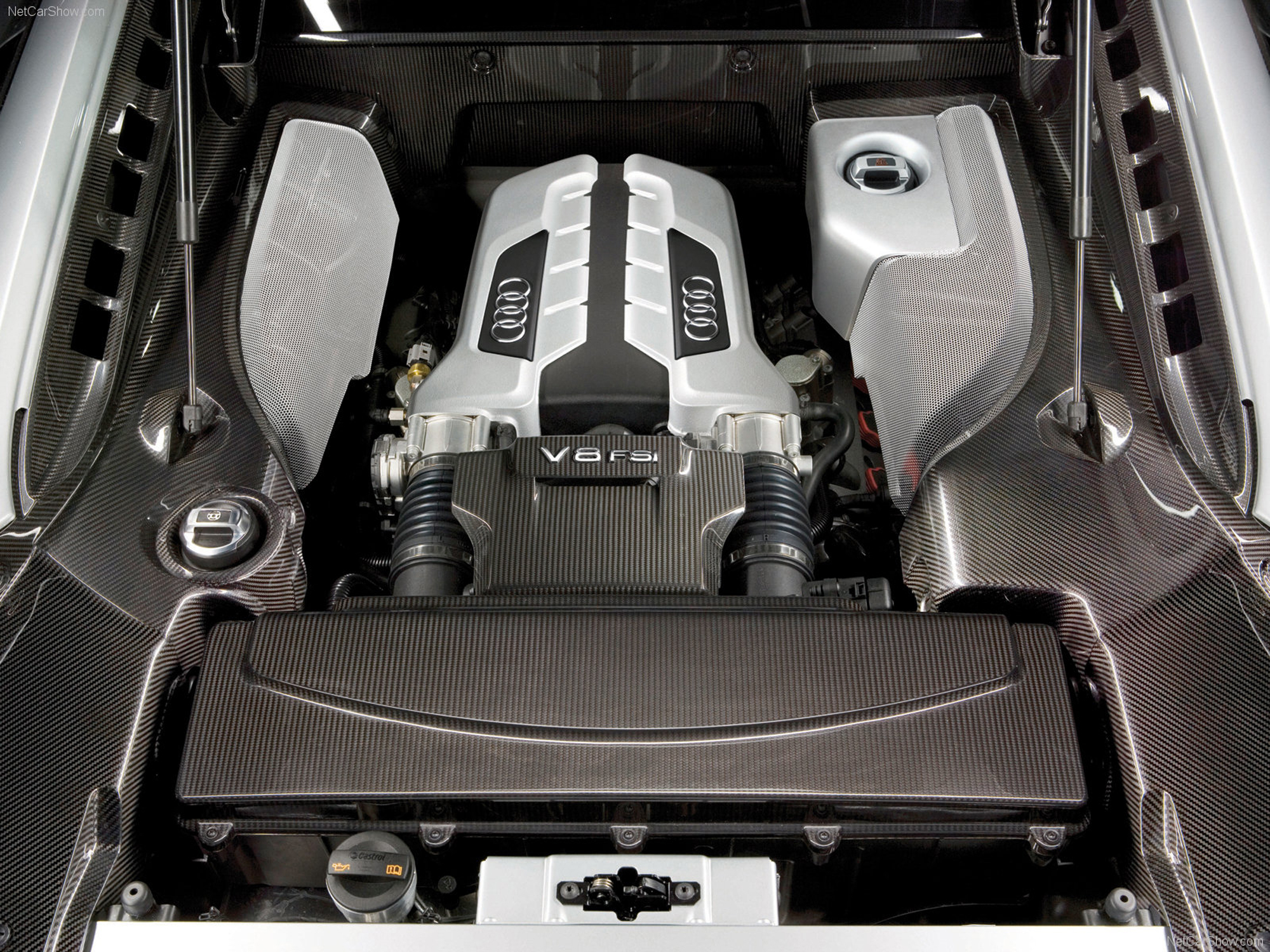
Finding tunnels and walls to give the naturally aspirated V8 a squirt to its 8250rpm cut-out almost becomes a sport. However, it’s not just the sound. While the base 309kW/430Nm R8 is without V10 punch, the eight isn’t slow and offers low-down clout and meaningful performance. Grip levels are immense with loads of all-wheel-drive traction. The open-gate manual is easier to use when you’re getting stuck in and the mid-engined supercar responds on a twisty road – no matter the conditions. It’s beautifully balanced and offers acceptable ride quality with adaptive dampers.
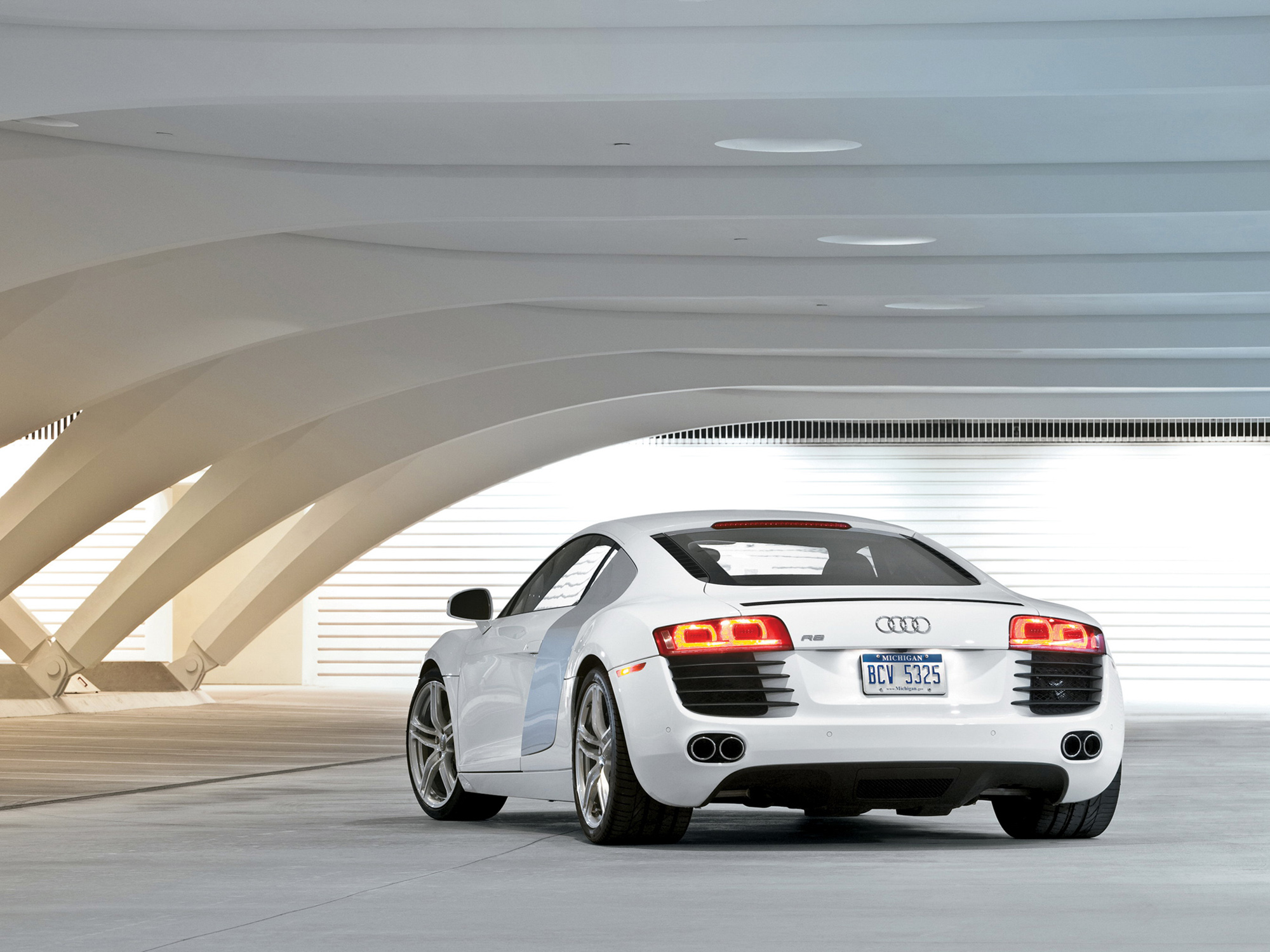
Inside, the R8, surprisingly, offers a great view forward and the seats are plush. The old-school instrument cluster is a win for form and function over current R8s – the reversing camera doesn’t get lost behind the steering wheel as it is displayed on the central screen. There are dials and controls for the MMI display and climate settings, while the infotainment graphics are looking dated in a modern context. There’s a ‘frunk’ to store enough goodies for a weekend getaway.
Ultimately, the R8 V8 isn’t style over substance. It’s worthwhile in its own right and not a poor relation to the V10. And it remains as much of a head-turner and as dramatic as the day it was released.
Specs comparison
| u00a0 | PORSCHE CAYMAN S | AUDI R8 V8 |
| Price (new) | $145,100.00 | $224,400.00 |
| Engine | 2497cc flat-four, dohc, 16v, turbo | 4163cc V8, dohc, 32v |
| Output | 257kW/420Nm | 309kW/430Nm |
| Transmission | 6-speed manual | 6-speed manual |
| 0-100km/h | 4.6sec | 4.6sec |
| Efficiency (combined) | 6.3L/100km (claimed) | 14.6L/100km |
| Drivetrain | RWD | AWD |
| Doors | 2 | 2 |
| Seats | 2 | 2 |
| Wheel size | 20-inch | 19-inch |
| Country of origin | Germany | Germany |
Wheels staff picks

Trent Giunco
Staff Journalist

Alex Rae
Online Editor

Cameron Kirby
Staff Journalist
Reckon we’ve got it right? Or are we way off the money (literally)? Find your best and let us know in the comments what you’d buy.
It was to be the ‘Skyline for Ken and Mary’, the 1973 Nissan Skyline GT-R (called KPGC110) which intended to move the game on from the KPGC10 Skyline GT-R.
But only 197 ‘Kenmeri’ Skyline GT-Rs ever made it out of the factory. Not because there were fewer than 200 couples called Ken and Mary willing to buy a Skyline, but for a few other reasons.
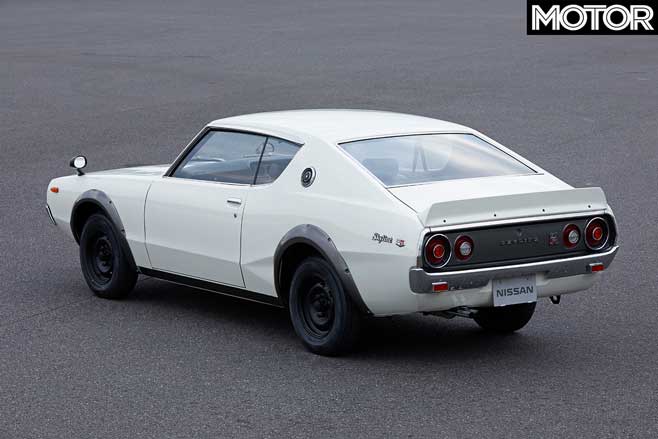
Not least was the oil crisis and, in Nissan’s own official reasoning, “stricter emission standards,” but the C110 generation Skyline also fell short of the C10 in its own right.
Not only did the 2.0-litre straight-six S20 engine carry over from the older model – it wasn’t a bad engine at all, but it received no treatment and had the same 118kW and 177Nm outputs – the GT-R was also heavier by 25kg and had drum brakes all ‘round. The Hakosuka had front discs.
Okay, 25kg isn’t dire, but with no performance improvement the Kenmeri was destined to fall short of its daddy’s legend.
It also did have a very strange TV advertisement. Ken and Mary wander around in a railyard briefly, before Mary points to a detached train cargo carriage. Suddenly, the two are driving through the snow in a Skyline, and there’s some oddly haunting vocals over the whole thing.
With only 197 built in its production run between January and April of 1973, and likely several lost to write-offs and disrepair, the Kenmeri is the rarest Nissan GT-R generation.
Two exist in Nissan’s own heritage car collection, one white and one red, though even Nissan admits to it being the “Phantom GT-R.”
Porsche has posted impressive results after putting its upcoming Taycan fully-electric car through a grueling endurance run.
Conducted at the Nardo test ring in Italy, where ambient temperatures hit 42 degrees Celsius, the pre-production vehicle managed to drive a distance of 3425km, including stopping for driver changes and re-charging. The feat is further than the electric driving record held by the Tesla Model 3 Long Range (performed on an autobahn), which managed to cover 2781km in 24 hours.
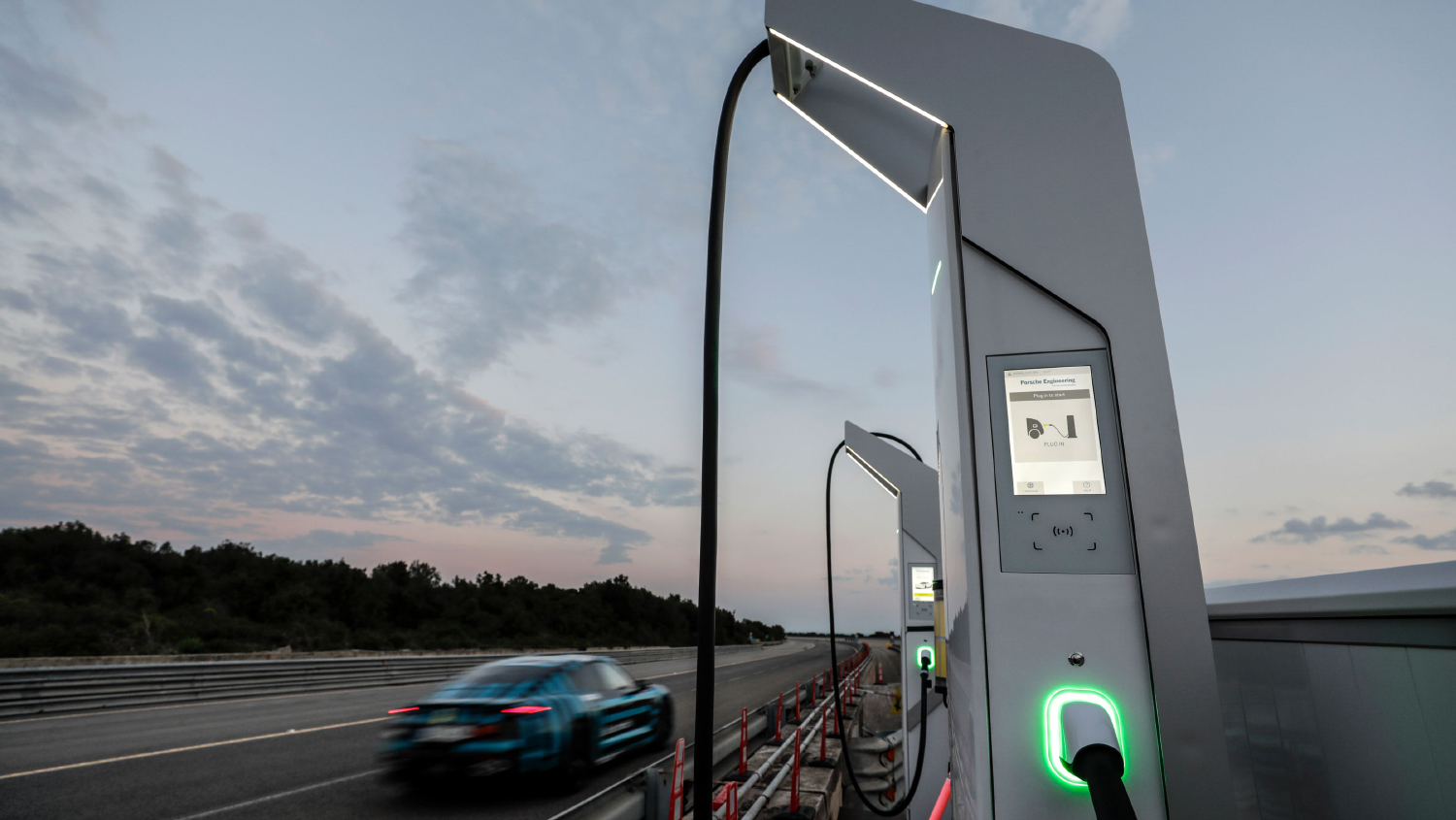
Incredibly, the speed was between 195-215km/h – the sort of territory most electric cars can’t handle for long – but Porsche’s unique two-speed rear transaxle help it to accelerate quickly and be efficient at high top speeds.
In real terms, that distance is enough to drive from Melbourne to Perth in 24 hours, or from Melbourne to Brisbane and back in one day – with range to spare. As an average distance to time travelled, the Taycan was moving almost 143km every hour for 24 hours.
Helping achieve the staggering range is the German maker’s new 800-volt electrical system that it claims can deliver almost 100km in just four minutes charging. Full charging and range times have not been detailed, though the car will be unveiled next month.
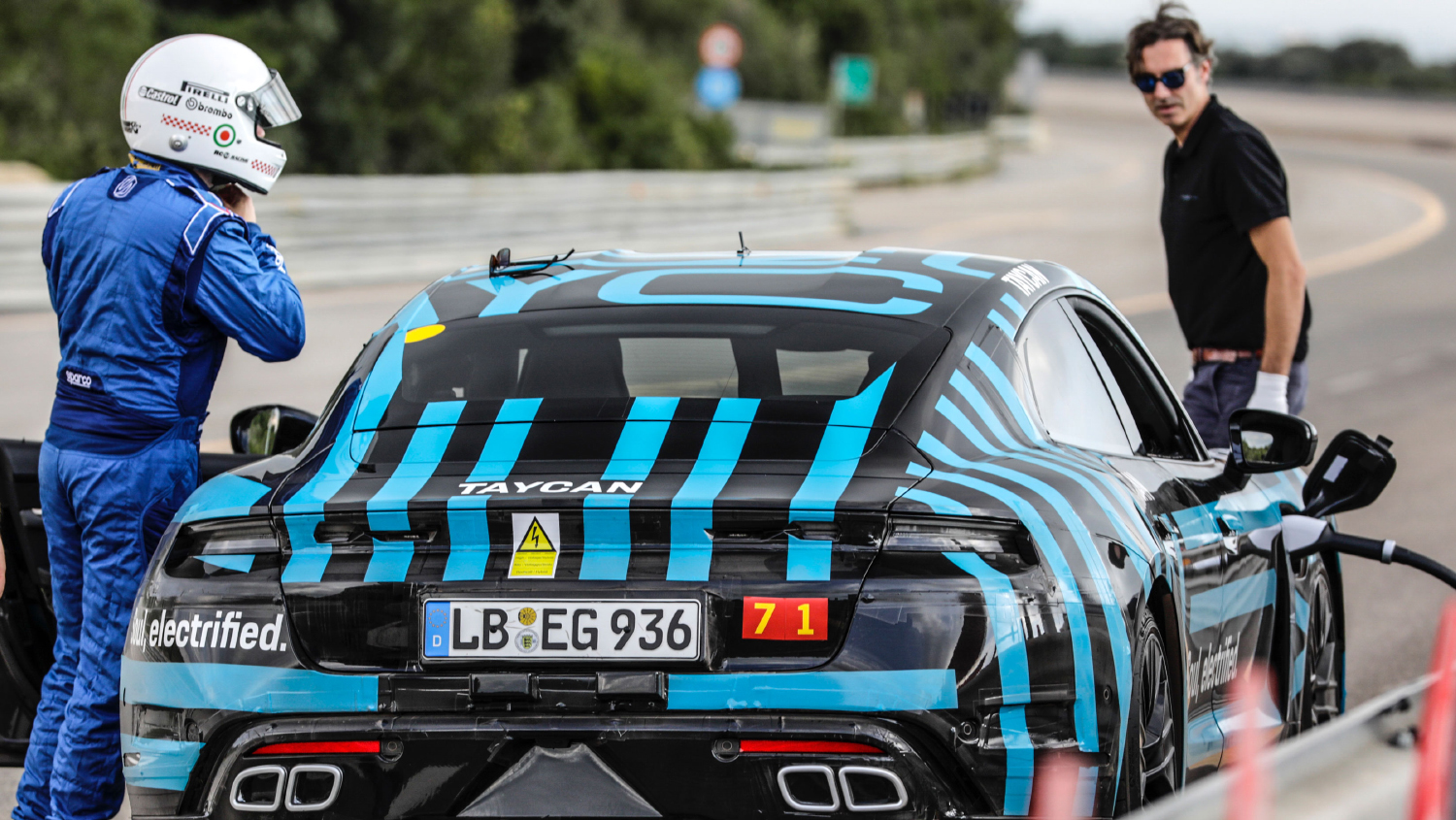
The same electric system will be adopted by Aston Martin for its Rapide E, and both that car and the new Taycan’s 800-volt system will be supported by compatible fast chargers in Australia, provided by Chargefox’s 350kW network.
“Our sister company Chargefox is building a 350kW charging network around the country,” JET Charge director Tim Washington told Wheels.
“The way it achieves 350kW is using an 800V system. You need to use a 350kW capable charging station to achieve these charge times.”
It means long-distance travel by electric car will be easier to manage in Australia, and technically, at the average distance the Taycan covered, a seven-hour drive from Sydney could put you in Brisbane – if speed limits allowed.
Usain Bolt stands in the middle of the street, striking a pose as a bright yellow Chevrolet Camaro is superimposed behind him doing a burnout.
If a car company had used a similar tactic to advertise one of its vehicles, Australia’s Ad Standards agency would have banned the commercial swiftly.
However, since it is advertising phones, the tyre-frying action is given a green light.
Currently all car manufacturers that advertise in Australia adhere to a voluntary set of guidelines from the industry lobby group, the Federal Chamber of Automotive Industries (FCAI).
The voluntary code bans the depiction of unsafe driving in ads, and heavily restricts the kind of images that can be portrayed.
Other advertisers are not held to the same standard, even if they use vehicles in their ads.
It’s a double standard that Jaguar would like to see rectified in Australia, according to its General Manager for Communications and Public Relations, Tim Krieger.
“I think there should be consistency, because at the end of the day, what is portrayed in one category should be aligned with what is going on in another category,” he told Wheels.
“I think some consistency would be helpful in the space. Being reckless for a car ad or a phone company or whatever else is still a vehicle being shown in a way that could influence the way people think about a certain product.”
The double standard was clearly depicted last year when the aforementioned ad from Optus was cleared of any wrongdoing by the industry watchdog.
While he would like to see car manufacturers and other industries on a level playing field, Krieger doesn’t have an issue with the high standard set out by the voluntary code.
“All manufacturers have to be responsible with how they portray their product,” he said.
“For us, it is very important for how the brand is perceived, and to not be perceived as reckless.
“We feel that [the current regulations] are appropriate. In terms of our brand, and how we try to portray the brand, it is very much from the premium level. It’s not just about pure performance, it’s about a package and how the brand is perceived.”
However, there is growing discontent among members of the car community that current regulations are a ‘nanny state gone mad’. Illustrating this point is a Lexus ad that was pulled from television screens after it referred to the LC 500 as a “beast”, while Toyota fell afoul of the watchdog when a LandCruiser was depicted driving through floodwater, and Holden was slapped on the wrist for not properly fixing a recovery chain in a TV spot.
Recently Volkswagen has taken aim at the constant complaints, with an advertising campaign for the Amarok dual-cab ute that focused on just how much they couldn’t show you on television. However, even this parody, which used scale models to represent ‘fake’ shots, was pulled from TV.
“Considering it was a bit tongue-in-cheek, that ruling was pretty interesting,” he said.
Krieger explained that to ensure Jaguar remained on the right side of the watchdog, it always cleared any campaigns it had doubts about with Ad Standards before the ads went to air.
“We haven’t had any problems with the regulators with any of the campaigns we have done. For us, it hasn’t been an issue,” he said.
“Any instances where we feel like we might be challenged [by a complaint], we will talk to the Ad Standards authorities about that and get a ruling on those issues up front.
“That won’t stop people complaining, but at least once there are complaints, we have flagged it up front and have a ruling either way.”
BMW Australia has responded to customer demand and increased the towing capacity of certain X5 and X7 variants, with a new optional upgrade now available for local customers.
The X5 30d, 40i, M50d and M50i as well as the entire X7 range (30d, M50d and M50i) now possess a maximum braked towing capacity of 3500kg when fitted with BMW’s factory-fitted towing system, while other X5 models (25d, 45e) remain at a maximum of 2700kg.
A $2500 option, the tow kit must be ordered with the vehicle and cannot be retrofitted, as extra body reinforcement is installed during the car’s build process on the factory line. Maximum downball load is 280kg.
In addition, local dealers will supply an approved tongue kit, including the tongue, ball, appropriate bracket and ‘D’ shackles and stickers, along with an adapter wiring harness with a 12-pin flat plug for $700 bringing the tow pack total cost to $3200.
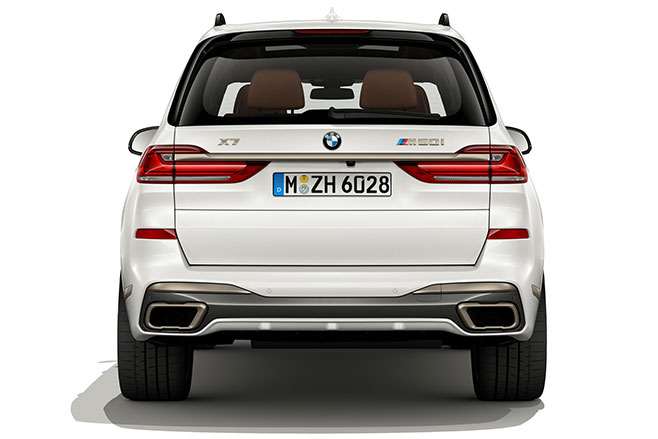
The factory-designed tow system includes a bespoke control unit with trailer stabilization and a new zoom function for the rear-view camera.
It’s important to note that the increased towing capacity may have an effect on payload capacities. For example, while towing 3500kg with 280kg on the downball the X5 30d’s remaining payload is restricted to 470kg, while the X7’s is 570kg.
In a statement, BMW Australia CEO Vikram Pawah said: “Availability of this new BMW towing hitch is a significant development in further broadening the capability of our X models. Our Sports Activity Vehicles were born for active lifestyles. From towing a caravan, a boat or a jet ski, to a horse float or camper trailer, this towing solution allows owners to enjoy more of Australia.”
The BMW towing pack is available to order now with first deliveries expected in Q3 2019.
Michelin has launched a new tyre designed to make SUVs handle like proper sports cars.
The new tyre, the Michelin Pilot Sport 4 SUV (PS4SUV), takes the technology the French tyre giant has developed for its Pilot Sport family of products, and applied it to the difficult task of making performance orientated high-riders easier to handle.
UPDATE, June 2022: Pilot Sport 5 tested!
Well, we’ve now driven cars fitted with Michelin’s newest flagship performance rubber. To get our view on how they go, hit the link below.
“The amount of wet grip, some of it on virtually standing water, is truly impressive.”
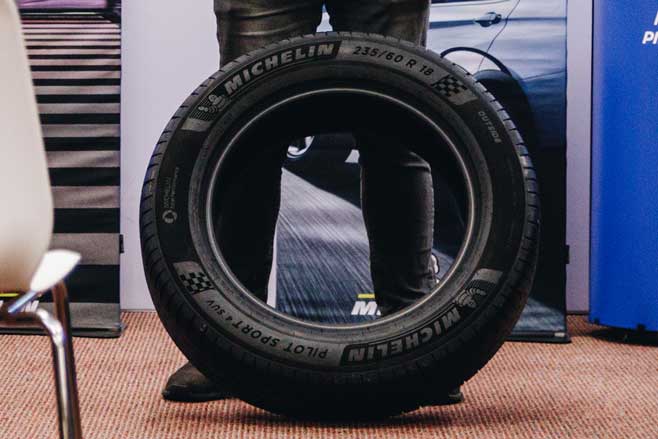
Michelin Pilot Sport 4 SUV review continues
Our first look at the Pilot Sport 4 SUV at Brisbane’s Mt Cotton driver training centre came in the form of a few laps of a closed road circuit behind the wheel of a Porsche Macan S.
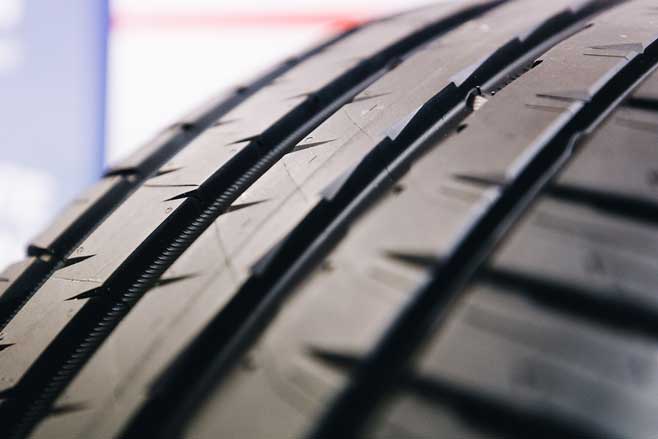
The tyre is designed to perform well in both wet and dry environments, with the outer half of its tread pattern (the way the grooves are shaped) optimised for cornering grip.
With no speed limit on the private road circuit, it became clear that the Macan S itself was capable of taking corners rather quickly, though with no other tyre tested in this scenario it’s not clear how much impact the tyre had on this.
According to Michelin, the PS4SUV’s high-speed grip comes down to the tyre’s hybrid aramid (a strong, heat resistant, synthetic fibre) and nylon belts, which are found beneath the tread and prevent it from losing its rigid structure at high speeds.
The PS4SUV tyres did their job, but whether a rival’s product would be able to match it isn’t obvious.
But it’s a different story in the wet. Michelin provided a testing environment in the form of a wet skid pan with diesel to create a slippery surface, and two Audi Q5 SUVs. One was shod with PS4 SUVs, and the other with a rival tyre in the same segment, albeit slightly cheaper.
While the rival tyre did a fine job of keeping the car stable at low speed, any sharp manoeuvres were met with a need to completely ‘reset’ the car’s grip levels by slowing drastically or correcting steer into what might have been an invisible obstacle.
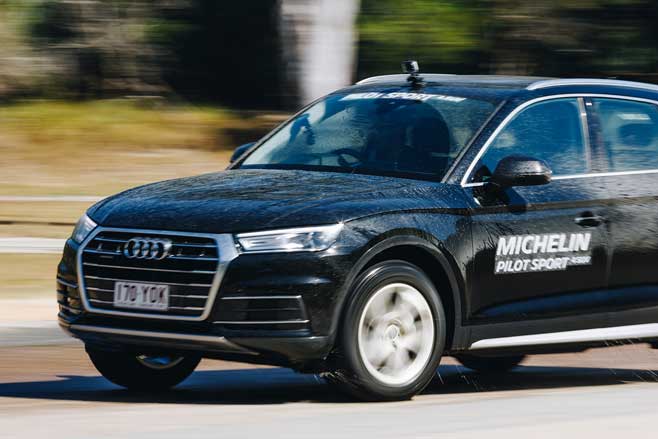
The Michelin PS4SUV tyre, however, was more predictable and required less adjustment in driving style to keep the Q5 headed in the intended direction.
Michelin says the inside half of the PS4SUV tyre are designed to handle wet and slippery conditions, with a hydrophobic silica compound to keep water from affecting the tyre’s traction, and a tread design which moves as much water out from beneath the tyre as possible.
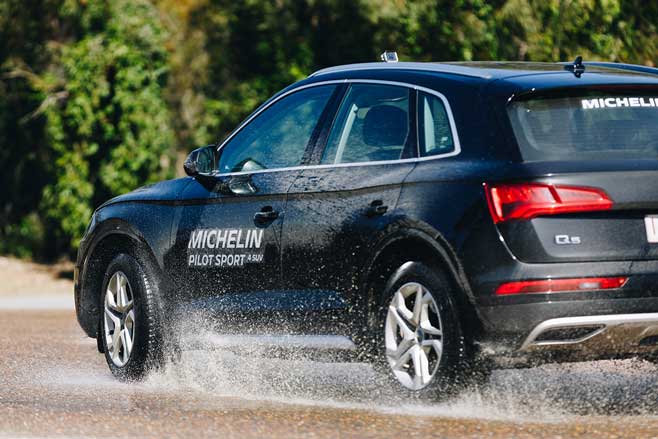
“The tech in this tyre is the same tech as the Pilot Sport 4S,” said Michelin’s Oceania marketing manager Swaroop Tulsidas.
“At high speeds … when you start speeding up the top layer of the tyre starts to deform because you’re going really quick.
“That’s something we found out in the Pilot Super Sport on the previous generation, and we improved it in the tyre we designed for Formula E.
“Then we rolled it out to PS4S, and now PS4SUV. It allows the contact patch to stay as constant as possible without deforming the contact patch. Combine that with hydrophobic silica, which repels water to keep that same contact patch, and you get excellent grip in the wet.”
The Michelin Pilot Sport 4 SUV tyre replaces the outgoing Latitude Sport, and is available now from Michelin dealers in 42 sizes, from 17- to 21-inch diameters.
Four doors, two driven wheels and a total of zero turbochargers. None of this is what we think of when someone says GT-R, but this is where it all started. The twin-turbo all-wheel drive beast we know today owes its existence to something very different.
Meet the “Hakosuka” (pronounced hako-ska) GT-R. That’s not what Nissan’s paperwork calls the first Skyline GT-R – PGC10 and KPGC10 were the model codes – but it’s become the official unofficial name of the ‘Box Skyline’. In Japanese, ‘hako’ means box and ‘suka’ is short for Sukairain, the types of mountain roads from which the car takes its name: Skyline.
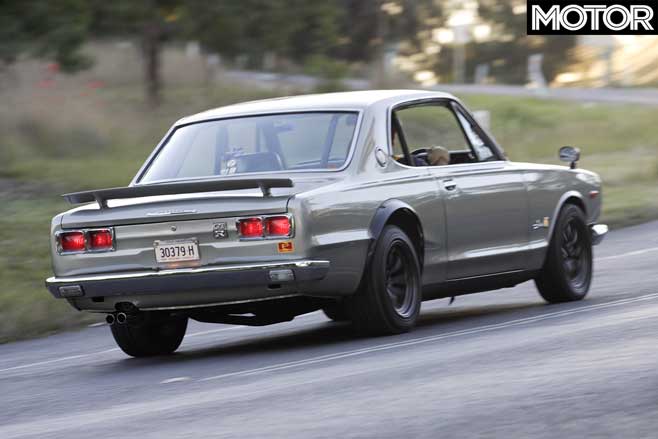
The GT-R story begins in the late 1960s, at a time when Nissan had just absorbed Prince Motor Company, and when the merged engineering knowledge of the two groups was starting to pay dividends on the track.
With the engineers from Prince having proven their worth by developing the R380 racecar and the previous Prince Skylines, Nissan decided that the C10 Skyline would be its next performance car project. The engine from the R380 and the body of the Skyline road car were to be the basis for a new motorsport champion.
The man credited as the driving force behind the subsequent development was Shinichiro Sakurai, an engineer with a tough work ethic. Sakurai was the type of man who would say things like “the Skyline is my alter-ego”, according to former apprentice Naganori Itou. There’s a reason many at Nissan called him ‘Mr Skyline’.
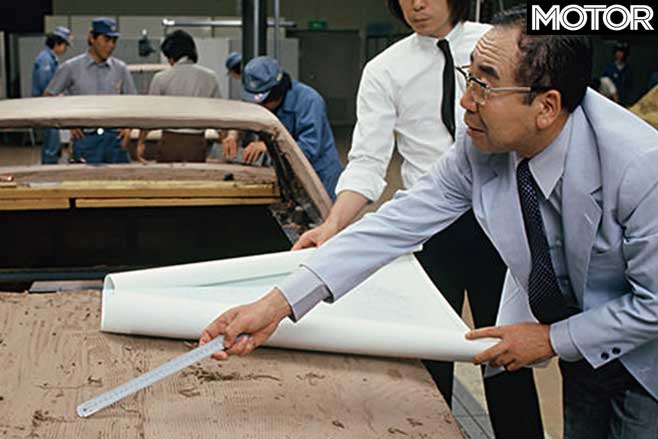
Starting out as an engineer on the first Prince Skyline in the 1950s, he quickly worked his way up to become leader of the development team for the third generation, the Hakosuka. Sakurai then remained in charge of the Skyline until the R31 generation, before handing the reins over to his protege Itou.
Under Sakurai’s watch, a re-engineered version of the Prince GR8 engine, called the Nissan S20, was fitted to the four-door sedan to create the first Nissan Skyline GT-R, which was officially called 2000GT-R.
The 2.0-litre, 24-valve, dual overhead camshaft, six-cylinder motor was tuned to produce 118kW and 177Nm. The PGC10 body style was soon joined by a slightly lighter two-door version called the KPGC10 in 1970, beginning the coupe tradition of Skyline GT-Rs.
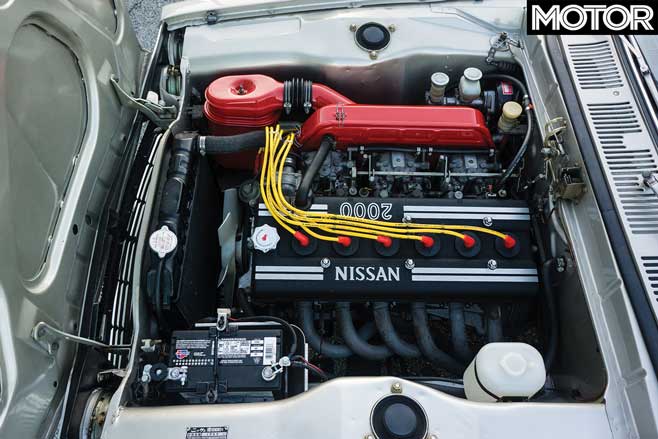
The Hakosuka also began another Skyline GT-R tradition – winning. In the three years between May 1969 and March 1972, before the Nissan works team stepped away from the sport, the PGC10 and KPGC10 Skyline GT-Rs had secured some 50 race victories. Sound familiar? In the late ’80s and early ’90s, R31 and R32 Skylines were dominating both here and in Japan.
Seven of those original race victories were won by one man, Motoharu Kurosawa, also known as Gan-San. He later became a test driver for hit DVD series Best Motoring in Japan and was reunited with a Hakosuka racecar for a video.
He recalls the first time he drove the KPGC10 at Fuji a day after another driver had rolled the car onto its roof, and it had been repaired with makeshift materials. Even then, Gan-San said the two-door was nearly two seconds faster than the four-door version.
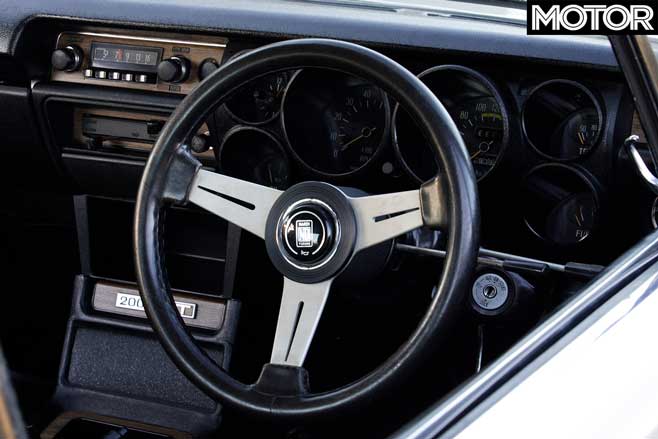
The coupe was 20kg lighter than the sedan, with a kerb weight of 1100kg, primarily due to a lack of mod-cons. Non-adjustable bucket seats and a spartan interior meant the car was able to incorporate a 100-litre fuel tank for long-distance racing while still losing weight overall.
But, despite the interior being ‘stripped’, the KPGC10 Skyline was gifted the technical prowess of a high-tech racer, even down to its then impressive independent suspension for all four wheels. It has developed a reputation as an engaging car to drive, with relatively stiff suspension, even by today’s standards, and genuinely communicative feedback through the unassisted, albeit very heavy, steering.
And the sound of the straight-six engine has been compared with Italian supercars, despite the car’s humble appearance. Without a big torque figure to haul it around, revs were the answer to making a Hakosuka GT-R go fast.
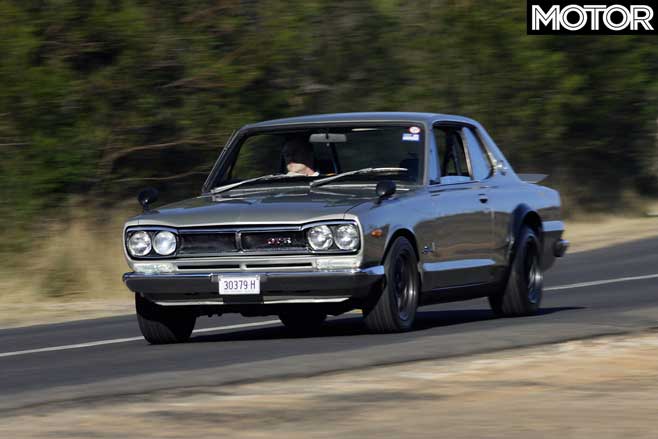
Unfortunately, the sound of an S20 hidden in the engine bay of a GT-R at full flight is rare. In fact, it’s almost non-existent outside Japan. Keeping up to date with how many original C10-generation GT-Rs are still in action is a challenge.
Fewer than 2000 were built in both PGC10 and KPGC10 guises – Nissan doesn’t list an official figure, but research suggests 1947, with 1115 being coupes and 832 sedans – and few ever left Japan. Of course, presumably a fair few were lost to the motorsport gods.
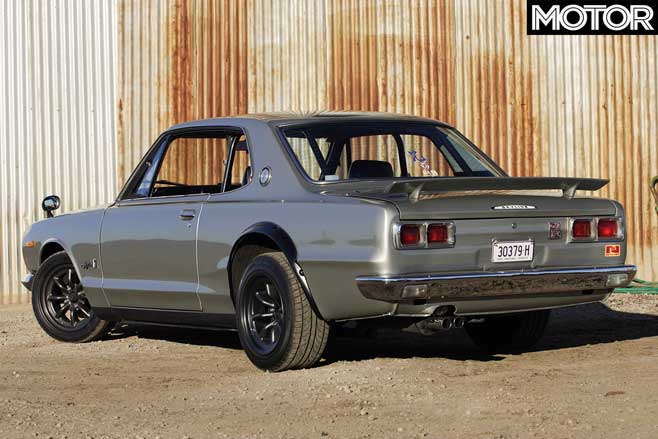
The combination of rarity and esteem has resulted in a strong culture of attempting to replicate the Box Skyline in GT-R form, usually using a lower-specification C10. Often, that means Hakosuka GT-R replicas are powered by less powerful L-Series engines from either 2000GT or GT-X-spec cars. The L20 engine in the 2000GT-X, for example, was a 2.0-litre straight-six with twin SU carburettors that produced 96kW and 172Nm, while the car itself was a heavier 1115kg.
The nature of replicating a car you can’t actually find easily means there are plenty of mismatched engine/body combinations – renown Japanese workshop Rocky Auto even built one powered by a Toyota 1UZ V8 – but it’s those relative few genuine GT-Rs that draw the most admiration, and money, from fans of classic Japanese cars.
Not only did the Hakosuka lay the foundation for the rest of the GT-R story – of which there’s plenty more in the pages of this magazine – but it also gave the world a glimpse into what a Japanese manufacturer was capable of well before Japan’s performance car renaissance of the 1990s.
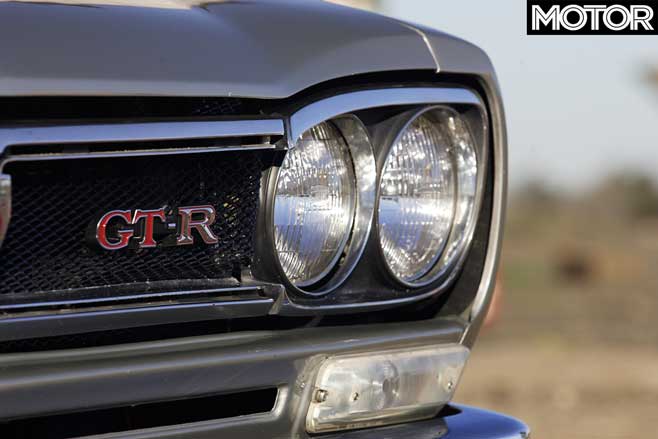
NISSAN “HAKOSUKA” KPGC10 GT-R Body: 2-door, 4-seat coupe Drivetrain: front-engine, rear-drive Engine: 1998cc inline-6, dohc, 24v Power: 118kW @ 7000rpm Torque: 177Nm @ 5600rpm Transmission: 5-speed manual Weight: 1100kg
Finding the real deal
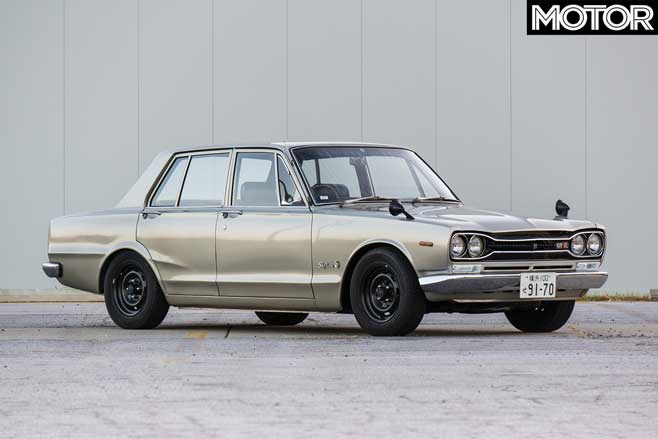
Original Hakosuka GT-Rs are so rare that finding one in Australia is almost impossible. We’re told by clubs that only one genuine car resides in this country.
The two-door car pictured in the main feature is a replica, fitted with a different Nissan straight-six engine. Real versions (above) sometimes go up for auction in the US, two recent ones fetching USD$88,000 and USD$242,000 at RM Sotheby’s. The former was for a four-door model, while the latter was for a highly prized two-door.
