
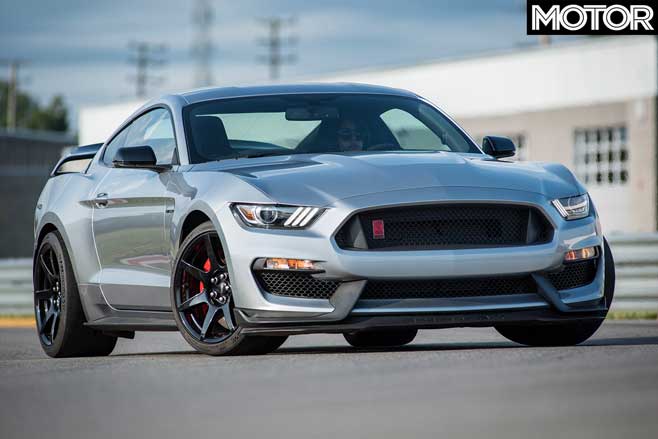
Ford’s Shelby GT500 is bearing fruits for the rest of its fast pony car range, with the 2020 Ford Mustang Shelby GT350R to benefit from the development of the supercharged monster.
The naturally aspirated GT350R is already a capable thing, with a 392kW/582Nm flat-plane crank 5.2-litre V8, but some chassis upgrades and a new steering system should make the 350R even more focused.
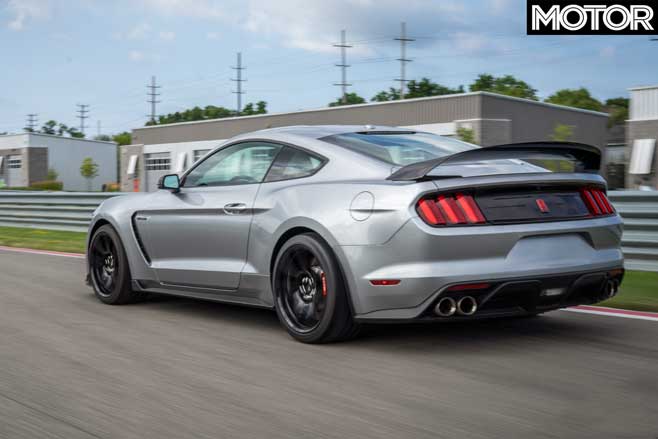
For example, the updated GT350R gains the front suspension geometry, including the GT500’s high-trail steering knuckle, as well as a new steering rack and improved electric steering assistance.
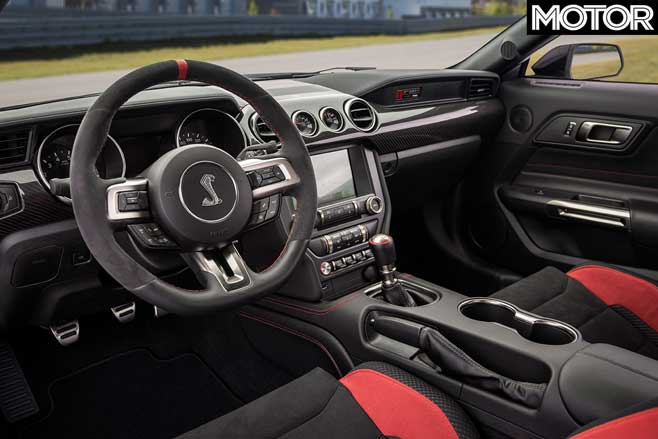
To save weight, the rear seats have been ditched, and the wheels are now carbon. Additionally, the exhaust resonator has been removed to save more weight, which means the V8’s song should also benefit from a little more clarity.
Ford Performance chief program engineer Ed Krenz says the intention was to take the tech developed for the halo GT500 and trickle them down to other Mustang models where appropriate.
“It’s always been our plan to take the latest innovations from the GT500 program and strategically apply them across the Mustang lineup,” says Krenz.
“These latest updates to the GT350R keep its performance competitive and on the top if its game, whether that’s on the track or on the street.”
Unfortunately, getting your hands on a GT350R (or any of Ford’s Shelby models) in Australia is a little pricier than it is for our Stateside counterparts.
Mustang Motorsport in Melbourne will import and convert one for you, if you can stump up the cash, though the company doesn’t advertise pricing for private imports like this as the costs can vary.
Once a consistent price can be established, MM will likely decide on a standard rate, though it’s expected a ‘standard’ GT350 will cost around $200k-$250k landed and converted. The 350R is sure to be pricier.
The 2020 Porsche Cayenne Turbo S E-Hybrid will have a bit of duality about it when it arrives later this year.
Not only is it Porsche’s most powerful SUV, it’s also one of the most eco-friendly members of the 500kW+ club… if driven gingerly.
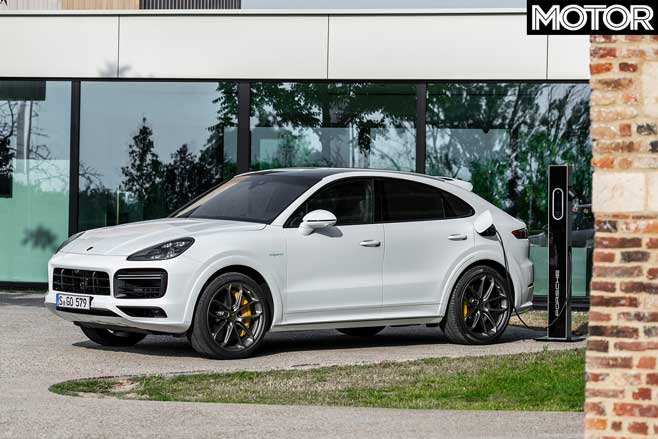
With a 404kW 4.0-litre twin-turbo V8, the Cayenne has the power credentials to put many other SUVs to shame, but the 100kW electric motor which is part of its 8-speed Tiptronic gearbox means it’s able to cover 40km at a time without starting the beastly bent-eight up.
If you need it to, however, you can drop the pedal use its 900Nm (available from just above idle, Porsche says) and hit 100km/h in just 3.8 seconds, which is brutally quick for something approaching 2.5 tonnes. Porsche hasn’t revealed a specific weight figure, but the Cayenne Turbo weighs 2175kg, the coupe an extra 100kg. The E-Hybrid’s electrified powertrain will add plenty more to that.
In electric mode, the Cayenne is able to hit 135km/h before it needs to start involving cylinders, but with the V8’s grunt Porsche says it’ll top out at 295km/h.
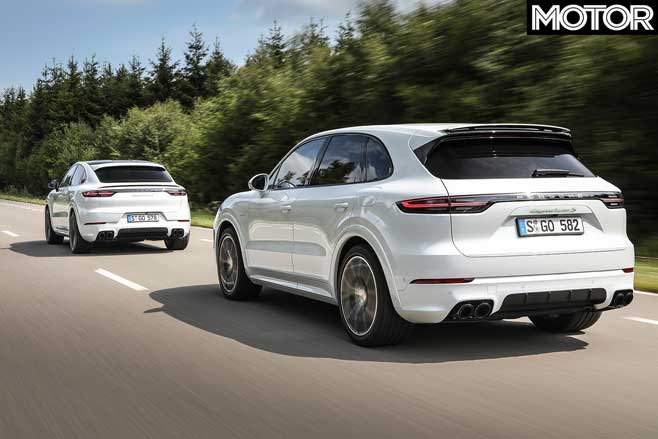
Here in Australia, the Porsche Cayenne S E-Hybrid will start from $288,000, with the coupe going for a base price of $292,700, though a list of extra standard equipment for the local market sweetens the deal a little.
Porsche Australia includes lane change assist, comfort access, 4-zone climate control, digital radio, side airbags in the rear, privacy glazing and ambient lighting all as standard, while the ‘wagon’ body gets a panoramic sunroof and vented seats, and the Coupe scores 22-inch RS Spyder Design wheels.
The Cayenne S E-Hybrids are available to order now, with Porsche expecting to make its first deliveries in December 2019.
It’s not easy to buy a Dodge Challenger SRT Demon in Australia, nor is it cheap. But it is possible.
If you want one like the right-hook example you see here, supplied by Queensland company SCD American Vehicles, by the time it’s imported, complied and converted you’ll be looking at around AUD$300,000, a fair increase over the US$84,995 it costs in its homeland.
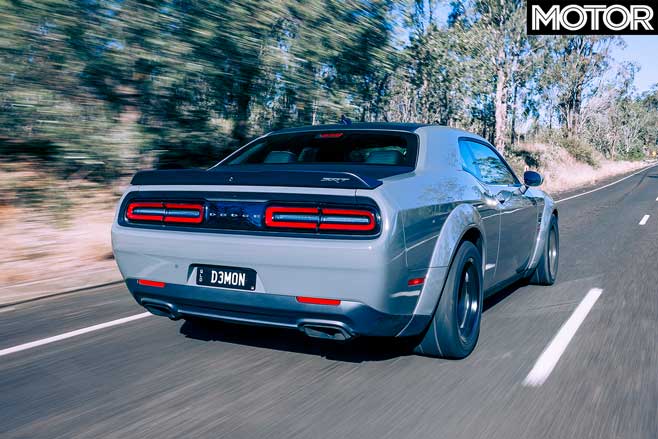
To do those times and access everything the Demon has to offer, you need to delve into the depths of the optional ‘Demon Crate’ and pull out the narrow front-runner drag wheels, performance parts, throw away the passenger seat and mirror and, crucially, plug in the powertrain control module, which unleashes the full 626kW/1040Nm if there’s 100RON fuel in the tank.
Sadly, we didn’t have any of this and were thus limited to a mere 603kW/972Nm, the former still sufficient to make the Demon more powerful than any other production car on-sale in Australia.
Even without the extra goodies, Dodge’s ultimate Challenger is still a special piece of kit. Compared to a Hellcat the 6.2-litre supercharged HEMI V8 scores upgraded pistons, con-rods and valves to cope with the added stress of a larger 2.7-litre supercharger, 14.5psi of boost and a higher 6500rpm rev limit.
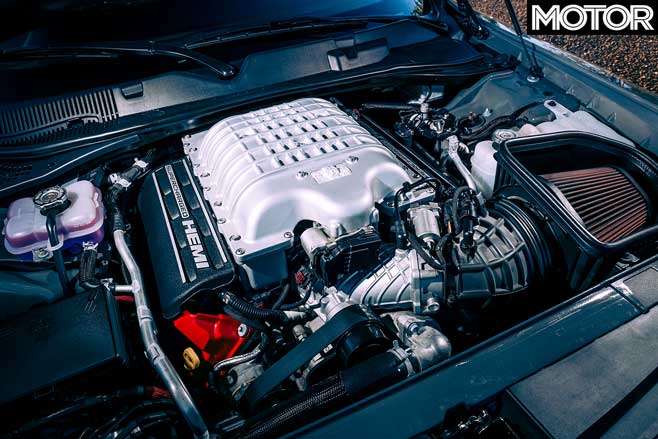
The Air-Grabber bonnet scoop gulps in air, two dual-stage pumps feed in masses of fuel and the Power Chiller sends the charge air through the air conditioning refrigerant to keep temperatures under control.
Unsurprisingly, it’s a berserk engine, but only when you want it to be. Its manners are impeccable in suburban driving, the eight-speed auto slurring through the shifts and the constant supercharger whine the only hint of the nuclear bomb that lies under the bonnet.
Floor the throttle and the gearbox instantly stands to attention, slotting the appropriate gear to unleash hell. Unusually, for a car with more power than the eastern seaboard’s electricity grid, the gearing is very short, each ratio a blur as the electronic speedo struggles to keep up.
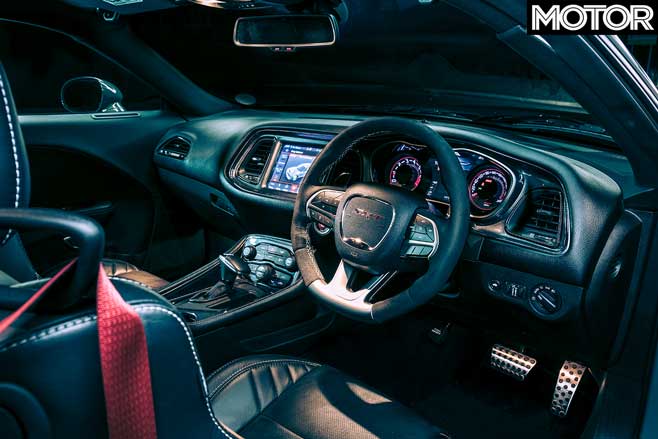
The Demon is a heavy car at almost two tonnes yet this monster of a powerplant picks it up and throws it down the road like it’s made of pure carbon fibre. To put it in context, drive it in 500bhp mode and it feels like four plug leads have fallen out, despite the fact that 373kW and 1900kg-odd is still a pretty potent package.
At no point in the Demon’s development were corners involved. Compared to a Hellcat, the springs and anti-roll bars have been softened significantly and while in its lightest guise the Demon is 89kg lighter, our test car has a full interior and is thus no skinnier than standard.
With that in mind, it handles fairly well, but the corner speed it develops is almost entirely down to the enormous 315/40 ZR18 Nitto semi-slick tyres it wears at each corner. The steering is quite vague around the straight-ahead and there is an initial moment of alarm when nothing seems to happen on corner entry.
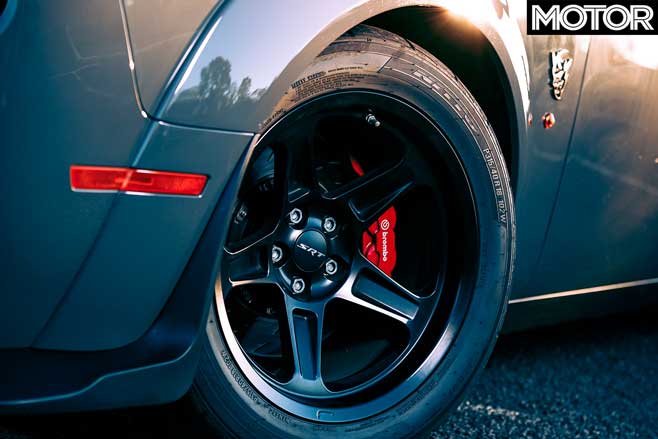
It feels big and heavy, rolls significantly and the process isn’t helped by a driver’s seat that is set high and offers very little lateral support.
It’s also hilarious fun. With such enormous power, a massively long wheelbase – the design hides the fact that Challenger is a huge car – and soft suspension, when the Demon starts to oversteer it happens in slow motion.
On a track, it would be a tyre-shredding drift car extraordinaire, but even on the road there’s huge enjoyment to be had slithering from corner to corner at not especially high speeds, particularly as the gearbox is extremely responsive, decisively choosing the right ratio, and the engine always has power to burn.
The upside to this suspension setup is truly remarkable ride quality; the Demon is an extremely comfortable car. SCD does a good job of the conversion, too, the only evidence of the switch the cramped foot parking brake operation.
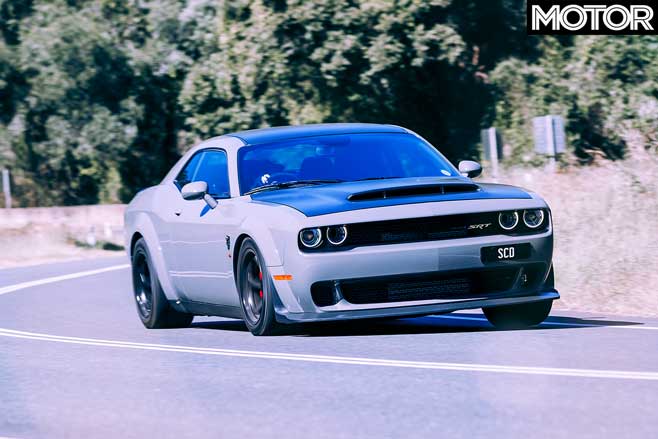
But is it worth $300,000? Absolutely. And absolutely not.
The interior is identical to that in a $65K Chrysler 300 SRT, it handles like a boat and the fuel use is truly terrifying. But the Demon is a true successor to the over-engined Detroit monsters of the late-1960s. Unlike the Camaro and Mustang, it’s not a sports car trying to be a muscle car.
In a garage that already had one of everything (or most things) there should be a space for a Demon (or any Hellcat variant). It’s a comfortable cruiser that looks awesome and is capable of destroying tyres and terrifying passengers at a moment’s notice. God bless America.
DODGE CHALLENGER SRT DEMON (RHD) SPECS
- Engine: 6166cc V8, OHV, 16v, supercharger
- Power: 603kW @ 6300rpm (626kW on 100RON)
- Torque: 972Nm @ 4500rpm (1040Nm on 100RON)
- Weight: 1911kg
- 0-100km/h: 2.5sec (claimed)
- Price: $300,000 (approx.)
Ten seconds. That’s all it took to get into and steal the new DS3 Crossback and an Audi TT RS.
In an eye-opening test for any new car owner to be aware of, UK publication What Car? has published results of a test investigating how easy it is to break into and drive away in a new car.
With many new models opting for keyless entry and push-button ignition, the traditional old key is becoming something for the ages. It leaves traditional nuts and bolts security behind for devices that wirelessly transmitter code to each other. Problem is, a properly configured device listening in to that frequency can copy the code and deceivingly relay it to the car, effectively becoming a fake copy of the key fob. It’s a lot simpler than prying a key from a driver and pressing it into a soap bar.
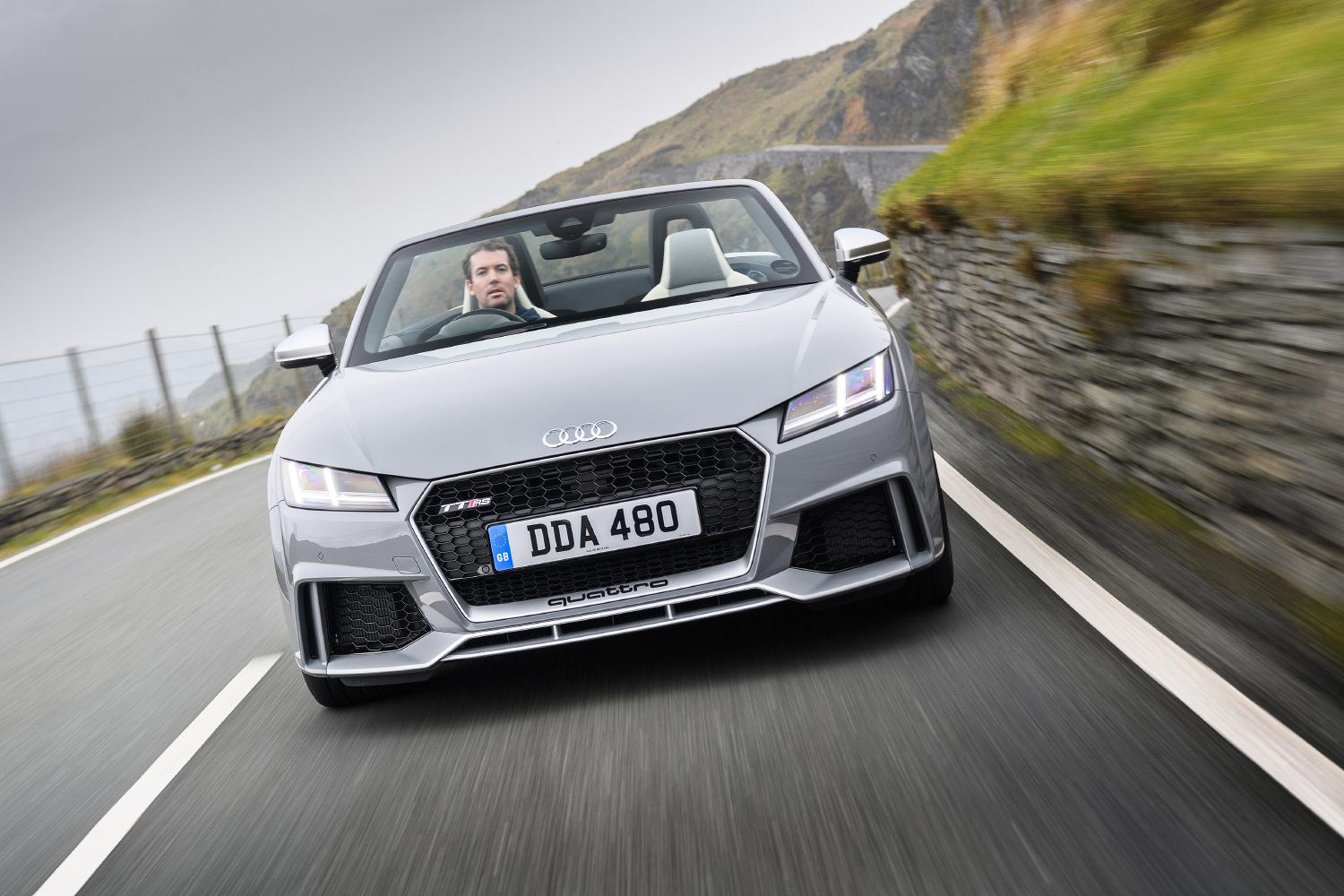
Normally, a car can be locked with keyless entry, but the key fob continues to transmit a code, expecting it will be near the car again and have to unlock it while remaining in a bag or pocket. In the test, a device was used within a few metres of the driver walking away from the car so it could listen to the code and copy it. To get into the car, the process was as simple as duplicating the code on a device near it to unlock all the safety features such as door locks, alarm and immobiliser. Once inside, the code is repeated again and the car started.
But not all key code systems are equal. According to What Car?, Audi, BMW, Ford and Mercedes-Benz have introduced motion-sensor technology so that when the key is not moving it stops transmitting a signal. In testing, this prevented those cars from being started, though they could still be entered.
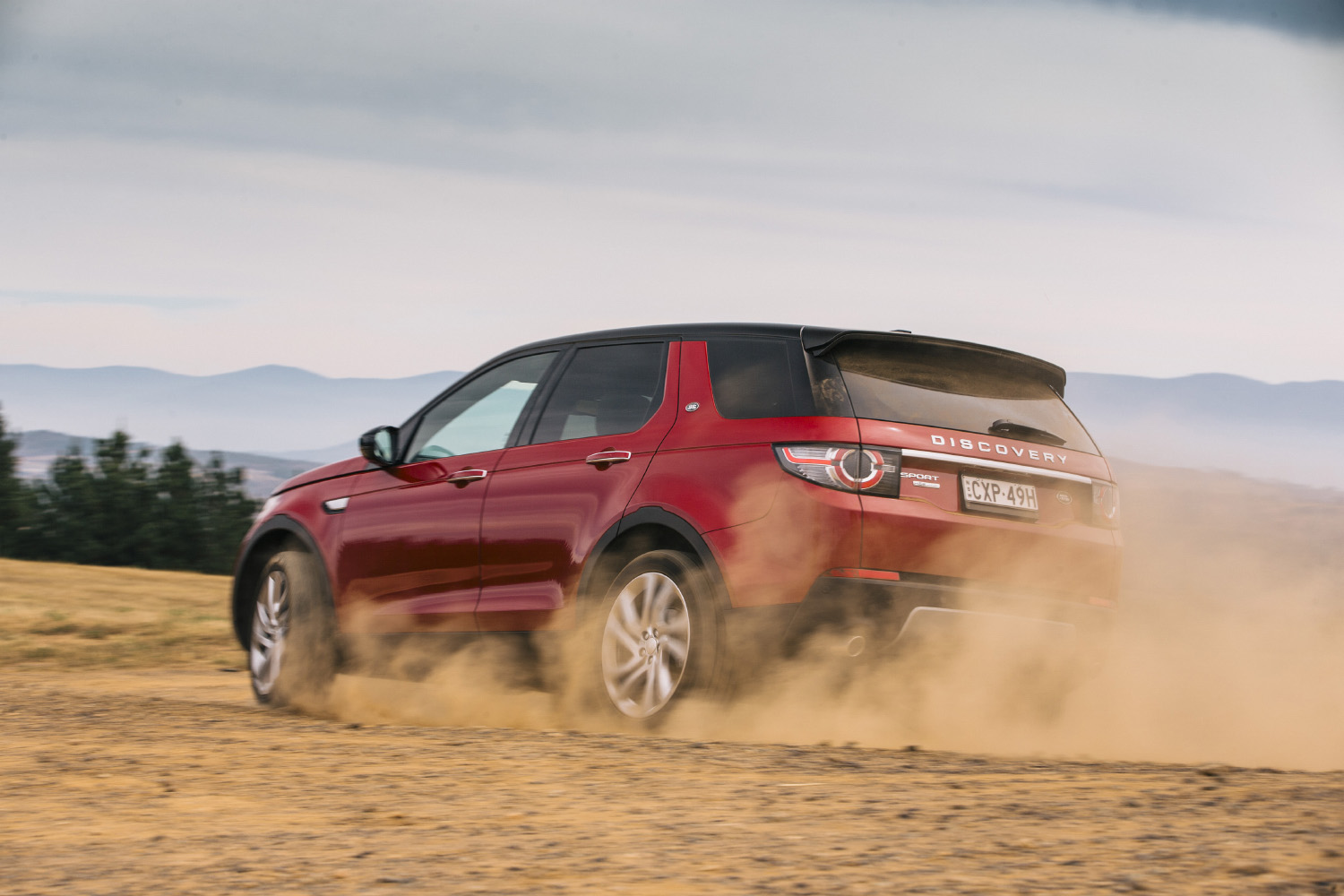
In total, the team attempted to steal seven different vehicles. The DS3 and TT RS were fastest to steal, gone in just 10 seconds. Land Rover was second fastest with a 2018 Discovery Sport being driven away in just 30 seconds.
Land Rover responded, adding that an update since the 2018 model now spreads the code across ultra-wide frequencies, helping make new models much harder to start. A test on the new Discovery proves that, with the model able to be opened in 20 seconds but unable to be started.
Other models which fell victim were the BMW X3 (60sec), Ford Fiesta (60sec), and Mercedes-Benz A-Class (50sec).
The spread of manufacturers unable to prevent the seemingly easy entry and start shows that car security is far from resolved. There have been advances in systems regarding how fobs transmit code but there is no requirement yet for car maker’s to adhere to certain protocol.
So what can you do? Some manufacturers can disable the keyless entry system for customers, or a ‘Faraday bag’ can be used to keep the fob in, which prevents the signal from transmitting beyond the pouch.
Cracking 500km/h sounds like an ambitious plan, but according to Bugatti boss Stephen Winkelmann, it’s entirely possible that the Chiron could reach the stratospheric mark.
However, in an interview with Automobile magazine, Winkelmann admits that the limiting factor to cracking 500km/h isn’t due to a power deficiency with the all-conquering Chiron, but more a lack of tyre technology to cope with the forces it generates.
Winkelmann, who previously headed Lamborghini, states that gaining the extra 80km/h to achieve this goal is achievable “if someone is willing to supply suitable tyres”. Currently the 7993cc W16 Chiron is endowed with 1103kW/1600Nm and is limited to a top speed of 420km/h using Bugatti-specific Michelin rubber.
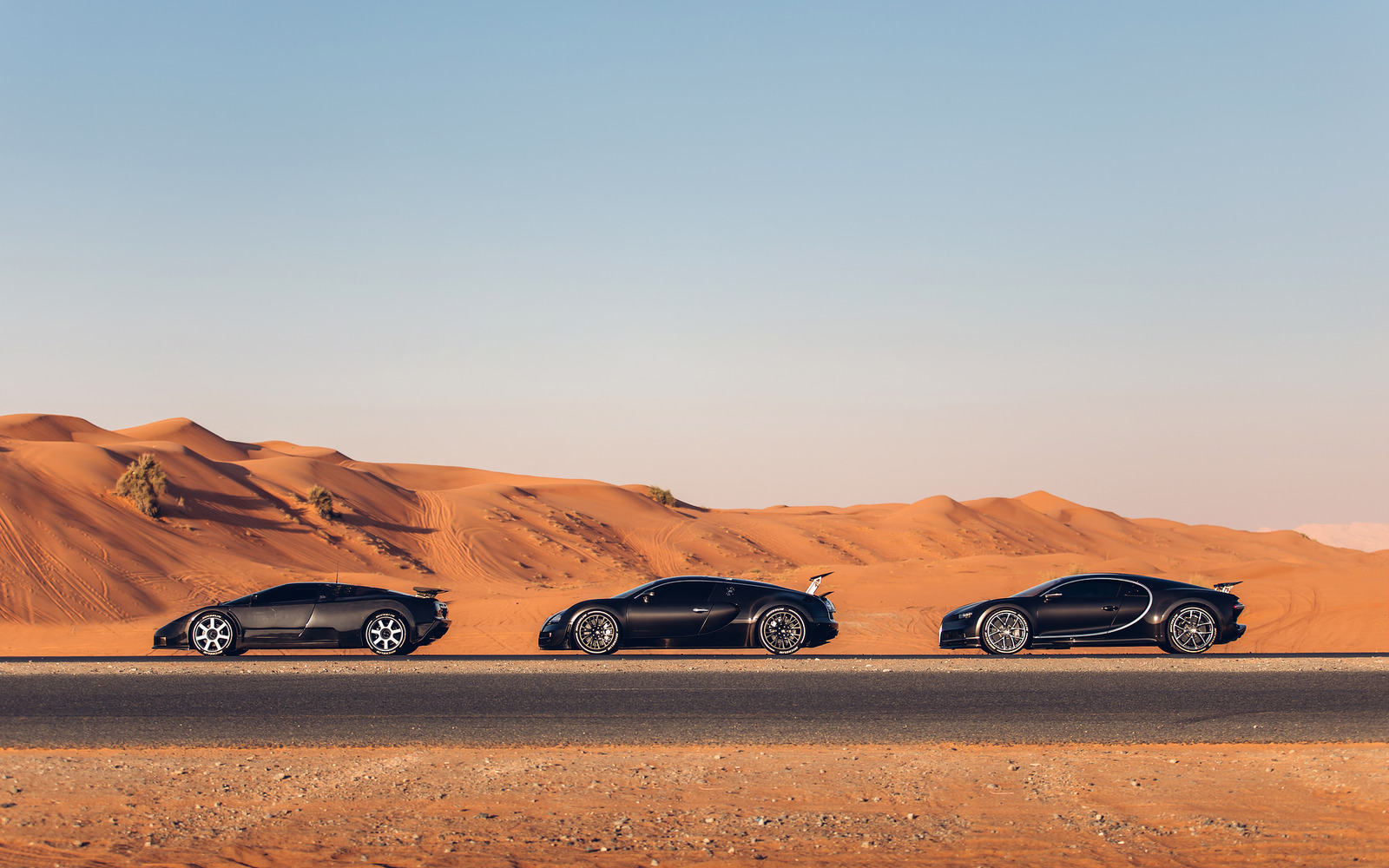
At its launch, Bugatti stated that the Chiron could exceed the designated top speed, which is an indicated 500km/h on the speedo, but that it was electronically limited because of the tyres. Bugatti test driver, Andy Wallace, also said at the Chiron’s launch that a street tyre simply can’t handle the forces generated at such speeds, but that Michelin wasn’t far off.
The big Bug uses quad turbos to help attain its eye-watering performance figures, but electrification could be part of the future according to Winkelmann – just not right now. More power is “always an option, as is less weight”. In the meantime, achieving the extra power and torque required to reach the targeted top speed will be done sans hybrid assistance.
Additional body styles could be in the pipeline, while the Chiron is expected to live on for at least another five years with updates. According to Winkelmann, the engine could even be used in the car’s replacement. A drop-top version would require a “reengineered and much stiffer monocoque”.
Winkelmann reveals in the interview that the design of the luxe three-door SUV, or CUV in Bugatti-speak, has been completed. So advanced is the program, which could be an all-electric vehicle, that individuals outside the company have viewed it. “Some potential customers have seen it and they liked it”, Winkelmann said. However, it’s believed that there’s been no hard-line decision on its feasibility and no final budget has been allocated.
Volkswagen is poised to set a new record when its all-electric Volkswagen ID.R racecar takes on China’s Tianmen Mountain hill climb next month.
It has dressed the ID.R with a complete new livery for the occasion, finishing its heavily sculpted form with the design based on the colour red – a nod to China’s national flag – that should stand out among Tianmen’s forests that lie 1500km Southeast of Beijing.
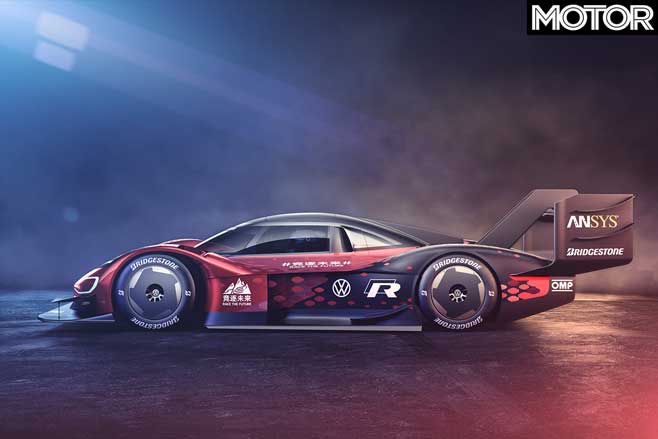
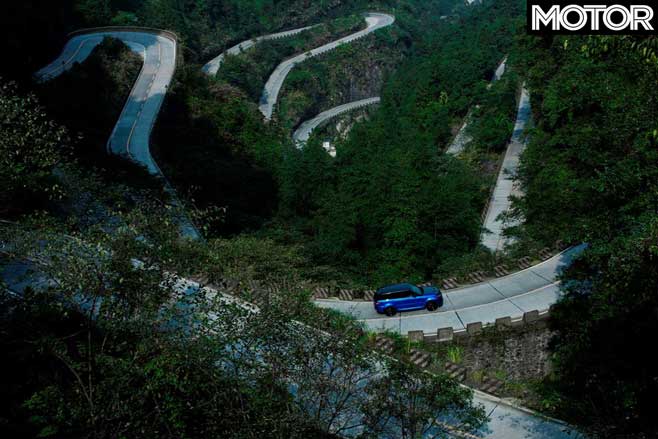
The course is 9.94km long and starts at 200m above sea level before finishing at 1400m altitude. While the road is much shorter than the Pikes Peak climb, it presents its own dangers in vertical cliff faces that lie next to some of its 99 hairpin corners.
It finishes at Heaven’s Gate, a scenic tourist spot that beckons visitors with a lookout atop 999 steps.
Romain Dumas will pilot the 500kW racer along the closed Tianmen Shan Big Gate Road. It’s the latest attempt after claiming outright records at both the Pikes Peak and Goodwood Festival of Speed hillclimbs earlier this year, along with the fastest electric car lap at the Nürburgring Nordschleife.
Altitude won’t affect the ID.R’s output as it climbs the mountain and Dumas will appreciate its instant power between the tight, winding corners. VW claims the ID.R can hit 100km/h from rest in 2.25 seconds.
He’ll set a record as long as he stays on road. The last publicised ascent up Big Gate Shan Road was Land Rover’s attempt with a Sport plug-in hybrid. However, it impressively drove up the steps as well, needing 22min and 41sec for the combined effort.
Volkswagen’s strategically timed the stunt with plans to launch an electric vehicle range in China, that it calls the “ID. family”, next year. Punters were also involved through a competition that welcomed them to set a virtual time on the course for Dumas to beat.
If you’re keen to follow the run, it is scheduled for September 19.
What is it: Volvo XC40 T5
Why we’re driving it: Volvo’s first small SUV is an exceptionally stylish premium SUV, with an innovatively-designed interior and a choice of turbocharged petrol powertrains. It won the 2019 Wheels Car of the Year, so we were keen to test its street smarts and its luxury chops to understand how this versatile five-seater can handle the rough and tumble of real life.
Week 1 – Getting to know the Volvo XC40
The Volvo XC40 is the baby of Volvo’s SUV range, slotting in below the bigger XC60 in size and price. It’s half a size bigger than traditional compact SUVs but half a size smaller than mid-size SUVs, which gives it the uniqueness and practicality to stand out.
Prices range from around $45,000 for the T4 Momentum to $56,000 for the T5 R-Design we’re testing here, making it competitively priced against rivals like the BMW X3, Audi Q5 and Mercedes-Benz GLC. You might want to add Lexus RX and Jaguar F-Pace to the list, although neither of them sell in the same volume as the Germans.
The Volvo XC40 is almost perfectly sized for an urban family – comfortably capable of seating four, with a usefully well-configured boot and plenty of clever storage ideas. That it’s also entertaining to drive, interesting to look at and solid value for money pretty much seals the deal. It’s bloody good.
Jetting around Sydney, it’s become clear why the Volvo XC40 won the 2019 Wheels Car of the Year award. I’ve been lucky enough to give the XC40 its maiden voyages around town, and I’ve found that the Volvo extremely easy to drive. The electrically adjustable driver’s seat makes finding an ideal driving position a doddle, and visibility through the big windows is excellent so there’s no risk of hitting curbs even in tight parking spaces.
The XC40 has no shortage of safety systems, as you’d expect of a Volvo.
Among the active safety aids on every XC40 are city-speed auto braking, blind spot monitoring (a light in the side mirrors warns you of vehicles alongside out of view), and rear-cross traffic alert (which alerts you, when reversing, to cars crossing behind).
Rear Collision Mitigation Support works when the car is at a standstill. It looks for cars approaching too fast from the rear, and flashes the indicators should it detect one. If it thinks you are about to be rear-ended, it tensions your seatbelts and applies the brakes, to reduce your potential for injury.
There’s also Front Collision Mitigation Support that helps avoid collisions by automatically veering to avoid collisions with oncoming vehicles if travelling between 60 and 140km/h. If you cross a lane marking in the way of an oncoming vehicle, it automatically steers back and warns you.
With that impressive array of sensors, alerts and cameras, you’d have to be exceptionally unfortunate to be involved in a crash. Initially, I’ll admit I found it all a little overwhelming when the car is alerting you to what feels like anything and everything, but it doesn’t take many kilometres to feel like it’s almost a guardian angel. It tells you if someone is zooming up beside you, and whether someone is behind you when you’re reversing out of a driveway. If you don’t like the sensors beeping and buzzing, they can be turned down or off, although that kind of defeats the purpose.
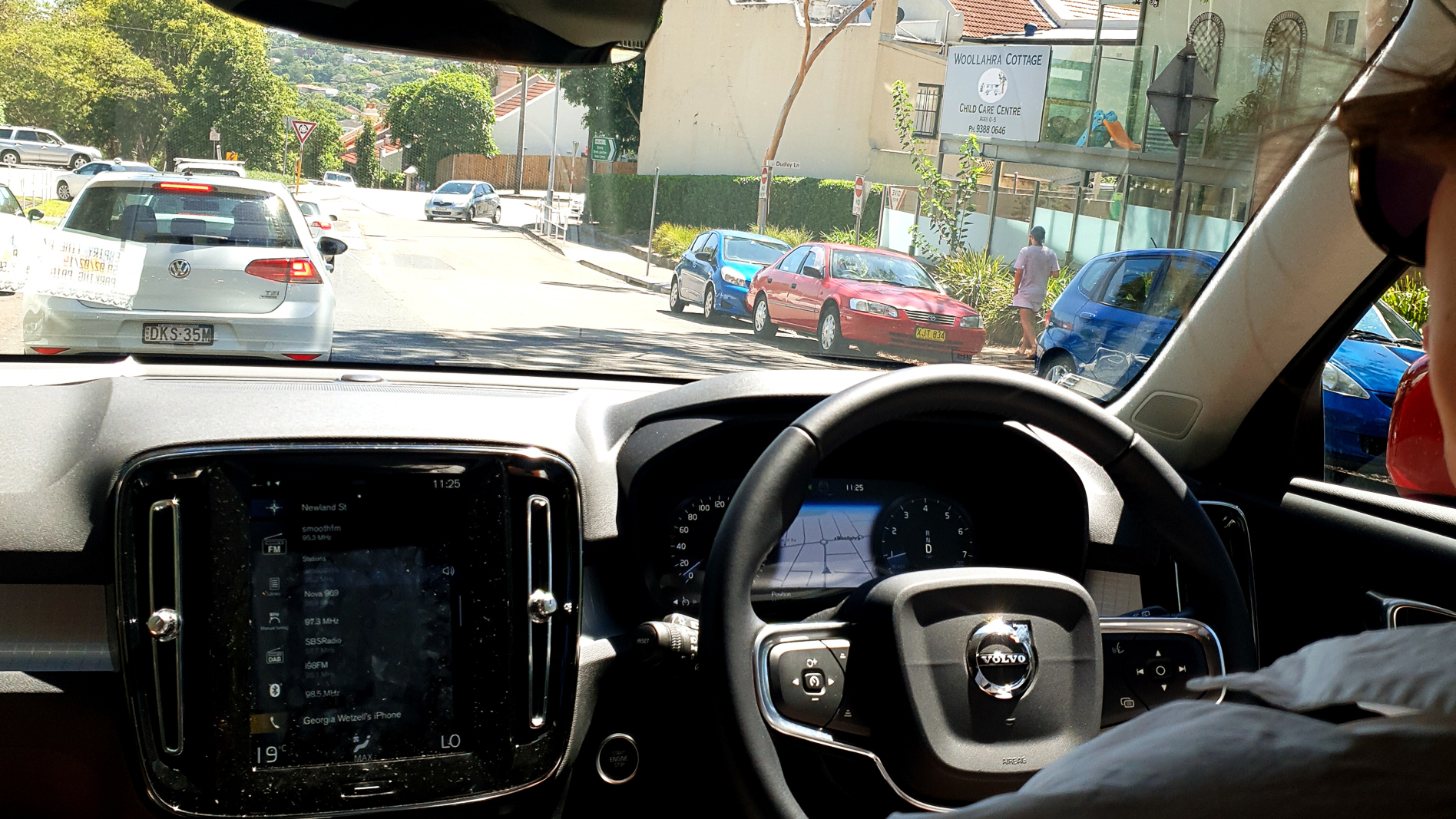
Size-wise, the XC40 nails an unexpected sweet spot because it is bigger than many small SUVs but smaller than some in the next category up. It has plenty of room for four adults and some luggage but never feels big or cumbersome to drive.
In fact the XC40 T5’s turbocharged engine almost makes this SUV feel like a sports car in a straight line. It’s got plenty of get up and go, which comes in handy in daily driving, and especially merging onto freeways.
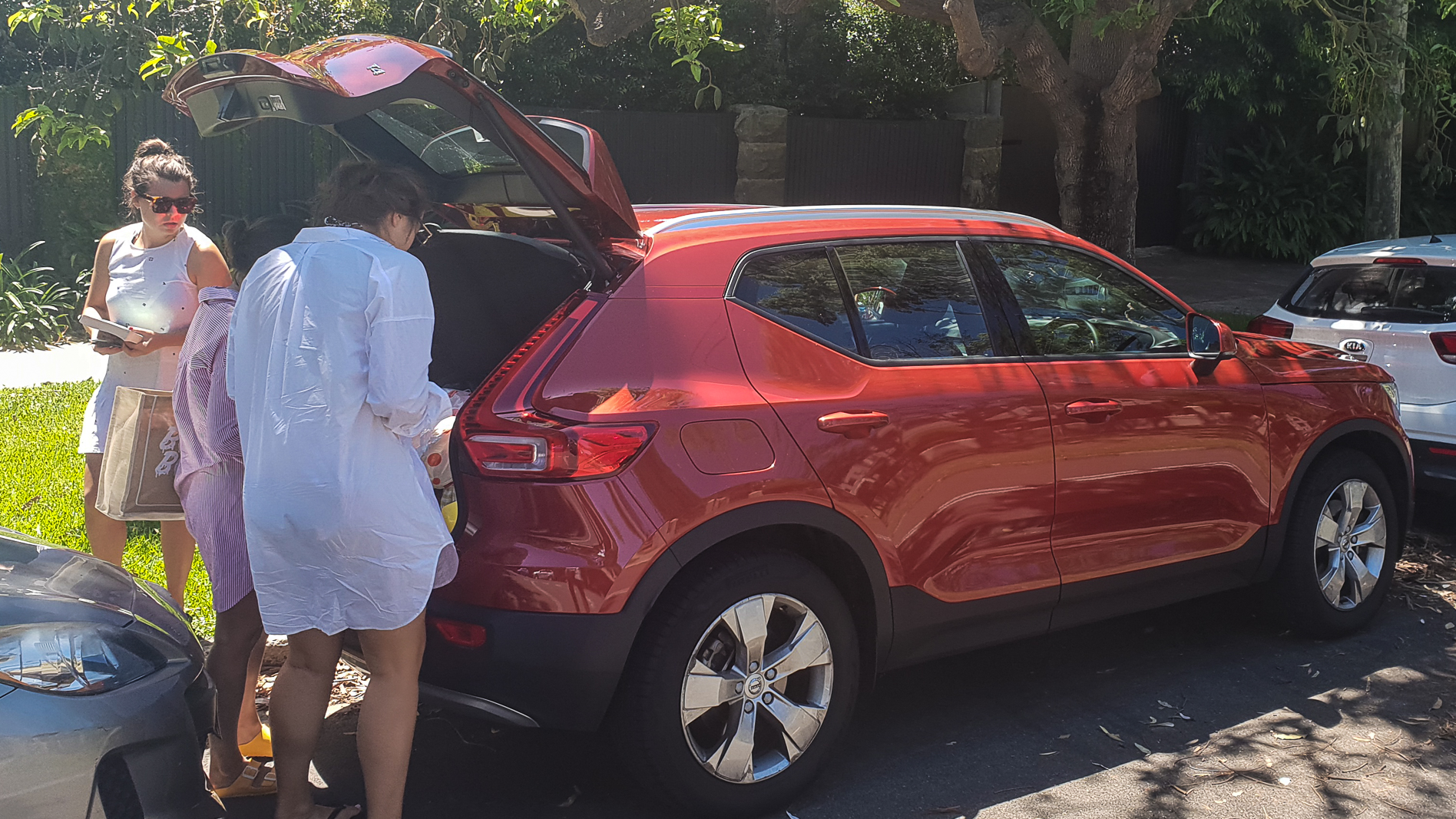
If you’re like me and you enjoy driving a car that knows how to handle itself, then you’ll find the XC40 endearing. It combines a surprisingly supple ride with good dynamics and body control. That may sound like enthusiast talk, but a car’s dynamic abilities can be very important when you have to swerve suddenly, or act quickly. Those quick reflexes can make a big difference when a car in front stops suddenly, or a pedestrian foolishly steps onto the road in front.
Inside, the Volvo XC40 is an absolute delight. The sculpted front seats provide excellent support on long trips
All in all, as first impressions go, the Volvo XC40 makes a good one and we can’t wait to get to know the car better over the coming weeks./Kate Hood
Week 3 – road-tripping
We really put the Volvo XC40 to the test this week. A couple of runs to the airport with luggage in the back tested its carrying capacity, as did a weekend jaunt to the Hunter Valley. All passengers reported having plenty of legroom and headroom, even in the second row, and under thigh support meant none of us suffered dead legs after a few hours in the saddle.
On these longer journeys the cabin’s quietness impressed, as did its ability to isolate us from road rumble, even on coarse chip roads. Despite the XC40 T5 wearing bigger 19inch tyres, the ride is supple and comfortable, too.
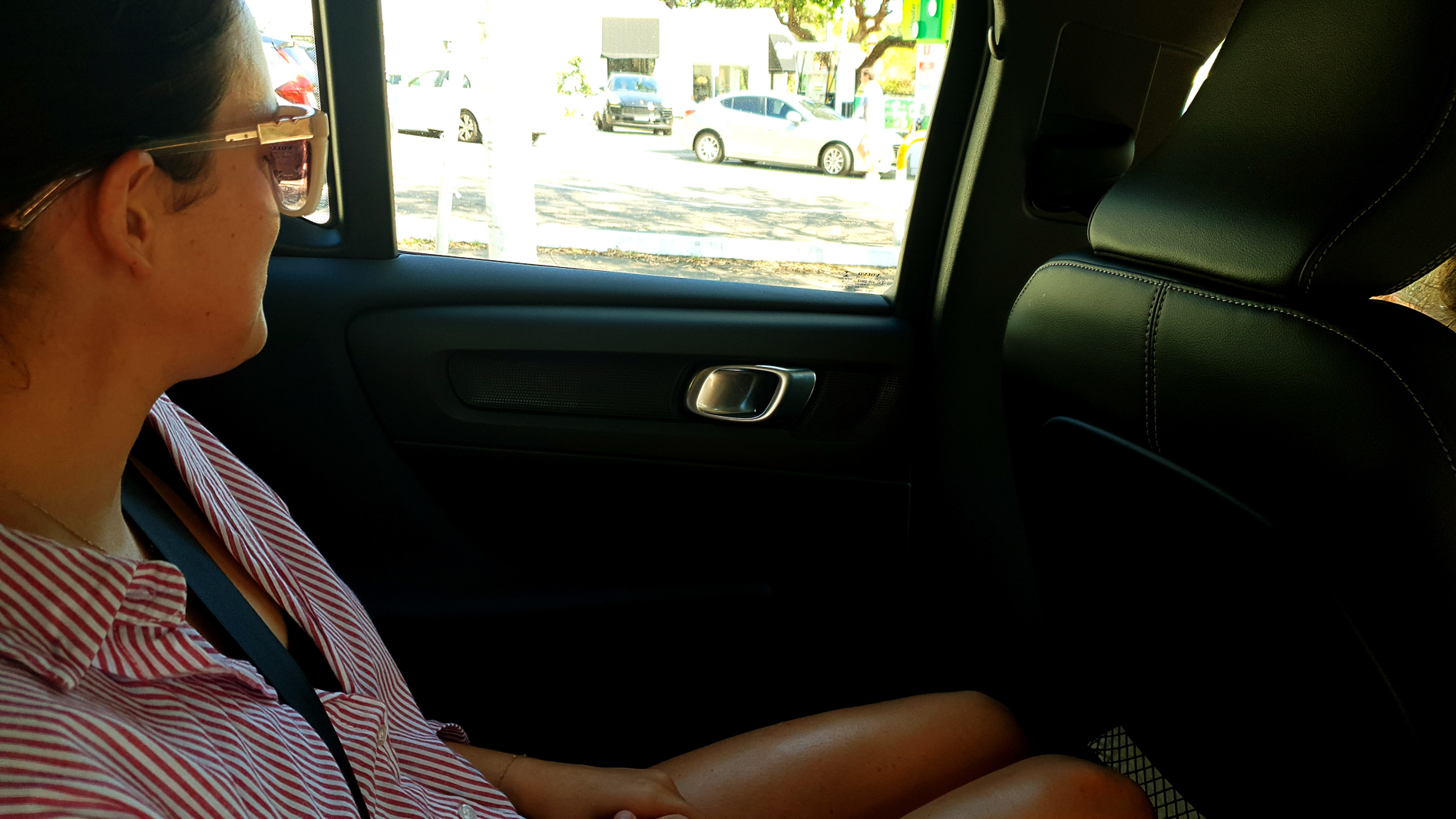
But the biggest hit on these long drives came thanks to the premium sound system. Not just the sound quality – although that is commendable – but also the XC40’s party trick: the Infotainment system.
Imagine if you will a massive Apple iPad mounted portrait-style in the centre of the dashboard. This controls everything – and I mean everything – from the multi-zone climate control to the aforementioned sound system, satnav and other convenience features. It works largely like an iPad too, reacting to finger swipes and taps to give you detailed control over all the car’s many complex system simply and effectively.
It can be hard to find things initially, but we quickly got used to it and now can’t imagine going back to old-fashioned dials and buttons!
Well done Volvo – this feature alone makes the XC40 stand out from the crowd.
Inside, the Volvo XC40 is an absolute delight. The sculpted front seats provide excellent support on long trips
All in all, as first impressions go, the Volvo XC40 makes a good one and we can’t wait to get to know the car better over the coming weeks./Kate Hood
Week 5 – A fresh new perspective after a week apart
I’ve been travelling interstate for the last week and driving rental cars, so I found it quite interesting to dive back into the XC40. The first thing that struck me was how clean the dashboard layout is, and that’s because most of the car’s comfort functions are controlled by the large portrait digital touchscreen display.
Upon swiping through the numerous screens it becomes very obvious (well it did for me) how user friendly it is. Connecting my phone to the media centre is quick and easy, and climate control is all a touch of a finger with separate controls for passengers.
A swipe further and all the car safety commands are on display. From here it is just a matter of selecting which ones I want on or off: park assist, collision alerts and a variety of others to keep me safe and separate from nearby obstacles.
I must admit after a few weeks with them all on, and the constant alerts thrown at me I was tempted to turn some of them off. But it’s fair to say these had saved me many potentially embarrassing (curbed alloy wheels) and sometimes dangerous situations, especially unsighted cyclists or fast-moving cars.
We’ve been driving the XC40 for a while now, and I’m pleasantly surprised by the vehicle’s economical 2.0-litre turbocharged engine. I’m getting around two weeks out of an $80 tank, with most of the driving being my 30km commute to and from work. There is the odd weekend drive to a friend’s place or out into the country, but again the Volvo proves quite affordable on the hip pocket.
The Volvo’s credentials as a distance traveller are strong. It’s easy to handle in cruise mode and very comfortable on the open road. The engine’s definitely got the legs to lope along, and the power to overtake when I need.
Week 7 – Deflating experience
What did we do before the humble tyre pressure monitor was invented? Drive around with a deflating tyre, presumably, degrading our car’s performance and handling, and its ability to grip around corners or under brakes. Sometimes dangerously so.
It’s a law of the universe that flat tyres happen at the worst possible time. So it was with us, heading north out of Sydney on a weekend away when the XC40’s tyre pressure monitor notified us of a problem as we pulled up to lunch.
The reason for the Volvo’s alert became obvious when I looked at the front left tyre and found a large screw where it shouldn’t have been.
With an hour still to go on our journey, we put it to a vote and made a committee decision to cautiously continue of our journey into town on the injured tyre after reinflating it at a service station.
And there we began to heal our flat tyre.
First step was to unload the boot and get the space saver spare tyre out. We were impressed that Volvo had included a pair of gloves in the tyre changing kit. No more greasy hands!
We found the jacking point and jacked the car up, remembering to start undoing the wheelnuts before the tyre totally lost contact with the tarmac. Then it was a simple case of removing the wounded tyre and replacing it with the skinny spare.
Conveniently, the bigger flat tyre fitted just fine into the underfloor cavity where we’d found the space saver, so we were able to repack our luggage without inconvenience.
Less pleasing was the return journey to Sydney a day later, all the way at just 80km/h. But when we got back, our flat tyre was repaired for just $40, reinflated and returned to duty.
In hindsight, the weekend would have been a disaster had Volvo not offered a spare tyre of any kind. As it was the space saver got us through without interrupting our weekend much – apart from making it a longer, slower trip home. We’ll take that – and the tyre-changing gloves – as a win.
Just 12 months before the unveiling of the next-gen Subaru Liberty, STI has produced its swan-song of the current flagship four-door. The S402 is the creation of Subaru legend Hideharu Tatsumi — the brand’s chief engineer and test driver for the last two decades.
This review was originally published in MOTOR’s September 2008 issue
To ensure the S402 was a success, Tatsumi tested it extensively at the Nürburgring, “otherwise Japanese enthusiasts wouldn’t have given the car any street cred,” he says.
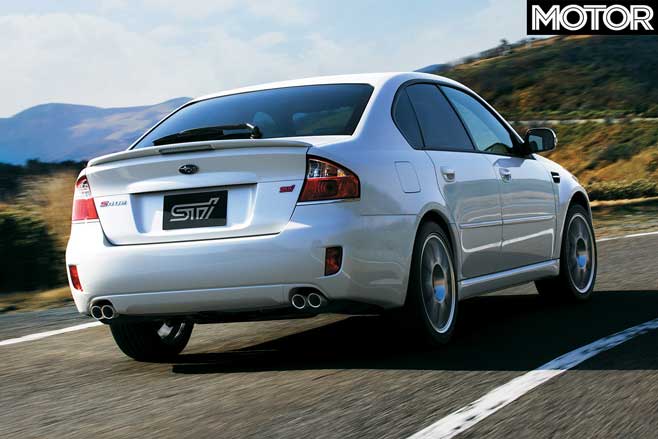
There’s a unique mesh grille, flared front guards and wider 18-inch Bridgestone-clad BBS rims, but it’s the hardware lurking beneath that really impresses.
The 2.5-litre flat-four is force-fed via a twin-scroll turbo with more boost, a tweaked ECU and a sports exhaust. It sees only modest rises over the existing 2.5 turbo — 210kW at 5600rpm and 392Nm at 2000-4800rpm. But driveability is the real winner, as gleaned from the fat torque curve. The engine delivers 95 percent of its peak twist at just 1800rpm and keeps pulling hard right up to 6000rpm.
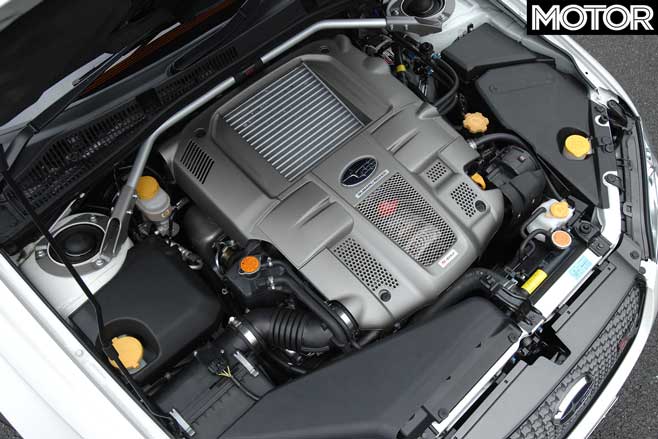
The S402’s boxer is mated to the Impreza STi’s six-speed manual, which is packed with a set of revised ratios. The increased torque spread and closer gearing allows drivers to take second-gear corners in third. And the end acceleration result is surprisingly quick — the S402 gets to 100km/h in a claimed five-dead.
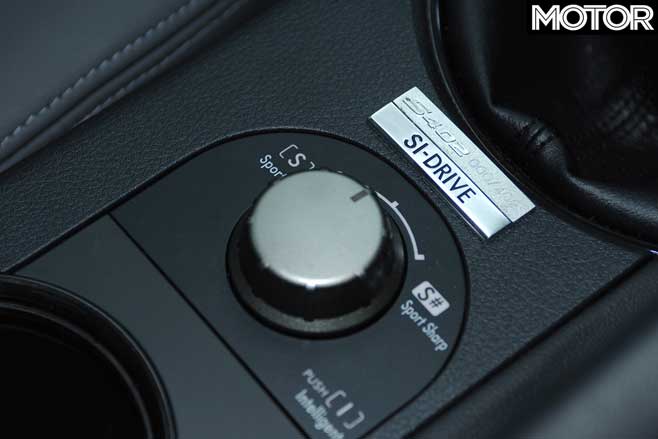
As with other Subarus, the S402 comes standard with Subaru’s SI-Drive, and again, Sport Sharp is the only mode to select for spirited driving. It delivers instant throttle response which is consistent with the rest of the S402’s controls.
The steering ratio has been shortened from 15:1 to 13:1 for quicker turn-in, and matched to revised STI-tuned dampers and springs. The S402 also packs a couple of secret weapons — in the form of specially-designed strut braces — that aid precise body control through the twisties. The braces have a flexible mid-section that allows some absorbency during initial weight transfer when cornering, while still adding to the S402’s structural integrity.
The end result is almost an elimination of understeer. This car goes exactly where you want it to and keeps all four tyres firmly planted on the road. The overall chassis set-up delivers excellent feedback, too. It’s just a pity that the S402’s soft-leather seats don’t quite offer the side support you need when carving through fast bends.
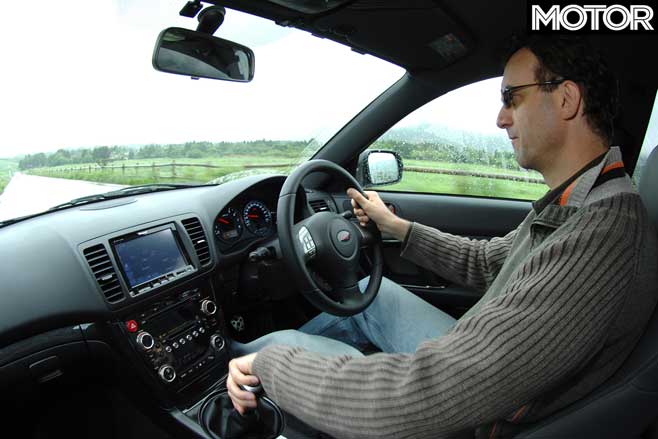
But the brakes — Brembo six-pistons up front, two at the back — are phenomenal. They have progressive feel, don’t fade, and afford serious retardation — allowing you to brake deep into corners. Road manners are nothing short of sensational, with effortless acceleration, precise cornering, exceptional grip and strong brakes.
Not surprisingly, Japan will once again keep this cracking drive to itself. But isn’t this hot Legacy the sort of tonic Subaru Oz needs right now?
2008 SUBARU LEGACY STI S402 SPECS Engine: 2457cc flat 4, DOHC, 16v, turbo Power: 210kW @ 5600rpm Torque: 392Nm @ 2000-4800rpm Weight: 1490kg 0-100km/h: 5.0sec (claimed) Price: ¥5.355million/AU$51,990 (Japan only)
Like: Superb brakes; excellent throttle response; handling Dislike: Seats need more side support; modest exterior changes
In the darkest corner of the Emilia Romagna region of Northern Italy, out of sight of Wolfsburg’s prying eyes, Lamborghini chief designer Mitja Borkert and senior engineer Rouven Mohr created a secret project codenamed Sterrato.
The most extreme concept prepared in the Sant’Agata skunkworks since the single-seater Egoista, this Huracan-based car taps the bloodline of the Dakar-winning Porsche 959 and the Group B Audi S1 WRC weapon.
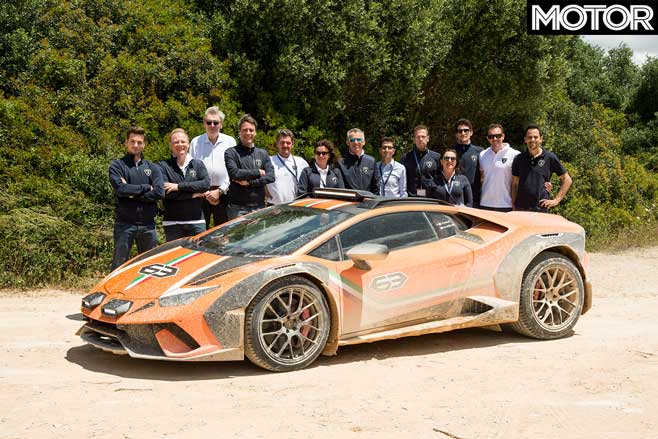
Although described as a one-off thought balloon by its creators, who underplay their guerrilla projects under the tight-fisted regime of the Volkswagen Group, the Sterrato (Italian for dirt road) has in fact been pencilled in as a limited-edition model due in 2021.
In order to try out the sole running prototype, we’re at the awesome Nardo handling track owned and run by Porsche, the temperature is a friendly 23 degrees, and the circuit is ours for the day, including the challenging Strada Blanca off-road course.
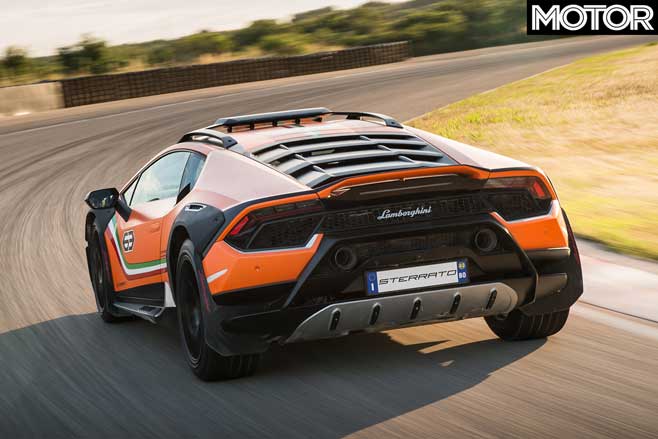
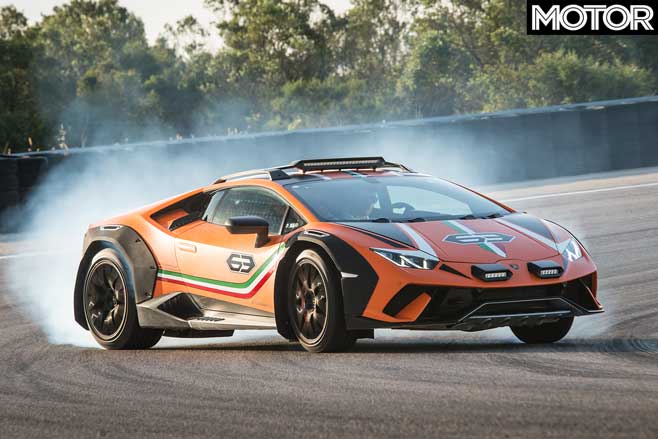
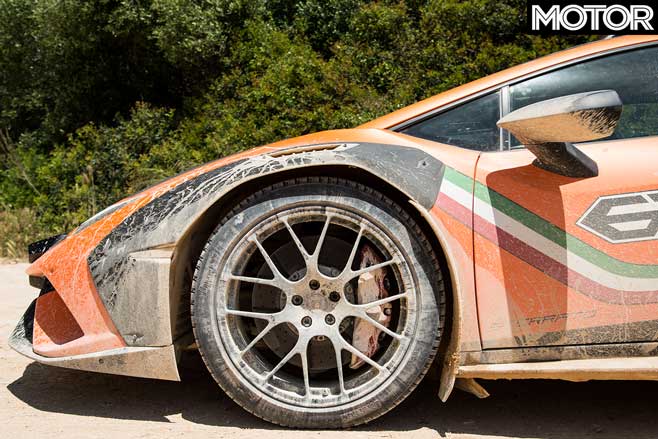
The Sterrato looks and feels like a Huracán that has been gene-manipulated for the World Rallycross Championship. It sits 47mm higher than the rest of the range, its track is 30mm wider front and rear, the front spoiler has a stiffer upper lip and a receding chin, the rear departure angle is increased for extra clearance, but the tread pattern of the bespoke softer-sidewall tyres looks more race than rally.
It’s undoubtedly an oddball concoction of style, stance, substance and seriousness. But this showpiece – boasting the number 63, the year Lamborghini was founded – turns more heads than a white tiger slurping iced coffee in a local gelateria. It sounds captivating, and with all lights blazing it could be mistaken for some sort of bizarre vehicle built to withstand a zombie apocalypse.
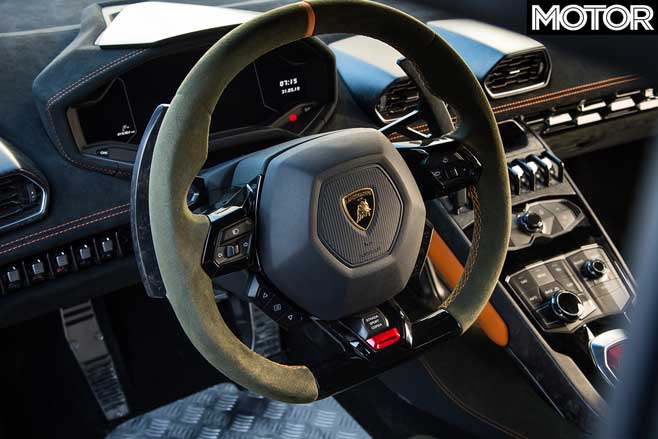
Climbing behind the wheel is easy thanks to the wide-opening scissor door and elevated ride height. The cool multi-material bucket seats could have come straight out of Kanye West’s Yeezy factory, the five-point harness scores nine out of ten on the bondage chart for private parts, and the driver environment looks familiar despite all the colourful new surface trim.
To compensate its weight, drag and suspension set-up handicaps, the stilted soft-roader is fitted with the 477kW V10 out of the no-holds-barred Performante. The normally aspirated 5.2-litre engine works all four wheels through a quick-shifting seven-speed dual-clutch transmission, not the stubborn sequential ISR ’box unique to the Aventador.
The mighty direct-injection engine needs 6500rpm to tick off 600Nm of maximum torque, peak power arrives at 8000rpm, and the rev limiter is set at 8500rpm. This is a wonderful powerplant for a car dedicated to inveterate late-brakers and apex-clippers, but does it also perform to expectation in this softer-sprung, stacked, go-anywhere metamorphosis?
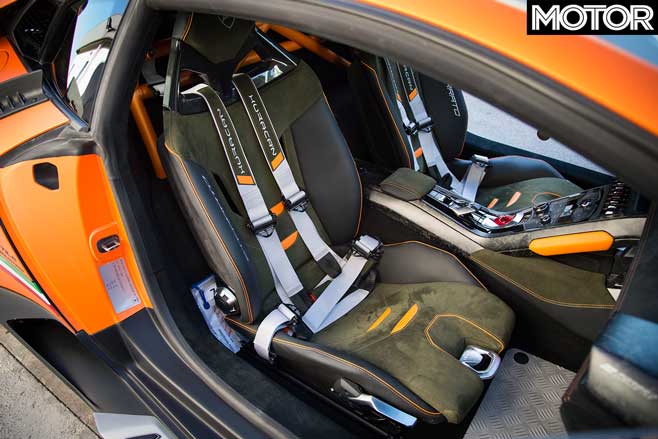
We do two laps in Corsa mode, then ESP comes off and, sure enough, from one instant to the next the orange stripemobile begins to catch insects with its side windows as the driver’s heartbeat quickens and the intercom squawks avanti! forza! and bravissimo! from co-driver Nicolo.
This is hard work. Over the brows, the special BBS alloys shod with hand-baked Pirellis (255/45 ZR20 front, 305/45 ZR20 rear) stretch the springs until the aluminium monocoque hurts. Through the dips, the softer dampers and cushier tyres extend the compression effect all the way to the pit of the stomach. When the radius tightens, blossoming lift-off oversteer can be coaxed into creamy slides – with enough attempts.
Drifting this wild thing in fourth gear at 120km/h certainly fixes another treasured commemorative medal to the brimming clipboard inside my head. The adrenaline floodgates open regularly on the approach to a roller-coaster off-camber uphill corner and towards the end of the fastest right-hander, where it’s all too easy to run out of road, ability or courage. Or all three.
“This is a bad place to get it wrong,” says Nicolo, before adding unhelpfully: “But while waiting for the recovery truck you can at least relish the full panoramic beauty of the Adriatic Sea…”
The fifth-generation Haldex all-wheel drive system has been carefully recalibrated for the Sterrato. On solid ground, it channels only slightly more torque to the rear wheels, but when it comes to pulling the car out of a second-gear kink, the front wheels are for three or four car lengths assigned a larger chunk of the traction work. This explains why the fun-friendly Huracán is tail-happier on the track than the Performante, yet every bit as competent as the Urus on sand and gravel.
Having said that, the different tyre compound and more compliant suspension add a metre or two to the stopping distance, which increases further in small increments as the rubber and pads get hotter.
Like the Huracán Evo, the Sterrato features LDVI (Lamborghini Dinamica Veicolo Integrale) that controls ABS, ASR and ESP, along with AWD, torque vectoring, damper setting and steering action front and rear.
On the circuit, of course, the most radical Lamborghini since the 2013 Veneno does not handle or perform like its ground-hugging stablemates, yet loses only two-tenths from 0-100km/h, which is covered in 3.1sec. Maximum speed is 303km/h compared to 327km/h for the more slippery donor model.
Although the transmission wastes no time selecting the appropriate ratios in Corsa mode, manually overriding the computer is even more rewarding, since it keeps up the flow by avoiding redundant downshifts. Third proves to be a great all-purpose weapon, fourth is the gear of choice for the two double-apex corners, fifth is a test for high-speed cornering grip, and sixth takes you all the way to the my-heart-is-in-my-boots left-hander.
Over lunch, technical chief Maurizio Reggiani talks freely about the probability of the Sterrato making it into production.
“Even though the budget is quite tight – it always is at Lamborghini – the provisional business case suggests that we can build this car at a profit,” Reggiani says. “How is this possible? By manufacturing all restyled or new body panels, claddings, ducts and splitters on 3D printers. For this purpose, we developed a lightweight synthetic material which is in its final shape bolted or screwed onto the finished body.
“The idea for this car was born here in Nardo, where we have both worlds next to each other. While the Urus is clearly more SUV than sports car, the Sterrato is a Huracán with the abilities of a crossover.”
According to the Sant’Agata grapevine, the plan is to assemble 500 to 1000 units priced at about 240,000 euro apiece – a premium of about 20 per cent over the Performante, so about AUD$580K.
Since the Huracán replacement is still five years away, Lamborghini needs one new derivative per year to steady sales of the current model. In 2020, we will therefore see the high-performance STO Supertrofeo Homologato; in 2021, the Sterrato should follow suit; for 2022, insiders predict a Huracan hybrid; and 2023 is the target launch date for the 492kW Superveloce.
A year ago, a pre-production Urus we drove was very much a used car once it emerged from Nardo’s ‘white hell’ – paved with stones, rocks, pebbles and 37 different grades of sand and gravel – so the afternoon did not bode well for the much more vulnerable Sterrato. But we were told not to worry. “It can take quite a bit of abuse, and I guarantee that it will make your next outing a very enjoyable one,” said technical director Carlo Della Casa, who has joined Lamborghini from McLaren.
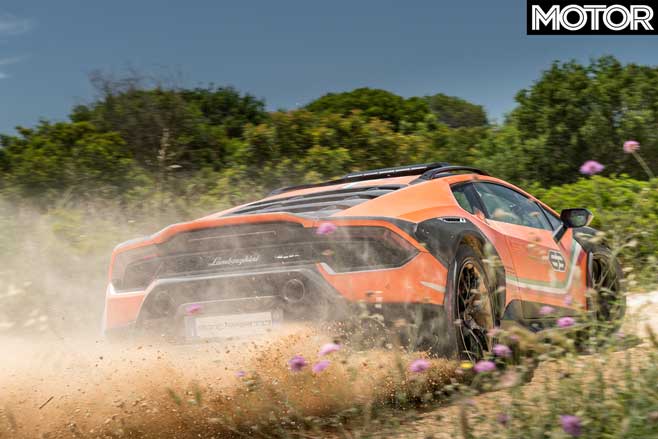
After only one familiarisation lap, it’s go-go-go with ESP off, eyes wide open and heart in throat. The ka-runch suspension is not height-adjustable, but we had spotted a pair of token underbody protection panels, and there is allegedly a solid skid plate to shield the driveline.
Conspicuous by its absence is an in-between mode to bridge Corsa and ESP off, and at the end of the wet section the allegedly self-cleaning tyres look like F1 slicks caked with hot mud.
One hour later, they need a blowtorch to remove me from the cockpit – just like my first drive in the Ferrari Enzo at Fiorano. Yes, it’s that special an experience.
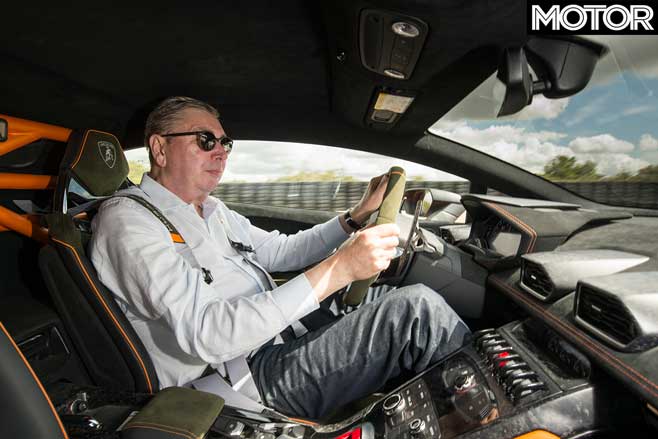
The Sterrato is an intoxicating, hilarious device. It shaves third-gear brows like a buzzard on the final approach to its prey, dives into dips like an angry rhino chasing the most hated gamekeeper, and corners with all the tippy-toed eagerness of a frolicking antelope.
On the loose stuff, power-on equals snap-oversteer, one quick zig-zag pendulum manoeuvre sets the car up before it enters a bend, and storming out of one radius and roaring towards the next fantastically shifts the momentum briefly, but reliably, to the front wheels. But it takes a lot of confidence (or the encouragement of a seasoned co-driver) to keep the foot planted for that vital rear-to-front torque transfer, which makes all the difference.
It’s goosebump stuff on lap two, makes you feel like a hero on lap three, chips a morsel off the left-rear wheel spat on lap four, becomes totally addictive (and bin-it territory) from lap five onwards.
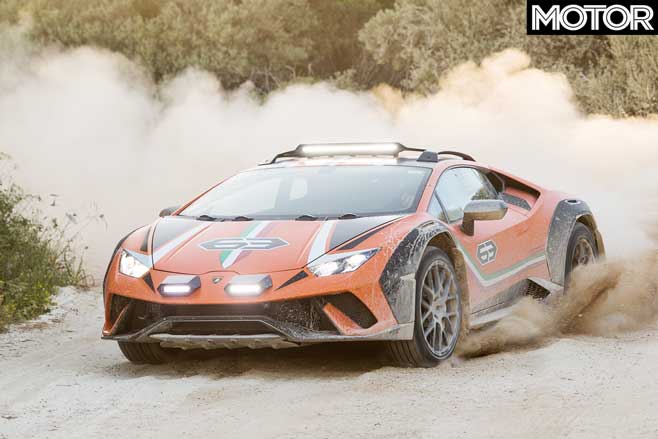
Coated with mother earth’s finest powder, sprinkled with Puglia’s darkest soil and proudly displaying several gorse-inflicted battle scars, the Sterrato suddenly looks like a motocross rider who has mastered the famous Erzbergrodeo. Watching this unicorn Huracán gallop sideways through the green-and-beige Jurassic pleasure park is unforgettable, it steaming around the handling track trailing a whiff of blue tyre smoke while the two rows of LEDs stage a super-cool light show.
Am I getting carried away by the child inside? Perhaps so. But the Sterrato hits a bull’s eye in more ways than one. It is even more playful than its siblings, and the mere prospect of enjoying a long cold winter in a hardcore sports car is bound to make quite a few Lambophiles reach for their chequebooks.
The only evident downsides concern the durability of those somewhat coarse add-on flaps and flares; the spiderweb roll cage and armadillo rear window cover that mess up rearward vision; the steam-hammer noise level; and the puerile roof rack for skis and surfboards that does little more than squeeze the lifestyle gland of easy-to-please social influencers.
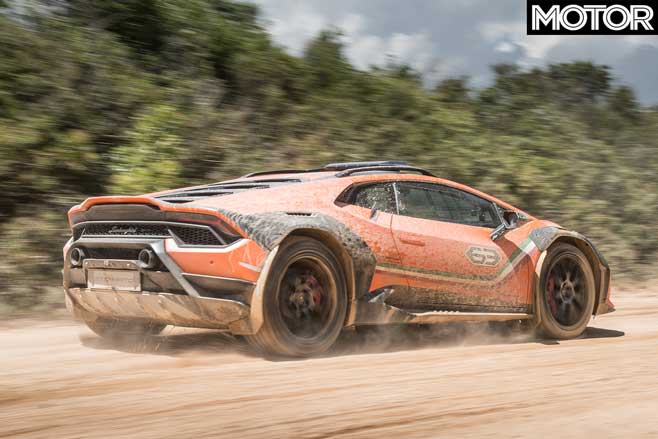
The Sterrato’s future is far from certain, however, with no shortage of sceptics and naysayers. At this point, Lamborghini is still a satellite of Audi, but the long rumoured transfer to Porsche should help the Lambo folks get a handle on their own pressing issues, which no longer include a new R8.
Under the stewardship of Porsche, they can concentrate on replacements for the Aventador (now 2021) and Huracán (now 2024), ponder a fully electric Uracco that would share its DNA with the next Cayman (983) and the proposed Audi TTE, and zoom in mid-term on a two-plus-two-seater GT loosely based on an evolution of the Porsche Taycan.
In this grand plan, the Sterrato marks a potentially rewarding step towards Lamborghini’s goal of securing a safe future. And inject a crazy genre-busting car into the supercar world.
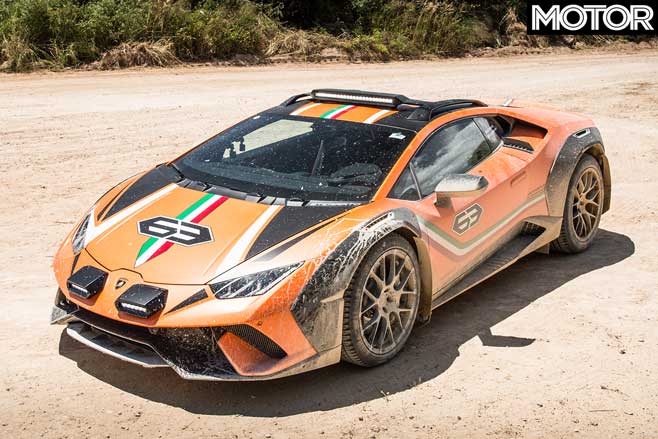
FAST FACTS Lamborghini Huracán Sterrato concept BODY: 2-door, 2-seat coupe DRIVE: all-wheel ENGINE: 5204cc V10, DOHC, 40v BORE/STROKE: 84.5 x 92.8mm COMPRESSION: 12.7:1 POWER: 477kW @ 8000rpm TORQUE: 600Nm @ 6500rpm WEIGHT: 1450kg (est) POWER-TO- WEIGHT: 328kW/tonne (est) TRANSMISSION: 7-speed dual-clutch SUSPENSION: double wishbones, coil-over dampers, anti-roll bar (f/r) STEERING: electrically assisted rack-and-pinion BRAKES: 380mm carbon-ceramic discs, 6-piston calipers (f); 356mm carbon-ceramic discs, 4-piston calipers (r) WHEELS: 20 x 10.0-inch (f); 20 x 12.0-inch (r) TYRES: Pirelli (custom made), 255/45 ZR20 (f); 305/45 ZR20 (r) PRICE: $580,000 (est)
PROS: How much fun could you have off-road? CONS: Would you take it off-road? Can they be serious? RATING: 5 out of 5 stars
The mad science behind the Sterrato
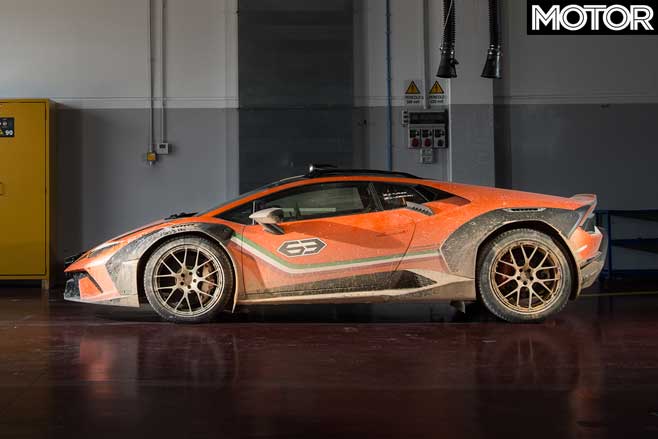
Hot Wheels meets Tonka Toy meets The Transformers. That’s what comes to mind when you first see this caricature of a coveted yet barely recognisable high-performance Lamborghini.
“They nicknamed me ‘The pleb from the East’ for a reason,” chortles head of design Mitja Borkert in his thinly disguised Berlin Wall twang. “You see, the sports car business is all about emotion these days, and that’s what the Sterrato delivers in abundance.”
But why slap on mockeries like two rows of Scalextric light bars, Bobby Car decals and Transit van wheel spats? “Because we can!” The answer rang out like a shot.
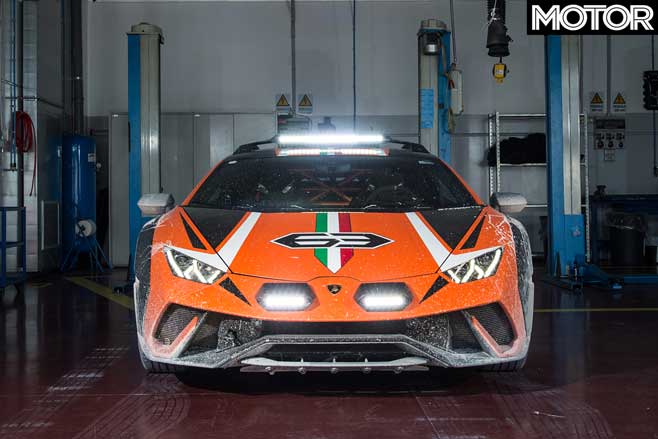
“This is a not a pimp-my-ride phoney but an admittedly polarising eye-catcher with the substance of a thoroughbred down to the last cell and fibre.
“The buyer’s wish is our command,” Borkert says. “From a laidback monochrome croisette charmer to a race-ready competition car to the ultimate winter special in matte camouflage livery, anything is possible, at a price. Lamborghini’s Ad Personam division caters to almost every whim!”
Oh dear… someone had to be that person who was the first to crash the new Chevrolet Corvette C8, didn’t they?

Vision has emerged from California overnight of one sadly second-hand and very crashed Chevrolet Corvette C8, taken in the hills around Yosemite in California.
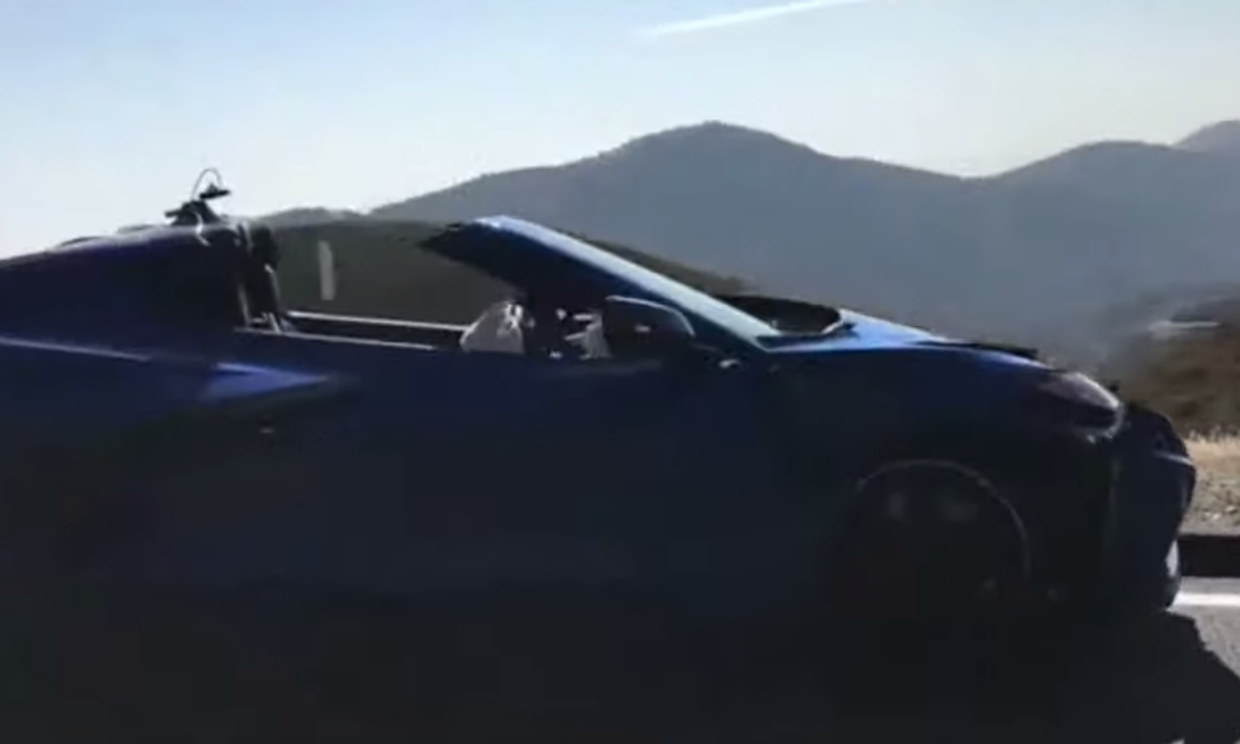
Not many details around the crash are available, but it seems that the car in question was part of a fleet of Corvettes traversing the mountainous roads around Yosemite, and that a blind corner may have been involved.
The damage is pretty substantial, indicating that the speed of the crash was quite significant.
The hardtop version of Chevy’s long-awaited mid-engined sports car dropped a couple of weeks ago, of course, and it’s been confirmed as a starter for Australia sometime in the next 12 months or so.
We’d also hazard a guess that the white Chevrolet Equinox, with its curtain airbags deployed, surrounded by a bunch of shaken people, sans a rear wheel assembly and hanging off a guardrail, is involved.

Video from YouTube shows the bent C8, hazards forlornly flashing, sporting considerable damage to the front left corner, while both driver and passenger airbags have been deployed.
If we had to hazard a guess, the Equinox has been the innocent victim of a wayward C8, which has likely crossed a centre line after carrying too much speed into a tightening corner. Left front Corvette wheel, meet rear left Equinox wheel.
Traffic, inattention, sheer bad luck… whatever caused the crash, the end result is one banged-up Corvette.
We’ll bring you more information as it comes to light. You can check out the video from Corvette Nut below.
