
A report from the United States has raised safety concerns after it discovered rideshare vehicles are subject to manufacturer recalls, including some still having the potentially deadly Takata airbags inside.
The study was conducted by Consumer Reports and looked at vehicles registered for service with Uber and Lyft in the New York City and Seattle area. These regions were specifically used as the local governments require drivers to register their vehicles and obtain an additional licence with regulators.
Drivers for Uber are recognised as private contractors and use privately owned vehicles to carry passengers for the app.
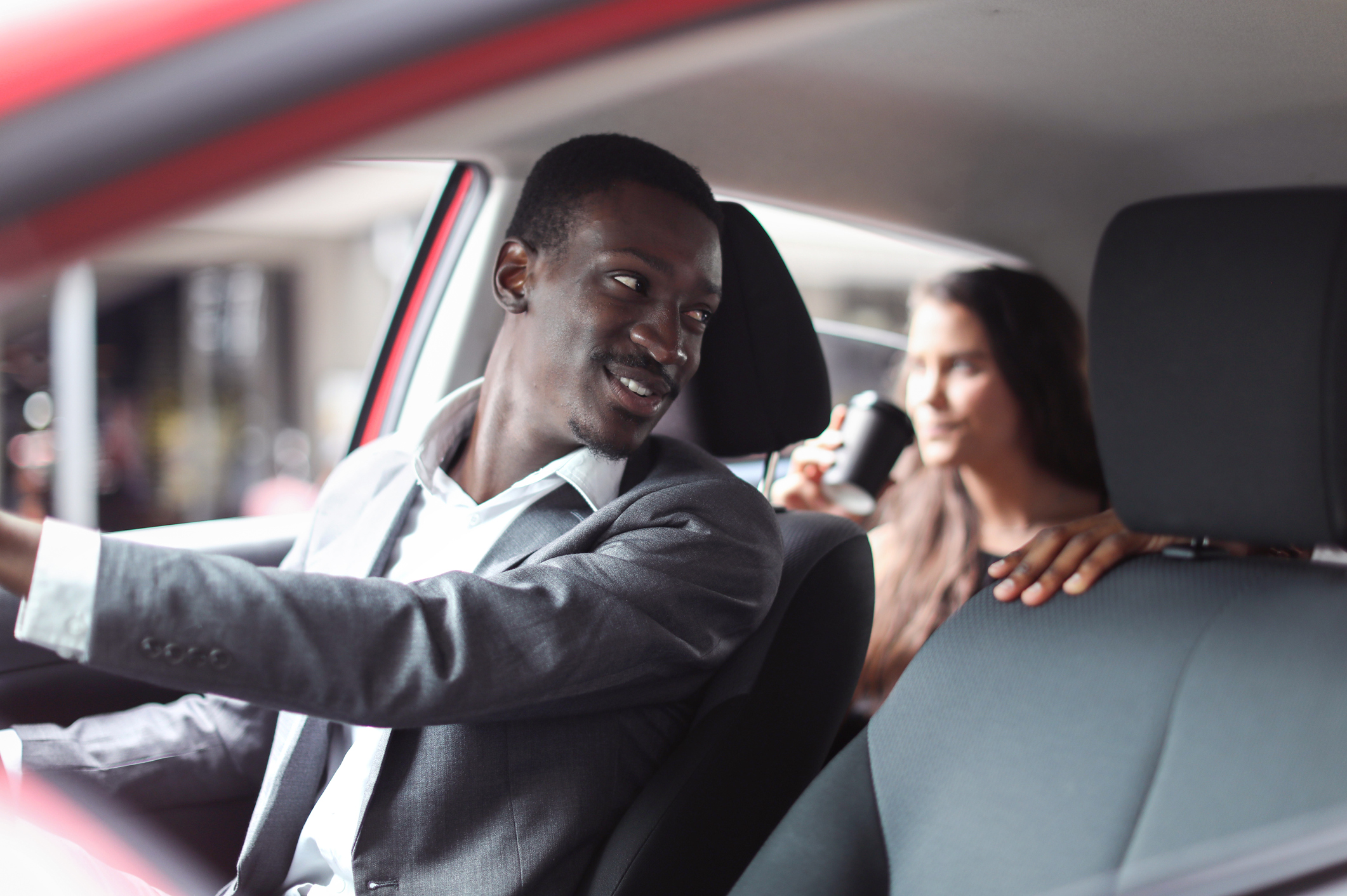
The Consumer Reports study looked at the safety records of roughly 94,000 vehicles and discovered that some vehicles had “glaring issues that pose serious risks, such as deadly Takata airbags that could hurt or kill the driver or front-seat passengers”.
In total, 15,175 (16.2 percent) of the vehicles involved in the study had one or more open safety recalls, representing about one in six vehicles in the fleet. The Takata airbag recall affected 1274 of the vehicles cited.
It was also noted that some owners had let their vehicles amass multiple recalls, with 25 vehicles having at least five or more unfixed safety issues.
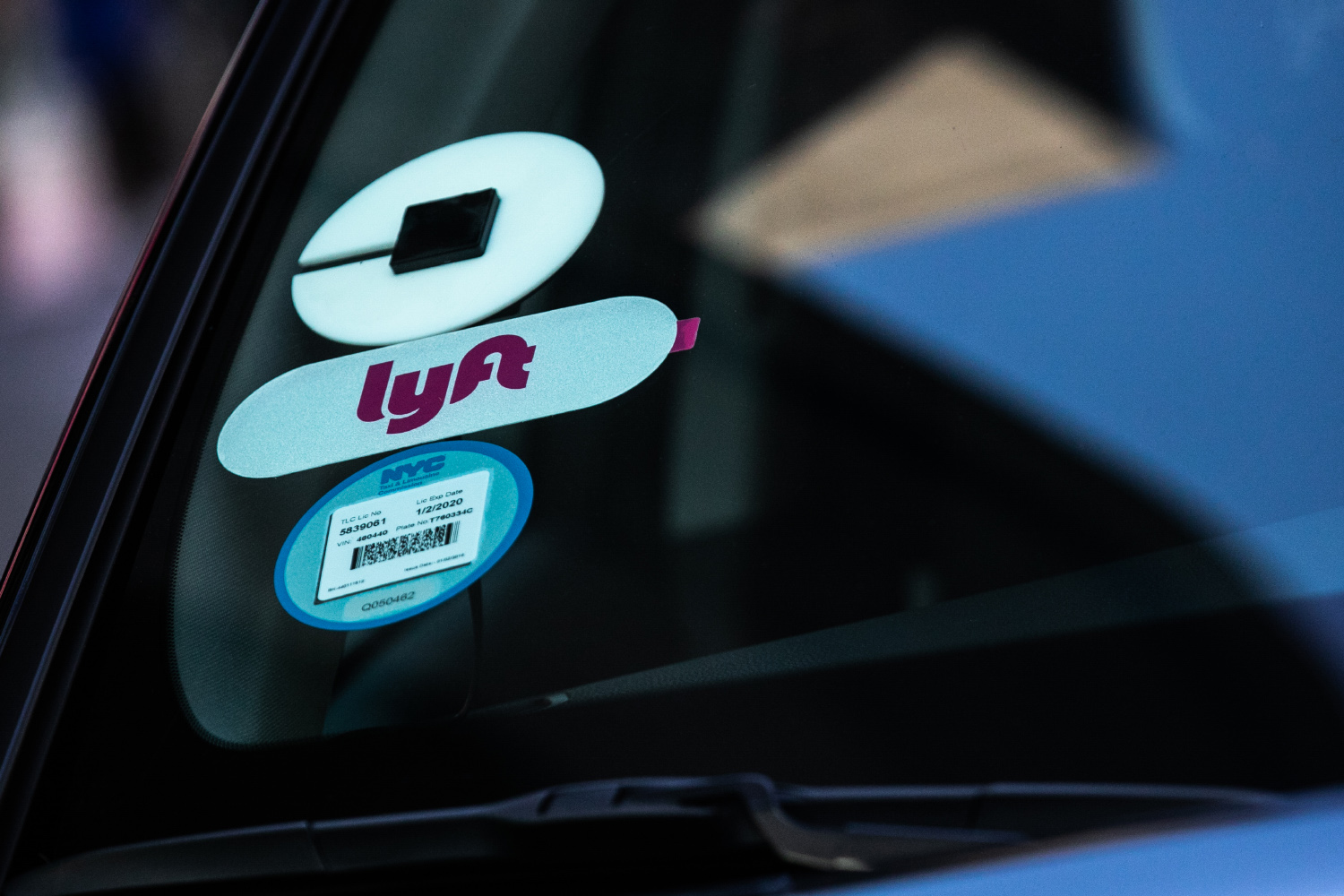
It should be noted that the rate of open safety recalls for vehicles used for Uber or Lyft “are about on par with all personal vehicles on the road” according to Consumer Reports.
Wheels contacted Uber in Australia and a number of Taxi companies for comment but did not hear back before publication.
Consumer Reports states that both Uber and Lyft have “taken a number of steps to address unfixed recalls in vehicles on their platforms,” in response to the study.
According to Consumer Reports, Uber says that in the US it, “encourages and reminds drivers to get recalls fixed, and it identifies and blocks vehicles on its platform that have some of the most dangerous open recalls, ones with “DO NOT DRIVE” warnings from the manufacturer or the National Highway Traffic Safety Administration”.
I swear Mother Nature has it in for us.
On a day when Sydney is bathed in papal-induced blue skies as the Pope preaches to the pilgrims for World Youth Day (or week), we’re sitting at Melbourne’s Calder Park staring out at horizontal rain. And we’re praying for it to stop.
This article was first published in the September 2008 issue of MOTOR.
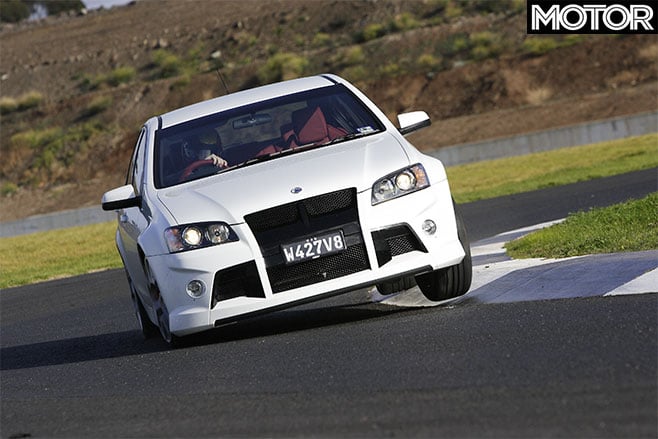
That’s because we’re also sitting there thumbing our rosary beads and gazing at the pearly white — and gloss black — gates to Australia’s automotive heaven, one of the first W427s to roll off HSV’s Clayton production line.
It’s like she’s bullying us and demanding that we repent our sins, in cahoots with the big guy who clearly demanded a sparkling week of winter warmth over the Harbour City, and compressed everything that’s grey and gloomy and sent it south of the border.
And it’s a Groundhog Day moment because Morley kick-started our wet-weather tête-à-tête with Mother Nature and the W427 a few months back when he slipped-and-slid around Winton in a ridgy-didge prototype.
See, the W427 and rain are like oil and water. They just don’t mix. HSV’s 20th birthday present to itself — and to the lucky few who are prepared to stump up $155,500 for one — is the pinnacle of Australia’s love affair with powerful muscle cars. And one best served dry.
It’s as big and bold as anything before it, and follows in the hallowed tyre tracks of legends such as the Monaro GTS 350 and Phase III Falcon GT HO. Give it a few decades and the W427 will, most likely, be just as collectable, rare, and expensive.
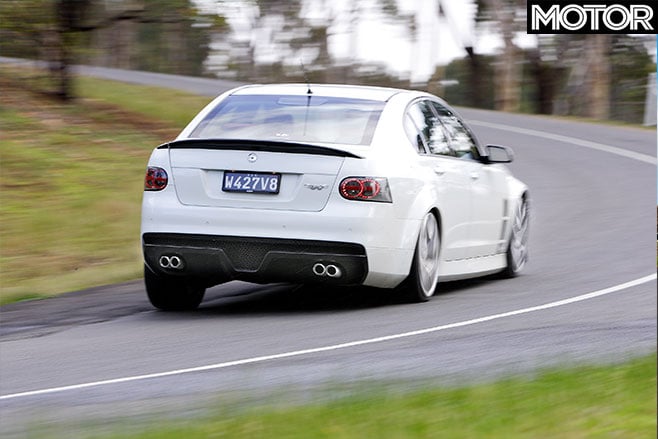
That’s precisely what HSV wants. And that, in itself, presents something of a conundrum. For all the effort HSV’s engineering team has exercised in creating this masterpiece of metal, the likelihood that most W427s aren’t going to be driven — at all — is an incredible waste.
This car is meant to be driven, and driven hard. That’s what the boffins in the engineering bunker, led by HSV chief engineer Joel Stoddart, have built it for. They haven’t scrimped on anything — at least not in the mechanical department — and they’ve created what can only be described as the greatest performance car ever conceived in this country.
The numbers alone justify that tag. It’s 7.0-litre V8 is the biggest engine to ever feature in an Australian-built sedan. It produces 375kW and 640Nm, making it the most powerful locally built production car. That much grunt also helps make it the quickest, with a claimed 0-100km/h time of 4.7sec and sub-13sec quarter-mile runs. And its final $155,500 ask trumps everything else for showroom price. The W427 has every box ticked.
So while the rain is peppering Calder’s windows at full pelt, there’s plenty of time to grill Stoddart and his troops on what’s behind the numbers.
And also why it costs so bloody much.
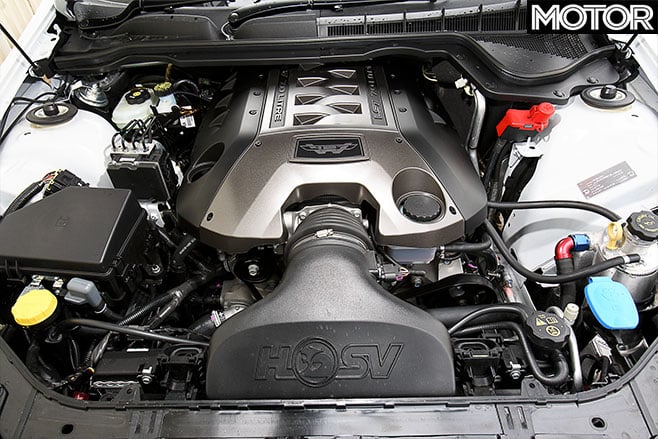
While the W427 is more than just a big donk, there’s no denying that the engine is the reason why the car exists. The all-alloy, pushrod-actuated LS7 is drafted straight out of the Z06 Corvette, making this the first Aussie production car to feature dry-sump lubrication, which Stoddart admits provided several head-scratching moments for his crew.
While the internals have remained untouched, including exotic stuff like titanium conrods and sodium-filled intake valves, the oil-delivery system has been engineered specifically for the W427, with a unique nine-litre reservoir that’s packaged neatly in front of the passenger-side wheel arch (where the airbox is located on a GTS).
Air is now fed directly into the guts of the LS7 through a tailor-made, over-the-radiator-style cold-air induction system, and there’s also a front-mounted 13-core engine oil cooler crammed inside the nose. Ceramic-coated, four-into-one exhaust extractors feed into a high-flow 3.0-inch-into-2.75-inch system (that’s more than half-an-inch larger in diameter than the system in the regular E-Series models).
And it also features bi-modal rear mufflers that, unlike the back-pressure-actuated system on the Falcon XR8, operate electronically according to engine speed and throttle inputs to open up and deliver a bellowing exhaust note.
Despite the dry-sump set-up, the LS7 is just two kilograms heavier than the 6.2-litre LS3 recently introduced in the E-Series, and sits 80mm further back in the engine bay for better weight distribution.
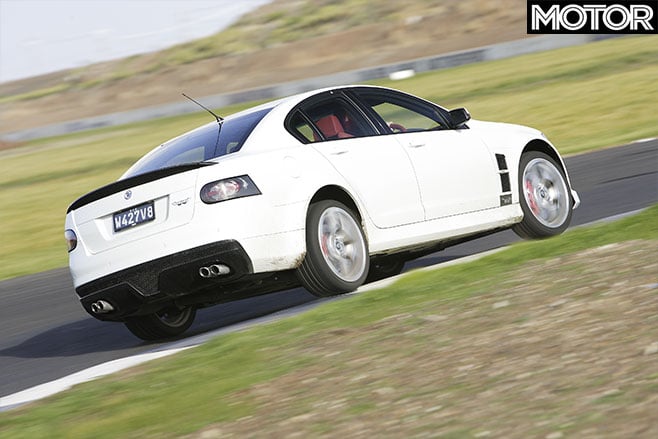
With all the hardware in place, HSV’s calibrators set out to see if they could match the ’Vette’s 377kW/637Nm outputs. While they admit the initial target was 370kW, they slowly raised the output from a “conservative” 330kW early on, through to 355kW, and finally arrived at 375kW at 6500rpm with a maximum torque figure of 640Nm at 5000rpm. Mission accomplished.
A meatier LS7 single-plate clutch has been added, which required a fair bit of reworking to the pedal assembly as well as a new actuator and master cylinder. It’s hooked up to a Tremec TR6060 six-speed manual (there won’t be an auto available) that drives a fully rebuilt high-strength limited-slip diff.
Because the entire powertrain is dropped out during the assembly process, the diff centre is shot-peened for durability and there are new bushes all round to help handle the added torque through the rear end.
While the suspension geometry is carried over from the GTS, the W427 has new linear springs that are 30-percent stiffer than standard, and the ride height has been lowered by 20mm. The Magnetic Ride Control dampers have also been re-tuned to suit the new settings.
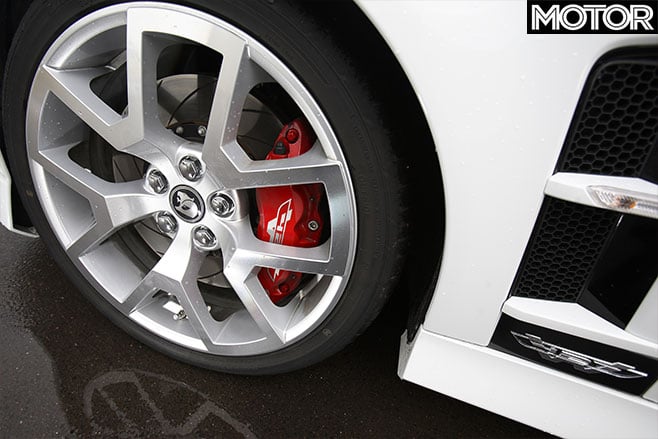
Considering the monstrous performance the W427 is capable of, there are massive 380mm two-piece floating front rotors with six-piston calipers that offer a 50-percent increase in pad area to keep things in check. And the traction control and stability-control systems have been recalibrated to work with the bigger brakes, stiffer suspension and added grunt.
Mechanically, the W427 is improved in almost every area. It has more muscle everywhere, and HSV deserves plenty of credit for both having the balls to do it, and for doing it properly.
The jury is still out on the car’s styling, however. The new front spoiler gives the W427 awesome presence, but the lack of any exclusive parts at the rear — apart from the cool, but subtle, carbonfibre lip spoiler and machined exhaust tips — doesn’t make it look that special from behind. And that is amplified in the interior.
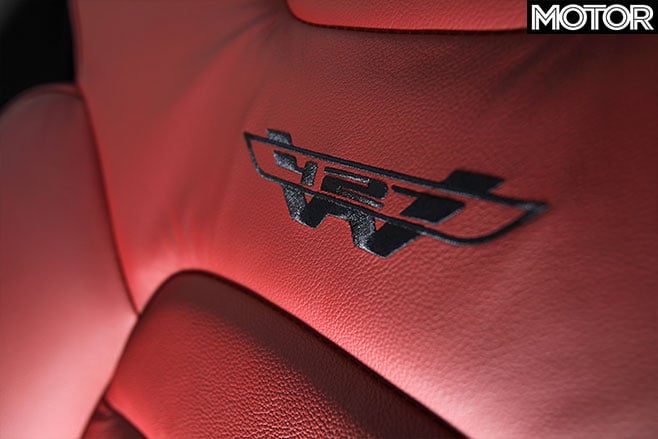
While the cabin is trimmed in red leather — and you’d better like it, because that’s all they offer — there’s nothing much else that conveys to the driver that you’ve shelled out $150K-plus on this car.
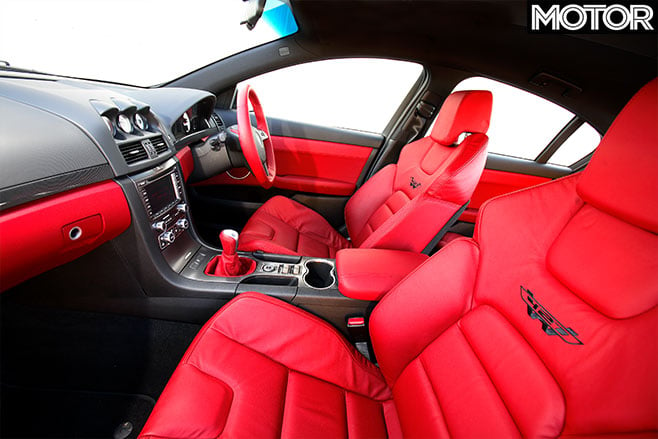
It’s all standard HSV fare. Even something as simple as adding the W427 badge to the instruments, changing the colour of the lighting or a build plaque on the glove box lid would give it some small sense of uniqueness.
And while there are only three options — sat-nav, sunroof and a rear-seat DVD system — you almost expect them to be standard, or at the very least no-cost options, in a car of this calibre. Neither is the case.
Still, it all comes back to how it drives. And, thankfully, by the time we’ve prodded and poked every last nook and cranny of the W427 and have exhaustively questioned those responsible, the clouds have parted and the howling wind has created a relatively dry line around Calder Park.
Ol‘ Mother Nature might not be so bad after all.
But that still doesn’t change the fact that Calder Park is probably better suited to ice hockey in July even when it is dry. Having not seen a V8 Supercar race for almost a decade, the track is as slippery as buggery. Almost every apex is polished like a pool ball and there are ankle-deep puddles on the exit of most corners.
It’s hardly the ideal place to crack open the fastest Aussie sedan ever built. But it could be worse — it could still be raining.
Turn the key and there’s an immediate sense of urgency about the W427 as the 7.0-litre gargles into life, its injectors firing the high-tech, hypereutectic (chemically-blended alloys in layman’s terms) pistons like cannons down the big-bore cylinders.
Give it a bootful and it spins freely with instant response, and then there’s a beautifully crafted burble of spent fuel from the exhaust on the overrun. Even standing still, this thing means business.
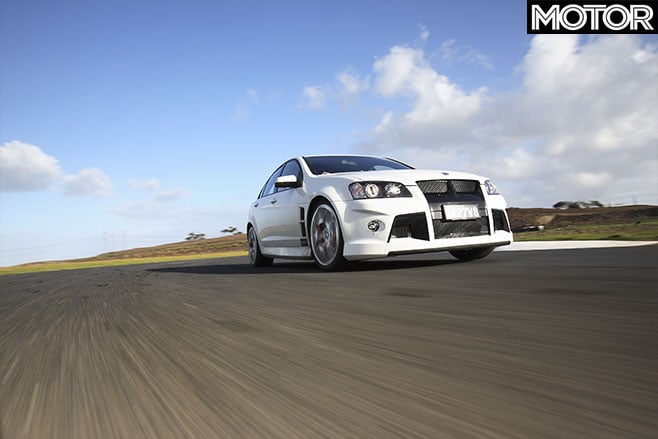
Shifting into first, there’s a noticeable improvement in the gearbox feel, with a more positive action across the synchros as the cogs engage, and one that drastically reduces the truck-like feel of the regular Clubby’s T56. The clutch engagement is better, too, with just the right amount of weight and feel.
It’s when it all gets moving that this experience really becomes special. As you sink your right foot into the firewall, the exhaust flaps open and the V8 changes its tune, transforming its tone from a guttural bellow into an orchestral wail that sings its way to the 7000rpm cut-out.
It doesn’t quite have the NASCAR soundtrack of an Audi RS4 or C63 AMG, or the techno blast of an M3 at 8000rpm, but there aren’t too many V8s that sound better.
As it hits that sweet spot above 5000rpm, where maximum torque drives the needle into the top end, there’s jumbo mumbo on tap that doesn’t fall off even as the shift alert tries to beat the engine cut-out. Actually, it feels as though the LS7’s ceiling lies well beyond the limiter.
With big power comes big speed, and luckily there are no problems retarding the W427’s pace. The brakes are phenomenally better than any other local product, with six-piston fronts and four-piston rears providing instant bite and progressive feel — as well as more-than-adequate stopping power — that is on par with any of the big-league Euro sedans HSV reckons the W427 is up against.
On the road, and at sensible speeds, it takes a couple of light stabs to get used to the immediate bite, otherwise you might find a dozy Camry driver up your freckle pretty quickly.
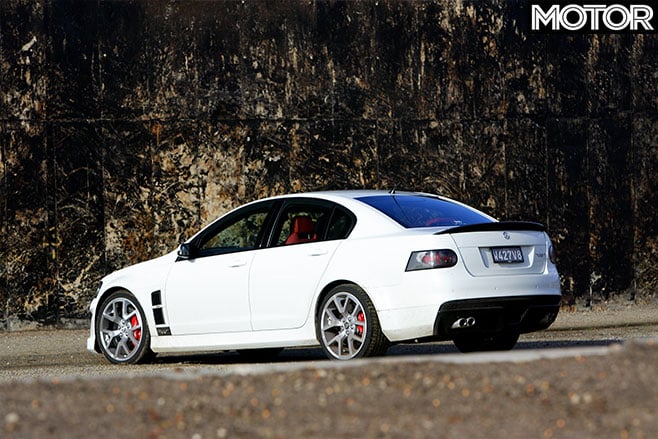
Despite Calder’s skatey surface, there’s noticeably more grip from the tweaked chassis when you tip it into a corner. It not only sits flatter than a standard Clubby, but has a more neutral balance between mild mid-corner understeer and power-down oversteer.
In fact, despite the stiffer springs, the W427 still has plenty of drive and traction out of corners and feels both smaller and more nimble than a GTS. But it can also be easily provoked into lurid and precisely controlled tyre-smoking drifts using the gobs of torque on offer right through the rev range. On our brief road loop, though, the W427 felt a bit choppy over broken surfaces.
Even the smallest potholes won’t be kind to your back, or the car.
While the slippery surface at Calder made it fun and easy to get the tail out, it was far from ideal for pulling the numbers HSV claims the W427 can clock down the quarter-mile. Starting on the drag strip section first soon showed why that wasn’t a good idea, as it walked off the line wheel-spinning all the way through third gear, and even stepping out on us in fourth gear at well over 150km/h. It was a big pucker moment.
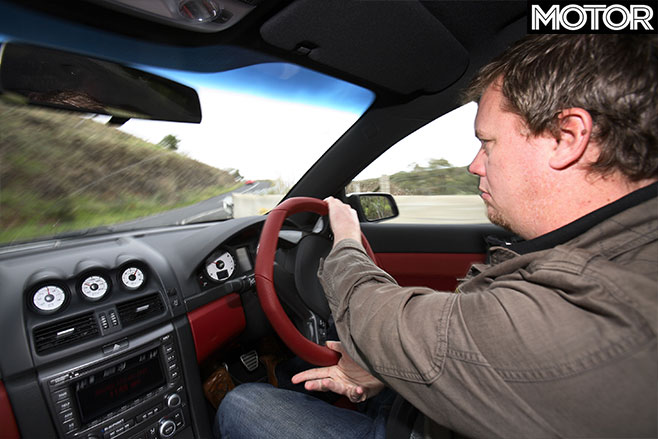
Changing directions to start on an incline up the hill wasn’t going to help the end result either, but it sure was a smarter choice. It still offered little traction for a fast launch, as evidenced by the W427 taking almost one second to hit just 20km/h, or standard Clubby territory.
But once it hooked up it shot off like a rocket, blasting into triple figures in 4.9sec on its way to a quarter-mile of 12.9 at 184.9km/h. While that’s decent in any language, there’s clearly potential for a 4.6sec and mid-12 on a better day, and a better surface. We relish giving the HSV a chance to nail quicker times in better conditions some time in the future.
But given its potential, and despite its lack of ambience, the W427 is a landmark Aussie car. It scores a spot in the hall of fame even before it hits the road, and it deserves it. It has been touted as an instant collectible, but it’s such a shame that many of the 427 units HSV plans to build will be treated as investments, and probably locked away for safe keeping.
HSV has built the W427 to be driven. It wants to be driven. And, besides, the emotional rewards of pedalling the LS7 at full song on a smooth, twisty section of blacktop should far outweigh the financial rewards of staring at it in the shed for the next two decades.
Mazda has dropped its punchy but economical twin-turbo diesel engine from its Mazda 6 line-up as part of a mild update to the mid-sized sedan and wagon range.
The 140kW/450Nm 2.2-litre SkyActiv-D had an official combined fuel economy figure of 5.3 L/100km, about 30 percent less than the 2.5-litre turbocharged petrol that effectively replaces it in the top-half of the range.
However, despite being a popular option in Australia’s biggest-selling SUV, the Mazda CX-5, the SkyActiv-D made it into just 4.2 percent of Mazda 6’s sold in Australia during the past year, with most buyers preferring petrol engines for city driving.
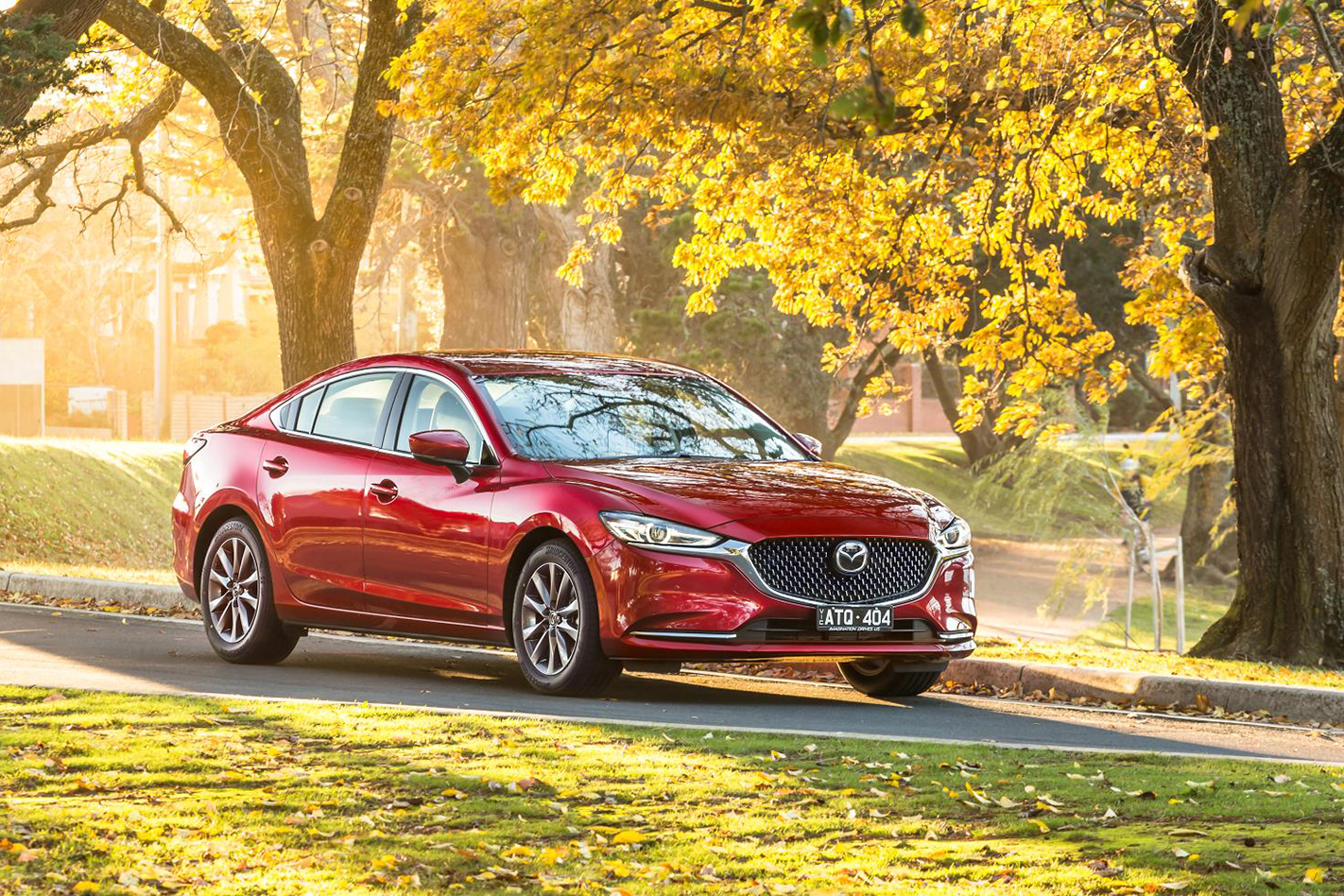
Ditching the diesel powertrain reduces the Mazda 6 line-up from 14 sedan/wagon variants to just eight, all of which gain Apple CarPlay/Android Auto smartphone pairing and tyre-pressure monitoring.
All Mazda 6s also now come with G-Vectoring Control Plus (GVC Plus), an enhanced version of the existing GVC vehicle dynamics control technology, which automatically trims power during cornering to improve grip. The new system also adds yaw moment control for better stability and composure when cornering.
They also gain a second radio antenna to prevent interference to the FM signal for clearer sound on that band.
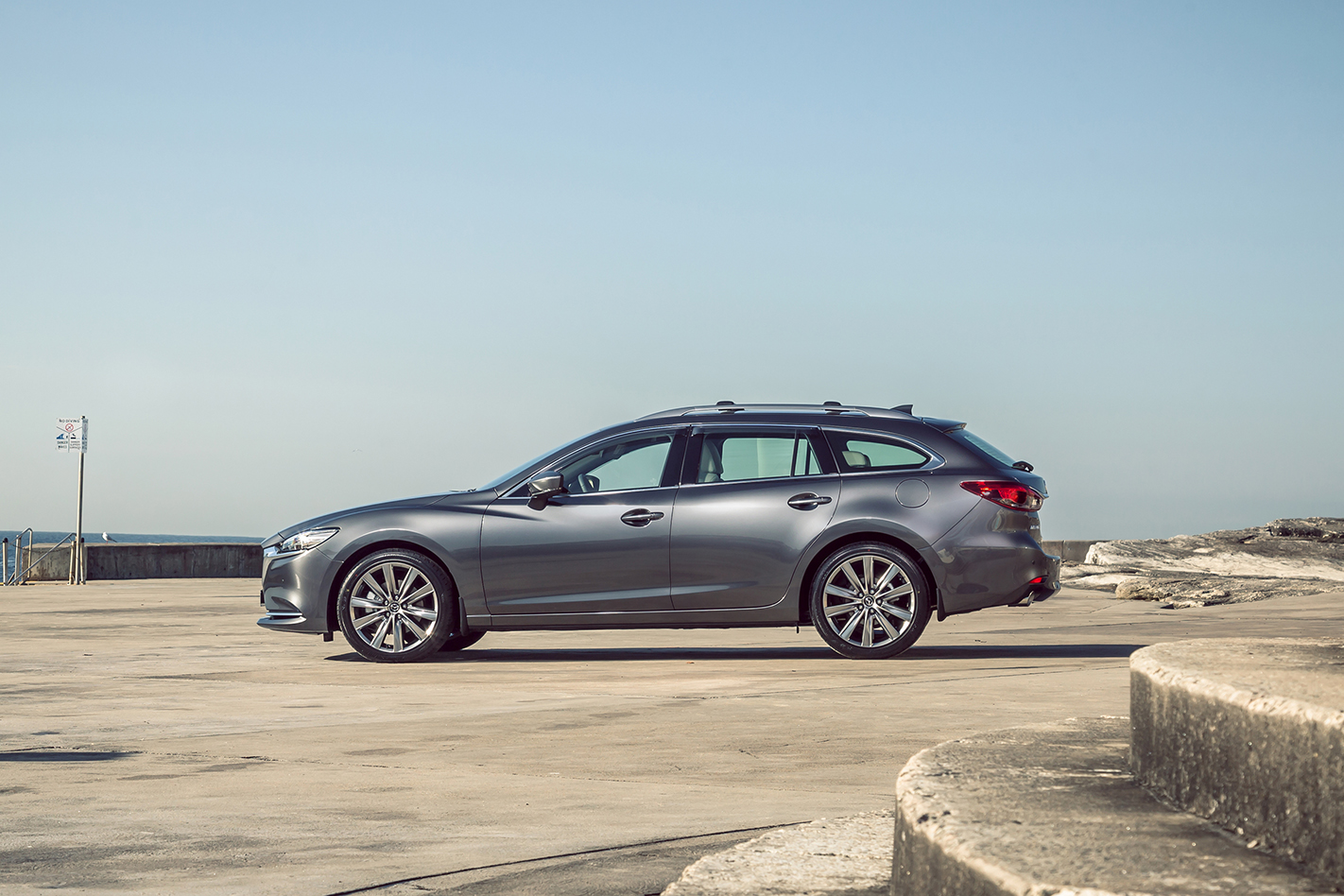
Meanwhile the range-topping Atenza spec adds a heated steering wheel to its scrolling list of creature comforts that includes heated and ventilated Nappa leather front seats.
There are no interior or exterior design changes, with the Mazda 6 still looking fresh from a significant mid-life facelift introduced in June last year.
The additions see retail pricing go up by about $1000 across the range, with the entry-level Mazda 6 Sport sedan now costing $34,490.
The updated 2019 Mazda 6 is now available in showrooms around Australia.
2019 Mazda 6 pricing
- Mazda 6 Sport 2.5L sedan – $34,490
- Mazda 6 Sport 2.5L wagon – $35,790
- Mazda 6 Touring 2.5L sedan – $38,690
- Mazda 6 Touring 2.5L wagon – $39,990
- Mazda 6 GT 2.5L turbo sedan – $45,890
- Mazda 6 GT 2.5L turbo wagon – $47,290
- Mazda 6 Atenza 2,5L turbo sedan – $49,890
- Mazda 6 Atenza 2.5L turbo wagon – $51,190
BMW’s all-new 1 Series has been officially revealed and it’s sure to divide opinion. Let’s just say it’s deviated quite a way from the established 1 Series template that we’ve become used to ever since the car first launched in 2004. In the intervening 15 years, we’ve accepted the baby BMW as a rear-drive hatch, then spawning coupe and cabriolet variants. But BMW has finally realised that a rear-drive hatchback was an outlier in this part of the market and the new 1 Series does away with the rear-drive platform altogether.
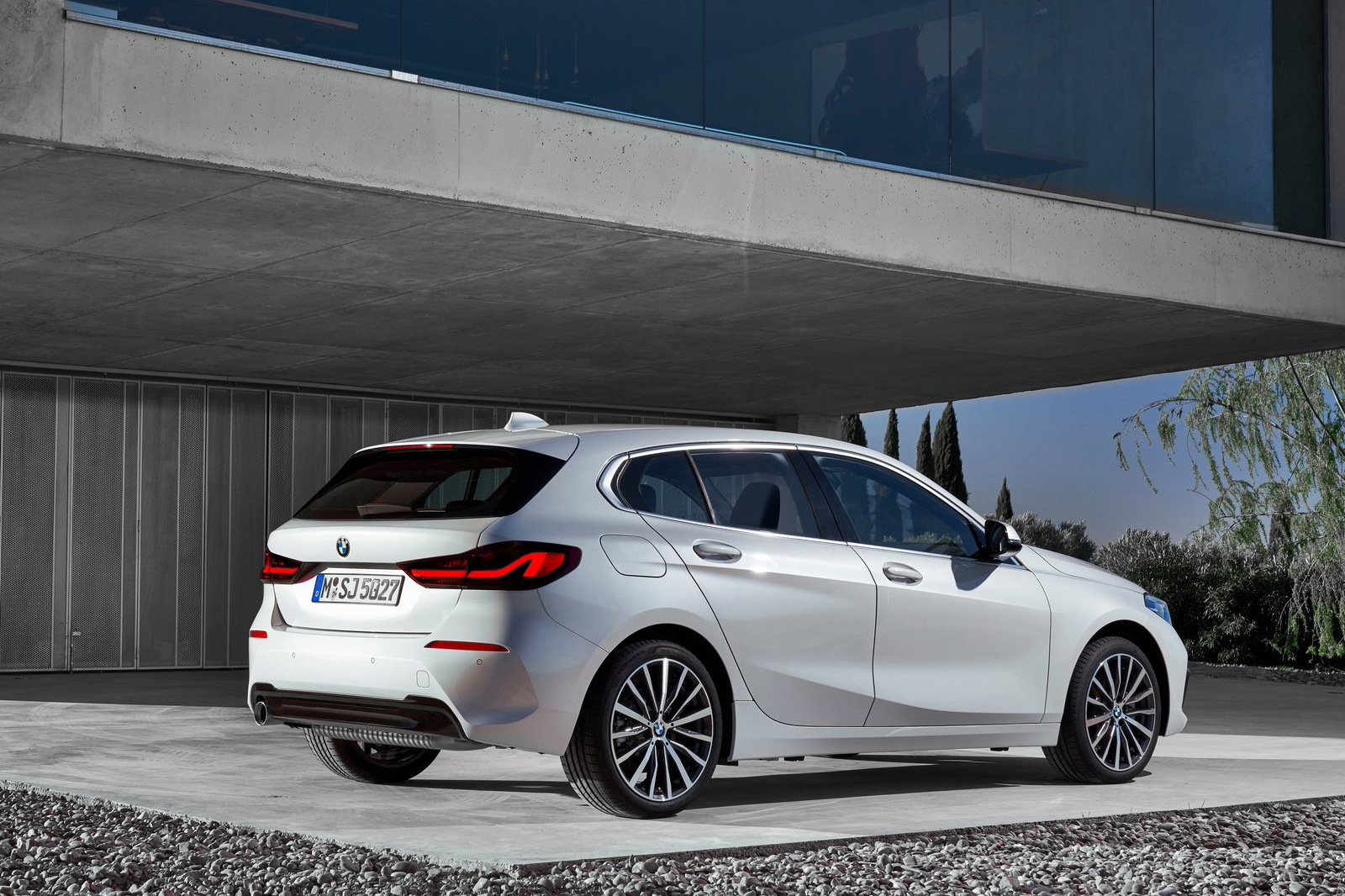
That might well be anathema to BMW traditionalists, but it’s by no means a first for the Bavarians, who have built up considerable front-wheel drive experience first with their Mini sub-brand and latterly with the 2 Series Active Tourer platform. Expect a front-drive 2 Series Gran Coupe to follow this 1 Series, although the 2 Series Coupe will retain drive to the rear.
Does it matter which end drive goes to? Not according to Holger Stauch, the 1 Series project boss. “We first talked about going front-wheel drive in 2013,” he said. “We thought about the expectation for the small cars, and we will get new customers from the extra compartment space we have opened up. Most customers can’t differentiate between front- and rear-drive anyway.”
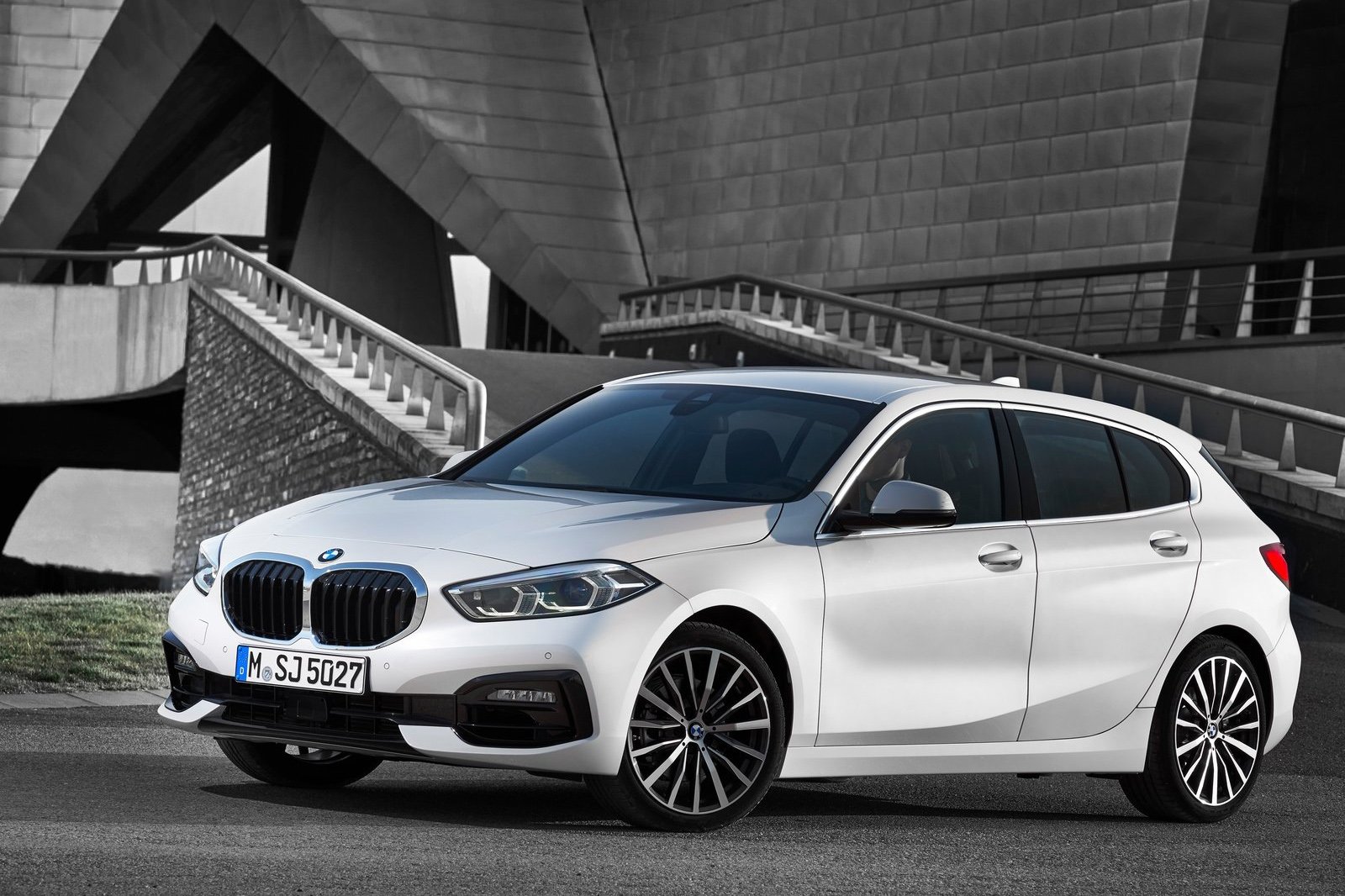
So there you have it. Most buyers don’t care. What they will be able to instantly discern is a change in the way the car looks. The shape of the 1 Series has changed significantly. That’s not altogether a bad thing as the baby hatch never possessed a particularly elegant silhouette. The latest car features a stubbier bonnet (due to the engine now being mounted transversely rather than longitudinally), a more sharply rising beltline and is offered solely in five-door guise.
“You will see quite a big difference to its predecessor, it’s a revolution not an evolution,” says Stauch. “The size of the car is really similar – within 10mm. But there’s 30mm more legroom and 20mm more headroom in the back, and entering the car is easier.”
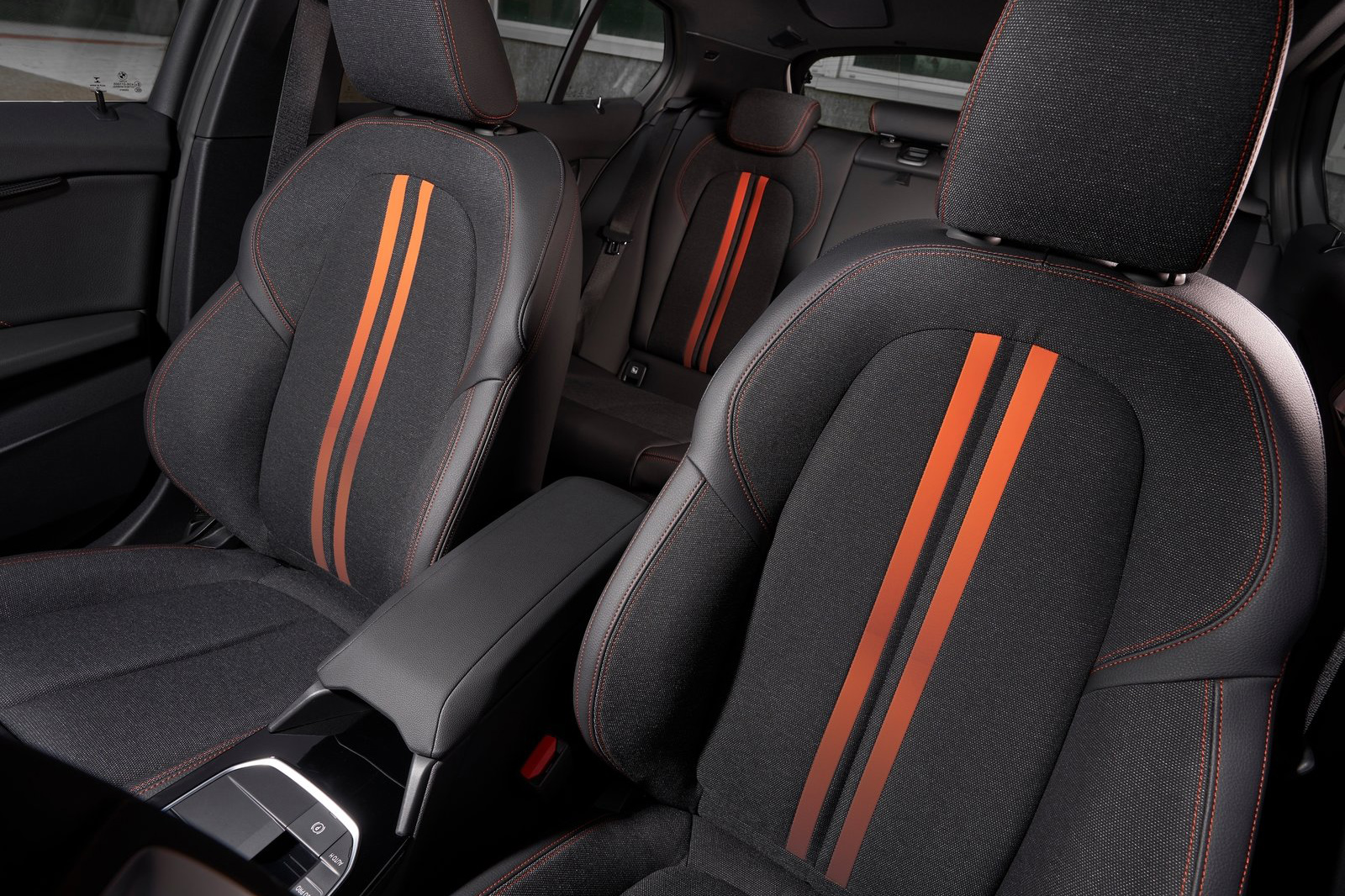
What’s more, nobody bought high power versions. Okay, that’s a bit of an exaggeration because some of you did, but globally, the hot M135i and M140i versions accounted for a piffling three percent of 1 Series sales. Higher powered versions of the new 1 Series will offer xDrive as an option, while the range-topping M135i xDrive hot hatch will come with a Haldex-based 4WD that can send up to a maximum of 50 percent of torque to the rear tyres.
Most Aussie customers will opt for one of the lesser powered variants and although it’s not yet confirmed exactly what the local importer will select, the Euro smorgasbord includes a whole suite of diesels: 85kW/270Nm 116d, 110kW/350Nm 118d, and 140kW/400Nm 120d xDrive. Should you prioritise response over raw Newton metres, the petrol engines comprise the 103kW/220Nm 1.5-litre three-pot 118i and the aforementioned flagship 225kW/450Nm M135i xDrive, powered by the slightly predictable 2.0-litre turbo. So as well as the death of rear-drive in the 1er, there’s now no more six-cylinder engines either.
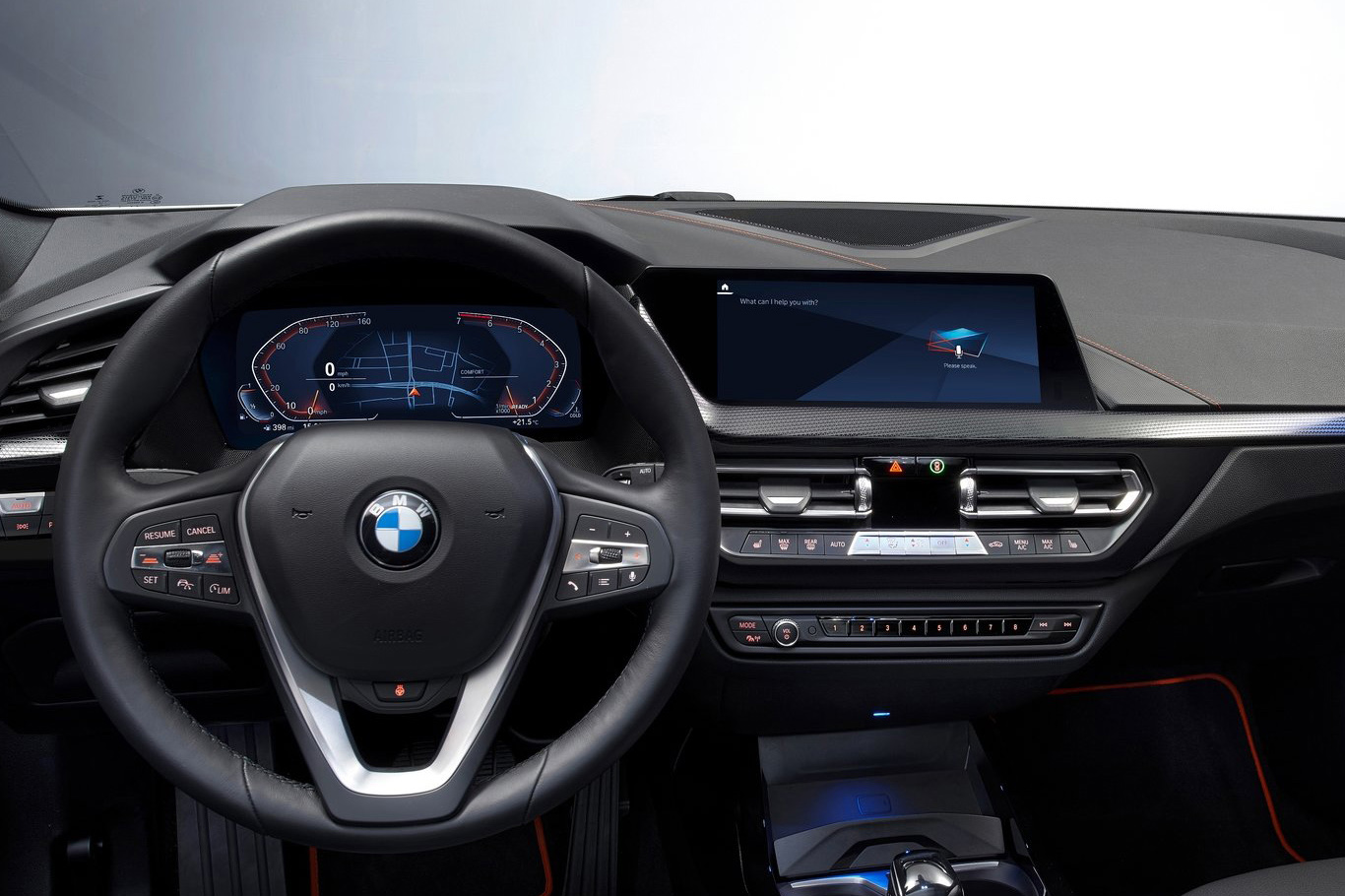
Somewhat unbelievably, you can still buy a manual one, three pedals somehow escaping Munich’s new broom. In Europe, the manual six-speed is the default choice for the 116d, 118d and 118i. Prefer the car to do the hard work for you? A seven-speed dual clutch is an option for the 116d and 118i, while the all-wheel-drive 120d xDrive and M135i xDrive models get a sturdy eight-speed auto as standard. Because of the hefty torque of the 118d, this transmission is also offered as an option for that engine.
It’s easy to be a bit fundamentalist about all of this, but it’s probably a smart move. BMW claims 1 Series customers, by and large, don’t care which end drive goes to and there are a whole lot of packaging compromises a longitudinal engine and rear drive forces upon designers. While we love the idea of a rear-drive hatch, it seems the market was never quite so enamoured, the 1 Series routinely outsold by similarly-priced front-drive hatches.
What’s more the retention of rear-wheel-drive for the 2 Series Coupe still gives enthusiast buyers somewhere to go, while the 1 Series becomes a friendlier more mass-market proposition. And, as rival Mercedes-Benz has proven with its ripsnorting A45 AMG, there’s a ready supply of takers interested in a seriously deranged all-wheel-drive 2.0-litre turbo hatchback. You can bet the M division at Garching is already well advanced on a rival for that one…
Driving a Formula 1 car is a dream for most, but Alex Inwood gets a chance to live that dream thanks to a very special factory in New Zealand that’s building an F1 car you can buy. It’s not cheap, but if you have the cash, Rodin can make your ultimate race car goals a reality.
Watch Alex progress through the Rodin driving academy from a hyperbolic track-focused McLaren, through a single-seat racer to the ultimate in fast car fantasies.
From a performance sensation to a sales sensation: meet the next-generation Mazda 3. As one of Australia’s favourite models, the Mazda 3 is taking a big risk and going upmarket — with the price to match. Is the new Mazda 3 worth the money?
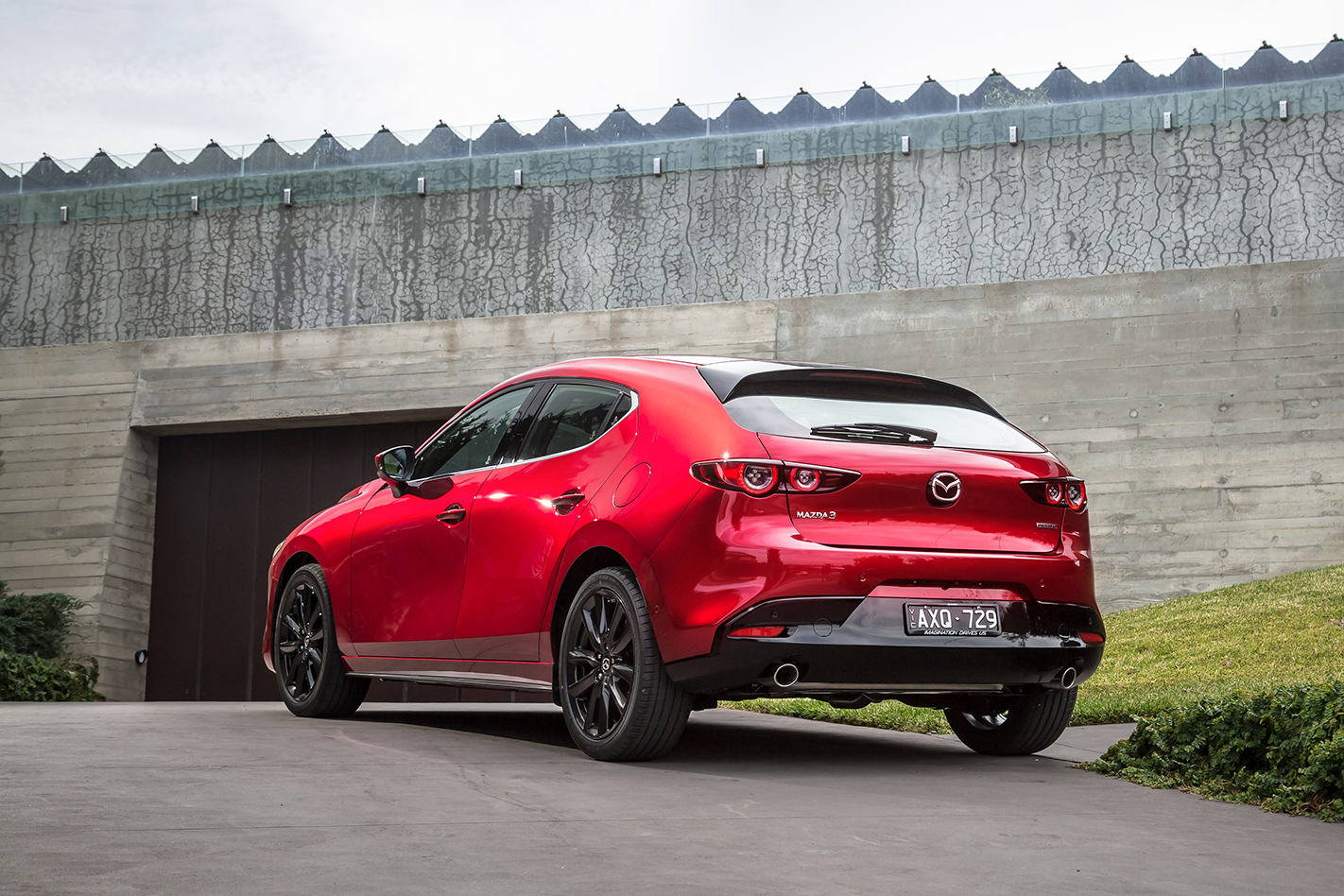
As one of the most popular Mazda markets in the world, the new and incredibly refined Mazda 3 could be about to blitz the Australian small hatch market.
After that excitement, Daniel accepts an altogether more relaxing challenge, plotting a path through Gippsland’s stunning scenery to help Peruvian chef Alejandro concoct a culinary banquet. There are only so many hours in the day and a lot of suppliers to visit; will they make it?
Picking the perfect car depends on finding something fast, practical, stylish, comfortable and not embarrassingly thirsty. How on earth can a 2.3-tonne Porsche fit the bill?
On-air: Channel Ten, May 26 (AU) / June 2 (NZ)
Catch-up: Watch at tenplay.com.au (AU) or primetv.co.nz (NZ)
What is it: Volkswagen Tiguan Allspace 162TSI
Why we’re driving it: VW’s sort-of seven-seater offers something a little bit more than the stock Tiguan, and not just how many people you can fit on board.
Update 9
Well, it’s time to say goodbye to WhichCar’s Volkswagen Tiguan Allspace, which has served us well for six months and 7000km.
On the whole, it’s been a pretty positive experience, too.
In short, the Tiguan has been trouble free for us. Other than adding petrol to the tank for the 2.0-litre turbo, we’ve really had zero issues to report. The interior trim has held up well despite dogs and bikes and kids hopping in and out and we’ve managed not to scratch those lovely 20-inch rims either.
It drives nicely, too; the seven-speed dual-clutch unit is a far cry from the troublesome units of years past, and for my driving style it works really well.
Mel wasn’t as happy with it, though – she had a bit of drama doing things like reverse hill starts because it would roll forward on the clutch before she could get the drive to hook up, which spooked her a bit.
Solution? Left-foot braking can help (though you can’t overlap brake and accelerator too much or the throttle dies), and there’s also an auto hill hold button that keeps the car in place too.
And we both loved the auto park feature. Well… I did.
Fuel use over the six months and 7000km worked out at 9.4 litres per 100km, against VW’s claim of 8.3 on the combined cycle. It does need 98 octane, though, which makes it a little dearer to fill – it averaged out at about $85 per tank.
Handling is terrific, with a great balance between competent poise and genuine comfort. It’s precise, it’s predictable and it’s easy on long trips, especially when you combine it with the excellent adaptive cruise control.
What I really like about the Tiguan, though, is the silence. It’s only after you hop out of another car that you notice just how serene and calm and quiet the interior of the Allspace really is. There’s no discernable tyre noise, the wind noise is low and the engine is unobtrusive.
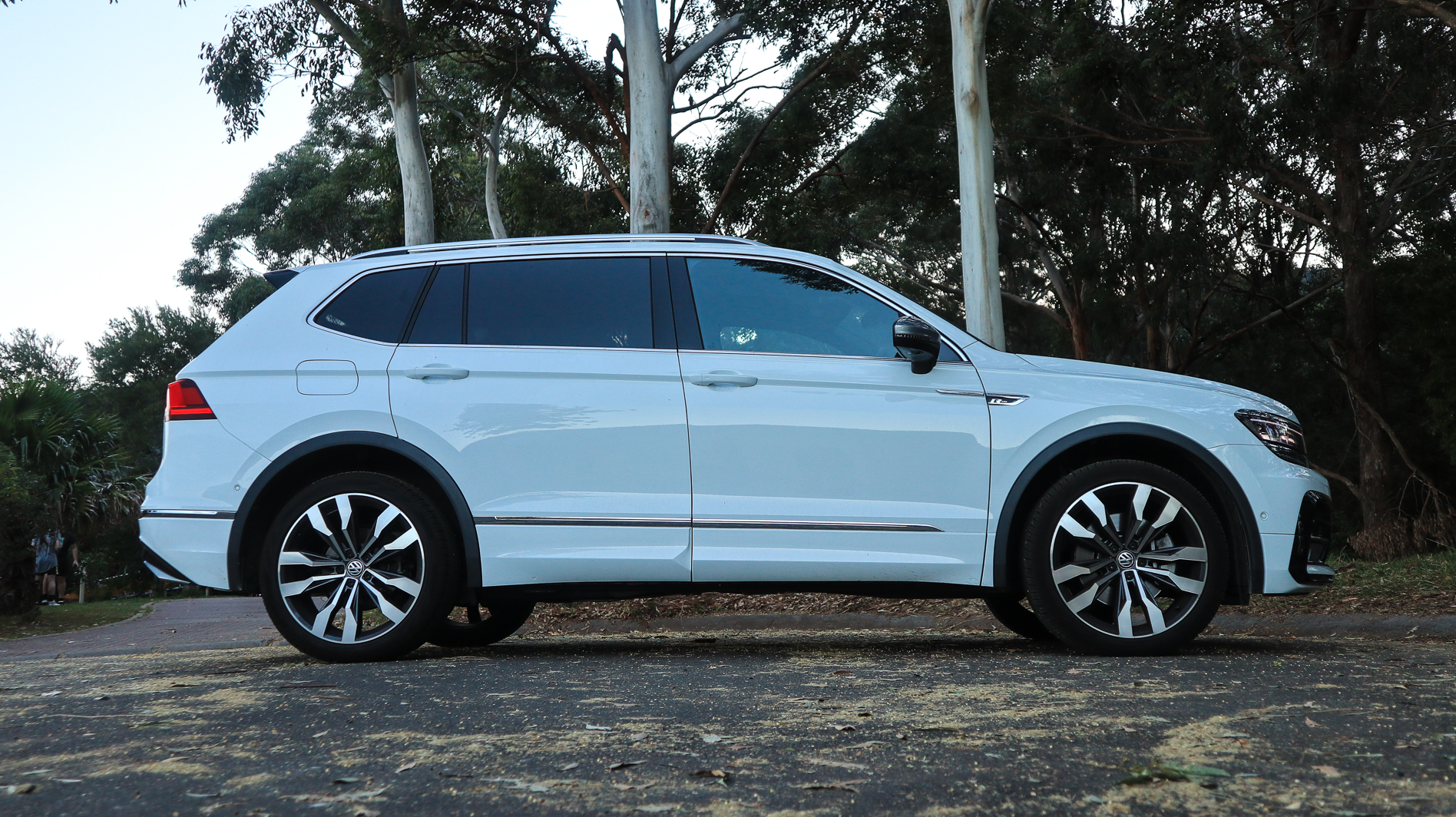
Overall, Volkswagen’s Tiguan Allspace has been a great addition to the WhichCar roster, and to our family’s daily life. It’s comfortable, quiet and pretty good on fuel, and there’s enough room for a larger family.
If you’re okay with the cost of entry, then it could be the right car for your family, too.
Update 8
I’ve ridden bicycles since I was five and as a consequence, I’ve shoved them in all manner of vehicular transport over the years. A key parameter, then, for me owning a car is its ability to absorb at least one bike, and preferably in a manner that actually encourages me to put said bike in the car and go for a ride somewhere.
That means no removing of wheels and/or car bits to make it happen.
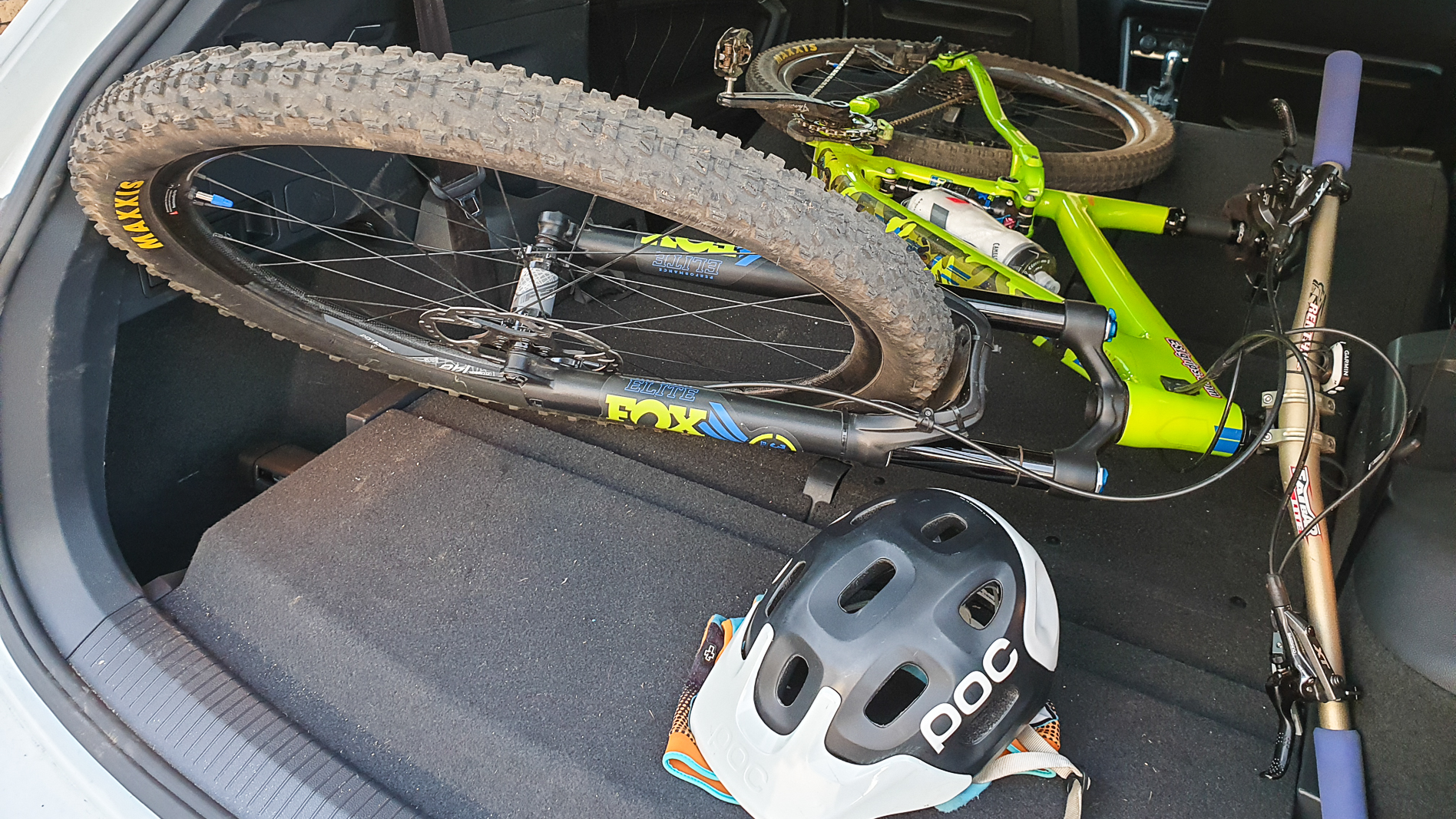
The Allspace has lugged a couple of bikes here and there during our tenure, but I thought I’d get the assistance of youngest daughter, Milly, to video me putting a bike aboard.
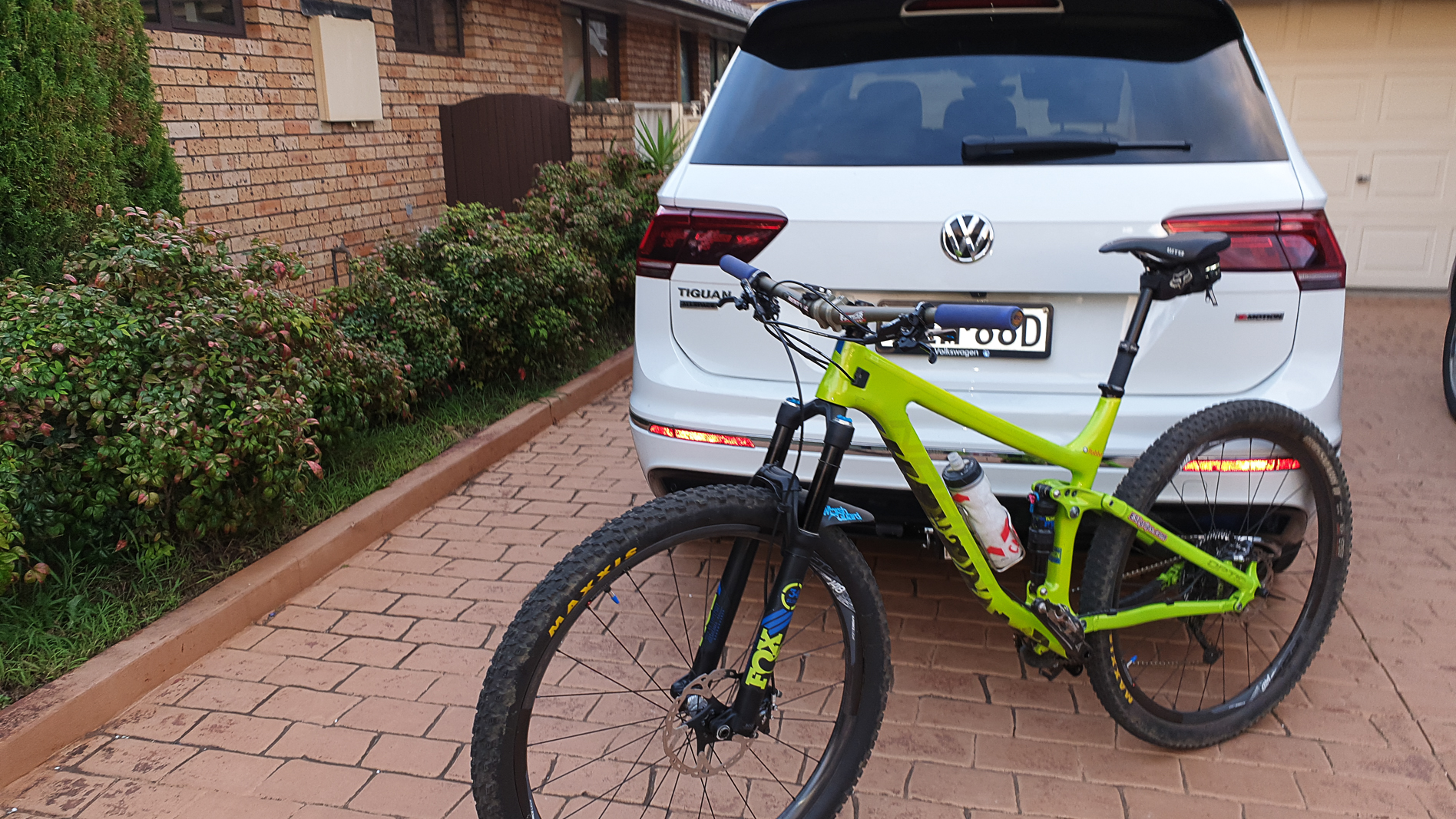
My rig is a large-sized mountain bike with 29-inch wheels; it’s not the biggest (or more accurately longest) bike I’ve owned, but it’s pretty representative of the mountain bike community. If it can swallow a large MTB, it’ll easily cope with the average road bike.
As you can see in the vid, we had to fiddle a bit to get the seats to drop easily, but once you know the trick of the sliding second row, the flexibility of the Tiguan really ramps up.
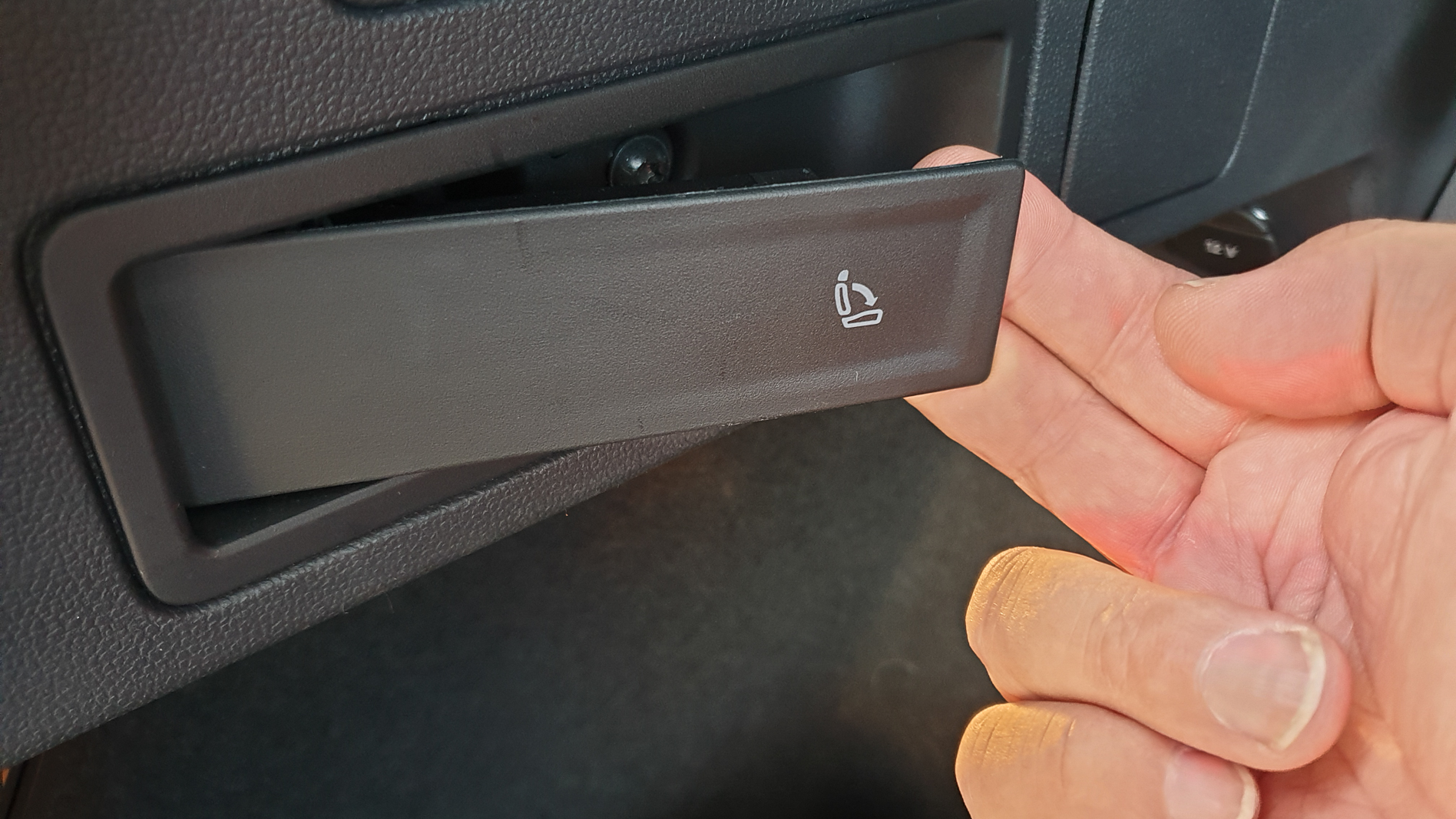
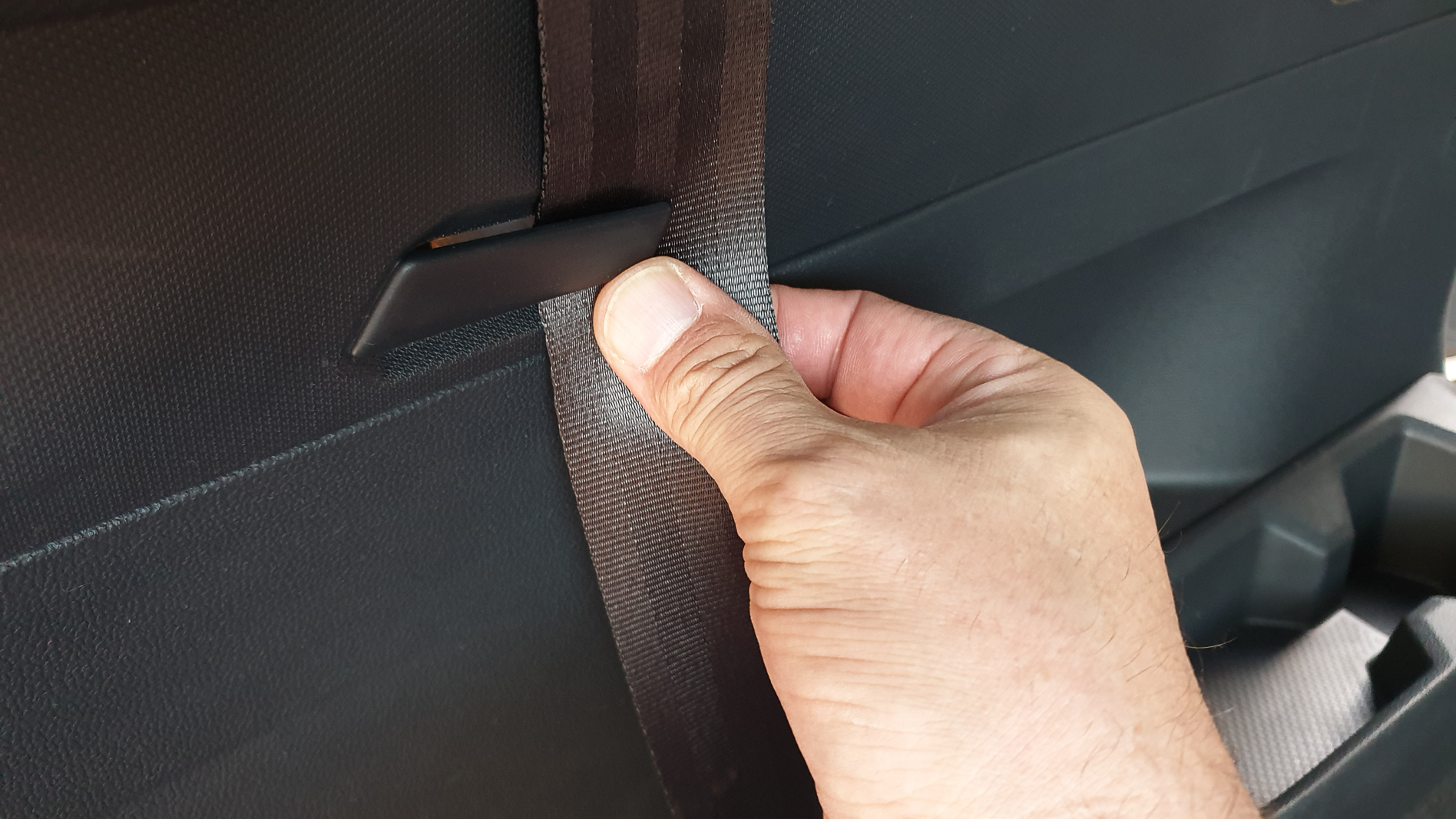
There are lots of nice little touches, too, like fold-out hooks (perfect for a helmet) and seat-belt holders for the third-row sash belts.
Of course, there, are alternate ways of carrying the bike, but as I’ve discussed in an earlier update, quickly bolting a bike rack to the Allspace’s towball is all but impossible. The hitch itself has been built with additional reinforcing plates that completely rule out using a large flat spanner or shifter on the nut that holds the towball on.
You could also add roof racks to the top, but it’s awkward to mount an adult bike – and especially a heavier mountain bike – onto the roof of an SUV.
A couple of things to note – you’ll only be able to carry two people if you want to carry your bike whole. though you could carry two bikes thusly. I’d recommend a removalist blanket (Bunnings sells them) or even an old yoga mat to keep them separated.
As well, lash the bike down with an elasticated strap or a tie-down to keep it from flying around the car in the worst case scenario.
Shoving bikes in and out of cars also plays hell with plastics, so an extra removalist blanket laid down before you add the bike won’t hurt.
But in all, success! Looks like I’ll be getting out on the treadly more often!
Update 7
My wife would say that when I drive, I’m a fidgeter. Me? I prefer to call it ‘optimisation’. Not for me is the auto setting on the air-con, for example, and if a trip extends past an hour, guaranteed I’ll adjust my seat or a mirror just so.
It’s the same with the drive mode select system aboard our long-term Allspace. I can feel Mrs Robbo’s eyes rolling when I reach down to the rotary dial to swap between the various settings, but hey… why put a button in a car if I can’t play with it?
The Tiguan Allspace’s drive-mode selector is actually pretty complex. Not only does it offer a brace of on-road modes that includes Comfort and Sport parameters, but it can also change the car’s behaviour at a more granular level to cover looser surfaces.
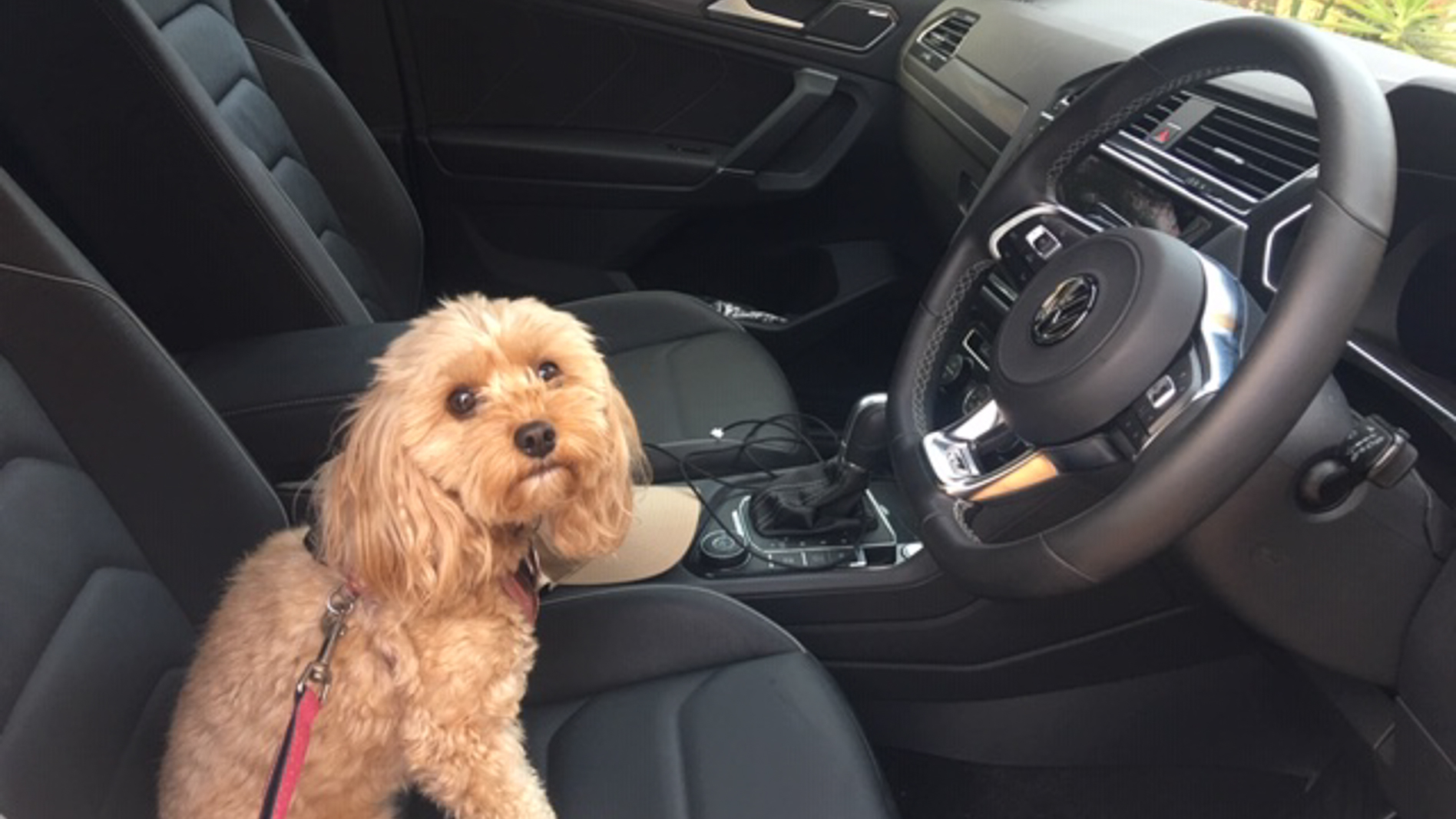
Which button is it again, dad?
Its official name is Adaptive Chassis Control, or ACC for short, and it ties a range of systems – including the four shocks, the gearbox, the engine and even the air-conditioning system – together via a central computer.
The five on-road modes (we’ll look at the off-road stuff next time) include Eco, Auto, Comfort, Sport and Individual, and the central computer converses with the various systems in millisecond-long increments to figure out what’s needed.
Sport mode, for example, adds extra weighting to the electric power steering, tells the gearbox to switch into Sport mode to hold gears for longer and firms up all four shocks, while Comfort does the opposite; it softens the suspension (specifically, it softens the compression damping of the shocks), lightens the steering effort and smooths out the gearshift points.
My favourite mode is – unsurprisingly – the one that I can fiddle with most; Individual. My preference is for softer suspension but a sportier response from the engine and gearbox, and I can set that up pretty easily.
What the mode button doesn’t do is change things like power output. You’ll always have 162kW and 350Nm, but the ACC system delivers it differently by changing the way the accelerator pedal delivers that power and torque. The gearbox, too, will change the points at which it swaps cogs for you. It’ll allow the Tiguan to rev a bit harder before it changes gear in Sport mode, for example, or change more seamlessly in Comfort mode.
This week, though, let’s talk about the one mode that I bet not a lot of people use very often – Eco.
Let’s assume for the sake of argument that most owners will, in reality, leave the mode button alone most of the time, meaning that the Tiggers will default to its Auto mode. And of course, that’s more than fine – it works well and gives the average owner a set-up that’s very Goldilocks.
During the course of a big-mile week, though, I decided to lock the car into Eco mode, just to see if it did what it says on the tin. Eco mode not only tells the gearbox to shift at the lowest rev point it can get away with (fewer revs equals less fuel burned), it adds a new behaviour into the loop.
VW calls it a coasting mode, and even though it’s been around for a while, it’s still pretty clever. At speeds over 60km/h, you can lift all the way off the throttle pedal, and the drive system will actually decouple (or disconnect) from the engine.
The revs fall away to below 1000rpm, the drag on your drivetrain disappears and the Tiguan serenely floats along until the moment you touch the accelerator, where it instantly engages again. Think of it as knocking the car into neutral while coasting down a hill, and you get the idea. It can be engaged at speeds up to 130km/h, as well, but the jump from low revs to highway speeds is more noticeable.
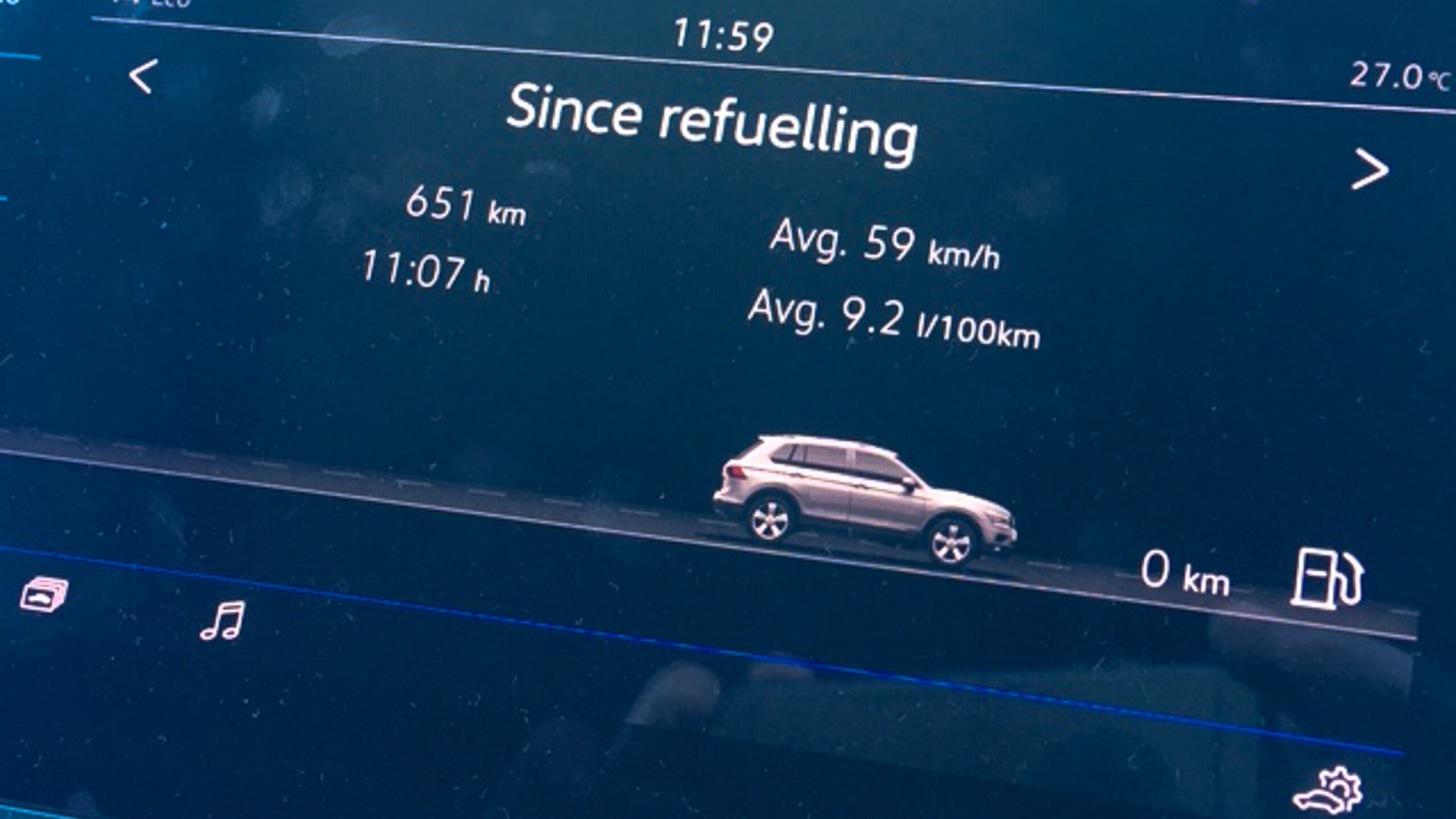
The Tiguan’s on-board computer does a good job of keeping score. Our real-world fuel figure was 9.4L/100km
I kept Allan the Allspace in Eco mode for an entire tankful of 98 RON fuel, which highlighted one annoyance; while the majority of the Eco mode settings stayed active after the car is shut off and restarted, the gearbox – and by dint the coasting mode – had to be prompted to go back into Eco.
As such, my 651km result from 61.6 litres of fuel – interesting in itself because the fuel tank capacity is only rated at 60 litres! – could probably be improved. The result also marries well with the Allspace’s combined fuel consumption claim of 8.3L/100km, with a real-world score of 9.4L/100km.
I’m in the midst of giving it another go, so I’ll keep you informed of my next highest score.- Tim Robson
Click HERE to get your free weekly WhichCar eNewsletter
Update 6 – video
Here’s a video update of our time with the Tiguan, where we have a closer look at the two rear seats. We also check out the load space, the tow bar and the Tiguan’s driver mode button.
More next week – let us know if there is anything you’d like to see! – Tim Robson
Update 5
When Robbo asks “Do you want to borrow Allan for the weekend?”, it caused a moment of hesitation before nodding in the affirmative… before I realise that’s his moniker for the WhichCar Tiguan Allspace 162TSI long-termer! Yeah, I dunno what he was thinking, either…
Being Deputy Editor of 4×4 Australia and risking the chance of being spotted driving a ‘soft-roader’ may have sounded like professional suicide, but I was looking forward to checking out VW’s slightly-stretched Tiguan for a few reasons.
Our brood (two kids, seven and five) is growing, and our current primary vehicle (a Subaru Forester XT; I also suffer the pain of Land Rover Discovery 2 ownership) is feeling the squeeze, so the promise of some additional space in the rear (and the third row seating for my daughter’s soccer team-mates) was welcome, as was the fact I always seem to find a comfortable driving position in a VW.
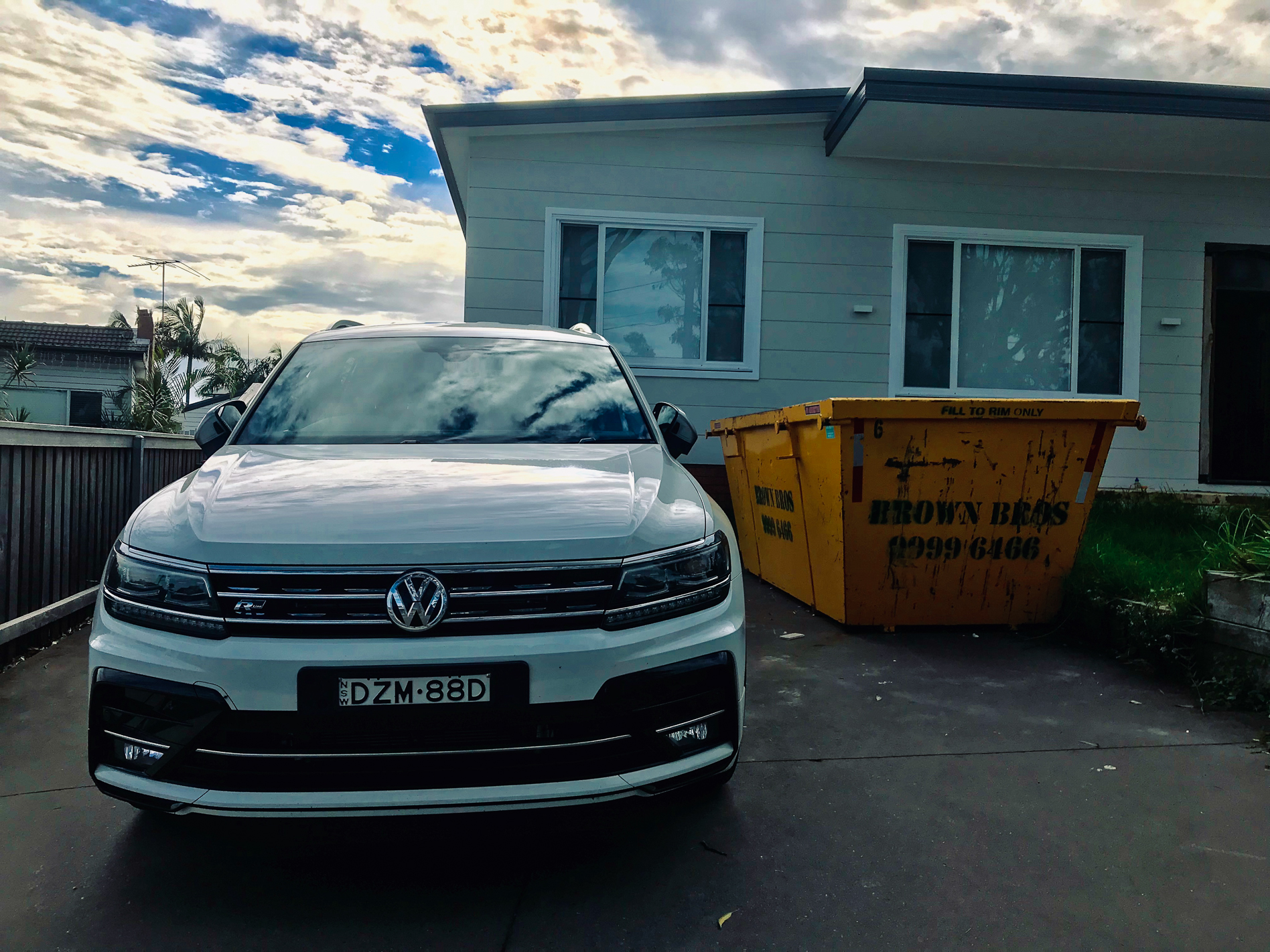
Renovation pain, Tiguan pleasure
Granted, most of that driving time has been behind the wheel of various Amarok dual-cab utes, a few Golfs and one Passat, but VW has nailed the driving position again for this 182cm long-armed boofhead; clear outward vision, a nice chunky steering wheel, and all essential instrumentation close at hand. In short, it just works – for me anyway.

No sooner was Allan parked in the driveway than the young Walkers were in to check it all over, with the third-row seating a popular form of entertainment thanks to the ease with which it can be put up, and then put down again, for a flat cargo area.
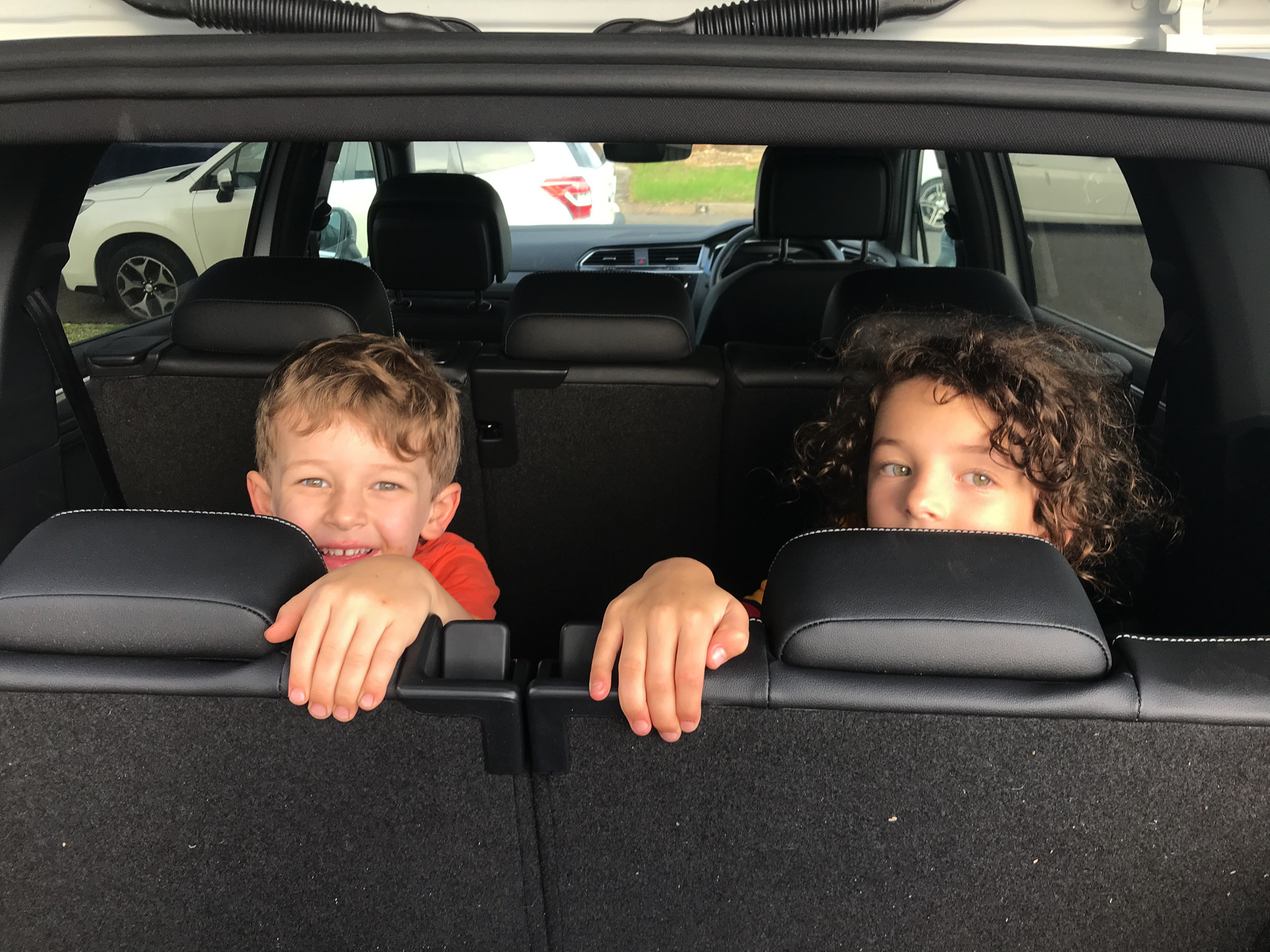
Liam (left) and Sarah settle into the third row
Getting in and out of the third-row was a doddle, too, for two young’uns under 150cm in height, but I reckon you’d have trouble fitting any human over 12 years of age in there, unless it was for very short trips (or as a punishment!?).
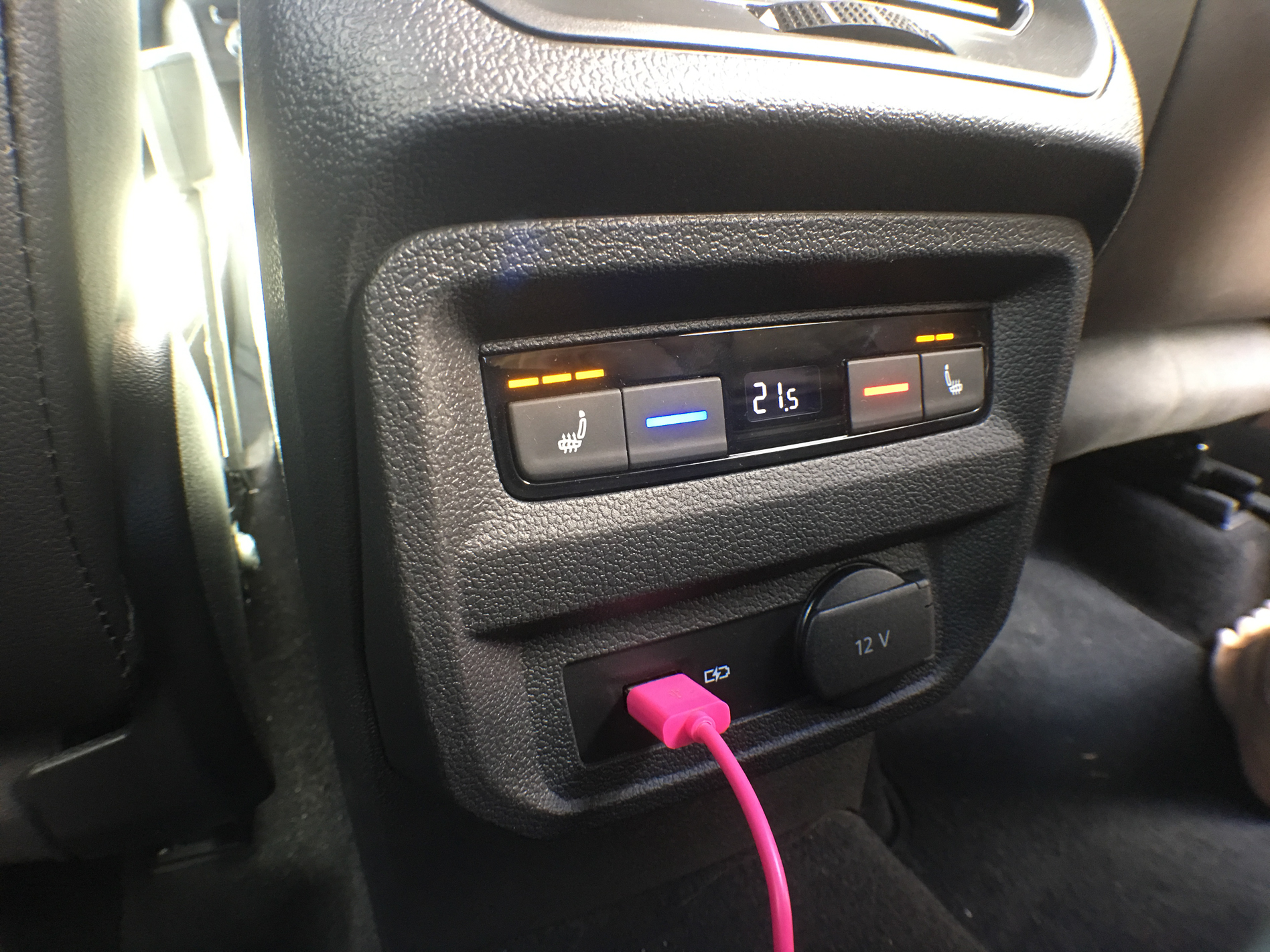
Butt-warmers for the second row are a great addition, as well as temperature controls. And no, that’s not my charger cable!
Still, it’s handy to have that versatility for the occasional tag-along passenger, and when the third row is down, that extra storage space in what is still a relatively compact vehicle is very welcome. – Justin Walker
Update 4
The better-looking half of the Robbo clan has stolen Allan the Allspace on a couple of occasions, too, and – given that she’s 160cm to my 185cm, her input on driving positions is pretty important.
Allan actually offers three memory settings for the driver seat, which also recalls things like the inflation volume of the bolster cushion, as well as mirror positioning, so that takes the sting out of following her back into the driver’s seat. Or trying to, at least.
Unfortunately, it wasn’t all roses and sunshine for Mel. “I found it a bit hard to get a good fit behind the wheel,” she confesses. “When the wheel is in the right place, the pedals are too close, and I find I have to really arch my foot back to get to the brake pedal.”
Mel also struggled a bit with the fact with the Tiguan hides most of its on-board functionality within its multimedia screen. I’ll put this down to unfamiliarity with the car; I actually find it pretty easy to use, besides the fact that some of the controls run down the left of the screen, in obvious deference to the left-hook origins of the factory.
Apple CarPlay works well through the touchscreen, too, but the screen itself can get pretty gross. We keep a microfibre cloth in the glovebox to keep things smear-free.
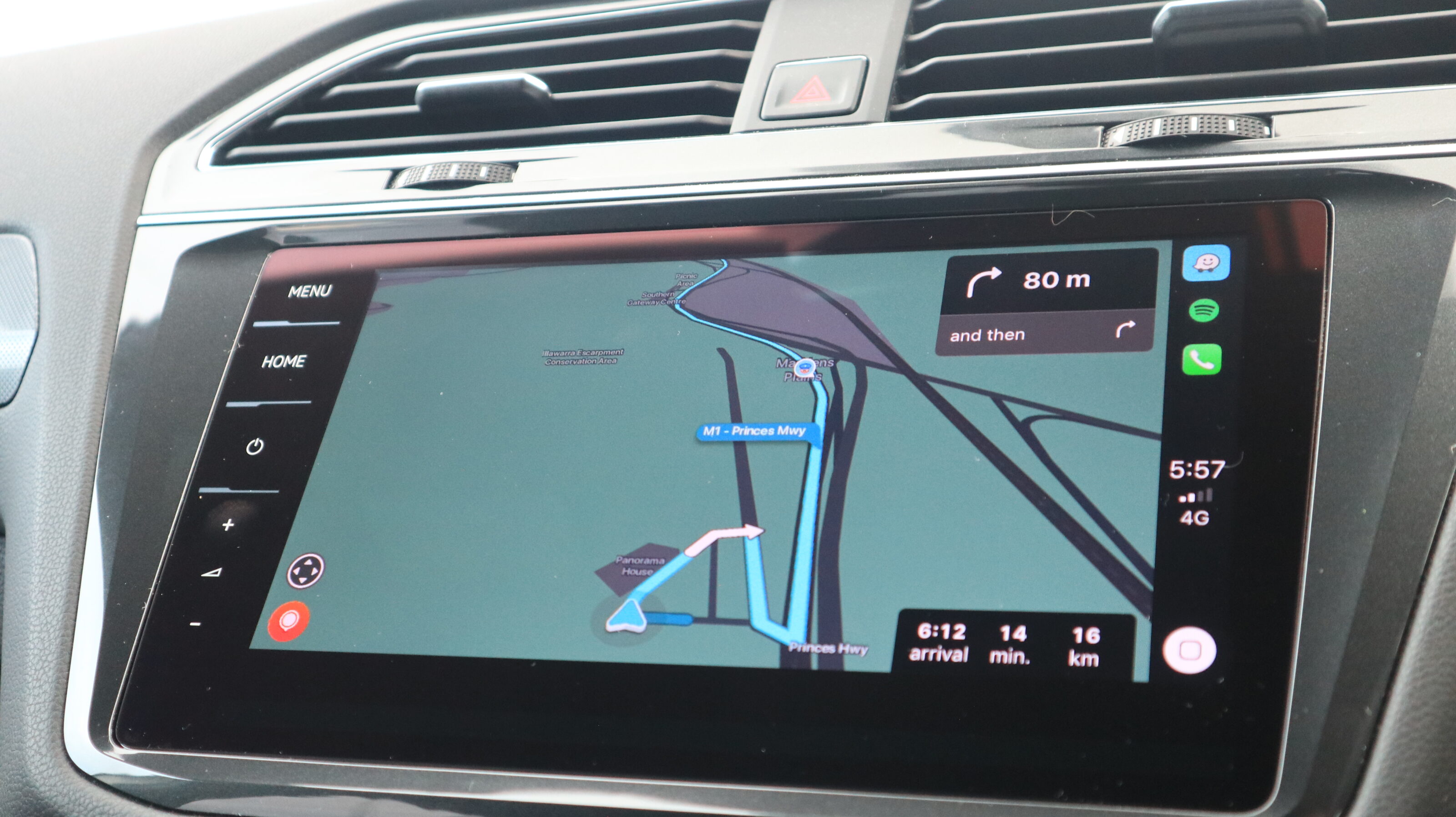
Clean screens in Allan the Allspace
Update 3
Volkswagen’s EA888 is to the world of engines like the micro-USB cable is to the charging world; it’s ubiquitous, entirely practical, quite flexible and even though it’s an older technology, it’s more relevant than many others that have followed it since.
Allan, as we’ve christened our Tiguan Allspace, uses the EA888, as does the Golf GTI, the Polo GTI, the Passat, the Arteon, the Skoda Octavia RS… Volksy has certainly gotten its money’s worth.
Why is it such a popular power unit? Well, making hundreds of thousands of one particular thing is relatively easy, and that simplicity (hopefully) guarantees reliability.
Via the magic of engine control units (ECUs), engineers can also control how much power the engine can deliver, and how it delivers it, depending upon the application.
Even though the two engines share the same 162kW power output, the Golf GTI, for example, will have a different, more aggressive fuel and throttle position map, while our Tiguan is designed to deliver its power in a more languid, progressive way.
Living on the edge
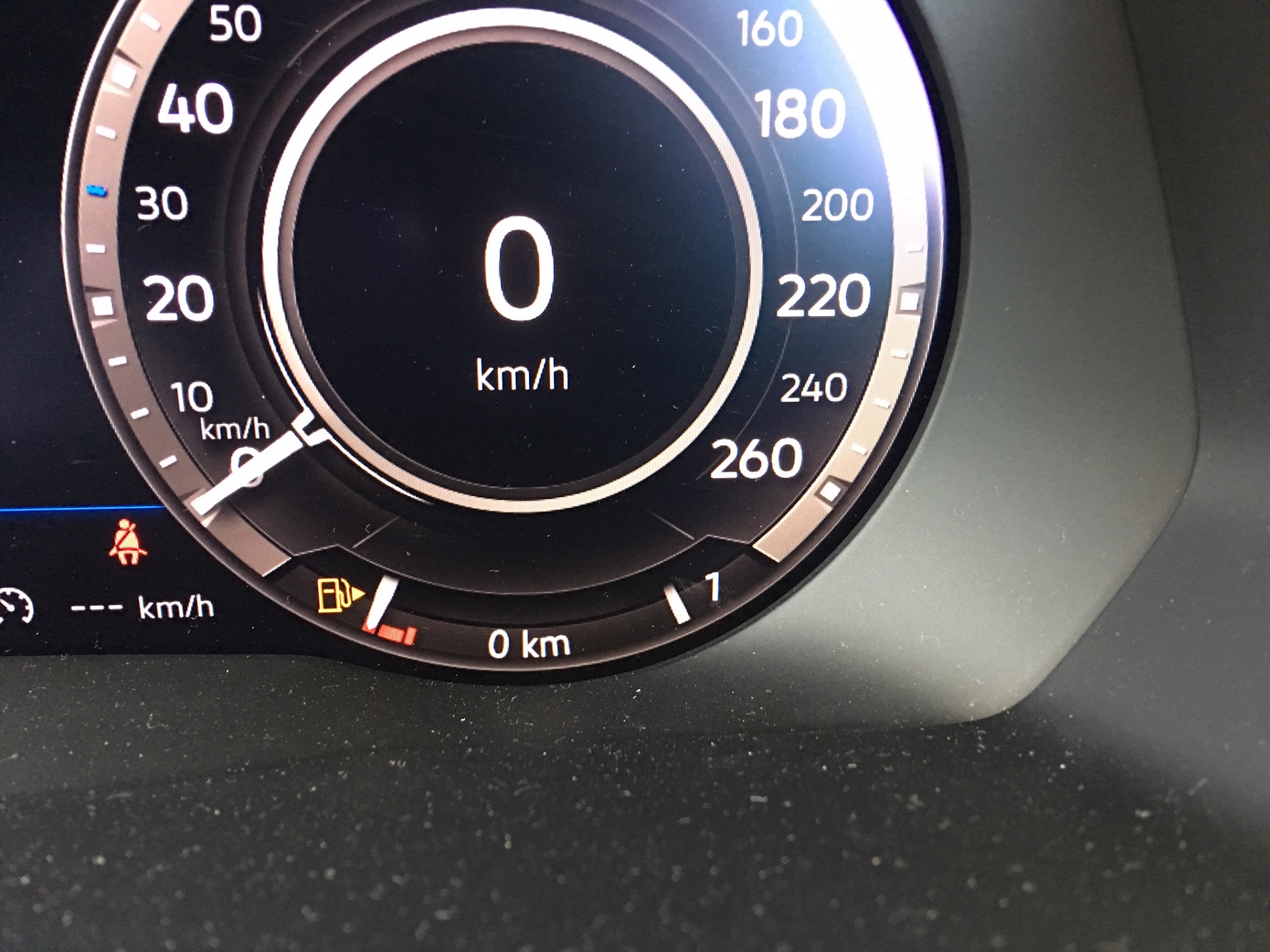
Changing engine maps can also help improve fuel economy figures. Allan averaged 11.3L/100km over the first 525km full tank run, against a claim of 8.1L/100km. With a 60-litre tank, it’ll cost between $80 and $100 to fill, depending on where you live… but it needs the dearer 95 RON fuel to work at its best.
Of course, VW has gotten itself into hot water over fiddling with fuel mapping on its diesels before, as have many players in the automotive industry… but petrol engines haven’t been caught up in the mess.
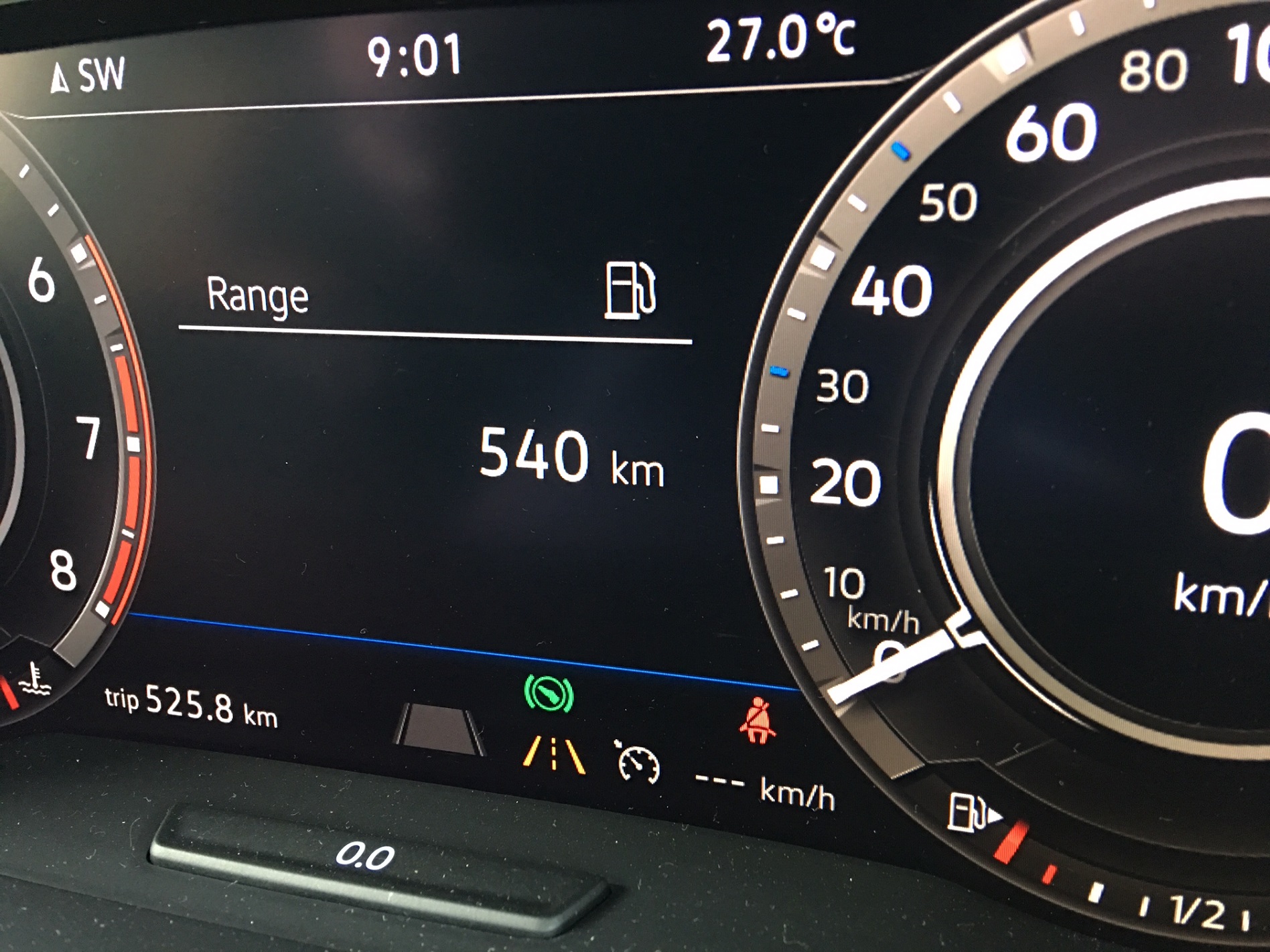
You should easily get over 520km per tank in the Allspace
UPDATE 2
When is a Tiguan not a Tiguan? When it’s a Tiguan Allspace, of course! Let me explain… the regular five-seat Tiguan is a regular mid-sized SUV, based on the same platform as the Golf and other VW products.
The Tiguan Allspace is also built on the same MQB platform, but it’s around 20cm longer and has two more seats than the Tiguan. Not only that, it actually has a subtly different design ethos as well.
A more robust, squared-off bonnet, narrower rear windows and that extra wheelbase length plays nicely with less fussy trim treatment to give the Allspace a more overtly macho character. Add this all up, and the Tigaun Allspace is a pretty different proposition to its five-seat brother.
Key difference, of course, is the number of seats. The second row still offers room for three, and you can add two ISOFIX baby seats to the outside seats for the young ’uns. In the rear cargo area, though, is where the magic happens.
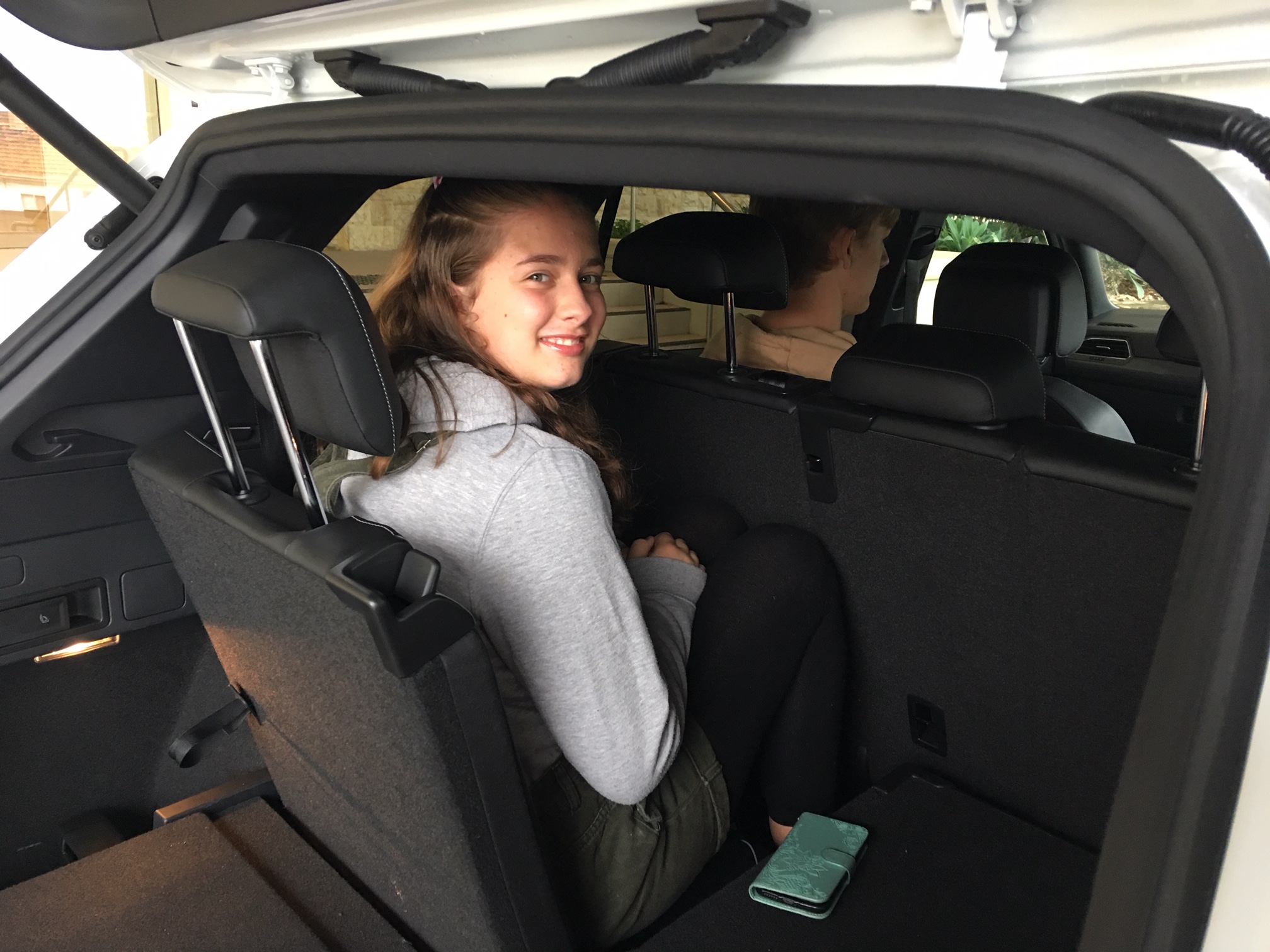
A pair of reasonably sizable jump seats is designed into the boot floor, folding away completely flat when not required. A tug on a loop of fabric swings them into place and also acts to lower them back down, while the second row is mounted on fore/aft rails, to enable some wiggle room.
It’s not, to be fair, a lot of wiggle room, as evidenced by pics of our (very tall, it has to be said) Miss 12, who volunteered for a ride in the third row. By squidging the second row forward a bit, we made a little more room, but Milly needed to sit cross-legged to get even partway comfortable.
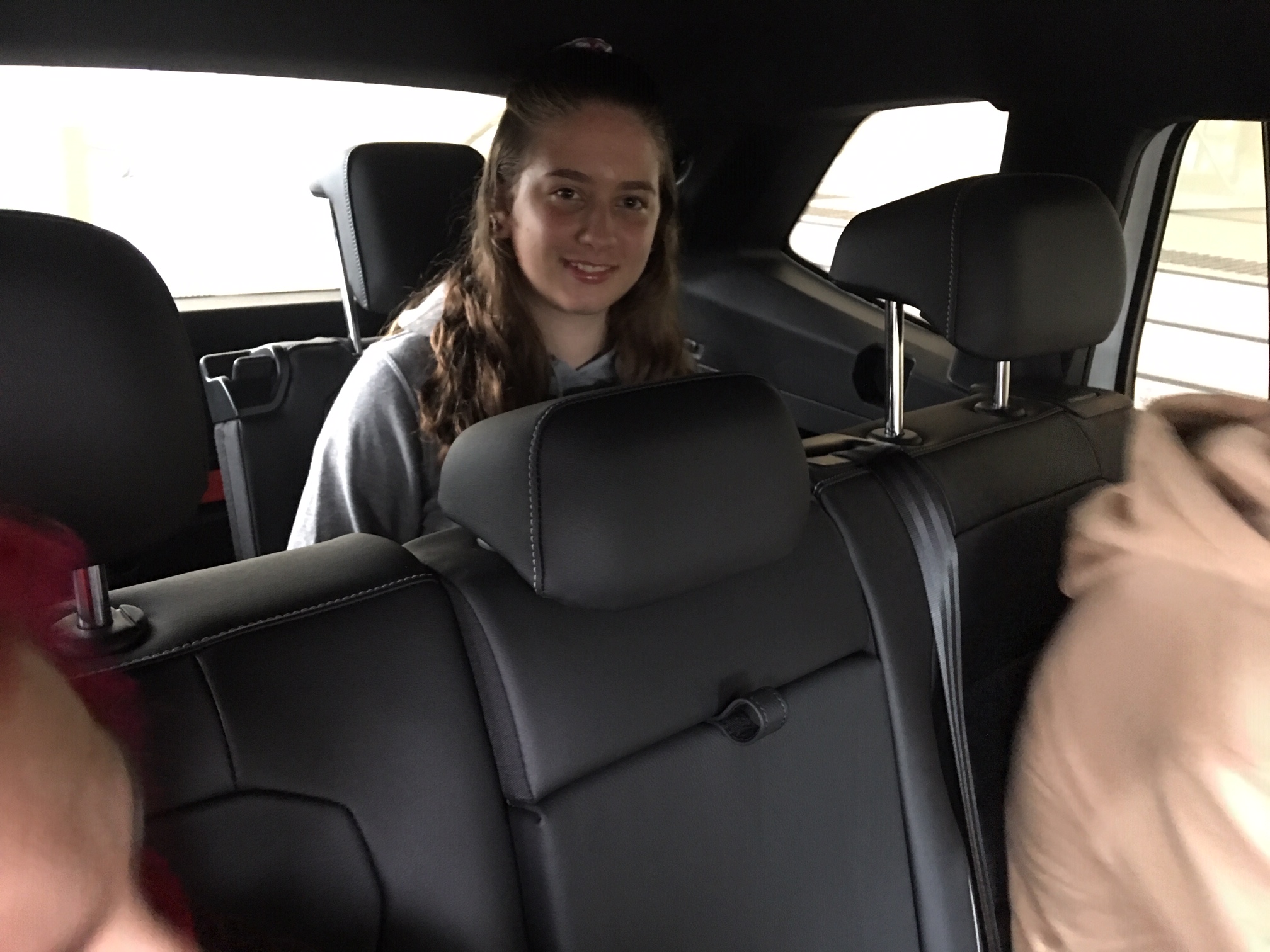
Headroom is a compromise for taller passengers, too, as evidenced by the pics.
But it’s worth putting the trip into context – we’d picked up an unexpected extra passenger for a five-minute drive to a nearby cafe, and for that length of journey, the extra seat came in very handy.
VW calls the Allspace a ‘5+2’ seater, rather than a seven-seat SUV, and we’d agree. If you need to occasionally tote members of the Under 7 netball squad to an away game, the Tiguan will work perfectly, but it’s not a full-time seating solution for taller goal-attack types.
UPDATE 1
The afternoon is stiflingly sultry, and the storm clouds gathered. It was the week before Christmas, and Mother Nature was getting real ornery…
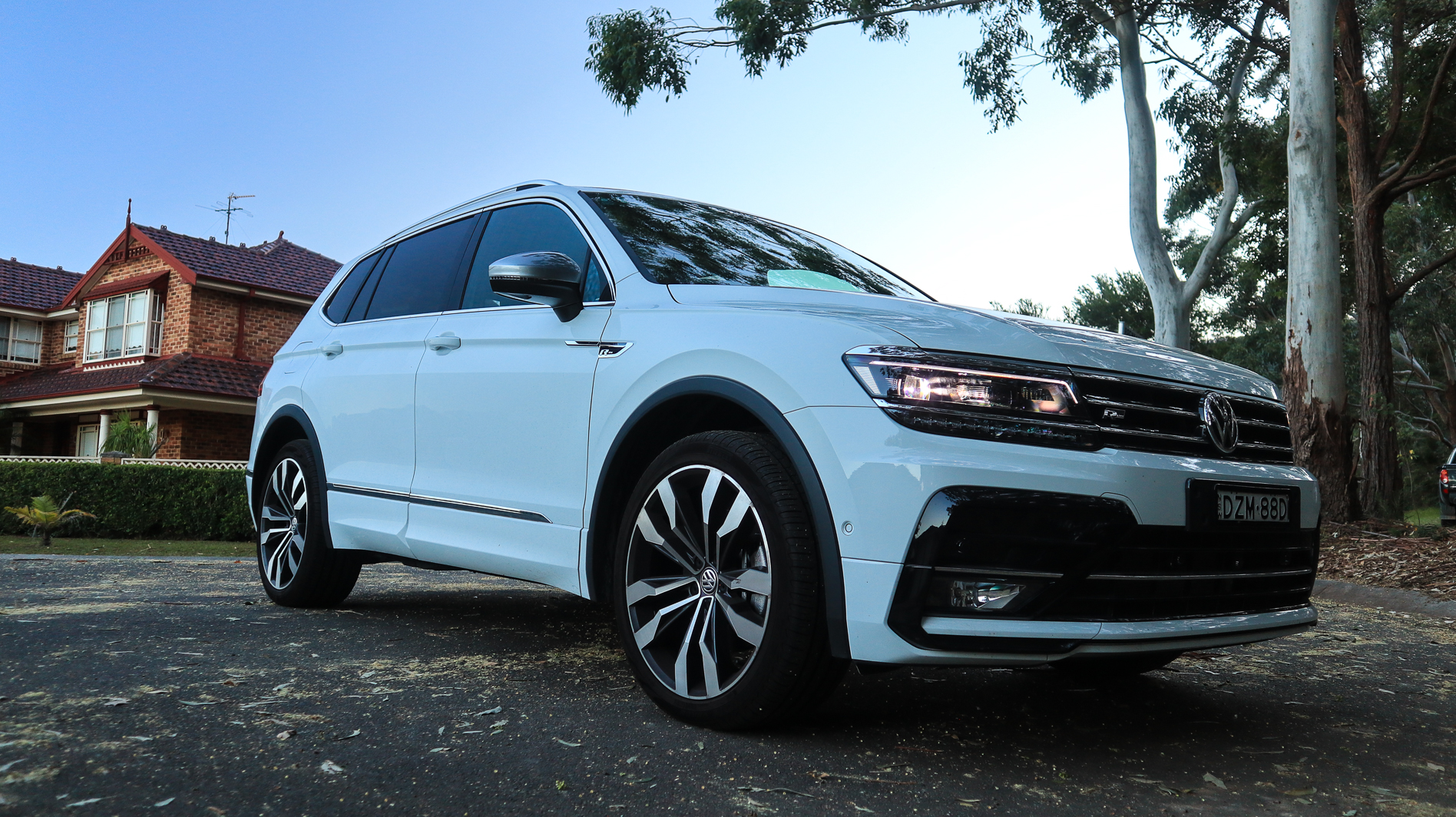
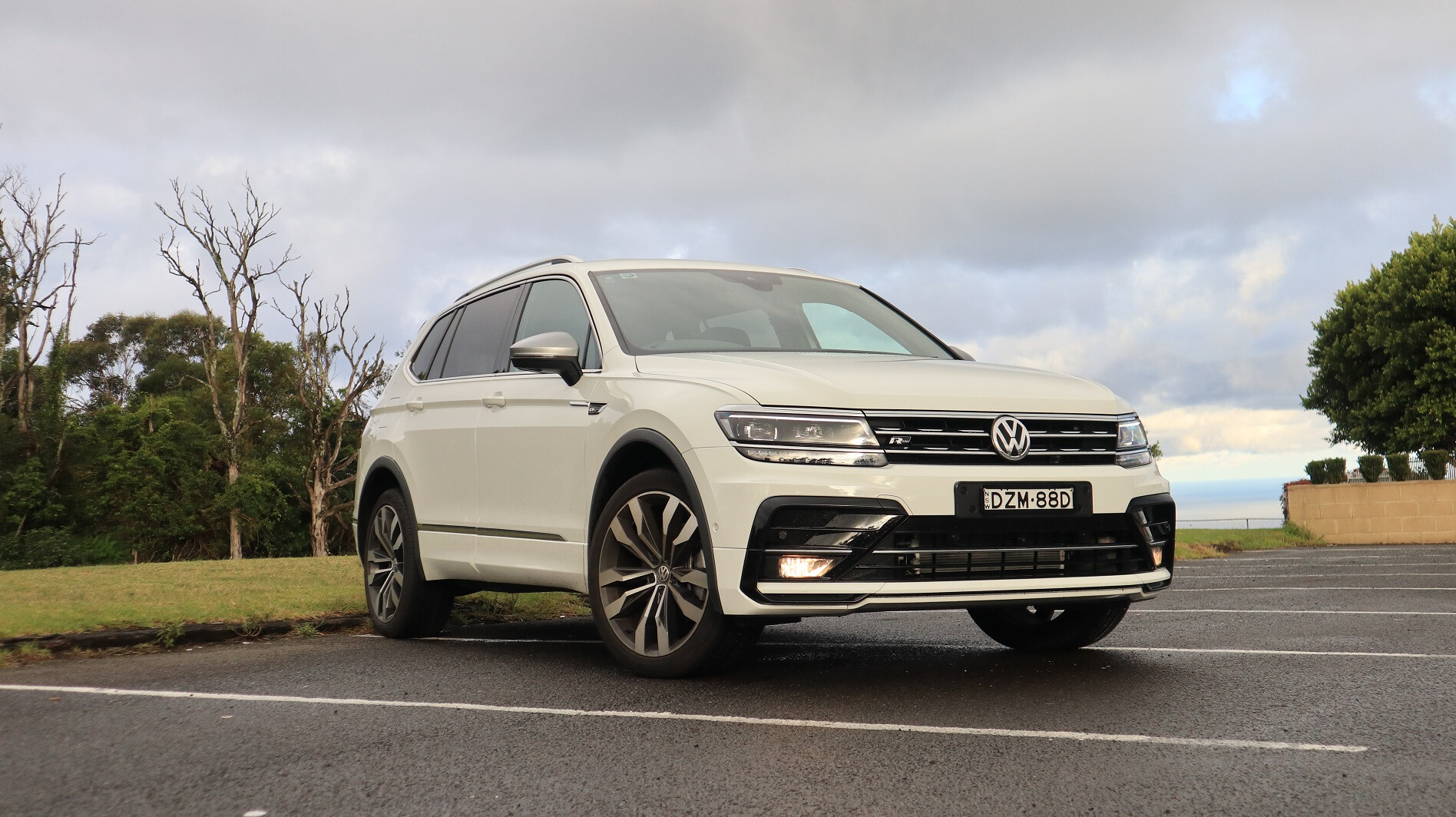
For our next long term tester, we’ve picked a Volkswagen Tiguan Allspace, pictured here in all its Pure White 162TSI Highline glory.
You already know what a Tiguan is – VW’s mid-sized SUV competitor that goes up against category heavyweights like the Mazda CX-5, and against older but still strong-selling rivals like the Kia Sportage and Mitsubishi Outlander.
But it’s not technically a Tiguan; it’s a Tiguan Allspace. The two cars are built with most of the same bits, sure, but park them side-by-side, and the extra length of the seven-seat Allspace – neatly hidden by its well-balanced design – becomes apparent.
It’s also blockier and edgier than the softer, more rounded five-seat Tiguan.
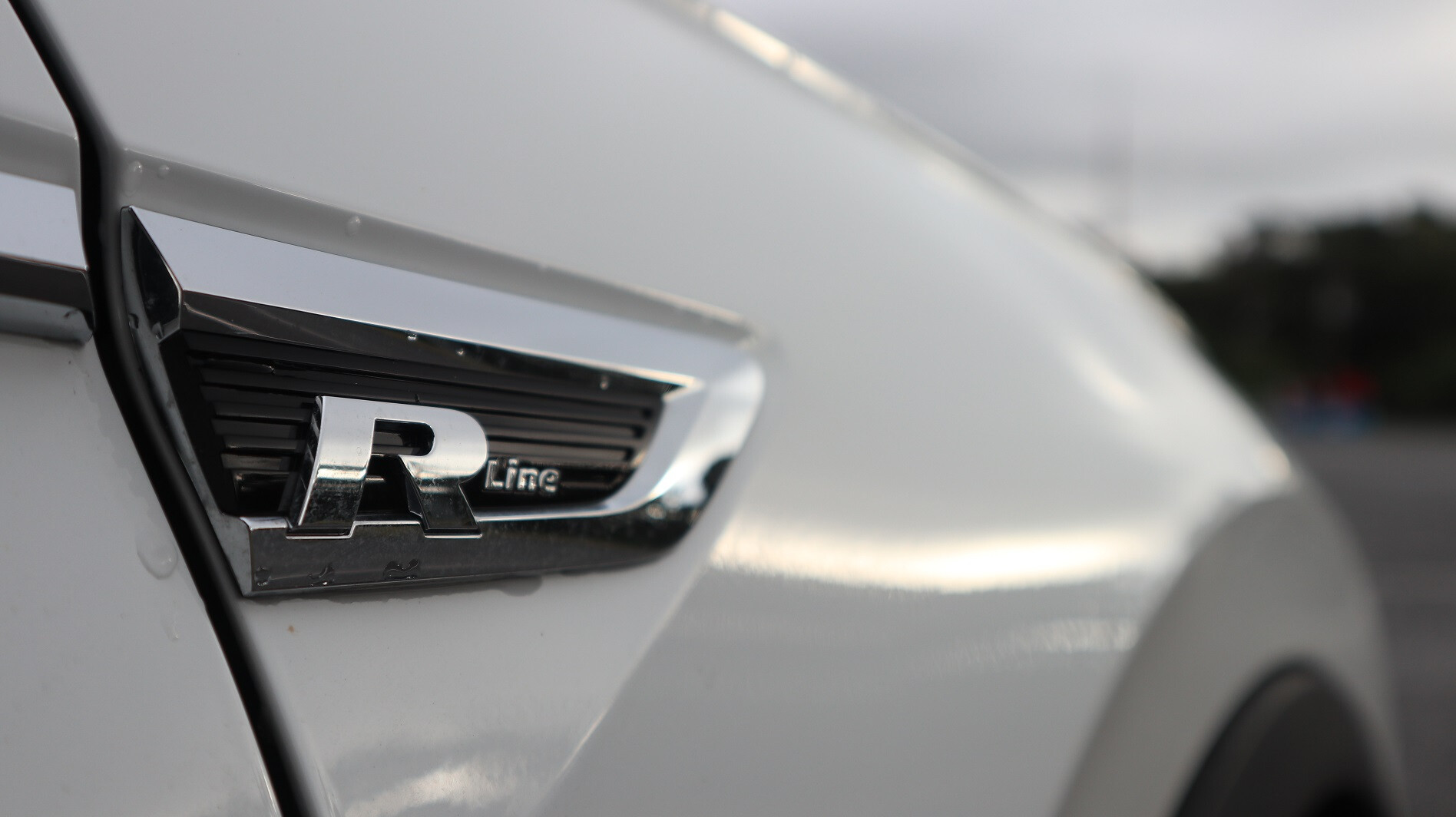
Our Tiguan – henceforth known as Allan the Allspace – is a top-spec beastie, and costs $58,890 before on-roads. Allan also features a $2900 R-Line kit which gets us stuff like powered memory leather front seats, a sporty front bumper and rear spoiler, 20-inch rims, progressive steering, flappy gear paddles and lots of black interior bits.
It also gets a Sound and Vision package, which gets us a digital dash, auto parking, a 360-degree camera and a nicer stereo.
It runs a 2.0-litre turbocharged four-cylinder petrol engine which drives all four wheels through a seven-speed DSG. I might have said “140kW” in my video (hey! It was hailing!) but it actually makes 162kW and a healthy 350Nm of torque.
VW prefers to call the Allspace a ‘five plus two-seat’ configuration; the two jump seats in the back are really meant for small humans only. It still has room for 700 litres of stuff with the seats up and – interestingly for us – a not-unreasonable 2500kg braked trailer towing maximum.
Stay tuned for frequent small updates on Allan and how it adapts to life in the Robbo household. What will that entail? Towing race cars, lugging bicycles, long commutes and more!
Ever wondered what Aussie motoring journos listen to while they’re testing the infotainment systems on your next new car?
Wonder no more!
We’ve snooped around the office to find out what our rev-head writers tune into when they’re not in the office. And they might take you by surprise…
F1 Beyond The Grid – Tim Robson
“I’m a late starter to podcasts, and this is a brilliant one to start with if you’re an F1 fan. Noted journo Tom Clarkson shares time with the sport’s luminaries both past and present, and he digs up some amazing gems. The recent interview with Alan Jones, for example, is amazing.”
Armchair Expert Podcast – Dave Bonnici
“US sitcom actor Dax Shepherd is the Armchair Expert who, often with regular guest Monica Padman, engages his incredibly broad general knowledge and quick humour for a highly addictive series of discussions with real experts and other celebrities about all manner of subjects.
Most podcasts centre on a specific theme or subject, but you never know what you’ll get with this – and you always learn something new while being entertained.”
Style Your Mind Podcast – Ali Lawrence

“Cara Alwill Leyba is an author and life coach from the US. Her podcast, Style Your Mind, has nothing to do with cars – but she focuses on empowering and uplifting women as well as focusing on personal growth and business development. Which, when you think about it… means you could buy more cars with all your new-found money and success. So it’s a win-win really. And, as the ancient prophecy goes… ‘girls don’t like boys, girls like cars and money’.”
Autoline Daily – Alex Rae

“The beauty of this podcast is that you can listen to them pretty much anywhere and Autoline Daily is so short and concise. I get a quick rundown on the important news I need to know every day in just a few minutes. People as busy as me just don’t have time to waste, ya know?”
Rusty’s Garage – Tim Robson
Robbo couldn’t decide on a favourite – so he picked two.
“Greg’s career as one of Australia’s premier motorsport commentators has provided him with a little black book like no other. His guest list is a who’s-who of motorsport, but more importantly, they are all keen to open up and give Rusty more than the usual PR brush-off. The chat with David Brabham, in particular, is just outstanding.”
Stuff You Should Know – Noelle Faulkner

“I listen to music more than podcasts when driving, so I don’t have any that I follow religiously. However, I’m very much a sucker for big ideas, bizarro facts and futurist discussion – so there are a number of ones I will dip in and out of when I need a dose of inspiration, depending on the topic. Some favourites: The AI Podcast which looks at the intersection of AI technology and daily life; The Sydney Opera House’s Ideas at the House, all the audio from ideas events like All About Women and Dangerous Ideas are uploaded here (I love this because so often I’m out of town when these events are on so I don’t feel like I’m missing out); The Monocle Culture Show for it’s features, interviews and coverage of global events like Milan Design Week (actually, I subscribe to all of Monocle’s podcasts involving business and culture); NPR’s Invisibilia, which discusses all sorts of unseen things and finally, I guess if I had to recommend one just for fun, Stuff You Should Know from the How Stuff Works network is probably the coolest one I subscribe to, just for the curiosity factor.”
Dan Carlin’s Hardcore History – Dave Bonnici

And neither could Dave…
“History lessons were never this entertaining! Carlin uses his passionate story-telling style to look at historical events, in particular, conflicts that shaped the world from multiple angles, and he takes the time to put them in context with current events. Some episodes are more than three hours long, which provides plenty of listening through the week.”
Did you know WhichCar has a weekly podcast?

Sometimes we simply don’t have enough time or space to fit in everything from the motoring week but that doesn’t stop us talking about cars, driving and the adventures that come with the territory.
Each week Andy, Dan and Scott get together to discuss the hottest topics and their favourite anecdotes, but on the weeks we are too scared, you can expect to find another one of our learned journalists keeping their seats warm and taking the flak.
If you’re yet to experience the dulcet tones of Dan Gardner, Andy Enright or Scott Newman, you can check out the WhichCar Weekly podcast here.
You can also listen to the WhichCar Weekly podcast on Apple Podcasts.
AS THE corporate jet touches down at Essendon Airport on the morning of August 22, 2018, the heavy-set, lantern-jawed executive in the back has a lot on his mind. Mark Reuss is on a rescue mission, flying close air support for both the troubled GM Holden operation he once led, and its new Chairman and Managing Director Dave Buttner, who weeks earlier had been parachuted into the Fishermans Bend hot seat.

It’s a fair bet that the man who now sits in the presidential chair in GM’s global operations has better ways to fill his days than the marathon 20-plus-hour flight Down Under. As does his travelling companion, Mike Simcoe, the former Holden designer who penned 2001’s born-again Monaro and is now Vice President of GM’s global design operations in Detroit.
It’s a heavy delegation and it says much about the ‘New GM’ that the Gulfstream they’ve used to jet across the Pacific is a second-hand unit, purchased from giant US machinery maker John Deere. Back in the day, GM would have ordered a matching pair of its own jets.
Reuss could have simply avoided the domestic fallout that followed the shutdown of Commodore production Down Under, but he has a special affection for Holden.
Reuss’s time at Holden ran for just 18 months, from February 2008 to the end of August 2009, but he admits it had a profound impact. “I went back [to Melbourne] last year and saw the house we lived in, and saw that many of the same restaurants and places we used to go are all still there, and it just brought back great memories,” he tells Wheels.
“Holden will always be special to me. I had a great experience there and built great business and personal relationships. I still keep in touch with my friends at Holden, and in the Holden car club. I loved my time at Holden. It was dynamic, exciting and, at times, we were living on the edge. But people had faith in us.”
In fact, from the moment Reuss arrived in the MD’s chair at Holden, he showed he was not just another mid-level American executive looking to serve his time, get his card punched and progress up the corporate ladder.

Energetic, inspirational and committed, he ‘got’ Holden, bringing the analytical and problem-solving perspective of an engineer, the enthusiasm of a racer who is a certified Nurburgring test driver, and the commercial insight of a top-class businessman.
Crucially, Reuss was also a dirt-under-the-fingernails boss, an old-fashioned car guy in an era where they are becoming a rarity, and someone who still liked to hustle his company’s products around the Lang Lang proving ground in order to better understand what the organisation was flogging.
As a muscle-car fan he was aware of Holden’s history and its racetrack successes, and wore his passions on his sleeve, in the form of a Cadillac Racing jacket and an HSV lapel pin. A competition helmet and HANS safety device sat proudly on his office bookcase and, when he did eventually ship home, the souvenirs he chose were a classic red FC Holden and the bonnet from a Supercars Commodore.
Reuss’s skill, authenticity and work ethic quickly won him respect within the parochial Aussie organisation, while his commitment to local manufacturing was evident in the way he pushed to have the compact Cruze built here, and won export orders for the long-wheelbase Statesman, as a US cop car.
The Detroit native and GM-lifer used his network back home to develop a five-year product plan that protected the Commodore and local manufacturing, while also ensuring a solid supply of imported models to fill showrooms.
But GM’s problems ran far deeper than its problematic Australian outpost, and Reuss, along with every other GM executive, was soon manning the pumps as the Global Financial Crisis sucked it and Chrysler down the bankruptcy drain hole.
He did double-duty throughout this turbulent period, leading Holden through its own troubles, while writing crucial parts of a survival plan designed to keep the GM mothership afloat, before his urgent recall to Michigan in August, 2009.

It’s history now that GM and Chrysler only dodged bankruptcy thanks to a massive US Government bail-out, but even that could not avoid the heartbreak of brand closures, factory shutdowns, job losses and sustained pressure on every aspect of the organisation’s global operations.
Despite massive problems in the US domestic market, Reuss managed to muscle through an export program that enabled the Commodore-based Chevy SS to briefly become a low-volume hero car there, as well as the bow-tie brand’s frontline fighter in the high-profile NASCAR racing series.
Eventually, the ripples from the financial tsunami reached Australia, washing up on our fatal shores and over an industry that had long been dependent on its own form of government life support.
Throughout the dark days of 2016-17, Reuss watched from afar as Australian car-making spiralled inexorably downwards; as first Ford, then Toyota and eventually Holden closed their manufacturing operations.
Ultimately, despite his obvious affection for Holden, even Reuss couldn’t save the Commodore. There was no magic wand.
“There’s no way that Holden can make cars there alone, it can’t happen,” Reuss tells Wheels, months after the final Commodore was cheered down the line. “If we don’t have a supply base for at least three manufacturers there, it’s not financially viable for anybody to make vehicles in Australia.
The decision is taken out of your hands.
“It’s a very frustrating topic. But there were several factors that we couldn’t control; sustained strength of the Australian dollar, high cost of production, and deteriorating supply base. We held out as long as we could and were the last to close.”
Now rightly regarded as an honorary Aussie, Reuss is, in fact, an American prodigy and a product of the GM system that saw him enter the organisation as a mechanical-engineering intern in 1983, before embarking on the relentless path that sees him sitting alongside the most powerful people in the organisation, as a member of GM’s Senior Leadership Team.
Six months after his Gulfstream landed at Essendon airport, Reuss would be appointed to the same presidential chair occupied by his father, Lloyd Reuss, in the early 1990s.
“I certainly didn’t dream of becoming president of GM,” he says. “I always really wanted to be a chief engineer of a car, and I would have done anything to be able to do that. It came a little earlier than I thought, in 1995, and I learned a tonne from that experience. Since then I’ve been asked to do a lot of different things and I’ve always done them the best I could.
“I’ve had many different careers, all at one company. Where else can you do that?”
According to one GM insider, Reuss’s presidential appointment, on January 3 this year, was just a case of his job title catching up with the work he was already doing, alongside GM’s CEO and chairwoman, Mary Barra.
They form an impressive double act, with Reuss’s expanded role covering design, engineering, safety, quality, research-and-development, advanced vehicle technology and more.
If there is anyone who knows GM, its products and its new President, it is the organisation’s one-time vice-chairman and car tsar Bob Lutz. A former fighter pilot with a ramrod attitude to everything from his posture to what makes a great car, Lutz gives a typically blunt assessment of the man.
“Mark Reuss is a talented and strong-willed executive. He is passionate about the product and always strives for ‘Best in Class’,” says Lutz.
“That’s a good way for a president of a car company to be. There are always enough bean counters to keep him in check; but his level of passion is rare in a top auto executive.
“GM will have superior products under his tenure. Good.”
Reuss is proving it, with the product-driven push that has put GM back on track, although there are still tough choices every day. The company is no longer a rival for Toyota, VW or Daimler in the global rankings, but is still a solid fourth, with big plans.
“Mary and I, in our careers, have probably seen more ups and downs of a company than most people. Even in just the past decade,” Reuss says.
“It’s part of who I am. I grew up in it. But it’s a different place now, obviously. Back in the day it was a corporate icon of how things should be organised and run. It was a model for corporate America for a long time. Today, it’s much more agile, full of very talented people and it’s a model for what should be successful in America, and around the globe.”
Reuss is 55, right in the sweet spot for a corporate executive, and may eventually come to be judged as one of the great leaders in GM’s storied 111-year history. Yet he must still face the 21st-century challenges that are ahead of GM, and the whole motor industry.
“We’re at a significant point in automotive history; it’s like being around when horses gave way to automobiles,” says Reuss.
“The industry will continue to provide transportation, freedom and a reflection of who you are, for the foreseeable future. It’s amazing, because you don’t know the exact time frame when things will change, but electrification will arrive full-scale, before autonomy.”
Quite how Holden will fit into that picture isn’t immediately obvious, with recent strongly refuted suggestions that the brand that gave us “Australia’s own car” was set to be taken over by UK-owned multinational distributor Inchcape.
But back at Essendon airport on that chilly August day last year, Reuss seemed as passionate about the brand as he’d ever been, telling the assembled media scrum: “We’re here to make sure that Holden is strong,” before heading to the Lang Lang proving ground to wave the Red Lion flag and inspire Buttner’s key dealers. Many of whom have more questions than answers.
Turns out Porsche wasn’t that stoked with our attempt to get its then-new Porsche 911 Turbo banned from Sydney Dragway’s Race-for-Real Wednesday night street drags.
This feature was originally published in MOTOR’s January 2011 issue
You see, in line with Australian National Drag Racing Association (ANDRA) rules, any car that completes the 400m sprint in less than 11.0sec must be fitted with a roll-cage, fire extinguisher and various other safety gear. One of these items includes a parachute if you exceed 140mph (225.302km/h).
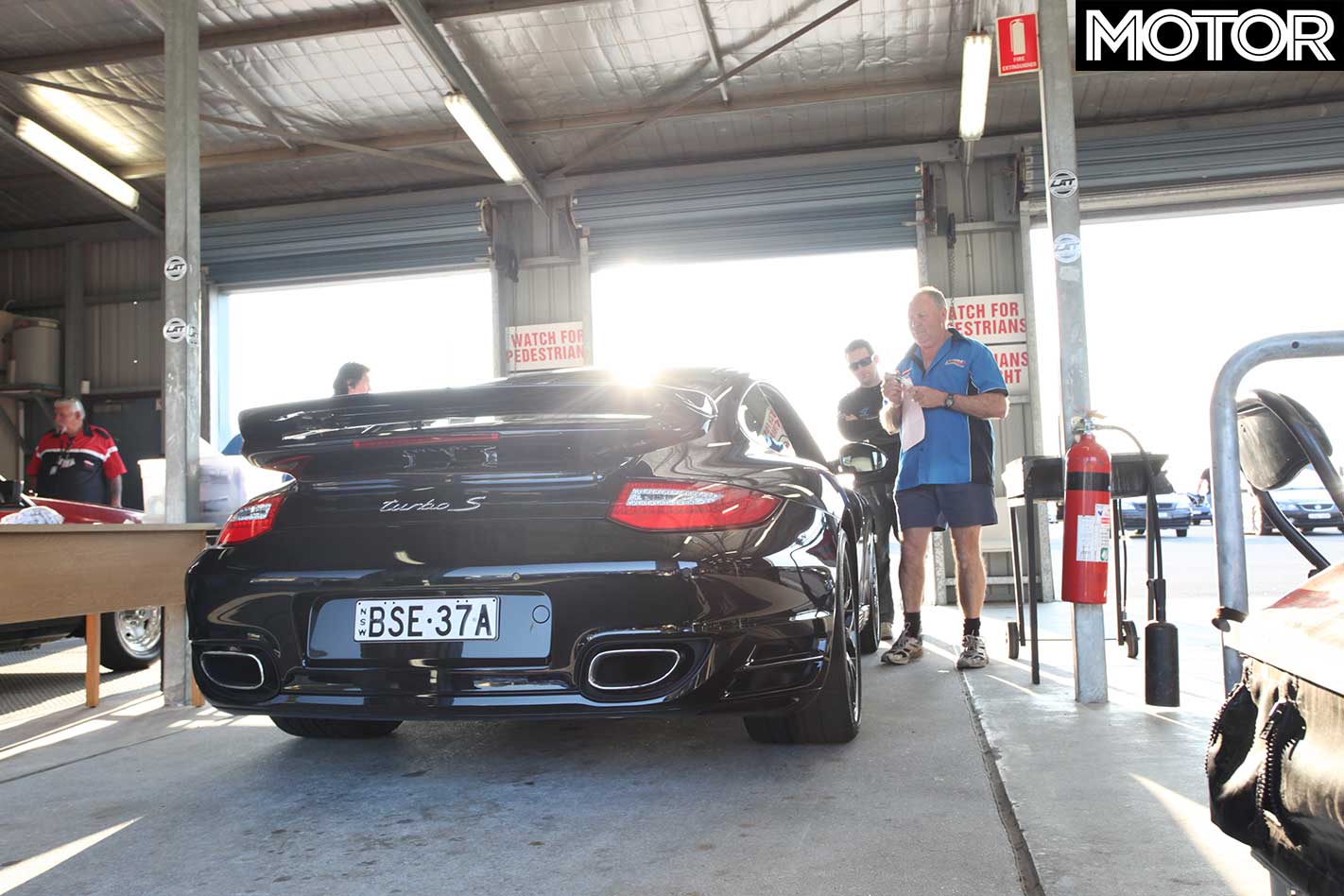
Secondly, and although Porsche Oz was roundly impressed at the 911 Turbo’s emphatic performance – my best run was 11.025sec @ 205.40km/h – Stuttgart doesn’t take kindly to losers. And my ineffectual attempt in getting the 911 Turbo banned rendered the hierarchy unamused. In contrast, my colleagues found my so-close-yet-so-far effort to be priceless.
Apparently, it only takes 0.026sec to go from hero to Village Idiot. Dep-ed Dupriez found it riotously funny to brand me as “Mister two-tenths” for weeks after. Of course, any time spent in my defence, pointing out that I only actually missed out by two hundredths, rather than two tenths, would only incite more laughter.
Even a long-time reader got in on the act. But at least he offered some useful advice. “If you creep past the final staging mark, don’t reverse back into stage. Reverse back past it and creep forward again,” he said.
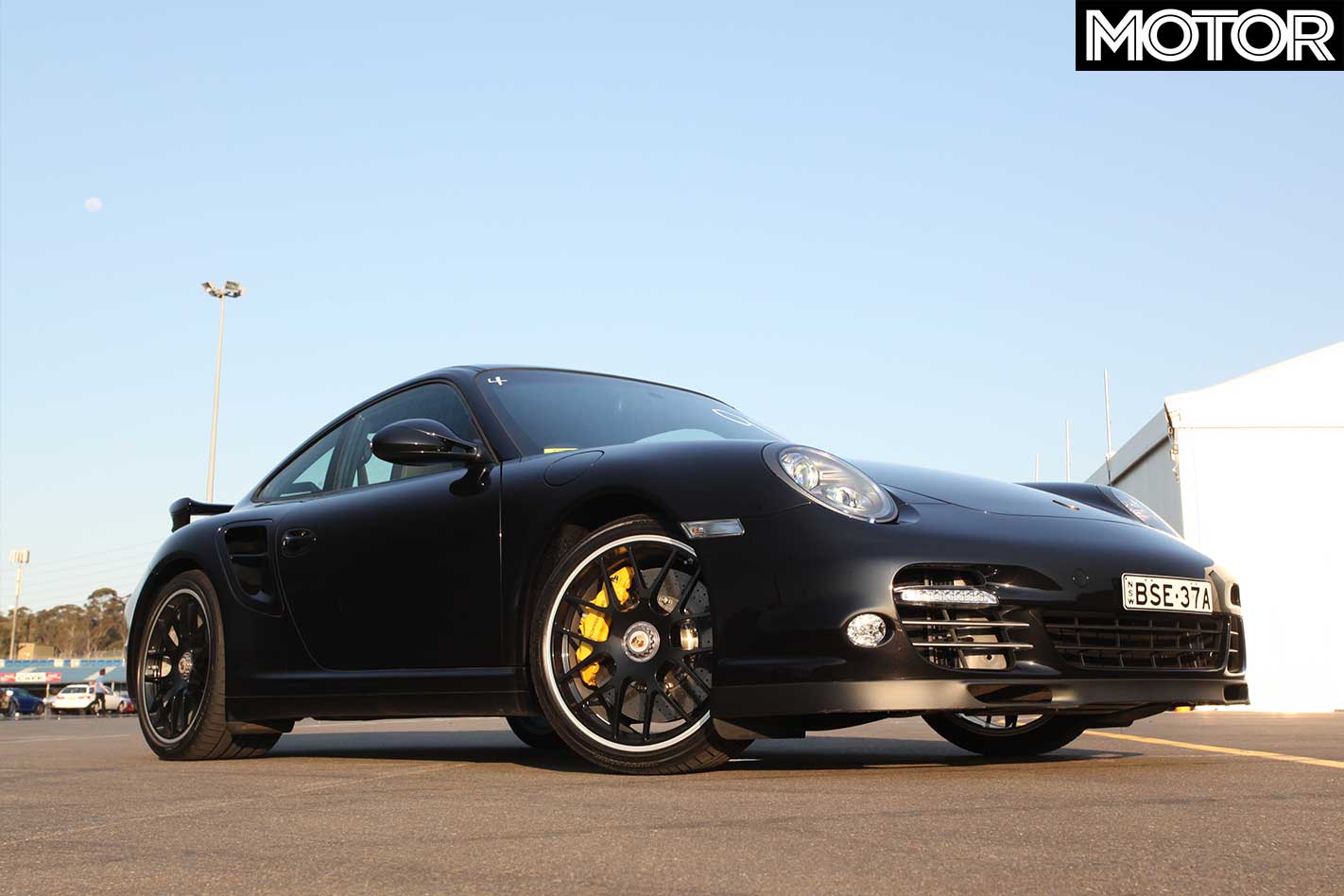
The thinking behind it was to allow myself an extra wheel rotation before the car trips the three-foot (one metre) start-line timing beacon. When you’re chasing hundredths and getting wheelspin off the start line, every rotation helps, especially when the circumference of the 911’s rear tyre is more than two metres.
But despite the volley of criticism, I’d argue that my near-miss wasn’t totally unexpected. I mean, the only reason you’d build something like, I dunno, a 911 Turbo S for instance, is solely because the ‘standard’ Turbo isn’t quite ballsy enough, right? It makes sense.
In fact, it made enough sense for Stuttgart to do just that, and craft a demon that could out-monster the fearsome 911 Turbo. Remember, the less potent stocker was still the fastest production car that MOTOR has ever tested, despite my failure to get the thing banned.
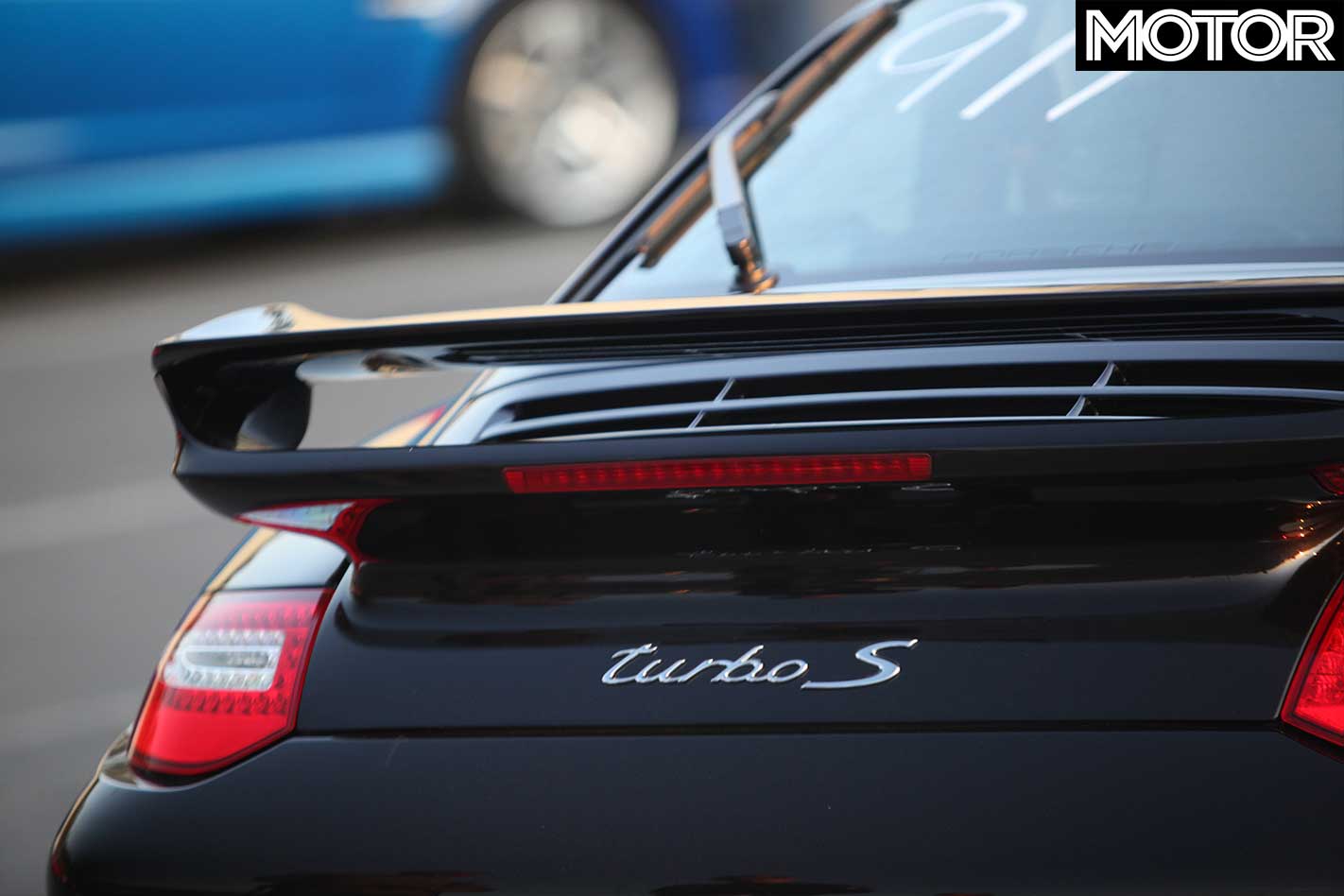
The Turbo’s bare specs require some prudent consideration before you strap in and kick it in the slats. Its twin-turbo 3.8-litre flat-six produces 368kW at 6000rpm and 700Nm between 2100-4000rpm. Weighing just 1595kg, it equates to a formidable 231kW/tonne power-to-weight ratio. If he was still alive, what would dear old Ferdinand Porsche say?
Probably the same word I spoke as I launched the Turbo for the first time. In truth, the launches weren’t ideal that night. Temperatures were in the early teens, and the track/tyre temperature combination couldn’t muster enough grip for the Turbo to launch perfectly. But when it did hook up, at about 10km/h or so, boy did it unleash.
Once you’ve experienced the relentless acceleration for the first time, it’s no longer scary. That’s because the Turbo does it so easy. There’s the forceful whoosh of the twin turbochargers at full throttle, but even that gets drowned out by wind noise by about 180km/h. There’s no shakes, vibrations, clunks or bangs to give any sense that the car is working hard.
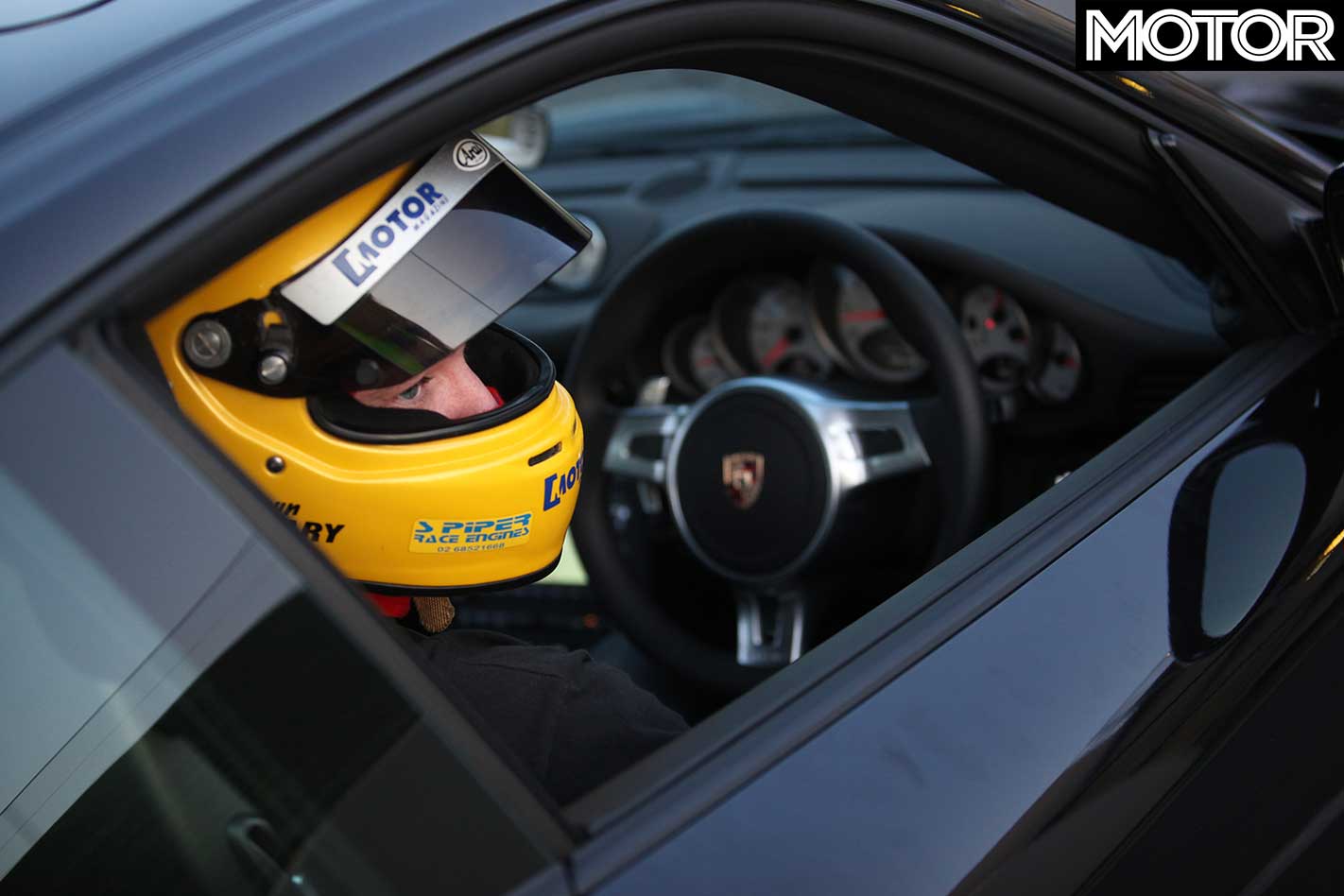
The actual terminal speed you’re carrying by the 400m mark is deceptive – it all happens so quickly and effortlessly, and the high-speed stability is such that it belies the actual numbers. My mind was at least 50km/h in arrears: which is less than ideal when you’re driving a car like this.
However, my incompetence didn’t seem to prevent Porsche calling five months later to offer the services of the new Turbo S. This time, however, I was given clear instructions: “get it banned, Cleary.” Disobedience wasn’t an option.
Weighing in at 1585kg, the S is 10 kegs lighter than the stock Turbo, but is basically the same car. The main difference is an extra 0.2bar of boost pressure that nets it another 22kW, with an unimproved 700Nm torque figure that is spread over an extra 250 revs: 2100-4250rpm. The resultant power-to-weight is up 15kW at 246kW/tonne. More than enough to squeeze out an extra three hundredths, I reckon.
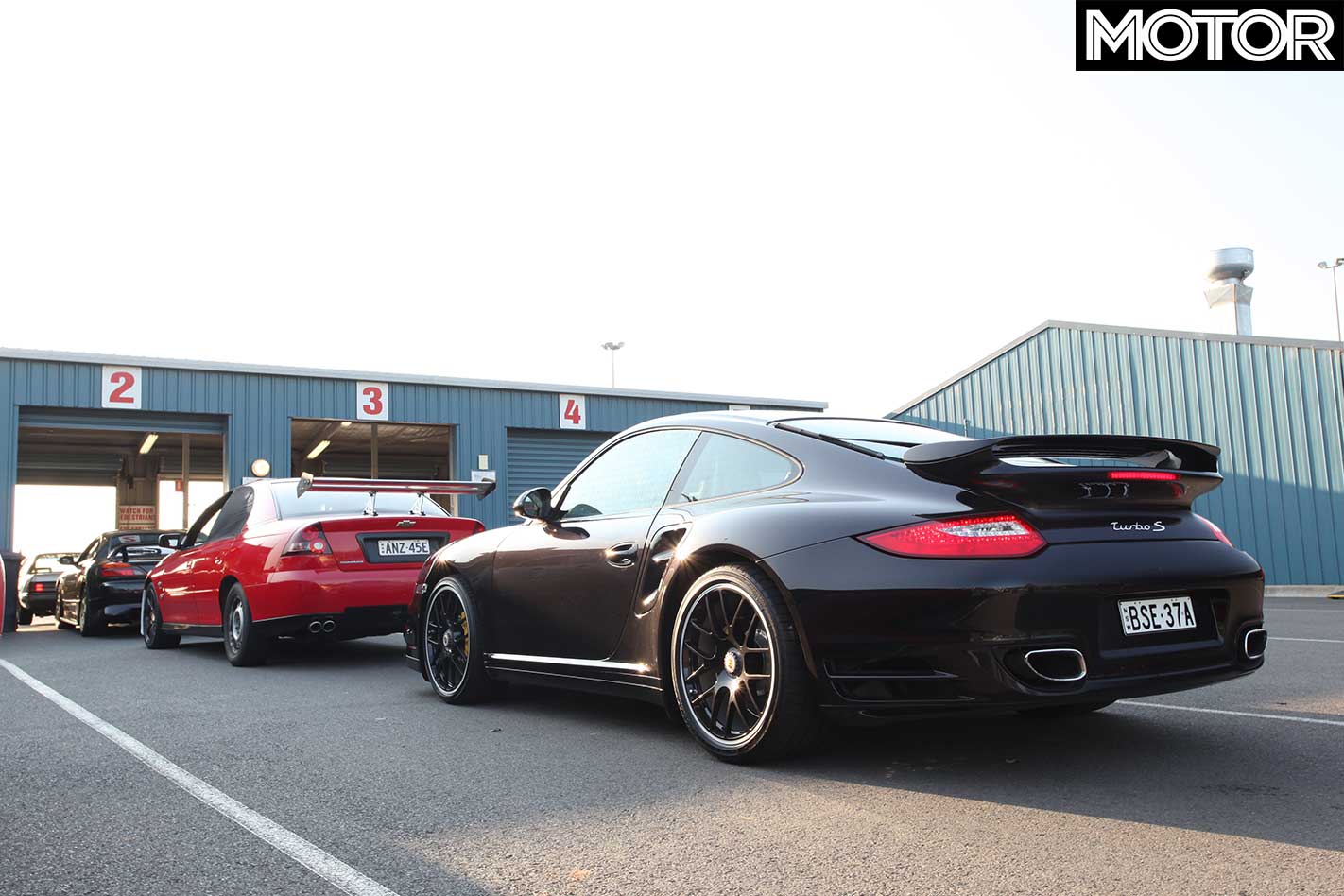
There’s no getting cute by avoiding lunch and blasting it down the strip on the mere smell of fumes this time: we’re going to do it properly. After a good meal, I arrive at Porsche Centre Sydney and regard our black-on-black Turbo S. It certainly looks tough enough to do the job. As requested, it’s only half-full of 98 RON fuel, so all prepped I head to Sydney Dragway.
Even in traffic, the odd opportunity to half-open the taps leaves no doubts about this car’s broader torque spread in difference to the standard Turbo. Sure, you’re never left wanting more in the stocker, but instead of the sledgehammer-like shove piled on in peaky bursts, the S offers a more linear, surging delivery.
Just to enhance the feeling of déjà vu, I meet up with photographer and former dragway accomplice Brasher at the servo. We check tyre pressures, top-up the fuel to halfway and add a bottle of octane booster just in case, and we hurry to the Dragway to complete the paperwork (we’re #911 again), get scrutineered, and line-up for the first attempt. There’s probably double the number of entrants this time around, so we’ll have to make the most of each run, seeing as we’ll probably only get three or four chances.
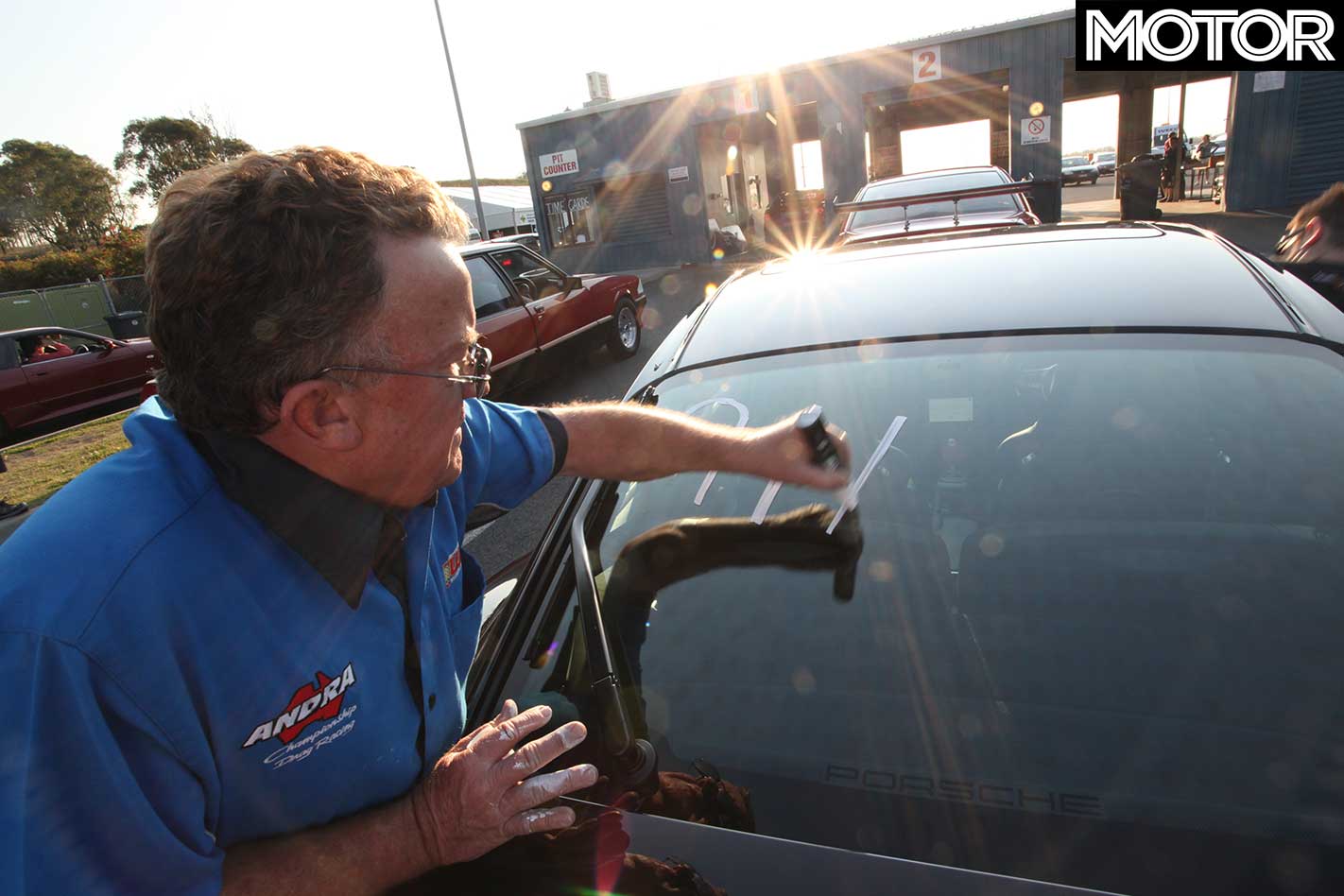
This time it’s for business, not pleasure. I can imagine the hilarity back in MOTOR HQ if I was to fail a second time. We’re not interested in what other punters are doing, or what they’ve brought to race. We’ve got a job to do.
Reluctantly, I submit to our photographer’s requirements and agree to sandbag the first few runs so he has enough photos. I won’t engage Launch Control; leave the radio blaring, and the air-con blasting. All of these will cost me time, which should allow my basic, step-off launches to pass in enough seconds to prolong our eviction.
Stepping off the brake and flooring the throttle induces plenty of wheelspin, but with that in mind, and considering all the Turbo S’s ancillaries are on, a first attempt of 11.328sec at 203.59km/h is very promising. Needless to say, I’m quietly confident.
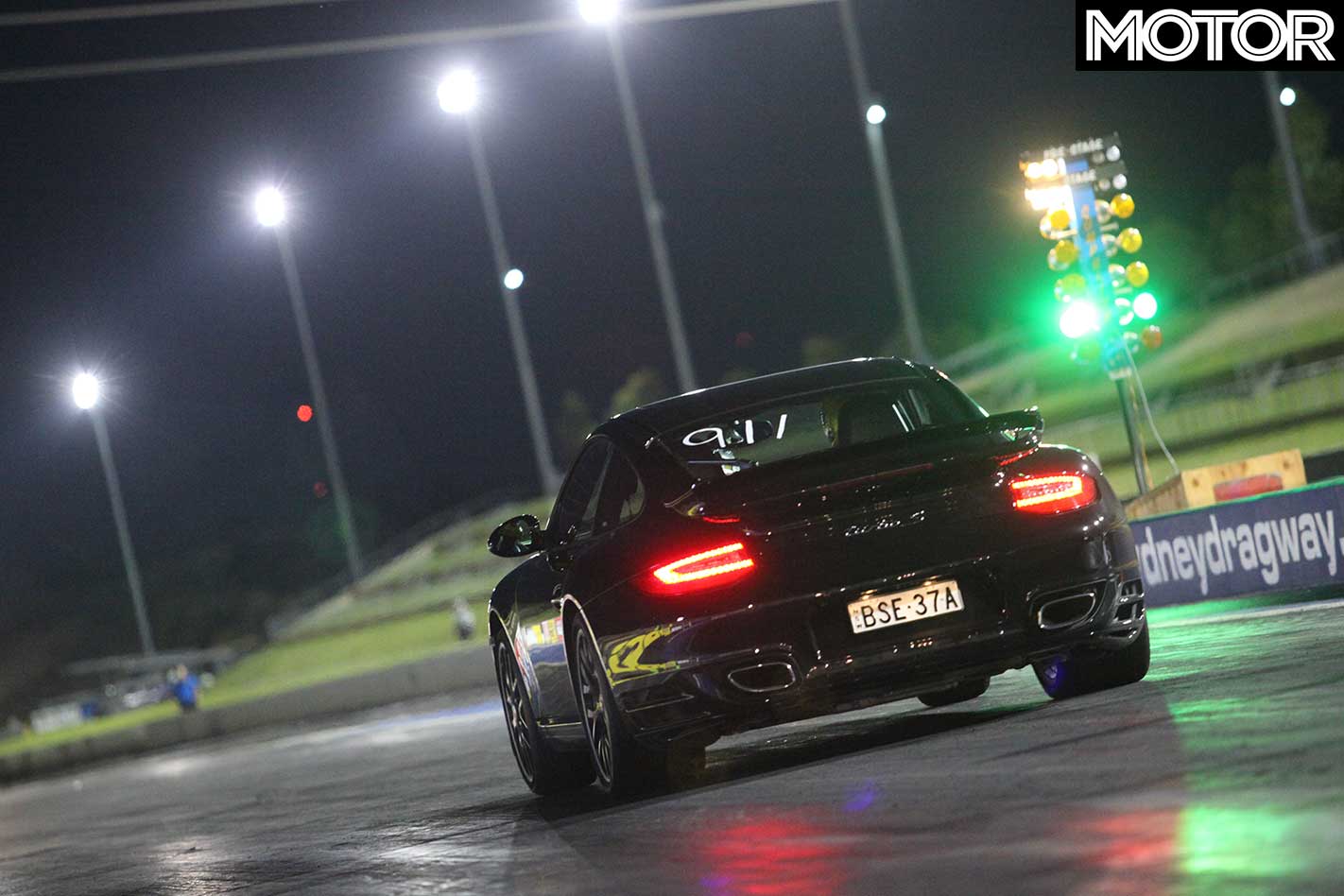
Even so, I’m not prepared for The Launch when it finally happens. I engage Sport Plus, then creep forward into stage. As soon as the green light flashes, I release the brake. The revs drop faintly for a frozen split-second in time as the engine, seven-speed PDK, all-wheel-driveline, Michelin Pilot Sport tyres and sticky Sydney Dragway surface all compete with each other.
Milliseconds later, The Launch happens and I’ll never forget the feeling for as long as I live. The instant the Turbo S leaves the start line, I know that this run is going to be the one that takes me beyond the 11-second threshold. The tyres bite savagely into the road and catapult the Turbo S off the line – no wheelspin this time. As the PDK slams through its seven ratios, it’s like riding a cannonball.
Exactly 10.874sec later, I cross the 400m line, doing 209.50km/h.
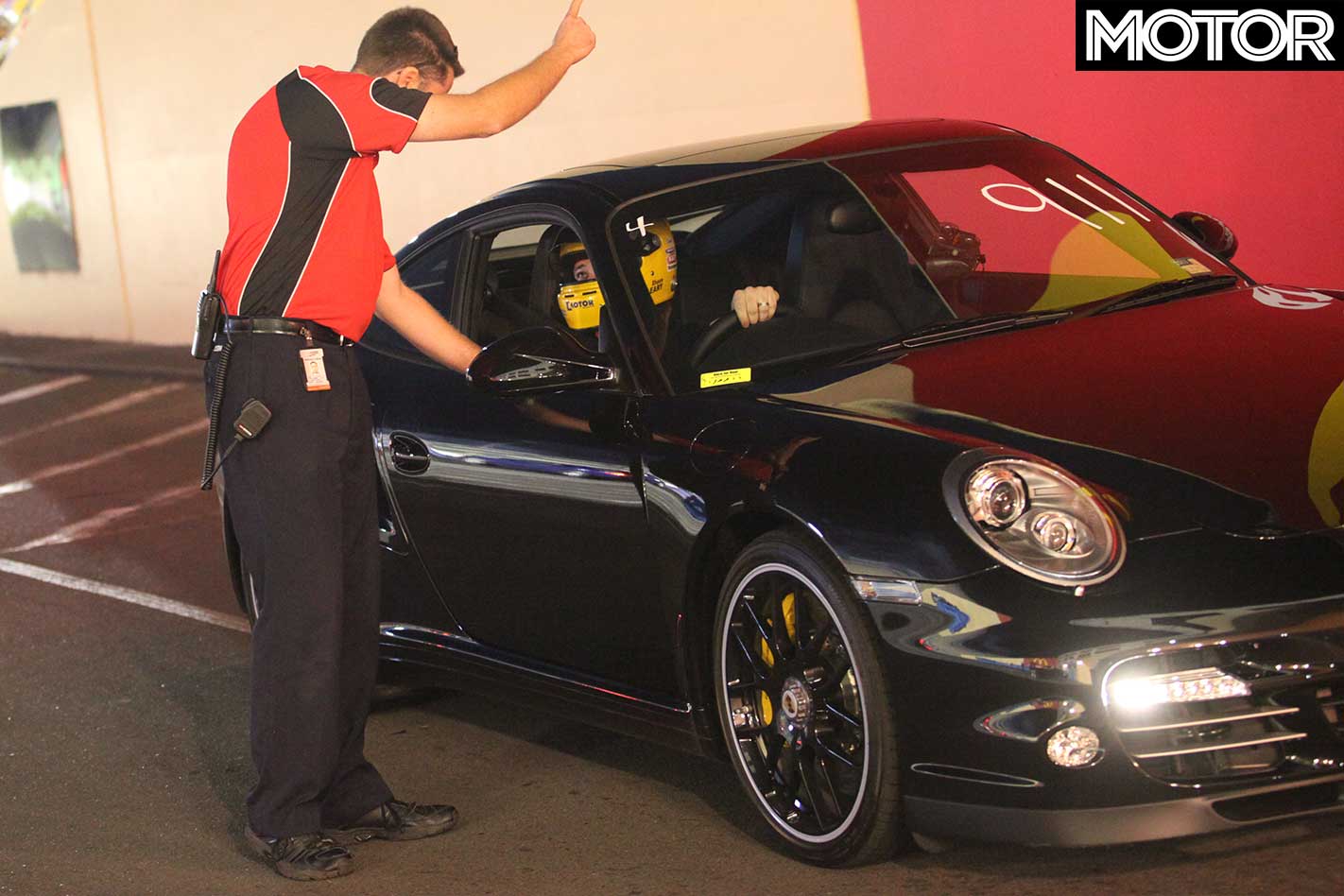
Even though I haven’t really done anything, the feeling of achievement is palpable. And as expected, on returning to the paddock area, an official greets me. But he’s trying to hide a grin on his face. He is just as impressed as we are, surely, as he advises us that we won’t be allowed to compete any more tonight. Our Porsche 911 Turbo S, a standard production car, has officially been banned from competing at the Speed off the Street drags.
For the second time in six months, I’ve recorded the fastest acceleration numbers in MOTOR’s history. But this time, they’ll really take some beating.
The contenders
Everyone wants in on the small-SUV game these days, and our rivals here are two of the freshest in the compact-luxury-crossover segment. Volvo’s XC40, represented here in T5 guise, is also a newly minted Wheels COTY champ – a daunting opponent, then, for the Lexus UX 200 F-Sport that’s laying down the gatlopp (that’s Swedish for gauntlet). Lexus sorely needs to kick some goals with the UX. It’s the brand’s first stab at a small SUV, and its previous foray into somewhat-affordable hatchbacks, with the unloved CT 200h, has proven a struggle. The UX is certainly sized right, based as it is on the versatile TNGA GA-C platform used by its Toyota C-HR and Corolla cousins, and the lineup is incredibly feature-rich.
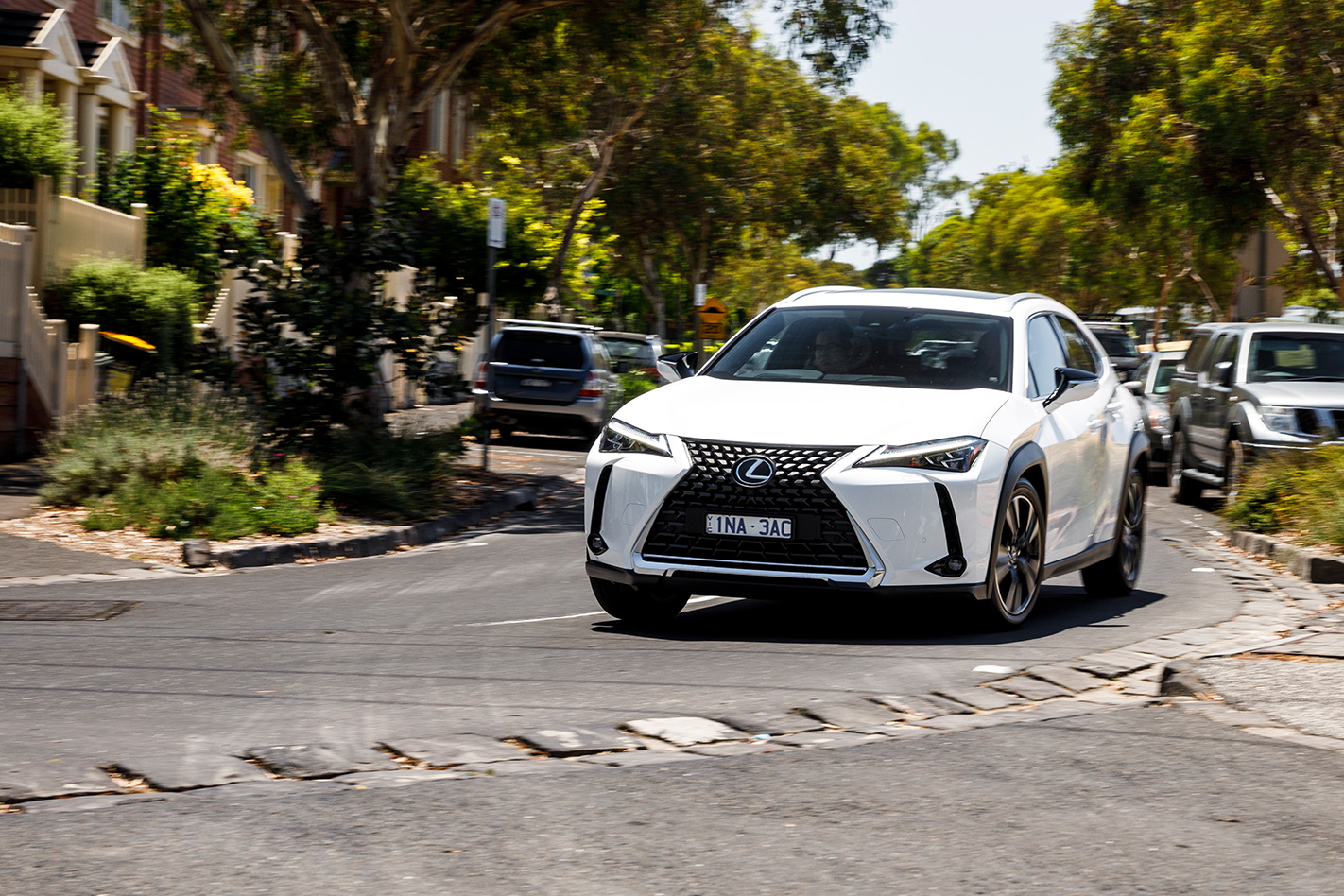
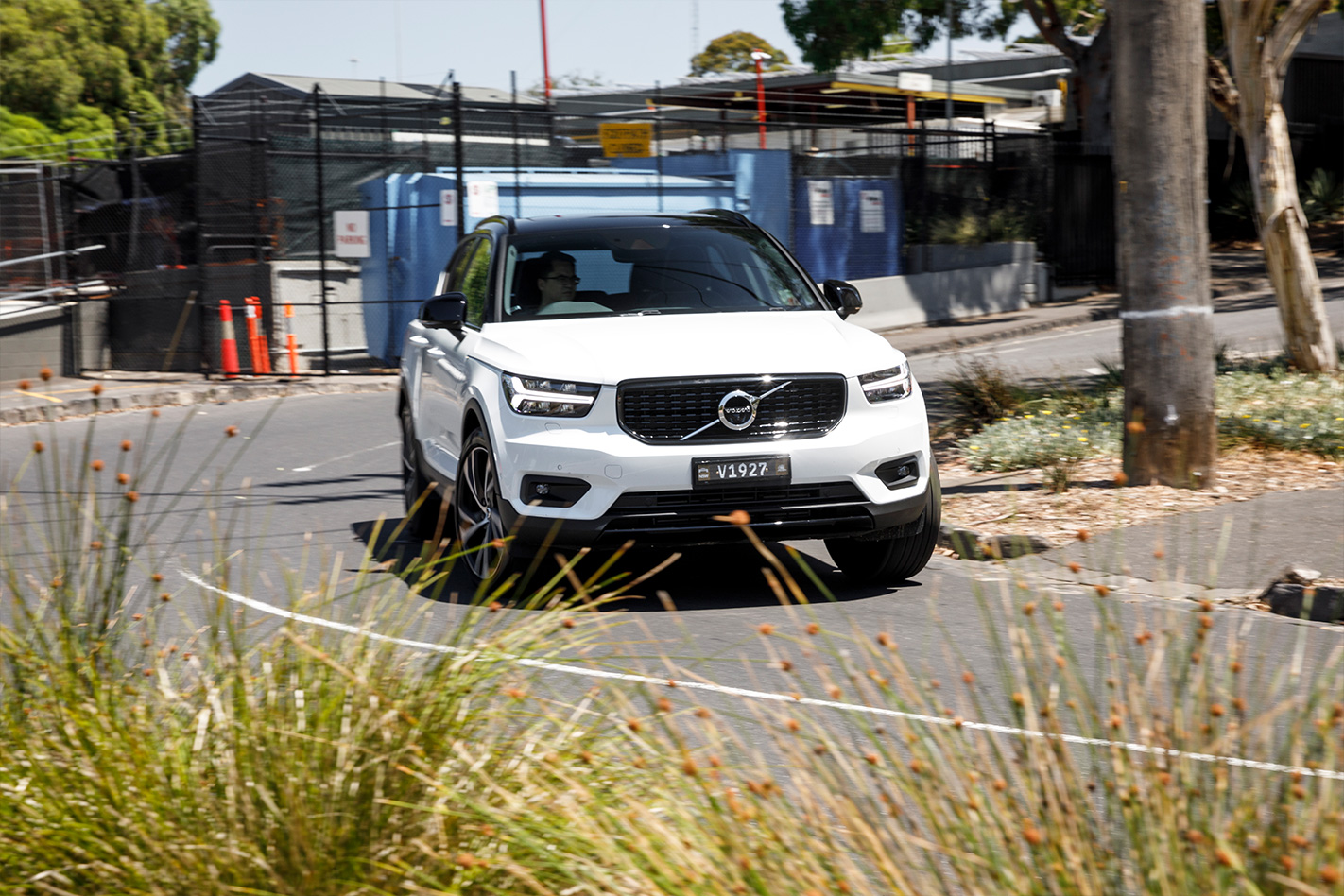
It squares off against the incumbent Swede in high-spec petrol FWD UX 200 F-Sport guise, but the Volvo has aces up its sleeve in the form of its intelligently designed cabin, bigger, broader-shouldered proportions and more mumbo.
Equipment and value
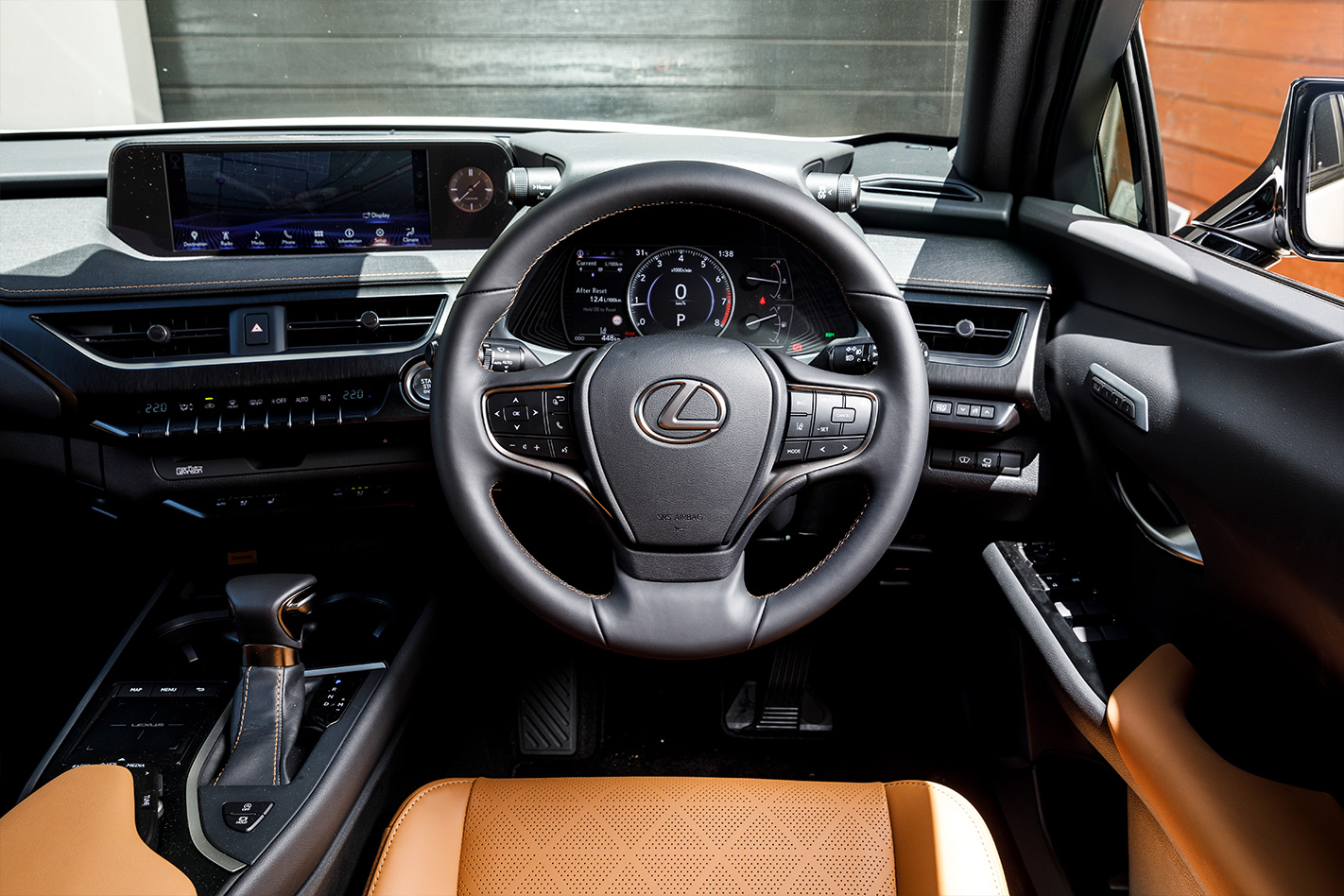
The UX 200 F Sport comes loaded with standard kit, like a power-adjustable steering column, heated front seats, a 10.3-inch widescreen infotainment display, bi-LED headlamps, various quasi-autonomous driving aids and a hands-free tailgate for a list price of $59,050. Our car came fitted with the innovatively named Option Pack 2, which adds a thumping 13-speaker Mark Levinson stereo, wireless charge pad, head-up display, panoramic-camera view, glass roof and ventilated front seats. All that, and it still costs a few grand less than the $62,710 as-tested price of the XC40 T5 R-Design. Value is a UX strength.
The Volvo counters with a fully digital instrument panel, far superior infotainment software, smartphone mirroring and fashionable 20-inch alloys, versus the 18s on the Lexus. It also comes with all-wheel drive as standard (something that only the hybrid UX offers as an option). But for sheer features-per-dollar it’s the Lexus that edges ahead.
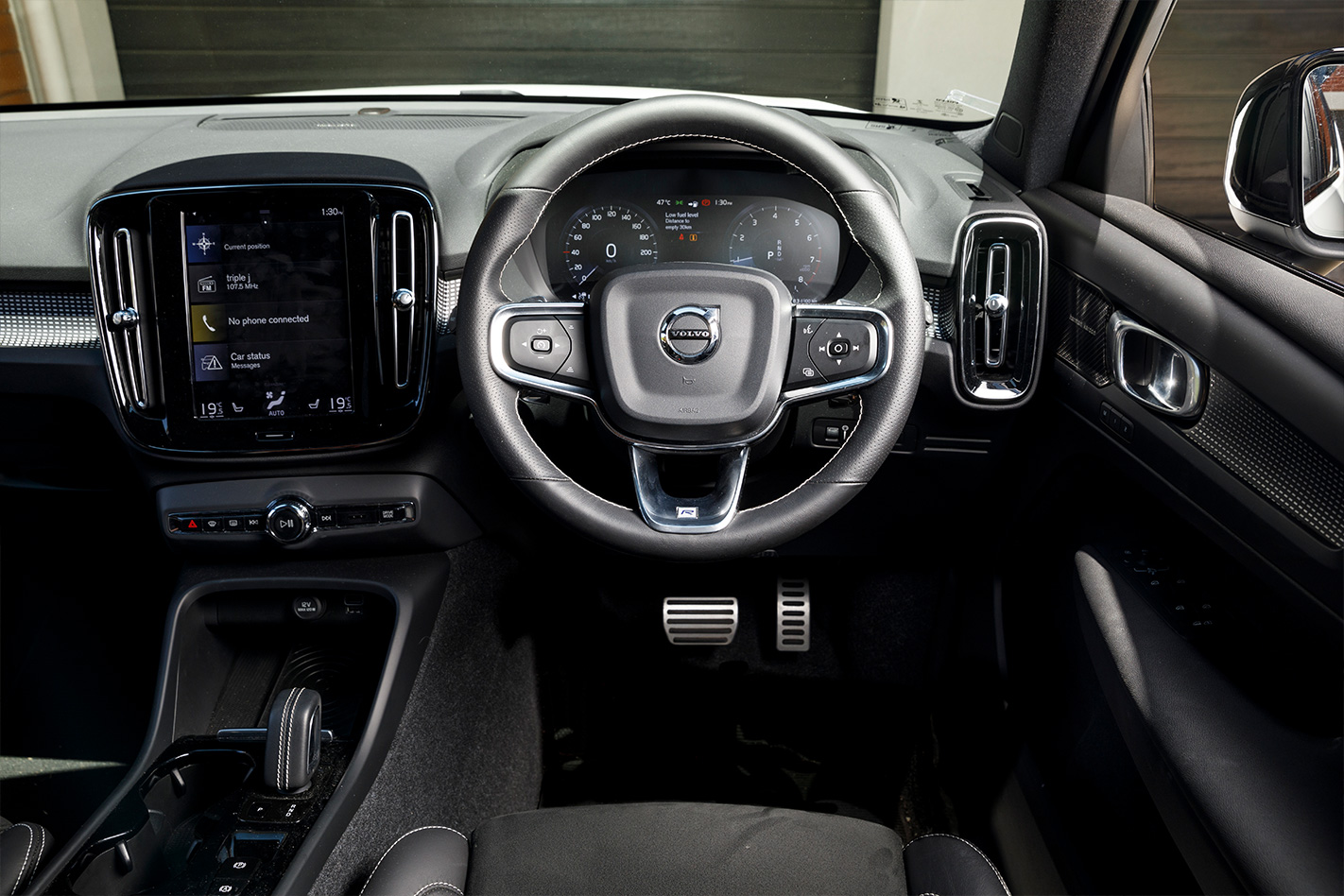
Space and comfort
The Lexus UX is like a sleeping bag – snug and comfy once you’re inside, but getting in and out isn’t the easiest or most graceful process. A low roof rail and seat position mean the traditional SUV advantages of ease of entry/egress aren’t there, and there’s even more stooping required to enter the back seat. On the flipside, the F Sport front seats are exceptionally contoured and hugely supportive, and the driving position is sportscar-like. Cabin quality is also typical Lexus, meaning everything feels rock-solid, and there’s a stylish Japanese-paper trim panel on the upper dash that helps elevate the ambience.
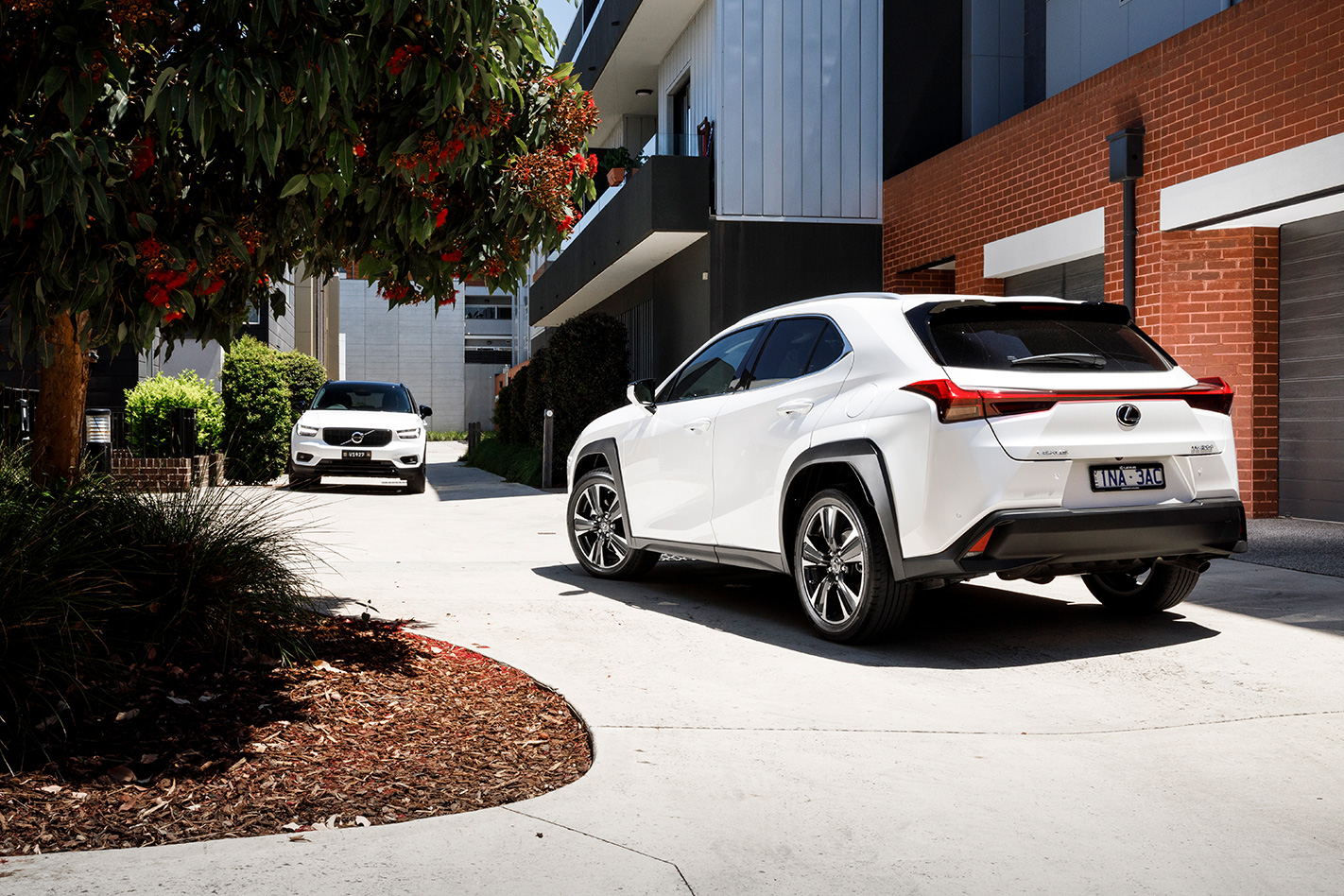
Volvo substitutes some of the glitzier furnishings of the bigger XC60 and XC90 for more understated design, but compensates with clever packaging that maximises storage and occupant space. It’s also comparatively huge. While the Lexus is a sleeping bag, the XC40 is like an expensive studio apartment – still cozy, but open-plan and very premium.
How they drive
It might have the slightly dozy powertrain of the Toyota Corolla behind its spindle-grille, but the UX actually provides more than a skerrick of driving joy, thanks to a finely tuned suspension, light yet accurate steering, and a surprisingly understeer-resistant chassis.
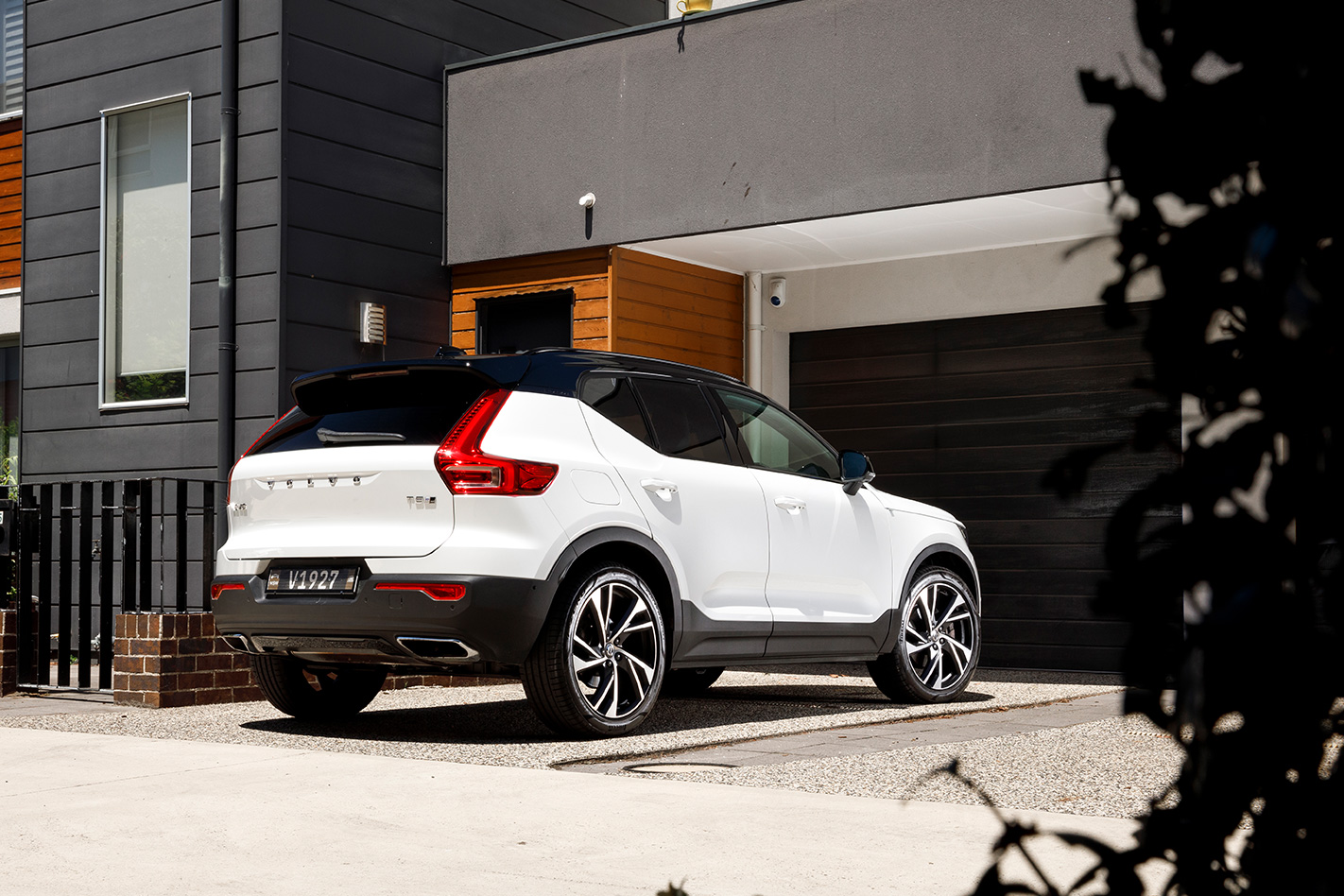
However, its atmo engine must work harder than those of similarly priced rivals, which are universally turbocharged, and that compromises refinement in a car that’s otherwise exemplary in this respect.
While the Lexus is competent, the XC40 T5 is a black belt. We described the T5 as hot-hatch-esque in our COTY issue, thanks to its exceptional handling and rorty 185kW/350Nm turbo four, yet it’s also perfectly happy being piloted through suburbia. And did we mention that it has twice the number of driven wheels of the petrol-powered UX? It might not be quite as refined as the UX 200, but in virtually every other on-road respect the Volvo dominates.
The Victor
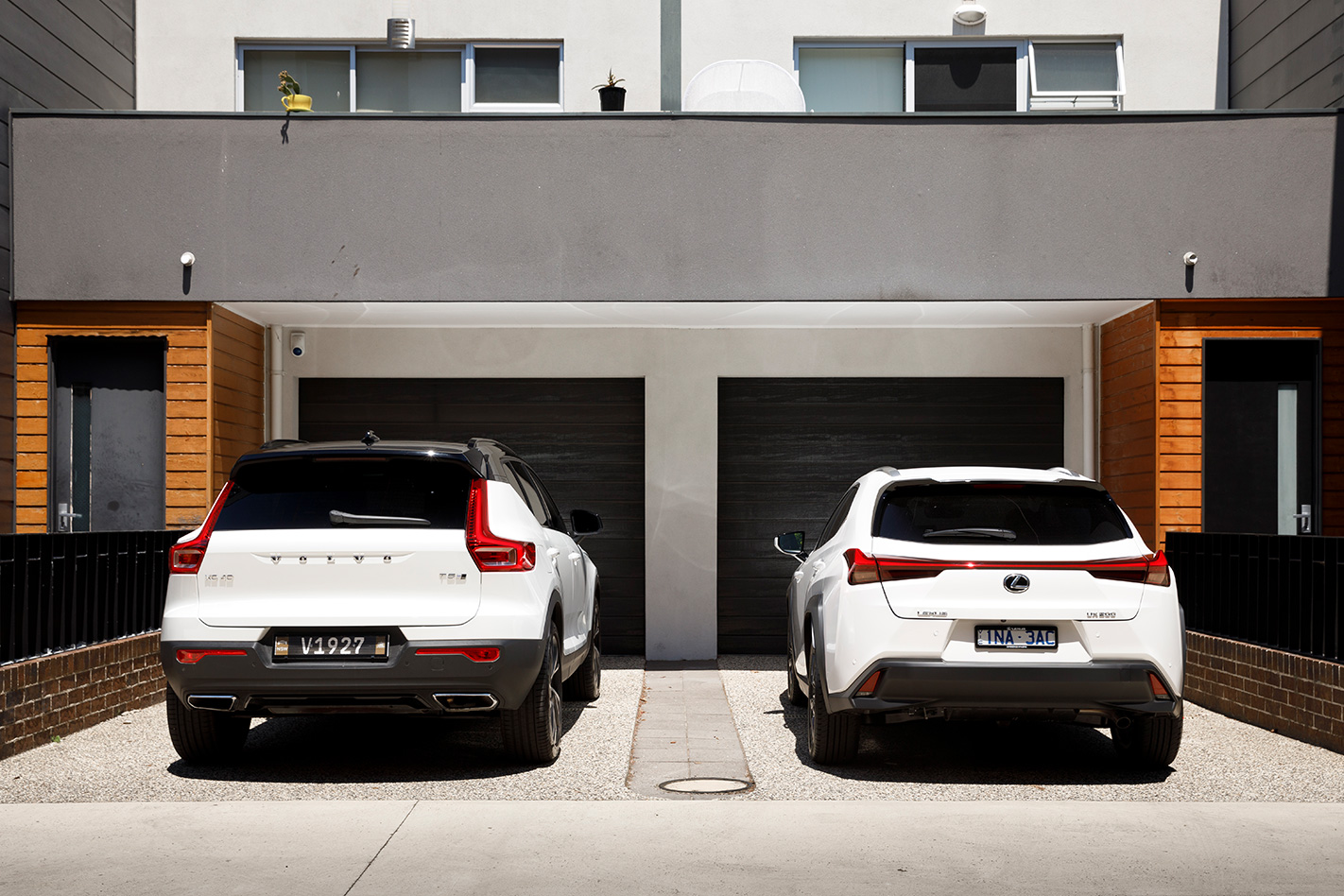
Lexus must be commended for its first, impressive crack at a small SUV, which is by some margin the most compelling soft-roader it has made to date. Even so, it’s not enough to outgun the more powerful, significantly more spacious and infinitely more practical Volvo. The XC40 earned its COTY crown for very good reasons, and Lexus needs to show much more than a strong value proposition to dethrone it.
