
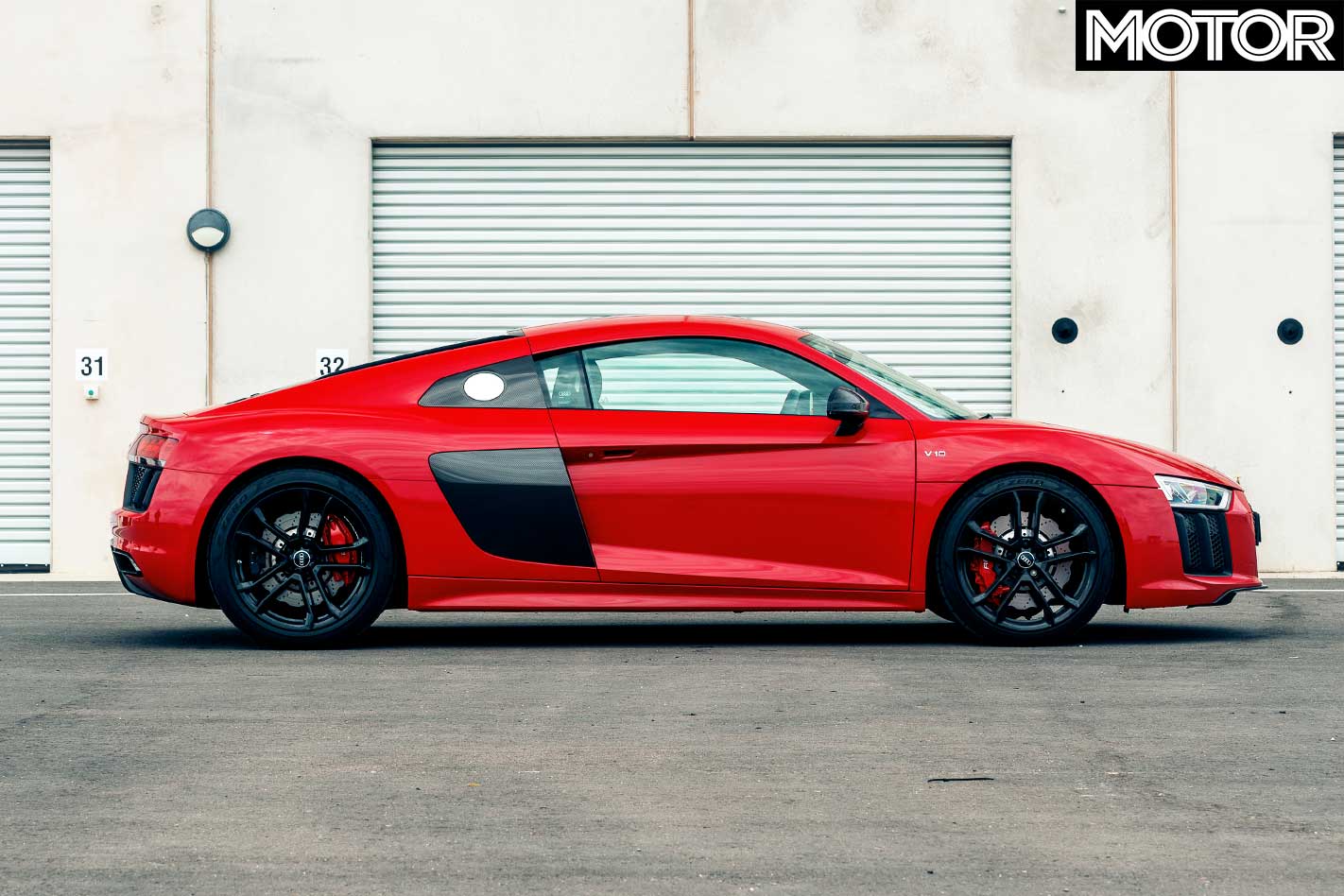
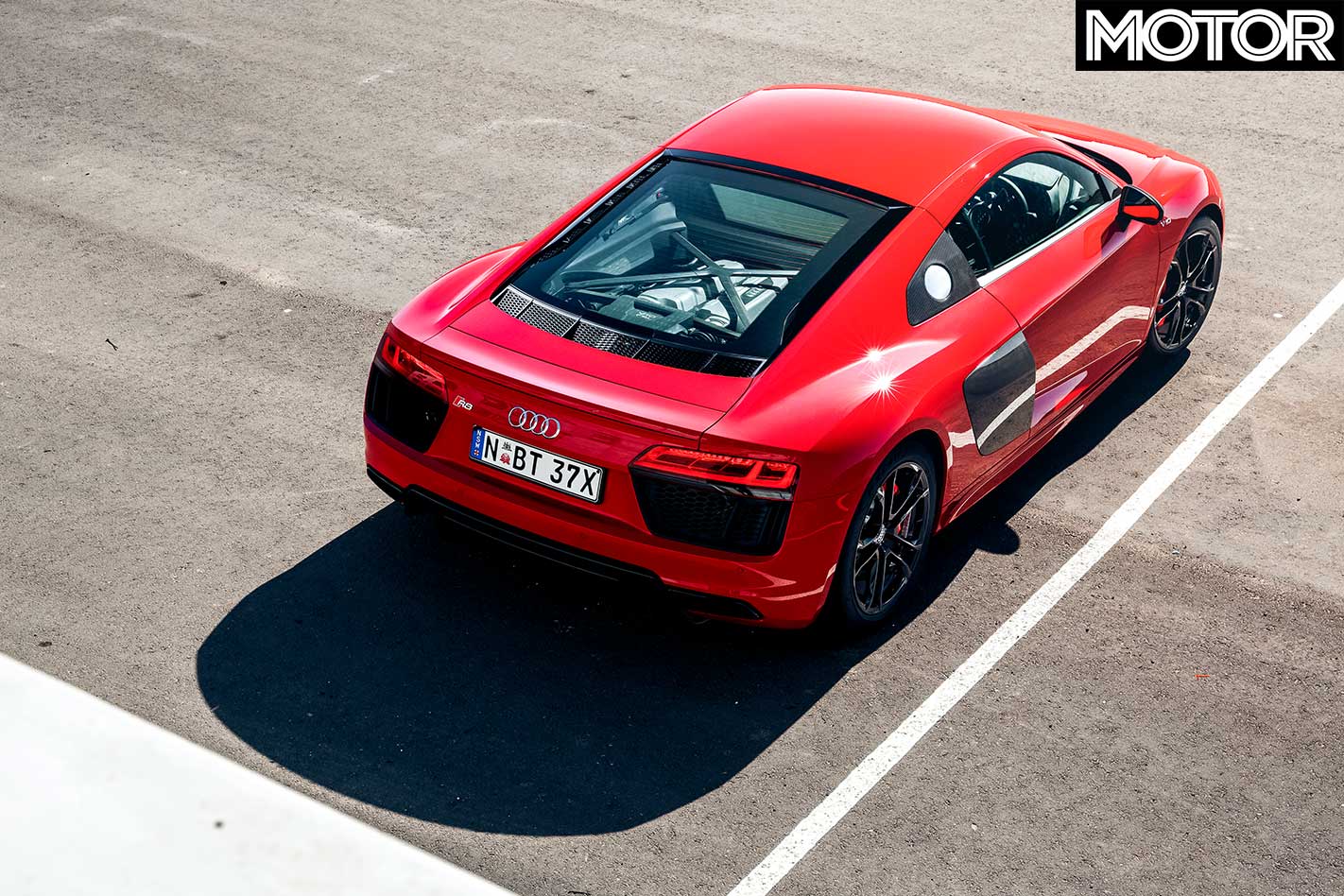
Supercar good looks, howling atmo V10 and rear-wheel drive – throw in a gate-shift manual and the Audi R8 Rear Wheel Series could almost represent the dream sports car.
Even with its seven-speed twin-clutch auto, the Audi R8 RWS is an extremely desirable driver’s car, which was confirmed by finishing fourth, just off the podium. Nothing to shirk at – the RWS is an outstanding thing.
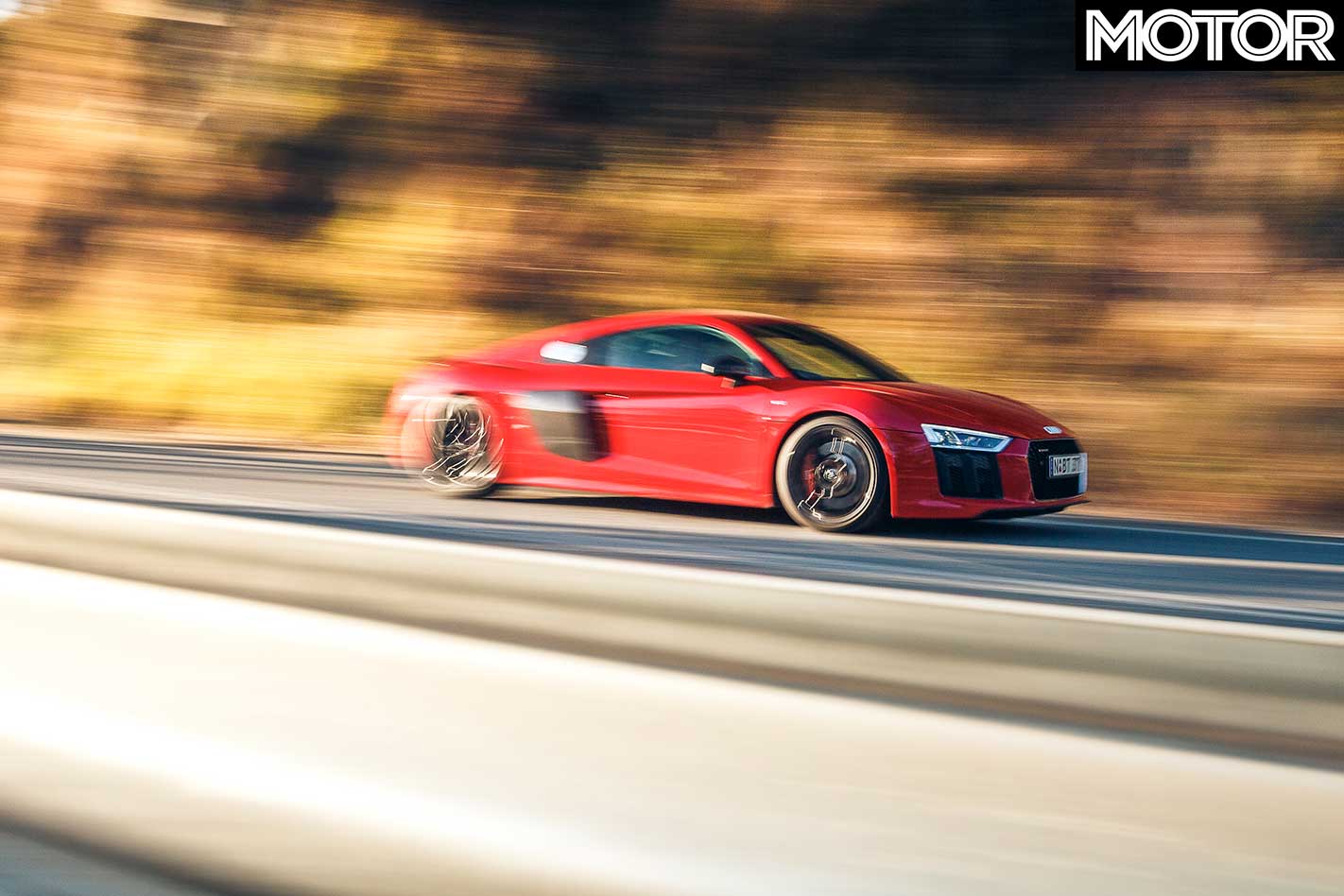
Perhaps the question to first ask is, what is there not to like about the RWS? Acceleration – ballistic, almost surprisingly so, and not just because its 3.57sec 0-100km/h time bested Audi’s claim by 0.2sec! No, if you drove all the cars here, you’d be unlikely to put the RWS second on the drag strip order ahead of the GT C or M5.
That probably has something to do with the R8’s big 5.2-litre V10 meting out its tremendous oomph in a polite curve all the way to its 8700rpm redline, rather than rudely lumping it all at the bottom of the tacho with a pair of dirty big turbochargers. Interestingly, at PCOTY 2013, the winning R8 V10 Plus – 404kW and all-wheel drive – did, no kidding, 3.57sec to 100km/h (and a slower quarter mile). Perhaps we should do all our straight-line testing at The Bend from now on…
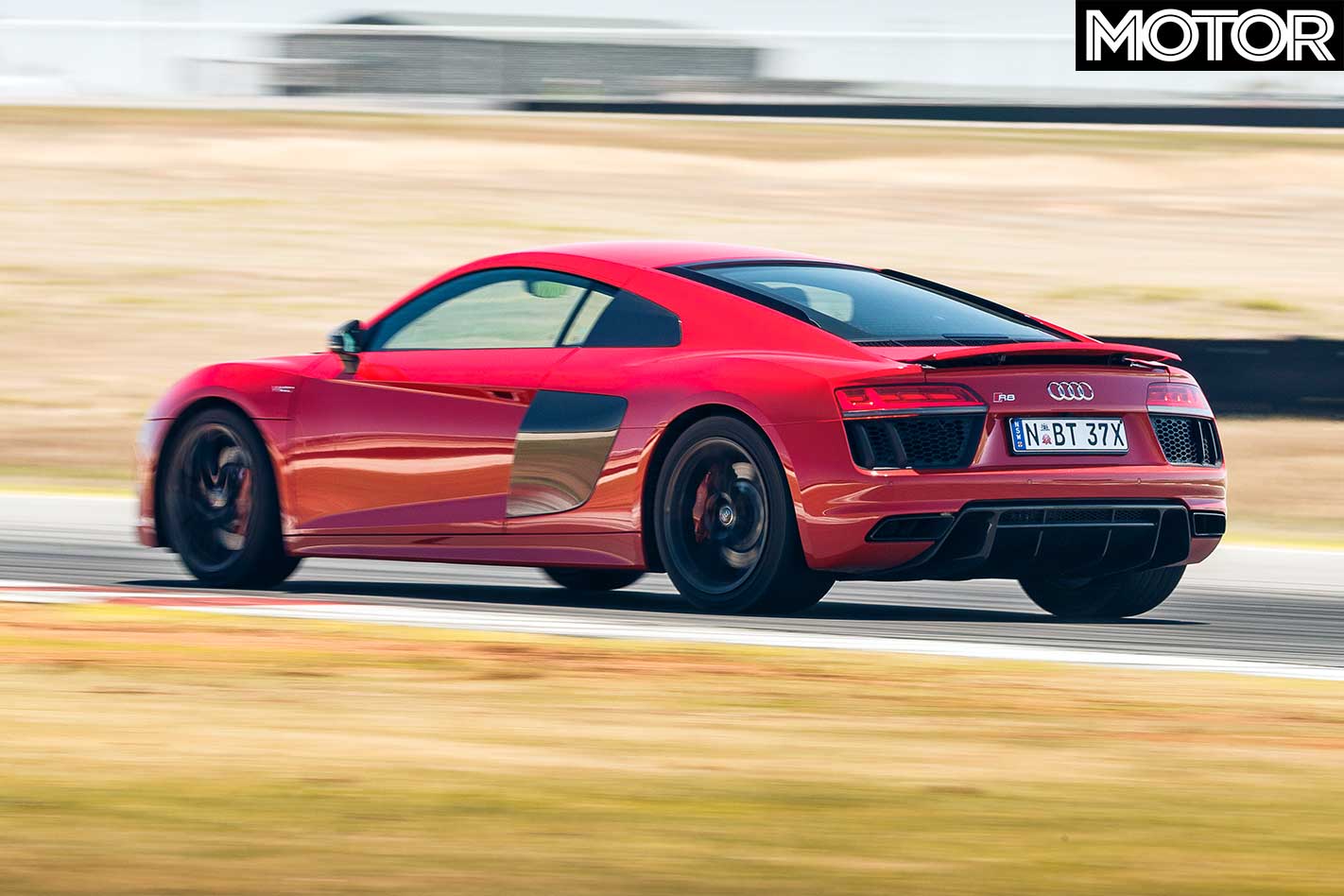
If handling is more your thing than acceleration times, then charming, old-school mid-engine dynamics await you in the big, bad RWS. With 245/295 front/rear tyres, the R8 likes you to keep brake pressure right to the apex – but not too much, ’cos that big lump of V10 will have you facing backwards quicker than you knew what just happened.
Patience, too, is rewarded getting back on the power, where over-eagerness is met with fairly serious power understeer. To get the absolute best out of the slightly precious RWS takes real precision and patience – it’s not a cinch.
Of course, if you signed up to RWS for skids, it will oblige, if also not in quite the benign way you might think – this is no forgiving drift machine. But get it right, and you’ll feel like a superhero.
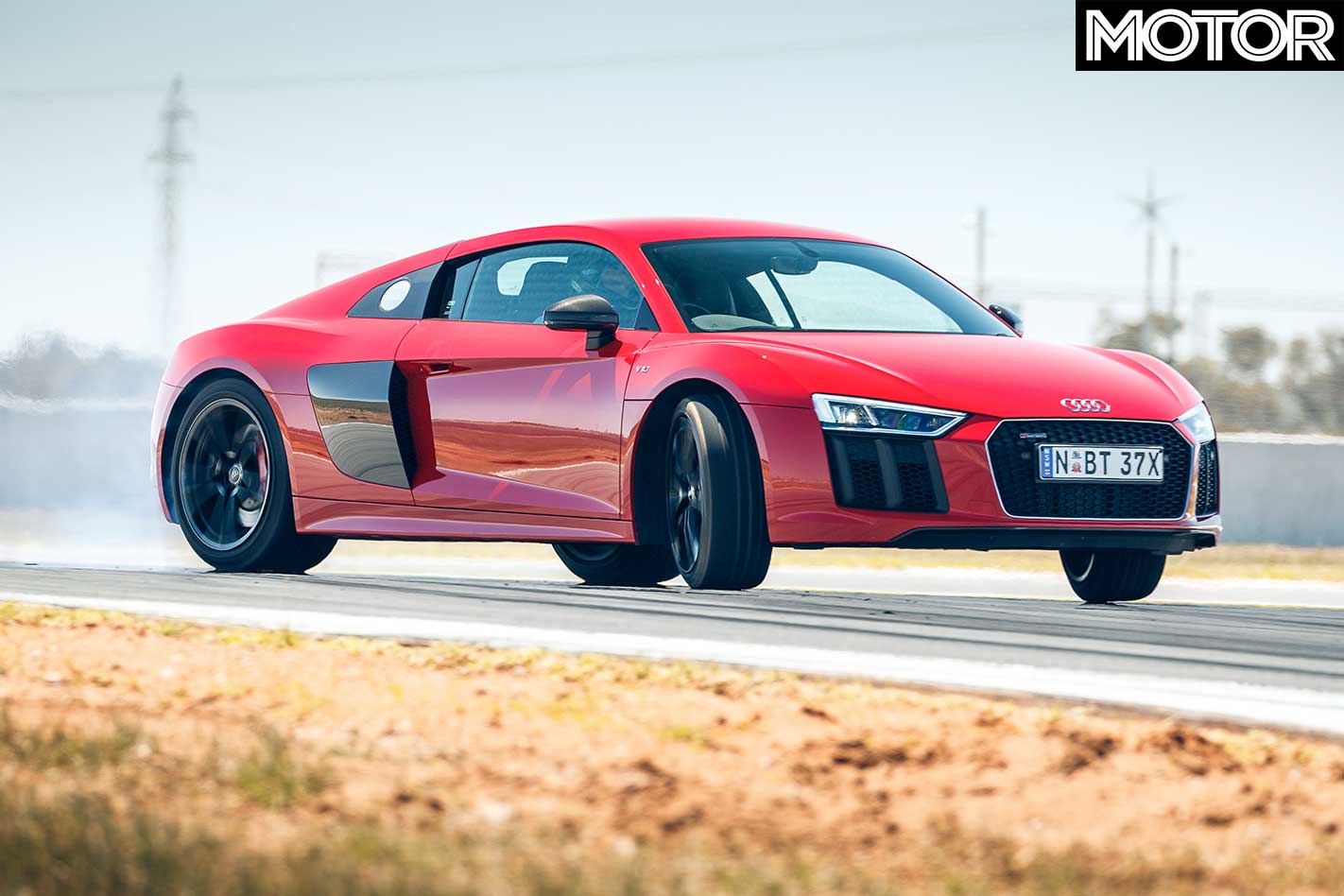
Then there’s the windows-down sound; epic brakes; flat, low-centre-of-gravity handling; even the price is relatively cheap… so why fourth and not higher? Adaptive dampers and perhaps more grip would be nice, but really, this is where the points game is most apparent, the final three are little bit better across the board. In another time and place, the RWS is absolutely PCOTY-winning material.
The Numbers
2019 AUDI R8 RWS SPECS: Engine: 5204cc V10, DOHC, 40v Power: 397kW @ 7800rpm Torque: 540Nm @ 6500rpm Weight: 1590kg 0-100km/h: 3.57sec 0-400m: 11.36sec @ 206.87km/h The Bend lap time: 1min 28.5sec Price: $321,100
Judge’s Rank
Dylan Campbell – 4th “Offers a classic mid-engine supercar experience in 2019.”
Louis Cordony – 3rd “Does theatre. Does milk runs. Does fast. And cheap, too.”
David Morley – =5th “I can’t believe that losing front drive hasn’t ruined it.”
Scott Newman – 3rd “A thrill and a challenge, everything a supercar should be. Love it.”
Rick Kelly – =5th “Cool looks, great sound. More enjoyable on track than on road.”
PCOTY 2019 Scoring
| Judges | DC | LC | RK | DM | SN | Total |
| Performance | 17.5 | 13.5 | 15 | 18 | 18 | 82 |
| Dynamics | 17.5 | 14 | 16 | 17 | 17 | 81.5 |
| Accessibility | 8 | 6.5 | 8 | 7 | 7 | 36.5 |
| Liveability | 7 | 8.5 | 6 | 7 | 7 | 35.5 |
| Value | 7.5 | 8 | 6 | 5 | 8 | 34.5 |
| X Factor | 9.5 | 7.5 | 8 | 9 | 9.5 | 43.5 |
| Total | 67 | 58 | 59 | 63 | 66.5 | 313.5 |
ONE of capitalism’s more insidious assertions is that all that is popular is inherently worthy. The fact that ‘Call Me Maybe’ by Carly Rae Jepsen went nine times platinum here is all the evidence you need to torpedo that argument. Therefore, Mitsubishi’s claim that it shifts as many Outlander PHEVs as the rest of Australia’s plug-in market put together doesn’t, in and of itself, float our boats.
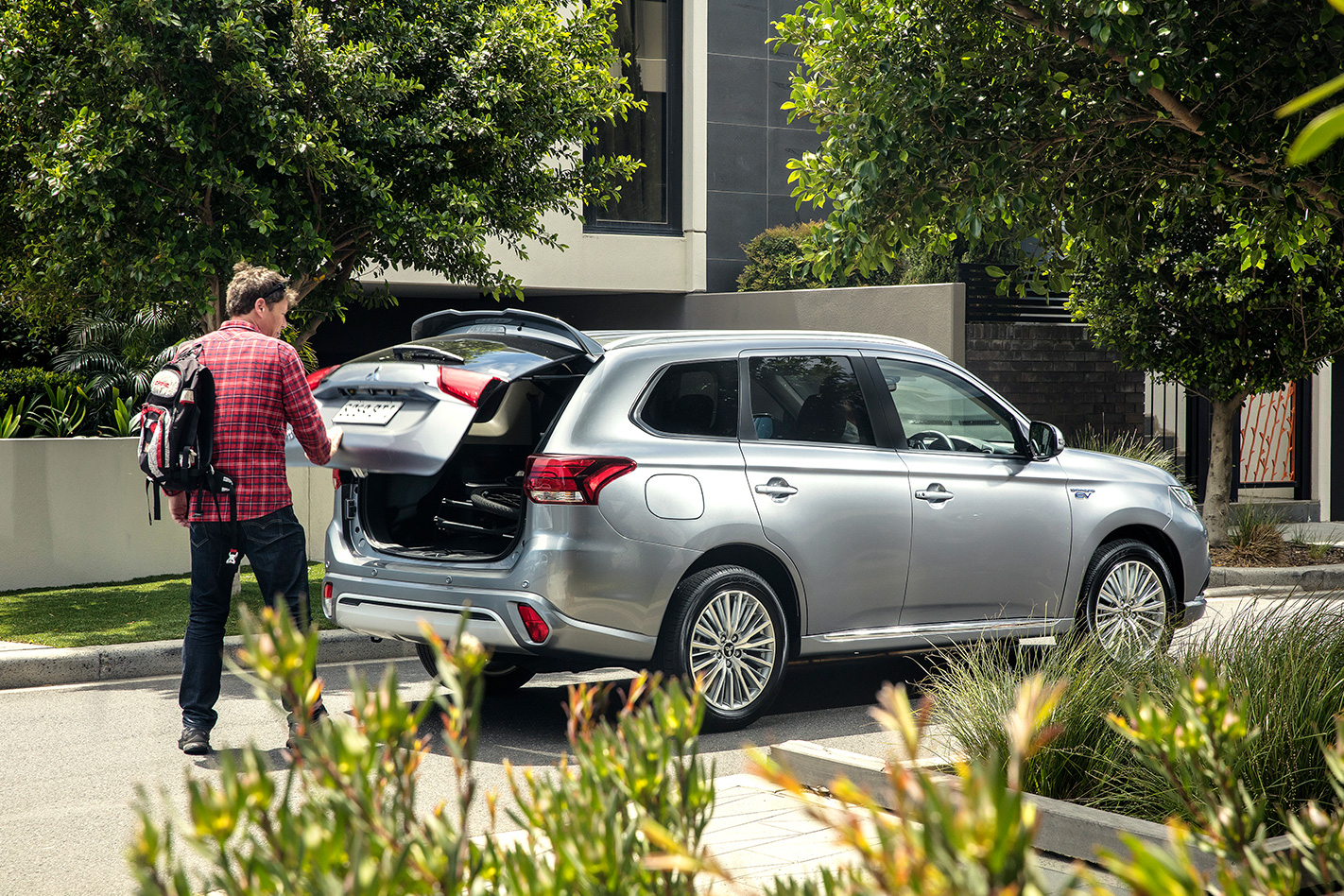
If, during 2018, you had fifty-odd grand to spend on a plug-in hybrid with more space than a compact hatch, here’s the longlist: Mitsubishi Outlander PHEV. That’s it.
Therefore it comes as a refreshing revelation to discover that the Outlander PHEV is not awful. In fact, it’s genuinely likeable. Talented even. When the battery is charged, it dips in and out judiciously in hybrid mode, making an agreeably alien noise in the process that certainly lets you know that you’re not just driving an internal combustion vehicle. The steering is better than any of the EVs we had in this test, offering crisp turn-in which combines with sharp pick-up that’ll have you jinking through tight corners and jetting out the other side assisted by all-wheel drive electric torque. Six levels of regenerative braking are available via the paddles.
The 12kWh lithium-ion battery is bigger than you get in a $100K Volvo XC60 T8 and delivers more range. Mitsubishi reckons 54 kilometres; we managed 47 on test with a little to spare, so that’s not entirely outlandish. Recharging takes five hours on a standard household plug or 3.5 hours if you install a dedicated home charger.
Aside from the self-explanatory Pure EV mode, the Outlander PHEV can also be driven in Series Hybrid and Parallel Hybrid modes. Series Hybrid mode activates when the battery charge is low or when more power is required for a burst of acceleration. In this mode the engine runs to charge the battery, which then provides power to the wheels. In Parallel Hybrid mode the engine drives the wheels directly, coming to life when the battery is empty. Onboard software will automatically select the optimum drive mode – and it usually makes a good fist of things – but should you wish to override these modes there are mode buttons on the centre console.
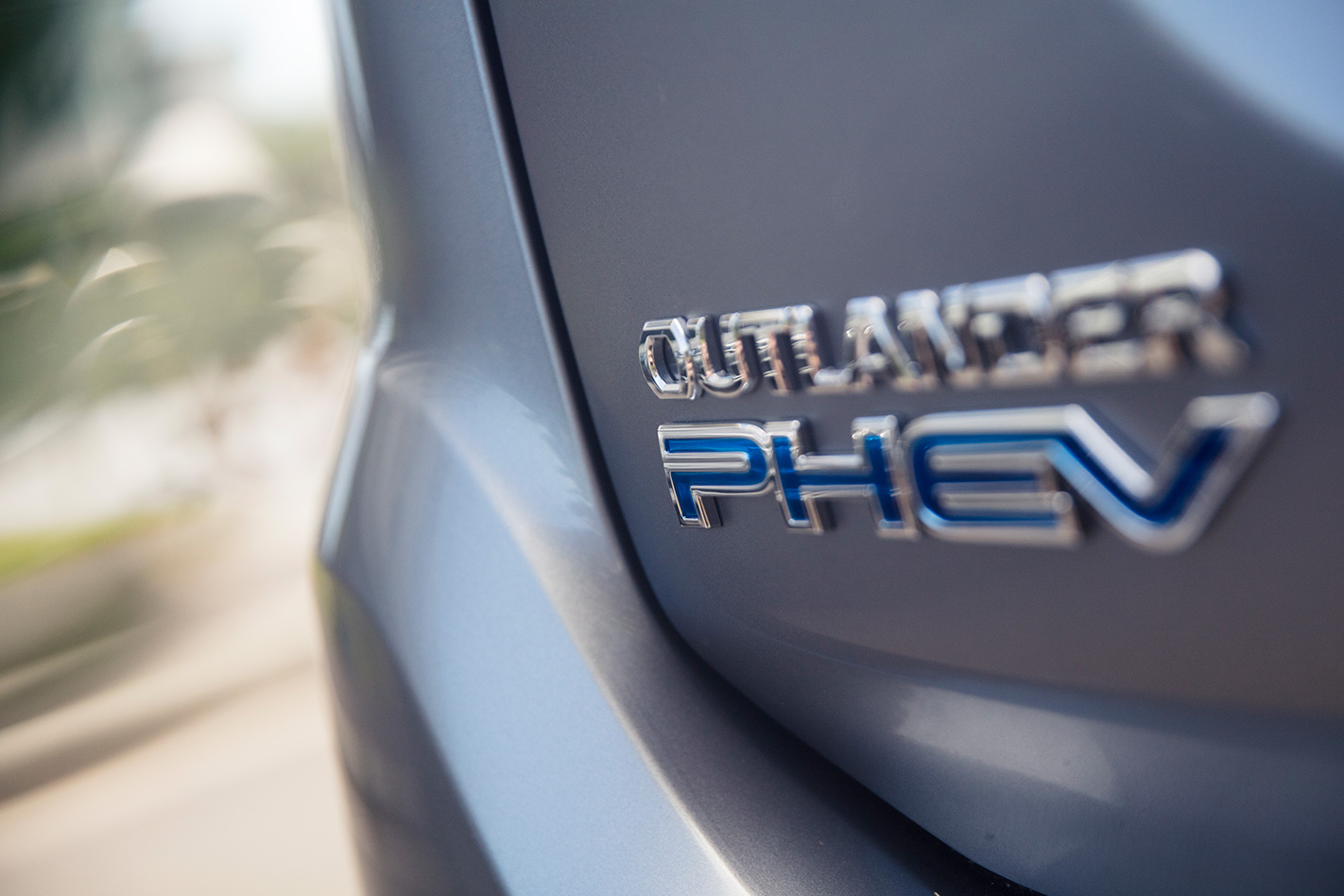
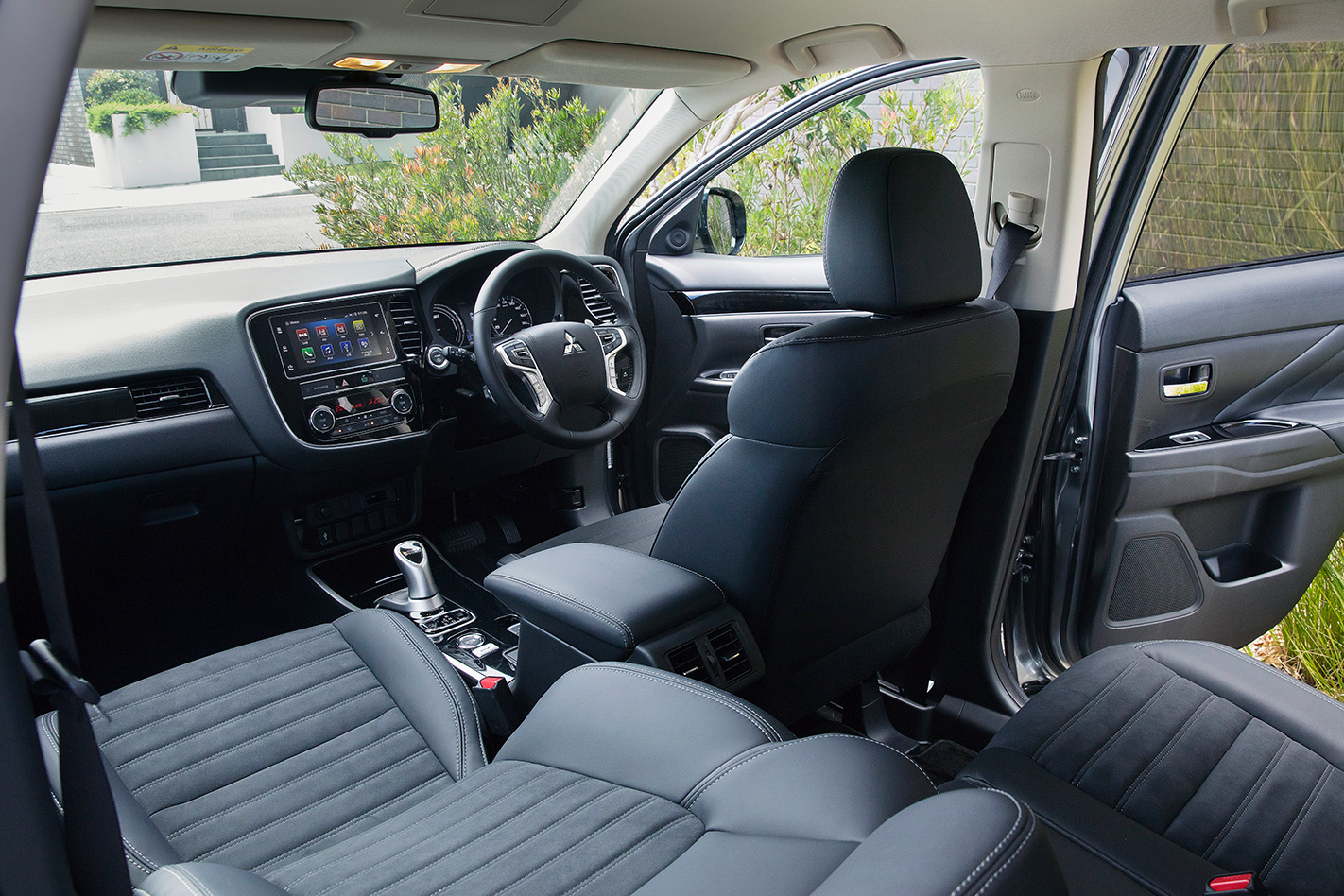
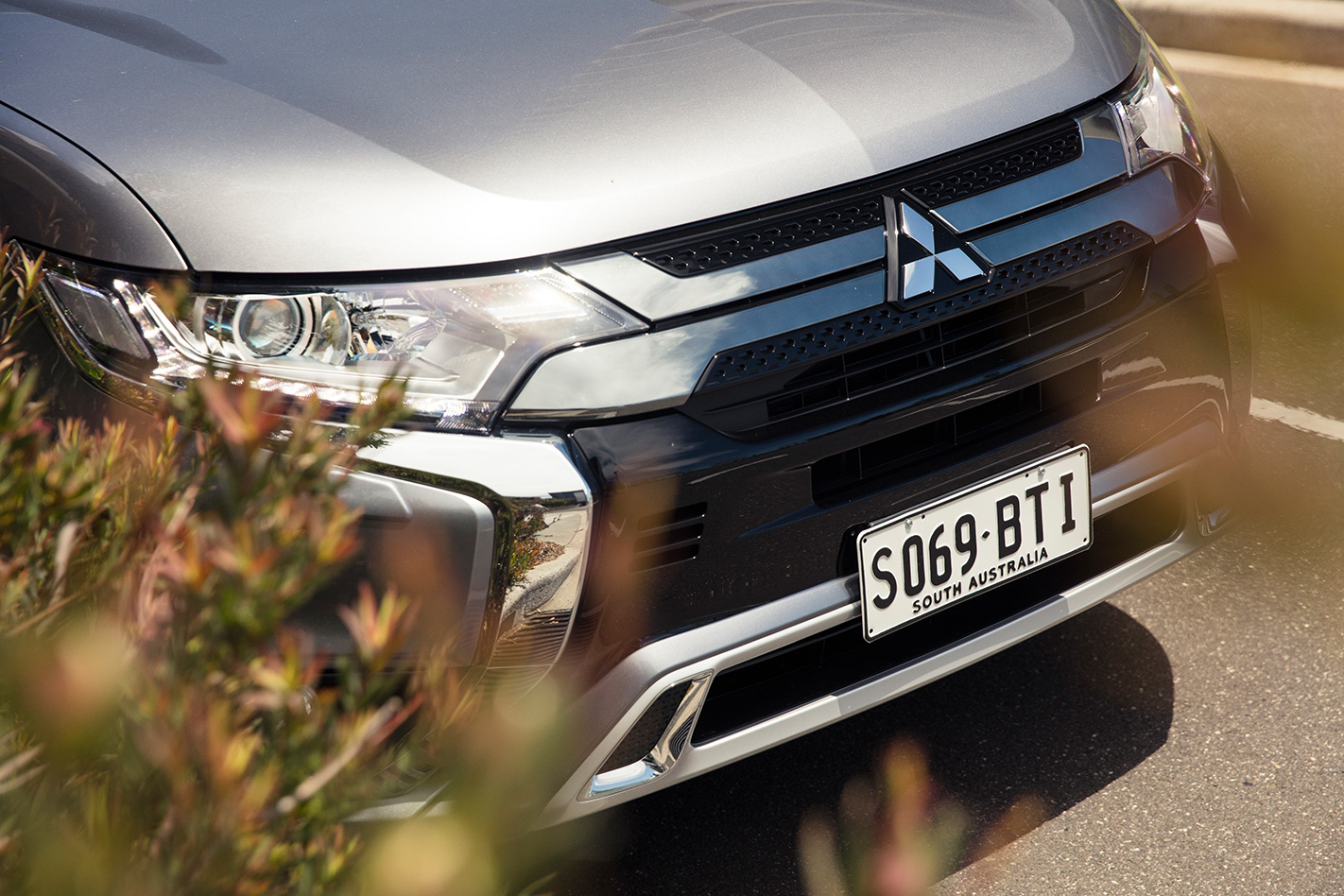
Downsides? You’ll lose the third row of seats; that real estate now housing an on-board charger and the control unit for the rear motor. Then there’s the fact that when the battery is depleted the 2.0-litre lump can sound a bit gruff, and the interior isn’t the final word in elegant materials integration. But less than fifty grand for a sizeable dual electric motor SUV that’s decent to drive and comes with a five-year warranty? The Outlander PHEV deserves its popularity and then some.
7.5/10
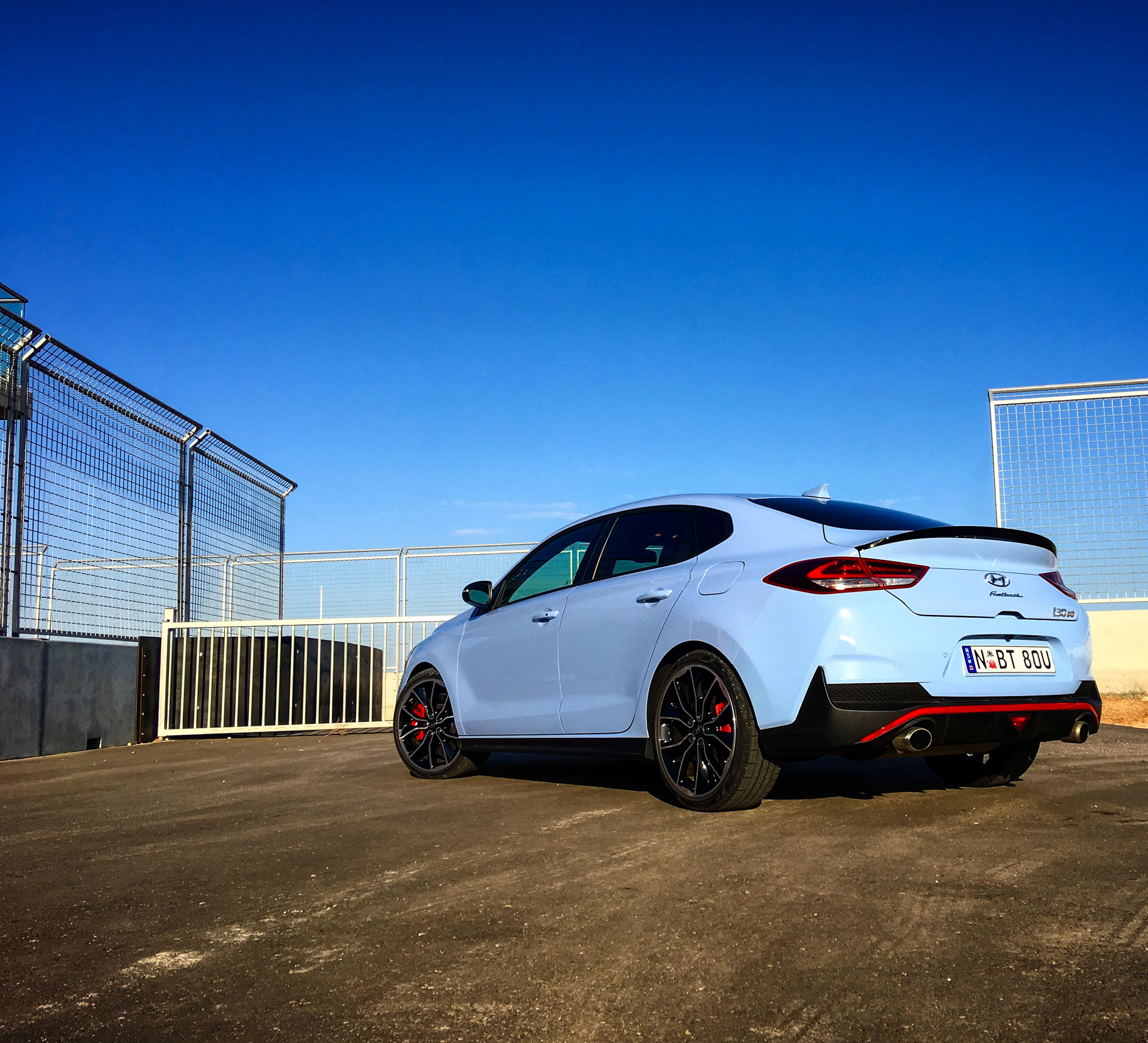
Hyundai has launched its latest i30 variant and only its second ever N performance car in the form of the one-off Hyundai i30 Fastback N. Sourced from Hyundai’s Czech Republic plant, the i30 Fastback N is all but identical to the i30N hatchback, save for an updated suspension tune and the shape of the body from the C-pillar rearwards.
The five-seat, four-door i30 Fastback N coupe will cost $41,990 plus on-road costs, which is a $1500 premium over the i30 N hatch (which has also increased in price by $500 thanks to exchange rate pressures). The i30 Fastback N can also be optioned with a pair of option kits: the Luxury Pack ($3,000) and the Luxury Pack with Panoramic Sunroof ($5,000).
Hyundai Australia product development manager Andrew Touatahi told WhichCar that customers will be able to pick the subtle changes between the i30 Fastback N and the i30N hatch.
“You will feel a difference,” he said. “It will be a little different. I think the Fastback will give you a slightly broader comfort window so up front it will be a little bit more comfortable on the road, a little more compliant. The hatch will feel a little bit more ‘immediate’.”
The four-door coupe style body is 12kg heavier than the hatch and uses 29 additional welds to stiffen and strengthen the body. The front bumper and bonnet are identical to the hatch, while the rear end gets a custom tailgate spoiler, customised rear bumper and full-width diffusor. It runs the same 19-inch alloy wheels as the hatch, as well.
Inside, the only real difference is to the colours of the contrasting stitching on the trim; the hatch uses blue, while the Fastback adopts a red theme. Sports seats, leather-trimmed steering wheel, Apple CarPlay and Android Auto via an 8.0-inch multimedia system, digital radio, dual-zone climate control, automatic headlights and one-touch powered glass all round are standard.
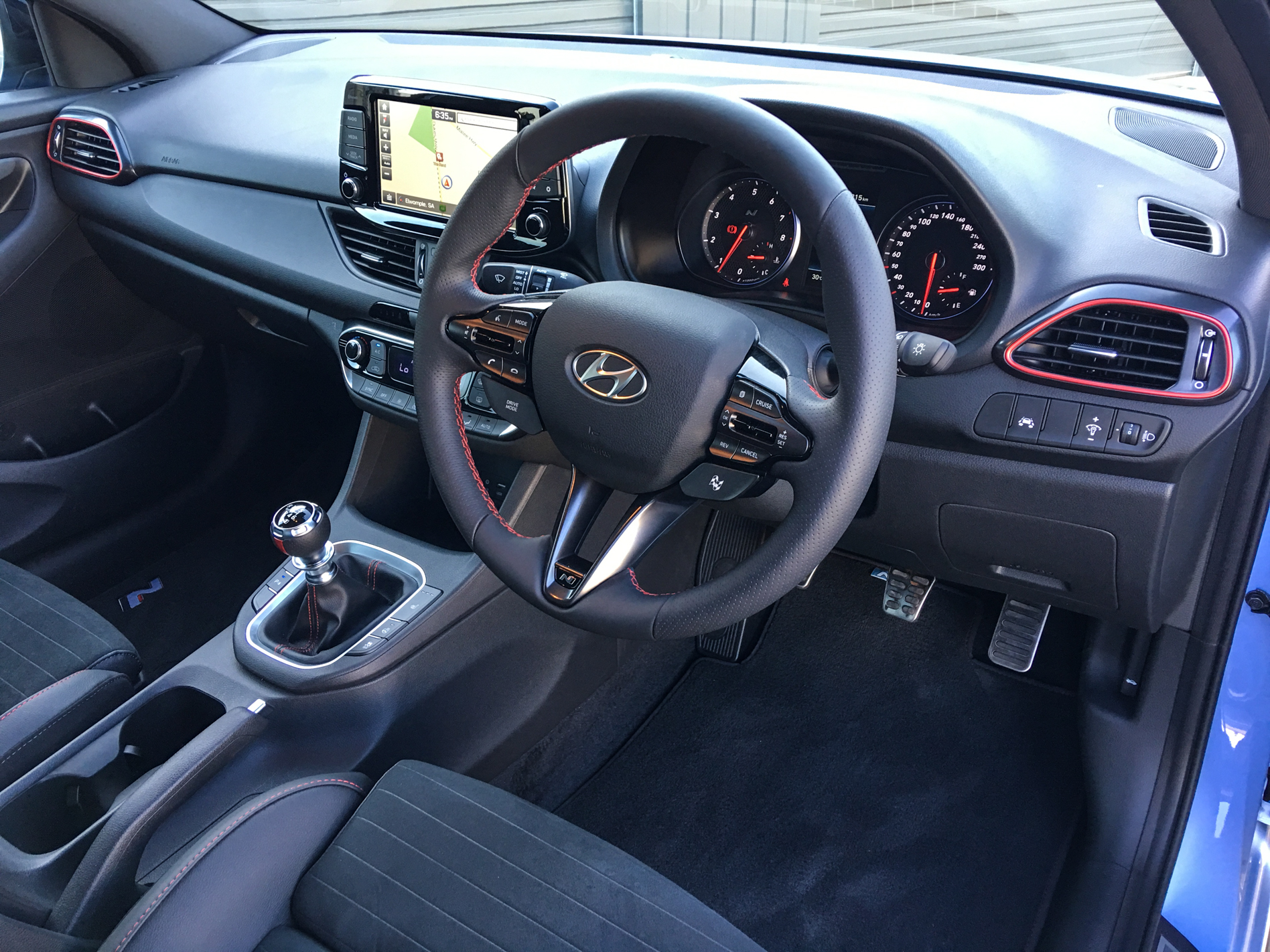
There is a manual handbrake – a preference of the Hyundai N project leader, former BMW M head Albert Bierman, we’re told – and there are no vents for rear-seat passengers. Two ISOFIX baby seat mounts are included.
Safety gear includes LED daytime lamps, LED headlights and taillights, rear-view camera, AEB and lane-keep assist, along with seven airbags.
Boot space measures out at 436 litres with the seats up, and 1337 litres with the seats lowered. There is also a removable chassis stiffening bar across the cargo space.
Mechanically, the Fastback adopts Hyundai’s top-spec Performance tune, meaning it uses a 202kW, 353Nm version of the company’s 2.0-litre four-cylinder turbocharged petrol engine, driving the front wheels via a six-speed manual gearbox and electronically controlled front diff.
There is no automatic version of the i30 Fastback N available as yet, with Hyundai currently working on an eight-speed dual-clutch transmission to suit the car. It’s expected to arrive later this year.
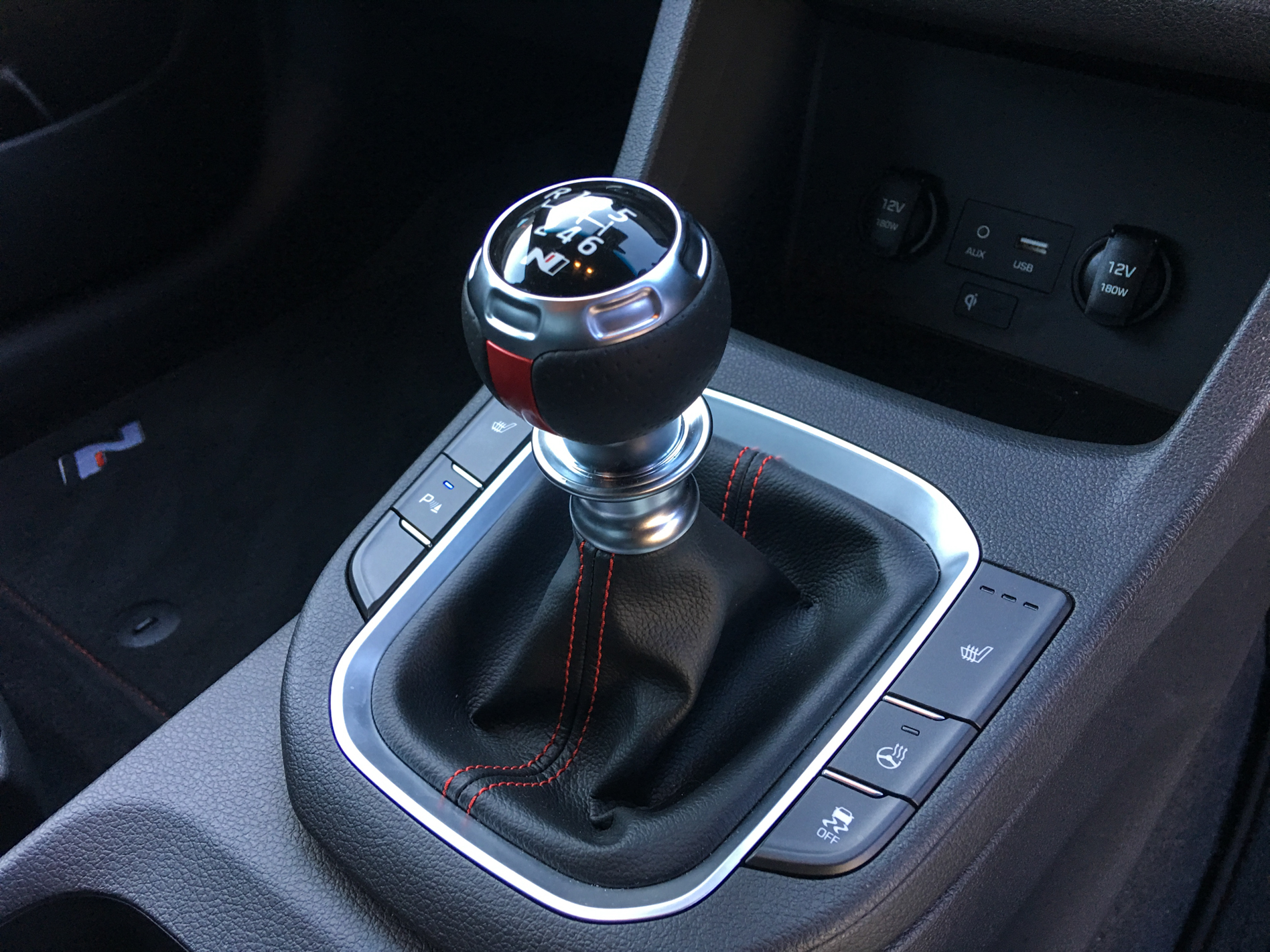
The suspension system uses adaptive dampers at all four corners, with the front end receiving slightly softer springs than the hatch. Several bushings throughout the front suspension set-up have also been stiffened, and a second set of ‘helper’ springs have been added to the tops of the regular springs.
An active variable exhaust system is also fitted, which can be controlled via Hyundai’s N Mode Drive System. The N Mode system also contains performance timers and a launch control function, while the dash features a row of shift-light LEDs.
While the Fastback bodyshape has no real competitor in the space, the i30N goes up against rivals like the Volkswagen Golf GTI, Peugeot 308GTI and Honda’s Civic Type-R.
Read the Hyundai i30 Fastback N review here
It’s the moment you’ve been waiting seven long days for, the latest instalment of the WhichCar Weekly Podcast.
This week our regular host WhichCar Senior Journalist Daniel Gardner is back and he’s joined by MOTOR Associate Editor Scott Newman and MOTOR Digital Journalist Chris Thompson to talk all things Geneva Motor Show.
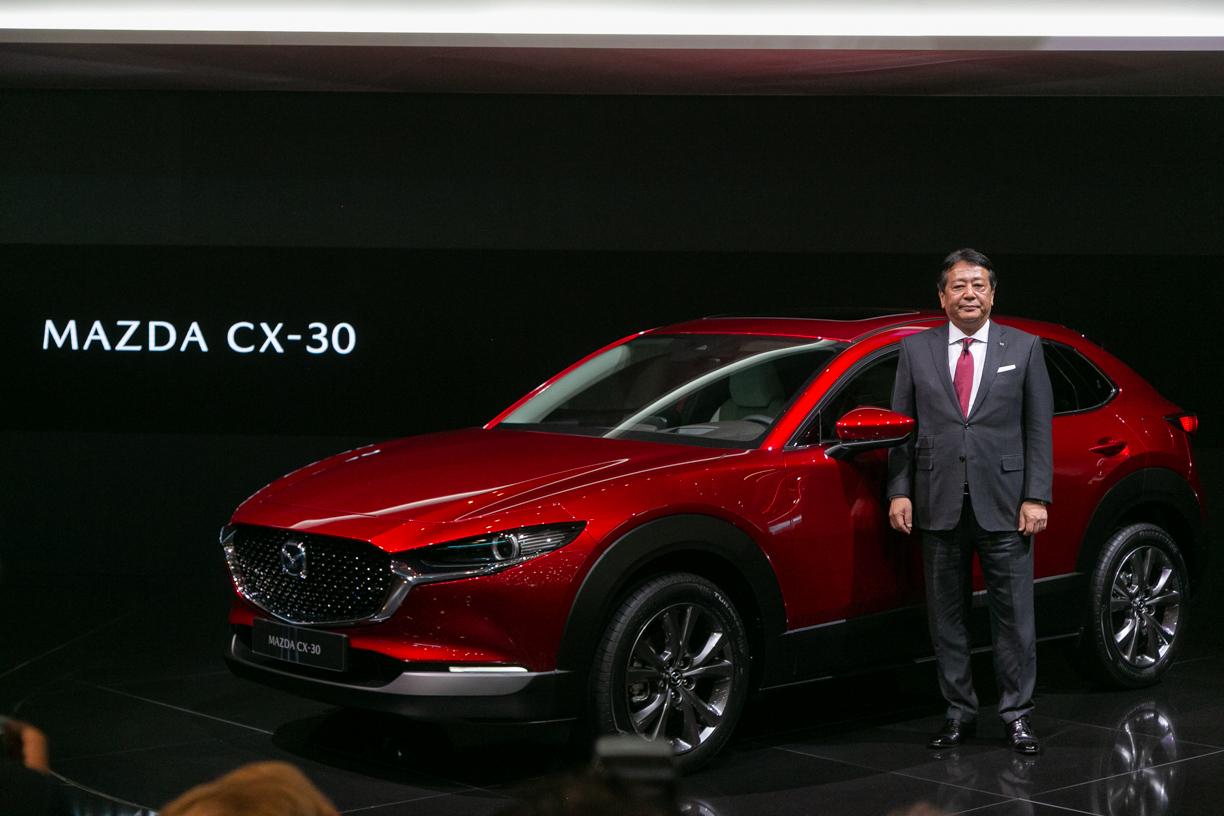
It’s dominated the news this week with dozens of new car reveals and it’s raised some interesting questions, including why do some new cars have such nonsensical names, how many supercars is too many supercars and has the electric revolution finally arrived?
To break up the Geneva talk, we examine a couple of 12-cylinder British GTs the MOTOR crew have been testing this week and discuss the SUV Olympics which will be coming to an episode of WhichCar TV soon.
If you’re on the move you can find our podcast on the Podbean or iTunes apps, please leave a rating and subscribe so you don’t miss an episode. You can also follow the movements of the WhichCar team on Facebook and Instagram @whichcarau.
Listened to the show? Help us out:
- Leave a note in the comment section below.
Women have long been part of the automotive industry, and in recent years, we’ve seen the participation of women in the industry on the rise. And yet, they still go largely unrecognised.
There’s no questioning the automotive industry is dominated by men. In fact, according to a survey Catalyst Quick Take: Women in the Automotive Industry conducted in 2016, women accounted for just one quarter of the automotive workforce in the USA and, at the executive level that number dropped to only 16 percent.
Closer to home, the statistics require a little more reflection. In 2013, the New South Wales Government released a research paper which explored women in trade and technical jobs in Australia. Labelled the “missing 48 per cent”, the research concluded that only two percent of the Australian construction, automotive and electrical trades’ workforce are women.
Let that sink in – two percent.
The study identified Australian data recorded in 2011 counted just 931 female motor mechanics in a technicians and trades workforce of nearly 1.43 million people. That means female mechanics account for less than half a percent of all professional grease-monkeys in Australia.
The equality milieu in Australia is complex. It goes far deeper than just the automotive industry, and is deep-rooted in attitudes, ignorance and under-representation, and is manifested in a wage gap.
But here’s the real clincher – despite being wildly outnumbered, women have had a larger influence in automotive than most might recognise. For example, did you know that the world’s first automobile, the Benz Patent-Motorwagen, was financed by a woman?
It was that same woman, Bertha Benz, who got the company’s first sales thanks to being the first person to drive an automobile over a long distance? Of course, in 1886 Bertha’s gender meant she couldn’t apply for the car’s patent rights despite using her dowry to fund the project, and instead these were given to her husband, Karl Benz.
Even the name for the Mercedes brand came from a woman called Mercedes Jellinek.
Come the early 1900s, when automobiles began to evolve, so too did the automotive technology. And we have a woman to thank for the invention of indicators and brake lights.
Florence Lawrence, known as the first movie star, used flags on either side of the car to indicate which way the vehicle was turning, and a pedal-triggered painted stop sign warned cars behind her that she was slowing down. According to reports, her mother, Charlotte Bridgewood, was the original inventor of windscreen wipers. Neither women marketed or patented their inventions so these essential automotive components were picked up later by automotive companies.
Fast forward a century and it’s easy to see how far women in the automotive space have come. Today, we’ve got women in the automotive role as CEOs, race car drivers, designers, engineers and journalists. And while there’s still a long way to go in the equality journey, we’re celebrating International Women’s Day by applauding these five influential women in our industry.
Mary Barra, Chairwoman & CEO, General Motors

On January 2014, Mary Barra made history as the first female CEO of a global automaker. Her impact spreads much further than just the automotive industry, though – she’s been named by Time Magazine as one of the “100 Most Influential People in the World”, and last year Forbes listed her as the seventh most powerful woman in the world, and Fortune magazine placed her second out of 50 of the most powerful women in business.
Barra has worked for GM since she was 18 years old, working across various departments from engineering, administration to managing assembly plants.
Michelle Christensen, Lead Designer, Honda NSX

Since 2012, when the Acura NSX was revealed in Detroit, Michelle Christensen’s name has been on everyone’s lips. After that, Michelle joined Honda’s team for the production car and became the first woman to ever lead the design team of a supercar. She took her interest in fashion, merged it with her childhood growing up in her father’s garage of hot rods, and turned it into a successful, and inspiring, career.
Simona de Silvestro – Race driver, Nissan Motorsport

If you follow motorsport, chances are you already know the name Simona de Silvestro – otherwise known as the Iron Maiden. Silvestro this year became the first full-time female driver in the modern Supercars series. With a career in IndyCar and Formula E (where she was also the first female driver to score points), Silvestro lined up to race in the championship for Nissan Racing at the 2017 Clipsal 500 in Adelaide, where she impressed the veterans of the paddock. She is still driving a Nissan Altima for the rebranded Kelly Racing team in 2019.
Molly Taylor – Rally driver, Subaru Do Motorsport
We could talk all day about women in motorsport but for the sake of this list, we’ll keep it to two, and our second pick would have to be Australian rally car driver, Molly Taylor. Taylor was the first female in the Australian Motor Sport Foundation International Rising Star Program and was awarded the Motorsport Young Achieve of the Year Award in 2006 by the NSW Confederation of Australian Motorsport.
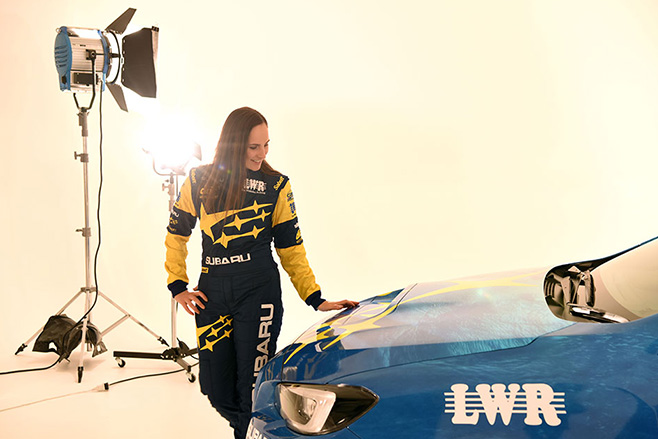
As an Australian representative, Taylor holds a special spot on this list having won several titles including being the first non-British woman to claim the British Ladies Rally Champion title two years in a row (2009 and 2010), winning Australian Rally Championships in the F16 Class (2007 and 2008) and in 2016 she won the Australian Rally Championship.
Elena Ford – Chief Customer Experience Officer, Ford Motor Company

Elena is the great-great granddaughter of Ford’s founder, Henry Ford, and currently sits in the position of Chief Customer Experience Officer. for the company. But in 2013, Ford became the company’s Vice President. The significance in this is that Elena is the first female Ford family member to hold a high-level role within the company, putting her in a true position of power over the company that bears her family name.
The Kia Stinger’s Australian police presence is expanding in a bid to raise visibility of the twin-turbo sedan and lift sales.
Queensland was the first state to accept the Korean hotshot into its ranks, with an initial order of 50 cars swelling by another 70 this year. Perth added another 50 and the Northern Territory has also ordered eight, which according to Kia Australia’s Chief Operating Officer, Damien Meredith: “only seems like a small number but I think that’s their total Highway Patrol.”
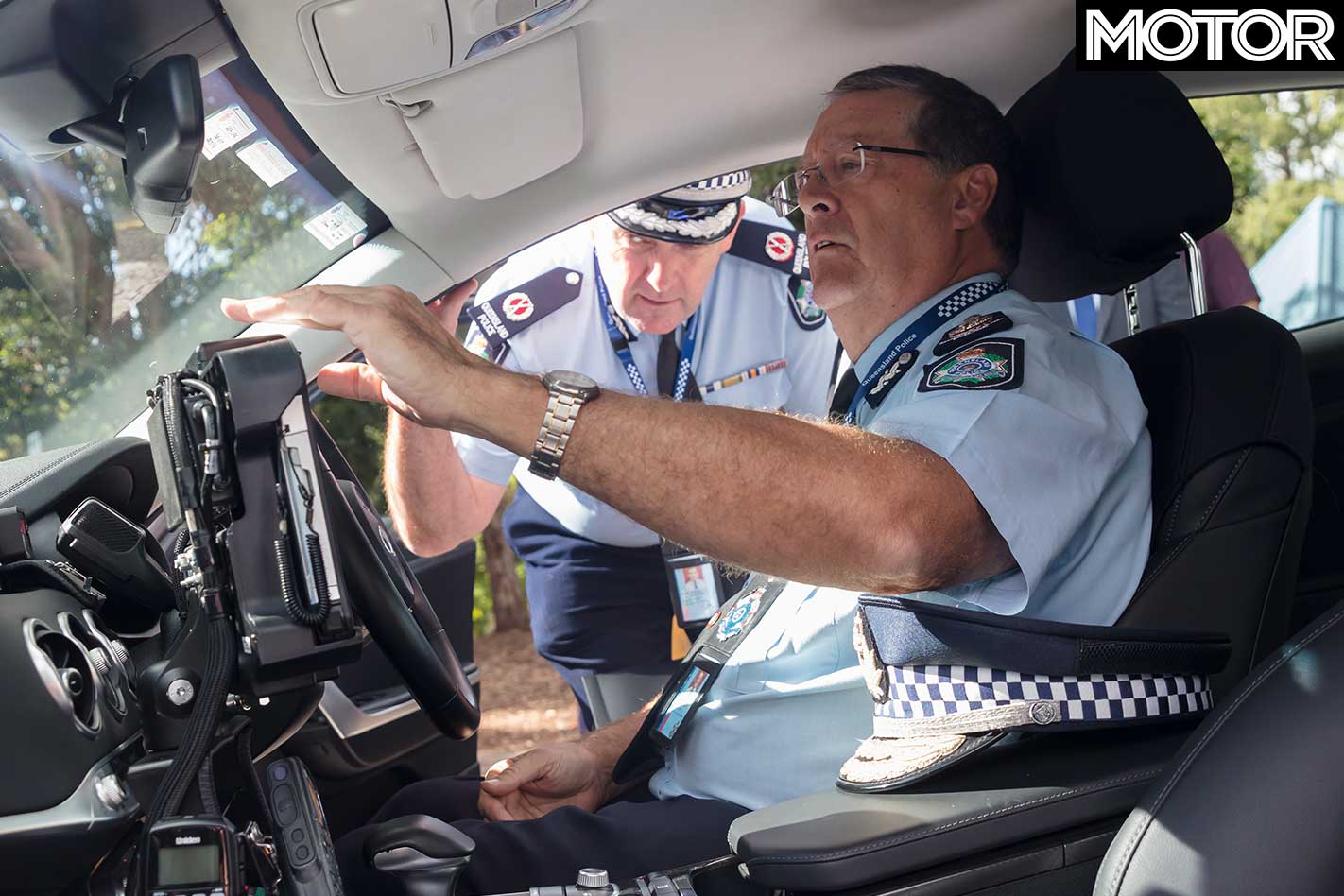
Meredith also tells MOTOR that Victoria Police is re-evaluating the Stinger having previously passed it over in favour of the Chrysler 300 SRT and BMW 530d. “My understanding is that VicPol are re-addressing Stinger because, I’m not sure if it’s government or some of the commissioners, aren’t too happy with their previous choices.”
According to Meredith, VicPol’s main issue that led to the Stinger being rejected was not the performance of the car but the extra external gear carried by Victorian forces. “My understanding is that because of the way they’re bulked up, it was ingress and egress to the front seat. Doesn’t seem to be an issue with other forces, I think [VicPol] carry more gear on the outside.”
The police presence not only helps sales but also increases product visibility. “There’s no question road presence means a lot,” says Meredith. “We overachieve with Stinger sales in Queensland and there’s one obvious reason for that – the product’s visible.”
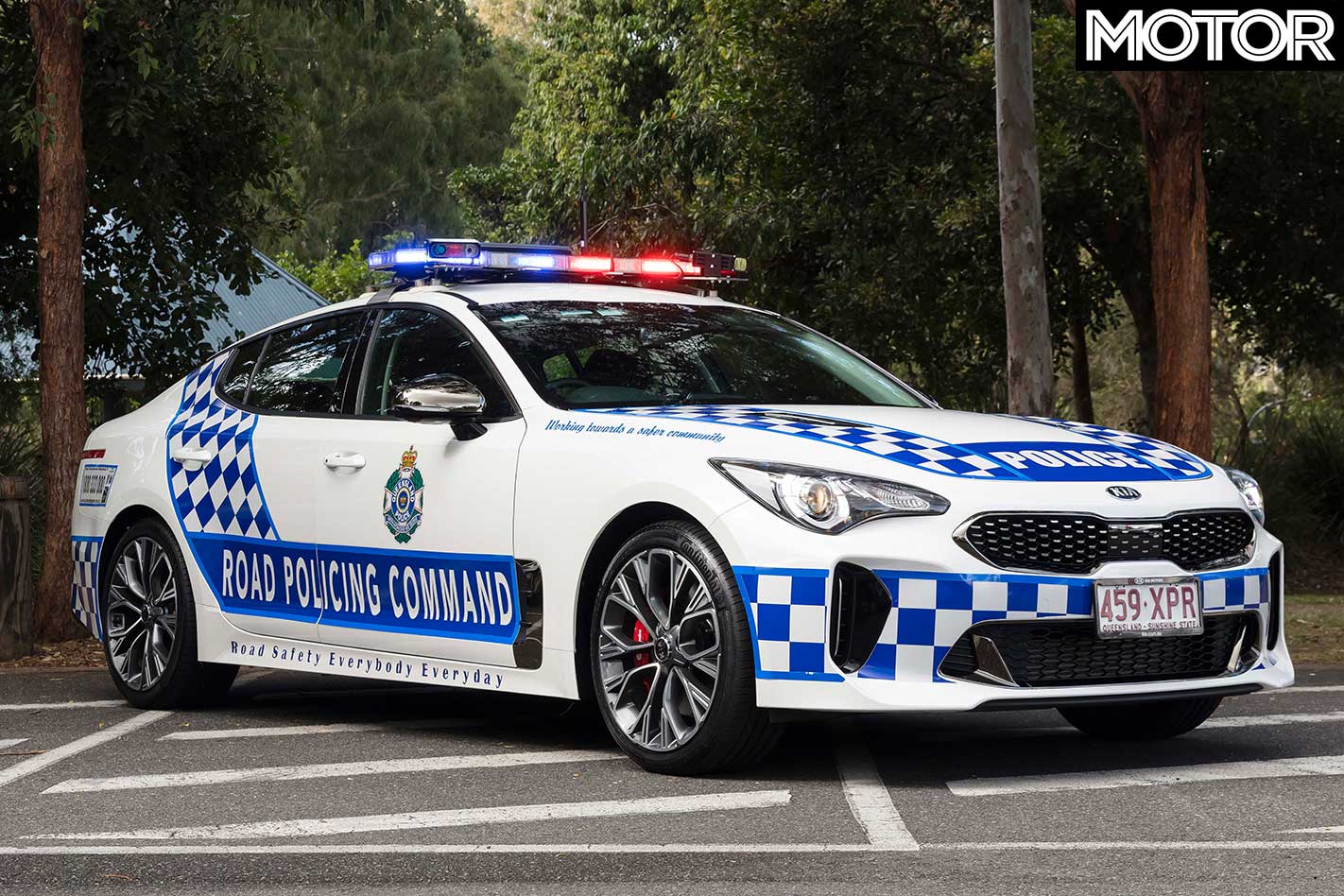
Solid early orders for the Stinger have failed to materialise in the sustained strong demand Kia hoped for. “Last year we averaged 158 per month,” explains Meredith. “I wanted more than that but it’s ok; it’s 12 per cent of that segment.”
Stinger sales are massively weighted towards the top of the range, with 92 per cent of buyers choosing the twin-turbo V6 GT. Meredith says Kia learned plenty of lessons during the Stinger’s launch and will implement these findings going forward.
“I think we’ve been incredibly lucky that we positioned the car as a rear-wheel drive performance vehicle and it resonated. I think we did a good job in building the car up in regards to the excitement factor with it.”
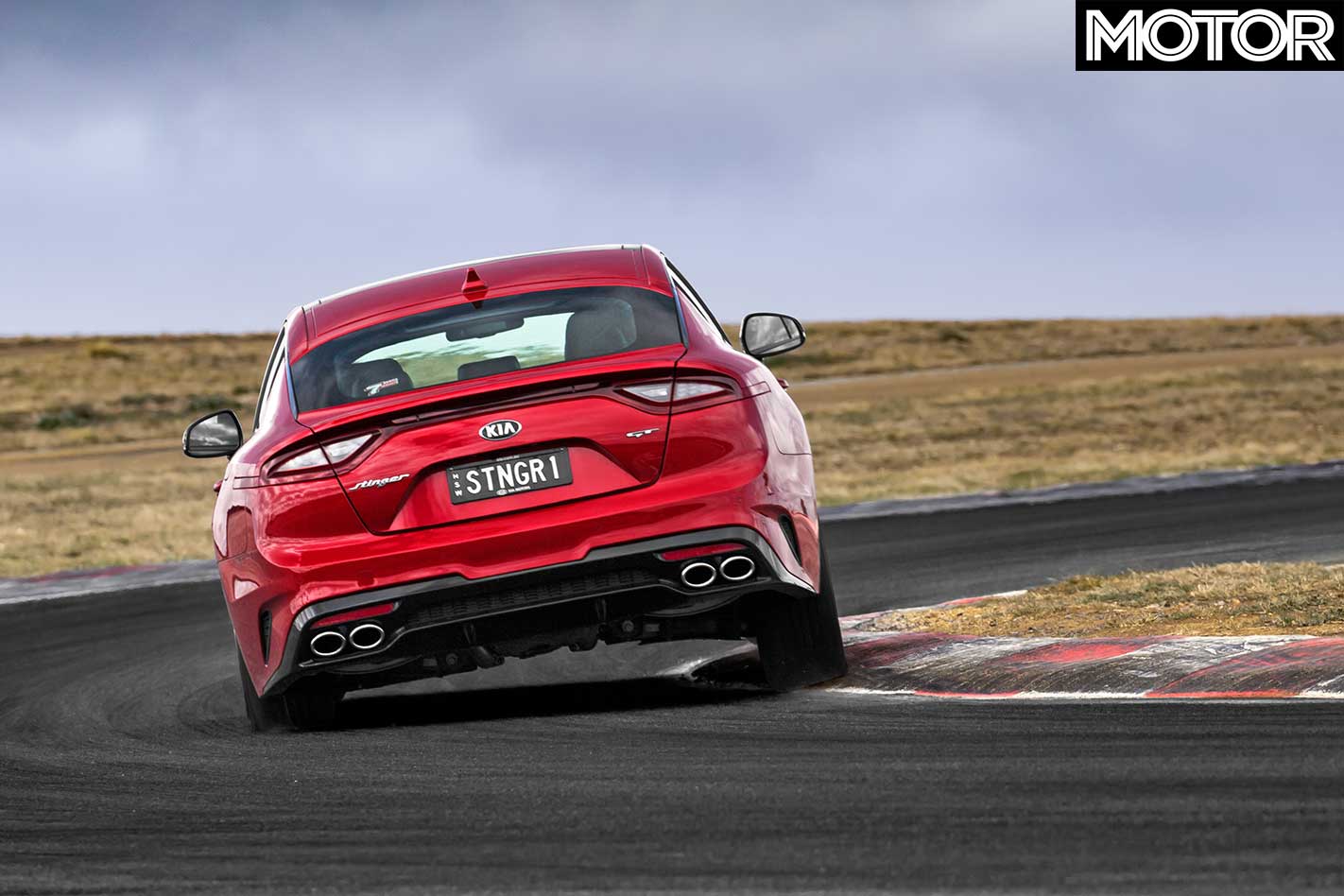
Nonetheless, Meredith reveals buyers aren’t necessarily looking at the Stinger’s performance. “Looking at the research, I think we probably should have focused on how the car looks than how the car performs. All the research we’re getting is the number one reason for them buying the car is how it looks, not how it goes.”
However, challenges still remain. “The passion and enthusiasm has dropped off dramatically with what’s happened with Falcon and Commodore,” says Meredith. “We’re not going to move the needle in 14 months; we can’t transform 60 years of heritage into our product.”
A small convoy of Chevrolet C8 Corvettes has been spied this week in Arizona, with General Motors President Mark Reuss riding along in one of the camouflaged cars.
In a video (above) posted by California-based realtor George Kenner (and shared by US-based motoring site Motor1), whose YouTube presence is primarily related to his profession, the six C8 Corvettes are seen driving along a road in Yuma, Arizona.
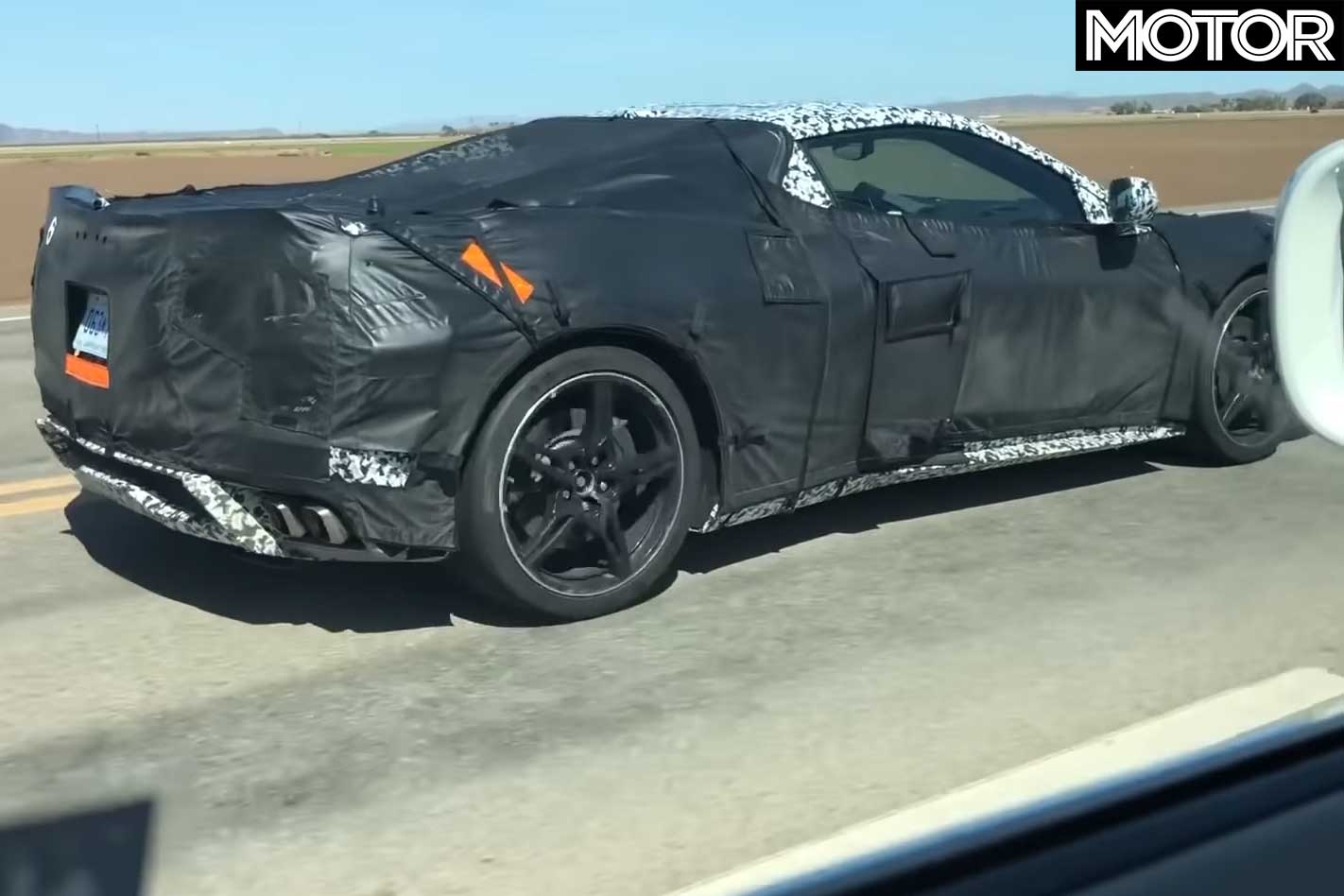
Kenner, a self-described car fan, speaks for about the first six minutes of his video before playing the footage he recorded of the convoy, so if you can’t wait around you should skip to the six minute mark.
Joining the convoy in one car, Mark Reuss can be spotted with a grin on his face just after the 8:38 mark.
Reuss, the former managing director of Holden, was appointed President of General Motors in January this year.
Trailing the fleet of C8s is a current C7 Corvette, which is what tipped Kenner off to the nature of the camouflaged cars. He says he originally thought they were Audi R8s due to the clear mid-engined proportions of the car.
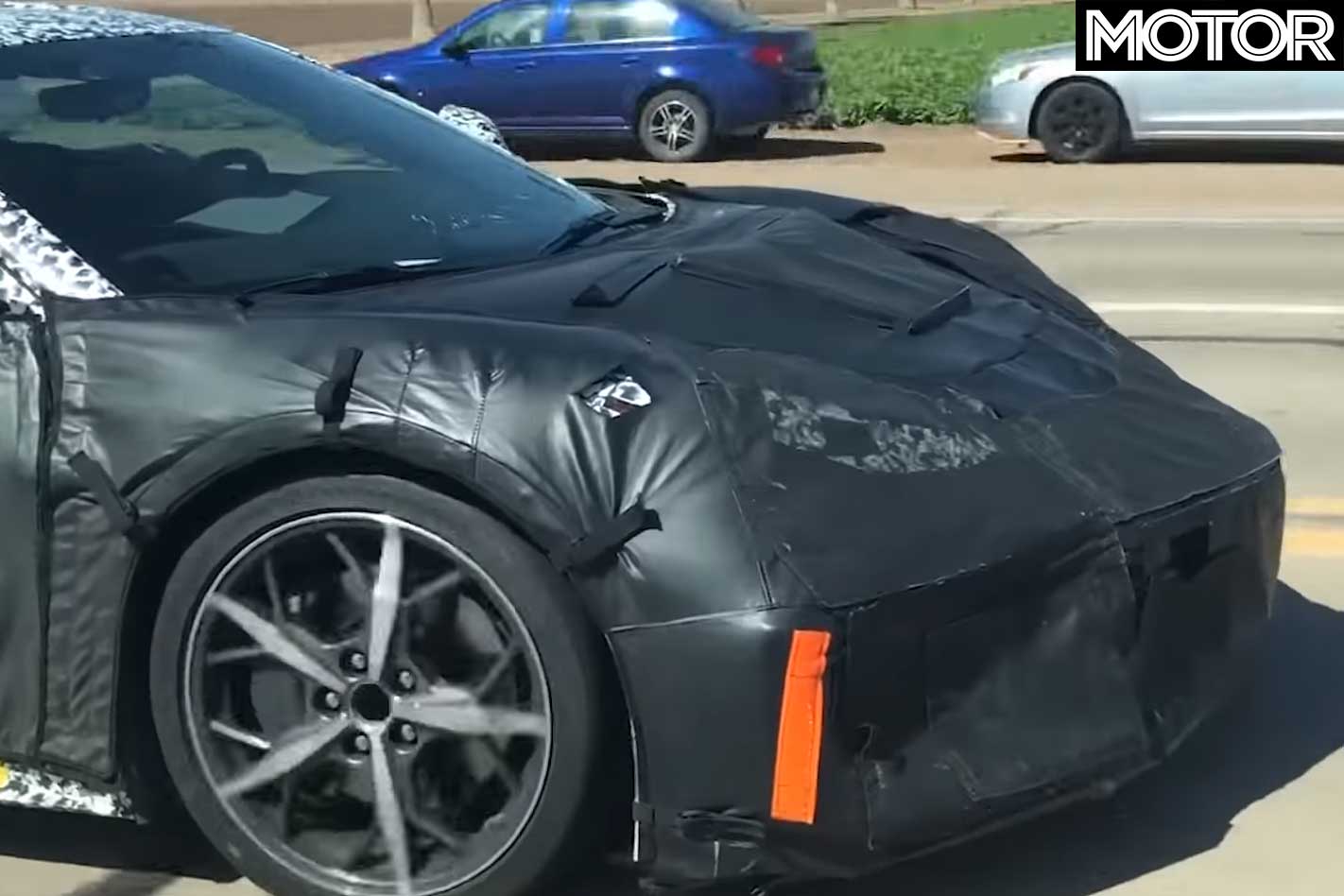
Previous reportage by MOTOR and sister publication Wheels Australia (both here on WhichCar) has pieced together leaks and details of the next-gen Corvette, which has already been shown to Chevrolet dealers.
A report from Wheels reveals that as early as April 2018 dealers had seen a “very mid-engined” Corvette at a conference, with one dealer posting about it on Facebook.
As for details of its engine, leaked documents and computer-generated drawings of a 5.5-litre V8 engine lead US insiders to reveal that four V8 engine configurations are probable for the C8 Corvette.
The 6.2-litre LT1 V8 will reportedly be one such engine, but a turbocharged 5.5-litre unit with a hybrid system will also be on the cards.
If you’re not a Melbourne native, the southern city’s Moomba Festival may be something of a mystery. Billed as Australia’s largest free festival, Moomba officially begins today and is centred around the Yarra river, with the Birdman Rally being one of the event’s major crowd-pullers.
Amphibious Ford Jeeps on the Murray River
What’s the Birdman Rally? A semi-serious competition where individuals attempt to glide the longest distance from an elevated platform into Melbourne’s big brown river. Most would-be Birdmen look to aviation when designing their ‘aircraft’, but we reckon the automotive world has some tips too. Click through the gallery above to check out our highly scientific advice!
Wheels got the opportunity to sit down for a chat with the boss of Porsche, Oliver Blume. He was clearly in a reflective mood on the future of the company and electrification of the model range was front and centre of his plans. Here are five things we learned:
There could be an electric Boxster on the way
“Because of the mid-engine it [a Boxster EV] could work. It depends on the development of the markets and the needs. We will decide this year in what direction we will develop the Boxster segment. When we do an electric cars it will be a platform specially developed for electric cars. Our opinion is that when you use a car that is designed for a petrol engine it doesn’t fit for an EV because of the construction of the body. When you play in the segment like Porsche to develop very sporty cars, it has to be tailor made for each type of engine.”
Yes, the Macan really is going all-electric
“We have the idea to offer in each segment three options of engines (high performance petrol, plug-in hybrid and pure electromobility). In the limousine segment, we will have the Panamera as petrol and hybrid and the Taycan as electric. In the SUV segment our ideas is a fully electrified Macan, petrol Cayenne and a hybrid Cayenne. Our idea for the Macan is to continue with some updates as long as possible and then to come round about 2020 with the electrified Macan.”
But it might not be called a Macan any longer
“It will be an SUV and it will have the roots of the Macan, but it will look very different and future orientated. When we develop a new car in the model range, it’s always a challenge to make it even better without losing tradition. We haven’t decided yet [to continue the Macan nameplate].”
Winning Le Mans with a hybrid is easier than bringing a hybrid 911 to market
“The hybrid version of the 911 is already prepared, but it has to be the best and the most performing one, but the evolution of the batteries will take between three and four years. We need a special distance. It’s not enough for us to have only 5km of range. We need the option to drive in cities on pure electric. Today with our plug-in hybrids we are reaching around 50km. In the Panamera we use a 37Ah cell. The next step, next year is 47Ah and for a hybrid version of a 911 we would go for the next step, 60-70Ah.”
The 911 Turbo S could be deposed as flagship by the hybrid 911
“The most performing Panamera is the eight cylinder plug-in hybrid with nearly 700 horsepower. In this generation the 911 Turbo S will be the quickest one and the most powerful. When we introduce the hybrid, we haven’t decided yet if it will be top of everything. The Turbo S 911 that we present at the end of this year – and coming to Australia in 2020 – will be much more powerful [than the non-S]. It’s a newly developed engine and so it’s a challenge when we use the hybrids to do it even more powerful but it’s possible.”
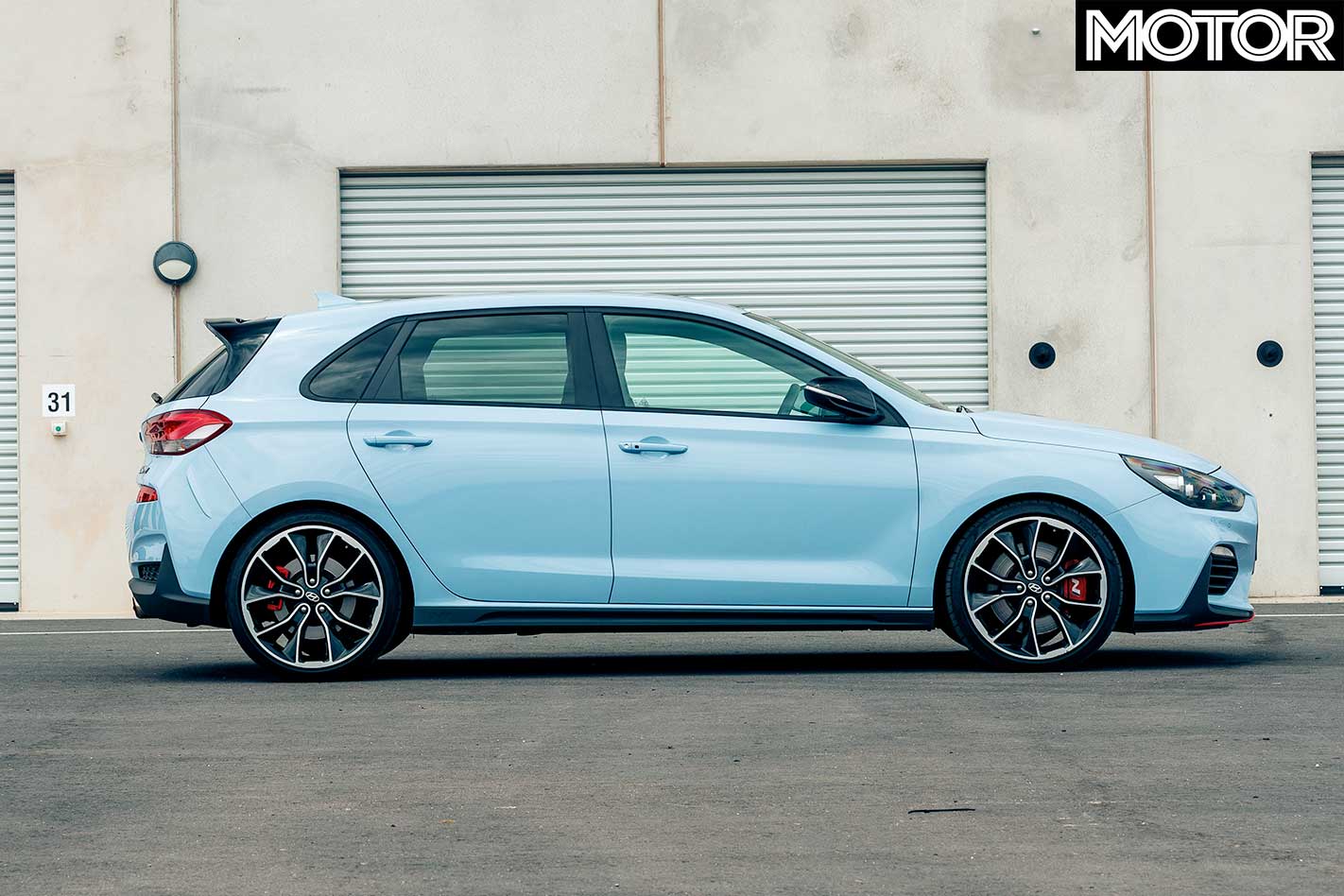
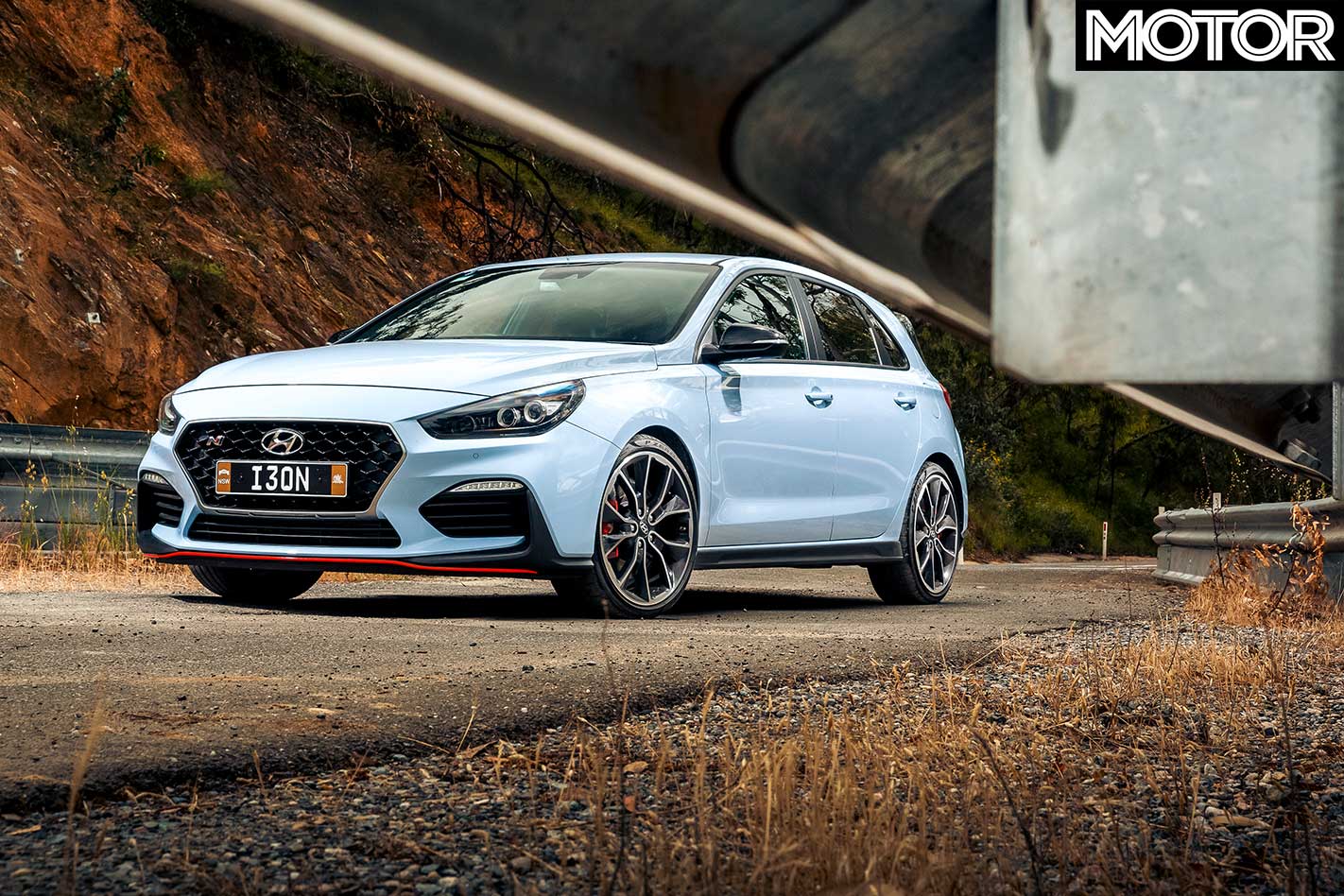
So, we all know that this is PCOTY where value for money and everyday practicality count for less than they do at Bang For Your Bucks or even a MOTOR comparison. Which means the Hyundai i30 N can’t hope to trade on its hatchback smarts and its everyman price tag.
Well, not entirely anyway. But we say those factors still come into this which is how the humble hot hatch managed to jag a spot in PCOTY in the first place. And this was no wildcard entry; nope, the Hyundai got here by also being a damn fine performance car.
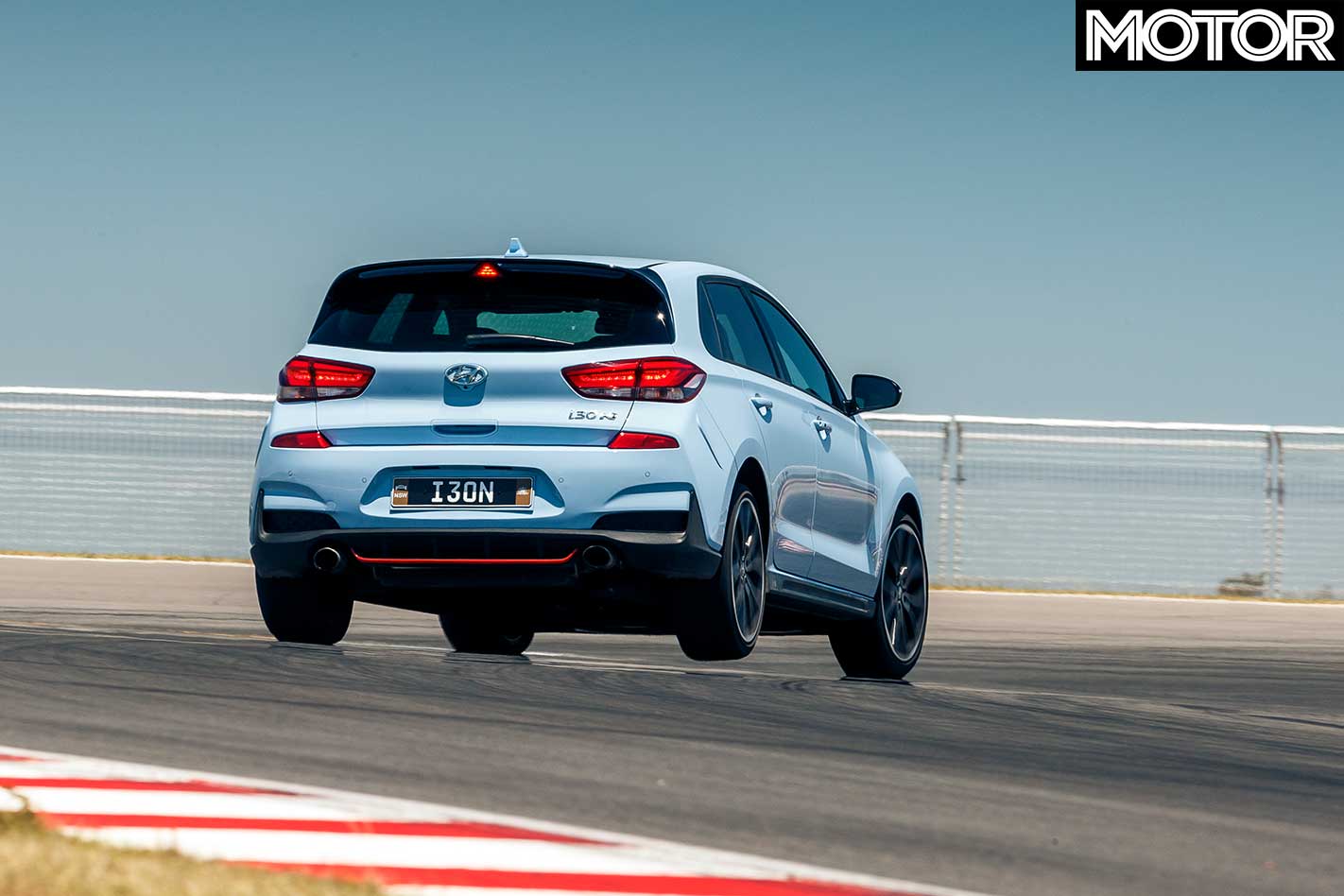
If you can remember a time when a local 5.0-litre V8 muscle car made 200kW (on a good day) then the Hyundai’s 202kW from 2.0 litres will leave you making underwater fish faces. Modern turbocharging and electronic management of everything from the injection to the valve timing has also meant that a 2.0-litre making 202kW is no longer a cammy, cranky hand-held flare that needs to be revved stupid.
In fact, if anything, the Hyundai’s engine is almost tuned a bit too far to the conservative side of things. As in, it’s all done and dusted by about 5800rpm and it genuinely lacks the top-end surge of, say, the Renault Megane RS.
But that’s on the track; on the road where it’s all about mid-range and flexibility, the Hyundai is a revelation. Punch the throttle to the floor – doesn’t matter what gear you’re in – and the N simply bolts. Not only does it have more peak poke than those old-school muscle cars, it also has more of everything else, everywhere else.
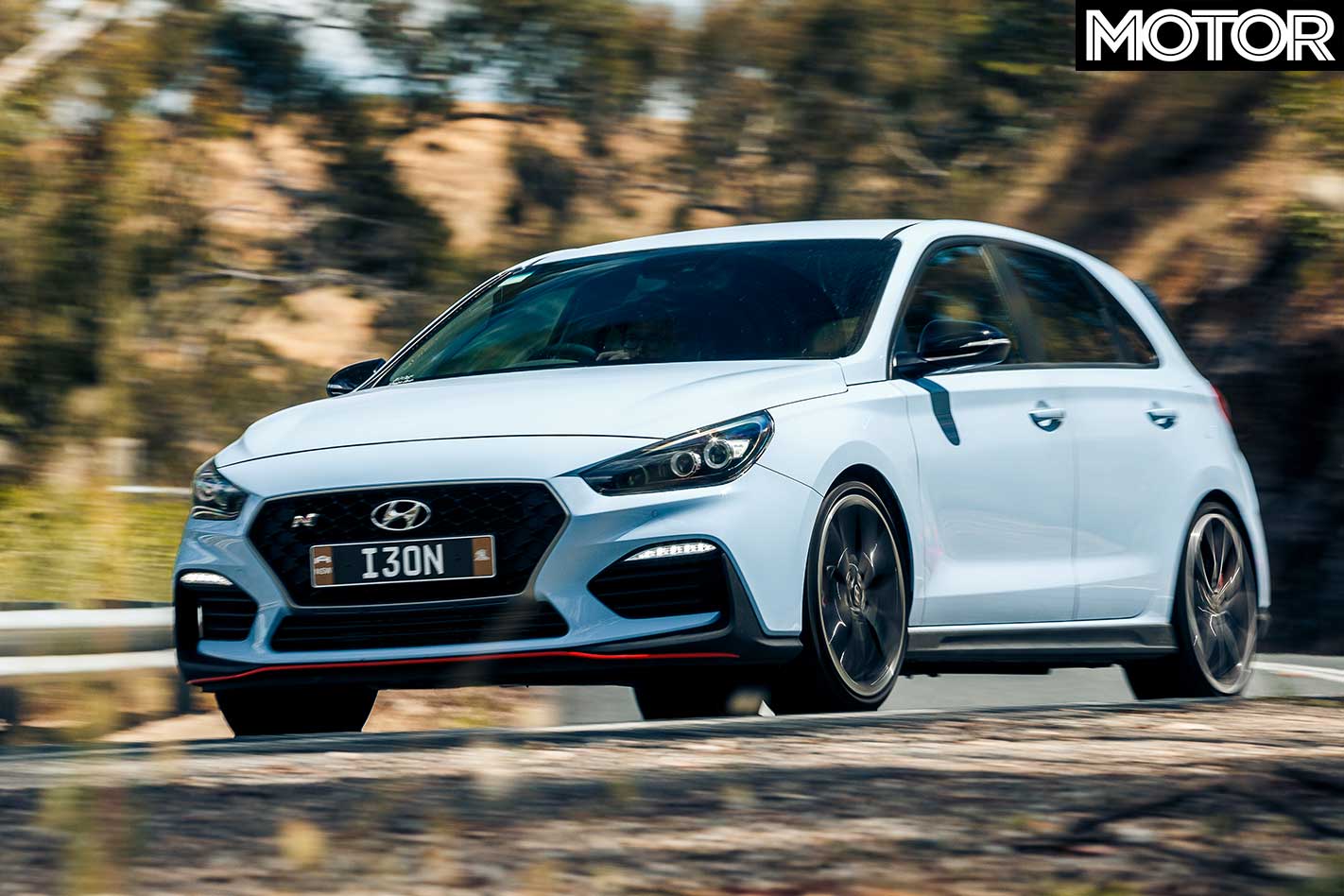
The lack of a two-pedal option will hurt the i30 N’s sales (there’s a double-clutch job heading for the market in the latter part of this year), but it surely doesn’t hurt the car itself. Nope, the six-speed manual has great ratios, a slick shift and an easy-to-manage clutch action that reminds us all why manual boxes were once the performance go-to.
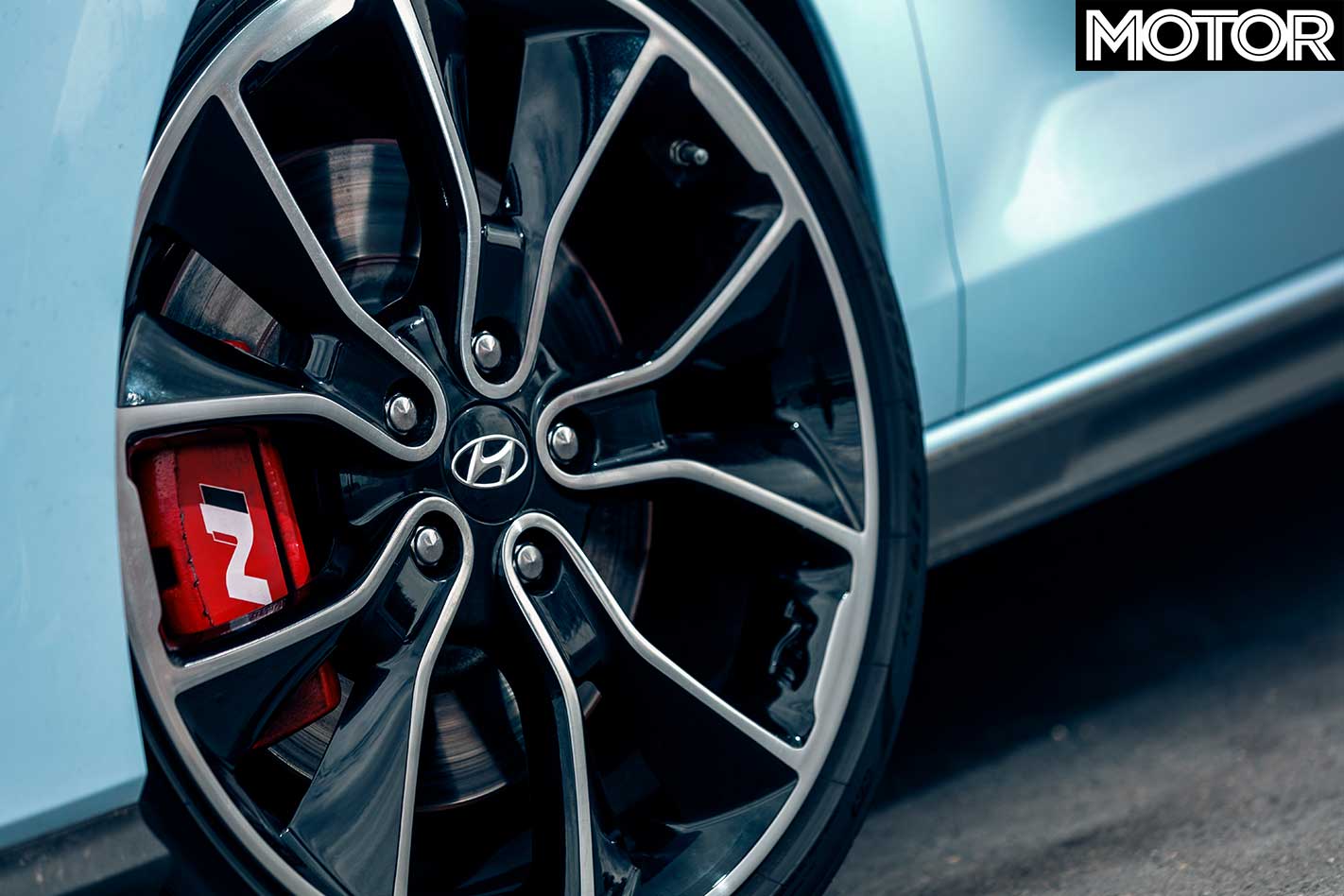
In any case, the combo is good enough to hustle the slightly porky little i30 (1429kg) to 100km/h in 6.25 seconds and across 400m in 14.3sec at 164.3km/h. It pulls up hard, too, needing just 33.8m from 100km/h despite the fact that it isn’t sporting the Brembos suggested by the red paint. The lap time of 1:37.3 is shaped by a degree of chattery understeer that sets in as you get braver. But the price people, the price.
Again, this is PCOTY, not Aldi, so the dollars are less important. Which is why the Hyundai finished fifth and not higher. Things is, though, even if this was a $60K car, it’d still make you think about your definition of performance.
The Numbers
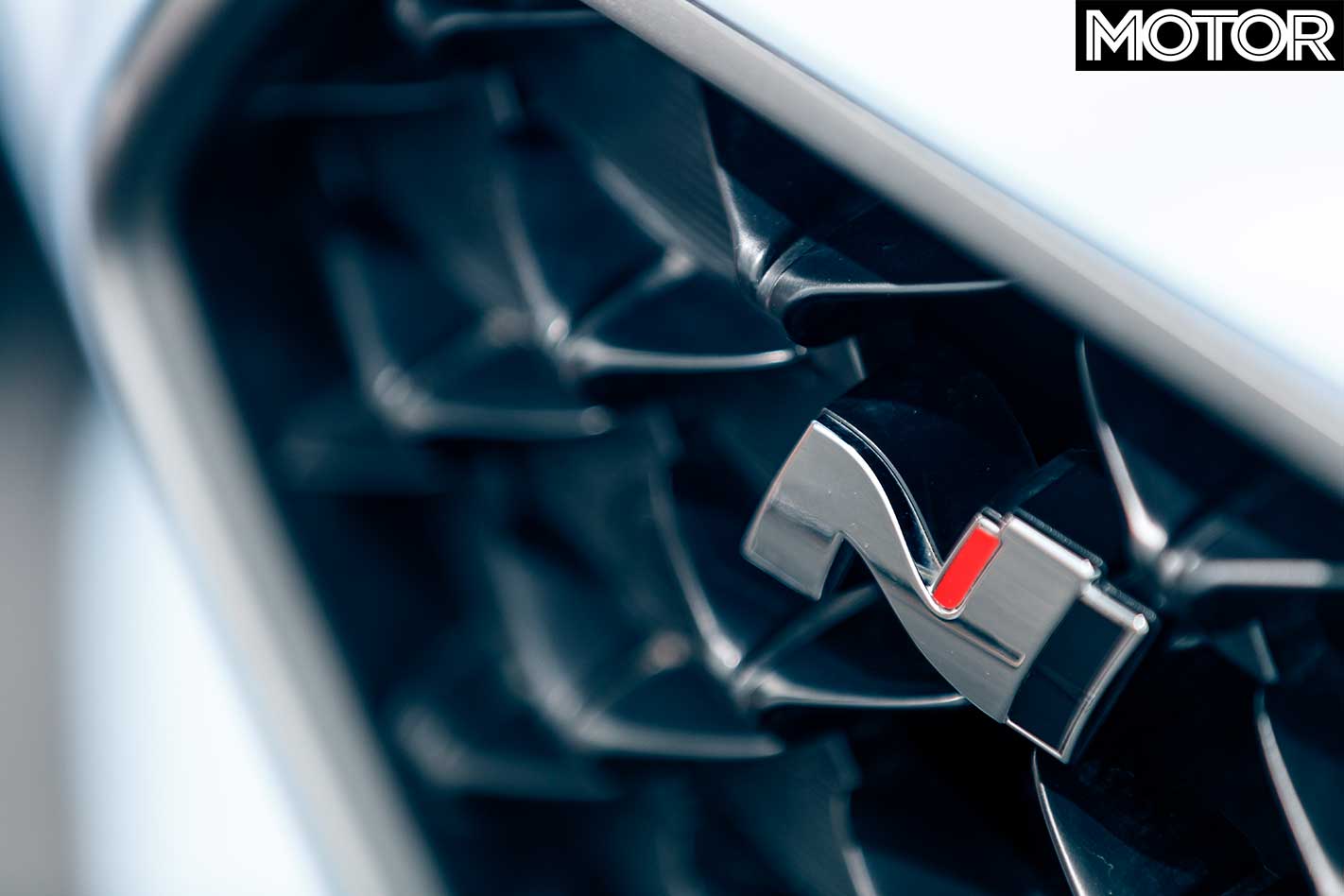
2019 HYUNDAI I30 N SPECS: Engine: 1998cc inline-4, DOHC, 16v, turbo Power: 202kW @ 6000rpm Torque: 353Nm @ 1450-4700rpm Weight: 1429kg 0-100km/h: 6.25sec 0-400m: 14.29sec @ 164.26km/h The Bend lap time: 1min 37.3sec Price: $43,485
Judge’s Rank
Dylan Campbell – 6th “Great fun. If a Golf GTI and Focus RS had a baby…”
Louis Cordony – 7th “Nails its brief brilliantly. Could lap it all day.”
David Morley – =3rd “Puts the rest of Planet Hot Hatch firmly on notice.”
Scott Newman – 5th “The Goldilocks hot hatch. Just right. Places here on merit.”
Rick Kelly – 3rd “A really enjoyable little performance car. I’m impressed.”
PCOTY 2019 Scoring
| Judges | DC | LC | RK | DM | SN | Total |
| Performance | 14 | 10 | 16 | 16 | 15 | 71 |
| Dynamics | 17.5 | 12.5 | 16 | 15 | 18 | 79 |
| Accessibility | 8 | 8.5 | 9 | 8 | 9.5 | 43 |
| Liveability | 8 | 7 | 9 | 9 | 8 | 41 |
| Value | 8.5 | 7 | 10 | 9 | 8 | 42.5 |
| X Factor | 8.5 | 7.5 | 2 | 7 | 6 | 31 |
| Total | 64.5 | 52.5 | 62 | 64 | 64.5 | 307.5 |
