
The latest generation Subaru Forester builds on a successful formula built around stability and practicality, by adding more space as well as advanced driver assistance technology to help give it an edge over key rivals such as the Mazda CX-5, Nissan’s X-Trail, the Toyota RAV4 and Volkswagen’s Tiguan.
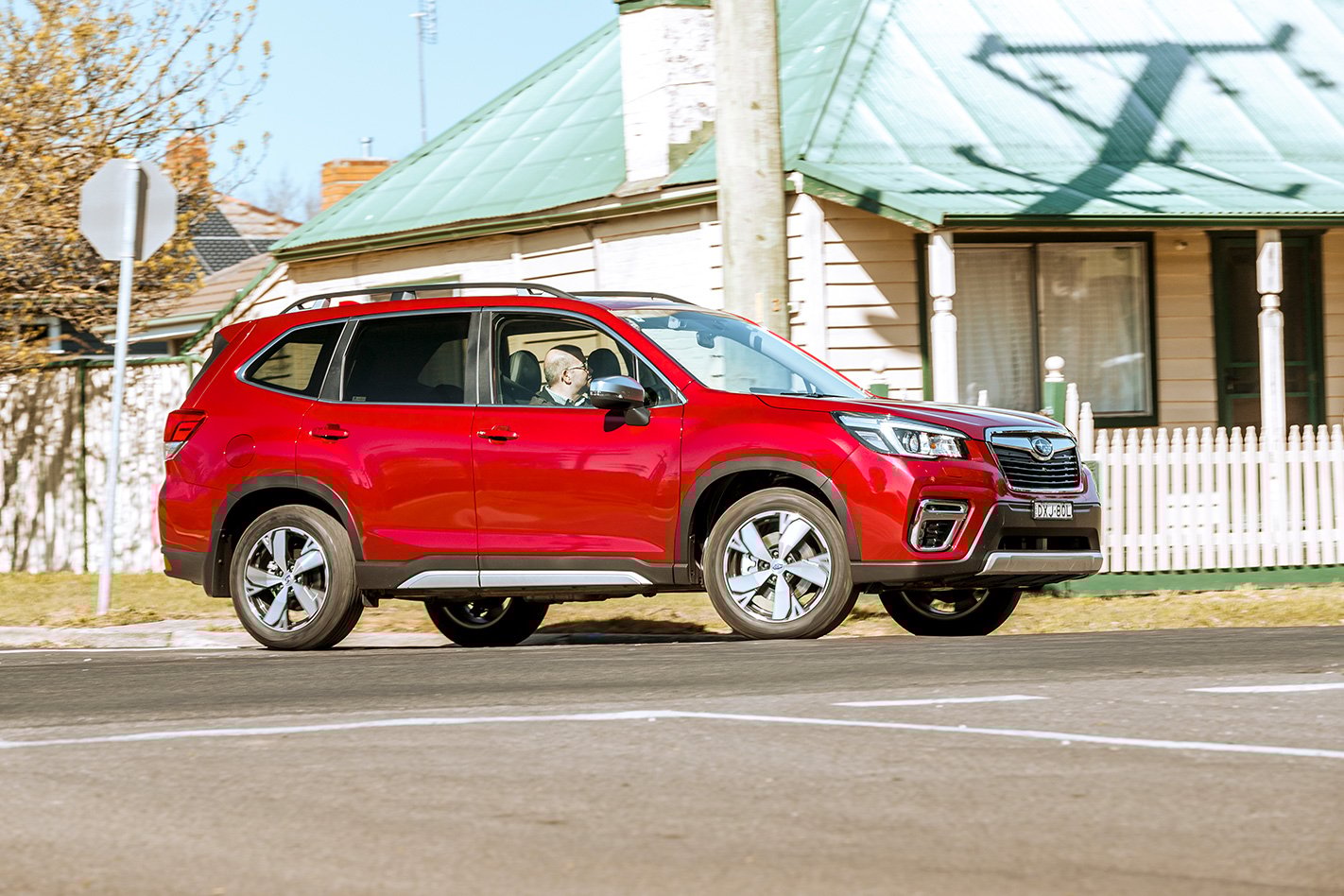
The Forester 2.5i-S sits on top of top of the local range, every variant of which is powered by a 2.5-litre petrol ‘boxer’ engine with all-wheel-drive (AWD) after the demise of the turbocharged Forester XT.
PRICING
The 2.5i-S is priced from $41,490, which is less than top-spec variants of some of its key rivals that sit around $50k mark.
That’s not through any obvious cost cutting on Subaru’s part, though, with the range-topping Forester brimming with standard features including leather trim, state-of-the-art active safety and automatic everything.
Despite having the same powertrain and performance as the rest of the range, the 2.5i-S’s equipment list justifies its price premium over the rest of the line-up, which starts with the 2.5i at $33,490 and works its way up through the 2.5i-L ($35,490) and the 2.5i Premium ($38,490).
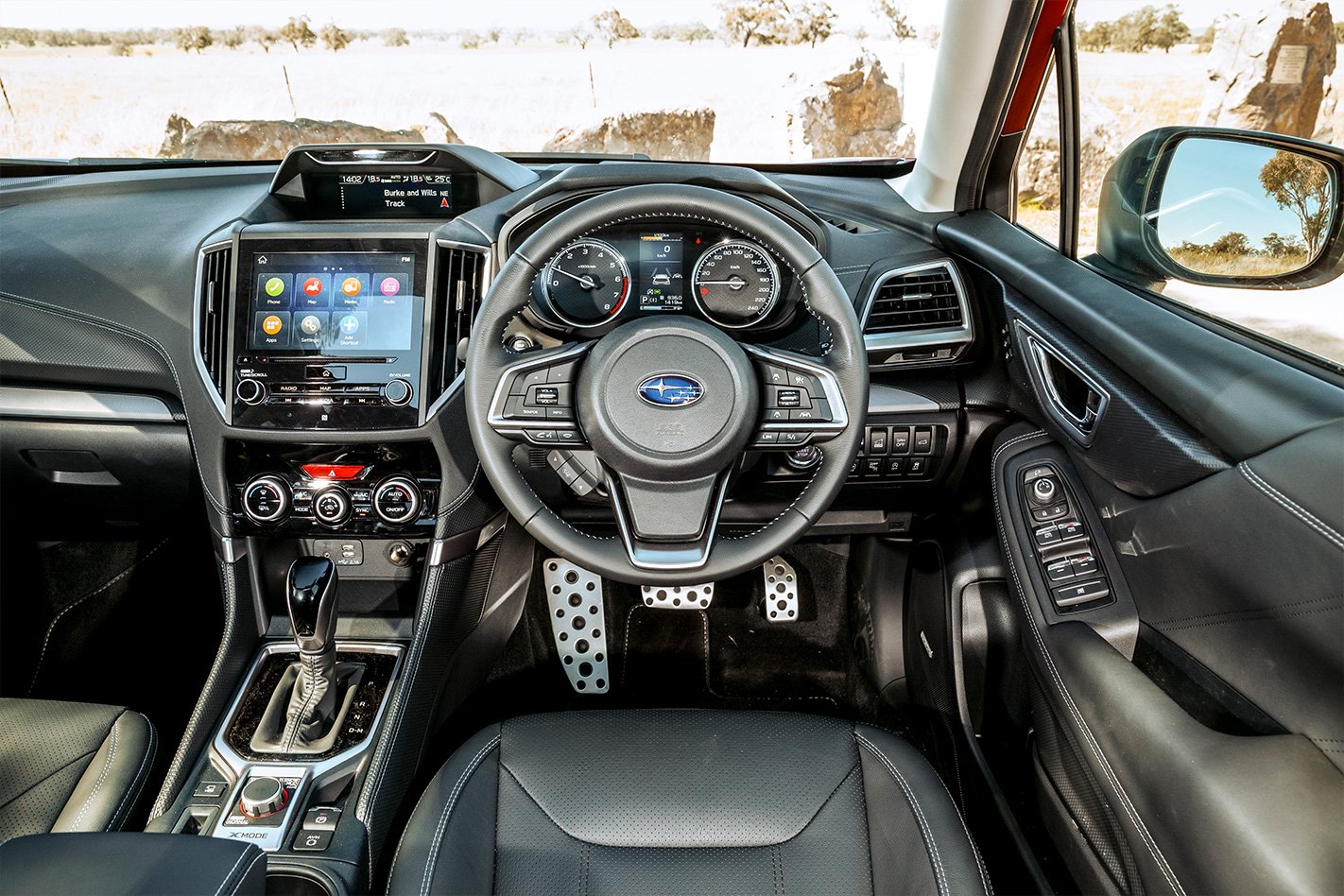
Apart from accessories like mats and roof racks there are no extra-cost options – not even premium paint.
The 2.5-litre petrol engine drinks 95RON unleaded petrol at a reasonably frugal rate of 7.4L/100km.
Under Subaru’s three-year service plan, the Forester requires a trip to the mechanic every 12 months, or 12.500km. The 12, 24 and 36-month services are priced at $346.39, $584.45 and $346.39 respectively. Subaru also recommends new Foresters go in for a free ‘health check and chat’ after one month.
The Subaru Forester is covered by a three-year, unlimited kilometre warranty, which is starting to look a little frugal in the current market. However, Subaru does often advertise an extended warranty of five years, so make sure you ask your dealer if you’re signing on the dotted line.
STANDARD FEATURES
The 2.5i-S comes with everything available in a Subaru Forester including ‘EyeSight’ active safety with autonomous emergency braking, active cruise control, lane-keeping assist and brake light recognition.
It also comes with:
- Facial recognition that sets the seats and door mirrors to your setting and can tell if you’re getting drowsy or distracted;
- 8.0-inch touchscreen;
- Reversing camera;
- Satellite radio;
- AM/FM/Digital (DAB+) radio;
- Apple CarPlay/Android Auto;
- 8-speaker Harman/Kardon premium sound system;
- Dual-zone air-conditioning;
- Self-levelling, auto on/off LED headlights;
- LED tail-lights;
- LED daytime running lights;
- Rain-sensing windscreen wipers;
- Blind-spot monitor;
- Rear-cross traffic alert;
- Reverse autonomous emergency braking to stop parking bingles;
- Dipping passenger side mirror to help you see the kern when reverse parallel parking;
- Leather seat upholstery and trim including the gear shift and steering wheel;
- Eight-way powered front seats;
- Power-folding rear seats;
- Powered tailgate;
- Sunroof;
- Paddle shifters;
- 18-inch alloy wheels;
- Full-size spare wheel
SIZE
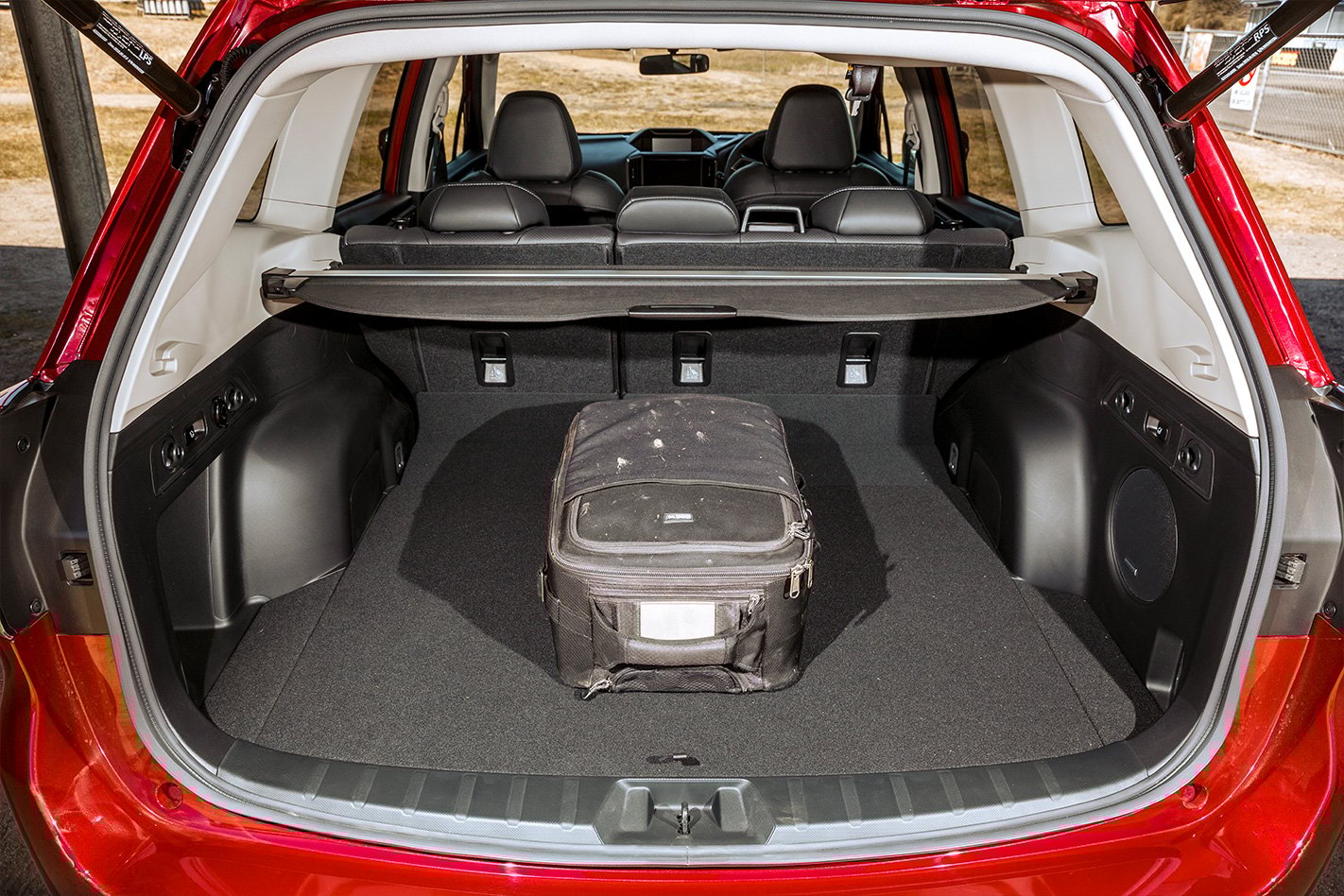
The fifth-generation Forester measures 4.63m in length by 1.82m wide, and its 2.67m wheelbase is 30mm longer than the previous model, leading to a substantial increase in interior space.
The boot space accommodates 498 litres and expands to 1768 litres with the 40/60-split seats folded. The load opening now measures 1258mm wide between the tail lights and the widest point of the luggage area is up to 1300mm – enough to fit a golf bag in sideways.
SAFETY
The Forester is one of the best-equipped SUVs in its price range in terms of active safety, with all versions equipped with Subaru’s EyeSight package that relies on stereo cameras at the top of the windscreen.
It brings autonomous emergency braking (AEB), adaptive cruise control, lane keeping assistance, brake light recognition that provides an additional sign that the car in front is stopping, and lane-drift assistance – alerting you if you start to drift out of your lane on the highway.
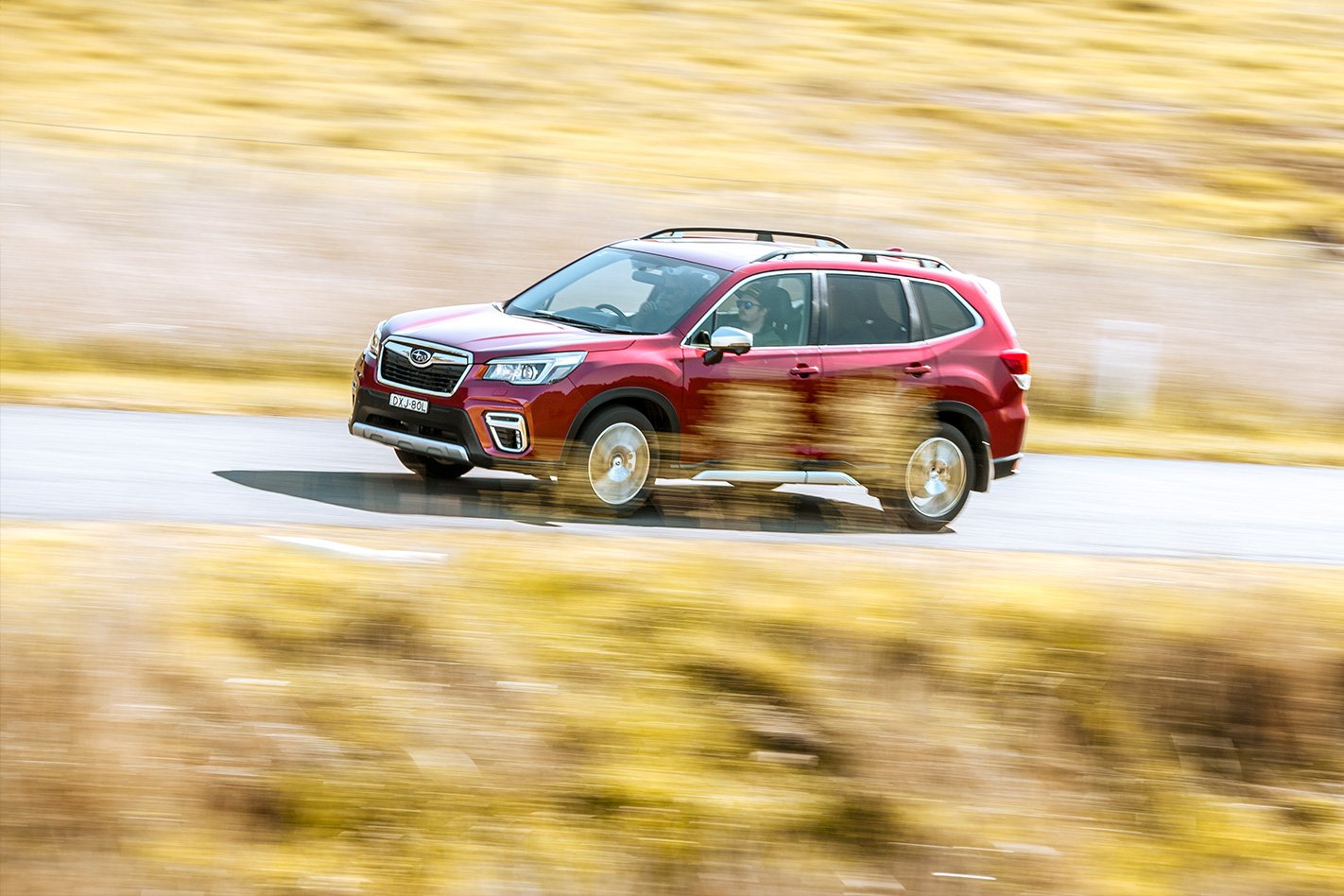
Other active safety features rear-cross traffic alert, a blind spot monitor, and facial recognition technology that detects if the driver is distracted or becoming drowsy. Meanwhile, reverse automatic braking helps prevent collisions while parking.
It also has anti-lock brakes, stability control, seven airbags, a reversing camera, and seatbelt reminders for all seats.
There are seven airbags, including driver’s knee, and side curtains that protect both rows, while ISOFIX anchor points for two child seats are also included.
The Australasian New Car Assessment Program (ANCAP) is yet to rate the 2019 Forester but the previous version had a top five-star score.
COMFORT
The Forester has a comfortable, roomy and well-appointed cabin with excellent fit and finish.
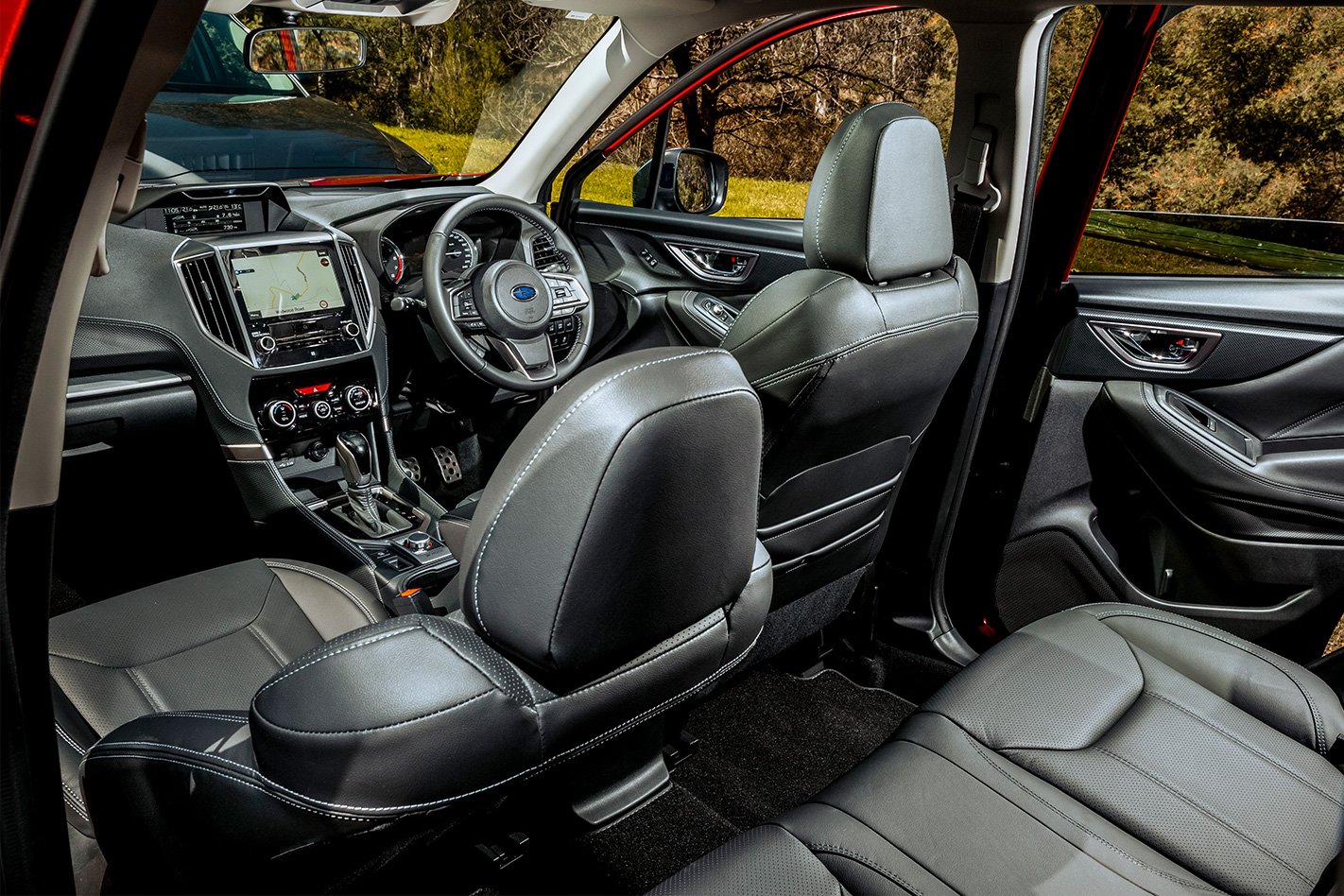
The leather seats are comfortable and feel plush, unlike in previous-model Foresters where they were a little too firm and felt like you were sitting on, rather than in, them.
The driving position feels very natural, with excellent forward vision that’s also afforded to the rear-seat passengers thanks to all the glass that also proves great side vision.
Rear-seat head- and legroom is plentiful, even when the front seats are pushed back, and rear-seat passengers get their own air vents and two USB sockets to charge their electronic devices.
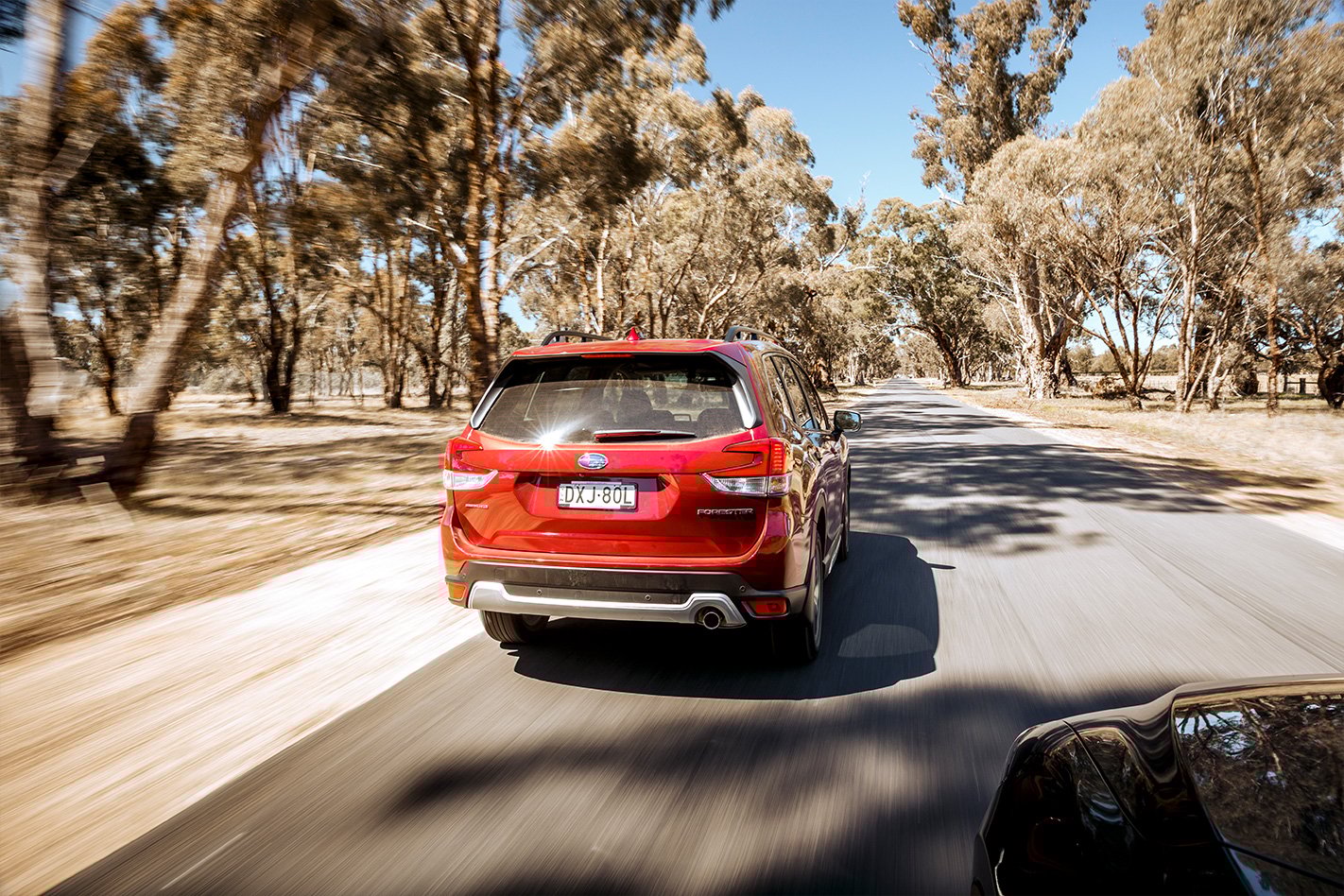
On the road the Forester offers a soft, almost loping, ride that doesn’t compromise handling even through tight bends. It rides over coarse surfaces and unsealed tracks well too, and feels as though it was designed specifically for Australian conditions.
Road noise, which was a key criticism of previous model Foresters, has also been subdued, despite the tallish glasshouse.
ON THE ROAD
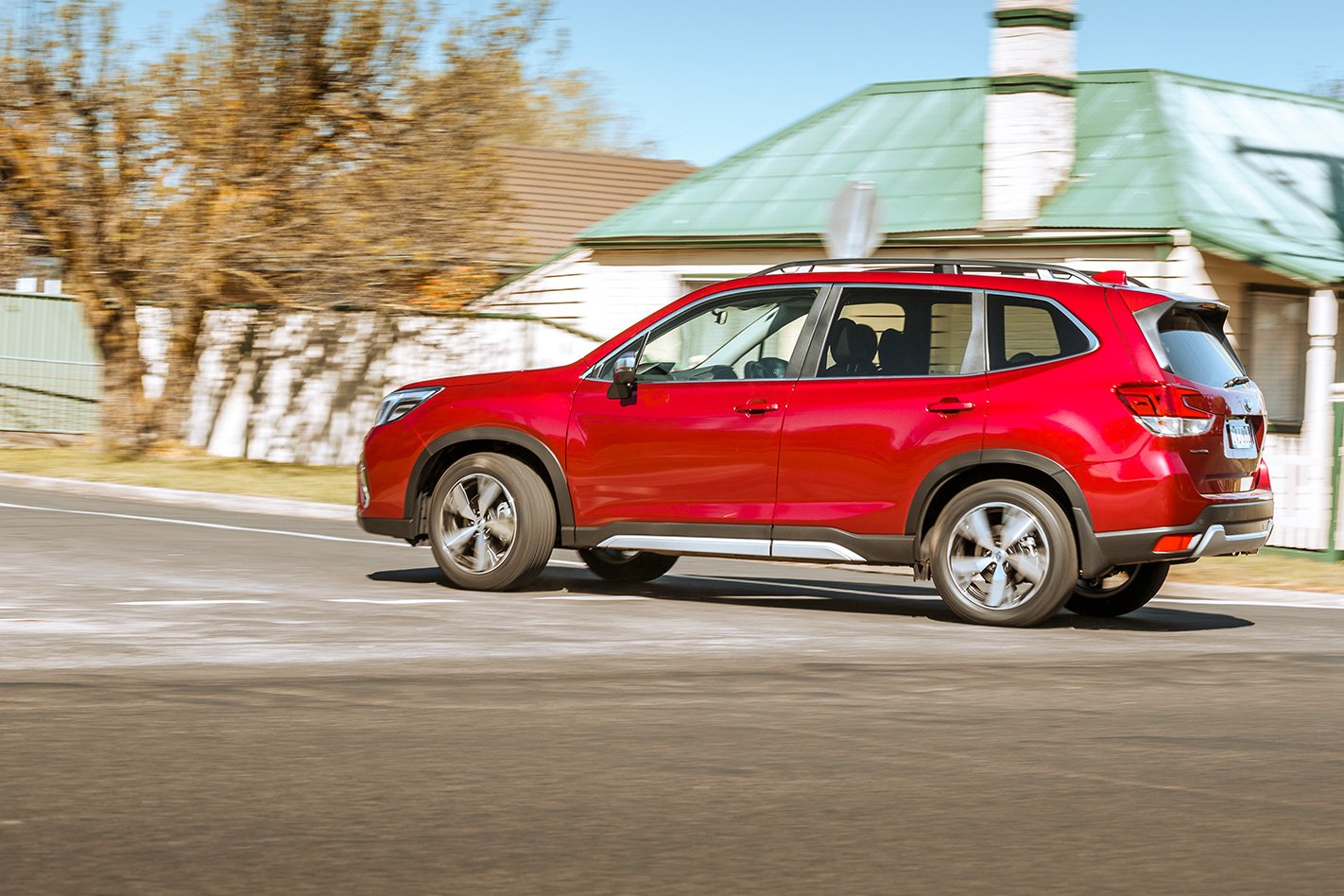
The Forester manages to provide an excellent balance between high-riding practicality, comfort and driveability. It’s an easy car to drive, with light steering and responsive acceleration at low speeds.
Despite its loping ride, it handles bends well with little lateral movement, and the steering and chassis compliance are above average for SUVs in its class.
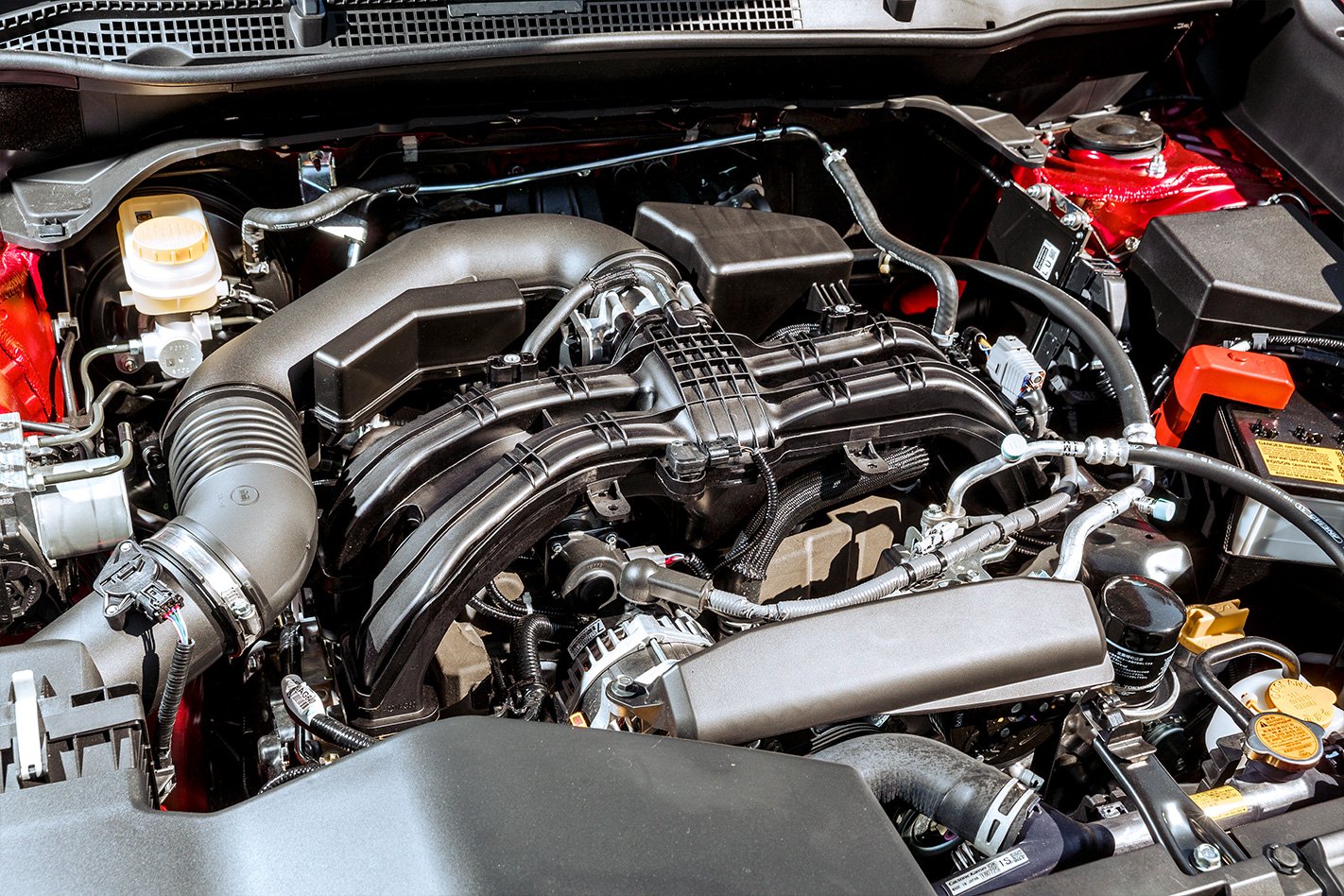
The Forester’s 2.5-litre engine is adequate to the task around town or on highways, but the absence of a turbocharger is noticed when its fully loaded or when attempting a quick overtaking manoeuvre.
Continuously variable transmission (CVT) autos aren’t usually something to celebrate, but the Forester’s overcomes the incessant revving normally associated with them by acting more like a conventional automatic, with stepped ratios, when you ask it to accelerate hard.
The X-Mode all-wheel-drive traction system helps maintain its confidence-inspiring ride when grip levels drop off or the road becomes rather uncivilised. Aided by a 220mm ground clearance, it handles unsealed surfaces better than most medium SUVs, making it excellent on gravel roads, good on sand, and even some tracks that are rough or steep. Its full-size spare tyre is a major bonus here.
OUR VERDICT
While it doesn’t look too different from the previous model, the fifth generation Subaru Forester is streets ahead in terms of technology, safety and ride comfort. It’s also arguably the best medium SUV in its class, ticking most boxes over comparably priced, but lesser equipped, rivals.
MORE: Subaru Forester Range Review MORE: Subaru Forester Specs, Range & Price
The first Pagani Huayra Roadster ever assigned a number (so… number one) is up for grabs at the moment after its first owner decided it was time to move on… without having driven the car.
The white –inside and out – Roadster has delivery mileage, listed as ‘0km’ on luxury classifieds site James Edition.

Its anonymous first owner has apparently decided not to flaunt his wealth in the somewhat volatile nation of Saudi Arabia, with a dealership called Seven Car Lounge (a blatant lie, they have far more than seven cars) offering the Roadster with a ‘POA’ on the advertisement.
In Australia, the price of a new Pagani Huayra sits at AUD$5.5 million, so we can safely assume the first one will sell for more than that, especially given the ludicrous inflation of rare (and sadly undriven) supercar values.
Only 100 of the topless Pagani Huayras exist, with one having made its way to Australia via the first official local dealer for the prestige brand.
In the first Huayra Roadster, as with all Huayras, a 6.0-litre V12 hooked up to a 7-speed auto powers the rear wheels, with outputs of 562kW and over 1000Nm.

“If we think of the Huayra Coupe as a personification of elegance and timeless lines, the Huayra Roadster was to be the rebellious sister, shapely and beautiful, but with a sharp edge for those who are careless,” its creator, Horacio Pagani, has said of the stunning Roadster.
If you have the means, you can pick up the first Pagani Huayra Roadster by checking out the listing here.
o beFresh from its unveiling at the Paris Show, BMW’s latest G20-generation M340i looks to reassert Munich’s position as the driver’s choice in its class. In recent years that dominance has waned a little, but with a wider track, a lower centre of gravity, a chassis that’s 50 percent stiffer than before and a trick e-diff, the latest Three looks to be back and firing.
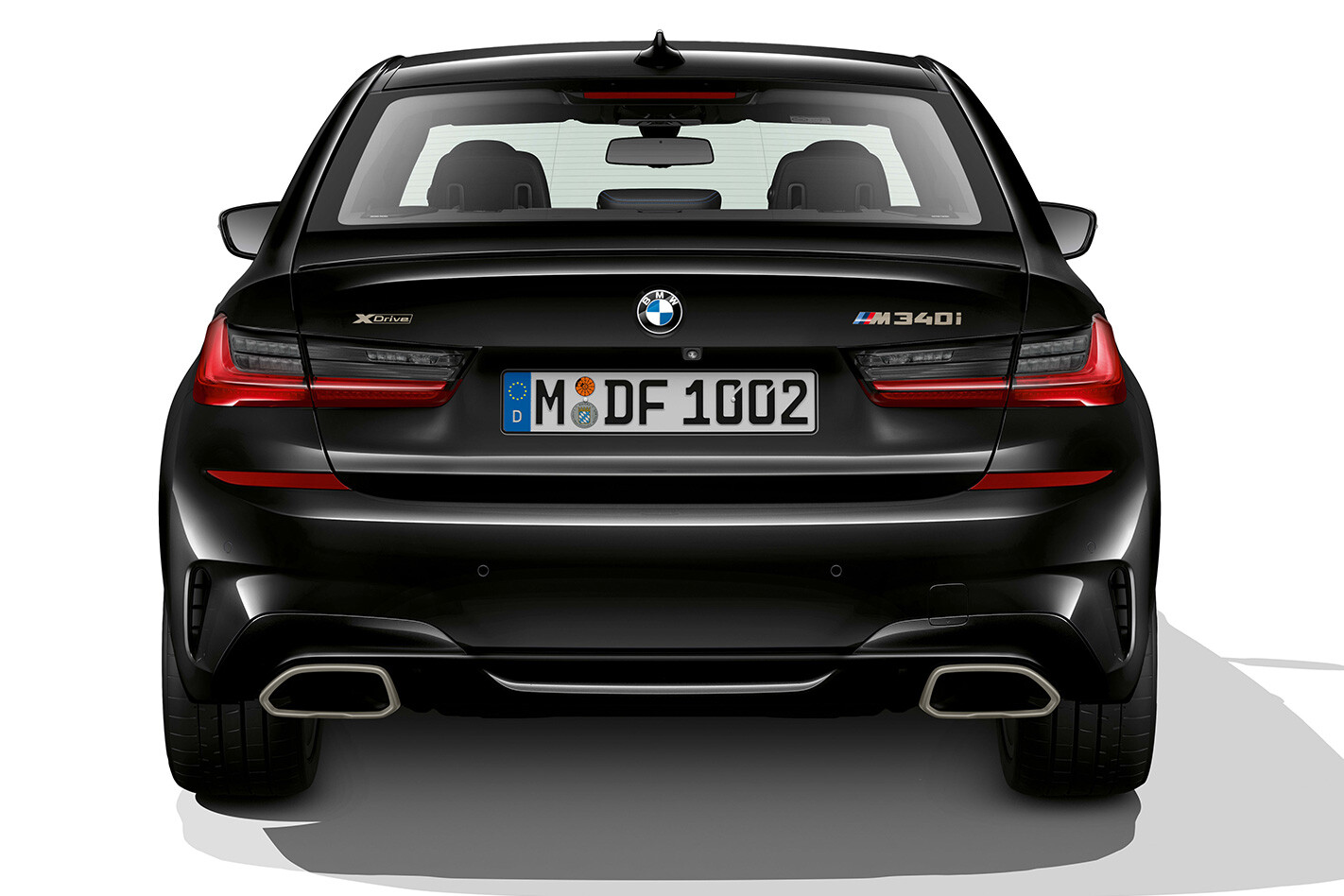
We’ve yet to get behind the wheel of the M340i xDrive range topper, but we’ve seen a few numbers and, well, we’ll leave it to you to decide if the car can punch its weight when faced with the Audi S4, the Mercedes-AMG C43 and a welter of other tasty rivals. So, without wishing to prejudice your decision in any way, here are the facts.
u00a0 | Power (kW) | Torque (Nm) | 0-100km/h | Drive | Trans | Price |
Alfa Romeo Giulia Veloce | 206 | 400 | 5.7 | RWD | A8 | $71,985 |
Audi S4 u00a0 | 260 | 500 | 4.7 | AWD | A8 | $99,611 |
BMW M340i xDrive u00a0 | 275 | 500 | 4.4 | AWD | A8 | $tba |
Infiniti Q50 Red Sport | 298 | 475 | 4.9 | RWD | A7 | $74,990 |
Jaguar XE S u00a0 | 280 | 450 | 5.0 | RWD | A8 | $92,700 |
Kia Stinger GT u00a0 | 272 | 510 | 4.9 | RWD | A8 | $59,990 |
Mercedes-AMG C43 | 270 | 520 | 4.7 | AWD | A9 | $106,211 |
VW Arteon 206 TSI | 206 | 350 | 5.4 | AWD | S6 | $65,490 |
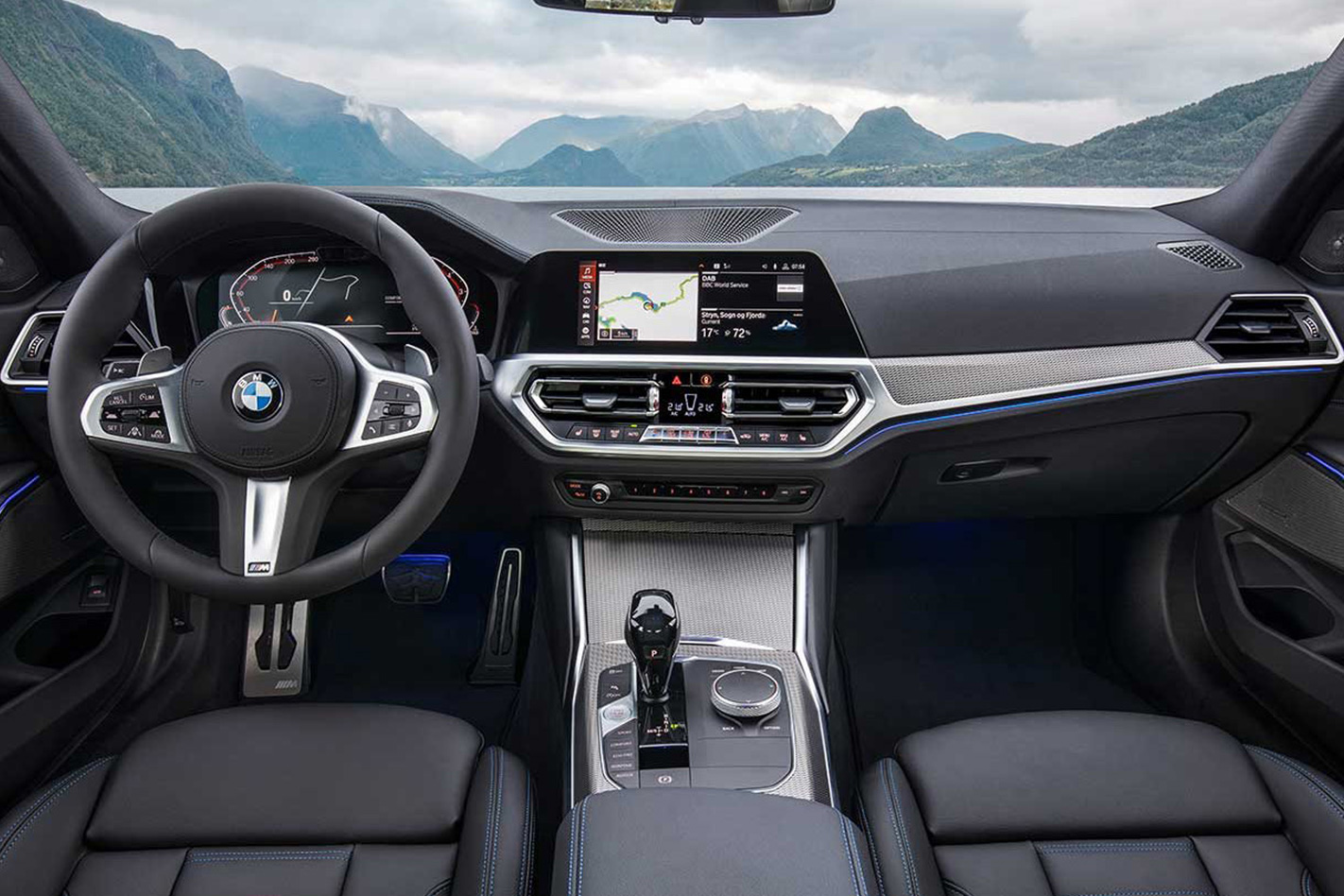
We’ll have pricing for you on the back of the car’s Los Angeles show reveal, so keep checking back. In the meantime, let us know which of these power-packed sedans gets your vote.
British luxury car brand Bentley has pulled the covers, and the roof, off its current generation Continental GTC.
The 2019 Bentley Continental GT Convertible (or GTC for short) retains the 6.0-litre W12 powerplant with two turbos, but no more power than it had before. Torque is up 80Nm however, giving this generation GTC a total 467kW and 900Nm. An eight-speed dual-clutch replaces its predecessor’s torque-converter gearbox.
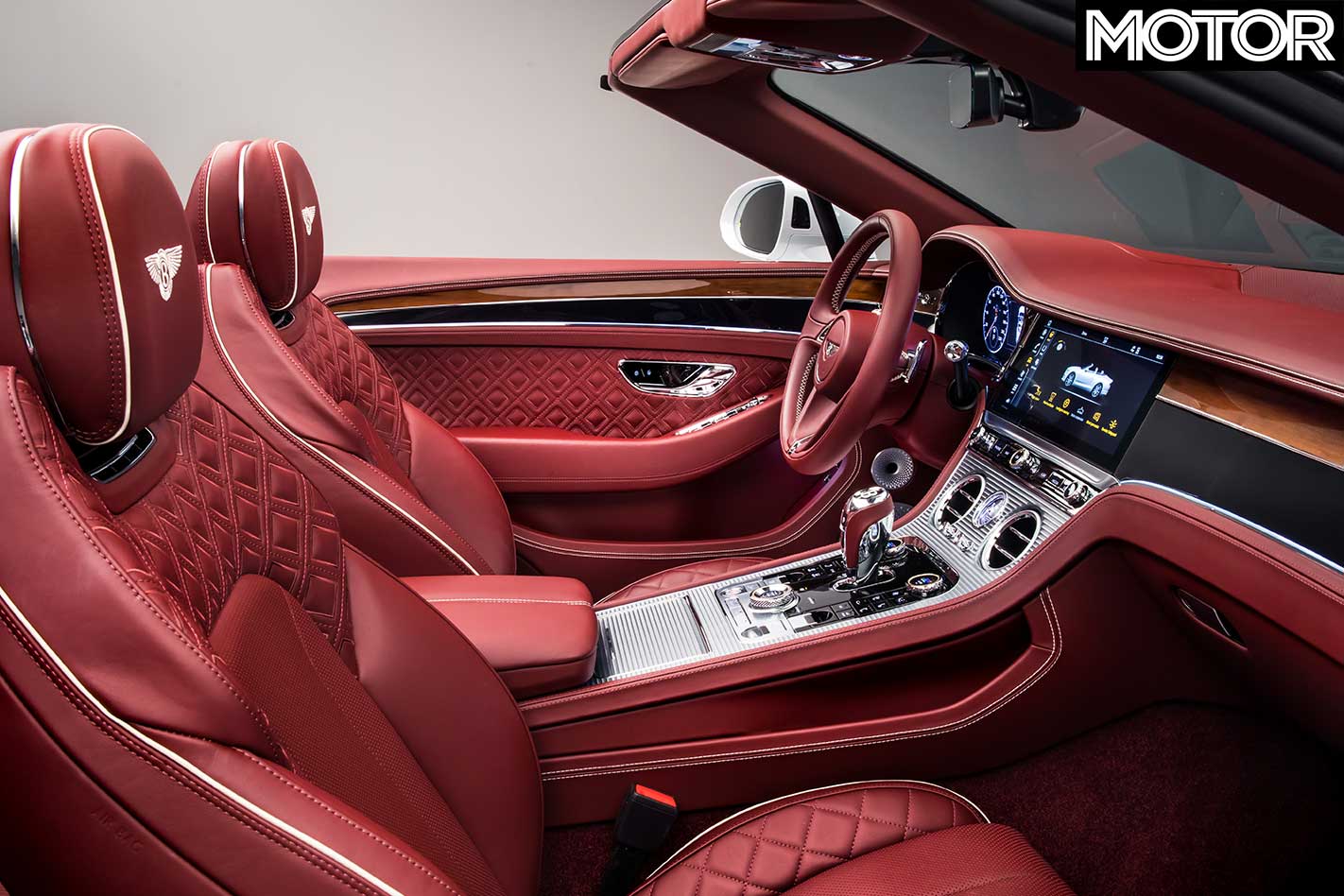
The W12 has got a rather substantial 2414kg to haul, but Bentley claims 100km/h comes along in just 3.8 seconds, a time which follows the coupe by a tenth for pace. It’ll then go on to top out at 333km/h, Bentley adds.
This could come down, in part, to Bentley’s new drop-top being 20 per cent lighter in ‘body-in-white’ form (no doors, running gear, interior trim, etc.) than the predecessor, as well as being five per cent stiffer. Bentley puts this down to its use of aluminium and high-tensile steel.
Also new is the variable torque split between front and rear wheels, which was previously a set 40:60 respectively.
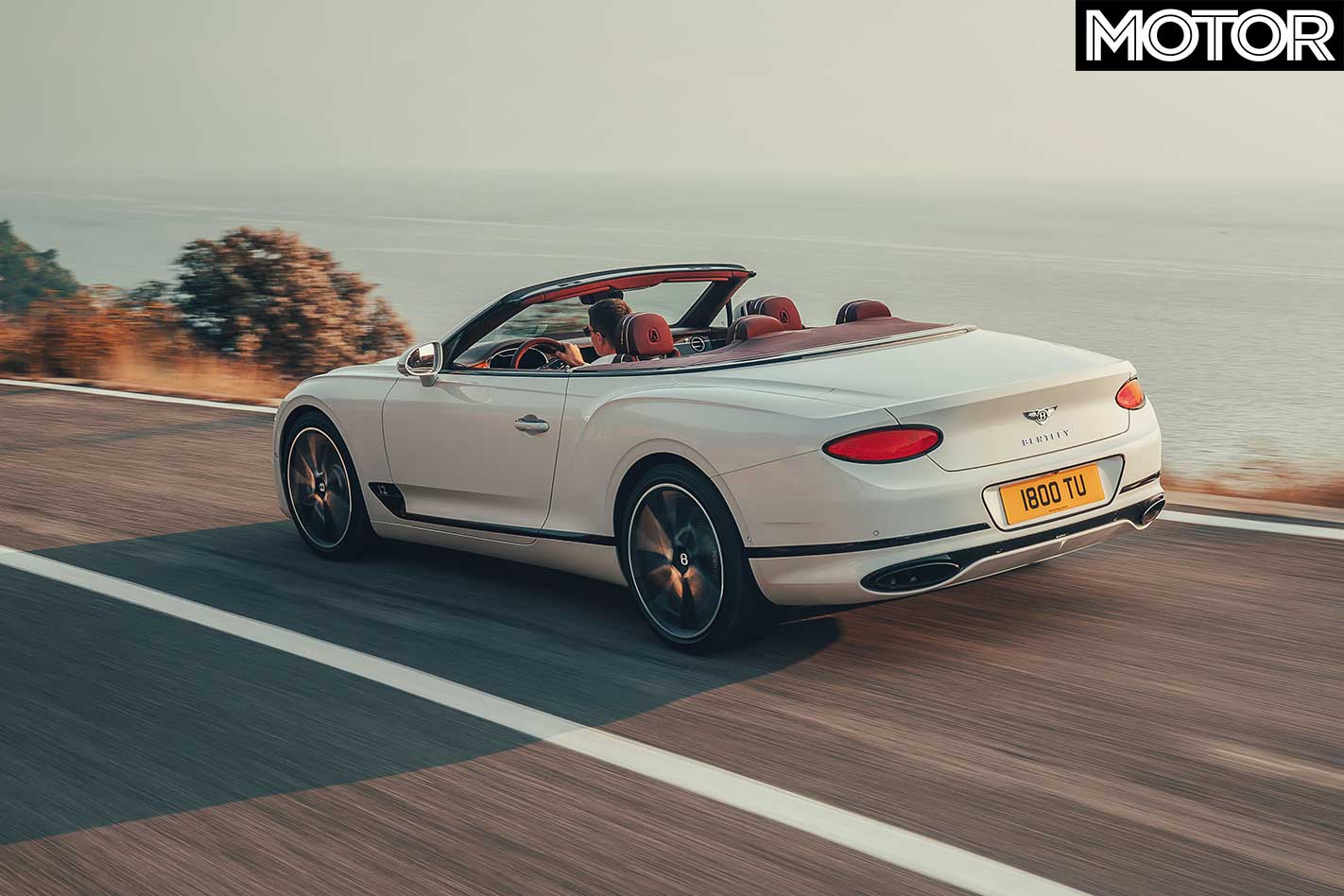
As a Bentley, quiet and comfort are to be expected – so Bentley has made this GT Convertible as quiet as the previous generation’s Coupe. Its roof (which can now be had in tweed if one wishes) features new insulation, better seals, and an updated movement mechanism which can close or open the roof in 19 seconds at up to 50km/h.
Bentley even says the Pirelli P Zero tyres on the Continental feature Pirelli’s ‘Noise Cancelling System’ to reduce road noise and rolling resistance.
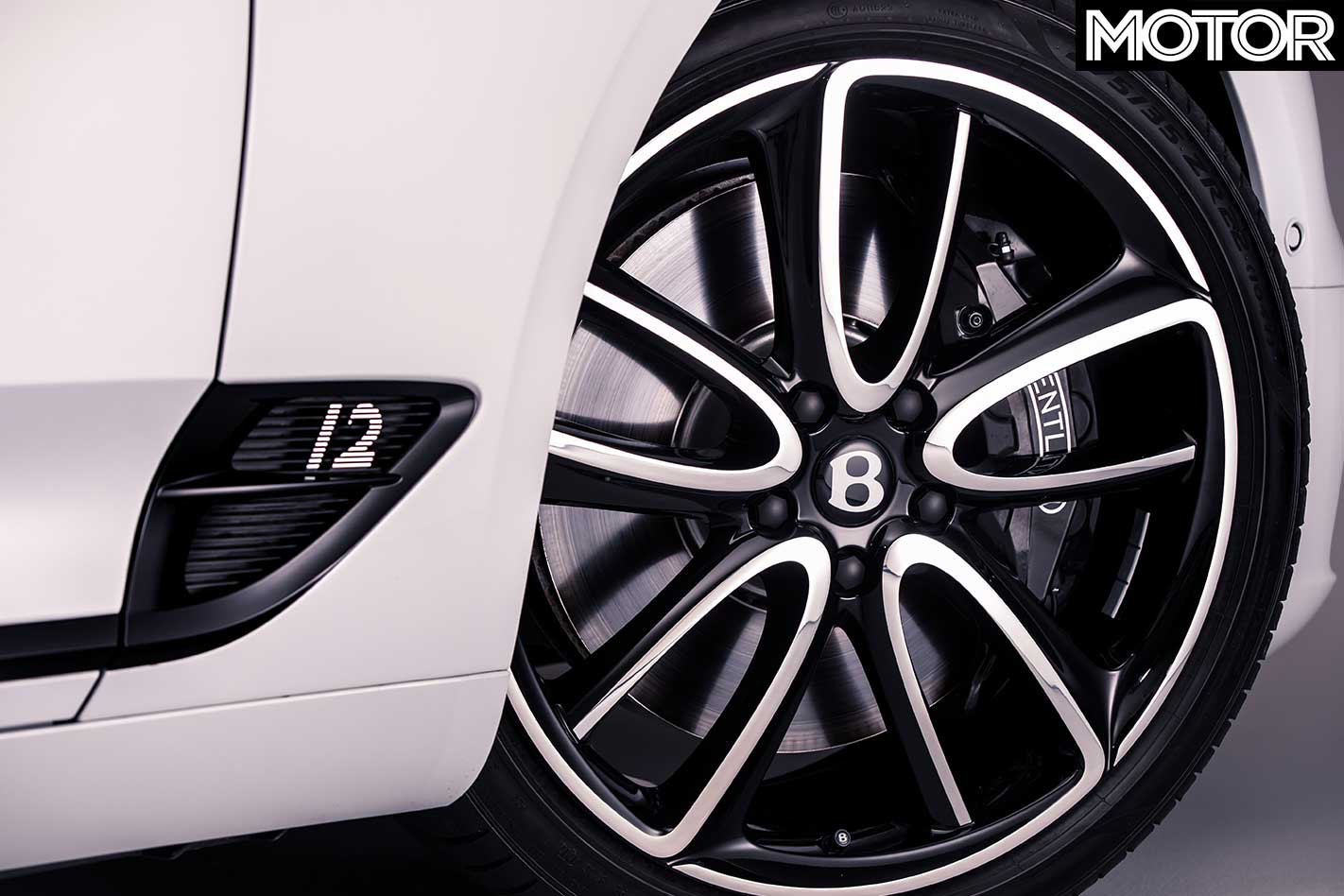
For the comfort aspect, Bentley’s new GTC features constantly-adjusting dampers which run on the latest version of what Bentley calls ‘Continuous Damping Control’, which essentially monitors the vehicle and its relation to the road and its suspension to decide how much air is present in the airbags.
Nearby, as the 2.4-tonne GTC will need to stop on occasion (and sometimes rather quickly), the brakes all round total 28 pistons at the calipers, ten each at the front which clamp to 420mm two-piece discs and four each at the rear on 380mm discs.
Australian pricing and availability are yet to be announced, but given the current coupe starts at $422,600, chances are pricing for the GTC will be in the ‘if-you-have-to ask…’ region.
THE Porsche of battery charging stations. Would make a good tagline that, but that’s exactly what seems to have materialised from the brains trust at Zuffenhausen. It’s been no great secret that the company is working on 800-volt charging for its Taycan EV sports sedan. To put that figure into perspective, a Tesla Supercharger delivers 480-volt charging capability.
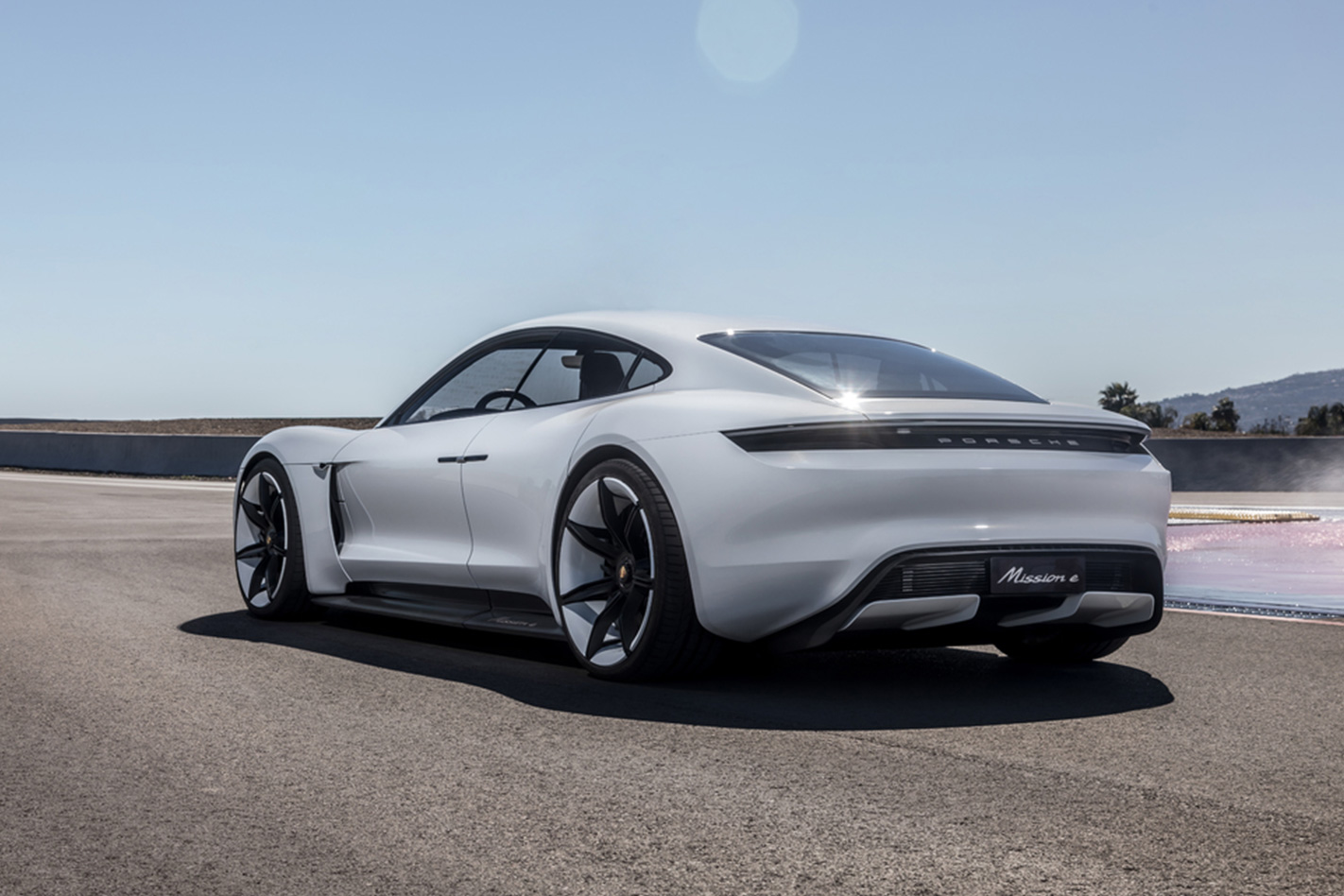
Speaking to Bloomberg, Chief Executive Oliver Blume recently underlined the lightning-fast capability of the 800-volt Porsche Turbo Chargers. Juicing a Taycan for just 20 minutes will inject 400km of range into its 90kWh lithium-ion battery pack.
The most eyebrow-raising number was the fact that 100km of range could be added from zero in just 240 seconds. That would be enough to get most of us from home to work and back, although if I was a Taycan owner, I’d probably be looking for the long and twisty route.
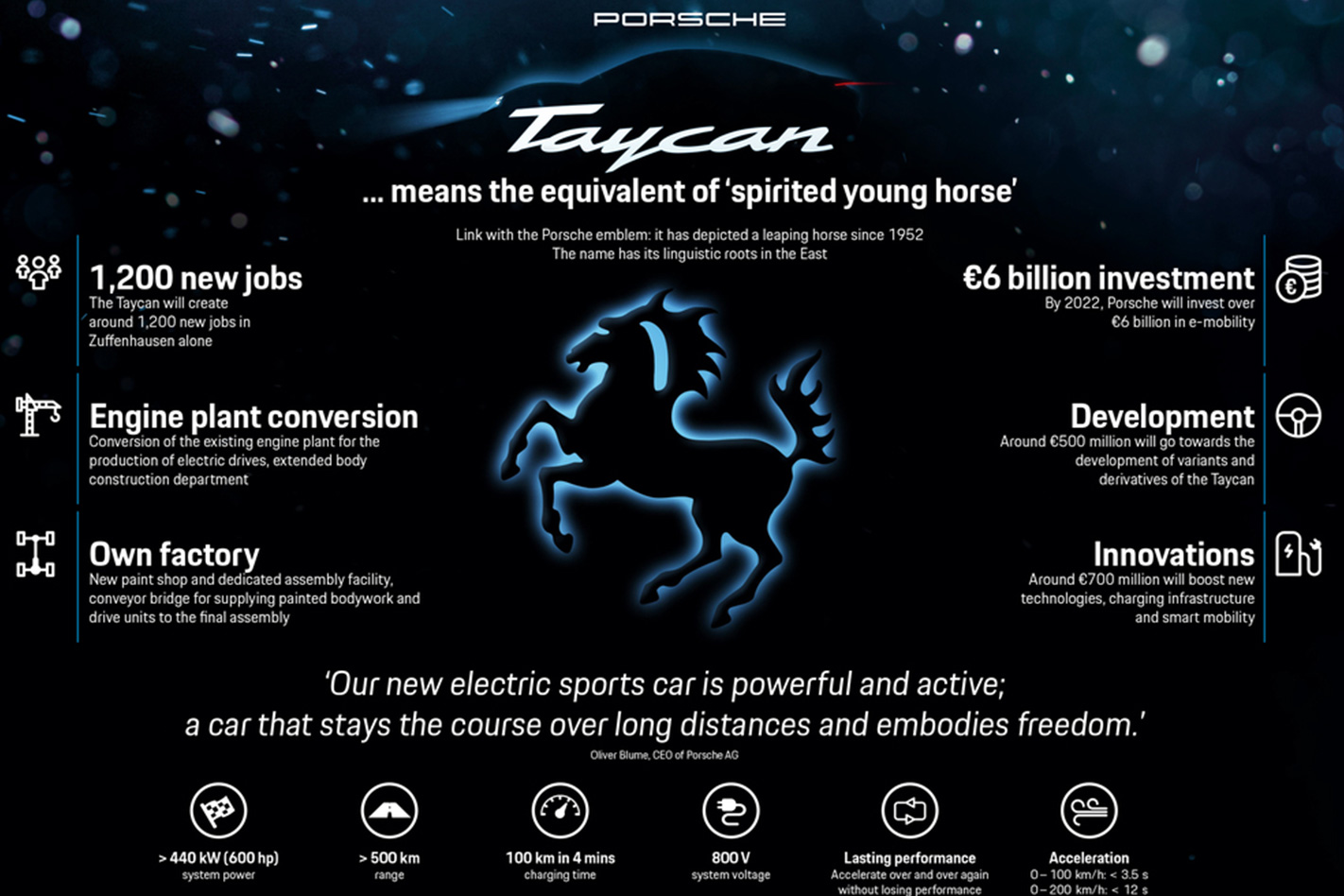
After all, the rest of the formula is pretty tempting, as evidenced by a flood of letters of intent to Porsche Australia’s office from eager would-be customers. The Taycan’s Magneti Marelli electric motors drive all wheels, sending it to 100km/h in less than 3.5 seconds. Above all, Porsche wanted the car to live the company’s values.
As head of the Taycan program, Stefan Weckbach told Germany’s Firmenauto, “A central question in the development was: Where is the optimal balance between range and performance? Theoretically, one would have to pack only a correspondingly large battery in the vehicle to get a lot of range. But that would not be typical Porsche, if only because of the excessive weight. Instead, we use very light electric motors. In addition, we can achieve a range of 500 kilometres via the high power density and high efficiency of the electric drive. This results in low power consumption, so we can use smaller and lighter batteries.”
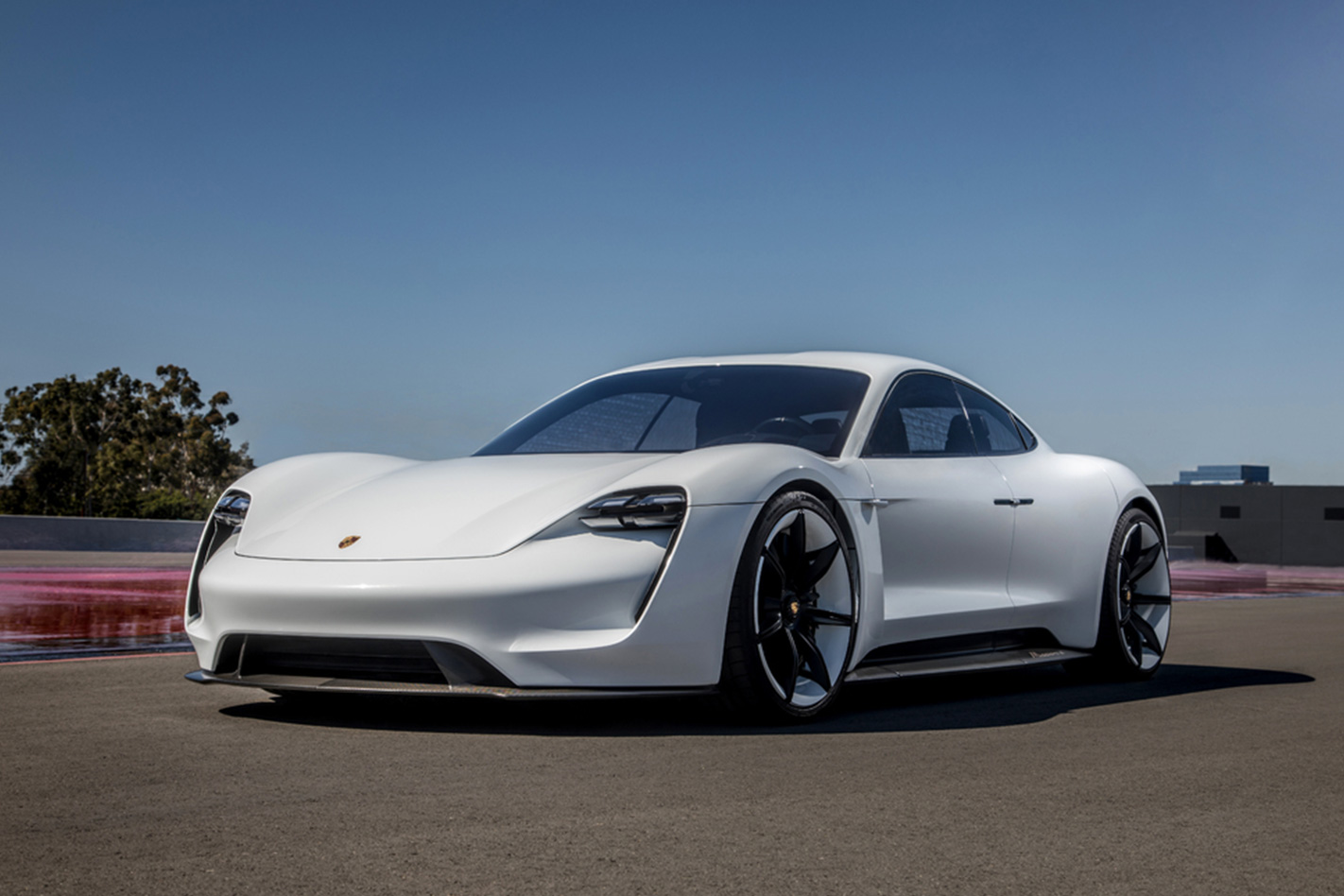
There’s still no word on how extensive the Porsche Turbo Charging network will be in Australia, but the company is looking to partner with third party suppliers to develop the charging infrastructure.
Hyundai has officially launched a three-pronged eco-focused Ioniq range in Australia.
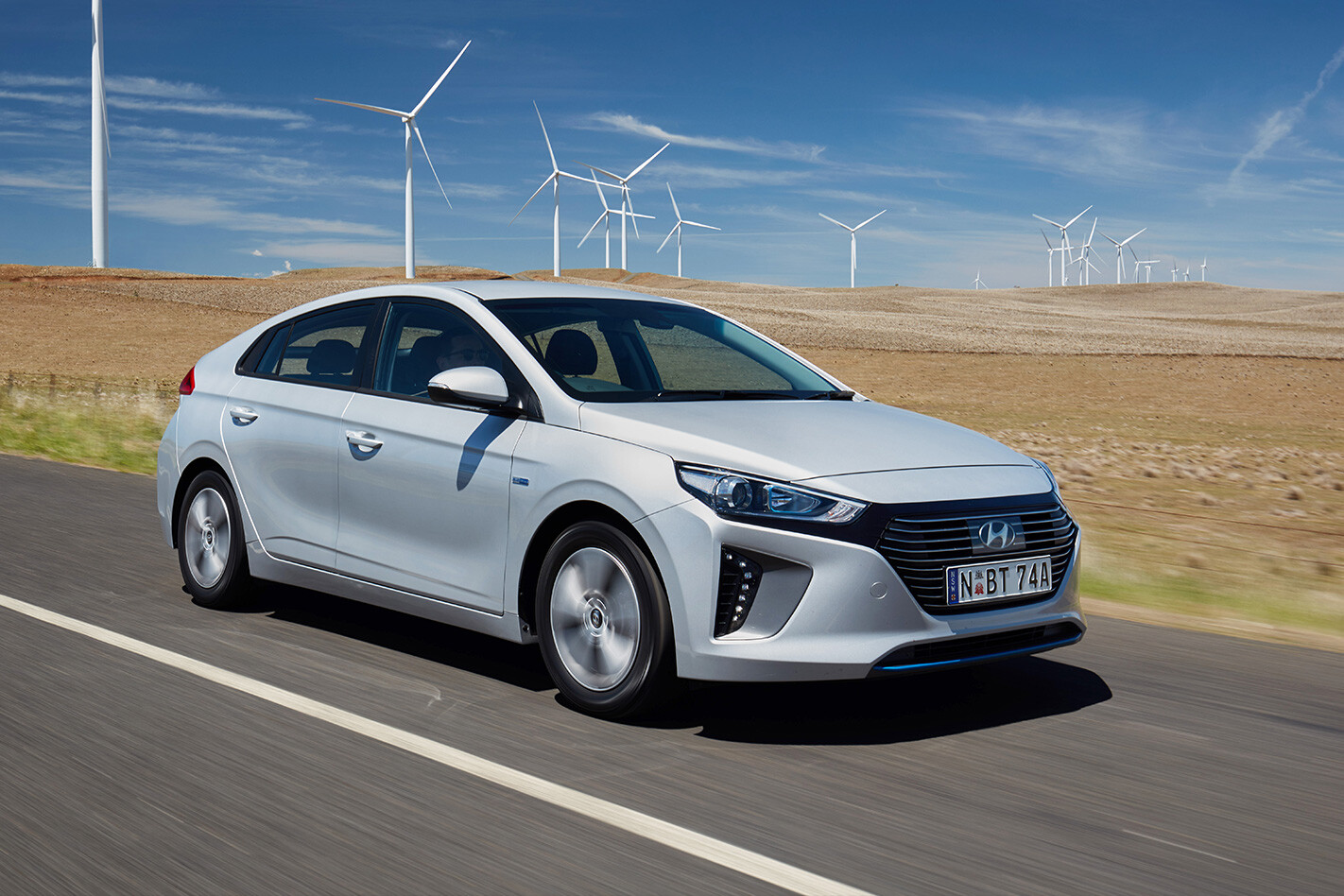
With a trio of electrified variants (hybrid, plug-in electric, and pure electric), Hyundai has played the value card hard, with even the priciest model coming in at less than $50,000. Each Ioniq is available in either Elite or Premium trim levels.
Hyundai predicts the pure electric Ioniq will be the most popular, with the Elite starting at $44,990. This makes it the cheapest battery electric car available in Australia, undercutting the Renault Zoe Life by $2500.
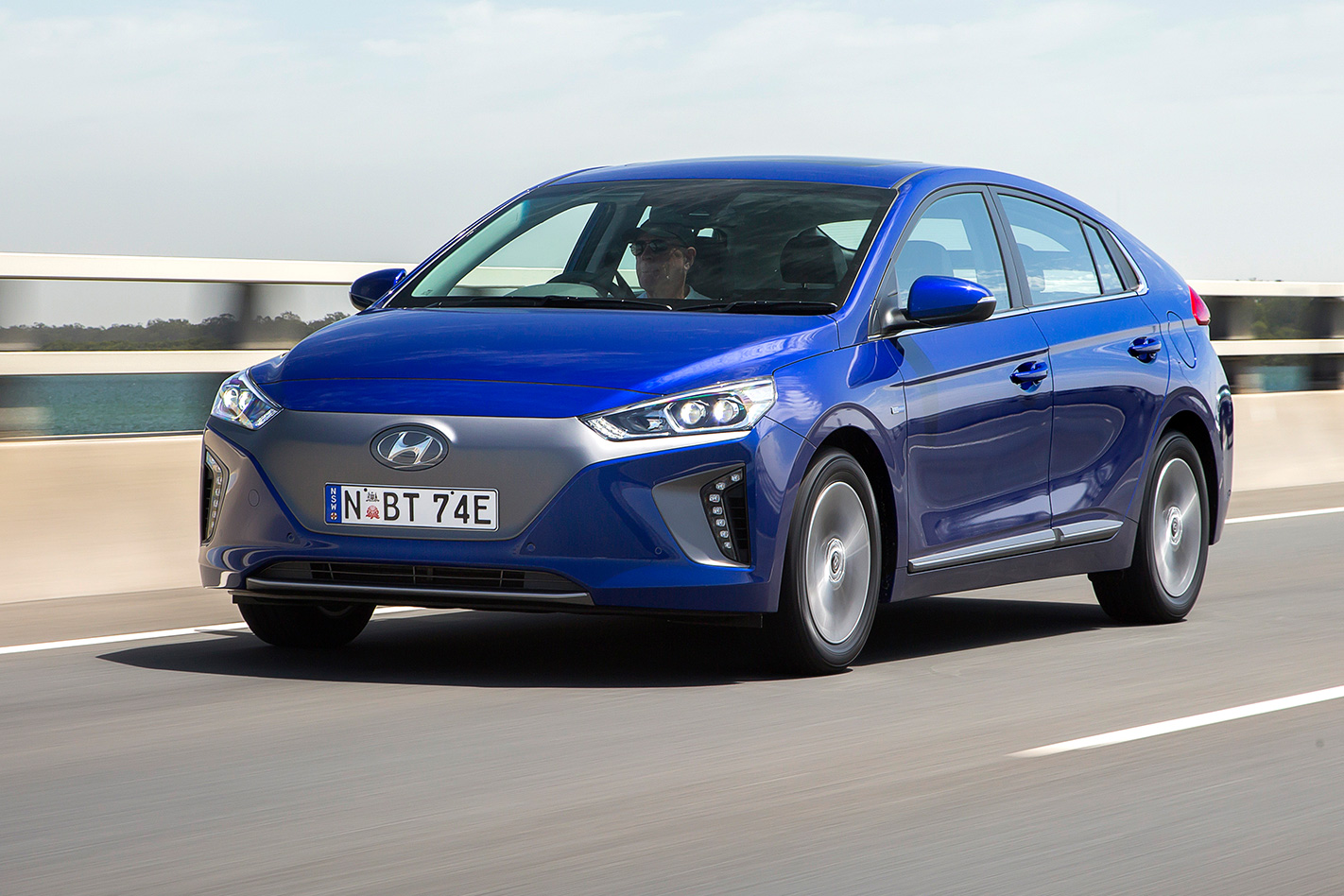
Powered by a 28kWh Lithium-ion Polymer battery, which translates to 88kW and 295Nm on the dyno, the Ioniq BEV (battery electric vehicle) is good for 230km of real-world electric driving, according to Hyundai Australia.
The BEV Elite is fitted with Hyundai’s SmartSense safety suite, which includes radar cruise control, as standard, along with 16-inch alloy wheels, and eight-inch infotainment screen, Apple CarPlay and Android Auto, and a seven-inch TFT digital instrument cluster.
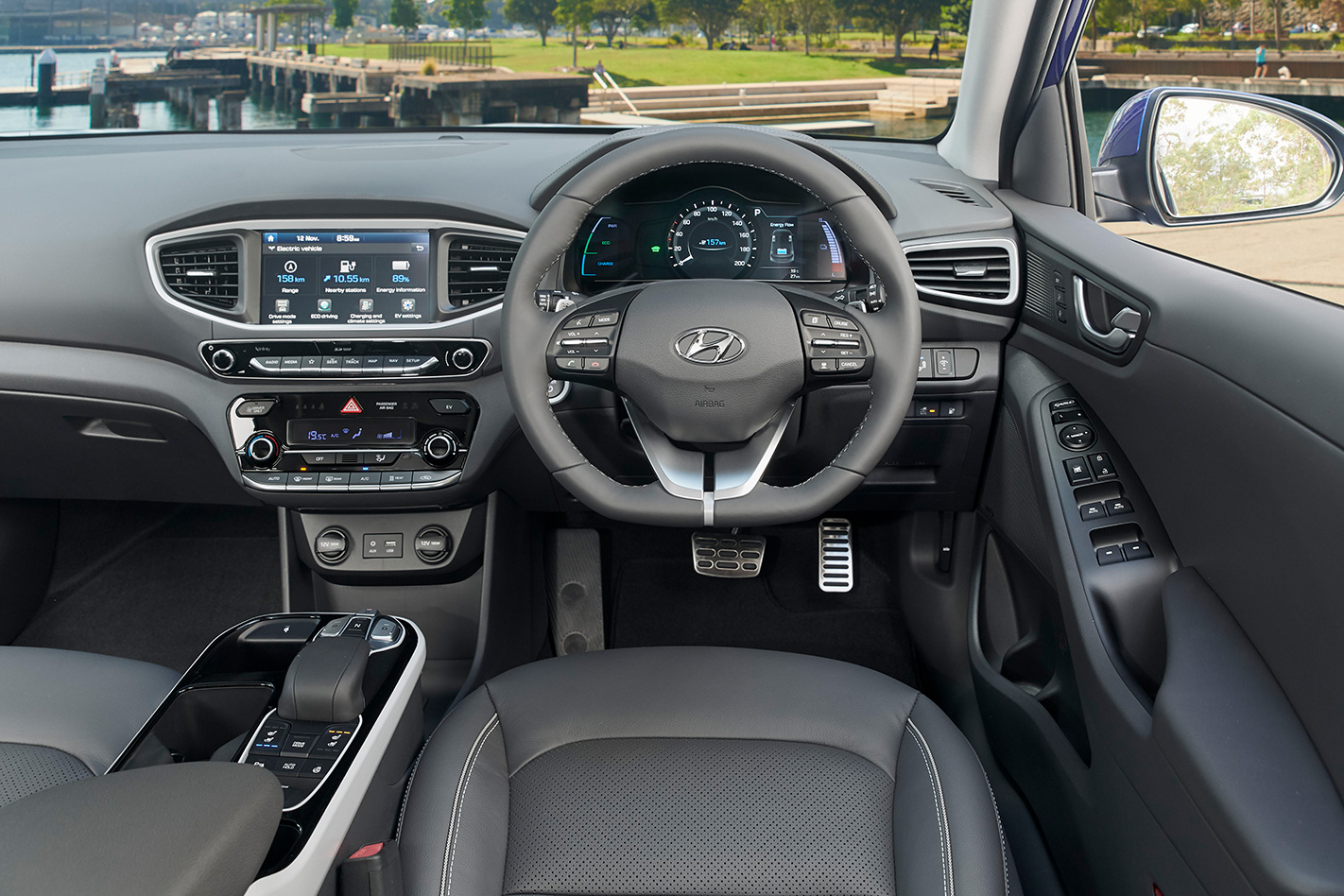
Priced at $48,990 the Ioniq BEV Premium adds a power glass sunroof, heated and ventilated front seats, leather appointed interior, a powered driver’s seat with memory, and wireless phone charging.
If a pure electric isn’t right for you, Hyundai offers a plug-in hybrid which is capable of 63km of electric driving thanks to an 8.9kWh Lithium-ion Polymer battery. However, it also a 1.6-litre Atkinson cycle combustion engine, which combined with the battery produces a peak output of 104kW.
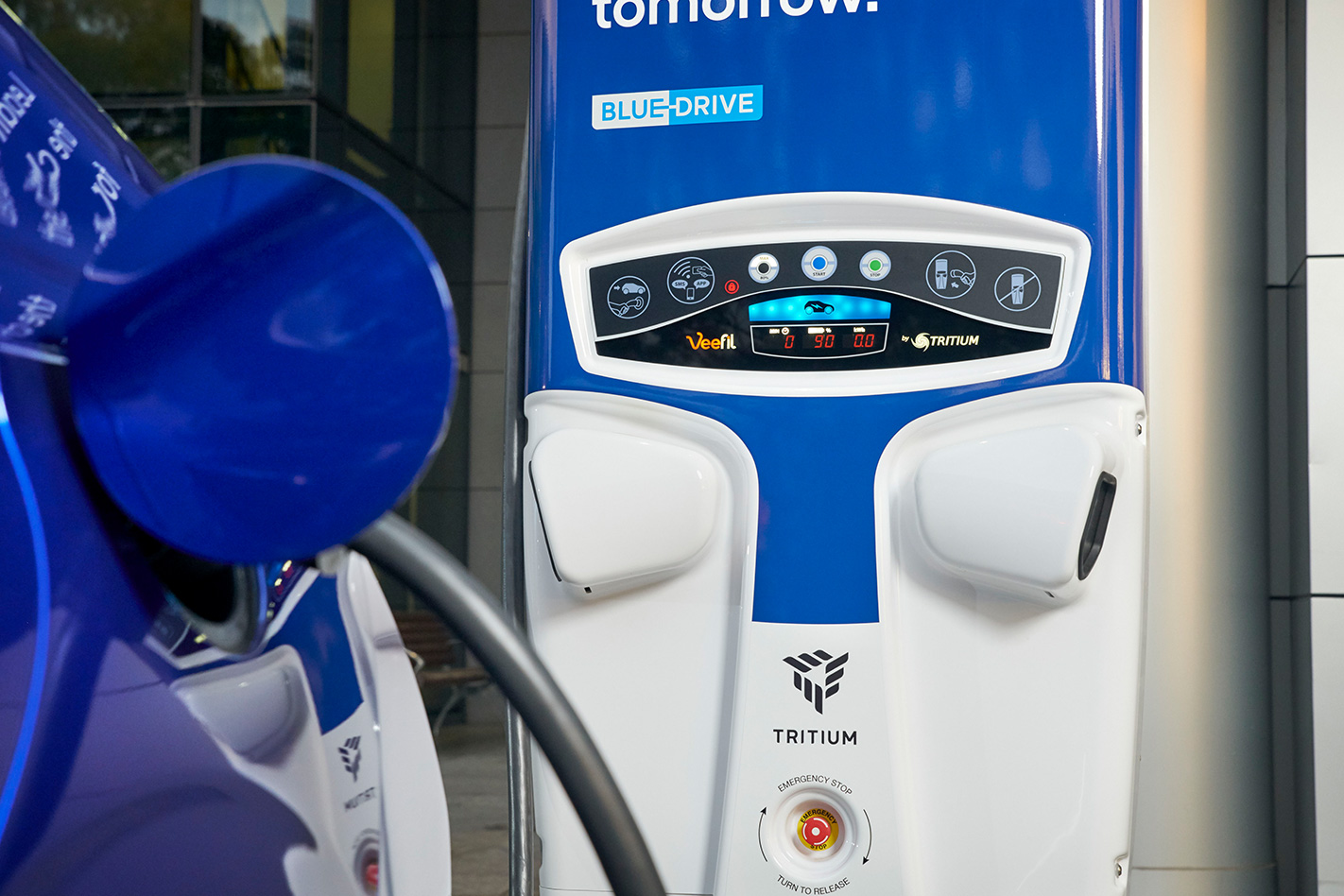
This is sent to the front wheels via a six-speed dual-clutch transmission.
The Ioniq PHEV Elite is priced from $40,990, while the Premium will set you back $45,490.
Hyundai’s Ioniq hybrid is not capable of extended pure-electric driving, but is fitted with a 1.56kWh Lithium-ion Polymer battery to assist the 1.6-litre four-cylinder petrol engine.
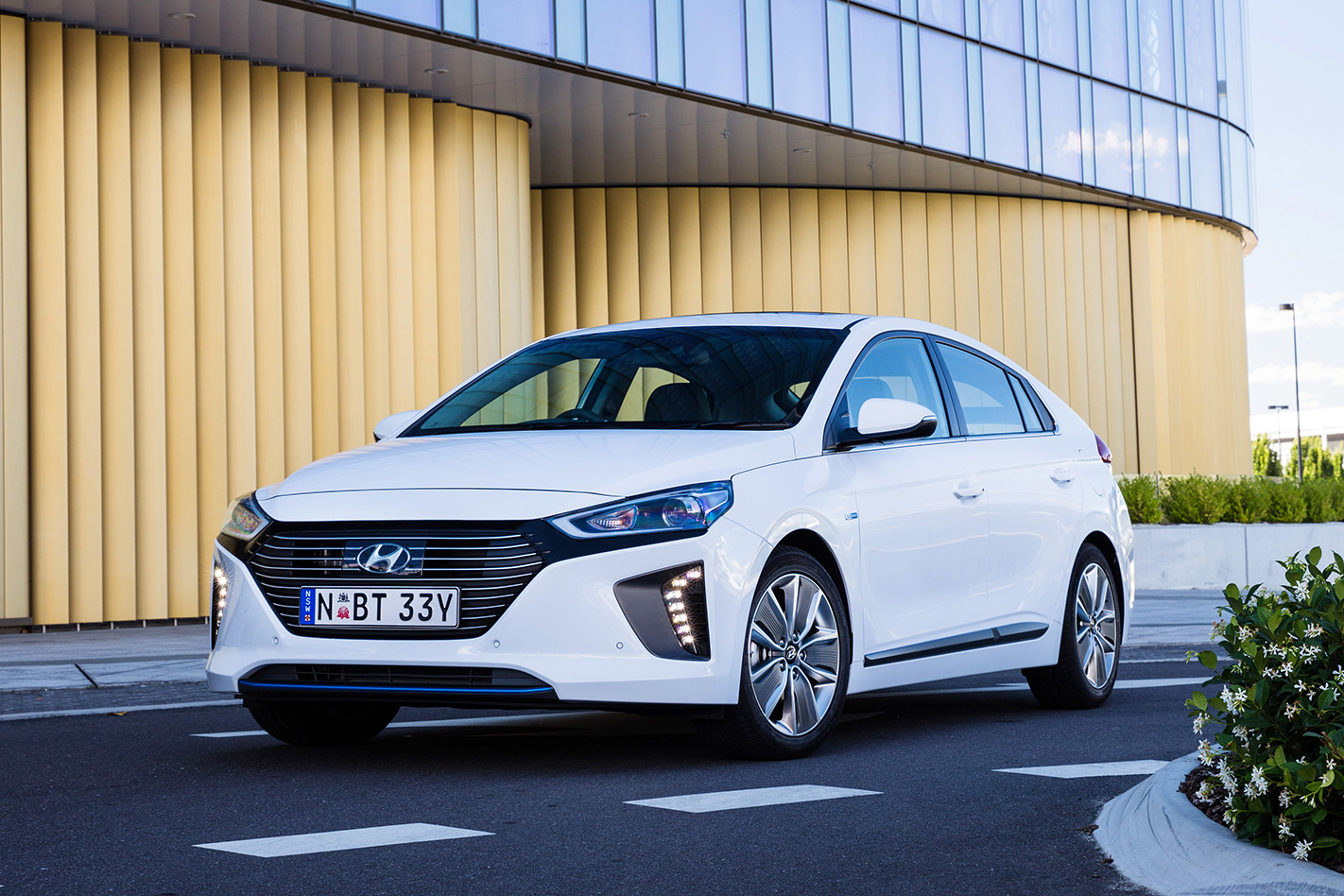
The hybrid Ioniq Elite is the cheapest car in the range with a $33,990 sticker price, while the Premium costs $38,990.
General Motors plans to shutter seven factories worldwide by the end of 2019; four factories in the US, one in Canada and two overseas if the manufacturer and its unions don’t finalise an agreement to allocate more work to the factories. The four plants in the USA are a political hot potato for president Donald Trump, who has recently thrown his weight behind automaker health as a bellwether for the Rust Belt economy.
Holden silent as parent company closes plants in US, Canada
Trump told reporters on Monday that had some robust negotiations with GM CEO Mary Barra on Sunday night. “Very tough,” he said. Trump was particularly incensed about the potential closure of the Lordstown plant in Ohio, after claiming in a rally in nearby Youngstown last year that he would revitalise the local economy with massive job boosts. “They’re all coming back,” he said. “Don’t move. Don’t sell your house.”
En route to a campaign stop in Mississippi yesterday, Trump told reporters, “I think you’re going to see something else happen there, but I’m not happy about it. I have no doubt that in a not too distant future they’ll put something else. They better put something else in.”
The closures come as GM announced increased profits and sounds the death knell for Chevy’s Volt, Cruze and Impala lines. In effect, Barra is stealing a page from the Ford playbook, shifting the production emphasis from passenger cars to SUVs and pickups. Chevrolet Camaro production at the Lansing, Michigan plant is unaffected, safeguarding Australian imports through HSV.
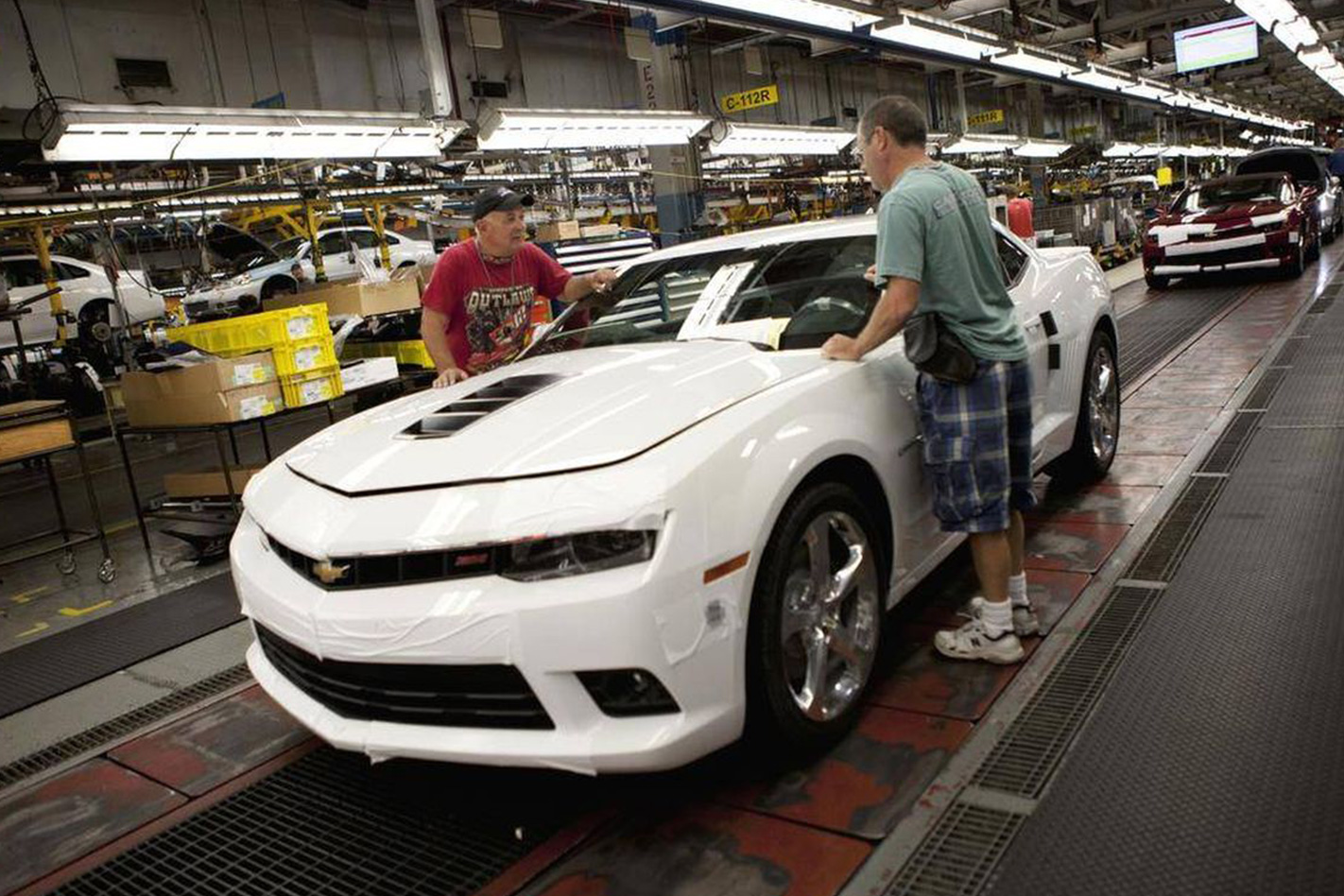
Here’s a snapshot of each of the North American plants.
Lordstown (Ohio) Assembly
Opened: 1966
Employment: 1,435 hourly
Product: Chevrolet Cruze
Capacity: 300,000/year
2018 YTD Production (10 mos): 121,666, up 14 percent
Detroit-Hamtramck (Michigan) Assembly
Opened: 1985
Employment: 1,348 hourly
Products: Chevrolet Volt, Chevrolet Impala, Cadillac CT6, Buick LaCrosse
Capacity: 230,000
2018 YTD Production: 53,461, down 35 percent
Warren (Michigan) Transmission
Opened: 1958
Employment: 265 hourly
Product: car/crossover transmission, hybrid electric drive units
Baltimore (Maryland) Operations
Opened: 2000
Employment: 253 hourly
Product: truck transmissions
Oshawa (Ontario) Assembly outside Toronto, Canada
Opened: 1953
Employment: 2,522 hourly
Products: Chevrolet Impala, Cadillac XTS, Chevrolet Silverado, GMC Sierra
Capacity: 310,000
2018 YTD Production: 55,973, down 60 percent
Holden is remaining silent about whether its operations will remain unaffected by the announcement from its global parent General Motors that it will shed some 14,000 jobs and close five North American plants – including its largest one in Canada – to realise a A$10 billion saving.
Despite a reference in the General Motors press release about a “reorganization (sic) of its global product development staffs”, repeated efforts to contact Holden for comment have gone answered.
Holden currently employs in excess of 500 people in its Design and Engineering division in Melbourne.
The company also announced in August it was adding 150 vehicle engineers to its roster, while spending on research and development local would top $120 million.
Holden managed to secure a stay of execution on its Lang Lang proving ground after local manufacturing was closed in October 2017, with the facility currently used to evaluate and develop cars for other GM markets like China.
However, GM has been systematically reducing its footprint across the globe in the last couple of years, selling its Opel/Vauxhall brands, withdrawing from South Africa, Russia and India.
None of Holden’s current fleet is affected by the impending plant closures. The Australian arm of GM currently sources the new Acadia seven-seat SUV from GM’s Tennessee plant, while the Equinox SUV comes from Mexico.
The three car making plants and two engine/transmission plants have, in a peak piece of corporate doublespeak, had their production “unallocated” after 2019, while GM has confirmed the impending shutdown of its largest Canadian plant in Oshawa, Ontario. Almost 3000 workers will be put out of a job, which accounts for a third of GM Canada’s workforce.
The Oshawa closure is eerily reminiscent of the company’s withdrawal from Australia, with GM receiving billions of state and federal government dollars to keep its operations active in Canada. Canadian Prime Minister Justin Trudeau expressed his “deep disappointment” at the closure, while workers walked off the job on Monday in protest.
While no announcements were made, the closures are likely to have the effect of reducing its model count. On the block is the majority of its sedan product, including the Chevrolet Cruze and Volt, Cadillac CT6 and Chevrolet Impala.
GM says the changes will save the company US$6 billion ($10 billion).
“The actions we are taking today continue our transformation to be highly agile, resilient and profitable, while giving us the flexibility to invest in the future,” said GM Chairman and CEO Mary Barra in a statement. “We recognize the need to stay in front of changing market conditions and customer preferences to position our company for long-term success.”
MORE TO COME
BMW has added another performance SUV to its range, this time in the form of the 2019 BMW X2 M35i.
Starting at $68,900 before on-roads and fees, the X2 ‘xDrive’ M35i is powered by BMW’s B48 turbocharged 2.0-litre inline four-cylinder engine, with outputs of 225kW and 450Nm.
They’re hot hatch numbers in a compact SUV that doesn’t actually weigh all that much more than some AWD hot hatches – we estimate the M35i will tip the scales near the 1.6-tonne mark.
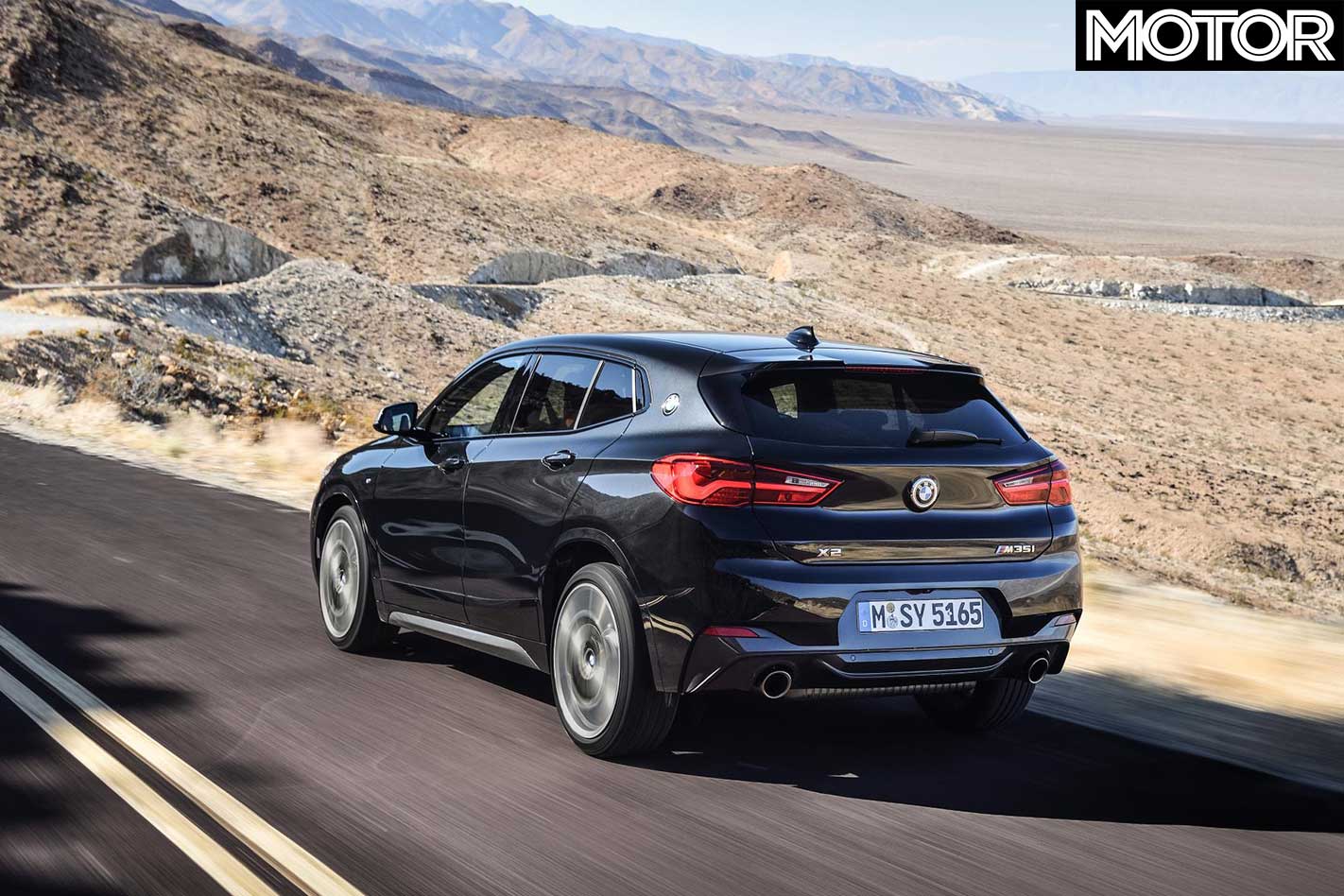
With xDrive providing all-paw grip, the X2 M35i manages to outrun its likely hefty weight figure with a 0-100km/h sprint of just 4.9 seconds, BMW claims.
This is helped along by an 8-speed auto with launch control – with steering wheel-mounted paddles, of course.
Opinion: Performance SUV-madness is gripping the world
Underneath, M Sport-tuned suspension is “specifically adapted to the X2 M35i’s requirements,” which has historically meant the ride is stiffer to handle sharper cornering. A set of 20-inch-alloys will see to making the ride a little bumpier in exchange for better filling the wheel arches.
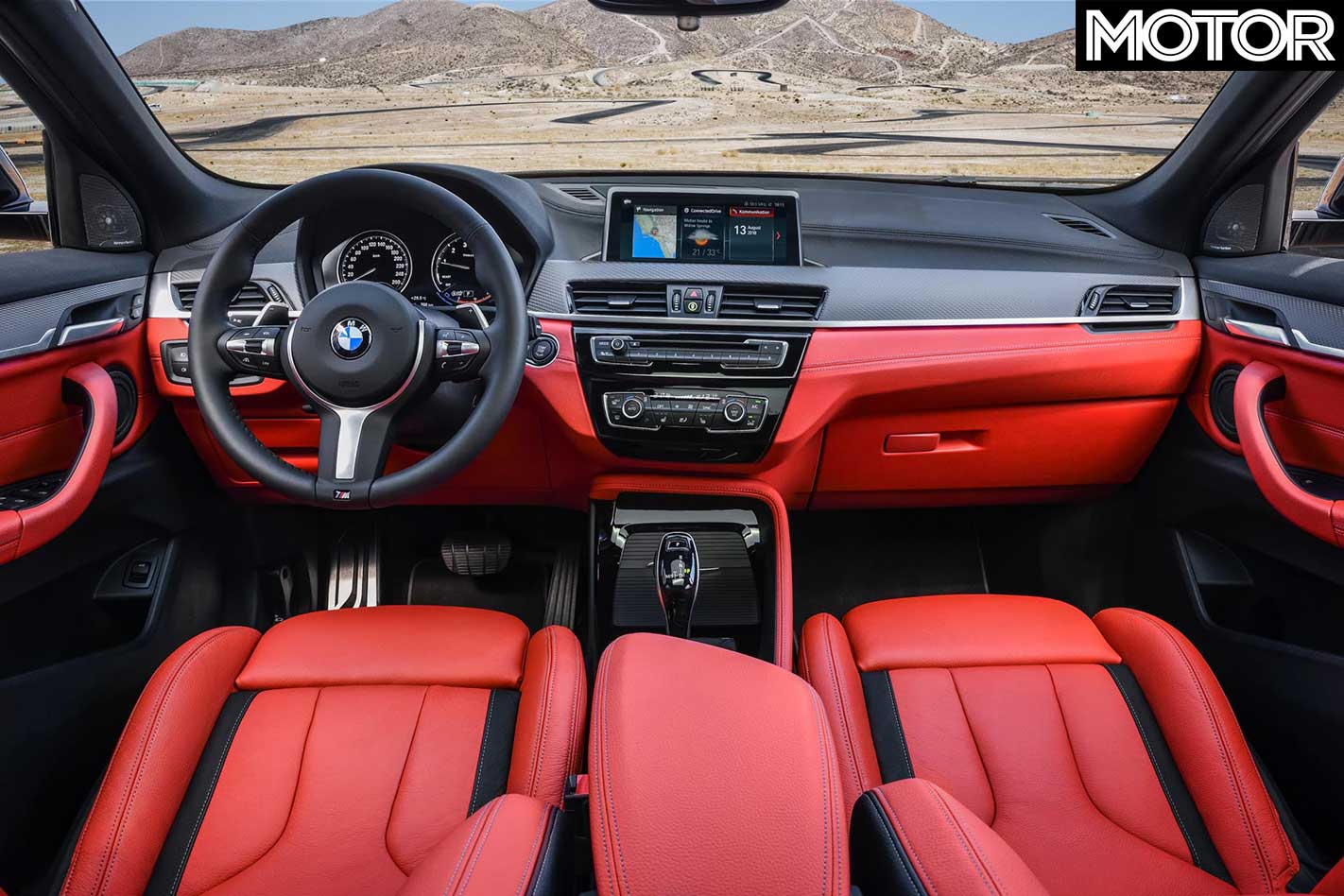
An M Sport mechanical limited-slip differential is fitted between the front wheels, while BMW’s go-fast division has also tuned the steering to be “agile and precise.” M Sport brakes are also part of the M35i’s newfound M parts.
To the casual observer, the M35i will be able to be picked by the Aerodynamics package, which adds Cerium Grey body trim and gloss black details.
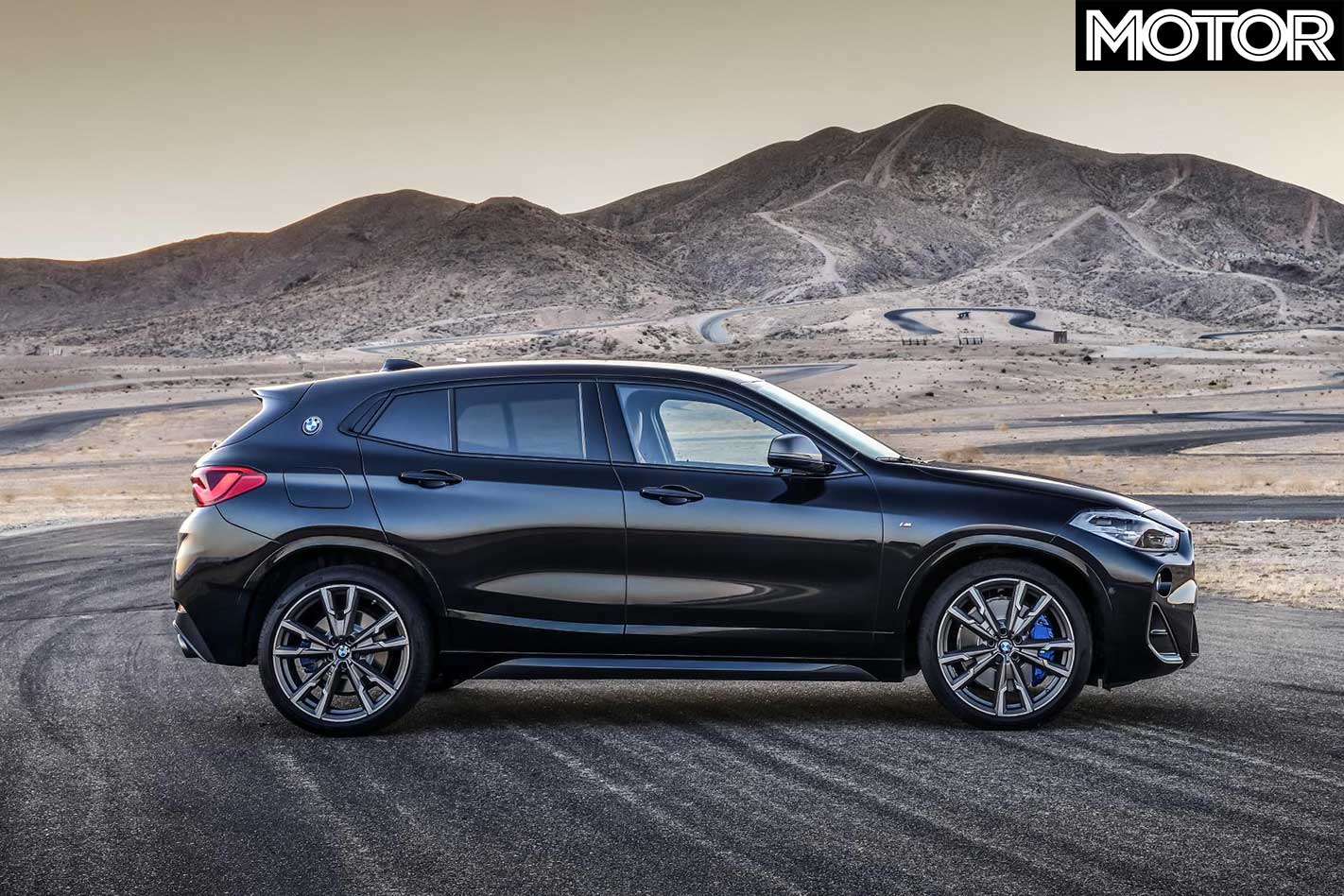
BMW Australia also offers an ‘Enhance Pack’ for the X2 M35i, which adds metallic paintwork, a panorama glass sunroof and Wireless phone charging for $2900.
The 2019 BMW X2 xDrive M35i is available to order now, with production beginning this month.
Lotus Elise has never been about practicality. It’s all about the experience; pure, raw, edgy and hugely entertaining. But the problem is the amount Lotus charges for a ticket to the Elise funpark, which has predominantly teetered on the wrong side of $100,000. Big bucks for a two-seater of modest power output.
This review was originally published in MOTOR’s April 2007 issue
Now, however, there is an alternative. And it’s one that brings a surprising amount of sense, logic and pragmatism to a purchase that has always been up there with ultralight planes, racing skiffs and five-figure watches – a pure, unadulterated indulgence.
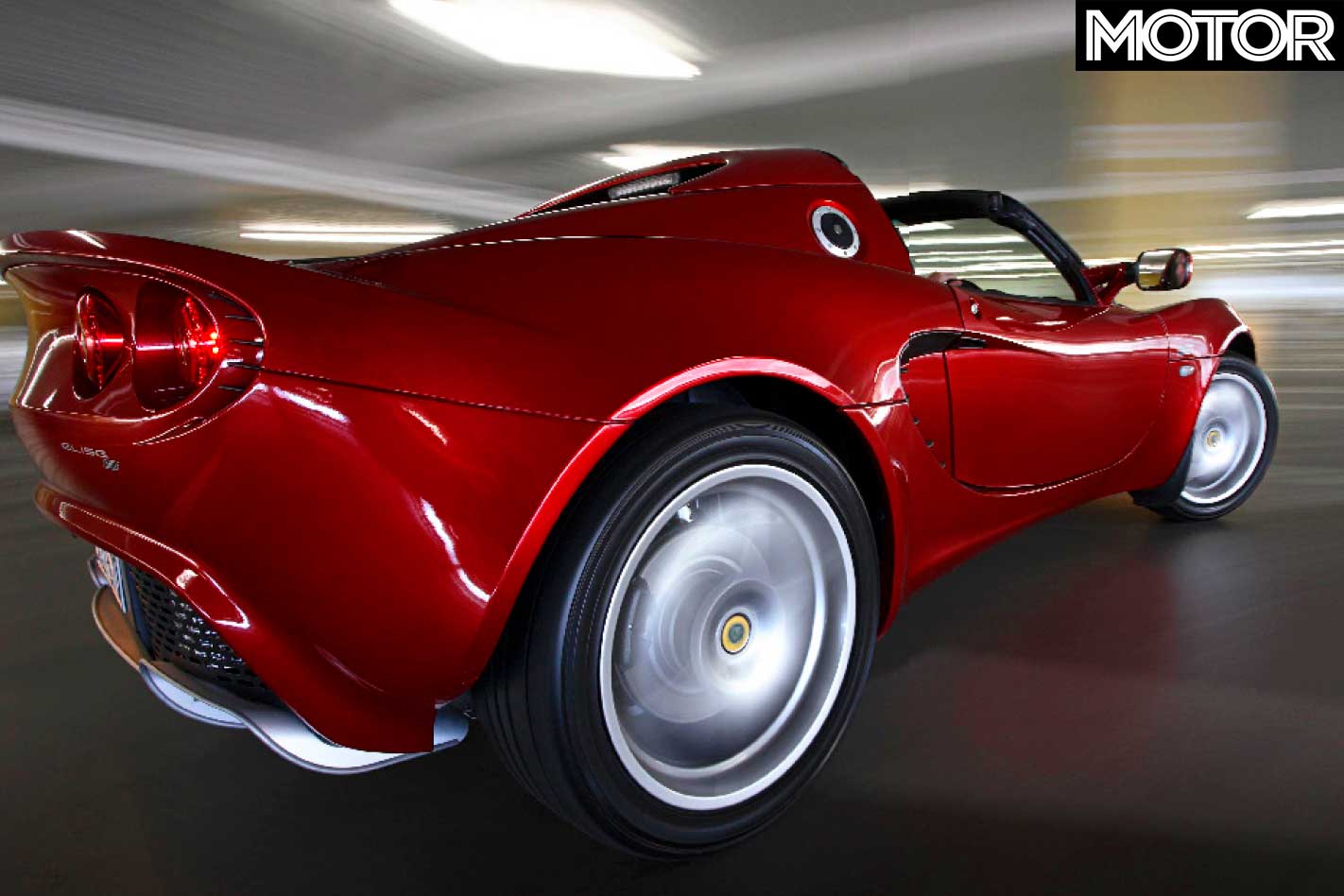
For the money you still get a sublimely balanced aluminium-honeycomb chassis, double-wishbone suspension with the same damper/spring spec as the more expensive Elise R, and a stripped out (well, relatively speaking) interior.
You no longer get the capable but ancient Rover K-series engine. Instead, it’s Toyota’s 1ZZ-FE VVTi four-potter, good for 100kW and 172Nm – yep, it’s the Corolla motor. The ‘i’ designates variable valve timing, but the iron-sleeved 1ZZ misses out on variable lift adjustment.
No matter; the 1.8-litre engine is well-matched to the Elise’s fizzy bunger of a chassis. In fact, it’s uncanny how much it sounds and feels like the motor it’s replacing, with an unfussed, linear power and torque curve that calmly punches through to its 6900rpm redline.
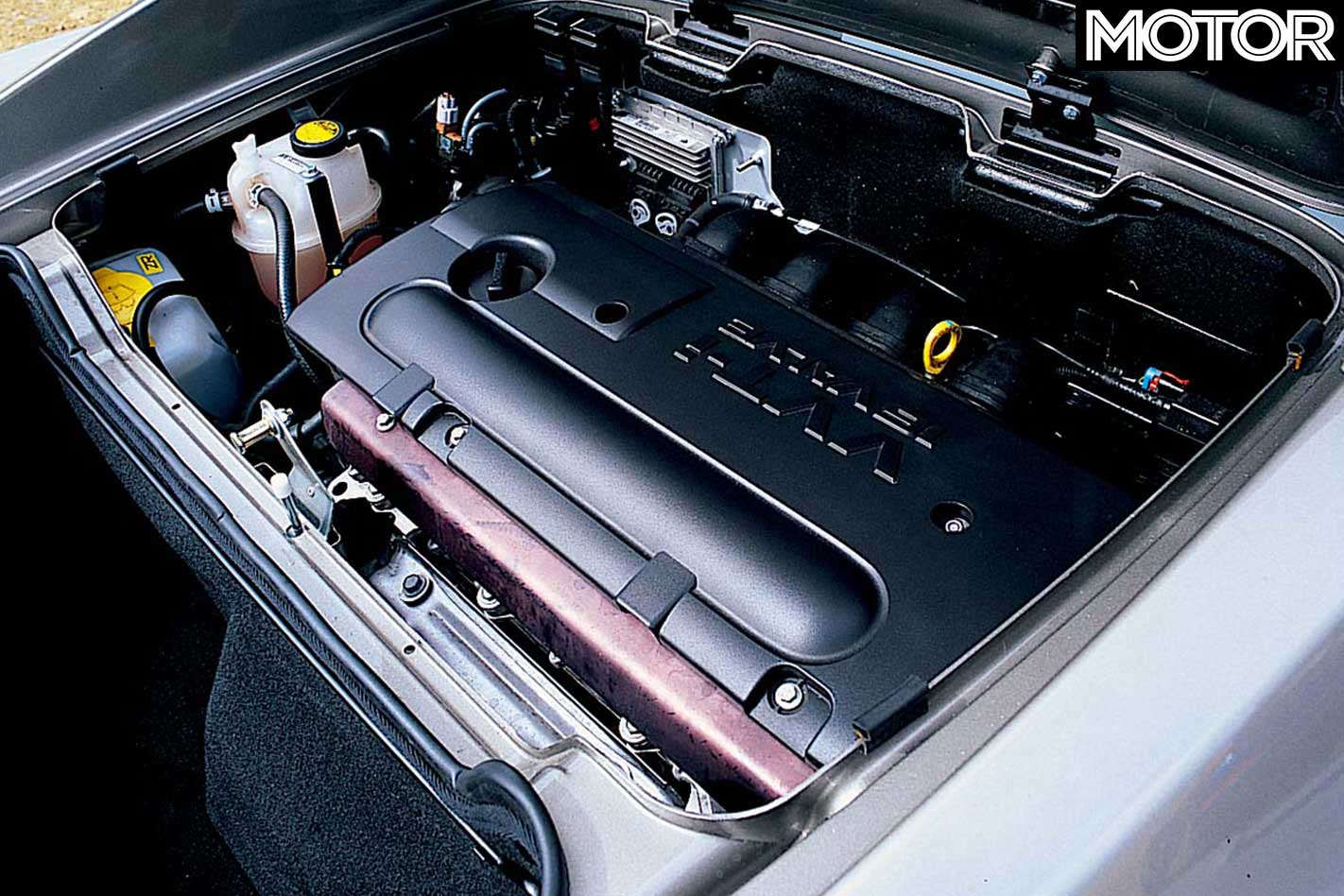
It’s not a matter of wringing it out and waiting for that change of cam timing, like the Elise R, because it doesn’t happen. Max torque is reached at a middling 4200rpm; just right for keeping the longer-legged five-speed ’box gainfully employed.
It’d be easy to say that the S is underpowered, but it’s not. It’ll carry enough speed up to, into and through a corner to make your passenger barf should you require it, and its lack of mass (830kg) means it gets up and parties to the hundred in a nick over six seconds.
After the fireworks of the supercharged Exige, you could mistake the Elise S for feeling a bit flat. It’s a furphy, trust me. Snick the delightfully ratchety five-speed into first, engage the feelsome clutch and revel in the almost telepathic sensations coursing through your fingers and feet.
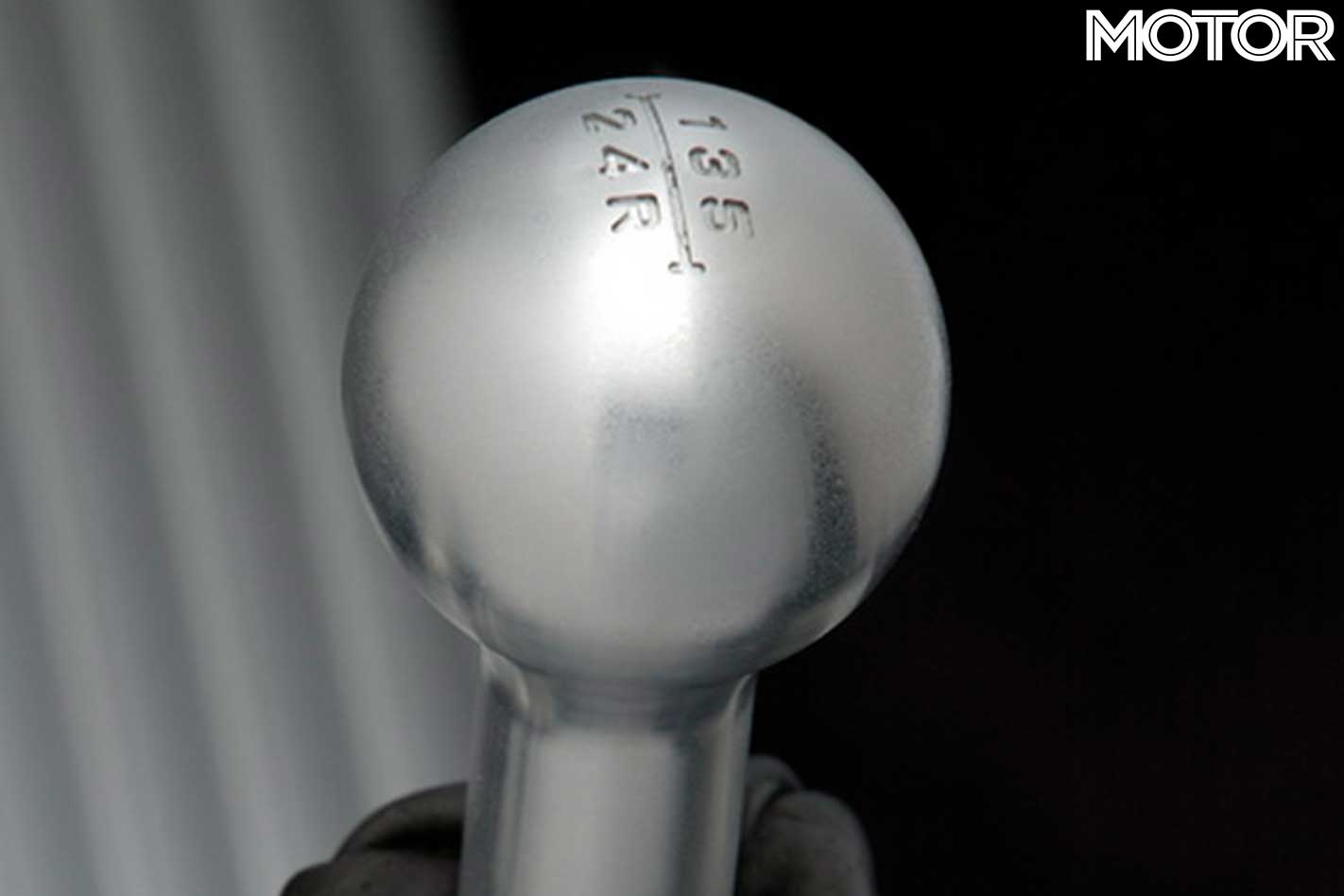
Light from takeoff, the gossipy, quick-racked steering loads up progressively and meaningfully, and it’s absolutely possible to feel the Yokohama Advans’ grip levels improving as the heat gets into them.
Elise’s primary ride is exceptional for a car of its weight and low ride height; it feels like it’s got three times the travel it actually has over Sydney’s worsening roads. There’s some pitch present if you’re a brute on the brilliant brakes, but it doesn’t result in the rear becoming unwieldy.
Its surfeit of raw grunt translates into a rear-end that’s hard to unstick, even with the stock open diff, and its front-to-rear balance at the limit tips into shallow, controllable understeer. You can even tune the suspension to your preference, with adjustability in most planes available via a twist of a spanner.
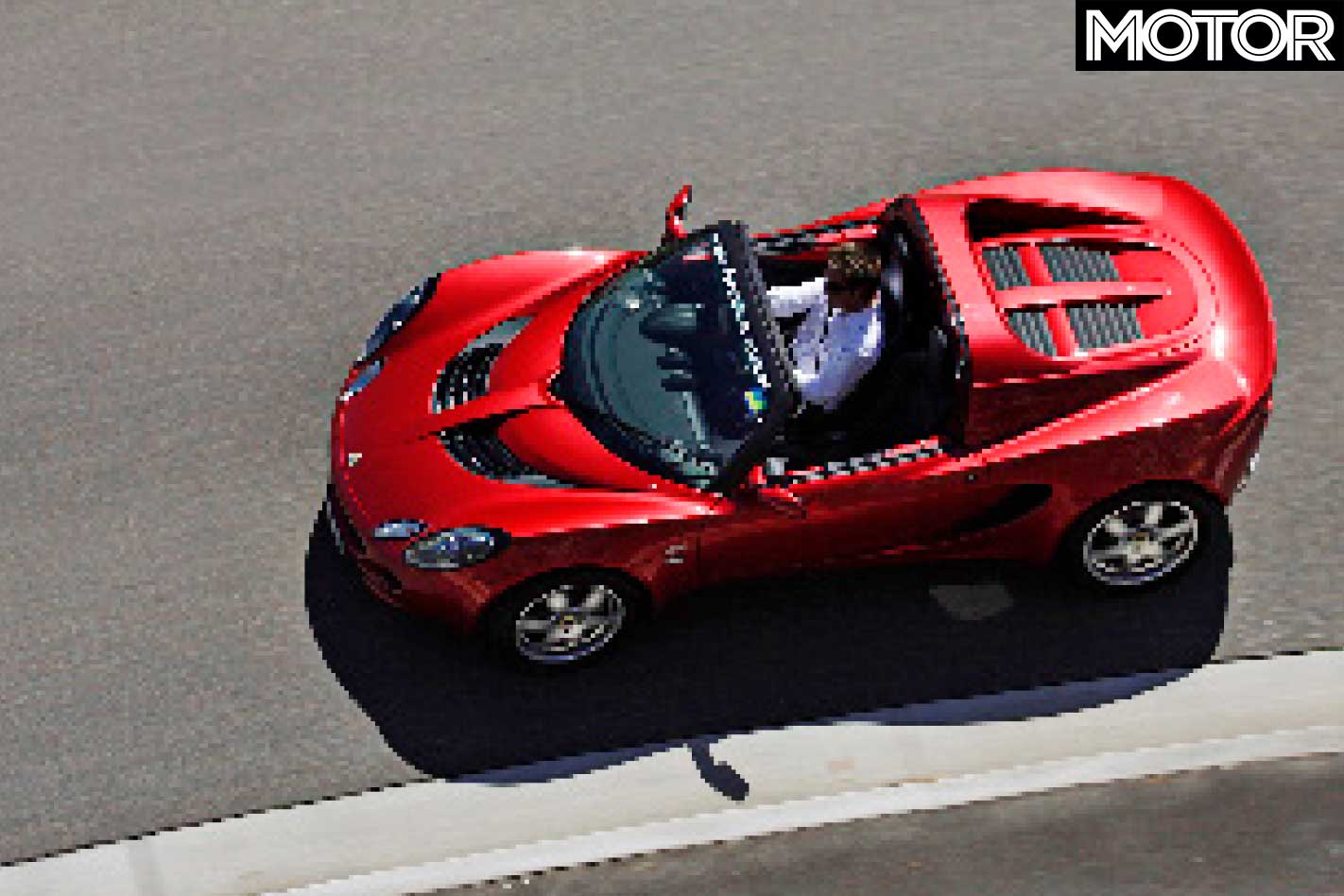
The Elise is one of the most malleable, transparently surefooted playthings on the road today, mollycoddling and encouraging the novice while delighting and rewarding the more experienced.
Despite wails from the purists, Lotus has equipped its latest crop of cars with the day-to-day basics, making them easier to live with. It hasn’t dulled the rush, and if it means you can use the car more often, what’s wrong with that? The air-con can be turned off, the traction control can be disabled, and the ABS is so unobtrusive you have to deliberately test the brakes to see if it’s there. And it still weighs less than 850kg.
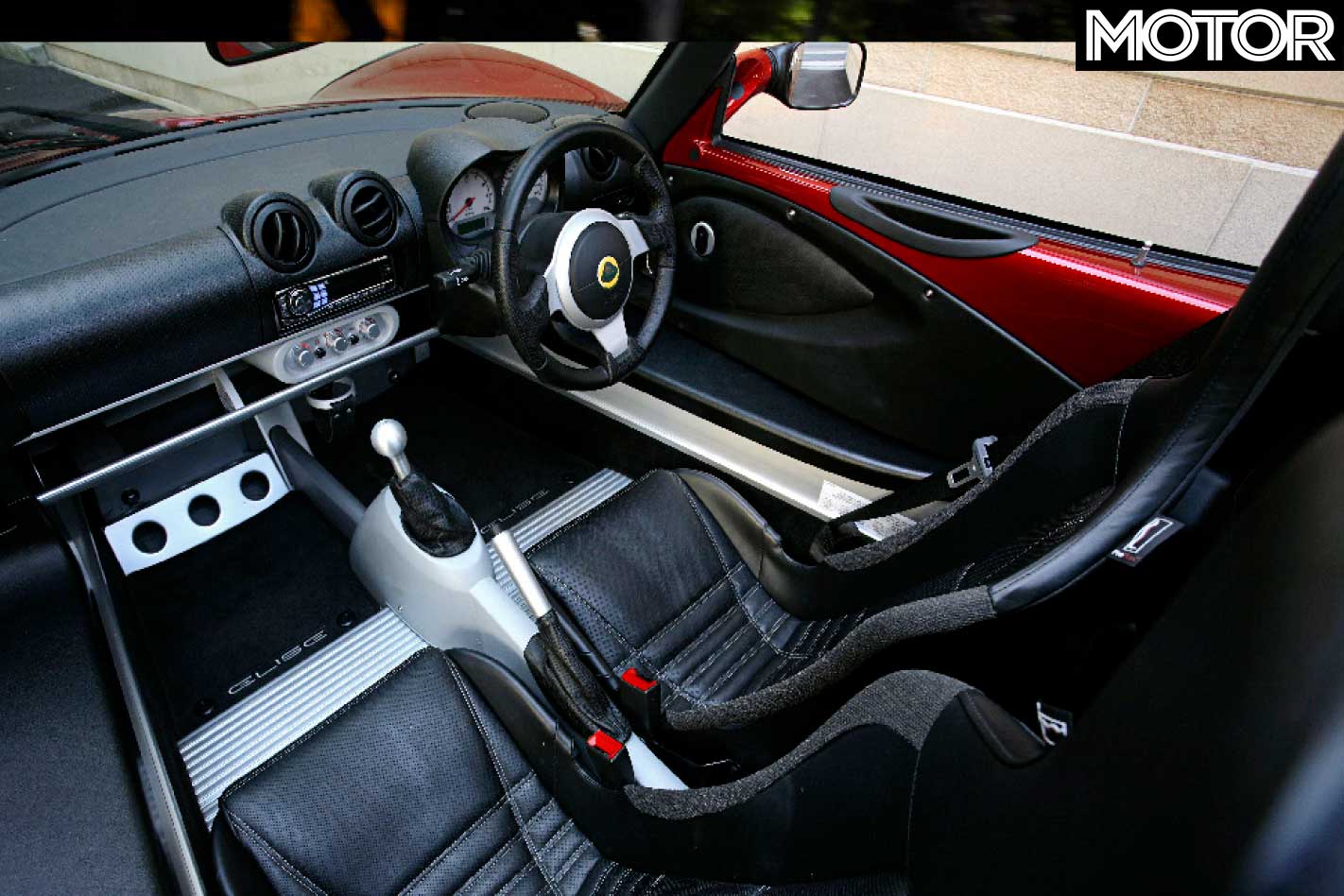
To me, it feels like a perfect project car; it’d be easy to free up a smidge more power and torque from the robust little motor, you could play with the suspension a little, improve the brakes… and you’d never spoil the intrinsic pleasure the Lotus gives its driver.
There’s no other car out there this side of six figures that involves you in the driving experience as much as a Lotus, and the Elise S, by bringing the price of ownership down to realistic levels, is a real-world, sportscar bargain.
FAST FACTS 2007 Lotus Elise S Engine: 1794cc 4cyl, DOHC, 16v Power: 100kW @ 6200rpm Torque: 172Nm @ 4200rpm 0-100km/h: 6.1sec (claimed) Top speed: 205km/h (claimed) Price: $69,990 ($77,990 as tested with Touring Plus pack)
Likes: Looks a million bucks, such a sweet handler Dislikes: Can the mortgage survive a $70k overdraft? Rating: 4 out of 5 stars
