
This isn’t a Porsche, it’s an RUF.
As one of the most well-known manufacturers of vehicles based on pre-existing models, RUF has been re-imagining Porsche’s cars for decades. And its 2018 SCR is no different.
Revealed at the Geneva Motor Show, the 2018 RUF SCR is named for a model revealed in 1978, which was a 162kW 911-based, whale-tailed legend.
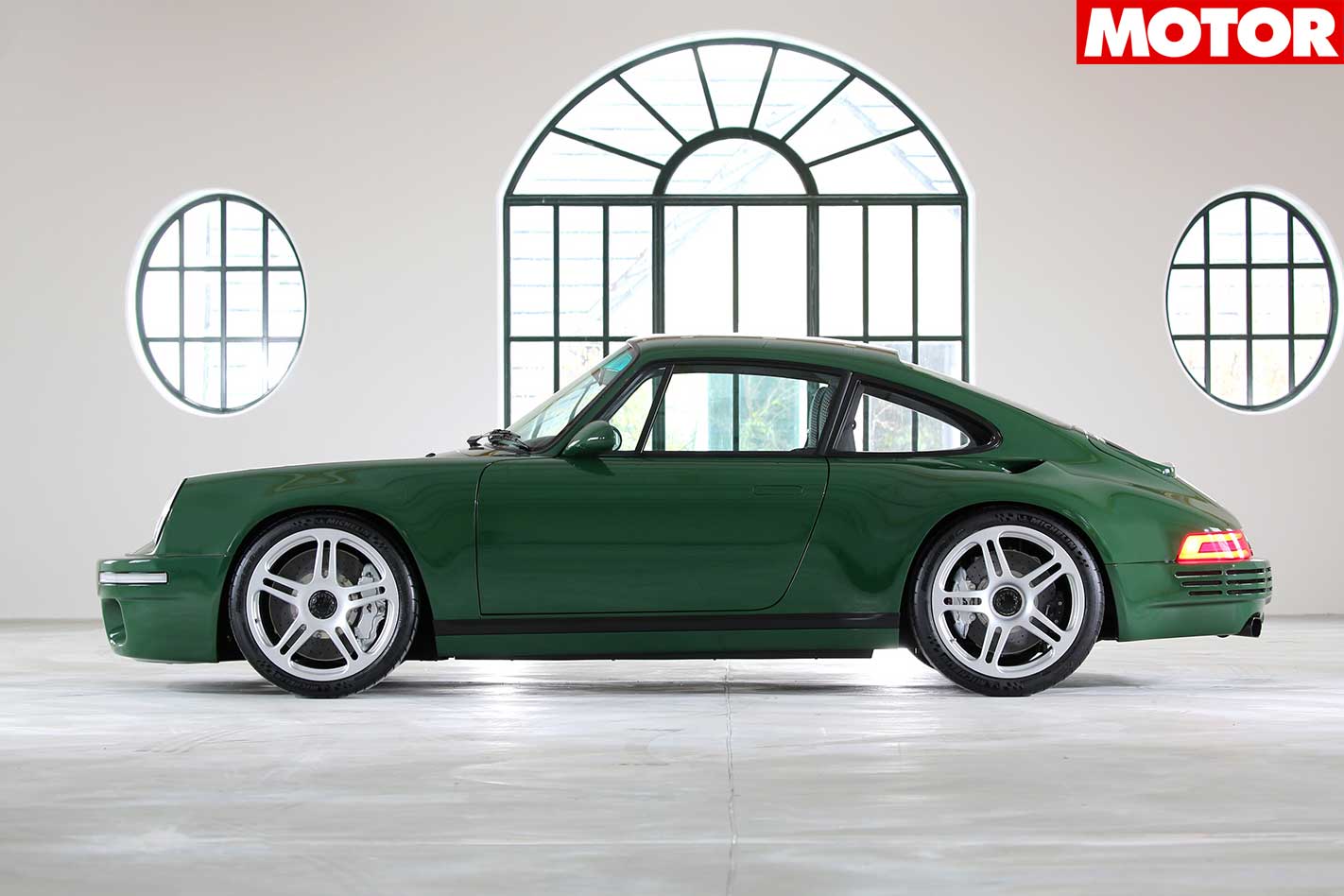
“RUF wanted to create a unique, state-of-the-art, gentleman-driver sports car for those who prefer the soundtrack of a normally-aspirated engine.”
Now, the badge appears on a 375kW/470Nm version with a 991.2 911 look, minus the wing.
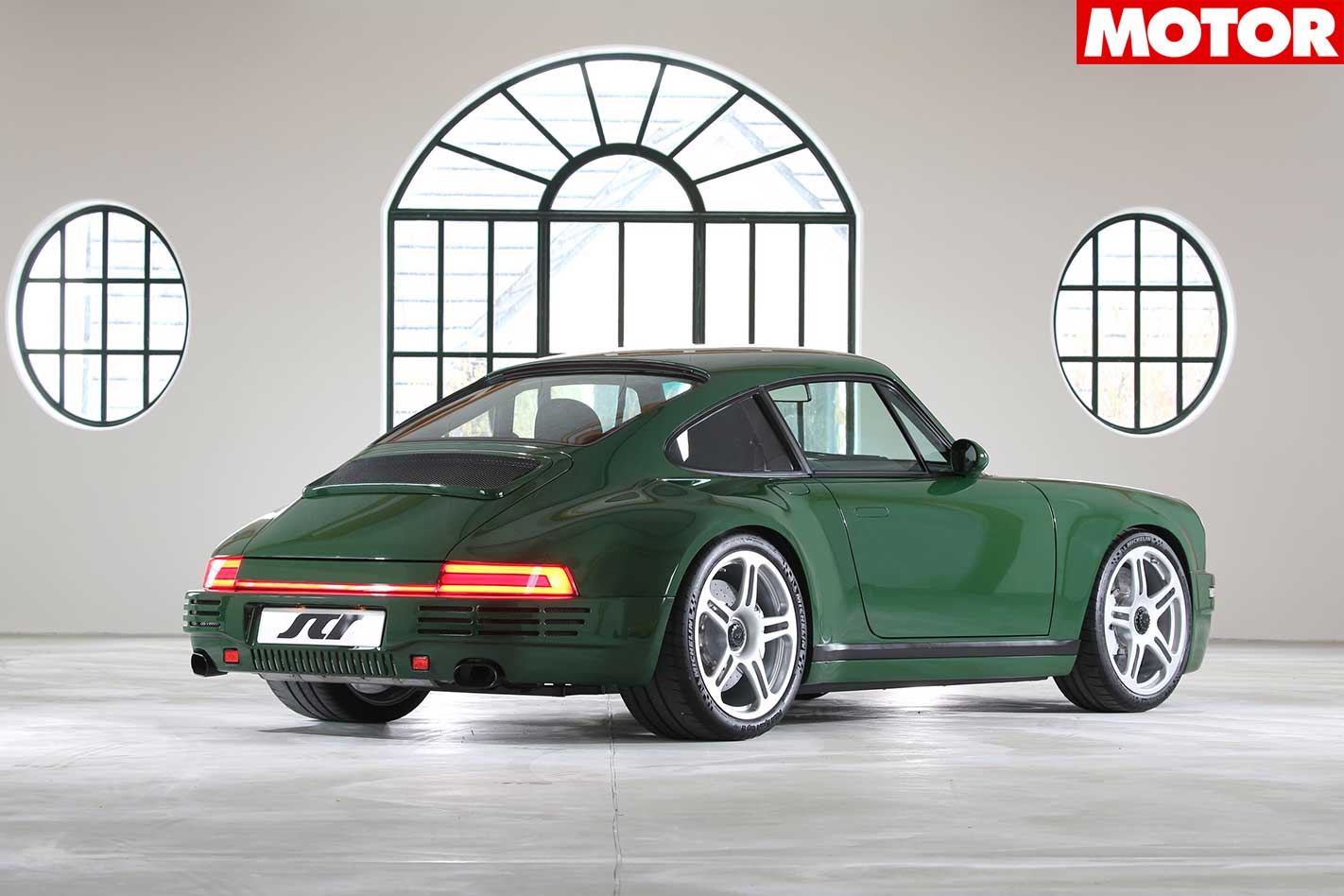
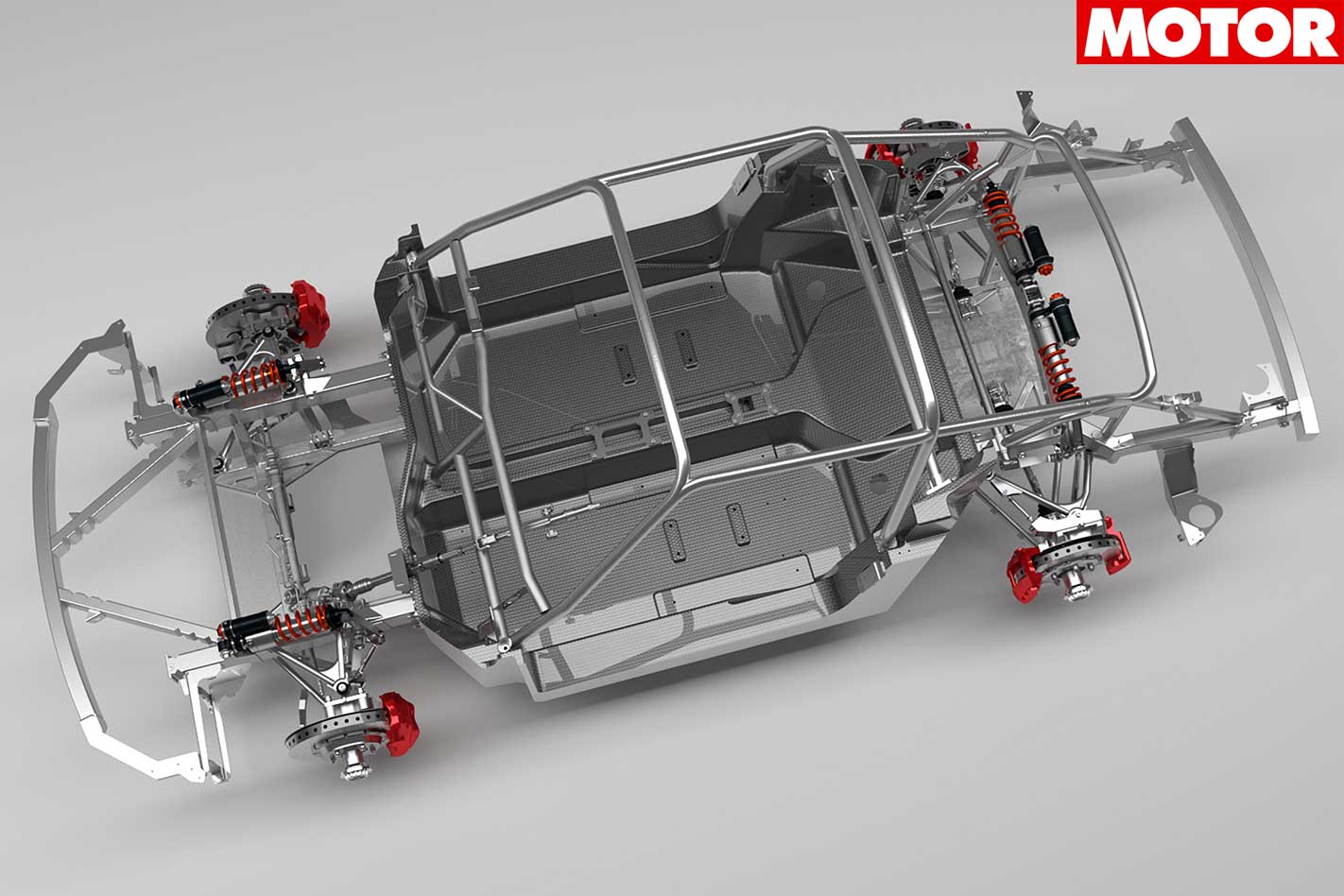
It has a completely bespoke carbon fibre monocoque chassis, and utilises a carbon fibre body shell with an integrated roll cage to keep weight to an impressive 1250kg.
That’s a solid couple-of-hundred kilograms lighter than most 911s on the menu today.
The GT3’s 260kW-per-tonne is well and truly left behind by the 300kW for each tonne on the SCR.
RUF says the 2018 SCR will hit a top speed of 320km/h. Plus you get to use a manual ‘box to row through all six gears on your way there.
With a time of 9:51, the 423kW V8-powered Range Rover Sport SVR has set a new record for a run up the Tongtian Road in China.
Carved into the side of Tianmen Mountain, the road (sometimes named for the mountain it’s on) consists of 99 corners over 11.3km, and is dotted with dangerous drop-offs and blind bends.
The previous record was held by a Ferrari 458 Italia piloted by Fabio Barone, head of the Ferrari Club Passione Rossa. He recorded a time of 10.31.
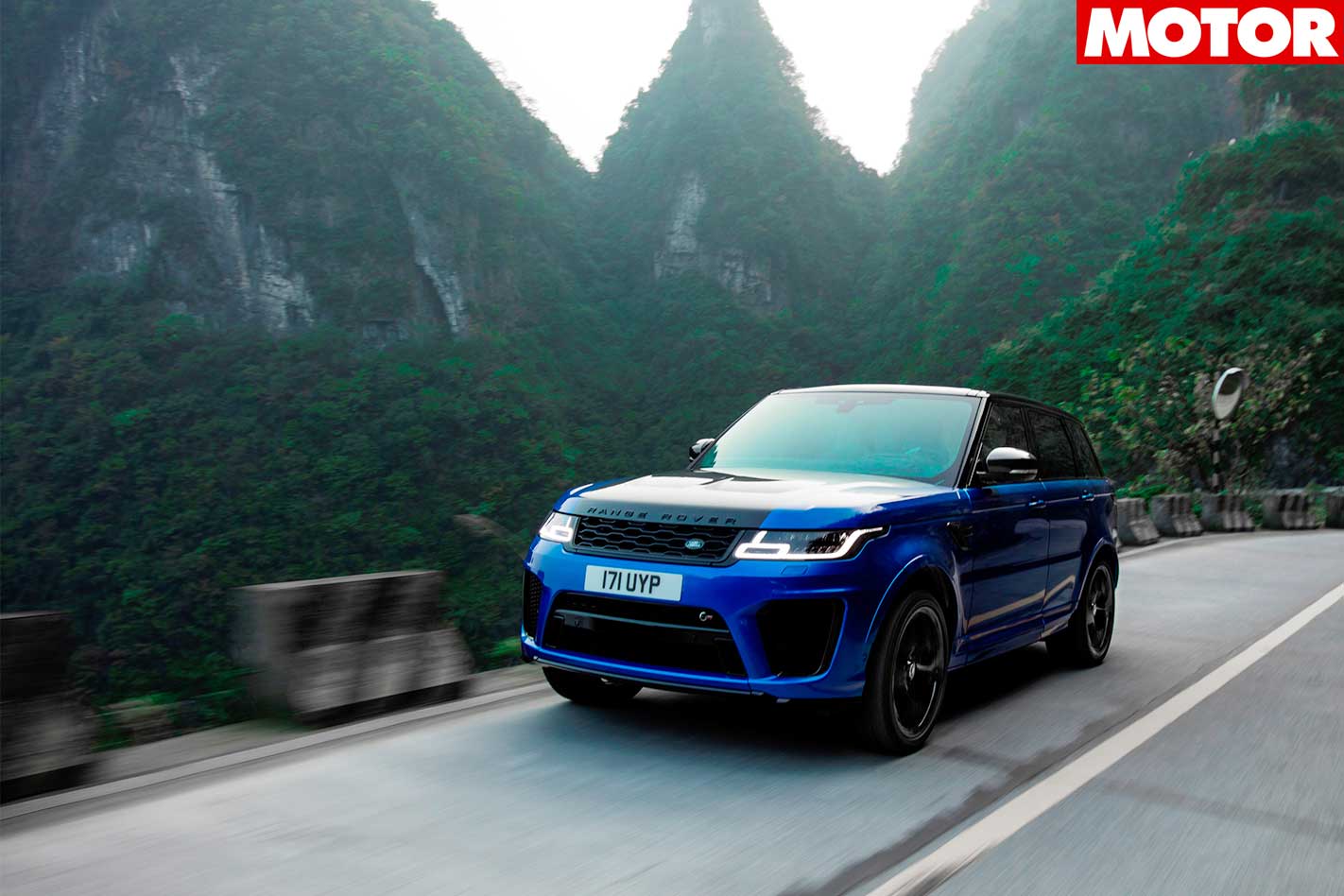
At the wheel of the supercharged Ranger Rover was Ho-Pin Tung, Panasonic Jaguar Racing reserve and Le Mans LMP2 winner (coming 2nd overall) in 2017 with Jackie Chan DC Racing.
It’s not that we don’t think the president of a large Ferrari club could steer a Ferrari up a mountain, it was his own car, after all. But he hasn’t won Le Mans.
We’d be interested to see what happened if Tung was handed the keys to a 458 Italia and given the same level of resources as were available with the Range Rover run.
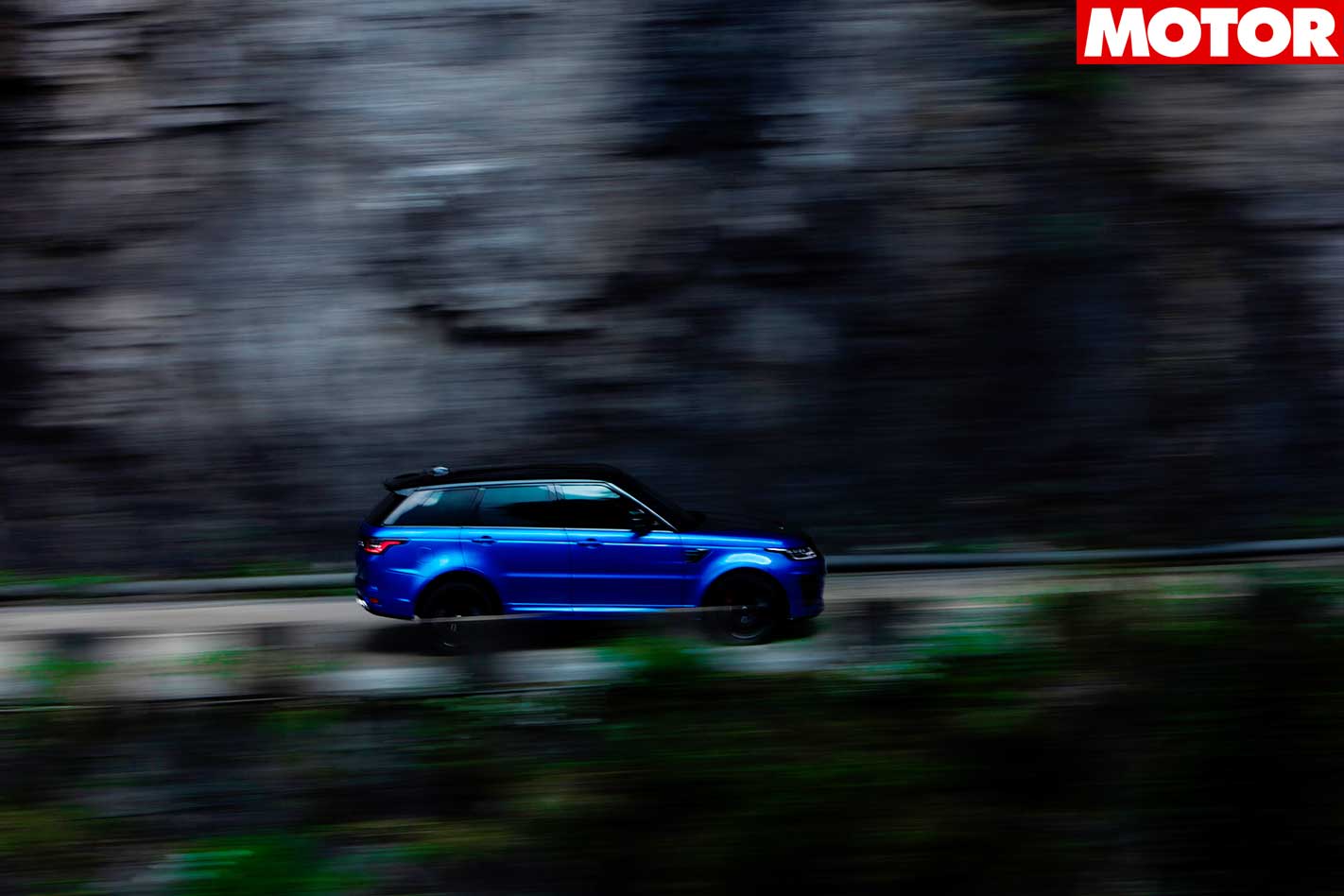
Of the SVR, Tung says it was actually quite capable, for an SUV, considering the nature of the road.
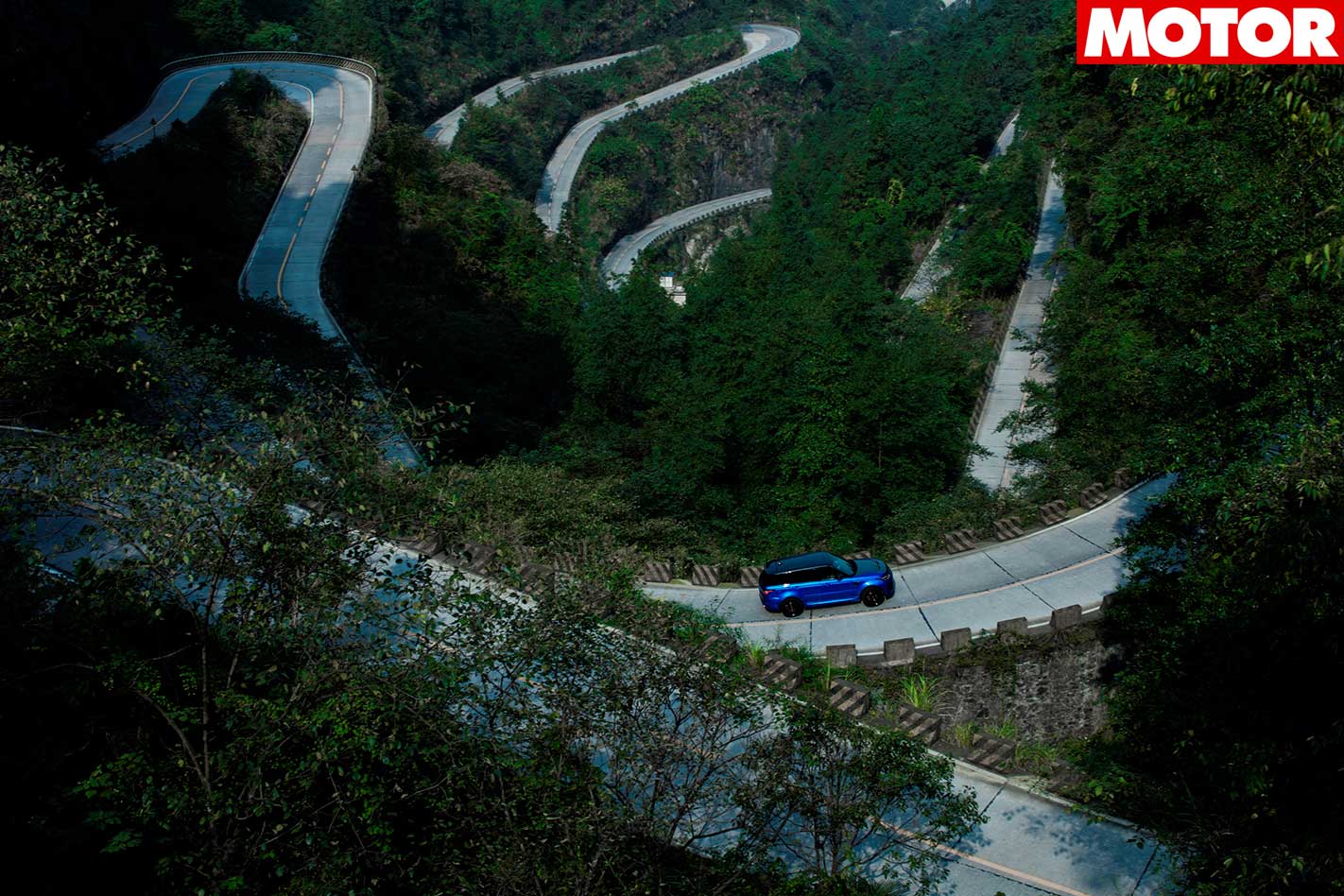
“The consequences of getting it wrong would have been really serious so I focused on establishing a rhythm and the Range Rover Sport SVR made this easy – it may be an SUV but it has the performance and agility of a supercar.”
The 2018 Formula 1 Australian Grand Prix official program is now available at your local newsagent and in selected Coles Express, Caltex, Seven 11, Newslink and WH Smith stores.
Inside the 2018 edition of the Formula 1 Australian Grand Prix official program:
- Hamilton v Vettel: Two four-time world champs go head to head. Who will win?
- Can any team stop the mighty Mercedes-AMG camp making it five championships in a row?
- We go inside Alfa Romeo’s exciting return to F1 racing
- Looking back on 90 extraordinary years of Australian Grand Prix racing
- Come inside the life of a Formula 1 driver preparing for a new season
- 2018 F1 Season Calendar
- Full team rundowns
- Driver bios
- Plus all the F1 stats you need to know and more…
The 2018 Formula 1 Australian Grand Prix official program is now available at your local newsagent and in selected Coles Express, Caltex, Seven 11, Newslink and WH Smith stores.
Inside the 2018 edition of the Formula 1 Australian Grand Prix official program:
- Hamilton v Vettel: Two four-time world champs go head to head. Who will win?
- Can any team stop the mighty Mercedes-AMG camp making it five championships in a row?
- We go inside Alfa Romeo’s exciting return to F1 racing
- Looking back on 90 extraordinary years of Australian Grand Prix racing
- Come inside the life of a Formula 1 driver preparing for a new season
- 2018 F1 Season Calendar
- Full team rundowns
- Driver bios
- Plus all the F1 stats you need to know and more…
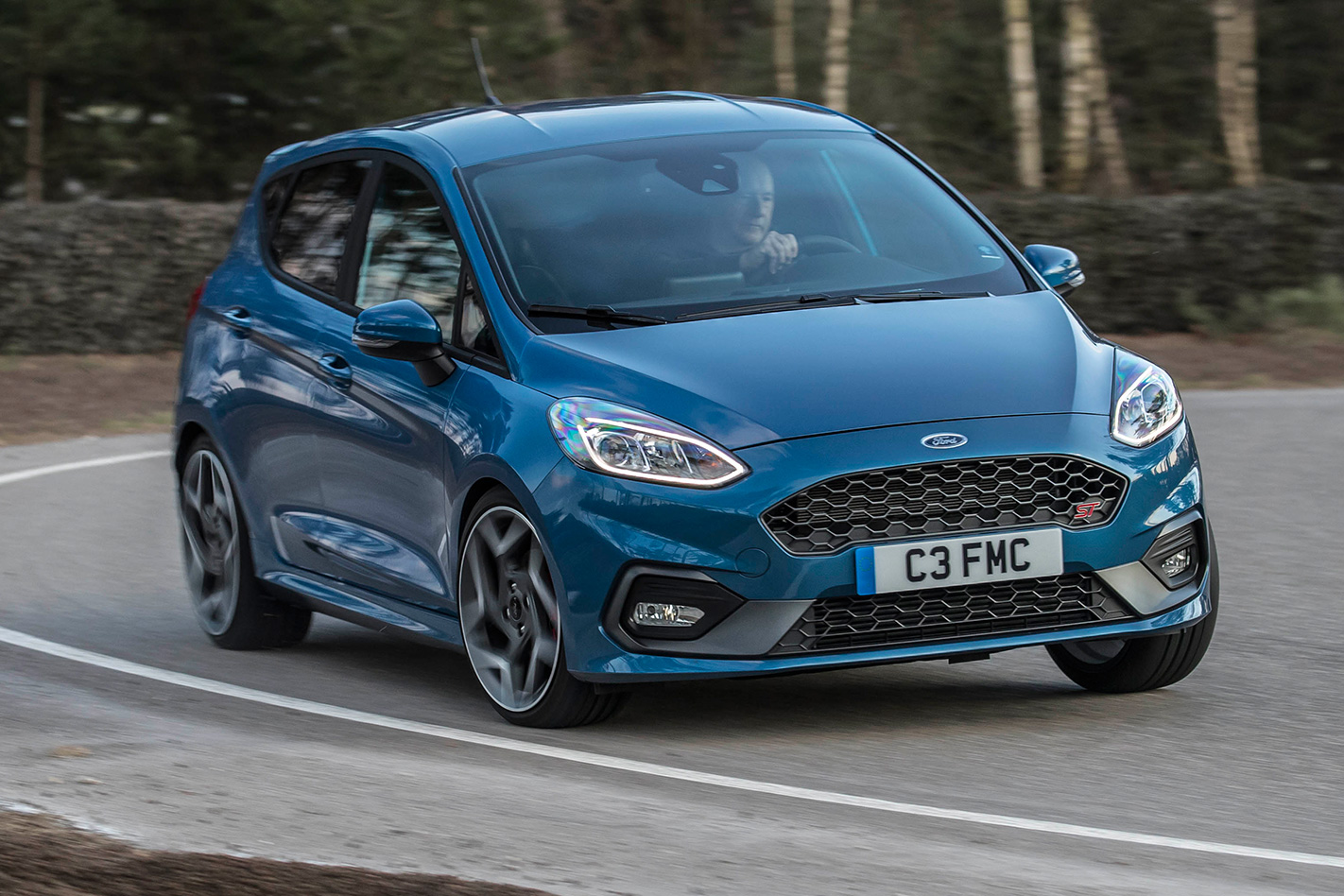
FORD’s next-generation Fiesta ST will boast an optional LSD from the Focus RS, as well as active exhausts, selectable driving modes, faster steering and even optional launch-control to make the baby hot hatch the most dynamic and enjoyable ever.
More details of the 149kW/290Nm hot hatch competitor to the likes of the RenaultSport Clio and the Volkswagen Polo GTI have landed after the Fiesta ST’s official reveal in Geneva this week. After being told it will be the first three-cylinder car to wear the ST badge, we now learn it adds a number of mechanical and software-based features that appear to transform the upcoming hot hatch into a track-day car almost worthy of peeling off the “ST” and replacing it with an “RS”.
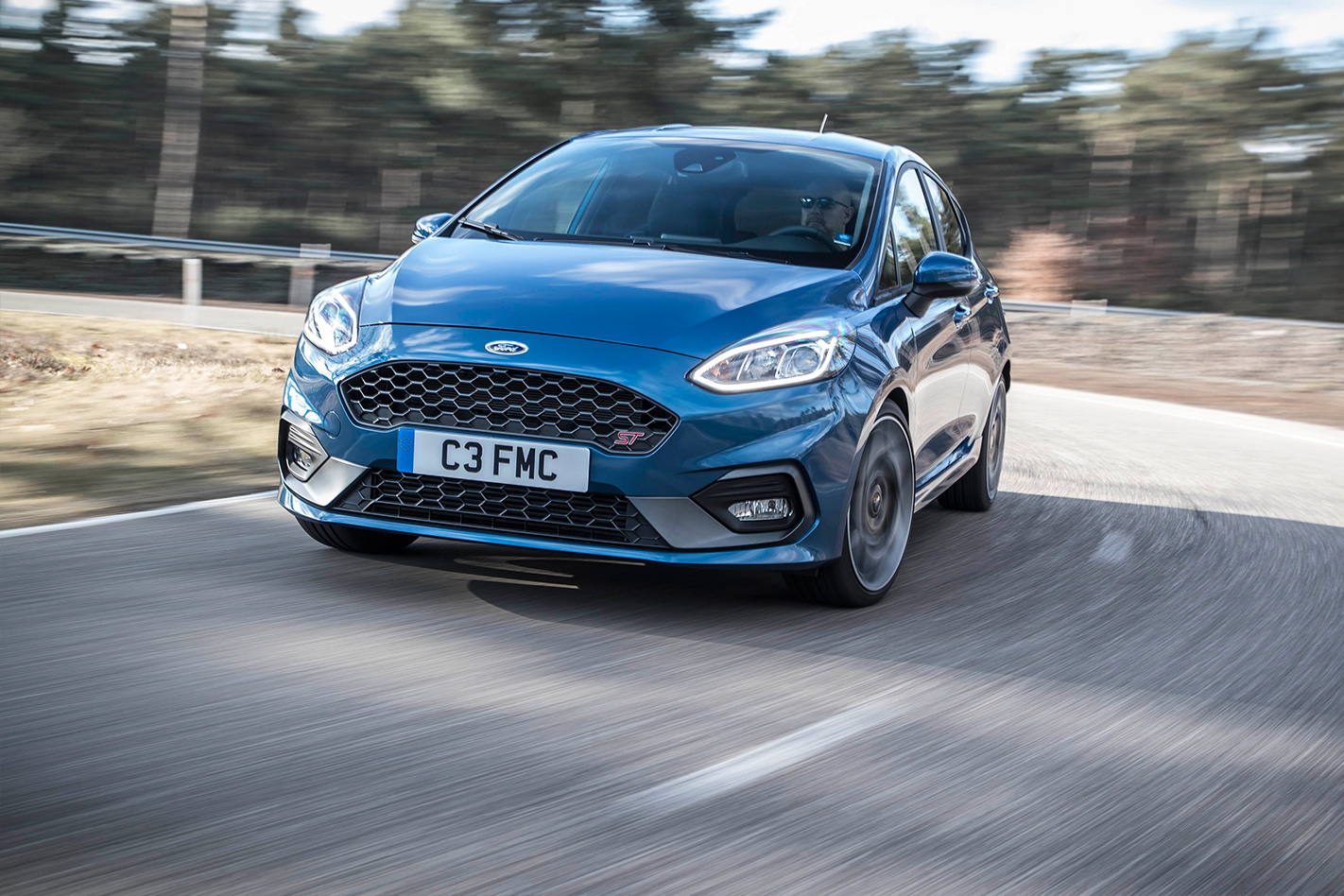
There’s another interesting new move, too: the addition of “force vectoring springs” for the rear axle. The Fiesta ST uses a torsion bar, but what Ford says are “non-uniform, non-interchangeable, directionally wound” cold-forged springs are used to increase lateral stiffness and apply vectoring forces.
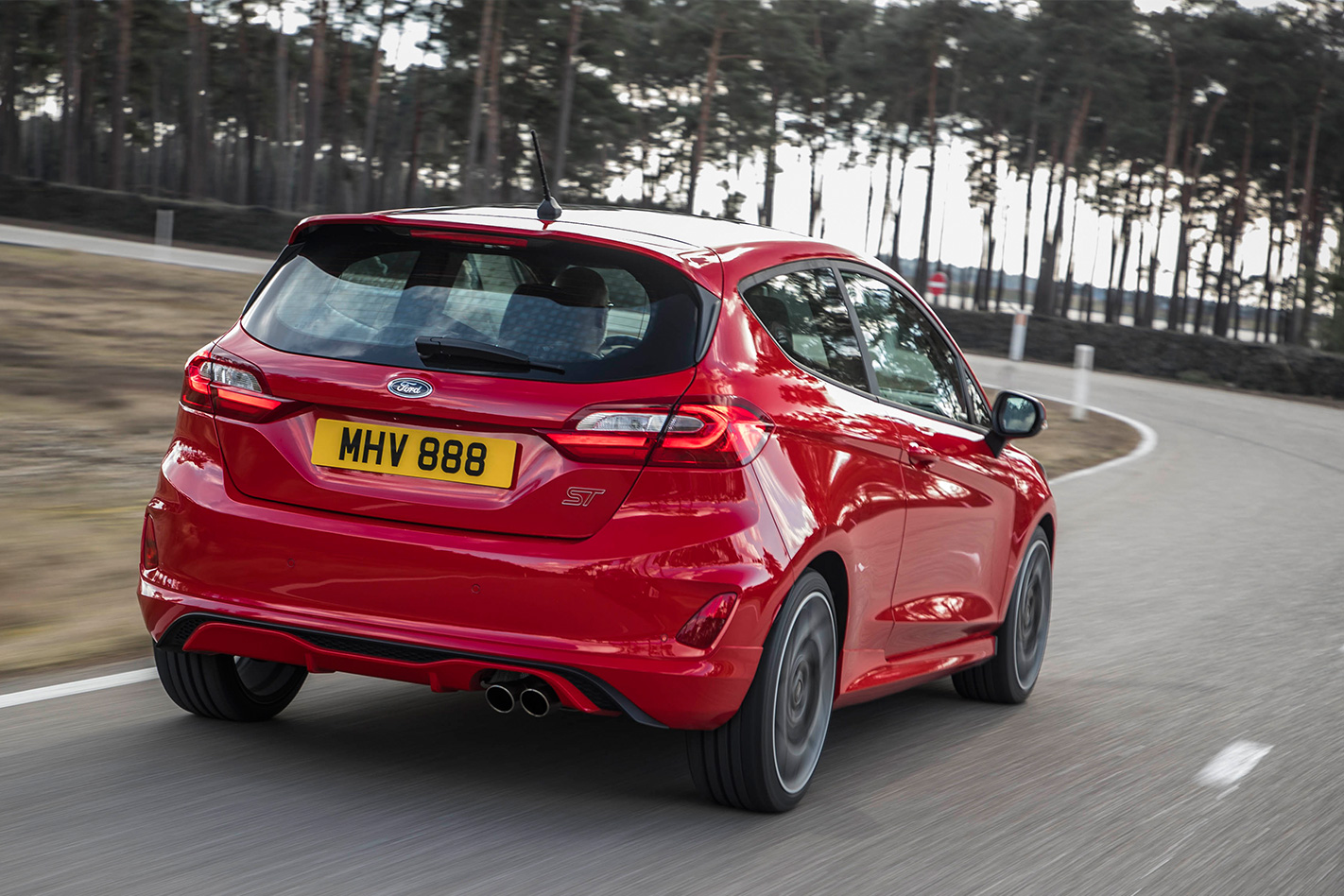
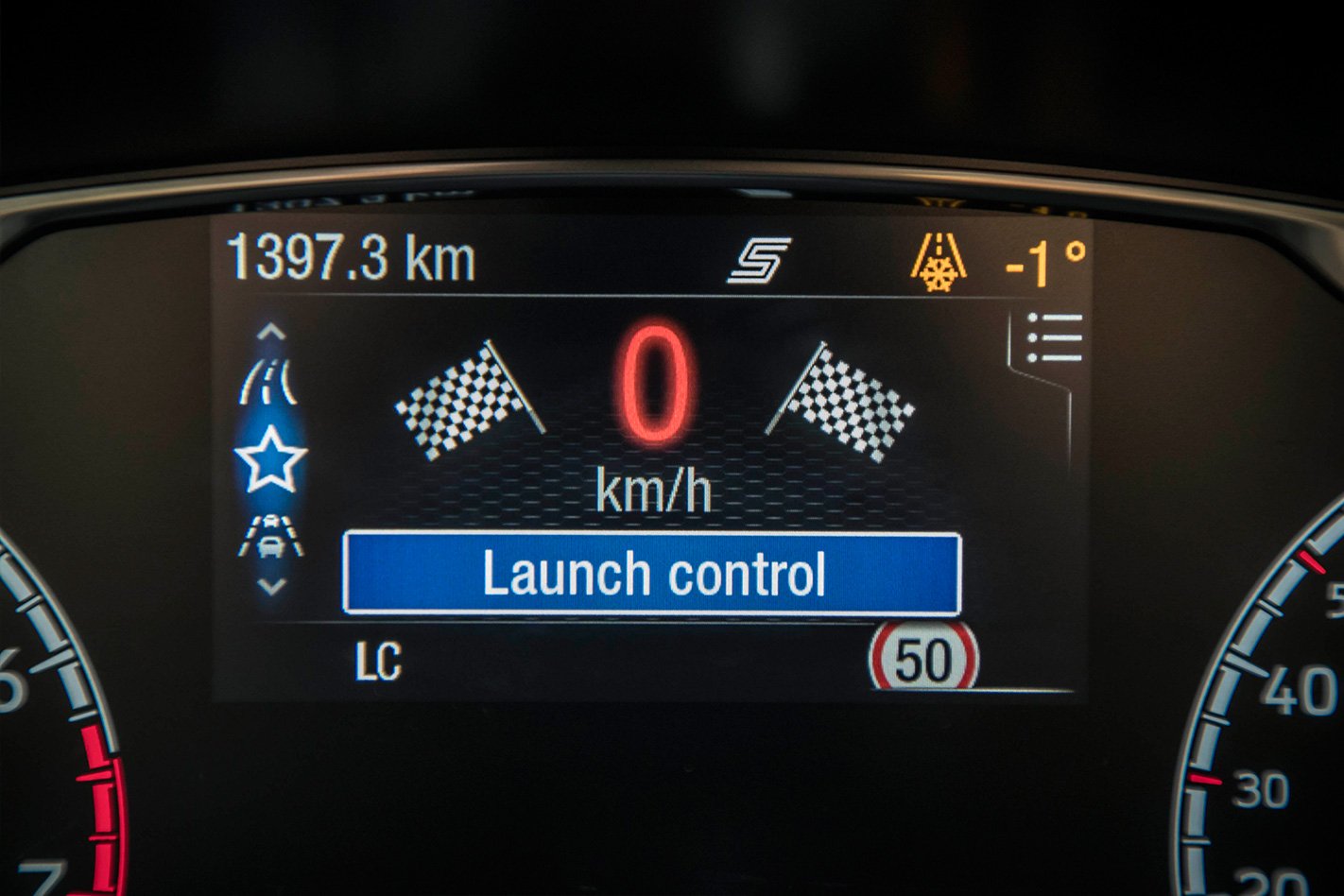
Another feature – although on the options list, and not among the standard kit, is a launch control system. It will be simple to activate, linked to the steering wheel, and a special graphic display will appear in the 4.2-inch instrument cluster to show it is working. Mash the throttle, dump the clutch, and the electronics will help you sprint from 0-100km/h in a claimed 6.5 seconds. That’s 0.2sec off the time that Ford originally claimed …
Ford Australia is yet to confirm if we will get the next-generation Fiesta ST in Australia, but the fact we received the last version of the German-built hot hatch lends weight to this one also making an appearance in local showrooms.
THAILAND, the birthplace of most of the trade utes sold in Australia, will soon become the spawning ground of a new breed of vehicles – Mercedes-Benz’s electric, and electrified, cars.
The German luxury car maker has teamed up with its Thai partner, which already assembles CKD CLA-Class sedans and GLA-Class SUVs, to collectively spend €100 million ($A157 million) to expand its car making operations to build batteries, “ensuring availability of cutting-edge technology for electrified and ‘EQ Power’ Plug-In Hybrid vehicles produced in Thailand”.
The deal was made possible via the Thai government’s “promotional privileges”, a strategy that aims to reshape the kingdom as the region’s electric vehicle hub.
A Mercedes-Benz Australia spokesman said it was “very early” to say if the Thai-built models would one day be destined for the Australian market. “Should there be EQ vehicles produced there in RHD, and of the model(s) we would want, then it is possible we would consider them,” he said.
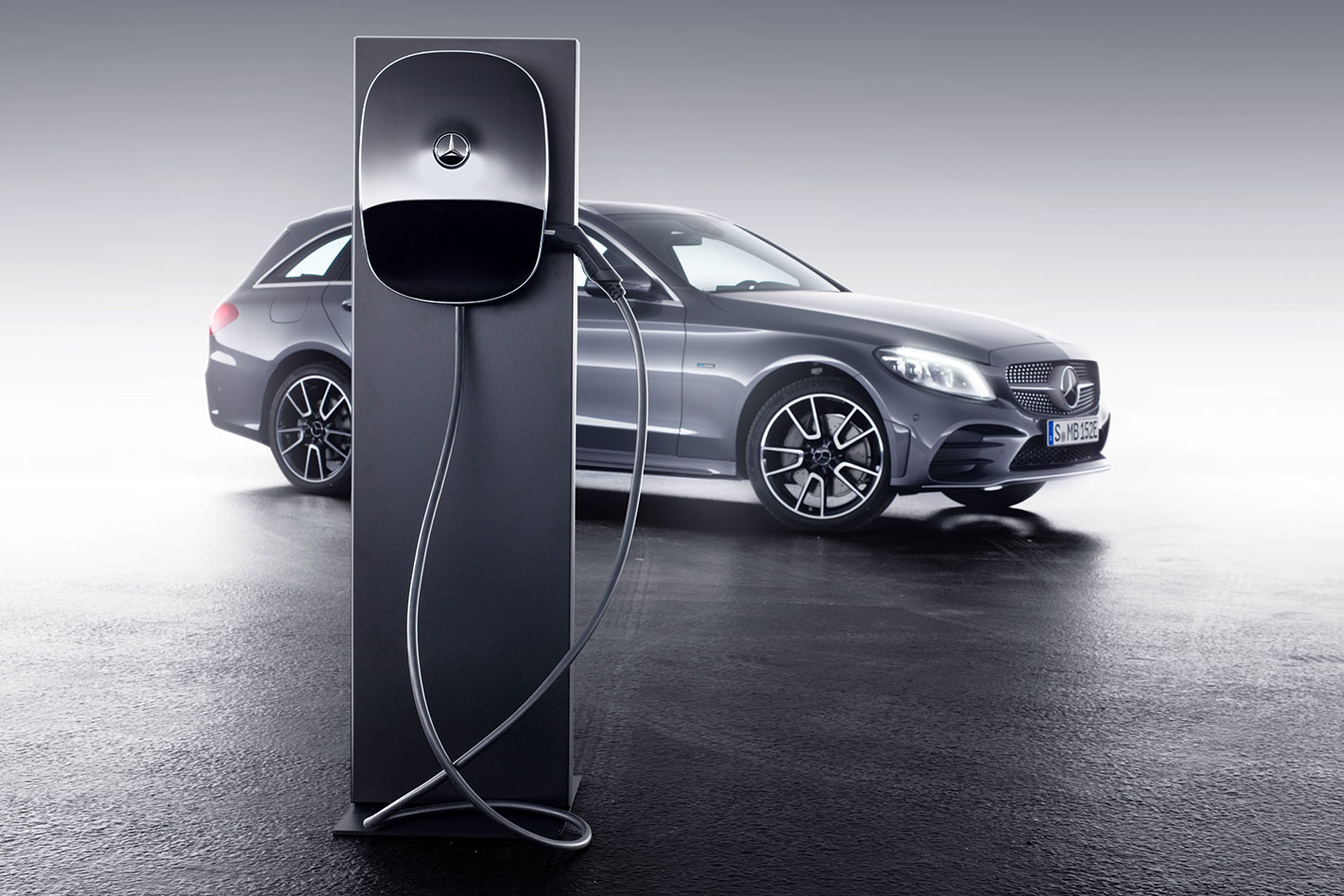
Mercedes-Benz is laying down plans so that by 2022, it will have electrified its entire showroom, offering customers “at least one electrified alternative in all segments from compact cars to large SUVs” including plug-in hybrid petrol and diesel models.
“The company is planning to offer more than 50 electrified vehicle variants,” it said. “Mercedes-Benz will be continuously supporting the development of plug-in hybrids and the introduction of 48-volt systems. The first EQ series model – the EQC – will go into production in 2019 in Bremen, Germany.”
Mercedes-Benz’s announcement comes a day after fellow German car maker Volkswagen Group said it had locked in €20 billion worth of battery technologies for its electric car push, which will also start next year.
What stands out?
The Toyota Prius cuts fuel bills almost in half, compared with many other small cars, by teaming a petrol engine with an electric motor. It has distinctive styling, with sharp angles and a sleek silhouette. A comprehensive safety package includes auto braking as standard. This new Prius feels much better to drive than its predecessor.
What might bug me?
If you’re tall, bumping your head when you sit in the back. Head room is a bit tight.Driving at 80km/h on your skinny space-saver spare tyre, until you can repair your full-sized flat.Getting to grips with the tyre repair kit, if you have shelled out for the more expensive Prius, the i-Tech. It does not come with a spare tyre at all: it’s the kit, or walk.That you can’t tow even a small trailer: the Prius has not been designed to accept a tow bar.That operating the parking brake is another job for your feet.
What body styles are there?
Five-door hatchback only.All Prius models drive the front wheels.The Prius is classed as a small car, lower priced.
What features does every Prius have?
A sound system with an AM/FM radio, a CD player, Bluetooth connectivity, and 10 speakers, controllable from a 7.0-inch central touchscreen.Active cruise control, which will slow you automatically to match the speed of a car in front – and return to your set speed when the way is clear.Controls on the steering wheel for the audio system, your phone, the active cruise and other safety systems.A head-up display, which projects a digital speedo on to the windscreen (helping you to keep your eyes on the road).Wireless phone charging using the Qi system: if your phone permits inductive charging, you simply place it on the charging mat.Smart-key entry, which lets you unlock and start the car while the key remains safely in your pocket or bag.Alloy wheels, which are usually lighter than steel wheels. Unusually, those on the Prius carry plastic or resin streamlining, fitted to cut fuel use marginally.A reversing camera. Seatbelt reminders for all five seating positions.LED headlights, which are more efficient and brighter than traditional globes, and last much longer. And these dip automatically, to avoid dazzling oncoming drivers.Broadly effective Autonomous emergency braking, and Lane-departure warning.Seven airbags, and electronic stability control – which can help you avoid or control a skid. (For the placement of airbags, and more on Prius safety systems, please open the Safety section below.)The Prius is covered by a three-year, 100,000km warranty. Additionally, the expensive battery in the hybrid system is covered by an eight-year, 160,000km warranty.
Which engine uses least fuel, and why wouldn’t I choose it?
There is only one engine available in a Prius, a 1.8-litre four-cylinder petrol that works alongside two electric motors. In either model, it uses just 3.4L/100km on the official test (city and country combined).That’s little more than half of what many small cars use (the petrol-engine Toyota Corolla hatch, for example, consumes 6.1L/100km on the test).The Prius’s big trick is its ability to turn braking energy into electricity – which it then uses to drive the car, saving fuel. It does this by reversing the role of the electric motors when the car is decelerating (or holding speed on downhills), turning them into generators that charge the batteries.Whereas most cars use significantly less fuel on trips into the country, the Prius uses marginally more on the country cycle of the government test than on the city cycle. That is because its benefits are best realised around town, where the car is slowing down frequently. On a freeway, its opportunities to recharge the batteries from braking are fewer. And because the Prius is heavier than most other small cars (primarily because of the battery pack under the back seats), the petrol engine works harder when accelerating up hills or overtaking.Contrary to what many believe, the Prius runs purely on petrol. The batteries cannot be recharged externally (you cannot plug-in a Prius, for example). They are charged by the engine, or by capturing braking energy that would normally dissipate as heat in the braking system.The Prius uses a CVT (continuously variable transmission), which operates much like a standard automatic, except that rather than using a fixed number of ratios it adjusts steplessly – and usually more efficiently – to the driver’s demands.
What key features do I get if I spend more?
The less costly of two Prius versions is called simply the Prius. It comes with cloth-covered seats, 15-inch wheels with plastic covers, and the features on any Prius.Spend quite a bit more for a Prius i-Tech and you get part-leather trim (it’s a mix of leather and fake leather), heated front seats, and powered adjustment for the driver’s seat. There is digital radio reception, and satellite navigation. Two sensory safety systems are added: A Blind-spot warning, and a Rear cross-traffic warning.The i-Tech also has bigger wheels (17 inches in diameter), with resin inserts for streamlining rather than plastic covers. The tyres are a bit wider and have shorter sidewalls. The package looks sportier, grips better on dry roads, and speeds up the steering response marginally.
Does any upgrade have a down side?
Paying more for the Prius i-Tech means you don’t get the space-saver spare tyre, and must make do with a tyre repair kit.The i-Tech’s tyres are also lower in profile, which makes the ride slightly bumpier. And they cost more to replace.White is the only standard colour. The other six hues cost about $450 more.
How comfortable is the Prius?
Inside, the Prius looks futuristic, with its instrument cluster a broad, colour, digital display that’s mounted centrally on the dashboard rather than immediately ahead of the steering wheel.Below it is the large and legible touchscreen, with its touch buttons down either side. The buttons, however, are more distracting to use than traditional buttons: you can’t distinguish them by feel, and must take your eyes off the road to make sure you have the right one.Whereas previous models have used hard plastics inside, the new Prius uses more pleasantly tactile finishes. The bright white plastic lower on the dash contrasts nicely with the dark greys used elsewhere.The standard 10-speaker JBL audio system sounds good.Despite the tricky electronics underneath, a Prius drives like most small cars. Its engine is very like the Corolla’s but it has about 10 per cent less power when you work it hard, say for overtaking, and the Prius weighs more – it’s as though you are carrying around two extra passengers. On the other hand, the help from the electric motor makes the Prius feel more powerful most of the time, and especially around town.Steering is light but accurate and the car is comfortable over bumps. It is also relatively quiet, and more so when the petrol engine shuts down – which is frequently, especially during gentle driving. (The Prius can run on electricity alone up to about 60km/h).The brake pedal is very sensitive but slows the car progressively.The electronic gear selector on a Prius takes some familiarisation: it slots into each gate and then springs back to its central position. There is also a B function, which stands for braking: it engages more aggressive regenerative braking whenever you lift off the accelerator, almost like you’re pushing the brake pedal. In that mode it will recharge the batteries faster.
What about safety in a Toyota Prius?
The Prius has full airbag protection, a reversing camera, and outstanding levels of active safety for a car at its price level. Auto emergency braking, active cruise control and lane departure warning are standard. There are also bright daytime running lights, to make the car more visible to other road users during the day.The seven airbags are in the usual places: two directly in front of the driver and passenger; one beside each front occupant at chest level to protect from side impacts; a curtain airbag along each side protecting heads front and rear from side impacts; and finally an airbag at knee level for the driver.The auto emergency braking uses radar and camera sensors, and operates at city and highway speeds – up to the Prius’s top speed. It will warn you of an impending collision – typically with a slowing car ahead – and can brake the car if it concludes a collision is imminent.Lane departure warning monitors lane markings and alerts you if you if you stray towards them without indicating – perhaps dangerously, due to distraction or weariness. If you ignore the warning, it will gently attempt to correct the steering.The Prius i-Tech adds two rear-focused active systems. A Blind-spot warning alerts you to other cars near your rear corners, which might not appear in your mirrors, with a light in the relevant mirror. If you indicate to turn in that direction, the alert will flash. A Rear cross-traffic warning works when you are reversing – say from a shopping centre car park – letting you know if a car is about to cross behind you.The Australasian New Car Assessment Program (ANCAP) rated the Prius at its maximum five stars for safety, in October 2016.
I like driving – will I enjoy this car?
The Prius has a reputation for saving fuel – and not for being fun to drive.But with this fourth generation model, Toyota has focused more seriously on enjoyment for the driver. It has invested plenty of money beneath the skin of the new Prius, in body and suspension components aimed at making it fun to drive.The biggest improvement is in the reduction of unwanted leaning and other body movement over bumps – or when cornering enthusiastically. The Prius feels very settled on twisting, bumpy roads, with a driving maturity no Prius before it has come close to (in part thanks to a fresh, double-wishbone, rear suspension).Those who like lapping up corners would be best going for the i-Tech, which brings more grip from its wider tyres.Engine performance is only modest, though. While there is punchy acceleration out of slow corners and when zipping around in traffic, the Prius is less enthusiastic above about 80km/h. It will easily hold its speed on a freeway, but from highway speeds it does not sustain the oomph it exhibits when accelerating around town.
How is life in the rear seats?
There’s good leg room in the back of the Prius considering it’s a small car. But head room is compromised, to the point where people taller than 185cm may find their heads grazing the roof. For long journeys, the back seats are best left to kids.There are also no dedicated air-conditioning vents for rear passengers.Child seat anchor points are easily accessed from the boot, making it easy to fit a baby capsule.
How is it for carrying stuff?
The Prius has a big boot with a flat floor. Rear seats that split-fold 60-40 allow long items to protrude into the cabin.The Prius i-Tech has a lower floor in the boot and even more room – 502 litres, up from 457 litres – because it ditches the spare wheel for a tyre repair kit.The Prius is not rated to tow, and has not been designed to take a tow bar. While it’s not likely you would think of dragging a caravan with a car like this, it’s worth noting it is not equipped to tow a small box-trailer either.
Where does Toyota make the Prius?
The Toyota Prius is made in Japan.
What might I miss that similar cars have?
Perhaps parking sensors, as fitted to the rear of many small cars – among them some Toyota Corollas.Apple CarPlay and Android Auto smartphone connectivity, as supplied with the Ford Focus, Hyundai i30, Holden Astra and Subaru Impreza, for example. This allows you to plug in your phone and operate it from the car’s central touchscreen (or by voice), rather than the phone screen.Maybe a sunroof, as available on the previous Prius (which also had solar panels to power the fan and cool the car when it was parked). You can get one on many small cars.If you like the idea of a fuel-saving petrol-electric hybrid drivetrain, but want to spend less than you would have to pay for a Prius, consider the Toyota Corolla Hybrid. This small hatchback works much like a Prius.
Are there plans to update the Prius soon?
This new fourth-generation Prius went on sale early in 2016. Expect an all-new model about 2022, although there will be minor updates before then.
I like this car, but I can’t choose which version. Can you help?
This new fourth generation Prius went on sale early in 2016. Expect an all new model about 2022, although there will be minor updates before then.A new plug-in version of the Prius – which can be charged from a home power outlet, and can be driven about 35 km on a full charge – has gone on sale overseas. Toyota has said it won’t bring the Prius PHV, also called the Prius Prime, to Australia. That decision might be reviewed if it proved popular elsewhere.
VOLKSWAGEN Australia has issued a strongly-worded response to a study conducted last year by the Australian Automobile Association (AAA), republished earlier this month.
An independent study by the AAA claims a 2010 VW Golf diesel had increased fuel consumption following a dieselgate-related recall.
“The results show that VW may have found a fix for reducing the level of noxious emissions but as a result, the amount of fuel used has increased,” AAA said in a release
AAA used a 2010 model Euro5 Volkswagen Golf for their tests, with results showing the car used “an average of 7 percent more fuel – or 0.5 litres/100km – after it had the recall completed”.
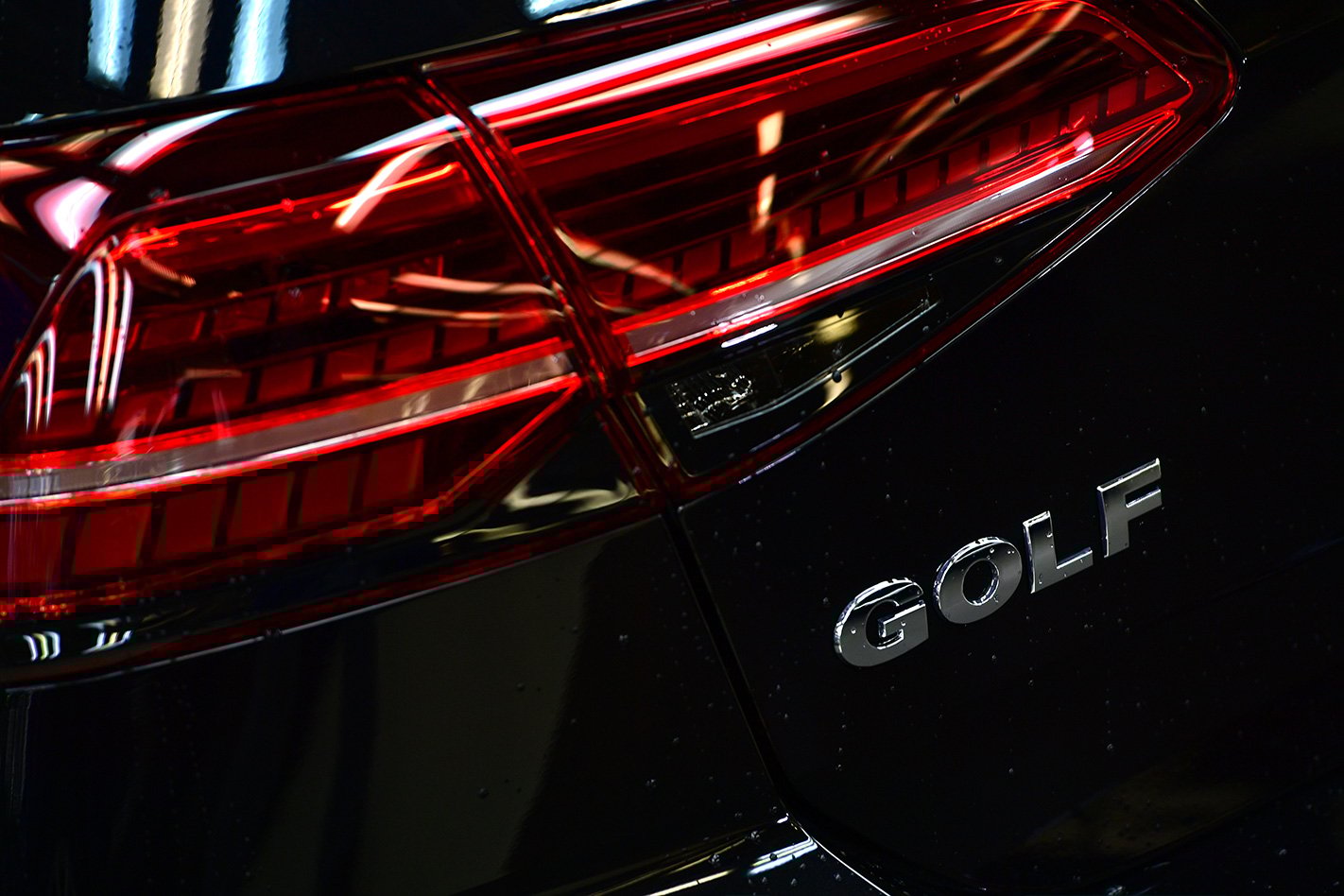
While the AAA admits the study showed emissions of oxides of nitrogen, carbon monoxide and particulate matter were reduced after the recall, it claimed “NOx emissions were still 4.11 times the laboratory limit” during real world testing.
Volkswagen responded to the study, calling the methodology “flawed”.
“Data recorded published by the AAA highlights glaring inconsistencies in the methods applied to testing a 2010 Volkswagen Golf Wagon,” the company said in a statement.
Volkswagen Group Australia Managing Director Michael Bartsch added “major flaws render the tests wholly unfit”, including “substantial variations” in the pre- and post-recall tests.
Wheels contacted the AAA regarding Volkswagen’s statement, but it opted to “refrain from making a comment”.
The AAA’s report states the test vehicle stopped on 27 occasions during its pre-recall test in dry conditions, while it stopped 37 times in the post-recall test, conducted eight days later in wet conditions.
Volkswagen Australia called into question the timing of the press release for the study, calling it “cynical opportunism” which coincides with a class-action lawsuit being filed against the company being heard in Federal Court.
“The so-called new test results are not new and were published by AAA early 2017 and sank without a trace,” Bartsch added.

“As far as VW vehicles are concerned, on-road testing by reputable motorist’s organisations in Germany, Switzerland and Austria show the opposite results to those arrived at by the AAA,” Bartsch said.
“The differences between laboratory tests and on-road testing results are well known and the ACCC has worked with all automobile manufacturers on approved wording, which Volkswagen Group members use in Australia, to ensure that this is properly disclosed to consumers.”
Bartsch says Volkswagen is “an enthusiastic proponent of real world testing of vehicles for NOx emissions.”
The AAA tests did indicate both power and torque figures increased slightly after the recall fix.
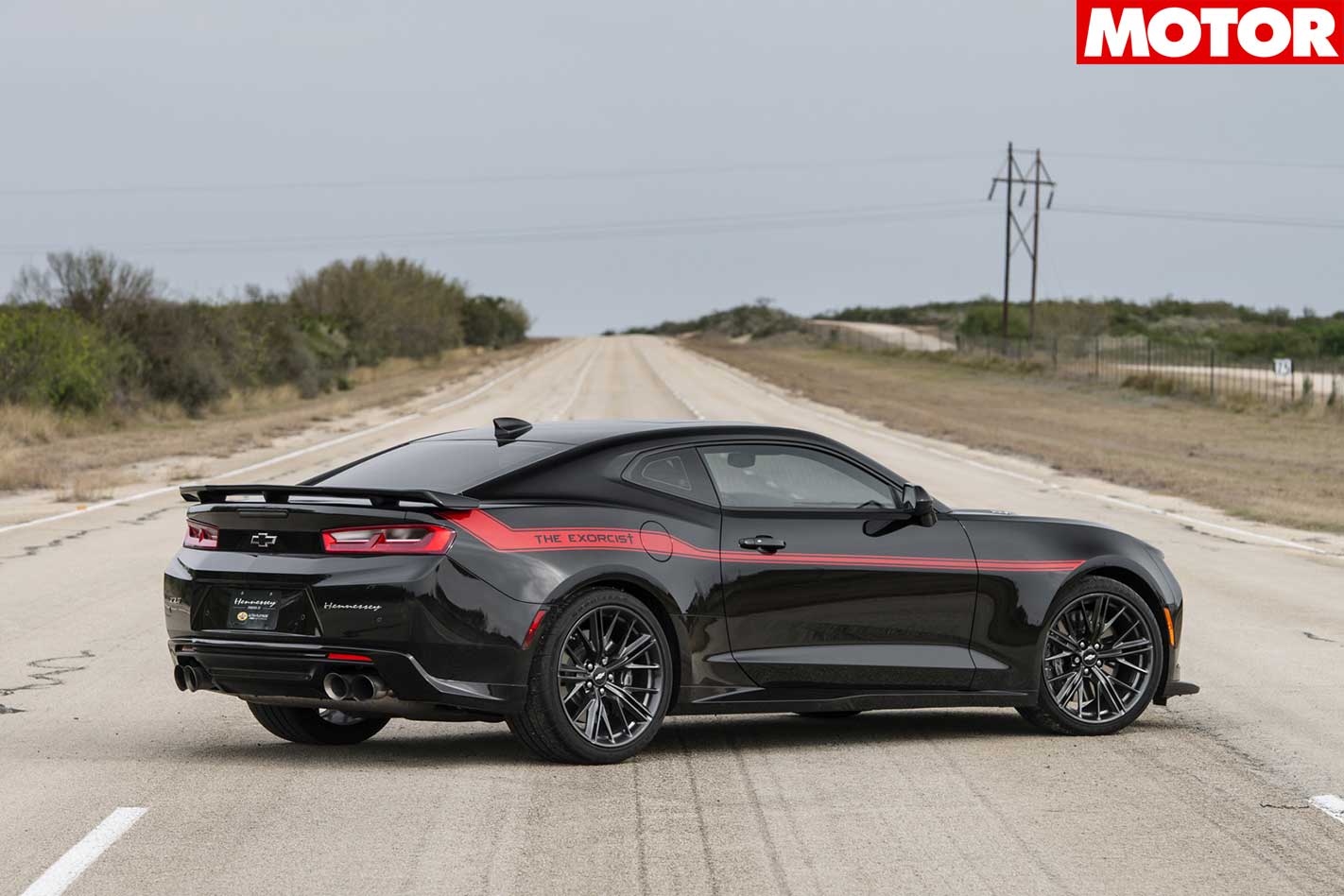
The 746kW Hennessey Exorcist Camaro is, surprise, faster than the new 563kW ZR1 Corvette.
The location of choice for testing was the high-speed oval at the Continental Tyre Proving Grounds, which is in Uvalde, Texas.
Hitting a top speed of 217mph, or 349km/h, the Exorcist topped the ZR1 by 3mph (about 4.8km/h). We suppose 1197Nm of torque is handy for this, too.
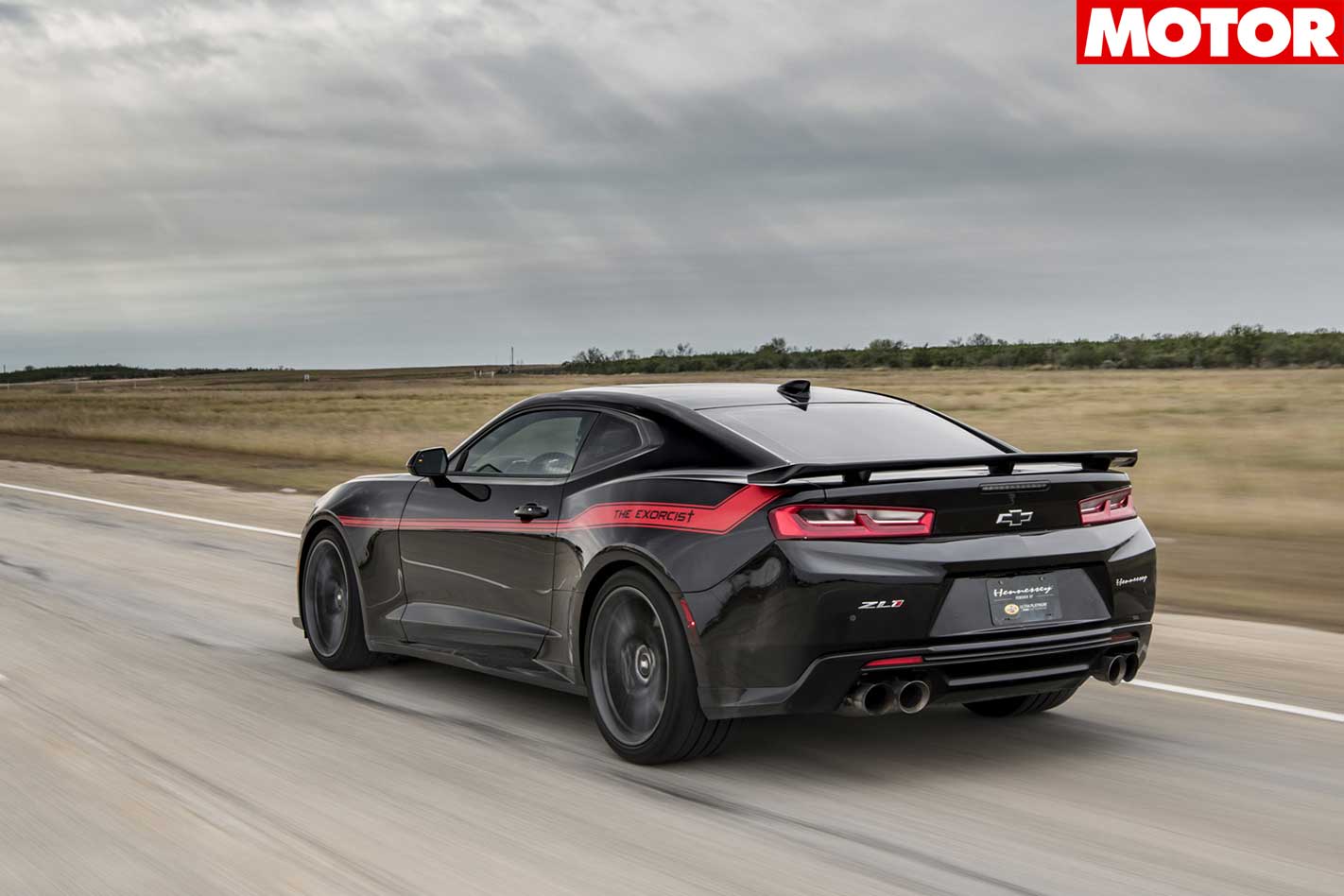
“The factory 10-speed transmission was also used and the 217mph speed was achieved in ninth gear.
“To date, HPE has delivered 20 Exorcists to clients and the company plans to only build 100 units in total.”
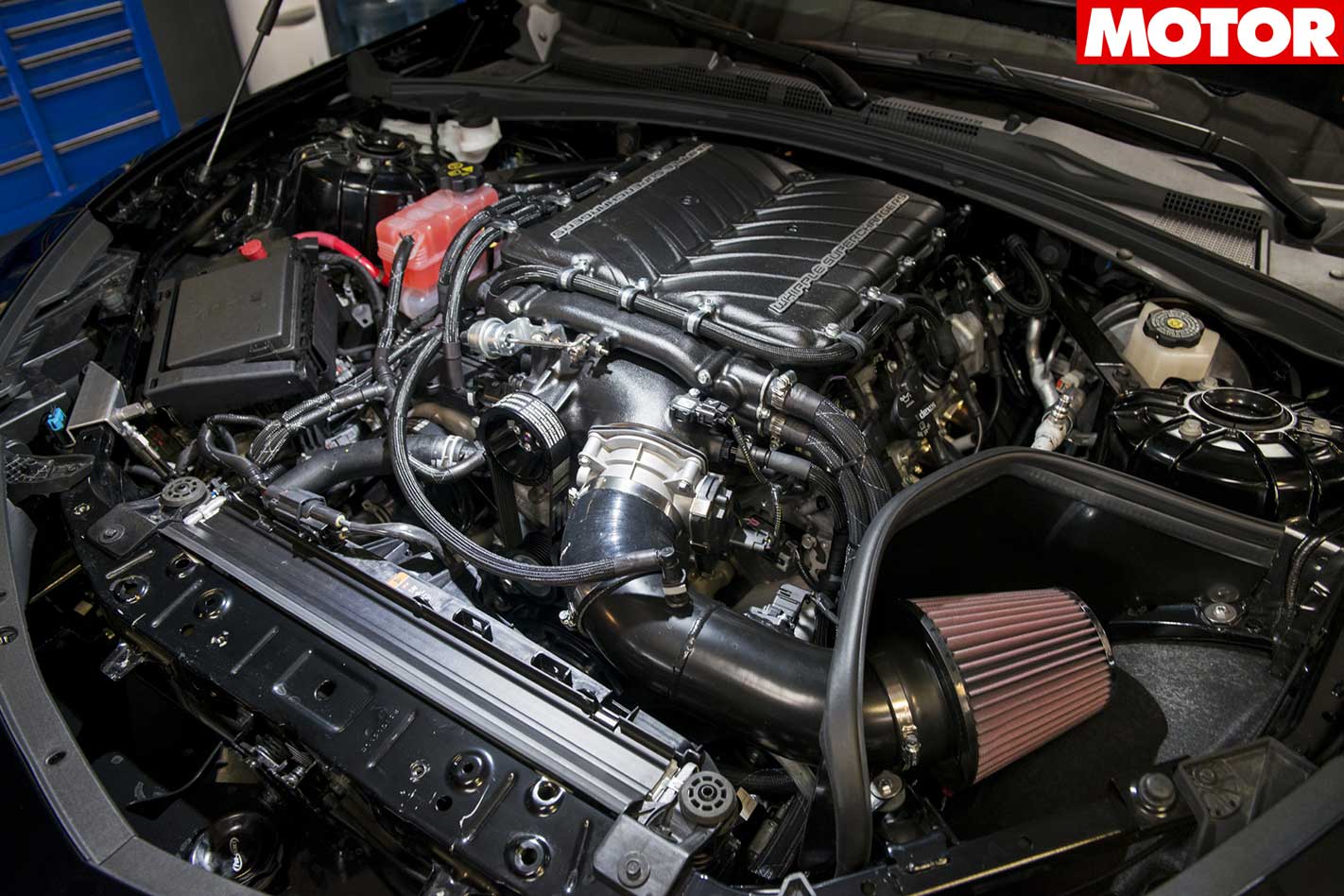
“We wanted to see if the Exorcist could exceed the top speed of the new ZR1 Corvette, which is 213 mph. Mission accomplished,” says John Hennessey.
“This is just the first high-performance validation test for the Exorcist.
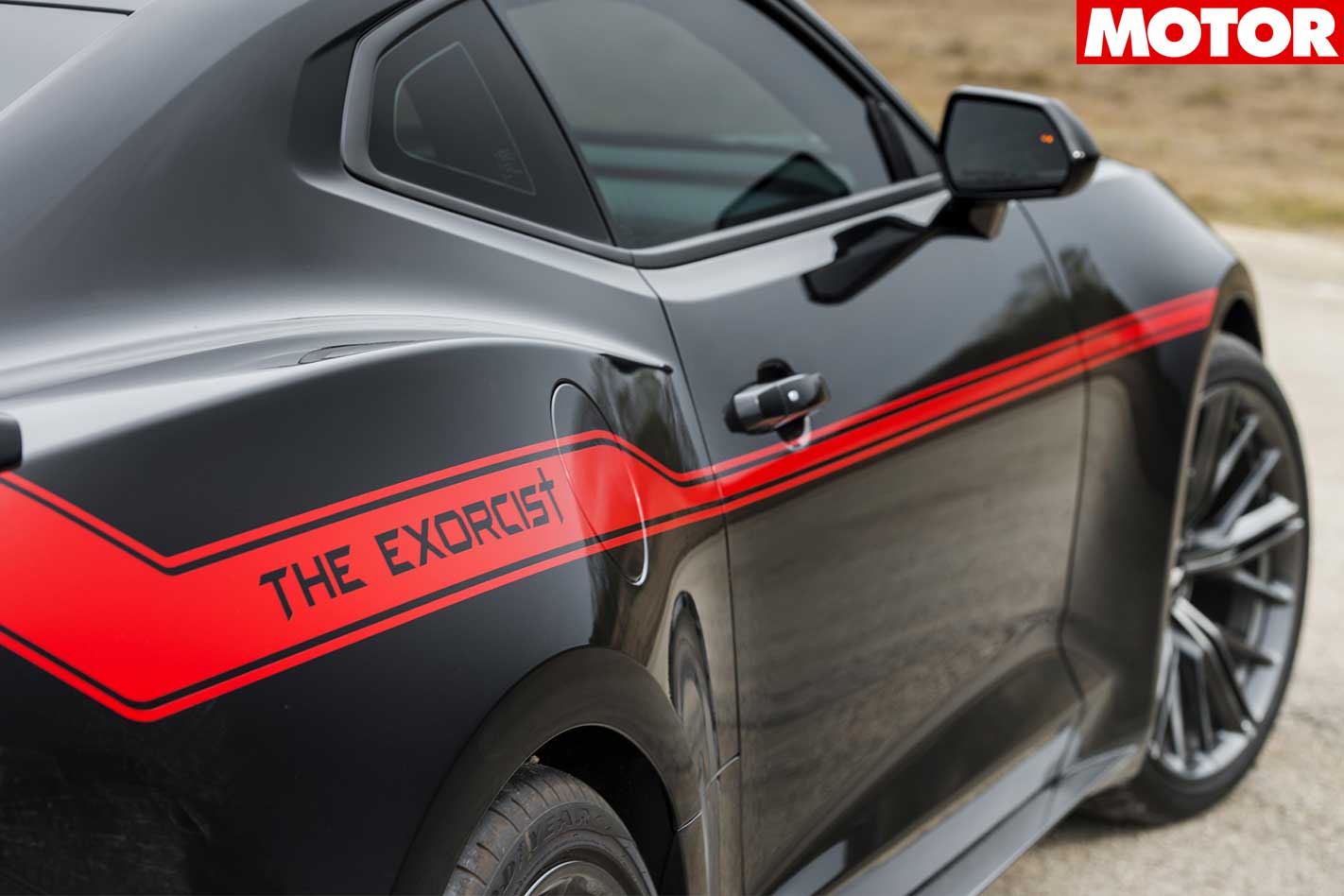
Hennessey did end up testing the car’s time down the quarter. It ran a 9.57.
“The Exorcist offers supercar performance while still retaining everything that you would want in a daily driver with a backseat and room for golf clubs in the trunk.
“It’s kind of like having a new ZR1 Corvette with room for four people – but faster.”
That, and they come with a three year/36,000 mile (57,900km) warranty.
The 746kW Hennessey Exorcist Camaro is, surprise, faster than the new 563kW ZR1 Corvette.
The location of choice for testing was the high-speed oval at the Continental Tyre Proving Grounds, which is in Uvalde, Texas.
Hitting a top speed of 217mph, or 249km/h, the Exorcist topped the ZR1 by 3mph (about 4.8km/h). We suppose 1197Nm of torque is handy for this, too.
“The factory 10-speed transmission was also used and the 217mph speed was achieved in ninth gear.
“To date, HPE has delivered 20 Exorcists to clients and the company plans to only build 100 units in total.”
“We wanted to see if the Exorcist could exceed the top speed of the new ZR1 Corvette, which is 213 mph. Mission accomplished,” says John Hennessey.
“This is just the first high-performance validation test for the Exorcist.
“The Exorcist offers supercar performance while still retaining everything that you would want in a daily driver with a backseat and room for golf clubs in the trunk.
“It’s kind of like having a new ZR1 Corvette with room for four people – but faster.”
That, and they come with a three year/36,000 mile (57,900km) warranty.
