
When it comes to performance, pedigree means little in an age where new Chinese brands are prepared to invest heavily in upsetting the establishment.
That’s the case for the Xiaomi YU7 GT, which just set a new record lap from an SUV around the Nürburgring. The highest-performance YU7 model set a 7-minute, 34.931-second time, placing it just under two seconds ahead of the previous record-holder, the Audi RS Q8 (7:36.698).
The all-electric YU7 GT is yet to have its specifications officially revealed, but Chinese market regulatory documents indicate a dual-motor drivetrain rated to 738kW. That positions the YU7 GT below Xiaomi’s high-performance SU7 Ultra sedan, which boasts 1138kW from a three-motor drivetrain.
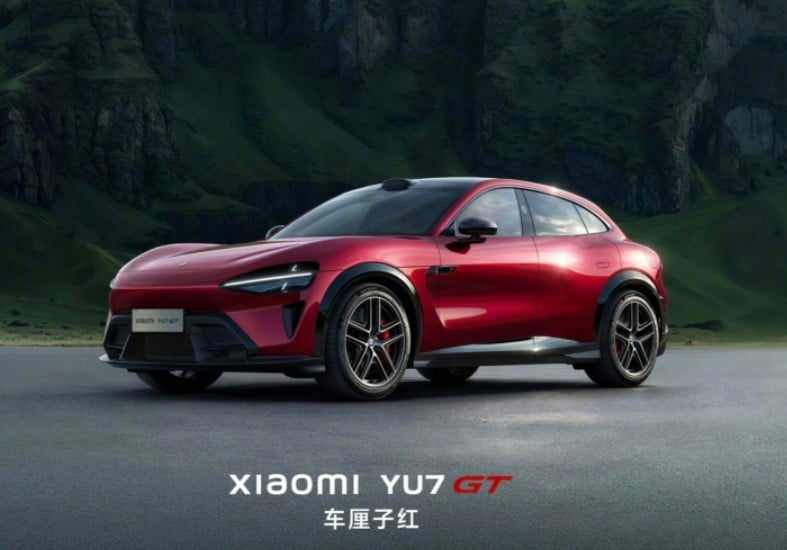
Xiaomi is no stranger to Nürburgring records, setting the fastest lap time for a production EV with the SU7 Ultra in June 2025, posting a 7:04.957 lap time. By September 2025, that record had fallen, with BYD’s Yangwang U9 Xtreme posting a quicker 6:59.157 electric vehicle record.
Along with setting a new SUV record, the YU7 GT’s lap was set by Xiaomi test driver Ren Zhoucan, the first Chinese driver to receive official Nürburgring lap certification, which governs time-keeping according to the German circuit’s official standards.
While Xiaomi’s SU7 sedan and YU7 SUV ranges are closely related, the YU7 GT is believed to be a deliberate step down compared to the flagship SU7 Ultra, focusing on practicality and comfort in conjunction with performance, unlike the SU7 Ultra, which takes a more aggressive performance-first approach.
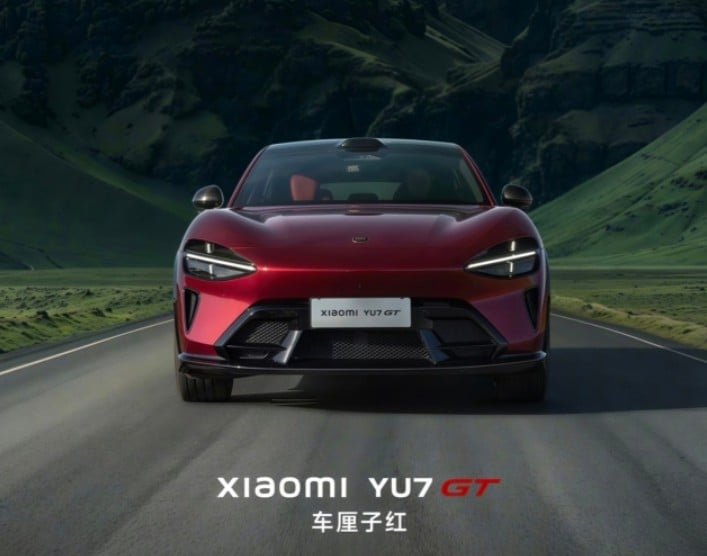
Upgrades to the YU7 GT include a ‘Track Package’, which features carbon-ceramic Brembo brakes, wider 21-inch tyres with Michelin tyres, and software setting changes to stability and traction control, and suspension.
Although best known for its electronics in Australia, Xiaomi created the Xiaomi Auto division in 2021, with the first production vehicle, the mainstream versions of the SU7, launching in China in March 2024.
The large five-seat YU7 SUV is set to be joined by a bigger three-row SUV called the YU9, which will introduce Xiaomi’s first use of a plug-in hybrid powertrain.
Volkswagen Australia remains committed to an increasingly electrified future, but insists the pace and type of technology it adopts locally will ultimately be determined by customer demand rather than a fixed roadmap to battery-electric vehicles.
Speaking to WhichCar by Wheels at the local launch of plug-in hybrid variants of the Tiguan mid-size SUV and Tayron large SUV, Volkswagen Australia executives outlined a strategy centred on flexibility, with hybrids, plug-in hybrids and EVs all expected to play a role in the brand’s local line-up over the coming years.
“The future is electrified,” said Arjun Nidigallu, Head of Passenger Vehicles at Volkswagen Australia. “But just how electrified and what kind of electrification will really be dictated by the market.”
According to Nidigallu, the wide range of platforms developed by the Volkswagen Group is a major advantage, and allows the brand’s local arm to pick and choose what it needs locally as market tastes change.
“We’re in a privileged position as a brand to have multiple platforms that can support multiple types of powertrains – ICE, hybrid or fully electric – and we can pick and choose as we see fit for the Australian market.”
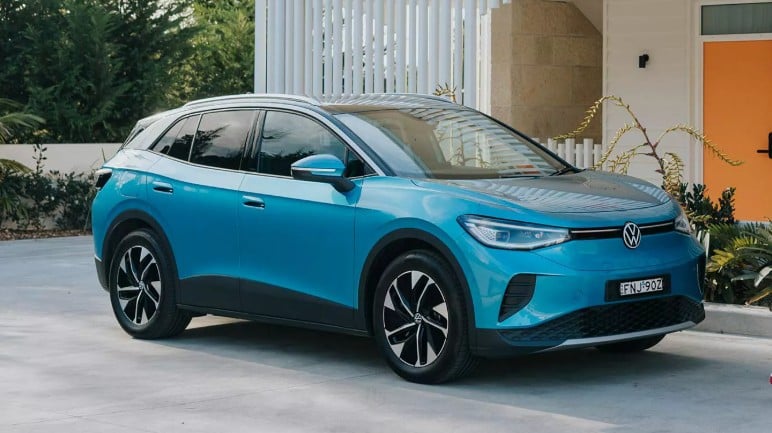
The comments come as Volkswagen continues to expand its electrified range in Australia. Despite being one of the slower local brands to launch an electrified product – its first, the plug-in hybrid Touareg R, launched only in March 2024 – it now offers a reasonable range locally, including the ID.4 and ID.5 electric medium SUVs.
When asked if more EVs like the recently revealed ID.Polo will be offered here, Volkswagen Australia Director of Passenger Vehicles, PierGiorgio Minto, said that they remain under consideration, although any future decision would depend on both demand and broader conditions.
“Strategically, in the future we need to be able to cover as many segments as possible. If there is demand and it makes sense from a brand perspective, why not? But we also need to choose the right product for this market and for our customers. If they have nowhere to charge it, why sell it?”
Volkswagen noted that markets such as Norway – often referenced as the benchmark EV success story globally – benefited from decades of government support and incentives.
“Norway’s journey was long and the government played a fundamental role. It started in 1990 with the world’s first EV incentive, which was exemption from road tax, and that has only increased since then and they’re now at 98 per cent EV sales.”
Despite Norway’s success, Volkswagen Australia says it is not waiting for government policy intervention.
“We really focus on our customers and what they need, and I feel like that’s infrastructure. Customers need support to make the decision to jump into an EV, which for most customers is still unknown territory. We’re trying to solve some of those problems ourselves within the scope of what we can, like partnerships with Ampol, for example. We’re supporting where we can and we certainly aren’t thinking too much about what the government can do for us, instead, we think about what we can do for our customers.”
The next step of Volkswagen’s electrification journey comes in the form of the new plug-in hybrid Tiguan and Tayron eHybrids, which are priced from $62,390 plus on-road costs.
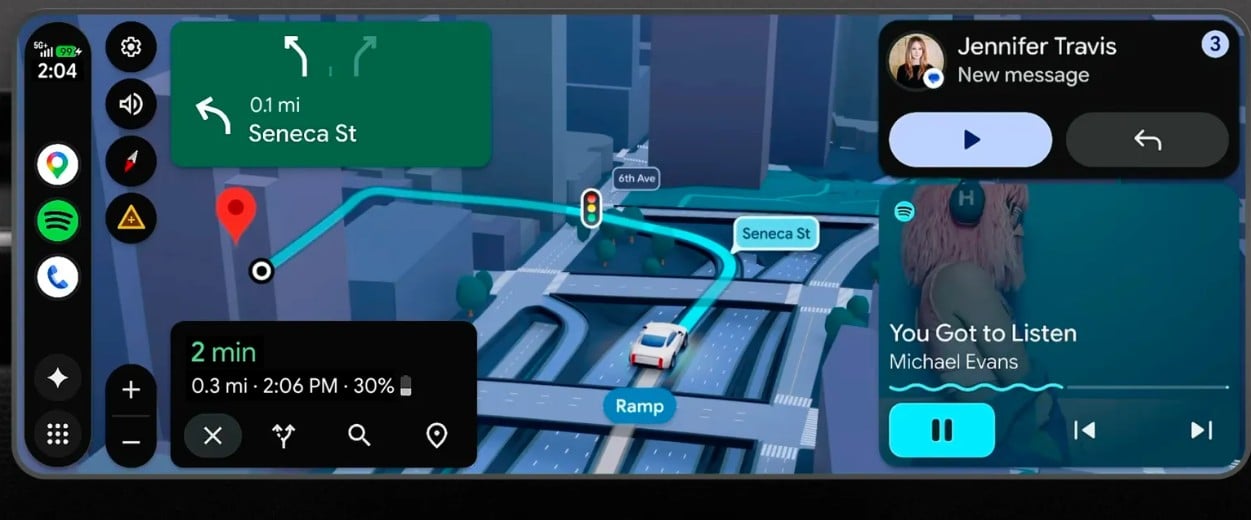
Video playback is coming to your car, at least, it is if you use Android Auto phone mirroring.
The latest round of revisions laid out by Google for its Android 17 mobile phone operating system, due for a full release later this year, brought major changes to Android Auto functionality.
Officially announced as part of the Google I/O 2026 developer conference, the changes to Android Auto and cars compatible with Google built-in services bring a range of functionality and app compatibility changes.
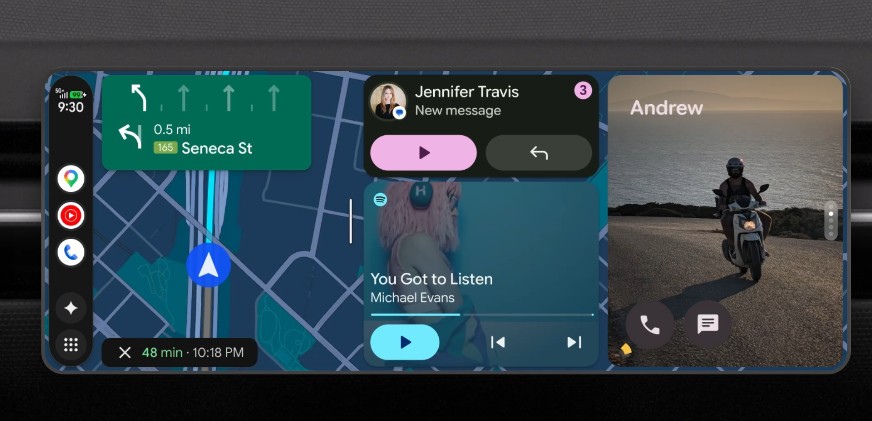
The biggest news – especially for owners of EVs who may find themselves facing long waits for, or at, public charging stations – is the adoption of YouTube video streaming support for Android Auto. Now drivers will be able to use their car’s infotainment screen to view video content.
The first supported platform will be Google-owned YouTube, with HD video at 60 frames per second supported on compatible infotainment systems. The roll-out will begin on cars from brands including BMW, Ford, Genesis, Hyundai, Kia, Mahindra, Mercedes-Benz, Renault, Skoda, Tata and Volvo.
In an attempt to stem safety concerns, the system will be configured to display video only when a vehicle is parked, and will switch to audio playback with a static image once a car is shifted into gear.
While not officially announced as part of the Google I/O presentation, industry speculation points to other steaming platforms, like Netflix, Disney+, Paramount+ and others, potentially receiving the same streaming support down the line.
Video streaming and high definition video won’t be automatically available on all cars compatible with Android Auto, with vehicle hardware pinned to system compatibility. In other words, older cars with smaller, low-resolution screens may not offer this latest upgrade.
Other Android Auto changes coming with Android 17 include a new-look for the Andoid Auto system, ‘Immersive Navigation’ in Google Maps with added 3D details, additional customisable widgets, and an interface that matches the look of Android phones, known as Material 3 Expressive.
The public release of Android 17 is expected by June or July, 2026, with video streaming support for YouTube via Android Auto expected before the end of the year.
Mandatory car parking requirements for new apartment developments should be abolished nationwide to help ease Australia’s housing crisis, according to a new report by the Grattan Institute.
The think tank says outdated planning rules are forcing developers to build tens of thousands of unwanted parking spaces, adding significantly to housing costs while reducing the number of homes that can be delivered, reported the ABC.
The report, Wasted Space: Axe Car Parking Rules to Ease the Housing Crisis, estimates Australia will otherwise build more than 86,000 unnecessary parking spaces over the next five years at a cost of about $5.2 billion. The institute argues those construction resources could instead help deliver an additional 9,000 homes.
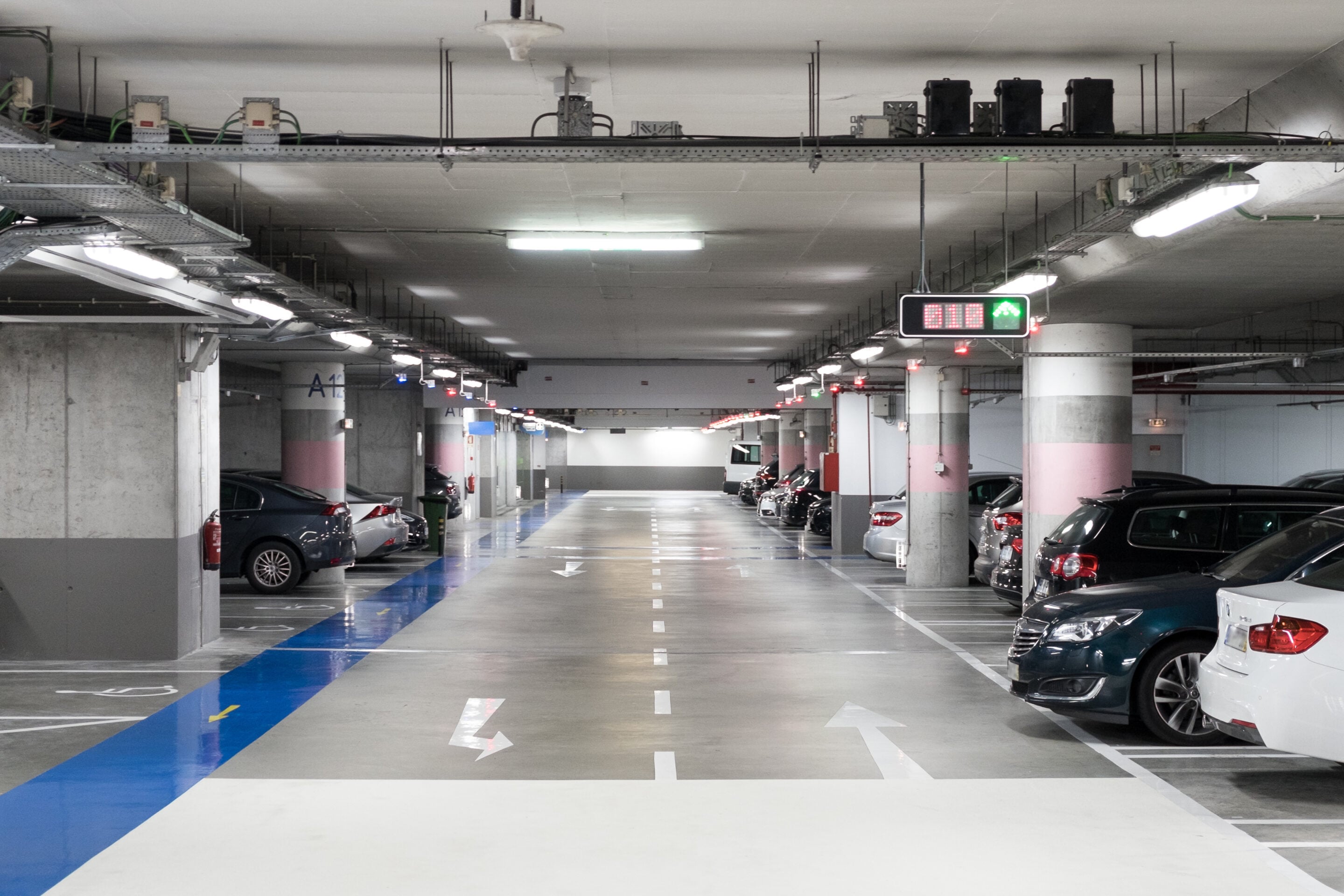
Researchers found a growing mismatch between parking requirements and how Australians actually live, particularly in higher-density housing near transport and employment hubs. Census data cited in the report shows about 40 per cent of households living in studio or one-bedroom apartments do not own a car, while many existing apartment parking spaces sit vacant overnight.
Despite that, many councils continue to impose minimum parking quotas on new developments, often requiring at least one parking space per apartment regardless of likely demand.
The Grattan Institute estimates the rules add about $70,000 to the construction cost of a typical two-bedroom apartment in Sydney, $62,000 in Melbourne, $113,000 in Brisbane, $95,000 in Adelaide and as much as $137,000 in Perth.
The report argues those extra costs are ultimately passed on to renters and buyers, while also making some housing projects financially unviable.
Grattan Institute chief executive Aruna Sathanapally said Australians were being forced to pay for parking they often neither needed nor used. The report recommends state governments override local council parking minimums entirely and instead allow developers and buyers to determine how much parking is appropriate.
It also calls for parking spaces to be “unbundled” from apartment titles so they can be bought, sold or leased separately, along with stronger management of on-street parking through permits, pricing systems and time limits in high-demand areas.
The recommendations form part of the Grattan Institute’s broader push for planning reform and increased housing density in Australian cities, including previous proposals to allow more medium-density housing in established suburbs near transport and jobs.
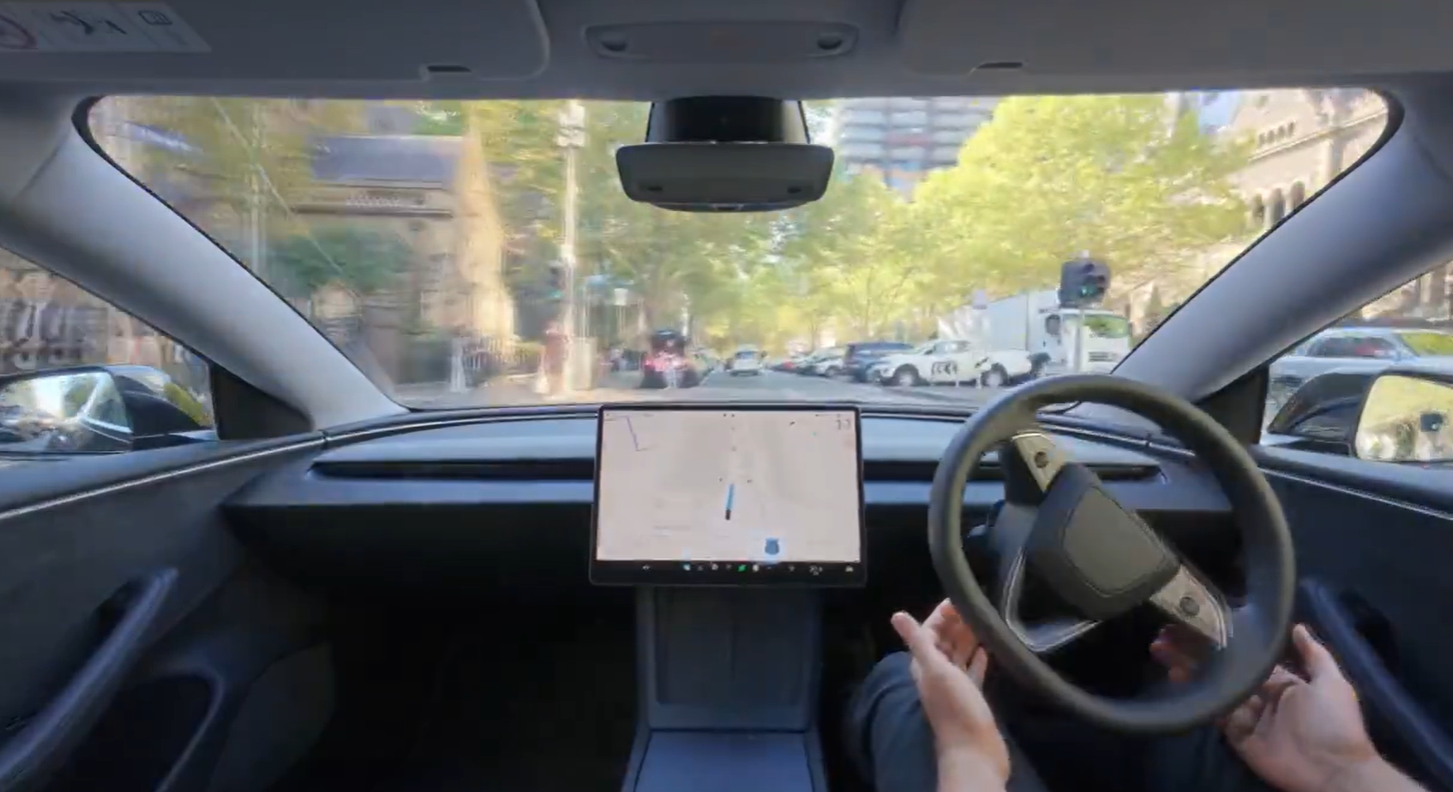
Tesla CEO, Elon Musk, has predicted that driverless vehicles will make up the majority of road traffic within 10 years, leaving human drivers as “quite a niche thing”.
Musk also suggested that his company’s driverless vehicles will be in widespread use across the United States by the end of this year, expanding on trials currently taking place in Texas.
The comments were made during a video link presentation given by Musk at the Smart Mobility Summit in Tel Aviv, and reported by Reuters.
Musk’s history of autonomous vehicle predictions reaches back almost 13 years, when he first publicly claimed that 90 per cent of driven miles would be autonomously handled by 2016.
The ‘90 per cent’ claim is a recurring figure touted by Musk, with a report from a CNN Money interview in 2014 including the quote, “A Tesla car next year will probably be 90-per cent capable of autopilot. Like, so 90 per cent of your miles can be on auto.”
Tesla’s current driverless test program is already in operation in the cities of Austin, Dallas, and Houston in Texas, with a permit granted for a trial program in Arizona that requires vehicles to be supervised by a human driver.
Musk suggest that the driverless test program would expand nationwide by the end of 2026, despite regulations in states like Arizona, Kansas, and Nebraska requiring a licensed driver behind the wheel, and Pennsylvania requiring a driver for all but autonomous ‘work zone vehicles’, while other states have varying regulations on how fully autonomous vehicles can be operated and the level of supervision required.
During his Smart Mobility Summit presentation, Musk repeated his 90 per cent prediction for the take-up of autonomy; “Five years from now and certainly 10 years from now … probably 90 per cent of all distance driven will be driven by the AI in a self-driving car,” he said.
“So overwhelmingly, it’ll be quite a niche thing in 10 years to actually be driving your own car.”
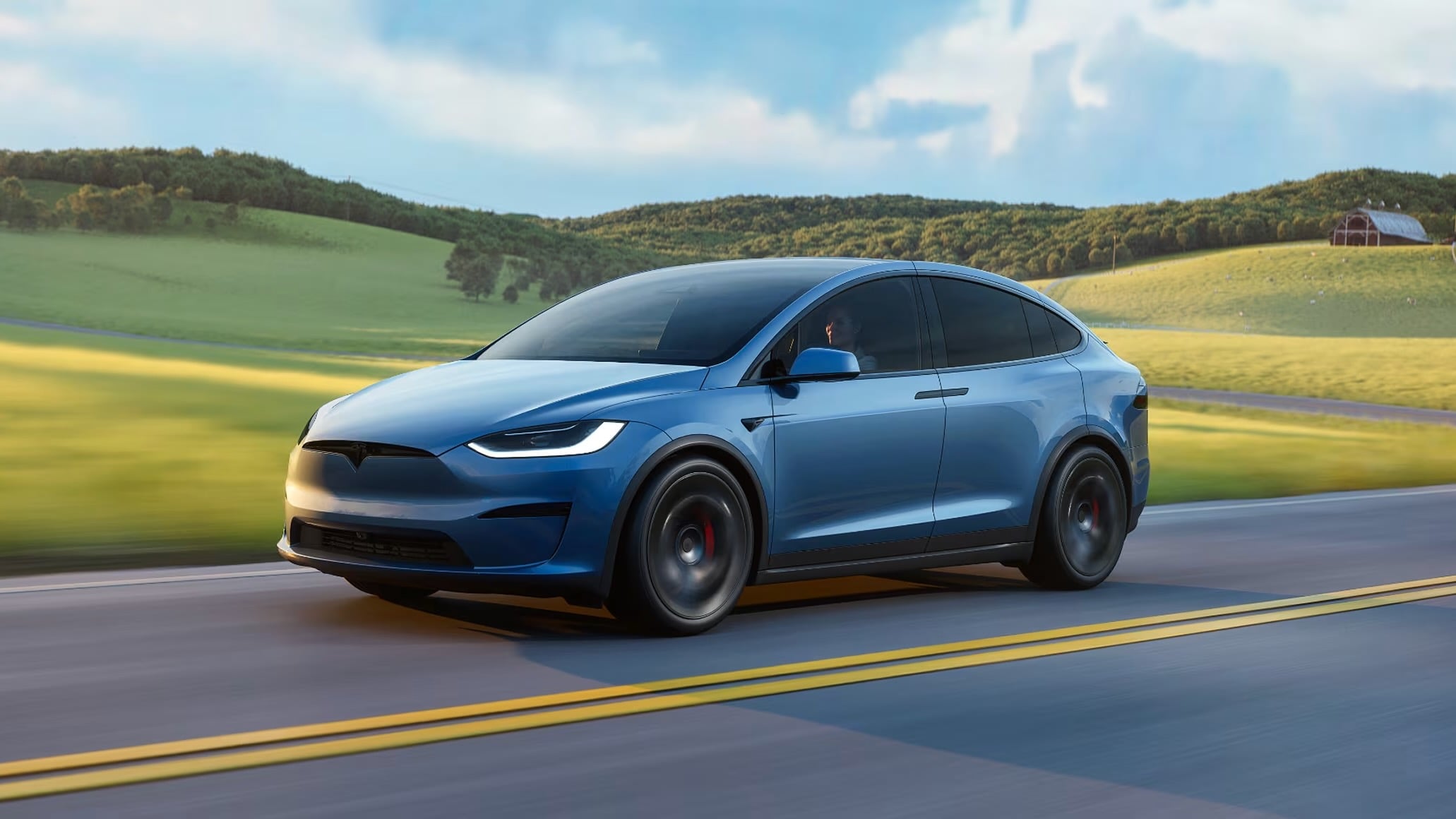
Tesla’s first semi-autonomous Autopilot system launched in 2014 with features including traffic-aware cruise control, lane-keeping assist (dubbed Autosteer) and automatic lane change functions. Expanded capabilities and Enhanced Autopilot and Navigate on Autopilot packages were later added.
In 2022, Tesla launched Full Self Driving, which included the ability to respond to traffic lights and road signs and could drive in a wider range of scenarios away from highways, including on urban streets. In 2024, the system was renamed to ‘Full Self-Driving (Supervised)’, reflecting the need for a human driver to remain attentive with the system in use.
The FSD Supervised system was made available to Australian-delivered vehicles from September 2025.
In 2024, Musk first showed a two-passenger Cybercab, without a steering wheel or pedals, as the first dedicated product of a fully autonomous future for the brand. The Cybercab is currently used in Tesla’s Texas test program, having commenced low-scale production earlier in 2026.
New data from Roy Morgan reveals Australia’s new car buying intention has dropped dramatically as increasing cost of living pressures continue to hurt households.
According to Roy Morgan’s data, just 16 per cent of Australians aged 14 or over are intending to buy a new car in the next four years. That’s a significant drop from the high-point of March 2023, when 20 per cent of Australians indicated they intended to buy a new car.
The drop has seen overall buying intention tumble to 47 per cent, down from a high of 52 per cent in March 2023.
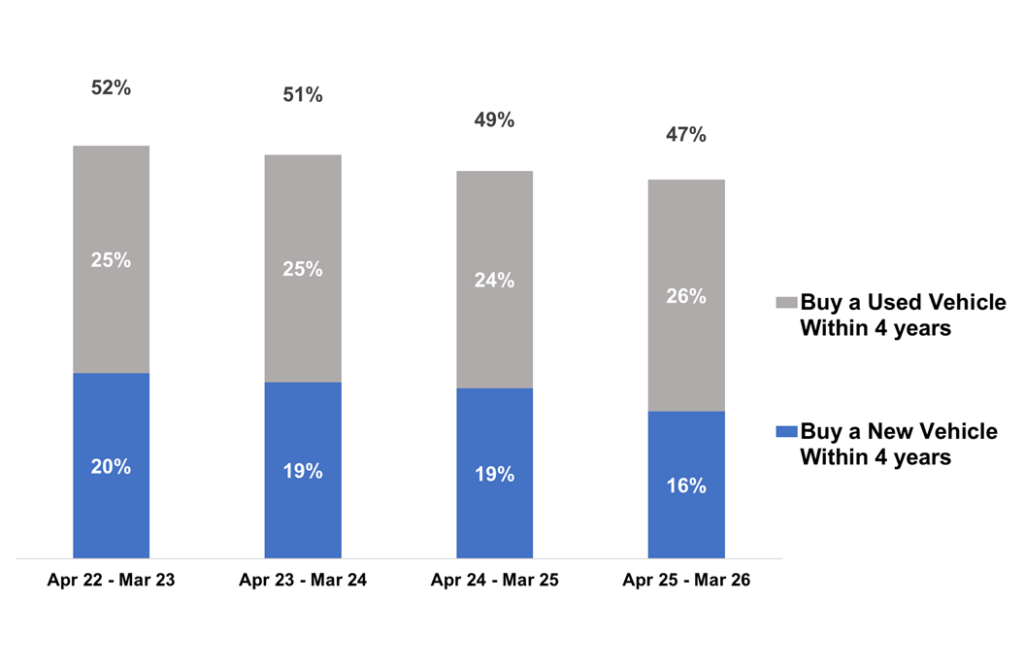
Source: Roy Morgan Single Source (Australia), April 2022 – March 2026. Average number of interviews for each 12 -month period, n=64,868. Base: Australians 14+. Question: How many years is it likely to be before you buy a car for yourself – or replace your own car – or in some other way get a car for yourself? Is it likely to be a used car or a new car?
“Buying a new car is a big decision,” said Roy Morgan CEO Michele Levine in a statement. “The latest data on car buying intentions reflects Australians believe now is not a good time to make big purchase decisions in the middle of a cost-of-living crisis.
“This is consistent with what we see in our latest ANZ-Roy Morgan Consumer Confidence index – which remains near a record low. Indeed, only 13 per cent say now is a ‘good time to buy major household items’, while the majority (49%) say it is a ‘bad time to buy major household items’.”
While research indicates new cars are set to take a sales hit, consumer confidence around used cars remains strong, with around one-in-four Australians (26 per cent) indicating they are looking to purchase a second-hand car within the next four years, a slight increase measured against March 2023 (25 per cent).
Roy Morgan’s data also underscored the popularity of SUVs, its research highlighting that 56 per cent of respondents confirming they intend to buy an SUV as their next new car purchase. Passenger cars (non SUVs) have fallen out of favour, with buyer intention dropping by seven per cent to just 23 per cent, down from 30 per cent in March 2023.
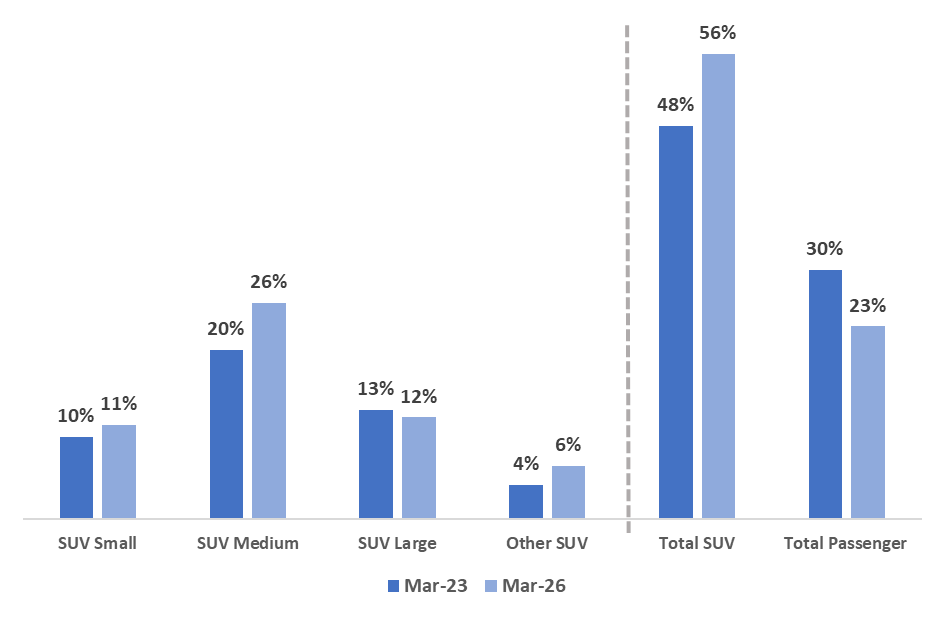
Source: Roy Morgan Single Source (Australia), April 2022 – March 2026. Average number of interviews for each 12 -month period, n=64,868. Base: Australians 14+ intending to buy a new vehicle in the next 4 years.
“The popularity of SUVs remains strong, with the majority of new car intenders (56%) saying they intend to buy an SUV,” said Ms Levine. “The increased popularity of Medium SUVs is good news for car manufacturers with models in this category.
“More importantly, this is an appealing market for Chinese car manufacturers entering an increasingly competitive Australian market which is expected to improve price competition for Medium SUVs.”
Roy Morgan’s research correlates with sales data compiled by the Federal Chamber of Automotive Industries which shows that SUVs made up around 62 per cent of the total new car market in April 2026, up from 60 per cent over the corresponding period last year. Traditional passenger cars accounted for just 13.3 per cent of the market, down from 13.7 per cent.
The April results also highlighted a shift in the popularity of legacy brands as an increasing number of Chinese manufacturers make inroads into the Australian market. Toyota remained the market leader with 15,185 sales. However, BYD with 7702 vehicles sold, moved into the number two slot, capturing 8.3 per cent of the market. The result underscores the rapid rise of Chinese manufacturers, which collectively accounted for around 30 per cent of total sales during April.
The 2026 BYD Ti7 could form part of a one-two punch in Australia’s large SUV segment alongside the existing BYD Sealion 8.
The large plug-in hybrid three-row SUV has just been announced as part of BYD’s UK line-up, and the availability of a right-hand-drive version opens the door to an Australian introduction.
Despite its chunky off-road looks and Land Rover Defender-like styling, including a carrier box on the tailgate that looks like an externally-mounted spare wheel, the Ti7 uses unibody construction, similar to potential rivals like the Hyundai Santa Fe, Kia Sorento, and Toyota Kluger.
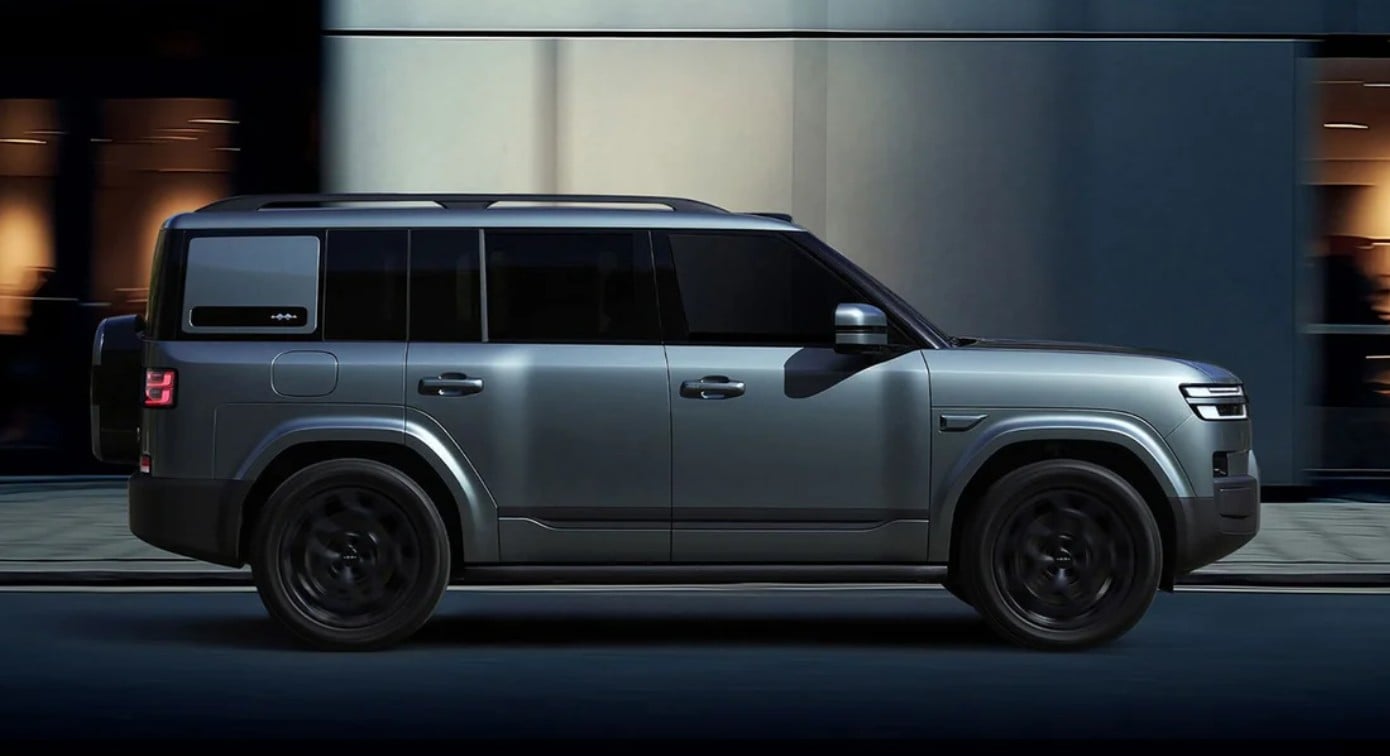
While the Ti7 will be sold under the BYD brand in the UK, in China it falls under the Fangchengbao brand, in the same showrooms as the B5 and B8 body-on-frame plug-in hybrid SUVs, which are sold under the Denza brand in Australia.
Full specifications for the UK market have not yet been revealed, but BYD UK confirms that the Ti7 will come with dual electric motors and a 1.5-litre turbocharged petrol engine, under its Dual Mode Performance (DM-p) label. EV-only driving range is claimed to be 127km (WLTP), and 0-100km/h acceleration takes a claimed 4.8 seconds.
Chinese-market versions of the Ti7 feature a 160kW front motor and 200kW rear motor, down slightly on the dual 200kW motors offered on the BYD Sealion 8 DM-p PHEV sold in Australia, which has a 152km EV-only range using more lenient NEDC testing and a 4.9-second 0-100km/h claim.
Unlike the Chinese version, which measures 4999mm long, the UK model will stop the tape at 5146mm long, making it larger than the Sealion 8 (5040mm), Santa Fe (4830mm), Kluger (4966mm), and closer in size to BYD’s flagship Denza B8 at 5195mm.
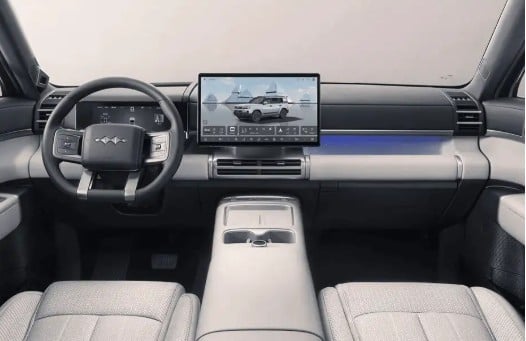
The three-row cabin will be offered with seven seats in the UK, unlike China’s five-seat layout, but the thick D-pillar design could limit outward visibility for rearmost occupants. Chinese specifications not confirmed for the UK version include up to seven screens in the interior, an included refrigerator with a -6ºC to 50ºC cooling and heating range, 20-speaker sound system, and heated, ventilated and massaging seats.
With BYD’s UK line-up closely aligned to what’s offered in Australia, the door is open to an Australian introduction for the Ti7, but where Australia already has the Sealion 8 to fill the need for a large seven-seat PHEV family SUV, the UK does not.
BYD may opt to add the Ti7 to the more upmarket Denza range if it comes to Australia. BYD has been contacted for comment.
“Toyota’s mini-4WD has the underpinnings of a hot hatch – and ‘cool’ and ‘cult’ written all over it.”
So wrote Wheels in July 1994 of the then brand-new Toyota RAV4 which had just arrived in Australia amid much fanfare and with both eyes firmly on the ‘youth market’. No one, not even the august scribes at Wheels, could have foreseen what would transpire over the intervening decades. As the saying goes, from humble beginnings…
Fast forward 32 years and six generations of RAV4 later and not only is Toyota’s soft-roader the king of SUVs in Australia, but it’s also totally unrecognisable from the ur-RAV4 Wheels first reviewed in 1994.
Then, Toyota opted to launch its new crossover on the Gold Coast, something we noted would become “the RAV4’s heartland”.
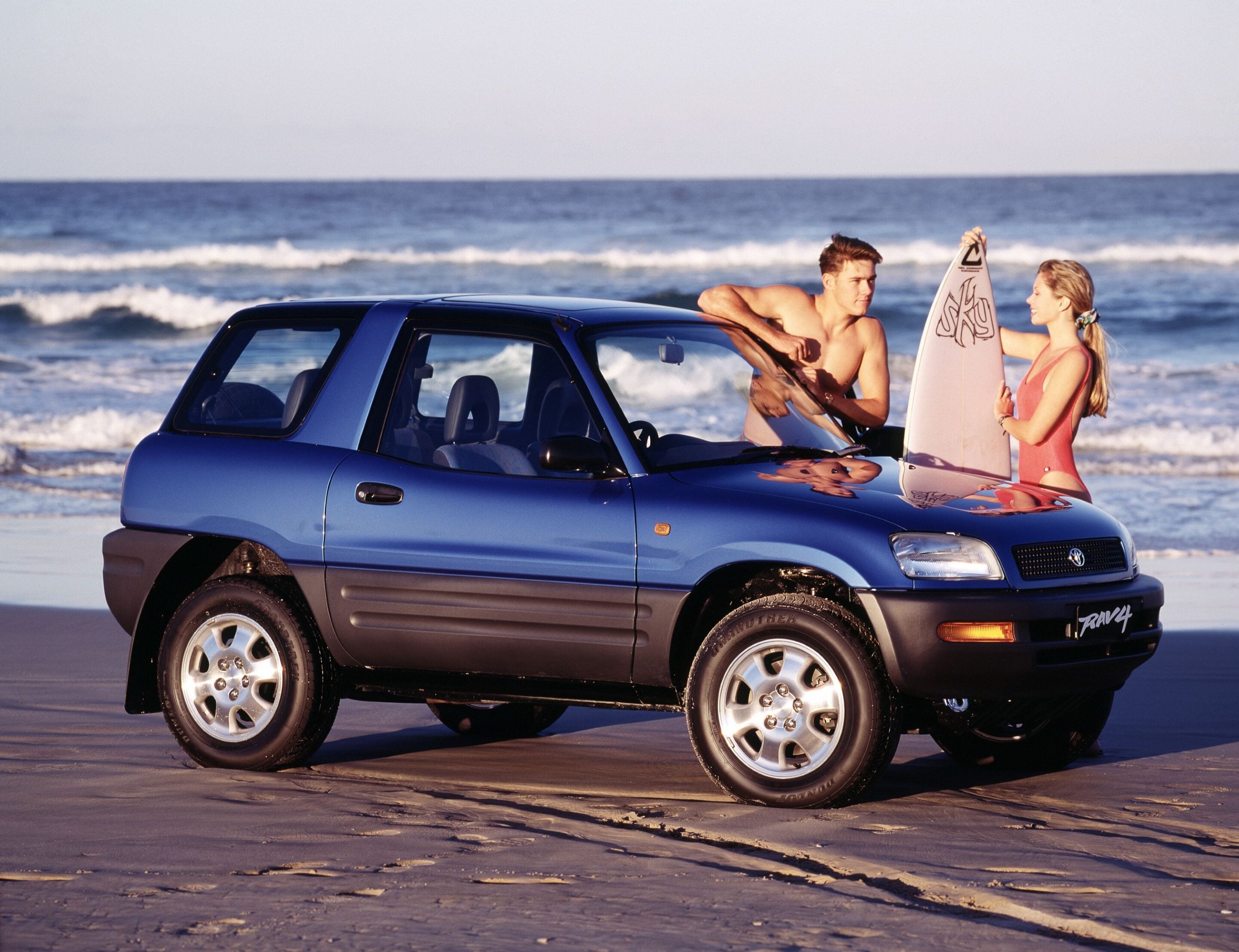
“Its Friday night crowds represent a microcosm of Australian youth culture, where Toyota expects to find the RAV4’s main market.”
And we were effusive in our praise, the RAV4 laying down markers in what was then still very much a nascent segment of compact, affordable crossover SUVs.
“Other compact 4WDs like Suzuki’s Vitara and Daihatsu’s Feroza might surpass the RAV4 in hard 4WD terrain, but in virtually every other department the mini Toyota has redefined the parameters by which this class of vehicle will be judged.”
Certainly a bold prediction at the time, but as the intervening decades have proved, the RAV4 has gone on to become not only a mainstay in driveways all over Australia, but the single biggest selling SUV in Australia of all time. Earlier this year, Toyota confirmed it had sold around 588,000 of its game-changing SUV since that first night on Cavill Avenue.
Those early “crowds of young revellers”, wrote Wheels in 1994, who had stopped to “ogle the cobalt blue RAV4” with “admiring eyes” caressing “its curvaceous lines”, would not recognise today’s RAV4. After all, that original crossover played into the then-zeitgeist of fun and funky two-door soft-roaders, more at home in Surfers Paradise, Chapel Street and Campbell Parade than exploring outback Australia.
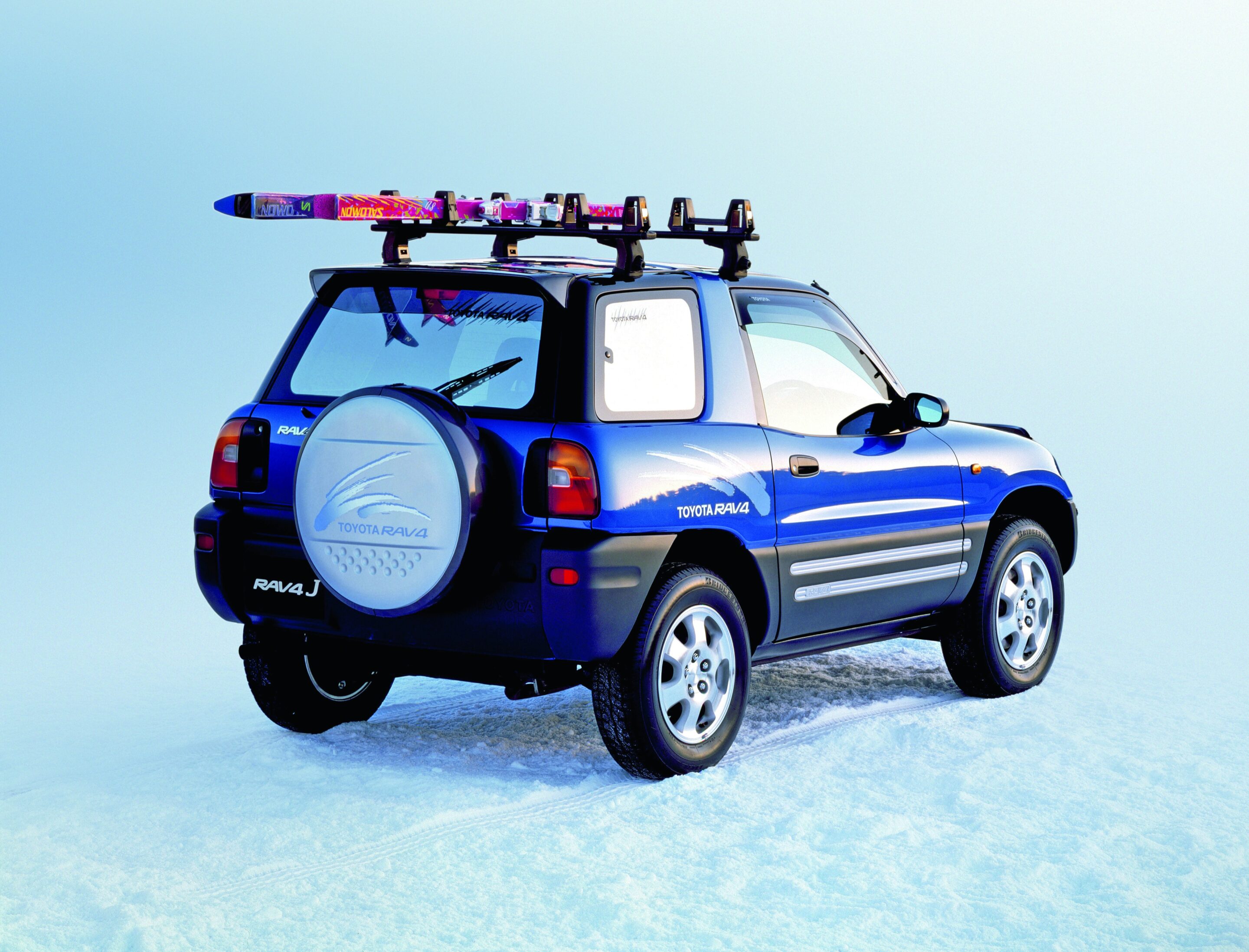
Today’s trends are in stark contrast, demanding a family-sized SUV capable of ferrying five people and their belongings in comfort and with the kind of fuel efficiency 1994 buyers couldn’t even begin to imagine. It’s a modern automotive template pioneered by Toyota, a blueprint almost every automaker in the world has attempted to replicate.
It’s interesting to note just how much has changed over the decades, how a compact crossover Wheels once consigned to little more than a niche category, where ‘cool’ over-rode all other considerations, became the sales juggernaut beloved of families all over Australia – and the rest of the world – today.
Pricing
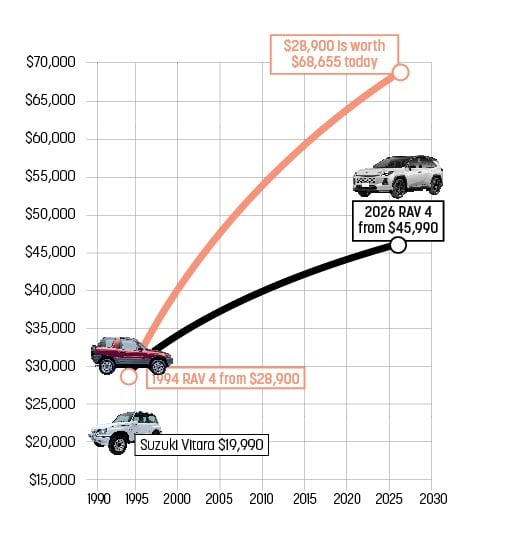
The OG RAV4 wasn’t exactly cheap when it hit Aussie showrooms in the middle of 1994. Perhaps dipping its toes in the water, Toyota brought only a single grade to Australia, available with either a five-speed manual gearbox or four-speed automatic transmission.
Pricing started at $28,900 (plus on-road costs) for the manual RAV4, with the automatic costing $2000 more. For context, a manual three-door Suzuki Vitara cost $19,990, closely matched by the entry-level Daihatsu Feroza ST which, in manual trim, asked for $20,852.
Fast forward three decades and with manual transmissions consigned to the RAV4 graveyard, the entry point has jumped to $45,990 for the GX front-wheel drive variant. Want all-wheel drive? That’ll drain your bank account to the tune of $49,340 for the base model GX AWD.
That’s not as steep a jump as one might expect after 32 years, with the Reserve Bank of Australia calculating that $28,900 in 1994 money is worth around $68,655 today.
Size
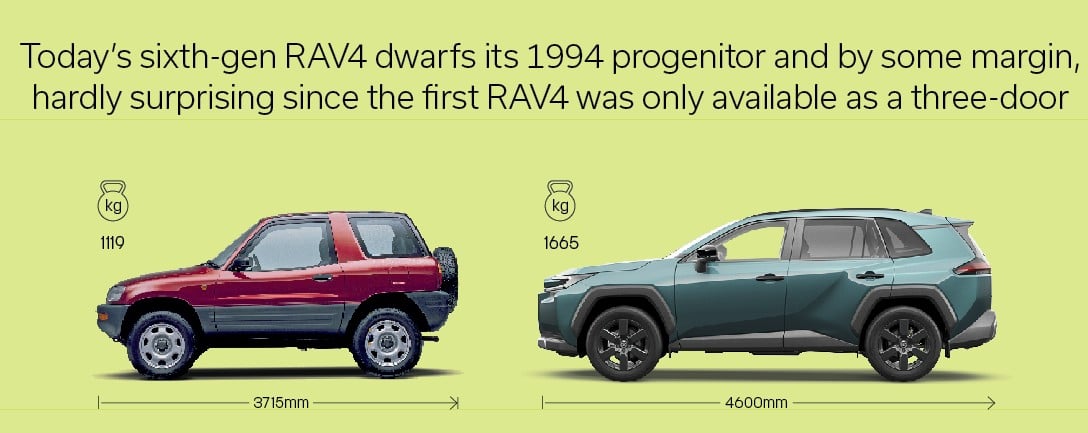
Today’s sixth-gen RAV4 dwarfs its 1994 progenitor and by some margin, hardly surprising since the first RAV4 was only available as a three-door (the five-door would arrive in 1995, kick-starting the medium SUV revolution that shows no sign of slowing down).
Stopping the tape at 3715mm long, 1994’s RAV4 is lost in the shadows of its 2026 counterpart which measures some 885mm longer, 160mm wider, 25mm taller and sitting on a 490mm longer wheelbase. It’s also – unsurprisingly – 546kg lighter than the current generation model.
“For its compact exterior dimensions the RAV4 has good levels of interior space and comfort,” we wrote in 1994. “Once in the back seat, there’s realistic accommodation for two people, with enough room between seat back and cargo door to cram a couple of overnight bags.”
That’s right, the 1994 three-door RAV4 was strictly a four-seater, and with minimal space for luggage,
a long way from the comfortable family wagon it has metamorphosed into today.
Equipment
Hailing from the strictly analogue age, the 1994 RAV4 was bereft of the standard kit featured today in even the most basic new cars on our roads.
A four-speaker AM/FM radio-cassette audio system provided the ‘infotainment’ while creature comforts ran to tinted glass, intermittent wipers front and rear, cupholders (still a novelty back then), a digital clock and remote opening for the fuel-filler cap.
The steadfastly analogue instrument cluster featured a speedometer, tacho, along with fuel and temperature gauges.
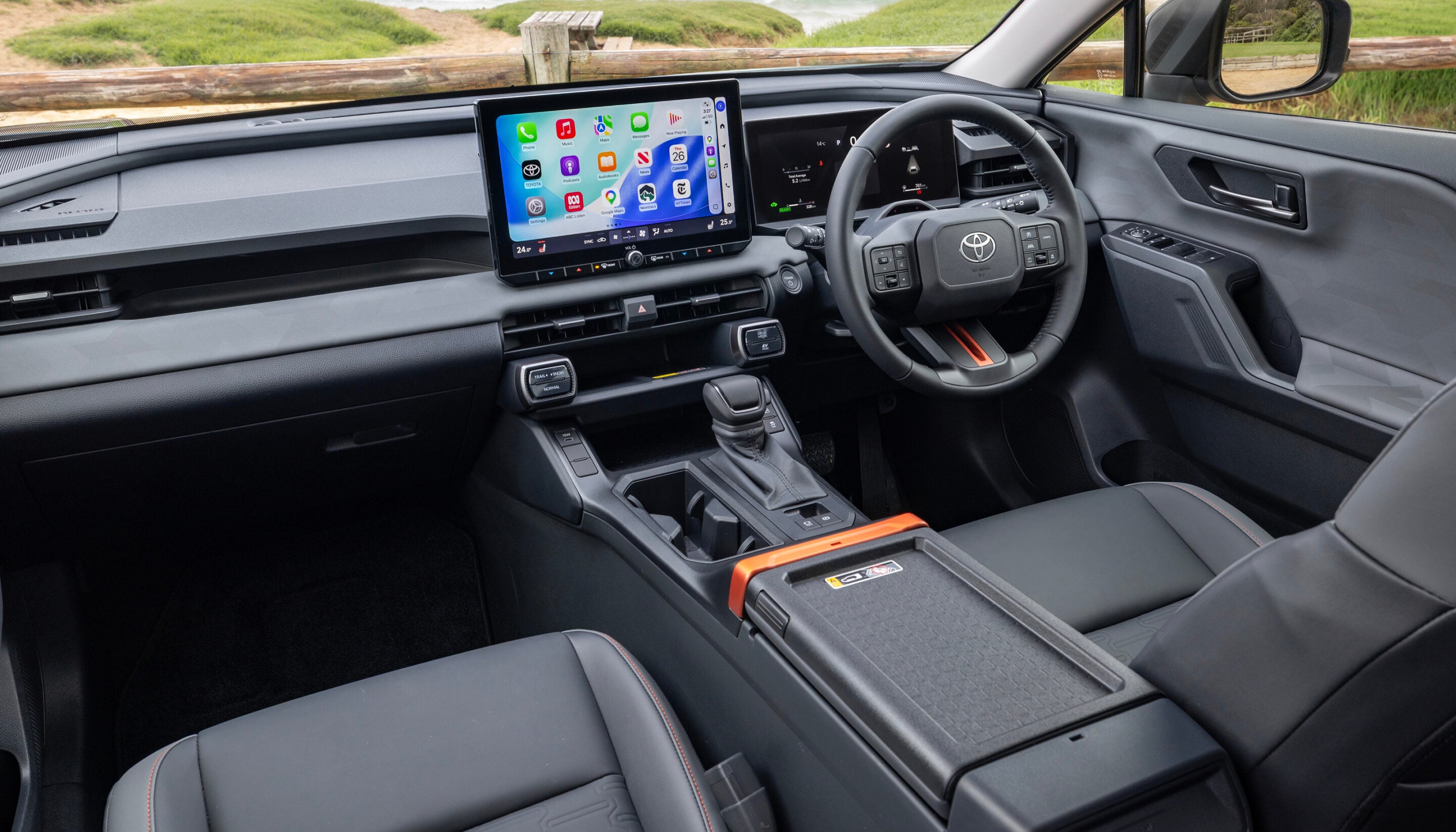
Today, of course, new car cabins are more akin to entertainment hubs than car interiors with big screens, phone integration, satellite navigation, and an endless choice of music streaming options played through, in the base model, a six-speaker stereo system.
One of the big selling points of the first RAV4 was its class-leading safety equipment. As Wheels noted, “Safety will be one of the RAV4’s major sales platforms: from its strong, lightweight, monocoque chassis, designed to incorporate collision impact absorbing structures (CIAS), to its four-wheel independent suspension and full-time 4WD system, through features like door side-intrusion beams, a collapsible steering column, child restraint anchorages, and a fuel tank forward of the rear wheels.
“The real heavy hitters in the safety package are the 45 litre driver’s airbag and antilock brakes, both options and both firsts for this class of vehicle.”
That seems positively quaint compared to the level of safety technologies bundled into today’s new cars, where airbag counts can run into double digits and where the car will offer all manner of warnings and interventions to keep you safely on the road, even if the efficacy of those various technologies can sometimes leave owners hankering for the ‘good old days’.
Powertrains
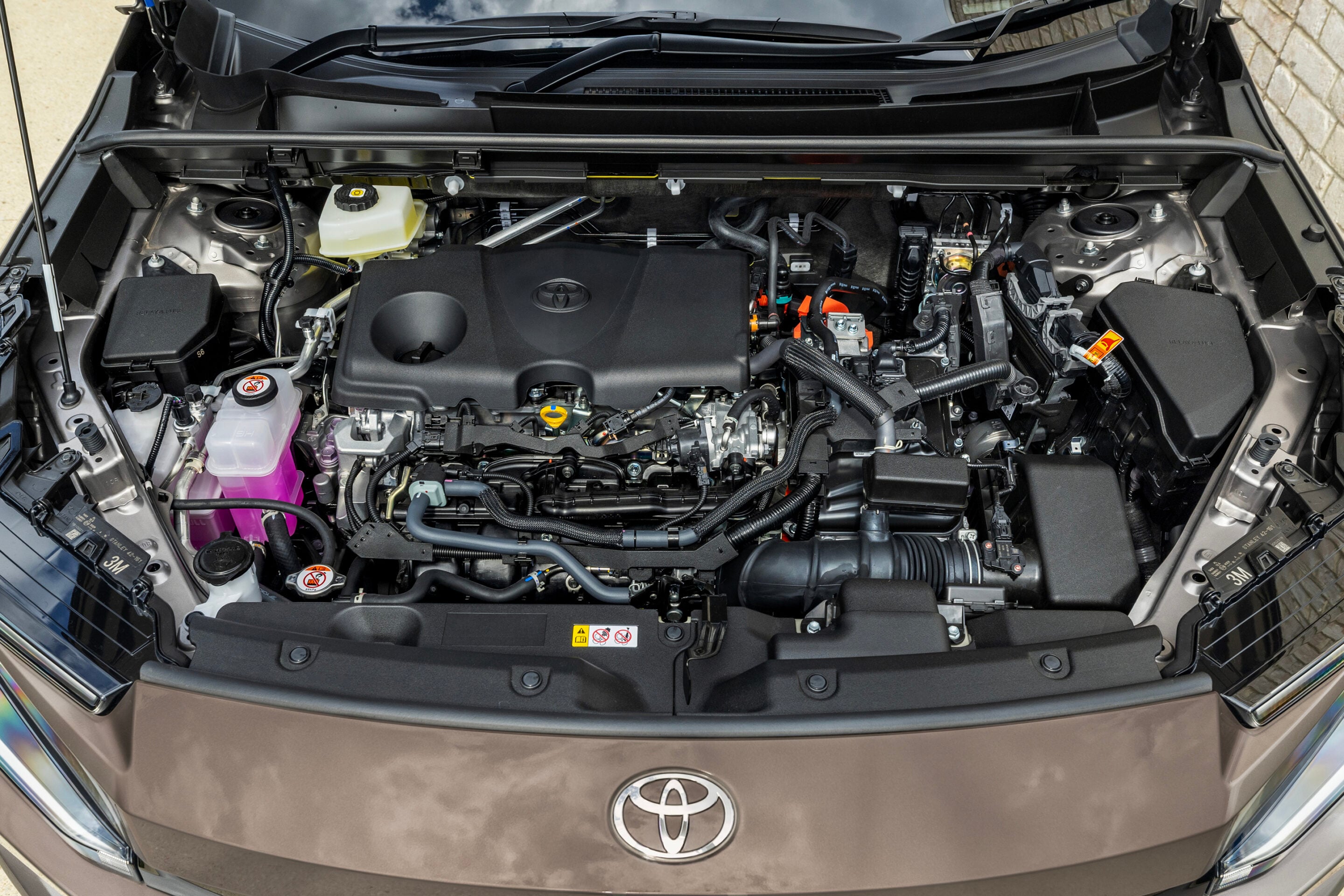
It’s here where Toyota stamped its authority on the compact SUV segment in 1994, with a transversely mounted 2.0-litre, fuel injected, twin cam tucked away under the RAV4’s short, stubby bonnet.
With outputs of 96kW and 180Nm transmitted to all four wheels, the RAV4 could, according to Wheels, “comfortably account for any 4WD competitors, but also give some sports coupes a run for their money”.
Fuel economy was a claimed 9.5L/100km of regular 91-octane unleaded. Contrast that to today where Toyota’s pioneering hybrid system underpins the entire RAV4 range. With a 2.5-litre petrol engine working in tandem with permanent magnet electric motors, Toyota claims today’s RAV4 makes a combined 143kW although stops short of offering a torque figure. Such a Toyota thing to do.
A continuously variable transmission sends drive to either the front wheels (in FWD models) or all four wheels, a departure from the torque converter automatic of old.
On paper, the new RAV4 offers less power than the fifth-generation model preceding it which was good for 160kW (front-wheel drive models) and 163kW for AWD. Toyota says the 2.5-litre’s detune is the result of needing to meet Australia’s ever more stringent emissions regulations.
The fettling has also improved fuel economy, now rated at 4.6L/100km against the previous model’s 4.8L.
Ambitions
While it might have seemed on the surface that Toyota was taking a risk investing in a compact SUV with seating for four and a price tag far in excess of its main rivals in the small but growing segment, someone at HQ had clearly been reading the tea leaves.
According to Toyota Australia at the time, the Japanese brand was confident “the RAV4 will be the largest single contributor to the growth in 4WD volume on the Australian market in the next 12 months”.
Wheels weighed in with “last year in Australia the compact segment accounted for only around 15 per cent of the overall 4WD wagon market, but Toyota believes this is set to grow steadily, with at least half of the estimated 4800 annual RAV4 sales expected to be incremental to the 4WD market.
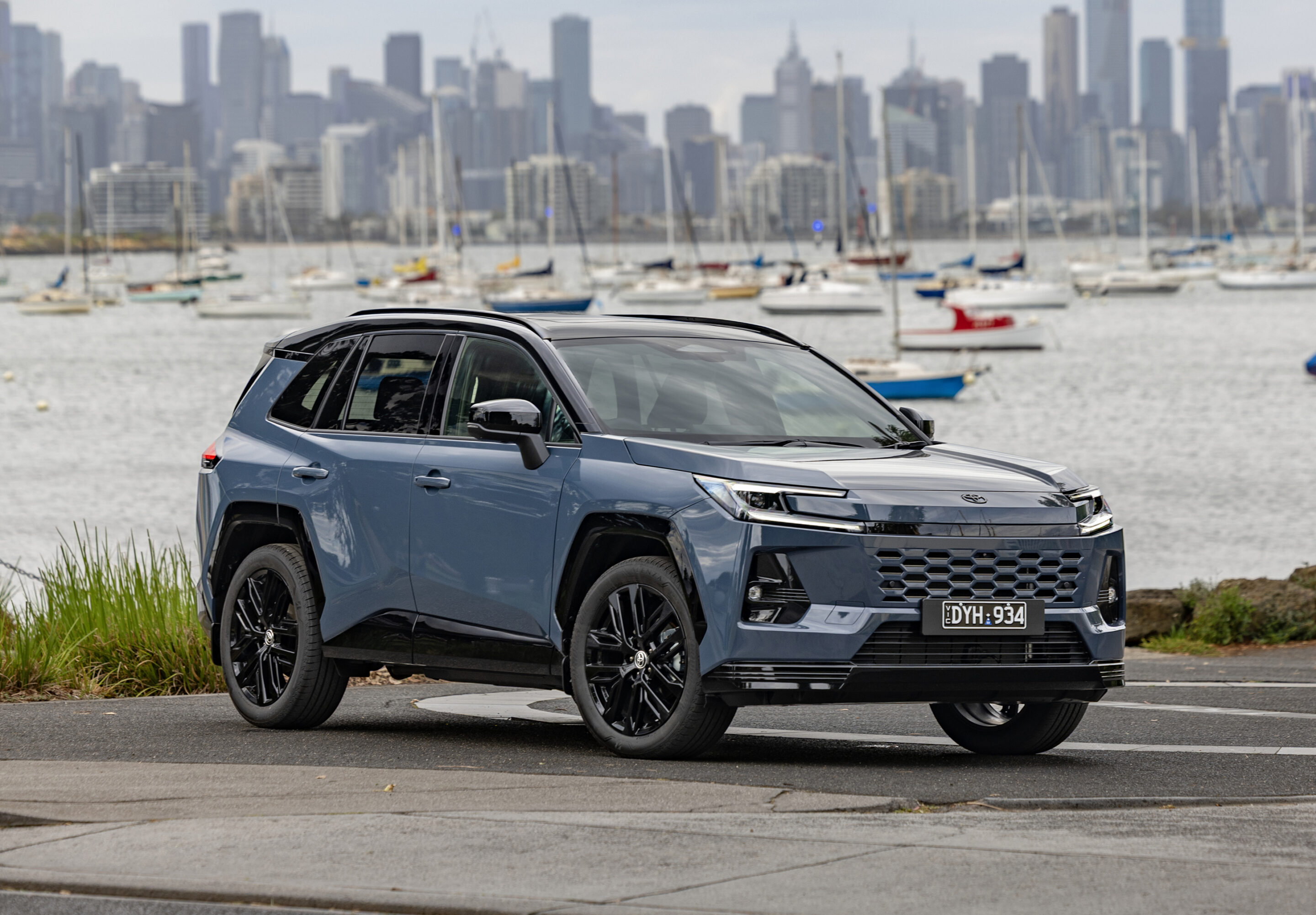
“Despite a premium price tag that will see fully loaded versions retailing for somewhere around the $35,000 mark, the RAV4’s good all-round performance, its contemporary looks and Toyota’s marketing muscle should see it make major inroads on the Australian market this year.”
After a slow start (Toyota sold just 1350 of the little three-door in its first part-year on sale), it was the introduction – and popularity – of the five-door RAV4 in 1995 that emphatically announced its arrival on our roads. Australia’s SUV revolution was underway.
1994 RAV4 manual
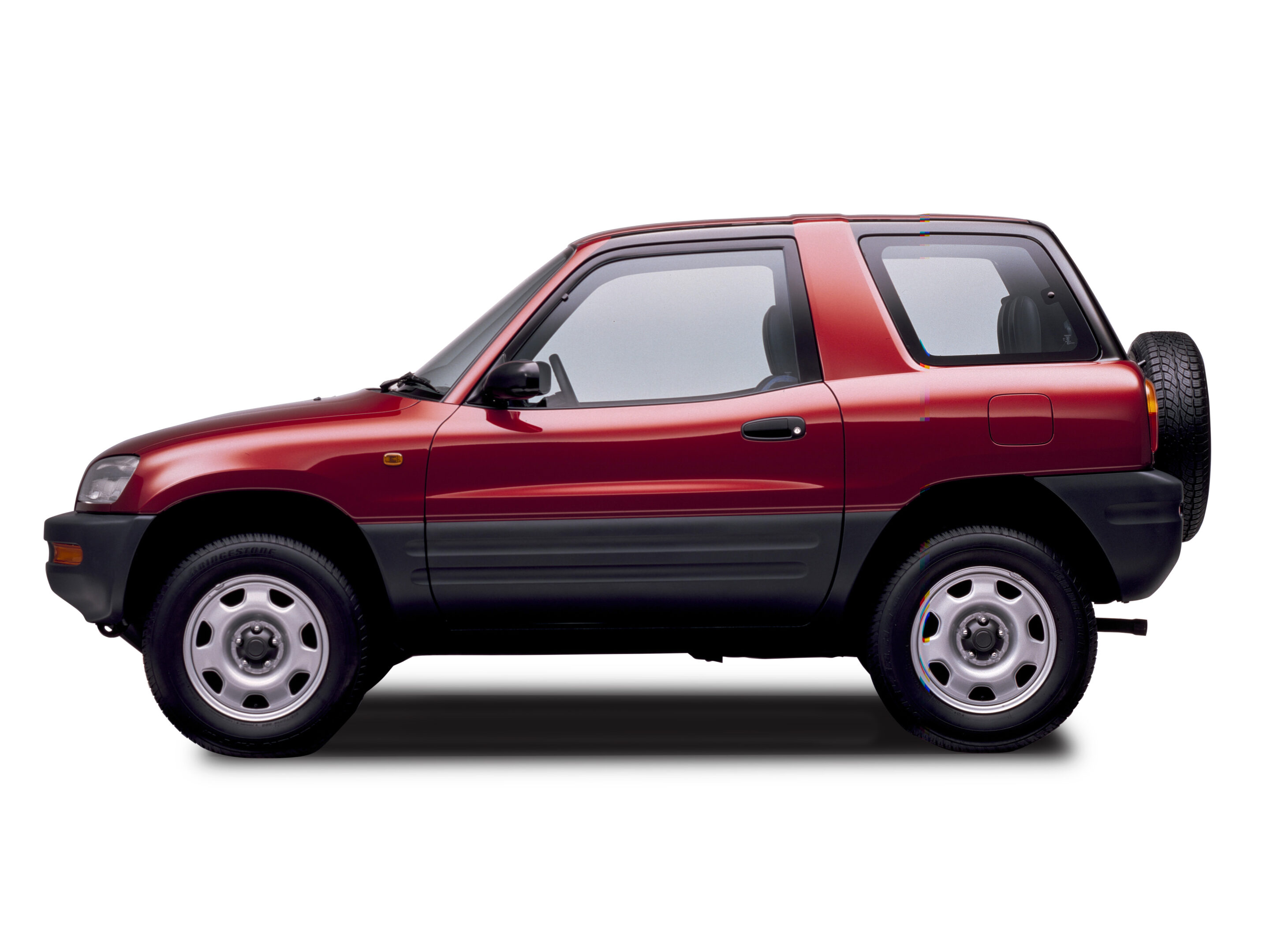
| Price | $28,900 (manual) / $30,900 (automatic) |
|---|---|
| Engine | 2.0-litre inline-four cylinder petrol |
| Power | 96kW @ 5800rpm |
| Torque | 180Nm @ 4400rpm |
| Transmission | 5-speed manual / 4-speed automatic |
| Power-to-weight | 85.8 kW/t |
| Fuel consumption | 9.5L/100km |
| Dimensions (l/w/h/wb) | 3715/1695/1655/2200mm |
| Tare mass | 1119kg |
| Warranty | 3 years/100,000km |
2026 RAV4 GX
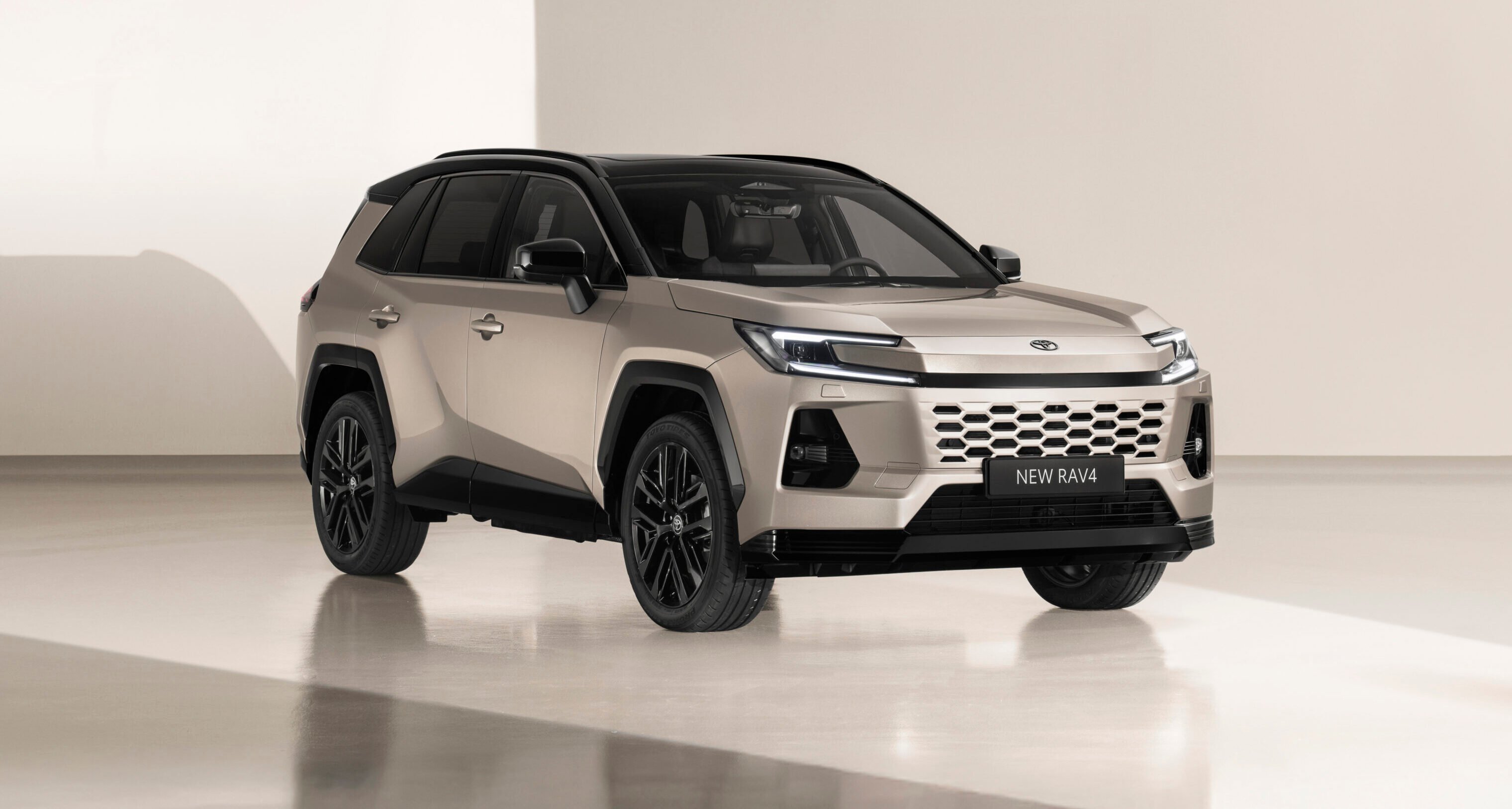
| Price | $45,990 (FWD) / $49,340 (AWD) |
|---|---|
| Engine | 2.5-litre inline-four cylinder petrol-hybrid |
| Power | 143kW (combined) |
| Torque | NA |
| Transmission | Continuously variable |
| Power-to-weight | 85.9 kW/t |
| Fuel consumption | 4.6L/100km |
| Dimensions (l/w/h/wb) | 4600/1855/1680/2690mm |
| Tare mass | 1665kg |
| Warranty | 5 years/unlimited km |
This story first appeared in the May 2026 issue of Wheels magazine, now on sale. Subscribe here and gain access to 12 issues for $109 plus online access to every Wheels issue since 1953.
GWM has introduced a series of Australia and New Zealand-specific updates for the 2026 Tank 500 Hi4-T plug-in hybrid SUV, aimed at improving ride comfort, steering feel and everyday usability.
The changes form part of what GWM calls its “AT-1” localisation program, with revised suspension damper tuning and updated steering calibration developed specifically for Australian and New Zealand road conditions.
According to the company, the updates are designed to improve handling response and driver confidence across urban roads, highways and off-road terrain. The Tank 500 Hi4-T becomes the second GWM model to receive factory-integrated ride and handling tuning tailored for the local market.
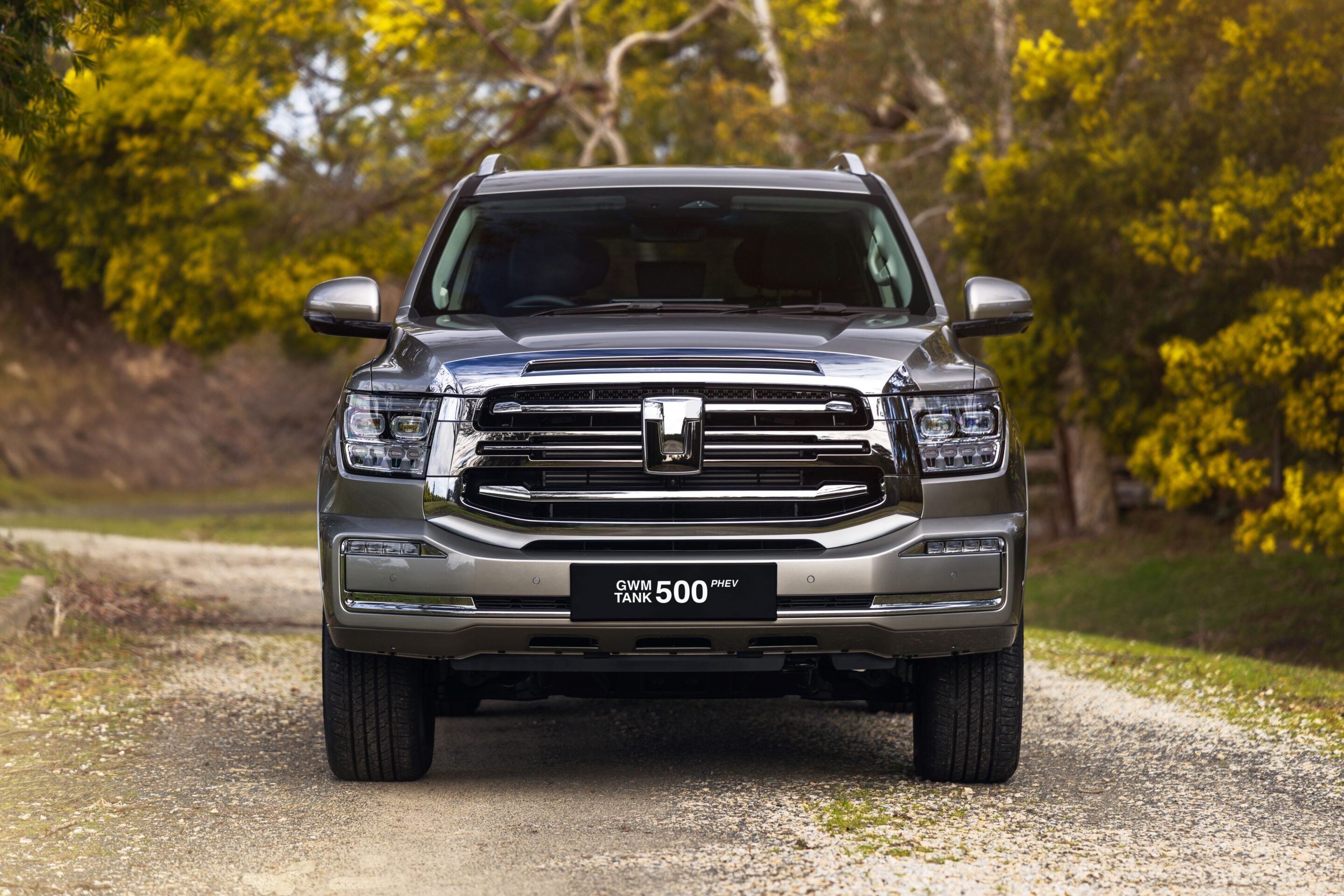
The Tank 500 Hi4-T is one of several large electrified SUVs entering Australia from Chinese manufacturers, combining traditional off-road capability with plug-in hybrid power.
Alongside the suspension and steering revisions, the updated model also gains a new 220-volt power outlet mounted in the rear cargo area. The addition expands the SUV’s vehicle-to-load (V2L) capability, allowing owners to power external equipment such as camping accessories, tools and small appliances directly from the vehicle’s battery system.
The Tank 500 Hi4-T uses a plug-in hybrid drivetrain combining a turbocharged petrol engine with electric motor assistance, positioning it as an alternative to large diesel-powered four-wheel drives and family SUVs.
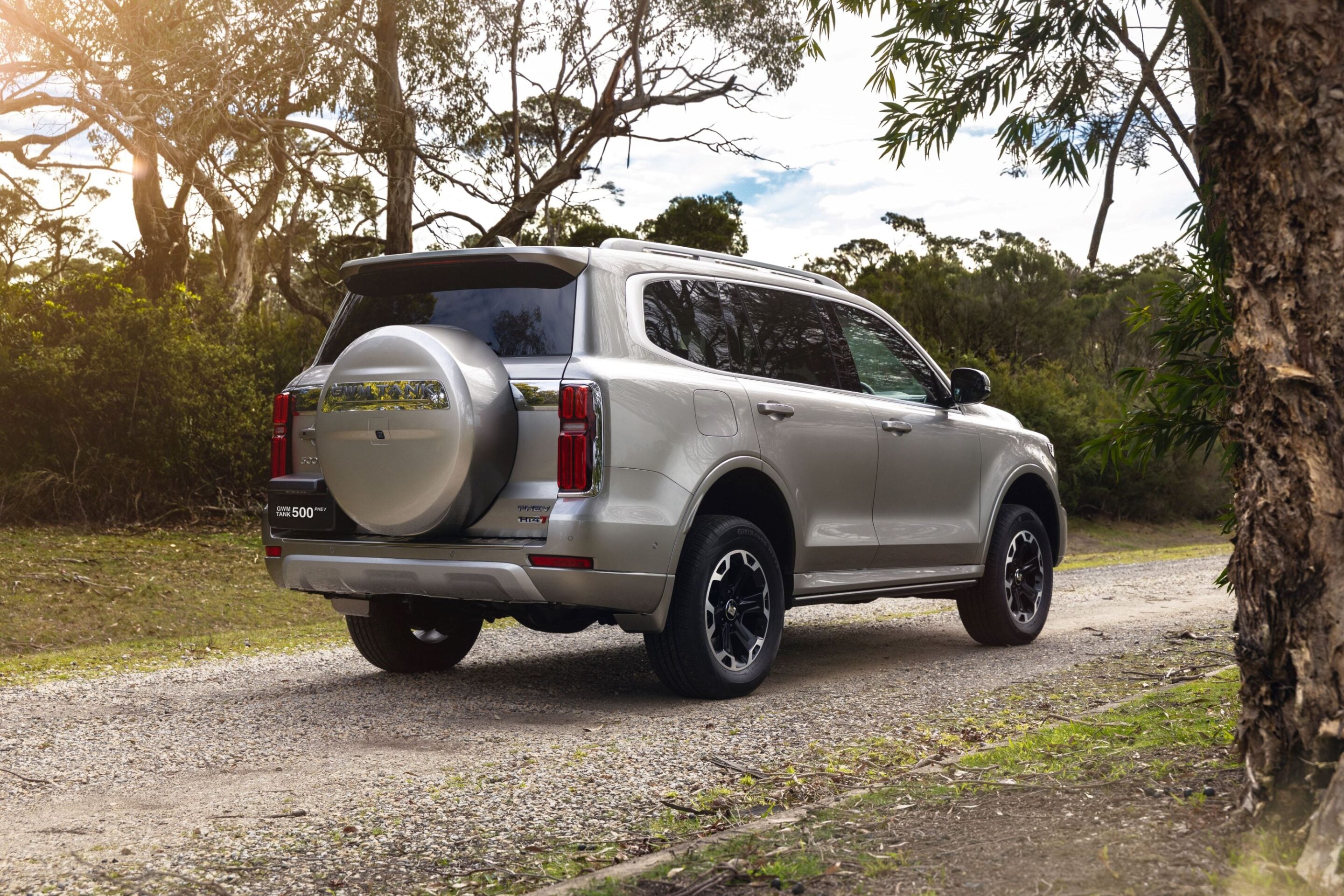
GWM has increasingly focused on adapting its vehicles for local conditions as the brand expands in Australia. Several manufacturers, including Ford, Toyota and Nissan, conduct Australian-specific suspension and steering tuning to better suit coarse road surfaces, long-distance touring and regional driving conditions.
Pricing for the updated 2026 Tank 500 Hi4-T PHEV is currently listed at $77,990 drive-away under May promotional offers, compared with a standard drive-away price of $79,990.
The revised specification applies to MY26 vehicles built from March 2026 onwards, with local dealerships expected to begin receiving updated stock in coming months.
CUPRA has confirmed Australian pricing and specifications for the new Leon Ve plug-in hybrid hatchback, introducing a longer-range electrified option to the updated Leon range.
Priced from $62,990 before on-road costs, the Leon Ve becomes the latest addition to CUPRA’s growing local PHEV line-up, joining plug-in hybrid versions of the Formentor, Terramar and Leon Sportstourer.
The headline change is a new second-generation plug-in hybrid system paired with a significantly larger 20kWh usable battery pack. CUPRA claims the hatchback can travel up to 123km on electric power alone under WLTP testing, placing it among the longest-range plug-in hybrids currently available in Australia.
Power comes from a combination of a 1.5-litre turbocharged four-cylinder petrol engine producing 110kW and an electric motor delivering 85kW. Total system outputs are rated at 150kW and 350Nm, with claimed 0-100km/h acceleration in 7.7 seconds.
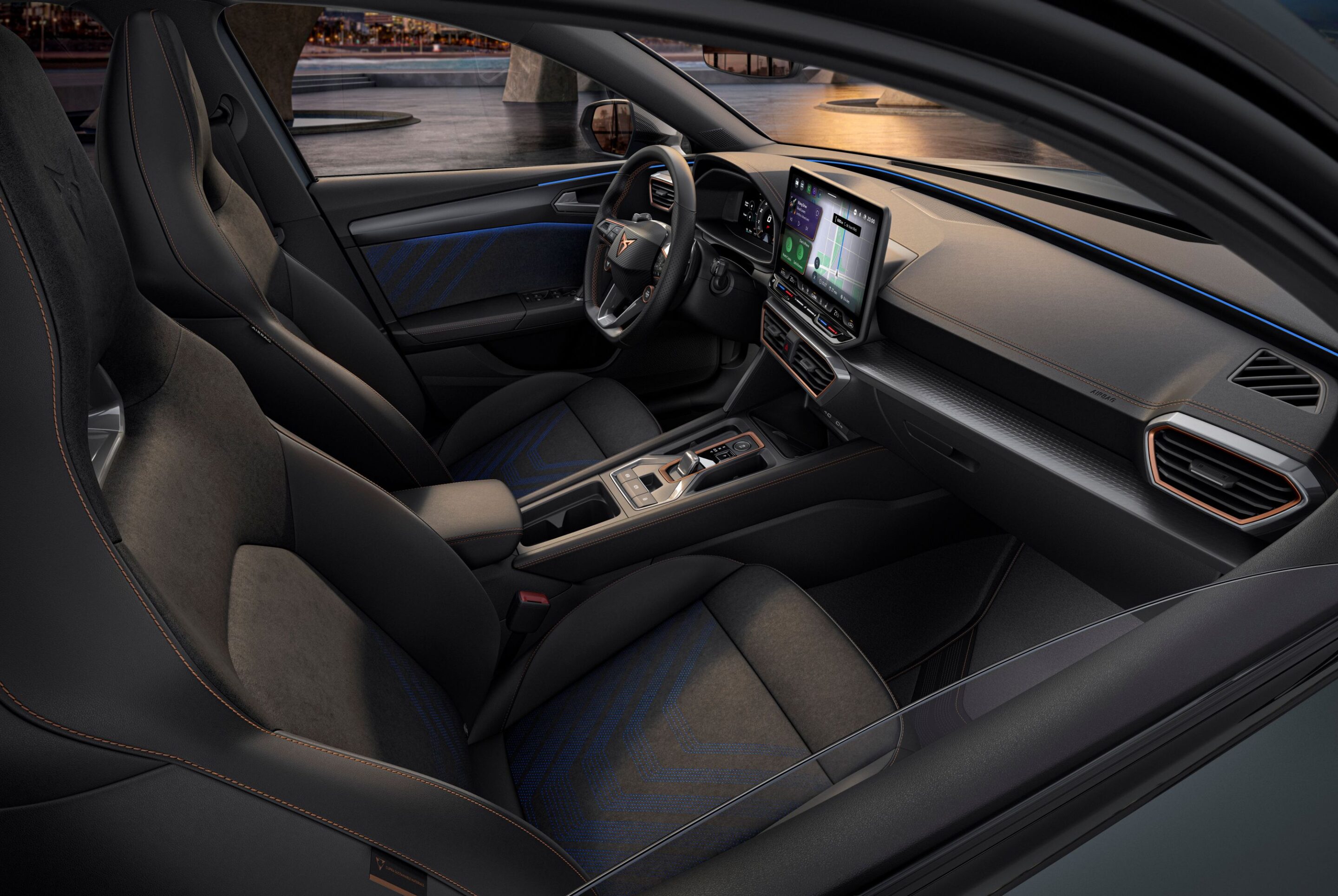
The larger battery nearly doubles the usable capacity of CUPRA’s previous-generation PHEV system and contributes to a claimed combined fuel consumption figure of 1.4L/100km.
Charging capability has also improved substantially. AC charging increases from 3.6kW to 11kW, while DC fast-charging is now supported for the first time on a Leon plug-in hybrid.
The Leon Ve forms part of the recently updated Leon hatchback range introduced in late 2025, gaining revised exterior styling including a redesigned front end, triangular daytime running lights and a full-width rear LED light bar.
Standard equipment includes 18-inch alloy wheels, sports bucket seats, a power-adjustable driver’s seat, heated steering wheel, tri-zone climate control and a 12.9-inch infotainment system with wireless Apple CarPlay and Android Auto.
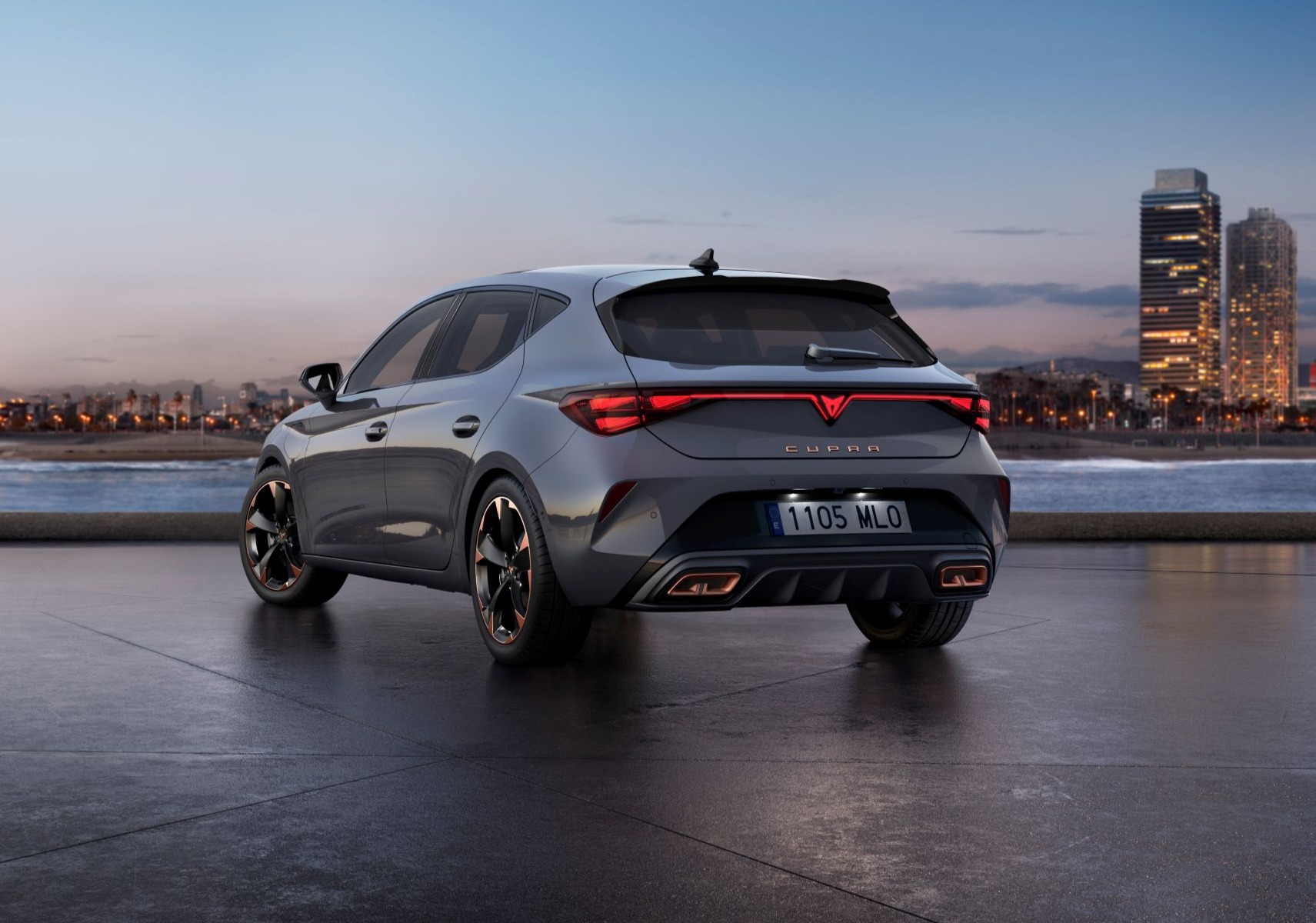
The Leon Ve is positioned between the entry-level mild-hybrid Leon S and the more powerful Leon VZx performance hatch in CUPRA’s local line-up.
Australian showroom arrivals and first customer deliveries are scheduled to begin in June.
Pricing
| Leon S Hatch (110kW MHEV) | $46,990 |
|---|---|
| Leon Ve Hatch (150kW PHEV) | $62,990 |
| Leon VZx Hatch (221kW) | $64,990 |
| Leon VZe Sportstourer (200kW PHEV) | $69,990 |
State-based driveaway CUPRA Leon Ve Hatch (DA*)
NSW: $67,990
QLD: $66,490
ACT: $66,990
VIC: $67,990
SA: $67,490
WA: $69,490
TAS: $67,490
