
BMW’S long-awaited Z4 Concept, unveiled at the Pebble Beach Concours d’Elegance, marks a welcome return to a more elegant aesthetic for the company’s open-topped sports model.
It also represents a decisive end to the residual styling influences of the Chris Bangle era, mirroring the clean lines of the latest 8 Series Concept. The Z4 debuted in 2003, featuring then-radical ‘flame surfaced’ flanks and jarring body detailing. The softer-edged 2009 replacement was the work of 32-year old Juliane Blasi, who attempted to introduce a more classical roadster profile and won an internal design competition.
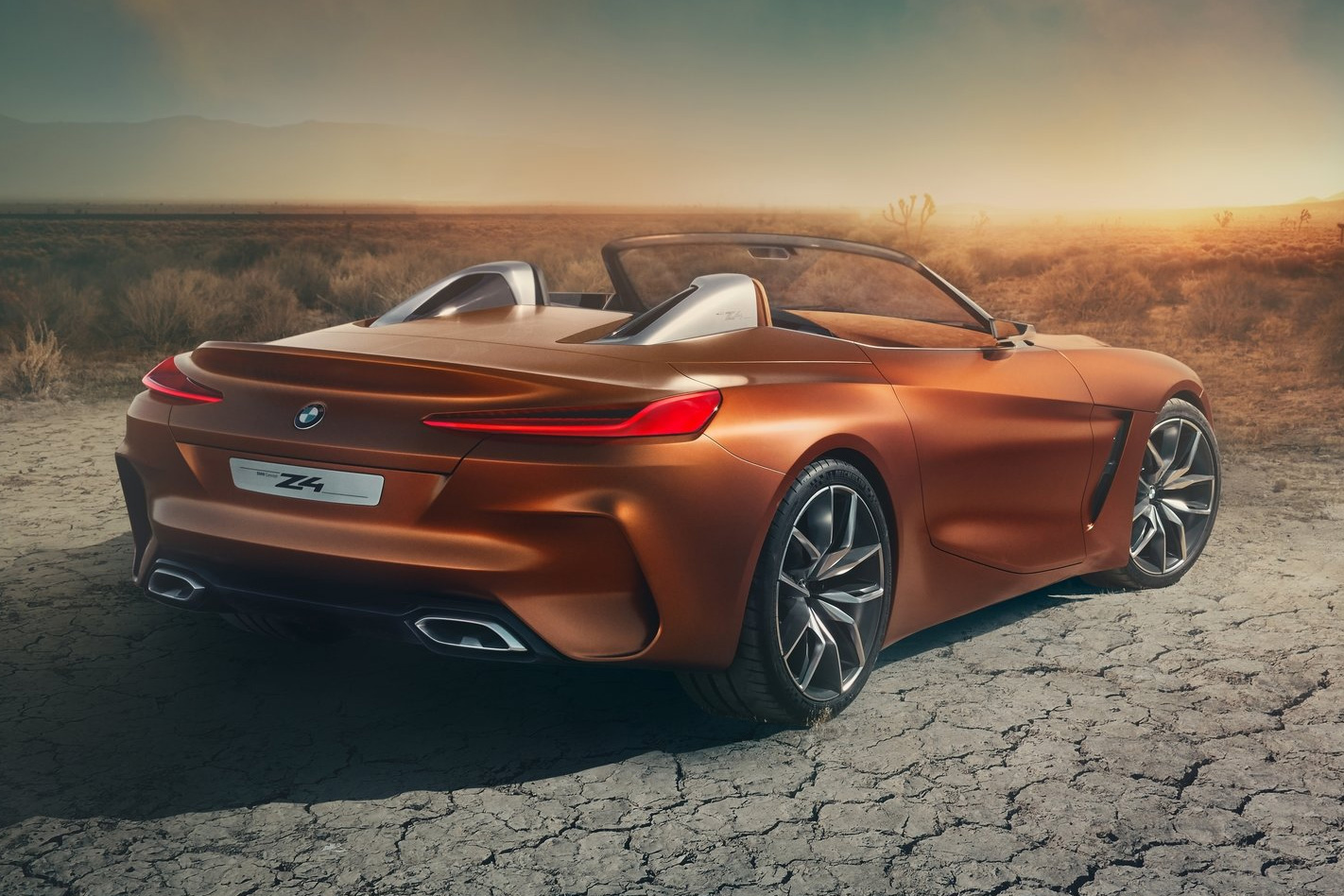
The latest Z4 Concept, designed under the auspices of Adrian van Hooydonk, opts for a slightly more cab-forward look, with stacked headlamps, an aggressively undershot front grille, deeply sculpted flanks, broad rear haunches, and a complex, squared-off tail. Naturally many of the details will be toned down for production, but the fundamentals – to be shared with Toyota’s forthcoming Supra – have received almost universal acclaim.
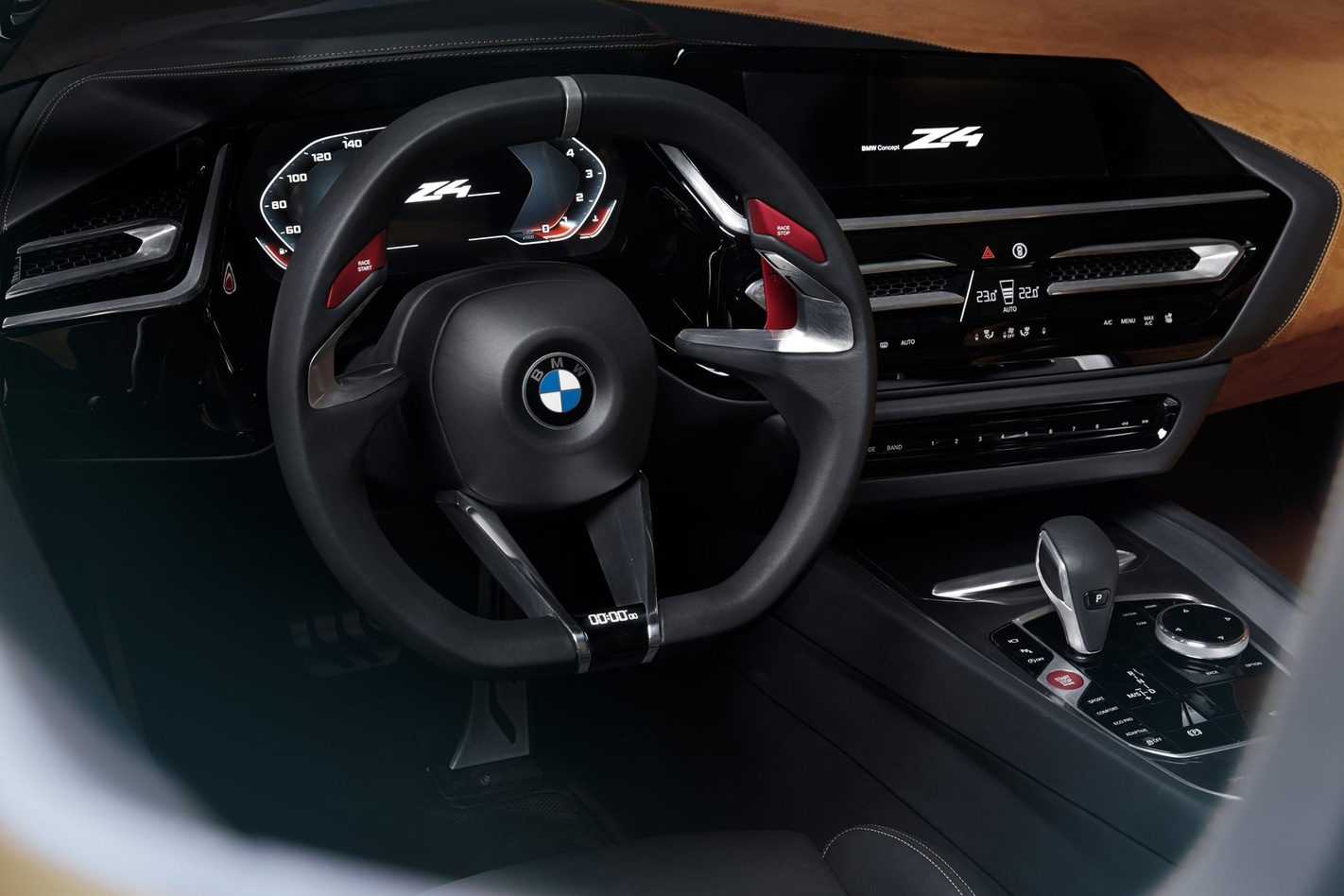
“The sophistication in our mind comes from reduction,” claimed van Hooydonk. “We have fewer and very crisp lines for the exterior, and reductions in the interior as well, with fewer knobs and buttons. The ones we do have are neatly grouped in a couple of islands.”
BMW plans to ditch the outgoing Z4’s folding hardtop and return to a simpler and lighter fabric hood, helping to keep weight in the region of 1400kg, to realise a saving of at least 50kg. Internal BMW documentation seems to suggest three powertrains: a 2.0-litre turbo four with 147kW/320Nm for the sDrive 20i entry-level model and a 195kW/380Nm tune for the 30i variant. The range topper is likely to be a 3.0-litre turbo-six-equipped 250kW/450Nm sDrive M40i. No Z4 M model has yet been announced.
BMW’s rationale for leaving us short of a real fire-breathing version was that this would require re-engineering that would make the car unprofitable if it was targeted as a Boxster S or TT RS Roadster rival. Still, it’s hard to see how a circa-1600kg roadster packaged with the M3 Competition’s 331kW engine wouldn’t have market appeal. Jaguar’s F-Type V6 S would seem to be the proof that there’s a niche for exactly this sort of car.
The cabin gets a digital instrument cluster and head-up display. Production of the Z4 commences next year and BMW is looking to see the car priced at a similar level to the outgoing model which starts at around $80K.
Ferdinand Porsche is rightly hailed as a genius engineer and a key automotive figure.
In 1898, aged just 23, he designed an all-wheel-drive, petrol-electric hybrid; later came the Mercedes-Benz SSK, the radical Auto Union rear-engined racers, and, proving his versatility, some of Germany’s most fearsome WW2 tanks. Then there’s the small matter of the Volkswagen ‘Beetle’ Type 1, whose 21.5 million units make it still the world’s biggest selling car (rather than nameplate).
In 1931, in conjunction with Zundapp, Porsche began developing an economical, rear-engined car, the Porsche Type 12. Porsche had already designed an air-cooled, horizontally opposed four-cylinder engine.
At the 1934 Berlin motor show, German chancellor Adolf Hitler challenged car makers to produce a car to sell at 1000 Reichsmarks, about half the typical price for a car at the time. His transport ministry drew up the specs: up to five passengers, a 100km/h top speed, fuel consumption of seven litres per 100km, and easy to convert to military use and mount a machine gun.
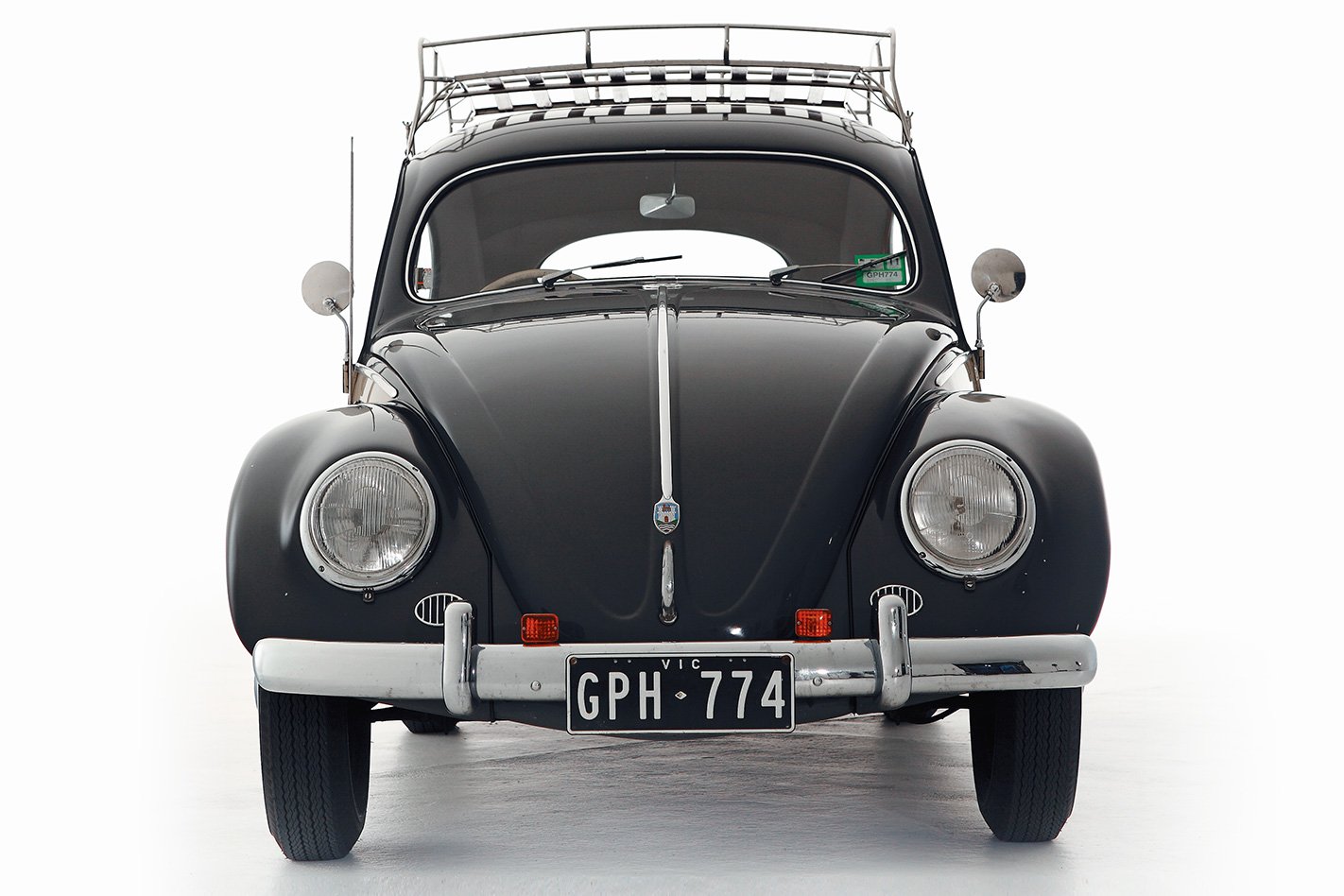
In truth, the Volkswagen had several parents, including oft-overlooked body engineer Erwin Komenda and – most controversially – Hans Ledwinka of Tatra (Czechoslovakia), whose 1933 V570 might well have set the template for the Volkswagen.
Only a handful of consumer cars were built in 1939 before the outbreak of WW2, when production switched to military variants.
After the war, British Army officer Ivan Hirst was ordered to take command of the heavily damaged Wolfsburg factory. He enlisted former employees and slowly reignited production. The minimally revised pre-war design was launched to the public at the 1947 Hannover Fair – and the rest is history.
In fact, among constant refinements, there were noticeable evolutions in 1949 (cabriolet version), 1953 (oval window), 1954 (1.2-litre engine), 1966 (1.3-litre and ball-joint front suspension), 1968 (1.5-litre engine and front disc brakes), 1972 (MacPherson struts, near doubling boot capacity), and ’73 (curved screen).
The last beetle was built in Mexico on 30 July 2003, bearing the chassis number 21,529,464.
Light and right
The VW engine pursued simplicity with air-cooling, horizontally opposed cylinders and pushrod OHV, but materials (alloy crankcase and cylinder heads, cast iron cylinders, forged steel crankshaft) made it light and durable.
Engine’s initial 982cc went to 1131cc (with 18kW/65Nm) for post-war production, with a final increase to 1584cc in 1971. Four-speed manual ’box initially lacked synchro on first. Three-speed semi-auto offered here with heavily revamped 1500 in ’68.
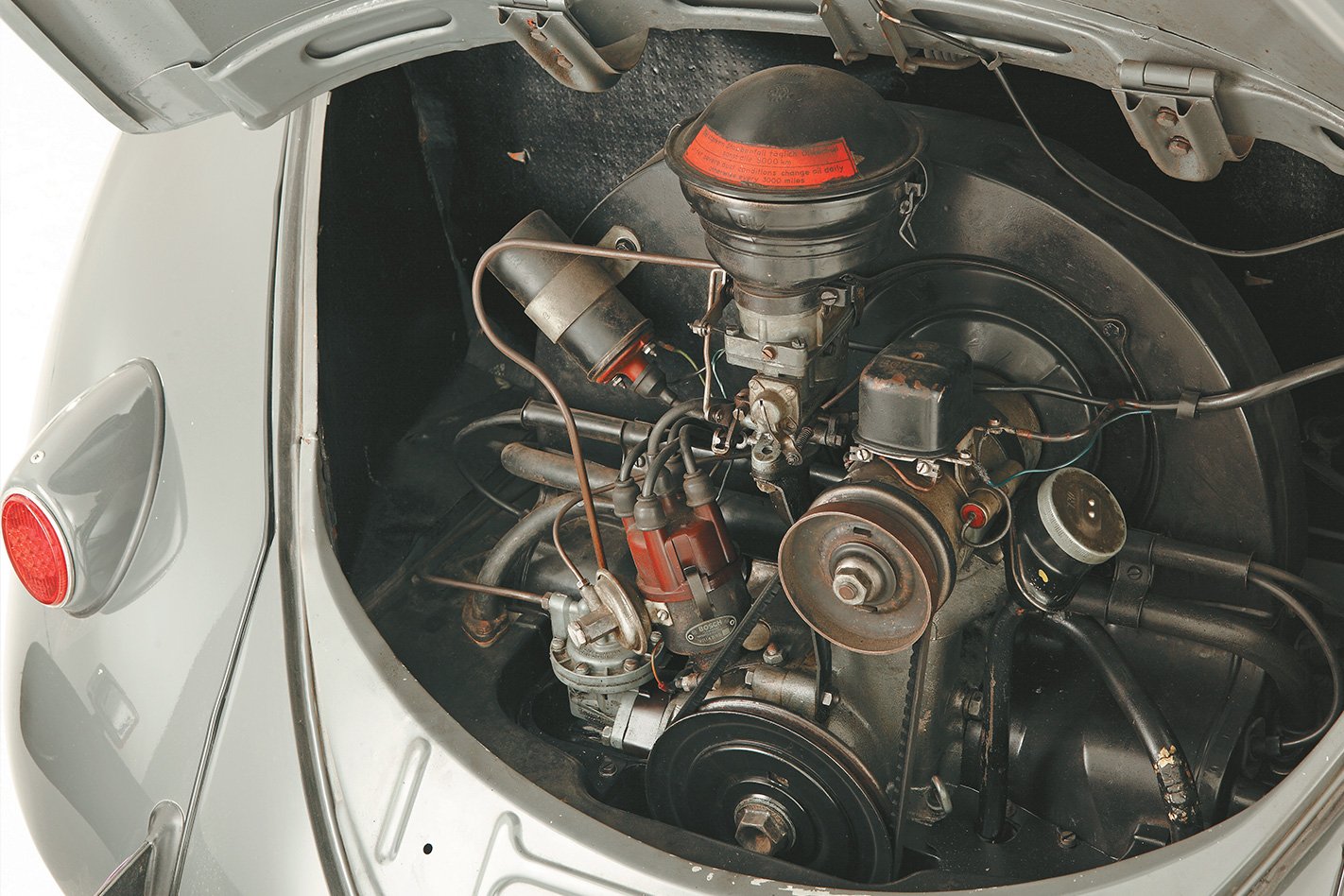
The chassis itself was simple enough, with a central backbone supporting a near-flat pressed steel platform. Front suspension comprised of two parallel torsion beams with kingpins and telescopic dampers.
Rear was by swing-axles with transverse torsion bar and telescopic dampers. Superbug (1971) brought semi-trailing arm IRS, then MacPherson strut front (’72).
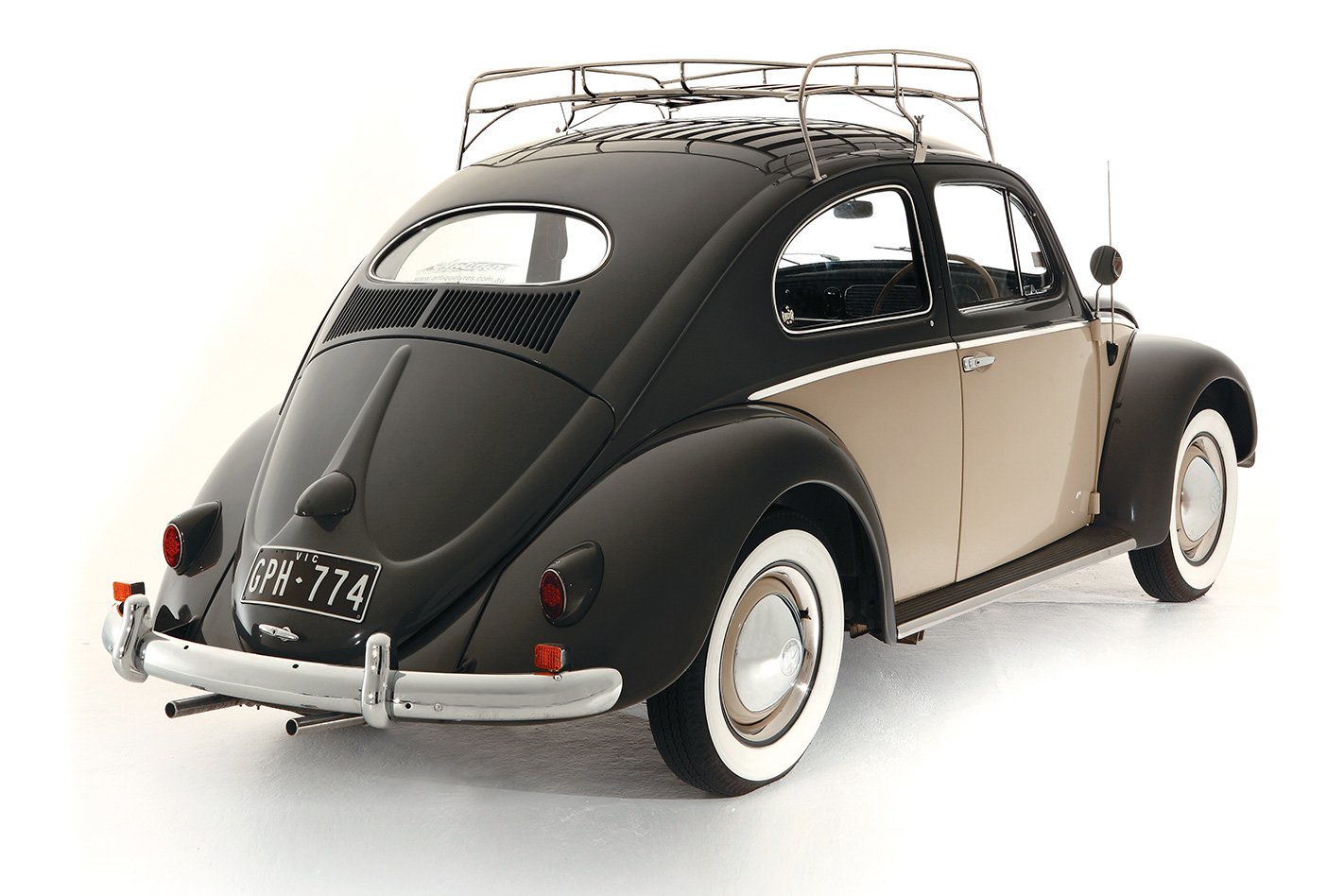
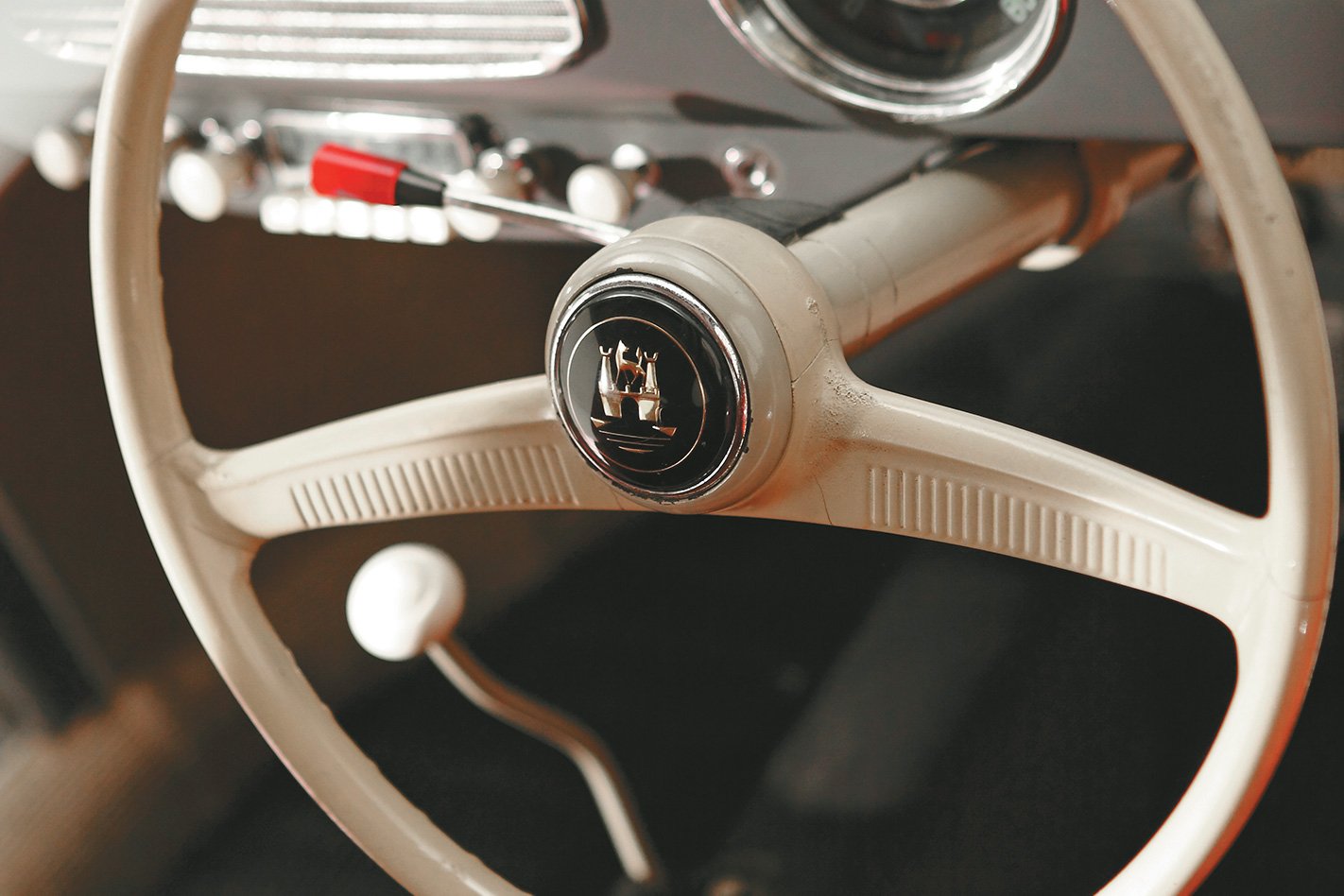
Rear-mounted engine helped make the Vee-Dub’s front cabin feel spacious, in a similar context to contemporary ‘people’s cars’ like the Fiat 600, Citroen 2CV, and Renault 4CV. Painted steel dash wasn’t just economy spec, but common practice up to the 1970s.
Flat screen, upright seating, and floor-hinged pedals provided a quaint drive. Rear cabin space was hampered by curved roof. Rearward vision improved only slightly with the introduction of a 23-percent larger rectangular window (1958-’72).
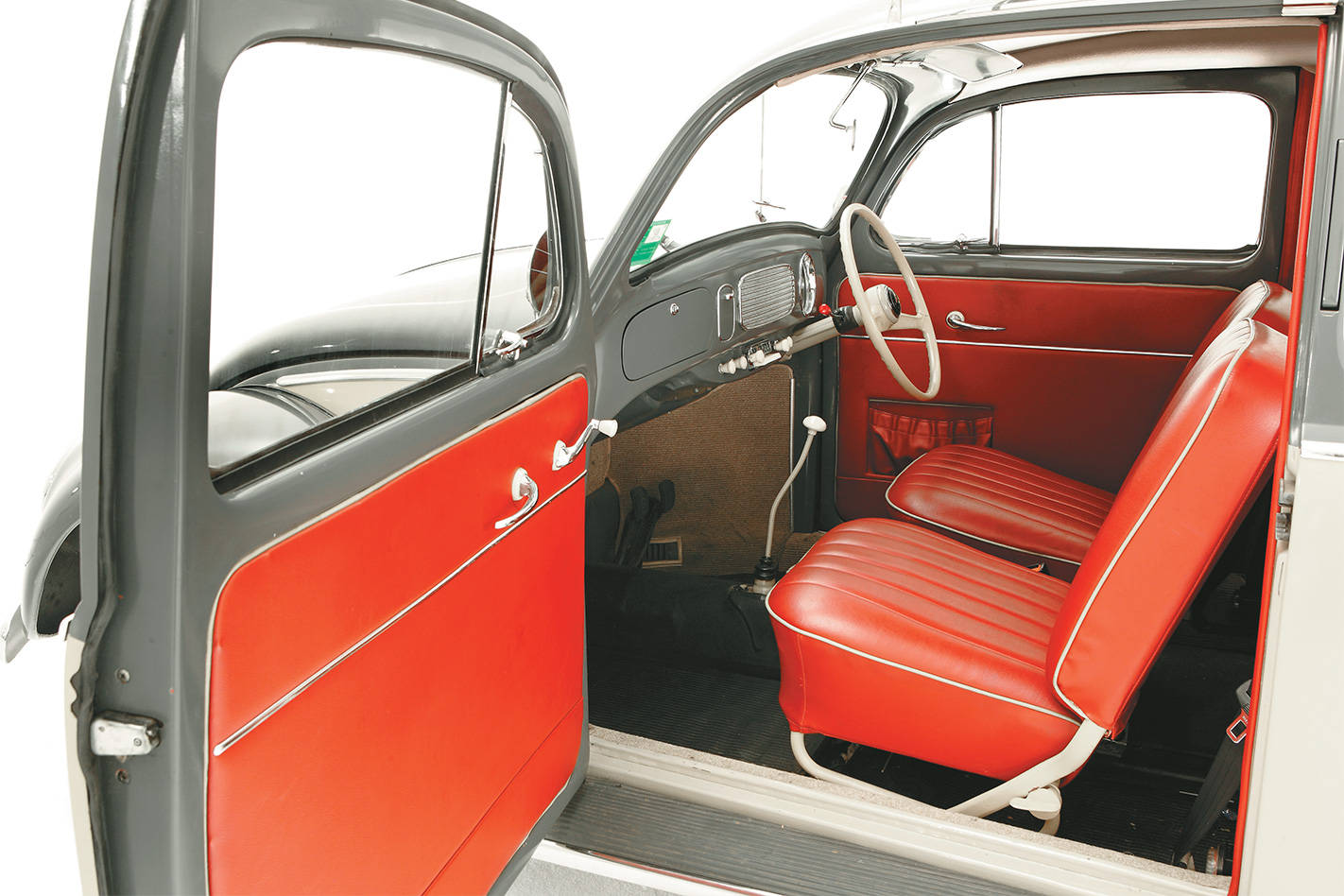
Perceptions are difficult things to change.
This article was first published in MOTOR magazine’s January 2013 issue.
Hyundai hasn’t featured particularly strongly in the pages of MOTOR over the years, principally because there hasn’t been a lot in its local range to get pulses raised much above idle. For every lone Tiburon, which was a pretty decent steer, there are carparks full of clapped-out, beaten-up Excels serving as a reminder of the firm’s darker days.
But in the words of Robert Zimmerman, the times they are a changin’. This year’s Pikes Peak hillclimb was won by Kiwi ex-pat Rhys Millen in a Hyundai Genesis, and the Korean manufacturer has announced that it’ll be returning to the World Rally Championship.
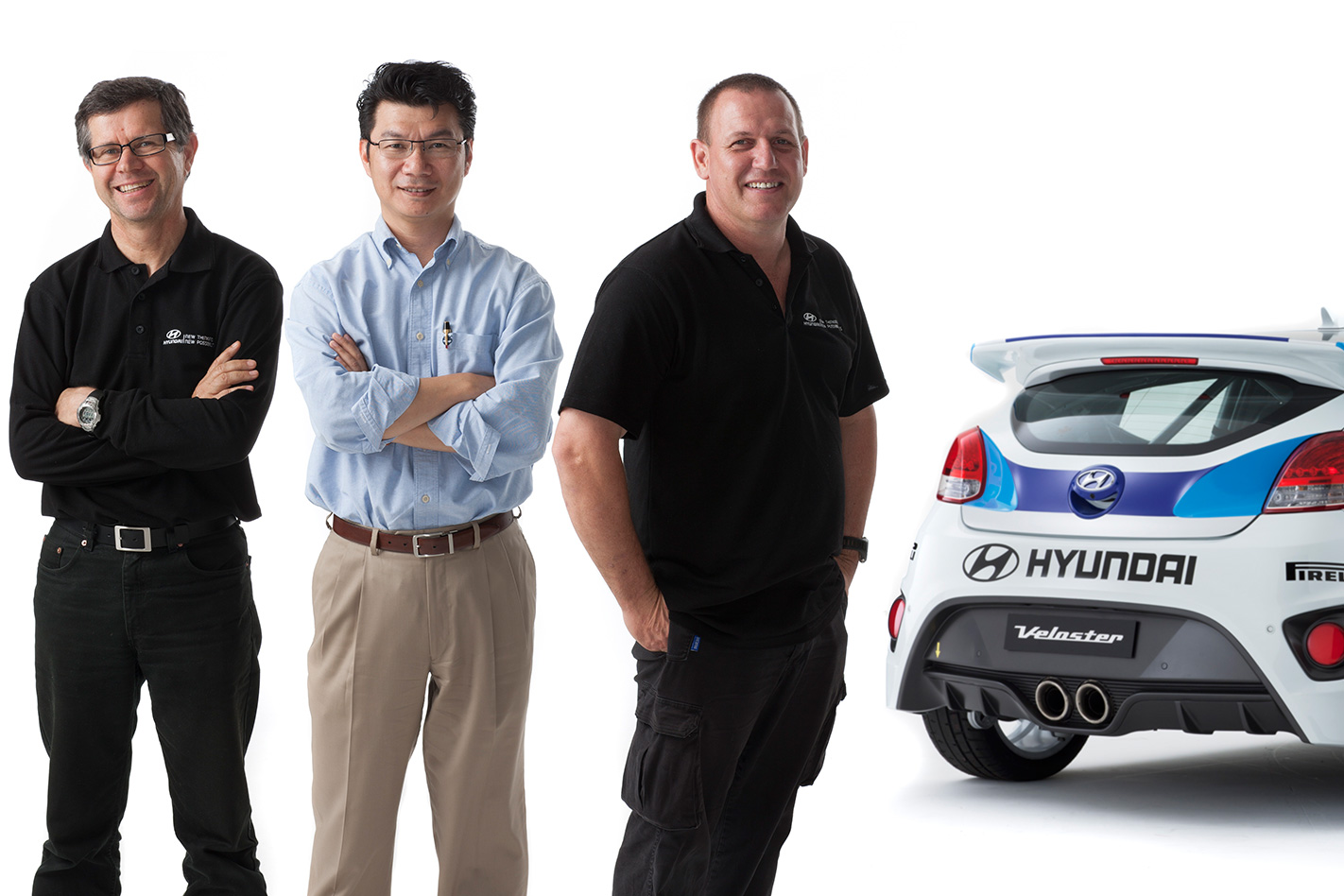
“In Australia, we have always wanted to have a motorsport involvement, but [previously] there wasn’t the right product,” he explains. With the launch of Veloster SR Turbo, Hyundai finally had a platform from which to build a competition car. “At first they did not know how to start,” Wong says.
“Who is the motorsport person in the company? Because the product engineering team – my team – are involved in vehicle dynamics, I thought, ‘okay, let’s join the effort’. You’ve got this concept, we’ve got the know-how, let’s do it.”
Phil Rodgers and Ian Kay, two men with enormous experience building and maintaining rally cars up to World Championship level, oversaw the build, with assistance from Wong and his team, which handle Hyundai’s local suspension tuning. A month later, the Veloster Race Concept was sitting on a stand at the Sydney Motor Show.
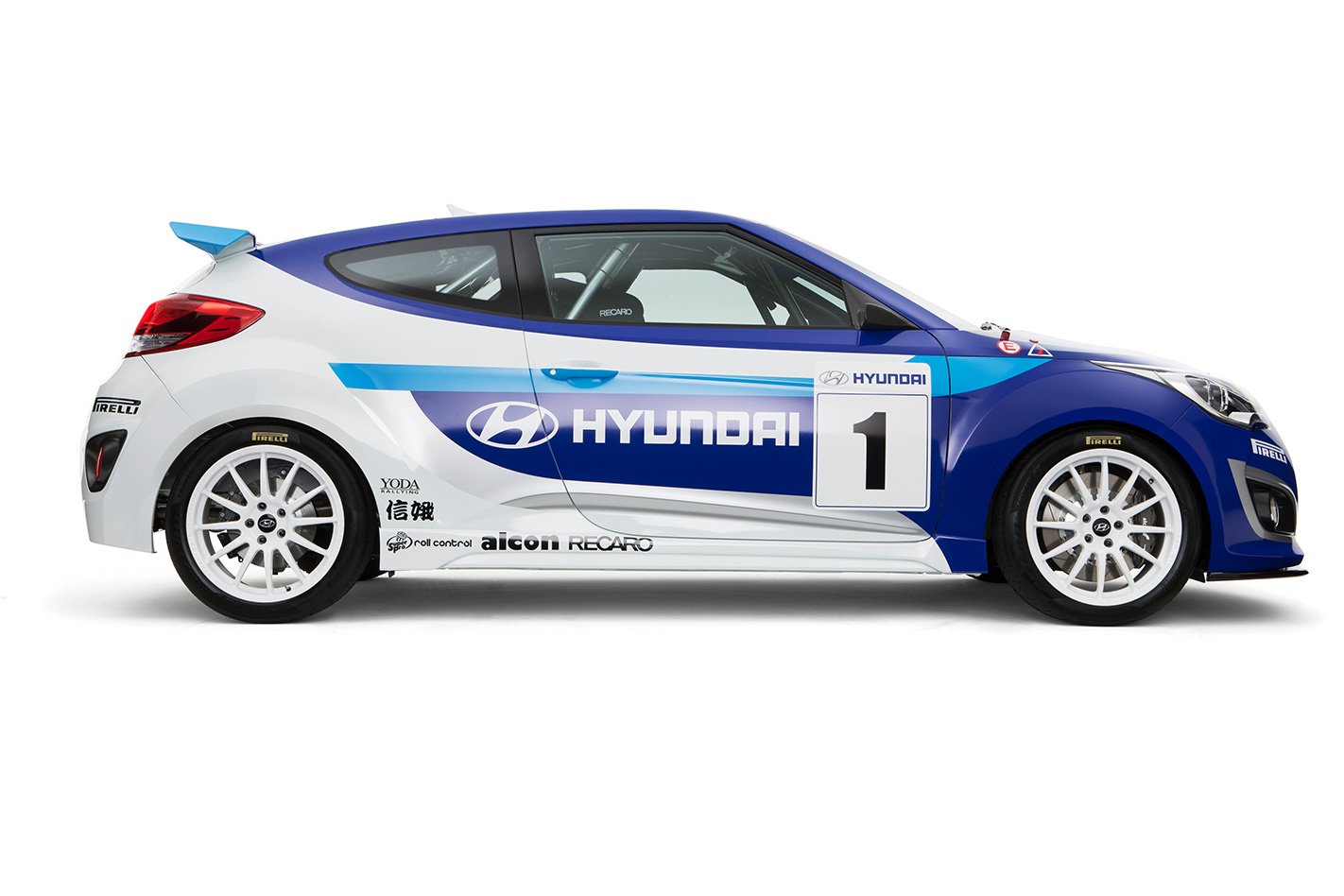
That’s the thing, while the VRC definitely is going racing, the decision hasn’t yet been made where it’s going racing. “We can go tarmac rallying tomorrow,” Wong says, “we just hook up a few things and it’s ready to go. It is up to the PR department – which button do they want to push?
We have engines in the R&D centre for higher levels – up to WRC level – but it depends on how far you want to push the boundaries.” At the moment, it appears that we’re most likely to see the VRC entered in this year’s Tarmac Championship (Targa Tasmania, Targa High Country …) in either showroom guise or upgraded to ‘Class M3’-spec.
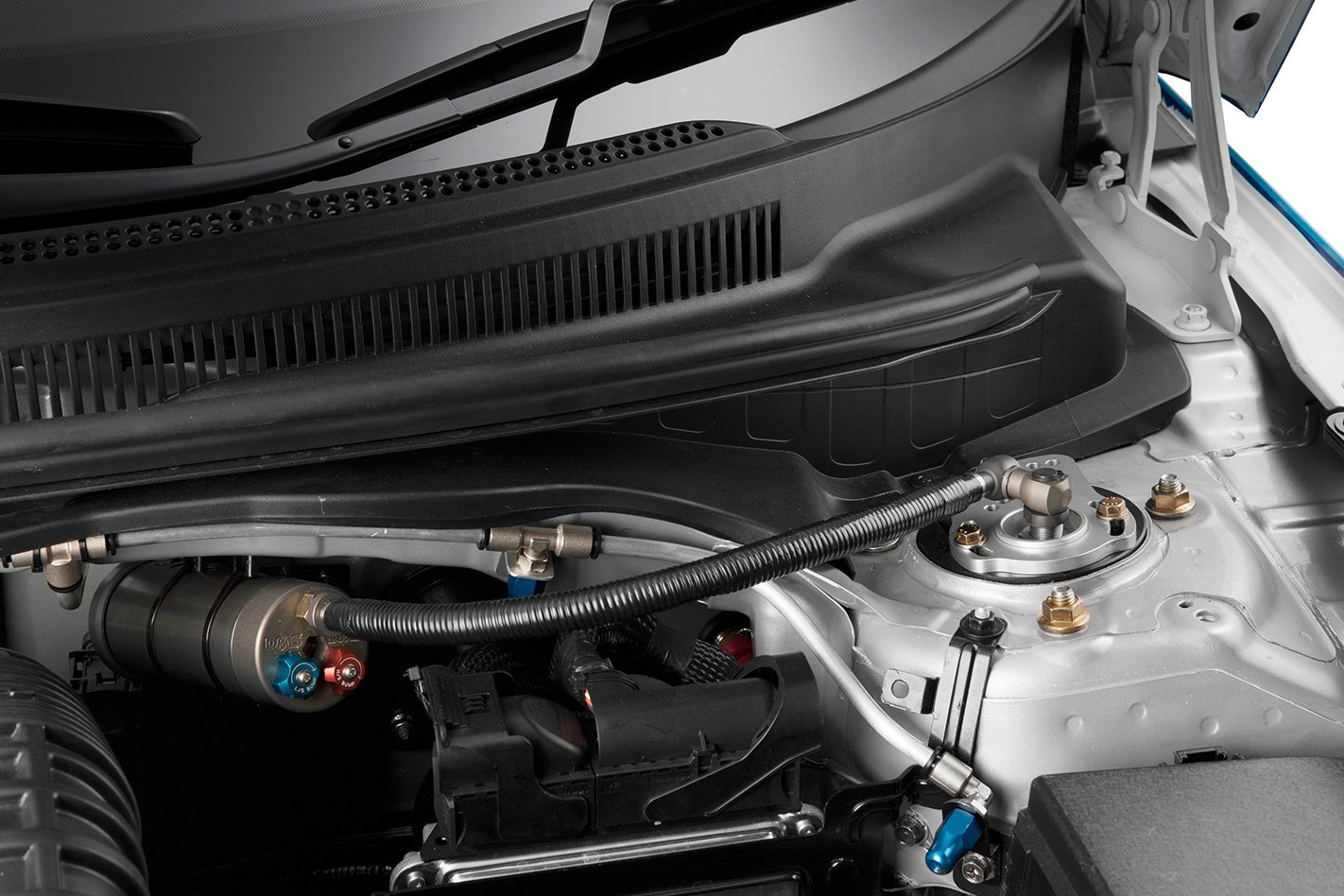
The bodyshell was stripped of all trim, sound deadening and superfluous brackets before Bond Rollbars installed an FIA-specification steel roll-cage.
Kay says that the rigidity of the body meant any further strengthening was unnecessary, “The use of high-strength steels in the body structure and the welding processes [used] make the body are much better compared to 10-12 years ago,” he says. Makes sense, better road cars make better race cars.
Drummond Suspension custom-built a set of struts for the car while progressive rate springs came from Kings and the anti-roll bars are from Fulcrum.
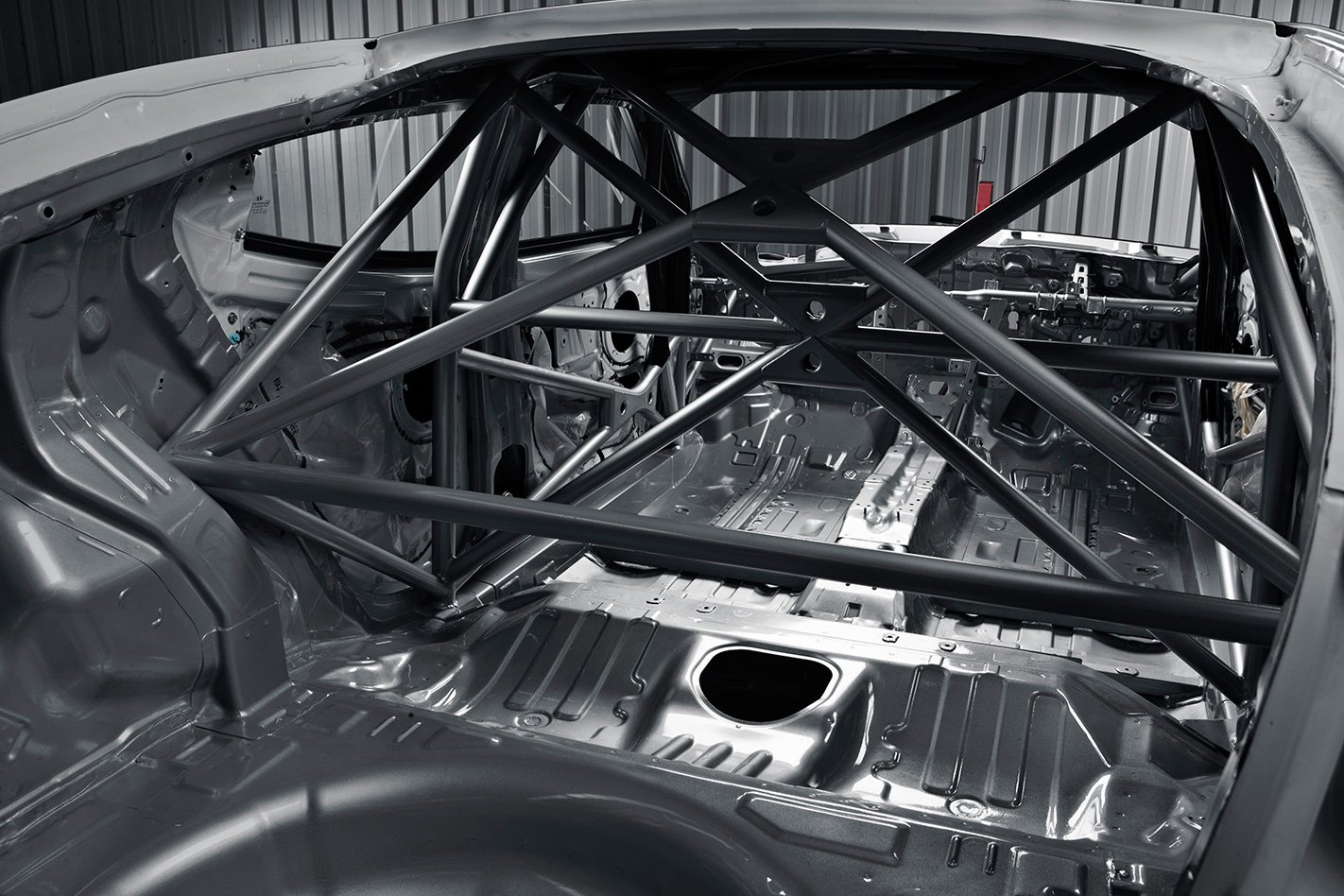
All the regular Veloster’s electronic aids have been binned, but the car’s ABS computer has been retained, as the wheel speed sensors will be used in conjunction with the car’s traction control and launch control systems.
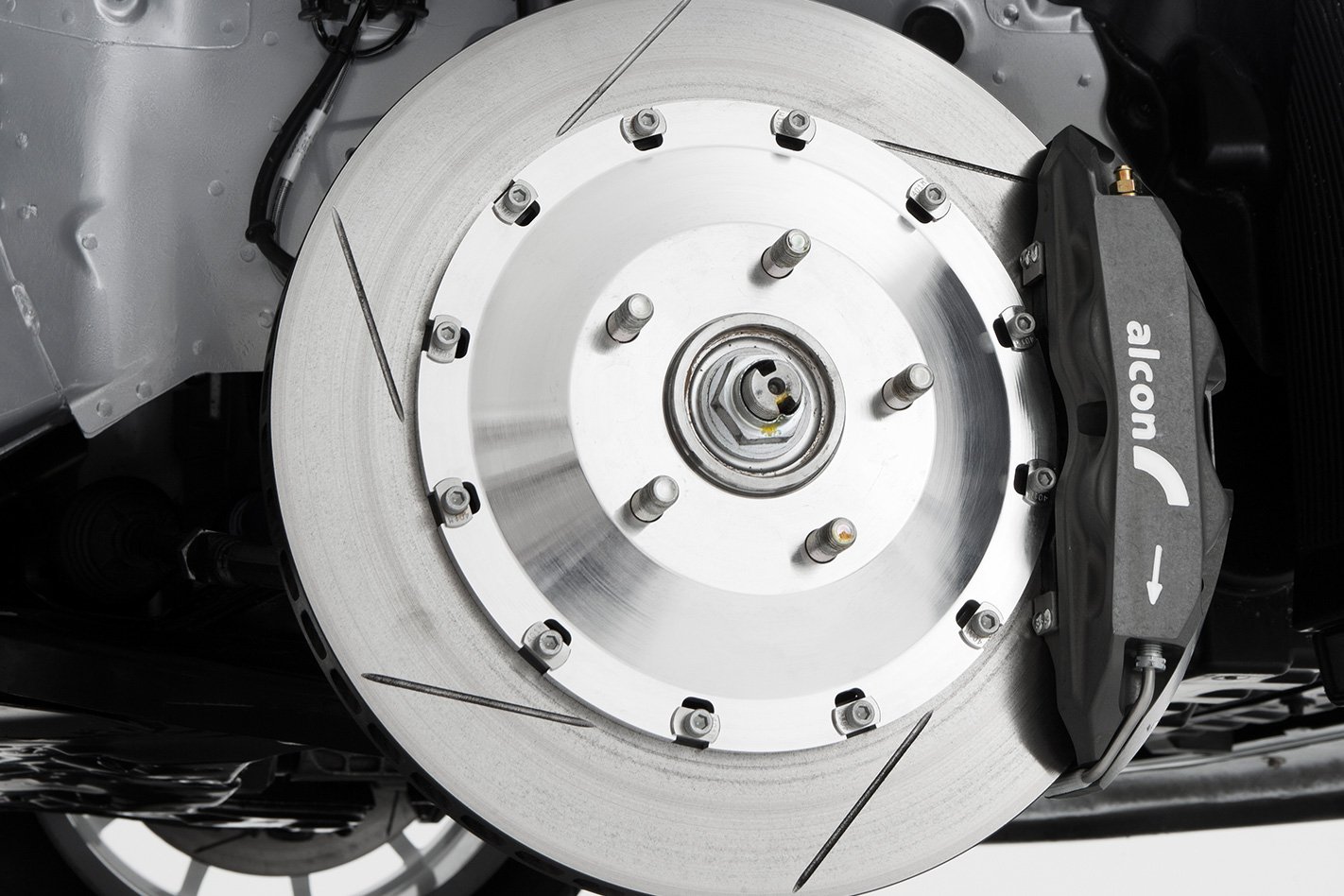
Enormous Alcon brakes, 355mm rotors with four-pot calipers at the front, 300mm with two-pot calipers at the rear, sit behind 18 x 8.0-inch Team Dynamics wheels wrapped in 235/40R18 Pirelli P Zero Trofeo semi slicks. Kay has huge experience building Group N rally cars and says the VRC was one of the easier projects to work on.
“It’s very simple to work on. The only downside, if it is a downside, is that if that car was built 10 years ago, it’d be 100kg lighter than what it is now. All cars have got heavier, but the gains in stiffness outweigh the weight [penalty].” “This [car] gives credit to the engineers in Korea,” Wong says.
“No, no, no, it’s a much bigger picture than brand perception. Motorsport is always the area that builds passion, where you prove that you are the engineers that are able to deliver the goods. It’s about engaging new people internally and externally.”
Given that Hyundai’s local suspension tuning team are heavily involved with the VRC project, it’s inevitable that lessons learned in competition will transfer to the road cars. But there’s also the sense that this is just the beginning. “I hope this is the start of big things to come with Hyundai and motorsport in Australia – it’s the first step really,” Public Relations Manager Guido Schenken, says.
And mention the prospect of a stripped-out ‘Veloster SR Turbo RS’ to Wong and his eyes light up with excitement. Now that’s a car that could bury the memories of those clapped-out Excels once and for all.
i20 heads to the WRC
No television coverage, dwindling manufacturer support and the utter dominance of Sebastien Loeb means that the World Rally Championship hasn’t been in the best of health recently, but there are signs of a manufacturer-led resurgence just around the corner.
Volkswagen has joined the series in full force this year, and Hyundai announced at last year’s Paris Motor Show that it would be rejoining the championship on some rounds in 2013, before embarking on a full-scale program the next year. They will join the Citroen works team and privately funded efforts from Ford and Mini.
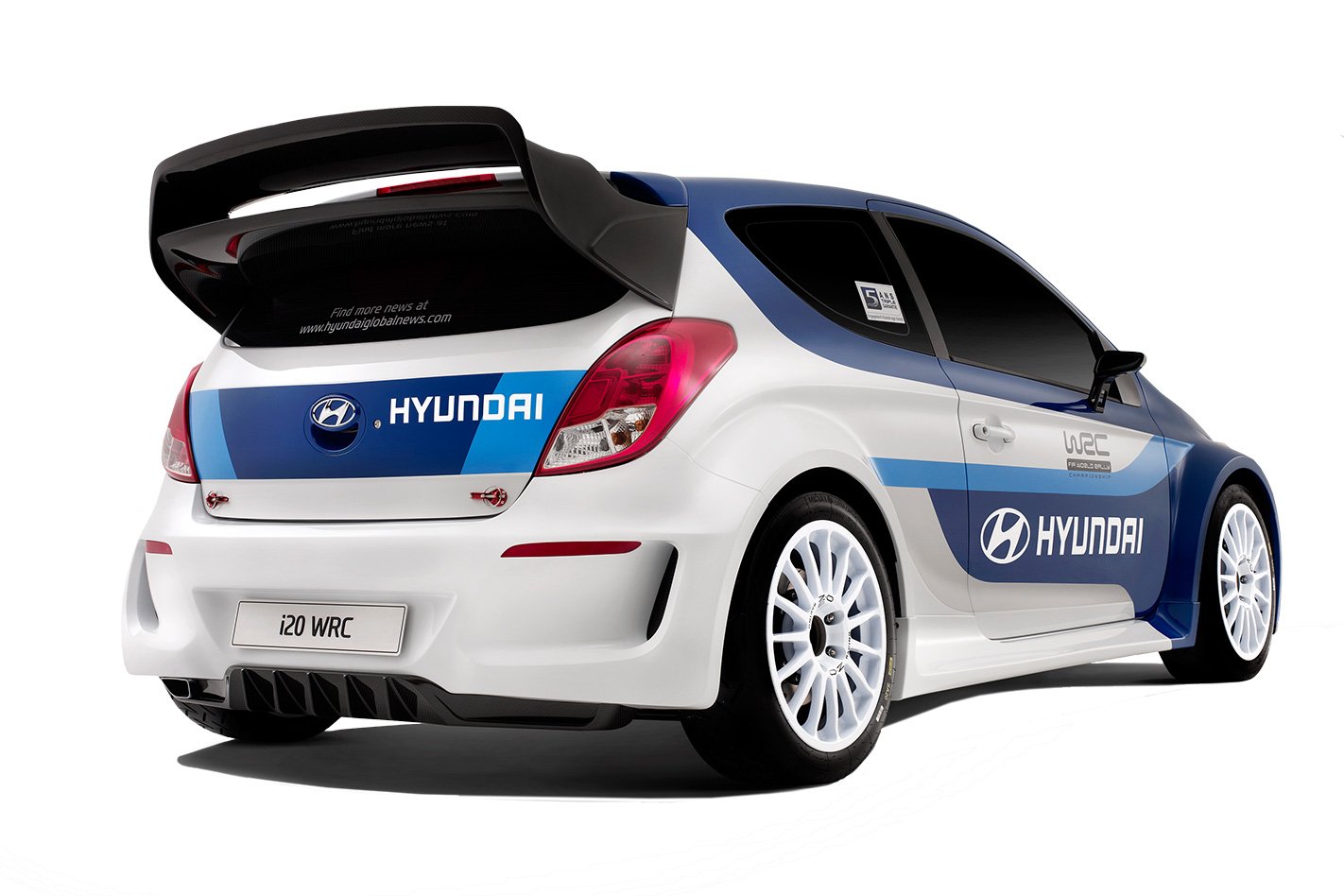
Details are scarce, other than that the team is likely to be based in Germany and the car will be based on the i20. Aussie Chris Atkinson, currently without a drive after Mini’s recent departure at factory level, is likely to be high on the team’s driver shortlist.
Hyundai Veloster Race Concept specs: Engine: in-line 4, DOHC, 16v, turbo Power: 150kW @ 6000rpm Torque: 265Nm @ 1750-4500rpm Kerb Weight: 1180kg Power-to-weight: 127kW/tonne Transmission: 6-speed manual Tyres: Pirelli P Zero Trofeo Size: 235/40ZR18
FOR ALMOST 50 years the GT-R badge has been the premier pin-up for Japanese car fans.
Winning races (becoming so dominant in the early ’90s that it was essentially banned from competition), breaking records and making a big noise wherever it went, the GT-R has always been a special car, no question. But the pair of cars we’ve got here today are more special than most because they’re the work of Nissan’s tuning and racing arm, Nismo.
Now that Nissan’s marketing department has got its grubby hands on the badge you can even get a Nismo-branded 370Z, which is actually a decent steer despite its age. However, in other parts of the world the famous nameplate has found its way onto the Micra and Note.
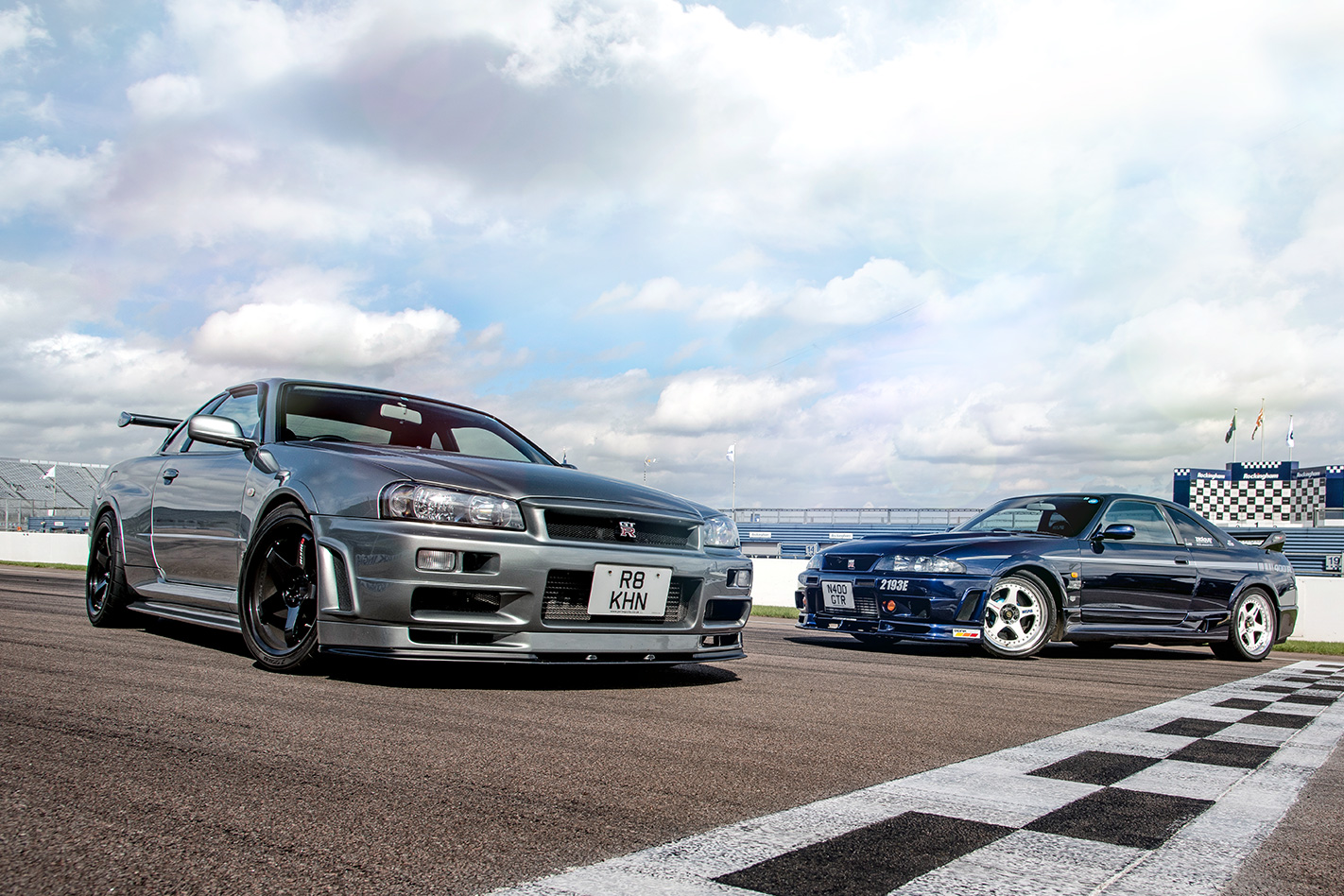
The name – a contraction of Nissan and Motorsport – is easy enough to understand, but the company actually came about through the merger of Nissan’s two separate racing divisions: One that dealt with privateer racing, and another that looked after the factory efforts. Racing was always the focus, so when Nismo did turn its attention to road cars, the results were spectacular.
The R33 400R and R34 R-tune cars we’ve got here are fast, rare and hugely valuable. But beyond the parentage, what makes them so much more special – and does the driving experience live up to the hype?
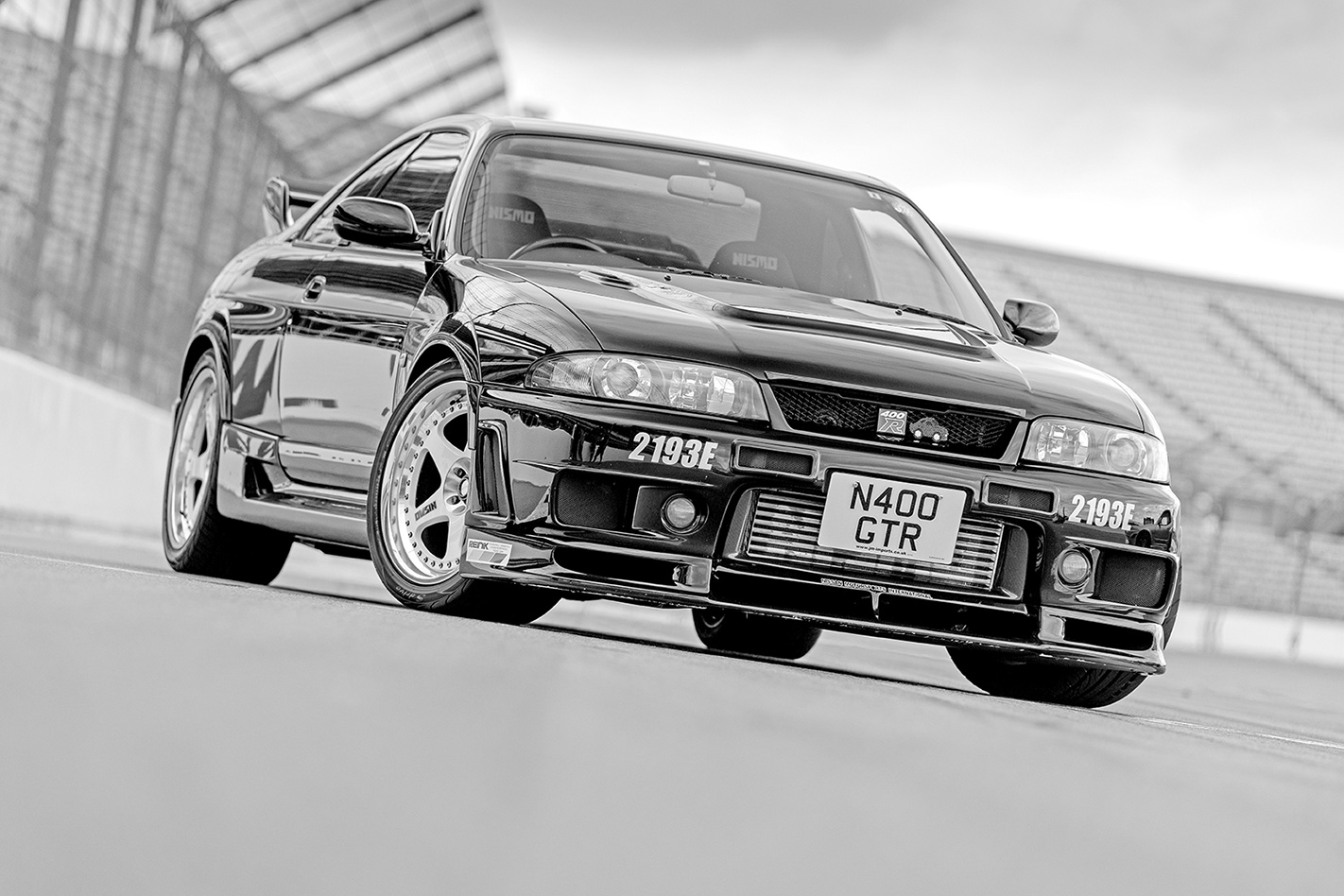
Looking absolutely stunning in Deep Marine blue paint offset by silver stripes running end to end along the flanks, it’s clear from your very first glance at the Nismo 400R that this is no ordinary GT-R. It’s the bonnet that does it, specifically the huge vent that looks like a not very secret trap door.
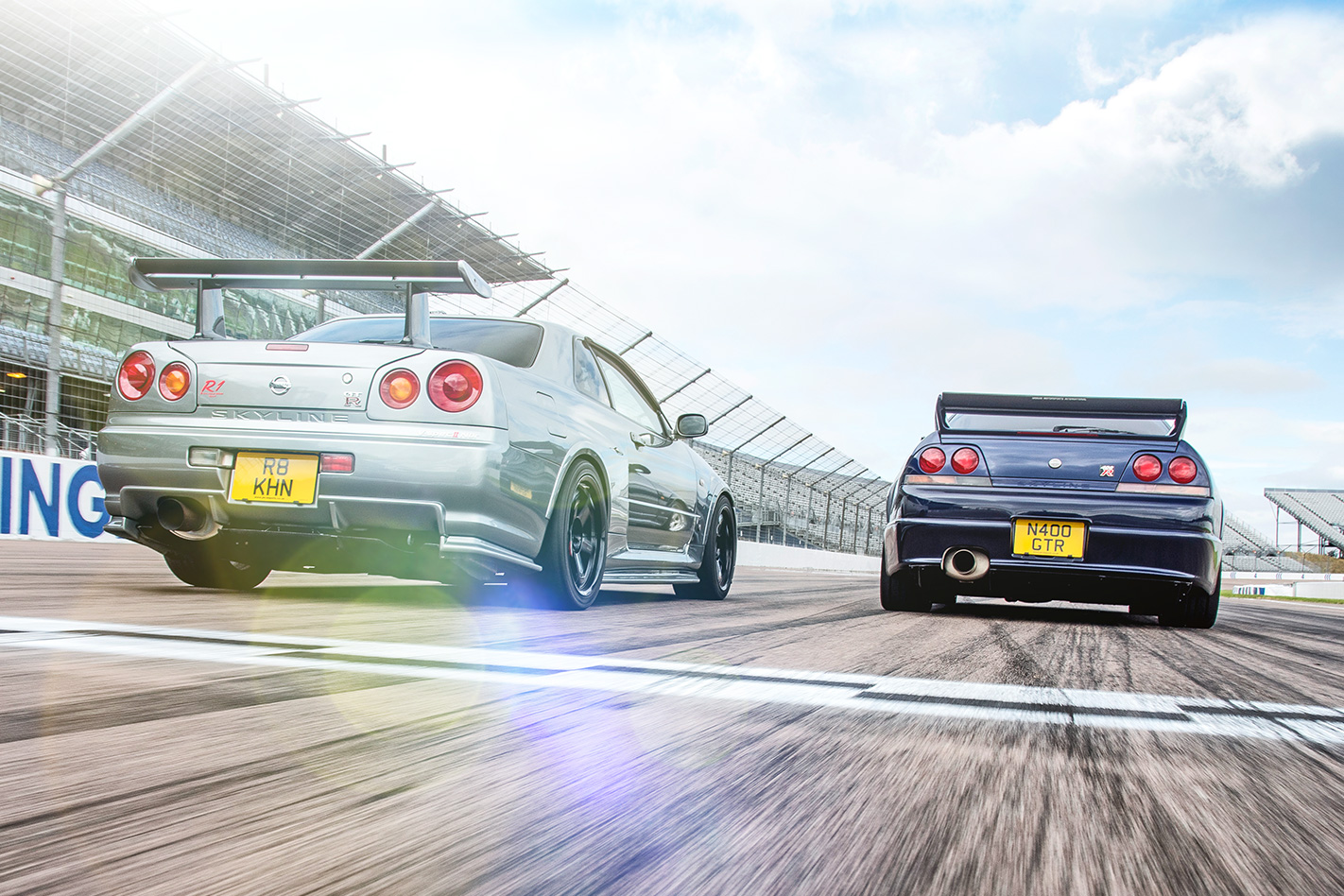
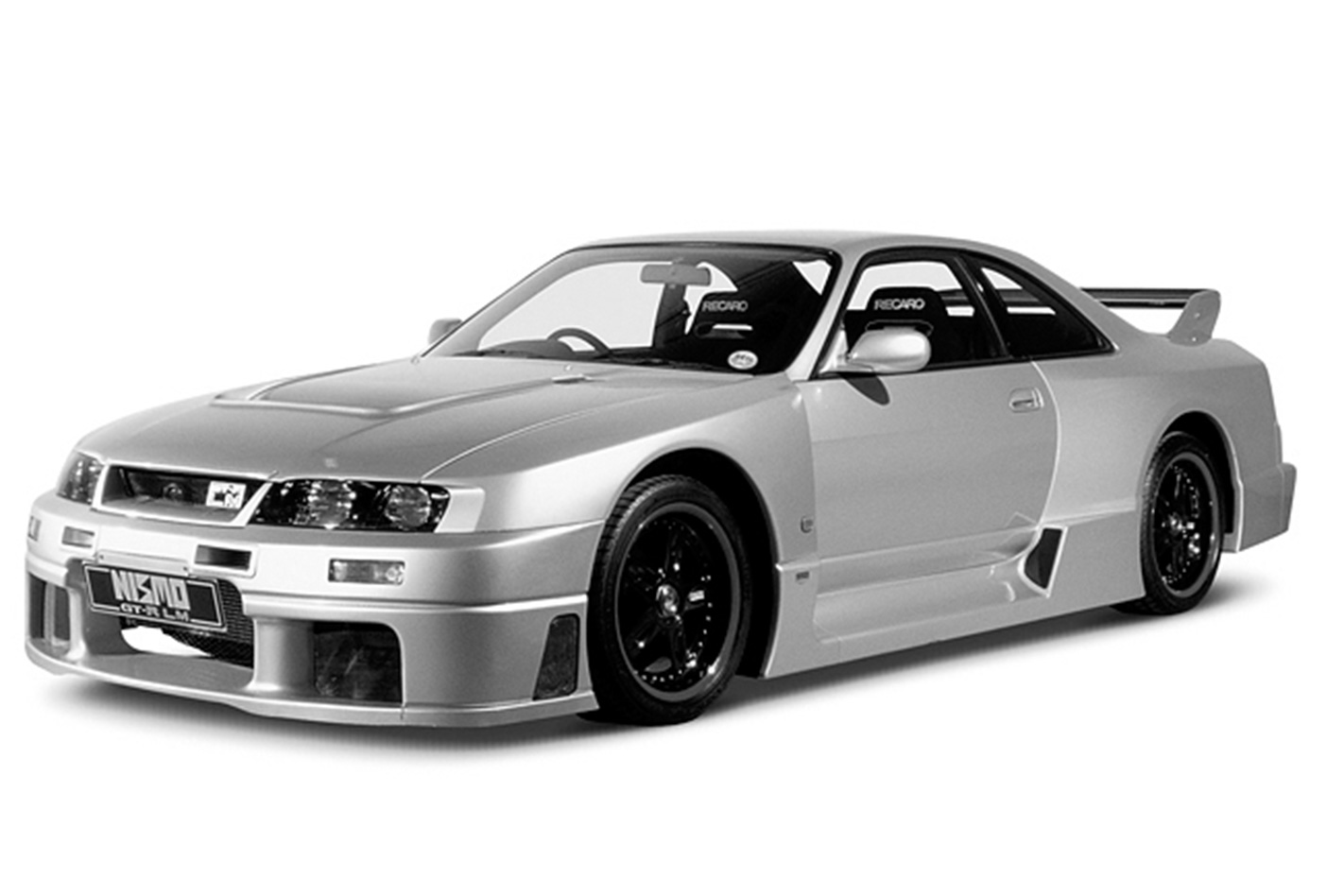
The list of new parts that went into creating a 400R is massive, and touches every single area from the headlights right through to the tail spoiler. And although the 400R isn’t as exotic as the racer, or the one-off road car that homologated it, it’s still infused with some of the same tech.
For a start, this thing was cutting edge for composite use for its time, the most arresting pieces being the Le Mans-inspired bonnet and double-wing rear spoiler. Hidden away beneath the floor, the propshaft is made from carbon too, and is 50 per cent lighter than stock.
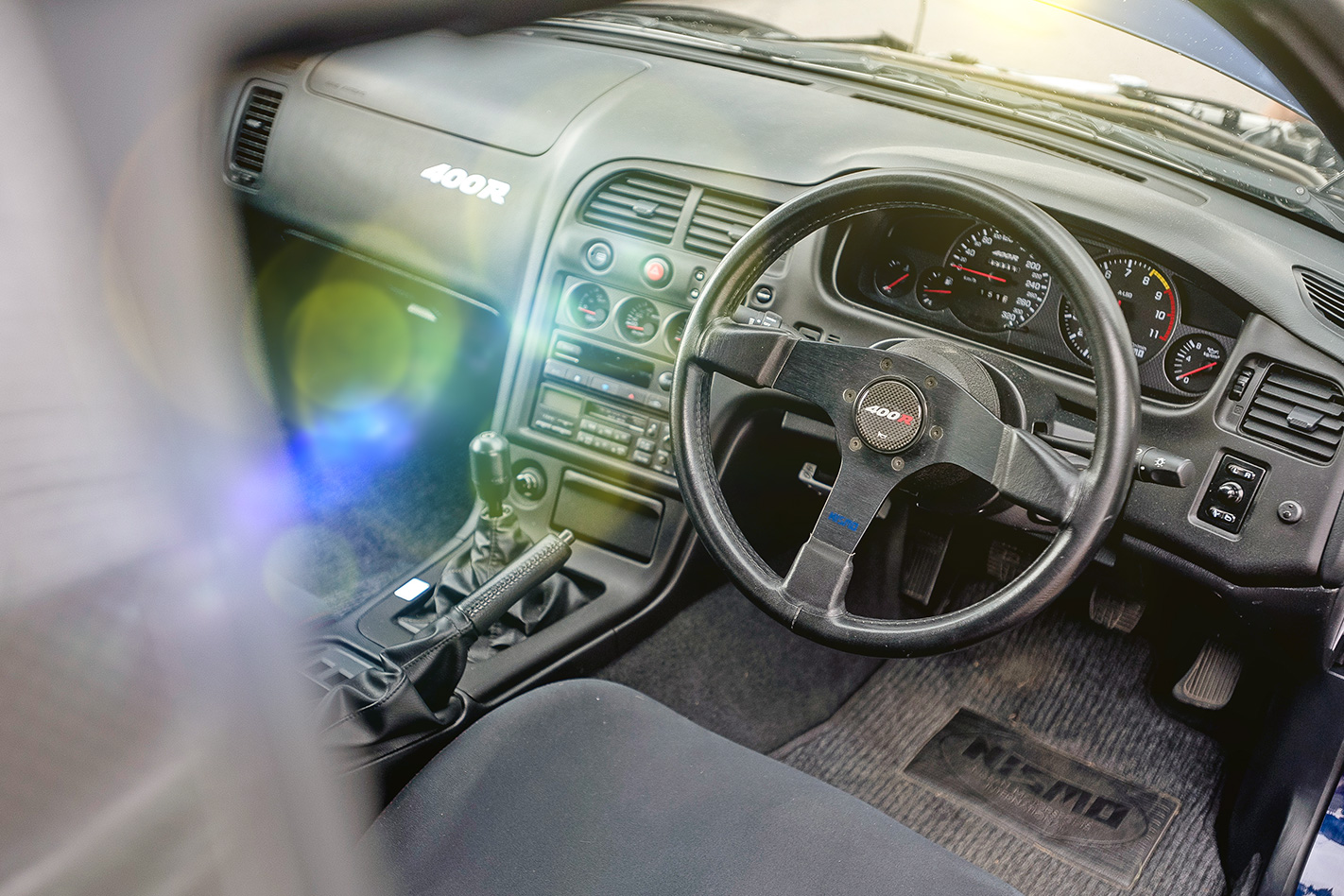
Unlike modern performance cars, that carbon fetish doesn’t extend to the interior, which is mostly standard R33 fare, and very much plastic-fantastic. There’s a proper old-school three-spoke wheel though, and a couple of 400R logos, one in the wheel’s hub, and another above the glovebox. Then you notice the instruments.
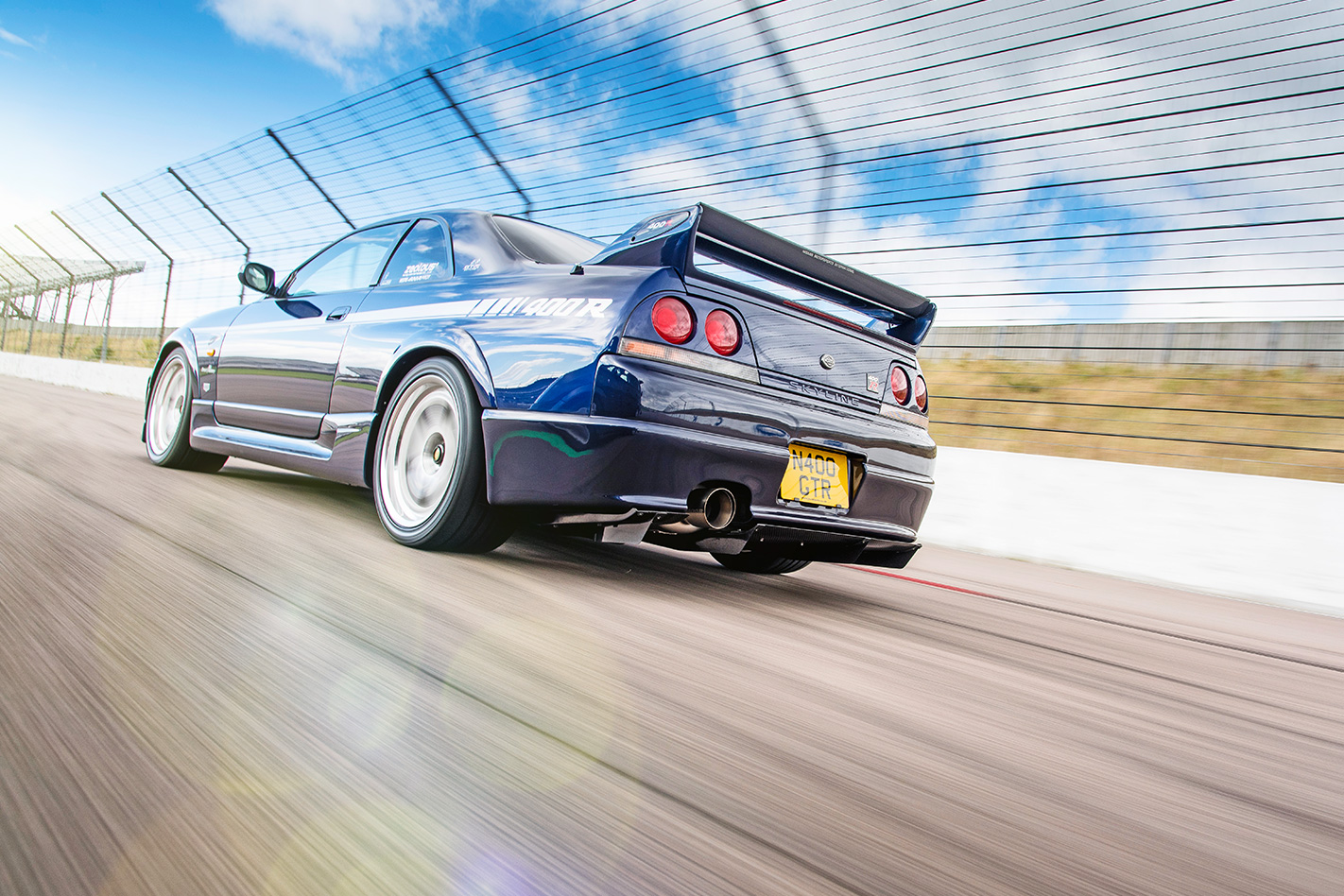
History and hubris can carry an old car a long way, easily persuading you to overlook the fact that the driving experience hasn’t aged well. But 20 years on, the 400R is still sensational… but not perfect. The clutch is fierce and the suspension is definitely harsh by modern standards, because we’re so used to the breadth of ability of cars running adaptive dampers.
But it’s bearable at low speeds, and starts to flow better with some decent numbers on the speedo. And the upshot is excellent body control. There’s precious little roll from the Bilstein-equipped suspension, and colossal grip from the fat 18-inch rubber, meaning you can lean on the light, feelsome steering without fear of the front washing wide, then ease onto the accelerator and feel the rear tyres take up some of the strain.
The LM racer lost its front driveshafts, but there’s no disappointment in the R having kept them. The 400R fizzes with feedback and the GT-R’s four-wheel-drive system was always heavily rear biased, meaning it feels like a seriously flattering rear-driver, and never like a nannying all-paw that’s forsaken entertainment and interaction in the pursuit of eradicating wheelspin.
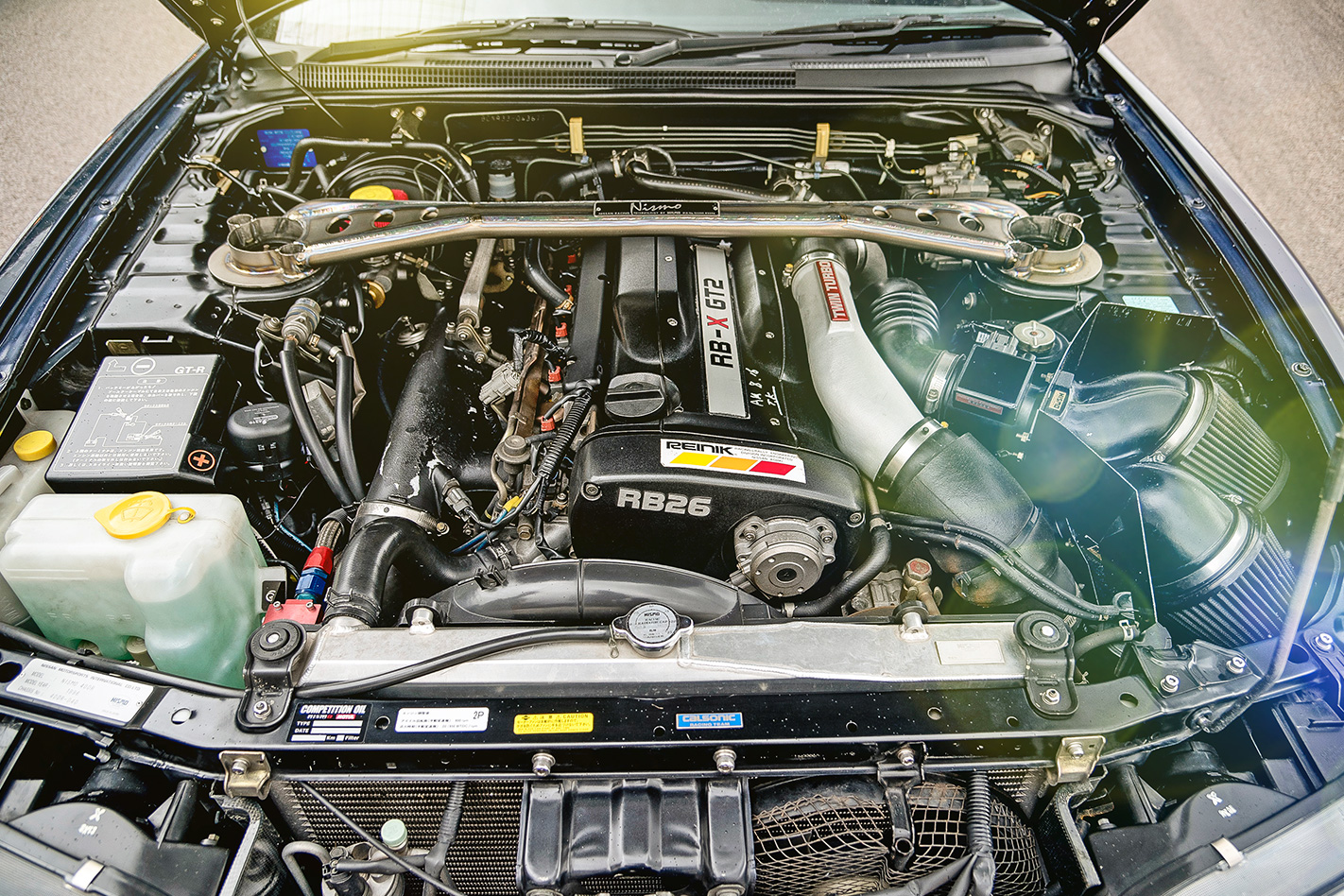
Opening up the bore from 86 to 87mm, and stretching the stroke 4mm to 77.7mm, released another 200cc, which, together with high-lift cams, polished ports, larger exhaust manifolds and new turbochargers, helped produce a heap more power. Stronger internals, meanwhile, ensured it held together while doing it – the pistons were forged instead of cast, the rods were beefier and the lubrication system upgraded.
Everyone knows that Nissan underrated the power of regular GT-Rs to honour the 206kW gentleman’s agreement among manufacturers regarding maximum output. The true figure was more like 224kW. But the 400R makes 300kW, along with 470Nm of torque. Enough to get to 100km/h in four seconds, and to top out at a true 300km/h.
You’d never accuse a stock R33 GT-R of being slow, though the thought does briefly cross your mind once you’ve uncorked the 400R for the first time. But with a third more muscle, it was always going to perform at a different level.
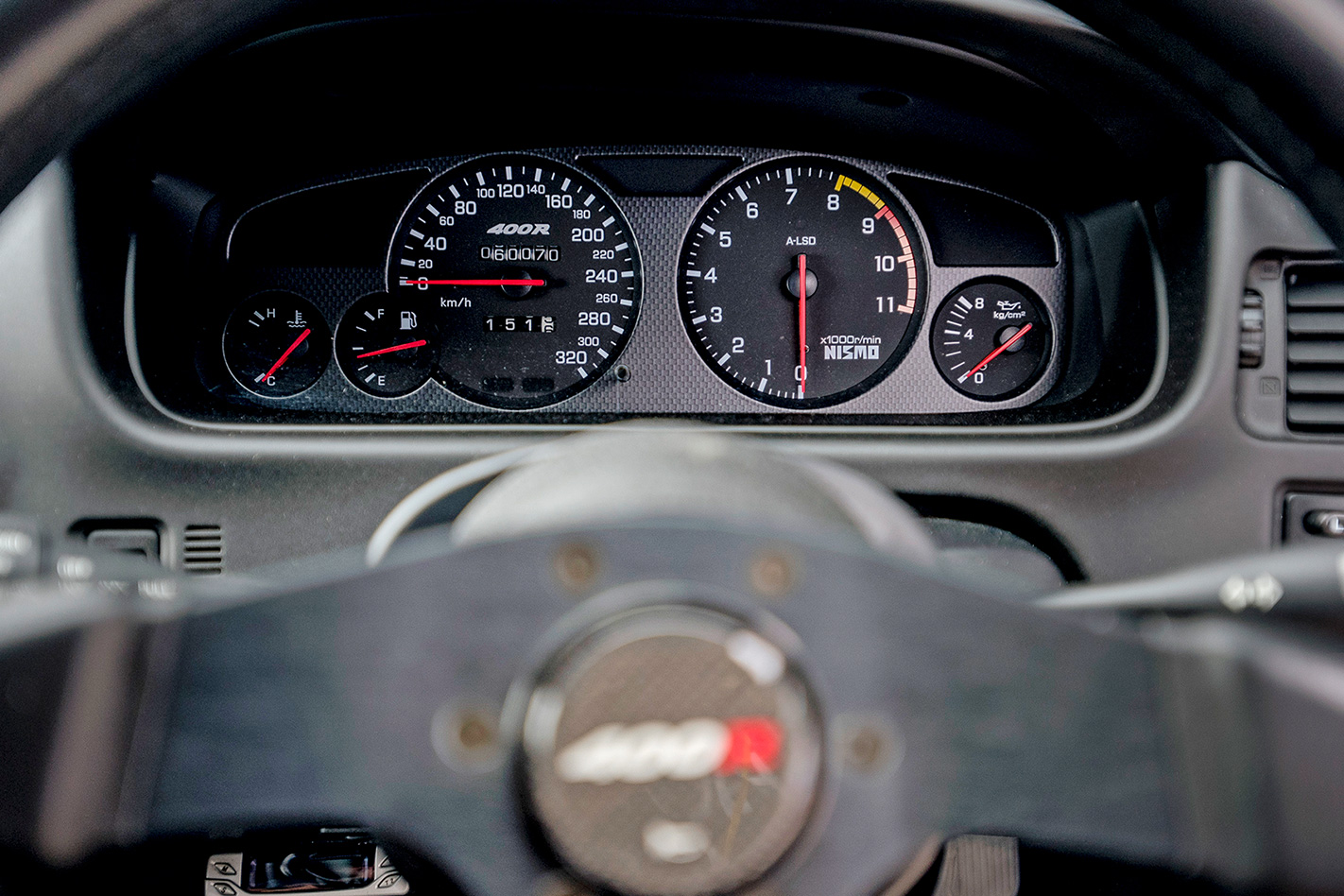
Nissan had planned to build 100 examples of the 400R, but in the end, just 44 were produced for Japan-only, and predictably, they’re worth huge money. Just how much is hard to say because they come on the market so infrequently – especially outside Japan. However, you can bet on spending at least $250K if you can persuade someone to part with one.
And that’s a big if, because for many, the 400R is the definitive road-going GT-R. But not everyone would agree. For some, any car claiming to be the definitive road-going GT-R would have to be based on the R34, the last and most developed of the Skyline GT-R series, the final car before Nissan’s supercar jumped ship from the Skyline series altogether, becoming, in the R35, simply GT-R.
Shorter, lighter, and even sharper to drive than the R33, the R34 was a perfect platform for Nismo to do its stuff. Most famous and well known of those R34-based Nismo creations is the Z tune, created when Nismo got the go-ahead from Nissan to buy back and modify immaculate low-mileage examples of the R34 that had recently ceased production to celebrate its 20th anniversary.
If you took your own R34 to Nismo – and it didn’t matter which; Nismo would mod GT-Rs, V-specs and even the super rare Nür versions – and if it was deemed fit enough, you could apply some of the same flavour of components that would later make up a Z. The R34 we’ve got here is one of those.
Back in 2000 the full R-tune package would have represented well over half the value of the car being converted. But you certainly got your money’s worth. Like the 400R package, the complete R-tune kit covered everything from suspension to aero mods.
But the heart was the R1 engine. Nismo produced 70-80 of these monster straight-sixes, based on the tougher N1-spec RB engine, but only around 25 R34s received it as part of the full R-tune upgrade, making them almost as rare as the legendary Z-tune.
A massive plank of a spoiler – mounted on Midori carbon risers – towers over the rear end whose bootlid wears the familiar GT-R badge in one corner, and the important (but pretty nasty-looking) R1 sticker on the other. The car here is even rarer than most because its built around a GT500 block, a component normally reserved for Nismo’s full-blown competition machines.
That doesn’t mean more power, but it did mean more strength for tuners who really wanted to push the envelope, plus it makes for some serious bragging rights at GTROC meets. Though giving away 200cc to the 400R, the R1 motor makes significantly more power, almost 335kW, compared to a claimed 206kW (but actually more like 246kW) from a stock R34.
Like the 400 you need to wind it up first, again, to around 4000rpm, before the fireworks start. This time there are six gears to play with, instead of the R33’s five, meaning it should be easier to keep the engine buzzing, although the change isn’t as sweet. This is a quick car.
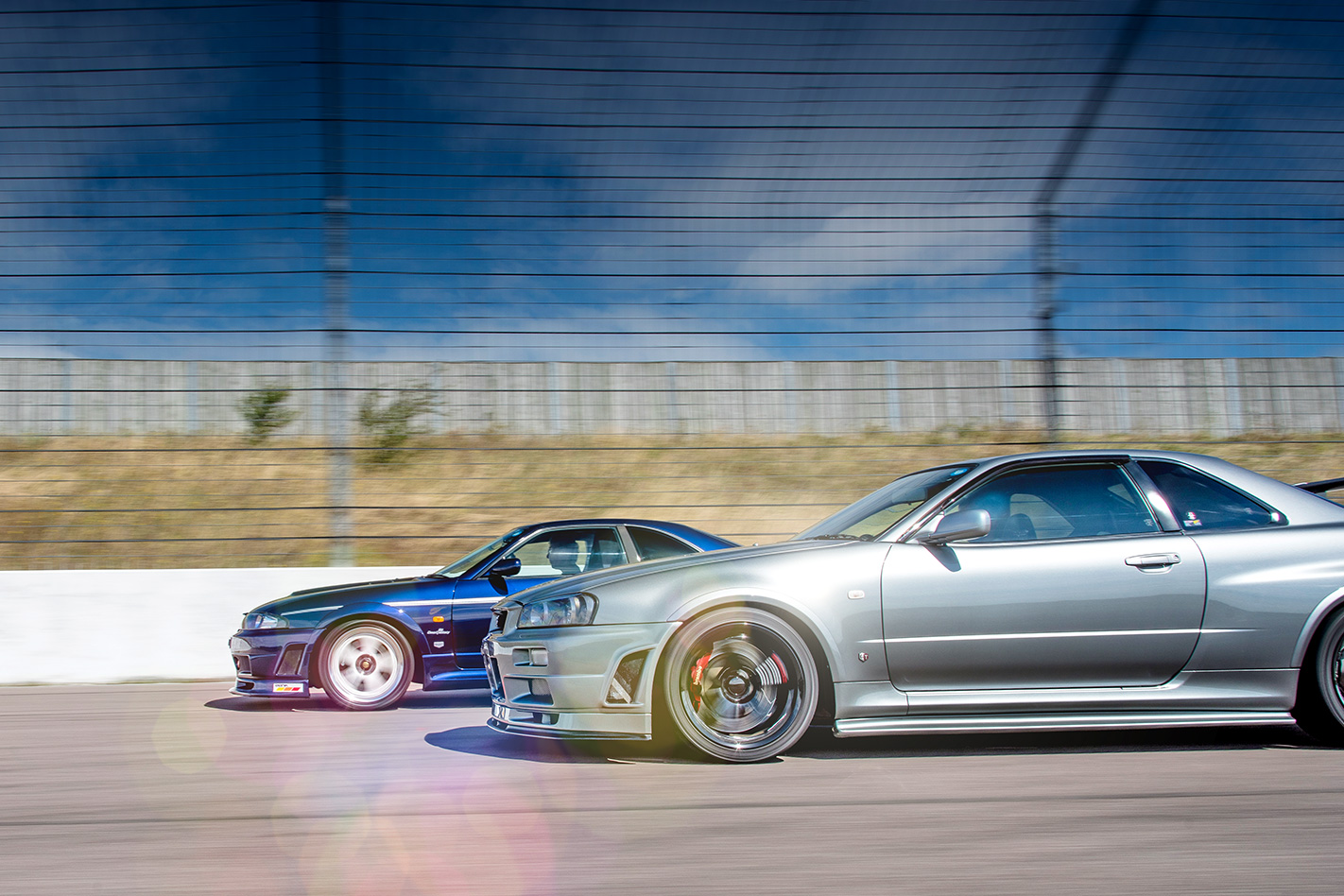
It’s still plasticky in here, and much of the switchgear feels dated, but the cabin is decidedly more modern than the R33’s and those seats with their big shoulder wings and strange covering of grippy spots, feel fabulous. The ride – not so much.
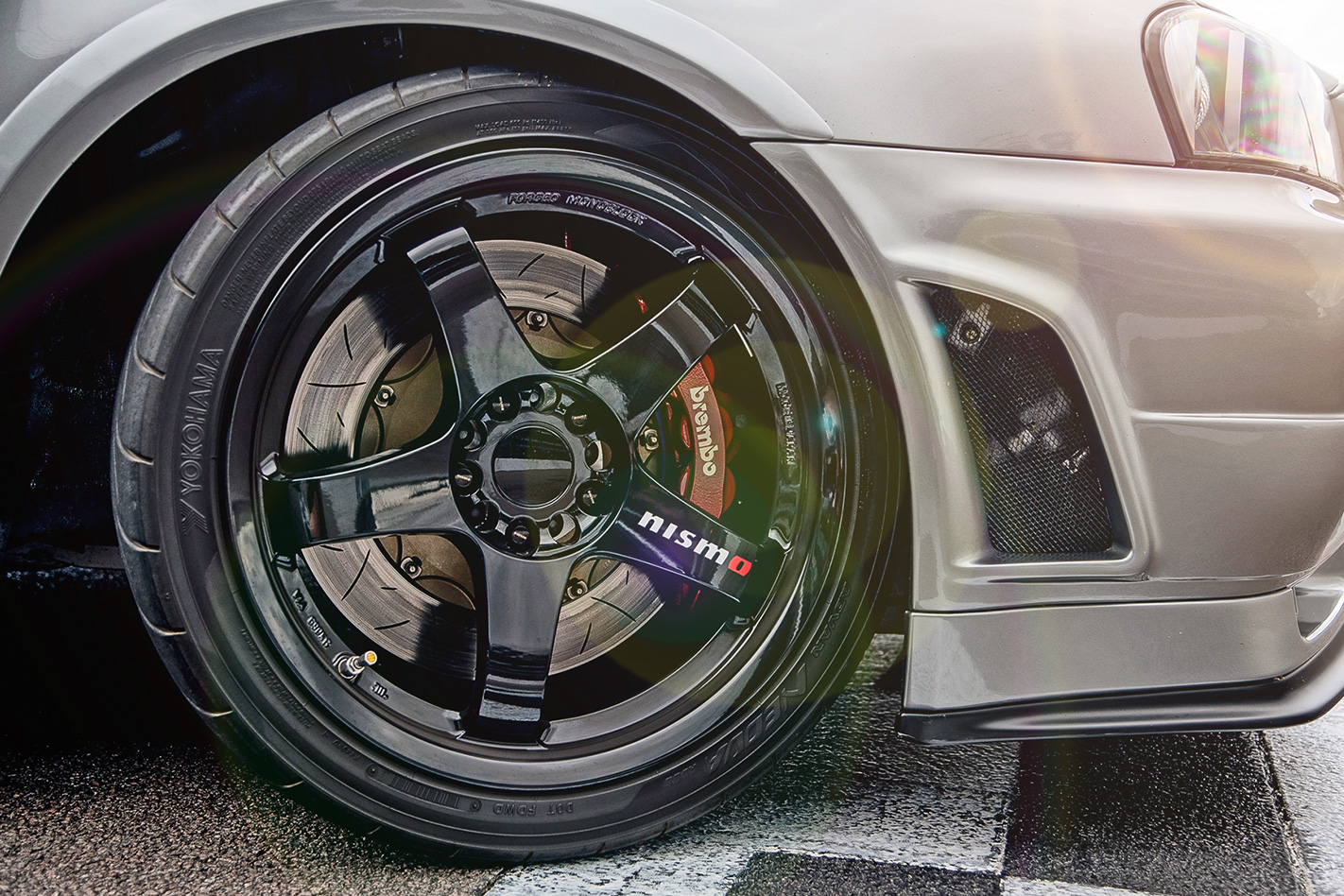
The R-tune coilovers feel optimised for scything through Rockingham’s fast banked turns or harnessing the R34’s 1600kg mass through the infield’s left-right transitions. But on the road they feel harsh and unforgiving. The steering is great though – perfectly weighted and full of feedback, and the brakes, with six-pot Brembos up front in place of the 400R’s fours, feel immensely strong.
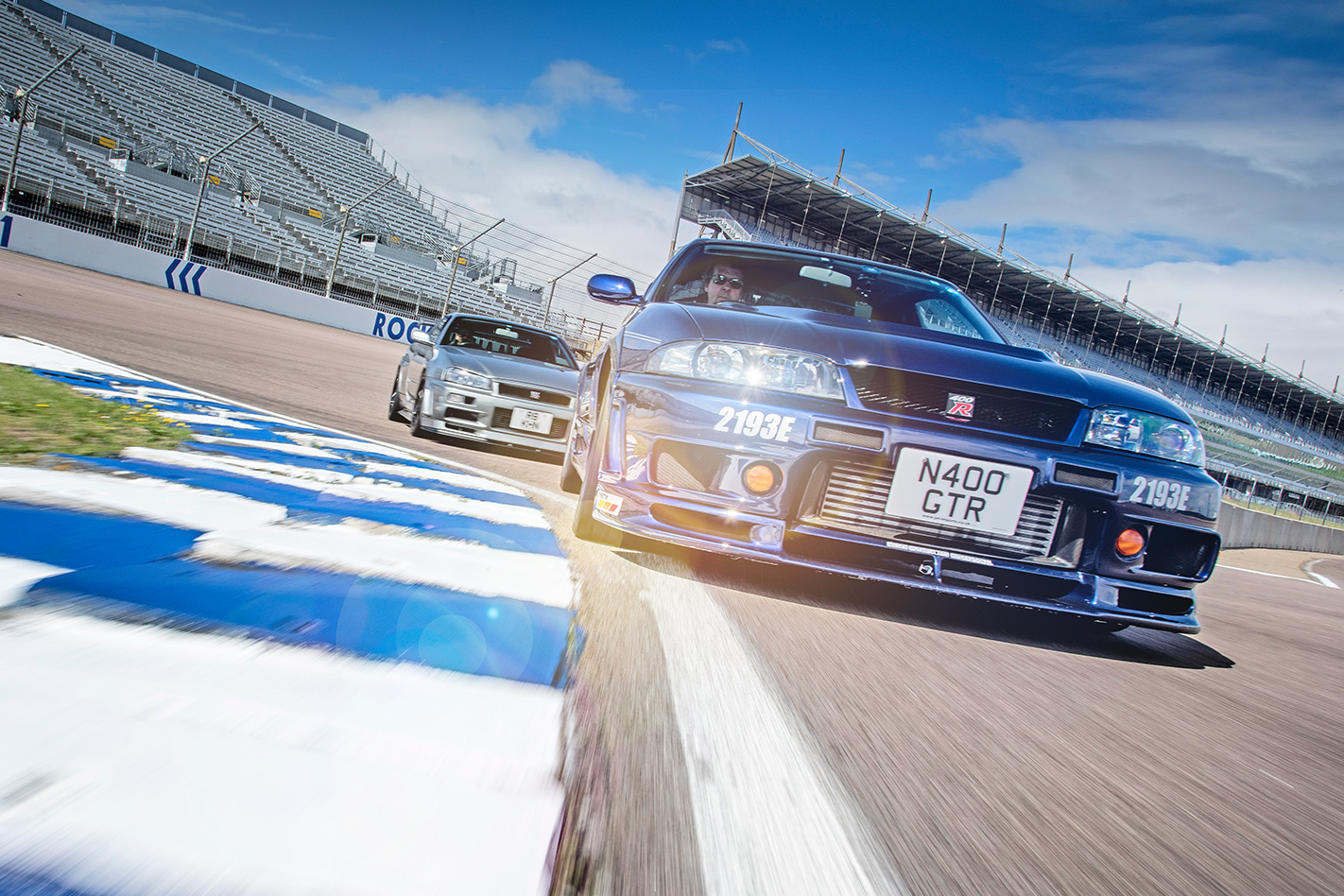
However, flicking through the pictures as I write, it’s the 400R I keep coming back to. Those now very period looks, its historical importance as a genuine full Nismo car and, of course, grainy memories of hooning one around Trial Mountain with a worn-out hand controller all those years ago.
Back then I didn’t really appreciate what made cars like the 400R and R-tune so special, so much more than simply GT-Rs. Consider that fixed.
Gods of GT-R
The other rare R33 and R34s
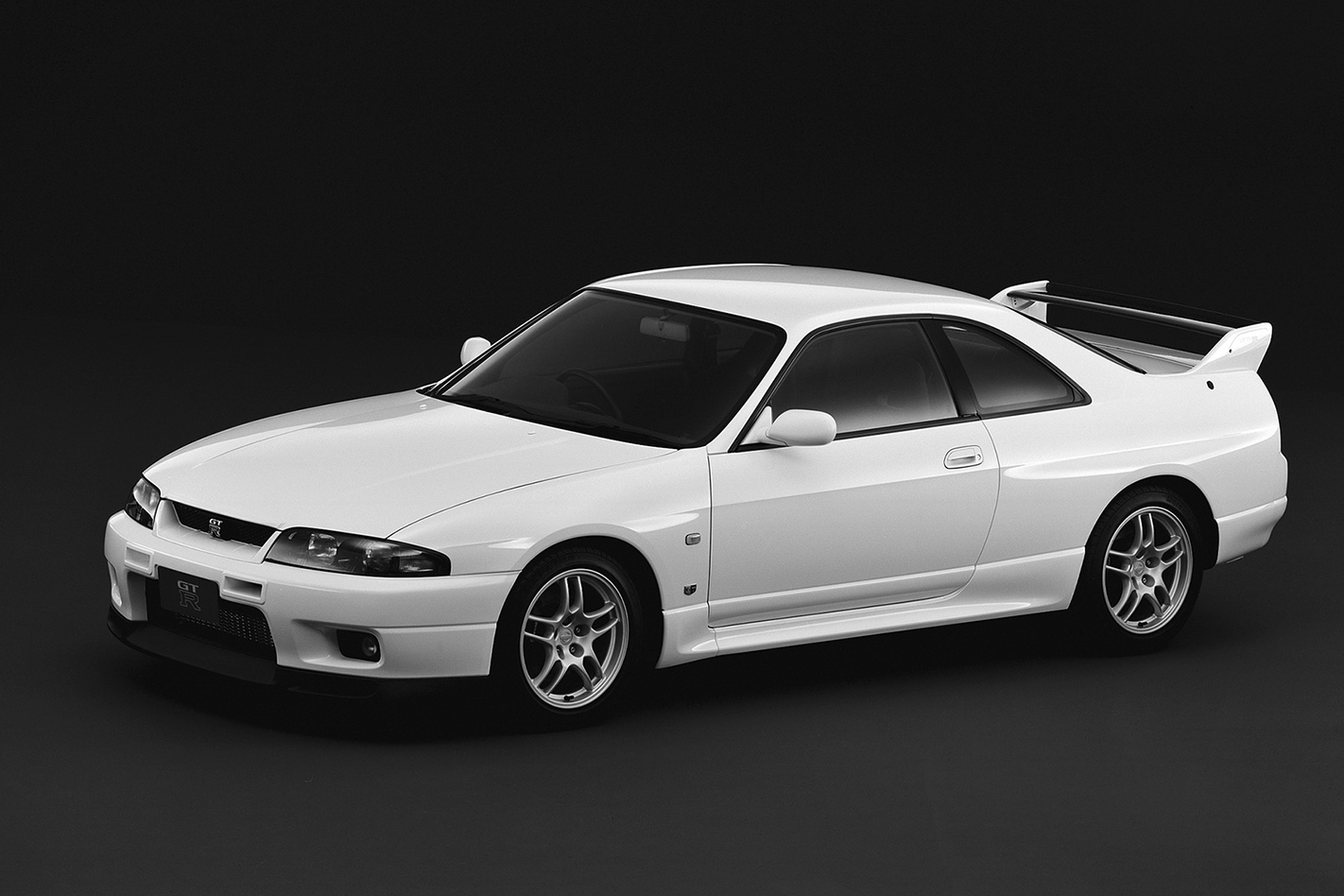
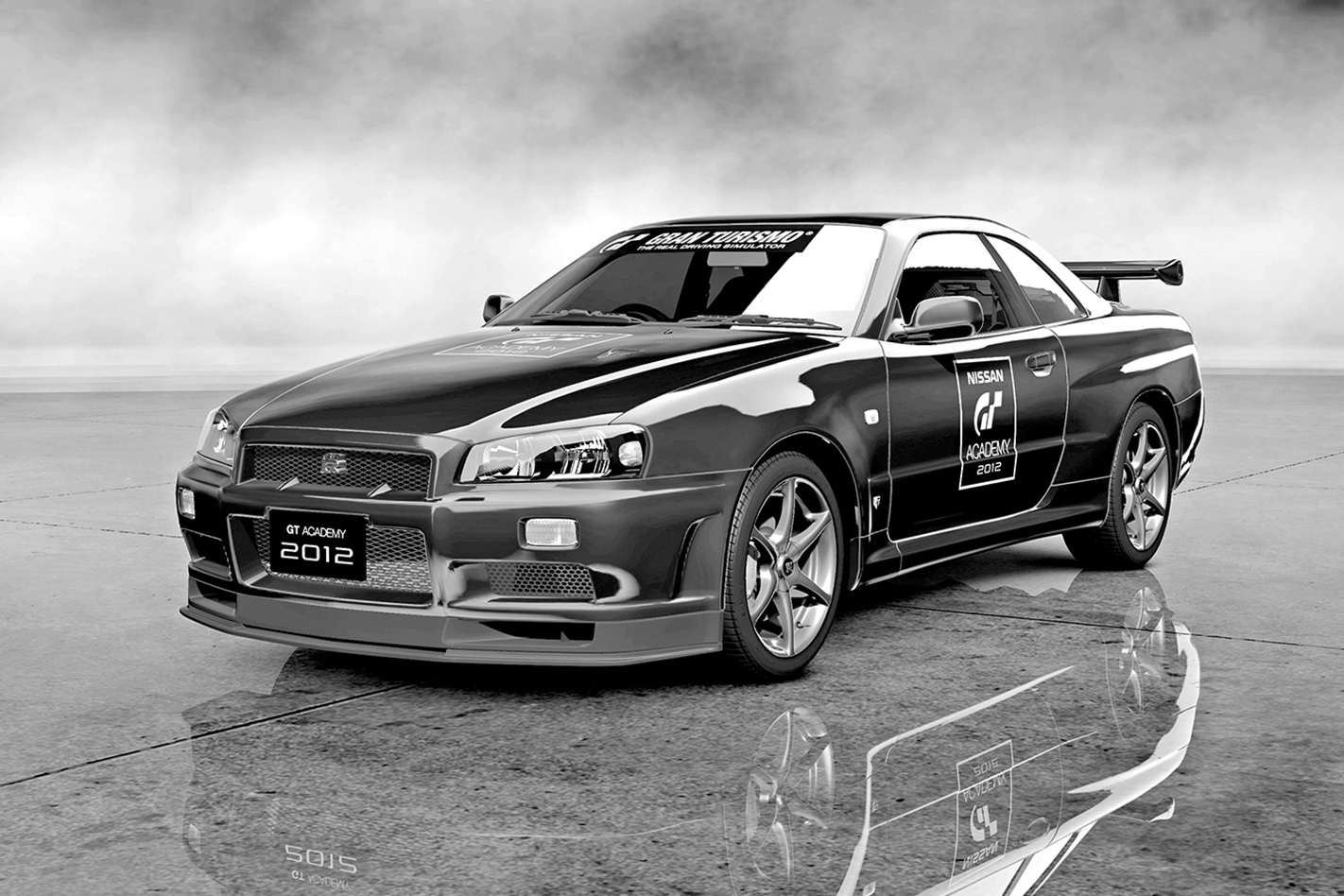
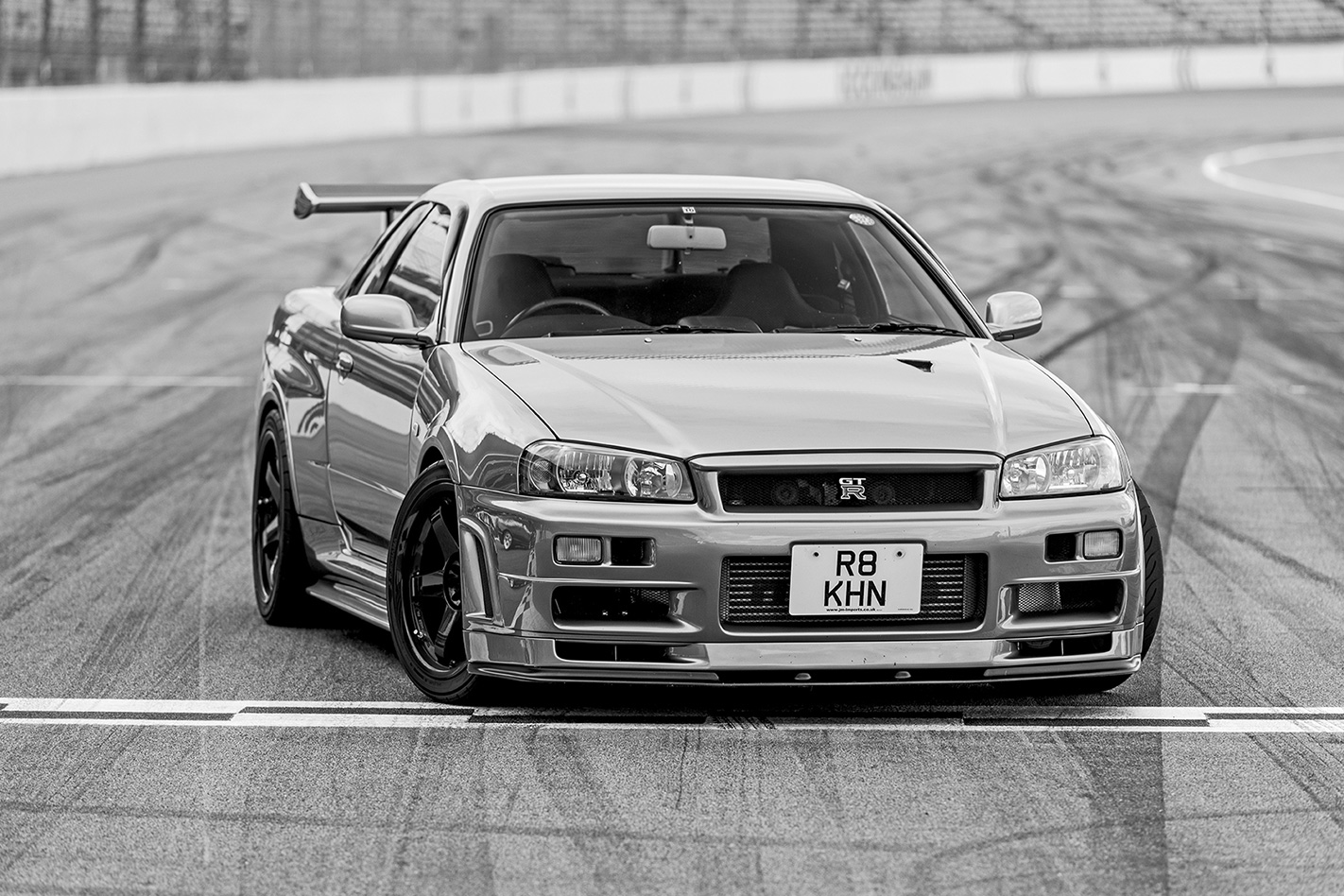
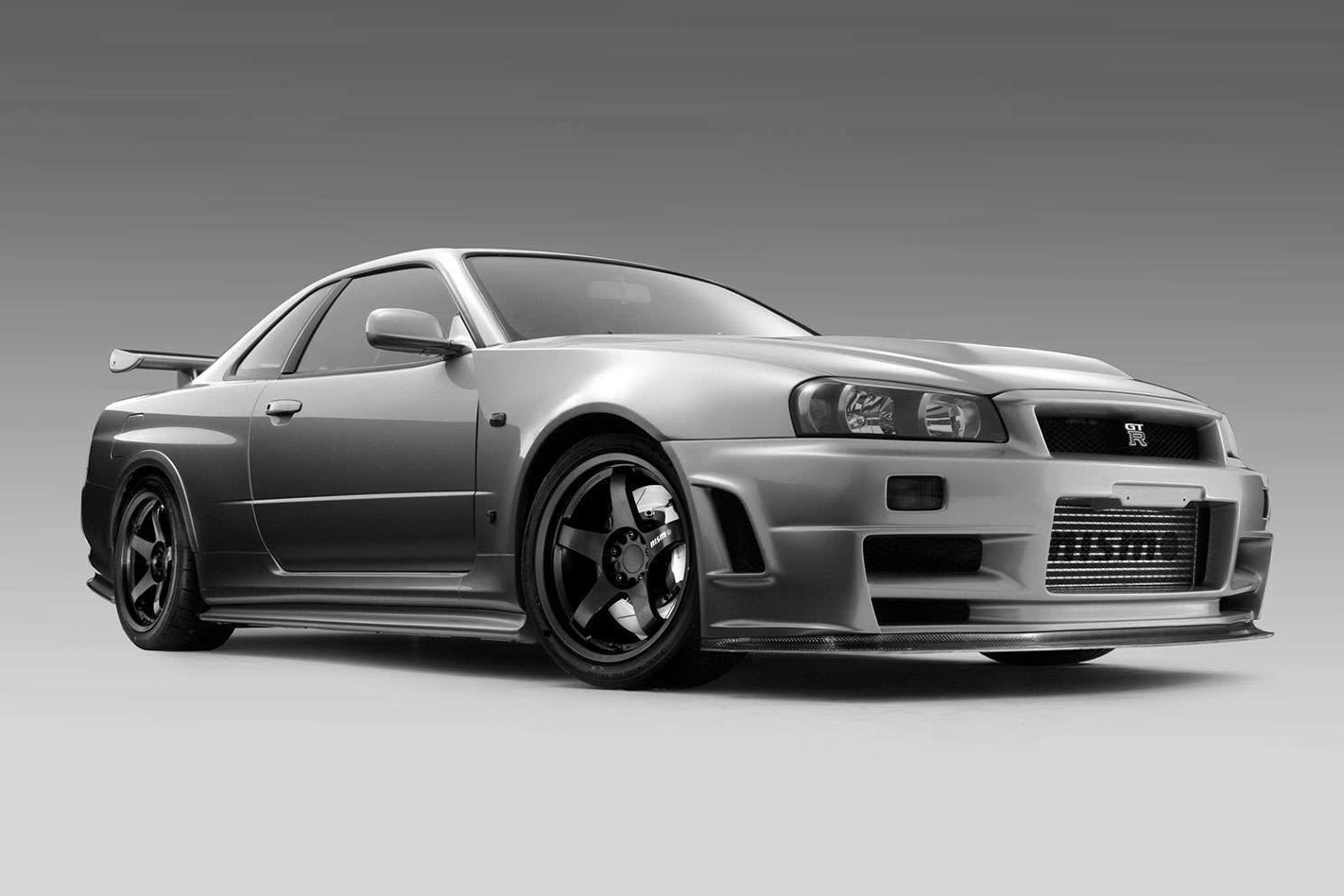
| u00a0 | u00a0Nissan GT-R R33 400R specs | Nissan GT-R R34 R-Tune specs |
| Engine | 2771cc inline-6, DOHC, 24v | 2568cc inline-6, DOHC, 24vu00a0 |
| Drivetrain | 5-speed manual, all-wheel driveu00a0 | 6-speed manual, all-wheel driveu00a0 |
| Power | 300kW @ 6800rpm | 335kW @ 7200rpmu00a0 |
| Torque | 470Nm @ 4400rpmu00a0 | 540Nm @ 4000rpm |
| Weight | 1550kgu00a0 | 1600kg |
| 0-100km/h | 4.0sec (estimate)u00a0 | 4.0sec (estimate)u00a0 |
| Top Speed | 300km/hu00a0 | 290km/h |
| Price (new) | $300,000 (estimate, in 2017 dollars)u00a0 | $300,000 (estimate, in 2017 dollars) |
THE most highly anticipated ute release of 2018 is finally official: a beefed-up, high-performance Ford Ranger Raptor is coming to Aussie roads.
To be sold under the Ford Performance umbrella, the Raptor flagship will showcase Australian-led engineering and usher in a host of performance and off-road upgrades to cement its place as Australia’s most extreme trade ute.
Key to this will be an upgraded platform and a host of mechanical changes including a new 10-speed automatic gearbox co-developed with General Motors and rear disc brakes, the latter being a Ranger first. Raptor specific upgrades will extend to unique sheet metal, flared wheelarches and aggressive front-end bodywork likely to include a redesigned bonnet, bumper and front grille.
The rear end, too, will be styled more aggressively and feature a unique cargo bay required to house the Raptor’s wider rear rubber and overhauled suspension, which is tipped to ditch the regular Ranger’s leaf springs in favour of a version of the Everest’s Aussie-developed coil-sprung multi-link set-up.
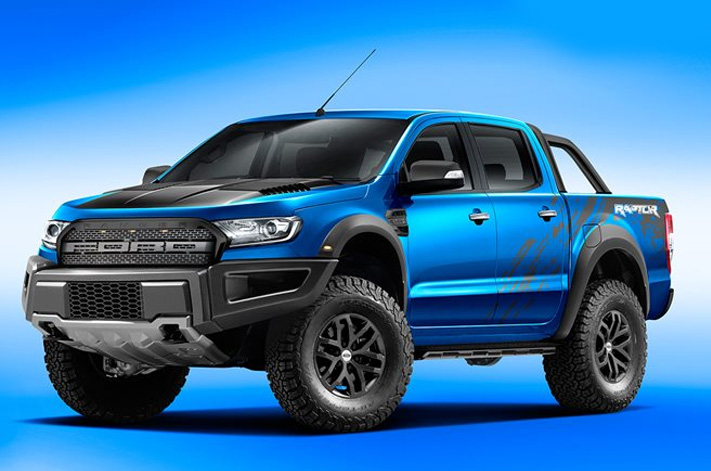
Boosted ground clearance, wider tracks and robust wheels and tyres are also expected to hammer home the Raptor’s place as a variant built for hardcore off-roading and high-speed desert bashing.
The key piece of the puzzle yet to be confirmed is what engine will power the Raptor. While the larger F150 Raptor’s 331kW/691Nm 3.5-litre twin-turbo EcoBoost petrol V6 will be available in America, it’s unlikely this engine will make it Down Under. An upgraded version of the Ranger’s current 147kW/470Nm inline five-cylinder diesel is another option, though Wheels understands a new four-cylinder turbo-diesel is also being considered.
Also unclear is exactly when the Raptor will land in Australia, though expect it to go on sale in the second half of 2018 where it will inject a welcome dose of excitement to the big-selling Ranger line-up.
Ford has sold more than 28,000 Rangers this year, making it the brand’s most popular model line by a factor of four. And given high-end XLT and Wildtrack variants make up around 60 percent of the current Ranger model mix, there’s clearly a market for an even more expensive flagship.
As for what the Raptor will cost, official pricing is yet to be confirmed, though given the Wildtrack retails for around $60,000, expect a price-tag somewhere in the $80K bracket.
Price & Equipment – Winner: Infiniti Q60 Red Sport
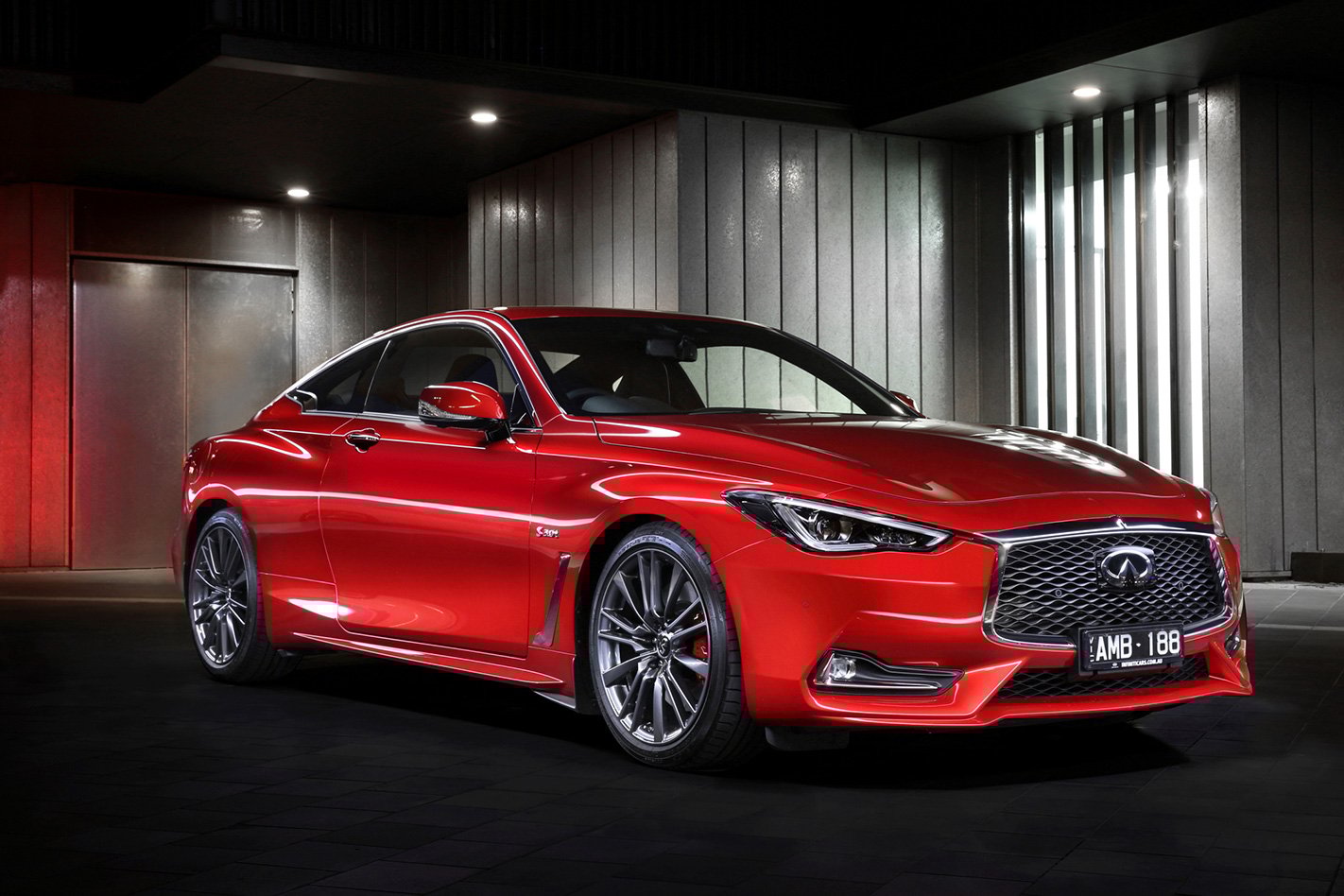
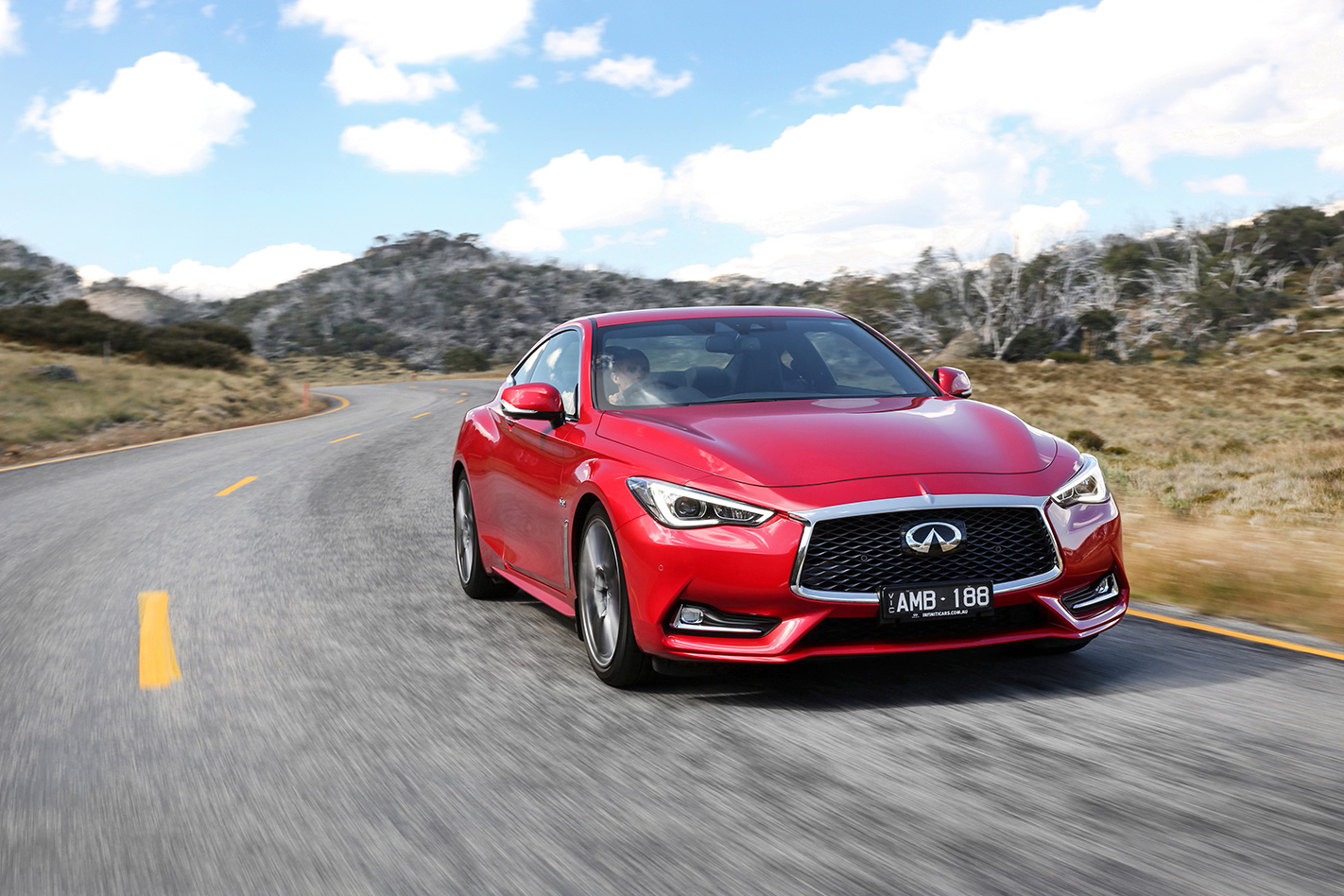
The premise here is more hi-po coupe grunt and fruit for less, but does the Infiniti Q60 have the talent to take on Germany? The $88,900 Red Sport version starts by undercutting the BMW 440i by $11K, and you get keyless entry/start, sunroof, around-view monitor, collision warning and AEB, adaptive suspension and an extra 58kW.
The top non-M 4 Series gets sat-nav, reversing camera, head-up display, adaptive dampers, adaptive cruise control, collision warning and city braking systems. There’s also a parking assistant, adaptive LED headlights, high-beam assist, heated front seats, and BMW Connected Drive that offers live traffic information and valet services.

Interior & Versatility – Winner: BMW 440i
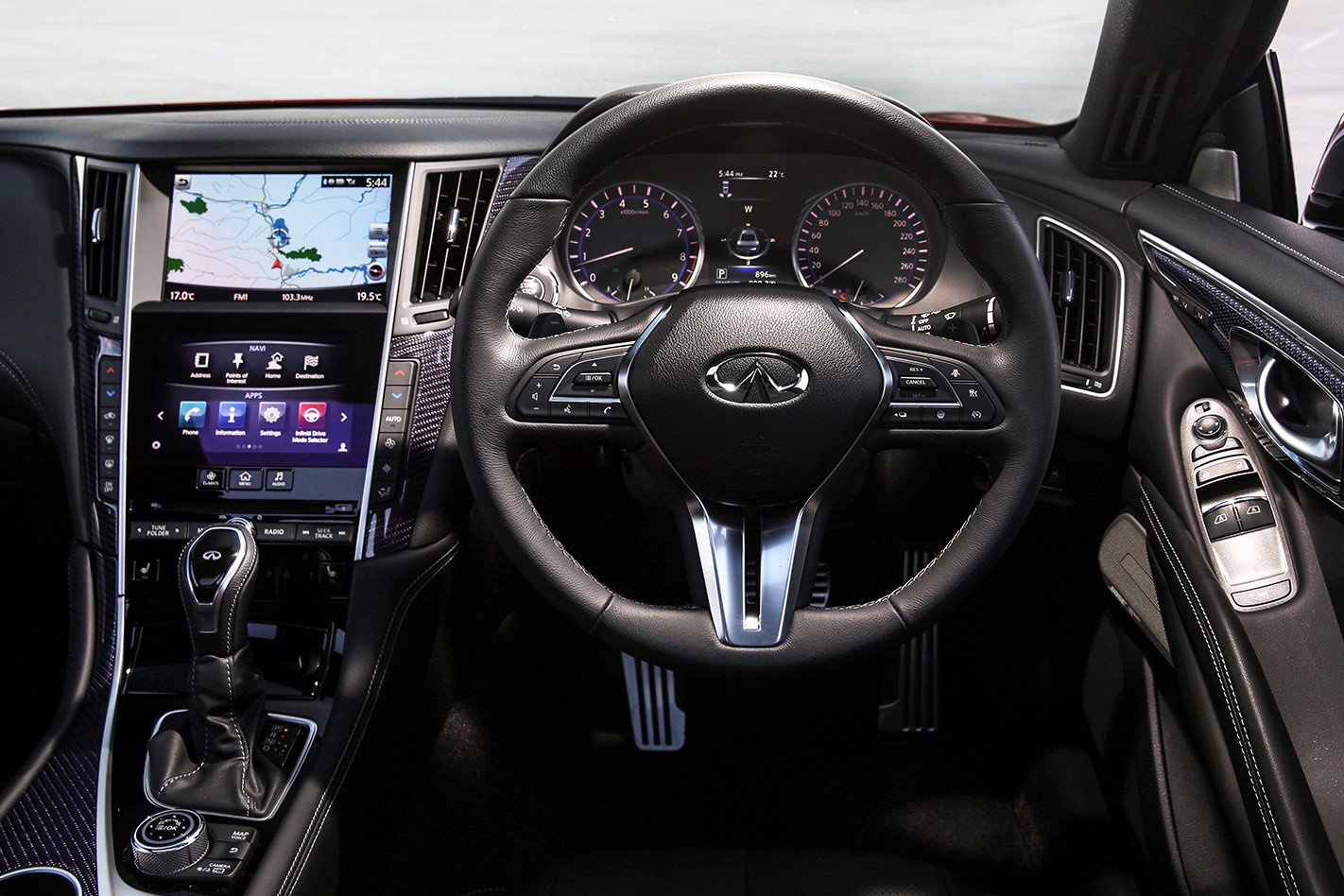
It’s easy to get comfy in the Q60 thanks to sumptuous seats and a powered steering column. Dash/console design brings a cocooning feel with high-quality materials and finish. Unique dual-screen layout with nav up top and infotainment functions on a higher res screen below. Some generic-looking switchgear lets the overall image down.
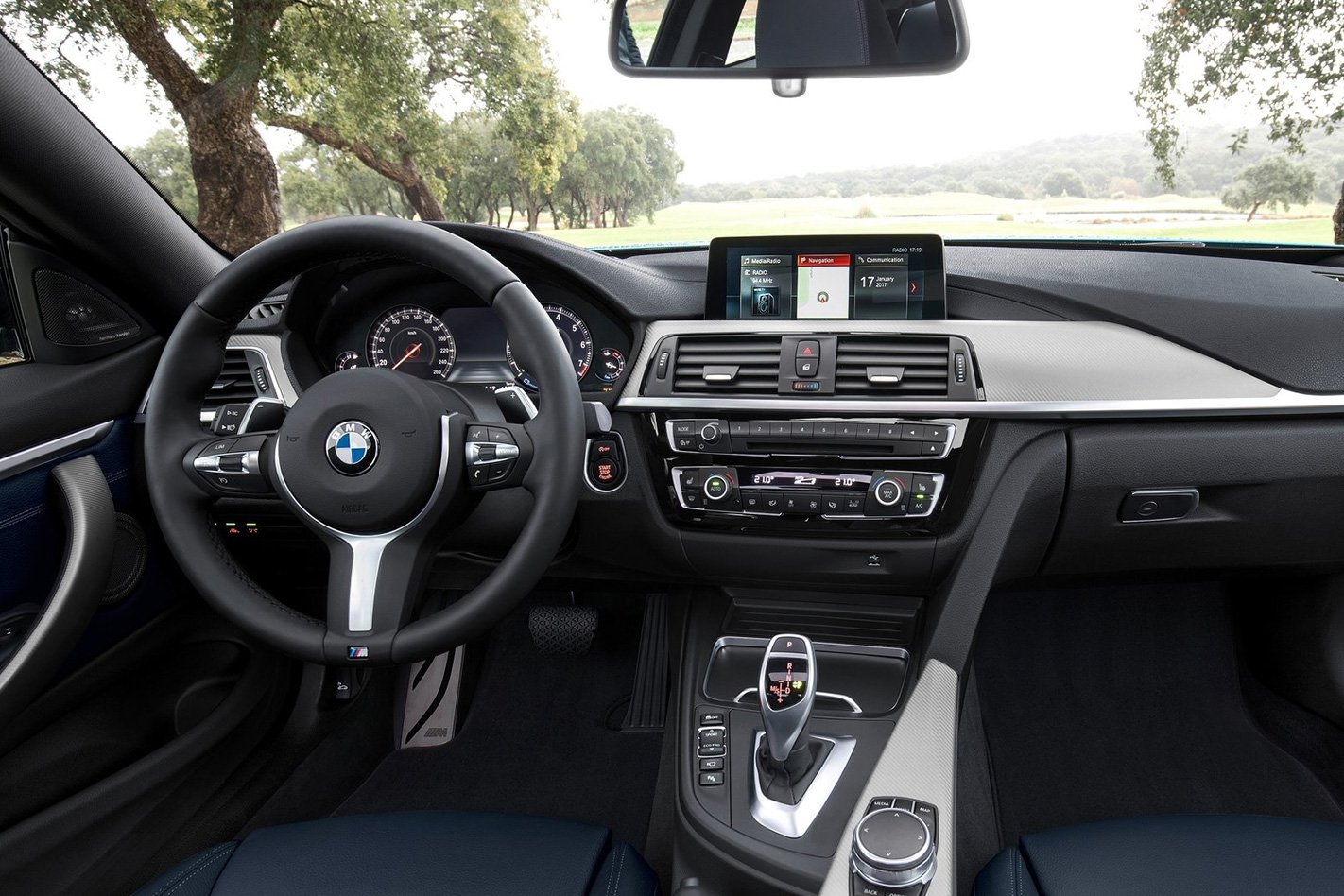
High tech, such as its digital instruments, lives with straight-edged design and plain plastics where the Infiniti often applies something richer, which gives the 440i a more austere feel. Yet the Q60 feels like a heavily gilded Japanese coupe and the BMW is more consistently ‘premium’, with slick infotainment and slightly roomier rear quarters.
Performance & Economy – Winner: BMW 440i
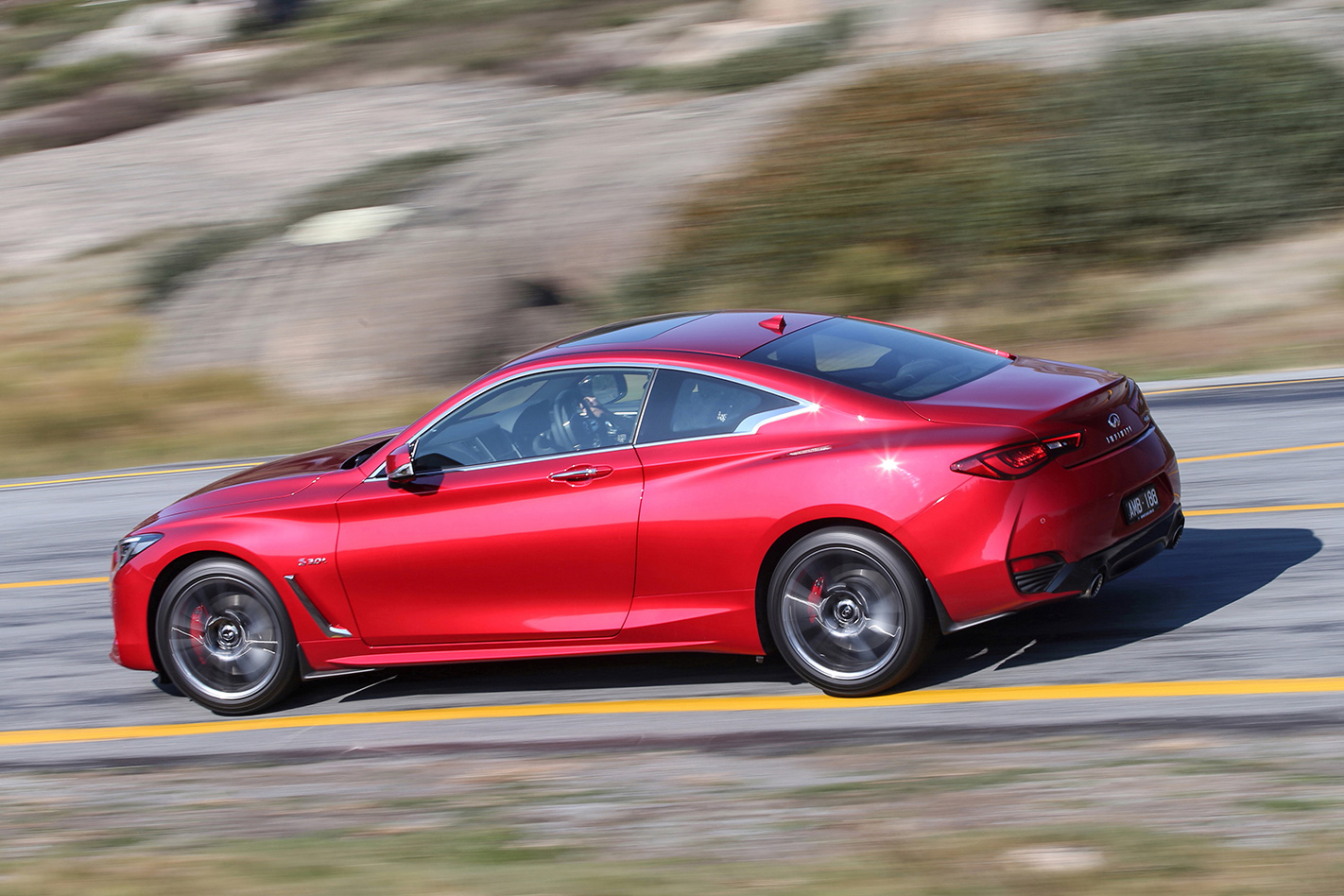
The six-pack pair align with 3.0-litre cubic capacities and forced induction, but Infiniti’s VR30DDTT engine has its pistons in a vee with twinned turbos. There’s 298kW and 475Nm on offer, 58kW/25Nm more than the BMW. The Q60 is addictively thrusty and good at laying its power down via its seven-speed automatic and rear-drive.
The 440i plays a modern rendition of the classic BMW straight-six tune and powers via an eight-speed auto to a forceful top end. Its official 6.8L/100km figure is about 30 percent less than the Q60’s thanks to its 259kg-trimmer kerb weight (1525kg). With smaller outputs pushing fewer kilos, the 5.0sec 0-100km/h claim feels right.
Ride & Refinement – Winner: BMW 440i
Having 19-inch tyres isn’t necessarily the bane of ride quality, but the Infiniti’s are run-flats and, despite the ability to relax the adaptive dampers via a comfort mode, the Q60 and a bumpy road never really get on. It’s busy on both patchy urban tarmac and coarse-chip country roads, where the Infiniti is noisier than its rival.
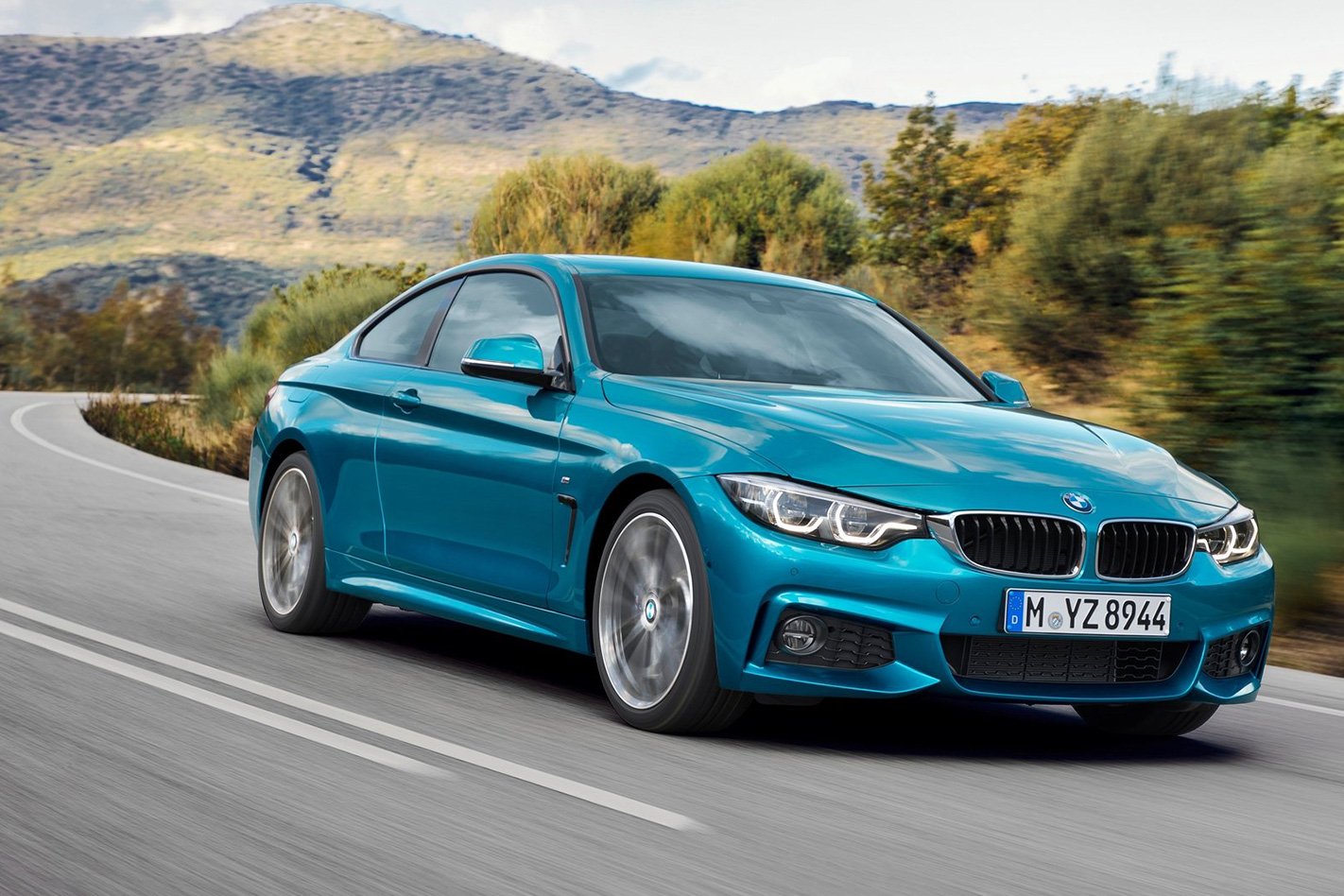
The 440i is more compliant despite being on 19-inch run-flats too. Its adaptive dampers strike a sweeter ride/handling compromise that brings composure and comfort over undulations. Fidgety ride over sharp bumps is seemingly the work of shallow, stiff sidewalls. But the 440i is better at isolating its occupants from wind rustle and tyre roar.
Steering & Handling – Winner: BMW 440i
Common electric steering critiques of being ‘disconnected’ and having ‘no feel’ are more apt of the Q60’s by-wire steering. By design it lets nothing from the road make its way to your hands and although Infiniti has tried to synthesise the sensation, the result doesn’t feel natural. It’s the link missing from the well-balanced Q60 chassis.
Having an actual steering column in the BMW contributes to making it the pick for driver confidence and involvement. Its feel and the chassis’ innate adjustability becomes more obvious the harder you drive the 440i, and the suspension is better at keeping the tyres glued to the surface when exiting bumpy corners.
Verdict – Winner: BMW 440i
The Infiniti Q60 Red Sport has in its favour uniqueness, high value, twin-turbo thrust, and basically decent dynamics – aloof steering aside.
The lighter BMW, on the other hand, is a known quantity with similar straight-line performance and notably superior official economy, in what’s ultimately a more cohesive driver’s package.

The Infiniti comes backed by the brand’s four-year/100,000km warranty, a year more than BMW’s. If you need greater practicality, the four-door 440i Gran Sport is available for the same money, yet you could also opt for a four-door Q50 Red Sport for almost $20K less than the BMW.
Either way, the German justifies its price by delivering the key ingredients of steering and handling that hit the high-performance coupe mark.
VW Commercial merchandise, $9.50 – $353
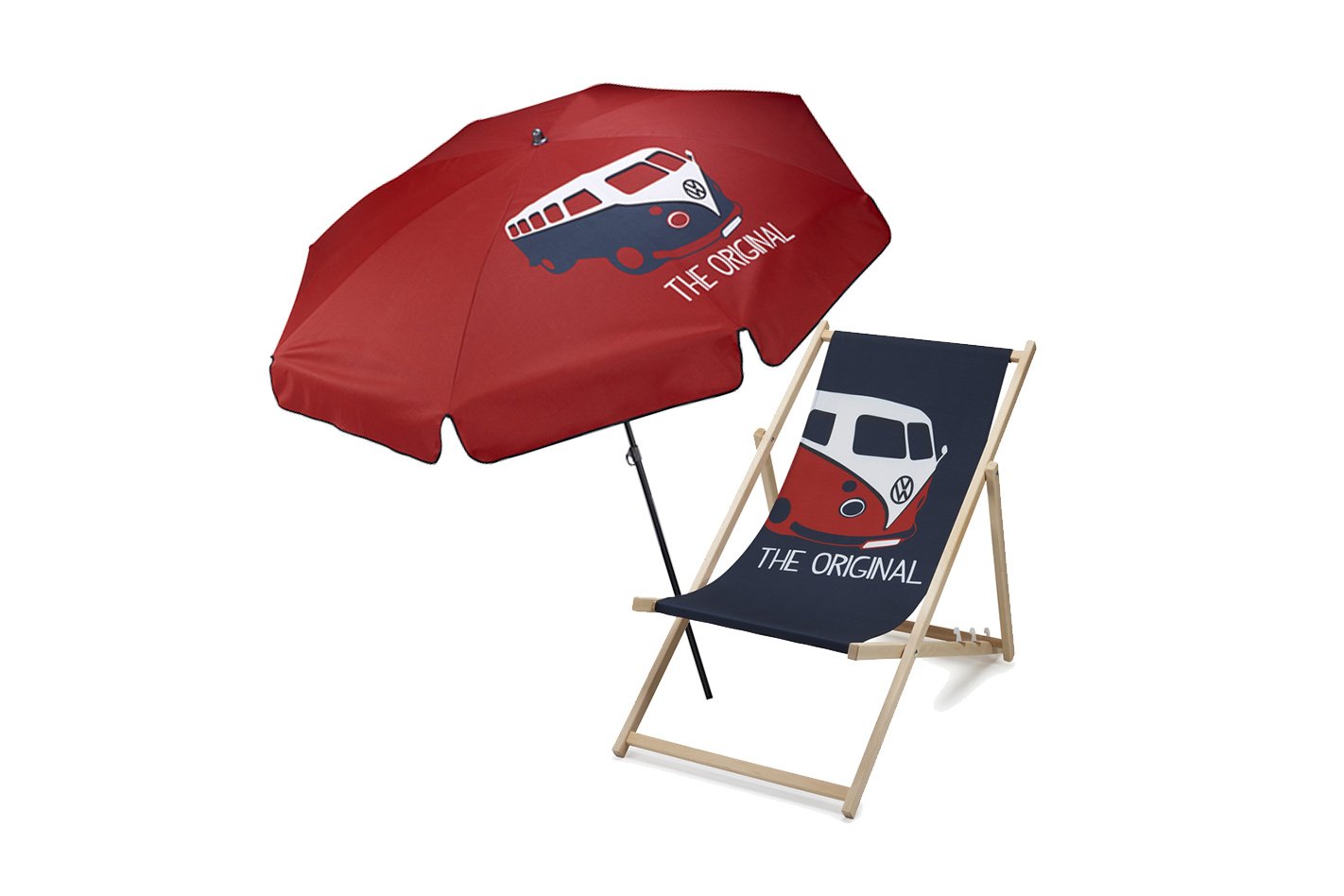
If a commercial vehicle brand launches a range of merchandise, it’s normally bar towels and Akubras, but not in the case of Volkswagen. The original split-screen Type 2 might have been a workhorse, but it’s worshipped like an air-cooled deity and VW’s latest branded kit celebrates 68 years of its icon.
With spring around the corner, any picnic or camping trip can be brightened up with a range of dub kit from a Kombi ice cube tray to a four-person tent.
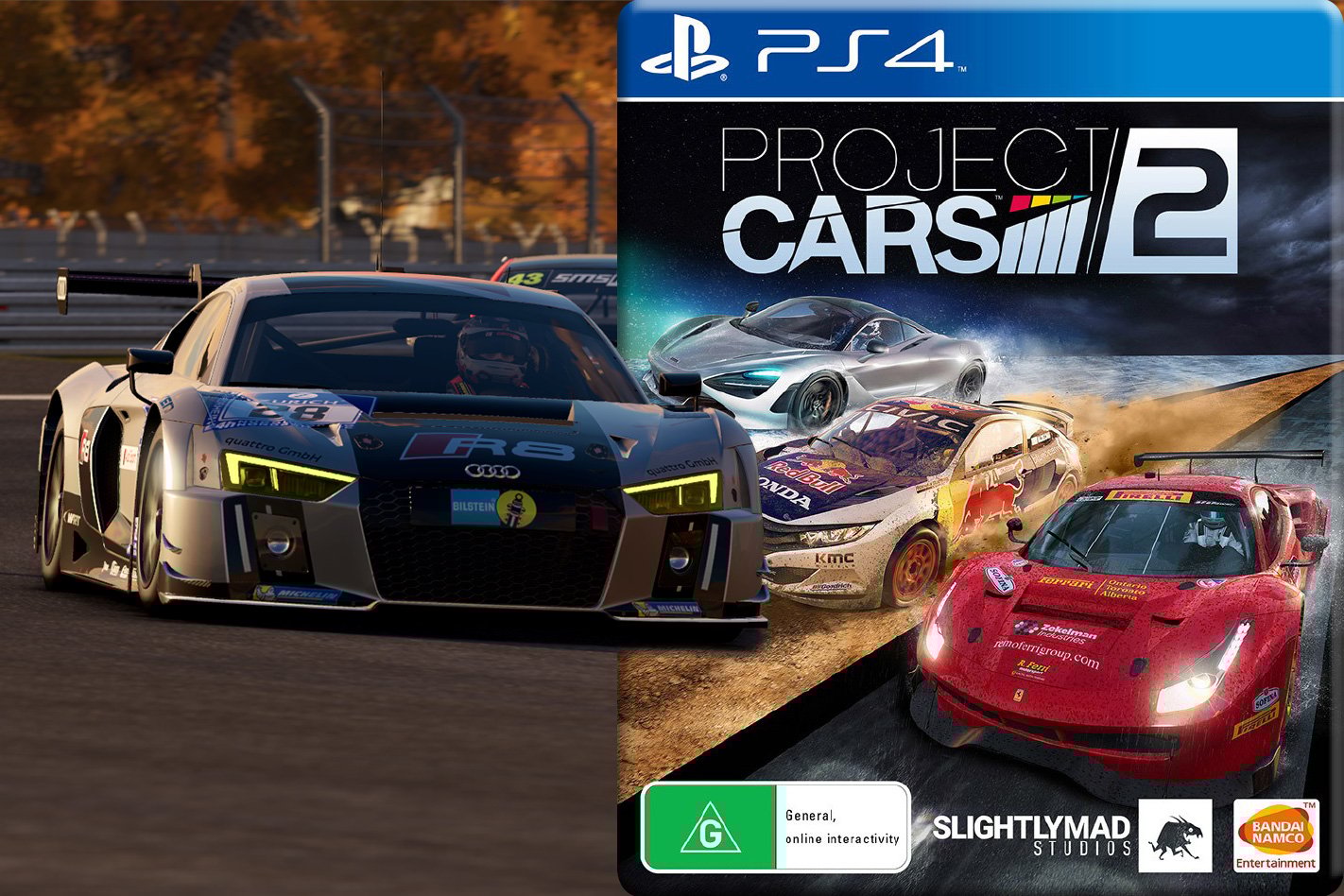
Fast cars can be an expensive hobby and if you choose to explore the limits of performance on a public road, it can become really, really expensive. So let’s all thank the people at Bandai Namco for bringing us the second instalment of their Project Cars series.
Pick from 170 different cars and more than 120 track layouts on which to hone and thrash your prized machines with almost spookily realistic graphics and game physics. PC users can even wire in a VR headset for the ultimate in automotive immersion. All this for the cost of a Wheels subscription instead of your licence, second mortgage or life.
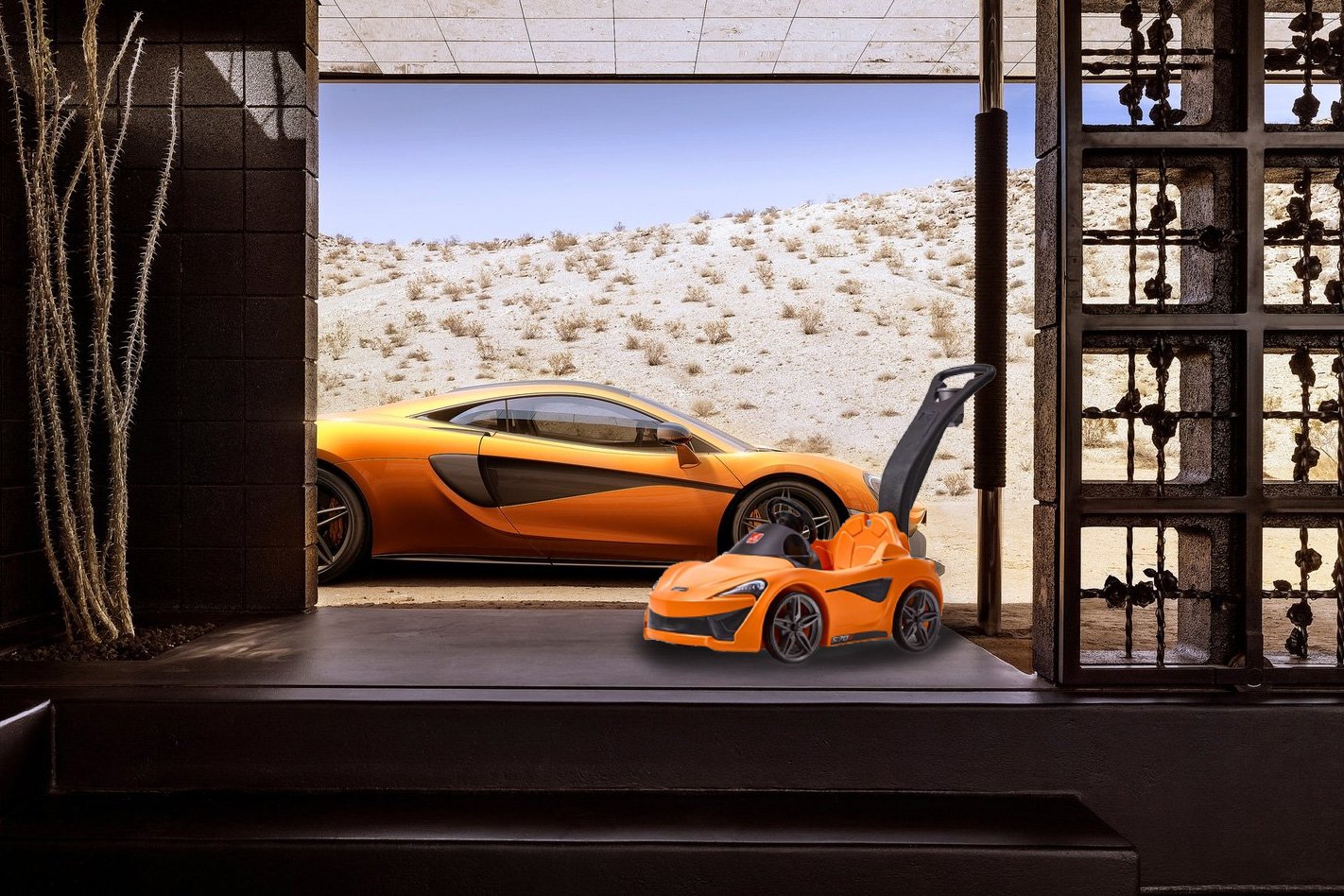
Getting your kids into cars early makes them better drivers and increases their chances of becoming wealthy racing drivers who can get you free F1 tickets, making this McLaren push car a great investment. Your little one will have to wait a few more years before firing up a turbo V8, but the tiny McLaren 570S by Step2 will get them into fast cars as early as possible. It also has a cup holder for the driver and pusher, which is at least one more than the real thing.
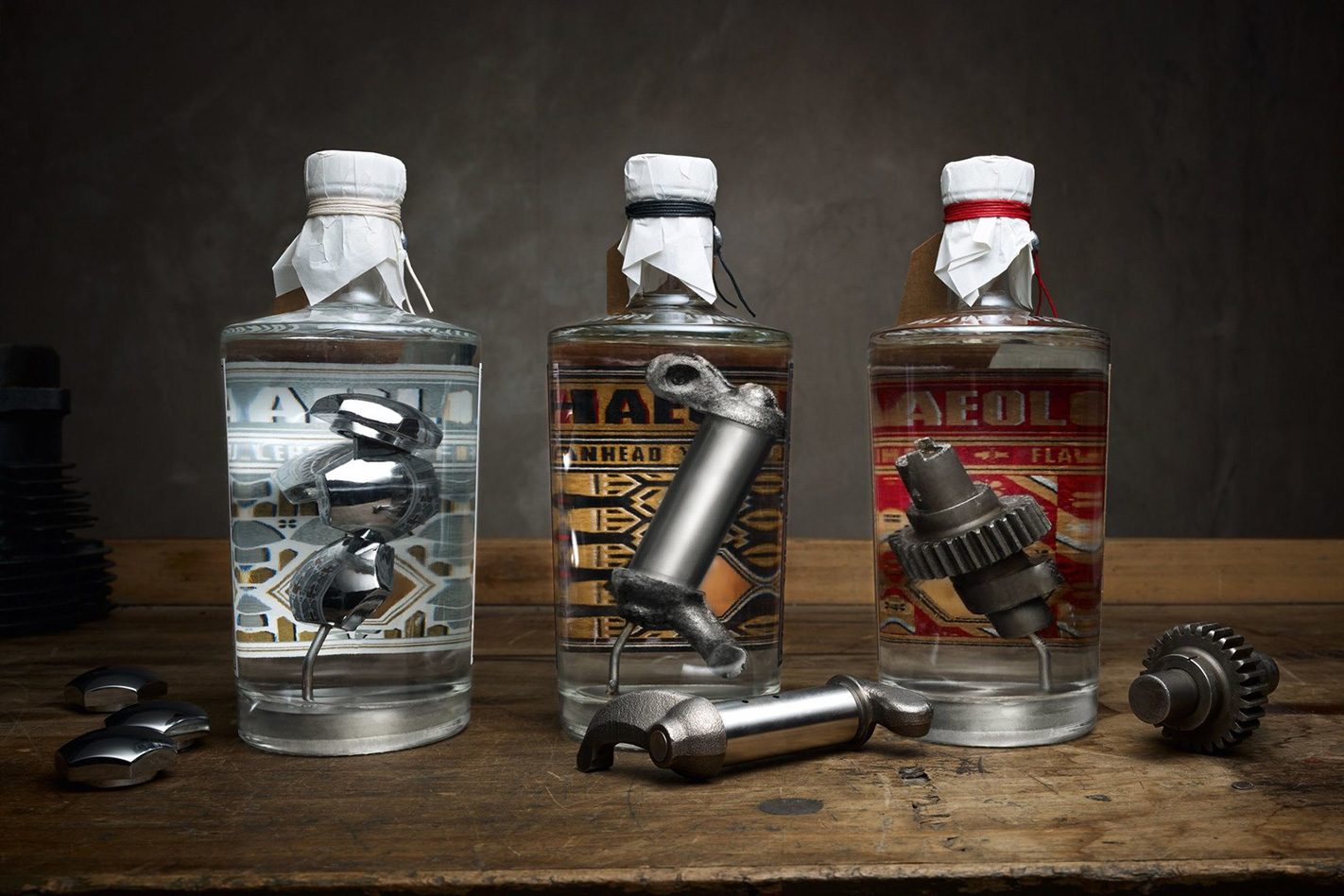
Thought a deconstructed latte was the most nauseatingly hipster drink you’ve ever heard of? Think again. The last time a chunk of motorbike was found in someone’s tipple it followed an unfortunate incident at a men’s shed, but a distiller is now doing it deliberately. Immersing vintage Harley Davidson parts in gin does not impart any interesting flavours and probably accounts for a majority of its vicious price. We can’t think of a single reason to buy, but probably will anyway.
Seiko’s roots lie in a small clock repair shop opened in Tokyo’s Ginza district by Kintaro Hattori in 1877: it went on to make some of the world’s most radical, innovative, and accurate watches.
It beat the Swiss makers for quality and accuracy, triumphed in the Geneva trials of 1968, and then made the world’s first quartz watch the following year. Unlike many Swiss names, all Seiko parts are made in-house, including the lubricants. This new automatic diver’s watch is easily a match for Swiss pieces at ten times the price.
Limited to 6000 units worldwide, it traces its roots to Seiko’s famous 1960’s auto divers’ watches. They were favoured by US special forces in Vietnam, so Martin Sheen’s Captain Willard wore one in Apocalypse Now.
Hanhart Pioneer Preventor9, $1350 (depending on exchange rate)
Hanhart began making watches in Germany in the 1920s, and was known for its sporting stopwatches and pilot’s watches. Jack Heuer liked them so much he tried to buy the business, and Steve McQueen liked them so much he chose to buy his own. The Heuer Monaco McQueen famously wore in Le Mans came free from the props department.
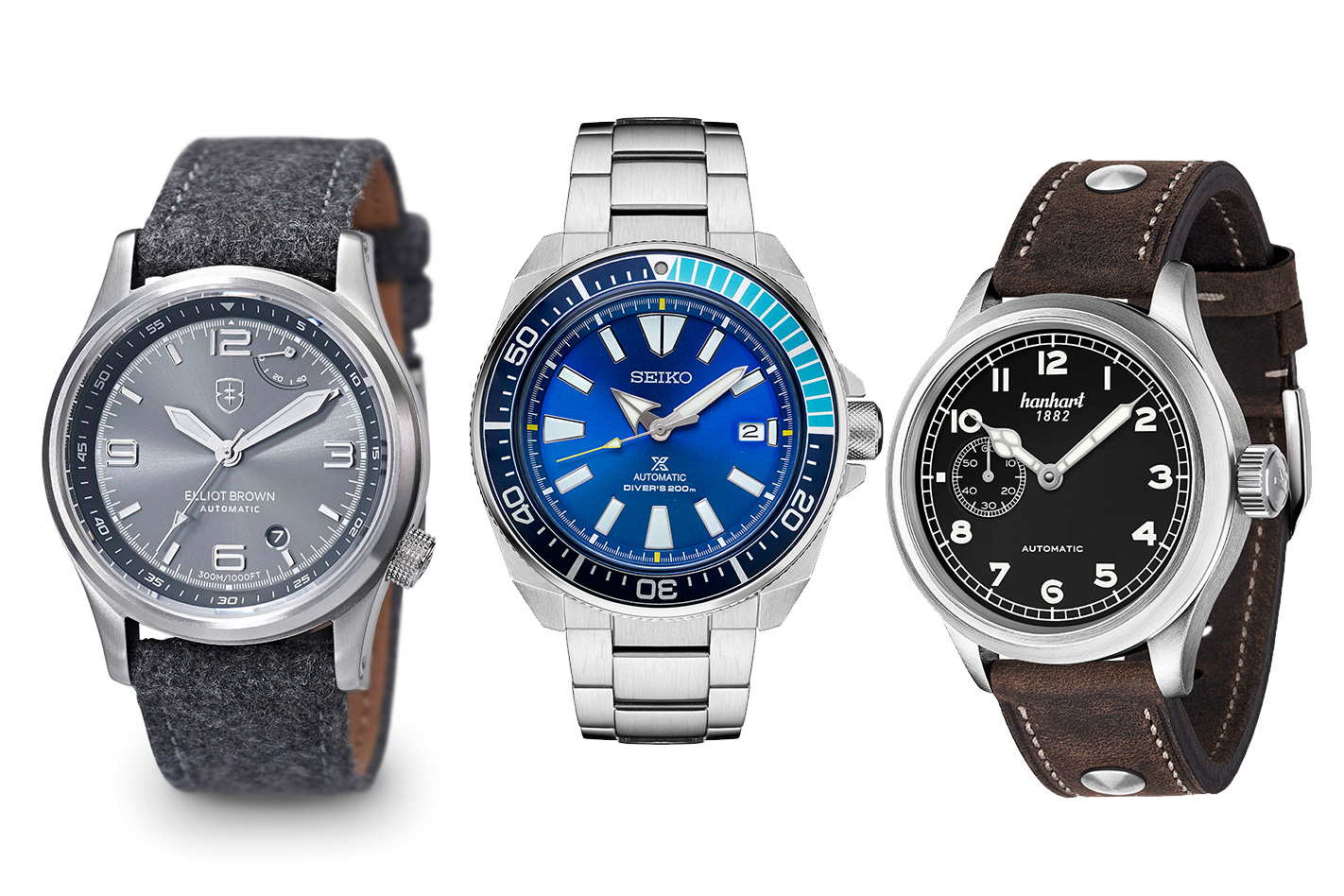
Elliot Brown Tyneham, $1150 (depending on exchange rate)
When UK-based Elliot Brown sent us one of their quartz Canfords to test, we couldn’t figure out how they can sell such a high-quality watch for less than $1000 and still make a profit. You’d have to spend many multiples of that to get something Swiss that is appreciably better, or more robust (or has a nicer box).
Their new Tyneham is more expensive because it has a Japanese Miyota automatic movement – also often found in much pricier watches – and an even higher standard of finish, and thus remains seriously good value. Keep in mind that the sterling prices quoted on their website include a 20 percent UK Value Added Tax, which will be knocked off for shipments to Australia.
Don’t for a minute think that the Porsche Cayman lacks heritage.
This article was first published in MOTOR magazine’s January 2013 issue.
Sure, the nameplate has only been around since Zuffenhausen capped and couped the Boxster in 2005, but Porsche has been doing mid-engined coupes for almost as long as the 911 has been in production.
There was just a massive gap between the gorgeously lithe 906 and the 987 that ceased production earlier this year to make way for this, the all-new 981 Cayman that was revealed at the Los Angeles Auto Show before going on sale here, in Oz, in March.
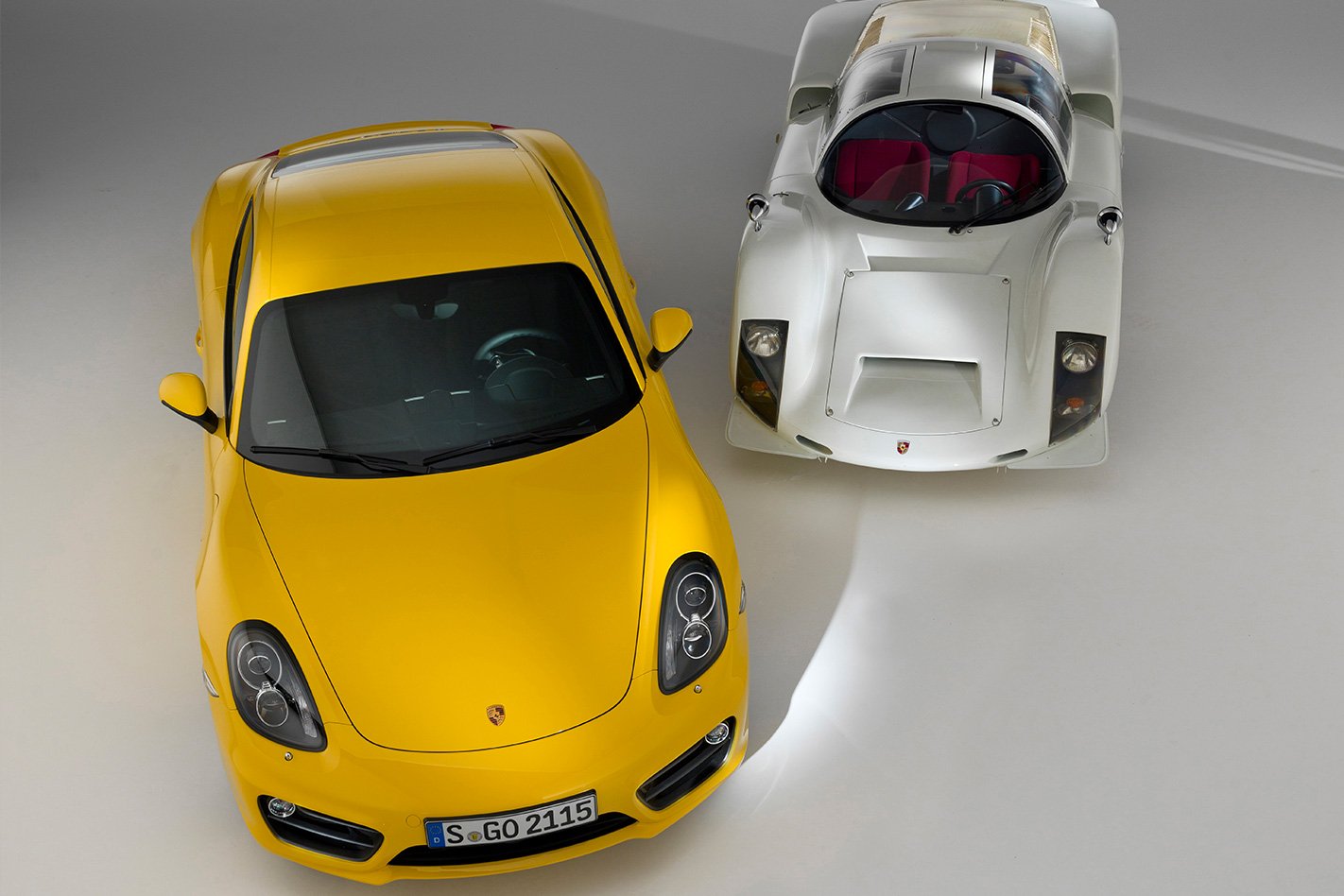
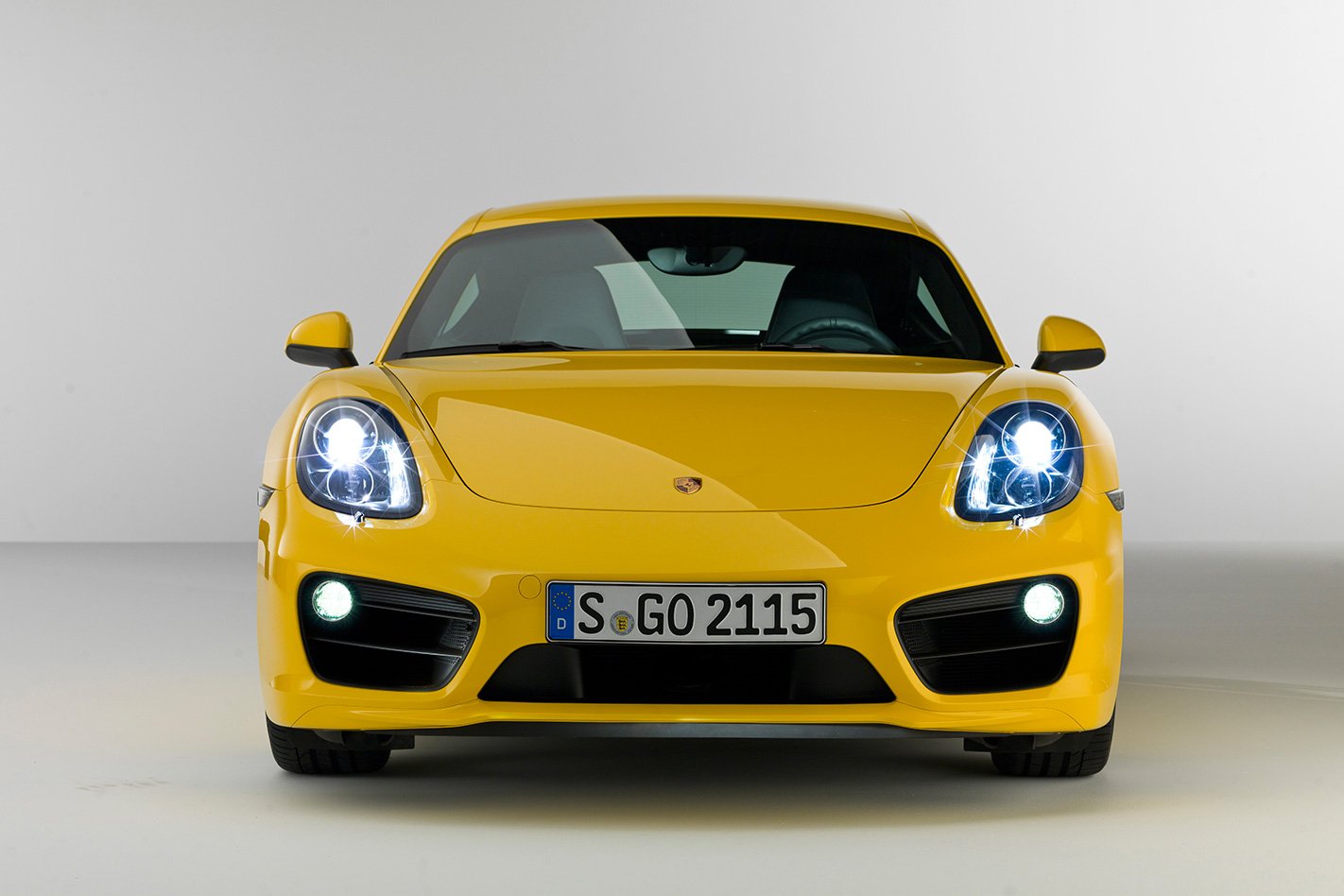
Lower (by 10mm) and longer (by 33mm), its wheelbase is stretched by 60mm, the track is slightly wider and the front overhang has been clipped. In addition, the design team, under boss Michael Mauer, created a more aggressive nose, a set of heavily modified doors and a markedly different rear end style.
Also new are the sleeker roof and the more practical tailgate made of aluminium, while the previously fixed rear air dam is now motorized, is about 40 per cent larger than before, it extends to a taller position and at a steeper angle and thereby provides quantifiably more high-speed downforce.
And, at the other end of the car, the drag-cutting spoiler at the front reduces axle lift. Other changes include more aggressive daytime running lights, bigger straked matte black lateral air intakes and a full-width, high-mounted LED stoplight.
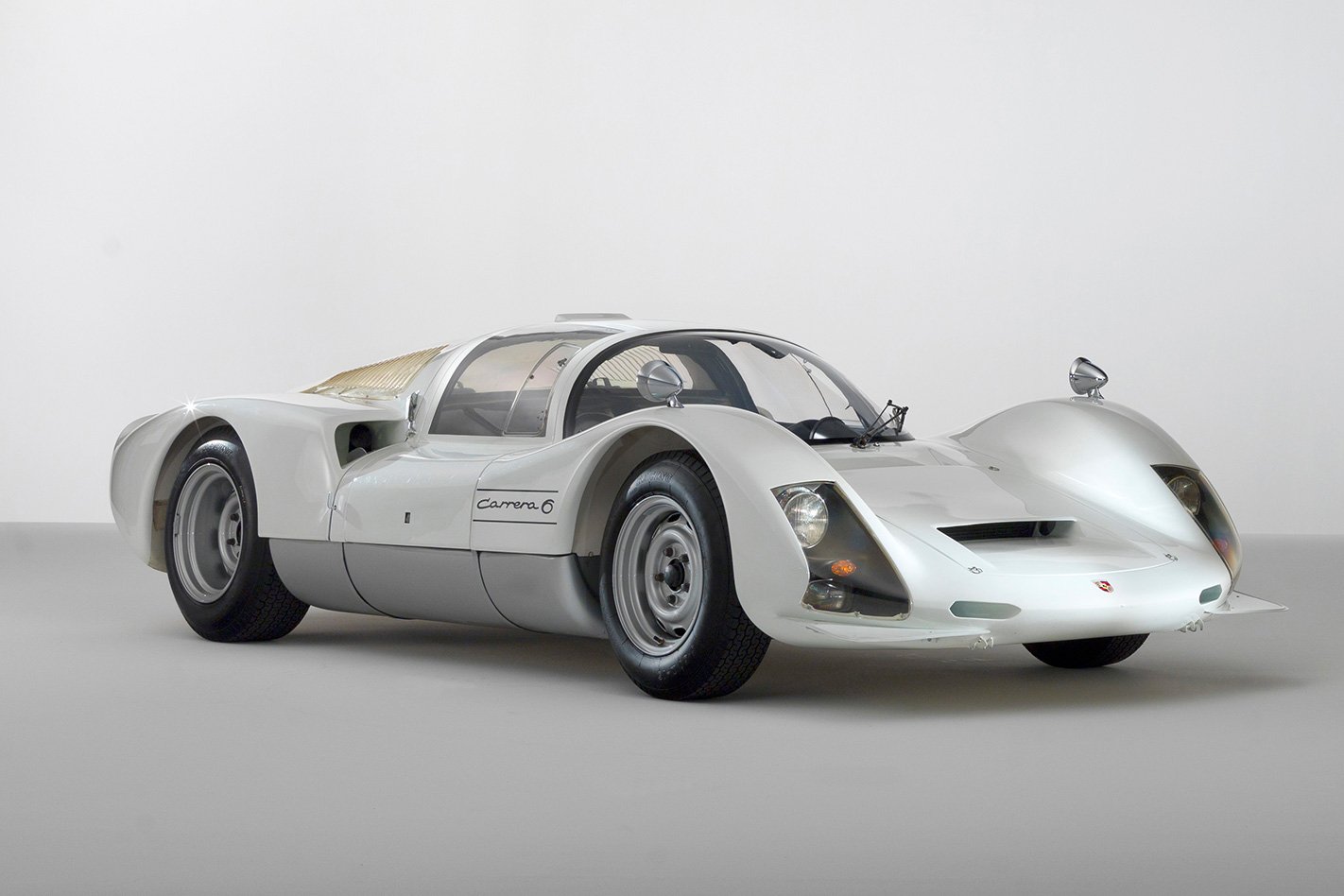
Just like Cayman, Boxster and 911, which still share an increasingly flexible common DNA, the 906 launched 46 years ago was closely related to the first-generation 911 unveiled in 1963. Famously, Porsche had planned to use the 901 name for its new rear-engined sports car, but when they lost a lawsuit to Peugeot, it was renamed 911.
For the same reason, the four-cylinder 904 was rebadged Carrera GTS, and the 906 was marketed as Carrera 6. Our mint specimen of the first-ever mid-engined Porsche still stirs, erm, all six senses. For a start, the dramatic proportions are out of this world. At 980mm, it’s lower than just about any current fixed-head sportscar.
Its width (1680mm) is petite but the length is almost self-conscious (4113mm), while long-tail Le Mans versions measure a substantial 4600mm. Its most eye-catching features are its stacked front lights in flush-fitting lenses; a Kammback rear spoiler, truly panoramic windscreen and two chromed teardrop-shaped Talbot wing mirrors.
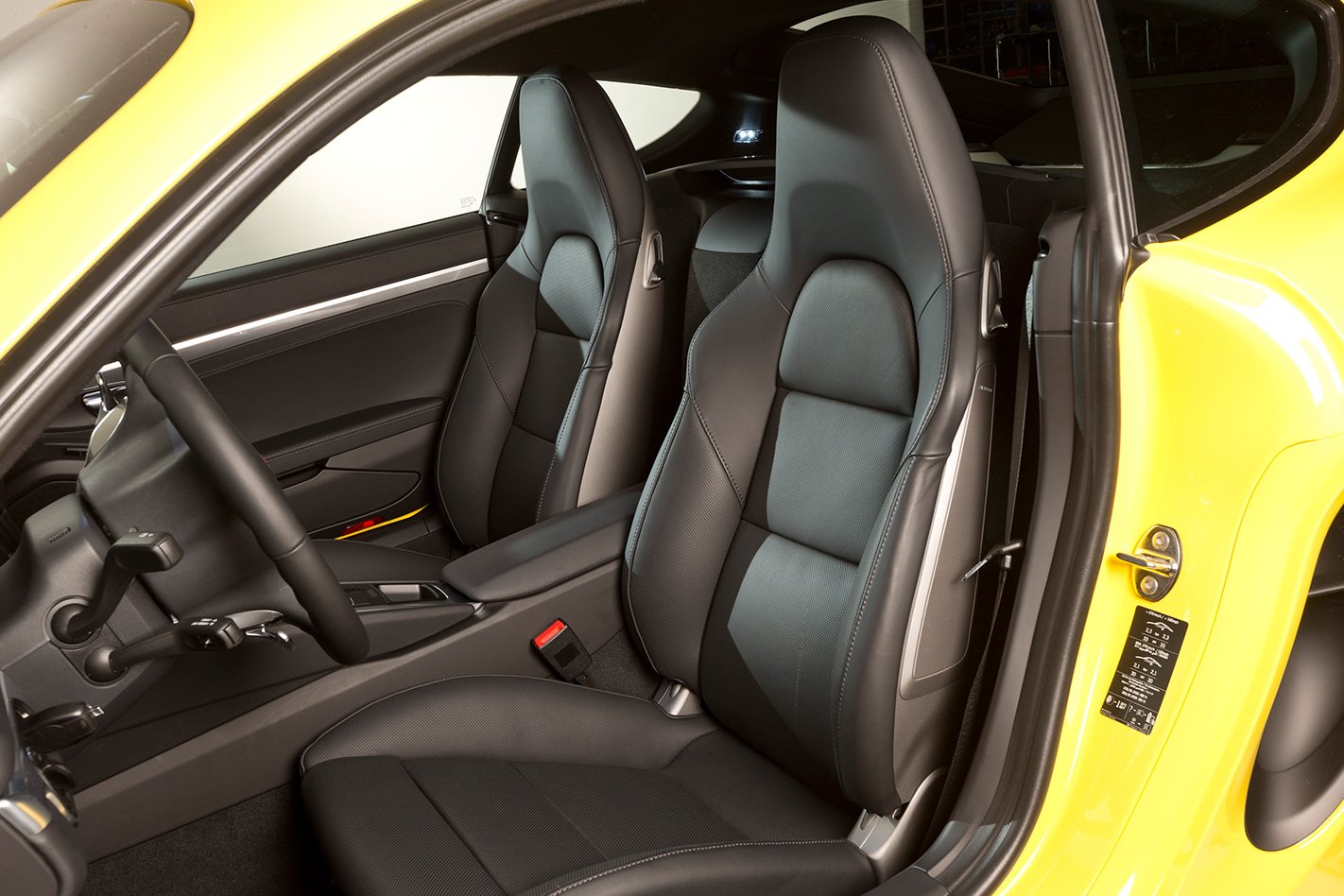
If money permits, Porsche will fit a high-end 800-watt Burmester sound system, keyless go, adaptive cruise control, power heated/ventilated memory seats, the latest infotainment wizardries and just about any conceivable colour and trim combination.
And while the new Cayman is still not the place to swing a tiger, the extended wheelbase and the more pragmatic seat design furnish tall drivers with an important extra bit of room to move. In stark constrast, the 906 was a perfect fit for short and stocky pros like Hans Hermann and Gerhard Mitter.
The gullwing doors are no fashion item, they are absolutely essential to finding a way behind the tiny low-mounted steering wheel and to slide onto the narrow cloth-trimmed seat. Once installed, the packaging is quite acceptable.
The driving environment is extremely basic. The only instruments are a rev counter redlined at 8400rpm and an oil temperature gauge, the cable-operated clutch is not much heavier than the wire-linked throttle, the five-speed gearbox is surprisingly light and slick.
A row of black rocker switches operate the single-arm wiper, the lights and the rudimentary fan set-up. As is common with the new-gen Boxster, the base Cayman uses a harder-revving, 2706cc flat six as a replacement for the old-gen’s 2.9-litre unit.
Porsche has, though, eeked an extra seven kilowatts (now 202kW), while peak power arrives slightly higher in the rev range, between 7400rpm and that 7800rpm cut-out. There is something of a outright torque trade-off, its peak dropping from the old car’s 300Nm to 290 in the newie, though there’s a broader spread as all is available between 4500-6500rpm.
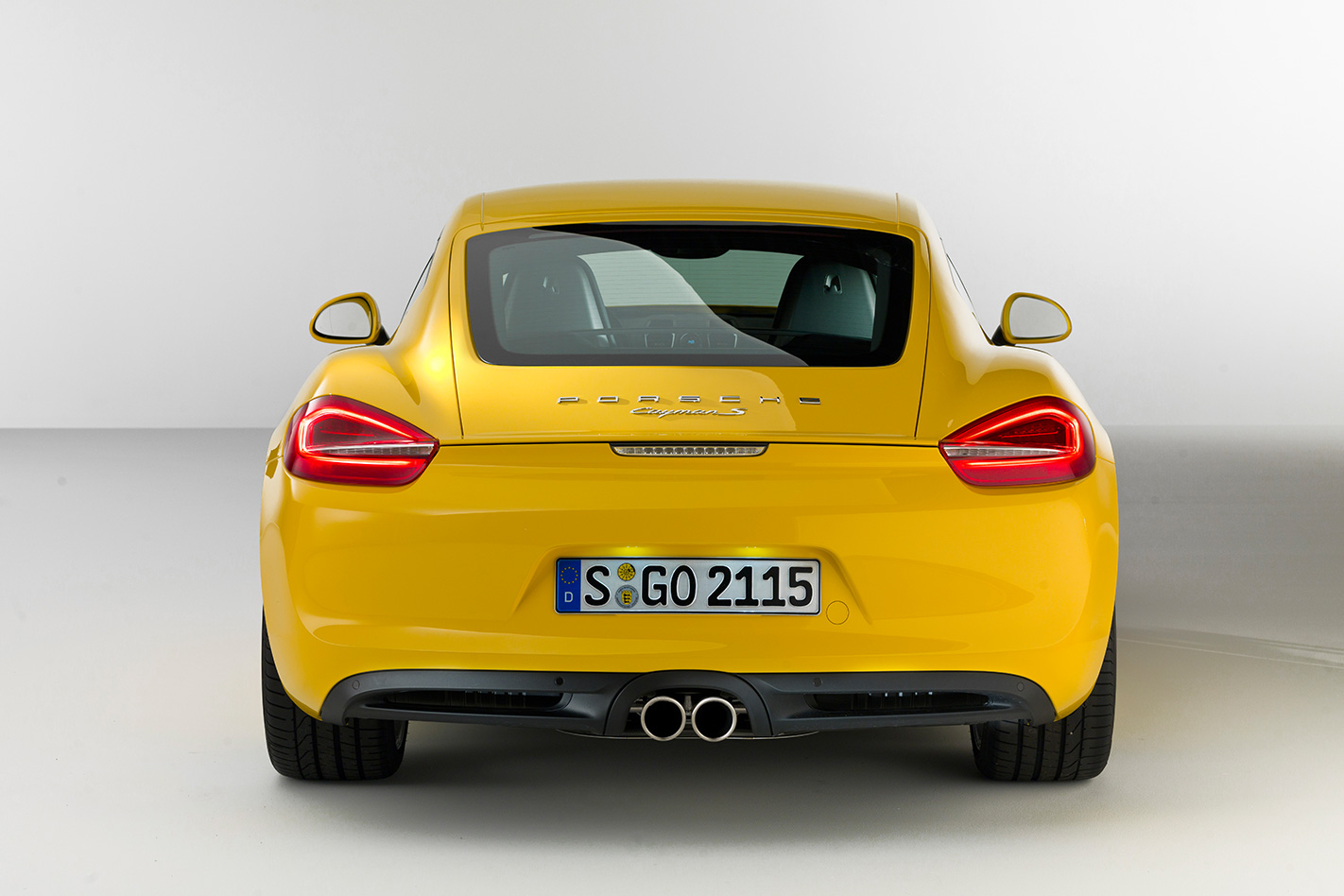
The increase may be marginal, but fuel economy improves by up to 15 per cent over the previous Cayman, and the performance of the new S version eclipses last year’s top-of-the-line R model. Both engines benefit from direct injection, brake energy regeneration and start-stop, but the camshaft adjustment is still restricted to the intake side, and turbocharging is so far reserved for high-end 911s.
Both variants come standard with a regular H-pattern six-speed manual, though when fitted with options such as the seven-speed PDK transmission and the Sport Chrono pack, the Cayman S will, with launch control activated, sprint in 4.7sec from 0-100km/h and on to a maximum speed of 283km/h.
Meanwhile, the base version’s acceleration starts at 5.7sec for the run to 100km/h, shaves 0.3sec by ticking the Sport Chrono and PDK option boxes, and tops out at 266km/h.
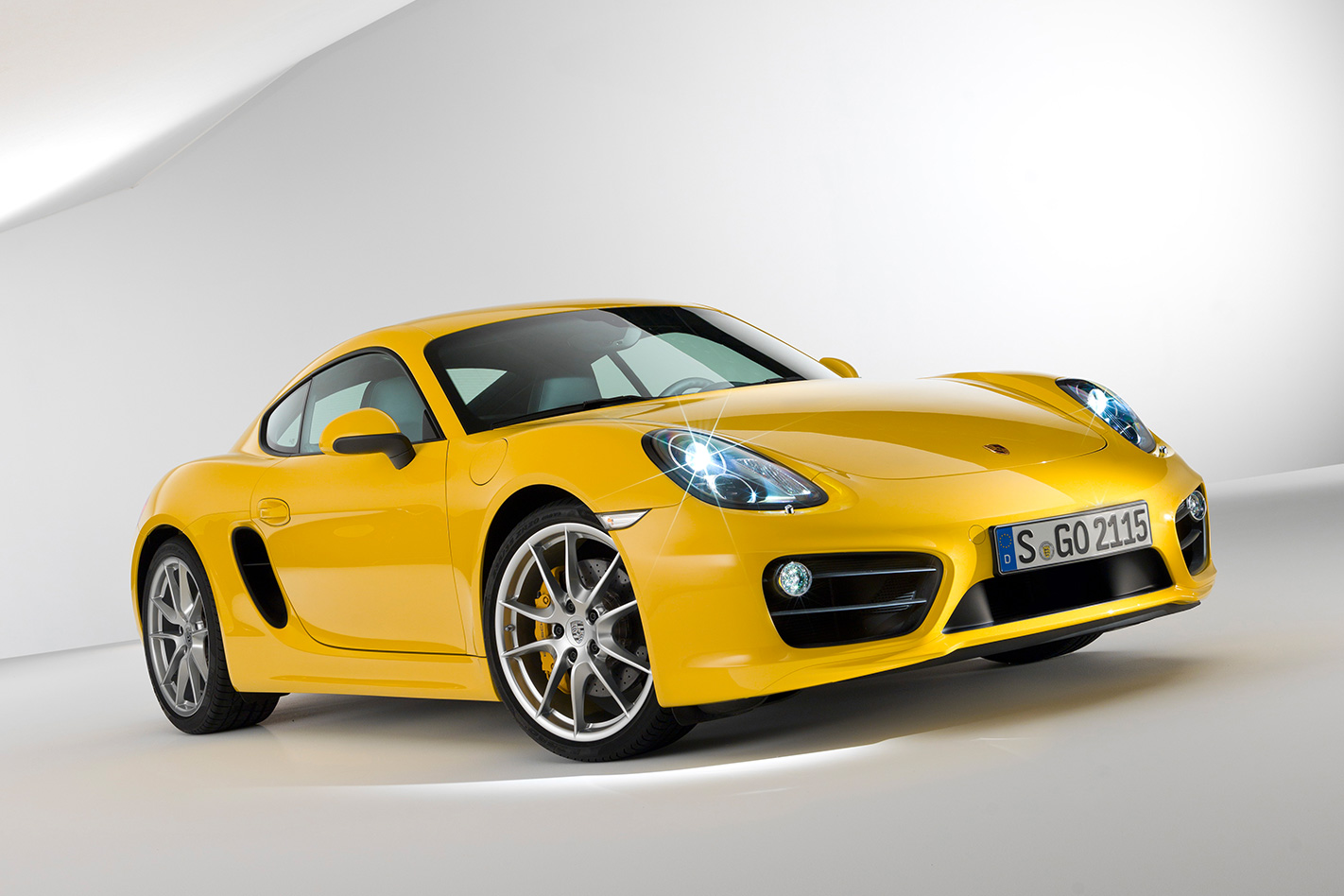
There’ll also be a slew of wheel/tyre options, too, though the standard-spec base car runs on 18s and the S on 19s, both with 235mm rubber up the front and meaty 265mm hoops tucked under the rear. Tipping the scales between 675-710kg depending on specification, the Carrera 6 weighs only about half as much as the new (1310-1320kg) Cayman.
This is primarily due to the radically lean tubular spaceframe chassis clad with self-supporting composite clamshell body sections. Other contributing factors are exotic materials like beryllium, magnesium, titanium and aluminum. The air-cooled 2.0-litre flat six delivers 157kW at 8000rpm and 196Nm at 6000rpm.
Although it is thus 60kW more powerful than the motor installed in the 1966 model 911, it weighs an amazing 54kg less. Using the tallest of three available final-drive ratios, the longtail 906 would hit an impressive 281km/h. The rack-and-pinion steering and the four ATE disc brakes lack the faintest trace of power assistance.
Although it is quantifiably cheaper to build than the Boxster, which requires extra stiffening measures and a complex power-operated top, the Cayman actually sells for more coin than its soft-top sibling.
Like the common components concept which fused the 911 and its mid-engined sister models, the Cayman’s ambitious positioning was the idea of the previous Porsche chairman Wendelin Wiedeking who did not know a lot about cars but was an expert in milking the customer.
Kicking off with the base manual car’s $115,500 ask, the new coupe is just $400 more expensive than the model it replaces. Meanwhile, the S version breeches the $150K mark by $400 sans options, representing a $2900 jump over the outgoing model. That said, you can easily shell out another five figures for what many consider essential options.
At the other end of the scale, the mid-cycle makeover expected for late 2015 may yield a new entry-level Cayman powered by a more frugal turbocharged four-cylinder boxer engine. Also in the making are said to be a seven-speed manual gearbox and a wider choice of operating modes modelled after BMW’s Driving Experience Control selector and Ferrari’s manettino.
Derived from the so-called Bergspyder and developed by the freshly promoted chief engineer Ferdinand Piech, grandson of Ferdinand Porsche, the Porsche 906 carried a 45,000 Marks sticker, a huge increase over its 29,700 Mark 904 forebear. Despite this hefty premium, the limited production run of 50 units sold out quickly.
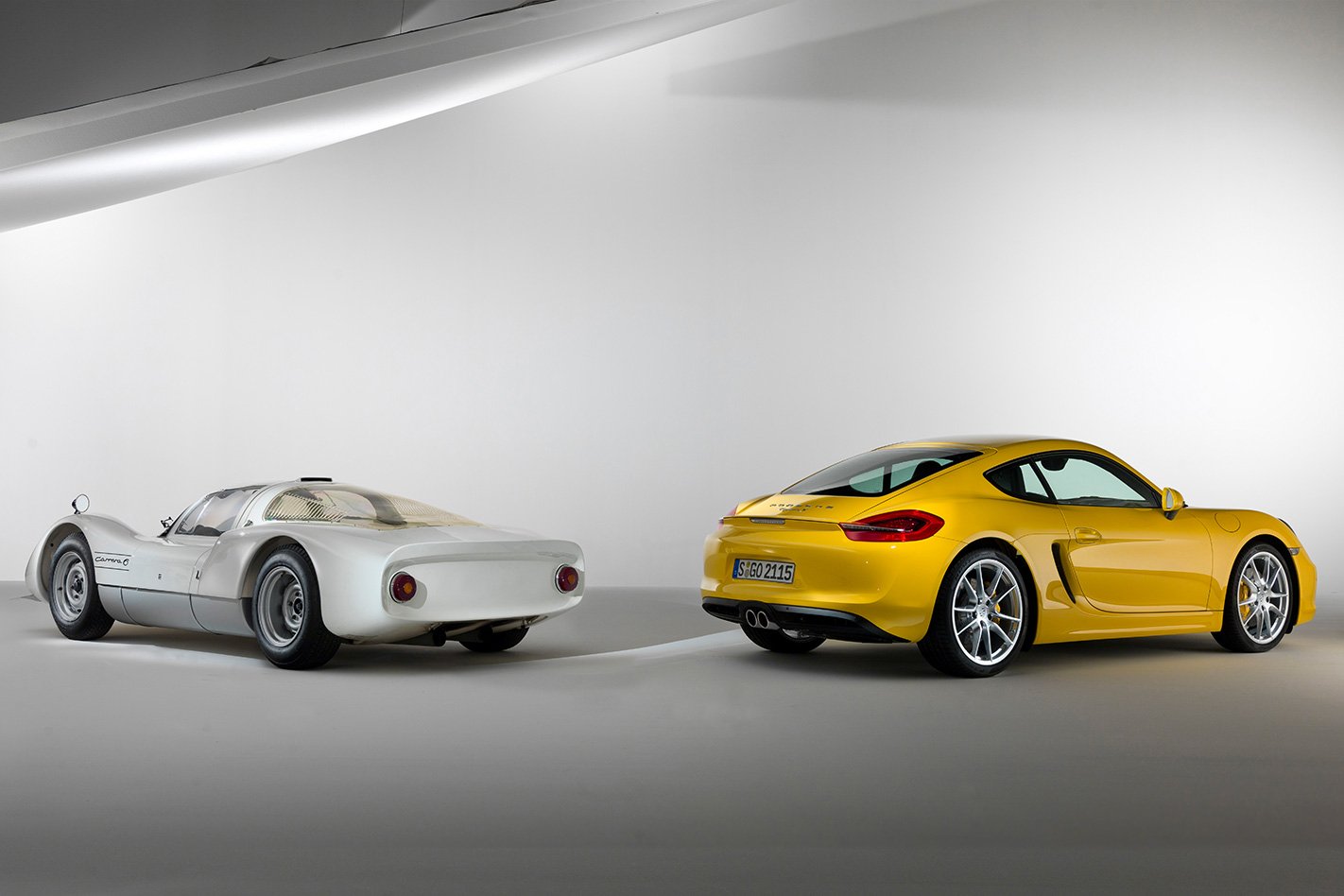
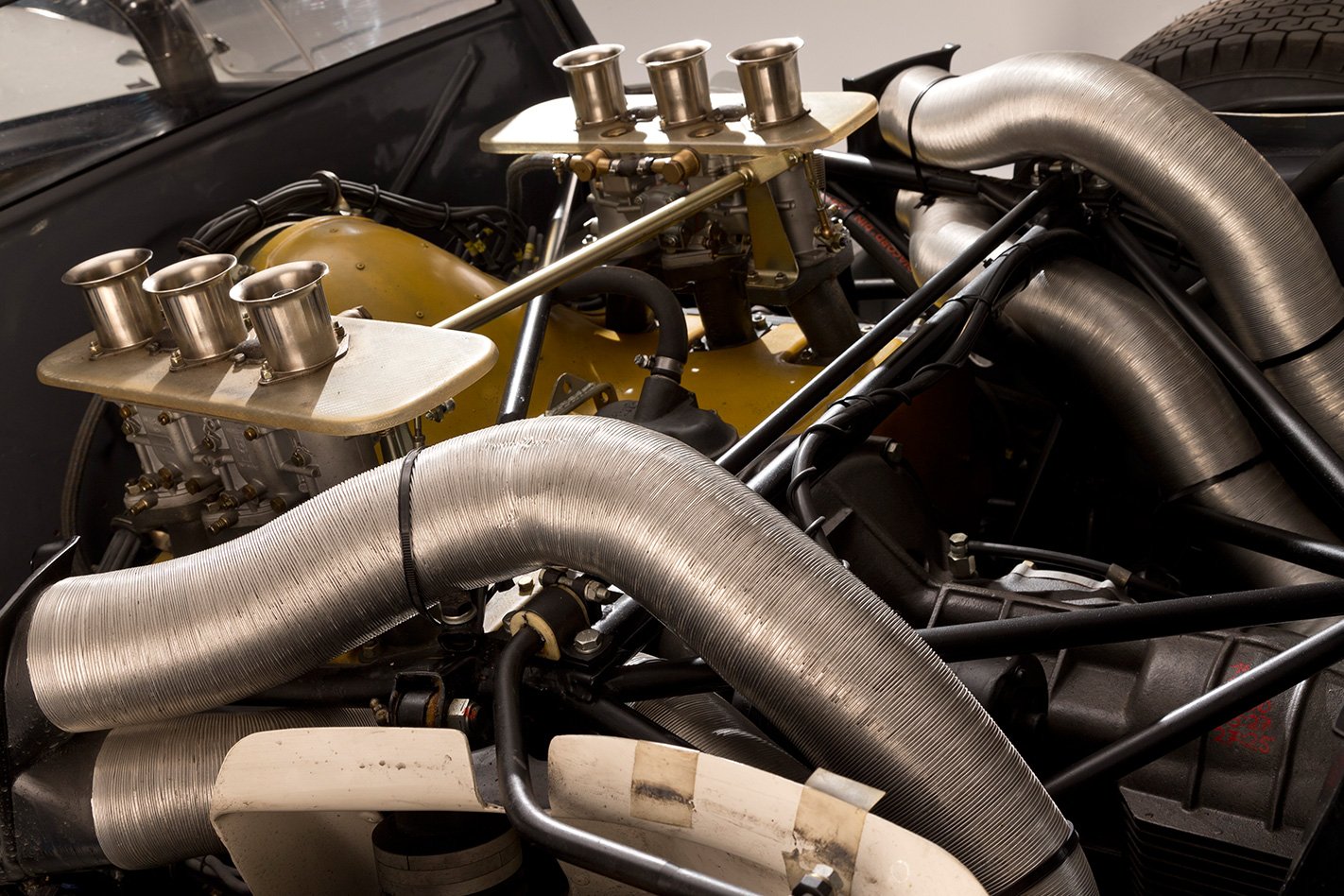
All customer cars featured two triple Weber IDA 48mm carburettors straddled by six intake trumpets which sounded spine-tinglingly sexy when operating in full throttle fashion. Willy Mairesse and Herbert Müller drove a private Scuderia Flipinetti 906 to victory at the 1966 Targa Florio, the model’s main claim to racing fame.
Although the 906 won its class in that year’s world championship, it was after only one season superseded by the brawnier 910. Feel like investing in a well-kept Carrera 6?
If the kitty labelled ‘special purchases’ holds in excess of a lazy million, you may be able to buy a matching numbers specimen with strong history for those rare track-day outings and a brand-new Cayman S, which should make a super-sweet daily driver.
Hot lapping in a 904
Amongst an assortment of jelly bean-coloured Cayman Rs ready to hit the circuit, it was easy to miss the petite silver coupe hiding down the other end of Mallorca’s RennArena. It wasn’t as easy to hide the lanky, yet just as lithe, frame of multiple world rally champion Walter Rohrl standing next to it.
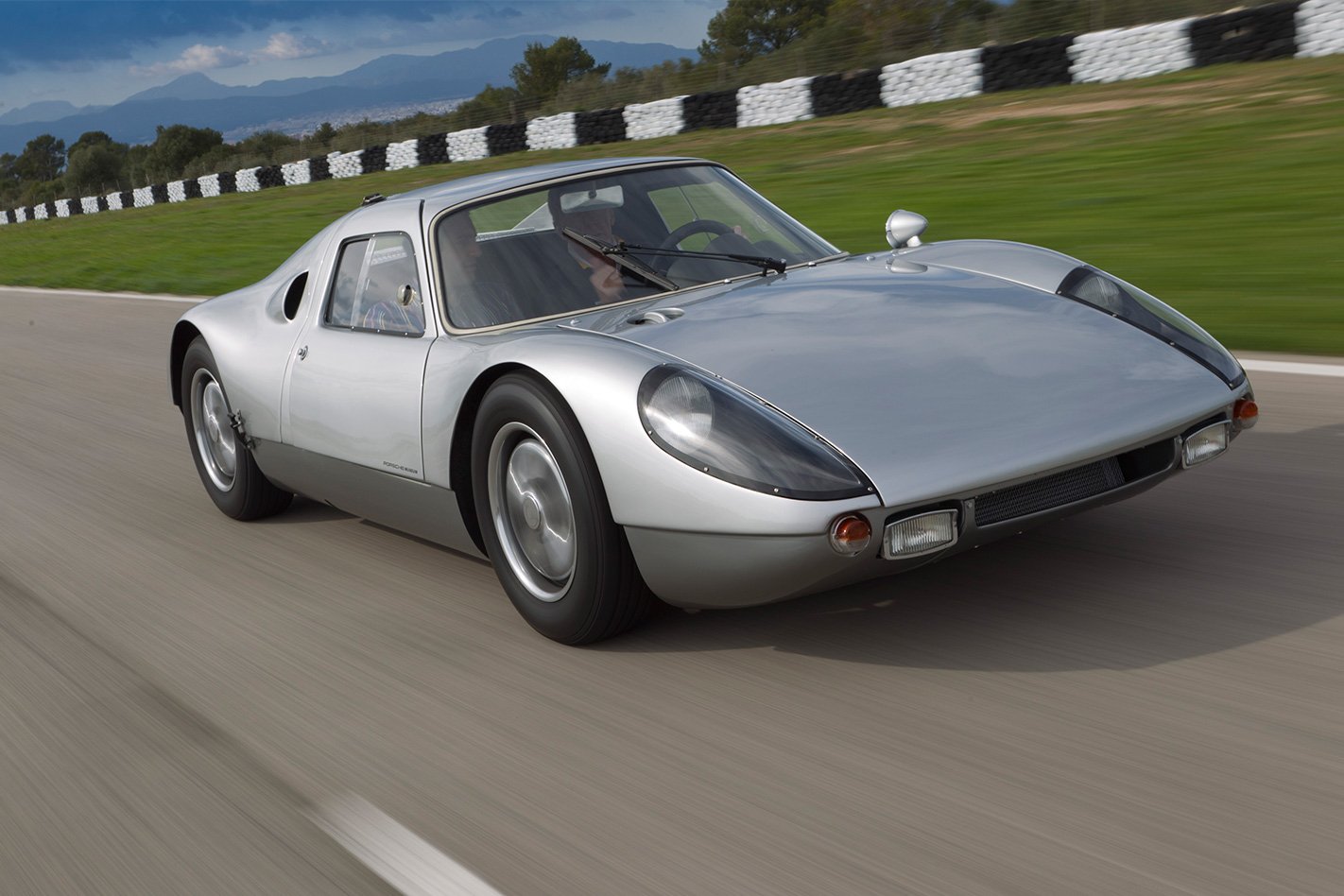
Soon enough, I’m literally rubbing shoulders with motor racing royalty in a priceless fibreglass-bodied carriage. Can’t get any better… Until he twists the key in the centre of the dash and the glorious sound of triple Webers gorging oxygen into the flat six whirrs behind my hears with only a thin sheet of plexiglass muffling the mechanical symphony.
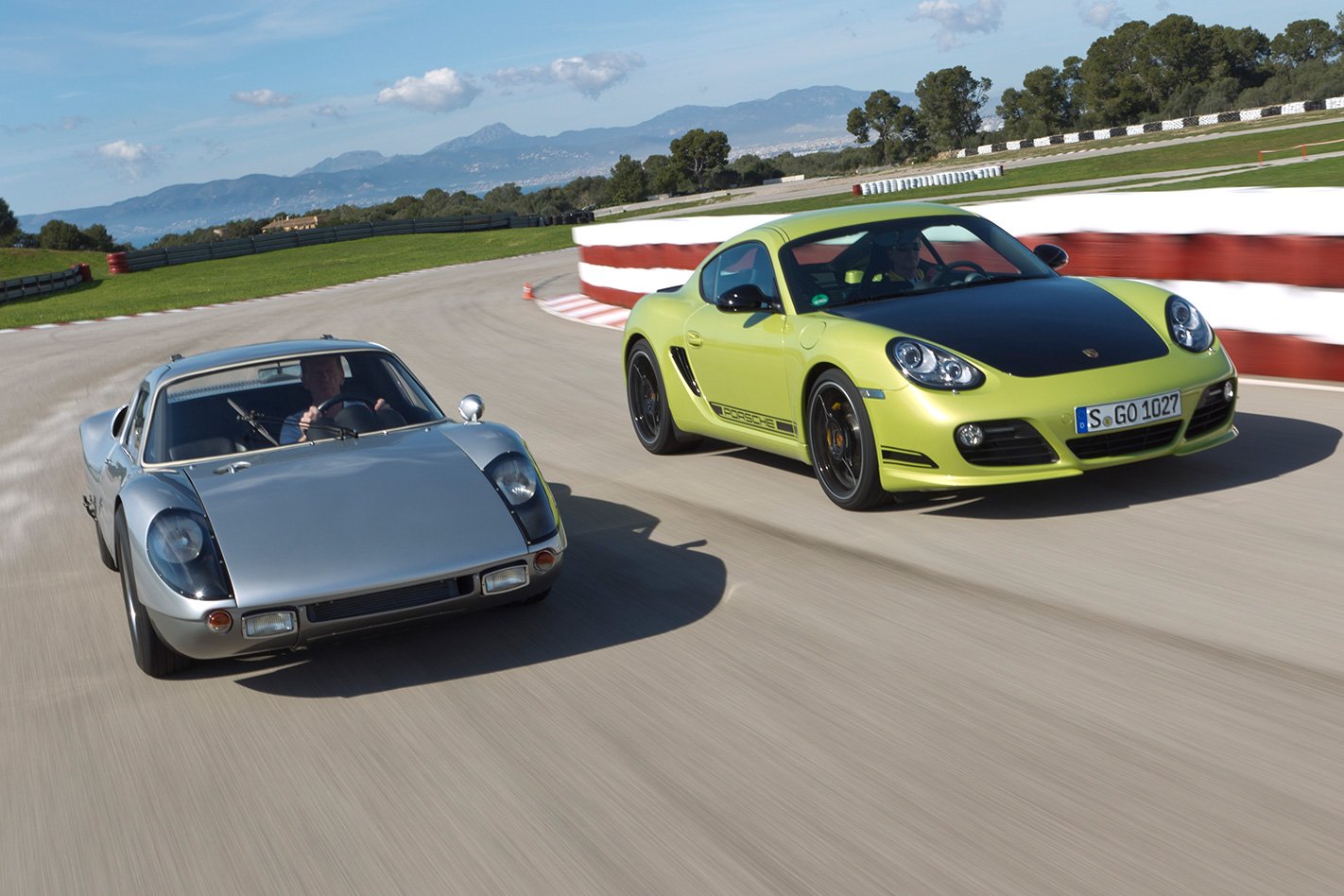
The 904 is playing underneath him, pivoting on its mid-mounted axis; the front-end pointing wherever he directs the wheel and the rear following it through constant adjustments on the throttle. And, at the same time, I realise how far things have come in the last 40 years, and how they stay the same.
| u00a0 | Porsche 981 Cayman S | u00a0Porsche 906 Carrera 6 |
| Engine | flat 6, DOHC, 24v | flat 6, SOHC, 12v |
| Power | 239kW @ 7400rpm | 157kW @ 8000rpmu00a0 |
| Torqueu00a0 | 370Nm @ 4500-5800rpm | 196Nm @ 6000rpmu00a0 |
| Kerb Weight | 1350kg | 675kgu00a0 |
| Tyres | Pirelli P Zero | Dunlop Racing CR65 |
| Wheels | 20 x 8.0-inch (f), 20 x 9.5-inch (r), alloy | 15 x 7.0-inch (f), 15 x 8.0-inch (r), steel and alloyu00a0 |
| Priceu00a0 | $155,700 (incl PDK) | $900,000 (estimated)u00a0 |
No, this isn’t a misprint. Nor have you opened a history book.
One of the greatest performance Holdens ever built without a Commodore badge was the first. And the 48-215, or Humpy as it’s become better known, isn’t here only because of that fact. It sparked a nation-wide appetite for fast, affordable, and reliable cars. And that has moulded our industry from its beginning right up to its end.
Holden wasn’t conjuring a Le Mans contender here. A lot of the country was unpaved, rugged, and dusty. And without Jetstar or Richard Branson around, it was huge. But we had huge manufacturing potential. So when GM Holden promised Ben Chifley’s government a people’s car that would drive post-war prosperity, it needed to handle these conditions well.
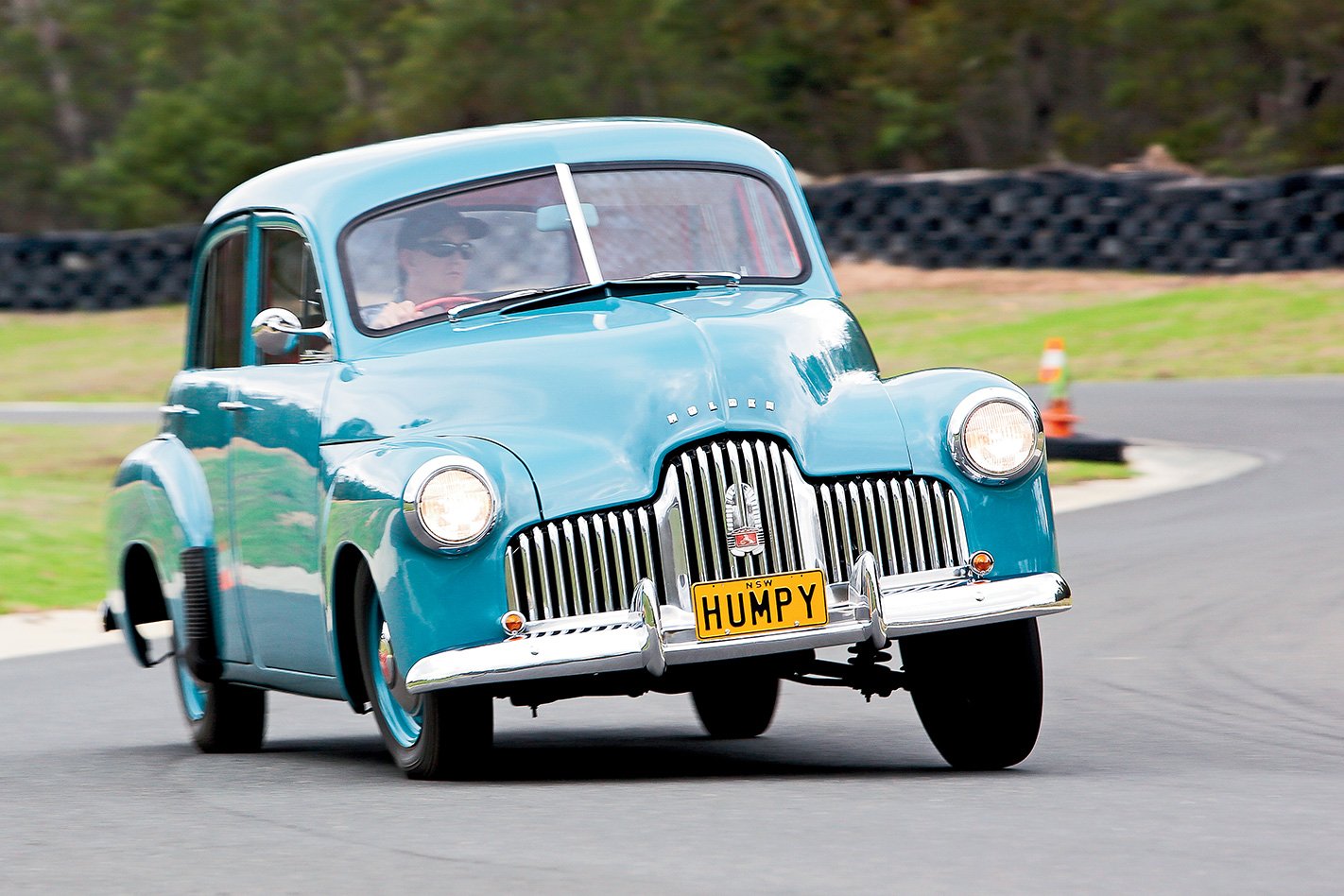
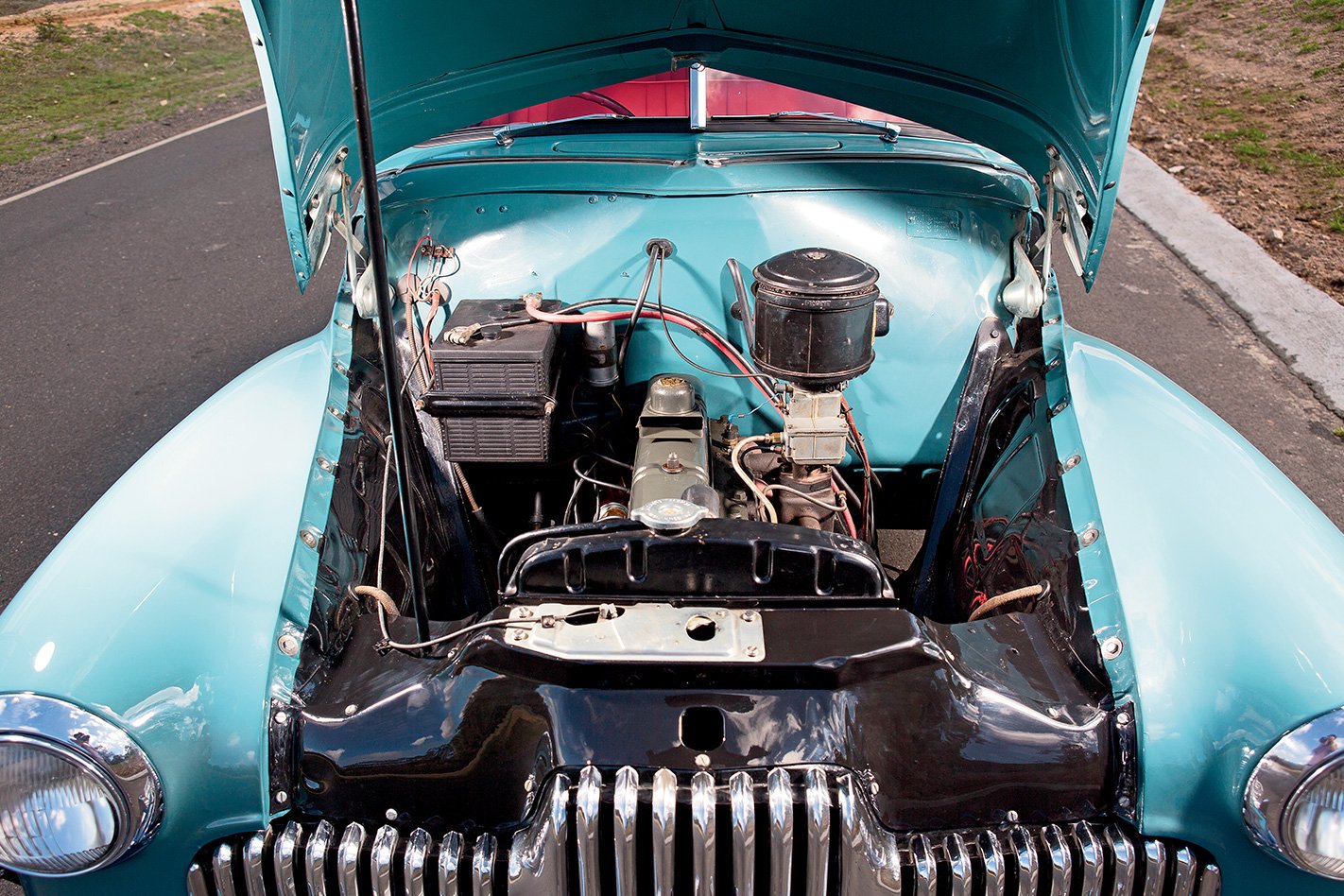
Key things like a one-tonne kerb mass, sophisticated (for its time) big six, and nine-inches of ground clearance underpinned this ability. And it’s hard to think GM could have gathered these ingredients at any other time. A key project engineer, American Russ Begg worked at Opel when Hitler was dreaming up his rematch with the world and oversaw the huge technical investment allowed by pre-war tax cuts at the time.
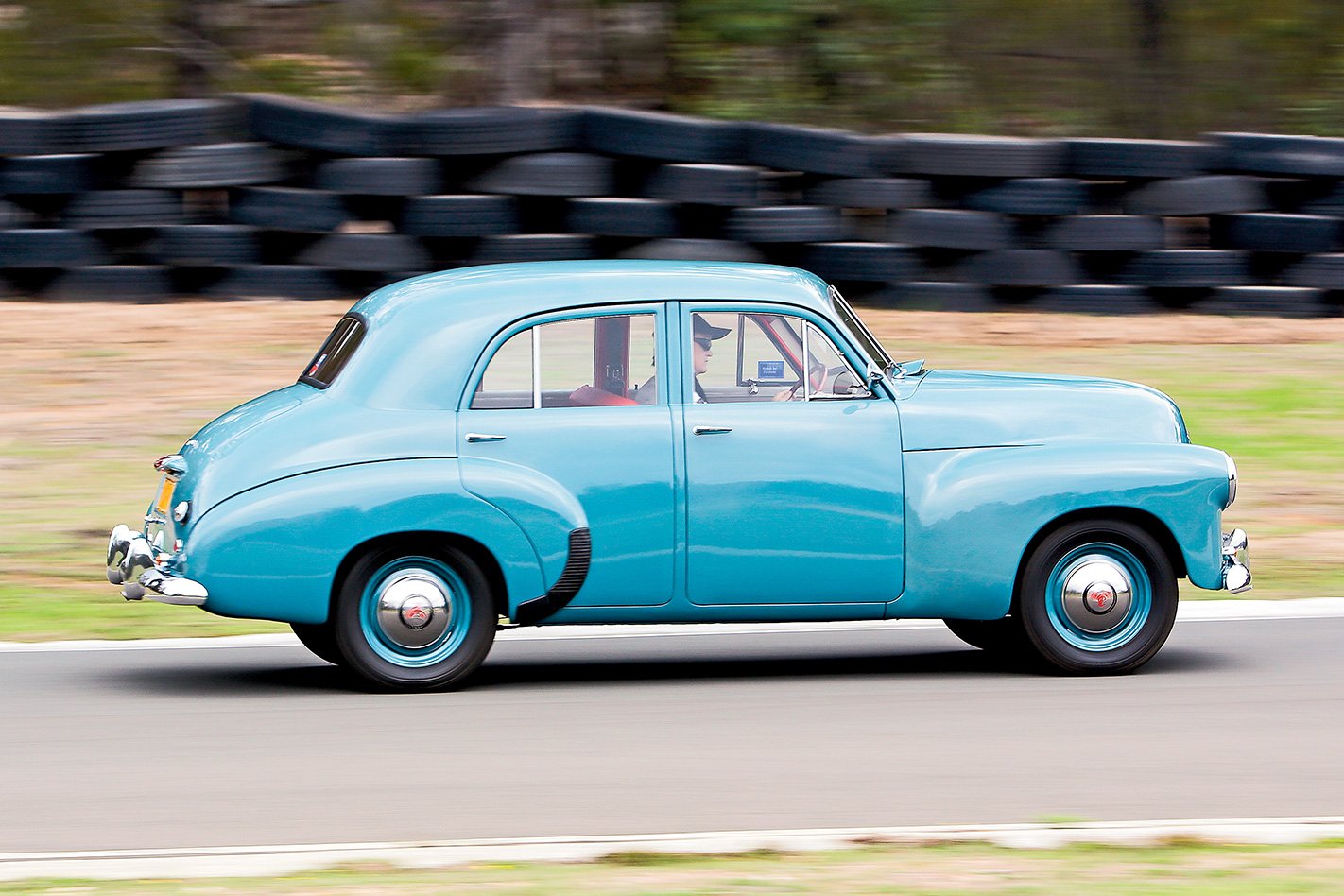
Aussie engineer Jack Rawnsley was also in Detroit overlooking the car’s development, and insisted on the ground clearance. This Aussie influence was a common theme in its conception. Laurance Hartnett, GM-H’s boss in the 40s, incepted the car, pitched it to Detroit, and fought hard for Australian engineering and design throughout the project.
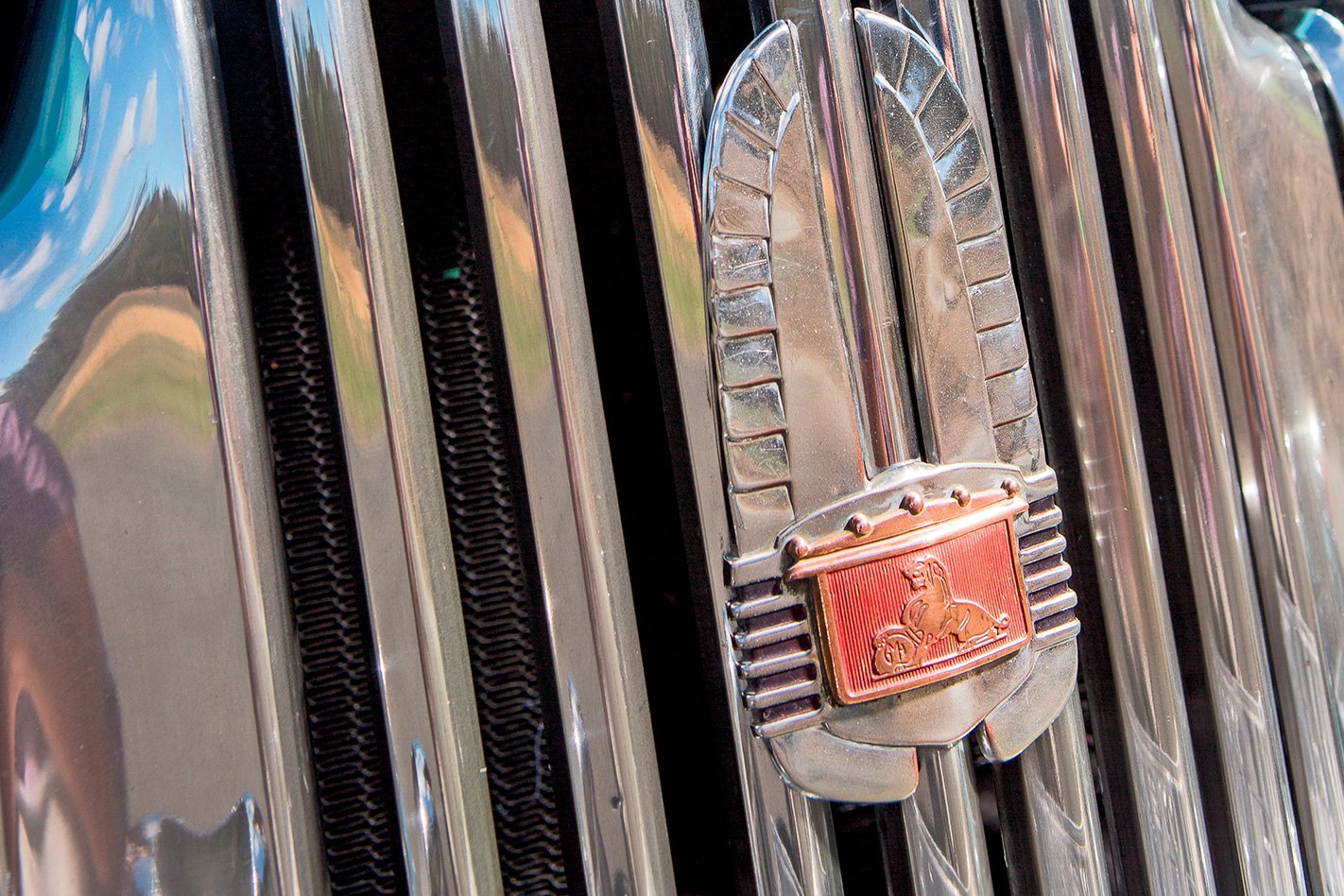
The car also enjoyed small success in motorsport, notching up a category win in the ATCC’s 1963 2.0-litre to 2.6-litre division. Drive one today, and you might find it a tad underwhelming. That overhead valve Grey motor promises smooth, torquey cruising, however, the reality is that the handling would feel as historic as the car’s importance.
Why else did GM turn to Holden for a 5 Series rival? And you can be sure its influence will be felt in the market well past the Commodore’s last day of service. Surprisingly, in the gap that it and the Falcon leave, more than 100 people have slammed down a deposit for the hyped Kia Stinger – sight unseen. That’s not a misprint either.
1948 Holden 48-215 specs On sale: 1948-56 Engine: 2171cc, I6, OHV, 12 valve Power: 45kW @ 3800rpm Torque: 135Nm @ 4200rpm 0-97 time: 18.7 seconds (claimed) Weight: 1010kg Price new: $1466
NO OTHER automotive brand is looked upon with quite the same sense of reverence as Ferrari.
It’s a powerhouse of passion and excitement that even people with merely a passing interest in cars somehow manage to latch onto. There’s real magic behind the prancing horse; it attracts an expectation of greatness that starts in children and keeps growing with time.
This year Enzo Ferrari’s car company turns 70 years old. It’s younger than Maserati, Alfa Romeo, Fiat and Lancia but it has built a reputation beyond all other Italian brands that puts it into its own category.

Australians have a love affair with motoring culture, and there is a dedicated group of Ferrari Tifosi who fly the Cavallino flag in our land Down Under.
The Ferrari Club of Australia claims to be one of the strongest and most active. To celebrate the marque’s 70th it threw a week-long party that included cocktail galas, street parades and a track day at the world renowned Phillip Island Grand Prix circuit.
And, luckily for me, Wheels was invited to take part. So on a very above average hump day I experienced the charmed life of a Ferrari owner. Driving a 488 GTB to the track and meeting other owners served to whet my appetite for an afternoon spent subjected to the high speed thrills of Ferrari’s 492kW/760Nm twin-turbo V8 supercar.
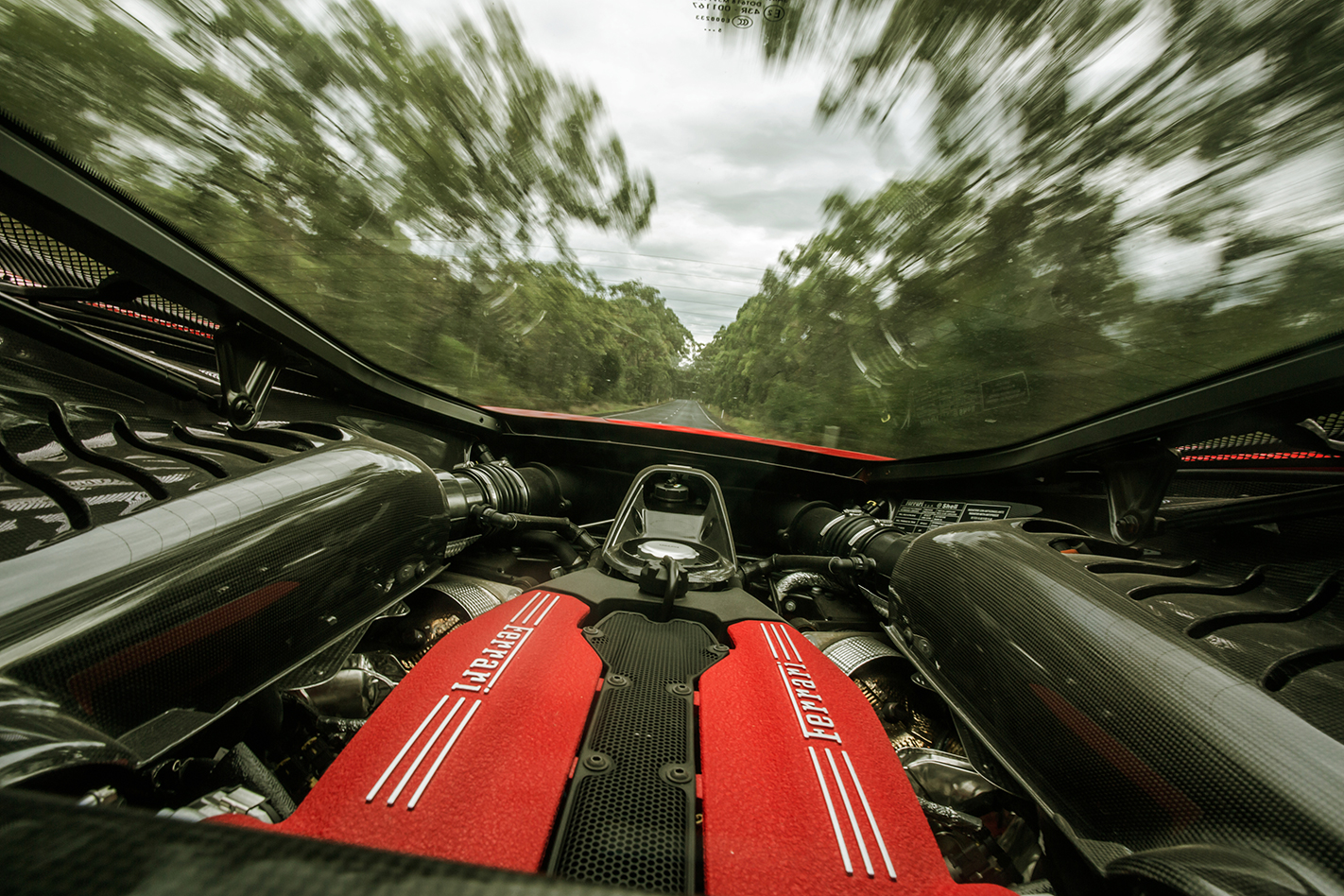
It was an eye-opening day like few others are. I had thought I might meet people with no interest in talking to me, as an impostor in their exclusive club; but how wrong I was. These Ferrari lovers were only too pleased to share their enthusiasm, and to really drive their cars at the place they perform best.
Hit play on the video to get an inside look at the way the other half live.
