
To all the car makers who I’ve just discovered might have been recording what I’ve said in cars recently: I was joking. I don’t know what you heard, but I can make a guess.
And I was totally kidding. I don’t really say stuff like that. I already knew modern cars have all kinds of sensors and microphones and data loggers that record everything from the weight of your passengers (to figure out how to fire multi-stage airbags) to acceleration rates (which some insurance companies use to calculate premiums).
But the laws about what sort of information car makers can collect, and who they can share it with, are changing around the world – they’re getting weaker in the US, and stronger in Europe – and some government bodies and private companies want to access more data from your car, including footage from onboard cameras and, uh, sound recordings from inside the car.
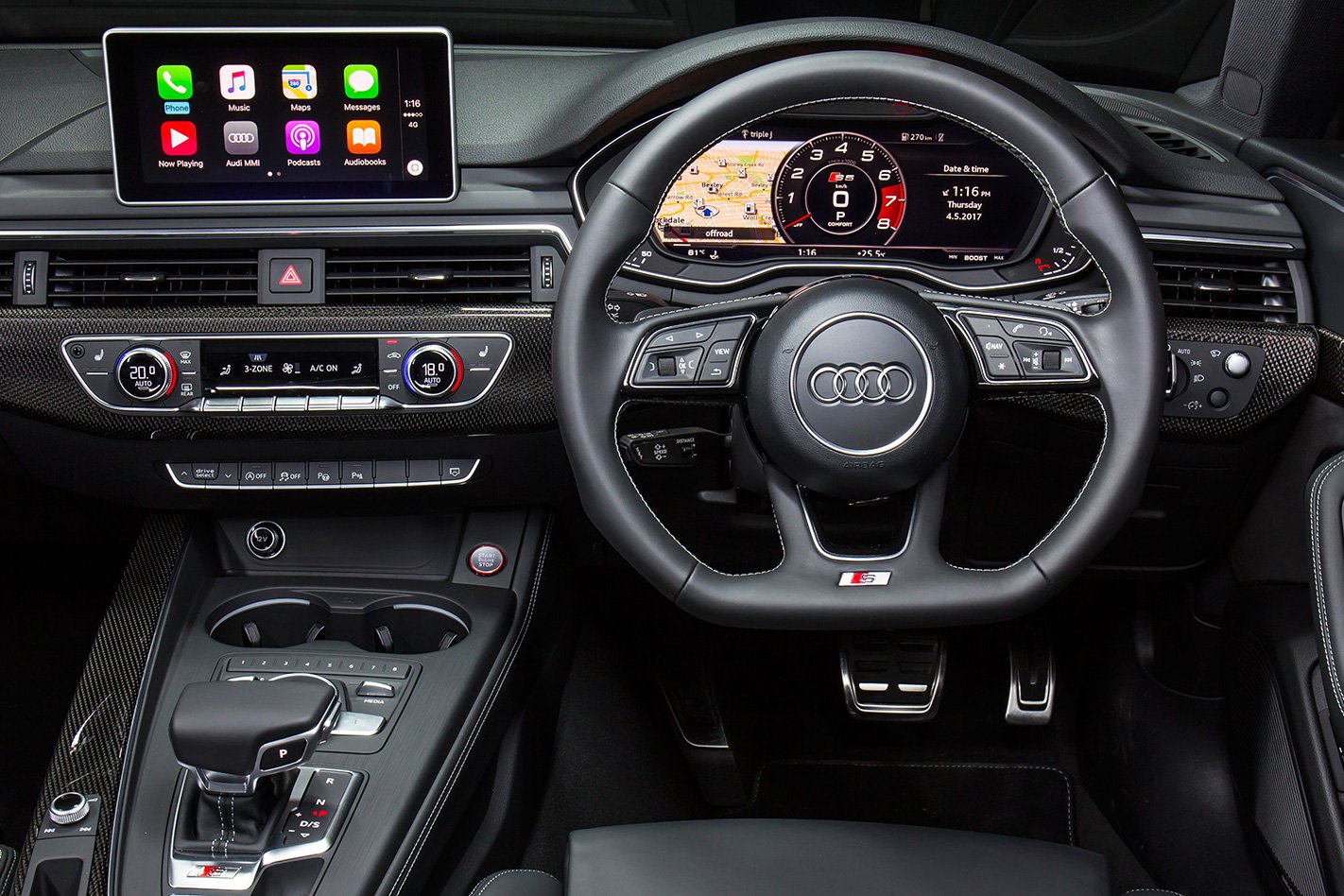
So it’s not impossible that somewhere in the world, there’s a luckless OEM employee whose computer is stained with shock-spat coffee, and whose ears are leaking salty tears, from listening to me commentating on other drivers. But, ahem, it’s all a misunderstanding.
I would never say those kinds of things. What kind of a barbarian do you think I am? Like that woman in the 4 Series backing out onto the road the other day? The one who blocked both lanes, then decided to check her handbag? It probably sounded like I called her something pretty rich, something that’s not quite PG friendly.
But you misheard me. I said, ahem, “Cupid stunt” – meaning, of course, that she, uh, had made me fall in love with her, with her daring antics. It was very affectionate, really. And the taxi driver who felt it was his god-given right to swerve into whatever lane suited him? I was calling him a “shining wit” – it was a compliment, for heaven’s sake.
I guess he must have misheard me, along with the data logger. Is it a conspiracy theory? On par with jet contrails controlling the weather or the Comet Ping Pong pizza parlor? Possibly – with almost 19 million cars on the road in Australia alone, who would even have time to listen to everything that got recorded?
On the other hand, it’s all computers doing the listening these days – like those Secret Squirrel NSA supercomputers that put another red flag next to your name every time you forward a Trump meme.
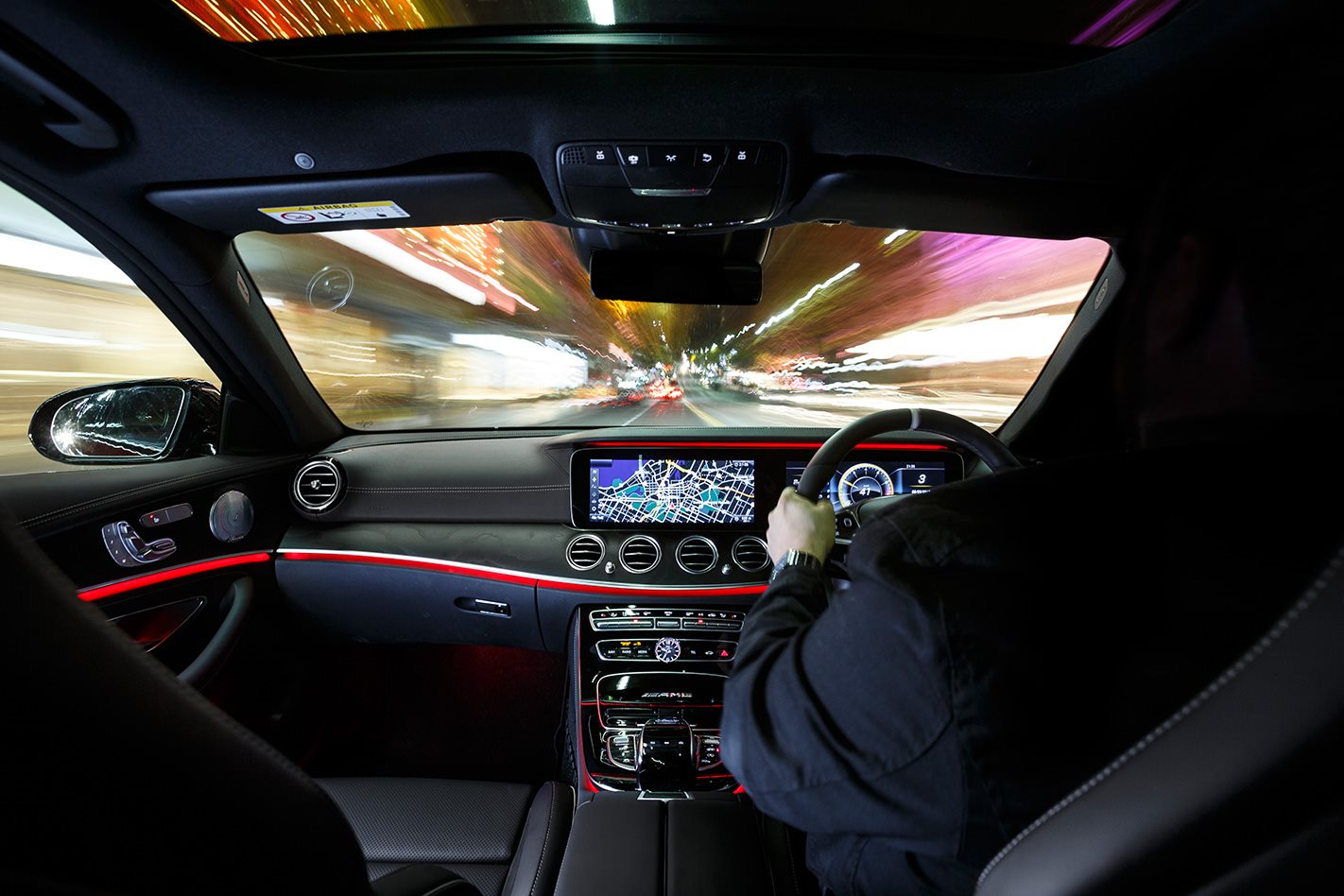
I don’t have time to read pages of guff that explains exactly what they’re collecting and what they do with it! I just want to get as quickly as possible to cranking up the Zeppelin and programming the GPS for the closest gym! (Sigh, the infotainment company already knows it was really “Neil Diamond” and “cake shop”.)
But the next time your car warns you that you’re straying from your lane, or that you’re speeding, or that you’re too close to the car in front, maybe take a moment to think about who else it might be telling. Oh, and lastly.
That guy on the pushie, who ran the stop sign and then got all self-righteous about cyclist’s rights? It might have sounded like I called him a “[REDACTED] piece of [REDACTED].” I did. F*@# that guy.
Warren Luff is sweating.
This article first published in MOTOR Magazine March 2009.
You know him as MOTOR’s own track driver, our Designated Adult who laughs in the face of danger – and our insurers – as he holds obscene powerslides through some of the fastest corners scattered around Australia’s racetracks.
But Luffy is also handy for a quick laptime, and that’s probably why Dick Johnson Racing has him on its books as a V8 Supercar endurance driver, after a long and successful career in motorsport.
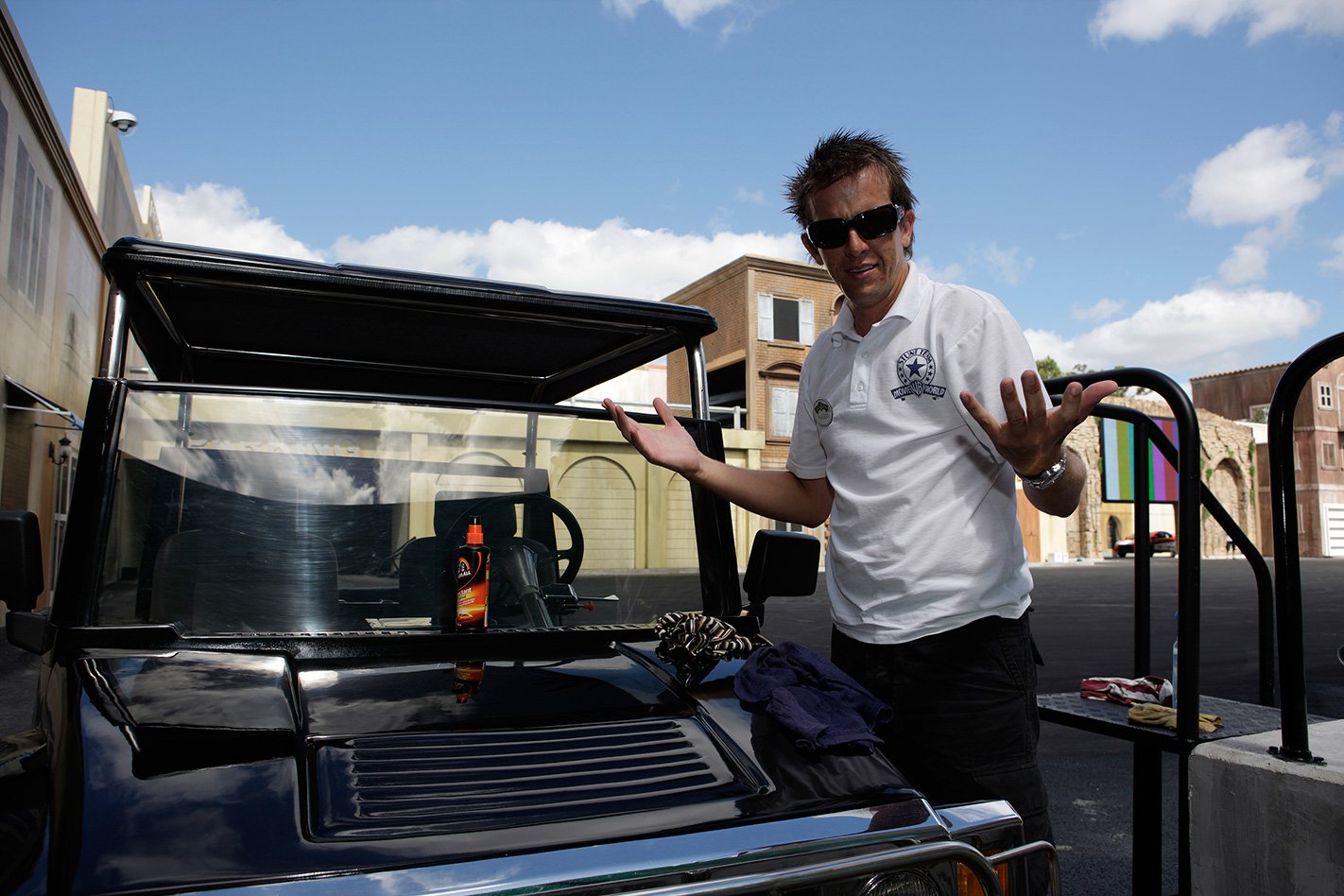
He was also called up to race alongside two-time V8 Supercar champ Marcos Ambrose in the 2005 Bathurst 1000. Considering his pedigree, it’s not that surprising. Son of advanced-driving guru Ian Luff, Wazza spent more of his formative years manipulating an almost out-of-control car than you and I spent in a school bus.
So it’s surprising − yet cruelly satisfying − to finally see him uncomfortable behind the wheel. Especially when it’s only a three-speed Mitsubishi that he’s sitting in, that will probably only do 80km/h. Flat-out. So what’s going on? Has Luffy gone soft? Er, no. Quite the opposite, actually.
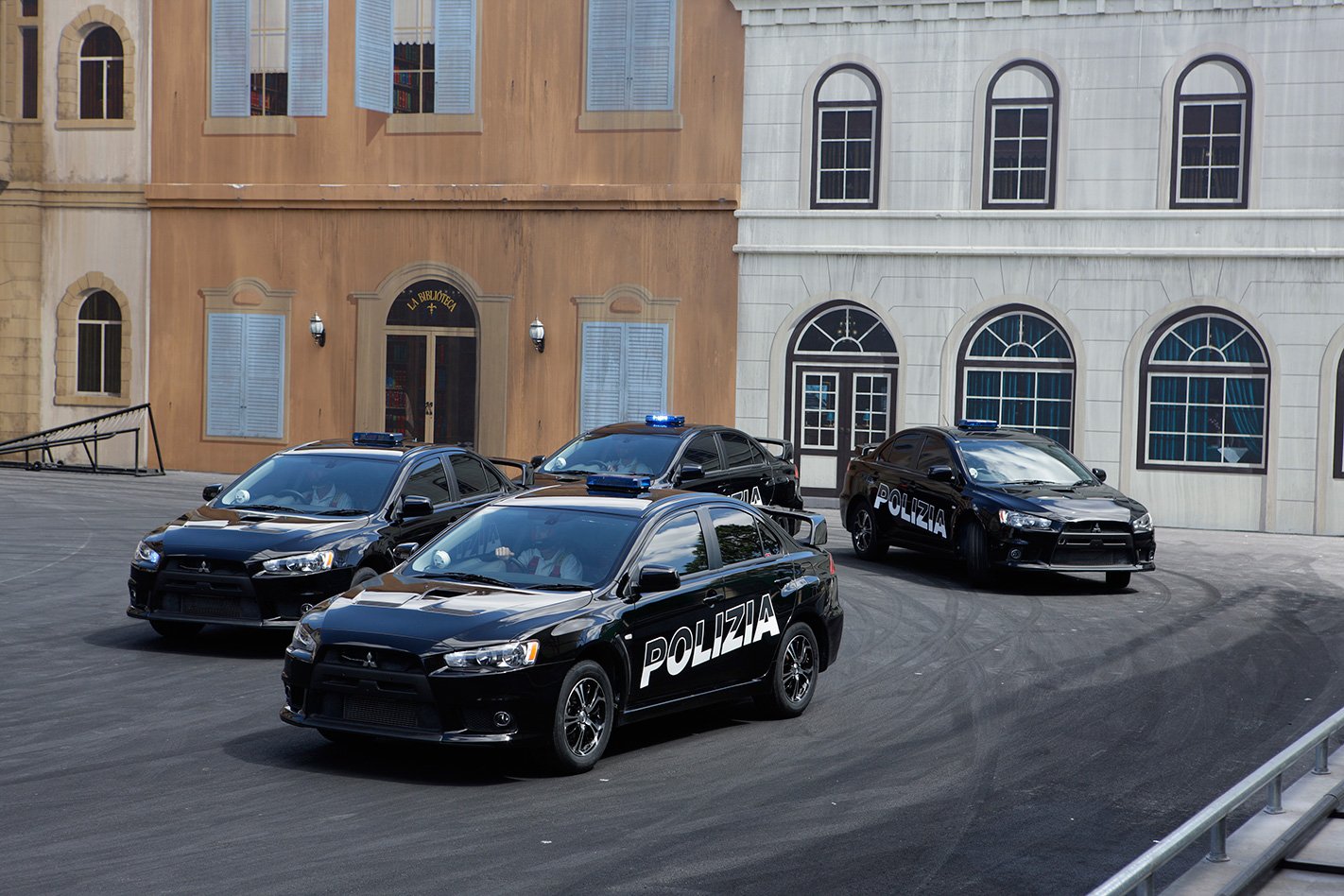
Even for experienced drivers like Luffy − or Ricci Giradi as he’s known in the show − it’s heart-in-mouth stuff. “It’s a tense thing,” says Luff. “A lot of the stunts we do just don’t feel natural. Now we’ve done it so much, it might look easy, but there’s still plenty of high-concentration manoeuvres and intensity there.”
The decision to create a new production wasn’t an easy one for Movieworld. Even after 16 years, the Police Academy Stunt Show was still playing to adoring crowds. But while kids could appreciate the Police Academy show for the colour and action, they wouldn’t have a clue who Mahoney was, let alone why he mightn’t want to be lured into the Blue Oyster Bar.
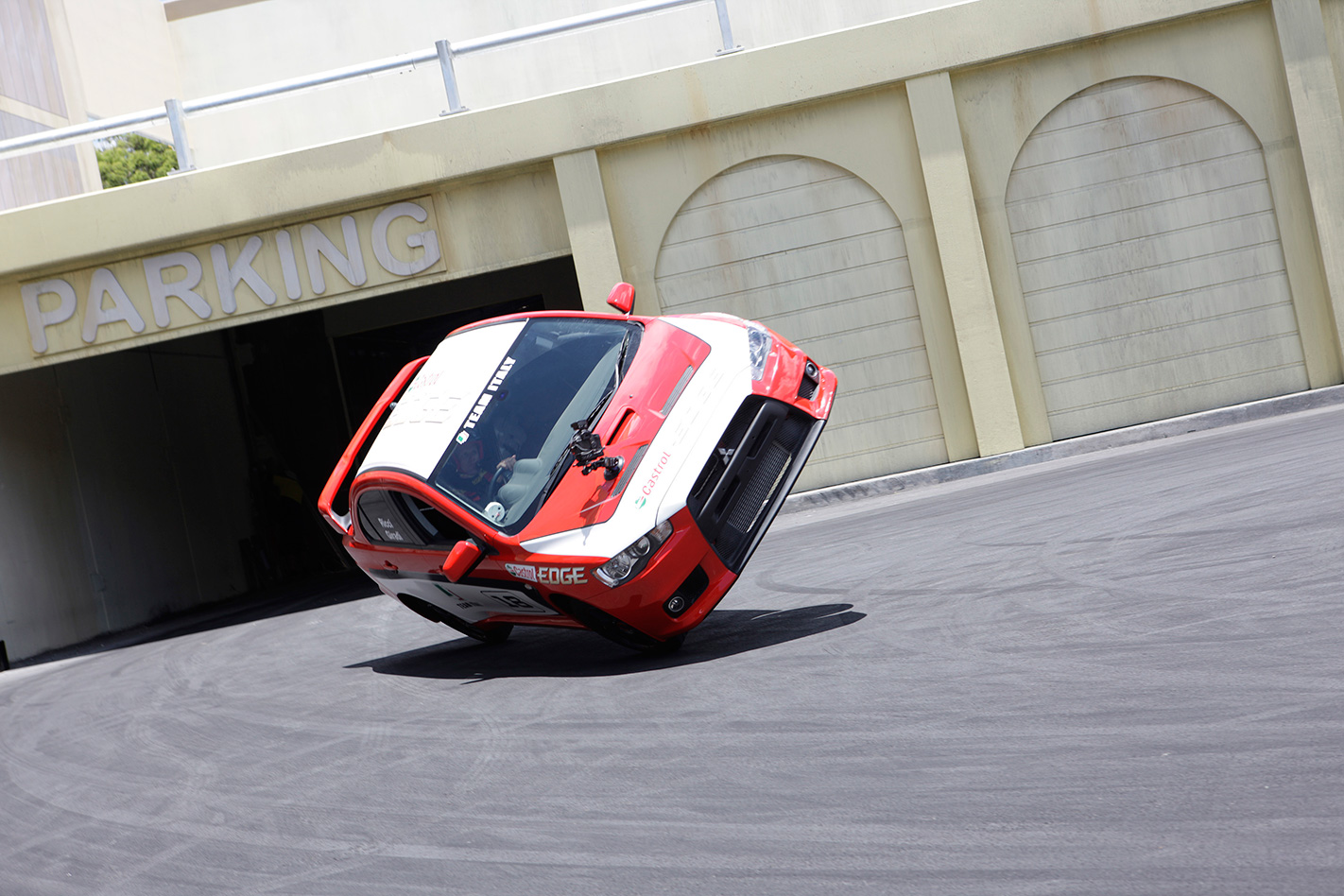
But how did they come to fall for Luffy’s supposed charms? Did they book him simply for his name, his driving nous and his Gold Coast hairstyle? “Actually, I saw it advertised in Auto Action a day before applications closed,” laughs Luff. “The first driving audition was out at the Holden Performance Driving Centre at Norwell.
There was a sequence of exercises we had to do in the Commodores. The second audition was at Willowbank Dragway, near Queensland Raceway, and that was where we first tried some two-wheeling. The final stage was a verbal interview. Around 250 people applied initially, and that was eventually culled down to 10.”
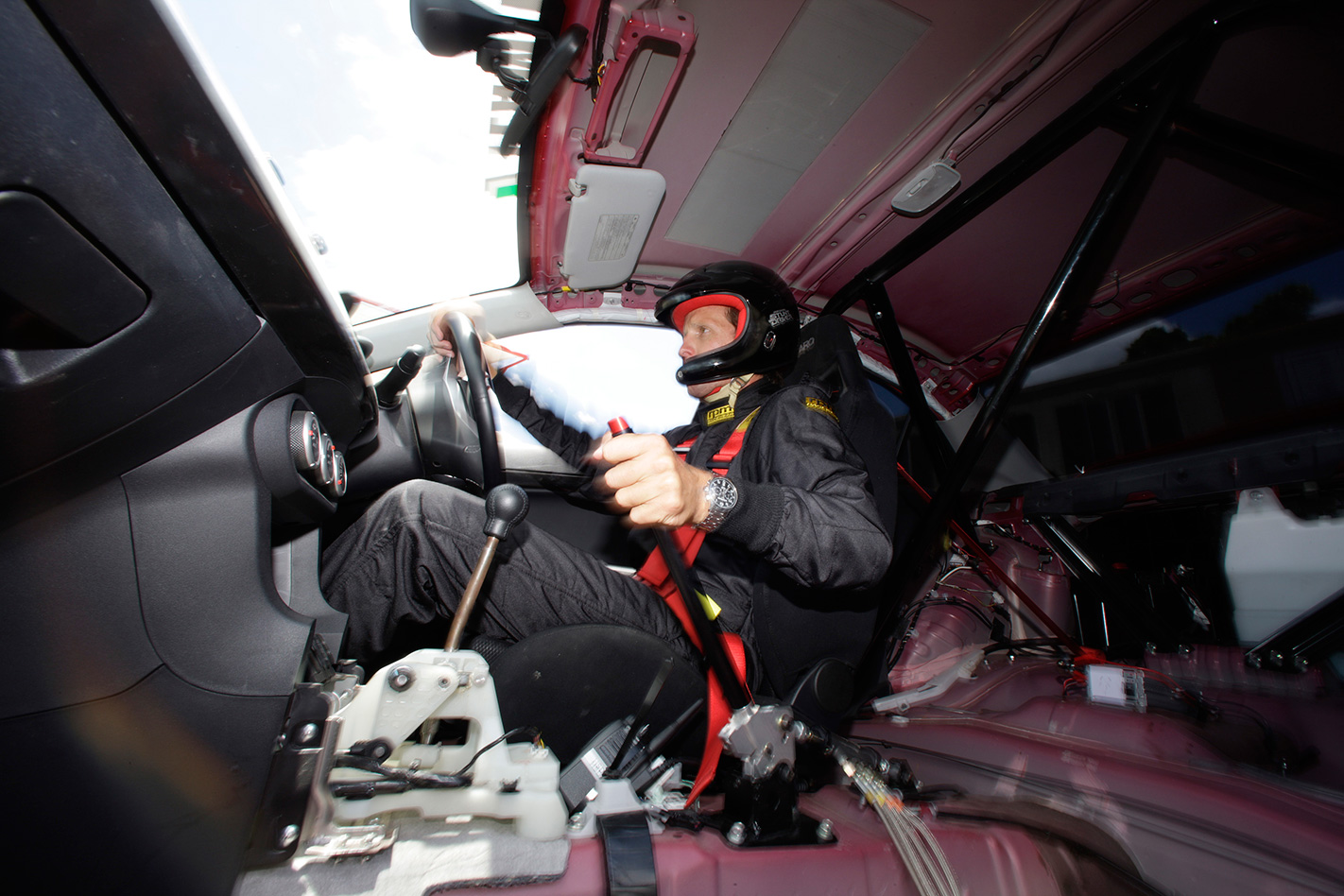
One of them, Shea Adams, has a lengthy stunt history, both in driving and falling off burning buildings. His CV includes films like The Matrix and Wolverine.
But the drivers could only be as good as the tools they were to use, and while the Lights, Motors, Action! show in the US features a range of purpose-built stunt cars and heavily modified previous-gen’ Opel Corsas, Movieworld producers insisted on a vehicle that was both tough and recognisable for Gold Coast theme park punters.
“Our brief from the CEO was to find a car that the general audience was going to recognise as the type of car they would drive,” says the show’s drive co-ordinator, Gavin Coleman. “It had to be instantly recognisable as an everyday car that you’d see out on the roads, as opposed to a spaceframe vehicle with a fibreglass shell that was hand-built.”
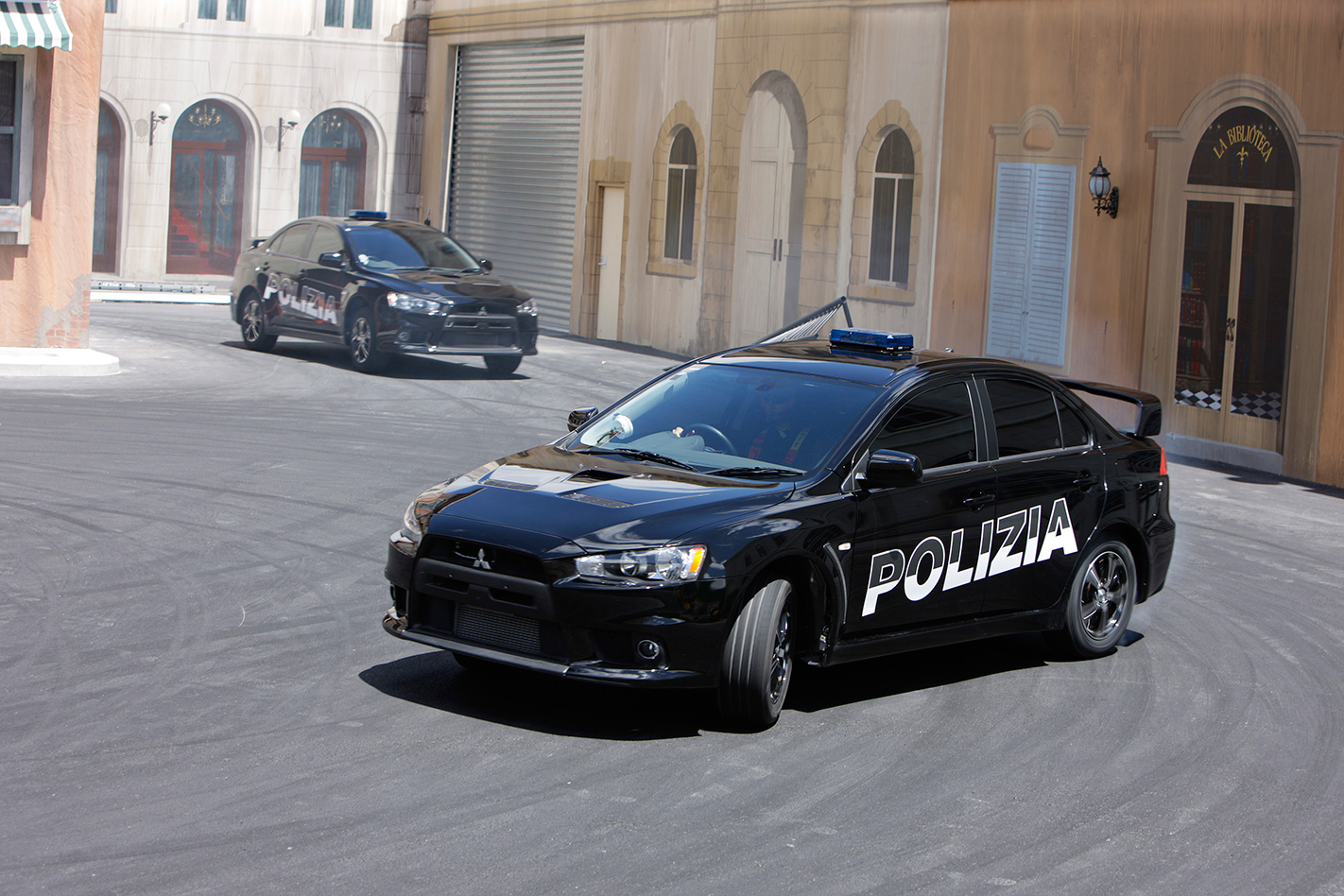
“Yeah, it was hard,” says Luff. “There’s been some changes in regards to what is and isn’t possible, but overall, what we’re doing now remains very true to the original driving script.
“I think for all of us, from the very beginning, the two-wheeling was the hardest thing to learn – for me, with my circuit background, for the other guys that have a drifting background, or even the experienced stunt drivers – none of us had done two-wheeling before. It’s a real confidence thing. You’ve got to be really committed to it.
As you’re driving up the ramp, you’ve actually got to turn into it like you’re trying to tip the thing over, because you’ve got to get it up to that balance point and then be able to catch it. If you start doubting yourself, and all of us had our bad days when we weren’t getting it, it gets really frustrating.”
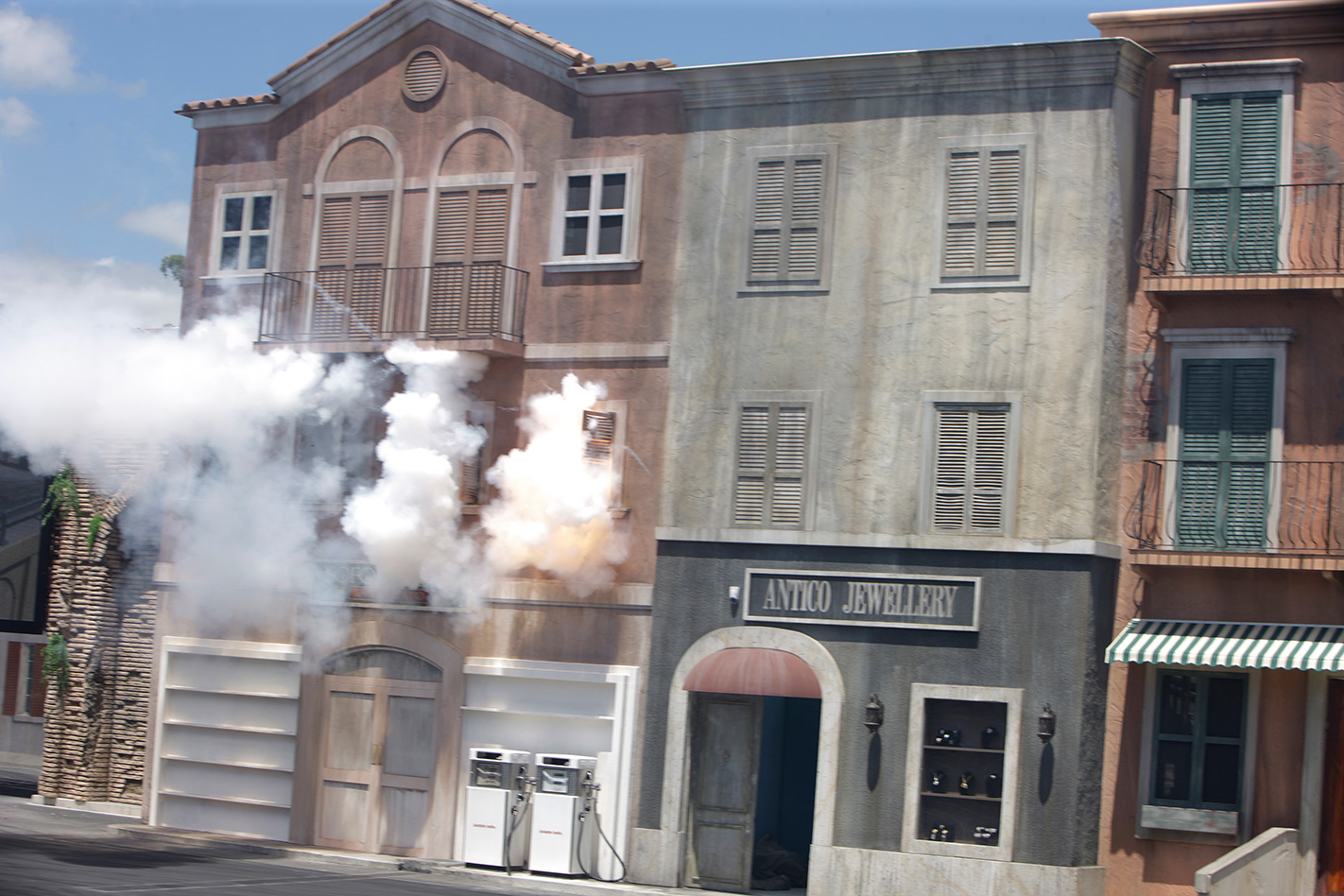
“But the first time we got on the proper set and we didn’t have the fifth wheel as a back-up, it was a real heart-in-mouth moment, because [previously] you always knew you had the security of it there,” says Luff.
“It was almost like the first time you took your training wheels off your bike as a kid – you knew you could do it, but it was still scary. “But we’ve been practising since August, and all of us now are probably some of the best two-wheelers in the country. We’re even doing both left and right turns on a set that’s only 22 metres wide.
But they made sure we had plenty of practice and rehearsal time, because it’s such a ‘wow’ element of the show. We do a four-car cross-over in the middle and the crowd absolutely loves it.” There’s no room for congratulations on the set, though, and Luff emphasises how crucial the timing of each sequence is.
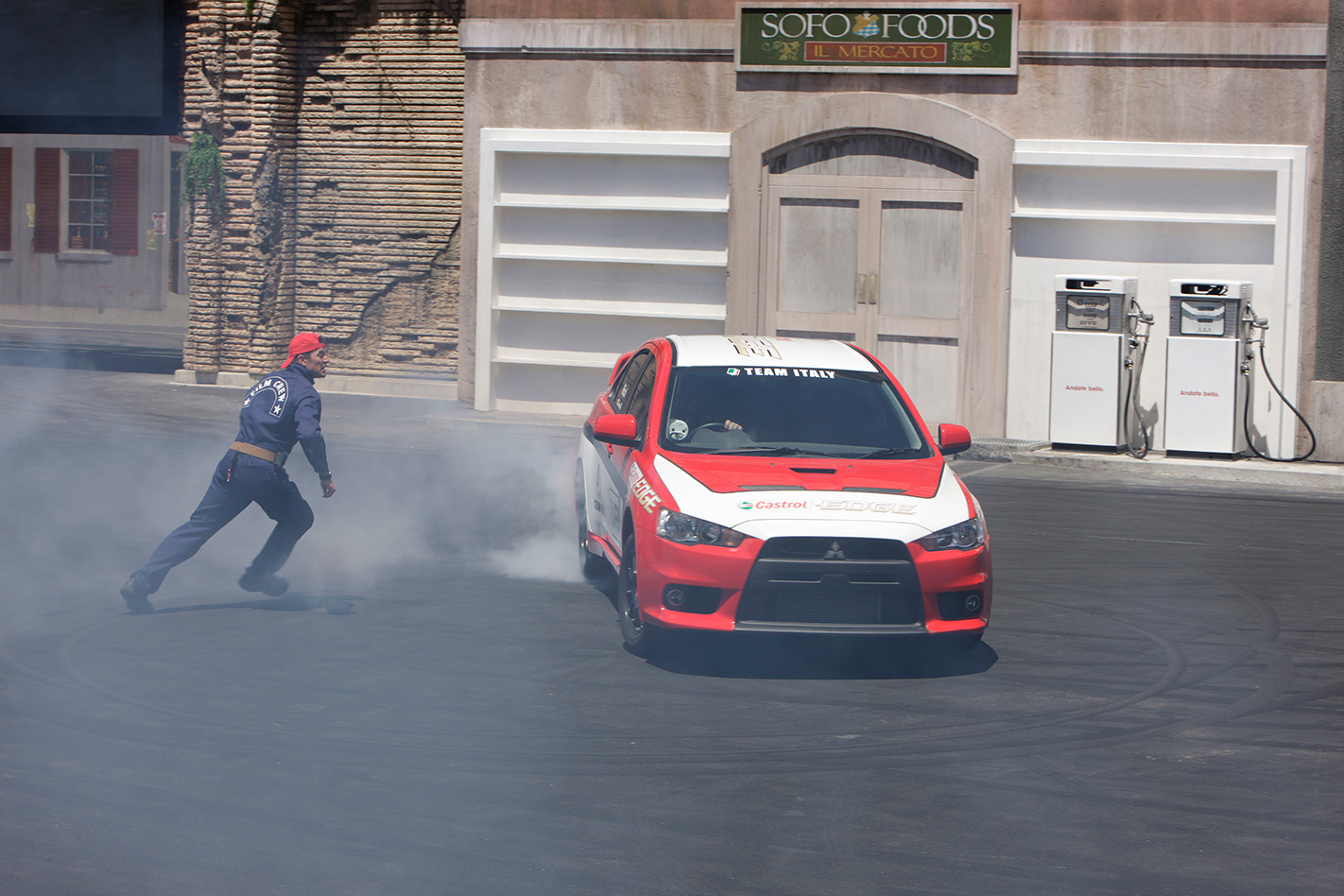
So by the time you turn to do the crossover, you’ve got to make sure your timing’s right, otherwise you’re going to have to put it back down on four wheels in a real hurry or two cars will come together. Biff!
“Each morning, for the role that you’re in that day, we do three full run-throughs of the show so that everyone’s on the same page. For whatever reason, if someone misses a cue, we’re all wired up with intercoms. We’ve got a show-tech that calls out our cues for the whole show, so they’re basically our eyes and ears for what’s going on, on the set.
“In rehearsals, there’ve been times when someone’s forgotten a cue, or driven out when they shouldn’t have. So when that happens, everyone just slows it down and waits until everyone gathers up. But there’s been no problems in an actual show.
Thankfully! ”The Evo Xs required significant modification for their new role. Rear-drive is better than all-wheel drive for skids and drifts, so the driveline was cleverly converted to rear-drive. The cars use only two forward gears and reverse. And there’s a locked diff to prevent the unloaded rear wheel spinning when the cars are on two wheels.
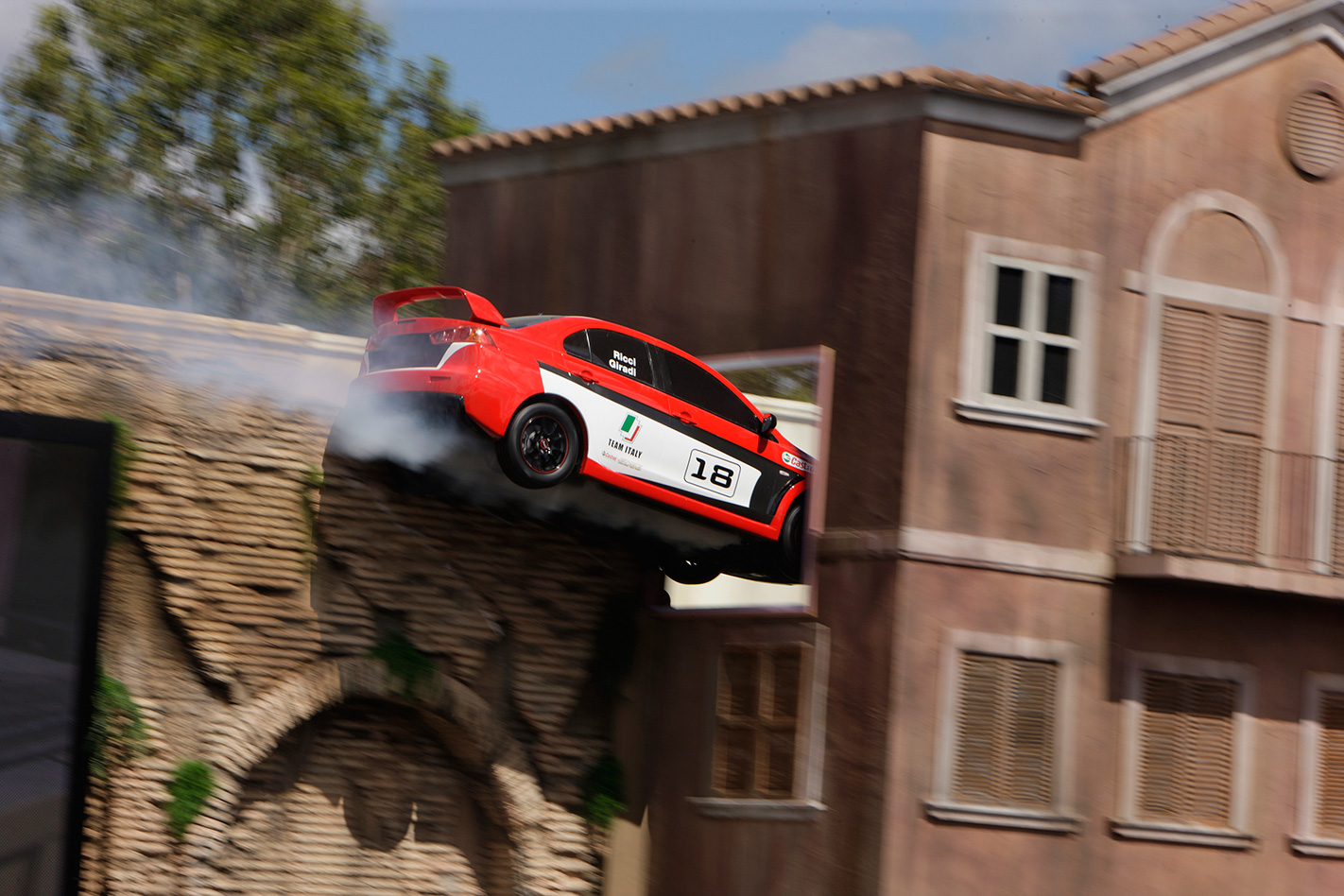
So, apart from the suspension changes, they actually run on 16-inch wheels and Federal tyres – you need a tyre with a really tall, stiff sidewall. Oh, and we run them at 80psi!” Other problems producers have had to deal with have been the Evos’ penchant for destroying tyres – which is understandable.
Broken driveshafts are also a consequence of the punishing routines the cars are subjected to, but the rear-wheel drive conversion could also have something to do with it. The engineering team behind the show built the cars for strength, but because of the unique performance requirements and modifications, that development process is still happening.
For instance, they’re currently looking at strengthening the diffs to stop them from breaking. But judging by audience reaction to the show after the first few weeks – it opened at Christmas time – all the money spent and hard work is worth it. Bumper crowds seem to think that the new show is a winner.
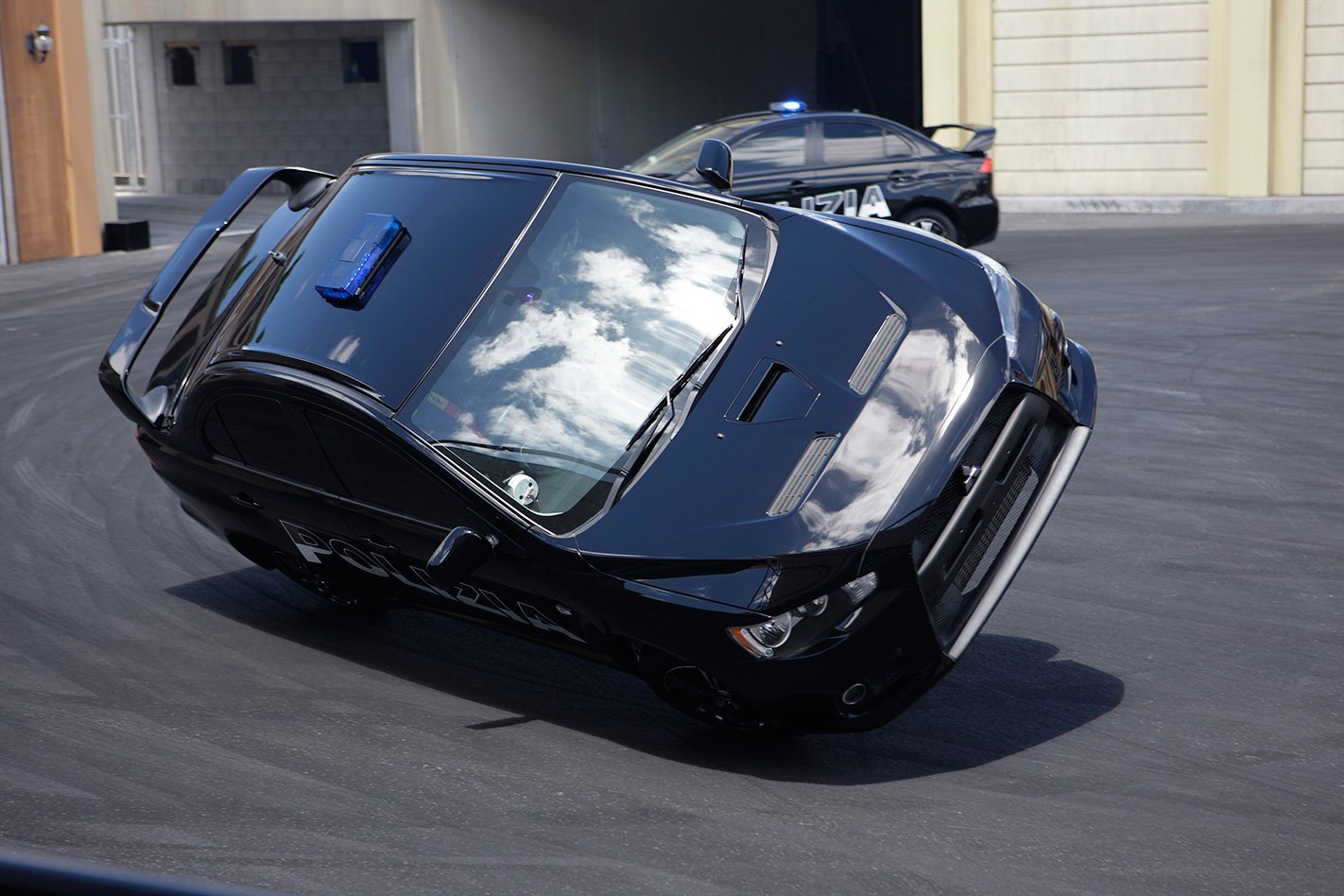
“It’s like when you know that you’ve put together a good lap in qualifying,” smiles Luff. “You know when you’ve got it right, and you know when the show’s going well. They can hold up to 2000 people in there and they’re literally only about 10 metres away, so you can hear them cheering and screaming and judge the show’s performance based off the crowd’s energy.”
For Gold Coast-based Luffy, stunt driving is a perfect complement to his other roles as professional racing driver, driver-trainer/race instructor, and MOTOR track tester. He could be excused for thinking Lady Luck has dealt him a kind hand. But you make your own luck.
And besides, a boy who was brought up in Sydney’s Campbelltown would have to know how to drive it like he stole it, wouldn’t he?
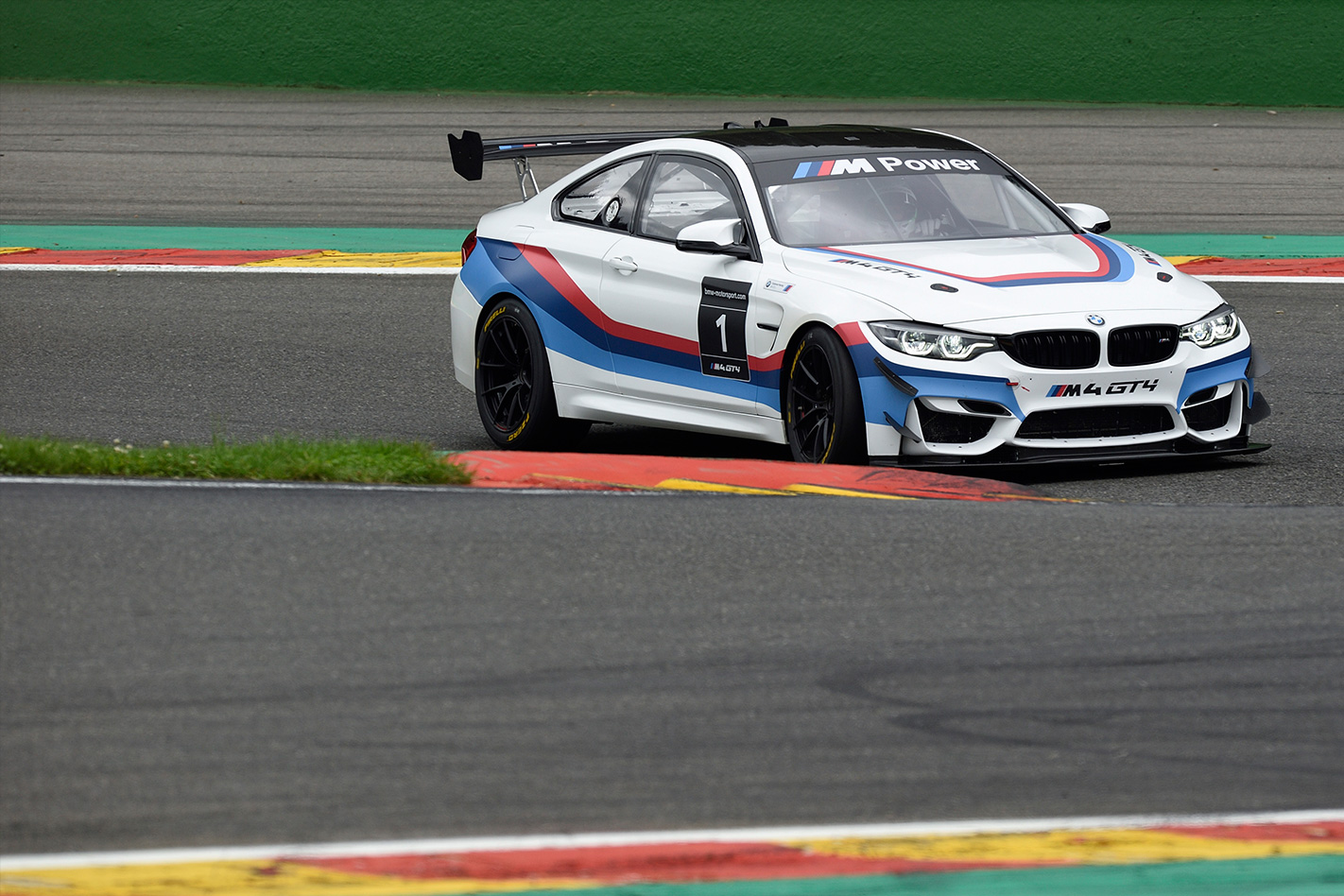
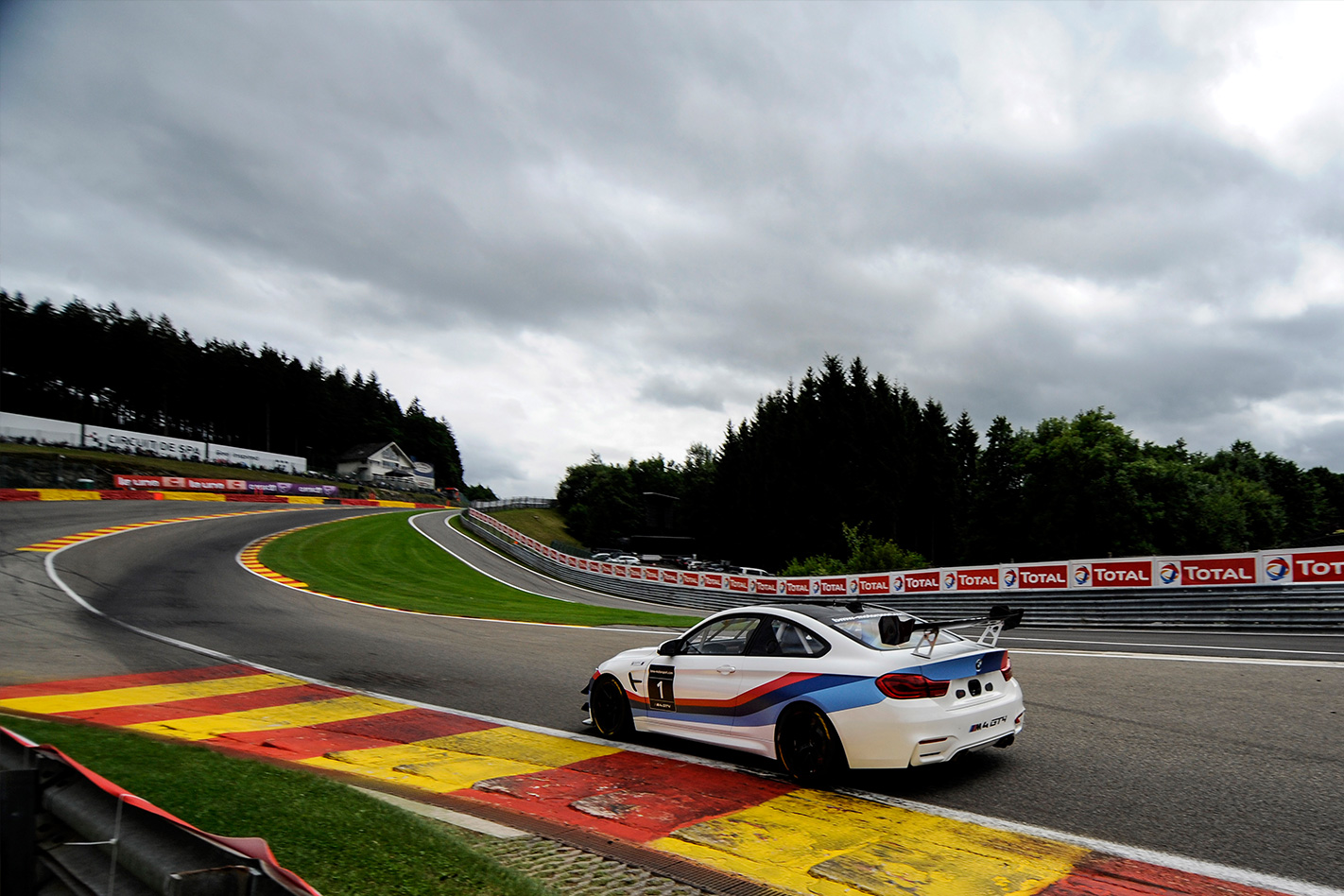
BMW will have a factory-backed M4 GT4 race car in the country later this year ahead of a full assault on the 2018 racing season.
Australian outfit BMW Team SRM, run by second-generation racer and motorsport veteran Steven Richards, will receive one of the first BMW M4 GT4s to be built, which is expected to arrive within the next two months.
The M4 GT4 was revealed earlier this year, and is a stripped-out racer sitting a class below the bewinged M6 GT3 race car.
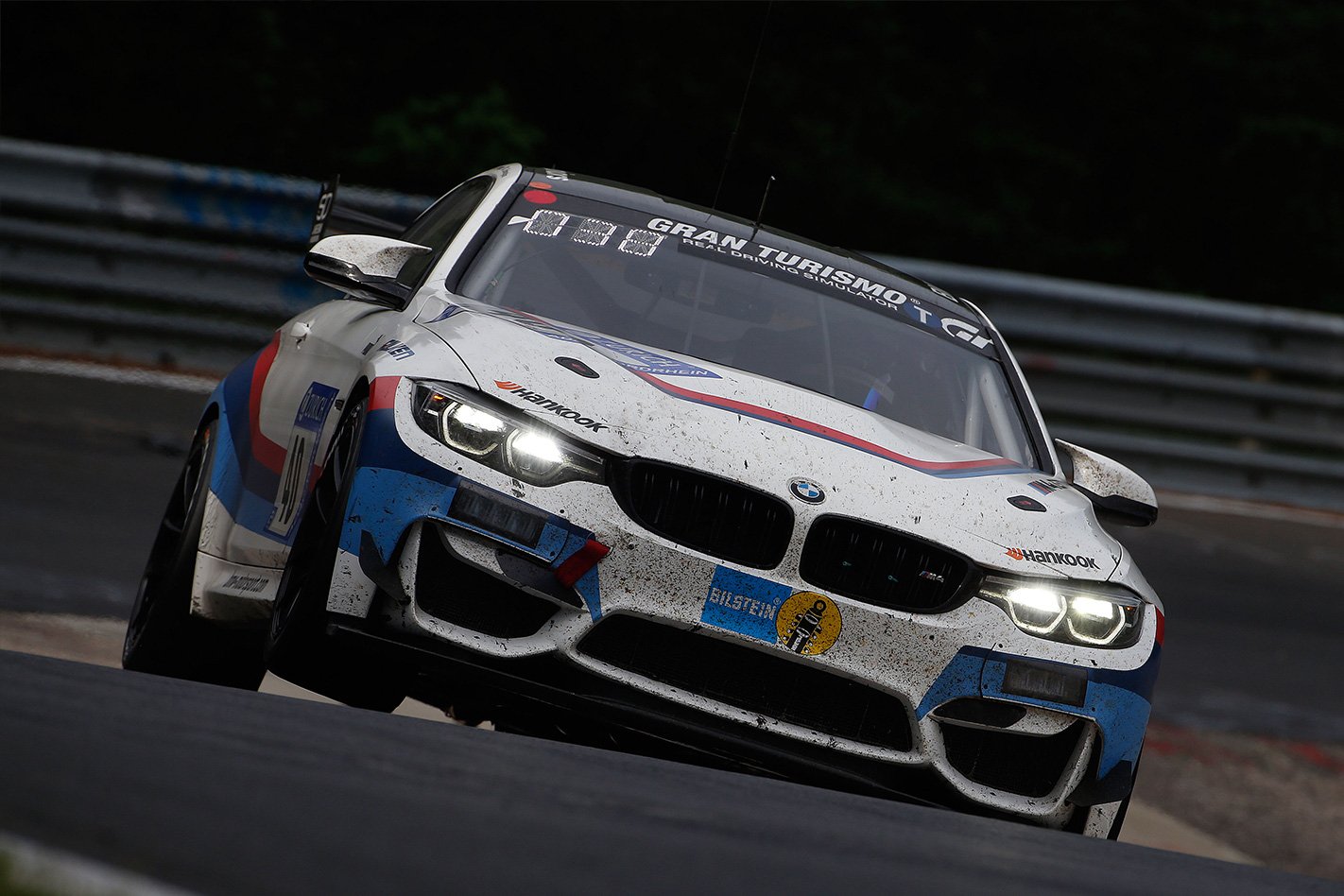
The M4 GT4 will make its Aussie debut at the Bathurst 12 Hour in February.
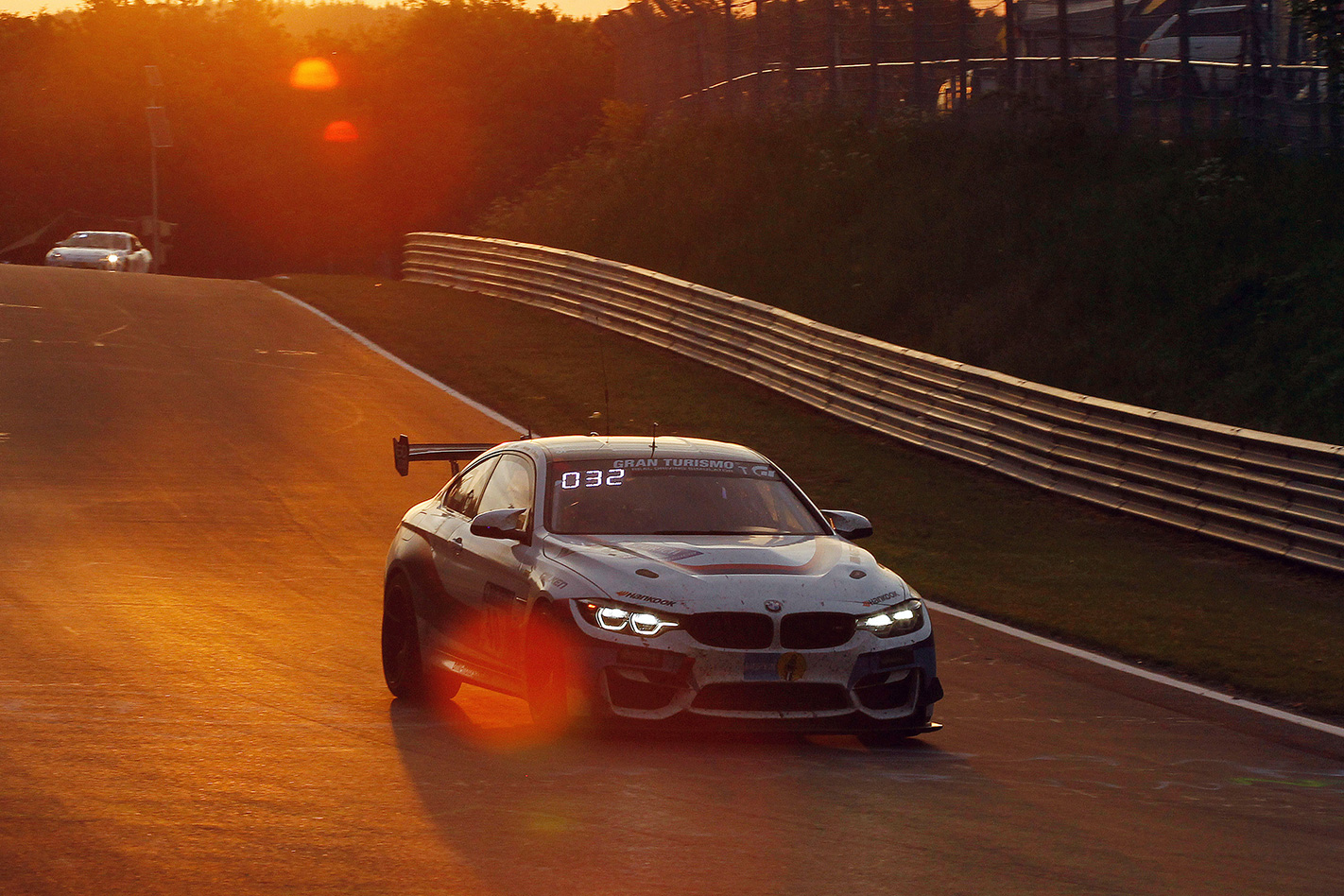
Based on the production M4, the GT4 version comes with the usual racing additions of beefed up suspension, brakes, wheels, and slick rubber, along with a stripped-out interior and rollcage. A 3.0-litre turbocharged straight-six engine sends over 321kW (depending on Balance of Performance specification) to the rear wheels via a seven-speed dual-clutch paddle-shift transmission.
GT4 is billed as a more cost-effective and accessible category to accompany GT3 – where some cars can cost over half a million dollars to purchase.
“From a BMW Team SRM perspective, what it will do is bring a lot of guys from state-level motorsport or even the lower ranks of national categories, and give them an opportunity to go and compete at some of the big circuits and big race meetings in cars that still have very low operating costs.
“GT4 is going to create a whole new demographic of motor racing for the next 10 years.
“Competitors will literally be able to change the oil, change the brake pads, and go and do another test day. It will mean drivers can afford to spend time behind the wheel, testing and practicing to hone and improve their skills. And then they can race at some really cool events, including some of the region’s best long distance events.”
Quinn reached an in-principal agreement earlier this month for the local GT championship to be run by Supercars (which owns 50 percent of the Bathurst 12 Hour) from next year.
Wheels understand the category could be rebranded as SuperGT. Japan’s premier sportscar series uses the same name.
The BMW Team SRM M4 GT4 is intended to attract more racers to the fledgling category, with Richards intending to provide opportunity for potential customers to get a taste behind the wheel.
“It’s still very early days for the GT4 market here in Australia, particularly compared to Europe, but having this first M4 here in the country will be a great way to get people in the car and getting them excited about what GT4 is and what it means for cost-effective GT racing.”
What stands out?
The Jaguar XF is a handsome, roomy and luxurious big car that is especially rewarding to drive. It feels responsive and beautifully balanced, and it offers a wide choice of engines and trim styles. Auto-braking is standard.
What might bug me?
Friends failing to notice you have the latest new Jag. The previous XF sedan made a brave design statement, but this new car has a much more conservative, evolutionary exterior. The XF also looks disarmingly similar to Jaguar’s smaller, and cheaper, XE sedan.Patronising comments on the interior trim, from owners of some German alternatives. While the XF’s cabin layout makes sense, looks good and is one of Jaguar’s best, the materials, fit and finish aren’t a match for, say, the Audi A6.Driving at 80km/h on the space-saver spare tyre until you can fix your full-sized flat.
What body styles are there?
Five-seat sedan, which Jaguar calls a saloon, and (from about December 2017) a five-seat wagon, which Jaguar calls the XF Sportbrake.The Jaguar XF drives its rear wheels. It is classed as a large car, upper priced.
What features does every Jaguar XF have?
Keyless entry and start, which allows you to unlock the car and drive away without removing the key from your pocket or bag. Cruise control.Dual-zone climate control, which lets you set different temperatures for each side of the cabin.Leather interior trim, with power-adjustment for the front seats and steering wheel. The driver’s seat remembers your settings, so that you can restore them easily after a companion has driven the car.A multimedia system controlled from an 8.0-inch touchscreen, with a USB socket and smartphone connectivity. A Meridian sound system with Bluetooth connectivity and music streaming. Satellite navigation.A reversing camera, and parking sensors front and rear.Windscreen wipers that operate automatically when it rains. Headlights that turn on automatically when it gets dark. Taillights illuminated by efficient and long-lasting LEDs. A heated rear window, and heated, power-folding door mirrors.The ability to tailor the sensitivity of the accelerator pedal and the behaviour of the traction control system for different driving conditions, via a button on the centre console. Available driving modes include Eco, Dynamic, Normal and Winter.Dynamic stability control and traction control systems which can help you control a skidding car. (Every new car must have such a feature.)A tyre pressure monitoring system that warns you if a tyre is going flat. The spare wheel is an 18-inch space saver.Autonomous emergency braking, and Lane departure warning.Six airbags. Anti-lock brakes, and dynamic stability control – which helps you control a skidding car. (For the placement of airbags, and more on Jaguar XF safety features, please open the Safety section below.)Every Jaguar XF carries a three-year, unlimited kilometre warranty.
Which engine uses least fuel, and why wouldn’t I choose it?
Jaguar offers seven engines in an XF. Five are 2.0-litre, four-cylinder turbos – three diesel and two petrol. The remaining two are 3.0-litre V6 turbos, diesel and petrol, and are available exclusively with the most expensive XF, the XF S.The most fuel-efficient are the 2.0-litre turbo-diesels, and the most miserly of those is the least powerful, which Jaguar labels the 20d. It uses as little as 4.3 litres/100km on the official test (city and country combined) – which is very impressive for such a big car.This engine has been available from the launch of the XF in 2016. It is quiet, and free from the unrefined clatter that is common with diesels. In most driving conditions it gives you healthy acceleration and feels like it has more than enough power.There are two main reasons why you wouldn’t choose this engine. One is that you want significantly more grunt from the other 2.0-litre diesel available, the 25d, which uses a more sophisticated turbocharger to produce about 30 per cent more power – while consuming 25 per cent more fuel on the test.The other might be that you prefer the cleaner refuelling and even smoother response of a 2.0-litre turbo-petrol engine, which Jaguar offers in increasingly responsive 20t, 25t, and 30t form.You can expect that an XF 20t petrol will perform much like a 20d diesel, and a 25t petrol much like a 25d diesel. An XF 30t petrol will be quicker than either diesel.The 25d diesel, and all three 2.0-litre petrols, began arriving from September 2017 with XFs produced for the 2018 model year. Like the 20d diesel, all use Jaguar’s latest Ingenium design principles. Fuel use on the official test is the same for all three new petrol engines: 6.8 litres/100km.There is a reason why you might bypass all five 2.0-litre engines, which would be that you want yet more power and smoothness from one of the 3.0-litre V6 engines that Jaguar supplies only with the XF S. Both pre-date Jaguar’s Ingenium designs, but both are at least as strong as the strongest of the 2.0-litre fours. The diesel – called the 30d – is turbocharged, while the petrol is supercharged.Every Jaguar XF is fitted with a smooth-shifting eight-speed automatic gearbox.(Power outputs and all other Jaguar XF specifications are available from the Cars Covered menu, under the main image on this page.)
What key features do I get if I spend more?
Jaguar offers the XF saloon at four equipment levels, most of which let you choose from four or more engines. They are Prestige, Portfolio, R-Sport, and S.The least costly is the XF Prestige, which comes with 18-inch wheels, very bright Xenon HID headlamps, and the features in every XF. You can have the less powerful of the 2.0-litre diesel engines, the 20d, or any of the three petrol engines: 20t, 25t, or 30t.Spend more for an XF Portfolio and you get seats trimmed in a finer grade of leather, and other more pampering interior trims. A head-up display projects useful driving information, such as your speed and navigation instructions, onto the windscreen, where you can see it more easily and safely while driving. Adaptive headlamps use efficient and long-lasting LEDs, adjust their beams as you turn the steering wheel, and dip automatically for oncoming drivers. There is a power-opening boot lid. Wheels are bigger, at 19-inches, and the tyre profile is correspondingly lower – which sharpens steering response. You can choose the more powerful of the 2.0-litre diesels – the 25d – or any of the four engines available in an XF Prestige.Choose an XF R-Sport instead and you give up the Portfolio’s head-up display, LED headlamps and powered boot lid in return for a firmer suspension tune – which makes the car react more immediately to the steering, and lean outwards less in fast cornering. You also get a sports body kit, different 19-inch wheels, and several other sporty cosmetic touches. The seat trim pairs leather with a synthetic mesh. And you can choose either 2.0-litre diesel engine or one of the more powerful 2.0-litre petrols.Spend more again on an XF S and you get a different body kit and red-painted brake calipers. Seats are trimmed in leather and suede, and the head-up display and adaptive LED headlamps return. Adaptive suspension adjusts the car’s ride automatically for the driving conditions, enhancing comfort and control. And you can choose either of the 3.0-litre V6 engines: turbo-diesel or supercharged petrol (but none of the 2.0 engines).The XF Sportbrake can be ordered only in R-Sport or S trim, and in either case it comes with pneumatic rear suspension that compensates for big loads. In R-Sport you can choose from 20d and 25t engines. As an S it is the 30d V6 diesel only.Much of the extra equipment supplied at certain trim levels can be added to other XFs as extra-cost options – the head-up display, and Adaptive suspension, for example. You can also option 20-inch wheels and a big range of internal and external trims. And you can have a hands-free boot that opens to a gesture from your foot.A larger, 10.2-inch, dual-view central touchscreen is available under the label Touch Pro, as is a fully digital instrument cluster that Jaguar calls an interactive driver display. The touchscreen lets the driver and passenger see different screens. The instrument display measures 12.3-inches and is configurable, allowing you to add sat-nav instructions and other useful information alongside the usual dials.You can also add to almost any XF an Active Safety Pack. It brings you Adaptive Cruise Control, which maintains a safe distance to the car in front automatically (with the help of a long-range radar). A queue-assist component will stop you if the car ahead stops in traffic – resuming if you tap the accelerator. The safety pack also brings you lane-keeping assistance, a blind-spot monitor, and reverse cross-traffic detection (which helps when backing blindly out of parking spots).On XF Sportbrakes (only) you can order an Activity key, which is a waterproof wristband that can unlock the vehicle, allowing you to secrete the usual key somewhere inside.
Does any upgrade have a down side?
Paying extra for an XF R-Sport improves handling, but the firmer ride also reduces comfort.Standard colours are black and white. All others cost extra.
How comfortable is the Jaguar XF?
The Jaguar XF is a very comfortable car, and strikes a deft balance between sporty handling and a relaxing ride.The standard coil-spring suspension feels supple and composed, and does a commendable job of smoothing out surface imperfections and larger bumps. That is partly because it uses frequency-dependent dampers that allow a soft and comfortable ride at low speeds, while firming up to improve control at high speeds. (An extra mechanical valve in the dampers does the job.)The optional adaptive suspension (fitted as standard to the XF S) uses electronically controlled dampers to do a similar job in a more sophisticated way. However, the standard suspension rides so comfortably it isn’t worth spending the extra money.The XF’s cabin is beautifully built and spacious, and provides a lot of luxury. The cabin design is logical and pleasing.
What about safety in a Jaguar XF?
Every XF comes with anti-lock brakes, stability control, six airbags, a reversing camera, front and rear parking sensors, auto headlights and wipers, and a tyre pressure monitor. As well, all have auto emergency braking and lane departure warning.The airbags are in the usual spots: two directly in front of the driver and front passenger; one alongside each front occupant to protect from side impacts at chest level; and curtain airbags extending down each side of the car that protect the heads of all outer occupants from side impacts.The camera-based auto-braking warns you of an obstacle in front (typically a car that has slowed sharply) and will apply the brakes automatically if you do not react. It is effective at suburban speeds.The standard lane-departure warning monitors road markings and alerts you if you are about to stray from your lane (perhaps from fatigue or distraction).An XF Portfolio or S brings you a surround camera system, which helps when parking but can also show on the touchscreen a view from the front of the car – which may show you more than you can see from the driver’s seat.Available at extra cost on almost any XF is an Active Safety Pack that in adds highway-speed auto-braking in conjunction with the radar-informed Active cruise control. A lane-keeping system adds to the standard lane departure warning: if you drift too close to the edge of your lane, it applies counter-steering to put you back on track.This package also brings you Blind-spot detection, which alerts you to cars immediately behind you, in adjacent lanes, that might not appear in your mirrors. And it offers reverse traffic detection, which helps when reversing blind from a parking spot – showing traffic approaching from either side.The Australasian New Car Assessment Program (ANCAP) rated the Jaguar XF at five stars for safety, its maximum, in April 2016.
I like driving – will I enjoy this car?
Absolutely. The XF combines its supple ride with masterly handling, and offers responsive and powerful engines. The big cat corners with an eagerness and composure that belies its 1700kg kerb weight.The XF also has one of the best steering systems in a car of its type. The electrically assisted steering feels sharp and fluid, provides a good sense of connection to the road, and is surprisingly direct for a car of this type. In addition, the electronic stability control has been tuned superbly, and braking is incredibly strong when required.The focus on handling is helped by an all-new suspension system that comprises double wishbones up front and a complex multi-link system at the rear. As well, this XF is claimed to be significantly more rigid than its predecessor, while weighing nearly 200kg less.All engines available in the XF impressed when Jaguar launched the model in February 2016. The addition from September 2017 of a more powerful Ingenium diesel and three new Ingenium petrol engines, for the 2018 model year, gives you more options. This article will be amended after reviewers have gained some experience with the new engines.
How is life in the rear seats?
The rear seat area in the Jaguar XF is spacious and comfortable. This is aided by Jaguar having stretched the XF wheelbase by 50mm, compared with the previous generation car.The seat cushions are deep, and there is a centre armrest with twin cupholders. Rear passengers get dedicated air-conditioning outlets.There are ISOFIX anchor points for rear child seats.
How is it for carrying stuff?
The Jaguar XF saloon has a large boot at 540 litres – about the same as an Australian-built Holden Commodore. The boot is deep and well shaped, and opens wide – which is useful when loading large objects.Rear-seat backrests fold 40-20-40, which lets you accommodate long pieces of cargo while optimising passenger space.Jaguar lists cargo volume in the Sportbrake at 565 litres.
Where does Jaguar make the XF?
The XF is built in the United Kingdom, at Jaguar’s factory in Castle Bromwich.
What might I miss that similar cars have?
If you’re a fan of having cars drive themselves, you might miss the latest autonomous driving technology available in some key alternatives. For example, the Mercedes-Benz E-Class can drive itself on roads without clear lane markings, and change lanes by itself. Jaguar admits it’s a step behind here. Some alternatives have more sophisticated auto-braking systems also.Another car worth considering is the Audi A6, which offers all-wheel drive across much of its line-up, adding security in slippery conditions. The XF is rear-wheel drive only.
Are there plans to update the Jaguar XF soon?
This second generation began its life cycle in February 2016, offering a single Ingenium diesel engine with 132kW, and pre-Ingenium four-cylinder and V6 petrol and diesel alternatives.About September 2017, for the 2018 model year, Jaguar replaced its four-cylinder petrol engine with three fresher Ingenium petrols and added a more powerful Ingenium diesel – making most of these available in Prestige, Portfolio and R-Sport XFs. Driver-assistance systems received minor enhancements.An all-new XF is not likely until well into the 2020s, but you might see a facelift and equipment changes in the meantime.
I like this car, but I can’t choose which version. Can you help?
There was no obvious weak link in the Jaguar XF range when it was launched in 2016. We recommended the least costly version, equivalent to the Prestige 20d, observing that the new 2.0-litre diesel was the most fuel-efficient engine on offer, and the XF’s well-sorted dynamics meant you lost little handling ability to the more expensive cars.For the 2018 model year, Jaguar has elected to make multiple engine choices available at each trim level. While the Prestige 20d continues to offer enough of everything to satisfy many people, the possibilities are now abundant for tailoring power, fuel-type, trim and options to your budget and preferences.
LAMBORGHINI, McLaren, Radical. You are all dismissed, because there is a new undisputed king of the Nurburgring Nordschleife in town, and that’s Porsche.
We reported last week that the GT2 RS (the most powerful 911 to be created) was allegedly knocking out sub 7-minute laptimes at the infamous Nurburgring Nordschleife.
Well, strap yourself in, because Porsche has today confirmed just how far below that 7-minute barrier they have gone.
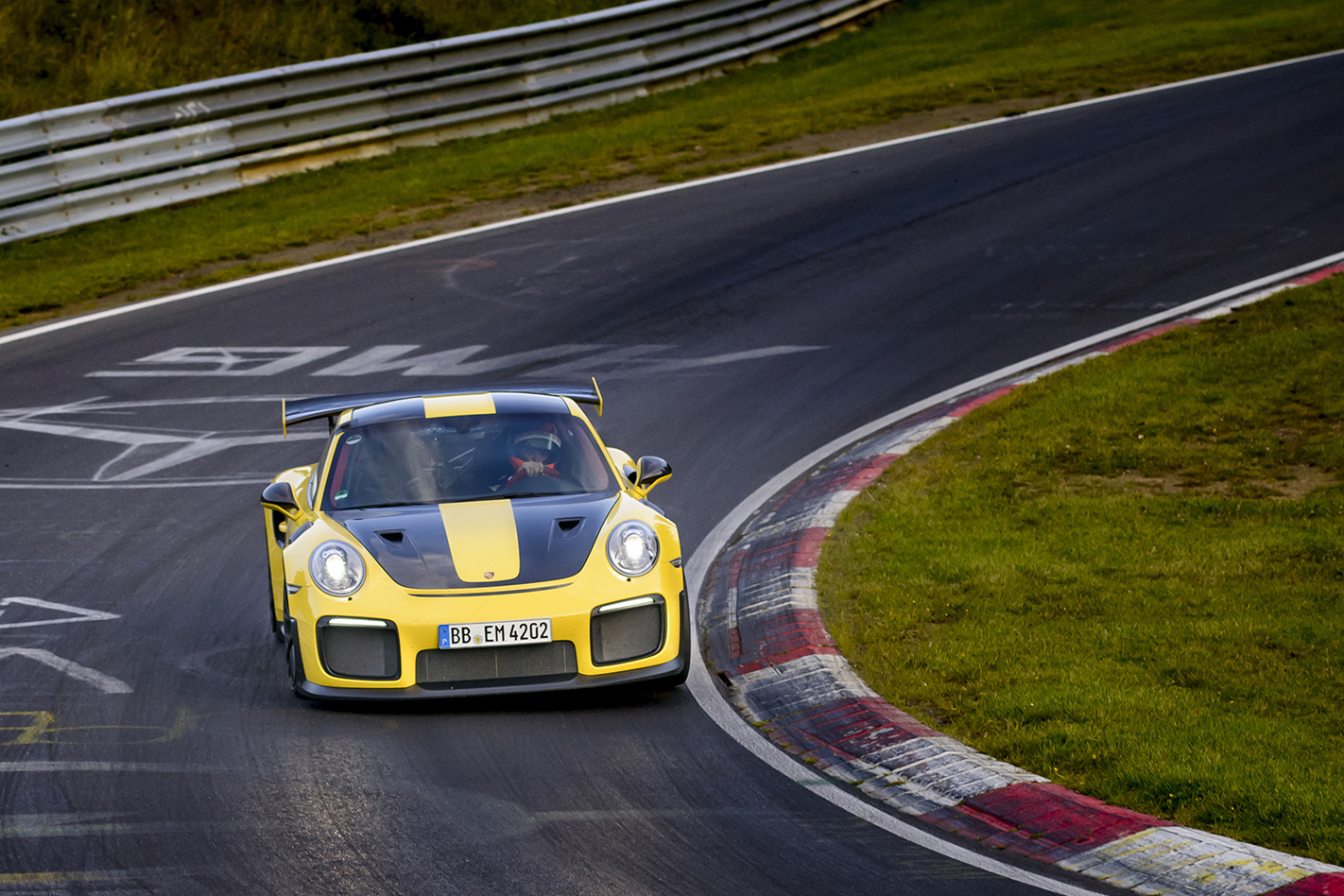
That’s nearly 5 seconds faster than the Lamborghini Huracan Performante and under a second faster than the Radical SR8LM (essentially a race car with headlights). The Nio EP9 all-electric hypercar (which was rumoured to complete its lap on slick tyres) may be faster but is far from a volume production car, and though the McLaren P1 LM (a street-legal version of the track-only P1 GTR) may be quicker, Porsche says it doesn’t count as a “road approved sports car”.
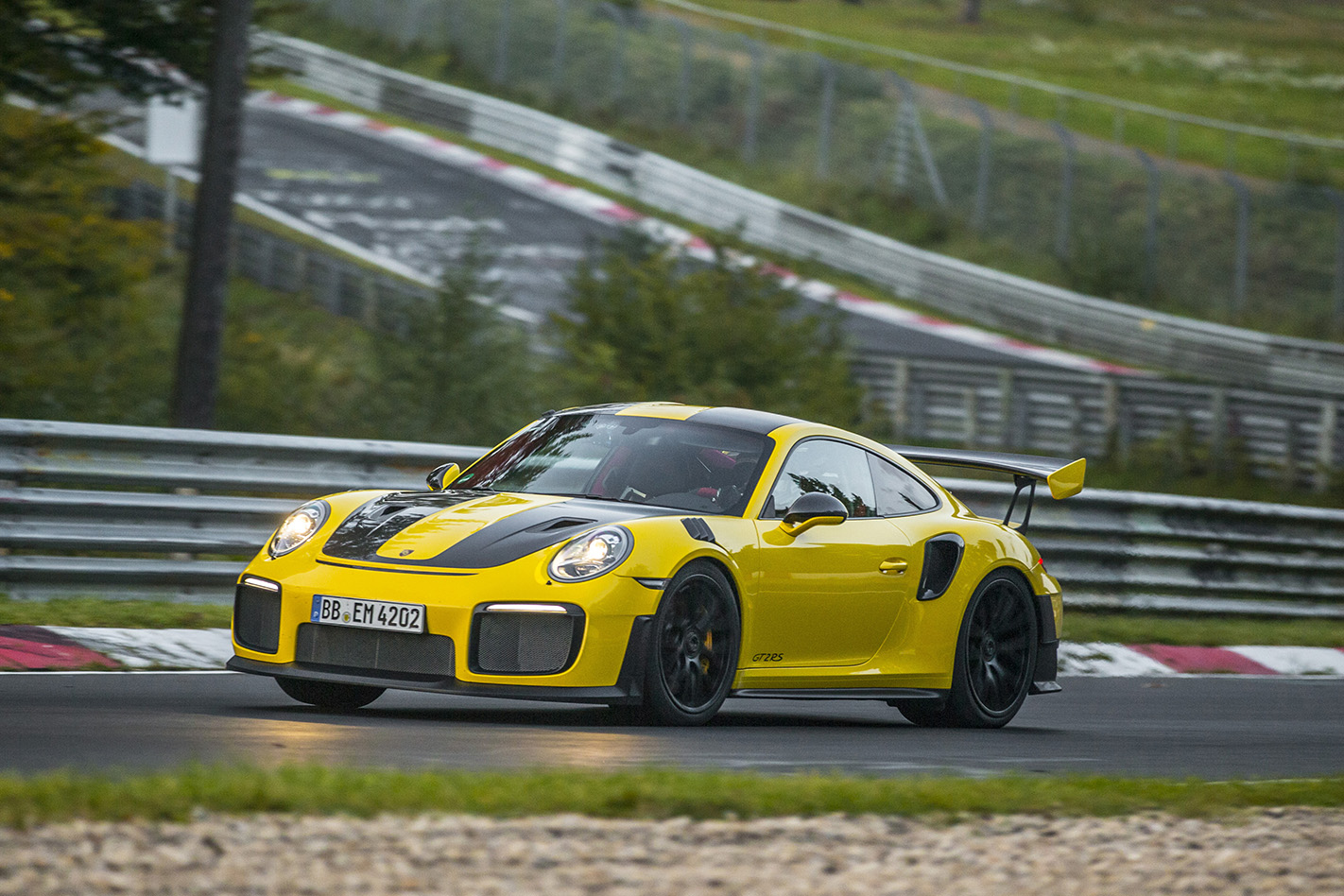
The new lap also hands the 2018 911 GT2 RS the title of fastest-ever road-faring Porsche to lap the Nurburgring, with the 918 Spyder’s previous personal best of a 6:57.00 blown well and truly out of the water.
While several of those cars mentioned above are either built in extremely limited numbers or barely-legal race cars with headlights added, the GT2 RS is a production road car that’s built on the same production line as every other 911.
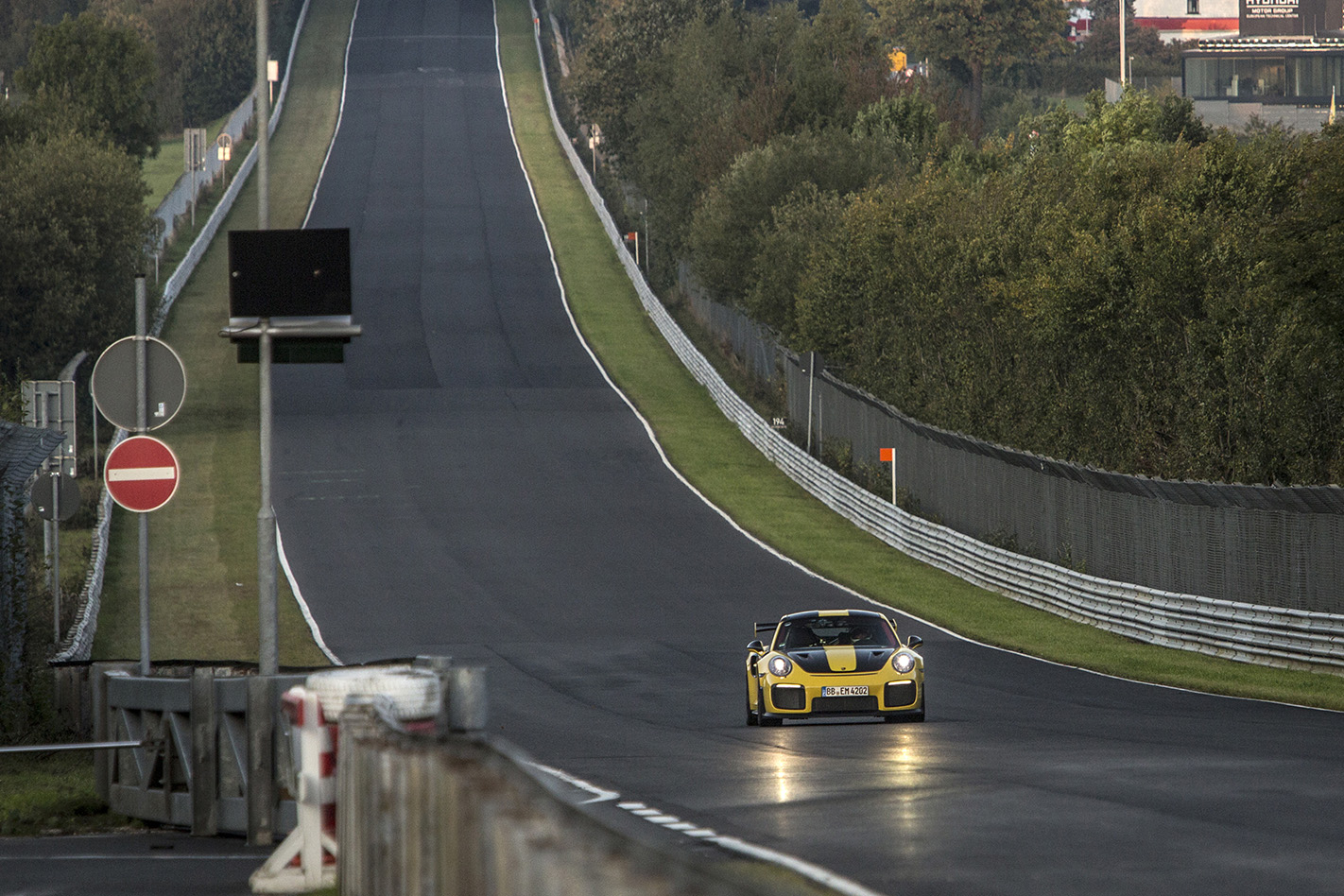
For once, the outright road-legal lap record holder at the Nurburgring doesn’t sneak into the “road-going” category on a technicality.
To illustrate just how monstrous the new GT2 RS’ performance is, its predecessor lapped the Nordshleife in a comparatively tame 7:18.00 back in 2010.
Harking back to the original 993-generation 911 GT2, the 911.2 model uses the same basic layout with a turbocharged flat six taking power to the rear wheels exclusively. For the 2018 model, power and torque rise to a mega 515kW and 750Nm from a rear-mounted 3.8-litre twin-turbo. Want to know what else makes the Widowmaker tick? Head here.
The much anticipated Porsche 911 GT2 RS Nürburgring lap time has been revealed as 6 minutes and 47.3 seconds.
With Porsche factory driver Nick Tandy at the wheel, the new lap time even surprised Frank-Steffen Walliser, Porsche’s VP of motorsport and GT cars.
“At the start of the development process, we set ourselves a lap time target for the GT2 RS of less than 7 minutes and 5 seconds,” Walliser said.
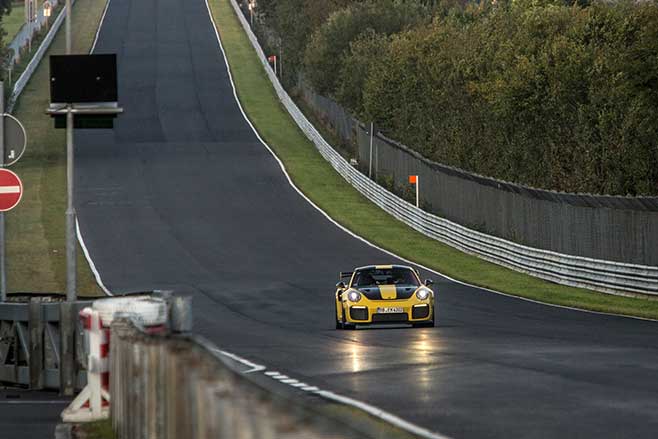
“This result makes it official: The GT2 RS is not only the most powerful, but also the fastest 911 ever built”.
The 515kW/750Nm monster Porker was also said to be incredibly consistent in its performance, with five of the practice laps coming in at under 6 minutes and 50 seconds. Impressive for two drivers (German Lars Kern, a Carrera Cup Australia regular, joined Tandy) in two cars.
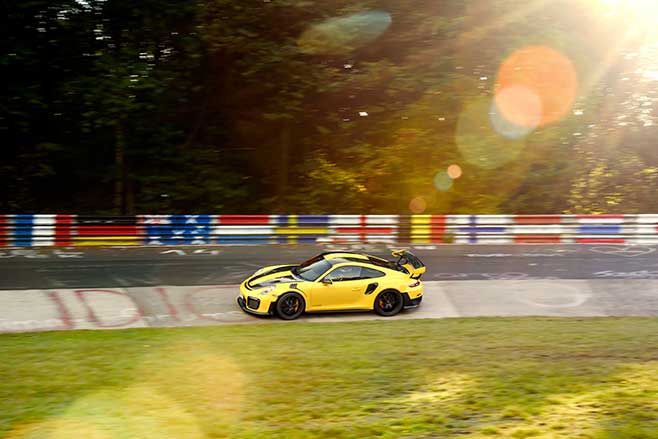
“We’re particularly proud of the fact that this was achieved with two different vehicles and two different drivers, as this underlines the GT2 RS’s ability to reproduce this record result over and over again.”
Porsche adds that the GT2 RS’s average speed was 184.11 km/h.
Now that Porsche has reclaimed the ‘Ring King title from the Lamborghini Huracán Performante, which took it from the Porsche 918 Spyder, we eagerly await the next challenger to the Green Hell’s throne.
Suzuki is expected to slip the covers off its next-generation Jimny at next month’s Tokyo Motor Show, but even if it doesn’t we’re still going to get a glimpse of another eye-catching off-roader at the Suzuki stand – the e-Survivor concept.
And boy is it wild. The e-Survivor concept is a jacked-up, plastic-bodied reimagining of the Suzuki X-90 of the 1990s, a bubble-shaped offroader that bucked convention by being a 2-seat coupe with a boot rather than a conventional hatch or wagon.
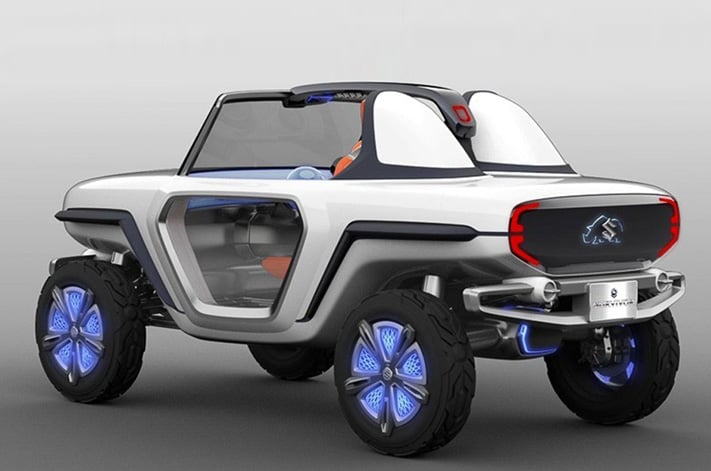
The e-Survivor’s profile bears more than a passing resemblance to the X-90, but that’s where the similarities start and end. The e-Survivor is a 4WD, yes, but it produces power via four direct-drive in-wheel electric motors.
The doors are replaced with transparent panels, there are no conventional fenders to speak of, and there’s no roof either – just a targa bar connecting the windscreen frame to a pair of buttresses behind each seat
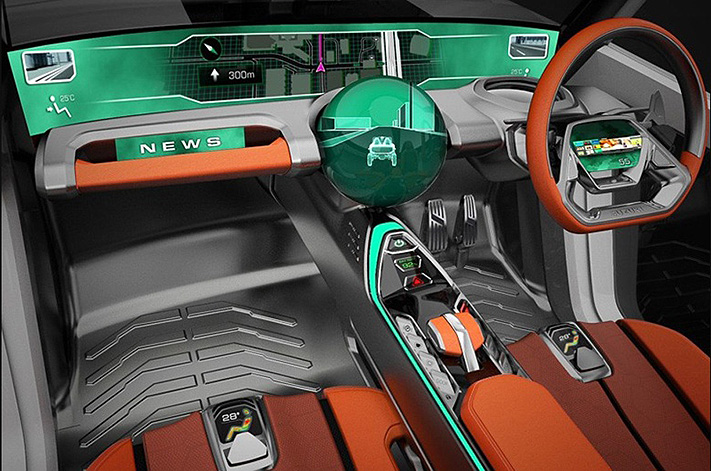
Overhangs are short and ground clearance is massive, which should give the e-Survivor excellent off-road credentials – were it not a concept, that is.
Inside, it’s a boundary-pushing vision of the future with a dashboard-spanning infotainment screen, what appears to be a central holographic display, a rugged hard plastic floor, another screen embedding into the steering wheel and climate control mini-screens located between the thighs of each occupant.
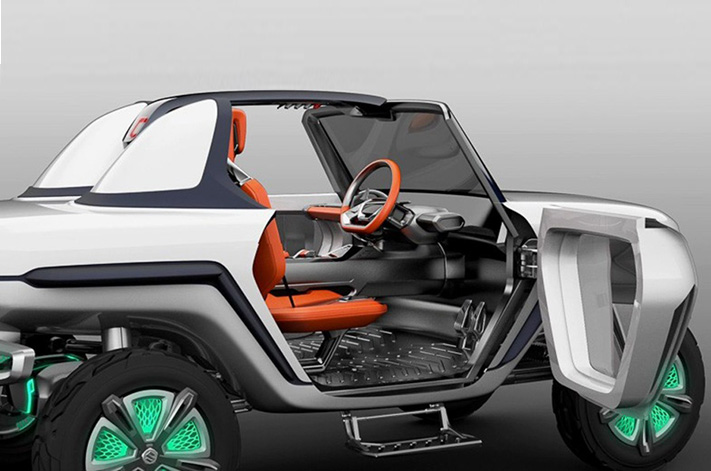
It’s as exciting as it is unrealistic, and while it’s obviously not intended for a production future it nevertheless demonstrates that Suzuki’s designers are capable of dreaming big.
We’ll have our first good look at it at the Tokyo Motor Show on October 23.
FORD has upgraded the Ford Everest to appeal to owners searching for more dirt roads than bitumen.
The range-topping Ford Everest Titanium is now offered with an optional 18-inch tyre and wheel package that comes with a number of suspension changes to enhance its off-road capability.
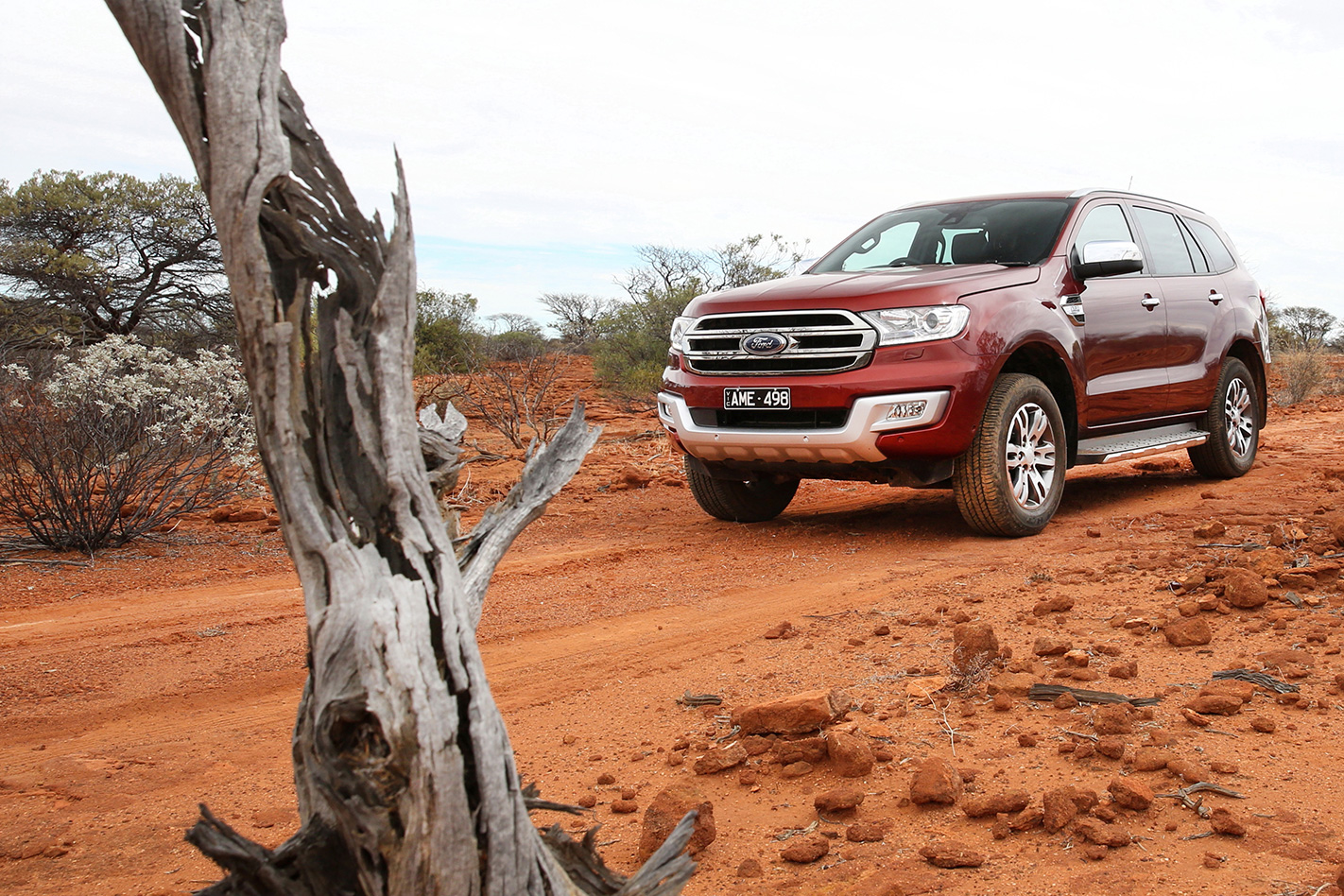
The option pack also includes a recalibration of the Everest’s driver assistance and safety systems to better suit slippery conditions and enhance traction when straying far from the beaten trail.
Buyers of the Everest Titanium can choose between the standard 20-inch alloys, or an 18-inch setup with taller sidewalls at no additional cost. A matching full-size spare wheel is also included.
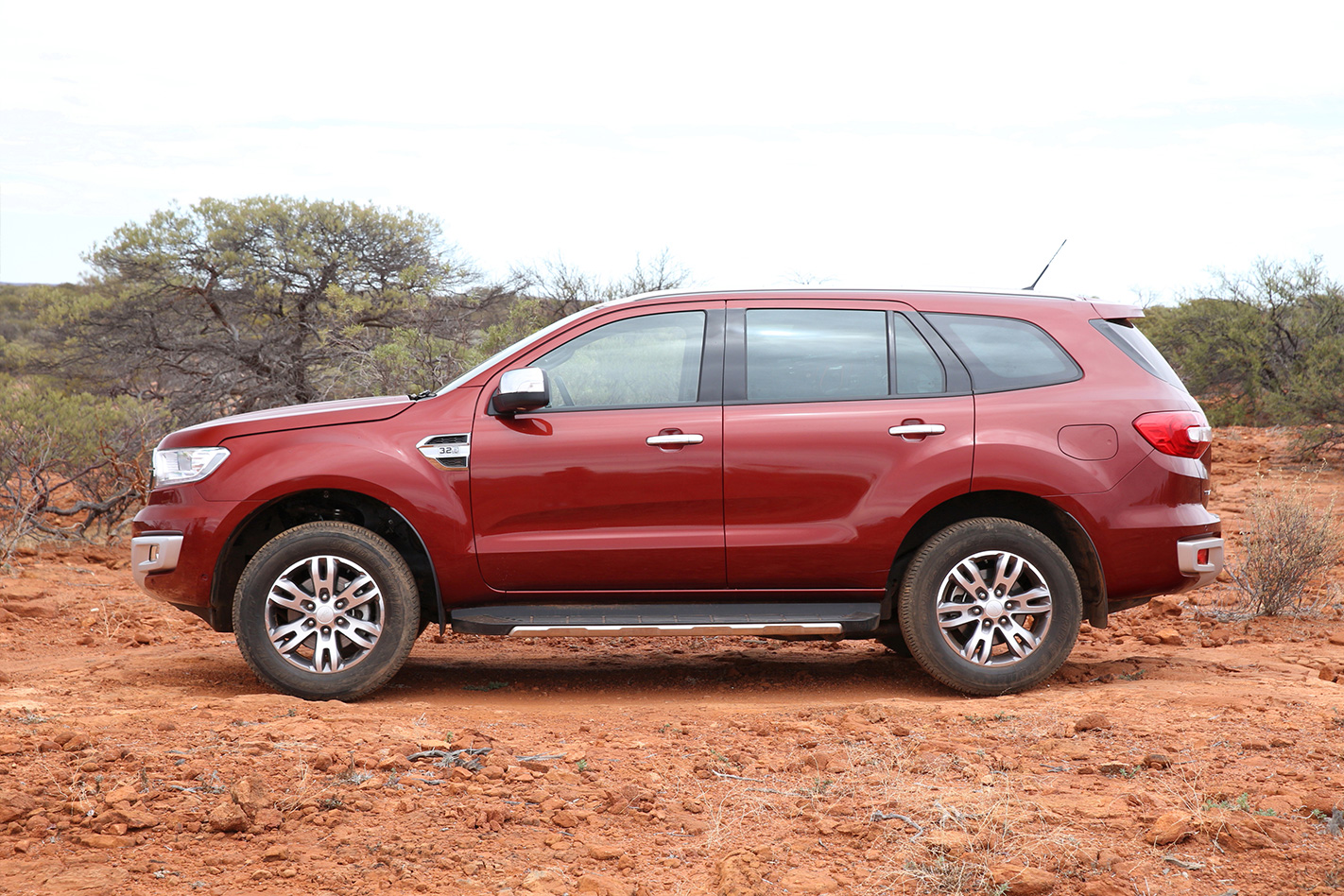
Other than the new off-road package nothing else has changed on the Everest, with the same Sync3 infotainment system, 143kW/470Nm 3.2-litre five-cylinder turbo-diesel engine and six-speed automatic with dual-range 4WD being standard features on the range-topping Everest.
Ford claims Everest ownership has increased by 22.5 percent in 2017.
The no-cost option are not available on other models in the Everest range. For now, it remains exclusive to the Titanium grade.
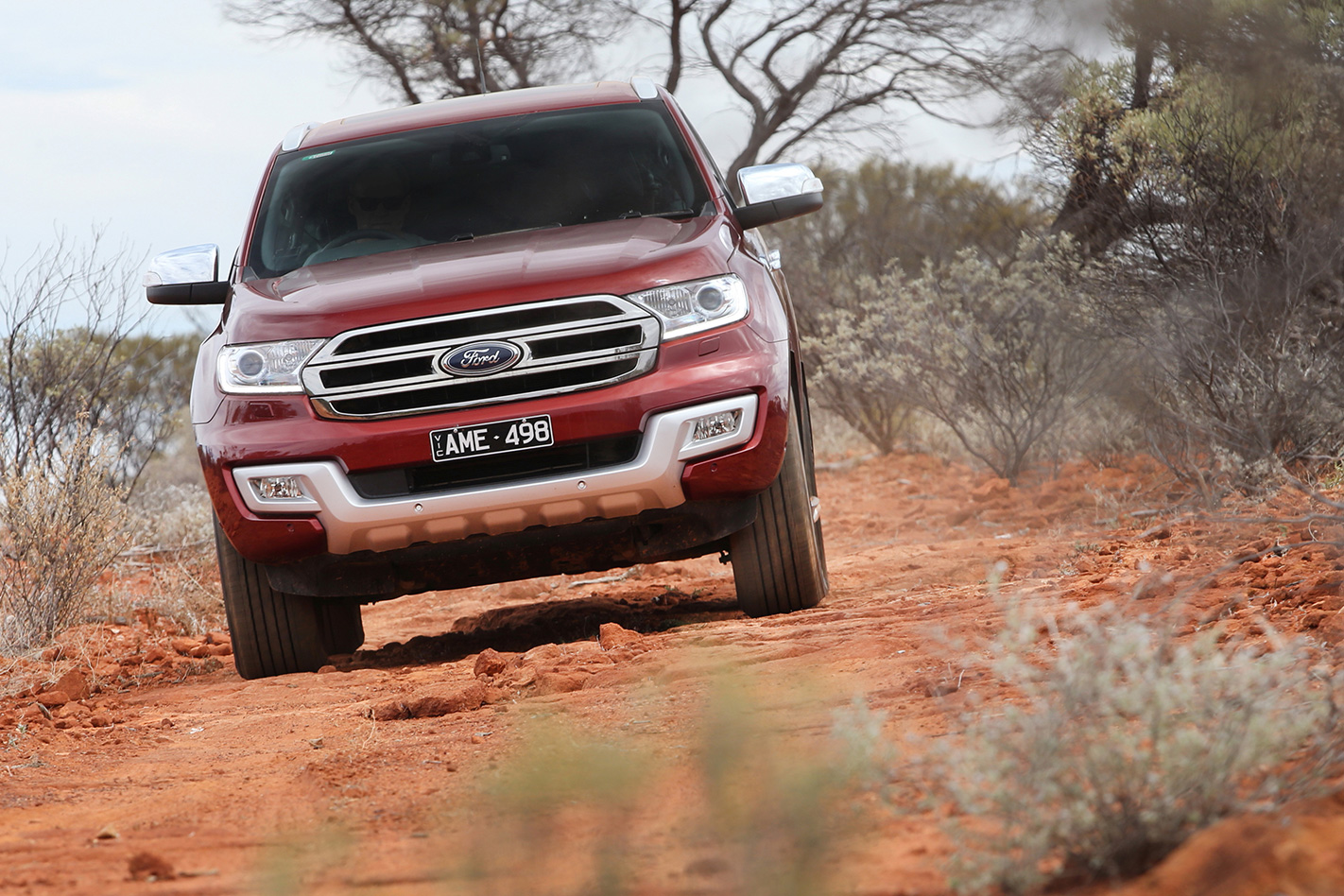
“The Everest has been awarded for its off-road capability, and many of our customers have and do take full advantage of this,” Ford Australia President and CEO, Graeme Whickman said.
“We’ve responded to this call, and we’re pleased to offer greater choice for Everest customers.”
Everest pricing:
- Everest Ambiente RWD, 3.2L automatic, 5-seat: $47,990
- Everest Ambiente RWD, 3.2L automatic, 7-seat: $48,990
- Everest Ambiente 4WD, 3.2L automatic, 5-seat: $52,990
- Everest Ambiente 4WD, 3.2L automatic, 7-seat: $53,990
- Everest Trend RWD, 3.2L automatic, 7-seat: $53,990
- Everest Trend 4WD, 3.2L automatic, 7-seat: $58,990
- Everest Titanium 4WD, 3.2L automatic, 7-seat: $74,701
Renault’s decision to import two of its most popular European-market battery-electric cars to Australia is one that should pique the interest of small business operators.
And it’s not the stylish Renault Zoe city compact that will have their attention, but rather the more utilitarian Kangoo Maxi ZE that will accompany it here.
TELL ME ABOUT THIS CAR
Renault’s electric Kangoo has been in Australia before, but only as part of a limited trial conducted by Australia Post with early-model Kangoo ZEs, with a limited range of between 80km and 125km. The 2018 model that’s heading here, however, boasts a higher-capacity 33kWh lithium-ion battery pack that delivers between 120km-200km of real-world driving on a single charge.
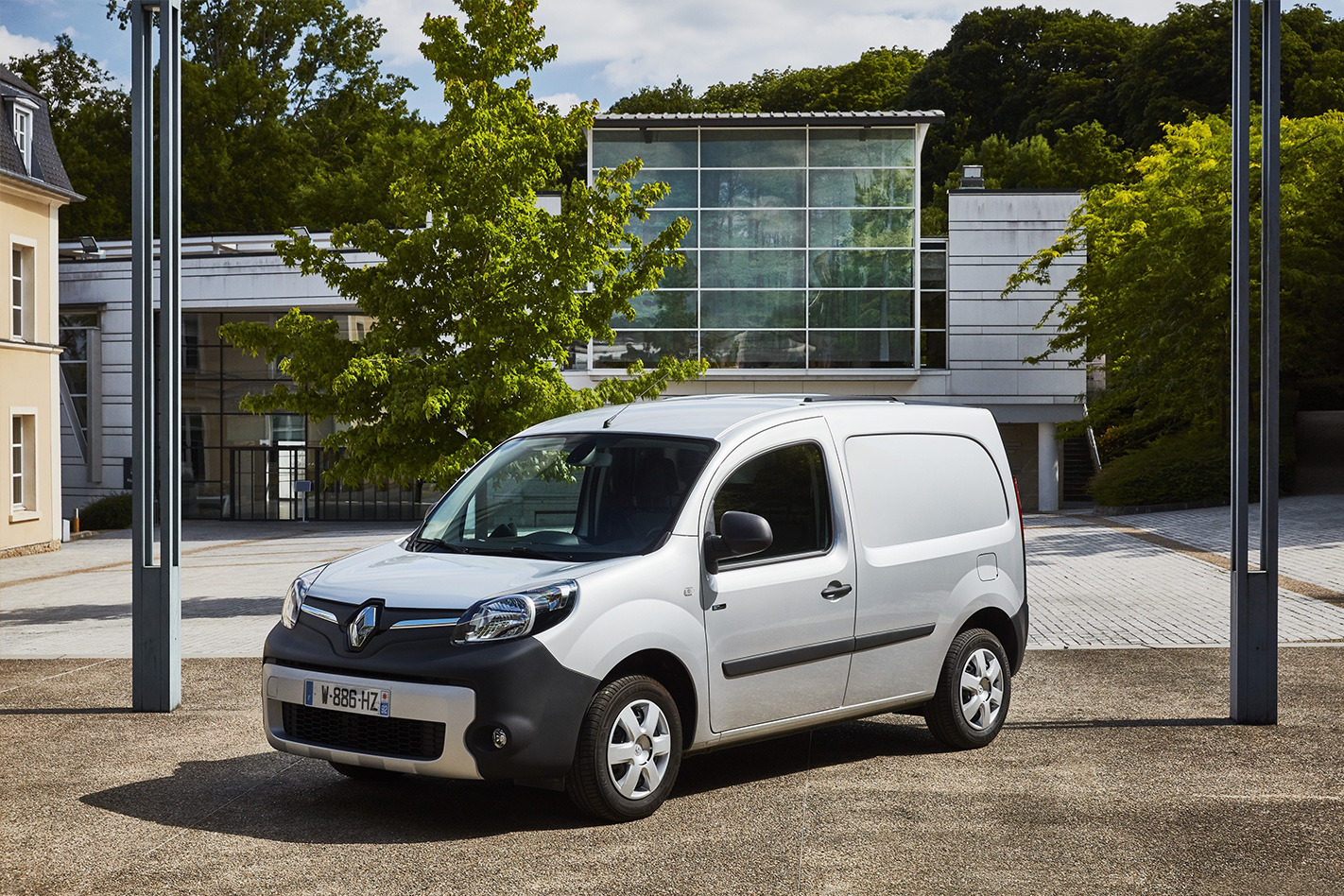
Based on the conventionally-engined Renault Kangoo Maxi diesel, the Kangoo Maxi ZE (which stands for Zero Emission) is offered in a single specification with space for two – driver and a single passenger. Priced at $45,990, Kangoo buyers will also need to factor in the cost of a 7.4kW charging unit, which can charge up a fully depleted battery in six hours.
The sales model for the Kangoo ZE is also slightly different from that of regular Kangoos. As with the Zoe, Renault Australia only intends to sell the Kangoo ZE directly to business and government fleets. Small business operators are welcome, but at this point only two dealerships will be set up to service and repair the electric van – one in Melbourne, the other in Sydney.
STRENGTHS
Low running costs is the Kangoo ZE’s biggest virtue, with cheap electricity being the only thing it needs to get from depot to delivery. No diesel, no lubricants, no fuel additives. With a simple electric motor sitting between the front wheels, there’s less opportunity for mechanical issues too – above all else, the Kangoo ZE should be cheap to run.
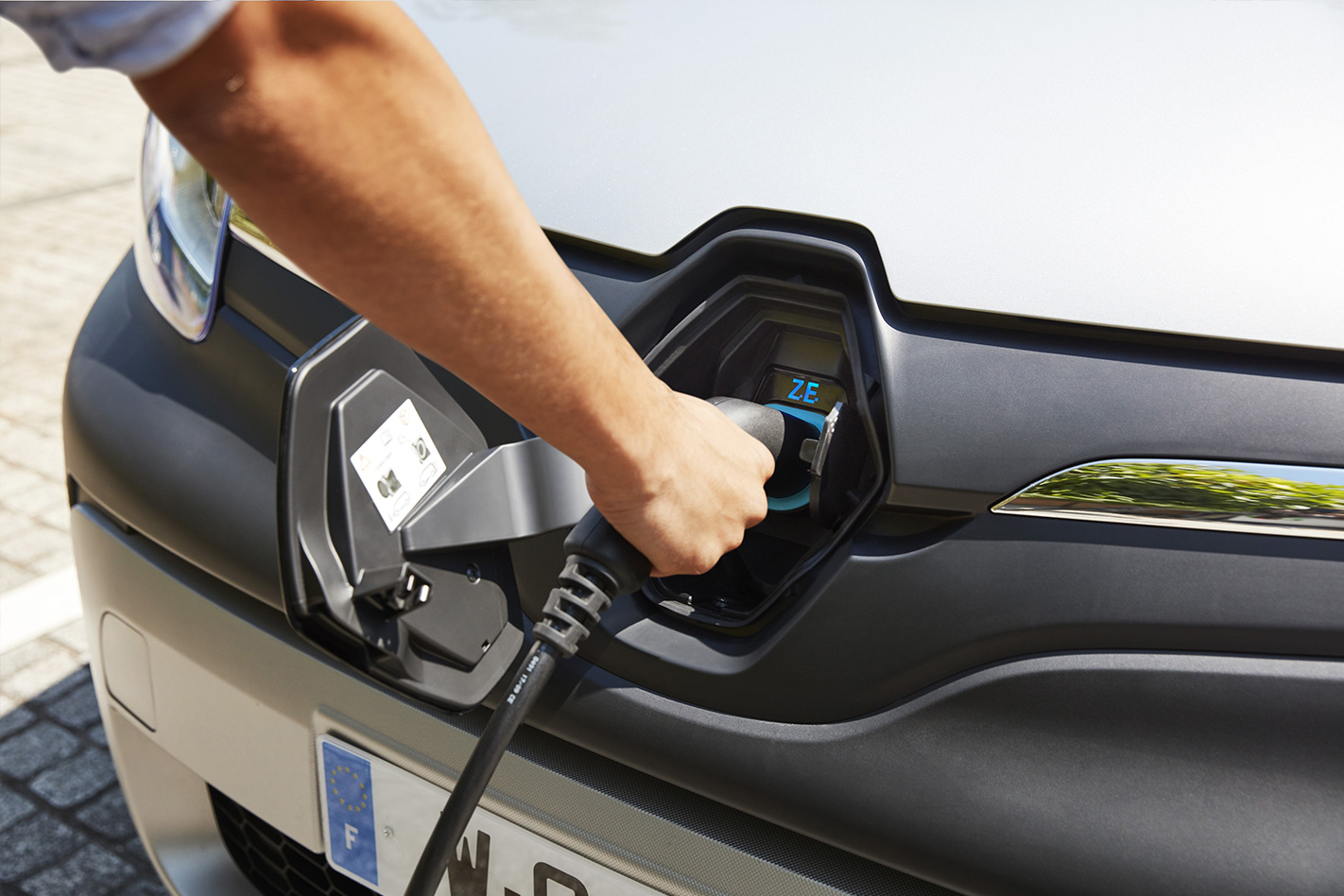
Cubic capacity measures in at 4000 litres, giving the Kangoo Maxi ZE the exact same cargo volume as the diesel-engined Kangoo Maxi. There’s also left and right sliding doors and rear barn doors as standard, making it easy to get your stuff in and out. Meanwhile, a steel bulkhead separates people from cargo and makes the cabin a little more comfortable too.
Ease of driving is enhanced in the Kangoo ZE through its strong regenerative braking, which converts forward motion back into stored electrical energy the instant to lift off the accelerator. In layman’s terms, it means the car slows down faster without the driver needing to touch the brake pedal, which can reduce help reduce fatigue during a long day’s driving.
The Kangoo’s single-charge range is comparatively limited when measured against conventionally-powered small vans, but if the van makes frequent returns to a depot throughout the work day its range can be stretched further easily. An hour on the charger will net around 35km of extra range, allowing more distance to be travelled if you plug it in frequently.
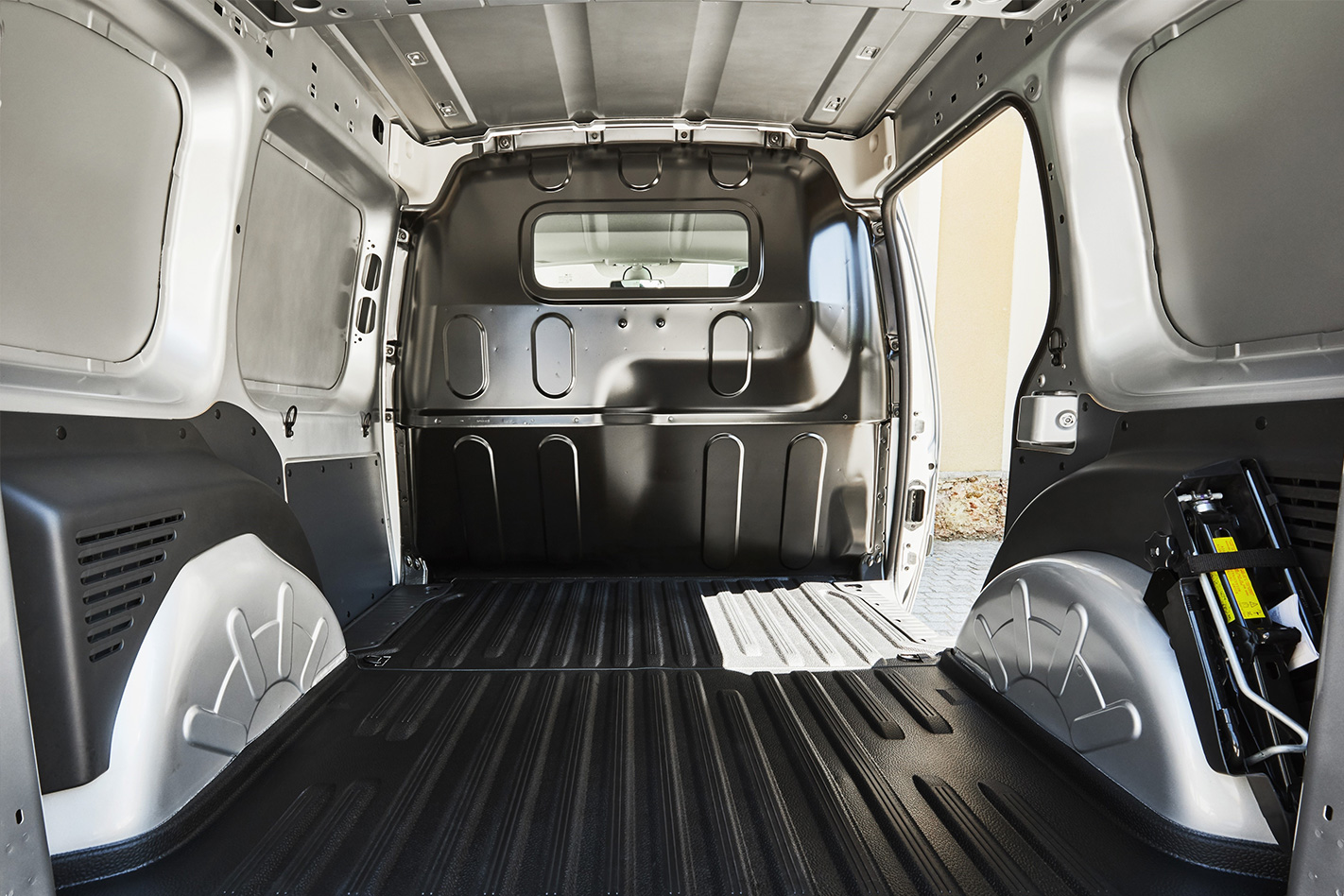
Driver comfort can be enhanced if you take advantage of the ZE’s ‘pre-conditioning’ feature. Set the expected time of departure and plug it in to charge, and the car will get its airconditioning or heater running well before the van’s work day begins. No more starting a shift in an ice-cold (or scorching hot) van, and it’s all done using power drawn from the plug – meaning you won’t waste energy by heating up or cooling down the car.
WEAKNESSES
While the cargo volume is the same as the combustion-engined Kangoo, the ZE’s maximum payload tops out at 650kg – 180kg shy of what the diesel can carry. Batteries are heavy, after all.
The Kangoo ZE isn’t suited for businesses that need to travel great distances throughout the day. Plumbers and electricians who make multiple house visits throughout the day will likely find the Kangoo’s range to be insufficient.
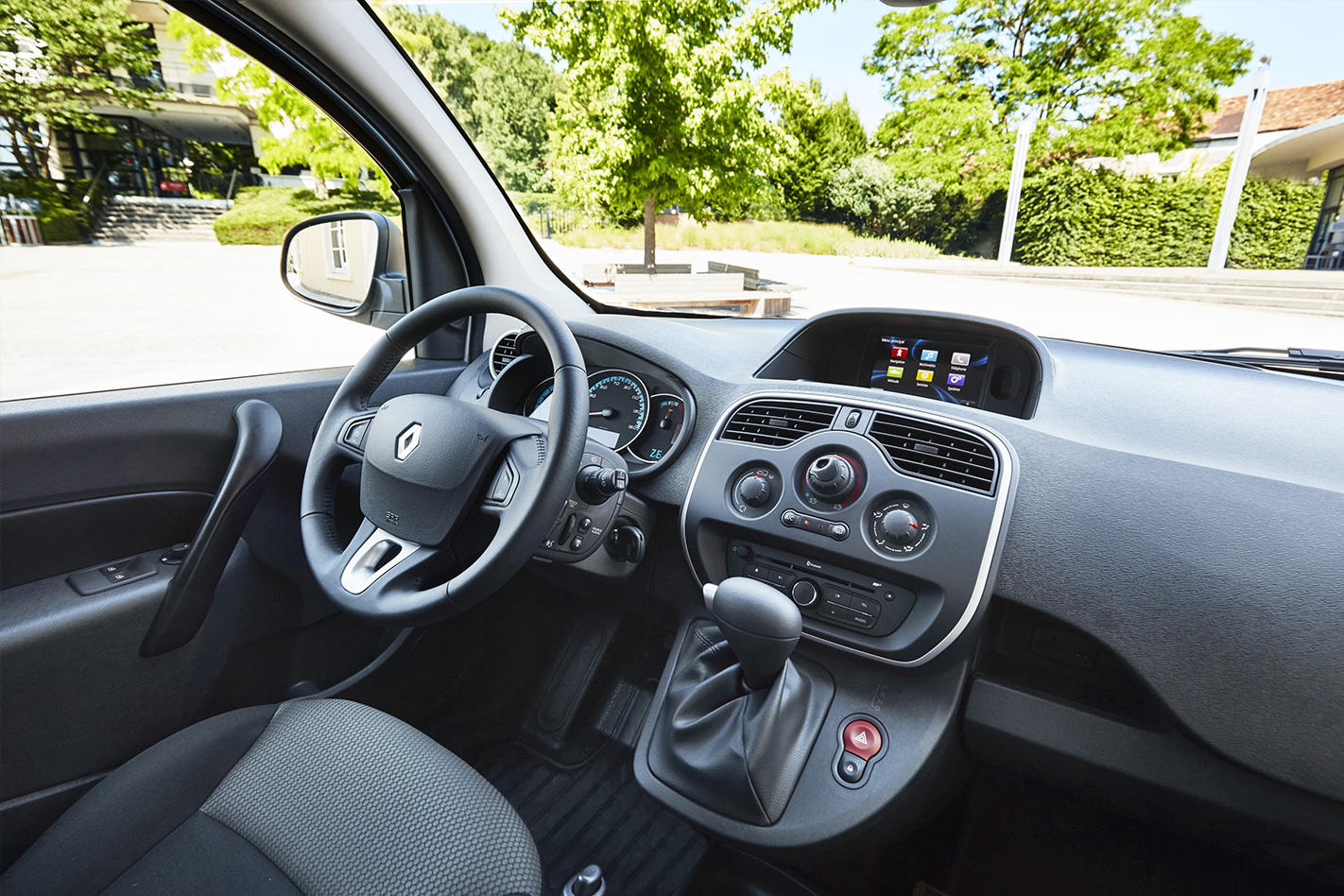
Even with no cargo aboard, the Kangoo ZE is slow to accelerate. Its 44kW/226Nm electric motor has less torque and almost half the power of the diesel-powered Kangoo that it’s based upon.
The cost is a drawback, and realistically means the Kangoo ZE will only find favour with companies that can not only deal with the limited range but also spare the extra cash to have an environmentally-friendly van in their fleet.
ARE THERE ANY RIVALS I SHOULD CONSIDER?
As far as electric commercial vehicles go, there are no competitors to the Kangoo. On pure cost terms, the Kangoo Maxi ZE competes with larger commercial vans like the Ford Transit Custom, Volkswagen Transporter and higher-spec versions of Renault’s own Trafic.
A TALENTED young engineering student from Wollongong, New South Wales, will be joining Renault’s Formula 1 team from October after winning his way into the Infiniti Engineering Academy.
Jacob Debono, 23, was selected from 500 entries in the Asia and Oceania region, beating nine other finalists, to score his place in the 2017 Academy.
The prize means Debono will be provided with travel, accommodation, a company car, and salary while he completes his 12 months of work alongside Infiniti and Renault’s teams.
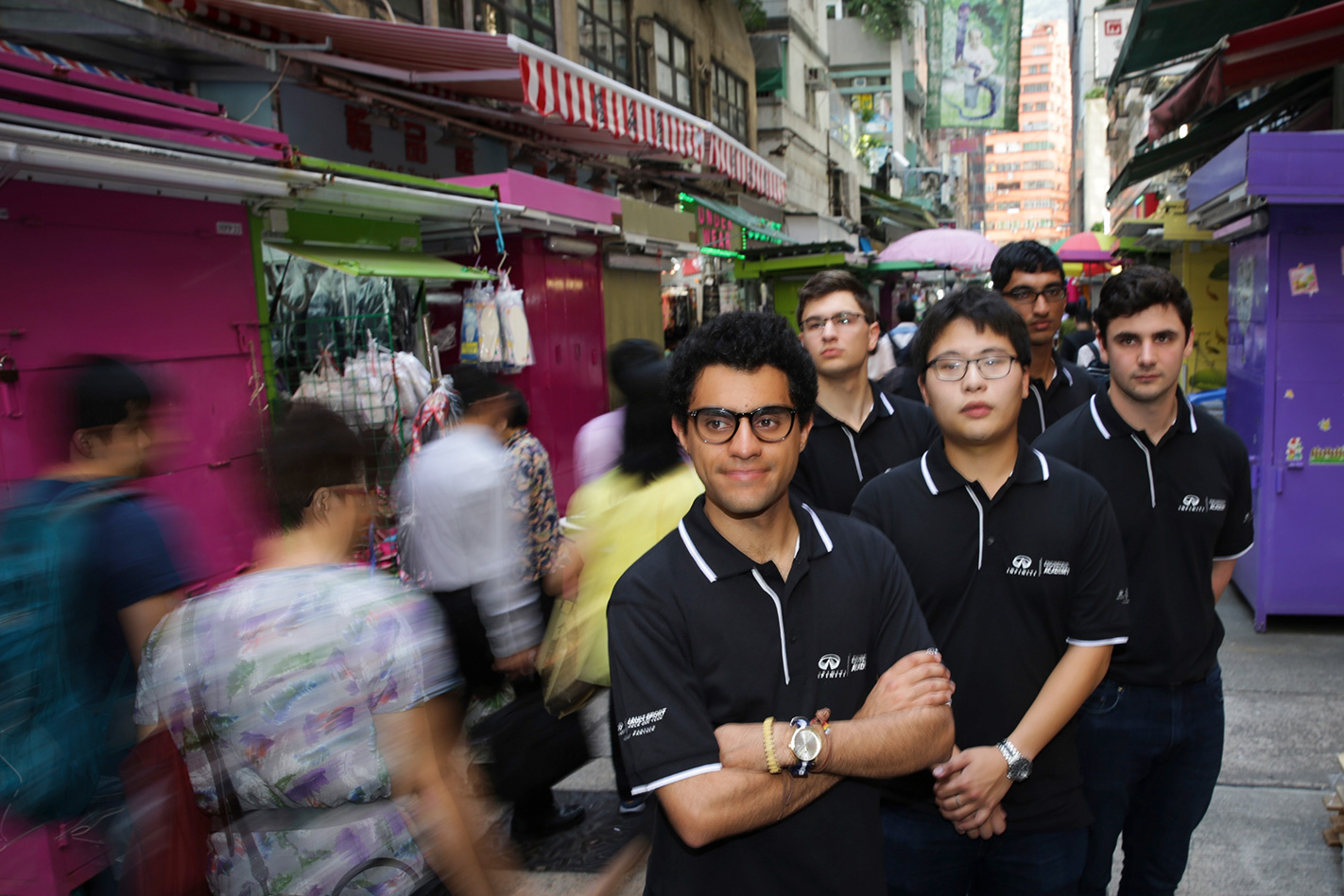
Debono’s prize is split into two halves, with six months spent working at Renault’s Formula 1 Team Technical Centre in the UK, and the second six months at Infiniti’s European Technical Centre.
The young Aussie engineer is one of seven regional winners, with contestants from Canada, China, Europe, Mexico, the Middle East and the United States joining him during the placement.
“When I was standing there and Nico Hülkenberg opened the envelope and read out my name, I couldn’t believe it,” Debono said.
“To be able to spend a year working with both an automotive manufacturer and an F1 Team is absolutely invaluable experience.
“I’m still letting it all sink in, but I feel very privileged to be here and it’s an opportunity I mustn’t take for granted.”
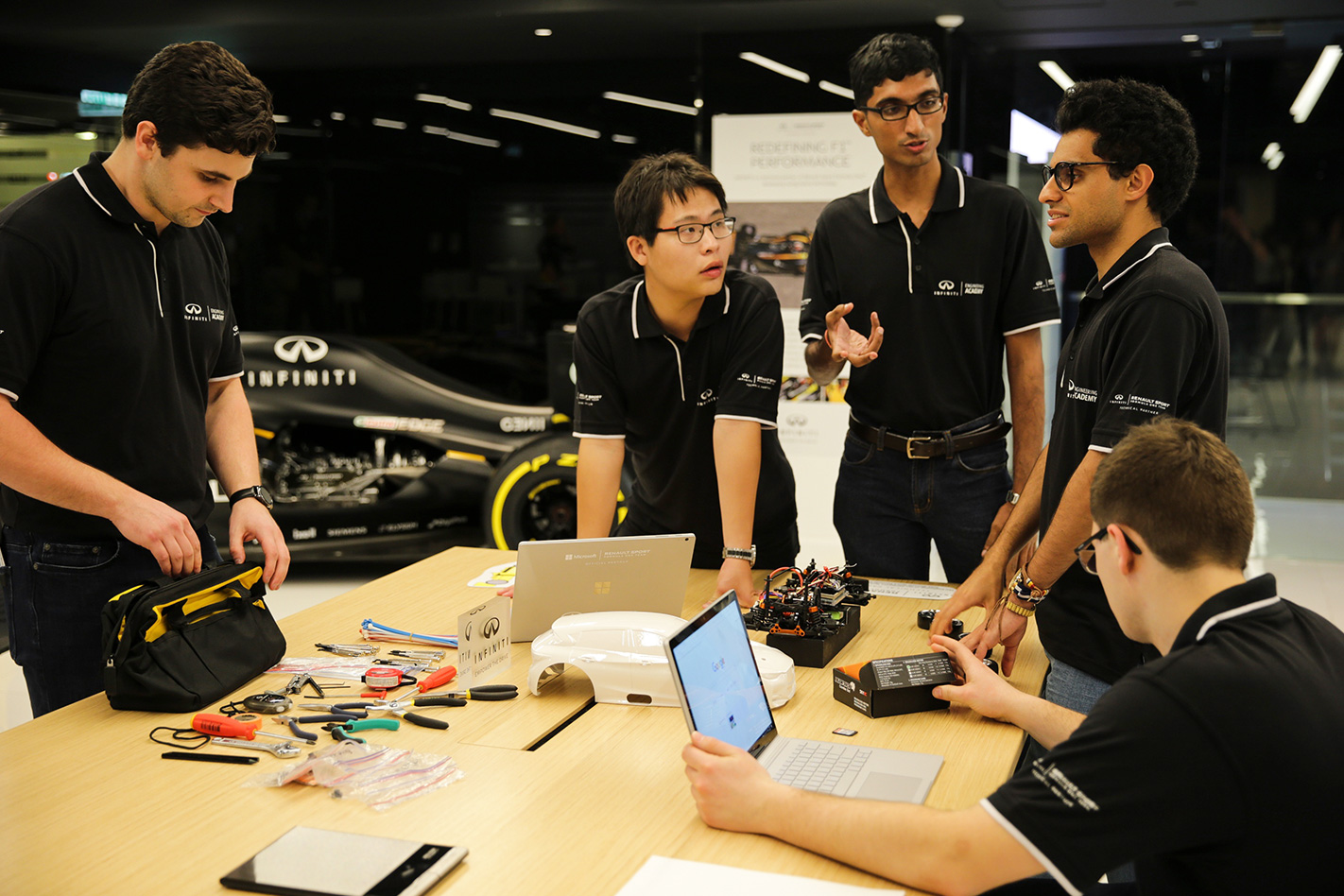
This is the fourth year the Infiniti Engineering Academy has been held.
“With every edition of the Academy, we are more and more impressed by the amount of interest received from students all over the world and the incredible level of the talent attracted,” Infiniti Motorsport global director Tommaso Volpe said.
“Students have seen the accomplishments of our former Academy graduates, who have forged successful careers in both automotive and motorsport and, as a result, more students than ever before want to participate to get this once-in-a-lifetime engineering experience to launch their careers.
“With Formula 1 becoming more relevant to the automotive industry and with an increased focus of the placements this year being on the road car development, we are training a new generation of engineers who will play a key role in the crossover between the two industries.”
