
When it came to updating its popular small SUV, Mazda decided it was under the skin that mattered.
WHAT IS IT? Launched in 2015, Australia’s best-selling small SUV and has just received an update that lacks aesthetic changes but addresses the CX-3’s few weaknesses, including ride refinement and road noise.
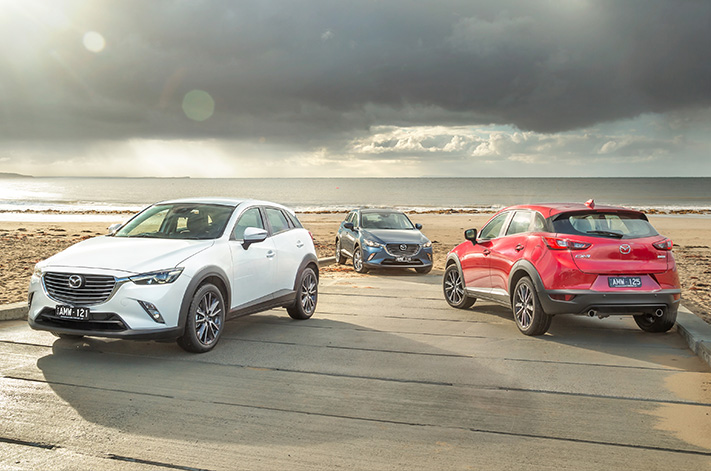
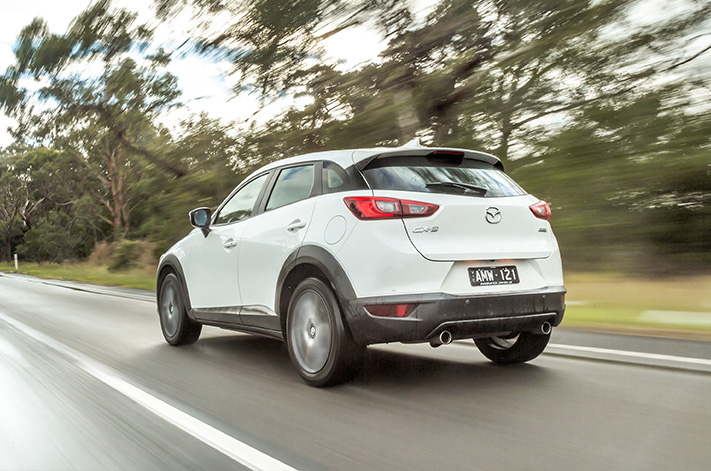
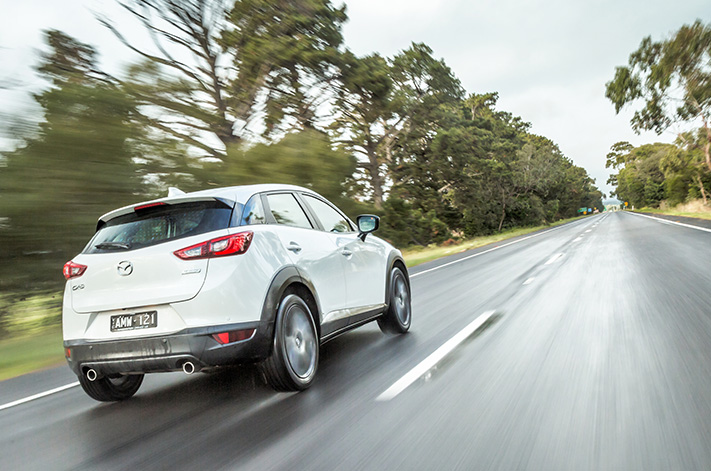
THE WHEELS VERDICT Mazda’s philosophy is to avoid change for changes sake so it would take a very keen eye to notice any visual differences applied to the 2017 CX-3. Mazda’s engineers turned their attention to improving ride-refinement and road noise and have succeeded with both, allowing the CX-3 to meet existing benchmarks without necessarily creating new ones. Where it does raise the small-SUV bar is through the inclusion of advanced driver safety technology. The CX-3 already did a lot right and now ticks even more boxes.
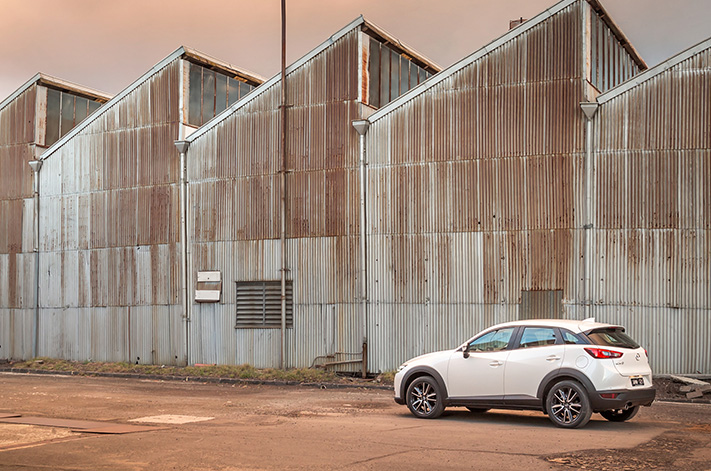
THE WHEELS REVIEW Mazda’s confidence in what it gets right is matched by its ability to heed criticism, so the CX-3’s first update is about addressing its few technical shortcomings while adding new safety features.
A key criticism of the old model was its less-than-refined ride on uneven roads, its tyre roar on coarse surfaces, and strident (if enthusiastic) noises from the engine bay.
Mazda has sweetened the CX-3’s dynamics by adding its G-Vectoring Control (GVC) system, which uses the engine to enhance chassis performance by varying the torque loading on the front wheels for smoother cornering. It also redesigned the front suspension arms and changed the angle of the front damper bushes, resulting in a more refined ride on rougher surfaces and less lateral movement. Rear bush angles were also altered to ensure the rear suspension follows the front more faithfully, and they generally co-operated on all but the tightest bends.
Over the rough, winding backroads near Melbourne Airport, the sTouring AWD diesel auto’s front wheels certainly felt more planted and bodyroll was better contained. Despite the noticeable improvement the CX-3 still doesn’t quite match the sophisticated ride of its best rivals (the C-HR and 2008).
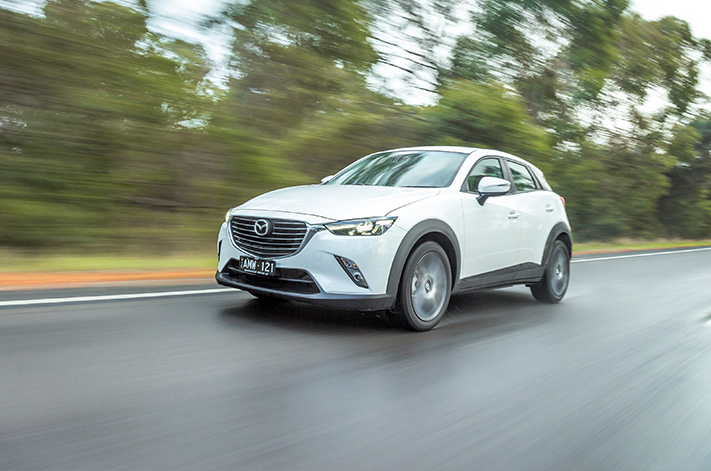
Throttle response is excellent, especially in stop start traffic, but it remains to be seen if it will lead to diesel CX-3s accounting for more than the current three percent of sales.
The refinements haven’t had an impact on performance of the diesel engine, which is carried over from the previous model along with the 109kW/192Nm 2.0-litre petrol donk.
The other CX-3 bugbear, road noise, has also been addressed by adding thicker carpet, and additional sound insulation in the dash panel and floor tunnel. Thicker trim seals have also been added to the C-pillar and tailgate opening, resulting in a reasonable reduction in general road and wind noise though tyre rumble was still a little harsh at speed.
Other new safety features include lane-keeping assist, front parking sensors and active LED headlights which are standard in the range-topping Akari variant, though there is still no active cruise control option. Blind Spot Monitoring comes standard in all variants bar the entry-level Neo.
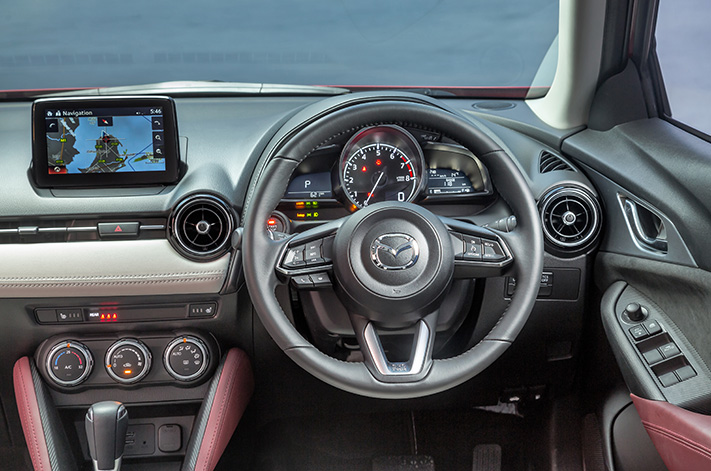
Aesthetically, unless a 2017 CX-3 comes in the all-new Eternal Blue Mica paint job or with new gun-metal 18-inch alloys, there isn’t much to show outside. Inside, the key differences are the more ergonomic multi-function steering wheel from the CX-9 and an illuminated gauge cluster that’s an improvement on the old LCD display.
The CX-3’s ride enhancements and additional safety features should secure its segment reign for the foreseeable future, but with Hyundai and Kia poised to finally enter the small SUV category, it will be interesting to see if the updated CX-3 can hold fort.
SPECS Model: Mazda CX-3 sTouring AWD Engine: 1499cc 4cyl, dohc, 16v turbo diesel Max power: 77kW @ 4000rpm Max torque: 270Nm @ 1600-2500rpm Transmission: 6-speed automatic Weight: 1380kg 0-100km/h: 11.9 sec Fuel economy: 5.1L/100km Price: $33,390 On sale: Now
Land Rover has used the production of 600,000 of its luxury medium SUVs as inspiration for a new special edition model.
Based on the Evoque TD4 180 SE, the Evoque Landmark Edition is powered by a 132kW/430Nm 2.0-litre turbo-diesel engine coupled with a nine-speed automatic transmission.
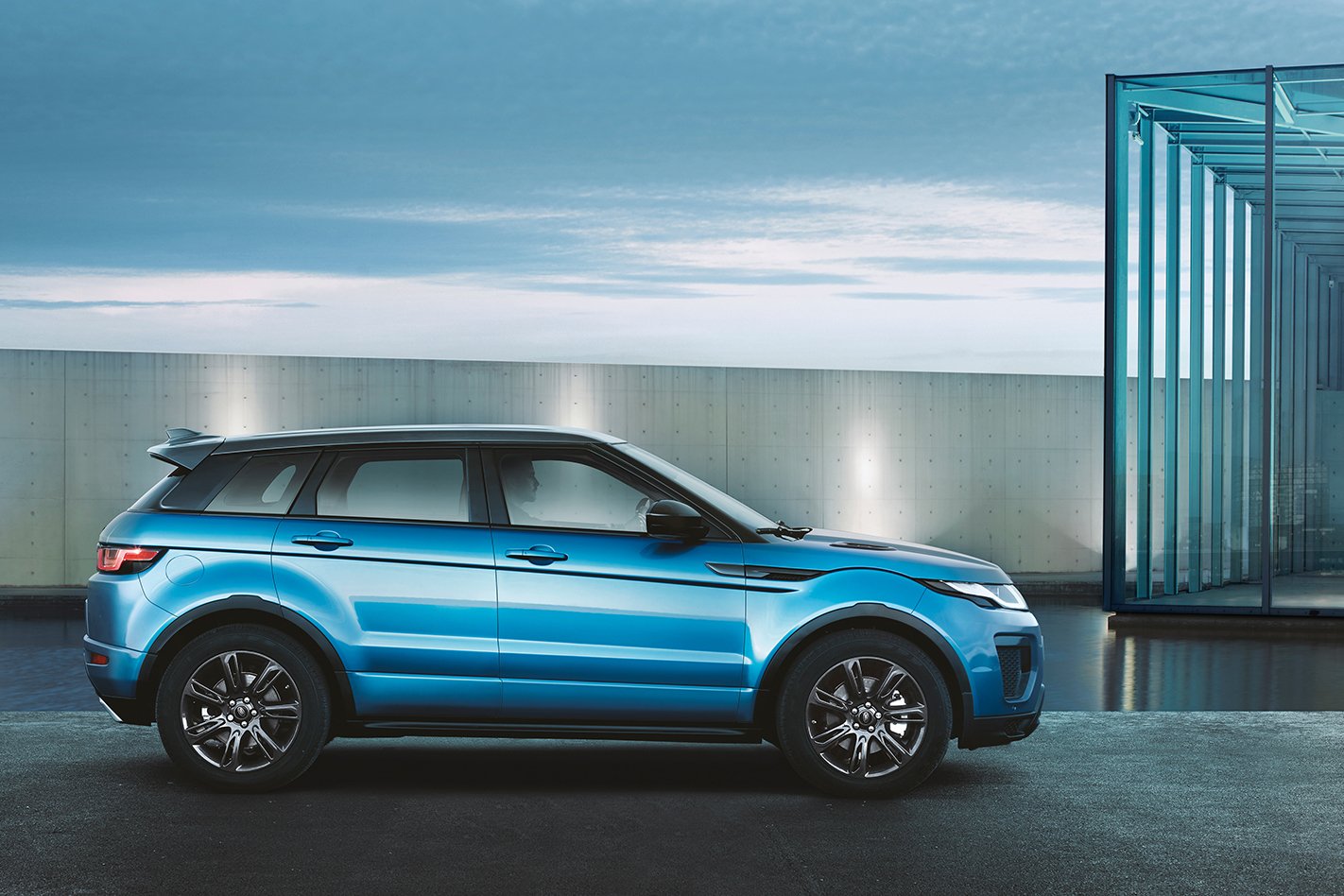
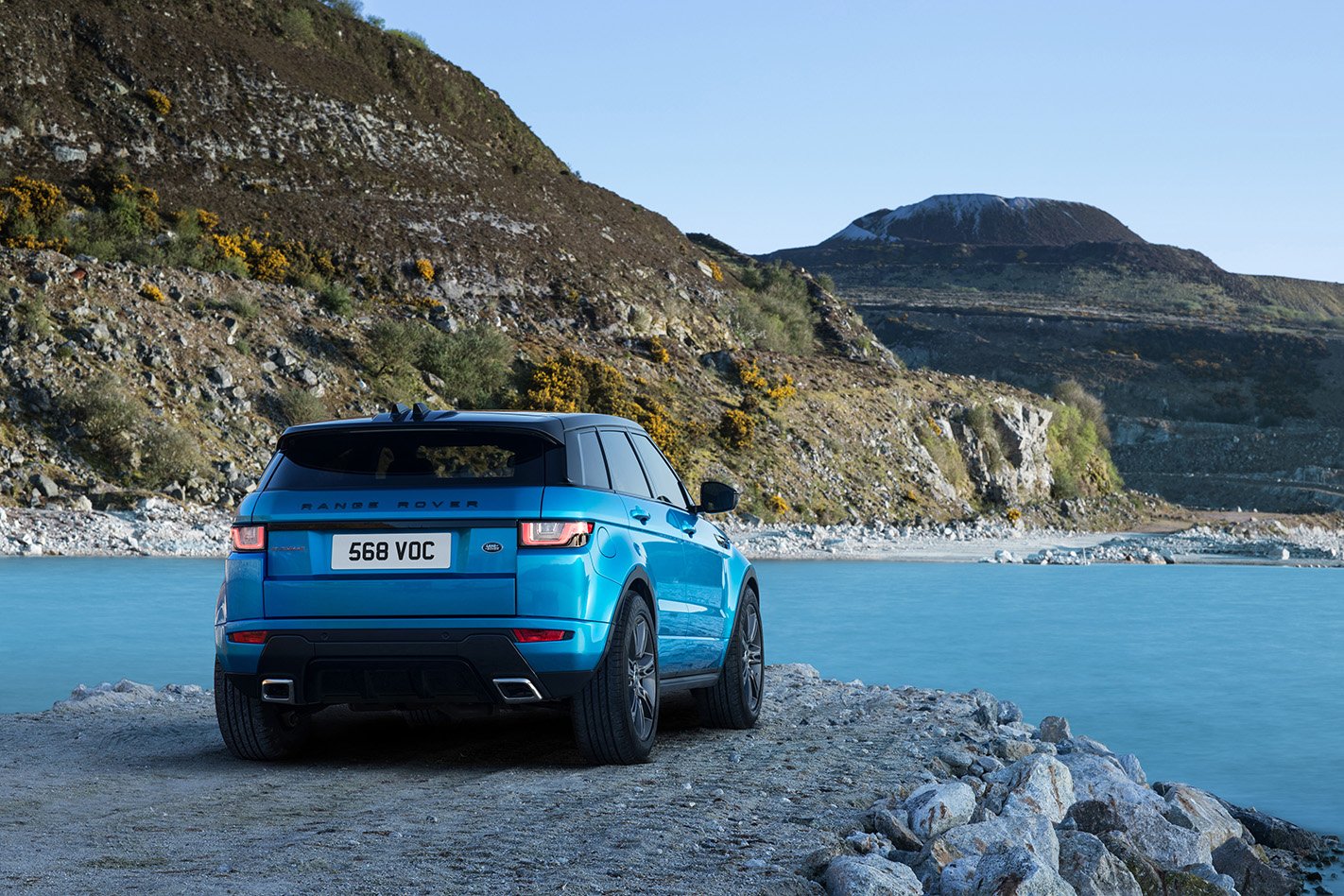
It’s unique look includes dynamic body kit and grey exterior design details including a Carpathian Grey contrast panoramic roof, 19-inch Gloss Dark Grey alloy wheels and Graphite Atlas grille, bonnet, fender vent and tailgate lettering.
Dark grey accents continue on the interior in the form of brushed satin centre console trim finishers surrounded by grained Ebony leather seats with contrasting Light Lunar stitching and a perforated mid-section.
| 2017 Range Rover Evoque Convertible Quick Review
Base exterior colours include a vibrant Moraine Blue colour – apparently inspired by the turquoise lakes of the Canadian Rocky Mountains along with Yulong White and Corris Grey.
The Evoque Landmark Edition also comes with optional 10-inch InControl Touch Pro system and Connect Pro pack, featuring apps such as Spotify and a 4G Wi-Fi hotspot.
There’s a further option for Touch Pro Services, which offer real-time traffic mapping, satellite and ‘street level’ views and a ‘Live Apps’ sidebar with weather, news headlines, and a flight tracker.
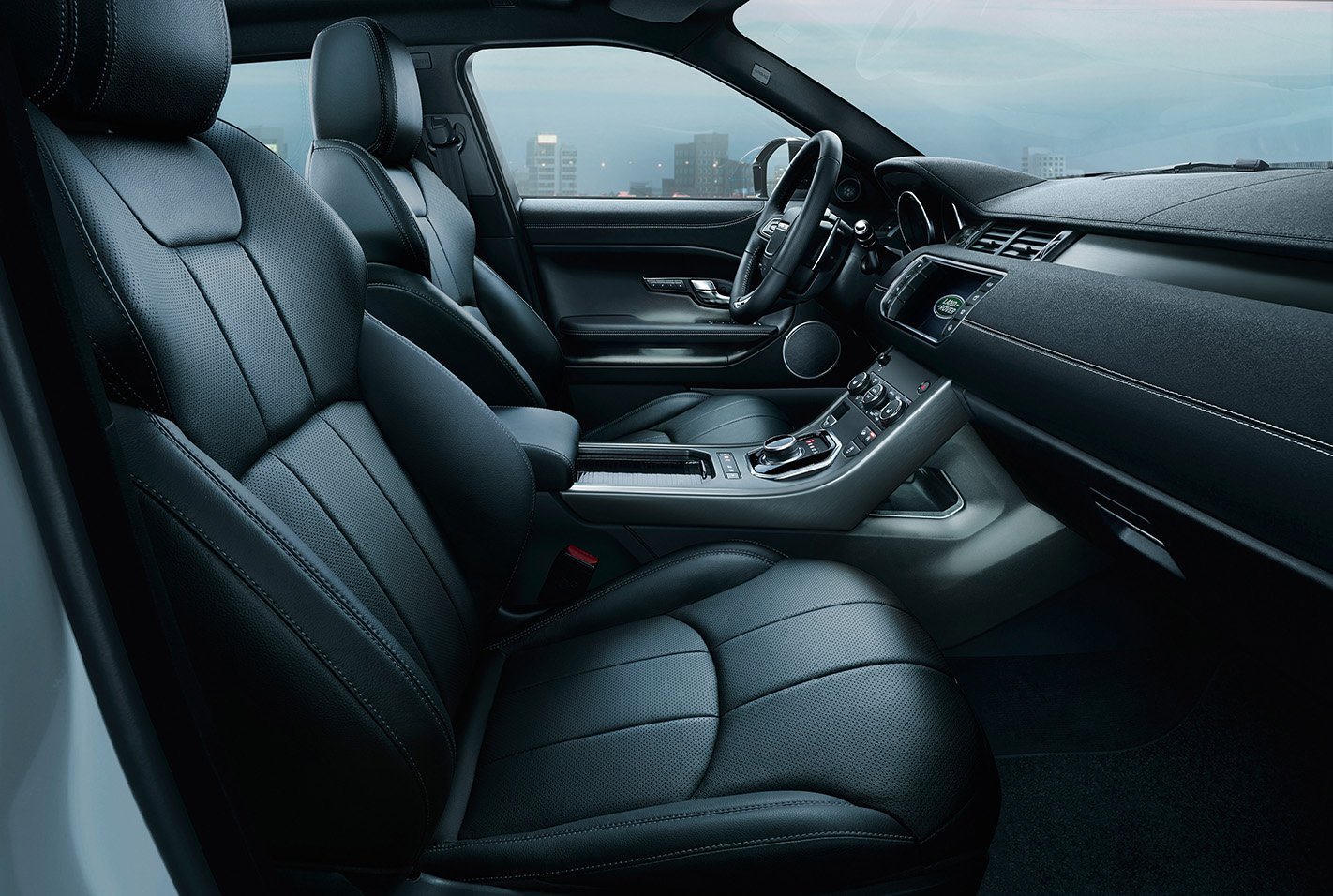
An Evoque rolls off the Halewood production line every 170 seconds with about 80 per cent exported across the globe from Austria to Australia – where this special edition will be priced from $74,351, making it the most expensive Evoque available here.
Land Rover is now taking orders.
Back for another generation, Kia’s petite Picanto lobbed into Australian showrooms this month as the Korean brand’s smallest and cheapest offering.
And nearly everything is new. Well, everything besides its carry-over engine and automatic transmission. The platform, interior, suspension and bodywork are all box-fresh for the 2017 Kia Picanto, and with so many changes there’s more than a few things that you may not already be aware of. Here’s a selection of them:
- The previous-generation Picanto was only here for about 12 months, and Kia Australia freely admits it was something of an experiment to see if Australians had a meaningful appetite for cars in the ‘microcar’ class. That experiment was a success, because the Picanto has returned for a new generation with even more equipment, a new manual-equipped entry point and a more grown-up and mature design than before.
- ‘Picanto’ may sound exotic and foreign, but it doesn’t actually translate into anything. It is, however, a not-so-subtle play on the Spanish word ‘picante’, which means spicy. Is that an accurate descriptor for the Picanto? We’ll leave that up to you.
- Built in Korea, Kia Australia didn’t just take the Korean-market Picanto and ship it over wholesale. The company’s local arm assigned its own chassis engineers to develop an Australia-specific suspension tune for the Picanto to help it deal with our unique road network. The result is a suspension that should deal with everything Australian drivers can throw at it – from cracked urban pavement to twisty mountain roads.
- The previous model was only ever available with a four-speed automatic, but its replacement now has the option of a five-speed manual. Pricing for the shift-it-yourself Picanto is listed at $14,190 retail – which theoretically makes it more expensive than the $15,690 on-the-road Picanto automatic – but Kia slyly suggests that buyers will be able to negotiate a sharper deal on the manual if they chat to their local dealer.
- The chassis uses a higher proportion of high-strength steel, with 44 percent of its bodyshell being made of the extra-durable metal. The result is not only a car that is stronger and safer in a crash, but a bare bodyshell that weighs 7kg less than before thanks to less metal being needed.
- Torque vectoring is something you’d typically find in high-end performance cars, but the basic technology has already trickled down to lower-echelon cars. By braking the left and right wheels independently steering input is detected, the Picanto’s on-board computer can help ‘pull’ the car around corners and reduce understeer. The result is impressively sharp handling for what is essentially a fairly basic compact hatch.
BMW is treating its 1 Series small hatchback to yet another refresh – the third since the introduction of the second-generation model in 2011 – with a light dusting of technology and aesthetic updates arriving in September this year.
While European customers will be offered a whopping 26 different variants spanning all-wheel xDrive, three and five-door models and some special editions, the Australian range will be kept considerably leaner with the current five-door-only line-up continuing on with five, rear-drive variants.
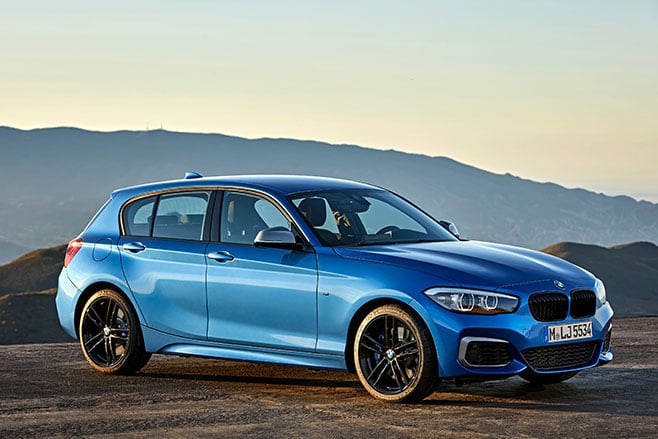
The so-called Life Cycle Impulse (LCI) brings a number of mild aesthetic tweaks to the interior and exterior, as well as a tinkering of the iDrive information system, which aligns with an LCI update for the mechanically related 2 Series Coupe and Convertible.
All versions of the 2018 1 Series will get a reshaped nose with mildly tweaked headlights that house bi-LEDs, a redesigned grille and new-look air intakes, while the rear end also wears a new design tail-light – also full-LED.
Two new colours – Sunset Orange and Seaside Blue join the exterior colour palette and five new alloy wheel designs measuring 17 or 18 inches take the total range to 16 choices.
On the inside, the most notable LCI changes are to the instrument cluster, which is reconfigured for “an even greater emphasis on driver focus” and a new 8.8-inch central touchscreen, which allows a more intuitive operation of the iDrive information and entertainment systems.
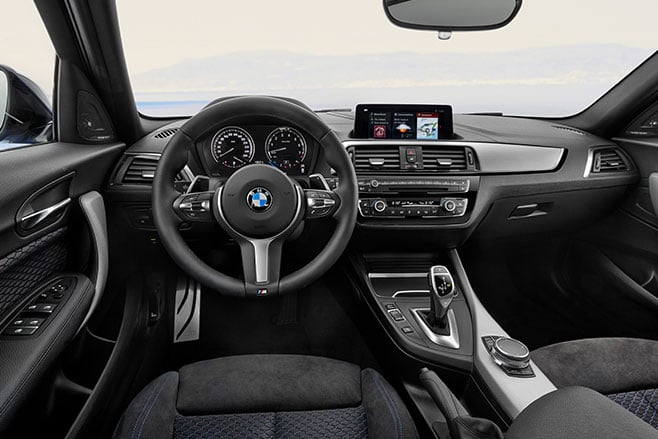
The latest version of BMW’s operating system allows enhanced connectivity features, including BMW Connected, which allows the pairing of a an Apple or Android smartphone or wearable device, while Remote Services allow owners to control some vehicle functions including heating, cooling and locking when away from the car – as well as relay information such as the fuel level.
Cabins are also given a light refresh with high-contrast stitching, gloss black and chrome-look trims, while revised air vents complete the interior makeover.
Customers can also pick and choose from an extended list of options including Cognac Dakota leather upholstery and ‘Pearl Chrome’ accents depending on the specification levels, while choices of Piano Black veneer, aluminium and Alcantara are there to customise interiors to personal tastes.
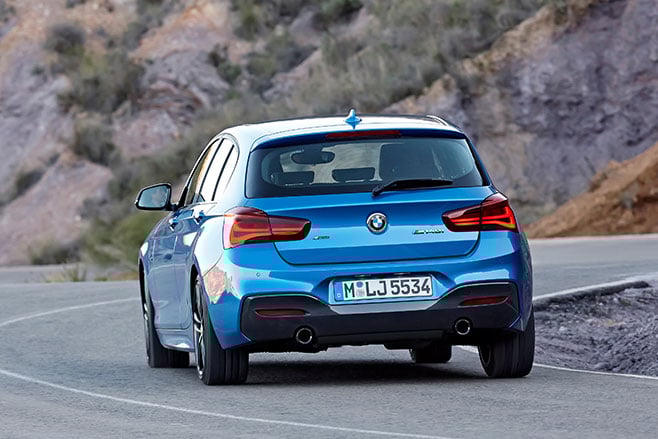
All other 1 Series features will carry over unchanged, including powertrains, which kick off with the 118i three-cylinder petrol for the current price of $37,990 before on-road costs, bringing a 1.5-litre engine with 100kW and 220Nm.
Above that, the 118d adds an extra cylinder and diesel power taking capacity up to 2.0 litres and output to 110kW/320Nm. The 120i introduces 2.0-litre turbo four-cylinder petrol power and 135kW/270Nm, while the power-boosted 125i version takes those figures up to 165kW/310Nm from the same engine configuration.
At the top of the performance pack, the M140i weighs in with six-cylinders of turbocharged grunt and 250kW/500Nm.
Australian pricing and exact specification is yet to be finalised, but the German car maker’s local arm will reveal more details closer to the updated 1 Series’ launch later this year.
MOTORSPORT is a fantastic crucible for testing and trying new ideas. From wild and wacky aero to cutting-edge tech, racetracks around the world have seen countless innovations – some of which have ended up saving lives and making life on public roads better.
But, not every innovation works out as intended. This is a list dedicated to the cars that tried to be different – and succeeded in that – but whose out-of-the-box thinking didn’t translate into race day victory.
Nissan GT-R LM Nismo
Looking like a spaceship and essentially turning the formula for an LMP1 car on its head, the Nissan GT-R LM Nismo had some very lofty goals when it was revealed. The front-engined, front-drive Nissan was designed with one purpose – winning the 24 Hours of Le Mans. Designer Ben Bowlby was adamant the out-of-the-box idea would make the car a weapon at the Circuit de la Sarthe.
The GT-R LM had massive front rubber, putting power from the 3.0-litre twin-turbo V6 to the ground through a five-speed gearbox, while the rears tyres were skinny to make room for large aero tunnels which ran through the body of the car.
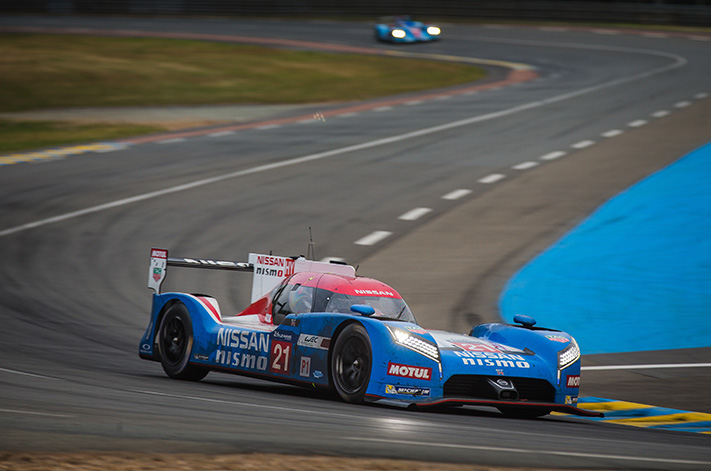
In terms of pace, the cars were 20 seconds a lap slower than their LMP1 rivals, and only barely quicker than an LMP2 car.
The program was shelved in December 2015, and hasn’t been revived since.
Delta Wing
Another Le Mans racer from the mind of Ben Bowlby. The Delta Wing made its debut at the 2012 iteration of the French endurance race, under the Project 56 garage designed for experimental entries.
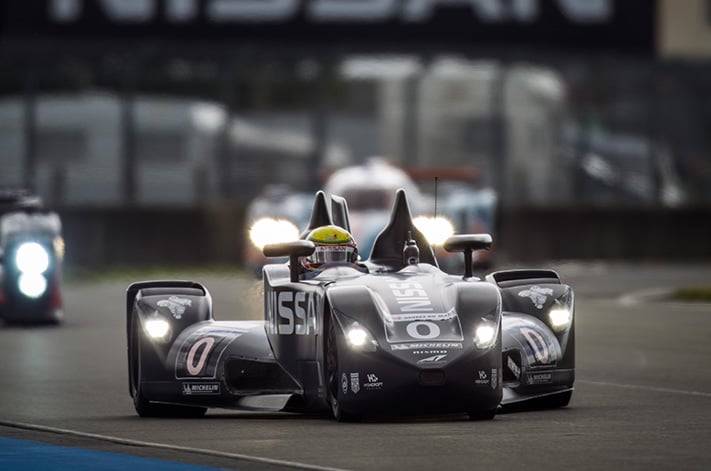
The car had a sordid history, and was embroiled in legal cases over intellectual properties. It completed 29 races until it was officially retired at the end of the 2016 season without a single pole, win, podium, or fastest lap on its record.
Bugatti Type 32
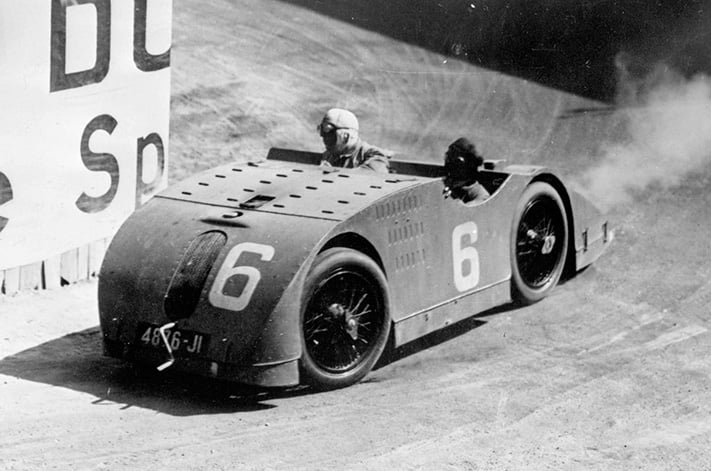
Before they were making mega-power ubercars like the Veyron and Chiron, Bugatti were known for their pre-war race cars. The Type 32 earned itself a nickname as the Tanke de Tours, thanks to its streamlined body and short wheelbase. Powered by a 2.0-litre straight four engine, it made 59kW, and delivered power to the rear wheels through a 3-speed manual reverse transaxle. The car struggled competitively in comparison to its successors, with a single podium at the ACF Grand Prix at Lyon on its record. Poor handling characteristics meant it was never entered in another race after that.
Back in its heyday, the Indianapolis 500 was at the forefront of motorsport innovation, with a number of radical advancements moving the sport forward during the Month of May. The Eagle Aircraft Flyer Special wasn’t one of them.
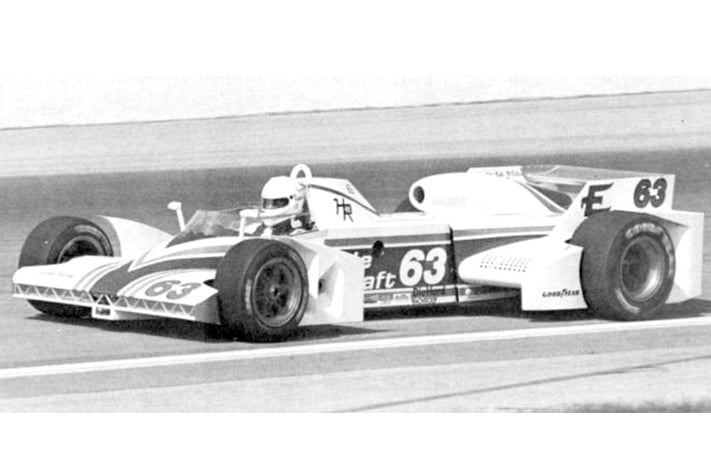
However, the Eagle Aircraft Flyer failed to qualify for the 33-car field, and was never seen in competition again.
Chaparral 2H
From the house of some of the best racing innovations, we get the 2H. Chaparral Cars was a pioneer in the American racing scene, continuously pushing the envelope in terms of engineering and experimentation, often to great success in Can-Am. However, sometimes the out-there designs didn’t always work as planned.’
| Video: The sickest onboard Nurburgring Nordschleife laps
The 2H was one of the last cars to come from Chaparral, and was designed to be a low-drag evolution of the 2G. It moved away from a design which had worked well for Chaparral in the past – having a large wing on struts, attached to the rear hubs, applying load directly to the suspension uprights – instead opting for a foil which loaded up bodywork, paired with hydraulic cylinders applying resistant force.
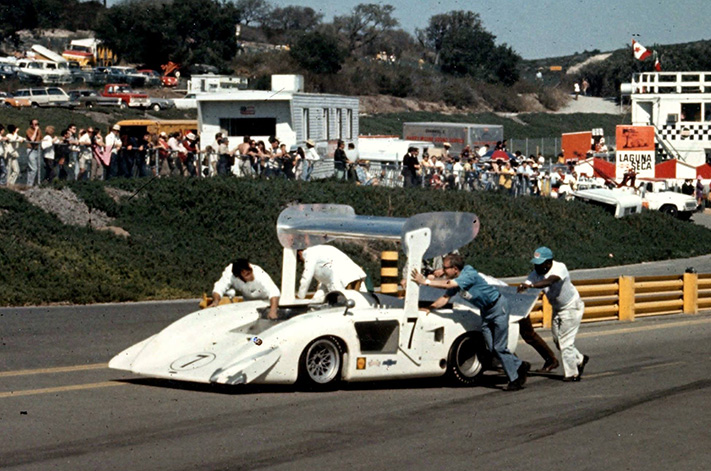
John Surtees was the man behind the helm, and despite his incredible talent, the closest he came to pole during the 1969 season was coming 4.2-seconds shy at Mid-Ohio. For the penultimate round of the Can-Am championship the car was 10-seconds slower than the fastest cars in qualifying, with the engine failing four laps into the race. This prompted Surtees to climb out of the car, and quit on the spot.
Herb Adams VSE “Pontoon Car”
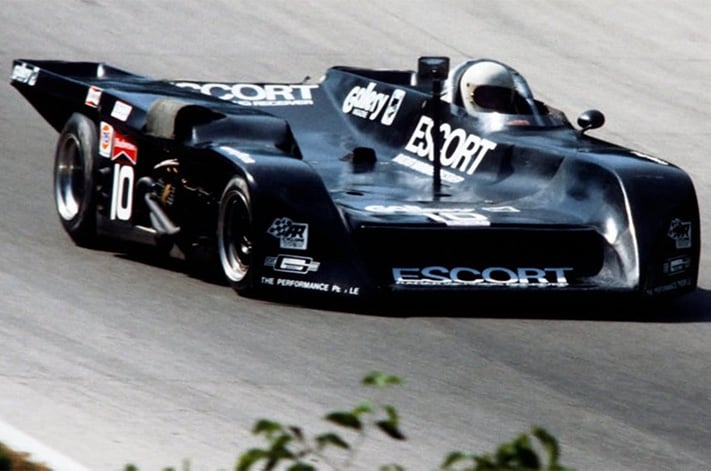
The year is 1983, and ground effect aerodynamics is booming. Engineers around the world are attempting to replicate the huge success of Lotus F1 cars of the era, diving into the new form of downforce.
Herb Aam’s ’83 Can-Am racer is a fine example of the wild experimentation that was going on. The car moved the engine and driver to opposite sides of the vehicle, allowing for a large venturi tunnel in the middle. However, engineers were unable to perfect the downforce balance between front and rear, and drivers struggled to adapt to the off-centre seating position. The Pontoon Car only appeared at a handful of races before the idea was abandoned.
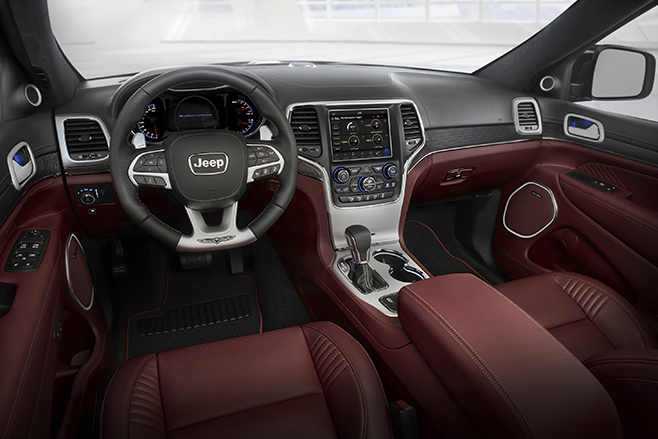
AUSTRALIAN buyers have been quick to register their interest in the world’s most powerful production SUV, with Jeep already taking deposits for the Grand Cherokee Trackhawk.
However, Wheels has learned that an initial allocation is arriving in Australia in November and December, with demand already high for a place on the orders list.
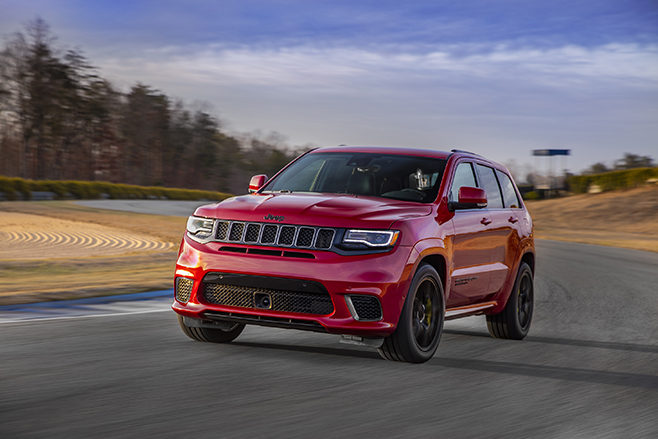
The first Hellcat-powered model to even enter the discussion for Aussie landfall, given that both the Charger and Challenger bodies sit the driver on the wrong side, the Trackhawk has generated huge interest since its unveiling at the New York International Auto Show in January.
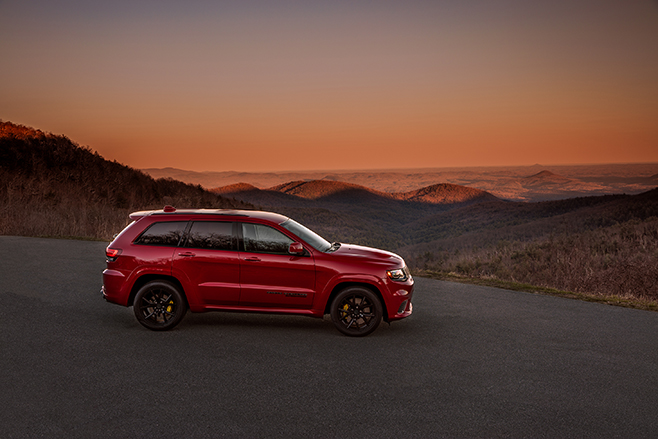
Powered by a 527kW 6.2-litre supercharged HEMI V8, the Trackhawk makes some impressive numbers, hitting 100km/h in just 3.6 seconds and demolishing the quarter mile sprint in 11.6sec at 186km/h. Top speed is limited to a largely academic 290km/h.
Get in quick, people.
AUSTRALIAN police are turning to cutting-edge technology as they step up the fight against one of the biggest safety threats on our roads – using mobile phones to text while driving.
Handing a mobile phone while driving is illegal in every state and territory of Australia unless it is secured in a holder. Details vary state-to-state, but the intention is the same – drive while using or touching your phone, and you will be pinged.
But heavy fines and loss of points don’t seem to be working, with three in every five drivers in Victoria admitting to handling a phone while on the road. Western Australia, meanwhile, estimates that as many as a third of the state’s serious and fatal crashes involve distraction.
Both states are now developing new ways to combat the issue.

“There are three different models; each of them present opportunities for us and work as a suite,” Papalia told Wheels.
“We have roadside cameras which are not dissimilar to your mobile safety camera operations that tend to occur around Australia, and then you have fixed sites that can operate as gantries or as high roadside camera operations.
Victorian safety camera earns more than $1500 an hour
“Or what would be a completely new initiative for us are mobile camera operations moving with the flow of traffic. That is new to our environment and we are interested to see how that evaluation pans out.”
Papalia said evaluations were “looking very positive at the moment”, before turning to defend the use of cameras to solve the problem.
“The World Health Organisation recognises that camera operations are the most efficient way of reducing risk on the road in a widespread manner,” he said.
“The advantage that the camera operations give us is at the moment, we have limited opportunity to do enforcement in relation to texting.
“We rely heavily on police traffic motorcycles, but they are only limited in terms of numbers and where they can be.
“Camera operations give us far greater efficiency, and also increase the likelihood of people being apprehended. It is that idea of likelihood that will change behaviours.
“It is a technology-created risk, and I think it will be a technology-resolved risk in relation to the future. Sadly, in the interim, people’s lives are at risk.”
In Victoria, police are working with transport and logistics group Linfox, and telecommunications giant Telstra to develop something far more drastic.
Assistant commissioner for road policing Doug Fryer hinted to
Police go back in time to nab tech-savvy speeding motorists
“In my mind, within the next 18 months, there will be a technological solution that will block the ability to access data while driving. I think it is really close,” Fryer said.
“I can’t go into a lot of detail, but Victoria Police, Linfox, and Telstra are all working together at the moment to figure out what can be done to provide a technological solution.
“We have been doing that for the past year. It would be at an enterprise level, not just a thing you plug in and opt in or out, but at an enterprise level,” he said.
Fryer stressed the technology was not intended to block hands-free calls via a car’s Bluetooth function, but instead aimed to stamp out internet and app use while behind the wheel – a common distraction for younger drivers.
“We know the technology is out there to monitor movement, and is apparent in in-car technology, so it is about rolling that sort of technology into mobile devices so that if a vehicle is in movement, then how do we inhibit the data only,” he said.
“I don’t have an issue with mobile phone calls; I have a real issue with data.”
We’re already familiar with Honda’s 10th-generation Civic, given that model launched here in sedan form just on 11 months ago. Quality, technology and chassis all took a significant leap at the time, however a five-door hatch version wasn’t ready to debut alongside it.
But after a significant wait, the Civic sedan finally has a hatchback twin to once again keep it company in Honda showrooms.
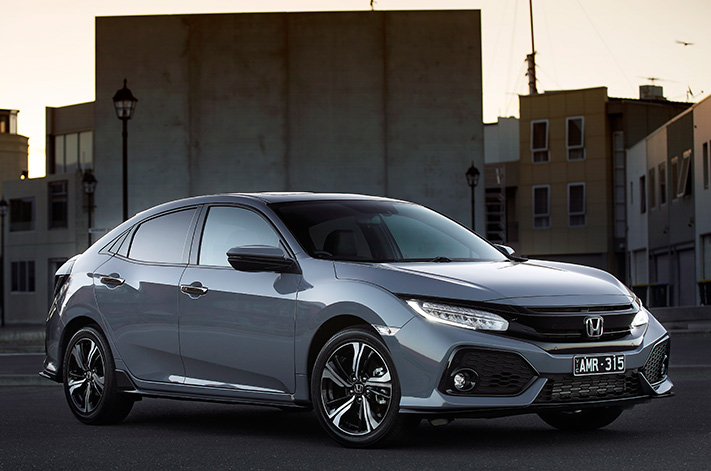
For the past two generations, the Honda Civic hatch has been more of a half-brother to the Civic sedan than a direct relative. Based on Jazz underpinnings and built in the UK, it was literally a world apart from its Thai-sourced sedan contemporary.
But now, in its tenth-generation, the Civic range is back to consistency. Mechanically identical and built in the same factory, Australian Civic hatches and sedans are practically line-ball when it comes to equipment, prices, quality and driveability.
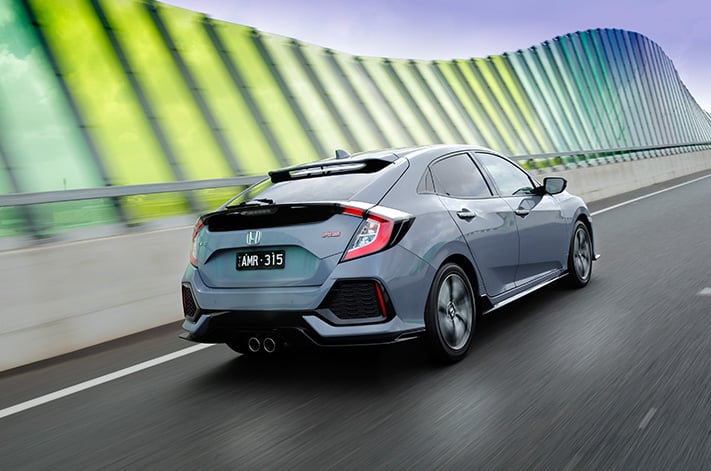
The Civic hatch has historically been the volume-seller in the Civic family, and with the Australian small car market skewing toward five-doors rather than four-doors, the new Civic hatch has significant commercial importance for Honda.
It’s the bodystyle that most Civic shoppers are interested in, and thus the one that we’re more interested in evaluating. Does it add anything to what’s already offered by the Civic sedan?
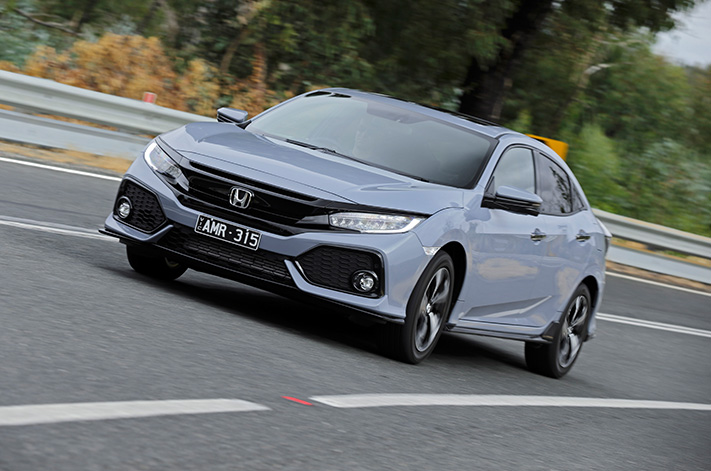
Hyundai i30, Toyota Corolla, Mazda 3, Holden Astra, Renault Megane, Subaru Impreza, Peugeot 308, Volkswagen Golf
THE WHEELS VERDICT Just like its sedan-shaped sibling, the new Honda Civic hatch makes a compelling argument for itself in what is a hotly-contested segment.
A spacious interior, sharp handling and generous standard specification in upper-spec models all give the new Civic hatch a more premium aura than before. The arrival of Honda’s still-fresh 1.5-litre turbo engine to the Civic hatch is also welcome, though the soggy CVT saps some of that powertrain’s verve.
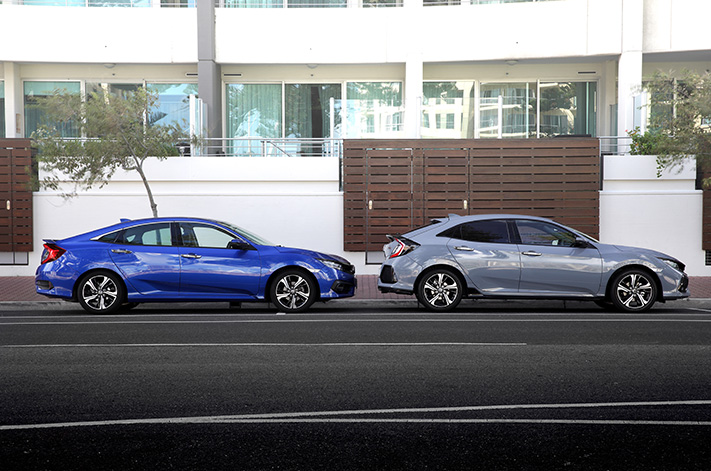
MINUS: AEB only available on top grade, no more magic seats, CVT doesn’t do the engine or chassis justice
THE WHEELS REVIEW Even though buyers continue their seemingly inexorable migration to SUVs, Australian motorists still have plenty of love for small cars – hatchbacks, more specifically.
The humble five-door hatch is still a fixture of many Aussie driveways, and the Honda Civic has a significant history in this country as one of the premier small cars. In recent times, however, Honda’s five-door fortunes have waned.
When sourcing switched to the UK for the eighth-generation Civic hatch, prices skyrocketed and put the hatch out of kilter with its Thai-sourced sedan counterpart. Yes, European design and build quality worked in its favour, but $30k-plus pricetags did not.
The ninth-generation Civic hatch partially corrected the pricing issue, but it was still only related to the sedan in name only. It’s only now, with the arrival of the tenth-generation Civic hatchback, that both four- and five-door models are properly aligned with each other.
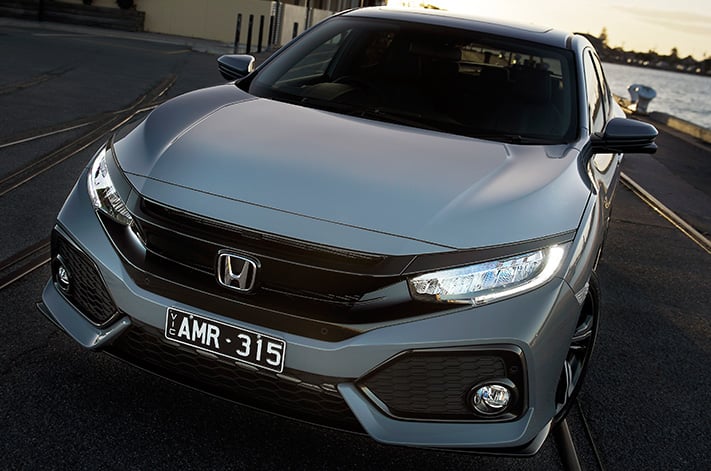
And speaking of which, let’s start off by looking at the Civic’s rump. After all, the bulk of the Civic hatch’s differences to the sedan lie behind the B-pillar.
The hatch’s boot measures 414 litres with the 60/40 split rear seats raised – 330 litres for the RS grade due to its subwoofer – putting the hatch 105 litres down on the sedan. On the other hand, the hatch’s wide tailgate opening makes it easier to load outsize items, and there’s a huge flat(ish) cargo space when the seats are dropped down.
A unique side-retracting cargo blind takes up less space than traditional blinds that stretch across the backrests – a very ‘Honda’ solution to in-cabin ergonomics. Sadly, the ultra-versatile ‘Magic Seats’ function of the previous-gen hatch has been deleted due to the space taken up by the new Civic’s multi-link rear suspension and fuel tank. Boo hiss.
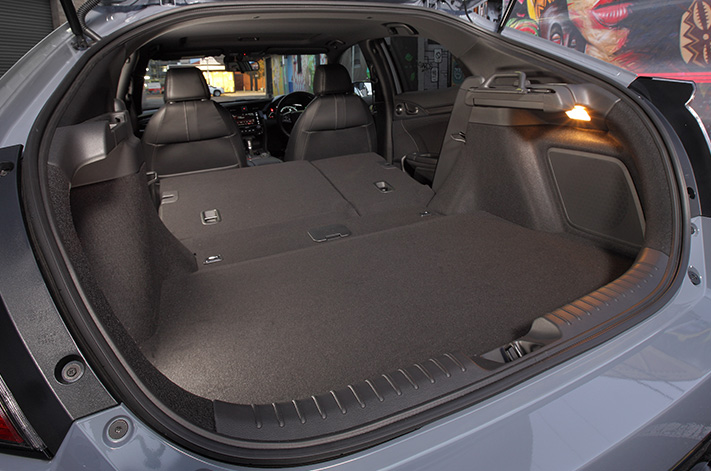
Up front, it’s familiar fare. There’s plenty of in-cabin storage highlighted by a capacious centre console box and double-decker phone/wallet trays, along with a pair of front seats that, though comfortable, could use more lateral support.
Eye-catching but sensible design is a welcome change from the strange two-tiered dash of the ninth-gen Civic hatch, though rummaging for the forward USB port is a pain. A dampener for the (rather heavy) glovebox lid would also be nicer than having it unceremoniously flop open into your shins.
To drive, the Civic hatch is every bit as good as the sedan. It weighs 28kg more than the four-door and has a slightly more torsionally rigid structure, but you’d be hard pressed to tell any difference without driving both back to back.
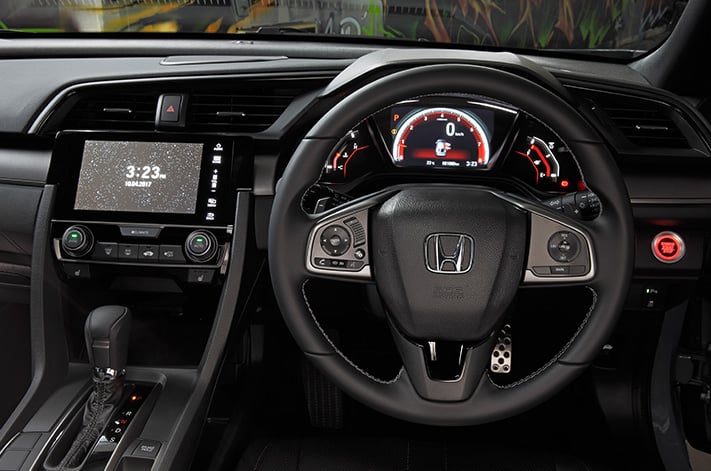
And that handling doesn’t come at the cost of comfort either. Well-tuned damping devours bumps with aplomb, and the ride is comfortable whether on low-grade 16-inch rolling stock, or the 17-inchers of the VTi-L, VTi-LX or Civic RS.
The 104kW/174Nm 1.8-litre atmo engine of the base VTi and VTi-S is a “get the job done” powerplant that feels breathless the harder you push it (and does a decent impersonation of a Dyson at the same time), but the 1.5-litre turbo in higher grades is the engine to aspire to.
With a healthy 127kW and 220Nm to play with it feels a lot more relaxed, but it’s a shame there’s no escaping the Civic’s lacklustre CVT.
It’s a busy transmission, even with the torquey 1.5 turbo, and it’s difficult to smoothly maintain a constant cruising speed. Hills provoke plenty of flaring and noise, but at least you can row through pre-defined ratios via a pair of wheel-mounted paddle shifters on the VTi-L, VTi-LX and RS.
But that’s exactly what you experience with the sedan. Like we said, the Civic range is finally cohesive and consistent.
Specs Model: Honda Civic RS Hatch Engine: 1498cc 4-cyl, dohc, 16v turbo Max power: 127kW @ 5500rpm Max torque: 220Nm @ 1700-5500rpm Transmission: CVT automatic Weight: 1440kg Fuel economy: 6.1L/100km Price: $32,290 On sale: Now
A rare 1 of 150 Countach is on the ticket to be sold at the upcoming RM Sotheby’s Villa Erba auction.
Chassis number 62, which was actually the 31st of the LP400 series built – Lamborghini didn’t use odd numbers for this batch – is offered in its original ‘Giallo Fly’ yellow colour scheme.
Originally owned by a Saudi prince once it had left Sant’Agata Bolognese in March 1975, the car was found by a restorer in the ‘80s and was repatriated to Italy shortly thereafter.
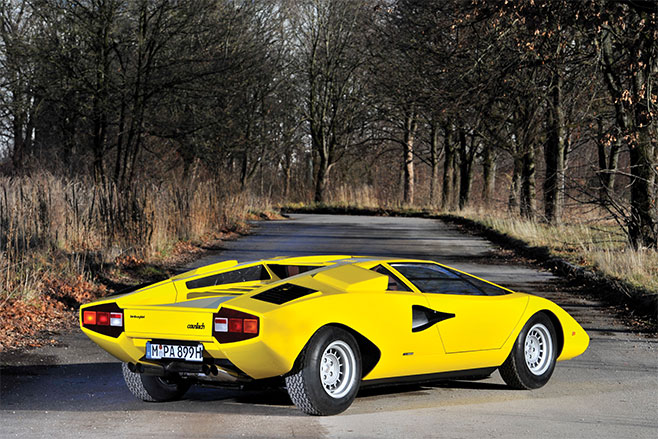
Sotheby’s says the car also features a few modifications, all in the name of making the car more useable.
“Boasting only four owners from new and having covered a mere 6,000 kilometres, it is a lovely example of this ground-breaking design,” the auctioneer Company says.
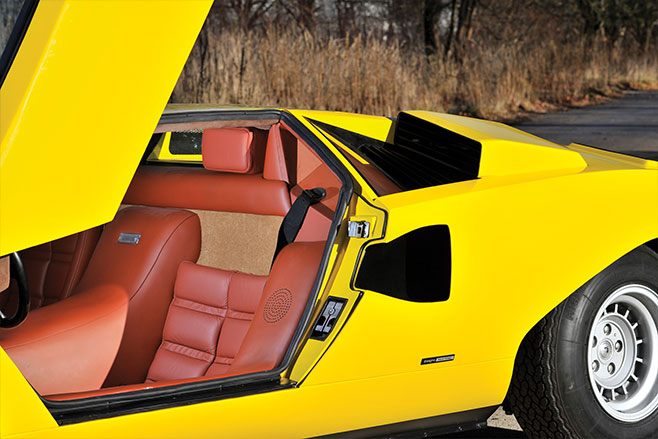
“The car was also refreshed with new black leather upholstery, although this has recently been superseded by a full re-trim in the correct tobacco leather, as per the original build.”
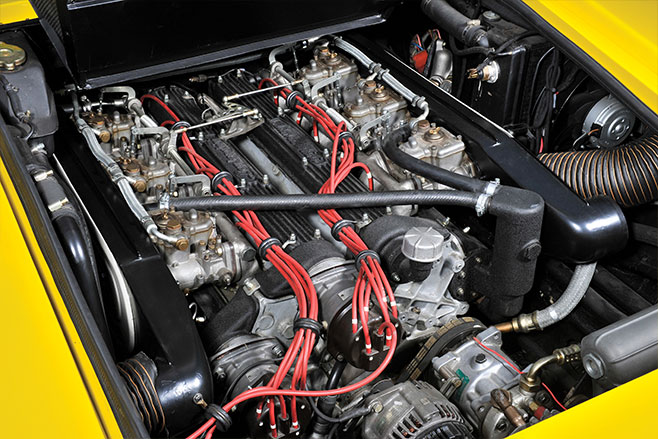
You’d be paying for a rich history and almost perfect originality, but history and originality isn’t cheap.
Alternatively you could say “stuff the history” and buy and Aventador for about half of that.
Rules are made to be broken at AMG. The latest rule they’ve broken is the one that says any car will be worse when you cut the roof off it.
Bound to be, usually, because the roof is an integral part of the chassis and it’ll never quite be the same after you light up the gas axe, even if you bolt an RSJ underneath it.
But AMG cut the roof off the GT C coupe and created a roadster that almost matches its progenitor in every tangible way, but surpasses it by every visceral measure.
The GT C’s abilities were well beyond most drivers anyway, and AMG has dialled that back a touch and used that grip reserve to ratchet up the emotions without losing its integrity. It ends up being more of a sports car, more of the time.
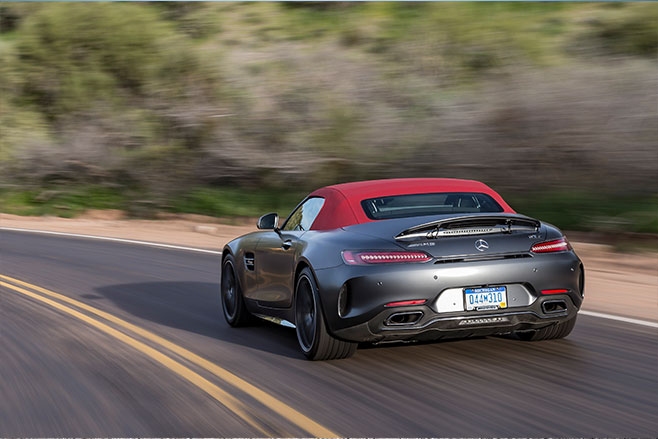
Its chassis feels rock solid and its suspension compliments it, and that thumping 410kW version of the dry-sump 4.0-litre hot-vee twin-turbo V8 is always either burbling or bellowing.
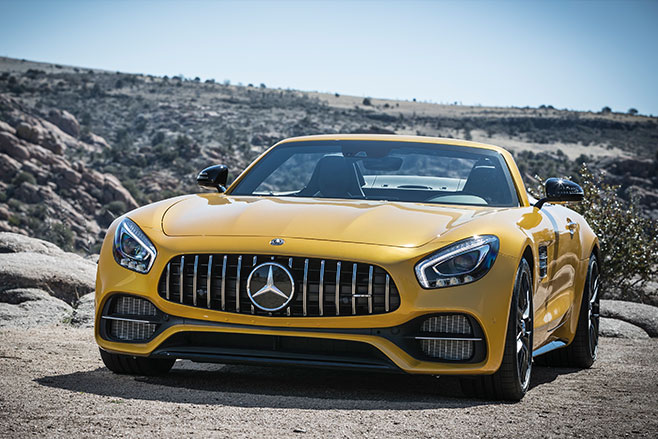
The rear-driver gets a big dose of handler helper in the form of the GT R’s rear-wheel steering and it’s just a charming place to be whether the car’s at two of its tenths or 13 of them.
It goes from gentle cruises full of birdsongs with the roof down to fully-fledged fauna frightener, brimming with turbo fizzes, pump whines, exhaust bellows, pops and crackles, in the flick of an ankle.
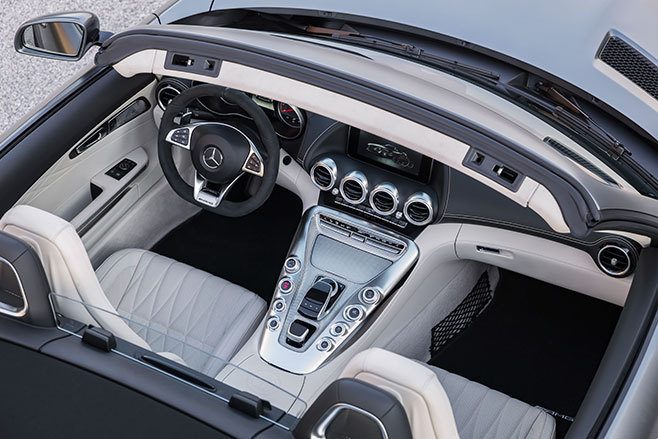
It’s about 50kg heavier than the Coupe, at 1660kg (DIN), but its only significant shortcoming is a 65-litre tank, which I’d personally feel compelled to empty every time I saw the needle on full.
There’s a base version of this car with 350kW, but why bother with that when the GT C has 26kW more than the GT S Coupe and falls just 20kW shy of the brilliant GT R?
It’s not just about power, though that helps when you want to snap to 100km/h in 3.7 seconds and on to 316km/h. Power is the headline, while the 680Nm of torque between 1900 and 5750rpm is what gets the job done most of the time for most people.
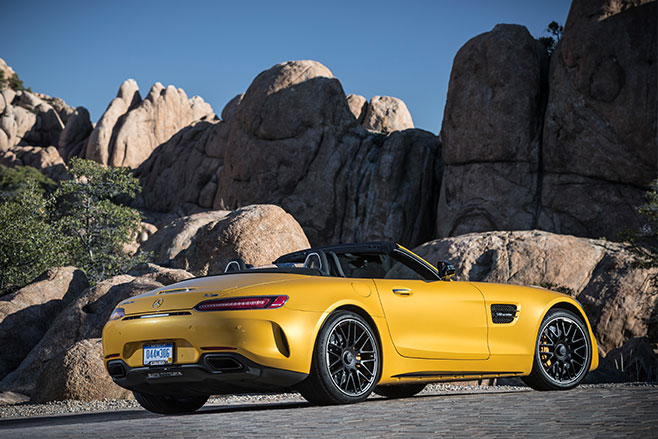
The GT C also stretches the rear end 57mm wider to accommodate the 305/30 R20 rear rubber, takes in an electronically controlled locking differential (the standard car uses a mechanical unit), gains adaptive damping, a stronger seven-speed dual-clutch transmission, it uses the loudest exhaust system, tarmac-tearing brakes and it even has a Race mode.
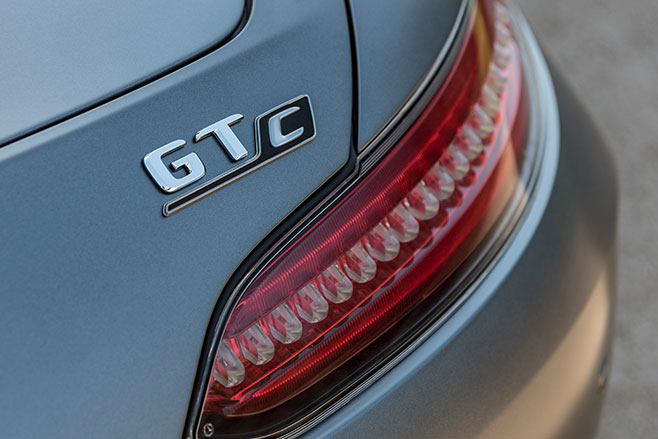
It’s one of the easiest junior supercars we’ve ever had to live with, and it’s somehow softer and more charming, all the time.
