
I’m leaving one of the world’s great motor racing circuits behind and heading somewhere better to drive.
First published in the April 2017 issue of Wheels Magazine, Australia’s most experienced and most trusted car magazine since 1953.
Downtown Monaco early on a winter weekday morning isn’t as much fun as the Grand Prix circuit it becomes for one weekend every summer.
Its corners keep their deep red-and-white apexes year-round, but today they’re cut across by pushy, surly van drivers with delivery schedules to keep, swarmed over by mopeds with chic riders and gingerly ventured onto by elderly Monegasque ladies with tiny dogs on leashes and baguettes under their arms, trying to find a safe way home from the boulangerie through this madness.
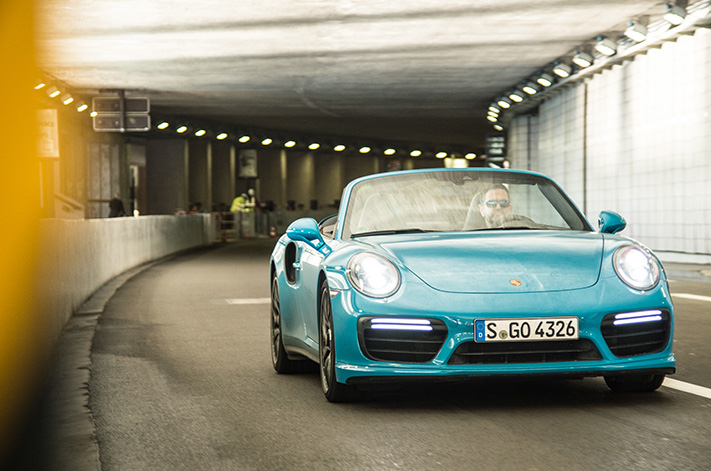
If you happen to be passing in a decent car, you’re obliged to drive a couple of laps of the circuit and briefly imagine yourself as Fangio or Senna before a hoot and a curse from one of those van drivers – or a traffic jam – brings you back to reality.
But the Grand Prix isn’t Monaco’s only major motorsport event. Since 1911 it has organised the Monte Carlo Rally, held not in the tiny principality, of course, but on the extraordinary roads of the French Alpes-Maritimes which rear up over its port.
Like the Grand Prix circuit, they’re freely available all year round because, unlike many of the other famous Alpine driving routes, they’re not high enough to be lost under snow from November to May.
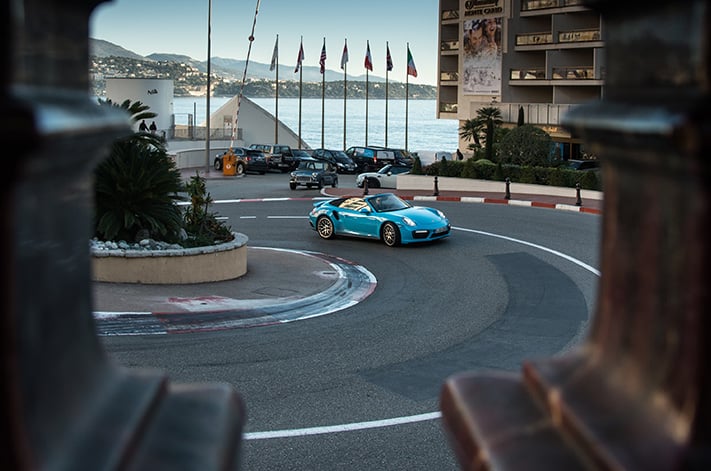
We have the right car. In 1965, the Porsche 911 made its motorsport debut in a snowy Monte Carlo Rally, and in 1968 it took its first rally victory here in the hands of heroic, lantern-jawed British driver Vic Elford.
The 911’s storied motorsport career since gives it a credibility that partly explains its extraordinary longevity. And it all started here.
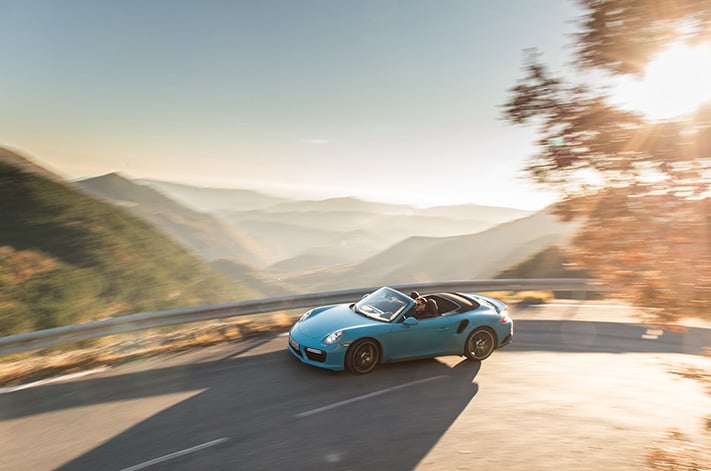
But the 911 I’m taking back to the Col de Turini has performance that might have scared even Quick Vic. With 427kW, it produces four times as much power as those early competition cars.
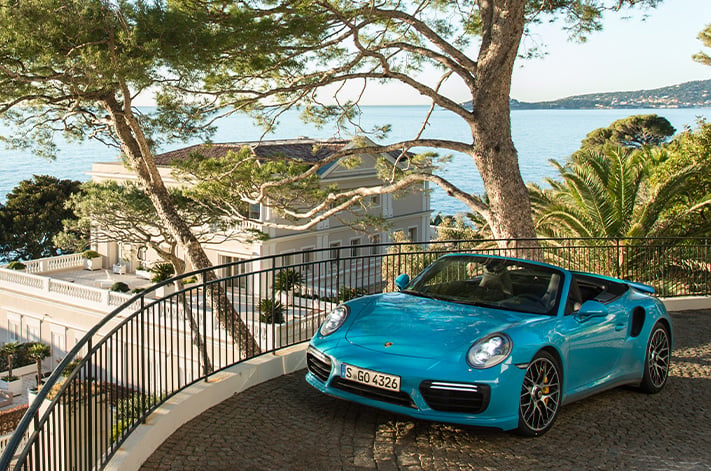
The 3.8-litre flat-six’s ports and fuel pressures have been revised, and its twin variable-vane turbochargers are now even bigger.
Porsche, with its usual modesty, claims that the Turbo S will hit 100km/h in 3.0 seconds. Privately, the engineers admit it’s less, and one American car magazine has independently proven that the tin-top Turbo S accelerates to 60mph (96km/h) in just 2.5 seconds. That’s 0.3 seconds faster than a Veyron.
This is one of the craziest road cars Porsche has ever made, and it gives this road trip a double purpose. I want to explore the route of the Monte. But I also want to measure how far the 911 has progressed since those early, lithe, light 911s, and see if you can still sense the link despite its stupendous power output.
This road trip actually started at Porsche HQ in Stuttgart, not Monaco, and the long drive to the Mediterranean revealed much about the car’s character.
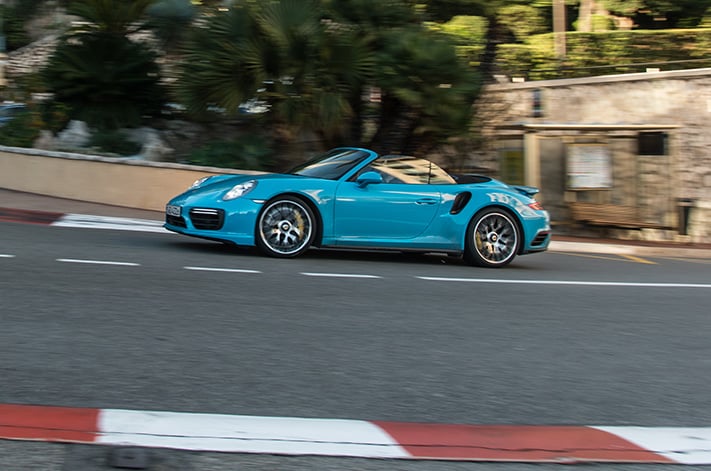
The softer rubber means the top speed has to be limited to ‘just’ 240km/h on the autobahns: a small price to pay for guaranteed forward progress now, and later on the Col de Turini.
The Turbo S just eats up the 800km trip. Despite its power it’s refined and comfortable and simple to drive.
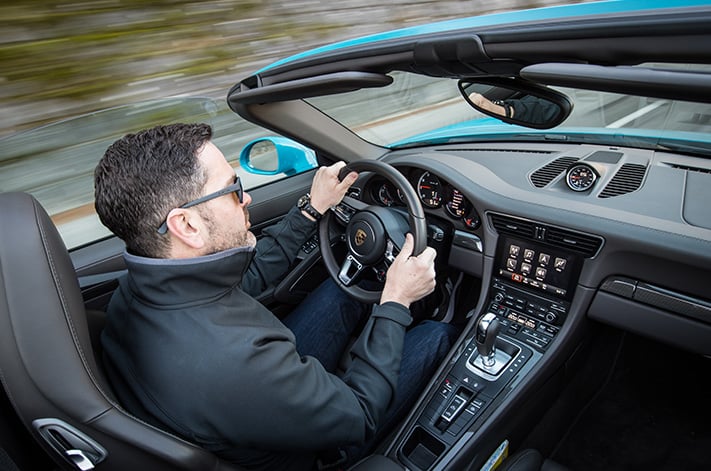
It’s easy to forget how special it is. A Lamborghini and most Ferraris would hate a long trip like this. The Porsche’s cabin doesn’t have the design exuberance of its (more expensive) Italian rivals, but it offers build quality to survive a nuclear attack and endless gadgets, including real-time data on g-force, power output and torque split between the axles.
As enthusiasts we might prefer the stiffness of a coupe, but even at high speeds and in sub-zero temperatures the fabric roof is so thick and fits so well that it might as well be steel. A little extra noise disrupting some of the finer detail of the audio system seems the only downside. And there is something pleasing about driving the very top of the road-going 911 tree, with its $477,700 price tag, even if most of us would prefer the new GT3.
The sat-nav guided me unerringly on a trip that passed through four countries (five if you count Monaco), leaving me to concentrate on the view out.
Driving south, the low winter sun bleaches the autobahn ahead bright-white, and with the frosted landscapes on either side it’s like driving into the beam of light that the Starship Enterprise creates when Captain Kirk engages warp speed.
Even when limited to 240km/h, it’s not much slower either. Soon the high Alps rise up directly in our path: the route cuts under them through Switzerland’s Gottard Pass. Once into Italy, the temperature rises as the altitude and the distance-to-destination on the sat-nav drop. After just seven and a half hours I arrive in Monaco in 15-degree evening warmth.
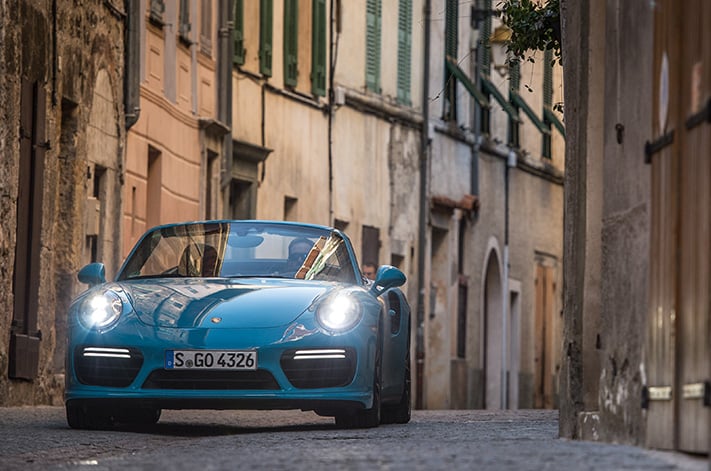
The road is instantly recognisable to motorsport fans: a series of hairpins clinging to the steep valley walls, often with square-cut rockface on one side and, on the other, the square root of nothing at all for thousands of feet.
This is high-consequence motoring. Get it wrong in one direction – even by an inch – and you’re guaranteed a very expensive bodyshop bill. Run wide in the other and you might never be found.
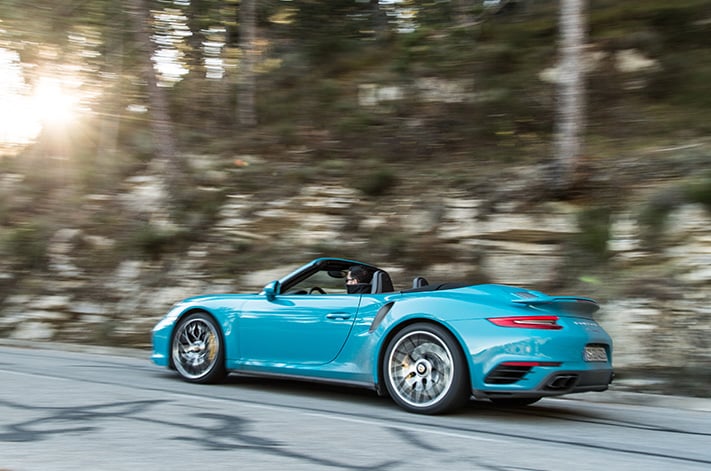
In truth it’s not much fun: the 911 has clearly grown over the years and ours is the wide-bodied Turbo. It’s still infinitely wieldier than a Ferrari or Lamborghini up here – more compact and with better visibility – but I’m still picking my way between corners, and barely prodding the throttle.
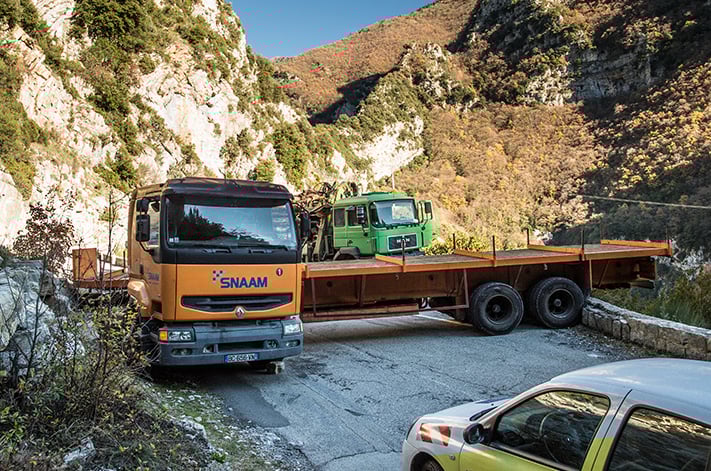
The road ahead is blocked, she explains, and we’ll have to turn around. I ask if the blockage can be cleared. Not today, she laughs. An articulated logging truck has jackknifed across the road, the driver perhaps caught out by the gradient, or the sharpness of a turn, or a patch of ice.
The trailer is wedged between the rock face and one of the low stone walls that line some corners. Others have flimsy metal barriers, or nothing at all. The driver stands by his cab, hands around his head, giving silent thanks that he hit the one thing able to stop him going over the edge. If the constant signs warning you of ice and rockfalls don’t temper your speed on these roads, the sight of someone else’s near-death experience will.
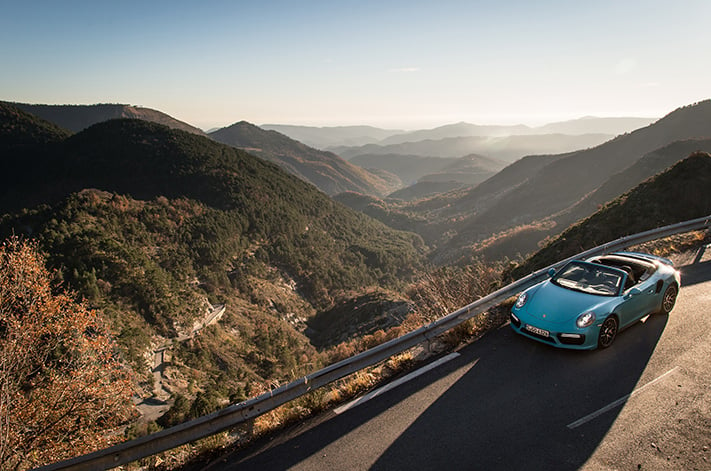
We head back down to Sospel, one of the ancient, pretty stone villages built into the steep valley walls, and from there scale the Col de Turini by another route. At the top we’re level with snow-capped peaks further inland and there’s permanent ice on some stretches, so I keep the speed low as we descend again, heading west to loop over some of the other mountain roads used in the Monte.
The Col de Vence is another largely deserted mountain road, but it’s faster and more open than the Turini, with longer, flowing stretches where I could finally start to extend the Turbo S.
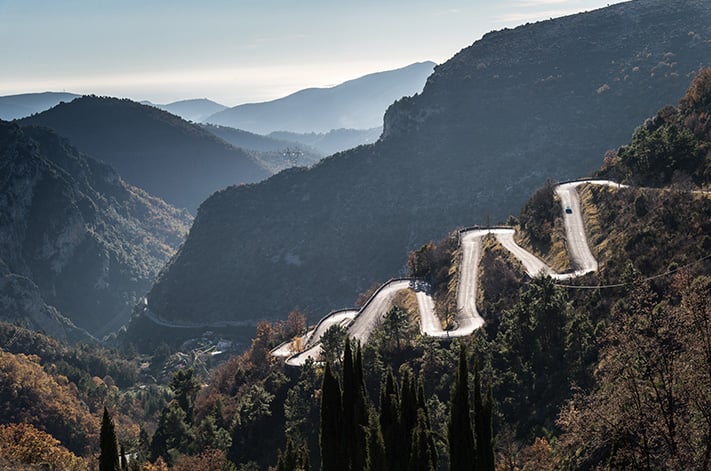
You exit a hairpin at 50km/h in the Turbo S and arrive at the next at whatever speed you choose, knowing that the impassive standard ceramic-composite brakes will turn the speed down instantly and precisely.
But even up here, with views all the way down the mountainside to the Mediterranean, your social conscience and your limits as a driver mean you seldom use the full travel of that accelerator.
Even from a standing start, a mountain simply doesn’t have the space to let you hold the gas wide open for more than five seconds, by which time you’ll be approaching 160km/h with a corner looming.
Performance upgrades roll out for Porsche 911 S
Maybe it’s a little slower on snow tyres: you can feel the all-wheel-drive system working hard to keep traction. And maybe it’s a little slower for being a cabrio: it’s 70kg heavier, and under extreme provocation you can feel the body flexing very slightly across the scuttle. But I still can’t imagine wanting or needing or being able to use a car any quicker than this on the public road.
Is it too quick? Maybe. The Turbo S suffers from a more severe case of the problem that afflicts many of its rivals that have recently switched to turbocharging. There’s no longer good reason to run them out to the redline. It would be both an indulgence and slower, and even if you do it they just don’t sound as good at max revs.
For a 427kW engine, the exhaust note is muted; there’s a good turbocharged rip when pressured, and pleasing pops and burbles when you back off, but nothing like the drama of the atmo cars of old.
But saying it drives like a McLaren is both a compliment and a criticism. It’s an engineering marvel, but feels a little distant. To answer my initial question: yes, some of the character and iconoclasm that once defined the 911 has been lost, sacrificed to abilities whose limits you’ll never find.
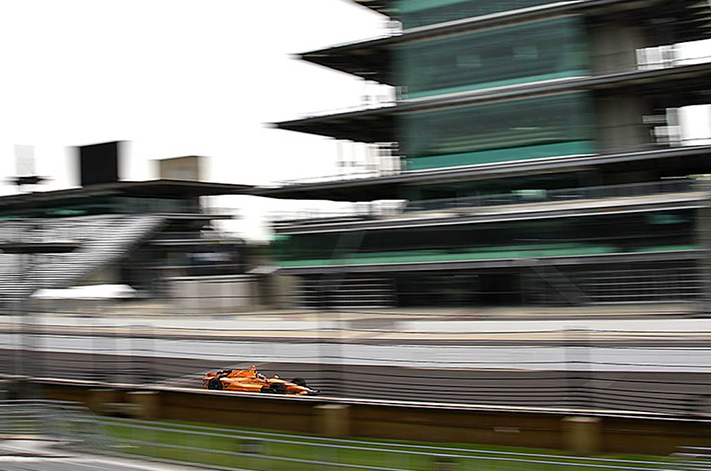
Two-times Formula One champ Fernando Alonso didn’t take long to get to grips with turning left at 220mph at Indy.
The Spaniard, who is passing up the Monaco Grand Prix to make his IndyCar debut in the storied Indianapolis 500, only needed 50 laps to pass all three phases of his rookie test, putting him on target to compete in the May 28 race.
In cool and worsening weather conditions, Alonso looked comfortable as he turned his first laps on an oval, and having sailed through his rookie test is now eligible to try to qualify for the Indianapolis 500. Practice starts May 15.
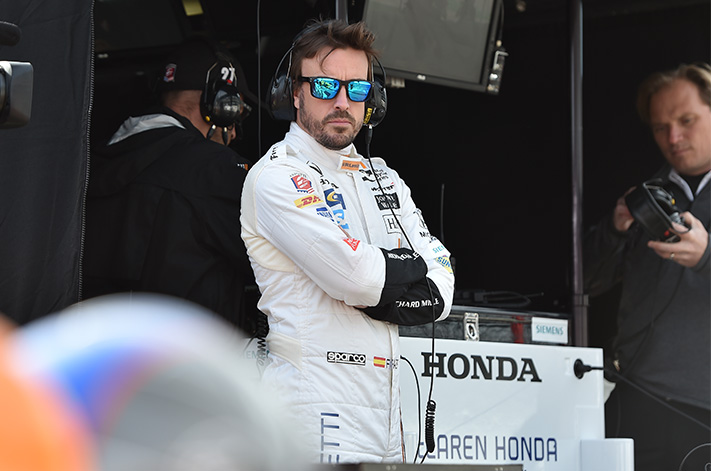
On his test day, Alonso discovered that the car behaviour changes when blue sky turned murky, wind gusts became more obvious and temperatures dropped to around the 15-degree Celsius mark.
Formula One 2017 preview: faster, louder, wider
Alonso topped 219mph in less than three hours in the Andretti Autosport Dallara Honda, painted papaya orange in a nod to the colour schemes of some of the early McLaren F1 cars. Then in the afternoon, when he reeled off a further 60 laps, he went faster – 222.548mph (358.156km/h) average.
Pole last year, set by Honda-powered James Hinchcliffe was 230.760 mph (371.372 km/h), a speed that with more practice and understanding of ovals and the cars too, should be within reach of Alonso.
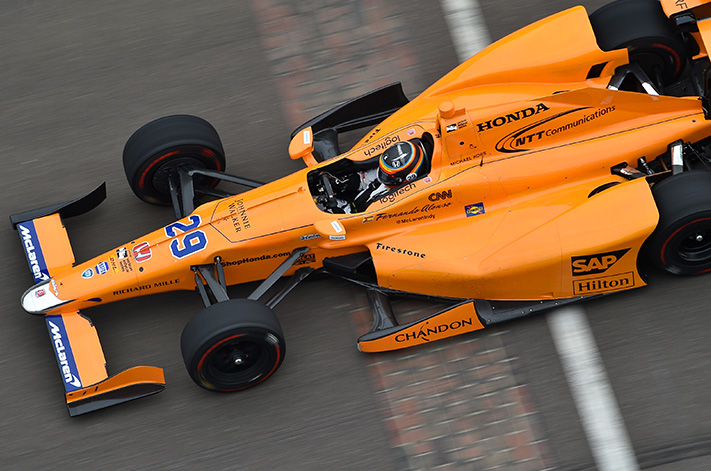
When he returns for practice, the biggest challenge in his assimilation will be to account for other cars in traffic. Alonso can expect to see as many as 32 other cars on track at IMS during practice and in the race.
“Well, it’s going to be probably the biggest challenge, running in traffic,” he said, before talking too about coming to terms with setting up the car. “The guys, they make constant changes to the car. One on the steering wheel while running, and those on the pit lane, those tiny changes, tuning the car perfectly on the week for the qualifying and then doing the same on the race, and sometimes also on the pit stops, getting up to speed until the last part of the race.”
Mario Andretti, the 1969 Indy 500 winner and collector of 52 career Indy car victories as well as a Formula One world title, was impressed by Alonso’s adaptation, suggesting the rookie looked like he had been running at the track for two decades.
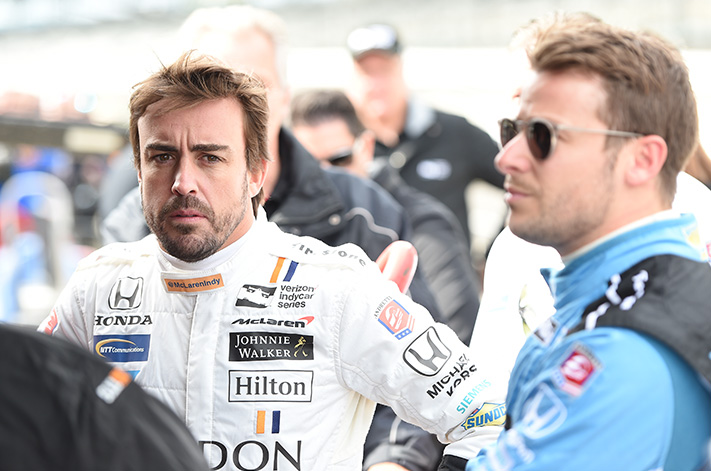
Interest in Alonso’s Indy shot is already high.
2017 Russian Grand Prix: Mercedes’ Bottas snares maiden F1 win
The live internet stream of twice Formula One world champion’s first IndyCar test pulled more than two million views last Wednesday.
Broadcast live on YouTube and Facebook, the test at the Brickyard was Alonso’s first experience of the Dallara-Honda prior to the official tryouts as part of his Indy 500 debut late this month.
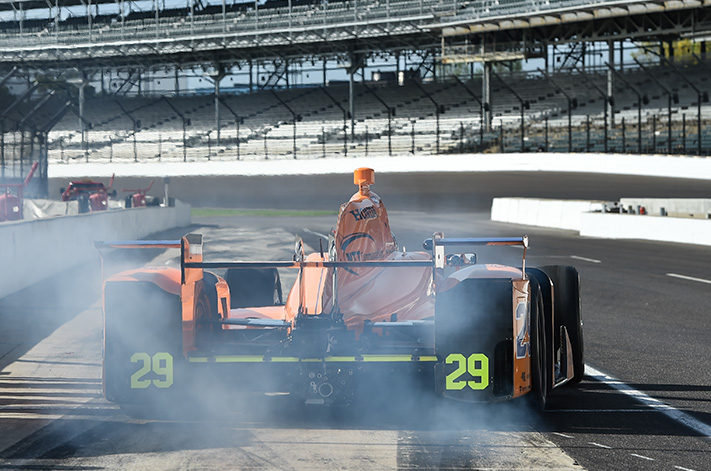
Although a private test arranged by McLaren, Honda and his Indy team Andretti Autosport, the circuit didn’t miss the chance to publicise their new recruit, arranging a proper broadcast of the event involving a studio panel, in-depth interviews and fly-on-the-wall access.
Reaching peaks of more than 70,000 concurrent viewers at times, the official figures recorded by YouTube and Facebook showed a combined overall 2,149,000 views.
It was also one of YouTube’s top 10 trending videos of the day.
New owners of F1, Liberty Media will not be oblivious to the popularity of the video of a midweek, single-car test.
The coverage of Alonso at Indianapolis’s included access to his chat with engineers, his laps on the oval, and feedback as he built up his speed.
But F1’s inherent obsession with secrecy, with cars screened from cameras and prying eyes, probably means Liberty could be hard-pressed to convince the grand prix teams to become more generous with access.
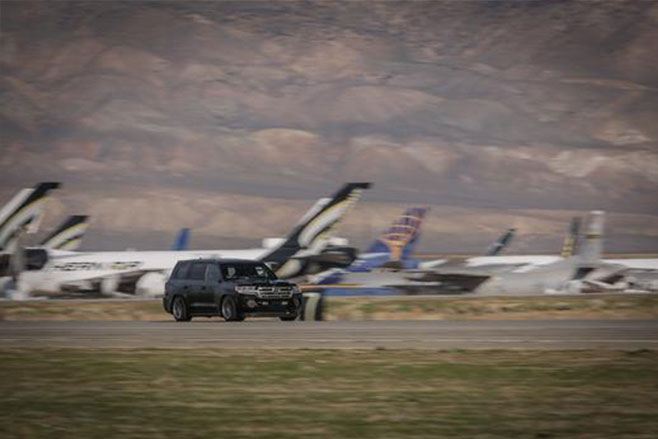
Former Toyota NASCAR driver Carl Edwards and the Toyota ‘Land Speed Cruiser’ recently found themselves travelling at 370km/h across the Mojave Desert, breaking the world record for fastest SUV.
With 1490kW at its disposal, the ‘Cruiser needed a 4km stretch of pavement at Mojave Air and Space Port to unleash its full potential.
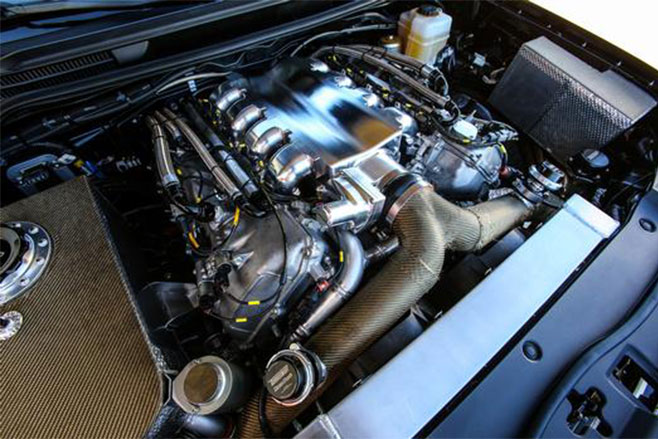
From the starting point of the project, Toyota’s Motorsports Technical Centre team used the ‘Cruiser’s production 5.7-litre V8 which already produces 283kW.
They then bolted on two “volleyball-sized” Garrett turbochargers capable of 55psi, and strengthened the 3UR-FE’s pistons and rods. They also added a custom-made intake manifold.
Its frame was also modified to “maintain optimal suspension geometry”, and was narrowed by 3 inches to accommodate wider Michelin Pilot Super Sport tires.
“The world’s fastest SUV record was at 211 mph (339.5km/h). That’s extremely fast,” he says.
“Toyota thought, ‘Why don’t we make a really, ultra-powerful LandCruiser, and let’s just see how fast we can make it go.”
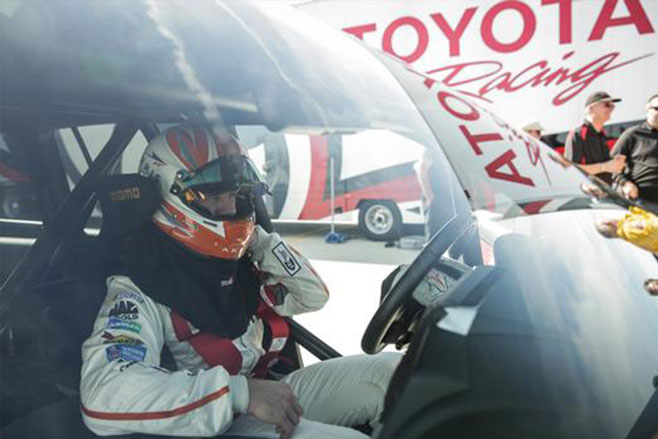
“At 225mph, the thing was wandering a little bit. All I could think was that Craig said, ‘No matter what, just keep your foot in it,’ and we got 230mph (370km/h),” he said.
“It’s safe to say that this is the fastest SUV on the planet.”
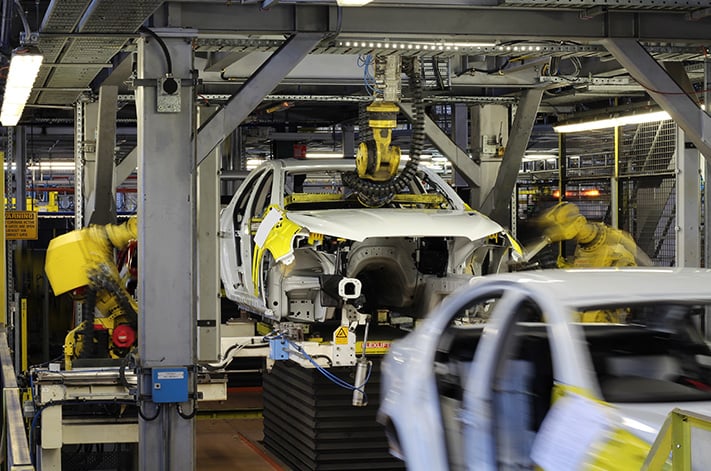
JUST as ultrasound pictures provide an early snapshot of an eagerly awaited child, customers who have ordered a 2017 Commodore will be able to order pictures of their pride and joy during its gestation on the Elizabeth production line.
The pictures will be available to buyers of all 2017-build Commodores who will be able to download a digital photograph. Photos will be sent via email or provided to the dealer at point of sale. In both cases the photos will be delivered after the car.
The initiative comes on top of Holden’s offer for buyers of the 2017 limited edition Commodores to select their own vehicle build number, if they purchased their cars before April 24.
“We’ve seen some definite trends in number popularity,” he said. “For example, all of the first 200 and last 100 Motorsport Edition numbers have gone as well as all double and triple digits like 55 or 555. It’s been great to watch!”
2018 Holden Commodore hiding under Malibu skin
Customers yet to assign a build number to their Special Edition Commodore are encouraged to contact their dealer soon to avoid disappointment. The selection process will end at midday on Wednesday, May 10.
Wright says the feedback Holden has received from both initiatives so far “has been phenomenal”.
You may have noticed that, in addition to a fat set of chrome mags and a wheel alignment, increasing numbers of tyre shops are now offering the option to inflate your tyres with nitrogen instead of air. But is the extra expense of between $5 and $10 per corner worth it?
For a start, atmospheric air is already about 78 per cent nitrogen and 21 per cent oxygen, so by handing over cash for the service you’re actually only getting a little more N for your money.
| How To: Picking the right tyres for your car
The various outlets may tell you that with the inert gas inside, your tyres will perform better and last longer, particularly when operating over varying temperatures, but the beneficial effects may be minimal and hard to appreciate.
Any potential benefits rely on two basic principles, the first one being nitrogen’s resistance to leaking and the second is the lack of water vapour suspended in the gas, which is a happy by-product of the manufacturing process.
A nitrogen molecule is larger than an oxygen molecule which means pressurised nitrogen stays inside a tyre longer than the Houdini-like oxygen which escapes more readily over time. The theory is that nitrogen will maintain the correct pressure for longer particularly at the higher temperatures caused by enthusiastic driving, which can exacerbate the leakage.
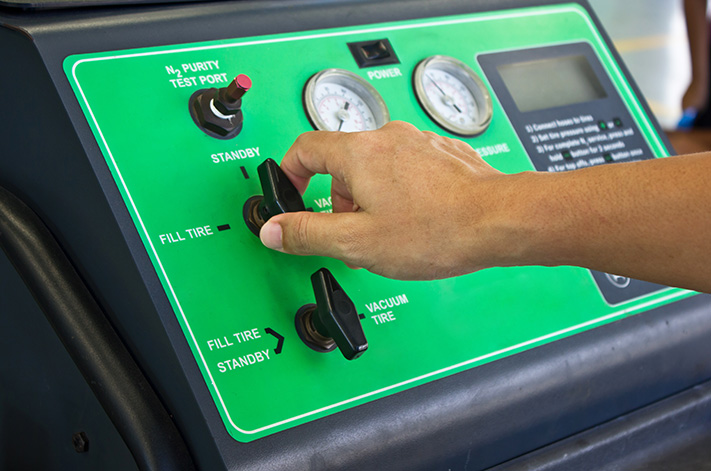
While there may be some benefit, having nitrogen in your tyres is not a substitute for checking your pressures regularly.
When heated, nitrogen expansion is similar to oxygen’s rate of expansion so there is no clear advantage with nitrogen versus air until atmospheric moisture is factored in. When water vapour is heated by the action of high friction, load or hot weather, pressures can rise more significantly.
For nitrogen-filled tyres to have any benefit over air, the gas must be completely dry when pumped in and the tyre must be completely evacuated of air beforehand to ensure residual air and moisture don’t dilute the nitrogen gas.
| How To: Understanding wheel alignments
Tests have shown that, even with a small amount of moisture present in a nitrogen-filled tyre, pressures can increase more than when simply filled with air. Furthermore, the advantage of dry inflation gas is not limited to nitrogen, and the same benefits are associated with completely dry air as a filler.
Some companies have also claimed that nitrogen can improve ride quality as well as increased tyre life but there are no differences to the benefits associated with maintaining the correct tyre pressure for your car and driving conditions.
Nitrogen as a tyre inflation gas is used in high-end motorsport applications where the teams can ensure the tyre is entirely filled with dry nitrogen and where even relatively small changes in pressure can make a difference to lap times.
On the road however, it is unlikely the average driver will be able to tell the difference between minor changes in tyre pressures. And remember, nothing is a replacement for regular vehicle maintenance.
Normally when you turn 30, it’s something everybody else is strangely more interested in celebrating than you are. And all sorts of worrying thoughts start to enter your mind.
Should I drink less? Should I now get up early on weekends? Am I spending too much money on my car? Where did this paunch come from? Maybe this is all just me.
But for a company, turning 30 is an incredible milestone. I’d love to know the odds of a given business reaching 30 years of continuous operation – surely they’d be grossly outnumbered by those that have failed.
And so congratulations to Holden Special Vehicles for reaching this point; frankly, it doesn’t feel like a huge deal, as HSV seems in great health, at the top of its game, making some of the best and most polished cars it ever has.
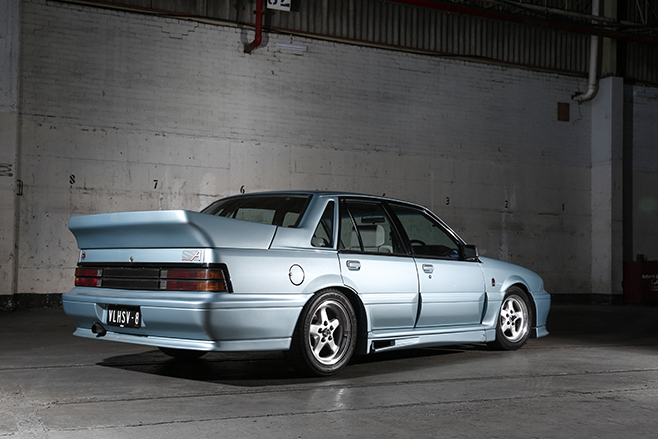
For HSV that’s been rear-drive, relatively affordable Aussie muscle cars – indeed, the foundation of its business – and one that hardly appears to be in decline.
Australians are going gaga for dual-cab utes; the Ford Focus RS has proven popular and HSV has had a crack at an Astra hot hatch before; and part of the HSV factory is used for converting enormous RAM trucks to right-hand drive en masse, hopefully proving the viability of other left- to right-hand drive pursuits.
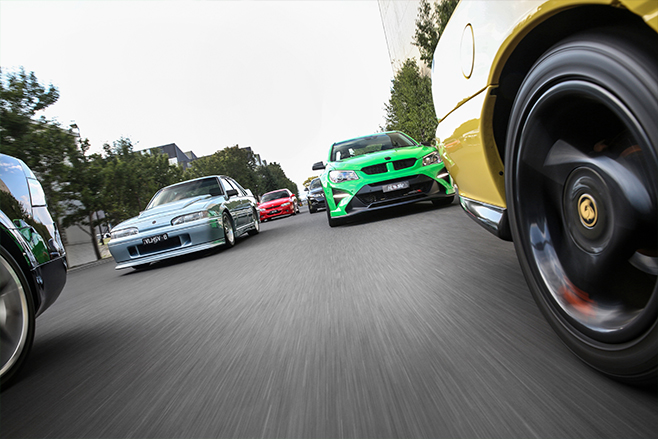
Not only does it have brand power others can only dream up, but if its new products and projects are anything like the current range of Aussie-built, Commodore-based cars, which will be so sadly missed – and departing this world long before their time is up – HSV will be just fine. It just might look very different.
PORSCHE Cars Australia has aired its displeasure over seeing 911 Rs reappear on the used-car market for exorbitant prices, less than 12 months after the vehicles arrived in Australia.
Porsche Australia Public Relations and Motorsport Director Paul Ellis said speculative on-selling of limited-edition cars at heavily inflated prices is something that is disliked within Porsche.
“That displeases us as a company, to see that those cars are commanding so much money, doubling their price inside a matter of weeks,” Ellis told Wheels. “It is not something we as a company are fond of, because it is just not right, it is not why we build these cars.”
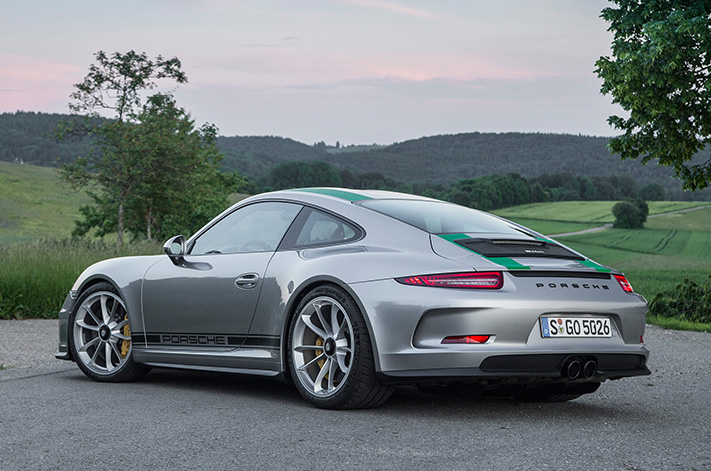
Two of the “extremely limited number” of cars which arrived in Australia have found their way to the used car market less than 12 months after delivery with asking prices nearing (and in one case, exceeding) a million dollars.
The 911 R cost $404,700 new.
For sale: Unused Porsche 911 Carrera RSR 3.8
But there is little Porsche can do to prevent the cars being sold-on so quickly.
“We can’t do anything about customers who have purchased cars, that want to on sell that motor car,” Ellis explained.
“We don’t like it when it happens, especially when people do this purely for speculative purposes.
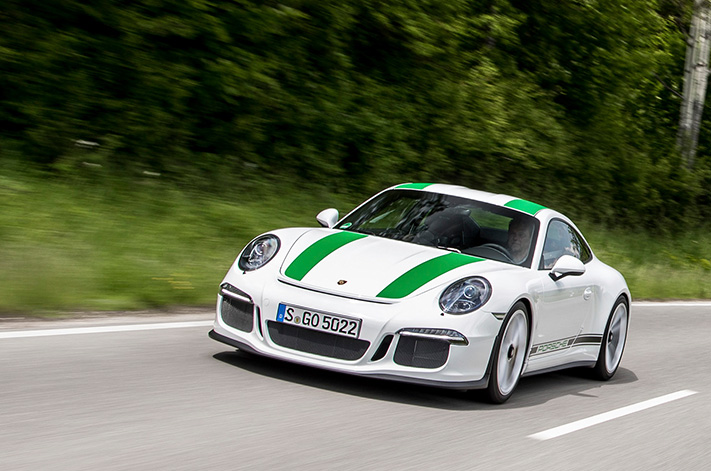
“We are not about building cars so people can use them as nuggets of gold and put them quickly on the market and make a profit from them,” Ellis continued.
“That is not how we operate, and it is not a part of our culture of being an enthusiast brand and building cars for enthusiasts to drive their cars – especially when many of the cars, particularly 911s, stay with their owners for an extended period of time. Some for 10-, 20-, 30-years.
“When you buy a Porsche you buy part of the brand, and you buy the ownership experience for more than five minutes.”
Ellis explained the chances of a buyer on selling their limited-edition Porsche is taken into consideration when evaluating customers for cars with limited run numbers, with priority given to those the brand considers loyal.
“Of course [if the owners will resell] is thought about,” he said. “Our priority is to sell these cars to our most loyal customers. So, that is what it is all about.
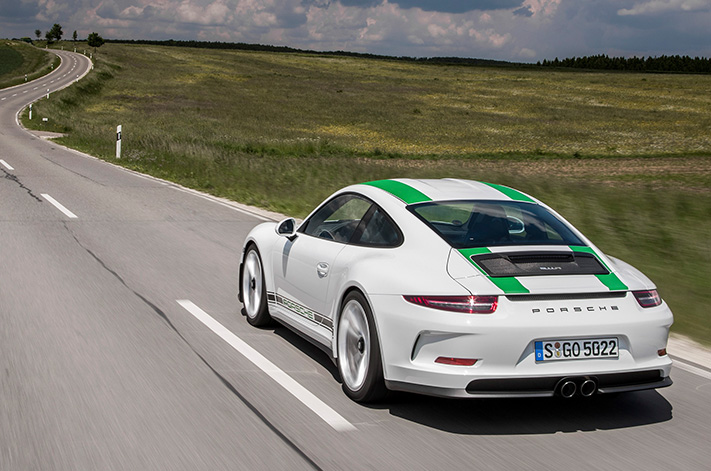
Outside of the new-car market, used Porsches continue to be stars on the classic car market.
Ellis described the prices being garnered by 911s from the 70s as ‘ridiculous’, and said the cost of used cars has little coloration with cars being bought showroom fresh.
“I think they are two different markets. There are fads with used cars, especially cars that through time have appreciated because their desirability has increased,” he said.
“The bubble keeps getting air pumped into it, but the bubble can only take so much air before it bursts. It will burst eventually. But not right now while interest rates are low.”
QUESTION: Marina
I am trying to choose between the Honda Civic VTi-S and Skoda Octavia Ambition for mostly city driving. I am wondering that what the long term costs of running these cars would be. They both offer five-year warranty but how do they compare with spare parts etc?
ANSWER: NATHAN PONCHARD
If we’re talking five-year ownership costs, then you need to take into account resale value, as well as tyre replacement, servicing cost, fuel consumption, and general replacement parts. For the sake of this exercise, let’s say front windscreen, front and rear bumpers, and head- and tail-light units.
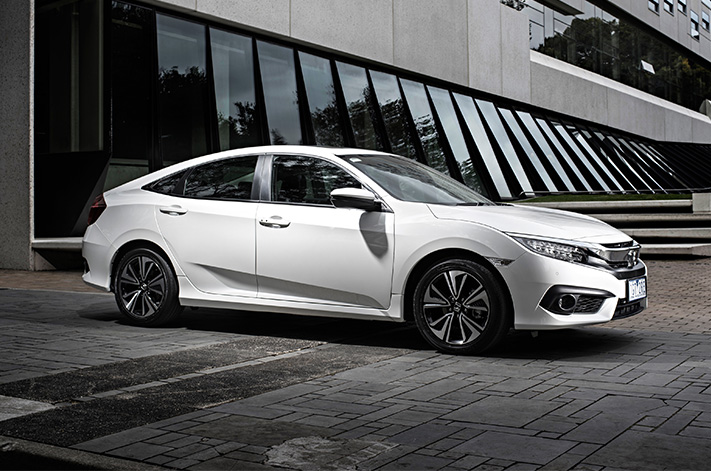
The resale is calculated on three years of ownership (the only figures available) and favours the Honda at 61.5 per cent of retained value at that point, compared to 52.8 per cent for the Skoda. So the value quoted below is the amount of money lost on the car’s worth during that time.
And fuel is calculated at the national average price for the type of fuel recommended (95-octane premium in the Skoda; 91-octane regular in the Honda).
Here’s how the two would compare in pure cost-of-ownership, taking into account potential replacement of major components:
Skoda Octavia 110TSI Ambition DSG hatch $11,937 (loss of value after 3 years) $5335 (5-year fuel cost @ 5.2L/100km of 95RON, according to the government Green Vehicle Guide) $2300 (5 years/75,000km servicing) $740 (4 Bridgestone Turanza ER300 tyres) $502 (front windscreen) $801 (front bumper) $665 (rear bumper) $439 (front headlight) $236 (rear taillight) = $22,675
Honda Civic VTi-S sedan $9429 (loss of value after 3 years) $6405 (5-year fuel cost @ 6.4L/100km of 91RON, according to the government Green Vehicle Guide) $1420 (5 years/50,000km servicing) $820 (4 Dunlop Enasave EC300 tyres) $535 (front windscreen) $529 (front bumper) $547 (rear bumper) $707 (front headlight) $440 (rear taillight) = $20,832
It should be noted that the Skoda’s servicing cost includes all ancillaries – brake fluid, pollen filter replacement, spark plugs, etc – whereas Honda charges extra for this stuff.
Also, you can travel 5000km further in the Skoda before it needs a service. Therefore, its greater overall servicing cost actually includes 25,000km of additional driving.
Finally, there’s driveability. The Honda can drink regular unleaded fuel, but it’s thirstier than the Skoda so will actually cost you more to run fuel-wise. And it offers less performance than the Skoda, meaning it’s less efficient in terms of how it operates.
In pure tit-for-tat terms, the Honda offers comfier seating, better ride and handling, better resale and potentially greater reliability. The Skoda, on the other hand, has more flexible luggage space, an equivalent amount of room, stronger performance with greater fuel efficiency, and arguably easier entry/egress thanks to its higher seating positions.
I hope this helps!
Earlier this year, Editor Inwood travelled back to his hometown of Bathurst to drive Nissan’s fearsome GT-R Nismo. Its twin-turbocharged 441kW/652Nm 3.8-litre V6 boasted, in his own words, ‘ferocious intensity’, but the same could be said of the Nismo’s mega-aggressive, in-your-face bodywork.
Building on the bodybuilder physique of the garden-variety GT-R, the Nismo sports deeper skirts and splitters, gaping vents, acres of carbon fibre, massive lightweight forged alloy wheels, a 747-spec wing and what seems like a linear kilometre of red pinstriping.
Godzilla Redux – Nismo GT-R, Bathurst, and a nervous editor
It’s functional too. That aero kit not only looks intimidating, it generates 100kg of downforce at 300km/h. Perfect for a certain straight section of downhill road in regional NSW.
Want the full detail on what it’s like to pilot? Have a read of Inwood’s review here. Keen on getting your hands on some Nismo goodness yourself but can’t stump up the sizable $299,000 asking price of the GT-R Nismo? Salvation is just around the corner in the form of the 370Z Nismo.
Just want to ogle one of the fastest Japanese road cars ever created? Stay right here on this page and feast your eyes on Chris Benny’s handiwork. There are plenty of hero shots to drool over, but also loads of photos that we didn’t have the space for in the March issue of Wheels. Rejoice, fellow Nismo nerds.
FORD appears to be hedging its bets after losing the right to call its Territory large SUV replacement the Edge – and there’s now two alternatives in the running.
As well as “Equator”, Ford Australia has most recently sought to trademark “Endura” – a name once given to a family of European diesel engines that powered cars such as the Escort – as it attempts to find a replacement badge.
Ford’s application for Endura was lodged in late April, and is yet to gain acceptance from the Australian Government. Likewise, its January application for Equator is still yet to gain government approval, although documents show it is one step closer to approval than the Endura.
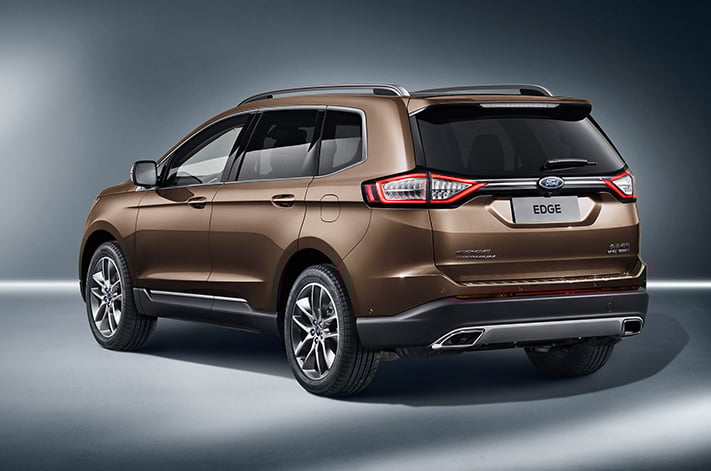
“There’s no more updates [about securing the Edge name],” Ford Australia president Graeme Whickman said last month. “Our conversations have concluded with Toyota. They will not yield that name.”
Ford was keen to use the Edge name here as part of a global roll-out of SUVs that use model names starting with the second vowel of the alphabet – it already has the dreary EcoSport, the identity-challenged Escape mid-sizer (it is a renamed Kuga) and the large Ranger-based Everest SUV in its showroom.
Whickman said at the time Ford would continue to “work with other vehicle names” ahead of the Edge’s arrival early in 2018. “That’s an innovative process, because we want to make sure we live up to One Ford globally, so it’s a process that takes some time,” he said.
Ford Australia spokesman Martin Gunsberg said the names the carmaker was trying to lock in were not necessarily for the Edge – a large SUV that, like the Territory, could come in both five- and seven-seat configurations.
“We don’t have an update at this point,” he said. “We haven’t finalised the name at this stage, but we can confirm that Edge is no longer in the running.”
Ford stopped building the Territory in October last year as part of a managed wind-down of its local manufacturing business – a move that also resulted in the loss of the Falcon large car and ute range.
However, the car maker has not exactly ruled out using the Territory name for its SUV replacement, other than saying it wanted to align its SUV line-up with its parent company’s global nomenclature.
Ford insiders have suggested to
The Ford Edge is due on sale in Australia early next year. Ford Australia appears to be waiting for an all-new version of the SUV to arrive before filling the gap in its showroom.
Traditional rival Holden plans to introduce a rebadged version of the seven-seat GMC Acadia in 2018, potentially as a replacement for the lacklustre Korean-sourced Captiva. It also sells in five- and six-seat configurations in the US.
