
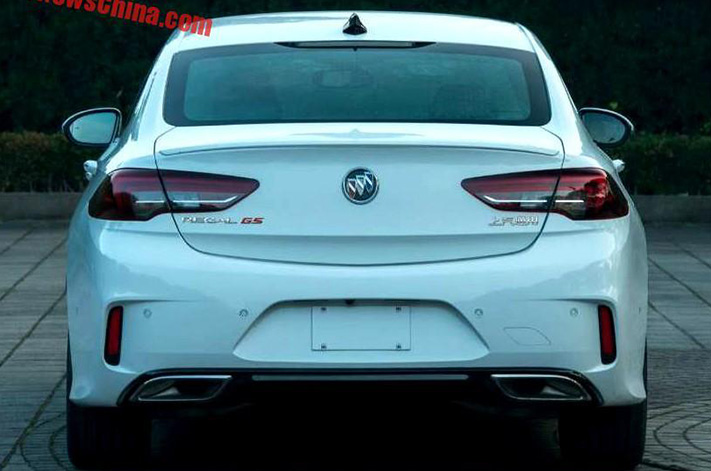
A Chinese motoring website has revealed the best look yet at the Buick Regal GS, the model that will essentially become the replacement for the Commodore SS in 2018.
The Regal GS will reportedly debut at the 2017 Shanghai motor show later this month. The images already provide a good sense of what to expect visually from the OPC/VXR version of the Opel/Vauxhall Insignia.
A more aggressive body kit comprises extended side sills, chrome-ringed front air intakes, and revised front and rear bumpers – the latter seemingly incorporating vents. The headlights are also tinted.
| 2018 Holden Commodore Sportwagon revealed
There won’t be an SS badge on the rump of the Holden – it’s been retired owing to its long association with V8s.
The new flagship Commodore is already confirmed to be powered by a normally aspirated 3.6-litre V6 related to the engine already in the Commodore SV6, sending 230kW/370Nm to all four wheels.
Those outputs are 6kW and 65Nm down on the 2.8-litre turbo V6 of the now-discontinued Holden Insignia VXR, and well short of the outgoing 306kW/570Nm SS Redline, though 20kW and 20Nm up on the SV6.
The new Insignia/Commodore also compensates by being between 200kg and 300kg lighter, and the 0-100km/h is tipped to be in the low 6-second bracket, beating both the old VXR and SV6.
| 2018 Holden Commodore Tourer revealed
European versions of the faster Insignia will feature a 2.0-litre turbocharged four-cylinder, but Australia insisted on a V6 that currently accounts for about 80 per cent of Commodore sales.
Also confirmed is a FlexRide adaptive suspension and ‘Twinster’ all-wheel-drive system that employs clutches rather than a differential to vary torque distribution between not just the front and rear axles but also between the rear wheels.
The next-generation Holden Commodore will be released in early 2018 with all variants including the sportier, all-wheel-drive V6.
JUST like Hansel in Zoolander, SUVs are so hot right now. This year, they’ve galloped past traditional passenger cars in terms of sheer sales numbers, and the trend doesn’t look likely to reverse itself.
Of all the SUVs, the Mazda CX-5 is the reigning king of the (not too difficult to climb, as it’s only a pretend off-roader) mountain. That sales peak may grow slightly taller, too; the CX-5 has just evolved into a new form that answers a lot of the problems of the old one.
Scrapping at its heels are the pick of the mid-size SUV litter, including the old-is-new-again Ford Escape (it used to be called the Ford Kuga), Korean upstart Kia Sportage, Subaru’s nature-loving Forester, and the Teutonic Volkswagen Tiguan.
Here, we’re looking at mostly front-wheel-drive versions of the SUV (the Forester has all-wheel-drive as standard) priced in the low- to mid-$30,000 bracket – not quite entry level, but packaged with enough of the creature comforts we’d need to make living with them a pleasant experience.
Ford Escape Trend If you’d bought this car last year it would have worn a Kuga badge. But a change of name to align the car with its more widespread moniker has also allowed Ford to give the car a mid-life spritz, including a more conservative – read that as slightly boring – styling package.
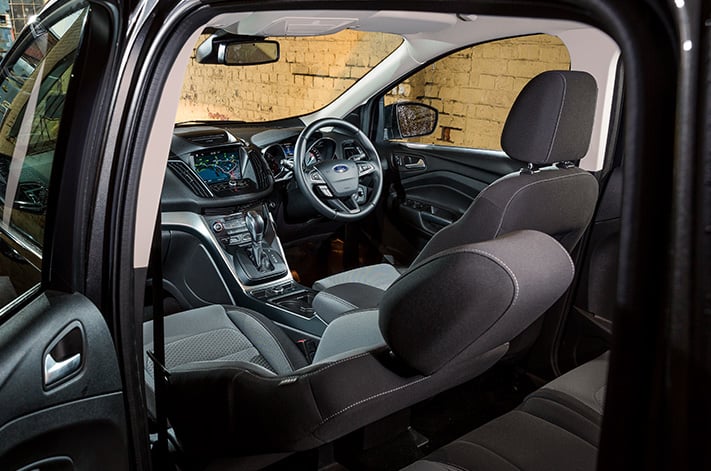
But the $32,990 Escape is very much a driver’s car. Getting settled behind the wheel is easy, the seat is supportive and the layout of the instruments is classy and practical. It’s the same level of comfort as in the back seat, where a higher seating position in supportive pews gives a good view of the road ahead.
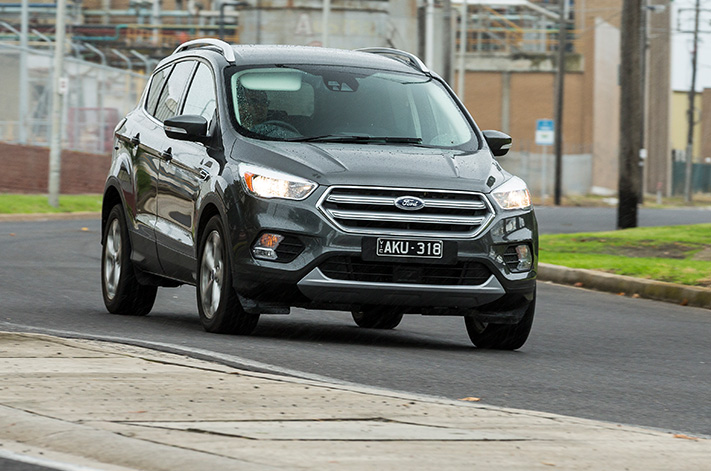
Throughout, there’s a generous level of kit, including a digital speedo, Ford’s latest-generation Sync voice control (that works really well), a capless refuelling system, and one of the best luggage compartment covers in the business.
Don’t be fooled by the Escape’s engine, a tiny 1.5-litre turbocharged four-cylinder producing 134kW/240Nm – big numbers for this class of vehicle. It’s punchy, and combined with the six-speed automatic (the steering wheel has paddle shifters allowing manual control) the Ford accelerates briskly, yet doesn’t drink that much fuel.
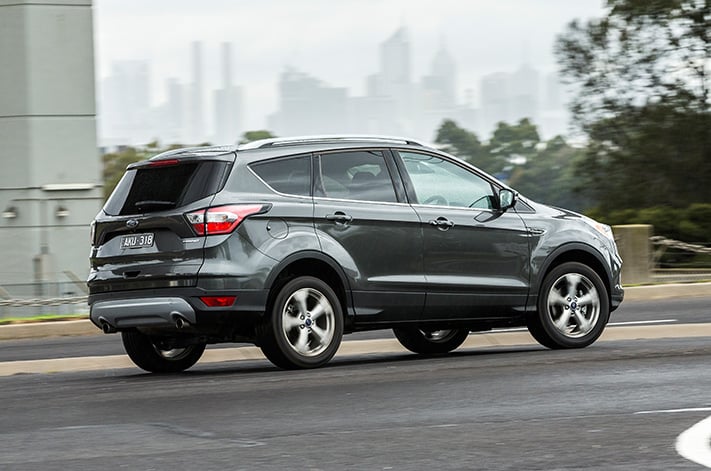
The ride on the Escape’s 18-inch alloy wheels is among the best of these cars, although it does feel a bit firm when it first encounters a bump. Road noise is reasonably well contained, too.
Criticisms? The car’s multilayered centre stack looks likes Darth Vader’s helmet, and the tall gear lever looks silly in contrast with the rest of the interior’s proportions. The front passenger seat has no height adjustment, which means those in the jump seat feel as though they’re perched on, not in, the Escape.
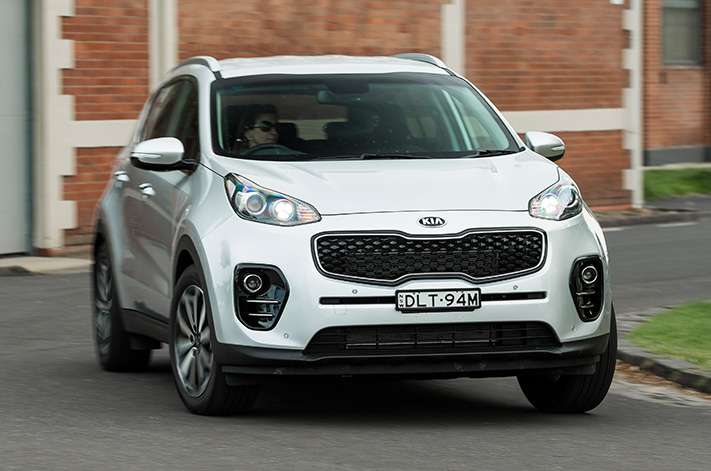
Kia Sportage SLi It may have Korean car-making giant Hyundai as its owner and the Hyundai Tucson as a showroom rival, but the Kia Sportage is different enough to stand slightly higher in our regard to be worthy of inclusion here.
The $34,690 Sportage’s exterior has more Euro influence than the US-led Tucson, so it’s a lot more appealing to look at. It carries over inside too, where the Sportage eschews conservatism for an edgy, premium feel.
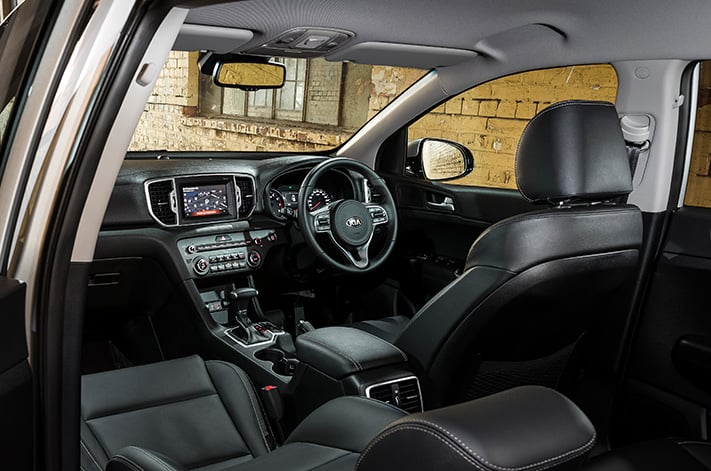
The interior of the Sportage is probably the best here to sit in every day if all seats are occupied. The front seats are comfy and the driver’s adjusts electrically, and the design of the instrument cluster and layout of the dash are useful and inviting.
That likeability extends to the rear seat. The Sportage’s rear doors are more wing-shaped than the other cars here, meaning you don’t have to bend your head around a pillar when getting in and out of the roomy back seats. All the extra glass this yields also makes the rear seat a bright, airy space. And then there are the rear air vents and a USB port that add even more rear-seat versatility.
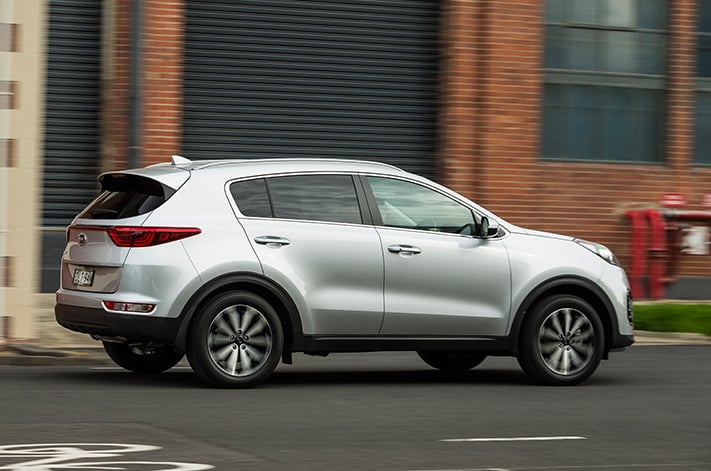
The ride quality of the Sportage isn’t as refined as the Ford Escape, but it does have a sense of playfulness when pushed enthusiastically. The SUV will lean on its rear wheels when pushed through a corner, demonstrating good poise balance.
However, there are problems. The first is a trigger-happy electronic stability control system that calls in the fun police way too early when you try and enjoy the Sportage’s balanced handling. The slightly lumpy ride could be better too.
The second is the engine. While the Hyundai-badged Tucson is built in Europe and gets a smooth and efficient 121kW/203Nm direct fuel-injected 2.0-litre engine, the Korea-sourced Sportage sticks with the old 114kW/192Nm multi-point fuel injection tech that makes it coarser the higher the revs rise, and significantly less fuel-efficient.
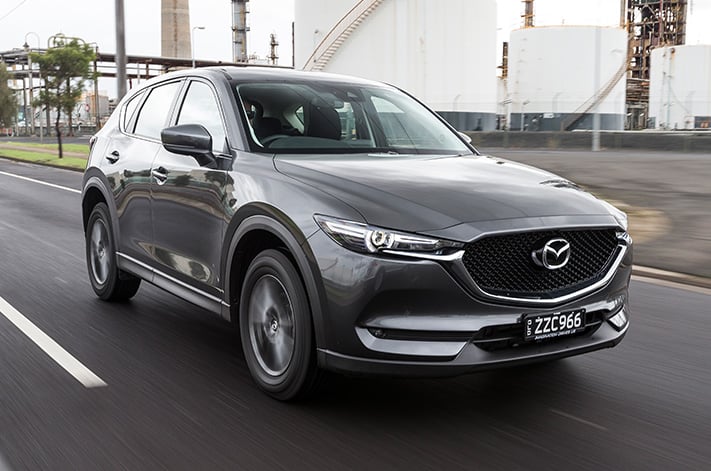
Mazda CX-5 Maxx Sport The $34,690 CX-5 is the newest of this litter. We’ve expected big things; its bigger brother, the 2017 Wheels Car of the Year-winning Mazda CX-9, shows what the Japanese carmaker can do when it sets its mind to the task.
Which it has with the CX-5. One of the first-generation car’s biggest problems was an interior that seemed to channel every bit of road noise possible into the cabin. This new CX-5 weighs more thanks to much better sound-deadening that really only catches up with the pack, and doesn’t leave it behind.
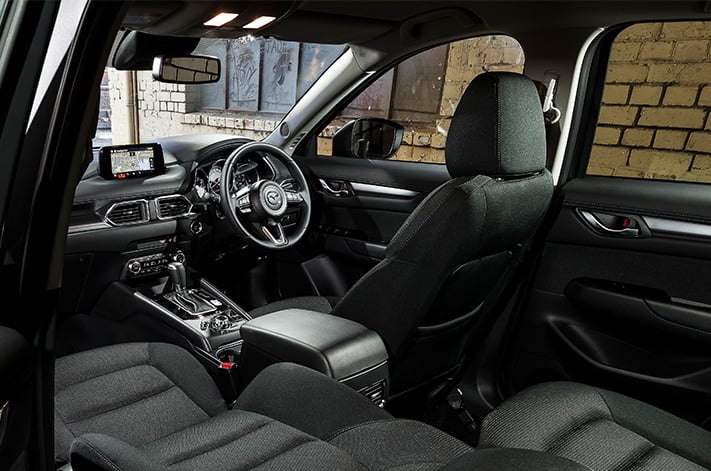
Behind the wheel, the CX-5’s interior looks a cut above the rest, helped by a high-set multimedia screen that stands tall from the dash, and plenty of soft-touch stitched surfaces. The only obvious omission is a digital speedo.
Both the comfy front seats gain height adjustment – the CX-5 is one of only two cars here to feature this – and down the back there are two USB ports tucked into the centre armrest that lose all their teen-attracting advantage when all three seats are occupied.
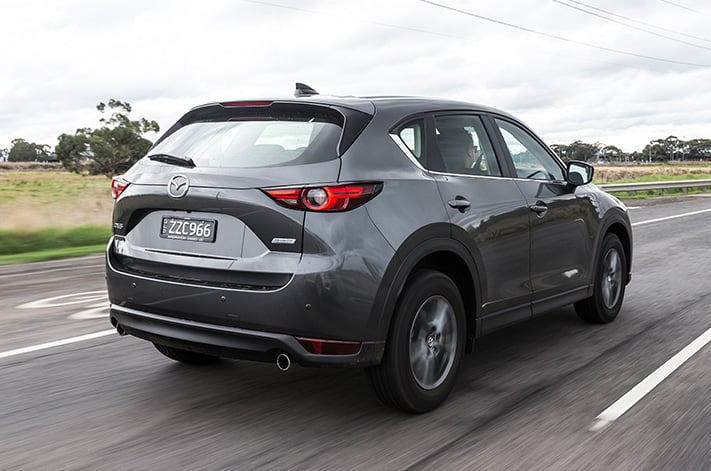
On the road, the 114kW/200Nm 2.0-litre four-cylinder engine feels just a little underpowered, with the six-speed automatic transmission hunting around on hills to find the best balance of performance and fuel economy.
The ride could use a bit more work, though. The CX-5 struggles to smooth over low-frequency bumps, which on longer trips could become a bit tiresome. However, drive it with a bit of enthusiasm and all those concerns fall to the side as it delivers a dynamic experience close to that of the Ford Escape.
Volkswagen Tiguan 110 TSI Trendline Three words sum up VW’s mid-size SUV: Fast, roomy and frugal. Right from the outset the $34,990 Tiguan has a lot going for it.
You need to weigh that cost against what it has, though. It’s the only car here to feature a second-row bench that slides to either increase rear-seat legroom for passengers, or increase cargo space in the boot. It’s the only one to feature an infinity-adjust driver’s seatback (the other all use a ratchet); the multimedia screen recognises when a finger hovers near it, popping up menu functions even before it is touched; and the frameless rear vision mirror adds a premium air to a functional, crisp interior. Door bins are lined with sound-absorbing cloth, and the passenger seat adjusts for height.
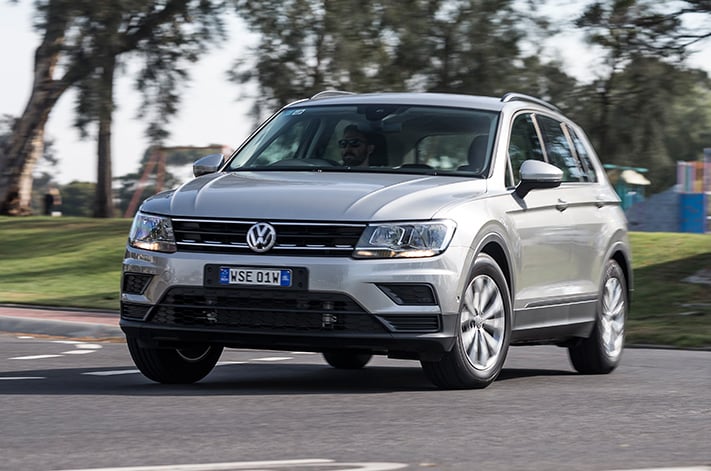
It will brake itself to avoid a crash, front parking sensors guard the plain-looking nose from scrapes, it can monitor the driver for fatigue, an electric parking brake and a host of other things the others here can’t come close to matching as a package. But strangely, the Tiguan misses out on a centre rear armrest and seatback pockets.
Under the bonnet is a frugal yet peppy 110kW/250Nm 1.4-litre turbocharged four-cylinder engine that has an enjoyable turbo whoosh to it. It matches up with a seven-speed dual-clutch automatic transmission that, in the usual VW way, is snatchy and grumbly at low speeds – such as when you’re trying to back into a car park.
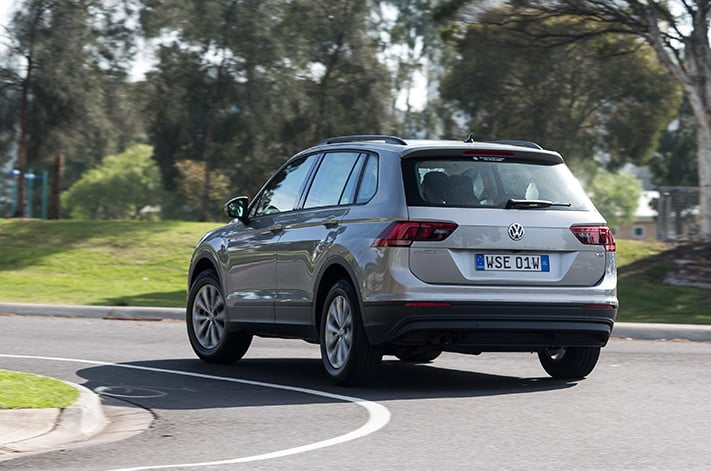
On song, the engine matches the Volkswagen’s great driveability. Combined with poised handling and cornering confidence, it’s the easiest one to drive with enthusiasm.
But notice there’s nothing about the Tiguan’s ride in that three-word set? That’s because the on-road manners are upset by a ride that’s too stiff-legged to be comfortable at any speed. The underbody stiffness translates to plenty of road noise making its way from the hard-pumped tyres – the Tiguan runs very high pressures in the rear – into the cabin. It takes the edge off what would otherwise be a winning combination.
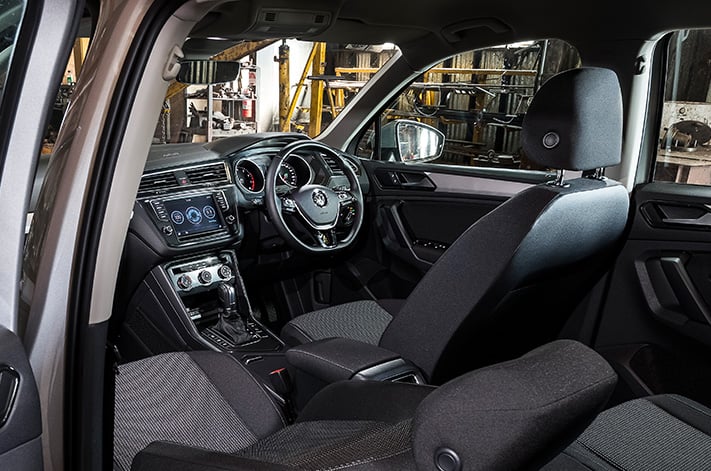
Subaru Forester 2.5i-L Remember when SUVs were justx station wagons on stilts? It comes as something of a surprise, then, that the $33,240 Subaru Forester 2.5-L that eschews the high-riding hatchback set for some old-school two-box design values can count itself among this lot.
What sets it apart, though, is its best-in-class ride. Smooth, absorbent and insulating, it just wafts along even the roughest road surfaces, cosseting those inside. Despite the plush ride, there’s none of that sense of carsickness-inducing floatiness.
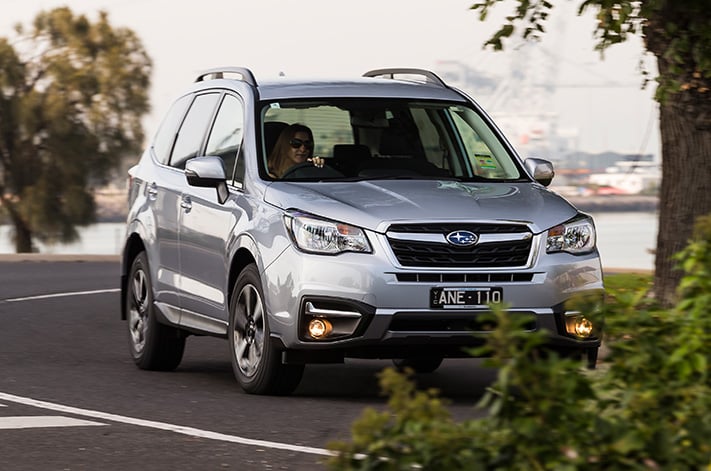
It’s also the airiest of the cars here. A low beltline and a high roof combine to provide the cabin with acres of deep glass, making the interior akin to something like a fishbowl compared with the other cars here.
The Subaru’s engine and gearbox are unique among this company. The Forester uses a 126kW/235Nm 2.5-litre flat four engine with the cylinders parallel with the floor, mated to a continuously variable transmission. That transmission allows the engine to sit in either its most powerful, or economical, rev range while accelerating or cruising.
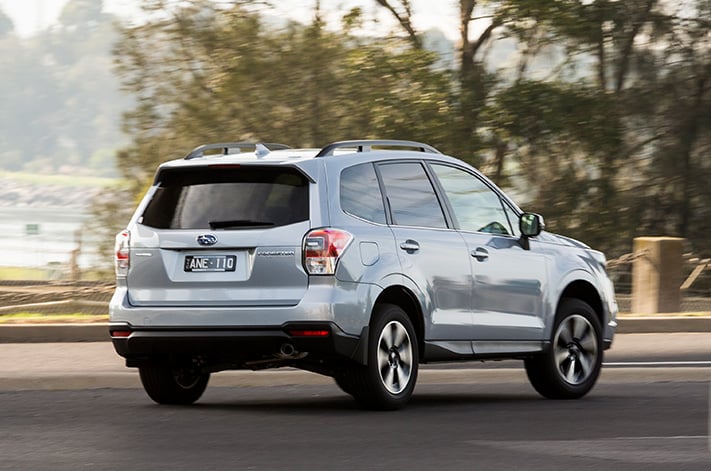
It’s a combination that works well, with the Forester accelerating briskly even if the steady drone of the engine can become a bit annoying if you’re jumping from rest to freeway speeds. Combined with the plush ride, the Forester makes for a comfortable long-legged cruiser for all the family, though.
However, the Forester’s interior leaves a bit to be desired. Surfaces are mostly hard, although the Japanese carmaker has tried to remove some of the hard contact points using softer material. And the interior design, too, fails to match up with a field that has moved on a long way – especially that cruddy multimedia head unit.
VERDICT It’s important to note that none of these high-riding SUVs do anything better than a conventional passenger car. In reality, they do a worse job via higher centres of gravity, the weight of all the extra metal they carry and the extra bulk they introduce to the driveway or garage.
But some do better than the SUVs they’re compared with. The Ford Escape drives well but doesn’t look after anyone well but the driver. The Sportage gains big ticks for looking after rear-seat passengers, but is let down by a lack of refinement. The Tiguan surprises and delights, but who can live with that ride every day? And the Forester floats across the road, but lacks in-cabin comfort and appeal.
Which leaves us with the Mazda CX-5. It’s by no means a standout in this crowd, but it blends bits of the best elements of the others to deliver an all-round ability that combines a pleasant, livable interior, an engaging drive, steady on-road dynamics, and a few surprises along the way.
But more competition is on the way. An all-new Honda CR-V is due on sale in Australia in July; in October Holden’s replacement for the Korean-sourced Captiva, the Canadian-built Equinox lands; and Peugeot’s more SUV-styled 3008 due sometime this year should challenge VW’s premium standing.
Given the looming fight, the Mazda CX-5 now has everything to lose – admittedly from a very well-rounded base.
Moving on from the decade that saw a slow resurgence of home-grown muscle car heroes – as well as the rise of the internet, The Fresh Prince Of Bel Air and grunge music – we now turn our spotlight to the first decade of the new millennium – the noughties.
HSV and FPV were in their prime, and though fuel prices were on the rise, our appetite for fast four-doors – and the occasional coupe or ute – was stronger than ever. This was the era of the reborn Monaro and the freshly-turbocharged Falcon XR6, the latter of which proved that you didn’t need big cubes to turn out mammoth numbers on a dyno.
This period also saw the big-engined HSV W427 dominate headlines both with its huge-for-the-time power and pricetag, but in the background were a broad array of more accessible V8s and turbo sixes to keep the everyman happy.
Which turn-of-the-century muscle car is your fave? Have your say in our poll below:
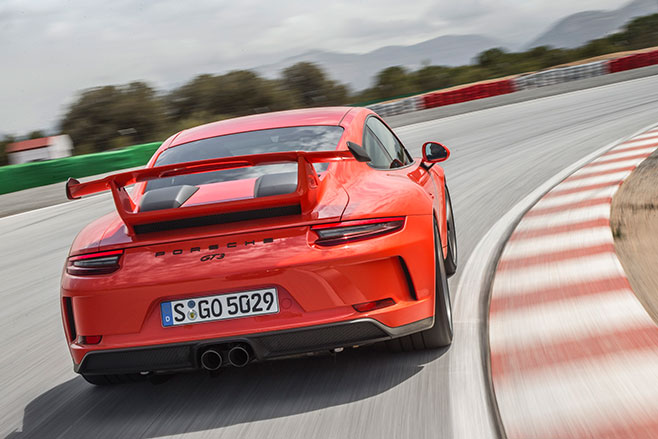
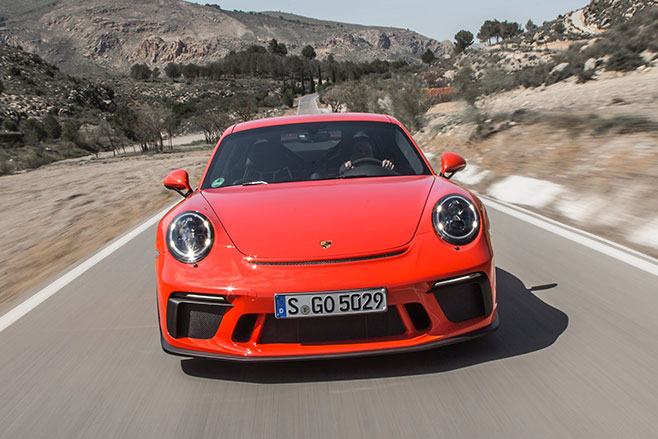
While only fractionally better than its predecessor, the new GT3 is one of the finest sportscars Porsche has ever made, designed to deliver on both road and track. While it’s certainly expensive, you’d struggle to find a better-handling car regardless of budget.
TELL ME ABOUT THIS CAR
Porsche’s GT cars have long been the company’s crown jewels, built by the same motorsport division that assembles the firm’s race cars. The new GT3 sticks with the recipe that has earned its predecessors a cult following: a race-derived chassis and powertrain that’s been made civilized enough for road use.
| 2017 Porsche 718 Boxster Review
It gets a new 4.0-litre flat-six engine that produces 368kW without turbocharging, revving out to a dizzying 9000rpm, while also offering a broader torque spread than the previous GT3’s 3.8-litre unit. There’s also the option of a six-speed manual gearbox alongside the standard PDK double-clutch gearbox, enthusiast customers demanding that Porsche bring the clutch pedal back.
While designed for hard use on track, the GT3 also copes impressively well with road use, with revised dampers giving a more compliant ride than its predecessor and composed cruising manners for something so hardcore. Despite costing $327,100 it’s not the most expensive car in the current 911 range, but it’s certainly the most exciting to drive.
STRENGTHS:
– The engine remains a masterpiece – the highest-revving sportscar engine in current production. While it can’t match the outright performance of some turbocharged rivals, it delivers instantaneous response and sounds amazing.
– Both gearboxes are superb – the PDK shifting gears pretty much as rapidly as you can frame the thought (and doing a good impression of a conventional auto when left to its own devices) and the manual boasting one of the sweetest shift-actions we can remember. Porsche reckons most buyers will stick with the double-clutch, but the DIY option is an equally valid choice.
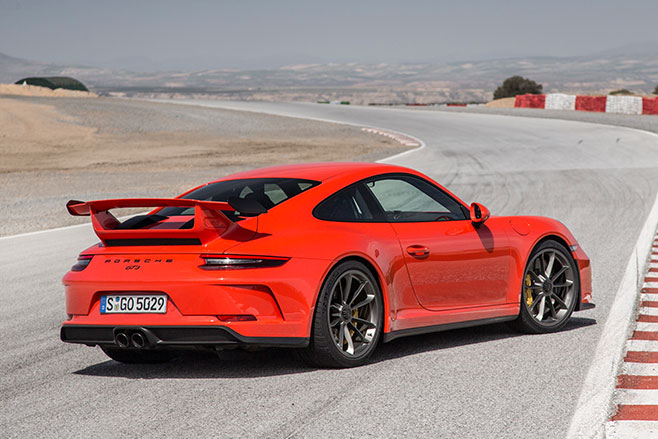
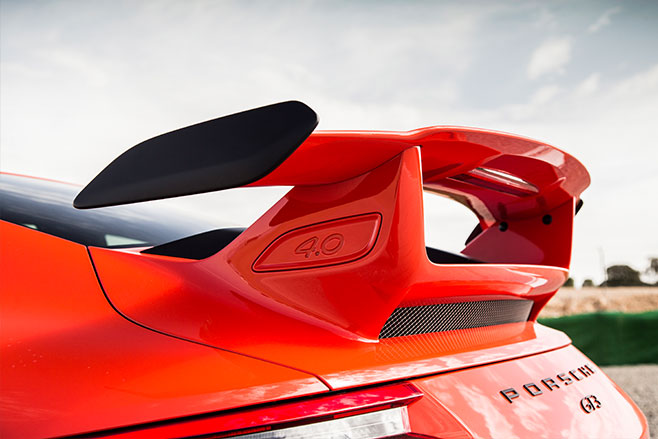
– Although the styling looks very similar to the last GT3 this one has been given a major aerodynamic makeover; we’re told that peak downforce has increased by 20 percent to 155kg – pushing the car into the ground at speed.
– Although happiest when being pushed hard, the GT3 is an impressively accomplished cruiser, with new Bilstein dampers delivering a surprisingly comfortable ride on broken tarmac.
– Australian spec cars will be fully loaded as standard, the only real option being whether or not to add Porsche’s carbon ceramic braking system. It’s worth considering for regular track use, but it’s probably overkill on road.
– Changes to the cabin have been minimal, although the arrival of Porsche’s new touchscreen interface – complete with performance-measuring apps – is a welcome improvement. The GT3 also has the same steering wheel as the 918 Spider hypercar.
| Porsche Macan four-cylinder will be cheapest Porsche ever
– Many manufacturers boast of motorsport technology, but the GT3 really delivers it – its engine is practically identical to that fitted to the GT3 Cup race car, and features a new track-grade dry sump oil system designed for the toughest use.
WEAKNESSES:
– The GT3 is impressively refined compared to its predecessors, but it’s definitely not as plush as rivals including Porsche’s own 911 Turbo S. It’s not as fast in a straight line, either.
– Lacking the “plus two” rear seats of the standard 911 limits the GT3’s practicality, although it does increase space for bags.
– The flat-six engine loves to work hard and responds enthusiastically to being revved hard, but the GT3 has noticeably less torque than most of its obvious rivals.
– The rear wing adds downforce but really gets in the way of the view through the back window; you could have a police cruiser sitting behind and not realise it.
– Porsche deliberately mismatches supply to the huge demand for its GT cars so many potential buyers are likely to be disappointed.
– Colour choice is limited and there are far less customization options than are normally offered with cars at this price level. The GT3 is all about driving.
ANY RIVALS I SHOULD CONSIDER?
Two stand out – the AMG GT R and the Nissan GT-R, both of which had their chassis development work done at the same place as the 911 – the Nurburgring Nordschliefe in Germany.
SPECS
Model: Porsche 911 GT3 (991.2)
Engine: 3966cc flat 6, dohc, 24v Max power: 368kW @ 8250rpm Max torque: 460Nm @ 6000rpm Transmission: 7-speed twin-clutch/ 6-speed manual
Weight: 1430kg (PDK) 0-100km/h: 3.4-sec (PDK)
Economy: 12.4L/100km (EUDC) Price: $327,100 On sale: Q3 2017
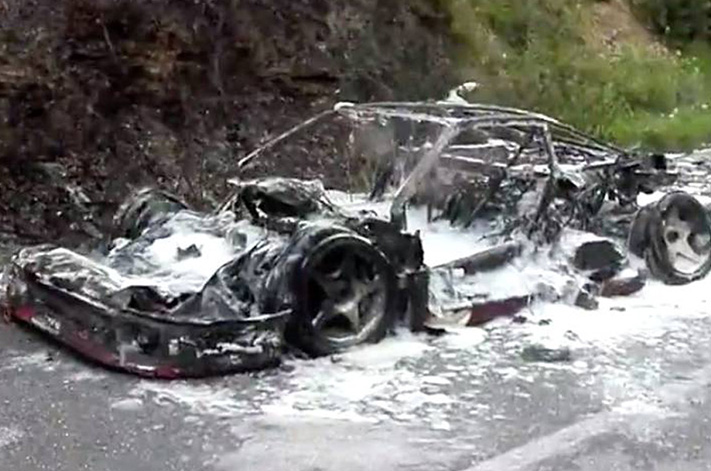
BRITISH real estate billionaire Jon Hunt endured a day to forget last month as his Ferrari F40 prototype burned to the ground during a cavalcade of Ferraris passing near Villanova d’Albenga, Italy.
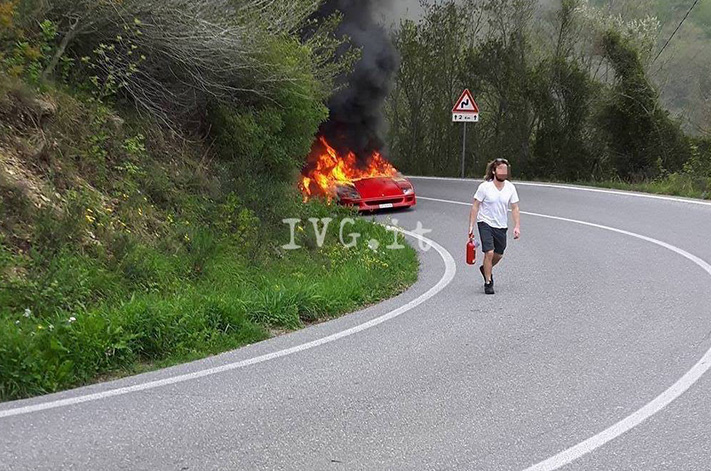
You might well be acquainted with Hunt’s irreverent ‘Tax The Rich’ videos on Youtube, but there was little to laugh about as the F40 display car from the 1987 Frankfurt Motor Show went up in smoke.
Ferrari design boss Flavio Manzoni interview
This car was the sixth of the F40 prototypes that were used by the factory for testing, each with an individual purpose or application. Original Michelotto build sheets indicate that 74047 was upgraded prior to its public displays, receiving extensive GT modifications between May and July of 1987, where it was, in fact, referred to as an F40 LM.

Hunt acquired the car at a Sotheby’s auction in 2012 and returned to its original Rosso Corsa colour scheme. It’s not his first run-in with a self-immolating Italian icon either. In 2013 his Lamborghini Miura SV went up in flames while being serviced, leading to a lengthy legal dispute.
A MCLAREN P1 LM has been spotted at the Nurburgring Nordschleife lapping like a record-hungry weapon during an industry pool session. A new street-legal lap record could be upon us.
Those still recovering from the furore surrounding Lamborghini’s controversial Huracan Performante 6:52.01 record lap of the 20.2-kilometre German racetrack may want to sit down, because we might finally find out how the P1 officially stacks up on the great leveller of racetracks.
To refresh your memory, the P1 LM starts life at McLaren as a track-only P1 GTR, before the Lanzante skunkworks responsible for the original McLaren F1 GTR gets its hands on it, tweaking it with the necessary modifications to give it road-legal status.
Only five P1 LMs have been sold to the public, with a sixth – spotted here with number plates still on it – retained by the company as a prototype.
At its heart is a 735kW twin-turbo V8 that sounds absolutely ballistic tackling the infamous Green Hell, even shooting sparks as it bottoms out before ascending a hill.
The road-legal P1 LM was developed on the Nurburgring, but this particular outing looks more focused than ever and smacks of a lap record attempt.
This car won’t be able to officially topple Lamborghini’s time, as the limited number of cars rules it out of the production car bracket. Instead, the P1 LM will be battling the Radical SR8 LM, which set a street-legal lap record time of 6:48.28 in 2009.
In this video the P1 LM is piloted by Kenny Brack, a man whose illustrious racing career includes a win at the 1999 Indianapolis 500.
If you’re not familiar with the P1 LM or Brack, let this video of the pair hammering up the driveway at Goodwood during last year’s Festival of Speed give a quick summation of their abilities.
As mentioned, this isn’t the first time a P1 LM has been spotted on the Nordschleife, with the be-winged beast harassing mere mortals during a public event in October last year. However, the car was carrying a passenger, and heavy traffic meant an outright lap time was never going to happen.
Now we just have to hope Lanzante makes its most recent lap times public.
The Guinness World Record for heaviest aircraft pull by a production car once again belongs to Volkswagen Group.
Towing a 285-tonne Air France Airbus A380, a Porsche Cayenne S Diesel managed to cover 42-metres of the tarmac at Charles de Gaulle Airport.
The previous record, set over 50m by a Nissan Patrol in the UAE, was a 170-tonne plane. 115-tonnes lighter than the Airbus pulled by the Cayenne.
It’s not really all that surprising that a Cayenne was able to get the passenger plane moving, as even though its 283kW power figure might leave a little to be desired for some, its 850Nm of torque is available from 2000rpm.
The 4.2-litre V8 engine, with that much twist behind it, means the Porsche Cayenne has almost three Nm of torque for each tonne it pulled along. More impressive than the one kW per tonne figure.
The Cayenne’s driver for this feat was Porsche GB technician Richard Payne who said it was probably the furthest he’d gone to test a car. We don’t think he’s lying.
“It did it, I’m so relieved! We don’t usually go this far to test the limits of our cars but I think today we got pretty close,” he said after the pull.
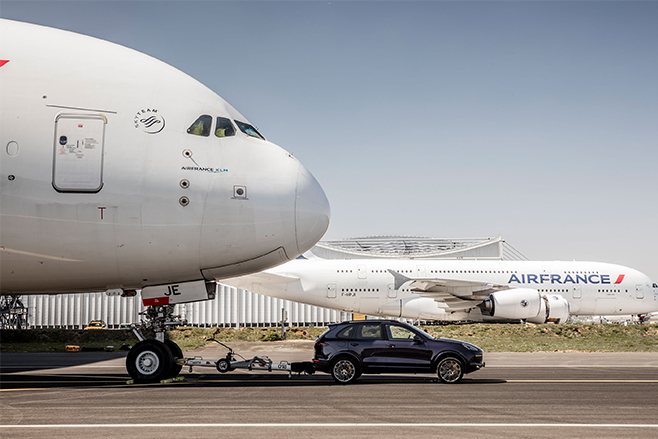
In 2006, a Volkswagen Touareg V10 pulled a 155-tonne Boeing 747 along for 137m. Sure, it’s a lot further than either the Patrol or the Cayenne made it, but the Airbus A380 is about 1.8 times heavier than the 747.
We’re also not sure if the Touareg was driven again afterwards, as Payne says he did with the Cayenne.
“We drove the car here from London and I plan to drive it home again, having towed an A380 in between.”
Best day at work ever? Probably.
HYUNDAI has confirmed its i30 family will expand with a high-performance N-badged version of a yet-to-be-released fastback model.
Utilising a lower, sleeker shape that trades off interior space for an edgier look, the i30 fastback will be shown within months – and Hyundai’s European design chief Thomas Buerkle confirmed it will include an N hot hatch version.
“The car is still is still secret … it is a coupe-ish version of the i30 which will come also as an N and will furthermore show that we are bringing a whole family,” said Buerkle, who is in Australia for the launch of Hyundai’s top selling model.
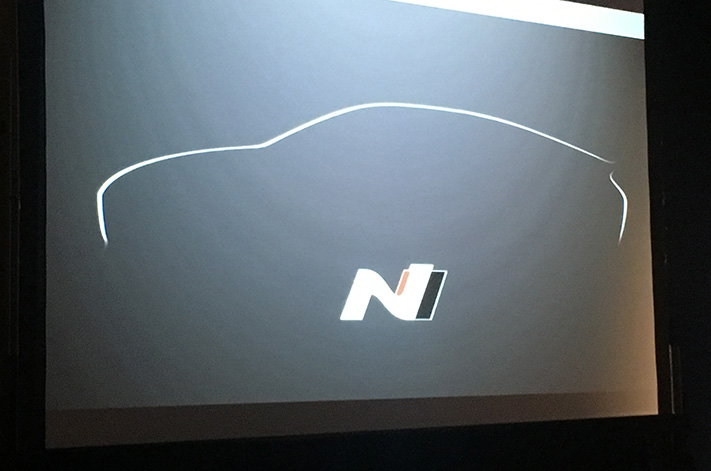
“It’s a very important segment … and the joy of driving and the joy of design should be in the foreground.”
As with the regular i30 N hot hatches, the i30 N fastback will get the choice of either a 184kW version of the 2.0-litre four-cylinder turbo or a 202kW version, the latter teamed with a stiffer, more aggressive chassis set-up aimed at the racetrack.
That latter version is also expected to get all-wheel drive, as well as a slick-shifting eight-speed dual-clutch transmission to give it a sub-five second 0-100km/h time.
Hyundai has already tested the i30 N in Australia, with a Wheels reader spotting the car north of Sydney earlier this year.
Expect more tuning and development work to take place between now and the anticipated late 2017 arrival.
At the other end of the scale, Hyundai is considering a new entry-level i30 to slot in below the Active, which is priced from $20,950.
Speaking at the launch of the i30, Hyundai Australia chief operating officer Scott Grant said the long list of equipment in the i30 Active opened the door to a more affordable model sometime during the life of the car.
“We think that in the spec that’s available to us in time … it may be possible for us to create a cheaper version at some point in time,” said Grant, adding that there was nothing planned yet.
The base i30 Active comes with alloy wheels, an 8.0-inch touchscreen, satellite navigation, Apple CarPlay and Android Auto connectivity, wireless Qi smartphone charging, a reversing camera, rear parking sensors and tyre pressure monitors.
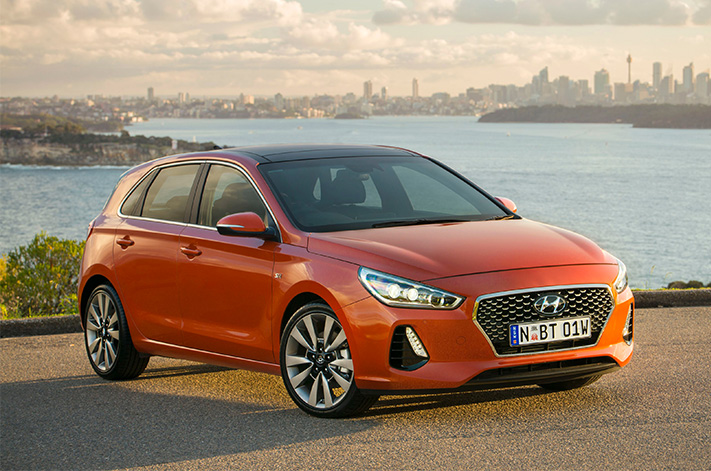
While the headlines from Hyundai were about a $500 price reduction of the list price (before dealer and on-road costs), the reality is the i30 has gone up in price once drive-away pricing is applied. An Active with an auto transmission costs $24,990 on the road, some $5000 more than the $19,990 deals for the old i30 introduced at various times throughout 2016.
Grant said he believed that in a couple of years delivering an i30 closer to $20K might be a possibility by reverting to steel wheels and taking some of the high level of equipment out.
He also said some of the ground that the i30 used to play in could be covered by a new light car, such as the new generation Accent that’s due late this year or early in 2018.
As for discounting the current car to $19,990, Grant said it won’t happen.
“We’re playing a longer game now than we used to,” he said of a car planned to shift perceptions of the Hyundai brand, moving from cheap and cheerful to a more serious competitor to Toyota, Mazda and Volkswagen.
“Our strategy … is there’s a point in time … where you’ve got to bash and crash and burst through like a bull in a China shop in order to push product into the marketplace to be able to prove that you’ve got some scale and capability.
“Then there’s a time when you sort of need to do less of that and in a more mature sense reinvent yourself and go again in a different way.”
In some ways it’s similar to the strategy that Toyota used in the 1980s, whereby it built market share then went about building an aspirational reputation.
IS A quantum leap in automatic emergency braking coming to the next-generation, Aussie designed and developed Ford Ranger?
Spy shots snapped in mountainous Colorado in the US suggests that the ability to jam on the brakes even before a driver recognises they are in trouble is under development – one of the big changes due for Ford Australia’s best-selling vehicle.

It also means the Ranger will get a more advanced active cruise control system; tacit recognition that people are buying these cars as replacements for normal passenger vehicles and SUVs that dominate the market.

Left-hand-drive Ford Ranger development cars have been spotted testing in Victoria, close to the home base for the global T6 program that spawned the original version of the trade ute. However, the net-gen car is preparing for an introduction to the North American market for the first time – where pick-up trucks of all sizes are big business.

The updated Ranger could also introduce Ford’s new “Panther” engine, a turbocharged 2.0-litre four-cylinder diesel unit that is likely to replace the current 2.2-litre turbodiesel engine in cheaper versions of the Ranger.
Have spy pics of your own? We’d love to see them. Just email them to [email protected]
This is a day out at the Nurburgring we want to see the lap times from.
Rumours (at this point, at least) have been circulating of a particularly fast lap of the Nurburgring’s Nordschleife which was run by Indy 500 champion Kenny Bräck in a McLaren P1 LM, a road-legal version of the P1 GTR.
Video shows Bräck taking full advantage of the McLaren P1 LM’s potential, though we can’t be sure just yet that he has actually achieved the supposed 6m 48s lap.
If it’s true, it’ll mean that Lamborghini’s recent record has been smashed by about four seconds.
It’s also particularly impressive compared to the 6m 57s run by a Porsche 918 Spyder in 2013, and the famous 7m 08s NISMO GT-R lap in 2013.
Despite setting a time with a regular P1, McLaren has famously refused to release it, stating only that the car went “sub-seven minutes”. This gives credibility to the lighter, more powerful and more aerodynamic P1 LM achieving a 6min48sec.
It can’t be verified yet, as witnesses have pointed out that Bräck didn’t run continuous laps (which could be roughly timed by onlookers), stopping after each one to make changes to the car.
They did, however, get to see the McLaren hit one dip so hard it grazed the tarmac (watch 0:25 and 1:06 in the main video).
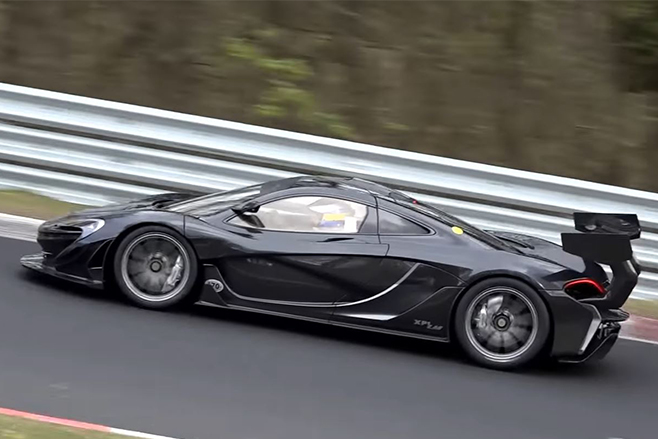
Now retired, the super-Swede was also the one who set a hillclimb record in the P1 LM at Goodwood last year.
When you’ve walked away from one of the most horrific crashes ever, as Bräck did, you’ve got to keep your retirement interesting.
