
When you watch the video above, it’s hard not to feel pangs of sadness at what’s been lost.
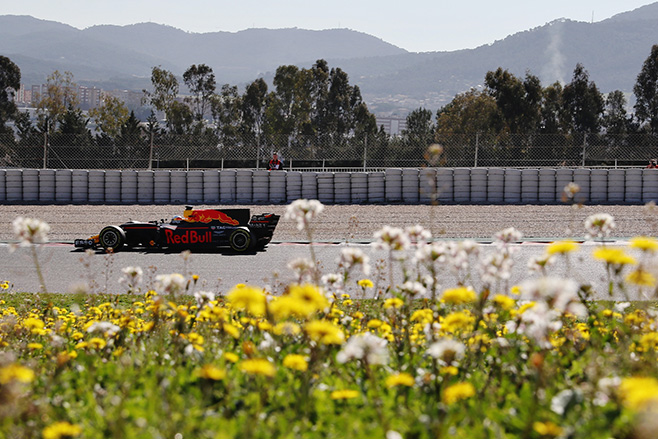
Someone out there in internet-land has cleverly dubbed old audio clips of V8, V10 and V12-powered F1 cars over footage of the latest machinery in action in Barcelona last week. It’s been synced extremely well and offers an insight into the spectacle we’d have had the new-generation hybrid power units not been adopted.
While the hybrid power units are incredibly impressive pieces of engineering, with 50 per cent thermal efficiency (previous V8s were around 30 per cent) and up to 745kW from just 1.6 litres, they don’t provide the same physical assault as the engines of old.
Anyone lucky enough to have experienced the old V10 engines at 19,000rpm will vividly remember the way the sound seemed to rattle your internal organs.
Unlike many, here at MOTOR we don’t think the new engines sound bad, for they sound quite interesting in a futuristic kind of way, and it’s nice not to go home from the F1 with a headache, but there’s no doubt that the aural assault was a big part of why so many fell in love with F1.
There is hope on the horizon, however. The current engine regulations are around until 2020, however beyond that it’s a clean sheet of paper once again, and F1’s new sporting boss Ross Brawn has already begun discussions regarding what the next engine should be.
While it’s unlikely 20,000rpm screamers will ever return, Brawn is well aware that sound is a huge part of the appeal of motor racing so hopefully the next generation of F1 cars will have punters reaching for the ear plugs once more.
Volkswagen has launched a maxi version of its popular Tiguan SUV with the ability to carry two more passengers.
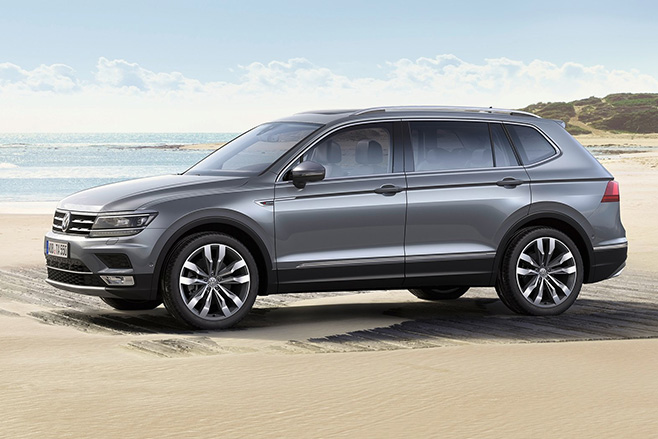
The Tiguan Allspace is 215mm lengthier than the second-generation ‘classic’ Volkswagen Tiguan and has a 109mm longer wheelbase.
Rather than simply being a stretched Tiguan it was independently designed, with longer rear doors and overhang, and a raised bonnet line to maintain proportions.
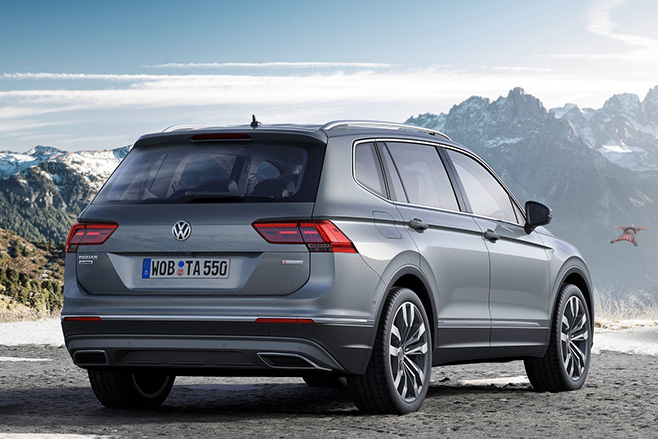
While it shares a close family resemblance to the smaller Tiguan it’s proportionally similar to the Volkswagen Atlas that was developed for the US market and was considered for the Australian market though now this seems an “increasingly unlikely prospect”.
The extra sheet metal translates a 760-litre rear cargo compartment; 145-litres bigger than the standard Tiguan. With the rear seats folded down it holds a small-van like 1920-litres.
The extra space can also be used to add two more seats for the school run with enough room (230-lItres) to wedge all the schoolbags inside the tailgate.
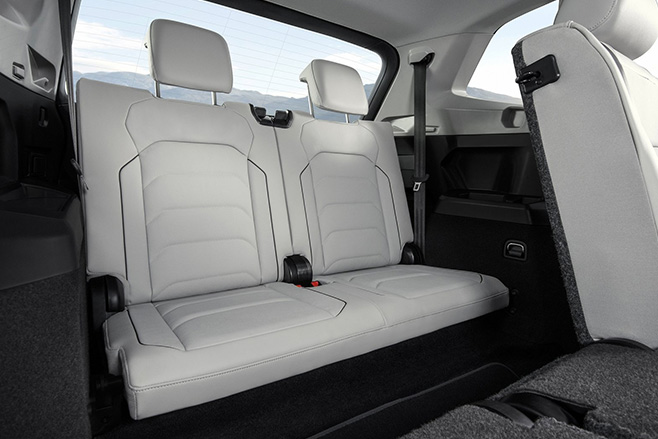
When not in use, the third-row seats can be folded down and integrated in the cargo floor to hold 700-litres or 1775-litres with the middle row folded down.
The total additional space also benefits the rest of the cabin with 54mm more knee room in the second row.
The Tiguan Allspace comes in three variants, Trendline, Comfortline and range-topping Highline with equipment levels similar to that across the classic Volkswagen Tiguan range.
Engine options for Australian models are yet to be confirmed but expect to see a similar range of engines as already available in the classic Tiguan range including the 110kW 1.4 (litre) TSI with Active Cylinder Management can achieve just 6.0L/100km and the 132kW and 162kW 2.0 TSI options.
Oil burners will probably be the 100kW and 140kW 2.0TDI engines already available here. A 176kW range topper will also be available in European models. All TDI engines are equipped with an SCR catalytic converter and a twelve-litre AdBlue tank to reduce nitrogen oxide emissions to a minimum.
Drivetrains include front- and 4Motion all-wheel drive. 4Motion is optional with the smallest diesel engine and petrol engines and standard with the rest.
The Tiguan Allspace will be launched in Europe in the second half of 2017 but won’t be available here for at least another 12 months. A Volkswagen spokesman told WhichCar it was too soon to confirm local pricing and specifications
Shane comes out with all guns blazing on Adelaide streets
Awesome Clipsal 500 start to Supercars 2017 for the defending champ
Awesome could be Shane van Gisbergen’s favourite word. Count on him trotting it out in every interview.
And awesome adequately describes his performance over the 19th Clipsal 500 weekend, round one of the 2017 Supercars Championship.
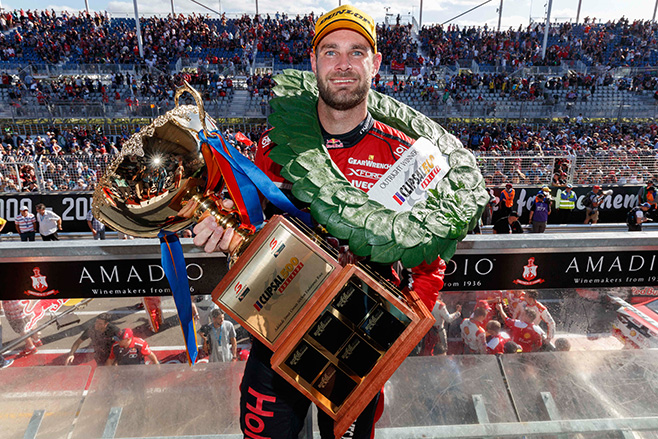
Perfect. A maximum of 300 championship points. That’s 51 points up on his nearest rivals Fabian Coulthard and James Courtney.
While van Gisbergen was chillingly dominant on Saturday when he won by nearly 15 seconds, he was forced to fight desperately on Sunday, with DJR Team Penske’s hot young signing Scott McLaughlin holding the lead until the 75th lap of 78.
Van Gisbergen pulled back an eight-second margin after the final pit stop to close on the Falcon. McLaughlin succumbed to the pressure, locked his brakes, and SVG was through to claim his second win of the weekend and his second Clipsal 500 title.
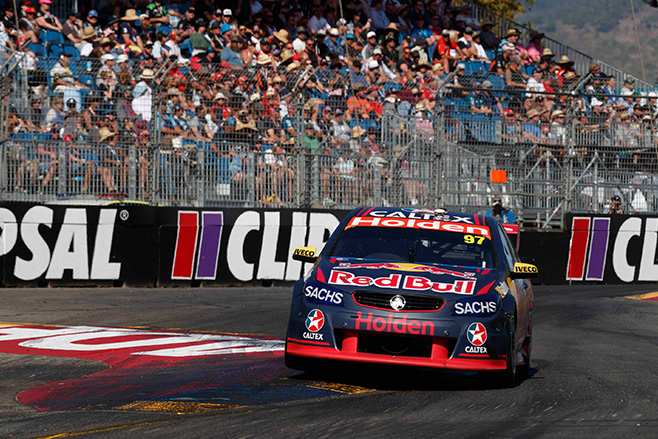
Van Gisbergen said that despite his dominance on Saturday, the weather conditions gave him a challenging time.
“Being a kiwi anything over 20 [degrees] is tough,” he added. “But the cool suit was working and I kept drinking.”
The 28-year old says there is still plenty of improvement to make to his new Commodore. What was evident in Adelaide though is the Triple Eight powerhouse will again be hard to topple. Even so, we can anticipate season-long warfare between Red Bull HRT and a clearly invigorated DJR-Team Penske.
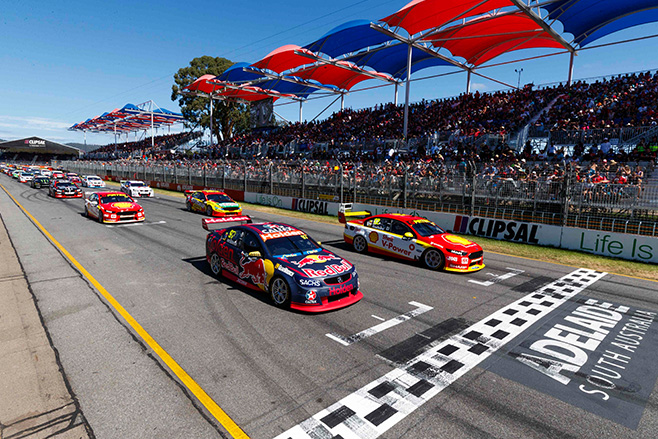
“I thought today could’ve been the day we got our first win, but there’s a lot of promise there,” McLaughlin said.
“I’m just gutted – you lead a whole race and then you lose it. I’m not confident with the brake package at the moment and I’m getting used to that. Once you lock the rears you’re done.”
Still, McLaughlin’s second place on Sunday coupled with his Ford team-mate Coulthard’s second on Saturday were good indications that the off-season reorganisation and rebuilding at DJR Team Penske has had a positive effect. Coulthard (fifth on Sunday) has certainly lifted to the challenge of having a speedy young driver in the adjacent garage.
McLaughlin’s Saturday went from okay to merde when he was pinged by officials for weaving during the lap before a restart, resulting in a pitlane drive-through and a loss of 19 places – fifth to 24th. Way too harsh an outcome for a minor infraction. But rules are rules. He climbed back to 15th.
Four-car Prodrive Racing (Australia) had a mixed weekend. Chaz Mostert recovered from an eventful Saturday when, beset with brake issues with his Ford, he was a lowly ninth to take third on Sunday. But Mostert admitted the team has some considerable work to do to get on terms with Triple Eight. Cameron Waters was pleased with his weekend, adding an eighth in the second leg to his excellent fourth a day earlier. Mark Winterbottom had a shocker by his standards, logging lowly 15th and 14th place results.
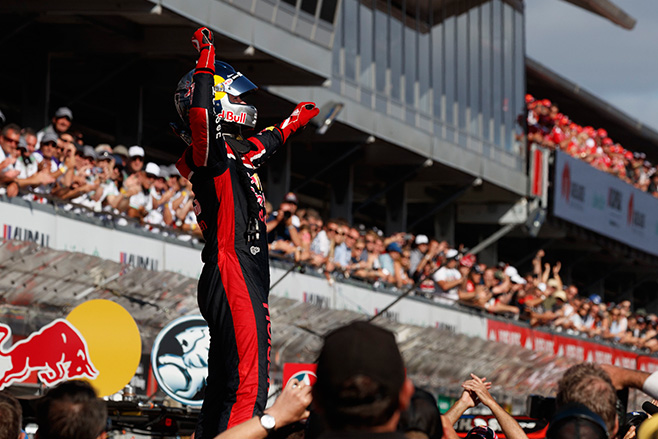
While van Gisbergen started his championship defence in a crushing, emphatic way, the man who was the kiwi’s great rival for the title last year, his Red Bull HRT teammate Jamie Whincup, had a tough weekend. He was handicapped by an ordinary qualifying Shootout performance on both days leaving him playing catchup in each race. Whincup’s race chances took a hit on Saturday when his team called him to the pits on lap one in anticipation of a safety car that didn’t eventuate. His Sunday race was compromised by a kerb hop in his Shootlap lap which relegated him to a 10th starting spot. He finished sixth each day.
Said the six-times champ at the end of the second 250km contest: “We fought hard, I’m pretty proud of what everyone’s done, we just can’t take a trick with the strategy. We put a heap of petrol in and really relied on a safety car. Who would have thought there would be no safety car in 250 kilometers!”
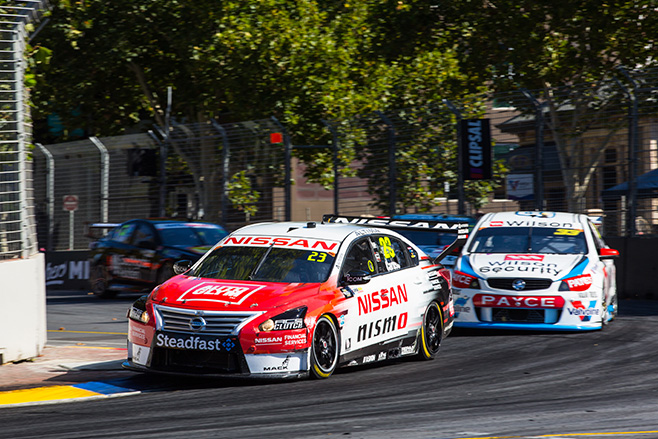
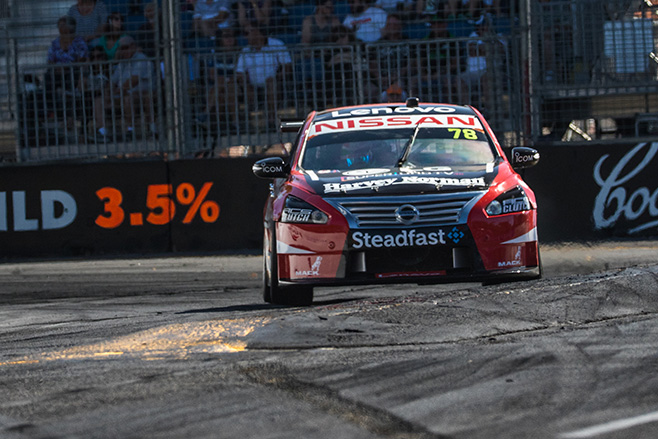
Nissan’s pre-season testing pace proved flattering when the serious business began on Saturday, although Rick Kelly recorded a healthy fifth on Saturday. That was as good as it got, though, Todd Kelly’s ninth of Sunday being the best Altima result in the second leg.
The Garry Rogers Motorsport drivers landed good results considering the off-season crazy-rush to produce two Commodores to replace the departing Volvo hardware. Seemingly very comfortable in the Holden, Moffat started with a 10th and then took 16th the next day. Garth Tander, who was his consistent self with 12th and 11th place finishes, indicated there were improvements to come.
Drivers had to deal with sweltering temperatures as high as 35 degrees C on Saturday, but a cooler 27 on Sunday. And the new Dunlops offered better grip; Courtney revealed that infamous Turn Eight (which claimed Will Davison and Nick Percat this year) is 10 km/h faster than before.
The first female full-time driver in the Supercars era, de Silvestro impressed in just her third Supercars race weekend – and first solo hit out. She finished 20th in her first time on the awkward Adelaide street track, her best lap time just 1.1sec off the best. The Swiss looked remarkably lively and fresh after the 250 km at the wheel of the Nissan Altima in searing heat, backing up on Sunday when she placed 23rd (after being spun by Courtney as she tried to enter the pits and also pushed back by a pit lane penalty for the over-use of kerbs).
He qualified his LDM Holden at the rear in both races but the youngest driver in Supercars history stayed out of strife to finish 23rd and 25th.
“The hardest thing was to maintain 100 per cent focus, and manage the numb foot,” reported Rullo after Saturday’s debut.
A crazy Super2 development series race on Saturday reinforced the point that the sport lacks driving depth and that quite a few younger drivers need to go back to karts or a cheaper formula to refine their skills.
A very modest crowd turnout for the final Adelaide 500 under Clipsal sponsorship was surprising given the interest in the off-season musical chairs and arrival to the series of the first full-time female driver in decades.
The search is on for a new sponsor to take over the naming rights next year.
Testing times for Formula One
Cars look better, yes. But what about the racing?
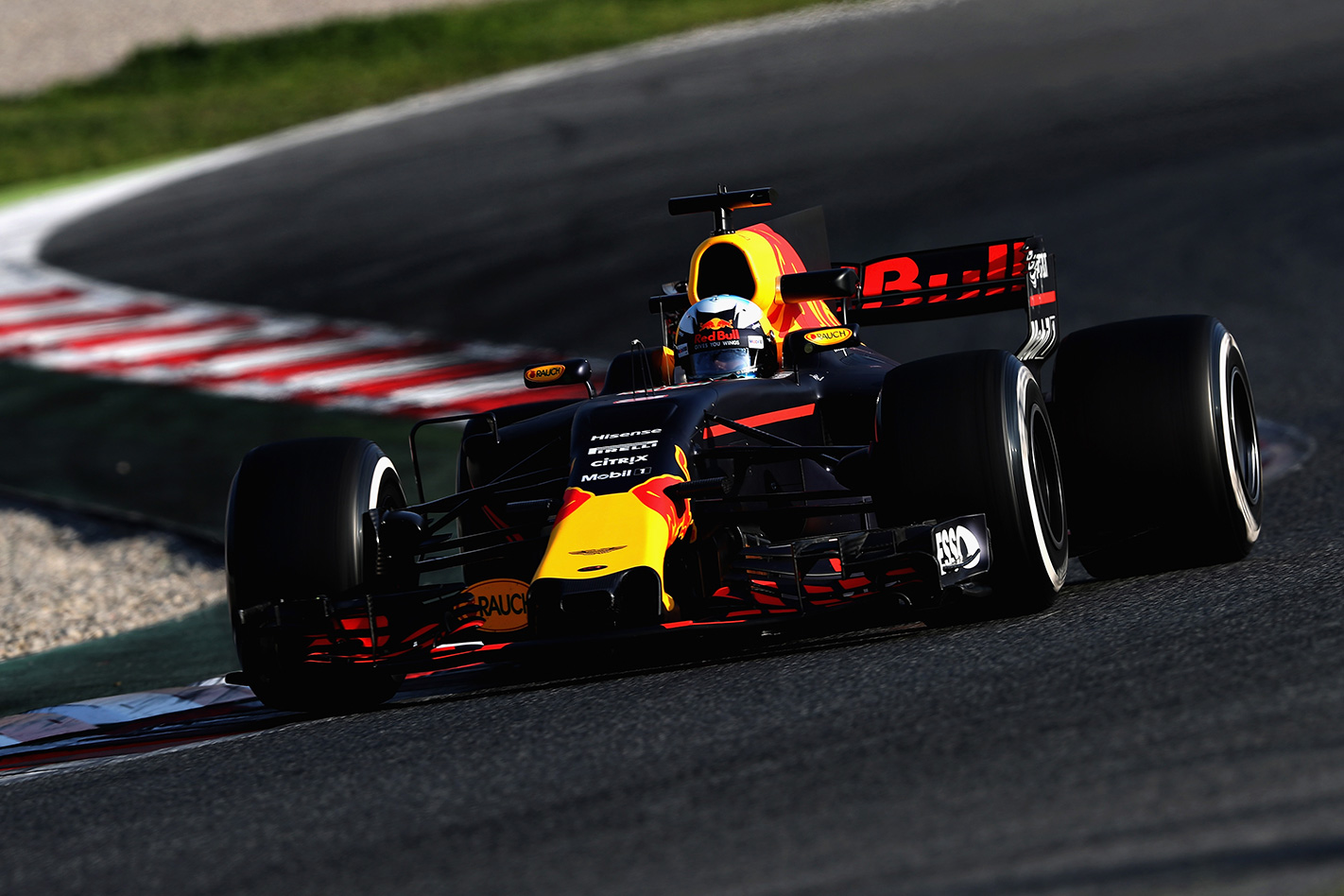
And the lap times are supposed to be way quicker…up to five seconds per lap swifter.
The new regulations were aimed at shaking up the racing. And, yes, they are quicker, and the drivers seem to be braking later than ever and turning in to corners at higher speeds thanks to the increased aero and wider rubber. Pleasingly, a few of the also-rans of 2016, Renault and Haas, finished the opening test further up the time sheets than we may have expected. Worryingly, McLaren struggled with pace and (mainly) reliability.
Let’s make the point though, that the pecking order in testing is not terribly accurate. Cars and driver combos are inevitably running on varying programmes – different fuel loads and tyre compounds.
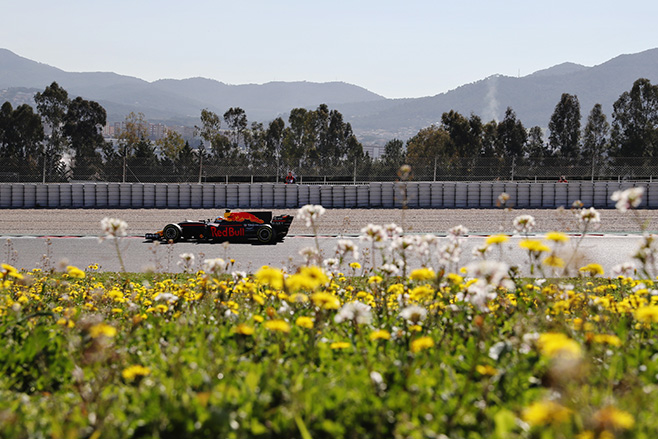
Also, some drivers and pundits have expressed concerns that overtaking – always a tough proposition in modern F1 – may be harder this year.
Predictions too that the increased aero and higher cornering speeds would make the task of the drivers way tougher don’t appear to be ringing true.
Most seem to be doing things rather easy. The cars are sticking like Velcro, with little evidence that the drivers are fighting power oversteer or generally instability.
They are faster, certainly. But not way faster. Not yet.
Daniel Ricciardo, thicker of neck this year after off-season training to help combat higher Gs, reckons the cars will go quicker in warmer weather when the Pirelli tyres fall into their optimum operating temperature range.
Several drivers have commented that rather than having to fight the faster cars, they are enjoying the enhanced grip and stability in the faster corners.
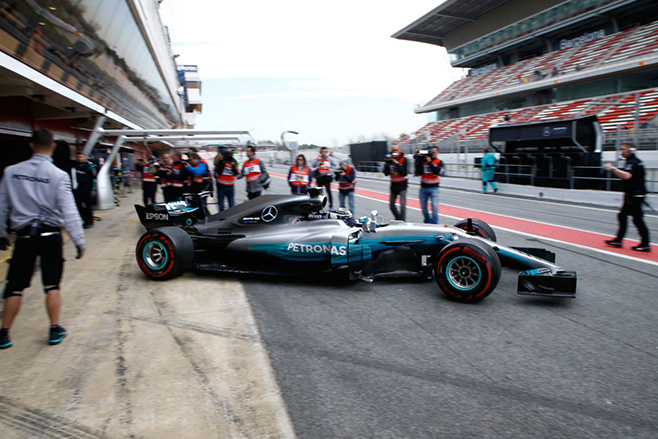
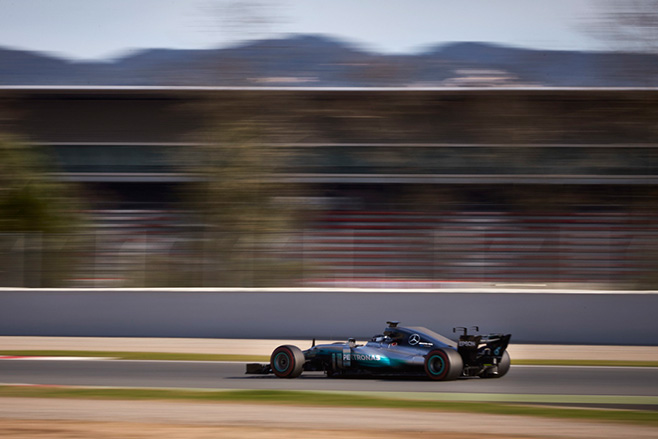
Straight off, the Mercs looked reliable and quick. Lewis Hamilton finished day one on top. New arrival Valtteri Bottas adapted swiftly and was quick with it. Not as fast as Hamilton, mind, but close.
The Ferraris were also reliable and quickest on two of the four days, but we’ve seen that before from the red cars. This time though, the Scuderia looked more methodical and consistent and not so interested in meaningless glory runs to soothe the egos of demanding senior management back in Maranello.
Red Bull Racing methodically worked through its program after an initial hiccup on the opening morning. Some observers seemed surprised that the new Adrian Newey-penned RB13 didn’t have obviously revolutionary body/aero styling that might make it a world beater this year.
At Barcelona, its cars were about where they were in the pecking order last year.
So far though, Mercedes seems to have maintained its advantage over the rest, despite the comprehensively revised Renault power units putting out more grunt.
The second wave of official testing starting Tuesday may tell more.
Ford 410cc Sprint Car Engine in pipeline
Tony Stewart, Donny Schatz and Ford in joint engineering project
The current GM-based 410ci sprint car engine that has been almost obligatory in this brand of oval track racing for many years is about to score some tough competition from the Blue Oval.
Reigning World of Outlaws Sprint Car Series champion Schatz, who races under the Tony Stewart Racing banner, has indicated that the team is well down the track in developing a 410ci sprint car engine in conjunction with Ford.
Schatz said that the Ford-badged engine will be used in the Outlaws competition when it is both reliable and producing the levels of horsepower to be a potential winner.
The new Schatz-Stewart-Ford partnership brings an end to the star driver’s lengthy relationship with GM Performance.
Schatz will continue with the same Rod Shaver Engines powerplants he ran in 2016, when he landed his eighth Outlaws series championship.
Schatz’s revelation coincides with the switch to Ford by Stewart-Haas Racing, co-owned by Tony Stewart Racing team owner Tony Stewart.
There have been Ford engines in 410 sprint car racing previously…but the Blue Oval penetration of the sport has been barely evident beyond Dave Blaney’s 1995 World of Outlaws championship win driving a Ford-powered car owned by Casey Luna.
MERCEDES-Benz has teased the Mercedes-AMG Concept – a four-door Porsche Panamera-fighting version of its sleek performance coupe – ahead of its reveal at this week’s Geneva Motor Show.
While much of the styling is familiar, what’s big news about this teaser for what will become the third member of the GT family is the introduction of “EQ Power” – a 450kW-plus kinetic energy recovery system-equipped hybrid engine that taps on the carmaker’s extensive Formula One experience.
The EQ Power logo is inscribed on what looks like a camera-based system that replaces traditional wing mirrors. It might also be little more than a trick of the light, but the concept also appears to feature active aerodynamics around the grille and front air intakes. Down the rear, a single exhaust shaped like a princess-cut diamond features prominently.
Little more is known about the concept ahead of its Geneva launch, but as a genuine rival for the Porsche Panamera Turbo S E-Hybrid that is also having its debut at Europe’s premier motor show it is expected to also have a plug-in battery system that allows for an all-electric driving range of about 30km. A conventional twin-turbocharged 4.0-litre V8 is expected to feature as an alternative.
The carmaker’s AMG division celebrates its half-century this year, with the Mercedes-AMG Concept tipped as its celebration model.
The Mercedes-AMG super-saloon will accompany the already announced R50 hypercar, powered by the V6 from the current generation of Mercedes Formula One cars.
Codenamed the X290, it is reported the GT-based four-door is the pet project of AMG boss Tobias Moers, and expected to be pitched as a Bentley Continental GT and Porsche Panamera rival.
Although expected to carry styling cues of the two-door GT coupe, the four-door GT 4 won’t be built on the same chassis, with Autocar in the UK reporting it will get a different platform to the aluminium-intensive structure that underpins the 911 rival.
Instead, the GT 4 will use the modular rear architecture from parent company Mercedes-Benz, and already used for the C63, E63, and S63.
Mercedes-Benz will have a strong showing at Geneva. As well as the GT 4, the carmaker will reveal its E-Class Cabriolet, and a major makeover for one of its strongest-selling models in Australia, the GLA compact SUV.
Special editions of the Mercedes-Benz SL Roadster and SLC coupe will join the X-Class, a luxury version of a worksite-friendly trade ute, on the Geneva stand.
It will also show one of the strangest vehicles to be unveiled at the Geneva Motor Show; a V12-engined, luxury laden folding roof version of the G-Class off-roader called the Mercedes-Maybach G 650 Landaulet. Only 99 of the cars will be built.
DAY ONE: So once again the planets align and the cry for counsel rings out from those contemplating the investment of half-a-house-worth in the hastening of their commute. And once again the editorial commitment is made to suffer the swiftest bolides in all the land solely for the edification of you, dear reader. As bloody if.
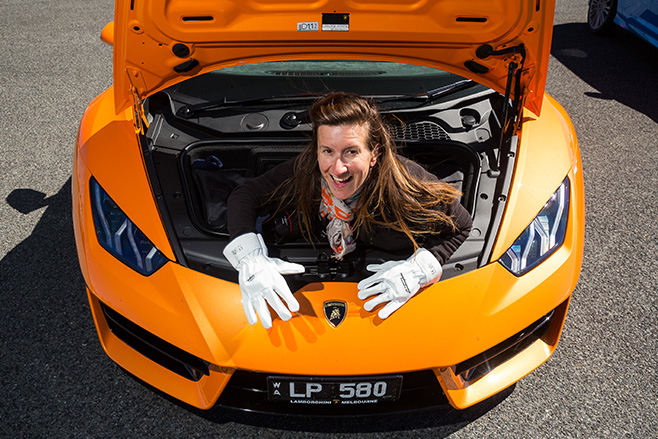
But this is no ordinary PCOTY, oh no. The field has broadened from the pick-which-Porsche pack of recent years to include serious contenders from Ferrari and Lamborghini… and this maturity will be matched by the addition, to the jury, of Ex-Editor Tim Robson and Bathurst-blaster John Bowe, finally resulting in a panel old enough to grow a beard.
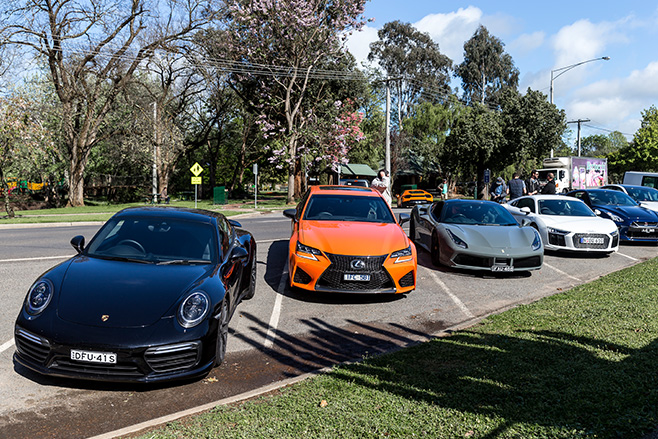
And, finally, once again I am invited to chronicle the endeavour and, though humbled, again caused to wonder why they can’t do it somewhere near my place and in the afternoon. But no matter, because when all hands assemble, with greetings and sharing of recent adventures, it is a moment of merriment diminished only by Photographer Dewar’s complaint of a breast freshly damaged by mosquito bite… and immediately revived by the wave of inspection and offers that show how truly caring this ensemble is.
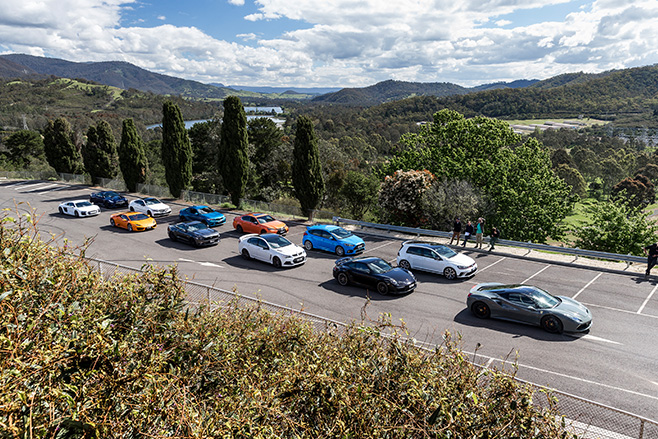
And just walking among them is both rewarding and informative because each car reflects its nation’s soul with a clarity that no other manufactured product achieves. From the pragmatism of Germany’s offerings, the flamboyance of America’s, the family-based bloodline of Australian endeavour and the detail-fanaticism of Japanese creation, each design reveals its origins beyond any need of badging. And nothing does so more than the art-above-all loveliness of Italy’s finest, headlined this year by Ferrari’s 488 GTB.
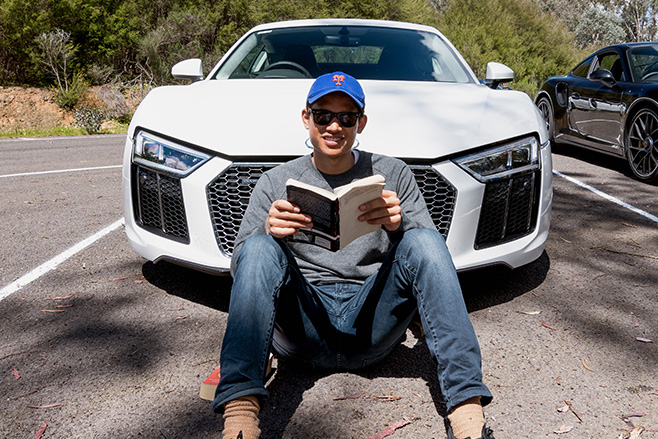
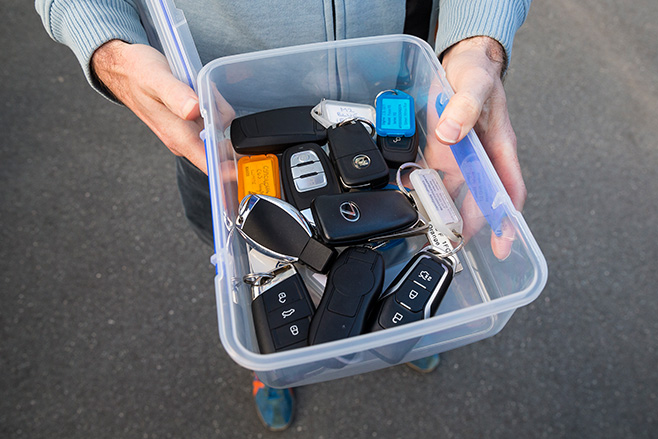
DAY TWO: As unnatural as it is for any man to see the dawn, the chorus of 86 cylinders being whooped into warmth by the keener among us has a perversely appealing charm. And the thought of running them all to a racetrack straight after breakfast does nothing to diminish the effect. Accordingly, we are each invited to select a random key from the glitter box and it helps if you know what a Lamborghini fob feels/looks like – $10 posted, clearly marked with my name, will help you find out.
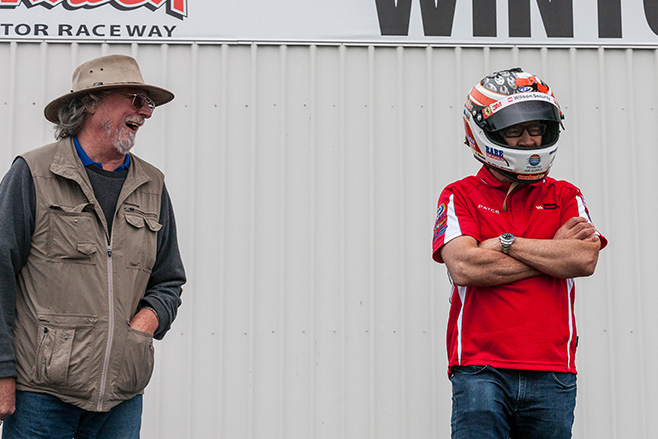
Thus aroused, all hands assemble at Winton Raceway where the day begins with a touching (metaphorically) display of concern over the state of Photographer Dewar until enquiry reveals that the latest bites harmed only her arm, which lowers compassion considerably. Consideration instead turns to the ominous rain-clouds looming over the circuit which threaten the collection of Adult Bowe’s crucial lap-times and will surely impair the rest of the judge’s high-speed evaluation. Accordingly both the art department and administration are thrown into confusion and, in the frantic discussion that ensues, Morley’s suggestion that we hold PCOTY in Jordan next year, whilst certainly appreciated, does little to immediately assist. I can only thank providence for the morning’s crossword.
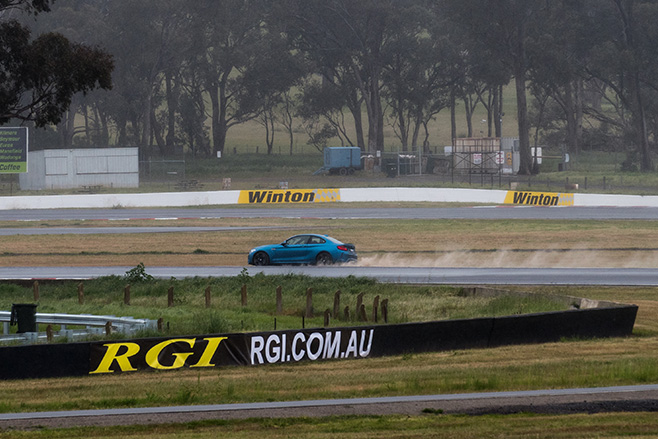
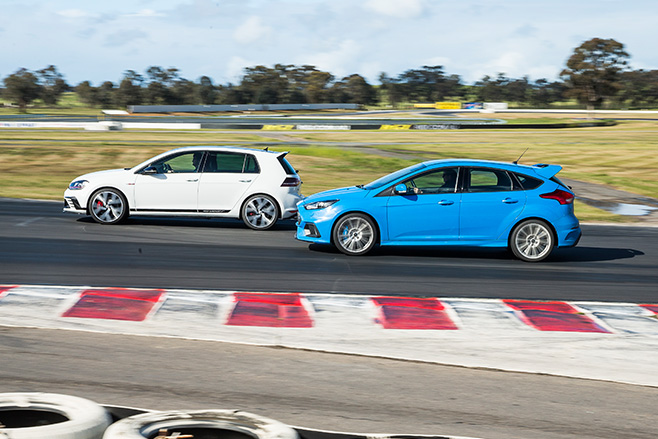
And with some – extraordinary – numbers finally collected, comes the end of day key grab for a car to take each of us to dinner. By now I’ve figured out how to get the Ferrari key as well (hint: it’s the red one). And I love it from the moment I enter it. From the embrace of its seating to the intuition of its controls, its design intelligence impresses… and is, with every passing kilometre, underlined by a profound appeal to so many other senses. Beyond rewarding the eye, this car’s touch and textures arouse an intimacy few others achieve and, oh yes, there’s the sound. Okay, I’ve read about it, but nothing prepares you for the sound of a Ferrari 488 GTB. It’s truly fabulous and I want this car more than any other that I’ve met through this magazine. That’s a lot of cars. A lot of years.
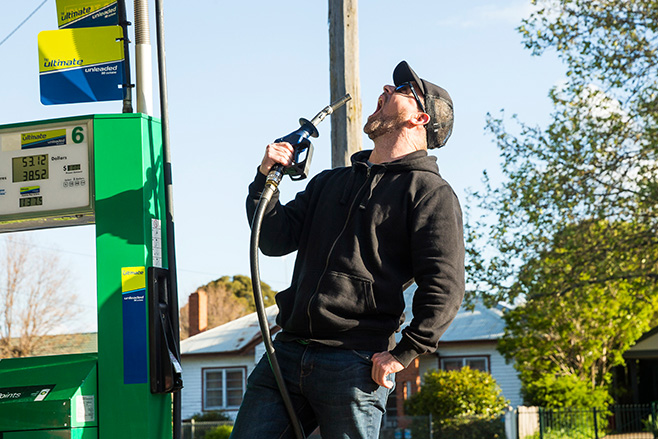
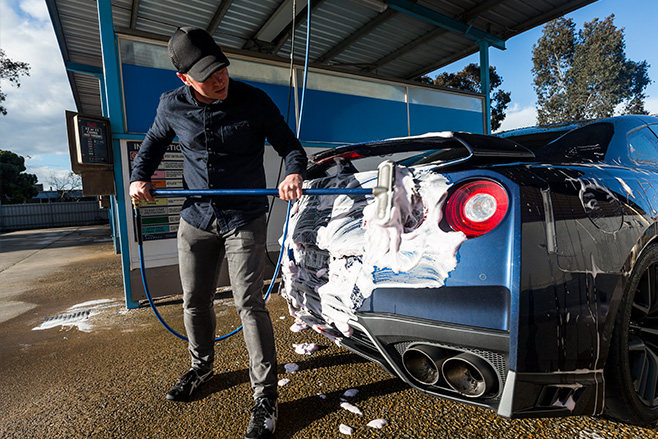
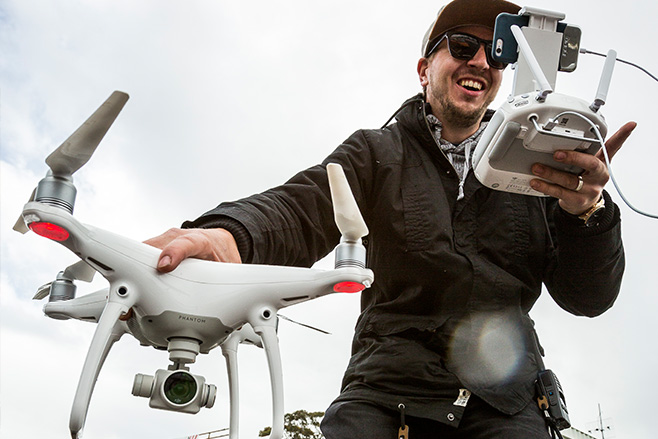
To address the task this year, conventional cameras have been augmented with a gyro-balanced, photo-capable drone, amazing technology that should provide stunning views of the fleet set in a landscape lovely beyond words. Sadly, though, it relies on operator judgement… which explains why this recorder of elegance is, instead, occupied hovering over Morley taking a distant piss in the pristine and we can only hope standards rise before all light fades.
But as usual, and to my eternal puzzlement, no-one’s sought my opinion again this year. So the judges must now formalise the crucial choice between feelings and figures for long into the evening.
And I’ll leave them to that one, happily.
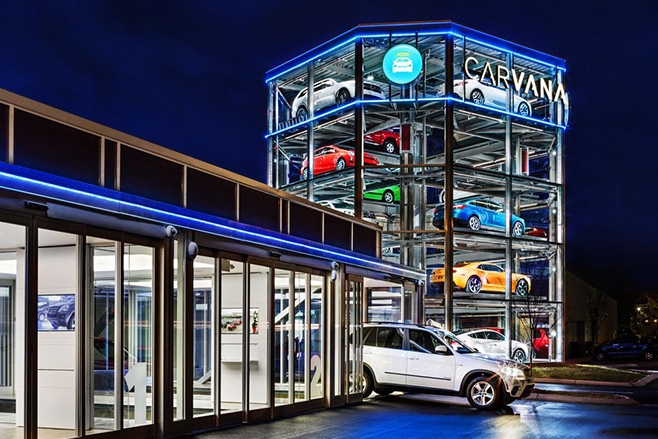
A US company is swapping traditional dealerships for a complete online experience – and even giving customers the option to pick a new car up at one of its four coin-operated vending machines.
Other than the missing bricks and mortar, Carvana claims the process is much the same as at a traditional dealership. Starting with an online search, the would-be owner takes a virtual wander around the car using the site’s 360-degree images before it is delivered to their door for a test drive. However the test-drive period or, what the company describes as a ‘test-live period’, can be up to seven days.
“Wow, thank you,” wrote a so-called happy customer on the site’s review section. “This process was amazing — simple and helpful. I love the idea that I have not had to deal with the pressure and haggling of a dealership.”
The online dealer is open 24 hours, accepts trade-ins, offers finance, and all the paperwork is completed online. According to Carvana, the current record for the quickest purchase – from ordering to delivery – is 11 minutes.
There’s a 100-day, 6700km warranty period, and customers are given a no-questions-asked, seven-day return policy if they think they made a bad late-night online shopping decision. Let’s face it, we’ve all been guilty of it.
Swedish seduction and safety can only go so far.
IF PROOF proper was ever needed that Volvo has successfully transitioned from Ford’s decade-long Swedish plaything to serious luxury player under Chinese ownership, then surely the Volvo S90 is it.
The big sedan from Gothenburg (along with the alluring V90 Estate coming mid-year) is gatecrashing the BMW 5 Series/Mercedes-Benz E-Class/Audi A6 big league with a number of innovations, including semi-autonomous driver-assist and accident-prevention systems. All are on top of the company’s renowned pioneering occupant-protecting crash structures.
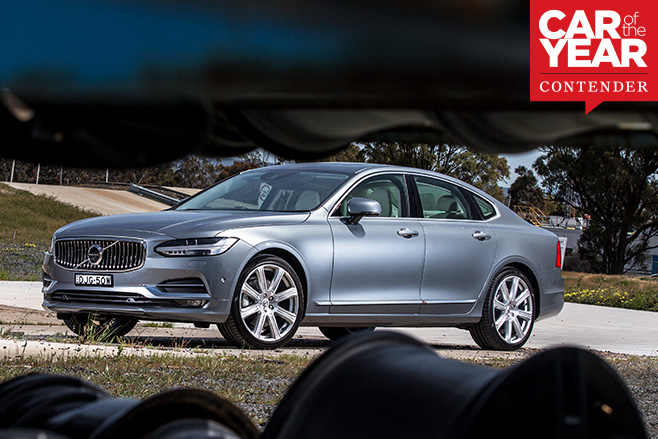
Of course, premium buyers respond with their hearts as much as with their heads, and here the big Volvo obliges with striking aero-cheating design and beautifully crafted interiors. From the classy swipe-able centre screen to the delicate metal ignition twist, you can sense the high-tech opulence infused into this car’s graceful cabin presentation.
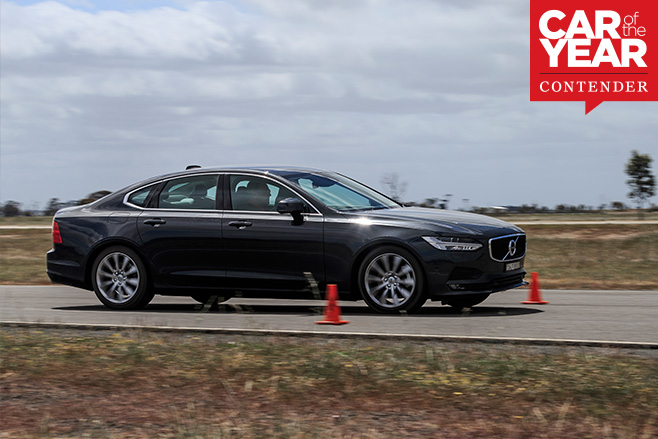
Offsetting the chassis’ newfound cornering confidence, though, is too much steering tug. Even the lowly D4 has a heady 400Nm coursing through to the front wheels; this diesel is also a little on the loud side. Two ailments the upper-spec Inscription AWD alternatives with available laminated side glass don’t suffer from.
Additionally, the chassis’ sporty bias comes at the expense of ride comfort. On the D4’s standard suspension set-up, the quality deteriorates as the surfaces do, resulting in an annoying, unsettled lumpiness that undermines the model’s luxury intent. Conversely, both pleasingly fleet (though at times strained-sounding) Inscription T6 AWDs boast rear air springs, for palpably better bump absorption properties.
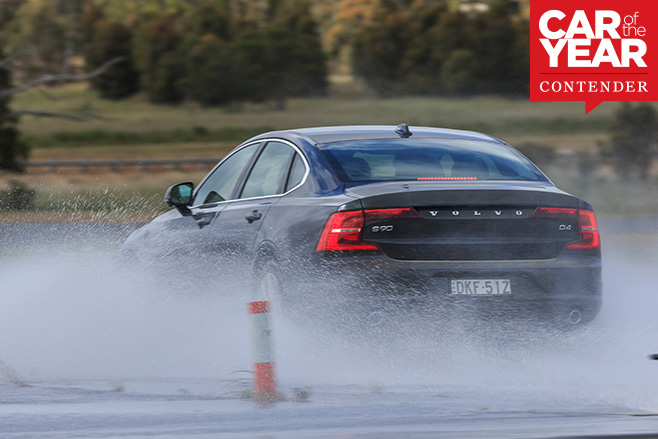
The distinctive and charming S90, then, is a small step for its class, and a massive one for transitioning Volvo. But in the year where your direct opponents include the segment-redefining E-Class as well as the lush-riding Jaguar XF, nothing less than a quantum leap forward is required.
Specs
BODY Type: 4-door sedan, 5 seats Boot capacity: 500 litres Weight: 1718 – 1848kg
DRIVETRAIN Layout: front engine (east-west), FWD/AWD Engines 1969cc 4cyl turbo (187kW/350Nm); 1969cc 4cyl turbo + supercharger (235kW/400Nm) 1969cc 4cyl turbo-diesel (140kW/400Nm) 1969cc 4cyl turbo-diesel (173kW/480Nm) Transmission: 8-speed automatic
CHASSIS Tyres: 245/45R18 – 255/40R19 ADR81 fuel consumption: 4.7 – 7.5L/100km CO2 emissions: 135 – 173g/km Collision mitigation: Yes Crash rating: Not tested Prices: $79,900 – $98,900
ALL the ingredients are there for Daniel Ricciardo to become the first Australian Formula One World Champion since Alan Jones in 1980.
He’s got the dream drive, with Red Bull Racing likely to benefit from the sport’s technical regulation revamp that will see this year’s cars between 3-6 seconds a lap faster. The team’s chief technical officer, Adrian Newey, is the most successful designer in F1 history with 10 championship-winning cars to his name.
He’s got that searing qualifying pace, as demonstrated with his razor-sharp lap in Monaco last year, one of the best-ever seen in the principality – and has a racer’s head during grands prix, his opportunistic win in Malaysia taken with young gun teammate Max Verstappen breathing down his neck in the final 15 laps.

“Mentally not much has changed,” the 27-year-old says, when asked if he’s ready for the pressure of a title winning car and campaign.
“I feel like my head space has been where it’s needed to be in the last few years. Obviously I’m hoping for the best but am not going to be caught up in it. Sure, if the car is ready then I know I’m ready.”
To prepare for the coming season, dubbed “the toughest in F1 history,” Ricciardo spent most of the off-season sweating it out in his hometown of Perth – and later away from distraction stateside in Los Angeles.
Make no mistake; upping the training this year was a must. The new cars are a lot more physical, with wider tyres and more aggressive aerodynamics making for higher cornering speeds and additional G-forces.
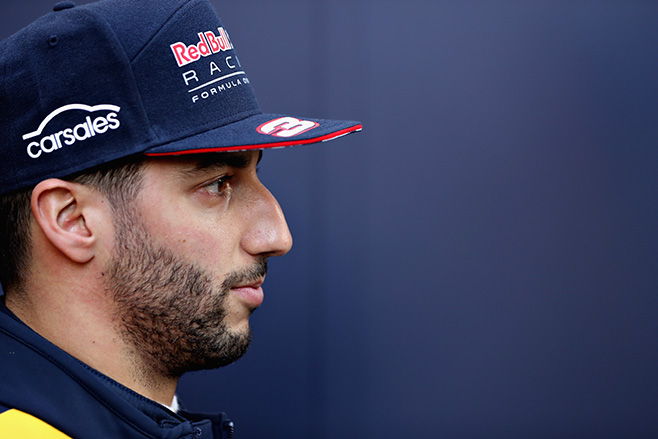
“The tyres are wider, which [therefore] means there is more tyre on the track,” Ricciardo says.
“That will make the steering heavier as well, because there is more grip so you’ll definitely feel that in your arms.
“Also, the corners are coming up quicker so there is less time to rest – and we’re probably moving ourselves quicker as well. Even though we’re tied in the car we still move a lot and the G-forces still twist your body.”
Ricciardo’s trainer, and fellow Australian, Stuart Smith ensured our man was put to the test – in sometimes-brutal conditions.
“One of the toughest that he [Ricciardo] completed was an aerobic conditioning session, which was six by three-minute fast-running efforts with three-minute recovery in between. That session was done in the middle of a hot summer’s day in Perth, with very little wind,” says Smith.
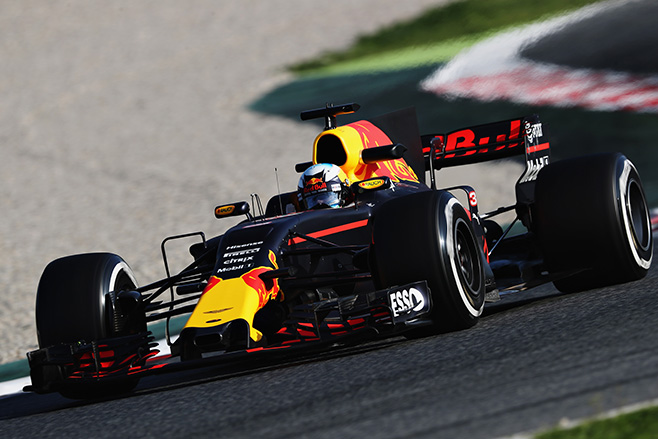
“Pre-season is always the toughest time for training,” Ricciardo says.
“It’s the time where we push ourselves the most. We stay in the same time zone, travel less and have more time to train.”
All that training will be needed from the outset here in Australia, but the real physical test will come in September, when the grid leaves Europe for Asia, including the Singapore Grand Prix.
For the drivers, Asia becomes a serious test of human endurance with cockpit temperatures reaching 55 degrees Celsius at racing speeds, made only worse by three layers of fireproof clothing and a helmet. Drivers lose up to three kilograms in fluid over a two-hour period – with this year potentially demanding even more.
It’s not an exaggeration to say the 19-year-old has stunned, with F1’s governing body, the FIA, making his pass on 2016 World Champion Nico Rosberg in Brazil –around the outside of Turn Three in torrential rain – action of the year.
As for how they matched up last year, Ricciardo controlled qualifying, with 11-6 the split since the pair joined forces from Spain. But the races were much closer – 8-7 in Ricciardo’s favour, the same for podiums when they could be compared.
It’s a fight that has the whole sport talking, with Red Bull Racing team principal Christian Horner excited about the match-up.
“We’ve probably got absolutely the most exciting driver pairing on the grid and it’s so exciting to see the development and the evolution of Max Verstappen just as he’s growing in experience and confidence,” Horner says.
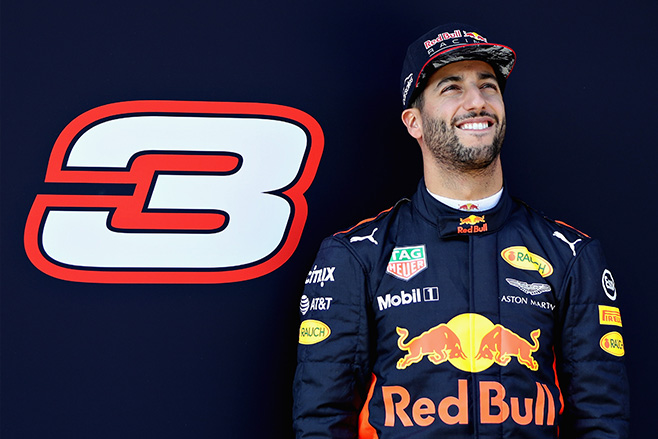
If Red Bull Racing’s RB13 is the match for Mercedes, and Ricciardo continues to be on top of his game – and stay ahead of Verstappen – then the world, and the world championship, may just be his oyster.
Singapore slingshot
The Singapore Grand Prix has regularly featured as something of a turning point in the F1 title battle. It could prove a vital one for Ricciardo.
The safety car has featured in every race at the Marina Bay Street Circuit. Four different drivers have won through the years, with Sebastian Vettel the most successful with four victories (across two teams, Red Bull Racing and Ferrari).
As the 10th edition of F1’s iconic night race, the September 15-17 Singapore Grand Prix will be bigger than ever this year with lots of special festivities planned.
Single day grandstand seats start from S$128 (about A$120), three-day tickets start from S$248 (A$235), and multi-grandstand combination packages start from S$498 (A$470 approx.) Tickets are at early-bird prices from now until May 8.
More information is available at singaporegp.sg.
Here’s a fun little factoid: if you look at the cumulative cost of this year’s top two, you can have 12 BMW M2 Pures, and still have enough cash left over for a lifetime of track days. Thing is, you only need one M2.
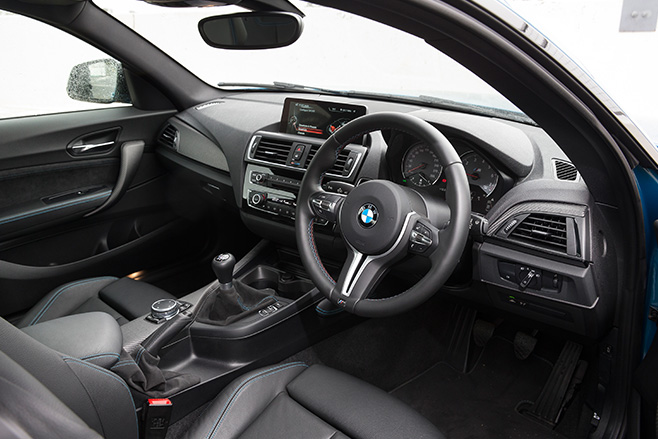
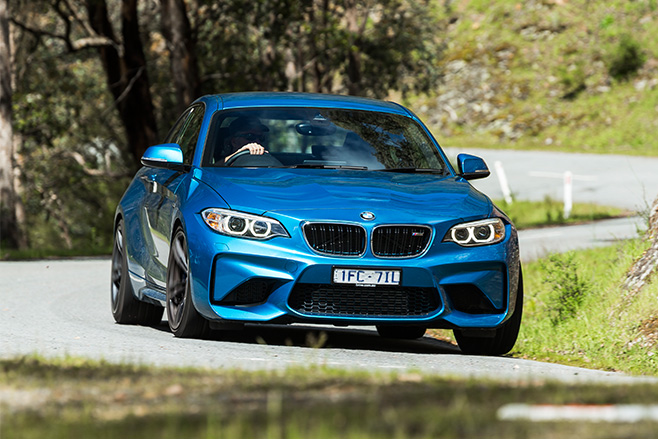
The M2 Pure represents a true return to form for the Haus of M, and a real homage to the cars that kicked the brand off. Its relative lack of size when compared to its M3 and M4 stablemates, a long, flat torque curve that makes its turbo motor feel almost nat-atmo and its flat, wide stance combines with a deliberate policy of dismissing extraneous fluff to produce a car that is truly a rare thing.
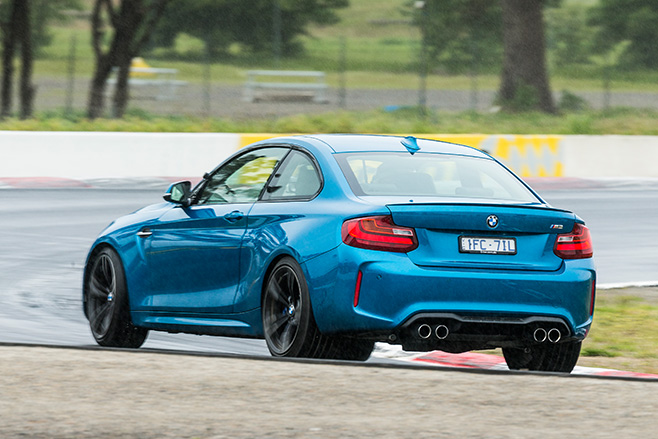
In the midst of the hottest PCOTY field of all time, the M2’s performance across the week is nothing short of stellar. Its hit out on the first day at DECA showed more than one judge that this sub-$100K coupe with the mug-lair front bar and concept-car wheels is more than the sum of its parts.
Sure, it won the tyre lottery at a soaking Winton, but it still managed to show more than a few of its rivals how steering should actually work – a trait made even more remarkable by the fact that the front end of both the M3 and M4 are far from favourites in the MOTOR office.
It was in the hills around Marysville, though, that the M2’s place in the PCOTY pecking order was cemented. On a long, sinuous set of perfectly manicured bends with the sweetest camber imaginable, I set out after the M2 in the 488 GTB – and I could not believe just how easily the BMW managed to keep its nose in front. Where the Ferrari’s massively stiff chassis and sharp manners meant frightening yourself silly keeping corner speeds up, the M2 just keyed into the terrain and bolted for the hills.
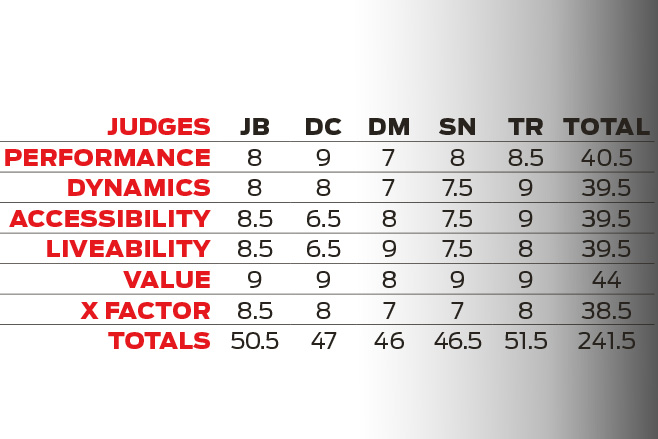
THE NUMBERS 0-100km/h: 4.55sec (7th) 0-400m: 12.82sec @ 175.82km/h (8th)
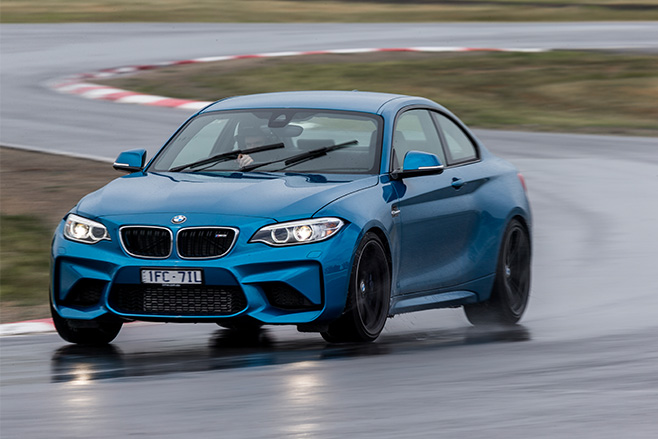
DYLAN CAMPBELL: =5th Fun-loving baby M car makes its big brother M4 feel a little too serious.
SCOTT NEWMAN: 6th So capable in every area; a bargain for what it offers.
TIM ROBSON: =3rd A return to form for BMW M, and for rear-drivers in general.
JOHN BOWE: 2nd The best value sporty BMW on the market.
THE next Holden Commodore could be in French hands by as early as Monday, with media reports saying a PSA Group takeover of GM’s European division, Opel, is about to be confirmed.
Reuters reported exclusively last night that two independent sources had confirmed the PSA Group board — which controls French carmakers Citroen and Peugeot — had given its approval to a takeover after settling on how the loss-making European arm of US carmaker General Motors would be broken up between the two.
Details of the talks between the two surfaced last month. It includes the takeover of Vauxhall, the British equivalent of Holden and one of the main driving forces behind GM’s global right-hand drive conversion projects.
According to Reuters, the deal struck between the two carmakers includes “non-compete” agreements that will block Opel’s new owners from competing against Chevrolet-badged cars in regions including China and “other overseas markets”.
What the deal struck means for Australia isn’t yet clear — Holden already sources the Opel-built Astra small hatchback as a cornerstone of its passenger car line-up, and from next year it plans to add the German-made Opel Insignia to its showrooms, rebadged as a Commodore.
Holden told Wheels this morning that it would not comment on speculation.
Reuters says the carmakers had “narrowed differences in about $US10 billion ($A13 billion) in Opel pension liabilities and other issues”. Opel’s financial position is believed to have been a contentious part of takeover talks — GM’s European carmaking business last reported a profit in 1999.
Holden plans to source the Commodore-badged Insignia from Opel’s Russelsheim, Germany production line, the same production line that provided the Opel-badged Insignia sent here as part of the failed 2012 attempt to introduce the European brand as a premium alternative to Holden’s Korean-sourced cheap cars.
PSA Group has already met with Opel representatives, framing the takeover as a potential “rebound of the company and its iconic brands”.
It says the partnership will create a “European Champion with French-German roots”.
Opel’s latest statement on the takeover talks still claims “there can be no assurance that an agreement will be reached”.
