
LEG 4: WA Border to Minilya Roadhouse The difference between NT’s lack of restrictions and WA’s heavily-policed carriageways is… well, essentially, a speed limit. Equally open and safe, however, WA’s sheer scale turns a high-speed chortle into a chore.
This article was originally published in the June 2004 issue of MOTOR.
After a fill at Kununurra BP and a major hook left onto the Great Northern Highway, passing Warmun and Halls Creek’s 80km/h zone, we spotted, and were spotted by, an unmarked, white and beige two-seater helicopter. If anyone knows why, drop us a line.
Half-way between the NT/WA border and the coast placed us in Fitzroy Crossing. The grizzled local copper who called into its middle-of-nowhere BP as we stopped proclaimed proudly and loudly that he was booking people for minimal speeds over the limit, and was in a rush to get back to it.
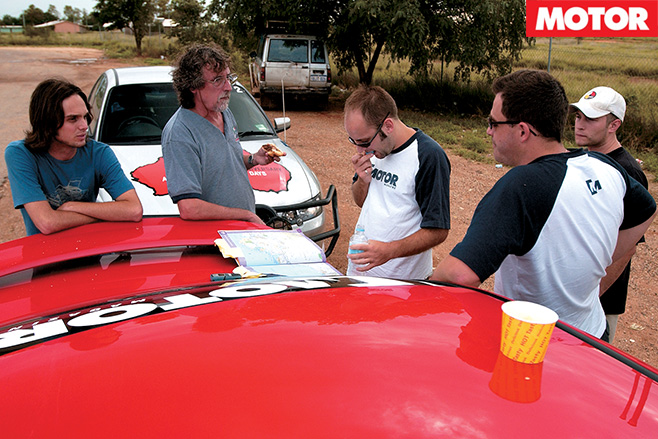
As if an excuse was needed, serial upper and downer Taylor J, in a moment of none-too-private despair and dire dummy spitting, proclaimed, “I’m gonna turn this car around and go home.” He began peeling off the red car’s ‘7 Days’ stickers, muttering about the cost of a flight from Darwin to Sydney.
After an hour’s deliberation, a call to Taylor M, and the passing of any number of profanities that shall remain undocumented, it was decided we would press on and cross any bridge, if and when.
At the Roebuck Roadhouse, 360km later, nearing midnight on day three, a ‘road closed’ sign arrested progress. That morning, TC Fay had passed between Pardoo and Wallal, about 300km south.
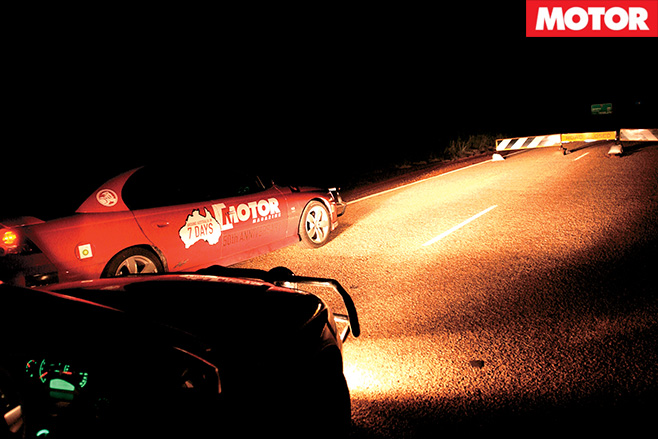
Back to Roebuck at 7:30am local time, conflicting reports told of between 400mm and four metres (!) of water still on the road.
With visions of whale crossings in mind, should the Indian Ocean prove an obstacle, Cockburn had studiously organised a multi-car transporter for us – at $300 a car – but it proved unnecessary as, at 8:30am, the Great Northern Highway 1 reopened and we were mobile again.
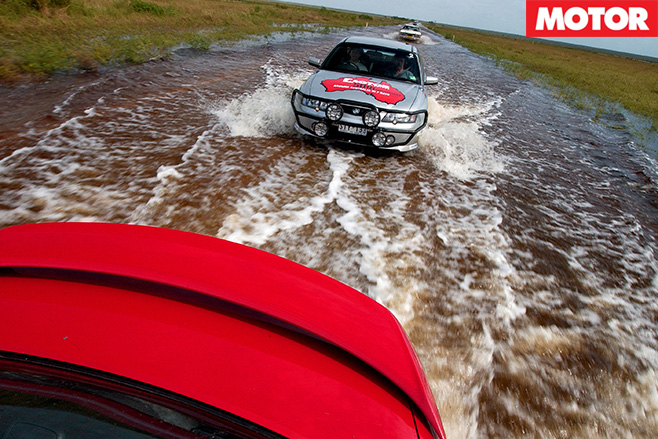
Surprisingly, all the water was just south of Roebuck: large water crossings, but still none more than ankle-deep. Around Pardoo BP, Fay had blown through, upped sticks and left little evidence.
Beyond Port Hedland, up the Northwest Coast Highway 1 through Karratha, the Minilya Roadhouse marked 8666km.
LEG 5: Minilya to Esperance Overcoming misleading Highway 1 signs and our third accidental diversion, bypassing central Perth down the Old Coast Road 1, past Bunbury, and onto the South Western Freeway, our spirits lifted with daylight, good roads the turn due east at Wallpole.
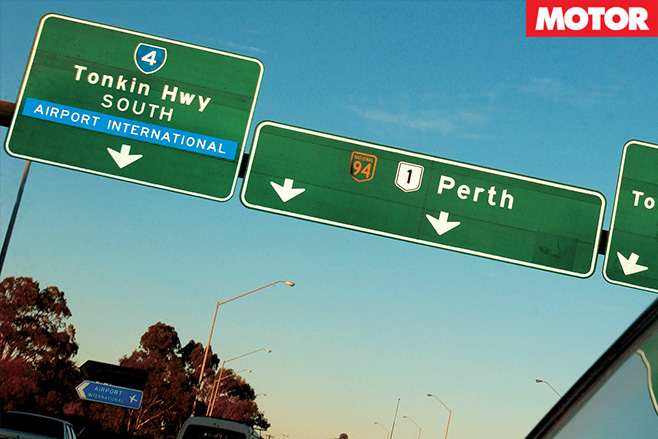
LEG 6: Esperance to Snowtown The northbound 202km run to Norseman from Esperance gave us the trip’s most expensive refuel: 133.5 cents per litre! Did we mention our love for BP’s support?
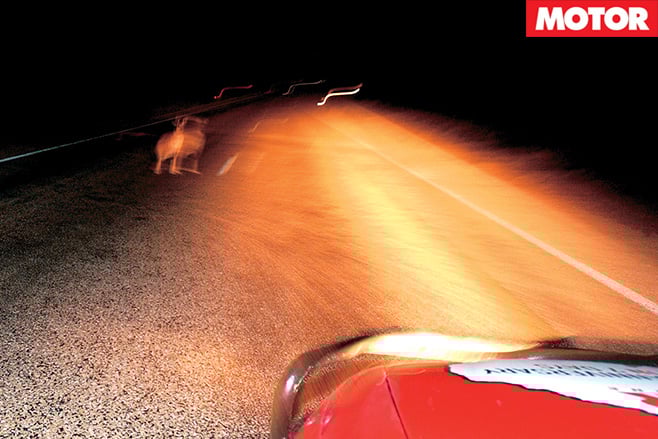
The next leg of the Eyre Highway 1, the 146km of the ‘world’s longest straight’, cutting through the southern edge of the Nullarbor Plain, proved especially testing. A little over an hour, you say? Not at night! With kangaroos lined up at the roadside like bumpers on a pinball machine, keen roo spotter Taylor took the wheel and carved through, averaging 90-100km/h to constantly avoid the suicidal roos. Mentally, he was drained.
LEG 7: Snowtown to Sydney Adelaide’s arterial southbound route provided a welcome return run through civilisation, and on its M1, who should we spy but departing Ford boss Geoff Polites, out on a pre-launch drive with a fleet of new Ford Territory test cars.
The B1 run down to Mount Gambier on the Princes Highway 1, then into Victoria, was another stretch, but the run from there to Warrnambool and Geelong, thanks to nightfall, seemed painfully slow.
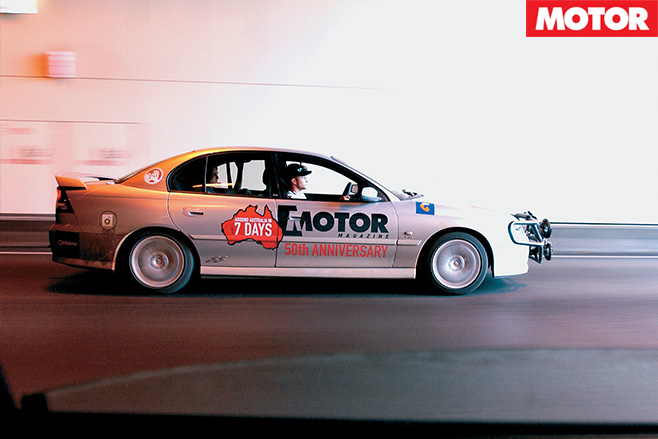
In Car One, Taylor J’s continual calculations had kept up our spirits. In spite of cyclone delays, we were still in with a real shot at the record. Even better, we never told Car Two it was possible!
After tasting unlimited speeds and some of the best roads in Australia, sitting safely on the multi-lane, divided, supremely flat and 100km/h-limited Princes Highway M1 approach to Melbourne was painfully and stupidly tedious. But not without amusement.
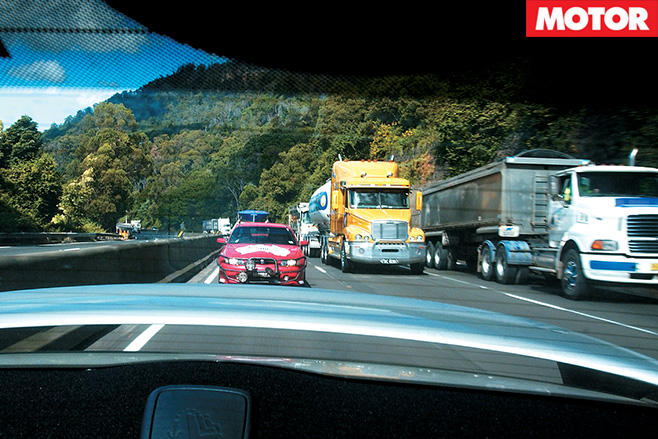
More scenic than the Hume Highway’s nine-hour Melbourne to Sydney dash, the Princes Highway M1 then A1 coast road, takes a little longer. But its 465km from Melbourne to the NSW border felt twice the distance. Around Morwell, a big red roo marked the fauna’s last serious attempt to take us out.
On the home stretch, the winding, rising and falling roads made sleep near-impossible. As signs for Batemans Bay, Ulladulla and Wollongong spelled increasing familiarity, with 537km to go, we phoned ahead to notify the welcoming party.
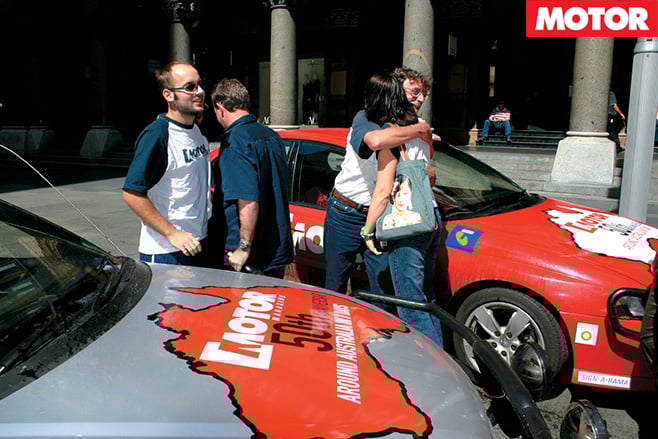
Amid popping champagne corks, and repeated questions of “are you guys raffling these cars?” from the gathering city lunchtime crowd, our mission was done. With delays, we’d driven around Australia in less than seven days. It felt like one long one.
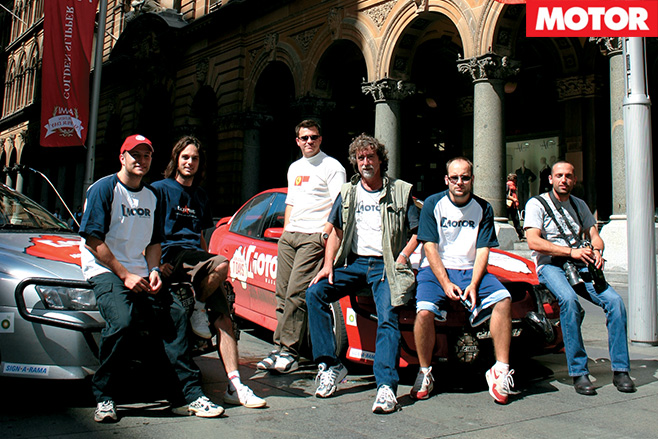
“Six days, 16 hours and 27 minutes, to be exact – that’s how long it took us to drive around this vast country in our marathon Ford Falcon XD.”
This article was originally published in the June 2004 issue of MOTOR.
These exact words appeared in Modern MOTOR, June 1979, when Matt Whelan and Evan Green reset the quarter-century-old record for a drive around Australia on Highway 1. It stood for more than 25 years, until April 2, 2004.
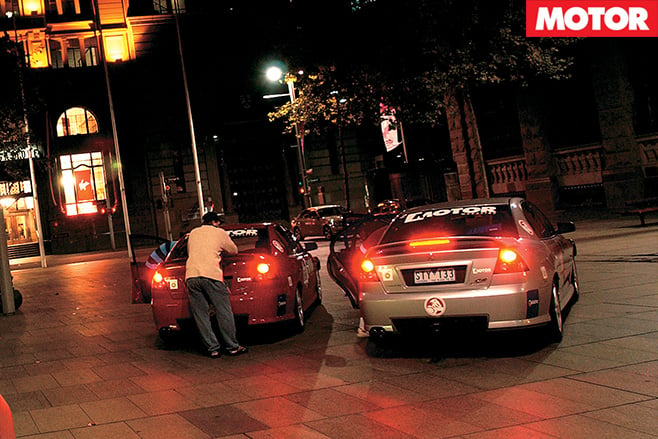
Twenty five years and six days after the last attempt, on Thursday March 25, 2004, at 4am, MOTOR set off to do it all again. But this time it was to be with two cars, more spares and better roads: just under 15,000 kilometres on Highway 1, with drivers sleeping in shifts and scheduled stops only for fuel.
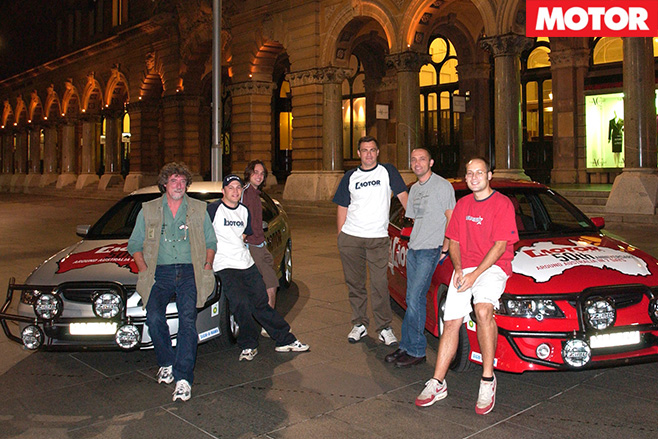
Aboard the ‘Silver Bullet’ – cruelly dubbed the “support vehicle” by those in Car One (they preferred “Car 1a”) – were columnist Paul Cockburn, logistics mastermind Marcus Hofmann, and UK-import, do-everything guy John Mahoney.
BP jumped in as a partner in the endeavour, ensuring all our stops were met with good fuel, food and drinks, while Telstra offered up a pair of satellite phones for around-the-country coverage.
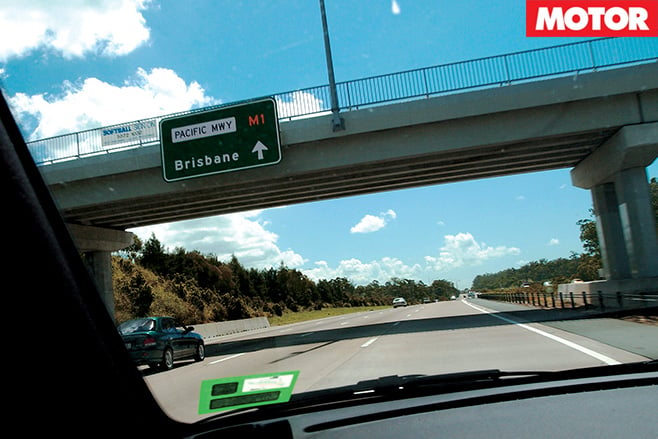
LEG 1: Sydney to Mackay The mind is an odd thing: it controls the body and fatigue, it presets endurance and it conditions perspective. Normally the Sydney to Brisbane run is a full, exhausting day trip. This time it was a mere jaunt up the road.

At least that was the case for Car One. The sinking look on Cockburn’s face as Car One blazed off during each of his mid-break smoko wanders and back stretches would prove enduringly priceless. It was clear, even at this early stage, that we were taking this record seriously.

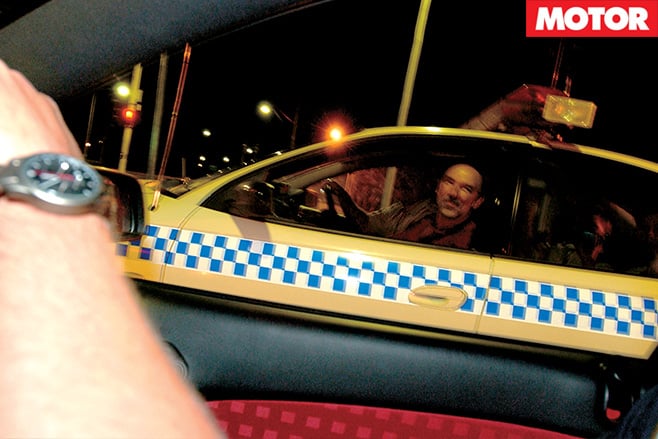
LEG 2: Mackay to Camooweal From Mackay to Townsville, past the Whitsundays, the sound of a 5.7-litre V8 at 1600rpm at 110km/h was broken only by the frequent melodic popping of roadside toads. The run to Townsville summed up the east coast leg: fast and efficient.
Arrival in Townsville at around the 24-hour mark would now reset our bodies into the irregular sleeping patterns which would be ours over the next six days. And the two lovely blonde girls in the Townie BP diner provided a temporary visual high.
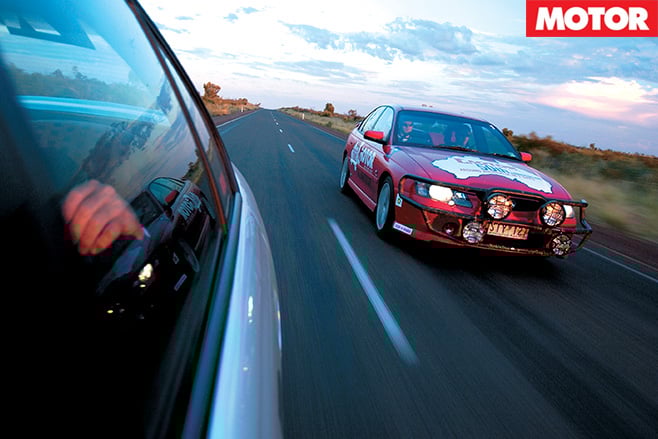
Through Mareeba and Atherton, things were looking good until we tried to fill up at Georgetown. Even once the slack-jawed locals had moved their parked cars from in front of the bowsers, still no-one inside the shop bothered activating the pumps.
After three minutes of toe-tapping, we blazed out with our Australian service low-point. Sorry, Georgetown BP, you lost our $250.
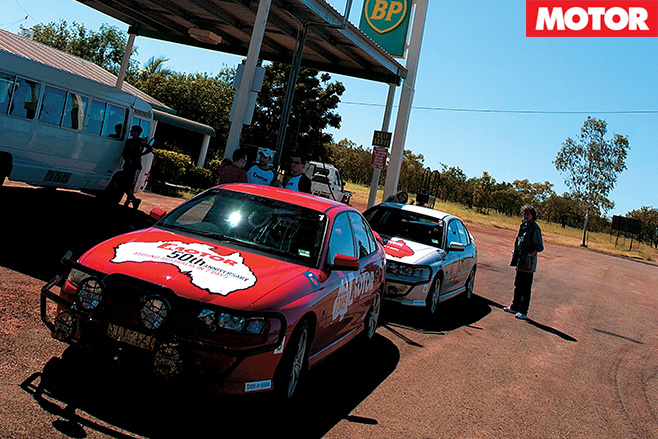
From single-file roads to locust fields of incredible density. At 110km/h, tens of thousands of bugs now caked the cars’ fronts while their guts were roasted, creating a test of intestinal fortitude with an acrid, sickly sweet aroma akin to rancid orange peels and, er, Cockburn’s three-day old socks.
As we refuelled and unsuccessfully searched for hot, edible food at Croydon, and cleaned the screen, the Silver Bullet rolled in, with three dementedly disgruntled occupants.
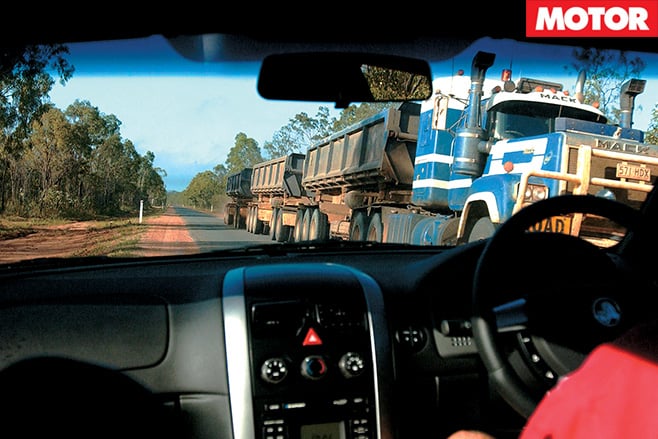
Our attempt to rediscover major civilisation in Normanton was thwarted when we realised, 3km into the 6km trip, that we’d inadvertently turned north instead of south. A prompt u-turn and 376km of developmental Highway 1 was then broken only by engine temperatures almost touching red on account of the bugs blocking the entire radiator.
Moments later, Car One’s cabin temperature reached the point at which nuclear fission occurs when the Telstra phone rang for Taylor J. Taylor M, in the office, had a request to pass on: that we slow up – the weeping babes in Car Two were complaining that we wouldn’t wait for them.
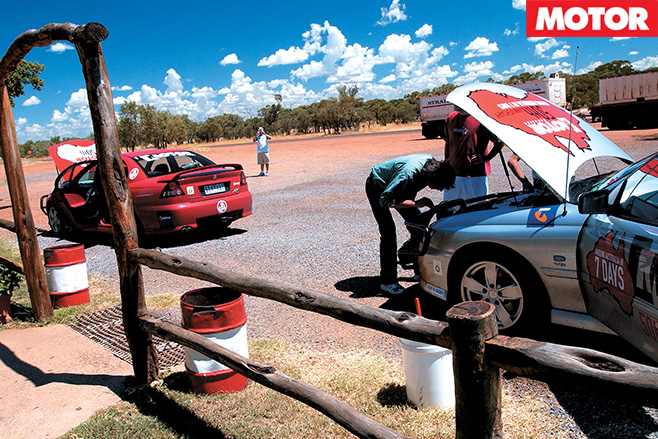
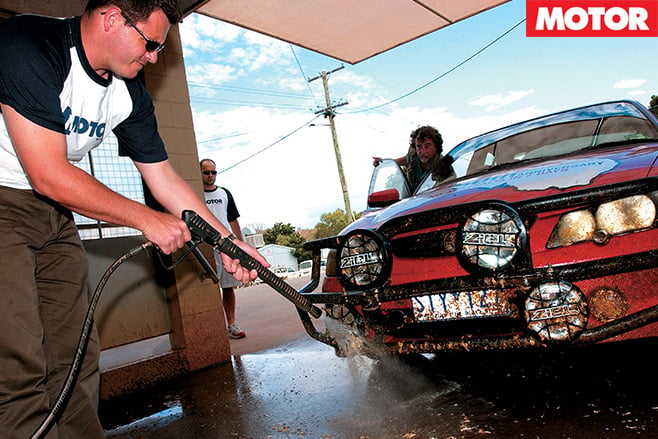
At Cloncurry, a sharp right enjoined us with the Barkly Highway and the sweep of its 117km of wide roads leading to Mount Isa and our first extended stop. With the Silver Bullet catching up, a high-pressure hose prised the bugs from the radiator, and a 45-minute break and run to McDonald’s during a local newspaper interview restored the crews.
LEG 3: Camooweal to WA border/Warmun After passing through Camooweal, our crossing into the Northern Territory was accompanied by an amazing sunset and a 360-degree view, bringing with it our favourite road sign: Derestricted Speed!
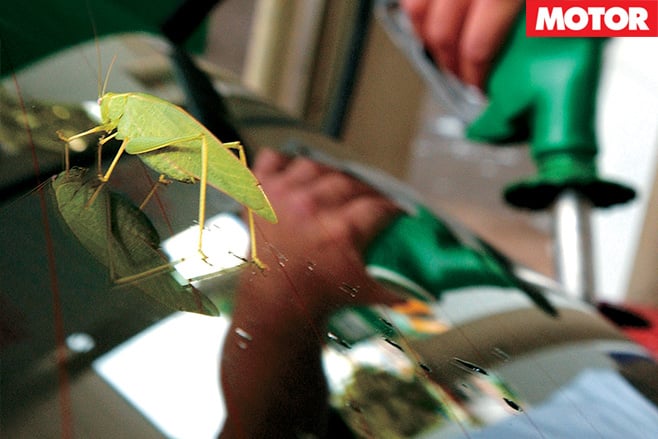
As hardy a companion as could be found in either car, Harold the Hopper’s stamina was remarkable. He endured the northbound Stuart Highway 1, two refuelling stops, heavy rain, Darwin and 200km/h-plus speeds. Harold even saw cruise control bugging (sorry) out above 190km/h.
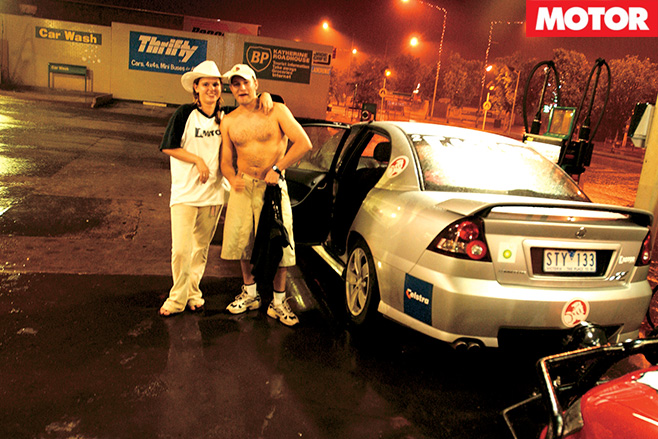
In the early hours of the morning, Katherine greeted us in the form of a young girl out with her boyfriend stopping by the BP after a night at the local club. A good sport, she agreed to swap T-shirts with Marcus, wearing a prized MOTOR shirt. The treat, however, wasn’t so much seeing her in her black bra, but Marcus squeezed tightly into his tiny ‘Bitch in the Mood’ black number.
West-bound out of Katherine on the Victoria Highway 1, a 10-minute early morning rest stop at a stinking-hot Victoria River Roadhouse allowed Car Two to catch up. Again.
Then, with 294km to the WA border and perfect, clear conditions and unlimited-speed tarmac reaching beyond, the wick was turned up and with it speeds up to a trip maximum of 240km/h. In this terrain, however, it’s neither the cars nor roads that threaten human life and limit safe speeding, but the ever-present and ever-ready roadkill.

But, determined not to be ignored, even the effort of maximum brakes on a vehicle rapidly decelerating to 80km/h could not deter him from greeting us head-on, ensuring the BANG which, sadly, brought about his untimely but inevitable conclusion. What’s that Skip? Nothing?
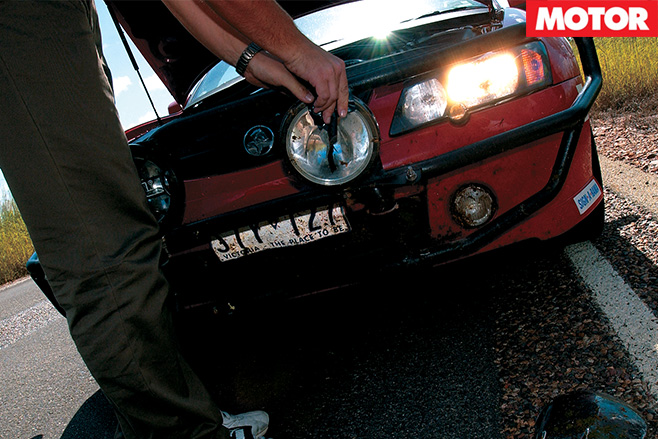
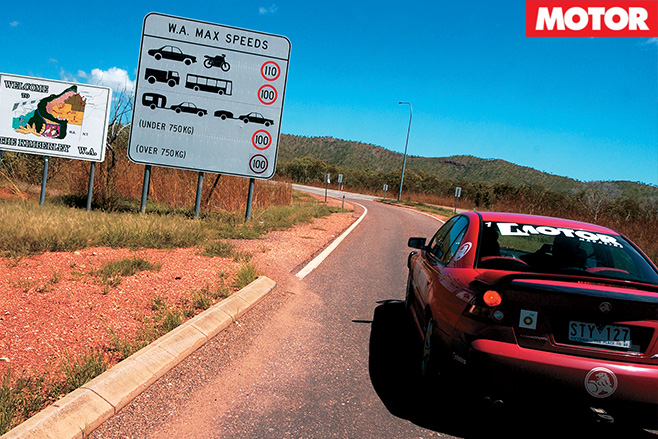
The NT/WA border marked 6570km, along with the strictness of quarantine inspectors, the loss of our unlimited-speed roads, and the thwarted attempt to lose Wielecki. Exiting quarantine, we asked if he wanted a shot of the ‘Welcome to WA’ sign. Running hard with waving arms, his reply came in our mirrors. Almost got away!
Check out part 2 of our record-breaking lap of the map!
Clearly the Volkswagen Group believes in competition improving the breed. Take Porsche and Audi. They’ve constantly clashed on the racetrack, Porsche beating Audi at Le Mans most recently. But the feud also breaks into the sales yard.
Bar the 911, every Porsche model locks horns with an Audi, but it’s Stuttgart’s latest and greatest (selling), the Macan, which inflames the inter-family rivalry to boiling point.
During development of its mid-size SUV, Porsche was briefed to use 70 per cent of Audi’s Q5, leaving only 30 per cent with which to fiddle to save a couple of pennies. However, as the story goes, it flipped that figure, instead using only 30 per cent from its donor to crucially make the rest feel bona fide Porsche.
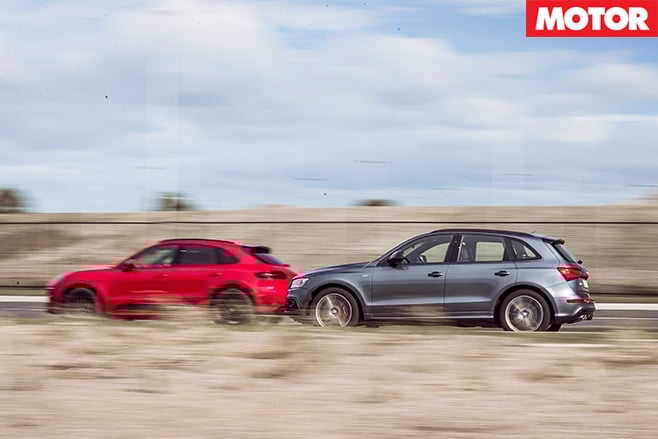
Not wanting to let Audi hog the yawning $40K gap between the $92,800 Macan S and $130,000 range-topping Macan Turbo all to itself, Porsche replied by slapping a GTS badge on the Macan – a designation usually saved for a model’s twilight years.
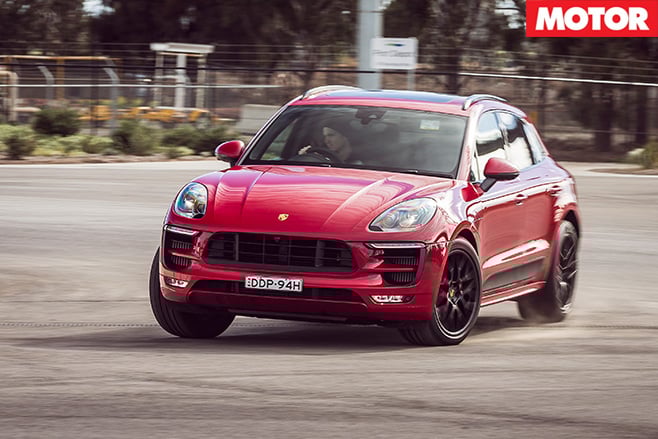
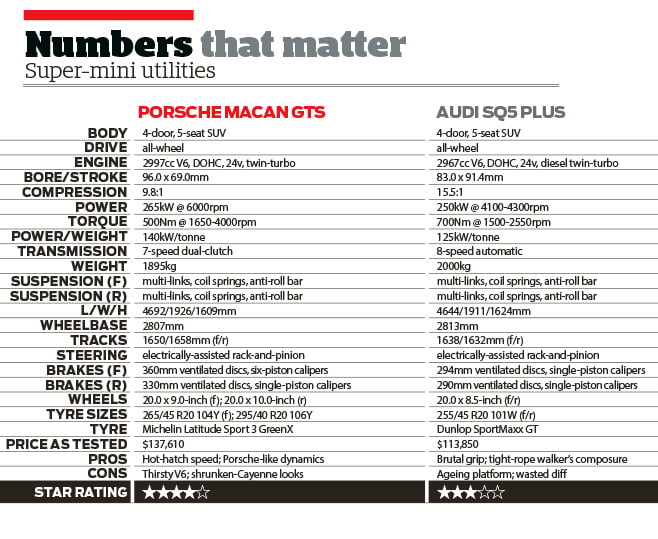
The GTS commands $109,200 before on roads, though our test car lists at $137,610 thanks to some choice extras. In return its boosted 3.0-litre V6 inhales through tweaked inlet tracts and exhales through a sports exhaust system, finding another 15kW/50Nm in the process for totals of 265kW/500Nm.
Both mills are fed boost by two turbos. The Porsche’s work in parallel, drawing in gases from one bank each, while the Audi’s huffers work in sequence, where a smaller turbo builds boost quickly before the larger one steps in for the heavy lifting.
Each slurps a different drop, and the effects on each car’s character are most obvious when pointing them down Heathcote’s quarter mile. Even at a standstill the Porsche’s petrol V6 is eager to show how free-revving it is, launch control (for which you’ll need the $2690 Sport Chrono option) dialling up 5200rpm, which is 600rpm higher than the SQ5’s redline.
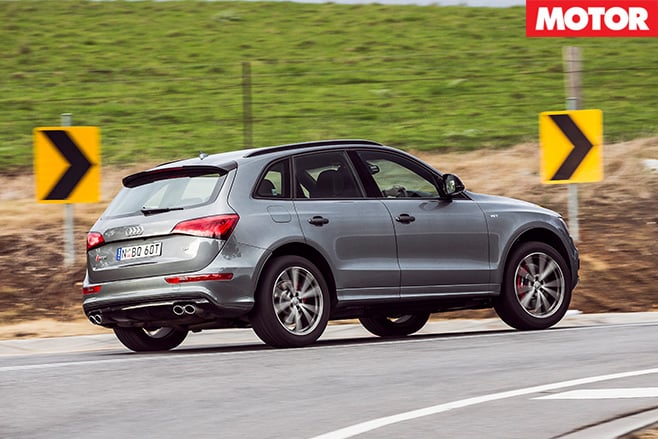
Whereas the Macan employs a seven-speed dual-clutch gearbox, the Audi shoots power through an eight-speed torque converter, so its ‘launch control’ isn’t as fancy, though it’s just as effective. Disable ESP, stall up 2800rpm, lift the brake, and it flings forward with a sound like no other diesel donk.
There’s a chorus of noise as the turbos whistle and the exhaust system’s sound actuators grind out a V8-like bellow. Even fellow driver Steve Nally, standing trackside, is struck by how well the engine hides its diesel clatter: “It sounds like an HSV; like no diesel I’ve ever heard!”
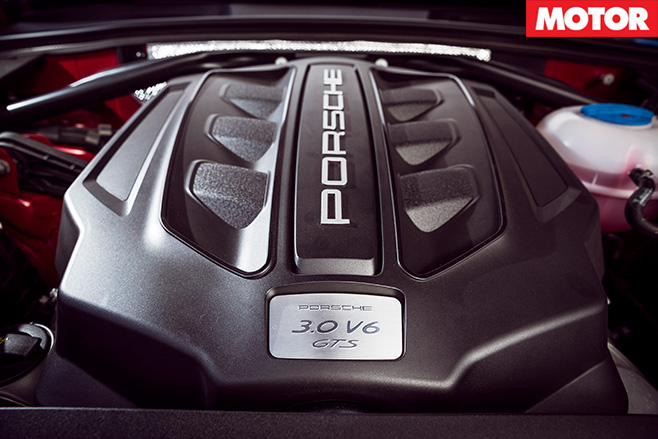
The Audi’s gearbox works through two ratios before triple figures, while the Porsche upshifts to third at 102km/h. So even on a cold and damp surface the GTS trumps its factory claim to 100km/h by 0.11sec, eating it up in 4.89sec whereas the Audi needs 5.21sec for the feat.
Because the Audi’s close ratios keep the diesel mill working hard between 4000-5200rpm it never sees the 700Nm lurking between 1400-2550rpm and by 150km/h the gap has widened to almost eight-tenths. Nonetheless, the SQ5 runs the Macan reasonably close over the quarter mile, its 13.59sec effort trailing by just 0.28sec.
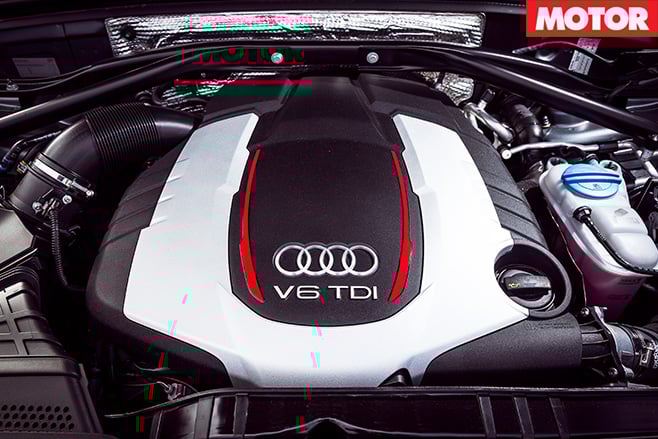
But the Audi proves there’s nothing wrong with sliding calipers (it uses them up front as well) erasing 100km/h in 37.46m compared to the Macan’s 37.21m. However, what they do lack is the precise feel and feedback of the Porsche’s left pedal.
Where Audi spent its cash was on a real torque-vectoring rear diff. It’s hard to grasp why you’d stick a whizz-bang diff in a soft-roader until, that is, you venture on to Mount Macedon’s damp, almost freezing, roads. At first the SQ5’s variable steering rack feels slightly dull and doesn’t quite relay where the front tyres point. And the damper-and-spring setup carried over from the base SQ5 allows the Plus to sometimes crash into ditches and bite into ridges.
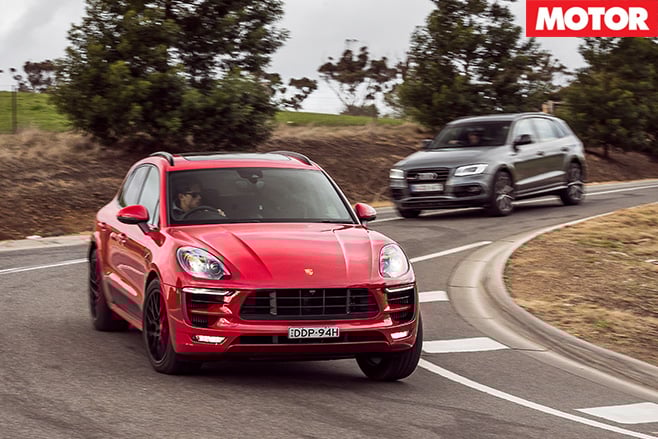
Ultimately the Porsche won’t keep up with the Audi over such wet, cold surfaces. It’s inside-wheel braking tech simply can’t tame 500Nm, even with upgraded stability and traction control electronics. But as things dry up the 1895kg Macan kicks dirt in Newton’s face. The front-end hones in on apexes like an Imperial zero fighter buzzing an Allied battleship, the Porsche’s steering so much more accurate you could tickle a roadside snail with a Michelin.
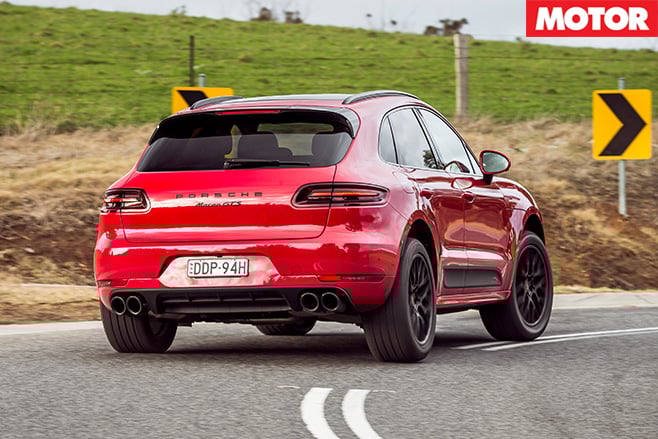
Its PDK gearbox is scarily intuitive, too. Which is almost a shame as it denies you the chance to use the bow-like paddles behind the Macan’s steering wheel. They’re wonderfully tactile, and infinitely smarter than Porsche’s previous ‘push-pull’ button setup.
The Audi’s ’box is quick-shifting and smooth, but it’s always trying to downspeed the engine, and the plastic paddles feel cheap compared to the Macan’s. Elsewhere inside, though, the nappa leather cladded seats are cloud-like for comfort and carbon-fibre inlays weave in more luxury.
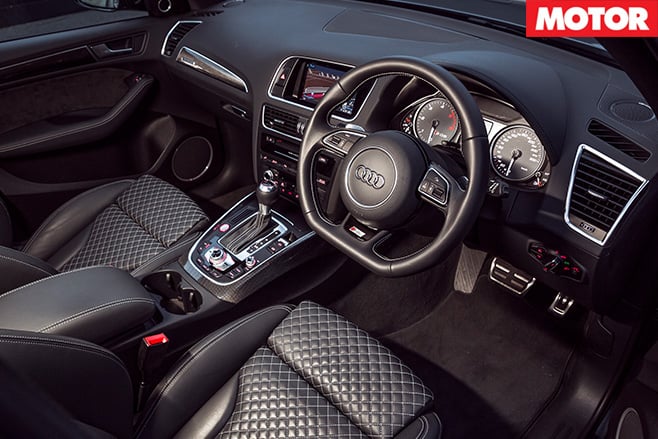
Climbing aboard the Porsche’s interior is like walking over to more expensive TVs in JB-Hi Fi, it’s higher tech and better looking, but you can sense your wallet cowering. Apple CarPlay stings you $1069 and park assist tech is $2690, while a GTS styling pack – which brings ‘carmine red’ stitching to match the bright red-and-white tacho, red seatbelts, and stitched ‘GTS’ logos – should offer more for $8990.
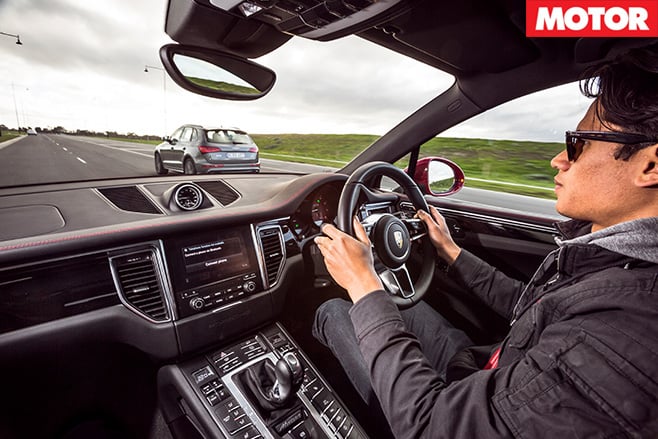
It not only feels a whole generation newer inside with its superior PCM infotainment system and digital half-moon display, but it also looks like a Porsche in here. You’d find its wide-centre console, flat sweeping dash and three-barrel tacho display on any other model in Stuttgart’s range, which brings us to this test’s much larger point.
Audi’s SQ5 Plus might look handsome but there are a few wrinkles behind its sharp-suit facade. The SQ5 debuted in 2013, but its platform goes way back to 2009. Yet besides a whirring HVAC system and pesky rack rattle there’s no way you could pick these two as separated at birth. With both priced at $109K, Porsche has basically rebuilt you Audi’s Q5, for no charge.
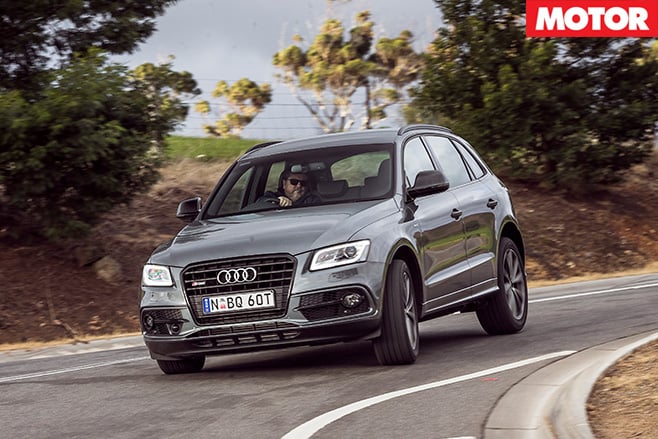
The Audi may also include more kit and be more effective for a hard-charge across gravel, but we’d trade in the diff and pocket the cash because on the dry stuff the Porsche would easily grab its lunch money. All the while, that delightful steering, super intelligent gearbox and zingy twin-turbo V6 helps it slaughter the Plus for driver appeal.
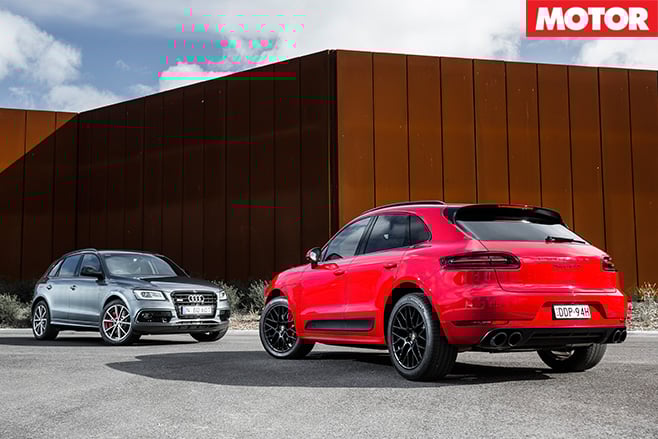
The Macan had to be faster, newer, higher tech, and more involving to drive than its under-the-skin twin. And at least in the GTS’s instance, Porsche can hold its head high on a job well done.
Buoyed by the sell-out success of its Cayman GT4 and 911 R, Porsche is reportedly planning a major motorsport-inspired expansion program covering the next 12 months.
It will start in March at the Geneva motor show when the 911 GT3 will be reintroduced with a manual transmission previewed by the limited-edition R, however UK publication Autocar has cited a source further stating the 350kW 3.8-litre GT3 will move to an upgraded version of the larger 368kW 4.0-litre GT3 RS engine.
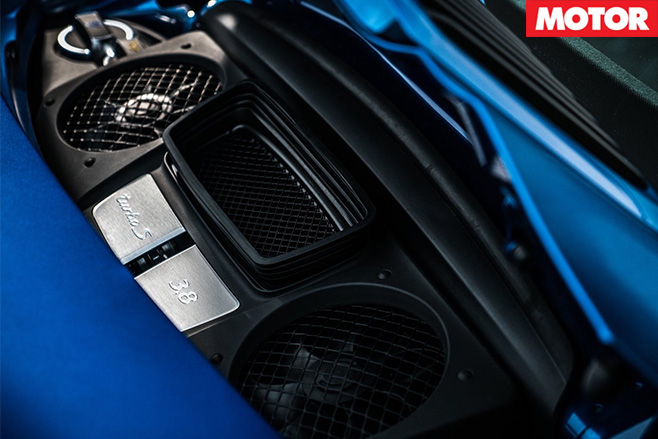
According to Autocar’s source the 911 GT2 “should be ready by the end of the year” and will see out the current 3.8-litre twin-turbocharged flat six-cylinder engine with 485kW – well up on the current 427kW Turbo S.
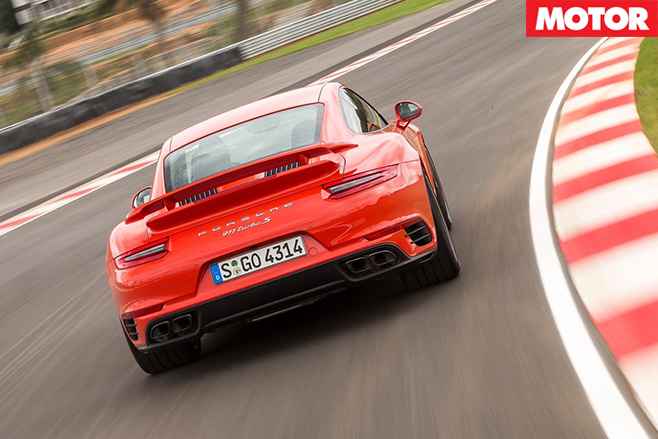
The big, boosted six is also set to bow out with the 991 range, with the next-generation model expected to be based on a larger version of the Carrera’s 3.0-litre turbo unit.
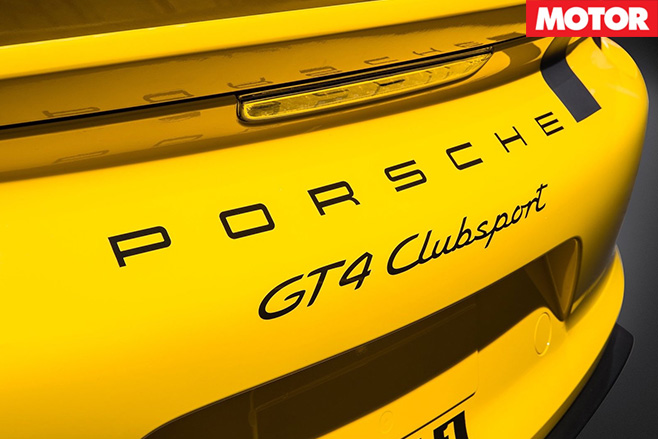
Although far from confirmed, the reports certainly whet our appetite. We can’t imagine Porsche engineers sitting idle while the market is left hungry for every GT car they make.
As one of Australia’s most respected and experienced motoring journalists, Ged Bulmer has driven and reviewed everything from hulking off-roaders to sleek supercars in a career spanning more than 20 years.
Now managing Bauer Media’s market leading motoring stable – Wheels, Motor, Street Machine, Unique Cars, WhichCar and 4×4 Australia – Ged’s love of cars and his background as an editor of publications as diverse as Wheels, Motor, 4Wheeler and Overlander magazine ensures he has a clear view of what constitutes great automotive design, and its importance to consumers.
“I think in terms of what you feel when you first see the [Ford] Mustang, it has the strongest emotional connection,” he said. “It makes you feel something, and not every car does that.
“The design cues of this car are all about harking back to the original 1964 Mustang and the great Mustangs that we remember through the ’60s and ’70s… they’ve managed to bring those heritage cues into the contemporary setting really well, and I think it’s a good-looking car.
“It’s a V8 and it’s a muscle car in the true sense of the word. Personally I like that; I’m a fan.”
But while the powerful-looking Ford Mustang revealed Ged’s undeniable car enthusiast colours, he also recognised the sophistication and class of the other finalists.
“What captures your attention with the Audi is how understated it is… If you take time to look at it, it’s a really nicely designed car.
“It’s also really classic design… like a well-made suit that you can pull out of your cupboard 10 years later and it’s still going to be just as good today as it was when you first bought it.
“And I think Audi is like that; it’s certainly not a fashion victim, it’s certainly not about trying to chase a particular trend.”
Ged described the Holden Astra hatchback as a “welcome return to European design cues” for Holden, something he believed can only be positive for the Aussie brand as it moves from local manufacturing to being a full-line importer.
“The Holden Astra is a really nicely designed little car. It’s quite restrained in its design. There’s not a lot of shouty, over-the-top stuff going on but it’s very sophisticated.
“It’s got a bit of sport about it, too, which I like, and that same level of sophistication that you see on the exterior of the car is carried over to the interior.”
The most controversial of the finalists was the Honda Civic, but Ged also acknowledged as the most courageous.
“The thing I like most about the new Civic is that Honda hasn’t played it safe. They’ve taken a risk with this car – they’ve been bold, they’ve been daring,” he said.
“They’ve thrown a lot of different design elements at the car and I guess that’s why it’s fairly polarising… it’s certainly getting a reaction.”
The seven-seater SUV segment is changing, with old stalwarts like the Car of the Year award-winning Ford Territory and Holden Captiva making way for hot new stars such as the high-flying Mazda CX-9 and Kia Sorento.
But of all the monocoque (rather than 4×4 chassis-based) contenders, it’s the Toyota Kluger that is the most popular, luring family car buyers in with huge space, practical interior, driving ease, and the peace of mind of dependable and reliable engineering.
The 2017 Kluger facelift, though, aims to keep the leader fresh in the face of increasingly stronger competition.
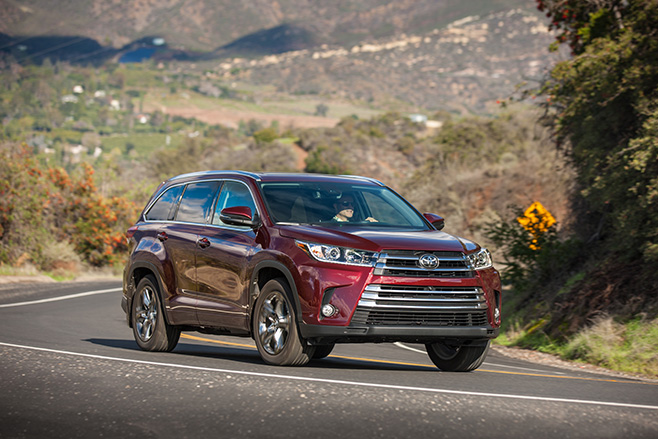
- Oh what a heart transplant! Out goes the long-lived 3.5-litre V6 for a heavily revamped direct-injection version with a higher compression ratio, improving efficiency as well as power – to the tune of 8.5 percent. Outputs jump from 201kW to 218kW, while torque rises to a heady 350Nm. Expect to see this engine in the next-generation, Mk8 MY18 Toyota Camry V6.
- Eight is enough. When the Kluger series was first launched in Australia in 2003, it featured a smooth 3.3-litre V6 driving all four wheels via a five-speed automatic gearbox. That changed to a 3.5 in 2007, while in 2014 the third-generation version ushered in a six-speed auto. Now that jumps to an eight-speeder, bringing with it efficiency benefits to the tune of 10 percent better fuel economy! The base front-wheel drive GX now returns 9.1L/100km. No manual transmission is offered (or even built).
- Diesel won’t do. Unfortunately, the Kluger’s biggest market by some margin is North America (Canada and USA – where it’s also built, at Toyota’s modern assembly plant in Indiana), where it wears Highlander badges. But as the Yanks (and Canucks) aren’t real fans of diesel, none is offered. That’s why more frugally minded buyers up there have the choice of a rather lethargic 2.7-litre four-cylinder petrol version, as well as a 3.5-litre V6 petrol/electric hybrid. The thing is… both are only made in left-hand-drive configuration, so Aussies miss out.
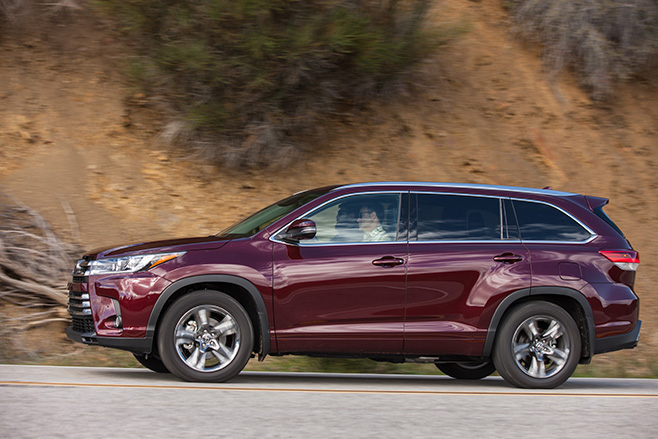
- AWOL AEB is not AOK. In North America, every Kluger/Highlander for 2017 offers AEB Autonomous Emergency Braking as standard equipment. But for Australia, Toyota deletes that crucial safety item from the specification on all variants except for the top-line Grande, which usually ends up costing well north of $65,000. That’s not very egalitarian now, is it Toyota? Meanwhile, the Mazda CX-9 has AEB standard on all models, and other rivals will be following suit soon enough.
- Aussie tunes rule! All Australian-bound Klugers have a different (and believe us, much better) steering and suspension tune, as a result of a two-year local-road shakedown designed to make the big seven-seater SUV handle and ride in a manner Australians prefer. This has been the case since this current-generation (U50-series) Kluger was released here in early 2014. For the MY17 model, there have been no changes to the chassis.
- Last platform standing. The MY17 Kluger, which is derived from the 2011 US-market Camry and Avalon series, will be the company’s last major model before every new Toyota from here-on in switches to the all-new Toyota New Generation Architecture (TNGA) platform. The latter promises to bring significant improvements to strength, rigidity, and refinement, while cutting down on weight and consumption. To be based on the Mk8 Camry released at the Detroit Motor Show in January 2017, expect the next-gen Kluger to hit the streets by about 2020.
- USB gone! One of the biggest selling points to families for the face-lifted US 2017 Highlander is the addition of three extra USB ports, primarily to stop passengers squabbling over the previously single outlet. Unfortunately, the rear-seat entertainment system that these plug and play with are simply not compatible with the Australian set-up, meaning that our MY17 Kluger sticks with the old single USB outlet. Boo! We also miss out on the new-fangled driver-to-third-row intercom system devised for the Highlander.
Mazda was on track for a sales record in 2016, with 120,000 cars in sight. SUVs were again strong, with the company producing two of the top three in the country.
And while the Mazda 3 won’t take the overall sales crown, it’s still one of the country’s top-selling models and has achieved that with strong natural demand (rather than from big discounting). That said, car sales came off for Mazda, with the 2, 3 and 6 together down a few thousand units.
RANK: 2ND 2016 SALES: 120K 2016 YTD RESULTS: 108,446 sales, up 4.0%, 10.0% market share 2017 FORECAST: 123K RANKING: 2nd; 123,000 sales (up 2.5%), 10.3% market share GRADE: A+
Opportunities
It’s all about incremental growth for Mazda in 2017. Each of its models are very strong in their classes, so Mazda has to keep plugging away to maintain momentum. A new Mazda CX-5 arrives around April, so the changeover will be crucial for keeping the popular model at the top of the SUV sales charts. The BT-50 ute remains a big opportunity and Mazda is increasing its focus on small businesses, such as tradies, who tend to gravitate towards other brands with bigger fleet deals. Despite its ‘zoom-zoom’ image, Mazda has a lacklustre performance-car range, so there’s plenty of opportunity there, though don’t expect it to materialise in 2017.
Challenges
Maintaining the current momentum and improving on what is a very strong model range that’s sold very well. As we’ve seen in the past (from Honda, Holden, Ford and others), that can change quickly, so it’s important Mazda maintains its focus on cars and customers. Mazda has no sales duds, each car pulling strongly in its class. Its SUV range, for example, consists of only three models (CX-3, CX-5 and Mazda CX-9) yet Mazda is the second-biggest SUV brand in the country behind Toyota (which has double the models). The challenge for Mazda is keeping the cars fresh and enticing enough against often newer competition.
Summary
Happy customers, happy dealers and growing sales; life for Mazda Australia is rosy for now. But the brand has to keep the accelerator pinned to the firewall and avoid getting complacent.
MARK WEBBER has been named and Officer of the Order of Australia (AO) as part of the 2017 Australia Day celebrations.
The World Champion racing driver, born in Queanbeyan, New South Wales, is being recognised “for distinguished service to motor sport as a competitor and ambassador, and to the community through fundraising and patronage of a range of medical and youth support organisations.”
Webber joins fellow F1 veteran Jack Brabham on the list of motorsport icons privileged with the AO suffix on their official title.
The straight-shooting Webber worked his way through the junior open-wheel ranks until he joined Mercedes-AMG in the world of sportscar racing in 1998. Following two seasons in the FIA GT Championship, which included a terrifying crash at the 24 Hours of Le Mans, Webber moved to the Arrows F1 team as a test driver.
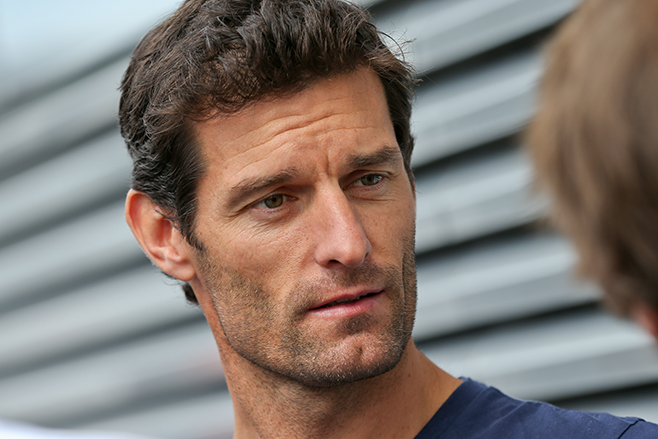
It wasn’t until 2002 when he made his Formula One race debut, representing Minardi at the Australian Grand Prix. Webber impressed with a stunning drive to hold off Mika Salo to finish fifth in front of the home crowd – much higher in the finishing order than many expected from the Aussie rookie.
During his F1 career he raced for Jaguar and Williams, before joining the then-fledgling Red Bull team in 2007. It wasn’t until the 2009 German Grand Prix when he claimed his first win – claiming a further 8 victories before his retirement from F1 in 2013.
Webber returned to the sportscar fold in 2014 with Porsche, winning the FIA World Endurance Championship with the German manufacturer in 2015, and retiring from full-time competition at the end of last year.
Respected by his peers, Webber gave himself the moniker Aussie Grit, a name which embodies his determination and fighting spirit. Although he no longer races full-time, Webber has committed himself in continued community work both in his personal life, and as a Porsche ambassador.
Also honoured at the Australia Day festivities was former CAMS chairman and life member Steven Chopping. Also serving as an F1 steward here and overseas, Chopping was awarded a Member of the Order of Australia, “for significant service to motor sports through leadership and technical advisory roles, and to national and international professional groups.”
Wheels extends its congratulations to both gentlemen.
Mustang’s disastrous crash rating proves the worth of independent crash test authorities, even if they’re not perfect
THE shocking two-star ANCAP crash test result for the Ford Mustang raises questions about the safety of other sports cars and reinforces the relevance of the controversial crash test authority.
ANCAP is far from perfect – old ratings aren’t updated, trivial things can penalise a car, and so-on – but here at Wheels we acknowledge there is a place for ANCAP, and the Mustang result underlines (and bolds and italicises) that perfectly.
Click here to read Ford’s defence of the Mustang’s crash safety.
The Ford Mustang’s safety deficiencies aren’t trivial – they are potentially deadly, according to the ANCAP result. It exposed that airbags don’t inflate correctly and a crash structure that doesn’t hold up well to well known tests passed by hundreds of cars, including Fords.
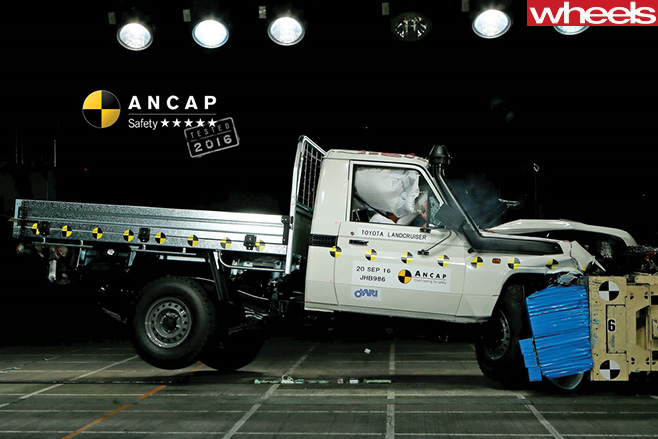
ANCAP has been hassling Ford to test the Mustang for some time, more so since the car became one of the brand’s best-selling vehicles in Australia.
The Mustang was the highest volume car on sale in Australia without an ANCAP rating.
ANCAP made it clear the car was being tested and shared the results with Ford long before they became public.
Ford’s carefully worded response shows it is grasping to try and control what looks like being a PR nightmare for one of its best known nameplates.
The response highlighted that the Mustang passes all regulatory tests – as does every single car on the market, even ones without airbags or any active safety gear.
Those tests are a joke, which is why ANCAP and other safety authorities exist. Again, they’re not perfect, but they play a vital role in the very serious business of highlighting to consumers which cars are safe and which ones aren’t.
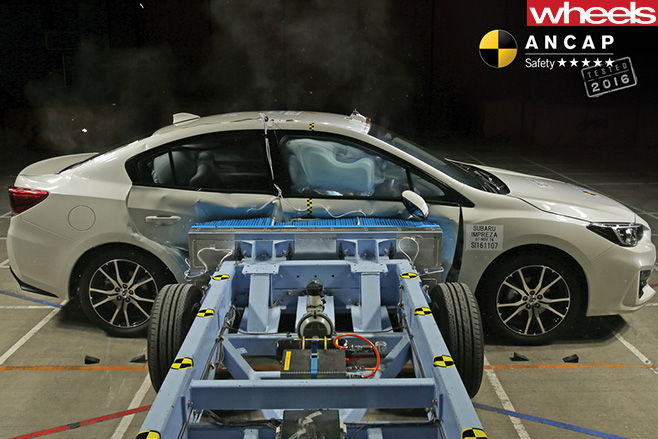
Most of today’s crash testing is done in the virtual world, where it’s a lot cheaper and easier to change things before you destroy actual cars.
Manufacturers typically know exactly how their car will perform in tests such as ANCAP. Executives will often tell the media they are “anticipating” a five-star ANCAP result, which is code for “we’ve run the computer simulations and everything shows it will get the maximum score”.
Which suggests Ford may not have expected the car to have been subjected to ANCAP testing.
Ford did not answer that question when we posed it to them.
Instead, in its response to Wheels, Ford pointed out the existing NCAP protocol was not in place when the Mustang was being developed.
Yet the car company knew it was coming. Controversially, ANCAP is very open about its plans for future testing.
Here at Wheels, it has us wondering how many other sports cars or lower volume luxury vehicles would perform poorly in ANCAP tests.
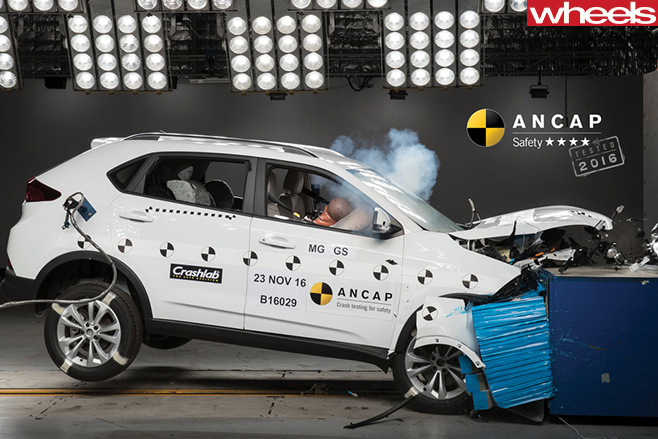
Fair enough.
But there must be other examples where a producer of a low volume car has decided it’s not worth the extra investment to add another star to a safety rating that will never be done.
A recent US Insurance Institute for Highway Safety test highlighted deficiencies in the safety of some American muscle cars. The Chevrolet Camaro and Dodge Challenger were each found to have issues.
Ironically the Mustang performed best of those three.
But ANCAP tests – however flawed – are very different. Despite the controversies they’re an important part of the safety message.
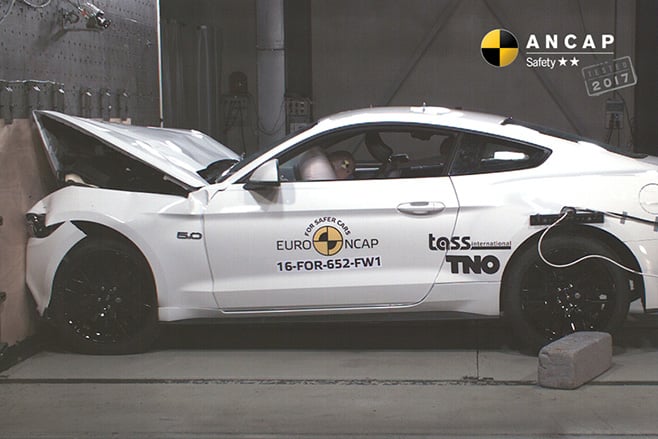
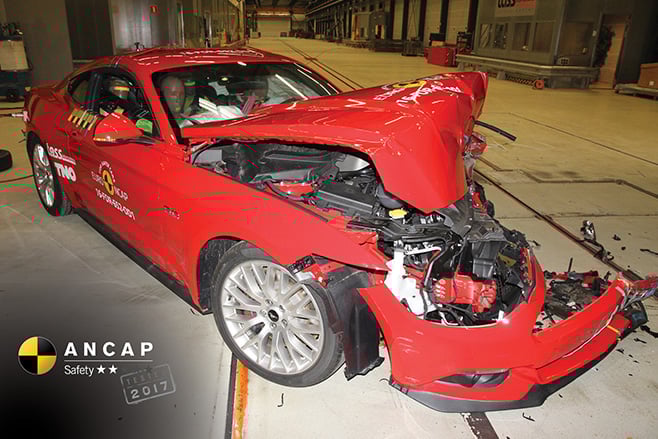
The US-built Ford Mustang has finally been given an ANCAP safety rating and the news isn’t good, with the big V8 muscle car scoring just two out of the possible five stars.
Testing of the V8 coupe saw it perform poorly in three of the four assessment areas – Adult Occupant Protection, Child Occupant Protection and Safety Assist.
The poorest performing area of assessment was Safety Assist with the Mustang scoring 2 points out of a possible 12 points (16 percent).
“This result is simply shocking for such a newly designed and popular model,” said ANCAP Chief Executive Officer, James Goodwin.
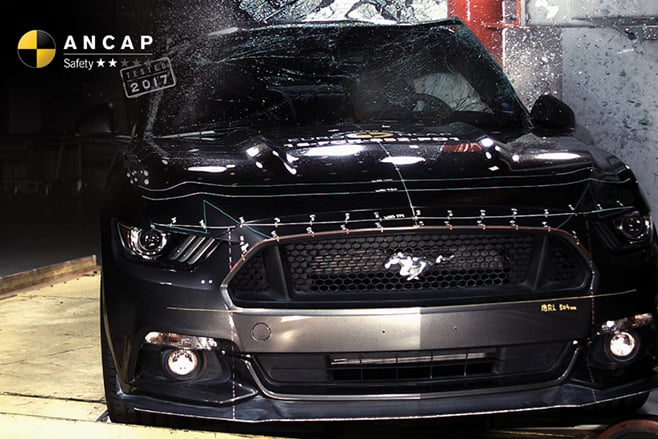
“The safety of adult occupants, child occupants and the ability to avoid a crash all form the basis of our ratings and the Mustang falls short in each of these areas,”
“There’s strong consumer expectation that a new vehicle will be 5 stars and a sports car is no different – safety should never be compromised,” he said.
Goodwin said speed assistant systems, lane keeping support, autonomous emergency braking, forward collision warning and rear seat-belt reminders, available in many cars in its $45,000-plus price range, are missing from the Mustang.
In a statement Ford defended its car and described the ANCAP result as “disappointing”, and that it relates to a “rigorous new [testing] protocol” introduced by ANCAP last year, well after development of the current Mustang had already been completed.
The statement also asserted that the ANCAP tests were now “more tailored to family cars and people movers” than sports cars such as the Mustang.
“The overall Euro NCAP rating is based on four pillars, with a very strong focus on family car safety characteristics and specific safety assist features, which are usually not part of the standard equipment of cars in the Mustang category,” the Ford statement read.
But as Goodwin points out the poor result wasn’t just because of missing active safety equipment.
“The full width frontal (crash) test showed a risk of serious head, chest and leg injury for the rear passenger. There was also insufficient inflation of both the driver and front passenger airbags in the frontal offset test which allowed the driver’s head to contact the steering wheel and the passenger’s head to contact the dashboard,”
“The driver’s door opened in the pole test, and whiplash protection for rear-end collisions was marginal,”
“This rating is not intended to shock or surprise – it simply presents the safety of this car against that of its contemporary competitors.”
The Mustang is believed to be the only new passenger car on the market with a two-star ANCAP safety rating. Other Ford models subjected to ANCAP testing, including the Ford Ranger, Kuga, Escape, Fiesta, Focus, Mondeo and the outgoing Falcon and Territory achieved five star ratings.
The four-cylinder Mustang and convertible models have yet to be rated.
