
One of the brilliant things about depreciation is that as a car’s age increases and its price drops, it opens up a whole new world of potential competitors.
The Audi B8 S5 is a perfect example. When it was sitting in showrooms shiny and new, it was competing for buyer attention with the likes of the BMW 335i and Mercedes-Benz CLK350.
Almost a decade on, the closest competitor we can find is Ford’s new Mustang GT. Yes, thank you, if you’ve quite finished laughing, let us explain. When it debuted in October 2007, the S5 launched with a rev-happy 4.2-litre V8 producing 260kW/440Nm and, unusually for an Audi, a six-speed manual gearbox.
An extra 800cc endows the Mustang with another 46kW/90Nm, but the extra 100-or-so kilograms it carries means the two are surprisingly close in outright pace – just two-tenths separate them according to our VBox. They’re closer than you might think in terms of dynamic behaviour, too. We found the S5 to be a great tourer with a delicious high-revving V8, strong brakes and a surprising amount of adjustability but lacking that final degree of feedback – all comments that could apply to the latest Mustang.
Of course, there’s a peace of mind that comes with having a new car and its associated warranty, but research indicates there aren’t too many nasty surprises with the S5. Owner forums suggest the 4.2-litre V8 is a hardy unit, though it can suffer from carbon build-up, but there are reports of clutch issues with early manual cars.
As with any second-hand prestige car, it pays to allocate a reasonable annual budget to keeping it running, but the upside is access to one of the world’s great engines in a stylish package for less than $50K.
| SPECS | FORD MUSTANG GT | 2007 AUDI S5 |
| Engine | 4951cc V8, DOHC, 32v | 4163cc V8, DOHC, 32v |
| Power | 306kW @ 6500rpm | 260kW @ 7000rpm |
| Torque | 530Nm @ 4250rpm | 440Nm @ 3500rpm |
| Weight | 1739kg | 1630kg |
| 0-100km/h | 5.20sec (tested) | 5.42sec (tested) |
| Price | $57,490u00a0 | $131,900 (New) |
Here’s one we found on Trade Unique Cars
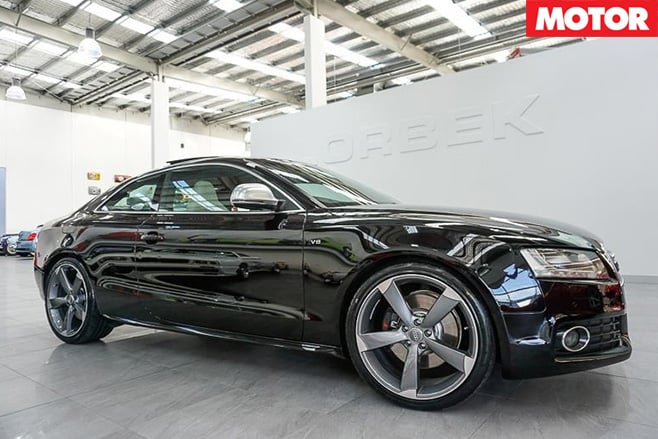
99,260km, manual, $46,444 Lorbek Luxury Cars in Melbourne currently has two B8 S5s in stock, the Brilliant Black 2008 manual you see here as well as a Meteor Grey 2010 automatic with 88,172km on the clock for $48,950.
Perception is key in the motoring industry – John Carey sits down with the designer of the Audi A5 coupe to discuss the prestige of luxury car design.
First published in the August 2016 issue of Wheels magazine, Australia’s most experienced and most trusted car magazine since 1953.
Visibly nervy, the young designer pleads for guidance from his PR colleague. “Can I talk about this?” asks Jakob Hirzel, who helped shape the exterior of the new Audi A5 coupe.
This pretty two-door is why we’re in a display space erected in a carpark outside Porto Airport in northern Portugal. This is an airy, purpose-designed temporary building. The décor is white, black and grey, with discreet dabs of red. There’s a large screen on one wall, a powerful audio system, dedicated wi-fi, a reception desk, classy tables and stools, and a neatly aproned waiter ready to make you an espresso. It’s all very Audi.
Brand image seems to be the reason for Hirzel’s awkwardness. He’s here to deliver a presentation on the A5 Coupe’s exterior design before we drive it, but things aren’t going to plan. Instead of letting him simply stand and deliver, myself and the other Australian media are peppering him with questions about his own background, not the car’s. We learn that Hirzel is 33, that he’s worked for Audi for four years, and that he was with Skoda, another VW Group brand, before that…
It’s when we ask which Skoda models he helped design that Hirzel turns to communications guy Sascha Höpfner for a cue. There’s a nod from the PR man, clearing Hirzel to reveal he helped shape the exterior of the Skoda Rapid Spaceback.
Perception is profit in the car business. In round figures, Audi accounts for about 20 percent of VW Group production, but its contribution to the black-inked bottom line is double this. A direct connection between a practical hatchback from the Czech Republic and an upmarket coupe from Germany costing four times as much doesn’t exactly add lustre to Audi’s carefully crafted image.
Still, Audi deserves credit for letting Hirzel speak. Other brands with high-price images to protect will put a lot of energy into concealing connections they believe might devalue the badge.
Maserati is a good example. When the current Maserati Quattroporte and new Ghibli launched there were rumours that the twin-turbo 3.0-litre petrol V6 used in both was based on Chrysler’s Pentastar. It made sense; both brands are part of Fiat Chrysler Automobiles. The rumours were denied, vehemently, by Maserati.
It took a couple of years and persistent pestering to establish that the American V6 had indeed provided a starting point for Maserati’s engineers. What’s more, Maserati sources its V6 engine blocks from a US plant. Although, it should be pointed out, Maserati’s V6 is assembled by Ferrari in Maranello and shares little with the Chrysler engine.
What companies like Maserati and Audi fear is that the complicated realities of the car business are too frequently mangled in translation. You know the kind of thing. ‘A5 Coupe? Styled by a guy who had to leave Skoda.’ Or ‘Maserati’s V6? A Chrysler 300 engine with a couple of turbos bolted on.’
But you read Wheels, so we know you relish the complexity. Which is why we’ll continue to ask the kind of questions that make people squirm.
Head of the Q
Touchiest reaction I’ve ever seen from a car company was at the launch of the Infiniti Q30 late last year. The subject of how closely, exactly, it is related to the Mercedes-Benz A-Class and GLA (it shares platform, some engines and much more) was an absolute no-go area.
Fifty-four seconds. It seems like eons, especially when all you have to do is fire a couple of bolts into a car moving glacially along a moving production line.
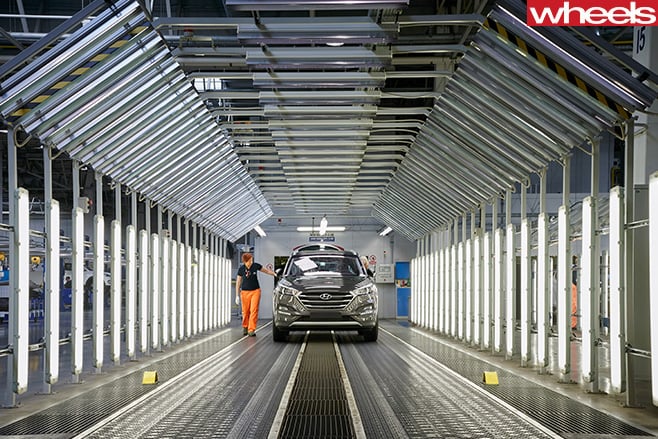
Except that the pressure is on. There are 3400 people and hundreds of stations in Hyundai’s Nosovice plant deep in the Czech Republic to bring together the 23,000 parts that make up a single car. One glitch can stop the line that snakes through the welding shop, the paint shop and final assembly, creating a sizeable hiccup in the just-in-time production that results in 350,000 cars exiting what is one of Hyundai’s most advanced plants each year.
My job today is very different from a typical Wheels assignment. Usually we’re at the end of a production line itching to swipe the keys of a new model and give it a suitable thrashing.
This time around we’ll be the blokes in funny pants and bulletproof shoes helping (supposedly) screw a Tucson together. The idea is to get a taste of what it takes to put a car together, from the stamping of panels at the start to the beginning of its often lengthy journey to its final destination at the other end.
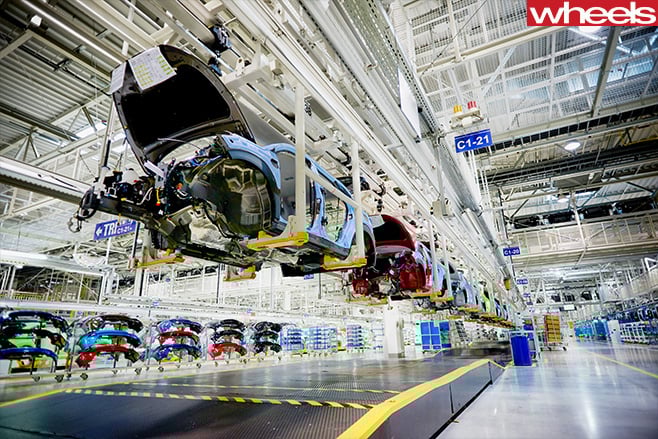
After some death by PowerPoint to learn not to slice our arms off or arm wrestle a robot it’s on with the safety clobber. There are contact sports that don’t require as much gear as those rolling up to assemble a car; steel-capped boots, chunky arm socks, gloves and goggles. Most of it is about protecting me, but some of it – like the gloves – are about ensuring fingernails and rings don’t damage cars yet to find a buyer.
First up is the stamping shop. This is where giant rolls of sheet steel are cut and turned pressed between 30-tonne dies to create everything from bonnets and doors to roofs and boots.
Most of the work is done by gigantic machines pound a piece of metal instantly into a more recognisable shape. The concrete floor shudders as dies weighing 30 tonnes or more are thrust together.
Similarly, the body shop where welding takes place is a sea of 364 robots tasked with taking the basic building blocks and turning them into a shape that resembles a car. Yet people are in place to position the various components so when the sparks fly the bits hopefully stick together.
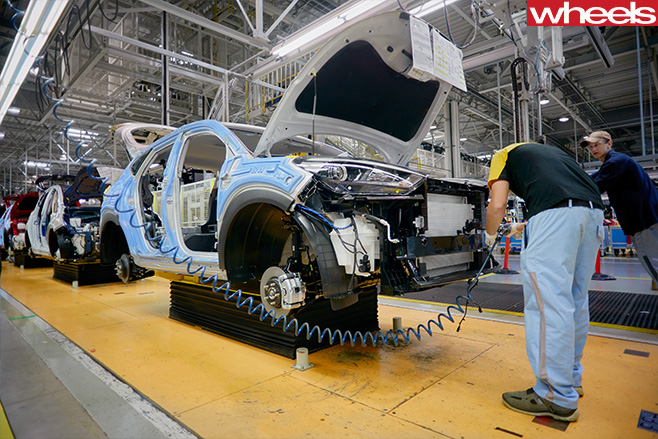
It’s a tense moment as I hit the big start button that signifies to the machines that all is right to go.
Soon it’s on to final assembly where the bulk of the traditional car building takes place. There are a lot more people and a lot fewer robots.
Trolleys whizz around delivering parts, some as small as bolts, others as large as bumper modules or fuel tanks.
Some of the parts are pre-assembled modules, such as the front headlight and radiator assembly that’s screwed on with six bolts on either side.
It’s that fairly important component that I have to bolt on to one of the Australian-spec Tucsons heading towards me. Again, there’s 54 seconds to ensure the bolts are aligned and tight by the time the car is at the next bay. Watching the real workers is an indication of how practised they are at this job … and also a stark wake-up of the monotony that is building cars.
It soon dawns on me there’s plenty that could go wrong. Forget a bolt, for example, and it could lead to a failed suspension component half way down the Hume Highway. Pinching an electrical cable could result in windows that refuse to wind. Or just dropping a bolt could lead to a rattle more annoying than Donald Trump trying to make sense. The wrong badge could turn a Tucson into an i30.
Fortunately there are real workers here to watch over me. More than once they explain something to me in broken English. Hand signals and pointing is key at this time.
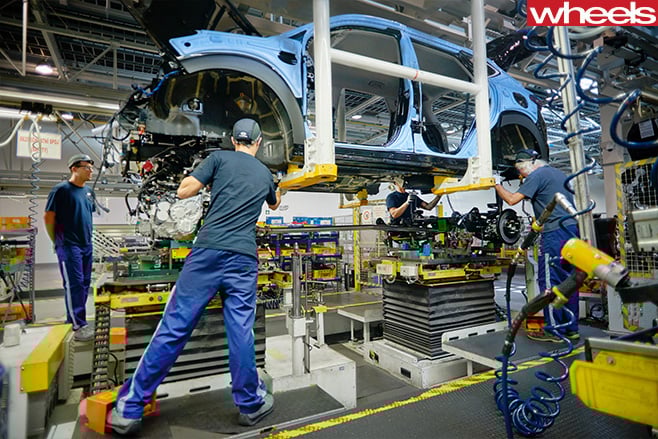
Part of the challenge is ensuring you’ve got the right part at the right time. Fortunately the entire computer-controlled line does most of that work for you.
The speakers and door trims I’m bolting on are all perfectly aligned to the cars arriving on the production line.
The amount of behind the scenes planning and tracking is bonkers, although humans are still expected to check and double-check the 1s and 0s haven’t got confused along their superhighway.
Yet it’s humans that make most mistakes. About one in 60 cars needs something tweaked, changed or checked before it’s sent for shipping. And almost all of those have that fault as a result of someone overlooking something along what is the ultimate expression of industrial teamwork.
One of the biggest surprises is how much is done at the factory. Even the Australian government-mandated fuel sticker is stuck to the windscreen towards the end of the line rather than on the docks when the car lands.
And the final piece of a very complex car-making puzzle is the addition of eight litres of fuel, four of which is just to fill the fuel lines, with the remaining four just enough to get it from the ship to the showroom.
My Hyundai build experience finishes months later in the Sydney suburb of Macquarie Park at the company’s head office.
We’d hoped to head to the docks to watch the car arrive on one of the enormous RORO ships, but in the end OH&S and regulations got in our way.
Still, having bolted on some numberplates and headed for a brief test drive (the start of which involved some more fuel) I can confidently say there wasn’t anything wrong with ‘my’ Tucson. At least not yet…
With the release of a HSV with one eye toward the race track, we thought it fitting to take it to the greatest track of all.
This year the race for Bathurst glory began on the same day Ford killed the Aussie Falcon. Cameron Kirby took HSV’s new Clubsport Track Edition to the spiritual home of Ford and Holden’s rivalry to discover whether passion trumped pathos
It’s 8:45am on Friday, October 7, and I’m at Tullamarine to collect snapper Wielecki for our bittersweet roadtrip. This will be my first big drive in an HSV, and not just any model but the newly minted Clubsport Track Edition, complete with bigger brakes, a more responsive engine and racier suspension, making it the most track-focused HSV to date. Perfect for a blast to the greatest race track in Australia, Mount Panorama.
Bittersweet because my first drive in an HSV could also be my last.
It’s not my fault I was born in 1993, six years after HSV began, or that I only got my licence as HSV celebrated its 23rd anniversary, when the 375kW W427 was already two years old. And I’m definitely not to blame for getting to Wheels just two years before Holden stops building Commodores, leaving HSV with nothing but imports to fettle.
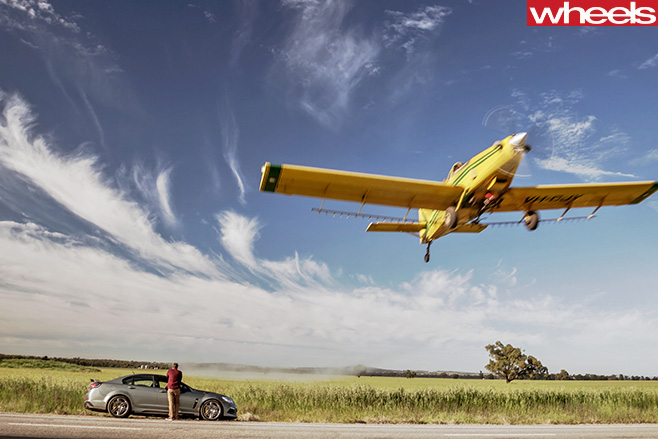
The mission is to spank the Track Edition from Melbourne to Bathurst in time for The Great Race. We’ll avoid the straight-n-drowsy Hume and find every backroad possible to test the Track’s honed abilities. But we’ve only got a day to get there because the other half of our mission is to sample the mood on The Hill.
Coincidence or not, Ford Australia has chosen to close its Broadmeadows and Geelong assembly plants on the same day that the V8s hit Mount Panorama for qualifying. And Wheels wants to know what Australia’s most passionate tin-top fans think about our big Aussie cars departing this wide brown land. Cars that were so much a part of our culture, our national identity, have withered from consumer neglect to the point where they’re no longer production viable.
The death knock. Does the average bloke on The Hill care? Does his wife, his family, his friends?
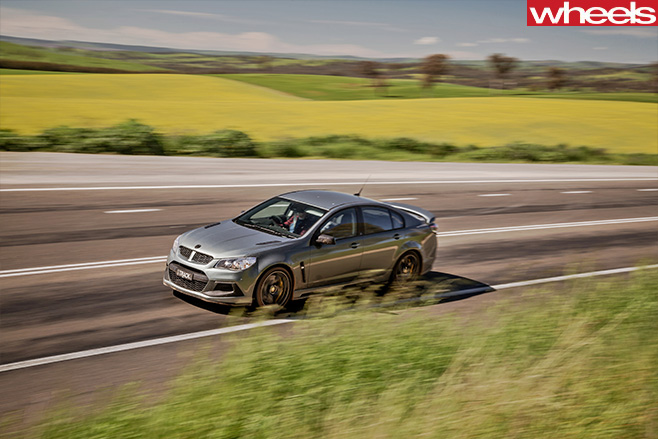
At 10.30am, just as the last Falcon has completed its journey to the very end of the Broadmeadows production line, we peel off the Hume Highway for Shepparton… and say hello to Ian Griffith, a fifth-generation canola farmer from a family whose history of working this land stretches back three-times’ the Falcon’s measly 56 years. While Wielecki puts the Prussian Steel Clubsport among the sunshine yellow canola fields, I take Ian’s Falcon pulse.
“It is a real shame that Ford is closing down,” he says with a sigh, leaning against one of the trailers of his B-double. “Back in the ’60s and ’70s everyone would get a fair wage and the bosses still earned money. Now it’s all cut-throat. Every penny counts.”
Ian fits your typical image of a farmer. Weathered, calloused hands from time toiling the soil; a deeply furrowed brow tells me he’s knows a hard day’s work.
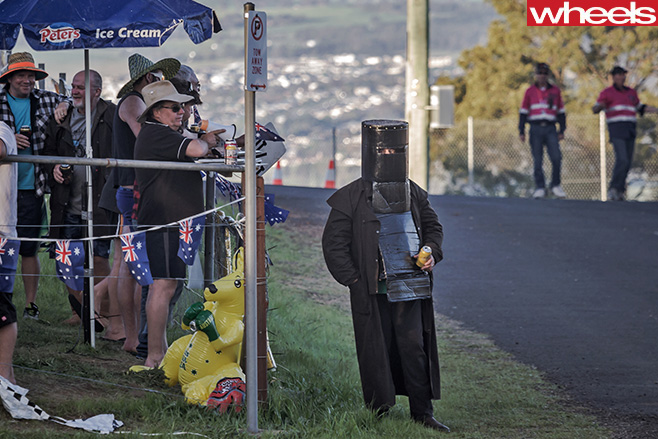
While it would be easy to listen to more of Ian’s musings, the Mountain is calling, so we push north into Jerilderie, once the fertile poaching ground for another Australian legend, Ned Kelly.
Unlike that stovepipe-wearing bushranger, the HSV Track Edition’s visual changes are subtle: blacked-out badges and a lack of signage on the bootlid. Inside, there are Track Edition plaques on the door sills and below the shifter. The most obvious tactile adjustment over the standard R8 is an Alcantara-clad wheel. The wheel stands out as a highlight, and a feature HSV should put on the options list for its other vehicles.
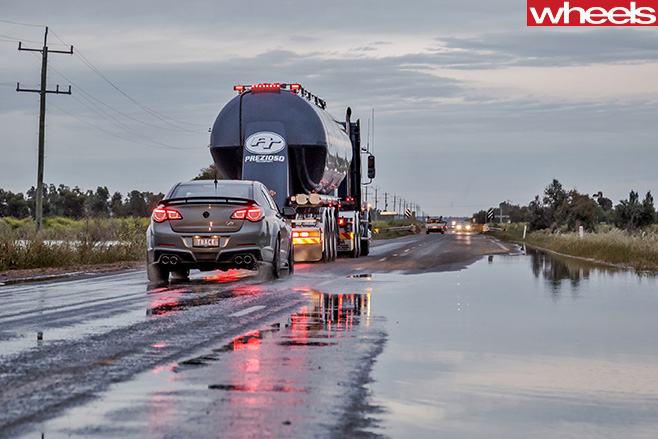
Despite the lack of a blower, the Track Edition still sings a fine tune, letting out a sharp bark at start-up, and crackling nicely off the throttle. However, it’s a sad day when a company puts a ‘sound enhancer’ (which feeds extra engine noise into the cabin) on a car with a 6.2-litre V8. At least it isn’t artificially enhanced through the Bose speakers inside the cabin.
The other Track Edition changes are hidden inside shiny 20-inch wheels from the GTS; 390mm two-piece brake discs up front and 367mm drilled single-piece discs in the rear are grasped by forged six-piston AP Racing calipers previously reserved for the HSV GTS flagship. The imposing set-up scrubs off speed forcefully, but despite their considerable stopping power won’t put your face through the windshield every time you think of slowing down. There’s great feedback through the pedal.

Still, it eats the miles easily; coupling cruise control with the heads-up display means that keeping track of speed on the straight sections of road to Griffith is easy, keeping me on the right side of the boys in blue.
The rivers here have swollen to breaking point after weeks of heavy rain, the vast plains now drenched and flooded. An onslaught of mosquitoes of horror-flick proportions is so thick that it sounds like we’re driving through rain as they splatter across the grille for the last 50km into Griffith.
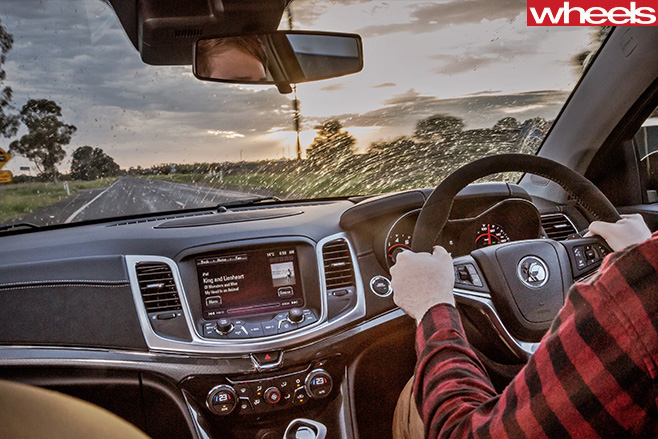
We stop for breakfast in Ardlethan, a sleepy little town with a café, newsagent and general store all rolled into one. As we speak with shopkeeper Sophie, her mother Leanne and stepfather Glen arrive with son Zacariah. Interest turns to the HSV parked outside. Cars like this don’t often roll through Ardlethan. A rev of the V8 for young Zac brings more locals out from the woodwork; the HSV is a major attraction. A few quick laps of the main drag demonstrate the Track Edition’s impressive speed and roar. Performance mode means the ESP and traction control give enough slip to feel like a hero but stops you from becoming a zero with a bent car. It’s smiles all around in the cabin.
However, this tighter, more ‘track-focused’ HSV does have its weaknesses. On undulating country highways the stiffer suspension means you become acutely aware of every ounce of fat on your body. The car jiggles constantly, those nestled in the leather-clad seats never able to settle. I realise it’s time to start a diet.
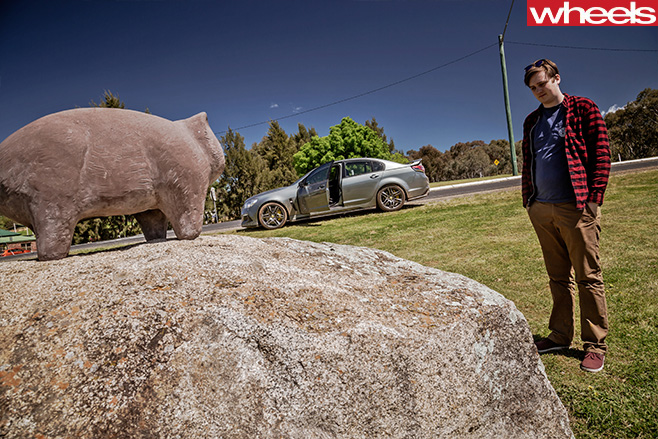
But when we reach Cowra I begin to feel the hype of Bathurst. The Mountain is still 100km off, but its presence can be felt. Outside a pub sits an E-Series HSV and a VL Walkinshaw SS – it’s a family reunion of sorts. There’s also an increased police presence; all eight highway patrol cars we pass during the trip are located in this final section of road.
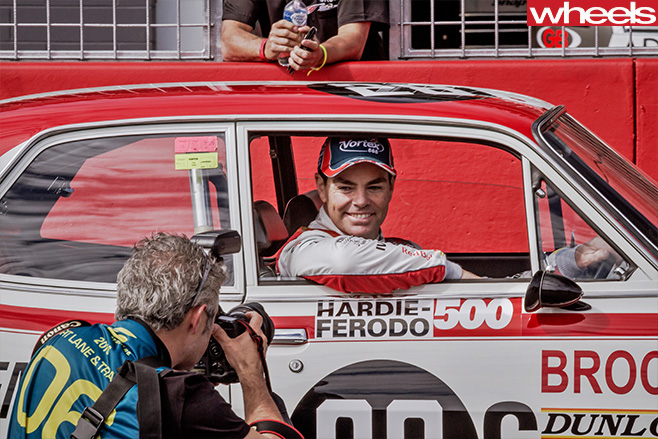
The significance of the trip begins to sink in. Here I am driving one of the last Aussie V8s to the most sacred piece of bitumen in Australia, a place where legends are made and childhood dreams realised. And on the weekend that marks 10 years since Peter Brock’s death as well as the Falcon’s end. It would be a fine time to become emotional if I wasn’t so excited.
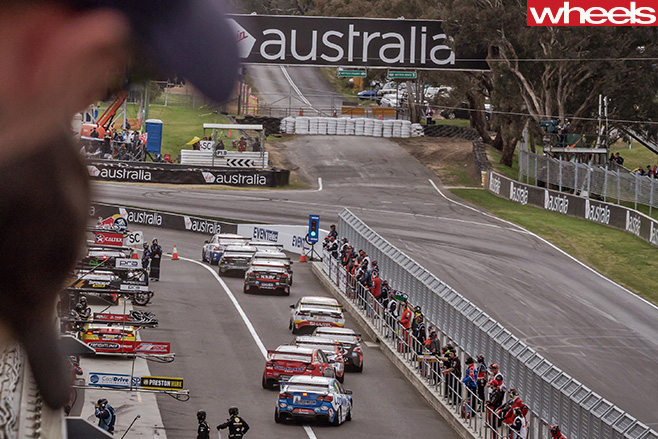
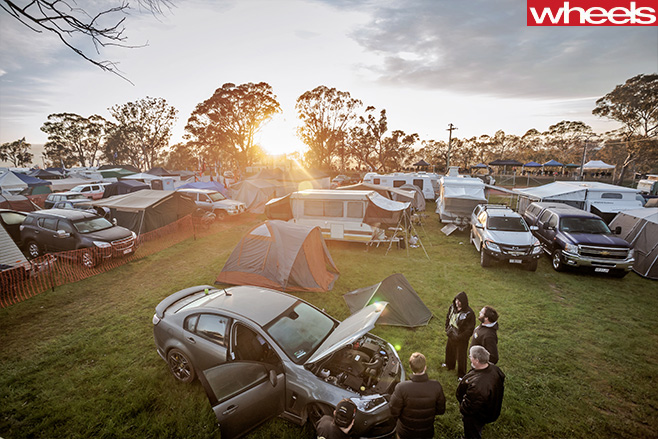
For many, camping at the Bathurst 1000 is a ritual, something that’s been done for generations. Most just pitch tents, others haul caravans or drive motorhomes, making the campground like any other. But the larger groups band together, constructing temporary structures, which turn into makeshift bars, a central hub for their merry crews. These are the veterans who have been coming for decades, and lay claim to the prime camping positions.
One, located directly opposite the McPhillamy Park section of track, is easily identifiable thanks to a huge banner draped across the front: Wobbly Boot Bowling Club. Fifty or more patrons wear matching shirts, with the Southern Cross across the chest and a tribute to Peter Brock on the back.
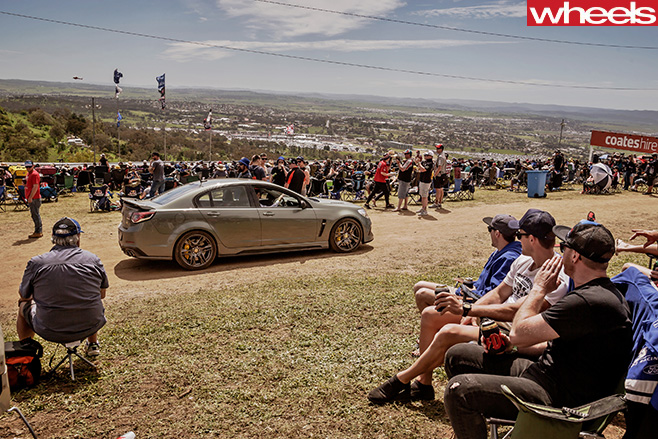
“That free trade agreement killed us,” chimes another. Which free trade agreement he means is unclear, but he’s certainly unhappy about it.
Despite the name, the Wobbly Boot Bowling Club doesn’t actually play Lawn Bowls. Nor do they watch the racing. Instead of walking 10 metres for a clean line of sight of one of the best bits of race track in the world, they sit, drink slushies, crush tinnies and heckle anyone who crosses their path.
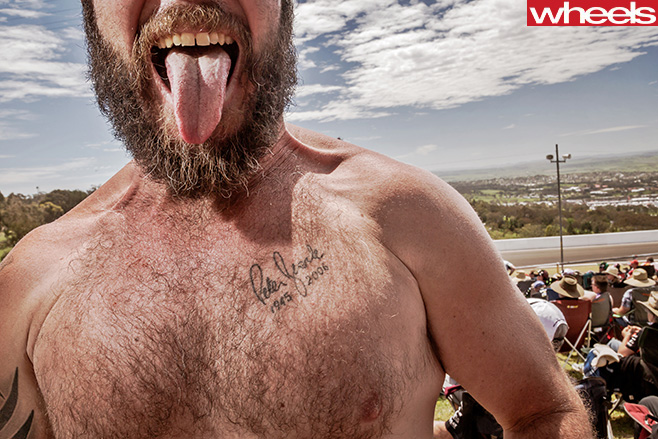
But there is also patriotism to be found in the moment. “It gives you pride that the last Ford engine was put in manually, and that it was the Barra [in-line six]. Aussie men putting in an Aussie engine, the good ol’-fashioned way. A proper send-off”.
Not everyone is torn up about the death of local car manufacturing. Drew has travelled from Newcastle and wears a shirt that lists every year he has been trackside for The Great Race, dating back to 1992. The topic of Broadmeadows closing brings a simple shrug of the shoulders as he holds a sausage sanga in one hand and BBQ sauce stains his shirt. He can’t stand still, constantly shifting his weight. “Yeah, it’s sad I guess, but it doesn’t bother me.” He’s here to drink beer and watch cars race. It doesn’t matter what goes on, as long as it’s fast.
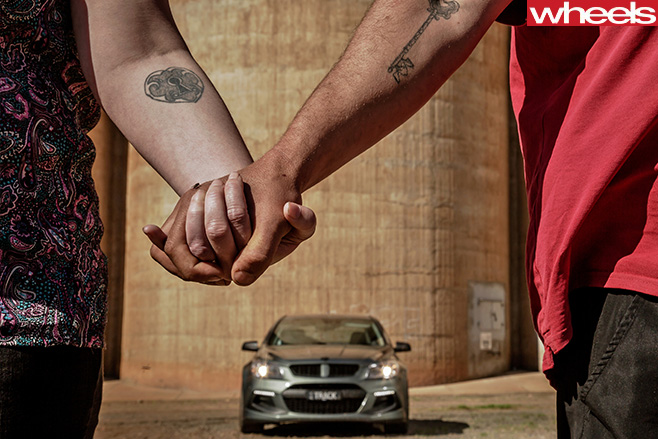
Despite rare patches of indifference to the demise of local car manufacturing, there’s an unbridled passion you can only find at Mount Panorama. There are tribute banners and flags, and plenty of tattoos.
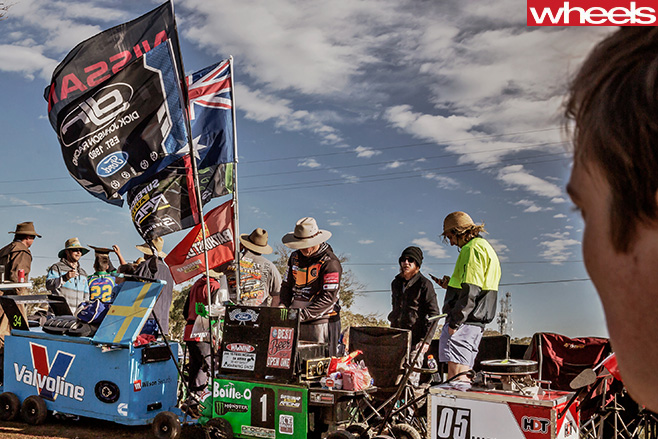
“Holden and Ford saved Australia,” he adds after a swig. “Our economy was nowhere in 1942. But then Ford and Holden gave everyone a job. They saved us and what do we do? Kick ’em to the curb! Disgraceful.”
For the Blue Oval faithful, this weekend hurts the most, but watching the race makes things easier. Mike and his mate from Melbourne have been coming for 30 years. They wear matching wigs and shirts. Both Ford men, they say the loss of the Falcon hurts but that a leopard never changes its spots and the company is still revered. “Ford will still be around,” Mike says, searching for the silver lining.
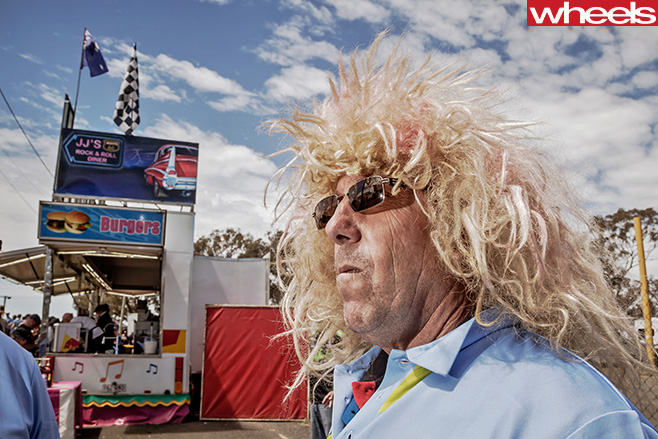
For many fans, there’s a feeling of powerlessness. Yes, they are sad that Broadmeadows has closed, but what can you do? Many bought locally built cars, yet simply don’t have the capacity to get torn up over something they cannot control.
You can’t talk Holden and Ford road cars without bringing up the on-track rivalry. That’s the hardest thing for fans to reconcile. Mike is reluctant to discuss the future of Supercars and the Bathurst 1000. Eventually The Great Race won’t have a Ford Falcon on the grid, or a V8 engine, possibly not even a Commodore. Those years aren’t too far away, and for some that’s a bitter pill to swallow.
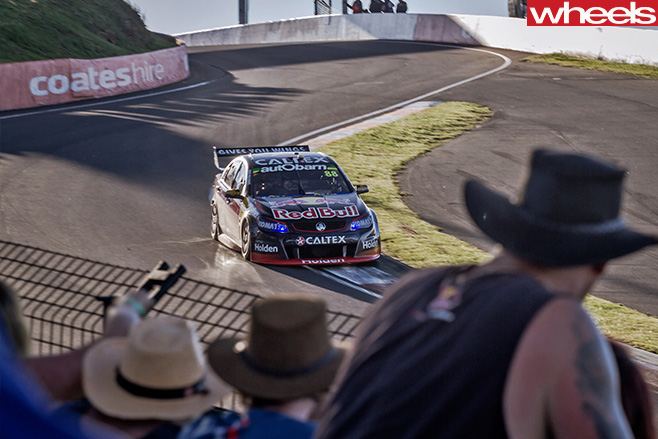
Our tattooed friend sees it differently. “I don’t care! I’ll be here to the day I bloody die!” he bellows to grunts of approval from his mates.
It’s not clear what will replace the Falcon on track, however its been said that the imported Holden Commodore will continue to compete in Supercars, but just don’t expect eight cylinders under the bonnet.
Many fans will soon have to decide whether to keep watching or turn their backs on something they love, with V8s potentially being joined by twin-turbo V6 powerplants in Supercars from next year. Many stayed on when Nissan, Mercedes-Benz and Volvo broke into the exclusive Ford and Holden club, but is the V8 engine sacred ground? Time will tell.
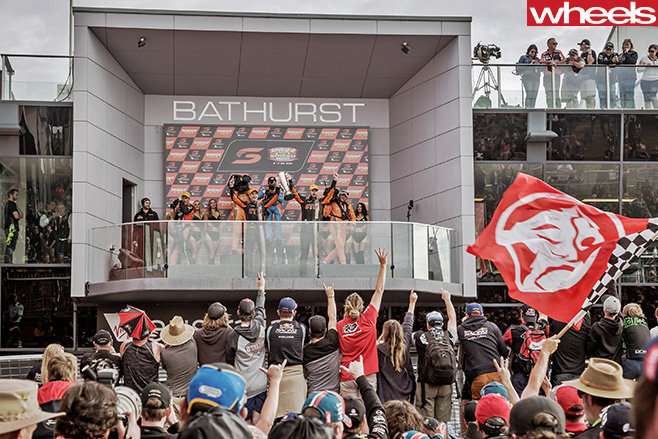
The Mountain doesn’t forgive, and it doesn’t forget. Take note, Holden.
Remembering The King
The biggest carpark in Oz
Better the evil you know
SPECS Model: HSV Clubsport Track Edition Engine: 6162cc V8, ohc, 16v Max power: 340kW @ 6100rpm Max torque: 570Nm @ 4650rpm Transmission: 6-speed automatic Kerb weight: 1754kg Fuel economy: 12.2L/100km (estimated) 0-100km/h: Sub-5.0sec (claimed) Price: $72,585 On sale: Now
Ford has shown the development version of its first fully autonomous vehicle, set to hit the market without a steering wheel or pedals in 2021 – but you won’t be able to buy one.
Revealed at the Consumer Electronics Show (CES) in Las Vegas and based on the Ford Fusion Hybrid, the car can control all aspects of driving without human assistance. It is aimed squarely at ride-sharing companies, not traditional new car buyers.
“This will be a fleet vehicle that can be summoned with an app. Not something you can buy in a dealership,” Colm Boran, manager of Ford’s autonomous vehicle platform, told Wheels. He suggested partnerships with ride-sharing companies were already in the pipeline.
Boran confirmed Ford would jump straight from the lower-level autonomous driver assist functionality it has in mainstream products, to an SAE Level 4-capable vehicle, and that a Level 3 vehicle, which is one able to monitor the environment and drive itself but expects a human fall-back, was not planned.
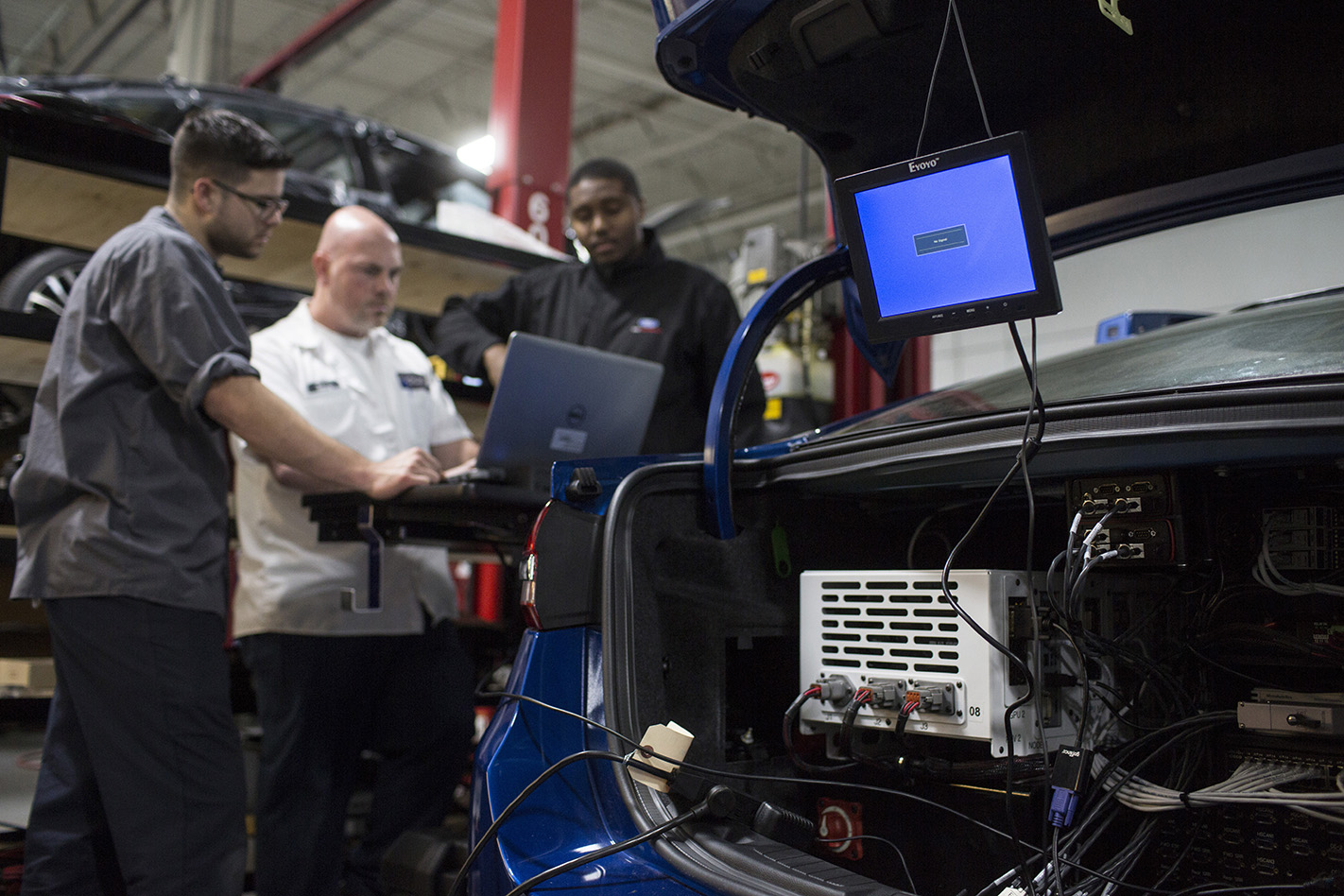
“I wouldn’t quite call it dangerous, but [Level 3] has challenges with reengaging a human, and it doesn’t answer the question of bringing mobility to people who don’t have it today.”
At the moment the Fusion-based development vehicle looks relatively conventional, with the exception of distance monitors extending from the A-pillars on antennae. However, the production version may not look anything like it.
“Being a fleet vehicle and offering a service, a lot of people might look at those LiDARs on the A pillars and think it’s awful, I would never buy it – well I’m not asking you to buy it,” said Boran.
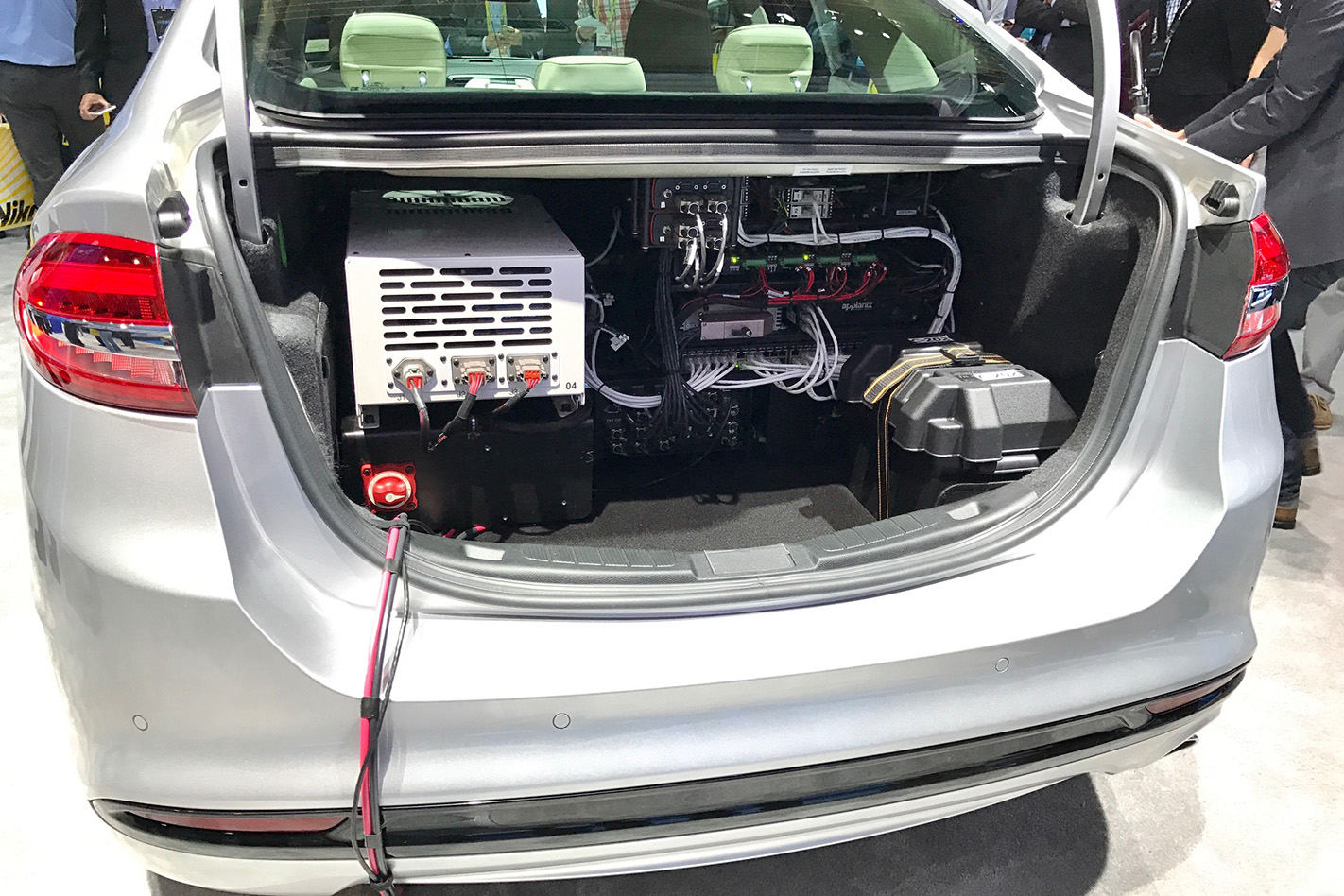
“It’s a paradigm shift for us at Ford. We put our careers together by appealing to the guy who’s going to buy the car, and suddenly that’s all changed. We have to remind ourselves, does that really matter?
“Now we’re going to design it around appealing to somebody who wants to hire a car. So does that mean we have to have a conference call system, or really high speed Wi-Fi?
“Who cares about how it looks? I think some of this stuff is going to be the market differentiator. Other companies have shown cars with seats facing each other. I can safely say our 2021 car will have all forward facing seats.”
Ford currently has 30 of these Fusion-based development vehicles in operation, and plans to have 90 of them out on the road by the end of 2017. Boran confirmed that testing of the vehicle would happen in Australia eventually.
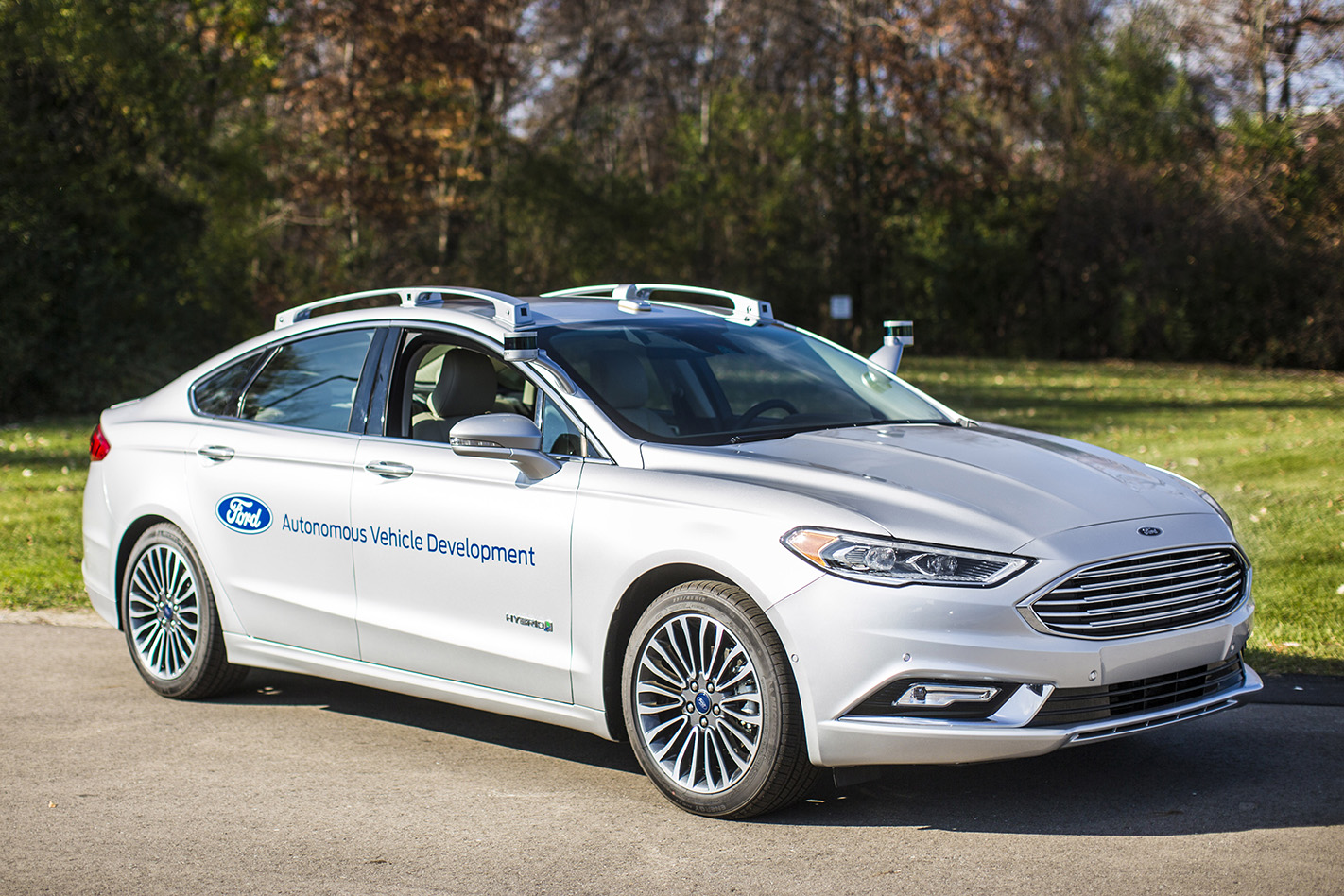
A business that Ford invested in, called Velodyne, currently supplies sensors, though it does not make a camera with sensors integrated such as in Tesla vehicles. Boran told Wheels that a freeze on the hardware would have to happen within the next 18 months in order to meet the 2021 on sale deadline.
“We’ve been working on autonomous development for 10 years. We’re more mature than people realise. We have to use what’s available to us now.”
“My job is to make sure we design this as a platform, which means we can apply this [technology] to any vehicle we want.”
Here’s the latest in a very long line of big BMW sedans designed mainly to make executives and businessmen happy. The 5 Series is the last stop in the Bavarian brand’s sedan range before moving up one final step on the status ladder to chauffeur-driven limousine.
The latest 5 Series is the seventh all-new model to wear the name since the early 1970s. Known inside BMW by the codename G30, it’s due to reach Australia in March 2017.
While the range will expand over time, the four-model launch line-up is to be headed by the $136,900 540i. Prices will rise across the board, though BMW Australia argues that extra standard equipment in each of them more than compensates.
The turbocharged 3.0-litre in-line six-cylinder of the 540i is a completely fresh engine design from BMW. As usual, it drives the car’s rear wheels. The transmission is an eight-speed automatic.
Overall length is the only important dimension that increases significantly compared to the outgoing model, but BMW’s weight-conscious engineers have cut up to 100kg from the new 5 Series.
The exterior design is all new, naturally. Inside, BMW has aimed for more opulence, technology and craftsmanship than ever.
So much for the basics; now here are some things you don’t know about the BMW 540i…
- BMW has come up with a smart update of the way its central touch-screen works. The interface lets drivers select which three ‘pads’ are shown on the first screen. These look like big icons, but they’re actually miniaturised real-time displays of what’s happening with, say, the sat-nav, phone and infotainment systems. Instant access to full screen views or menus is just a tap away. The standard 10.25-inch high-res screen delivers luscious clarity.
- Optional in other markets, the inductive charging smartphone tray in the new 5 Series will be standard in Australia. It’s found just forward of the transmission shift lever. Even if your current smartphone lacks built-in inductive charging, BMW sells accessory cases that will fix the problem.
- Head-up display is standard in all new 5 Series models. The display is 70 percent larger than in the previous model. It needs to be; the new HUD can display sat-nav prompts, driver-assist system warnings, phone lists and infotainment system info.
- Redesigned bottle holders in the front doors hold more than before. They’re good for 1.0-litre containers, says BMW.
- Instrument panel in new 5 Series is covered in Sensatec, an artificial leather. It looks great, with the pattern of graining looking like a dog’s nose. In places the driver comes into physical contact with the car, like seats and steering wheel, BMW uses real leather.
- For the first time in a 5 Series, the premium audio option is a 16-speaker surround-sound system from Bowers & Wilkins.
- The new 540i is the only model in the range to come equipped with active roll-bar technology. This tech works with the car’s variable shock absorbers to reduce lean angles through corners.
- Active aerodynamics help make the new 5 Series a slippery customer. An electrically controlled venetian blind-like arrangement just behind the grille can block airflow through the car’s radiator when it’s not needed. This cuts air drag, improving fuel efficiency.
- Forward-facing radar just beneath the front number plate is a key part of the 5 Series’ active cruise control and autonomous braking tech. It has a range of around 300 metres… in good weather. Any build up of snow or ice can reduce this significantly, so BMW fits a heated cover over the sensor that can melt any build up. It only operates when needed.
Even as SUVs increasingly rule the roads, luxury cars from Europe remain signs of status for the executive class. The new BMW 5 Series is a Commodore-size sedan that packs upper-class enginering and high-grade technology into an all-new shape. It’s BMW’s response to the recently launched E-Class of arch-enemy Mercedes-Benz.
Scheduled to arrive in March 2017, the new 5 Series line-up initially will be topped by the 540i model. Priced at $136,900, it’s powered by a new turbocharged 3.0-litre in-line six-cylinder engine. This is a member of the Bavarian brand’s new modular engine family, which also includes the turbocharged 2.0-litre four-cylinder of the less costly 530i. Both engines benefit from the latest additions to BMW’s extensive stock of engine know-how
While the 2017 BMW 5 Series is fractionally larger than the car it replaces, BMW engineers managed to cut weight by up to 100kg, mainly through the use of aluminium in the car’s body structure and chassis. Lightness is good for both fuel efficiency and performance.
The fresh exterior design features what BMW’s designers call the ‘twisted ribbon’. It’s a double crease in the sheetmetal, running from the front wheelarch to the C-pillar. Inside, the designers aimed for more opulence and greater user-friendliness.
But the company’s highest priority was to create a car better to drive than the E-Class…
STRENGTHS
- Agile, quick and comfortable, the 540i is a terrifically pleasant car to drive. The steering is very precise and the smooth-riding BMW corners with great confidence. Performance is very strong. The turbo six isn’t only muscular, it also sounds great. It teams very well with the eight-speed automatic that channels power back to the rear wheels.
- The spacious interior is beautifully made and thoughtfully designed. Classy materials and great craftsmanship are everywhere. Not so obvious is the work BMW has put into making the car’s features easier to use. Some of this is a bit gimmicky (see Weaknesses), but BMW’s rethink of the human-machine interface mostly makes things simpler to use than ever.
- Much of the technology in the 540i aims to make it a better tool for the executives and businessman who are the 5 Series’ typical customers. This is a car that can make good use of its connectivity. It also has driver-aid and active-safety systems that are up there with the best. Technologies like the 5 Series’ standard AEB (autonomous emergency braking) system reduce the chances of crashing.
- The same sensors and cameras that make AEB possible also are also used for the active cruise control system and the lane-keeping assistant. These cut the driver’s workload and are especially helpful in reducing fatigue. But the technologies would be even better if they worked more reliably.
- The 540i is equipped with the same gesture control tech introduced in the 2016 7 Series. The car recognises and responds to hand gestures made in an area above the gear selector. A finger-twirling motion, for example, will raise or lower audio volume. It’s hard to see any genuine advantage in this gimmicky technology.
- While there’s plenty of space in the rear of the 5 Series, the seat itself could be better. In a car like this, everyone should ride in real comfort. This is one area where the 540i probably isn’t as good as its Mercedes-Benz competitor, the turbo 3.0-litre V6-powered E400.
Mercedes-Benz E-Class, of course. The 540i has the better chassis and engine, while the E400 has an edge in advanced tech and interior bling. Also worthy of a look are the various models of the new Jaguar XF fitted with the company’s supercharged 3.0-litre V6 engine. Volvo’s new S90 comes only with four-cylinder engines, but brings a welcome serving of Scandinavian design flavour to the luxury sedan segment. The Lexus GS 350 with its non-turbo 3.5-litre V6 could also be considered a contender. Bland to look at and bland to drive, but its prices and quality are very attractive.
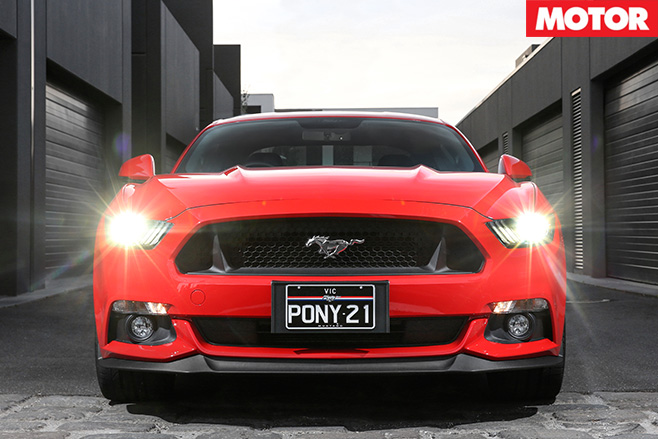
If you thought a four-cylinder Mustang Ecoboost was controversial then hold your horses, because a Mustang Hybrid is now confirmed for the next model due in 2020.
Ford this week unveiled its electric vehicle (EV) strategy and it made no apologies for including its iconic two-door sports car among plans to mix petrol with battery power. For now the company has only said a Mustang Hybrid “will deliver V8 power and even more low-end torque” and will debut in 2020 in the North American market “to start”.
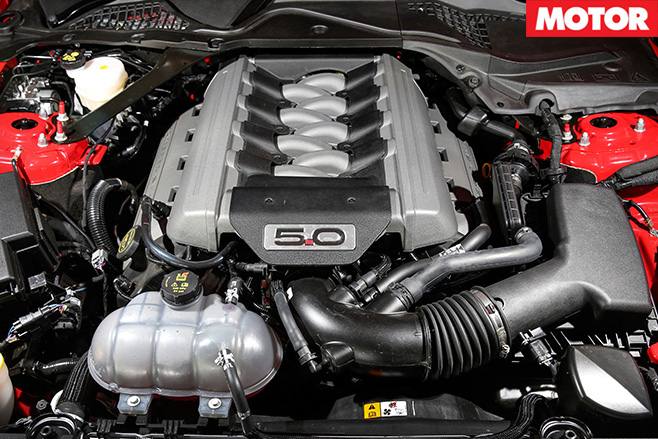
There is no indication whether an electric motor will mate with an atmo V6 or V8, the current turbo four or perhaps a turbo V6, but either way consumption will drop from the Ecoboost’s 8.5L/100km and GT’s 13.1L/100km claims.
Unfortunately, significant emissions legislation in overseas markets means that Ford (as with most manufacturers) needs to care about fuel consumption even if Mustang buyers don’t – as the low global take-up rate of the Ecoboost shows.
“While some others seem to be focused on marketing claims and numbers, we’re focused on providing customers even more of what they love about their Ford vehicles,” claimed Ford product development executive vice president and chief technical officer Raj Nair in a statement.
“This means more performance for sports cars – plus improved fuel economy.”
The Mustang Hybrid will be joined by 13 other EVs within five years, including an F-150 Hybrid truck, as part of a $4.5 billion investment and $700 million boost for the Flat Rock, Michigan plant that currently builds the ‘Stang and will make the new EV breed.
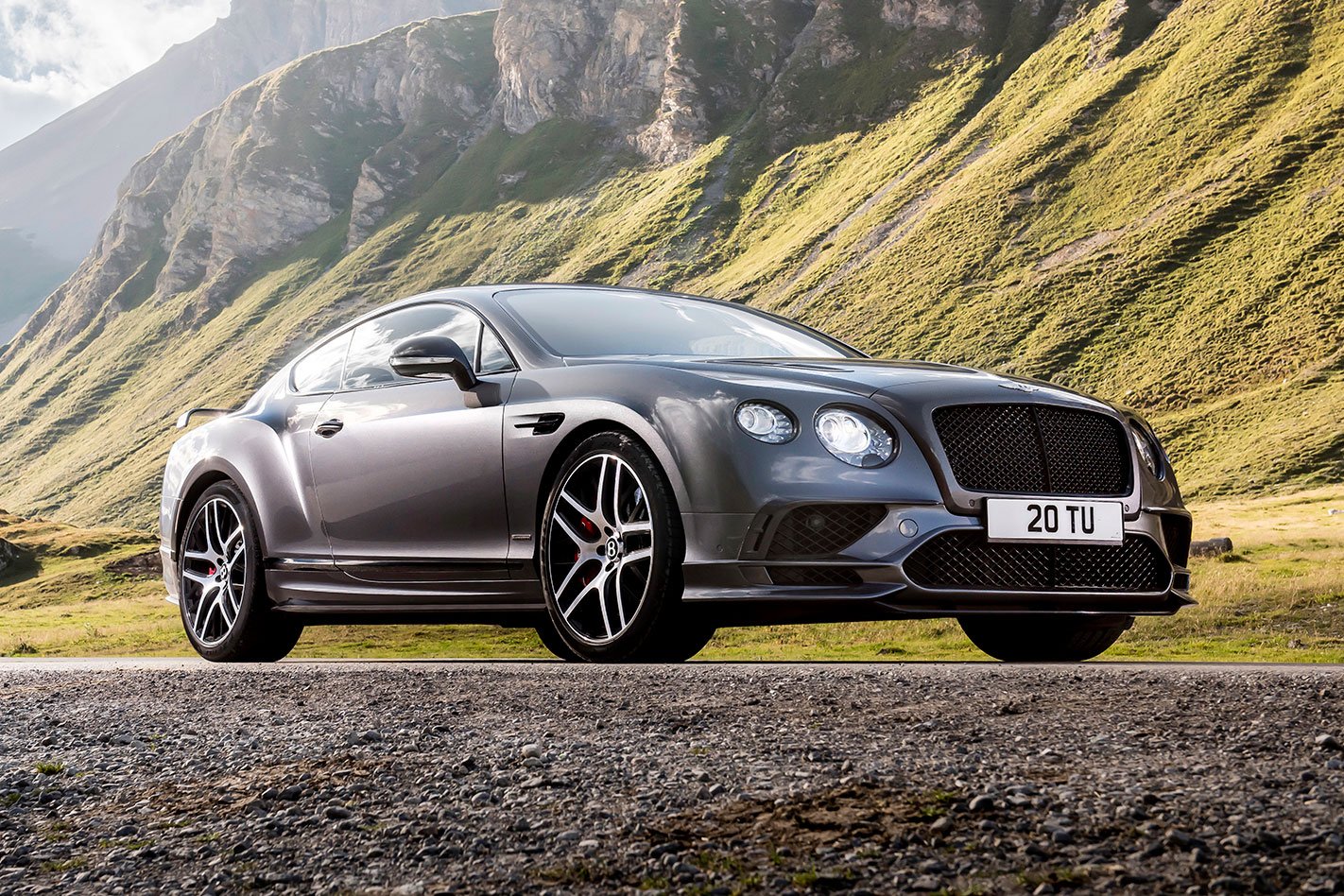
Bentley is bidding farewell to the current generation Continental GT with a new Supersports, Crewe’s fastest and most powerful production car ever.
Using the existing Continental GT Speed as a base, Bentley screws a substantial 55kW/197Nm extra from the 6.0-litre twin-turbo W12, courtesy of new turbochargers and intercoolers, bringing outputs to a whopping 522kW/1017Nm.
Even lumbered with a mighty 2280kg kerb weight, the Supersports bolts to 100km/h in just 3.5sec and on to a top speed of 336km/h. Bentley famously proved the 330km/h top speed of the GT Speed in the Northern Territory before pulling the film following complaints from Australian anti-speed campaigners.
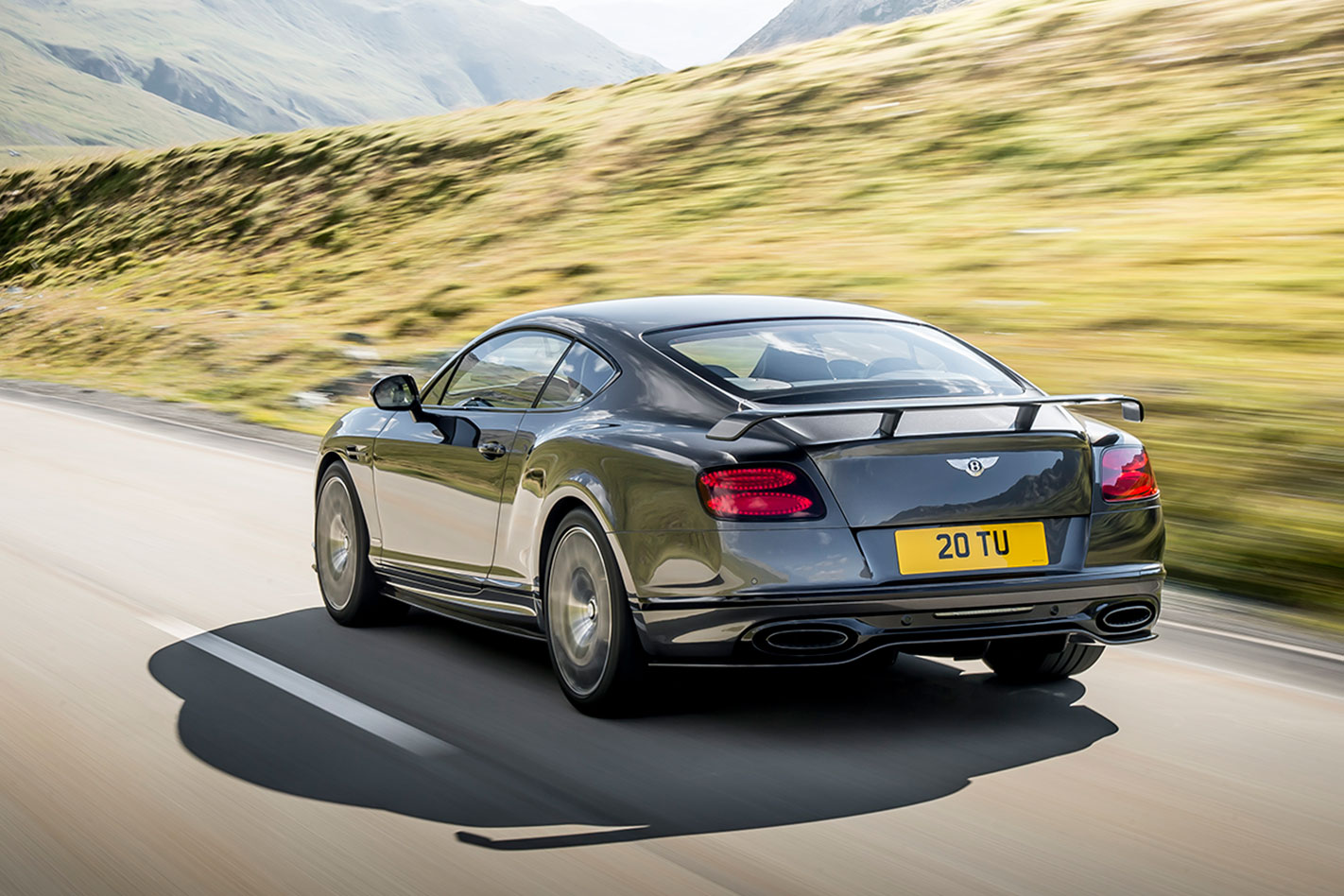
Reining in this speed are the largest brakes fitted to any production car, the carbon-ceramic rotors measuring 420mm up front and 356mm at the rear, hidden behind massive 21 x 9.5-inch rims wearing 275/35 tyres.
The all-wheel drive system distributes power in a constant 40 per cent front, 60 per cent rear split in normal conditions, though can now adjust the split on the fly depending on available traction.
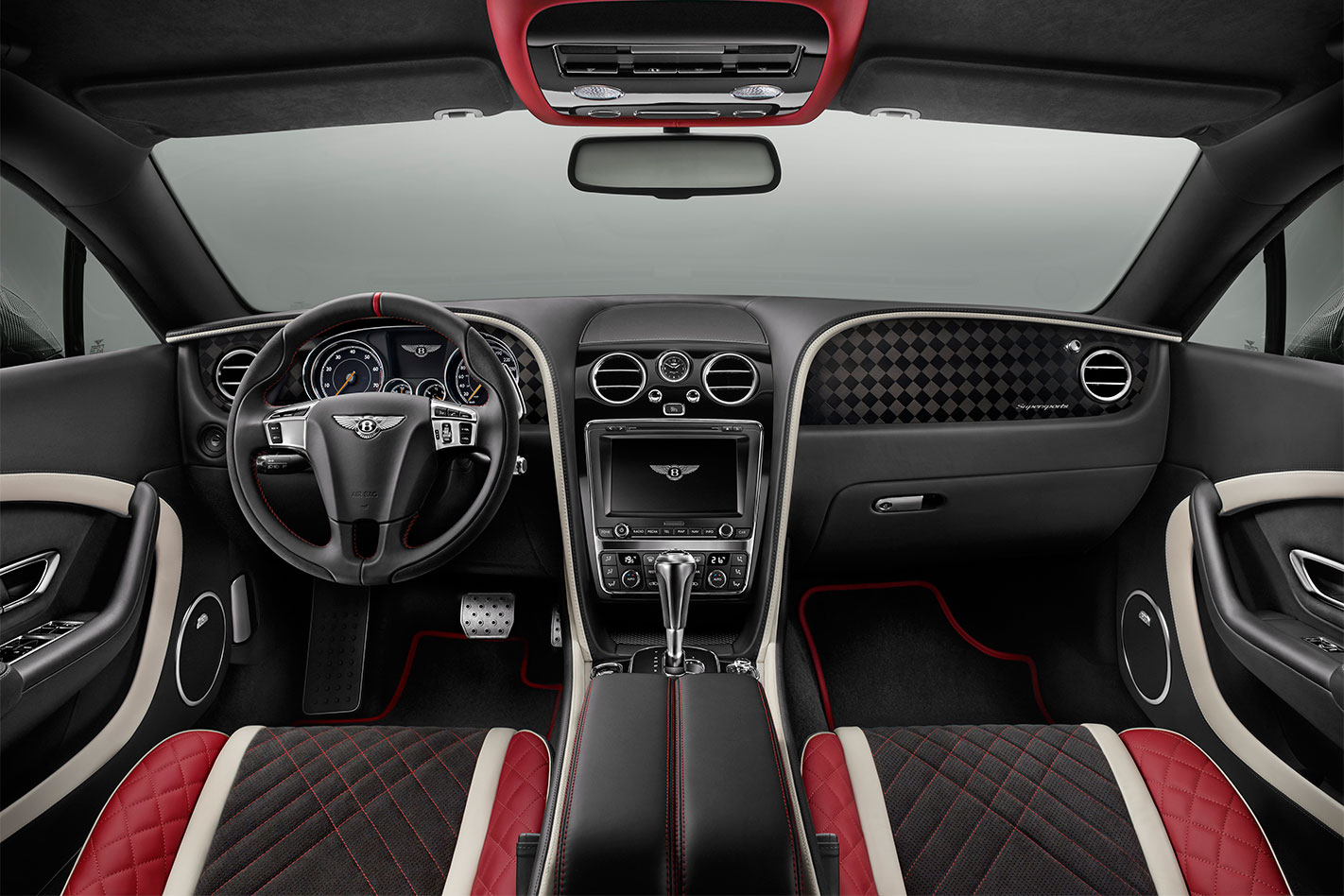
Spotting a Supersport should be easy thanks to new front and rear bumpers, with the front splitter, rear diffuser, side sills and bonnet vents all finished in carbonfibre. A variety of black accents also add menace while there’s an optional rear spoiler and front splitter for the coupe.
A new Continental GT, built off a shortened version of the new Porsche Panamera platform, is expected to appear in late-2017/early-2018.
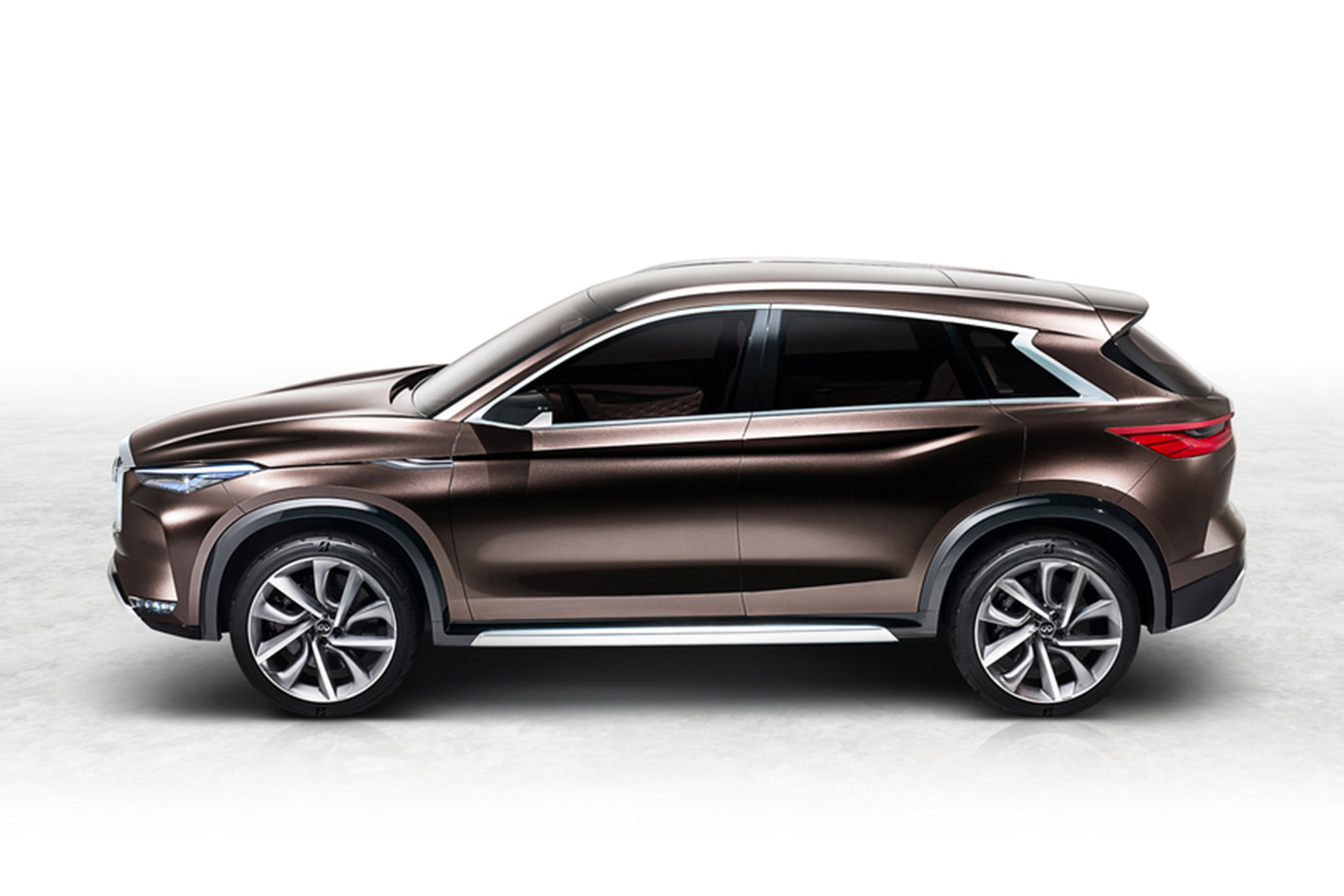
We will get our first glimpse of Infiniti’s all-new mid-size premium SUV with the debut of the QX50 concept at Detroit motor show next week.
While carrying the “concept” suffix, the car on display at Detroit is expected to be very similar to what will eventually roll down Infiniti’s production line in the near future, with only minor changes to mirrors, lights, wheels and door handles.
The concept also demonstrates how the company’s new design language, as seen on the Infiniti Q60 two-door and QX30 small SUV, works across the broader body panels of a large SUV.
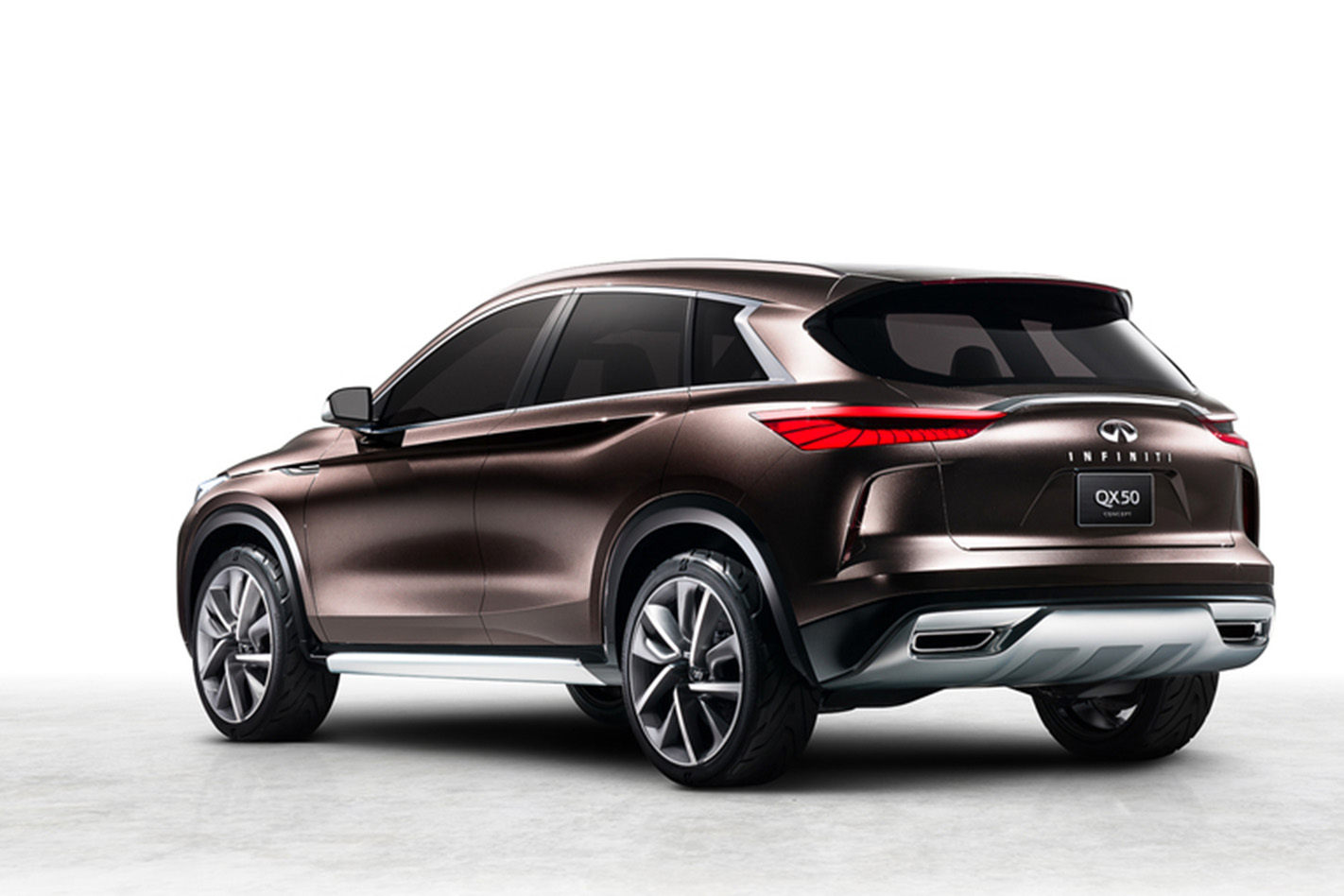
Roland Krueger, President of Infiniti, says the QX50 concept represents how the QX line-up will appear in production.
“With the unveiling of the QX Sport Inspiration at the 2016 Beijing Auto Show, we showed the future of Infiniti QX models,” he said.
“The new QX50 Concept evolves this further and shows how Infiniti could develop its future presence in the fastest-growing vehicle segment globally,” he added.
It will also be the first car to receive Infiniti’s ground-breaking Variable Compression Ratio engine, which is able to produce large amounts of power when needed, yet boasts impressively low fuel consumption when cruising.
Along with a fresh design and engine, the QX50 Concept also showcases the brand’s ambitions to roll out autonomous driver support technologies.
It needs to be noted these aren’t fully autonomous systems like those being developed by the likes of Tesla and Mercedes-Benz, but are instead assist systems designed to help the driver. Think lane keeping and active cruise control, rather than a completely automated car.
Infiniti says its driver assistance tech strategy will be consistent with the brand’s focus on driver engagement by “[ensuring] the driver retains ultimate control over their vehicle”
“Infiniti’s autonomous drive technologies will act as a ‘co-pilot’ for the driver, empowering rather than replacing them, and ‘delegate’ more onerous driving tasks to the car – such as navigating stop-start traffic on the highway or keeping track of the positions of surrounding vehicles,” the company declared in a press release.
