
AUSTRALIAN drivers will help shape Mercedes-Benz’s autonomous cars of the future, the German carmaker has revealed.
Mercedes-Benz has revealed it will foster the next generations of its autonomous driving systems at a new, €245 million ($A350 million) facility at Immendingen – a former shooting range for tanks about two hours from Stuttgart – that will use data collected from Australian testing.
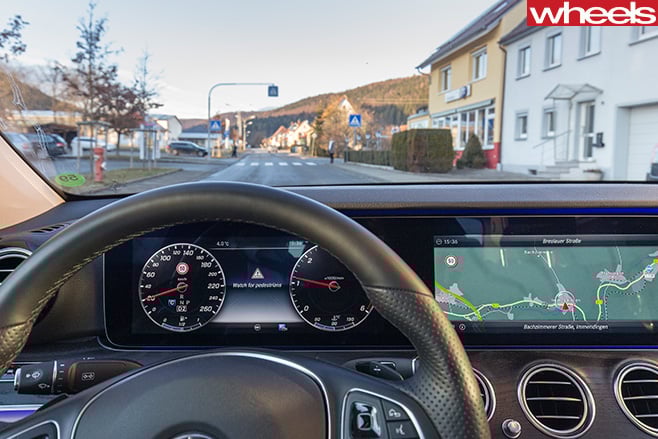
From March 2017, Mercedes will test autonomous systems on Australia roads with the goal of collecting data to better understand real-world driving situations in right-hand drive markets.
A team of Mercedes engineers will fly to Australia to oversee the testing, led by the brand’s autonomous and active safety systems guru, Jochen Haab.
“The Australian testing won’t just be something we use to put into software for Australian cars, it will be used in our cars worldwide.”
The single Mercedes-Benz E-Class will be based in Melbourne, at the carmaker’s Australian headquarters, but will travel interstate to collect data from real-world situations. If the testing is successful, Haab has plans to increase the number of Australian vehicles, possibly using camouflaged, yet-to-be-released models.
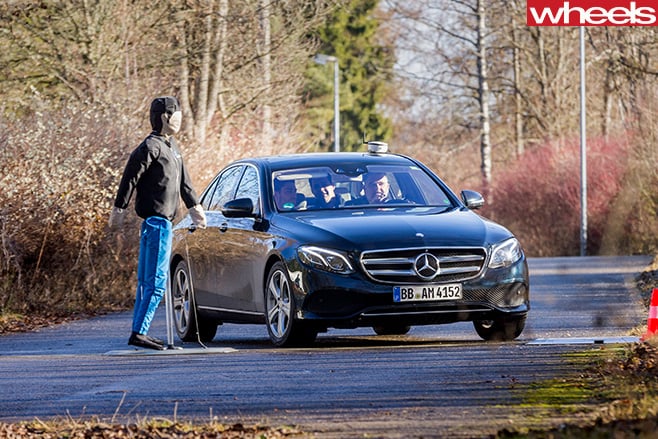
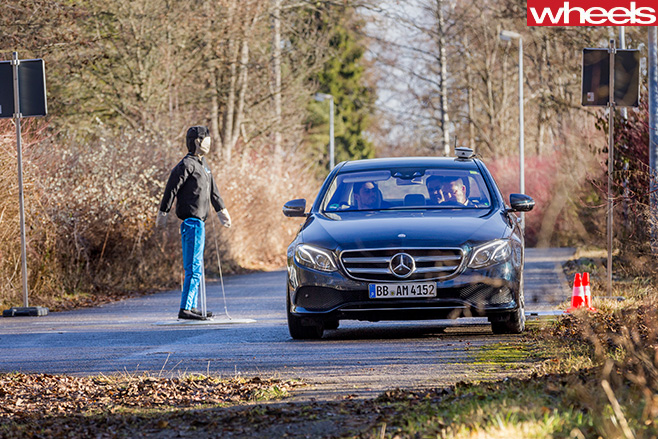
“Maybe we’ll even find a kangaroo. Right now I can’t predict what happens with a kangaroo. We have pedestrian detection, and kangaroos can be quite upright, but we just don’t know yet. So we’ll record that data at look at it. It will be tested in real life traffic, with normal people.”
The reams of Australian data will be analysed in Germany, at the Immendingen facility currently being built on a military base used for tank training and special forces operations since 1958.
The autonomous zone, nicknamed ‘Bertha’ after Karl Benz’s wife who famously ‘stole’ his early Model III prototype in 1888 to complete the world’s first road trip, will be the first completed section and will be more than four times larger than the current autonomous testing facility in Mercedes’ R&D HQ in Sindelfingen.
The larger space will allow for improved high-speed cross-traffic testing, and even the construction of an ‘autonomous village’ with temporary buildings to analyse real-world driving situations and car-to-car communication systems.
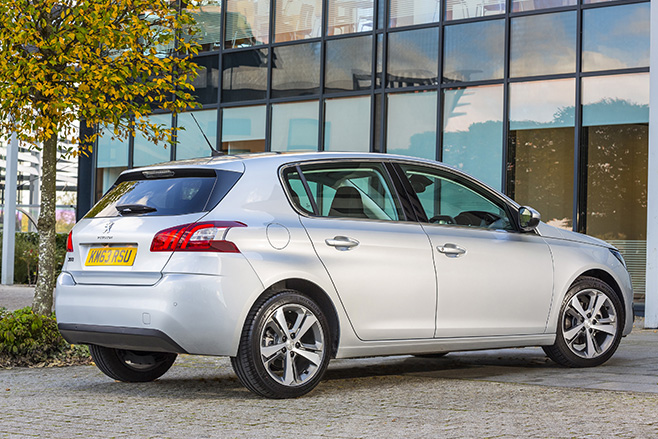
Peugeot Australia has dramatically slashed its 308 model range, cutting underperforming models and adjusting equipment levels to tighten its small hatch lineup for the 2017 model year.
The 308 family has been chopped from 17 individual models to just six, with prices largely remaining static for the models that survived the cull.
At the lower end, Peugeot Australia has deleted the base model Peugeot 308 Access.
Priced at $19,290 before on-roads, the Access had the right price tag to compete against value-driven rivals like the i30, Corolla and Cerato, but it rarely accounted for more than five percent of total 308 sales. Its absence from the 2017 line-up makes the $27,990 308 Active the new entry point.
While petrol and diesel engines are still available across the range, the non-GTi 1.6 litre turbo petrol has been dropped from the 308 entirely – partially because its Euro V emissions rating can’t match the environmental friendliness of the Euro VI-rated 1.2 litre three-cylinder turbo.
That leaves the 96kW/230Nm 1.2-litre of the Active and Allure your only choice if you’re not keen on a diesel. However, that only holds true if you’re looking at the hatch – the 308 Allure Touring wagon is now exclusively diesel-only.
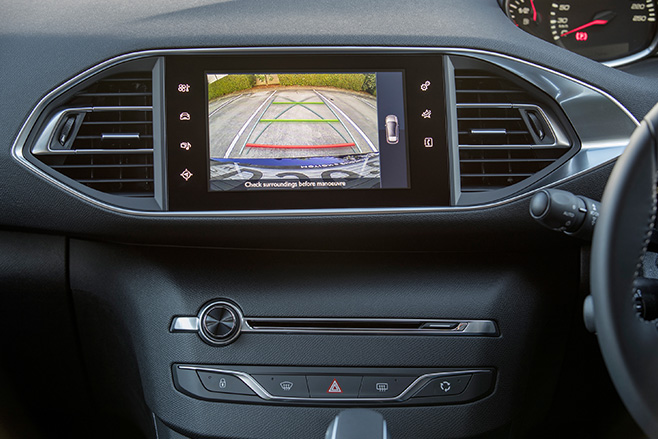
Meanwhile the Allure Premium model has been discontinued, with regular Allure models picking up a reversing camera, blind spot monitoring, active cruise control, automatic emergency braking, park assist and keyless entry/ignition as standard to compensate.
A panoramic glass roof and 18-inch alloys are offered as options for the Allure.
The 308 Active specification is unchanged, though it gained standard-fit reversing camera and sat-nav as part of a 2016 update. Manual transmissions are another casualty – the 308 GTi 270 is the only manual-equipped model in the range now, with all others being equipped with a six-speed automatic as standard.
At the upper end of the range, the 308 GT has been cut down to just one variant, the 133kW 2.0-litre diesel automatic, which now comes with a standard-fit panoramic roof. The petrol GT – a manual-only offering – has been discontinued.
The flagship 308 GTi 270 remains at the top of the tree, though its GTi 250 companion is no more. With a whopping 90 percent of GTi buyers opting for the 200kW GTi 270 model, Peugeot saw little sense in keeping the less powerful and less capable variant within the line-up.
The 308 continues to play a minor role in the hotly-contested small car segment, and like many of its rivals it has suffered slightly in sales compared to last year with only 1158 cars being sold to the end of November – a 19.9 percent reduction year-on-year.
It continues to stay ahead of its compatriot the Renault Megane, but with the all-new Megane five-door recently arriving on our shores the 308 faces an uphill battle.
PRICING
Peugeot 308 Active petrol auto: $27,990 Peugeot 308 Allure petrol auto: $32,990 Peugeot 308 Allure diesel auto: $36,990 Peugeot 308 Allure Touring diesel auto: $39,490 Peugeot 308 GT diesel auto: $42,990 Peugeot 308 GTi 270 petrol manual: $49,990
Unlike many American land barges, Ford Mustangs have a proud history on circuits that turn left and right, in touring and sports car racing. However, they weren’t always synonymous with excellent handling during the 1970s and 80s.
Naturally, Ford totally overhauled the new-gen Mustang’s handling and braking package, with independent rear suspension, less weight and better brakes and steering. Yet there’s still plenty of room for improvement in making a pony car point properly.
Mustang Motorsport’s Craig Dean has a long history converting and racing pony cars and was one of the first to start R&D work on the new-gen car when it was launched in 2014.
“We started early in the piece, developing these cars before they were launched locally, which means we’ve had a lot of seat and development time to ensure the car has good power and good handling,” Dean says. And while many enthusiasts spend big bucks on getting the best parts to add power, one of the most crucial components sometimes gets scrimped on.
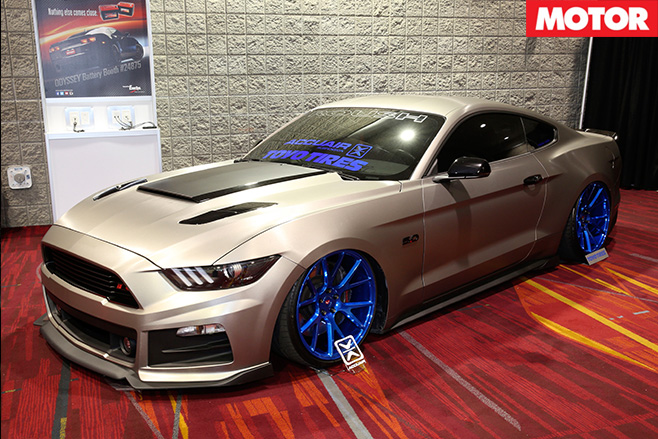
Quality rubber increases grip, especially in the wet, wrangles the ponies better under power and sharpens up the steering, though possibly at the cost of quicker wear and perhaps a bit more tyre roar.
The standard wheels are 19-inchers and are a good starting point, but they are the factory’s compromise between a comfortable ride and predictible handling. More precision can be had by going to lower-profile tyres on 20-inch rims, but this will come at a price too. A wise place to begin is a wheel alignment check as it’s often off by a bit and will affect steering, handling, fuel and tyre wear.
Local Bilstein damper distributor and an expert at refining suspension, Brad Heasman from Heasman Steering knows how well Mustangs respond to being properly set up. Heasman looked at spring packages to lower the cars. “I reckon the Eibach springs are the best so far,” he says.
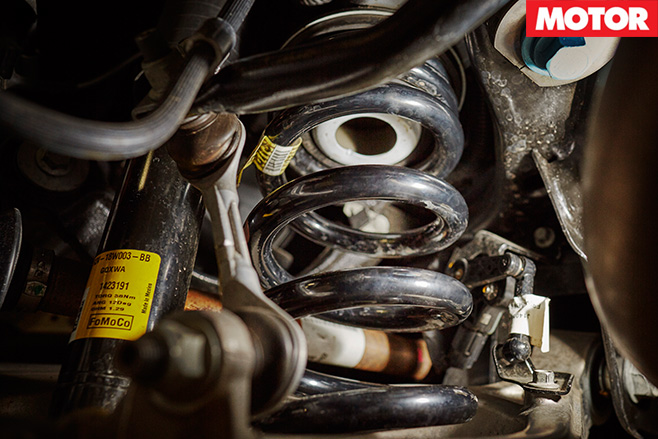
As a veteran of tarmac rallying, Dean is frank about the stock suspension and how to fix it. “The standard car doesn’t ride that well with the Performance Pack but we have our own coilover set-up, designed for everyday drivers who want a balance of ride and handling,” he says. “We’ve had it made, designed for road and Targa-style use with specific valving, and it’s nice and subtle in its ride characteristics.”
You can spend anywhere from $1500 to $10,000 for a set of coilovers, plus the installation cost. Remember, these require far more labour to set up properly, as damping, spring rate and wheel alignment all need to be adjusted at each corner, rather than just plugging in a ready-made part.
RIDE share company Uber has banged yet another nail in the coffin of taxi drivers the world over, launching a trial of self-driving cars in sunny California.
The only problem is, it hasn’t even contacted Californian authorities to ask if it is okay to mix its robotic fleet with real-world drivers.
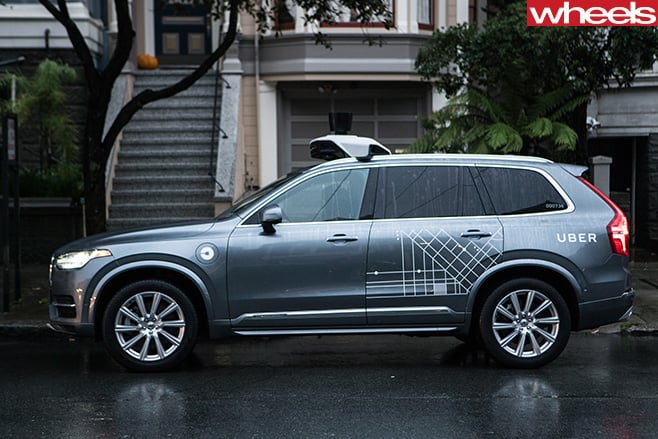
Uber already uses “self-driving” Ford Fusions in Pittsburgh, but has expanded its experimental service to its hometown of San Francisco using Volvo XC90s.
However, California’s Department of Motor Vehicles requires companies to apply for permits to trial self-driving cars on its roads. Permits have already been issued to 20 companies, including Google, Tesla, GM, Ford and Honda – but not Uber.
The company’s vice-president of self-driving technology, Anthony Levandowski, was unapologetic, offering a tongue-in-cheek reference to what’s turning out to be a history of side-stepping regulations.
“For us, it’s still early days and our cars are not yet ready to drive without a person monitoring them,” he said.
Similar to the cars driving around Pittsburgh, San Francisco’s autonomous cars will all be monitored by a safety driver and an Uber test engineer. Customers using UberX, the cheapest private ride offered by the platform, will be the guinea pigs.
Uber’s fleet in San Francisco would consist of “a small handful of vehicles,” spokeswoman Chelsea Kohler told Quartz.
Users will be notified via the company’s app that their car will be one of the test vehicles, and given the opportunity to opt out and ride in a more conventional car.
The company released a video on twitter promoting the launch of the new service.
The XC90s are fitted with laser-based sensors, wireless technology and seven different cameras that help them drive autonomously. The Uber driver is used to start and stop trips, but the technology takes care of the bulk of the work.
Passengers will sit in the back seats, but will be able to play with a large touch screen that displays the vehicle’s planned route, and a rendered version of the outside environment that the car’s electronics ‘see’.
The trial already has already had its first potential hiccup: a video uploaded to YouTube earlier this month shows dash cam footage of one of the Volvos running a red light.
It’s not known if the driver or the car’s electronics were in control at the time.
A WIN this year in the German equivalent of Australia’s Supercars championship has given BMW something to celebrate – and we’re getting the gift.
The carmaker has announced it will bring 10 BMW M4 DTM Champion Editions Down Under to celebrate the 2016 title win, sealed after driver Marco Wittman took this year’s crown for the German luxury brand.
The Deutsche Tourenwagen Masters, or DTM, is to German manufacturers what the Supercar championship is to Holden and Ford.
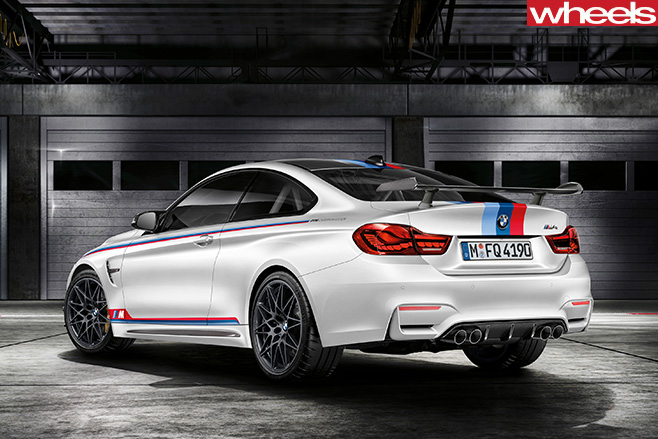
Wittman made his debut in DTM in 2013, won the championship in 2014, and doubled-down this year. BMW says the M4 DTM Championship Edition was built to commemorate his significant talent and achievements
Priced from $295,000, the cars will wear a commemorative plaque and carry over much of the technology from the BMW M4 GTS.
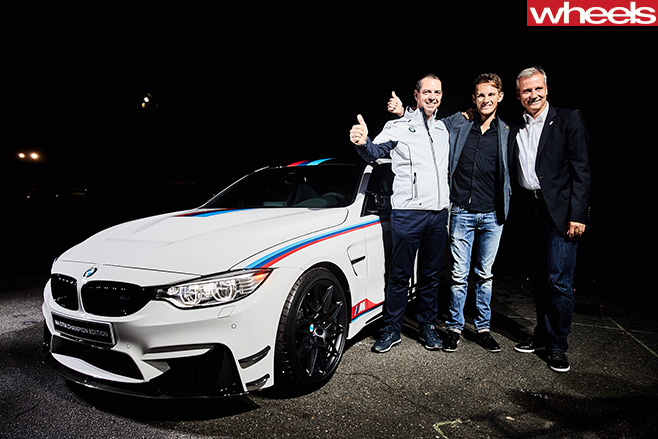
“On the back of the sold-out M4 GTS, the M4 DTM Champion Edition offers similar racetrack-inspired performance with further exclusivity, and is a fitting tribute to Marco’s achievements.”
Power boosts to 368kW and 600Nm, a 51kW and 50Nm gain over the ‘standard’ M4.
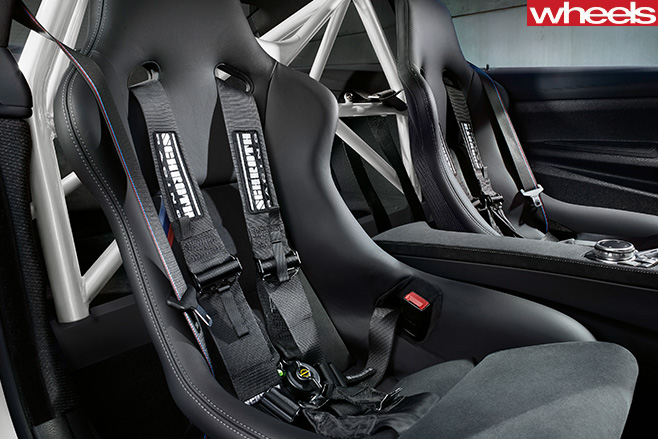
To really drive home its motorsport heritage, the DTM Champion Edition also has a six-point harness and a fire extinguisher.
Sometimes a tuner will go out of their way to keep a car quiet. As well as not sacrificing much (any) power, you also wind up with a car that refuses to drone on the freeway, doesn’t draw attention from the rozzers and is supremely neighbour-friendly.
Hot Tuner 2016 is brought to you by Valvoline SynPower
That hasn’t happened here. This thing is LOUD! But it’s not just decibels, it’s the quality of noise that gets your attention. Like, instead of just a blaring exhaust, the pipework on the Nissan GT-R is so overkill you can almost see down it as far as the turbos. And you can certainly hear each snail spooling up as you give the throttle a tickle. It’s just like the turbo-spool noise you get from the big Peterbilt next to you at the lights. It’s manic. It’s evil. It’s some kind of lovely.
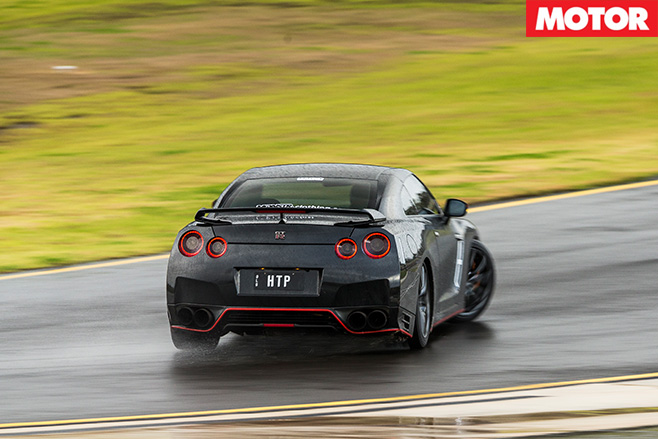
That said, even in the streaming rain, provided you feed the power in, rather than just dumping a huge gob of throttle percentage on it, there’s some real grip; enough for you to rocket the thing forward and get a sampling of that 10-second potential. Until it gets really wound up, of course, at which point it’ll turn its tyres into paddles and it’s all over.
Watching the Nissan GT-R blast off at the strip was laugh-out-loud stuff, but the resulting numbers reduced us all to schoolgirl giggling. Even with ferocious wheelspin off the line, the R35 clocked 3.31sec to 100km/h and a 10.83sec quarter at 220.16km/h. The Nissan should be pretty handy for overtaking too; 80-120km/h took just 1.5 seconds. That’s serious roll-on squirt, kids.
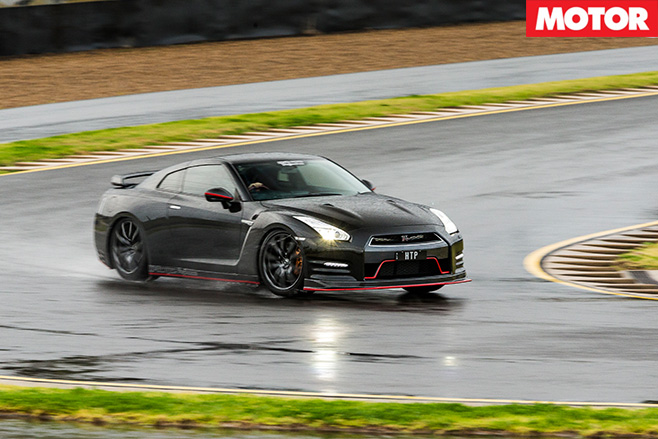
As it is, then, the GT-R is very stiff corner-to-corner, but at least that means it will four-wheel-drift, rather than simply push the front or rear end wide. Up the ante with more gas and it will definitely start to oversteer, which is entertaining if not surprising. So the shot is to use that surprising amount of front-end grip to get the Nissan turned-in. Once it has started to rotate you can then hang it off the front axle and marvel at how the hell it’s hanging in there at all.
The other thing to consciously do is use a gear higher than you would in the dry. Do that, and, again, you’ll be amazed at how much throttle you can dial in before the tyres throw their hands in the air and it’s all over. The fact that you could actually get some pace out of the Nissan on such a slick surface actually made it one of the more fun cars to drive on the day.
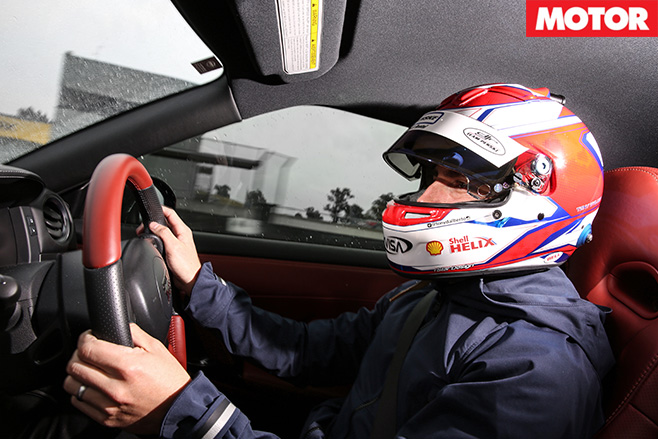
For the few seconds the track was dry, D’Alberto managed a 1.01:3sec. And that isn’t just fast, it’s a full two-and-a-half seconds better than anything else here – and that includes some very serious hardware. Hard to argue with that, so we didn’t.
The big disappointment for me was – as it has always been – the transmission in the GT-R. As well as being a high-maintenance unit (the servicing regime increases dramatically the harder you use the car) it’s just not a very good attempt at refining a clutchless manual.
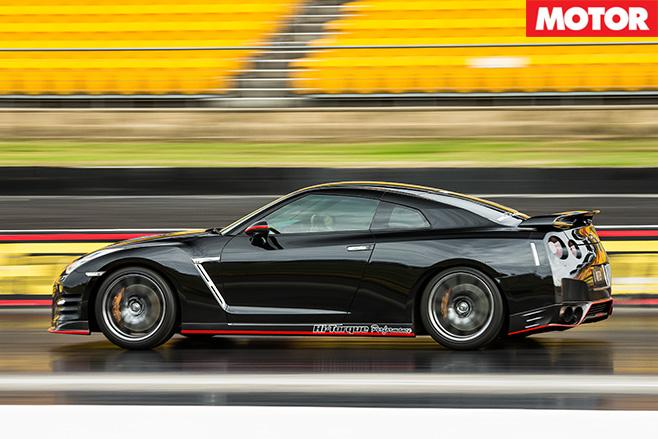
Not that it was going to slow it down much. The Hi-Torque GT-R’s performance is on another level – another planet – and dry or wet, fuel issues or otherwise, was always going to get the biggest ribbon. It’s our Hot Tuner 2016 winner. All hail the new king, we are not worthy.
OVERALL RANKING: 1ST
DISCIPLINE RANKING
1st | Lap time: 1:01.3sec 1st | Lap V-Max: 171.95km/h 1st | Lap V-Max: 106.16km/h 2nd | Lap V-Max: 55.12km/h
BMW’s M4 GTS is returning to Oz, but this time dressed in a new livery.
The firm secured 10 new M4 DTM Champion Editions for Australia, reviving the GTS’s performance package within a new special edition.
Priced at $295,000 and available for order now, the new car was built to celebrate the firm’s 2016 DTM championship win with Marco Wittmann at the helm.
Only 200 will be built in total. But each will pack the water injected engine, stripped interior, and track-spec suspension and aero used by the GTS.
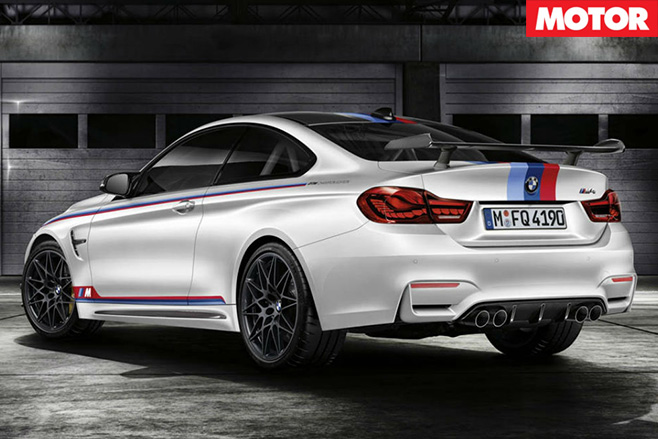
Deliveries begin late first quarter next year, however, we hope you like Alpine White. It’s the only hue available to match the car’s red, blue, and purple M stripes that streak its sides and roof.
Beneath the paint, however, and besides its smaller front splitter, the Champion Edition copies the GTS’s hardware also verbatim.Its 3.0-litre straight-six is fed by two turbos and a water injection system, sending 368kW and 600Nm to a seven-speed DCT. It’ll be matched to a titanium exhaust system.
There are also three-way dampers with remote reservoirs installed at each corner, as well as M carbon ceramic brakes.
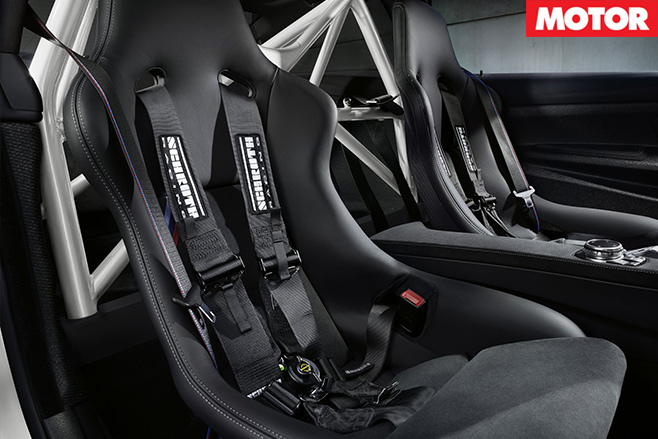
Inside carbon-fibre shelled bucket seats again feature, as well as an alcantara steering wheel, and a half roll-cage. For the Champion Edition, however, the cage is a standard feature and comes finished in white.
All exterior additions are made from carbon fibre reinforced plastic, like its new front bumper flics, as are its bonnet and roof.
So it’s just as quick as the GTS, as it’ll clip 100km/h in 3.8sec and go on to hit 305km/h with its automatic transmission. However no manual transmission is available.
Included in its large pricetag are adaptive LEDs headlights, while ‘Selective Beam’ OLED taillights feature up back.
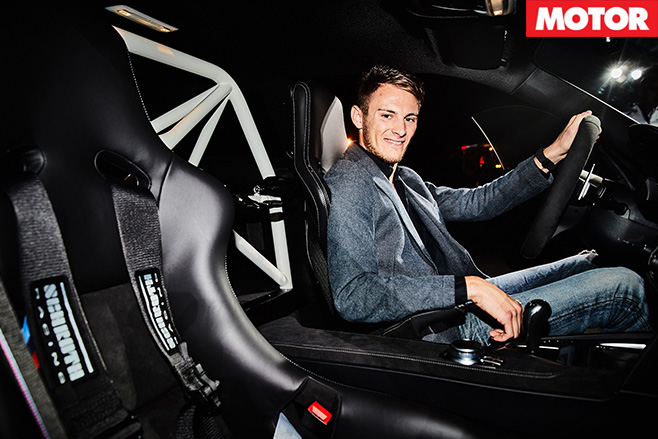
But he sees the obvious differences in the tribute. “Yeh the 2014 [car] was more about the design, was leaned more towards my DTM car.”
“The current champion edition is probably more leaned towards a M4 GTS, of course with some different wheels, different livery… it’s a bit different, but yeh it’s great with the roll cage.”
A V8 engine has failed to make the Wards Auto annual shortlist of the top 10 engines sold in the US for the first time in the award’s 23-year history.
Instead, the biggest displacement donk to make the shortlist is a Fiat Chrysler Automobiles-sourced plug-in hybrid Pentastar 3.6-litre V6 paired to an electric motor – one of only a handful of six-cylinder engines to feature.
It’s not as though the V8 hadn’t tried. Ford had stumped up its 5.2-litre unit used in the Shelby GT350-badged Mustang that won last year, but the field had obviously moved on. However, even though the Mustang’s bent eight lost out to downsized sixes and fours, the turbo 2.3 it shares with the Ford Focus RS did make the grade. It was the “high-strung, high-emotion, track-ready” tune of the smaller car’s engine that took the gong – the slightly detuned Mustang version pales a bit by comparison – that won the judges over.
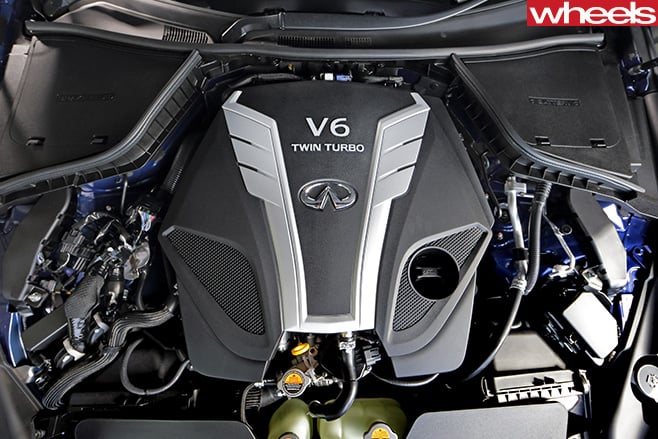
The turbocharged 3.0-litre in-line six-cylinder engine used under the bonnet of the BMW M240i – a Wheels favourite for the silky way it delivers its power and the well of torque from its boosted performance – also made the list. It was joined by the same-sized V6 found under the bonnet of the Infiniti Q50 sedan – an engine only sold in Australia as a twin-turbo unit, although in two states of tune.
Of the 10 engines nominated, three were fitted to hybrid cars not sold in Australia. Another, a turbocharged 1.4-litre four-cylinder unit fitted to a fuel-miserly version of the Hyundai Elantra, is also not sold here.
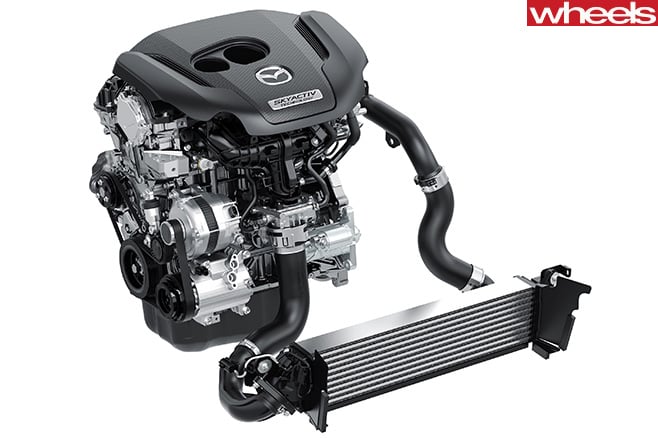
The 2.0-litre turbocharged four-cylinder Mercedes-Benz was praised for its Jekyll and Hyde nature, performing smoothly and efficiently around town, but upping the wick in Sports mode.
No normally aspirated engines without some form of electric or induction assistance, or diesels for that matter, featured on this year’s list.
The list of award-winning engines is:
3.0L turbo dohc 6-cyl (BMW M240i) 1.5L dohc 4-cyl range-extended hybrid (Chevrolet Volt) 3.6L dohc V6 plug-in hybrid (Chrysler Pacifica Hybrid) 2.3L turbo dohc 4-cyl (Ford Focus RS) 2.0L dohc 4-cyl hybrid (Honda Accord Hybrid) 1.4L turbo dohc 4-cyl (Hyundai Elantra Eco) 3.0L turbo dohc V6 (Infiniti Q50) 2.5L turbo dohc 4-cyl (Mazda CX-9) 2.0L turbo dohc 4-cyl (Mercedes-Benz C300) 2.0L turbo/supercharged dohc 4-cyl (Volvo V60 Polestar)
Mercedes-Benz has whipped the covers off the sleek two-door companion to the Mercedes-Benz E-Class sedan, with the E-Class Coupe making its official debut in Europe today ahead of its first public showing at the Detroit Motor Show in early January.
Based on same platform as the E-Class sedan (rather than following the same format as the current-gen E-Class Coupe, which was based on the W204 C-Class), the E-Class Coupe has grown substantially.
Measuring 4826mm long, 1430mm tall and 1860mm wide, the new E-Class Coupe is 123mm longer, 74mm wider and 32mm higher than the car it replaces. Track width has swelled by 67mm at the front and 68mm at the rear too, giving the 2017 E-Class Coupe a bulkier road presence. Wheelbase also grows by 113mm
And with styling that bridges the gap between the Mercedes-Benz C-Class Coupe and the flagship S-Class Coupe, the new two-door E-Class boasts a premium aura inside and out.
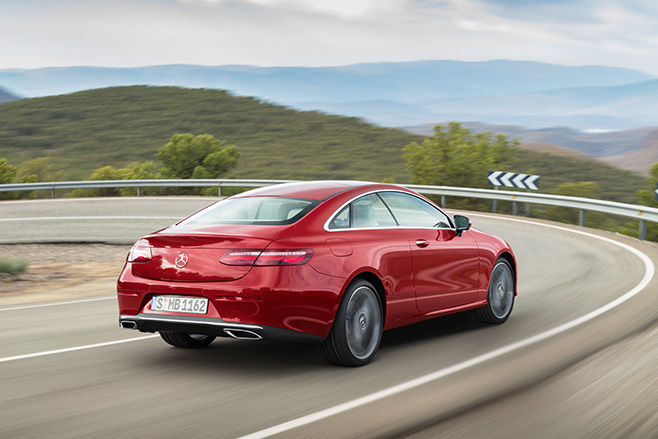
Linking front and rear is a sleek turret forming an unbroken arch from pillar to pillar. The glasshouse is open thanks to the absence of a traditional B-pillar in the middle, though as with the current E-Class Coupe the rear glass is interrupted by a trim strip and a small triangle of fixed glass – a necessity to allow the rear quarter window to slide downward.
Like the E-Class sedan, the Coupe will be offered in Avantgarde and AMG Line grades.
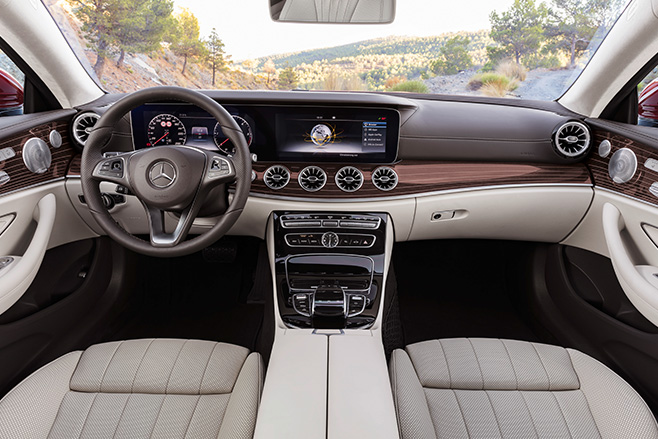
Inside, the E-Class coupe features familiar furniture from the sedan, with some models available with twin side-by-side 12.3-inch electronic displays while low-spec models get a traditional analogue instrument set.
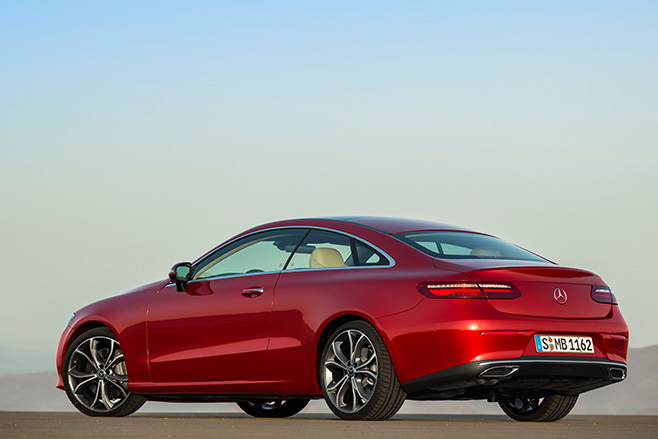
Capacitive touch controls on the steering wheel allow control of the infotainment system via smartphone-style swiping movements, all without removing your hands from the wheel. Besides Benz’s native COMAND infotainment system, the E-Class Coupe will also feature Apple CarPlay and Android Auto smartphone mirroring and an inductive loop phone charging pad.
Besides the standard inclusion of automatic emergency braking, the E-Class Coupe will also be available with Mercedes-Benz’s Drive Pilot semi-autonomous guidance system, which is able to follow curves in the road and keep a safe distance from other traffic at speeds up to 210km/h.
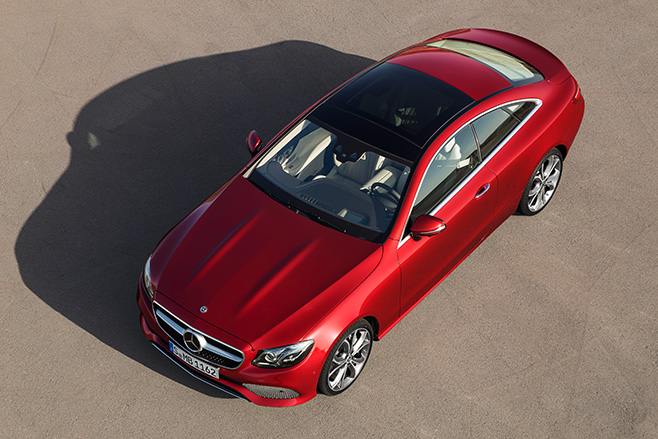
Four engines will be offered initially: one diesel inline four, two turbo petrol inline fours and the 245kW/480Nm turbo V6 of the E400 4Matic – the latter being the most powerful model until the arrival of the expected Mercedes-AMG E43.
The entry-level E200 makes 135kW and 300Nm from its 2.0-litre petrol four-pot, while the E300 turns up the wick on the same engine to 180kW/370Nm. Fuel economy on the European test cycle is listed at 6.0L/100km for the former and 6.4L/100km for the latter, while 0-100km/h times are a claimed 7.8 and 6.4 seconds respectively.
At the top of the tree, the E400 4Matic Coupe sprints to 100km/h in 5.3 seconds and consumes 8.1L/100km.
A nine-speed automatic moves the E-Class Coupe forward technologically, and air suspension will be available – at least in overseas markets. The standard springs give the Coupe a 15mm lower ride height compared to the E-Class sedan, and adjustable dampers are also available as an option.
The E-Class Coupe will arrive in Australia in mid-2017, with pricing and local specifications yet to be confirmed.
Mustangs have always been synonymous with aftermarket tuning, not just for racing but on countless street cars. This hasn’t changed with the latest Ford Mustang, both the 5.0-litre Coyote V8 and EcoBoost 2.3-litre turbo four capable of producing silly horsepower.
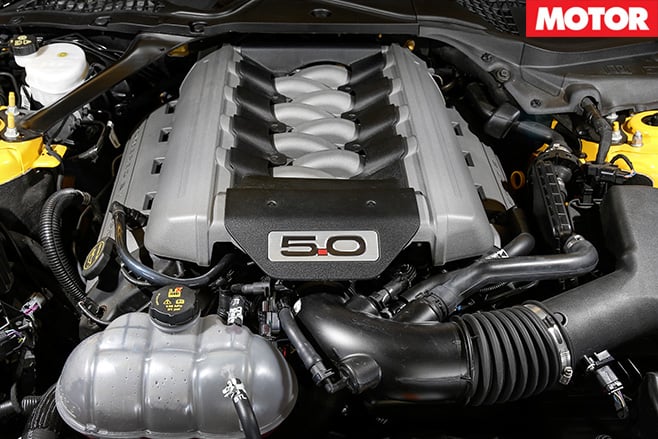
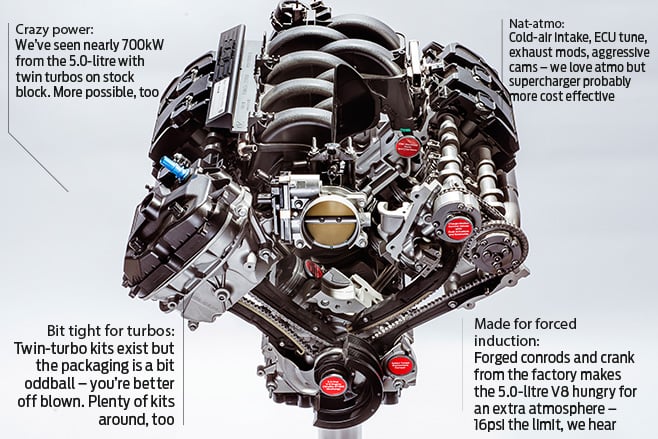
The nat-atmo V8 is a good base to start off, featuring deep-breathing quad-cam, four-valve-per-cylinder heads with variable camshaft phasing for more accurate valve timing, while Ford also used high-strength forged connecting rods and a forged steel crankshaft as standard.
Ford’s decision to use quad-cam, 32-valve architecture on its V8 means most Coyote development involves fitting positive displacement superchargers. The price of four camshafts per engine makes a high-revving naturally-aspirated build expensive, while the size of the twin-cam cylinder heads makes fitting a turbocharger or two into the engine bay difficult.
Basic upgrades include a full exhaust system, a better-breathing intake and a flash tune of the stock ECU, stepping up with a bolt-on supercharger of which there are plenty of sizes, specifications and horsepower rating options on offer.
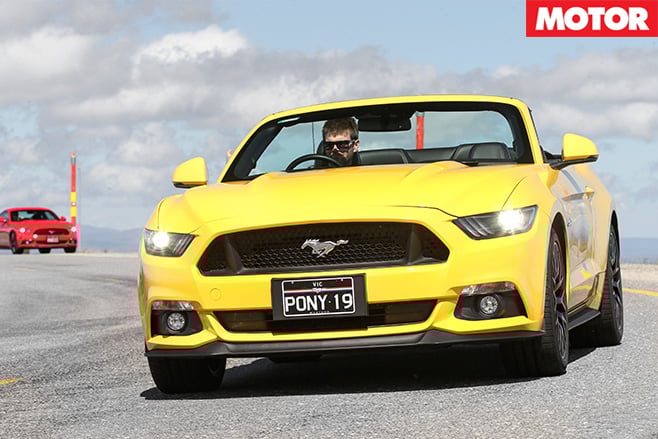
As is often the case the sky really is the limit when it comes to making horsepower from a modern engine, but we’ll stick with what’s realistically achievable, while staying friendly with the Highway Patrol and Environmental Protection Agency. And as you might expect, there’s a proliferation of aftermarket Mustang parts out of the USA, but not all of them bolt on to right-hand drive cars or come close to meeting Australian Design Rules.
One man who knows all about this is Rob Herrod, boss at legendary Ford tuning shop Herrod Motorsport. He’s the local agent for the factory’s hot-up department, Ford Performance, as well as SCT ECU flash-tuning software.
“We know what’s going on inside the Ford Coyote engine,” says Herrod. “The standard motor is a good thing, but if tuning is left in the wrong hands it’s easy to hurt an engine. “The only difficult aspect was an issue with the auto transmission-equipped cars where the catalytic converters run close to the stock transmission cooler lines. We quickly developed an OE-style solution.”
“We’ve got a Mustang development car, but as far as doing extra modifications like turbochargers and the like, I’d rather not get into anything that isn’t ADR-compliant. We’ll assist customers if they want to build something really wild, but our main focus for Herrod products is on staying ADR-compliant.”
Another man with plenty of experience with go-faster Fords is Craig Dean from Mustang Motorsport. Dean has spent years running supercharged Mustang race cars in tarmac rallies, runs Australia’s only authorised Shelby Mod Shop, and is also a Roush Performance distributor, selling a range signature series Shelby and Roush Performance Packages.
“The power and torque available from the Coyote motor is amazing, with great driveability,” he says. “We had one that would spin its wheels through to fourth at low rpm!
As Mustang sales boom, the Australian aftermarket will develop parts for the S550 and we will no doubt see some stunning engineering from local companies, too.
KPM Motorsport from South Australia is also offering plenty of Mustang toys, right up to its beastly SF800R Streetfighter Race Series package. Supercharging the 5.0-litre V8 produces 597kW, nearly twice that of the factory car. Its range includes parts from the wild folk at Hennessey USA.
