
Checking your tyre pressures is one of the easier practices of car maintenance and should also be the most regular. Monthly checks are recommended, or every second time you refuel. Filling your tyres to the right PSI will ensure your tyres maintain grip to the road and prevent any nasty issues where you may lose control. As a bonus, the right amount of air in your tyres will also improve fuel economy.
The right tyre pressure for your car will be listed on the manufacturer’s tyre placard, usually stuck on the driver’s side B-pillar.
ROTATE YOUR TYRES
This isn’t something mechanics do just to charge you a few extra dollars on your service invoice. Your car’s weight varies from front to rear. With most car’s carrying weight in the front of the car, this can cause your front tyres to wear quicker than the rear ones.
A rotation should be performed every 8000 to 10,000km.
Every 10,000km, it’ll be time to not only rotate your tyres, but also book yourself in for a wheel alignment. When a mechanic re-aligns your wheels, he’s correcting your car’s suspension and steering which in turn, ensures your tyres are properly aligned with the car’s axles, to give you better handling and more even wear. Again, it’ll also save you fuel costs (noticing a pattern here between tyres and fuel usage?).
Driving over potholes or hitting a curb can push your wheels out of alignment. There are some obvious signs that things are not in alignment. The steering wheel will vibrate at high speeds, or pull to one side.
Tread is the part of your tyre that connects to the road and removes water during wet weather to ensure maximum grip. It’s a legal requirement your tread depth is a minimum of 1.5mm. Once it reaches this, it’s time to get them replaced. As this wears over time, it causes your tyres to lose grip with the road, and also means your car is no longer roadworthy. A tyre wear indicator is located around your tyre to help you know when it’s time to get them replaced.
We continue to be astounded by the rate of automotive progress and nowhere is the rapid advancement more evident than Bang For Your Bucks.
In 2015, two of our $50K-$100K contenders managed to scrape under the 13-second quarter mile bracket; 12 months later we have six cars in the 12s and our slowest contender is tripping the beam at 13.4sec.
We’re breaking new ground here, as when Bang For Your Bucks first bounded into existence back in 1994, it wasn’t envisaged cars this fast would ever face the BFYB formula.Remember, this was back when all and sundry were invited, including the likes of the Honda NSX and Porsche 911 Turbo. Three of this year’s premium crop would hose that force-fed Porker to 100km/h and two others would be snapping at its heels.
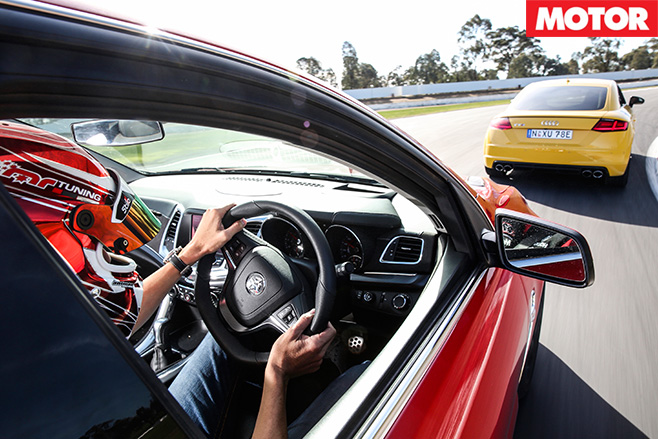
Ingolstadt’s second offering is the new TT S. The base model impressed last year, firmly shaking off its ‘hairdresser’s car’ tag, and extra grunt and a sharper chassis are unlikely to hurt it around Winton. But, at $99,900, it’s hard up against the $100K price ceiling. Joining it in the pricing stratosphere is BMW’s new $89,990 M2, the first proper M-car to appear at BFYB since the 1M, built to a similar recipe but now even cheaper and even faster.
In order to maximise its chances BMW has sent along the six-speed manual, Oz-only Pure edition. Expensive cars rarely have enough Bang to compensate for their Buck, can Munich’s new turbocharged baby be an exception?
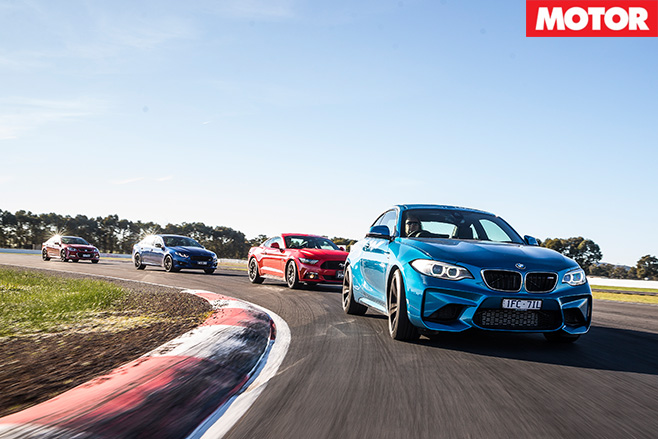
Our next contender also uses a turbocharged straight-six to send power to the rear wheels through an automatic gearbox, but that’s where the similarities end between the M135i and Ford’s Falcon XR6 Sprint. At $54,990, if the Barra-powered Bluey can run the numbers it’s supposedly capable of, it should be in with a shout, but based on our experience thus far, that’s a big if.
So, to the V8s. The XR8 Sprint was a late inclusion. Being no faster, but more expensive than its six-cylinder sibling, it was only ever going to finish behind it, but when we fell agonisingly short of securing a Focus RS (it was almost a matter of hours), it managed to secure a guernsey.
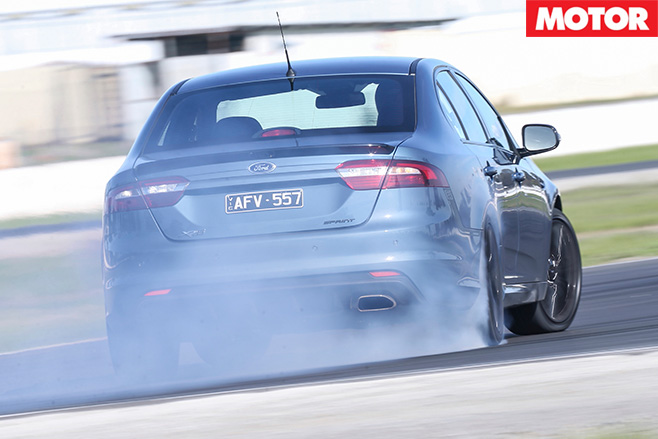
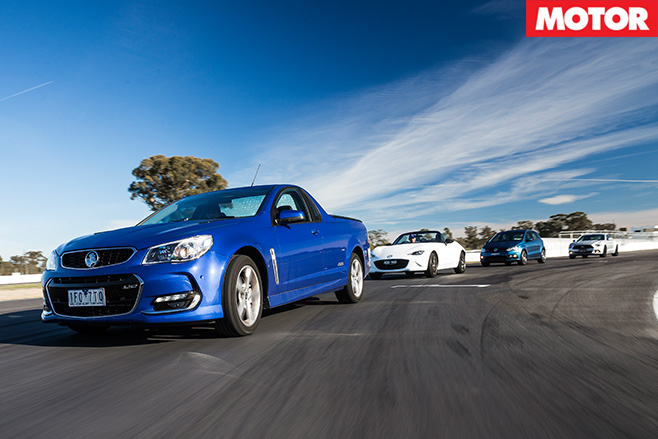
Its closest rival, both on price and performance, is Holden’s SS-V Redline. It’s a critical success and should fare well with the judges, but whether it can post strong enough numbers compared to its more powerful opposition to secure Bang glory is another matter entirely. One thing in its favour is its price tag; at $54,490, it’s the bargain of the group.
Last, but very far from least, is Chrysler’s 300 Core. The updated American brute finally has the eight-speed auto it’s always deserved, as well as some extra grunt (now 350W/637Nm) from its 6.4-litre Hemi V8. It’s a dead-set weapon in a straight-line with one of the best engine notes you’ll ever hear and it’s a lot better in the corners that you might imagine. It can also atomise its tyres at will – and all for $65,000.
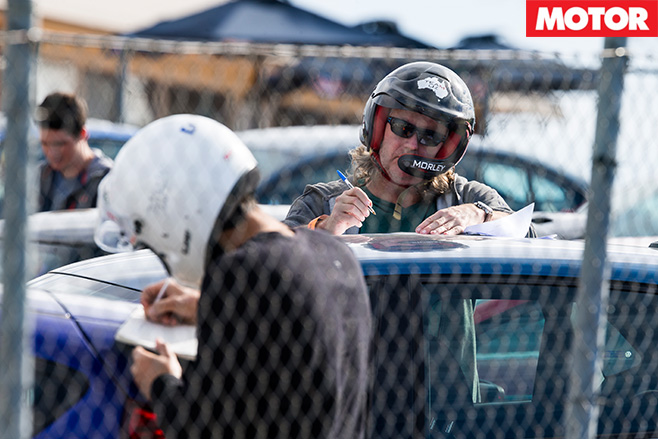
So, in the fastest and most powerful Bang For Your Bucks field ever, which car reigns supreme?
Battle arena: Winton Raceway
Want more? Check out the rest of 2016 Bang For Your Bucks.
THE right place for a manual transmission isn’t something powerful and sporty. In a car packing 400kW or more in its engine compartment, two pedals is just the right number. Especially if that car is a Ferrari.
Both the Maranello-made cars I’ve spent time with this year had truly great gearboxes. The most recent occasion was the launch of the GTC4 Lusso, the prettier and much improved update of the FF, staged among the Dolomite Mountains near Italy’s border with Austria. And earlier in the year, before spring began to warm Italy’s air, there had been three memorable days in Tuscany in a Ferrari 488 Spider.
The first has a non-turbo V12. The second has a twin-turbo V8. Both have seven-speed dual-clutch transmissions. Shifting gears with the shapely and sturdy paddles mounted on their steering columns was everything you’d expect; almost instant and deftly co-ordinated.
But what was truly awe-inspiring was that these Ferrari transmissions are able to establish telepathic connection with the driver’s mind. Left in self-shifting Auto mode, they swiftly sense any alteration in driving style.
Caught, say, behind a slow tourist who’s taking in the scenery, shifts will be early, smooth, leisurely. Snatch the opportunity to overtake on the last short straight before a mountain pass, stuff it hard into the first corner, and the car realises what’s going on. Immediately it begins holding gears longer, shifting up at higher revs, and making perfectly timed, throttle-blipping downshifts while braking.
It’s a mystery to me exactly how they do it.
Sensors are involved, obviously. But what combination of (and I’m guessing here) speed and extent of throttle opening, yaw rate, rate of steering angle change, brake pressure and g-forces Ferrari uses I couldn’t begin to figure out. What I do know is that whoever wrote the software that sucks up the data and spits out exactly the drivetrain behaviour any decent driver would want is a genius.
Maybe you think I’m exaggerating; this is not the case. On the Ferrari GTC4 Lusso drive, I shared a car with fellow Wheels contributor Stephen Corby. After spanking the big four-seater down a pass in Auto, I asked Corby what he thought of its drivetrain control software. He looked confused at first. He thought it had been me playing the symphony for seven speeds on the paddle-shifters. “That was the car?” he asked, disbelief in his tone.
Yet while Ferrari is producing software good enough to fool experts, plenty of people who count themselves car and driving enthusiasts are fighting to preserve the manual gearbox, even though it will inevitably take longer to lap a track and use more fuel on the road. And there are enough fans of slowness and inefficiency out there to sway carmakers. Thanks mainly to insistent whining from America, Porsche has promised it will continue to offer manuals in many of its sports cars.
I wonder how many will rally to the cause of preserving the paddle-shifter? As Ferrari is demonstrating with its telepathic drivetrain management software, the day is surely coming when they will no longer be needed.
Where to stick it
So where do manual transmissions belong if not in powerful sports cars? In my opinion, it’s in small and cheap cars. To me, an automatic in something like a Citroen C4 Cactus is just plain wrong…
First published in the August 2016 issue of Wheels magazine, Australia’s best car mag since 1953.
These four affordable and crazy little critters certainly push the design envelope, but which weirdo is most wonderful?
BACK when people’s houses were a Kenwood mix-master of patterns, just like their clothing, and Aussies bought cars painted in every colour of the rainbow, the small-car category was a hot-bed of weird, wacky, and wonderful. And the beige homogeneity of the future was just an Orwellian fantasy.
From in-line, flat and vee engines to gearboxes mounted inside the sump, ‘hammock’ seats, flip-up windows and even a single front-facing door, the creative freedom in designing a small car meant that car manufacturers could genuinely push the envelope. But then the world stopped taking risks and the small-car category became depressingly conformist, with the odd exception like Renault’s first-generation Twingo and Ford’s original Ka.
Citroen, Fiat, Mini and Suzuki have all made sizeable impressions on the weird and wacky aspects of our psyche. Think France’s ‘Tin Snail’, the 2CV; Italy’s rear-engined lineage of 500, 600 and 850 (and variations like the original Multipla); England’s game-changing, transverse-engined, front-drive Mini of ’59; and Japan’s trailblazing two-stroke, four-wheel-drive Suzuki LJ. And judging by this quartet of quirk, each brand has rediscovered how to make the slightly oddball saleable.
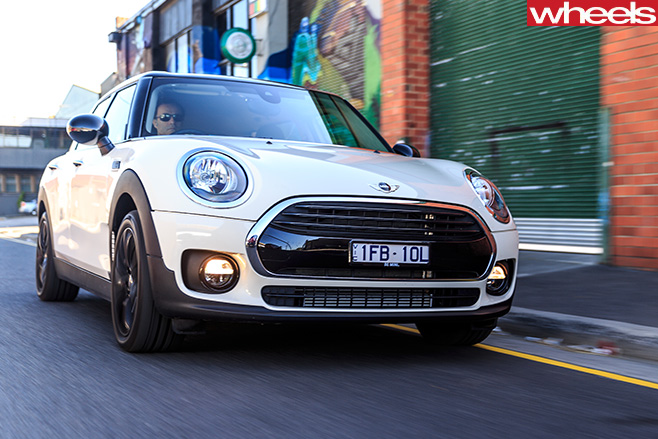
Chasing a similar market with a similar emphasis on design, Fiat’s ‘SUV when you aren’t having an SUV’, the Fiat 500X, also stands out from the crowd. Literally. Melding the design cues of Fiat’s hugely successful, decade-old Nuova Cinquecento into a five-door expanded hatchback, the 500X measures a statuesque 1600mm tall. And that’s the front-driver. The range-topping AWD Cross Plus hikes that 20mm further, making it 10mm taller than Suzuki’s more traditionally proportioned Vitara ‘All Grip’.
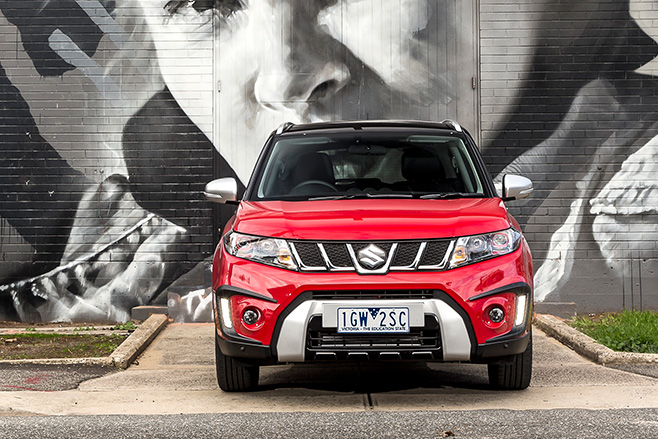
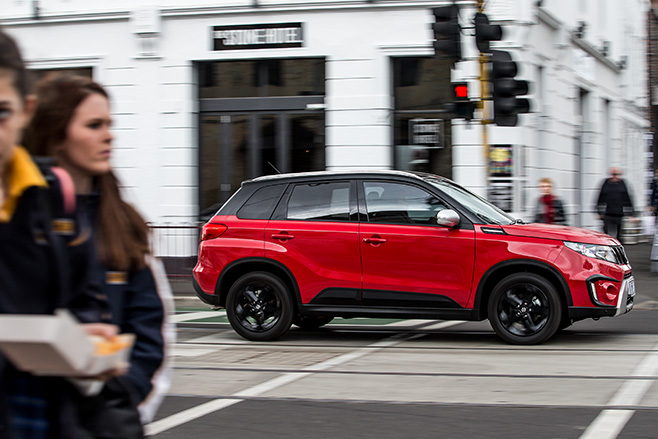
No matter which wheels are doing the driving, Suzuki’s reborn Vitara is like a room with a view. Front passengers feel almost like they’re sitting on a throne as they peer over its retro, clamshell-style bonnet, inspired by the original 1988 Vitara. But it’s underneath where the latter-day Vitara both conforms to and confounds Suzuki tradition.
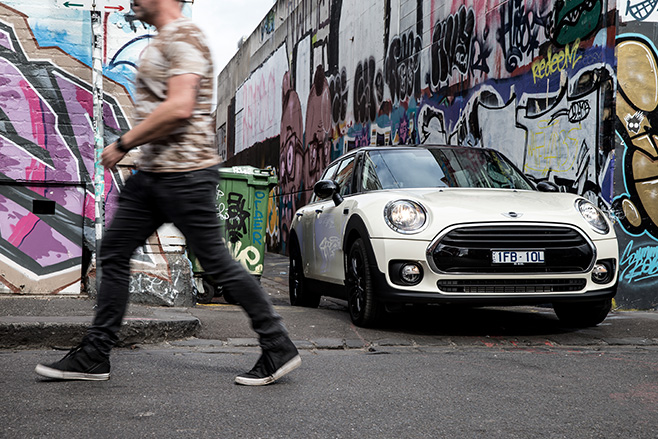
If there’s one thing the Mini Clubman has in spades, it’s history, however spurious. While today’s design-intense BMW-developed generation owes absolutely nothing to its once-radical forebears in anything but name, the new-millennium Mini has had a massive influence on a global scale. Not only is it the first genuine retro smash hit, it’s also the master of customisation, be it colour, trim, engine, transmission, bodystyle, you name it. From a base 3dr Mini One manual to a fully loaded, heavily turbocharged 5dr, Clubman or Convertible range-topper, there’s a Mini out there to suit almost everyone.
On the surface, we’ve chosen potentially the wackiest Mini there is – the wagon-esque Clubman in three-pot turbo guise. With its barn-type rear doors opening outwards in sequence, and an even longer wheelbase than the (older-generation) Countryman that sits above it, the lengthy Clubman looks a little bit like a sausage dog. Which is kinda weird for a car.
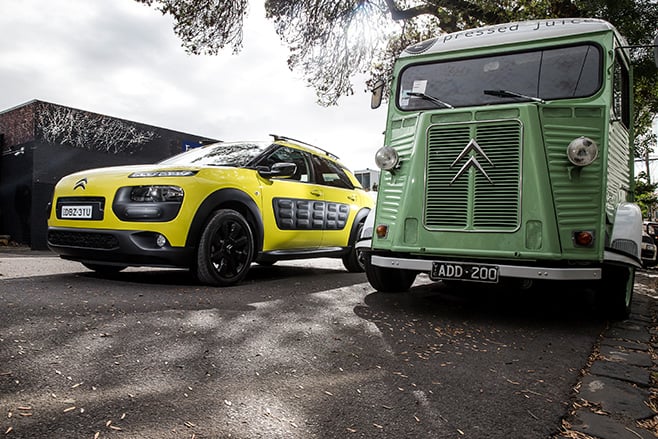
The Citroen C4 Cactus inherits its underpinnings and part of its name from Citroen’s snoozy current-generation C4 hatch, much like the jacked-up coupe/hatch DS 4, though it has been allowed to develop very much of its own accord, rather than inheriting C4 cast-offs like the dreary dashboard donated to the DS 4. And it’s this simpler, weight-conscious approach that underpins the essence of this unusual vehicle.
The front passenger doesn’t get an outer air vent, but the centre one is twice as big as the driver’s to compensate, and the Cactus is one of the few cars on sale today without a tacho. Instead, a simple gearshift indicator appears in its digital instrument strip when it believes you should be considering another ratio. And even if you think that’s poppycock, remember that PSA’s brilliant turbo-triple is so goddamn tractable and torquey, it operates much like an air-cooled Volkswagen. You simply drive it by feel.
In order to rip 200kg from the C4 hatch’s bland body, however, some ‘weight saving’ is a step too far. Like the Cactus’s tilt-only steering column, its lack of one-touch power windows (you have to hold the button for all of them), no grab-handles in our panoramic roof-equipped test car, and a flimsy boot-floor cover that leaves painted metal exposed to scuffing. But then that also allows some funky body colour to creep inside, like a car from decades ago, and the Citroen’s deep 358-litre compartment is a great size, underpinned by a space-saver spare and a split-fold rear backrest that turns this Airbumped little charmer into something of a Tardis.
Same goes for the surprisingly large 500X. This Fiat-500-in-name-only ranks equal first with the longest, widest, tallest and heaviest of its fashionista competitor set, which is both a good and a bad thing. While the Clubman adds 25kg to the 500X’s weighbridge ticket, the Fiat is nearly 160mm taller than the Mini, handing it a top-heavy disadvantage matched only by the similarly configured, though 60kg-lighter AWD Suzuki.
And that’s how they play out on the road. With its low centre of gravity making up for any weight-related issues, it doesn’t take long behind the Clubman’s chunky steering wheel to discover its UKL platform was clearly intended to underpin a Mini first, not a front-drive BMW SUV/MPV. In fact, we’d go so far as to say that – ballistic Mini GP variants aside – the latest F54 Clubman is the most dynamically cohesive Mini variant since the brand’s relaunch 15 years ago.
Enhancing the Clubman’s sporting dynamic polish is its driving position, strengthened by tightly bolstered (optional) sports seats in our test car to provide an excellent base to work from. And while the Cooper-spec Clubman’s terrific steering wheel lacks shift paddles, its transmission gate is configured so that you nudge the lever forward for a downshift, in our (and BMW’s) preferred fashion.
About the only real downside is the 1.5-litre 100kW three-cylinder turbo’s ultimate lack of herbs. While it thrums smoothly and feels impressively elastic, endowing it with deceptive pace in much the same way as the three-pot turbo Citroen, there’s no escaping the Mini’s solid 1320kg kerb weight, which impacts on its real-world fuel consumption (11.4L/100km on test). A bit more boost and a touch more induction and exhaust rasp is what the Cooper Clubman needs to adequately support its addictive handling.
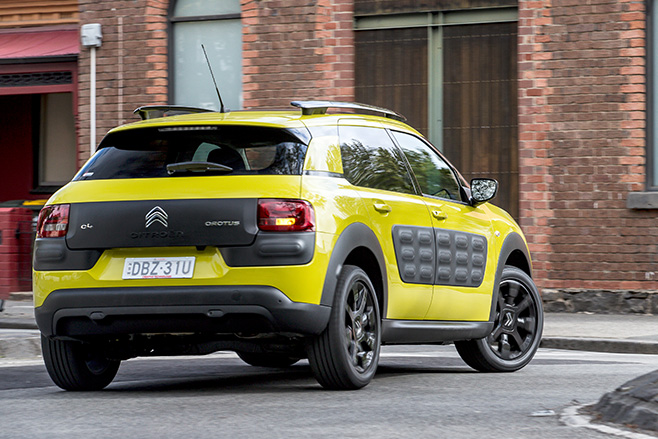
The only downside to the Citroen’s outstanding efficiency is that it’s available as a manual or nothing, which is fine by us but not when 80 percent of buyers are choosing the inferior turbo-diesel because it doesn’t have a clutch.
Another Cactus negative relates to its lack of steering reach adjustment. Getting its quirkily styled leather-clad wheel in the right place to attack corners creates a tightly bunched environment for your legs, especially if you’re lanky. Things can get busy down at footwell level and the only way to adequately heel-and-toe for downshifts is by rolling your right foot onto the throttle, much like you do in an old VW Beetle.
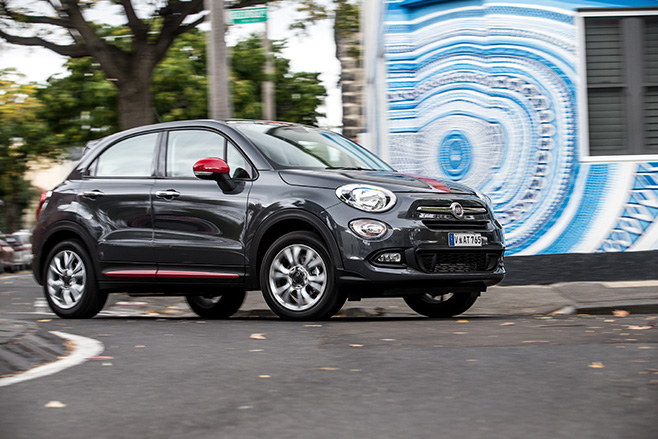
Jumping straight from the relatively low-slung Cactus into the 500X, the first thing you notice is the massive increase in driving-position height, which some buyers will love. The Fiat’s chunky three-spoke wheel implies sportiness, despite a rim that is arguably too thick, and so do its shift paddles and multiple drive modes (Auto, Sport and Traction Plus) activated by a dial on the centre console. But the reality is a mixed bag of okay, underwhelming and irritating.
Chief dynamic spoiler is the 500X’s electric steering, which feels gooey in Sport mode, and slightly crisper in Auto, though it’s always about degrees of viscosity. And the fat wheel rim only exacerbates the impression.
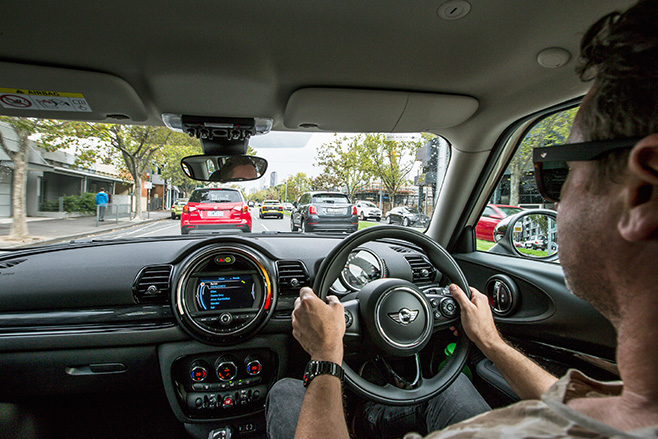
The driver reward it does offer stems from its keen and subtly raspy engine, but even then Fiat’s 1.4 turbo can only just keep the Citroen honest in 80-120km/h rolling acceleration, despite using every gear available (as opposed to being held manually in third).
If it’s proper grunt you’re after, only one of these curios truly delivers – the Vitara S Turbo. Suzuki’s all-new 1.4-litre turbo-petrol four is a sweet little peach, proving smoothly responsive while smashing the others in standing-start acceleration, even though it won’t rev beyond 6000rpm. A manual transmission would be nice (and is a possibility if enough people show interest), though the Vitara’s six-speed auto does a good job of channelling the ‘Boosterjet’ four’s torque, making this tall-boy small SUV feel more like a warm hatch.
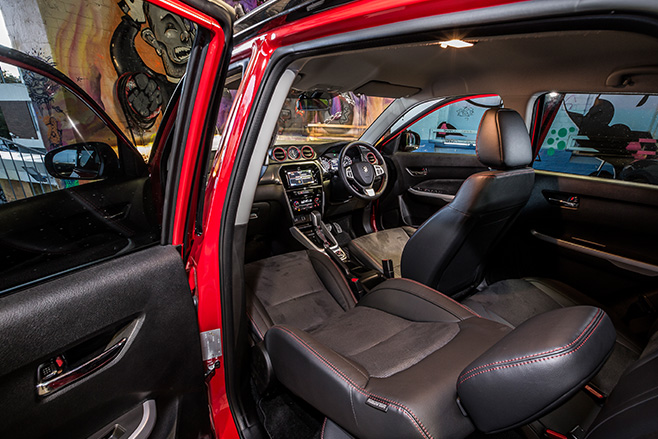
Despite a retune for all MY16 Vitaras that has removed the stickiness that blighted last year’s examples, the Suzuki’s steering is still too vacant at straight ahead and lacks cohesion with its chassis. That said, the more lock you apply on winding roads, the greater its poise, though more work is needed to tie it all together, including taming its overly sensitive braking response and susceptibility to crosswinds.
Same goes for Vitara’s ride. Shod with reasonably modest Continental Eco Contact 215/55R17s, it feels unsettled at all speeds, even carrying a full load of mates, though it sounds worse than it feels, with quite a bit of tyre roar and some suspension noise and float over big bumps. But it houses four adults with relative ease (or five at a pinch), with rear folk seated theatre-style on a nicely elevated cushion, undermined slightly by an excessively reclined backrest.
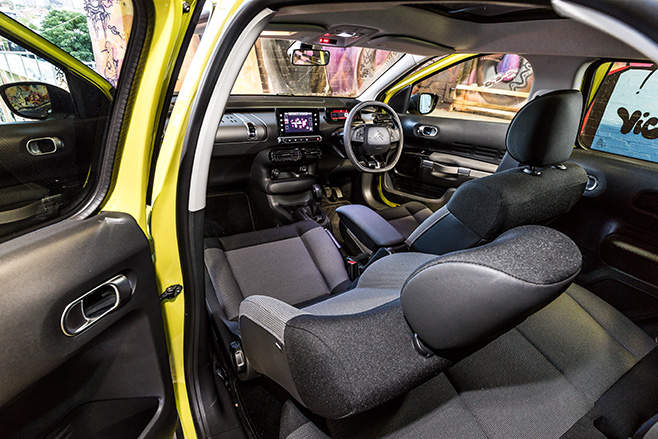
Unexpectedly, the Mini shines almost as brightly as the Cactus, and in some areas even more so. Its lengthy cabin offers the most rear-seat legroom, as well as an impressive theatre-style view and terrific all-round vision for a Mini. And the Mini Clubman sits a class above in its finish and features. Four auto-up/down power windows, dual front lumbar support adjustment, a removable/configurable boot floor, plus two elasticised boot straps and bins in the rear barn doors prove that you get what you pay for in a Mini Clubman.
It also – wait for it – rides well. Wearing 225/45R17 Bridgestone Turanzas, the Clubman is firm but all of a piece, with a comforting, rattle-free solidity. There’s some coarse-surface tyre noise but otherwise the Clubman sits right at the pointy end when it comes to accommodation.
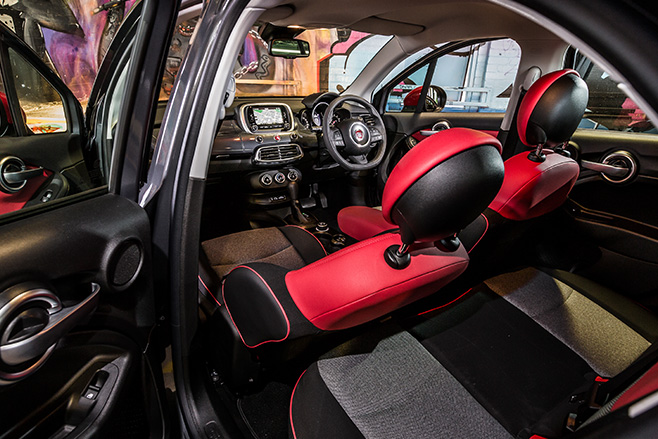
All of which ultimately spells ‘wooden spoon’ for the 500X. While far from being a total dunger, it looks and feels a bit like a Fiat designed for Americans, lacking the design subtlety to match its punchy, likeable drivetrain. The 500X is missing both the regular 500’s fun and the Citroen Cactus’s panache, though improved seating and a comprehensive dynamic rethink could turn things around. But as it stands we can understand why people might prefer a Jeep Renegade…
Unless you’re completely invested in the Fiat’s appearance, the more generic Vitara S Turbo is a much stronger proposition, blending gutsy performance with surprising efficiency and the obvious USP of all-wheel drive among this quirky quartet. It can be fun to drive, too, and offers an interesting mix of colours and trims to make up for its budget plastics and econocar basics. But it doesn’t feel special like the Cactus does.
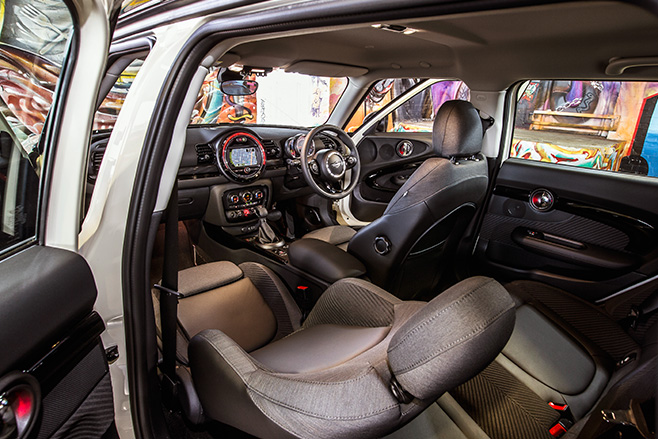
One thing that works to a surprising degree is Mini’s Clubman. While its biggest design feature – those barn rear doors – is ironically its biggest flaw in terms of practicality, there’s a cohesion to this car that few modern Minis have managed to achieve. In fact, slightly awkward styling aside, we reckon this is the best Mini since the brand’s 2001 relaunch. And, in fine Mini tradition, it continues to deliver something the others can’t – choice. Manual or automatic, petrol or diesel, slow or fast, subtle or sinister, there’s a quirky, unique Clubman out there for everyone.
No one likes spending hundreds of dollars on four rubber rings. At least, most people don’t. But replacing old tyres can be the difference between staying safe, or ending up in a bit of a pickle.
Knowing when it’s time for new tyres isn’t really that difficult. It all comes down to one feature – tyre tread.
Tyre tread is the part of your tyre that connects to the road and provides it with grip. It pushes water away to ensure the rubber has maximum connection with the road during wet weather. Over time, as your tyres start to wear, the tread starts to burn away. This reduces the tyres’ ability to grip the road.
Not only is tyre tread an important safety factor, but it’s also a legal issue. Anything below 1.5mm tread depth deems your car illegal.
Luckily, ensuring your tread is 1.5mm is easy thanks to a small indicator features on every tyre called the tread wear indicator (TWI). This is indicated by the letters, TWI, on the edge of your tyres – when the tread becomes level with this bar, it’s time to invest in a new set of rubber.
But the tyre tread can tell you more about your tyres than their wear. It’s also an indicator as to whether your tyres are under or over-inflated. If your tyres are under inflated, the shoulder of the tyre, that is, the outside, will be worn more than the centre. While centre wear indicates over inflation.
It’s also important to note that spare tyres that have never been used may also be past their used-by date. Some specialists suggest consulting a specialist every five years to check if the tyre is still in good condition.
WHAT IS IT? It’s BMW’s compact coupe with a feisty straight six that drives the rear wheels. This is the updated version of the sporty and involving M235i.
WHY WE’RE TESTING IT There’s an all-new engine under the bonnet, and with a waiting list for the M2 the M240i could be the smart buyer’s vehicle of choice
MAIN RIVALS Audi S3, Nissan 370Z, Ford Mustang GT, Mercedes-AMG CLA45
THE WHEELS VERDICT A serious contender against more expensive metal, the M240i offers huge performance in a well-specced and easy to live with package.
PLUS: Flexible engine, eight-speed auto (and option of a manual), animated sound, adaptability MINUS: Dated interior styling, tight interior
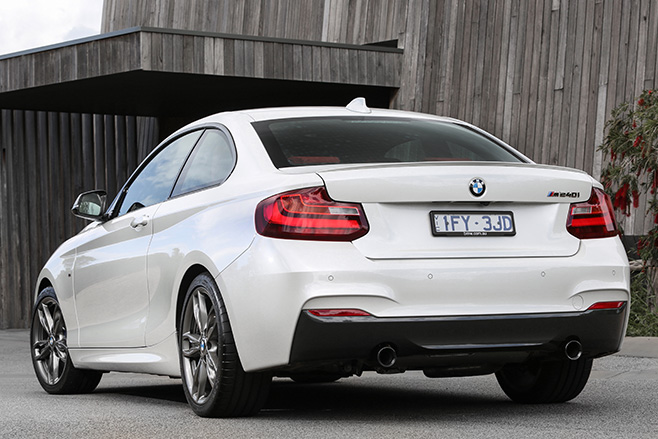
THE WHEELS REVIEW TAKE a small car, put a big engine in it, and car lovers will flock to it like moths to a flame. It’s a recipe so simple that a bloody battlefield full of baby performance cars and hot hatches spoils buyers for choice.
BMW’s entry to the fray is a rear-driven outlier, recently updated extensively enough to outgrow its old M235i moniker and become the M240i. Its hatchback counterpart, M140i, has followed suit. Both cars retain a relatively oversized 3.0-litre turbocharged inline six, now making 250kW and 500Nm. That’s a jump of 10kW and 50Nm, and gives the sub-M hot rod enough torque to put the M2 on high alert. This level of performance has never been so accessible.
Figures on paper don’t let on about the depth of engineering advance under the bonnet. Wholesale changes to the engine block, turbocharger and intake mean the powerplant changes its name from N55 to B58. Efficiency improves to 7.1L/100km partly due to an arc spray technology developed by BMW engineers to make cylinder bores slipperier, and it all gets a bit nerdy from there.
Importantly, it works. The old engine was a knockout, but the new mill is even better with improvements focussed on engine response. There’s a smaller turbo, which spools up faster than before, but achieves greater boost pressure via a revised tune. Gone is the front-mounted air-to-air intercooler and its lengthy plumbing, replaced by a water-to-air intercooler within the intake manifold. That shortens the path air has to travel through, and means peak power arrives earlier in the rev range. It’s now two tenths quicker to 100km/h, tipping the ton from standstill in 4.6sec.
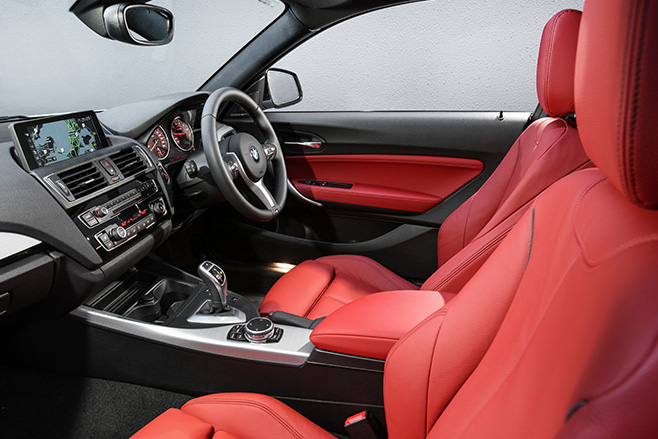
Automatic and manual gearboxes are offered, and hooray for that. The eight speed auto is carried over and that’s no bad thing. It’s decisive, oily-slick and well suited to the task, though not as pure as the direct mechanical connection of the six-speed manual or as forceful as the M2’s seven-speed DCT, though the latter wouldn’t suit the M240i’s more compliant nature.
Front end grip is where the car starts to come unstuck when really pressing, though the sweetly balanced chassis can be rotated from the rear with the throttle pedal. Steering is well weighted, and adaptive dampers fitted standard to M240i split its soft and daily-driveable side, and its sharpened, trackable eagerness. In Sport mode it lacks the rebound control of the M2’s single suspension tune, though it’s more liveable in Normal than the laser-guided M2.
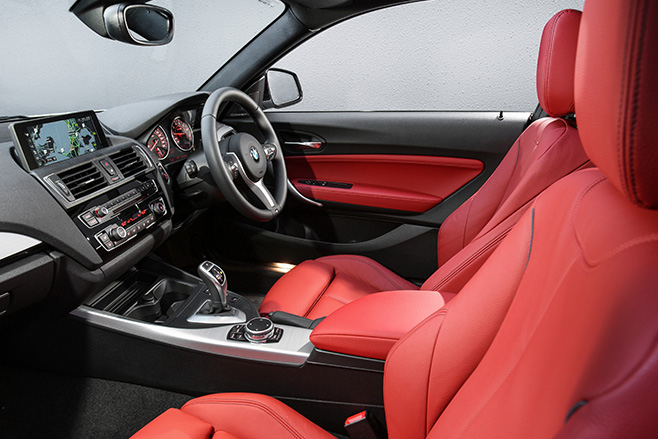
The M240i’s cosy cabin is affected by road noise and looks dated, though they’re minor criticisms in the context of a car centred on the road ahead. Electric, heated seats are now standard and drop right to the floor. A new iDrive infotainment system introduces a higher resolution screen and app-based interface which is snappier than before and has a broader set of skills.
Spec has been further boosted to add showroom pull by including premium Harmon/Kardon audio, adaptive headlights and driving assist systems as standard. Dropping the price to $74,900 – $2300 cheaper than the less powerful car it replaces – should also help.
M240i sits in a unique position where it doesn’t really have any direct competitors. There is little else out there offering the same relatively unspoilt front-engine, rear-drive layout in a compact form factor with this ratio of performance-to-dollar. It’s not quite as outwardly muscle-flexing or as exclusive as the M2, but it nips at the heels of its track-honed sibling for a much sharper price, and it should attract its own legion of followers for that reason alone.
SPECS
Model: BMW M240i Engine: 2998cc 6-cyl, dohc, 24v, turbo Max power: 250kW @ 5500rpm Max torque: 500Nm @ 1520-4500rpm Transmission: 8-speed automatic Weight: 1485kg 0-100km/h: 4.6sec (claimed) Economy: 7.1L/100km Price: $74,900 On sale: Now
ASTON Martin and Red Bull Racing’s lovechild, the AM-RB 001 looks set to redefine the hypercar genre.
In an interview with The Wall Street Journal, Red Bull’s master of design, Adrian Newey, let slip some of the details surrounding the AM-RB001’s performance. And they’re astonishing.
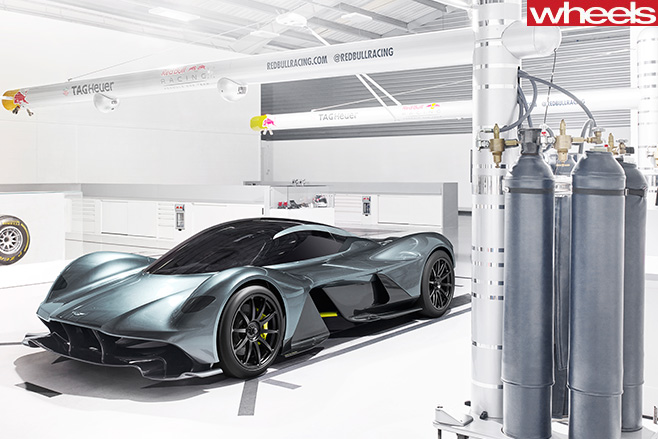
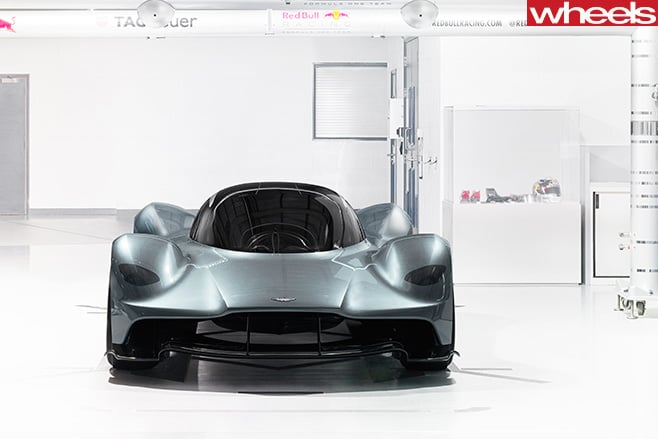
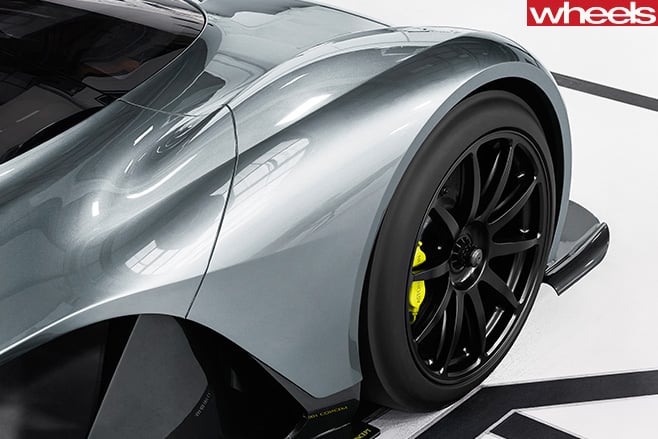
Not even fully fledged GT3 racecars have a hope of getting close to that kind of performance.
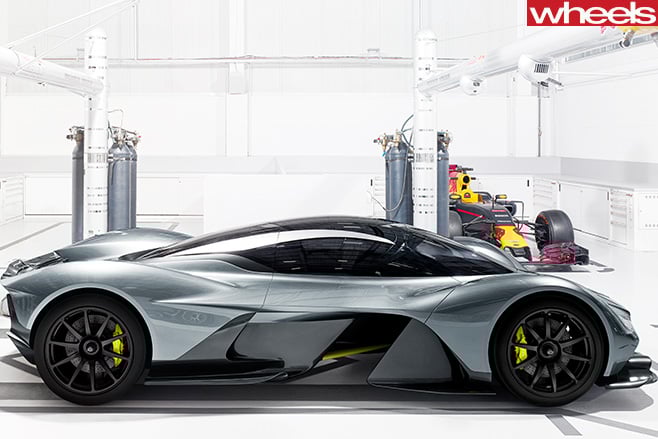
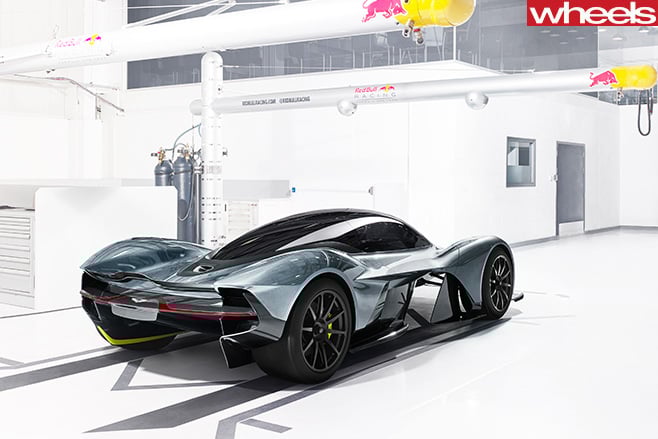
The ‘unofficial’ estimate is a mind-boggling 1814kg of downforce at speed. Cliched “able to drive upside down” factoid aside, this kind of downforce will allow the AM-RB 001 to record up to four degrees of lateral G-force. Copse curve at Silverstone is the highest load corner of the Formula One season, and those cars achieve in the realm of 5.0G through that turn. However, they are the pinnacle of open-wheel motorsport engineering, not a production vehicle with a roof.
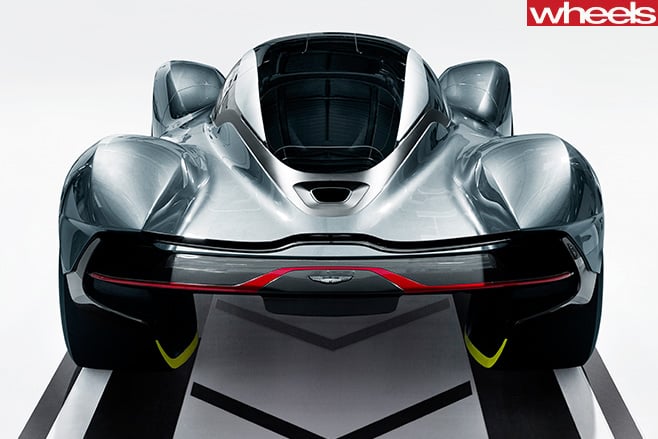
Oh, and to put that 1814kg of downforce into context, the already bonkers P1 GTR only generates 660kg.
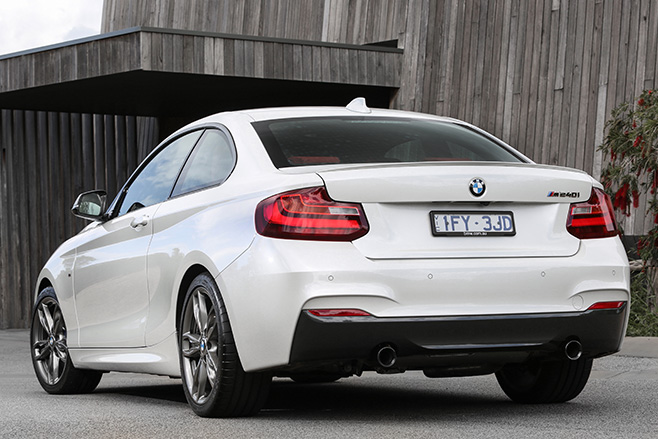
TELL ME ABOUT THIS CARThere are few rear-drive compact coupes with a six-cylinder engine left on the market. One of them, the M240i is an updated version of the sporty and involving M235i. It introduces a new engine and more standard features than before, at a cheaper price of $74,900.
STRENGTHS
- Engine. The 3.0-litre in-line six-cylinder turbocharged engine in the BMW M240i is completely revised compared with the old M235i. It is more powerful, and has almost as much torque as the much more expensive BMW M2. More than that, power now arrives earlier, making the car faster to 100km/h from rest (4.6sec) and it uses less fuel than before (7.1L/100km)
- Gearboxes. There are two gearbox options; an eight-speed automatic or a six-speed manual, and they’re both good. The auto is smooth and easy to live with in traffic. The manual offers the best connection to the car and adds another level of driver enjoyment when a twisty stretch of road presents itself.
- Price. A reduction of $2300 places the M240i at $74,900, which is about $15,000 less than the BMW M2 Pure, and $25,000 less than the full-strength BMW M2. Considering the engine performance of the M240i, and it’s a compelling alternative for those who don’t have as much interest in racetracks.
- Sound. There’s something so pleasing about the sound of a straight-six engine, and even with a turbocharger hanging off the exhaust system there’s still a great noise from the M240i’s engine. Low down in the revs when driving slowly it is docile and unobtrusive; open the throttle and the engine comes to life with a growling note.
- Infotainment. An upgraded interface for the sat-nav and in-car entertainment system adds a sharp, high-resolution screen and more features such as advanced voice recognition and sophisticated smartphone integration.
WEAKNESSES
- Styling. From the outside the M240i could be any other 2 Series. Some people will like the incognito appearance where others will like a little more visual distinction. The M2 stands out a lot more with its flared guards, but the M240i flies under the radar.
- Interior. Unfortunately the M240i’s cabin is starting to look a little old. The dashboard in particular has a last-gen feel to it and is in need of an update.
- Room. This is a small coupe, so it would be unfair to expect 5 Series levels of comfort. The M240i is fairly tight around the front seats, and there’s no middle seat in the back. Headroom is also restricted, especially in cars with a sunroof, though the M140i hatchback has a more accommodating roofline and is an option for anybody on the tall side.
ANY COMPETITORS I SHOULD CONSIDER?
There is little else out there offering the same relatively unspoilt front-engine, rear-drive layout in a compact form factor with this ratio of performance to dollar, so M240i doesn’t really have any direct competitors. However, there are some other accessible rear-drivers out there that aren’t quite as quick, such as the Nissan 370Z and Ford Mustang GT. The Audi S3 sedan is another good alternative, though it uses a four-cylinder engine and all-wheel drive, as does the Mercedes-AMG CLA45.
WHAT a week for automotive enthusiasts! There have been so many ripping stories in the past seven days, you could be forgiven for missing some of them.
So whether you were too busy to get all the goss, had no internet, or were perhaps literally living under a rock, we’ve got your back. Here’s some of our best stories from this week on Wheelsmag.com.au to ensure you can still hold your own at the pub this weekend.
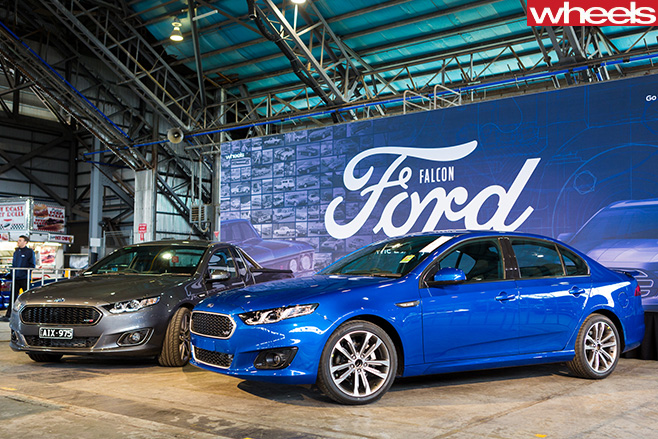
The stories have been wild and varied, and kicked off with the auction of the last saleable Ford Falcon. When the hammer finally fell, the XR6 sedan was sold for $81,500. Whether that is a sound investment, only time will tell.
There was also plenty of motorsport action, from Tim Slade’s mega World Time Attack Challenge lap, to a wild overtake from fourth to first by Kevin Eriksson in World Rallycross.
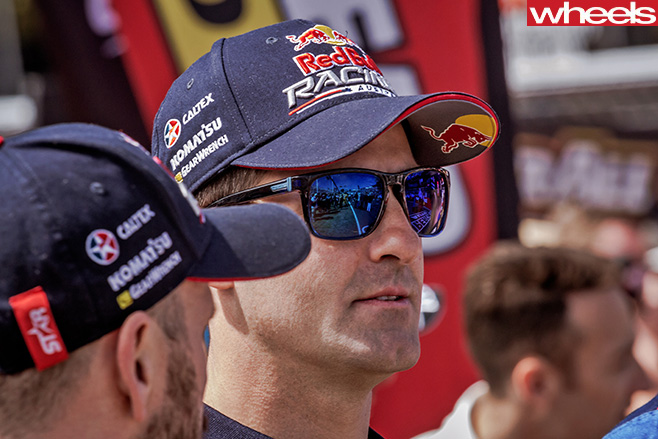
Speaking of motorsport, six-time Supercars champion Jamie Whincup teed off in a big way, slamming the category for playing dirty in the media over his team’s Bathurst 1000 appeal.
On that subject, Holden confirmed to Wheels it would not repeat Ford’s faux pas and close its Elizabeth manufacturing plant next year in the same week as Bathurst.
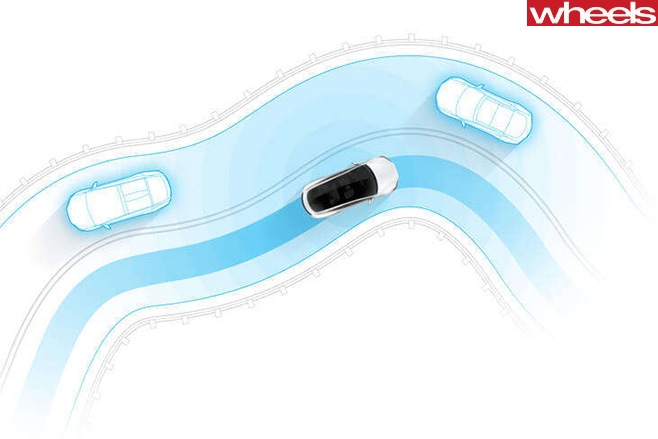
In tech news, Tesla came out swinging in the self-driving car race, confirming that every car that rolls off its production line from now on will be fitted with the hardware necessary for fully autonomous driving. The software will come later.
You can get all that and more from our most popular stories of the week, listed in no particular order, below:
– Holden confirms no Bathurst clash with factory closure
– Ken Block teases Pikes Peak tyre-shredding video
– Tesla confirms fully autonomous hardware for all new cars
– Jamie Whincup slams Supercars for ‘playing dirty’
– Kevin Eriksson’s wild Rallycros drift overtake
– Tim Slade’s mind boggling World Time Attack lap record video
– Last Ford Falcon you can own sells for $81,500
– 2017 Ford Escape ousts Kuga in Australia
An Audi S7 Sportback has joined the ranks of the NSW Police Force, replacing the Audi RS 4 Avant previously used.
But don’t expect to see crims being bundled into the back of this fast four-door – the 4.0 TFSI Biturbo V8 S7 will be used in the Lake Illawarra Local Area Command on a 12-month loan for work in community and youth engagement programs, rather than as a patrol vehicle.
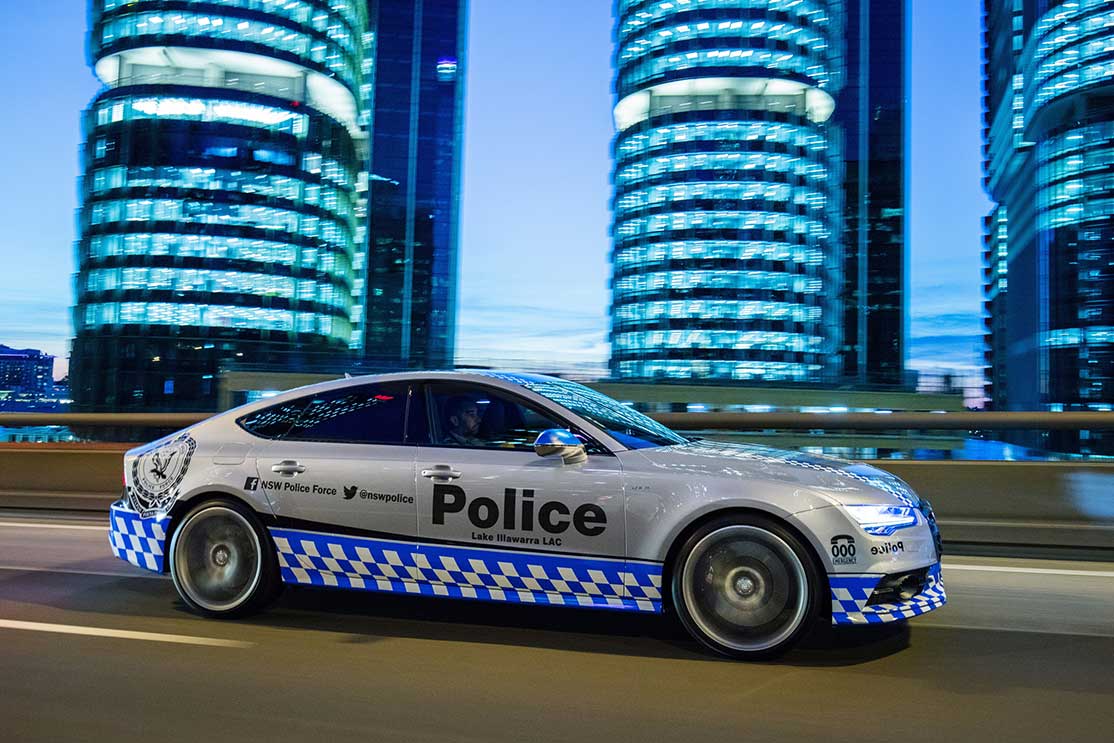
“The Audi S7 Sportback provides an exciting and visible platform for our community and youth engagement activities,” said Commander of Lake Illawarra LAC, Superintendent Zoran Dzevlan.
“Our use of the S7 Sportback will encourage people of all ages to introduce themselves to local police, using the car itself to help start up a conversation.”
The S7’s 4.0 TFSI twin-turbo produces 331kW and 550Nm, and sprints to 100km/h in 4.6 seconds. Aside from a cop-shop sticker package, the vehicle will offer the same features at the 2015 facelifted S7 Sportback, including single frame grille, lower splitter, larger air inlets with twin chrome highlights, and Matrix LED headlights and rear tail lights.
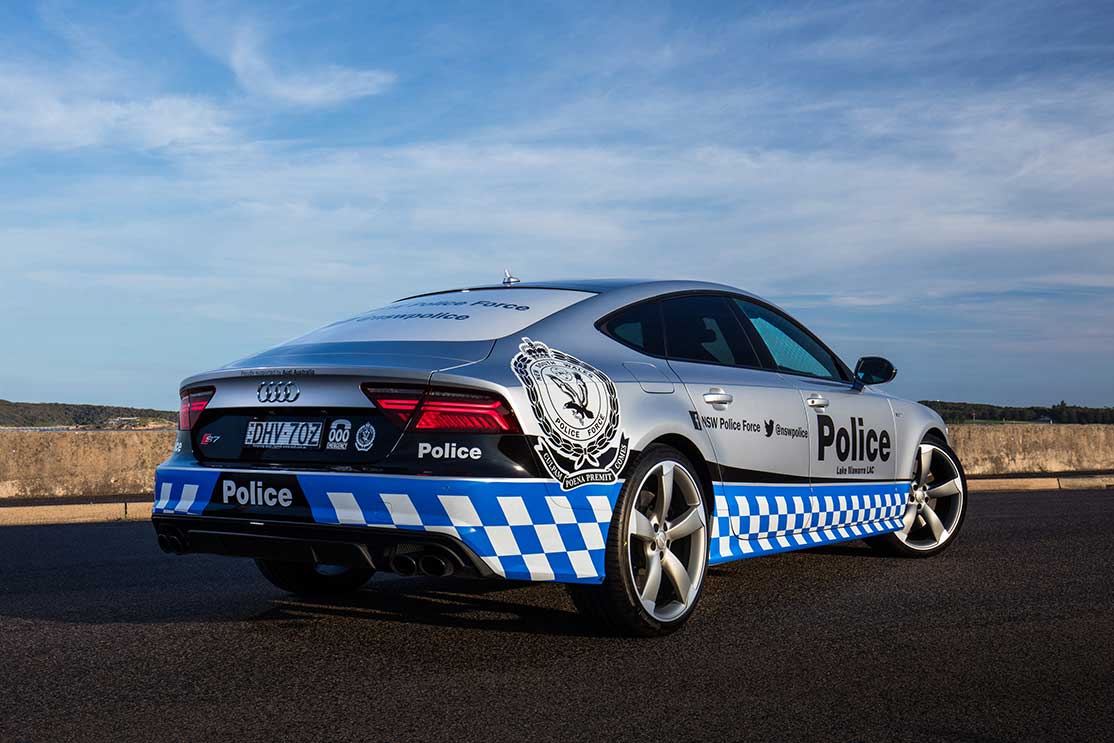
Also at the rear are trapezoidal tailpipe trims and a bold, contrasting diffuser to enhance the dynamic visuals.
Audi’s Driver Information System (DIS) displays navigation on the dash, powered by the infotainment system.
“We are pleased to continue to support the NSW Police Force as they engage with the youth and wider community in the Lake Illawarra region,” said Audi Australia Managing Director, Andrew Doyle.
“The Audi S7 Sportback has a striking presence, thanks to its sophisticated design and the sound of its extraordinary twin-turbo V8 engine, and so it is perfectly suited to making an impact at the various events it will attend throughout the course of the next 12 months.”
The Audi S7 Sportback on loan costs $180,716.
Want more? Check out the coolest police cars of all time…
