
The Ford Mustang Ecoboost is having a bit of trouble. Australia is going slightly Mustang mad, but virtually all the adulation is centred on the big, bad V8.
If the GT is the full forward on the high school footy team, the Ecoboost is the geeky younger brother in chess club; with only half the number of cylinders to offer, it’s lacking a little street cred among the enthusiast crowd, one particularly witty friend on Facebook even dubbing it ‘Mustang Silly’.
The scepticism is easy to understand. Ford first introduced a four-cylinder Mustang in 1974 in response to the oil crisis – with a 66kW 2.3-litre four-pot lifted from the Pinto, it had about as much muscle as Arnold Schwarzenegger’s little finger.
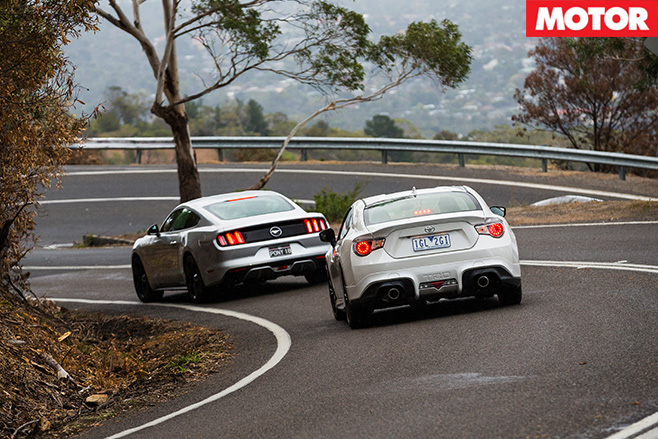
Certainly the mechanical specification is a bit healthier this time around. As with its 1974 predecessor, the engine is a 2.3-litre four-cylinder, but thanks to a turbocharger and plenty of 21st century technology it produces almost four times the power: 233kW at 5600rpm and 432Nm at 3000rpm. Combined with a $45,990 price tag (auto adds $2500) the four-pot Mustang offers an impressive amount of bang for your buck.
So impressive, in fact, that finding a suitable rival for context is difficult. Nissan 370Z? Too old and, at $56,930, too expensive. Volkswagen Scirocco R? Too front-drive. Peugeot RCZ?
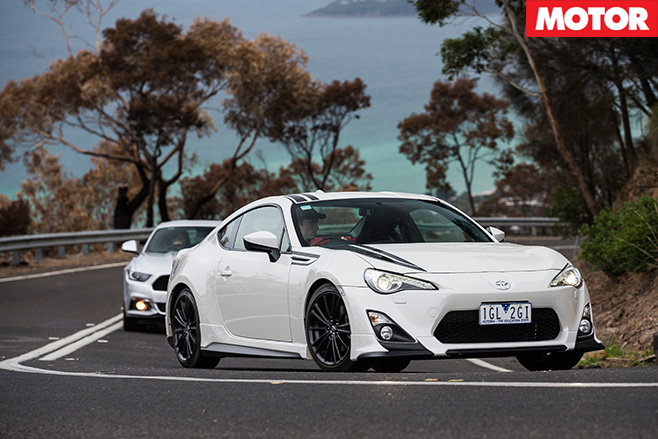
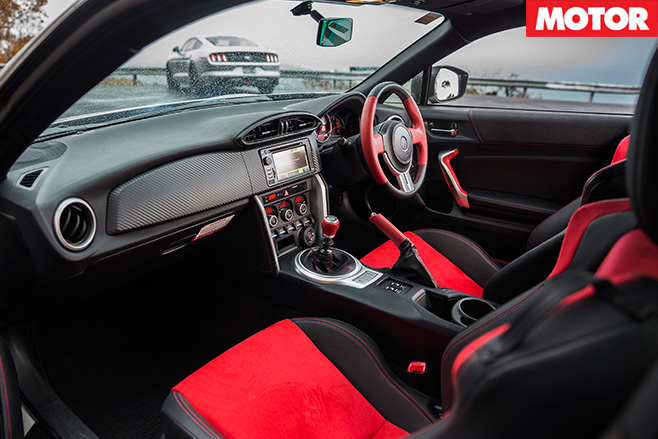
Our test car is the $37,990 Blackline Edition, released to celebrate the arrival of the one-make 86 Racing Series. Limited to 450 units – 250 manuals and 200 automatics – it scores a TRD bodykit, black exterior stripes and an interior that looks like the set of a Quentin Tarantino film, with a Kill Bill-style splash of red to the seats, steering wheel, gear knob, handbrake and door grips.
The overall effect is a bit garish, but it does lift the ambience without detracting from the 86’s perfect driving position. Sadly, it doesn’t improve its outdated infotainment system, which is set to be upgraded as part of the Toybaru’s MY2017 update. The cabin is a functional affair, but feels almost plush in comparison to the Mustang. The Ford’s interior design is a strange mix of retro muscle car cues (the chrome toggle switches, aircraft-inspired dials) and shared Ford technology (SYNC2 infotainment), but the quality of the materials leaves a lot to be desired.
But you know what? It doesn’t really matter. Yes, the interior feels cheap, but relatively speaking, this is a cheap car. Certainly no other car at this price point attracts this amount of attention. Despite its popularity, it seems the novelty of seeing a Mustang on Aussie roads hasn’t abated.
In contrast, the 86 might as well be invisible. The Blackline’s monochrome colour scheme does add some manga-style cool, but it would need to be covered in $100 notes to attract a crowd like the Mustang. Even non-enthusiasts stop, stare and comment, and are much less likely to notice the missing ‘5.0’ badge on the front guards, evidence you’re only packing half the expected number of cylinders.
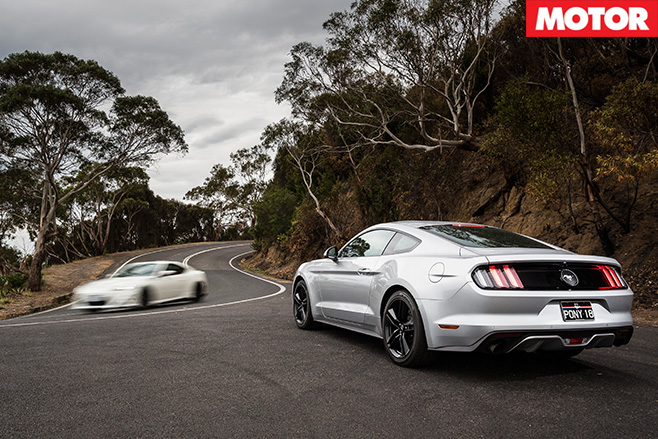
Soundtrack aside, however, the Ecoboost acquits itself pretty well. A broad swell of strong mid-range torque delivers ample acceleration, the 0-100km/h sprint completed in 6.08sec and the quarter mile in 14.24sec at 159.07km/h, similar numbers to a Golf GTI. Extracting the final tenth or two is hard work, but the six-speed manual is a good match, with reasonably short ratios and a shift action that’s like a notchier version of a Mazda MX-5.
Whether it’s better than the Toyota’s six-speed manual is likely to be a matter of personal preference. The 86’s ’box is notchy and obstinate when cold, but the shift action improves markedly once warm, which is just as well as it needs frequent use to keep the high-revving but torque-lite atmo 2.0-litre on the boil. There’s enough urge down low around 2000rpm to make day-to-day use painless, but then there’s a massive hole in the power delivery until it picks up again at around 5500rpm.
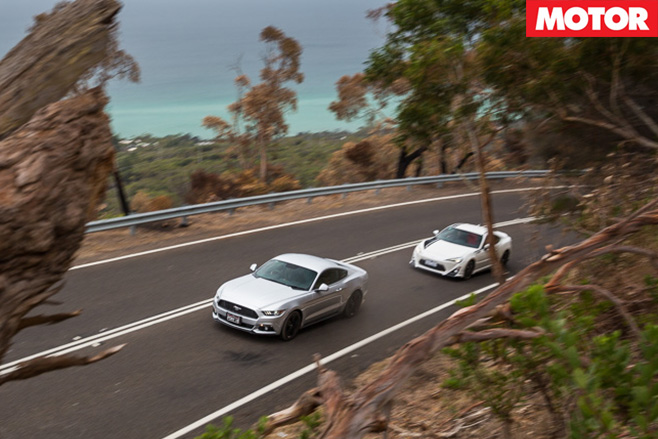
It may lack outright grunt, but the 86 can still be a handful, particularly in the wet. In slippery conditions, the Michelin Primacy low-rolling resistance tyres have about as much grip as a bar of soap with even moderate throttle openings slewing the rear end sideways. With VSC activated, this results in a loud graunch as the electronics clumsily step in, while it requires a quick armful of opposite lock with the stability control off.
This might sound like a lot of fun, and it is to a degree, especially as it can occur at hilariously low speeds, but the way the eco-spec tyres relinquish grip can be quite sudden, even in the dry. What the 86 really needs is rubber with the outright grip of an eco-tyre, but the smoother breakaway characteristics of a performance tyre. The lack of grip costs it under brakes, the firm pedal feel undermined by early ABS intervention, which pushes its 100-0km/h stopping distance out to 39.1m – 2.3m more than the much heavier Mustang.
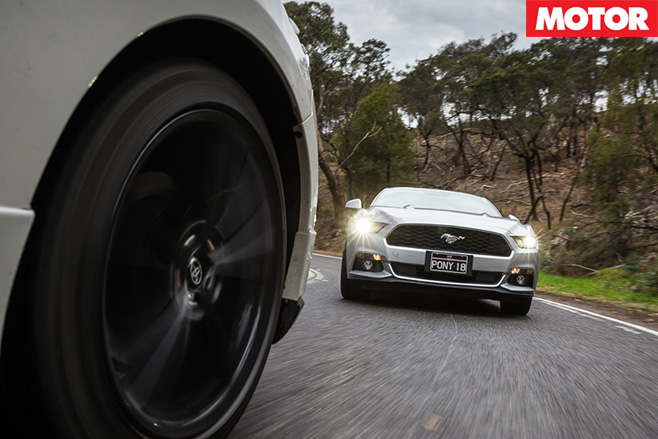
At this point you’re probably expecting the fat American to cop a pasting, its soft suspension and near-400kg weight disadvantage making it about as talented in the corners as a three-wheeled shopping trolley. Nothing could be further from the truth. It’ll surprise no-one to hear that the Mustang’s size and weight make it less agile than the lithe 86, but there is a seriously talented chassis underneath that Hollywood styling.
It doesn’t provide the same level of feedback as the Toyota, but counters with incredibly benign handling, making the Mustang an extremely friendly car when driven hard. It’s not playful as such, but it is engaging and much better than you’d expect it to be. Its soft setup makes the limit a slope rather than an edge and in the dry you can use the throttle like a switch, nailing it once the front has bitten, safe in the knowledge there is more traction than torque.
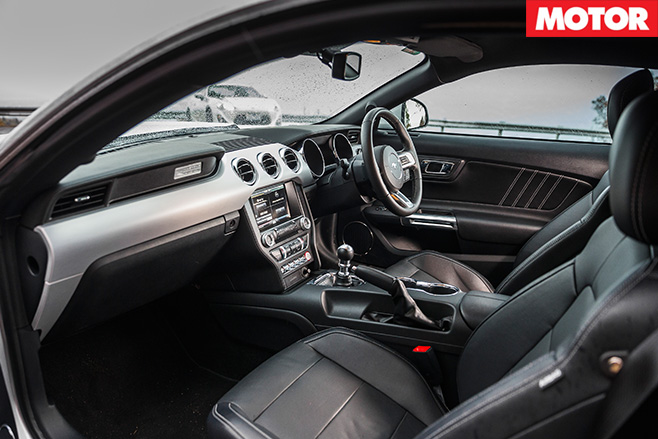
Its Ecoboost engine might not be particularly inspiring, but the amount of grunt available feels like a perfect match for the chassis. In fact, the whole car feels very balanced. Each part feels nicely in tune with every other part – until you get out and look at it.
It’s a difficult thing to explain, but the Ecoboost doesn’t feel like you expect a Mustang to feel. You drive it, it’s enjoyable, but then can’t help feeling vaguely disappointed that the experience doesn’t quite match up to the looks.
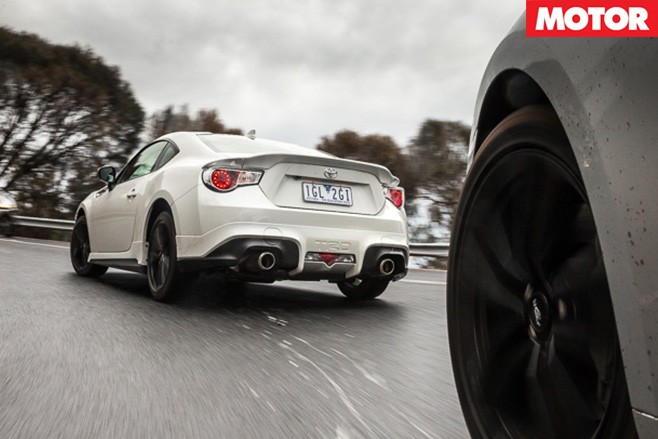
If you want a four-cylinder sports coupe, buy a Toyota 86. However, maybe wait for the new one that’s due later in 2016 which chief engineer Tetsuya Tada promises is an enormous improvement over the current car (which we’ve driven this issue, p20). If that’s the case, we should be in for a treat. While the current model is beginning to show a few cracks, it’s still about the best fun you can have on four wheels.
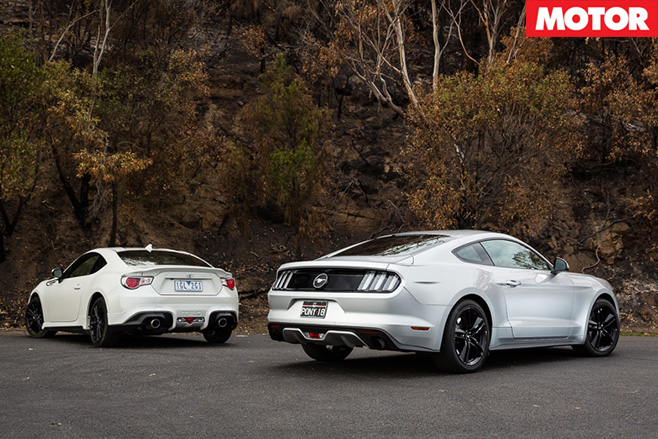
DRAG BATTLE
| u00a0 | FORD MUSTANG ECOBOOSTu00a0u00a0 | u00a0TOYOTA 86 |
| 0-10km/h | u00a00.37 | 0.55 |
| 0-20km/h | 0.80u00a0 | 1.13u00a0 |
| 0-30km/h | 1.24u00a0 | 1.69u00a0 |
| 0-40km/h | 1.71u00a0 | 2.14u00a0 |
| 0-50km/h | 2.20u00a0 | 2.62u00a0 |
| 0-60km/h | 2.96u00a0 | 3.39u00a0 |
| 0-70km/h | 3.67 | 4.19u00a0 |
| 0-80km/h | 4.29 | 5.07u00a0 |
| 0-90km/h | 5.01u00a0 | 6.01 |
| 0-100km/h | 6.08u00a0 | 7.15u00a0 |
| 0-110km/h | 7.08u00a0 | 8.38u00a0 |
| 0-120km/h | 8.13u00a0 | 9.69u00a0 |
| 0-130km/h | 9.38u00a0 | 11.09u00a0 |
| 0-140km/h | 11.05u00a0 | 12.86u00a0 |
| 0-150km/h | 12.71u00a0 | 14.74u00a0 |
| 0-400m | 14.24sec @ 159.07km/hu00a0 | 15.15sec @ 152.10km/hu00a0 |
| 80-120km/h (3rd-6th) | 3.8/5.2/6.5/8.7secu00a0 | 5.7/7.6/9.5/12.8secu00a0 |
| 100-0km/hu00a0 | 36.8mu00a0 | 39.1mu00a0 |
| SPEED IN GEARS 1st | 60km/h @ 6500rpmu00a0 | 59km/h @ 7400rpm |
| 2nd | 100km/hu00a0@ 6500rpmu00a0 | 97km/hu00a0@ 7400rpm |
| 3rd | 153km/hu00a0@ 6500rpmu00a0 | 138km/hu00a0@ 7400rpm |
| 4th | 205km/hu00a0@ 6500rpmu00a0 | 175km/hu00a0@ 7400rpm |
| 5th | 240km/h @ 6150rpm*u00a0 | 213km/hu00a0@ 7400rpm |
| 6th | 240km/hu00a0@ 5110rpm*u00a0 | 226km/h @ 6020rpm* |
| u00a0 | *u00a0Manufacturer’s claim | u00a0 |
As tested by MOTOR: Heathcote Dragway, 1:23pm, 19 degrees, dry, driver Scott Newman
SPECS
| u00a0 | FORD MUSTANG ECOBOOSTu00a0 | u00a0TOYOTA 86 |
| Body | u00a02-door, 2+2-seat coupe | 2-door, 2+2-seat coupe |
| Drive | rear-wheel | rear-wheel |
| Engine | 2261cc inline-4, DOHC, 16v, turbocharger | 1998cc flat-4, DOHC, 16v |
| Bore/Stroke | 87.6 x 94.0mm | 86.0 x 86.0mm |
| Compression | 9.5:1 | 12.5:1u00a0 |
| Power | 233kW @ 5600-5700rpm | 147kW @ 7000rpm |
| Torque | 432Nm @ 3000rpm | 205Nm @ 6400-6600rpm |
| Power/Weight | 140kW/tonneu00a0 | 115kW/tonne |
| Transmission | 6-speed manual | 6-speed manual |
| Weight | 1666kg | 1275kg |
| Front Suspension | A-arms, coil springs, anti-roll bar | struts, coil springs, anti-roll bar |
| Rear Suspension | multi-links, coil springs, anti-roll bar | multi-links, coil springs, anti-roll bar |
| L/W/H | 4784/1916/1381mm | 4240/1775/1320mm |
| Wheelbase | 2720mm | 2570mm |
| Tracks | 1582/1655mm | 1520/1540mm |
| Steering | electrically-assisted rack-and-pinion | electrically-assisted rack-and-pinion |
| Front brakes | 352mm ventilated discs, 4-piston calipers | 277mm ventilated discs; single-piston calipers |
| Rear brakes | 330mm ventilated discs, single-piston calipers | 286mm solid discs, single-piston calipers |
| Wheels | 19.0 x 9.0-inch (f/r) | 17.0 x 7.0-inch (f/r) |
| Tyres | 255/40 R19 (f/r) Pirelli P Zero | 215/45 R17 (f/r) Michelin Primacy |
| Price as tested | $45,990 | $37,990 |
| Pros | Great handling; rock-star looksu00a0 | Playful chassis; superb steering; price |
| Cons | Engine lacks character; understeer | Crap tyres; about to be updatedu00a0 |
| Star Rating | u00a03.5/5 | u00a04/5 |
The original premise of this feature was to celebrate the resurgence of the manual gearbox by gathering five extremely different cars linked by one common factor – three pedals in the footwell.
What became clear as we drove each in turn, however, is that adding a manual isn’t some free pass to instant enthusiast enjoyment. Some cars, like the Polo GTI, benefit hugely from forcing the driver to select their own gears. Others, like the F-Type, don’t.
Jaguar should definitely be commended for giving buyers a choice of transmission, but the current manual’s rubbery shift quality and odd clutch take-up makes the excellent eight-speed automatic the more involving, enjoyable drive.
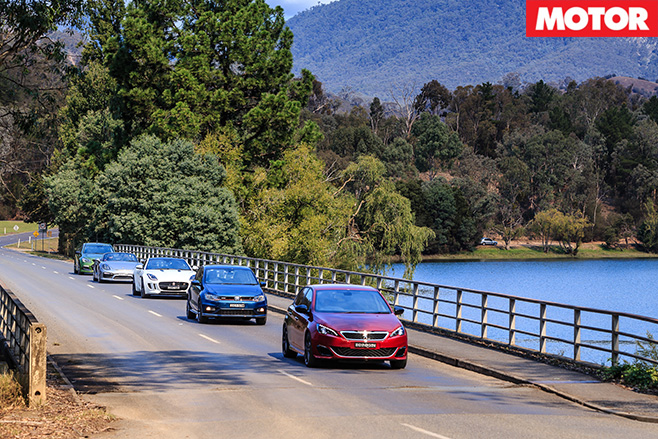
Despite its recent uplift in popularity, the manual gearbox has its work cut out in the long term. Self-shifting gearboxes are generally faster, more economical (in a laboratory, at least) and easier to use for the vast majority of motorists who view driving as a necessity, rather than a pleasure.
Thankfully, there’s a key group of enthusiasts that still have the desire, skill and coordination required to operate three pedals with two feet, and as long as these folk keep voting with their wallets, car companies will be forced to listen.
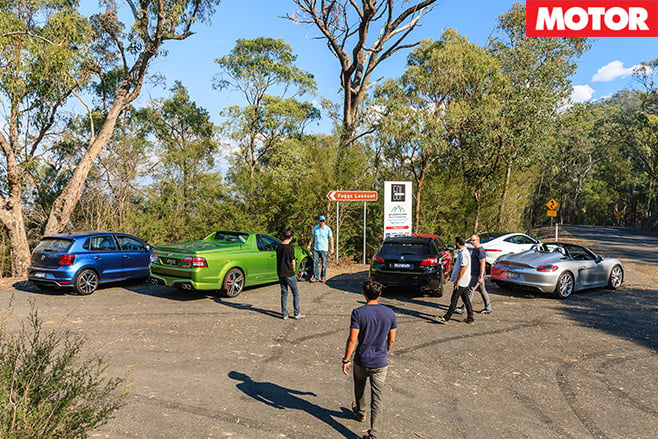
May the days of manual labour continue for many years to come.
You can’t accuse Subaru of missing a trend.
Long before SUVs heaved their oafish bodies into the gym, various Foresters – first the 1998 GT, then the 2003 XT – had been pumped with performance parts and gathered loyalists in the process.
Then the Fozza grew up and today’s XT is the first without a bonnet scoop or a manual (and with only a dreaded CVT). It blended – or blanded – into the scenery, and with a 2.0-litre turbo boxer four from the WRX detuned to make 177kW (down from 197kW) and 350Nm, its claimed 7.5-second 0-100km/h time is slower than that of previous generations.
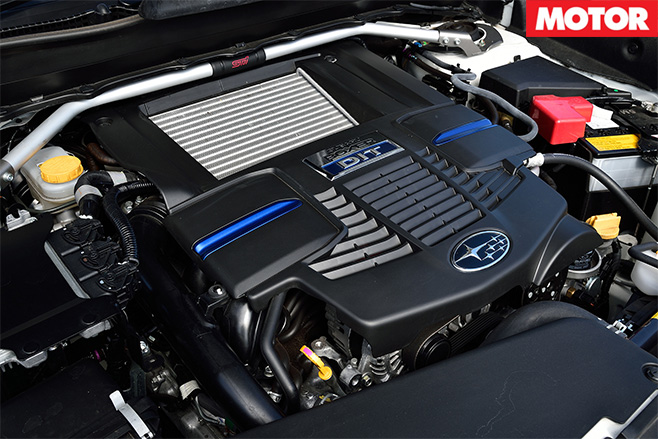
It looks a bit JDM-cool on the outside, with pink licks on the front grille and rear diffuser, black mirrors and lower front spoiler, and multi-spoke Enkei 19-inch alloy wheels (up from 18s) with cheeky red Brembos behind them.
Under the skin there are new STI-sourced inverted dampers with 15mm-lower coil springs and flexible draw stiffeners, while the front gets a tower-bar brace and new stabiliser bushings, with extra subframe support for the rear.

On twisting tarmac, however, it feels like the fast-forward button has been thumbed, with the tS delivering new-found front-end sharpness teamed with reduced bodyroll all round. The tweaks support the variable all-wheel drive and torque-vectoring systems, so this souped-up Subie SUV can be bullied through successive changes of direction without flinching.
Even when the average Bridgestone Turanza rubber starts to squirm, there’s decent adjustability on or off the throttle – although the stability control could have a more lenient, sporting tune. Even the steering now feels tighter just off centre, though it remains too slow.
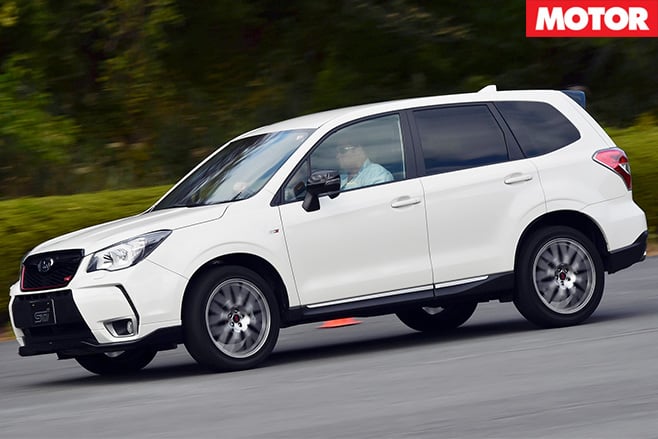
Not that the tS feels premium for the price. A surprisingly characterful SUV it may be, but Subaru is asking $54,990 plus on-roads – $7K beyond an XT Premium. With a smallish boot and an Impreza-derived dashboard, the value equation disappears with the panoramic sunroof that’s swapped out for sports buckets (and they’re still too flat).
Any comparison with a similarly priced Commodore SS-V Sportwagon is valid but cruel. And that leaves this Forester tS as most definitely one for welded-on loyalists.
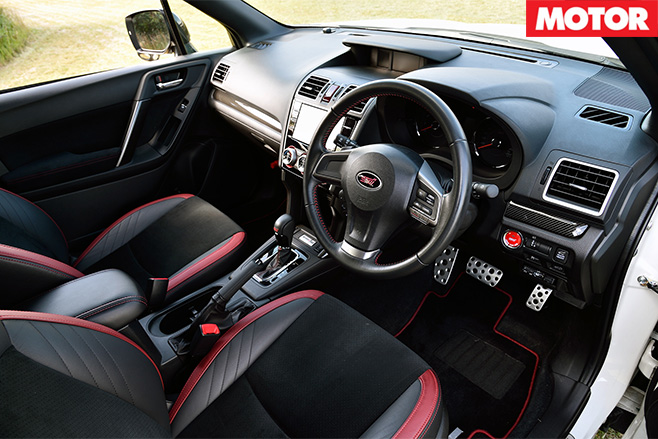
LIKE: Sharp handling; JDM-cool styling bits DISLIKE: Needs STI poke; uninspiring CVT; hobbled by pricing
SPECS Engine: 1998cc flat-4cyl, DOHC, 16v, turbo Power: 177kW @ 5600rpm Torque: 350Nm @ 2400-3600rpm Weight: 1657kg 0-100km/h 7.5sec (claimed) Price: $54,990
Women are the next battleground in supercars in Australia, according to Ferrari Australasia CEO Herbert Appleroth.
Having boosted its share of female owners to 12 percent – leaving 88 percent as men – the Italian supercar brand is working to attract more women as the Italian supercar maker continues its growth off the back of new models.
Last year Ferrari sold a record 167 cars – eclipsing the 163 sold in 2008, before the GFC kicked in – with the brand on track to match that in 2016.
And with new models arriving – including a V8 version of the GTC4Lusso, the first ever V8 four-seat Ferrari – the brand sees potential to attract more females.
“It’s one of our highest growth areas for us,” says Appleroth. “We’re pushing this marketplace right now and I don’t think anyone has done it effectively in Australia.”
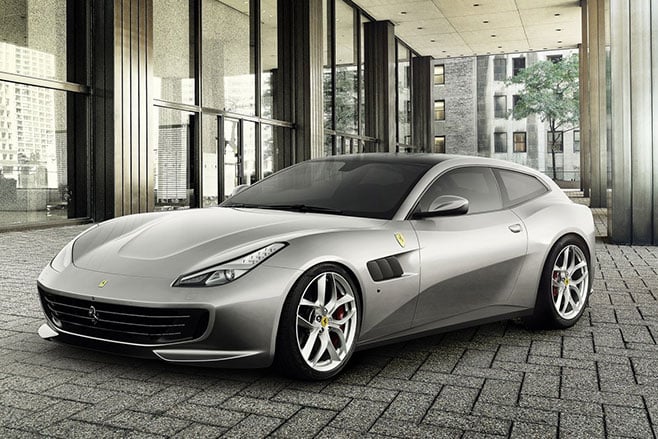
Appleroth says there was “a feeling Ferrari is a boy’s club” but that has changed, to the point where personalised marketing activities are targeted at both sexes.
“We do a lot of lifestyle activities … so we’re appealing to everyone now; it’s not just the man who used to take the car on a race track and that’s it.
“At drive events we like to have partners there … we actually request that the ladies have a chance to drive the car.”
Appleroth says there are Ferrari events now targeted specifically at females including “specific track events and drive events for ladies” including for “women in power”.
Ferrari is also working on attracting buyers earlier. In five years the brand has lowered its average age from 52 to 46, something that’s involved enticing people from other brands – typically German luxury marques – into the “Ferrari family”. Some 61 percent of 488 buyers – including many on the two-year waiting list – have never owned a Ferrari before.
Appleroth credits the recent sales boom in top end cars such as Ferraris to increased buyer confidence as the world emerged from the Global Financial Crisis, rising property prices that have allowed access to cheap finance, and a broadening of the wealth in Australia.
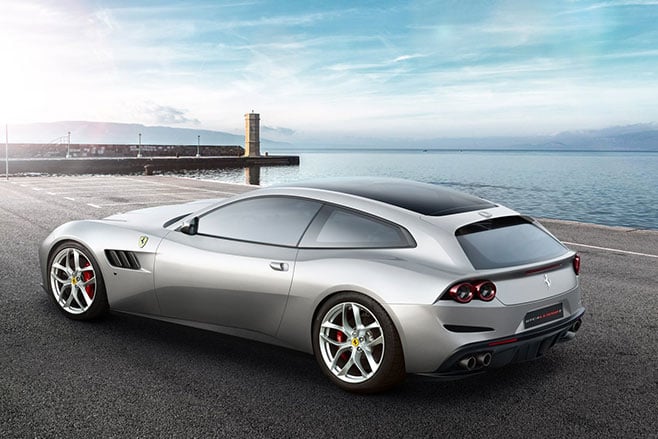
“There’s a level of confidence in this marketplace which I’ve never seen,” he says. “The wealth is in the hands of so many people now, in so many different postcodes.”
One thing that won’t change for Ferrari, though, is its core vehicles. Unlike rivals such as Lamborghini and Porsche there are no plans for an SUV, something executives claim could harm the brand.
“We don’t produce SUVs, we don’t do mini-vans or whatever else. We produce the world’s best sports cars and that’s it.”
One challenge with such heated demand, though, is determining who to sell cars to. Ferrari has long battled with speculators who anticipate more demand than supply and place an order only to sell it at a profit soon after taking delivery.
Ferrari Australia now vets buyers in an effort to eliminate the practice.
“You need to ensure the cars are going to the right people,” says Appleroth, referring to the “real Ferrari-isti, rather than people who just want to make money on the car”.
“We look at everyone very, very carefully.
“We like people who want to engage with the Ferrari brand, who have the same ethos as us.”
WHAT IS IT? Mini has taken to its lively third-generation JCW hatchback with a chainsaw, removing its roof and installing a folding soft top in its place.
Besides that, the rest of the package is much the same. Same 170kW/320kW turbo powerplant, same adjustable suspension and the same big brake package and aero kit. Some extra weight sees 0.4 seconds added to the 0-100km/h sprint compared to the hatch (the JCW Convertible auto trips the beam at 6.5 seconds), but the removal of the roof hasn’t diluted too much of the JCW formula.
WHY WE’RE DRIVING IT Because the old one was fun, but flawed when it came to its interior packaging and ergonomics. It was also a raw driving experience that verged on being extreme – enthusiasts love that kind of thing, but do convertible buyers feel the same way?
Mini reckons it’s fixed all of that with this, the second-generation JCW Convertible.
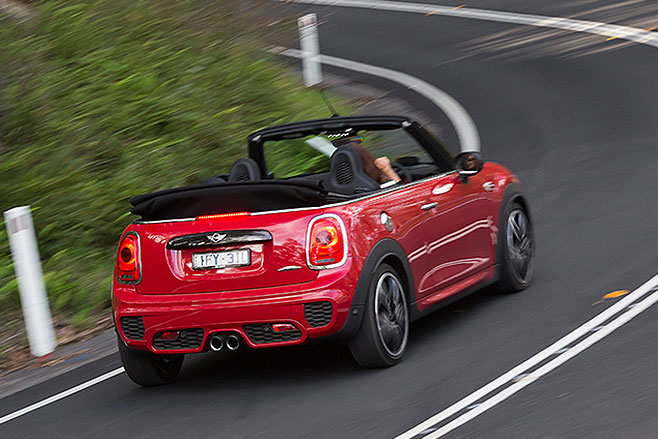
MAIN RIVALS For four-seat performance convertibles, none really exist at the JCW Convertible’s price point. However there’s the less-sporty Audi A3 Cabrio to consider, while the Mazda MX-5 and Abarth 124 will deliver just as many wind-in-your-hair thrills albeit in a less versatile two-seater package.
THE WHEELS VERDICT Feature-packed and more powerful than ever before, the new-generation JCW Convertible is a sharper deal, easier to drive and faster than its predecessor.
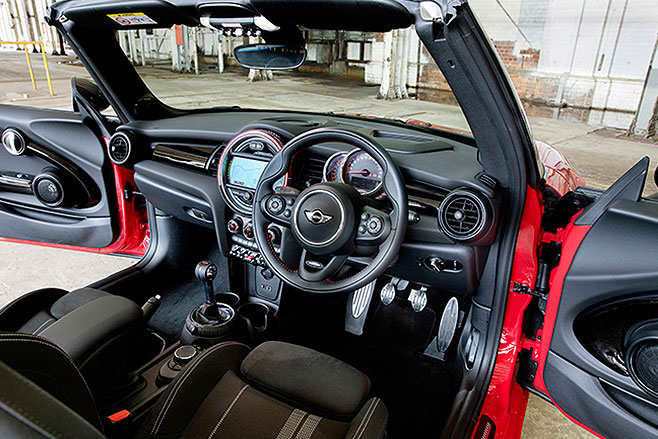
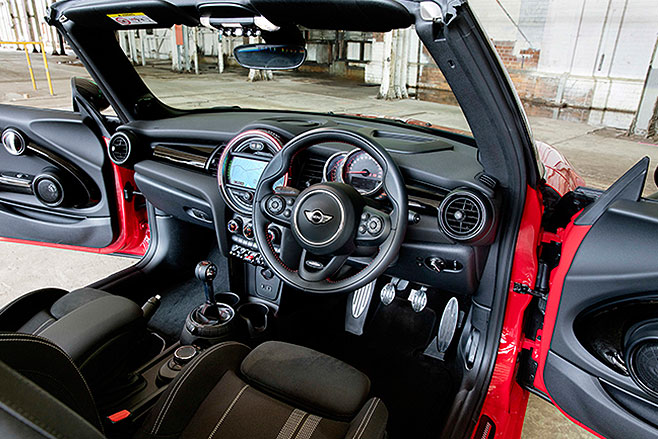
The interior finally makes sense from an ergonomic standpoint (say hello to a proper speedo and door-mounted window switches), the previous model’s dorky roll hoops have been excised and there’s now a smidge more boot space, while its electric fabric roof deploys with push-button ease.
There’s a small loss of engagement from a driving perspective, but unless pure 98-octane runs through your veins that’s unlikely to trouble you.
PLUS: Playful chassis, improved standard specification, willing engine, improved interior
MINUS: No heated seats as standard, some interior squeaks on rough roads, a little less engaging than the outgoing JCW convertible
The Wheels Review
MINI’S latest addition to its stove-hot John Cooper Works range is a classic case of two steps forward, and one step back.
Hugely improved interior with more standard equipment than ever: a profound step forward.
Grunty 2.0-litre with proper hot-hatch performance and respectable 170kW/320Nm numbers: another forward step.
More approachable handling: now we’re going backwards.
But in the search for more sales, Mini has naturally endeavoured to make its topless range-topper a little more civilised. Yes, it’s not bone-rattlingly firm anymore, but its steering is no longer as tactile and involving as it once was.
Don’t get me wrong: it’s still a pointy and precise little thing and it’s still got an entertaining and sometimes tail-happy chassis beneath it, it just might not satisfy the keener drivers out there like its predecessor did.
However keen drivers aren’t exactly expected to be in the JCW Convertible’s core demographic. Those punters are better served by the cheaper JCW Hatch.
But if you want to be seen, the JCW Convertible makes for appealing topless transport. It may have slightly less zing in its steering, but there’s a more powerful and more torque-laden 2.0-litre up front that’s less stressed around town than the previous-gen JCW drop-top, and more driveable as a result.
And, thanks to the folding roof, that soundtrack is more audible – and thus more enjoyable – than it is in the hatch.
Like the hatch, the JCW Convertible also gains dual-mode adjustable dampers. They’re firm in either setting, but at their slackest they’re at least a lot more pliant than the rock-hard non-adjustable suspension of the R57 JCW ‘vert.
And the interior not only boasts more equipment (Mini somehow managed to jam a head-up display and 12-speaker sound system in there), but it’s got space for four and a bigger boot than before. A few more steps forward, then.
An iconic design that has endured more than half a century.
At the end of World War II, Ferdinand Porsche, whose father had designed the Volkswagen, was a 36-year-old engineer who drove a VW cabriolet with a supercharged engine. From that inspiration, he built a stripped-down roadster, which begat the production Type 356. And from that, he built a global car company.
The 356 enjoyed sales and motorsport success in equal measure, but by the late-1950s customers were wishing for more interior and luggage room and a quieter, more powerful engine. In 1959 Porsche initiated project T7, followed in 1961 by T8.
The design constantly evolved everywhere between two-seater and full four-seater. The boss’s son Ferdinand ‘Butzi’ Porsche, by then in his mid-20s, was officially credited with the eventual 2+2 design, although veteran Porsche body engineer (and 356 designer) Erwin Komenda deserves at least joint credit.
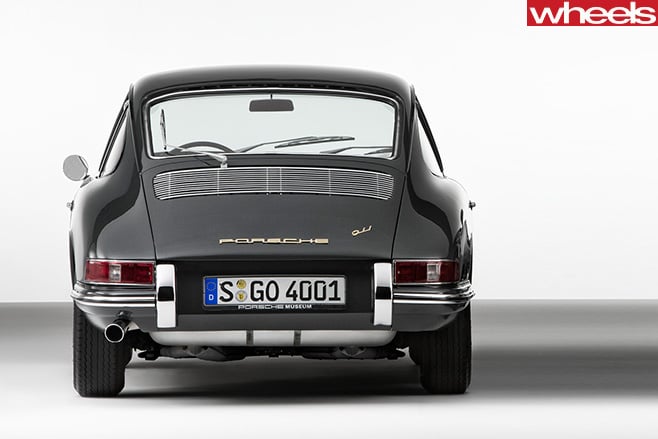
At the Paris show in October 1964, Peugeot famously objected to the car’s ‘-0-’ designation. A few weeks later Porsche changed it to 911, but not before 82 cars left the factory as 901s (the chassis numbers, confusingly, not in sequence). In all, 232 cars were built in the 1964 calendar year.
The 911 wasn’t just a generation ahead of the 356, it was ahead of its time, period.
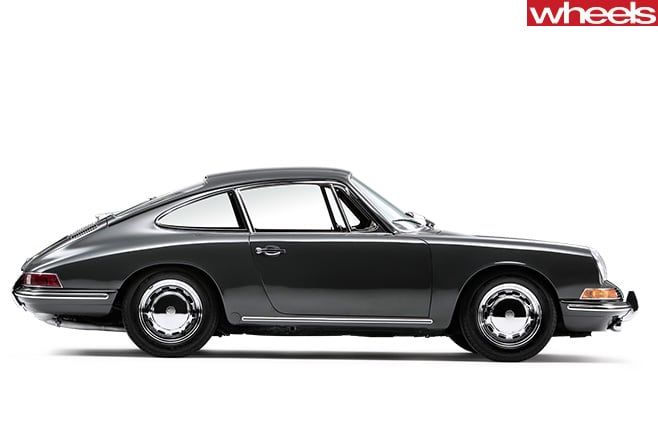
The 911’s light-footed handling – the car weighed just 1040kg – was widely welcomed, with its sharp and sensitive steering. The rear end, despite a heavier engine and skinny 165 x 15 tyres, seemed to draw little criticism in initial magazine tests, being inevitably compared with the more wayward 356.
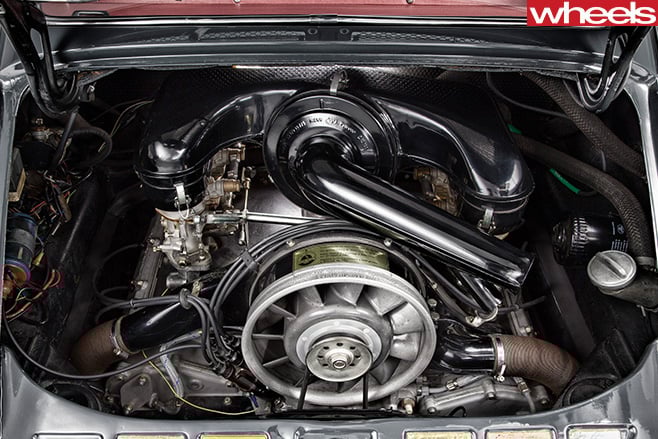
Hans device
Ferdinand Porsche demanded 130hp (97kW) to match the 356 Carrera 2’s complex dohc 2.0-litre four-cylinder. Hans Mezger’s 1991cc sohc flat-six delivered packaging and power, fuelled by six Solex (later Weber) carbs and fan-cooled separate cylinders. A dry-sump allowed low mounting (and roofline). Five-speed gearbox with full synchromesh was a Porsche invention.
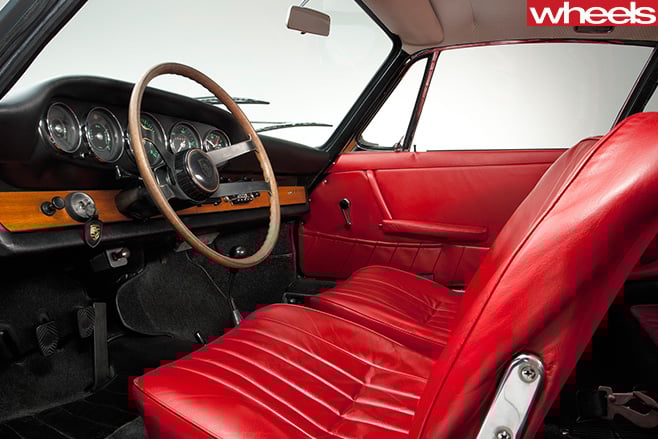
Then, as now, the 911’s interior view was dominated by five dials with central-mounted tacho, redlined at 7000rpm even in 1964. Ignition key on outboard side is supposedly from Le Mans experience, while floor-hinged pedals showed Porsche’s VW ancestry. Floor levers control heating and ventilation. Rear backrests fold flat for a luggage shelf.
Tech leader
The unitary chassis was praised for its toughness. Front longitudinal torsion bars with MacPherson towers allowed space for 62-litre fuel tank and luggage; transverse rear torsion bars were operated by trailing arms. Rack-and-pinion steering and four-wheel discs were top-notch tech. The 2211mm wheelbase made handling tricky; it mellowed with 57mm stretch in 1968.
Fast & factual
1. 25-year weight
The 1964 2.0-litre 911 weighed 1040 kg; the last 901-derived Carrera 3.2 some 25 years later just topped 1200 kg
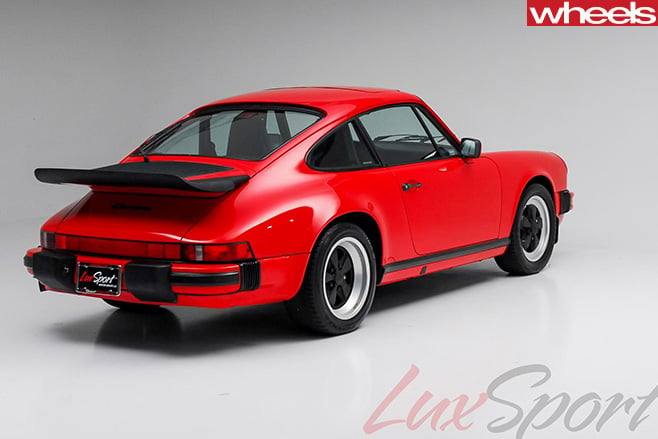
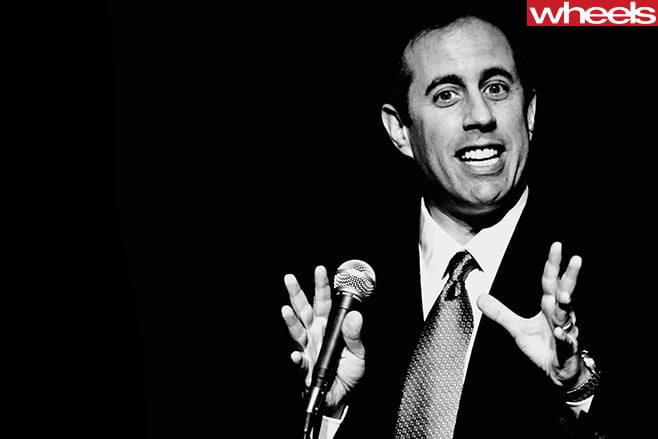
Comedian and Porsche collector Jerry Seinfeld owns ’64-build chassis 300049, famously the first to be designated by the factory as a 911
Peugeot’s ‘middle-zero’ protest (which overlooked Porsche’s GP-winning 804) also forced renaming the 904 (Carrera GTS) and 906 (Carrera 6) sports-racers
4. Rare survivor
More precious than a ’64? Porsche built 13 prototypes in 1962-64; just one (#7) survives and is privately owned in the US
5. Outsourcing
Seating giant Recaro was created from Reutter Karosserie, the 356’s coachbuilder, which Porsche bought in 1963 to build the 911
If you had to bet on one manufacturer being the last line of manual defence in the face of an automatic onslaught, the smart money would be on Porsche.
Ferrari was an early casualty, Lamborghini followed close behind, Audi has abandoned ship (in its RS products at least) and AMG never showed up in the first place.
Faster, more efficient and easier to use are their arguments (and valid they are too) but thankfully a select group of enthusiasts still wants to shift gear themselves – and the majority are shopping in Porsche showrooms.
For a time it appeared Weissach’s resolve was weakening. The 911’s seven-speed manual was, and is, derived from the sales-dominating PDK dual-clutch, while Porsche’s purest models, GT3 and GT3 RS, abandoned the three-pedal layout altogether.
It’s critical for the brand to still offer a manual gearbox, says Porsche Australia’s communications manager, Paul Ellis. “The appeal of Porsche is all about driving,” he says.
“Even though a manual might be slower than a PDK, if you’re a purist, you’ll have more fun with a manual. It’s about catering to that hardcore group of enthusiasts where fun is more important than outright performance. As long as there is a demand for that, we’ll continue to do it.”
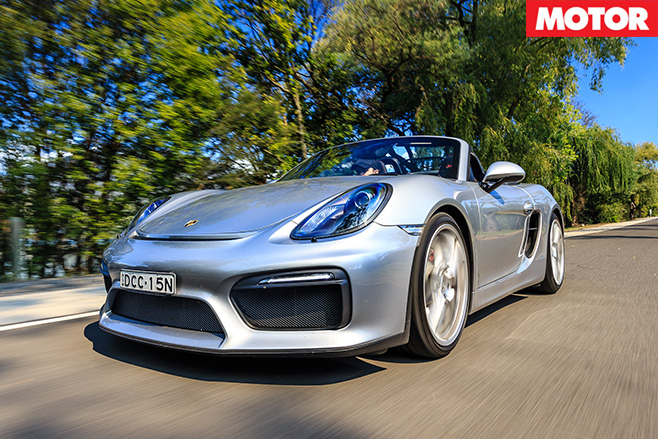
Nestled midships in both models is the 3.8-litre flat-six from the 991-series Carrera S, detuned slightly to 276kW/420Nm in the case of the Boxster Spyder, which allows it to hit 100km/h in a claimed 4.5sec – 0.2sec clear of a PDK and Sport Chrono-equipped Boxster GTS. Would it be even faster as a launch-controlled dual-clutch? Undoubtedly, but that would be to miss the point entirely.
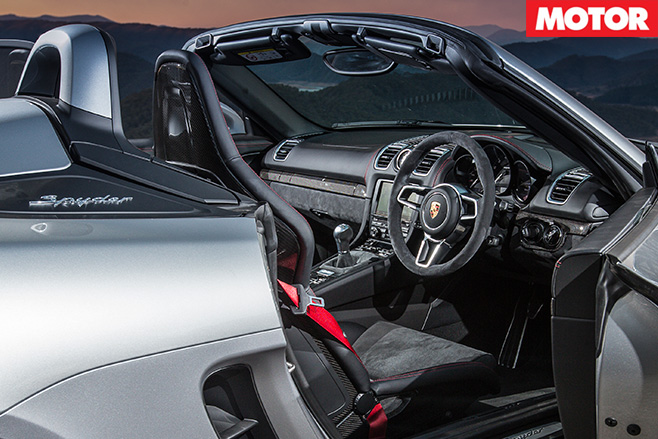
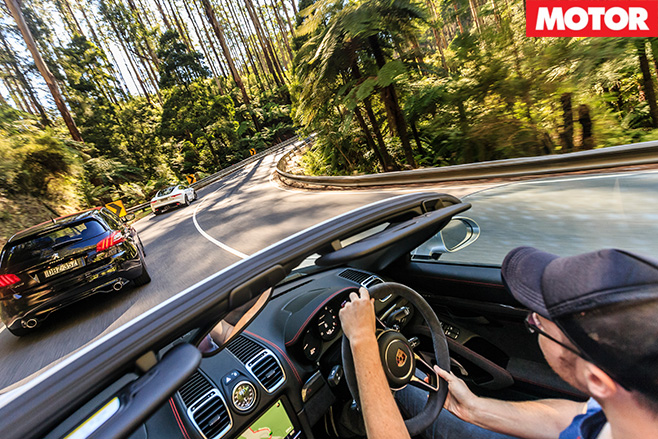
The clutch is surprisingly heavy. You soon get used to it, but equally an hour in heavy traffic would be a reasonable left-leg workout. The shift requires some effort – this is not a one-finger affair in the manner of the Polo GTI. Nonetheless, the action is so smooth and well-oiled – drivetrain snatch just doesn’t exist – that it’s impossible not to change up and down the ’box for the hell of it.
The maximum speeds in each gear at the 7800rpm cut-out are as follows: 1st 79km/h; 2nd 134km/h; 3rd 186km/h; 4th 232km/h; 5th 276km/h. The top speed of 290km/h is achieved at 7000rpm in sixth.
For racetrack use (or, say, the Nurburgring Nordschleife) the ratios are spot-on; the lower gears (which you don’t use very often) are nice and wide while the taller ones are closely-stacked. But the Boxster Spyder is a road car and when second gear stretches to well beyond the national speed limit, opportunities to use its full performance range are few and far between.
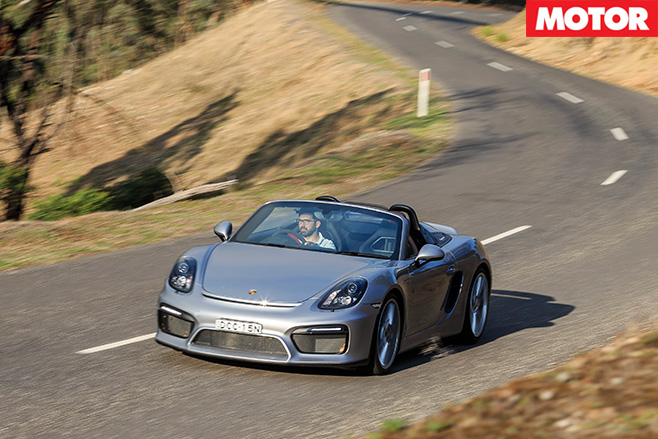
Ironically, it’s less of an issue thanks to the arrival of the new torquier, lower-revving turbocharged 718 Boxster. Speaking to engineers at that car’s launch revealed that the gearing is what the supplier offers, so that’s what Porsche takes.
But this is nit-picking to a degree. It’s fitting that the car at the pinnacle of this feature should also have the best gearshift and the six-speed manual is a key part of this fabulous sports car’s appeal. Long may it continue to do so.
Would it be even faster as a launch-controlled dual-clutch? Undoubtedly, but then you’d miss out on one of the world’s best manuals, which is the whole point of this exercise.
SPECS Body: 2-door, 2-seat roadster Drive: rear-wheel Engine: 3800cc flat-6, DOHC, 24v Bore/stroke: 102.0 x 77.5mm Compression: 12.5:1 Power: 276kW @ 6700rpm Torque: 420Nm @ 4750-6000rpm Power/weight: 210kW/tonne Transmission: 6-speed manual Weight: 1315kg Suspension(f): struts, coil springs, anti-roll bar Suspension(r): multi-links, coil springs, anti-roll bar L/W/H: 4379/1801/1280mm Wheelbase: 2475mm Tracks: 1515/1540mm (f/r) Steering: electrically-assisted rack-and-pinion Brakes(f): 340mm ventilated/drilled discs, 6-piston calipers Brakes(r): 330mm ventilated/drilled discs, 4-piston calipers Wheels: 20.0 x 8.5-inch, 20.0 x 10.5-inch (f/r) Tyre sizes: 235/35 ZR20 (f); 265/35 ZR20 (r) Tyre: Pirelli P Zero Price as tested: $169,000 Pros: Awesome engine; sweet gearshift; superb handling Cons: Very long gear ratios; sold out Star Rating: 5/5
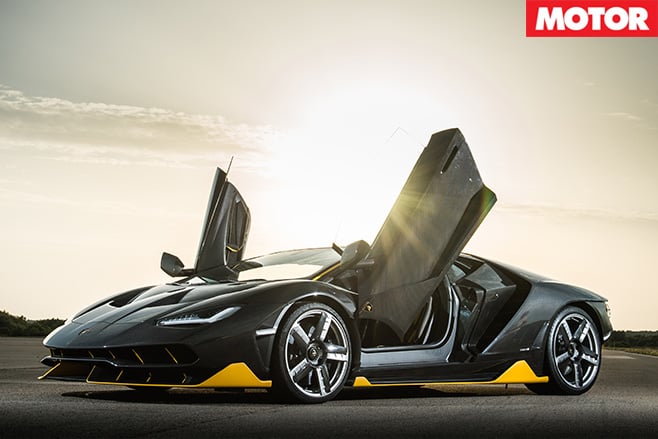
This is not just any old Lamborghini test mule. Glistening in the early morning light is the one and only Centenario prototype, destined to one day head to its final resting place in the factory museum.
Unveiled at the 2016 Geneva Motor Show, the Centenario is a special edition Aventador built to celebrate what would’ve been the 100th birthday of Ferruccio Lamborghini.
It follows the recipe established by the Murcielago-based Reventon of 2007: add some power, dramatically restyle the body, install some future technology and, most importantly, severely limit the build run. Just 40 examples of the Centenario will be built – 20 coupes and 20 roadsters – all of which have been sold.
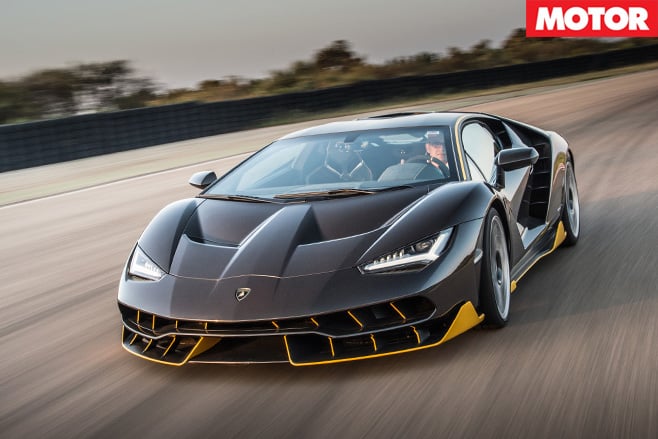
Our playpen is the wonderful Nardo facility, located north of the town of the same name, nestled right down on the heel of Italy’s boot. Built in the 1970s to create jobs in this poverty-stricken part of the country, the result is an extensive vehicular proving ground that Ben Hur would be proud of. Recently purchased by Lamborghini’s VW Group stablemate Porsche, the facility is used by almost all major European manufacturers.
Cash from Wolfsburg helped renovate the high-speed loop with its fast four-lane banked corners, as well as the magic 6.8km infield handling track that constitutes our course today. Leading the way is Lambo’s gun test driver Mario Fasanetto in an Aventador SV, while lined up his wake are the 566kW Centenario, another 552kW Aventador SV and a ‘base’ 515kW Aventador for reference. All three develop an identical 690Nm of torque, but it’s there the similarities end.

A nice mix of left-and right-handers follows with a number of blind bends later in the lap, but the highlight is one memorable crest where, for a brief moment, only sea and sky fill the frame.
Thankfully, Fasanetto sets the pace and shows us the line, staying out wide towards the middle of the track longer than seems natural and braking hard while firing in downshifts, the big V12 barking its appreciation for his commitment.

It’s obvious the key dynamic feature which distinguishes Centenario from SV are the adaptive aerodynamics. The Centenario sucks in oxygen through the nose cone, small apertures below the headlamps and large lateral scoops.
The air enters the car via the front radiator and wheelarches or flows over the smooth roof, along the sculptured flanks and from the front splitter to the rear diffuser. The adjustable rear wing assumes a near-horizontal position for high-speed runs, but when necessary it can increase downforce by up to 180 per cent.
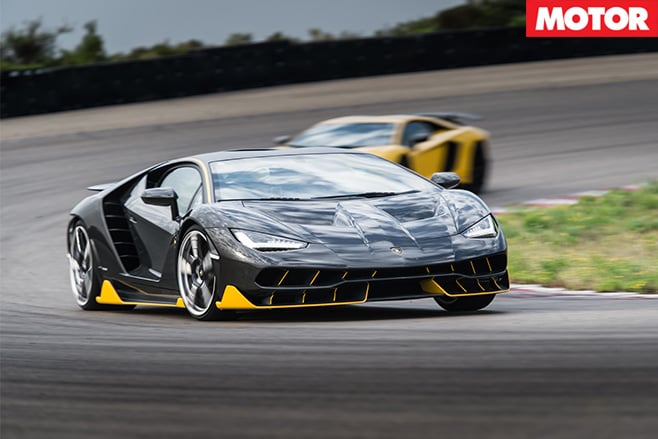
Sant’Agata’s latest mauler is a manifesto of excess, best quantified in raw numbers. The biggest of these is the price. Each of the 20 coupes listed at €2.2m (AUD$3.24m), the 20 roadsters €2.4m (AUD$3.54m) apiece, while the full carbon pack is €100K (AUD$147K) extra.
For any normal person that might sound ridiculous for what is essentially an Aventador playing Darth Vader dress-ups, but it’s peanuts for the ultra-high net worth individuals with hangar-sized garages who are Lamborghini’s favoured clientele.
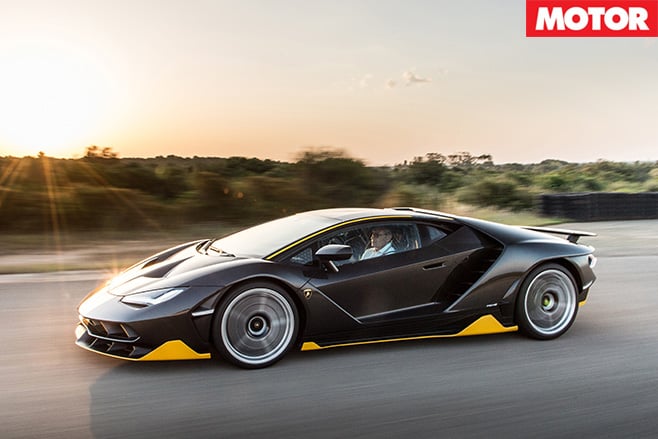
Combined with monster carbon-ceramic brakes that haul the beast up from 100km/h in a highly physical 30 metres, there’s credence to the rumour that the Centenario has set a Nurburging lap record, shaving a few seconds off the Aventador SV’s mind-blowing 6min57sec lap.
More importantly, the Centenario offers a clear glimpse into the future, with its key ingredients to be carried over to the updated 2018-model Aventador. According to those in the know, the active flaps and rudders will further reduce drag resistance, the 552kW SV engine will likely become the mainstay powerplant and the brand-new touchscreen infotainment system pioneered by the Centenario will make its way into all future Lambos.

Around town and through slow corners, the car now feels shorter, nimbler and more manoeuvrable. On the freeway, enhanced directional stability is the main benefit.
Lapping Nardo in the Centenario (and the SV), the advantages of rear-wheel steering are immediately evident and it would have a profound effect on the desirability of the base Aventador. Turn-in is much quicker, sharper and more positive, though the playfulness at the limit has been scaled back. In exchange you get a more focused and much faster cornering attitude.

Although the 566kW Centenario is no quicker off the mark than the 552kW SV (Lamborghini claims both manage 0-100km/h in 2.8sec), its overall set-up is more aggressive. The marginally faster flow through the corners is evidence of the steel rather than rubber chassis mounts, meaner shock absorber software and the suction-cup effect of the active aerodynamics. Despite the flamboyant Death Star looks, the gestures which accompany the Centenario’s dynamic performance are actually quite restrained.
Although this set-up knocks off a tenth here and there, not everyone may appreciate the added firmness and directness that is part of the go-faster kit. Unlike the more modern ANIMA-equipped Huracan, the Aventadors want you to dial in the preferred drive mode – Strada, Sport or Corsa – by pushing a button in the centre stack.

While Strada has been labelled by marketing as the ‘take me home’ function, Sport is all about ‘fun and emotion’. That’s Lamborghini-speak for a rear-bias torque split and more lenient traction control tuned to allow a quick flick of opposite lock, necessary thanks to a dash of lift-off oversteer or a hint of full-throttle tailslide. Even with plenty of runoff terrain, it takes a brave person to fully deactivate DSC.
Somewhat unexpectedly, Corsa mode is somewhat of a stealth proposition, dedicated to greater perfection and less emotion. Expect quantifiably faster lap times (the Centenario features an in-dash stopwatch and two on-board cameras), a less heroic but no less rewarding driving style and a subtly enhanced dynamic efficiency.
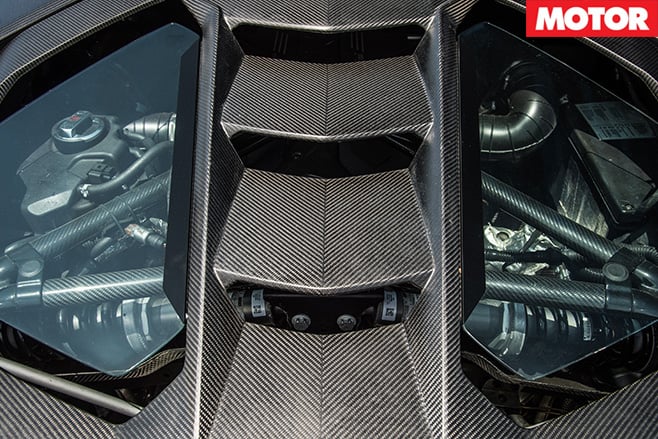
Flaws? The ISR gearbox’s hesitant automatic mode is still unbecoming of a car of this type, visibility is only clear in one direction, the redesigned pseudo race-car instrument binnacle cannot match a head-up display for clarity and the occasionally rough ride isn’t a charming experience.
We started driving at six in the morning and kept going until the track was closed at midday. Three days later, the neck still hurt and the bum was a bruised reddish hemisphere, but the glowing memories of the Centenario remained.

No, this car is not the right choice for cool, analytical types. But the shrill looks, the eye-watering full-throttle urge and the exciting escapes to the limit make it an irresistible proposition to purists.
LIKES: More power; less weight; new tech DISLIKES: Crazy pricetag; harsh ride
SPECS Body: 2-door, 2-seat coupe Drive: all-wheel Engine: 6498cc V12, DOHC, 48v Bore/stroke: 95.0 x 76.4mm Compression: 11.8:1 Power: 566kW @ 8500rpm Torque 690Nm @ 5500rpm Power/weight: 372W/tonne (dry) Transmission: 7-speed automated manual Weight: 1520kg (dry) Suspension(f): double A-arms, adaptive dampers, anti-roll bar Suspension(r): double A-arms, adaptive dampers, anti-roll bar L/W/H: 4924/2062/1143mm Wheelbase: 2700mm Tracks: 1720/1680mm (f/r) Steering: hydraulically-assisted power steering Brakes(f): 400mm ventilated/drilled carbon-ceramic discs, 6-piston calipers Brakes(r): 380mm ventilated/drilled carbon-ceramic discs, 4-piston calipers Wheels 20 x 9.0-inch (f); 21 x 13.0-inch (r) Tyre sizes: 255/30 ZR20 (f); 355/25 ZR21 (r) Tyre: Pirelli P Zero Price as tested: €2.2 million (approx AUD$3.22 million)
AUDI has confirmed the starting price for its forthcoming Q2 small SUV and it has a ‘4’ in front. Yep, this high-design, premium SUV range opens the show at $41,400 for the Audi Q2 1.4TFSI front-driver, with the all-wheel-drive Q2 2.0TDI quattro expected to cost “under 50” when its pricing is confirmed closer to the local launch next February.
Thing is, those prices appear dangerously close to another small SUV in Audi’s showrooms – the five-year-old Q3. The list price for a base Q3 front-driver, featuring the same 110kW/250Nm 1.4-litre turbo-petrol four as the base Q2, is $42,900, or just $1800 more.
Admittedly, the Q3 has a six-speed gearbox rather than the new-generation seven-speeder fitted to the Q2, and it doesn’t get sat-nav as standard, but that’s a slim price difference for two cars that don’t differ greatly in size.
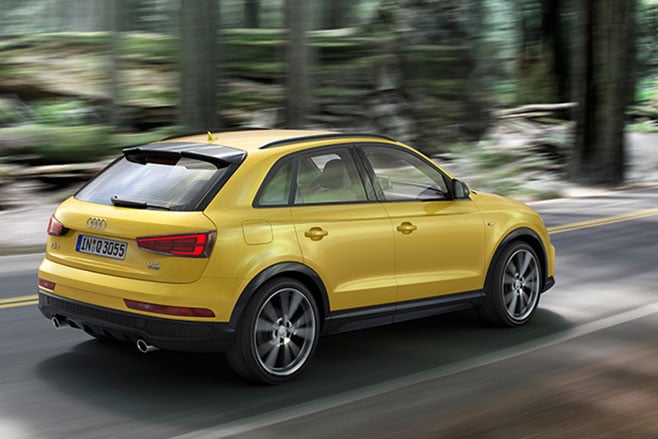
The Q3’s wheelbase is just 2mm longer than a front-drive Q2’s (with torsion-beam rear axle) or 8mm longer than a Q2 quattro’s (with a similar multi-link IRS arrangement to the Q3). But the Q3’s body is significantly longer (4388mm v 4191mm), as well as 37mm wider, 82mm taller, and around 125kg heavier. The Q3 also has a larger 460-1365 litre boot (compared with 405-1050L).
Audi Australia is adamant that the “edgy” Q2 and “classic” Q3 will complement each other. According to Audi corporate communications general manager Anna Burgdorf, “the Q3 remains a very valid model, and so we don’t see the Q2 as a replacement; we see it as an addition. And yes, granted they have relatively close pricing, but they’re essentially different.
“The Q3 buyer is very loyal. They love that really beautiful, rounded and shapely design of their car. And what the Q2 offers, it’s edgier – more modern, more contemporary, edgier design, really packed with technology, so it’s going to attract a slightly different buyer.
“Having said that, there will be some Q3 owners, when they want to change their car, they’ll want a Q2 and that’s absolutely fine for us, as long as we’re keeping customers within the Audi family, and as long as we’re growing.
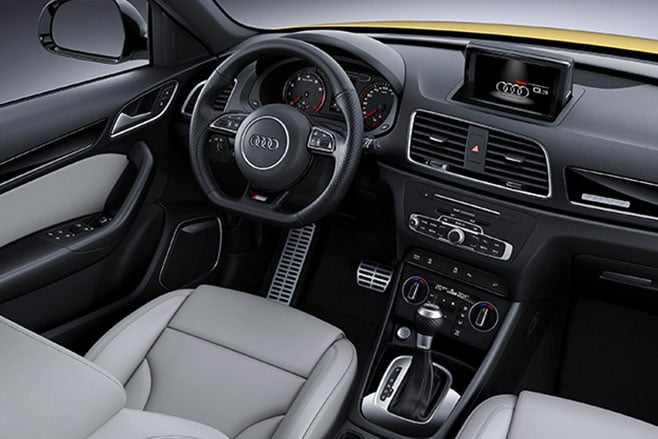
“I guess the same question has been raised with the launch of each new Q model, but what we’ve seen is that the market has increased to accept the addition of new models, so we’ve never had a concern in the past about introducing a new Q model because we’ve just found that there are more buyers.
“So we don’t see [the Q2] as a replacement; we see it as sitting close, but in a slightly different target market.”
Should we expect the next-generation Q3 to grow larger in order to differentiate itself from the Q2? “I can’t comment on future generations of the Q3”, said Burgdorf, “but I think you’ll see them moving away from each other a little, in terms of one vehicle appealing to a slightly younger, modern, edgier person and the Q3 is going to appeal in a different way and to a different buyer… A Q3 is a more upright SUV; a Q2 is, I guess, in a way a little closer to an Allroad.”
First published in the March 2003 issue of Wheels magazine, Australia’s best car mag since 1953.
Ford has fallen short of the Falcon GT legend since the early ’70s. Now, at last, there’s a car tough enough to try it on.
Flash back: 1967. Warwick Farm short circuit sliding the horny new XR Falcon GT through comers specially moistened for this first day out in the muscular bronzed Aussie (no other colour is yet available).
Teamed with Dunlop Aquajet tyres (waggishly known as Aquaplanes), the guttural GT roars and slides around the circuit, beginning a legend that will haunt Ford in following decades by setting standards that prove too difficult to replicate, let alone beat.
Amid all the XR GTs bar-lifting thunder and thrust, the clutch stands out. Talk about heavy. Like dribbling a bag of cement across a paddock, it makes calf muscles ache with exertion.
Even so, the GTs ropey rumble, backslapping acceleration, and breathtaking speed provide the perfect panacea.
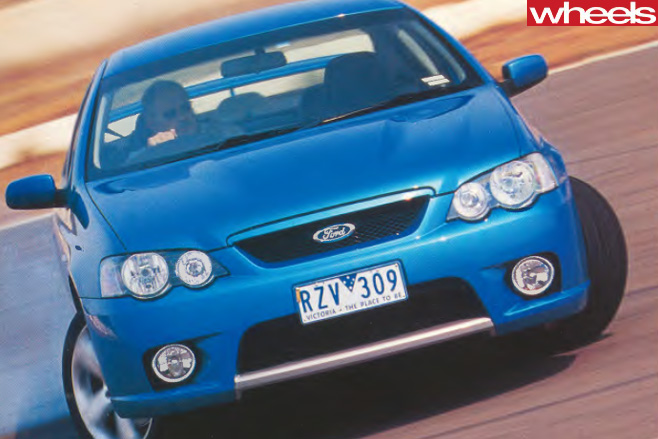
Hugely more sophisticated than the original, the new model achieves a level of refinement undreamed of in 1967. But refinement is fine for Fairlanes; GTs need grunt. Gobs of it.
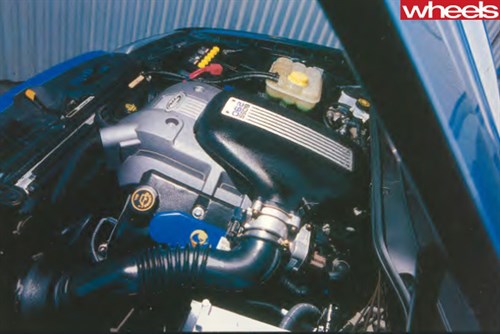
The engine is a very different proposition to 1967’s V8. With two camshafts per head instead of one in the block, and twice as many valves, not to mention fuel injection and 5408cc capacity against a four-barrel carby and 4735cc. FPVs Boss hoss delivers 290kW where the XR made 168kW.
The Boss doesn’t rev a whole lot higher, though. The GT’s tacho doesn’t have a redline for proof, but an electronic spoilsport pulls rank on the clot of 6000rpm, cruelling a special sound that’s been building since idle.
The 1825kg FPV GT is much paunchier than its relatively sylph-like 1422kg XR namesake, but brawnier torque and an extra gear help explain how the 1967 performance marks get blown away in a swirl of tyre smoke.
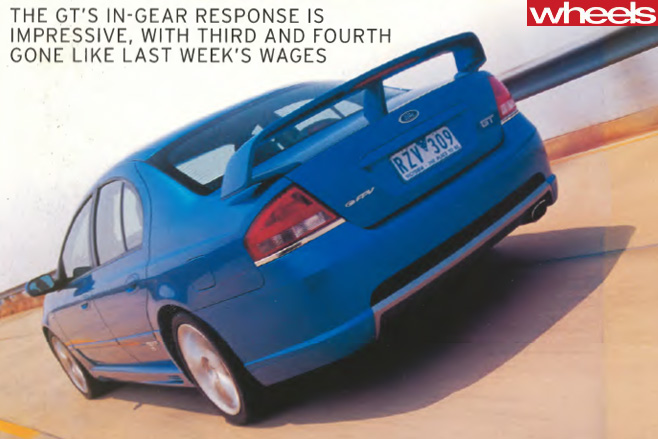
Here, on a stinking-hot afternoon, hitting 30-something in the shade and chewing on dense bushfire smoke, we’re disappointed when the FPV GT rips through the 400m sprint in only mid-14s. Part of the problem is that second gear is just a shade short, calling for an upshift at 95km/h or so, just on the safe side of the rev limiter. Same again in third; needing fourth just before 160km/h and the 400-metre mark. We persist, hoping to shave the times, only to find them lengthening as under-bonnet temperatures increase.
After a cooling respite come the speed runs. As expected, the limiter shoots dead the first four gears if the engine’s left on full song too long. But in fifth, with the heat and all, the GTs dash is done, just teasingly short of the electronically applied 250km/h limit.
Incidentally, where the working man’s Falcon utes still use a one-piece tailshaft and are held to 180 kays max, a two-piece prop shaft endows the latest hi-po load-luggers (XR6 Turbo, XR8, and FPV Pursuit) with true 230km/h-plus potential. Fast freight, mate.
Early next morning it’s more than 10 degrees cooler, and Calder Raceway hosts another batch of acceleration runs. It’s soon obvious that this is more like it, With 0-100 kays in six seconds neat and the 400m boogie in 14.2 seconds. On this basis, a sub-14 is within reach, given cool conditions, the driver alone on board, and maybe more kays on the clock than this (preproduction) car’s 2200 clicks.
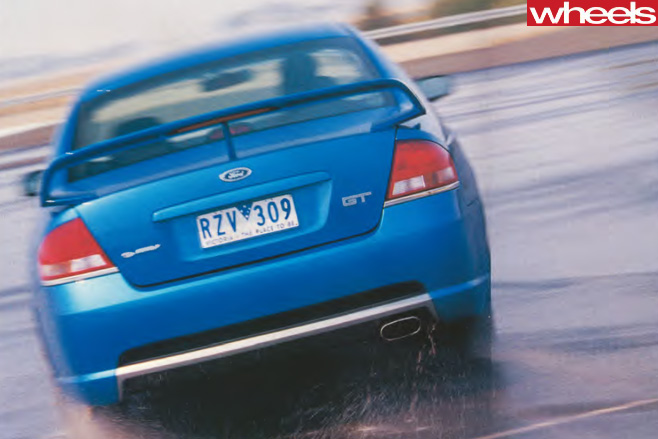
Docile and elastically tractable when you tread lightly, the engine pulls hard and sounds sensationally mean when you sink the slipper. Given just the right throttle balance between too much wheelspin and not quite enough, the Boss 290 simply bites and bolts, delivering oodles of oomph without taking or giving offence.
Nicely weighted, the clutch absorbs repeated tough calls without wilting.
Although acceleration hunters may quibble about the gear ratios being slightly lower than ideal for optimal performance, the big five-speeder’s gearchange is on the pace. It’s not the world’s slickest shift, perhaps, but it’s whippet-quick and sunrise-sure, even when really wrenched from slot to slot.
And it has synchromesh on reverse, too. Hard pedalling works up a sizeable thirst, particularly in this instance.
With a double dose of performance testing, besides enough photo-session circle work to make a dervish dizzy, it isn’t surprising that we chewed through premium petrol at the rate of 19L/100km. Ambling at a steady 100 clicks, however, the GTs digital display typically registers an entirely reasonable 10-something litres per hundred.
Ably supported by ABS and electronic brake force distribution EBD), the GTs standard high-performance brakes offer plenty of pedal feel. Even when trod brutally hard and often, the brakes’ Hand of God stopping power keeps the faith.
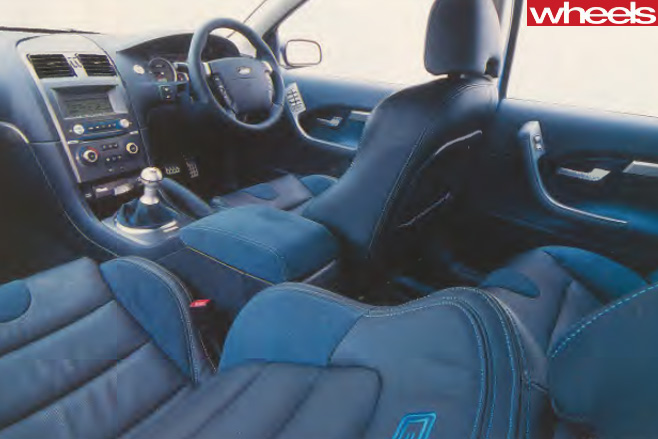
The husky drivetrain and mighty stoppers are all well and good, but it’s in chassis dynamics that FPVs car conclusively cements its claim to the GT/Gran Turismo appellation. It’s a chassis that rewards on rough roads as well as on smooth – through twists and turns as much as on straights.
The steering has the same basic specification as regular BA Falcons, but, with the wheel’s weighting increase from light to medium, the feel is better suited to performance driving. Nothing’s lost between your wrists and the road.
You steer, the GT points.
For a car of this size, mass, and sporting intent, the GTs ride-handling combo is truly outstanding. The way the supple suspension soaks up bumps, doesn’t fidget over ruts or ripples, and isn’t distracted by heaves or undulations makes a mockery of the notion that sports suspension must be reactively stiff and the ride necessarily lumpy.
In this case, the pay-off is not only a relatively comfortable ride, regardless of the road, but also truly confident roadholding and cooperative handling.
Tossed into turns, the GT enters the spirit with virtually viceless behaviour. Rolling moderately, it settles securely and presents nicely balanced attitudes that can be adjusted at will with the wheel and/or loud pedal. Tum too deep or hard and the understeer builds to a judder, easily relieved by quickly winding off some lock and taking a less greedy bite, while adding more power-assisted rear steer.
The tail responds to heavy-footed encouragement, of course, but there are always clear and early warnings of impending slides, and they happen so benignly as to afford every chance for correction.
Besides being highly talented, it’s a chassis that establishes a rewarding rapport with the driver, and you can’t ask for more than that.
The bottom line is that while you may be swayed by the GTs slightly conservative, yet nonetheless seriously commanding, appearance, and while the purposefully uprated interior is easy to live with (gimmicky Start button excepted, perhaps), the GTs secret is in the way it goes, sounds, steers, stops, rides, and handles.
A class act in every sense, the GT plays its part for real. And raises the bar once again. It’s in the genes, y’see.
