
Just when we were starting to trust autonomous cars, a Tesla Model S has slammed into the back of a truck while using the ‘Summon’ auto-park feature, sending a storm to the internet.
When Tesla boss Elon Musk said the technology would soon be able to send a Tesla car across the country, many stood on the sidelines wondering – “But what if…?”
As it stands, leaving a car to pull in and out of parking spots at the remote touch of a button seems enough of a risk.
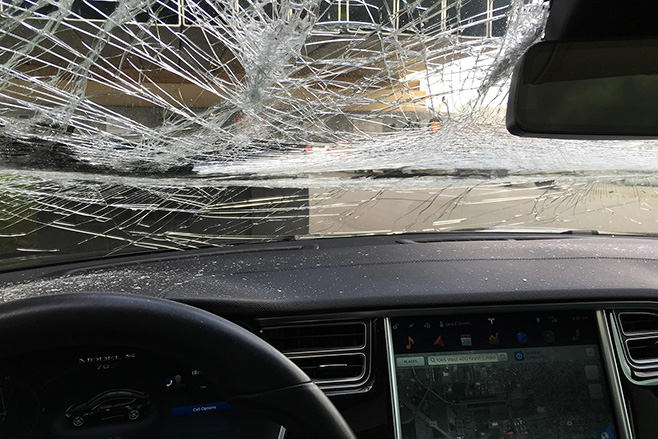
Then a Model S owner from Utah, Jared Overton, posted photos to social media of his shattered windscreen, claiming the car activated the technology on its own and parked itself – into the back of a trailer. He blamed Tesla.
Then Tesla, which keeps detailed data on its cars, sent him a letter claiming that the Summon feature was used incorrectly and that the driver was alerted about the technology’s activation.
It’s unknown whether the Tesla Model S used key fob activation or the newer smartphone system which is controlled via an app, but the alleged letter, which is circulating on the internet, goes into play by play detail of what happened. “Approximately five minutes, sixteen seconds after Summon was activated, the vehicle’s driver’s-side front door was opened again,” it said. They blamed Overton.
In comments posted to social media, others blamed the overhang of the trailer, deeming it unsafe.
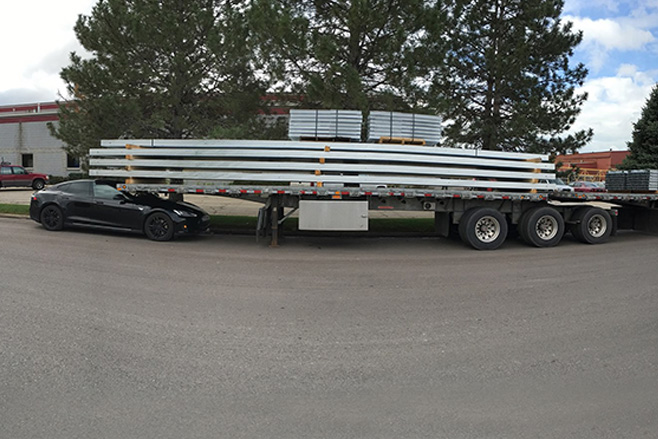
Teslas are fitted with sensors that allow technologies like Summon to work. But Tesla has admitted that these autonomous features still need to be monitored and controlled by drivers, given there are certain obstructions which vehicles are unable to detect, such as low-lying or high hanging items. Like say, a suspended trailer. Oops.
So, who’s really at fault here? Both parties have reputations to protect, but one has a more detailed record of events. Then there’s the truck.
But if we take anything away from this, it’s that autonomous cars have a way to go yet before we can trust our lives to them 100 per cent.
THAT controversial move by the Red Bull brains trust to effectively demote Daniil Kvyat to Toro Rosso and call up teenager Max Verstappen to the A team looks like a masterstroke following the Dutchman’s brilliant win in Spain.
But a week earlier, plenty were not so sure. Some believed the punishment for the Russian didn’t fit the crime. Kvyat, who was in Moscow watching Game of Thrones on TV when the fateful call came from Red Bull’s Dr Helmut Marko, clearly believes he should still be in the top team.
But we’ve learned the reshuffle was not so much punishment for Kvyat but a pre-emptive strategic ploy to keep Verstappen in the fold.
Red Bull team principal Christian Horner, talking to Autosport’s Ian Parkes, says that moving flavour-of-the-season Verstappen to Red Bull has effectively prevented any other preying team manager from mounting a raid on his star drivers.
With Verstappen’s highly regarded new teammate Daniel Ricciardo under contract with Red Bull until at least the end of 2017, both Red Bull stars are locked in tight.
The reshuffle of drivers between the two teams owned by Austrian Dietrich Mateschitz may have been planned before Kvyat’s recent first-lap blunders at the Russian GP.
Keeping Verstappen off-limits to rivals was obviously a priority, while the move also eased growing tensions between the youngster and the other Toro Rosso up-and-comer Carlos Sainz Jr.
“The way Daniel is driving at the moment I don’t think there is a better driver in Formula One, so the thought of the pairing is fantastically exciting for us.”
Happy, smiley Ricciardo didn’t much like being upstaged in the Spanish Grand Prix.
But that was Round One. Don’t believe Verstappen will fix him up in every race. Ricciardo was spectacular in qualifying at Catalunya and led Verstappen in the race until the team’s strategy call.
Ricciardo says he welcomes Verstappen’s arrival at Red Bull as it would crank up the pressure to perform. Cast your minds back to his own elevation to Red Bull when he came up against a four-time world champ…
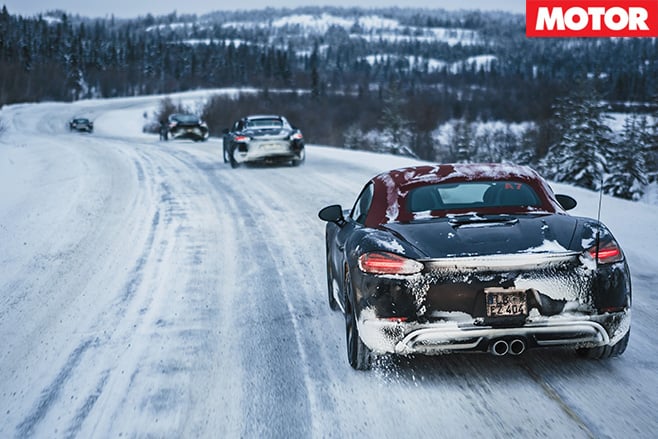
It’s the second week of December in Yellowknife, a thriving northern Canadian town within frozen spit-tossing distance of the Arctic Circle.
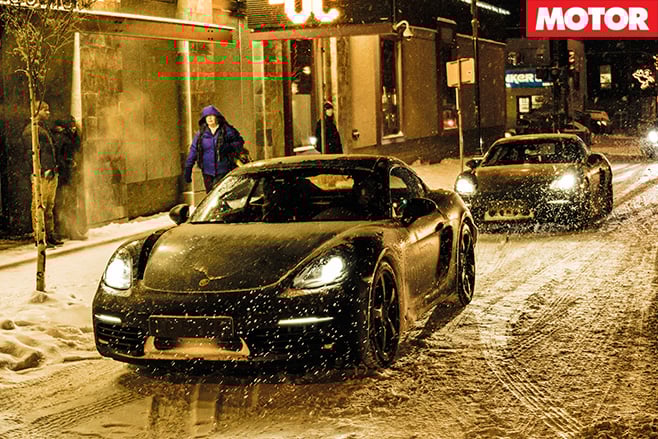
We’ve travelled here to meet the new Porsche 718, which comes to market in April as a Boxster and six months later as a Cayman. The 718 moniker is inspired by the mid-engine lightweight street-legal racer built and campaigned from 1957 to ’64.
Way more significant is the fact the Boxster engine room now houses a turbocharged flat-four, rather than the legendary flat-six which has served since time immemorial. For 2016, Boxster swaps two cylinders for a single snail.
“We were facing a complex task,” project leader Jan Roth tells MOTOR. “Marketing wanted to move the mid-engined cars further away from the 911. The result is a new four-cylinder boxer.
“Why not a smaller-displacement flat-six? Because now we’re introducing turbocharging across the board, it would have been impossible to package the bigger powerplant. Believe me, it was difficult enough to find space for the flat-four with the related extra intake and exhaust plumbing, not to mention the intercooler assembly. For these reasons alone, a turbo-six was never on our radar.”
Initially, there will be two engines, a 225kW/360Nm 2.0-litre and a 255kW/400Nm 2.5-litre. Mid-term, a brawnier GTS, good for at least 275kW, will complete the range. And yes, there is still enough room for a normally aspirated six…
“Downsizing offers various advantages,” says Matthias Hofstetter, engineer and Sports Car Drivetrain Development boss. “For a start, the turbocharged four-cylinder produces up to 100Nm more torque than the outgoing six. At the same time, it is instrumental in reducing the average fuel consumption by 15 per cent.”
The 2.0-litre engine feels more agile and spontaneous, the bigger unit not obeying the throttle quite as promptly, but in the wake of that initial turbo-lag, mumbo builds more rapidly and climbs to a taller peak.
“Today, normally-aspirated and turbocharged engines still live side by side,” Hofstetter adds. “In the future however, the turbo is going to pull away big-time. It doesn’t only radically re-plot the torque curve, it’s also an essential CO2-reducing tool.”
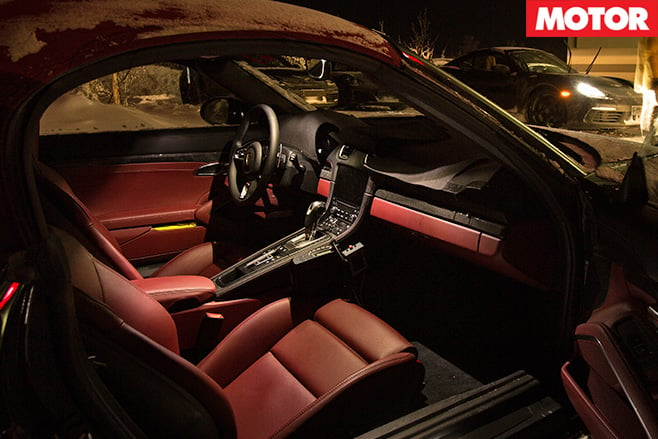
Unlike many rivals, Porsche refuses to include steering action in the drive-mode Scrabble, although braking response soon will be. The internal 981 designation suggests the 718 is more than a mere facelift, but even hardcore brand fetishists will need to look twice to spot the changes. Inside, Porsche developed a new instrument panel to lose the noisy, breathless old air vents, though such luxurious perfection may soon be history.
More advanced options like a fully adaptive matrix beam system, long-overdue head-up display and intuitive ergonomics must wait until 2020 when project 983 takes over. By 2021 at the latest, battery-operated versions of both models are expected.
Even though exceptional vehicle dynamics have always been a forte of these two mid-engined crackerjacks, the Weissach think-tank pulled various strings “to get even closer to 10 out of 10”.
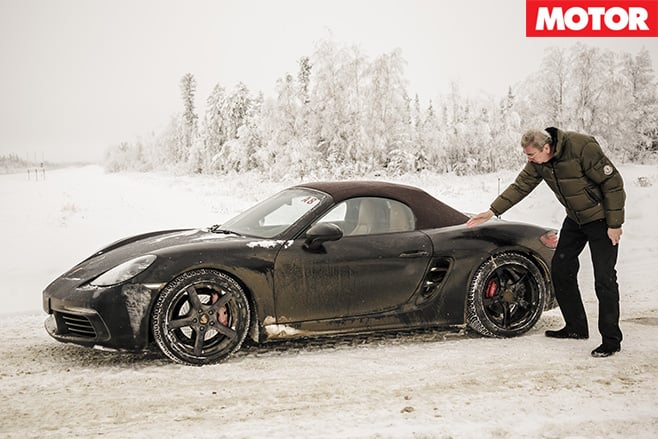
Even though the basic suspension settings are a convincing compromise, the adaptive PASM dampers are better still at soaking up potholes and neutralising expansion joints. Not quite firm and precise enough? Then hit the Sport button and dial in a tauter setting, which ties the car down nicely without sending shockwaves through you or the partial aluminium chassis structure.
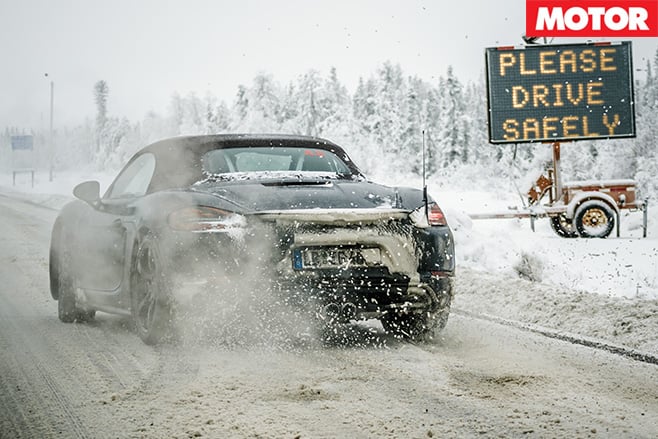
Manual or PDK transmission? The progressive clutch, eager throttle and slick gearshift match the driver’s feet and shift arm with aplomb – but in Canadian winter conditions, the dual-clutch PDK ’box is preferred. Keeping both hands on the wheel, snappy flappy-paddle gear changes don’t dent the flow nearly as much as two-second manual upshifts.
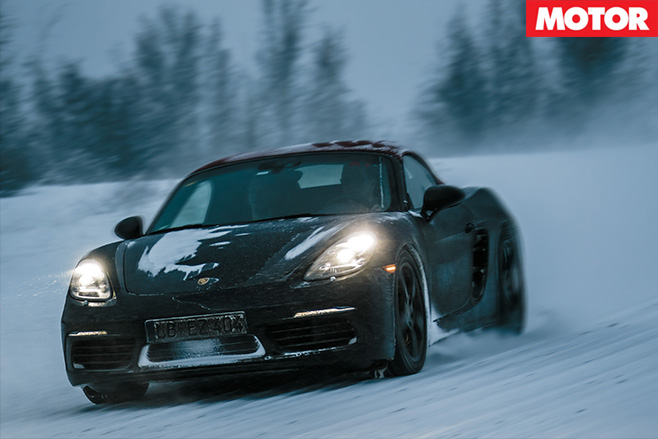
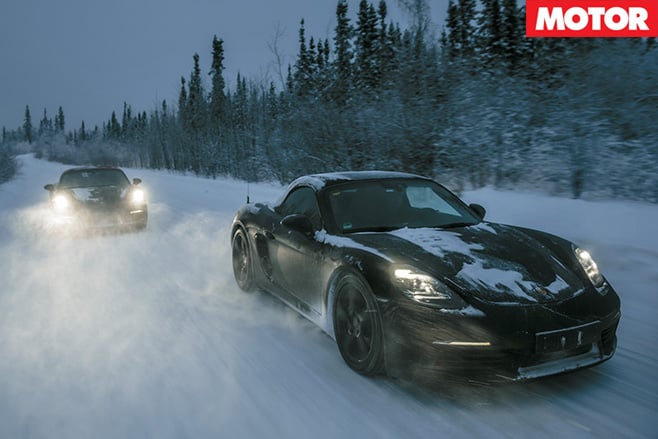
Those new to the routine will fall off the icy tracks sooner or later and then brace themselves for undisclosed rounds of mystery drinks. The local coppers usually just take the role of friendly observers and turn a blind eye should a Porsche mule occasionally mistake Mackenzie Highway for the autobahn.
“Triple figure stints on public roads are a no-go,” Alex Ernst assures us. “When we feel like playing, the fleet heads to a frozen lake, [with] the winch-equipped Expedition hot on our heels.”
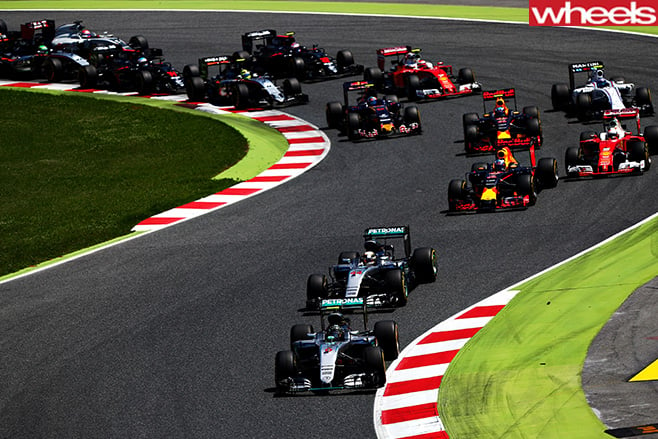
WHERE to start? For the two fighting Mercedes-Benz drivers, Nico Rosberg and Lewis Hamilton, the Spanish Grand Prix was over after 30 seconds, paving the way for Red Bull and Ferrari to fight over the victory at Barcelona’s Catalunya circuit.
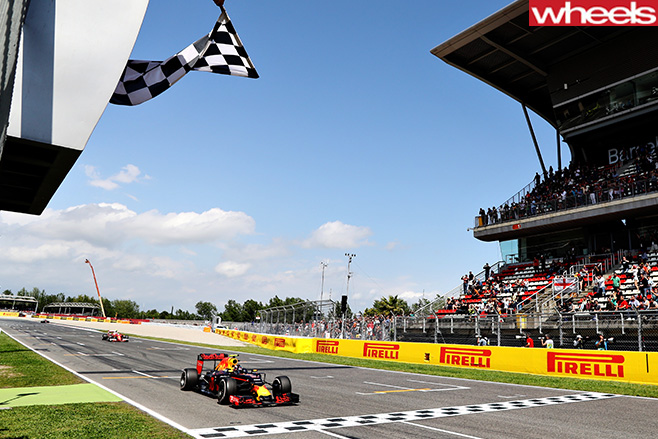
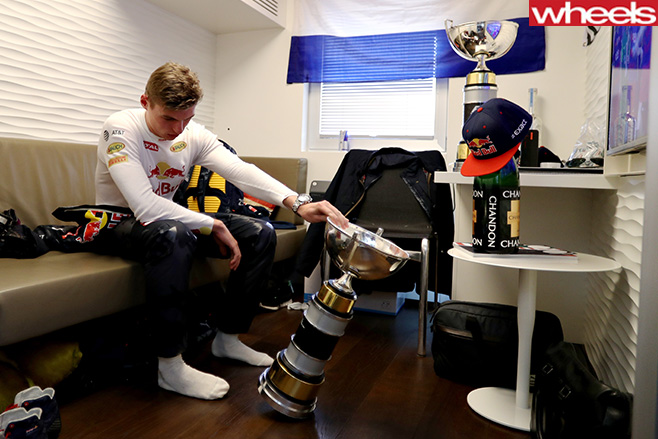
In an intriguing contest of two different strategies – two-stop and three-stop – Max Verstappen, emerged from his debut drive with Red Bull as Formula One’s youngest winner, sending his army of supporters in paroxysms of joy. He is the first driver from the Netherlands to win an F1 race.
The recent Russian Grand Prix call by the Red Bull hierarchy for Verstappen, formerly at Toro Rosso, to swap seats with Daniil Kvyat now looks like a masterstroke after the Dutchman, aged 18 years and 227 days, turned in a mature, faultless drive to become the first driver from outside Mercedes-Benz to win a GP this season.
For the last 32 laps, Verstappen beautifully managed a tyre-conserving two-stop play, used his right clog sensibly to control the race from the front and keep at bay the experienced Kimi Raikkonen, winning by 0.6sec.
Third, a further 4.9sec back, was Sebastian Vettel, having survived a torrid battle with a hard-pressing Daniel Ricciardo in the other Red Bull. Vettel and Ricciardo were both running three-stop strategies, and the extra time in the pits hurt them badly.
Versappen’s stunning drive into F1 history will be long remembered (perhaps until a 17-year-old comes along and supplants him as the youngest-ever winner) but we’ll also be talking about the crazy/awkward demo derby involving Hamilton and Rosberg (as depicted in the video, top).
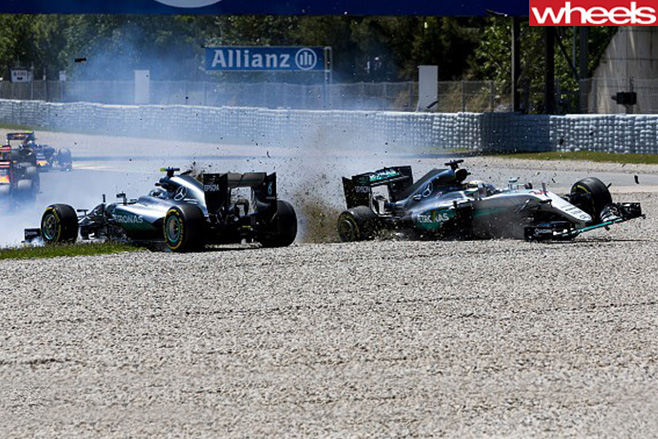
But Hamilton, trailing closely, made a better fist of exiting turn three, and aggressively moved to the right to fire down the inside of the fast-approaching right hander. Events were unfolding in a blur. Rosberg – in the wrong engine mode as it turned out – quickly moved to block, but Hamilton already had his front wing up to the German’s rear wheel.
Hamilton had two right-side wheels on the grass, lost control and slid at high speed into Rosberg’s car, carting both into the gravel outside turn four.
The (mainly British) commentators blamed Rosberg but Mercedes’ non-executive chairman Niki Lauda slammed Hamilton. “It was a miscalculation in Lewis’s head, I blame him more than Nico. Lewis was too aggressive to pass him and why should Nico give him room? He was in the lead.”
Stewards later dismissed the clash as a racing incident.
Either way, it was an ignominious end to the GP for both Silver Arrows. The race was then neutralised by the safety car with Ricciardo leading his new teammate Verstappen, followed by Spaniard Carlos Sainz Jr, who had started eighth in his Toro Rosso, and the Ferraris of Vettel and Raikkonen.
Vettel and Raikkonen dispatched Sainz when racing resumed, creating the scenario the fans wanted – a tight battle between Red Bull and Ferrari.
While the Mercedes heavies met with their drivers behind closed doors, Red Bull and Ferrari played cat and mouse with similar strategies at their first stops for medium compound rubber. Then both split their drivers on to different tactics; Ricciardo and Vettel on a three-stop plan, while Verstappen and Raikkonen remained out until laps 34 and 35 respectively, committing to two-stop strategies with a long stint on mediums to the finish.
Despite unrelenting pressure from Raikkonen, Verstappen kept his cool to score an extraordinary win.

Verstappen insisted he wasn’t nervous during the race, but tried hard to drive the best he could. “We focused a lot on keeping the tyres alive because at my last stop I still had to do 32 laps until the end, but it worked out well,” he said.
“With five laps to the end I saw Kimi was dropping off a bit, he tried a few times and of course it kills your tyres and from there I just like ‘okay, focus on the tyres now and bring it home’.
“I will for sure remember this and at the moment it’s just a great feeling. It’s amazing, I have no words for it. It was very good company on the podium, I mean Kimi even raced against my dad, so it’s very funny.”
Ricciardo, on slightly fresher tyres than the third-running Vettel, was never about to die wondering. With the laps running down, he made one spectacular lunge on Vettel into turn one, but didn’t quite make it stick.
Vettel, who showed great awareness to evade the menacing Red Bull, took to the radio to express his displeasure.
Vettel ranted: “What is this, racing or ping pong?” Ricciardo hit back: “Typical.”
“Unlike 99 per cent of the drivers on the grid I actually tried to make an overtake,” Ricciardo said later. “A lot of them are content sitting behind and not actually having a crack. I tried a few times but it didn’t work. But I wasn’t content sitting in fourth.”
Vettel was calmer later. “It was once hairy in the first corner,” he said. “In that instant I was on fire and complaining because if I didn’t play according to his move, there would be a crash. Then again, it’s racing. The one chance he had was when I had a bad exit and he has to go for it.
“I have raced him many times and it’s good fun.”
“Mixed emotions today, for sure,” said Daniel Ricciardo. “Some of it was just bad luck today, I was leading and then went on a three-stop strategy, which meant I had to try and pass three cars on track, which isn’t easy. Seb had already jumped us on the pit stop, which resulted in more overtakes to get back to the front.
“In hindsight, a three-stop strategy was the wrong thing to do, but maybe during the race it seemed like the right thing to the team. I wasn’t content sitting in fourth so I tried to pass Vettel, I had a crack, but it didn’t work out. It really sucks to not even be on the podium and then the puncture at the end just rubs salt in the wound.”
In contrast, he was happy with his teammate’s finish. “It’s a big day for Max with his first race win, so congratulations to him. He got the job done, everyone questioned the decision during the week but he has proven today that he is a top-class driver.”
Local boy Sainz was fifth, four places ahead of new teammate Kvyat.
All this at a circuit that rarely produces much in the way of overtaking, where the front row traditionally produces the winner, and where the racing sends us to sleep.
Lest anyone forget, though, the only overtaking done by a driver in the front bunch was Rosberg on Hamilton into turn one…
Rosberg, with 100 points, still sits atop the drivers’ standings but Raikkonen is now second on 61, with Hamilton 57. Vettel and Ricciardo have 48 points apiece.
Next: Monaco.
Matt Brabham impresses with mistake-free IndyCar debut
Third-gen racer converts solid qualifying to 16th on debut.
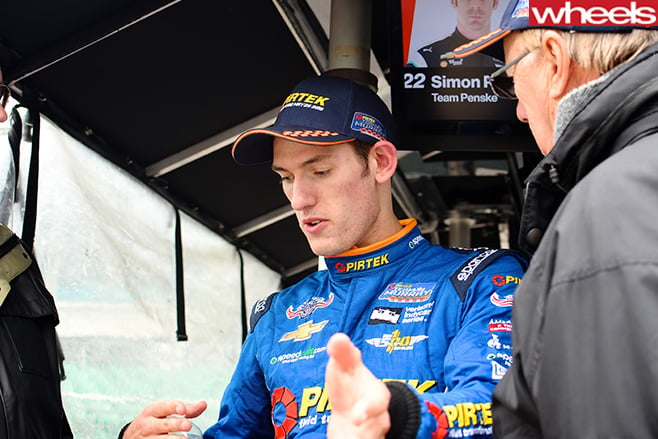
The third-generation racer certainly wasn’t overwhelmed by the intimidating history of the storied Brickyard.
He qualified 16th after limited running – later re-slotted to 14th after two rivals lost their qualifying times. And come the 82-lap race, Brabham did everything right, kept to the script demanding he stay out of trouble and learn.
That he did, finishing behind regular racer Marco Andretti in 16th.
The Angie’s List Grand Prix of Indianapolis – held on the 3.9km clockwise Indianapolis Road Course with nine right handers and five left hookers – was Brabham’s IndyCar race initiation and shakedown for the biggie, the 100th Indianapolis 500, two weekends away.
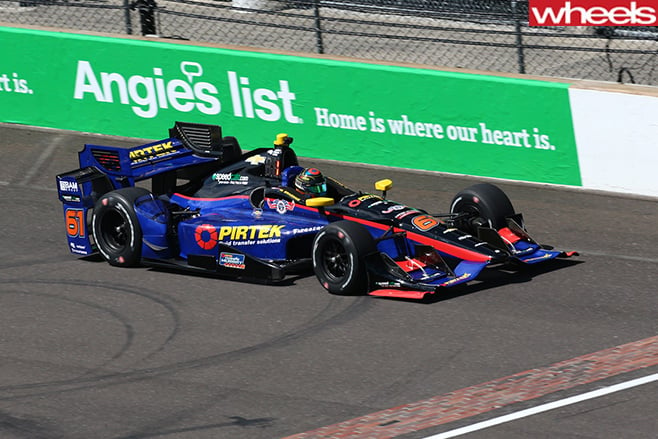
“Crusher” Murray summed up the result: “Bit of polish, a couple of new speedway wings and we are ready to go! – can’t ask for more than that.”
Murray was impressed that Brabham survived the inevitable first corner incident and once the race went green got to relax and settle into a rhythm.
The feature of his second stint was an encounter with fellow Queenslander, Will Power. Both on the red tyres, the rookie was able to pass the former champion. This was a battle that continued throughout the race.

“The start was crazy – there was so much stuff that was flying around, the buffeting on my head was unbelievable,” Brabham recounted.
“The whole experience was definitely different, I had never done anything like the restarts, push to pass or pit strategies before, but it all went pretty smoothly!
“It was weird and surprising to be racing and dicing with both Marco Andretti and Will Power there. I watched both of those guys as a kid. I thought it was all a bit surreal!
“I now know how the guys race each other and the buffeting when you get close to cars and the racing in a group, which was all new. It really gives me a good platform going into rookie orientation on Monday and the 100th Indianapolis 500 preparations.

“It’s incredible to win three in a row like this and here in Indy for me, it’s very special. I lived here for nine years so this place is very special in my heart.”
Sharing the podium with Pagenaud, who is enjoying a stunning purple patch, was Brazil’s Helio Castroneves and Canada’s James Hinchcliffe.
Pagenaud extended his lead in the point standings over Ganassi’s Scott Dixon, seventh at the weekend, and Penske teammate Castroneves.
Will Power’s unhappy start to 2016 continued, with the Australian classified 19th.
Twenty-three cars were running at the finish.
Practice for the Indy 500 begins today, Monday May 16.
World Superbikes: Sykes and Hayden win in weekend of crazy Malaysian weather
But defending world champ Rea leaves Sepang with an increased points lead.

It was also the American’s first international race victory in close to a decade. He is riding for Honda.

Kawasaki’s Rea remains the only rider on the grid to have been on the rostrum in every race.
Australia’s Anthony West, riding as replacement for Sylvain Barrier at Pedercini Kawasaki, lived up to his reputation as a smart substitute of choice, taking ninth on debut on Saturday and then confirming his mastery of wet conditions, landing a great fifth on Sunday (ahead of some factory bikes).
Every weekend, all around Australia, club-level motorsport events are happening.
At these events, there’s often all sorts of weird and wonderful homegrown creations competing, such as the mid-engine V8 Holden Rodeo we discovered at a Winton test ’n’ tune day.
Our latest find, however, puts even that in the shade. The Toyota Lexcen was born from the Holden-Toyota alliance in the late-’80s/early-’90s, for those who liked the idea of a Commodore but found the Holden badge a little too racy.
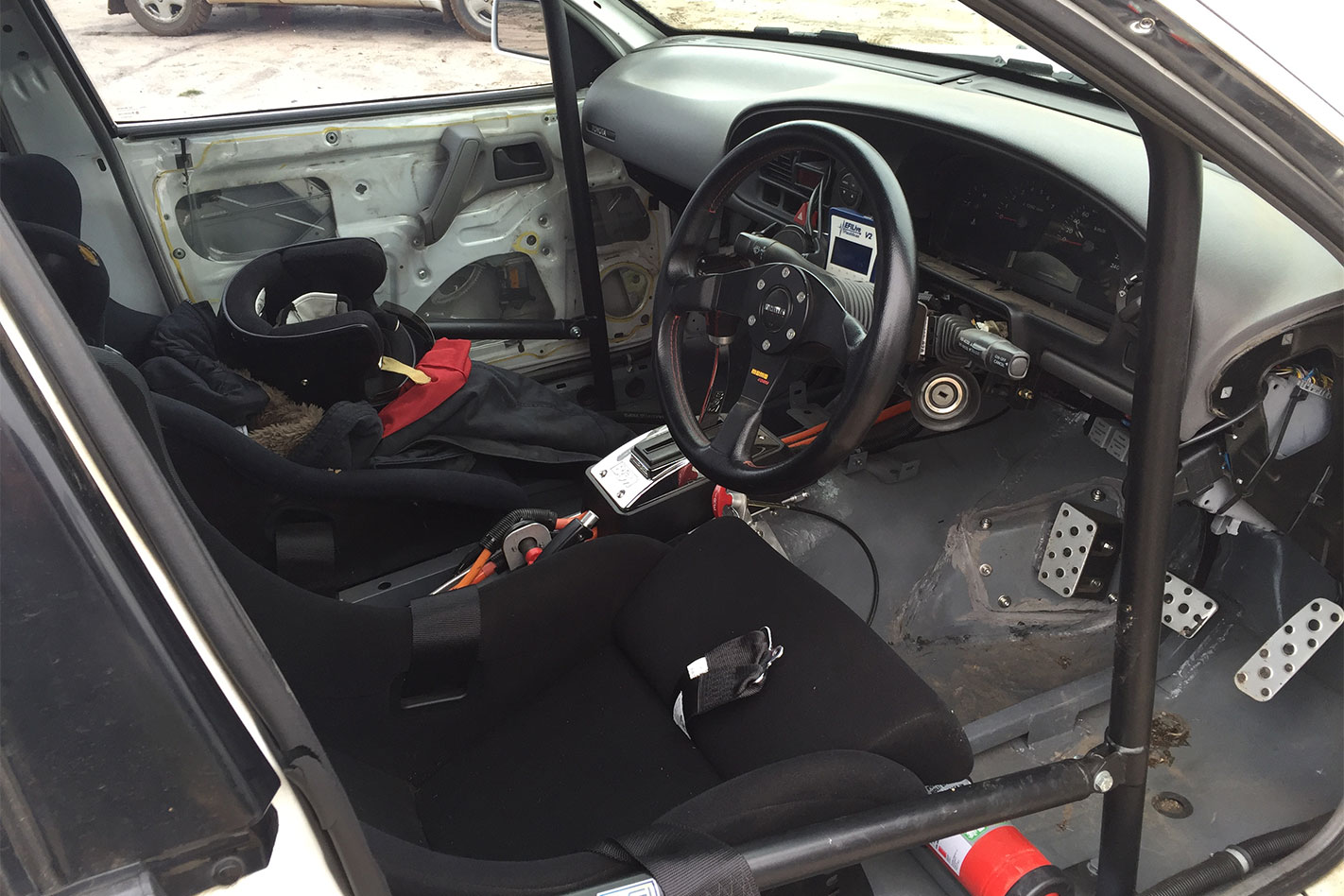
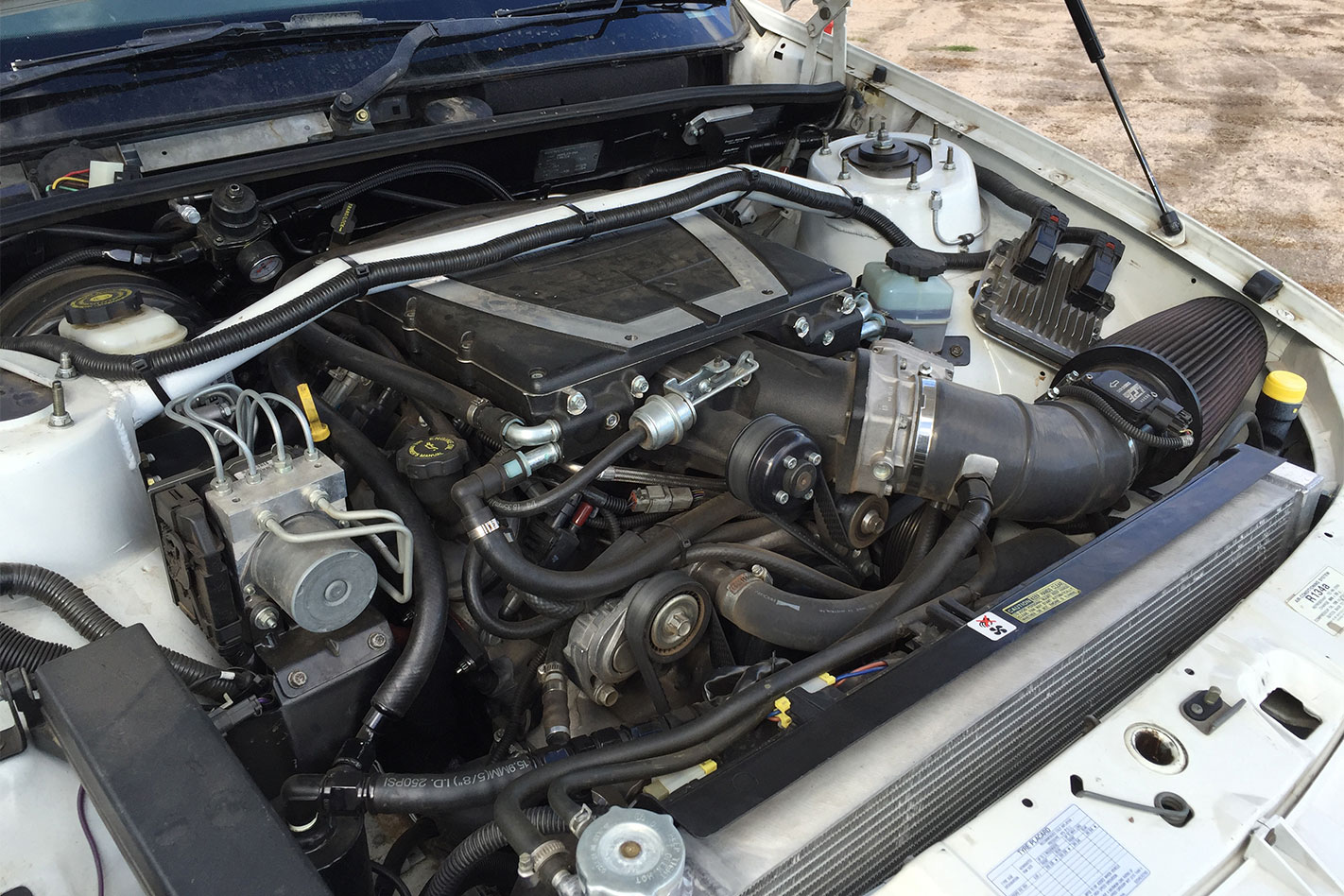
The engine is a stroked 6.0-litre L98 crate motor with forged internals and topped by a Harrop supercharger. It feeds its power through a highly modified 4L70 automatic and the end result is around 450kW at the wheels according to Ian.
Suspension is all custom, though the inserts were Koni once upon a time, and VZ Clubsport electronic architecture enables the car to run full ABS and traction control, though it’s not yet calibrated for loose surface work.
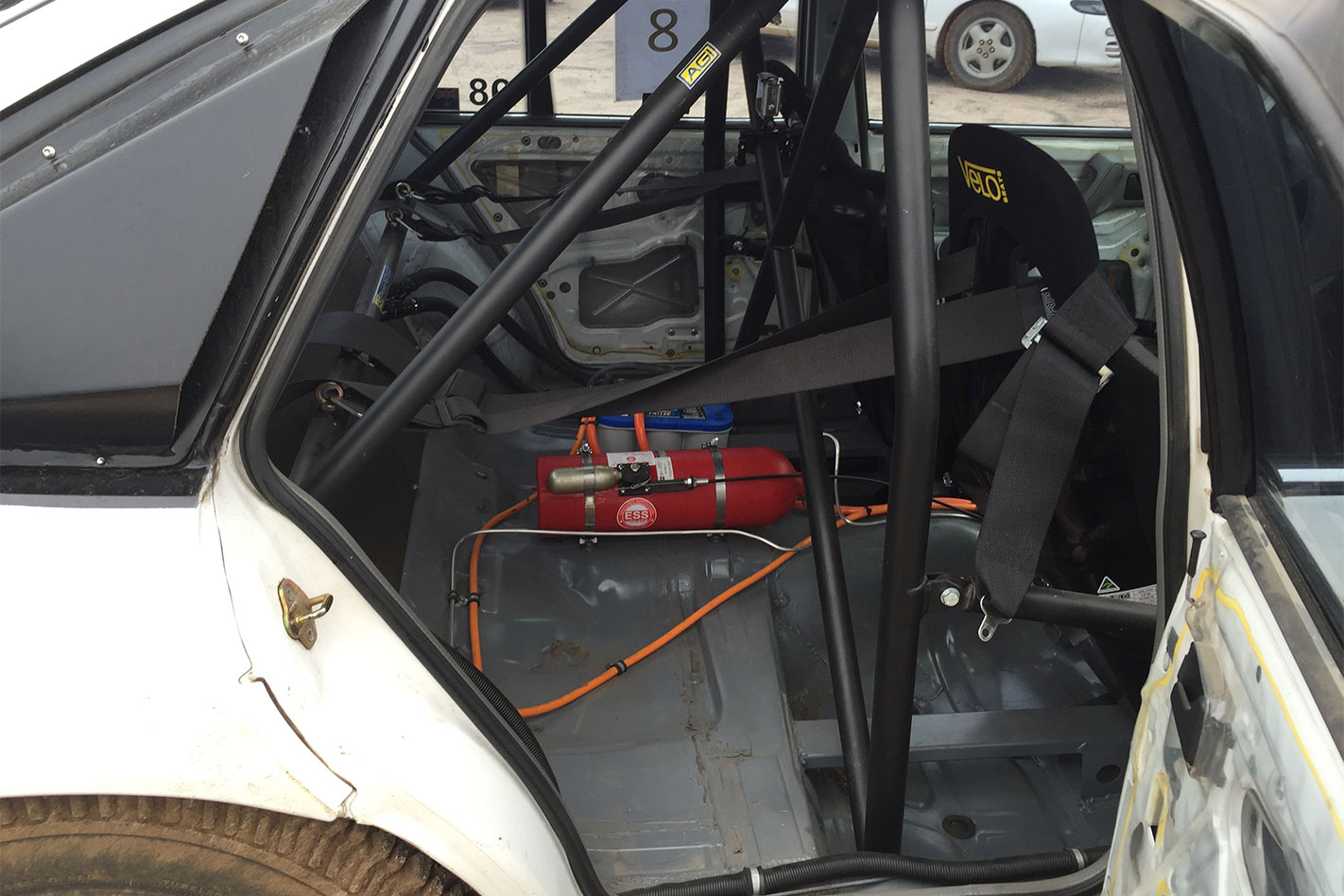
It’s an awesome bit of engineering, and while it had a couple of ECU hiccups on the day, so far it has been very reliable and incredibly fast. We look forward to seeing it in action in the future.
THE same factor that pushed General Motors to quit building the Holden Commodore in Australia – the high cost of labour – appears to have led it to dump a decision to build the first-ever fully imported Holden Commodore in Korea.
The Wall Street Journal reported overnight that plans to build a Chevrolet-badged version of the Opel Insignia hatchback in South Korea had been shelved due to “high costs and market shifts”. The Insignia is the car that will carry the Commodore badge after Australian Commodore production ends in late 2017.
The move away from building the Chevrolet Impala in Korea is potentially an important one for Holden, which is making a pitch to add a more premium edge to its showroom after years of relying on cheap South-East Asian-sourced products to fill its portfolio.
It also opens the door to the all-new Commodore potentially being made at GM’s Hamtramck assembly plant in Detroit, and taking advantage of the free trade agreement that exists between the US and Australia that removes all tariffs on vehicles arriving from the US. A similar agreement is in place with South Korea
The move also points to Rüsselsheim in Germany as a potential source of Holden Commodore-badged Insignias arriving in Australia.
GM has struggled with its Korean car-making division, where unions have helped to push production line workers’ salaries up by more than 50 percent over the last five years, the Journal reports.
The country recently lost a bid to take up Australia’s production allocation of the Holden Cruze, worth about 15,000 units a year, once local production ends in October this year. Instead of building GM’s next-generation Cruze, it will continue to build the old one for developing markets.
Holden, meanwhile, will import the Opel Astra hatchback as a replacement for the locally made Cruze hatchback, with just the Cruze sedan expected to remain on sale to help fill fleet and rental car company orders.
The Detroit-Hamtramck assembly plant, where the Chevrolet Impala-badged version of the Insignia is built, currently builds the second-generation Chevrolet Volt that was not engineered in right-hand drive. It also builds the Chevrolet-badged version of the Malibu, with Australia’s Holden-badged version of the car sourced from South Korea.
Opel’s Russelsheim plant is also slated to soon start production of an new SUV that is expected to sit above the smaller Opel Mokka – a Korean-built version of the Mocca is sold here as the Holden Trax. The new mid-size SUV is expected to take its inspiration from the Monza concept shown at the Frankfurt motor show in 2013.
WHAT STANDS OUT
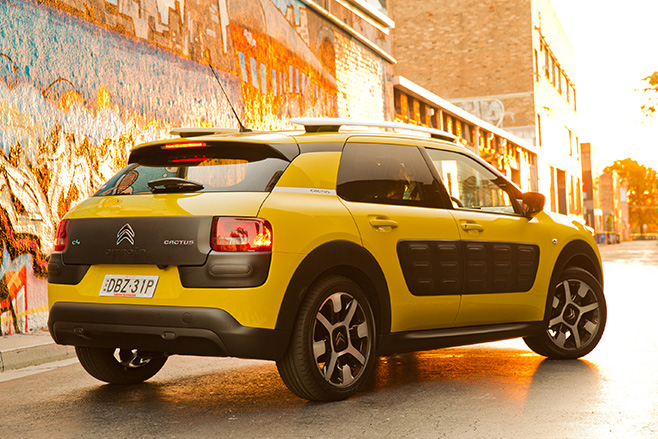
Let’s be honest, the whole car stands out. But let’s talk about the first thing you notice. Citroen calls them AirBumps and they literally stand out. Think of them like bubble wrap for your car, protecting it against rogue shopping trolleys and carelessly opened doors.
Citroen has made design features out of all sorts of things that most manufacturers don’t pay any special attention to, it’s quite utilitarian but it’s stylish, and that’s a big part of the car’s charisma. It attracts a lot of smile and attention, so it might not suit shy and retiring types.
WHAT’S INSIDE
Inside, there’s more room than you might think. The rear bench has heaps of headroom and can actually seat three. Fold the seats flat and there’s generous boot space. C4 Cactus gets a strong list of standard equipment including touchscreen satellite navigation, reversing camera, parking sensors and tyre pressure monitoring. There’s clever storage in the ‘Top Box’ on the dash, a centre armrest and big pockets in the doors.
You can tell that Citroen has done a lot to keep weight down. The rear windows are manual and pop out rather than rolling down, so your dog won’t be able to poke his head out but kids can use the handy storage spots on the doors. There are two ISOFIX points for baby seats as well.
CHOOSING YOURS
Cactus has two drivetrain combinations to choose from; a 1.2-litre turbo petrol with a five-speed manual gearbox, or a 1.6-litre turbo diesel with a six-speed semi-automatic that isn’t as good as a traditional auto or CVT.
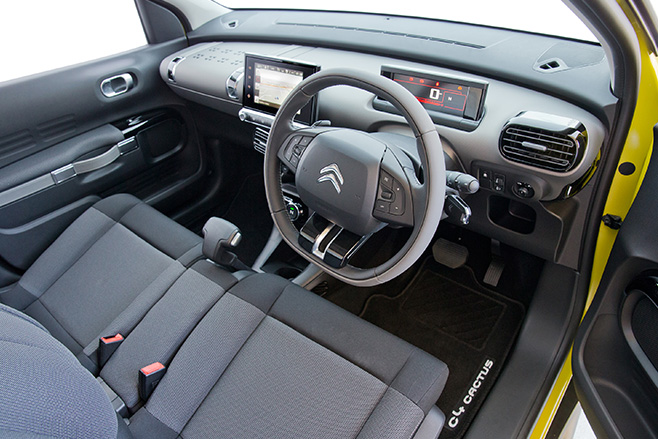
We’d buy the turbo petrol. The manual ‘box is light and easy to use and the award-winning engine is incredibly cheap to run even when driven with a heavy right foot.
Once you’ve chosen from the thousands of colour combinations, there aren’t too many optional extras to select. A panoramic sunroof is the most significant and does lift the feeling inside the cabin. It adds $1250 to the total but we think it’s worth it.
SUMMING UP
Some will fall in love with the individuality of the Cactus. That’s its biggest strength and potentially its biggest weakness if it doesn’t win the hearts of small SUV buyers. But cars with personality are what we look forward to driving here at WhichCar, so the Cactus gets a tick from us.
Oh dear. General Motors has had an unfortunate mishap at the Nürburgring and crashed a prototype of the upcoming Chevrolet Camaro Z/28. The lairy-looking test mule came unstuck after a lock-up on corner entry and found its face buried in the Armco.
The right hand side of the car takes a beating, and all four wheels leave the ground, before the wounded muscle car limps across the track to the infield. Skip to 1:35 for the action and set your face to cringe.
The bewinged Camaro appears to be a new Z/28, the track-focused version of Chevrolet’s iconic two-door sports car.
Expect race ready upgrades when the Z/28 is officially announced, not to mention huge grunt almost certainly from a V8 judging by the soundtrack in this clip. Those behind the video seem convinced about the presence of a 3.6-litre twin-turbo V6 under the bonnet, but our ears say different.
We don’t know who the driver was, but this probably wasn’t their first time at the legendary circuit. Thankfully both occupants walked away from the scene, and damage to the car was minimal, but we’re not sure we can say the same for the driver’s pride.
TRIBUTES from readers, former co-workers and the Australian car industry have flowed into Wheels since the death of former editor Bill Tuckey.
Here’s a selection of them.
Mike Simcoe Vice-president, GM International Design When I was still green, Bill was already one of the “Old Guard”….
I wasn’t smart enough to see behind the legend or understand his depth of knowledge and experience, all I saw was the myth, a myth largely created by his own stories. A warm engaging companion never dismissive of a less experienced passenger.
We live in very different times.
I fear the business is no longer big enough to contain a character like Bill. Farewell.
Trevor Worthington Vice-president product development, Ford Asia Pacific and Africa Bill’s influence on the Australian auto industry can’t be overstated. I grew up reading his columns in Wheels and elsewhere. His demand that all car companies, particularly those developing vehicles locally, become better than they were, really drove and inspired a whole generation of engineers.
The processes and checks and balances that he brought to the industry through the Wheels Car of the Year testing process was second-to-none. The possibility of winning that award for the BA Falcon and later for Territory inspired those of us who were responsible for those two vehicles to keep pushing ourselves to deliver the best vehicles we could.
On a personal note, am I the only person in Australia who didn’t realise that Bill was also Romsey Quints?!
GM Holden Holden wishes to express its condolences to the Tuckey family after the passing of Bill Tuckey.
Mr Tuckey was a true pioneer of automotive journalism, not just in Australia but globally.
During his decorated media and publishing career, Mr Tuckey cr eated an original and engaging approach to motoring journalism, and a tremendous body of work.
A long-time editor of Wheels magazine and the man credited with creating the coveted Wheels Car of the Year award, Mr Tuckey was also responsible for covering some of the most pivotal moments in Holden’s history.
Mr Tuckey also shared Holden’s passion for the race, having several starts in the Bathurst 1000.
Our thoughts are with Mr Tuckey’swife Marcia, and children Stuart and Libby.
Jac Nasser BHP Billiton chairman, former president of Ford Australia Few make it to the top of their field. Bill made it look so easy with a unique sense of insight and humour. A true enthusiast and a genuine, good bloke.
Steve Cropley Editor-in-chief Autocar (UK), former editor Sports Car World Bill Tuckey was my first, best and most influential connection with cars and motoring journalism. He’s the reason I didn’t do well at school (too busy reading Romsey Quints under the desk) and the reason I wanted to get into motoring journalism, though as a feckless kid from Broken Hill I didn’t believe his world would ever have a place for me.
Bill’s writing had everything I valued: it was warm, inclusive, authoritative and hilarious. And always stylish. In English lessons, when teachers droned on about great writing, I privately reckoned Bill Tuckey would finish any writing race 10 lengths ahead of Shakespeare.
Later, I did get into journalism as a daily newspaper hack. Within a few years, by a miraculous sequence of events, I was working for Peter Robinson in Sydney on Wheels and Sports Car World, the finest upbringing any young hack could have. When Bill dropped into the office one afternoon to see Robbo it was like meeting God, or would have been if he hadn’t been such a funny, normal, down-to-earth bloke. Even so, I was pretty much struck dumb. Couldn’t even hold his gaze. When it turned out he’d read one of my stories — and said something nice about it — I took days to recover. But that experience definitely applied the afterburner to my determination to do well at this game.
Fifty years later, I can still quote you phrases from Tuckey stories and RQ columns, and I’ll bet I’m not alone. One phrase I remember is from a Wheels story called Go See Australia, full of advice about seeing our country before leaving it. It was just a casually dropped few words in the last par of the story, where Bill was describing the noise of the wind blowing through power lines. As a kid from the bush I knew this noise intimately, but could never have described it so eloquently. Bill called it “a mad, strange song in the overhead wires”, and as I write those words now, with a lump in the throat, I can hear it all over again.
Pedr Davis Author and motoring writer Bill’s passing has touched so many people, not just his family, relatives and friends but also the countess readers who knew him only through the written words. Bill had a magic touch.
I once remarked that his columns seemed so effortless. ‘Yes,’ he replied, flexing his hands like a piano player. ‘The words just flow out of my fingers.’ They did too, much to the envy of us all.
Farewell old friend. We’ve been colleagues for over 50 years and it’s been a long and fascinating journey. May your adventures continue on that great highway in the sky and the magic words never cease to flow.
David Morley Freelance motoring journalist A lot of people who reckon they know the industry were keen to point out Bill’s ego and his unwillingness to suffer fools. But having worked with him for many years, I know the ego was justified and the fools could make their own arrangements. Aside from anything else, when Bill was being Bill, he was also the first to admit it.
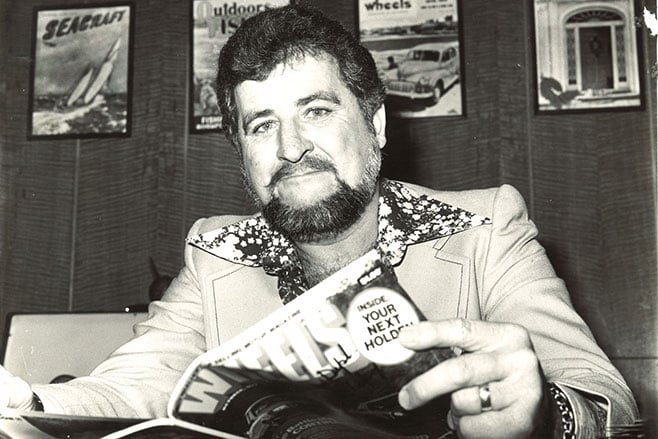
Mel Nichols Former deputy editor, Wheels and former editor, Sports Car World Bill was one of the world’s best and most influential motoring writers and car magazine editors. As a writer he was vibrant, inventive, witty, often provocative and always entertaining. As editor of Wheels from 1963-68, he was original, innovative, energetic, brave and stylish. He was the agenda setter in Australian motoring journalism. The character and class he brought to Wheels endures today.
What he did and how he did it influenced a generation of young motoring journalists and editors. A number of us went to the UK and through CAR magazine (which has had seven Australian editors) Bill’s influence flowed on to the next generation of British motoring writers, Jeremy Clarkson and Chris Harris (part of the new Top Gear team) among them.
Via CAR, and the work of Aussie Angus MacKenzie at Motor Trend, it reached the US too. It’s no exaggeration to say that the shape of modern motoring journalism owes a huge amount to Bill. Everyone who enjoys reading good writing about cars, and may thank informed and fearless automotive criticism for contributing to the massive improvement in cars over the past 50 years, should raise a glass in thanks and tribute to Bill.
Angus MacKenzie Wheels editor 1994-99 They’ve probably never heard of Bill Tuckey. But if they’ve read Motor Trend over the past 12 years, or Automobile since 1986, or CAR since the 1970s, or even watched Jeremy Clarkson on Top Gear, they’ve felt his influence. As editor of Wheels, Bill’s energetic, intense, provocative and entertaining approach to writing and editing helped change automotive journalism forever, and not just in Australia.
Bill succinctly communicated a car’s strengths and weaknesses, often to the discomfort of car companies when they failed to live up to his high standards. But he was also a consummate storyteller. He delighted in capturing those ephemeral moments that distilled the essence of our love affair with the car. He put his readers behind the wheel, in the moment, and revealed the soul in the machine.
As editor of Wheels, I was acutely aware I was custodian of a legacy that had been polished and tuned and honed by outstanding editors before me such as Peter Robinson and Phil Scott, but traced its roots right back to Bill’s time in the Big Chair. It wasn’t a daunting thing, or a constraint. On the contrary, it gave me a lot of freedom; freedom to tell the stories I wanted told, in the way I wanted to tell them. Robbo, Scotty, me… we all put our own spin on Wheels. But Bill had shown us the way.
In 2001, I became the sixth Australian in 40 years to have been made editor of CAR, and every one of us had worked on, or for, Wheels. Like me, Mel Nichols, Steve Cropley, and Gavin Green had all been a part of Wheels in the post-Tuckey era, and his vivid, lyrical writing style influenced us all. This excerpt from a story written by Nichols and published in both CAR and Wheels in 1977, about driving three Lamborghinis from Italy back to London is a perfect example:
“It had the unreal quality of a dream. That strange hyper-cleanliness, that dazzling intensity of color, that haunting feeling of being suspended in time, and even in motion; sitting there with the speedo reading in excess of 160mph and two more gold Lamborghinis drifting along ahead. Not even those gloriously surreal driving scenes from Claude Lelouche’s film A Man And A Woman were like this: that grey, almost white ribbon of motorway stretching on until it disappeared into the sharp, clear blue of a Sunday morning in France, mid-autumn, and those strange dramatic shapes eating it up. What a sight from the slower cars as that trio came and went! What a sight from the bridges and the service areas: witnesses there would have seen the speed! So would the police, of course, those same gendarmes who one after another apparently chose to look and drink it in, to savor it as an occasion rather than to act.”
It’s vintage Tuckey.
I wasn’t the only future automotive journalist who vividly remembers reading that story for the first time and being forever impressed by how it put me right there with Mel as we stormed across France in three howling Italian supercars. “I remember thinking that it was a great, very well written story and how much I’d like to write stuff like that,” Jeremy Clarkson told Nichols in 2011. “I still think it’s the best-ever drive story. Now I’m trying to do stuff like that, only on television.”
These were the stories that made CAR stand out from the stuffy, heavily formatted, road test-centric British automotive weeklies of the time. And when David E Davis Jr sought to shake up the American magazine establishment with the launch of Automobile in 1986, it was CAR‘s attitude, exuberance and, most of all, its vibrant storytelling he sought to emulate.
Make no mistake, the talented, erudite, literary David E made Automobile what it is. But I like to think that right from the start there was just a little bit of Bill Tuckey in the mix, too. Just like there still is in everything I write.
Chris van Wyk Caterham Cars Australia We are saddened by Bill’s passing. After Marlene and I arrived in Australia in the mid-1980s, he was one of the first motoring journalists to make us feel really welcome.
Always good company, yet with the critical eye on the PR “bullshit”, it was always nice to have a refreshing discussion about the latest BMW products.
Bill and I also agreed that the ridiculous emphasis of imposing unrealistically low “open road” speed limits on the long suffering Australian motorist was not justified. In fact, being counterproductive to road safety due to people falling asleep behind the wheel, being forced to drive too slowly.
Nonetheless, we had to opportunity for some memorable drives on occasion, both locally and overseas.
He will be remembered as an icon of Australian motoring journalism and as an all-round nice guy. Our thoughts are with the family.
Paul Gover Motoring writer, News Ltd Bill Tuckey is the person who inspired me to become a motoring writer.
His words in Sports Car World, especially when he was writing as Romsey Quints, captivated me.
Many years later, I learned from the master, travelled with him, and shared far too many days and night of silly stories and new experiences.
Bill was a towering presence. A fearless inquisitor. A brilliant writer.
There are so many, many stories but one thing shines through.
He was my inspiration.
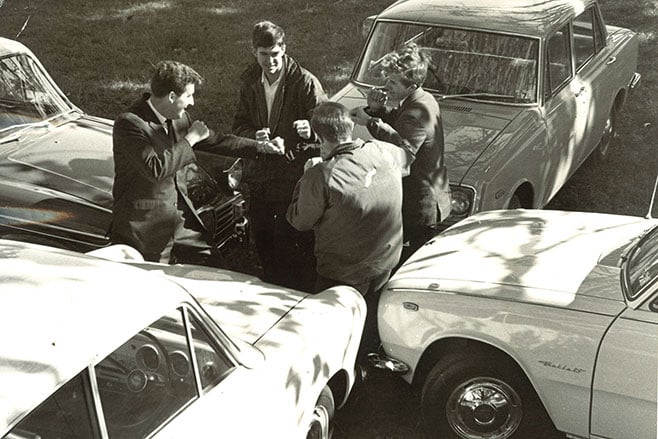
Tom Floyd Former editor, Australian Hot Rodding Review I was fortunate to meet up with Bill when he head-hunted me from a small publisher in Surrey Hills sometime around the mid-1960s, and I was delighted to join him at K.G. Murray Publishing. Bill was then editor of Wheels, Rob Luck was then with Sports Car World and I was brought in to head up Australian Hot Rodding Review and, in short order, Bill and I were able to get Two Wheels under way as well. The three of us, while having our own specialty magazines, all worked very hard for Murray Publishers – one of the best little publishing companies since WW2. It was absorbed into the Consolidated Press monolith by Kerry Packer about 30 years or so ago.
Bill was not only a great managing editor of the motoring group, he was also my editorial mentor. He taught well, I listened intently and we became good friends both at Murrays and socially for some years. Although retired from publishing for eight years, I have been forever in his debt.
Bill was always ready to help others. One interesting story (as I understand it) came after Evan Green left the position of motor editor of the Sydney Morning Herald. There were a number of hopefuls vying to join the then powerful paper, but a young Scot, David Robertson, whom had been introduced to Bill for one reason or another, put his hand up. Suddenly it was realised the Scot didn’t have a driving licence, so Bill and a couple of others quickly took him out, taught him to drive and he eventually got the job – and made a good fist of it until he later died after a jet ski accident during a car launch on the Central Coast.
In later years, while each involved in our own media companies, Bill and I had hooked-up with a guy who became a true advertising guru in the automotive world, Ray Berghouse. The three of us eventually formed Chevron Publishing Group. We concentrated on Australian motor racing publications such as the annual Bathurst 1000 program and the 256-page annual book of the 1000, The Great Race, on which we all worked like absolute mad men for 12 weeks to get published for each Christmas. Bill had a great team for the Bathurst efforts, but the finished products were in essence a tribute to his skill, his insights and his perseverance. Among Bill’s other work we published was the coffee table tome on the solar car race won by the American vehicle “Sunraycer”. Again due to Bill’s writing speed and accuracy we were able to present the finished book to the backers of the team in New York on New Year’s eve, just a couple of months after the finish of the race. They couldn’t believe it.
Even in his early days at Wheels, Bill was already earning considerable plaudits for his writing, but not always from his peers. Bill was essentially a writer, and his work stood out in the motoring media of the time. It’s one thing to have automotive knowledge and be a fan of motor racing and become a journalist. It’s another to quickly be able to dash off 5000 words, interesting, informative and insightful writing that earns lasting praise from readers. The motoring industry quickly reached out to him for his skills, his way with ideas, and with words. Eventually the incentives were too much and he joined the esteemed George Patterson advertising agency in Melbourne and moved south to that city, hoping to also write some of the books that had been gnawing away at him.
Bill Thomas Hyundai Australia public relations general manager, Wheels editor 2010-12 I didn’t know Quints was Tuckey. How could I have? I was a reader, 11 years old when I first discovered the Great Magazine and immediately became devoted to every word Quints wrote. Apologies in advance to Peter Robinson, but I would pick up the ‘latest Wheels‘ my father brought home from work – as soon as possible after the publication date, because there was pressure to buy it please Dad – and read Quints first, Robbo’s ‘Wheels Within’ editor’s letter second, and the rest third. Only 32 short years later I landed my dream job as editor of Wheels.
Romsey Quints was my biggest single inspiration, no question. Even at 11, I was reading him as a writer, trying to work out how he built his humour and how to do it myself. Of course, I couldn’t – nobody other than Jeremy Clarkson in the motoring sphere could ever touch Tuckey for sheer writing brilliance – but Quints’ unrelenting hilarity and brilliant observation drove me forward into my career. Had I known he was also Tuckey I’d have been even more impressed.
There was a particular Quints column about a trip he had in a small car with a cat. Remember it? He was reluctant about the idea of transporting this cat, but he did it anyway, as a favour. In the beginning the cat was safely in a box on the rear parcel shelf, but then it went wild and escaped, ended up at Quints’ feet getting mashed into the pedals and then jumped onto his head and clawed at his face. In the end he flung it into the traffic.
It was probably just another column to Tuckey, bashed out in no time at some point in the Wheels monthly schedule over a glass of red. But boy, was it was well written. I would laugh and laugh, even at the fifth or 10th or 20th time of reading, and what a gift laughter is. Tuckey gave that gift to millions. He was a genius, a legend, an inspiration, world class. Rest in peace, Bill.
Bill McKinnon Freelance motoring journalist When I began writing about cars 30 years ago, Bill Tuckey was already a legend, certainly as far as he was concerned and among most of his fellow motoring writers as well. I found this out because as a young ingénue I quickly learned that the motoring press corps was made up of two groups: the genuine professionals and the freeloaders, wannabes and junketeers. That’s still the case, although today the latter, sadly, far outnumber the former.
Bill Tuckey was the ne plus ultra of motoring writers. He was fearless, knowledgeable and possessed of a rare talent in being able to share his expertise so effortlessly and imaginatively with his audience.
To me and many other young writers, he was also kind and generous with his time and his counsel. Thanks Bill.
Gordon Lomas Editor-in-chief, Speedcafe.com It was a Jaguar gig to Coventry and bit of a product briefing, a drive program through the Yorkshire Dales with the sweetener being a drive of the XK180 prototype around Donington. Win Percy would also be at the track offering fast tours in a stonking Le Mans-spec XJ220.
From memory the trip was a bit of a suck-up job to make up for the shambolic S-Type launch in Australia when the car broke on the journo launch.
During the product briefing, Geoff Lawson, the then Jaguar chief designer, suddenly took ill after fielding some questions from the small group of Australian journos.
Soon after, we learned of the tragic news that he had suffered a massive stroke and was dead.
Colin Cook and a few of the other Jaguar guys were clearly devastated at the events but still wanted to oblige in being the perfect hosts for us wanting to continue the program of scheduled events.
Tuckey immediately took control of the situation politely telling the Jaguar people that ‘we are all grown journos and you people have got more to worry about at this time than us’.
In that situation Tuckey was the consummate professional, showing great compassion and leadership in his capacity as the elder statesman.
Bob Watson Author, automotive and motor sport consultant I was a huge Bill Tuckey fan. The quality of his writing put him apart from his contemporaries and his a passion for the auto industry was unmatched. I was fortunate to work with him several times, once as a judge on the Car of the Year panel, and then as a writer for Car Australia which he was editing. His wife Marcia drove in the Renault team which I was managing in the 1970 Ampol Round Australia Trial, so that also gave us a common interest.
Honest, no bullshit, and immensely knowledgeable about motor cars. He was good, fun guy, and he will be sadly missed. We will not see his like again.
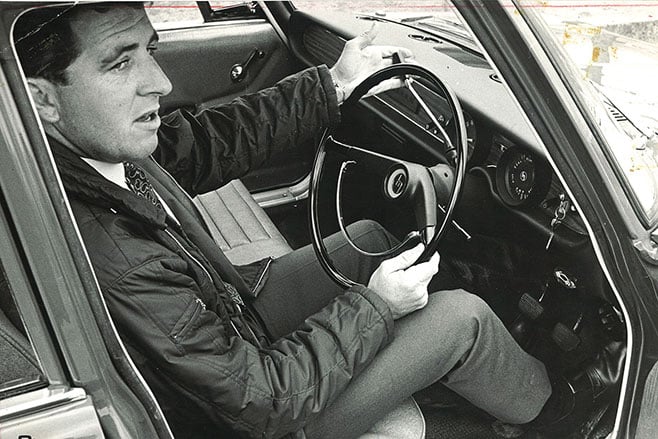
Michael Stahl Freelance motoring journalist In these days of a tweeted press shot and a hashtag, it seems quaint to reflect on a motoring writer who really was passionate about cars and motor sport, who raced and rallied competitively at a national level, whose industry acumen could have steered a car company – and whose writing was simply up with the best in any genre.
Bill Tuckey was the package, the business. For all his hard won knowledge and skill, he was a fearless innovator. He revolutionised motoring journalism – not least through the pages of our beloved Wheels – by introducing out-there irreverence and entertainment to the dry and Pommy-proper arena of motoring reviews. Contemporaries tried to emulate it; a younger generation basked in it. Some of those Aussies took Tuckey’s disruptive influence international.
He was deserving of comparison, on many levels, with Barry Humphries. Tuckey was writing gonzo five years before Hunter S Thompson.
Bill long pre-dated me at Wheels, but I had the pleasure of seeing him regularly at Bathurst and on car launches, most particularly through the 1980s and ’90s. I’m unembarrassed to admit that I was always in awe of his having the whole suite of talents: the writing, the humour, the driving ability, the eager ear of the industry. As a newcomer, but not a stranger (he was a friend and contemporary of my father, Max), Bill often encouraged me and occasionally upbraided me. I know that I grew as the result of both.
I can recall one rare occasion on which I saw through the Derryn Hinch-like armour of ego. A group of about half a dozen Australian journalists were on a five-day drive through Europe in Jaguar XK8Rs. We were in Italy, near Lake Como, about to turn in for the night when we received word that Bill’s elderly mother had taken gravely ill in Melbourne. I suddenly saw in this colossus, this unflappable force of nature, such emotion and care as I’d never imagined existed in him, as he raced to arrange the first available flight.
More recently, in 2013, I was writing the feature story in celebration of this magazine’s 60th anniversary. Two figures, of course, loom large in Wheels: Tuckey and Robbo. Bill had suffered, in 2010, the first of a series of strokes, but I wanted more than anything for him to be able to contribute to the magazine’s major milestone.
Bill’s son Stewart described how Bill was as observant and sharp-witted as ever, but that he struggled to communicate. Using words, whether writing or speaking them, was the respirative process for Bill’s over-active mind. His frustration, Stewart told me, sometimes reduced him to tears.
With all that Biill Tuckey achieved, and the influence that he has had across our profession, no more need be said.
Harvey Grennan Former motoring editor, Sydney Morning Herald For half a century larger-than-life pillar of the motoring (and other) media, truly prolific scribe, industry icon, great companion on launch test drives on every continent. Bill can now swap notes with that other multi-talented great Evan Green.
Graham Moore Bathurst endurance driver Bill Tuckey, great guy, great writer, RIP.
Chris MullettPublisher, Motoring Matters Magazine GroupBill was indeed one of the true characters that created an enduring larger than life impression on all that came into contact with him. He belonged to an age of personalities based on immense personal knowledge and ability in motoring that has all but disappeared with the advent of the web. Cheers, Bill, for that final glass of red.
John Edds via Facebook That SCW piece that Bill wrote on the Lancia was a turning point for me as an 18-year-old. Bill changed my perception of cars so that I realised that there was a world beyond BMC, Holden and Ford. That I couldn’t afford a Lancia was irrelevant, but the 1200cc VW Beetle that took it’s place became every bit as good in my mind.
That vision of an early morning drive inspired me and scared the life out of me in an oversteering, swing axle-inspired moment. A fortuitous opposite lock twitch of the wheel saved me. Little skill, plenty of luck. Vale Bill Tuckey.
Bruce Bailey via Facebook Started reading Wheels in the mid-1960s, and Bill’s articles were one of the must reads. Tragic that someone like him should suffer such a fate. I just hope he burnt rubber on his way through the pearly gates.
Iain Rossiter via Facebook Devastating. Maverick in every sense. I grew up reading his brilliant articles and no-nonsense dry humour. One of the greats around the world. Rest in peace.
Mark Standen via Facebook I remember clearly Romsey Quints’ description of rallying, musing that he would worry that the umbrella in the boot would make dents every time he took a corner at speed. RIP.
Holden wishes to express its condolences to the Tuckey family after the passing of Bill Tuckey.Mr Tuckey was a true pioneer of automotive journalism, not just in Australia but globally.During his decorated media and publishing career, Mr Tuckey cr eated an original and engaging approach to motoring journalism, and a tremendous body of work.A long-time editor of Wheels Magazine and the man credited with creating the coveted Wheels Car of the Year award, Mr Tuckey was also responsible for covering some of the most pivotal moments in Holden’s history.Mr Tuckey also shared Holden’s passion for the race, having several starts in the Bathurst 1000.Our thoughts are with Mr Tuckey’swife Marcia, and children Stuart and Libby.
It was the prerogative of successive Wheels editors to provide a highly personal account each December of the cars they had driven that year.
For close to half a century it was an indispensable Wheels highlight: an end of year summary, usually by the editor, of all the road test cars that passed through the magazine’s garage in the previous 12 months.
Read Bill Tuckey’s classic story, as published in the December 1966 edition of Wheels.
Regular readers looked forward to this purely subjective account of the year’s cars that was inevitably personal and often biased. I know because, before I joined Wheels in early 1971, I was one of them. This was, I’d learned, where you found the often amusing truth.
Ian Fraser, who was editor from 1958-1962, created the idea in 1958 with Strictly Personal, in which Fraser, Doug Blain (later, like Fraser, editor of the UK’s Car magazine) and Pedr Davis penned their thoughts on the year’s cars. Bill Tuckey (1963-1968) expanded the feature and it survived well into the 1970s before, for reasons I don’t now remember, we shifted it across to the newly created Wheels Yearbook. It ran under various headings, most popularly the Beatles-inspired Hard Year’s Drive, before morphing into a series of Top Drives & Low Dives, lists in which the editors nominated the year’s best (and worst) cars.
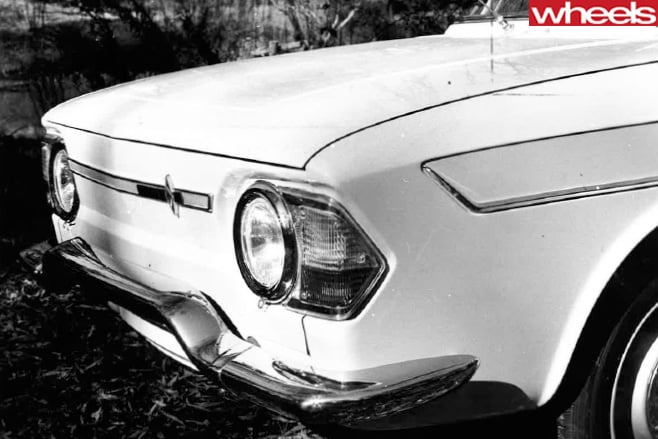
For Classic Wheels I’ve chosen a memorable Bill Tuckey variant, One Man’s Meat, from the December 1966 issue. The brilliant Tuckey, the most creative and influential of all Wheels editors, was in full flight, having “with some sense of horror” realised that he drove 52 cars during the previous 12 months. In the introduction to his terrific book And The Revs Keep Rising, former Wheels staffer (and Car editor) Mel Nichols wrote: “Bill’s writing was fast-paced, passionate, witty and above all evocative … Bill’s influence was profound.” Indeed it was.
In praise of the rear-engine Renault 10, Tuckey wrote: “Still the best car under $2000 in anybody’s language. It’s a crying shame that this great car is outsold by some perambulating cases of terminal gerry-building.”
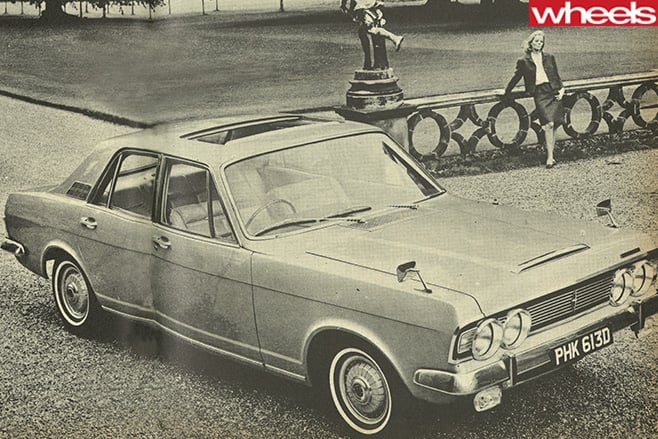
And “the other most shattering car of the time”, the Morgan 4/4: “It was freezing, as the hood was down, as all Morgan hoods should be. But there is nothing – nothing – on this earth that points and stops and goes and obeys instantly every twitch of any eyebrow like the Morgan … sure it rides like a brewery cart and steers like a truck.”
The tragedy is that Bill passed away earlier this week and will never write again.
“The Renault 4 is charming, in a rather farmyard sort of way. Romsey Quints thought it was enormous, but he’s like that” – Bill Tuckey, 1966
