
KIA is boldly going where few carmakers dare – to the bottom of the market. Targeting youngsters and empty nesters, the Picanto is a Micro Segment hatch with massive value appeal and a host of surprise-and-delight features.
WHAT IS IT? The smallest Kia to date, and a play for value shoppers. The Picanto arrives in just one specification: a 1.2-litre auto with five doors, a five-star crash-test rating, and a seven-year warranty, fixed-price service, and roadside-assistance scheme. All for under $15,000 driveaway.
WHY WE’RE TESTING IT The Kia Picanto has been specified and priced to make a massive splash in the Australian Micro class, and it is expected to boost the segment significantly as a result. Sadly, most of the good ones have failed (namely, the deceased Volkswagen Up and Fiat Panda), and what remains bar the Suzuki Celerio and Holden Spark just aren’t good enough. We’re hoping the new Korean entrant will change all that.
MAIN RIVALS Fiat 500, Holden Spark, Nissan Micra, Mitsubishi Mirage, Suzuki Celerio
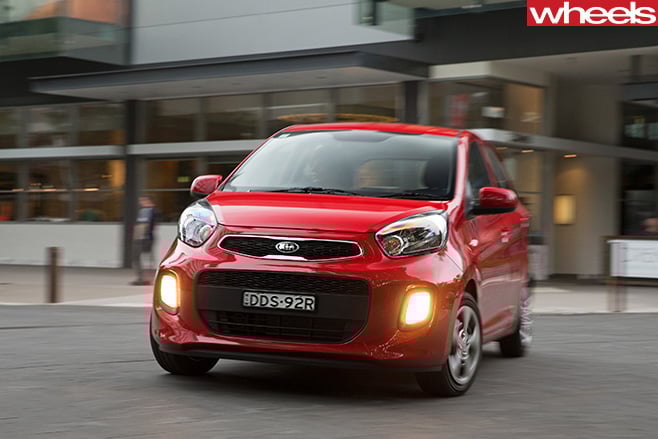
PLUS: Styling, agility, pricing, value, dashboard, compactness, agility, dynamics MINUS: Jittery ride, unsupportive driver’s seat, no manual option, no AEB
THE WHEELS REVIEW IF THIS Kia cannot reverse the slide of the Micro Car segment, then nothing can.
That’s our verdict after three intensive days behind the wheel of the new-to-Australia-only Picanto.
Released in Europe during 2011, this second-generation sub-B supermini has long been regarded as one of the South Korean company’s better offerings, and we’re glad to see its pert rump on local soil at last.
To ensure maximum impact, Kia has brought in just one spec, at a headline price of $14,990 driveaway – and that’s including automatic transmission. That might not sound so sensational, since the Picanto’s two closest rivals – Suzuki’s Celerio and the Mitsubishi Mirage – both offer their respective equivalents for up to $1000 less.
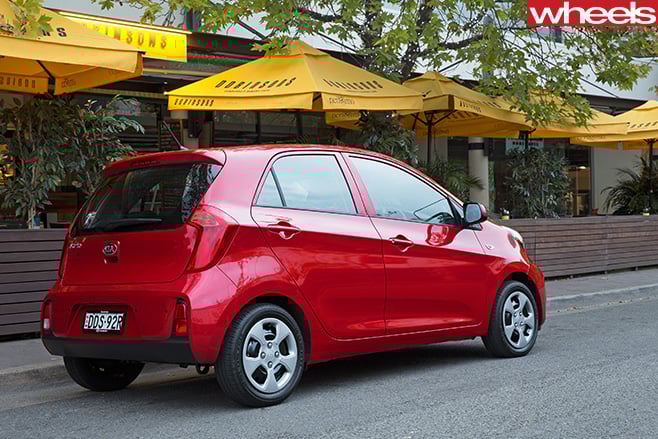
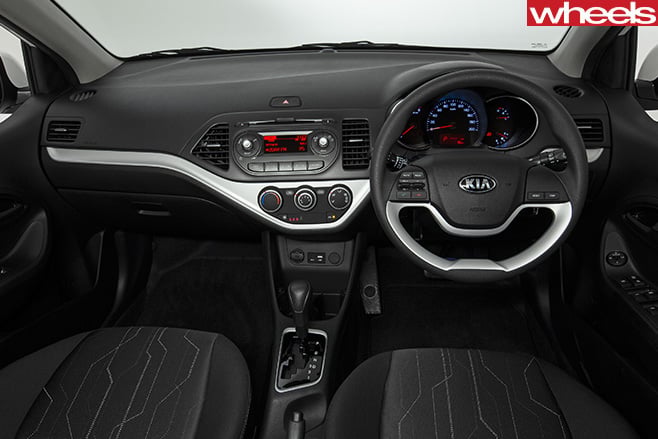
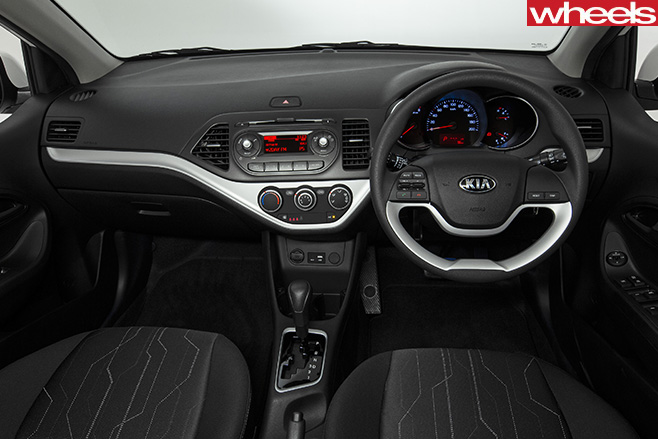
Keeping in mind its compact and very city-friendly dimensions, the Picanto’s cabin does a fine job accommodating four adults front and rear, with ample headroom, sufficient space for knees and legs (rear-sited feet can tuck underneath the front seats), and enough width. The dash is cheerfully presented, with very old-school Mazda 3-style recessed dials, pleasing contrasting colours and trim, and a spunky little steering wheel complete with remote audio and phone controls. Excellent ventilation, a plethora of storage solutions, and an efficiently sized cargo area (ranging from 200 to a low and flat 605 litres with the split-fold backrest and cushion tilted forward) further boost the practical and inviting cabin’s appeal.
Unfortunately, while the right driving position is possible despite the absence of telescopic steering, an oddly angled seat-height adjustment, which seems to tilt only the front half of the cushion, meant that this particular tester could not find it. Aching thighs after even a short stint also highlight a possible lack of proper support.
That’s a pity, because the Picanto’s ride around town is cushy, with plenty of suspension travel over bumps. Throw in well-weighted yet fast steering and a tight turning circle, and it is clear that this hatch is very well matched to city and urban environs.
Note, though, that the downside to all this dynamic alacrity is an unsettled (if strangely quiet) ride, wearing Kumho Solus 165/60R14 rubber.
Finally, and this is the elephant in the room, what of the 1.2-litre four-cylinder petrol engine’s performance and economy when paired with a very outmoded-sounding four-speed torque-converter automatic transmission?
Okay, on finding out about the sweet five-speed manual gearbox’s non-availability for Australia after enjoying it so much in the UK at the first drive event there last September, we wanted to hate the self-shifter.
However, the engine is a zingy and lusty sweetheart of a thing that’s keen to rev and pulls reasonably hard doing so, and so it seems to mate surprisingly well with the auto ‘box. Left in Drive around town, the Picanto steps off eagerly, reacts to throttle inputs quickly, and is utterly unobtrusive doing so.
That we averaged 7.0L/100km thrashing it around underlines the package’s overall efficiency to boot.
All-up then, there Picanto turns out to be a good little thing, appealing well beyond its obvious low pricing and high specification attributes. Better front seats, a more settled rural ride quality and a manual gearbox option would be welcome, but Kia ought to be applauded for providing us with such a charmer. The next one – also earmarked for us – ought to be a blinder.
If Aussies don’t snap up the anticipated 300 units each month, don’t blame the baby.
SPECS Model: Kia Picanto Engine: 1248cc 4-cyl, dohc, 16v Max power: 64kW @ 6000rpm Max torque: 120Nm @ 4000rpm Transmission: 4-speed auto Weight: 994kg 0-100km/h: 12sec Fuel economy: 4.3L/100km Price: $14,990 driveaway On sale: Now
Commercial utes continue to pick up trade in Australia. They accounted for 15 per cent of the total new-vehicle market last year, with 2015 4×4 ute sales more than double what they were in 2005.
Models such as the Toyota HiLux, Ford Ranger, Mitsubishi Triton and Holden Colorado are even regular visitors to monthly top 10 sales charts.
The appeal of these ‘one-tonne’ vehicles – so labelled due to their average payload-carrying capabilities – has increased as households have come to appreciate the dual-purpose abilities of the dual-cab ute variant that can be a workhorse during the week, and a family/lifestyle vehicle on weekends.
With accessories proving to be vastly popular, and enhancing the profitability of these models, it’s no wonder more manufacturers are looking to enter the segment.
Here’s WhichCar’s guide to five new utes that are on the way.
MERCEDES-BENZ GLT
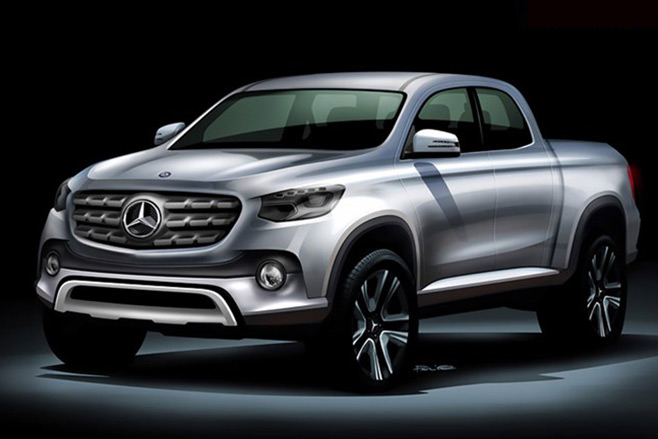
A ute featuring a three-pointed star is not that unexpected when you consider the German luxury brand already offers a vast commercial vehicle line-up. The model expected to adopt the GLT badge will be based on the Nissan Navara, and is due about 2018.
Both single-cab and dual-cab versions are possible, with both aiming to capitalise on the trend towards utes with more premium-looking interiors and car-like dynamics.
Engines are set to comprise four-cylinder and V6 turbo diesels.
A high-performance AMG variant is less likely than an AMG-line variant featuring sportier bodywork and accessories.
Testing will incorporate Australia in 2017.
RENAULT ALASKAN
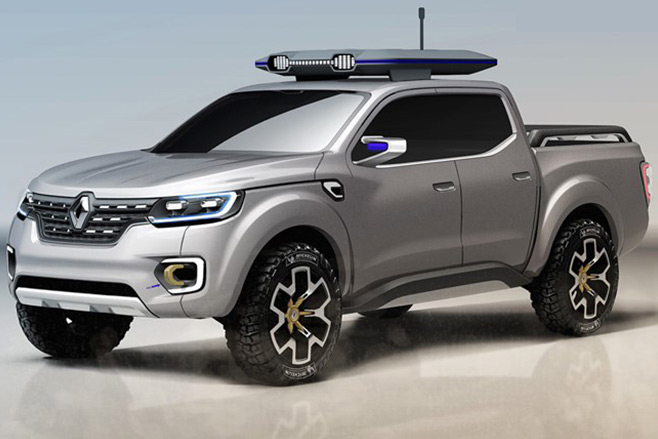
Renault will be the first of the French brands to launch a modern dual-cab ute. A production version of the Alaskan concept shown last year will appear by mid 2016.
Like the aforementioned Benz GLT, it will share its underpinnings with the Navara – though it makes a more natural twin owing to the Nissan-Renault alliance.
The showroom Alaskan – the final nameplate hasn’t been confirmed – is said to stay faithful to the concept that combines a classic dual-cab shape with the Renault family ‘face’.
Renault is already claiming its five-seater ute will offer best-in-class fuel economy from the 2.3-litre four-cylinder twin-turbo diesel borrowed from the Renault Master van.
Body styles will mirror those of the Navara, including a 4×2 (rear-wheel drive) single-cab as well as 4×4 (all-wheel drive) dual-cab.
HYUNDAI SANTA CRUZ
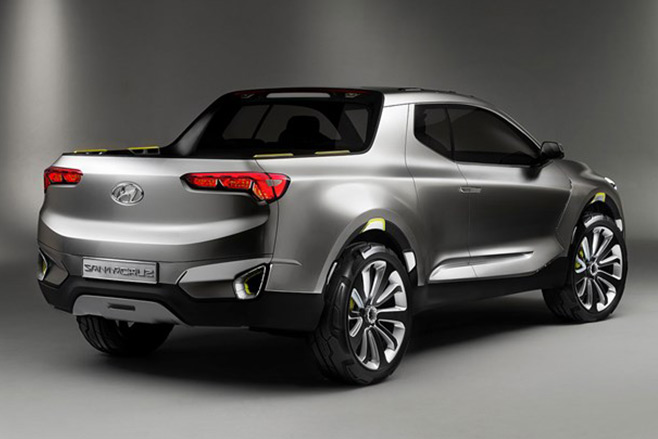
Korean car maker Hyundai showed off a Santa Cruz ute concept at the 2015 Detroit motor show, though a production green light has yet to be illuminated.
It’s also unclear whether the model will be available initially in right-hand drive, with the US marked as the key market for sales.
Waiting several years is unlikely to be worth it for those requiring a work ute. Hyundai says towing capacity, payload and ground clearance are not priorities for its tray-backed vehicle as it wants to target SUV and sedan buyers looking for greater utility without the driving-experience compromises associated with ‘trucks’.
Indeed, the Santa Cruz concept was based on the platform of Hyundai’s compact ix35 SUV (since replaced by the larger Tucson).
Hyundai Australia says it will look at the business case for the Santa Cruz, while it would seem strange if sister company Kia weren’t to offer a rebadged and restyled twin.
JEEP WRANGLER UTE
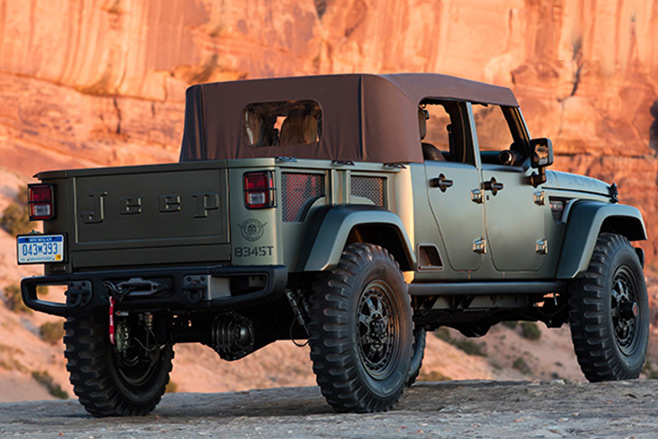
The next-generation of Jeep’s iconic Wrangler off-roader will spawn a ute version that’s expected in 2018 and already confirmed for Australia.
It’s not difficult to imagine a four-door Wrangler ute, thanks to the Crew Chief 715 concept the US off-road brand showed in 2015. A seven-slot grille and hybrid tyres (rather than military-style rubber) would be among notable changes, though.
A Wrangler foundation means the Jeep ute would feature body-on-chassis construction and live (heavy duty) axles that would ensure it has the off-road capability associated with the brand.
It will also benefit from Jeep’s determination to improve the Wrangler’s fuel efficiency with reduced vehicle weight and engines that include a four-cylinder turbo.
PEUGEOT/CTIROEN UTES
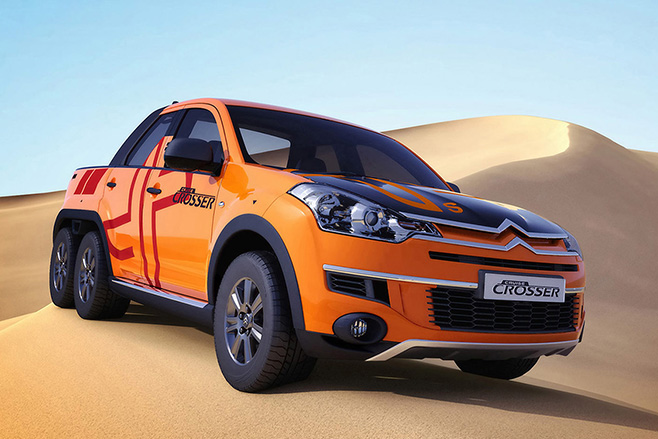
Few details are known about these French twin-under-the-skin utes, though they have been confirmed by the PSA (Peugeot-Citroen) Group as part of a five-year model expansion.
While the two brands are both unexpected players in the ute segment, Peugeot did offer a 504 ute back in the 1980s and 1990s.
Peugeot and Citroen will reduce development costs by linking up with another manufacturer to base their utes on an existing model.
A current light-commercial-vehicle tie-up with Toyota in Europe has made the HiLux a strong favourite to be the donor ute.
I have a dirty little confession to make: I’ve never really liked driving on German Autobahns.
I know, I know, that makes me some kind of crumble-crutch when we all know – hand on hearts – that the Autobahn is one of the last places on earth that isn’t a dry salt lake where you can go absolutely balls-to-the-wall and not wind up in gaol… necessarily.
True, but it’s always occurred to me that you might end up toe-tagged. While it’s a fact that shunts are relatively rare on Autobahns, when they do happen, they only really come in one size. I’ve seen horrendous footage of high-end German cars pin-balling down the ’bahn for kilometres when it suddenly goes all Pete Tong at two-dollars-fifty-and-change.
The problem, as I see it, is a simple one of a generation gap. Which is to say we’re dealing with a rather deadly combination of 1930s run-off and 2015 velocities. See, when the Austrian painter was doing his own, perverted, version of stopping the boats, it didn’t matter quite so much that the Armco was the emergency lane. When an 1100cc VW Beetle had a top whack of maybe 130km/h, the narrow lanes and lack of run-off was less of a problem.
Now, however, when you’ve got Guido steaming along at 270 in two tonnes of Panzerwagen, texting his schmaltz-burger order through to the restaurant up the road, things are a mite different.
Now, I know what you’re going to say: aren’t German drivers attentive and skilled, and don’t they have the right attitude to staying out of each other’s grilles? Well, they did. Once upon a time. But I’ve just been back over to the Fatherland and I did a few hundred kliks of Autobahn work, and, mate, things have changed.
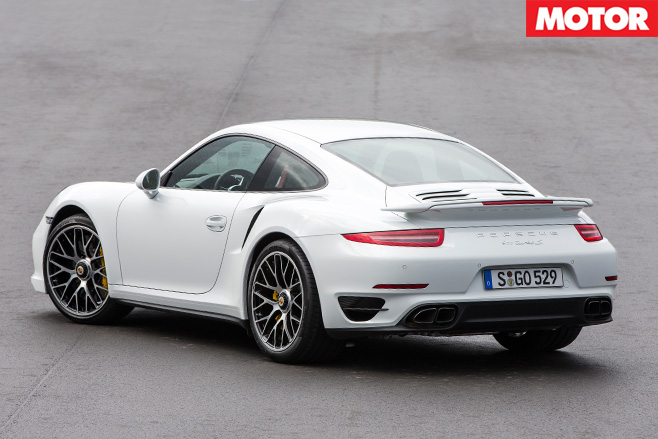
Now, you’ve got all sorts of dungers and snoozers inhabiting the fast lane, all pretending to be overtaking something, but usually just dawdling. And where, just a few short years ago, a quick flash of the halogens would clear a path, these days it just warms the paint on the bootlid of the Honda Civic in front of you. Who isn’t watching his mirrors anyway. Autobahn travel is now, as my colleague observed, like driving in Queensland.
The rednecks out there will doubtless claim that it’s immigration that’s the problem, and that gypsies and asylum seekers shouldn’t be allowed on Autobahns. But I don’t think that’s the case. The cars I saw making nuisances of themselves were all German registered and didn’t appear to be horse-drawn. Instead, I reckon it’s probably just a case of the authorities having stopped policing the fast-lane rule and the fact that Germany is not immune to the scourge of Gen Y-style boorish behaviour.
The tragedy, of course, is that Autobahns no longer offer the chance to cover a lot of ground extremely quickly. And for my money, that’s all they were really good for in the first place.
And what happens when people can’t use something like a 911 Turbo for what it was designed? They’ll stop making cars like that, that’s what. And I’ll blame 21st-century-Autobahn bad manners when that happens. Trust me, I didn’t like Autobahns before and now I like them even less.
A new look and new name, but Mercedes’ hulking seven-seater lags behind the competition.
WHAT IS IT? An updated version of Mercedes-Benz’s full-size, seven-seat SUV, previously known as the GL. Now called GLS because it is S-Class size – similarly, the GLE is E-Class size and the GLC is C-Class size – this mild update brings styling tweaks front and rear, minor drivetrain changes and an upgraded interior.
WHY WE’RE DRIVING IT To see if these updates can transform the GLS into a genuine rival for newer and cheaper seven-seat rivals such as the Audi Q7 and Volvo XC90.
MAIN RIVALS Audi Q7, Infiniti QX80, Lexus LX, Mercedes G-Wagon, Range Rover, Volvo XC90
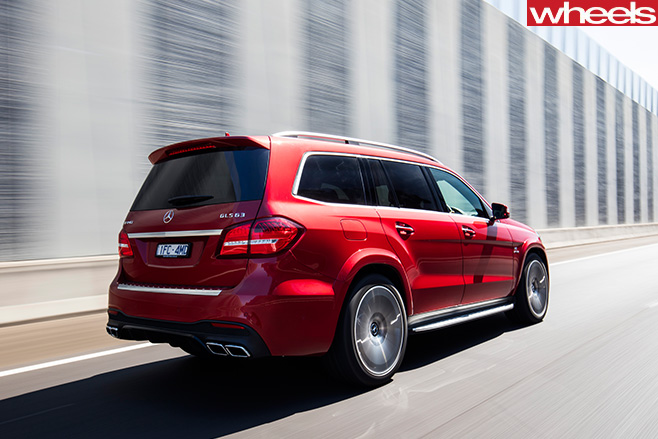
PLUS: Great drivetrains; imposing looks; interior space; sound and power of the AMG 63 version MINUS: Mighty big; mighty heavy; expensive; dated interior; dynamics
THE WHEELS REVIEW DRIVING a GLS delivers a sensation that only very tall and muscular people must experience – you lord over almost everything else. And it’s not a friendly lording, either, like you might receive from a gentle giant, but an aggressive one that shouts, “Get out of my way”.
A big part of this is down to the GLS’s colossal, US-friendly size, backed up by design tweaks that now turn the aggression up to 11.
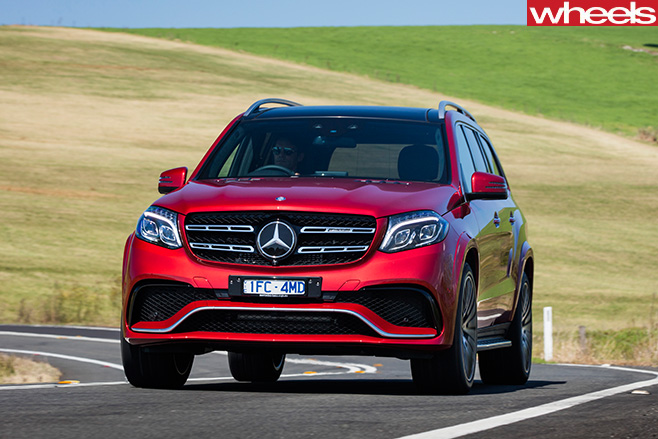
The update also brings a new name. Previously called GL, Merc’s biggest SUV is now known as GLS, reflecting that it’s S-Class size (just as the GLE is E-Class size, the GLC is C-Class size and so on).
There are mechanical changes, too. Non-AMG variants score Merc’s smooth-shifting nine-speed automatic, there are slight power increases for the 500 and 63, and the air suspension has been fettled to improve ride comfort and handling. There’s even the option of an Active Curve System (standard on 350d Sport, 500 and 63) to reduce bodyroll when the road gets twisty.
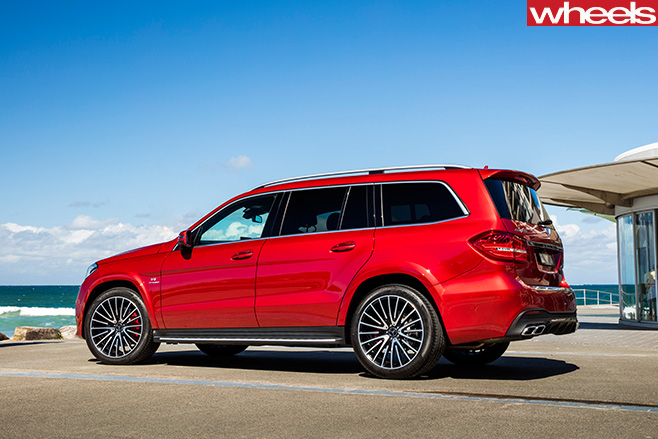
Things improve in models fitted with the active anti-rollbar system, but there’s still no escaping the vehicle’s size and weight. The ride has a nice suppleness but doesn’t deliver the pillowiness you might expect.
Inside, there’s a new instrument cluster, new steering wheel, redesigned centre console and larger 8.0-inch tablet-style central screen running Merc’s latest infotainment system, but while the overall ambience is suitably luxurious, it lacks style and elegance.
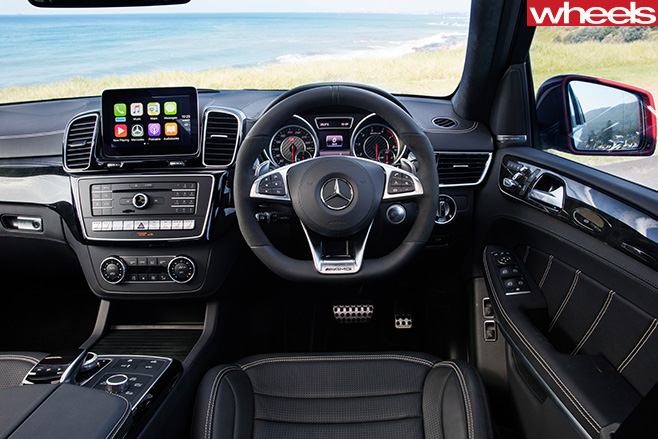
So the GLS is practical, enormous and comfortable, but can’t match newer – and admittedly slightly smaller – rivals like the Audi Q7 or Volvo XC90 for dynamics, interior opulence or value (thanks to a higher starting price of $116,900). It’s a welcome improvement, but the GLS lacks the luxury and execution we’ve come to expect from the three-pointed star.
Looks without the thirst
If you want the aggressive AMG look without the inevitable AMG thirst, Mercedes now offers a new Sport pack for the entry-level GLS 350d. At $135,900 ($19,000 more than the regular 350d), the 350d Sport adds the active anti-roll bar system, an AMG body kit and leather interior, larger 21-inch wheels, tyre-pressure monitoring and metallic paint. Every GLS can also be optioned with an Off-Road Engineering package for $3600 that adds a low-range gearbox and centre diff lock, increased ground clearance and a 600mm fording depth.
SPECS Model: Mercedes-Benz GLS 500 Engine: 4663cc V8 (90°), dohc, 32v, twin-turbo Power: 335kW @ 5250-5500rpm Torque: 700Nm @ 1800-4000rpm Transmission: 9-speed automatic Weight: 2445kg 0-100km/h: 5.3sec (claimed) Fuel economy: 10.9L/100km Price: $161,900 On sale: Now
It all started in 1966. Post-war optimism was in the air and Japan’s industrial momentum was in full swing. It was then that Toyota gave birth to a new small car and what would eventually be the most successful line of passenger vehicles in the world. The Corolla, meaning “crown of a flower” made its way to Australia in June of 1967 and received instant local acclaim.
1ST GENERATION 1967—1970
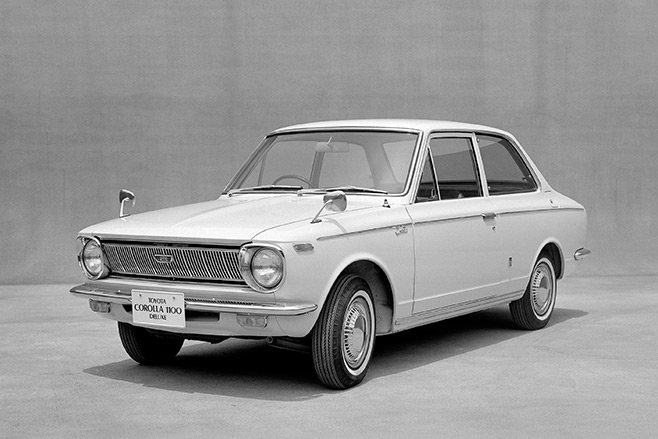
The little Toyota was one of the first Japanese imported cars to really make waves here in Oz. Up until the late 60’s, the modest Australian was (for the most part), restricted to either big-and-heavy or English-and-unreliable car options. The Corolla was priced competitively, was easy to drive and was consistently reliable. No, it wasn’t winning a drag race any time soon. But for efficient and stylish transport, the Corolla was hard to beat.
The car entered the market as a two-door sedan with a 1.1-litre engine. But before long, Australian assembly of the Toyota began and more versions were added to the range. Various body styles quickly became available, as well as different engine and trim options.
2ND GENERATION 1970—1974
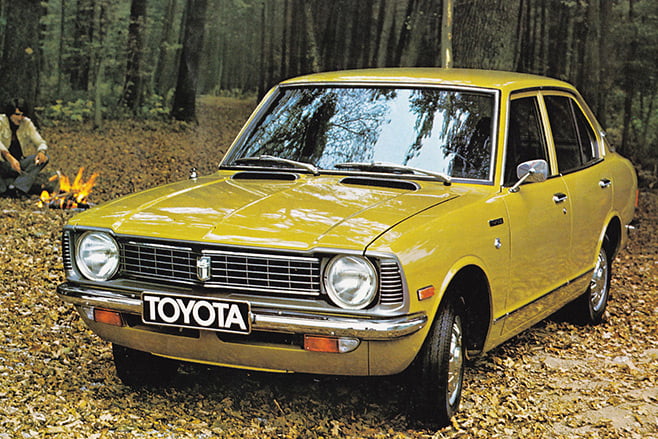
The second generation ‘Rolla was exteriorly and interiorly much larger than its predecessor. As demand grew, the car became available as a four-door wagon, a coupe and even a panel van. By 1974, the Toyota Corolla was the best-selling car in the world.
3RD GENERATION 1974—1981
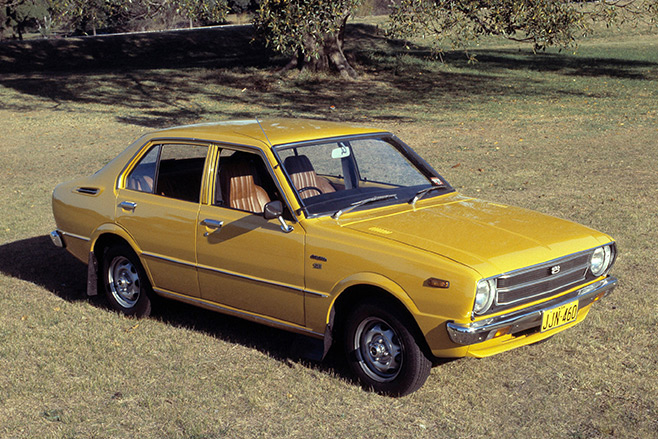
Hot on the heels of the brand’s ‘best-selling’ title, Toyota released the third generation Corolla. In keeping with the trend, the new car was significantly bigger than its predecessor. With added size came added weight, and the small four-cylinder motor struggled to keep up. Fortunately, in 1978 Toyota responded to this issue with a more powerful, 1.3-litre engine.
4TH GENERATION 1981—1985
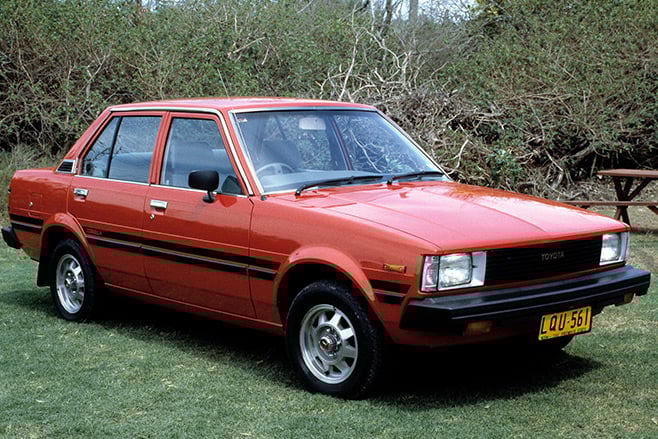
The fourth generation came with a whole lot of new advancements. Weight and size increased again, but so too did the level of safety tech and durability. The car was far more spacious, comfortable and was an all-around more refined version of the well-established Corolla brand.
In 1983, the fourth-gen Corolla was heavily upgraded. Body styling changed, new cabin trim was featured, handling was improved and the option of a more powerful engine was added.
5TH GENERATION 1985—1989
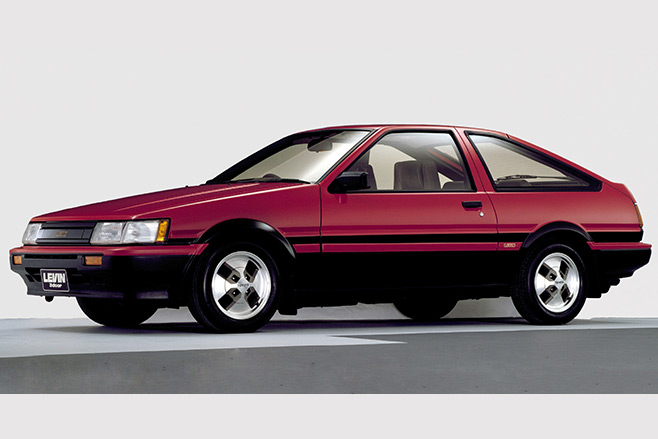
Up until 1985, every Corolla was rear-wheel-drive. The fifth generation of Corolla saw most of the range switch to a more cost-effective front-wheel-drive layout, along with many other similarly budget-conscious vehicles. However, the Corolla Sprinter released in 1986 remained rear-wheel drive and became arguably the most notable Corolla ever. It was a top-of-the-line model, introduced in Japan with the most powerful engine yet; a twin-cam 1.6-litre motor with fuel-injection. To handle the added grunt Toyota added upgraded brakes and suspension. Its chassis code was AE86, was later referenced by the release of the Toyota 86 sports car. Australian versions were not as powerful but remain sought after today.
6TH GENERATION 1989—1994
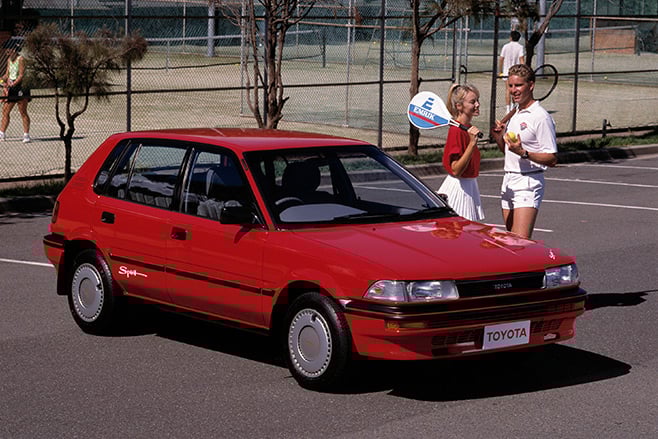
When the new Corolla was released in 1989, critics lauded it as one of the best yet. This is mostly thanks to the settling of fuel prices at the time, allowing Toyota to use beefier engines. This was the first all twin-cam range.
7TH GENERATION 1994—1999
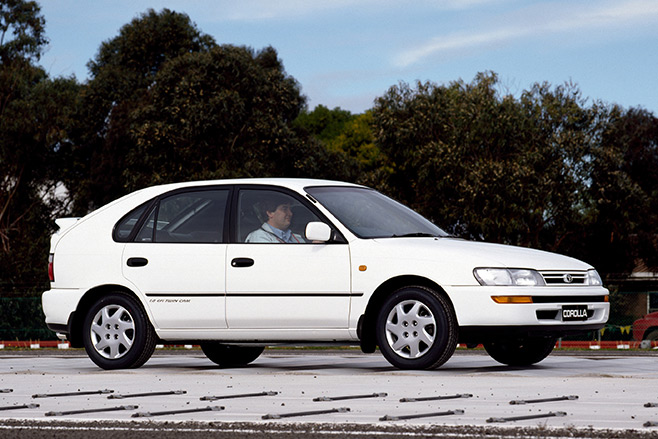
Although the next generation Corolla was late to arrive Down Under, it was the first to be built in Toyota’s high-tech Altona factory in Melbourne. Thanks to Toyota’s ‘trickle-down’ philosophy, this model sported many Lexus-derived developments that aided in comfort and durability. As a result of the brand reshuffling models, this was the last generation of its kind to be built in Australia.
By this time, the Corolla nameplate had overtaken the famous Volkswagen Beetle, and become the best-selling car in the world. Not bad, huh?
8TH GENERATION 1998—2001
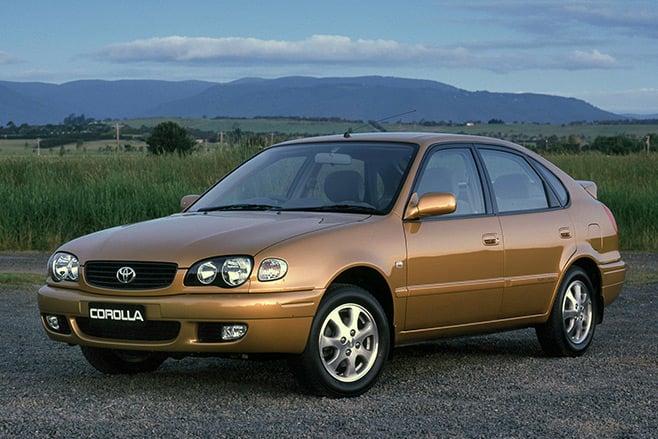
In the late ‘90s, Japan’s car industry was heavily affected by the recession. This forced Toyota to cut costs from its new Corolla. The new car was essentially a re-skinned version of its predecessor and was quickly recognised as such. Fortunately, as the last locally built Corollas left the showrooms, Toyota brought in more models, and extended the range. Some very competitive pricing reinforced the Corolla as a popular choice against its rivals.
9TH GENERATION 2001—2007
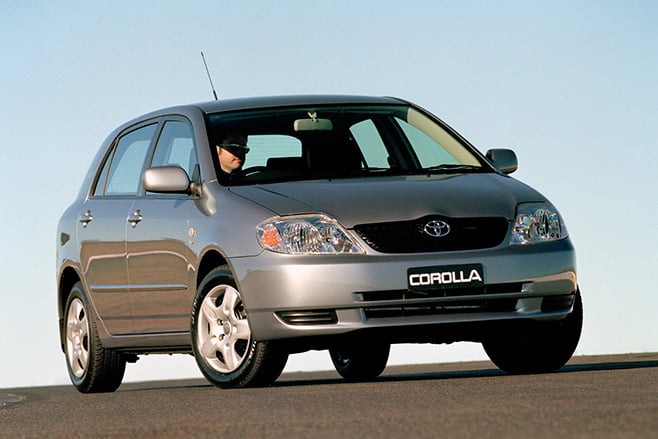
In 2001, the Corolla took on a new shape and style. Toyota reinvented the car, and in turn, reaffirmed its place in the market. The ninth generation came with comforts like power steering, central locking, power mirrors and airbags as standard. It was also much faster than a Corolla had ever been. This was accentuated by the later arrival of the Sportivo variant that was loaded with go-fast and look-good bits like big alloy wheels, side skirts and a powerful 1.8-litre engine. Despite no longer being built locally, the car outsold the Aussie-made Holden Astra with ease.
10TH GENERATION 2007—2012
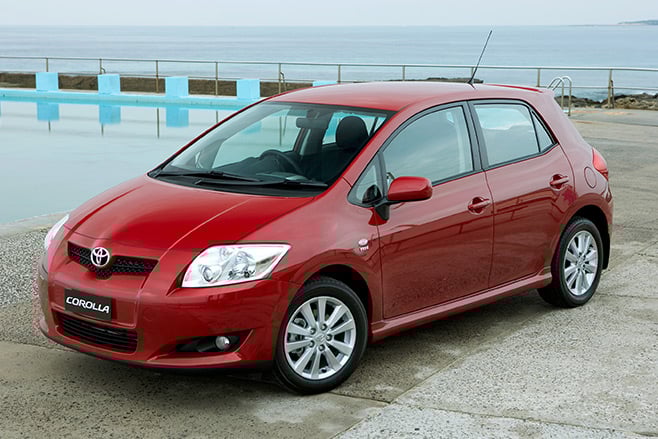
When the tenth generation landed, Toyota set its sights on the premium end of the small car segment. The Corolla competed with cars like the Mazda 3, the Ford Focus and the Honda Civic. The car was still sold in hatchback and sedan variants, but a wagon option was no longer available.
Safety was a big feature with this generation. Dual airbags and ABS brakes were standard, and an ‘Enhanced Safety Pack’ was made available. Those fitted with this pack scored a five-star European NCAP crash test result.
As the technology became available, the Corolla adopted features like MP3-capable sound systems with Bluetooth and USB/iPod connectivity. Higher-spec models even came with a 4.3-inch colour screen.
11TH GENERATION 2012—CURRENT
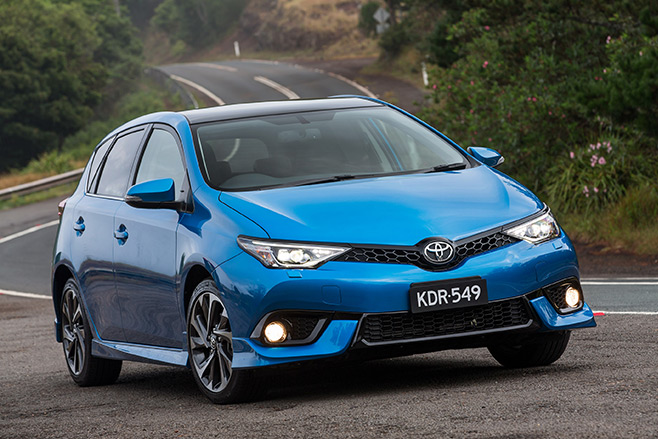
That brings us to the latest and greatest. Launched in 2012, the current generation has been updated externally since then, though in all guises it looks much sportier than ever before. The current car is equipped with all the creature comforts you’d expect from a modern car, and has been awarded a five-star ANCAP crash safety rating. For more information, check out our review of the latest Toyota Corolla.
After half a century, and over 40 million sales worldwide, the Toyota Corolla is still going strong. While it may not be the most romantic vehicle out there, the Corolla has always remained true to itself. It has consistently done what it has set out to achieve, and there is beauty in that. Here’s to another 50.
There are a lot of things in life you could do without – a 70-inch flat screen, half a packet of Tim Tams before bed. BMW’s new M6 coupe also offers a good lesson on superfluity.
When the car debuted it wasn’t short on spice, peppering the pavement with 412kW and 680Nm. The Gran Coupe we tested atomised 80-120km/h in two seconds flat. For a package that weighs 1875kg, we decree that’s plenty-o-grunt.
Munich didn’t agree, because sometime later it announced it would move the Competition Package – which increases output by 11kW – to the M6’s standard equipment list. More recently, BMW has allowed its 4.4-litre twin-turbo V8 engineers to rummage through Schwarzenegger’s gym bag again, fiddling the Competition Pack to conjure up another 18kW and 20Nm. Meanwhile its suspension package and steering have been tweaked to suit.
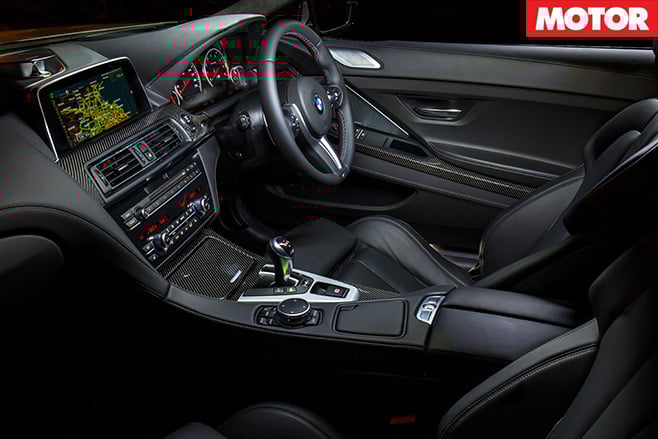
Notice we say the tyres try. Even at low speed, squeeze the throttle with a touch of steering lock and the chassis will gyrate a mite. Because the car’s full 700Nm is available from just 1500rpm, you’re going to see the ESC light a lot. This is a reminder of the respect the car commands when hustling it down a straight stretch.
Throttle pinned, the M6 is maniacally fast. The engine is a relentless source of rocket-like thrust, endowing the M6 with an appetite for triple-digit speed. It chews through the ratios as fast as its dual-clutch can serve them.

Thankfully, there’s enough grip to make serious progress in bends, provided you’re smooth and patient with inputs. Surrounding its gear lever are four buttons which let you alter different paradigms (steering, throttle response and damping) of performance, and the cabin is an Alcantara- and leather-drenched delight.
The M6 is made to swallow long, fast stretches of road in sublime comfort. But unfortunately for Oz, such things are few and far between. For that, BMW’s super sedan makes a big impression, but little sense.
4 OUT OF 5 STARS
SPECS
Engine: 4325cc V8, DOHC, 32v, twin-turbo Power: 441kW @ 7000rpm Torque: 700Nm @ 1500rpm Weight: 1850km 0-100km/h: 3.9sec (claimed) Price: $292,600 Pros: Gorgeous looks; Apollo 13-esque thrust; exquisite interior and stereo Cons: Dull steering; feels a little numb; no Autobahns in Oz
FORMER racing driver Peter Williamson – who helped develop the in-car TV cameras that today dominate race coverage globally – has died in Taree, NSW, at the age of 78.
‘Willo’ became a hugely popular figure with his colourful in-car commentaries in those pioneering days, entertaining a whole generation of Bathurst fans as he talked his way through the races, seemingly without taking a breath.
The wisecracking car dealer in his quick, class-winning, Toyota Celicas let loose verbally at a sluggish radial-tyred Volvo and even had a crack at some big Chev Camaros, yelling: “Move you big Yankee thing!”
“I use a few one-liners during normal conversations so I decided when I first started doing the commentary (on Racecam) I’d just stick with a few one-liners, which worked out fine because they were so familiar to me I didn’t have to think too much about what I was saying,” Williamson told former Channel Seven commentator Mark Oastler.
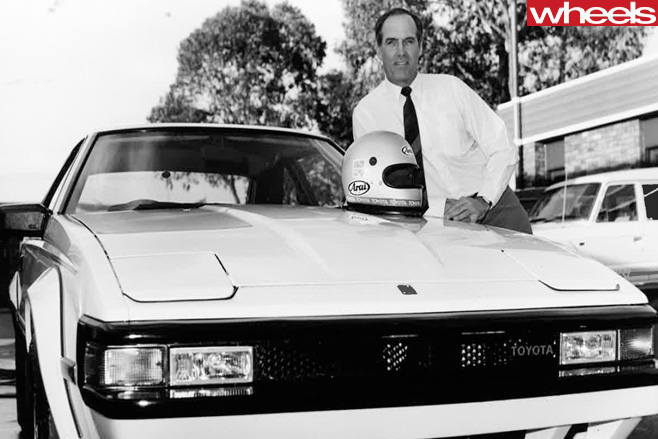
Seeing the publicity potential for his Liverpool car dealership, Williamson had been quick to take on the nascent technology, which was then quite weighty, when it was shunned by more prominent teams.
“Two blokes, John Porter and Peter Larsson, approached us at Amaroo Park when we were standing around at a barbecue and said they had this idea for an in-car camera, but Brocky and the rest didn’t want anything to do with them,” he told Oastler.
“I listened to what they had to say and it took me about 40 seconds to make a decision and we took it on.
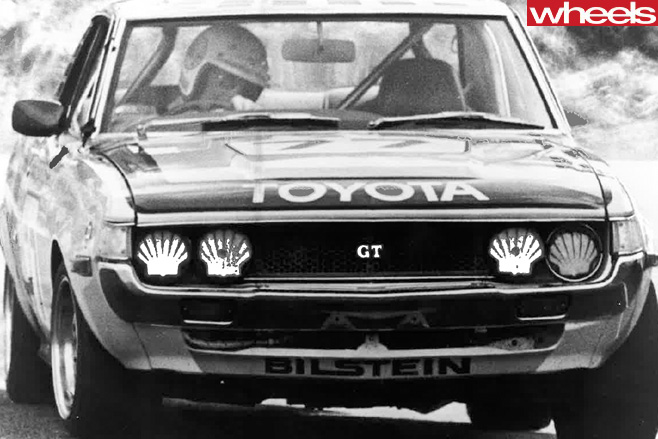
“Eventually Channel Seven agreed to fund its development and I remember going out to Oran Park every other week driving around and around with helicopters flying overhead as they experimented with different links and cameras and all that. It took a fair amount of time to work it all out.”
It didn’t harm the little Celica’s performance as Williamson won his class – not for the last time – and finished ninth outright, beaten only by eight V8-engined Torana A9Xs.
The publicity generated resulted in Toyota – which had previously discouraged him from racing the Celica – providing him with $250,000 a year in sponsorship.
After that successful debut for Racecam, the big teams were knocking on Seven’s door wanting to be part of the action, and the technology soon went global.
Williamson’s ‘overnight success’ came 17 years after he started racing. He drew the curtain on his racing career in 1987, having also tried his hand at open-wheelers but being best remembered as a ferocious competitor in small-bore sedans.
Some car enthusiasts still loathe the automatic transmission, but these modern self-shifters are top-shelf units that even diehards can’t ignore.
Gone are the days of slow-shifting four-speed automatics in sports cars. We went through a brief era of the five-speed ‘tiptronic’ automatic, some with push-button steering wheel-mounted +/- buttons, but even John West would reject those.
Real advances came with the dual-clutch transmission design that dominates our top five, but there are also traditional torque converter automatics that hand out ratios as effectively as a casino card dealer.
1. Porsche 911 and Boxster/Cayman PDK
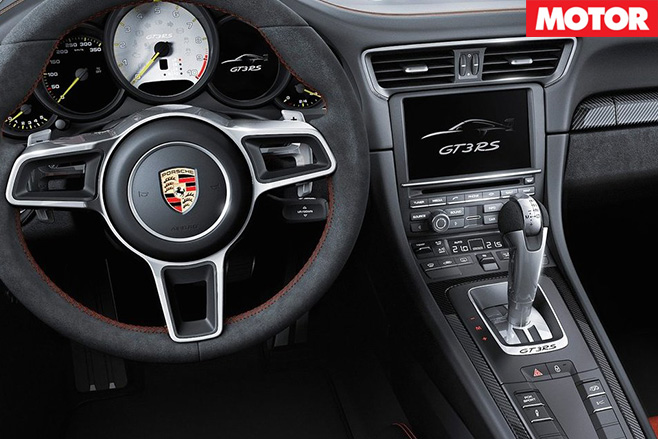
The combination of thumping upshifts, aggressive auto-timed downshifts and tightly spaced ratios is enough, but clearly such special Stuttgart engineering has resulted in transmission longevity too.
It’s best sampled beyond 8000rpm in a 911 GT3 RS, where you can even pull both paddles at once and uncouple both clutches to, “neutralise the driving behaviour of the vehicle when oversteering in a wet curve, thus redirecting additional cornering force to the wheels of the rear axle”.
2. Ferrari 458 Italia/Spyder/Speciale
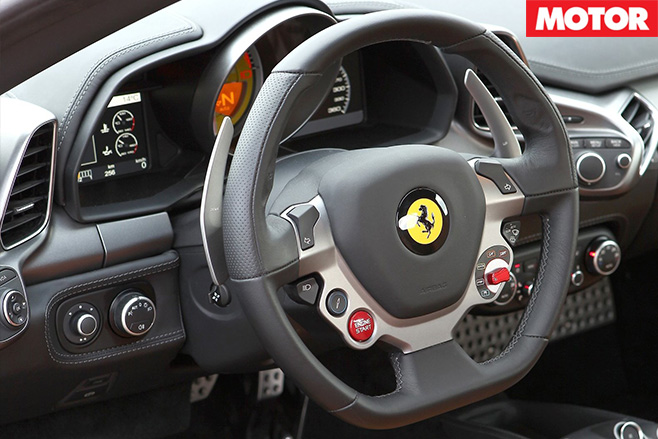
Via the paddles, gearshifts are simply instant, up or down, and the throttle blipping and rev-matching plays to the hands (or hearts) of such a screaming engine.
It is a clever thing in the torqued-up turbo California T, too, the computers feeding in power to achieve throttle linearity rather than turning boost on like a light switch.
3. Audi R8 S tronic
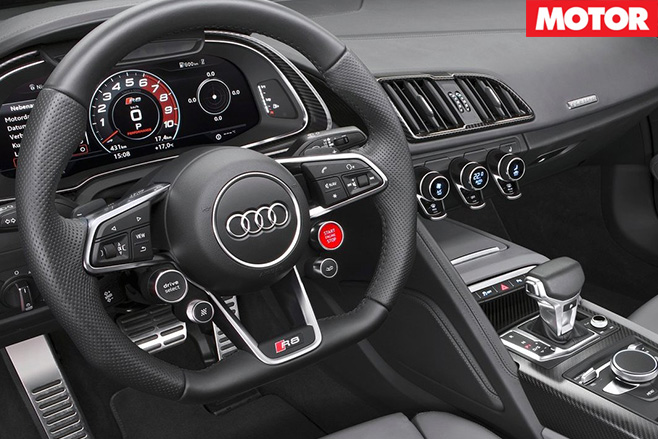
Fast forward to this year’s second-generation model and a seven-speed dual-clutch unit joins contemporary standards both technically and in driveability.
Audi has stuck with natural aspiration and a mighty V10 for R8 round-two and it is a fine partner for the three-mode S tronic gearbox to work with. In its most track-focused mode it is possible to leave the paddles alone and let the computers deliver immaculately timed shifts.
4. BMW 228i/330i/340i
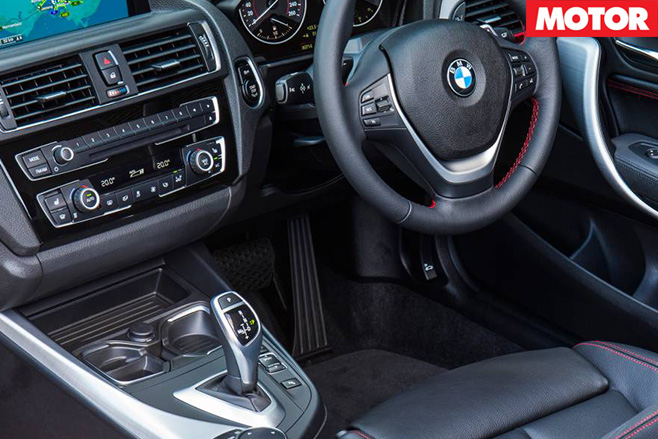
The way the manual mode allows downshifts that throw the tachometer right to redline is inspired in a world of autos preserving their insides with restrictive downshifting. If we hear one more beep one more time…
Unlike some dual-clutchers, this torque converter is impeccably smooth and smart even when trundling around town, yet the Clark Kent suit quickly gets stripped off when fast flying is called for.
5. Mitsubishi Evolution X
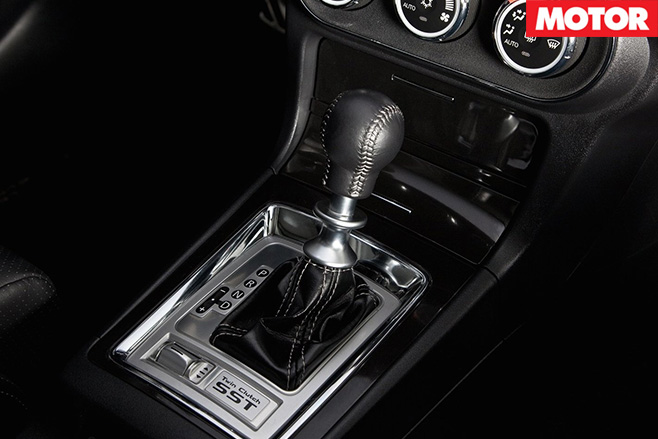
It may not be the smoothest unit around – although it was like sheen on parquetry flooring compared with the GT-R and Godzilla’s similar design that launched a year earlier – but flick a toggle switch to its most aggressive setting, and heaven awaits.
Aggressive is perhaps an understatement to describe how brutal and immediate the TC-SST was in handing out downshifts when under brakes coming into a corner. It was so perfect the paddles were virtually redundant – and this was years before more expensive cars mastered the beauty of an aggressive sports auto setting.
NISSAN has axed the Micra, Pulsar hatch and diesel-powered Patrol wagon and cab-chassis from its local range due to slow sales and tightening emissions standards.
It’s the Nissan Micra’s demise that’s most surprising, given Nissan launched a new version of the affordable city car in April last year and it’s since enjoyed strong sales through 2016.
Yet despite a 117 percent increase in sales and it being the second most popular model in its segment, Nissan says there is no business case to support the Micra.
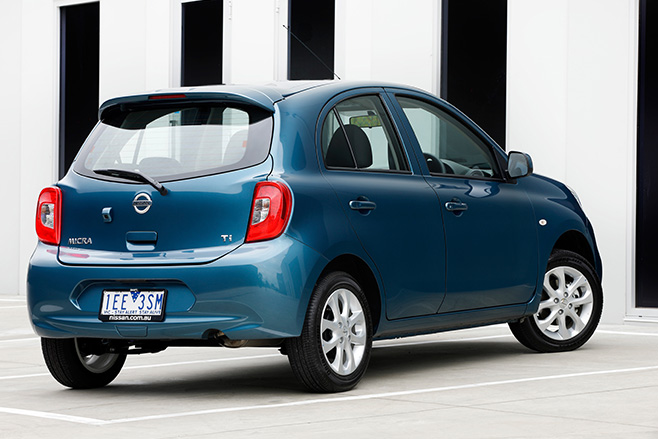
Year on year, overall Pulsar sales are down 32 percent.
Aging variants of the diesel-powered Y61 Patrol and UY61 Patrol cab-chassis have also bitten the dust and officially entered a “run out” phase.
Nissan says tightening emissions regulations and the arrival of the newer, V8 petrol-powered Y62 Patrol, which entered the Australian market in 2013, are the reasons for the Y61’s axing.
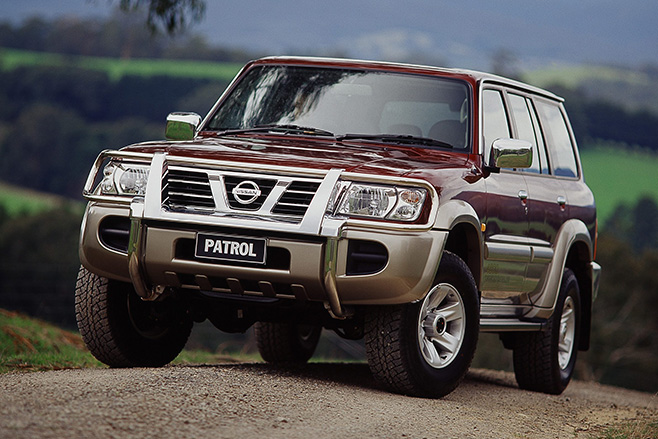
“These decisions are in line with our commitment to running a robust business in Australia,” said Nissan Australia’s managing director Richard Emery.
“Complete after-sales service and technical support for the affected models will continue to be available from our Australian authorised dealer network.”
The decision to axe the three models will pull about 6000 sales from Nissan’s tally in 2017.
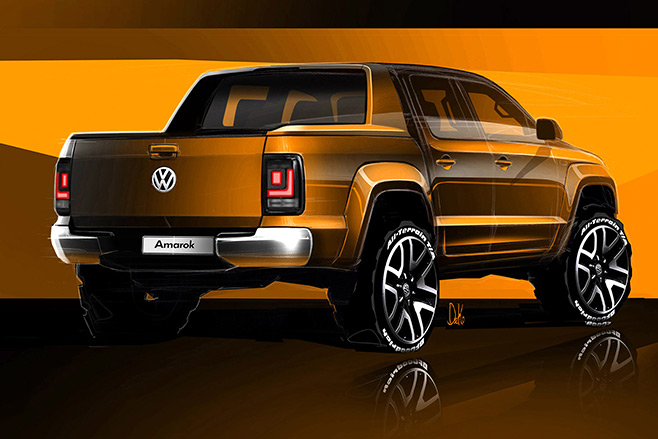
Changes to the headlights and grille bring Amarok into line with the latest VW styling seen on Passat, Tiguan and the Touareg concept to be shown at the Beijing motor show next week. Other exterior updates include a new scuff plate up front and restyled LED tail lights at the back. External dimensions remain the same at 5.25 metres long and 2.23 metres wide.
Inside is where the biggest changes appear. Volkswagen has concentrated on squaring off all design features and concentrating on horizontal and vertical lines. “They make the Amarok more attractive as a pick-up and also appeal to customer groups that until now have shopped in the classic SUV segment,” reads a statement accompanying the illustrations.
The instrument panel, dashboard and climate control vents are all redesigned. Volkswagen says, “Rejecting round contours makes the front and interior appear more striking and pronounced.”
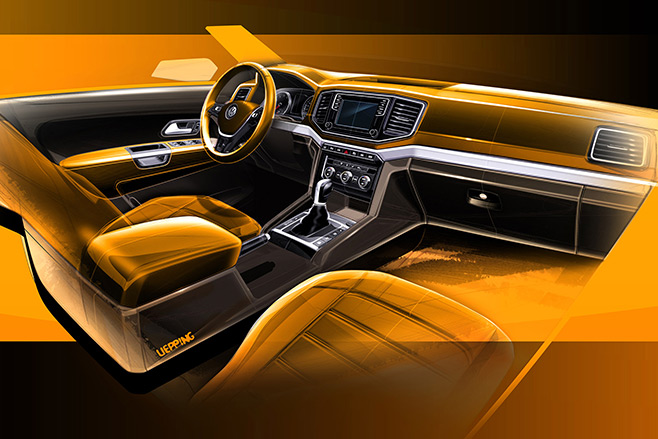
“Like previous iterations, the latest Amarok will combine passenger car-like on-road manners with full off-road capability. The Amarok fulfils all that is expected of a classic pick-up in both style and concept.”
In these initial sketches, big, square wheel arches house larger alloy wheels. They’re probably not representative of the actual wheel sizes we’ll see when the facelift is properly revealed, but Volkswagen has said the updated Amarok will feature rim sizes that are “considerably increased and strengthen the appearance of the power athlete.”
The refreshed Amarok is expected to go on sale in Australia before the end of the year.
At this stage no engine or gearbox changes have been mentioned. It is likely the existing 2.0-litre four-cylinder turbo diesel will remain, as will the six-speed manual and eight-speed automatic transmissions. Whether or not it will be joined by another engine option remains to be seen.
Find out more about the current model by reading our Volkswagen Amarok range review.
