
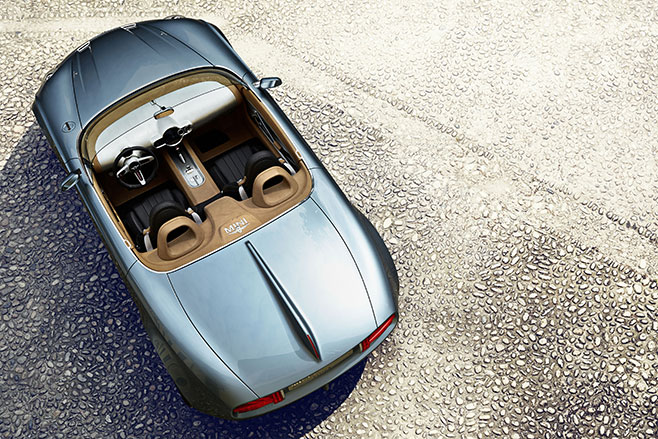
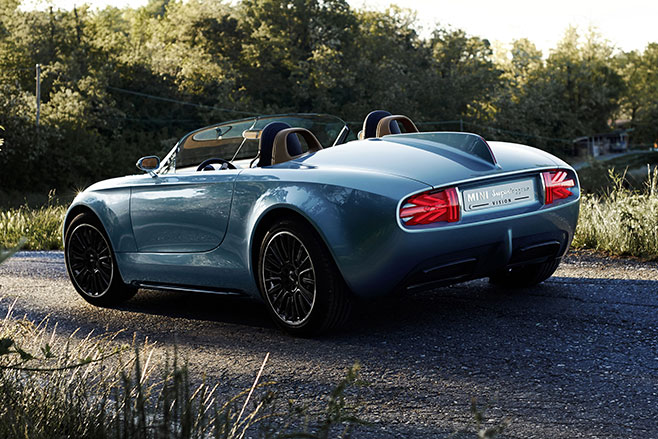
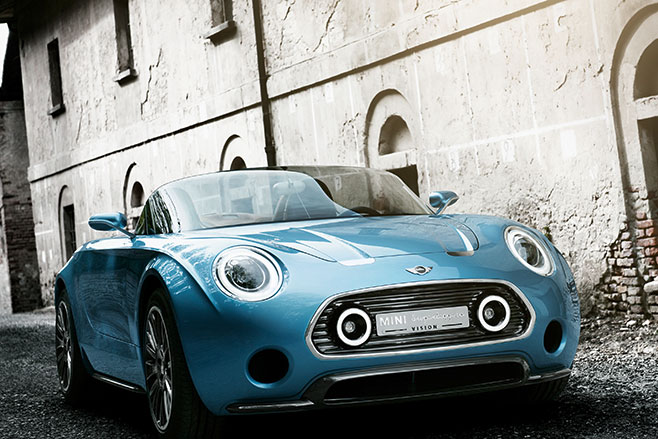
IT’S time to remember Mini’s sleek Superleggera concept, because in 2018 it could be on Aussie roads.
Mini Australia says the Superleggera – previewed at the Villa d’Este concours in Italy last year – has the potential to be a big seller Down Under given our insatiable appetite for performance models, should the two-seat roadster enter production in 2018 as expected.
“A Superleggera would make sense for Australia,” Mini Australia general manager Kai Bruesewitz said. “It’s a fantastic looking car and has received very positive reviews, but it just depends on our volume expectations.”
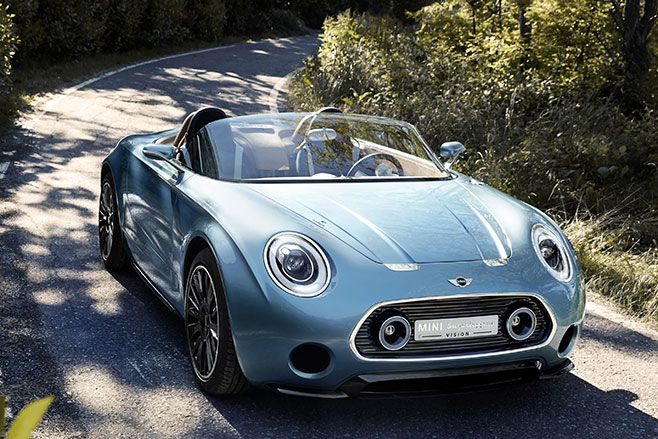
While Mini is yet to officially confirm the Superleggera will enter production, media outlets in Europe have reported it’s slated to enter production in 2018 and be powered by a range of three- and four-cylinder engines.
It’s understood the Superleggera will become the fifth model in Mini’s new, streamlined range that also includes the regular hatch (three and five doors), Clubman, Cabriolet and Countryman.
“It hasn’t been confirmed what the fifth model will be, but the Superleggera is the car most mentioned,” Bruesewitz said.
The Mini Oz boss is confident that the recent decision to cull its underperforming models – the Coupe, Roadster and possibly Paceman – will actually boost sales.
“We’re the fastest-growing mature Mini market in the world, which shows that we’re on the right track,” he said Bruesewitz.
“This is a big change in strategy for us, and makes more sense for the consumer because our cars will now be more identifiable.
“We dropped the Coupe and Roadster simply because they haven’t fulfilled our expectations and we decided to concentrate on a smaller number of models.”
Mini is also the fastest-growing volume brand in Australia this year, sales having increased 59 percent in the first half. Only luxury makes Porsche, Ferrari and Maserati have higher growth rates.
“The 59 percent growth figures are slightly skewed, because of the excellent sales of the new three- and five-door hatch, but we still expect to be 20-30 percent up [for the full year],” Bruesewitz said.
“All of this matches a change in our identity, with a new logo and attitude. We will still be easily distinguished, but we’re not brand new anymore, so it’s time for us to send new impulses and a new message.
“Mini is getting a little more serious and premium, yet still with an edgy, fun spin.”
Volvo has purchased aftermarket performance outfit Polestar in its entirety, confirming a brand-official line-up of future fast Swedes.
Forget a next-generation turbo six-cylinder S60 and V60, though, because Volvo is committed to four cylinders and electrification to power all its cars, including those with Polestar badging.
“Polestar will … in future utilise Volvo’s twin engine electrification technology to develop next generation performance cars,” the company said in a statement.
A Volvo insider confirmed that the next S60 would benefit from the new SPA platform, replacing the Ford Mondeo-derived chassis of the current model.
The new car will also likely have adaptive chassis control with a selectable button inside the cabin – replacing the current adjustable suspension that requires owners to turn a knob under each corner of the car.
It is already in development and will arrive within three years, aimed directly at the Audi S4 and BMW 335i rather than the RS4/M3.
Don’t be too worried about the lack of cylinders, though. As part of a fresh DRIVE-E family of engines, Volvo last year released a 2.0-litre twin-turbocharged four-cylinder concept that uses an electric compressor to quickly spool up the two snails – and 336kW is the result.
In terms of production units, Volvo already has the 240kW/400Nm turbocharged and supercharged 2.0-litre engine found in the XC90 family hauler (only 17kW/100Nm off the current S60 Polestar).
Polestar has worked with Volvo since 1996, but as a separate outfit, a bit like what HSV is to Holden. The performance tuner’s breakthrough came with the 2013 release of the S60 Polestar, of which Australia secured the first 50-unit release as a test bed for the car. Clearly, Volvo liked what it saw.
“Driving a Volvo Polestar is a special experience,” said Håkan Samuelsson, president and chief executive of Volvo Cars. “We have decided to bring this experience to more Volvo drivers, placing the full resources of Volvo behind the development of Polestar as the model name for our high performance cars.”
Current Polestar employees will be taken in by Volvo, and no doubt further additions will be made to the high-performance line-up with V40 and the forthcoming XC40 small SUV being obvious candidates. In the medium term, Volvo wants to double global Polestar sales from the 750 units sold last year.
However, while Samuelsson and his team have bought Polestar Performance AB and Polestar Holding AB, including all trademarks, the racing division of Polestar has not been sold.
That is consistent with remarks from Ovlov bosses that racing won’t officially be part of the company’s future – and it certainly doesn’t look good for our local V8 Supercars series.
Get your free weekly report from the world of fast cars – subscribe to the MOTOR newsletter!
THE latest Mini Cooper S gains the works from John Cooper Works.
WHAT IS IT? The fastest production Mini ever thanks to a bigger 170kW/320Nm 2.0-litre turbo four jammed under the bonnet.
WHY WE’RE TESTING IT Slapping a JCW badge onto a Mini usually promises oodles of hot-hatch fun. Throw in that Mini launched it at Phillip Island and we couldn’t get there fast enough.
MAIN RIVALS Audi S1, Volkswagen Golf GTI Performance, Renaultsport Megane
THE WHEELS VERDICT A rewarding hot hatch that’s not quite up to the standard of premium competitors.
Plus: Strong engine; that sound; front-end grip; chassis balance; enormous brakes; slick auto; fun factor Minus: Firm, unsettled ride; no adaptive damper button; interior lacks premium feel
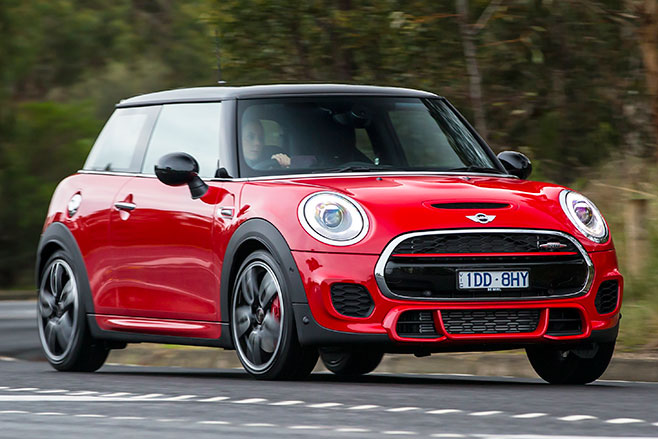
THE WHEELS REVIEW IF SUBTLETY is your thing, this isn’t the car for you. No Mini is known for flying under the radar, but in a family of loudmouths, this new Mini JCW is the shoutiest of the lot.
You’ve only got to look at that pumped-up, grille-infested nose, behind which hides the most powerful engine ever fitted to a Mini, to know it means business.
The new 170kW/320Nm 2.0-litre turbocharged four is stolen from BMW’s new family of modular engines, but fitted with unique pistons and a new turbo to make the JCW the quickest Mini on sale, at least in a straight line.
A 0-100km/h dash of 6.1sec with the six-speed auto means the JCW is the most accelerative mass-produced Mini ever and is quicker even than the track-honed, limited-run Mini GP.
And don’t panic that this extra grunt, which is delivered solely through the front wheels, means the JCW is a bucking, torque-steering beast. An electronic brain, not a traditional mechanical locking diff, does a commendable job of channelling all that torque.
There’s only a whisper of torque steer under hard acceleration and the strong 2.0-litre donk spreads its grunt evenly to ensure there’s none of the manic turbo rush you get from other hot hatches.
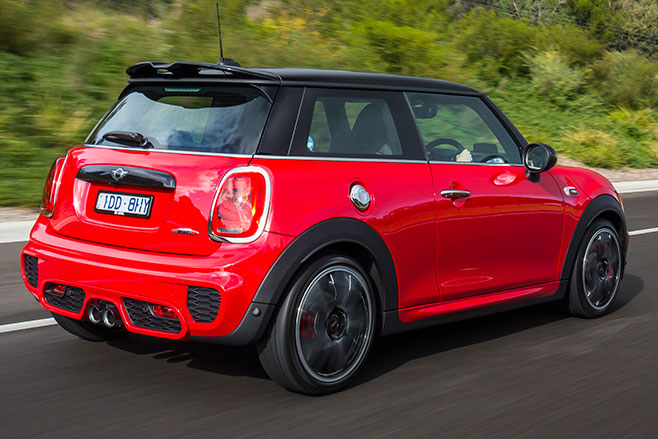
As you’d expect from a Mini, the handling is sharp, direct and stable through high-speed corners, which was reassuring given we tested the JCW at a wet Phillip Island.
Bigger brakes (330mm four-pot calipers up front) and a firm middle pedal are a highlight, and even on a slick track pull the JCW up on its nose.
However, confidence is eroded by the slippery track and Pirelli Cinturato P7 tyres that feel glassy; we’ll have to wait to see how much grip the Mini has on bone-dry tarmac.
On the public road, the Mini’s positive front axle and sharp electric steering ensure it’s a hoot on switchback mountain passes.
Adaptive dampers are now offered as standard (regular suspension is a no-cost option) and offers two settings: Mid (hard) and Sport (spine-destroying).
There’s no escaping that the ride is too firm in Sport and on pockmarked surfaces feels like it could bounce you off the road. Mid-corner bumps jolt and shoot unwanted feedback through the steering wheel, which is constantly bucking and twisting in your hands.
If the JCW’s front end wasn’t so connected and the drivetrain so engaging, this would quickly become tiresome, yet somehow the unsettled suspension and bucking wheel suit the Mini’s character. You feel like you’re working hard and that, the more you wrestle the wheel, the faster you’ll go.

A skatey rear axle only adds to the fun. You tip the JCW into corners, revel in the accuracy of the steering and wait for the rear end to tip-toe out of line and join the party.
All of this is underscored by a rorty soundtrack that goads you to chase the redline when you’re on it, yet is quiet when you’re not.
A frustrating oversight is the lack of a dynamic damper button, or an ‘Individual’ setting, that would allow you to keep the engine in maximum-attack mode while softening the dampers. You can do it, but only by diving into the Mini’s on-board computer and filtering through four sub-menus.
We’d also like more steering feel. While switching from Green to Normal and finally Sport brings a reassuring increase in weight, there’s still no real connection with the front rubber.
Two gearboxes are offered, a six-speed manual and six-speed torque-converter automatic fitted with JCW-specific software. High demand for the auto in international markets means only the self-shifter will be available at launch, with the manual arriving in September.
Happily, the auto is sharp, intuitive and completes upshifts so swiftly it feels like a dual-clutch, even bashing onto the limiter if you’re not quick enough on the paddles. However, it can be annoyingly slow and hesitant on downshifts.
There’s plenty of standard kit inside, including a head-up display with JCW-specific readouts, an 8.8-inch touchscreen, sat-nav, reversing camera, park assist with front and rear sensors, and Bluetooth.
Comfortable sports seats that offer plenty of lateral support are a welcome addition, but the JCW’s interior lacks the premium feel of similarly priced competitors such as the Audi S1 and Volkswagen Golf GTI Performance.
Still, the JCW is a rewarding hot hatch that’s sharp, fast and different enough to stand out from the rest of the Mini family.
SPECS Model: Mini Cooper S JCW Engine: 1998cc 4cyl, dohc, 16v, turbo Max power: 170kW @ 5200rpm Max torque: 320Nm @ 1250-4800rpm Transmission: 6-speed manual Kerb weight: 1205kg 0-100km/h: 6.1sec (claimed) Economy: 5.8L/100km Price: $49,950 On sale: Now
One in three new vehicles bought by Australians in 2014 was an SUV.
And that trend shows no sign of letting up – within three years SUVs are on target to outsell traditional passenger cars.
In the month of November, SUVs occupied five spots in the top 10. Compare that to a decade ago. In 2004 – the year Ford’s groundbreaking Territory launched – not one SUV made the top 10, and SUVs accounted for barely 15 percent of the market.
Ten years further back, in 1994, the Wheels price guide listed just one SUV, the Toyota RAV4. Today, it’s hard to find a brand that doesn’t have one of these high-riding family haulers on fleet.
The top-selling models for eight brands are now SUVs, and some of them may surprise you: Honda, Nissan, Subaru and Porsche. That’s right, Porsche.
Nissan has an astounding seven SUV models in its Aussie line-up, easily outnumbering its passenger car range. It is a brand that has essentially ditched large and small cars for SUVs – and it’s worked.
“It’s important to have a diverse SUV and crossover range simply because of its importance in the Australian new-vehicle market,” Nissan Australia boss Richard Emery said. “We expect their popularity to remain strong.”
Like them or not – and it’s clear more and more Australians do – the SUV wave of popularity shows no sign of slowing. If the SUV tsunami rolls on at current rates, it will swamp traditional passenger cars in 2017.
Looking at the volume and variety of SUVs headed to Oz in 2015, there’s absolutely no reason to doubt this.
More than a dozen new and upgraded SUVs have launched or will launch here this year, including the funky Citroen C4 Cactus and Honda HR-V, the Mercedes-Benz GLE rival to BMW’s X5, the next-gen Volvo XC90 and all-new Land Rover Discovery Sport, as well as the compact Mazda CX-3 that Wheels estimates could add 12-15,000 sales to Mazda’s bottom line. That would make it the brand’s second-best seller behind the hot-selling 3 hatch and sedan.
Mazda Australia managing director Martin Benders says you won’t succeed in our fiercely competitive market selling only hatches and sedans. “The SUV allows you to downsize, yet the packaging advantages mean you don’t lose space,” he told Wheels.
While the hatch segment is still the biggest of the market, the SUV is bearing down on its slice of the sales pie.
“Add together the three SUV segments – small, medium and large – and it’s pretty similar [to hatch sales],” Benders said.
It’s clear the SUV is redefining the term ‘new car’ Down Under.
2014 TOP 20 1. Toyota Corolla 2. Mazda3 3. Hyundai i30 4. Holden Commodore 5. Toyota Camry 6. Mazda CX-5 7. VW Golf 8. Holden Cruze 9. Toyota RAV4 10. Hyundai ix35 11. Jeep Grand Cherokee 12. Toyota Prado 13. Ford Focus 14. Hyundai i20 15. Subaru Forester 16. Mazda2 17. Toyota Yaris 18. Nissan X-Trail 19. Subaru XV 20. Toyota Kluger Note: list excludes utes.
This article was originally published in Wheels Magazine February 2015
BMW X4 xDRIVE 20d
Price & equipment
THE $73,400 base X4 diesel matches its rival for most key equipment. While it misses the Evoque’s knee airbag and powered passenger seat, it counters with front and rear parking sensors (rear-only for Rangie) and a reversing camera. Three-year retained value, according to Redbook, is 64 percent versus 67 percent for the Evoque. 15/20
Interior & versatility
THE comparatively austere BMW mounts a counter-attack with its 8.8-inch screen and intuitive iDrive interface, which taps the infotainment. Both have leather multi-function wheels, but the X4 adds voice control. Its cargo bay is slightly smaller at 500L (1400L seats folded), though the rear seat usefully folds 40/20/40. 15/20
Performance & economy
COMMON-RAIL direct-injected 2.0-litre diesel uses a variable geometry turbo to deliver a flexible 140kW and 400Nm. It makes the same torque as BMW’s storming turbo-petrol 3.0-litre six. Still, the 20d averages 5.2L/100km with help from a brake energy regeneration system and remains swift enough, at 8.0sec for 0-100km/h. 15/20
Ride & refinement
THE X4, on sports suspension, isn’t as soothing as its rival. A character split emerges; while they’re both SUVs, not genuine 4x4s, the BMW has a tarmac-handling slant, which is sensed via its sharper ride and a slight ramping up of road noise. Evoque, meanwhile, brings off-road tech in the form of its Terrain Response system. 15/20
Steering & handling
LIKE its rival, the X4 has electric power steering, but the BMW’s is a sportier variable ratio set-up designed to balance urban effortlessness with back-road enthusiasm. Turn-in quickens as lock is dialled on and it can take time to adjust. Once familiar, it points with authority, allowing confident, effortless switchback attacks. 16/20
Verdict
BMW’s X4 takes the dynamic X3 and adds wider tracks and a lower centre of gravity. With variable steering and adaptive dampers, it’s as good a drive as you get in this slice of the market. That’s its most compelling strength. Both strike a fine blend of effortlessness and efficiency, but the Evoque nails the balance of ‘sports’ and ‘utility’to remain the superior stylised SUV. 76/100
RANGE ROVER EVOQUE DYNAMIC SD4
Price & equipment
THE $73,715 mid-spec Evoque 5dr is a mere $315 pricier than its rival, though the entry cost can be reduced because a six-speed manual is available for $2500 less. Like the Bee-Em, it has idle-stop, paddle shifters, cruise, 19s, auto wipers, auto xenon headlights, climate control, hill-start assist and Bluetooth phone/audio. 15/20
Interior & versatility
PREMIUM cabin is trimmed in grained leather with perforated inserts. An 8.0-inch colour touchscreen headlines, while 380-watt, 11-speaker audio trumps the X4’s 100 watts and six speakers. Rear headroom compromised in both, but still adequate. Evoque’s 575L boot is bigger, and can be expanded to 1445L. 17/20
Performance & economy
EVOQUE’S slightly bigger 2.2-litre turbo-diesel four makes the same power (140kW) but a bit more torque (420Nm) than the BMW. At 1685kg, the Evoque is 60kg lighter than the X4, and the nine-speed auto has one more ratio, but it’s a bit thirstier at an official 6.0L/100km, and slightly slower at a claimed 8.5sec for 0-100km/h. 14/20
Ride & refinement
THE Evoque possesses that magic mix of hushed refinement and cushy ride comfort. The well sorted spring and damper set-up works to deliver pliancy on 19-inch wheels and tyres. Meanwhile, obvious attention to noise cancellation means that, away from the gnarliest of coarse chip, a sense of calm prevails. 17/20
Steering & handling
WHILE the Evoque feels almost like a high-riding hot hatch in turbo-petrol three-door form, some of the fun is diluted as an oil-burning five-door that carries a bit more weight, mostly over the front wheels. It’s not as sharp a steer as the frumpier BMW X3, let alone an X4, but will still satisfy most SUV tastes. 15/20
Verdict
RANGE Rover’s Evoque was the compact SUV-coupe pioneer and remains text book in terms of how to mass-produce a concept car, though it’s hottest as a three-door rather than a five-door. It’s a trademark Rangie, however, with an absorbent ride, enviable refinement and off-road ability (for what it is). The cabin grows genuine class in Dynamic trim and is gorgeous in top-spec. 78/100
This article was originally published in Wheels Magazine February 2015.
Alaskans are a rugged lot. They live in one of the world’s most spectacular but inhospitable environments, shoot their own meat, including things that want to eat them, and drive pick-ups. Big Bloody Pick-Ups, often ‘enhanced’ with mud tyres, spotlights and gun racks.
They also lay claim to one of the world’s most remote, dangerous and now strangely infamous wilderness roads, the James Dalton Highway, aka the Haul Road, as popularised by the exploits of drivers like George Spears and Carey ‘Big Daddy’ Hall, in the inexplicably popular cable TV series Ice Road Truckers.
Alaska is, of course, one of the world’s last great wildernesses – proudly proclaimed as ‘The Last Frontier’ on the state’s numberplates – and a place many red-blooded adventurers reserve pride of place for on their bucket lists. So when Wheels editor Glenn Butler approached me with the idea of an Alaska road trip, travelling the Haul Road and the lesser known Denali Highway, he had me at “Hey Bully…”
In my boyhood imaginings, the combination of hulking mountains, frozen rivers, wild bears and Daniel Boone types in racoon-skin hats made Alaska seem like the wildest, most remote and dangerous place on the planet. I visualised myself fording surging rivers in an overpowered Dodge Ram, and hammering along the Haul Road, fender-to-fender with wild-eyed truckers called Billy Jim Bob Boy Bubba or such.
“You’ll be doing it in a Mazda 3,” said Butler, turning away quietly.
“A Mazda Tree? Sounds like a tough name for a new pick-up. Great,” I said. Butler just shook his head ruefully and walked away.
Two months later I’m sitting in Alaska’s largest city, Anchorage, with a modest-looking entourage comprising a pair of Mazda 3s and a CX-9 support vehicle. There’s nary a bullbar, electric winch, mud tyre or roof-rack to be found – let alone the surely vital gun rack – and our demure Canadian wrangler, Sandra Lemaitre, doesn’t exactly exude ‘rugged-outdoorsy’ type.
A feisty, bespectacled redhead from Mazda’s Toronto head office, Sandra explains that she will be our guide for the next few days, then promptly gets lost in the hotel car park. Turns out she’s been in Alaska fully one day longer than the rest of us, but she tries to allay our concerns by pointing out that everything we need for the trip is in the back of the laden CX-9.
I clamber in, only to discover that ‘everything’ comprises a book of road maps, a slab of bottled water, some apples, a box of muesli bars and an extra spare wheel for each car.

Surely they will have beefed-up these babies for the rugged roads ahead? My heart sinks after a crawl underneath reveals a bright, shiny, bog-stock undercarriage. The only concession to Alaska’s harsh interior appears to be the addition of higher-profile 16-inch tyres on the sporty hatch, which normally runs low-profile 18s.
I rummage through the CX-9’s load space in search of the rifle bag, assuming we must be packing serious heat for this venture into the notoriously bear-infested wilds. But there’s no gun, not even a Bowie knife, just a couple of bottles of insect repellent and a can of ‘bear spray’.
Bear spray? Sandra explains that the capsicum-based spray is super-effective at warding off cranky bears and can be used from as far afield as eight metres. Turns out she’s had a pathological fear of bears since childhood. Clearly someone in the Toronto office doesn’t like her. Sandra’s fingers curl around the bear spray with a vice grip, and don’t let go.
I do the arithmetic and quickly calculate that, with a charging grizzly galloping at around 50km/h, eight metres ought to be almost enough time to utter “Oh, sh..” before being ripped asunder.
The rest of this potentially ill-fated expedition consists of Sandra’s Aussie PR counterpart, Steve Maciver, a wiry and energetic Scot with a keen sense of humour and a deep knowledge of top-shelf single malt, whose big game hunting experience extends to having once shot “at” a rabbit; Perth-based journalist Neil Dowling, who confesses to never having touched a gun before; and a polite 28-year-old Vancouver-based car snapper, Andrew Holliday, whose lightweight athletic footwear and general lack of outdoor accoutrements suggests he’s as woefully underprepared as the rest of us.
The plan, such as it is, calls for us to head north out of Anchorage for a few hundred miles, jink east on the Denali Highway, then north again to link up with the Haul Road, cross the Arctic Circle and bask under a Midnight Sun at a suitably northerly latitude on June 21, the longest day of the short Arctic summer. Bears willing.

Aside from the jagged line of snow-capped giants looming on the northern horizon, we could be in any of the 48 contiguous states as we head out of Anchorage on the three-lane blacktop of Alaska 3.
At Trapper Creek we check out a classic American Pickers-style log cabin, festooned with decades of dusty antiques and assorted bric a brac, including animal furs, totem poles, antique rifles and the obligatory moose antlers. We somehow resist the urge to purchase anything, although turn-of-the-century snow shoes almost have me.
Soon after, we have our first ‘live’ moose sighting, the horse-sized critter grazing contentedly on the roadside verge, his hulking presence warranting a watchful eye as collisions with moose are commonplace – and you don’t want to hit one in a Mazda 3.
The red hatch I’m piloting hums along sweetly at the 70mph limit, the tacho hovering at a relaxed 2000rpm. It’s easy driving and we should be making good time, but snapper Andrew is already in Alaska’s thrall, and we’re stopping so often as to be overtaken by a convoy of narrow-tyred vintage cars puffing and wheezing their way north.
After dicing with the mobile museum on and off for an hour, we finally muster them at a roadside rest stop on the edge of Denali National Park, where a viewing platform provides distant vistas of North America’s tallest peak, the 6193m Mt McKinley, or Denali as it’s known in native Alaskan.
Here we collar the driver of an immaculate ’63 Chrysler Imperial, who introduces himself as Art Isham and explains that he and the rest of the classic convoy are members of the Antique Automobiles of Alaska club, travelling to Fairbanks for a summer solstice festival.
Art’s friendly, chatty manner meshes perfectly with what the guidebooks tell us about Alaskans, but a little further up the road that stereotype takes a beating courtesy of a curmudgeonly gas station attendant, who threatens to take Maciver’s head off after a mix-up over his credit card-enabled fuel pumps. That’d be funny back home, but here, where a loaded weapon is never far from hand, you take such threats seriously.
Shortly after that scene at Cantwell Springs, which we rename using an alternative vowel, we turn onto the ambitiously named Denali Highway, rated by National Geographic in 2010 as one of the world’s Top 10 Drives.
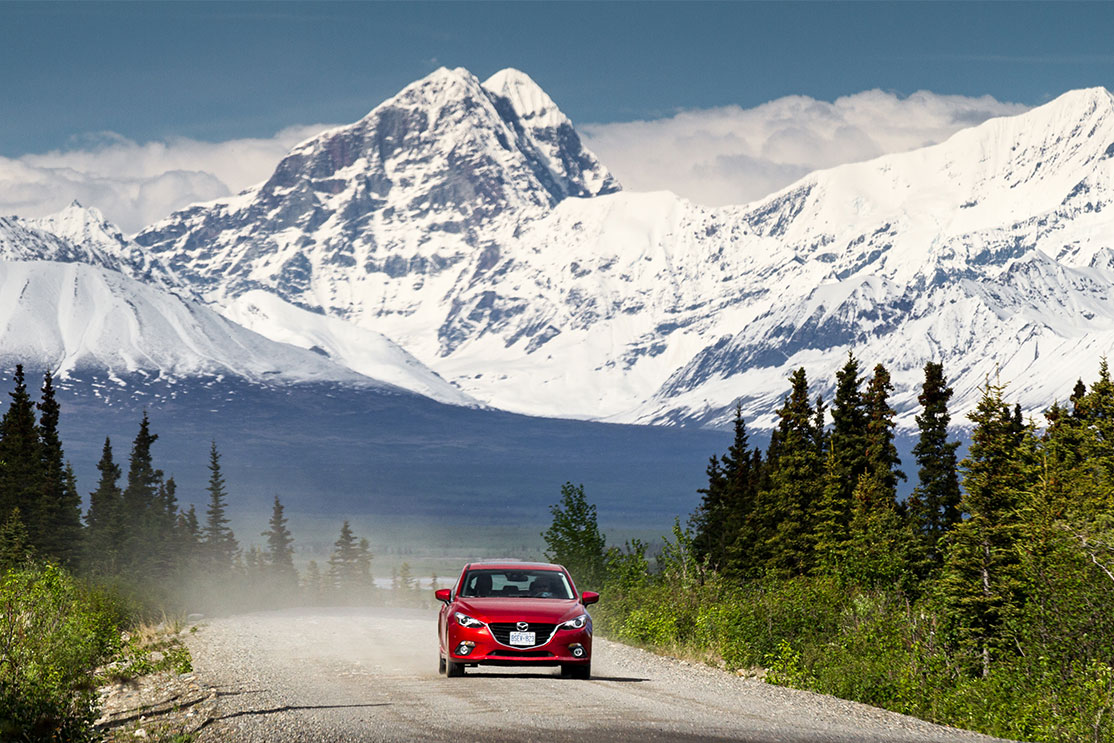
The mostly gravel ‘highway’ meanders for 135 miles through stunning wilderness, providing epic vistas across arctic tundra, galloping rivers and away to the hulking Talkeetna Mountains, the bare-shouldered peaks still covered in a thick blanket of snow in mid-summer.
Peppered with potholes, rocky lumps and a layer of loose gravel that belts out a staccato beat on the Mazda’s underbelly, the road is rough, but not the car breaker we feared. The little red Mazda handles the conditions surprisingly well, soaking up the irregularities with impressive compliance, thanks in no small part to the 16-inch wheels.
The Denali is jaw-drop beautiful, every crest and bend revealing a stunning new vista. Wildlife abounds, and in the space of a few hours we sight a pair of menacingly quilled porcupines, a moose wallowing in swamp water, and a majestic bald eagle soaring in search of prey.
The scenery has Andrew in overdrive and, despite turning up the wick once back out on the tarmac of the Richardson Highway, it’s past 9pm by the time we make our overnight digs, The Lodge at Black Rapids.
Perched high on a bluff overlooking the surging Delta River, the Lodge offers stunning views across the river flats to the glacially scarred peaks of the Hayes Range. Owner Mike Hopper bangs pots in the kitchen as we enjoy the warmth and a cold beer.
A lean 60-something with salt-and-pepper hair and dark, deep-set eyes, Mike explains that he first found his way to these parts in search of perfect back-country ski runs. “It’s endless for me; I could ski here for years and still not exhaust it,” he enthuses.
Mike recounts various unsuccessful attempts to climb the 4216m Mt Hayes, including the last one, which almost cost him fingers to frostbite. “I’ve tried six times to climb that f–ker,” he growls, gazing out the window, describing it as both a “beautiful peak” and “the most aggressive mountain in all of the interior.”
This far north at this time of the year, the sun never really leaves the sky and, despite a solid 13hr stint at the wheel, we’re still wide awake to witness the strange sight of a beautiful sunset hovering just below the distant ranges at 1.15am.
Not nearly enough hours later I awake to the agitated sounds of the surging river. Peeling back the curtains reveals leaden clouds and dark, rain-slick cliffs, overshadowing the agitated, glacial silt-infused waters.
Rain falls as a constant mist and the dangers of travel in these conditions are soon reinforced out on the highway, where a minivan rests awkwardly in a roadside ditch, wipers flopping back and forth as semis thunder past in a hail of spray.
A couple of hours later we sail through Alaska’s second city, Fairbanks, seemingly the only Japanese compact minnows in a sea of gargantuan pick-up whales.
Further along, a signpost marks the start of the James Dalton Highway, aka the Haul Road, the “Gateway to the Arctic”, warning of “Heavy Industrial Traffic”.
The Haul Road gets its name by dint of being the major supply route for the Prudhoe Bay oil and gas fields and carries a surprising amount of summer traffic, from heavily laden semis to giant gooseneck RVs, groups of adventure bikers and even cyclists.
Despite the wet and slippery conditions, the truckies don’t hang around, using every bit of the 50mph limit and then some, thundering up and over the constantly undulating terrain in a hail of mud and diesel smoke.
Despite its fearsome reputation, the road is surprisingly well maintained, at least by Aussie standards. It’s comfortably wide enough to accommodate two passing semis, albeit with a liberal scattering of potholes and corrugations. But it’s not without risk, with hundreds of off-camber corners, blind crests and pools of standing water that galvanise the attention every time they cause the Mazda 3 to briefly aquaplane. Frequent unexpected mid-corner encounters with hammering 18-wheelers prove especially sphincter-puckering.
The road is shadowed for most of its length by the Alaska pipeline, which appears regularly alongside like a giant silver snake, wending its way through the arctic tundra en route to Prudhoe Bay.
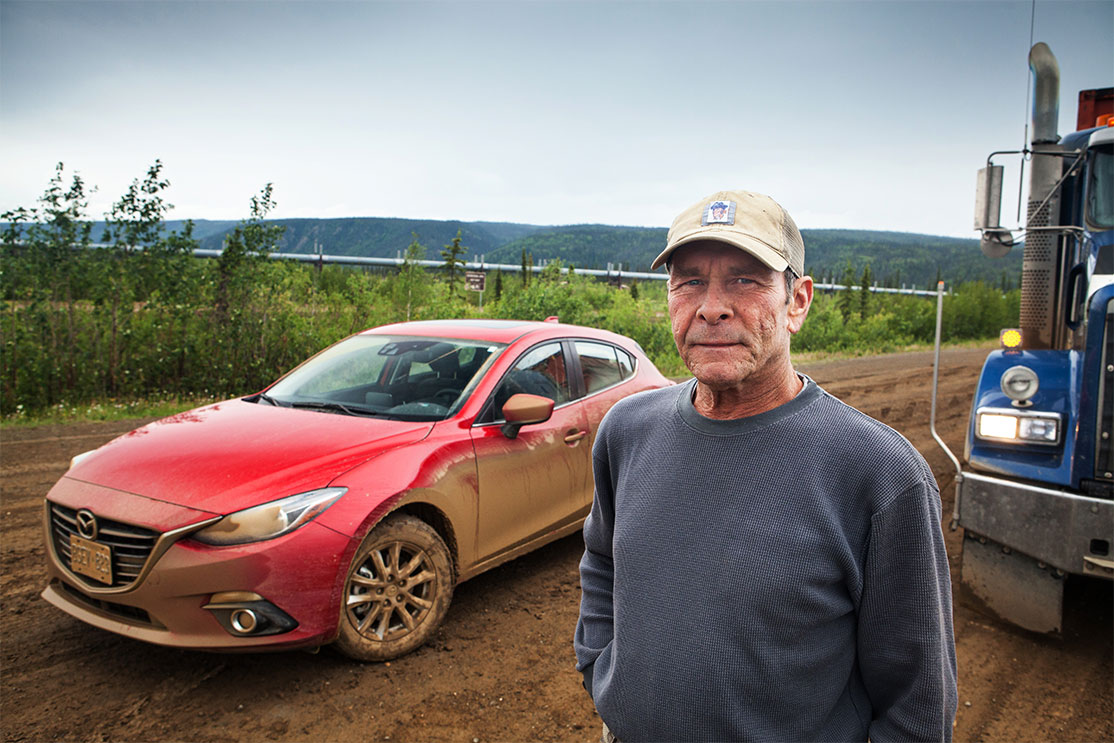
At the mighty Yukon River we slop our way into a muddy, chopped-up car park strewn with heavy trucks. Here I strike up conversation with a trucker who introduces himself as ‘Eljay’ and tells us he heads north from New Mexico each year to haul mining equipment and supplies up and down the Haul Road for $1.00 a mile, nearly three times what he can make elsewhere.
Beyond here lies the final and most difficult 361-mile section of the Haul Road, the construction of which took just five months, despite including some 20 bridges. Say what you will about the Yanks, but they sure can get the big things done.
We eventually cross the Arctic Circle, stopping briefly for the obligatory happy snap, complete with mozzie swarm, before pressing on in the drizzle and gloom.
It’s 9.30pm by the time we slosh into the intriguingly named Coldfoot, an old gold town turned truck stop, situated roughly halfway between Fairbanks and Prudhoe Bay. A corkboard pinned with yellowing snapshots outside the toilets serves as a reminder of the road’s dangers, with an alarming array of overturned RVs, spilled loads and jack-knifed rigs.
On a grimy wall, I spot a quote from a Washington trucker named Butch Rohweder, who eloquently sums up driving the Haul Road: “Sure it gets a little rough at 60 below. Your brakes freeze to the drums, or you can pop a drive shaft like a piece of candy cane if you’re not kind of tender with the gears. Make a wrong move on a hill and suddenly you’re driving an 18-wheel toboggan. That’s how some guys call this the Kamikaze Trail. But it’s the best damn trucking in the world if you know what you’re doing.”
With food in our bellies, we complete the final 20 miles to the ‘Arctic Getaway’, a log cabin venture set in the remains of the old gold mining town of Wiseman, secreted away down a bush track beside the rushing Koyukuk River.
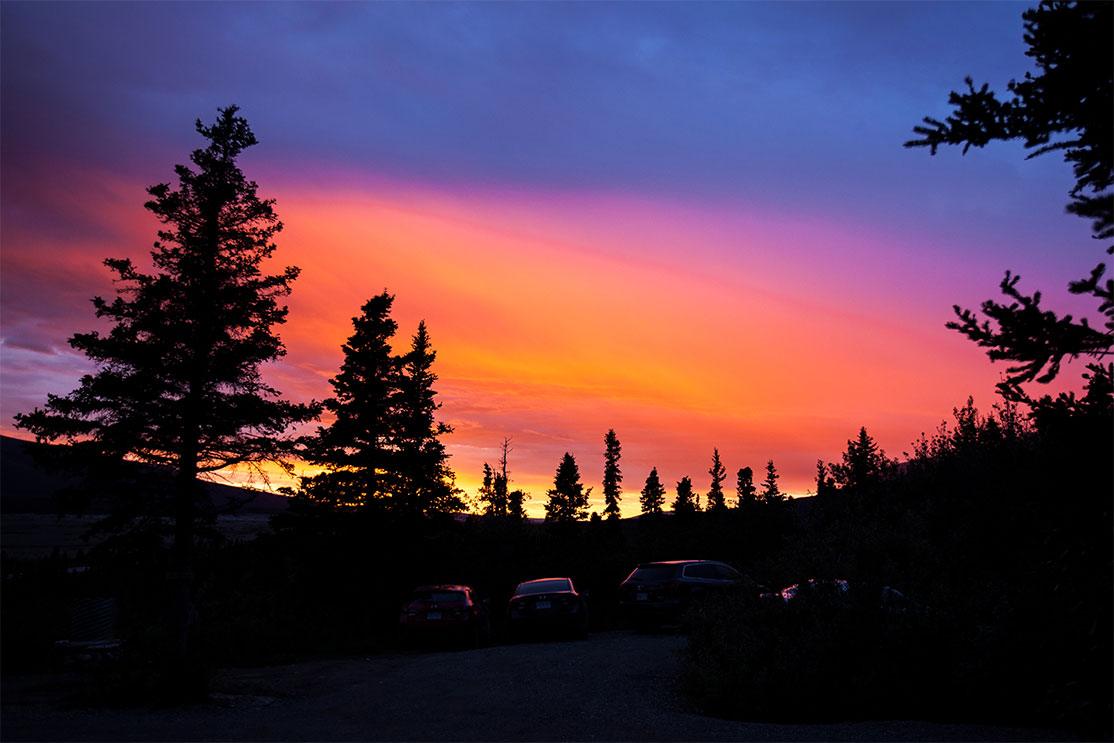
Despite the late hour, the mozzies haven’t bundied off and their assaults send us scurrying inside our warmly lit cabin, just in time to watch the clock strike midnight.
It should be a celebratory moment, having finally made it here, north of the Arctic Circle, on the longest day of the year, but it turns out to be sometwhat anti-climactic. But there are no champagne corks, just a few tired high-fives as thoughts turn to tomorrow’s return trip, retracing our steps in double quick time back to Fairbanks. We sip our ration from the one bottle of red someone has remembered to bring and slap half-heartedly at the mozzies with battery-powered electric swatters.
The smell of frying insects fills the cabin as we pull the curtains to shut out the midnight sun we’ve driven hundreds of miles to see.
THERE’S A BEAR OUT THERE

BEARS are an ever-present threat in most parts of the 49th State, but Alaskans have a similarly pragmatic approach to living with bears as Aussies do with snakes.
“You are in bear country, you have to be aware of it,” says hunter Bernie Hicker.
Hotspot Cafe owner Theresa Moran (left) has a slightly less sanguine view of the critters. “They’re a real pain in the ass,” she declares while flipping burgers.
“That sign out by the toilet, that’s no joke,” she cautions, pointing to a thunderbox out on the edge of the clearing that warns users to be wary of bears. Talk about a laxative.
Asked how she handles the bear problem, Theresa disappears inside and returns moments later proudly displaying a lightweight AR-15 semi-automatic rifle, complete with hot-pink stock and barrel grip. She doesn’t shoot to kill because a couple of rounds over a bear’s head or near their feet are generally enough to send them packing.
The words of James Rollins in his 2003 novel Ice Hunt come to mind: “Always respect Mother Nature. Especially when she weighs 400 pounds and is guarding her baby.”
SMALL-BORE WEAPON
OUR 2460km journey on indifferent roads and in challenging conditions confirmed something we already knew: that the current-generation Mazda 3 is a wonderfully rounded little car.
The Canadian-spec Sport GT hatch we drove closely matches our SP25, its 2.5-litre four-cylinder engine, six-speed auto and nicely-honed dynamics proving a winning combination.
Lively, energetic and beautifully damped, with quick and accurate steering that connects the driver impressively to what’s happening at road level, it proved fluid and effortless to pilot over several long days at the wheel.
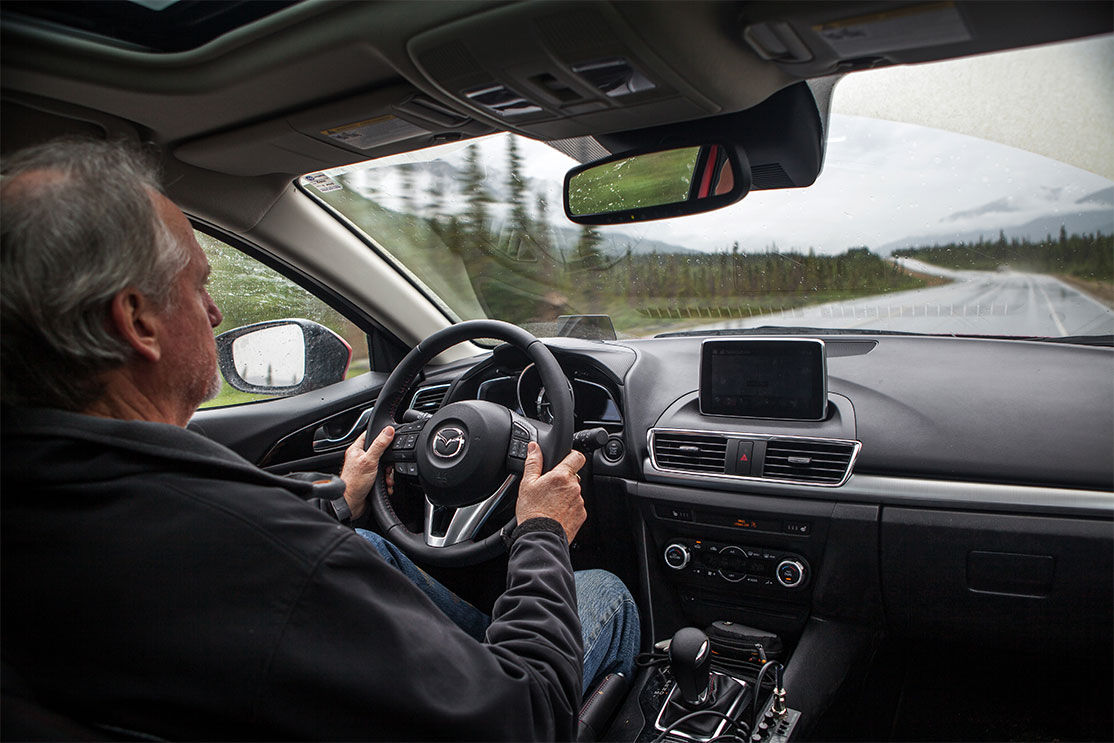
The driving position is excellent and the comfortable sculpted front seats proved their worth. A peppering of sportily tactile touches such as the leather-trimmed wheel and gearshift contribute to an attractive and pleasingly functional interior.
The engine served up ample verve for the hilly terrain, while the auto showed its class by avoiding excessive revs and frequent shuffling between ratios. The auto’s Sport mode and paddle shifts were rarely troubled on this trip.
The suspension proved impressively supple and pleasingly absorbent over the roughest patches, thanks in no small part to the addition of higher-profile 16-inch tyres.
Practical, frugal, handsome and affordable, the impressively sorted Japanese hatch provides a level of driving enjoyment that far exceeds its modest price and positioning. Frankly, it’s hard to understand why we didn’t see more of them on the Haul Road.
This article was originally published in Wheels September 2014.
Late last week the FIA released a draft set of regulations for the WRC, scheduled for introduction in 2017, aimed at making the sport more “dynamic”.
You can read the details here, but the crux is that World Rally Cars are going to get a lot faster – but is that such a good thing?
One positive is the planned increase in power. Since the introduction of the 1.6-litre formula in 2011, World Rally Cars have had far more grip than grunt, a recipe that’s rarely conducive to exciting motorsport.
A passenger ride in Hyundai’s i20 WRC at last year’s Rally Australia was incredibly impressive for many reasons, but straight-line pace certainly wasn’t one of them.
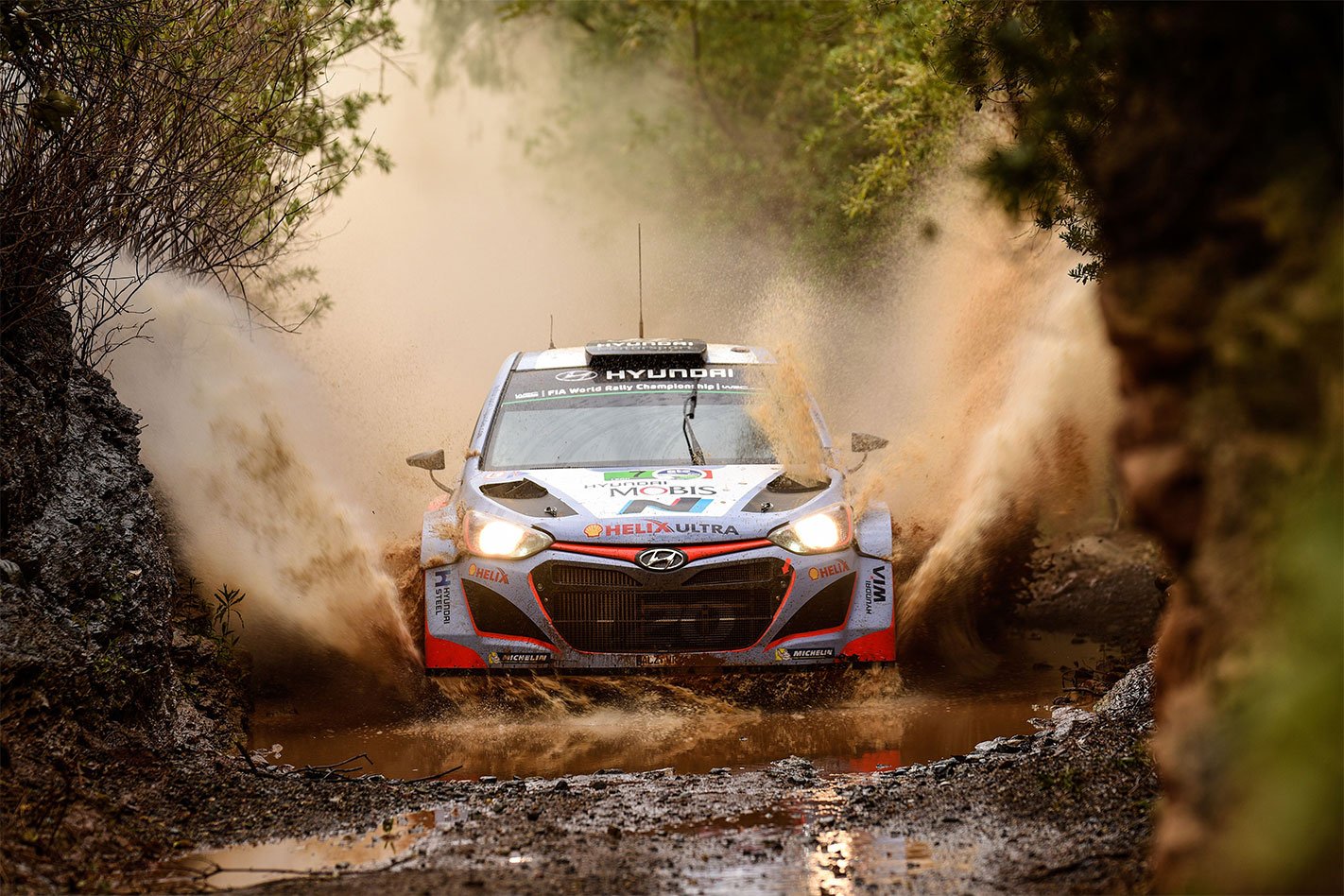
In today’s WRC, commitment is key, with drivers carrying as much speed as possible through the corners to gain time.
Having less power means that drivers are punished more harshly against the clock for a mistake, but it also requires a very neat, precise driving style, and who goes to a rally to watch that?
Part of the reason the two Sebastiens (Loeb and Ogier) have been so dominant over the last decade is that their tidy driving styles, honed on French tarmac, are rewarded far more in this generation of car than the traditional flamboyance of the Finns or someone like Colin McRae.
With more grunt, the cars will slide more, rev harder and sound better, all good things, however the proposed chassis changes promise to undo all that.
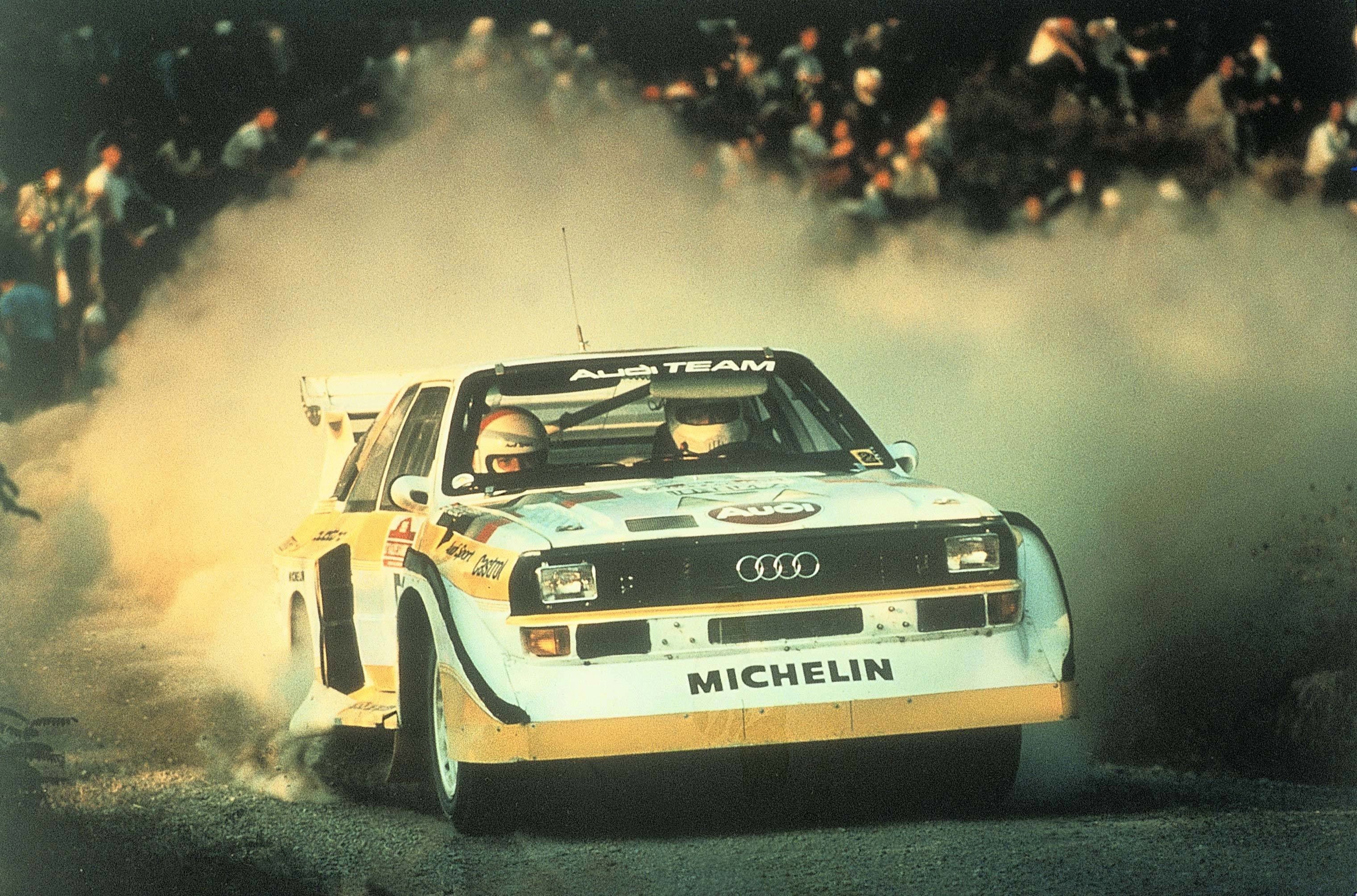
Wider tracks and larger wings will increase grip and downforce, but for rally spectators it’s the spectacle rather than the speed that matters – today’s World Rally Cars are so much faster than the Group B machinery of the ’80s that there is no comparison, but which era is remembered more fondly?
It’s inevitable that drivers and engineers will always want more speed, but it’s possible, even likely, the greater aero and reintroduction of electronic diffs will result in an increase in costs the sport can literally ill afford.
Citroen is currently undecided whether to continue its WRC program beyond next year, and since losing Ford backing M-Sport has been living hand-to-mouth.
The FIA should be applauded for proactively taking steps to improve world rallying, as it’s a sport that has languished in the doldrums for far too long, but any changes must take the sport forward, rather than simply repeating past mistakes.
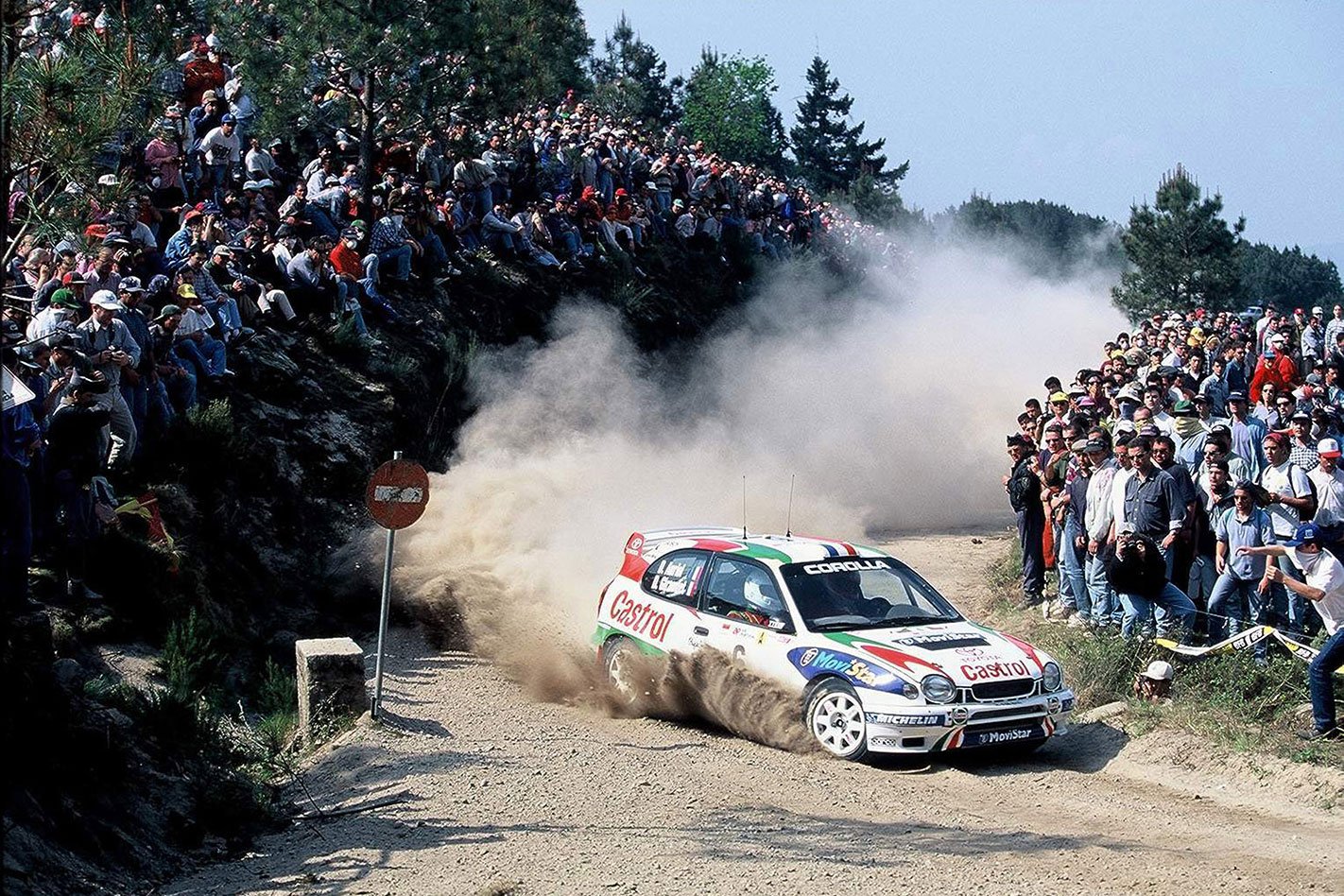
Still, it’s all too easy to point out the problems, but what about providing a solution?
For mine, the future of the WRC has been staring it in the face for the last year or two thanks to the introduction of the ‘R5’ category currently being used in the WRC2 support series.
While extremely similar in configuration to a World Rally Car – 1.6-litre turbo all-wheel drive hatches – R5 cars contain a lot more production-spec componentry.
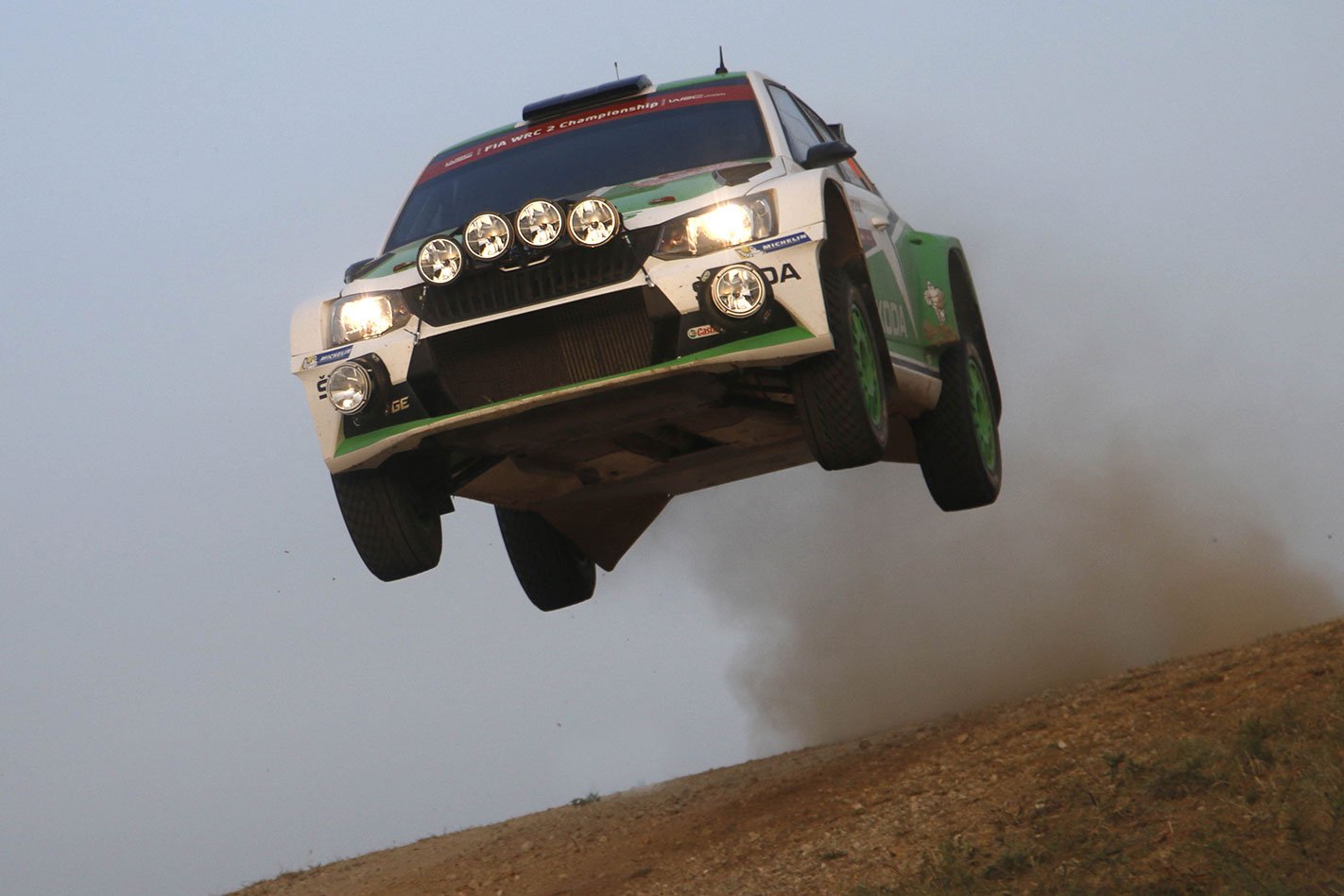
Pull the engine restrictor out, perhaps allow the use of the WRC-spec paddle-shift gearboxes, and that speed differential disappears. All of a sudden World Rally Cars are more powerful and just as fast over a stage yet cost far less.
Furthermore, it instantly increases manufacturer involvement, with Citroen, Ford, Peugeot and Skoda all currently fielding R5 cars, with offerings from Hyundai and Opel in development.
Combine that with the return of Toyota in 2017 and there is the potential for there to be six or seven top-tier manufacturer teams, which means more seats for talented drivers and greater competition.
Rallying is one of the most exciting motorsports on earth, but has suffered from poor promotion and limited manufacturer involvement for most of the 21st century. Let’s hope that whichever path is chosen, it manages to recapture some of the sport’s past glory.
A sub-Rio supermini is part of a bold plan to lift Kia Australia’s game Down Under as it streamlines it line-up with stronger models.
THE 2016 Kia Picanto has been confirmed for Australia and could be in showrooms as early as late this year as Kia chases 50,000 sales by 2019. The Picanto will be the smallest Kia on sale, and is close in size to the Mitsubishi Miragemirage as Suzuki Celerio and Nissan Micra. As predicted by Wheels in October last year, the Picanto will be offered in only a single specification and keenly priced at $14,990 driveaway.
The Picanto will be offered as a five-door only with a 62kW/120Nm 1.2-litre four-cylinder and four-speed automatic, with no other engines or transmission offered in order to rationalise pricing. Kia also believes that offering only a single model of the Picanto will ensure that it won’t hamper sales of the larger Kia Rio hatch, its third-best selling car in 2015 to date. In fact, the Rio – now priced from $16,990 – has opened up a space in the range for the Picanto to fill.
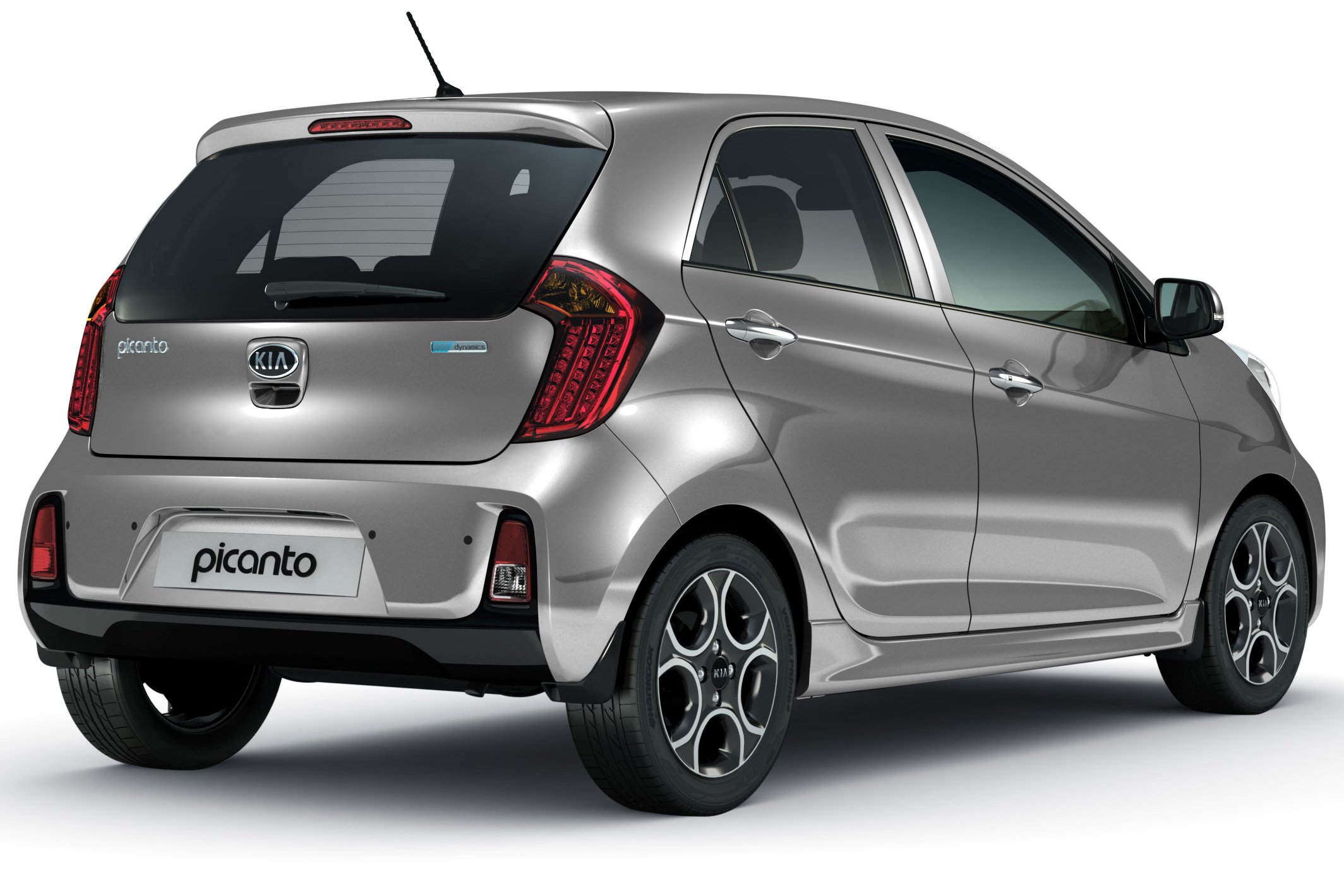
While price and spec have been confirmed, the Picanto’s arrival date is still up in the air. It could be here as early as November; however the Australian market could wait until the MY17 version, due mid-next year. “The marketing spend will have to be right,” said Hepworth. “Picanto will be immediately about volume – the market will tell us if it wants that car.”

The Picanto is part of the brand’s aim to achieve 50,000 sales in Australia by 2019. In 2014, it sold 28,005 cars here, while in-house rival Hyundai was one of only four brands to sell more than 100,000 cars last year, with 100,011, to finish fourth behind Toyota, Holden and Mazda. Traditionally, Hyundai-Kia HQ calls for Kia to sell 40 percent of Hyundai’s volume, which equates to around 40,000 of its current local sales.
In the first half of 2015, Kia has sold 16,660 vehicles – a record – but it’s not as simple as doubling that figure to more than 33,000 for an accurate full-year result. “Anyone who thinks the second-half of the year is going to sell as many as the first is kidding themselves,” said Hepworth, who added that the brand was not relying on market growth to reach its 2019 sales goal. Kia is also not looking to expand its 121 dealers in order to increase sales, either.
“If you’re going to get to 50,000, you’ve just going to have to get your numbers up,” said Hepworth. How? Hepworth said that models such as the Sportage, which sold 6368 in 2014, will need to be pushed to around 10,000 per annum through more focussed marketing strategies, while culling underperforming models.
A smaller SUV to rival the highly poular Mazda CX-3 and Honda HR-V is also on the Australian arm’s wish list.
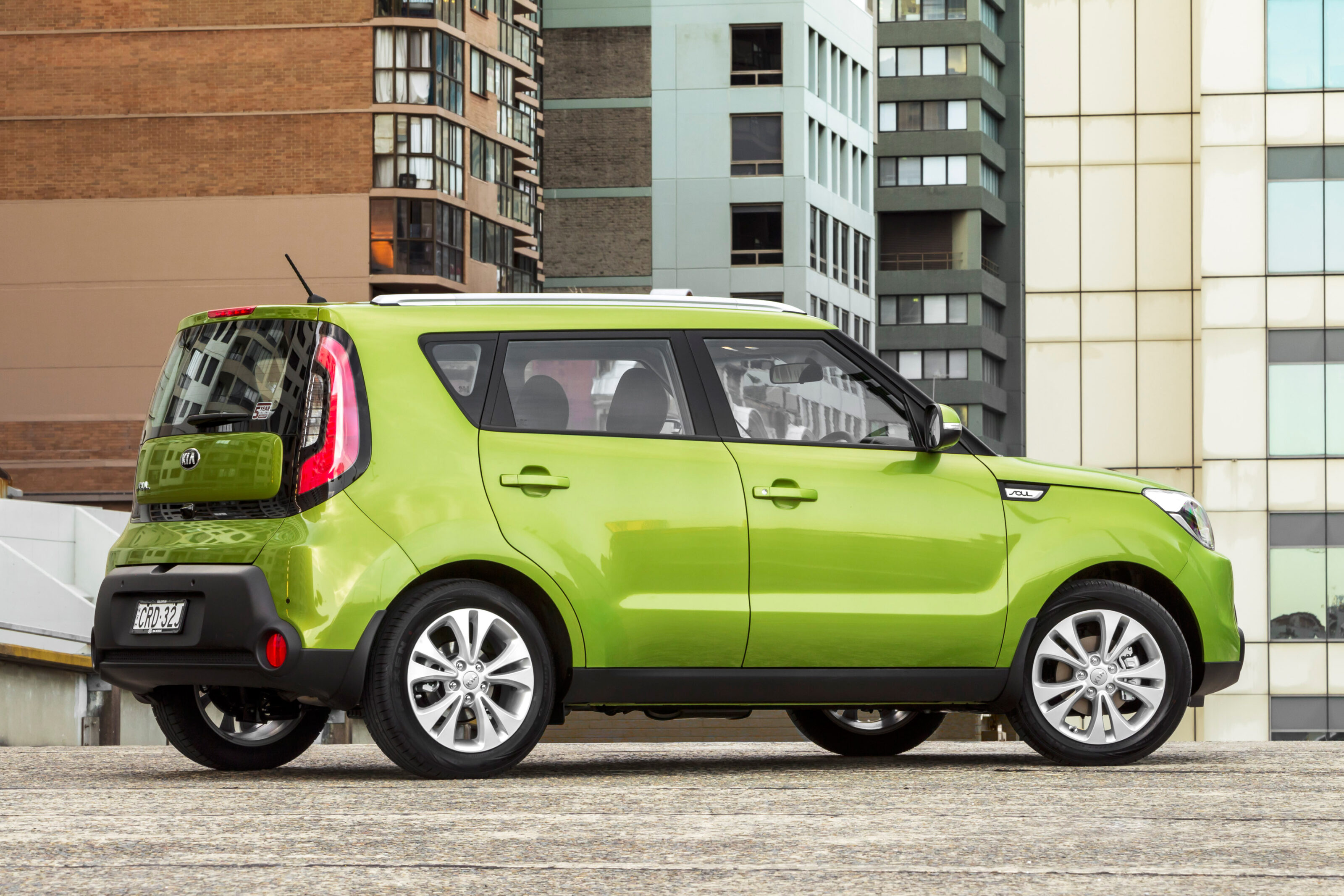
Potentially on the chopping block are the Kia Soul, of which only 143 have been sold so far this year; the Rondo people mover that, with 249 sales, has done only marginally better, and the Proceed GT warm hatch, which is imported from Europe. For the Proceed, Australia may even miss out on the 2015 update unless Kia can shift stock of the existing car.

Despite the models under pressure, no decisions have been made. “Nobody’s put a line through any of them,” said Hepworth.
World Rally Cars will be lighter, more powerful and more aggressive if plans to make the sport more “dynamic” come to fruition in 2017.
The World Motor Sport Council ratified the regulations in principle in a meeting last week but final details will not be announced until further discussion has been had with manufacturers and the FIA technical department.
Under the proposal, the cars will remain small hatchbacks fitted with all-wheel drive and 1.6-litre turbocharged four-cylinder engines, however there will be greater freedoms allowed.
Of most note is an increase in restrictor size from 34mm to 36mm, which combined with a maximum boost pressure of 2.5bar (35psi) is expected to lift power to around 280kW from the current 225kW.
Electronically-controlled centre differentials will be reintroduced and the minimum weight will decrease by 25kg to 1175kg empty (1325kg with both crew).
Bodywork will also be much more aggressive, with cars allowed to be 55mm wider with greater front and rear overhangs, more substantial front aero and larger rear wings.
According to the FIA, “The intention behind the new regulations is to produce a car with a far more dynamic and distinct appearance that exhibits character and diversity.”
Get your free weekly report from the world of fast cars – subscribe to the MOTOR newsletter!
Ok, so you probably have a pretty good understanding of what tyres are and what they do. But did you know there are tyres made with orange oil, or ones that smell like lavender when they heat up (seriously)? We didn’t think so. There are so many different types of tyres available, from low profile, high performance, all-terrain, eco and run-flat, but don’t panic, we’re here to break it down for you.
Each individual tyre is marked with an ID number that make the tyre look more like a high school calculus quiz than a label. So, it’s no wonder finding the right tyre is such a daunting process. But knowing the tyre basics can save more than your wallet.
TYRE TYPES
Some tyre types are pretty self-explanatory; we aren’t going to explain what a mud tyre is. But what makes an eco tyre so economical, or a decibel tyre so quiet? And is a run-flat as simple as it sounds?
Low-profile tyre
The amount of rubber between the tread and the wheel rim is called the ‘profile’ of the tyre. A low-profile tyre has less room for flex in the side (sidewall) of the tyre and it also appears lower to the ground. It offers better handling and feel, but the typical trade-off is a harsher and noisier ride.
Eco tyre
Eco tyres aren’t going to save the planet; they are still black rubber bands. They can save you fuel, though. The addition of silica to the tyre compound means it doesn’t deform when the tyre heats up. This low rolling resistance, or drag, saves fuel without compromising performance.
Decibel tyre
A quieter tyre will usually be designed specifically for comfort, where chunky mud tyres and low-profile performance tyres will always be loud. There are tyres, however, specifically designed for low road noise. They are expensive, but effective, and particularly handy for people who do a lot of highway miles.
H/T, M/T and A/T tyres
Highway-Terrain, Mud-Terrain and All-Terrain are all tyres with larger treads for greater grip. These tyres are usually found on SUVs and 4WDs.
XL tyres
No, they aren’t huge tractor tyres. XL means ‘extra load’ and is a durable, tough tyre that can take weight.
Commercial tyre
These are tyres with a high load rating and are suitable for vans, trailers and trucks.
Run-flat tyre
A flat tyre is an absolute pain in the proverbial. And a sudden puncture is a scary thing, particularly at speed. For many years now, manufacturers have been evolving the run-flat tyre, which has a thicker sidewall so they can stay pretty much inflated after a puncture, letting you get to the service station safely. The tyres are usually aided by pressure monitors to alert the driver that there’s a puncture.
TYRE SIZE
The most obvious set of numbers on the side of the tyre are the tyre’s measurements. These numbers can be broken up into four sections:
- Width of the tyre tread, in mm.
- Width of the sidewall (profile) as a percentage.
- What kind of tyre it is.
- The diameter of the rim it fits on to, in inches.
Let’s use an example. If a tyre number reads 235/40 R17, what it means is:
- Tyre tread is 235mm wide.
- The sidewall’s width is 40 percent of the width of the tread.
- The “R” stands for Radial, which is pretty much every tyre these days.
- Fits a 17in rim, which is the measurement of the diameter of the wheel.
After the tyre size numbers is a speed and load rating. These are important, particularly if you’re going to carry a load, tow, or take your car to the track. Unfortunately, they are not the actual weight or speed numbers, but rather reference numbers; so you need to look up a chart to know exactly what they stand for.
So say the numbers read 235/40 R17 91Y:
The number (91) refers to the load index, or the amount of weight that can be placed on each individual tyre. The reference numbers range from 81 to 96, and the weights range from 462kg to 900kg. The index ‘91’ is 630kg, so our car can handle a 2520kg payload.
The letter (Y) means the maximum speed the tyre is capable of. The reference letters run from N to Z and from a maximum of 140km/h up to 300km/h (Y).
Tip: The manufacturer’s recommended tyre sizing and loading, along with the optimal pressures for those tyres, can be found on a plate on the car. This is usually in the doorjamb, but sometimes under the bonnet or under the fuel cap.
