
Upon its release in 2011, the Volkswagen Polo GTI completely blew the performance car market wide open.
Never before had you been able to buy this sort of speed – 0-100km/h in under seven seconds, sub-15sec quarter mile – for so little money.
It won two Bang for your Bucks titles by such a margin that we didn’t know if anything would ever be released that could beat it!
The market responded, of course, as it always does, and the updated Polo GTI faces a much tougher test than when the original surfaced with the sector to itself four years ago.
Opel’s Corsa OPC came and went, but there’s still the Peugeot 208 GTi, Renault Sport Clio RS and, of course, Ford’s wonderful Fiesta ST to beat if the baby Vee Dub wants to recapture its title.
Helping its cause is a new 1.8-litre turbocharged four-cylinder, a destroked version of the EA888 engine in its Golf GTI big brother.
Paired with the carryover seven-speed dual-clutch gearbox, it produces 141kW, nine kW than the old 1.4-litre twin-charge engine, but torque remains the same at 250Nm, though it is now spread from 1250-5300rpm (previously 2000-4500rpm).
The big news, however, is the ability to choose a six-speed manual gearbox. Doing so doesn’t just add a third pedal in the footwell but spreads peak power from 4300-6200rpm rather than 5400-6200rpm in the DSG and increases torque by a huge 70Nm, 320Nm on tap from 1450-4200rpm.
It’s a muscular engine and endows the new Polo GTI with a serious turn of speed. VW claims 6.7sec 0-100km/h for both gearboxes, but we wouldn’t be surprised if both manage to beat that claim.
The manual, in particular, doesn’t feel that much slower than a Golf GTI, which makes sense given its lighter mass (1234kg) makes the two cars’ power-to-weight ratios very similar.
It doesn’t sound particularly special, but it revs strongly past its 6000rpm redline and is incredibly flexible, with virtually no lag.
The gearbox is light and easy to use, though not as slick as that in the Golf, with across-the-gate shifts (e.g 2-3 or 4-5) occasionally needing patience.
As you’d expect, the Polo is a calmer and more refined car on the road than the Fiesta ST, though a back-to-back assessment will be required before it can be given the nod over its French rivals, as there’s a fair degree of ‘hop’ over bumps and compressions.
Unfortunately, the adaptive dampers that are optionally available in Europe will not be coming here, as VW can’t make the sums add up.
Sadly, the chosen drive route didn’t allow for much in the way of dynamic assessment, but initial impressions are the Polo GTI remains a fun device, though not able to offer the laugh-out-loud enjoyment of the Fiesta.
The agile, adjustable chassis offers plenty of grip thanks to wheels 0.5-inch wider all-’round and grippy Continental tyres.
ESP still can’t be fully disabled, but there is now a Sport mode, and it allows enough latitude to not be a huge hindrance, on the road at least.
Sadly, where the Polo GTI has taken a backwards step is steering. While accurate enough, the now electrically-assisted tiller doesn’t offer the feedback and communication of the old hydraulic rack.
It’s not a deal-breaker, but it is a shame, particularly when the steering in the Golf GTI is so good.
What is good news is that thanks to having to shift gears yourself, the Polo GTI is more affordable than ever, with the manual starting at $27,490 with DSG an extra $2500 at $29,990.
An optional Driver Assistance Package adds sat-nav, parking sensors, a rear camera and a driver fatigue detection system for $1700, and the $3300 Luxury Package includes heated leather seats, LED headlights and a sunroof.
Faster and more affordable than ever, the Polo GTI continues to play near the pointy end of the baby hot hatch market. Whether it’ll be enough to take a third Bang for your Bucks title, we’ll find out in a few months’ time.
4/5
Specs Engine: 1798cc four-cylinder, DOHC, 16, turbocharger Power: 141kW @ 4300-6200rpm (manual)/5400-6200rpm (DSG) Torque: 320Nm @ 1450-4200rpm (manual/250Nm @ 1250-5300rpm (DSG) Gearbox: Six-speed manual/seven-speed dual-clutch Weight: 1234kg (manual)1242kg (DSG) 0-100km/h: 6.7sec (claimed) Fuel consumption: 6.1L/100km (manual)/5.7L/100km (DSG) Price: $27,490 (manual/$29,990 (DSG)
Click here to read the full range review of the Volkswagen Polo.
Federal minister adds to fears that Australia will open the floodgates to parallel imports
THE Federal Government appears to have officially thrown its weight behind calls to allow Australians to buy new and used cars made for other world markets
Assistant Minister for Infrastructure, Jamie Briggs, has confirmed to ABC Radio that the government is keen to relax parallel – or “grey” – imports legislation to allow Australians to buy the safest and best cars at the best price.
“The real issue here is why regulate if you’re now part of a global regime?” Briggs said in an interview aired this morning.
“We allow people to purchase all sorts of goods from overseas on the internet.
“There seems no reason why we shouldn’t allow people to buy new cars from overseas markets if there’s an opportunity to do so,” he said.
The government is under more pressure to relax the parallel import laws, with a Competition Policy Review released late last month supporting an earlier Productivity Commission recommendation that laws restricting the free import of vehicles be lifted once a framework regulating what could be imported was set.
The strong support has come as a shock to Australia’s already crowded new-car market – more than 60 brands selling more than 350 models vie annually for about 1.1 million sales – with fears of the floodgates opening to cheap imported cars not built to Australian conditions.
The largest importer of luxury cars in Australia, Mercedes-Benz, believes buyers will be the big losers if the import laws are relaxed.
“We’re not concerned about competition – we already operate in a very competitive market – we operate in the real world, customers buy cars in the real world,” Mercedes-Benz Australia public relations, product and corporate communications senior manager David McCarthy said.
“We’re not a group of academics sitting in an ivory import-protected tower discussing whether the earth is flat.
“But there is an issue here that’s really important … How are they going to protect the consumer who goes online and buys a car online, from a right-hand-drive market, and buys it cheaper, how are they going to protect that consumer?
“Has it been involved in an accident; is it under finance; has it been stolen; is it as described?”
McCarthy said a car imported by and bought from an Australian dealer guaranteed the title of the vehicle.
“If you want to know if it’s been stolen; is it under finance; has it been involved in a serious accident, the state registration authorities maintain those registers,” McCarthy said.
“If you buy a car on the internet, how is the government going to protect you? This is a really serious issue.”
McCarthy’s views are supported by the people who sell the cars to customers. In a submission to the Competition Policy Review panel looking into allowing grey imports of new and used cars, the Australian Automotive Dealers Association, which represents the interests of $17 billion in dealers’ new-car showroom investments rather than importers, warned the removal of restrictions on parallel importing would introduce new costs that were were unlikely to make them any cheaper.
These extra costs included establishing Customs procedures designed to ensure the provenance of the car matched the one being imported, and setting the framework for consumer protection if a grey import deal turned sour, it said.
Australia’s third largest brand, Holden, said both it and its dealer network shared the industry’s “serious concerns” around grey import laws.
“The proposed relaxation of the laws will negatively affect new car sales, directly impacting jobs in Australian dealerships,” the carmaker said in a statement.
“Grey imports also pose substantial risks to consumers in terms of protecting warranty arrangements and vehicle safety.”
From 2017, Australia will have no local car manufacturing industry to protect from full line importers.
The Australian Government has already started winding back import tariffs on cars imported from some of the world’s largest automotive manufacturers, including Japan, South Korea, Thailand and the US.
However, rather than pass on savings, most of the carmakers benefitting from tariff cuts say they have tipped the money into making their cars better equipped.
Almost three quarters of the 1.1 million new vehicles sold in Australia last year are now eligible to be sold in Australia tariff-free.
Remember the manual gearbox? One drive of the new VW Polo GTI and you won’t forget the joy of this manual hot-hatch as Volkswagen goes back to the future with its new baby
WHAT IS IT? Forget the minor facelift: a new driveline means that the Polo GTI goes toe-to-toe with the brilliant Ford Fiesta ST and gives Polo buyers more choice than the five-door, dual-clutch only Renaultsport Clio RS.
WHY WE’RE TESTING IT This is the first time that the Polo GTI has been offered with a manual gearbox. The new 1.8-litre turbocharged four-cylinder engine replaces the twin-charged 1.4-litre and comes with six gears and three pedals. Oh, and while it’s still the same fifth generation Poll, it has been given a minor facelift that the lower-spec Polos were treated to last August.
MAIN RIVALS The Ford Fiesta ST is the main target, but there’s also the Peugeot 208 GTi, both offered in manual. There’s the dual-clutch only Renaultsport Clio RS in the same fight, while similarly sized but much more expensive is the new Mini Cooper JCW, while in terms of the VW’s $27K price, you could also look at the just-facelifted Citroen DS3 DSport.
PLUS: Drives and looks grown-up; a condensed Golf-GTI that is better than its predecessor in almost every aspect. MINUS: Steering not as sharp; reversing camera should be standard, DSG model’s torque deficit THE
THE WHEELS VERDICT The Polo GTI is a class act: it’s a polished performer that brings acute dynamics together with a willing, muscular engine that can play hard yet maintain its manners around town. Fun yet absolutely liveable on a daily basis.
THE WHEELS REVIEW THE 2015 VW Polo GTI proves that the manual gearbox isn’t quite dead yet. We have the Ford Fiesta ST to thank as well for this, as the dynamically brilliant, cheap and chips hot hatch has made VW stand up and take notice, so much so that the GTI now comes with a larger engine mated to a manual gearbox, whereas before it was DSG auto-only. Score one for the purists, even if we’re talking about a front-wheel drive hatch here in the crosshairs of the Peugeot 208 GTI and Renaultsport Clio.
That’s not all that makes the new updated Polo GTI even better than its predecessor. On the outside, it’s keenly more GTI-looking thanks to the relatively subtle facelift that makes it clearly a blood-brother of the Golf GTI. It also comes with more safety gear, including collision warning, and is the first VW in Australia to offer LED headlamps (an option, of course).
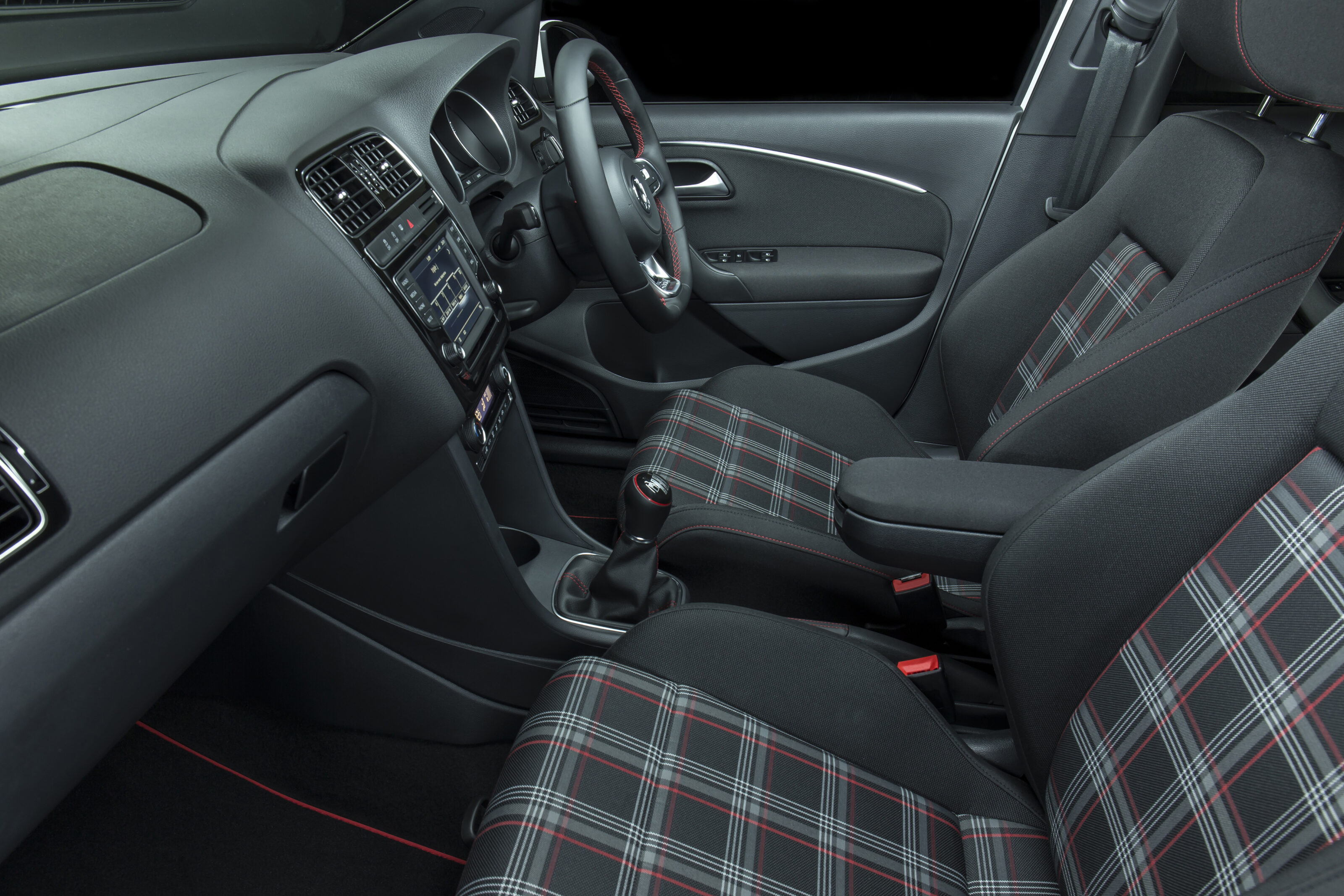
Yet enough of that: it’s behind the large-dished leather-clad wheel that you want to be. Here, the classic white-on-black gauges are as crisp as the new HD 6.5-inch centre screen is to look at and prod. Further down there are two things to light a driver’s fire: a traditional hand-brake lever, and a six-speed manual gearbox. While there’s no pitted golf-ball knob to ape big-bro Golf GTI, there is classic tartan trim and comfy, supportive seats up front.
It’s spic and span but not sterile before you turn on that new ‘big block donk. The 1.8-litre EA888 engine is an absolute peach. Taken from the Golf and wider VW Group family, it’s 302cc larger than the 1396cc four it replaces, but it doesn’t have the supercharger anymore, just a single turbo with an electronic wastegate. It has packaging advantages such as the exhaust manifold that’s integrated into the cylinder head, as well as direct and manifold fuel injection that helps save fuel, despite its 141kW being a 9kW jump over its predecessor.
With a smooth idle, it’s extremely well-mannered around town, reminding us why it won the 2010 Wheels COTY gong. The all-round vision is pretty good, despite the side mirrors being a tad too small, and the three pedals – and the first clutch pedal for a Polo GTI – are all well weighted in relation to one another don’t call on any muscle to operate. The shift itself isn’t as smooth as silk, but it’s light and feelsome enough to slot where and when you want it to, and fast.
The pace – and brisk response – from the manual version is something that the 7-speed DSG cannot match, even if the 0-100km/h time of 6.9sec is 0.2 behind the auto. Pick the manual, and you not only get an extra pedal to compensate, but you get 70Nm more torque due to the DSG’s inability to cope with anything beyond 250Nm. That means it swells from 1450-4200rpm, and while the DSG model also has a wider spread than its predecessor, its torque spread isn’t as broad as the manual’s.
On windy Blue Mountains Roads, the manual proves that this is the Polo GTI we always wanted. In fact, VW Oz says that customers had called for a manual since the GTI arrived in 2010, and it was snapped up for us Aussies as soon as Wolfsburg HQ uttered its existence.
That call to action has resulted in the manual GTI delivering an involving, sharp drive with brilliant response, the control and clarity of what the driveline is doing – thanks to the clutch and lever action – maximising the most of the grip and super traction from the front wheels. Roadholding is brilliant, stretching beyond expectation before the side walls of the 215-wide Continental tyres begin to literally fold, long before the nose begins to show any inclination towards understeer. It dispenses bumps quickly yet isn’t skittish or lairy like you’d expect a short –wheelbase hatch to be.
It’s a brilliantly capable and responsive performer for carving up traffic on an undulating road – precisely what a heavily trafficked mountain road called for on our drive.
Around town, the GTI hasn’t given up its manners. That torque spread helps with fewer shifts in traffic, while the firm ride isn’t intrusive, even if it gives up a little compliance in the process. There’s also some wind noise at highway speeds, bit tyre noise is limited compared to, say, the Fiesta ST.
VW has done itself a favour by going back to the future with a larger capacity engine and manual gearbox. The Polo GTI is cheaper, faster, drinks less and looks slightly more polished. It’s win-win, even if you still decide to buy the DSG – which still gets all the safety gear and bigger engine – ass 80 per cent of buyers do. And while VW may have followed the crowd – Fiesta ST, Peugeot – please don’t be in that one-fifth of manual buyers that will have more cash in their pocket and a permanent grin on their face.
SPECS Model: Volkswagen Polo GTI Engine: 1798cc 4cyl, dohc, 16v, turbo Max power: 141kW @ 6200rpm Max torque: 320Nm @ 1450-4200rpm Transmission: 6-speed manual Kerb weight: 1272kg 0-100km/h: 6.9sec (claimed) Economy: 6.7L/100km Price: $27,490 On sale: Now
Sign up here to receive the latest round-up of Wheels news, reviews and video highlights straight to your inbox each week.

THE Australasian New Car Assessment Program has awarded the new Renault Captur a perfect safety score despite it lacking potentially life-saving side curtain airbags for the rear seats.
ANCAP chairman Lauchlan McIntosh has previously described side curtain airbags as a “vital safety feature, particularly effective in reducing the chance of serious head injury in side impacts”.
This prompted the controversial crash test authority to make them mandatory to achieve five-star results it was awarding – at least they were until 2015.
If the Captur had gone on sale in Australia in December 2014, it would have been awarded a four-star safety rating because it lacks rear side airbag protection.
But it arrived in January 2015 and was consequently awarded a higher rating.
The anomaly comes because ANCAP last year announced new protocols that would see it align with Euro NCAP testing procedures by 2018, and as part of that enter a transition period whereby Euro NCAP ratings are published as an ANCAP rating.
ANCAP chief executive Nicholas Clarke defends the maximum score by arguing the rating has a 2013 date-stamp – that is, the car was tested in 2013 in Europe – and that Australian buyers understand it’s a two-year-old car.
“If you take a narrow interpretation of the press release, you could come up with sort of any view you like,” Clarke told Wheels.
“You’ve got to look at the whole picture and, as we’ve said many times, the ratings are based on a series of very complicated tests. From year to year those tests change, the standards change and … a five-star one year may not have the same level of kit as a five-star in another year.
“It’s no difference in terms of the 2013 rating for the Captur. The rear curtain airbags were not required [when the car was tested by Euro NCAP].”
Part of the confusion – both within the automotive industry and from consumers buying cars – is because ANCAP is currently in the transition phase whereby test results published by Euro NCAP to a lower safety standard can be republished in Australia. But not always.
Confused? You’re not the only one.
The ANCAP transition to Euro NCAP protocols has been a source of confusion for consumers looking to buy safer cars.
Even seasoned motoring writers are getting caught out, with some incorrectly reporting the Wheels Car of the Year, the BMW i3, had been rated four stars for safety by ANCAP. The safety watchdog has given the i3 a maximum five-star rating, which is one star better than its European partner awarded the same car.
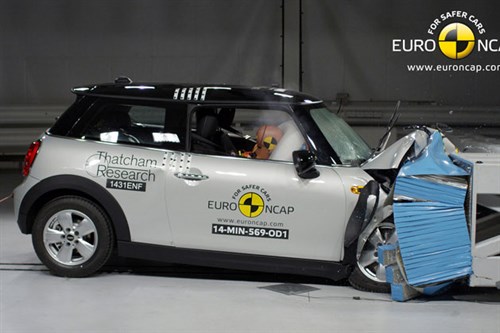
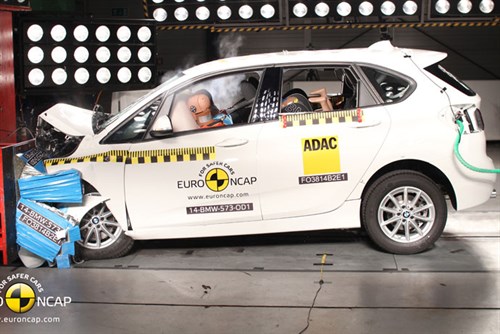
While promoting some vehicles, ANCAP has rated two cars with a full complement of airbags – the Mini Cooper and BMW 2-Series Active Tourer – with four stars. In the case of the BMW, it is down on the five-star Euro NCAP rating for the same car.
The four-star rating means ANCAP recommends people do not buy the newcomers from BMW and Mini, but the carmaker says it is “very confident of the safety of our cars, not just from a passive safety viewpoint but from an active safety viewpoint as well”.
“The changing criteria as well as the different criteria make it very difficult from a manufacturer’s viewpoint,” BMW Australia general manager of corporate communications Lenore Fletcher said.
“I can only imagine how confusing it is for car buyers.”
Meanwhile, Mitsubishi’s new Triton ute due in a few months’ time has gained a top five-star rating, as has the Land Rover Discovery Sport, and the Tesla Model S electric car.
Welcome to our latest weekly series, where we offer up the finest images in the MOTOR archive for your downloadable enjoyment.
Kicking things off is Porsche’s recent trip to the Northern Territory with the awe-inspiring 918 Spyder, where it managed to top out at an incredible 350km/h.
We couldn’t decide which of Easton Chang’s stunning images to select, so instead you’ll find links to both below.
If there are any images you see in the mag that you’d like us to include, let us know in the comments below!


HYUNDAI’S answer to the Honda HR-V, Holden Trax and Mazda CX-3 is still years away from launching in Australia, as its only global compact SUV – the recently revealed ix25 – lacks essential safety gear for our market.
Hyundai Australia may instead hold out for another vehicle that is currently under development for the European market, but may not get here until 2018.
Whether it is based on the chassis of the China/India-focused ix25 is unknown, but the Euro-centric crossover is thought to have been previewed at the 2014 Geneva motor show as the Hyundai Intrado concept (below).
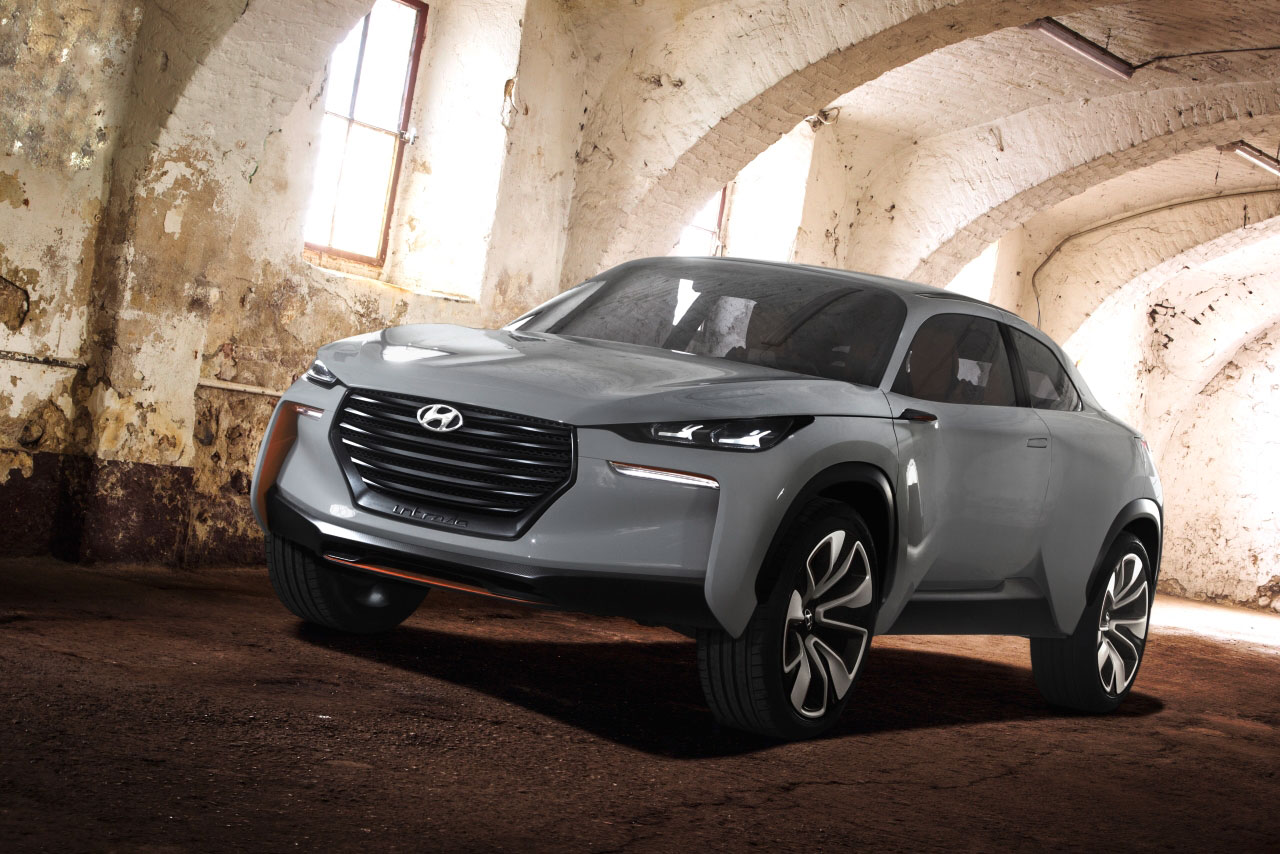
“We’d love a small SUV, but we don’t have one,” Hyundai chief operating officer John Elsworth said.
“Originally the ix25 was launched in China as left-hand drive only. It is also built in India in right-hand drive, but it does not meet our local baseline safety requirements.”

Despite growing significantly in size and technology, the all-new Hyundai Tucson (above) due in August is expected to at least partially step in as a replacement for the high-selling ix35, even though the ix35 is officially ranked in the compact-SUV class below, while the larger Tucson is to take on the likes of the Mazda CX-5 and Nissan X-Trail.
Hyundai is nervous about this because the ix35 sold nearly 18,000 units in Australia last year to dominate its segment. The next most popular model was the Mitsubishi ASX at 10,404 sales.
Sign up here to receive the latest round-up of Wheels news, reviews and video highlights straight to your inbox each week.
THE $409,000 Ferrari California T is at the vanguard of a brave new world for Maranello. With a turbocharged 3.9-litre V8 under the bonnet, it sets the template for Ferrari’s coming generation of road cars.
WHAT IS IT Forget everything you thought you knew about the Ferrari California. The latest T version is harder, better, faster and stronger. The turbocharged lump delivers a crisp flat-plane soundtrack and the rest of the package feels more authentically Ferrari.
WHY WE’RE TESTING IT We’ve driven the Cali T on its international launch in Italy, but this is our first chance to sample the car on Aussie roads. We know how it copes with picture-perfect Emilian roads, now it’s time to see if it can hack it as a daily driver in Melbourne.
THE WHEELS VERDICT The Ferrari California T is a massive improvement over its slightly confused predecessor with genuine bite when you’re on it and laid-back GT appeal when you’re not. It’s the only Fezza you could seriously countenance driving every day and has us expecting great things from the 488 GTB.
PLUS: torque, finish, pace, soundtrack, everyday utility MINUS: styling still divisive, visibility, options pricing
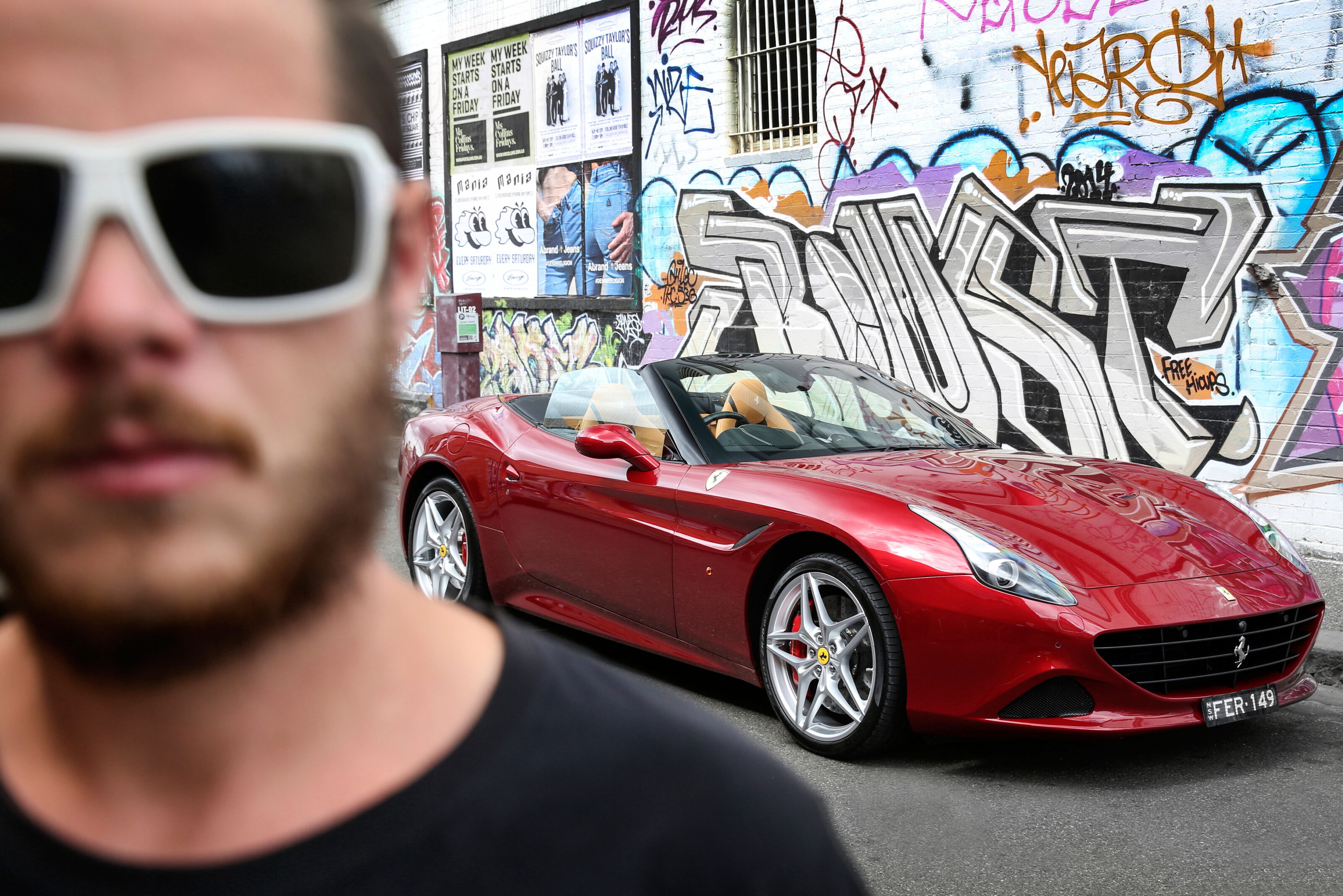
THE WHEELS REVIEW THERE are occasions when driving the Ferrari California T that you just need to relax and accept the fact that, every so often you’re going to come across as a monumental tool. Don’t fight it. Just try it on for size, perfect an unabashed grin and get on with it.
You’ll come to realise that the gearbox’s silently reverting from D to N at the lights after a minute is clearly designed to have you surge away to precisely nowhere on a huge flare of revs as everybody about you sniggers. Delicate reversing manoeuvres will appear the work of a man determined to cremate his clutch by replicating the action of a stepper motor. And due to the analogue speedo’s 30km/h increments, you’ll have a wholly hazy idea of how fast you’re going unless you hunt around for the microscopic digital readout. Victoria Police naturally have a very reasonable attitude when this is explained to them.
Getting to learn a car’s idiosyncrasies has long been part of the Ferrari tradition, and this California T is nothing if not authentic. Those who see the coming of turbocharged engines as the beginning of the end for the marque can rest easy – the 3855cc force-fed V8 under the bonnet of the California is a work of genius. Drop it into Auto, set the manettino to Comfort and it’ll shuffle around almost noiselessly, propelled by a pillowy 755Nm swell of soft-serve. Click into Sport, take control of the seven-speed ‘box and the California T tautens and delivers 412kW of the right stuff.
The flat-plane crank generates a reasonable facsimmile of a 458’s howl above 5000rpm, and the exhaust sounds a crackling fusillade on full-bore upshifts. The engine management system increases the amount of torque liberated in each successive gear to quell any rubbery lag-and-lunge low-speed throttle response.
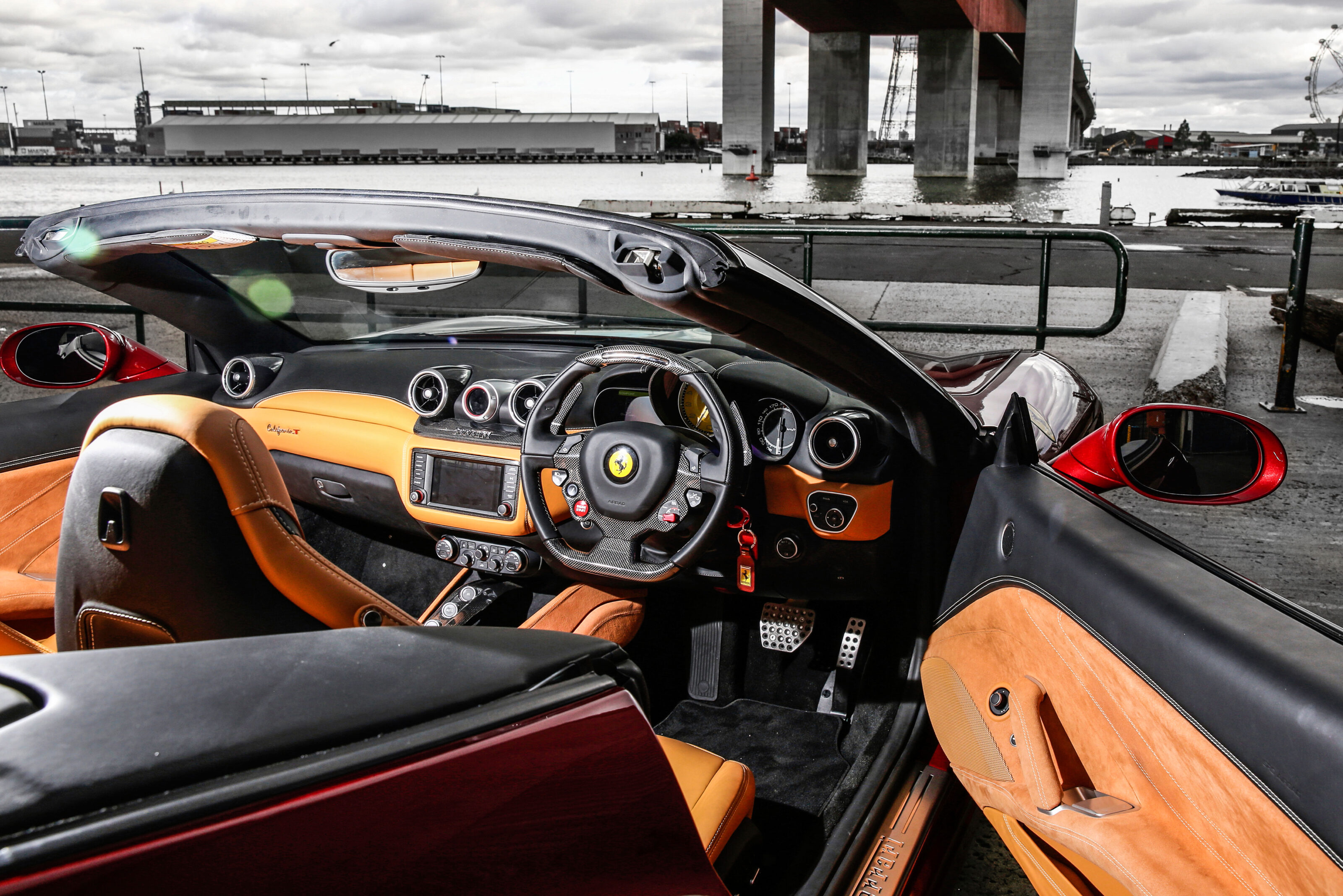
The steering is unexpectedly quick but unerringly light, even when loaded out of a corner. The carbon ceramic brakes are brilliantly calibrated even under light application, and there’s enough front end clearance to get you off a servo forecourt without wincing. You’ll be thankful for the rear parking camera as the rear end disappears out of sight, lost behind the hump for the folding hard top. The engine’s so loud in a city multi-storey that it drowns out the reversing sensors, so keep your eyes on the screen. The roof drops in just 14 seconds and the system talks to the rear parking electronics so as not to flip back the bootlid into a wall/car/person with cameraphone. The sat nav also has an unerring ability to incapacitate you with laughter with its hopeless pronunciations of local names.
You’ll need to tread carefully over speed humps, as the front end can feel a little under-damped but that’s a small payoff for a supple ride that makes the Cali a genuinely workable everyday proposition. Those who really want to drive the car will probably want chunkier anti-roll bars to prevent the California flopping into roll oversteer when they’re really committed but if you want to smash a few apexes, a 911 Turbo will always be a better choice. A Race mode on the manettino would have fixed a lot of these complaints.
Even the styling’s been cleaned up a bit. I loved it, but snapper Brunelli spent the day frowning through his viewfinder, muttering about Rosso California paint and clashing Rosso Corsa brake calipers. I’m more easily pleased.
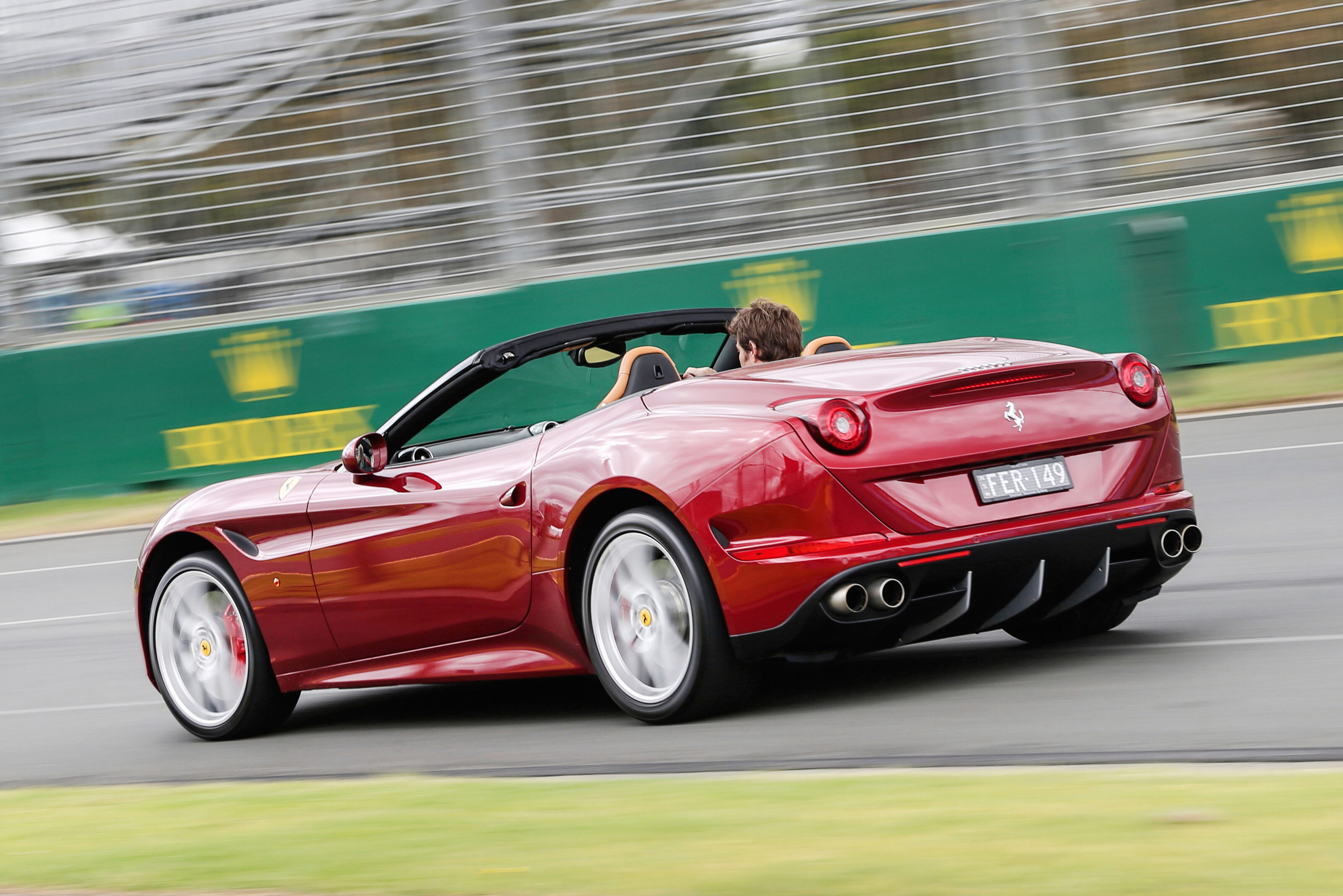
The most telling fact about the California T is that Ferrari’s softest, most relaxed car is now capable of demolishing an F40 to 100km/h and will also thrash it around Ferrari’s Fiorano circuit. Let that one sink in for a moment. There’s nuance to this car though. It covers a broad remit and does so with guile and delicacy. The California was often dismissed as the Ferrari for people who didn’t get Ferraris, but that’s now a long way from the truth. True, 70 per cent of its customers will never have owned a Ferrari before, but amping up the engine hasn’t ruined the California’s GT chops.
This might be Ferrari’s cleverest car. If the sales projections are anything to go by it’ll definitely be its most popular, but the acid test for Ferrari’s turbocharged future arrives later this year. The 488 GTB is set to be held to a higher standard of proof.
SPECS Model: Ferrari California T Engine: 3855cc V8 (90°), dohc, 32v Max power: 412kW @ 7500rpm Max torque: 755Nm @ 4750rpm Transmission: 7-speed dual-clutch Weight: 1730kg 0-100km/h: 3.6sec Economy: 10.5L/100km (combined) Price: $409,888 On sale: Now
MITSUBISHI president Tetsuro Aikawa has flagged an “exciting year ahead for new product” for the brand.
Aikawa, an engineer for 30 years who was appointed to the top job last year, said he would work to rebuild the Mitsubishi brand both in Australia – the fifth-biggest market for the carmaker – and globally.
“I am passionate about product,” he said at the launch of the latest-generation Mitsubishi Outlander in Australia today.
“Appointing a car guy as head of Mitsubishi Motors, it means a new and unique product direction. Product will be my key objective as president.”
Also key would be a focus on SUVs – the Outlander and ASX were the brand’s third- and fourth-best sellers behind the Triton ute and Lancer small car – but would also continue to focus on building EV and PHEV into another pillar for the brand.
“In Australia, this market is still young. However, as environmental regulations get tougher I expect demand for these vehicles to increase in future,” he said.
“Not everyone in Australia stands to benefit from EV/PHEV, but there are many who will for commuting every day.”
Mitsubishi only has one plug-in electric vehicle on sale in Australia, the Mitsubishi Outlander PHEV. It still offers the expensive city-friendly i-MiEV hatchback to Australian customers, but only as a special-order vehicle.
Aikawa said now that Mitsubishi had achieved stability, “we have challenged ourselves to deliver new market-leading products, new packaging and technologies, all of which are backed up by advancements in quality”.
“We are working on new product for Australia and around the world,” he said. “These products must be the best in design and technology to rebuild the Mitsubishi brand.”
Mitsubishi is gearing up for a new-model rollout in Australia that should help it shift from having one of the oldest new-car showrooms of the mainstream manufacturers – the Triton ute was launched in 2006, the Pajero launched in 2008 but based on the underpinnings of the previous-generation large off-roader, and the Lancer launched in 2007 – to one of the newest.
New versions of the Pajero and Lancer, and the Triton-based Challenger SUV launched in 2009, are due next year, while the ASX small SUV, updated in 2012 from a model launched in 2010, will need to carry the nameplate for a few more years.
The fresh-look Outlander, launched this week, was another example of Mitsubishi’s new product direction, Aikawa said.
“[The] new front face design is called Dynamic Shield design concept. It will be consistently applied to our future models,” he said.
However, while the so-called 2016 model-year Outlander wears the new corporate nose, the “2015” Triton work ute due on sale in Australia in May doesn’t, suggesting there may be a wider path opening up in the showroom between passenger and commercial vehicles.
Sign up here to receive the latest round-up of Wheels news, reviews and video highlights straight to your inbox each week.
Unsurprisingly, the motoring industry has exchanged plenty of words about the sacking of Jeremy Clarkson and the demise of Top Gear.
Oh, I know there has been no official announcement; quite the contrary, in fact, with producer Andy Wilman recently stating it was “back to work” for the TG crew.
However, while Top Gear may continue to exist – just as it has existed since 1989 – it’s clear the current format everyone knows, and most of us love, is dead. No longer will it be Clarkson, Hammond and May ‘cocking about in cars’.
Now, it’s important that I declare my allegiance upfront – I’m an unashamed fan of Top Gear, and have been since I was first shown the program by friends in 2005.
We’d huddle around a mate’s television on Sunday afternoons, watching abridged versions on some obscure pay tv channel, usually hungover.
From there I discovered the world of internet downloads; illegal, yes, but I suspect the BBC turned a blind eye as it didn’t want to risk alienating its rapidly expanding fan base, and at the time there was no other way to watch it in Australia.
The show played a pivotal role in my education as a motoring journalist, and is certainly partially responsible for me being able to sit here and write this.
It might seem odd that a media outlet would devote column space to a rival, but while it’s true the spin-off magazine occupies a similar space to MOTOR, the show itself has no rivals.
No matter how long they’ve been established or how many readers they have, no motoring media even approaches the power and influence of Top Gear.
Who else could convince Kia to write off a fleet of cars playing rugby? Or convince Renault that driving a Twingo into the sea was a good idea?
By way of example, if MOTOR‘s monthly magazine sales were one-tenth of one per cent of Top Gear’s estimated 350 million viewership, we’d be very happy indeed.
Whether we want to admit it or not, every motoring publication owes Top Gear a huge debt. It single-handedly made liking cars if not cool, then at least socially acceptable; millions of people, who otherwise wouldn’t have been able to tell a Pagani from a Peugeot, now have a passing interesting in automobiles.
And as we move into the digital realm, with an increasing focus on video, whether conciously or not, every outlet is measuring itself against the production and entertainment standards set by the immensely talented TG staff.
Of course, the bitter irony in all this is the man who played such a pivotal role in reviving the show and creating this juggernaut is also the one who has brought it crashing to its knees.
I have never met Jeremy Clarkson, but having spoken to a number of people who have, the general consensus is that he is arrogant and rude, though I have heard a couple of reports that he is charming and civil – as usual, the truth probably lies somewhere in the middle.
That Clarkson should’ve been dismissed is indefensible; in this day and age, anyone who physically assaults a colleague would be instantly fired regardless of the industry they worked in.
According to some sources, all is not particularly well in Clarkson’s personal life, but that is no excuse, many people go through hardship without flipping their lid.
Professionally, however, I will offer some words of defence. Having cultivated an image of a bumbling ignoramus for television, it’s often forgotten that Clarkson is one of the world’s finest motoring journalists.
Autocar editor-in-chief, Steve Cropley, once wrote in a column that in the world motoring journalism, Clarkson was “the best of us”; and when I asked a former editor of two of Australia’s leading motoring publications who to read to improve as a writer, his response was “I quite like that Clarkson fella”.
Don’t be fooled by his television persona, Clarkson knows his subject matter inside-out and back-to-front, and his ability to explain complex or confusing topics in a straightforward and entertaining manner – one of the most important abilities for any journalist – is almost beyond compare.
Thanks to working for a publically-funded broadcaster, with no advertising repercussions to deal with, he is also one of most brutally honest reviewers you’ll find.
He isn’t always 100 per cent correct – he’s wrong about the Porsche 911, for instance – but, in general, regardless of price or badge, good cars are praised and bad ones mercilessly bashed.
There’s no better example of Clarkson at his best than this Honda Civic Type R film from 2008. Can you imagine the face of the Honda PR team when that was broadcast around the world?
No doubt there are plenty of you that will disagree with this column. You probably think of Clarkson as a sexist, misogynist dinosaur (internet points to anyone who knows what James Bond film that line was stolen from) and Top Gear as a show that’s gone 10 seasons past its use-by date.
You may well be correct, but there’s now one hour less of quality car-based content on television each week, and that’s a loss for all enthusiasts.
Get your free weekly report from the world of fast cars – subscribe to the MOTOR newsletter!
It reads like a film script … THE SCENE: A narrow, twisting road through the wildly beautiful Swiss-Italian Alps … THE CHARACTERS: A famous author and his film star wife living in a mountain hideaway … THE PLOT: The chance discovery of an Italian masterpiece …
THIS, I SWEAR, is exactly the way it happened.
It was in September, 1963; Jasmine and I had been living in Turin for three months and were on our way to Locarno, Switzerland. As our red Fiat Seicento (600) hummed across the Po Valley and along the western shore of Lago Maggiore we kept up our instinctive vigil for cars of character.
There were few left in Europe. But as we tooled past Arona we saw something parked in front of a modest garage. It was a big, black Fiat 524 limousine of 1934 vintage and in very good condition. The owner turned out to be the proprietor of the garage, a small, wiry, salt-of-the-earth Piemontese in coveralls and beret, with a radiant personality and a passion for the fine machines of the past. After we had examined the Fiat we went up to his apartment over the garage for a splash of barbera. There we met his family and when we parted we did so as close friends, with a business card of Cavalier Tale tucked away for reference.
As we continued north along the edge of the vast lake the country became more mountainous and wildly beautiful and the road more twisting and narrow, with almost sheer cliffs on the left and an abrupt drop to the water on the right. Then, just a few miles beyond the Swiss border, a gleaming, flame-red Lotus Elite pulling a flat trailer came straight at us. And on the trailer was the most pristine Jaguar SS100 we had ever seen. It had racing numbers painted on its bright yellow sides. Evidently a discriminating Swiss enthusiast on his way to a hill climb.
At the same, precise instant, as my eyes were riveted on this spectacle, Jasmine cried “STOP”! with panic urgency. Standing on the brakes I warped onto the narrow shoulder and let the giant OM diesel that had been on our rear bumper thunder by with millimetres to spare.
“Look!” Jabs said, pointing to an open cave hewn out of the cliff face. “What is it?”
I couldn’t identify the vintage machine from the rear but she had been right – it was something very special.
We got out and entered the doorless cave-garage. The first glimpse from behind of the lines of the car’s radiator proclaimed the close-coupled landau was a Lancia Dilambda.
In Italy, where the Dilambda is known as Vincenzo Lancia’s capolavoro, his masterpiece, only five of these cars were known to survive. This one, beneath the dust of years, had the finest lines of any specimen we had seen.
Someone had carefully placed it on blocks a long time ago. Its big tyres were like new and only 41,000 km (25,500 miles) were registered on its odometer.
It had been all of a year and a half since we had finished restoring a splendid old car. We looked at each other in a silence that said, “Should we?” Finally we both nodded, resigned to what Fate was doing to us, and I said, “Wait here. I’ll start looking”.
There are villas perched high on the cliff there and they are reached by hundreds of steps cut into the rock.
When I climbed to the third house I found someone who knew who belonged to the old car. “Oh yes,” said a lady in Italian. “It’s Signor Remarche, down there across the road, beside the lake.” It had started to drizzle and Jasmine sat in the Seicento while I pursued the warming trail.
The villa was exquisite, surrounded by an acre or two of jungle-like garden. I knocked on the front door but, although there was sound within, there was no answer.
I went around to the back of the house and mounted a broad veranda, where a wall of glass doors faced the lake. I knocked loudly, to be heard over the recorded voice of Caruso which rang through the serene air. The door was opened by a stern-looking, silver-haired man in his sixties.
“Mi scuso,” I said. “Ma cerco il Signor Remarche.” “Sono io,” he answered. “Cosa volete?”
I explained I was interested in the old car, perhaps in acquiring it.
“You can speak English,” he said, with a very light accent. “Come in. I can give you just five minutes. I have a pressing engagement.”
The golden, open voice continued to flow from the sound system. My eyes made a quick sweep of the huge room we were in, noting its richness, its lack of any pretension, the books and ancient bronze sculptures everywhere, a huge rustic table stacked with manuscripts. I asked myself, what is his name, not pronounced in Italian?
“Pardon me,” I said. “Would your name be Erich Maria Remarque?”
”Yes,” he said. “That is who I am.”
For the benefit of those who are not familiar with the name, Remarque was one of the great authors of this century. He died in 1970. His first book, All Quiet on the Western Front, was revolutionary in its literary style, as it was in its profoundly moving expression of the tragedy of war. It was the beginning of a long and brilliant literary career.
Having been warned this encounter must be brief I hastened to the point: Would he consider giving up the Dilambda?
“Many people have come here asking that question,” Remarque said, “But I have resisted. Too many of them were obvious speculators. Tell me about yourself. What do you do?”
I told him I was a motoring writer and defined my main spheres of interest.
“Very interesting,” he said. “Because that’s how I began writing. I worked for the Continental Rubber Co in Germany as a technical writer. That was how I came to know the whole Mercedes racing team in the ’20s. Caracciola was a close friend. It was he who taught me to handle a spur-cut gearbox properly and how to handle a good car at speed. In the Dilambda I used to love to take on big, supercharged Mercedes on any twisting course and leave them behind. The Lancia’s independent front suspension and roadability were formidable things then.”
The five minutes stretched into 20, then 30, and the rain came down. Remarque asked if I had come alone and I told him my wife was waiting in the car. “Good heavens,” he said. “Bring her in! My wife will be here at any moment. She’s American too, you know. Her maiden name is Paulette Goddard.”
I fetched Jasmine, Erich broke out the Cognac and baccarat glasses so thin they were elastic to the touch. Paulette arrived and he said. “Mamma, these are the Borgesons, from the States and now living in Turin. We have a thing or two in common.” La Goddard had just come in from having her hair set and had a scarf around the rollers. She was beautiful and as natural as any of the villagers. Jasmine didn’t know who she was but they fell to reminiscing about Southern California like old schoolmates.
From time to time the conversation would drift back to cars and Paulette told us of an odd coincidence. As rare as Dilambdas always were, she had owned one when she was a bit player working for Republic Pictures for $35 a week. That was before she became a great actress. Her beau at the time was Crane Grantz, heir to a famous fortune, great automotive enthusiast, and founder of the Cragar racing equipment, which still exists as a division of Bell Auto Parts of Los Angeles.
“Cranie” had made Paulette the splendid gift of a brand new Dilambda with a short chassis like this one, and with a close-coupled Weymann four-seater body. Driving it to Palm Springs one time she became confused at the junction, hit the signpost in the centre of the road fork, and under ‘the impact the whole fabric body flew off, leaving her holding the wheel of a bare chassis. Back in Turin I had a photo of her car, taken when the Walter M. Murphy coachworks of Pasadena put it back together, and I brought it to Paulette on our next trip.
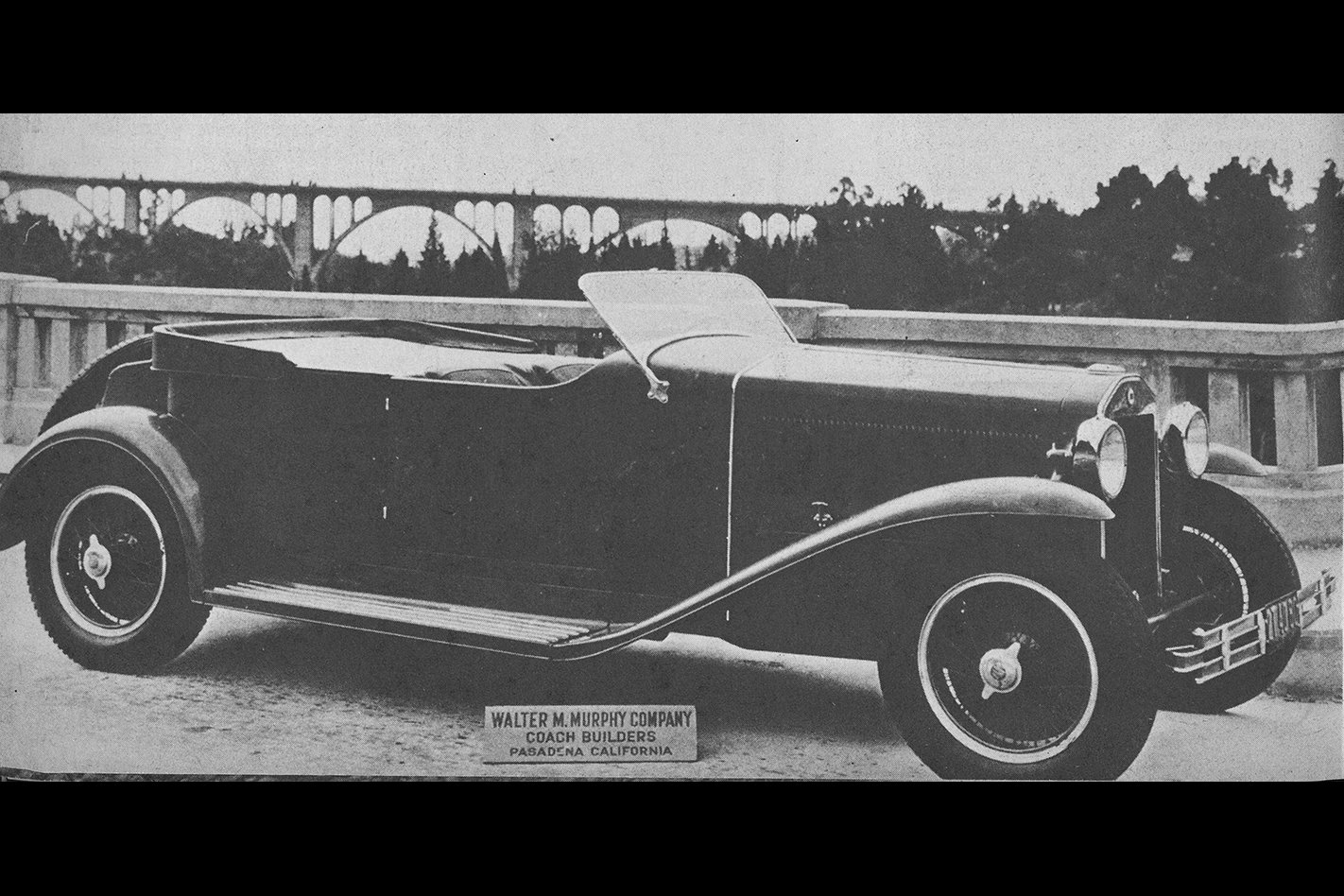
After a couple of hours this session had to end. “Think about the Dilambda and I will too,” Erich said. “Maybe we can work something out. There’s no hurry. I don’t plan to sell it to anyone else but we do need the space.”
The car was in beautiful condition. It had been driven only once in the last 14 years, when Erich took Paulette to Venice on their honeymoon. Yes, we wanted the car, and, living in Turin, there never would be a problem finding replacement parts or having them made expertly – if they ever should be needed. The decision was probably much more difficult for Erich.
He had told us a great deal about what the car meant to him. As a technical writer he had hardly been prosperous. He wrote his first novel, “All Quiet“, at night and then traipsed from publisher to publisher in Germany, trying to sell it. The universal response was that the last thing that anyone wanted to buy at that time was another war book.
Finally, Erich did find a publisher who took the trouble to read the script, thought he saw merit in it, and decided to take the risk. When the book appeared the first edition sold out almost overnight and the demand for it rose to legendary heights – until the task of keeping up with this demand had to be farmed out to some 80 different presses in Germany. Meanwhile, its success beyond those borders was equally fantastic and it was translated into nearly as many languages as the Bible. As a film, which lifted Lew Ayres to stardom it became one of the classics of all time. It had a profound influence on a whole generation of the human race.
Erich, of course, found himself suddenly wealthy. He continued to live modestly but, with his first royalties in 1929 he indulged himself in the fulfilment of a dream: a Lancia Lambda roadster. Then in 1932, wanting a more powerful car he bought the Dilambda chassis from the Lancia agent in Berlin and commissioned the landau body to be built by the coachbuilding firm of Voll & Rohrbeck there. This car became very dear to him, particularly since he feels it saved his life twice.
Erich found himself in a Spockian position in the Germany of the ’30s: an enemy of the State because of his persuasive pacifism. He was subjected to constant harassment, which the establishment sought to justify by releasing the myth that he was a Jew named Kramer who was hiding under the name spelled backwards. One day an admirer of his with close party connections warned him of orders for his arrest within 24 hours. He loaded the Dilambda with all the essentials it would hold and fled over the Alps, to Antibes on the Cote d’Azur.
That was his first escape. He remained in the South of France, writing, until well into World War II. Then one day he received a telephone call from another admirer, ‘this time the late Joseph Kennedy, then US Ambassador to Britain. Kennedy told him he had positive assurance that the Germans would invade France within hours and that Erich should flee unless he wanted to be dealt with as a traitor to the Third Reich. Again he hurriedly loaded the Dilambda, this time driving to Italian Switzerland. It was then he settled in his present villa. They were close comrades, he and the Dilambda.
In a month Jabs and I returned to Lago Maggiore and it was agreed we should have the car. The next problem was putting it back in service sufficiently to drive it to Turin. This involved many weeks of commuting between the two points as each aspect was dealt with systematically. All went perfectly until I turned the crankshaft a few degrees, levering the flywheel ring gear. There was a brittle, snapping sound as a rocker arm fractured. Not surprisingly, ancient varnish had welded most of the valve stems in their guides.
I removed the cylinder head and, on the way back to Turin, dropped it off with Cavalier Tale, about 40 miles down the lake. He would free the valves while I found another rocker arm. Knowing the Italian Government does not award Knighthoods without excellent reason, I asked him how he had acquired his title. With pride he showed me his membership card in the American Knights of Colombus which he had somehow managed to acquire.
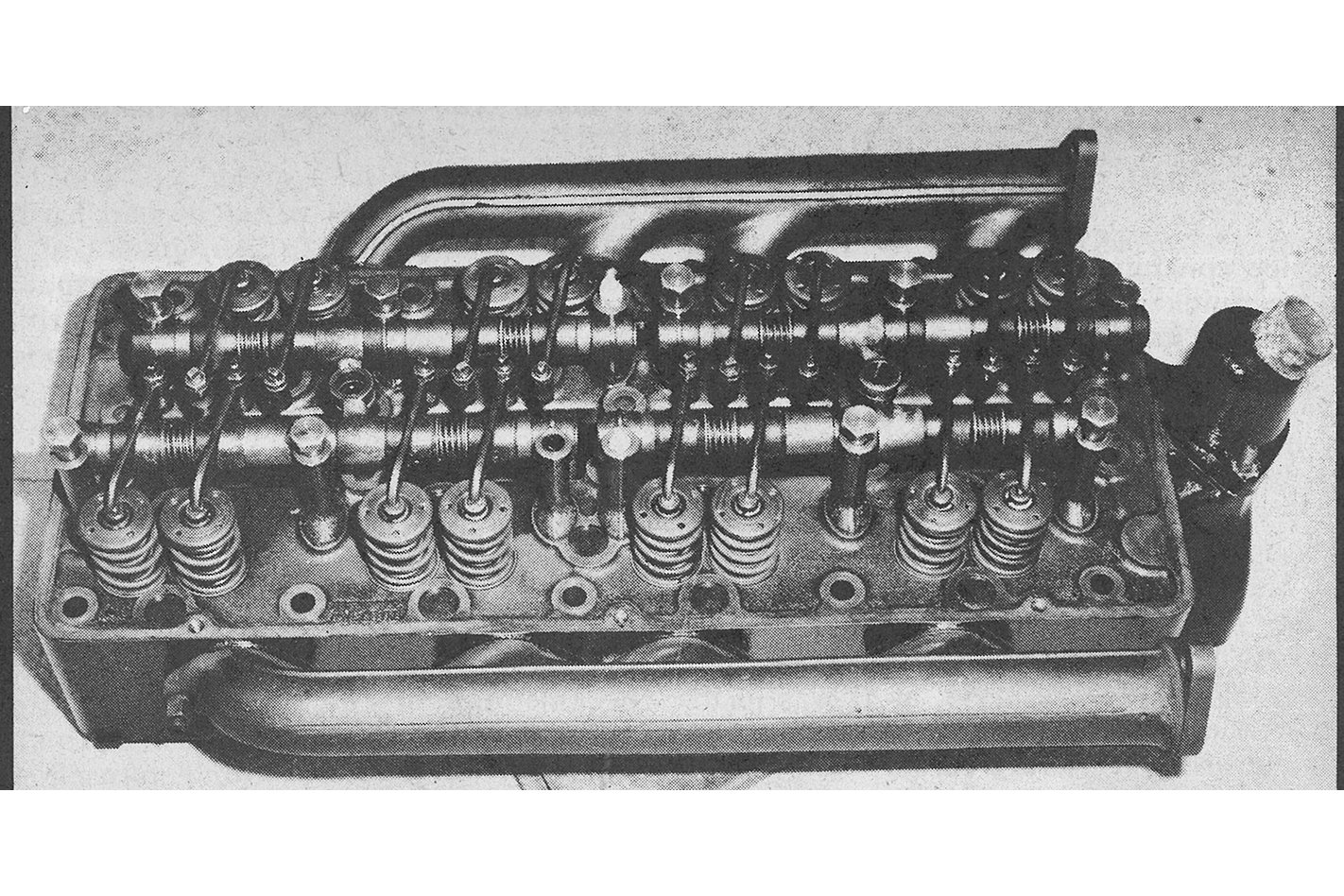
I got off an SOS to our soul-mate Ronald Barker in England, knowing that in the loft over the carriage house which holds his famous Napier and Dilambda are stored most of the world’s stock of Dilambda parts. The rocker arm came back by return mail and we headed back across the Swiss border, picking up the reworked cylinder head on the way. I torqued it down and, with a borrowed Land-Rover, had the Dilambda given a starting tow. After a few dozen yards in third gear the four-litre V8 burst into sonorous life, and after a couple of hours of shakedown promenade we were ready for the trip back to Turin. Mamma Remarque handed Jasmine a sweater she had knitted and Erich came up to the road to see us off.
I drove the Dilambda, and it was a rich experience. It is one of those all-of-a-piece thoroughbreds that is all honesty, integrity and quality. After just a few trial shifts it became easy to go through the straight-cut four-speed gearbox without a nick. The steering was quick and precise, the huge brakes were powerful, the acceleration stimulating, and the ride was luxurious and at the same time rock-solid.
Jasmine followed in the Seicento and at the border we faced the moment of truth with Italian Customs. Erich had last registered the Dilambda in Switzerland in 1954 and I, for tax reasons, had registered it in the States and had mounted the American licence plates. This meant saving astronomic quantities of lire for as long as we could get away with it. At this, the most crucial point of the exercise, we were lucky.
Doganieri poured out to admire this glory of Italy’s automotive past and the incident turned into a great bench-racing session. There was one grouch who, probably under the influence of Ian Fleming’s “Goldfinger“, did his best to find ingots aboard. Back at the Seicento another officer said to Jasmine, “Oh, we know who you are, incognito and all. You’re that writer and actress couple that lives up the road.”
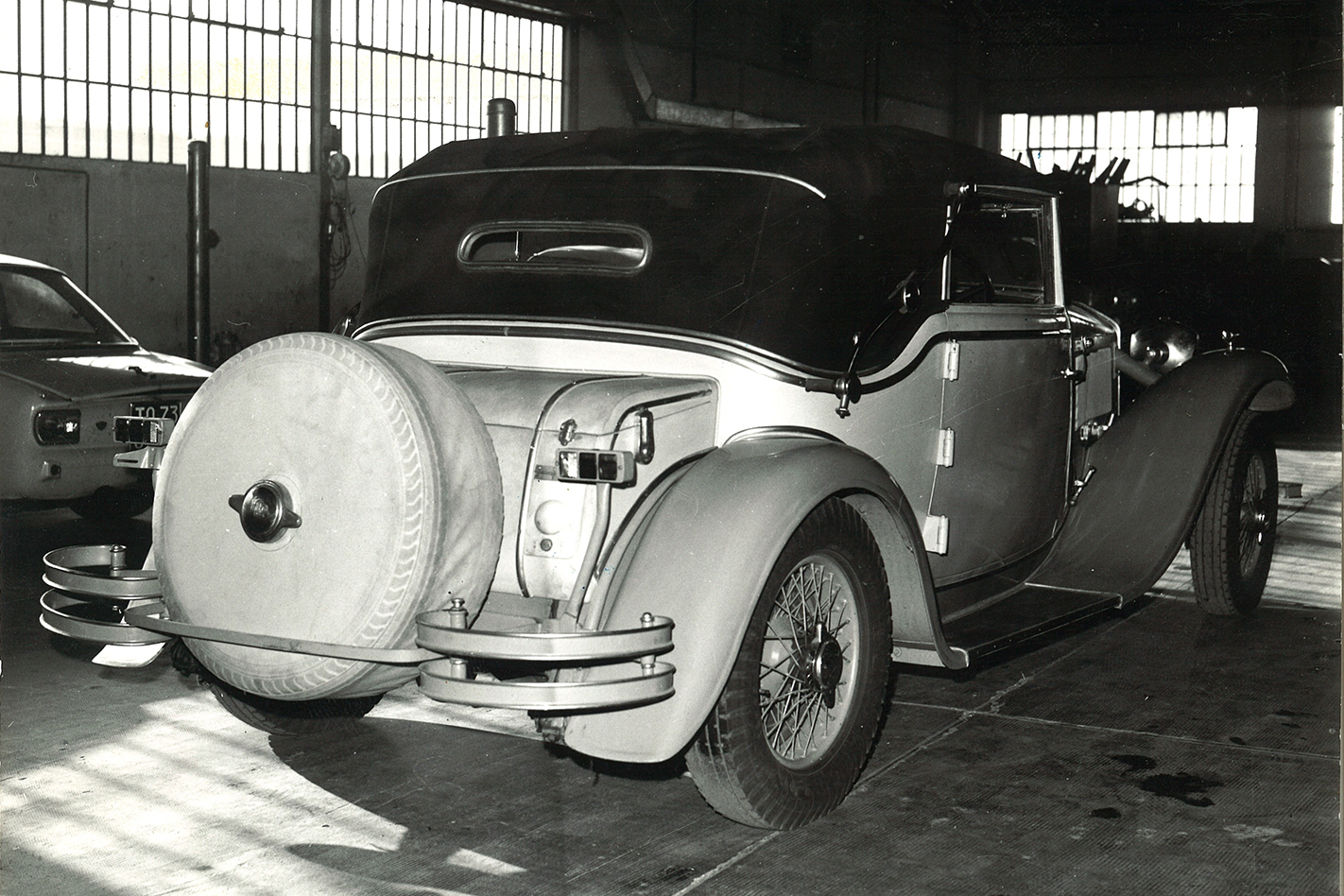
We entered Italy through a portal of smiles and arrivedercis.
It was pitch dark as we neared Stresa, two thirds of the way down the long lake. The Dilambda’s engine began to run on fewer and fewer cylinders as the valve stems again began to lock up in their guides. I pulled up under the first street lamp on the outskirts of the small city, to verify the nature of the trouble. Somehow Jasmine managed to flash past without either of us being aware of it. I waited for her momentary appearance but the minutes dragged by. After half an hour I knew she was in trouble, perhaps had fallen into the lake, which is not hard to do. I hiked to the centre of Stresa, found a policeman directing traffic at the main intersection, and asked him if he had seen a red Seicento go by, with Stampa sticker and Turin plates. He had not, so l asked for directions to the police station and hiked there. It was a desperate move, because Jahs’ driver’s licence was about as legitimate as the Cavalier’s title.
I explained the situation to the officer on the desk. I was an American writer living in Turin, my wife and I were driving there in separate cars, and we had lost each other. Did they have any word of her? No. I did not want to move the Dilambda, wanted to leave it under the street lamp where she surely would see it if she should come by. Could they take me back toward Switzerland in a police car to look for her? Or lend me a Lambretta? All this was too much for the desk officer, who said I had better tell my story to the commandant on duty.
This officer began taking notes suspiciously, obviously wondering what I was really up to. Then he asked me what I was driving. I told him, naturally, a 1932 Lancia Dilambda, with American plates. He looked at me as though I were both raving mad and making a mockery of his office. He brought his fists down on his desk when, with the inkwell still in the air, there was a great commotion in the ante-room. Jasmine burst in, weeping for joy.
Having lost sight of me she had assumed I had floor-boarded my way on to the Cavalier’s. She drove the twenty miles there, found I had not been heard from, drove the twenty miles back, and was trapped by the officer at the intersection. He brought her to police headquarters, where our great reunion took place in an atmosphere of universal emotion. All the cops were happy we had found each other with the exception of the commandant, who probably still feels it was all a cheap publicity trick cooked up by crazy, inscrutable Americans. We suspect they may still remember that night in Stresa.
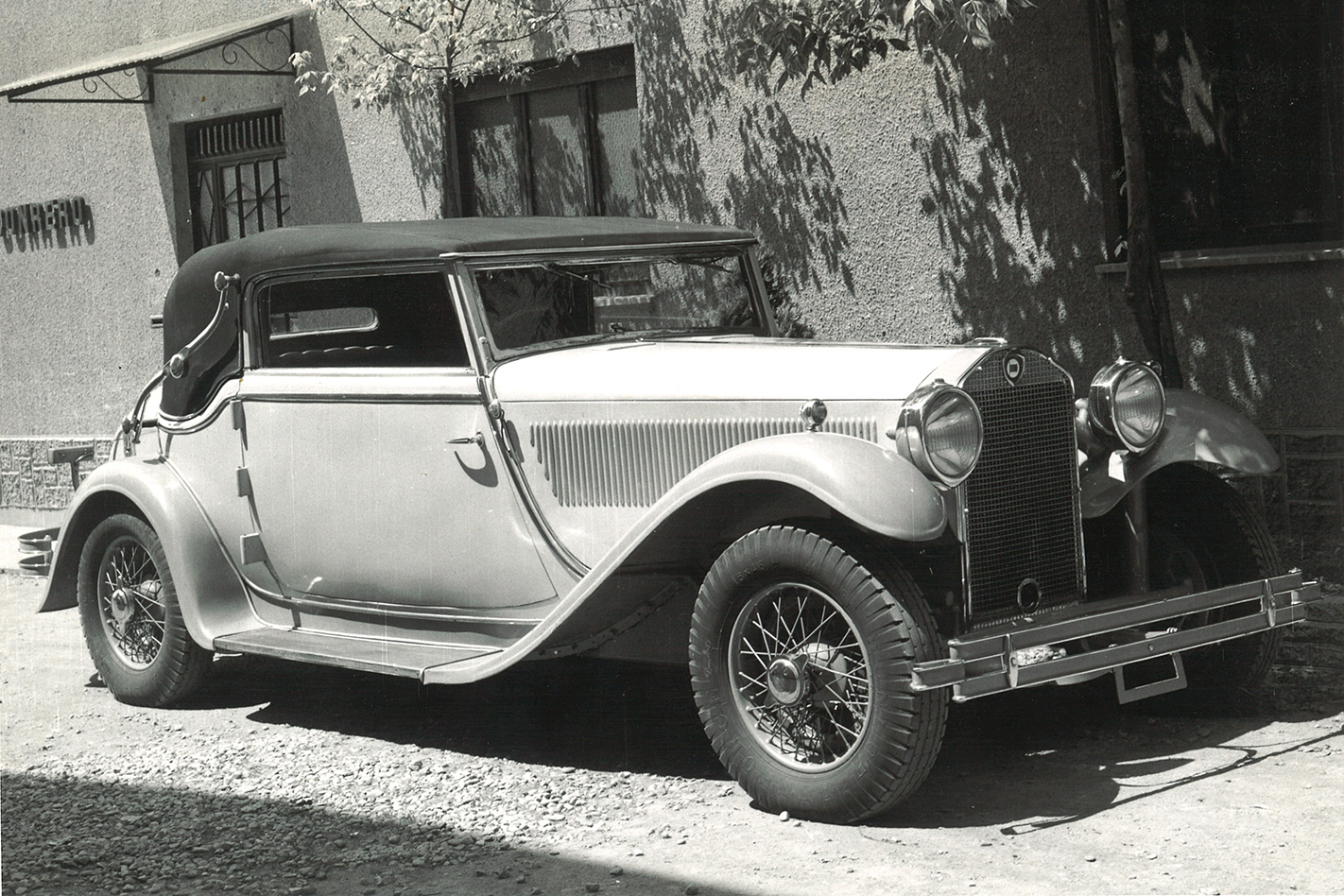
We boomed south and routed the Cavalier out of bed. I told him how his valve job had worked out and he promised to correct it the first thing in the morning. Having had a full day, we collapsed in the handiest hotel. A few hours later I walked into the garage and found our lover of vintage machinery beating the Dilambda’s rocker arms with a large hammer. “They should be fine now,” he said and I agreed. Anything to stop the carnage. The car had come that far on three cylinders and might make it to Turin. It did.
Aside from the essentially simple valve problem the thing wrong with the Dilambda’s meccanica was its thoroughly rotted-out exhaust system. This meant driving with both windows down. This was quite acceptable since all the way across the Po Valley ice formed on the windshield as fast as my shivering hand could reach out and scratch a small hole in it for a clue as to where we were going.
Home in Turin I dismounted the cylinder head once again and found that the Cavalier, the first time around, had taken the trouble to remove the rocker shafts. He had beaten directly on the valve stems; most of which were so mushroomed it took hours of filing before the ruined valve could be removed. I had a set of new ones made, blued them into the reground seats, and Barker winged in from London with a new Dilambda head gasket, neatly protected in his valise by clean shirts and shorts.
The clearances of the pistons and lower-end bearings were minimal; I buttoned up the engine and it ran like a watch. Abarth, who does this work for Ferrari, among others, engineered a brand-new copy of the original dual exhaust system. Virgilio Conrero put the crowning touches on the engine’s tune. Fellow Dilambda owner Dr Paulo Sanguinette made us a gift of a pair of Dilambda fender lights copies of the original accessories which he had just had hand-made by Fausto Carello, the firm which originally had made the Lancia-shield-shaped headlights which had distinguished all Dilambdas. The remaining task was restoration of the coachwork. The old paint was finished, most of the chrome required replating, and the wood of the trunk and left-hand door was rotten.
Some of the best restoration work in the world is done by Carrozzeria Savio of Turin, to whom I took the car. Restoration is just a sentimental sideline for this busy house but they agreed to take the job on if I had lots of time and would let them work at it in spare moments, which would permit them to make a very friendly price. They were good to their word and their expert artisans did a splendid job, with just one hitch.
We had decided upon beige for the car’s body, top, and trunk, and tan for fenders, running-board valences, and radiator shell. The top came last and I inspected Savio’s stock of waterproof fabric. It was all black and it was only then I discovered it had been years since any other colour had been available on the Continent. I gave instructions to do nothing. I decided to track down properly matching material myself.
A friend who works in the managerial echelon of a major French manufacturer discovered a few yards of rubberised cloth of the correct tint, tucked away in one of his firm’s warehouses. Since there was no established procedure for disposing of such leftovers to the public, he just walked off with the cloth. He carried it to the Frankfurt Show where he turned it over to a mutual friend, a famous Torinese coachbuilder. He smuggled it home in the trunk of a show car and kindly delivered it to Savio, who installed it on the Dilambda. Then they wrote us, saying the car was ready for delivery at last. It had been a long time, by mutual consent.
In the interim many things had changed and, while Turin always will remain our mother metropolis in Europe, we had retreated to a more rustic base of operations in southern France. On the way to Monza in September, ’67 I stopped at Savio’s to see the finished car and to greet the firm’s director, Dr Caracciolo, who had made the project his personal responsibility. This kind gentleman had succumbed to a long illness and, as if in subconscious mourning, the top material had been installed with the black side out. These things occur with no one being at fault.
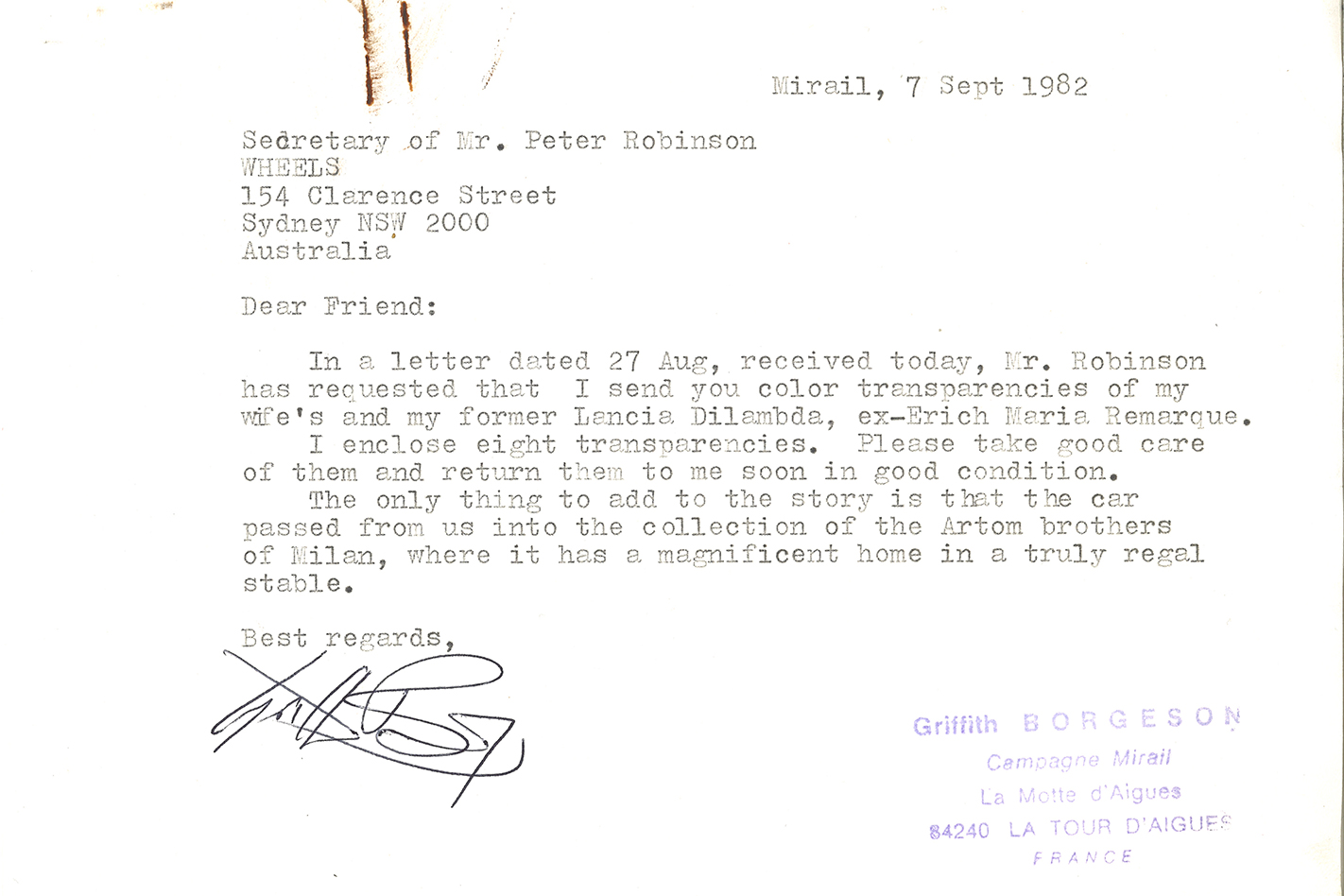
There is no denying the Dilambda would be nicer with a top which more closely matches its overall decor, but that concern is no longer ours. We made the decision between Turin’s broad boulevards and the narrow streets of sunny Provence where only tiny cars are any pleasure to drive. It is sadly ironic that the Dilambda does not belong with us. Erich’s eyes were not dry when we took his car away, and if it were Jasmine’s style to weep, she would now. It was she who found the car and loved it. But, as things worked out, she never got to ride in it and will not twist the knife by riding in it now. The Dilambda rests in Turin, where it was born.
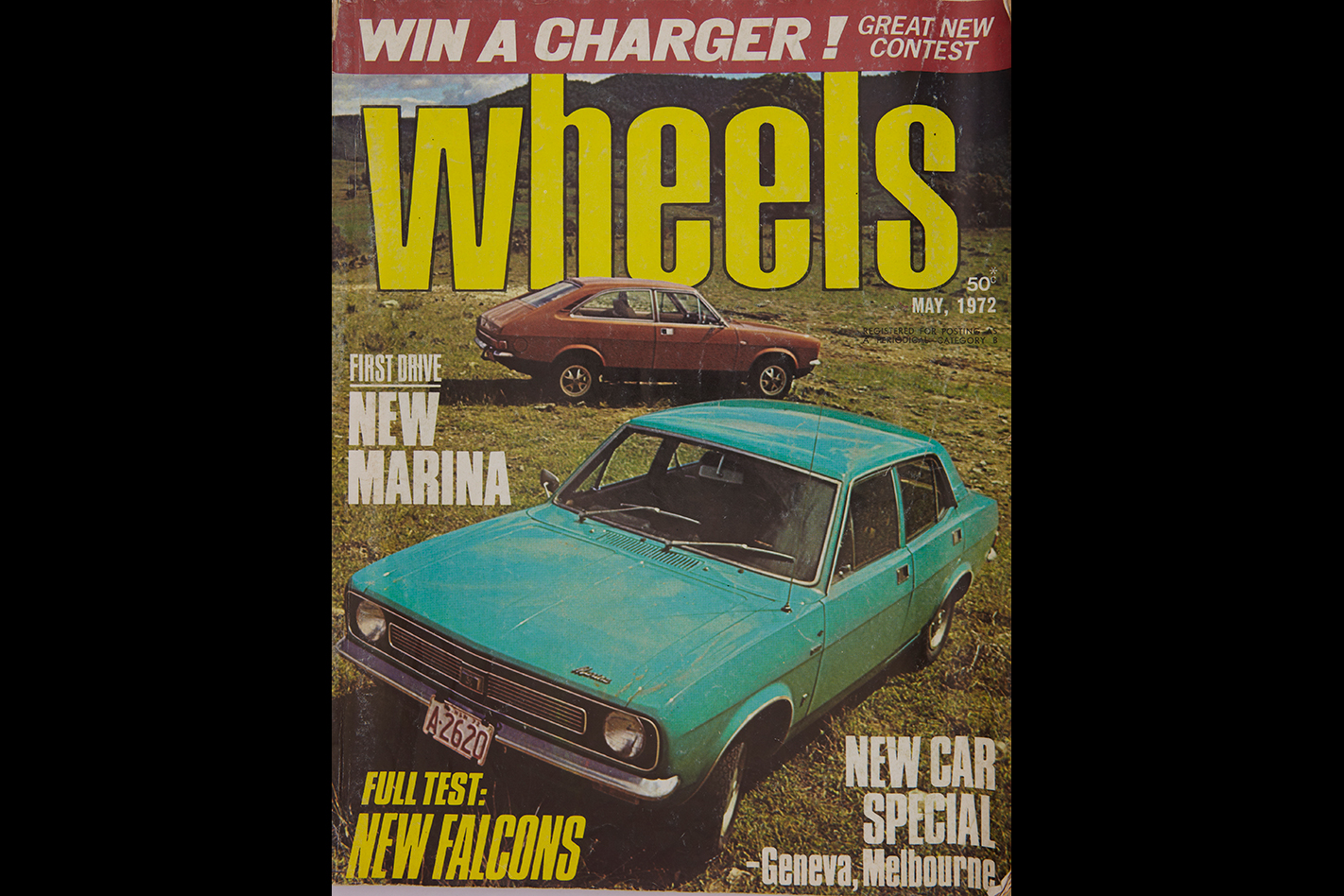
‘A Dilmabda in a Cave!’ originally appeared in the May 1972 edition of Wheels.
