
An inside look at the man, the fear, the Bluebird and the lake.
First published in the April 1981 issue of Wheels magazine, Australia’s most experienced and most trusted car magazine since 1953.
TUCKED AWAY in a wardrobe, among a collection of old rally jackets, flameproof driving suits and out-of-fashion television blazers, is a tie I’ve never worn.
lt is slim, and dark blue. It is marked with four white stars arranged in the formation of the Southern Cross, above a bluebird in flight. Below the bird hangs a series of miniature maps of Australia, each outlined in gold.
Within each outline is one of two numbers: first 403.1, then 276.3.
The tie has the shiny look of silk, although a tag at the back carries the admission of being 100 percent polyester fibre. But very discreetly. That was typical of the presenter. To him, appearances were all important.
The suggestion always had to be made that the finest of anything was involved – whether it be materials, people or resolve. If you pressed for facts, and turned things around, you could usually find the truth. Around himself, he built a wall – a facade of images – that represented the man he wanted the world to know.
And yet, deliberately, he left chinks in the wall through which you could peer to observe the real person, flawed and devious and covered in the warts of self-doubt. Straining to be a hero, he was anxious to be found out.
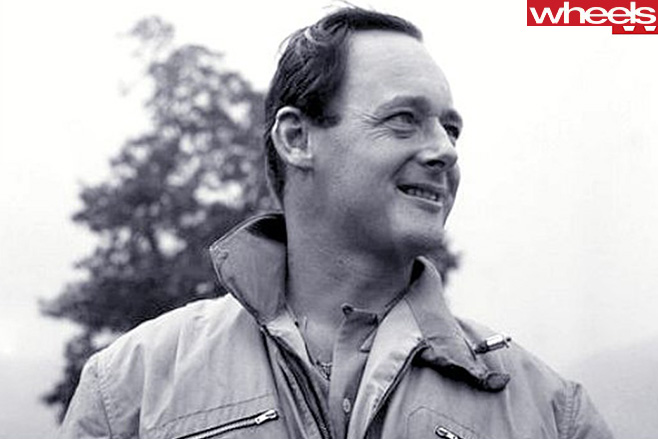
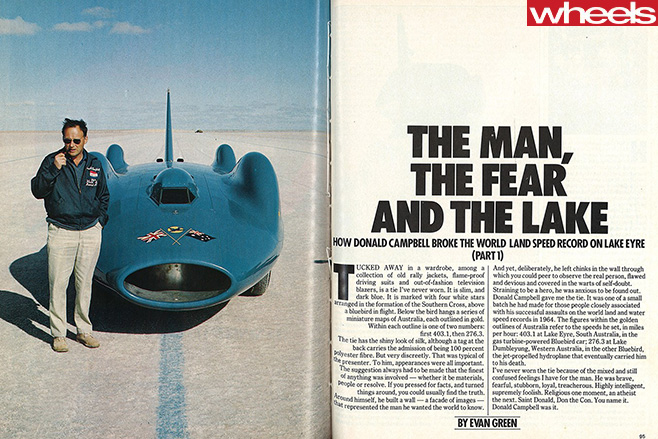
Donald Campbell gave me the tie. It was one of a small batch he had made for those people closely associated with his successful assaults on the world land and water speed records in 1964. The figures within the golden outlines of Australia refer to the speeds he set, in miles per hour: 403.1 at Lake Eyre, South Australia, in the gas turbine-powered Bluebird car; 276.3 at Lake Dumbleyung, Western Australia, in the other Bluebird, the jet-propelled hydroplane that eventually carried him to his death.
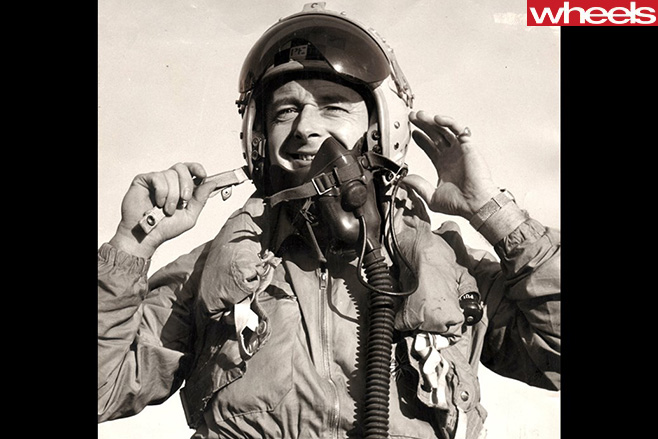
He first came to Australia in 1963 to try to break John Cobb’s 1947 land speed record of 394.196mph (634.379km/h) for the flying mile. Trailing an entourage of technical assistants, journalists and film makers, he headed for Lake Eyre. It was a doomed venture, made pathetic by some of the publicity which Campbell himself had helped unleash, and by happenings over which he had no control.
To start with, Lake Eyre was an extremely risky location. No one knew much about the place. It was known that it was the largest salt lake in Australia, that it was usually dry, that the lowest point was below sea level and that the natives were friendly. On the strength of that information, the Bluebird circus came to Australia.
Once before, the giant car had run in quest of the record. Campbell had taken Bluebird to the USA, to the famous salt flats of Utah, where his illustrious father, Sir Malcolm Campbell, had set world records before the war. And at Utah, Donald had nearly killed himself.
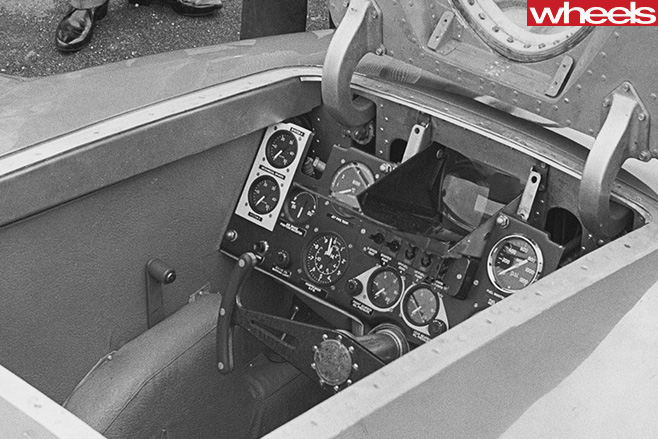
The Utah strip is short and, in trying to gain speed rapidly, Campbell had accelerated too hard too soon. The four big wheels, all driven by the Proteus gas turbine, began spinning on the salt, one side began to lift and, in an instant, the accelerating projectile was out of control. It began to cartwheel through the air.
Alternately spinning through the air and gouging salt, it tore along the marked line, shedding wheels and mangling bodywork as Campbell rode out the fastest car accident any man had experienced. Finally, the remains of the blue shell stopped, belly down on the track.
The driver – incredibly – turned off all the switches bar one and lapsed into unconsciousness. His skull was fractured and one ear torn off. The one switch he had missed controlled the fuel supply to the engine, still running at full power.
The accident almost claimed the life of Campbell’s chief mechanic, Swiss-born Leo Villa. Old Leo – who had endured the autocratic Sir Malcolm, first as riding mechanic then as chief preparer of his record breakers – was devoted to Donald and raced to his aid. From a distance, the wreckage looked like some gaseous nightmare, with exhaust fumes distorting the image, the Bluebird’s shell dancing with vibration and the echoes of the turbine’s shriek bouncing back from the mountains that rim the salt flats. Close up, Leo saw Campbell still in the cockpit and painted the bright crimson of arterial blood. He dashed to the nose of the car to unlatch the cockpit cover. He stood in front of the air intake, and, like a scrap of paper near a vacuum cleaner nozzle, he was sucked in.
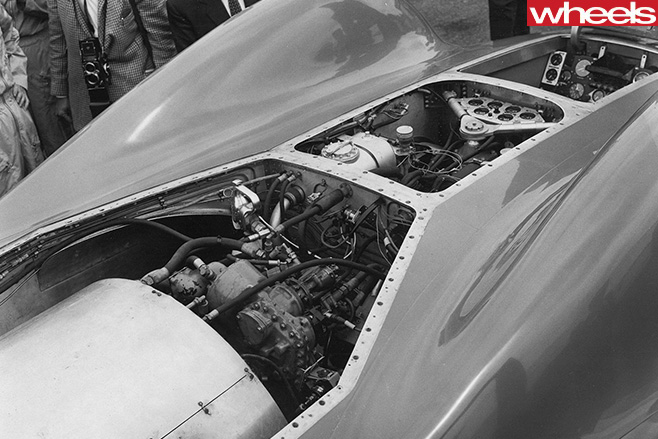
The Bluebird had a divided air intake, with passages running either side of the driver’s compartment. Villa went in legs first. Luckily for him, one leg went up each passageway. He came to a sharp and agonising halt on the divider and passed out. Another helper turned off the turbine and pulled him out.
The lesson from Utah – apart from Villa’s resolve never again to stand in front of the thing when it was running – was that a much longer strip was needed to allow the Bluebird to reach its maximum speed without having to accelerate so hard that wheelspin could occur. The minimum distance to reach the required speed in safety, and stop again, was 32km. So they came to Lake Eyre.
Before Campbell’s arrival, a motorcyclist had tried to set speed records on the southern fringe of Lake Eyre and nearly skinned himself when he fell off. Otherwise, it was a virgin lake – not only for speed attempts of the magnitude Campbell was contemplating, but for almost anything else.
The aborigines had shunned the area, weaving legends about demons that devoured people who strayed too close to its shores. Like many myths, the stories probably evolved from fact. The edges of the lake are treacherous, and capable of swallowing a person. Near the shoreline, a thin crust of salt covers a deep mire of mud – a gypsum slush that is a vile black substance like axle grease. Break through that salt and you would go down in the mud like an animal in quicksand.
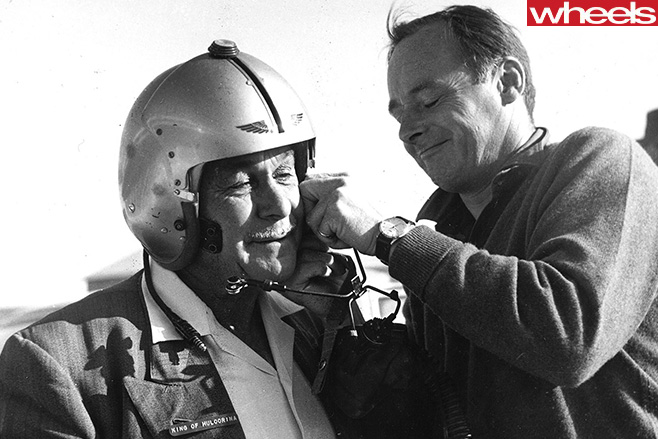
Getting the Bluebird and all its supporting equipment on Lake Eyre required the construction of a long causeway, to bridge the thinnest salt. On the lake, a safe route had to be charted through the dangerous shoals of shallow crust. Then a course for the record attempt had to be found, surveyed, graded and marked. Camps had to be established, water stored, food brought in, airstrips graded, communication links formed.
Campbell had persuaded many of the most important companies in Britain to back the venture. Many people felt such a massive, semi-national enterprise was against the spirit of record breaking. They preferred the give-it-a-go mentality, which had sent so many earlier exponents to their graves, amid waves of adulation. Trying and dying was what it was all about, not spending big and waiting for everything to be right. Campbell was urged to get it over. But he waited.
The early columns of praise soon turned into sarcastic paragraphs. Most couldn’t understand the complexity of record breaking: the fact that a ripple in the salt or four knots of wind from the side could send the car plunging out of control; the fact that the team was exploring unknown realms in terms of tyre grip and wind resistance; and, above all, they couldn’t understand Donald Campbell. If the world’s press expected a devil-may-care adventurer, that was the role he would play. But it was false, and it was trying to live up to this false image that caused so many problems. He was, at heart, a technician, fascinated by the challenge of overcoming the physical problems of travelling at more than 640km/h (400mph) on land, and he wanted to take each step in meeting that challenge carefully, logically, knowingly, as he and the team tuned the car for the ultimate run and the record.
He was in no hurry. He had the mind of a test pilot, the patience of a chess player.
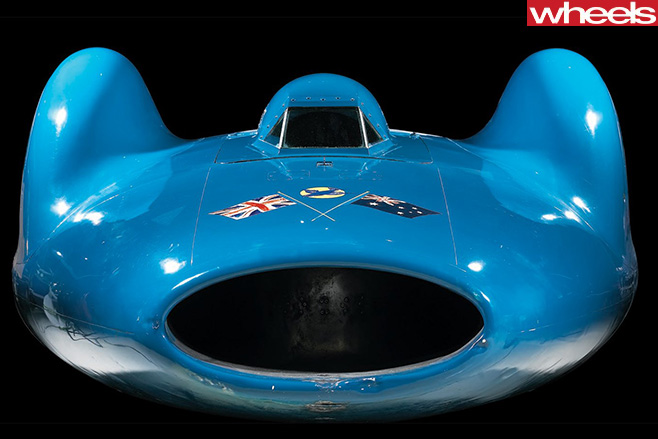
Not legal, said Campbell, in his most understated British voice. The FIA rules stated that a record breaker had to be driven by its own wheels. That distinction was beyond most people. It’s all record breaking, isn’t it? What’s wrong with the bloke? ls he scared or something?
Stiff upper lip, but still there was no record run. The track was too soft. The wind too strong. The engine needed test runs. The braking system had to be recalibrated. The parachute tested. Tyre temperatures checked.
Don the Dingo, they called him. For Christ’s sake why doesn’t he just get in the bloody thing and give it a go? And then it rained, and they all went home.
Not all of the project’s backers were prepared to continue with what they now regarded as something of a lost cause, if not a charade, which was even worse for those bastions of British industry.
Campbell, however, was determined to keep trying for the record. He lost his main financial backer, BP, but managed to persuade the Australian oil company Ampol to assume the role of principal sponsor. That was how I became involved.
Among those who had defected from the Campbell cause was the man who ran the show in 1963, the Britisher David Wynn Morgan. Campbell, therefore, had no project manager and asked Ampol to nominate someone. I had worked for the company some years earlier as one of its PR executives and, among other things, had directed the 1958 Ampol Trial. Dick Mason, one of my mates at Ampol, had risen to the rank of General Manager, and asked if I would manage the attempt.
Mason, Campbell, and I had dinner in Sydney the night after Campbell arrived in Australia. Campbell was both a superb salesman and a gifted actor. He needed someone to untangle the mess of ’63 and went to work on me with great skill. He was conservatively dressed (in blue of course; he had a fetish about the colour) and modest to the point that words had to be dragged from him but when that point was reached, he glowed with resolution, and determination to make this a successful British-Australian venture.
No trace of Don the Con. More the Duke of Edinburgh with just a hint of a Graham Hill waiting to be turned loose.
“I’m just the driver,” he told me, fixing me with his bright, intense eyes. “You run the show. You tell me what to do.”
Very heady stuff for a bloke who’d been raised on books about Segrave, Campbell and Cobb. Dick Mason took me to one side. He was a former RN submarine commander who had drifted into the commercial world and revealed sparkling talent. Forthright and honest. A friend.
“You know what they said about him last year,” he said. “This is not going to be easy, but please do it. And please, get him to break the bloody record quickly.’”
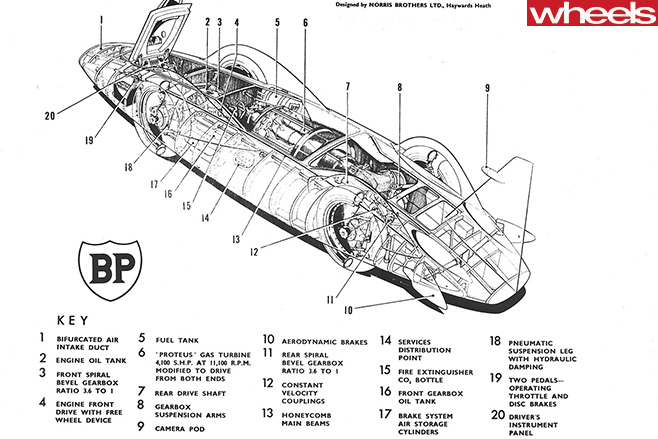
To my horror, I found the revamped record attempt was already a Big Deal. The show I was supposed to be running was already underway – and largely out of control. Campbell, who never bothered with the correct target if he could aim higher, had enlisted the aid of Prime Minister Menzies, and been given the army and air force. More than 100 soldiers were encamped near the homestead. They were to provide transport to haul Bluebird and its equipment, and to police the lake. The RAAF provided a doctor and an aerial ambulance.
Leo Villa and two assistant were there, already preparing the car for its first run. Then there were the remnants of the supporters who had supplied the project with critical components and the experts to make them work: things like the gas turbine, instrumentation, suspension and brakes. There was a refuelling squad from Ampol, good blokes who were vastly distrusted by the Brits who had a hankering for BP. There was the track squad, a large group of deeply tanned men, who wore shorts and puzzled looks at my presence; they had been working on the salt for weeks, grading and measuring a track that ran the full 32km
A DCA official had established an air traffic control at the station’s landing strip, and a PMG man had installed a post office and radio telephone link with the south. A few dozen visitors had camped on the balks of the Frome River, where bore water had formed a deep swimming hole; they’d come for a few days, to see Campbell break the record. The dozen or more people who lived at Muloorina were there of course, bearing their confusion with great dignity. A film crew had arrived and were complaining of the dust. And there were journalists from various newspapers, networks and agencies. Not as many as in 1963, they came armour-plated with cynicism. Too many had come too soon.
Ken Norris was shocked. “We can’t run for weeks,” he said. ”Donald must be given the chance to test the car. We need lots of runs, each at progressive speeds. I don’t know how the machine is going to behave at the sort of velocities we’re aiming at. lf the attitude is out by half a degree – you know, if the nose is too high and the tail too low – we could kill him.”
The army chief, Colonel Clif Brebner, expressed an opposite sentiment. “Welcome,” he began, “and I hope you’re better than that bastard who was here last time. And try and get things over quickly. We can’t stay long. We’ve justified this exercise on the basis of gaining outback experience but the men can only stay a couple of weeks.”
The technical team – all meticulous men, specialists in their own field and jealous of their companies’ reputations – wanted time to do the job properly. The journalists were already impatient. A Sydney writer who had been there before, buttonholed me. “Are you gonna make him have a go, or is he gonna fart-arse around like last year?”
The team who had been preparing the track greeted me with the warmth that a pit full of cobras might extend to a mongoose flung in their midst. They had reason. Their leader, Andrew Mustard, assumed he was in charge of the whole project. He had been Dunlop’s representative in 1963 and was now a private contractor, looking after the tyres and the track. Campbell had told him nothing about me. To make the situation worse, Campbell wasn’t at Lake Eyre. He had assured me he would be there, but there was a message that he was spending a few days with friends in Adelaide.
So here was Andrew Mustard – who had spent weeks with his men on the salt, working in the sort of reflected heat that few people could imagine let alone tolerate, and sustaining himself with the thought that he would be running the show – out on his ear, or, at least, reduced to a lesser role, by a stranger.
That first night was busy. There was a meeting of all parties. I explained my role, and heard reports from the various teams.
I held a press conference in the Army canteen to outline our program for the next few days and then collared the PMG man who opened the telephone link so that I could ring a contact in Adelaide.
“Tell Donald he must be here tomorrow,” I said. He came two days later and we had our first argument.
“But Unk (Leo Villa) said there was no need to come,” he said. (I was to learn that Leo, who loved ‘the governor’ dearly, was inclined to treat Donald like a son, and tell him what he wanted to hear.)
“You’ve got a couple of hundred people sitting up here, waiting to see if you’re fair dinkum or not. The worst thing you could do is stay in Adelaide.”
“But what can I do up here? I’m not needed yet. You run the show.”
“You are the show. And you’ve got to prove yourself to these people.”
He was shocked and said nothing for a few moments. But then the words began to flow he called me “old boy” a couple of times, and he agreed to stay at Muloorina. For several days, he turned on a magnificent PR show, meeting all the groups, placating Andrew Mustard and his team, and immersing himself in the preparation of the car.
A base camp was established on the lake near the marked tract. The first cautious runs were held, and Campbell displayed his remarkable memory and grasp of detail. The course had different markers at each mile for the full 20 miles (32km) and, after each run, he could recall the readings on each Instrument at each mile mark, as well as comment on the feel of the car. He had phenomenal powers of concentration and recollection.
Then dinner, followed by a formal press briefing, usually in the shearing shed. Afterwards, we would talk to the film crew, to discuss their needs. Last thing of all, I would chat with Colonel Brebner about security arrangements for the next day. We had to guard against a dazzling variety of possibilities. They ranged from campers sneaking on to the lake at night (and either getting lost or being run over by a long blue car whose driver had limited forward vision) to pilots who flew to the lake before dawn. Some of the visiting flyers did horrifying things. Mostly graziers from western New South Wales or Queensland, they would arrive over the salt at five o’clock in the morning, and circle above the headlights of our vehicles waiting for the sun to reveal a landing place. Oblivious to each other, they would drone above the lights on the lake like moths around candles.
There were boggy spots on the lake to avoid, fresh tracks to mark, signs to be erected and rescue procedures to be planned. The risk of becoming lost on the lake was real, for, on a bright day, heat haze reduced visibility to 400 metres.
I enjoyed those late night talks with Clif Brebner. Apart from being a Colonel, he was also a senior officer in the SA police force. He was a man who had seen the hard side of life, and I think my innocence amused him. We had long talks, and he became my closest friend at the camp. Normally firm but quiet, he could be stirred into action, and when provoked, he was marvellous to behold.
Some CAMS stewards arrived, and the camp erupted in controversy. They came with the understanding that someone other than I was running the project, and refused to deal with me. They issued Campbell with an ultimatum: he had to prove to them that he was fit to drive the car. The question of a spinal injury was raised (Campbell had been run over by a truck during the war) and even the question of his mental balance was raised!
Campbell erupted. The press corps was delighted, for here were stories at last and good, rich Campbellesque controversy. Clif Brebner grew progressively less amused. One night, while discussing the latest madness, he exploded.
‘”I think it’s time I straightened these bastards out,” he hissed, and marched into the tent where the stewards slept.
“All right, gentlemen,” he bellowed. “Sit up and shut up.”
All around the tent, startled faces appeared from the sea of army blankets. The Colonel began modestly enough, reminding them that their duty was to observe and control, not to connive and ruin. When someone attempted to speak, he blasted him into silence. Then, warming, he stung them with barbs poisoned with clichés about petty dictators and the eyes of the world being on them. He reminded them that there was government interest in the venture succeeding, not in being hamstrung by stupidity.
Thoroughly aroused, he reminded them that he was in the police force, asked them if they ever ventured by car into Adelaide (the heads nodded) and he smiled wickedly. There was always, he said, the vague possibility of harassment, and his eyes suggested everything from arrest to castration. Then he stormed out of the tent.
Out of hearing range, he turned to me and burst into laughter. “I don’t know whether that did any good or not,” he said, “but I feel a hell of a lot better.”
A few days later, the stewards went home, to be replaced by a more experienced group.
It cost him $2000 a month in hiring charges, plus flying time, and he had engaged a former airline pilot to help him gain certification for the aircraft.
lt soon became clear that Campbell had strong, and very different feelings about fast travel on air, water and land.
His great love was flying. His happiest moments were at the controls of the Aero Commander, and he would search for excuses to fly: off to Leigh Creek for supplies, to the east to see the Birdsville Track, down to Adelaide for dinner.
The aircraft came first, the boat second. The Bluebird hydroplane, in which he had already set the world water speed record, was regarded with affection. He knew it was dangerous, but he liked it. He talked of the boat with a mixture of pride and amused tolerance, like a father discussing a naughty but gifted child. He would forgive it anything. Even killing him.
But the car he hated. It frightened him, although he never allowed fear to stop him driving it, for he was the bravest man I knew. He was also intensely superstitious and worried about the legends of Lake Eyre. Each night before a scheduled run, he would play a gypsy game of cards and study them for any signs of doom on the morrow … and keep on turning up cards until some awful prospect was revealed. Thus chilled, he would go to bed, his face gaunt with distress.
Yet he was chained to the Bluebird by a complex series of links. One was his intense patriotism. He would die rather than Let The Side Down. British was best; that was the real thing to him and he was committed to proving it. Another link was that he had failed twice and, whatever he was, he was no quitter. And there was the fact that he was the son of Sir Malcolm.
I got close to Campbell in those early weeks and there was no doubt in my mind that he feared his father, even though the old man had been dead for years. There were many things to remind him of Sir Malcolm. Old Leo, who had worked with the father through the great years. The Bluebird, the same name his father had chosen. And people kept referring to him as Sir Malcolm.
The son had gained the world water speed records, a supremely hazardous undertaking which should have demonstrated his bravery and competence to the world. But his father was renowned for his feats on the land, and something from the past dragged him in the wake of the old man’s achievements.
Sir Malcolm had been a public hero to an Empire on which the sun never set but, as sometimes happens with such men, behaved shockingly to his family. A heavy drinker and womaniser, he required impossible standards from his son.
On days when the Bluebird was not running, Donald and l would walk through the sand dunes near Muloorina, to get his mind off the lake and the car and the worries of being heir to the world’s most famous record breaker. He was a keen collector of guns and, sometimes, we took samples from his collection to shoot at targets in the sand. Occasionally, we would roam the hills with Elliot Price, and that marvellous old character – looking like a rotund version of Edward G. Robinson – would talk about his days in the bush. Mostly we would travel alone. Fretting at the delays, Donald would walk, hands thrust deep in his pockets, head tilted forward, kicking gibbers and bemoaning his fate.
“This wretched place.” A stone would be aimed at some imaginary goal. His eyes, sad as a mournful hound’s and deep set with misery, would lift momentarily. “I am destined to fail.”
Donald laughed ruefully as he recalled such things. The stories were told softly, with an edge of guilt, in the manner of a child confessing to a friend something he did not wish to be overheard by a nearby parent. It was as though Sir Malcolm hovered in Donald’s sub-conscious ready to grab him by the throat if he didn’t do what was expected of him.
Rain fell one night. The Muloorina folk were delighted, because drought had withered the land, but an early morning visit to the lake brought dismay. The track, which had taken months to construct, mark and measure, was discovered to be in the lowest part of the vast basin. Therefore, the solitary pool of water, which remained from the rain, sprawled across the centre of the 32km strip. Then winds came, to tantalise us. A gust would whisk the water from the track, raising our hopes that the salt might dry quickly. And then another gust would send it scudding back, in a wide, shallow sheet of ruffled blue, to saturate the strip even more. It would take months to dry.
Most of the soldiers left. The air force flew off to Woomera. The press packed up, leaving just a few agency men. And we began all over again. A new, firm course had to be surveyed and constructed in a few weeks. The car could run only during the milder months around winter, before rising temperatures thinned the air and turned the lake’s surface into a scorching hot-plate that would blister the paper-thin treads on the tyres.
Despite its enormous area, only a small part of the lake had salt that was thick enough to support the car. The sedimentary layer – washed down by floods and the mineral residue of rain – was deepest in the lowest part of the basin. And that, naturally, was where the water now lay. Thus were we compelled to seek a new course in the region of damp patches and that windswept puddle.
We drew a map of the lower lake area, coded zones, and marked certain reference points. Known lagoons and wet spots were drawn in. To search from ground level would have been too slow, because the ring of heat haze that encircled a person on the salt limited visibility to a frustratingly short range. The true horizon was clear only at dawn. Thereafter, the edges of the lake seemed to rise in shimmering layers and curl inwards, as though the world around you were buckling and vaporising under the heat of the climbing sun.
So we used the Aero Commander. Donald would take the plane high above the lake and look for a line that seemed clear of water and the dark blotches that meant black mud was close to the surface. Then he would fly low, and set a course that we on the ground could follow in our cars. We would mark the way with barrels and stakes and, if the line seemed promising, would return slowly, drilling the salt at regular intervals to test its thickness. Usually, there were thin patches to ruin our hopes.
Following one line, I drove into a region of wafer-thin salt. The tyres began to sink. I tried to drive out, taking the Valiant in a wide curve while, all around the surface rippled and cracked, like an ice floe shattering. The wheel tracks turned from indentations in the white salt to deep channels in the grease-like mud, until finally, surrounded by shattered plates of salt crust and oozing springs of gypsum slush, the car became hopelessly bogged.
I had to abandon the vehicle for the night. When I returned next day, with rolls of chain wire (and AAP reporter Wally Parr who –
incredibly – had volunteered to help) the car had sunk on one side. The broken salt reached to the bottom of the doors. In a few days, the car might have disappeared altogether. Wally and I worked for 10 hours to extricate the car. Salt crystals like the fragments of a broken windscreen sliced our hands, so we finished the day bloodied and muddied. But we got the car out and, within a few days, had found a stretch of firm, dry salt.
More showers fell, and the firm portion of the new track was reduced to 18.2km.
Not safe, said Norris. We must try, said Donald Campbell.
It was his decision to make, and it was a brave one, but he grew restless and more melancholy as each day passed. Some days, he would spend hours watching the track preparation team at work. The grader would shave knobs and shallow craters from the selected strip while the follow-up trucks, trailing lengths of steel rail, would polish the graded surface.
And some days, while all the team was conducting an ‘emu bob’ – a slow walk down the entire track, picking up loose knobs of salt, stamping soft spots underfoot – Campbell would fly to Adelaide to have dinner with friends and the weary workers would spend the night growling with discontent.
Those common plagues of the outback, boredom and lethargy, settled on the camp. A routine of 4am starts, dawn winds and aborted runs eroded patience and spread discontent. Reasonable people became snarling extremists. Systems were forgotten and drivers heading across the lake from the base camp to the causeway – a 30 minute journey across a white wilderness – grew careless and became lost in the floating mirages. Others wasted time looking for them.
Men frozen at dawn were burned black at midday. Lips were cracked and refused to heal. Faces set in leathery masks, creased by the wrinkles of perpetual squints. The arrival of two young female cooks, to help at the homestead, made things worse. The girls grew better looking by the day. Instincts were aroused, and, with a male-to-female ratio of around 80 to one, a few noses were threatened with a thumping. Some distractions were needed.
First, we organised a game of cricket, certainly the first ever held on Lake Eyre and, for one day, people laughed at the difficulty of hitting a boundary that was 290km to the north.
Strong winds blew every morning, and the Bluebird, its tall tail fin peeking from the vehicle’s blue cover, sat on the salt. So we had a regatta. For land yachts, of course, and the reason for such an event was twofold.
First, building the wheeled vehicles (from the purloined wheels of Elliot Price’s wheelbarrows and welding trolleys, with sails cut from Dunlop banners) gave essentially mechanical minds some welcome exercise.
Second, if we needed wind (as the yachts would) the weather was certain to become calm. Inspired by such Irish logic, a flotilla of two yachts took to the salt for Lake Eyre’s first regatta. Within three days, the winds dropped. The Bluebird roared into life again.
The first speed runs scarred the surface and left ice-blue ruts of watery salt. A few days of sunshine and the ruts hardened, set in the salt like glossy tramlines on a white road.
“We need time,” Ken Norris said as we walked down the tramlines. “There is still much to do. The track is too short. Donald will have to accelerate more rapidly than we’ve been planning and we just have to find out how the car behaves under these new conditions.” He looked at me with deep concern. “And look at those ruts. This place is so bloody dangerous.”
More than ever, the project needed understanding but the mood among most of the watchers was one of hostility. The technical reasons for not trying for the record in one make-or-break attempt were lost on people who could drive a truck across the ungraded salt flat out. The discontent grew into storms that flashed through the camp at night.
We needed an ally: someone expert enough and respected enough to silence the howls of derision. Someone who knew what he was talking about, and could say: “This is difficult and dangerous and Campbell knows what he’s doing. Give him a fair go.”
So Lex Davison came to Muloorina. A man of exquisite manners, he had sent a message saying he would like to bring his wife and family to see the Bluebird but didn’t want to barge in at a difficult time.
I explained who he was to Donald Campbell and Ken Norris.
“He’s a great racing driver, a gentleman, and highly respected,” I said.
Donald nodded. “He’s a nice bloke and if he’s on side, it would certainly help you.” Another nod.
“Would you allow Lex to drive Bluebird?”
Campbell looked shocked. “What? And go for the record!”
“Of course not. But if you were to let him drive the car, at whatever speed you like, and Ken explains what we’re trying to do, you’ll have made a friend that other people will listen to.”
So Lex Davison came to Lake Eyre, and drove the Bluebird. He listened intently to Ken Norris, spent hours with Leo Villa and the various component experts, and studied the whole project with deep interest. He was impressed by the sophistication of the car, the complexity of the project and the enormity of the risk to the driver. And he said so, to the journalists who followed him and to anyone else who would listen. The visit had a remarkable effect.
Campbell slipped back into the role of record breaker. He became enthusiastic again and – as though to justify the faith Lex Davison had shown in him – resolved to go for the record as soon as possible. No more sneaking off to Adelaide to get away from the miseries of Muloorina. He stayed at the lake, and seemed supercharged with resolution.
The Davison visit and the unaccustomed wave of public sympathy also had an effect on other members of the team. Instead of criticising the driver for the delays, they turned their attention to the track. The more the strip was graded, the softer and damper it seemed to become. More runs produced more ruts.
“This is madness,” Ken Norris warned.
“The maddest thing is what’s being done to the track,” said Lofty Taylor, the gangling leader of the refuelling team. Lofty worked for Ampol, and I’d known him since the Ampol Trial days. l had enormous respect for his opinion. He was practical, versatile, prepared to move mountains if asked and yet able to detect the faintest whiff of cant at long distance.
He admitted he knew nothing about grading salt but pointed out that neither did anyone else, for the science of building record tracks on salt lakes was in its infancy. And he reckoned he knew as much about it as anyone else.
“They’ve been cutting salt off the top all the time,” he said. “All that grading and cutting is weakening it, and bringing moisture to the top.”
“What would you do, Lofty?”
“Leave it alone for a while. Let the crust heal and harden.”
The track squad was ruffled. The problem, they said, was due to the constant interruptions to their work. They couldn’t get the surface right with the car running every other day and cutting grooves in the salt. So runs were suspended. Andrew Mustard’s team would pursue their theories and have a clear week to try to bring the track up to record standard. Donald took some of the crew to Adelaide, for a few days’ break and all seemed calm. In fact, a major storm was brewing.
Mustard had brought an Elfin racing car to the lake. It was fitted with tyres that had scaled-down versions of the tread being used on Bluebird. He drove it to test such things as tread temperature and the coefficient of friction of the salt surface at different times of the day. He usually drove the little single-seater down the strip before Campbell made a test run. On one occasion, he was driving the Elfin up the strip when Campbell was driving the Bluebird down the strip and the world’s highest speed head-on collision was avoided by a whisker, with a sheepish Mustard – spotting the rooster tail of white salt spray bearing down on him – spinning off the track.
One day during the lull, Ken Norris and I went to the lake to see how the track work was progressing. To our astonishment, we found the CAMS timekeepers and stewards assembled at their record posts.
“Andrew’s going for his records,” one of them said, and, seeing our bewilderment, gave us that ‘don’t tell me you don’t know about it look’. It seemed there had been an application made for attempts on various Australian class records for categories suiting the Elfin.
Neither Ken nor I knew anything of it.
Nor, it seemed, did Campbell, and when he returned that night there was an eruption. The track squad was sacked and Lofty Taylor given the job of preparing the strip.
“What do you suggest?” I asked Lofty.
“We should all go away for a couple of weeks and let the salt alone.”
But everyone else was fired up to do something. lt was now June and we had been at Muloorina for six weeks; the track seemed to have hardened, the car was ready and, most important of all, Donald Campbell was anxious to go. He was not looking forward to running, but, in the manner of a person who is required to undergo a major surgical operation, was keen to get it over with.
Through all the weeks of controversy and anxiety, Campbell had been sustained by the strength and sympathetic encouragement of his wife Tonia. She was a remarkable woman. A Belgian singer and top-flight nightclub entertainer is hardly the person one would have cast in the role of a record breaker’s wife, required to endure weeks of crushing monotony, sprinkled with moments when the husband’s life was at risk. Two more opposite characters than Donald Campbell and Tonia Bern would have been hard to imagine, yet she was the perfect partner. Sympathetic. Oozing motherly understanding. And strong as iron.
By nature, she was volatile and moody. At times, she would project Tonia Bern, nightclub star, and sing snatches of a melody or tell outrageous jokes. (A group of graziers, projecting affluence, have flown to Muloorina and are assembled in the loungeroom. Donald is holding court, impressing them with his Duke of Edinburgh manner. ln bursts Tonia. Flashing eyes. A faint swing of the hips.
The hair is tossed, casually, tellingly. The men pop from their lounge chairs. “Oh, down please sit down,” A pirouette. A brief smile at Donald. “Hello darling. I suppose you men have been telling jokes. Have you heard the one about the two French lovers? No? They are on the couch when the phone rings. The man says: ‘You answer that. It’s at your end’.” She stands, eyes wickedly waiting for a response. The men stare at each other. They’re not offended. They don’t understand. She sweeps from the room, a classic exit. A brief wave. The men try to stand but their legs are trembling.
She also performed at Marree, for charity. She was chased out of town. Not by hostile women outraged by her act but by randy men. Understandably, they had not seen a woman like her before. Just as understandably, they didn’t want to let her go. She arrived back at Muloorina, breathless from the chase, and delighted.
At other times, she would withdraw and talk to no-one. She would don her reading glasses and spend hours with needle and thread, poised over some complex tapestry. At the lake, that was how she would spend her time: sewing, while the men fussed over the car, argued over the track, cursed the weather. It was not that she lacked interest in what Campbell did. Just the opposite. She was devoted to him. But she sewed at the lake to forget the car. To her, it was a blue monster that consumed her husband’s interest and threatened to destroy him.
I’m sure she hated the whole business of record breaking, but she went to the lake each day because she wanted to be near her husband. She kept away from him when that was best, spent time with him when that was needed. She mothered him, coaxed him, protected him. Anyone criticising Donald did so at his peril, because Tonia could savage a person with words. lf he were exhausted, she let him sleep and defended the bedroom door like a lioness protecting its lair. She offered support when he needed help, argued when she thought he was wrong, and was loyal no matter what.
Tonia came with me on the morning of the record attempt. She wore a fur coat, because of the cold, and because she could wrap it around her face, and shut out the world. She sat in the back seat of the car as I drove to our position near the middle of the run, not far from the timekeepers’ post. She snuggled in the corner, with only her hair visible. I stood at the front of the car waiting.
lt was a sparkling, chilly dawn. No wind, not a cloud in sight. But so cold that the air stung your nostrils and turned exhaled breath into billowing clouds of fog. The radios buzzed with checks that all was clear. The sun rose and sat on the horizon, like a white wheel ready to run around the perimeter of the Earth.
The mournful howl of the Proteus gas turbine reached us. We couldn’t see the car but the first layers of heat vapour were rising from the end of the track. The level of noise rose. A thrilling sound, that made the scalp tingle. From whine to shriek, it kept growing in intensity. Then, a sound we had never heard before: an angry boom, like a flight of jet planes hurtling across the lake. Still no car. Tonia kept her head buried in the coat.
A high tail of salt spray loomed above the horizon. The noise was dreadful, beyond human endurance and rising. The salt began to vibrate.
And the Bluebird, running hard for the first time at Lake Eyre, burst into view. At first, it looked like a mirage, a gaseous blue shape floating above the rim of the lake; lifting high, inverting, coming back to the track in a series of images and trailing a mixture of burnt air and pulverised salt. I stopped breathing. The car beside me rocked violently, but it was Tonia getting out.
“My god,” she said, and covered her lower face with her hands. The Bluebird, now sharp in focus, was thundering towards us.
I’ve seen many racing cars at speed, and they always look like devices man has made, and is controlling. But that machine looked like something from the past, from an age that man can only imagine. It was some frenzied creature, spitting fire and noise as it hurtled across the bed of a dead lake.
Then he was past, and as the air torn by the Bluebird’s progress came buffeting our way, we resumed breathing, jumped into the car, and drove after the disappearing wake of salt spray.
THE RECORD AT LAST
He was brave, he was foolish but in breaking the world land speed record on Lake Eyre Donald Campbell showed more courage than any man Evan Green has ever known.
The thunder of the gas turbine faded to a hiss as Donald Campbell completed the first run and swung Bluebird in a wide loop, to reach the service point. He drove between the trucks, laden with drums and wheels and batteries, and pointed the car back towards the track.
The service crews moved in. They had practised this routine many times. Change wheels, add fuel, check temperatures. Burrow deep in the blue body to check instruments and examine oil levels. They did their work quietly and quickly, for they knew the car had to make both runs – once in each direction – within 60 minutes to break the record.
A long fuel hose snaked into the side of the body. The wheel covers came off, then the wheels. The car, which only moments before had snorted fire and made the lake tremble with the ferocity of its progress, sat on four spindly jacks, looking like a blue locust that had had the wings and legs plucked from its body.
Donald Campbell sat in the cockpit, canopy closed, head down, as though disappointed. After a while, he lifted the hatch, hauled himself clear, and sat on the car’s nose. There, he waited for someone to bring him walking shoes, as he dared not get salt on the soles of the blue sneakers he used for driving.
Vehicles bearing Leo Villa, Campbell’s chief mechanic, and Ken Norris, the car’s designer, raced across the rough salt, heading for Bluebird. Leo jumped out and raced for the cockpit, his gait stiffened by age. His face was contorted by worry. The track was dangerous and he knew it better than anyone, for he had been in this deadly business longer than anyone. He took several moments to catch his breath.
‘How was that, skipper?’ he asked, and then fired a salvo of questions at the driver, for he wanted to know about the car and the track and how the car had behaved on the soft surface. When agitated, Leo could be difficult to understand. He always spoke rapidly. He coughed and wheezed a great deal too, for he was a chronic smoker. And when he spoke, he fired sentences in a series of bursts that were interrupted only by the desperate need to breathe or cough.
Now he was wound up – for he had lived with the Bluebird project for nine years, and the record was close – and he fired thoughts like a shotgun spitting out pellets. His words kept colliding, as one phrase was overtaken by the next. Campbell put his shoes on, and looked mournful.
Ken Norris waited until Leo Villa paused to wheeze for breath. The two men were opposites, and fascinating to watch when performing beside their creation – the car the English designer had created and the Swiss-born mechanic had lovingly tended. Villa was the volatile continental, Norris the typical British boffin. He was a quiet, shy man, and the greater the crisis, the slower he spoke.
“How was it, Donald?” he asked, polishing each word before letting it escape. “It looked as though it might have been a fast one.”
Leo coughed painfully. Campbell looked at them with sad eyes. “I’d say three-eighty,” he said, in a voice that was slightly more clipped than normal. Nothing more; his heart might have been beating at three times its normal rate, but the voice was controlled. “However I’d say the wheels were breaking through the salt. I could feel it sinking. There was one tricky moment.”
I had been to the radio base, to hear the report from the timekeepers. The speed was 389mph (626km/h). Five short of Cobb’s record. I told the others. Norris did some arithmetic. The car would have to return at 427mph (687km/h) to break the record. John Cobb had done one of his runs at only 378mph (608km/h), so it was certainly possible. Cobb, however, had had a dry track…
Another report came through on the radio. It was from the track squad. The salt had been cut at its softest point, where the new track crossed the old, longer strip which had been flooded by rain. How badly? Deep ruts. They were going to inspect them more closely. From around the car came a hiss of disappointment.
“Well. That’s it,” said Villa. “You can’t go back if it’s like that.”
Norris nodded agreement. “I suppose it depends on just how bad the ruts really are,” he mused, and moved towards the radio, to check on the track report.
“Too dangerous,” said Villa, more to himself but loud enough for all to hear. He headed for the rear of the car, to busy himself in some work.
Campbell looked at me. “This track’s too soft,” he said quietly. “I could feel the car sinking. You know, breaking through and then hauling itself out. It would seem to be holding itself back and then, suddenly surge forward.”
He thrust his hands in his pockets and walked far from the car, kicking salt. “If I go back, we’ll probably lose the whole show. If I don’t go back…”
Campbell looked up. “What should I do? Tell me.”
lt was an impossible question. The decision had to be his, for the life at risk was his. lt was Donald Campbell who was going to be strapped in that cockpit for a 400-plus mph ride over scarred salt. Not me. Not Leo Villa. Not Ken Norris. Donald Campbell, the man staring at me, wanting someone to tell him what he should do.
“We should see for ourselves what the salt’s like,” I said.
“Right,” he said, and began hurrying towards one of the support cars, its grey sides stained with salt. He called to Villa and Norris and we piled into the vehicle.
Campbell drove. Flat out, he took the car over the pimples of salt that lined the edge of the graded track. At the six-mile mark, we stopped and walked to the centre of the strip. There was no doubt where Bluebird had been, for its tracks were as clear as the wheelmarks of a car crossing packed snow. Two ruts tapered to the horizon, weaving slightly, but generally straddling the blue guide line.
He crouched beside them. The ruts were thumbnail-deep. The big wheels had pulverised the salt crust into a soft, damp mush, and in the bright sunlight, the tracks sparkled and winked like grooves in cut glass.
We returned to the car and drove to the measured mile. To our right, strung along the rim of the lake and already shimmering in the morning heat, stood the outlines of tents and trucks and boxes and tripods and men. The timekeepers were waiting…
At the track, the ruts were deeper and blackened by rubber laid by spinning wheels. Even more ominous, the grooves swung wide from the central blue line. Campbell had come through the mile fighting the car and, at a point near the entry to the timed zone, had run perilously close to the rough salt at the edge of the prepared track. To have touched the rough would have meant instant disaster.
“Bloody hell,” said Ken Norris, his words measured with awe.
Campbell ground a heel into the salt, and the depression filled with water.
“How much more power can you give me, Ken?” he asked.
Norris crinkled his brow. “Five percent.”
Leo wheezed in distress. Campbell and Norris walked along the ruts. I was concerned about the time. “The one thing you can’t do is run out of time without making a decision. Let’s get back to the Bluebird and decide what to do there.” The two men nodded and walked back, occasionally bobbing down to inspect a deeper depression, or to glance back along the track.
So we drove back. The Bluebird was ready; wheels on, cables and hoses removed from its body. Ready for glory or failure. Or the humiliation of not running. Villa and Norris scurried towards the car. Campbell and I were alone.
“Well old son,” he said to me, “what’s it to be?” A long pause.
“Do you have a choice?” He looked at me keenly. Slowly, he began to smile, and he nodded, like someone hearing the news that he is dying, from a doctor who can’t find the words to tell him. He winked at me, took a slow breath, and walked towards Bluebird.
“Five percent more power, Ken,” he called. “We’re going.”
A flash of excitement charged the base. People began running. The message that the car would be coming back in a few minutes was relayed to the timeskeepers and other officials strung along the track.
“What is happening, Evan?” Tonia came towards me. I’d forgotten to tell her.
“He’s going to try.”
“Oh my God.” She had been listening to the conversations, and knew the danger. She went to the Bluebird, made sure her husband had Mr Whoppit (the Teddy Bear mascot that accompanied him on all his runs) took his walking shoes, and went back to the car. There, she pulled the collar of her coat around her ears, as the booster motor whined to stir the 4100 shaft horsepower (3057kW) turbine into flaming life.
Campbell was magnificent at that moment.
Those of us who had seen the salt knew the run would almost certainly fail. There were soft patches to negotiate, ruts to avoid, more power to control and a minimum speed of 427mph to reach. But to have quit, even though the dangers were extreme and the chances of success low, would have caused the whole project to crumble.
This was not just an attempt at the world land speed record. This was justification of Donald Campbell. Quitter or trier? The world would judge him on whether he went back for a second run.
He knew it, and he sat in the cockpit of the giant machine he hated, calmly going through his cockpit drill, checking that the timekeepers were ready, hearing that the track was clear, and aiming the car’s gaping nose at the mirages dancing on the horizon. And beyond that horizon, hidden in the rising heat vapours, lay a region of salt that could kill him.
He drove the car impeccably, and harder than was safe, but the run was doomed. At 360mph (579km/h), he hit a soft patch and the Bluebird began to veer out of control. He had to slow as he fought it back on line. Then he applied power again. But the car had lost too much momentum, and, although he flashed through the measured mile with the turbine screaming its hideous song and the wheels spraying fountains of salt high in the air, the chance was gone. John Cobb still held the record.
Days passed while the track healed.
At Muloorina, Campbell talked of many things.
Good things, like building a new car. Ken Norris proposed that it should run on rollers, so that it could go for the world land speed record on water. “You’d start off on land, and have to hit the water at a certain speed,” he explained, doing his sketches and sums on sheets of paper scattered across the dining room table.
Strange things, like wondering if he could sue Nissan because they called one of their models the Bluebird. He dictated a few letters to his secretary … and it was a different, and disturbing Donald Campbell, out for a buck…
He also spent much time with British author John Pearson, whom Campbell had commissioned to write a book about the venture. Pearson was a charming man, with the blackest hair I’ve ever seen on any person, and he arrived with a typical writer’s ailment: deadline trouble.
“I’m a fool to be doing this,” he said, for he was already months behind the due delivery date of a manuscript which his publishers had commissioned. The subject of that book was sex in the south seas.
Poor John had to divide his time between long briefing sessions with Campbell, who would recall the happenings of the past weeks, and long typing sessions in the cellar beneath Elliot Price’s homestead.
lt was a strange refuge for an author: in semi-darkness, amid sacks of flour and sugar, and cartons of canned food and bottled drinks. But there, in the bowels of an outback sheep station, he alternately wrote about the tribulations of the Bluebird at Lake Eyre, and the less inhibited performance of browner birds in Micronesia, Melanesia and Polynesia.
There was one more attempt, but a fault in the throttle mechanism prevented Campbell getting full power. Again, the track was badly cut.
So we called a halt and all went home, and, for a month, Lake Eyre rested.
A salt lake is a curious thing. lt grows. Like some crystalline creeper, it spreads, seeking objects on its surface that allow it to rise and fan out. A tiny item – a match, or an insect blown from the distant shore – is soon engulfed by the growing crystals, which build upon themselves to form a flat crater-like island of white crust, that looks for all the world like some gigantic pavlova.
Thus, when we returned to Lake Eyre in July much of the surface had changed.
An oil stain had become a wide green elevated platter. Cigarette butts were mounds the size of anthills. Stakes, left to mark the way, were crusted with salt in the shape of upside-down cones.
And the track had hardened, sealing the old ruts beneath transparent fillings that gave the wheeltracks the appearance of blue veins deep-set in trenches of ice.
A smaller team returned to Lake Eyre. One newcomer was Graham Ferrett, who was sales manager of Yorke Motors, the Adelaide company that had supplied the project with Valiants. He had visited the lake a couple of time during the earlier stage, and become a close friend of the Campbells.
Graham, an extremely jovial character, had a number of diverse attributes. He seemed to know everyone in Adelaide – certainly those who counted. And he knew all the landholders around Lake Eyre, for he had served his days as a car salesman selling Land-Rovers.
And he knew how to make the Campbells laugh. He could tackle Tonia at her most serious, and crack the facade with a dozen words. She would call him “fat Ferrett” and hug him, and laugh, and Lake Eyre became a happier place.
Breaking the record was almost an anti- climax.
Campbell flew to Muloorina on July 10. He brought news from England that the Bristol people, makers of the gas turbine, had said it was safe to dial more power into the unit. He could now run to 110 percent of the power used previously. That would get him into the timed zone faster – an important gain on such a short track.
The wind blew for a couple of days, and then it rained. An inspection next morning showed one end of the track was damp, but the central section seemed hard.
The rain had certainly softened the crust, but Lofty Taylor, the Ampol man who had assumed responsibilities for preparing the strip, reckoned it would be firm beneath the thin top layer. It was a guess, of course, but the supremely practical Lofty had been remarkably accurate with previous thoughts about the condition of the salt, and with suggestions about its correct treatment.
“One way to find out,” said Campbell, almost euphoric in his desire to get the record and get out of the place. So he got in the Bluebird and took it for a run.
At 260mph (418km/h), the car seemed steady so he gave the throttle a dab. Within seconds, the car had snarled to 320mph (515km/h). But it was also lugging off course because of a gusty sidewind, so he eased speed and let the car amble back to base.
An inspection of the track was promising. There were Darks on the salt, but they were not more than faint indentations. Lofty Taylor beamed.
Campbell was now keen to go for the record the next day, before more rain came. But the one thing that worried him was that the next day was a Friday.
An intensely superstitious man, he had a dread of doing anything risky on a Friday. Doing anything on the 13th minute of the hour or the 13th hour of the day was also to be avoided.
My name was also a problem. He dreaded having anything around him that was green. He never mentioned my surname. Tonia called me Evan Turquoise.
But the skies were now flecked with cloud and the Muloorina people were sniffing rain in the air. He could not afford to miss a day, to humor a superstitious whim, and so the Bluebird was prepared to run for the record on the morning of Friday, July 17, 1964.
He sought one concession from Villa.
“I want to be able to run sometime after, seven o’clock,” he told his old friend, who was coughing through both corners of his mouth, without dislodging a centrally mounted cigarette, and nodding his head vigorously, as though approving each word. “Whatever you do, don’t start the run at 7.13.”
Leo sent Campbell on his way for the first run at 7.20.
I had Tonia in the car. We parked near the measured mile, on the service strip that ran 500m wide of the main track.
Again, we heard the distant thunder of the engine starting and the eerie, banshee wail of the car approaching at full power. Again, that strange sensation of part excitement, part fear, that knotted the stomach. And the weird mirage effect, of a monster bursting through the horizon, pursued by its vapours. The arch of salt spray, the explosive noise, and then the Bluebird, side-on, beautiful, graceful, incredibly fast and chased by a noise of shattering magnitude. And like some beautiful creature pursued by demons, it vanished in a cloud of gas and spray.
The fastest run yet, 403mph (649km/h). The car was OK. The track marked but not cut. Old wheels off. New wheels on. Fuel in.
Everything checked. Thirty-eight minutes.
The second run began, and we soon knew that something was wrong, for the engine note deepened and the rooster tails of salt spray thickened and clouded the sky. The wheels had broken through the salt crust.
He did not slow. Nine years before, he had begun the Bluebird project to show what Britain could do and what he could do. He had endured one crash, one frustrating year at Lake Eyre, the loss of sponsors, and much public criticism. He could not slow.
He kept his foot down, feeding 110 percent power to all four wheels.
With so much power being unleashed, the track was being destroyed. The front tyres crushed the salt. The rear ones completed the destruction, cutting through the grooved crust and shredding themselves on the razor-sharp crystals.
The back wheels, spinning wildly in deep channels, spat out a lethal mix of white salt peppered with black tread.
The air was filled with tiny slivers of rubber. They fell on the track like black snow.
Campbell could feel the tail of the car sinking, knew he was travelling at a dangerous angle, knew the car was likely to lurch out of control, and kept the power full on. He was still accelerating when he crossed the end of the measured mile.
At the end of the strip, he stopped; certain he had been too slow.
“That wretched track,” he growled.
“The car was so good. It wanted to go so much faster, but we were sinking.”
A man came running from the radio tent. “Four hundred and three,” he shouted.
“Thank you, my friend,” Campbell said icily. He was not in the mood for strangers bearing old information. “I knew the time for the first run.”
“No, no,” said the man, almost too excited to speak. “It’s 403 for both runs. That’s the average. You’ve got the record.”
And in that fashion, Donald Campbell learned of the end of his long quest for the world land speed record.
In fact, the average was 403.1 miles per hour (648.7km/h). A timekeeper later told me the Bluebird passed the end marker at more than 430 mph, still accelerating.
Campbell went back to Muloorina in a daze, like someone who ends his schooldays without having thought about the future. His life had been the quest. And now the quest was over. Successful, but over.
Many telegrams arrived. He read them, and drank too much, and grew merry.
One telegram came from my predecessor, David Wynn Morgan, the Briton who had been project manager in 1963. It read: “You may be a bastard, but at least you’re a quick bastard”.
He read that a few times, drank some more, and went to bed for the afternoon.
There was a party near the army camp site that night. Most of the celebrants were strangers. There was a team of shearers, newly arrived at the station, who got very excited and very drunk, and visitors who had driven up from the south the day before, and were wildly excited that they had cracked the day the record fell. They had been there one day, and we, nine weeks…
Donald Campbell came for an hour or so, but left early. Of all the people at that party, he seemed the least happy.
I thought of something he had told me as we wandered through the sand dunes weeks before.
“I am destined to fail,” he had said, and I wondered if he could understand and accept success…
GT: Betty has some decisions to make
THE 2015 season has barely begun and Betty Klimenko, the wealthy team owner of the Erebus GT sports car team (and the Erebus AMG V8 Supercar team), is already thinking about 2016.
Klimenko and husband Daniel, who runs the GT program, will be doing their usual double-barrelled act this season contesting the two series with AMG products – the E63 AMG in the Australian V8 Supercars Championship and the Mercedes SLS 63 AMG GT3 in the Australian GT Championship.
Speaking to Wheels at last weekend’s Bathurst 12 Hour about the raft of new GT cars coming on stream this year and next, including a replacement for the gullwing SLS 63 AMG GT3 racer, Klimenko declared candidly: “I’m already thinking about Mercedes’ move to the new AMG GT coupe and what I’ll do.
“Do I stay [in GT racing]? Do I go? If I stay, do I change brands?”
Trailblazer Klimenko, the first woman team owner to win a Bathurst 12 Hour (in 2013), has been a long-time Mercedes loyalist. But her relationship with Mercedes-Benz Australia has been stretched occasionally, mainly over the carmaker’s indifference to being part of V8 Supercars.
She has made it clear that, as she considers her options among the next generation of GT3 rockets, she won’t necessarily stick with the three-pointed star, if she elects to continue racing GT sports cars at all.
MOTOGP: Naked ambition from the Mountain
AS MICHAEL Caton’s character in The Castle might say, “Tell ’em they’re dreamin’!”
The Bathurst Regional Council wants to build a second circuit at Mount Panorama on the eastern side of Conrod Straight for motorcycle racing.
But here’s the interesting bit: it intends to steal MotoGP and World Superbike championship events from Phillip Island, a venue adored by riders and punters alike, and rated the best circuit on the planet.
The Bathurst council has long indicated it wants its famous facilities used more often to help with the upkeep. Getting motorcycles back to Bathurst is part of the justification of the not inconsiderable spend on the second layout.
Phillip Island held its first 500cc/MotoGP world title race in 1989 and, but for the time it shifted to Sydney’s Eastern Creek (aka SMP) between 1991 and 1996, has been the regular home of the championship in Australia since.
The Victorian venue has hosted World Superbike Championship racing since 1990 (apart from 1993).
Phillip Island managing director Fergus Cameron said he was confident the circuit had the history, location and rider-appeal to thwart any rival tracks.
WORLD RALLY: Ogier takes dramatic Sweden
WORLD champion Sebastien Ogier charged from third overnight to win a tense and tight three-way snowfight in Rally Sweden, round two of the WRC.
Heading into the final day, Hyundai’s Thierry Neuville and Volkswagen drivers Andreas Mikkelsen and Ogier were covered by just 9.6 seconds, setting the scene for a gripping final three stages and 46.76 kilometres of craziness.
Trailing by just 1.5 seconds after two days, Mikkelsen, the Norwegian from central casting, said on Saturday night: “The same thing applies tomorrow as has applied throughout the entire rally for us… flat out, no tactics!”
Struggling with an intercom problem on SS19, Neuville was distracted and hit a snow bank, losing time and the lead. Then just 6.8 seconds covered the top three.
On the penultimate stage, Ogier took his brave pills and went 3.8 seconds faster than Mikkelsen, who in turn was 0.8s quicker than Neuville. So 4.6 seconds covered the first three – Mikkelsen leading Ogier and Neuville – with just one Power Stage remaining…
Even with Ogier on the charge and Neuville intent on glory, Mikkelsen looked set to post his first WRC victory.
A lead of 2.7 seconds should have been enough. But, almost unbelievably, Mikkelsen smacked a snow bank and spun on that deciding 5.37km Power Stage, allowing Ogier to take a win that had looked out of reach.
Neuville finished the rally in second with the shattered Mikkelsen third.
“An unbelievable finale,” said Ogier. “I am incredibly proud of this win. It is certainly one of my best. The first victory in Sweden two years ago, when I beat Sebastien Loeb, was fantastic, but this was even harder-fought.”
“We gave everything and we loved it!” said Neuville after his spirited run, which confirmed the Hyundai’s increasing competitiveness.
“We did our utmost right up until the final metre – but unfortunately lost out in the end,” reflected Mikklesen.
“I never dreamed that I might one day be disappointed with a podium finish. After all, I have not won all that much yet in my career.
“I had the chance to clinch my maiden WRC victory and came very close to doing so. But I made a slight mistake, spun, and missed out on this opportunity. That is very bitter and very disappointing at the moment.”
Hyundai’s Kiwi, Haydon Paddon, also impressed with an excellent fifth place, his best WRC result.
Rally Sweden has an iconic and infamous jump called Colin’s Crest, named for the always brave Colin McRae.
Mikkelsen set the mark on the first run with a leap of 41 metres. The sensors on the Polo R WRC registered a speed of 151.23km/h as it took off. Team-mate Ogier was more cautious, recording 135.87km/h at take-off and taking flight for just 34 metres. But Mikkelsen’s jump was bested on the second pass by Hyundai’s Neuville, who flew for 44 metres.
GT: Bowe fighting fit and wanting to race on
HE LOOKS as fit as he did back when he was winning a couple of Australian Drivers’ Championships, a pair of Bathurst 1000s with Dick Johnson, the 1995 Touring Car Championship and an Australian Sports Car Championship.
And John Bowe, who is officially 60 but may be fudging his age, wants to race on.
Last weekend he shared a Bentley Continental GT3 with the car’s owner Peter Edwards and Le Mans winner David Brabham, who crashed late in the race. A year earlier Bowe was part of the winning Bathurst 12 Hour crew driving a Ferrari F458.
The Victorian-based Tasmanian says he’s truly grateful to still be racing at a top level.
“I’d love to race one of these GTs cars with 700 horsepower,” Bowe says wistfully.
“Racing makes me get out of bed in the morning. I dunno how long I can keep doing it. This takes a lot of concentration and fitness.”
Bowe also competes regular in historic Touring Car Masters racing. At the pointy end of course.
BATHURST 12 HOUR: Strong numbers for GT enduro
BATHURST 12 Hour race crowds were up, and so were television ratings last weekend.
Importantly, too, the endurance race for glamour sports car brands is attracting the kind of up-market corporate names that other forms of motor sport would kill for.
The marathon live coverage of the race (5.30am to 6pm) dominated Sunday on Seven and 7Mate, the coverage peaking at 730,000 viewers across metropolitan and regional markets, with an average metropolitan and regional combined audience of 396,000.
Across the five major metropolitan markets, the Bathurst 12 Hour delivered an average audience of 238,000 viewers on Seven and a peak audience of 368,000. 7mate’s coverage delivered an average audience of 98,000 viewers and a peak audience of 229,000 viewers across the five major metropolitan markets.
The standard measure across five capital cities between 11am and 5pm (on 7Mate and then 7) was an average of 218,000.
It still has a long way to go to match the Bathurst 1000’s 1.35 million-plus viewers last year, but the TV ratings last Sunday were described as “pretty good” by an independent TV analyst who said they were nearly 12 times greater than the live coverage of the V8 Supercars test day at Sydney Motorsport Park on Fox Sports.
Unique 12 Hour website visits were up more than 40 percent on 2014 with more than one million pages viewed across the race weekend – half of them on race day alone.
Demonstrating the growing international audience following the race, 53 percent of all web traffic came from overseas.
More than 100,000 unique viewers watched some part of the free live streaming coverage of the race provided on the Liqui-Moly Bathurst 12 Hour website. This is a surprisingly strong number given the availability of live, free-to-air television in Australia throughout the race.
During the 12 hours of the race itself, the #B12hr hashtag directly reached 2.7 million twitter accounts. More than 23,000 tweets utilising the hashtag were lodged during the race from 4400 unique authors.
Meanwhile, more than half a million people were reached via the Bathurst 12 Hour Facebook page across the three days the cars were on track.
The good news extended to the corporate suites, too, where premium brands Audi, Bentley, McLaren and Mercedes all did corporate entertaining, plus the Liqui-Moly, Michelin and Pirelli. For the first time at the 12 Hour, all suites were sold, and populated by guests with influence.
Mercedes-Benz Australia, which is also involved with high-profile activities at the Grand Prix, Australian Fashion Week and golf, hosted 150 of its AMG owners (who paid for the weekend) in a trackside hospitality room and deck at the hotel at the foot of Conrod Straight, where they schmoozed, sipped and ate with other well-to-dos.
“They loved watching the brand they own – in some cases the model they own – racing on an iconic circuit against competitive makes,” said PR chief David McCarthy, who also spoke of the “incredibly positive” feedback from customers.
“It really rang their bell that they were in a facility commensurate with their high expectations and being at Mount Panorama watching a particularly exciting motor race.
“We will be back bigger and better.
“The Bathurst 12 Hour has had one of the best responses from our customers of any event we’ve ever conducted.”
TOYOTA SERIES: Teen prodigy stars in NZ
CANADIAN wonderkid Lance Stroll nailed a weekend to remember, wrapping up a big double – the Toyota Racing Series and the New Zealand Grand Prix – at Manfeild, New Zealand.
Put his name into the memory bank; this teenager from Montreal is all class.
The consistent but quick Stroll sealed his series triumph with a third in the 15-lap preliminary race bagged by 16-year-old American Santino Ferrucci from England’s Sam McLeod.
There was no joy for Thomas Randle, the only Australian contesting the TRS. He retired on lap 13 of the 15-lap journey.
It was Stroll’s second series win within a few months, having also snared the Italian Formula 4 title last year.
Having clinched the series, 16-year-old Stroll cut loose to win the 60th NZ Grand Prix, beating Irishman Charlie Eastwood by a little more than one second, with France’s Brandon Maisano third.
The 35-lapper unfolded into a three-way scrap between Stroll and his two M2 Motorsport team-mates, Indian Arjun Maini and Maisano. However, Maini and Maisano came together battling for the lead, opening the door for Stroll.
Stroll’s next step is to take on European Formula 3 with the Prema team.
Victorian Randle, who showed plenty of pluck at different times during the TRS, endured a difficult finale but took a fighting ninth in the NZGP.
WORLD SUPERBIKES: Melcher’s pinch-me moment at Phillip Island
AUSTRALIAN rider Jed Metcher takes on the cream of the globe’s superbike stars this coming weekend in the opening round of the 2015 World Superbike Championship at Phillip Island.
Metcher, from the Melbourne suburb of Eltham, won the 2011 European Supersport 600 championship, but
has put together a small team – most of them mates and volunteers – to go into the fight with the mega-buck factory-backed operations of Kawasaki, Ducati and Honda.
“We’ve been putting this thing together for about 12 months now, and a number of people have worked tirelessly to make it happen,” said Metcher. “It’s been a big team effort on a limited budget, but that really gives me extra motivation to go and rattle the big international teams.”
Despite the David versus Goliath scenario, Metcher at least feels the new standardised world superbike rules – superbike chassis and superstock-type engines – are at least marginally in his favour compared to Aussies who have toiled as wildcards in past years.
“Engine-wise it’s going to help as the top factory bikes shouldn’t have the horsepower edge as they once did, but it’s the chassis development and electronics side of things where we are left behind – and it’s nearly impossible to bridge that gap as it takes a lot of time, money and effort.”
Metcher will ride a Race Center-backed RC-10 machine based on the Kawasaki ZX-10R.
UPDATED: IF YOU can’t afford the ticket to fly to Switzerland for next month’s 85th Geneva Motor Show, don’t fret – Wheels has it covered.
Here’s a run-down on the hot hatches, high-riding SUVS, sensual supercars and more we expect to wow us.
Audi Prologue Avant concept A shooting brake joins the two-door Prologue Coupe concept as a study on the patform for what may one day roll out the next-generation A8 large sedan. It has the same front profile as the coupe, but adds two doors and a tailgate. No word as to what’s under the bonnet, but the coupe concpet used a twin-turbo V8.
Audi RS3 Sportback Audi doesn’t currently have an answer for Mercedes-Benz’s manic A45 AMG boy-racer, but that’s about to change with the arrival of the hottest hatch to date from the Quattro skunkworks. Expect a 2.5-litre turbo five-pot dishing up 270kW and 465Nm to all four wheels via a seven-speed dual-clutch gearbox. Due in Australia late this year.
Audi R8 Second generation of Ingolstadt’s sleek two-door supercar prepares it for a shift from traditional hydrocarbon-based power to a raft of new technologies including e-tron, Audi’s term for its electrification program. We’ve already seen sneak images showing how the mid-engined coupe will evolve, but all the power options remain a mystery. It should stick with its V8 and Huracan-derived V10 engine options, though. Could be in Australia from 2016, if all goes well.
Aston Martin Vantage GT3 Sir likes racing, but the road-going Aston Martin sitting among the other cars in his garage isn’t quite up to race speed. No worries, the luxury British marque has gone to all the trouble of developing a lean time-attack animal strictly for the track. We’re guessing it will be special order only, chaps.
Aston Martin Vulcan How to outdo the One-77? If the scuttlebutt is to be believed, it’s by building the most track-aggressive Aston yet, setting a production target in the low multiples of 10, and asking the crush of platinum card-waving ultra-high net worth individuals to form an orderly queue. What it looks like is anyone’s guess.
Bentley Sports GT concept Bentley is tipped to stump up a a two-seat sports car concept at Geneva that isn’t just a Continental GT with two seats stripped out to save weight. Which isn’t really a two-seat car. Anyway, it should feature a twin-turbo V8 driving the rear wheels, and introduce the platform that will also underpin the next-generation Porsche Panamera.
BMW 1 Series facelift Somewhat polarising to start with, significant tweaks to the snub-nosed city-car’s looks should make it a little less “smashed crab”. We’re not expecting major changes inside as part of its mid-life crisis, although European models are expected to add equipment previously reserved for the options list. Expect similar gains in fit-out when it arrives here late this year.
BMW 2 Series Gran Tourer Parents seeking a premium badge to take young Rupert and his mates to junior rugby practice are firmly in BMW’s sights with this one. Featuring front-wheel drive, seven seats and a compact form, it’s a city-friendly people-mover the German brand hopes families can grow up with. Not on BMW Australia’s radar yet, though.
Bugatti’s last Veyron The sun is setting on one of the world’s most iconic production cars, and the French brand plans on going out with something special. Number 450, as it will be known, refers to the number of Veyrons the offshoot of Volkswagen said it would build, so with this one the job is done. The big mystery now is what will replace it.
Citroen DS5 Mon dieu! No Citroen badge on the most style-driven Citroen to come out of the Citroen-owned Citroen stable at Citroen? The lack of the historic name is a shift in focus for the flagrant Frenchie, which has endowed the new look DS flagship with styling and technology tweaks – including a button-culling touchscreen.
Ferrari 488 GTB Ferrari’s 300km/h turbocharged successor to the 458 Italia is faster than any other vehicle to roll out of Maranello. But anything wearing the Prancing Horse badge should be as beautiful as it is fast, and we’re not sure this one fits that brief. Still, when it arrives in Australia in late 2016 you can be sure buyers will be lining up for it.
Ford Focus RS How fast? How powerful? These and more questions will be answered when Ford finally reveals all about its European-developed Focus-based hot hatch. Its turbo four-pot is expected to have similar poke to the 235kW unit in the traditionally V8 Mustang pony car, but sent to all four wheels that will carve corners using electronically assisted torque vectoring. Might be a while before it lobs here, though – expect it in 2016 – giving you plenty of time to save up for it.
Honda Civic Type R The McLaren Formula One car will use a Honda turbocharged V6 when it takes to the track in a few weeks, but the hurry-up-and-wait Civic Type R will lop off a couple of cylinders and sort them in-line for its application. The first forced-induction Civic Type R will serve up 216kW and rocket down the road to a top speed of 270km/h. Despite this, a slow start out of the blocks means we’re likely to see the hybrid-engined NSX supercar land before the hot hatch, the arrival of which could push out to 2017.
Hyundai i30 facelift As well as a nose job to give Hyundai’s city hatch more European flair, one big improvement expected is a new-generation dual-clutch automatic to supplement the default six-speed auto paired with the four-cylinder engine. Hyundai is also believed to be showing a turbocharged version of the i30, but whether it comes to Australia is still in the balance. We should see the fresh look within the next few months.
Hyundai i20 coupe Hyundai’s tiddler gains a fastback three-door look at Geneva that adds a bit of spice to what has been rather bland fare so far. Looking a lot more youthful and a little less retirement home, the coupe is expected to use a 1.4-litre four, with an option of a 1.0L three-pot to help it bend around ever-tightening European emissions caps. Unhelpful exchange rates may make it a long wait for an Australian market debut.
Hyundai Tucson After years of building up the “ix” prefix for its baby SUV, Hyundai is ditching it in favour of reviving the retired Tucson badge as it moves to a global naming convention. We’d initially only seen sketches of the car so far, but the real-world version shows edgier styling that could help it further extend its lead in Australia’s small-SUV segment. It could arrive here before the end of 2015.
Infiniti QX30 Nissan’s luxury arm is yet to fire on all cylinders in Australia, so a new compact luxury SUV will be a welcome addition to Infiniti’s showroom. Underneath, it’s a reskinned Mercedes-Benz, and is likely to share the German luxury marque’s engines and drivetrains. The QX30 isn’t yet confirmed for production, so it could be well into next year before we see it in Australia.
Jaguar XJ facelift Jag last tweaked the XJ formula in Australia in 2013, clawing back prices and making the equipment list a bit richer. Although it’s not yet confirmed, Geneva is expected to mark the arrival of a fresh look for the big saloon, with styling tweaks to the front and rear profiles. Jaguar is also working on some far-fetched tech, some of which we could see roll out on its flagship model.
Kia Optima wagon Mainstream wagons have lost a lot of appeal to high-riding SUVs, so Kia’s decision to develop one for its second-generation Optima is a bold one. A selling point that could make it stand out from the faux-roader set is the introduction of a frugal diesel-electric hybrid drivetrain, which may make an appearance here. If it does, expect to hear some noise about it around the middle of this year. Oh, and then they reveal this. Ermegherd.
Kia Picanto facelift A baby hatch has been on Kia’s Australian radar for a long time, but once again dealing with foreign currencies has shot holes in any business case that’s run a pencil over the numbers. However, with the Australian dollar plumbing years-long lows, this nip-and-tuck model is a firm favourite to make it a viable addition to the showroom, sometime later this year if it happens.
Koenigsegg Agera RS First, some numbers. How about trumping 0-300km/h in 14.5sec, 300km/h to whoa in 6.7sec, 0-200mph in 17.7 sec, 200-0mph in 7.3sec. And it will be built in right-hand drive. Dubbed a “hypercar” to distance itself from the supercar riff-raff, the king of the Koenigseggs features a removeable hardtop roof – great for feeling the wind rip out your hair as Vmax approaches its claimed 440km/h. Also penned to make an appearance is the Ragera, whatever that is.
Koenigsegg Regera Yet another “hypercar”, the Regera is rumoured to feature a camless engine that allows on-the-fly adjustments to the valves for faster acceleration.
Lamborghini Aventador SV “SV” stands for “superveloce”, but it could also mean “more money for less car”. It’s a simple, long-running formula that has worked well for Lamborghini’s other most extreme models; strip out everything to make the Aventador as light as possible, add more poke to the mid-mounted 6.5-litre V10, and whack up the price. Exterior tweaks are expected to concentrate on aero to keep the SV stuck to the road, as well as feeding more cooling into the brakes and engine bay.
Lexus LF-SA In a case of now-you-see-it-now-you-don’t, Lexus Europe posted an image they tagged the LF-SA on Twitter, and then pulled it down. Details are sketchy, but it is expected to reveal itself as a luxury-laden Toyota Yaris hybrid, potentially featuring a 1.5-litre petrol-electric drivetrain.
Lotus Evora 400 Disguising a long-overdue facelift for its V6-engined 2+2-seat Evora is the Evora 400, the fastest 2+2 from the Malaysian-owned British brand. The Toyota-sourced V6 has cranked up its huffer to produce 298kW and 410Nm, all in a package weighing 22kg less than before. The 0-100kmh sprint is now dispatched in 4.2secs, with the speedo winding out to 300kmh. After announcing, and then cancelling, development of six new models and a hybrid drivetrain five years ago, has Lotus shown it has rediscovered part of its mojo?
McLaren P1 GTR A track-only version of McLaren’s halo model was announced mid-way through last year, so its debut has been a long time coming. You can buy one, but you can’t legally drive it on the road, so let’s move on…
McLaren 675LT …To this, the return of the longtail. An expansion of the cheap-and-cheerful Sports Series that sits below the 650S, the 675LT harkens back to endurance racers of old with a stretched, widened rear and massive diffuser to stick it to the road. Images of the 675LT leaked online ahead of the supercar’s Geneva debut, showing what could be an acquired taste.
Mercedes-AMG GT GT3 Okay, so it’s another track-only special, but seeig as the road-going version one of the most anticipated models from the three-pointed star to lob this year, we can at least mention the GT3. Unfortunately, the GT3 does come with a standard ironing board on the rear bootlid.
Mercedes-Maybach S600 Pullman With a name stretching almost the same length as its wheelbase, Stuttgart’s finest has dusted off the Pullman badge and chucked it on the back of its new uberluxury saloon. Four passengers sit facing each other in a partitioned section cut off from the front seats, with an extra metre of stretch adding to overall comfort. The driver has a modest 390kW from the 6.0-litre twin-turbo V12 at his or her disposal, and a chunky 830Nm.
Mitsubishi ASX concept A computer-generated silhouette is the only clue we have for the upcoming replacement for Mitsubishi’s small SUV, but it appears to point to an earlier plug-in hybrid concept, the XR-PHEV, shown in Tokyo almost two years ago. Therefore, stifle a yawn and expect it to feature something like a 1.0-litre three-cylinder petrol engine mated to an electric motor.
Morgan supercar It’s taken three years for Morgan’s three-wheeler to become road-legal in Australia, so don’t expect its all-new show-stopper to hurry Down Under. A teaser image shows a round headlight with a cluster of Alfa Romeo 4C-style lenses, and a retro Jaguar XJ120-influenced grille set inside a rolling mudguard. Think old-is-new-again.
Opel Corsa OPC Holden has elected to ignore the smallest hot hatch in its German sibling’s showroom in favour of cherry-picking the larger Astra and Insignia performance cars for its relaunch of the rebadged Opel brand a few months from now. A 152kW/245 turbo 1.6 sends drive to the front wheels, giving it enough poke to match a Renaultsport Clio in a straight line over 100 metres. A third of Holden’s future showroom will be sourced from the Russelsheim-based brand, so Corsa could still be a big part of it.
Opel Karl hatchback This is Germany’s version of the Korean-built Holden Barina Spark. Holden’s dip into Opel’s product line-up shows it is serious about taking the brand upmarket, relying less on the cheap Korean products that compete on price rather than quality. A rebadged Vauxhall Viva version of the Karl – see below – could be part of local showrooms by 2016.
Peugeot 208 facelift The smallest Pug in the showroom gains a minor facelift for 2015, but the big news is under the skin. A new 56kW 1.6-litre BlueHDI diesel engine claiming fuel economy of 3.0L/100km and emissions of 79g/km CO2 – what Peugeot says is the world’s most economical internal combustion engine – joins the line-up. It also gains Active City Braking, Park Assist and a reversing camera, while styling changes include a wider grille and new LED tail-lamps. There’s also a 30th anniversary 208 GTi, oddly named “GTi by Peugeot Sport”.
Porsche 911 GT3 RS The wildest 911 will officially have its world debut at Geneva. Featuring a wider stance and enhanced aerodynamics, the GT3 RS is expected to stick with a free-breathing flat-six engine, and a strict weight-loss program. More importantly, the GT3 RS’s debut should also land with a new Nurburgring lap time that sits somewhere in the low seven-minute region.
Porsche Cayman GT4 This is our first look in the metal of the performance hero of Porsche’s tin-topped Boxster range, which gains wilder aerodynamics to feed in more cooling air, more poke from its 3.4-litre flat-six, and a six-speed manual gearbox. The $190K Cayman GT4 will be here before year’s end.
Quant F limousine Europe’s sister show to the fashion-driven Paris event is known for its off-beat niche cars. Last year, Lichtenstein-based NanoFlowcell showed its Quant e-Sportlimousine electric car, and this year it advances to a concept known simply as the Quant F. It looks almost the same as last year’s silver concept, but is now a nice shade of red.
Radical RXC Turbo 500 Radical makes closed-wheel road-going go-karts that currently hold the fastest time for a production car on a loop of the Nurburgring. More slippery through the air and packing a brace of bigger turbos that bump up the volume to almost 400kW in something that weighs a little more than nanna’s hanky, the RXC Turbo 500 should move a bit quicker.
Range Rover Evoque New headlights, a nip and tuck and maybe a dash of new driver-assist technology will mark the arrival of a facelifted version of Range Rover’s smallest hatchback. It should also feature the first of the new Ingenium engines that will power future Land Rover, Range Rover and Jaguar models.
Renault Kadjar A new small SUV opens Renault’s door to one of the hottest segments in the Australian new-car market – when it gets here. Sitting above the recently launched Captur baby SUV, the Kadjar is a reskinned Nissan Qashqai with some added French flair. It will go on sale in Europe late this year ahead of an Australian launch.
Rinspeed Budii The design house that brought us the underwater car (sQuba), the backpacking six-wheeled hatchback (Dock+Go), a beach car with an inflatable roof (BamBoo), hydrofoil car (Splash), and a ute with a baby submarine tucked into its tray (Tatooo.com) – none of which have made it into real-world production – adds a self-aware BMW i3 electric car with a big erection on its roof to the trophy cabinet.
Rolls-Royce Wraith Drophead Coupe The cheapest Rolls-Royce in the stables will soon add a convertible version expected to be called, in the style of its larger Phantom sibling, the Wraith Drophead Coupe. It should start to waft out of Australian driveways later this year, priced around $700K. Next up a Wraith Coupe?
Skoda Superb A new look drawing inspiration from the Vision C concept is expected to give the biggest hatchback in the Skoda line-up a big lift in premium feel. A redesigned front end features a sharper grille, but is expected to drop the clever boot-becomes-hatchback tailgate for a conventional liftback. Due on sale in Europe mid-year, it has a good chance of landing here late this year.
Vauxhall Viva This is the version of the Opel Karl we’re likely to see sold in Australia as a replacement for the Korean-made Barina Spark. At the moment, the Viva’s engine choices are limited to a 1.0-litre three-cylinder paired with a five-speed manual transmission. With Holden’s showroom about to undergo a major shake-up as local manufacturing winds down, it could be a starter here.
Volkswagen Golf GTD wagon “Diesel” and “hot” don’t usually pair together very well. That’s likely to be the case for Volkswagen’s warmed-over GTD wagon set for a Geneva debut. Volkswagen Australia passed over the hatch variant, so we’re expecting the same lack of interest in the load-lugging version.
Volkswagen CC concept Veedub’s cut-price take on the mightily expensive Mercedes-Benz CLS-Class is already a pretty cool-looking thing. How do you improve on it? The German carmaker could give us a lead on this with an as-yet unconfirmed appearance of a concept car that takes the beguiling four-door coupe form to the next level.
Welcome to MOTOR’s 60 Greatest Performance Cars of all time.
The list first appeared in our June 2014 issue as part of our 60th Anniversary celebrations. What better way to celebrate 60 years of testing performance cars than to name the best we’ve ever driven?
Now, given the last was compiled almost 12 months ago there are some obvious cars missing. At the time, we hadn’t driven the incredible LaFerrari or the sublime 458 Speciale, and we hadn’t yet sampled the excellent 991 GT3.
Bar a few recent models, however, it’s a list that’s unlikely to significantly change, now or into the future, as these 60 cars represent the pinnacle of performance motoring. That said, if we’ve missed your favourite, please let us know in the comments below. Enjoy.
40. Nissan S15 200SX
Before the 86 came along, we were wondering if we might have seen the last of the affordable, rear-drive coupe. Thankfully not, but at least it would’ve gone out on a high. Crappy local fuel robbed us of 37kW, but it mattered little as the sublime chassis and telepathic steering more than made up for it. The cheapest car ever to win PCOTY, and it beat a 911 Turbo to do it.
39. Peugeot 205 GTI
Whereas VW’s Golf GTI matured over the years, inevitably getting fatter and slower as a result, Peugeot’s landmark hot hatch refused to grow up, the motoring equivalent of those 30-year-old guys that still go to Schoolies – only less creepy. Die-hards will argue the merits of the 1.6- or 1.9-litre cars, but both will induce massive smiles by lift-off oversteering at the drop of a beret.
38. Lancia Delta Integrale
Six straight WRC manufacturers’ titles don’t lie. Back when the word ‘homologation’ actually meant something, this spoke volumes about the competency of the base product. The perfect example of how motorsport improves the breed, continual improvements demanded by the world’s toughest motorsport series meant each Integrale was that little bit better than its predecessor.
37. Holden A9X Torana
If there was any justice in the world, the A9X would command similar reverence to the Phase III. It’s rare (just 405 were built; 305 sedans and 100 hatches), has impeccable race credentials and represent the pinnacle of Torana development, rectifying the (many) shortcomings of the L34.
36. Toyota 86
Regarde le renaissance. Of all the companies that could’ve revived the affordable, rear-drive coupe segment, few would have bet money on Toyota, that most conservative of corporate giants, being the one to take the plunge. Even better, thanks to the 86’s success, we’re guaranteed to see more challengers in the near future.
35. Lamborghini Murcielago LP670-4 SV
When it comes to pure automotive theatre, you can’t go past the ultimate evolution of the Murcielago. Thanks to a 100kg diet and the legendary Bizzarrini V12 – that could trace its roots back to 1963 – bellowing out 493kW in its final appearance, performance was shattering, accompanied by foot-long flames from the exhaust and a noise that could topple buildings.
34. Renault Sport Clio RS200
Everything a hot hatch should be. Frenzied and frantic at maximum attack, in its own way the Clio RS200 is as intensely focused as a 911 GT3. The driving position is iffy, the ride is bouncy and the gearing will drive you mad on the highway, but on your favourite road few cars will completely immerse you in the art of driving as well as the Clio.
33. BMW E39 M5
The definitive super sedan, and its supremacy over its rivals was never more apparent than with the V8-powered E39. With a greater breadth of ability than the earlier straight-six E28 and E34, yet refreshingly simple compared to the techno-loaded V10 E60 and current F10 that succeeded it, the E39 was, and is, a masterpiece.
32. HSV GTS
No one expected the Gen-F GTS to be as good as it is. While its E3 predecessor was a fine drive, HSV’s new flagship moves the Aussie performance game so far forward it renders any comparison redundant. Huge power, benchmark brakes and clever electronics make this the archetypal 21st-century muscle car.
31. Ferrari Daytona
Before the Miura turned the supercar game on its head, all the truly fast cars had their engines in the front. And they were all trying to catch the Daytona. Beautiful, sophisticated and incredibly fast (280km/h flat out), in its day it was every bit as impressive as the F12 is now.
AN ELECTRIC car concept that tapped the talents of GM’s Australian design centre will become a production reality from 2017, the carmaker has announced.
The Chevrolet Bolt, unveiled in Detroit last month as a low-cost, 320km-range, battery-powered vehicle, will be built in the US and go on sale in 2017, GM chief executive Mary Barra and former Holden managing director (now North America president) Alan Batey said at the Chicago motor show last week.
The concept car unveiled at Detroit was built in Australia and includes design input from GM’s Korean studio as well as the US.
It was one of the stars of GM’s stage, unveiled alongside the Buick Avenir, a large all-wheel-drive sedan penned in Australia but meant to sway US buyers back to the luxury badge.
It also marked the first time the 140 Australian Holden designers had presented two major concepts at a major international motor show.
“The message from consumers about the Bolt EV concept was clear and unequivocal: Build it,” Batey said at the announcement.
“We are moving quickly because of its potential to completely shake up the status quo for electric vehicles.”
The production version of the Bolt is believed to be a direct response to Californian EV start-up Tesla, which is starting to shift its model mix to vehicles consumers want to buy rather than exotic sports cars.
Tesla is expected to launch a seven-seat people-mover called the Model X either later this year or early in 2016; the launch date of the vehicle has pushed back from the start of this year for reasons that are yet to be revealed.
The pure EV specialist has also started work on a small BMW 3 Series-fighting sedan known as the Model 3, with a similar electric range to the Bolt.
At this stage GM has hinted that the Bolt will only be built for the US market, with no mention of plans to export the electricity-fuelled hatch to other world markets.
A spokeswoman for Holden said the company would “take a look at” the Bolt if it was ever spun off into other markets.
Meanwhile, Holden said the rebadged Volt plug-in petrol-electric hybrid hatchback would remain on sale here despite a decision to pull an Opel Ampera-badged version of the car out of European markets in response to slow sales.
In Australia, only 58 units of the $59,990 Volt sold last year, down from 101 units in 2013. In the first month of this year, it sold seven.
Mitsubishi’s $47,490 plug-in petrol-electric hybrid Outlander SUV managed to sell 35 units after launching in April last year, and in the first month of this year attracted 16 buyers.
However, while the current Volt is still on sale, no decision has been made about importing the next-generation model that shares its underpinnings with an all-new Cruze that also won’t make it to Australia – at least while Holden still makes the old one.
“Volt has never obviously been about volume,” the spokeswoman said. “It’s been about introducing the (plug-in hybrid) technology to Australia.”
Lexus F brand chief engineer, Yukihiko Yaguchi, has suggested turbocharging could be adopted in future F hi-po models provided they meet key drivability and sonic benchmarks.
Speaking to media at this week’s launch of the new flagship RC F coupe at Mount Panorama, Yaguchi, who Lexus describes as “the father of the F brand”, expressed a decision to go turbocharged would largely be an emotional one.
“(An F turbocharged engine) would have to deliver linear power like a naturally aspirated engine,” he revealed. “And it would have to create the right sound.”
Yaguchi also confessed a personal dislike of forced induction and expressed that natural aspiration remain as the cornerstone of the F range experience which, to date, has encompassed the IS F, LFA supercar and the just-launched RC F two-door on the Aussie market.
Lexus Australia chief executive, Sean Handley, suggests that the recently released NX200t, powered by a 175kW 2.0-litre turbo four, is a sign of things to come not just for the flagship F stable but for wider Lexus range which, to date, has bucked petrol forced induction.
It also seems inevitable that the turbo 2.0-litre formula will supplant the V6 format used widely across the Lexus range, including its rear-driven models.
Indeed, Lexus has already developed a turbo 2.0-litre race version of the new RC F coupe – which boasts a 351kW 5.0-litre V8 in road-going form – to campaign in Japan’s Super GT championship.
Lexus is open about wanting to maintain natural aspiration for F-badged line-toppers, though one insider confided at the RC F launch that future hi-po engine formats will largely be dictated by increasingly stringent global efficiency legislation.
Indeed, the lifeline to any carmaker’s future performance ‘natural aspirations’ largely hinges on whether future legislation adopts model-specific emission/consumption targets or whether aggregate targets are to be met across a brand’s broader range.
The new Vulcan is set to eclipse the One-77 as wildest Aston Martin ever to make production.
In the fine carmaker tradition of making noise yet revealing little ahead of major motor show unveilings, Aston Martin has teased its forthcoming concept/production model in a short online video ahead for March’s Geneva event.
While the video reveals little more than the Vulcan nameplate set to hard-revving engine soundtrack, website carmagazine.co.uk is reporting claims the marque has created ‘the most extreme Aston Martin in our 102-year history’.
To do that, the Vulcan will have to supplant the current king of the Aston hill, the mighty One-77, in terms of performance and, perhaps, technology and engineering.
Discontinued in 2012 at 77 units built a million-pound pricetag, the mostly carbonfibre-constructed One-77 produces 559kW from its 7.3-litre V12 and is claimed to march to 100km/h in “under 3.7 seconds” on its way to a 354km/h v-max.
The rumourmill is also squaring up the Vulcan, which no doubt named more in homage to the military Avro delta-winged bomber than referencing Star Trek, as a track-only device in the vein of McLaren’s P1 GTR.
Aston Martin will also use the Geneva forum to unveil its Vantage GT3 racecar.
Full details will no doubt be revealed once the covers come off both new models on March 3.
Hilarity at someone else’s expense is always satisfying to watch. That’s why prank videos occasionally go viral.
And in time for Valentine’s Day, Ford’s nailed this one titled ‘Speed Dating’. Here’s why it’s brilliant…
It takes one beautiful woman with professional stunt-driving skills and sets her up on a blind date with six blokes. The date progresses into her Mustang GT, where our hot-shoe dame feigns the road experience of an L-Plater. Soon enough they’re in an empty parking lot and, well, she’s not such a bad driver anymore.
There are some interesting reactions as the gender roles are rapidly reversed, one bloke even starts whimpering, and it makes for some entertaining viewing.
Have a watch and tell us how you would react…
We drive a car with raw appeal, and put it where it really shines – on a race circuit
WHAT IS IT? A petrolhead’s dream: old-school looks, manual gearbox, limited-slip differential, zero electronics and virtually zero weight.
WHY WE’RE TESTING IT To remind ourselves that even in an age when cars are getting bigger, safer and less involving, you can still have some seriously fast, back-to-basics fun.
MAIN RIVALS Porsche Cayman, Alfa Romeo 4C, Lotus Exige, Audi TT
THE WHEELS VERDICT In the right conditions, on the right road, this is driving nirvana. The rest of the time? There are some… issues.
PLUS: It’s about as pure as driving gets MINUS: Expensive; impractical; tiring
THE WHEELS REVIEW IT’S A recipe designed to make petrolheads drool uncontrollably from the chin; head-turning looks, manual gearbox, limited-slip differential, zero electronics and just 625kg. Welcome to the Caterham CSR 175, a hard-core, track-honed welterweight built solely to be one thing – fast. Which means it’s unforgiving and uncompromising.
Getting in and out of the snug cockpit requires the flexibility of a gymnast, you sit so low that, with the removable doors left off, you can literally touch the road, and you can forget niceties such as electric seats, sat-nav, ABS and power steering.
In fact, the entire interior, which is an ergonomic nightmare of buttons, switches and hard, exposed metal, is simply an interface to driving quickly.
There’s no traction control, either, which can be daunting on greasy city roads and semi-slick Avon tyres. Which is why, to fully wring the CSR’s neck, we’ve come to the Haunted Hills circuit in Gippsland.
But first, some background. The CSR 175 is an evolution of Caterham’s venerable Seven – a car that dates back to the 1950s – and is built on the company’s longer and wider SV chassis.
This particular model is fitted with an optional limited-slip diff and boasts inboard, F1-style push-rod suspension up front and a fully-independent rear end.
Power comes from a 2.0-litre Ford Duratec engine producing 127kW/177Nm, which mightn’t sound like much on paper, but remember, this is a car that weighs just 625kg.
Turn the key and the whole car pops and vibrates, its lack of soundproofing (your underpants have more) making it sound as though an angry hornet’s nest lives under the bonnet.
Drop the clutch and the nest explodes, the rear 245/40R15 Avons spinning wildly before they grip and the CSR shoots forward like a rocket.
The clutch is heavy, the gear stick comically short and the ratios grouped so tightly you’re bouncing off the 7400rpm limiter before you have time to blink. Kiss the clutch, ram home second and you’ve got little more than two seconds before you need third.
It’s about as raw and visceral as driving can get, and around the tight, twisty turns of Haunted Hills, bloody exhausting. All the controls are heavy and unassisted, meaning you can easily recognise CSR owners by the size of their forearms, which will resemble their quads.
But driving the Caterham isn’t just a physical exercise, it’s mentally exhausting, too.
Because the car is so low and exposed to the elements, on the public road you’re hyper aware that should another car fail to spot you, you’re unlikely to emerge from an accident unscathed.
The CSR, then, is not a long-distance cruiser or a comfortable city car. It’s also not a car to take a pretty girl for a drive; with the roof off, her hair will be so windblown and full of wildlife that David Attenborough will want to investigate.
However, throw the CSR 175 at a circuit and you forget about the issues, including the fact that rocks from the front tyres hit you in the face and the cabin is so cramped you can’t turn the steering wheel without bashing your legs.
At a circuit, the CSR is phenomenal. The four-cylinder engine pulls hard, the steering is uncorrupted and the handling almost telepathic, if slightly edgy given the short wheelbase.
The question prospective owners will have to ask themselves is if they’re willing to tolerate the CSR’s unforgiving foibles, which dominate 95 percent of the driving experience, to enjoy the five percent of brilliance. If the answer is yes, few cars are so rewarding, so involving or so enjoyable.
SPECS Model: Caterham Seven CSR 175 Engine: 1999cc 4cyl, dohc, 16v Max power: 177kW @ 7000rpm Max torque: 139Nm @ 6000rpm Transmission: 5-speed manual Kerb weight: 625kg 0-100km/h: 4.8sec (claimed) Economy: 7.7L/100km (claimed) Price: $89,990 ($106,361 as tested) On sale: Now
Rally master Walter Rohrl might’ve won his two World Rally championships in the early eighties but, as this video attests, he’s as ‘on it’ as ever.
MOTOR rode shotgun with Rohrl in a 911 Turbo S on the Cayenne Turbo S and GTS launch in Sweden last week, where temperatures dropped to as low as minus 20.
With ESP all the way off and setting his wristwatch to time himself, Rohrl deftly slid the 412kW, all-wheel drive 911 Turbo S in a way that defied its rear-engine layout.
Rohrl, 67, says the trick to driving fast on ice and snow is to enter the corner sideways – rather than trying to get the car sideways in the corner, where you’ll likely get more understeer than oversteer. And end up faceplanting a snow bank.
With gentle prods of the throttle you can see Rohrl expertly exploiting the 911 Turbo S’s lowdown torque, 700Nm from just 2100rpm.
We saw 150km/h on the speedo during our ride. Yes, this could’ve just been a spike in wheel speed, but there was no doubting, he was going seriously fast and, most of the time, one handed. Nuts.
And, thanks to MOTOR’s camera, now it’s your turn.
2015 PORSCHE 911 TURBO S: 3.8-litre twin-turbo flat-six, 412kW, 700Nm (2100-4250rpm), 750Nm on “overboost”, 1605kg, all-wheel drive, all-wheel steering, 0-100km/h in 3.1sec, v-max 318km/h, $444,900 (Australia)
