
Welcome to MOTOR’s 60 Greatest Performance Cars of all time.
The list first appeared in our June 2014 issue as part of our 60th Anniversary celebrations. What better way to celebrate 60 years of testing performance cars than to name the best we’ve ever driven?
Now, given the last was compiled almost 12 months ago there are some obvious cars missing. At the time, we hadn’t driven the incredible LaFerrari or the sublime 458 Speciale, and we hadn’t yet sampled the excellent 991 GT3.
Bar a few recent models, however, it’s a list that’s unlikely to significantly change, now or into the future, as these 60 cars represent the pinnacle of performance motoring. That said, if we’ve missed your favourite, please let us know in the comments below. Enjoy.
50. Mercedes-Benz C63 AMG
Marks the point at which AMG finally threw off any semblance of sensibility and embraced its inner hooligan. Lacks the delicacy and precision of an M3, but more than makes up for it with wonderful chassis balance and one of the greatest engines of all time. MOTOR will be holding a large wake when this thing ceases production.
49. Shelby Cobra
It might’ve been a horrendous financial failure, but in the mid-’60s, if you wanted the fastest thing on four wheels, you needed a 427 Cobra. After all, this is a car that could hit 100mph (161km/h) from rest and return to zero agin in under 14 seconds, despite the fact it was still wheelspinning at the 100mph mark. Not enough? Carroll Shelby put two turbos on his.
48. Audi RS4
No arguments here. In a long line of RS Audis one car stood head and shoulders above the rest – the B7 RS4. Remember, this is the car that knocked off the 997 911 Turbo on its way to PCOTY glory in 2006. Unusually for a product of Ingolstadt, while the screaming 4.2-litre V8 was a highlight, it was the balance and compliance of the incredible chassis that left everyone with their prejudices well and truly smashed.
47. Ford Escort RS2000
The bad news is that to secure an RS1800 – essentially a ready-made rally car – you’ll have to a) find one and b) be prepared to part with an eye-watering amount of cash. The good news is much of what made the RS1800 such a brilliant competition car can be found in the Pinto-powered (and much more affordable) RS2000.
46. Subaru WRX STI
Being the ram-raiders’ weapon of choice, early STIs became Australia’s version of the Jaguar Mk II, the car famously favoured by British bandits in the ’50s and ’60s. Any and all are a great drive, but the arrival of tricky diffs and sticky tyres – while retaining the forged 2.0-litre boxer – makes the MY05 our pick.
45. Bentley Speed Six
Ettore Bugatti famously described Bentleys as “the fastest lorries in the world”. If that’s true, then truck driving in the ’20s must’ve been a lot of fun. Company owner Woolf Barnato proved their speed and reliability by driving from Cricklewood to Le Mans, winning the race (three times in succession!) then turning around and driving home.
44. Aston Martin V12 Vantage
For all the smooth, suave James Bond connotations, what Aston does best is make thumping muscle cars. Ok, so shoehorning a 6.0-litre V12 into the Vantage robbed it of some visual purity, but the ferocious, wheelspin-in-every-gear excitement that resulted was ample compensation. Latest ‘S’ version one of Aston’s best.
43. Volkswagen Golf GTI
It didn’t invent the hot hatch concept, but it might as well have. Automotive compromise was suddenly a thing of the past, the Golf GTI proving a car could be fast and fun yet practical and economical at the same time. Vee Dub nerds will debate whether the original eight-valver or Mk II 16-valve is the sweeter package, but we’d happily drive either.
42. Koenigsegg Agera R
The world needs cars like the Koenigsegg. It may lack the jewel-like detailing of a Pagani or the romantic allure of a Prancing Horse, but it more than makes up for it with the brutal savagery of its twin-turbo 5.0-litre V8 while continuing Sweden’s proud history of aviation-grade engineering. Wonderfully unhinged.
41. Lotus Exige
Drive an Exige and you’ll probably never want to get out. Which is just as well, as getting in and out of Lotus’s pocket rocket is a right pain in the arse. Early K-Series cars are the purest, but later cars, with the supercharged Toyota engines, offer true supercar performance for a fraction of the price.
IT’S gloves off as the most potent Lexus goes for the German performance car jugular
WHAT IS IT?
The RC is the coupe version of the IS sedan, and the RC F is the flagship and arch-nemesis of the BMW M4, the Audi RS5 and the Mercedes-AMG C63, some of our favourite cars. It’s a 351kW rear-wheel-drive monster.
WHY WE’RE TESTING IT It’s our first drive on Aussie soil, and sacred soil at that. Taking a rear-drive V8 to Mt Panorama is like presenting a sculpture to Michelangelo, a piece of music to Mozart or asking Don Bradman to rate your batting form.
RIVALS BMW M4, Audi RS5, Mercedes-AMG C63, Jaguar F-Type R Coupe
THE WHEELS VERDICT The RC F serves up a delicious V8 with predictable handling, pace and liveability for a compelling price, yet is more gentleman’s GT that fist-pumping performance weapon
PLUS: Tractable engine; timbre; balance MINUS: Could lose a few pounds; steering; lacks sparkle
THE WHEELS REVIEW “ON IT NOW!!” my co-driver yells as the nose of the Lexus RC F points skyward out of The Cutting at Bathurst’s famous Mt Panorama circuit.
That V8’s purring, the seat’s holding me firmly as my legs dangle down to the pedals, my right foot easing onto the throttle and trying to avoid kissing – or slamming – this amazing track’s concrete collars. This is Australia’s racing cathedral, and it’s confession time for the first direct rival to the BMW M4 and Mercedes-AMG C63 Coupe.
Lexus has presented the RC F at Mount Panorama after its recent V8 Supercar safety car announcement, and CEO Sean Hanley keeps repeating, “Australians love a naturally aspirated V8!”
He’s not wrong. Lexus reckons they’ve moved the game on since the 311kW IS F sedan that landed in 2010. Between that and the RC F, it has produced the exorbitant but brilliant LF A supercar, and this car is a bit of a mongrel of both – and the new IS sedan.
There are some numbers that are significant to Bathurst folklore: 5.0 litres is also the capacity of Holden’s old Group C V8 (5044cc), and while it’s the same size as the IS F’s V8, only the block is carried over. There’s a full 500rpm more to the redline, now 7300rpm, and a religious reference to the other camp, Ford – with the power of the V8 being 351kW. The famed ‘351’, of course, is the capacity of the 5.8-litre V8 that pushed Allan Moffat to four Bathurst wins.
So the RC F has Bathurst numbers, is named after a racetrack (the F is for Fuji) and is a rear-drive monster.
Inside, the game hasn’t moved on: sure, the seats are brilliant and supportive, the driving position good, if a tad high, and it’s well built – and Lexus has dumped that mouse for a track pad – but it lacks any sparkle or sense of occasion. The instrument cluster can be configured in many ways, but always with a centre tacho and tiny 340km/h speedo, so thankfully there’s also an accurate digital speed read-out.
The rumble of that V8 is superb. It’s not as raucous as the C63’s, but is deliciously bassy and filters through to the cabin to let you never forget what’s beneath the power bulge in the bonnet needed to accommodate the engine.
At $133,500, the RC F is much cheaper than its German rivals, but is this a lack of confidence from Lexus in the product or the brand? Lexus says no, yet it’s difficult to think otherwise.
Up the mountain, the 530Nm of torque surges smoothly through that eight-speed automatic, building pace effortlessly, yet it’s not an adrenalin-charged, elbows-out appetite for corner apexes: this, reckons Lexus, it a Gentleman’s Racer, a GT car, and its character doesn’t argue with that.
There’s a fair amount of on-centre play in the steering, and that means you need a lot of lock to get that heavy nose turned in.
Throttle response is lax in the Normal mode – that’s for slinking around town unnoticed, where the refinement and subtleness plays its hand – but change gears yourself and flick it right up to Sports Plus and it stands on tip-toes ready to run as soon as you flatten the pedal.
The clever torque-vectoring diff – which engineer Yaguchi reckons is better than the RS5’s quattro system – keeps the rear planted as I follow orders from my barking co-driver and plant it out of The Cutting, visualising so many touring cars wiggling their tails into the wall on exit, and pluck third gear on the way out.
One thing the RC F can’t escape is its weight; at 1780kg, it’s 243kg more than an M4, and it shows in its greater thirst for fuel and in its behaviour. On throttle from low speed, it takes a while to get on its hind legs, while the chunkiness is felt turning in, balancing the car or pulling it up after devouring McPhillamy.
After storming Conrod Straight at more than 250km/h (we daren’t look down), the Chase brings out the heft, and even if the six-piston front brakes are mighty, the flip-flop and rise out of it has me managing the mass more than powering on.
Lexus Australia boss Sean Hanley says proudly that the RC F is only “0.3 seconds slower over 2.8km” than an undisclosed main rival – over the Great Race distance, that would put the Lexus almost a lap down – but in the same breath he says this car is not about pace, and it’s not.
The RC F is about balance: it sits flat, controls its minimal roll well, and gradually builds up power. It’s easy to drive – another goal, says Yaguchi-san – and our minimal time on public roads saw it deliver the manners that some of our politicians lack.
It’s obedient, enjoyable and fast, yet somehow unspectacular. That may well be its strength, but the RC F hasn’t moved the game on so much that its opposition needs to try something else.
SPECS Model: Lexus RC F Engine: 4969cc V8 (90°), dohc, 32v Max power: 351kW @ 7100rpm Max torque: 530Nm @ 4800-5600rpm Transmission: 8-speed automatic Kerb weight: 1780kg 0-100km/h: 4.5sec (claimed) Economy: 10.9L/100km Price: $133,500 On sale: Now
SMOTHERED in the announcement of a new five-year extension of the deal to show the Australian Grand Prix live on the Ten Network is the brutal truth that F1 coverage on free-to-air TV here will be immediately limited to only 10 world championship races this year.
While a “partnership” with Fox Sports boasts of “more Formula 1 coverage than ever before on Australian TV”, the bad news is that fans will be forced to pay for this privilege.
Channel Ten will show only half of the 20 grands prix on the 2015 calendar, those 10 races simulcast with Fox.
Stand by for a huge blow-up by local F1 enthusiasts accustomed to watching qualifying and races live on a free-to-air channel.
Minimum cost to get access to Foxtel’s coverage of the races missing from free-to-air broadcasts is $750 for customers new to the pay TV service. There are many fans in Australia who can’t afford pay TV, or who don’t want pay TV, or don’t have access to pay TV.
They won’t give a stuff that for the first time Australian viewers can watch all F1 practice sessions as well as qualifying and races (provided they have a Foxtel sports package).
Network Ten today announced it had extended its long-term partnership of more than a decade with Formula One Management to broadcast the FIA F1 World Championship until the end of the 2019 season.
The devil is in the detail.
Clearly the junior (and fiscally inferior) partner in the relationship with Fox Sports, Ten has sub-licensed its pay TV buddy the rights to show all F1 practice, qualifying and races live across the duration of the deal.
Weighting the F1 coverage heavily in favour of pay TV mirrors the deal V8 Supercars has entered this year, swapping eyeballs (on free-to-air) for dollars (thanks to Fox).
The heavy pay TV component of the coverage of F1 in Australia is a savage blow to passionate F1 followers, but not such a surprise as it follows recent trends in other countries, Britain for example.
In that market only a select number of GPs are now shown free-to-air on the BBC, with only pay-channel Sky having the exclusive live rights.
F1 supremo Bernie Ecclestone’s vow of years ago that grand prix racing would always be shown live and free on television now seems very empty.
The TV landscape has changed rapidly, though, along with Bernie’s mind.
Shedding 25 million viewers last year hasn’t shaken Ecclestone’s push to pay TV.
The magnetic appeal of pay TV to Ecclestone is its preparedness to stump up way more money than free-to-air organisations such as Ten and the BBC because big and popular sports events like F1 drive subscriber numbers.
Network Ten proudly boasts that it will show the Australian round of the FIA Formula One World Championship for the next five years, covering practice sessions, qualifying and the race, at Melbourne’s Albert Park, with Mark Webber commentating at the AGP in 2015 and 2016.
The new Sonata wants to pick up where the i45 sedan left off, chasing down the Mazda 6 and Toyota Camry in the large-sedan segment
WHAT IS IT? This is an “all-new” Sonata. Well, all-new in terms of platform and design, while bringing upgraded versions of its existing engine range. It comes in three specs, beginning with a 2.4-litre four-cylinder for the Active and a 2.0-litre turbo for the Elite and Premium models.
WHY WE’RE TESTING IT It’s a new player in the hotly contested (if shrinking) segment that battles the Subaru Liberty, Skoda Octavia and forthcoming Ford Mondeo. With Hyundai on the rise, it could be a serious threat to some long-standing D-segment models.
MAIN RIVALS Mazda 6, Skoda Octavia, Ford Mondeo, Toyota Camry, Subaru Liberty, Honda Accord, VW Passat, Nissan Altima, Holden Malibu
THE WHEELS VERDICT A competent car with solid dynamics and build quality, but falls short on fit and finish, safety equipment and fuel consumption
PLUS: Smart styling; excellent road manners; generous rear seat and boot space MINUS: Cabin lacks sophistication and polish; doesn’t offer safety levels of rivals; thirsty engines
THE WHEELS REVIEW YOU’VE heard the name Sonata before, and Australia loved the previous i45 that this new car replaces, but not as much as the locally made Toyota Camry.
Since the i45 was ditched in 2012, we’ve seen a new Mazda 6 set the benchmark, been blessed with the best Skoda Octavia yet, and have a new Ford Mondeo arrive in D-segment shopping lists.
This is a new car on a brand new platform, so it’s big news for Hyundai.
It takes its styling cues from the flagship Genesis, with a chrome line that starts in the sleek Subaru Liberty-esque headlights, along the front guards and continues along the window sill. There’s also the pinched waistline featured on other Hyundais, but it runs above the doorhandles, unusually.
The look is derivative – it doesn’t look fresh or new, aping not just the Liberty but also Mazda and other Hyundais – but it’s still handsome, elegant and has presence, even in base form.
Why the Sonata name? That’s part of Hyundai’s naming strategy for global cars; they get names whereas models for Europe have codes such as i40. The i40 is slightly smaller than the Sonata, and will continue to be offered in Australia, both cars starting at $29,990.
As part of a two-pronged attack on a shrinking segment, the Sonata is offered only as a sedan with a choice of two petrol engines, across three trim levels, all with six-speed autos; the i40 takes care of diesels, wagons and manuals.
While the entry-level Sonata Active has a 138kW/241Nm 2.4-litre four, the $37K Elite and top-spec $42K Premium that we’re testing here get a new 180kW/350Nm 2.0-litre turbo.
That’s a good helping of kilowatts and torque; in fact, the 350Nm is on tap from a low 1400rpm through to 4000rpm. It needs this sort of grunt, however, to shift a large car well, which it does.
Sonata is 10mm shorter than the Mazda 6 and has a 25mm shorter wheelbase at 2805mm, but it has loads of rear passenger room, and a 510-litre boot that’s bigger than a Holden Commodore’s. That’s the good news about the cabin.
The interior feels well made, the switchgear and buttons solid and firm, but the design is dated and lacks any glitz or glam.
The intuitive controls are easy to reach and the deliberate positioning of the larger centre display at the same high level as the instruments is smart, but it’s fifty shades of grey inside and very stuffy.
It’s safe, boring and what’s worse is that despite the larger (8.0-inch) centre display, start button and leather upholstery in this top spec, it feels little different to the $12K-cheaper base car. The Premium’s standard panoramic roof is a welcome distraction.
Despite all models have a reversing camera and six airbags as standard – earning the Sonata a five-star ANCAP rating – there’s no auto emergency braking, lane-assist or blind-spot tech offered (as do the Mazda 6 and Subaru Liberty), even on the top-spec Premium. That’s a huge disadvantage for the Korean in the sales war.
So, too, are the fuel figures. Official numbers for the turbocharged Theta II engine are 9.2L/100km combined. The new Liberty’s 2.5-litre is rated at 7.3L/100km, the Mazda 6 range’s worst figure is 8.4L/100km, and you can buy a hybrid-powered Camry for less than both the Elite and Premium Sonatas. The Hyundai doesn’t even have idle-stop.
That doesn’t bode well, especially for fleet buyers, who are expected to account for fifty percent of the sales mix.
The Sonata does have excellent road manners, though, and that’s thanks to not only the new foundations, but the effort Hyundai Australia has put into its unique local suspension tune. It’s well balanced, with little lift or nose dive when you work the throttle.
The engine – which pulls strongly down low but noticeably falls away beyond 4000rpm – is reasonably quiet, but that’s more to do with the cabin insulation than powertrain refinement.
Odd gearing from the six-speed auto (and no shift paddles available) hampers acceleration and the Sonata’s ability to attack winding roads with verve. Same goes for the well-weighted electric steering, which increases in Sport mode, but is too slow for quick, decisive manoeuvres.
What’s commendable is its lack of crash-through over even large bumps, and its composure that is maintained unless you push it to the ragged edge, far from its design brief.
And that’s the point here: the Sonata meets the brief of a spacious, solidly built and well-mannered sedan. Yet its lack of overall polish, safety gear and its love of a drink mean it doesn’t pose a serious threat to the benchmark Mazda 6.
SPECS Model: Hyundai Sonata Premium Engine: 1998cc 4-cyl, DOHC, 16v, turbo Max power: 180kW @ 6000rpm Max torque: 350Nm @ 1400-4000rpm Transmission: 6-speed automatic Weight: 1560kg 0-100km/h: n/a Fuel economy: 9.2L/100km Price: $41,990 On sale: Now
INTERNET sensation Chris Harris was in Australia recently and – as well as tipping him into a Maloo for some tyre-melting fun – Wheels asked him about his large and varied car collection.
Harris currently owns 16 cars and one motorcycle, but has a unique approach to his personal garage.
“I don’t buy cars to speculate on the market,” he explains. “I’ve always done it so I can drive something and it doesn’t cost me any money. Everything is about the ability to have toys.
“I don’t own a Porsche. For someone accused of being paid by Porsche, I don’t own one. I’d like to.
“I’ve got a shed, and I rent a little unit as well. But I plan to build one big shed they can all live in.
“I’ve only ever bought one car to purely speculate on the market and that was the 2.5-litre Evolution M3.
“For me, it’s a net existence. If I start to make money on cars, I spend it instantly on the wrong cars.
“For example, this year the (Ferrari) 512 has been going up at a crazy rate, so I thought, ‘F–k it, I’ll buy an FF, put it on finance and it’ll only cost me $10,000 but I’ll sell one of the other cars later in the year and the profit will cover my loss there.
“Everything is about the ability to have toys. But if you have toys, they have to work when you want them to work. If you’ve got one weekend at home in a month, what I don’t want to be doing is going to a car and spending two hours getting it started, buying a new battery.
“So they’ve got to work. And that’s where I always get it wrong. None of my s–t ever works.”
Here, then, is Chris’s candid rundown on his 16 cars and bike, in his own random order:
BMW E39 523i
“15-inch wheels, no air-con. I think the E39 5 Series is possibly the greatest series production vehicle in the world. I just think it’s an awesome car and I always thought I’d just get one and put it away – and not an M5, either. A friend’s dad had one from new from ’96, but he just got too old, so I don’t know why I bought it; it’s utterly useless for me. It needs some bodywork done to it, and it’s only done 70,000 miles and it’s one-owner; I quite like that.”
BMW E28 M5
“That’s the square-rig M5 from 1986; I think that would be the last car. That’s THE car, that one is. Someone sent me a note on Twitter a few years ago saying they’d written theirs off, so I bought that, too, case you need bits for these things. So I’ve got a spare one of that.”
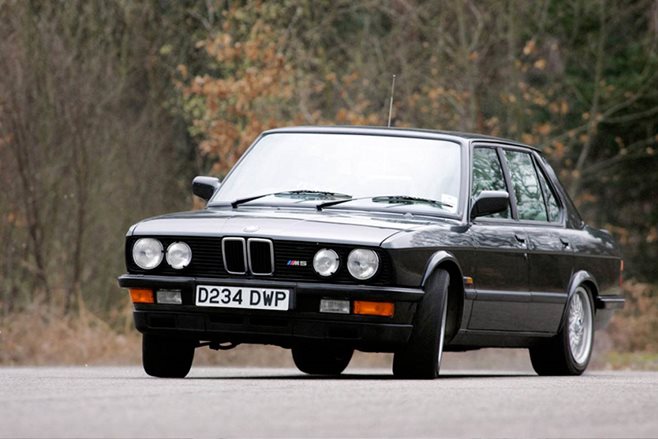
“Soft dash, so that’s the weird one they made in 1994 for one year. That’s mint; it’s burgundy and it’s bloody lovely.”
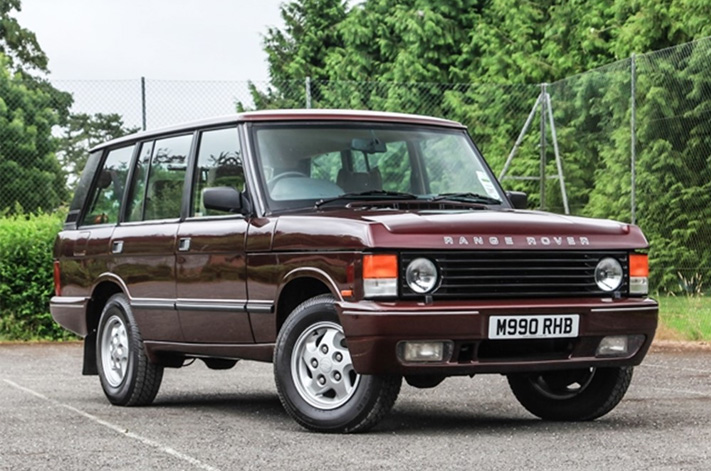
“So the last one they made with the 5.0-litre supercharged V8 that we use for the winter time. It probably needs to be sold. The theme here is I have a lot of cars that need to be sold. I’ve got a lot of cars but never any money. It’s green, dark green, with a caramel interior, it’s proper British spec and clear glass and small wheels.
EVERYTHIING HAS TO HAVE CLEAR GLASS AND THE SMALLEST WHEELS POSSIBLE; REMEMBER THAT, OK?”
Audi S4 Avant
“That’s a hack, shoot car that’s been tuned to buggery. It’s all chipped up and it’s got 440hp. But it’s got an appetite for DSG gearboxes and they’re about £9000 a hit. I’ve got a 0-100mph two-way in 9.1 seconds in that car.”
Peugeot 205 XS
“It’s a weird machine. The famous one is the 205 GTI obviously, but they did one called an XS, which was a 1360 Tu engine, with a lovely little five-speed gearbox on the side, and it had a twin-choke SU carburettor that gave you a lovely resistance when you accelerated, but if you pushed a little bit further when you accelerated, at the bottom it opened up a second throttle on the carburettor . It was like an analogue little VTEC baby. It’s a cool little car. It weighs about 805kg, 85 horsepower; if you drive them quick, they’re as quick as a 1.6-litre GTI but no one even knew about them. And they run a 165 tyre instead of a 185 tyre, so it’s narrow. I‘ve minted it up.”
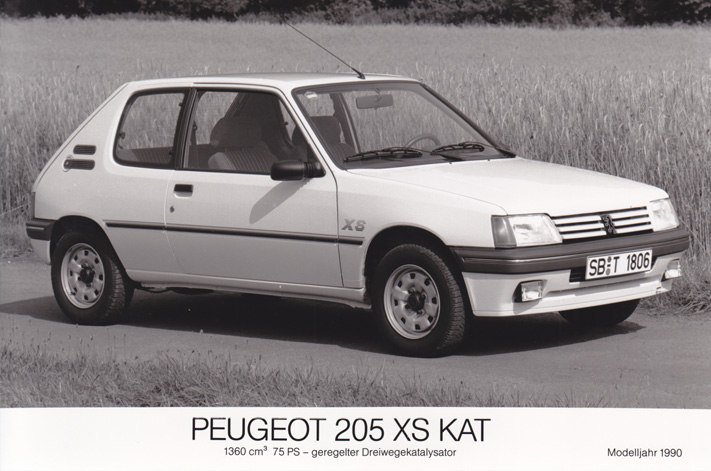
“That’s the lightest hot hatch they ever made, 722kg, with the same powertrain as the 205 XS, same engine, same gearbox and that thing can do 112mph and it does 60 in 8-something. When you’re in it, it feels so fast because it’s so light. And I swear if you hit a sparrow in it, the sparrow would walk away and you’d be dead. It’s the worst car to have a crash in. And the door pockets have massive bins in them that will fit a full bottle of white burgundy.”
Peugeot 205 Rallye
“That was a special car, a proper homologation car that Peugeot made in 1990. They made it for the sub-1300cc Group N rally championship in Europe. So they took the 205 XS shell and made a screaming 1298cc motor with crazy cams and twin-choke Webers on; it produces 100hp. They’re rare as rocking-horse s–t, so I’m having that.”
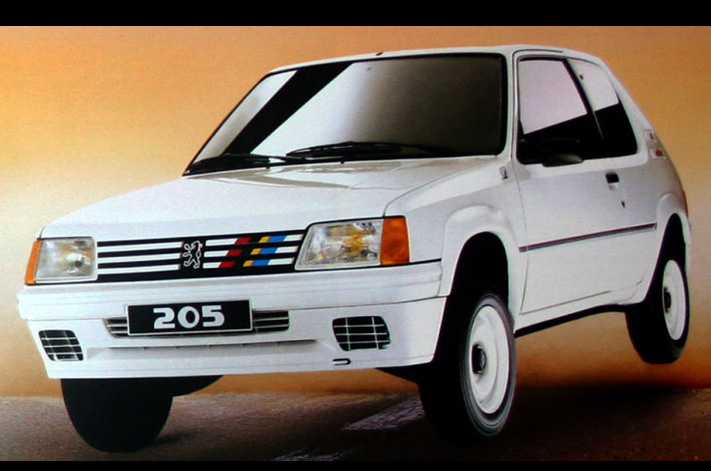
“It’s a ripple-bonnet and I use it more than anything else actually because the kids love being in that.”
Mercedes-Benz E320 Sportline cabriolet
“It’s a W124, so a 1996, a late one. It’s the only car that’s not gone up in value. I’ve had this amazing boom period where everything has gone up, but I paid 16 grand for that thing in ’96 and it’s worth 16 grand now and I’ve spent a lot of money on s–t that’s gone wrong.”
BMW E30 M3 2.5-litre Sport Evolution
“The last one with the wide arches. That’s a bit of a folly, really; I suspect that one will need to be sold to fund videos. But they seem to be going up in value daily. Good fun to drive. They’re a bit over-rated on the road; they’re not that quick and the driving position is a bit s–t. But that one, if you’re up it, on the right road, it’s still fabulous. But I reckon it’d be blown away by a 320d.”
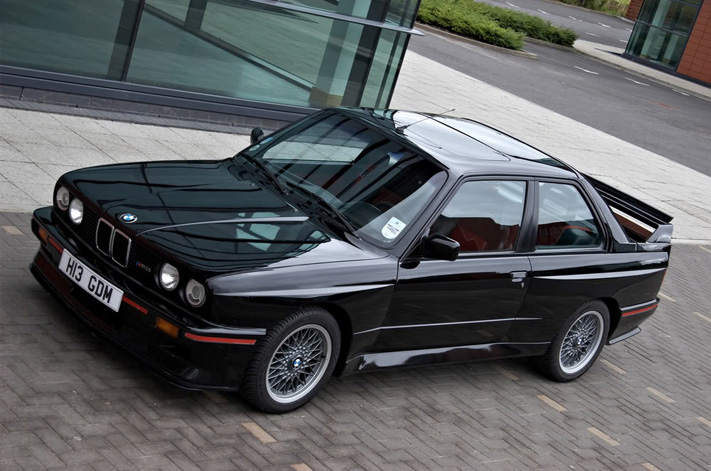
“Speaks for itself, doesn’t it. It’s a really high-miles one, it’s done 60,000 miles and I just love it. I wouldn’t want to sell that; it’s the car I’d keep because it covers so many bases. You only ever want to have one stupid, porno, ‘I’ve got a tiny cock’ supercar, don’t you, and that’s the one for me. It’s the car I had on my wall as a kid.”
BMW 325i rally car
“I bought that for three grand and it’s some of the best fun I’ve ever had in a car. I’ve done a few rallies in it. It’s wicked fun.”
BMW E30 M3 rally car
“I’ve built this proper E30 M3 Bastos car that (Patrick) Snijers used to drive. Prodrive ran a works BMW rally team for a while, which was odd. That’s got totally out of control; it’s cost me a fortune. I won’t say what I’ve spent on it, but I think I’ve done 24 stage miles in it this year and I could have bought a Maloo for what it cost to do those 24 miles. Of course I had to butcher an E30 M3 to build it and in the year since I’ve started that process, they’ve doubled in price.”
Mercedes-Benz E250 CDI seven-seat wagon
“That’s my family car and I lease that; it’s the only sensible thing I do.”
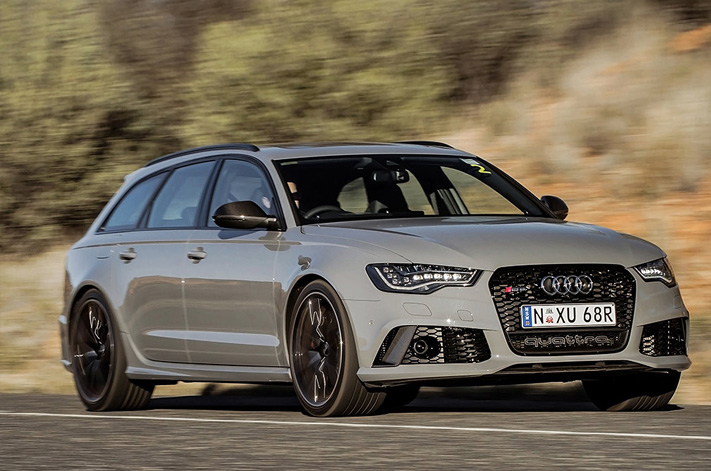
Audi RS6 long-term test car
“I specced my RS6 to match an RS6 I saw on the Australian press office (site) actually. It’s the flat grey paint. It’s just fantastic.”
“I’ve got an SP1, which is the equivalent of a 996 GT3 RS. It’s an homologation Honda designed to take on the Ducati 916. I can ride it, really badly, but I just like having it to look at, and occasionally polish. I don’t actually understand motorbikes. You’re going to play this back and think this bloke’s mad. He can’t concentrate on anything for more than a minute. It’s a good window into how my brain doesn’t work.”
The Honda HR-V returns with a smaller, athletic approach and a new game plan as the medium SUV contest heats up
WHAT IS IT? It’s Honda’s rival to the Mazda CX-3 and Ford EcoSport, based on a modified version of its Jazz/City light car range. It’s been raised, widened and wrapped in a swoopy coupe-like body and fitted with a more potent engine from the larger Honda Civic. It’s joining an armada of small SUVs in the fastest growing segment in Australia and should be one of Honda’s more popular models.
WHY WE’RE TESTING IT This car is crucial to Honda’s plans to regain its lost sales momentum from last decade, and builds on the success of the new Civic, Odyssey, Jazz and City that all arrived in 2014. It should be a battle royal for honours, headed by the excellent Mazda CX-3.
MAIN RIVALS Mazda CX-3, Jeep Renegade, Ford EcoSport, Mitsubishi ASX
THE WHEELS VERDICT The HR-V is a competent, well designed and built crossover that lacks for nothing in terms of available safety gear and is great to drive. Its brilliant packaging and liveability mean it’s potentially going to be a tough call between it and the upcoming Mazda CX-3.
PLUS: Brilliant packaging, competent dynamics MINUS: CVT still hunts, road noise, extensive safety kit only on top model
THE WHEELS REVIEW HONDA decided to launch its HR-V at Tasmania’s MONA, described by director David Walsh as “a subversive Disneyland for adults”. It must think that the new crossover is some kind of wild ride set for a leadership spill on the upcoming Mazda CX-3 and Jeep Renegade, all fresh baby SUVs that will join the Ford EcoSport in battle for the 30-something ‘pre-children’ kidults’ attention.
In chasing these customers – of which 60 percent are expected to be new to the brand – Honda presents a modified Jazz platform that’s widened, strengthened and has a more rigid body styled to look like a coupe. Squint, and that hidden rear door handle and the swooping roofline may have your eyes seeing a little BMW X6.
Starting from $25K –the same price as the somewhat larger Nissan Qashqai that it benchmarked, the HR-V comes with a 1.8-litre four-cylinder petrol engine donated by the Civic and mated to a new-generation continuously variable transmission. That’s the sole powertrain across three equipment levels (four if you count the ‘ADAS’ safety pack option on the top-spec HR-V) and it’s front-wheel drive only – we miss out on the all-wheel drive and hybrid models sold in Japan under the ‘Vezel’ name.
Honda chose the HR-V name for Oz as the Vezel tag – a combo of “vehicle” and “bezel” – wasn’t deemed acceptable here. Seems Honda Oz just plain didn’t like it. Yet it’s far more than a Jazz wearing platform shoes, says program boss Naohisa Morishita.
“I want to ward off any misinterpretation that we simply carried over the platform from the Jazz, because this was not the case,” Morishita-san told Wheels.
“The wheelbase and tracks are completely different [they’re greater]. At the platform level we had to address a whole bunch of stuff – suspension, rigidity – all developed specifically for this car.”
Despite this, HR-V does share some of the Jazz’s strengths: the Magic Seats that fold completely flat, and the same packaging as the Jazz with its centre-mounted fuel tank. That gives it a huge 453-litre boot compared with the CX-3’s 264 litres, as well as clever stowage areas under the seats.
At the wheel, it’s spacious and comfortable even in the low-spec model, with supportive seats and en excellent driving position. The dished three-spoke steering wheel looks smart, and next to you is a high centre console designed to continue the coupe-feeling theme kicked off by that roofline.
It doesn’t make you feel like you’re in a sports car, but it’s a smart uncluttered design with the centre display and smooth HVAC. The fit and finish is solid for the price, and the overall ambiance simple yet not basic.
With the same strut front-end and H-beam rear suspension as the Jazz, the HR-V has been stiffened using its own shocks and spring rates, as well as via a more rigid body. The gym session has the new crossover riding well on the entry-level model’s 16-inch alloys, with little lost for the high-spec models fitted with 18s.
The steering is predictable and responsive, the body control competent – it will tuck into a corner if you come in too quickly – and the overall balance is good. It’s a breeze (remember that, Honda?) to park, too. It doesn’t feel like a Jazz walking a high-wire, as Morishita-san aimed for.
The weak point is the lack of torque from the 1.8-litre: it has the CVT hunting for extra Nm and revving, the precise scenario that Honda promised would not occur with this new-generation version. It has a wider spread of ‘gears’, helping achieve the 5.6L/100km fuel economy, but its 4300rpm peak torque means that the HR-V needs to be worked hard up relatively small hills.
Combine that with the high road noise, and the Honda could improve its refinement.
That’s not a deal-breaker for the HR-V, yet Honda has pitched it against the popular Nissan Qashqai in terms of the $25K starting price even though the Nissan is a class above in terms of size. Instead, the HR-V offers a raft of safety gear which, in its own tests, should have it achieve a top five-star ANCAP rating.
That gear includes the autonomous emergency braking that Nissan was heavily criticised for omitting from the Oz-spec Qashqai. AEB is standard on the mid-spec VTi-S, yet the downside is you can’t buy a base model and stack it full of safety gear – for that, you have to buy the $32,990 top model and select bits from the options list – pushing the price to $34K. That’s a thick wad of cash over the base car.
The Honda HR-V is a welcome return to the maker’s line-up and is a well-made, good value proposition. It’s easy and fun to drive, even if its CVT isn’t perfect or refinement class-leading. It’s brilliant packaging, efficiency and up-to-date tech should make it one of the brand’s best sellers. We can’t wait to get it in the ring with the Mazda CX-3.
SPECS Model: Honda HR-V VTi Engine: 1799cc 4-cyl, sohc, 16v Max power:105kW @ 6500rpm Max torque: 172Nm @ 4300rpm Transmission: CVT Weight: 1328kg 0-100km/h: N/A Fuel economy: 5.6L/100km Price: $24,990 On sale: NowClick here to read the full range review of the Honda HR-V.
Our boys in blue are patrolling Australia’s roads in a variety of mediocre misery mobiles right now.
The average Aussie police fleet includes base-model V6 Holden Commodores for undercover constabularies, a slightly more desirable V8 model if they’re on highway patrol, or a big lethargic diesel off-roader if you live in the sticks. Sometimes they don’t even use cars, opting for horse-back like it’s 1855.
But if you’re in the business of catching baddies, and you’re trying to catch the average hot hatch hoon, then none of these Aussie squad cars will get the job done – realistically, you need a high-horsepower supercar that can do 300km/h and shoot flames from its exhausts.
This is what the wise Dubai police force has done. It has acquired a fleet of cars so terrifyingly fast that no one in Dubai would dare even attempt to speed away from the law.
And to scare the residents even more, the Dubai force has released a stunningly filmed Fast and Furious-style public service video showing off its squad cars, which include a McLaren 12C, Ferrari FF, Nissan GT-R, Mercedes SLS AMG and G63, BMW M6, Bentley Continental and the mighty Bugatti Veyron enforcer. And this isn’t even all of the squad cars. There’s also a Lamborghini Aventador, Aston Martin One-77 and Ford Mustang – for the juniors.
Check out the world’s 10 craziest police cars here.
Welcome to MOTOR’s 60 Greatest Performance Cars of all time.
The list first appeared in our June 2014 issue as part of our 60th Anniversary celebrations. What better way to celebrate 60 years of testing performance cars than to name the best we’ve ever driven?
Now, given the last was compiled almost 12 months ago there are some obvious cars missing. At the time, we hadn’t driven the incredible LaFerrari or the sublime 458 Speciale, and we hadn’t yet sampled the excellent 991 GT3.
Bar a few recent models, however, it’s a list that’s unlikely to significantly change, now or into the future, as these 60 cars represent the pinnacle of performance motoring. That said, if we’ve missed your favourite, please let us know in the comments below. Enjoy.
60. Saab 99 Turbo
OK, so driving a Saab is about as cool as playing croquet, but everything from the Renault Clio to the McLaren P1 owes a debt of gratitude to this Swedish trendsetter. There had been turbo’d cars before, but they’d been peaky, tricky beasts to drive. The 99 fed boost to the masses, and became the first turbo car to win a WRC round in the hands of Stig Blomqvist.
59. Alfa 8C 2900
Built to conquer the world’s toughest sports car races, notably the Mille Miglia, (victorious in 1936 and ’37), coachbuilders then rejoiced in covering this race-winning package in some of the most beautiful shapes the automotive world has ever seen.
58. Datsun 240Z
Japan’s answer to the E-Type was an enormous hit in the US, where sadly, like a lot of other Americans, it got enormously fat – a shadow of its former self. But the original was light and powerful, with performance similar to its European counterparts at a fraction of the price.
57. Ford Mustang Cobra R
There are plenty of desirable Mustangs, and plenty of reasons to want to own one. But if you want one to drive hard, the 2000 Cobra R stands above the rest. Independent rear end, supercharged V8, close-ratio six-speed ’box, stripped interior – Ford’s Special Vehicles Team went to town on the Cobra R, and it showed.
56. FPV F6 Typhoon
Ford’s XR6 Turbo proved you didn’t need a V8 to be the Aussie performance car king and FPV turned the wick up even further. The arrival of ZF’s slick six-speed auto with the BF facelift only widened the gap and it wasn’t until the supercharged Miami V8 broke cover that the bent-eight regained the upper hand – and even then, only just.
55. Chevrolet Corvette L88
When it comes to American muscle, the 427-powered L88 has the Mr Universe title all sown up. Chevrolet quoted 320kW; adding another 100 got you closer to the truth. The race-spec engine, brutal ‘Rock Crusher’ gearbox and no heater made it wildly impractical for the road, but there’s no tougher Yank Tank.
54. Jaguar E-Type
To become fixated on the way it looks is to lose sight of the other reason the E-Type dropped jaws in the early ’60s – its performance. A 241km/h top speed and 0-100km/h time of around seven seconds was supercar stuff, independently verified by the media. Of course, actual customer cars weren’t anywhere near as fast as the ‘press specials’ but let’s not let the facts get in the way of a good story.
53. Toyota 2000GT
To us, it’s sexier than an E-Type – but with performance to rival a 911. Toyota’s stunning 2000GT was Japan’s first supercar. Didn’t move the game on in any significant way but was pivotal in helping shift peoples’ perceptions of Japanese cars (a one-off convertible starred in the Bond film You Only Live Twice) and provided the inspiration for two other cars further up this list.
52. Ariel Atom V8
The Ariel Atom has an exoskeleton, just like a lobster. This makes it interesting. But install a 373kW 3.0-litre V8 into this exoskeleton and the end result turns completely feral, buzzing with rage and fury like a lobster that’s just been dunked in a vat of boiling water. A car that needs its own straitjacket.
51. Mazda RX-7
Felix Wankel’s wacky engine concept found no finer home than the last iteration of Mazda’s iconic sports car. The compact dimensions of the 13B rotary did wonders for weight distribution and two turbos (acting sequentially) produced a beautifully progressive power curve. Rare, Aussie-built SP is the pick of the litter.
What is it?
This is the 228i, BMW’s latest addition to the compact rear-driver 2-Series range.
Before its arrival last November you had the choice of either, in the entry-level 220i, struggling to keep up with a Toyota 86, or in the M235i, mildly frightening yourself with Tomahawk-like acceleration.
Not only was there a large chasm in the range in terms of performance but also in terms of price. The 2-Series coupe kicked off at $50K (220i) and finished at $79K (M235i). The 228i fixes this, plonking itself neatly in the middle with a price tag of $64,400 and a 2.0-litre turbo four.
Hold on, the 125i, BMW’s last middle-of-the-range small coupe, had a free breathing six…
Ever since the less aesthete 1-Series coupe retired to its grave, the last naturally aspirated six-cylinder to feature in a BMW was buried with it. Taking its place has been the 2.0-litre turbo four that features in this car and other ‘28i’ models.
It must be a bit of slouch then?
Not quite. The 228i, even with an eight-speed automatic transmission, matches its predecessor’s weight at 1405kg. Kiss the firewall with your right foot and the compact BMW launches at the scenery with proper urgency. BMW calls it 0-100km/h in 5.7sec. For progress, that’s 0.7sec faster than the six-cylinder 125i.
It’s no firecracker either like an old-school Rex. The engine stirs up 350Nm early at 1250rpm and then has 180kW to look forward to at 6500rpm, and it’s extremely smooth, though a little boring sonically, while doing so.
Does it handle?
Thanks to its decent 2690mm wheelbase, the 228i feels stable when threading a decent set of corners. Balance wise, there’s a slight bias of grip towards the rear, but the car feels adjustable the same way a third-gen Mazda MX-5 does though without the edginess.
It can’t all be roses, what’s bad about it?
Like a day with your in-laws, you just never get comfortable with the 228i’s variable steering. In ‘Comfort’ mode it’s appropriately quick, useful for the city, but feels indirect. Sport mode helps solve that, but then weighting feels artificially heavy. Where the steering rack does excel, however, is feedback. There’s loads of information coming back to your palms.
Should I buy one?
Like most BMWs, the sweet spot lies in the options. The 228i comes with loads of standard equipment, however leather is $2200, metallic paint is $1142, and the exterior desperately needs a little venom – where nothing will do short of the $500 optional wheels exclusive to the $3500 M Sport package (for us, at least).
But if you can tolerate the price game and never ferry around more than four people, then you’ll find the 228i one of the sweetest BMWs under $70K.
MAZDA has stopped short of declaring an all-out war to wrest the title of Australia’s best-selling car from Toyota’s Corolla after sharpening the value of its Mazda 3 range.
The Japanese car maker, which ended last year in the number three spot behind Holden and Toyota for overall sales, today announced heavily revised pricing for almost every model in its compact 3 range apart from the entry-level $20,490 Neo.
According to the carmaker, the savings come from the introduction of the Japan-Australia free trade agreement, which cut a five percent tariff from vehicles imported from Japan.
While Neo pricing hasn’t changed, Mazda is saying it has added value, throwing in rear parking sensors it says are worth $1200, and casting off the steel wheels in favour of 16-inch alloys.
Further up the chain, Mazda’s strongest-selling 3 model, the Maxx Sport that attracts almost two out of every five buyers of the hatch and sedan, sheds $600 and adds foglamps to start from $22,390, the Touring, SP25 and SP25 GT all fall by $800, and the range-topping Astina drops between $940 for the diesel-engined version to $1150 for the petrol.
Last year, the Mazda 3 was locked in a close battle with Toyota’s $19,990 Corolla for the title of Australia’s most popular car. By the end of December, just a few hundred sales separated the two, with Corolla edging out the 3 with 43,735 sales.
However, Mazda Australia managing director Martin Benders said the Mazda 3’s sales differed from that of the Corolla by attracting more private and user-chooser buyers, where the Corolla relied on bulk-buying fleets to bolster its tally.
“While we missed out by 400 units, when you back out the government and the rental and large fleet stuff, we smashed them [Toyota],” Benders said.
“In the real buyers’ class, we did really well. Are we going to reach out to rental and fleet buyers just to beat Corolla? No.”
An indication of the 3’s popularity among buyers who hand over their own money is clearly shown in January’s sales figures, a time when fleet buyers are generally lying on beaches and job-lot purchases are put on ice. Mazda’s tally for the month was 3903 – enough to give it the title of Australia’s most popular car for the month ahead of the Corolla’s 3472.
Mazda is also waiting for the introduction of its CX-3 compact SUV, which will take on the likes of the Ford EcoSport, Holden Trax and even the all-new Honda HV-R in one of the hottest slices of the Australian market.
Benders would not be drawn on whether the CX-3 would also gain a significant price advantage when it arrives, saying only: “Watch this space.”
He also believes most buyers won’t back out of buying a Mazda 3 in favour of the higher-riding CX-3.
“We see people moving into the small SUVs will come out of light and small cars, but it will come across from all brands,” Benders said.
“What we see is that we have a very appealing car in the small segment, and we believe we will have a very appealing car in the small SUV segment … which will also give us an opportunity to conquest other brands that are moving across.”
In other words, what it loses from potential 3 sales as Mazda customers walk past the hatch and sedan to buy a CX-3, it reckons it will pick up from small car buyers who may have considered kicking tyres over at other brands – including Toyota.
