
A new national survey suggests Australia’s Electric Car Discount is playing a critical role in helping cost-conscious households transition to electric vehicles, particularly among outer-suburban and blue-collar buyers.
Polling conducted by RedBridge Group between March and April 2026, based on responses from more than 2,200 novated leaseholders, found the incentive is a decisive factor in whether many Australians can afford to make the switch.
According to the research, conducted for the National Automotive Leasing and Salary Packaging Association (NALSPA), 84 per cent of respondents said the discount was “very important” in their decision to purchase an electric vehicle, with the figure rising to 93 per cent among financially stressed households. Strong support was also recorded among blue-collar workers (87 per cent), outer-suburban residents (86 per cent) and households where a language other than English is spoken (90 per cent).
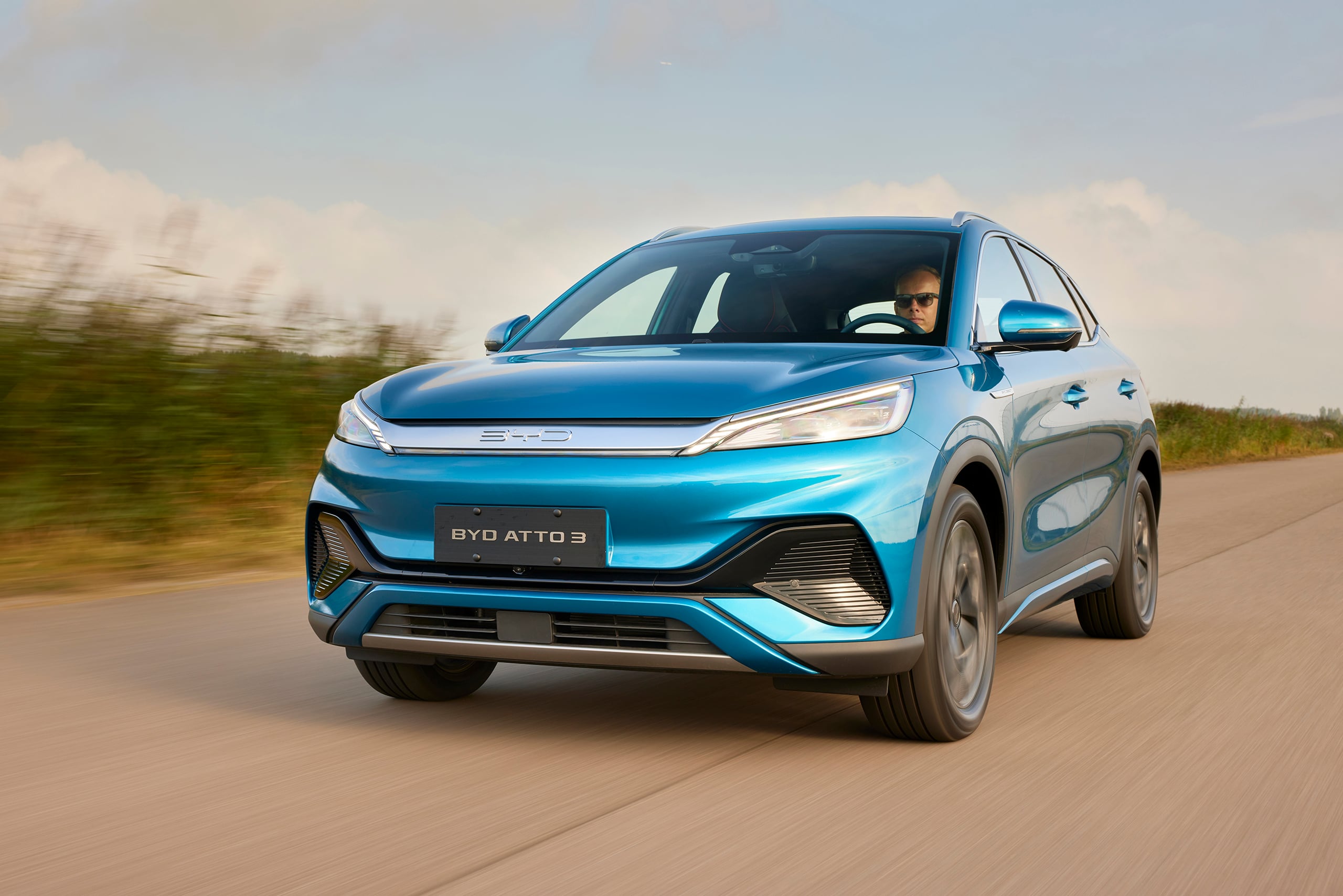
The findings challenge perceptions that EV incentives primarily benefit wealthier inner-city buyers, said Redbridge. Instead, the data indicates the policy is being used most heavily by Australians looking to reduce everyday costs, particularly fuel expenses.
Cost savings emerged as the primary motivation for switching to electric vehicles, with more than half of respondents ranking the discount among their top three reasons for purchasing.
RedBridge analysis also found that 60 per cent of respondents would not have bought an EV without the incentive. That figure climbs to 72 per cent among financially stretched households and 65 per cent for blue-collar workers, suggesting the policy is central to current adoption rates.
The survey indicates that removing the discount could significantly slow EV uptake. Nearly half of respondents said they would delay their next vehicle purchase, while almost a quarter would revert to petrol or diesel vehicles – rising to more than a third among lower-income groups.
“Most Australians who bought an EV with the help of the Electric Car Discount wouldn’t have made the switch without it,” said NALSPA CEO Rohan Martin. “And if the EV Discount ended, it’s the blue-collar workers and those under financial pressure who are more likely to switch back to a petrol or diesel car.”

A RedBridge spokesperson said the results show the discount is functioning primarily as a cost-of-living measure rather than a luxury incentive, helping households manage both upfront vehicle costs and ongoing fuel expenses.
Support for the policy appears to cut across political lines, with more than 90 per cent of respondents agreeing that government assistance is important in helping Australians transition to electric vehicles.
The findings come amid ongoing debate about the future of EV incentives in Australia, with policymakers weighing their role in reducing emissions while addressing affordability concerns.
Overall, the data suggests that for many Australians, particularly those under financial pressure, the Electric Car Discount remains a key factor in making electric vehicle ownership viable.
The GAC Aion V has joined the crowded mid-size electric SUV segment with a strong focus on value, technology and practicality – but it’s not without its compromises.
Built by one of China’s largest automotive groups, the Aion V is designed to appeal to families looking for an affordable, well-equipped electric SUV. At around 4.6 metres long, it sits squarely in one of the most competitive parts of the market, going up against a growing number of similarly sized EVs.
On paper, the fundamentals are solid. A 75kWh battery delivers a claimed driving range of just over 500 kilometres (WLTP), while DC fast charging of up to 180kW allows a 10–80 per cent top-up in around 24 minutes. In real-world testing, efficiency sits closer to a 430km usable range, which is still competitive for the class.
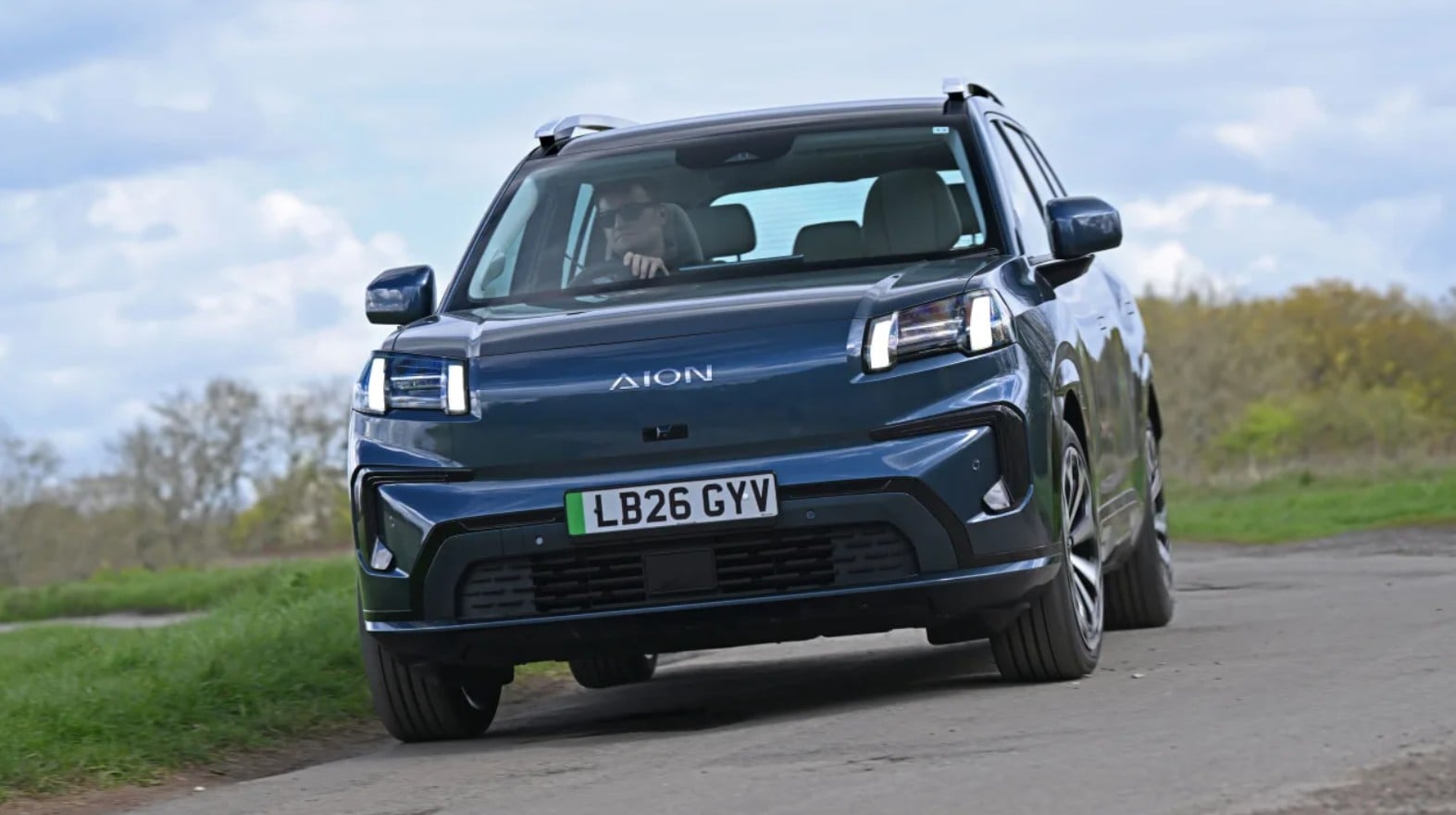
Power comes from a single front-mounted electric motor producing around 150kW and 240Nm. While those figures are modest for an EV, the Aion feels responsive enough in everyday driving, particularly in its more aggressive drive modes.
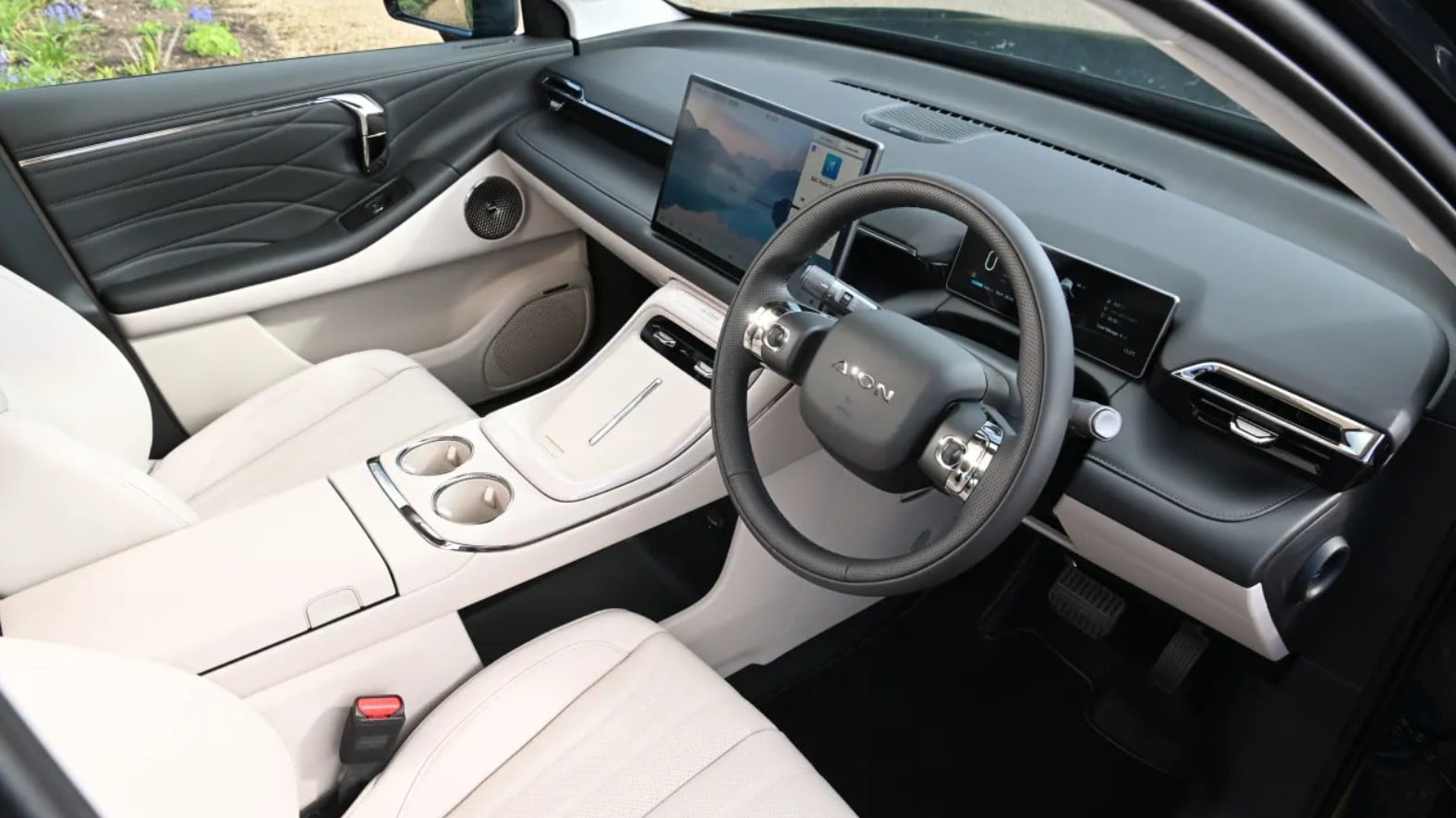
Inside, the Aion V makes a strong first impression. There’s a clear emphasis on comfort and equipment, with features such as heated and ventilated seats, a panoramic roof, wireless charging and a 360-degree camera all included as standard. Cabin materials feel soft and well put together, and overall build quality appears competitive with more established brands.
However, the heavy reliance on a large central touchscreen creates usability issues. Key functions are buried within menus, and the layout can be distracting to navigate while driving. The lack of physical controls doesn’t help, and small on-screen text further complicates matters.
Safety systems are another weak point. Features such as driver monitoring and speed sign alerts can be overly sensitive, frequently interrupting the driving experience with warnings.
On the road, the Aion V is competent rather than engaging. Ride quality is generally acceptable at lower speeds, but larger bumps can unsettle the suspension. Steering lacks feedback, though it is predictable enough for everyday use.
Practicality is a strong suit, with generous rear-seat space and a usable 427-litre boot, although some finishing details – such as the parcel shelf – feel less refined.
In Australia, pricing starts from about $42,590 before on-road costs for the entry-level Premium variant, rising to around $44,590 for the higher-spec Luxury grade. Both versions share the same 75kWh battery and single-motor front-wheel-drive setup, meaning the differences largely come down to equipment.
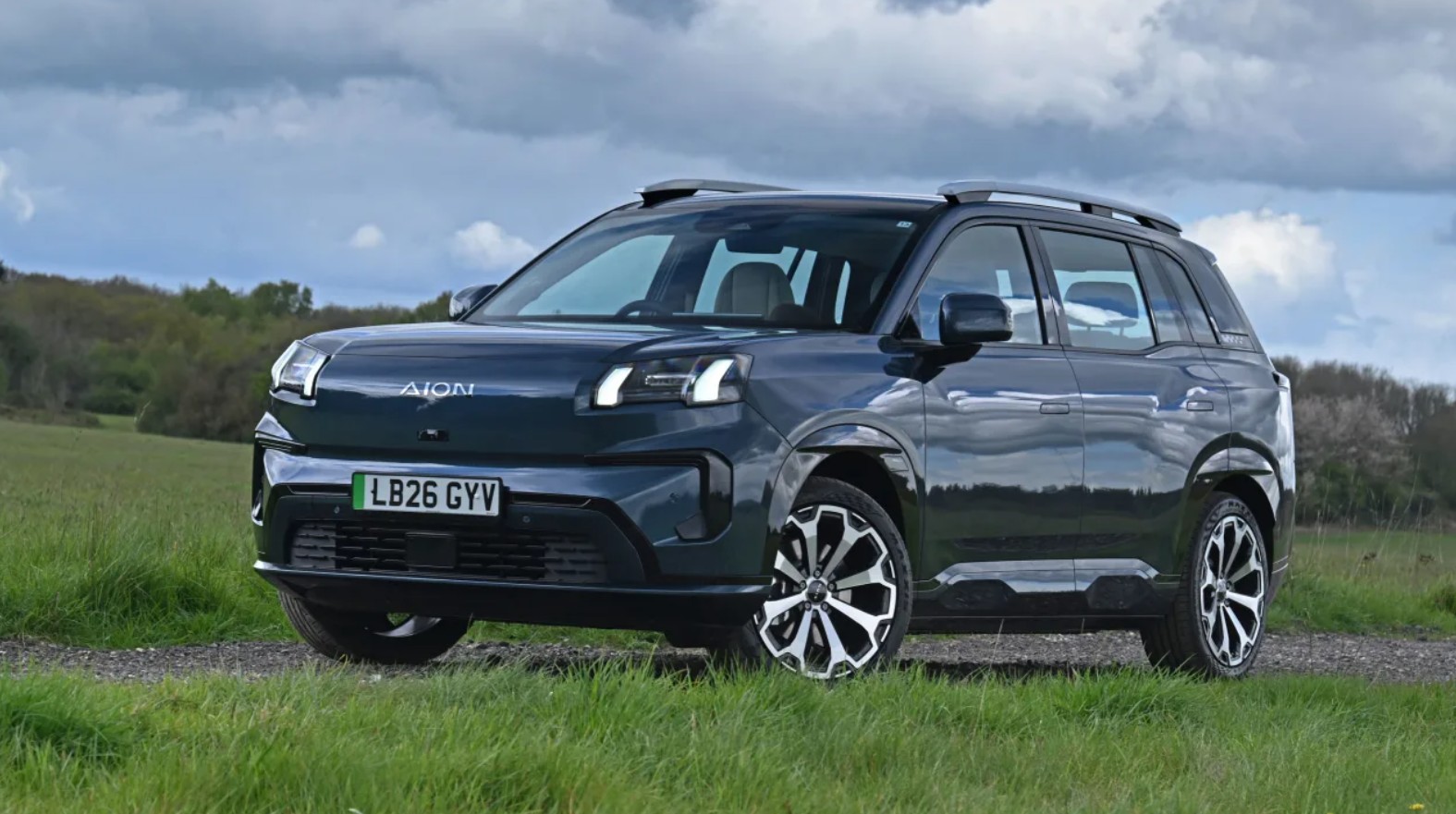
The Luxury adds extra convenience features such as upgraded upholstery, massaging front seats, a rear tray table and an integrated centre-console fridge. Even the base model is well equipped, with most core features offered as standard, helping the Aion V present strong value compared with similarly sized electric SUVs.
Overall, the Aion V delivers where it matters most for many buyers: space, range and equipment. But while it shows promise, refinement and user experience still lag behind the segment’s best.
GWM Australia has asked head office in China for an increase to production volumes of its just-launched plug-in hybrid variant of its popular Tank 300 SUV. According to GWM, the impact of the conflict in the Middle East on the price of diesel, has led to an increase in demand for energy efficient vehicles as buyers look to immunise themselves against the volatile oil market.
According to GWM Australia and New Zealand managing director, Andrew Gao, interest in the Tank 300 PHEV has exploded, resulting in the Australian arm asking head office in China for increased volumes for our market.
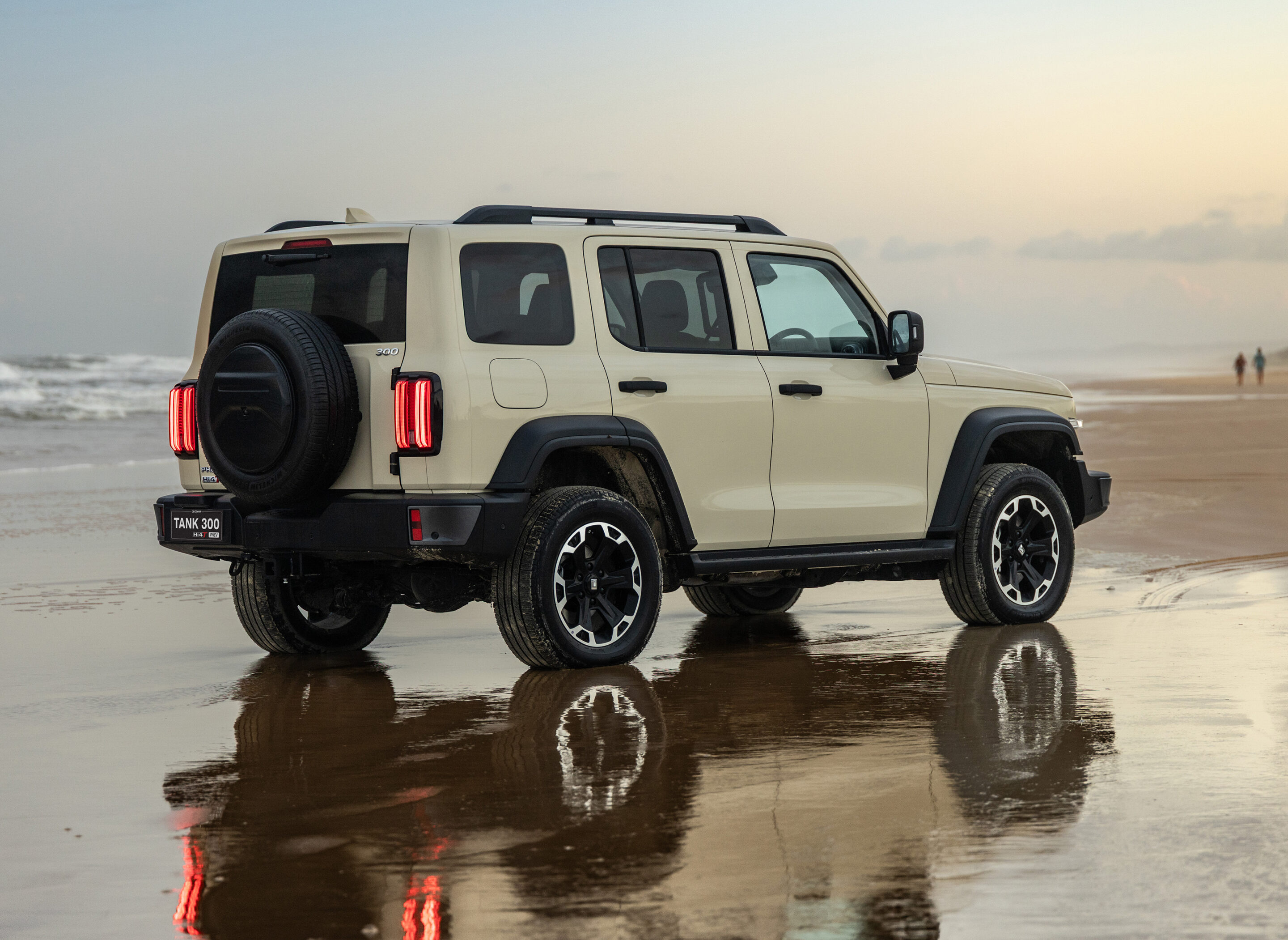
“As everybody knows… the fuel pricing is increasing sharply,” Gao told assembled Australian media, including WhichCar by Wheels. “And now, diesel pricing is $1 more than petrol. And I think the Tank 300 PHEV will help these customers to ease the severity of their fuel costs.
“In terms of our current order bank for this model… it’s quite stronger than our expectations. And… we have already temporarily asked our factory to increase the production of this model [for Australia]. And now, we are looking forward to [twice the] volume than before, for the Tank 300.”
GWM Australia’s initial forecasts suggested that plug-in hybrid versions would account for around 30 per cent of total Tank 300 sales. However, that has now been revised with Gao confirming the plug-in hybrid Tank 300 could account for as much as 50 per cent of the model’s sales.

“The initial planning is probably 70 [percent petrol and] diesel and 30 [per cent] plug-in hybrid. That was the initial… assumption.
“But given the time now… we are upping the volume in [the] high 40 [per cent], and that is going to skew probably more towards 50:50 moving forward.
“But a good thing for us is we are very flexible, and we are quick to react to the market as well. So, we’re going to see what happens to the fuel pricing on the global stage, and we’re going to adjust as required, but at this point in time, we’re probably close to 50:50.”
Australia will get two variants of the plug-in hybrid Tank 300 with pricing starting from $55,990 driveaway for the entry-level Lux or $59,990 driveway for the range-topping Ultra.
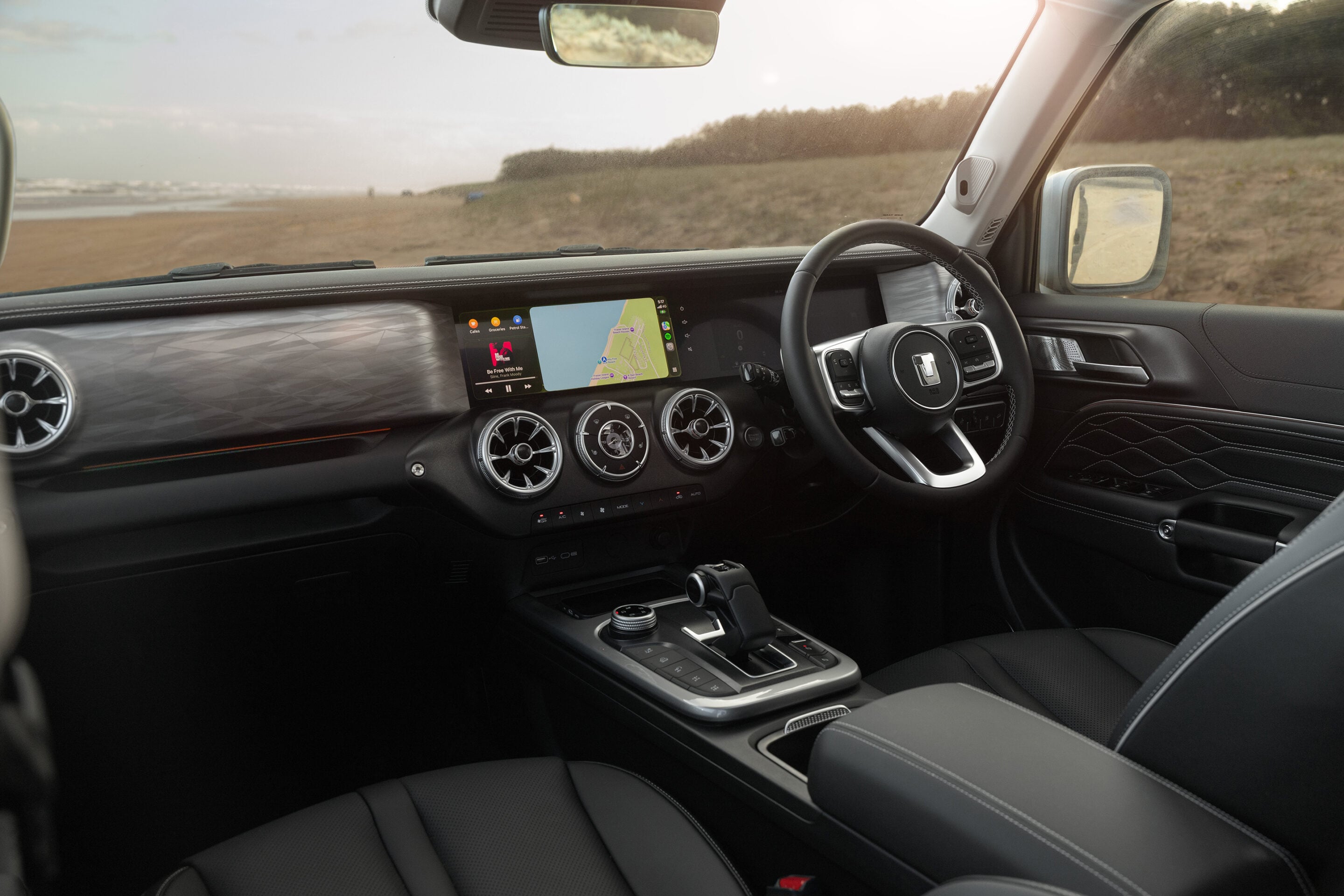
Both models are powered by 2.0-litre turbo-petrol paired with a single 120kW electric motor for combined outputs of 300kW and 750Nm and a zero to 100km/h of just 6.3 seconds.
A 37.11kWh battery provides a claimed electric-only driving range of around 115kW, based on the more lenient NEDC testing criteria. GWM claims a fuel consumption figure of 1.9L/100km with a high state of battery charge. According to the Chinese carmaker, the petrol engine in isolation (i.e. when the battery is in a low state of charge) will use 8.3L/100km. The Chinese manufacturer also claims towing capcaities of 3000kg with a braked trailer, and 750kg unbraked.
Stay tuned to Whichcar by Wheels for our full review of the new GWM Tank 300 PHEV, coming soon.
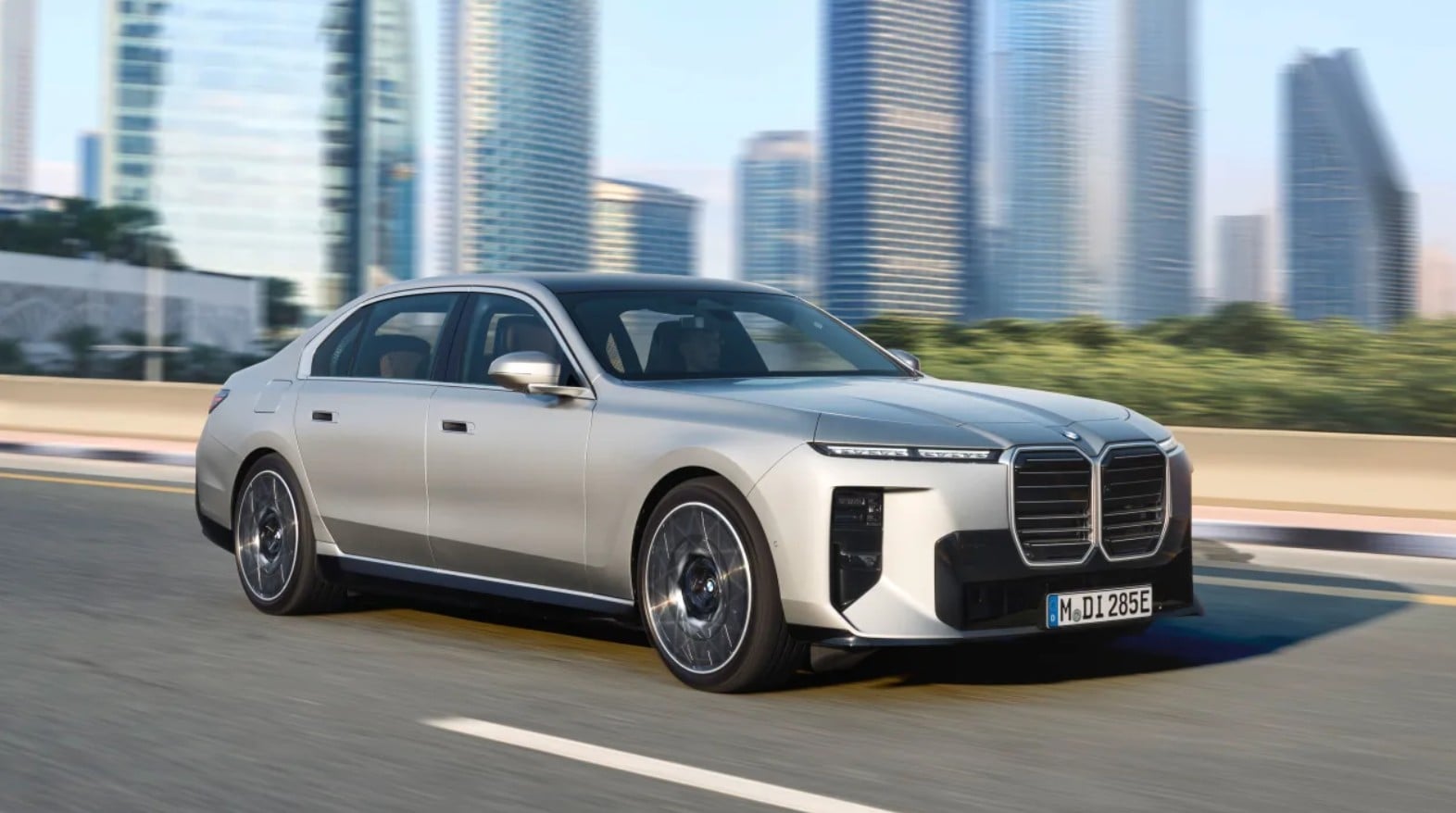
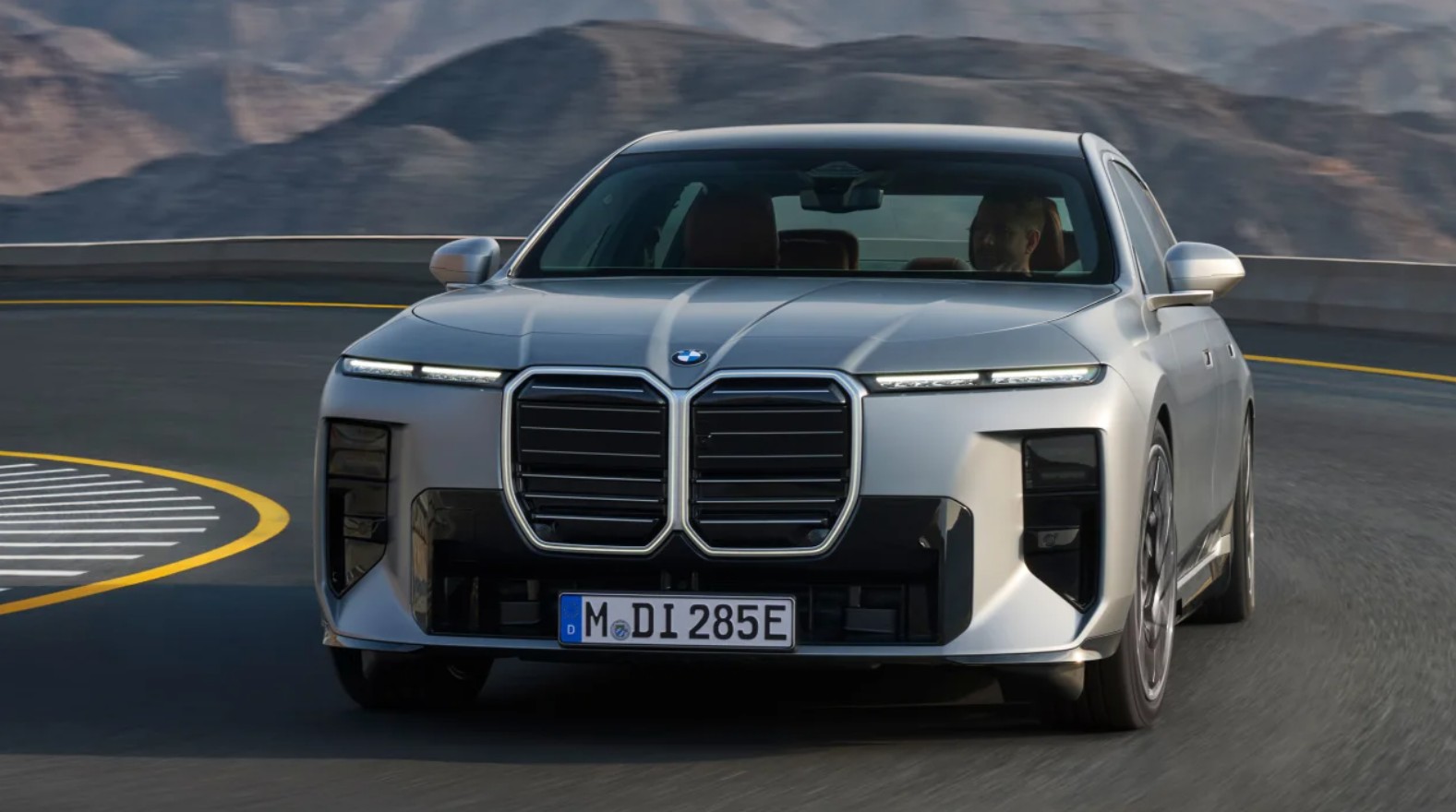
BMW has revealed a significantly updated version of its flagship 7 Series, describing the changes as the most extensive mid-cycle upgrade the model has received. The revisions span design, technology and powertrains, with both combustion, plug-in hybrid and fully electric versions continuing in the range.
The updated 7 Series will again be offered with a mix of petrol, plug-in hybrid and battery-electric options, all sharing the same underlying platform. That approach contrasts with some rivals that separate their electric and combustion models entirely, allowing BMW to maintain a consistent design and engineering base across the line-up.
For the electric i7 variants, BMW claims meaningful gains in efficiency and driving range. The latest models are expected to deliver up to around 720 kilometres on a single charge (WLTP), an increase over the outgoing version, although still trailing some competitors in outright range. All-electric variants retain dual-motor all-wheel drive, with outputs ranging from approximately 335kW to more than 500kW in high-performance versions.
A key part of the update is the introduction of BMW’s latest electrical architecture and next-generation battery technology, which also underpins newer models across the brand. Battery capacity is expected to be around 110kWh, while charging capability has been increased to 250kW DC. BMW says this enables a 10 to 80 per cent recharge in under 20 minutes under ideal conditions.
Plug-in hybrid versions will continue, pairing a turbocharged six-cylinder petrol engine with an electric motor. Electric-only driving range is expected to be around 80 kilometres, making them more usable for short daily trips without relying on petrol power.
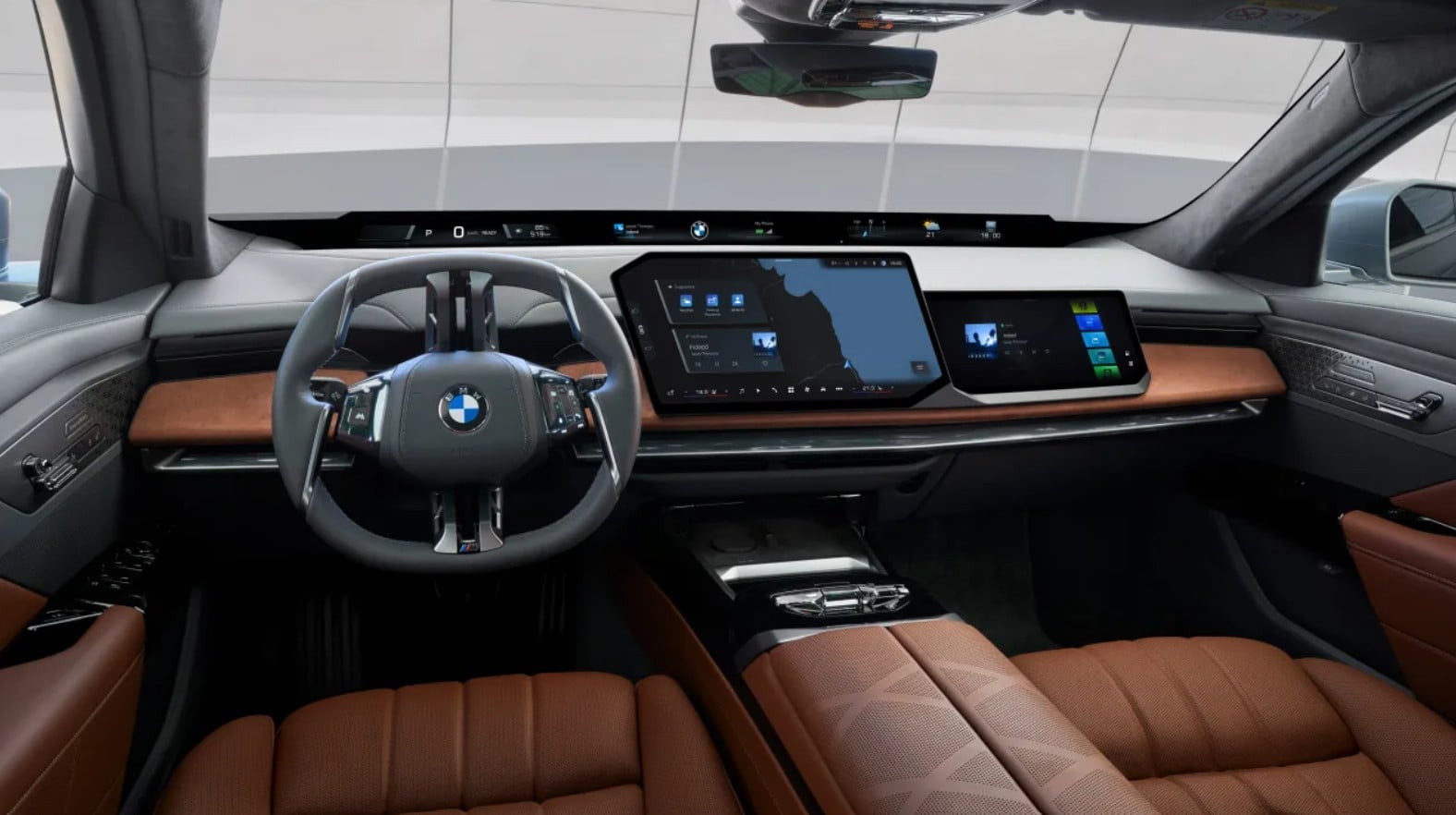
Inside, the 7 Series receives a major redesign. A new dashboard layout incorporates BMW’s latest digital interface, including a panoramic display system that spans the width of the cabin. A redesigned infotainment system and an optional front passenger screen further emphasise the car’s focus on technology and connectivity.
Exterior changes are more subtle but still noticeable, with revised lighting elements, updated grille detailing and new wheel designs. BMW is also expanding customisation options, including new paint finishes and a two-tone exterior treatment.
Despite the updates, core features such as air suspension, rear-wheel steering and the large rear-seat entertainment screen remain, reinforcing the 7 Series’ position as BMW’s technology flagship.
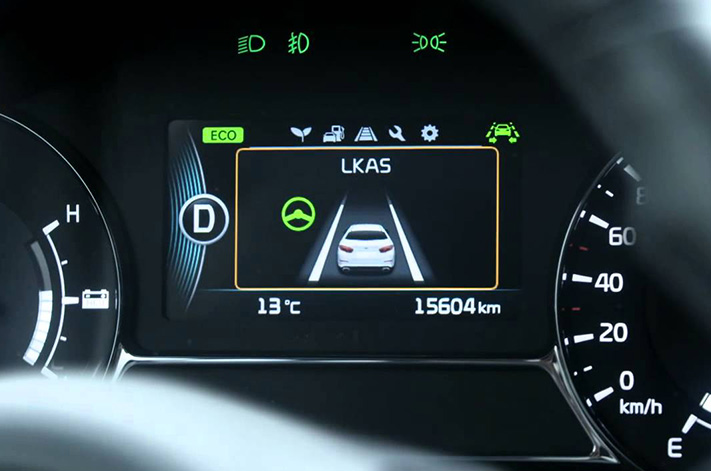
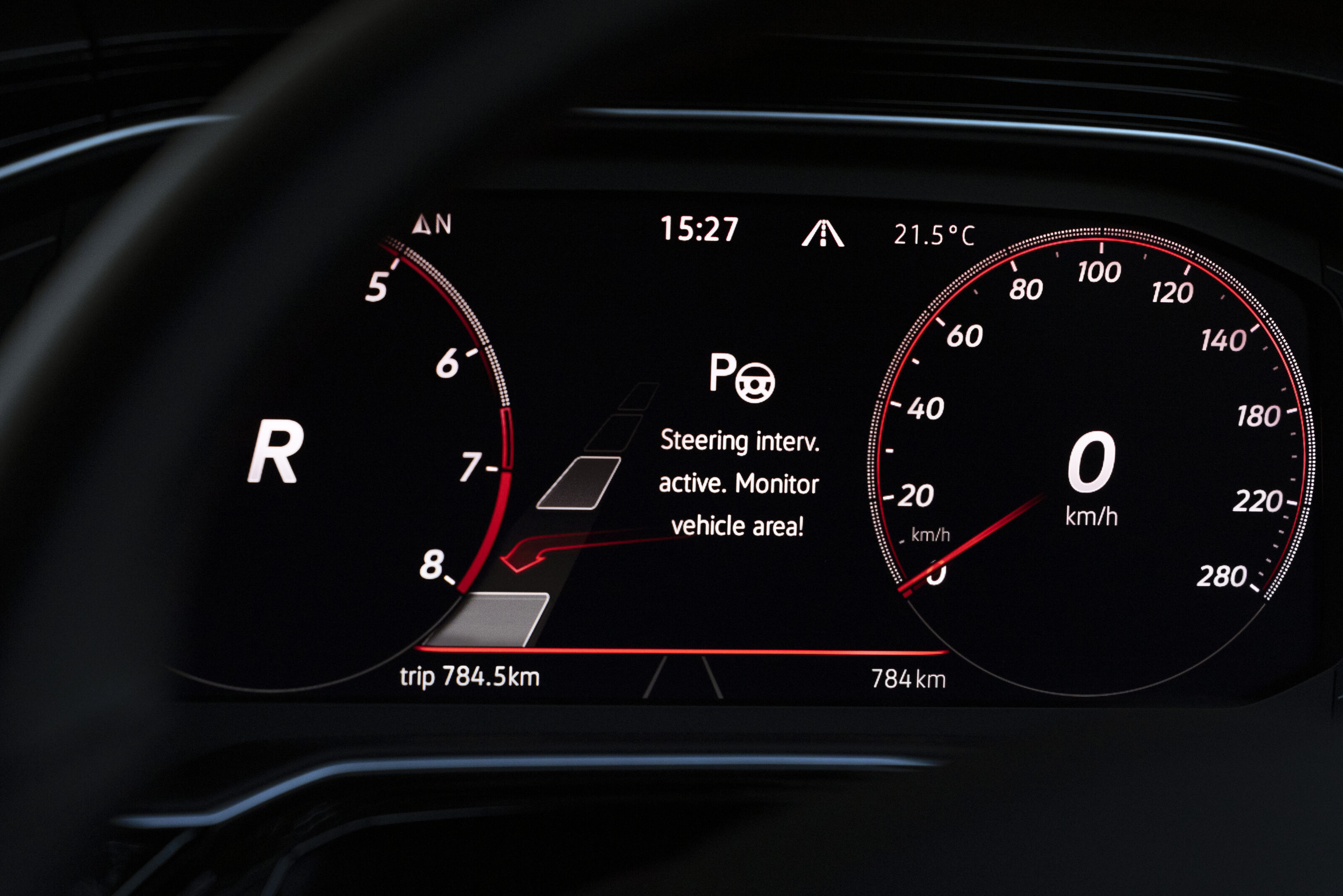
A growing number of drivers say modern in-car technology is becoming more irritating than helpful, with safety-focused systems topping the list of the most frustrating features.
A UK survey of 2,000 motorists for Scrap Car Comparison found that seatbelt reminders were the most commonly cited annoyance, followed closely by lane-keeping assist and automatic stop-start systems. Lane departure warnings and voice control features also ranked among the top five complaints.
The findings highlight a clear divide between different types of technology now fitted to new vehicles. Systems designed to improve safety – such as alerts and driver assistance features –are more likely to frustrate drivers, while convenience-based technologies are generally well received.
Parking sensors were rated the most useful feature overall, with more than 45 per cent of respondents identifying them as essential. Built-in navigation systems and Bluetooth connectivity also ranked highly, suggesting drivers place greater value on features that make everyday tasks easier rather than those that intervene while driving.
Despite widespread complaints, not all drivers share the same view. More than a quarter of those surveyed said they did not find any in-car technology irritating, pointing to a divide in how motorists interact with newer systems.
The results come as regulators in several markets push for more advanced safety systems to be fitted as standard equipment in new vehicles. These include technologies such as intelligent speed assistance and enhanced driver monitoring systems, which are intended to reduce accidents but may also increase the number of alerts drivers experience.
The survey suggests familiarity plays a role in how drivers perceive these features. Owners of newer vehicles – typically equipped with more advanced driver assistance systems – were more likely to report frustration, while those with older cars were less affected.
There were also differences between demographics. Men were generally more likely to find in-car technology irritating, while women showed a stronger preference for practical features such as parking sensors.
While some drivers view these systems as intrusive, safety experts maintain they serve an important purpose. Many of the most criticised features are designed to reduce crashes or improve driver awareness, even if they are not universally popular.
Top 10 car tech features drivers find the most useful
| Rank | Tech | Percentage of drivers who find it useful |
|---|---|---|
| 1 | Parking sensors (front and rear) | 45.2% |
| 2 | Built-in sat nav | 37.3% |
| 3 | Bluetooth connectivity | 25.5% |
| 4 | Seatbelt reminders | 22.7% |
| 5 | Smartphone mirroring (Apple CarPlay/Android Auto) | 16.5% |
| 6 | Keyless entry and push-button start | 16.3% |
| 7 | Forward collision warning | 14.8% |
| 8 | Adaptive cruise control | 13.7% |
| 9 | Touchscreen media control | 13.1% |
| 10 | Automatic stop-start | 13.1% |
Top car tech features drivers find the most annoying
Rank Tech Percentage of drivers who find it annoying 1 Seatbelt reminders 15.9% 2 Lane keeping assist 14.2% 3 Automatic stop-start 13.4% 4 Lane departure warning alerts 13.2% 5 Voice assistants/voice control 12.8% 6 Keyless entry and push-button start 9.4% 7 Touchscreen-only settings control 9.3% 8 Driver monitoring systems 9.0% =9 Streaming apps 7.9% =9 Gesture control interfaces 7.9% =11 Forward collision warning 7.6% =11 Touchscreen climate control 7.6%
The Ford Territory was one of the brightest stars in Australian car manufacturing. When it went on sale in 2004, it was lauded for its BMW X5-like dynamics, spacious cabin, strong practicality and value for money. To get a similarly polished SUV at that time, you’d have to spend at least $30,000-$40,000 more, and it was something its Holden arch rival couldn’t match.
Almost 180,000 Territory models were made over its 12-year lifespan, which made it very popular, and many of them are still running around today. That got us thinking: What if Ford still made the Territory today? Thanks to AI, we can get a glimpse into a future that will never come to fruition.
Now, we should start off by saying that Ford does actually still make a Territory, but it’s not the Territory we know and love. It’s actually a small SUV that was co-developed with Ford’s Chinese partner JMC and is sold in many markets around the world like South America, South Africa and various Asian countries (including China).
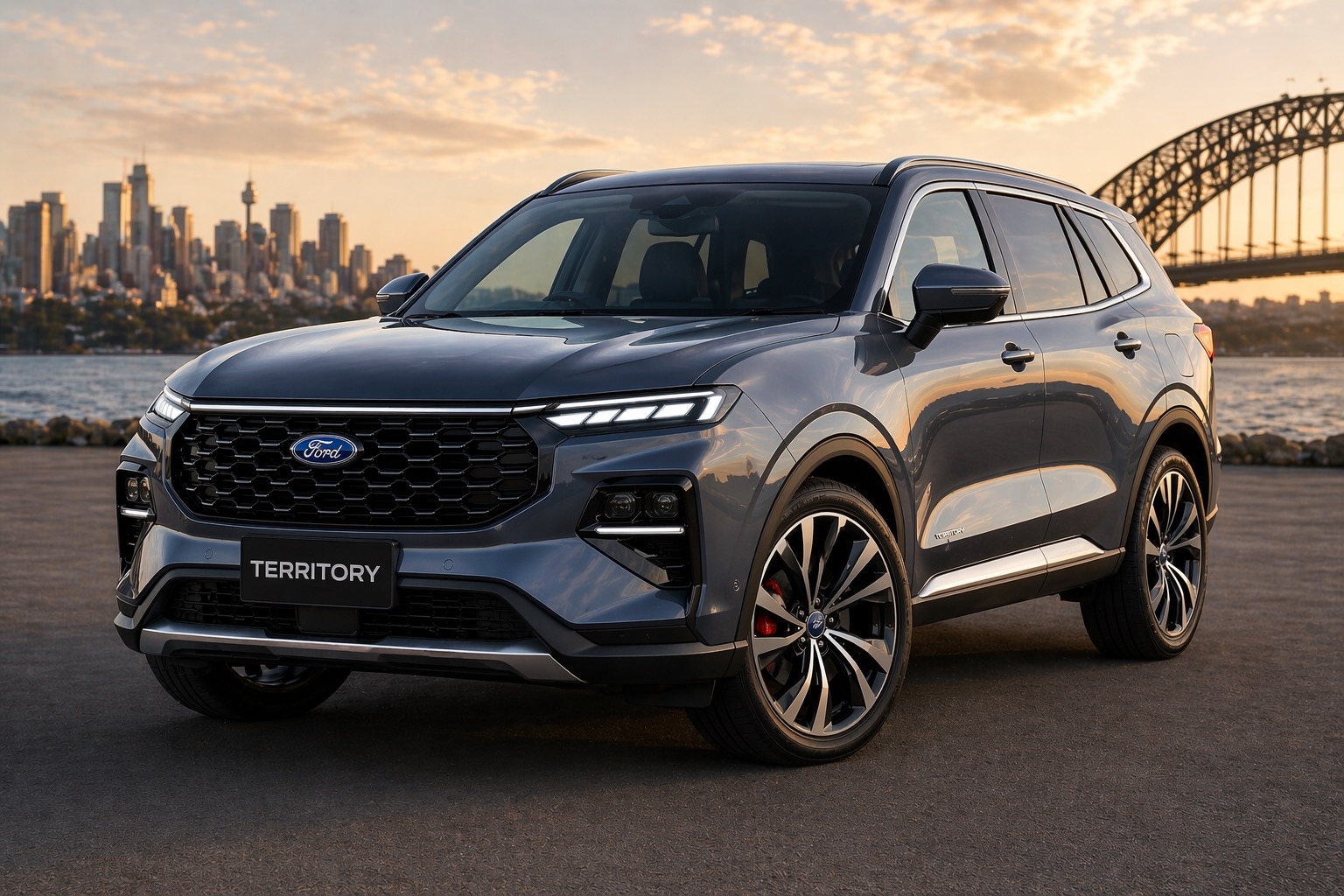
Unsurprisingly, given AI’s tendency to find similarly-named things to based ideas on, the new AI Australian Territory does have a resemblance to the Chinese Territory. But the Chinese Territory also uses Ford’s latest passenger car styling language which its current Chinese models like the Mondeo (yes, it’s still produced and sold there) also use.
Therefore, the new Australian Territory uses the same split headlight arrangement as the Mondeo and Chinese Territory, with a big grille and a wide stance to give it almost BMW-like proportions.
In its design brief, AI gave the following guide:
- Full-width LED light bar front + rear
- Strong shoulders (like original Territory)
- Slightly lower, more wagon-like roofline
- Big wheels (20–22-inches)
- Clean, muscular – not boxy like Everest
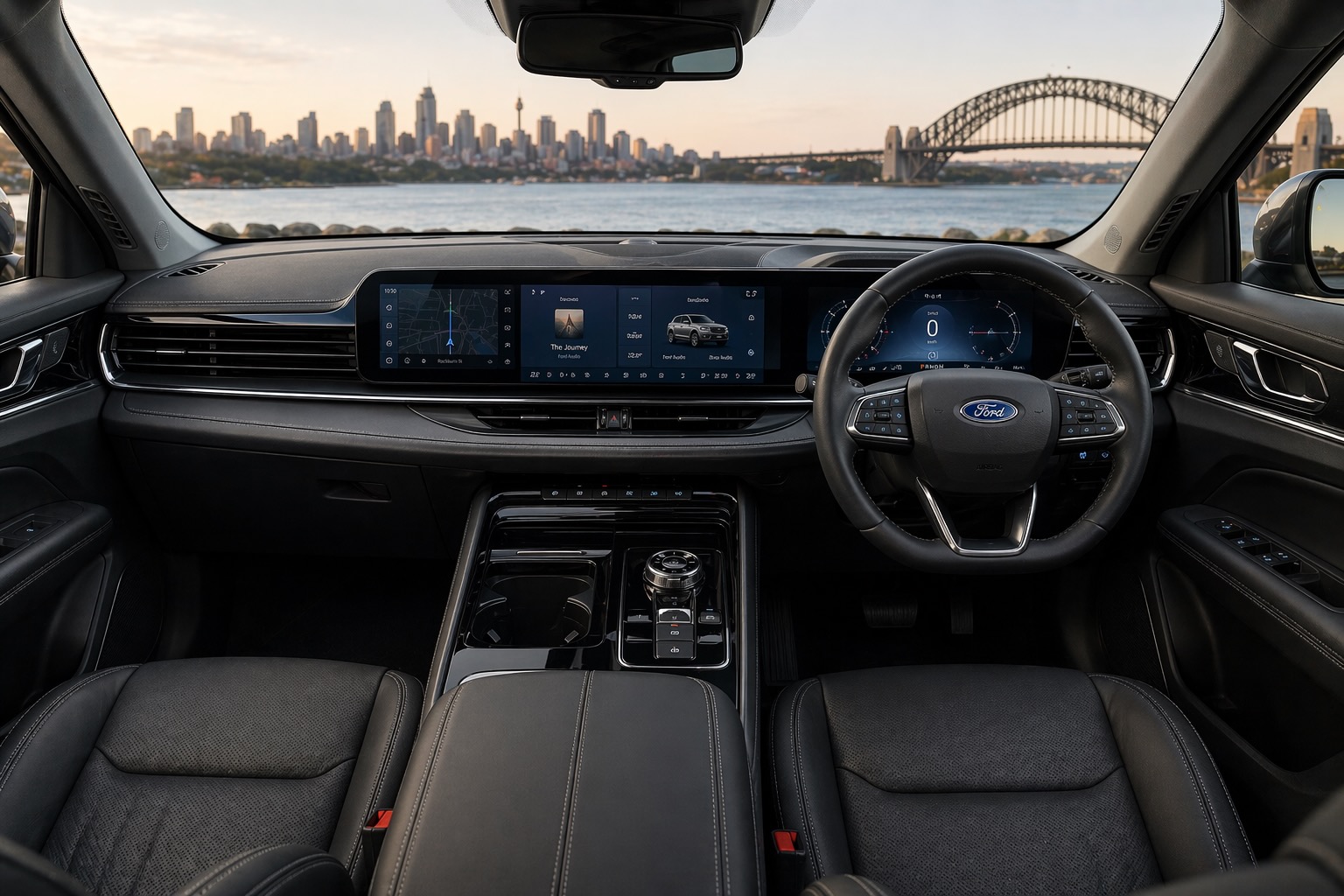
What it’s produced looks good, and like a modern day Ford product. More interesting is what AI suggested about the new Territory’s base:
- RWD/AWD architecture (think Ranger/Everest bones but lower and more road-focused)
- Independent rear suspension (no ute-style compromise)
- Long wheelbase for proper third row (not the “knees-in-your-chest” kind)
Using the Ranger/Everest’s platform is a surprise given that they are more off-road focused than the Territory ever was, but almost necessary given that the only other applicable platform in the current Ford empire – the ‘CD6’ that underpins the Explorer large SUV – is only produced in North America.
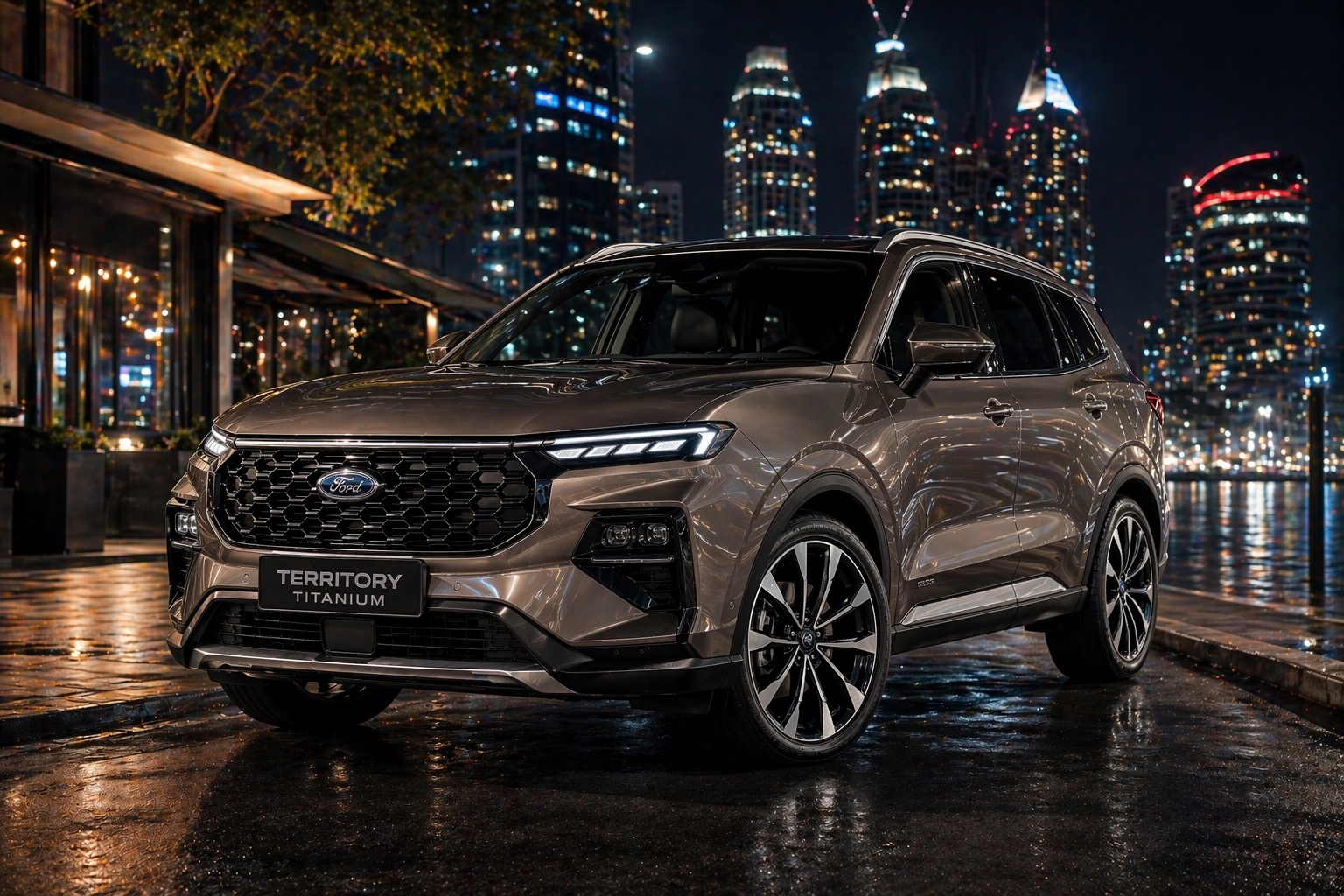
When asked what the model line-up for the new Australian Territory would look like and AI suggested the following:
- Entry-level Territory TX: 17-inch alloy wheels, LED headlights, Sync 4 with a 12-inch touchscreen, seven seats, 2.3-litre EcoBoost or optional V6 diesel.
- Mid-spec Territory TS: 19-inch wheels, dual-zone climate control, Sync 5 with a larger 13.2-inch touchscreen, power tailgate, 2.3-litre EcoBoost or optional V6 diesel.
- Top-spec Territory Titanium: 20-inch wheels, B&O premium audio, heated leather seats, 360-degree camera, Matrix LED headlights, 2.3-litre EcoBoost or optional V6 diesel.
- Sporty Territory XR6 T: 22-inch wheels, bodykit, lowered suspension, quad tips, 3.0-litre EcoBoost V6 with mild-hybrid assistance.
As for drivetrains, the regular Territory range would use Ford’s 2.3-litre EcoBoost turbocharged four-cylinder petrol engine, which makes 222kW/450Nm in the Volkswagen Amarok (the Ranger’s twin), or an optional 184kW/600Nm 3.0-litre V6 turbo-diesel that the Ranger and Everest use.
In the Territory XR6 T, a new 3.0-litre inline six turbo-petrol (perhaps called Barra 2.0?) would be used, and while both rear- and all-wheel drive would be available in entry-level models, the XR6 T would no doubt feature the latter, likely with torque vectoring, as standard. Given its performance positioning, we’d expect the Barra 2.0 to produce around 300kW of power and 600Nm of torque, similar outputs to the turbo-V6 in the Ranger Raptor.
AI suggested that mild-hybrid assistance be standard across the range to help with efficiency and NVES compliance, and we have no doubt that the Ranger’s plug-in hybrid drivetrain would also be available.
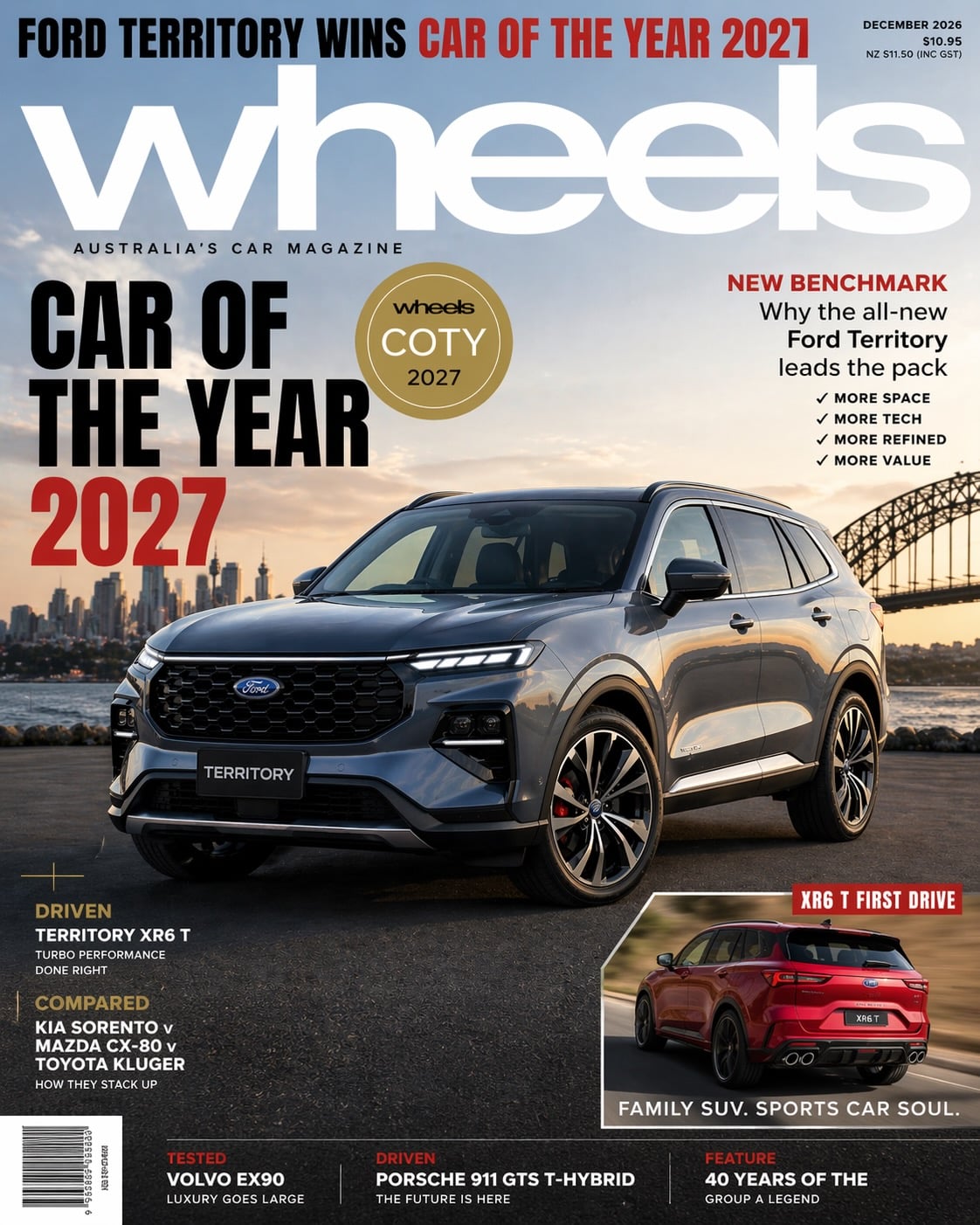
AI also suggested an FPV variant of the new Territory, just like the former F6X, called the F6. The F6 naturally builds on to the Territory XR6 T with sportier styling, a bodykit, FPV badging, more power and larger wheels. Only 229 units of the old F6X were ever produced, and given the popularity of performance SUVs in 2026, we’d wager significantly more of the new one would be sold.
Alas, it’s very unlikely that a new generation of Australian Ford Territory will ever be built. But it’s fun – and slightly sad, we must admit – to use AI to imagine what it would look like if it ever were made again.
Given the excellent Everest’s similar positioning in the Ford line-up but with more off-road prowess, much of what made the Territory great is thankfully present in the Ford range. Sure, it’s not locally built and isn’t car-based, but the Everest is as close to the Territory as we’re ever likely to get again.
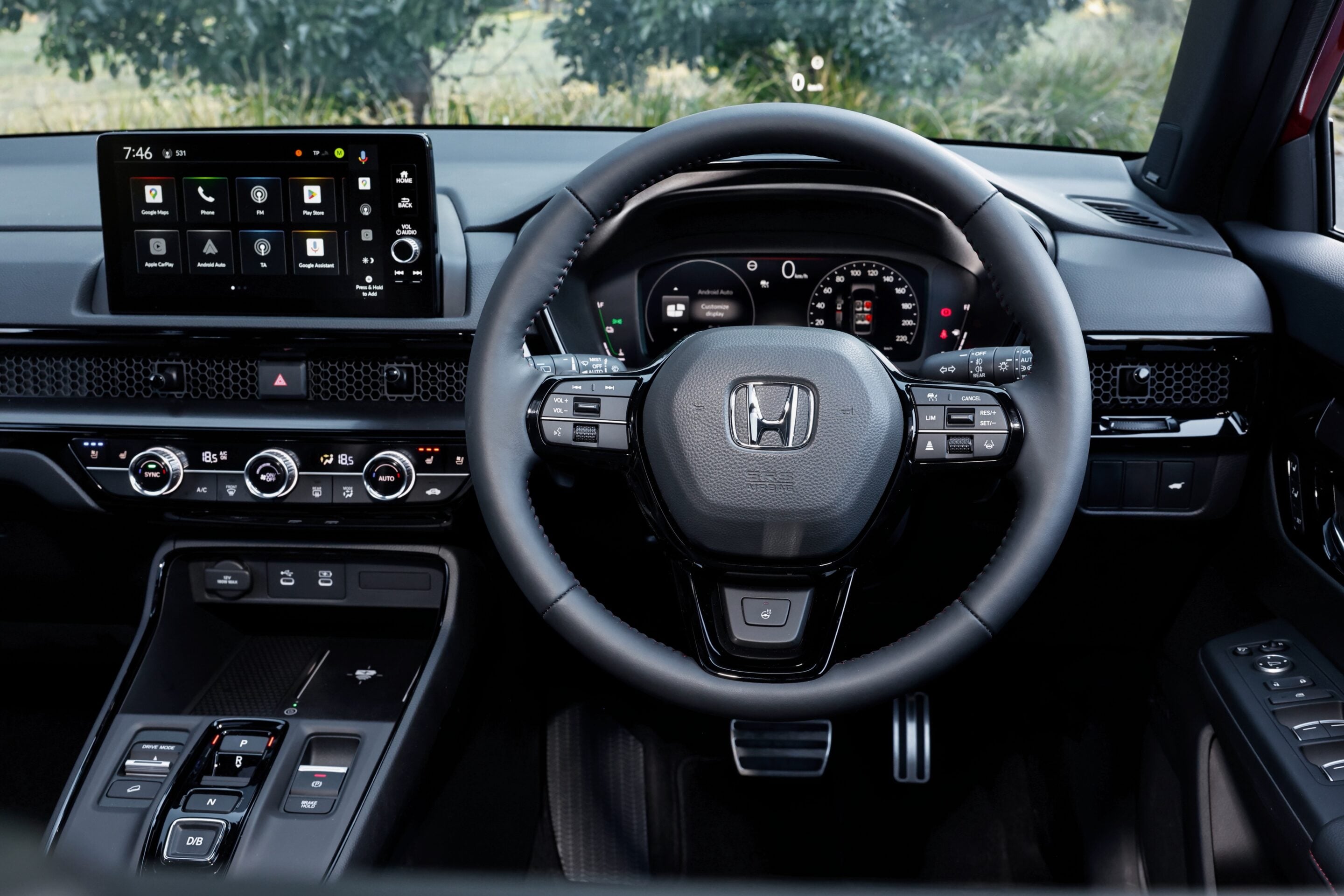
Honda’s local boss believes the intensely competitive nature of Australia’s new car market, with around 80 brands vying for a relatively small audience, will inevitably see some car makers depart.
“Yes, I don’t think it’s sustainable to have so many manufacturers, especially when there are too many [of them] that are out at the margins,” Jay Joseph, President and CEO of Honda Australia (main), told WhichCar by Wheels at the launch of the new CR-V (below).
A veteran of Honda in the United States, Joseph reiterated the significant difference between a market that supports 42 brands competing for 16 millions sales, and the Australian market with “a much smaller pie [and] much smaller pieces”.
“There are too many who have dropped below one per cent of market share,” Joseph told WhichCar by Wheels. “And the network would be very hard to maintain at those low levels.”
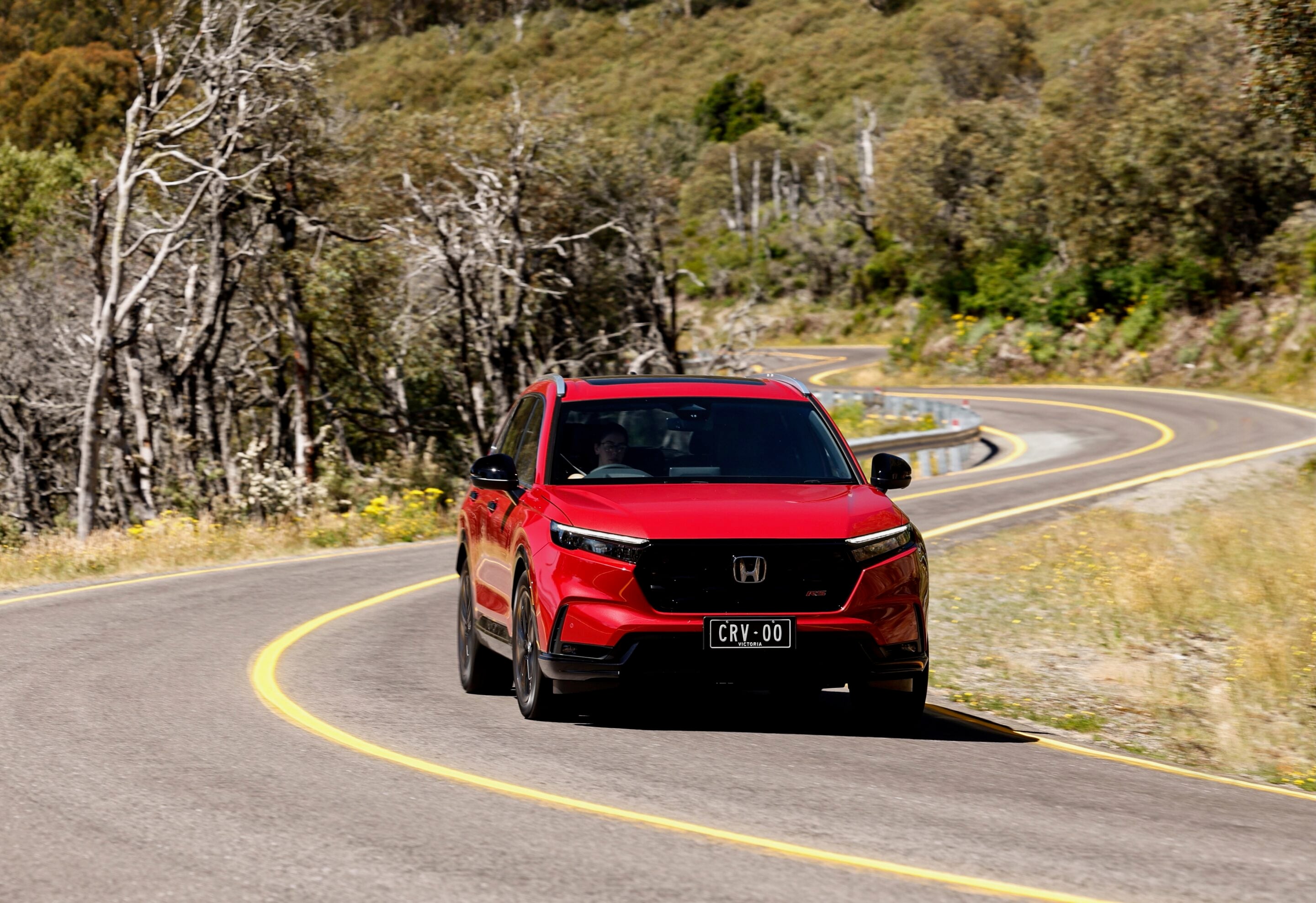
Joseph went on to explain that you can potentially get customer’s attention at those levels if you’re a low-volume, high price manufacturer like Ferrari, Aston Martin or Lamborghini, or if you’re selling a low volume at a very cheap price. But, when you’re competing in the middle of the market, it’s unsustainable.
“There could be a niche for a company at low volume, low price for example,” he said. “The middle, though, is where it’s tough. So if you’re competing in the mainstream and you’re not able to increase your pricing because it’s such a competitive market, that’s a tough place to be, so I don’t think everybody can survive.”
In the United States, Joseph explained that Honda takes reliably 10 per cent of new vehicle sales, with strong awareness in the market and that’s been the case for quite some time.
“Coming here was eye-opening, I very quickly realised that it’s a very different market to the United States,” he said. “While it’s a much smaller pie, split into much smaller pieces, that’s not even completely true, because Toyota takes 20 per cent, so one player takes a huge chunk of the pie, but then you’ve got Mazda and Ford at nearly 10 per cent each.”
Joseph went on to explain that when you factor in the top 10 brands, 60 per cent of sales go to the top seven. “The other 69 players then duke it out over the remaining 40 per cent of sales, so that’s completely different to the United States,” he said.
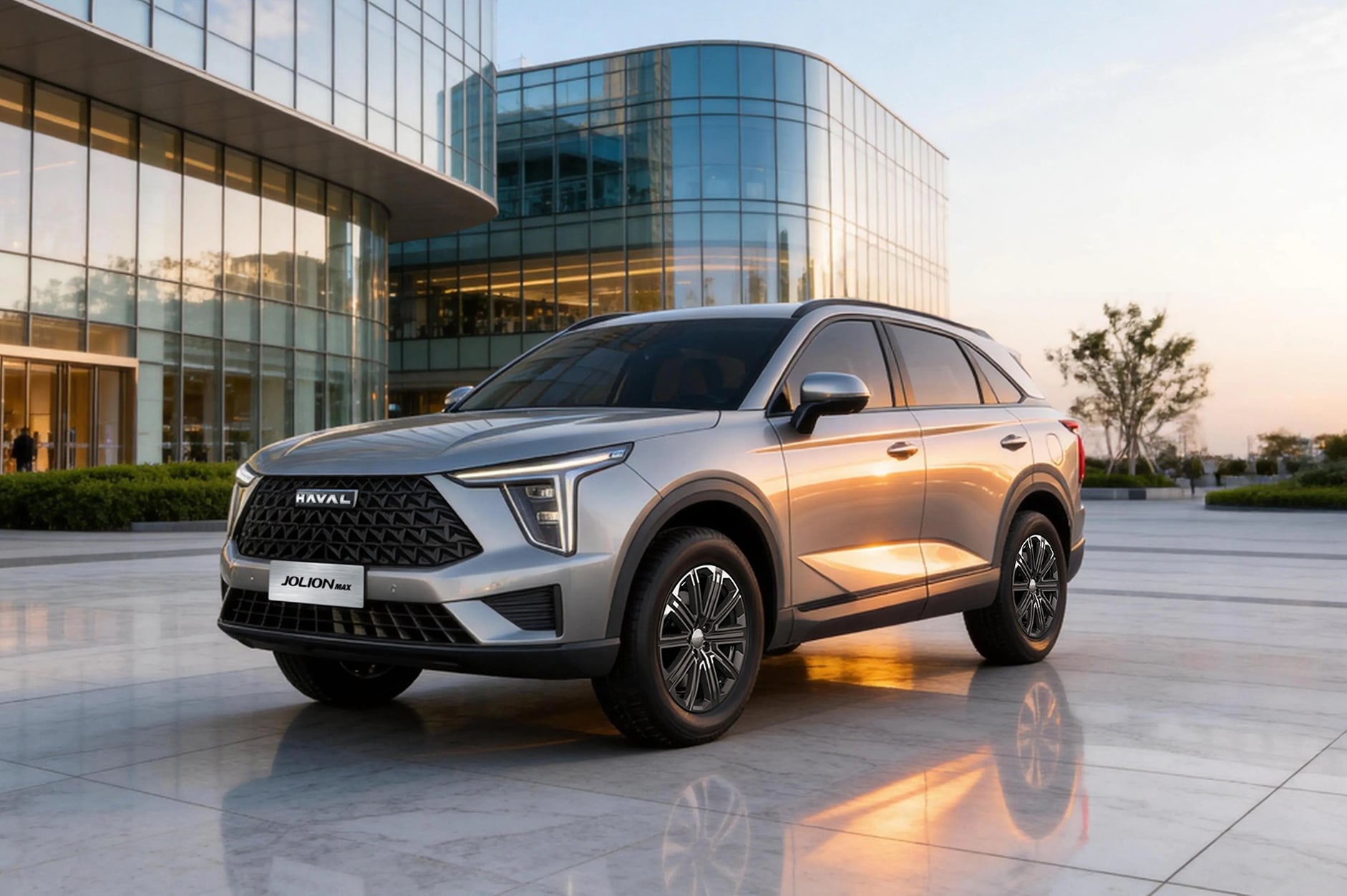
Chinese carmaker GWM has confirmed that Australia will get electric and hybrid versions of its new and larger Haval Jolion SUV.
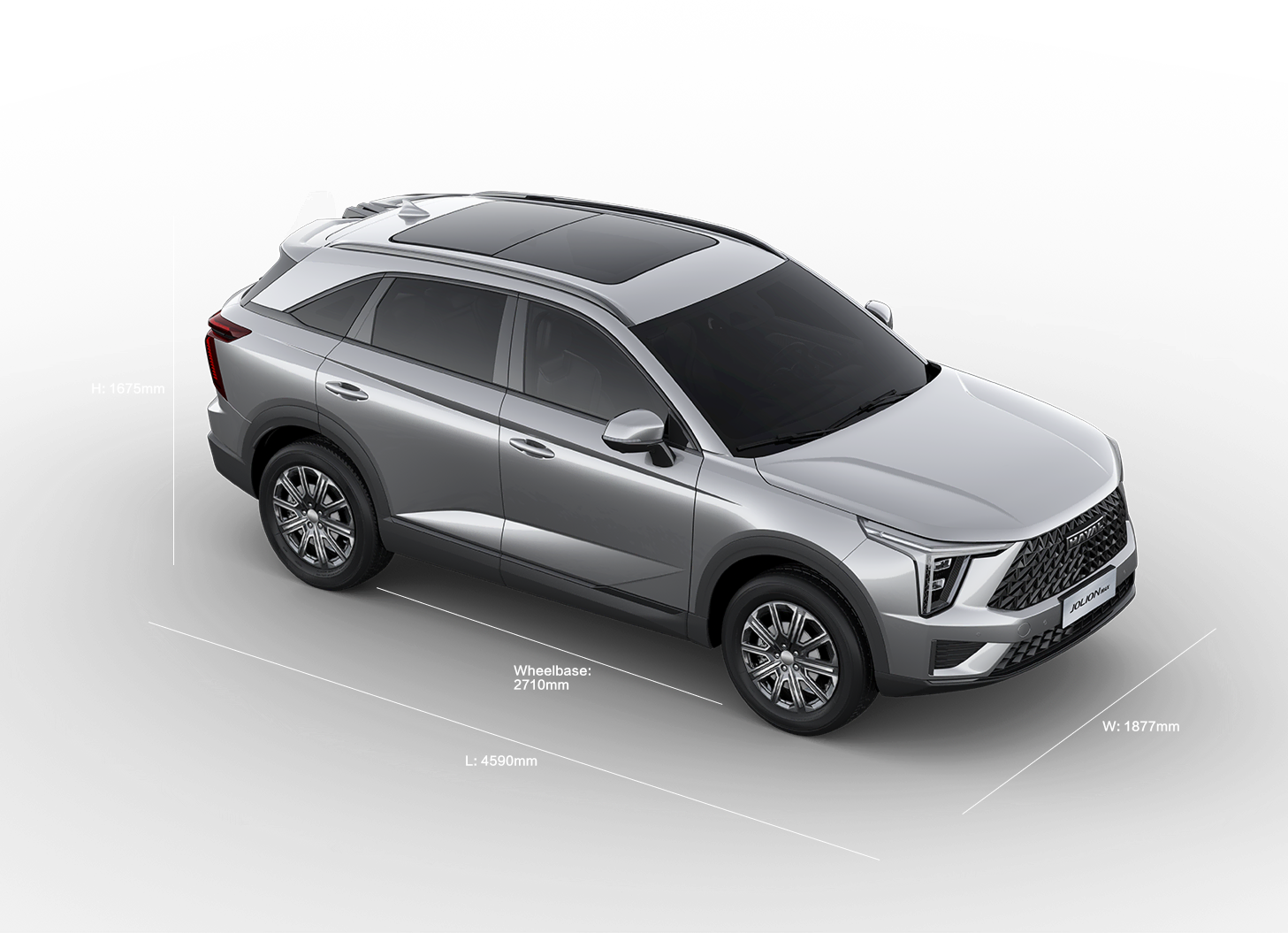
Dubbed the Haval Jolion Max, the new SUV is larger than the current Jolion small SUV. According to specifications seen on overseas models, the Jolion Max is 120mm longer than the current Jolion, 3mm wider, sits on a 10mm longer wheelbase and is 6mm shorter in height.
GWM’s Australian marketing boss, Steve McIver, confirmed the new model would be available with both petrol-hybrid and full battery-electric powertrains.
“The Haval Jolion Max, which increases in size over the current Jolion… will be offered in BEV and hybrid options,” McIver told assembled media, including WhichCar by Wheels.
Looking to the broader GWM Haval line-up the Jolion Max is likely to be equipped with the same 1.5-litre petrol-hybrid from current Haval Jolion Ultra Hybrid with combined outputs of 140kW and 375Nm channeled to the front wheels.
Similarly, the Jolion Max BEV could utilise the same battery-electric powertrain underpinning the GWM Ora 5 compact SUV. It’s powered by a single 150kW/260Nm electric motor driving the front wheels. A 58.3kWh battery offers a claimed 430km of range, based on WLTP laboratory testing. Maximum DC charging is capped at 120kW, giving a 30 to 80 percent recharge time of around 20 minutes.
Overview
Toyota has always been a remarkably consistent carmaker. Witness the evolutionary updates across its range of vehicles over decades – cars like Corolla, Camry, HiLux, you name it – have all improved with each successive generation. Backward steps? Toyota seemingly doesn’t know the meaning.
The latest model to go under the knife is also its most important: the Toyota RAV4 medium SUV.
The best-selling vehicle of any kind globally for the last two years, the RAV4 has become the standard bearer for the Japanese brand around the world.
In Australia, where it remains the third-best seller behind only the Ford Ranger and Toyota HiLux dual-cab utes, the new RAV4’s importance to the brand cannot be understated.
The medium SUV segment is Australia’s heartland battleground. And it’s a battleground pioneered, and dominated, by the Toyota RAV4.
This new sixth-generation model is well-placed to maintain that dominance by adhering to Toyota’s evolutionary philosophy. This is no clean-sheet, from-the-ground-up new generation RAV4. Instead, Toyota has used the solid foundations of the previous RAV4 – which debuted in Australian in May, 2019 – to underpin its successor. After all, if it ain’t broke…
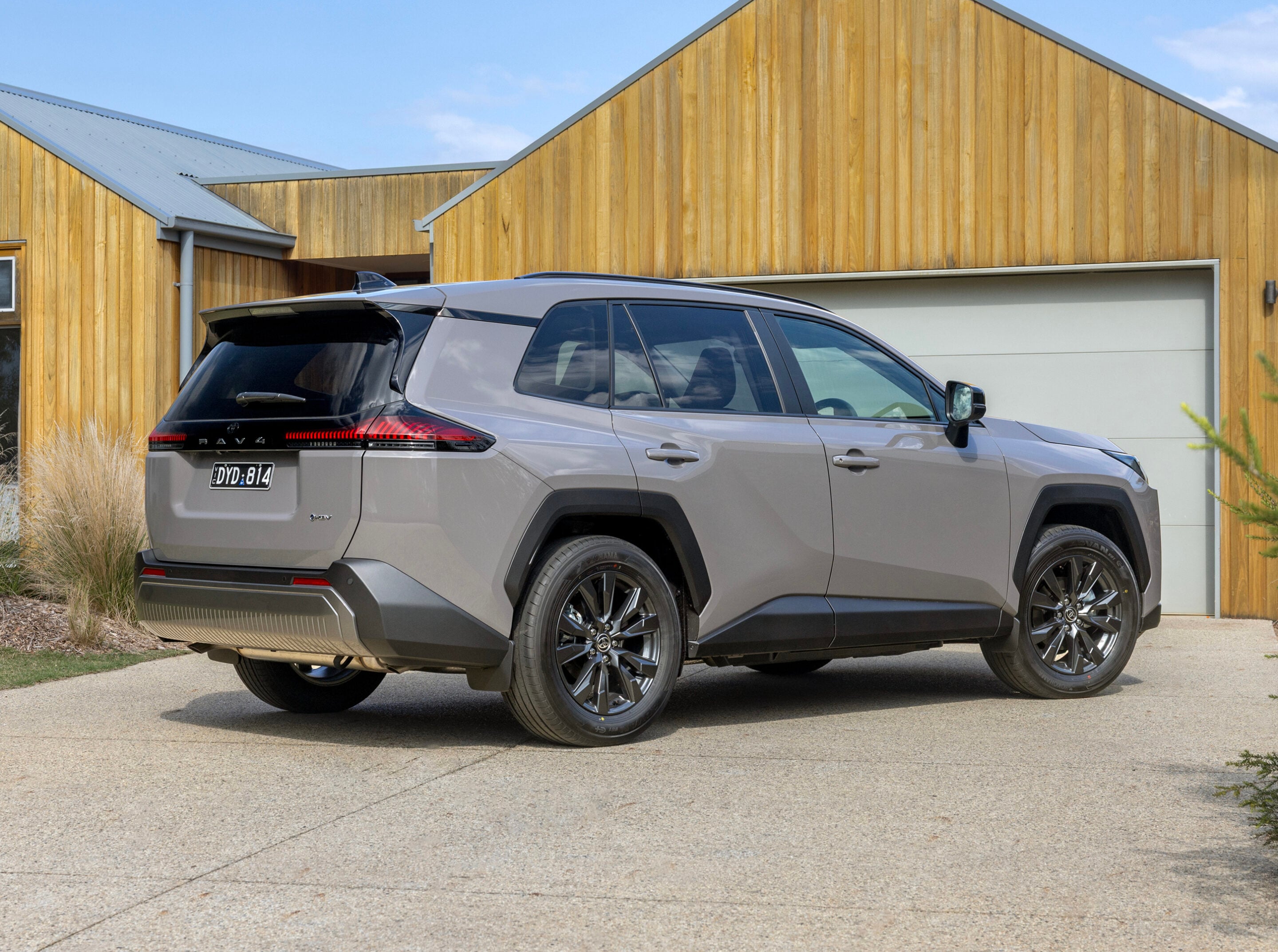
The big-step change comes later this year, when for the first time, RAV4 will be available across a range of plug-in hybrid models including the flagship GR Sport which brings 227kW and a 0-100km/h time of just 5.8 seconds.
For now though, the focus is on the regular hybrid RAV4 line-up and it’s a comprehensive one.
How much is the new Toyota RAV4?
Buyers will certainly be spoilt for choice when it comes to the model line-up with eight variants across five distinct model grades with either front- or all-wheel drive. Unsurprisingly, prices have increased over the older model, between $3020 and $6430 depending on the model grade, while three new plug-in hybrid models give buyers more choice than ever before, albeit at a premium.
2026 Toyota RAV4 pricing (plus on-road costs)
| GX Hybrid 2WD | $45,990 (+$3730) |
|---|---|
| GX Hybrid AWD | $49,340 (+$4080) |
| GXL Hybrid 2WD | $48,990 (+$3180) |
| GXL Hybrid AWD | $52,340 (+$3530) |
| Edge Hybrid AWD | $55,340 (-$3020) |
| XSE Hybrid AWD | $58,340 (+$6430) |
| XSE Plug-In Hybrid 2WD | $58,840 (new) |
| XSE Plug-In Hybrid AWD | $63,340 (new) |
| Cruiser Hybrid 2WD | $56,990 (+$5580) |
| Cruiser Hybrid AWD | $60,340 (+$5930) |
| GR Sport Plug-In Hybrid AWD | $66,340 (new) |
Toyota’s launch program for the new RAV4 afforded WhichCar by Wheels the opportunity to drive four of the eight-variant range – the second-from-bottom GXL all-wheel drive, the more ‘adventure’ focussed RAV4 Edge ($55,340 plus on-roads), and two- and all-wheel drive versions of the range-topping Cruiser, $56,990 and $60,340 respectively, both before on-road costs).
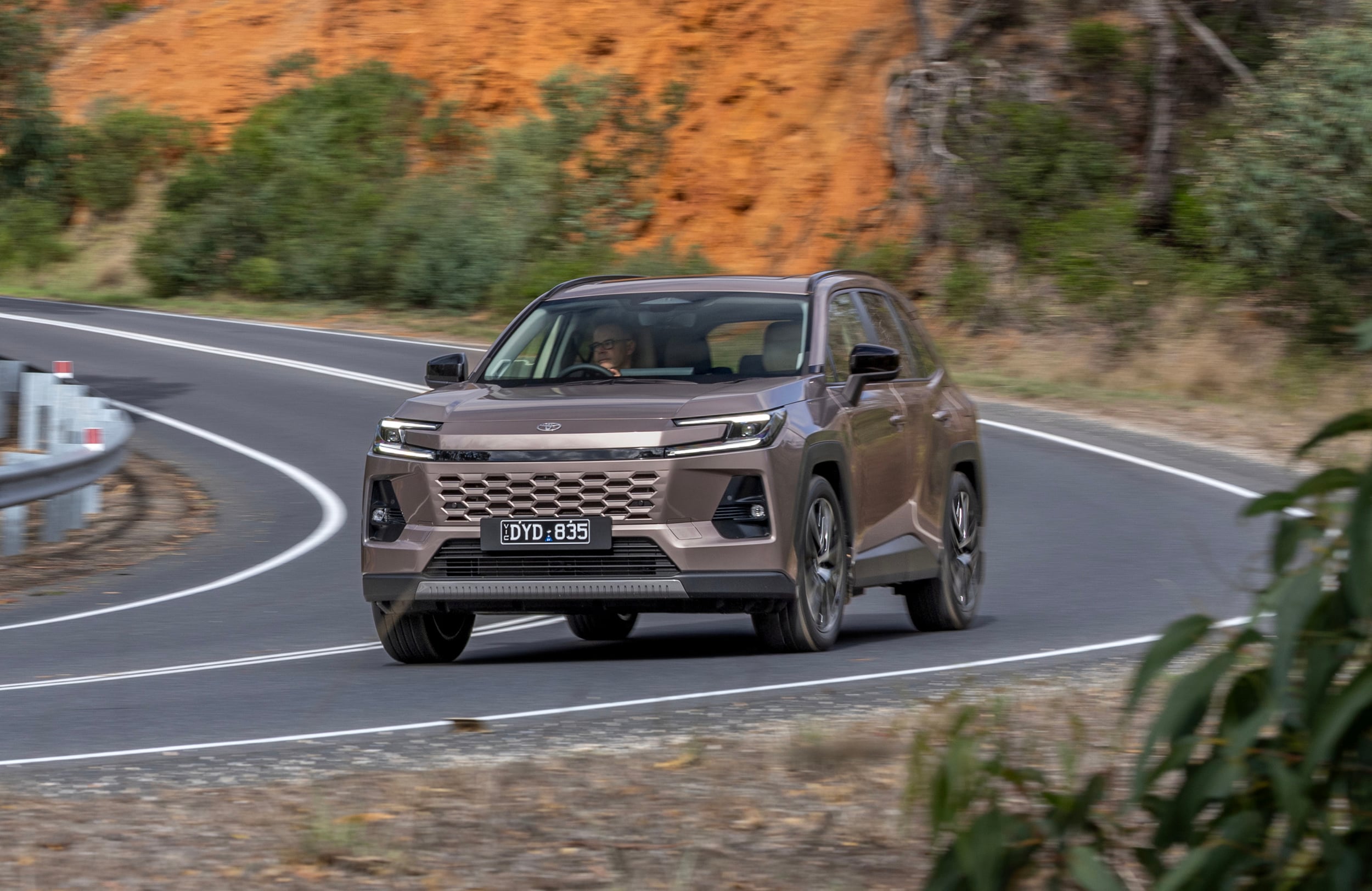
We reckon the $52,340 (plus on-road costs) GXL in all-wheel drive trim might be the pick of the bunch in this company and will be the primary focus of this First Drive review, although buyers keen to get into the most affordable RAV4 are served by the $45,990 GX in front-wheel drive trim.
What engine does the new Toyota RAV4 have?
Built on Toyota’s existing TNGA-K architecture that also underpinned its predecessor, Toyota has wrought changes – some major, some incremental – across the RAV4 range.
All models are powered by Toyota’s fifth-generation hybrid system that matches a 2.5-litre petrol engine with either two (front-wheel drive) or three (all-wheel drive) electric motors fed by a 1.1kWh lithium-ion battery.
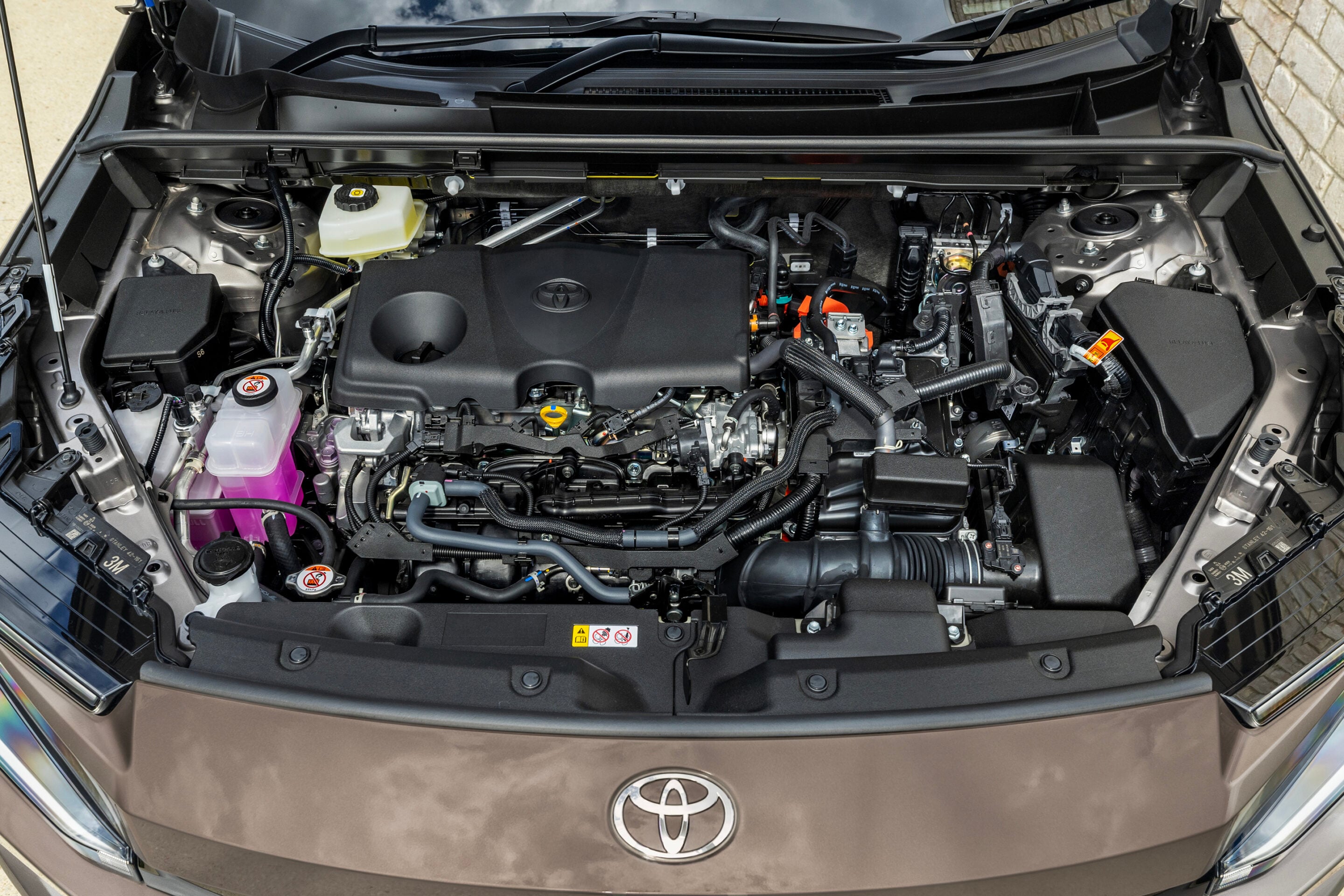
Thanks to stricter emissions regulations both in Australia and Europe, power has taken a hit, now rated at 143kW across the entire range, down from the previous generation’s 160kW for FWD and 163kW for AWD models. Toyota says this reduction hasn’t impacted on performance, the new model on par with the outgoing model.
The RAV4 plug-in hybrid will join the broader range later this year and it promises a significant performance boost over regular hybrid models.
Power comes from a 2.5-litre naturally-aspirated four-cylinder petrol paired with a single motor up front in the front-wheel drive XSE PHEV, combining for total systems outputs of 200kW.
All-wheel drive variants (XSE and the flagship GR Sport), are fitted with an additional electric motor at the rear wheels for a combined 227kW and a brisk 0-100km/h claim of just 5.8 seconds.
All plug-in hybrid models are fitted with the same 22.7kWh battery pack giving up to 100km of driving range (WLTP tested), according to Toyota. DC charging is capped at 50kW while AC charging maxes out at 11kW.
Is there anything interesting about the new RAV4’s design?
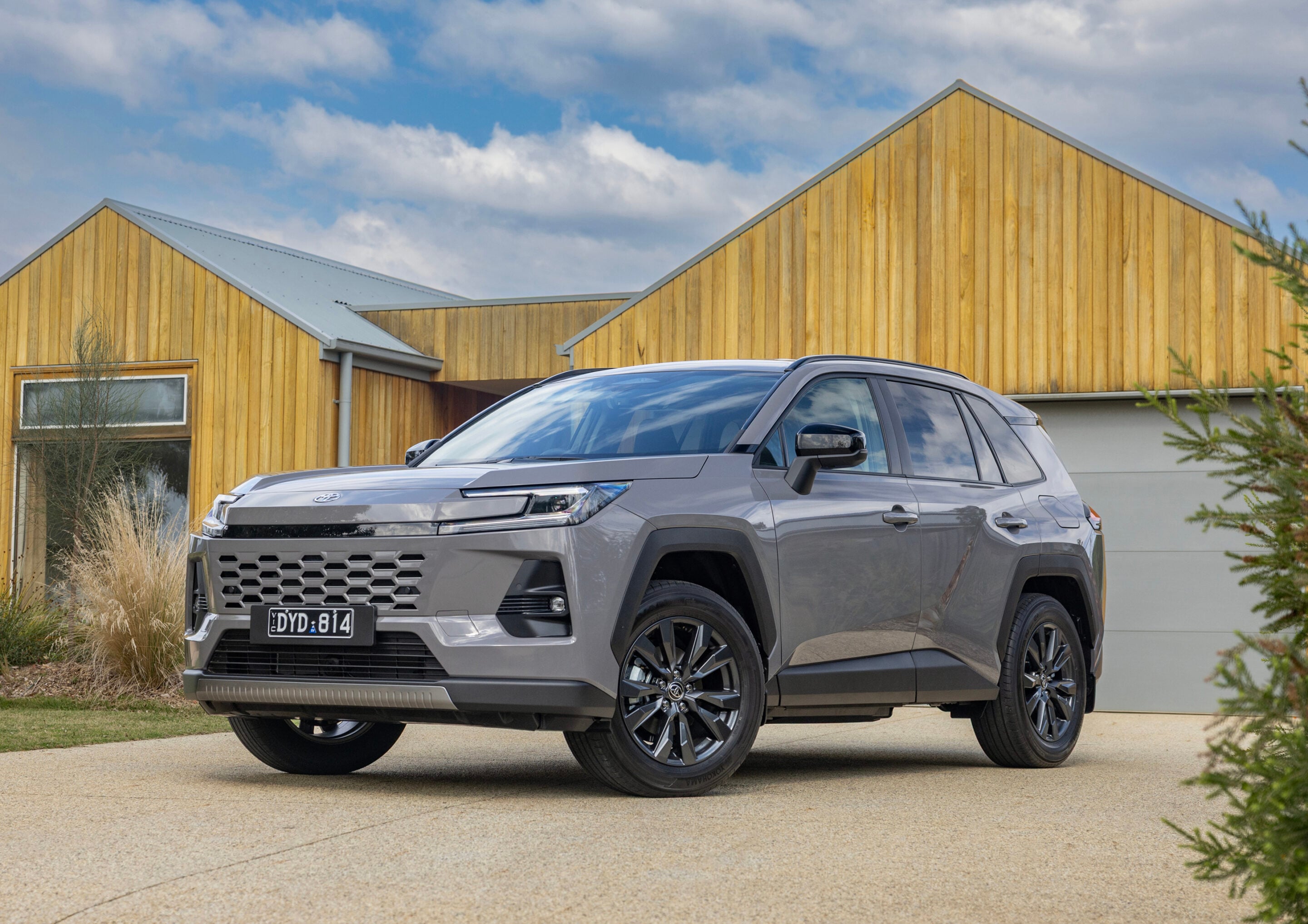
From the outside, the new RAV4 taps into today’s boxy styling zeitgeist, an altogether more aggressive looking medium SUV than its predecessor, but with one eye kept firmly on its mass appeal. It’s an evolutionary design, still instantly recognisable as a RAV4 but with sharper and cleaner lines, and a boxier profile.
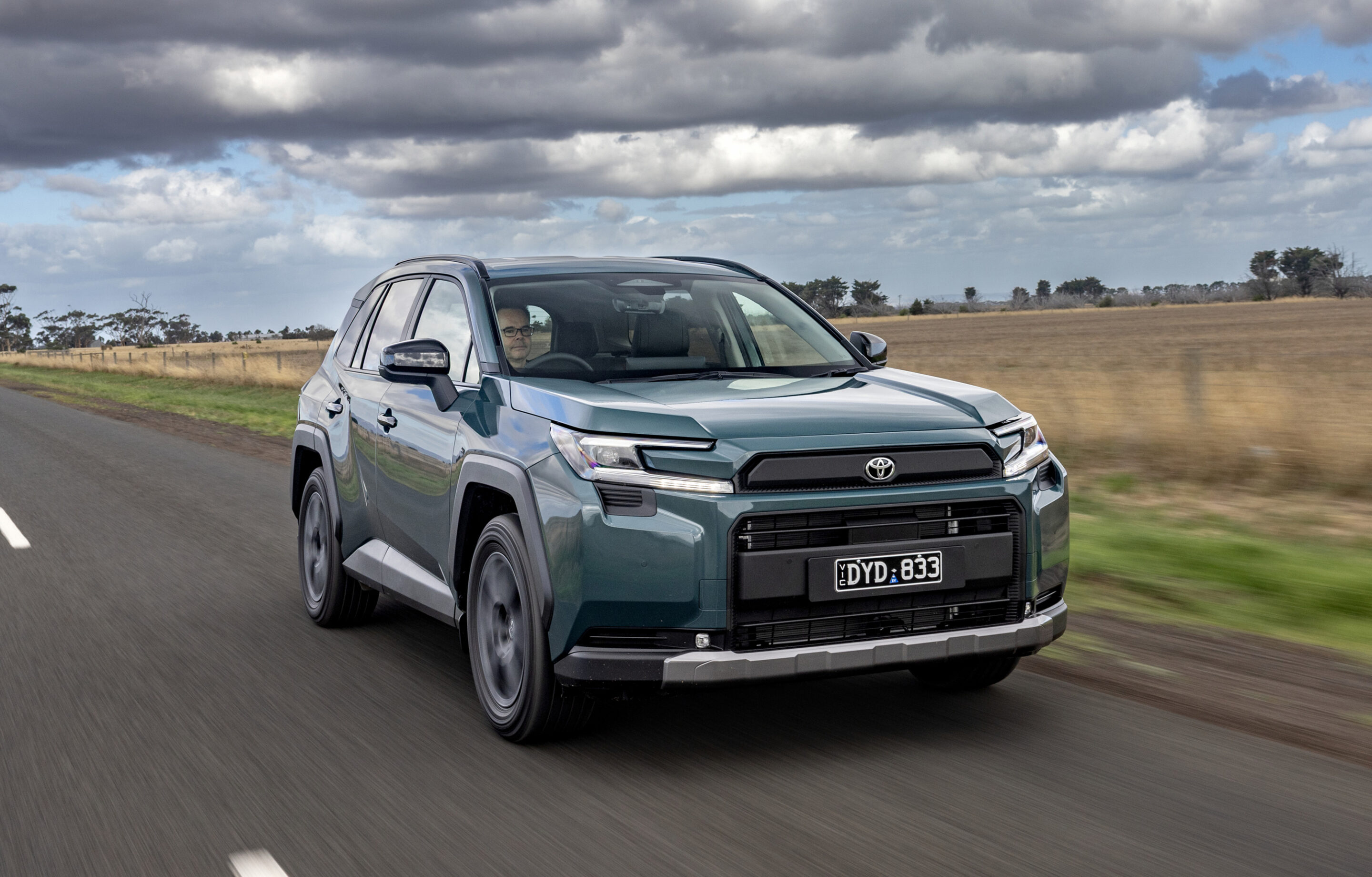
Inside, the RAV4’s cabin has been transformed. Toyota is by-and-large a conservative carmaker, and that has traditionally resulted in its designers playing it safe. But the cabin in this new model is a big step forward in terms of quality and design.
New screens underpinned by Toyota’s Arene digital platform are the standout features, but overall cabin design has been lifted, bringing the RAV4 into line with the wider mid-size SUV segment. Somewhat disappointingly, there’s more than a smattering of hard plastic surfaces, even in the top-of-the-line Cruiser spec, which detract from the overall ambience.
Cloth seat trim underpins the lower grades in the range (GX, GXL and Edge) with leather not making an appearance until RAV4 XSE variants. Interestingly, the entry-level GX grades no longer feature a leather-wrapped steering wheel, the tiller in the base model relegated to urethane status. Nit-picking yes, but it does cheapen the overall in-car experience in those entry-level models.
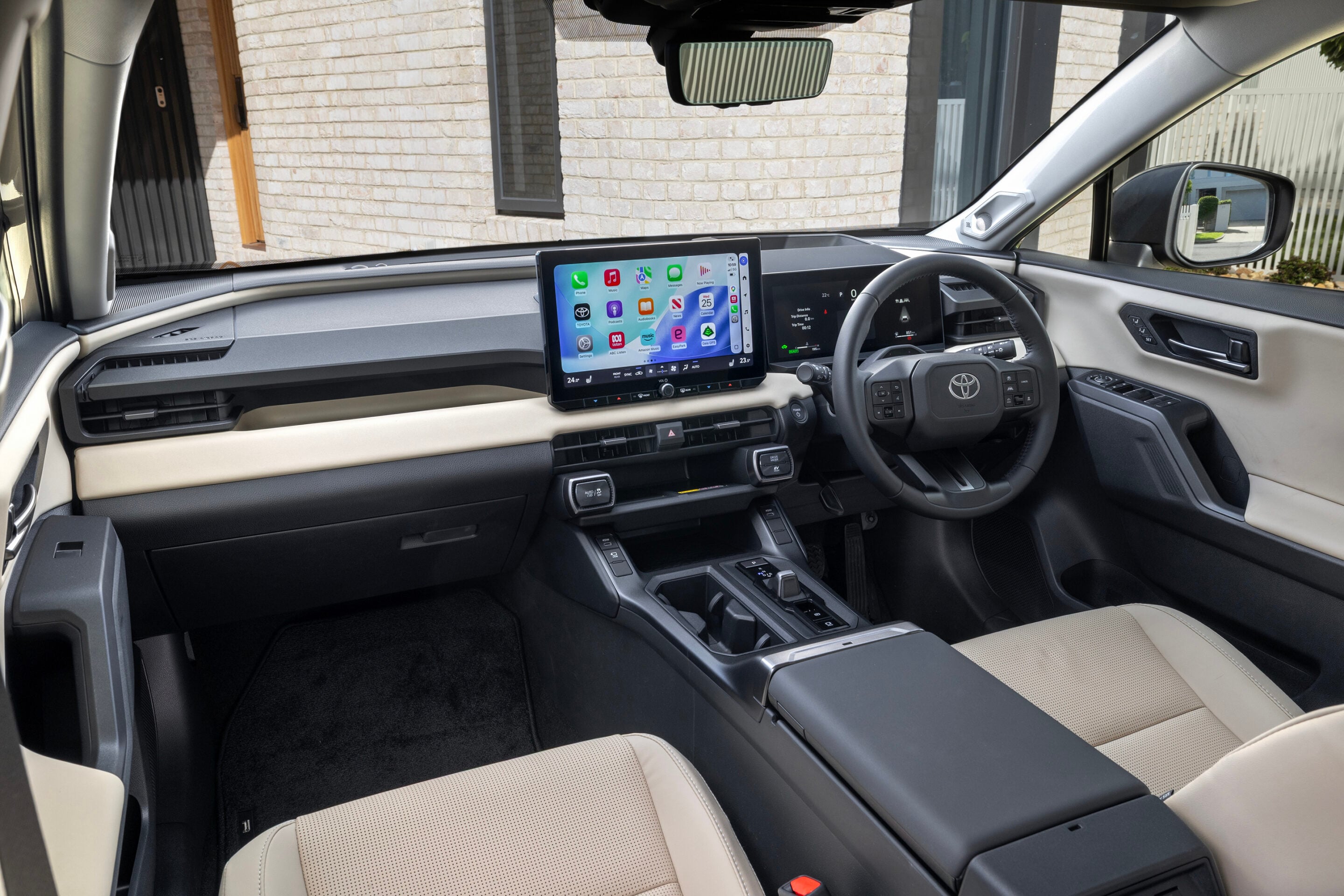
Second row comfort is, as it always has been in the RAV4, excellent with good space in all key metrics while out back, Toyota’s quotes 705 litres of luggage space to the roof with the second row in use, although stops short of quoting a number with the second row folded away.
What technology comes with the new Toyota RAV4?
Toyota’s new infotainment setup is a big step-up over previous RAV4. But what the gods of tech giveth, they also taketh away.
Yes, the general interface is vastly improved, but the decision to in integrate some commonly-used functions, such as the climate control’s fan speed, into the screen is frustrating, especially when there are chunky – and nicely damped – dials for selecting drive modes, real estate better saved for more commonly used functions… such as adjusting climate controls.
The basics such as Apple CarPlay and Android Auto are covered off across the range while higher grades get convenience features such as wireless smartphone charging (and in the case of top-spec Cruiser, two charging pads) as well as the usual array of USB outlets. A new 12.3-inch digital instrument display is highly-customisable, including the ability to project full-screen mapping.
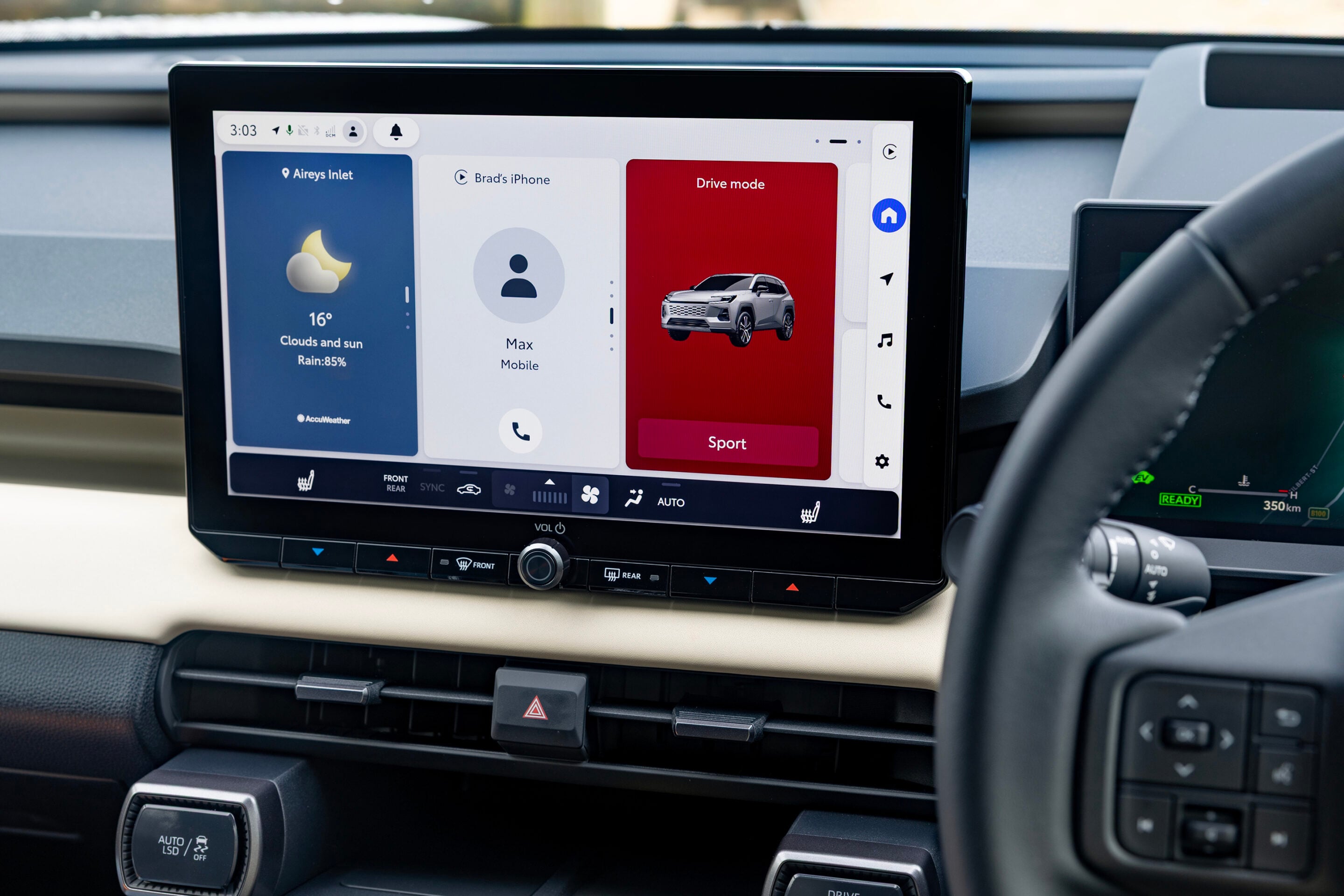
In a win for buyers, all models, including the most-affordable entry level variants, are equipped with native satellite navigation. Why a win? It’s become an increasingly common practice for some carmakers to drop native sat-nav from the cheapest models in their respective line-ups, leaving the route guidance heavy-lifting to smartphone mirroring. Credit to Toyota for not taking that cost-cutting path.
What’s the new Toyota RAV4 like to drive?
On the road, the RAV4 treads a well-worn path. Toyota’s decision to ‘detune’ its hybrid system so that all (hybrid) models now make 143kW across the board, has resulted in a driving experience that is perfectly in tune with what buyers in this segment would expect. Certainly, on the road, the new RAV4 will feel very familiar to anyone stepping out of the previous model.
Toyota’s hybrid system continues to set the standard, a smooth integration between petrol and electric motoring that pays dividends at the bowser.
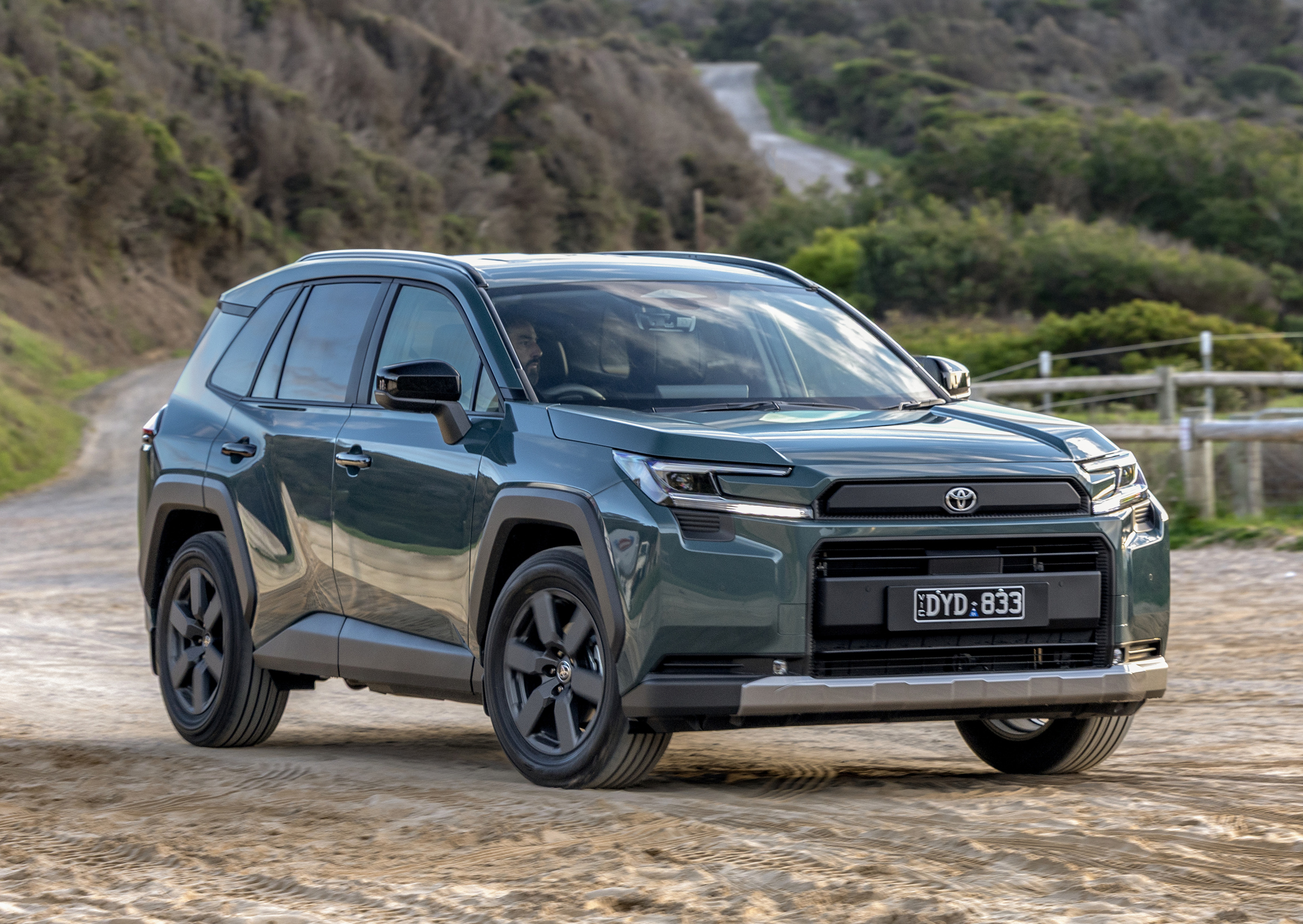
There has been a change to how the RAV4 behaves, however. The reduction in power to meet today’s more stringent emissions regulations isn’t immediately felt, the RAV4 taking off from standstill in a brisk fashion on electric power alone before the petrol engine kicks in once speeds climb.
Where the power reduction is most keenly felt is in the mid-range (and beyond) when the push from 40 or 50km/h to a cruising speed of 100km/h feels less urgent than it once did. It’s not a seismic shift, but it is noticeable under harder acceleration. Here though, improved sound-deadening has paid off with a quieter cabin overall, the engine’s soundtrack remaining more muted than previously.
Road comfort feels a little more taut than in the outgoing model, certainly on the 20-inch alloys shod in Bridgestone Alenza rubber of the top-spec Cruiser model, which transmitted road junk through the wheel and into the cabin. The Bridgestones proved noisier too, than the Yokohama Advans wrapped around the 18s of the GXL.
It’s the all-wheel drive GXL that impressed the most on the road, its bigger rubber translating to a softer ride that soaked up minor bumps and lumps with barely a ripple.
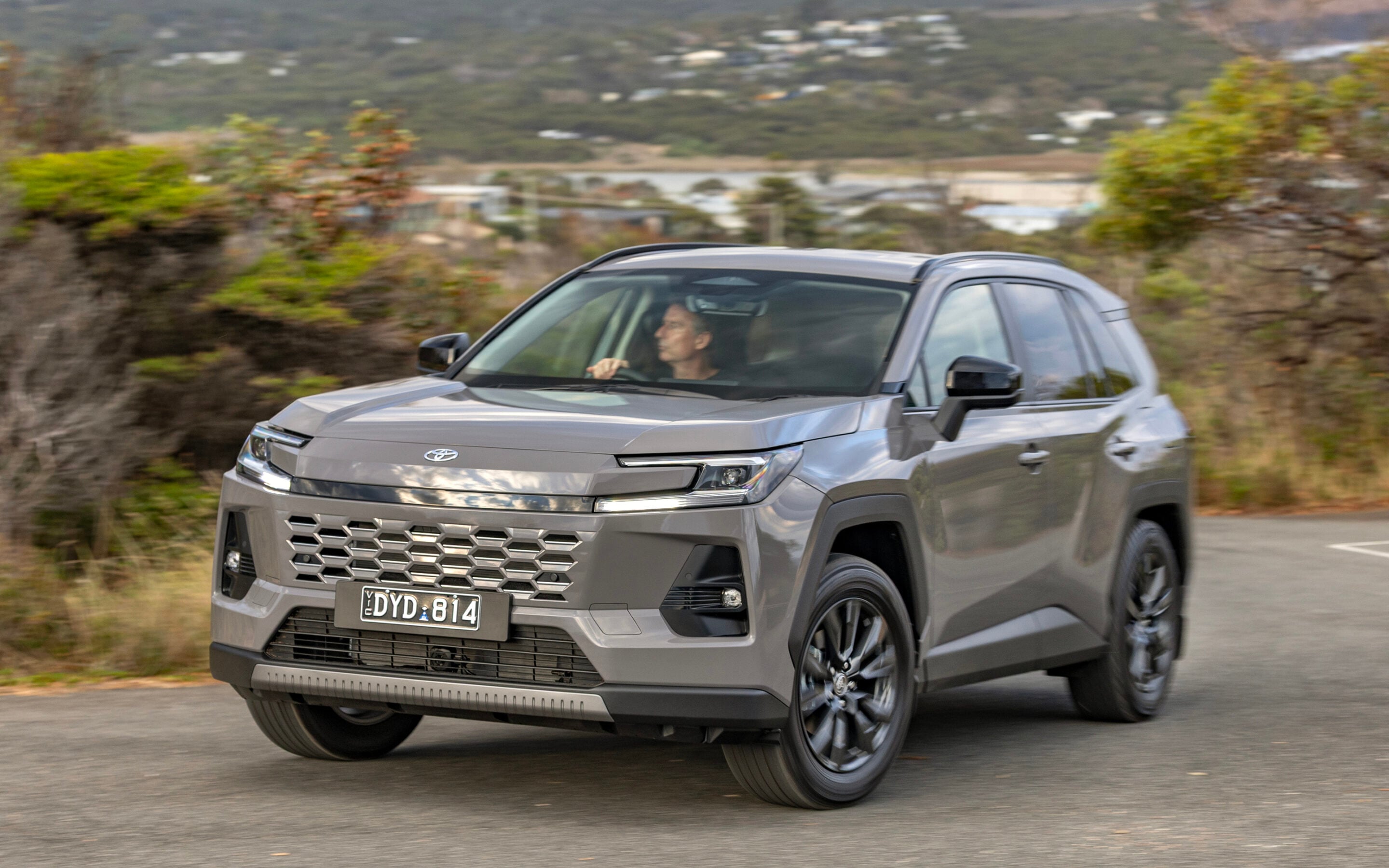
Chassis improvements across the RAV4 range have added rigidity, improving handling and body control commendably. The new RAV4 remains remarkably composed navigating undulating surfaces while mid-corner bumps, and there were some, did little to unsettle it.
Steering remains nice and direct, and feels a little heavier than previously, offering a touch more tactility in the connection to the road that is a welcome improvement. The steering of the old RAV4 always felt a touch too light and twirly and while that may have been part of its appeal for a cohort of buyers, the ever-so-slightly heavier inputs feel more reassuring.
Brake pedal feel remains firm but friendly, the step between regenerative braking (to keep the battery topped up with free-flowing electrons) and friction brakes as seamless as it ever was.
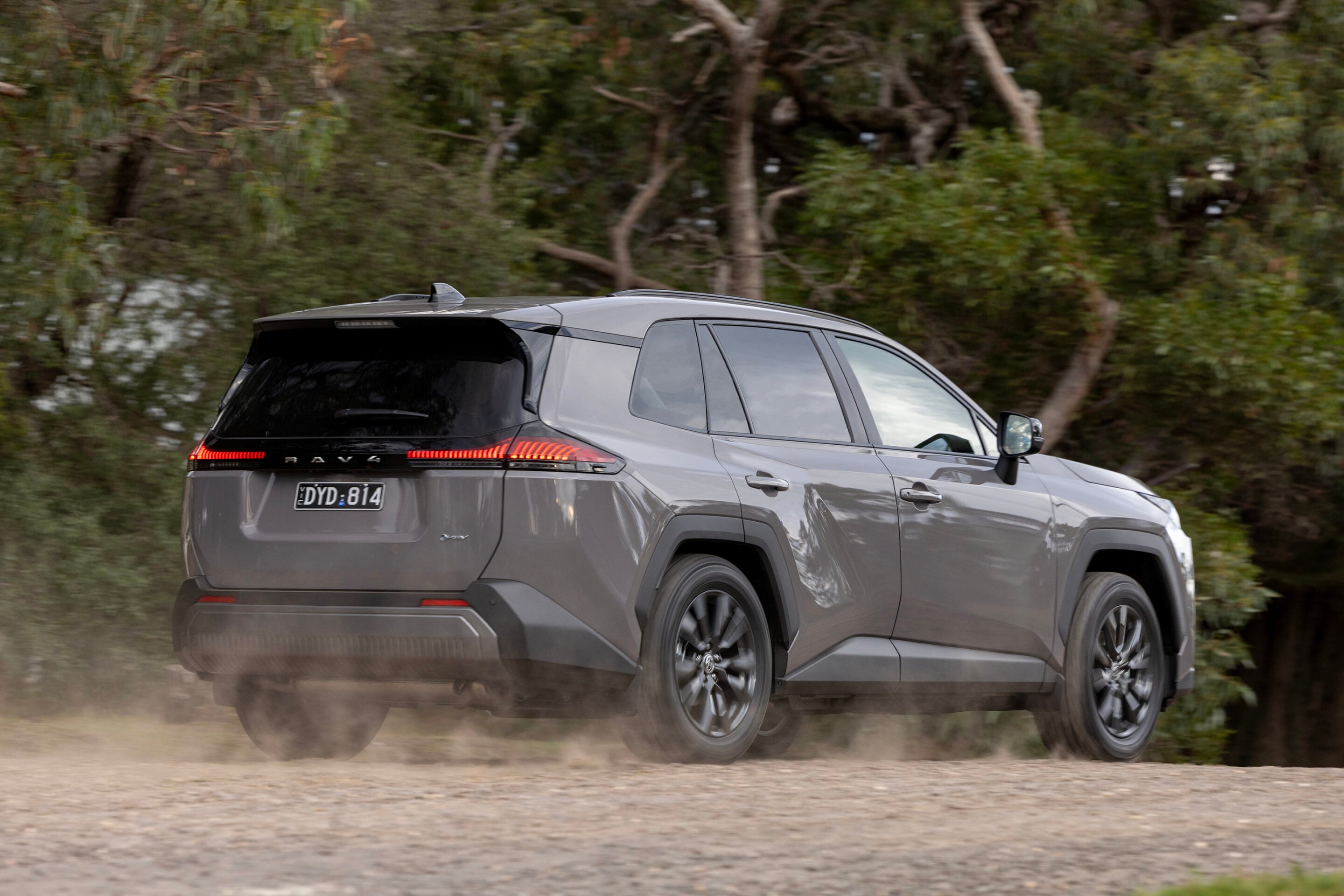
On the downside, some of the RAV4’s advanced driver assist systems proved a little to eager to intervene, especially driver attention monitoring which would trigger even after a casual glance at the speedo or a quick check in the rear-view mirror. Lane-keeping assist was, for the most part, acceptable, but unmarked roads, such as those we covered at the RAV4 launch in rural Tasmania, did on occasion confuse the system, resulting in needless tugging at the wheel when it wasn’t needed.
Crucially, the RAV4 is yet to be tested by ANCAP after production delays saw the launch of the new model rolling over into 2026. That’s resulted in some of the RAV4’s safety technologies needing to be updated to align with ANCAP’s new and stricter 2026 testing protocols. Those updates will be rolled out by the end of the year and Toyota fully expects to achieve the maximum five-star score.
How much fuel does the new Toyota RAV4 use?
The big unanswered question remains on the new RAV4’s fuel consumption. Toyota’s launch drive through rural Tasmania – as beautiful as the roads were – didn’t provide the perfect canvas for gauging real-world fuel use where day-to-day traffic mixed with urban driving and motorway cruising are the order of the day.
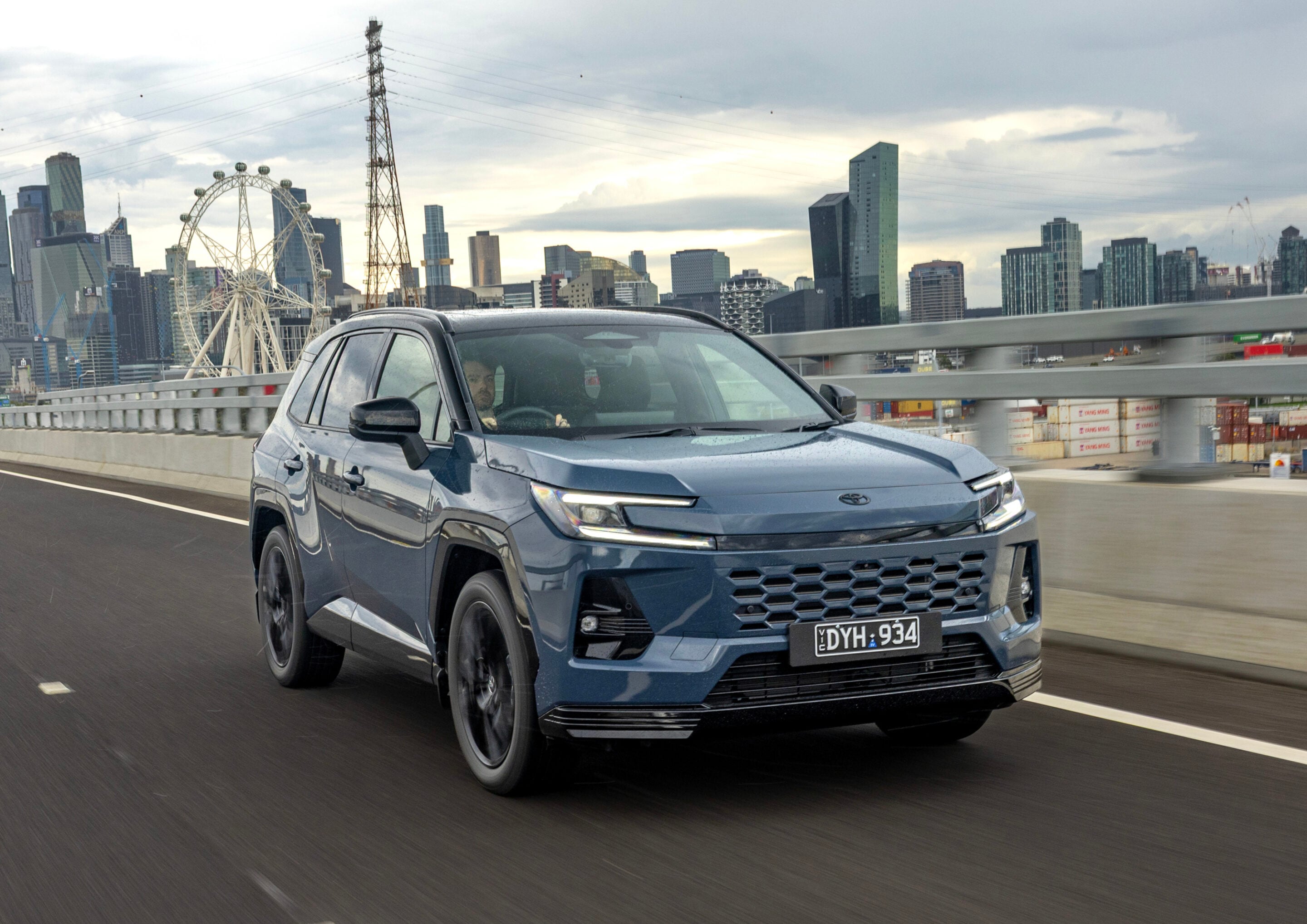
Toyota says efficiency has been improved and quotes consumption figures between 4.5-4.8L/100km depending on the model grade and whether front- or all-wheel drive, improvements of 0.2L-0.6L/100km depending on the model.
The closest I got to Toyota’s claim at launch was 5.8L/100km in a front-wheel drive Cruiser. The GXL all-wheel drive returned an indicated 7.1L/100km while switching to all-wheel drive netted a return of 7.9L/100km. Real world testing through the WhichCar by Wheels garage awaits for some more indicative consumption numbers.
What’s the verdict on the new Toyota RAV4?
So, what to make of the new Toyota RAV4? Certainly, the updates have not strayed too far from the winning formula of the world’s most popular new car, one that redefined the segment with the launch of the previous generation in 2019.
But its rivals have caught up, and in some cases overtaken, Toyota’s segment buster.
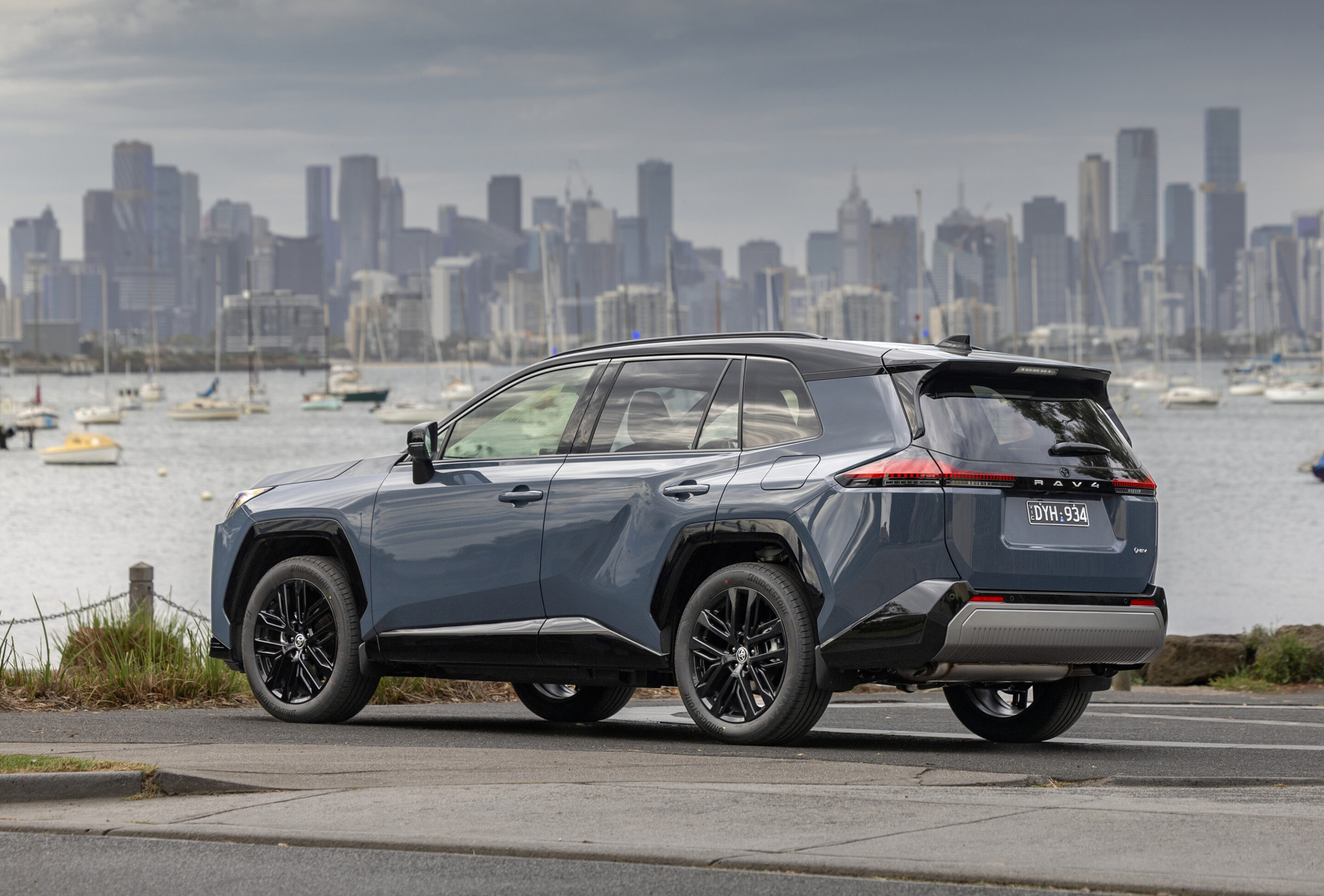
But the new RAV4’s updates across the board – cabin refinement, technology, design and driving – bring Toyota’s medium SUV back in line with its segment rivals.
And that right there is the rub, because while this sixth-generation RAV4 is unquestionably a very good family SUV, one that does a lot of things very well, it hasn’t moved the needle forward nearly as much as we’ve come to expect from Toyota in recent years.
The imminent arrival of plug-in hybrid models might yet change that perception. For now, we wait.
Specifications Toyota RAV4 GXL AWD
| Model | Toyota RAV4 GXL AWD |
|---|---|
| Price | $52,340 plus on-road costs |
| Engine | 2.5-litre four-cylinder petrol-hybrid |
| Peak power | 143kW (combined) |
| Peak torque | 221Nm @ 3200-3600rpm (petrol) |
| Transmission | e-CVT |
| Fuel consumption (claimed) | 4.6L/100km |
| CO2 emissions (claimed) | 102g/km |
| Fuel type | 95RON premium unleaded |
| Dimensions (l/w/h/wb) | 4600/1855/1680/2690mm |
| Boot space | 705 litres (to the roof) |
| Kerb weight | 1730kg |
| Braked towing capacity | 1500kg |
| Warranty | 5-year/unlimited km |
| Servicing costs | $325 per service for first 5 years/75,000km |
| On sale | Now |
GWM’s new 3.0-litre turbo-diesel engine will make its global debut in Australia when it joins the Chinese brand’s Tank 500 and Cannon Alpha line-ups in showrooms.
Speaking to assembled media at a GWM roundtable, the brand’s local marketing boss, Steve McIver, confirmed the big four-cylinder would make its global debut in Australia in the third-quarter of this year.
“We will have the 3.0-litre turbo-diesel joining the Tank 500 and Cannon Alpha range from Q3,” said McIver. “That will be a global debut of that powertrain into the models here within Australia… emphasising the importance of the Australian and New Zealand markets to global GWM operations.”
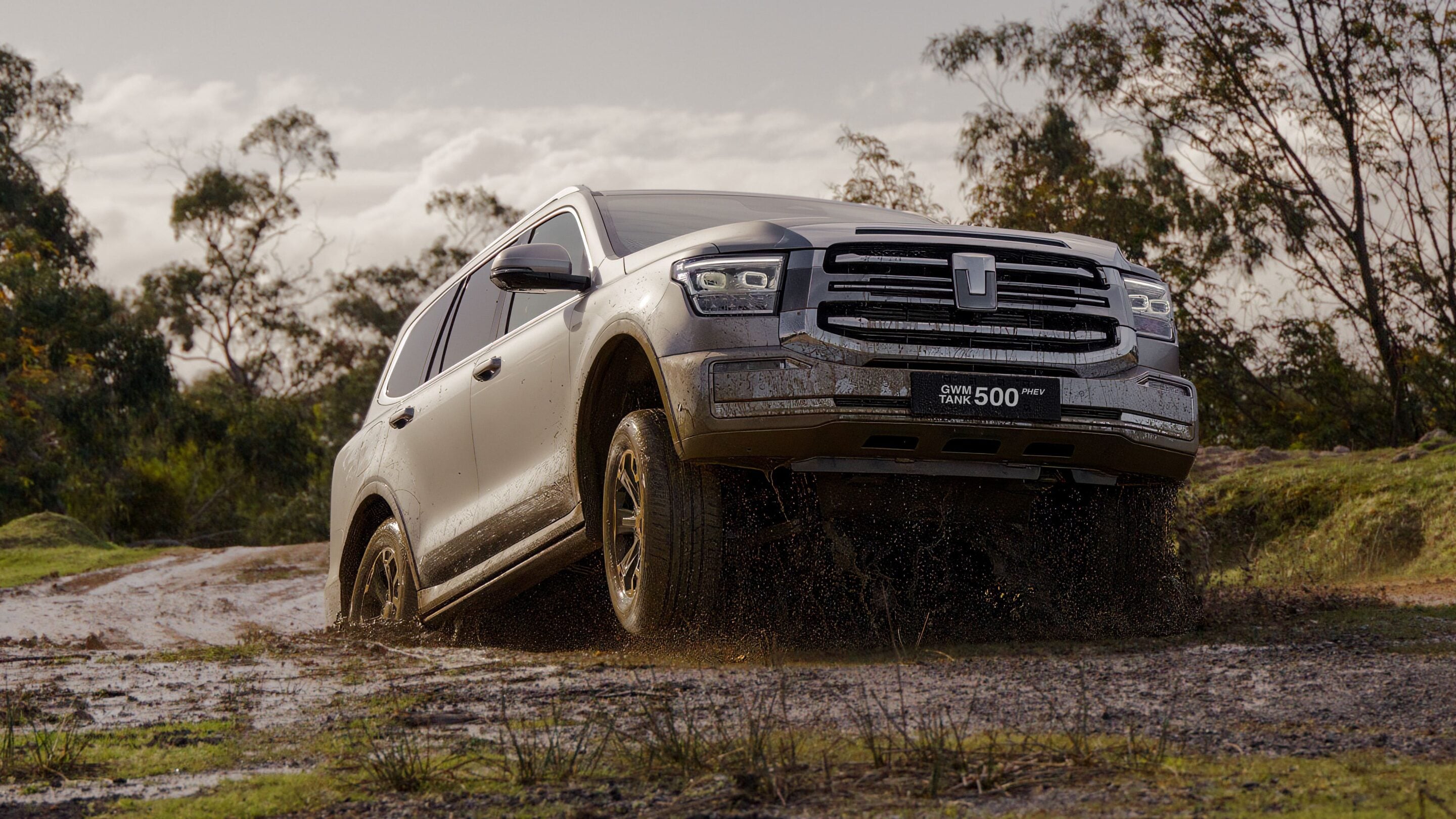
While details remain scarce, it’s expected that power outputs will grow over the current 2.4-litre’s 135kW/480Nm, making it one of the most powerful four-cylinder turbo-diesels in the Australia market.
The Tank 500 large SUV and Cannon Alpha dual-cab ute are currently offered with 2.0-litre 255kW petrol hybrid and 300kW petrol plug-in hybrid powertrains, the latter also available with a 135kW 2.4-litre turbo-diesel.
It’s expected the smaller Cannon dual-cab ute will continue with the smaller diesel engine. However, the line-up will be bolstered by the addition of GWM’s Hi4-T plug-in hybrid powertrain.
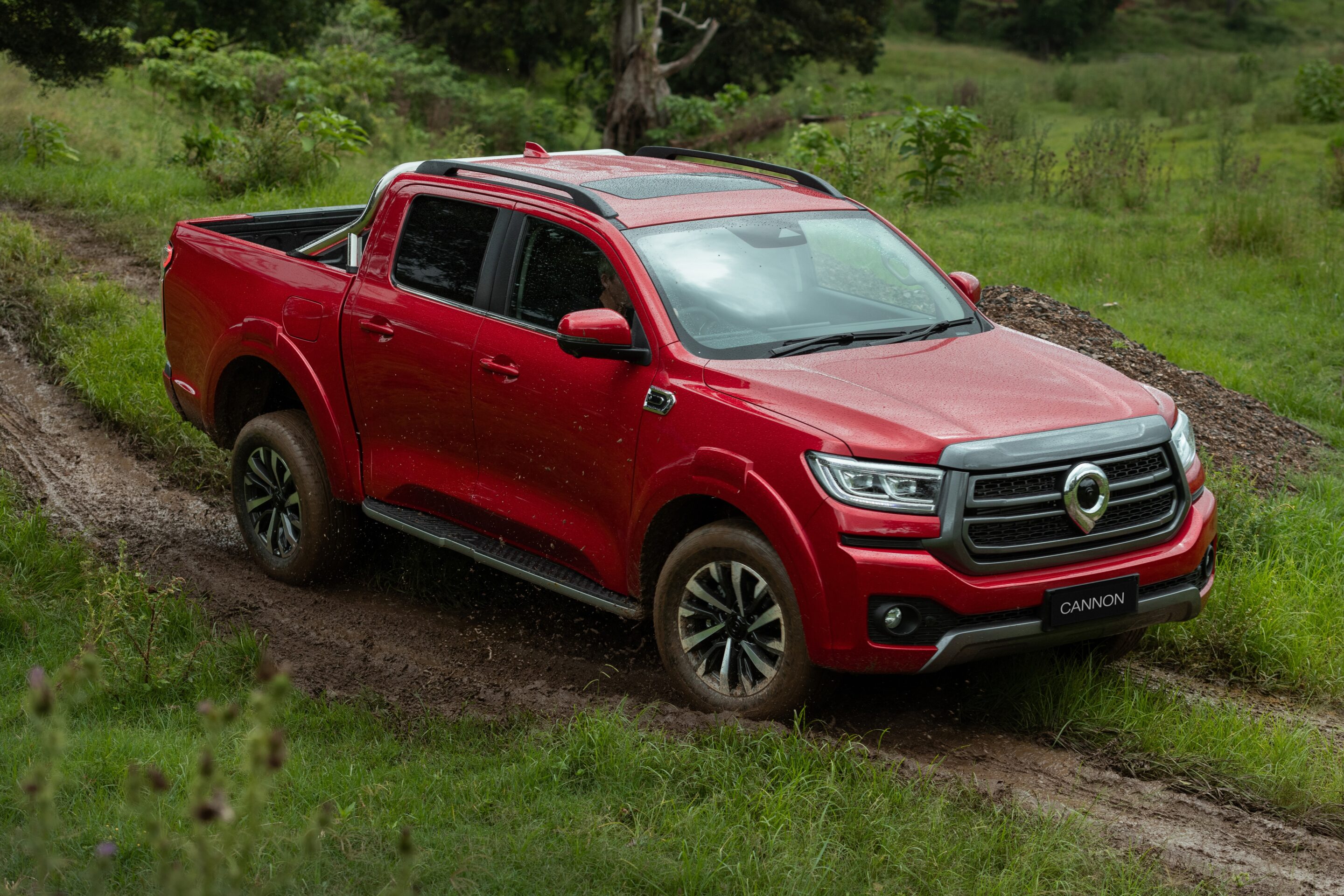
“The addition of plug-in hybrid into Cannon [is] a hugely important car for us in the country’s second biggest segment,” said McIver.
While pricing is still to be confirmed, the GWM Cannon plug-in hybrid could become Australia’s most-affordable PHEV dual-cab, going up against the likes of BYD Shark 6 and Ford Ranger PHEV in the rapidly-growing segment.
