Golf R 20 Years that celebrates two decades since R32 was launched arrives after delay
50 units only, priced from $77,490
Gains drivetrain upgrades, sportier exhaust, and other extra features
The fastest version of the Volkswagen Golf R yet has been priced from $77,490, bringing performance upgrades and extra features for an $10,500 premium over the regular version of the hot-hatch.
VW’s Golf R 20 Years goes on sale on 13 July, limited to 50 units. The special edition was confirmed for Australia in May 2022 and was due to arrive in late 2022 before supply issues interfered.
The 2023 timing is neater, however, as the R32 that began the Golf R lineage reached Australia a year later than Europe – 2003.
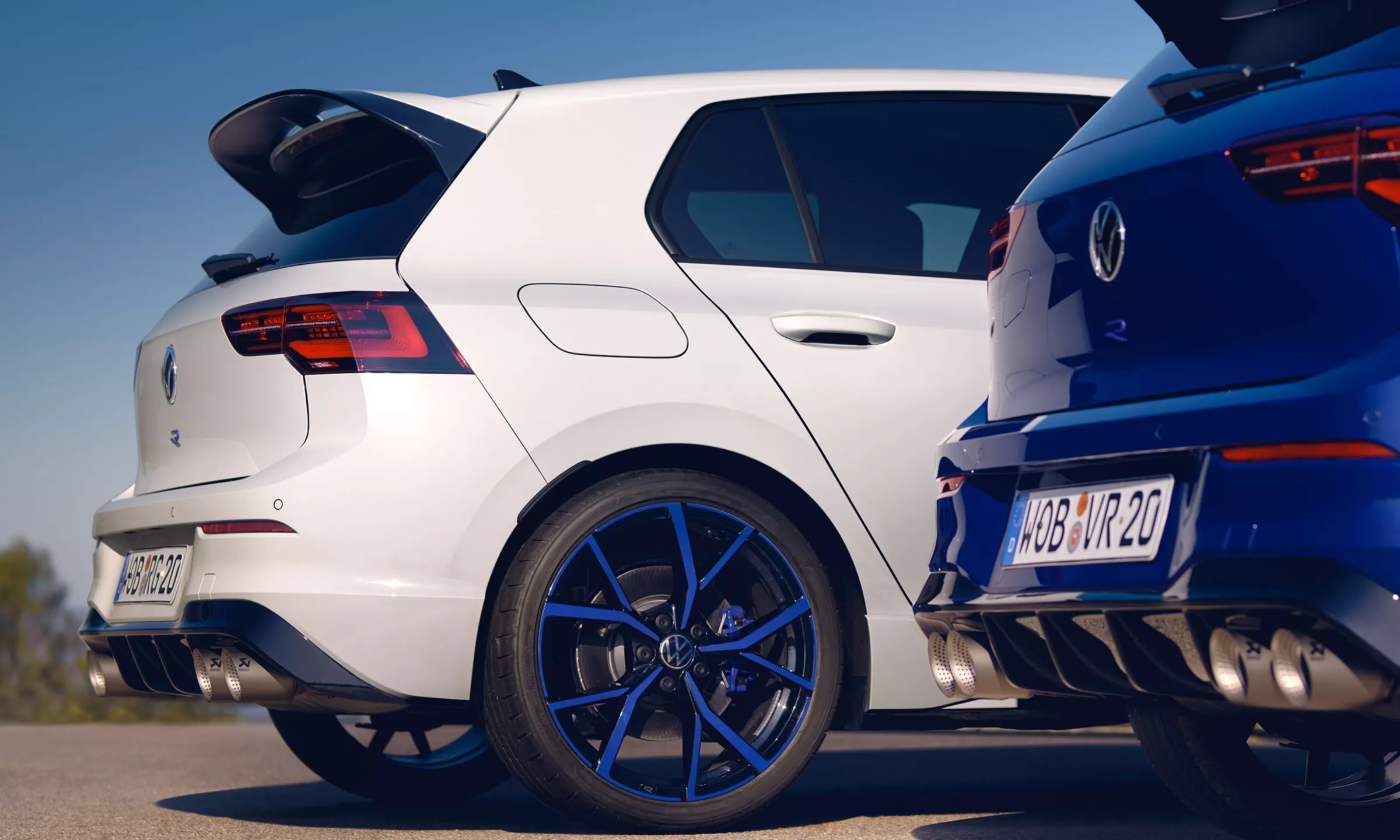
In addition to small hikes in outputs for the R’s 2.0-litre turbocharged engine, the 20 Years becomes the first Golf R to adopt an Akrapovic sports exhaust system.
Power increases by 10kW to 245kW and by 20Nm to 420Nm – now matching the torque of the Golf R wagon.
A more aggressive upshift action has also been introduced for the seven-speed dual-clutch gearbox when using the right paddle lever in S or S+ modes.
VW says the Golf R 20 Years can reach 100km/h from standstill in 4.6 seconds.
There has been an expectation that the regular Golf R would receive the upgraded drivetrain, though Wheels believes this is most likely to happen with the Golf Mk8 facelift anticipated for 2024.
The Golf R 20 Years also gains a panoramic sunroof and a Harman Kardon audio system. VW Australia says these features in addition to the $6K Akrapovic exhaust and performance upgrades account for the higher cost over the $66,990 Golf R hatch.
The premium will shrink from 1 July when the regular Golf R increases to $68,990 before on-road costs.
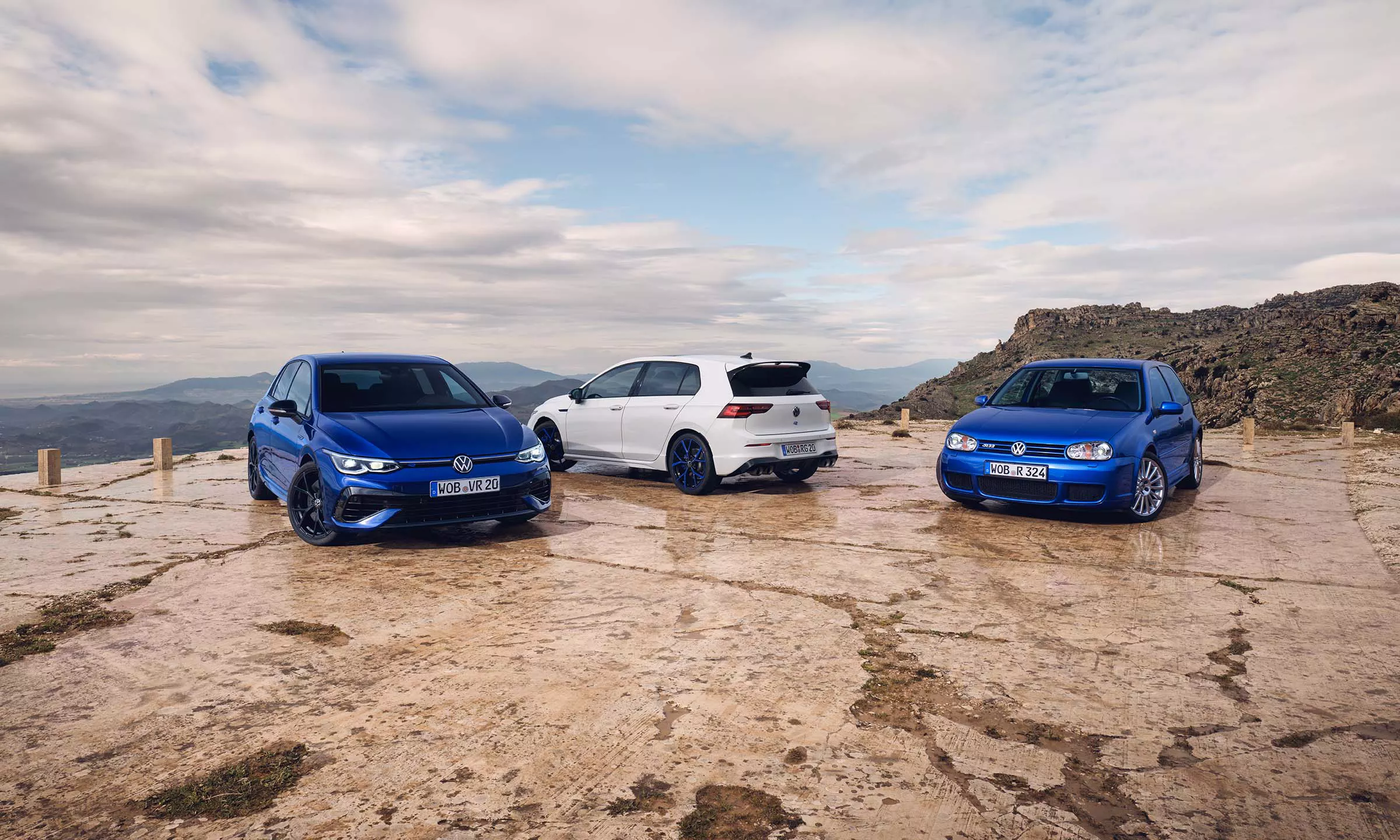
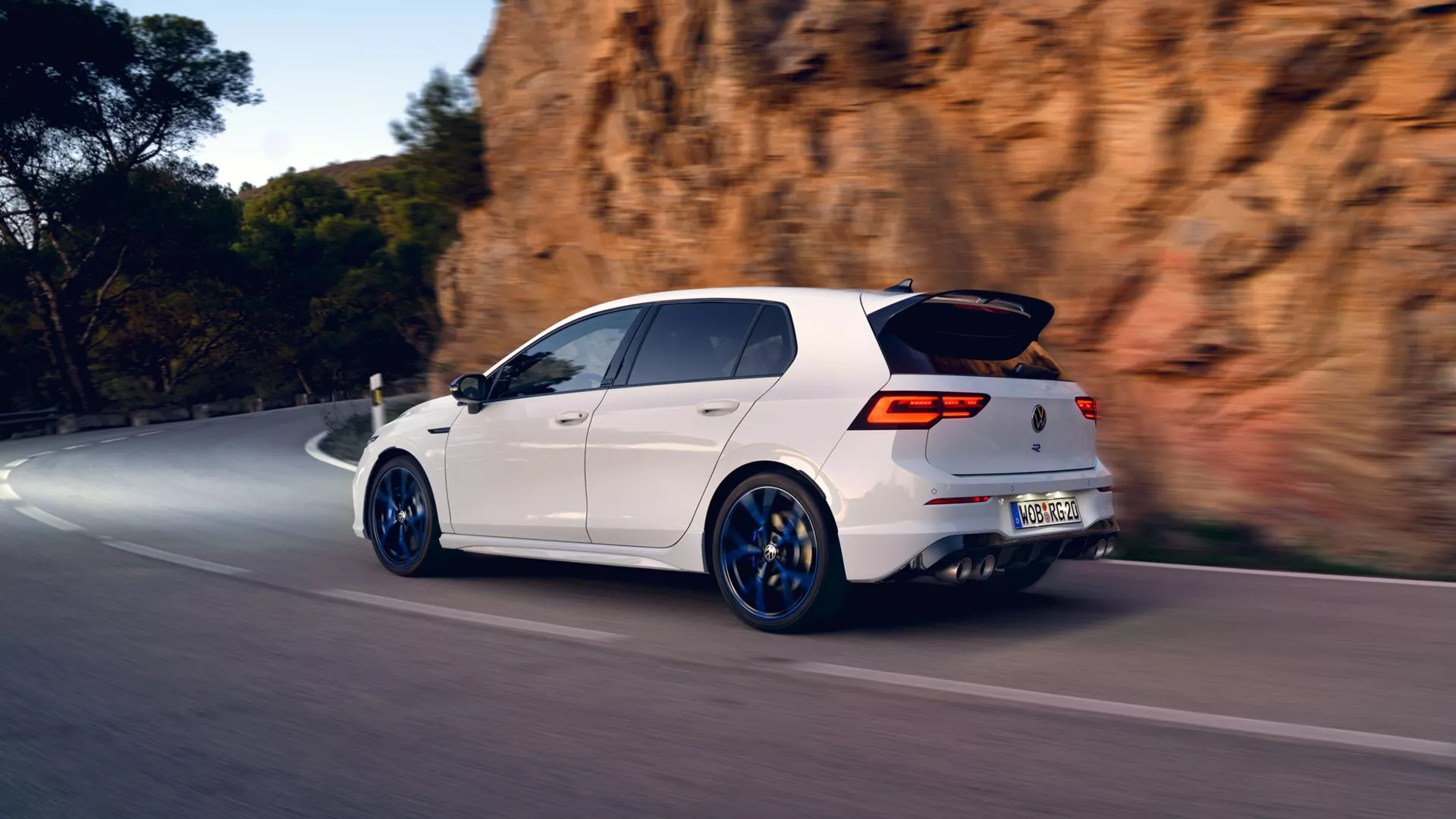
The 20 Years limited edition will be sold online only from 13 July, with orders delivered via VW dealerships. Two colours are available: Lapiz Blue metallic (for 32 of the units); Pure White (other 18 units).
May 2022: Golf R 20 Years confirmed for Australia
The Volkswagen Golf R is turning 20, and Wolfsburg reckons that’s worth celebrating with a limited-run variant of its hot hatch.
Starting in 2002 with the Mk4 Golf R32, the ‘R’ badge has been stuck on Volkswagen’s hottest Golfs ever since, running through five generations of the hatchback up to, and including, the latest Mk8.
Two decades down the line, Volkswagen has launched a special edition variant of the Golf R to celebrate. Simply called the ‘Golf R 20 Years’, it’s based on the current-generation five-door, retaining its EA888 2.0-litre, four-cylinder turbocharged engine, but with an extra kick – now producing 10kW more power to increase its outputs to 245kW and 420Nm.
As with all Golf Rs, an all-wheel drive system will distribute the power to the four wheels, delivered through a seven-speed, dual-clutch automatic transmission.
The increase in power nips one-tenth of a second off the Golf R Performance pack’s 4.7-second 0-100km/h sprint time, although its top speed of 270km/h is likely to be unchanged and governed by an electronic limiter.
3
While 20 Years examples finished in lapiz blue retain the ‘Estoril’ black 19-inch wheel design, those ordered in pure white score gloss blue rim faces, as well as blue mirror caps.
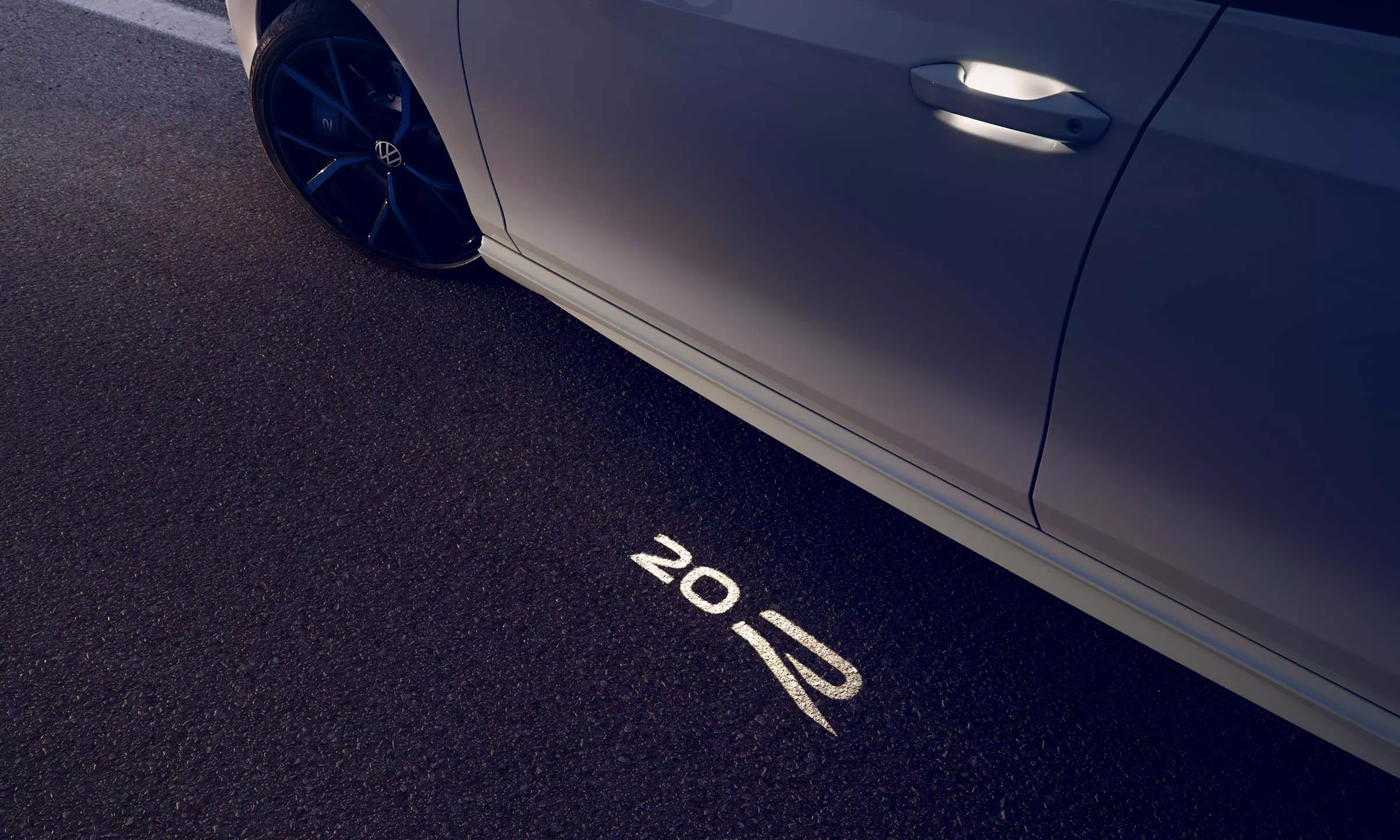
B-pillars now gain ’20’ badges, which complement the ’20 R’ puddle light projection shown off when opening the front doors.
Although European buyers get the usually-optional Akrapovic exhaust as standard, it’s unclear as to whether the louder back-box will be available to Australian customers given it’s not a part of Volkswagen’s local parts catalogue.
4
Inside, the cabin changes are minimal, with larger, and easier to reach, shifter paddles behind the steering wheel – paired with a host of carbon fibre trimmings in the dash and door cards.
For those with a dislike of their neighbours, an ‘Emotion Start’ setting lets the Golf R 20 Years rev up to 2500rpm on start-up – a party trick which has been developed alongside a more aggressive software map for the car’s gearbox, providing a more noticeable feel when going up through the gears.
2
Volkswagen Australia has confirmed to MOTOR the 20 Years edition will come to the local market in the third quarter of this year (July to September inclusive), albeit in slightly different spec to those seen overseas.
Toyota has pivoted to EVs after decades of focusing on hybrids, but the brand wants us to remember there’s an oft-overlooked way to help the environment and your wallet right now: Eco mode.
The carmaker’s connected-services division conducted a study of more than 2000 Toyota and Lexus employee-owned vehicles, who drove more than 777 kilometres collectively in eco or electric vehicle driving modes, exclusively.
Snapshot
Toyota study claims dramatic savings by pressing eco or EV driving modes
Estimated up to 26 per cent CO2 exhaust emissions reduction
Collectively, around 19,000 litres and $27,000 in fuel avoided
The study concluded that driving a petrol-electric hybrid vehicle in eco mode could reduce CO2 exhaust output by up to four per cent – whereas a regular combustion vehicle could slash CO2 emissions by up to 26 per cent.
It’s worth noting that simply changing your driving behaviour – such as only gently pressing the accelerator, using higher gears when suitable, and avoiding idling – can also cut emissions and fuel expenses.
After just six days of data, the Japanese automaker also claimed that the participants collectively:
Saved $27,691 (US$18,304) in fuel costs
Avoided using 19,272-litres of gasoline
Reduced 45,235,623 grams of CO2 greenhouse gases
Equivalent to 748 trees absorbing carbon for 10 years
Saved $27,691 (US$18,304) in fuel costs
Avoided using 19,272-litres of gasoline
Reduced 45,235,623 grams of CO2 greenhouse gases
Equivalent to 748 trees absorbing carbon for 10 years
Toyota has led the push towards hybrid vehicles since the first-generation 1997 Prius, and is now on its fifth-generation hybrid system.
However, the Japanese automaker has long been criticised for reportedly lobbying policymakers [↗] to slow down the shift to full battery-electric vehicles and weaken emissions standards overseas, while maintaining a diverse powertrain strategy that includes hydrogen tech.
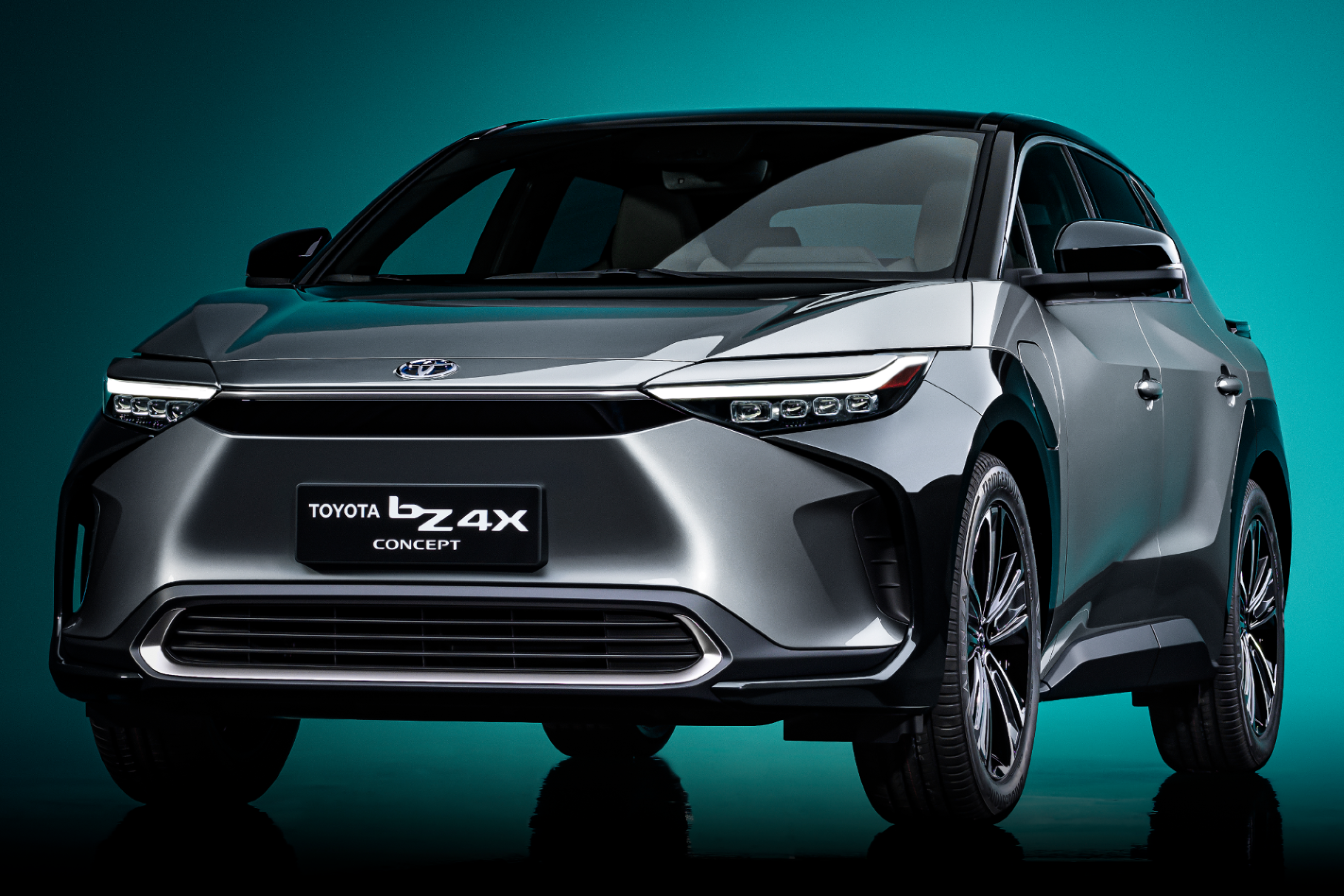
The Toyota BZ4x SUV will land in Australia by the end of this year as the company’s first full EV, which will follow the just-launched Lexus RZ sibling.
A fourth-generation Mitsubishi Outlander was released in 2022, with the range starting with this model – the ES that starts at $37,240 for front-wheel drive or $39,740 for all-wheel drive . That gives you plenty of midsized SUV for the money, but how does the base model stack up as an overall package?
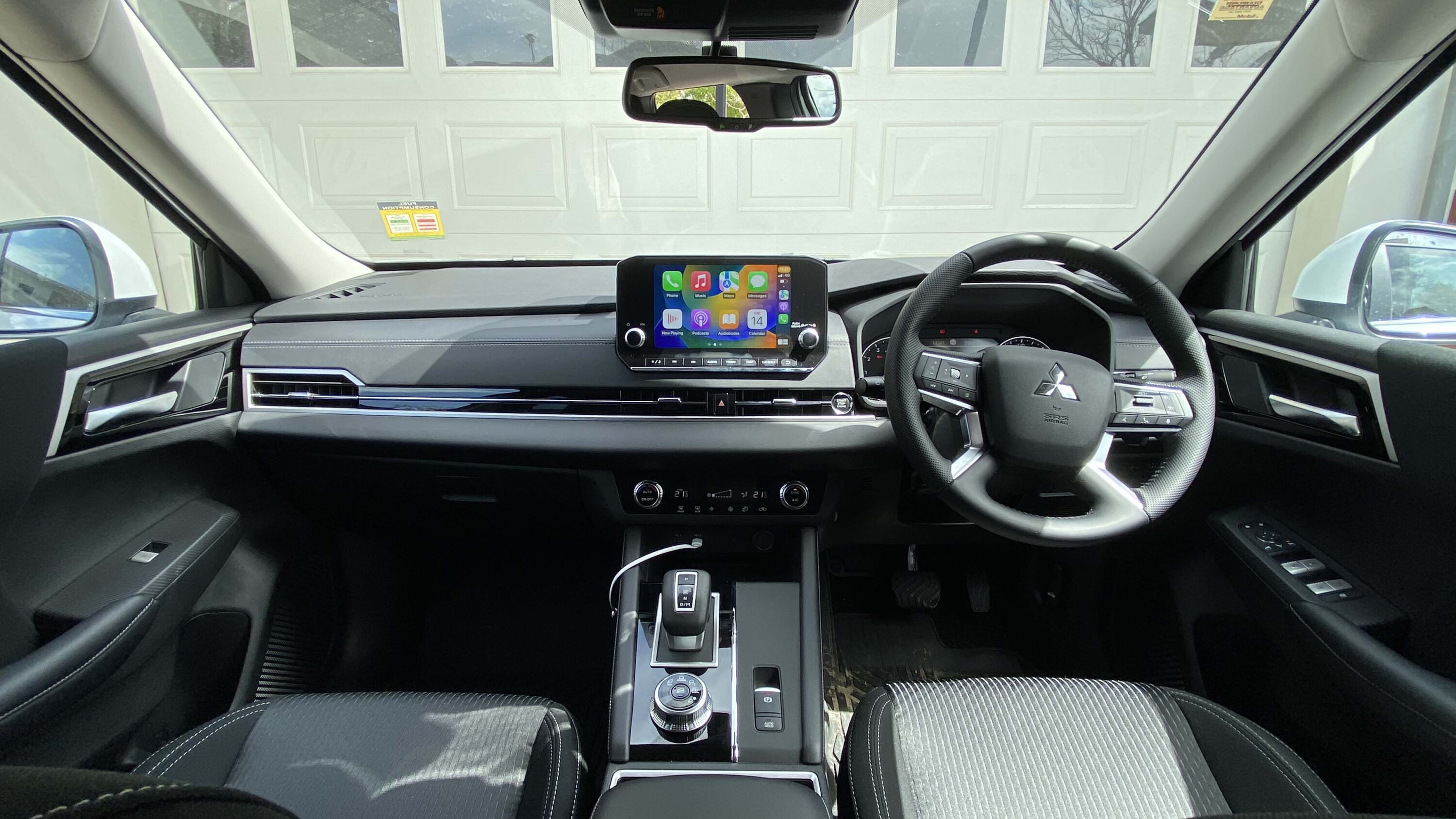
The ES’s equipment level is fairly basic as you would expect for a base model, though there are also some good features. There are LED headlights, daytime running lights and front turn signals, 18-inch alloy wheels, dual-zone climate, paddleshift levers for manually controlling the CVT auto, driving modes, electric park brake, and smartphone-mirroring Apple CarPlay and Android Auto.
2
The ES is the only model in the range that comes with five seats. Other variants offer a 5+2 layout for an extra pair of seats in the third row (folding out of the floor).
The next-model-up LS costs from $40,740. In addition to the seven-seater cabin, this variant brings notable additions such as privacy glass, LED front foglights, keyless entry/start, wireless phone charging, auto-dimming rear-view mirror, and leather coverings for the steering wheel and gearlever.
Practicality is enhanced, too, with two USB sockets in the rear console, while the second row bench adds a sliding function. However, seven-seater Outlanders also lose the ES’s full-size spare – adopting a space-saver instead (or a tyre kit in the case of the PHEV).
Boot space also shrinks slightly to 478 litres, though even the ES five-seater’s 485L cargo capacity is relatively small when compared to key medium SUV rivals.
Safety
The Mitsubishi Outlander holds a five-star ANCAP safety rating.
To help avoid a crash in the first place, the Japanese SUV’s advanced safety and driver assistance systems include forward collision mitigation with pedestrian & cyclist detection and junction assist, adaptive cruise control, blind spot warning, lane departure warning and prevention, and rear automatic emergency braking.
Key Rivals
The 2023 Mitsubishi Outlander ES faces intense competition in the midsize SUV market. Key rivals include:
While these rivals present strong alternatives, the Outlander ES stands out for its affordability and impressive set of standard features.
Should I put it on my shortlist?
The 2023 Mitsubishi Outlander ES is a rare medium SUV offering AWD for less than $40,000, while owners can appreciate up to 10 years of factory warranty if they continually service with Mitsu dealers. It’s also worth cross-shopping against the Nissan X-Trail ST that shares its platform and, while lacking the longer warranty offer, does come with seven seats for almost identical money.
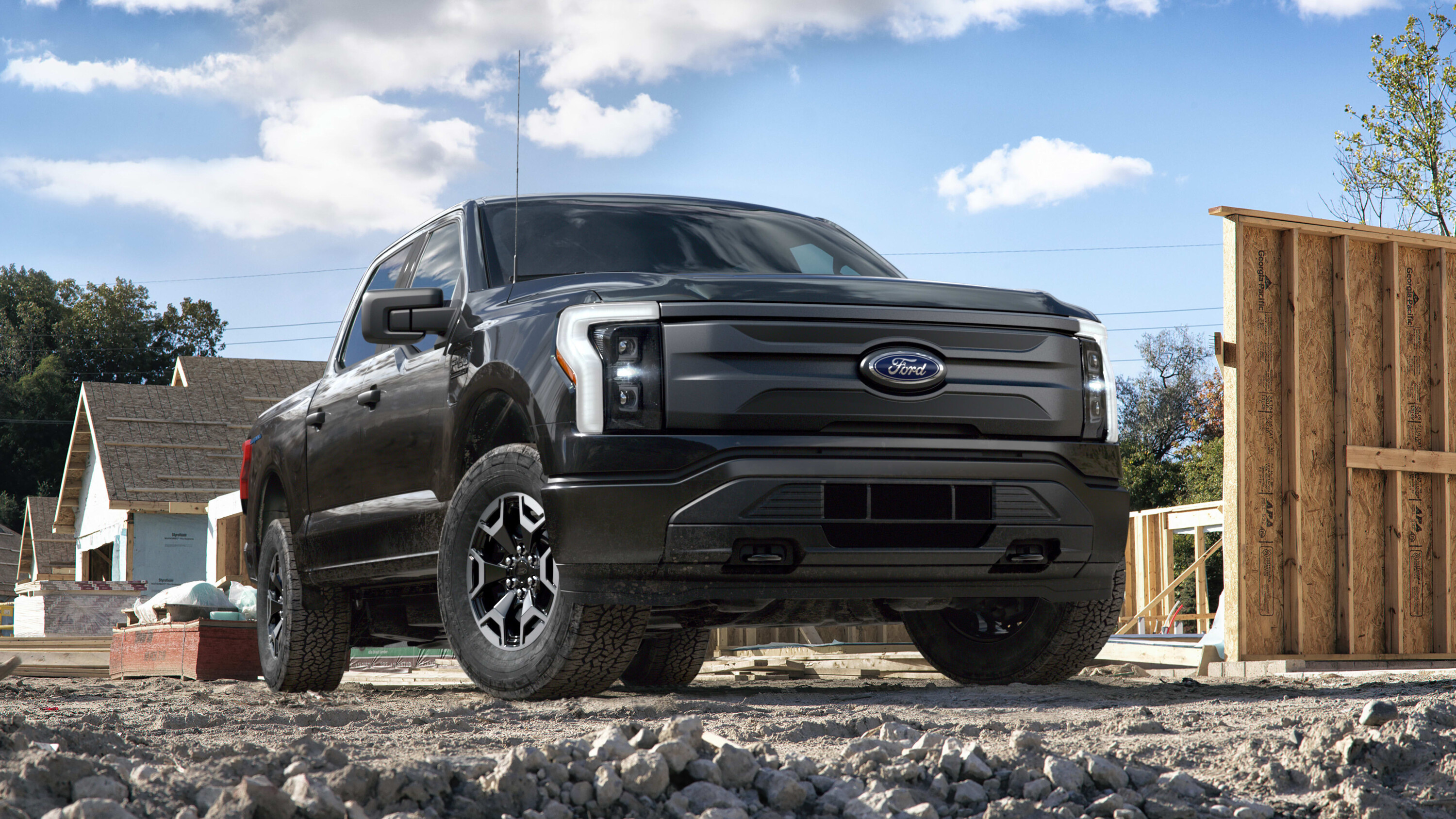
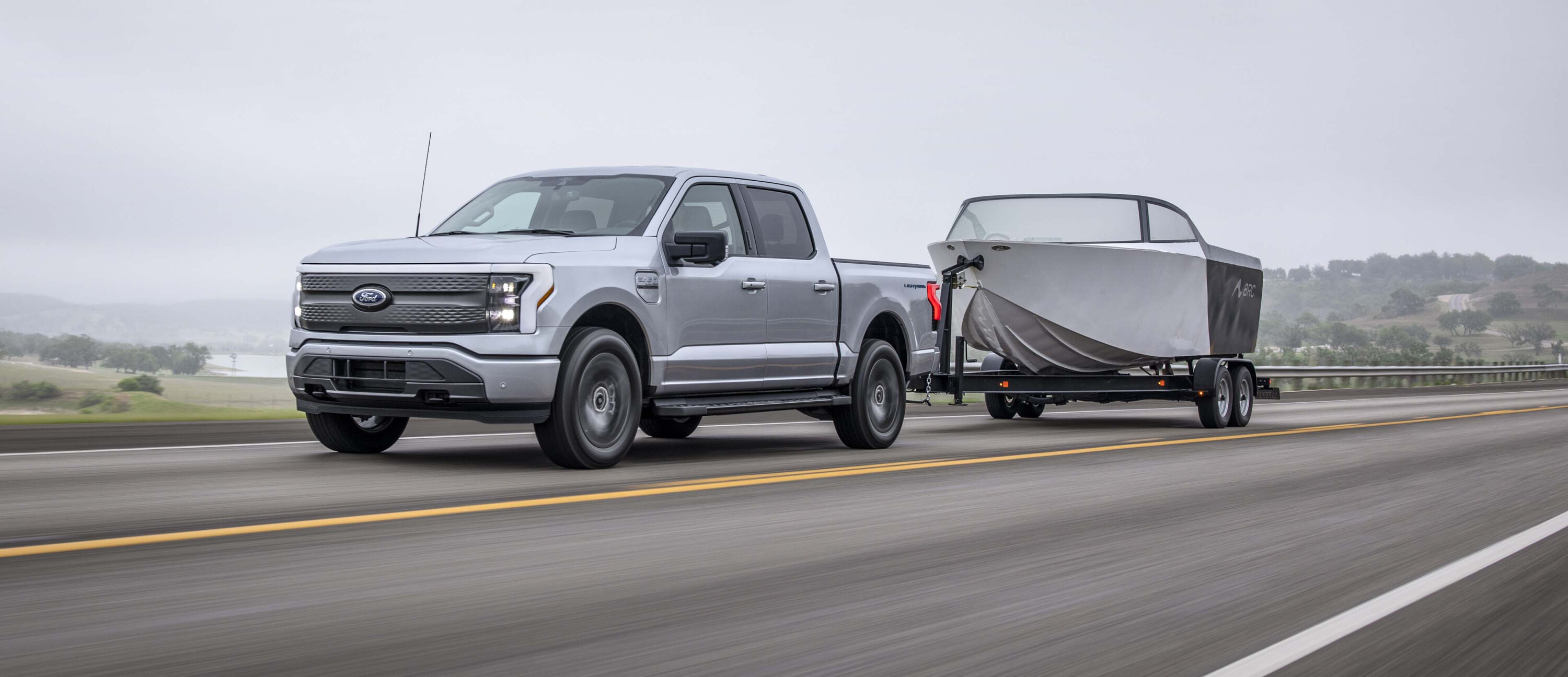
Ford chief executive Jim Farley has conceded the push towards increasingly large EV batteries is untenable.
Snapshot
Ford concedes supersized batteries arenu2019t right
Trend towards American electric utes with 200kWh+
Suggests better aero efficiency needed
Speaking at Ford’s Capital Markets Day, Farley said batteries are becoming too ‘huge’ to meet the size, capability, driving range and pricing usually expected from a petrol or diesel vehicle.
At the same time, he teased an upcoming three-row electric large SUV with around 560 kilometres of range and a 100kWh pack, which will release after another big new electric ute.
1
“I have no idea what’s going on in this industry right now,” Farley told investors and media, as reported by The Verge [↗].
“If you have those kinds of [extra large] batteries, you will not make money.”
Ford’s technology head Doug Field added that its second-generation EVs will focus on improving energy efficiency.
“The real battleground in electrification is about efficiency.”
“There’s a bit of an arms race in the industry to shove bigger and bigger batteries into large EVs to try and make them like ICE [internal combustion engine] vehicles,” said Field (Green Car Reports [↗]).
“But the real battleground in electrification is about efficiency.
“We started by changing the way we think about the tyres with lower rolling resistance, squeezing every little drop of propulsion system efficiency out.
“And in computer simulations we took a bunch of mass out, we lowered the right height, changed the aerodynamics. And the result is a different product.”
But, while already large, that pales in comparison to the tank-like Hummer EV, Chevy Silverado EV, and Ram 1500 REV Extended Range – which all boast batteries in excess of 200kWh.
In contrast, most ‘normal’ passenger EVs today have between 30 to 80kWh battery sizes.
For example, the Hyundai Ioniq 6 electric sedan stresses a sloping rear design to maximise aerodynamics and eke out between 65 to 107km more claimed range than the higher Ioniq 5 SUV using the same 74kWh usable battery.
RAM 1500 REV Extended Range
Hyundai Ioniq 6 Dynamiq RWD
Battery size (usable)
229kWh
74kWh
Claimed range
800km (targeted EPA)
614km (WLTP)
Unladen weight
3000kg+ (expected)
1968kg
The big battery issue
While American automakers are packing big batteries into burly large SUVs and utes in a bid to achieve range comparable to combustion models, Farley emphasised that it is too expensive to manufacture and sell.
Big batteries are also environmentally unsustainable by using more raw materials. And, there’s the safety risk – including thermal runaway – a heavy vehicle poses to other vehicles and pedestrians in the event of an accident.
Solid-state batteries are in development to address this range and weight burden on current lithium-ion technology.
But, there’s still no denying the physics challenge for brands to make SUVs and utes aerodynamically efficient.
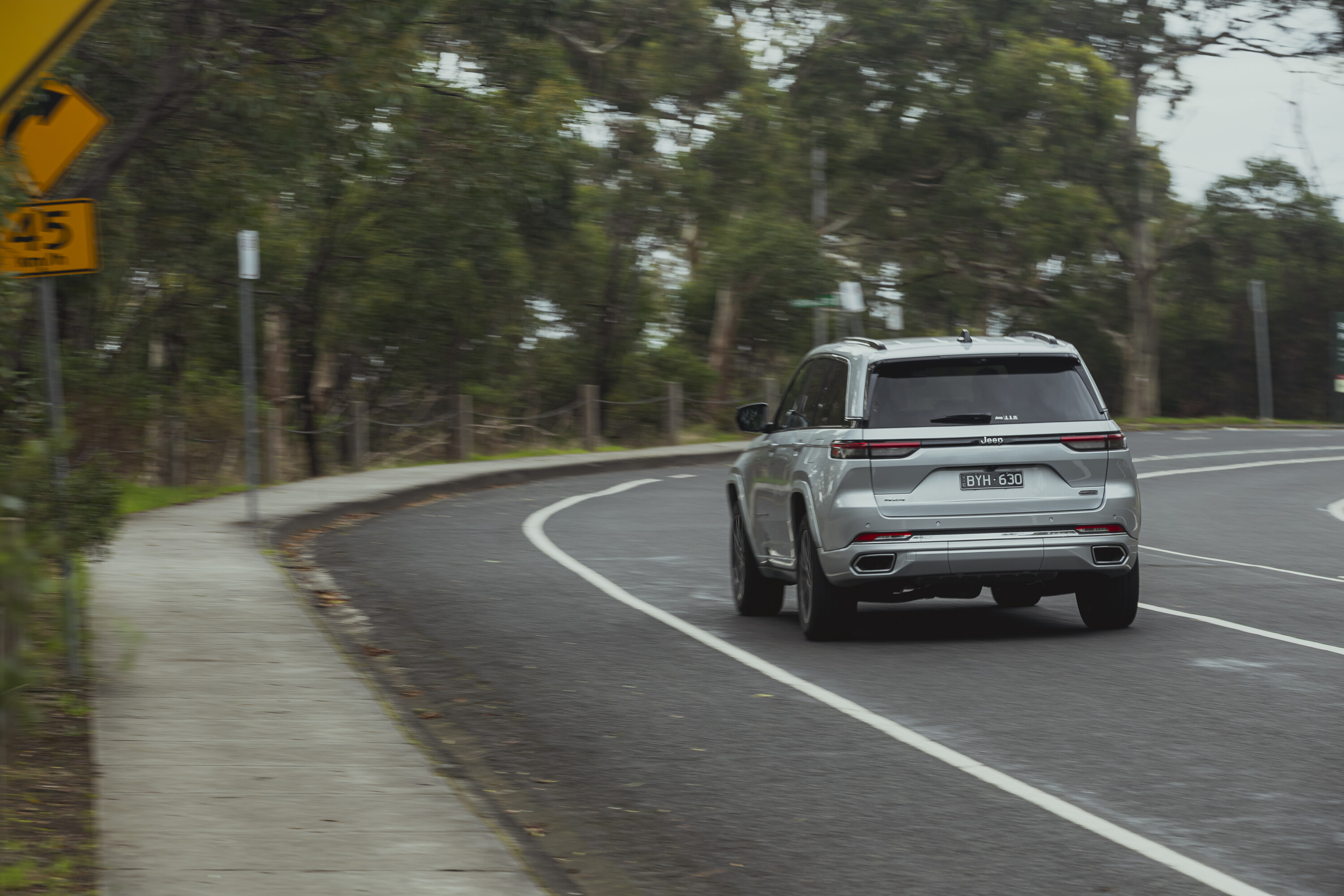
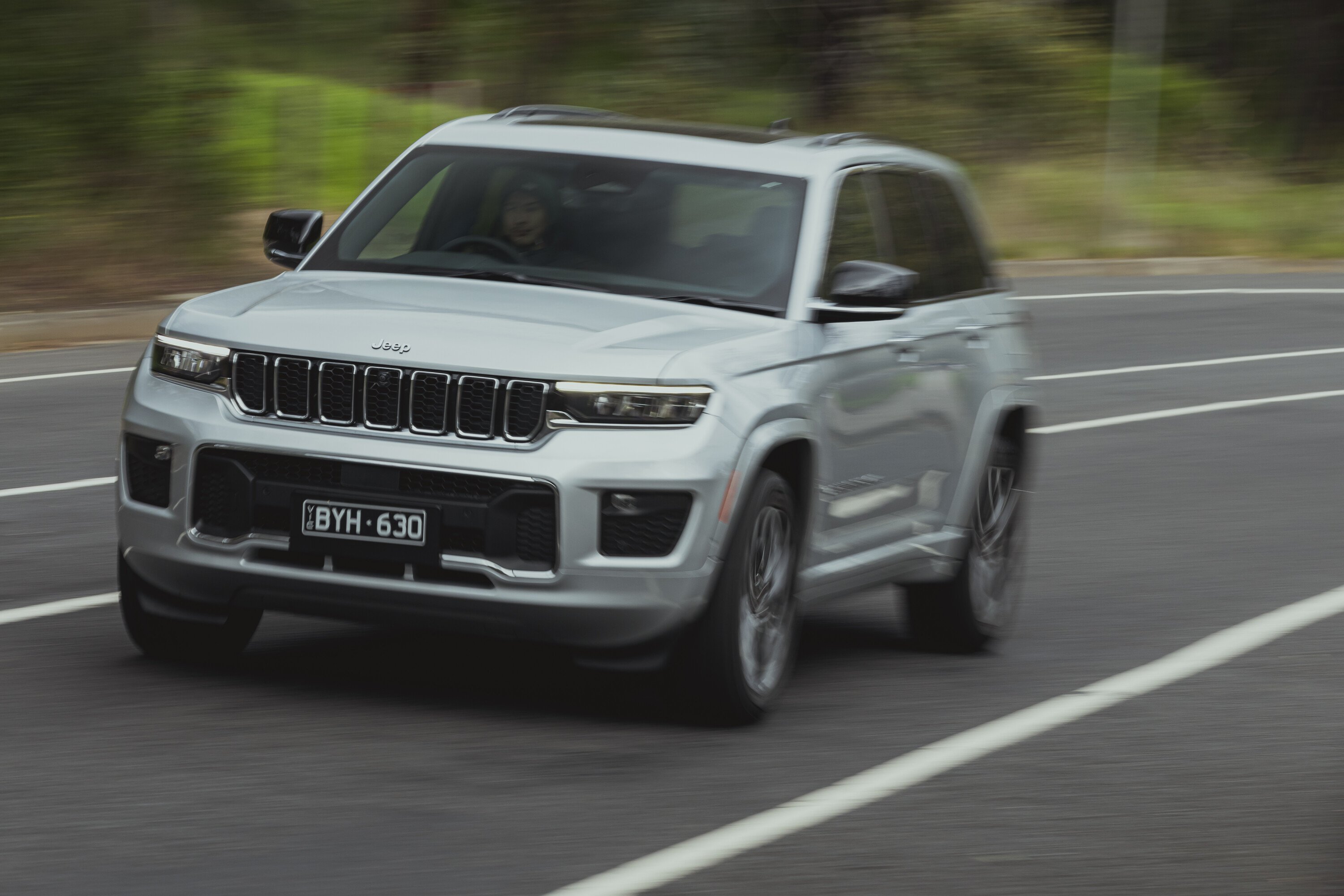
Jeep’s new five-seat Grand Cherokee has hit the Australian market, promising a big step up in premium materials, tech and equipment – in return for a not-insignificant price jump.
The new Grand Cherokee is a V6 petrol-only affair, unlike previous generations which offered both petrol and diesel mills, in eight- and six-cylinder configurations.
A plug-in hybrid, badged 4xe, is also expected to join the local Grand Cherokee range later this year.
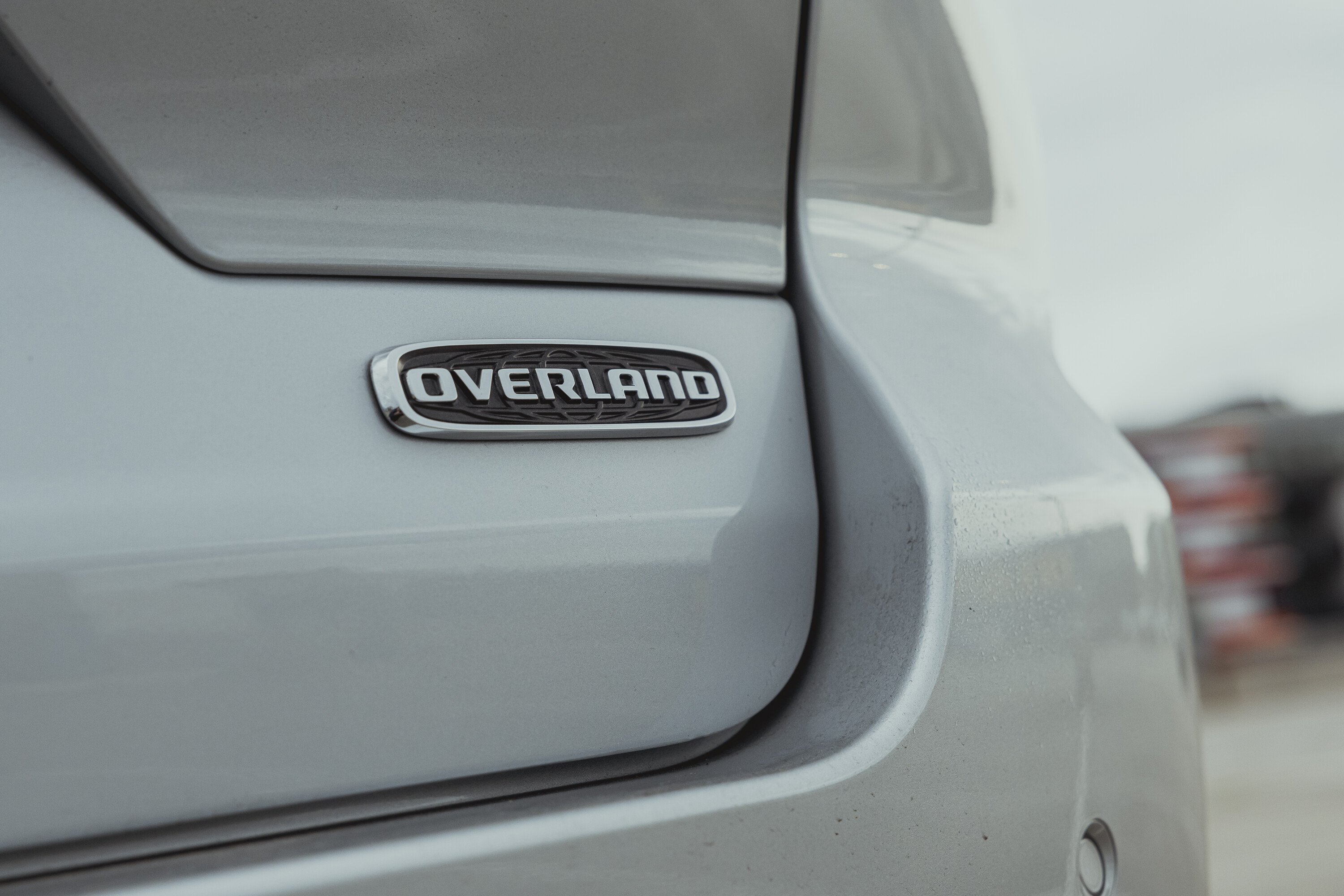
For our first local taste, however, we dig into the Grand Cherokee Overland, representing the flagship five-seat offering, positioned underneath the seven-seat Grand Cherokee L Summit Reserve.
Does Jeep’s new premium direction come together materially, or does the brand’s Fiat-Chrysler reputation precede it? Let’s dig in, and find out.
1
How much is it, and what do you get?
The Grand Cherokee Overland represents the flagship five-seat offering among three available five-seaters at launch, priced from $98,450.
Overland sits above the entry-level Grand Cherokee Night Eagle ($77,950) and Limited five-seat ($83,950), topped by only the flagship seven-seat Grand Cherokee L Summit Reserve ($115,950).
All prices in this story are before on-road costs.
All Grand Cherokees are powered by Jeep’s long-servicing 3.6-litre V6 petrol engine producing 210kW and 344Nm, driving all four wheels through an eight-speed automatic transmission.
Jeep’s new premium positioning sees even the entry-level Night Eagle come equipped with niceties such as 20-inch alloy wheels, auto LED headlights, heated front seats with eight-way power adjustment, heated steering wheel, 10.25-inch digital instrument cluster and 10.1-inch infotainment screen, wireless Apple CarPlay and Android Auto, power tailgate and wireless phone charger.
Stepping over the Limited to the flagship Overland adds air suspension, a two-speed active transfer case with low-range gearing, 20-inch polished alloy wheels, black Nappa leather upholstery, ventilated front seats, dual-pane panoramic sunroof, premium nine-speaker stereo and multi-colour ambient lighting.
1
2023 Jeep Grand Cherokee Overland features
10.1-inch Uconnect infotainment unit
Hands-free power tailgate
10.25-inch digital instrument cluster
Heated front seats
20-inch polished alloy wheels
Heated steering wheel
8-way power-adjustable front seats
Multi-colour ambient lighting
Air suspension
Premium nine-speaker stereo
Approach exterior lighting
Ventilated front seats
Auto LED headlights
Wireless Apple CarPlay & Android Auto
Dual pane panoramic sunroof
Options
Overland options include premium paint ($1750) plus two option packages: the Luxury Tech Group ($4500) and the Off-Road Group ($2750).
The Luxury Tech Group package adds 12-way power front seats with memory and massage functions, four-zone climate control, ventilated second-row outboard seats, digital rearview mirror and second-row sunshades.
Going for the Off-Road Group package adds a 230mm rear axle, electronic limited-slip differential, Jeep’s signature ‘Trail Rated’ exterior badging, 18-inch polished/painted wheels with 265/60 Goodyear all-terrain tyres, and a skid plate shield for the fuel tank, transfer case and front suspension.
1
How do rivals compare on value?
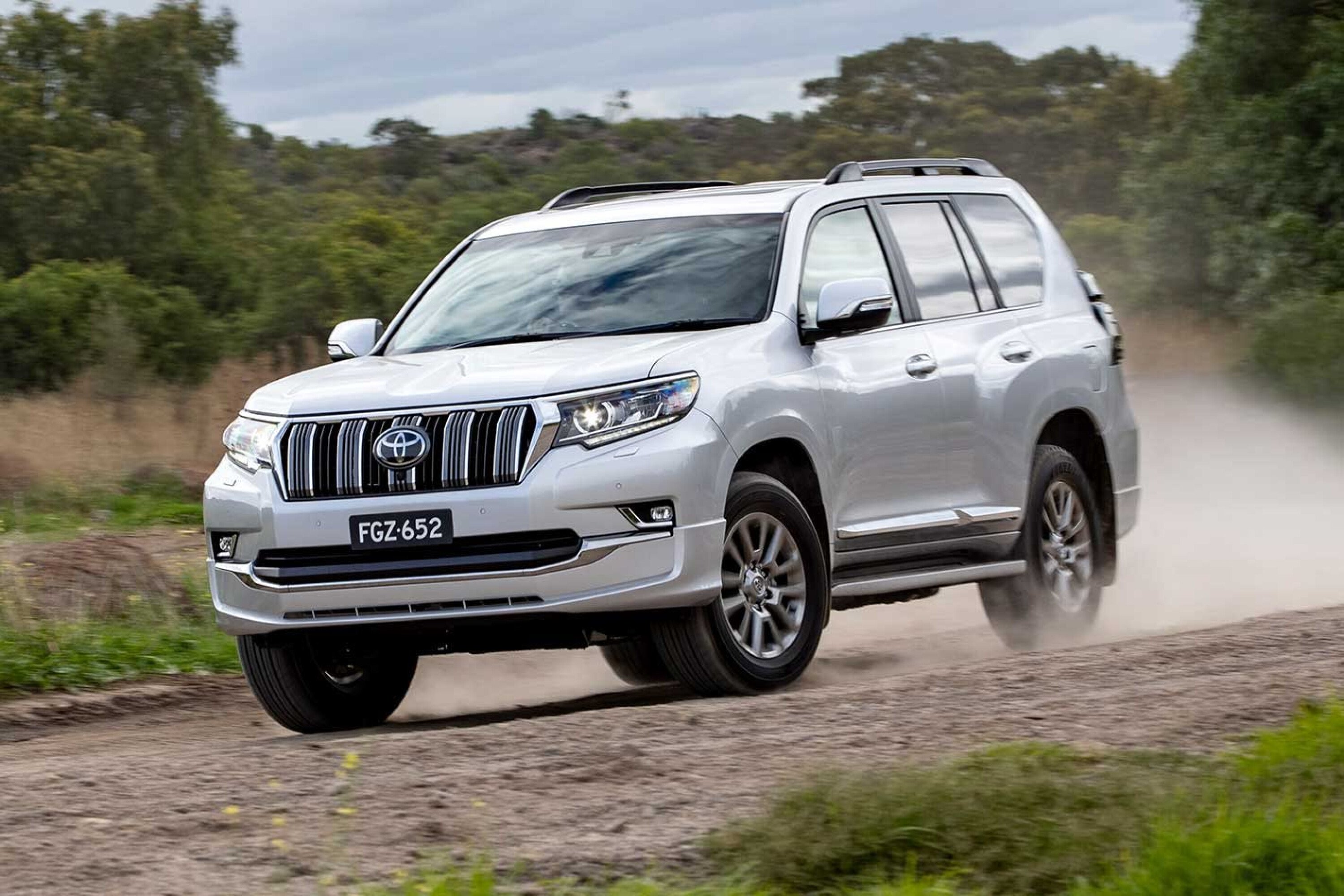
Rivals include rugged large SUVs including the Nissan Patrol (asking from $82,160 to $95,115) and Toyota LandCruiser Prado (from $60,830 to $86,998).
Depending on the brief to fill, however, as a road-going large SUV, buyers could also feasibly cross-shop with a number of European large unibody SUVs, including the Volkswagen Touareg (from $87,990 to $116,290), Audi Q7 (from $110,000) and Land Rover Defender 110 (from $104,000).
1
Interior comfort, space and storage
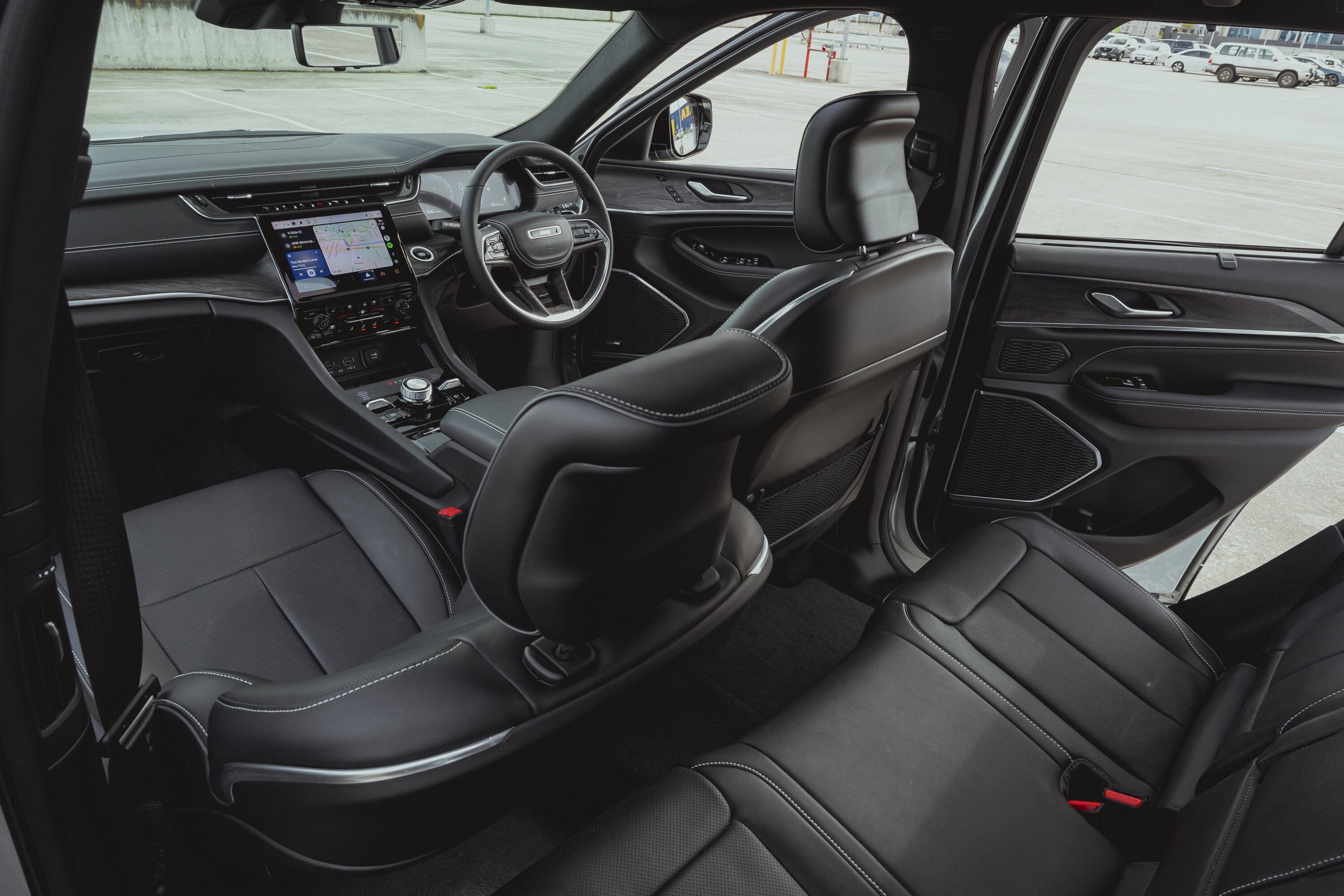
As you should expect from the uptick in price, the interior of the new-platform Grand Cherokee is a massive step up over its predecessor.
Even the new-for-Australia five-seater, with a shortened wheelbase compared to the Grand Cherokee L seven-seater, is a roomy proposition for all involved.
Mind you, it ought to be given its sizeable footprint but, look closer still, and you’ll find that the new Grand Cherokee hasn’t just made strides dimensionally, but also materially.
1
The seats are comfy yet supportive, with a wide base and good under-thigh support.
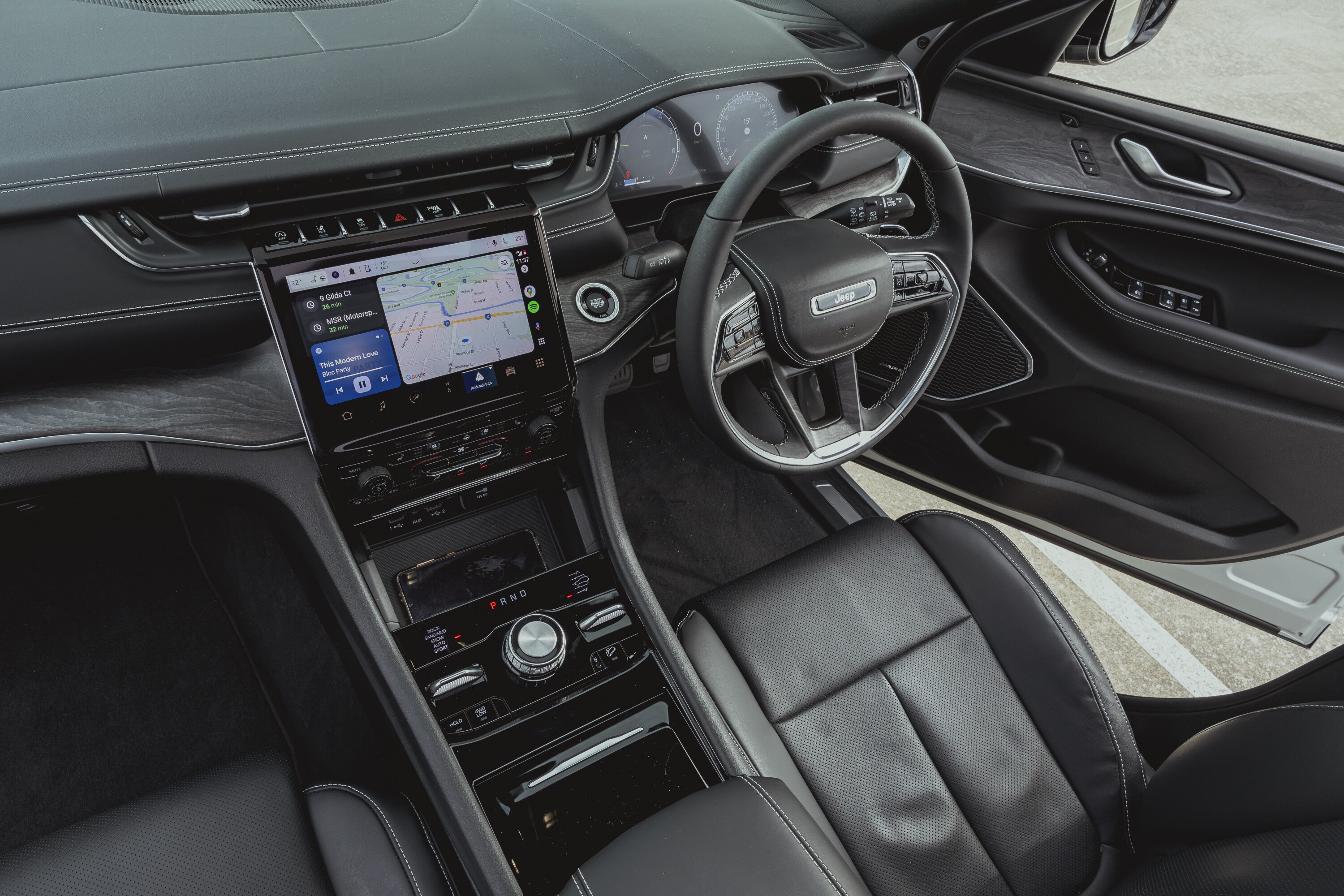
Broad steering column adjustment, in both reach and tilt, combined with the power-adjustable seat, cater for those who like the ‘looking above’ high-riding SUV position, as well as taller folk who need a low base. The rotary drive controller is a milled metal piece with tactile weight to it, while the dash is adorned with leather-look and mostly soft-touch materials.
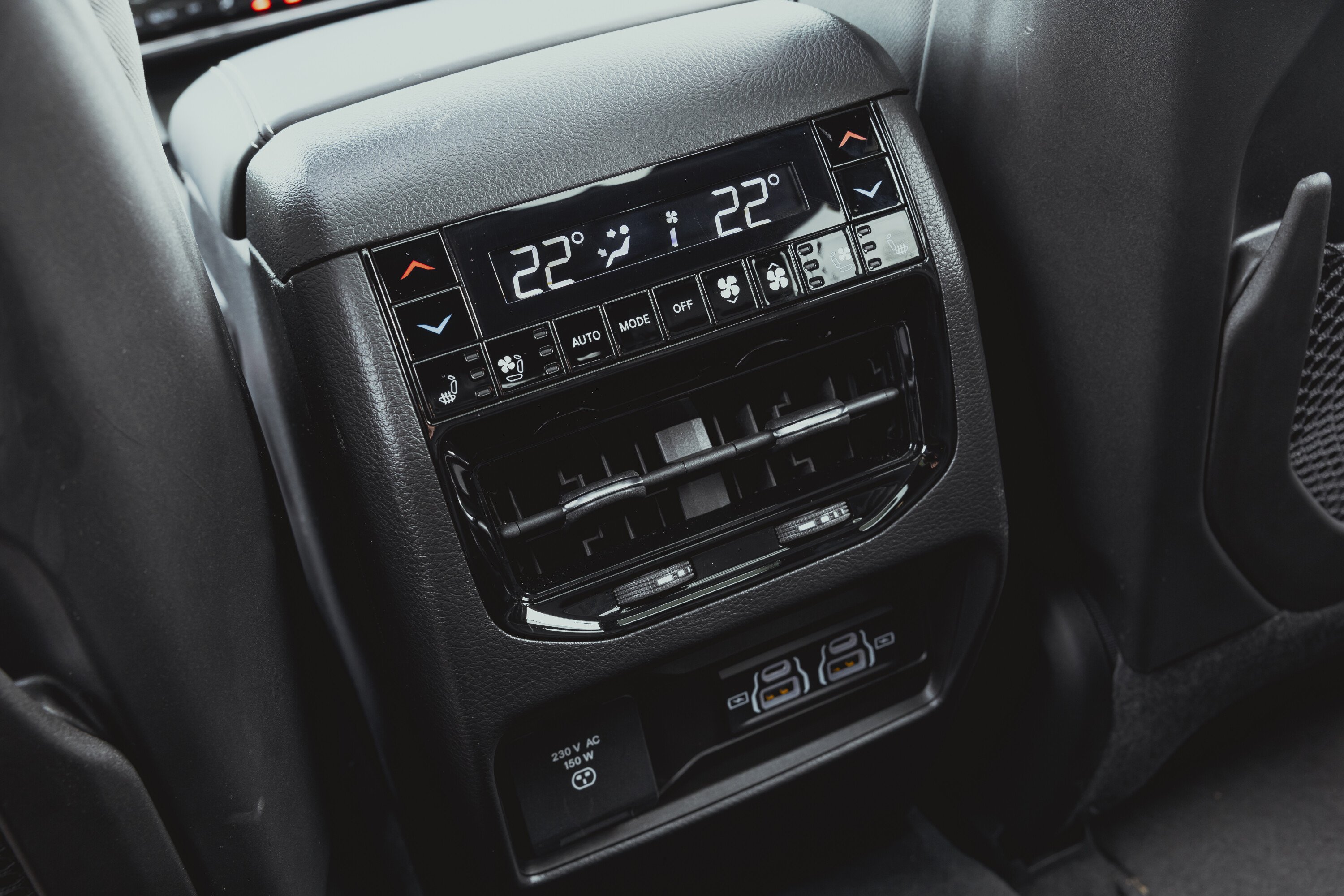
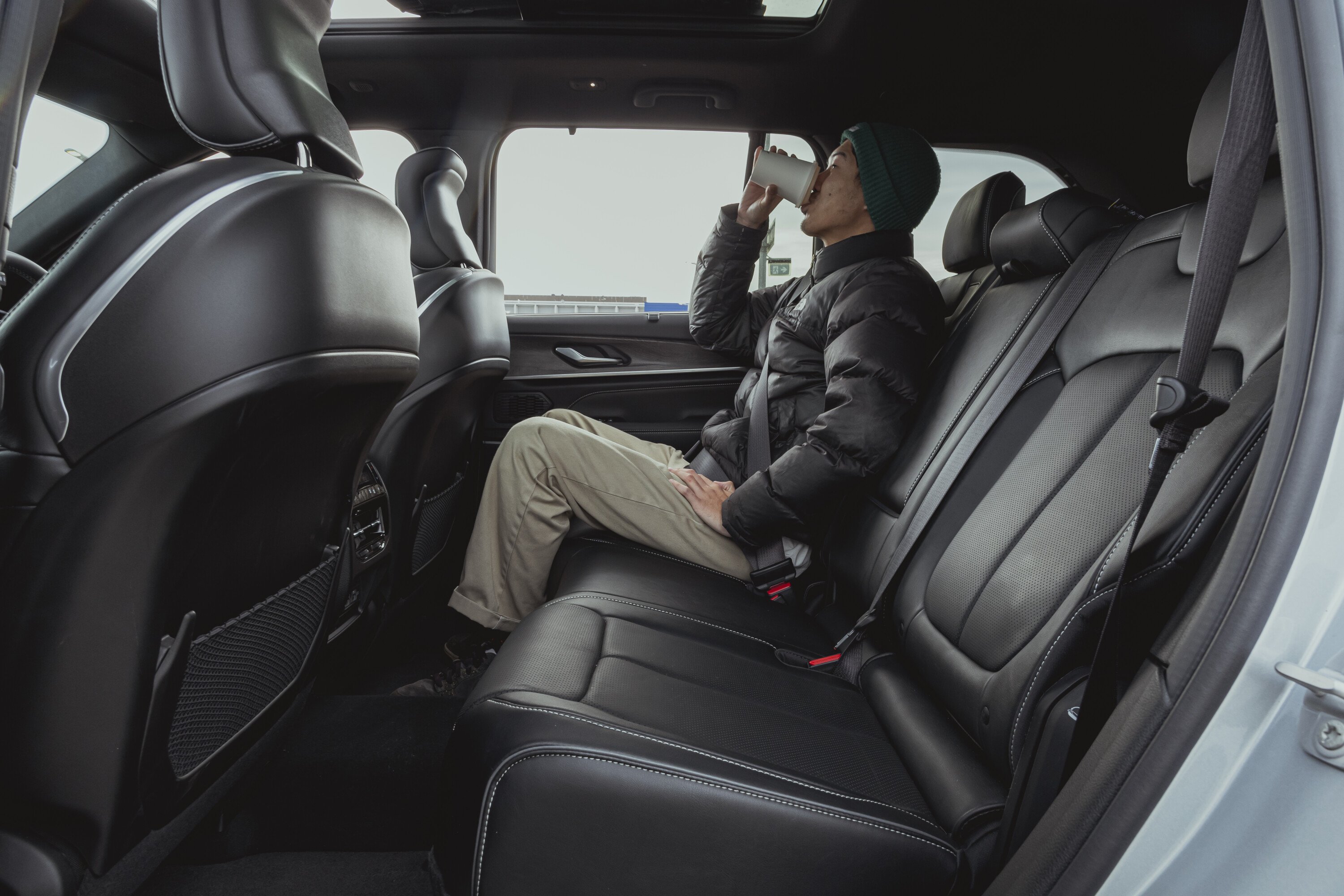
In our test car, fitted with the $4500 Luxury Tech Group option pack, the second row comes well-equipped with sunshades, ventilated outboard seats and four-zone climate control.
The second row splits 40:20:40 and slides fore and aft, allowing you to prioritise passenger or cargo space behind. It’s easily capable of transporting adults in the outboard seats on long drives in comfort, even more so thanks to the added Luxury Tech appointments. The middle seat is agreeably wide for a third body, but a jutting console from the front armrest, along with an elevated transmission tunnel, impinge on leg space.
1
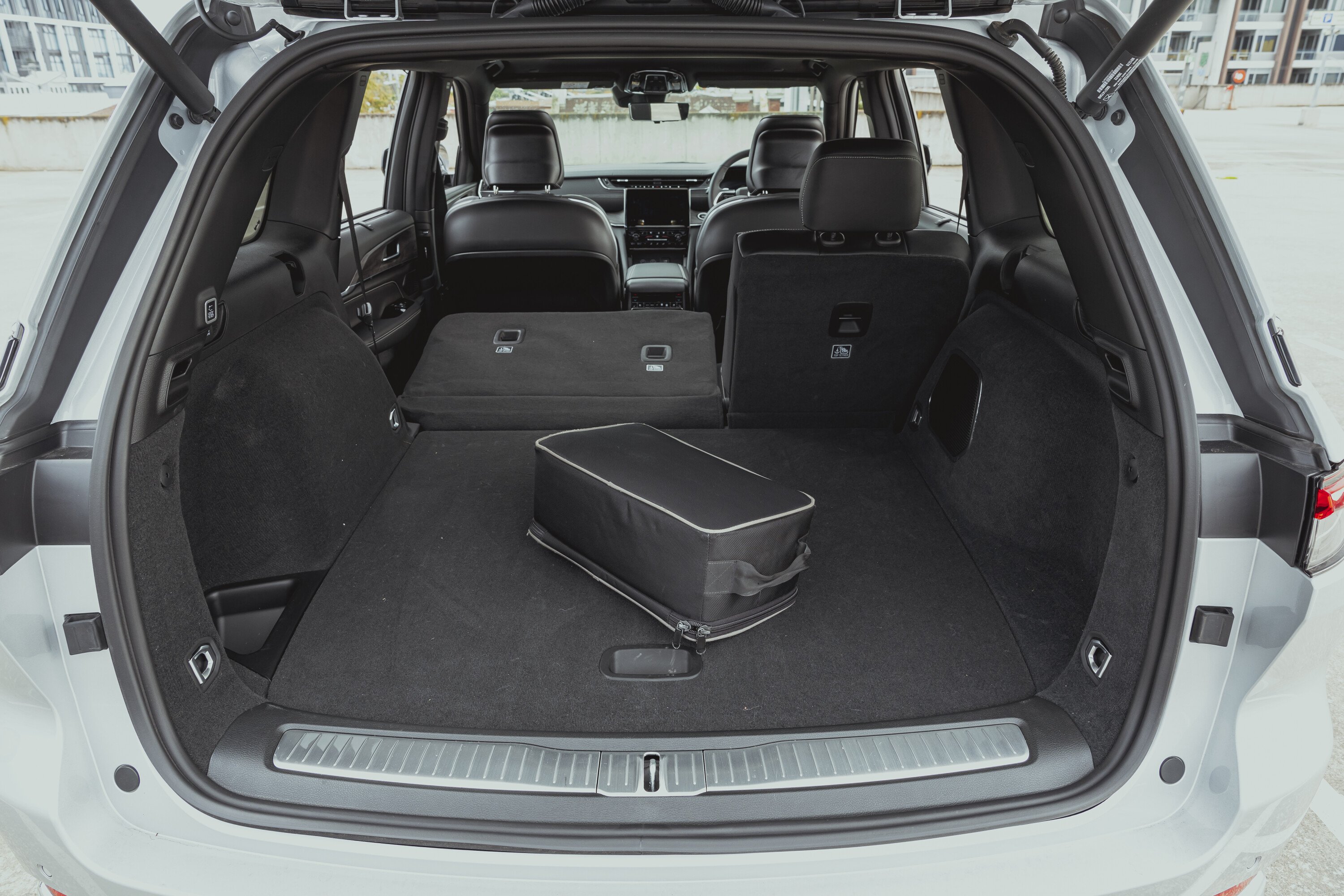
Boot space hasn’t been officially quoted in litres but compared to the long wheelbase seven seater’s two-row figure of 1328L, the five-seat will be down on cubic volume given its total length is reduced by 289mmm.
Converting US measurements to litres suggests the Grand Cherokee five-seat boasts approximately 1067L behind the second row, although US vehicle measurements often measure to the ceiling, while Australia commonly measures to the window line.
Anecdotally, the five-seat Grand Cherokee will easily swallow a large grocery shop, or a child’s pram and all requisite early-age carry-on gear.
The Overland’s air suspension, with a configurable and dedicated entry/exit mode, along with a power tailgate button, are welcome, functional, features.
1
Technology in the cabin
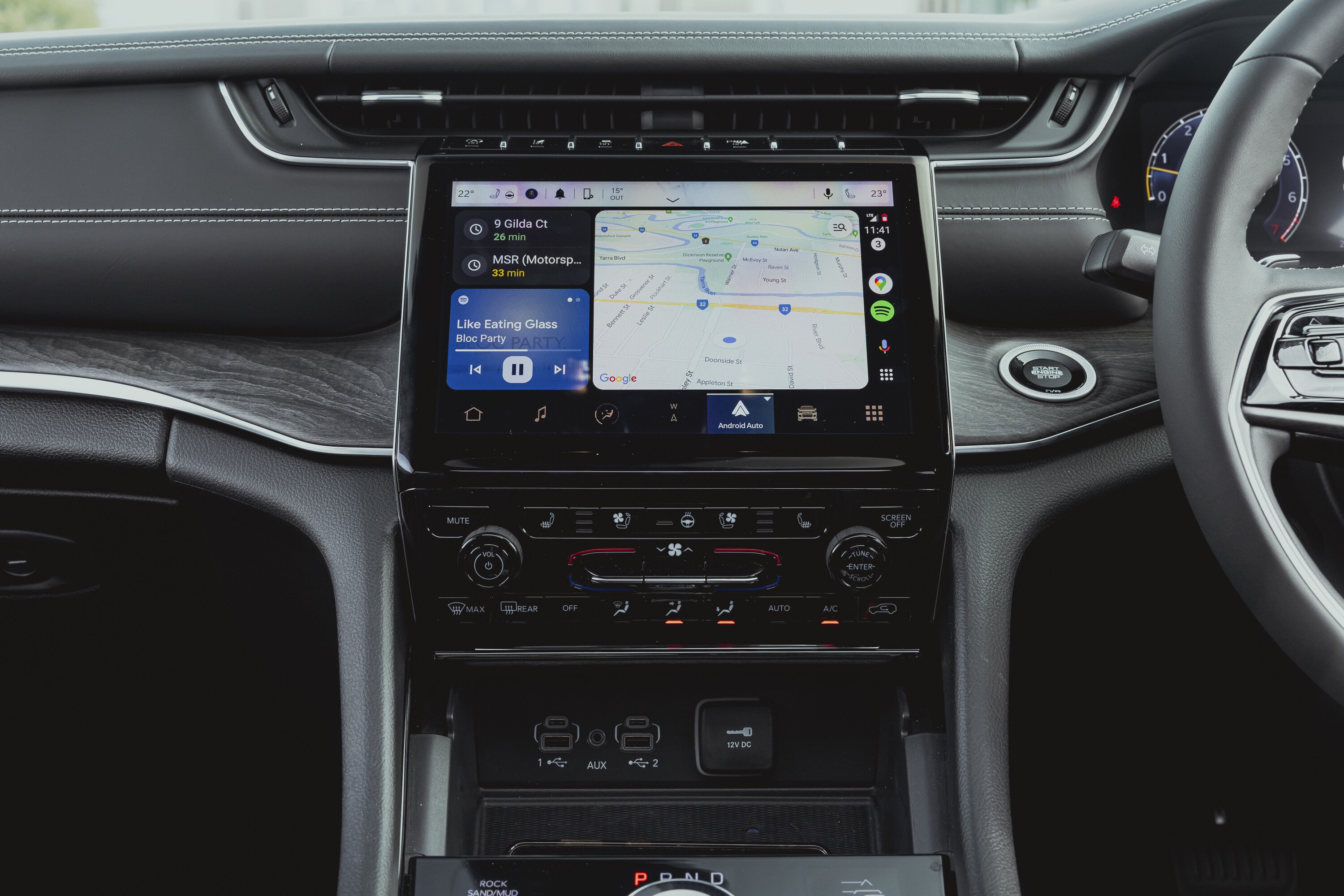
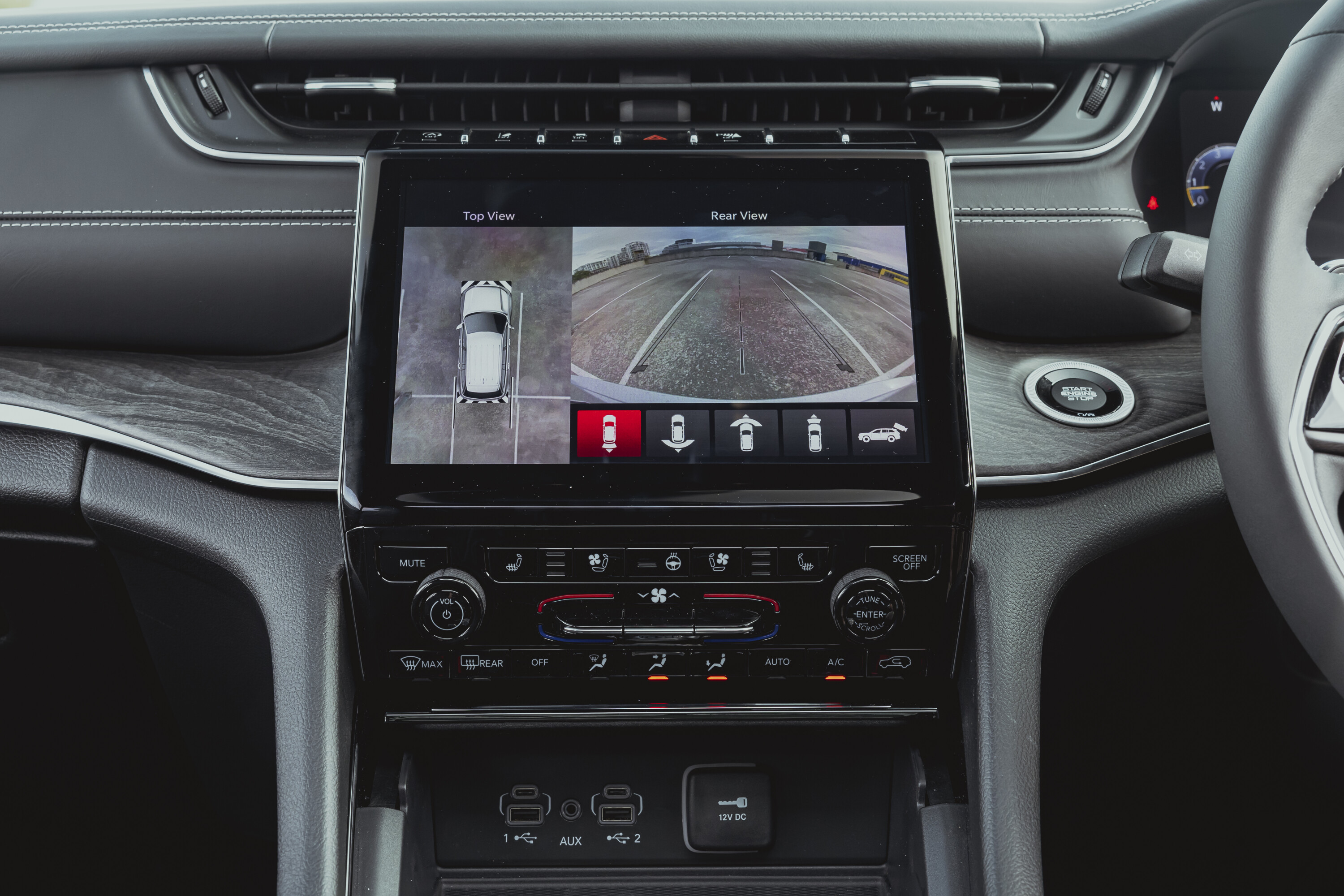
The 12.1-inch central infotainment screen interfaces with Jeep’s latest UConnect system well, delivering a fairly digestible layout and menu tree, and good haptic and visual responses.
Wireless Apple CarPlay and Android Auto, however, bring out the screen’s best – and there’s a wireless charging pad, along with a 12-volt power outlet, two USB-A and two USB-C ports located centrally in the bottom of the centre stack for all charging needs.
There’s even an auxiliary input, I can only assume, for those against wireless technology. Which reminds me, Jeep’s latest UConnect 5 operating system is capable of over-the-air updates.
1
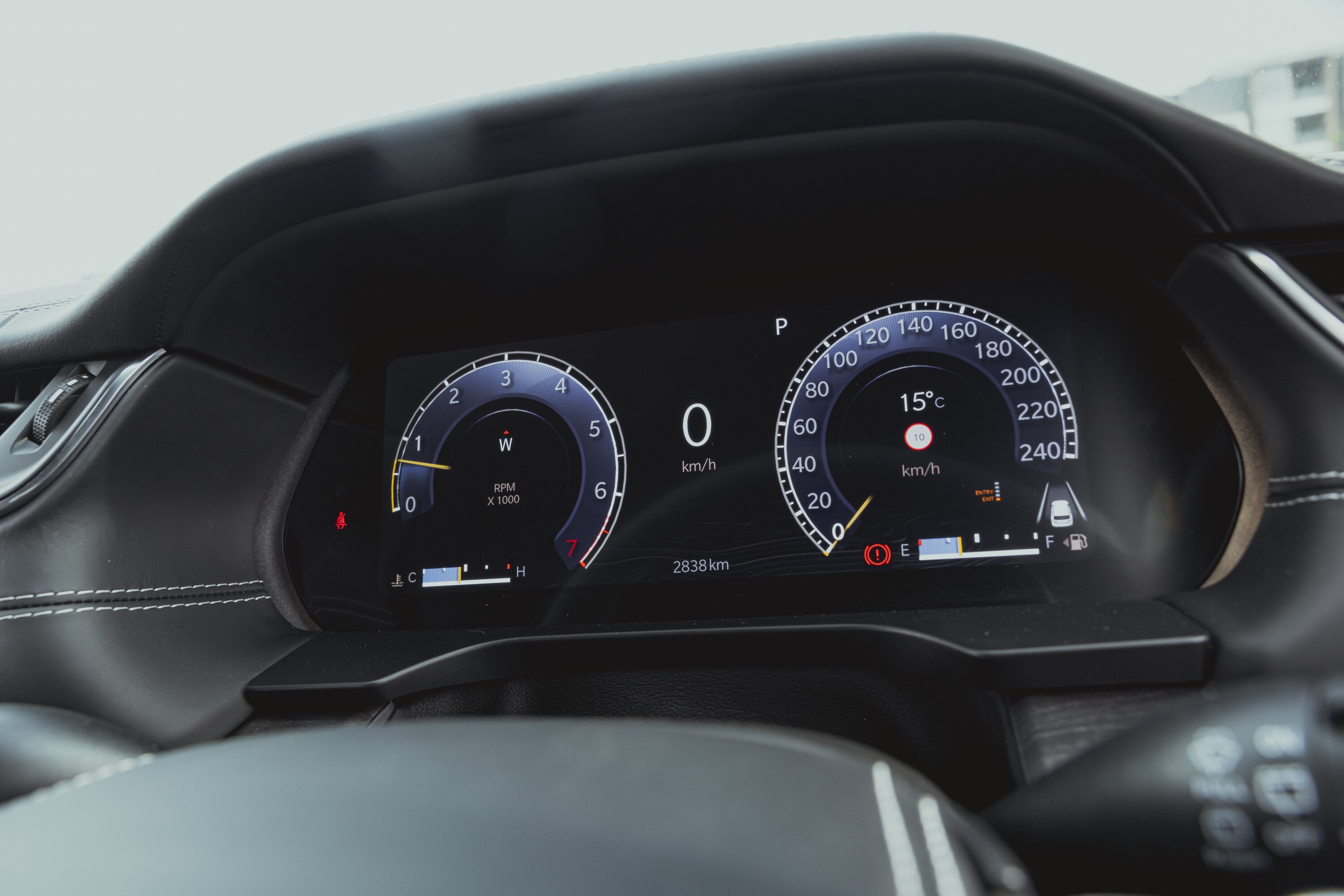
A large digital instrument cluster provides clearly legible – and not overly crowded – information. There’s decent configurability with both analogue and digital dial layouts, along with the ability to change what is displayed on the central multi-function display — media, navigation, driver settings, etc.
One unusual quirk is how easy it is to toggle between metric and imperial units on the cluster. All you have to do is hit the ‘OK’ button on the left-hand steering wheel spoke. That’s all; not even hold it down. Just hit it.
It brings to mind funny hypothetical scenarios at the best of times (‘sorry officer’), but also feels like something that shouldn’t so easily be done.
1
What is it like to drive?
Underpinned by the Stelantis Giorgio platform, Jeep’s Grand Cherokee drives distinctly from the pointy-nosed Alfa Romeo Giulia and Stelvio with which it shares an architecture.
There’s a much more relaxed nature to the way it goes about travelling down the road. The air suspension, by default, is cushiony with large amounts of compression and a nice waft, so the 2.2-tonne American floats down a potholed road. The air suspension has several different height settings and will vary on its own between drive modes.
1
While it lacks the detached recirculating-ball feeling of a ladder-frame Jeep Gladiator or Wrangler, the Grand Cherokee’s steering still has a slight on-centre delay to its calibration and quite a large amount of weight to it. The ratio itself feels nicely linear, and, despite the vehicle’s big footprint, it quickly becomes second nature to tiller this family wagon through a neighbourhood.
The carryover 3.6-litre Pentastar V6 returns for another tour of duty in this Grand Cherokee generation, producing 210kW and 344Nm, driving all four wheels through a eight-speed automatic.
Although ageing, this mill does the job, feeling nicely refined in most circumstances, operating mostly silently – except under hard load, that is.
1
It won’t blaze many cars off the traffic lights, but it won’t lag behind either.
By way of modest outputs and a hefty kerb mass, Jeep’s Grand Cherokee always feels heavy – in steering, in pace, and in brake feel. On the subject of the latter, while effective, the pedal takes a little more leaning on than expected when initially getting accustomed to this stately American family hauler.
This is a car that works best when unhurried, leaning lazily on its modest torque output but meshing well overall with the slick eight-speed. The 0-100km/h dash takes around nine seconds but really, why the hurry?
Overall, body control is clearly geared for comfort but manages the lumbering Grand Cherokee’s weight to a high degree. Discomfort only emerges with moments of head toss when hustling over bigger bumps.
Towing ability wasn’t tested this time, but the shorter wheelbase Grand Cherokee’s towing capacity is 2813kg for the 3.6-litre V6.
1
How much fuel does it use?
Jeep’s claimed fuel consumption for the V6 Grand Cherokee is 10.6L/100km.
Over our week of testing, however, our Grand Cherokee Overland returned a slightly higher 12.4/100km – which seems about right, as it’s certainly not the worst we’ve seen from this very familiar powerplant.
1
How safe is it?
Jeep’s latest-generation Grand Cherokee, on its new-for-the-model platform, is yet to be assessed by ANCAP and is currently classified as unrated.
The Grand Cherokee is equipped with a suite of eight airbags, comprising dual front, side, and curtain plus driver and front passenger knee cushions — standard across the range.
Active safety features include:
2023 Jeep Grand Cherokee Overland active safety features
Somewhat increasingly out of step with the rest of the industry, Jeep covers its vehicles with a five-year, 100,000km warranty. Most manufacturers have committed to unlimited kilometre coverage.
Jeep’s friendly-sounding ‘two-finger wave guarantee’ pledges cheaper replacement parts and roadside assistance to owners.
Capped-price servicing is pegged at $399 per visit for those first five years although, again, Jeep’s service intervals run shorter than many rivals at 12 months or 10,000km, whichever occurs first.
1
VERDICT
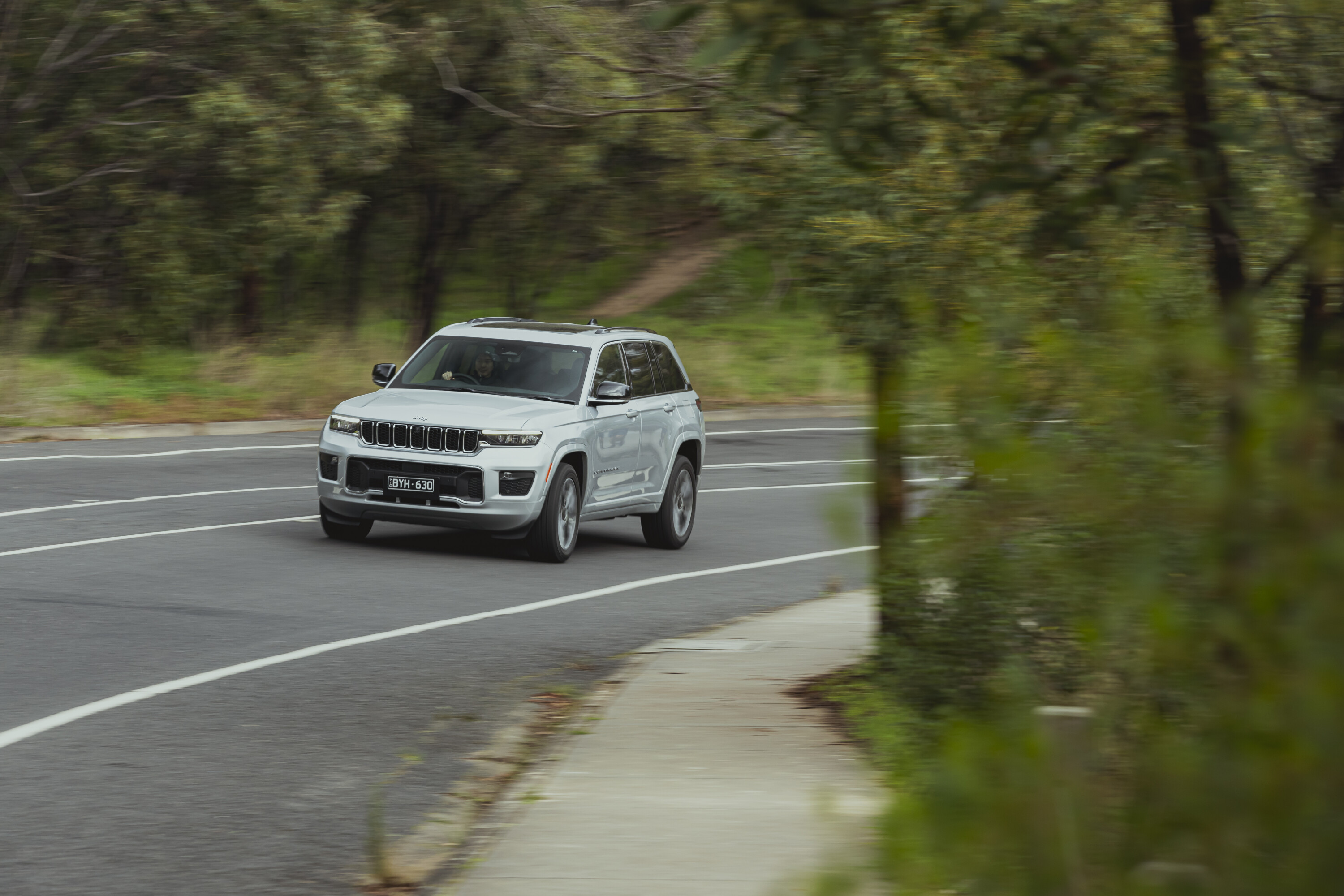
The latest five-seat iteration of Jeep’s enduring Grand Cherokee makes decisive steps in repositioning itself as a more premium, fancier product.
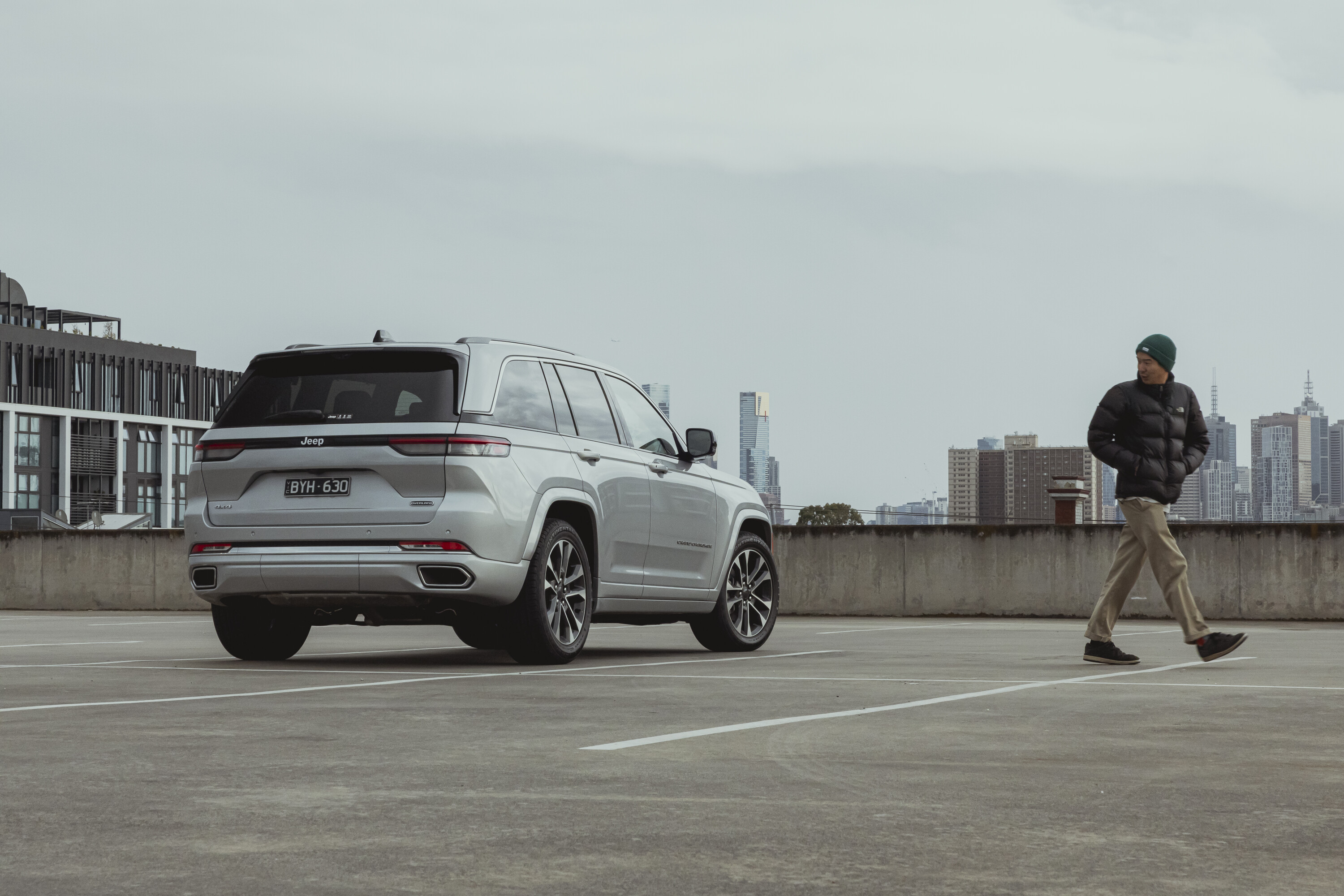
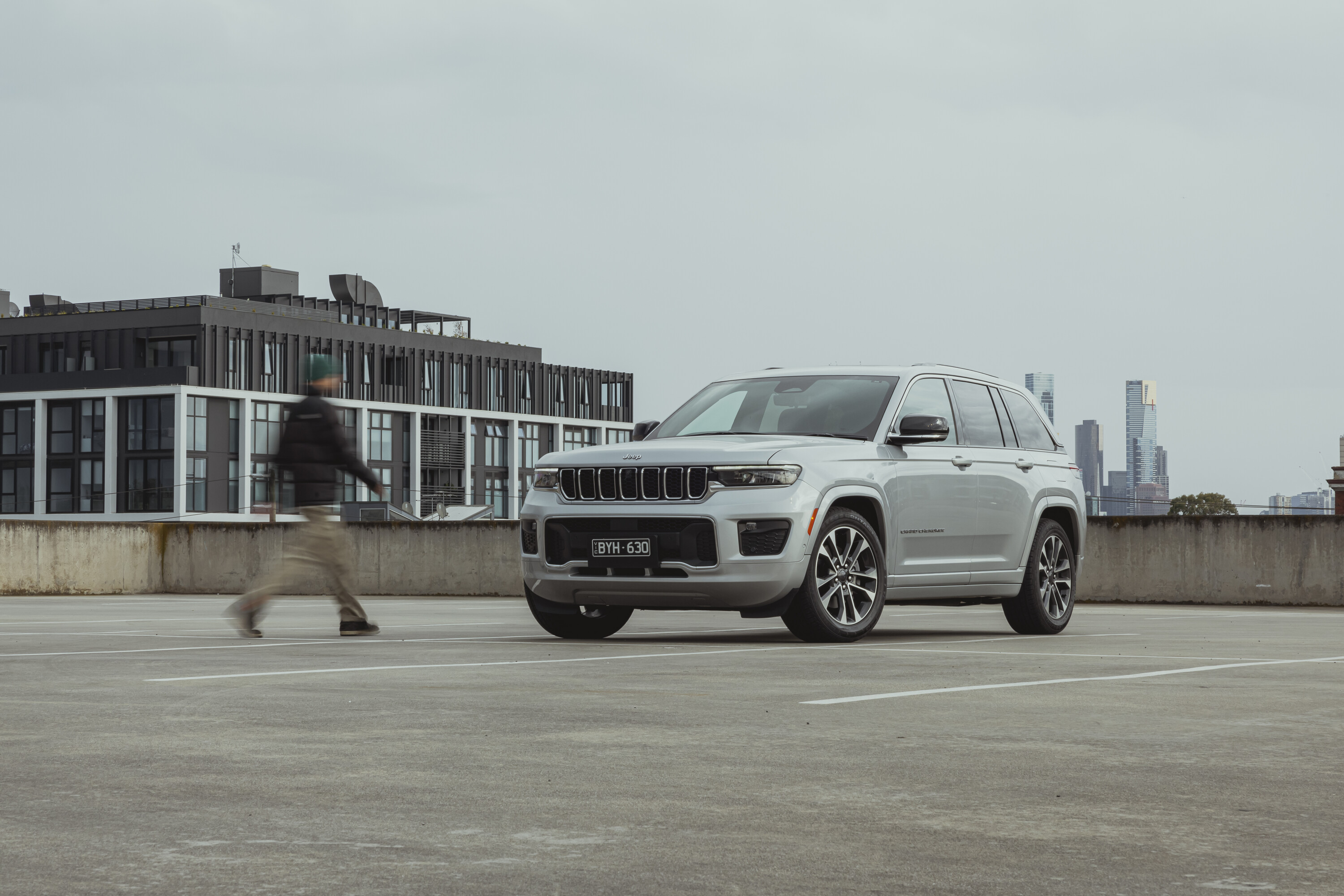
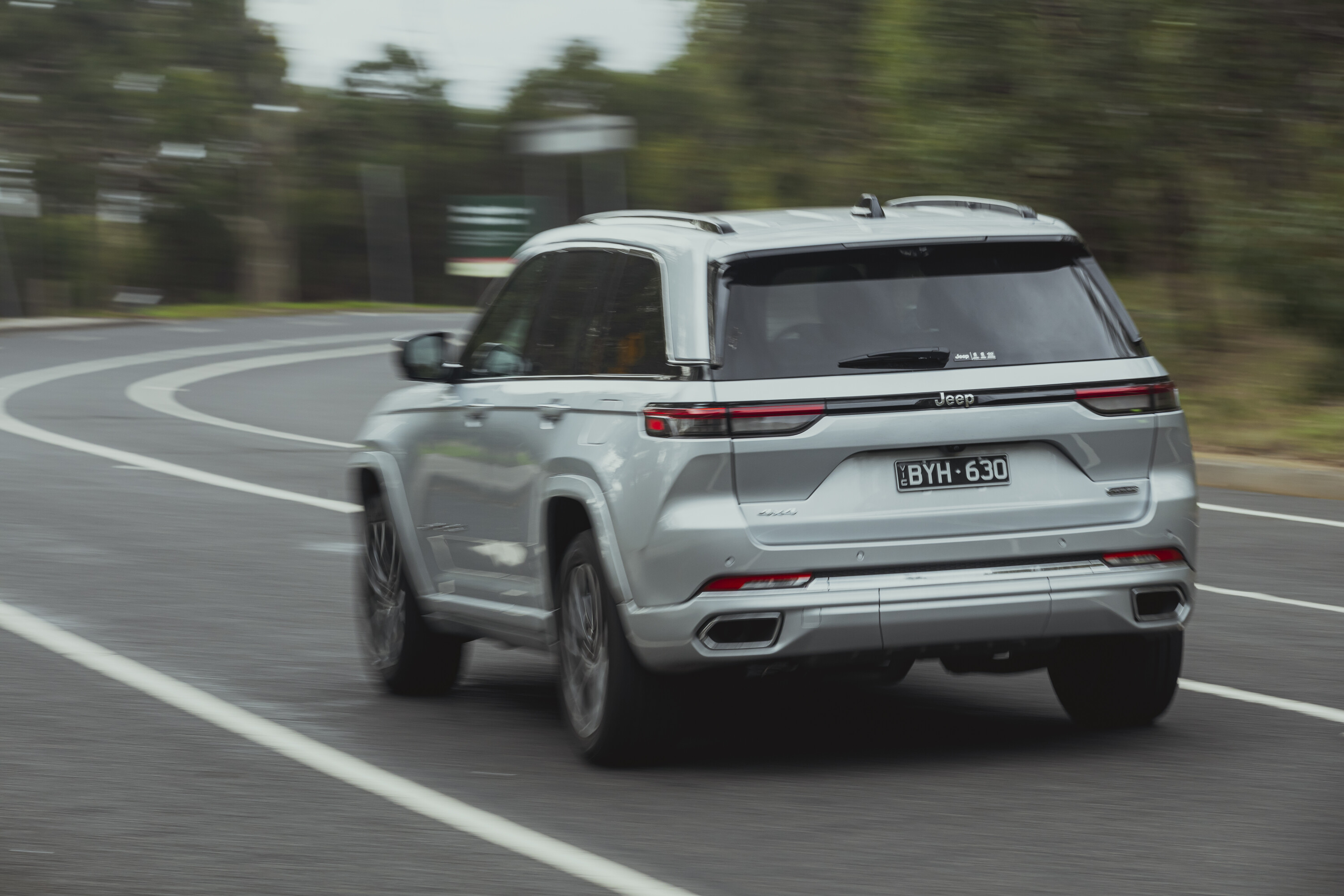
Materially, it all works; the cabin is a wonderful place to be, in an old money Americana sort of way. The exterior, even, I think looks quite handsome – and I usually abhor silver cars.
There’s something stately and graceful about the new Grand Cherokee, especially this fetching Overland variant with air suspension, polished alloy wheels and a feature set that makes rear passengers feel as cosseted as those up front.
Some blemishes on the aftersales support front are reasonable causes for doubt, however, but the car itself feels impressively solid and has been far more likeable than this writer expected.
One thing is clear; if the strides that this latest Grand Cherokee has made are signs of things to come, Jeep is on the up when it comes to its family-focused road cars.
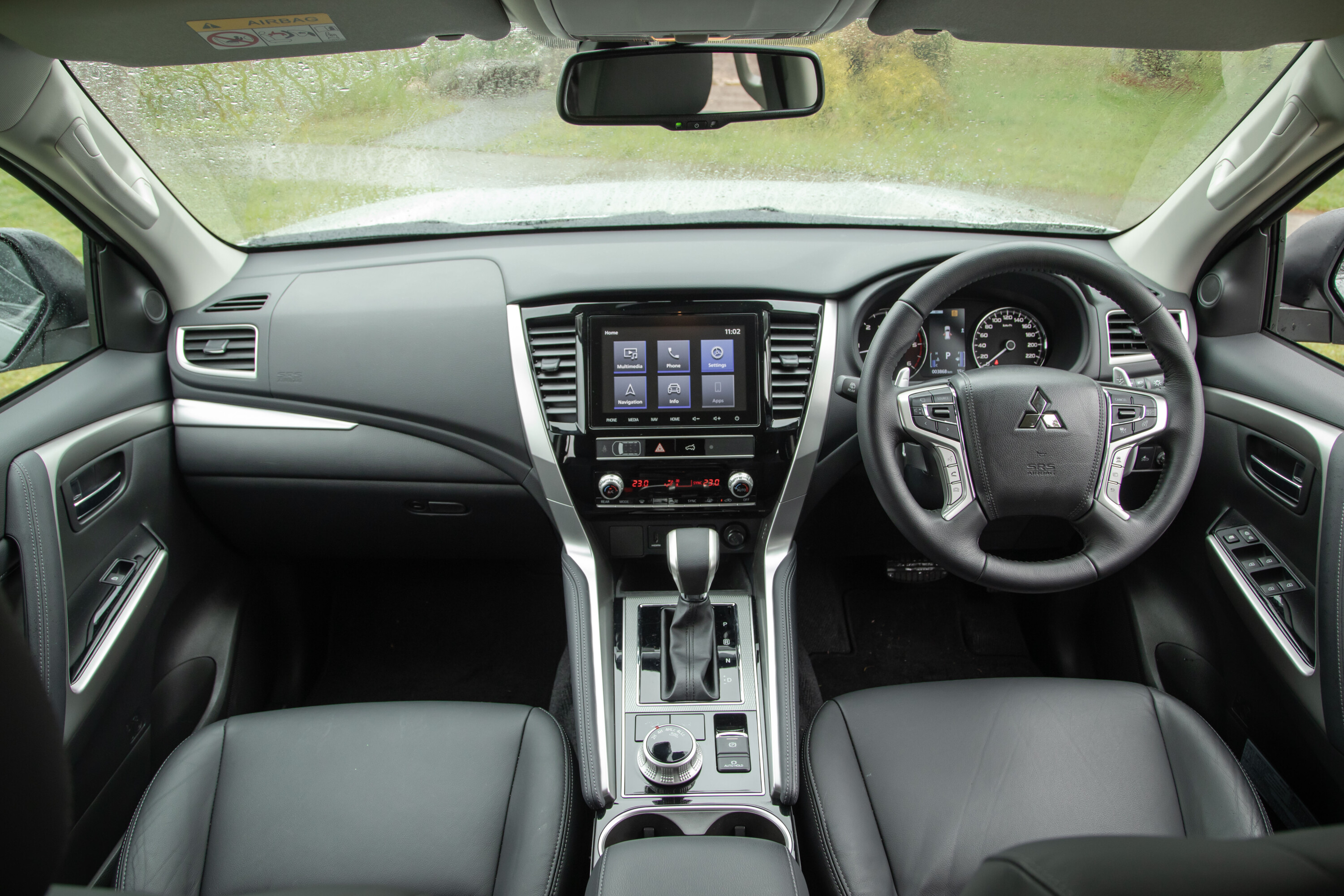
With a price tag starting from $62,440, the Pajero Sport GSR sits at the top of Mitsubishi’s SUV line-up.
Equipped with a 2.4-litre MIVEC turbo-diesel engine and an eight-speed automatic transmission, this top-tier variant exudes confidence and delivers exceptional performance.
The GSR adds plenty of pizzazz in the form of black design elements including black alloy wheels, a black rear spoiler, black front and rear bumper garnish, black radiator grille, black roof rails and a two-tone black roof. These aesthetics make the GSR model visually striking.
This 4WD-only variant also includes Super Select II 4WD, a rear differential lock, and selectable off-road modes, making it as versatile as it is stylish. It also boasts Mitsubishi’s MiTEC technology suite to enhance the driving experience.
5
Safety
The GSR offers the same extensive safety features found in the Exceed variant, such as the ultrasonic misacceleration mitigation system (UMS) and front parking sensors. Combined with the MiTEC suite – forward collision mitigation system, hill start assist and active stability control – the GSR is well-regarded for safety.
Key Rivals
As a top-spec model, the Pajero Sport GSR goes up against strong contenders like:
Its blend of premium aesthetics and advanced tech make it a solid choice in the higher-end large SUV segment. If premium features, a commanding presence and versatile off-road capabilities are what you seek in an SUV, then the 2023 Mitsubishi Pajero Sport GSR must be on your shortlist.
Priced from $60,690, the Pajero Sport Exceed is driven by a 2.4-litre MIVEC turbo-diesel engine coupled with an eight-speed automatic transmission.
The Exceed model takes the Pajero Sport line-up to another level with a host of additions. In addition to the features standard in GLX and GLS models, the Exceed gets an eight-inch LCD digital instrument display, heated front seats, an eight-speaker audio system, front parking sensors, an ultrasonic misacceleration mitigation system, and a remote smartphone app.
As for performance, the 2.4L MIVEC turbo-diesel engine combined with the eight-speed automatic transmission provides a smooth and reliable ride. Plus, the Super Select II 4WD system and rear diff lock makes the Exceed an off-road tourer.
1
Safety
The Exceed model is loaded with advanced safety technologies. Alongside the forward collision mitigation system, hill start assist, and the other features from the base models, the Exceed variant introduces the ultrasonic misacceleration mitigation system (UMS). The addition of front parking sensors further enriches the safety experience, giving peace of mind on all adventures.
Key rivals
In the high-end SUV segment, the Exceed faces stiff competition from vehicles like:
If you’re looking for a top-spec SUV that doesn’t skimp on comfort, safety or tech, the 2023 Mitsubishi Pajero Sport Exceed should definitely be on your shortlist. Its premium features and off-road ability make it a compelling choice for both on- and off-road exploration.
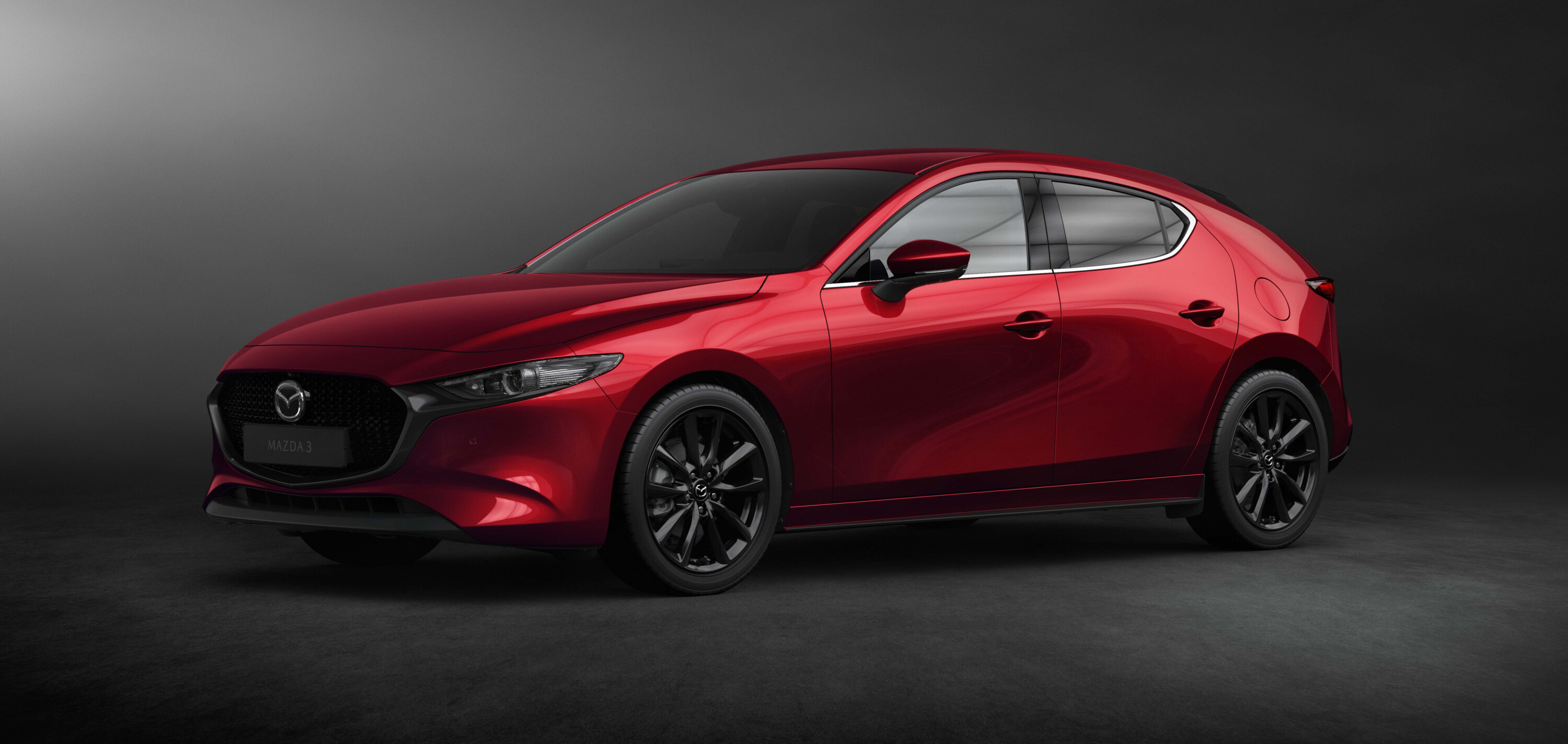
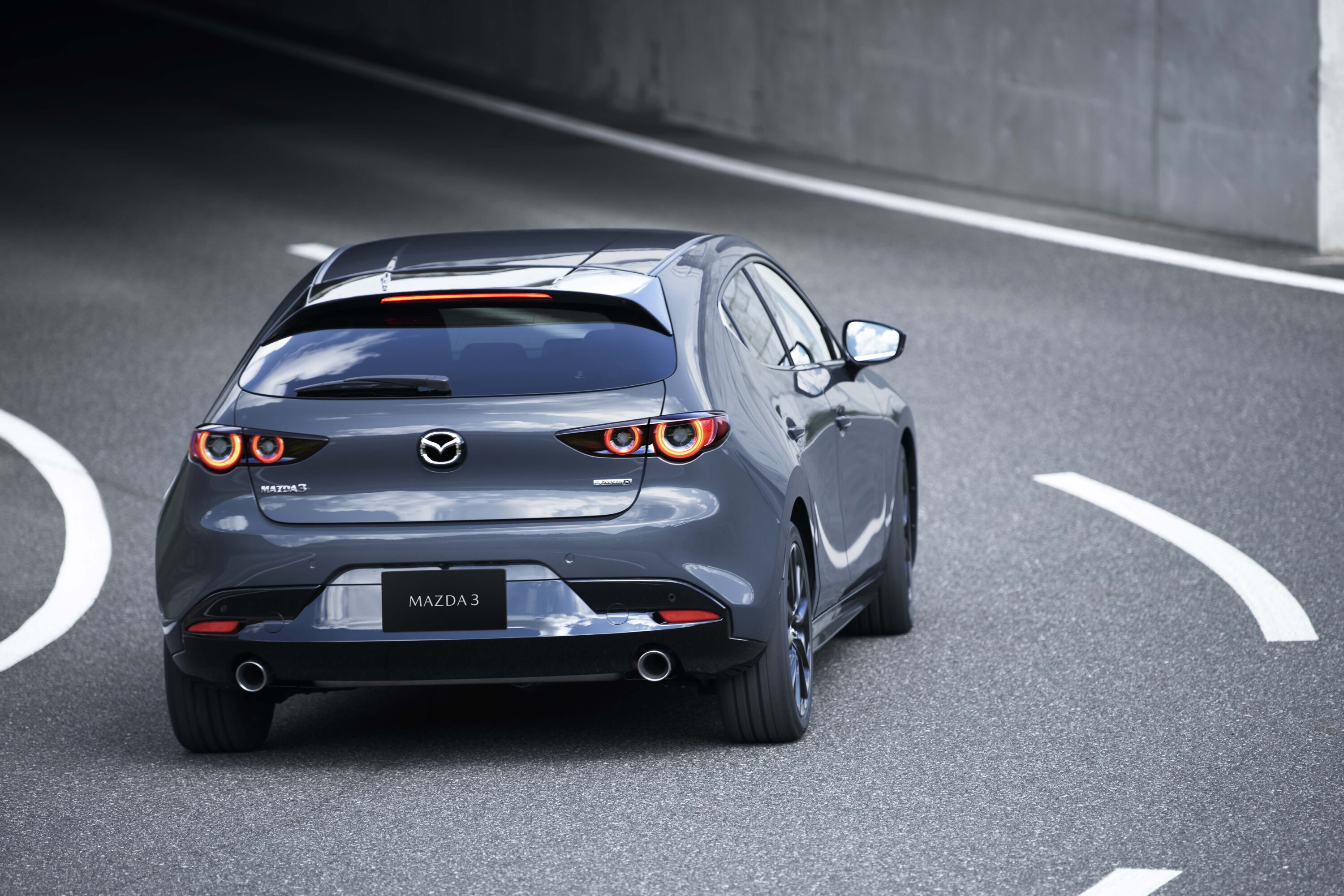
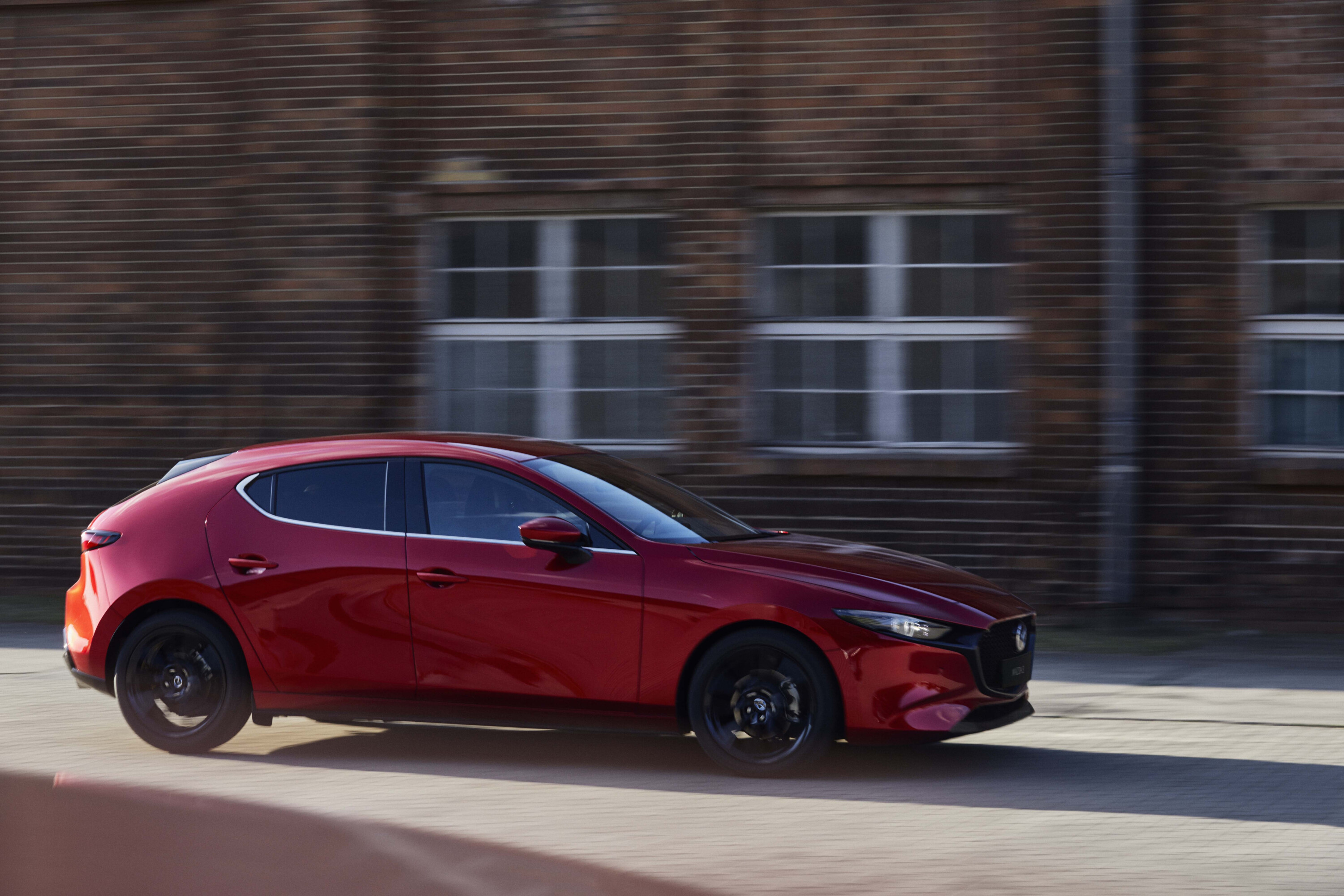
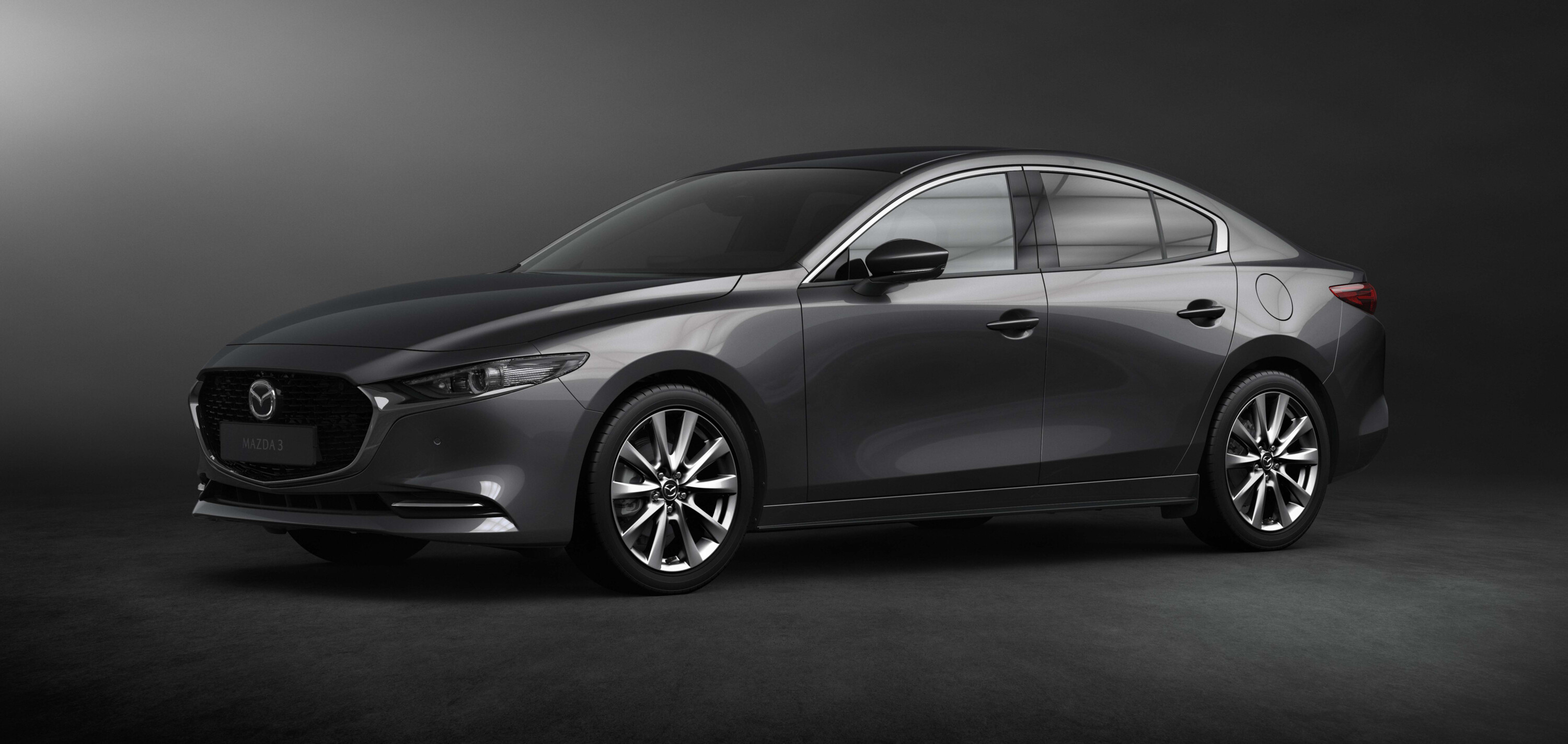
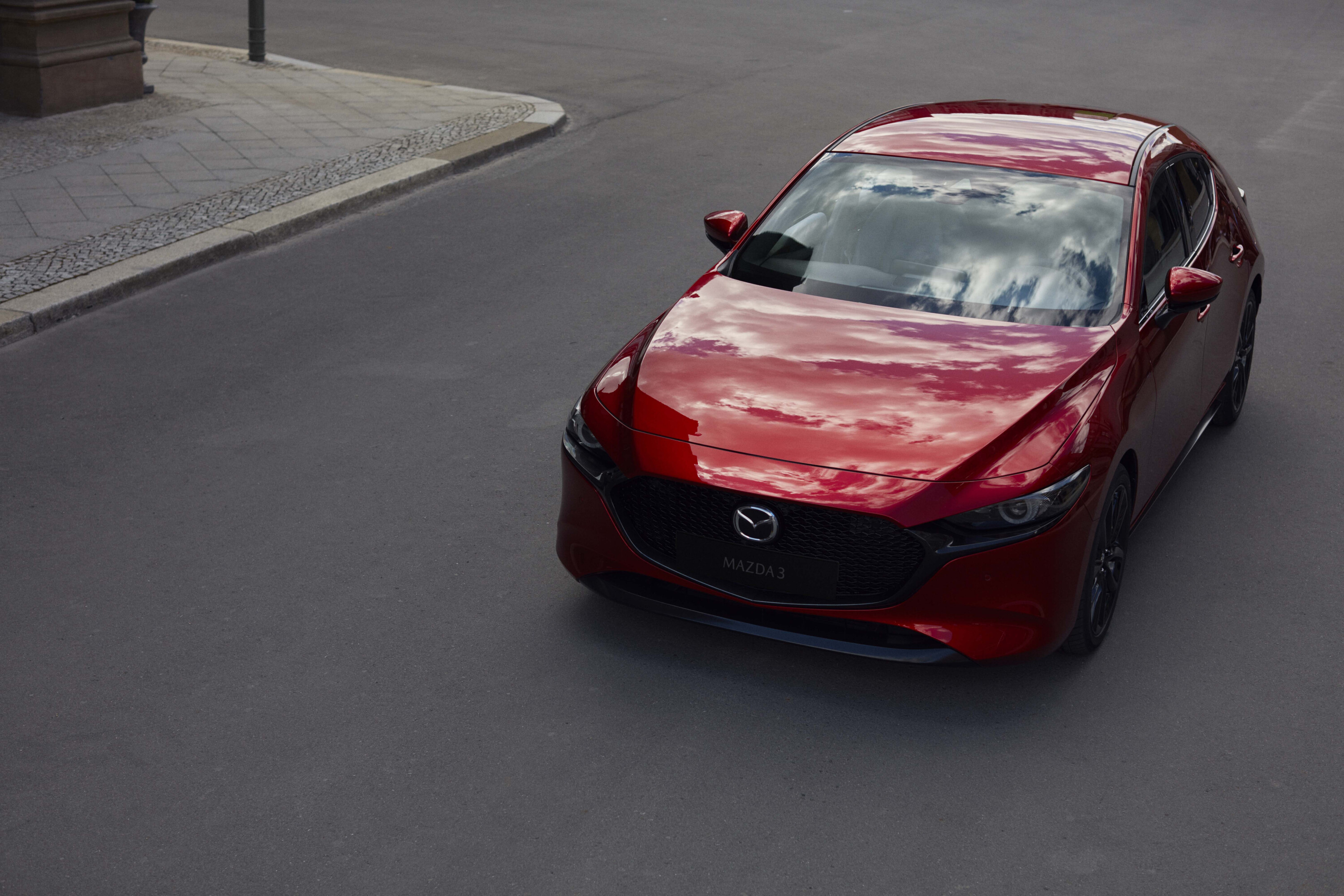
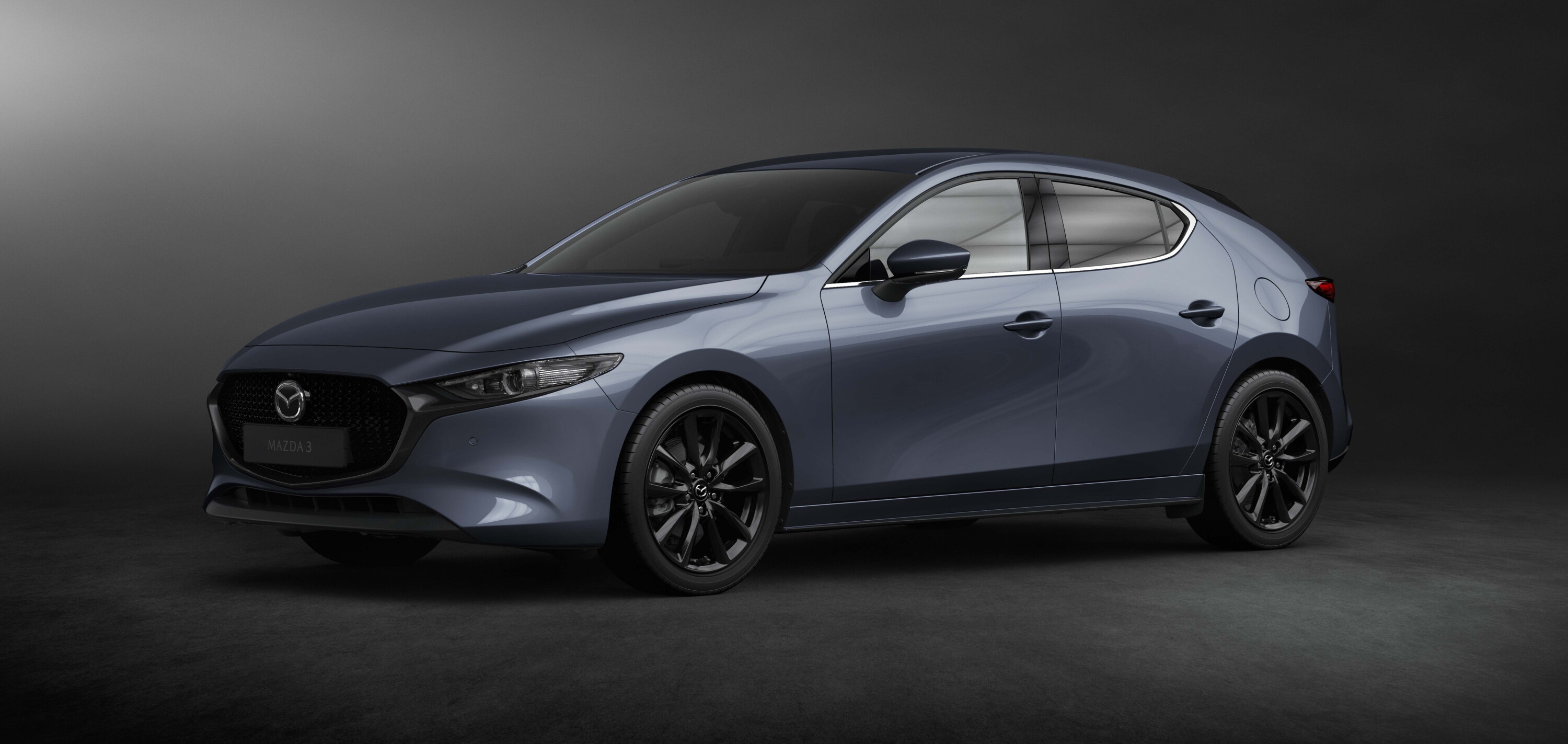
The updated 2023 Mazda 3 hatch and sedan will arrive in Australia in July, with full details released this week.
Snapshot
2023 Mazda 3 update: Full Australian details
Manual, mild-hybrids deleted; new tech and efficiency improvements
Price rises up to $2160; now starts above $30,000
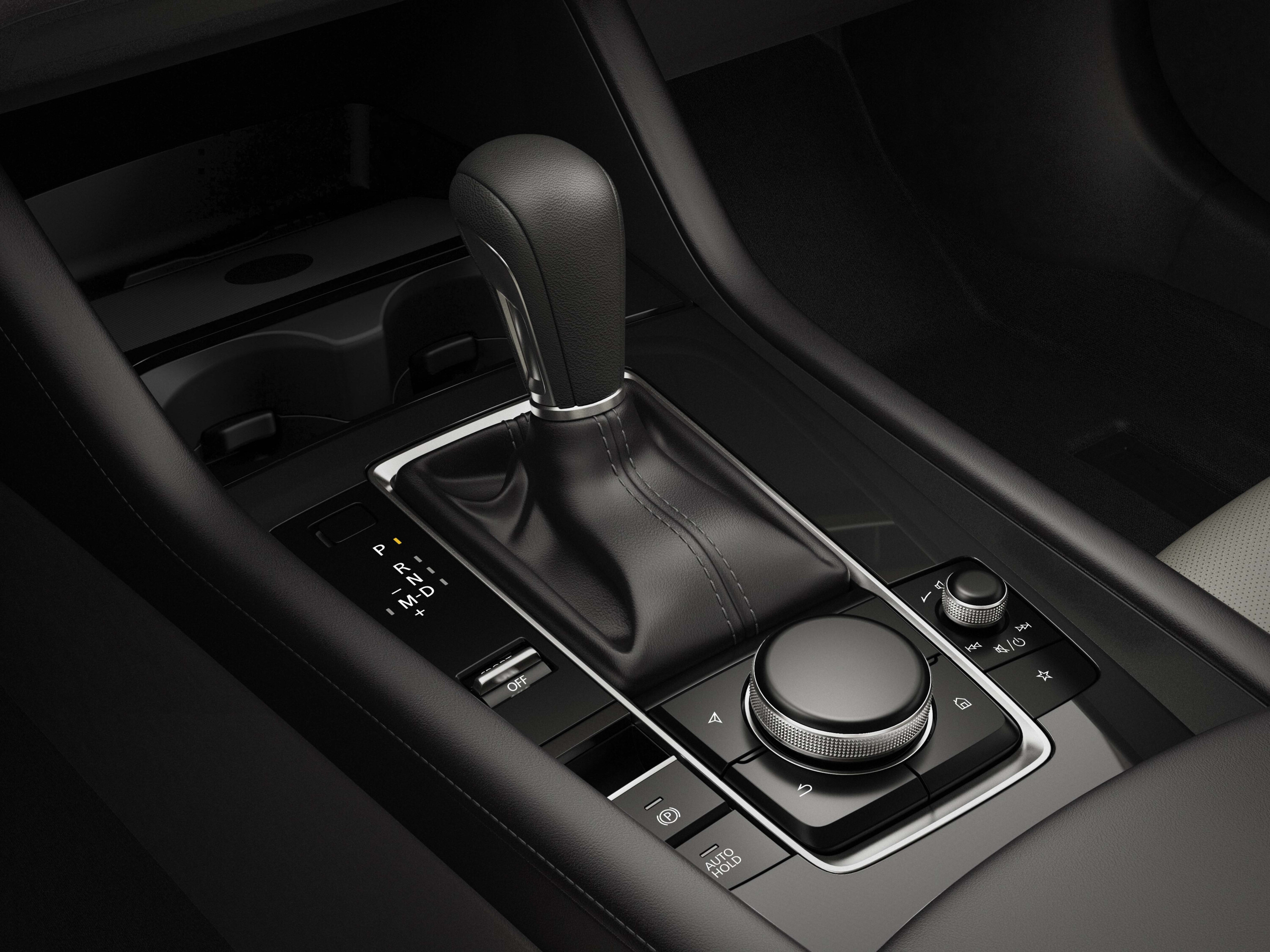
As announced, the latest Mazda 3 is automatic-only, with the manual transmission accounting for just three per cent of sales in 2022 – despite its availability on all non-electrified variants.
Joining the manual in the automotive graveyard will be the mild-hybrid variants, with the short-lived G20e Evolve and X20 Astina axed in Australia, leaving just eight of 14 variants remaining.
As such, the local Mazda 3 range is now restricted to 2.0-litre and 2.5-litre naturally-aspirated four-cylinder engines, with minor efficiency improvements – both matched to an unchanged six-speed automatic transmission.
1
Prices for the updated Mazda 3 have increased by up to $2160, with the entry-level model listed above $30,000 before on-road costs for the first time in the nameplate’s two-decade history.
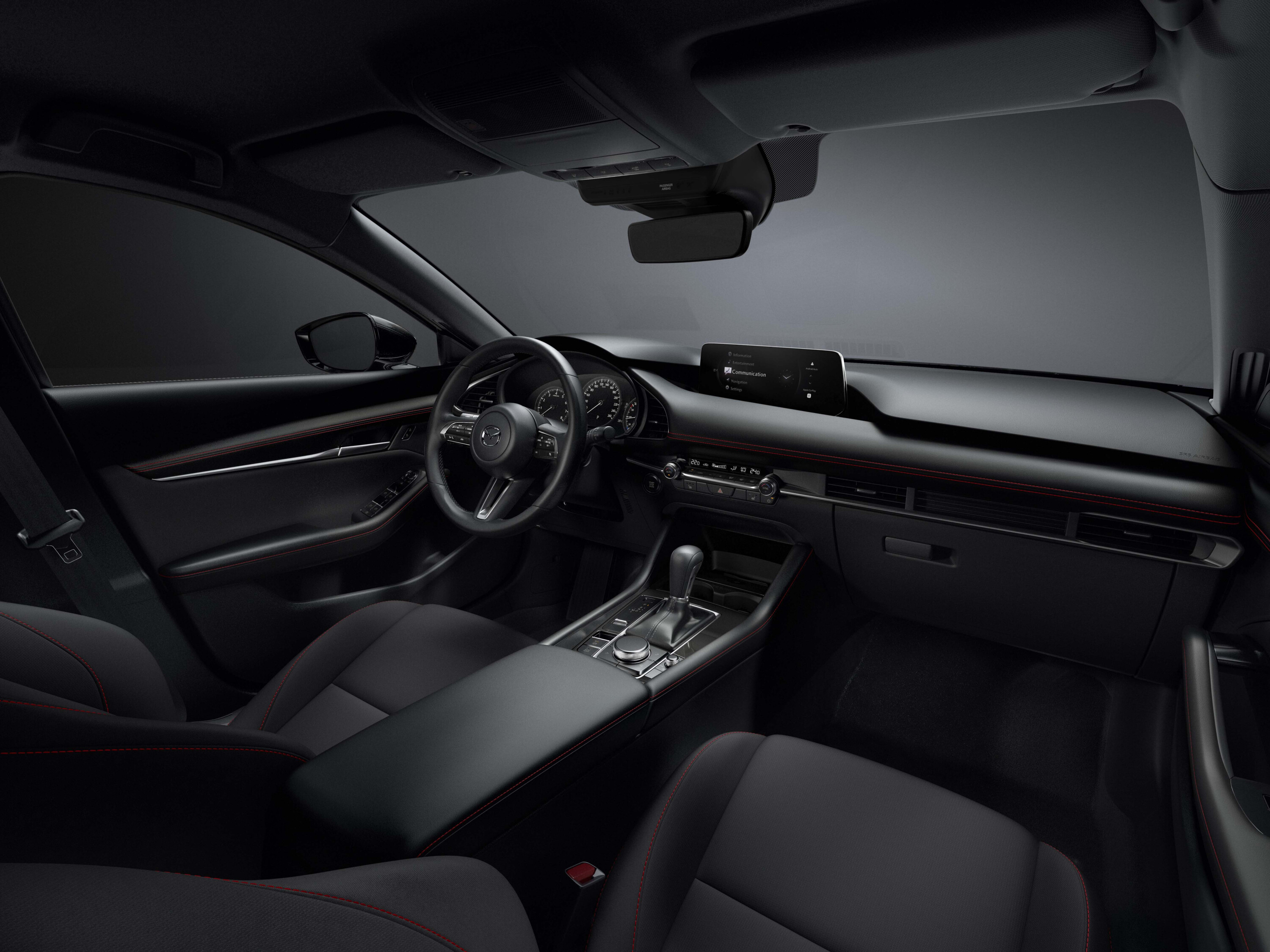
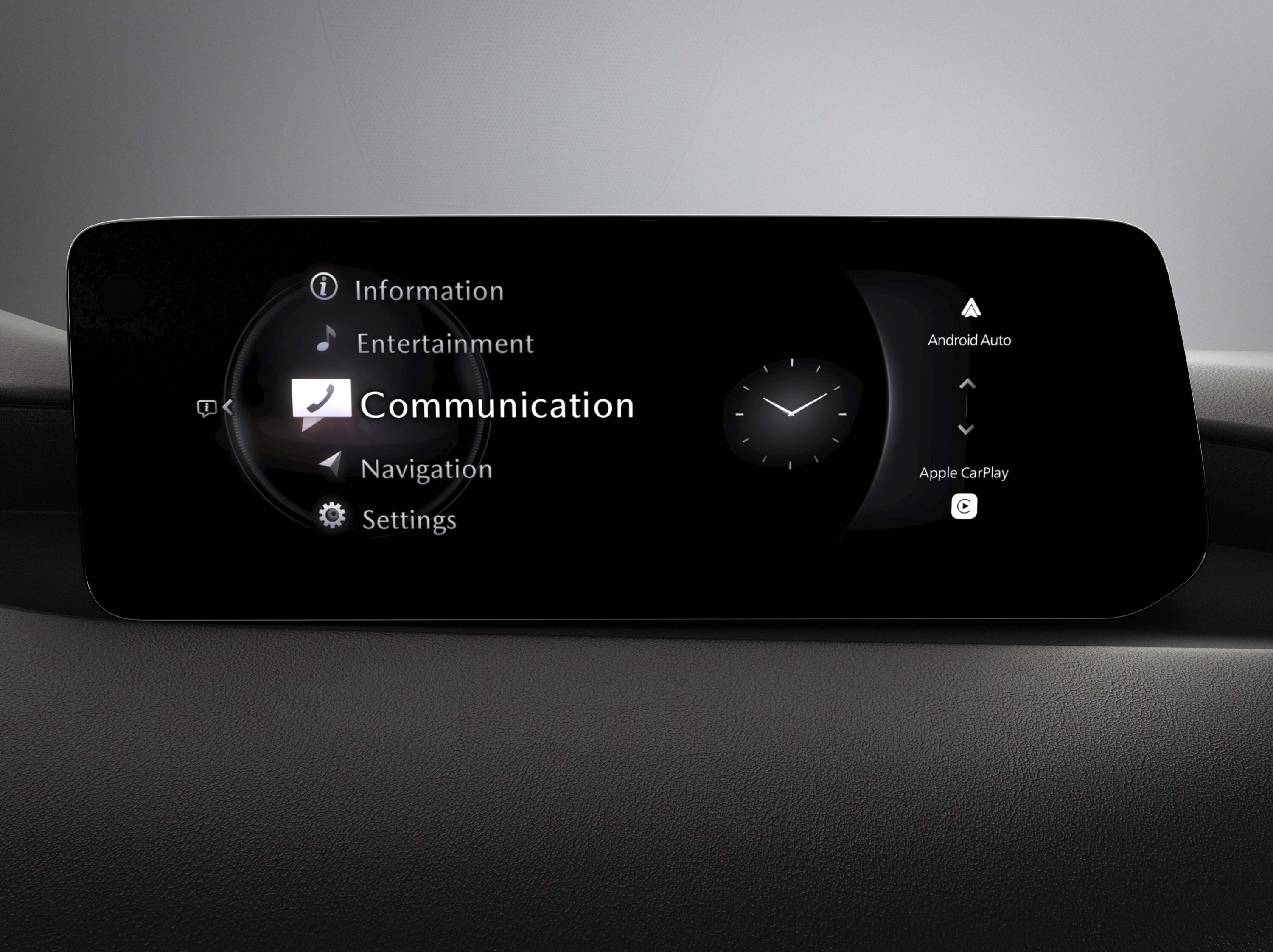
Other additions include a larger 10.25-inch Mazda Connect infotainment system, wireless Apple CarPlay and Android Auto, and a wireless phone charger on range-topping variants.
The larger screen, up from 8.8 inches, is standard on G25 GT and Astina. It is available in the optional Vision Technology package for lower grades, for an additional $2000 – up from last year’s $1500 to account for the added technology.
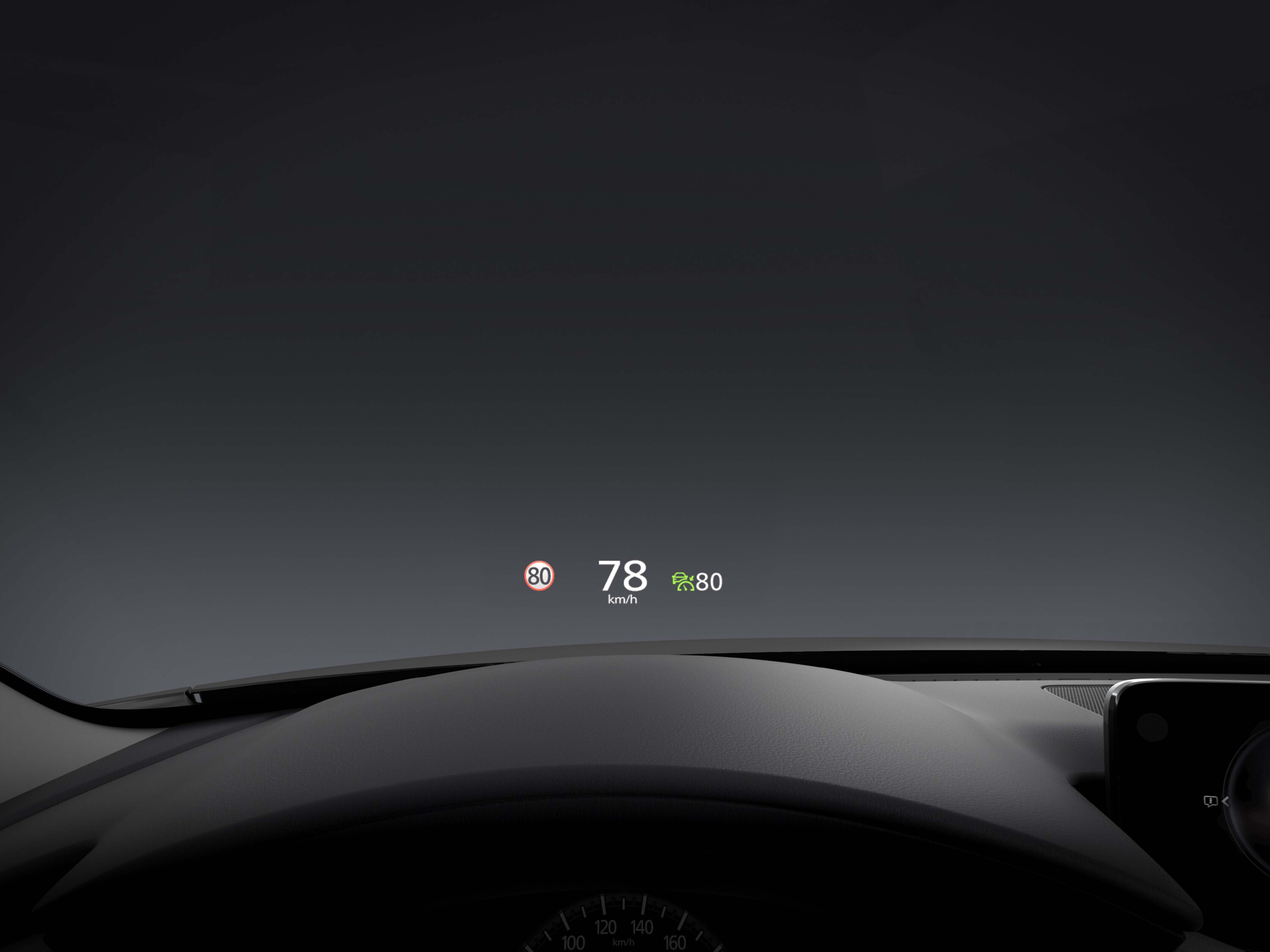
The optional Vision Technology package – standard on G25 Astina – adds a 360-degree camera system, traffic jam assist, front-cross traffic alert, a driver monitoring camera, and front parking sensors.
The larger 10.25-inch screen is added for the G20 Pure, Evolve, Touring and G25 Evolve SP with the package, with its price rising from $1500 to $2000.
As the 10.25-inch infotainment system is standard on the G25 GT, the Vision Technology pack remains available for $1500.
Mazda offers two four-cylinder powertrains for the 3: a naturally-aspirated 2.0-litre (G20) or a higher-capacity 2.5-litre non-turbo engine (G25).
G20 variants are fitted with the 2.0-litre naturally-aspirated petrol engine producing 114kW and 200Nm.
Available in G20 Pure, Evolve and Touring grades, it has received cylinder deactivation and minor improvements, with a five per cent fuel consumption reduction, at 5.8L/100km for the sedan and 5.9L/100km for the hatch.
1
Those with a 2.5-litre under the bonnet have 139kW and 252Nm.
Both powertrains are now exclusively matched to a six-speed torque-converter automatic transmission, sending power to the front wheels.
The more-potent 2.5-litre turbo engine and all-wheel-drive remain unavailable to the Mazda 3 locally. At the recent CX-8 and 6 media launch, Mazda Australia marketing boss Alastair Doak said: “Unfortunately [there is no update] at this stage, so it’s still on the wish list.”
The Mazda 3 range is covered by a five-star ANCAP safety rating, based on testing conducted in 2019.
It has a 98 per cent score for adult occupant protection, 89 per cent for children, 81 per cent for vulnerable road users, and 76 per cent for safety assist.
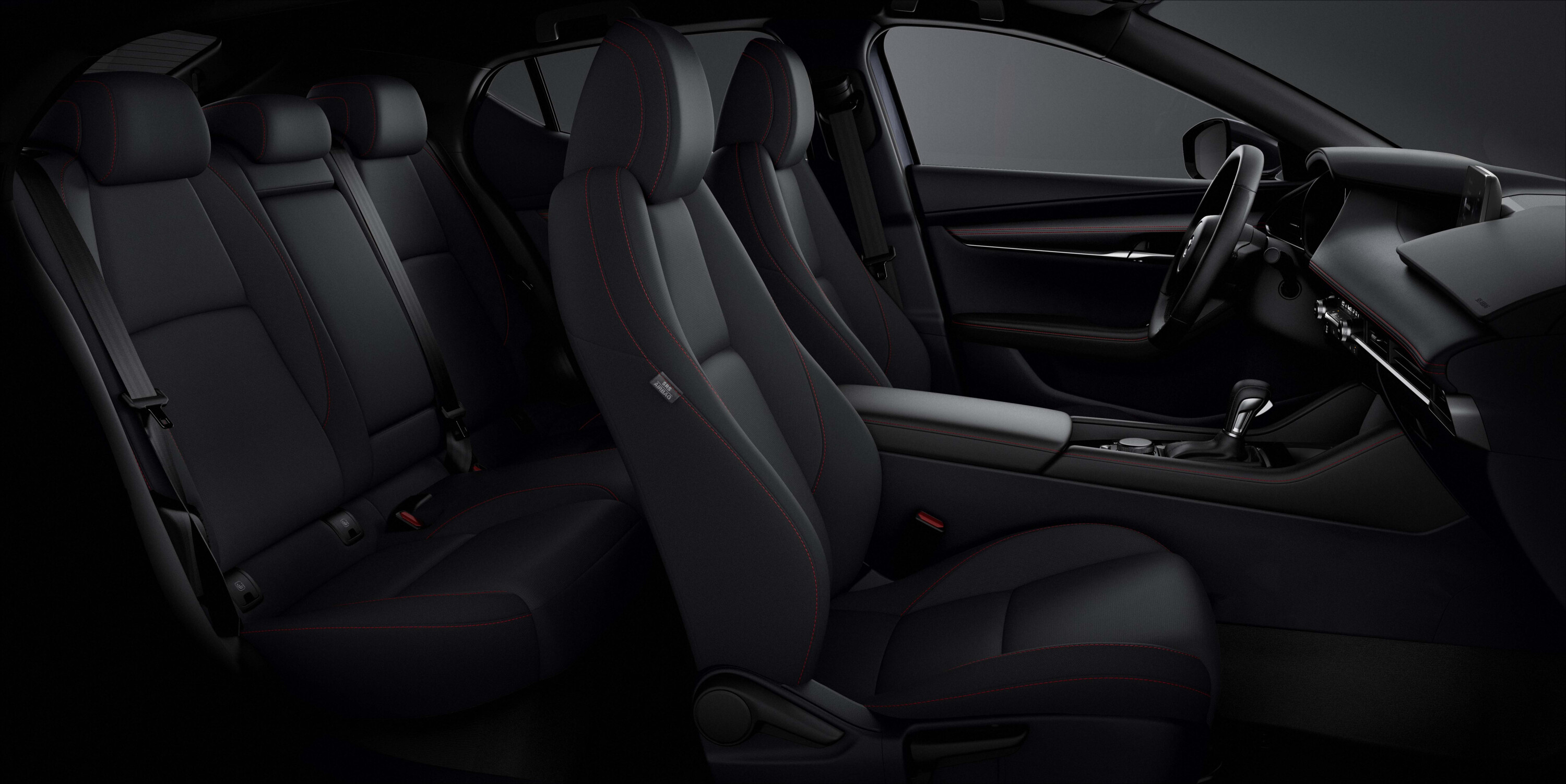
Seven airbags (dual front, side, curtain, and driver’s knee) feature across the range.
As per the wider Mazda range, the 3 is covered by the brand’s five-year, unlimited-kilometre warranty, and a five-year roadside assistance program.
The service schedule for all Mazda 3 variants is now 12 months or 15,000km, whichever occurs first – up from 10,000km. Mazda offers five years of capped-price servicing.
Priced from $50,190, the Pajero Sport GLS takes everything you love about the GLX model and amplifies it, delivering superior comfort and convenience while maintaining its robust performance.
In addition to the standard features of the GLX, the GLS adds an auto-dimming rear-view mirror, powered tailgate, a tyre-pressure monitoring system, a rear floor storage box, and automatic dusk-sensing headlights and rain-sensing wipers. Plus, it has a third row and seven seats.
This additional row has a split-fold function and recline adjustment, allowing for flexible seating and cargo arrangements. Plus, privacy glass and a rear spoiler add style to the mid-level variant.
The GLS enhances the entertainment experience with a bump in audio quality, thanks to the six speakers.
2
Safety
The Pajero Sport GLS doesn’t compromise on safety. Building on the solid safety foundation of the GLX model, the GLS adds a tyre-pressure monitoring system (TPMS) and additional MiTEC features including automatic dusk-sensing headlights and automatic rain-sensing wipers.
Like the GLX, the GLS is equipped with Mitsubishi’s MiTEC suite of safety features, offering the same protection and assistance for peace of mind on every journey.
Key rivals
The Mitsubishi Pajero Sport GLS competes in the tough market of midsize SUVs against the likes of:
Yes. If you’re after an SUV that blends practicality, comfort and a high level of standard features at a competitive price point, the 2023 Mitsubishi Pajero Sport GLS deserves a spot on your shortlist.
Snapshot
Aston Martin’s hallmark V12 no longer available
DB12 powered exclusively by 500kW/800Nm 4.0-litre twin-turbo V8
0-100km/h in 3.6sec
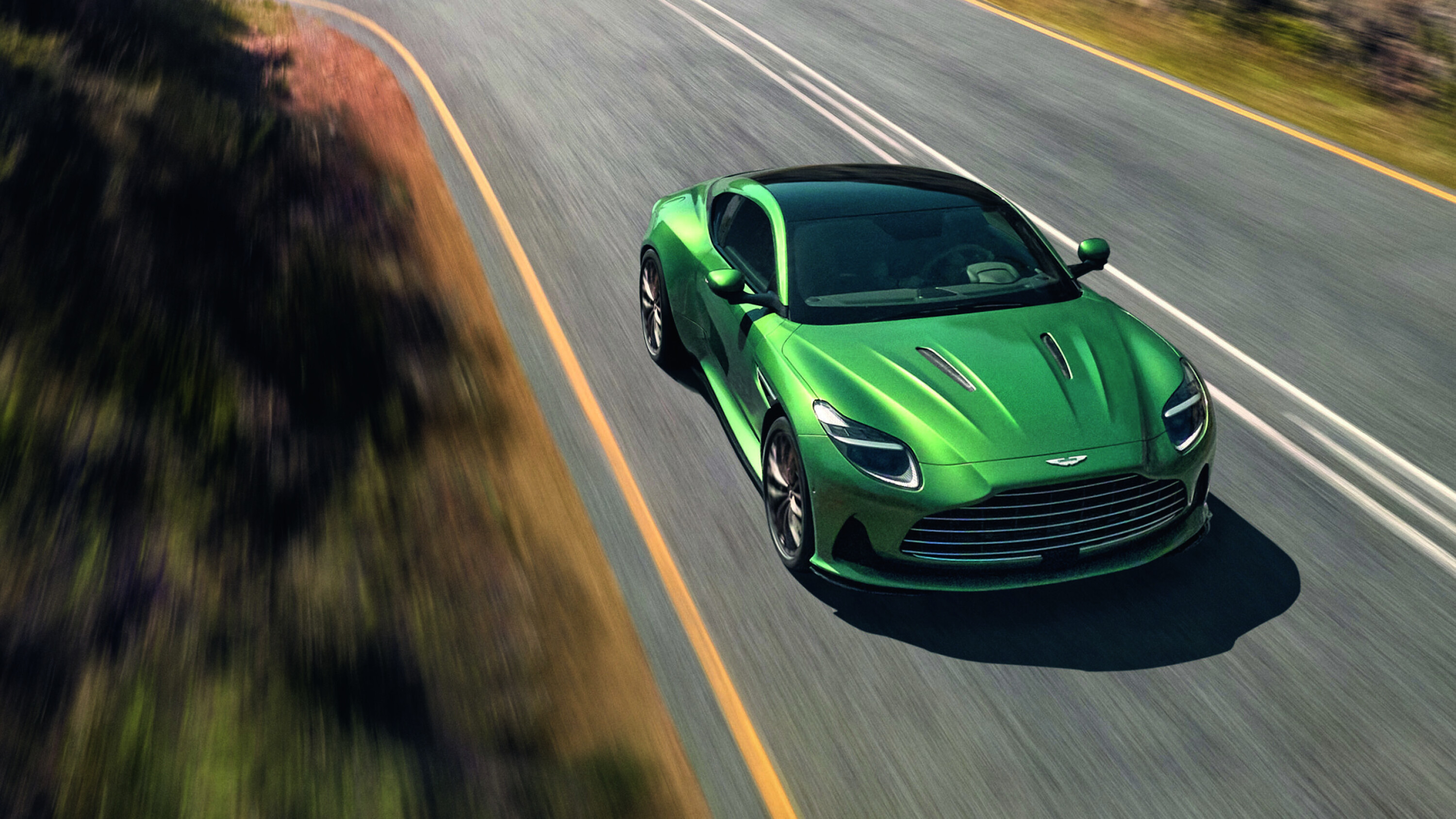
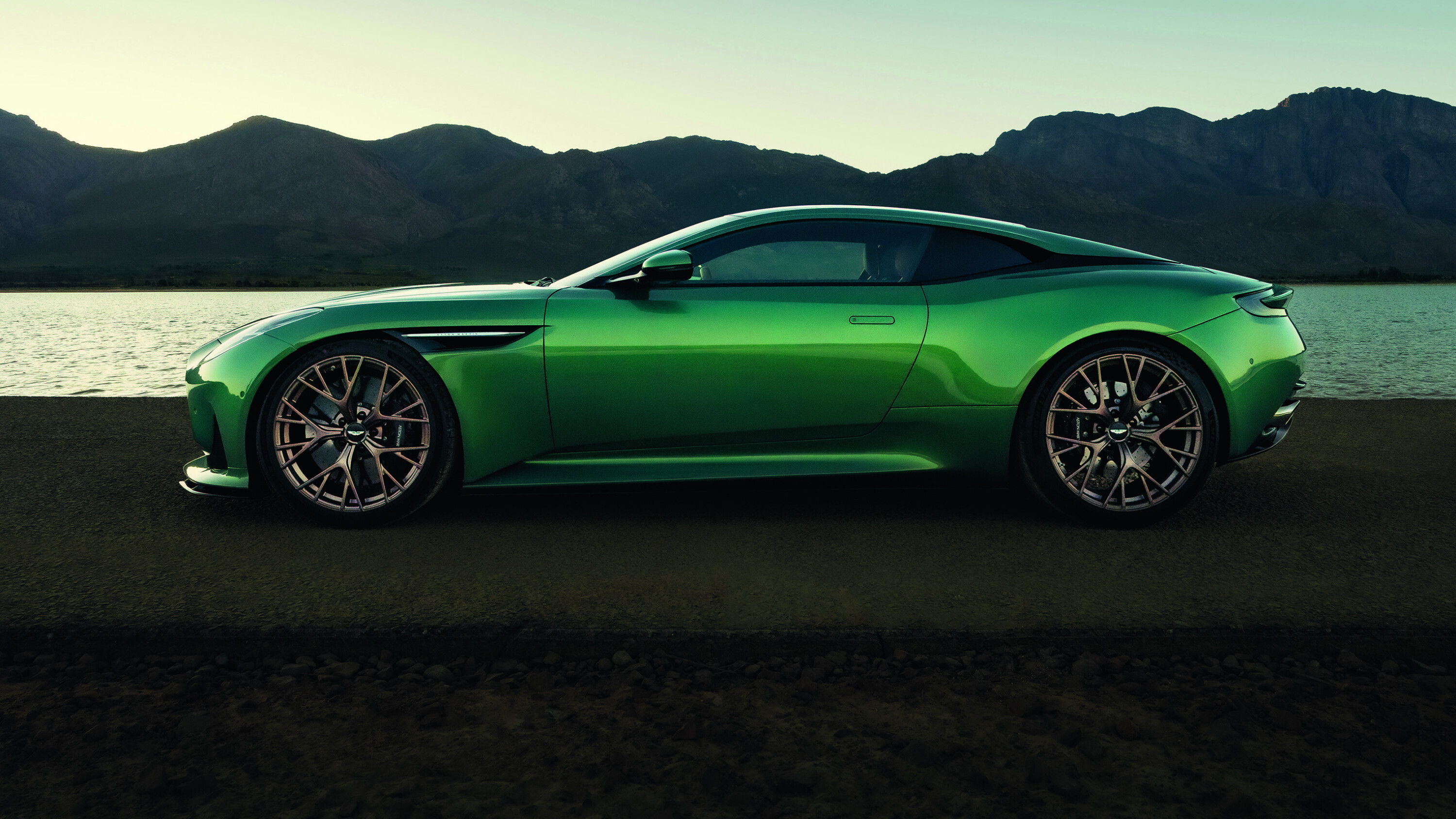
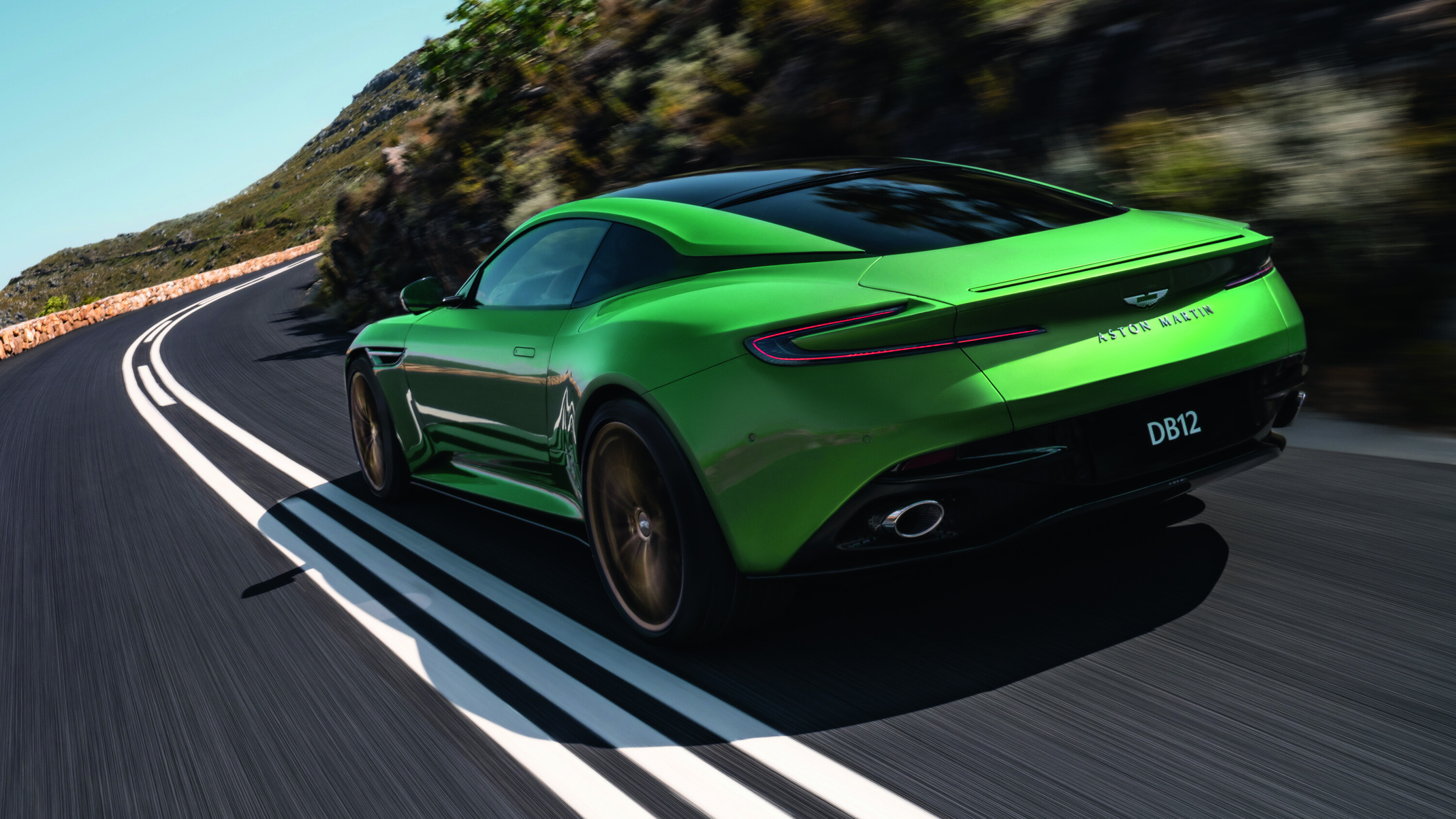
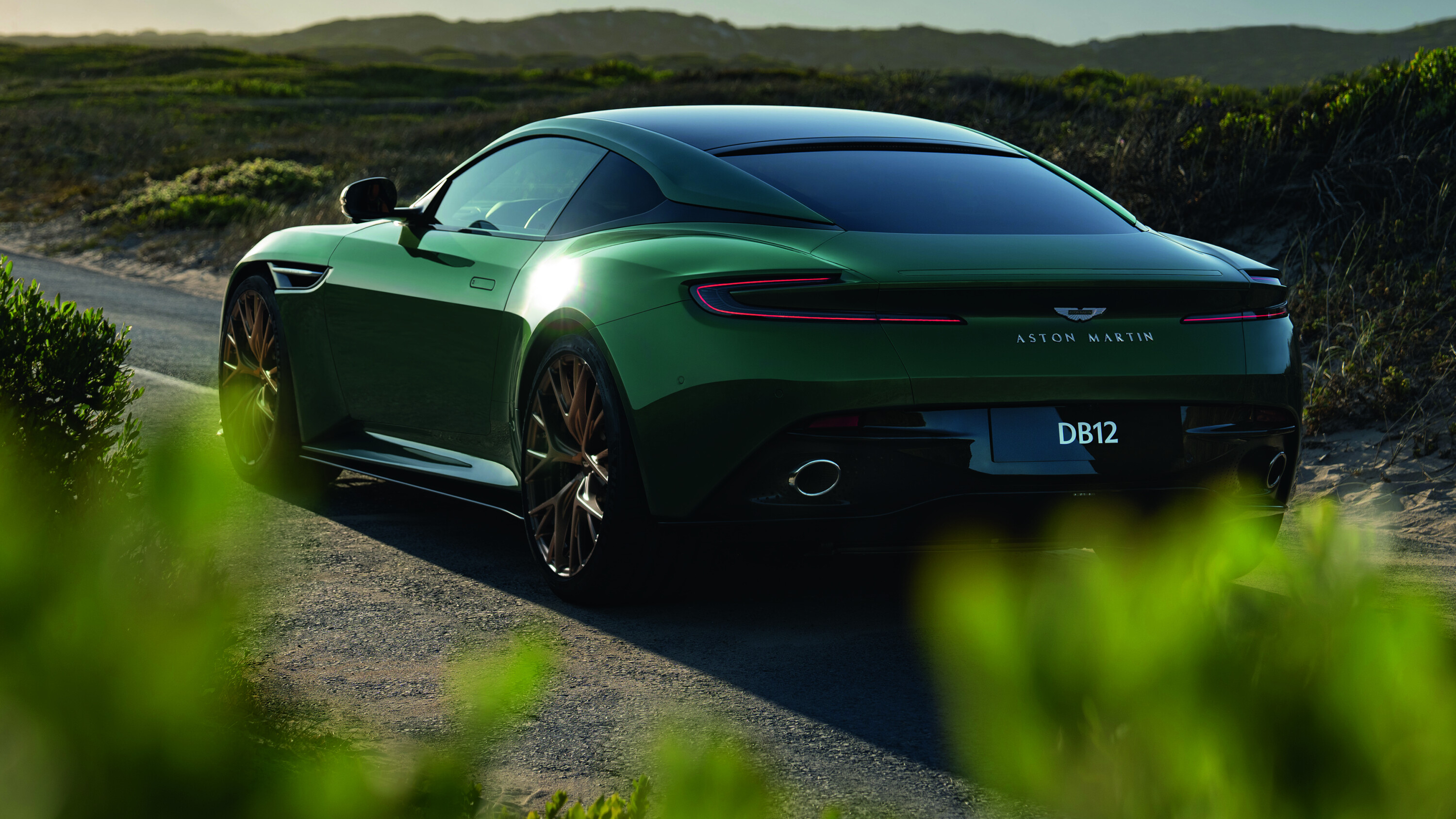
Aston Martin‘s newest grand tourer, the DB12, succeeds the DB11 as the brand’s prolific, spearhead GT car.
The latest member of Aston Martin’s esteemed 75-year old DB-lineage, the storied British sportscar maker has made the decision to retire its hallmark 12-cylinder engine.
As such, the new Aston Martin DB12 will be available exclusively with the Mercedes-AMG-sourced 4.0-litre twin-turbo V8, in this application wicked up to 500kW (at 6000rpm) and 800Nm (from 2750-6000rpm).
1
That’s up 53kW on the now-defunct 447kW 5.2-litre twin-turbo V12-powered DB11, when it originally launched in 2017.
The heavily-turbocharged V8 enables the new DB12 to deliver a 3.6-second 0-100km/h claimed time, and a top speed of 325km/h.
The V8 mates to an eight-speed automatic, of a similar design to the previously used unit, but fitted with a shorter overall final drive for improved in-gear response.
1
The DB12 also debuts a new-for-Aston electronic rear limited slip differential which can go from 0-100 per cent locked in a matter of milliseconds.
Other mechanical developments include new cam profiles, compression ratio, larger turbocharger housings, along with two auxiliary charge air coolers added to the main radiator.
New suspension includes adaptive dampers, which Aston claims to provide a 500 per cent increase in scope of force distribution, with four electronic stability profiles and five selectable Drive Modes: Wet, GT, Sport, Sport Plus and Individual.
1
Compared with the outgoing DB11, the DB12 enjoys a seven per cent improvement to torsional stiffness thanks to improved engine cross bracing, undertrays, front crossmember and rear bulkhead components.
The DB12 is cornered by 21-inch forged alloy wheels shod in the new Michelin Pilot 5S tyres, housing 400m/360mm brakes — cast iron as standard, carbon ceramic as an option.
Overall unsprung mass savings are pegged at 27kg. Tracks have widened by 6mm up front, and 22mm at the rear.
1
While the face looks fresh, seemingly trading a visual language closer to the larger DBS Superlegerra, compared to the almost art-deco DB11, the turret, B-pillars and rear end largely indistinguishable from the succeeded DB-car.
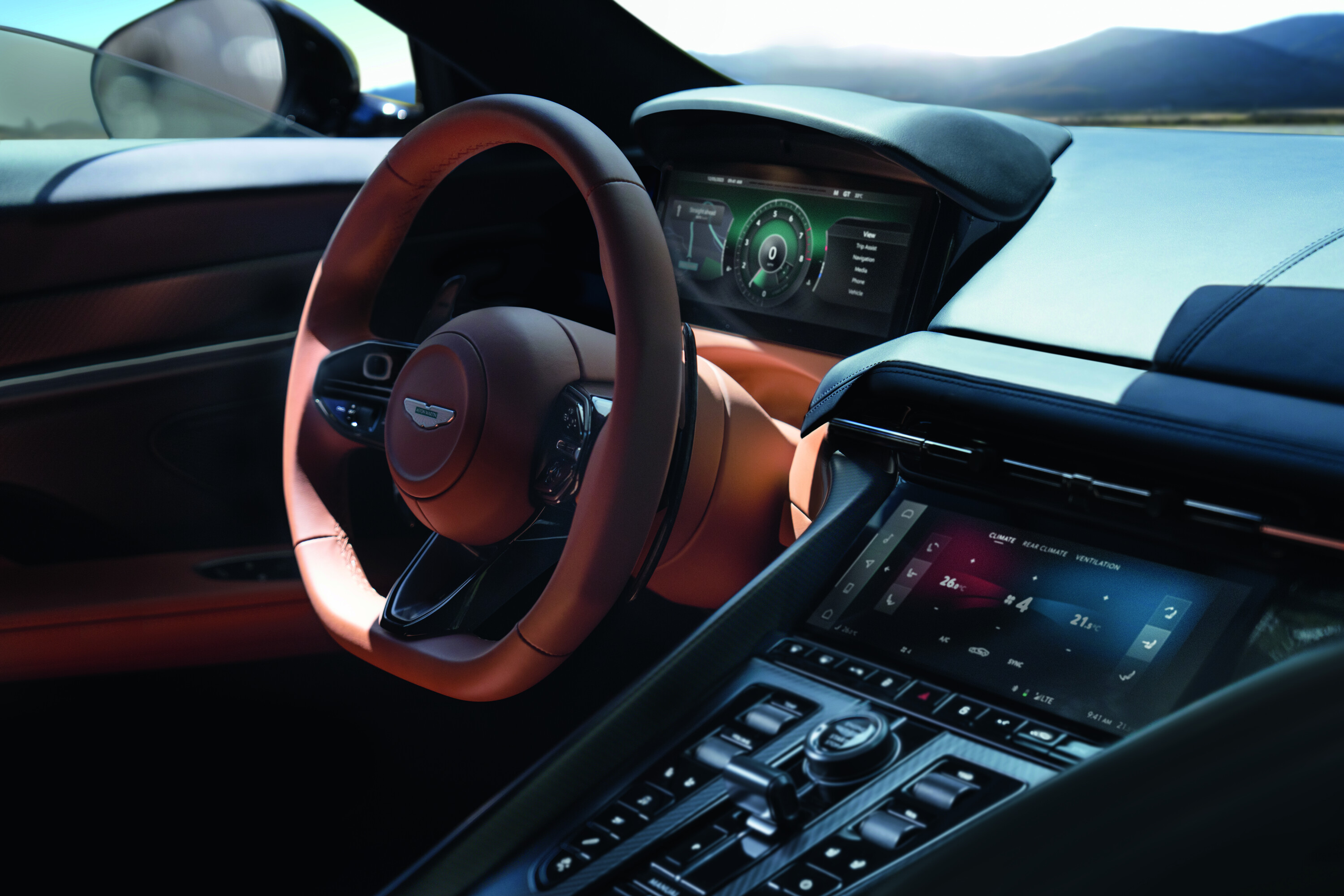
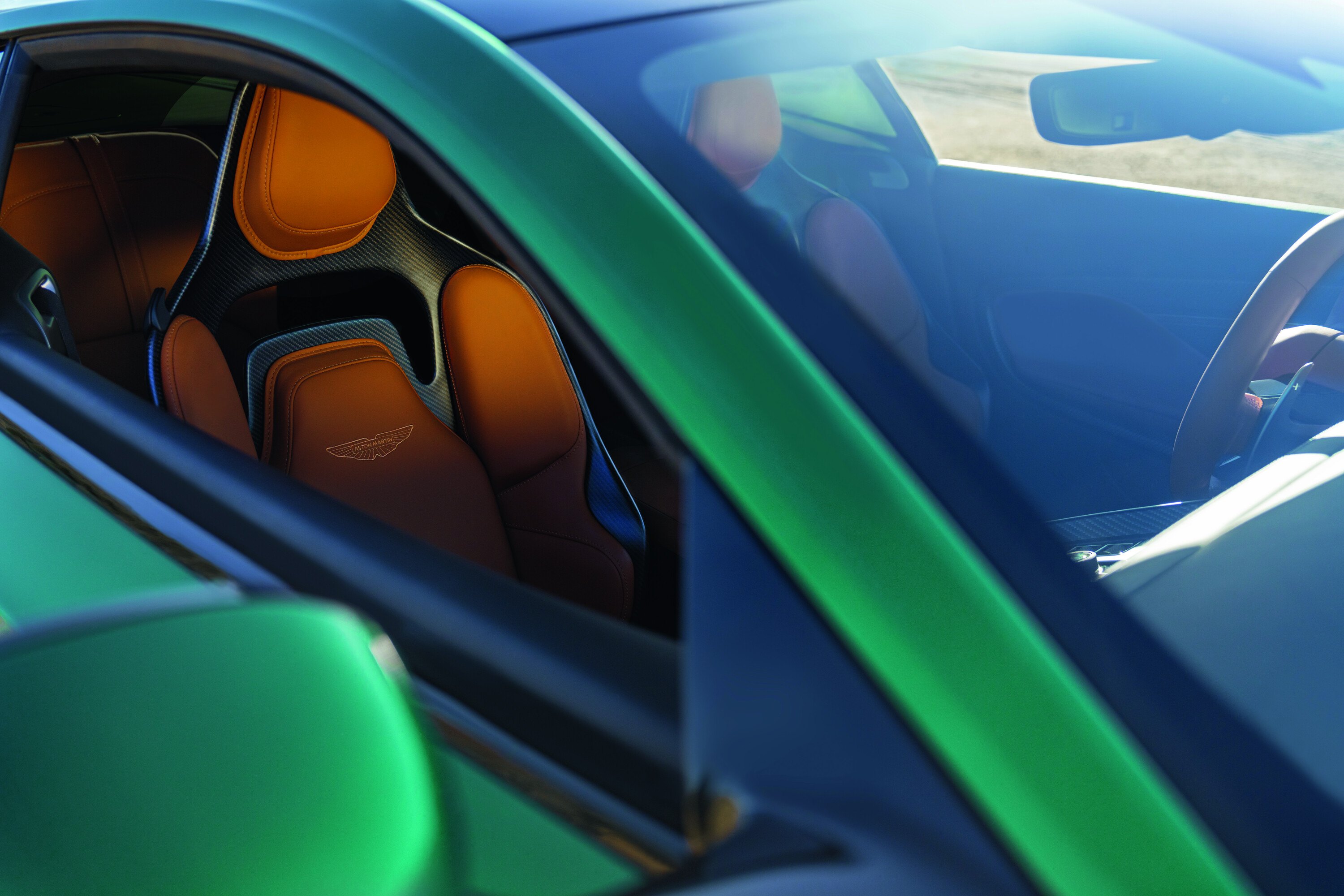
Inside, however, things look more drastically different, ringing in Aston Martin’s, allegedly, ‘in-house’ operating system, featuring dual 10.25-inch monitors, wireless Apple CarPlay and Android Auto and, thankfully, physical hard switches for many frequent functions.
An 11-speaker 390W stereo is fitted as standard, with a 1170W 15-piece Bowers & Wilkins package is a newly available option.
An eSIM enables the DB12 to receive over-the-air updates, while a new mobile owner’s app facilitates remote lock/unlock, remote nav-point setting, and more.
1
Aston Martin’s Connected Services are free with purchase for the first three years, while optional Advantage subscription adds increased personalisation, and a vehicle tracker.
On the topic of personalisation, Aston Martin’s famed ‘Q Service; is ready and willing for DB12 customers, with a wide array of bespoke options limited by merely your imagination (and bank balance).
1
Aston Martin CEO, Amedeo Felisa, says: “When a brand has as much history as Aston Martin it is important to honour the past. Not by looking back, but by pushing on with the same energy and passion that propelled our founders 110-years ago.”
“With the new DB12 we are reinvigorating the DB model line and reasserting Aston Martin as a maker of truly exceptional performance sportcars.”
While the product portfolio has moved slowly for the iconic British maker in recent times, the brand has pledged eight new launches over the next two years.
Of course, the mainstream range of Vantage, DB11 and DBS, and requisite ‘Volante’ convertibles, are expected; Aston Martin has previously hinted at some sort of halo model that would be positioned “above” their GT cars.
Global deliveries are expected to commence before the end of Q3 2023, with Australian deliveries expected to follow not long after.