
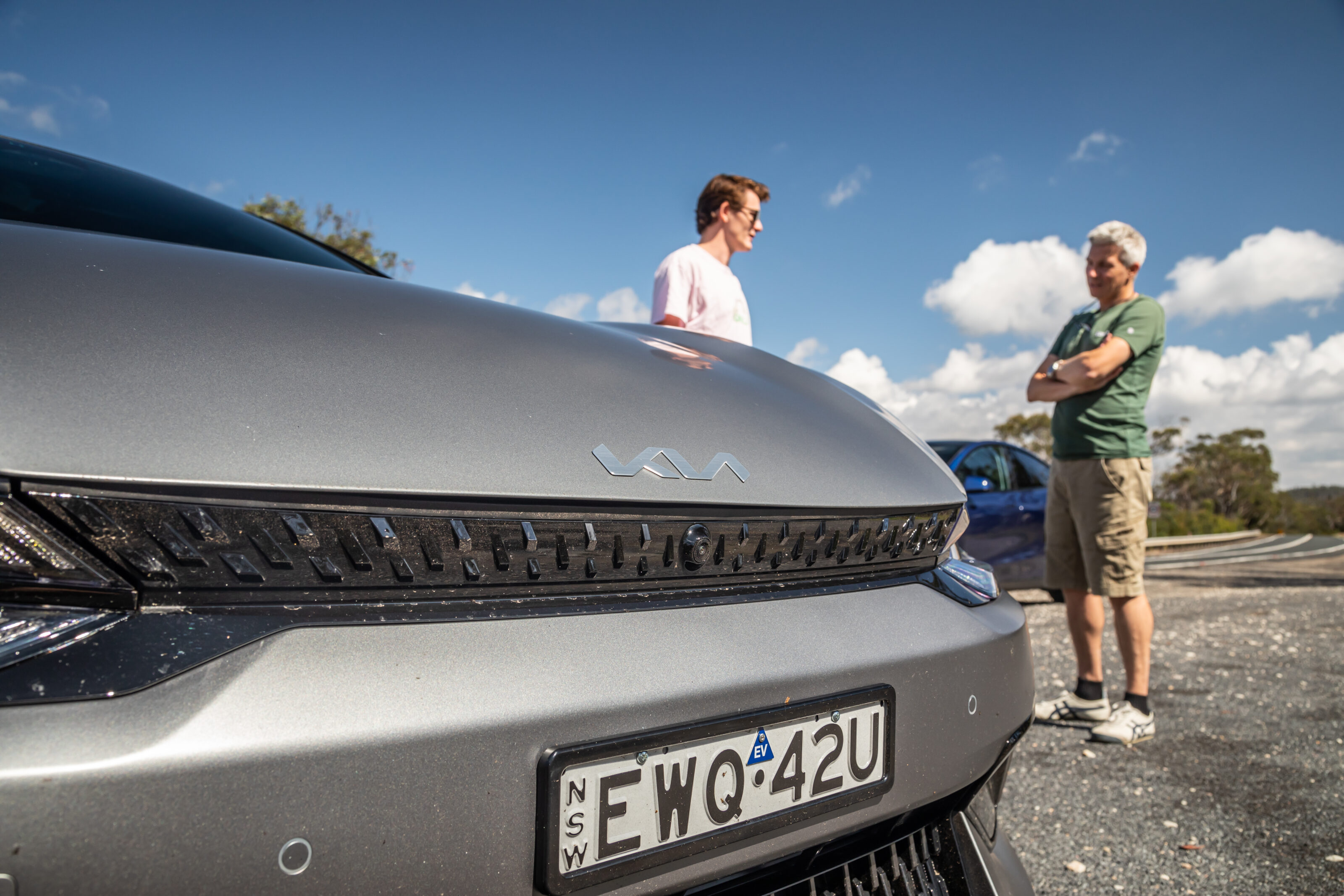
Correction: this review previously stated the EV6 GT scored five ANCAP stars. While the regular EV6 did, the GT is technically unrated as it is fitted with different seats, meaning the performance model would require retesting a five-star certification.
Snapshot
- Most BEVs sold in ACT per capita last year
- But NSW sold the most BEVs in total
- Hybrids still preferred, PHEVs lagging behind as alternative
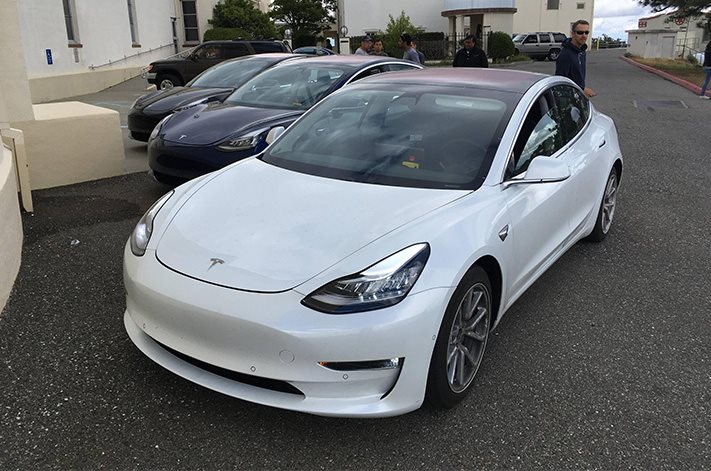
The Australian Capital Territory led the country’s battery-electric vehicle (BEV) adoption on a per capita basis last year.
Based on September 2022 Census data from the Australian Bureau of Statistics, a new BEV was sold for every 0.00279th person in the ACT with a total of 1280 examples registered, as reported by the Federal Chamber of Automotive Industries.
The capital currently benefits from EV incentives, including; two-years’ free registration, stamp duty exemption, and transit lane access – and plans to ban the sale of new petrol and diesel vehicles from 2035 in a similar move to Europe.
1
However, the most EVs added on Australian roads were, unsurprisingly, in the more populous eastern states – led by New South Wales (11,098), Victoria (9496), and Queensland (6696) trailing behind.
Only 68 and 571 BEVs were sold in the Northern Territory and Tasmania respectively, though.
The Tesla Model 3 sedan remained the best-selling BEV in Australia (10,877) – despite the introduction of the Model Y SUV twin (8717), cheaper BYD Atto 3 (2113), and Polestar 2 liftback (1524) last year.
A total of 33,713 BEVs were registered in 2022, which made up 4.3 per cent of the Australian new-car market share.

1
2022 Australian BEV sales by state
| State | Total BEVs sold | BEVs sold per capita |
|---|---|---|
| Australian Capital Territory | 1280 | 0.00279 |
| Victoria | 9496 | 0.00143 |
| New South Wales | 11,098 | 0.00135 |
| Queensland | 6696 | 0.00125 |
| Western Australia | 3078 | 0.00110 |
| Tasmania | 571 | 0.00010 |
| South Australia | 1426 | 0.00078 |
| Northern Territory | 68 | 0.00027 |
Hybrids still dominate, PHEVs fall behind
All Australian states (private and business buyers) overwhelmingly still prefer traditional hybrid models as an alternative low-emission powertrain, with 80,584 units sold last year.
Hybrids represented eight per cent of the new-car market share – spearheaded by Toyota’s venerable hybrid lineup, including; the RAV4 Hybrid medium SUV (26,547), Corolla Hybrid small car (17,585), and Kluger Hybrid large SUV (8413).
Meanwhile, plug-in hybrid electric vehicles (PHEVs), which combine a larger battery with a petrol engine for longer EV-only driving range, continued to fall behind both traditional hybrids and BEVs.
1
Only 5832 PHEVs were sold last year, which made up just one per cent of the new car market.
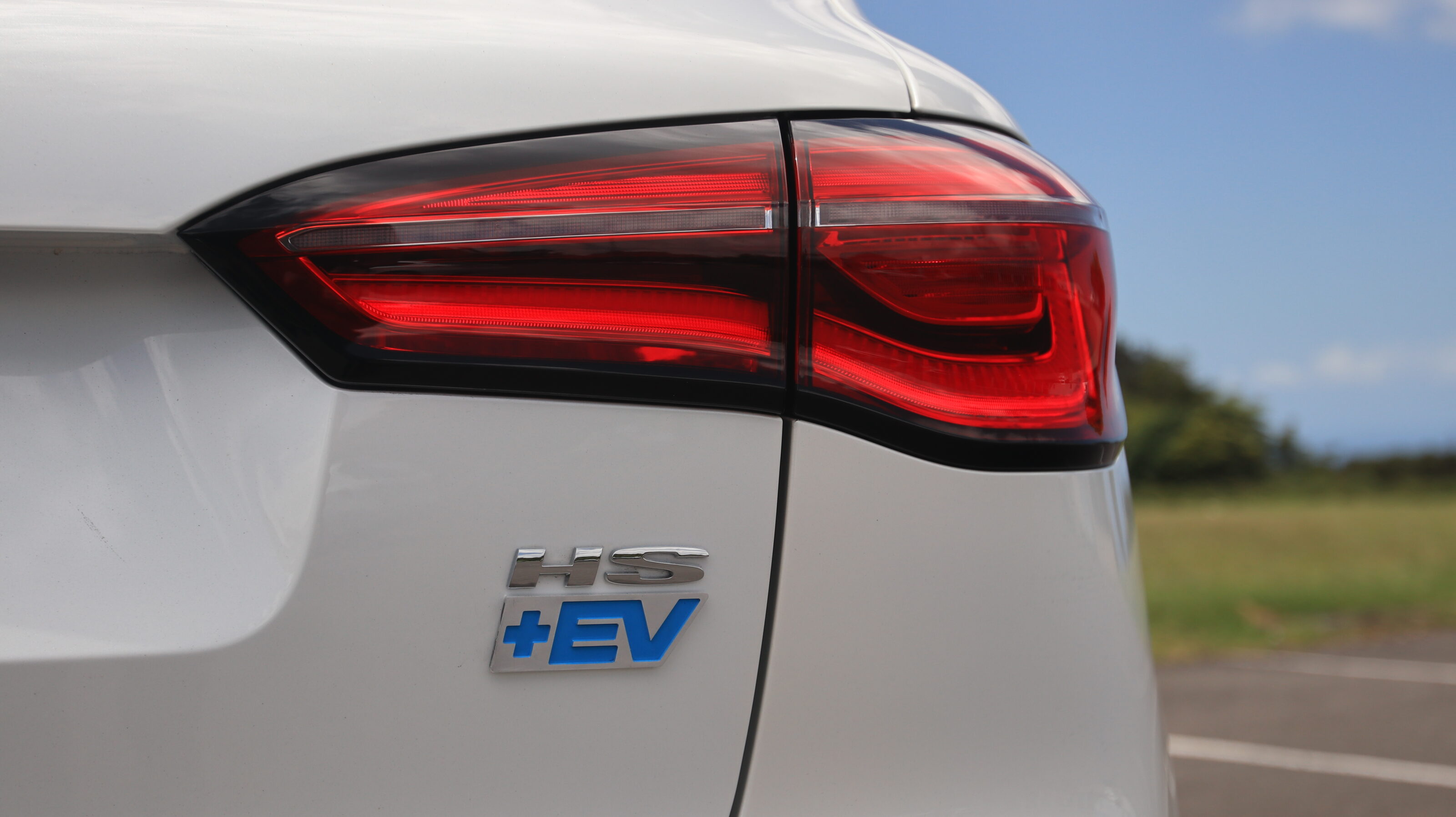
The MG HS Plus EV medium SUV (1554), Mitsubishi Eclipse Cross PHEV small SUV (926), and Volvo XC60 Recharge PHEV (591) were the top-sellers.
Last year, the industry continued to be plagued by component supply chain and shipping constraints – exacerbated by the war on Ukraine, which shut or slowed down some supplier’s factories.
MORE
Electric Cars
MORE
PHEV and Hybrid Cars
MORE
Electric SUVs
Snapshot
- Torres EVX electric SUV teased ahead of March 30 unveil
- Tweaked rugged EV design, new tech
- SsangYong going back on track after a difficult few years
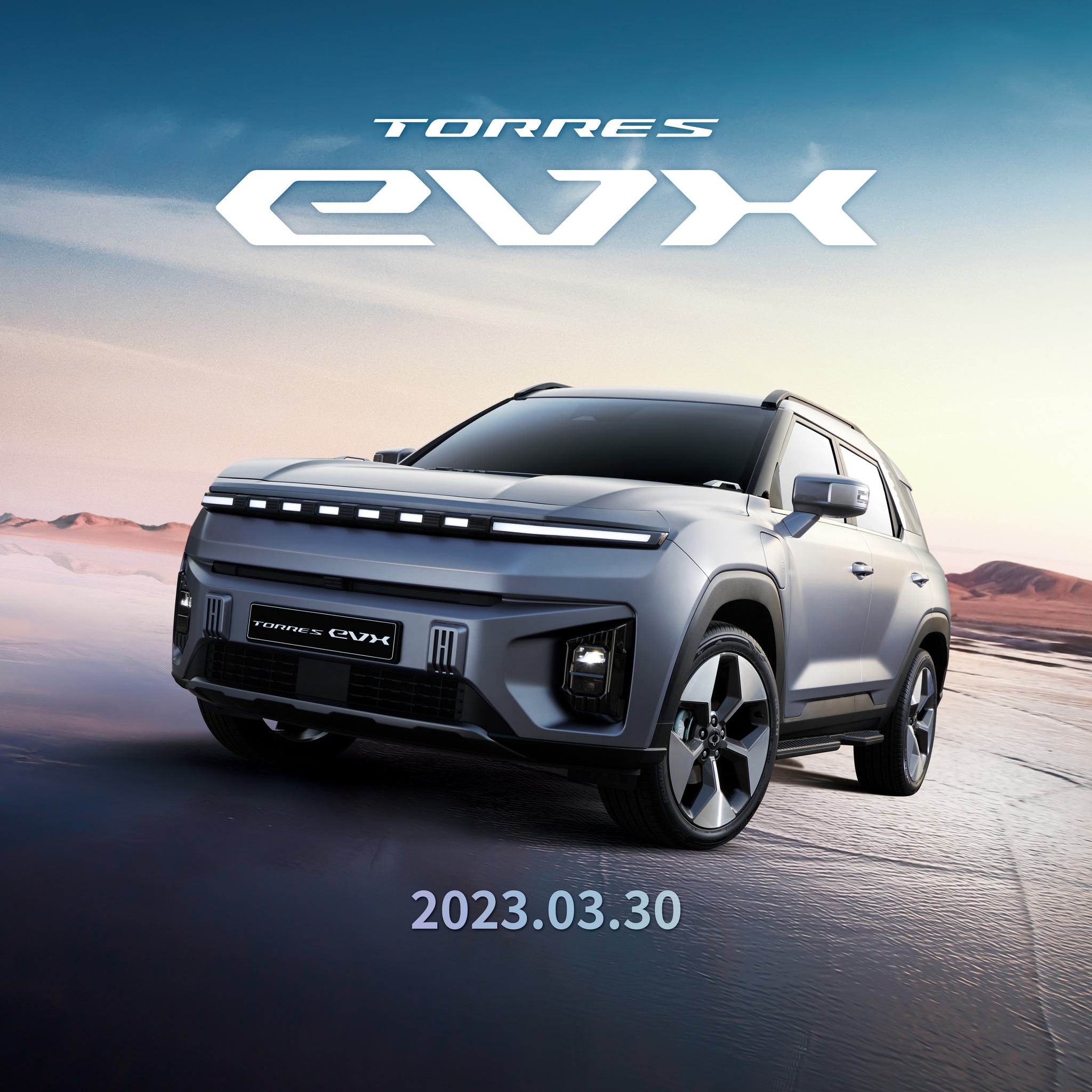
Battle-scarred South Korean carmaker SsangYong has teased the Torres EVX, a rugged-looking electric SUV alternative to the Tesla Model Y and Hyundai Kona Electric.
It’s based on the petrol-powered Torres – which has been confirmed to launch later this year in Australia – but appears to gain a revised front with a segmented LED daytime running light strip and welcome animation, and aerodynamic alloy wheels.
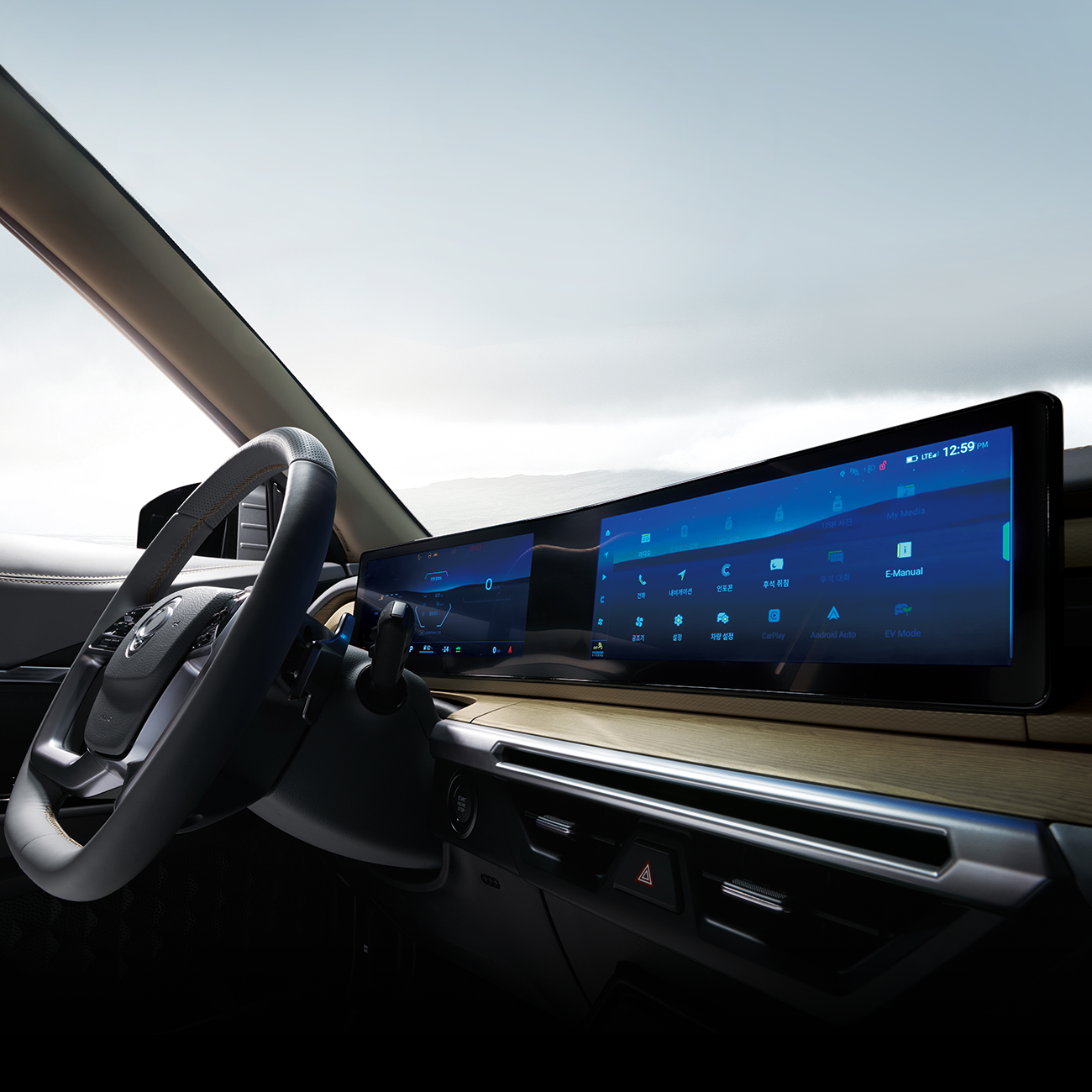
Inside, the teaser image depicts new dual 12-inch displays joined on a single curved panel similar to the Kia EV6, running on a new operating system, and wood trim across the dashboard – as per a Tesla Model 3 or Model Y.
1
Full details of the Torres EVX will be announced at the 2023 Seoul Mobility Show, which is scheduled from March 30.
SsangYong has faced an uphill battle in the last few years, entering bankruptcy in late 2020 citing COVID-19 pandemic challenges.
After multiple attempts to find a buyer, chemical and steel company KG Group acquired the automaker in mid-2022.
It posted its first quarterly profit since 2016 in the final quarters of last year – largely due to the launch of the new Jeep-esque designed Torres SUV.
1
The 69-year-old company will soon be renamed to KG Mobility.
The Torres EVX will be the South Korean carmaker’s second all-electric car after the 2022 Korando E-Motion.
SsangYong relaunched in Australia in 2018 and still continues to offer the same vehicles today, including the Korando medium SUV, Rexton large SUV, and Musso dual-cab ute – but the Tivoli small SUV went on a sales hiatus in 2020 and hasn’t come back.
Only 3943 SsangYongs were registered locally in 2022, which represents a respectable 32.4 per cent increase from 2021 new-car sales figures.
MORE
Everything Ssangyong
MORE
Electric SUVs
The facelifted 2024 Mercedes-Benz GLA and GLB siblings have debuted in Europe.
Snapshot
- 2024 Mercedes-Benz GLA facelift revealed
- Mercedes-Benz GLB also updated for model-year 2024
- Due in Australia in the fourth quarter of this year
As with the related A, B and CLA facelifts, the revised GLA small SUV and GLB medium SUV receive an updated design, new technology, and a 48-volt mild-hybrid system for all petrol engines.
Mercedes-Benz Australia has confirmed the updated GLA and GLB will arrive in the fourth quarter of 2023 (October to December inclusive), with local pricing and details to be announced closer to launch.
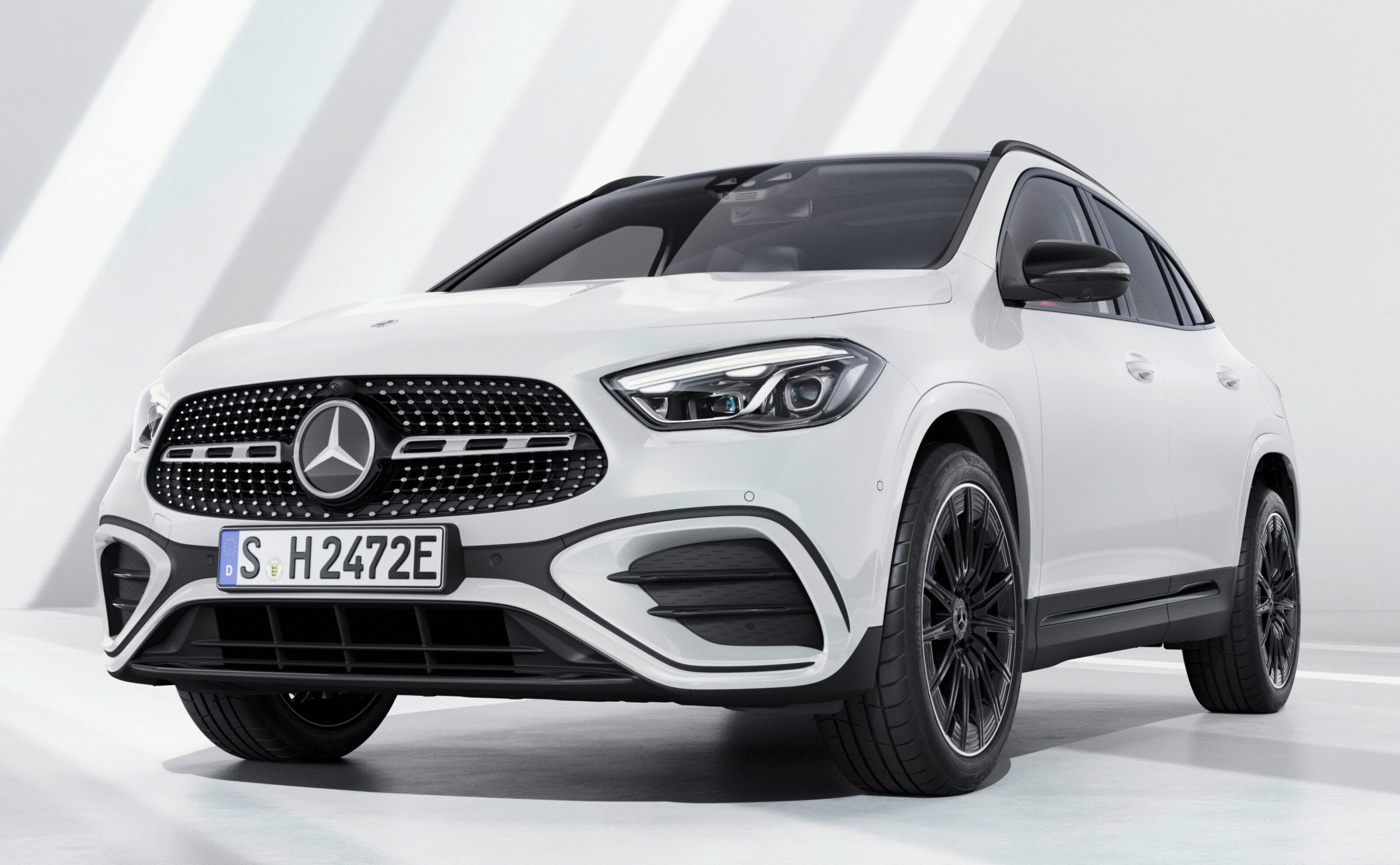
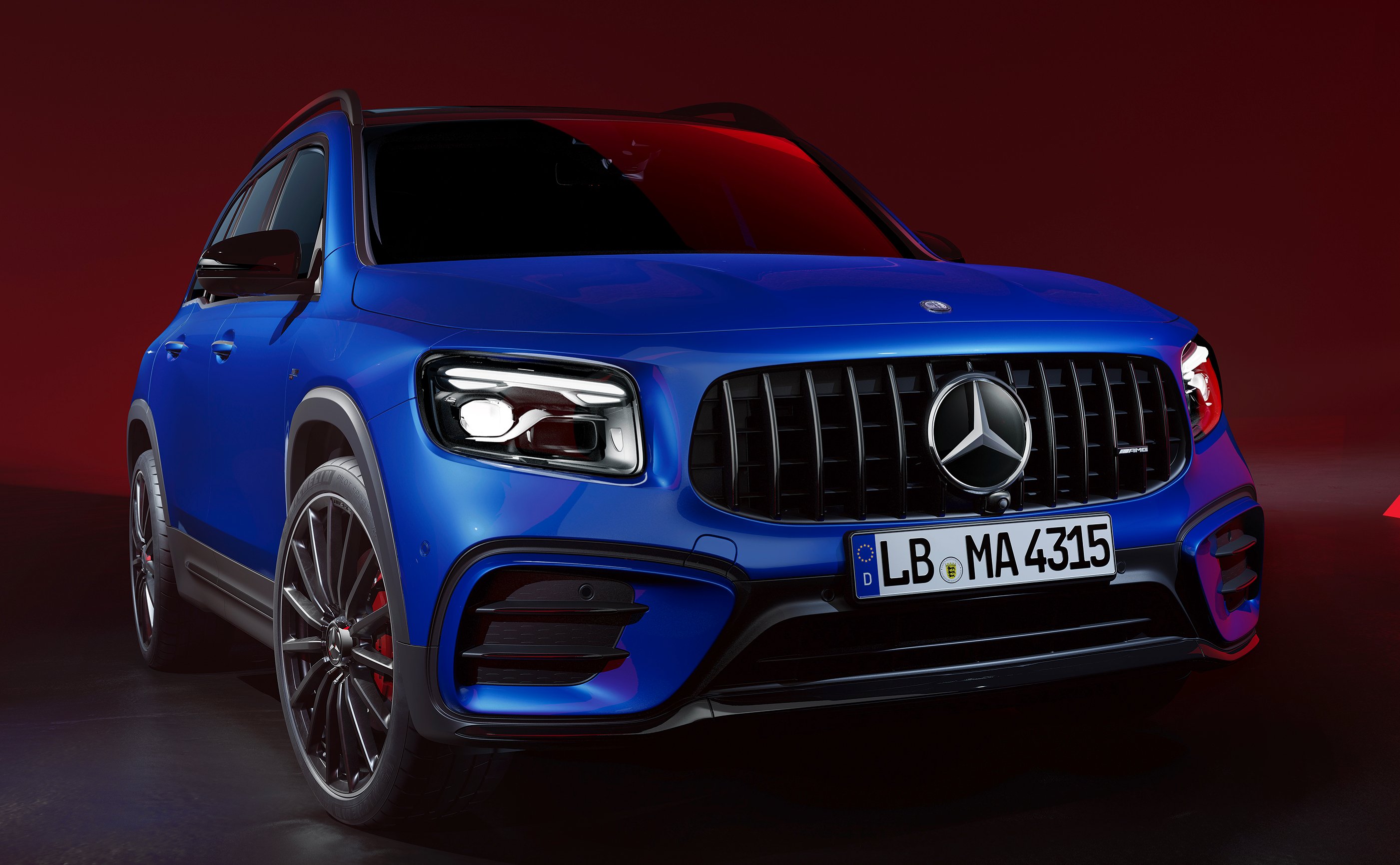
Both vehicles have a redesigned front bumper with a star-pattern grille and sportier intakes, while the ‘power domes’ on the bonnet have filtered down from AMG variants.
1
In addition, there’s a revised front and rear lighting graphics for the GLA and GLB, newly-designed alloy wheels between 17 and 20 inches, and a new spectral blue colour.
The wheel cladding is now body-coloured for the GLA, while Mercedes-Benz has fitted “visual under-ride protection points” to its smallest SUVs.
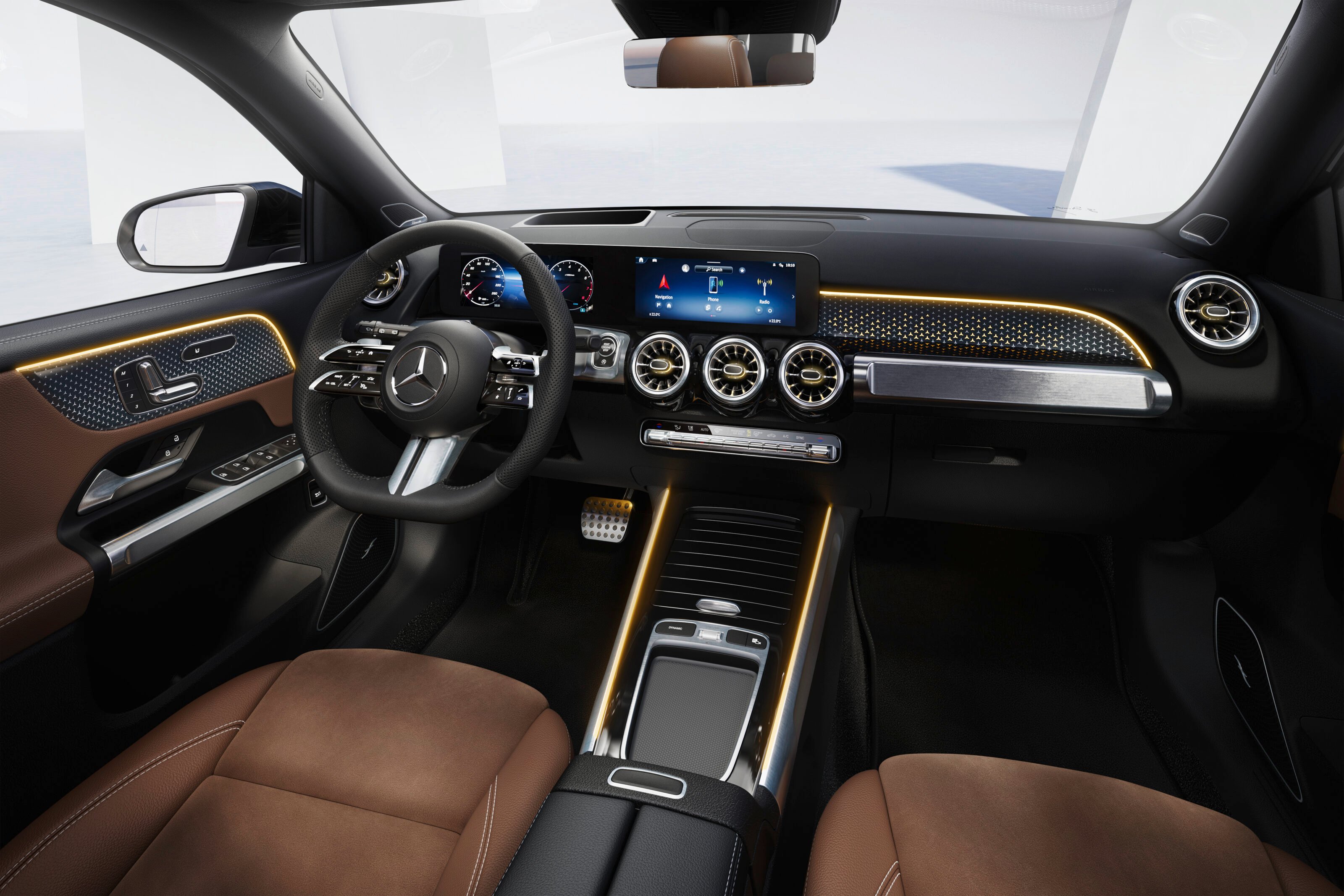
Inside, the GLA and GLB gain Mercedes-Benz’s latest twin-spoke steering wheel, a simplified centre console with the touchpad deleted, repositioned volume and drive mode controls, and an additional USB-C port.
An updated version of the current MBUX system remains, unlike the second-generation GLC, which features a portrait-orientated unit positioned closer to the driver.
1
Mercedes-Benz has revised the software, allowing for wireless Apple CarPlay and Android Auto, optional mini-games, and the ability to speak to the voice assistant without saying ‘Hey, Mercedes’ first in some instances.
The optional Burmester surround-sound audio system is now compatible with Dolby Atmos, while trailer manoeuvring assist is available on the GLA and GLB for the first time.
Under the bonnet, all petrol engines – including the AMG 35 – are fitted with a 48-volt mild-hybrid system for the belt-driven starter generator.
This system brings an additional 10kW with faster acceleration, added refinement with low-noise engine starting and reduced vibration, and regenerative braking.
1
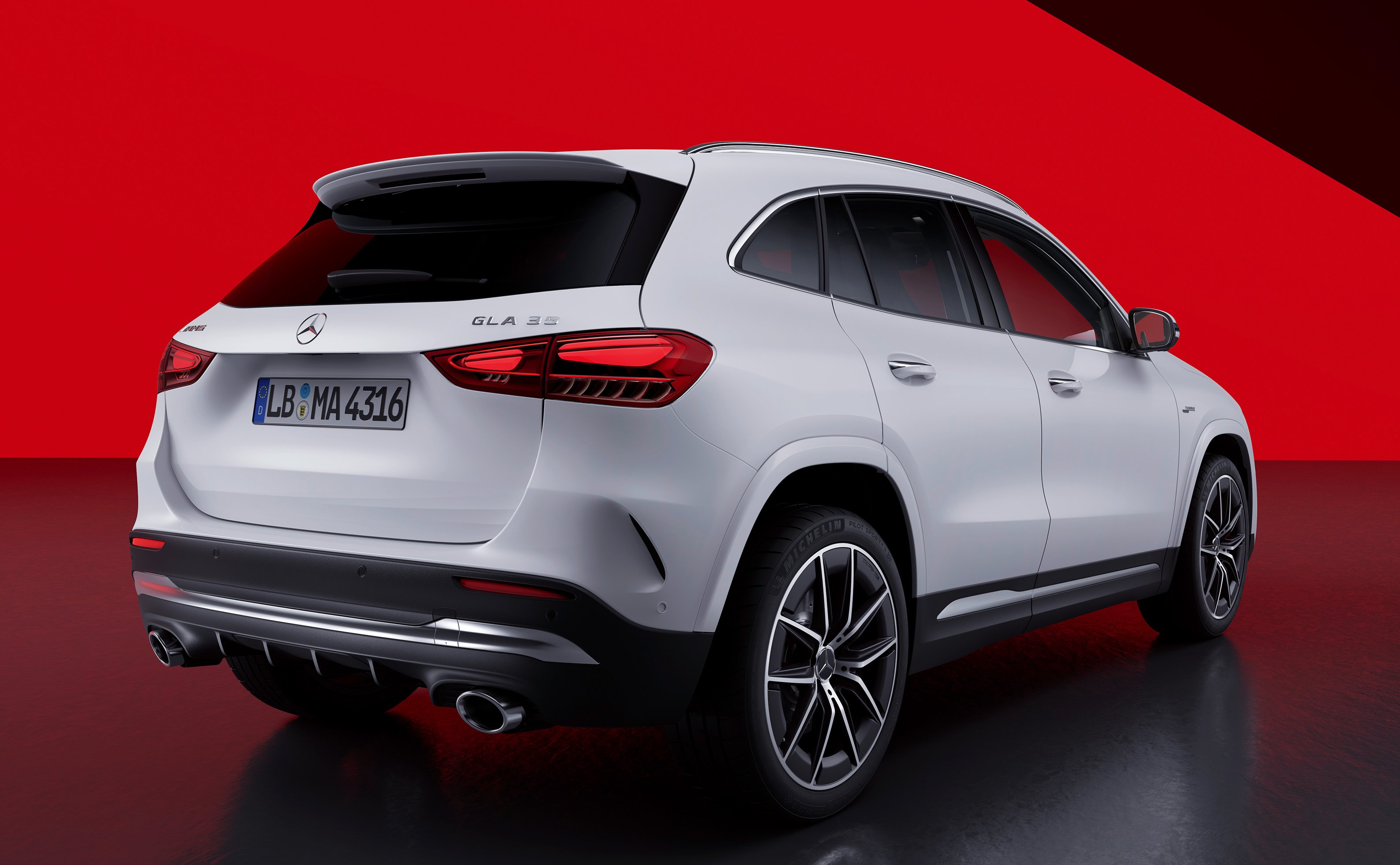
While the GLA and GLB AMG 35 have unchanged outputs at 225kW and 400Nm, both receive an eight-speed dual-clutch automatic transmission, replacing the current seven-speed unit.
The 0-100km/h sprint is two-tenths slower for the GLB 35 at 5.5 seconds, while the GLA 35 remains at 5.2s.
A plug-in hybrid system shared with the A250e is available for the GLA in Europe, however, it is tipped to remain off-limits for Australia.
1
It has a more powerful electric motor with a 160kW/450Nm total system output and a carry-over 11.5kWh battery pack, allowing a WLTP-rated 62 to 70-kilometre electric-only driving range.
Mercedes-Benz has yet to detail the flagship AMG GLA 45, but updated A45 suggests it won’t receive any technical changes, with the 310kW/500Nm turbocharged 2.0-litre four-cylinder carrying over unchanged.
Similar cosmetic updates are also expected for the electric siblings to the GLA and GLB – the EQA and EQB – in the coming months.
UPDATE: Model Y Performance driven
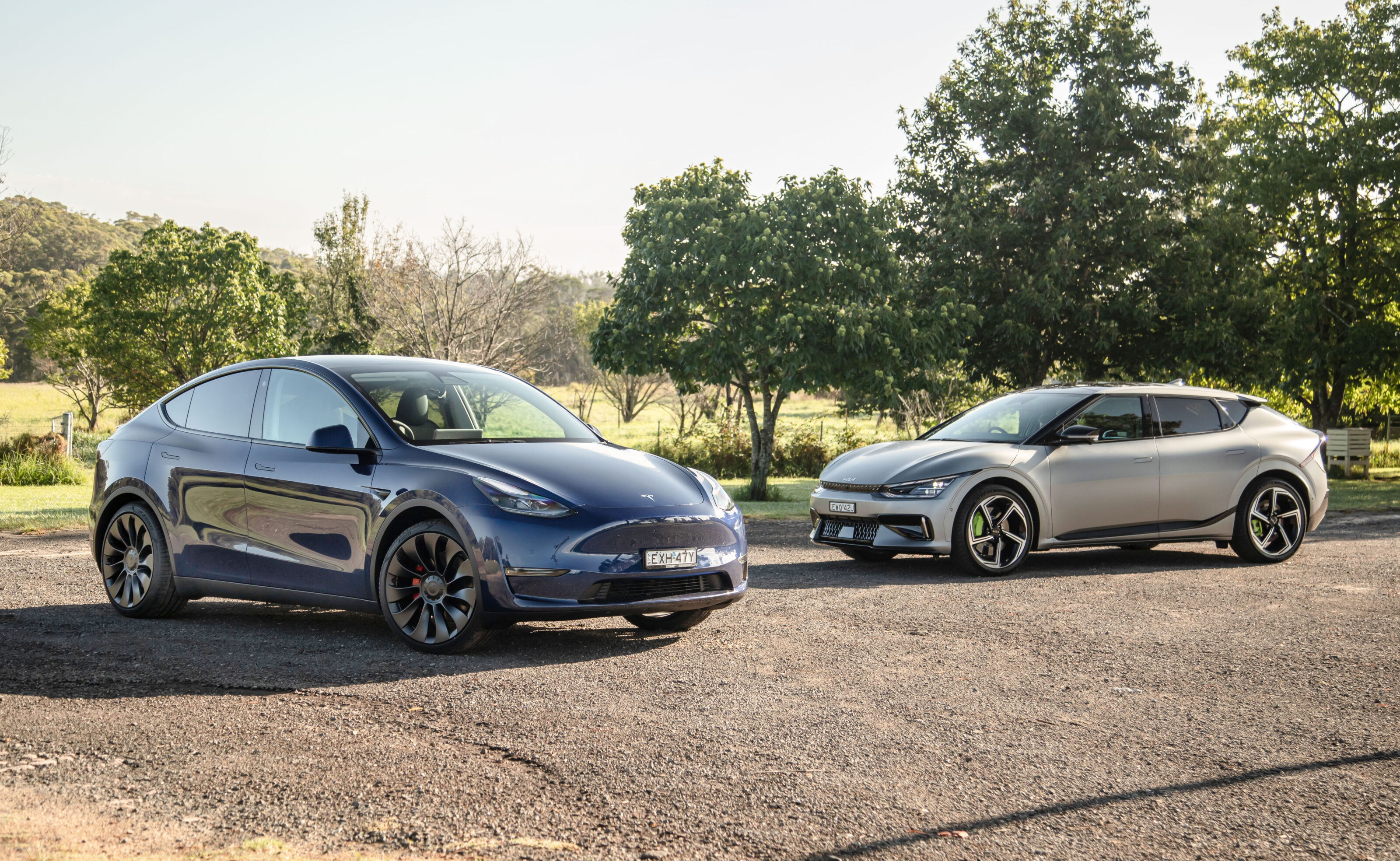
We’ve now had our hands on the rapid Tesla Model Y Performance, and it’s as satisfying as you’d hope – but, it isn’t without flaw. We’ve also put the Model Y Performance up against the Kia EV6, because… well, it was just the right thing to do. Get both stories at the links below.
1
March 6: Deliveries of the 2023 Tesla Model Y Performance have commenced in Australia.
The Performance grade’s arrival trails behind the standard range Model Y, which hit roads seven months ago.
Tesla doesn’t claim power figures, but the AWD Model Y Performance promises a 0-100km/h sprint in 3.7 seconds, a 514km WLTP driving range, and a 250km/h top speed.
According to Tesla’s website, if you put an order in now a new car will be delivered in March-April this year.

1
Pricing starts from $97,100 before on-road costs and Luxury Car Tax. Expect to be driving away from around $105,000 – roughly the same price as Kia’s EV6 GT.
For that you get a very similar interior to the rear-drive Model Y, meaning a 15-inch infotainment touchscreen, and your choice of white or black upholstery.
There are a few subtle differences from a regular Model Y, including standard 21-inch alloy wheels, red brake calipers, and metal pedals inside. Tesla offers three ways to customise the Model Y Performance: paint colour, enhanced Autopilot ($5500), and Full Self-Driving ($10,100).

1
It’s also believed that the Model Y will feature new ‘comfort’ suspension tuning from the start of 2023, according to shipping tracker Vedaprime. We’ll have a full Model Y Performance road test to confirm that in the coming weeks.
Our original story, below, continues unchanged
The story to here
August 14, 2022: First Model Y deliveries begin in Australia
The first examples of the 2023 Tesla Model Y electric SUV have been delivered to customers in Australia – more than three years after the model made its global debut, and two months after local pricing was announced.
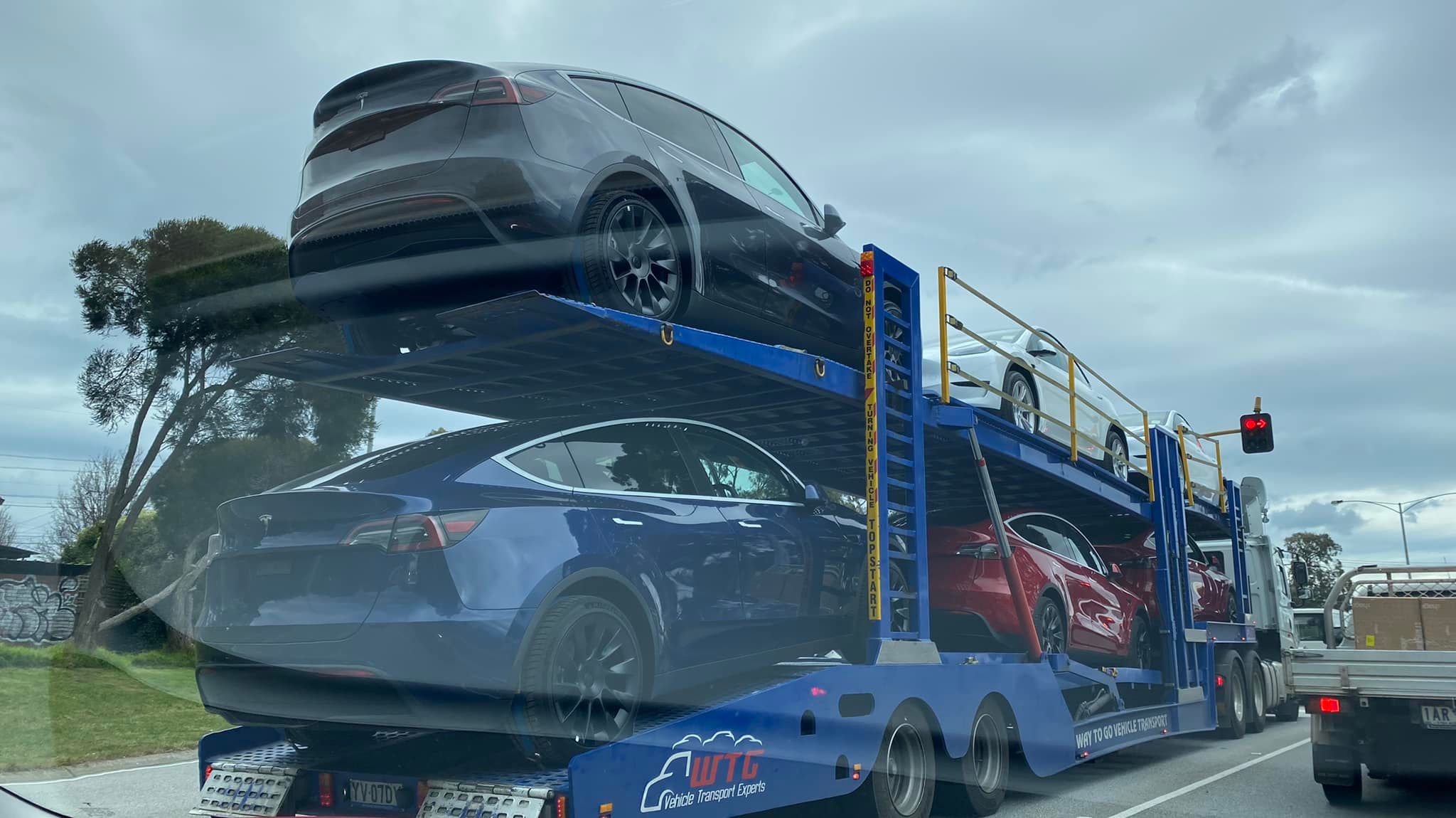
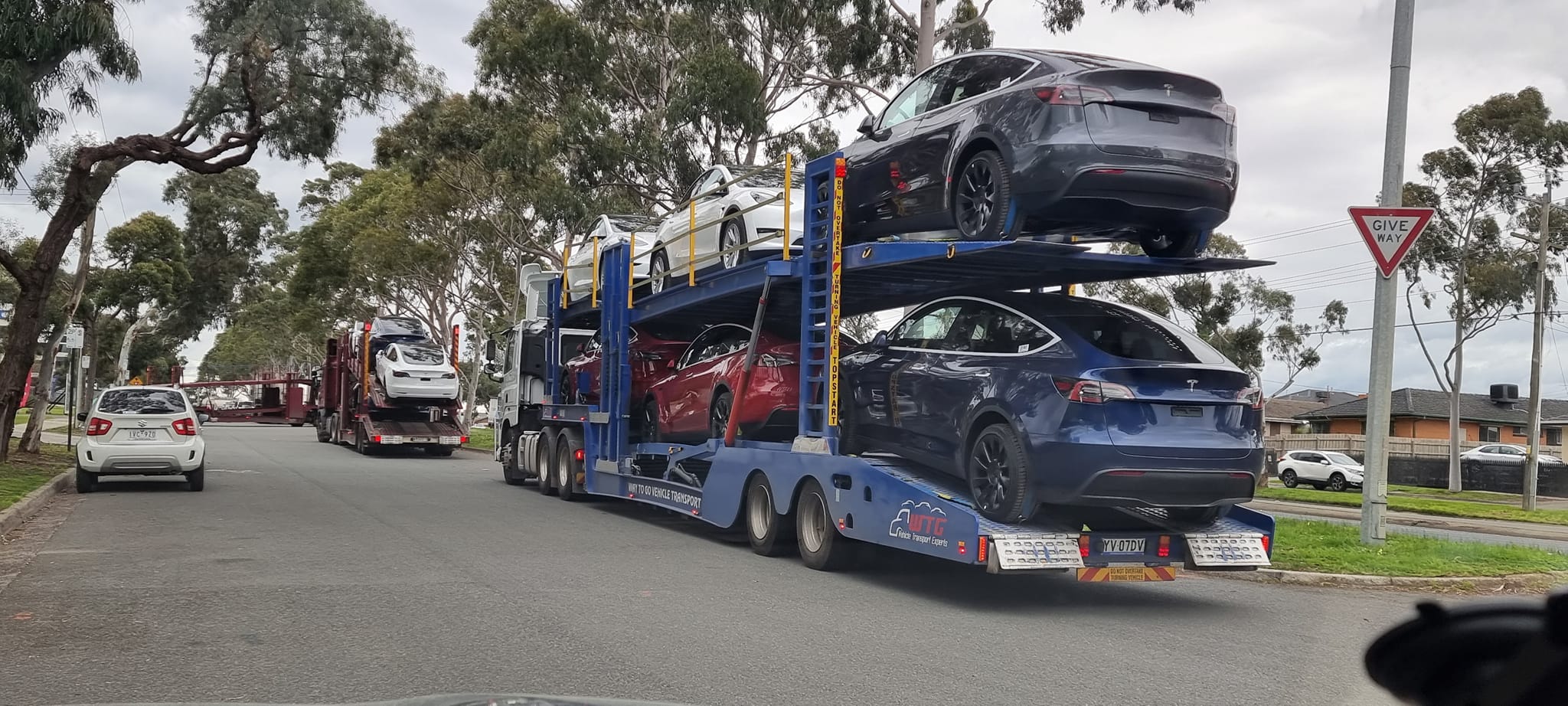
It is believed a ship loaded with hundreds of Model Y SUVs and Model 3 sedans arrived on Australian shores in late July, with customer deliveries commencing late last week.
The vast majority of examples on the ground are the entry-level RWD variant, with the flagship Performance expected to arrive over the coming months.
1
Most of those who have taken delivery, or are soon to drive away in a new Model Y, placed their order in the minutes and hours after Tesla announced local pricing and features for the mid-size SUV on June 10.
The exact number of Model Y units soon to be delivered is unknown; however, photos found on Tesla social media forums point to deliveries being in the hundreds, if not the thousands.
Tesla shipment tracker VedaPrime has been reporting on the latest ship arrivals en route from Shanghai, China, where the Model Y and Model 3 are produced, with a second vessel docking in Port Kembla in New South Wales on August 8.
1
The commencement of Model Y deliveries represents a step forward for Australia’s growing electric vehicle segment, with strong demand leading to projected delivery times between February and May 2023 for newly-placed orders.
VFACTS new-car sales data reveals Tesla sold 4657 vehicles in the first half of 2022, mostly consisting of 4417 examples of the Model 3 delivered in the first quarter.
As such, we’d expect a major sales spike over the second half of 2022 as Model Y and Model 3 deliveries continue in larger numbers.
After the Model Y went on sale in Australia in mid-June, a surge in orders for the electric SUV caused Tesla to increase right-hand production.

1
In a Twitter thread, Tesla CEO Elon Musk said: “We’re working on accelerating RHD Model Y production. Didn’t expect demand to be so high!”.
A few days later, Tesla increased prices for the Model Y between $2800 and $3400 in Australia, while the standard home charging cable was deleted from new orders in July.
Those who purchased a Model Y before the mobile charging cable was removed will continue to receive the equipment.
“Usage statistics were super low, so seemed wasteful. On the (minor) plus side, we will be including more plug adapters with the mobile connector kit,” Musk tweeted.
Related video: Model Y review
Musk sells more shares
Elon Musk’s recent dealings in relation to Twitter have led to controversy after he walked away from an AU$63.7 billion deal to purchase the social media company in July.
Musk recently sold 7.92 million shares of Tesla, reportedly worth approximately US$6.88 billion (AU$9.66 billion), after he admitted he could need the funds if he loses a legal battle with Twitter.
“In the (hopefully unlikely) event that Twitter forces this deal to close *and* some equity partners don’t come through, it is important to avoid an emergency sale of Tesla stock,” he said in a tweet on Tuesday.
MORE
Everything Tesla
You’ve got $100K burning a hole in your pocket and you want to go fast. Real fast.
Turns out, you can crack the ton in under four seconds for that outlay – and not by buying some spine-compressing rally rocket or depreciated exotica. No, you can go that fast in SUVs with space for five adults in comfort.
For that, we can thank the instant output and efficiency of electric motors, but as Wheels readers will know, outright speed is not enough. In fact, it gets boring pretty quickly. Performance cars – which the Tesla Model Y Performance and Kia EV6 GT profess to be – must deliver more than just face-melting acceleration.
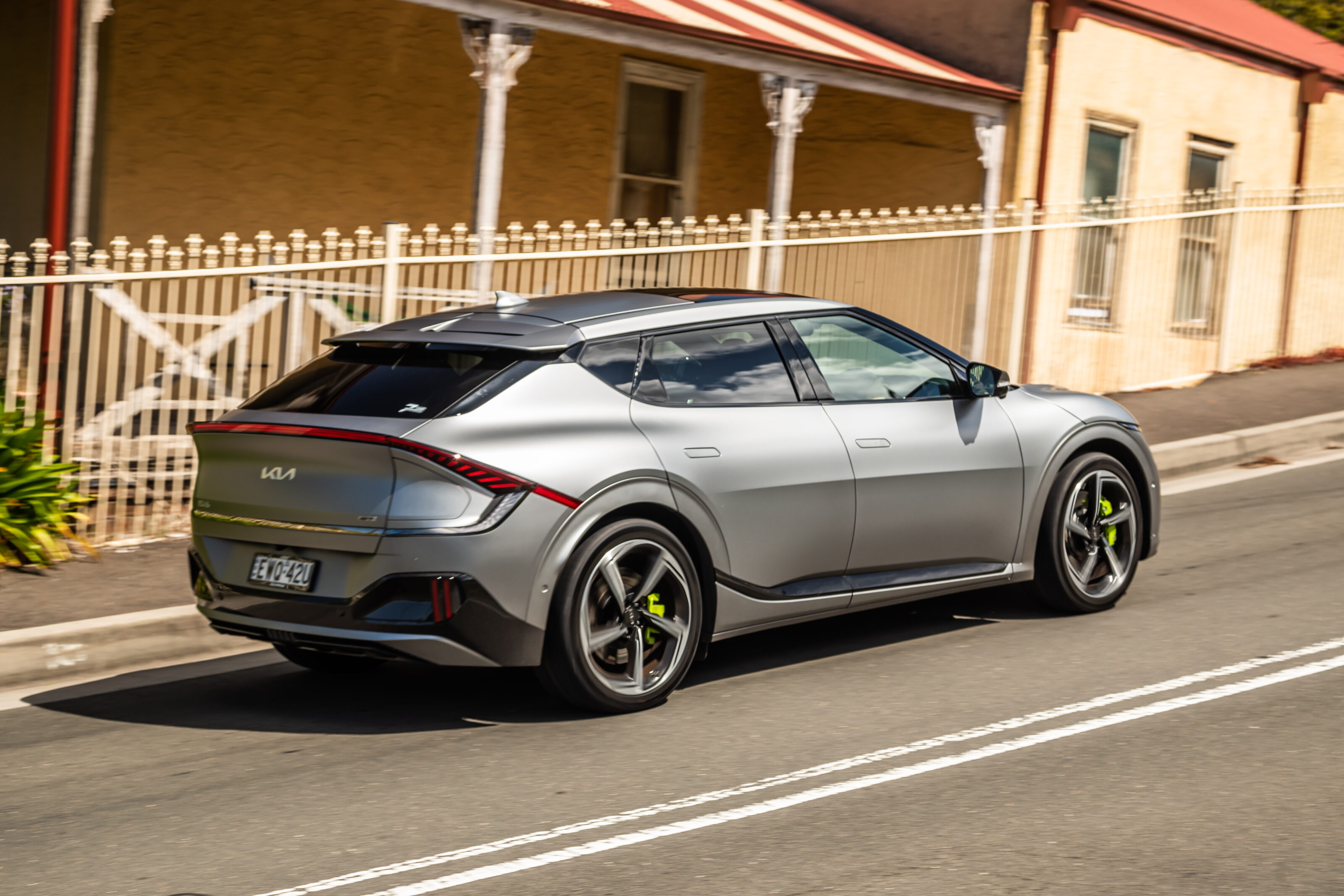
The 2023 Kia EV6 GT has a lot going for it on paper.
1
The EV6 GT’s twin electric motors churn out 430kW to get it to 100km/h in 3.5 seconds – and that’s backed up by ensconcing bucket seats, Australian-tuned adaptive dampers, and a clever torque-vectoring limited-slip rear differential.
Tesla’s Model Y Performance?
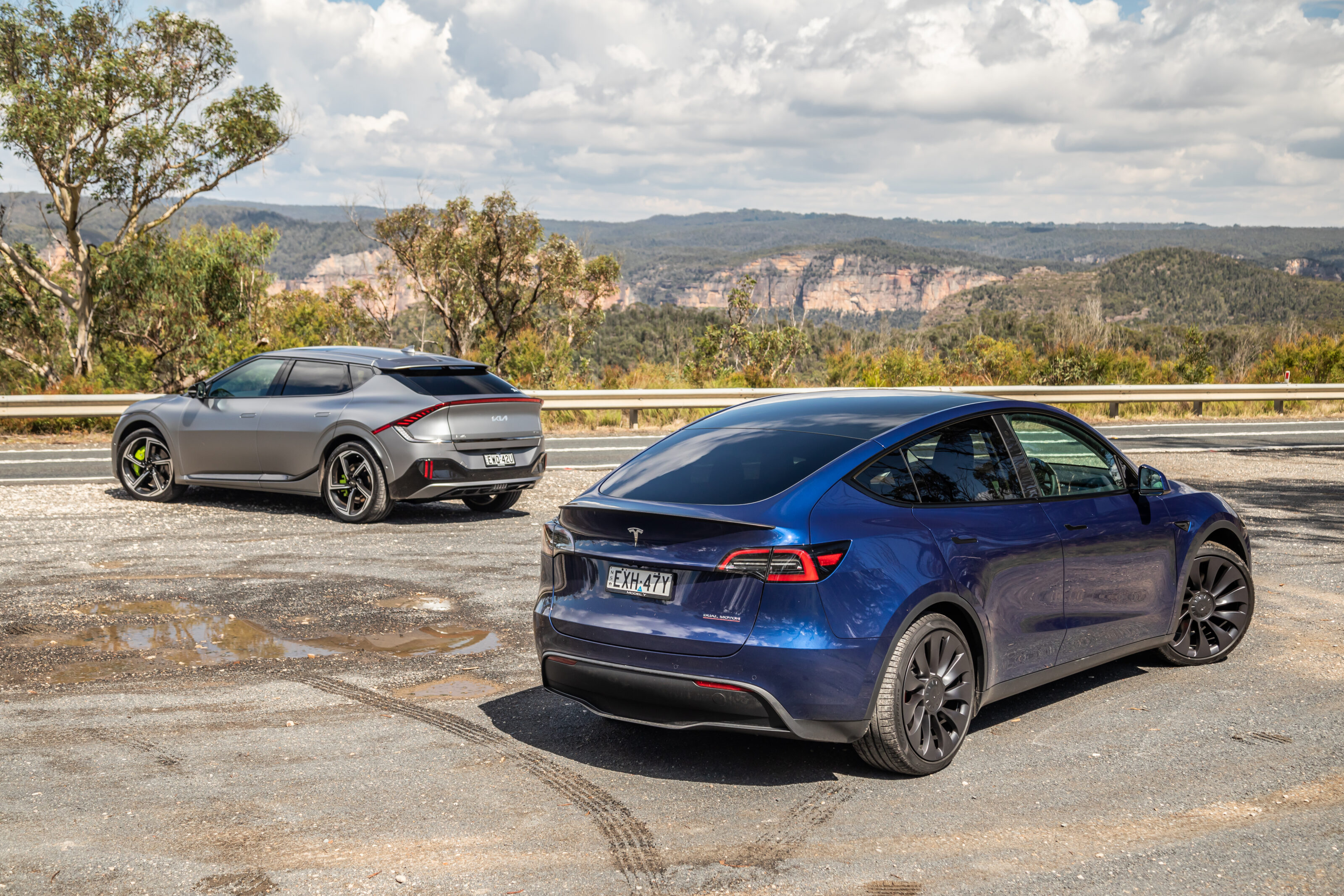
1
As usual, it’s devoid of any meaningful performance credentials beyond Tesla’s 0-100km/h claim of 3.7 seconds, and 514km WLTP driving range.
For half the price, both tested cars eclipse an Audi RS6 in a straight line, but which is best?
Additionally, for nearly $30K more, are these hi-po battery bandits really better than conventional variants?
JUMP AHEAD
- Pricing and features
- Comfort and space
- On the road
- Driving range and charging
- Safety
- Ownership
- VERDICT
- Specifications
Pricing and features
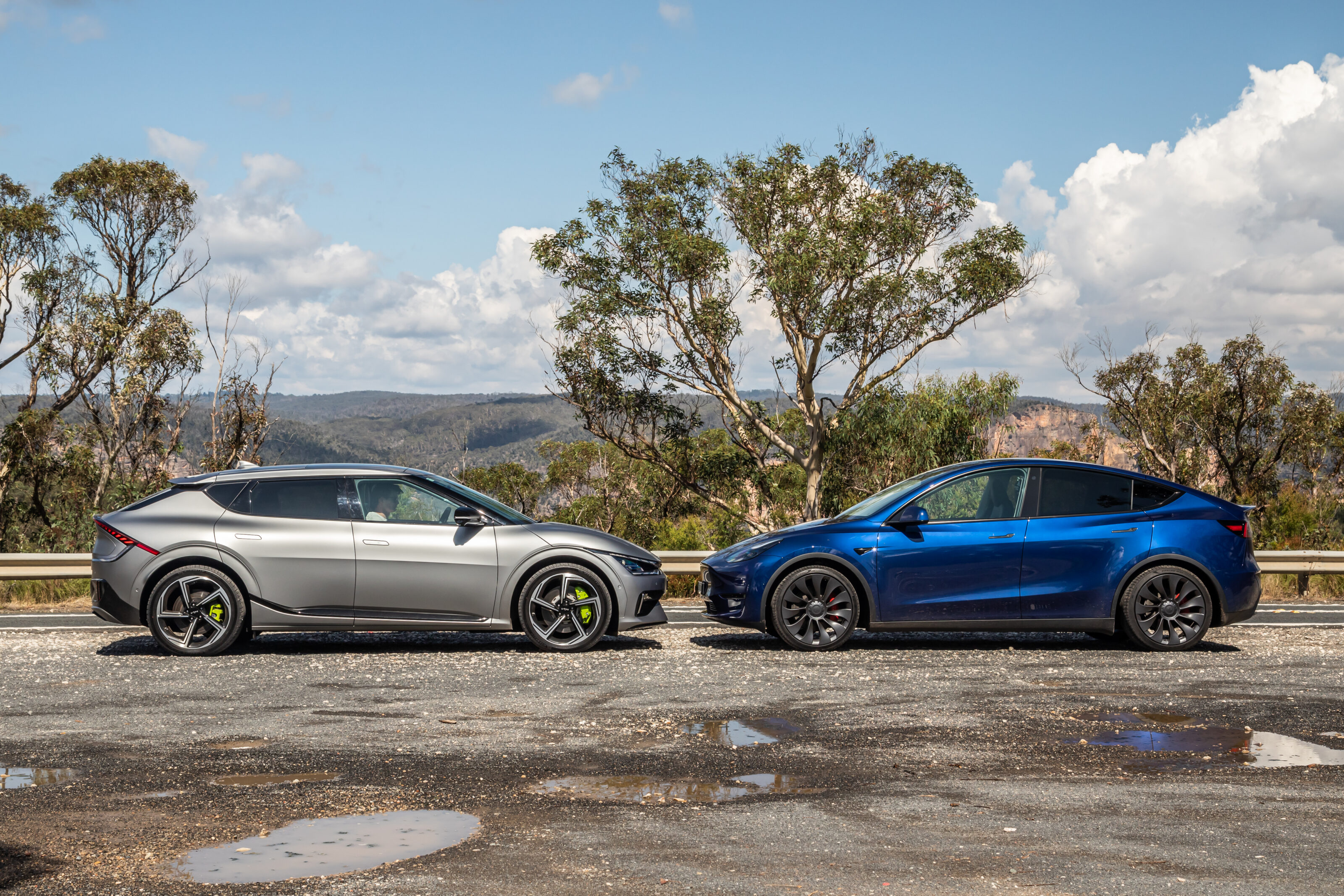
The Kia and Tesla align neatly on price. The EV6 GT starts at $99,950 before on-road costs, and the Model Y Performance is a little cheaper ($98,955 including luxury car tax).
Diving into the value equation of each shows the stark difference between Tesla and its legacy carmaker rivals. The EV6 GT costs $27,360 more than the entry-level Air RWD, but for that, you get a laundry list of extras: 21-inch alloy wheels, Michelin Pilot Sport 4S tyres, adaptive dampers, 64-colour ambient lighting, heated manual sports seats, active sound design, AR head-up display, 14-speaker Meridian sound system, sequential indicators, power tailgate, and active headlights.
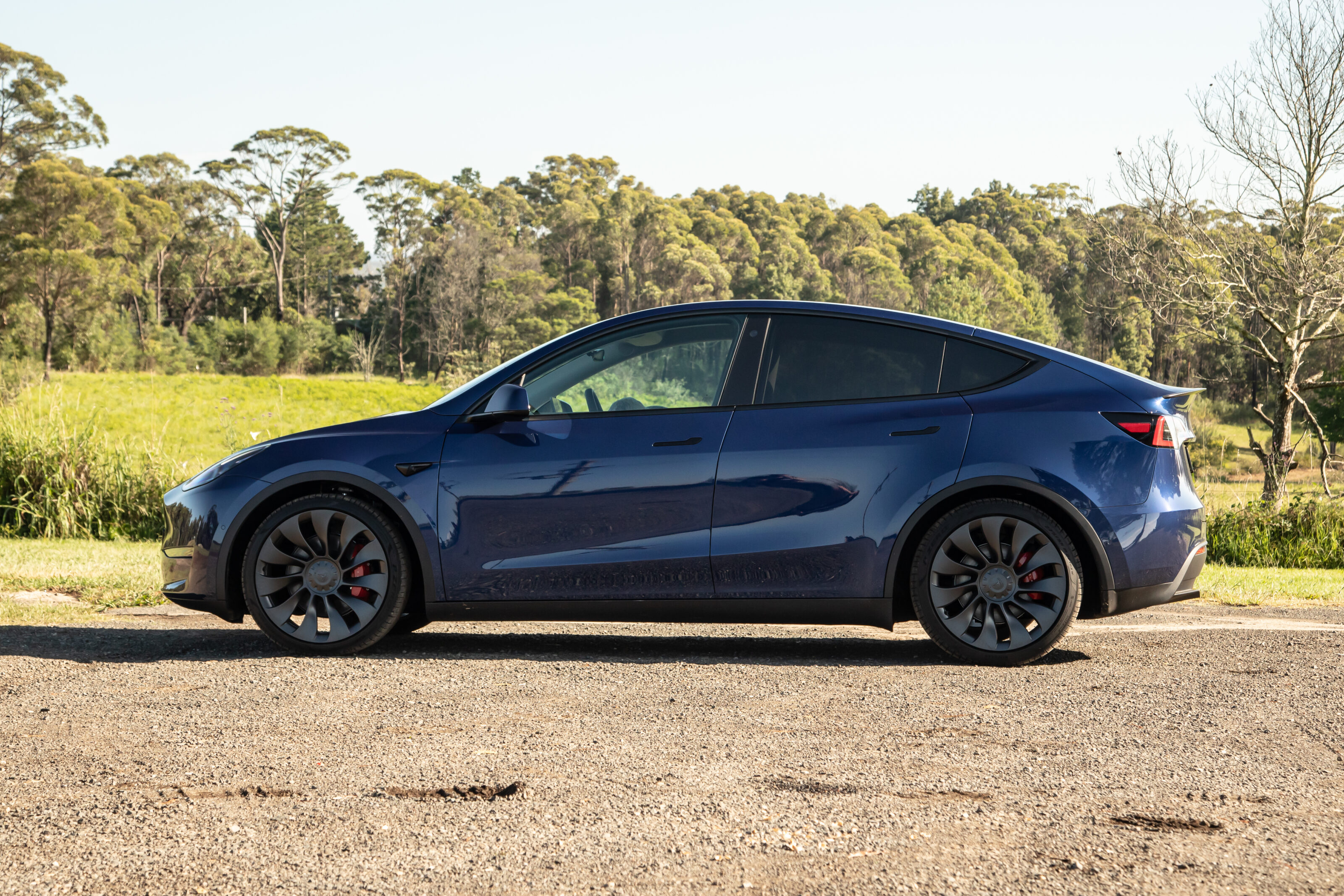
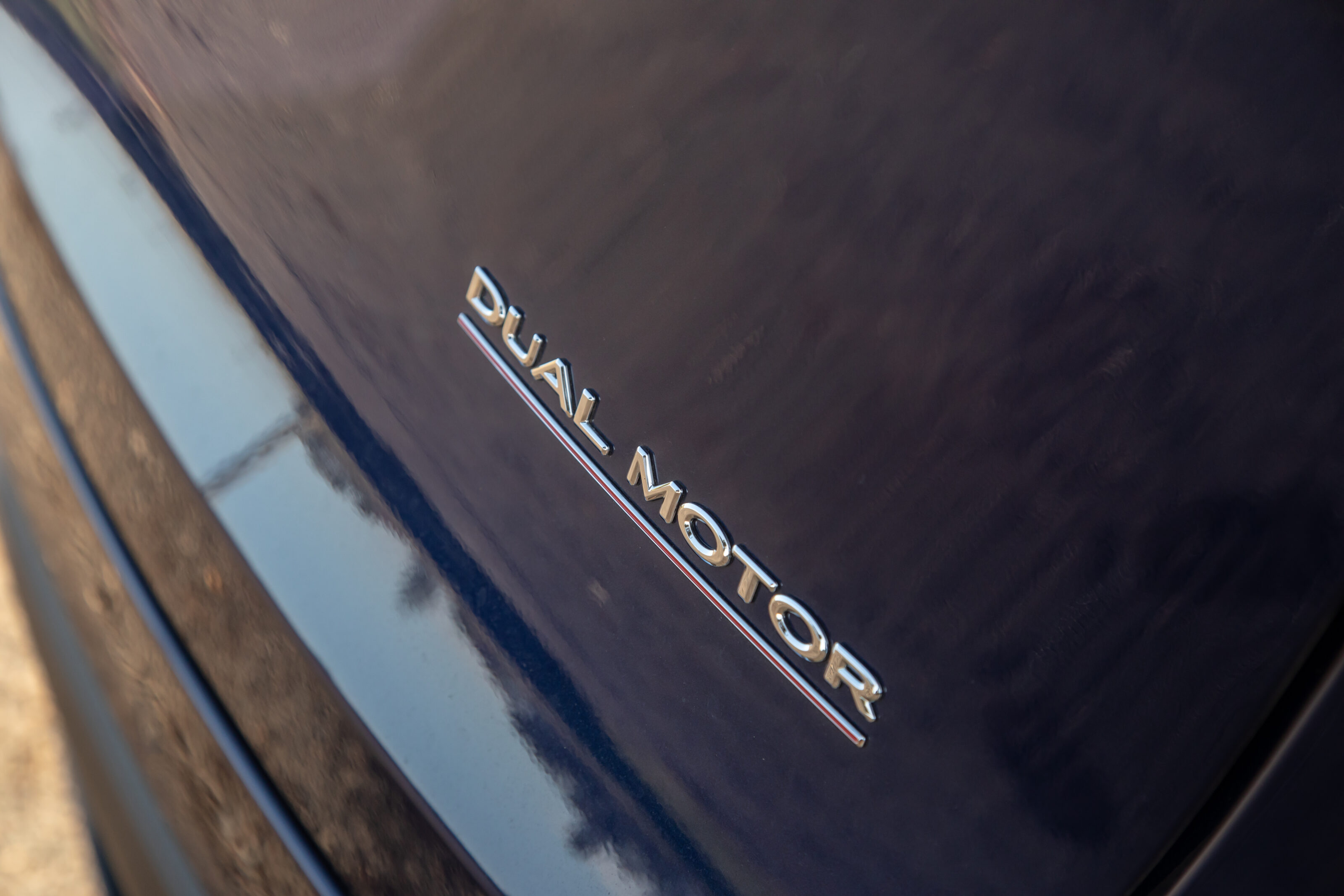
Meanwhile, in Tesla-land, the laundry list reads like that of The Emperor who bought New Clothes. On top of an extra motor and a bigger battery pack, it’s got some red brake calipers (which were quietly downgraded from Brembos), metal pedals, a carbon-look lip spoiler, 21-inch alloy wheels, LED foglights, and a subtle ‘dual motor’ badge. Not a lot, is it?
1
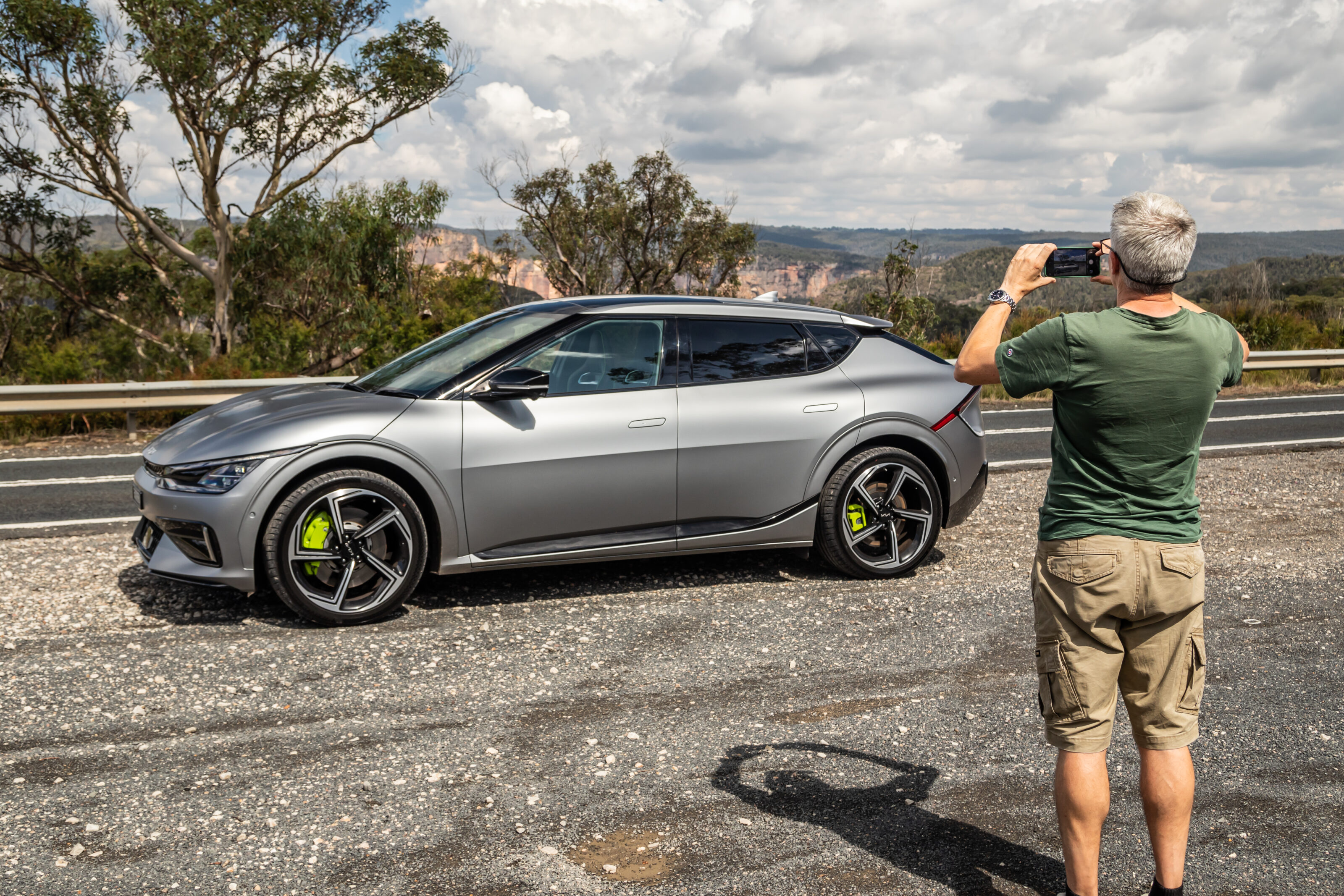
While the EV6 GT’s matte Moonscape duco and fluoro green accents may not be to everyone’s liking, the Model Y Performance suffers from the same dowdy egg-like appearance as the regular car (even on 10mm lower springs).
Meanwhile, the EV6 GT’s taught bodylines, sloping roof, aggressive rear spoiler, and angry daytime running lights leave the Tesla for dead in the attractiveness stakes.
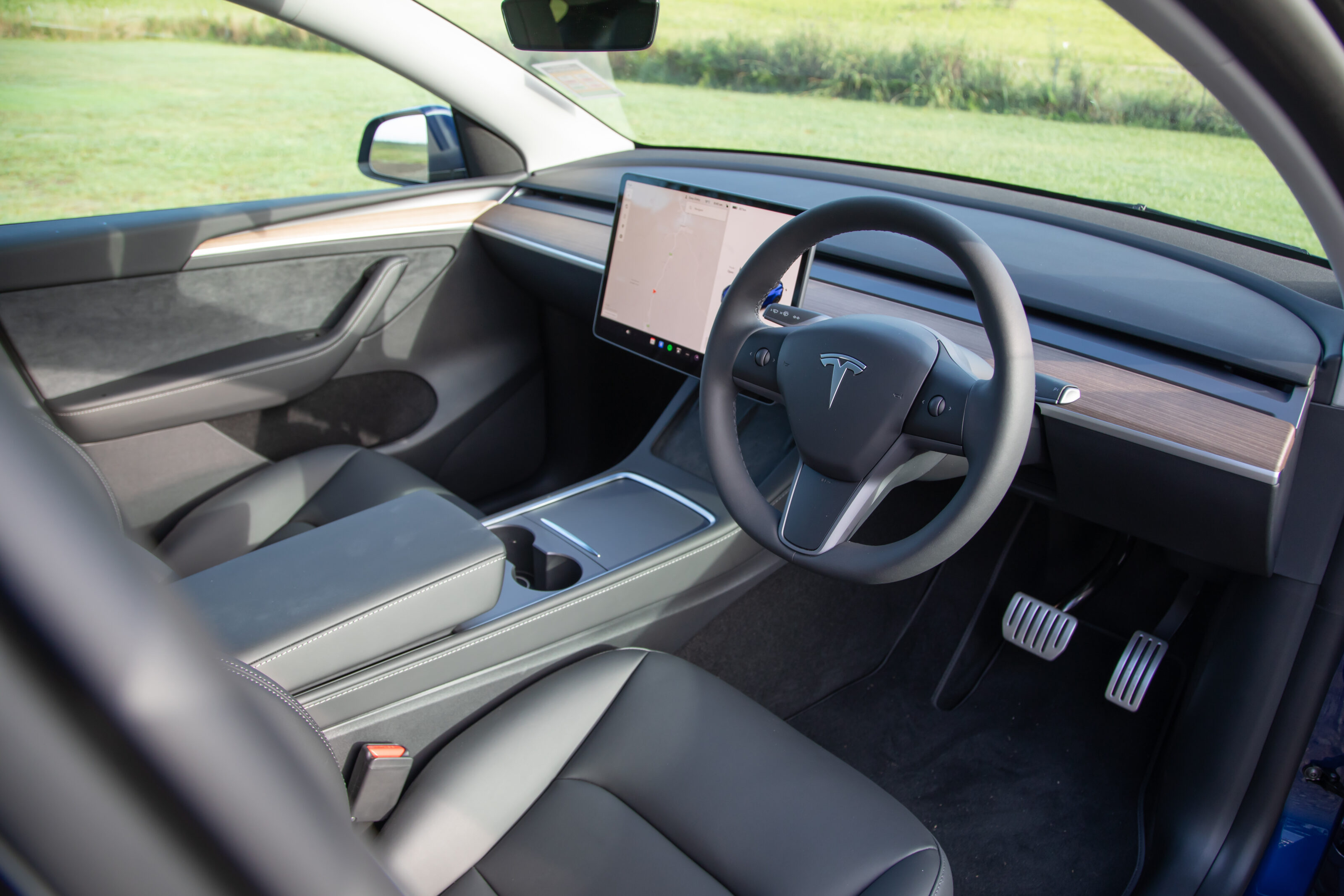
The Performance still benefits from Tesla’s large 15-inch touchscreen with Google Maps, Netflix, and other downloadable applications including games you can play while charging. The gimmicks continue with Whoopee Cushion mode, Light Shows and a crackling fireplace mode.
The Tesla ecosystem is part of the Model Y’s value equation and it’s hard to argue with such customisable and powerful infotainment. For the old-school among us, though, it can be tricky to ignore the lack of traditional dials – a simple head-up display would alleviate this.
1
Comfort and space
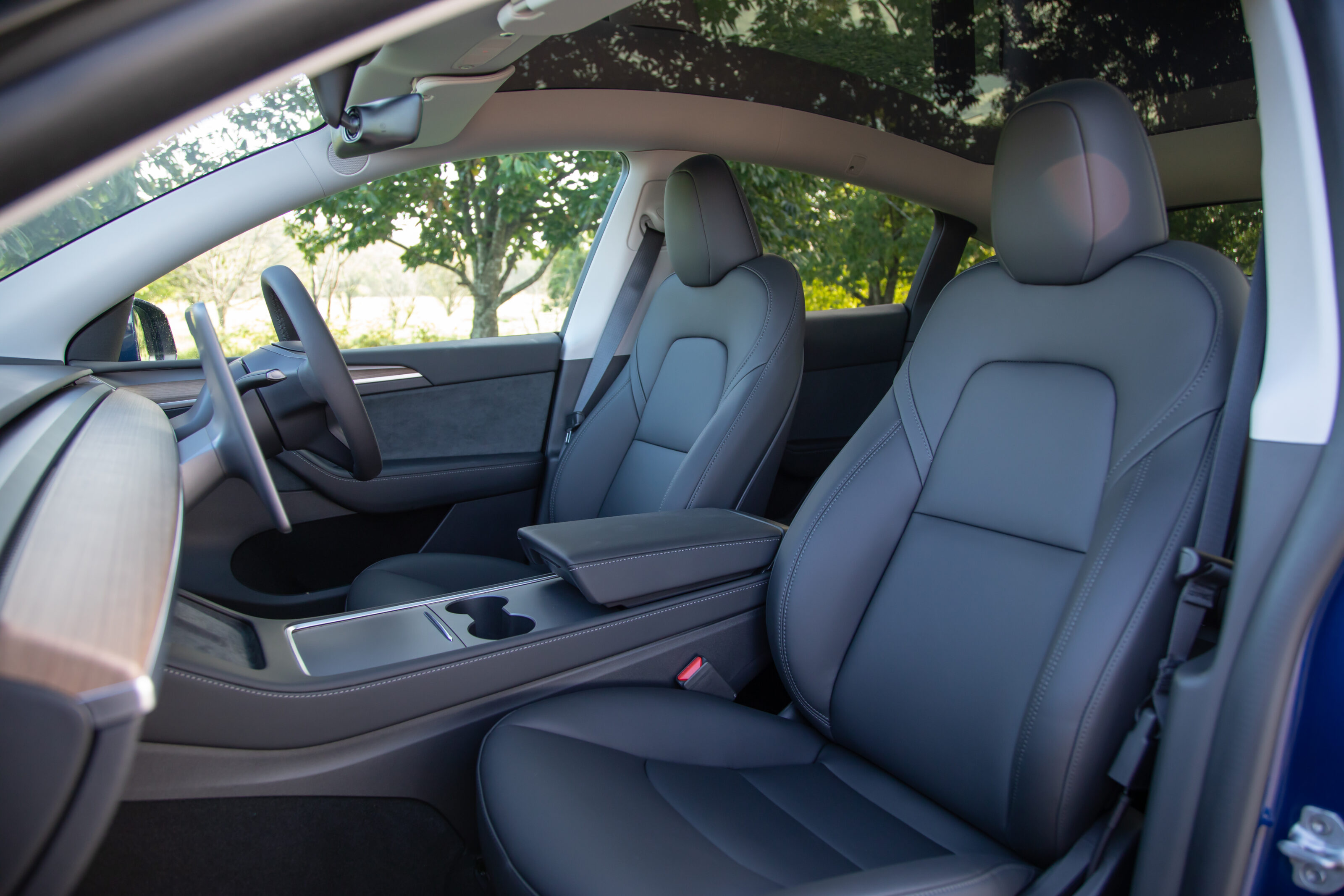
The Tesla Model Y has a mighty practical and livable interior and would make a stunningly capable family hack.
There’s ample space in the back for three adults, and they’ll have a great view out thanks to the large glasshouse and stadium seating. USB-C charging ports will keep devices juiced up, and a fold-out armrest keeps shoulders from growing tired.
The boot’s capacious as well (Tesla claims 864L), and there’s a huge tub beneath the floor for more hidden storage. The 60-40 seatbacks fold on an electric actuator, and the 117L ‘frunk’ is genuinely usable, unlike the EV6’s 20L space.
The seats, identical to the regular Model Y, are okay in terms of comfort but provide little in the way of performance-focused bolstering. They are electrically adjustable at least, unlike the $100K Kia’s seats, but the driving position is oddly high.
1
In Australia’s biting sun, the Model Y’s black vinyl upholstery becomes intolerably sweaty. White bamboo-based ‘vegan leather’ is optional, but that fixed glass roof still lets a lot of heat in. Cooled seats are a vexing omission.
Incidental storage is excellent, however. The industry-best twin wireless charging pad is an ergonomic triumph, the cup-holders fit bottles and coffee cups, while the door bins are flocked inside. The wood veneer dash inlays are attractive, too.
Tesla’s build and material quality has come leaps and bounds over early examples, but our car still had a niggling rattle from the rear bench.
1
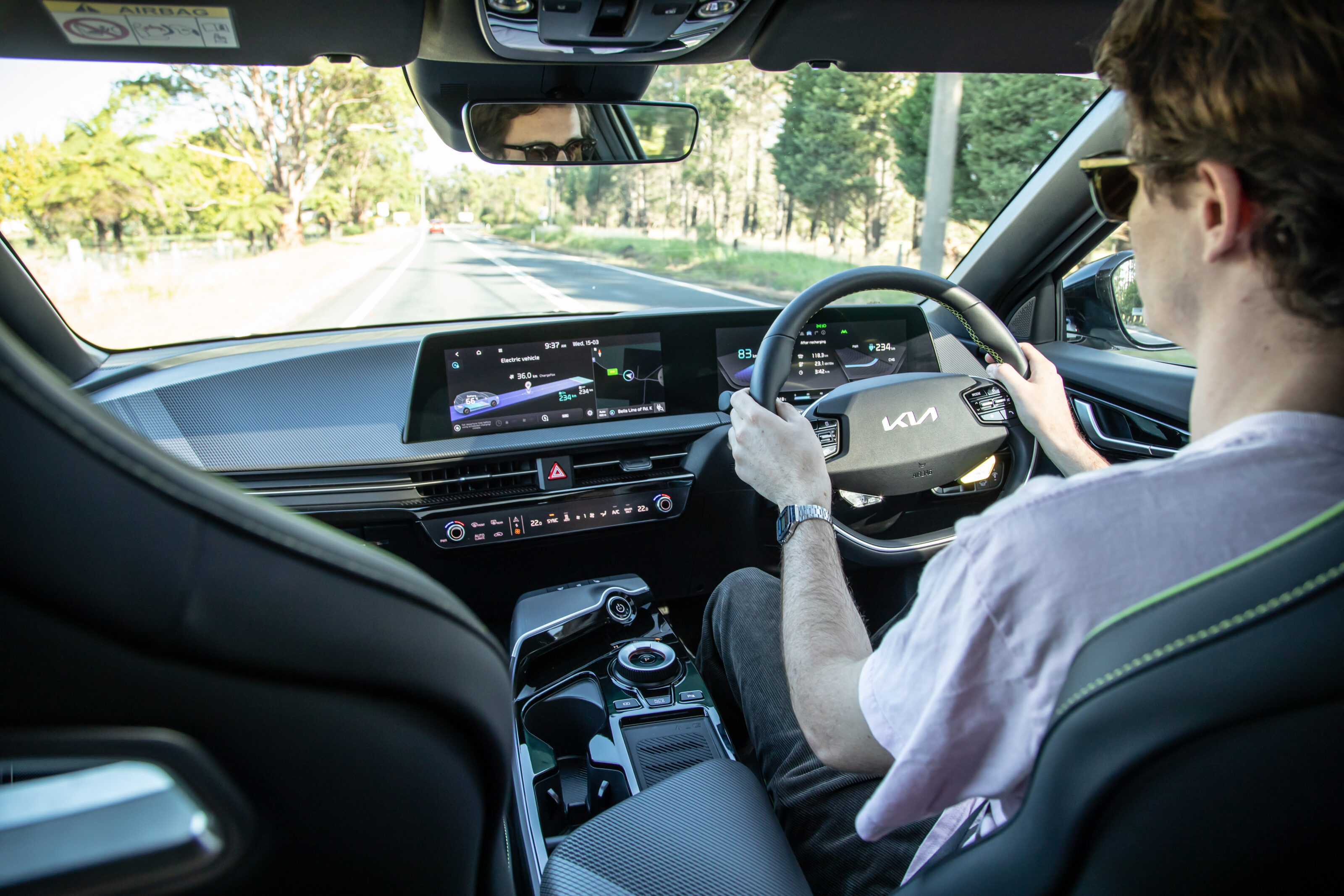
Kia’s approach to interiors is very different indeed.
You’re set so low in the EV6 GT, those suede cloth-upholstered bucket seats hug you like true performance items. But they’re manually adjusted, and unlike the GT-Line, don’t have fan cooling.
The EV6 GT has some welcome interest in the cabin next to the minimal Tesla, with fluoro stitching, customisable ambient lighting, and futuristic design language. Storage is good too – the floating centre console leaves a perfect space for small bags, and the centre bin is deep with a nifty, angled wireless charging pad on top.
1
What Kia can’t be forgiven for is not installing auto-down windows in the second row. It’s a common affliction with Kia models – less egregious in a Stonic, but this is a $100K car. What gives!
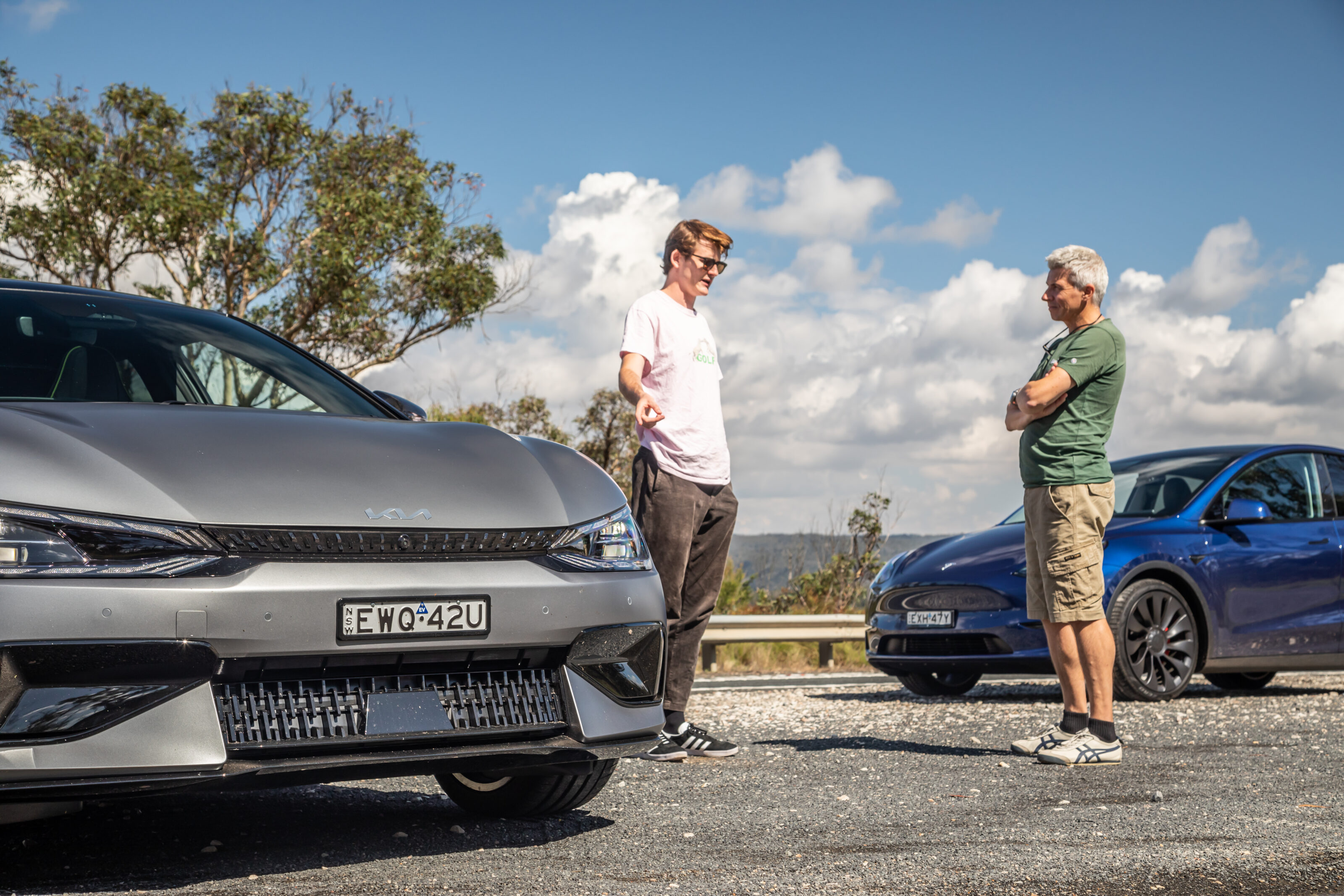
The back seat is otherwise excellent. Vast legroom and headroom complemented by B-pillar vents, two USB-C charging ports, and a fold-down armrest. The svelte front buckets don’t impede vision, though privacy glass, a porthole sunroof, and small rear windows make the EV6 a dark place to be. With thoughtful under-floor storage, a five-position backrest, and shopping bag hooks the EV6’s 480L boot is smart, if not able to match Tesla’s volumetrically.
1
On the road
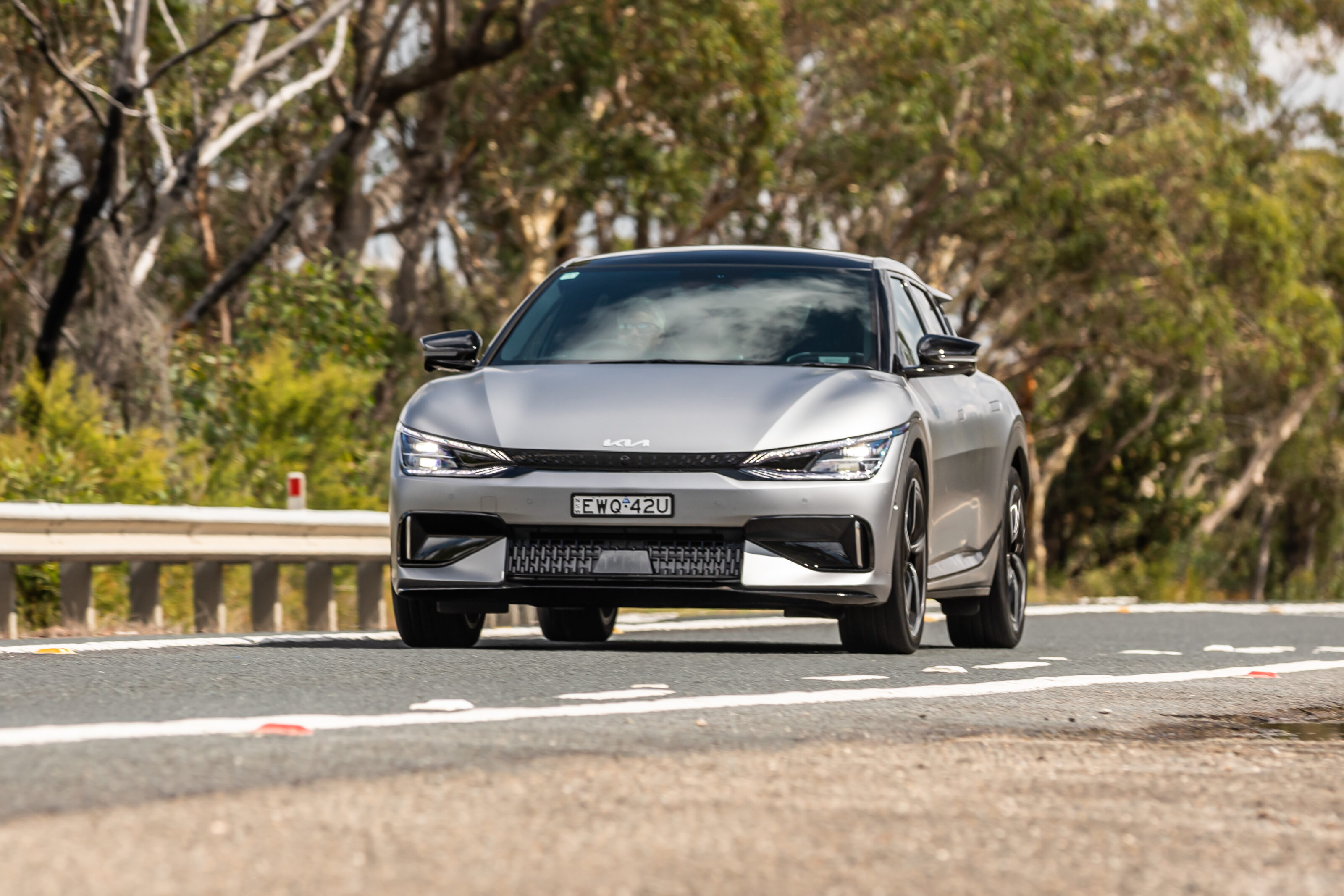
The Model Y Performance and Kia EV6 GT are forces of nature. Two-tonnes of metal being flung at the horizon by 430kW/730Nm in the Kia’s case, and approximately 393kW/660Nm for the Model Y.
The Model Y’s initial snap is more visceral, yet its electronic smarts limit wheelspin to a minimum expertly. The EV6 GT seems to be limited slightly as you mash the gas, but delivers a swelling tsunami of grunt and keeps pulling.
It all happens in sophisticated silence (unless you engage one of Kia’s strange Active Sound Design noises). And, in truth, the speed gets old pretty fast – a one-trick pony does not a great car make.
1
Separating the two, then, comes down to the chassis. And from past tests, the EV6 (2022’s Wheels Car of the Year) should have the upper hand. Interestingly, the Chinese-built Model Y arrived with Tesla’s new ‘Comfort’ suspension tune.
Its updated settings should make for better bump absorption. Tesla’s Chinese arm claims improved support from the dampers in the mid-stroke, and better compliance. It even hints that the car will perform better on track.
The difference is noticeable – this Model Y moves through its stroke more seamlessly than the example we had at Car of the Year. I remember saying to Jez: “if this Model Y had been at COTY, it might have won”… but that was after 30 minutes of straight and decently-surfaced tarmac.
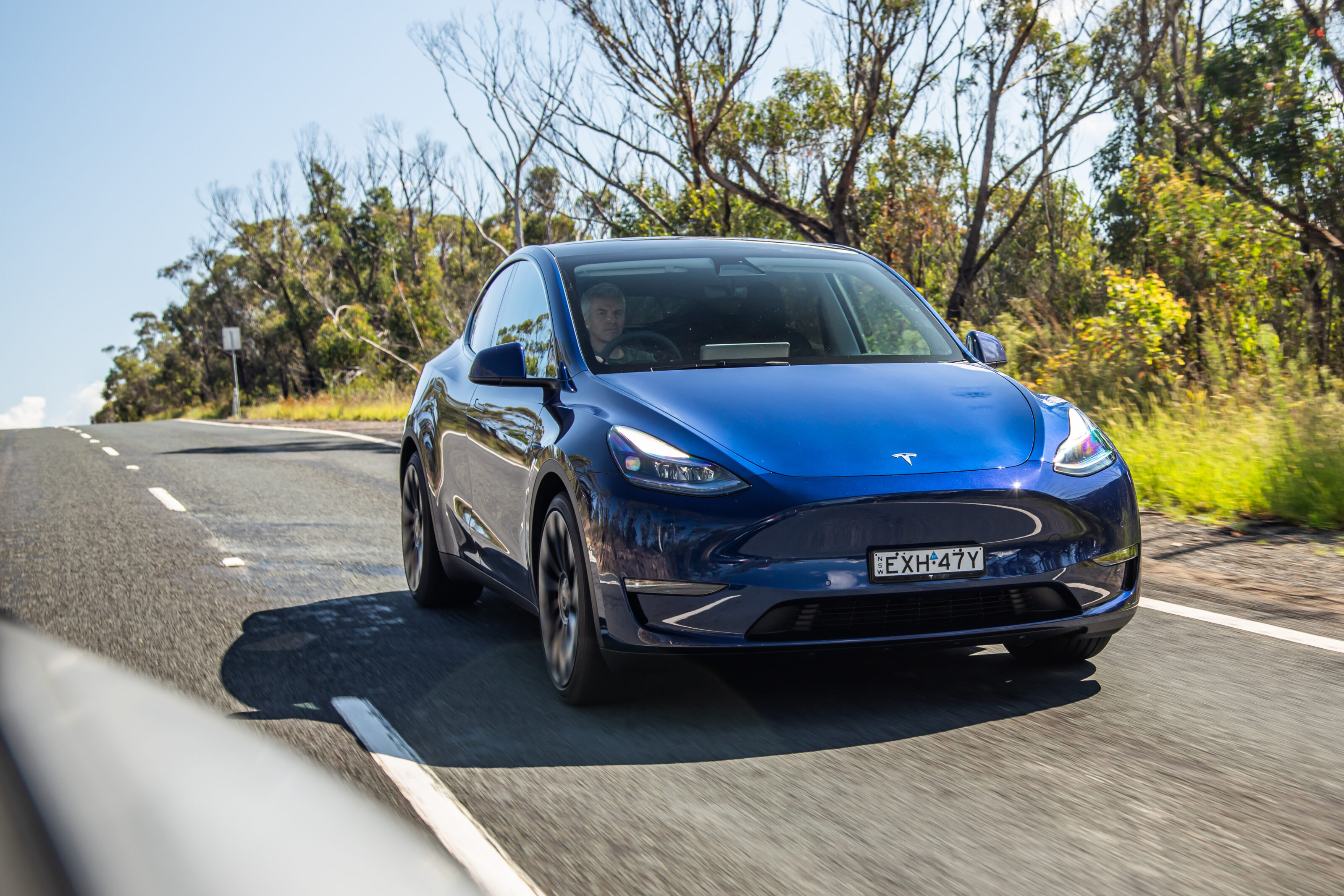
1
Tesla’s regenerative braking is strong and reliable, although when you need the brake pedal it’s mushy and not confidence-inspiring. Forward vision is generally excellent, owing to the high seating position and huge front windscreen, but the tiny rear window makes it hard to judge the rear of the Model Y.
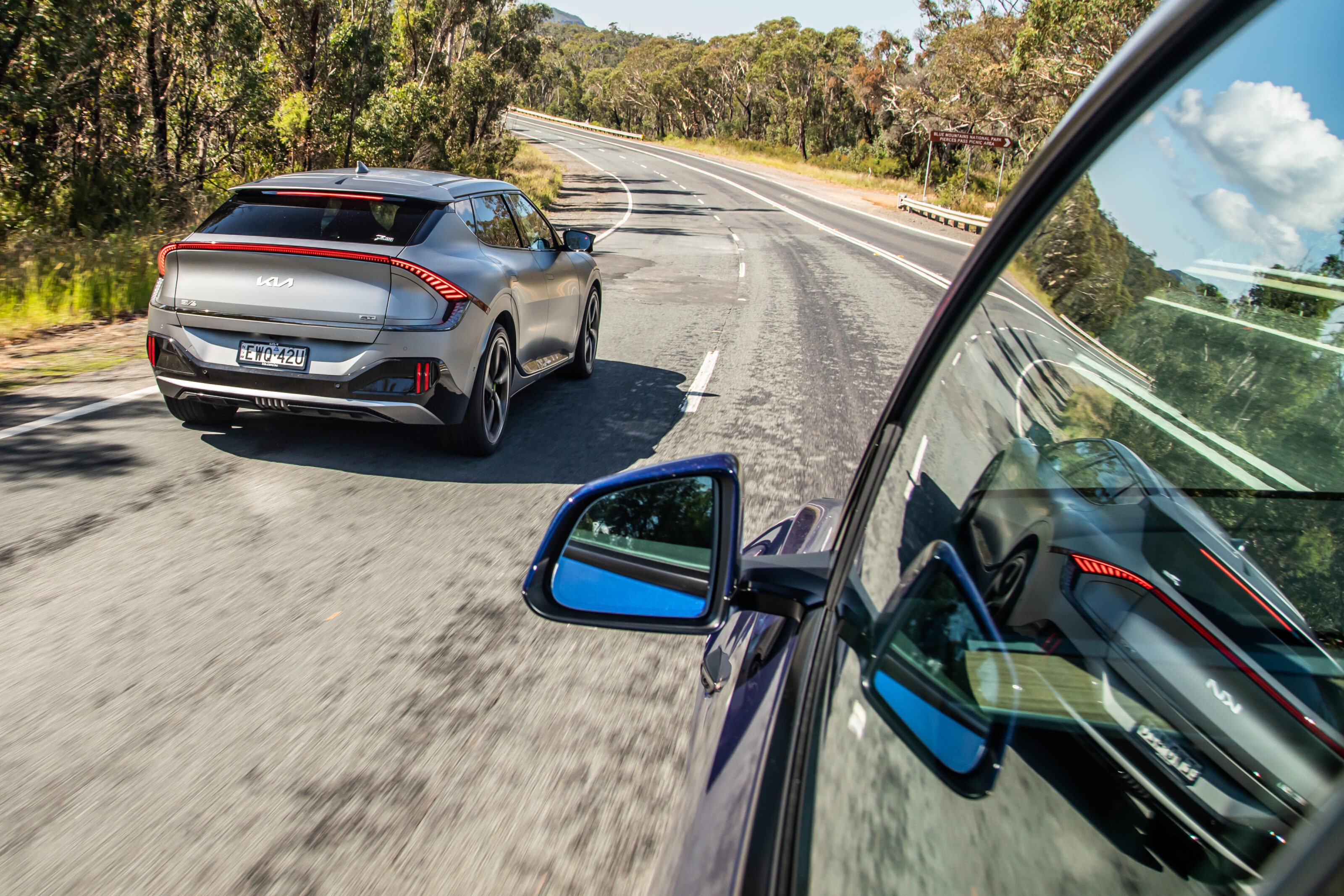
Swapping into the EV6’s snug bucket seats on the bumpy Bells Line of Road re-iterated Kia’s suspension tuning nous. Sometimes Kia goes a little too far (case in point: Cerato GT) but the EV6 GT is superbly judged.
The quality Sachs adaptive dampers have so much support, yet retain supple absorption on small bumps. The EV6 is firm, but never crashy, even at low speeds on 255/40R21 Michelin Pilot Sport 4S rubber. A hint of front suspension thump is evident around town, but it’s never as troublesome as the Model Y’s incessant rear suspension boom.
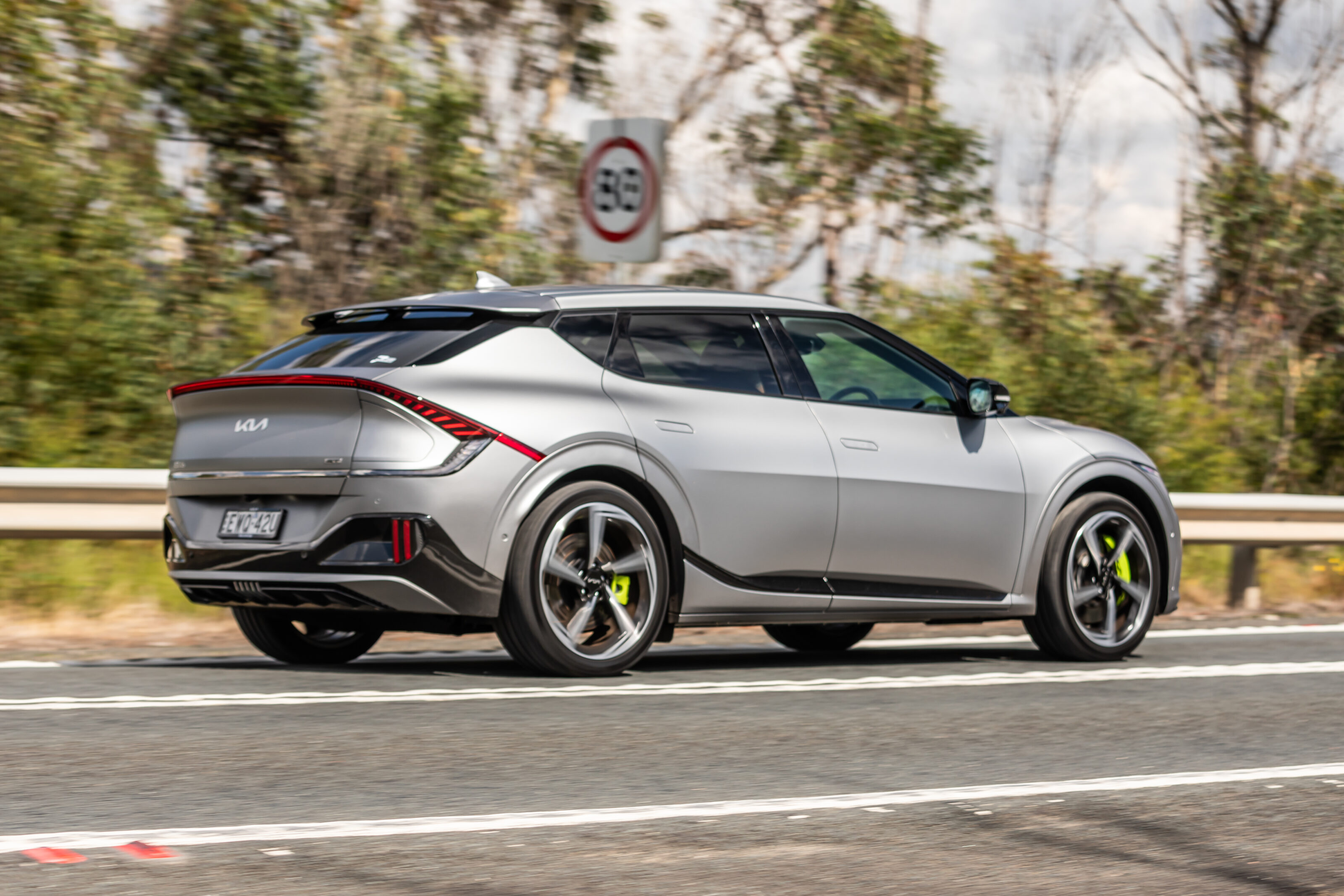
1
The EV6 GT’s four-piston front brakes inspire confidence when you need them, although Kia’s regenerative braking (adjustable with flappy paddles) isn’t quite as sophisticated as Tesla’s. And, when you spark up the car, it resets to Level 2 as default, even if you were last using ‘i-Pedal’ one-foot driving.
Sexy sequential indicators engaged, the EV6 GT led the Model Y performance off the main road onto our chosen stretch of tarmac to test their ride and handling. An initial sighting run in the EV6 GT had me questioning if the road was as treacherous as I’d remembered, such was the Kia’s composure.
The Model Y Performance reminded me that, yes, this bit of bitumen really is a goat track. It may be riding on a new chassis tune, but mid-corner bumps still send the Model Y’s body bucking and corkscrewing well below the posted 100km/h speed limit. I’m not so sure that softer is better in this case, as it’s even easier to find the bump stops.
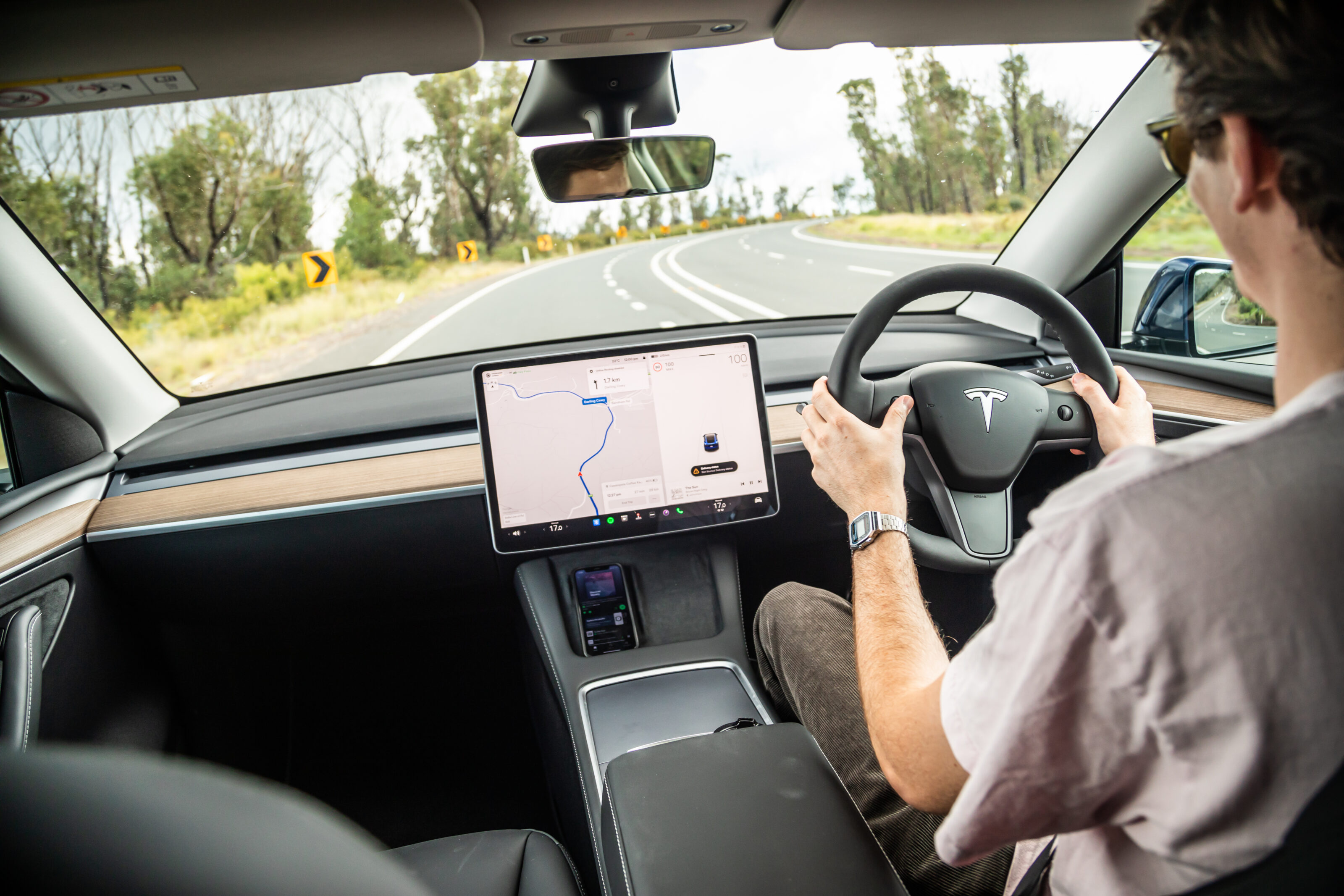
1
An initial sighting run in the EV6 GT had me questioning if the road was as treacherous as I’d remembered, such was the Kia’s composure. The Model Y Performance reminded me that, yes, this bit of bitumen really is a goat track.
Super sharp steering (two-turns lock-to-lock) doesn’t aid confidence. Not an issue in the low-set Model 3 sedan, but it makes the taller Model Y feel nervous and unsettled. The wheel is prone to rack rattle, too, and there’s a dead-spot on-centre that grates on freeway slogs.
After futzing around with drive modes in both cars (the Model Y doesn’t have any useful settings; steering is either claggy or claggier), I settled on preferences. In the EV6, with its adaptive dampers, Normal works for most driving.
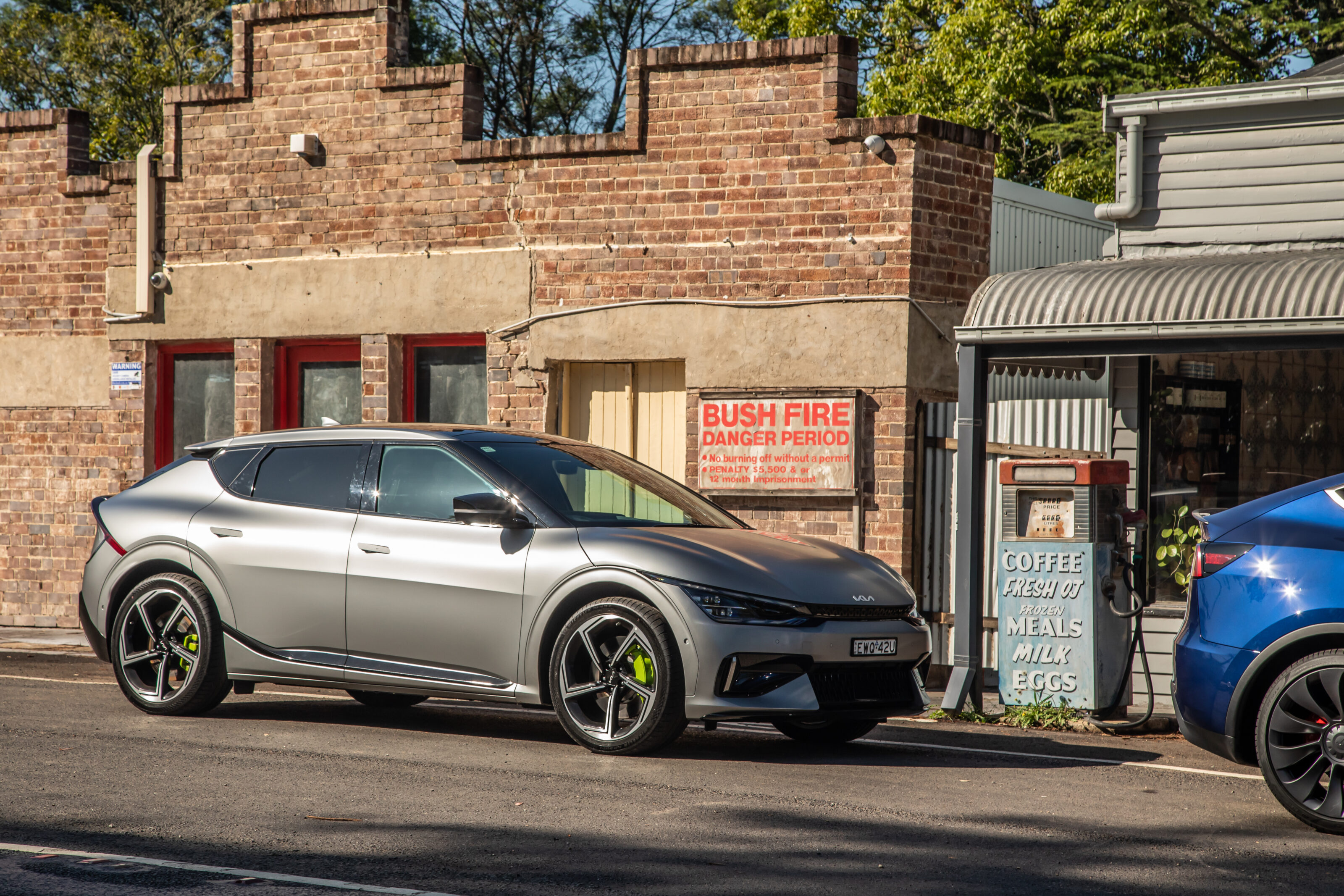
1
A customisable ‘My’ mode (easily accessible with two taps on the fluoro GT button) was for getting stuck in, with Sport throttle, Sport+ steering, Track ESC, and Sport dampers.
Proving its point, the EV6 GT was magic on the back-to-back road in ‘My’ mode. Its steering is calmer (2.3 turns lock-to-lock) and more consistently weighted.
Useful information about the surface and grip level make its way through the two-spoke tiller, but mainly the seat of the pants – amplified by sparsely-padded chairs. The EV6 GT is further aided by double ball-joint front suspension that freed-up castor and trail adjustment, improving steering feel.
Speaking to chassis dynamicist Graeme Gambold (above), he revealed that Australian EV6 GTs run higher compression and lower spring rates for better control of the body without the jiggle associated with excess rebound damping.
With all this at your disposal, commitment is easy. The EV6 GT sits flat and poised, allowing the driver to adjust attitude using the throttle.
Where the Model Y is rolling, yawing, and all at sea, the EV6 GT is encouraging you to start powering out of bends, with oversteer available from the rear-mounted e-LSD if you’re brave enough. It left the Model Y Performance floundering in the distance.
Advice
Australia’s best electric cars for 2023
We’ve tested nearly every EV below six figures in Australia to rank the best on sale today
Driving range and charging
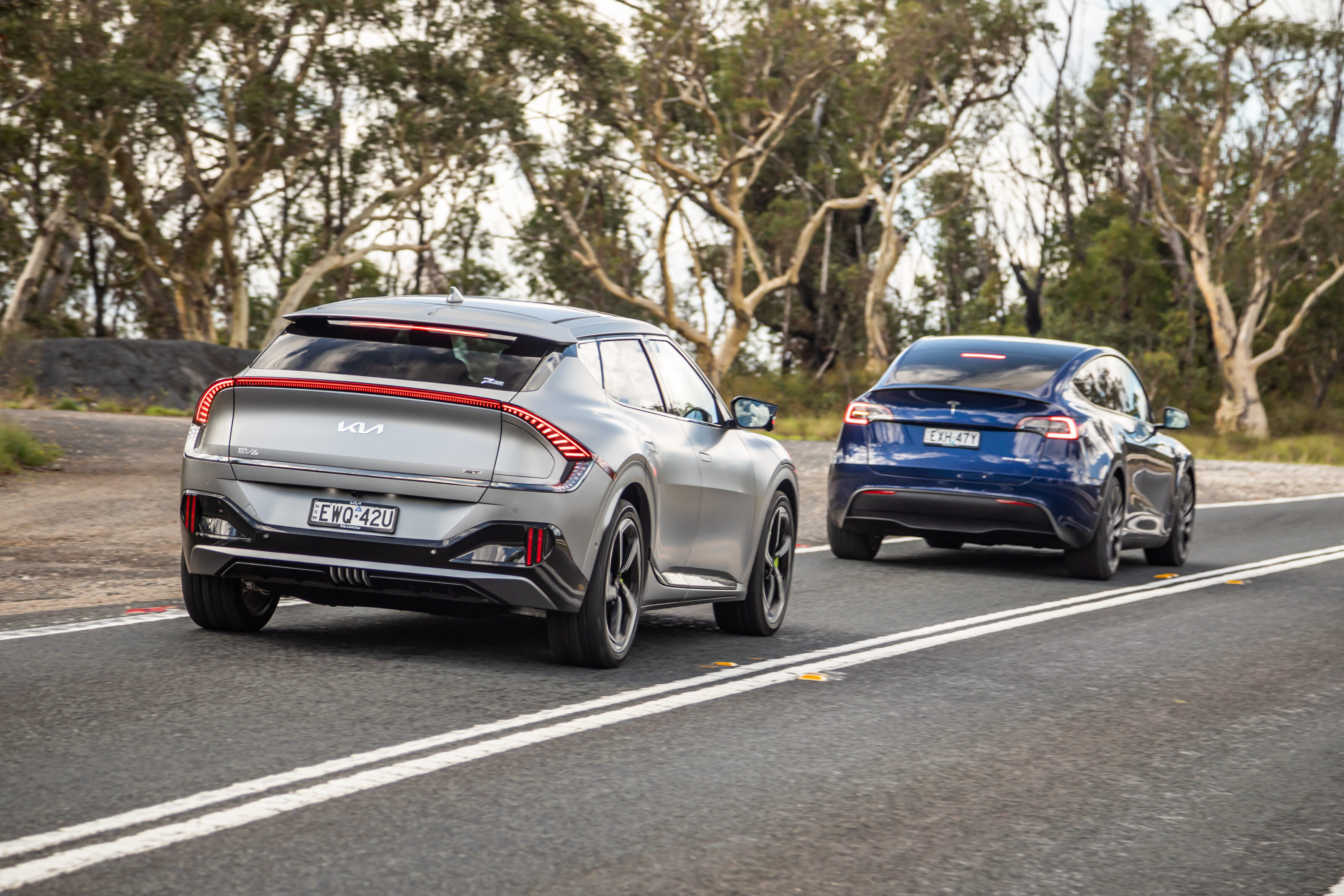
We undertook an average Sunday loop, heading west of Sydney towards the Blue Mountains from a fast charger near Penrith. The elapsed distance was 209km for both cars.
Neither the Tesla Model Y Performance nor the EV6 GT matched their respective 514km and 424km WLTP combined driving ranges, but the EV6 GT came closer.
A real-world Sunday drive would see the Model Y capable of 421km, and the EV6 GT 367km. The EV6 GT’s driving range is somewhat restrictive… lucky it charges so fast.
| Driving rangeu00a0 | Tesla Model Y | Kia EV6 GT |
|---|---|---|
| Battery size (usable) | 75kWh* | 77.4kWh |
| WLTP range | 514km | 424km |
| WLTP consumption | 14.6kWh/100km | 20.6kWh/100km |
| Tested range | 421km | 367km |
| Varianceu00a0 | -18.1% | -13.4% |
| Tested consumption | 17.8kWh/100km | 21.1kWh/100km |
1
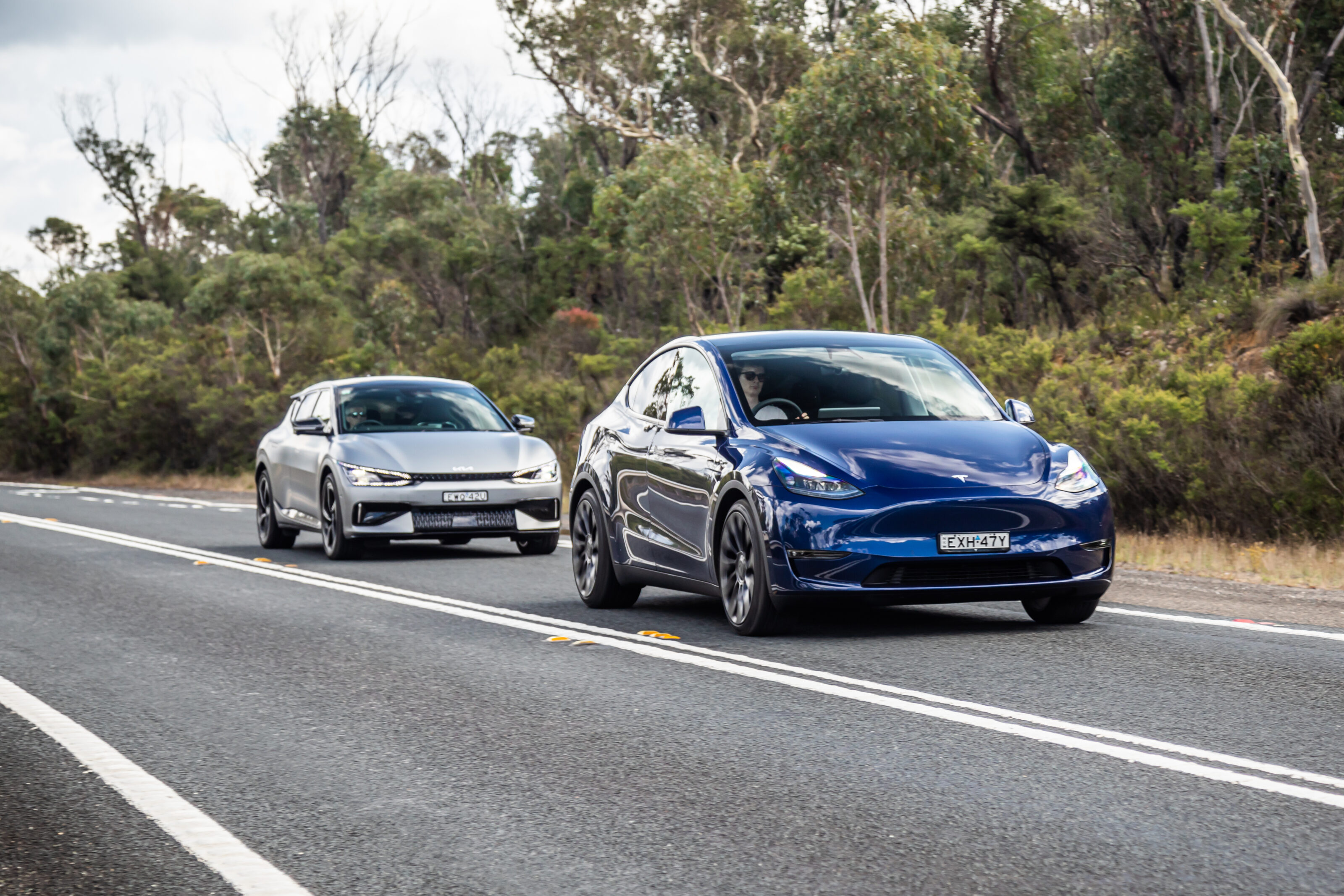
When it comes to charging, the E-GMP’s 800-volt architecture reigns supreme. Hooked up to a 350kW station, the Model Y added 15kWh of charge (84km range) in 8:01 – the EV6 GT did the same volume of electricity (or 71km range) in 4:47.
The table below shows the observed peak speeds on the charger – the EV6 held 220kW-plus until it climbed over 70 per cent, while the Model Y dropped off sooner.
| Public fast-charging | Tesla Model Y | Kia EV6 GT |
|---|---|---|
| Claimed 10-80%u00a0 | 27 minutes | 18 minutes |
| Adding 15kWh | 8 minutes 1 second | 4 minutes 47 seconds |
| Observed peak power (DC) | 151kW (@ 37%) | 230kW (@ 50%) |
1
Safety
The Tesla Model Y was awarded five stars in 2022 ANCAP safety testing.
Tesla may be known for its controversial autonomous tech, but the basic systems aren’t leagues better than the Kia’s. You can pay $5100 more than the list price to get Enhanced Autopilot which adds auto lane-change, and the ability to follow navigation directions on freeways. ‘Full self-driving’ is available for $10,100 but is not yet active in our market.
Both the EV6 GT and Tesla Model Y are fitted with AEB that detects pedestrians, cyclists and crossing traffic, lane-trace assist, blind-spot monitoring, and rear cross-traffic alert.
1
Ownership
A seven-year / unlimited-kilometre warranty combined with Kia’s vast dealer network is sure to appeal to a more traditional car buyer.
Servicing needs to be carried out every 12 months/15,000kms, and will cost $1371 if you pay upfront.
Meanwhile, Tesla’s hands-off, minimal maintenance, and over-the-air software updates are undeniably big selling points. The Model Y will alert you when it needs servicing via the app, and Tesla does not provide a price guide.
With 60c/kWh Supercharger locations gradually opening up to other makes, Tesla ownership isn’t quite as exclusive as it once was, but it’s still a solid and futuristic experience.
1
VERDICT
The Tesla Model Y Performance has an old-school muscle car vibe about it (minus the rumbling V8s, live axles, and leather jackets). More power than you could ever need, barely contained by its Pirellis and a chassis that’s at boiling point.
Kia has crafted a far more cohesive stupid-fast electric SUV. There’s so much support and encouragement from the chassis, that suddenly 430kW doesn’t feel so scary. You can really feel where Kia has spent that extra money, not only on motors and battery development, but making it a car that is involving, and joyful to drive.
If you’re convinced of a Model Y – and there are plenty of reasons why you would be (not least availability) – the rear-wheel drive is plenty. It gets all the same technology, cabin appointments, and more-than-adequate power for $29K less than the Performance.
With Model Y Performance, Tesla has made a very fast and technology-packed car. What Kia has done, is make a performance car out of the EV6.
1
SCORING
Kia EV6 GT: 9/10
Things we like
- Engaging chassis
- Futuristic cabin design
- Absurd speed
- Great steering
Not so much…
- Dark second row
- Manual seat adjust
- Conventional servicing schedule
Tesla Model Y Performance: 8/10
Things we like
- Airy, spacious cabin
- Powerful infotainment
- Improved bump absorption
Not so much…
- Awkward, clumsy dynamics
- Lacks differentiation from RWD
- Noisy suspension
| Tesla Model Y Performance | Kia EV6 GT | |
|---|---|---|
| Safety, value and features | 7.5 | 8.5 |
| Comfort and space | 9 | 8.5 |
| Engine and gearbox | 8.5 | 9 |
| Ride and handling | 6 | 9 |
| Technology | 8 | 8 |
| Overall | 8 | 9 |
MORE
Everything Tesla
MORE
Everything KIA
Specifications
| Model Y Performance | Kia EV6 GT | |
|---|---|---|
| Price | $98,955* + ORCs | $99,950 + ORCs |
| Drivetrain | ||
| Layout | twin-motor AWD | twin permanent magnet synchronous motor AWD |
| System power | 393kW** | 430kW |
| System torque | 660Nm** | 740Nm |
| Gearbox | single-speed reduction gear | Single-speed reduction gear (10.65:1) |
| Chassis | ||
| Body | steel, 5 doors, 5 seats | steel, 5 doors, 5 seats |
| L/W/H/Wu2013B | 4751/1921/1624/2890mm | 4869/1890/1550/2900mm |
| Weight | 1997kg | 2148kg |
| Boot | 864L | 480/1260L |
| Battery | 75kWh** | 77.4kWh |
| Economy | 14.6kWh/100km | 20.6kWh/100km |
| Driving range | 514km (WLTP) | 424km (WLTP) |
| Charging (AC/0-100%) | 11kW/8h 15m | 10.5kW/7h 20m |
| Charging (DC/10-80%) | 250kW (max)/27m | 220kW (approx)/18m |
| Suspension | Front: strut, coil springs, anti-roll bar. Rear: multi-link, coil springs, anti-roll bar | Front: strut, double ball joint, coil springs, anti-roll bar, electronic damper control. Rear: 5-link multi-link, coil springs, anti-roll bar, electronic damper control |
| Steering | electric rack-and-pinion (2.0 L-L) | electric rack-and-pinion (2.3 L-L) |
| Front brakes | 4-piston caliper | 4 piston front caliper, ventilated discs (380mm) |
| Rear brakes | Single-piston sliding caliper | Single-piston sliding caliper, ventilated discs (360mm) |
| Tyres | Pirelli P Zero Elect | Michelin Pilot Sport 4S |
| Tyre size | 255/35R21 275/35R21 | 255/40R21 |
| Safety | ||
| ANCAP rating | five-stars | five-stars |
| Performance | ||
| 0-100km/h | 3.7sec (claimed) | 3.5sec (claimed) |
*Including LCT
**figures based on estimates provided by EV database
If you’ve heard and wondered about terms such as 2.0-litre, cubic centimetres (cc) and displacement, you’re not alone. But it’s fairly simple: all relate to the size of a car’s engine.
Not its external dimensions, mind you. Engine size (in litres or CCs) is a measure of the cumulative space inside a motor’s cylinders, where the mixture of air and fuel is ignited to produce the energy required to turn the car’s wheels.
These days, it’s typically rounded to the nearest tenth of a litre, but in reality is often a little shy of that exact number. For example, 1997cc is a typical displacement for a ‘2.0-litre engine’.
An engine’s cylinder count will vary, from three to eight in typical passenger cars, but with extremes as low as two and up to 16 in more exotic metal.
Typically, the higher the engine’s cylinder count the bigger the engine displacement – a three-pot engine with 500mL cylinder sizes is a 1.5-litre engine, add another cylinder and you have one of the most common engines: a 2.0-litre four-cylinder.
1
Is a bigger engine really better?
Bigger engines mean extra air and fuel, making more grunt. The bigger the engine size, typically the greater the power and torque figures.
Let’s compare two typical small cars fitted with a 1.5-litre and 2.0-litre engine. Which is better?
The Toyota Corolla’s 2.0-litre petrol engine produces 126kW; the smaller Yaris’s three-pot makes 88kW. A win to the Corolla, then?
Well, not quite. The Corolla’s combined ADR fuel consumption is 6.0L/100km to the Yaris’ 4.9L/100km. The bigger engine typically uses more fuel, so it depends on how you personally measure ‘better’ and what you need or want to achieve with the car.

1
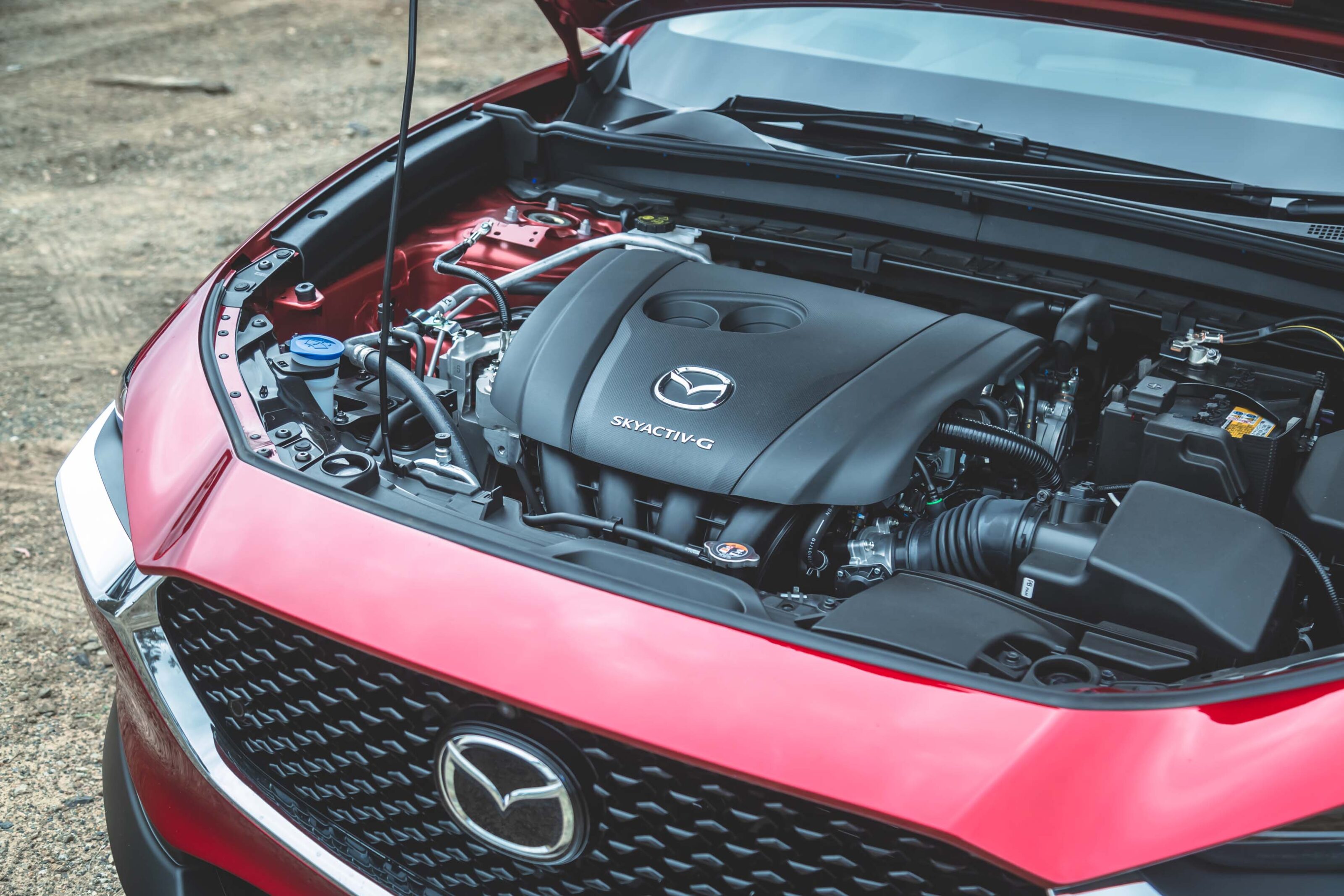
The exception is if the engine is under-sized for the weight of a car, and therefore over-stressed. Mazda’s CX-30 is a good example of this phenomenon, where the smaller ‘G20’ 2.0-litre only saves 0.1L/100km on paper compared to the larger ‘G25’ 2.5-litre four-banger.
Taking that to the extreme, if you fitted the Yaris’ 88kW three-pot motor to a BMW 5 Series, it would be less fuel efficient than that car’s 197kW 3.0-litre turbo-diesel six, despite the Bimmer’s mill being twice the size.
The solution for many modern vehicles has been to turbocharge small engines.
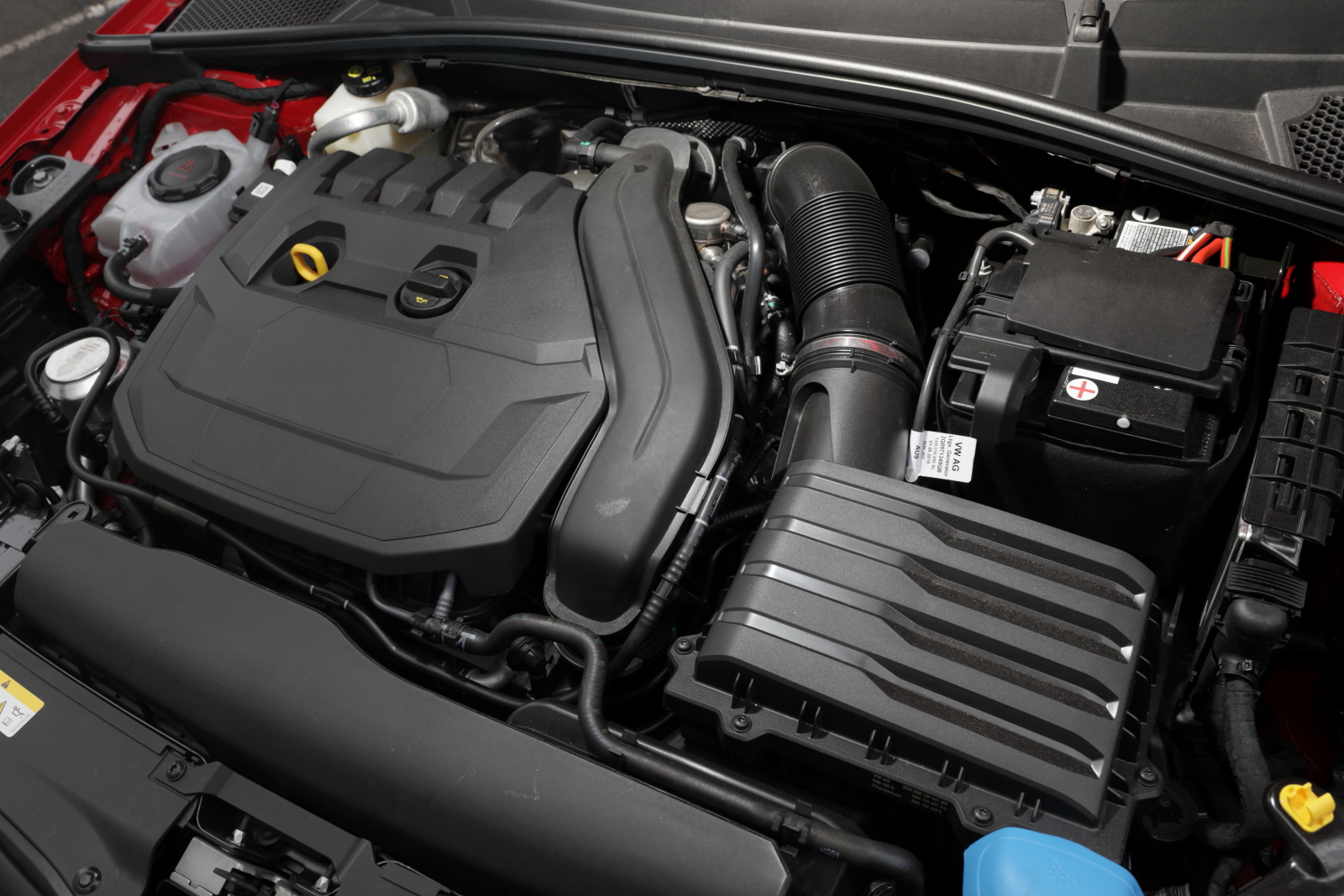
In Skoda’s case, it uses a 1.5-litre turbo-petrol four-cylinder developing 110kW/250Nm in its Fabia small car. That’s a little less power, but more torque than the Corolla – yet it matches the smaller Yaris for fuel consumption (4.9L/100km).
2
There are other ways to optimise engine performance for a given swept capacity, by using exotic parts with tight tolerances.
Ferrari, Porsche and Honda are masters of this. Early S2000 sports cars fitted with Honda’s ‘F20C’ 2.0-litre inline-four produced a whopping 92kW per litre, matching the 2011 Porsche 911 GT3 RS 4.0.
In summary, the size of your engine used to be a big deal, and if you’re looking at used cars, make sure to take this into account – often small-engined cars are significantly under-gunned. However, thanks to modern turbocharging, big engines and high cylinder counts are now more luxury than necessity.
Snapshot
- Tesla collects fleet data to predict potholes and road bumps
- Primes Model S and X air suspension beforehand to improve comfort
- Volkswagen implementing a similar machine-learning system
Electric vehicle automaker Tesla has detailed how it’s collecting fleet data to ready its air suspension system – before hitting a pothole or rough patch on the road.
The company tweeted that its large electric Model S liftback and three-row Model X SUV can now automatically raise their air suspension before hitting a nasty road patch to improve cabin comfort.
Adaptive air suspension setups are not new, with some luxury vehicles from Mercedes-Benz, Genesis and Rolls-Royce already using a front camera to detect bumps and potholes to prime the suspension and help soften the impact.
But Tesla’s predictive machine-learning system is based on anonymised data collected from other Tesla vehicles.
It’s unknown whether the feature applies to older 2013 to 2020 Model S and Model Xs fitted with air suspension or just the facelifted versions currently sold overseas.
The Tesla EVs can already adjust the suspension automatically when approaching a set location, such as a driveway for example.
1
The company also collects fleet data to improve its safety assistance systems, software, and route drivers to less busy Supercharging stations – as detailed at its Investor Day.
Meanwhile, Volkswagen features a similar ‘Swarm Data’ system for its ID. family of EVs in select European countries.
However, it’s designed to improve adaptive cruise control by steering the vehicle even if there are no line markings based on the driving habits of other equipped ID. road users.
MORE
Everything Tesla
The Tesla Model Y is estimated to be the US electric car brand’s biggest-selling model globally, though the SUV is playing catch-up to its sedan twin, the Model 3, in Australia.
Whether it will close the gap rapidly with the arrival of the Y’s fastest variant, the Performance, remains to be seen. With the middle-order Long Range missing, the Model Y line-up still doesn’t fully mirror its sedan relative.
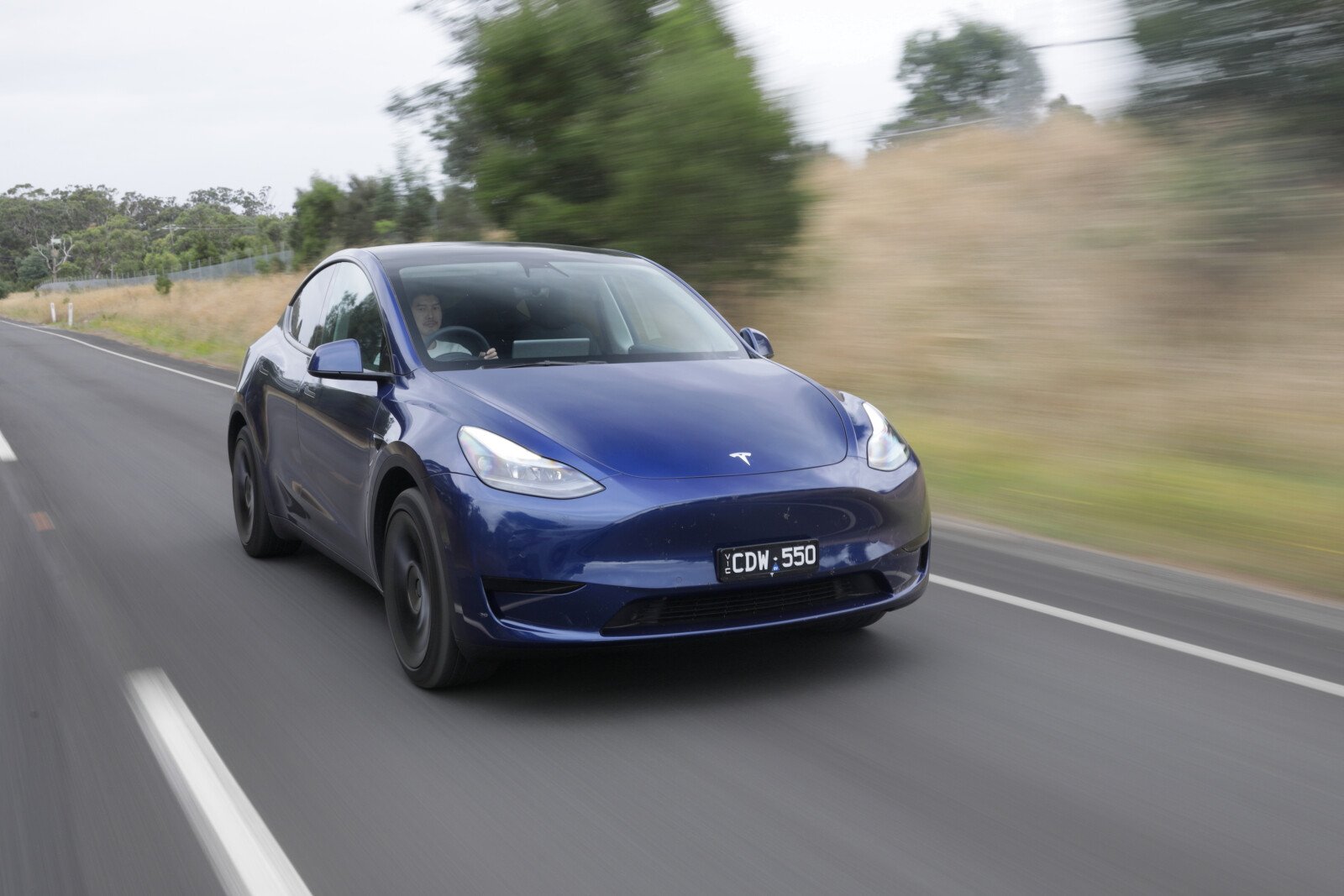
The Tesla Model Y first arrived in mid 2022 and until now has been offered only in base, single-motor form.
1
JUMP AHEAD
- How much is it, and what do you get?
- How do rivals compare on value?
- Interior comfort, space and storage
- What is it like to drive?
- How is it for range?
- How safe is it?
- Warranty and running costs
- VERDICT
How much is it, and what do you get?
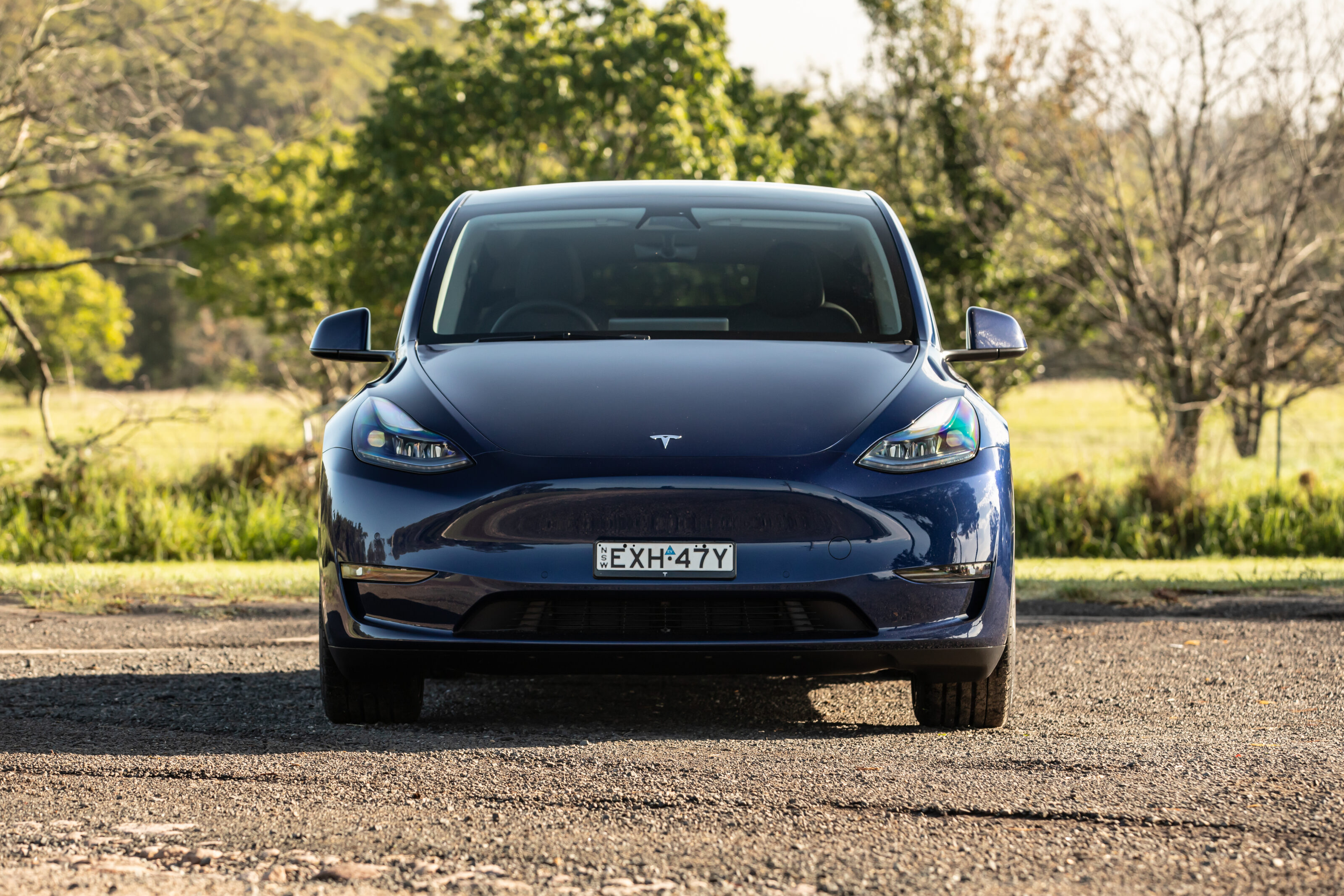
The Tesla Model Y Performance is priced just under $99,000 when including the luxury car tax, while on-road costs take it to about $108,000 drive-away.
That’s a substantial, near-$30K jump over the rear-drive, single-motor variant that costs from $69,300.
Additions are significant, though, beginning with a larger battery – estimated at 75kWh versus 57.5kWh for the base Y – which delivers a longer range, plus there’s a second electric motor that brings all-wheel drive and quicker performance.
Estimated power and torque – via the typically reliable EV Database – is 393kW and 660Nm, almost double the figures of the base Y.
1
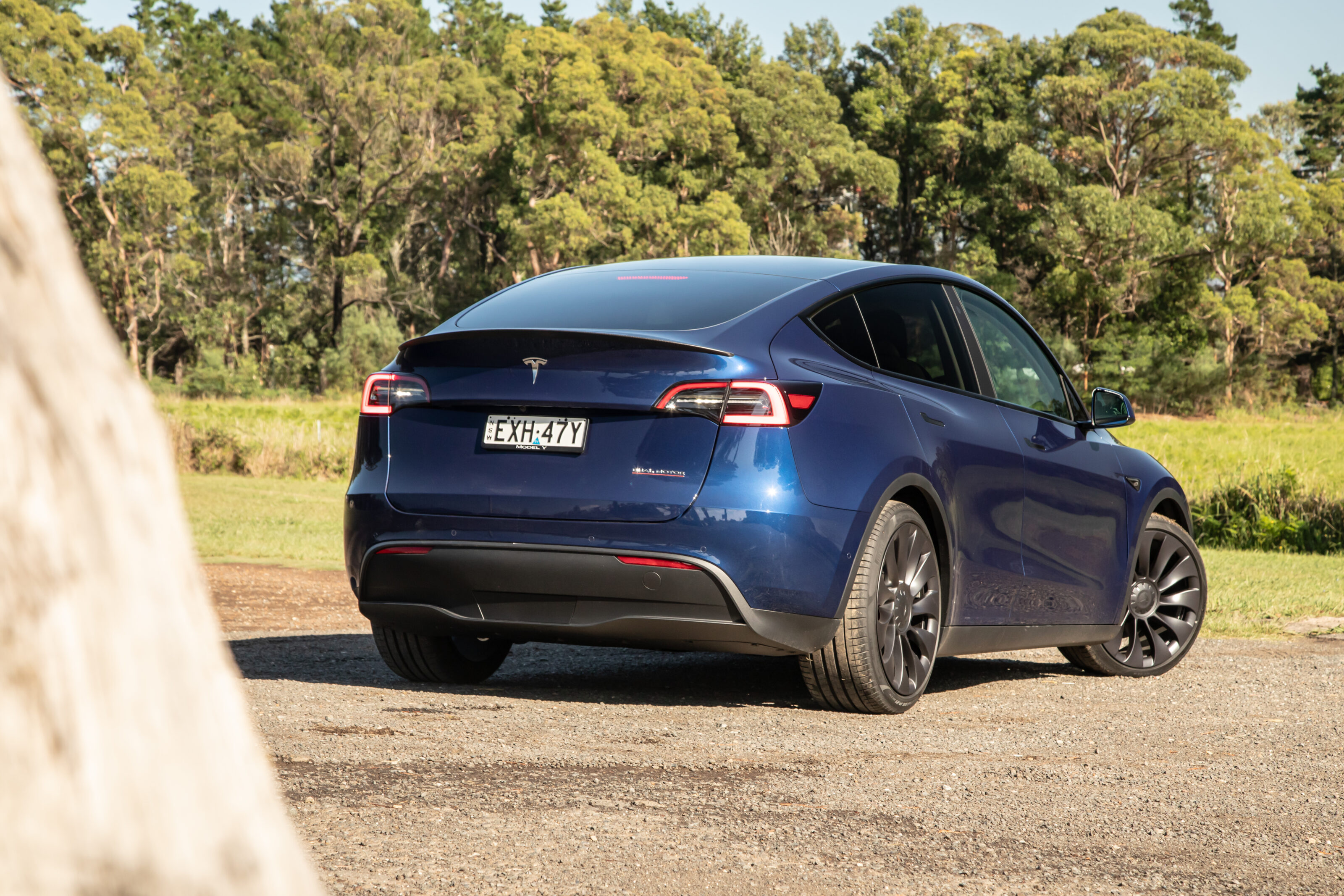
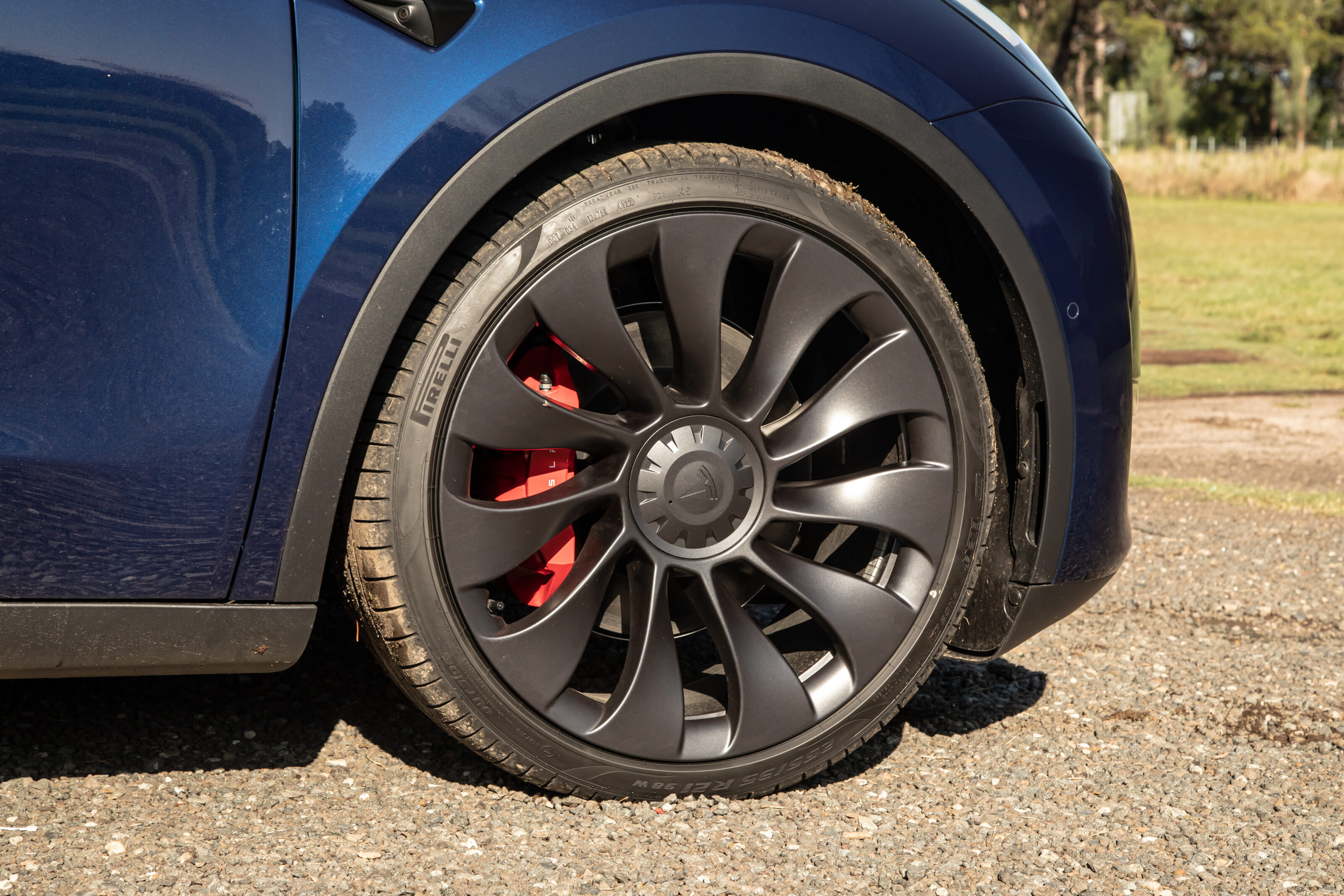
There are Performance brakes to help shed speed for this faster model, and there are 21-inch ‘Uberturbine’ wheels standard where the RWD Model Y sits on 19s.
Further addendums include aluminium pedals and a carbon-fibre boot-lid spoiler.
Options include a black and white interior, a choice of paint colours (though still a relatively restrictive palette), and enhanced ‘autopilot’ or a self-driving package. We’ve yet to be convinced by the worthiness of the tech packages, especially as they’re expensive and not all autonomous functions are available yet.
At the time of writing (March 2023), there are no delays on Model Y orders.
1
How do rivals compare on value?
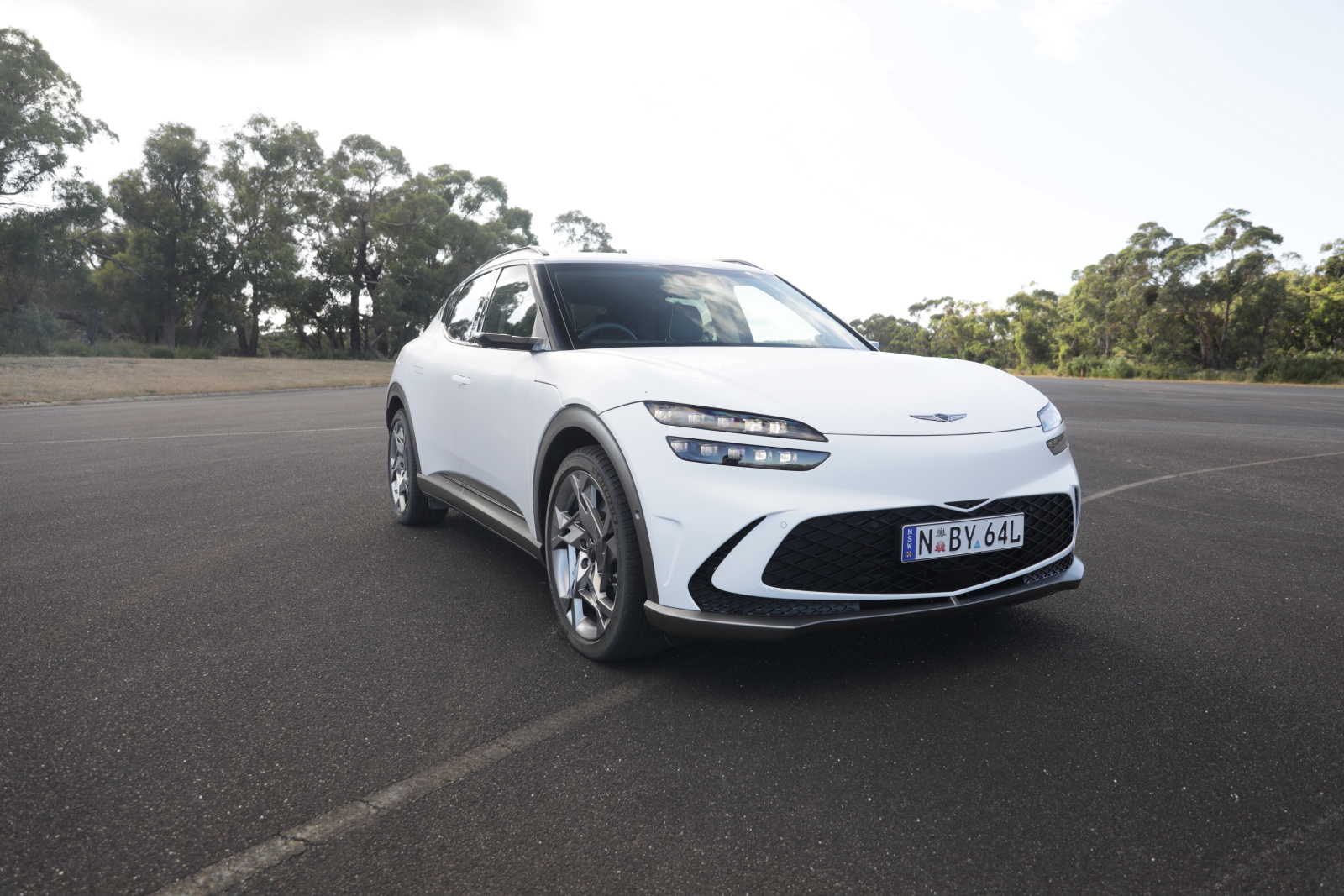
A pair of direct rivals come from Korea – the Genesis GV60 and Kia EV6 GT, both of which feature faster charging capability than the Tesla courtesy of 800V battery platforms.
The GV60 from Hyundai’s luxury division has a smaller footprint than the Y but pushes the luxury angle and features tech not available on the Tesla, such as augmented reality navigation, fingerprint recognition, head-up display and camera-based side mirrors feeding displays on the insides of the front doors. It’s priced from $103,700 before on-road costs.
Kia’s first $100,000 model, the EV6 GT, shares vehicle-to-load bilateral charging technology with the Genesis and matches the 21-inch wheels of the Y Performance.
1
Where the Y Performance sticks with the same vinyl seats as the base model, the EV6 GT offers features including a combination of faux leather and suede upholstery for the sports seats, as well as electronically controlled suspension with Sachs dampers.
For buyers who could nudge up their budgets just above $100K, BMW’s $104,900 iX3 is a fully electric version of the X3 mid-sized luxury SUV. Or opt for the Mercedes-Benz EQB250 that’s a bit cheaper than the Y Performance and provides an extra row of (two) seats.

1
Interior comfort, space and storage
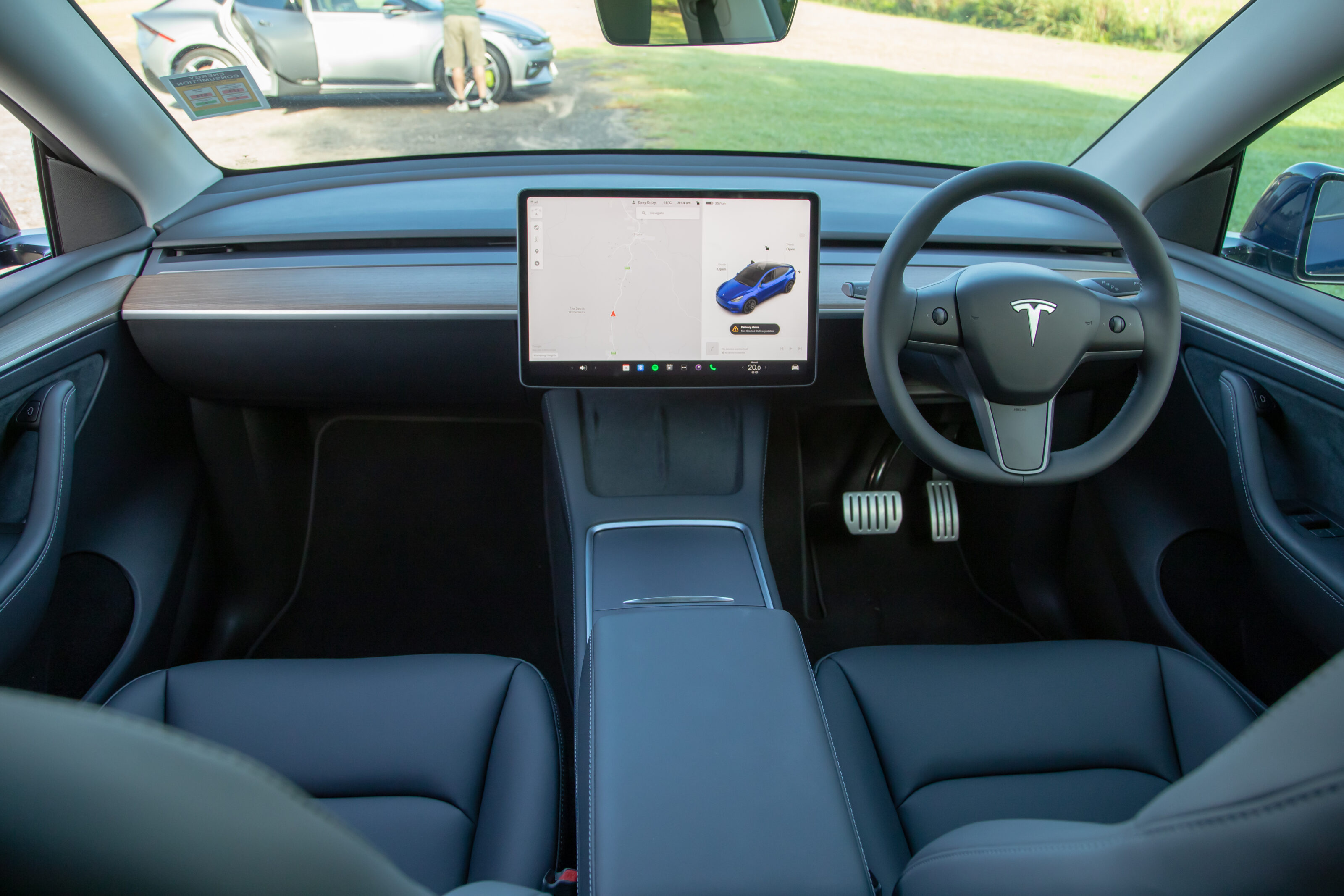
You know the score with Tesla interiors by now: uncluttered, ultra-minimalist.
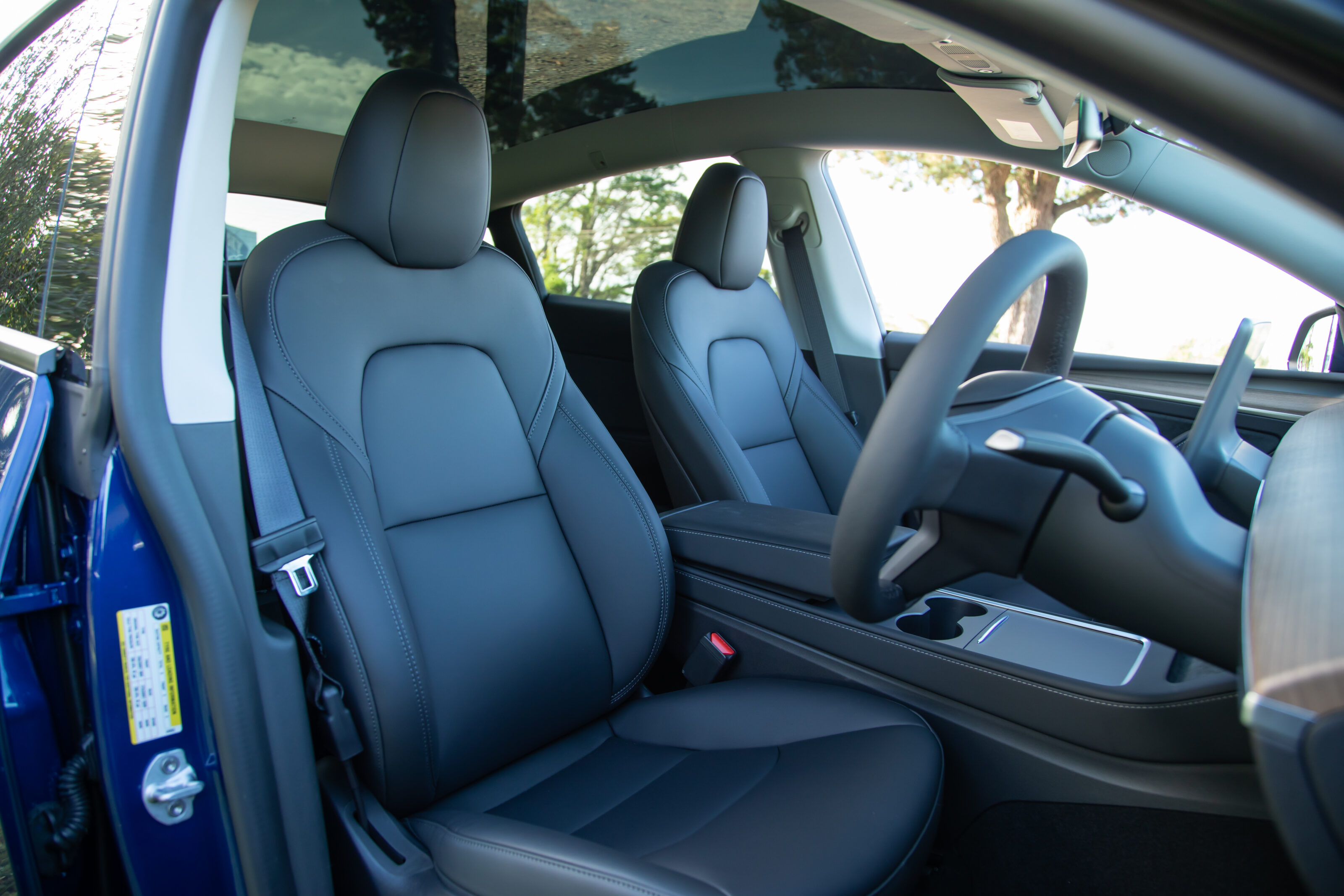
A couple of aluminium pedals aside, there’s nothing in the Performance’s austere cabin to tell you you’re in the most expensive version of the Model Y. This includes the same vinyl upholstery (which is relaxingly supple but gets sticky on hot days).
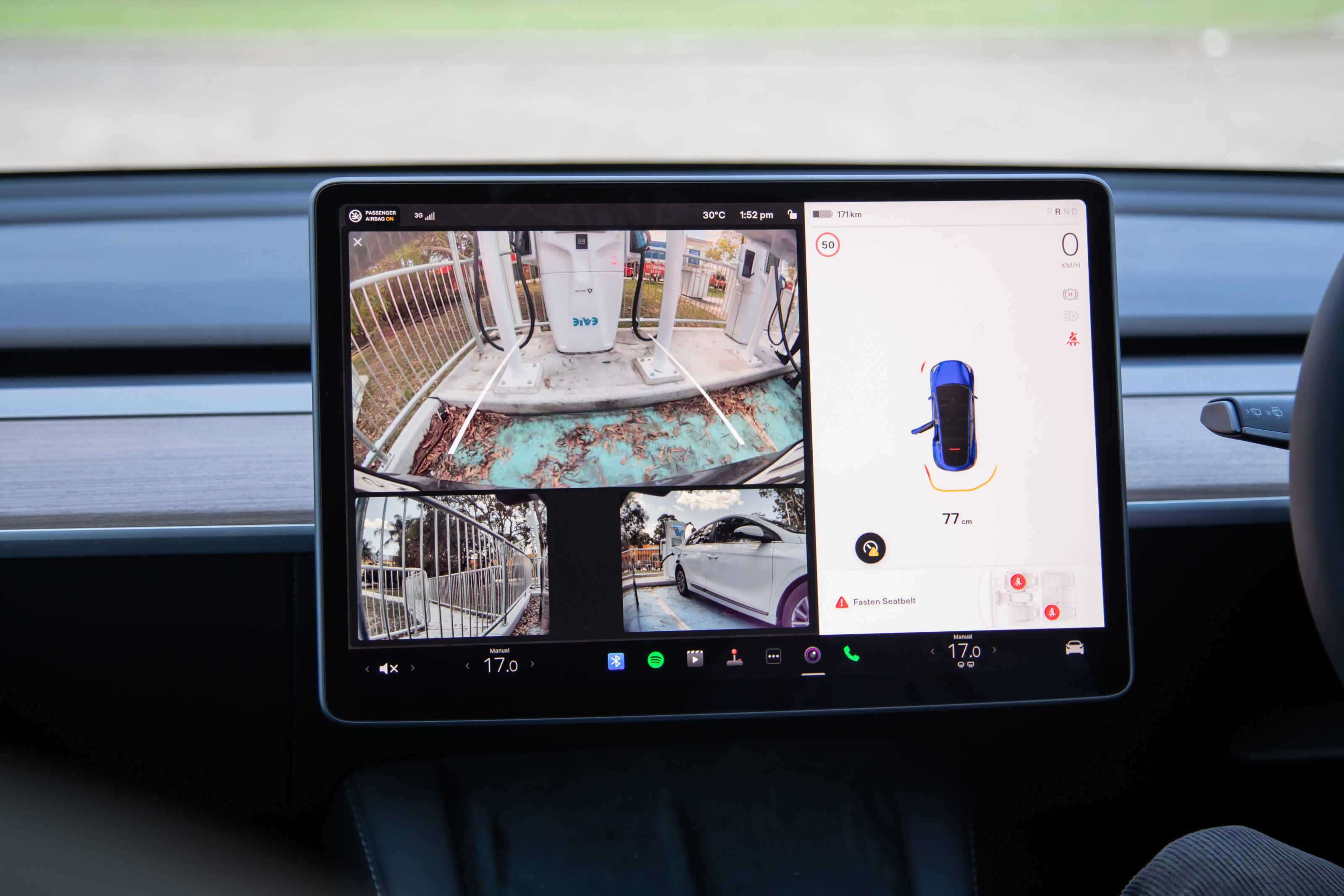
Almost all vehicle functions are found in the large, central display – with some used in conjunction with thumb-scroll buttons on the steering wheel. There is no separate digital driver cluster, so even the speedo is found to the left of the driver.
1
A head-up display would be beneficial, as would physical controls for some functions. Changing the cabin temperature is straightforward as adjustment arrows are provided permanently on the display, but changing functions such as the wipers and headlights requires far more distraction from the road than is ideal.
The best solution is to use the voice control system, activated via the right thumb-scroll button.
Some of the simplicity does work beautifully, such as the cruise control activation that requires just a flick down of the transmission stalk – with incremental speed adjustment then made via the right thumb-scroll button.
1
Tesla’s infotainment is also class-leading – a graphical tour de force of arcade games, music streaming, novelty ideas (crackling fireplace sound and imagery, for example), and humour (hello whoopee cushion mode). There’s also the likes of Netflix and Disney+ to keep owners entertaining during charging (a monthly subscription is required for some features).
Over-the-air updates allow for new features – or modifications – without having to take the car to a Tesla service centre.
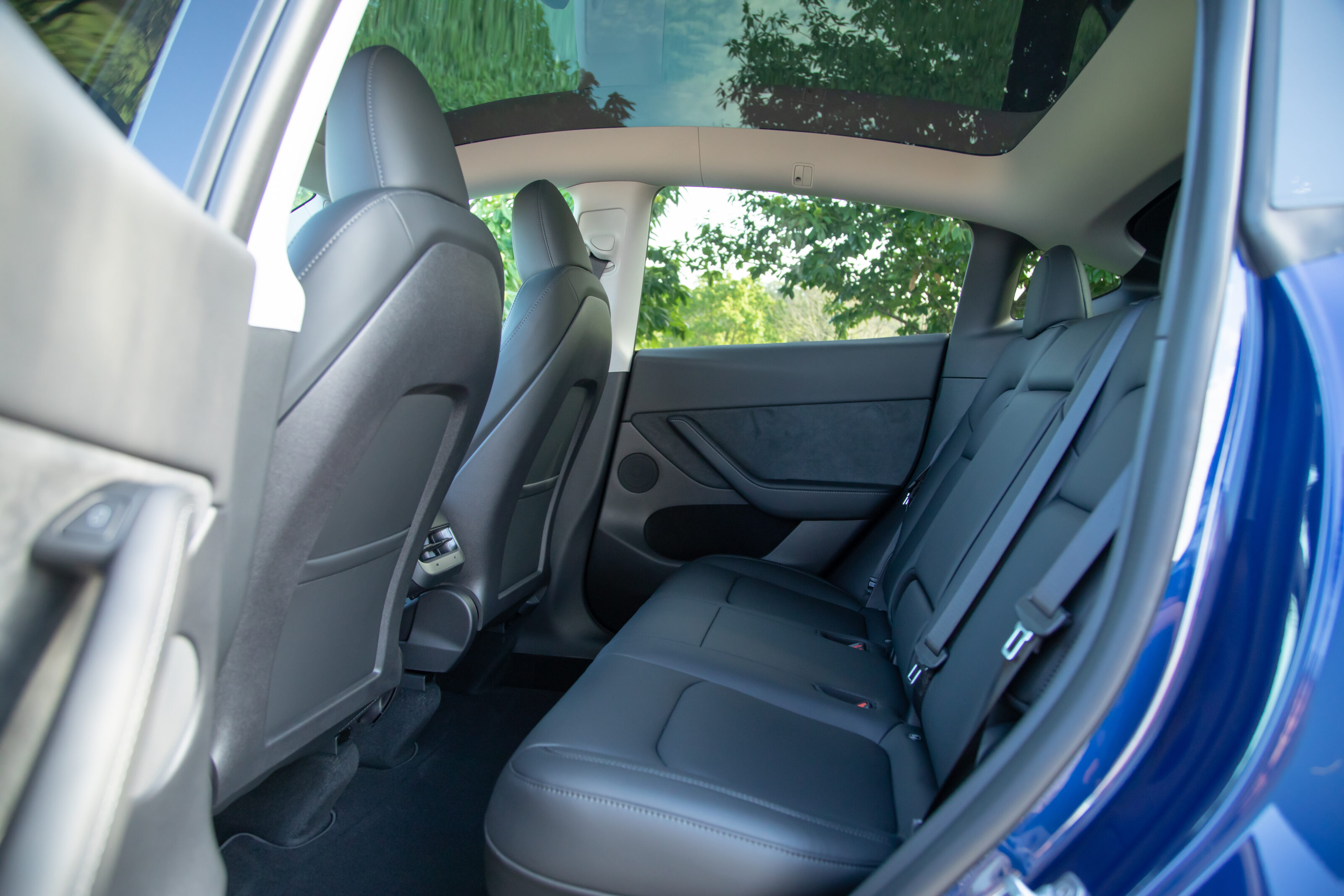
Where the Y impresses the most is its vast interior space. The rear seat is properly commodious, capable of seating three adults through its generous cabin width and abundant legroom and foot space.
The flat floor and cleverly designed centre console ensure even the middle-seat passenger has freedom for their lower limbs.
1
While the bench cushion is a touch on the short side, the individual seats are scalloped and there’s 60:40 seatback recline adjustment.
An armrest with two cup holders, seatback pouches and large door pockets take care of storage. There are two USB-C ports and vents, if lacking temperature or fan control.
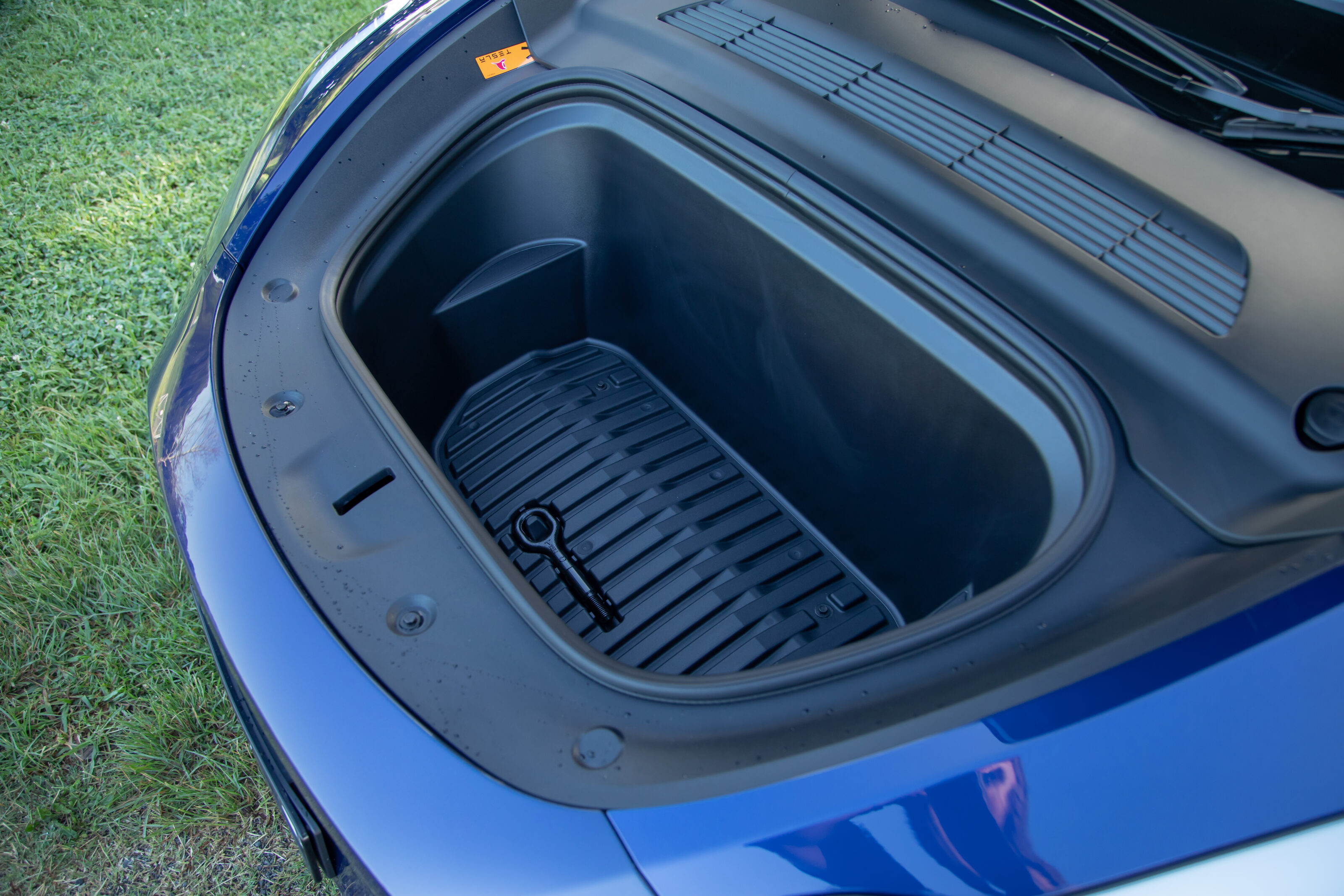
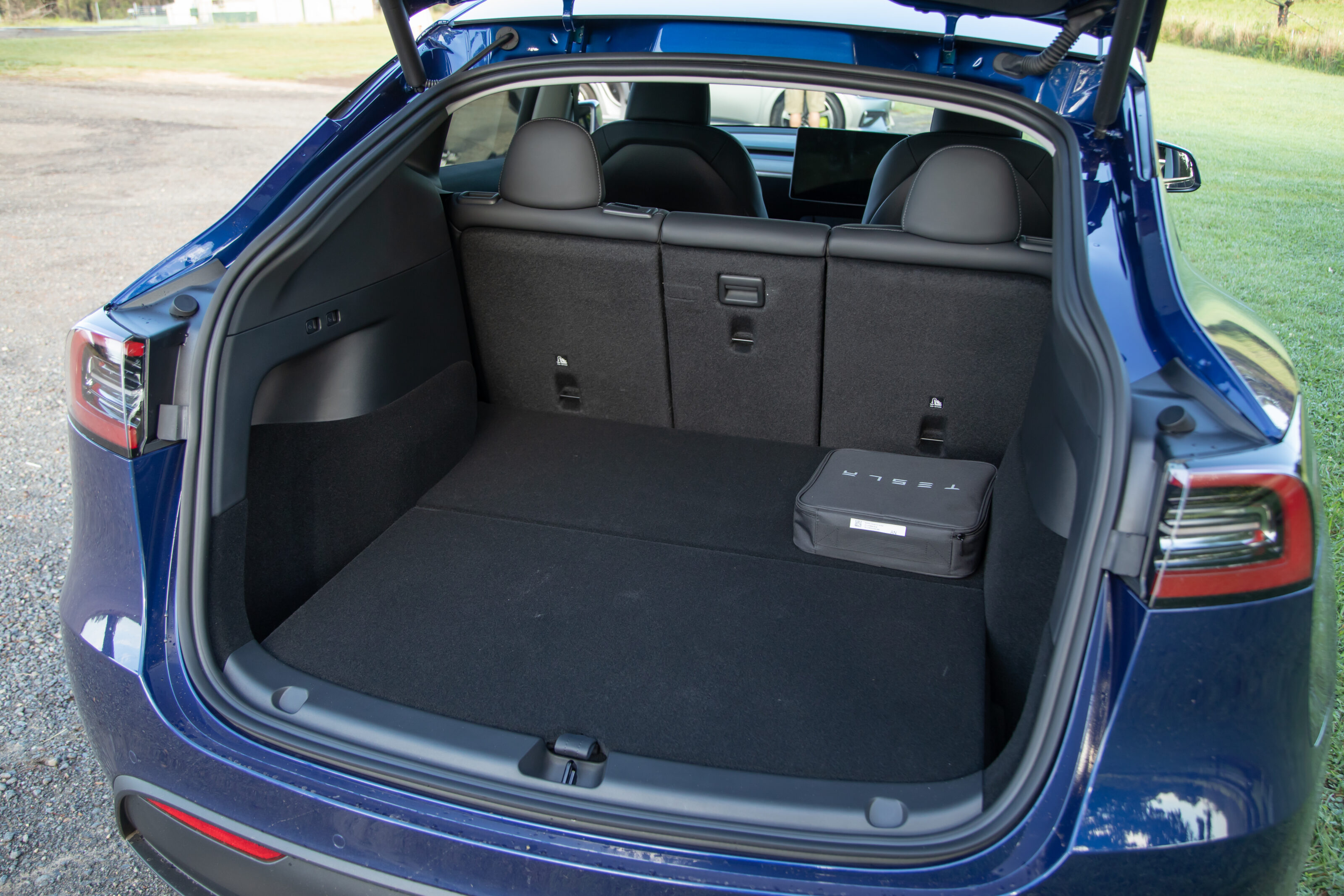
Families will also appreciate the massive, 854-litre boot, which includes a large underfloor storage tub and allows for quick expansion with electric release switches for the 60:40 seatbacks – which fold fully flat.
There’s also a 117-litre ‘frunk’ under the bonnet – unrivalled for size. AWD EV6s, for example, offer just 20 litres up front.
1
What is it like to drive?
We were delighted to learn upon collecting our Model Y Performance test car that it was fitted with Tesla’s new Comfort suspension – a mixture of spring and damper tuning – while the Performance runs 10mm lower than the RWD.
Urban driving revealed some improvement to the way the Model Y absorbs bigger bumps, including speed humps – and this bearing in mind the Performance sits on bigger, heavier wheels.
We’re certainly curious to try the Comfort set-up on the 19-inch-wheeled RWD variant, presuming it will cascade down.
But while the suspension is quieter and not quite as clumsy as experienced on the Model Y RWD, the SUV’s ride and handling remains disappointingly flawed overall.
1
Tesla’s mid-sized SUV habitually fidgets across various types of road surface, struggling to settle even on relatively smooth bitumen such as a freeway.
Ragged dynamics then deter the driver from accessing the Performance’s entertaining pace on country roads.
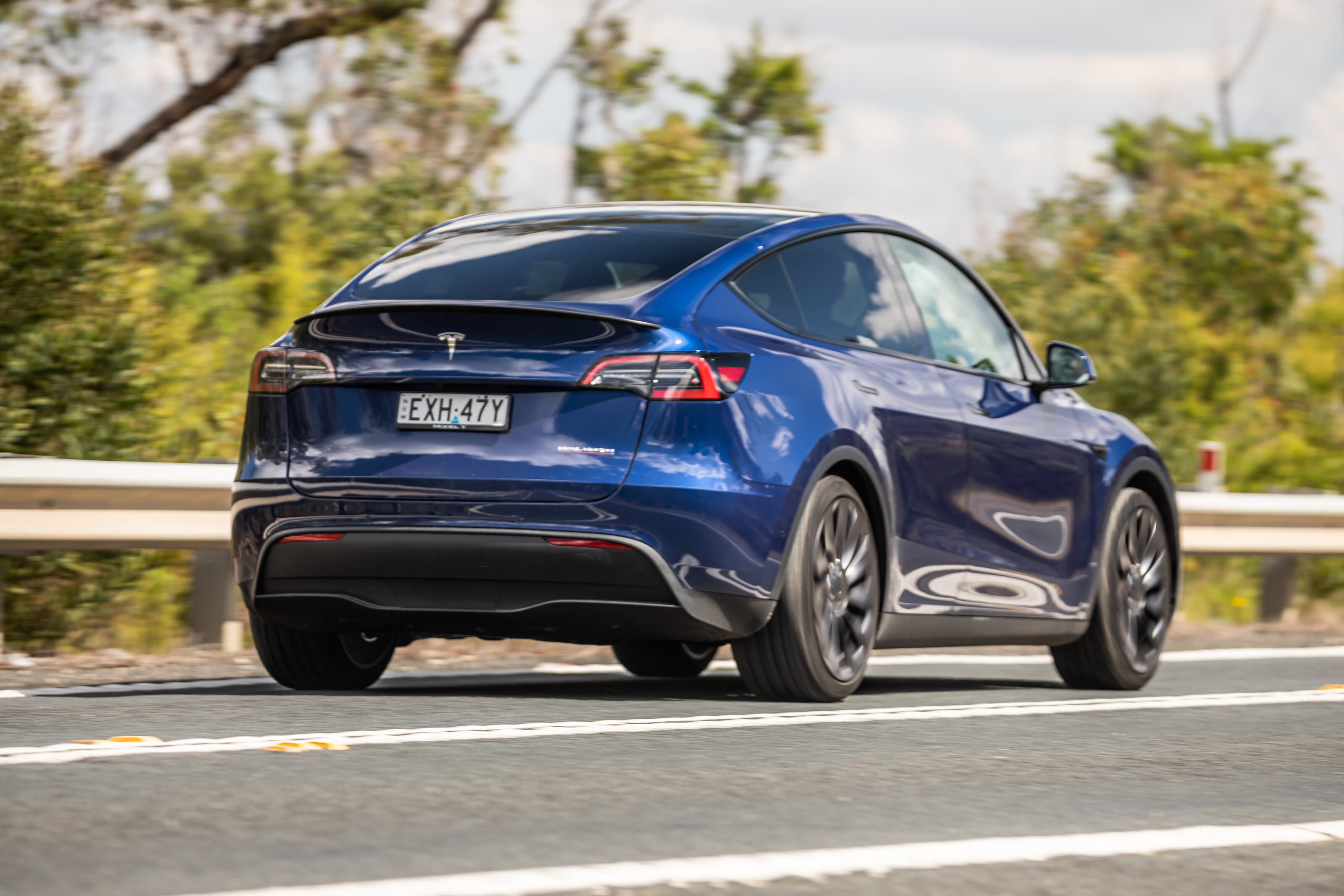
The ultra-quick steering – just 2.1 turns lock to lock – feels out of lockstep with a chassis that offers plenty of grip from its wide Pirelli P Zero rubber but not enough in the way of composure.
1
The Model Y Performance feels every gram of its two-tonne weight through corners.
It’s a shame, as the Model Y Performance is so well judged in the other ways it drives.
Accelerator pedal response is calibrated in a way that the Performance – capable of accelerating from 0-100km/h in just 3.7 seconds – is no more intimidating to drive than the base model.
Rest assured, though; when you press that pedal hard you’ll experience eye-widening longitudinal g-force as the dual electric motors give every electron they’ve got.
Advice
Australia’s best electric cars for 2023
We’ve tested nearly every EV below six figures in Australia to rank the best on sale today
The Performance is 3.2 seconds faster to 100km/h than the RWD Model Y, and 1.8 seconds quicker in the benchmark sprint than the GV60 AWD (5.5sec, though the flagship GV60 Performance is closer at 4.0sec). However, the Kia EV6 GT is a couple of tenths ahead with a 3.5sec claim.
We also like that Sport rather than Chill is the default setting for acceleration response in the Y.
While the regen braking can no longer be manually adjusted (Tesla says it auto-adjusts depending on battery level), it quickly becomes intuitive to the driver when to jump off the accelerator pedal to allow the car to naturally decelerate without using the actual brake pedal.
1
The low steering effort contributes to the Tesla’s driving simplicity (don’t bother with the unnaturally heavy Sport mode), though the steering lacks some precision around the straight-ahead and the Model Y’s turning circle is wider than ideal.
Rear vision is also worth noting because it’s very limited through the narrow rear window, and almost useless in the dark in combination with the anti-dazzle rear-view mirror. The A-pillars are also fairly thick and can partially obstruct vision when turning.
1
How is it for range?
A bigger battery gives the Performance a 59km hike in range over the RWD Model Y, for a WLTP-rated total of 514km.
Compared with direct rivals, that gives the Tesla more range than either the GV60 (466-470km) or EV6 GT (424km).
Tesla’s battery efficiency remains impressive even with its fastest Model Y – just 14.6kWh/100km on the WLTP cycle.
While our tested range and efficiency calculated at 421km and 17.8kWh/100km, these figures are in the context of a Wheels evaluation that incorporated dynamic testing and plentiful assessment of the Performance’s rapid acceleration.
Model Y owners also benefit from Tesla’s relatively widespread Supercharger network, and the Performance has a 250kW peak charging capability.
Tesla quotes 27 minutes for charging the battery from 10 to 80 per cent. It also recommends charging to 90 per cent for the Performance, which uses NCM (nickel, cobalt, manganese) battery chemistry. The RWD Model Y can be regularly charged to 100 per cent thanks to its LFP (lithium iron phosphate) battery.
Korean rivals with 800-volt batteries can charge from 10 to 80 per cent in as little as 18 minutes.
1
How safe is it?
The Tesla Model Y was awarded a maximum five-star safety score by ANCAP in 2022.
Warranty and running costs
Tesla’s four-year warranty is a year short of the industry standard.
Unlike almost all car-makers, there’s no annual service schedule. Instead, Tesla provides maintenance recommendations via owner manuals.
Tesla’s Supercharger network was once free but now charges apply – with rates varying depending on the charging speed and typically charged per kWh.
Pricing details for a Supercharger station can be accessed via the Model Y’s touchscreen.
1
VERDICT
It’s easy to understand the appeal of the Model Y with its combination of clever cabin tech and vast cabin space. And the extra range and speed of the Performance variant are both desirable.
The Comfort suspension makes the ride a touch more agreeable, too, though this will surely make its way over to the single-motor Y.
A Model 3 Performance is lighter, faster, and better to drive, however, if the Y’s extra space isn’t a must-have.
And if you’re looking for the best midsized electric SUV for $100,000, you’ll find it in a Kia showroom.
MORE
Everything Tesla
MORE
Electric SUVs
Out on the ice, it’s apparent that what the tall, trim, grey-haired engineer told me last night is true. Like he said, the rear of the IONIQ 5 N does snap sideways “just like that” in Drift Optimiser mode.
“As a kind of advice, you really have to overcome your limits in yaw angle,” the 60-something German continued. “You have to really let it go far, drifting, and then almost go to steering lock.” Remembering this, lap after sideways lap of the large circle scraped into the surface of the frozen lake isn’t all that hard…
Albert Biermann is always worth listening to.

1
The now 60-something German spent more than three decades at BMW, where he guided the development of some of its greatest M models, before moving in 2015 to Korea to mastermind, among other things, the creation of Hyundai’s high-performance N division.
Three years later Biermann was made R&D chief of the entire Hyundai Motor Group, which includes the Kia and Genesis brands. Since retiring from that post in late 2021 and moving back to Europe, he’s worked as an executive technical advisor to the company.
So Biermann understands where the IONIQ 5 N has come from better than anyone alive. It was during his time as R&D boss that Hyundai developed its first EV-specific platform, E-GMP, the basis for the IONIQ 5. Before that, he basically wrote the ‘How to Create an N Model’ manual for Hyundai’s engineers.

1
“Driving fun, accessible for normal drivers; this is what all the N cars stand for,” Biermann says. And this is why Hyundai brought us to icy Arjeplog, just south of the Arctic Circle in northern Sweden.
The IONIQ 5 N, though, is a new kind of N car. It’s the division’s first EV and first all-wheel-drive model. Its pair of electric motors will certainly make it the most powerful N car ever. The IONIQ 5 already has 800-volt battery tech, just like the Taycan, and this N version seems engineered to rival the Porsche for driver thrills.
But neither Biermann nor any of the other Hyundai engineers here are prepared to discuss the IONIQ 5 N in depth. They’ll not revealing maximum power and torque outputs, performance claims, or even steering, brake and suspension changes.

1
The car doesn’t go into production until later this year and won’t reach Australia until sometime in the first half of 2024. The pair of prototypes in Arjeplog are works in progress, we’re told. Though the IONIQ 5 N’s hardware has been finalised, software development continues.
“Power is just enough, you know,” Biermann teased.
“And performance is more than enough … Our most important measure is driving fun. It’s not 0-100km/h, top speed, lap time. It’s all bullshit.”
Finding the grip to get some impression of the IONIQ 5 N’s acceleration and handling potential is impossible at these moose-shit latitudes. But slippery lakes and snowy test roads are just fine for finding out lots about the skill and sophistication of a car’s electronic systems.

1
Helping ensure these had plenty to do, Hyundai had fitted the 21-inch wheels of the camo-clad IONIQ 5 N prototypes with normal winter tyres, not the metal-studded rubber that every other car seen on the roads of Arjeplog was wearing.
The IONIQ 5 N’s Drift Optimiser mode is impressively effective on the Swedish ice. Though it won’t prevent spinning on a super slippery surface, it does provide great support for any driver with some grasp of the basic techniques of drifting. Which would be me…
But Drift Optimiser is only one among many new electronic systems the N team has developed specifically for the IONIQ 5 N. And they’re all designed to extend the driving enjoyment envelope, often by offering options to alter the Hyundai’s behaviour.

1
Getting at them usually means using controls on the car’s thick-rimmed, N-specific steering wheel. Sports seats and a raised storage area between the front seats that doubles as a leg brace are other notable interior alterations.
In addition to a pair of rotary controllers below the steering wheel boss, there are extra thumb buttons just above each of its horizontal spokes. All of these were covered by camo-pattern tape in the prototypes, presumably to conceal still-secret functions and features.
But Hyundai did assign development engineer Chris Nigemeier to ride in the passenger seat during my time in the IONIQ 5 N. His main job? Telling me which buttons to push, in what order.

1
It’s in N mode where most of the fun is to be found, including Drift Optimiser (though ESC also has to be deactivated with the brake pedal pressed, and a legal disclaimer accepted).
A second press of the N button switches to custom mode, which offers an extensive menu of variables. Few, if any, ICE-powered performance cars offer so much tunability as this Hyundai will.
And no other EV makes such an effort to make an ex-ICE driver feel at home. Press the right buttons and the IONIQ 5 N will perform a convincing impression of something with pounding pistons and a dual-clutch transmission.

1
Nigemeier calls it N Grin Shift, and it’s weirdly impressive. There are visual and aural cues; a large tachometer (redline 7000rpm, but everything it displays is pure fantasy) and an electronic motor sound (it continues to ‘idle’ when the car, and the innards of its motors, are stationary).
Tapping the paddle shifters changes both needle position and sound, while the electric motors mimic the pause in power delivery of a gearshift. Changing up there’s a reduction of torque in the higher virtual gear, shifting down there’s an increase in motor braking. On the Swedish ice, the tech also makes it obvious when the rear end has lost grip and the tyres are spinning up.
It’s totally synthetic and charmingly sincere at the same time. Some will love it, while those who hate its inauthenticity don’t have to turn it on.

1
The IONIQ 5 N will be officially revealed in all its factual glory at the Goodwood Festival of Speed in July. Though the Hyundai engineers and execs at Arjeplog had been instructed to keep some vital stats secret until that time, all lips weren’t zipped all the way shut all of the time.
We’re confident the combined maximum output of the IONIQ 5 N’s two motors will be very close to 450kW. Though it will weigh around 2.5 tonnes, its 0-100km/h time will be in the vicinity of 3.5 seconds.
Numbers like this guarantee the IONIQ 5 N a place among the high-performance EV elite. At the same time, Hyundai’s N division has clearly worked very hard to make this EV a real entertainer.

1
The cost of admission, too, should be impressive. Value is always an N division objective. “No other car should even come close in the N car’s segment when it comes to fun-per-dollar,” said Albert Biermann. “And I’m pretty sure IONIQ 5 N will be the same story, like i30 N, i20 N and Kona.”
Hyundai Australia is expected to price the IONIQ 5 N at around $100,000. Though this would be a roughly 25 per cent increase compared to the basic dual-motor IONIQ 5 Techniq, it’s also less than half the money Porsche wants for a Taycan EV with similar performance. Brilliant.
Advice
Australia’s best electric cars for 2023
We’ve tested nearly every EV below six figures in Australia to rank the best on sale today

1
Energy range
How far will the IONIQ 5 N drive on a charge? Too early to say. Because development of the car isn’t complete, it’s not done final WLTP testing. What we do know is that the 5 N will have a next-generation battery pack, probably with a little more capacity than the 74kWh (useable) unit in the current IONIQ 5.
“We have a higher energy density,” said Biermann. “We can get more energy in the same packaging.” Even so, the extra performance and higher aero drag of the IONIQ 5 N means its range is very unlikely to be greater than 400km. The IONIQ 5’s leading fast-charge ability will remain unchanged.
MORE
Everything Hyundai
⚡ More EV stories to help you choose the best car for your needs
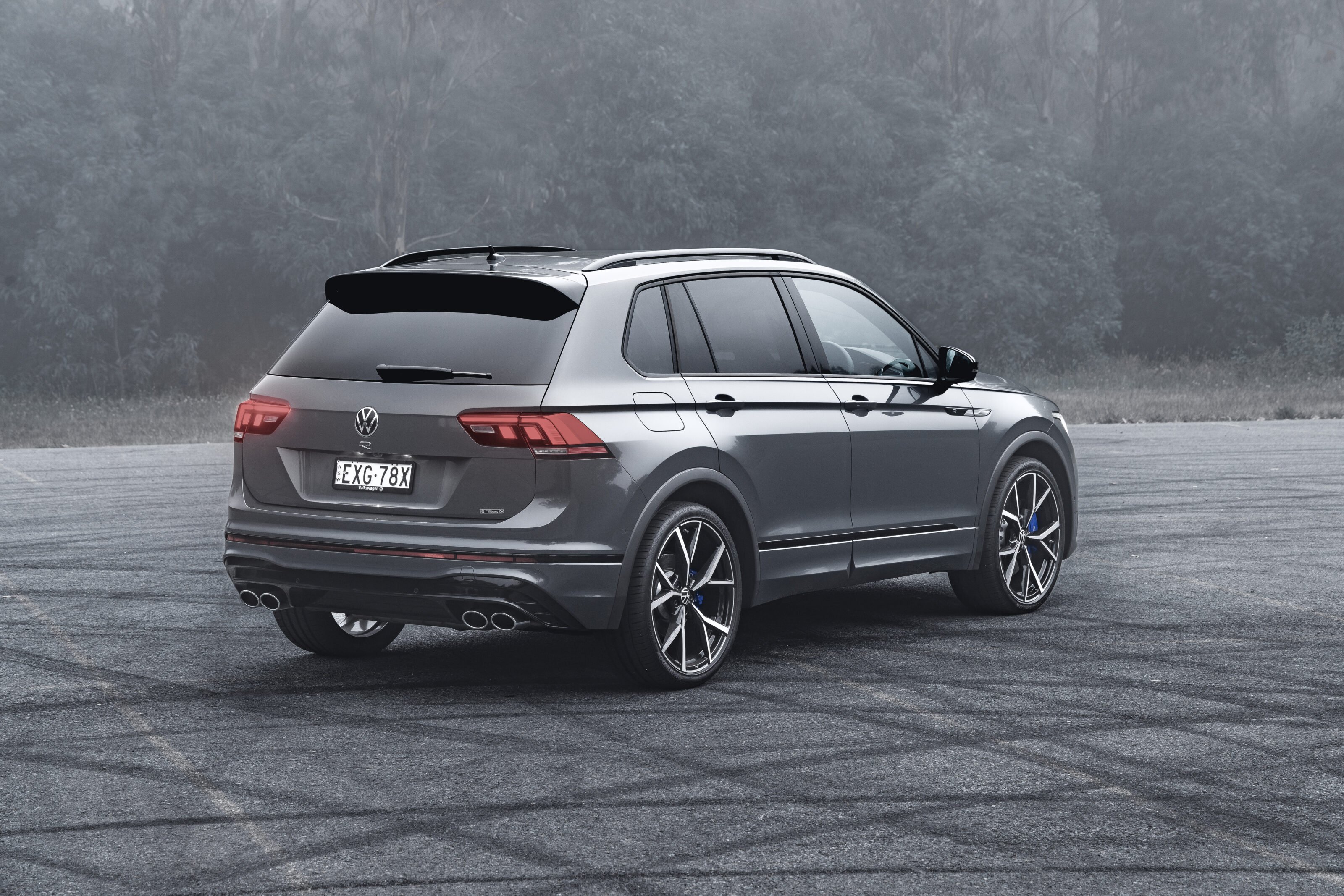
The VW Tiguan R is pitched as an all-trades, semi-premium sporty mid-size SUV that can do the daily grind with comfort and ease, as well as hold its own at the traffic lights or on a twisting country back road.
But does the pared-back Grid Edition, which attractively lowers the cost of entry in exchange for some considered savings on specification (and, importantly for VW, silicon chips) diminish any of the flagship Tiguan’s lovely liveability factor?
Wheels digs in to find out.
1
JUMP AHEAD
- How much is it, and what do you get?
- How do rivals compare on value?
- Interior comfort, space and storage
- What is it like to drive?
- How much fuel does it use?
- How safe is it?
- Warranty and running costs
- VERDICT
- Specifications
How much is it, and what do you get?
Asking $63,990 (all prices shown before on-road costs), buyers of the Tiguan R Grid Edition save some significant change on the $70,490 fully-loaded Tiguan R.
For your dollars, you net the same running gear lifted from the heroic Golf R, comprising a turbocharged 2.0-litre petrol four-cylinder producing 235kW and 400Nm, seven-speed dual-clutch transmission and 4Motion all-wheel drive including the Golf R’s new torque-vectoring twin-clutch rear axle.
Elsewhere, carryover features from the standard Tiguan R include 21-inch ‘Estoril’ machine-faced alloy wheels, keyless entry, leather steering wheel, reverse tilt passenger mirror, three-zone climate control, 9.2-inch infotainment screen with satellite navigation, DAB+ digital radio, wireless Apple CarPlay and Android Auto, and more.
1
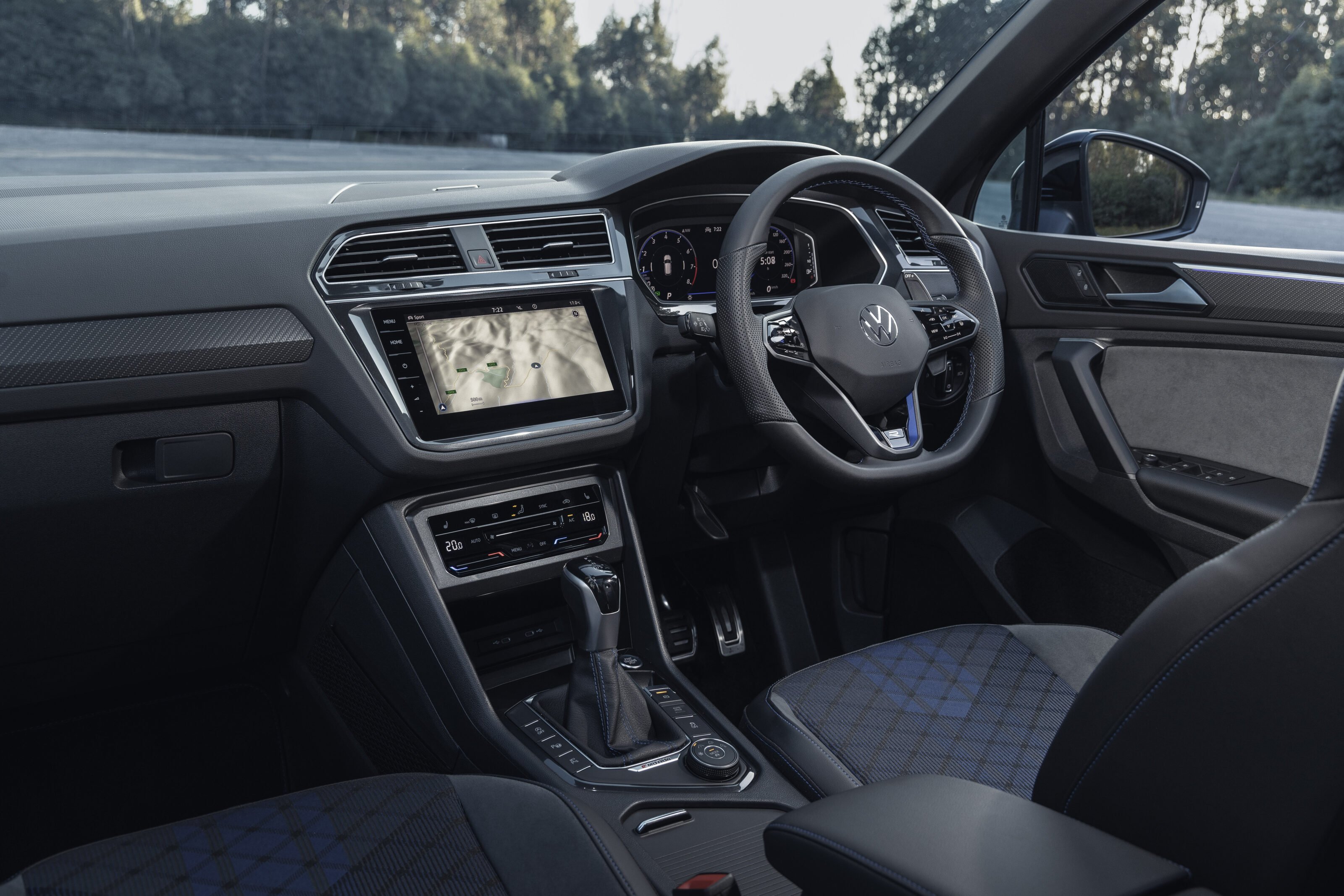
Tiguan R Grid Editions are distinguished by their black door mirrors, roof rails, grille and body trim, manually adjustable ‘R Sport’ seats with cloth and microfleece trim, and a Grid Edition rear badge.
The sportily-spec’d Tiguan trades its matrix LED headlights for adaptive ‘Performance’ LED units, and loses its premium LED tail lights, Nappa leather electrically adjustable front seats, head-up display and power tailgate along with blind-spot monitoring, rear cross-traffic alert and VW’s ‘Proactive passenger protection system’ which does a variety of things in the event of an accident, including pre-tensioning seatbelts and flashing hazard lights.
How do rivals compare on value?
The Tiguan R Grid Edition intelligently offers a genuine mid-sized performance SUV for what’s closer to flagship small SUV positioning.
As such, the Tiguan R Grid Edition often undercuts more premium but similarly sized, Europeans offering similar levels of power.
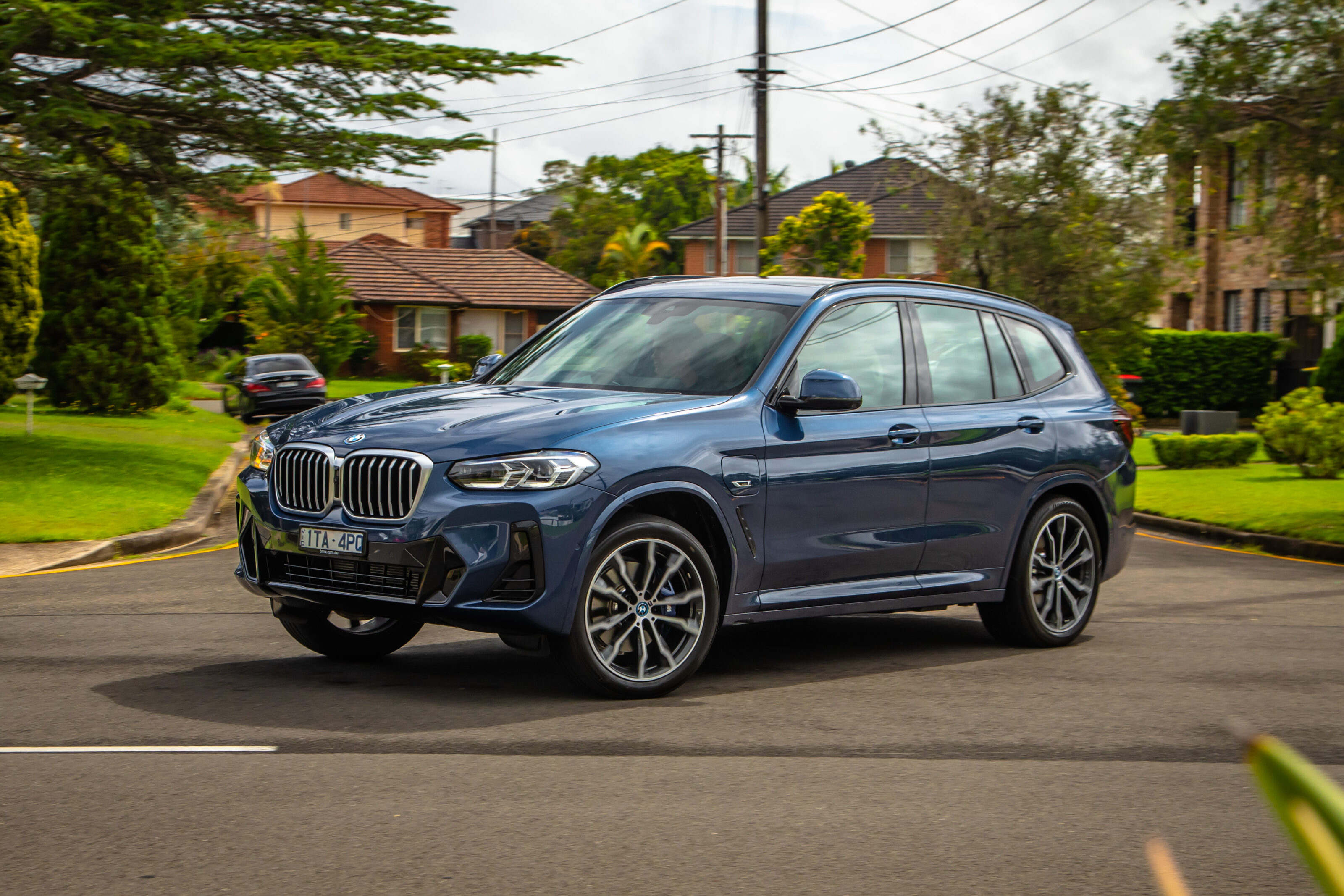
Audi’s Q5 45 TFSI offers 183kW/400Nm for $74,500, for example, and the 185kW/350Nm BMW X3 xDrive 30i M Sport asks $91,900. The Alfa Romeo Stelvio Veolce comes close at 206kW/400Nm, but still asks $82,950.
New Volkswagen Group stablemate Cupra comes close to delivering the Tiguan R Grid’s attractive mix of performance and price, with the Ateca VZx asking slightly less money at $60,990 while delivering slightly less in the way of power (221kW versus 235kW) and an older Haldex-based version of Volkswagen Group’s all-wheel drive system.
1
Interior comfort, space and storage
The Volkswagen Tiguan R Grid Edition’s cabin comes across with a restrained, measured level of design and what it may lack in visual flair, it more than makes up for with a level of intuitiveness and instant ease of use that few manufacturers nail with such aplomb.
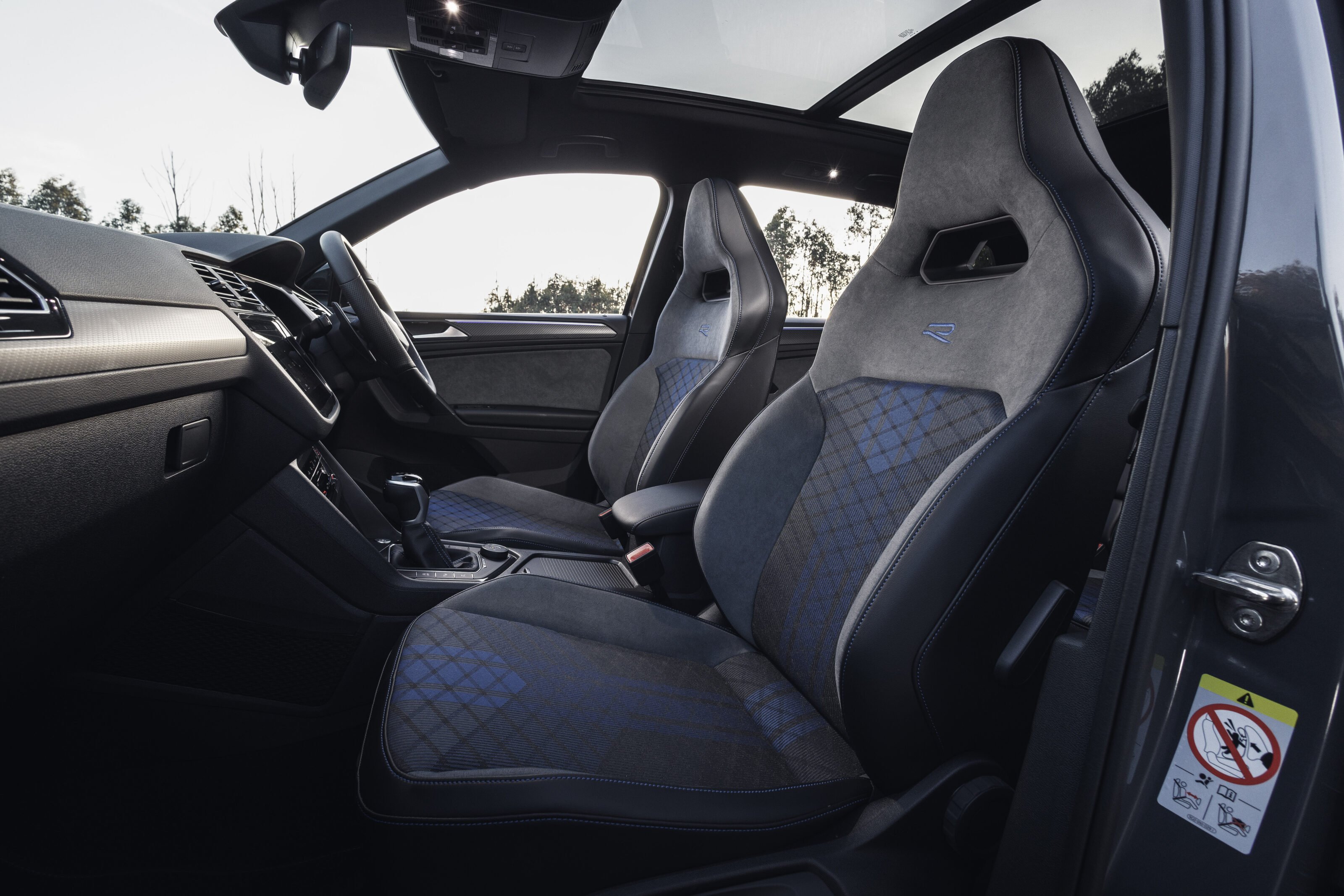
Despite leatherless front seats, the Grid Edition’s cloth/microfleece upholstery feels lovely to the touch, and the seat centres feature a tartan-like pattern that pays homage to the Golf GTI.
1
This motoring writer insists there is nothing wrong with a good manually adjusted seat, with quick actions and smooth, damped levers. Adjustments are quick as journalists hop in and out throughout the launch event but, on the other hand, it is easy to imagine that busy family owners with multiple drivers hopping in and out might miss an electric system with memory function.
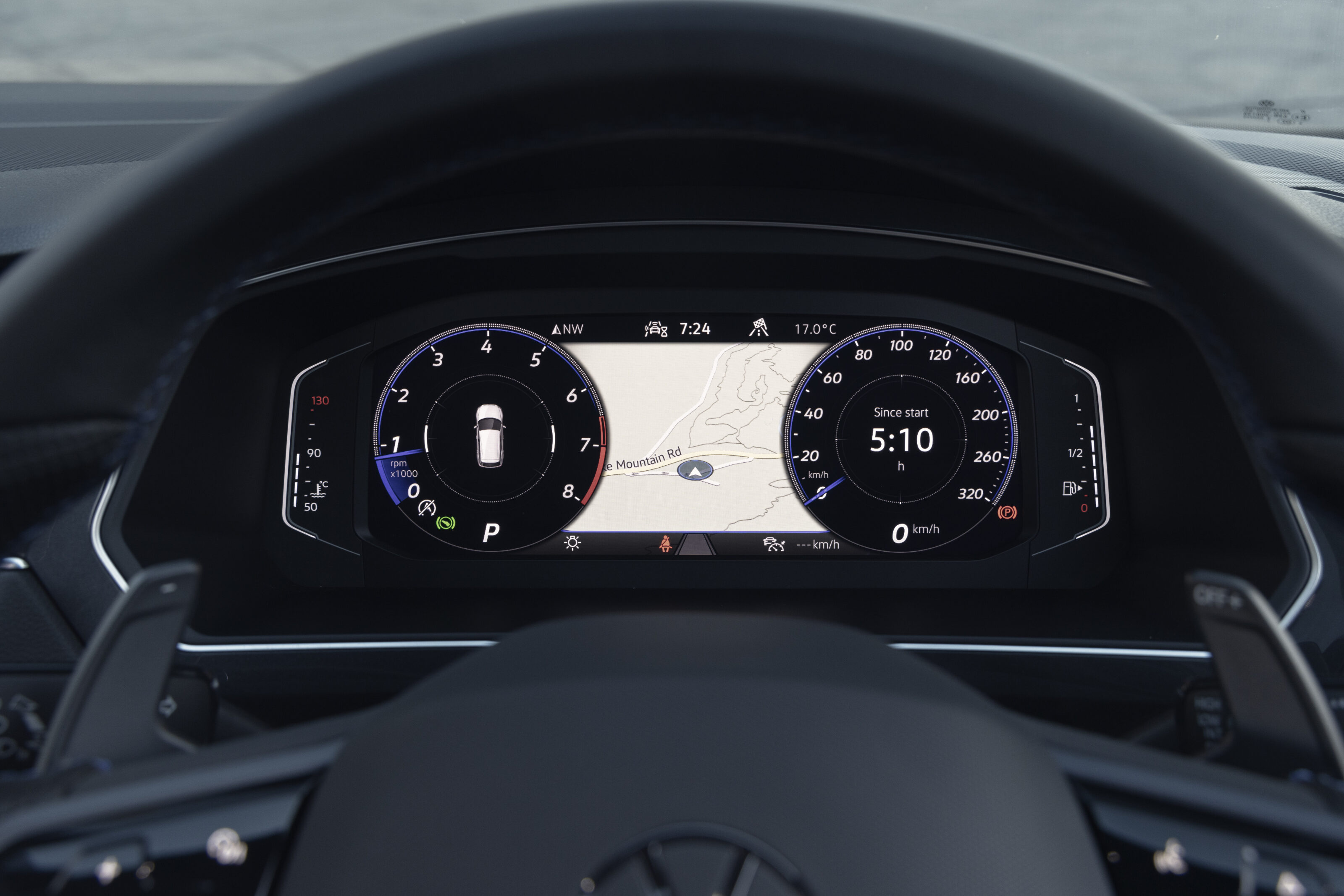
Elsewhere, drivers are greeted by Volkswagen’s still-impressive 10.25-inch digital instrument cluster, complemented by a 9.2-inch central infotainment display featuring DAB+ digital radio, satellite navigation and wireless smartphone mirroring.
1
One does wonder if offering wireless phone connectivity without a wireless charger may prove to be a long-term ownership gripe, but with two USB-C ports up front and one in the rear, it’s not like buyers haven’t been provided with solutions.
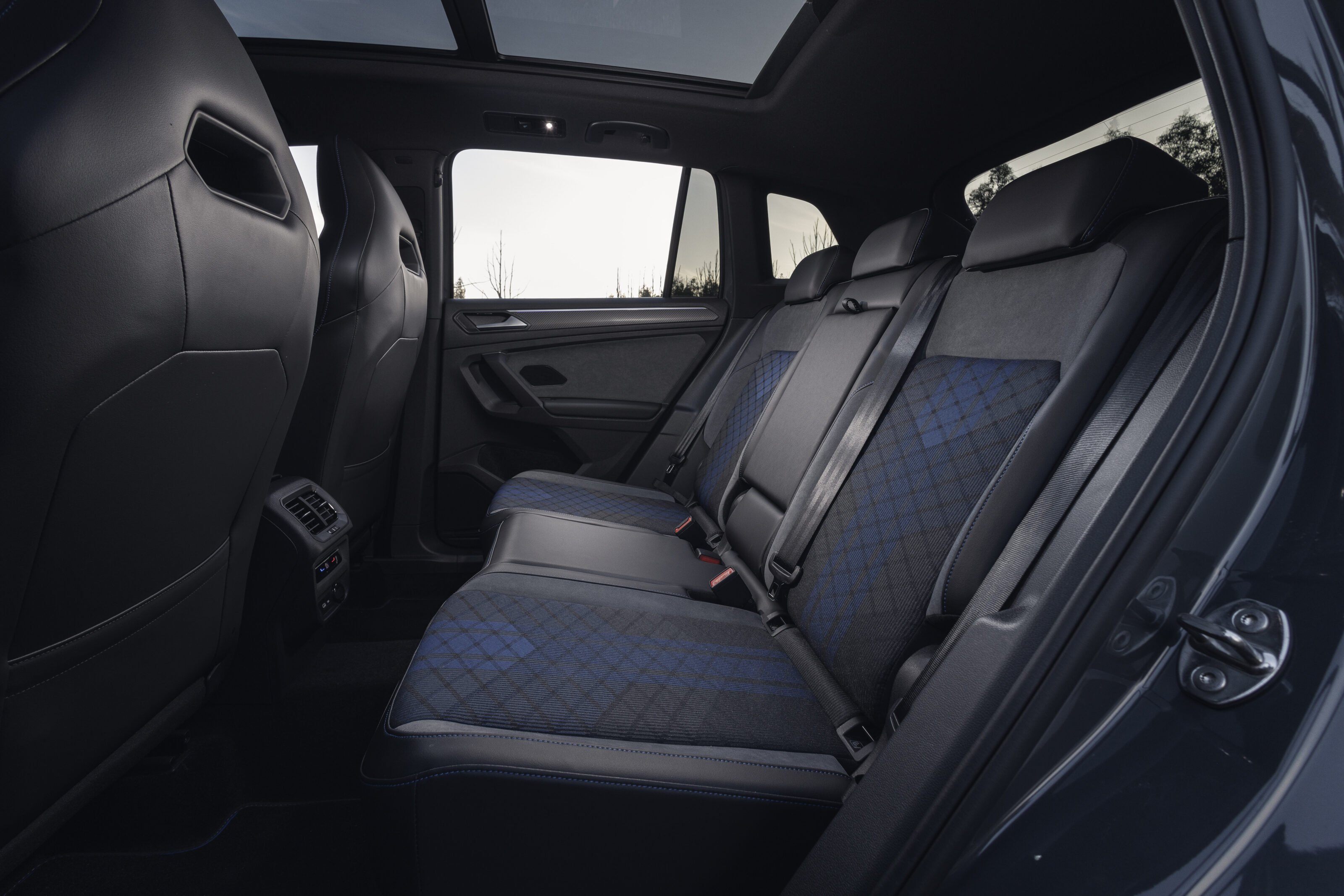
The rear seats are comfortable, with a nice ambience and airiness to the second row. There’s decent leg and headroom, with niceties including air vents and a third climate zone, 12-volt socket and that USB-C port. The outboard seats are especially adult-friendly, though fitting a third adult passenger in between may feel a bit cosy.
1
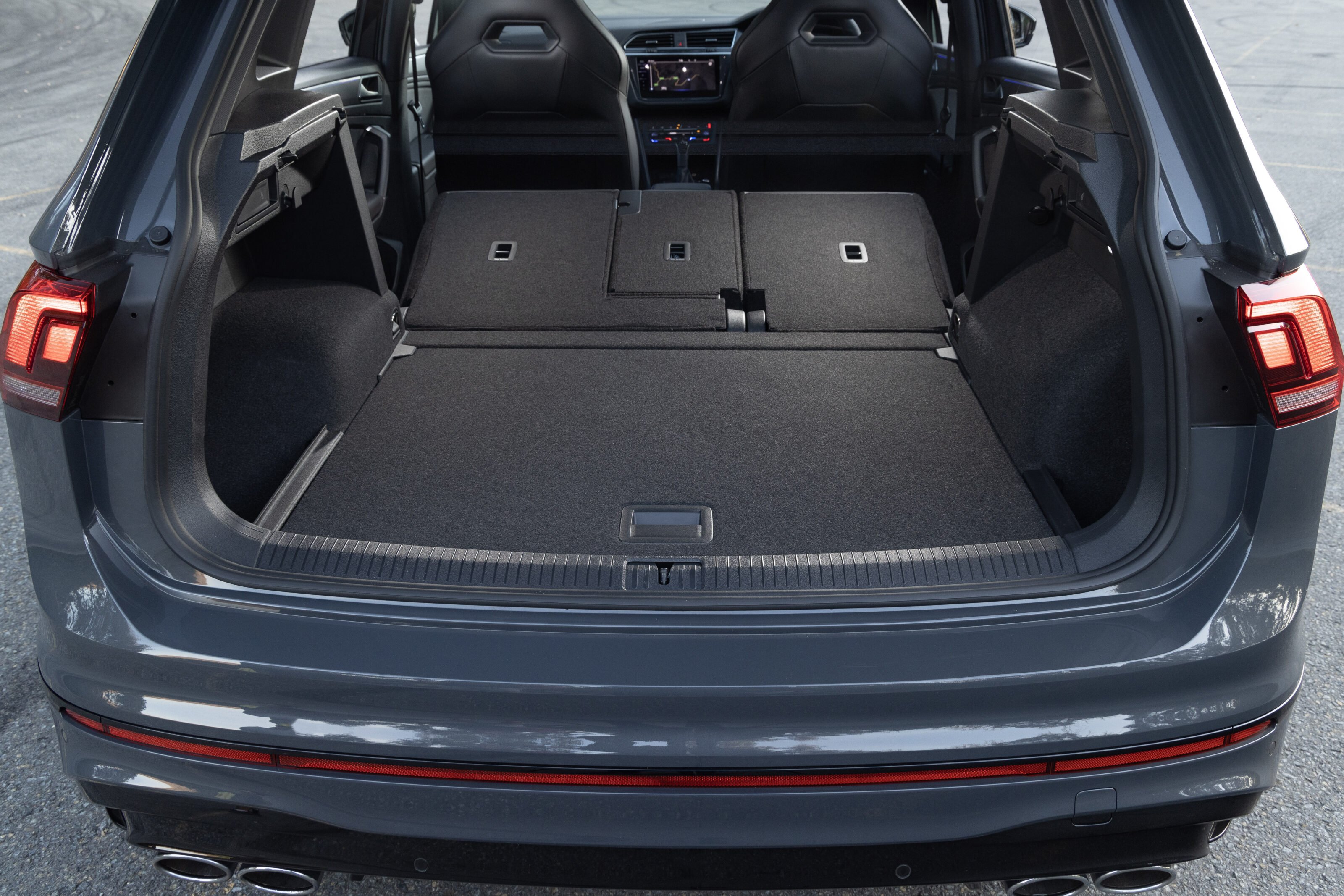
You can fold the second row 60:40 or 40:20:40 and it has both tilt and slide adjustment for prioritising boot space or legroom. The boot floor can be lowered (if you remove the spare wheel) to free up extra space.
With the boot in its default position, and the rear seats set back to their furthest, the Tiguan’s boot accommodates 615 litres, expanding to 1655L with the second row folded.
The standard Tiguan R’s powered tailgate has been sacrificed in the name of Grid, which fits its more driver-oriented pitch, but is more at odds with the Tiguan’s family-filling remit than it is in the smaller T-Roc R Grid Edition.
1
What is it like to drive?
At the beginning of our launch route on metropolitan roads out of town, the Tiguan R Grid Edition exhibits its softer side to great effect, as damping in Comfort mode delivers generous levels of compliance, made even more impressive given its 21-inch 255/35 rolling stock.
Secondary body movements are subtly arrested, with polish, and make the Tiguan R feel confidently more tied down than a pedestrian non-R Tiguan without introducing any hint of discomfort.
Sport mode dials up the throttle response nicely to a level that is still palatable around town and in traffic, with a measured increase in exhaust note without descending into full ‘R’ theatrics.
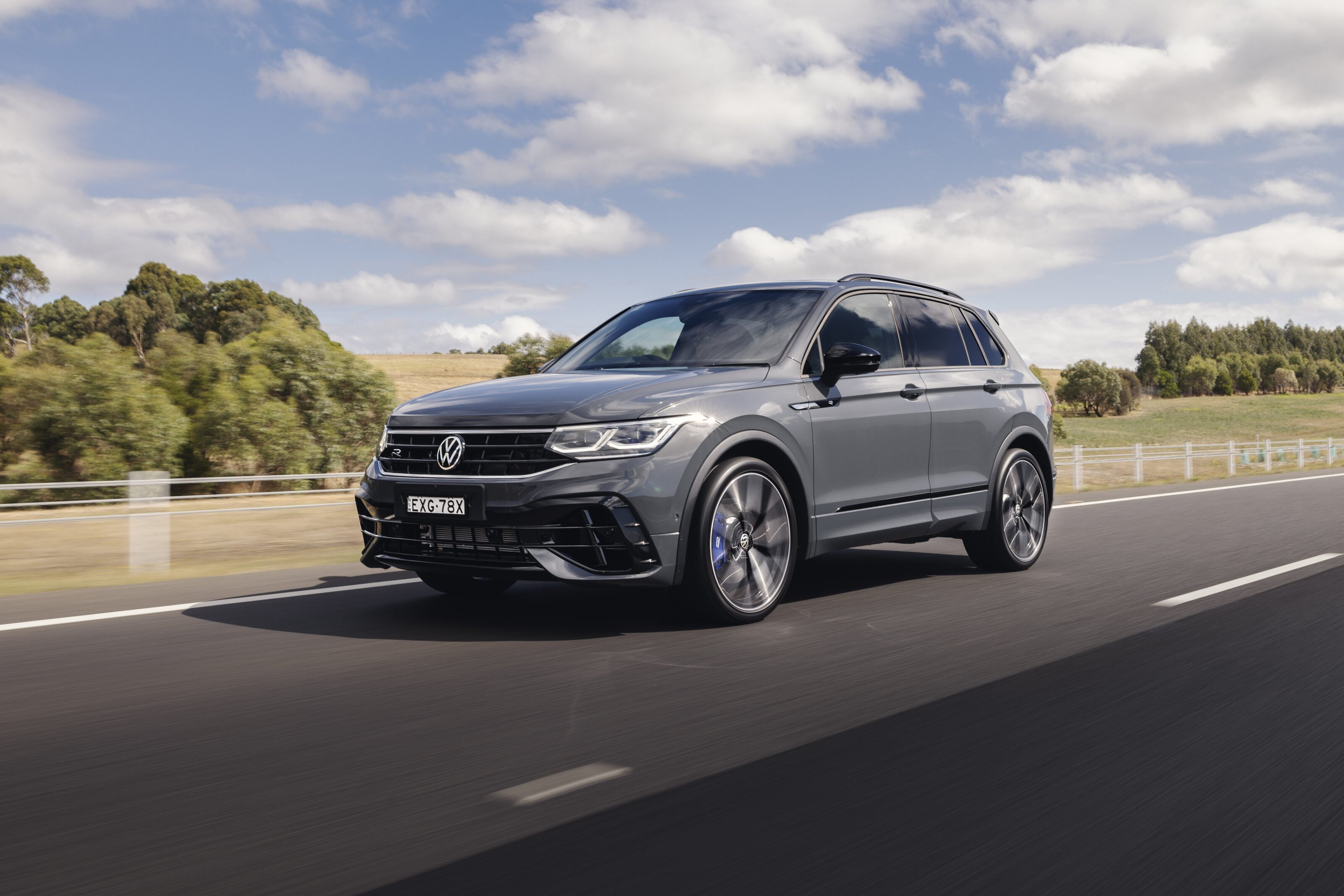
1
Steering weight doesn’t vary much through the cornering phases, but it’s nicely linear and instantly keyed into.
The wet-style dual-clutch transmission is an impressively smooth operator around town, with just a slight shunt from second to first during slow deceleration being the worst of this dual-clutch’s tendencies.
Even without an open road and R Mode engaged, the Grid feels athletic for its size and is entertaining to guide through inner-city roads.
As we venture out of Melbourne into the Victorian High Country, however, the blue ‘R’ button on the haptic multi-function steering wheel gives the Tiguan R Grid an instant character transformation and, as the going gets twisty, it feels as if it shrinks further around the driver.
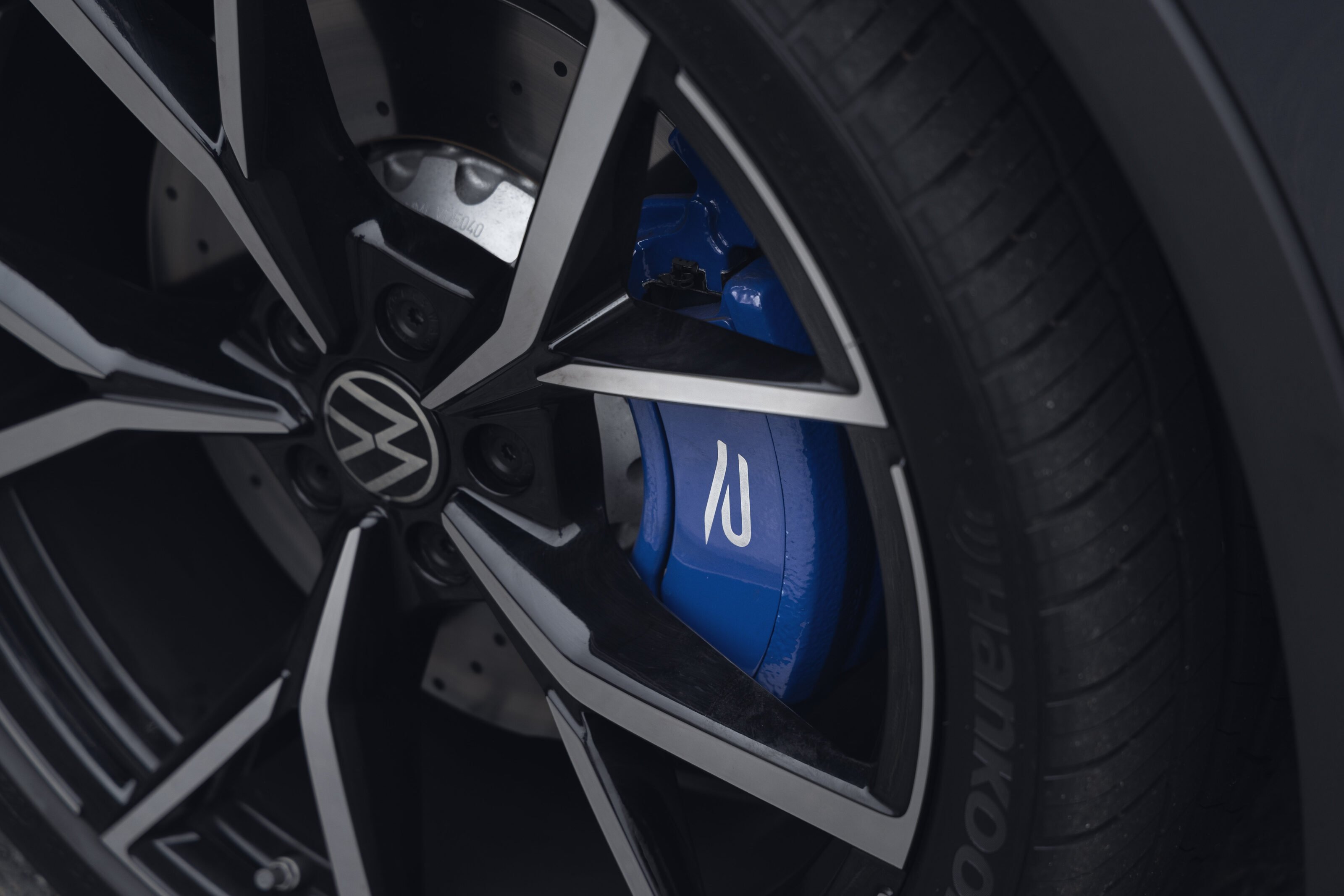
1
As a fast road car, the Tiguan is more than deserving of its esteemed ‘R’ boot badge, but perhaps for different reasons than the ubiquitous and hugely sought-after Golf R.
The Tiguan R, naturally, does different things. Despite sharing the same trick rear axle, it doesn’t boast quite the same level of agility and rear-end rotation. It prefers to be firmly guided through a twisting hill road rather than outright pushed, progressively easing into a safe understeer bias when a corner is entered with a touch too much pace.
Nevertheless, the way the Tiguan R Grid Edition consumes consecutive hard direction changes, interspersed with moments of both hard and transient braking, arguably makes it a more impressive feat of engineering than the naturally athletic Golf hatchback.
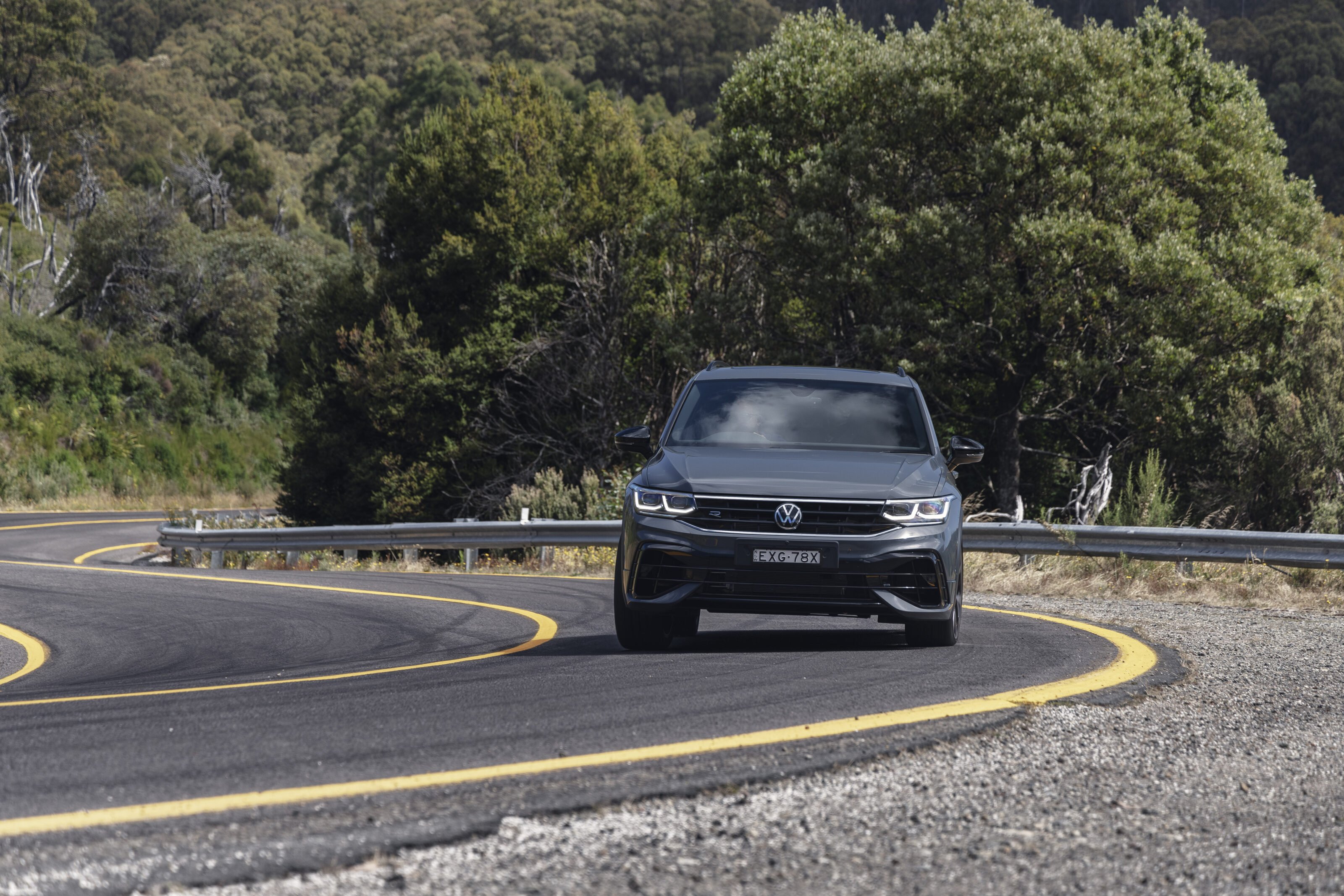
1
Its 5.1-seconds claim from 0-100km/h is very believable, and the Tiguan R Grid feels genuinely rapid in an under-the-radar sort of way, the subtle ‘vooomph’ of its exhaust overrun under a hard-load gear change exuding an air of empowered maturity.
One imagines this jaunt through the Victorian High Country is beyond what a Tiguan R will face for much of its life and, as a semi-premium family car that keeps those in the back comfortable while keeping the driver entertained, the Tiguan R Grid Edition nails its brief.
How is it on fuel?
The 2023 Volkswagen Tiguan R Grid Edition claims 8.8L/100km on the ADR combined cycle.
Sadly, this day’s launch program involved us switching between various vehicles spanning two different models, preventing us from gathering accurate fuel-use figures.
One could reasonably expect mid-to-high nines in everyday use.
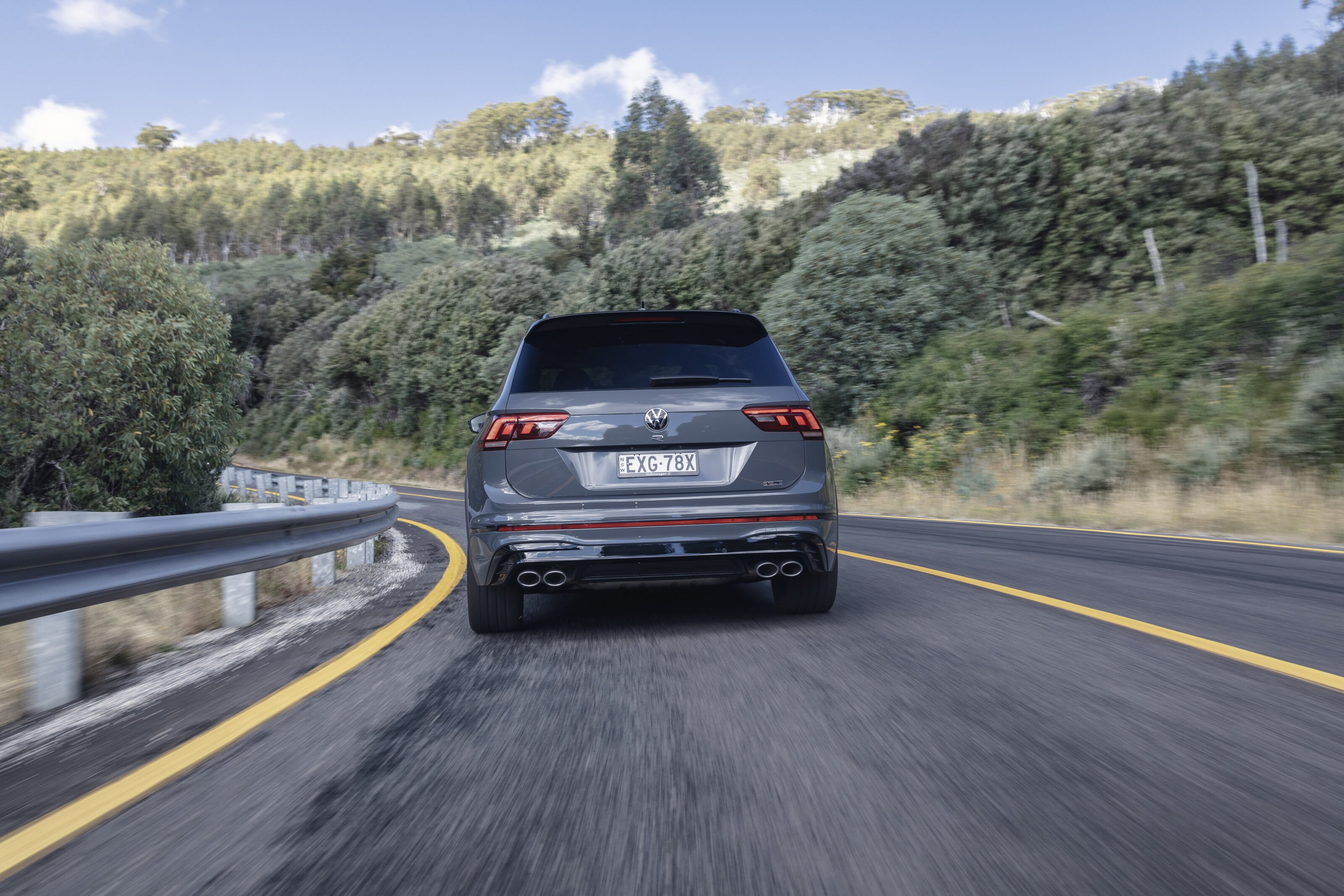
1
How safe is it?
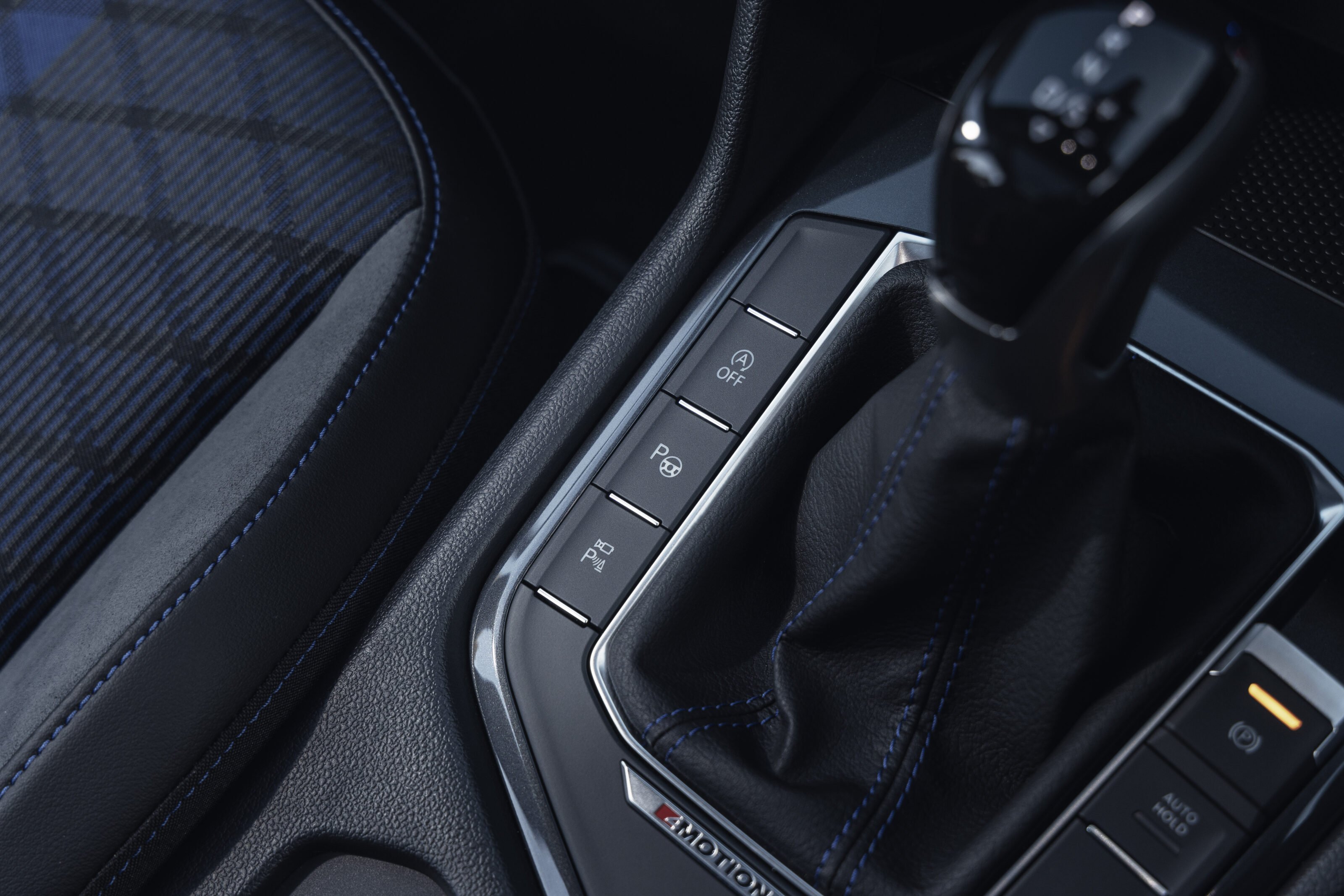
There is an asterisk next to the Volkswagen Tiguan in the safety department and it previously wore a carryover five-star rating from the pre-facelift Tiguan of 2016.
Current ANCAP guidelines see safety ratings expire after six years, meaning every Volkswagen Tiguan produced after December 2016 is technically ‘unrated’ by ANCAP.
1
The Tiguan’s airbag suite includes dual front and dual front-side cushions, curtain airbags front and rear, plus a driver’s knee cushion.
Active safety features include adaptive cruise control with stop-and-go, autonomous emergency braking with pedestrian detection, adaptive lane guidance, lane-keep assist, semi-auto park assist, front and rear parking sensors, reversing camera, 360-degree cameras and low-speed forward and reverse auto emergency braking.
Warranty and running costs
All Volkswagens are covered by a five-year, unlimited-kilometre manufacturer’s warranty.
Volkswagen offers two pre-paid servicing schemes, spanning three and five years.
The three-year pre-paid service plan asks $1700, saving buyers $222 over pay-as-you-go pricing during the same timeframe.
The longer five-year service plan costs $3200 and includes the first service for free, saving buyers $1081 over the first five years of ownership.
VERDICT
Volkswagen’s Tiguan R, even in this slightly stripped-back Grid Edition, adopts many of the brand’s hallmark levels of scope, and breadth of talent, and is instantly accessible, intuitive and rarely puts a foot wrong.
It takes the winning do-it-all formula of the Golf R hatch and reintroduces it in a larger, markedly more comfy SUV, delivering a more mature and considered product more befitting the whole family.
It’s hard to argue with the value proposition and the level of talent and performance afforded but, for young family buyers where driver and passengers command equal importance, some trimmed luxuries such as the powered tailgate and head-up display will be missed.
For family car buyers who value the drive, however, or those with children who have aged out of the pram, car seat and all requisite carry-on luggage, the Tiguan R Grid Edition is a polished urban navigator that will handle the mid-week grind with ease, and one that doesn’t shy away when the leash is let loose on the weekend.
MORE
SUV Buyers Guide
Specifications
| 2023 Volkswagen Tiguan R Grid Edition | |
|---|---|
| Body | 5-door, 5-seat medium SUV |
| Boot min / max | 615L / 1655L |
| Drive | all-wheel |
| Engine | 1984cc 4cyl, dohc, 16v, turbo, petrol |
| Max power | 235kW @ 5600rpm |
| Max torque | 400Nm @ 2000rpm |
| Transmission | seven-speed dual-clutch |
| Weight | 1722kg |
| L/W/H/W-B (mm) | 4520/1859/1668/2681 |
| 0-100km/h | 5.1sec (claimed) |
| Price | $63,990 + on-road costs |
| On sale | now |
