
Always a controversial topic. It’s linked above, but if you need a refresher on how we define eligibility and our testing criteria, the What’s new for 2023? story is where you need to be.
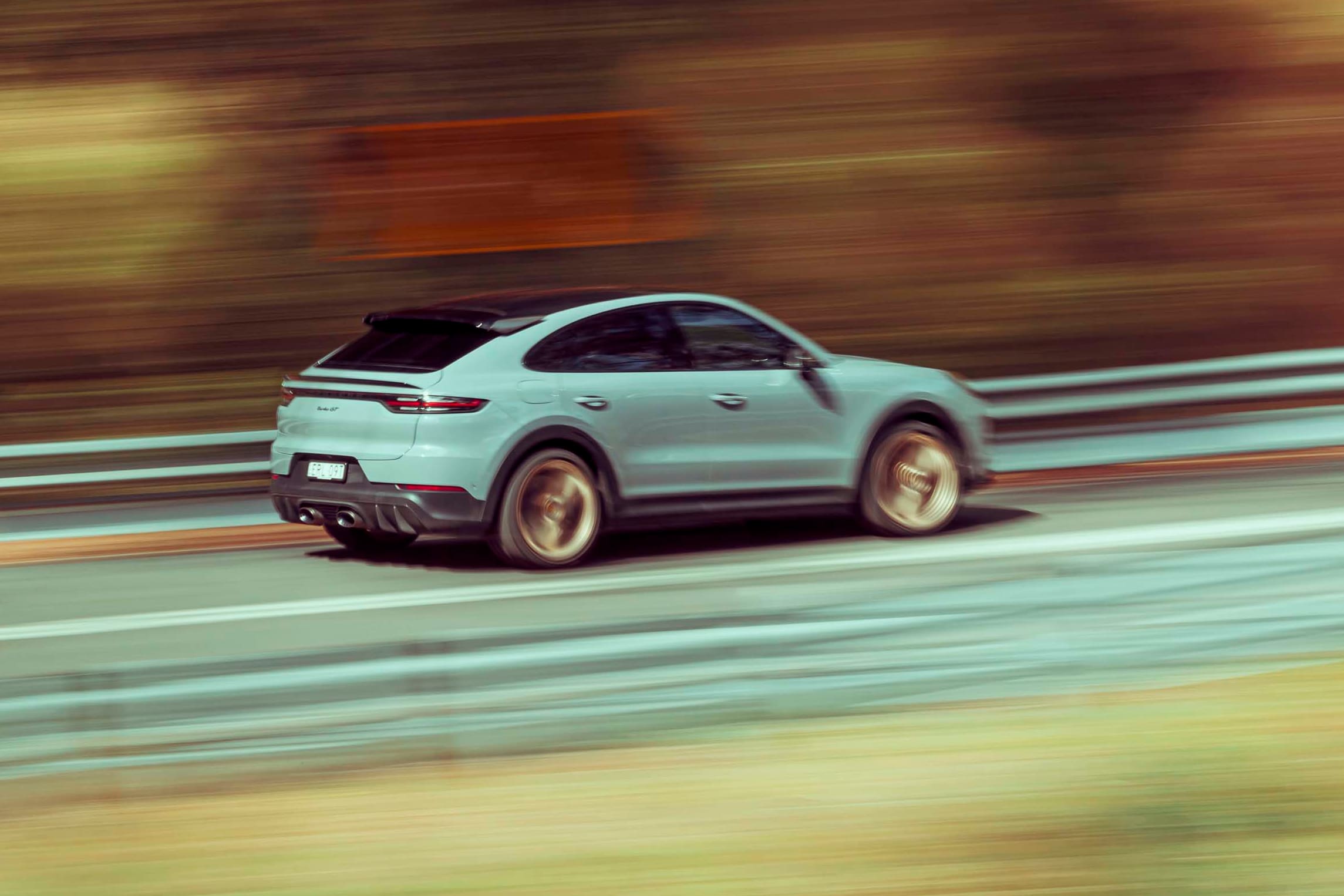
The first time I ever drove this road, there was no traffic coming the other way and it was fantastic. Apex right across the road, skim your right-hand guard up against the Armco and the car hunkers into the camber. Feel everything unweight as you launch across the crown of the road and then compress, tyres keying into bitumen, fictitious forces feeling very real.
That was Targa High Country which is, for the time being at least, a thing of the past; an event stricken from the calendar courtesy of a run of horrors at its sister event across the Bass Strait.
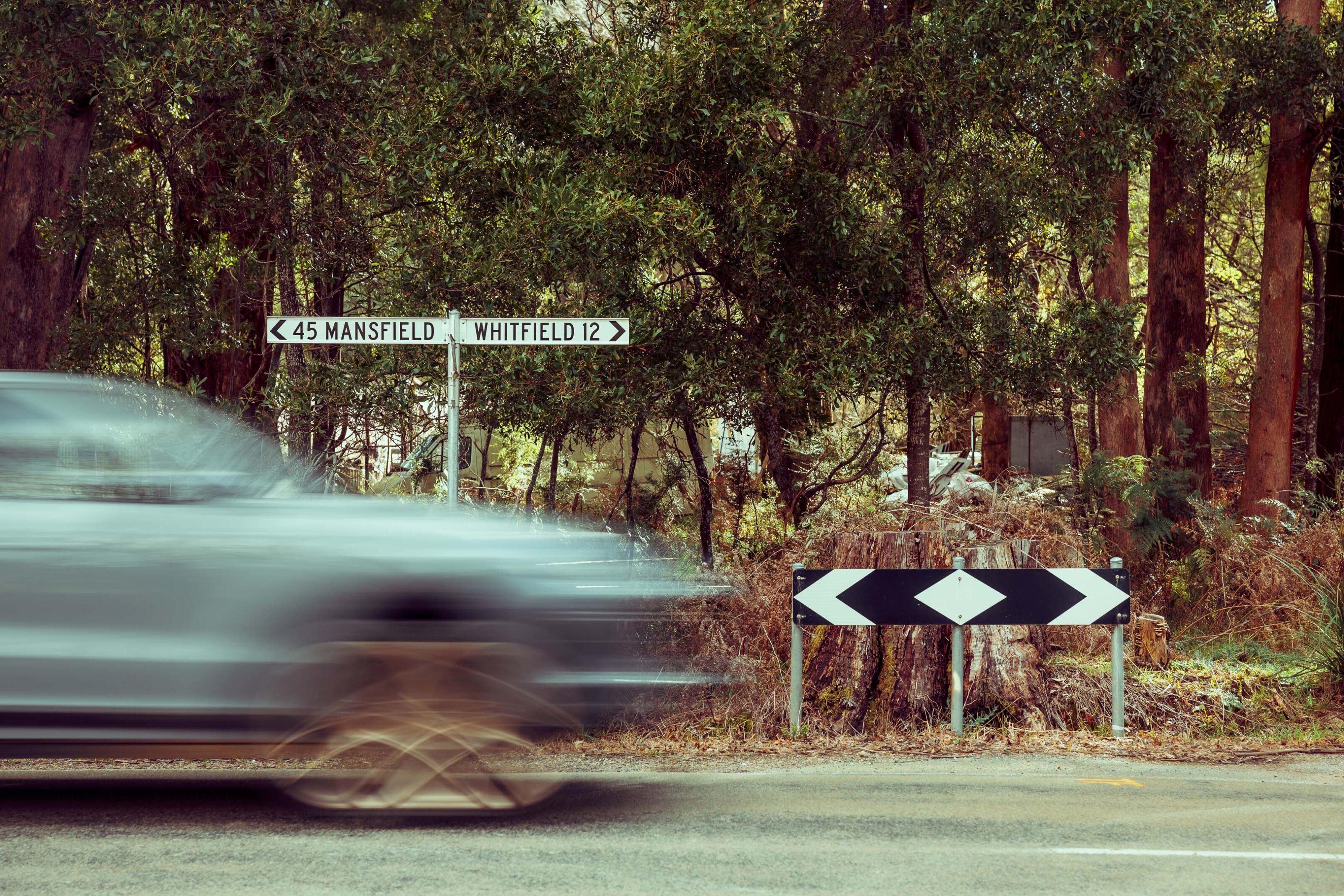
Today we’re back on the road that comprises nearly 40 percent of Targa High Country’s stages – the Mansfield-Whitfield Road. Even leaving Targa aside, it’s a road that we love. MOTOR used to run the road stages of Performance Car of the Year on this stretch and there’s a private rally facility tucked away in the trees halfway along its length.
1
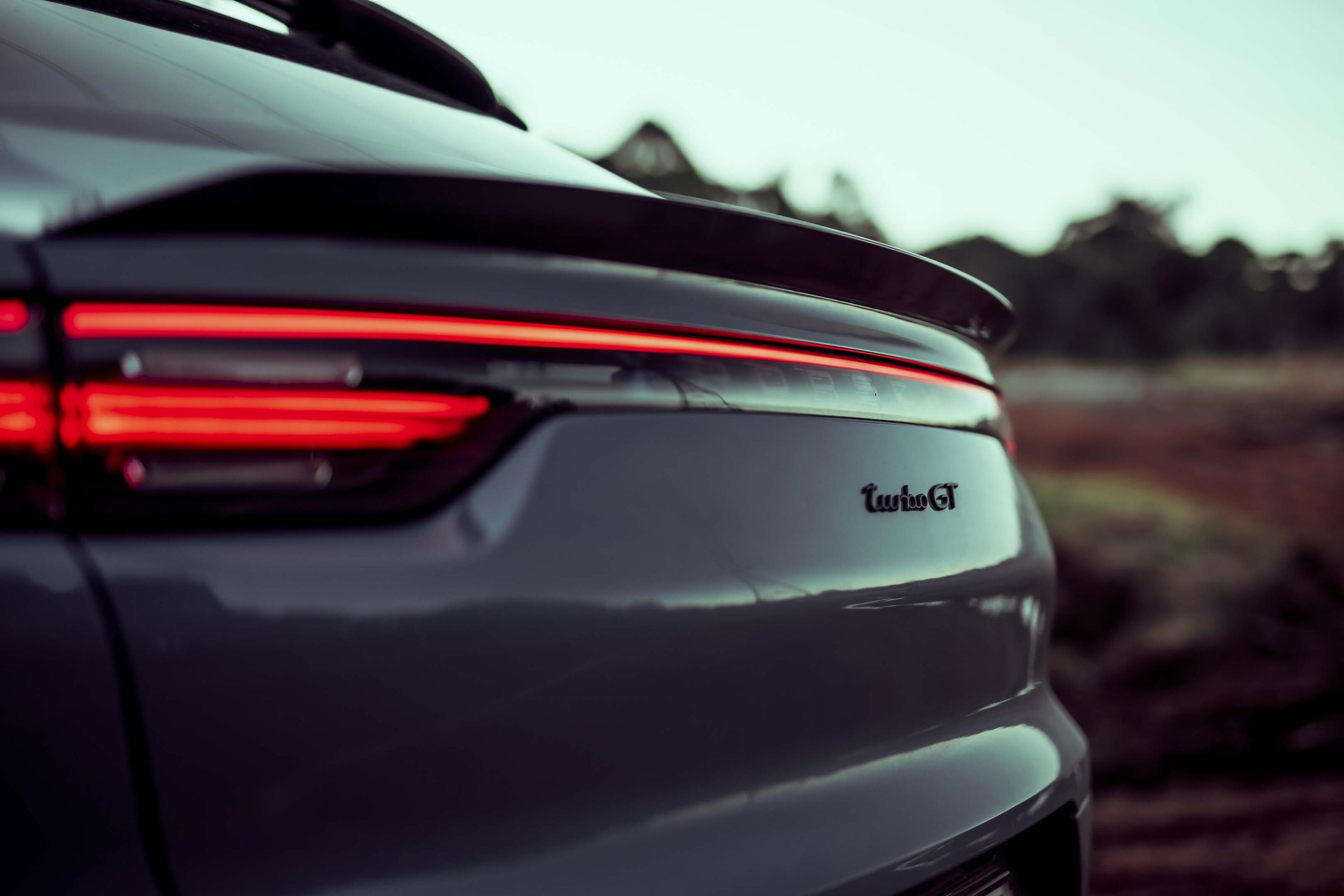
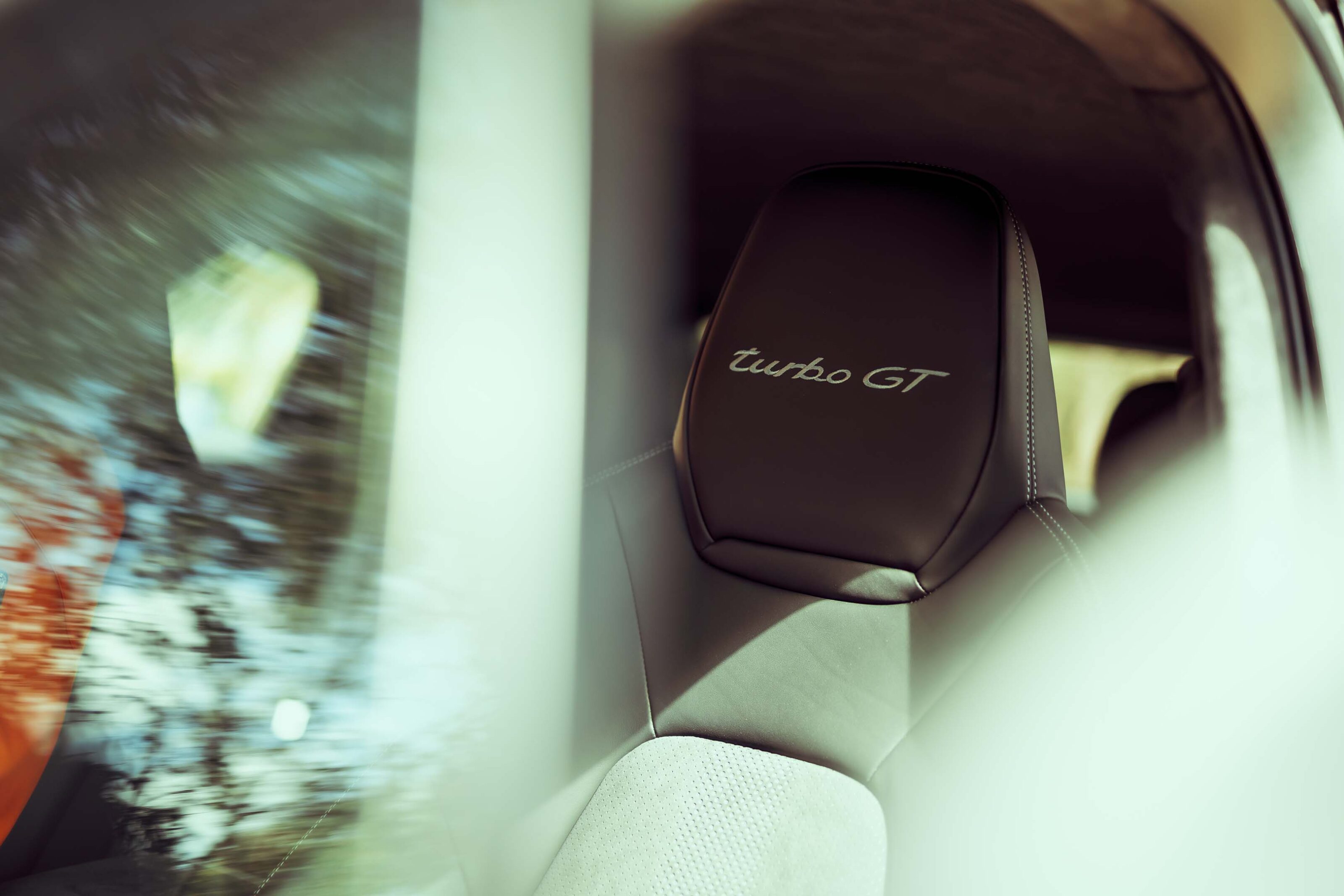
The Cayenne Turbo GT is Zuffenhausen throwing all it knows at a pure internal combustion-engined super-SUV
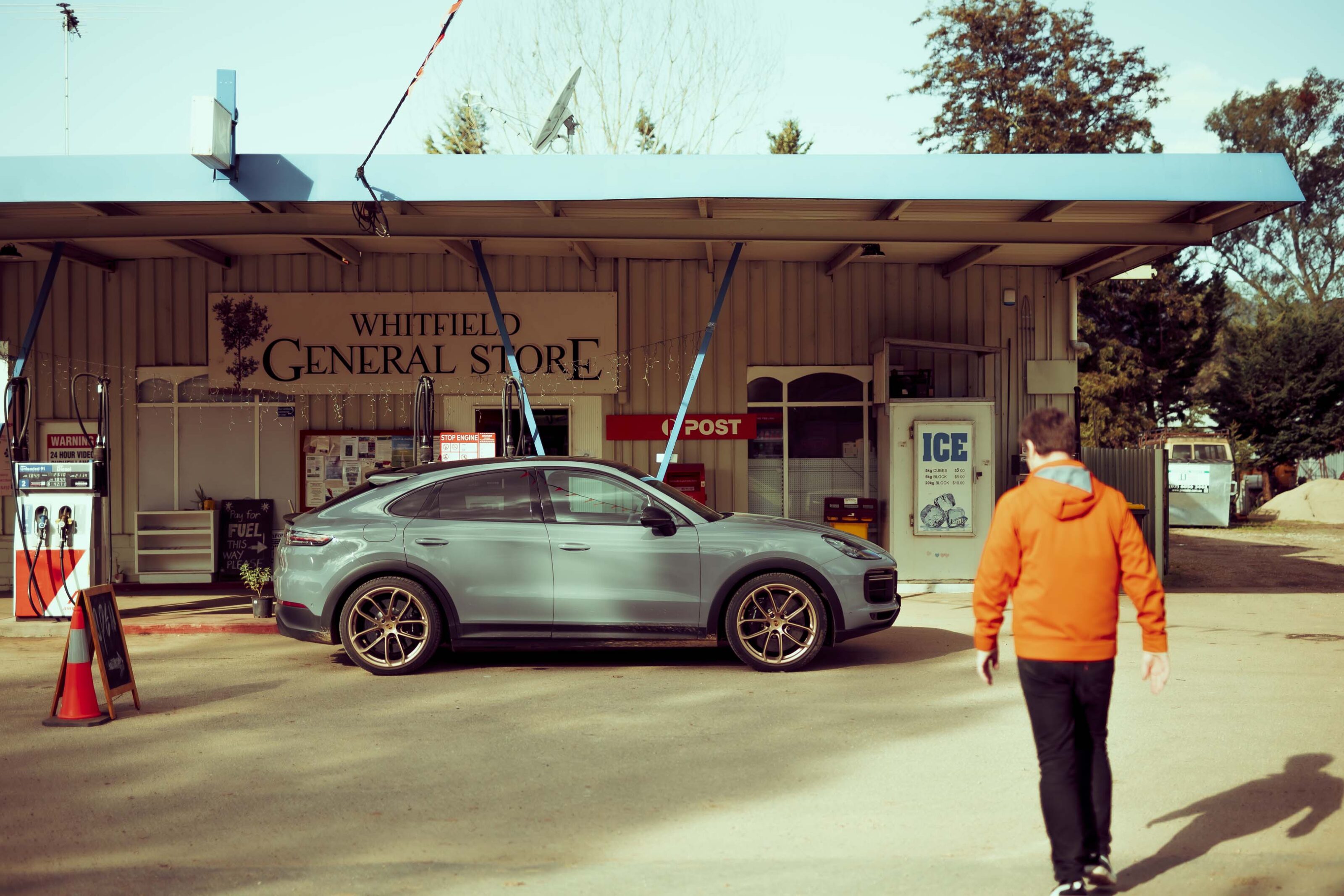
The vehicle we’ve brought to sample it today at first seems more likely to steamroller its relief into submission, but the Porsche Cayenne Turbo GT Coupe is Zuffenhausen throwing all it knows at a pure internal combustion-engined super-SUV, so you suspect it may have a trick or two up its sleeve.
On the face of it, many feel these sort of cars are patently idiotic. We all know that a powerful wagon is deemed a smarter thing for most people most of the time, just in case you’ve already started penning the hate mail. We like to think that the sort of person who can happily drop $336,100 on a Turbo GT coupe could probably afford a stable of high-end cars.
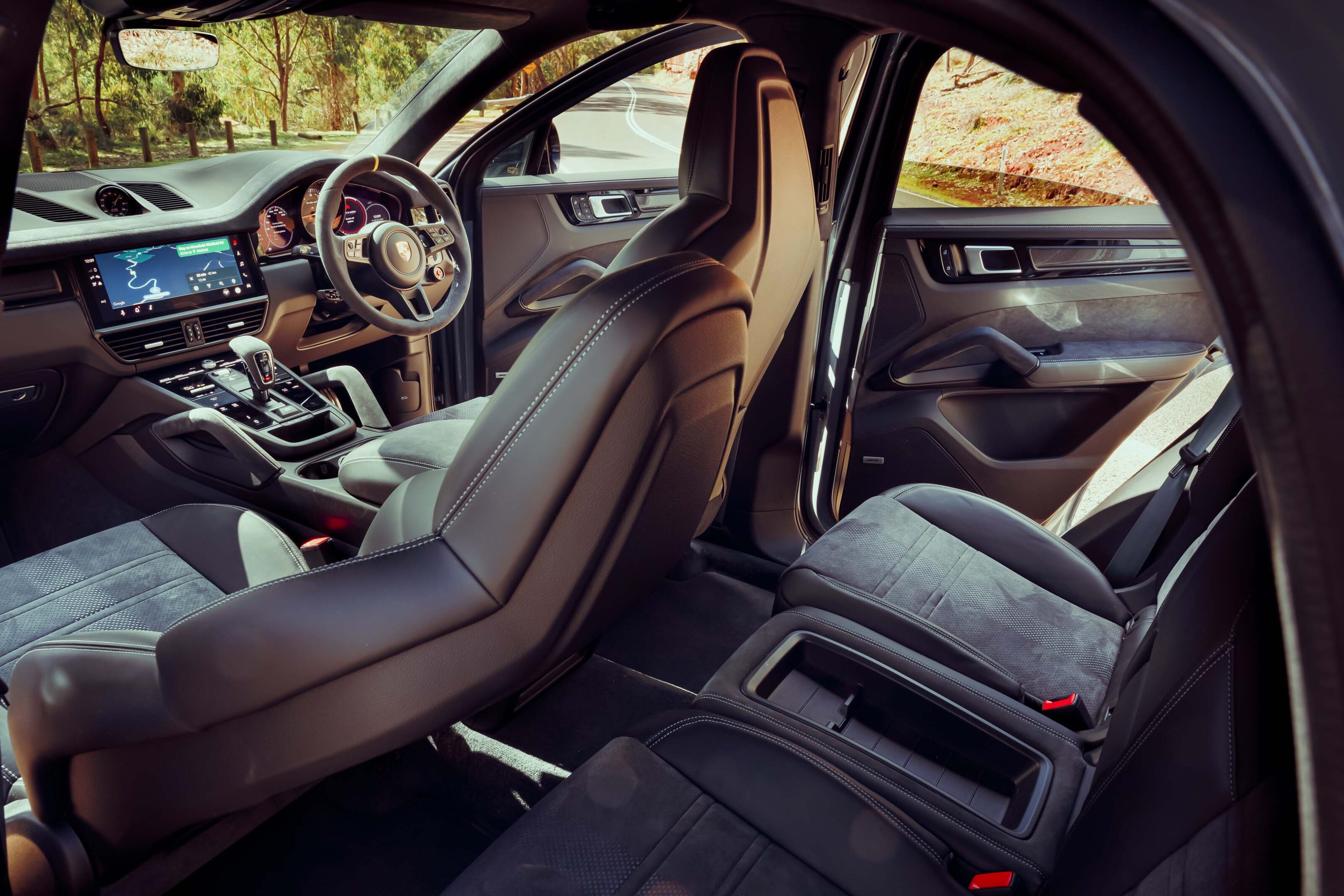
Maybe they can but perhaps a more salient question is whether they’d want to. What if they just wanted one car that could do everything? A one-size-fits-all solution that’d be happy noodling about town, which could effortlessly undertake long freeway journeys, which could entertain on a back road and which could even tackle a gnarled dirt road without so much as a care in the world?
1
Fire and forget. Job done. That’s the brief of the fastest Cayenne ever.
Some notion of its frankly freakish capability comes from its Nürburgring lap time of 7min 38.9 seconds. You may well question the value of flogging a 2220kg lump around the Nordschleife, but you can’t carp about the result. Anything that can lap faster than a Bugatti Veyron, a Porsche 997.2 GT3, a Mercedes SLS AMG or a Ferrari 430 Scuderia and still seat four in comfort merits respect.
Porsche knows that the death knell is sounding for pure – and purely profligate – combustion-engined vehicles such as the Cayenne Turbo GT and has thrown everything at it in a final tribute to suck, squeeze, bang and blow. You’re probably across the broad-brush basics already.
1
The familiar 4.0-litre twin-turbo V8 delivers 471kW and 850Nm which makes this the penultimate Cayenne in terms of sheer outputs behind the 270kg heavier 500kW/900Nm Turbo S-E Hybrid Coupe. Drive goes to all four Pirelli P Zero Corsas via an eight-speed automatic gearbox, 100km/h comes and goes in 3.3 seconds.
It feels like a Golf R wicked up to 11. That’s not to say there’s no drama or involvement
With launch control engaged on a VHT-prepped dragstrip, you might dip into the high twos. It’s that fast. On the road, the Cayenne doesn’t feel quite as concussive, at least in the first few metres from the line. Plant the throttle without launch control engaged and power deployment in first is a little soft, with some turbo lag evident below 2500rpm.
Then the software realises how much grip is available and all hell breaks loose. There’s nothing in the way of wheel scrabble or torque steer. It just squats and goes. The standing quarter disappears in a scant 11.4 seconds which is Nissan GT-R quick.
1
That all-wheel drive wagon you were thinking about instead? Those beacons of engineering rectitude such as an Audi RS6 or a BMW M3 Touring would be receding specks in the rear view.
The Cayenne Turbo GT must have an Achilles heel and that’s why we’ve brought it to this demanding road. It was en route to the Mansfield-Whitfield road that it displayed on of its caveats however. The day had dawned grey, cold and wet and it probably won’t surprise you to learn that a P Zero Corsa isn’t at its happiest in these conditions.
What I wasn’t quite ready for was how catastrophic the understeer would be when you got onto the throttle on any sort of corner. On wet roundabouts, any sniff of the right-hand pedal sends the nose veering wide quite alarmingly.
Those that can afford to drop $362K on one of these would be wise to budget for a more versatile set of boots to wear in winter.
1
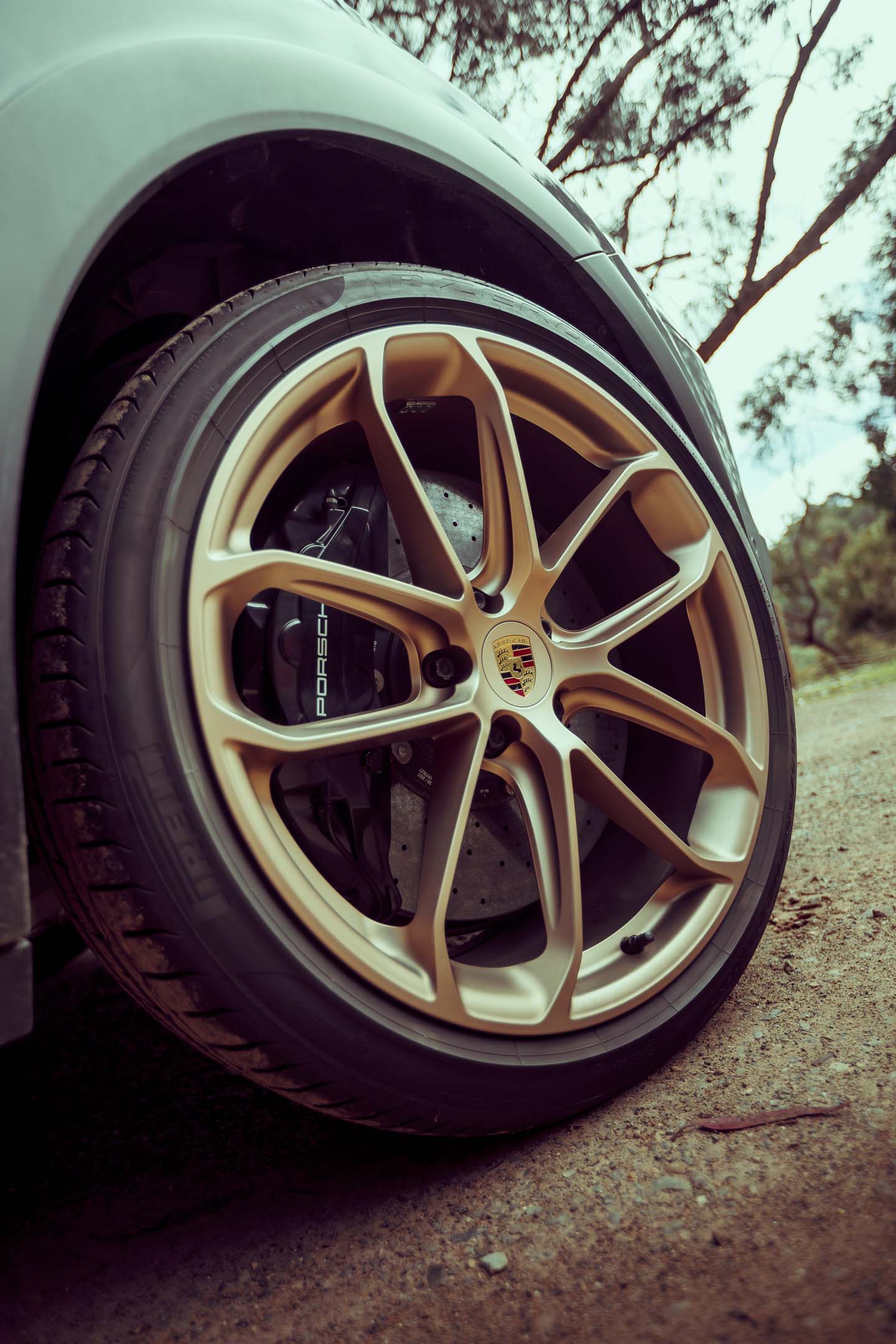
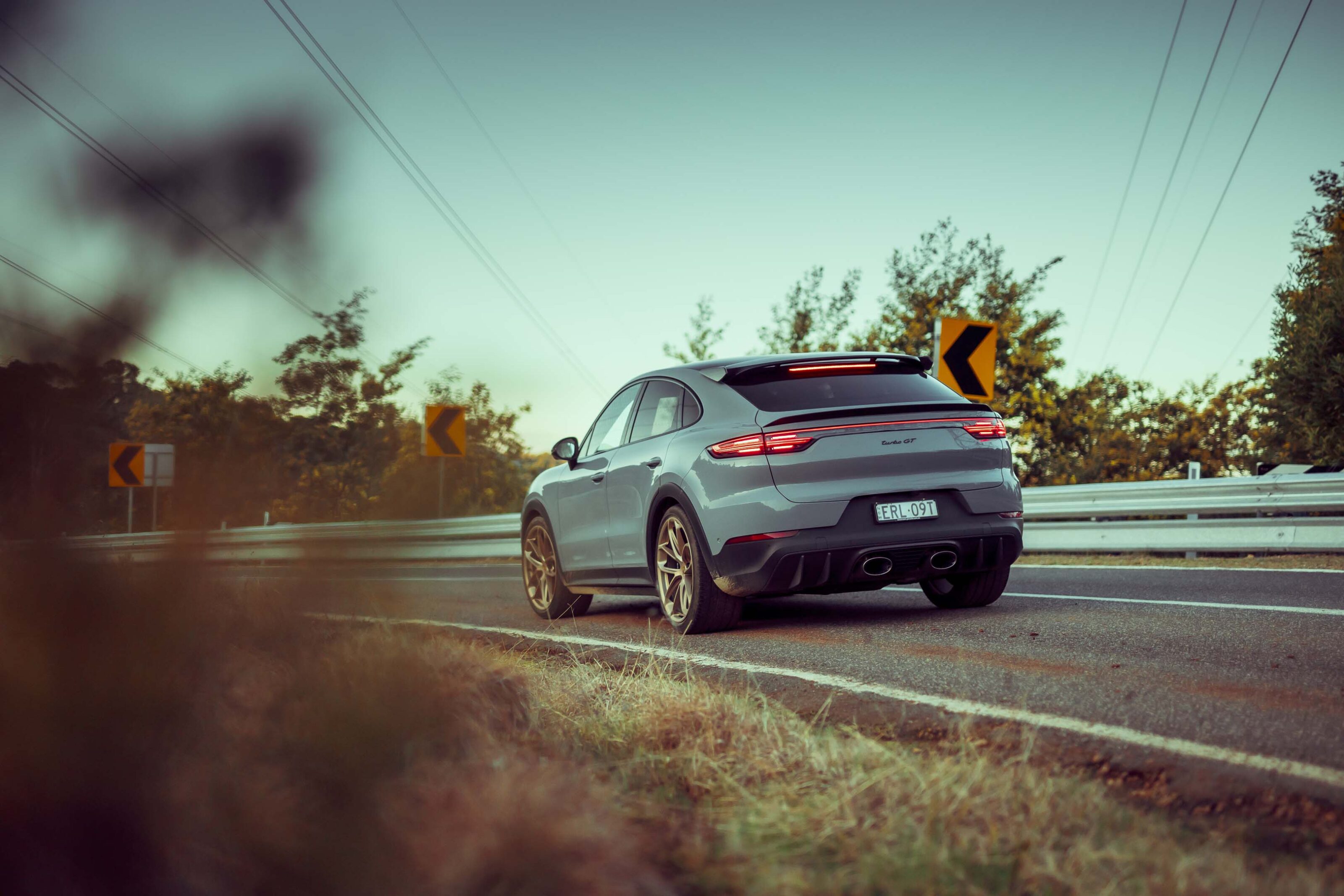
I meet photographer Brook in Mansfield, hosing the gunk off the 22-inch Satin Neodyme wheels as he waits to be served some sort of giant baloney hoagie. A colleague had dismissively referred to the wheel colour as rose gold earlier, but these deutan eyes can’t see any pink in the mix.
So big are the eye-catching alloys when contrasted with the low-key Arctic Grey body paint that it gives the effect of a smaller Macan-sized body perched atop the giant hoops.
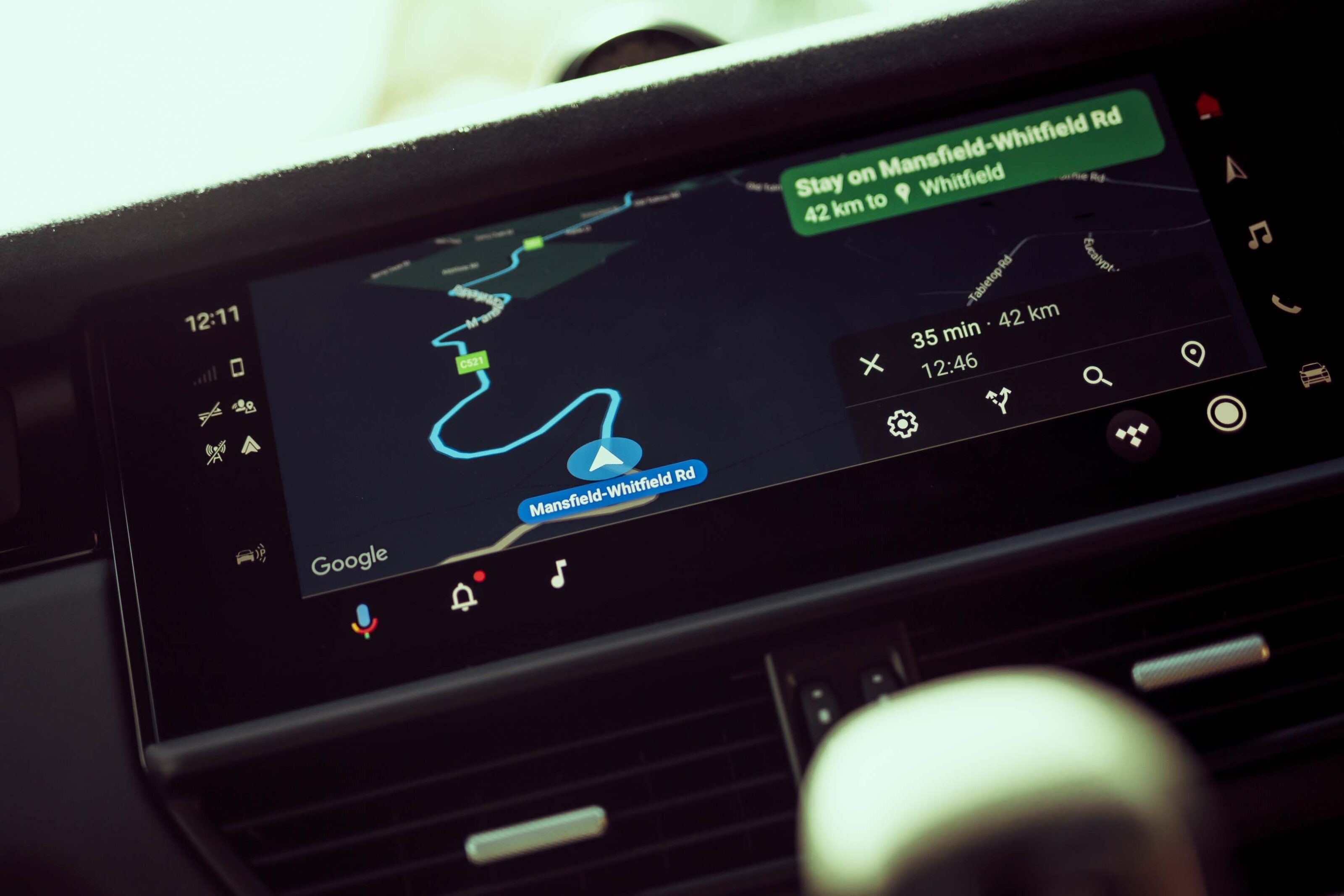
Cleaning duties done, we set out on the road which isn’t hard to find, heading north from the last roundabout at the top of Mansfield high street. At first the C521 is a gentle meander through paddocks and new builds. The Targa Tassie organisers designated this initial limber-up a transit stage.
1
The first of the outbound competitive stages, Special Stage 4 – Barwite, begins just as innocently, with one gentle left-hander in the first kilometre before the road develops some teeth.
Over a bite to eat in Whitfield, it’s clear quite what a massive kitchen sink Porsche has thrown at this vehicle
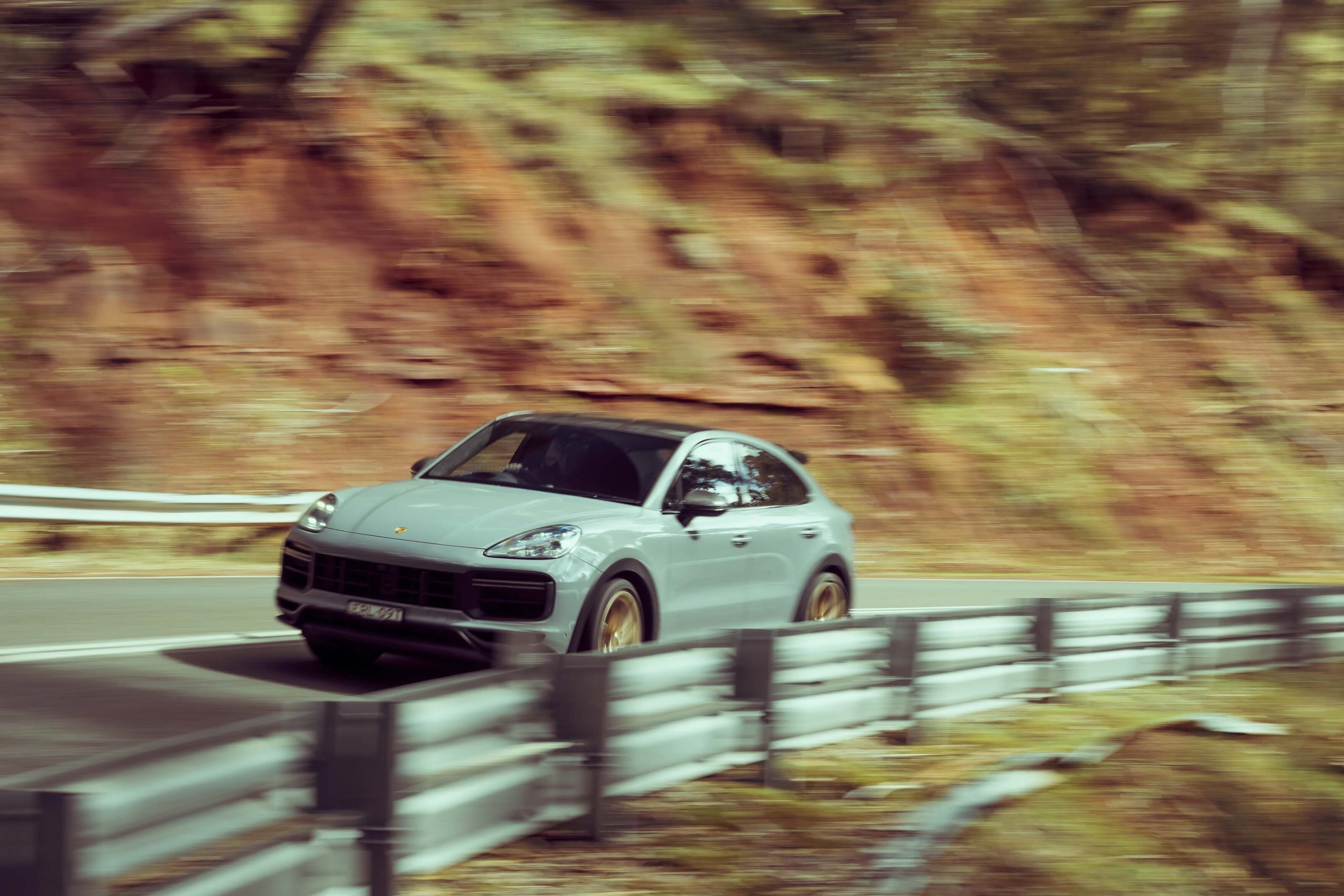
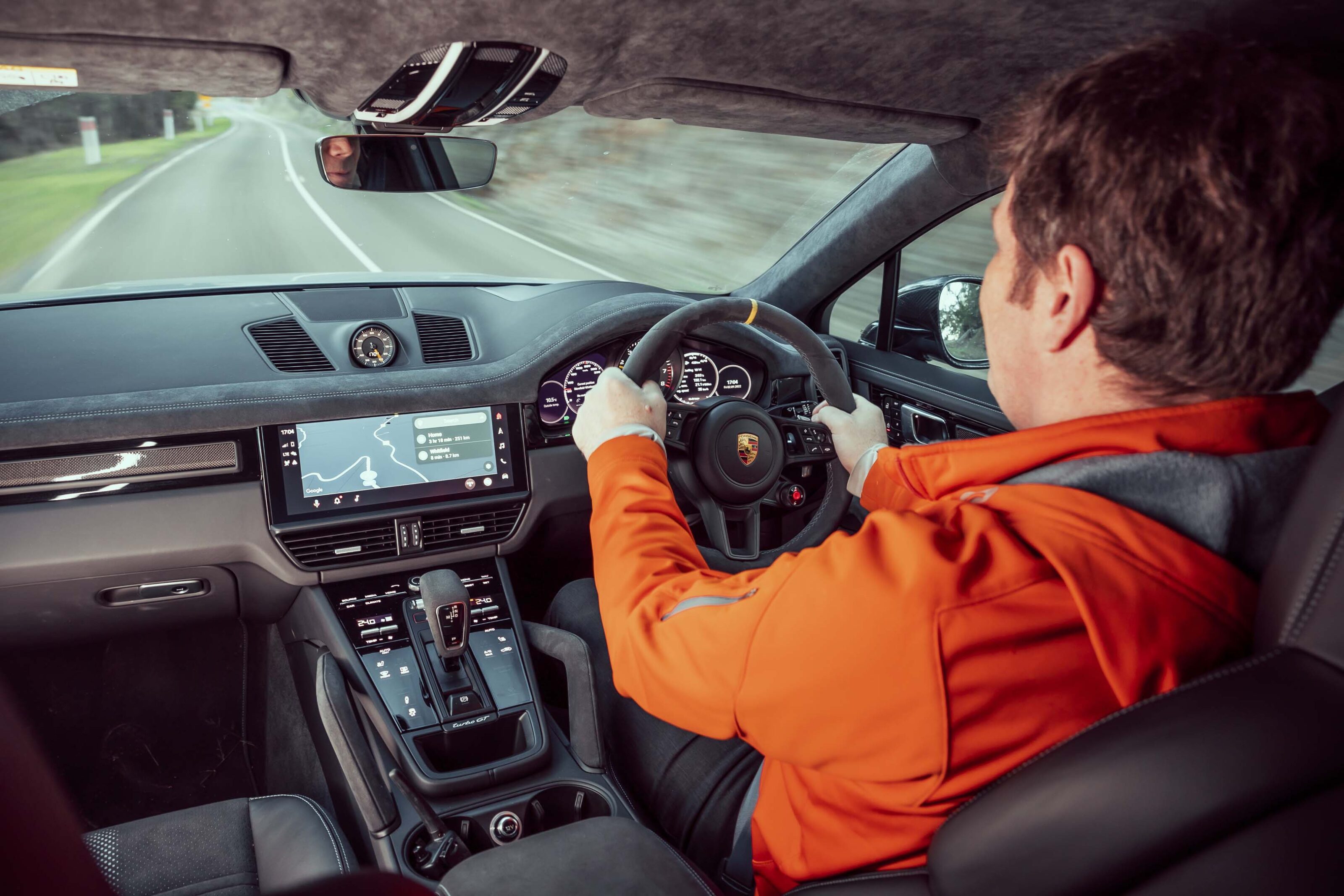
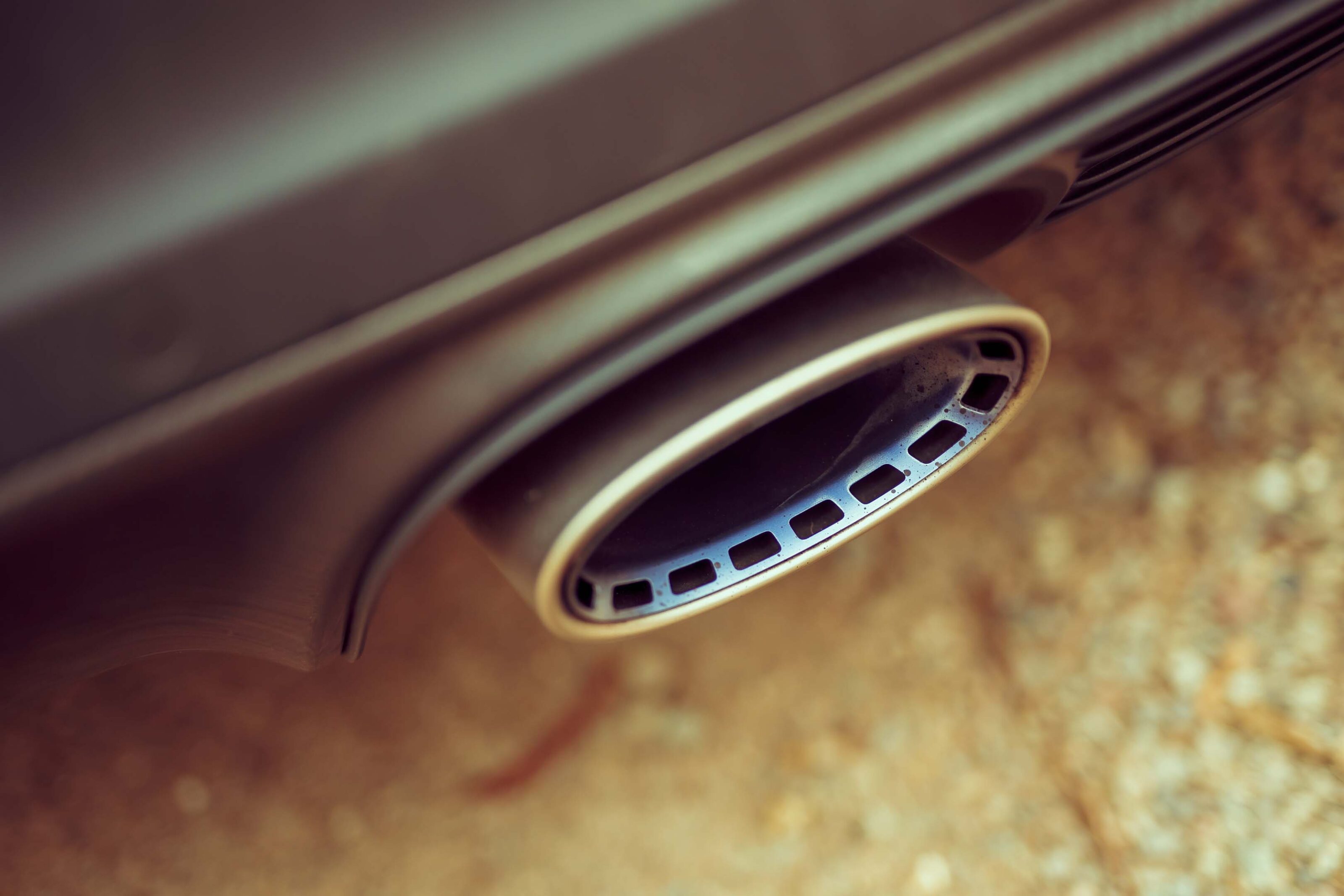
The relief falls away to your left to a choked creek bed while on the right, gum trees cling to chossy rock walls. Nudge the Cayenne’s manettino dial into Sport Plus and the vehicle hunkers lower on its suspension. Crack a window and it’s clear that as dramatic as the acoustics are in the cabin, they’re even better outside. This is no pure-tone V8 wail. It’s wet and dirty, gutsy and earthy. It sounds utterly and gloriously reprehensible.
Truth is, the emissions of this 471kW leviathan are no worse than a Prado V6 or a Nissan 370Z. It seems that even one-fingered salutes are somewhat mannered these days.
1
Much of the Cayenne Turbo GT’s cornering ability comes courtesy of those huge tyres. Developed specially for this model, they sit on rims an inch wider than the standard Cayenne Turbo. Measuring 285/35 ZR22 up front and 215/30 ZR22 at the rear, they’re assisted by a geo tweak of 0.45 degrees more negative camber and an actively steering rear axle.
The deletion of the Cayenne Turbo Coupe’s glass roof in favour of a carbonfibre panel saves 22kg and lowers the centre of gravity as does a ride height drop of 17mm.
The air suspension is 10 percent firmer in Normal mode than the Cayenne Turbo and 15 percent beefier in Sport Plus, while uprated front dampers improve turn-in behaviour and roll stability in concert with PDCC active anti-roll bars. Then there’s the updated Porsche Torque Vectoring Plus (PTV Plus) which tidies turn-in behaviour with targeted brake interventions.
Related video
The big benefit here is how early you’re then able to get on the gas and take advantage of the fully variable differential lock.
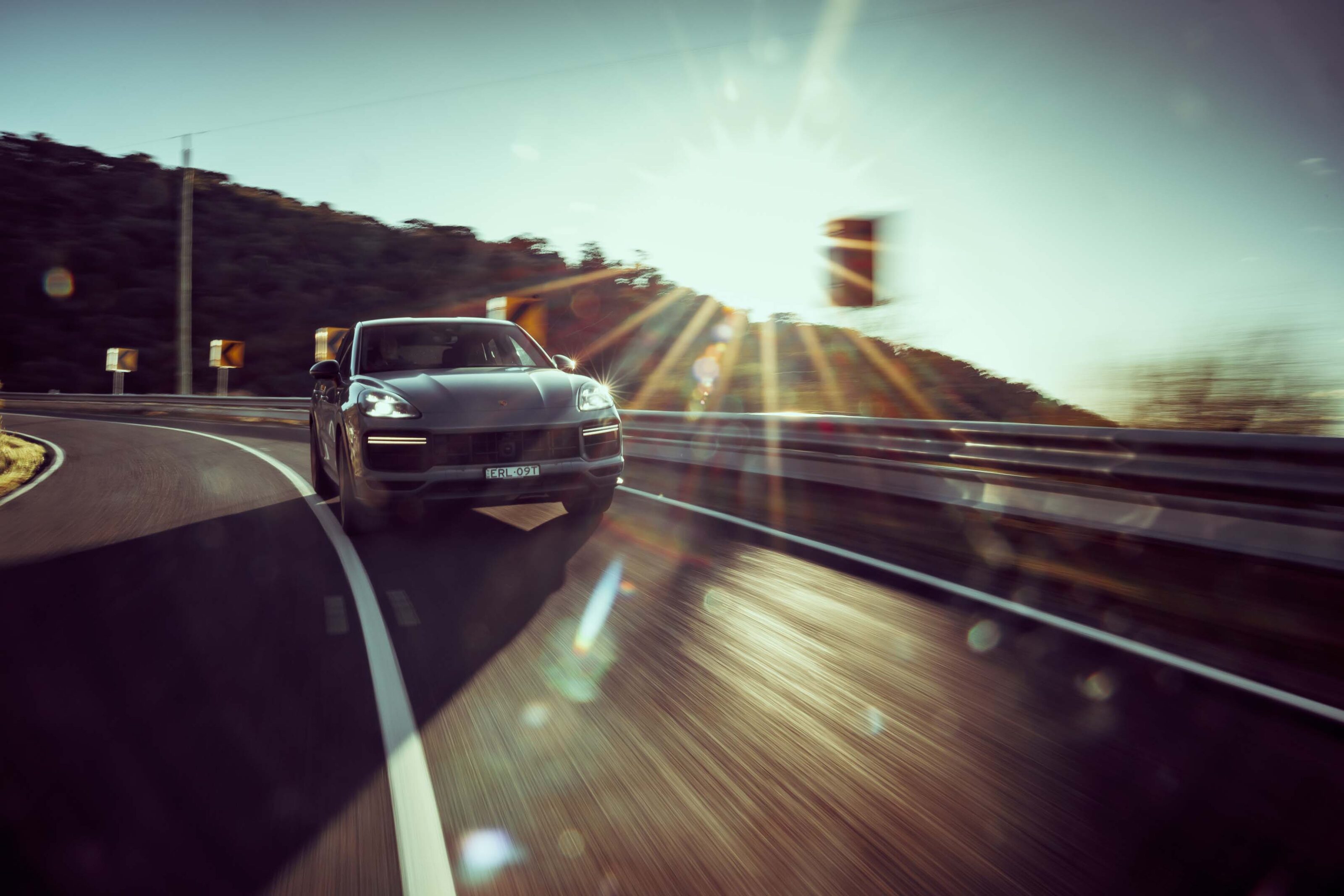
The effect is uncanny. Unleashing that much torque mid-corner in a vehicle this big would normally lift the nose, overwhelm the front contact patch’s tenuous grasp on the bitumen and then you’d be left either managing understeer or feeling the throttle pedal neutered by the vehicle’s stability control. In other words exactly what we experienced earlier in the day on wet roads.
Now that the road is warm and dry, the Cayenne just accelerates cleanly through the corner. It feels like a Golf R with everything wicked up to 11. That’s not to say there’s no drama or involvement. Get really enthusiastic and it’ll smear all four wheels at the limit, or you can play around with the weight balance by lifting the throttle to get it to tuck its nose on the way in. There’s definitely a bit of Weissach in these genes.
1
The Barwite stage is 7.4km of fun, but the real treat resides a few kilometres further up the road. Stage 5, Tolmie, extends for 16.2km and includes the high point of the road at 930m above sea level. The views across to the huge south wall of Mount Feathertop often threaten your attention on the road ahead and today the far peaks are still snow-dusted, with Mount Buller jutting above the stringybarks to your right and countless white domes marking the eastern horizon.
This road undulates at first, before cresting a rise and then it’s downhill all the way. The most recognisable section is a set of switchbacks that run beneath a clearcut marked by overhead power lines.
The final stage as you descend is the 7.15km blast down to Whitfield, which features possibly the greatest corner along the whole road; a vast, wide left-hander that’s open to the valley floor, angling around a red rock cirque. You could almost be in Nevada rather than Victoria.
1
Photography requires a few passes here, and the road is broad enough and sufficiently well-sighted to try different lines. The brakes are mighty, as you’d hope on something that can build such boggling levels of kinetic energy so quickly.
The carbon ceramic discs are 440mm up front clamped by ten – ten! – piston calipers, with 410mm discs at the back serviced by four-pots. Yes, the rear brake discs on the Cayenne Turbo GT really are 20mm bigger than the front brakes on a Lamborghini Huracán STO.
Over a bite to eat in Whitfield, it’s clear quite what a massive kitchen sink Porsche has thrown at this vehicle. Engine, suspension, brakes, steering, transmission, aero, lightweighting, cooling, basically anything that can be optimised within reason has been.
1
It would have been so easy to wick the turbochargers up a little, fit some flashy dress up and rebadge accordingly. Indeed, many will expect that this is exactly what Zuffenhausen has done to the Turbo GT, but that does it a vast disservice.
There is an element of engineering dogma versus physics inherent in this vehicle. We know that a lower-slung wagon would undoubtedly be a wieldier, lighter thing. We also know Porsche has been known to turn unpromising-looking vehicle layouts into something magical.
But the Cayenne Turbo GT works so beautifully, it’s hard to be resentful. Indeed, hating on the Turbo GT for being an SUV and not a wagon is about as churlish as pouring scorn on a GT3 RS because it’s more porcine and profligate than a single-seat race car.
1
Having earlier switched it into off-road mode and blasted down a rutted red dirt track on raised suspension, the sheer bandwidth of this Porsche’s abilities makes it an unexpectedly sweet fit for Australian conditions. An Audi RS6 would have divested itself of most of its chin somewhere along that track, shaken its occupants to smithereens and still been no more entertaining on the drive back up the hill.
Super SUVs are often perceived as symbols of unnecessary excess. Most are solely bought as baubles, a badge of exclusivity in the purest sense. The Porsche Cayenne Turbo GT Coupe is different.
A well-specified Cayenne GTS Coupe is a great choice for $140k less but you’ll choose the Turbo GT not because you can, but because Porsche will never build a better purely petrol-powered SUV. This is the endstop. And what a way to go out.
1
Uprate everything
That was the tweak that was
It would have been so easy for Porsche just to jack the boost up a bit and publish a sexy headline power figure. Unfortunately, the engineers got a bit carried away.
To that end, the Cayenne Turbo GT’s engine does indeed have more boost, to the tune of a minuscule 0.1 bar, but it also features uprated timing chain drive, crankshaft, conrods, pistons, and torsional vibration dampers. The injectors flow 10 percent faster, gearshifts have been sharpened and there’s additional cooling for the gearbox transfer case.
Although the engine is built in Zuffenshausen, the design work comes courtesy of Weissach.
1
Over and out?
Will tarmac rallying return?
The answer to that question is ‘it depends who you ask’. There are two commissioning bodies overseeing tarmac rallying. Motorsport Australia has, for the time being, suspended the Targa events.
The Australian Auto-sport Alliance administers events like the Great Tarmac Rally, the Mt Baw Baw Sprint and the Snowy River Sprint. These events are still very much alive. Sadly not on the Mansfield-Whitfield Road, however.
MORE
Everything Porsche
Isuzu Ute Australia has embarked on a long term partnership with the Royal Flying Doctor Service (RFDS), providing support for emergency vehicles.
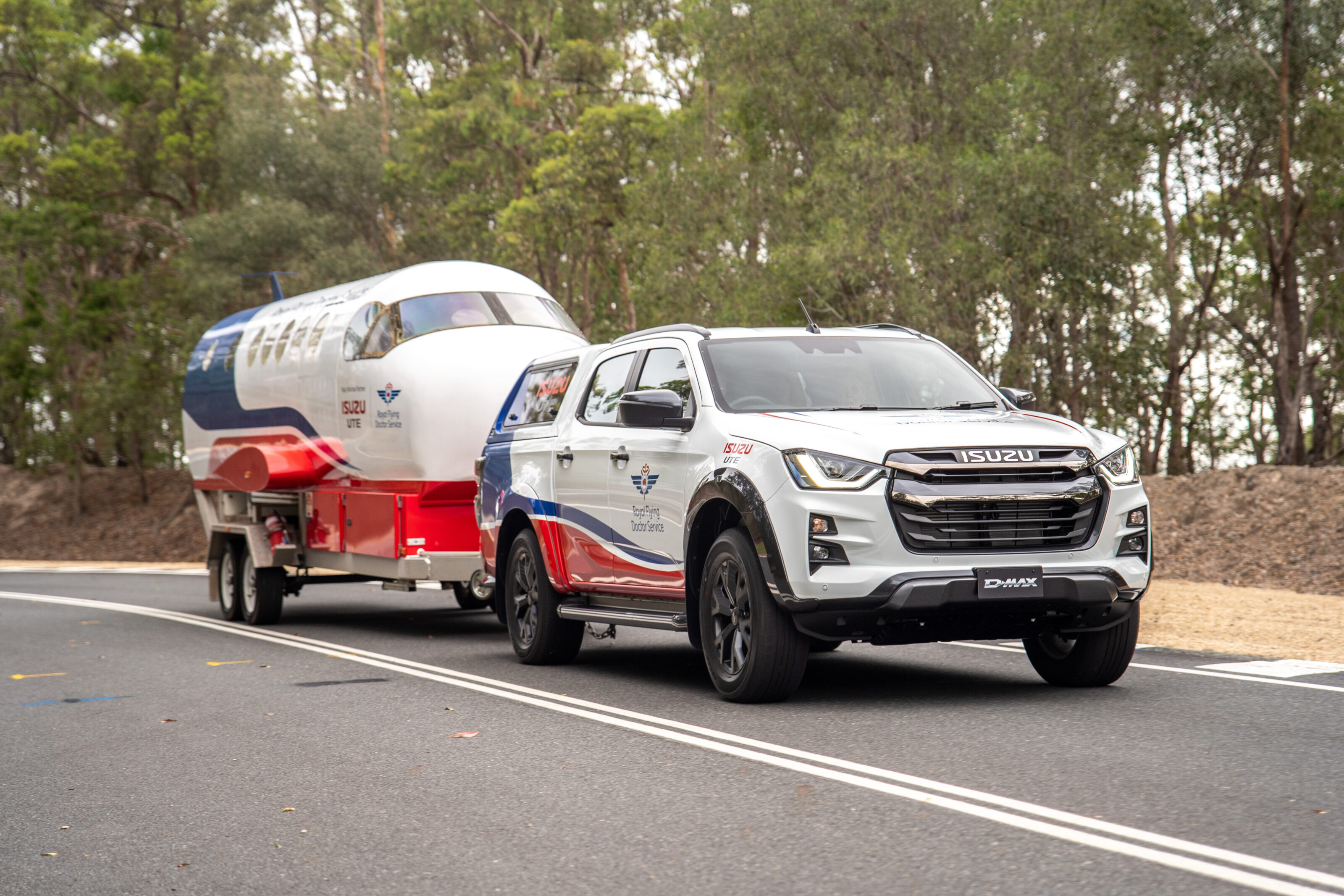
It’s hoped the national three-year venture with the charitable organisation will help to deliver better health outcomes to those living beyond the reach of mainstream medical services in rural and remote Australia, with Isuzu providing both financial support and a fleet of D-Max utes and MU-X SUVs.
The vehicles will be enlisted to tow the Flying Doctor’s state-of-the-art training simulators around the country for its schools Education Program and national events program.
1
“We understand the importance of having dependable transportation in isolated and challenging environments,” said Isuzu Ute Australia’s Deputy Managing Director, Koichiro Yoshida.
“Our D-Max and MU-X vehicles are a perfect match for this sometimes-remote work and the long-distance towing demands of the Royal Flying Doctor Service where reliability is crucial.
“It is important for us to give back to those that support us, and so this is our way of saying thank you to the Royal Flying Doctor Service for its tireless service and commitment to our community by helping educate students at schools and raise awareness and funds at events across the country.”

1
Support via corporate partnerships such as this help the RFDS to purchase new aircraft, invest in critical infrastructure, upgrade life-saving medical equipment, and deliver essential primary health care and mental health services.
“As a national health charity, the support from individuals, small businesses and corporations has underpinned critical delivery of primary health and emergency medical services for decades,” said Frank Quinlan, Federation Executive Director of the RFDS.
“We are excited about this new major national partnership with Isuzu as it enables us to keep the Flying Doctor flying, driving, and caring for people across rural and remote Australia.”
MORE
Everything Isuzu
UPDATE: 2024 Mini Countryman to be produced in Germany
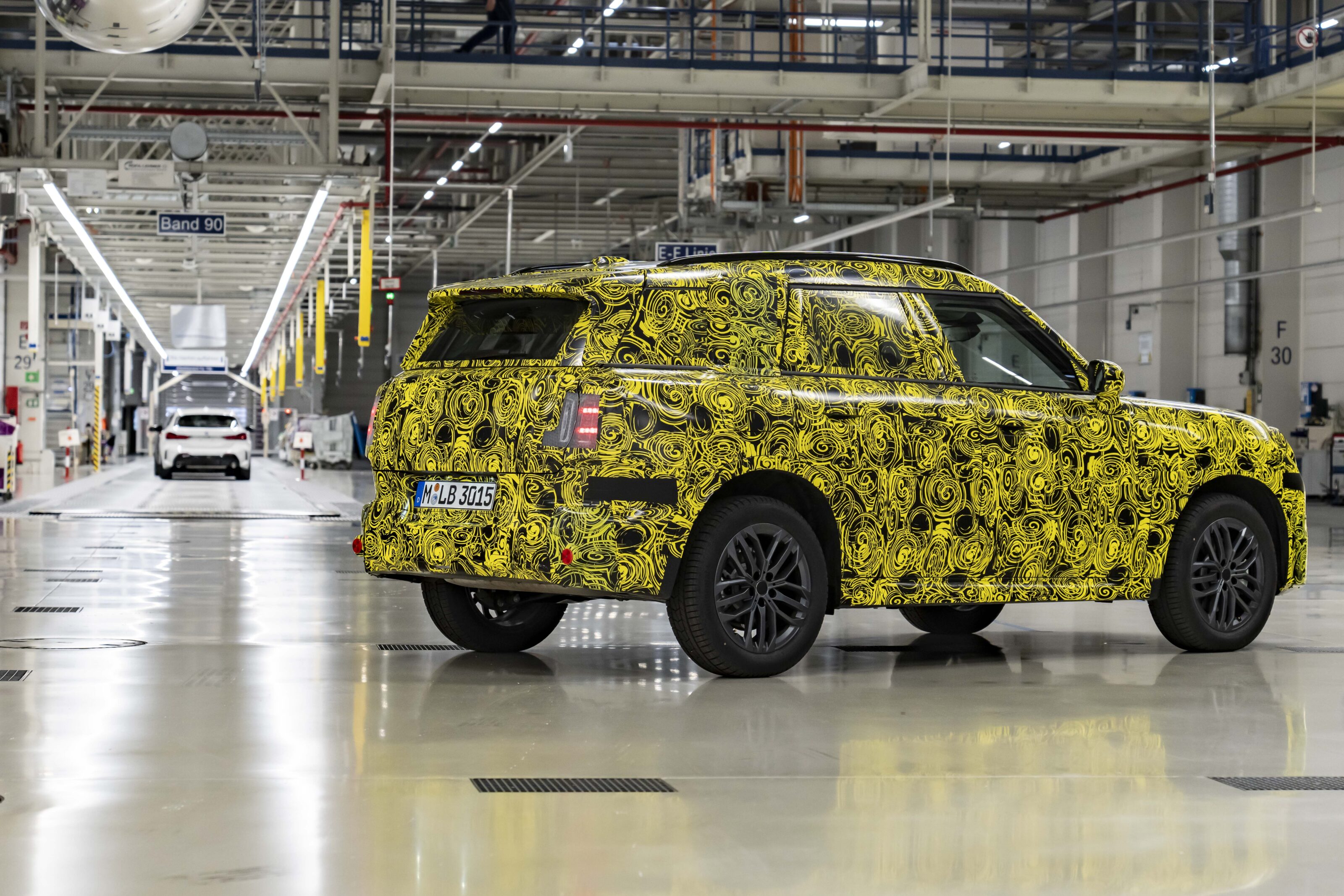
The third-generation 2024 Mini Countryman small SUV will be built in Germany.
It will become the first Mini vehicle manufactured in the country, with production set to commence at parent company BMW’s factory in Leipzig later this year.
Set to be built alongside the BMW 1 Series, 2 Series Gran Coupe and 2 Series Active Tourer, the latest Countryman will ride on an updated version of the current UKL2 platform, with internal combustion or all-electric power.
1
“This makes the location the first plant at which vehicles of the BMW and Mini brands are manufactured together, once again demonstrating maximum flexibility,” said Mini.
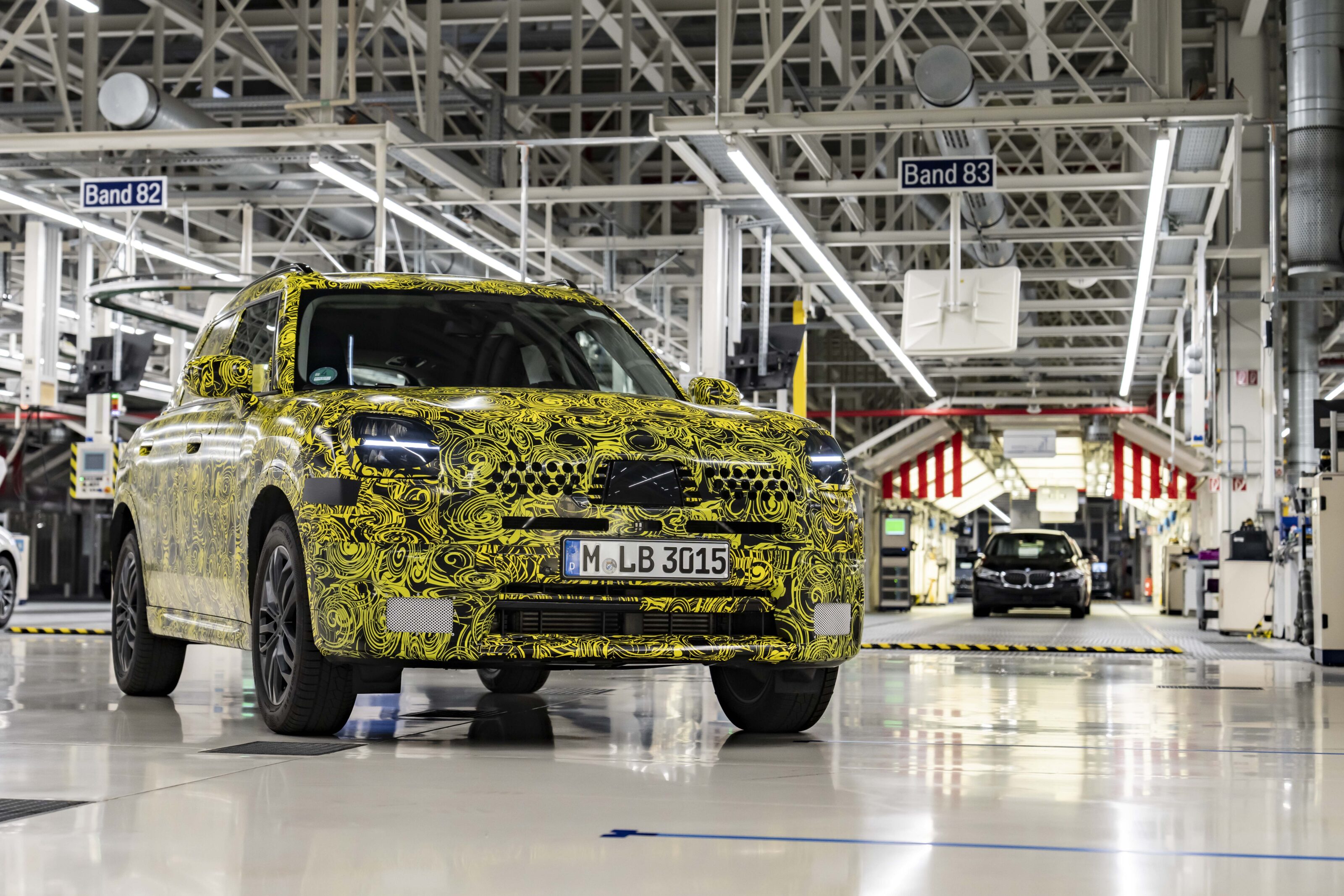
First announced in 2021 (see below), the British-based marque has released teaser images of a camouflaged new-generation Countryman, revealing an evolutionary look and a larger body to take on the more-established Audi Q3, Mercedes-Benz GLA and Volvo XC40.
As with the latest BMW X1, it will sport identical flush-fitting door handles, while both vehicles are expected to be similar under the skin, with shared powertrains likely.
6
This includes a range of three- and four-cylinder petrol and diesel engines, two plug-in hybrids, and an all-electric variant.
The 2024 Mini Countryman small SUV will be joined by the smaller Aceman electric SUV and the next-generation Mini Hatch, with the iconic model adopting more electrified options.
The story to here
November 8, 2021: Mini Countryman to be succeeded by electric model from 2023
Key Points
- Successor to current Countryman to be offered with electric and combustion engines
- Last ICE-powered Mini to be introduced in 2025
- Entire Mini line-up to go all-electric by 2030
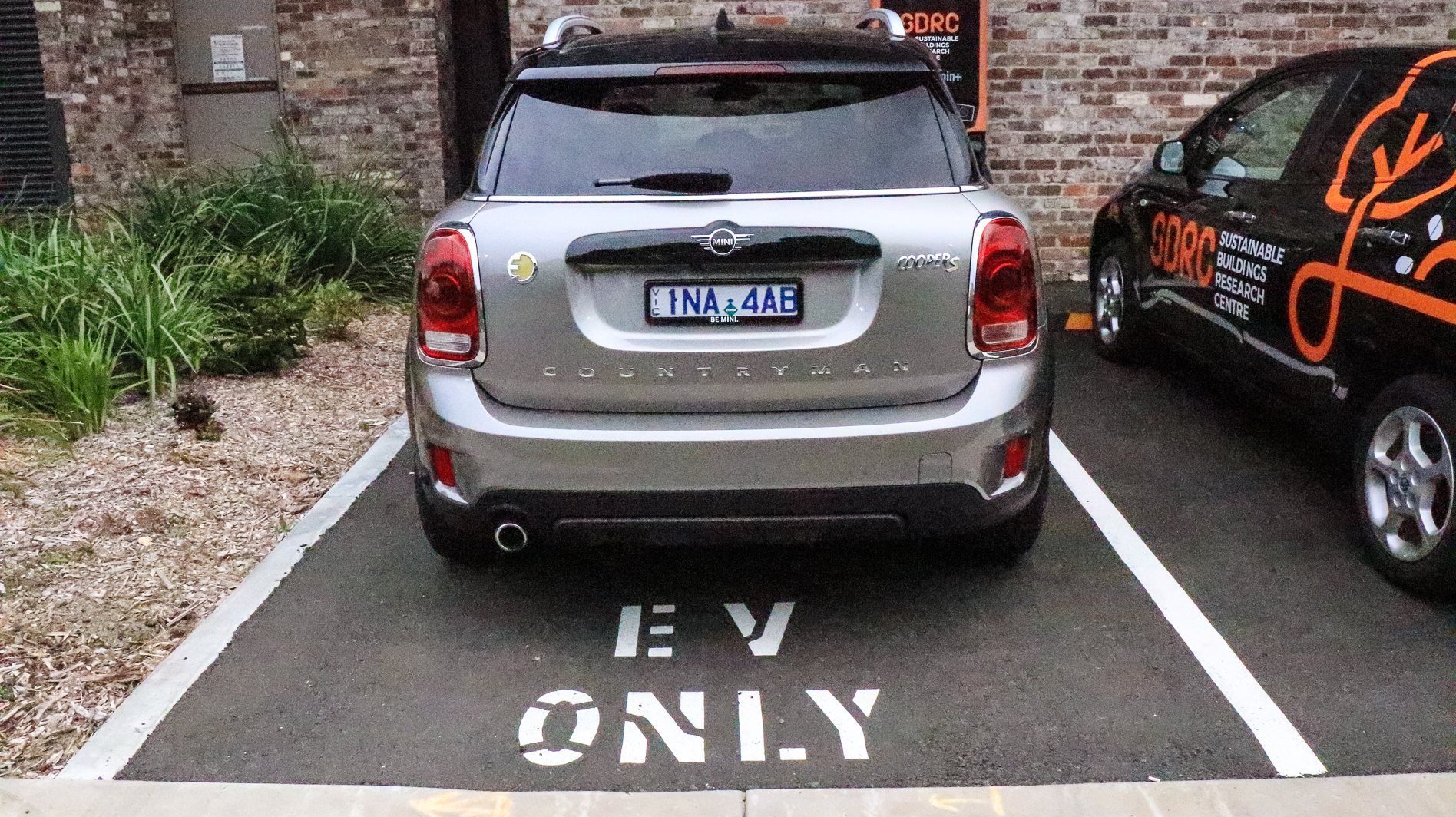
The successor to the current Mini Countryman will be sold as an electric vehicle, though combustion engines will still be offered in the range.
Mini has confirmed the next-generation crossover is set to be powered by the choice of an electric motor or an internal combustion engine, although it’s unclear as to whether the Countryman nameplate will be retained.
Targeting 50 per cent electric sales by 2027 and an all-electric model range by 2030, Mini is committing to ensuring more of its new vehicles are available as EVs.
1
While the focus is on the Countryman’s successor, Mini also said two new electric models are set to be developed from the ground up and produced in China. However, the EV Countryman will be built at the BMW Group plant in Leipzig, Germany, and all other Mini models will be produced at the UK plant in Oxford.
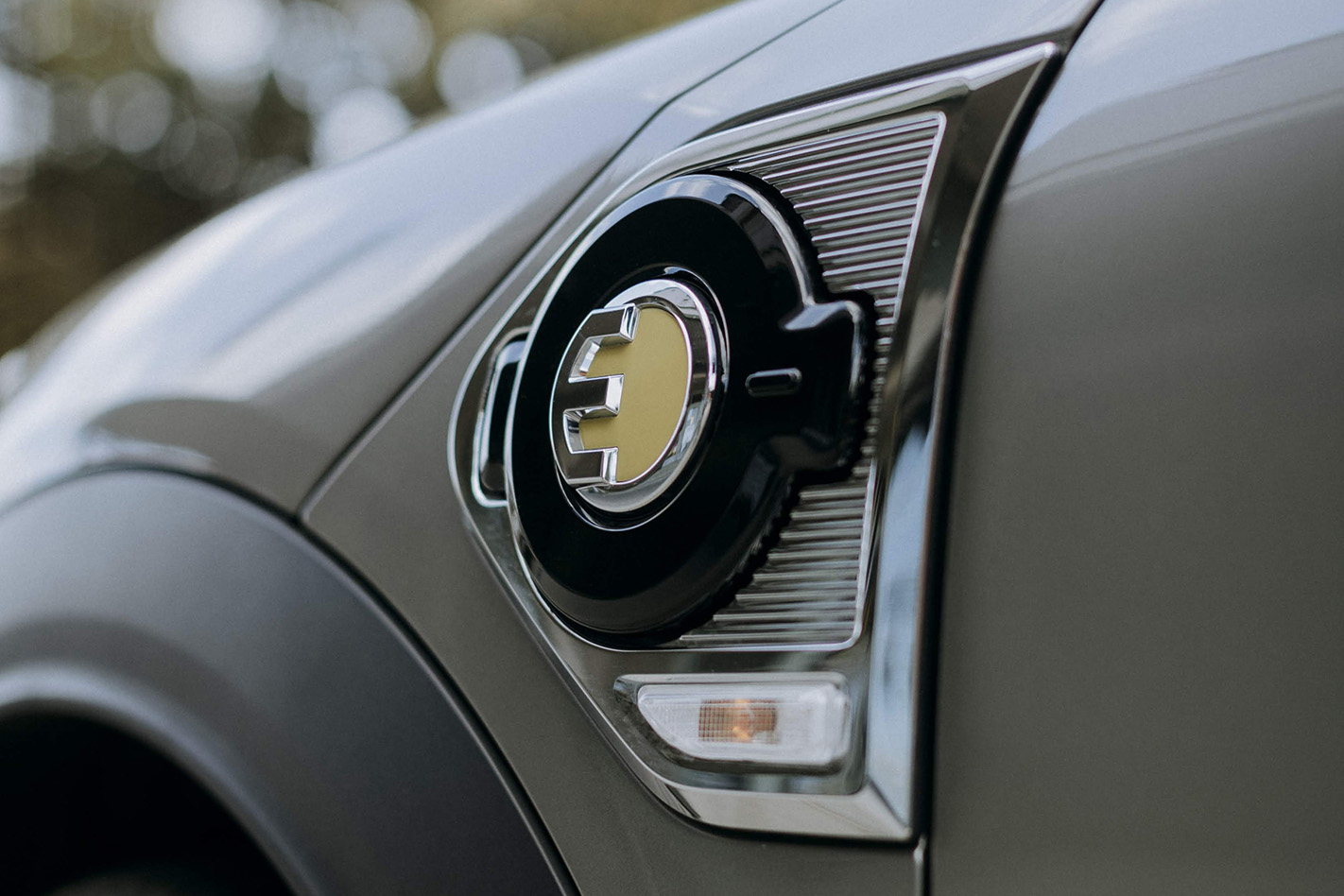
As is evident with the electric Countryman and the recently teased fourth-generation Mini Hatch, the manufacturer is looking transition from ICEs to EVs without totally dropping the former technology just yet, instead retaining its efficient petrol and diesel engines while the changes are being made.
Although it has its sights set on a move to a fully-electric line-up by 2030, the last new Mini to be powered by an ICE will launch in 2025 – with production to run for up to five years before fossil fuels are phased out.
1
It will be a big change for the British marque and its in-house performance arm John Cooper Works, which is aiming to apply its knowledge in creating hot Minis for its future electric models – as has been previewed with the Pacesetter EV, which acts as the safety car for Formula E.
As with many other British and European manufacturers, Mini is committing to carbon neutrality by 2050 across all aspects of its business – a target which it aims to achieve by reducing the CO2 emissions of its new car fleet by 55 per cent from 2019 levels by 2030.
MORE
Everything Mini
The next-generation Alfa Romeo Giulia will go electric-only with the hero Quadrifoglio to offer around 745kW of power, a new report suggests.
Snapshot
- Next-gen Alfa Giulia to go EV-only in unconventional body style
- Will offer around 589 to 745kW of power
- Up to 700km range, rapid charging, available AWD
According to Autocar, the Italian carmaker’s CEO Jean-Philippe Imparato confirmed that the performance EV line-up will start with ‘near’ 257kW and the more powerful Veloce variant offering around 589kW, before stepping up to the hyper Quadrifoglio which will ‘likely’ shift to an all-wheel drive setup.
For context, the current 952-series limited-run and up-tuned Giulia GTA and GTAm models ‘only’ produce 402kW from a Ferrari-developed 2.9-litre twin-turbo six-cylinder petrol engine, and drives the rear wheels only.
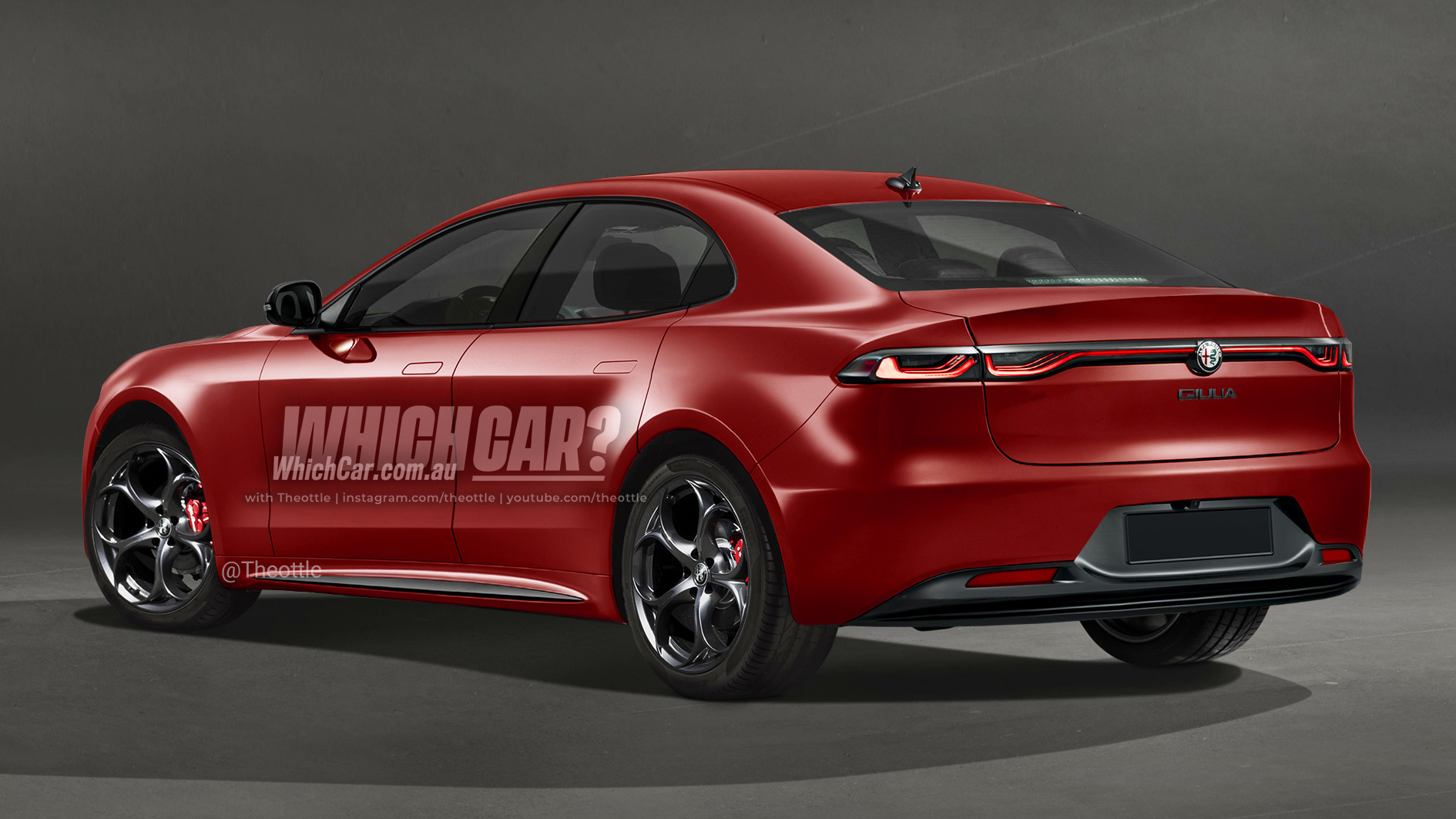
Here’s the kicker: the upcoming Giulia EV reportedly won’t be a conventional sedan, with a wagon-like shape mooted to “cover multiple segments”, looking like the Alfa “we all want”.
1
Above: Our mate Theottle has had a crack at imagining the next-gen Giulia as a sleek and streamlined electric sedan – but as these latest reports suggest, Alfa looks likely to skew further towards a design that might rival the jacked-up Porsche Taycan Cross Turismo.
What’s the tech?
The new Giulia is expected to be based on the Stellantis group’s STLA Medium dedicated EV platform, allowing it to offer up to 700km of driving range on the WLTP testing cycle, and an 800-volt charging architecture to top-up from 10 to 80 per cent within 18 minutes.
1
When will the new Giulia go on sale?
It’s unclear when the all-new Giulia EV will debut, although the company has promised to sell an electric-only model line-up by 2027.
Alfa will kick start its transition with the launch of a small SUV in 2024.
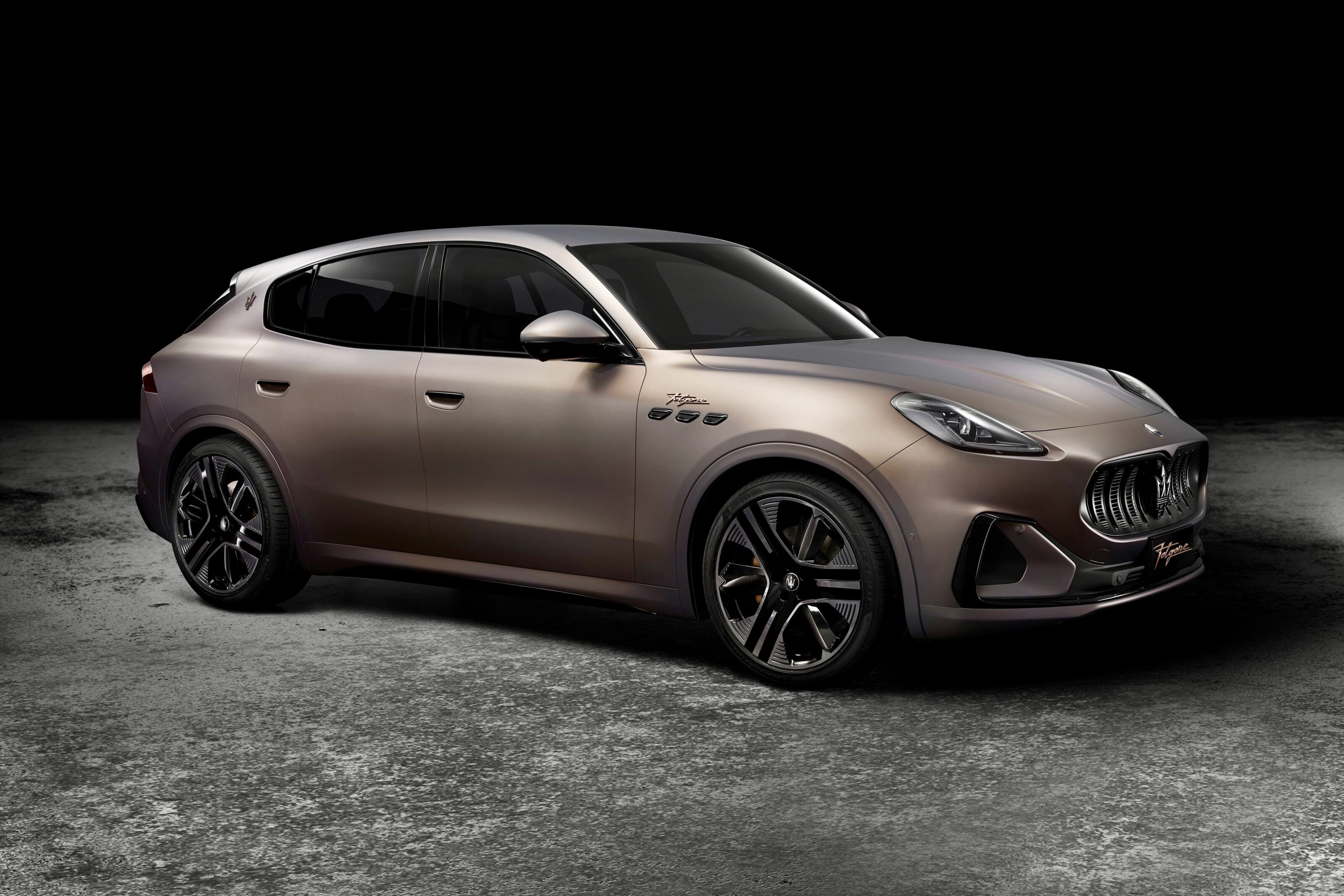
Alfa Romeo is in good company, with the Stellantis portfolio of car brands including EVs such as the forthcoming Maserati Granturismo Folgore coupe, Abarth 500e, and Peugeot 3008 SUV (which’ll also sit on STLA Medium).
Despite ramping up its electrification efforts, Stellantis CEO Carlos Tavares has been vocal in criticising impending Euro 7 emissions mandates as ‘useless’ by distracting car brands to invest in hybrid tech in order to comply when the industry will inevitably shift to full electric propulsion.
Snapshot
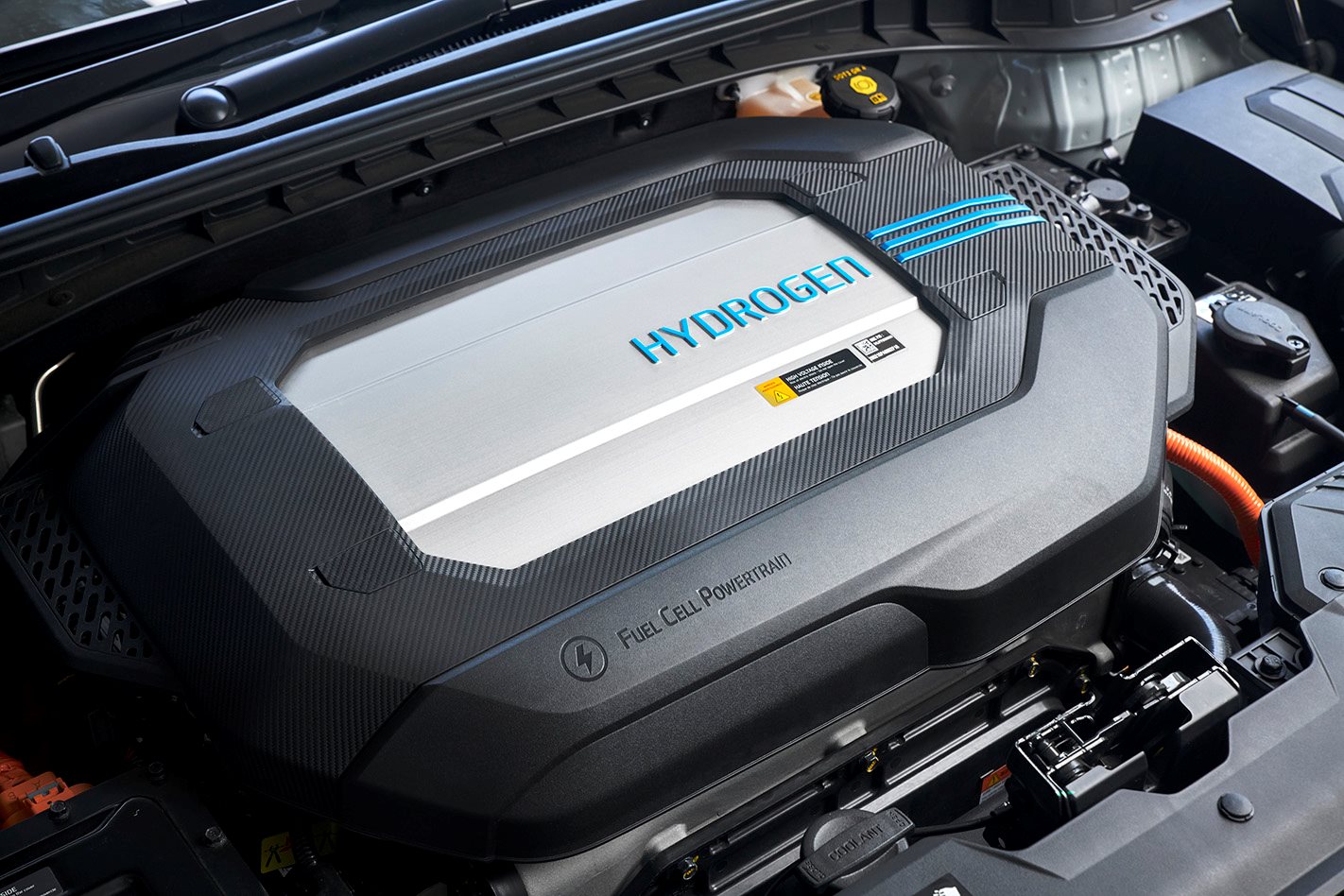
- Germany seeks EU to explicitly support hydrogen and eFuels after 2035 ban
- Approved mandate already allows for any zero-emission vehicle tech
- Vehicle emissions estimated to kill 10 times more than road accidents
Germany has asked the European Union (EU) to relax rules to support the sale of combustion-engined cars that run on carbon-neutral fuels after 2035.
The ban on selling new internal combustion engine vehicles (i.e. petrol, diesel and hybrids) from 2035 was officially approved last month, requiring carmakers to achieve a 100 per cent cut in carbon dioxide (CO2) emissions from already strict Euro 7 mandates in the 27-country continent.
There is no explicit requirement that manufacturers must use battery-electric technology; only any zero-emission vehicle (ZEV).
1
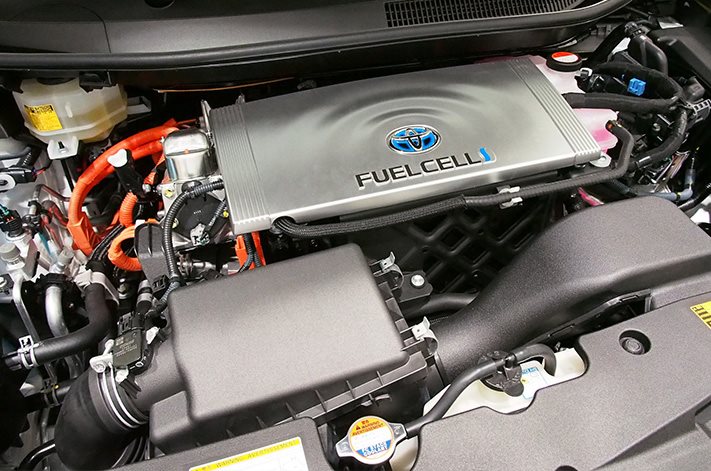
Yet, in a meeting to EU transport and energy ministers, Germany is reportedly seeking the EU to include explicit mandates to support emerging hydrogen fuel-cell and synthetic eFuels – even though it admits battery EVs are the “way to go”, according to Automotive News Europe.
“The commission should come forward with a proposal [on] how eFuels can be used, or how combustion engines which are run with climate-neutral fuels can be organised,” Germany’s state secretary for transport, Michael Theurer, said.
“We need hydrogen technology and also e-fuels, especially in heavy vehicles, in truck transport.”
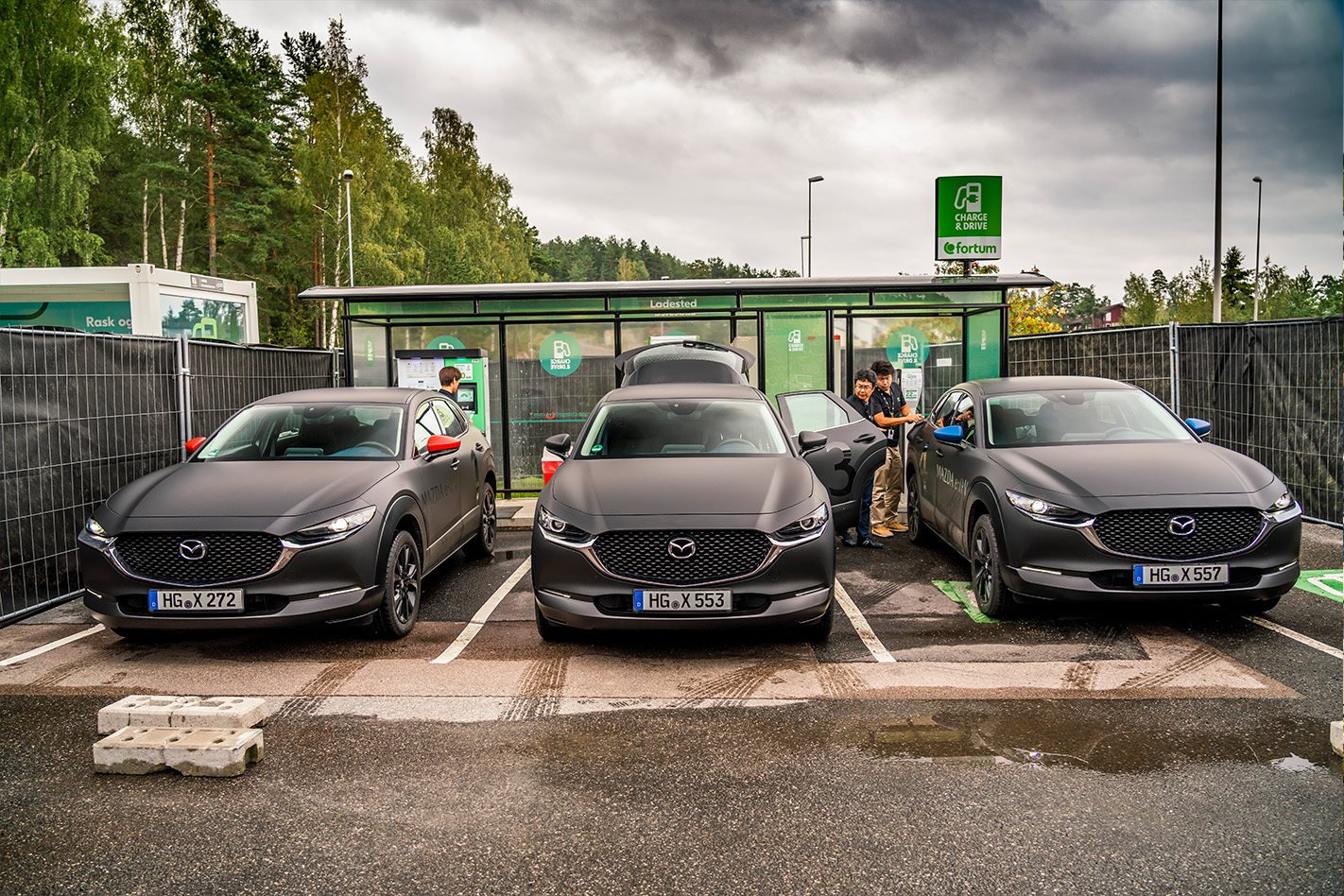
The sentiments echo those of Mazda Europe’s CEO, Martijn ten Brink, who claims the 2035 ban forces carmakers to only invest in battery-electric propulsion.
1
But, Electric Vehicle Council (EVC) CEO Behyad Jafari told Wheels that these criticisms are false and confusing.
“It [the EU] hasn’t mandated any technology to achieve the 100 per cent emissions reduction by 2035.
Advice
Australia’s best electric cars for 2023
We’ve tested nearly every EV below six figures in Australia to rank the best on sale today
“In fact, there’s even a provision where it’ll investigate permitting internal-combustion engine vehicles, as long as those vehicles are using 100 per cent synthetic fuels or renewable fuels by 2035 as well.
“Unfortunately, this is something that policymakers around the world are very used to and have gotten tired of hearing, which is future technology development being used as a delaying mechanism [for emissions reduction targets].
1
“What isn’t a reasonable outcome is to ask policymakers around the world to stop what they’re doing, slow down and to provide less benefits to their citizens because it’s not in your best interests.”
According to modelling from Melbourne Climate Futures, vehicle exhaust emissions may cause 11,105 premature deaths in Australia – which is 10 times more than road accidents – in addition to contributing to 12,210 cardiovascular hospitalisations, 66,000 active asthma cases, and 6840 respiratory hospital admissions per year.
Hydrogen fuel-cell and eFuel technology can be carbon-neutral as long as the production process is from complete renewable energy sources and carbon capture techniques, though eFuel-powered vehicles still emit exhaust pollutants.
MORE
Electric Cars
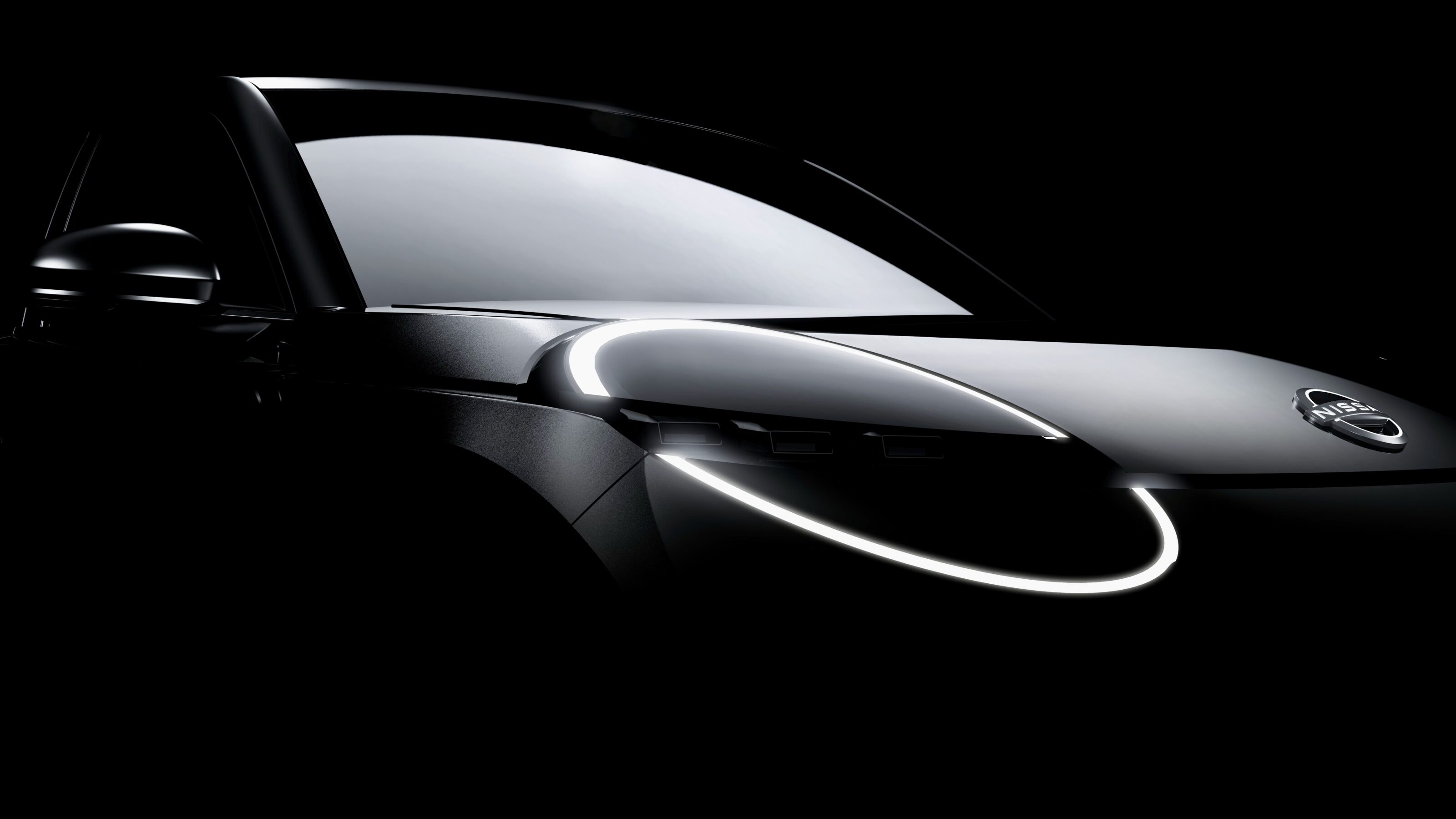
Nissan has announced more than half of its sales will be electrified by 2030.
Following its ‘Nissan Ambition 2030’ plan announced in 2021, the Japanese brand has revised its targets in response to “changes in customer needs and the business environment.”
It plans to retail 27 electrified vehicles by the end of the decade – split between 19 all-electric models and eight hybrids – up from the previous goal of 23 electrified vehicles, including 15 battery-powered EVs.
1
Nissan said it aims for electrified vehicles to comprise 55 per cent of its sales by 2030 – up from 50 per cent – with 44 per cent to be all-electric by 2026.
This includes both Nissan and Infiniti vehicles globally.
The boost in its forecasts is largely focused on Europe, with 98 per cent of its sales to be electrified vehicles in 2026 – up from a previous 75 per cent target.
It follows the European Union’s recent agreement to ban the sale of internal-combustion vehicles by 2035, while stricter Euro 7 emissions standards will be enforced from July 1, 2025.
1
Nissan has reduced expected hybrid- and electric-only sales in China to 35 per cent – from 40 per cent – in 2026, while Japan is up three per cent.
Despite this, Nissan plans to introduce a market-specific electric vehicle for China next year, likely an electric SUV built in collaboration with its joint-venture partner, Dongfeng.
In Europe, Nissan will “explore stronger collaboration with the [Renault-Nissan-Mitsubishi] Alliance” in the coming years for its electrified range.
1
The remainder of Nissan’s vision remains unchanged, including the introduction of solid-state batteries by 2028.
In 2021, Nissan previewed four concept vehicles – the Chill-Out crossover, Max-Out convertible, Hang-Out SUV and Surf-Out ute – to demonstrate its design vision, “dynamic driving experience”, and solid-state batteries.
The successor to the Nissan Micra light car will be an all-electric model based on the same platform as the Renault 5 hatch, with a 400-kilometre driving range. It is expected to launch in Europe next year.
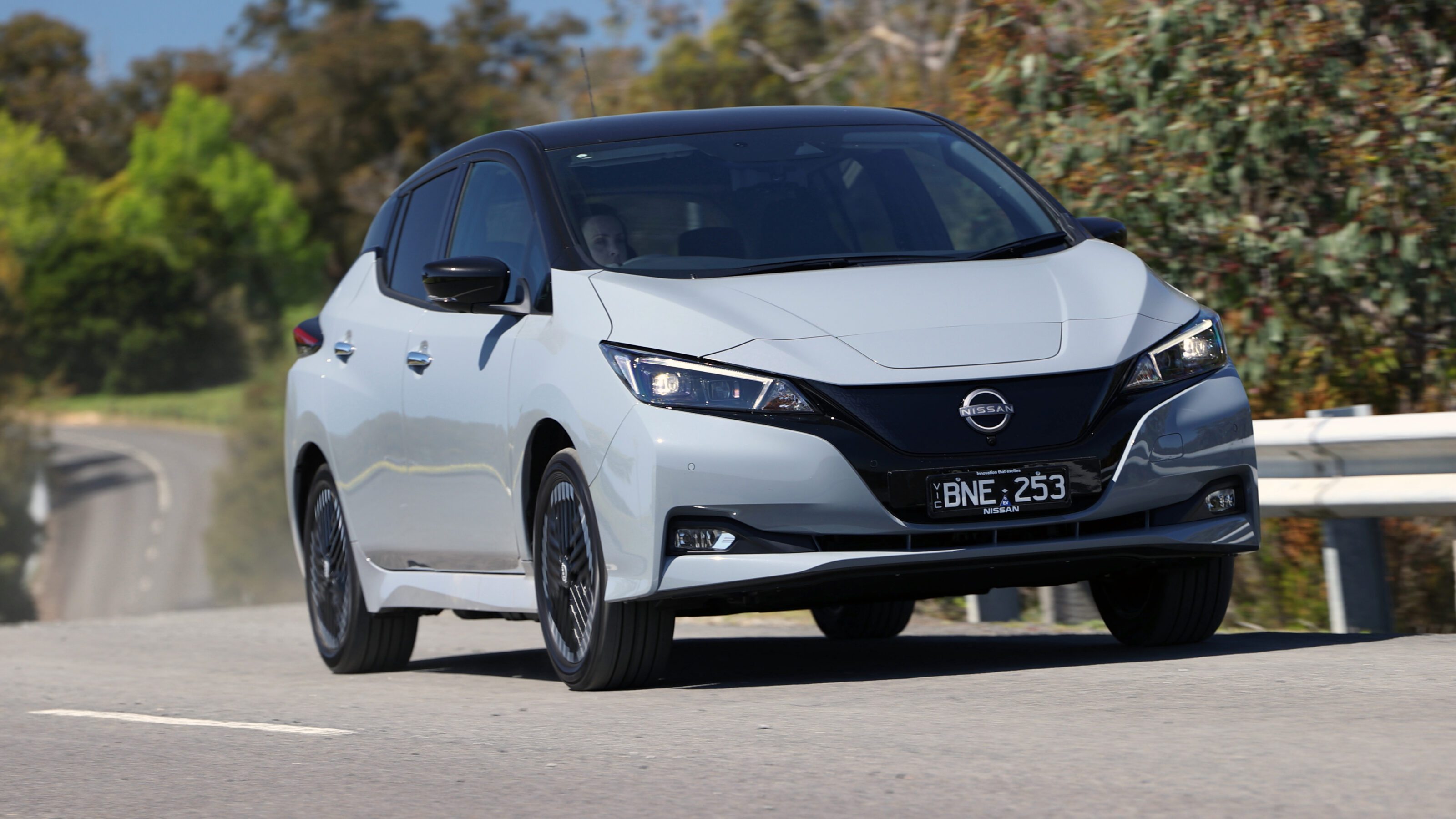
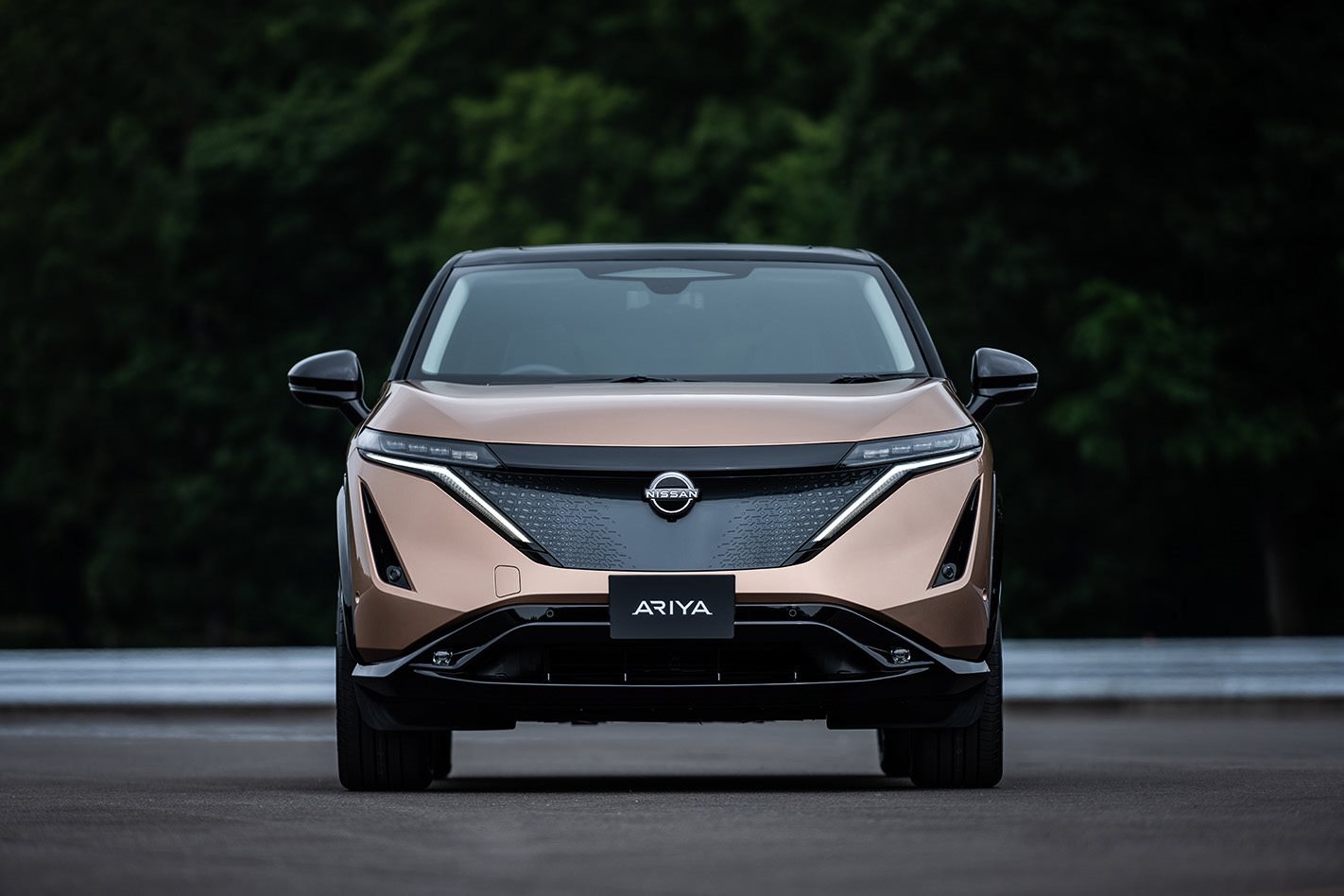
Currently, Nissan offers two electric vehicles for the global market: the long-running Leaf hatchback and the newer Ariya crossover. It recently introduced E-Power hybrid versions of the latest-generation X-Trail and Qashqai SUVs.
MORE
Everything Nissan
MORE
Electric Cars
Snapshot
- e-2008 confirmed for third quarter local launch
- 333km WLTP driving range from 45kWh battery
- Pricing and features yet to be confirmed
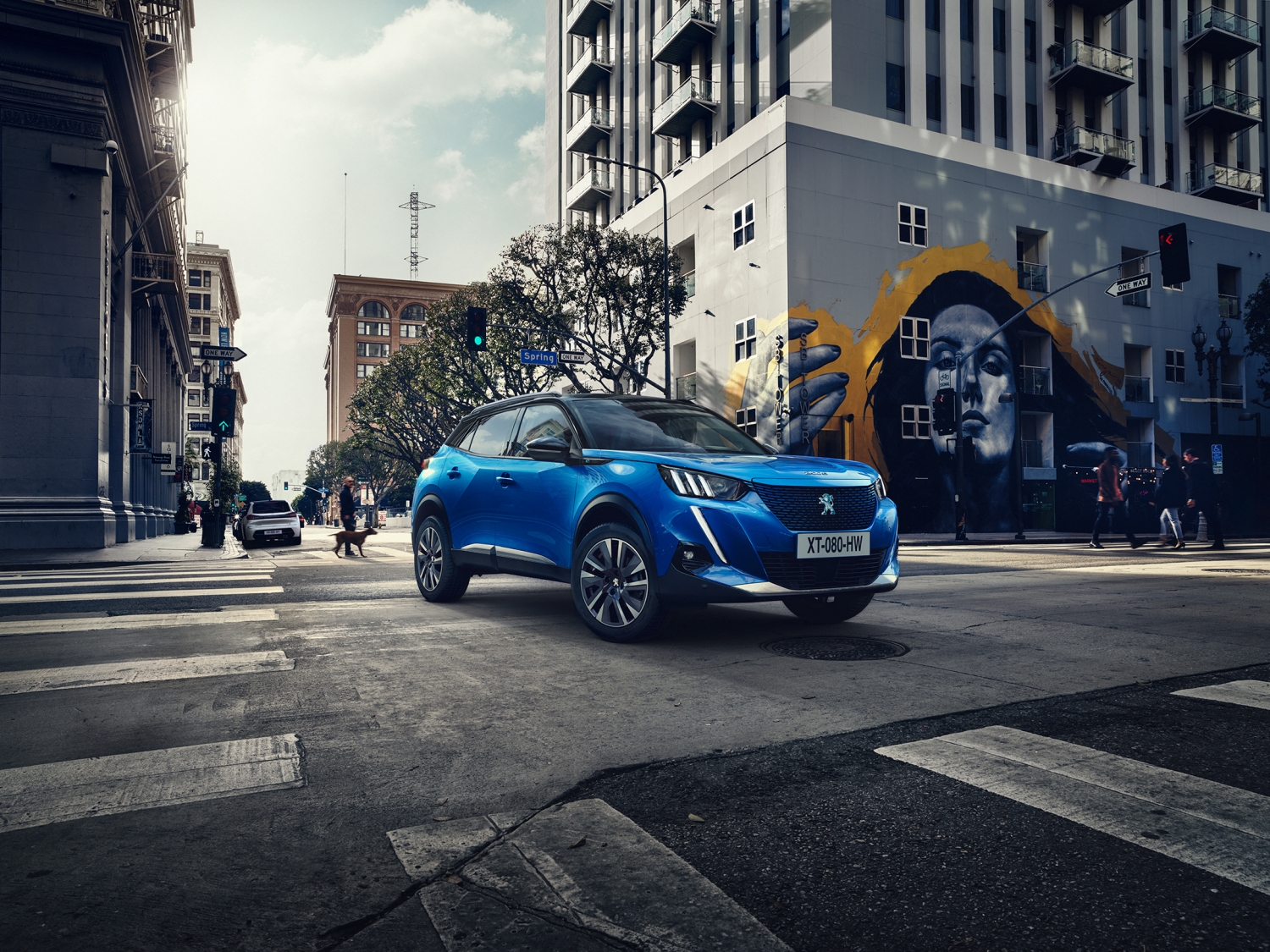
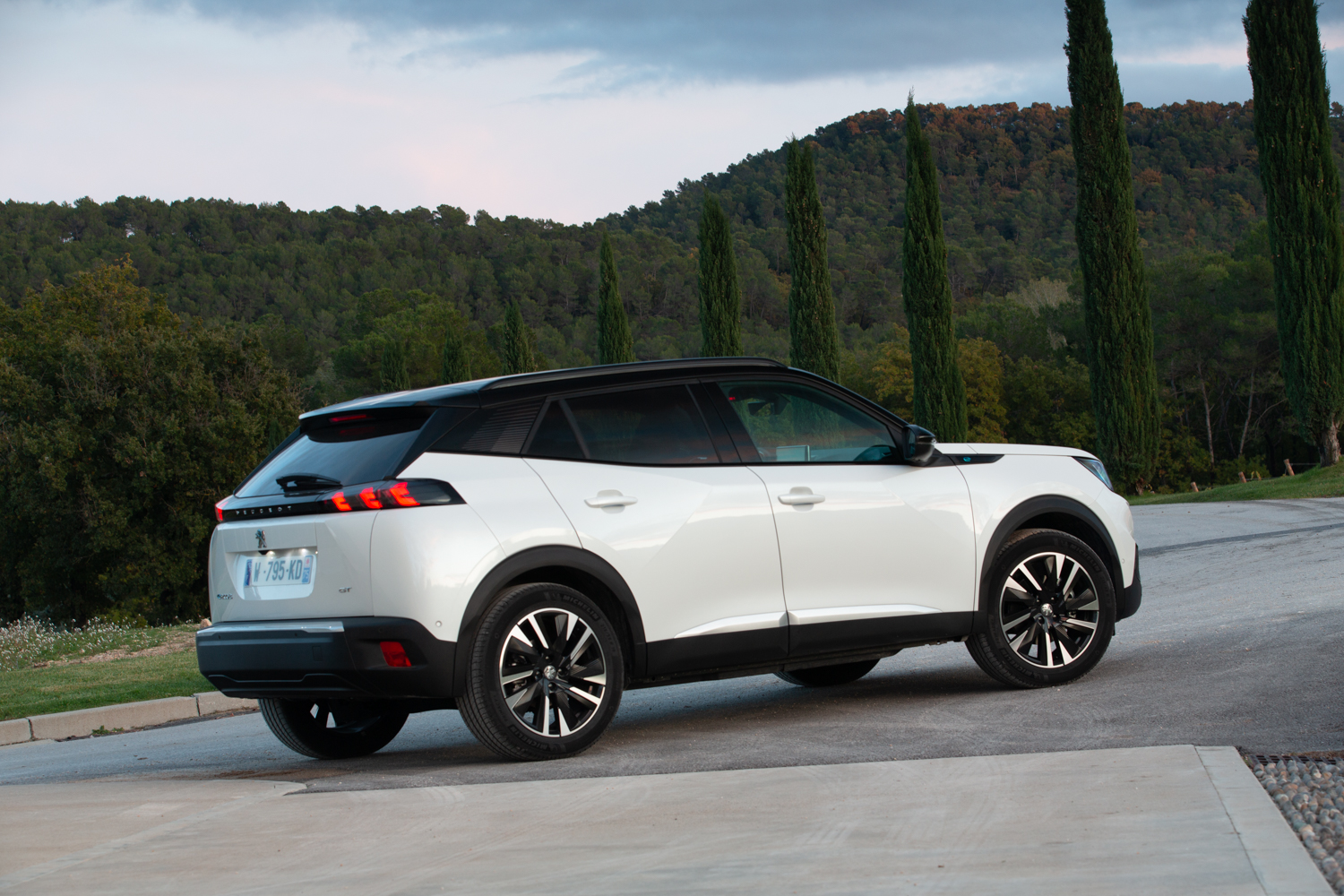
The 2023 Peugeot e-2008 will come to Australia in the third quarter of this year via the French brand’s local importer Inchcape.
Fitted with a 45kWh lithium-ion battery pack and a single 100kW/260Nm electric motor powering the front axle, the e-2008’s driving range is rated at 333 kilometres in the WLTP combined cycle.
The e-2008 sits on the same CMP platform as the internal combustion-powered 2008 small SUV currently sold in Australia, and will be positioned above the current Allure, GT, and GT Sport grades that span $38,945-51,188 before on-road costs.
1
We’ve previously covered a grey import scheme for the model, which promised lightly used e-2008s landed for around $50K, but with brand new vehicles and dealer support, expect the e-2008 to be priced north of that by the time it hits Australian shores.
Orders are not yet open but, if you’re interested, you can register interest on Peugeot’s website.
Peuegot electrified range will expand locally when the e-2008 joins its e-Partner van, as well as plug-in hybrid versions of 508 medium car, 3008 medium SUV, and soon to arrive 308 small car.
MORE
Peugeot e-2008 electric SUV coming to Australia through private importer, priced around $50,000
1
“This year, we have set out to accelerate our local electrification journey and the exciting addition of the e-2008 will play an important role in building our electrified offering and ultimately offering more choice for Australian consumers”, said Kate Gillis, managing director of Peugeot Australia.
With its sub-400km driving range, the Peugeot e-2008 will rival the BYD Atto 3 standard range, GWM Ora standard range, and MG ZS EV when it lands.
The e-2008 measures 4300 millimetres long, 1770mm wide, 1550mm tall, and rides on a 2605mm wheelbase. Its boot capacity is quoted at a generous 434L.
1
Although it’s 10 centimetres shorter than the Peugeot, the Renault Megane E-Tech that’s set to launch in the fourth quarter features a larger 60kWh battery pack, and correspondingly longer 450km driving range.
Public fast-charging reaches 100kW DC for a 10-80 per cent top-up in 26 minutes, while AC charging is capped at 7.4kW for a seven-hour and 15-minute 0-100 per cent charge.
Australian specifications are yet to be locked in, but expect a single high-end trim to land here. It will likely feature; seat heating, Peugeot’s i-cockpit with digital driver’s display, leather upholstery, and a full complement of driver assistance systems.
MORE
Everything Peugeot
I feel sorry for the kids. Not mine – I only have one and he’s doing just fine living rent-free in my house.
I mean the kids, a whole generation who’ve never had the pleasure of their parents coming home with a Tarago, complete with a moon roof and velour upholstery. Sold to them by a guy wearing shorts with a coin pocket, long socks, a combover and Hush Puppies.
Now they roll into the driveway with a brand-new SUV. The third row is a pain to get to and it’s not much fun when you’re there. They’re tall and imposing and some people really don’t like them.
They yearn for the old days, forgetting that you sat on the engine, that purple velour is gross and actually, this people mover was really a delivery van in drag.
In reality, they never really went away, and Kia had always sold useful numbers of the old Carnival. But times change and a big box was never going to appeal in the modern market.
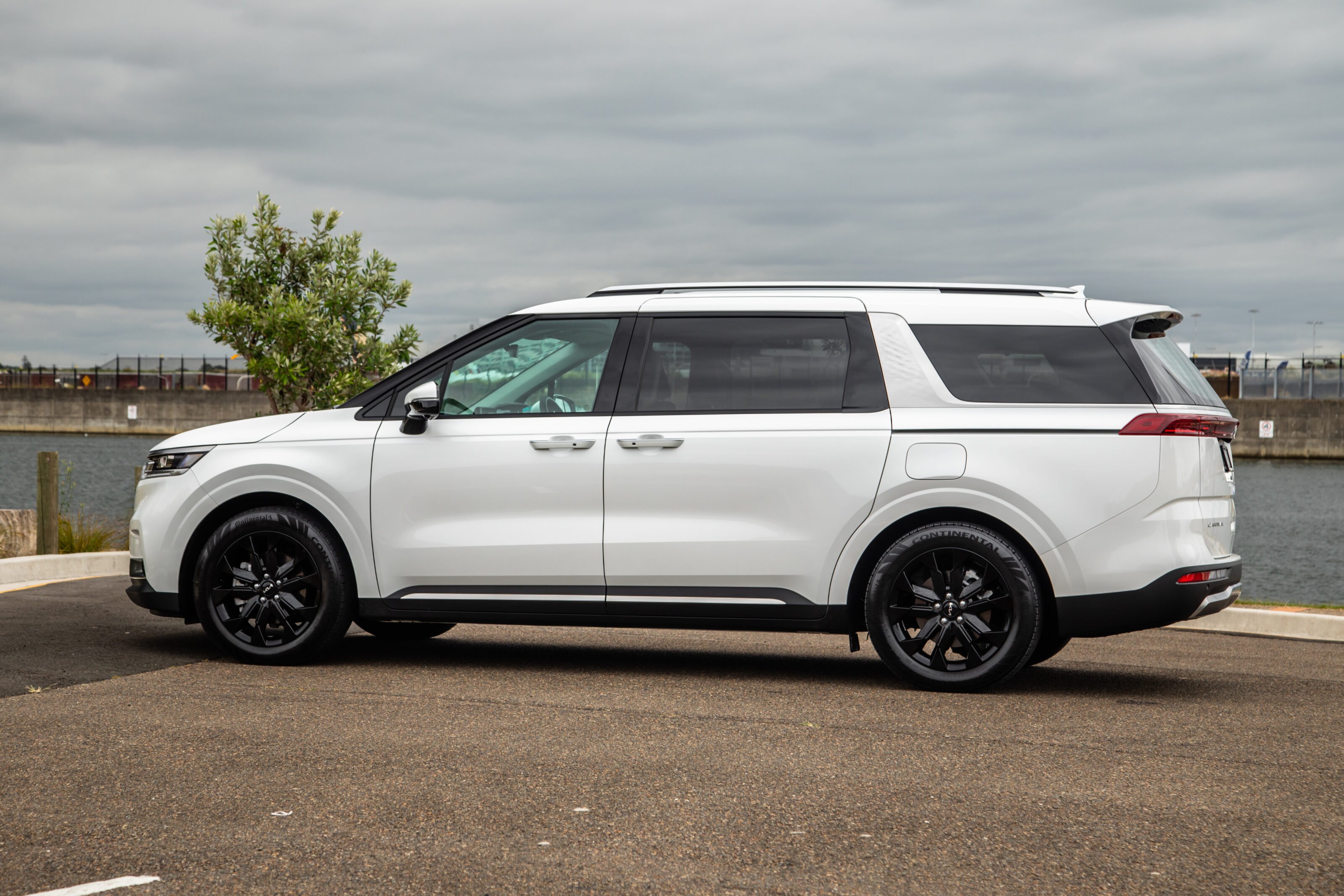
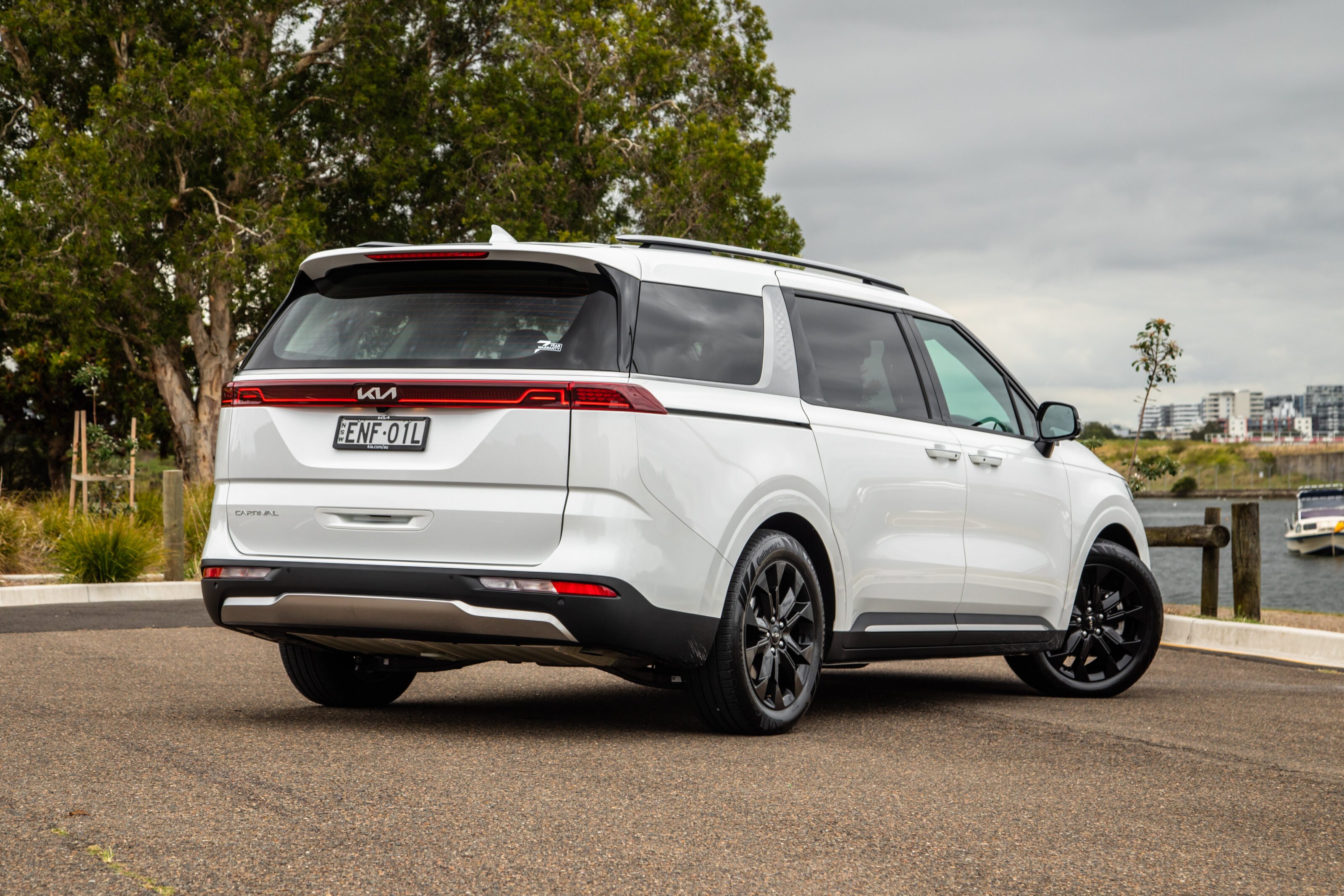
Luckily, Kia’s design-led strategy extended to the people-mover once they got the SUVs sorted. And while it might ride on a new SUV platform, sharing much with its Sorento sibling, the Carnival is a refreshing evolution of the formula.
1
JUMP AHEAD
- How much is it, and what do you get?
- How do rivals compare on value?
- Interior comfort, space and storage
- What is it like to drive?
- How is it on fuel?
- How safe is it?
- Warranty and running costs
- VERDICT
- Specifications
1
How much is it, and what do you get?
| 2022 Kia Carnival standard features | |
|---|---|
| 19-inch alloy wheels | Multi-zone climate control |
| 12-speaker stereo | Wired Apple CarPlay |
| Wired Android Auto | Reversing camera |
| Auto LED headlights | Digital DAB+ radio |
| Keyless entry and start | Electrically operated rear doors |
| Heated steering wheel | Fake leather interior |
| Powered front seats with memory | Heated front seats |
| Sat nav | Powered tailgate |
| Heated and folding rear view mirrors | Dual sunroof |
| Space-saver spare | |
At the top of the Carnival range is the Platinum diesel, wearing a hefty $71,980 driveaway sticker.
That’s more than most seven-seat SUVs from Japan or Korea, but less than the most expensive. It’s also a fair bit more than an entry-level Carnival S petrol.
The electrically-operated rear doors have a little party trick where they can be remotely triggered from the key fob, which I found quite amusing and also impressed my nephew.
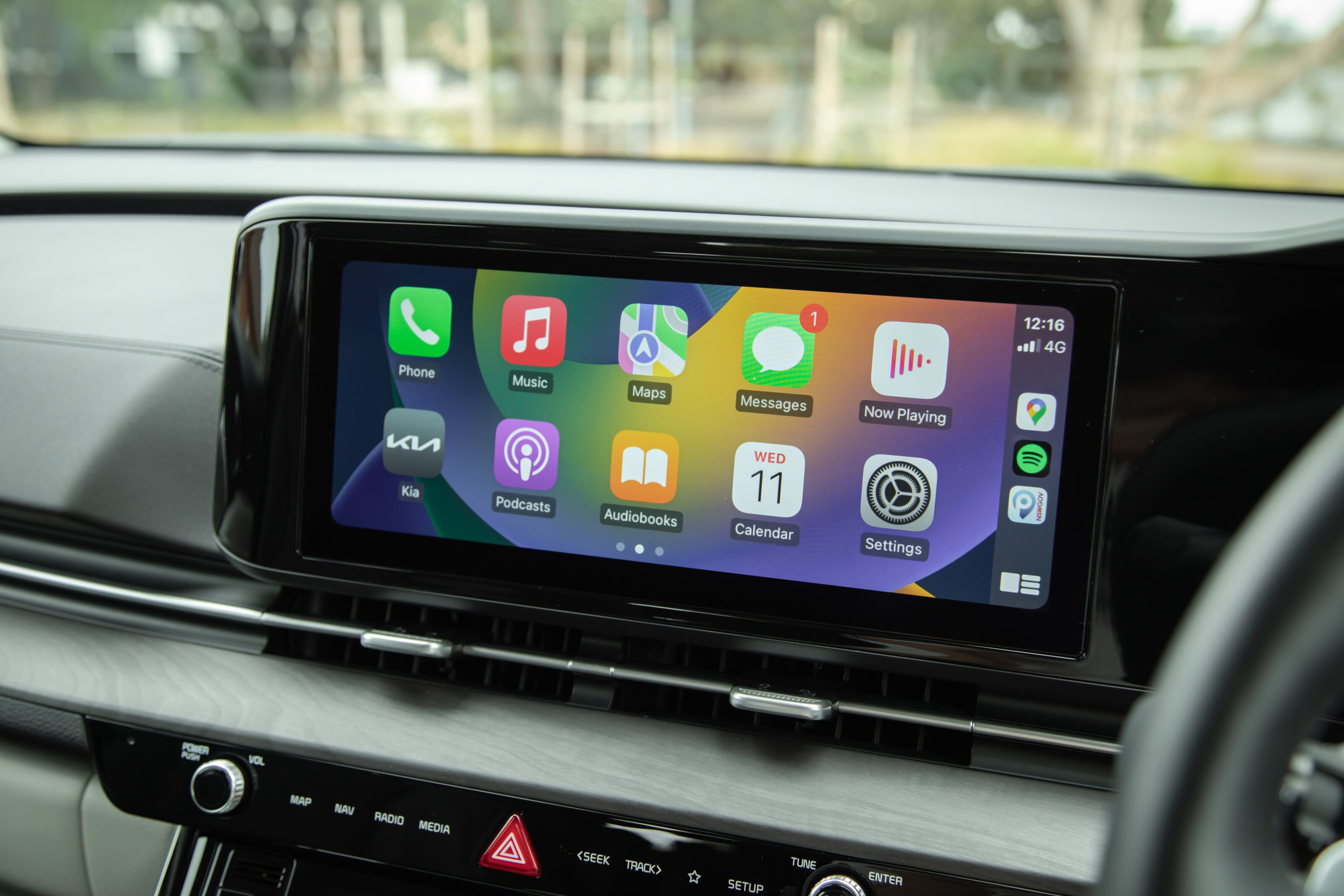
Up here on the top-shelf Carnival you get the big touchscreen that deletes wireless Apple CarPlay and Android Auto (some sort of ridiculous ego politics issue between Hyundai Motor Group and the Big Tech team). It’s a great system, though, and does without the Seltos’s infuriating speed warnings.
1
How do rivals compare on value?
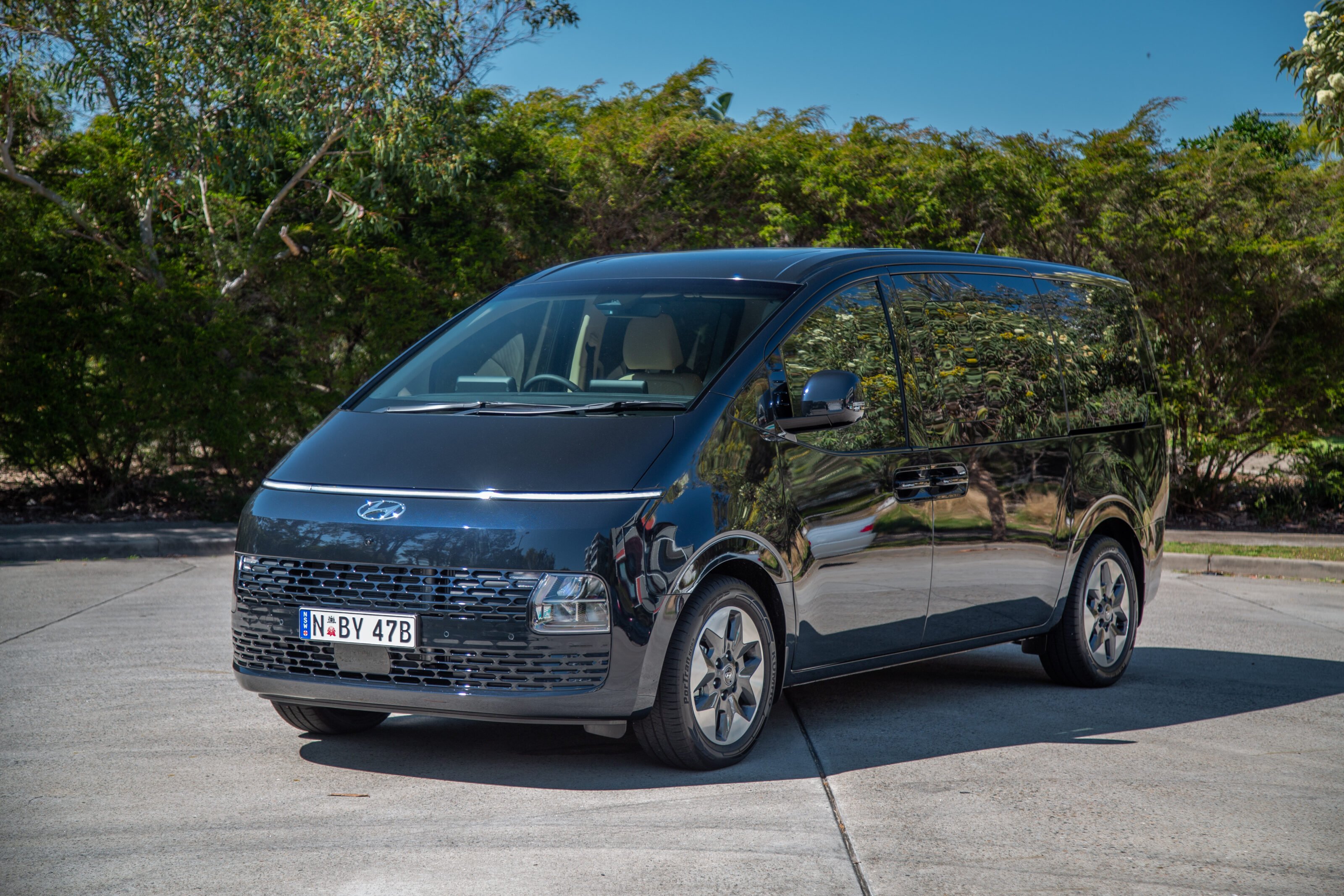
Hyundai’s Staria is the obvious choice, with its Jetsons looks. Like the Carnival it looks fantastic, but in a more obviously spaceship way.
It has a shorter warranty than the Kia, and the same 2.2-litre diesel but with less power and torque. It’s more van-like in the way it sits on the road, too, as opposed to the Carnival’s almost wagon-like vibe. It’s cheaper, though, with the Highlander AWD diesel topping the range at $66,500 (compared to this $71,980 Carnival).
Entering from left field just a couple of months ago is the LDV Mifa. Cartoon character name (and appearance) aside, it’s a serious entrant from the Chinese manufacturer. Powered by a petrol 2.0-litre turbo engine, the range starts at $53,990 and tops out at $72,990, both drive-away. The Mifa really goes for the luxury angle, with airline-style captain’s chairs and leather and bling everywhere. If you want to go electric, you can go for the Mifa 9 EV version for a six-figure price tag.
Honda’s once segment-champ Odyssey has, sadly, dropped from the local range. A moment of silence, please.
1
Interior comfort, space and storage
As you might imagine, it’s massive in the Carnival, just like the old one.
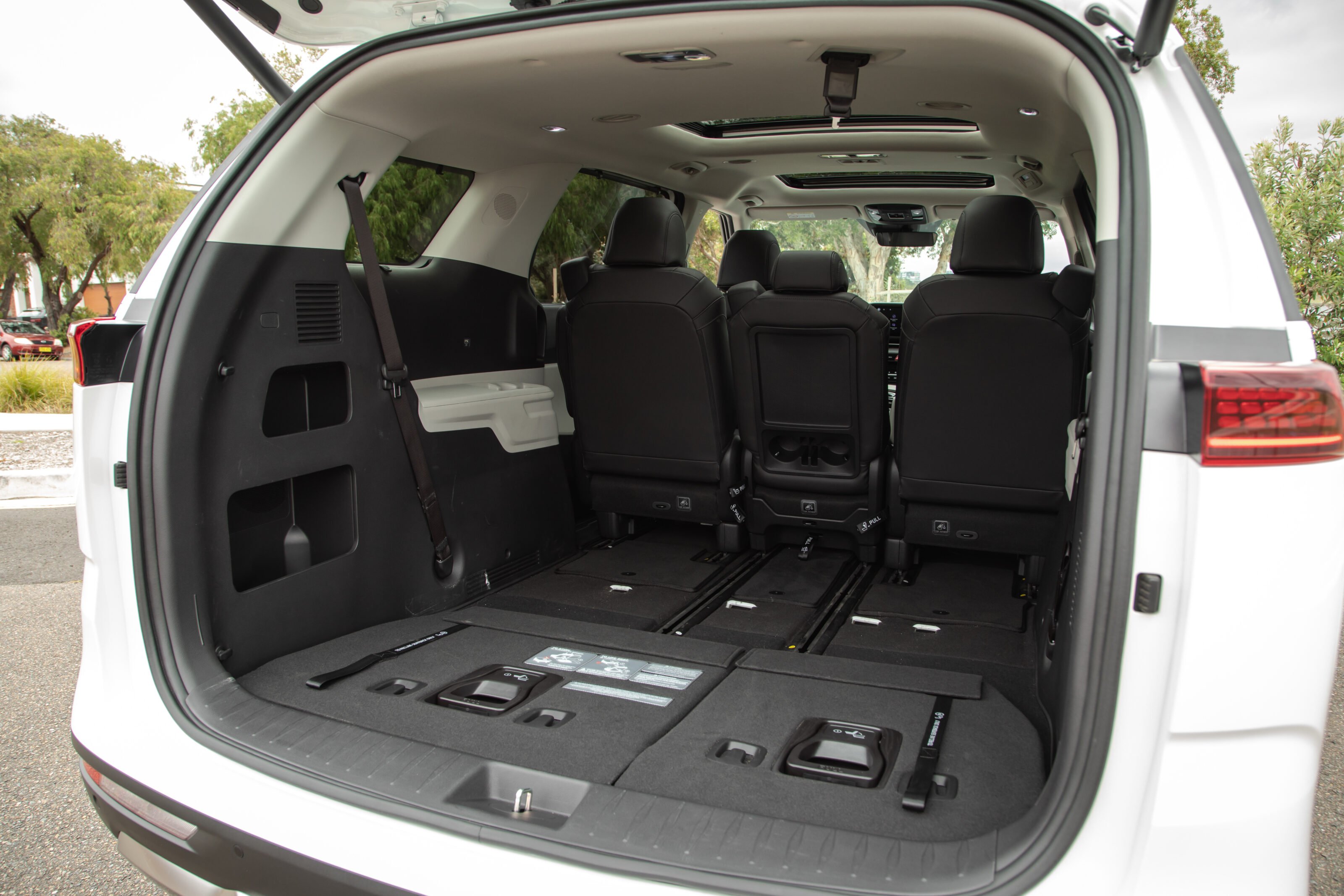
This Platinum had the eight-seat interior, meaning two rear rows of three seats each. Unlike an SUV, you get a flat floor which immediately improves your chances of enjoying the journey in the third row.
Climbing in through the huge door apertures isn’t too difficult and the middle row slides forward for a generous pathway. Once you’re in, you’ve got four cup holders and a storage tray so you can take your supplies with you. There’s even two USB ports for charging.
With some negotiation, a 180cm person can sit in the third row in reasonable comfort. The seats are well-shaped and not just a basic plank, which is nice.
1
The middle row features three separate seats. That’s quite convenient because you can load people into the back row from either side and only one person has to jump out.
The middle row slides for and aft for more space at the rear, which is good either for big loads or a full complement of passengers. The middle seat folds down to reveal cupholders and you can store bottles in the door pockets.
Middle row passengers have a huge amount of headroom, sunroof or not. With the sunroof it feels even bigger inside, with tons of light from both above and beside through the big windows. You can keep cool under the glass sunroof, too, with your own climate zone.
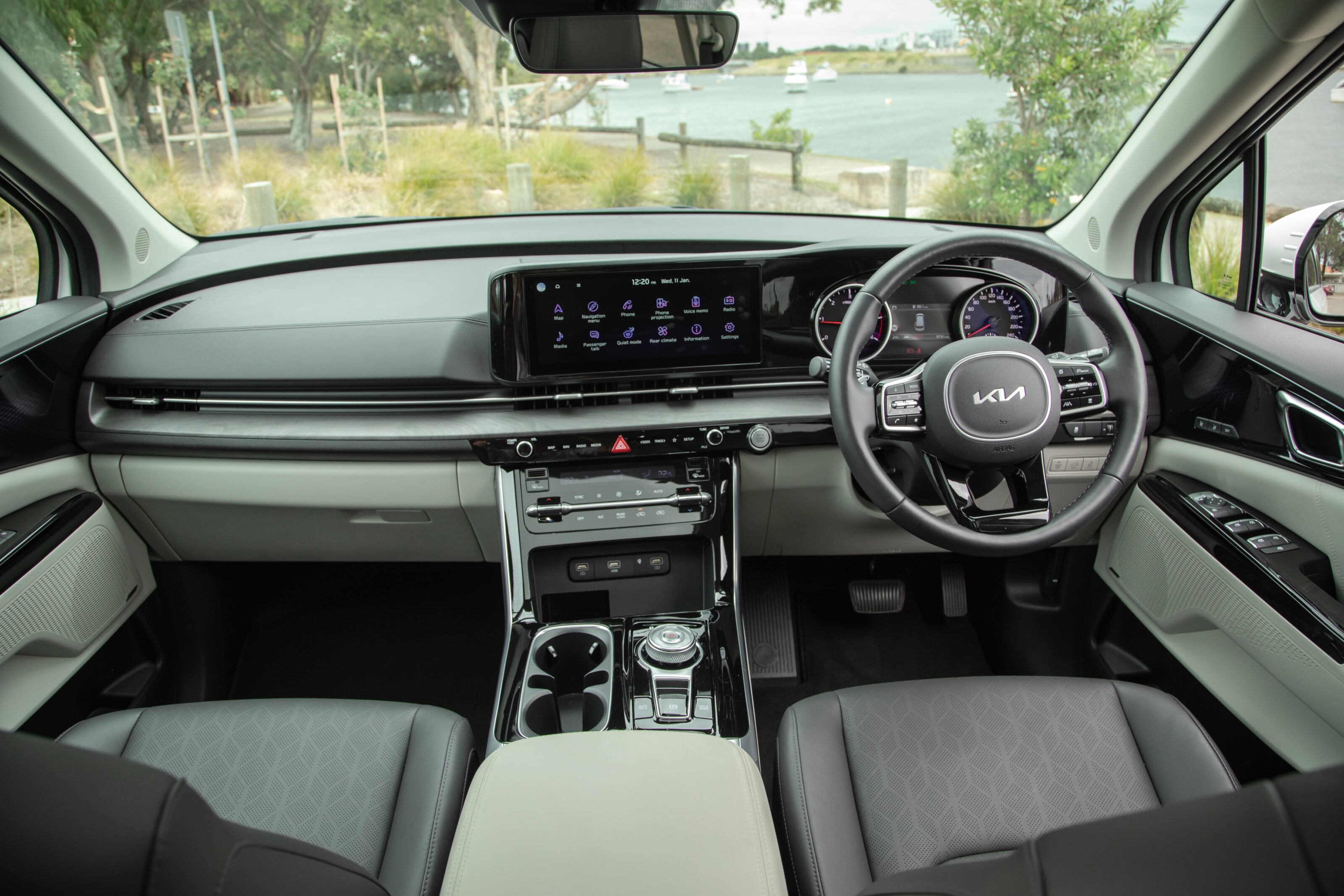
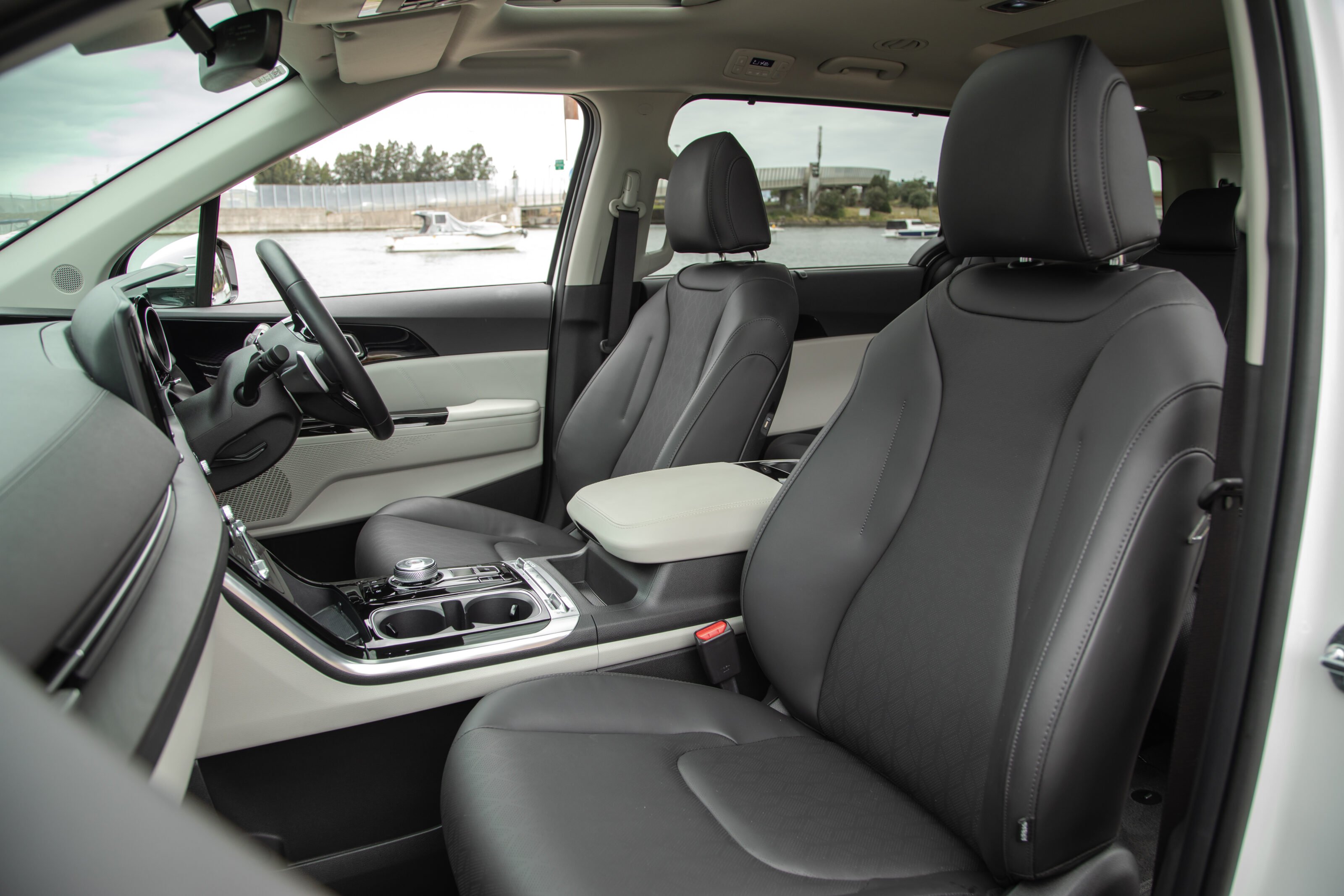
Up front you’ve got two very comfortable bucket seats and a more car-like position than most people-movers of days gone by, the old Carnival included. You don’t sit too high, but rather you sit ‘in’ the car and it’s all very civilised.
1
Kia’s familiar digital dashboard and large touchscreen are along for the ride and there’s another pair of cup holders and a wireless charging pad. Two USB ports offer power and connectivity.
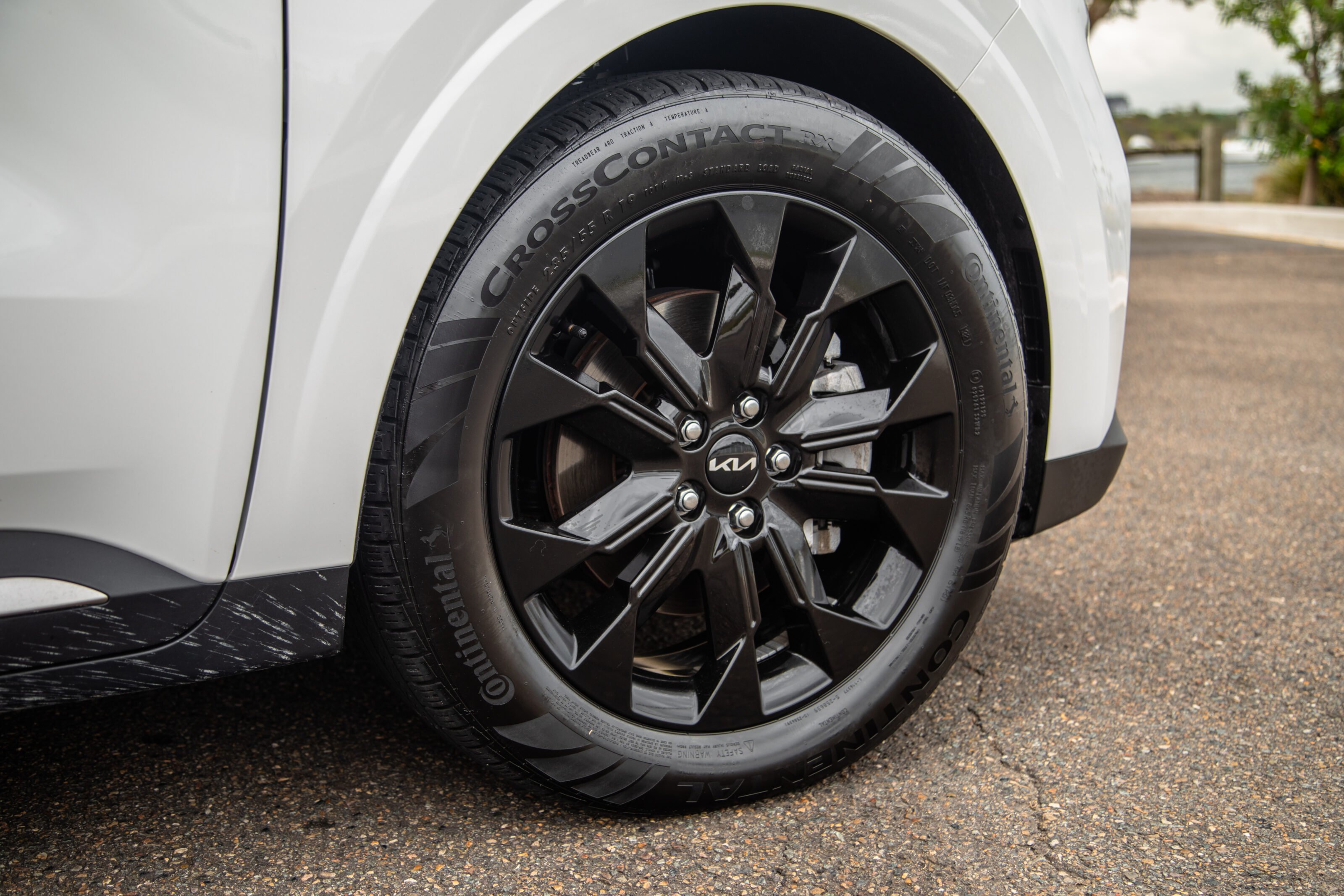
The 3090mm long wheelbase means there’s heaps of room and the longish overhang provides for a decent boot even with all seats in play. The boot is deep, though, so you’ll have to bend down to clear it out.
I thought it interesting Kia hasn’t provided a false floor for more storage, but it’s the kind of thing most buyers probably remove and never see again, so it’s probably for the best.
What is it like to drive?
| 2022 Kia Carnival drivetrain | |
|---|---|
| Engine: | 2.2-litre turbo four-cylinder diesel |
| Transmission: | Eight-speed automatic |
| Power: | 148kW @ 3800rpm |
| Torque: | 440Nm @ 1750-2750rpm |
| Drive | FWD |
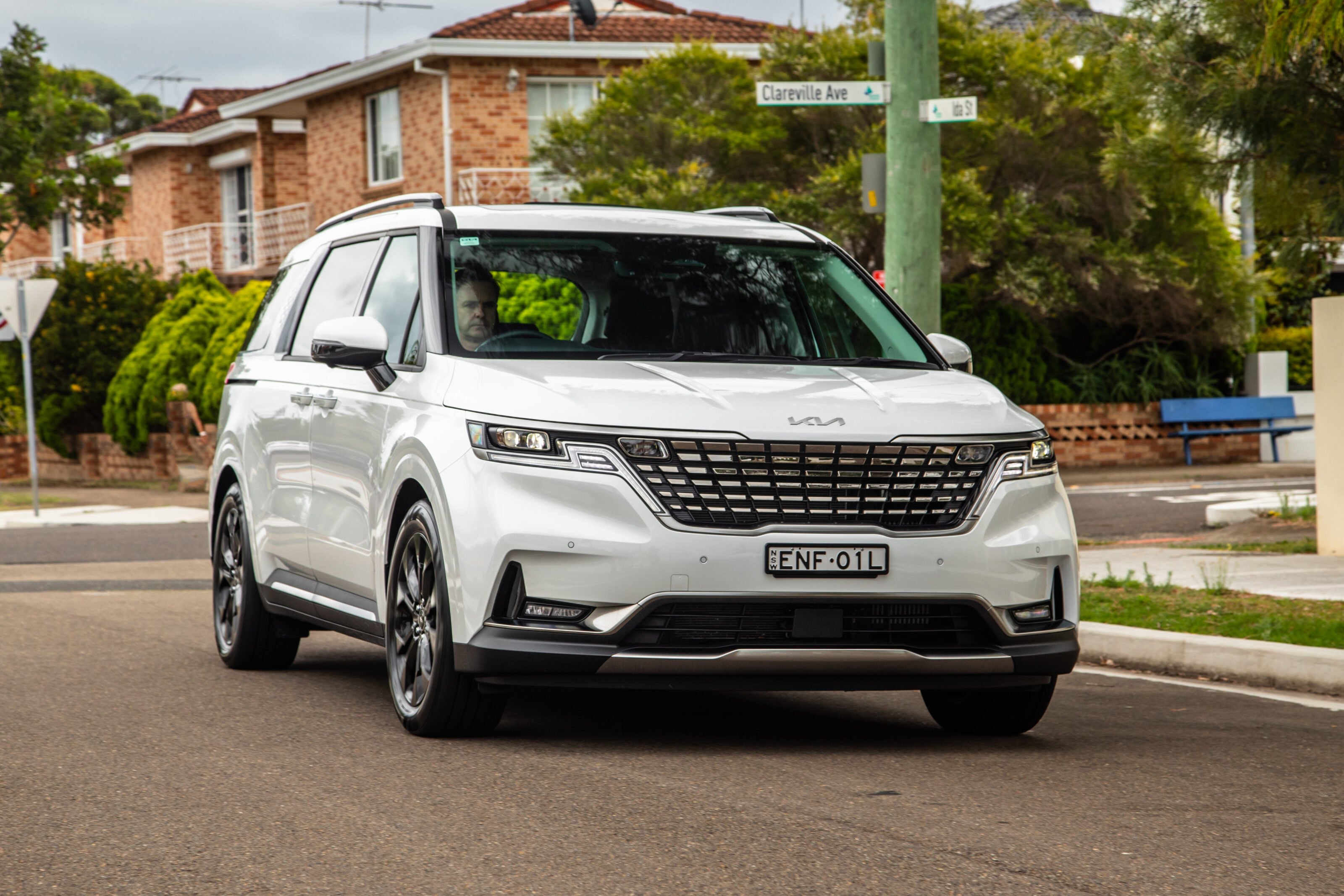
I’ve said that it’s more car-like than previous people movers, but it’s worth repeating. Not only does the driving position feel like a car, the Carnival drives more like one.
Well, a big one. That fits eight people and their stuff.
1
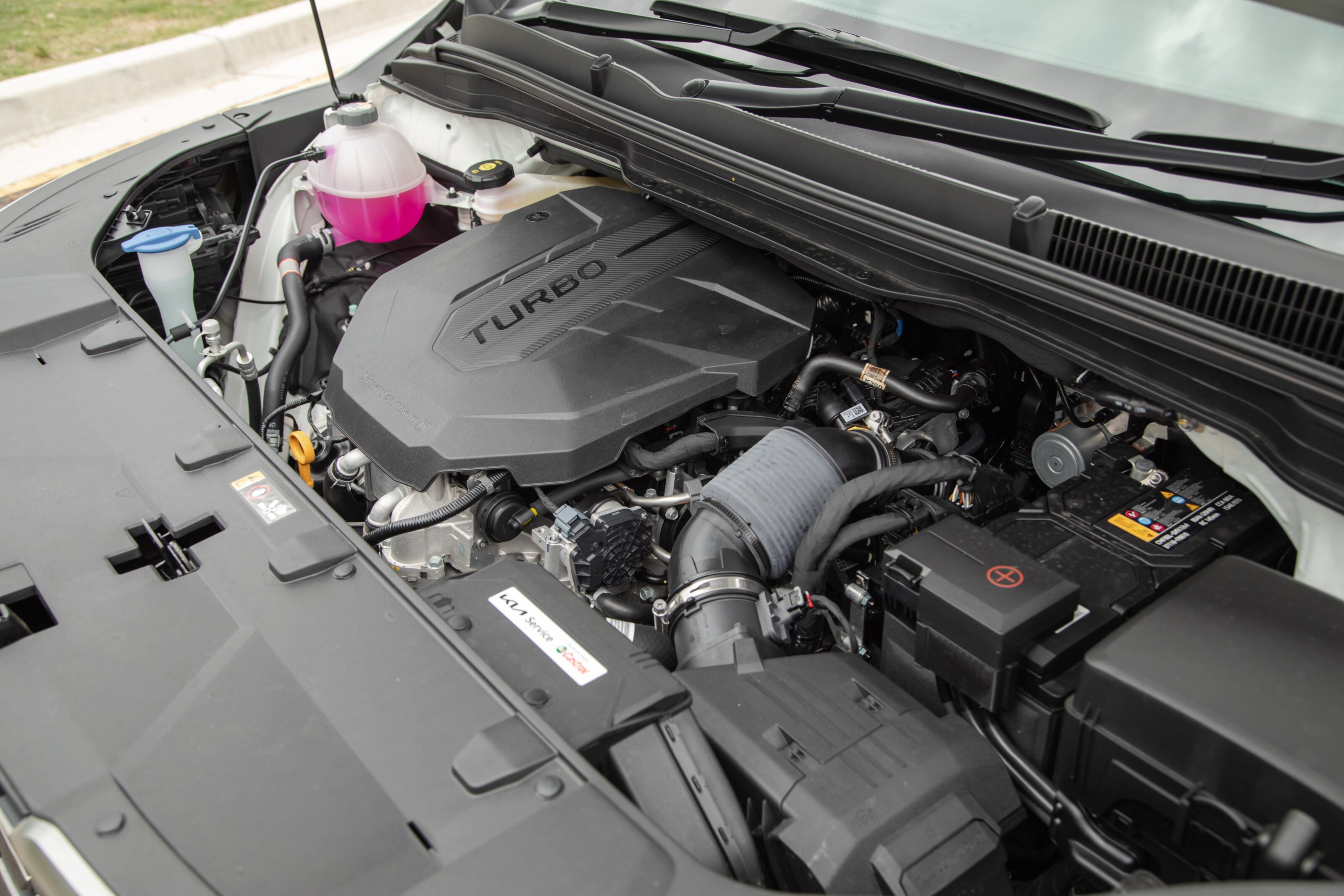
Kia’s 2.2-litre turbo-diesel is a strong unit. It’s not particularly noisy, either, getting the job done with a thrummy character that never becomes overbearing. The eight-speed auto is a hum-dinger, shifting smoothly and decisively, rarely tripping up or worse, letting you roll back on hills.
Despite having to shift well over two tonnes of van, the engine never feels stressed, happily wafting along on the solid torque figure. It’s pretty relaxed but not docile, with plenty of shove available with a decisive right foot. You even get paddles – but I never used them, because I didn’t need to. Nor did I bother with sport mode.
It’s even got pretty good steering, the front end responding promptly to your instructions, and you’ve got a good idea of what’s going on beneath you.
1
The suspension is a nice blend of ride and handling, but obviously the dial is biased towards comfort.
The long wheelbase certainly helps, as does the low centre of gravity, with roll limited and very little pitching under braking.
It doesn’t even feel heavy, at least not with only two or three people in it. It’s nicely judged and makes what could be a chore quite enjoyable. Parking is a bit of a pain because it is well over five metres, but there’s plenty of vision and electronic assistance.
The diesel can tow 750kg unbraked and 2000kg braked, with towball download of 200kg.
1
1
How is it on fuel?
| 2022 Kia Carnival fuel figures | |
|---|---|
| Fuel economy (claimed) | 6.9L/100km |
| Fuel economy (trip computer) | 8.9L/100km |
| Fuel type | diesel |
| Fuel tank capacity | 72 litres |
I spent a week mostly bombing around town – that’s what these things spend most of their days doing – and it returned an indicated 8.9L/100km.
The 72-litre tank ensures a decent run between fills, particularly on longer runs where the long eighth gear should eke out nearly a thousand kilometres on the highway.
1
1
How safe is it?
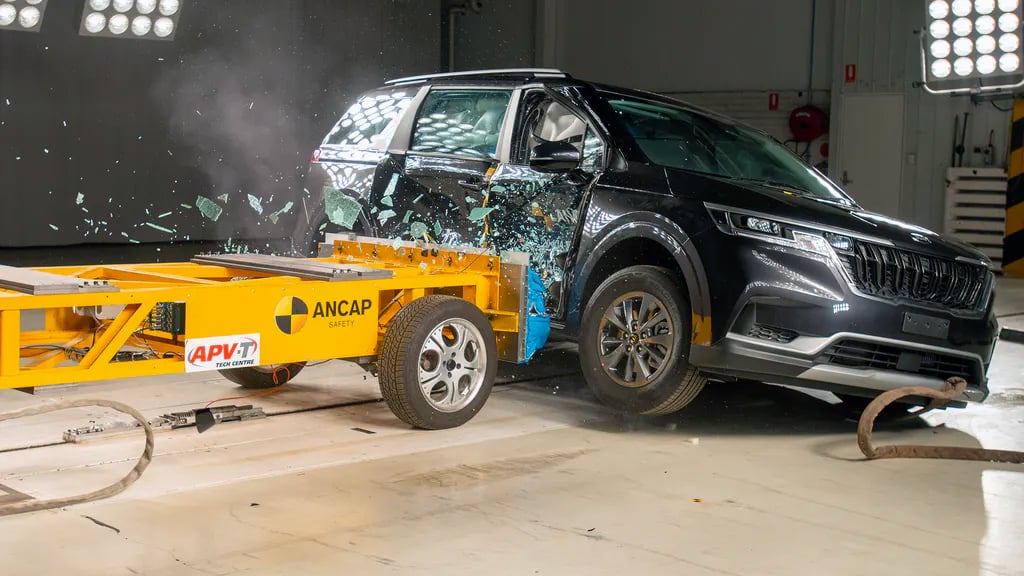
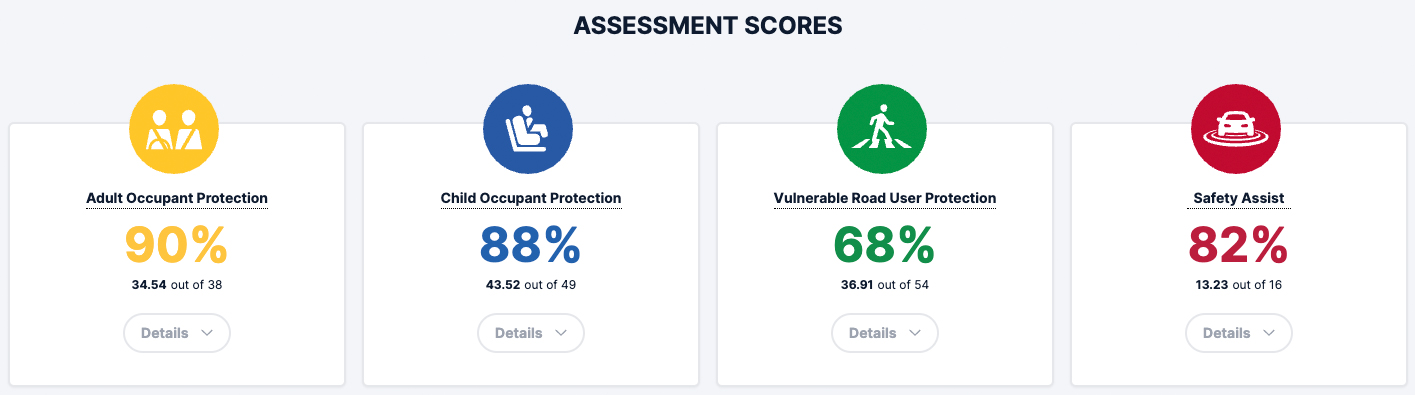
The Carnival’s five-star ANCAP safety rating comes courtesy of a pretty decent suite of safety features.
| 2022 Kia Carnival safety features | |
|---|---|
| Seven airbags | ABS |
| Stability and traction controls | Forward AEB (high and low speed) |
| Forward collision warning | Reverse cross-traffic alert |
| Reverse AEB | Front cross-traffic alert |
| Lane departure warning | Lane keep assist |
| Driver attention detection | Side exit warning |
| Blind spot monitoring | Reversing camera |
There are five ISOFIX points across the two rows of seats and five top tether points as well.
Warranty and running costs
Kia’s seven-year, unlimited-kilometre warranty applies and is probably the best warranty for a people mover on the market. You get a year of roadside assist, extended every time you service with Kia.
Servicing comes around every 12 months or 15,000km, which isn’t bad for a turbocharged Korean engine. The capped-price servicing program covers the first seven services and…well it’s not cheap.
The first one kicks off alright at $349, then jumps to $610, down to $423, up to $798(!), down again to $393, another jump to $777 then finishing off with a $419.
Over the seven years that’s a total of $3767 over five years, or north of $500 per year on average.
1
VERDICT
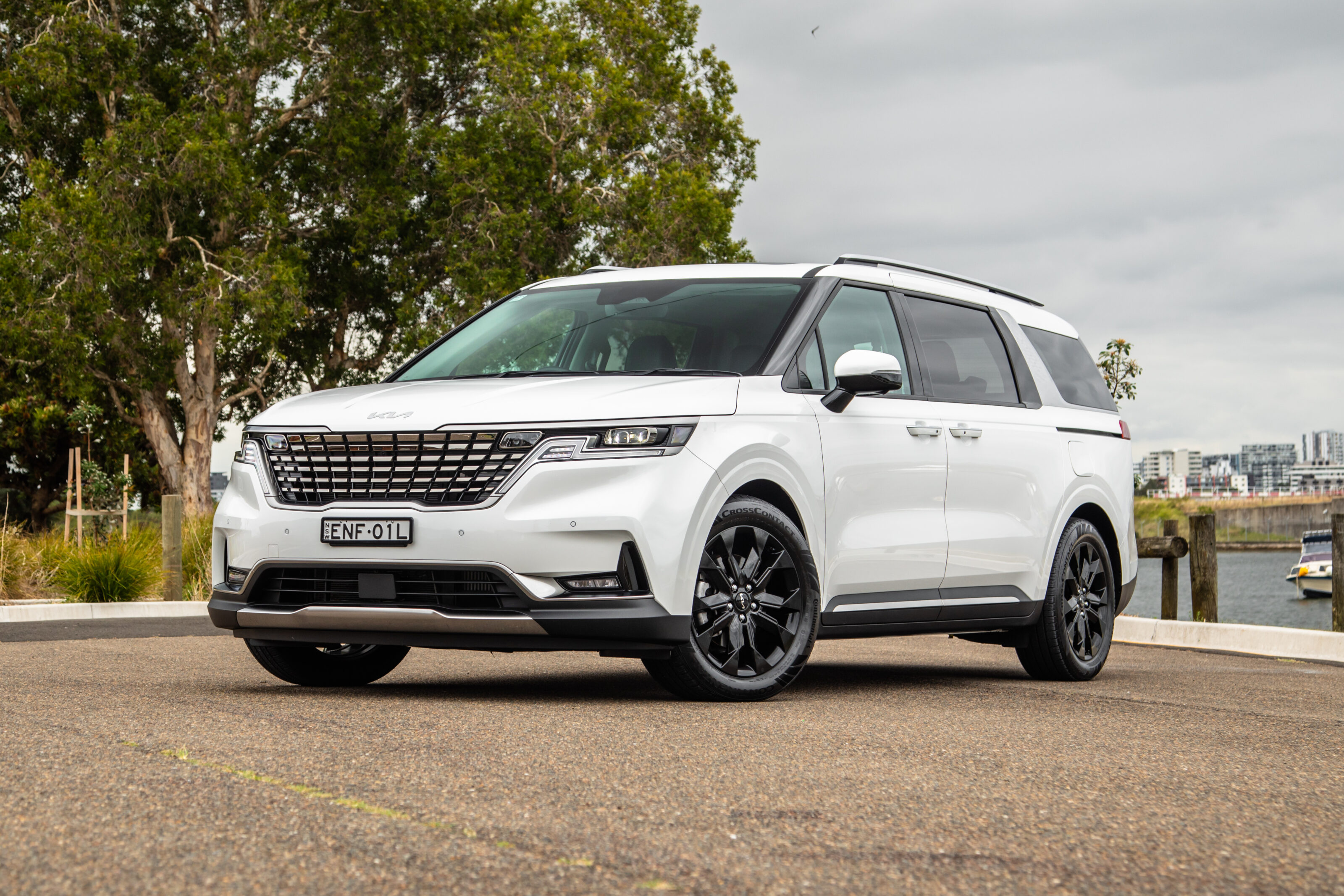
The Carnival is a ripper of a people mover. Quiet, composed, and – in Platinum spec – loaded to the gills with stuff before you even load it to the gills with people. And their stuff.
It’s mightily practical, but looks almost as cool as a car like this can.
Whether it brings back the fun of the 80s Tarago vibe is up to you – nobody waves at you in one of these – but it’s so much better it probably doesn’t matter. It’s also usefully better than the car it replaces which felt like a van with a retro-fitted interior. It wasn’t bad, but it just wasn’t quite there.
If you’re prepared to pay the big bucks, this Carnival is the whole package.
MORE
Everything KIA
MORE
Best Large SUVs
| 2022 Kia Carnival Platinum diesel specifications | |
|---|---|
| Body: | Five door people mover |
| Drive: | FWD |
| Engine: | 2.2-litre turbo four-cylinder diesel |
| Transmission: | Eight-speed automatic |
| Power: | 148kW @ 3800rpm |
| Torque: | 440Nm @ 1750-2750rpm |
| Bore stroke (mm): | 83 x 99.4 |
| Compression ratio: | 16.0 : 1.0 |
| 0-100km/h: | 9 sec (estimate) |
| Fuel consumption: | 6.5L/100km (combined) |
| Weight: | 2134kg |
| Suspension: | MacPherson struts front/ |
| L/W/H: | 5155mm/1995mm/1775mm |
| Wheelbase: | 3090mm |
| Tyres: | 236/55 R19 |
| Wheels: | 19-inch alloy wheels (no spare) |
| Price: | $71,980 DA |
While Wheels Car of the Year is open to any new car that has launched in the previous 12 months, the reality is that with so much new metal hitting our shores, we simply can’t throw every eligible contender through our rigorous testing regime.
COTY testing takes place over five days and every car is scrupulously assessed and driven by our seven judges. So, to give our team enough time to do the job properly, we need to ensure the size of the field is manageable. This year’s group comprises 17 different models, for example, represented by 26 individual cars.
The result of all this is that simply making the starting grid at COTY is an acknowledgment of excellence in and of itself, but it also means some tough decisions need to be made.
MORE READING
As the 2023 COTY story evolves, the list of stories below will grow. Keep an eye on this page for more, or find it all at our COTY page.
A NOTE ON CRITERIA
1
The first cull is the easiest
Eligible cars must be brand-new additions to the Aussie marketplace or fresh versions of an existing nameplate that have been updated with a generational change.
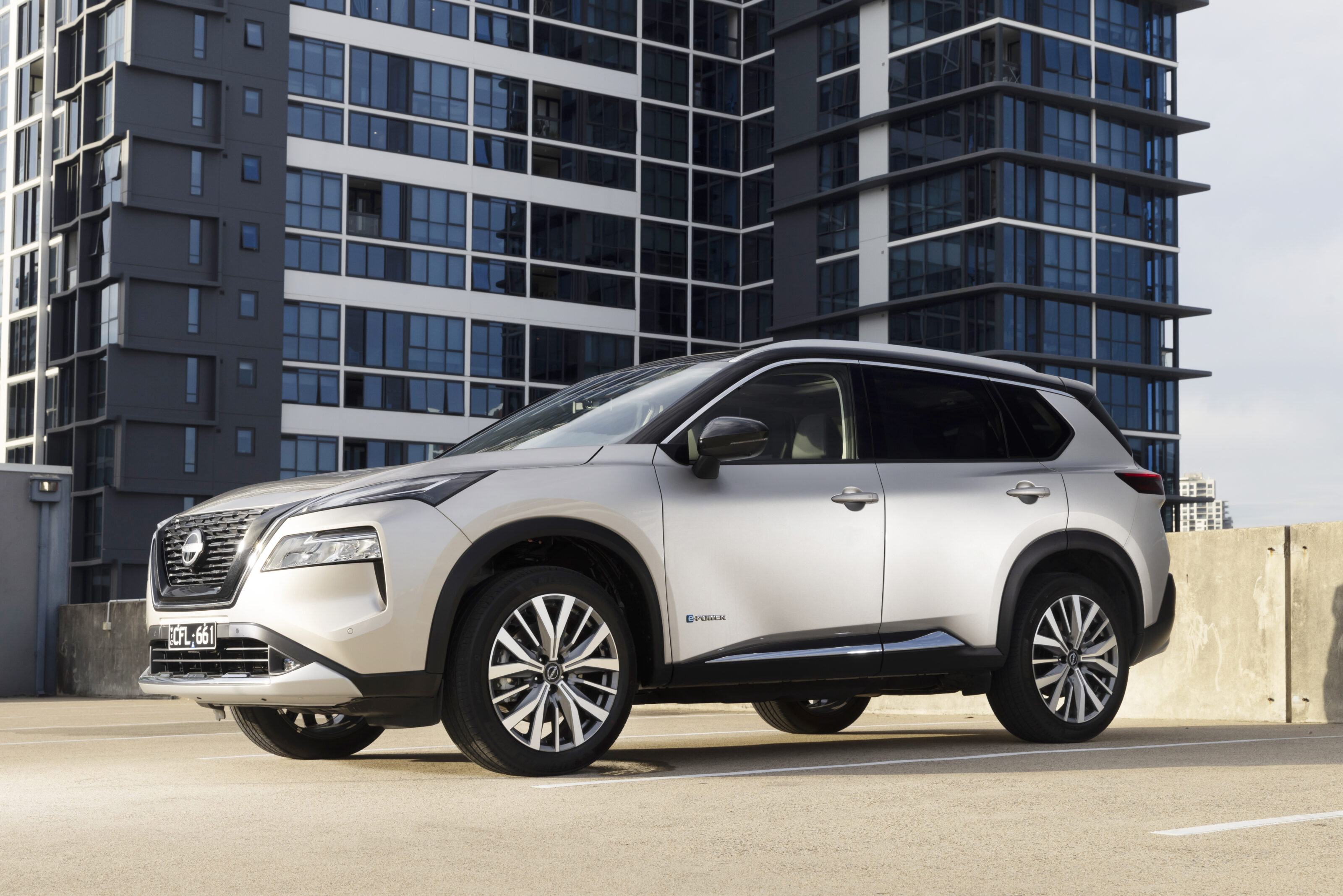
A new-generation Nissan X-Trail, for example, is eligible as it offers a new platform, fresh cabin and new engines, but a Tesla Model 3 is not given it’s largely the same car that we’ve previously tested at COTY. That also explains why popular models such as the Toyota RAV4 and Kia Carnival aren’t included each year.

1
Easiest, but not easy
Where things get trickier is cars like the BMW X1 and Subaru WRX. While they’re eligible and are solid performers, they didn’t quite impress our road testing team enough to warrant automatic inclusion. In those instances, cars are put to our judging panel for a yes/no vote – and the majority rules.
Other cars just missed out due to timing, while one car – the BMW i4 – was unavailable owing to major supply issues (with some customers now having to wait until early 2024 to receive their order).
We’ve divided up the cars that just missed the cut below. If you’d like more detail on why a model didn’t make the starting grid, ask away in the comments.
Arrived too late
| BMW M2 | Ineos Grenadier |
| BMW M3 Touring | Lexus RX |
| BMW i4 (No test car available) | Mazda CX-60 |
| Citroen C5X | Mercedes-Benz EQS |
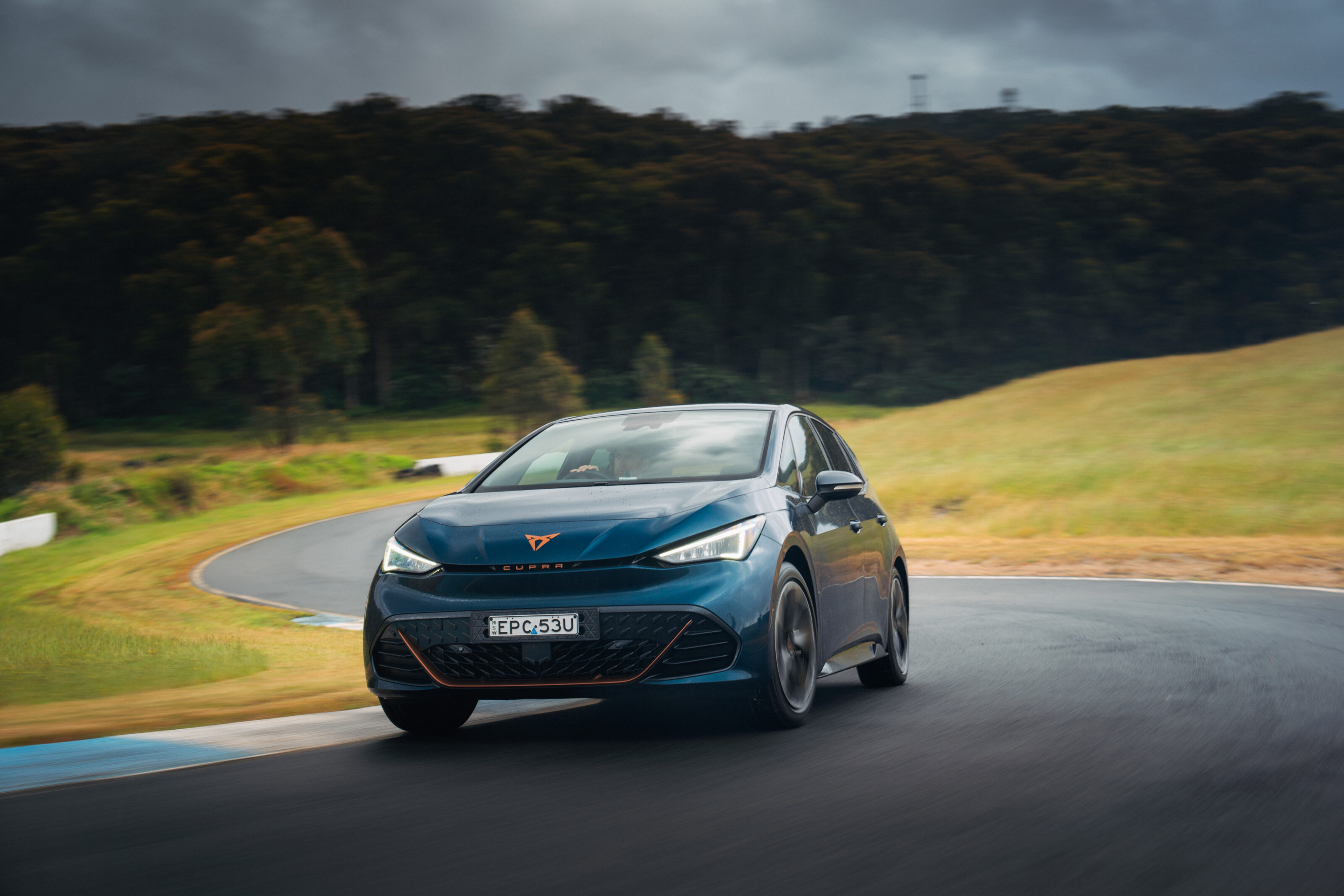
| Cupra Born | Mercedes-Benz EQE |
| Honda Civic Type R | MG4 |
| Hyundai Ioniq 6 | Toyota GR Corolla |
1
Ruled out by judging panel
| Aston Martin DBX | Kia Niro |
| BMW 2 Series | LDV Mifa 9 |
| BMW X1 | Mercedes-Benz EQA |
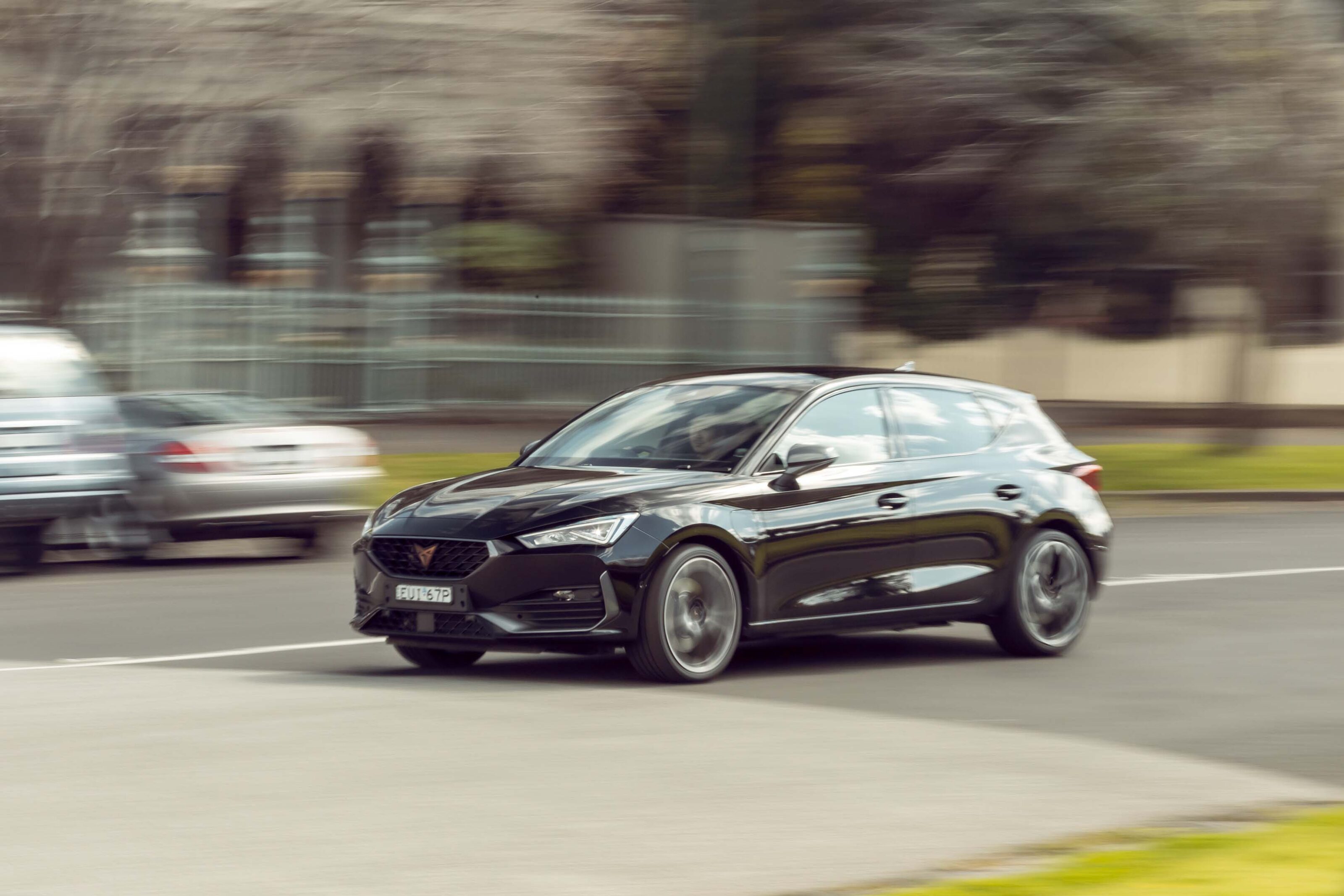
| Cupra Leon | Mercedes-Benz EQB |
| Cupra Ateca | Nissan Pathfinder |
| Honda HR-V | Subaru WRX |
| Jeep Grand Cherokee L | Suzuki S-Cross |
UPDATE: Fresh stock of 2023 Cupra Leon VZe and Formentor VZe PHEV
The 2023 Cupra the Leon VZe and Formentor VZe plug-in hybrids (PHEVs) are available for online order today ahead of delivery in the second half of this year after the initial allocation of just over 100 sold out.
The fresh PHEV supply follows the increase of Born electric vehicles (EVs) for pre-order from 400 to 600 after the first batch, that were released in late December, were sold.
“Australia is in hot competition with other markets for Cupra’s EVs and PHEVs,” said Cupra Australia Director Ben Wilks. “The response to Born, Leon and Formentor VZes demonstrates the desire for cutting edge zero- and low-emission vehicles.”
The Leon PHEV starts from $59,990, while the Formentor PHEV range begins at $62,990 – both before on-road costs.
Our original story continues below unchanged.
1
The story to here
February 10: Cupra models in stock for delivery within weeks
Snapshot
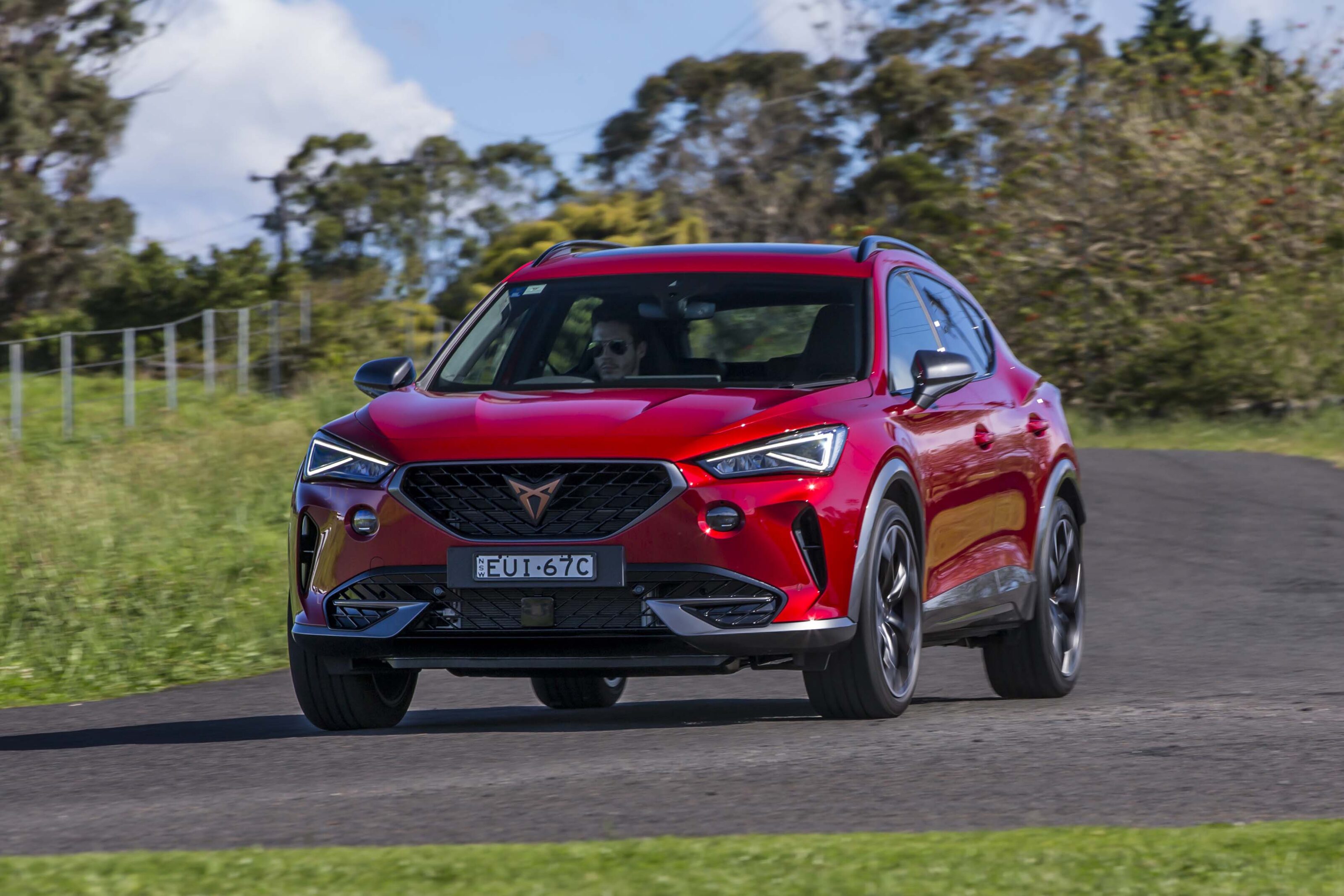
- More than 395 Formentor and Ateca SUVs in stock for delivery within four weeks
- Formentor VZe PHEV sold out
- Leon hatchback examples also available
Despite the car industry still grappling with global supply and shipping delays, Cupra Australia says it has more than 395 Formentor and Ateca SUVs in stock for delivery within a month.
Most of the stock consists of the Cupra Formentor in base ‘V’, mid-spec ‘VZ’ and popular flagship ‘VZx’ variants, and the Cupra Ateca in its sole VZx trim.
According to the Cupra Australia page, there’s also the Cupra Leon hatchback VZ and VZx variants available. A total of 245 examples are currently listed as in stock with varying exterior paint and option packages fitted (at the time of writing).
1
Estimated delivery times range from three to 11 weeks from ordering, depending on the model and pick-up location.
Notably missing is the Formentor VZe plug-in hybrid electric vehicle (PHEV) model, which is currently unavailable in Australia. But, the local division says it is in talks to secure further production from the Spanish factory.
Unlike traditional car brands, Cupra bypasses franchise dealers to sell vehicles directly online with non-negotiable fixed drive-away pricing and a shared nationwide stock pool.
1
This direct-to-consumer business model is echoed by Tesla, Polestar, Honda and Mercedes-Benz, too.
The Volkswagen Group’s mainstream performance brand launched locally last year with three models and, uniquely, a different powertrain offering on each trim level.
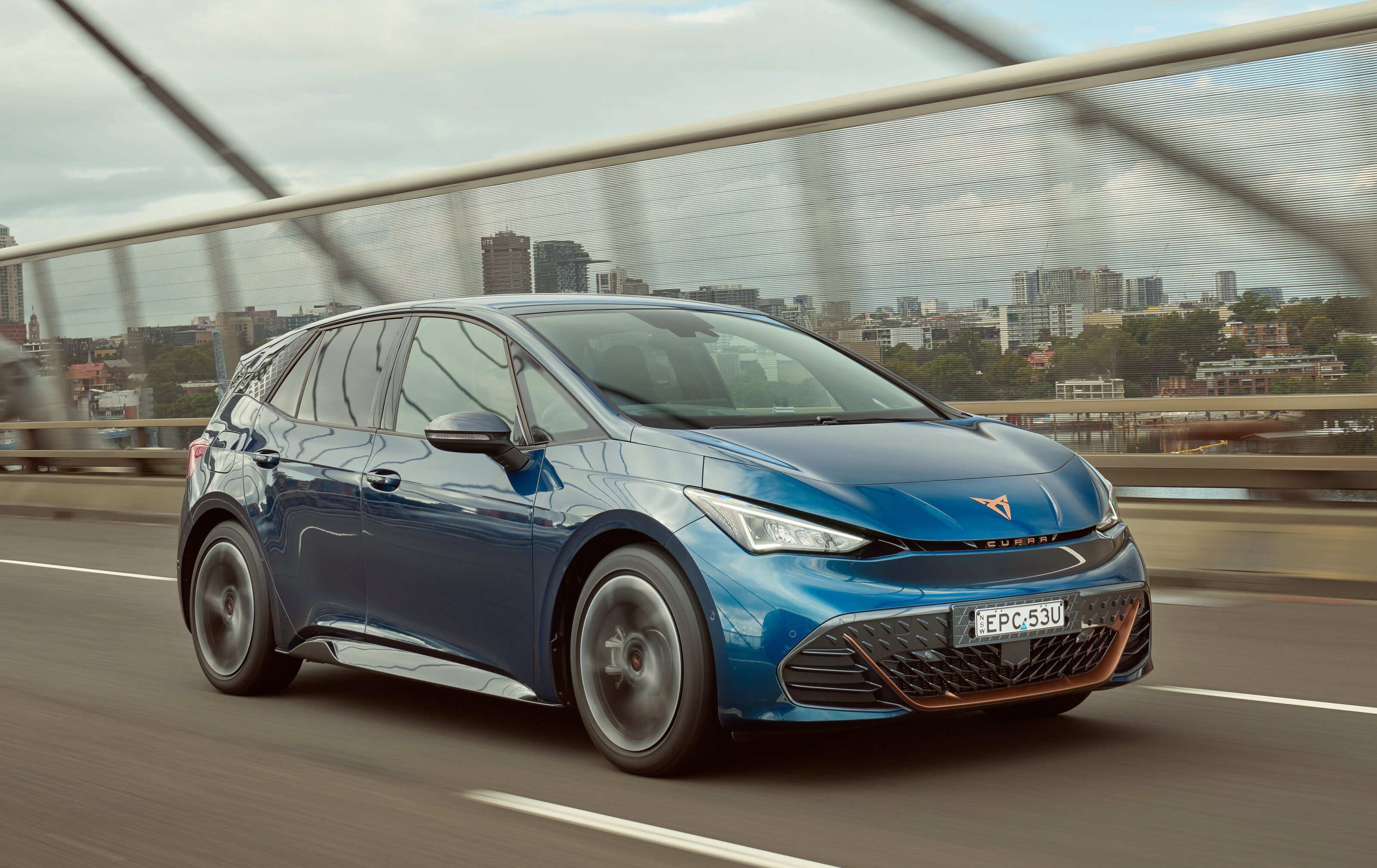
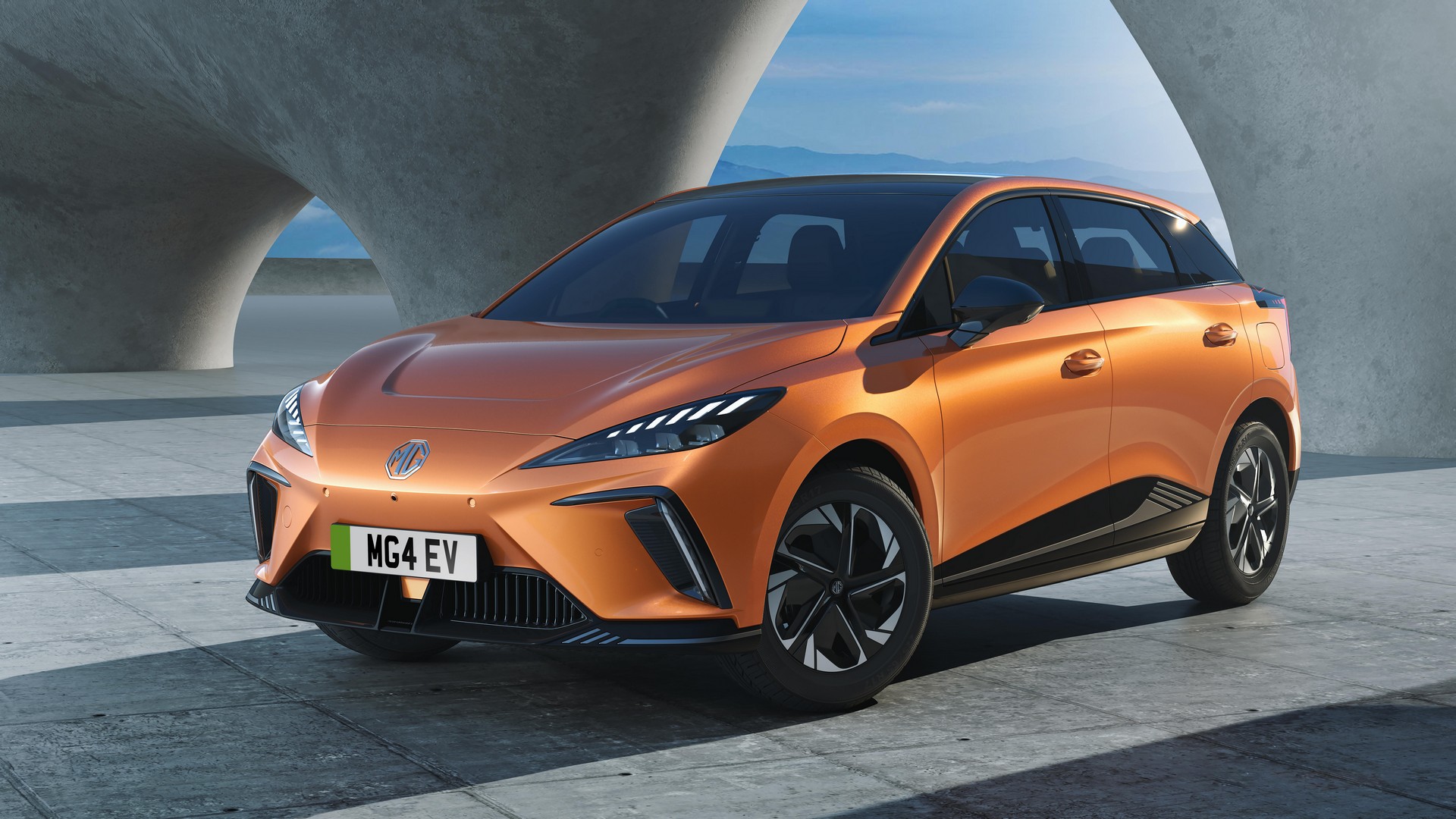
The Cupra Born electric hatch will join the lineup when it lands in March or April to directly compete against the best-selling Tesla Model 3 sedan, and incoming cheaper EV hatches such as the MG 4, GWM Ora and BYD Dolphin.
1
Mainstream enthusiast sporty car models are currently facing a difficult climate.
This week, Volkswagen stopped taking new orders for the Golf R hot hatch and Tiguan R SUV due to component shortages – despite the T-Roc R getting a stock boost – whereas pre-orders for the new Honda Civic Type R today stretch to late 2024.
Similarly, the Hyundai i20 N, i30 N Hatch and Toyota GR Yaris have shut their order books amid high demand and as strict Euro 7 emissions regulations loom overseas, which pushes for the shift to zero-emission electric vehicles.
MORE
Everything Cupra
MORE
Electric Cars
