
Mitsubishi Australia has the EK X all-electric kei-car in its sights should it prove our market is the right fit for such a vehicle, Wheels understands.
The EV was introduced last year in the firm’s native Japan for ¥2,398,000 (roughly AU$26,500), joining the kei-car series locally with “more of an SUV flavour”.
It claims a driving range of 180 kilometres coming from a 20kWh battery, offers 47kW of power and 195Nm of torque, and weighs in at a light 1080 kilograms.
Said battery can charge to full capacity in eight hours using regular charging (AC200V/14.5A), or about 40 minutes to 80 per cent through quick charging, and it even has two-way vehicle-to-load power.
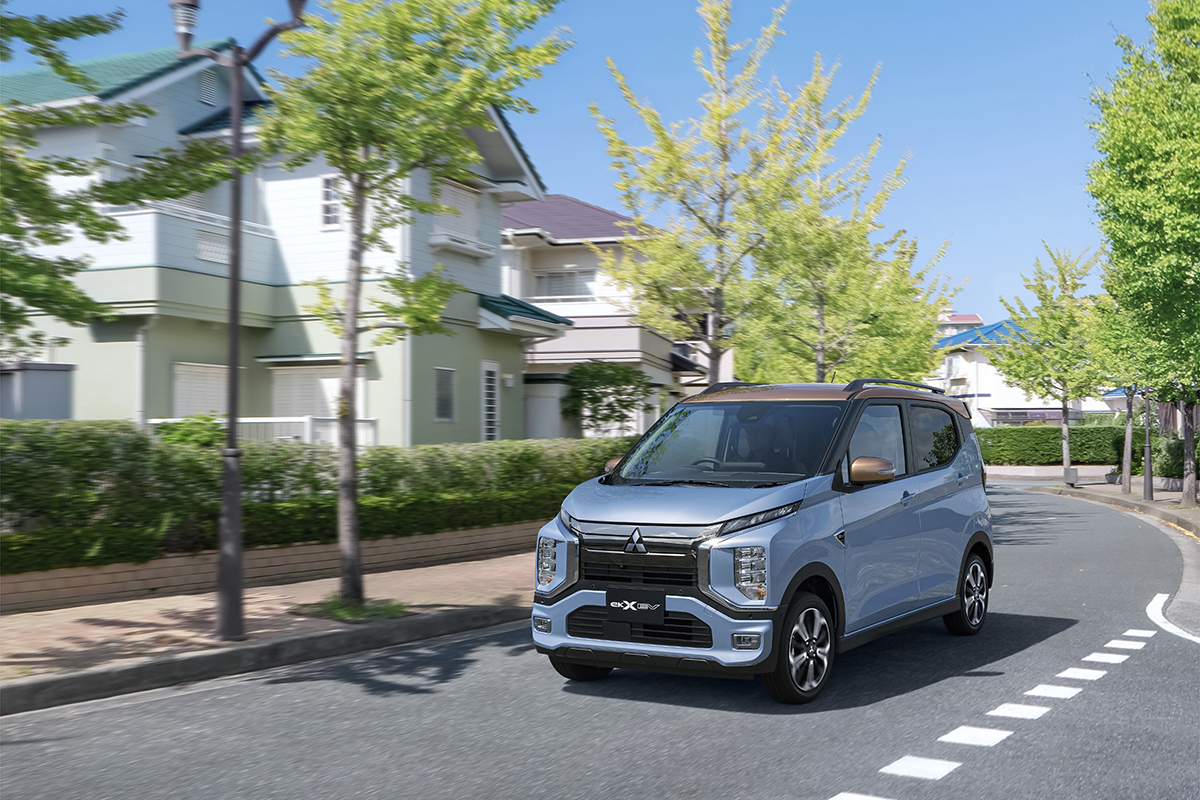
But is the pint-sized Outlander lookalike really ever likely to come to Australia where we love big SUVs and utes? Mitsubishi Australia’s CEO Shaun Westcott thinks so – under the right conditions.
“[EK X] is one of those where we’re always looking at new opportunities,” he told Wheels.
“We have to ask is it relevant? Could this work in Australia? But definitely one thing I’ve noticed at Mitsubishi is Japan takes our media’s feedback quite seriously, so watch this space.”
One of Mitsubishi Australia’s considerations, according to Westcott, is what the flavour is like locally for EVs, and it is also guided by history – which hasn’t always been so kind to the company.
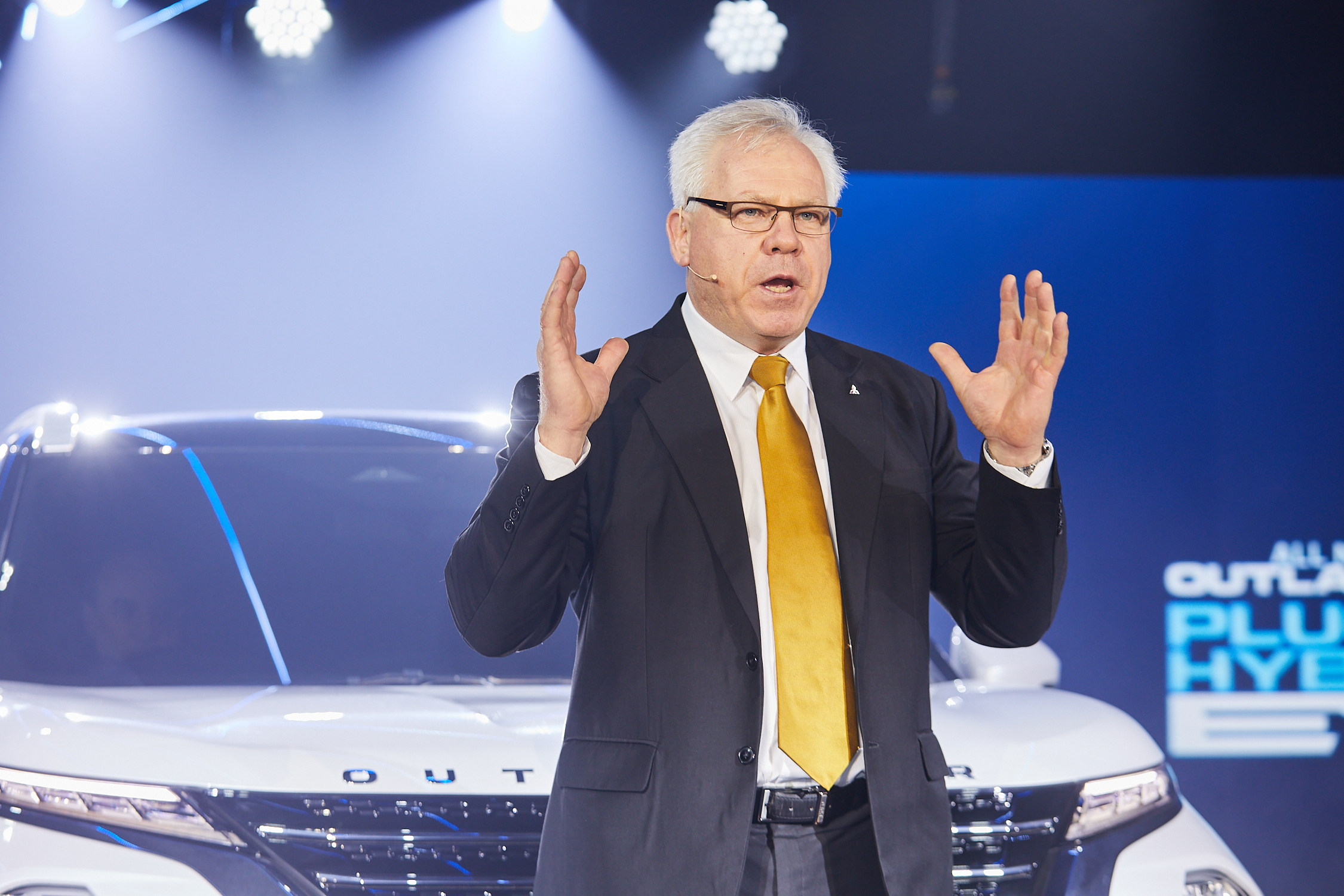
It’s first (and only since) fully-electric offering in Australia was the i-Miev hatchback, which was introduced here in 2009, one year after launching in Japan. However, it wasn’t actually available publicly until 2011 and was gone by 2013.
At the time it went for a starting price of around $48,000 and charged in eight hours using a 15-amp powerpoint or four hours with a fast-charger to achieve a driving range of just over 100 kilometres.
“We lost lots of money [on i-Miev] because Australia wasn’t ready for it,” said Westcott. “It maybe, to be frank, burnt our fingers, because we brought the technology to the market 15 years too soon.
“We were way ahead of our time, but it cost us a lot of money. Hence all the recent conversations about EVs and PHEVs – are we ready?
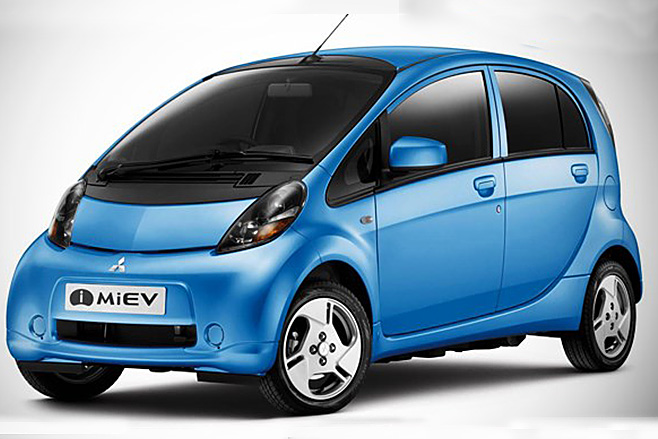
“It’s important that we time ourselves for the market. We support what the new government is doing, but [also focus on] what our customers need and want and what they’re ready for.”
In recent months, the carmaker has revealed plans to launch 35 electric vehicles by 2030 across five new platforms, and says it can access a number of electrified models from across the Renault-Nissan-Mitsubishi Alliance if it chooses to.
“We have, through our alliance and through our own networks, access to a wide variety of cars,” Westcott told us. “Not all of them will work in Australia. Not all of them appeal to Australians. We have access to a whole suite of French cars – they’re the top selling cars in Europe, but they’re not the top selling cars in Australia.
“As the CEO of Australia, I have to look at what does Australia need? What does Australia want? It’s like opening drawers on a filing cabinet. We can get them, but do we need them, and do we want them, and will our customers buy them?
“I mean, the [climate change/EV] discussions that we are having with Chris Bowen wouldn’t have happened three years ago. They wouldn’t even have been on the radar. So the world is moving and moving rapidly, and, as a business, we need to be agile to be able to respond to the market – to economic conditions, to macroeconomic conditions, to microeconomic conditions, to changing customers, consumer needs, desires, preferences. That’s what we do. That’s our core job.”
Snapshot
- Drivetrains include 1.0L turbo mild hybrid
- Measures 3995mm long
- Cabin tech available includes surround-view camera and head-up display
The 2023 Suzuki Fronx small SUV unveiled this week has been confirmed for Australia and is expected to introduce the Japanese brand’s mild-hybrid technology.
Limited details have been released for a model that would join the Suzuki Ignis in the ‘light SUV’ segment and take on rivals such as the Hyundai Venue, Kia Stonic and Mazda CX-3.
Two drivetrains have been announced for the Indian market: a standard 1.2-litre petrol engine and a more advanced 1.0-litre mild-hybrid turbo petrol with direct fuel injection and electric assistance.
The petrol engine is teamed with either a five-speed manual or auto, while the 1.2-litre engine comes with a five-speed manual or six-speed auto with paddleshift levers.
Suzuki Australia told Wheels last September that the company was planning to introduce electrified models over the next few years to improve the emissions output of its vehicles.
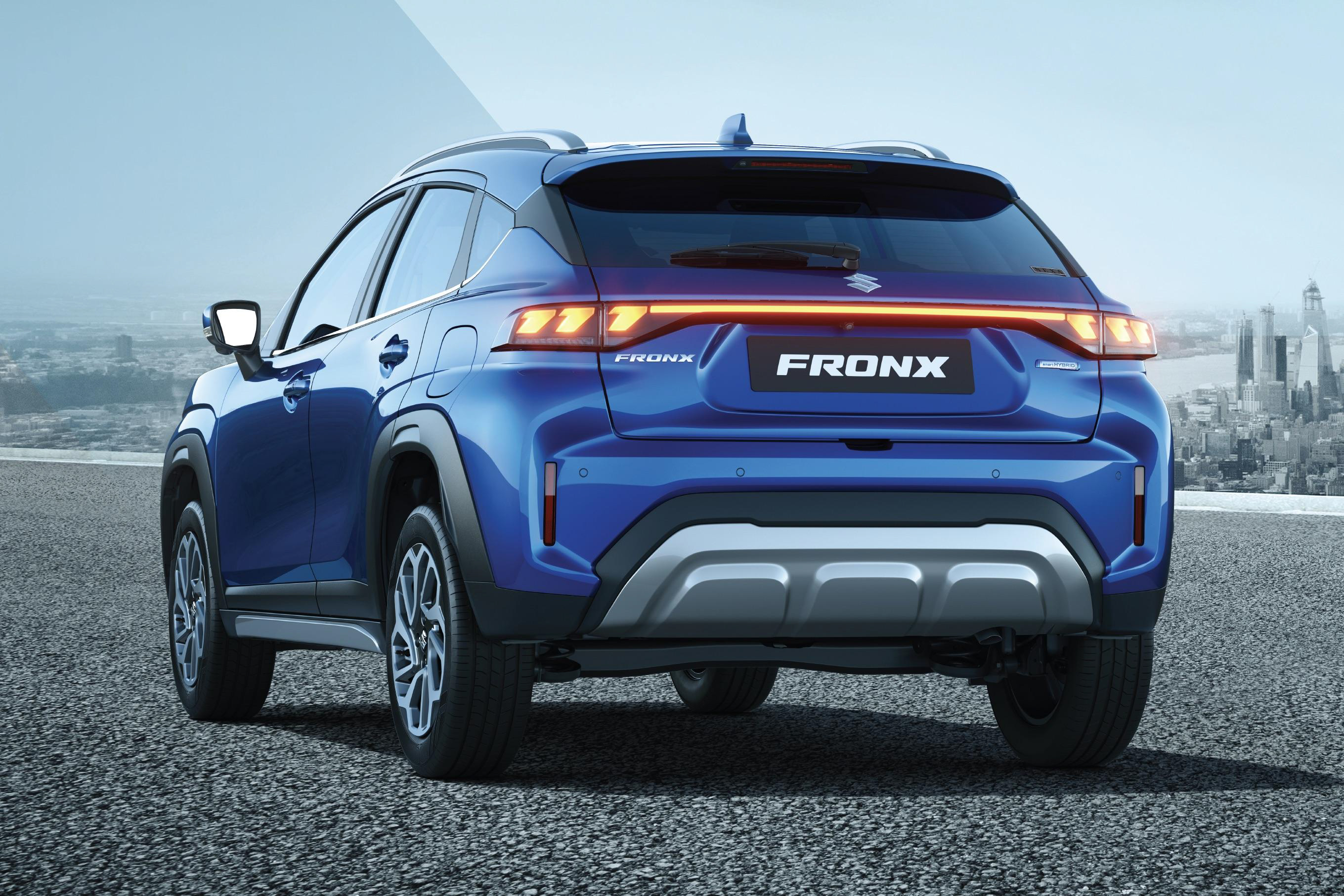
No performance or efficiency figures have been quoted yet.
The sub-4.0-metre Fronx will be available with technology including a 360-degree camera, head-up display, and wireless phone charging.
Suzuki claims the interior will offer excellent space efficiency and has confirmed it will feature rear air vents for additional comfort for passengers.
Mild-hybrid versions of the Ignis, Swift, Vitara and S-Cross are available in markets such as Europe and the UK where 1.2-litre and 1.4-litre turbo engines are featured.
A hybrid version of the Jimny baby 4×4 has been rumoured for 2024.
The 2023 Suzuki Fronx small SUV was unveiled alongside a new, five-door version of the Jimny at the 2023 Auto Expo in India.
There’s smoke coming from under the bonnet, and my mind frantically races trying to remember if there’s a fire extinguisher under the passenger seat.
A lyrebird cackles from within the bright lilac ferns somewhere nearby, while I try to convince myself the slowly wafting smoke is from the brakes.
Brakes that smell, peculiarly, like bushfire. Brakes that were hardly used while hammering uphill in this underpowered 1986 buzz box, trying to keep up with a new Toyota GR86.
As we reach the top of the winding Donna Buang Road east of Melbourne, the smoke seems to have subsided as we lift the heavy steel bonnet to find a crispy eucalyptus leaf attempting self-immolation by means of wedging itself between cylinders two and three of a 35-year-old cast iron exhaust manifold. The leaf is extracted, and there is relief.

Today, no cars are burning to the ground, but it is a fiery undertaking no less: we’re comparing new versus old, 1986 Toyota AE86 Sprinter GTV versus 2022 Toyota GR86 GT. The objective: to see if Toyota has imbued more AE86 DNA into the second iteration of its rear-drive sports car.
The first version, as released in 2012, was more an adopted than direct descendent of Toyota’s cult classic AE86. The Toyota 86 and its Subaru BRZ twin were both brilliant in their own right – enough to win Wheels Car of the Year 2012, no less – but failed to rekindle some of the spark of the 1980s original.
Namely, under the bonnet, the FA20 2.0-litre boxer four-cylinder titillates in a way a new dishwasher might: undoubtedly useful, initially exciting even, but ultimately a thing of function than desire.

For the just-released ‘second generation’ (more or less an extensive facelift) of its rear-drive coupe, Toyota says it’s fixed that problem.
Under that aluminium bonnet, an 8mm bigger bore increases capacity from 1998cc to 2387cc – and power from 152kW to 172kW.
Torque is also up – by 38Nm to 250Nm – and peaks earlier in the rev range (3700rpm versus 6600rpm), addressing a major complaint of the previous model. As well as a new, much more handsome cabin, there’s now an interior engine noise speaker, producing a sweeter sound (even if it’s more stevia than sugar).
In order to properly understand the new car, though, we must first understand the old. On the surface, the AE86 is simply a rear-drive Toyota Corolla from the 1980s – hobbled by prodigious hype. But forget its enormous cult following and you discover something special – something of a Japanese BDA-powered Ford Escort.

From the driver’s seat, the AE86 is light and airy courtesy of its thin pillars and large windows. The interior is classic 1980s Toyota, a tub of cheap plastics, urethane and vinyl. There is a faint smell of tobacco like seemingly every other eighties and nineties Japanese imported car.
The charms of weighing just 950kg and being rear-drive are obvious enough, yet it’s the 4AGE engine that is the AE86’s real secret sauce. In the 1980s, a twin-cam, 16-valve 1587cc inline-four – revving to 7700rpm from the factory – was something to be celebrated (even if it only had 96kW and 149Nm to show for it).
It doesn’t like to be rushed in producing that power, either. While stationary, a blip of the lovely cable throttle generates an angry spike of revs – like a motorbike, which makes sense given Yamaha had a hand in developing the 4AGE. But on the move, in second gear and beyond, the 4AGE winds patiently through a long arc of revs, making quite the song in the process.

On the move, in second gear and beyond, the 4AGE winds patiently through a long arc of revs, making quite the song in the process.
Call me biased – this is my personal car – but the AE86 is a delight to drive. Refreshingly mechanical, the entire car buzzes with feedback. It takes a while to build momentum – like a freight train – and once it’s going, every km/h feels precious.
In this particular car, with aftermarket coil-overs and 2.5 degrees of negative front camber, it’s all about carrying as much speed into the corners as you dare – and it can carry quite a lot. Enough to startle a brand-new GR86, to be sure.
Meanwhile, get an AE86 with a limited-slip diff on a wet or dirt road, and it’ll take about six corners to see why they are loved by drifters and rally drivers alike.

Getting out of an AE86 and into a GR86 must be like a pilot jumping from a Spitfire into a Joint Strike Fighter. You sit lower and are much more cocooned. It feels much bigger and wider. The cloth seats of the lower-spec GT, too, are a delight.
Start extending that bigger bore FA24 and, compared to the AE86’s characterful 4AGE, the artificial engine noise coming through the speakers is certainly loud and interesting, but not quite to our tastes. Others seem to like it – horses for courses.
The trade-off for the artificial noise is strong power (172kW from a 2.4-litre atmo four would have blown everybody’s little minds just 20 years ago).
It’s easy to access second-gear throttle steer, too, even in the dry.
Toyota has absolutely ‘fixed’ the torque hole that plagued the old model, too, the grunt now much more linearly meted out.

Quirkily, the GR86 feels noticeably more rigid than the previous model – like it’s got a newly-installed, invisible 10-point roll cage. For chassis rigidity, it would make a 2012 car feel like a convertible – and that car was hardly wobbly.
Obviously, the GR86 is night-and-day faster than an AE86. Whereas the AE86 is all about maximising mid-corner speed, the GR86 is about not overcooking it. In fact, it could handle much better rubber than its standard Michelin Primacy tyres, which require you to over-slow the car into most corners.
They’re not the most communicative or linear of tyres, either. Replacing them with something like Michelin Pilot Sport 4S would make a big difference to the GR86 GT’s driver appeal.

The GR86 feels engineered for oversteer, too. Into corners, the rear-end is nervous and flighty, almost like an old school hot hatch – and you’re constantly reacting to it.
In terms of chassis communication, the GR86 asks you to listen carefully. The steering is razor sharp, and there’s okay feel, but all the other controls leave you somewhat working out where the limit might be.
The AE86, by comparison, communicates the road and what the chassis is doing with perfect clarity – although, it must be said, it does this at all times. Some Melbourne roads, you don’t want to know too well…
It’s not that the GR86 is much better, being fairly bumpy with lots of tyre noise by modern sports car standards.

There are other gripes with the GR86 GT…
The throttle map has a big bulge right at the start of its travel, as if engineered to try to further mask any lack of low-down torque. It gets tiring constantly having to sensitively feed in throttle in traffic.
Its clutch is also still a bit numb and the dry, notchy gearshift isn’t anything special. Then there’s the price – just 12 months ago, a (previous-generation) 86 GT cost $32,180. It’s now $43,420.
Toyota would argue it has a lot more standard equipment – and, to be fair, the interior represents a big step up, and not just because nobody’s been smoking in this one. Also, it’s still cheaper than the $70,000 or so the red AE86 would now set you back…
Flawed as it might be as a daily driver, the GR86 is a much better sports car.

Flawed as it might be as a daily driver, the GR86 is a much better sports car. It’s finally got the grunt it should have had in the first place. And it looks a lot better – one of the more accomplished facelifts of late. The GR86, like the new BRZ as well, gets under your skin in a way only a rear-drive sports car can.
However, while Toyota has built a better sports car, like the 2012 car it’s still fairly bereft of any noticeable AE86 DNA or lineage. With totally different engine characters, they remain more family friends than close relatives.
That’s not to say the GR86 failed in rekindling an old flame, it just ignited something new.
Something that won’t have you fumbling around for a fire extinguisher.


UPDATE, January 14, 2023: BMW M3 CS to debut at 24 Hours of Daytona
BMW M has confirmed the hotted-up M3 CS will be unveiled at the 24 Hours of Daytona later this month.
It will appear during the race weekend on January 28 and 29 (US time), debuting alongside the BMW M Hybrid V8 LMDh race car.
For everything we know about the 2023 BMW M3 CS, check out our previous coverage below – and stay tuned to Wheels for the full reveal.
The story to here
December 14, 2022: 2023 BMW M3 CS outputs revealed in leaked documents
Snapshot
- 2023 BMW M3 CS outputs leaked
- More power, unique styling, and potential for some M4 CSL elements u2013 but not lightweighting
- Production expected to commence in March; full reveal soon
The upcoming 2023 BMW M3 CS will likely debut in the coming weeks, with leaked documents revealing its power outputs.
BMW forum BimmerPost confirms the ‘G80’ M3 CS should be the most powerful production-spec 3 Series ever, with 405kW and 650Nm – matching the lightweight M4 CSL revealed earlier this year.
While torque remains unchanged, power is up 30kW compared to the current M3 Competition, with its all-wheel-drive and eight-speed torque-converter automatic transmission expected to be retained for the M3 CS.
However, it is unlikely to incur the same weight savings as the M4 CSL coupe, with the latter part of its name referring to ‘lightweight’, or competition, sport, lightweight in full.
While the documents confirm a right-hand-drive variant has been developed, it is currently unknown if the latest M3 CS will reach local shores.
The previous ‘F80’ BMW M3 CS was offered in Australia, priced at $179,529 before on-road costs in 2018, its only year on sale. This was a $33,000 increase over the regular M3.
BMW Australia only offers the M3 in Competition spec, with the latest iteration priced from $169,500 plus on-roads, suggesting a price beyond $200,000 for the M3 CS should it arrive in Australia.
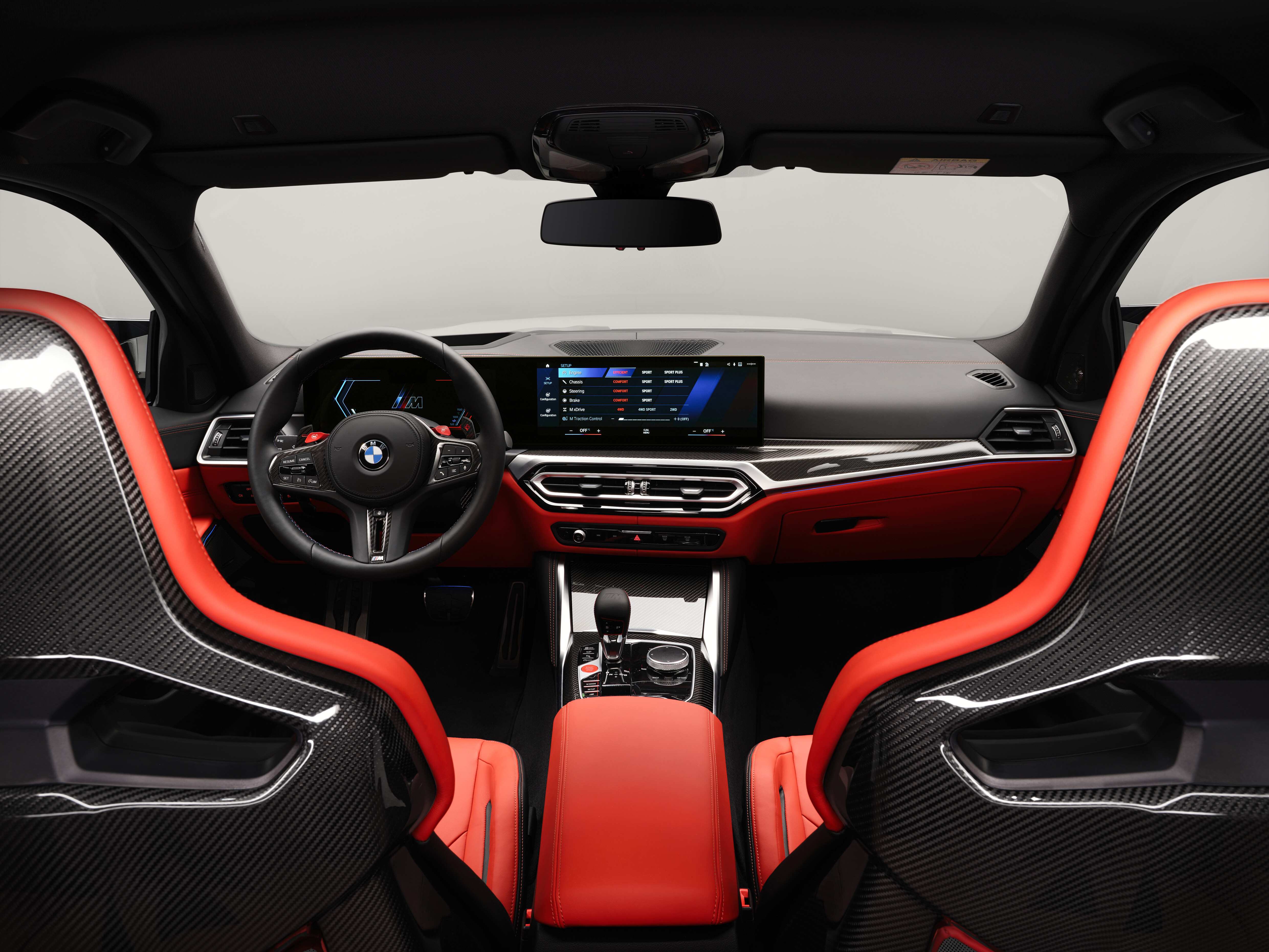
A previous report by BimmerPost suggests the M3 CS will offer unique front bucket seats, while the M4 CSL’s yellow accented laser headlights – also seen on the M5 CS – are likely.
Other additions for the M4 CSL include more extensive use of carbon fibre, stiffer mounts, and increased chassis and body rigidity.
The 2023 BMW M3 CS is tipped to commence production in March, with a limited run until February 2024, suggesting its unveiling is just around the corner.
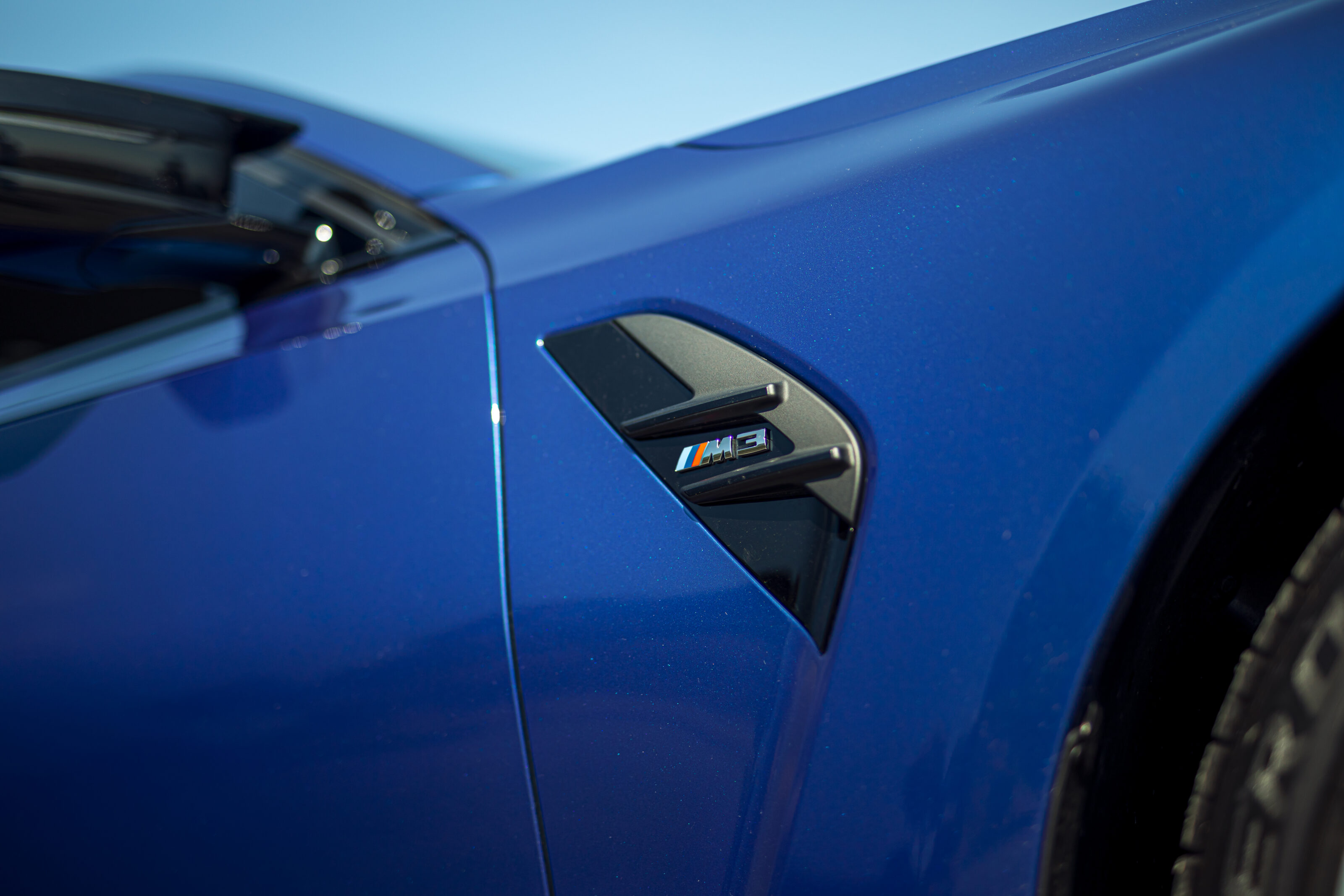
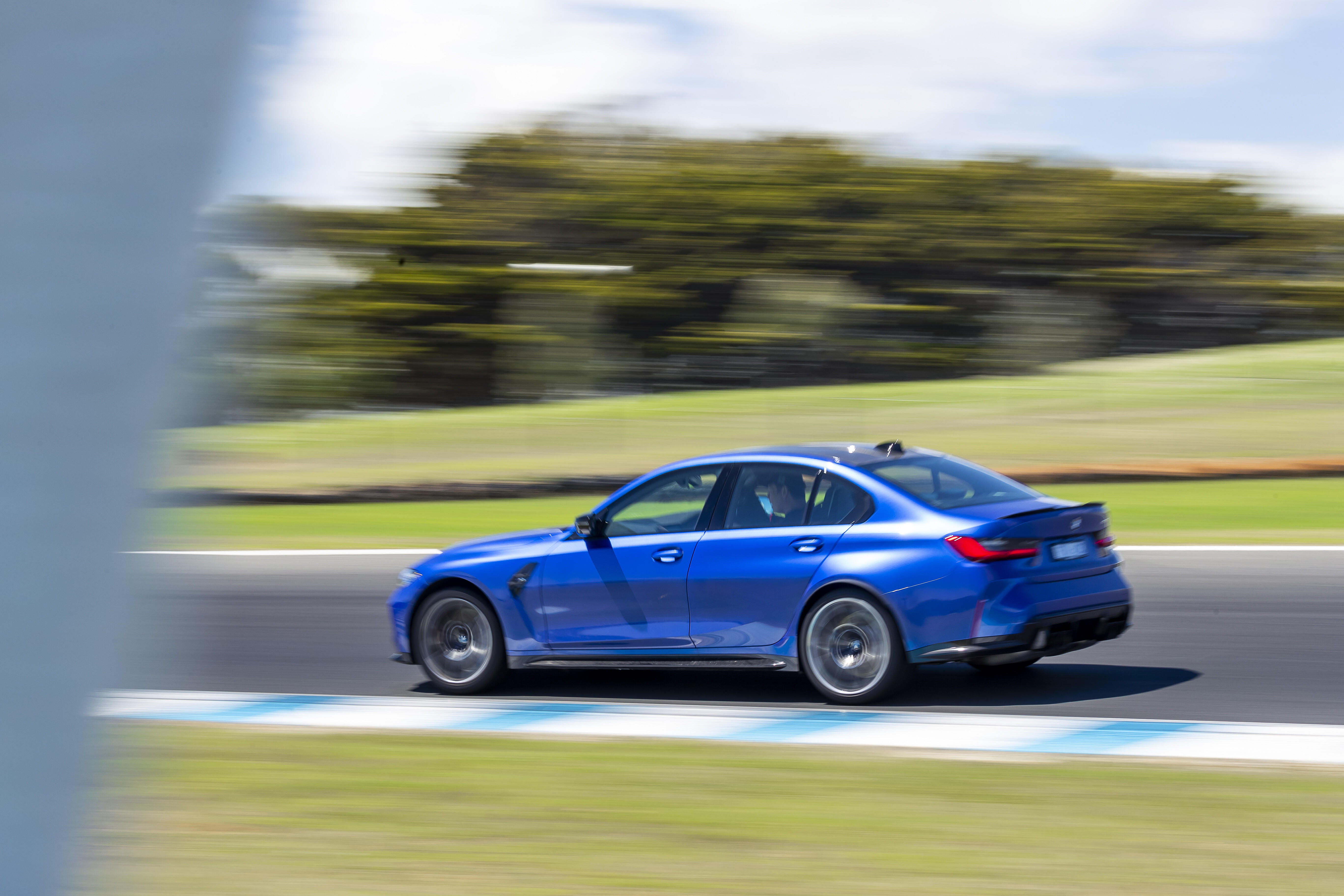
Note: regular M3 Competition pictured throughout.
Mercedes-Benz may be set to drop the ‘EQ’ prefix from its electric models in the coming year, if a report with German news source German daily Handelsblatt is to be believed.
Reported widely this week, including by business paper Reuters, the decision reportedly comes in response to a new perspective on what the badging represents in the current range – potentially stunting the proliferation of Benz’s EVs in the process.
“With the goal of our parent brand Mercedes-Benz becoming fully electric by the end of the decade, we will adapt the positioning of the vehicles and thus also the use of the brand in line with the times, but it is too early for details on this at the moment,” an EQ spokesperson told Handelsblatt.
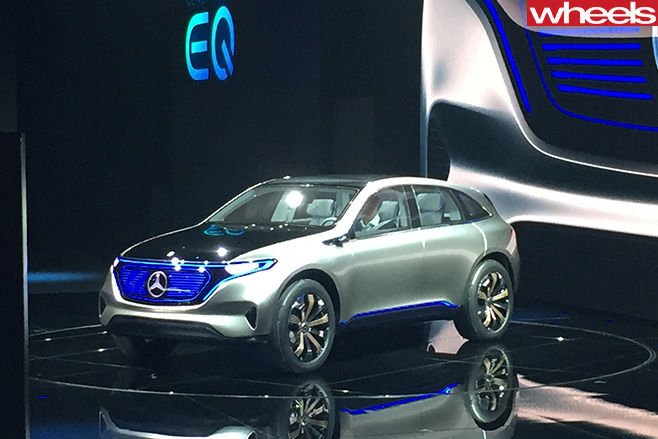
Previewed in 2016 and launched in 2017, the EQ brand is described as a twist on the familiar term ‘IQ’ (intelligence quotient), intended to mean ‘Electric Intelligence’ – although the initialism ‘EQ’ is already a partner concept to IQ, meaning emotional quotient, or ‘emotional intelligence’.
For Mercedes, the move to change model branding is far from a new concept. In 2016, the brand smartly reorganised all of its SUV models under the GL prefix (except for the iconic G-Class), using the third letter to signify its size – GLA for small, through to GLS for upper large.
The launch of the EQ brand – which really kicked off with the EQC in 2019 – saw Mercedes set its electric models apart under a new banner, with the electric version of the GLA known as the EQA, the electric GLB known as the EQB, and so on.
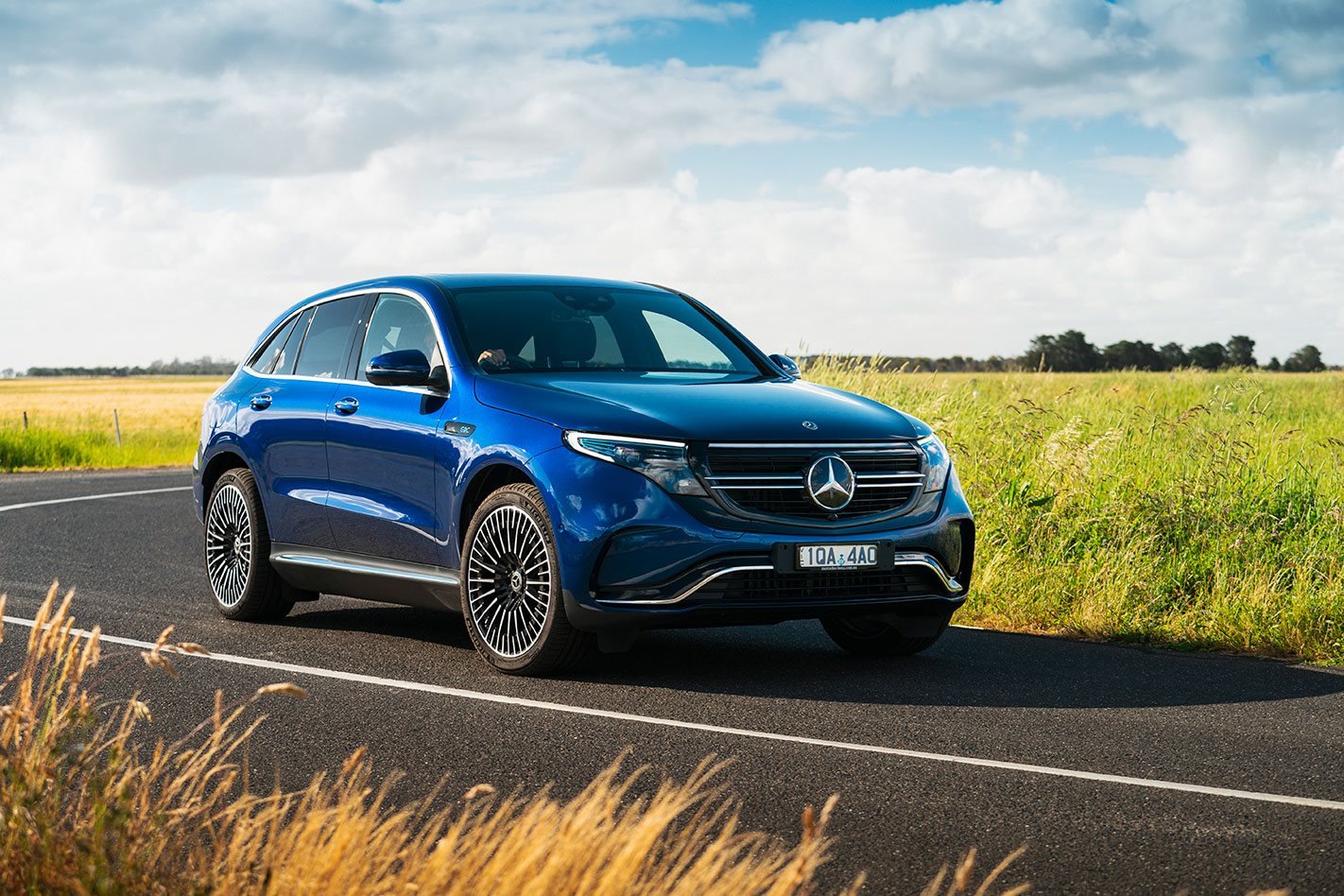
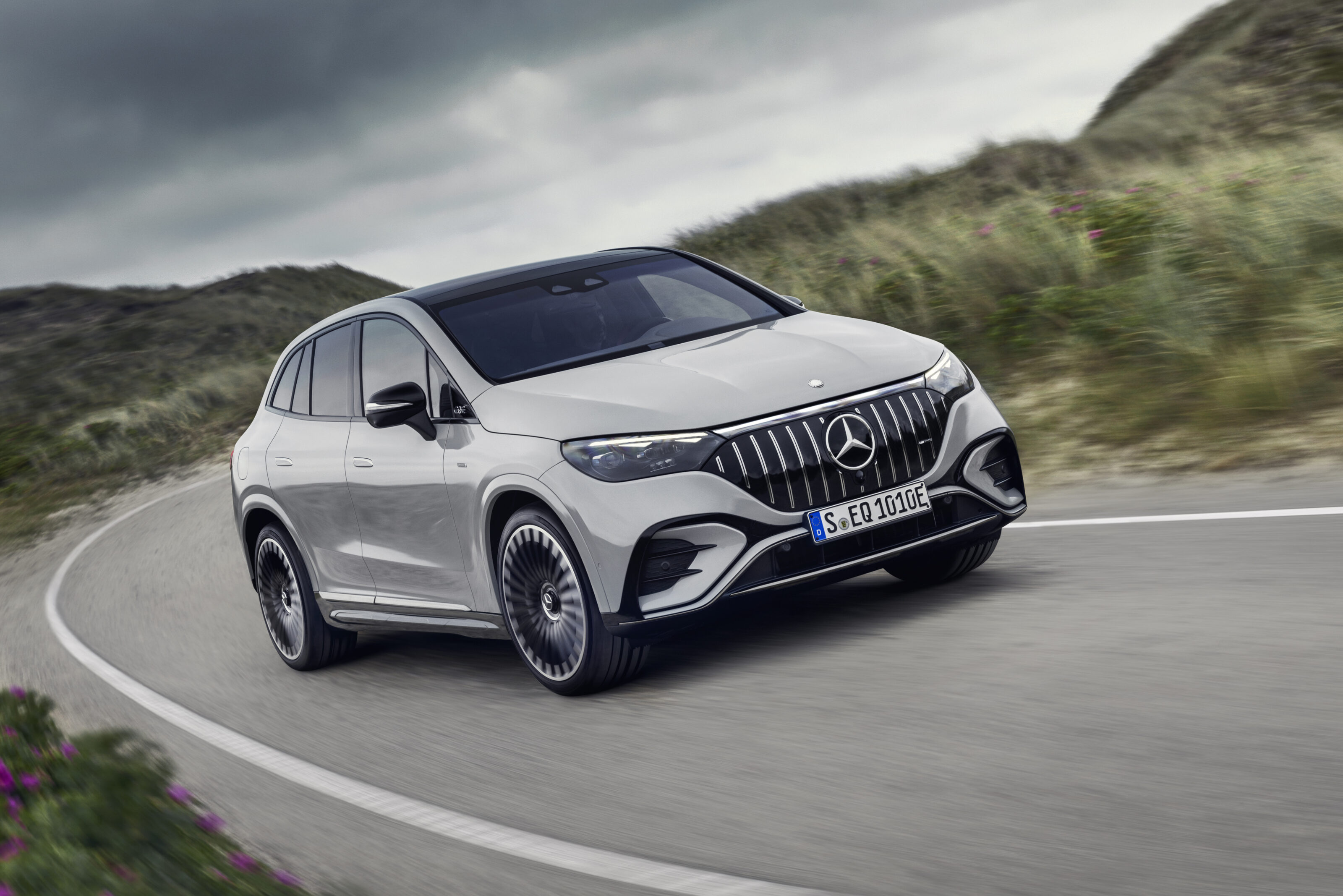
In addition to its regular line of models, the EQ family includes the EQA, EQB, EQC, EQE, EQE SUV, EQS, EQS SUV, and EQV, along with the upcoming EQG.
(Whether Mercedes anticipated needing to tack ‘SUV’ on the end of EQE and EQS to set them apart from their sedan companions is unclear, but it is arguably an inelegant solution.)
In some respects, Benz’s approach has been one of the simpler strategies for identifying electric models. BMW’s EV strategy has promoted a similar method, applying ‘i’ ahead of the model name for electric versions of its regular models, including the iX1 and iX3 SUVs and the new i4 sedan.
On the other hand, Volkswagen’s ID brand is entirely disconnected from its conventional models in both naming and design, and the car maker has yet to confirm how it will brand future electric versions of its regular models. Obvious options, of course, would be ID.Golf or Golf.ID.
Other Volkswagen Group stablemates have taken a similar approach, with Audi’s E-Tron and Skoda’s iV lines standing apart from their regular petrol/diesel/hybrid siblings with few common points in either design or branding. Skoda has, however, launched an Octavia iV plug-in hybrid, and Audi offers a three-row Q5 E-Tron in China – although it has nothing in common with the regular Q5 offered in the west.
Whether any of these brands will retire their EV-specific marques after their last traditional badge goes all-electric… remains to be seen.
Will there be a point to an electric-only Golf line-up wearing the ID badge?
Snapshot
- 2024 Mazda MX-30 R-EV plug-in hybrid revealed
- Rotary engine returns to a brand-new Mazda
- Features a 600-kilometre combined driving range; priced identically to the MX-30 EV in Germany
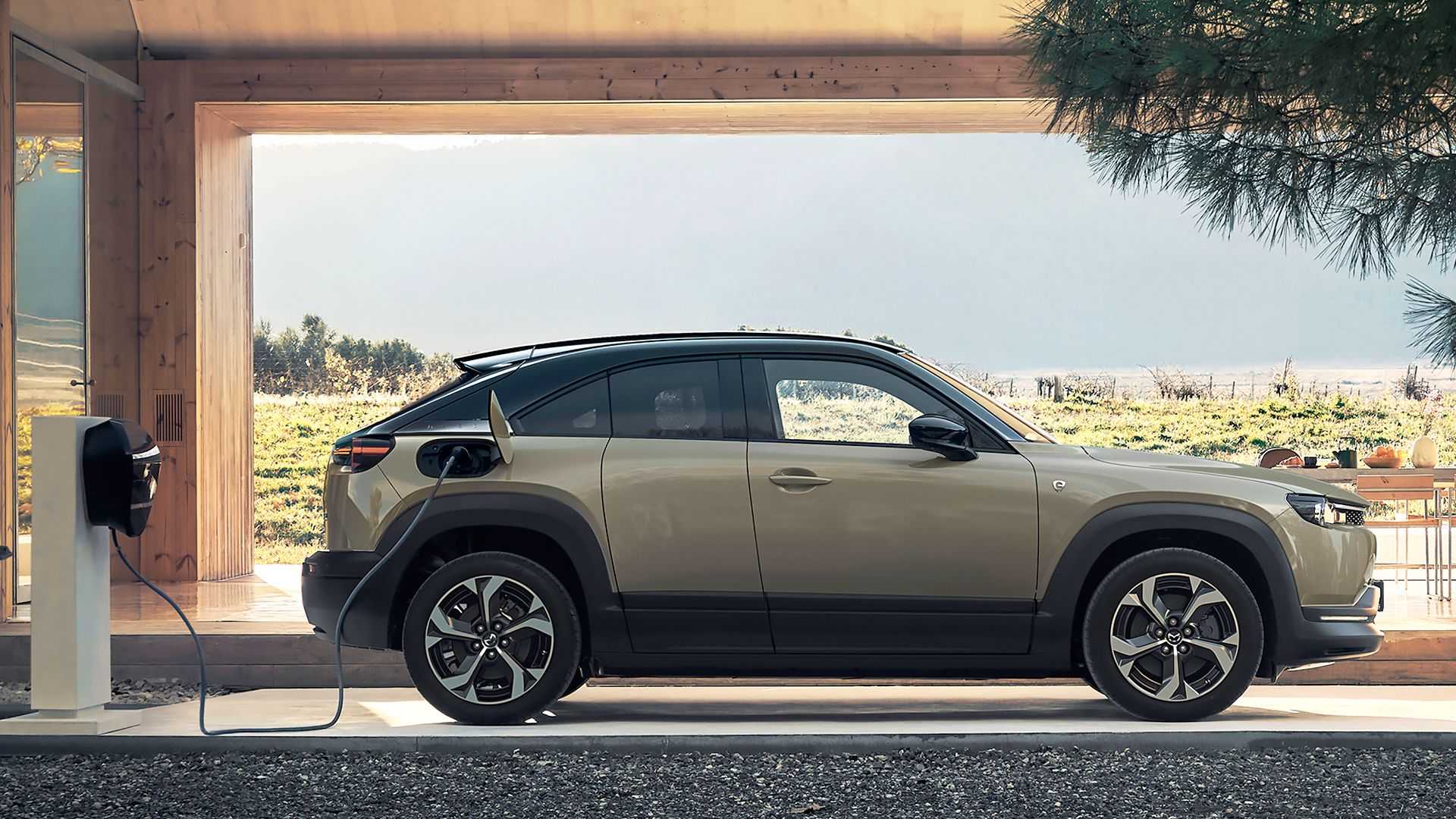
The 2023 Mazda MX-30 R-EV plug-in hybrid has debuted with a rotary engine – but it has yet to be locked in for Australia.
While it was suggested the internal-combustion engine would kick in as a range-extender once the all-electric MX-30’s battery is depleted, the MX-30 R-EV is closer to a plug-in hybrid vehicle.
It is headlined by the addition of Mazda’s newly-developed single-rotor engine, after the RX-8 sports car ended production in 2012.

The petrol mill has a 0.83-litre volume. It produces 55kW and 116Nm, with direct injection, a high compression ratio of 11:9:1 and an exhaust gas recirculation system to improve efficiency.
According to Mazda, the rotary engine has little vibration and a quiet operation to ensure the driving experience remains similar to the all-electric version.
To meet the strict Euro 6d-ISC-FCM emissions standard, there’s also a three-way catalytic converter and a petrol particle filter.
However, as with Nissan’s E-Power ‘series hybrid’ system, the wheels are always driven by the electric motor – rather than a conventional ‘parallel hybrid’ setup, which combines internal combustion and electric power.
The electric motor produces 125kW and 260Nm – up 18kW over the all-electric MX-30, but down 17Nm.
Under the skin, the MX-30 EV’s battery capacity is halved – from 35.5kWh to 17.8kWh – for a WLTP-rated 85-kilometre all-electric driving range, down between 120 and 144 kilometres over the battery-electric model.
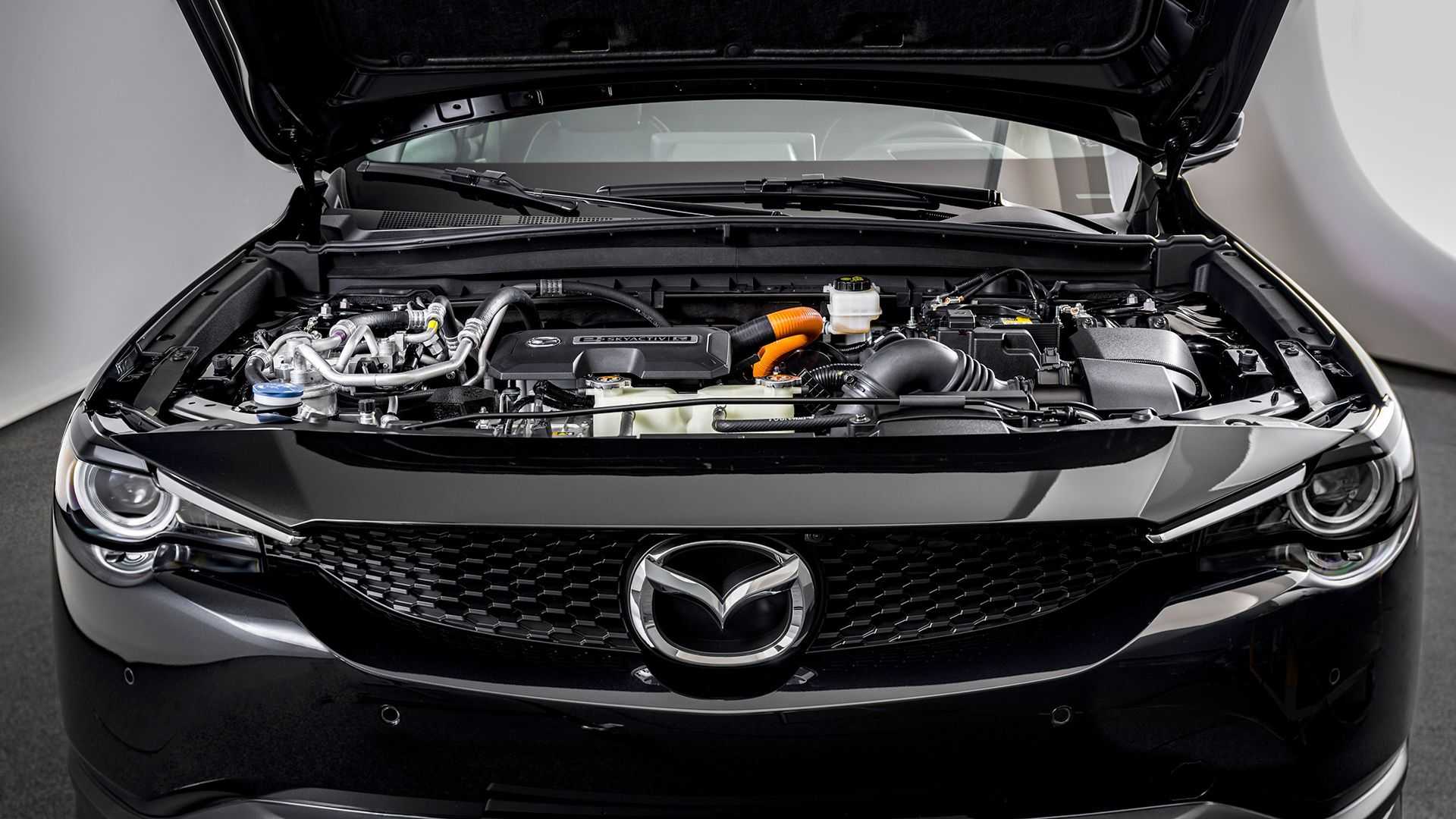
But with the addition of a 50-litre fuel tank for the rotary engine, the MX-30 R-EV’s combined driving range is said to exceed 600 kilometres – triple that of the MX-30 EV.
Mazda claims the plug-in hybrid model has a WLTP-rated combined fuel consumption of 1.0 litres and 21 grams of CO2 emissions per 100 kilometres, and a battery consumption of 17.5 kWh per 100 km.
The lithium-ion battery will take one hour and 40 minutes to charge using a three-phase AC charger on an 11kW wall box, or 25 minutes with a 36kW DC ‘fast’ charger – the maximum charge rate for the MX-30 R-EV.
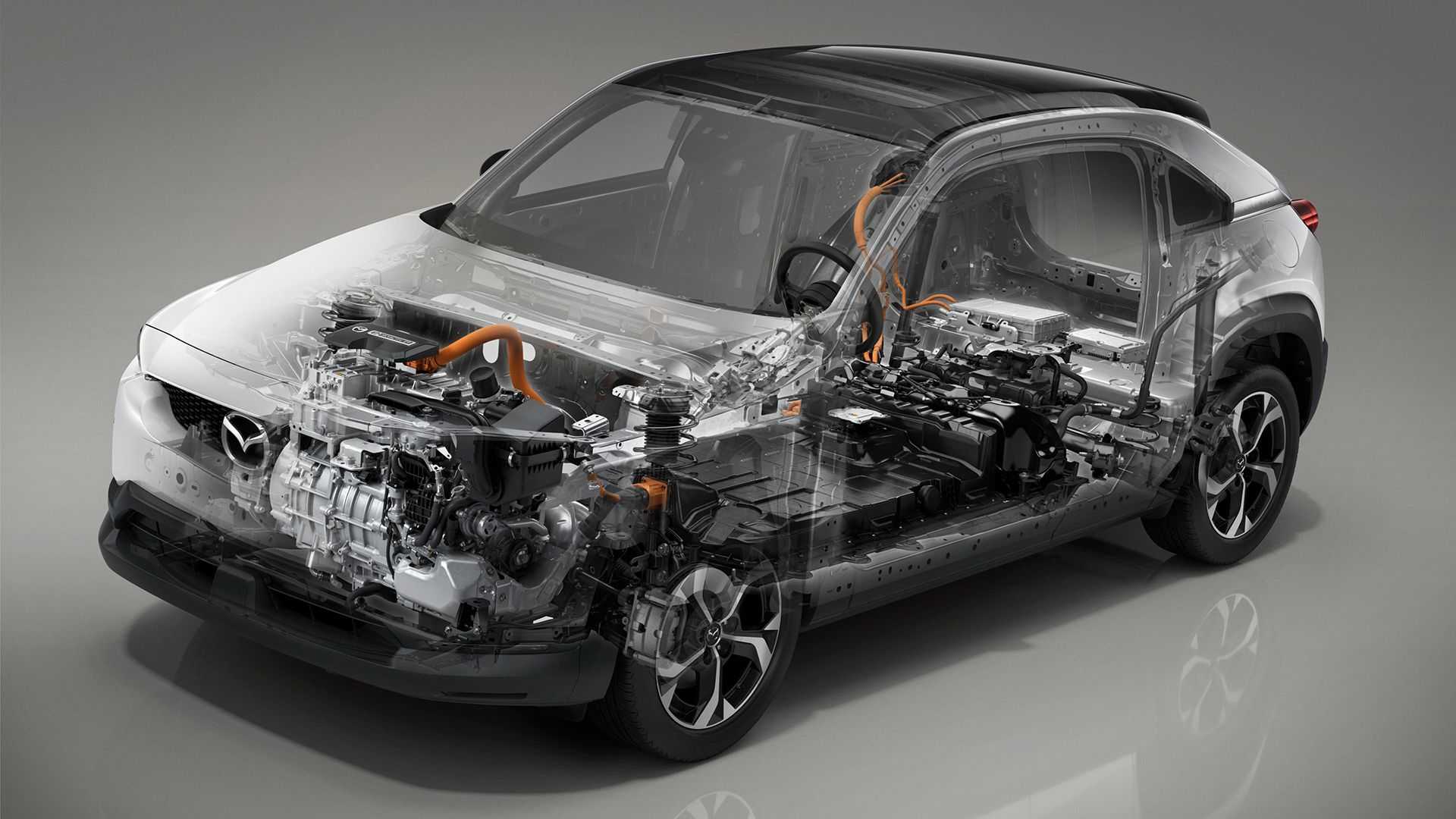
Three drive modes – EV, Normal and Charge – are available. As the name suggests, the vehicle will be exclusively powered by the electric motor in EV mode unit it reaches zero per cent, when the rotary engine will kick in.
In standard mode, the MX-30 will utilise electric power until the vehicle reaches 40 per cent, when the rotary engine will switch on to recharge the battery.
As for the charging mode, it prioritises the rotary engine to ensure the battery can reach a set charge threshold while driving.
In all drive modes, the MX-30 R-EV is limited to 140 kilometres, while the 0-100km/h sprint is said to take 9.1 seconds.

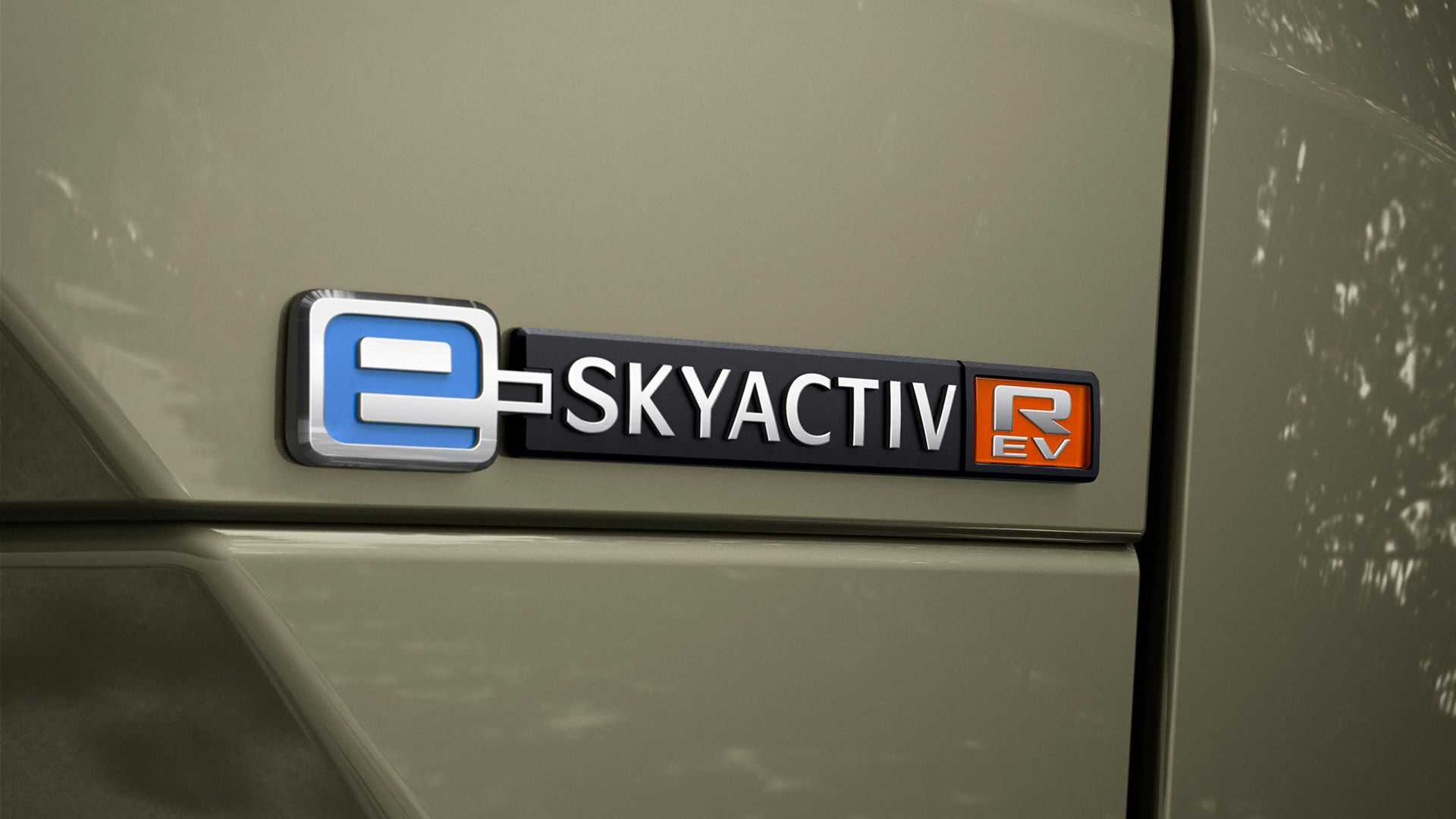
While it looks mostly identical to the electric and mild-hybrid MX-30, there’s a unique rotor badge on the front guards, and an ‘e-Skyactiv R-EV’ badge on the tailgate.
It also previews several model-year 2023 changes first seen in Japan, including; the zircon sand colour, revised 18-inch alloy wheels, and a ‘smoother’ gear lever with the shift button now placed on the front.
Is the Mazda MX-30 R-EV coming to Australia?
While Mazda Australia has yet to officially confirm if the MX-30 plug-in hybrid will reach local shores, it could be sold here in limited numbers – similar to the all-electric version.
“MX-30 range extender is coming out… and we’re still in line for that car,” said Mazda Australia’s marketing director, Alastair Doak, last year.
“It’s a unique proposition around the world. There’s some interesting thinking behind that car that can be used in other applications down the track.”
How much does the Mazda MX-30 R-EV cost?
In Germany, the 2023 Mazda MX-30 R-EV plug-in hybrid is priced identically to the all-electric variant at €35,990 (AU$56,000), with five grades available.
If it reaches local shores, identical pricing to the MX-30 EV in Europe suggests it could have a circa-$65,000 price tag in Australia – in line with the all-electric MX-30 sold here from $65,490 before on-road costs.
UPDATE, January 13, 2023: Subaru WRX Sportswagon STI Sport, Impreza STI Parts prototype revealed; not for Australia
Subaru has uncovered a host of new concepts at this year’s Tokyo Auto Salon, including a limited-edition Levorg STI Sport # and a next-generation Impreza prototype with STI-developed parts.
“It’s incredibly exciting to see the vehicles Subaru Corporation have revealed at the 2023 Tokyo Auto Salon. Whilst there are no current plans for these models to come to Australia, we are always interested in what’s available for our market,” said a spokesperson for Subaru Australia.
Our earlier story, below, has been updated with photos from the show and additional information.
Subaru has stormed into the upcoming 2023 Tokyo Auto Salon with a host of new concepts.
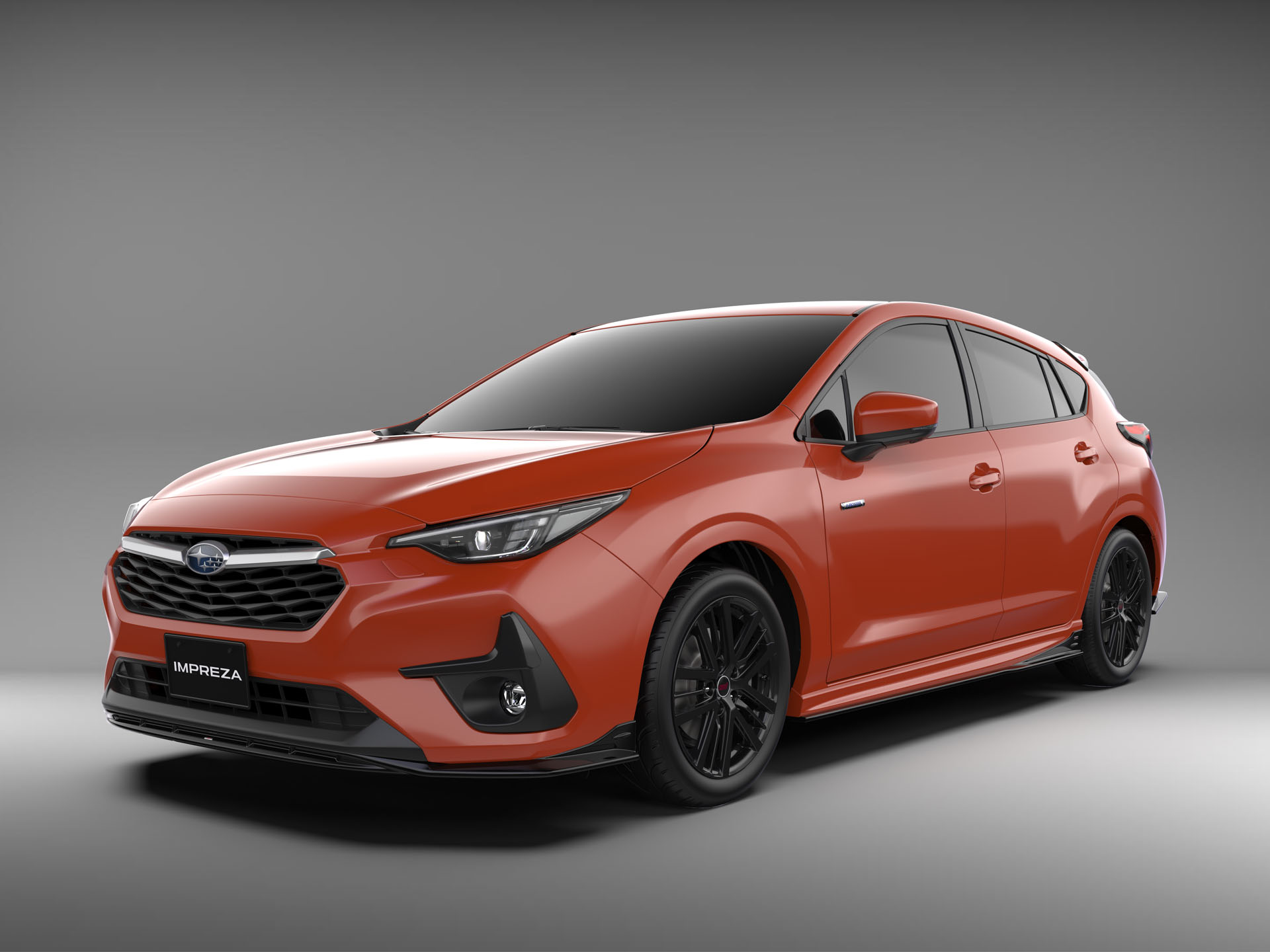
Its exhibition was headlined by a new-generation Impreza prototype fitted with STI Parts, a tuned Levorg STI Sport # (known in Australia as WRX Sportswagon), and the Crosstrek Boost Gear concept.
The sportier WRX wagon (pictured below) is based on the production Japanese-market Levorg STI Sport R EX, which is similar to the range-topping WRX tS sold in Australia.
It has received several modifications – including an improved ride and handling tune, 19-inch forged BBS alloy wheels, Recaro front seats, and suede upholstery.
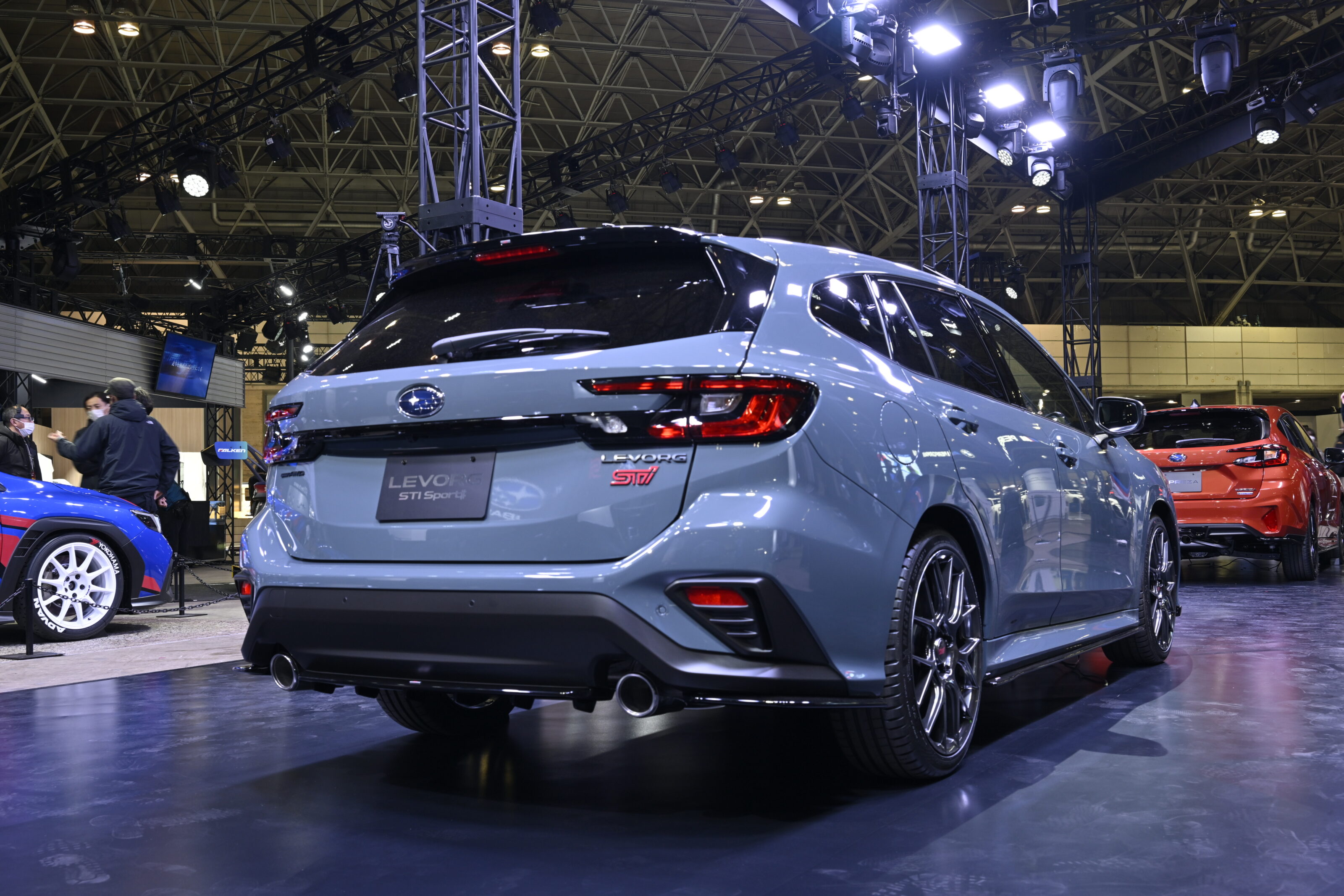
It will be limited to 500 units for Japan.
Meanwhile, the event saw the Japanese (and right-hand drive) debut of the sixth-generation Impreza hatch first revealed at the Los Angeles Auto Show in November 2022.
A prototype version of the Impreza is fitted with STI parts “under development and customised to sportier specifications”.
However, there are no changes under the bonnet, with the outgoing 2.0-litre petrol joined by a hybrid option.
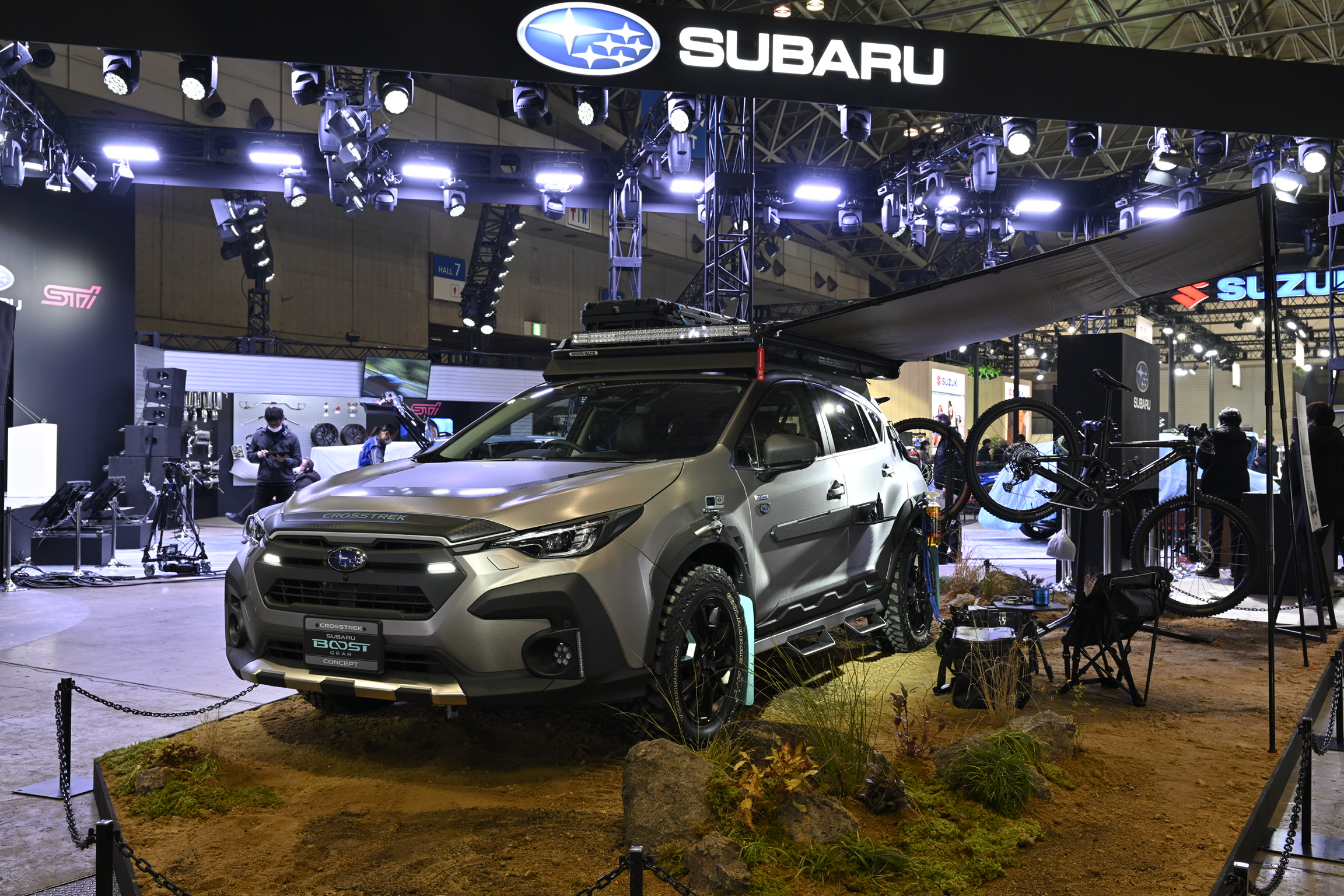
It is based on the next-generation Crosstrek small SUV, which is also received a customised prototype at the event.
Subaru claims the Crosstrek Boost Gear Concept is “studded with tricks that arouse the adventurous spirit of an active life”, with it installed with a host of optional equipment available in Japan.
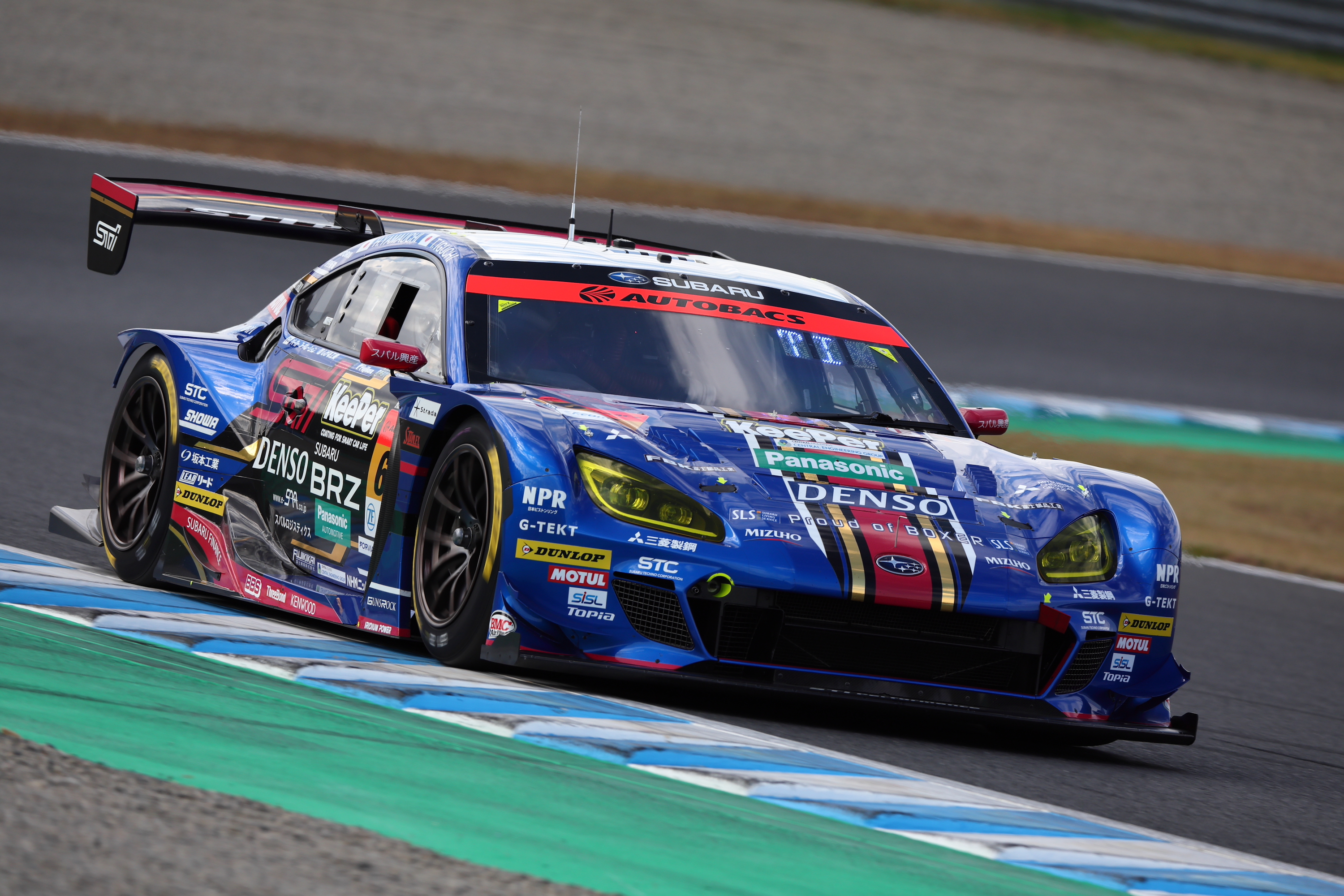
The third-generation Subaru Crosstrek – replacing the XV nameplate – will launch in Australia in early 2023, while the Impreza hatch is expected around mid-year.
Subaru’s new Rex light SUV – a Japan-only twin to the Toyota Raize and Daihatsu Rocky – also received an off-road-focused concept, while the brand showcased three racers: the BRZ GT300 from the 2022 season, and the WRX NBR Challenge and WRX Rally Challenge for the upcoming 2023 championships.
It joins debuts from other brands, including Honda, at the 2023 Tokyo Auto Salon, held between January 13 and 15.
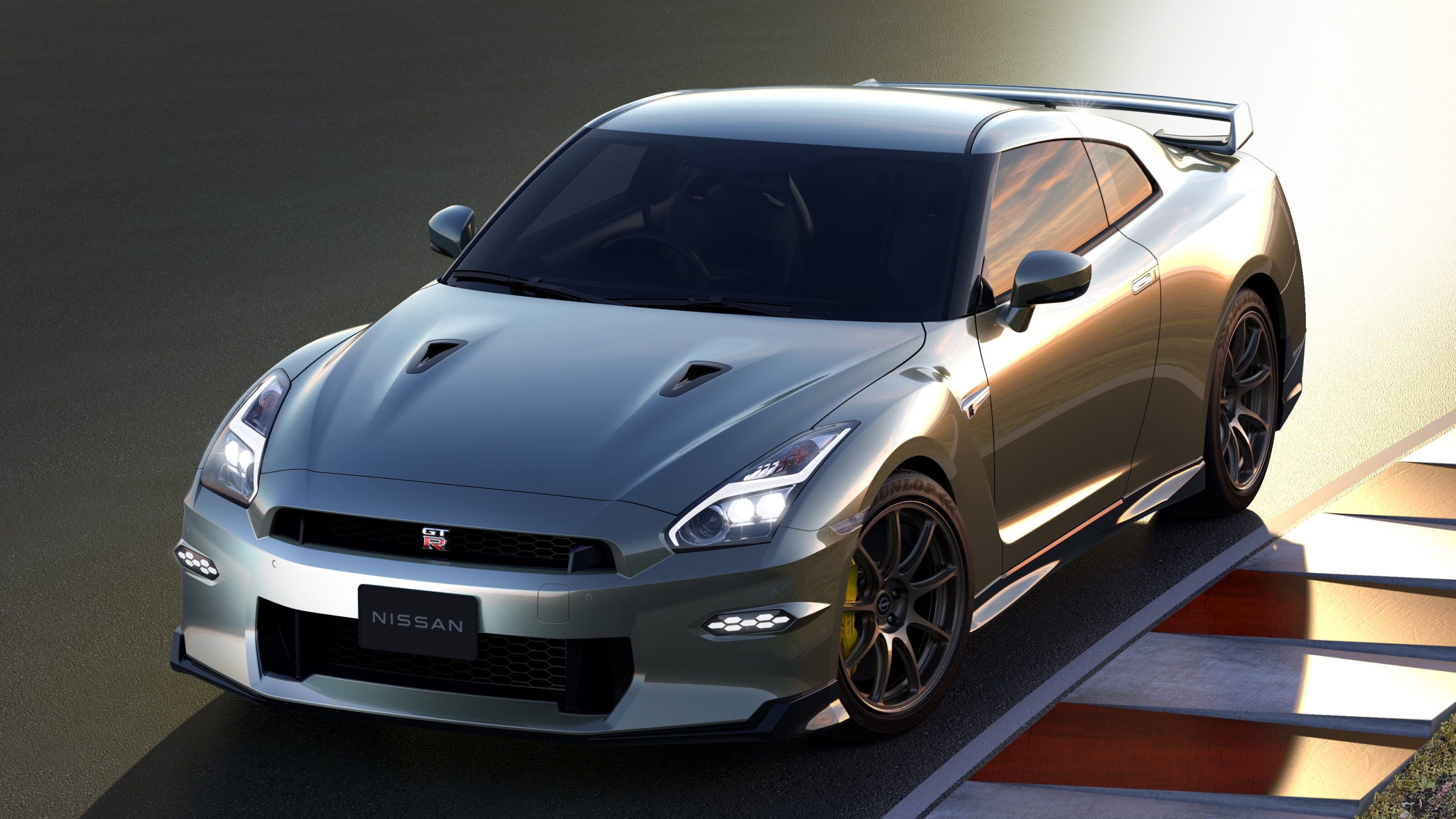
Nissan has unveiled its enduring GT-R‘s MY2024 update at Tokyo Auto Salon today, ahead of a new generation expected to debut in the coming few years.
The timing suggests this latest update is likely the last significant change for the ageing 16-year old supercar.

Sadly, with the Australian Design Regulation governing body’s stricter side impact regulations (ADR 85) coming into effect in November 2021, the GT-R is no longer able to be sold by Nissan without costly re-homologation; which is simply unfeasible at a global production level for our humble island market.
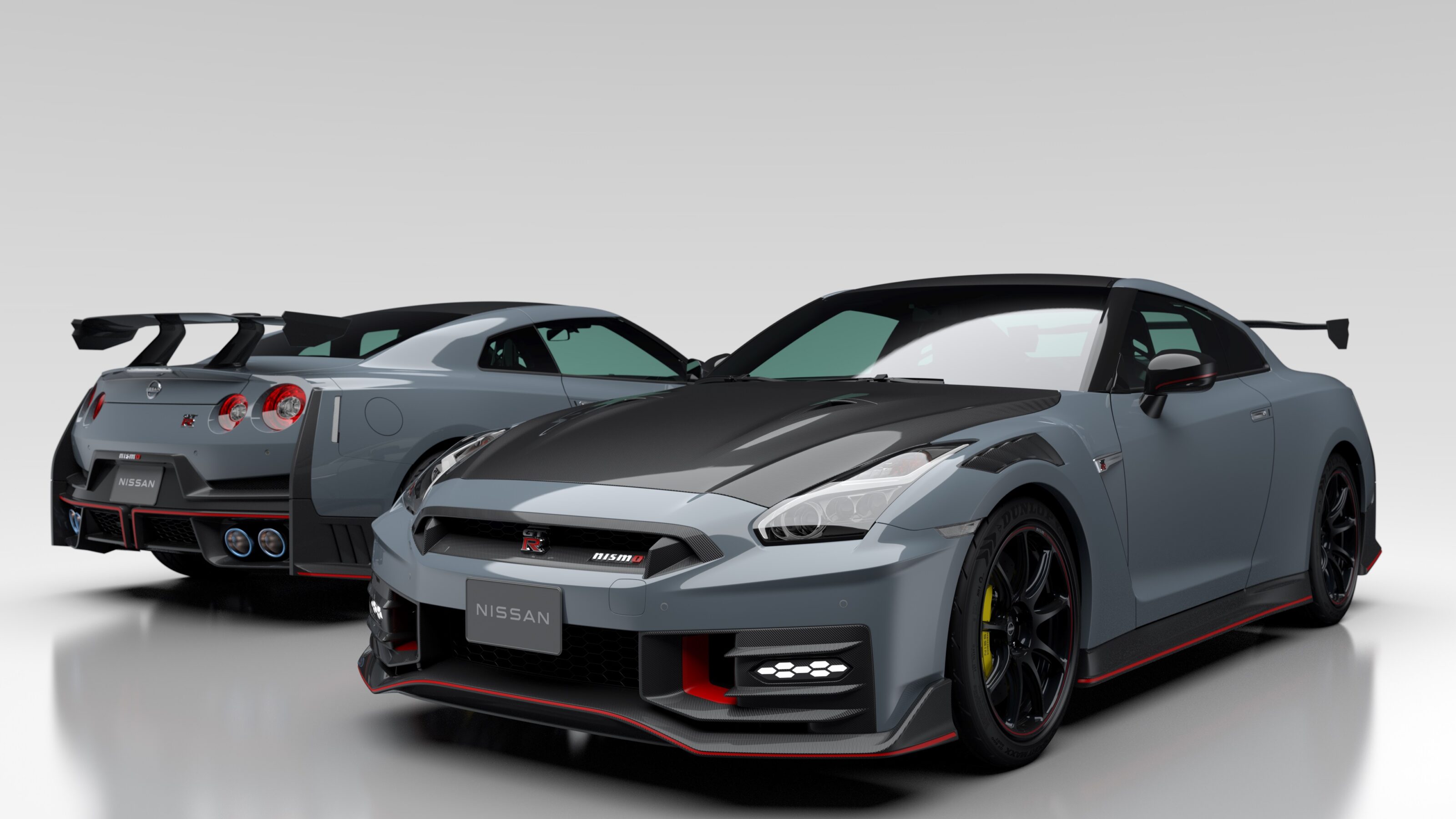
Nevertheless, this year’s GT-R is much like last year’s, with Nissan debuting a Millenium Jade T-Spec, showing off a new split-grille front end plus a new rear bumper and spoiler, all of which Nissan say provide greater downforce and thermo-efficiency.
The Nismo variant unveiled at TAS wears the same Stealth Grey colour that debuted with last year’s facelift, but shows off even more aggressive aero with more exposed carbon-fibre acreage, including front and rear bumpers, side skirts and a swan-neck rear.
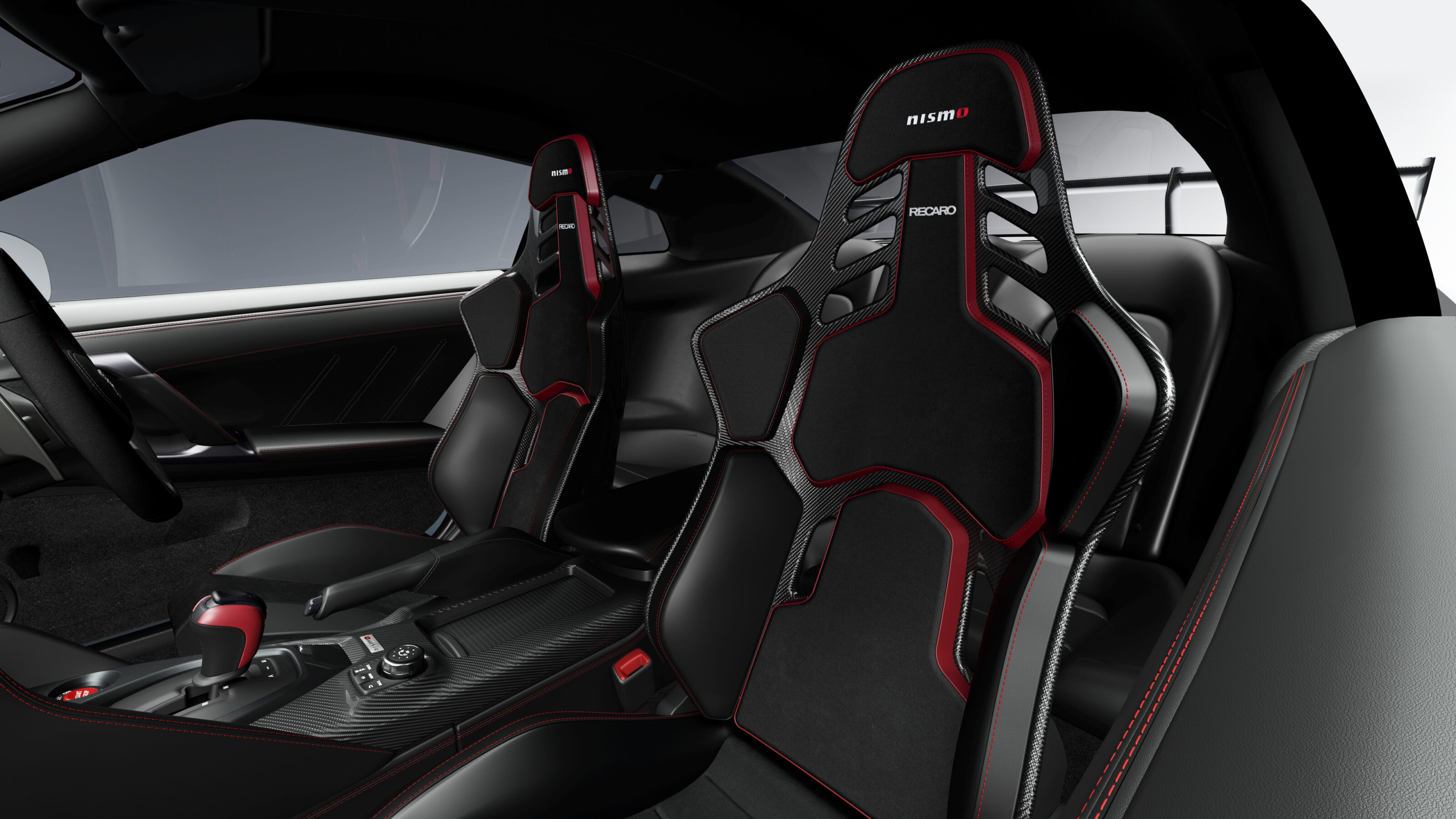
Inside the Nismo GT-R’s cabin, Nismo’s hallmark lashings of red have been markedly toned down, naturally drawing the eye to those new, imposing Recaro carbon-backed recliners.
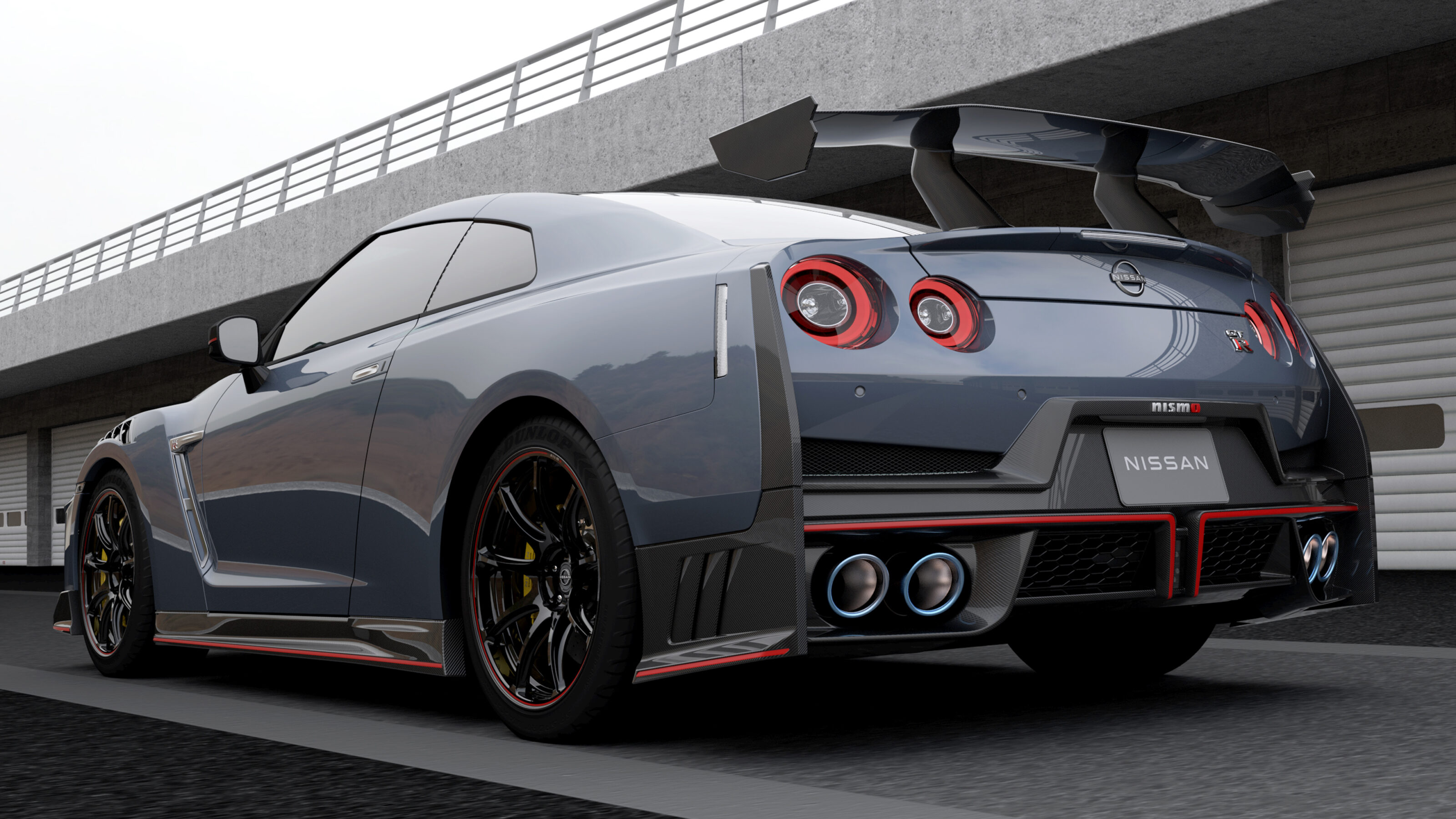
A redesigned, quieter exhaust system has been fitted to comply with new Japanese regulations, as well as a new front differential.
Apart from those small developments, however, aesthetic and aero adjustments represent the crux of this incremental update, with no power output changes reflected between the standard variants’ 419kW/632Nm, or the Nismo’s 441kW/652Nm outputs.
In Nissan’s domestic market of Japan, the MY2024 Nissan GT-R range comprises eight different variants; including two Nismo variants and the premium T-Spec – which gains a distinct suspension tune, carbon ceramic brakes along with various bespoke accents.
When will we see the next-gen GT-R?
A new iteration of GT-R is coming, but details remain a tightly-held secret.
Previous intel suggests the major stepchange in the GT-R lineage is expected to be based on the bones of the existing R35, albeit heavily redesigned and augmented by hybrid technology.
Nissan globally has offered no official word, but previous rumours and timelines suggest that this vehicle could be revealed in 2024 or 2025.
June 3, 2023: Long-wheelbase revealed, Australian arm keen
STORY CONTINUES
“The ID.Buzz GTX will be a cool high-performance version, with 250kW…”
Snapshot
- ID.Buzz GTX will have 250kW, AWD and design tweaks
- ID.Buzz LWB has 250mm longer wheelbase and configurable seven-seats
- Electric people mover and commercial van on the wishlist for Australia
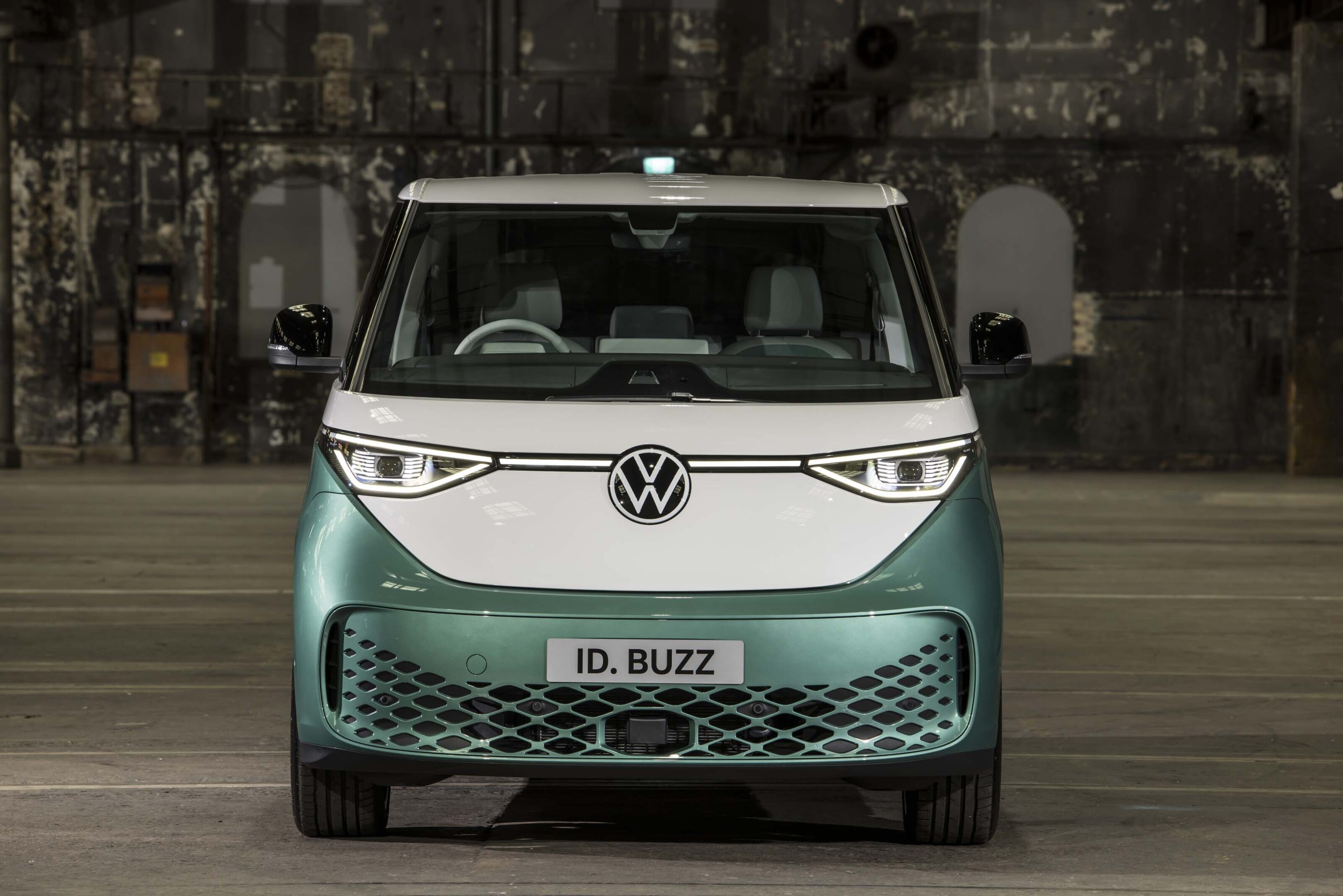
Volkswagen’s research and development boss Kai Grünitz has teased more details of its upcoming hotted-up ID.Buzz GTX electric van.
“The GTX will be a cool high-performance version, with 250kW, a dedicated interior, new exterior colours and some additional features,” Grünitz told Autocar.
The sportier version of the iconic ID.Buzz battery-electric vehicle will adopt a dual-motor, all-wheel drive setup for the first time, shared with models such as the ID.7 sedan and wagon and likely every other forthcoming ID. GTX model.
It doesn’t seem to be the same drivetrain as the higher-performance Volkswagen ID.4 and ID.5 GTX SUVs currently sold in Europe, though.
It makes 220kW of power from its dual electric motors, instead. Combined with 460Nm of torque, it results in a 0-100km/h acceleration time in 6.2 seconds for the ID.4 or 6.3 seconds for the ID.5 coupe SUV. Both models boast 480 kilometres of claimed range from its 77kWh usable battery pack.
Cosmetically, ID.4 and ID.5 GTX variants gain slightly more aggressive front- and rear bumpers, different alloy wheel designs, red contrast interior stitching, and the option for a dark blue dashboard.
Grünitz adds the German automaker is also considering adding a standard all-wheel drive (AWD) ID.Buzz variant to sit underneath the GTX, like the ID.4 and ID.5 4Motion overseas. Volkswagen Australia has admitted demand would be particularly strong for AWD if it came here.
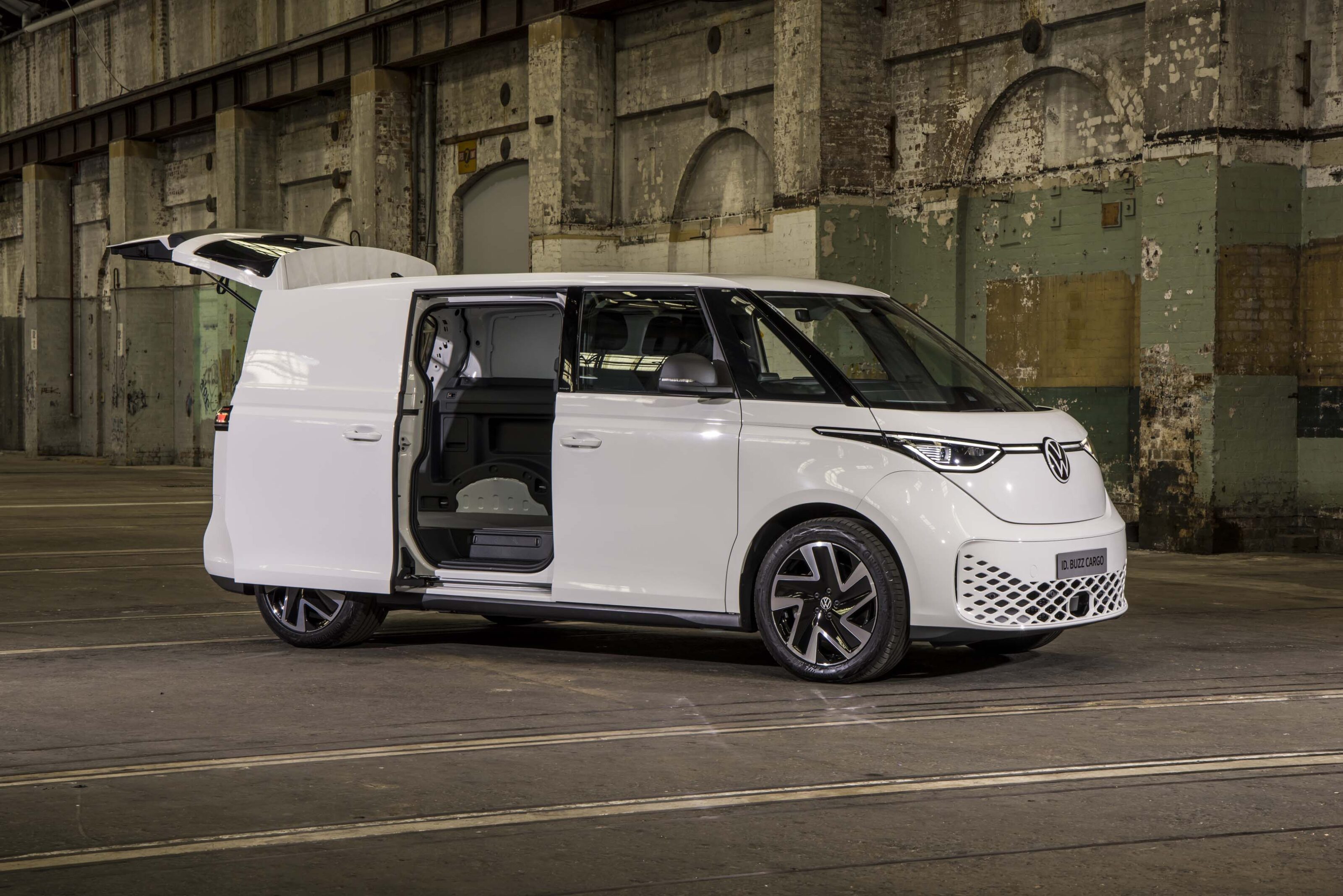
The Volkswagen ID.Buzz five-seater and ID.Buzz Cargo commercial EV vans are on the wishlist for Australia, with 2024 looking to be a likely launch time if it’s confirmed.
Standard ID.Buzz variants use a single rear-driven electric motor producing 150kW and 310Nm, with a 77kWh usable battery providing up to 423 kilometres of claimed driving range on the WLTP cycle.
Seven-seat ID.Buzz more details
Grünitz also shed more light on the seven-seater, long wheelbase (LWB) version of the ID.Buzz electric people mover.
It’s expected to debut sometime between June to August this year, featuring a 250mm longer wheelbase to house three rows of seats.
Some can be removed completely and middle-row captain’s chairs can be turned around to face the opposite direction.
According to Autocar, the iconic California variant will join the ID.Buzz line-up in 2025.
“There will be a camper version. The first concept is being worked on now. It’s interesting what’s possible and what would be cool and usable,” Grünitz said.
UPDATE, January 2023: New Qashqai driven in Australia!
After pricing was announced early in 2022, the new-gen 2023 Nissan Qashqai is finally in Australia – and we’ve driven it! Get our full story at the link below.
The story to here: 2023 Qashqai price and features
Snapshot
- 1.3-litre turbocharged engine replaces atmo 2.0-litre
- Four variants available from launch
- Pricing to range from $33,890 to $47,390 before on-road costs
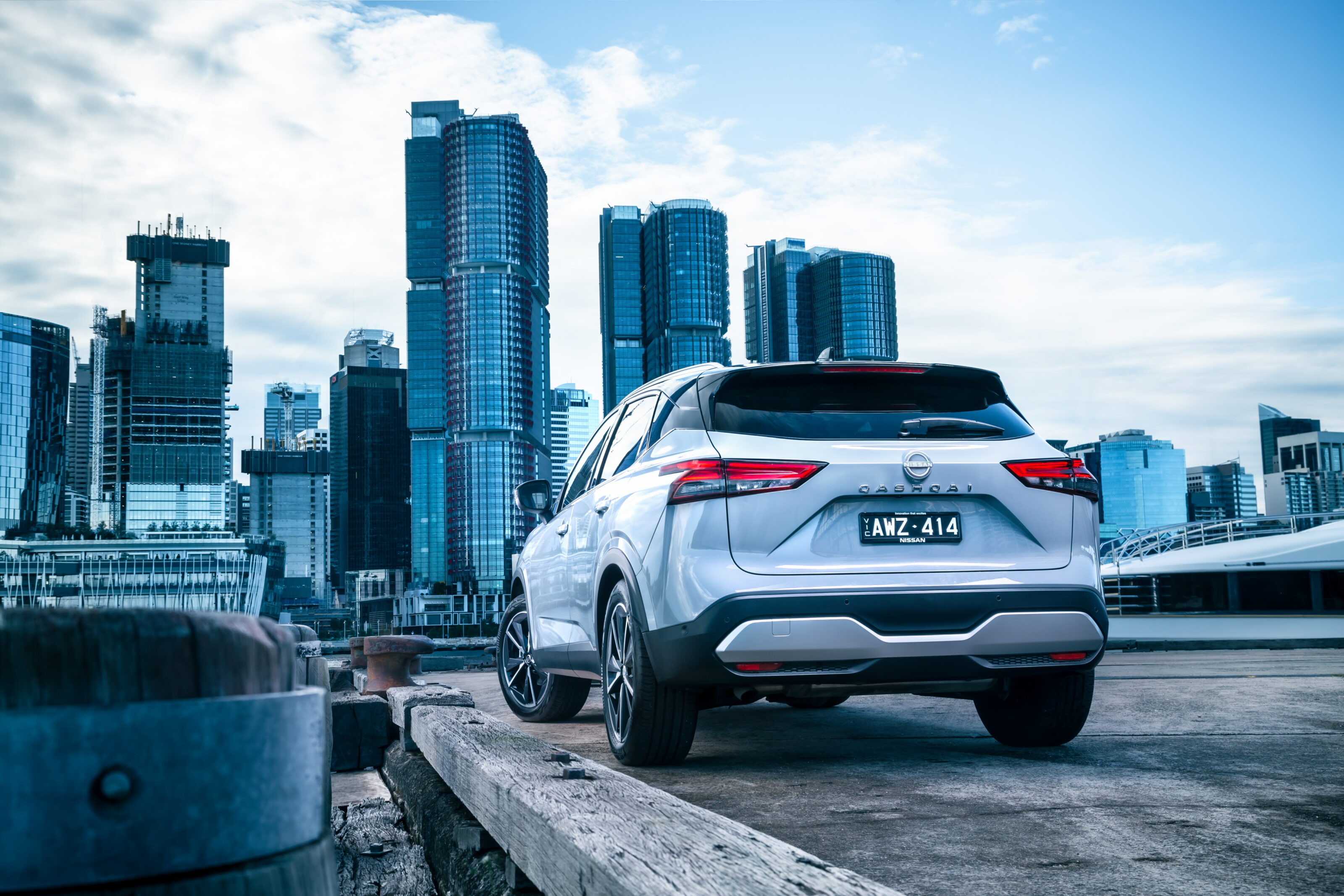
The third-generation 2023 Nissan Qashqai has launched with four variants. Having originally slated a Q1 2022 arrival for the new Qashqai, Nissan‘s shipment of Qashqais was delayed until January ’23, with the first examples in driveways now.
Initially arriving with just one powertrain available in the form of a new 1.3-litre turbocharged petrol, it’s tipped Nissan’s Qashqai e-Power hybrid cwill follow later this year.
Having already launched overseas, the new-generation Qashqai rides on the Nissan/Renault CMF-C platform, now featuring multi-link suspension to refine its ride.
Pricing
As expected for the upcoming model, pricing is up over its predecessor, with the new-generation Qashqai starting out at a $3300 premium over the entry-level outgoing offering, while the top-spec Ti has now jumped up by $8300.
Prices exclude on-road costs.
| Variant | Price |
|---|---|
| Qashqai ST | $33,890 (+$3300) |
| Qashqai ST+ | $37,890 (+$5300) |
| Qashqai ST-L | $42,190 (+$7590) |
| Qashqai Ti | $47,390 (+$8300) |
| Two-tone roof | $500 |
Features
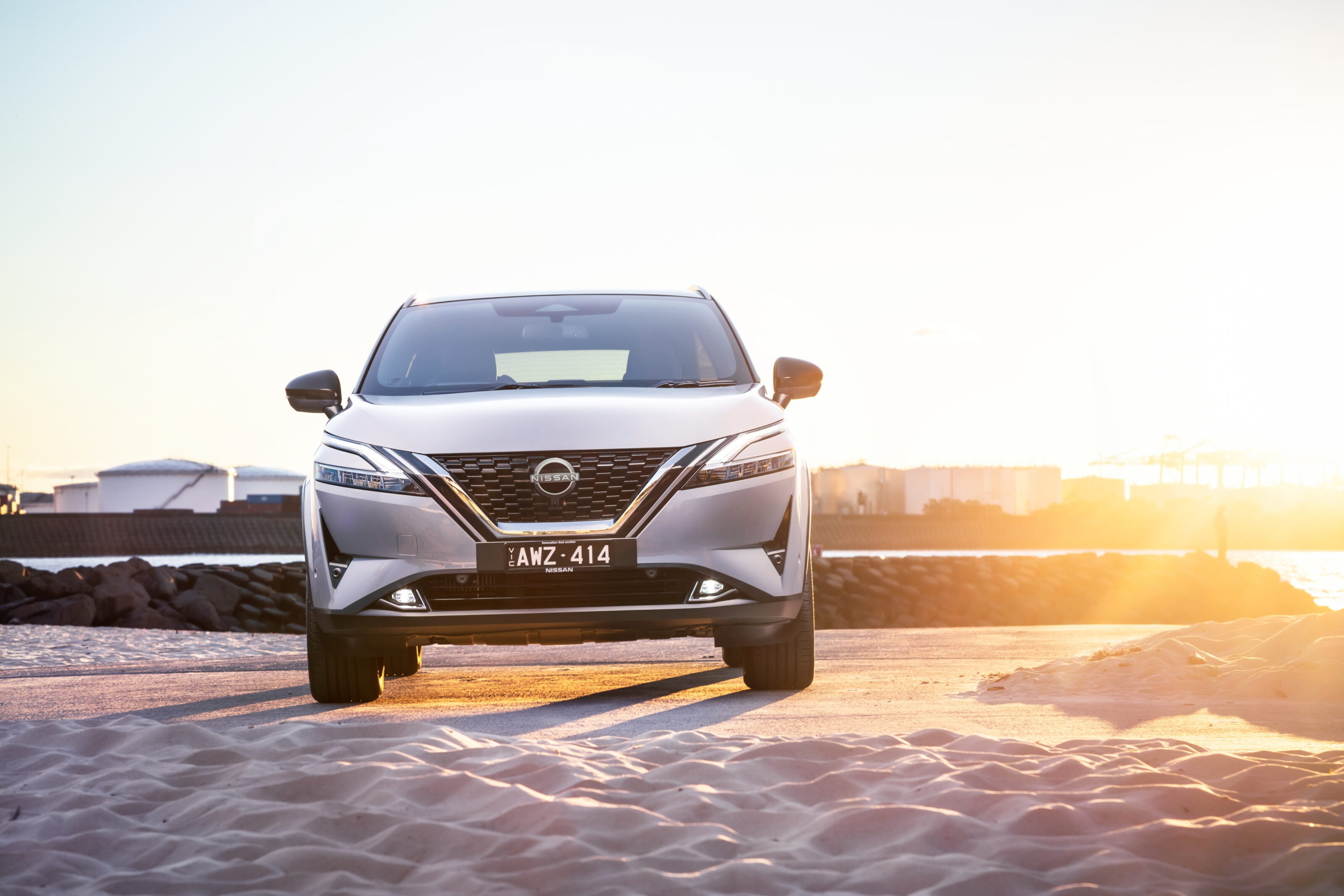
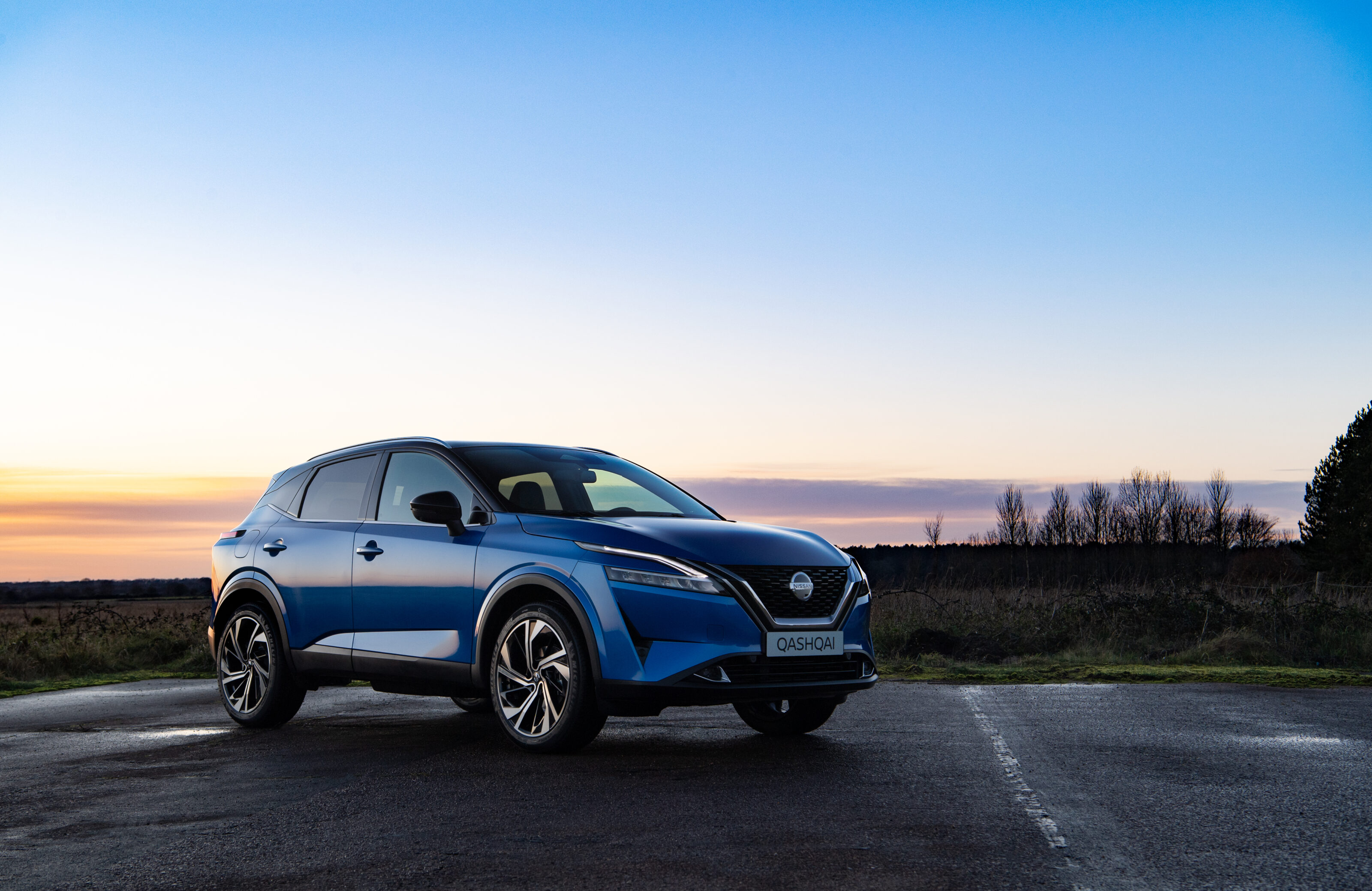
Nissan has said the new Qashqai will be available in five colours: magnetic blue, Fuji Sunset red, Ceramic grey, Ivory pearl and Super black. A contrast roof will be available for an extra $500.
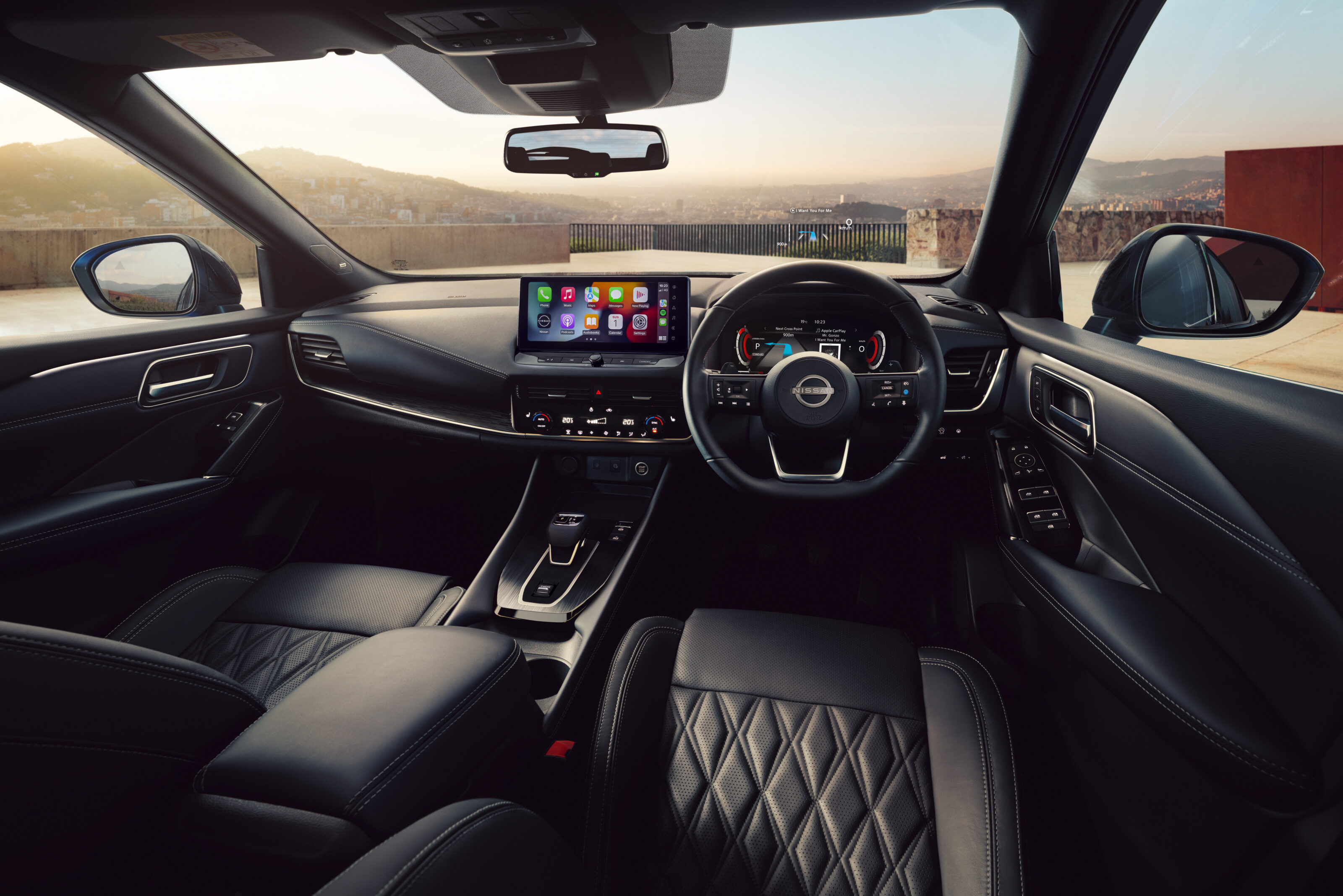
It’s also worth noting that while the new Qashqai has Apple Carplay and Android Auto, only Carplay is wireless. Android Auto remains a wired-only feature in current new Nissan models.
Qashqai ST
The ST serves as the entry-level variant in the Qashqai range, including features such as:
| 17-inch alloy wheels |
| Rear spoiler |
| LED automatic headlights and daytime running lights |
| 7-inch TFT instrument cluster |
| 8-inch touchscreen with Apple CarPlay and Android Auto |
| Six-speaker audio system |
| Twin-USB ports |
| Rear passenger air vents |
| Intelligent cruise control |
Qashqai ST+
Building on the base ST, the ST+ gains:
| 18-inch alloy wheels |
| LED fog lights |
| Auto wipers |
| 12.3-inch touchscreen with wireless Apple CarPlay and navigation |
Qashqai ST-L
On top of the ST+, the ST-L gets:
| 19-inch alloy wheels |
| Adaptive driving beam headlights |
| Privacy glass |
| Roof rails |
| LED indicators |
| Auto-dimming rear view mirror |
| Heated front seats, eight-way adjustable driver’s seat |
| Heated steering wheel |
| Wireless phone charging |
| Dual-zone climate control |
Qashqai Ti
Finally, the range-topping Ti features the highest spec of equipment, including:
| Panoramic glass roof and electric sunshade |
| Unique rear bumper finish |
| Black headliner |
| Ambient interior lighting |
| Luggage boards |
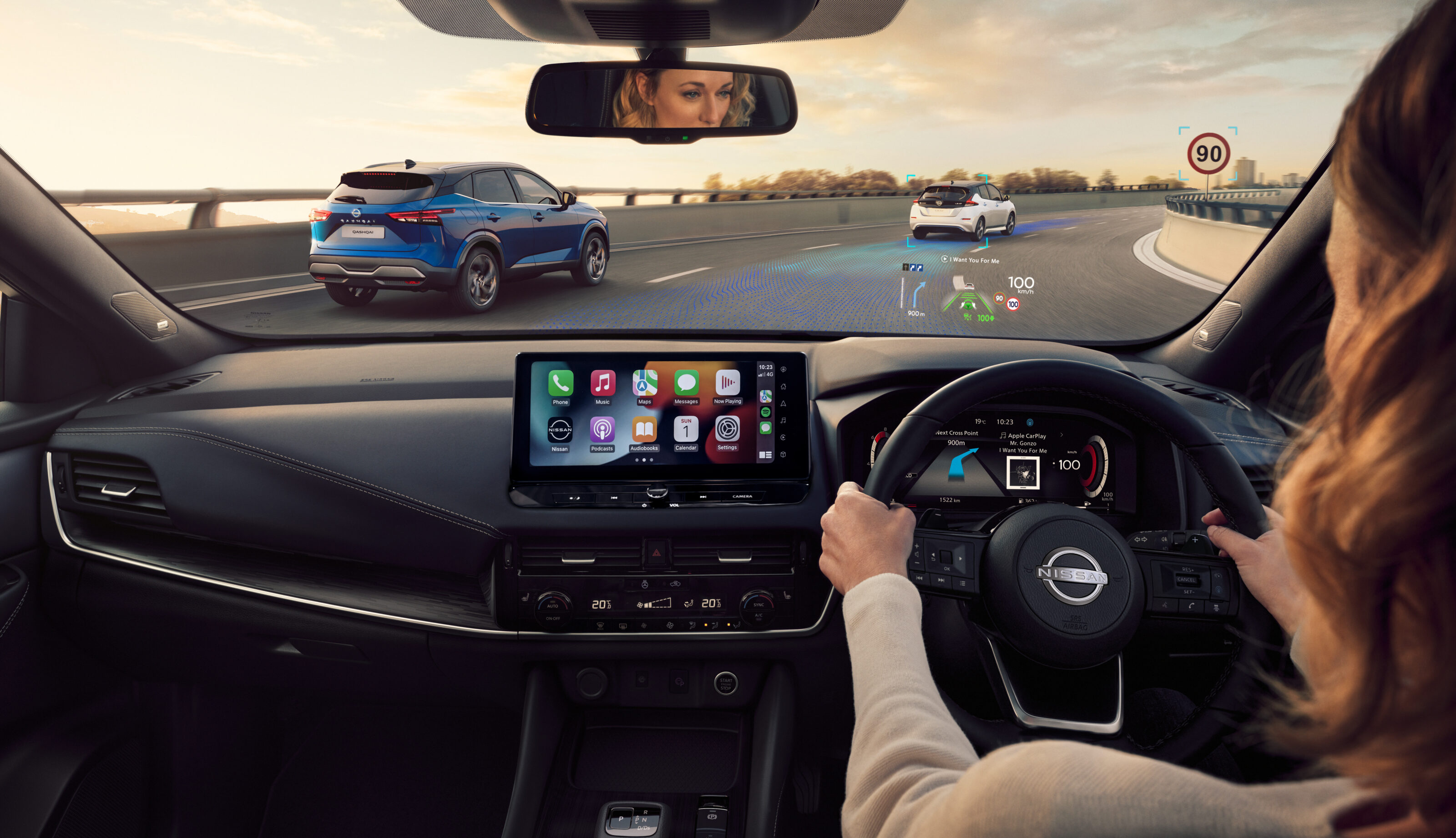
| 10.8-inch colour head-up display with integrated navigation and infotainment |
| 12.3-inch TFT digital dash |
| 10-speaker BOSE audio system |
| 3D quilted leather seats with memory and massage functions for the first row |
| Motion activated tailgate |
Engine, drivetrain and fuel economy
The new Qashqai features a fresh engine with the 1.3-litre, turbocharged four-cylinder petrol replacing the existing 2.0-litre, naturally-aspirated four-cylinder unit.
Power and torque figures are up to 110kW and 250Nm – an increase of 3kW and 50Nm respectively over the outgoing model – while fuel consumption is down, now at a combined 6.1L/100km compared to the previous 6.8L/100km.
The better fuel economy can also be attributed to the Qashqai’s new CVT gearbox, providing a 14 per cent ratio coverage improvement and a 29 per cent friction reduction over the old transmission.
Towing capacity has also been enhanced, now up by 300 kilograms to a solid 1500kg braked.
Dimensions
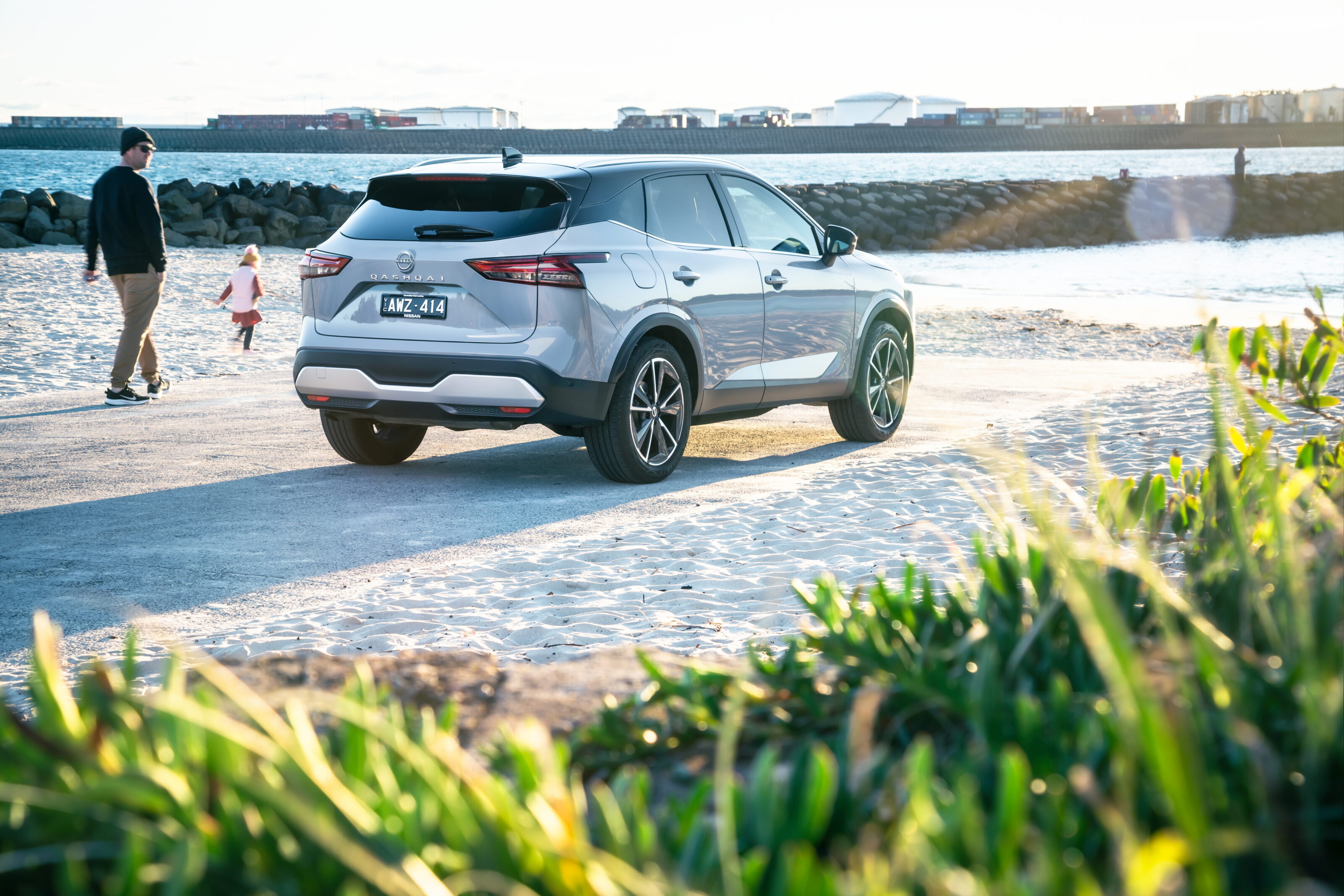
Compared to the current Qashqai, the next generation will increase in size across every measurement – now standing at 4425 millimetres in length (+31mm), 1625mm in height (+30mm), and 1835mm (+29mm) in width, with its wheelbase of 2665mm now up by 19mm over the 2021 model.
Boot space has risen with the back seats up, but is reduced when folded, with a capacity of 480 litres (+50 litres) when upright, increasing to 1422 litres (-176 litres) when laid flat.
Safety
The Qashqai boasts a five-star ANCAP safety rating thanks to a host of features to keep its occupants protected, including:
| Forward emergency braking |
| Predictive forward collision warning with pedestrian, cyclist and junction detection |
| Rear AEB with pedestrian detection |
| Lane departure warning and departure prevention |
| Blind spot warning and blind spot intervention |
| Rear cross-traffic alert |
| Traffic sign recognition |
| Driver attention alert and rear seat alert |
| High beam assist |
| Front and rear parking sensors |
| Parking camera |
| Around-view monitor (ST+ and above) |
| Moving object detection (ST+ and above) |
| ProPILOT with lane-keep assist (ST-L and above) |
| Intelligent park assist (Ti only) |
| Side sensors (Ti only) |
Warranty and servicing
As with the rest of Nissan’s Australian range, the Qashqai is covered by a five-year/unlimited-kilometre warranty, including five years of 24-hour roadside assistance. Nissan has not yet released service costs for the new Qashqai.
Availability
The 2023 Nissan Qashqai is available now. Contact your dealer for detailed wait time information.
