
Snapshot
- 2023 Mazda CX-8 revealed
- Updated large SUV receives a new look and tech improvements
- Confirmed for March launch in Australia
The facelifted 2023 Mazda CX-8 has debuted ahead of its Australian launch in March.
Revealed in Japan overnight, the updated large SUV receives a new look taken from its smaller CX-5 twin, with a revised front fascia and headlights.
While the shape is identical to the CX-5 – which shares its front half with the stretched CX-8 – Mazda has emulated the CX-60’s ‘block mesh’ pattern grille, while the front bumper has a cleaner look with the removal of the fog lamps.
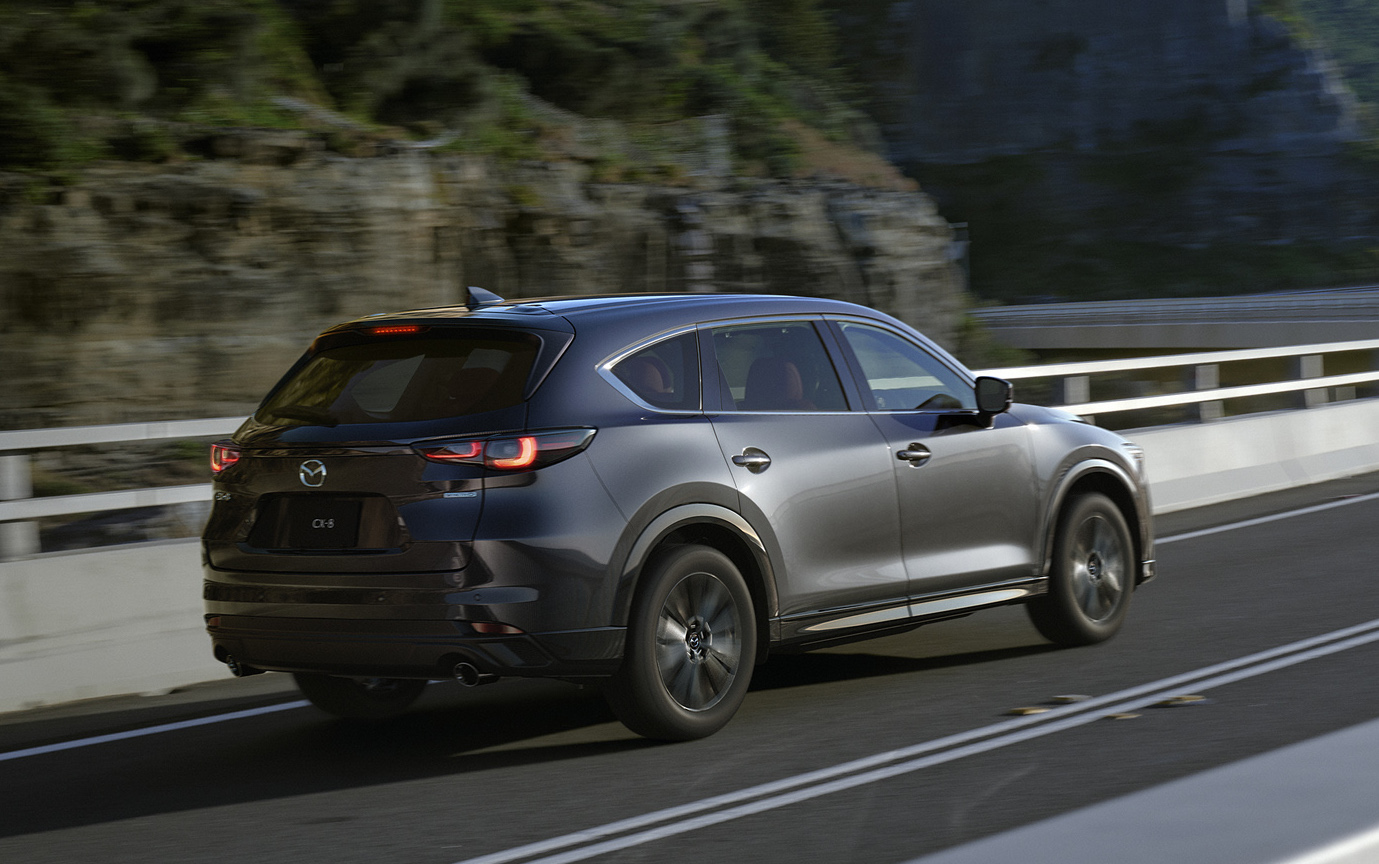
Top-spec models with adaptive LED headlights now have 20 lighting elements, up from 12.
At the rear, the L-shaped tail-lights are similar to the latest CX-5, while the rear bumper also has a cleaner look. The chrome bar running across the tailgate remains, but it no longer flows into the lights.
Two new variants will be offered in Japan: Grand Journey and Sports Appearance. The former model has silver bash plates and black mirror caps to emphasise its off-road potential, while the latter features a gloss black grille, mirrors, wheels and body cladding.
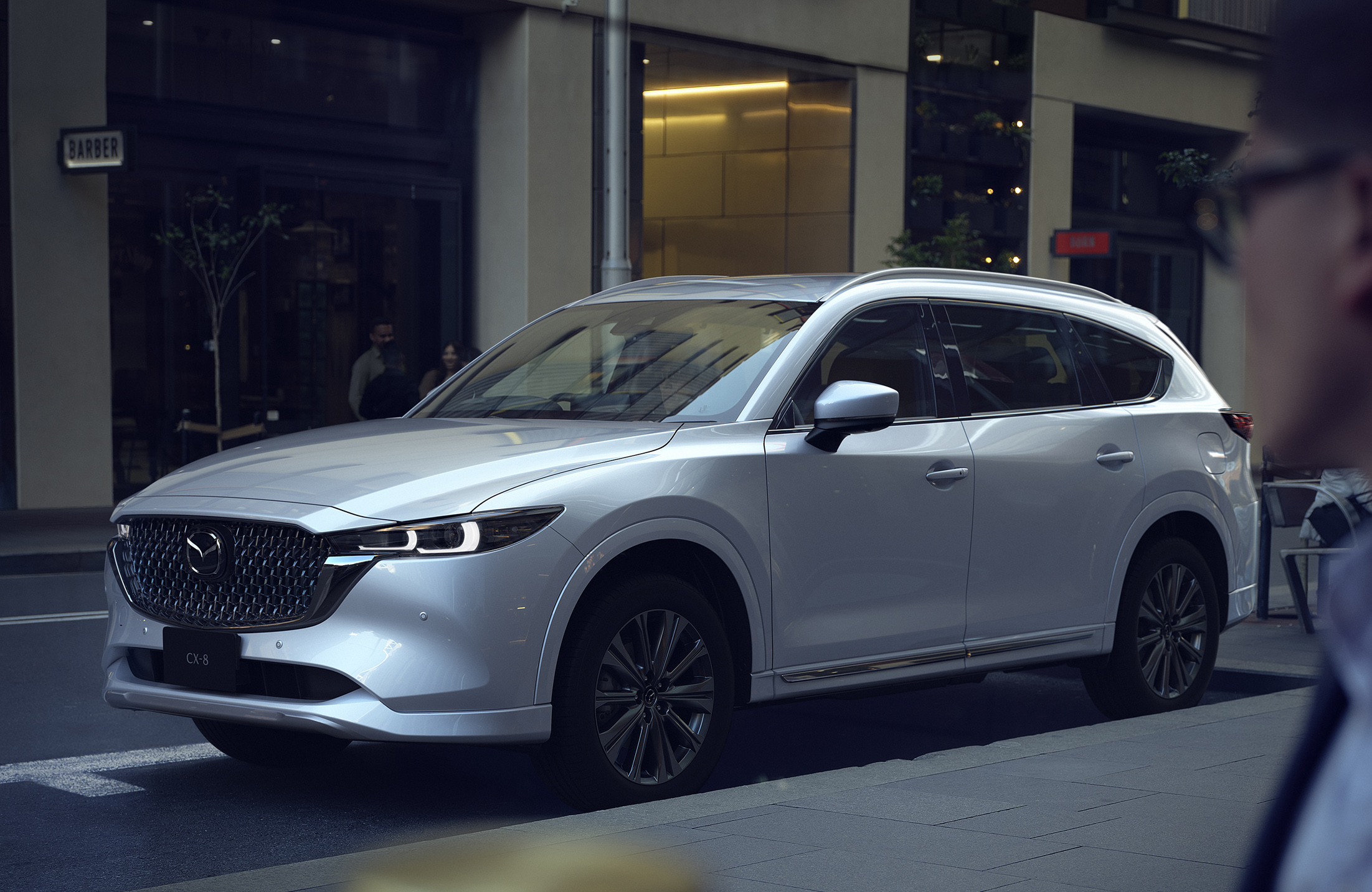
The range-topping Exclusive Mode – representative of our Asaki variant – receives body-coloured wheel arches and lower body cladding.
Mazda has improved the CX-8’s noise, vibration and harshness for greater comfort inside the cabin, while the suspension has been tweaked to improve body control on rough roads.
While interior changes are less substantial, Mazda Australia has confirmed the 10.25-inch widescreen infotainment system will become standard across the range. It is currently limited to top-spec GT, Asaki and Asaki LE variants, with the Sport, Touring and Touring SP featuring the brand’s ageing 8-inch setup.
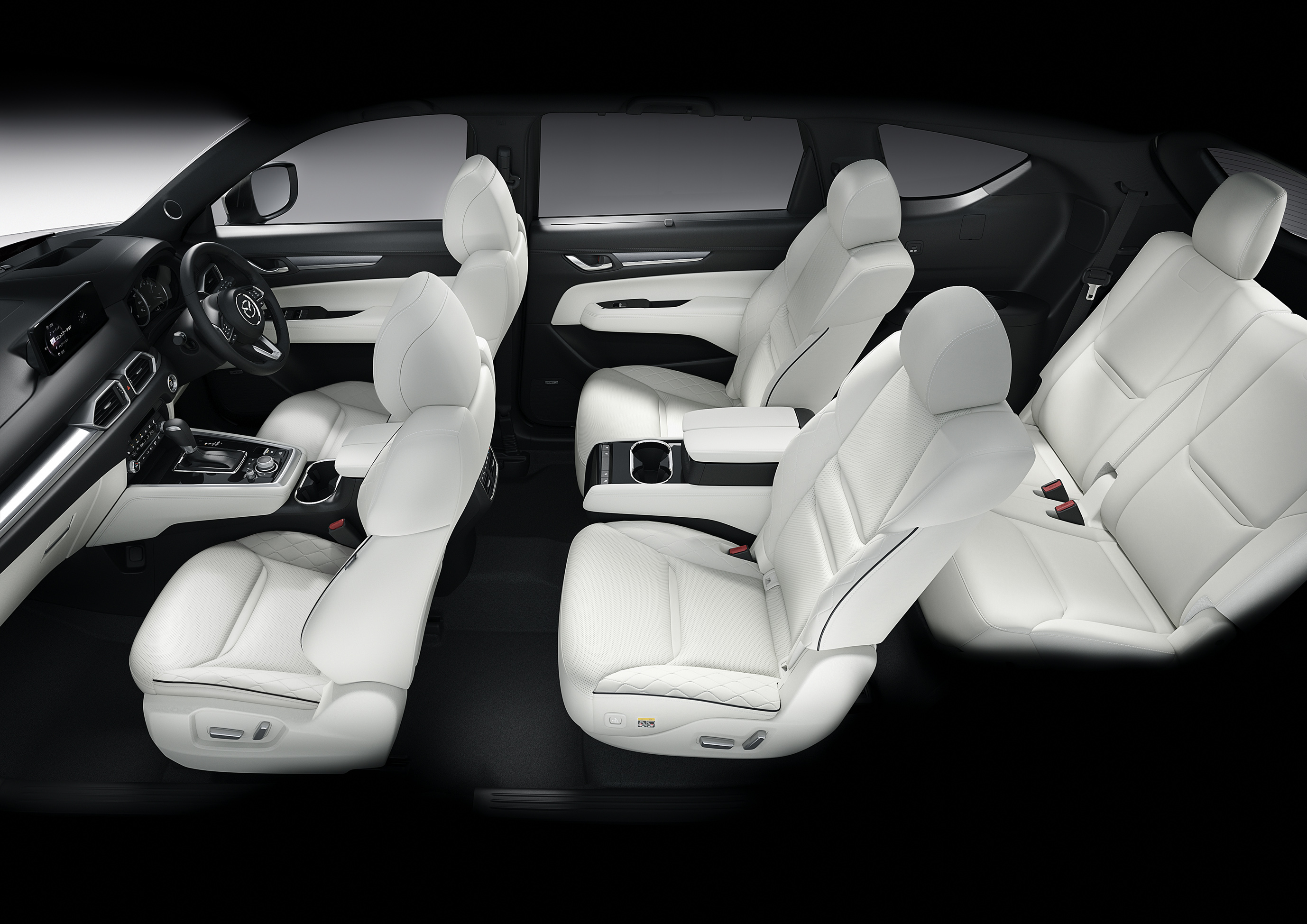
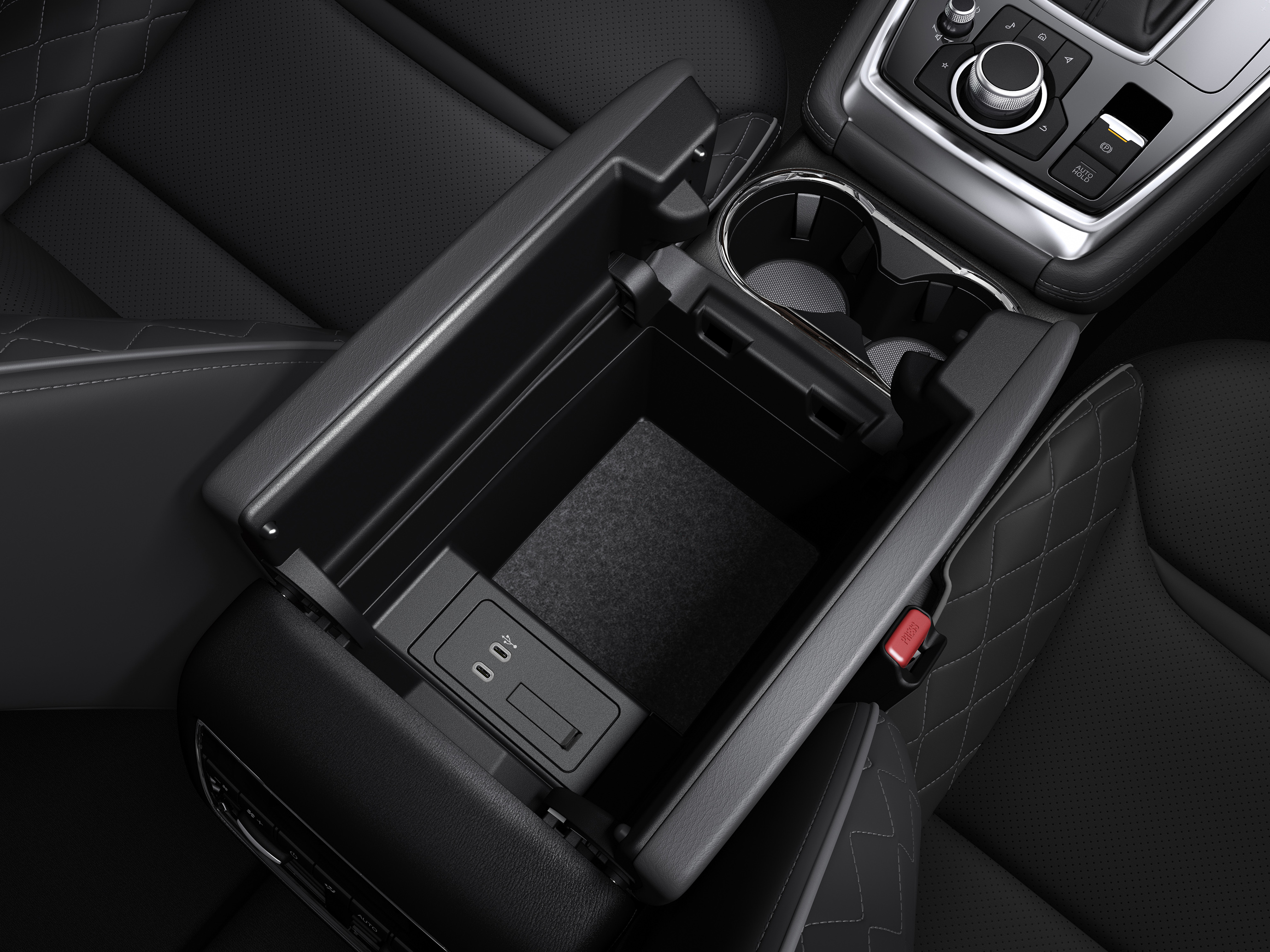
As with the 2023 CX-5 also set to launch early next year, the updated CX-8 gains wireless Apple CarPlay and Android Auto connectivity, two USB-C ports in the centre console, and the rhodium white body colour which replaces the no-cost snowflake white for $795.
Other additions include Mazda’s new drive mode selector – Mi Drive – with normal, sport and off-road modes for all-wheel drive variants, a standard 7-inch semi-digital instrument cluster, and a feature allowing drivers to open the windows from the key fob – but not close it remotely.
In addition, traffic jam assist – known as Cruising and Traffic Support in Mazda speak – has been added to the range. It will likely feature on GT, Asaki and Asaki LE variants in Australia.
In Australia, the three-row CX-8 is available with a 140kW/252Nm naturally-aspirated 2.5-litre petrol sending power to the front wheels, or a 140kW/450Nm 2.2-litre turbo-diesel with all-wheel drive.
While the 2.5-litre turbocharged petrol engine from the CX-5 and CX-9 remains off-limits for Australia, it has received tweaked accelerator pedal mapping and revised transmission shift timing in Japan.
“With this latest update, Mazda CX-8 has taken the game to another level, with both styling and technology that will ensure it’s a hit with Aussie buyers for years to come,” said Mazda Australia managing director, Vinesh Bhindi.
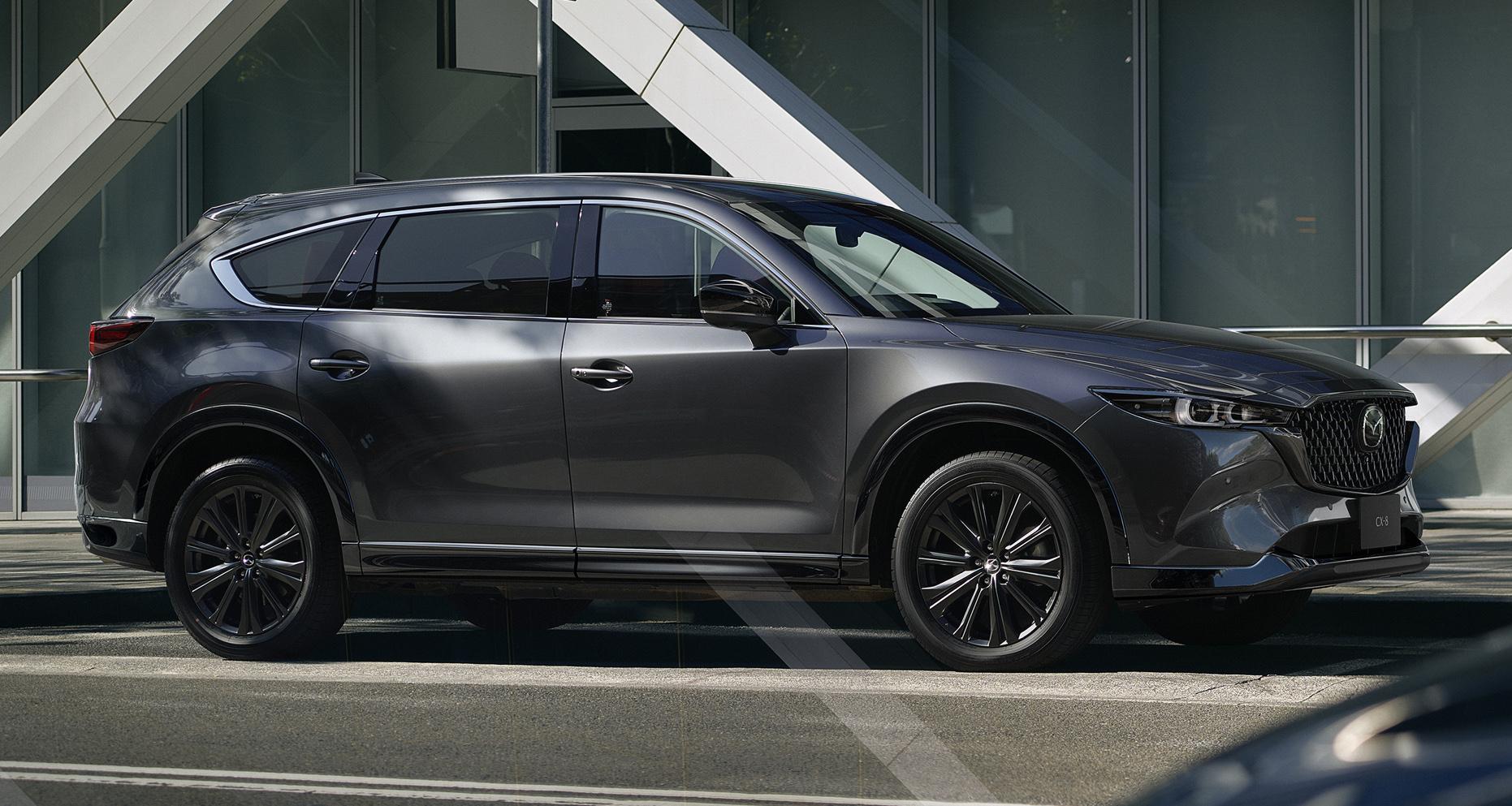
First launched in 2017, the CX-8 was initially a Japanese-market exclusive, as a stretched CX-5 on the same 2930-millimetre wheelbase as the larger CX-9 sold in Australia and North America.
However, demand for a Kia Sorento and Hyundai Santa Fe competitor led to its local launch in 2018 as a diesel-only model. The naturally-aspirated petrol joined the range in early 2020, while a six-seat model with second-row captain’s chairs was added last year.
The 2023 Mazda CX-8 will arrive in Australian showrooms in March, with full details – including pricing – expected in the coming months.
Below: the pre-facelift 2022 Mazda CX-8 (in Touring SP guise)

One of the world’s most prominent technology events, CES, is set to be the stage for the reveal of the Ram 1500 Revolution concept.
The Consumer Electronics Show, held annually in Las Vegas, is the event where brands show off their innovations and future products – and Ram has hinted that its battery-electric vehicle (BEV) will feature prominently.
With Ram seeking to introduce electric variants across its entire range, the Ram 1500 Revolution would be a key product in its pick-up truck line-up. Ram Trucks claims the BEV will arrive in 2024, ahead of its ambitions to feature majority electric vehicles prior to 2025, and eventually leading to an all-electric showroom by 2030.
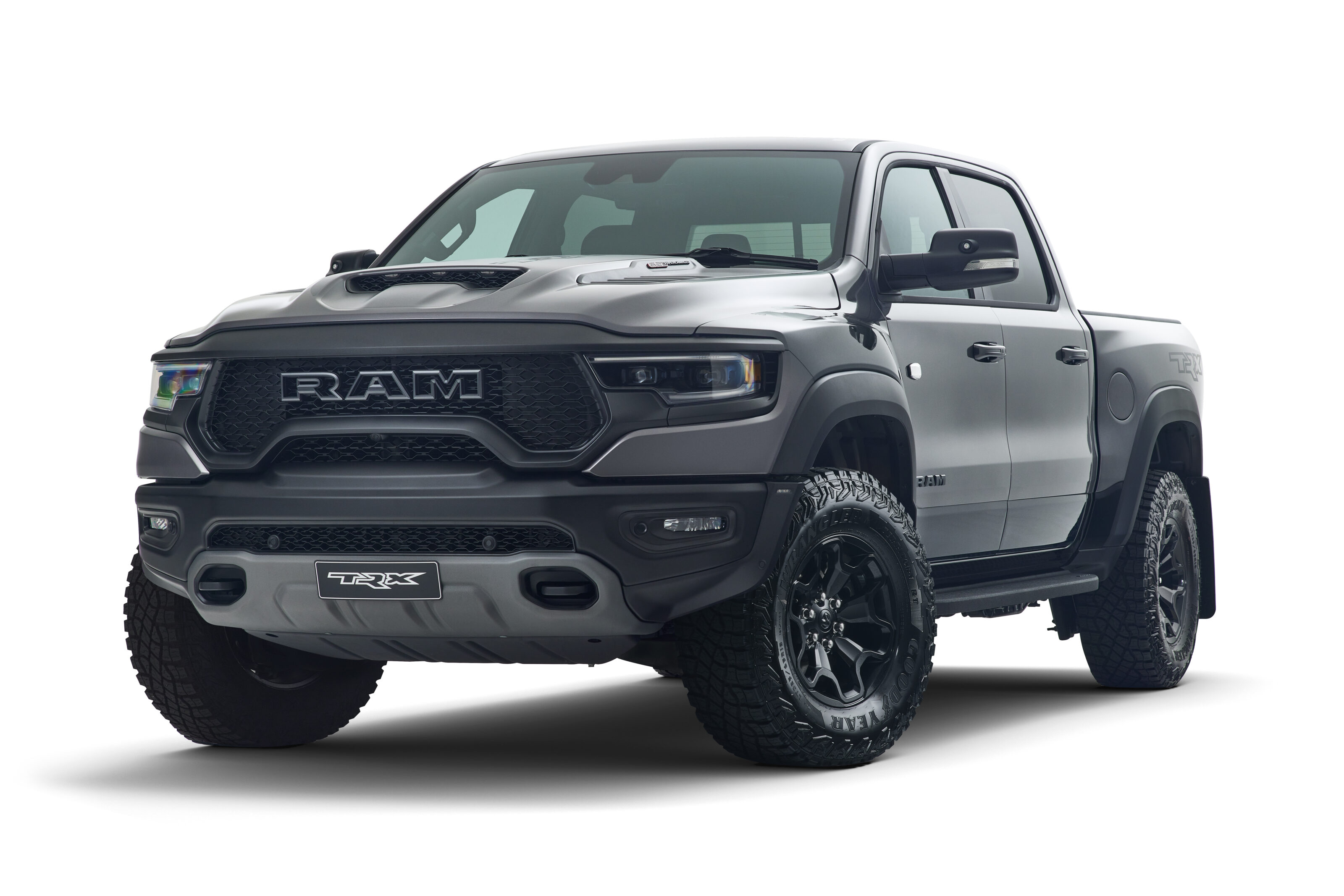
The focus for the electric Ram 1500 Revolution will be on pivotal areas such as payload, towing capacity, charge time and vehicle range.
There’s no question any electric truck would need to equal or exceed the key capabilities of its piston-engined counterparts – although driving range, especially when towing, will be a tough hurdle for a while to come.
The existing Ram 1500 Laramie RamBox V8 can tow 4500kg (braked) with a payload of 779kg. Gross Vehicle Mass for that vehicle is 3450kg with a tare weight of 2553kg, so buyers will be watching to see how the additional weight of a huge battery pack and toughened suspension contributes to the vehicle’s overall mass if the payload is equal to the existing ICE vehicle.
Current RAM 1500 tray dimensions
| Load length | 1712mm |
|---|---|
| Load width | 1270mm |
EV trucks have been recognised as a potentially lucrative segment to pursue, with Ford recently showing off its F-150 Lightning (not expected here anytime soon), Rivian long promoting the R1T (which may or may not come to Australia…), and LDV’s eT60 being the first electric truck to come off the boat to Australia.
Tesla’s Cybertruck grabbed headlines in 2019 with its unveiling, with production now expected to begin next year – although it has been removed from the brand’s Australian website.
The current Ram 1500 has proven popular in Australia, with 557 units of the truck finding homes in September 2022 – up from 264 for the same month in 2021.
CES 2023 is set to start in Las Vegas on January 5, returning to its in-person format following the COVID pandemic.
Snapshot
- Style Edition colour calls back to 964 Carrera RS
- Based on entry-point 718 with 2.0T
- Six-speed manual or seven-speed PDK available
- Australian arrival expected H2 2023
Porsche has released Style Editions of the 2023 718 Cayman and Boxster sports cars, priced from $125,800 and $128,600 before on-road costs respectively.
The 718 Cayman and Boxster Style Editions are effectively identical in trim, save for the Boxster’s ragtop. Australian deliveries will commence in the second half of 2023.
The specification is built around the base 718 with a mid-mounted 2.0-litre turbo-petrol flat-four developing 220kW/380Nm hooked to the rear wheels via a six-speed manual transmission.
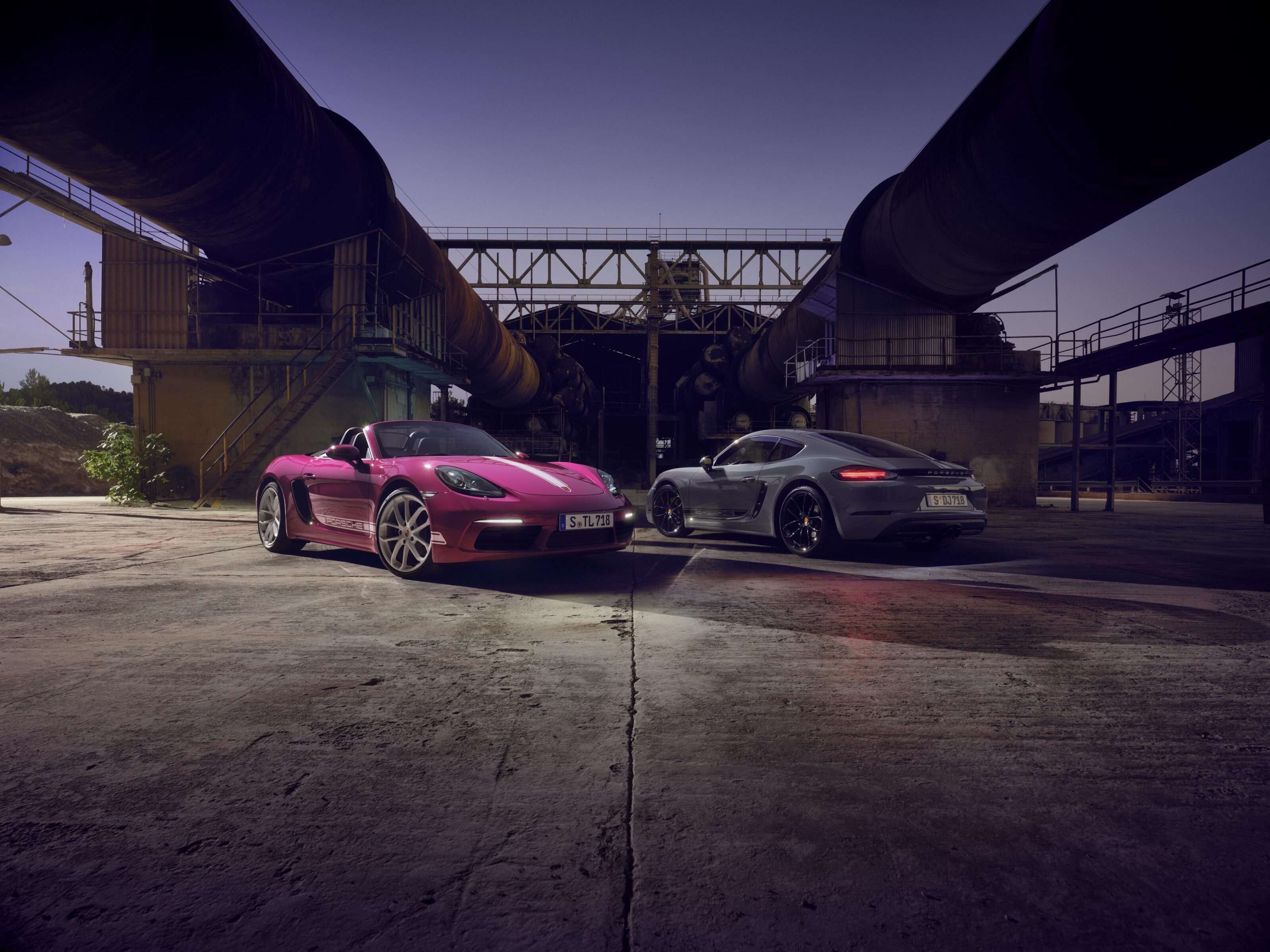
Getting from stand-still to 100km/h will take 5.1 seconds in either manual 718, the optional seven-speed PDK automatic drops that time to 4.9 seconds.
The Style Editions are the latest in a host of (relatively) affordable but unique Porsche variants announced for Australia, following the Macan and 911 T.
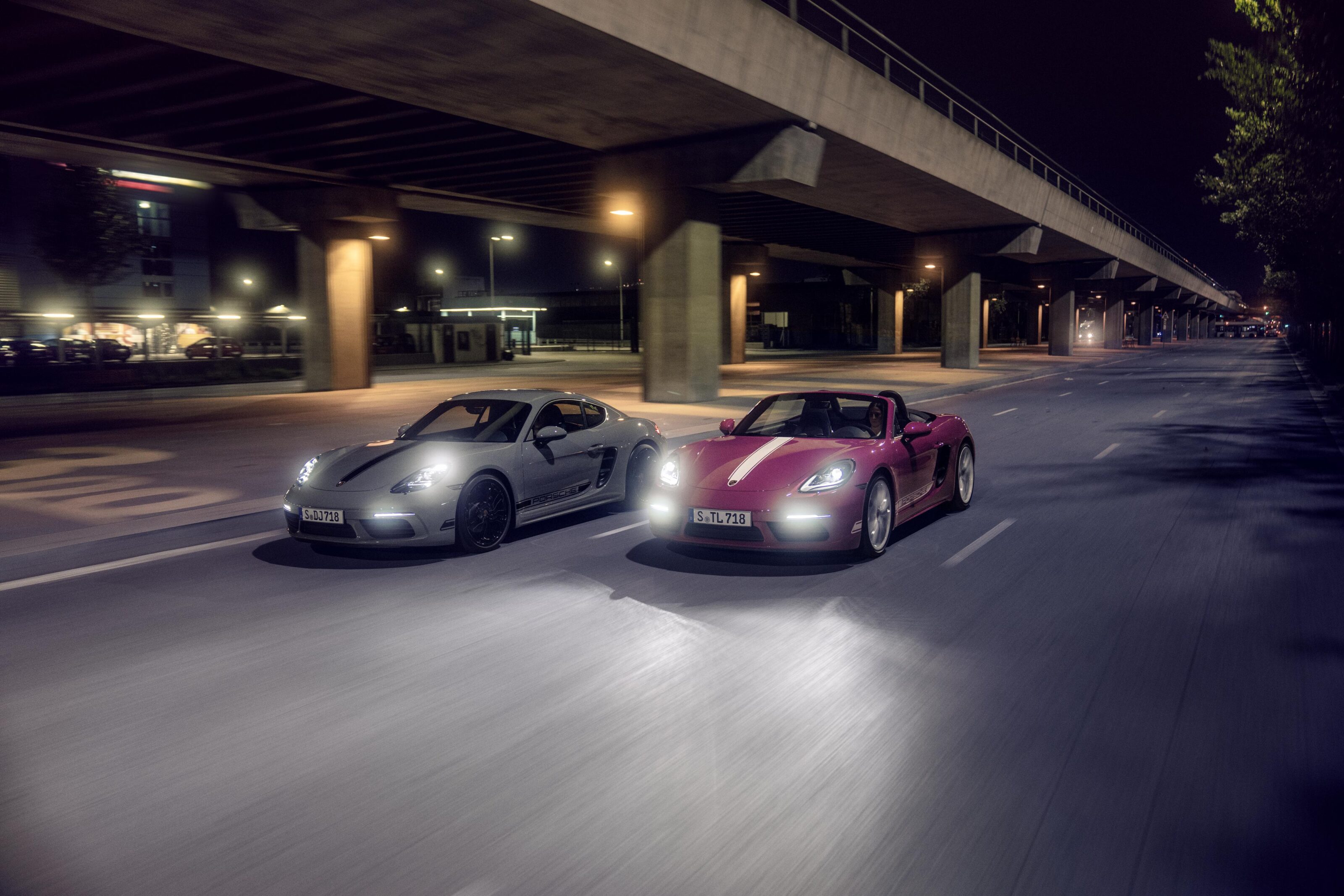
Pictured here, the Boxster wears a heritage paint colour called Ruby Star Neo, a callback to the hero hue featured on the 1992 964 Carrera RS. This is available for both Boxster and Cayman.
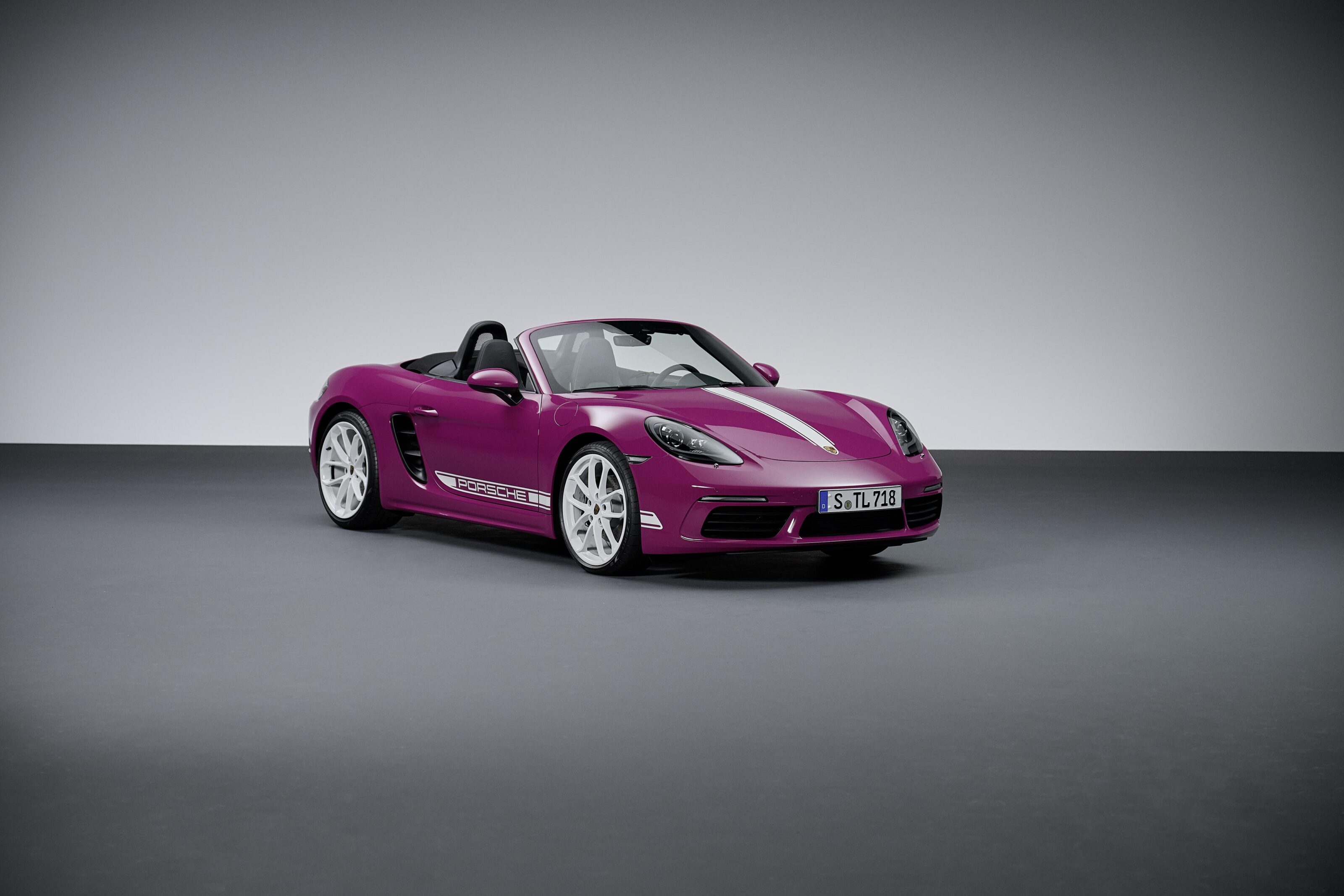
But you don’t have to go Ruby Star if you don’t want – Porsche offers myriad colours, including Crayon, pictured on the 718 Cayman.
The Style Edition decal package is available in black or white at the customer’s choice, and includes the bonnet and roof stripes as well as ‘Porsche’ logos down the sides.
718 Style Edition equipment
Justifying the relatively small $3800 premium over a cooking Cayman or Boxster, the Style Edition gets more than just exterior tweaks like the Spyder 20-inch alloy wheels (in white or black, to match decals) and Crayon contrast stitching inside.
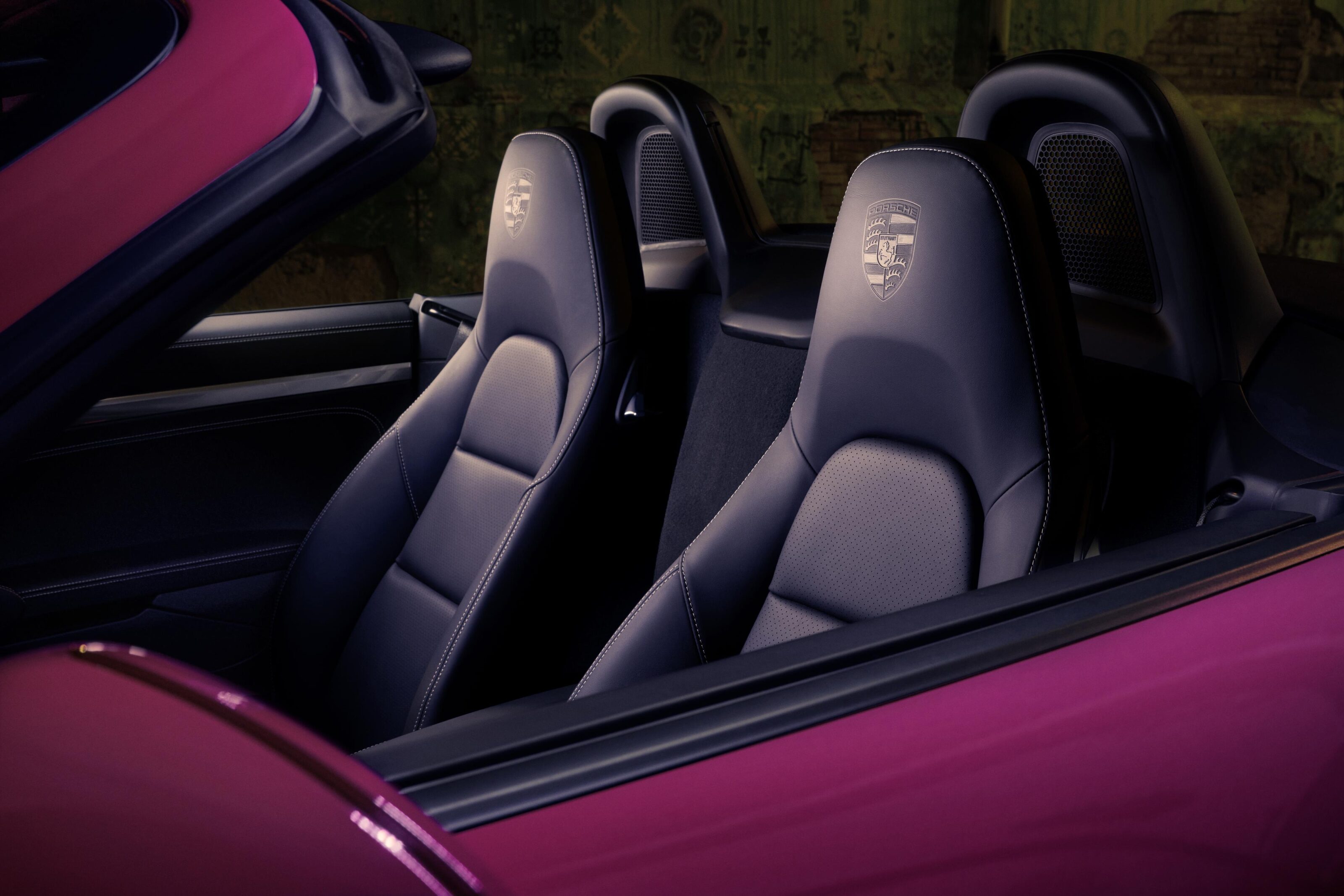
The heated 14-way adjustable seats are trimmed in leather as standard with Porsche crests embossed in the headrests and illuminating stainless steel kick plates. There are no changes to suspension or powertrain, though.
As for equipment, the Style Edition gets Xenon headlights, PDLS active headlights, 7.0-inch touchscreen with wireless Apple CarPlay, navigation, DAB radio, voice control, blind-spot monitoring and a heated steering wheel.
As with any Porsche product, further customisation – such as extended leather packages, colour-matched keys – will be possible using the configurator.
2023 Porsche 718 pricing
Prices listed are before on-road costs
| Variant | Price |
|---|---|
| 718 Cayman manual | $122,000 |
| 718 Boxster manual | $124,800 |
| 718 Cayman Style Edition manual | $125,800 |
| 718 Boxster Style Edition manual | $128,600 |
| 718 Cayman S manual | $150,000 |
| 718 Boxster S manual | $152,800 |
UPDATE, March 29 2023: Australian timing confirmed for ID models
Volkswagen Australia has today confirmed local launch timing for its ID.3, ID.4, ID.5 and ID.Buzz models – get all the details at the links below.
Story continues…
ID.4 EV lands in Oz for assessment
Snapshot
- Pro and Pure Performance variants here for evaluation
- WLTP driving range upwards of 500km
- $60K price range; ICE price parity targeted
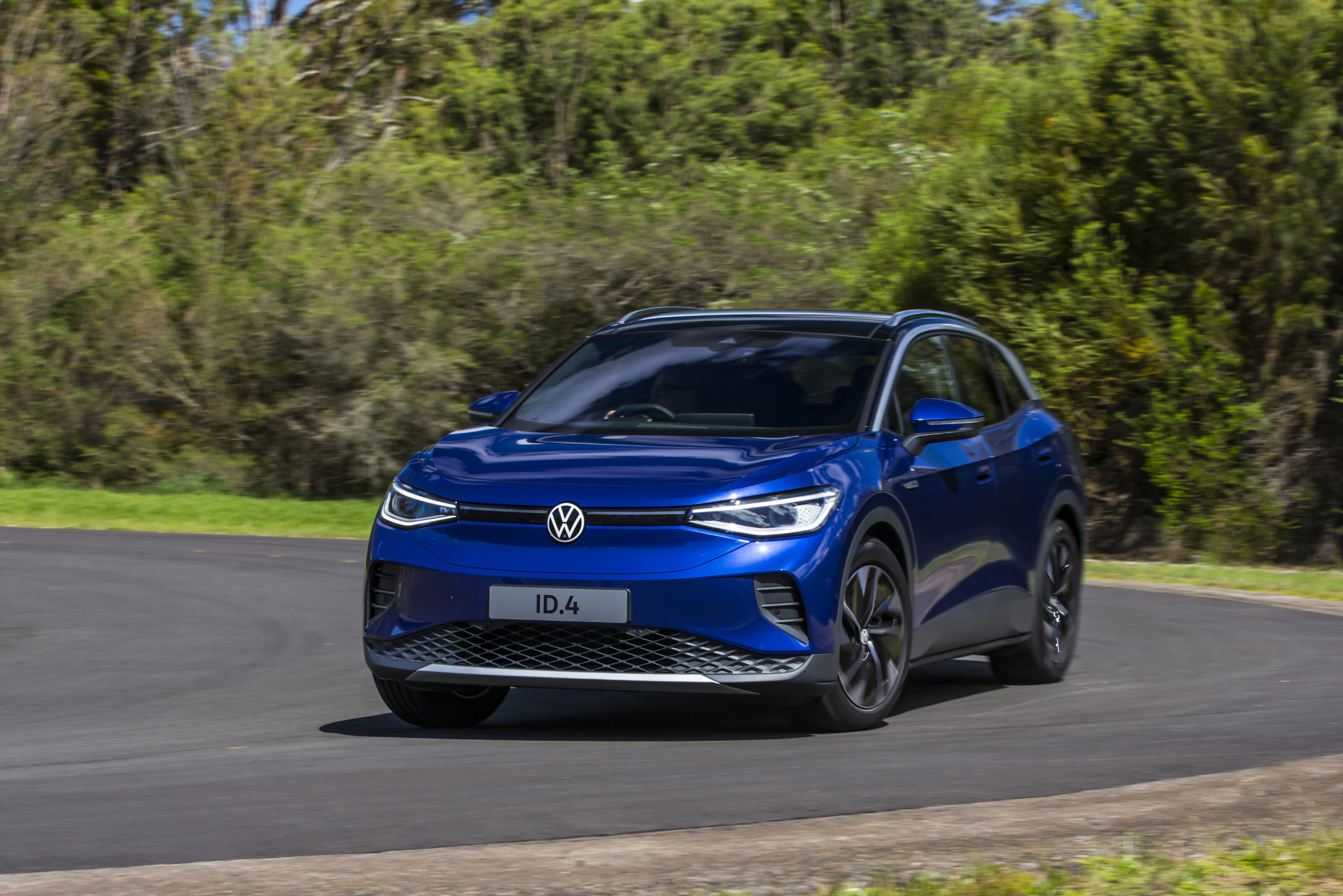
Volkswagen is inching closer to the Australian release of its first EV as two examples of the ID.4 medium electric SUV land in Australia ahead of a late 2023 release.
The brand’s Australian arm is hoping to have ID.4 and its ID.5 coupe sibling in Australian driveways toward the end of 2023.
The ID.4s in Australia now are UK-spec Pro and Pure performance variants, which record 522km and 345km driving range in the WLTP combined cycle respectively.
The Pro Performance is expected to be popular with private buyers, while the Pure Performance is here to evaluate the viability of fleet sales in Australia.
“Strategically the Volkswagen ID.4 and ID.5 represent the most sizeable opportunity for Volkswagen Australia in countless years,” brand director Michal Szaniecki said.
JUMP AHEAD
- How much will ID.4 cost?
- Driving range, power, charging
- How ID.4 stacks up against rivals
- Australian specification
How much will the ID.4 cost in Australia?
Lately VW has been leaning into premium, but at its core the brand is about mass mobility; Volkswagen translates to ‘People’s Car’.
With that in mind, Mr Szaniecki said: “The ID.4 will not set out to charge customers a premium for being a style statement or shortchange practicalities in any way for being electric.”
“The ID.4 will bring electric performance to a broad customer base with target pricing similar to our most in-demand SUV, the Tiguan 162TSI R-Line”, Szaniecki continued.
That gives a rough starting point of $56,000 before on-road costs.
If the ID.4 Pro Performance is able to hit the market for under $60K, then established competitors such as the Tesla Model Y, Volvo XC40, Hyundai Ioniq 5 and Polestar 2 will have a real fight on their hands.
“Arriving at the same time will be the coupe-style ID.5 with pricing similar to a Tiguan R, enabling customers to alternatively pick an even more design-focused BEV”, Szaniecki said, putting the coupe-styled MEB option at around $70K before on-road costs.
VW ID.4: Driving range, performance, charging
The VW ID.4 is based on the group’s modular electric architecture, called MEB. It underpins the ID.3 that we’ll be getting in Australia later, as well as the Cupra Born hatch set to arrived earlier in 2023.
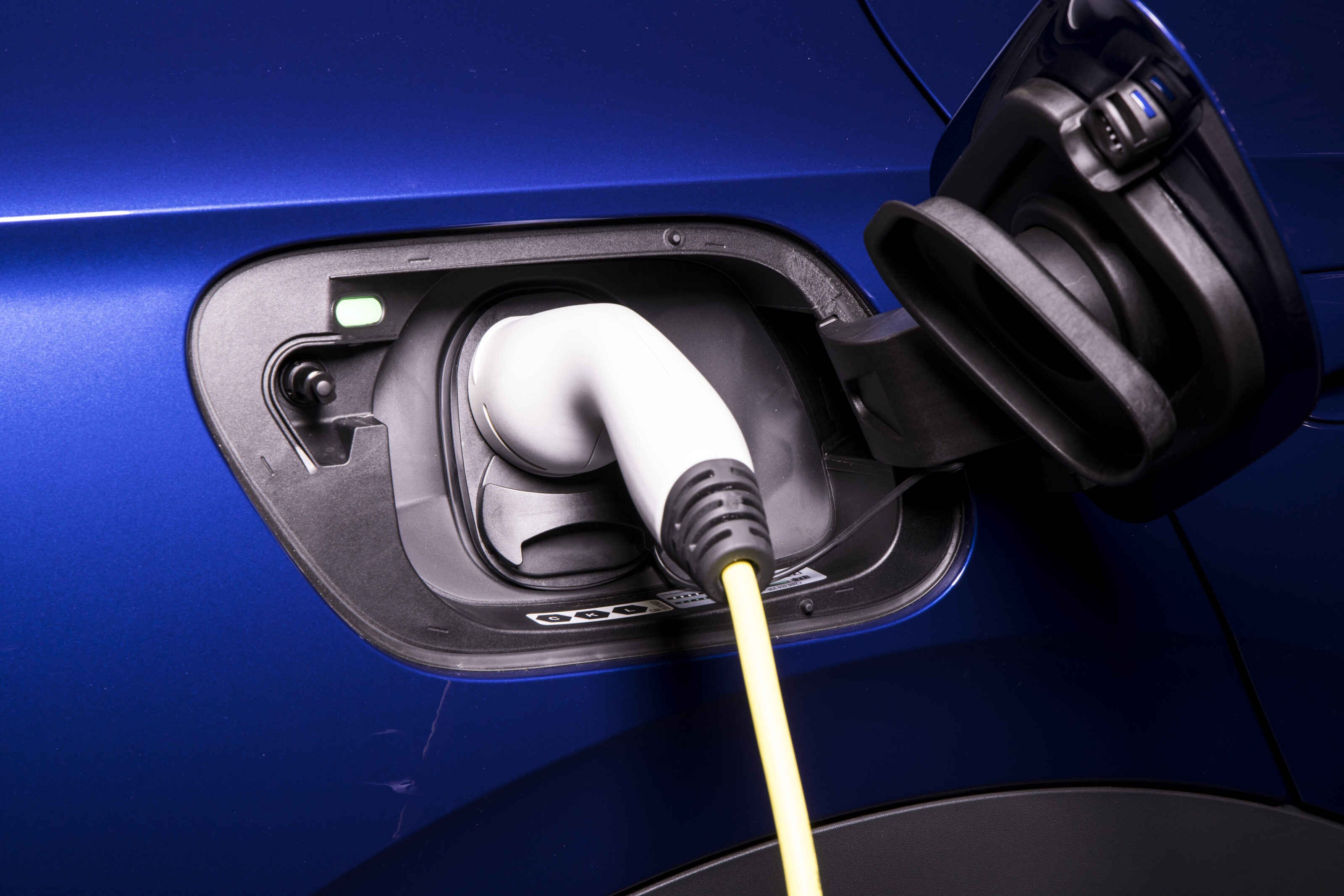
In ID.4 Pro Performance guise, that means a 77kWh usable (82kWh gross) lithium-ion battery pack mounted under the rear seats for 522km driving range in the WLTP combined cycle.
Public fast-chargers will be able to put electricity back in at a rate of 125kW, meaning a 0-80 per cent (0-418km driving range) charge will take 33 minutes, or 42 minutes to reach 100 per cent.
The ID.4 Pro Performance uses a single, rear-mounted electric motor producing 150kW/310Nm for a 0-100km/h sprint time of 8.5 seconds.
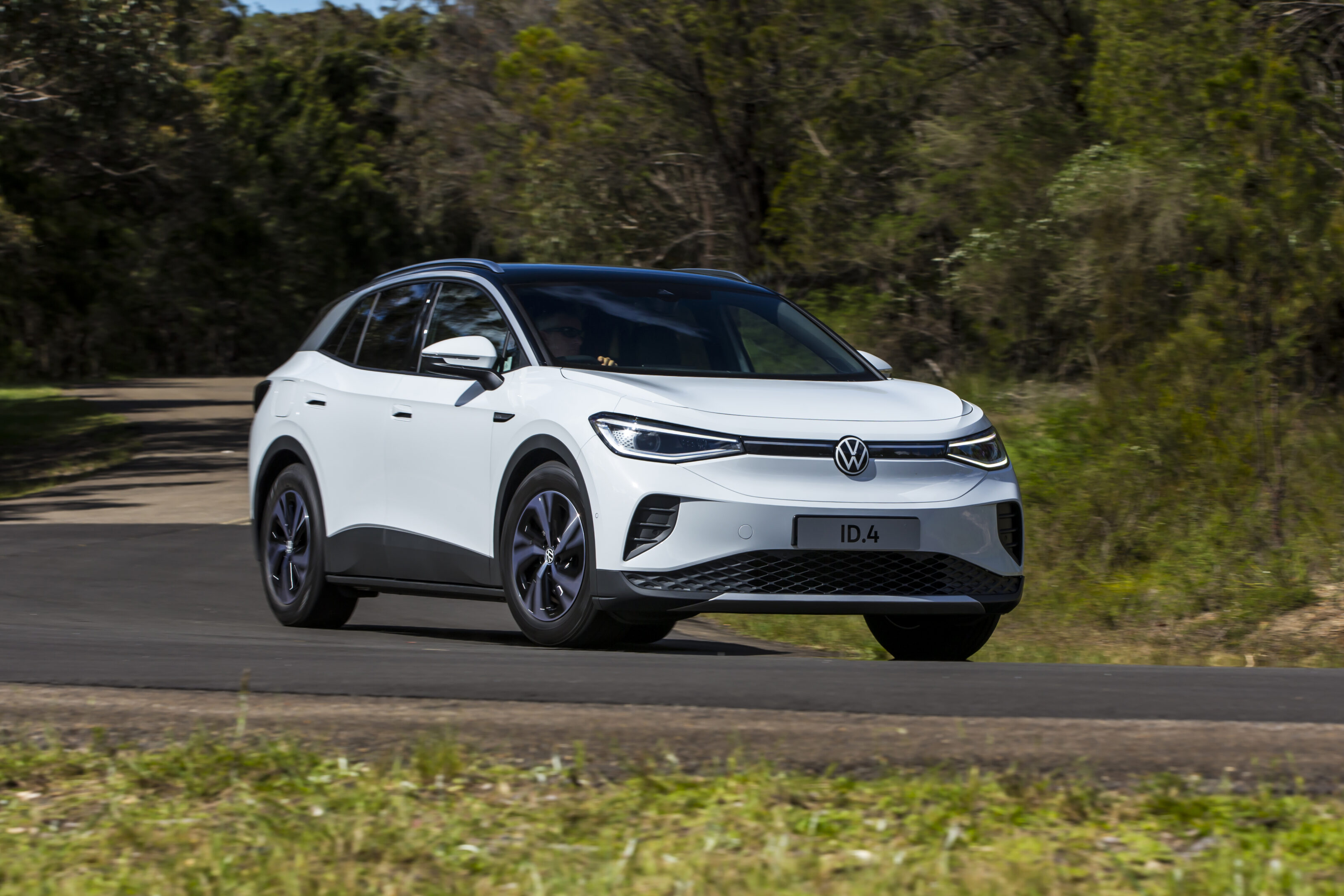
The shorter range Pure Performance gets a 52kWh usable (55kWh gross) battery and detuned 125kW/310Nm motor for 345km WLTP driving range and 0-100km/h sprint in 9.0 seconds.
Fast-charging for the Pure Performance happens at a slightly lower rate of 110kW, though its smaller battery means 0-80 per cent takes just 26 minutes. Both variants max out at 7.2kW at AC charging points.
How ID.4 compares to rivals
Note: Table scrolls horizontally
| Stats | VW ID.4 Pro Performance | Tesla Model Y RWD | Volvo XC40 Single | Kia EV6 Air RWD | Hyundai Ioniq 5 RWD | Toyota BZ4X AWD |
|---|---|---|---|---|---|---|
| Price (MLP) | ~$60,000 | $72,300 | $72,990 | $67,990 | $71,900 | $NA |
| Battery size | 77kWh | 57.5kWh* | 69kWh | 77.4kWh | 72.6kWh | 71.4kWh |
| WLTP Range | 522km | 455km | 510km | 528km | 451km | 461km |
| 10-80% fast-charge (DC) | 33 minutes (125kW) | 25 min (170kW*) | 28 minutes (130kW) | 18 minutes (200kW+) | 18 minutes (200kW+) | 32 min |
| Power | 150kW | N/A | 170kW | 168kW | 160kW | 160kW |
| Torque | 310Nm | N/A | 330Nm | 350Nm | 350Nm | 336Nm |
*Tesla does not provide some specifications, these are based on those made by EV Database.
Australian specification
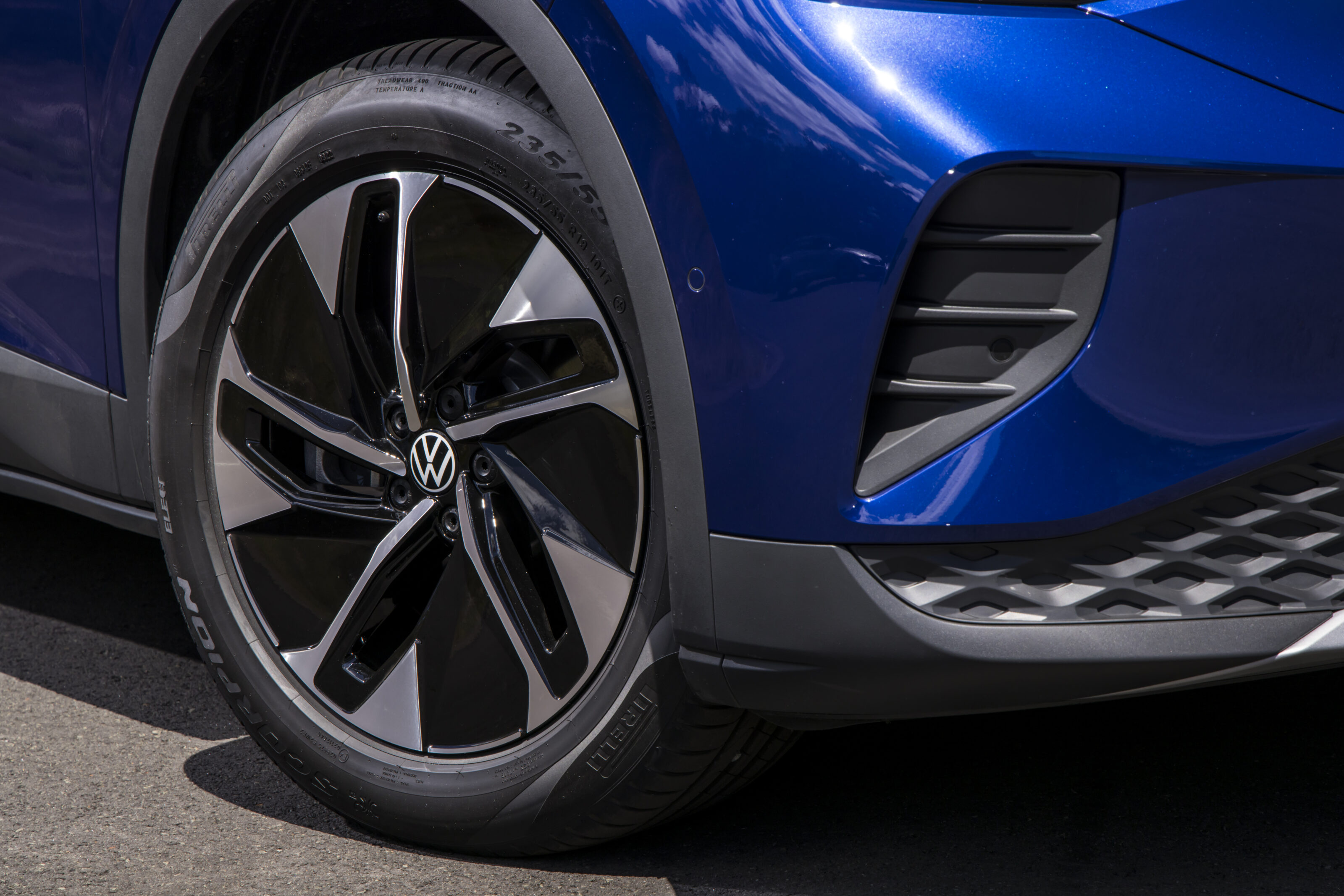
Final Australian specification is yet to be locked in for ID.4 and ID.5 models, however it’s likely we will get a high spec version not too dissimilar to the UK’s Pro Performance model.
This is expected to be most popular with private buyers, and it features technology such as an available 12.0-inch touchscreen, digital driver’s display, 19-inch alloy wheels, progressive steering, head-up display with AR and seven-speaker, 450-watt sound system.
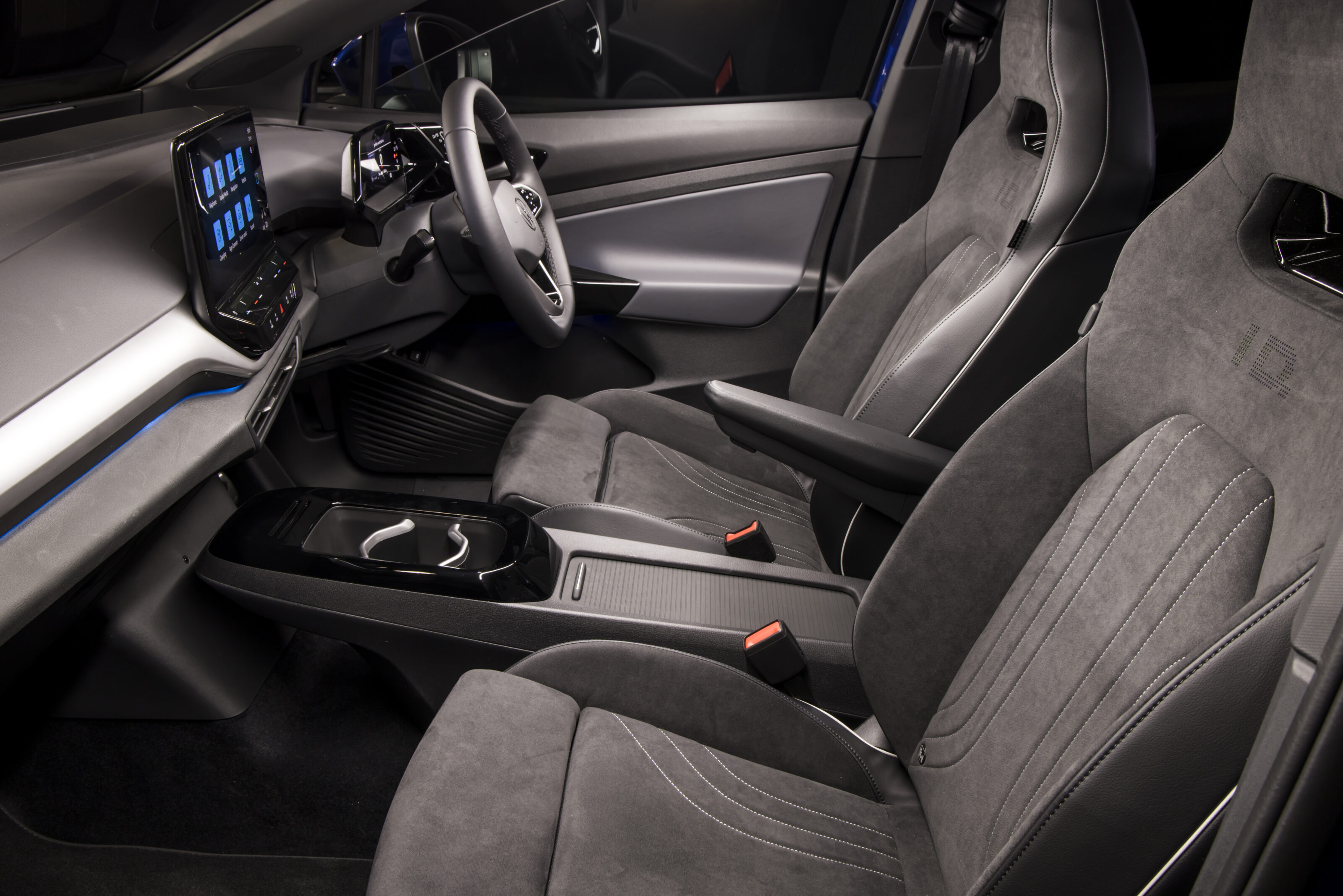
Seating is taken care of by heated ‘ErgoActive’ front seats with 12-way power adjust and two-position memory upholstered in a mix of vinyl and ‘Artvelour’ suedecloth. The ID.4’s steering wheel is heated, too.
Exact specification, pricing and trim levels will be locked in closer to the 2023 ID.4’s release toward the end of next year.
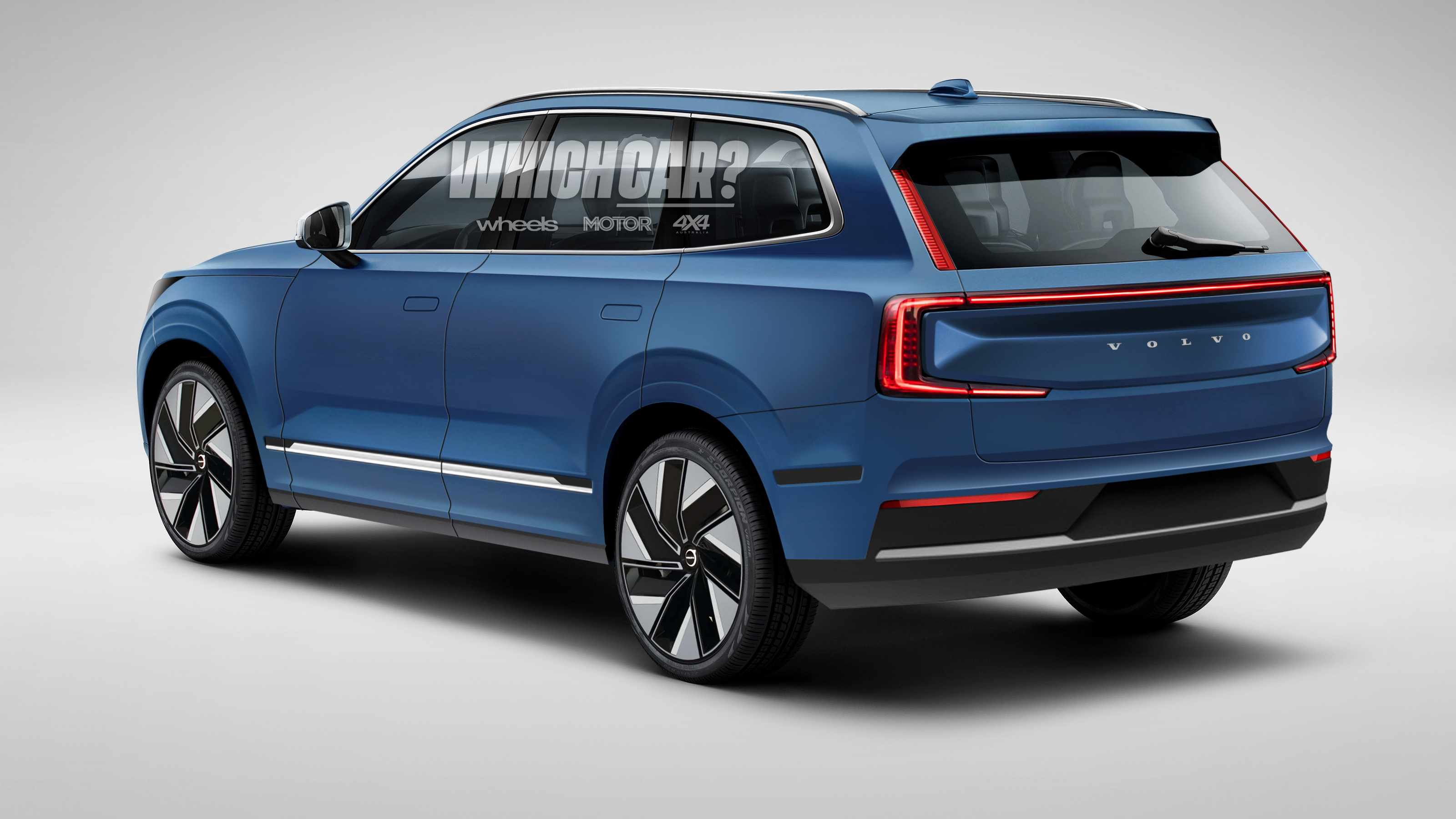
With only seven days until Volvo reveals the 2023 EX90 to the world, the brand has drip-fed more info – including that designers were inspired by yachts.
Today’s big reveal, though, is the EX90’s aerodynamic efficiency, which Volvo says is 0.29Cd – very competitive for a seven-seat vehicle. For reference, an Audi Q7 weighs in at 0.36Cd.
This announcement follows the reveal of the EX90’s interior, charging capabilities and new safety systems.
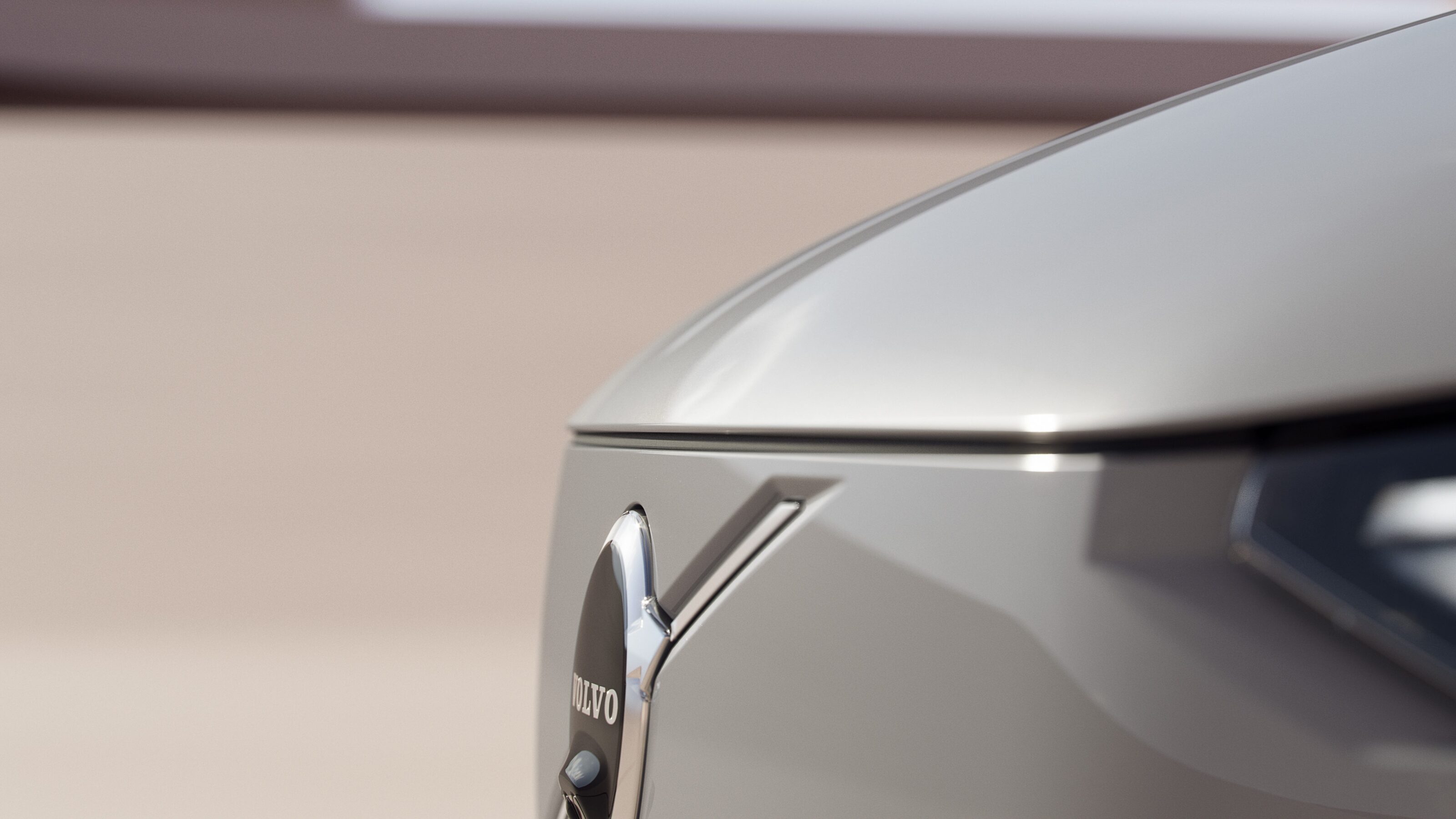
We also get a glimpse of some finer details, including the seamlessly integrated lidar sensor in the roof, flush glazing, integrated doorhandles, aerodynamic alloy wheels and clamshell bonnet. Not only do these details aid efficiency, but they also look super slick.
“We’ve taken inspiration from yacht design to outline the Volvo EX90’s beautiful and sleek proportions,” said Volvo head of exterior design, T. Jon Mayer.
“If you look at the front, it’s proud and confident – inspired by a sailboat’s ability to shear through the ocean’s slamming waves. But it’s also rounder overall, which enables the air to flow around the car more efficiently.”

We also now know a panoramic sunroof – like in Polestar 2 – will be standard to let light in during gloomy Scandinavian winters. Volvo also says it’s paid particular attention to ambient lighting in the 2023 EX90 for the same reason.
The Volvo EX90 will be fully revealed on November 9, 2022.
Our original story, below, continues unchanged.
The Story To Here
October 26, 2022: Volvo EX90 interior revealed
Volvo has released a set of teaser images showing the cabin of the 2023 EX90 large SUV and they hint at a possible 500 kilometre-plus driving range.
The cabin design is ultra-minimal, one could argue it’s borrowing from Tesla or simply an evolution from the current infotainment in the XC40 and XC60 SUV ranges.
Instead of a digital driver’s display nestled in a binnacle, the EX90 transitions to an ultra-short widescreen ahead of the steering wheel bringing more light into the cabin.

The screen’s graphics are minimal yet legible. Volvo says the aim is “to present what you need in a simplified way.” The screen also gives real-time readouts of what the assisted driving features can detect.
Aside from the design, there is an easter egg on screen that could hint at the EX90’s capability. This is certainly an electric vehicle, and with about 90-95 per cent battery showing on the screen 488km of driving range is estimated.
Though of course, these images are just renderings, not the real thing.

Volvo is yet to claim battery size of WLTP driving range for the 2023 EX90, but if the images have any tie to reality then this large SUV will be well equipped on the range front.
In the centre, the portrait touchscreen looks larger than any fitted to a current Volvo product, but the brand has not quantified its size yet. It also appears to be running an updated version of Android Automotive software currently in Volvo and Polestar products.
The EX90’s centre screen gives access to drive modes, external information, media control and Google Maps navigation. Atop the dashboard is Volvo’s signature Bowers and Wilkins sound system, so the EX90 won’t compromise on the XC90’s excellent audio quality.
Full details will be revealed on the EX90’s November 9 release date.
Our original story, below, continues unchanged.
The story to here
October 9: 2023 Volvo EX90 to offer bi-directional charging
The 2023 Volvo EX90 electric SUV will feature another brand-first: bi-directional charging.
As Volvo moves closer to the reveal of its new flagship SUV on November 9, it has revealed the EX90 will support vehicle-to-load (V2L) and vehicle-to-grid (V2G) technology.
It will be initially available in selected markets, with the EX90 capable of powering homes and “other electric devices”, such as portable appliances.
“You could use its battery in many ways, from topping up your electric bike when you’re out and about, to hooking up an outdoor cooking appliance for your weekend camping trip,” said Olivier Loedel, head of the electrification ecosystem at Volvo.
“It could even power your house during the expensive peak hours of the day.”
The charging process will be automatic and managed within Volvo’s smartphone app, with algorithms designed to reduce the risk of potential battery degradation from the vehicle acting as a power bank.
In addition, Volvo claims using the EX90 to power your home could be beneficial during peak periods when electricity prices are higher, following a prior top-up during off-peak times.
Our original story, below, continues unchanged.
September 21: 2023 Volvo EX90 to debut new safety tech
“[LiDAR offers] vision beyond the human range by day and by night.”
The 2023 Volvo EX90 electric SUV, to be sold alongside the current XC90, will be revealed on November 9.
Previously expected to wear eXC90 or Embla badging, the Swedish luxury marque, owned by China’s Geely, has now confirmed its latest flagship SUV will be called EX90 and offer full self-driving technology.

Volvo has announced new active safety features debuting on the all-electric crossover – and fitted as standard – will include LiDAR sensors and an in-car driver monitoring camera.
The brand’s ‘driver understanding system’ uses two internal cameras to detect when a driver is distracted, tired or intoxicated via specific eye-gaze patterns.
This is achieved through eye tracking designed to recognise a driver’s ‘gaze concentration effect’.
Volvo says a driver’s attention level should be around 80 per cent, with 90 per cent or above a sign of cognitive distraction or alcohol intoxication. In comparison, a result below 60 per cent signifies a visual distraction, such as using a mobile phone.
Built from existing driver attention alerts and monitoring cameras, the system also recognises steering behaviour to intervene first by a visual warning.

It will then automatically reduce speed, keep the vehicle in its lane, halt to a stop, and place an emergency call if the driver is impaired.
“We’ve made great progress on exterior sensing in the last decades, thanks to our committed work on crash prevention systems,” said Thomas Broberg, the acting head of Volvo Cars Safety Centre.
“Interior sensing is one of the next safety frontiers for us. We will continue to learn, develop and deploy new features step by step to help improve safety as our knowledge increases and matures.”
Mikael Ljung Aust, a technical specialist at Volvo Cars Safety Centre, said the driver monitoring system is a stepping stone toward unsupervised autonomous driving.

And that will come, with Volvo confirming the EX90’s laser-scanning LiDAR system is compatible with full self-driving. It will be offered via subscription in future – once the technology is approved in selected regions – with over-the-air software updates.
Expect more details on autonomous driving at the EX90’s unveiling in November.
LiDAR – which stands for Light Detection and Ranging – will be standard across the EX90 range, utilising “light in the form of a pulsed laser to measure ranges with high precision and fidelity”.
It will be embedded in the roofline of the EX90, with a 1550-millimetre wavelength bringing the ability to detect pedestrians at a 250-metre distance at highway speeds, even in the dark.

Joachim De Verdier, head of safe vehicle automation at Volvo, said the least dangerous crash is “one that never happens”, with LiDAR technology allowing for a 20 per cent reduction in severe accidents and a nine per cent improvement in crash avoidance.
“[LiDAR offers] vision beyond the human range by day and by night.”
It will be matched with Volvo-developed software and the vehicle’s ‘super-computer’, likely supplied by technology giant Nvidia – and is a step beyond Tesla’s full self-driving beta, which can only see the road ahead via cameras on the latest Model 3 and Model Y vehicles.
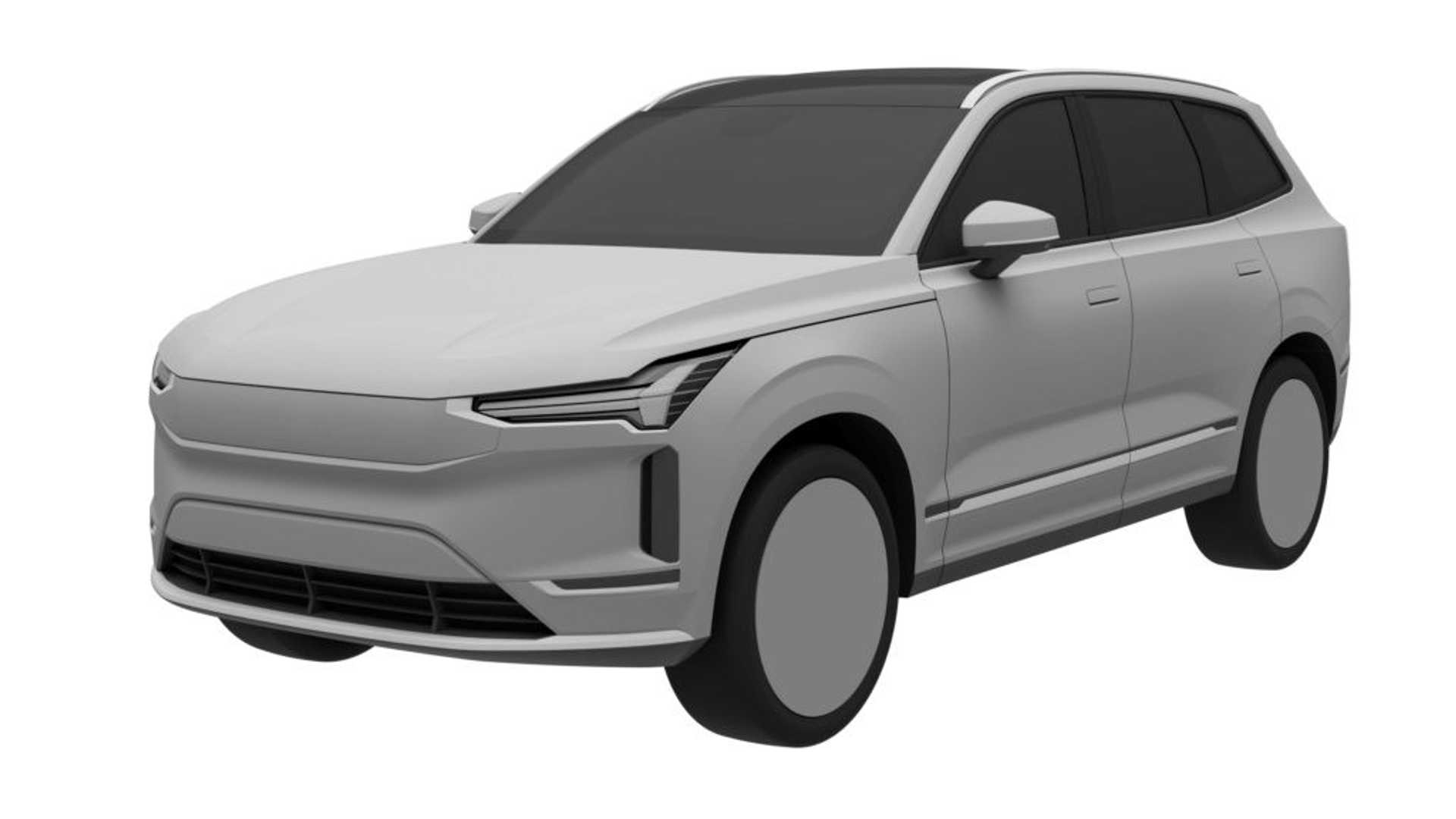
Leaked patent images have revealed the design of the large SUV, featuring a familiar look to the current XC90 but with modern touches, such as tail-lights similar to the Volvo S60 and Polestar 2 sedans and hidden door handles.
With electric power and LiDAR technology as standard, expect the Volvo EX90 to command a significant premium over the XC90, which starts from $92,990 before on-roads in Australia.
The 2023 Volvo EX90 will compete against the Mercedes-Benz EQS SUV, Tesla Model X and Rivian R1S – only the Mercedes-Benz is confirmed for Australia at this stage, with a local launch planned for the first half of 2023.
To reach the one million EV target, Australia will need to average 200,000 new BEV purchases over the next five years.
Snapshot
- Ambitious target of a million new EV sales in five years
- Will push for fuel efficiency standards
- Businesses from Woolworths to Transurban
- Includes carmakers Tesla, BMW, Volvo, among others
Over 100 businesses and organisations have joined forces to get one million EVs onto Australian roads by 2027.
The companies include retail giants such as The Woolworths Group, infrastructure company Transurban, carmakers Tesla, BMW, Volvo, MG Motor, JLR, LDV, BYD, Polestar and others.
JUMP AHEAD
Above all else, the new alliance – headed up by the EV Council – is calling for a fuel efficiency standard to be put in place by the Australian Government.
Further goals for a federal EV strategy include a coordinated charging infrastructure push, local manufacturing, more electric buses and commercial vehicles, economic modelling that reflects the benefits of EVs and, finally, get one million BEVs on Australia’s roads.

“After years of inaction from Canberra, Australian EV policy is now ready to accelerate and business wants to ensure we don’t miss the moment
“This new federal government is off to a strong start and a National EV Strategy announced in the first months of its tenure is an excellent development. But after a long period of policy stagnation we now need a strategy that contains robust measures”, said Electric Vehicle Council chief executive, Behyad Jafari.
How far does Australia have to go to hit a million EVs?
To reach the one million EV target, Australia will need to average 200,000 new BEV purchases over the next five years.
That’s a pretty lofty goal considering in 2021 we only bought 5149 electric passenger cars, SUVs and light commercial vehicles, though that’s according to VFACTS which did not include Tesla sales until April 2022.

With Tesla’s ongoing success that is now reported in monthly sales tallies, EV market share has grown significantly, with 21,771 BEVs sold between January and September this year.
To reach the alliance’s goal of a million EVs on the road this number will need to grow again, nearly 10-fold. But with year-on-year growth like that, it is possible.
The EV market is also set to expand further next year as Volkswagen (which isn’t part of this alliance) finally introduces its first EVs in Australia, starting with the Cupra Born and then ID4, followed by Toyota and Subaru’s first BEVs.
“We know Australians want the transition to electric vehicles to speed up. Our most recent data shows a 65 per cent leap in EV sales over the past year. But that still leaves Australia with a lot of opportunity to fill, by catching up to the rest of the world.
Best Electric Cars Under $65k: Affordable EVs Rated
Welcome to part one of three price-based EV buying guides, this one focused on the most affordable electric cars available in Australia today
“The absence of a fuel efficiency standard is largely to blame as manufacturers overlook our nation in favour of others who have more ambitious plans”, Jafari noted as one reason behind Australia’s buyer-driven EV transition.
Which companies are involved?
As it stands, 101 companies and organisations have joined the alliance so far (a full list appears at the end of this article).
Some major players include Ikea, the National Electrical and Communications Association (NECA) and charging provider ABB EV, all of whom are interested in the transition to electrification.
For Ikea, “a strong, national EV strategy with targeted policy for the freight and logistics sector will enable the retail sector to accelerate its contribution to transport emissions reductions”, said fulfilment sourcing manager, Brendan Groll.
The NECA wants to see guidance in the EV strategy for “infrastructure and workforce to support the transition to a cleaner economy on one of the largest sources of national emissions. NECA fully endorses the EV Council in making this a priority”, according to CEO Oliver Judd.
While product market manager at ABB EV Charging, Steve Amor, is interested in helping the Government roll out a national recharging strategy:
“ABB Australia wholeheartedly supports and agrees to participate in the proposal, as part of the collaborative EV industry, to assist in developing an Australian EV Strategy and policy to encourage, promote and support the transition of Australia’s wider vehicle population to electrification, with the ultimate goal of having one million electric vehicles on Australian roads by 2027.”
“If we get this EV Strategy right, the opportunities are enormous. We could be employing tens of thousands of Australians building batteries, chargers, cars, buses, and trucks. We’ll be cutting pollution from transport and doing our fair share to combat climate change. And we’ll be reducing our reliance on foreign oil by using Australian energy to move”, concluded Mr Jafari.
The full list of participating companies and organisations
| CAR MAKERS | |
|---|---|
| BMW Group (BMW and MINI) | MG Motors |
| BYD | Polestar |
| Jaguar LandRover | Renault |
| Jaunt | Tesla |
| LDV | Volvo Cars, Volvo Bus and Truck |
| OTHERS | |
|---|---|
| ABB | GET Electric |
| ActewAGL | Girl Geek Academy |
| Australian Electric Vehicle Association | Good Car Co |
| AGL Energy | Greenpeace |
| Amber | Hanson |
| ANC | Heavy Vehicle Industry Association |
| Arrival | Hertz |
| AUSEV | IKEA Australia |
| Ausgrid | JETCharge |
| Australian Hydrogen Council | JLL |
| Australian Trucking Association | JOLT Charge |
| Bank Australia | Karmo |
| Beyond Zero Emissions | Linfox |
| Bortana | Microsoft |
| Boundless | Middy’s Electrical |
| Brighte | Motion Energy |
| Carbar | Motorsport Safety & Rescue |
| Clean Energy Council | Myenergi |
| Climate Action Network Australia | National Electrical and Communications Association |
| Climate Energy Finance | Nexport |
| Committee for Sydney | Noodoe |
| ConnectSource | NRMA |
| Custom Denning | NSW Nature Conservation Council |
| Custom Fleet | Origin |
| Delta Energy | Pepper Money |
| Doctors for the Environment | Pollination Capital |
| Ebusco | Rewiring Australia |
| Electric Vehicle Council | ROEV |
| Electrical Trades Union | SA Power Networks |
| Energy Efficiency Council | Savic Motorcycles |
| Energy Renaissance | Schneider Electric |
| Energylab | SEA Electric |
| Environment Victoria | SG Fleet |
| Europcar | Sixt |
| EVenergi | Smart Energy Council |
| Everty | Solar Citizens |
| Evie Networks | Splend |
| Evolution | St Baker Energy Innovation Fund |
| EVSE | The Australia Institute |
| EVUP | Transurban |
| Farmers for Climate Action | Tritium |
| FIMER | Uber |
| Fonz | Wallbox |
| Foton Mobility | Woolworths Group |
| GEMtek | WSP |
| Geotab | |
Although exciting, buying a new car can be an intimidating experience. It’s one of the most expensive purchases you can make after a house, so there’s so much to consider: safety, style, look, efficiency, practicality, space and comfort.
Topping that with the stress of figuring out terms like capped price servicing or dealer delivery can make for a real daunting time.
Imagine: You’ve read a review about a car that’s priced at $22,000 and show up to the dealership to find it’s actually $25,800. What’s going on?
There’s no dictionary you can carry around to dealers to help decipher sales-speak, so here we debunk the lingo so you never have to worry about it again.
Annual Percentage Rate (APR)
Just like a mortgage or credit card, the APR is the interest rate for a year, rather than monthly calculations or fees.
ANCAP Rating
The Australasian New Car Assessment Program assesses the safety of new vehicles and uses a star rating system.
The top rating is five stars, so if you’re looking at a car rated at four stars or below, you should research why it failed to score five stars before you buy.
Capped Price Servicing
Capped price servicing is a selling-point for manufacturers and sets the price of scheduled servicing through a brand’s service centres, usually for three-to-five years.
It allows dealers to lock you into dealership servicing, but is often offered at a compelling price.
Compulsory Third Party (CTP) Insurance
Also known as a ‘green slip’ if you’re in New South Wales, CTP is a compulsory insurance required by law to register a car.
It’s usually included in your registration fees and covers drivers for any injury or death they cause to another person or persons in an accident with a car, cyclist, passenger or pedestrian.
Dealer Holdback
When a vehicle is sold by a dealership, a manufacturer will pay a percentage of the MSRP (see below) back to the dealer. Watch out for this on your invoice, it’s a good bargaining tool for buyers.
Dealer Incentive
A dealer incentive is a discount offered to a dealership from a manufacturer and often only lasts for a short time.

Dealer Preparation Fees
A fee (usually a few hundred dollars) for getting the car ready for you to drive away from the dealer.
If you’re buying a new car, all dealers usually need to do is check fluids, tyres, and wash the car. This is often included in the dealer delivery fee.
Destination charge
A flat fee that you’ll pay to cover the costs of transporting the car to the dealership. These costs are usually included in on-road costs or dealer delivery.
Documentation/Processing Fee
As the name suggests, this is a fee (in the hundreds of dollars) that dealers charge for processing the sale documentation. It costs a lot to sign all those papers, you know.
Drive away, no more to pay
Means the price of the car covers almost all your on-road costs. You’ll still have to think about car insurance, on-going registration, dealer delivery, and probably a tank of fuel after you leave the dealer’s driveway.
Direct Financing
A loan organised directly through a bank or financer, rather than through the dealer.
Dealer Delivery Fees
Dealer delivery covers the cost of getting the car to the dealership and ready for the customer through checks, washing, etc. But the fee can vary by thousands of dollars depending on the profit margin.
It’s a way for the dealership to actually make some money on the car and still bargain with you.

Demonstrator
If you’re buying a demo car, you’re buying a car that’s been on the dealership floor and use by staff or for test drives.
Extended warranty
Usually an extra cost (but sometimes included in the sale price) to extend a car’s warranty.
Manufacturer’s Suggested Retail Price (MSRP)
The recommended retail price (RRP) set by the manufacturer.
On-road costs
On-road costs are those pesky little extras you wouldn’t normally have to think about when purchasing of goods and services.
Commonly, these are stamp duty, registration, CTP, and dealer delivery. If a dealer is offering you ‘no on-road costs’, or a ‘drive-away price’ then your on-roads are covered.
Plate Clearance
Deals offered toward the end of the year when car yards need to clear cars with old dates on build ID plates.
Essentially, the cars have been in stock for a year and have already depreciated, so dealers want to move them to make way for newer cars.

Run-out
A run-out sale is a good opportunity to buy a new car without the new car price.
When manufacturers are ending production of a model, introducing a new generation of a car, or basically ‘running out of stock’, they sell them cheaply to make room for new cars.
Stamp Duty
Just like stamp duty on your house, this is a tax based on the value or sale price of your car. As this is a government tax, it’ll be paid every time you buy a new car.
Trade-in
When a dealership buys your used car and uses it as payment toward your new car. Usually this is a percentage below market value.
Up-front costs
The costs you have to pay when signing the contract, before the dealer hands over the keys to your car.
February 2023: X-Trail E-Power Australian review and road-test video
Nissan’s RAV4 Hybrid rival, the X-Trail E-Power, is now in Australia! Get our full local review and video at the link below.
Story continues…
X-Trail E-Power: International first drive
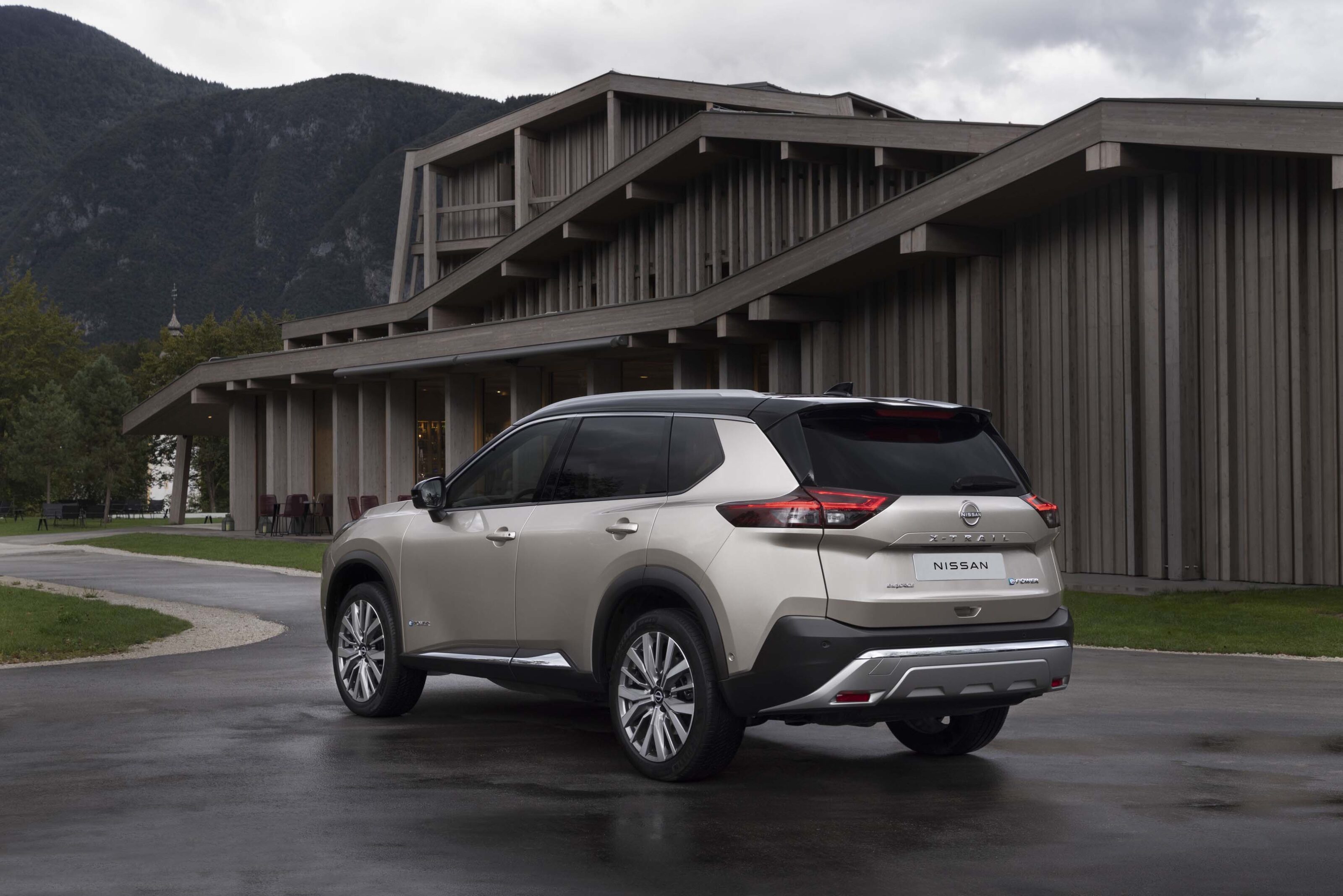
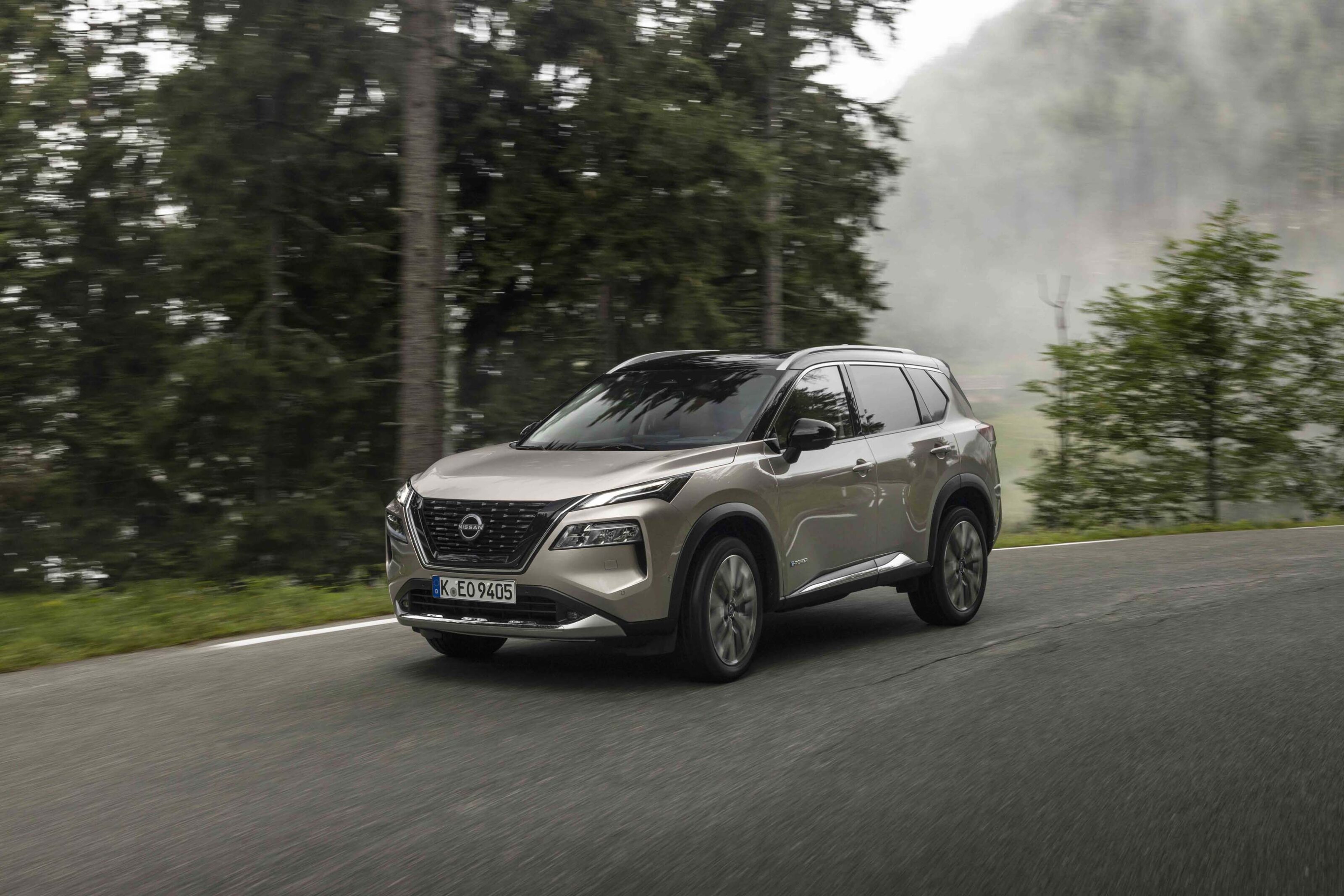
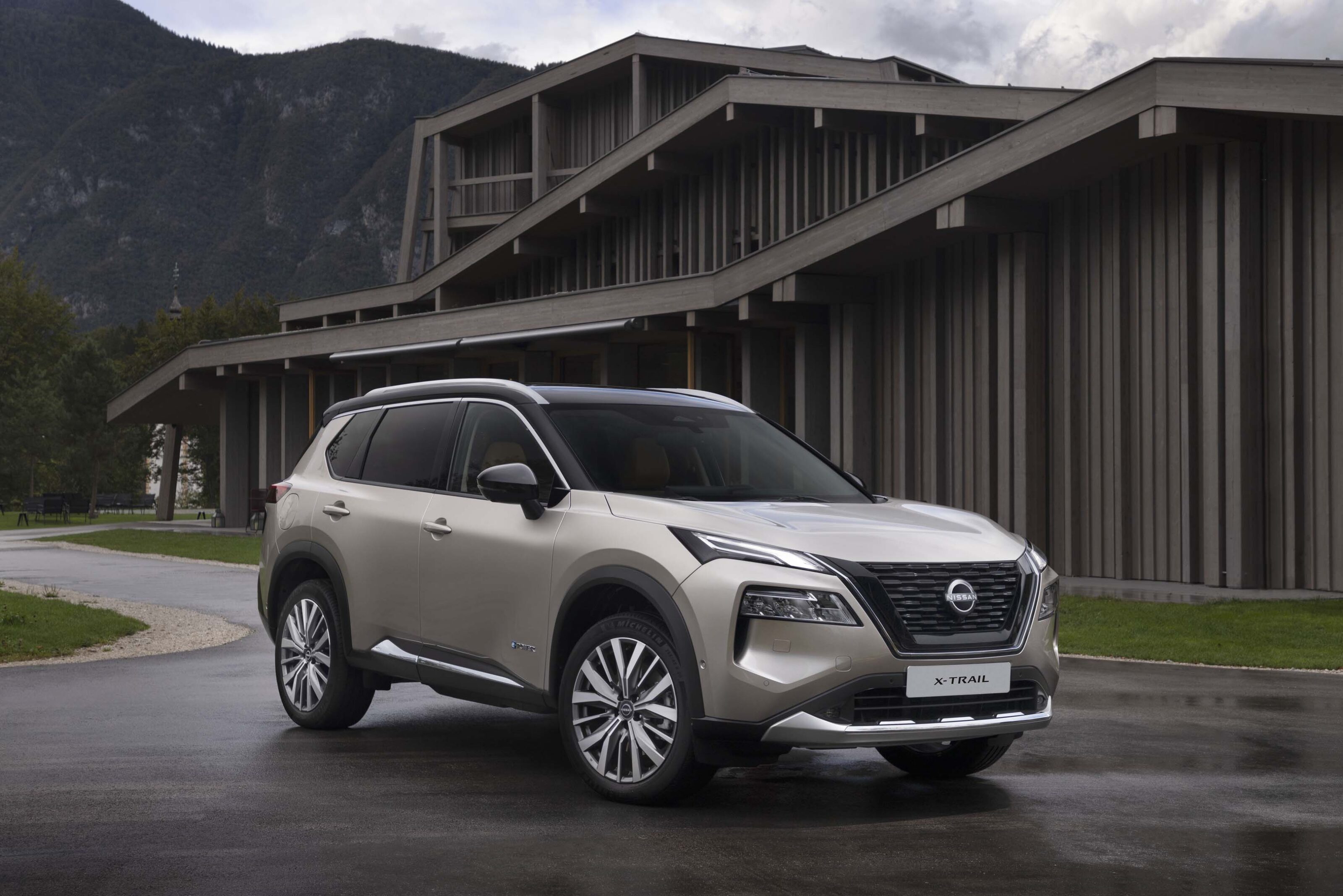
Arriving in Australia early next year, the new-generation X-Trail catches the baton from the outgoing T32-generation model, which has long been a family favourite among Aussie households.
But besides giving an overdue renewal to a core nameplate, Nissan’s decision to add an electrified variant to the X-Trail range finally gives its humble SUV a key USP: a hybrid powertrain claimed to be more akin to an EV in terms of its driving experience than most other petrol-electrics.
We travelled to Japan to examine the merits and deficits of Nissan’s innovative e-Power hybrid technology ahead of the X-Trail’s local debut.
JUMP AHEAD
- How much is it, and what do you get?
- How do rivals compare on value?
- Interior comfort, space and storage
- What is it like to drive?
- How is it on fuel?
- How safe is it?
- Ownership costs
- VERDICT
- Specs
How much is it, and what do you get?
In Australia, the electrified X-Trail range will open with the $54,190 X-Trail Ti e-Power with e-4orce (to use its unwieldy official name) and top off at $57,190 for the slightly better-equipped Ti-L e-Power with e-4orce – both representing a $4200 premium over their conventionally-powered equivalents. Both prices are before on-road costs.
That’s a lot of coin for a mainstream mid-sizer, but both Ti and Ti-L grades come generously equipped to compensate.
Features like an ultra-wide 12.3-inch infotainment display, full digital dash, head-up display, panoramic sunroof, power-operated tailgate, tri-zone climate control, wireless phone charging pad, electronic rear-vision mirror and 19-inch alloys are standard on both, with the Ti-L adding some extra luxe in form of Nappa leather upholstery, a Bose audio system, integrated rear window blinds, heated rear seats and a heated steering wheel.
2023 Nissan X-Trail e-Power Australian pricing
| Model | Price |
|---|---|
| X-Trail Ti e-POWER with e-4ORCE | $54,190 |
| X-Trail Ti-L e-POWER with e-4ORCE | $57,190 |
Prices exclude on-road costs. (What are on-road costs?)
Equipment highlights
| X-Trail Ti e-Power with e-4orce | X-Trail Ti-L e-Power with e-4orce adds |
|---|---|
| Leather accented seating | 20-inch alloy wheels |
| 19-inch alloy wheels | Heated steering wheel |
| Panoramic sunroof | Bose 10-speaker sound system |
| LED turn signals | Full Nappa leather seating with memory function |
| Smart rear view mirror | Rear sunshades |
| Tri-zone climate control | Hands-free tailgate |
| Adaptive Driving Beam | Heated rear outboard seats |
| Auto wipers | Remote engine start |
| Power operated tailgate | Power adjustable, power folding, heated door mirrors w/ reverse tilt |
| 12.3-inch infotainment screen w/ satnav | |
| 10.8-inch heads-up display | |
| Wireless phone charger | |
| Wireless Apple CarPlay | |
| Wired Android Auto | |
| 12.3-inch digital driver display | |
| Power adjustable, power folding, heated door mirrors | |
| Ambient lighting |
How do rivals compare on value?
The X-Trail Ti-L e-Power with e-4orce’s chief rival is one it shares a fair bit of DNA with – Mitsubishi’s Outlander PHEV. The plug-in Outlander ES starts at $54,490 before on-road costs, just $300 more than the electric X-Trail, but allows drivers to make use of cheap household energy instead of petrol for up to 84km.
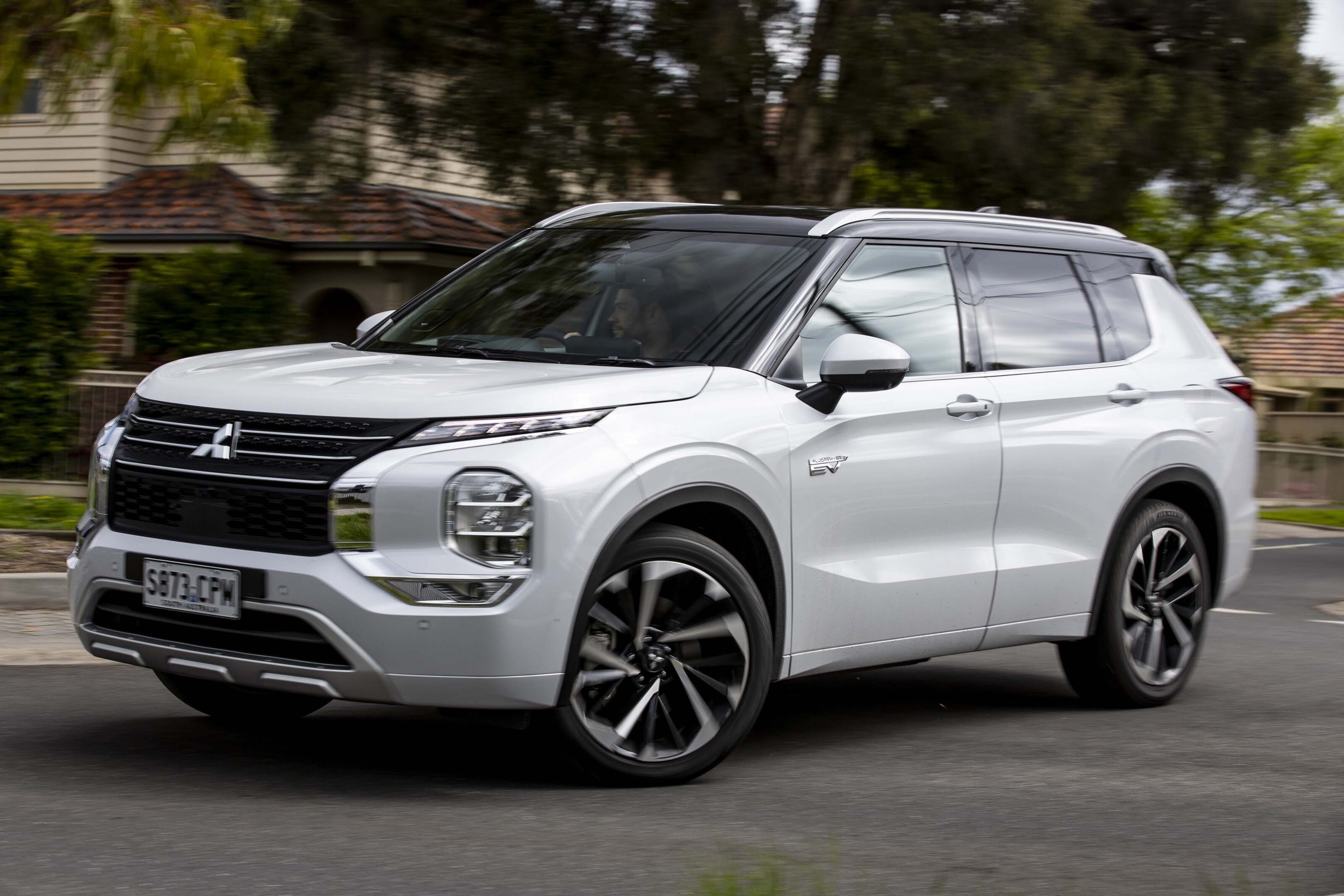
On the other hand, that car is a base grade thing, so you’d need to look at the $65,990 and $68,490 (before on-road costs) Exceed and Exceed Tourer grades to find spec analogues to the X-Trail Ti and Ti-L in e-4orce config.
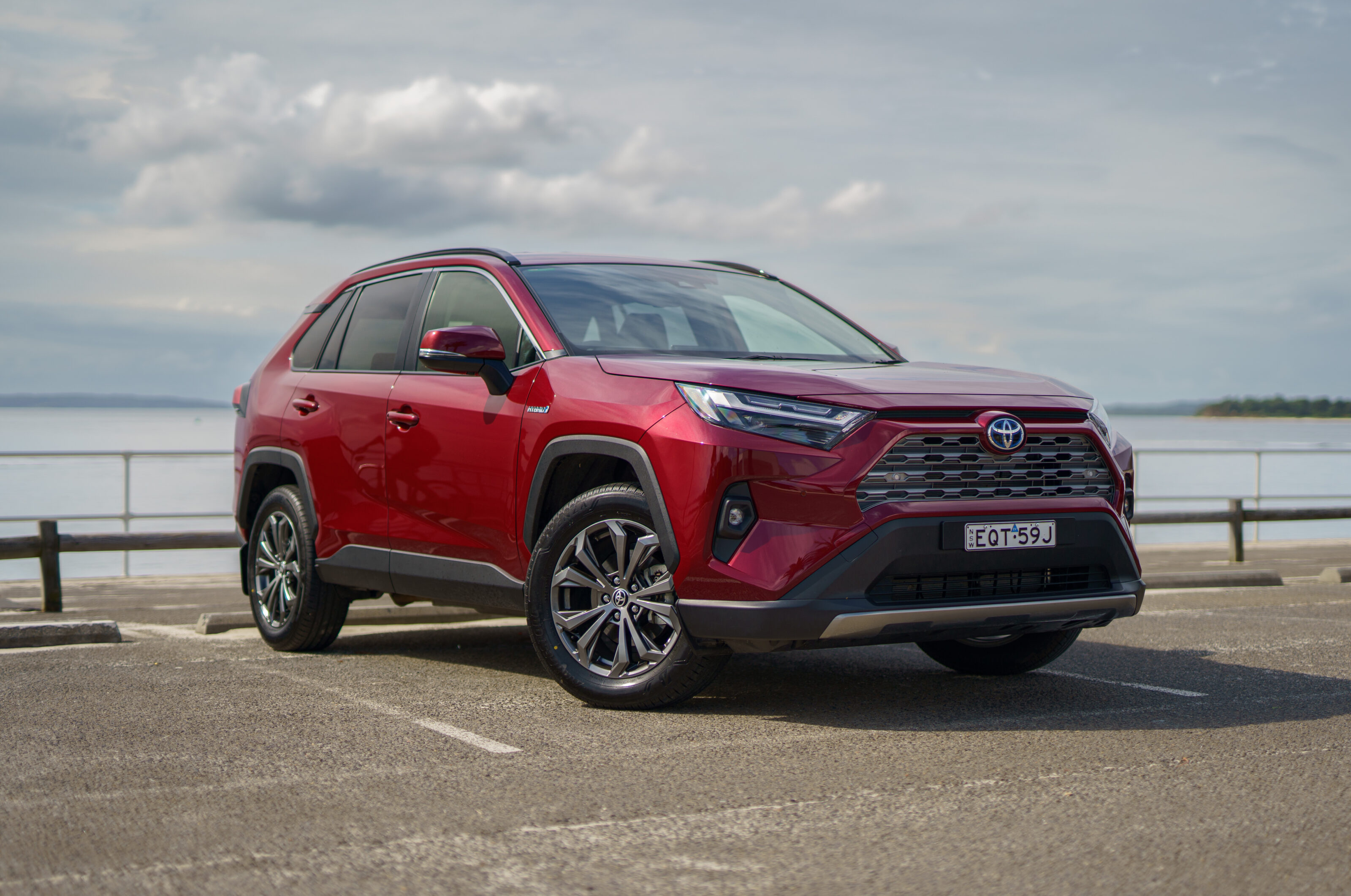
But then there’s also the Toyota RAV4 Hybrid, the most expensive version of which (Edge eFour) retails for $52,700 before on-road costs and consumes a claimed average of 4.8L/100km – 1.3L/100km more frugal than Nissan claims for its electrified X-Trail.
Can the X-Trail’s fresher offering and innovative powertrain give it an advantage outside of the showroom?
Interior comfort, space and storage
Moving inside, the new X-Trail makes a strong first impression.
A soft double-stitched trim panel sits beneath a chocolate brown upper and a convincing faux wood lower trim piece, which wraps around to the door cards and extends along the centre console. Especially in this Nappa-leather-clad high-grade variant, the new X-Trail’s cabin proclaims premium ambitions.
But Nissan hasn’t forgotten about utility. The centre console is clean and uncluttered, the low-profile drive selector keeping the airspace around the phone charging pad and centre stack clear and the twin front cup holders being deeply recessed into the console.
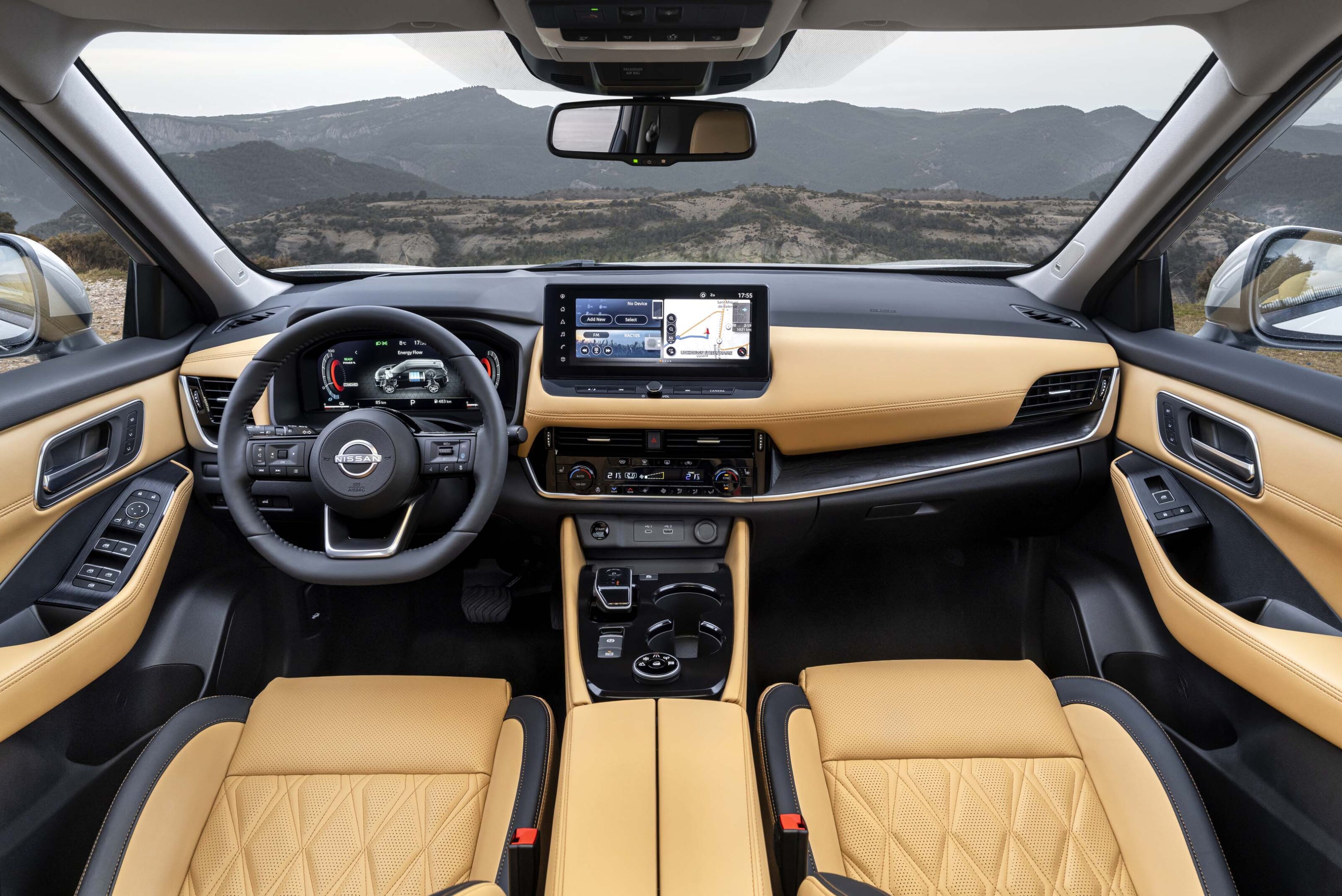
A fairly deep console box hides under a spring-loaded split lid, but the more useful storage cubby is beneath the console itself – a useful floor-level shelf for smaller handbags, wallets, road trip snacks and other stuff.
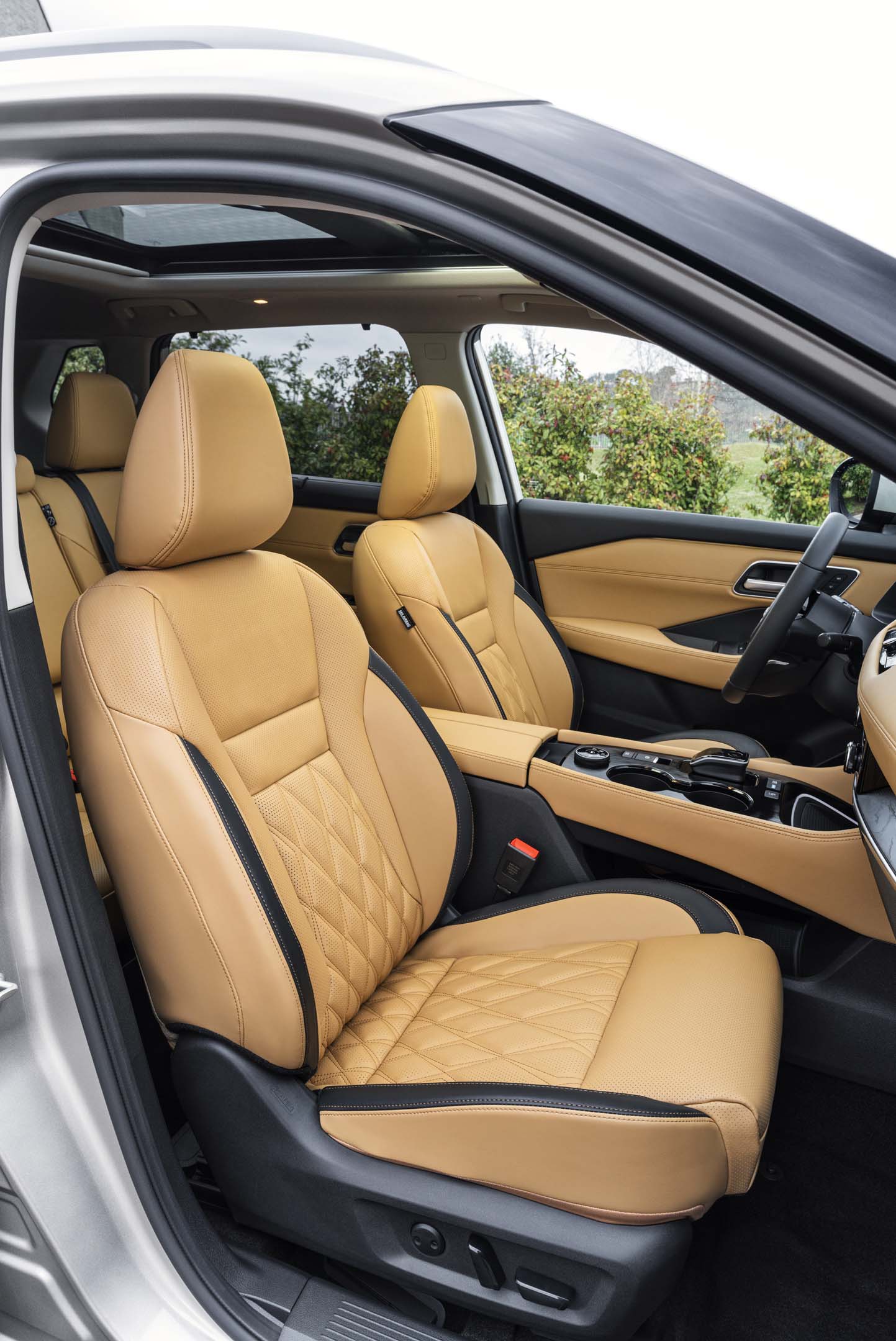
Door bins are ample, there’s plenty of device charging options (12-volt, one USB-A and one USB-C up front plus one USB-A and one USB-C in the back) and the sliding rear bench provides huge legroom when positioned all the way back.
The X-Trail’s seat cushions are generally quite firm (and lacking in under-thigh and lateral support in the back seat), but driver comfort was good even after five hours at the wheel.
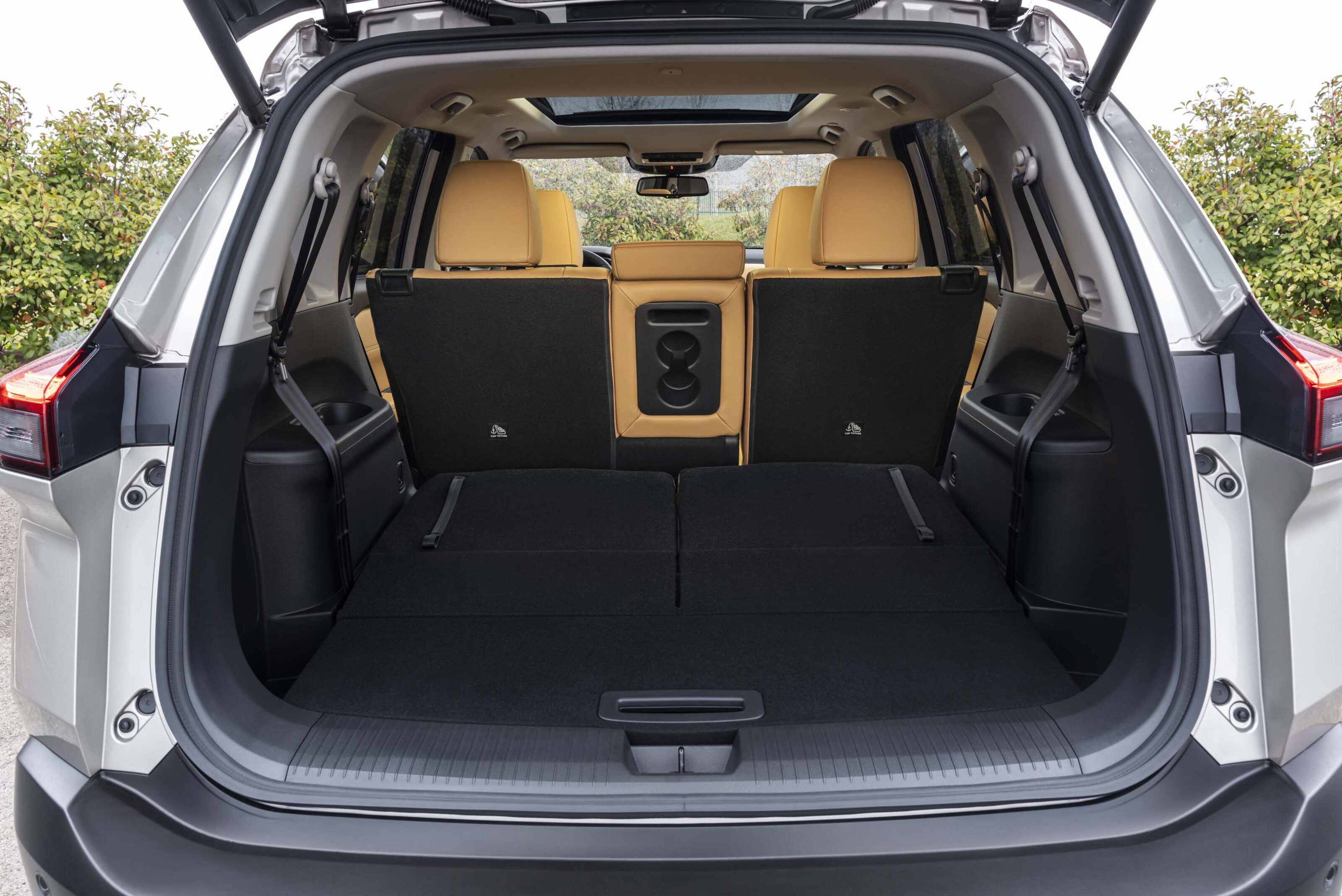
2023 X-Trail e-Force boot space
Cargo capacity for the 2023 X-Trail e-Force is 575L with the second row in place, however, a backwards step is the absence of anything like the previous model’s reconfigurable boot floor – let alone simple features like shopping bag hooks. An oversight for a family vehicle.
There are no remote releases to fold down the seats from the boot either, though there is at least a 12V socket and 1500W household power outlet as well as a tailgate aperture that is exceptionally wide and low enough to reduce the amount of heaving when loading heavy luggage.
Oh, and thankfully that foot-operated parking brake of the previous-gen X-Trail has been banished, consigned to the history books where it belongs.
What is it like to drive?
The basics
| Engine | 1.5-litre three-cylinder turbo petrol, dual electric motors |
|---|---|
| Power | 157kW combined |
| (106kW petrol, 150kW front electric, 100kW rear electric) | |
| Torque | 525Nm combined |
| (206Nm petrol, 330Nm front electric, 195Nm rear electric) | |
| Gearbox | single-speed automatic |
| Fuel use (claimed) | 6.1L/100km |
| Fuel use (tested) | 6.1L/100km (yes, identical) |
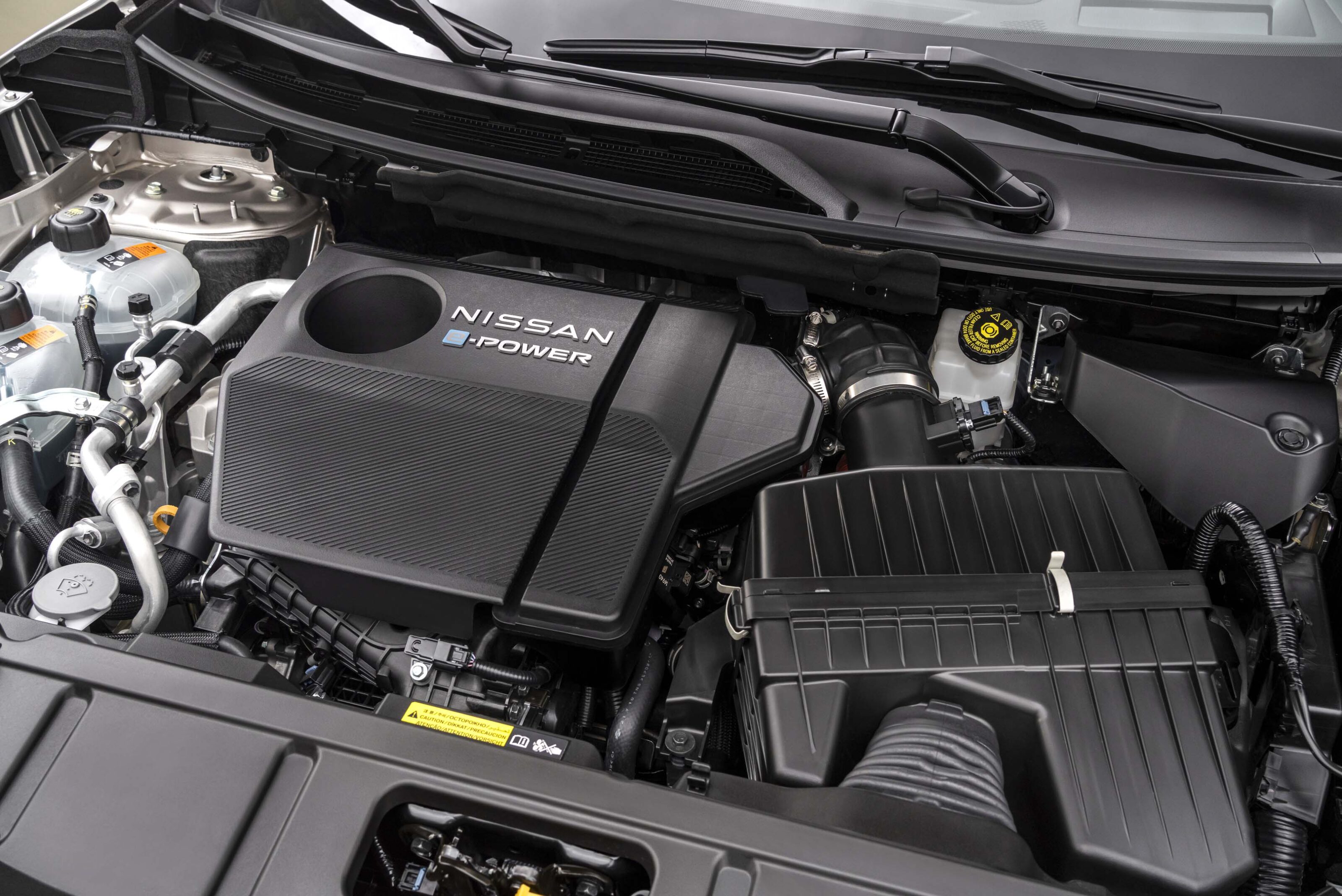
With the combustion engine lacking a mechanical link to the driven wheels – power is delivered to the road purely electrically; Nissan sells the X-Trail e-4orce’s dual-electric motor configuration as providing “instant, linear response to the accelerator” like that of a fully-electric vehicle.
But that’s not entirely true.
While it certainly is smooth, progressive and vibration-free when accelerating modestly from a standstill, flexing the accelerator too much sees the electrical demand from the twin motors (150kW up front and 100kW at the rear) outstrip the 1.8kWh battery’s ability to supply them by itself, meaning the variable compression ratio, three-cylinder 1.5-litre turbo-petrol engine needs to make up for whatever extra energy demand there is.
And as that engine spools up, it can result in a slower-than-expected ramp-up to full torque. While it’s got a handy amount of oomph, it can’t deliver all of it in one big drag-launch whack and doesn’t indent the back of your skull like a Tesla would. Which, to be fair, is probably a good thing for a family hack.
If you’ve got a healthy charge in the battery you can pop it into EV Mode, but that only ups the petrol switchover threshold from a 20 per cent power demand to 30 per cent; any more than that and the X-Trail starts burning hydrocarbons whether you like it or not. Is that efficient? We’ll get to that in the next section.
But what is clear is that this is an exceptionally refined powertrain. When working on battery power alone, the X-Trail’s cabin is churchlike and peaceful.
Even when the petrol engine inevitably kicks over it’s barely audible unless you’re asking for the car’s full 157kW/330Nm output.
It’s a pretty serene thing in which to just glide around the suburbs and in that setting, EV mode represents the X-Trail at its best.
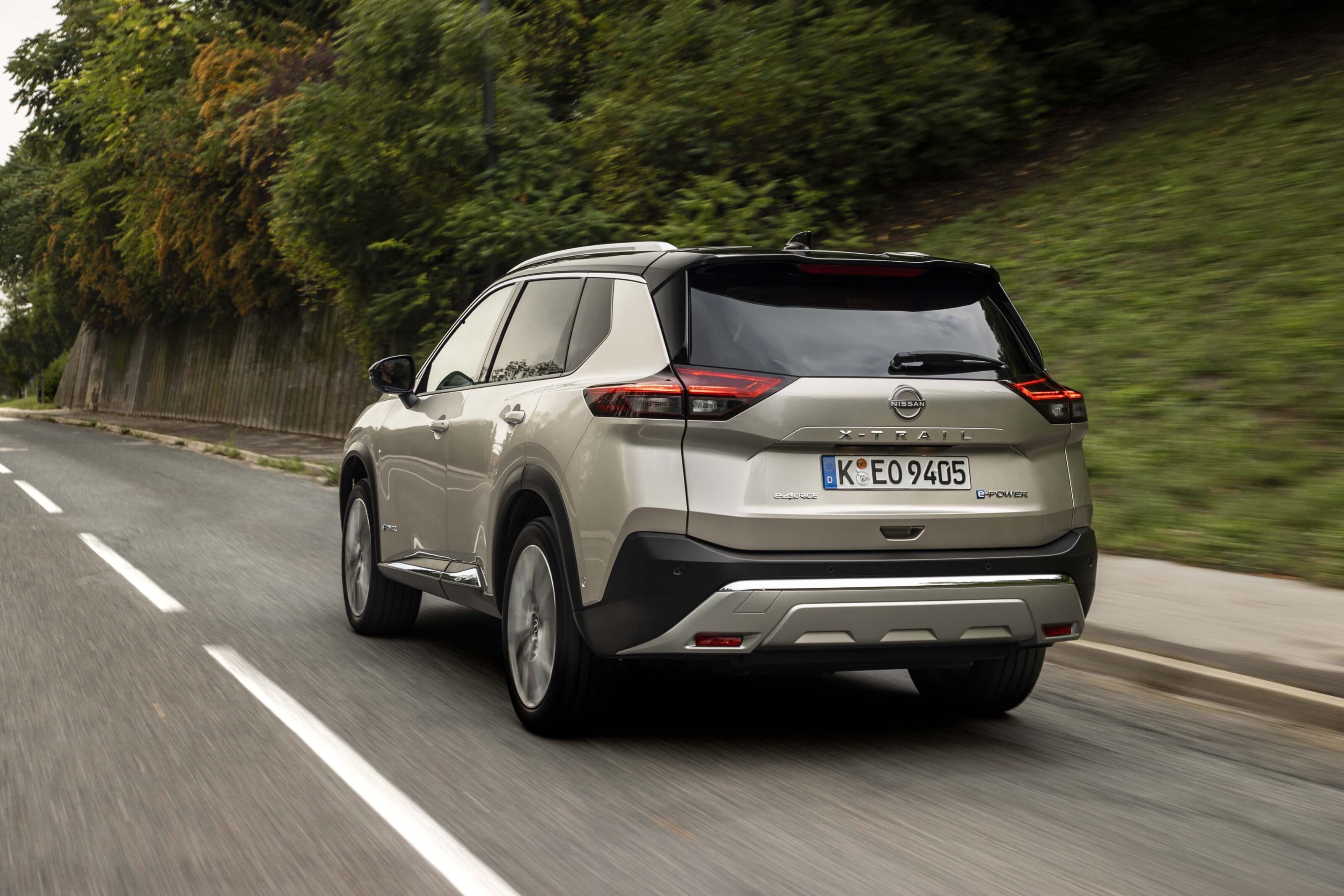
Handling isn’t too shabby either. Though weighing in at 1880kg empty, the X-Trail e-4orce has well-judged steering and a willingness to take corners at speed, though its ride can be brittle over sharp, low-amplitude road imperfections and corrugations.
How is it on fuel?
Nissan claims an average of 6.1L/10km, which honestly isn’t a hugely impressive number considering the technology onboard.
However, while driving without huge regard for fuel economy in one of Japan’s most mountainous regions, we managed to achieve bang on 6.1L/100km.
Though big hills mean big regen on the descent, our route saw prolonged downhill stints that fully charged the battery long before the road levelled out, resulting in a large chunk of hard-won kinetic energy simply being wasted.
Drive it more sedately on flatter terrain and the X-Trail should overachieve on its seemingly conservative fuel claim.
Before you ask: no, you can’t charge it from a wall socket. Nissan’s e-Power hardware is indeed complex, but it’s not a plug-in hybrid.
How safe is it?
The new-generation X-Trail has yet to be rated by ANCAP but features an extensive safety fitout that includes a full suite of frontal, side and head airbags, autonomous emergency braking in forward and reverse, rear cross-traffic alert, lane departure warning, adaptive cruise control, adaptive high-beam and a 360-degree parking camera at Ti level.
2023 X-Trail e-Power safety features
| Rear view camera | Intelligent driver alert |
| Front and rear parking sensors | Adapative cruise control |
| Forward collision warning | Traffic sign recognition |
| Autonomous emergency braking w/ pedestrian and cyclist detection | Tyre pressure monitoring |
| Junction assist | Trailer sway control |
| Rear AEB | Speed limiter |
| Rear cross-traffic alert | Acoustic vehicle alerting system (up to 30km/h) |
| Blind spot warning | Rear seat alert |
| Lane departure warning | Tyre repair kit |
| Lane departure assist |
Ownership features and costs
All new Nissans are covered by a five-year/unlimited-km vehicle warranty, with complimentary five years of roadside assist, all fully-transferable to a second owner at no extra cost. Capped-price servicing is available – although Australian pricing for that is still to be released – and service intervals are listed at 12 months or 10,000km, whichever comes first.
VERDICT
The electrically-augmented X-Trail presents well as a tech flagship for Nissan’s mainstay SUV.
Forget what you know about the X-Trail: its all-new electrified replacement kicks big goals as far as refinement, quality, equipment, space and efficiency are concerned.
Downsides are limited to two main things: it doesn’t feel as profoundly ‘electric’ as the marketing material would have you believe, and its cost is hard to stomach given it lacks a plug-in capability and its battery size is so small.
Applying the e-4orce formula to lesser X-Trail grades would remedy that, but as it is, the electrically-augmented X-Trail presents well as a tech flagship for Nissan’s mainstay SUV.
2023 Nissan X-Trail e-Power e-4orce specifications
| Specification | Value |
|---|---|
| Body | 5-door, 5-seat medium SUV |
| Drive | electric all-wheel drive |
| Engine | 1.5-litre three-cylinder turbo petrol, dual electric motors |
| Power | 157kW combined |
| Power (additional) | (106kW petrol, 150kW front electric, 100kW rear electric) |
| Torque | 525Nm combined |
| Torque (additional) | (206Nm petrol, 330Nm front electric, 195Nm rear electric) |
| Gearbox | single-speed automatic |
| Fuel use (claimed) | 6.1L/100km |
| Fuel use (tested) | 6.1L/100km (yes, identical) |
| L/W/H | 4680mm, 2065mm, 1725mm |
| Wheelbase | 2705mm |
| Kerb weight | 1880kg |
| Towing | 1650kg braked, 750kg unbraked |
| Boot volume | 575 litres (seats up) |
| Boot volume (additional) | NOTE: A seats-down number is not offered. Petrol 5-seater lists 585L, petrol 7-seater lists 565L. |
| PRICING | |
| X-Trail Ti e-POWER with e-4ORCE | $54,190 |
| X-Trail Ti-L e-POWER with e-4ORCE | $57,190 |
Sidling up to this car I feel like Magnum PI (remember that ‘80s TV show, with Tom Selleck?), just without the looks or the Hawaiian shirt. I guess I could get the shirt!
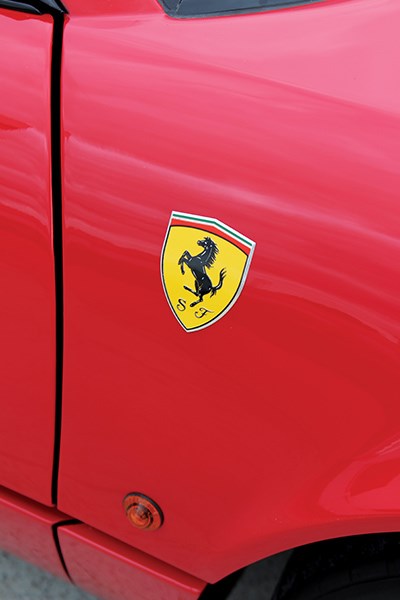
What we’ve got here is a later version of the Magnum mid-engined two-seater (they were all 308s), a1989 Ferrari 328 quattro valvole GTS (Spider). That alphabet soup indicates the removable roof, while a GTB (Berlinetta) is the hardtop.
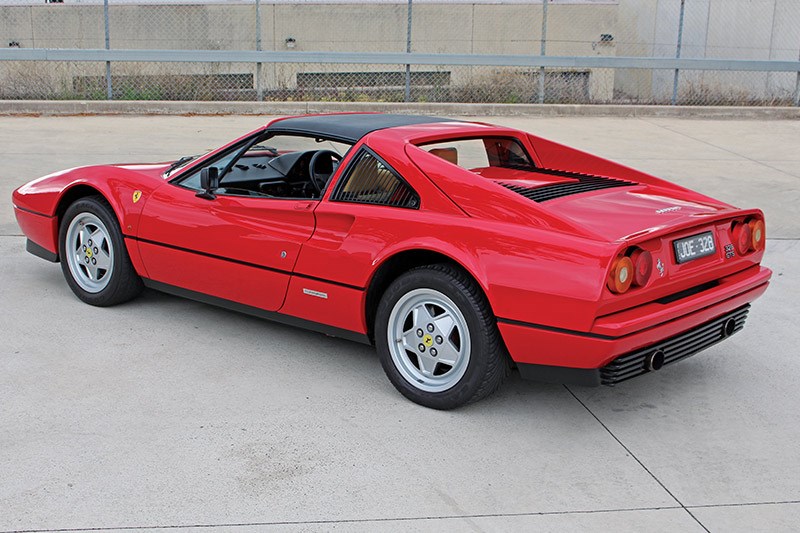
These things have a long lineage, in that the platform started out as a 308 back in 1975 and lasted as a 328 right through to 1989. This is a period when the prancing horse dominated the world of exotic sports cars and of course it had to be painted red.
| Buyer’s Guide: Ferrari 308/328 1975-1989
These first appeared with a fibreglass body and dry sump engine. That body material caused enormous controversy and Ferrari switched to more conventional construction by 1977. Back in the ‘70s and even ‘80s, the buyers tended to shun those early cars. But, the classic market being what it is, that first model is what all the collectors want and is now worth a lot more than the steel-bodied car!
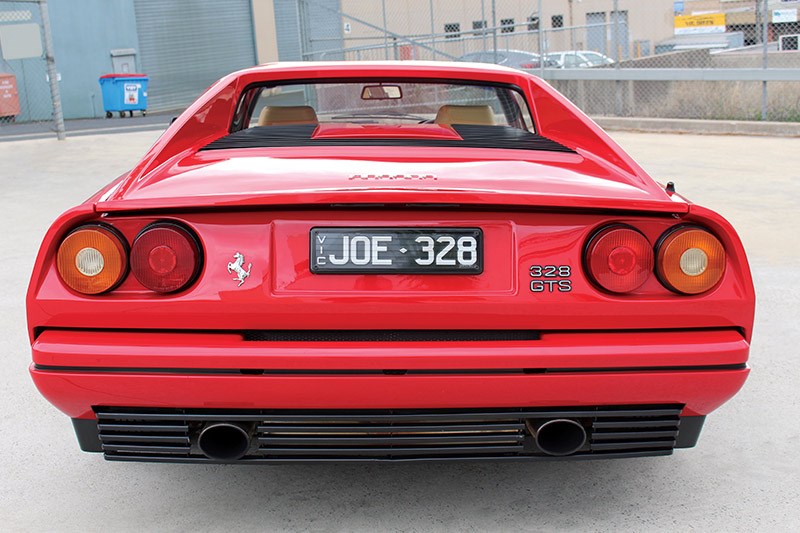
The 308 ran a 2.9lt V8 engine (actually 2927cc), which was fuel-injected in 1981 and taken out to 3.2lt for the 328 series in 1985. They arrived in Australia in 1986 and then cost a mighty $140,000 – about $20,000 more than a Porsche Carrera and at the time the price of a substantial house in most capital cities.
Controversy aside, these were a popular car given the relatively rarified circles that owned them. People liked the look of them and eight seasons as the star car in a TV series certainly helped cement it into popular culture.
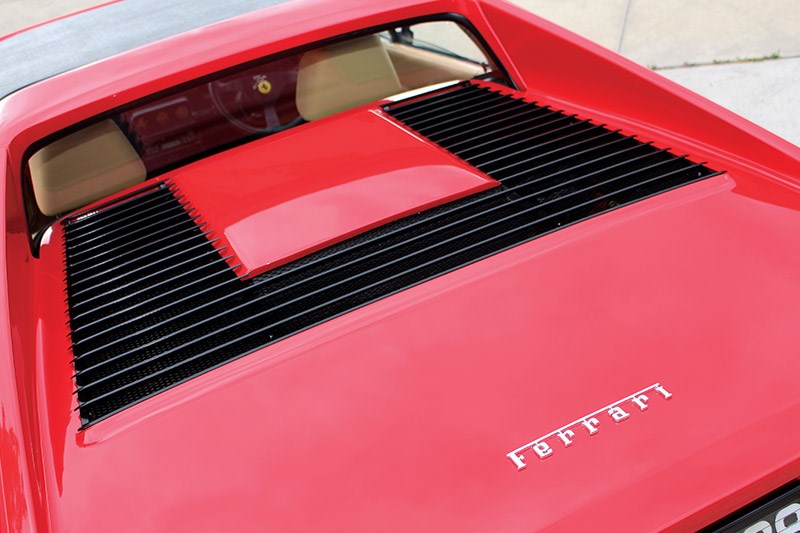
In an earlier life, I owned a GT4, which was the unloved Ferrari (yes, there was such a thing!). It was the Bertone 2+2 with similar mechanicals to this car. I had it for about a year and used to take my twins to school in it and the hum of the engine used to put them to sleep. I loved the car and on the open road it was fabulous. At the time I lived in Tassie, where there are lots of open roads and you can enjoy a car like this.
Driving this car is a similar experience. It’s not entirely happy threading through traffic, but once we got it onto the freeway it was really, really, good. Nice tight suspension, good damping – a lot of cars this age have been let go, but this example hasn’t.
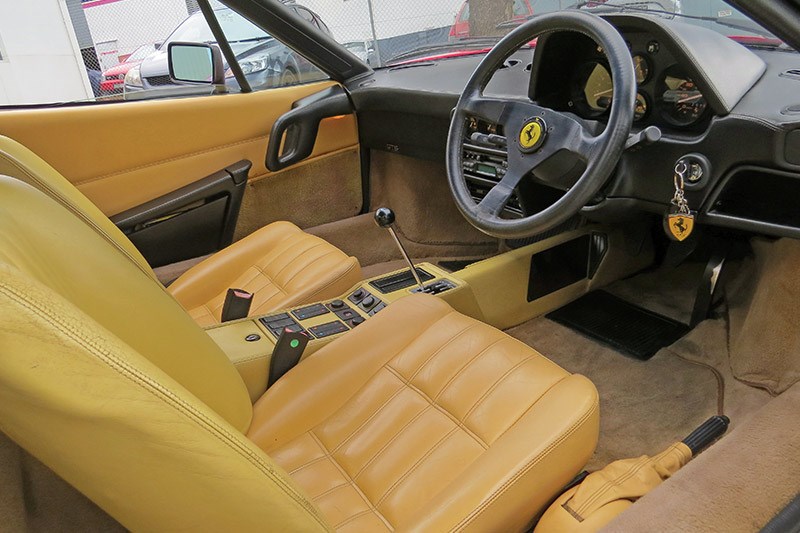
I’m a fan of the gated gearshift, and the ratios are good. It’s a dogleg with really good spacing. When you get it up the rev range a bit, it sounds awesome. You wind the windows down to listen to it, so you get the whole induction and exhaust noise working together. Who needs a stereo?!
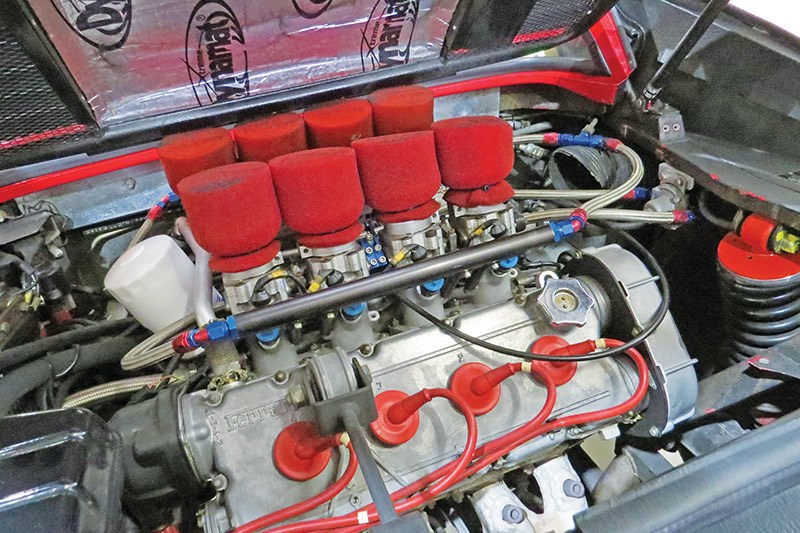
It’s the engine that really brings a smile to your face. This one has been fitted with individual throttle bodies, but is otherwise stock. New, they claimed a healthy 198kW at 7000rpm.
I’ve raced half a dozen Ferrari models over time, and I’ve owned two or three and you can see the appeal in them. They’re very Italian in some respects and there’s a bit of theatre to the whole experience. The driving position is typical for the period, short in the leg and long in the arm. My family were Fiat dealers at one stage and they were the same.
It’s a car that gets you excited and reminds you why we love driving.
The way I look at these are fun to drive and they will go up in value. Whether it’s this week, next year or the year after, these are now in a position where they’ll appreciate over the long term. This car is a good example – it last sold in 2010 for under half its current price. Which is no reason to hide it under a dust sheet – they’re designed to be driven and you should enjoy it!
This one is with the Healey Factory in Melbourne, priced at $195,000
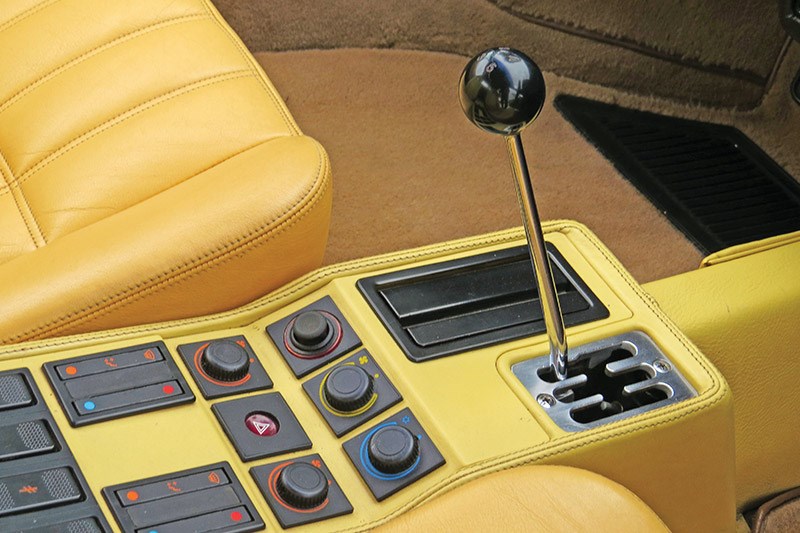
1989 Ferrari 328 GTS
Originally published at our sister site, Unique Cars
Snapshot
- No more combustion engine sales from 2035 in EU
- ACEA calls for framework for manufacturers
- Niche manufacturers given extra yearu2019s grace
An agreement has been reached by the European Union to officially ban the sale of new combustion-engined cars from 2035.
The deal comes after the plan was first proposed in July 2021, and following the seventh round of European emissions standards that are understood to be the last of their type for combustion vehicles.
From 2035, all manufacturers will be banned from registering new combustion-engined and hybrid vehicles on the EU’s road network. This means all fresh sales will be of battery or fuel-cell electric cars in Europe.
The decision was reached late last week, with three key stakeholders – the EU’s executive arm, parliament and member states – coming to a consensus on the ban.
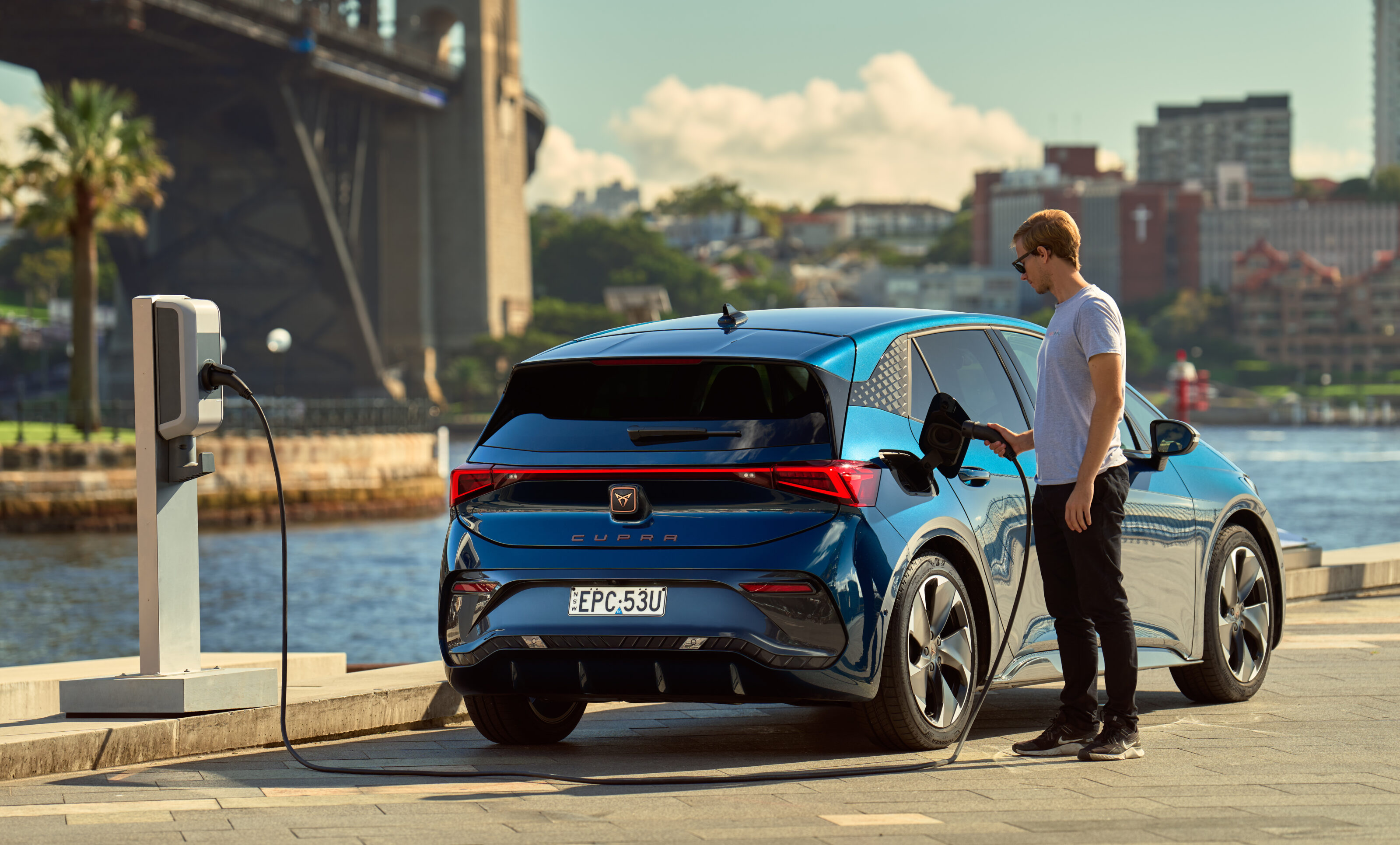
The resulting drop in emissions in Europe by 2030 is now expected to be 55 per cent vs 2021 levels, against the previously-predicted 37.5 per cent reduction as part of the Union’s ‘Fit for 55’ plan.
A gentleman’s agreement has been reached for niche manufacturers – such as Lamborghini, Ferrari, and Bugatti – to allow combustion sales of their vehicles for one year further than volume manufacturers.
EV Buyer’s Guide: Electric Vehicles Under $65K Ranked – The Best and The Rest
Welcome to part one of three price-based EV buying guides, this one focused on the most affordable electric cars available in Australia today
How carmakers responded
While the ban is now written in law, the European Automobile Manufacturers’ Association (ACEA) is calling for a framework to ease the transition for European carmakers and new car buyers.
“Make no mistake, the European automobile industry is up to the challenge of providing these zero-emission cars and vans”, said Oliver Zipse, BMW’s CEO and ACEA chairman.
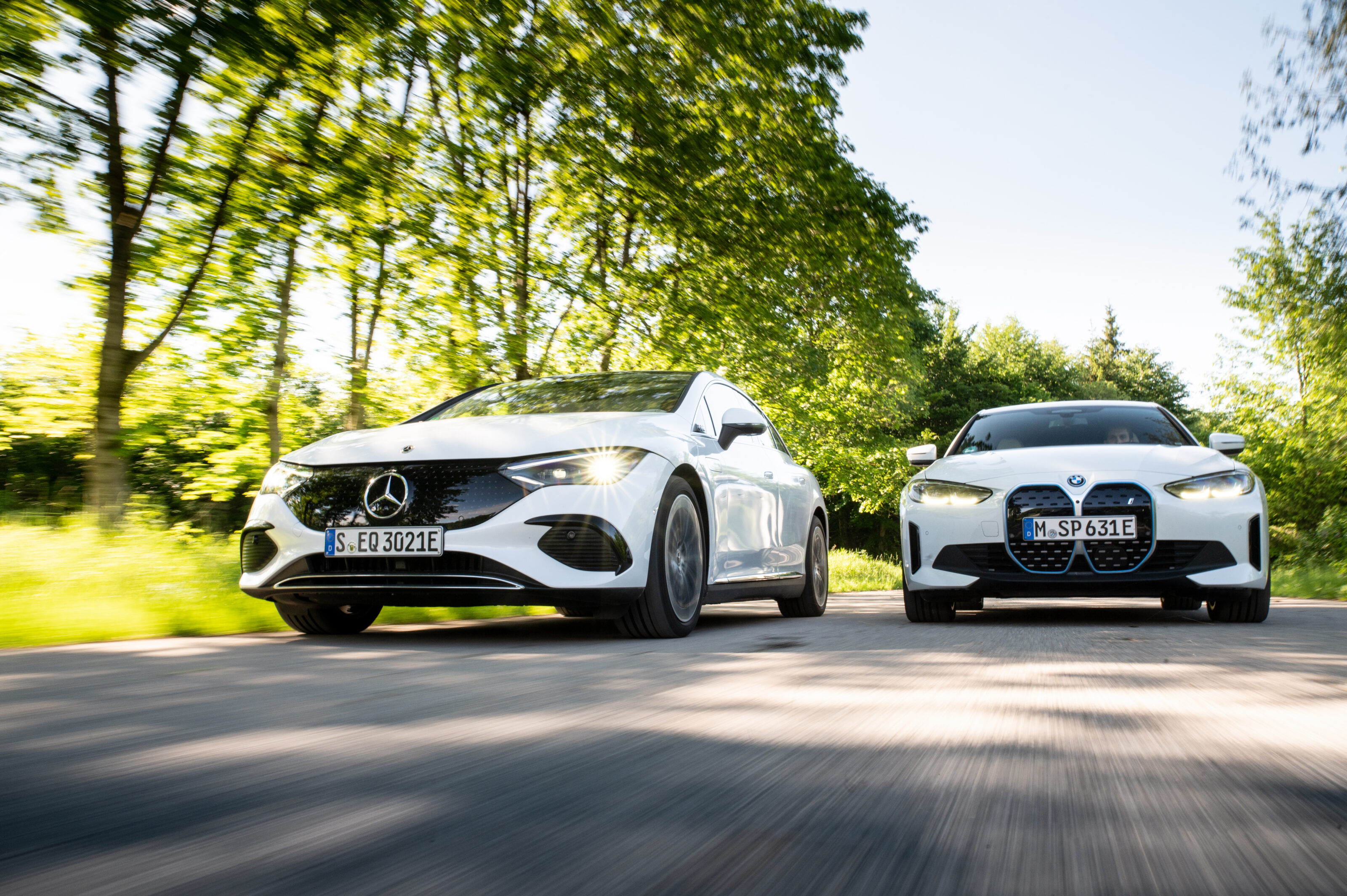
“However, we are now keen to see the framework conditions, which are essential to meet this target reflected in EU policies. These include an abundance of renewable energy, a seamless private and public charging infrastructure network, and access to raw materials.”
When proposed 12 months ago, the ban was considered extreme, so it’s a mark of how quickly the EV industry is moving that manufacturers are now, mostly, receptive to the change.
“European carmakers are already proving they are ready to step up to the plate, with increasingly affordable electric cars coming to the market” said the leader of the EU’s Green Deal, Frans Timmermans.
“The speed at which this change has happened over the past few years is remarkable.”
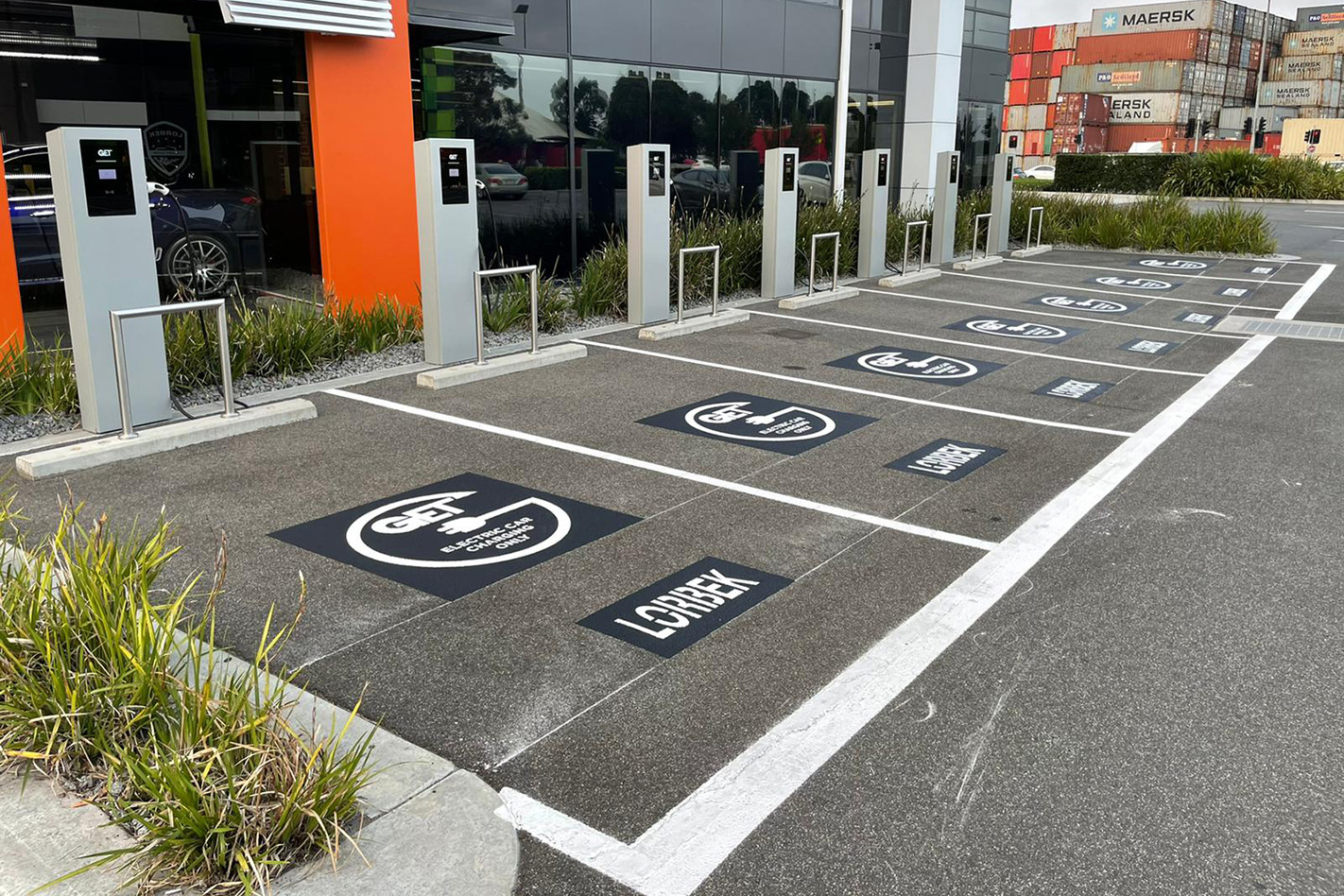
How will the EU’s regulations affect Australia?
Europe is home to a host of the world’s largest automotive manufacturers, including Volkswagen, Ford, Mercedes-Benz and BMW.
These companies will, understandably, have a focus on maximising sales in their home markets. Volkswagen, for example, has already committed to producing EVs in Europe exclusively from 2033, ahead of the ban.
But these manufacturers all have production facilities outside the EU, including South Africa and China as well as South and North America, that are all currently producing combustion-engined vehicles.
Australia’s ban on new petrol and diesel cars will come into effect in 2050, 15 years adrift of the EU. With European manufacturers focusing mainly on R&D to improve EVs, there is the potential that Australia will be saddled with previous-generation combustion engines.

It’s a concern that has previously been voiced about Australia, with impassioned phrases like “third-world dumping ground” from Minister Chris Bowen at August’s National EV Summit.
Following the Albanese Labor Government’s Federal Budget announcement last week, Australia’s targets to cut emissions by 43 per cent by 2030 and reach net zero by 2050 do, however, effectively match the EU’s final goal.
A detailed road-map of Australia’s electric future is still in progress as part of a consultation announced at the National EV Summit.
With more EVs on the market, and a growing portion of the Australian car-buying public willing to make the switch to zero-emissions vehicles though, it’s likely a significant number of battery-powered vehicles will be on our roads by 2035.
